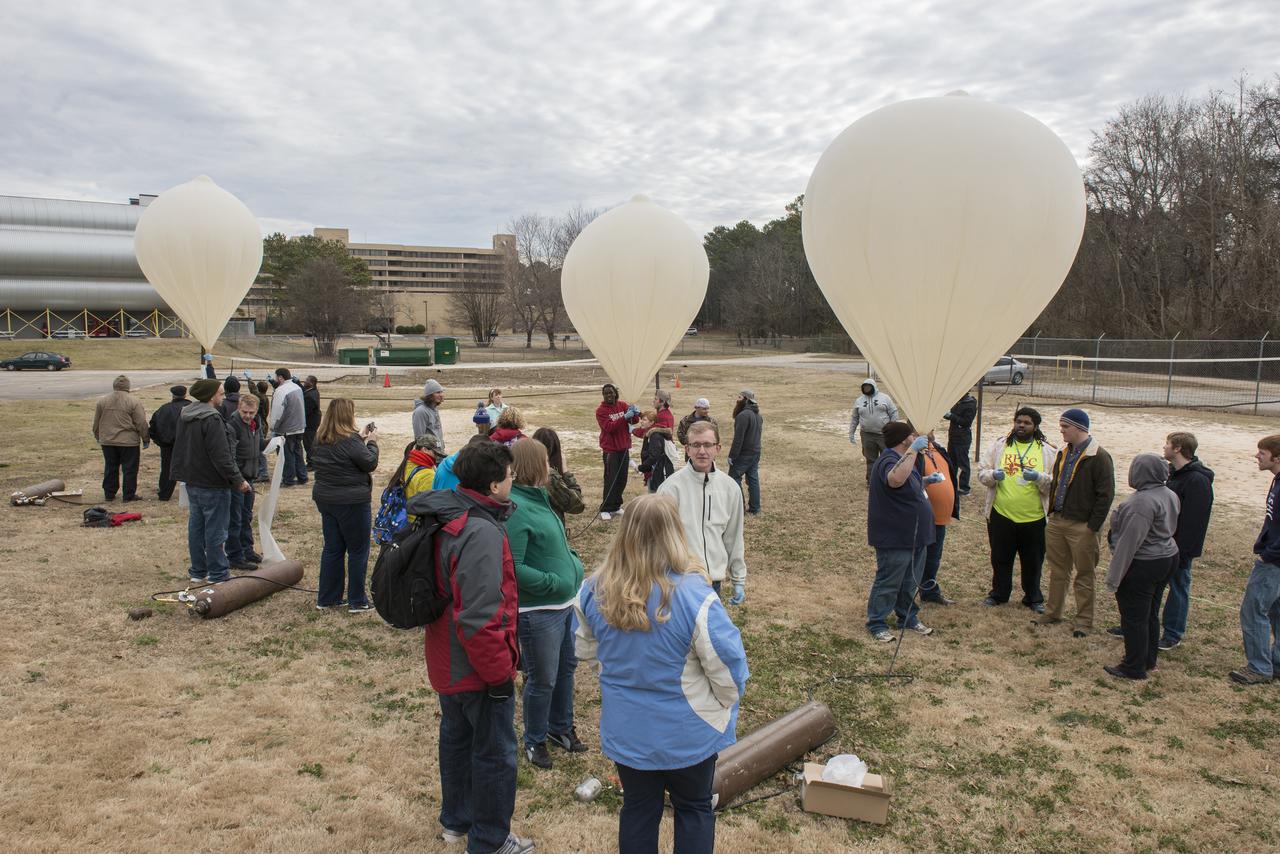
STUDENTS FROM COMMUNITY COLLEGES THROUGHOUT THE SOUTH CAME TOGETHER AT THE U.S. SPACE AND ROCKET CENTER FOR THE BALLOONSAT LAUNCH EVENT. EACH COMMUNITY COLLEGE TEAM ASSEMBLED ITS OWN PAYLOAD, DESIGNED TO DOWNLOAD SCIENTIFIC AND ATMOSPHERIC INFORMATION, AND THEN 2 WEATHER BALLOONS WERE SENT ALOFT TO APPROXIMATELY 100,000 FEET WITH THE PAYLOADS. THE PAYLOADS WERE RECOVERED IN N. GEORGIA AND TAKEN BACK TO THE INDIVIDUAL SCHOOLS FOR DOWNLOADING.
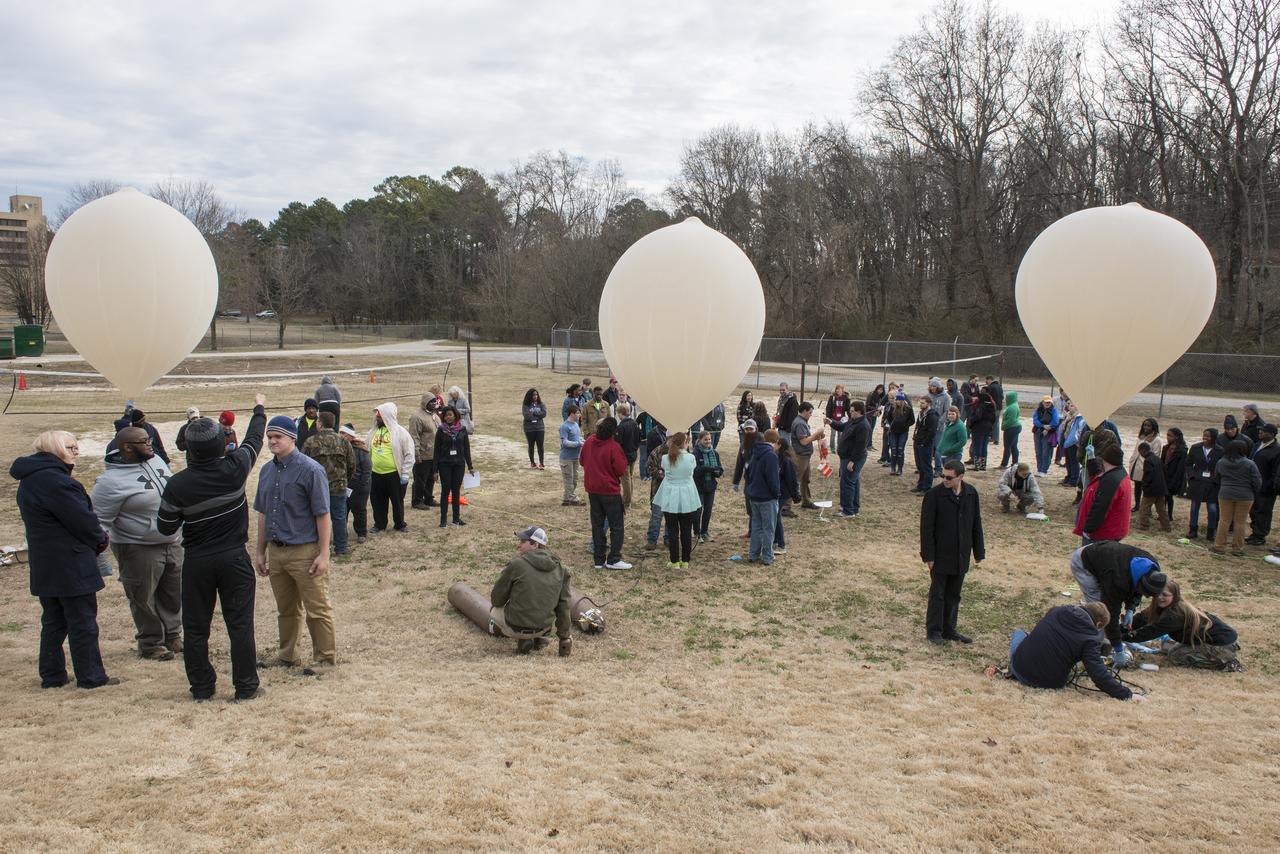
STUDENTS FROM COMMUNITY COLLEGES THROUGHOUT THE SOUTH CAME TOGETHER AT THE U.S. SPACE AND ROCKET CENTER FOR THE BALLOONSAT LAUNCH EVENT. EACH COMMUNITY COLLEGE TEAM ASSEMBLED ITS OWN PAYLOAD, DESIGNED TO DOWNLOAD SCIENTIFIC AND ATMOSPHERIC INFORMATION, AND THEN 2 WEATHER BALLOONS WERE SENT ALOFT TO APPROXIMATELY 100,000 FEET WITH THE PAYLOADS. THE PAYLOADS WERE RECOVERED IN N. GEORGIA AND TAKEN BACK TO THE INDIVIDUAL SCHOOLS FOR DOWNLOADING.
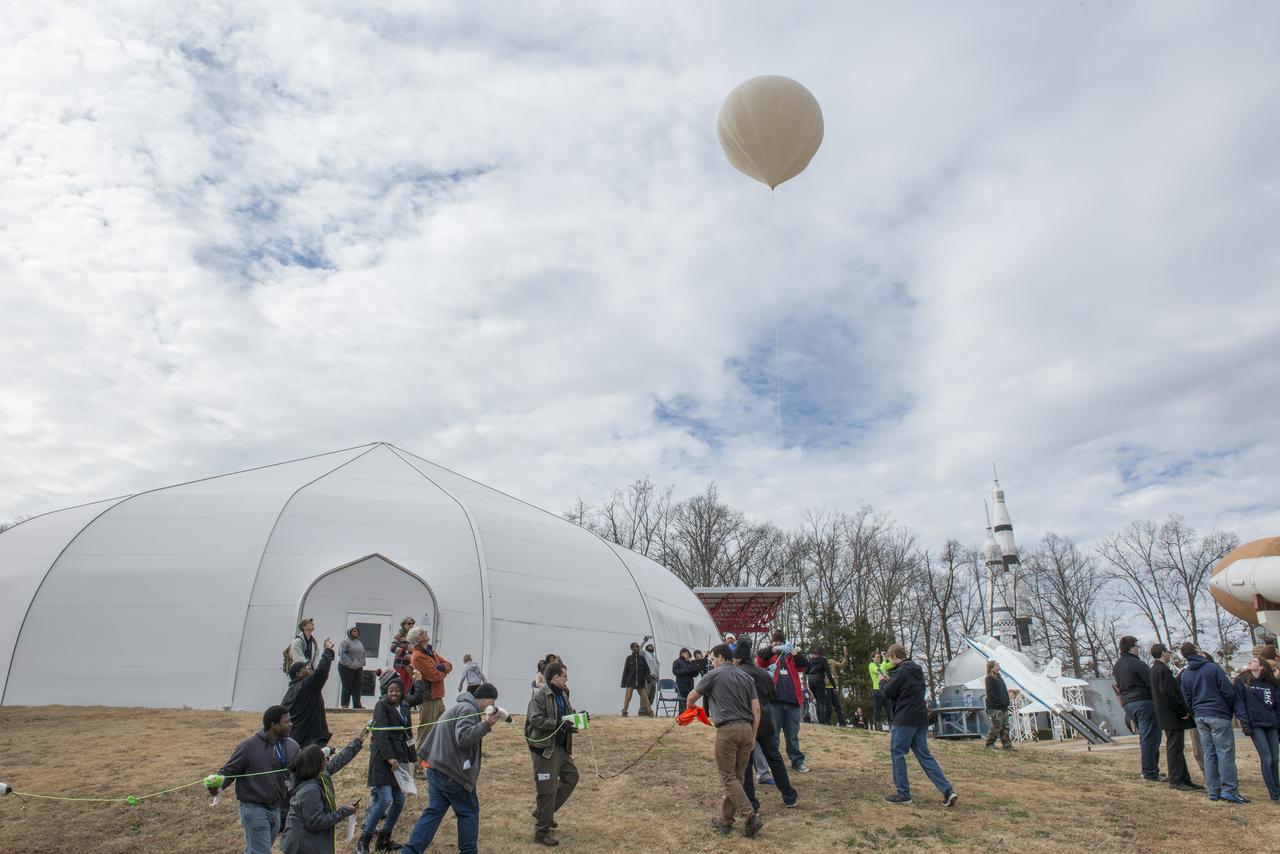
STUDENTS FROM COMMUNITY COLLEGES THROUGHOUT THE SOUTH CAME TOGETHER AT THE U.S. SPACE AND ROCKET CENTER FOR THE BALLOONSAT LAUNCH EVENT. EACH COMMUNITY COLLEGE TEAM ASSEMBLED ITS OWN PAYLOAD, DESIGNED TO DOWNLOAD SCIENTIFIC AND ATMOSPHERIC INFORMATION, AND THEN 2 WEATHER BALLOONS WERE SENT ALOFT TO APPROXIMATELY 100,000 FEET WITH THE PAYLOADS. THE PAYLOADS WERE RECOVERED IN N. GEORGIA AND TAKEN BACK TO THE INDIVIDUAL SCHOOLS FOR DOWNLOADING.
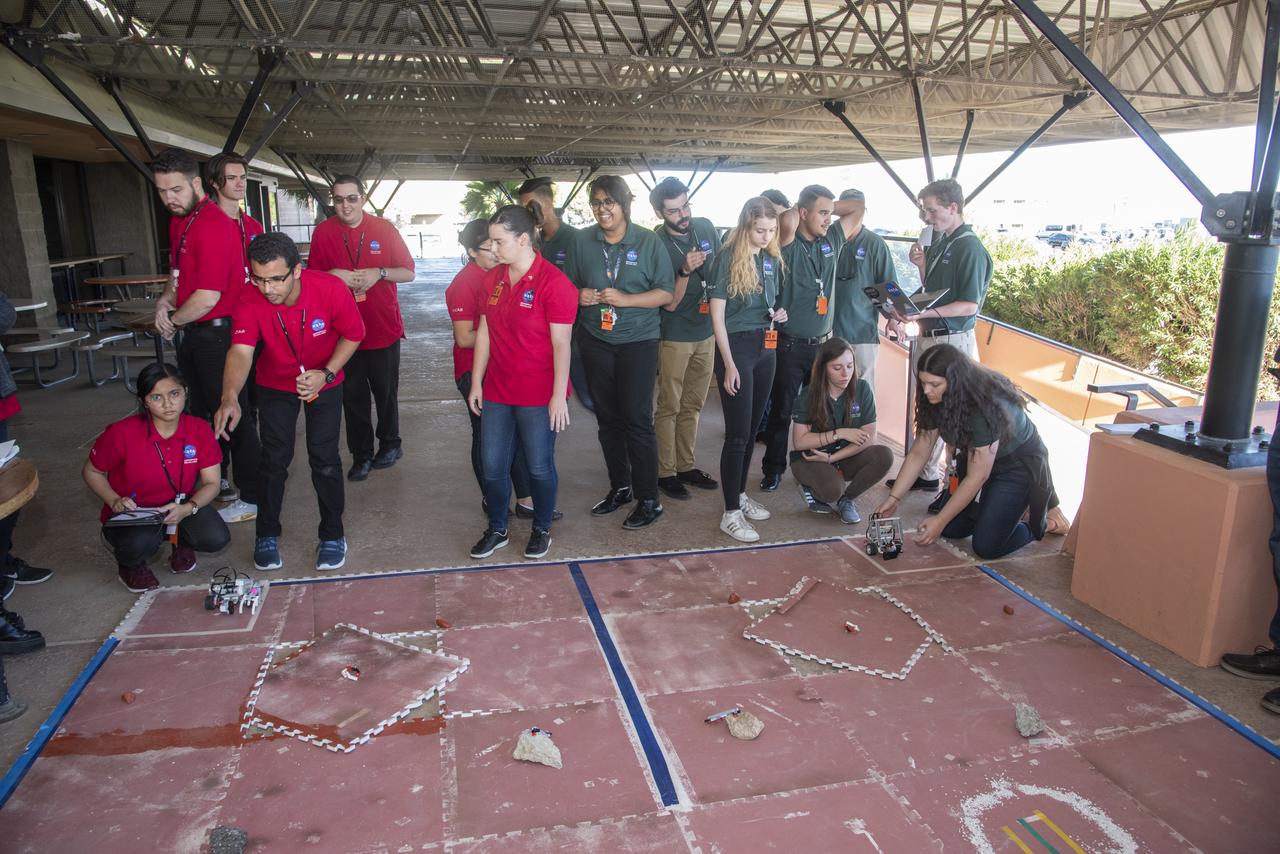
Four student teams: Blue, Gold, Green and Red built, designed and tested a LEGO robotic Martian rover prototype at NASA's Armstrong Flight Research Center. The teams competed against each other during a four-day workshop coordinated by the NASA Community College Aerospace Scholars. Each team prepared a marketing package to "sell" their design to NASA based on the performance of its Martian rover.
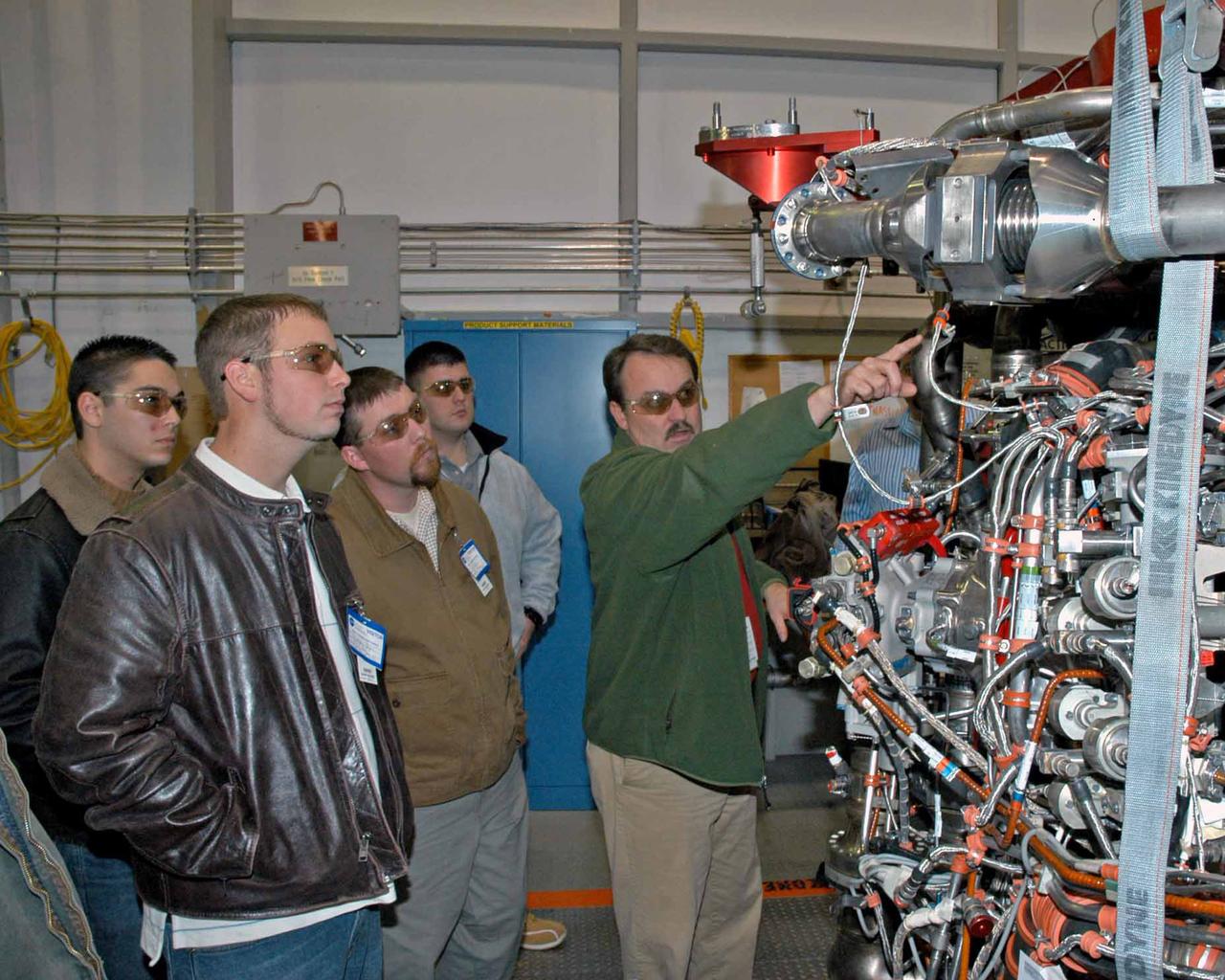
Pratt & Whitney Rocketdyne's Jeff Hansell, right, explains functions of a space shuttle main engine to Pearl River Community College Aviation Maintenance Technology Program students. Christopher Bryon, left, of Bay St. Louis, Ret Tolar of Kiln, Dan Holston of Baxterville and Billy Zugg of Long Beach took a recent tour of the SSME Processing Facility and the E-1 Test Complex at Stennis Space Center in South Mississippi. The students attend class adjacent to the Stennis International Airport tarmac in Kiln, where they get hands-on experience. PRCC's program prepares students to be responsible for the inspection, repair and maintenance of technologically advanced aircraft. A contractor to NASA, Pratt & Whitney Rocketdyne in Canoga Park, Calif., manufactures the space shuttle main engine and its high-pressure turbo pumps. SSC was established in the 1960s to test the huge engines for the Saturn V moon rockets. Now 40 years later, the center tests every main engine for the space shuttle, and is America's largest rocket engine test complex. SSC will soon begin testing the rocket engines that will power spacecraft carrying Americans back to the moon and on to Mars.

Students from Montgomery College in Rockville in Maryland, follow the progress of their Swarmie robots during the Swarmathon competition at the Kennedy Space Center Visitor Complex. Students were asked to develop computer code for the small robots, programming them to look for "resources" in the form of AprilTag cubes, similar to barcodes. Teams developed search algorithms for the Swarmies to operate autonomously, communicating and interacting as a collective swarm similar to ants foraging for food. In the spaceport's third annual Swarmathon, 23 teams represented 24 minority serving universities and community colleges were invited to develop software code to operate these innovative robots known as "Swarmies" to help find resources when astronauts explore distant locations, such as the Moon or Mars.
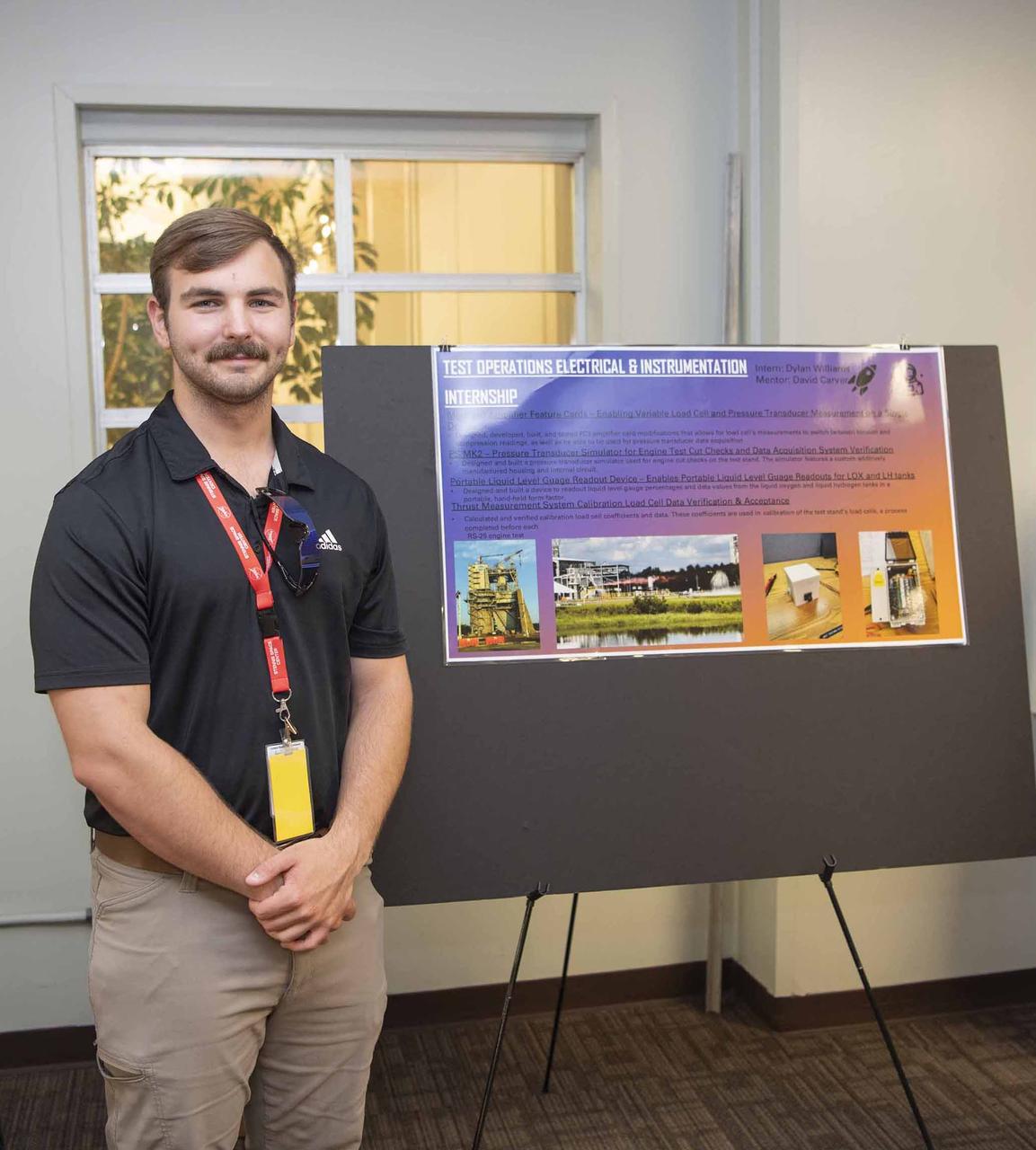
NASA Stennis summer intern Dylan Williams is shown with his presentation highlighting work with test operations during an Aug. 7 event hosted by the Office of STEM Engagement. Williams, a student at Meridian Community College in Meridian, Mississippi, worked with the NASA Stennis Engineering and Test Directorate. The poster symposium highlighted research topics, including propulsion test operations, lunar robotics, autonomous systems, STEM education, and more. NASA’s Office of STEM Engagement paid internships allow high school and college-level students to contribute to the agency’s mission to advance science, technology, aeronautics, and space exploration.
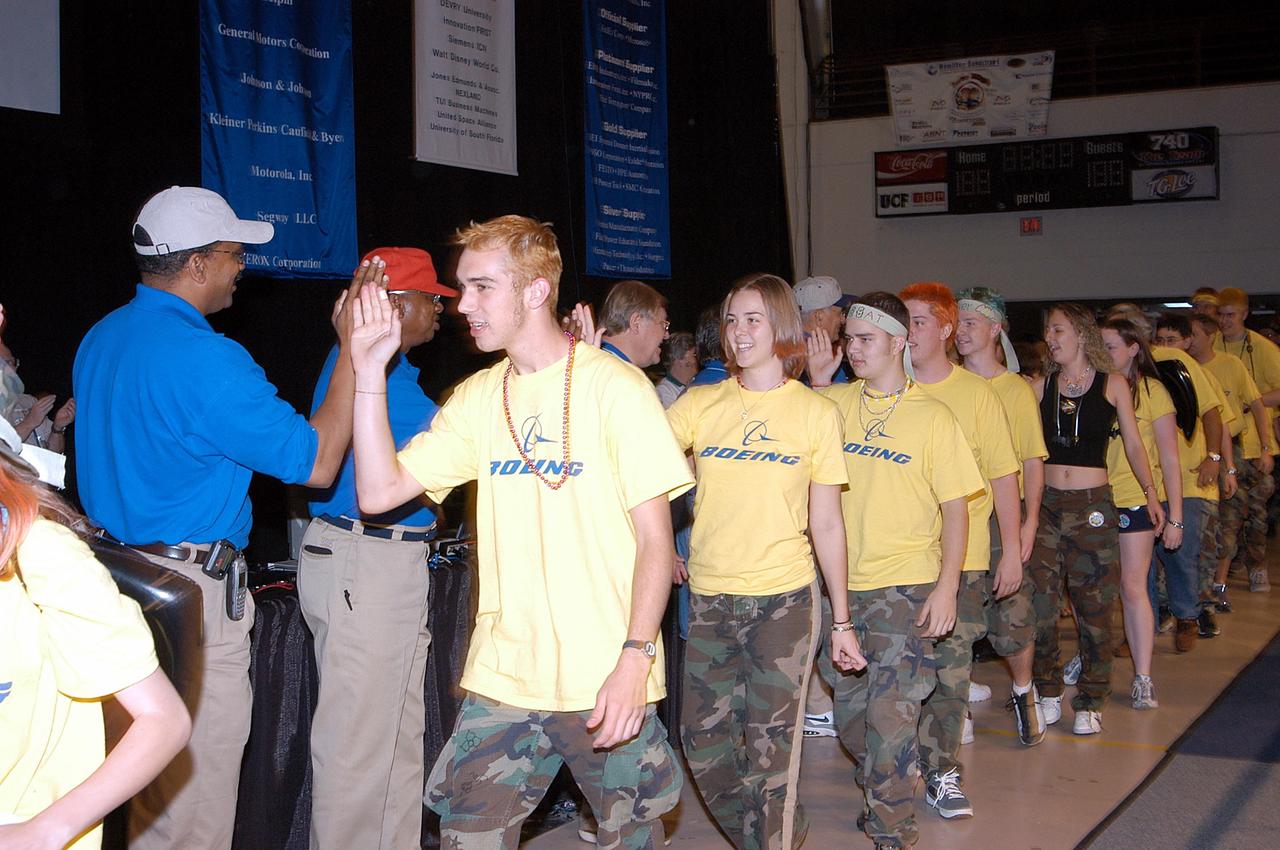
KENNEDY SPACE CENTER, FLA. - The Boeing Company/Brevard Community College-sponsored student team (in yellow shirts) is congratulated by the judges and support staff of the 2003 Southeastern Regional FIRST Robotic Competition. The competition is being held at the University of Central Florida (UCF) in Orlando, March 20-23. The team won the DaimlerChrysler Team Spirit Award and the Johnson & Johnson Sportsmanship Award. Forty student teams from around the country are participating in the event that pits team-built gladiator robots against each other in an athletic-style competition. The teams are sponsored by NASA/Kennedy Space Center, The Boeing Company/Brevard Community College, and Lockheed Martin Space Operations/Mission Systems for the nonprofit organization For Inspiration and Recognition of Science and Technology, known as FIRST. The vision of FIRST is to inspire in the youth of our nation an appreciation of science and technology and an understanding that mastering these disciplines can enrich the lives of all mankind.
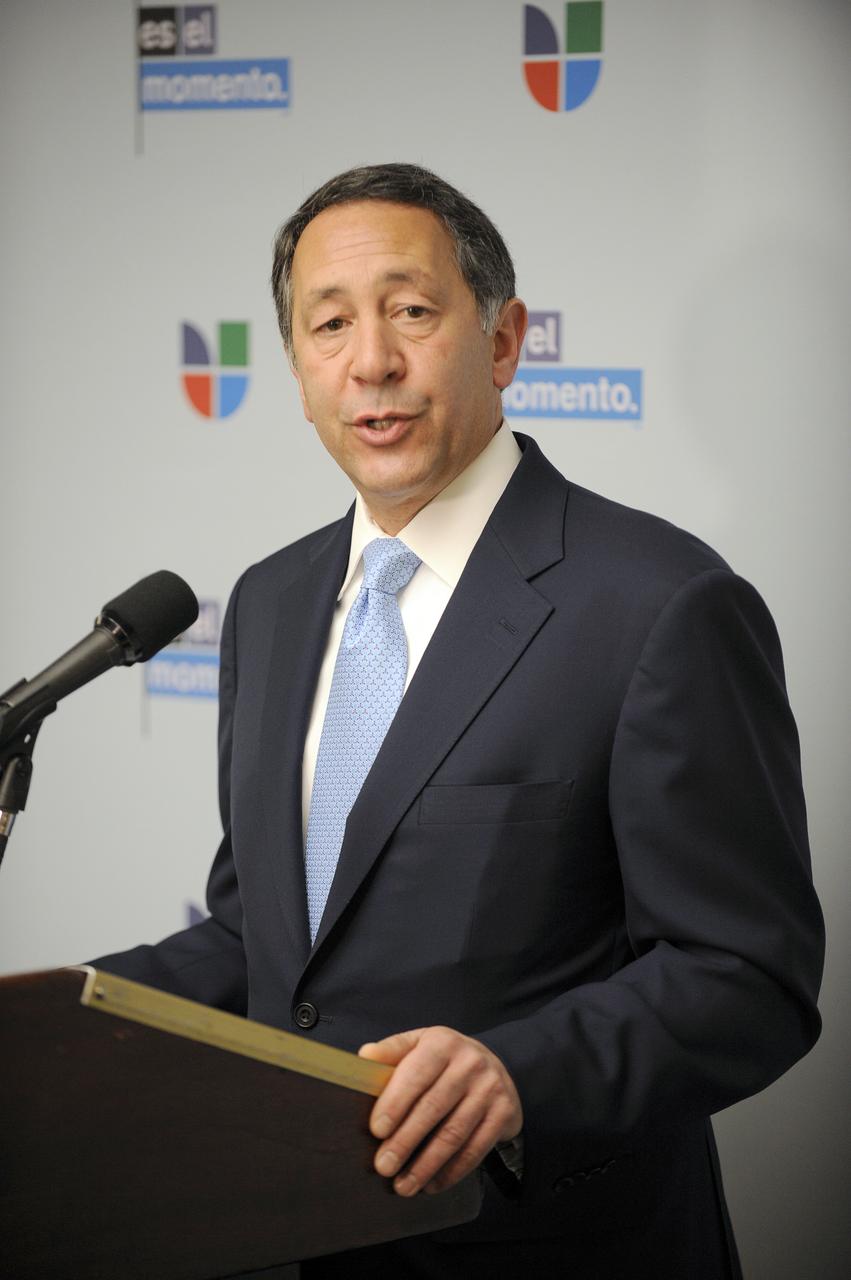
Univision Communications President and Chief Executive Officer Joe Uva speaks at an event at the National Press Club in Washington, Tuesday, Feb. 23, 2010. NASA is working with Univision Communications Inc. to develop a partnership in support of the Spanish-language media outlet's initiative to improve high school graduation rates, prepare Hispanic students for college, and encourage them to pursue careers in science, technology, engineering and mathematics, or STEM, disciplines. Photo Credit: (NASA/Bill Ingalls)
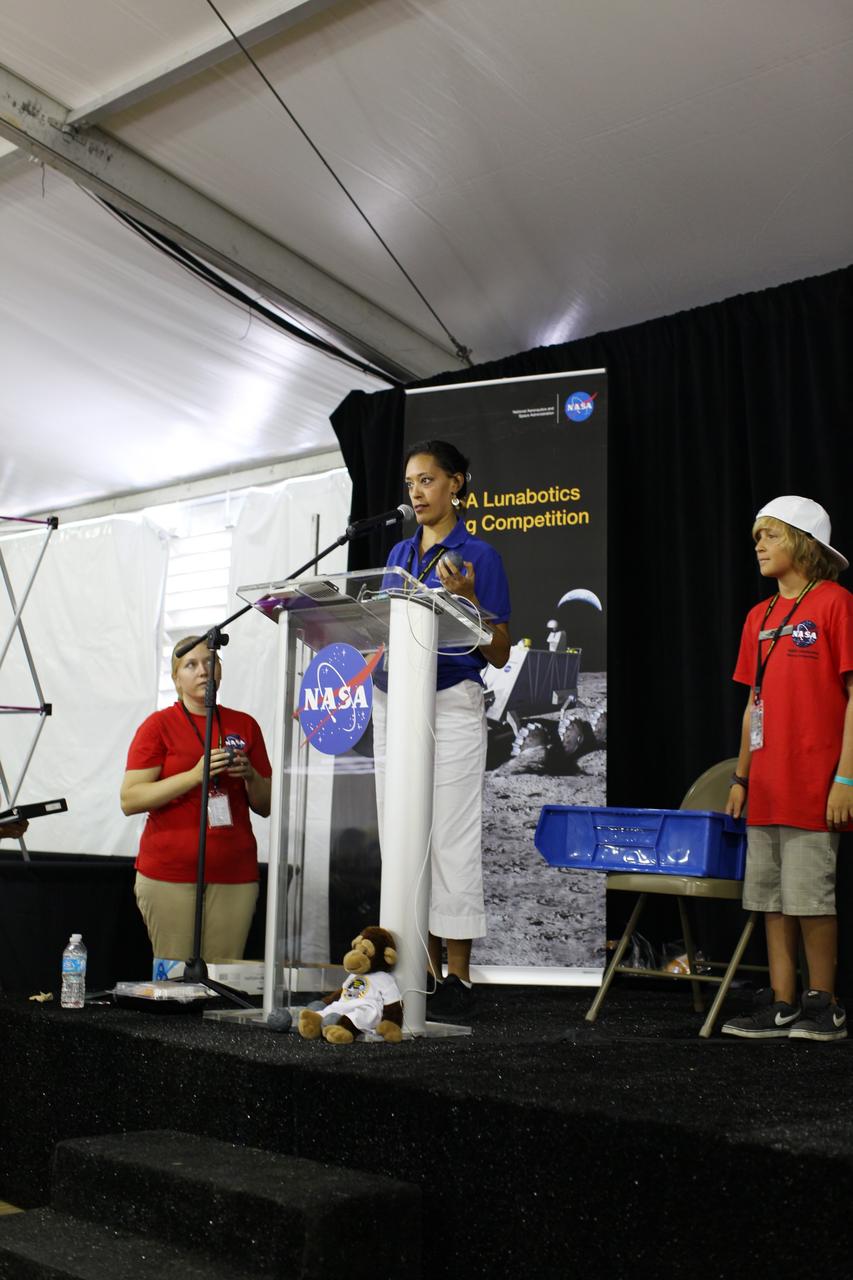
CAPE CANAVERAL, Fla. - At NASA’s Kennedy Space Center Visitor Complex in Florida, Lunabotics Emcee Kimberly Land welcomes U.S. and international college students to NASA’s Lunabotics Mining Competition. Land is the Education, Public Outreach and Communications manager for NASA’s Game Changing Development Program and Earth System Science Pathfinder Program. The mining competition is sponsored by NASA Kennedy Space Center’s Education Office for the agency’s Exploration Systems Mission Directorate. Undergraduate and graduate students from more than 50 universities and colleges in the U.S. and other countries use their remote-controlled Lunabots to maneuver and dig in a supersized sandbox filled with a crushed material that has characteristics similar to lunar soil. For more information, visit www.nasa.gov/lunabotics. Photo credit: NASA/Frankie Martin
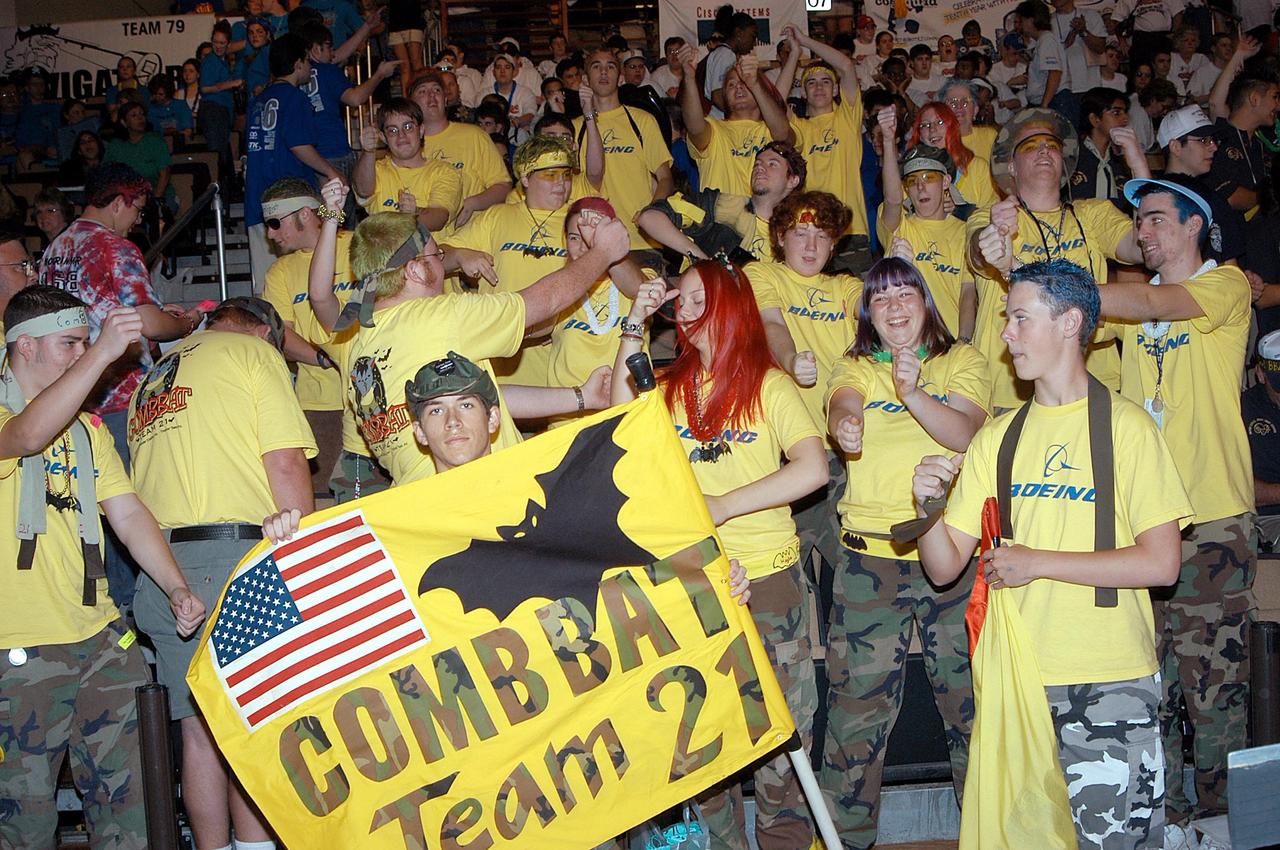
KENNEDY SPACE CENTER, FLA. - The Boeing Company/Brevard Community College-sponsored students, participating in the 2003 Southeastern Regional FIRST Robotic Competition, demonstrate their team spirit. The competition is being held at the University of Central Florida (UCF) in Orlando, March 20-23. The team won the DaimlerChrysler Team Spirit Award and the Johnson & Johnson Sportsmanship Award. Forty teams from around the country are participating in the event that pits team-built gladiator robots against each other in an athletic-style competition. The teams are sponsored by NASA-Kennedy Space Center, The Boeing Company/Brevard Community College, and Lockheed Martin Space Operations/Mission Systems for the nonprofit organization For Inspiration and Recognition of Science and Technology, known as FIRST. The vision of FIRST is to inspire in the youth of our nation an appreciation of science and technology and an understanding that mastering these disciplines can enrich the lives of all mankind.
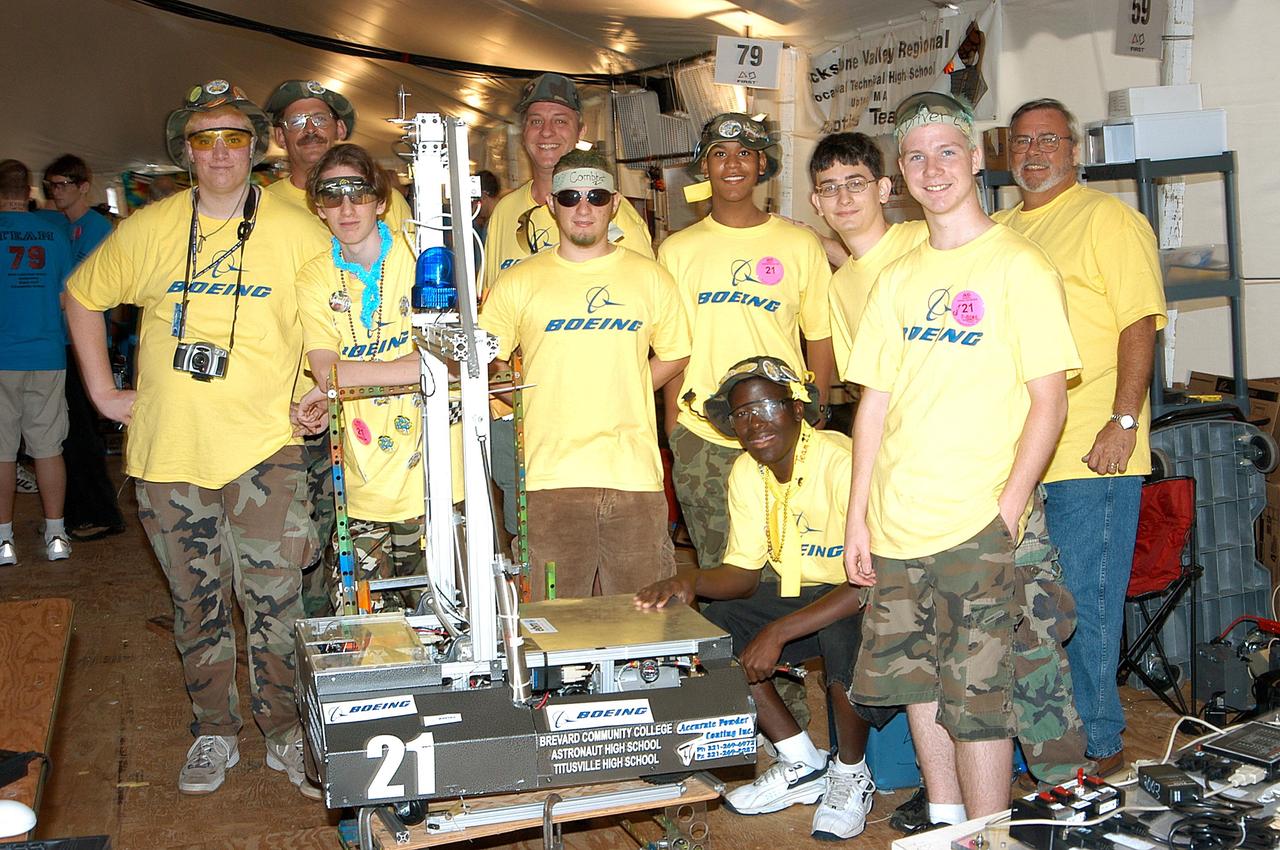
KENNEDY SPACE CENTER, FLA. - The Boeing Company/Brevard Community College-sponsored students, participating in the 2003 Southeastern Regional FIRST Robotic Competition, pose with their team-built robot. The competition is being held at the University of Central Florida (UCF) in Orlando, March 20-23. Forty teams from around the country are participating in the event that pits team-built gladiator robots against each other in an athletic-style competition. The teams are sponsored by NASA/Kennedy Space Center, The Boeing Company/Brevard Community College, and Lockheed Martin Space Operations/Mission Systems for the nonprofit organization For Inspiration and Recognition of Science and Technology, known as FIRST. The vision of FIRST is to inspire in the youth of our nation an appreciation of science and technology and an understanding that mastering these disciplines can enrich the lives of all mankind.
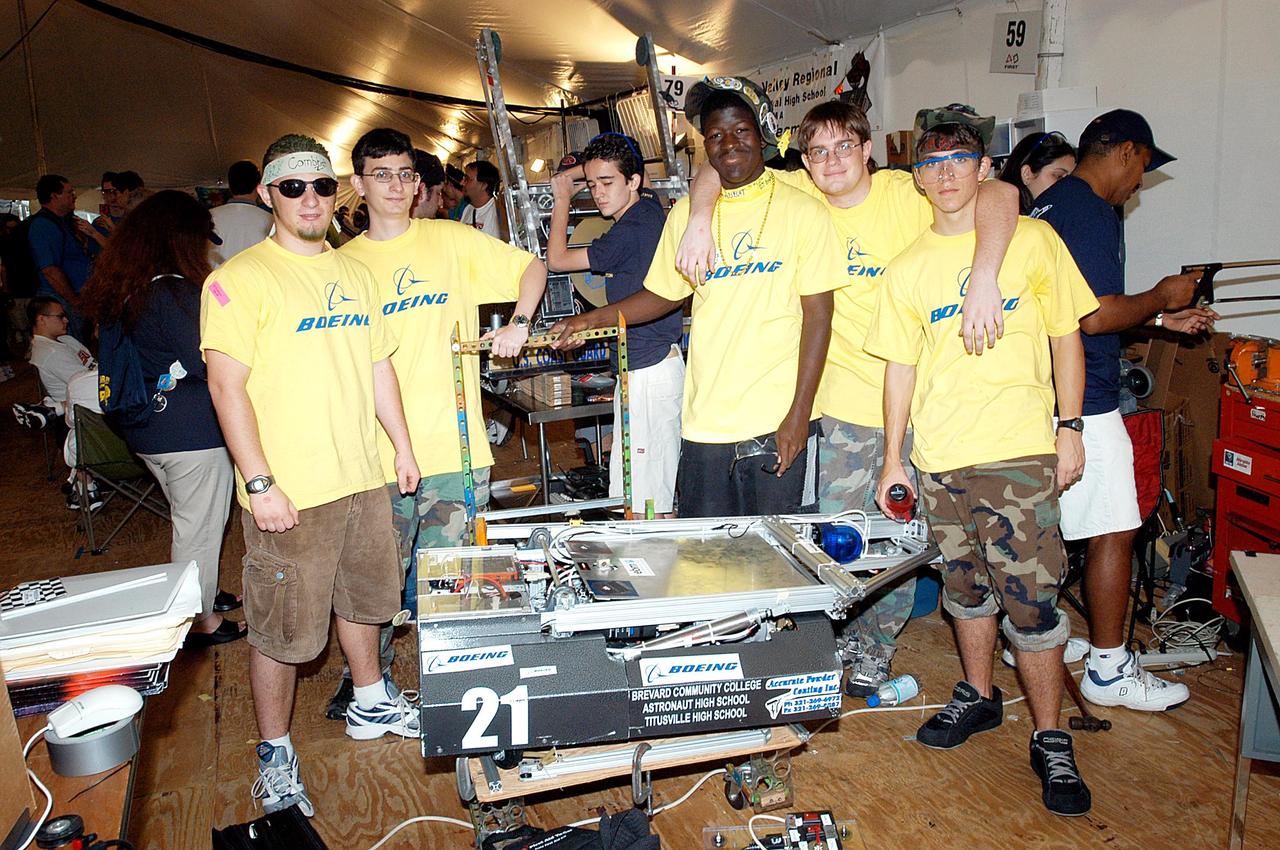
KENNEDY SPACE CENTER, FLA. - The Boeing Company/Brevard Community College-sponsored students, participating in the 2003 Southeastern Regional FIRST Robotic Competition, pose with their team-built robot. The competition is being held at the University of Central Florida (UCF) in Orlando, March 20-23. Forty teams from around the country are participating in the event that pits team-built gladiator robots against each other in an athletic-style competition. The teams are sponsored by NASA-Kennedy Space Center, The Boeing Company/Brevard Community College, and Lockheed Martin Space Operations/Mission Systems for the nonprofit organization For Inspiration and Recognition of Science and Technology, known as FIRST. The vision of FIRST is to inspire in the youth of our nation an appreciation of science and technology and an understanding that mastering these disciplines can enrich the lives of all mankind.
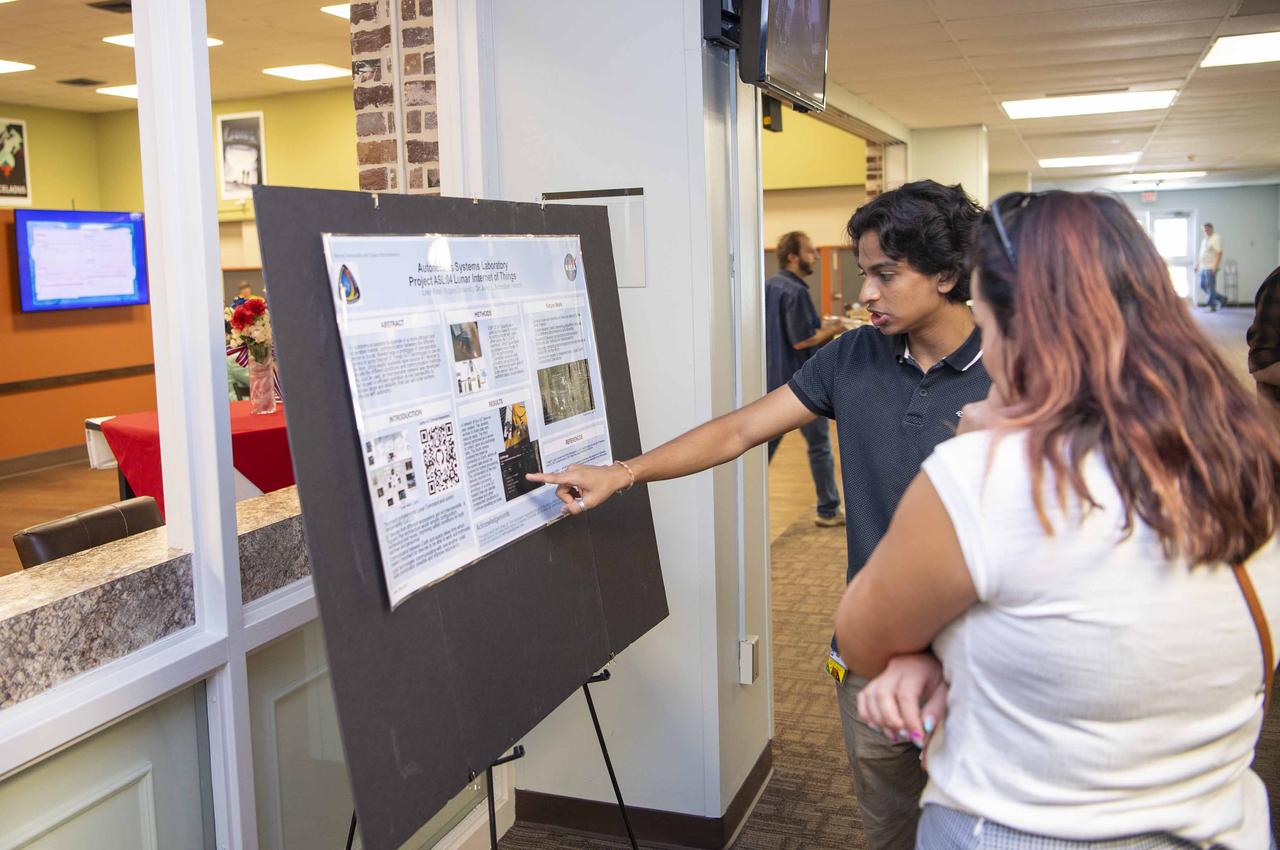
NASA Stennis summer intern Lekh Patel shares about his work on lunar communications during an Aug. 7 event hosted by the Office of STEM Engagement. Patel, a student at Rutgers University in Newark, New Jersey, worked with the NASA Stennis Autonomous Systems Laboratory. The poster symposium highlighted research topics, including propulsion test operations, lunar robotics, autonomous systems, STEM education, and more. NASA’s Office of STEM Engagement paid internships allow high school and college-level students to contribute to the agency’s mission to advance science, technology, aeronautics, and space exploration.

Student Assistant Antoinette Davis (left) of Utica; Carmella Forsythe, 13, of Clinton; Terri Henderson, 14, of Clinton; Tyra Greer, 12, of Port Gibson; and Kala Battle, 14, of Edwards, answer curriculum questions about NASA's Return to Flight mission exhibit at StenniSphere, the visitor center at NASA's Stennis Space Center (SSC) near Bay St. Louis, Miss. The girls were on a field trip to StenniSphere with fellow participants in Hinds Community College's MSEIP (Minority Science Engineering Improvement Program) summer program. MSEIP encourages students to pursue and prepare for careers in science, technology, engineering and math.
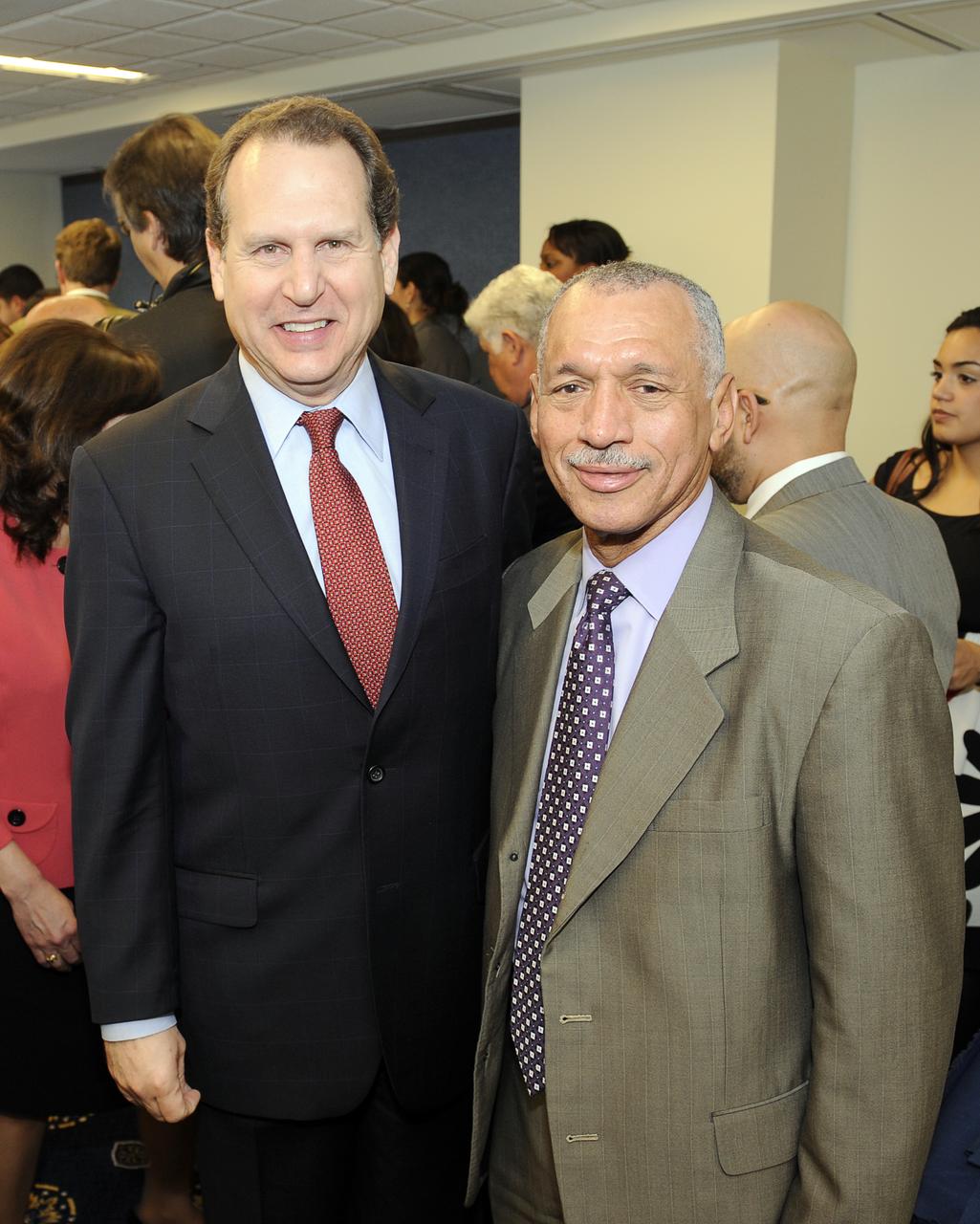
NASA Administrator Charles Bolden, right, poses with U.S. Rep. Lincoln Diaz-Balart, R-Fla., prior to the start of an event at the National Press Club in Washington, Tuesday, Feb. 23, 2010. NASA is working with Univision Communications Inc. to develop a partnership in support of the Spanish-language media outlet's initiative to improve high school graduation rates, prepare Hispanic students for college, and encourage them to pursue careers in science, technology, engineering and mathematics, or STEM, disciplines. Photo Credit: (NASA/Bill Ingalls)
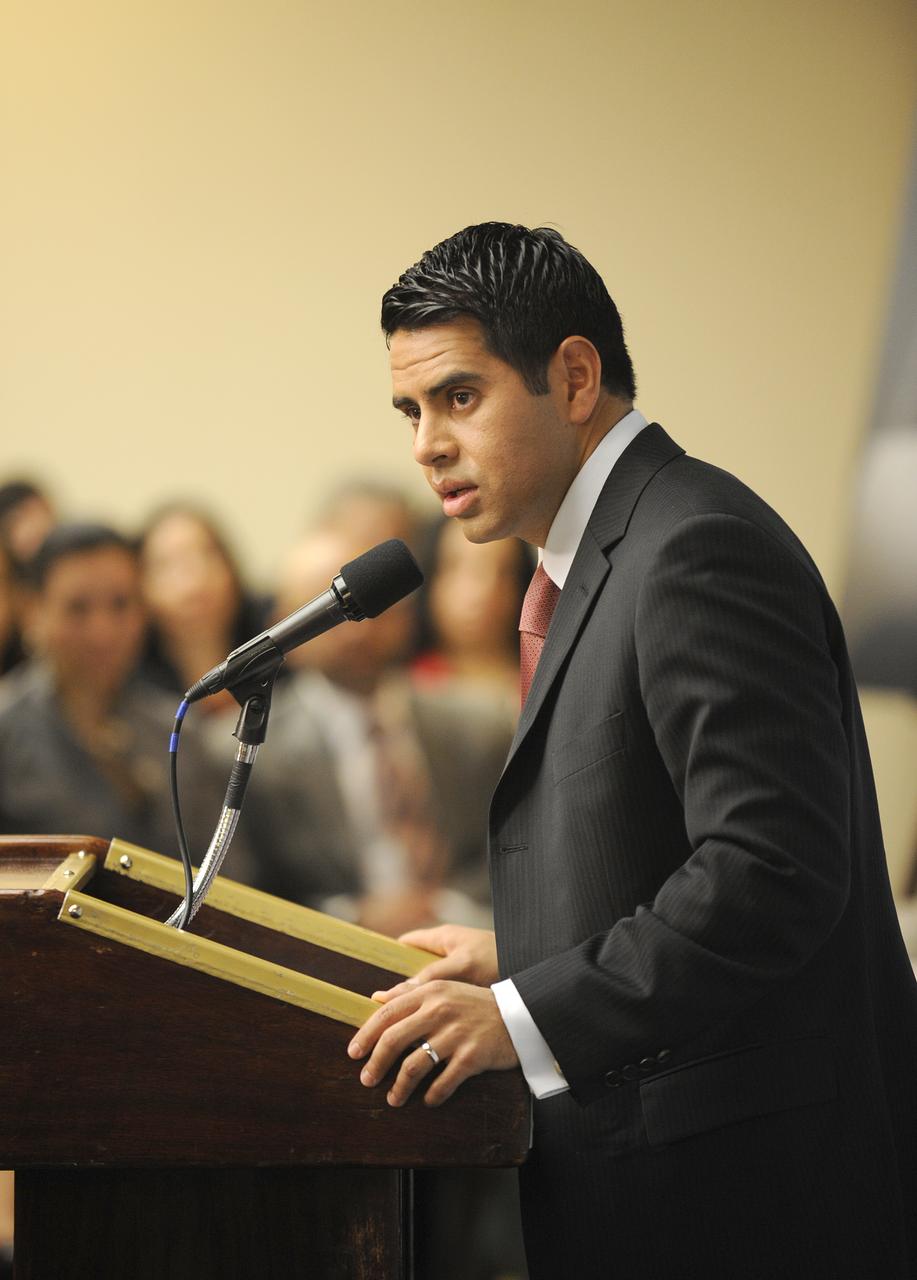
Univision Networks president Cesar Conde speaks at the National Press Club in Washington, Tuesday, Feb. 23, 2010. NASA is working with Univision Communications Inc. to develop a partnership in support of the Spanish-language media outlet's initiative to improve high school graduation rates, prepare Hispanic students for college, and encourage them to pursue careers in science, technology, engineering and mathematics, or STEM, disciplines. Photo Credit: (NASA/Bill Ingalls)
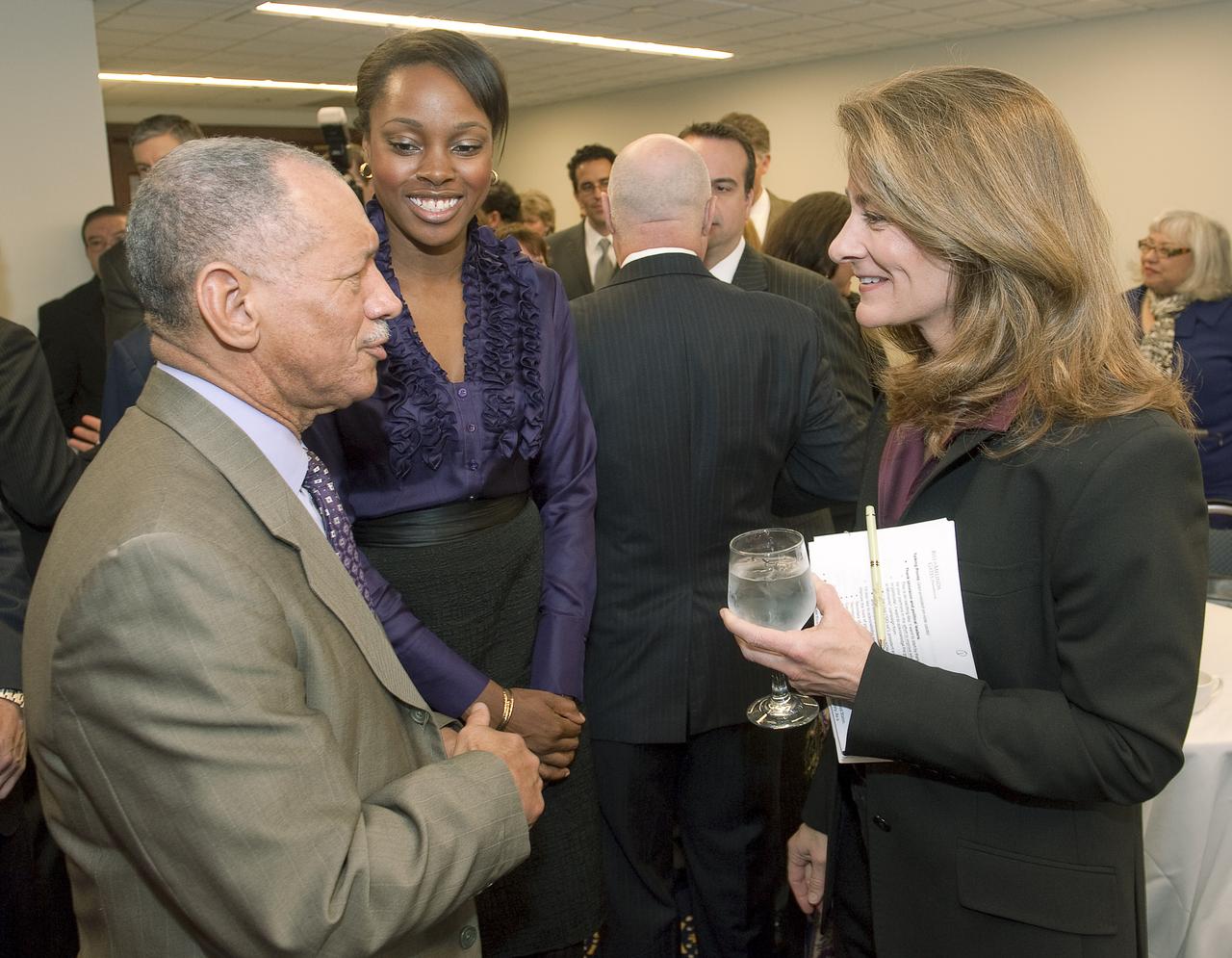
NASA Administrator Charles Bolden, left, speaks with Melinda French Gates, of the Bill & Melinda Gates Foundation, right, prior to the start of an event at the National Press Club in Washington, Tuesday, Feb. 23, 2010. NASA is working with Univision Communications Inc. to develop a partnership in support of the Spanish-language media outlet's initiative to improve high school graduation rates, prepare Hispanic students for college, and encourage them to pursue careers in science, technology, engineering and mathematics, or STEM, disciplines. Photo Credit: (NASA/Bill Ingalls)
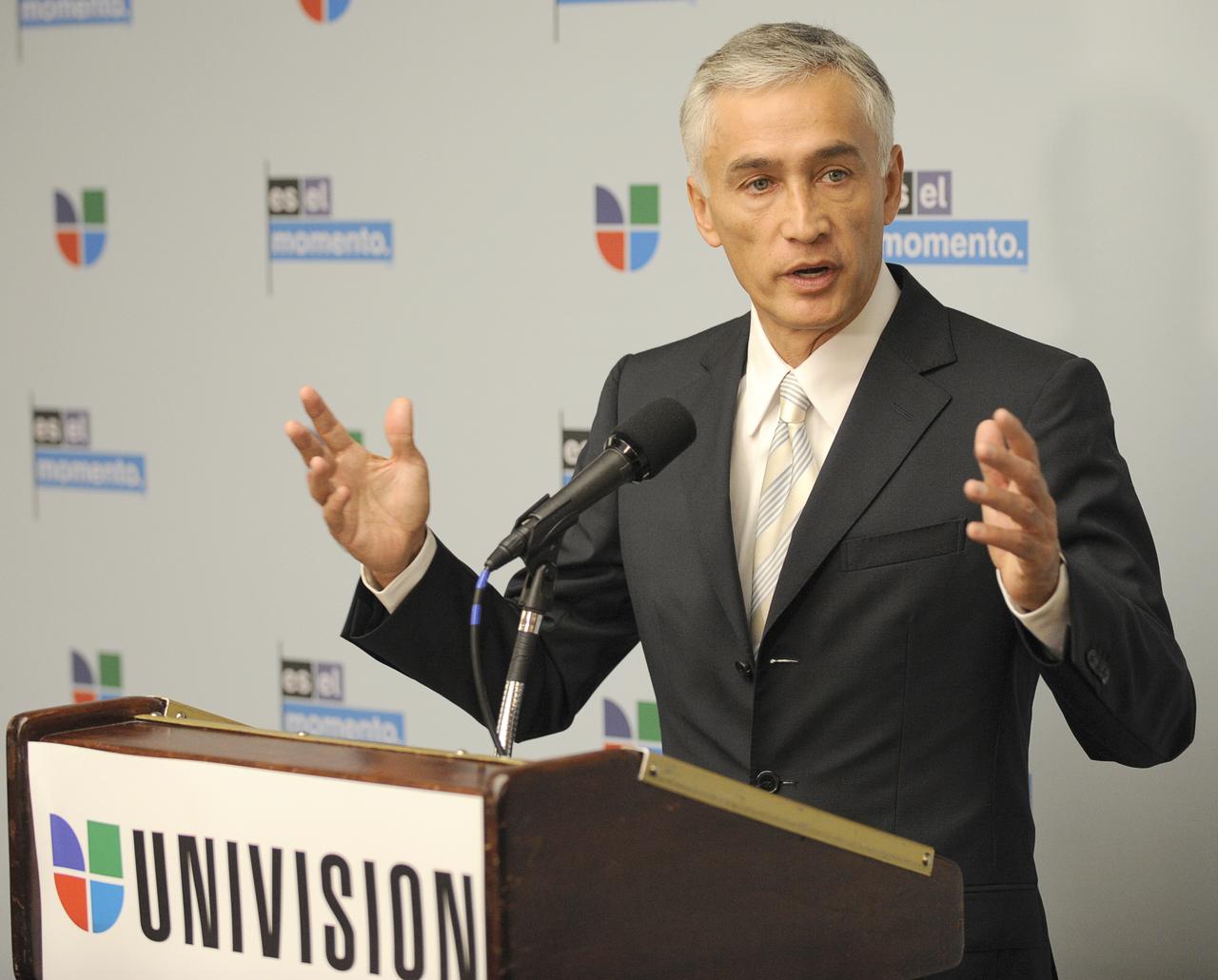
Univision news anchor Jorge Ramos speaks at an event at the National Press Club in Washington, Tuesday, Feb. 23, 2010. NASA is working with Univision Communications Inc. to develop a partnership in support of the Spanish-language media outlet's initiative to improve high school graduation rates, prepare Hispanic students for college, and encourage them to pursue careers in science, technology, engineering and mathematics, or STEM, disciplines. Photo Credit: (NASA/Bill Ingalls)
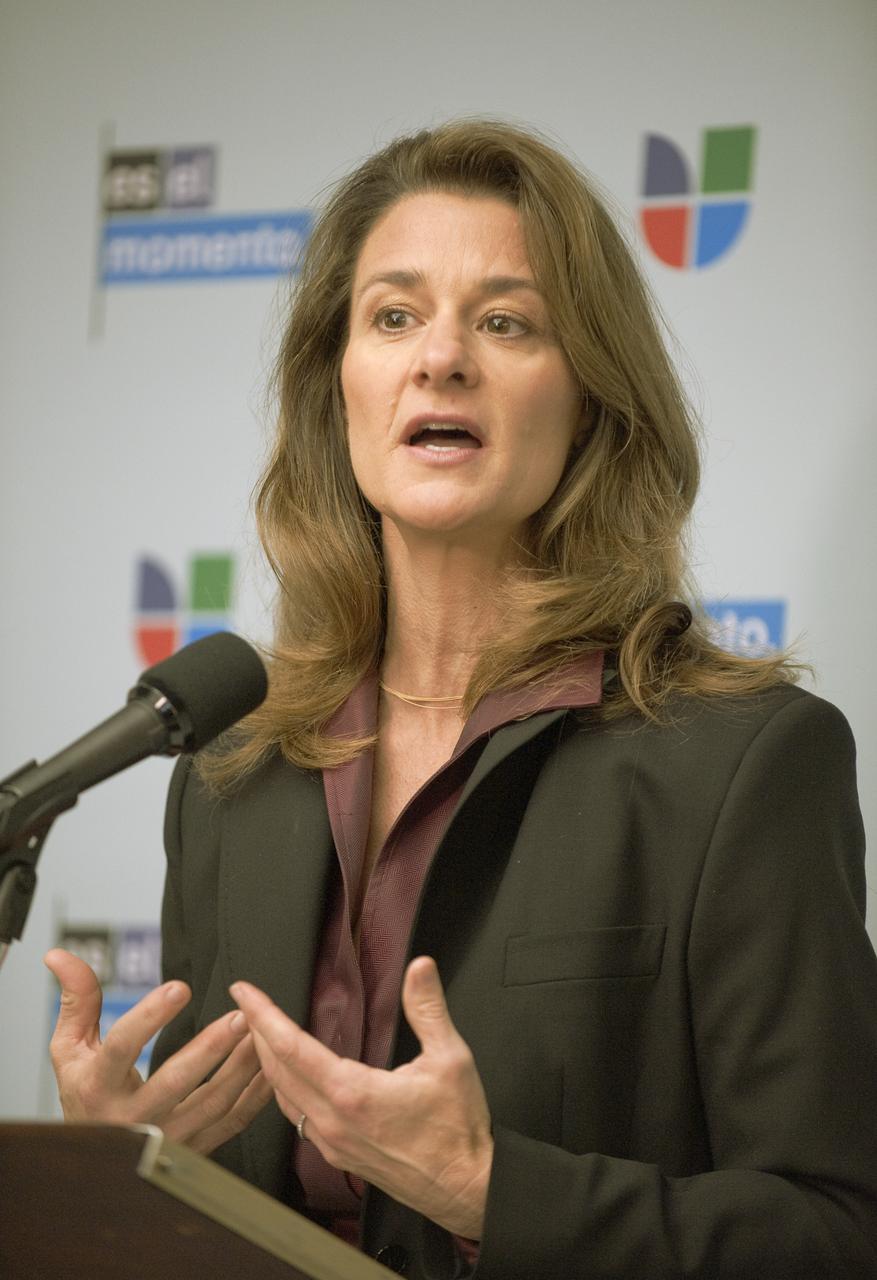
Melinda French Gates, of the Bill & Melinda Gates Foundation, speaks during an event at the National Press Club in Washington, Tuesday, Feb. 23, 2010. NASA is working with Univision Communications Inc. to develop a partnership in support of the Spanish-language media outlet's initiative to improve high school graduation rates, prepare Hispanic students for college, and encourage them to pursue careers in science, technology, engineering and mathematics, or STEM, disciplines. Photo Credit: (NASA/Bill Ingalls)
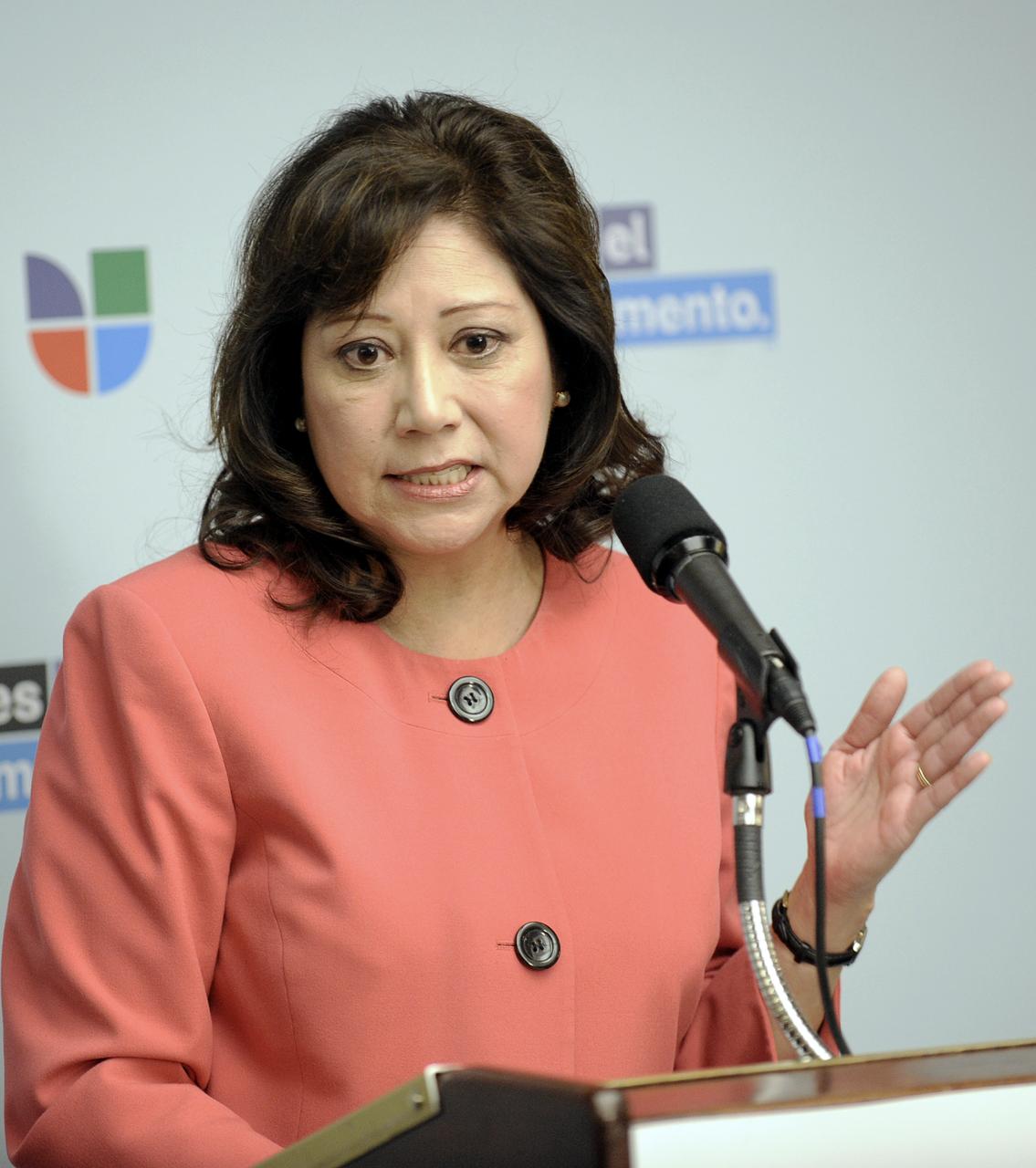
U.S. Secretary of Labor Hilda Solis speaks at an event at the National Press Club in Washington, Tuesday, Feb. 23, 2010. NASA is working with Univision Communications Inc. to develop a partnership in support of the Spanish-language media outlet's initiative to improve high school graduation rates, prepare Hispanic students for college, and encourage them to pursue careers in science, technology, engineering and mathematics, or STEM, disciplines. Photo Credit: (NASA/Bill Ingalls)
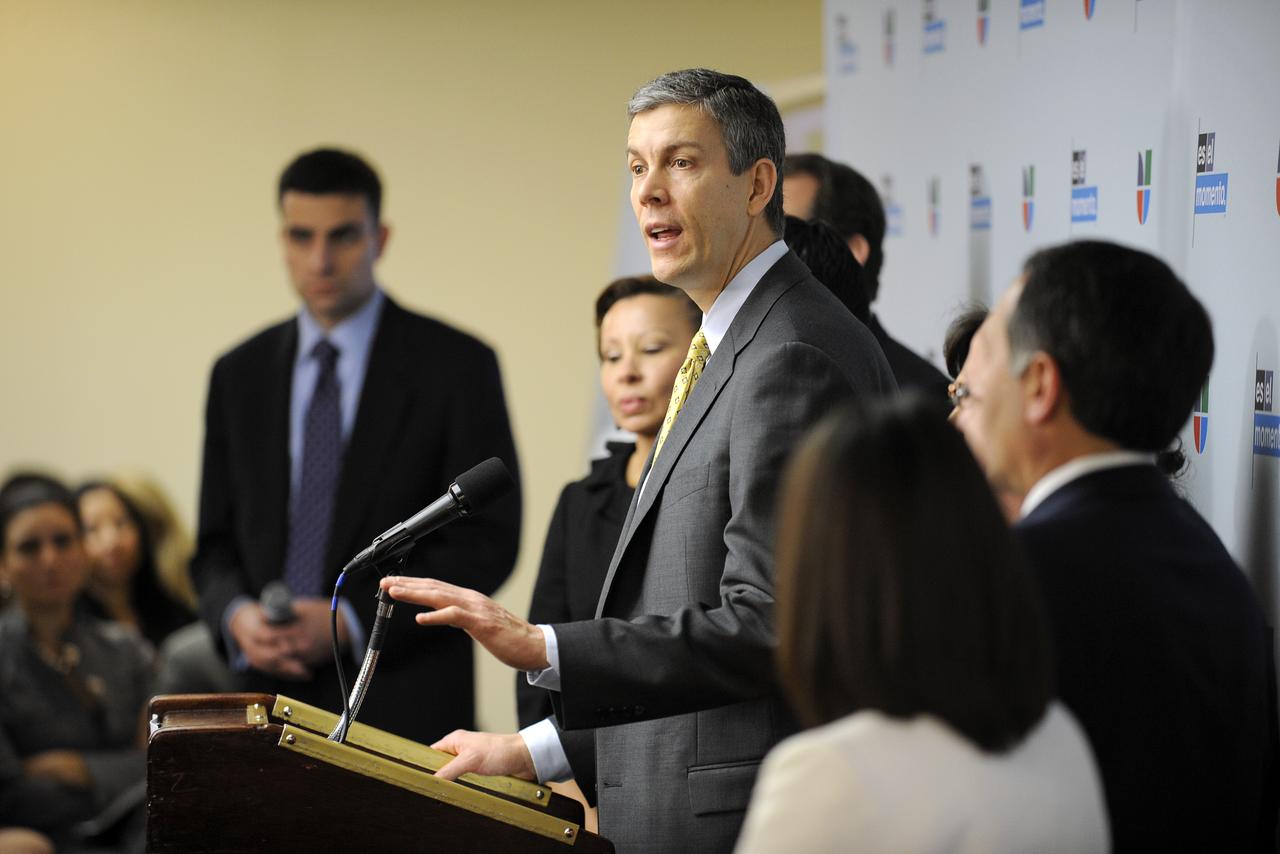
U.S. Secretary of Education Arne Duncan speaks during an event at the National Press Club in Washington, Tuesday, Feb. 23, 2010. NASA is working with Univision Communications Inc. to develop a partnership in support of the Spanish-language media outlet's initiative to improve high school graduation rates, prepare Hispanic students for college, and encourage them to pursue careers in science, technology, engineering and mathematics, or STEM, disciplines. Photo Credit: (NASA/Bill Ingalls)
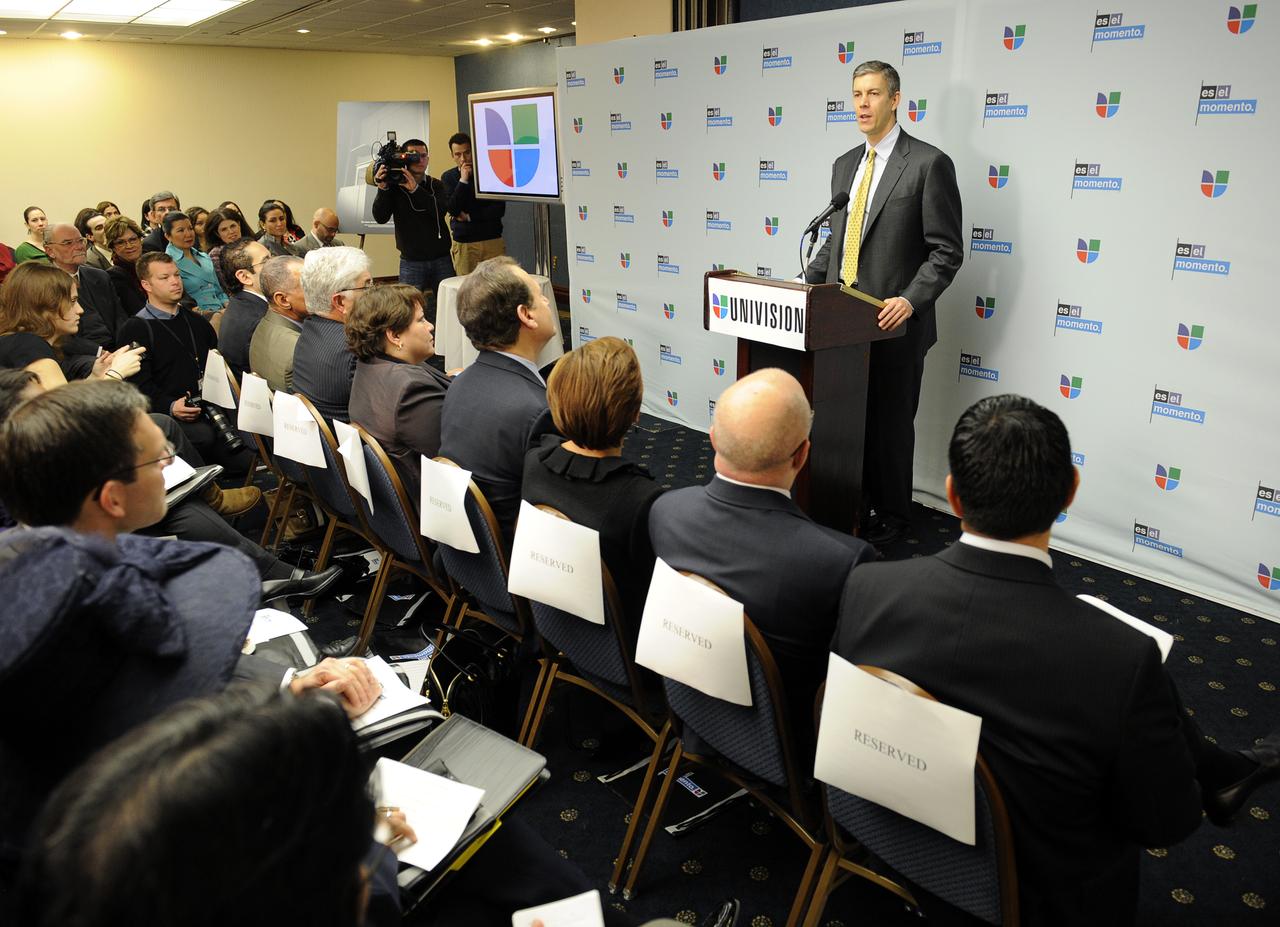
U.S. Secretary of Education Arne Duncan speaks at an event at the National Press Club in Washington, Tuesday, Feb. 23, 2010. NASA is working with Univision Communications Inc. to develop a partnership in support of the Spanish-language media outlet's initiative to improve high school graduation rates, prepare Hispanic students for college, and encourage them to pursue careers in science, technology, engineering and mathematics, or STEM, disciplines. Photo Credit: (NASA/Bill Ingalls)
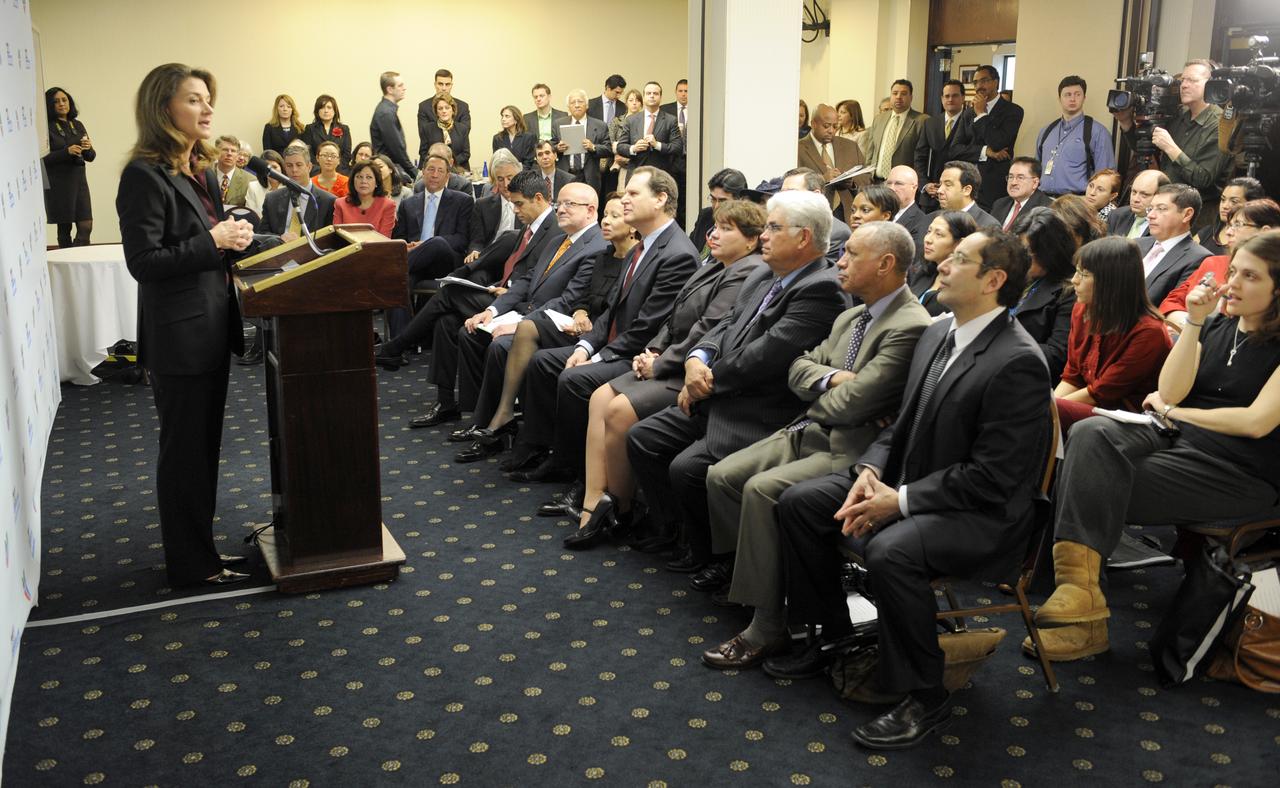
Melinda French Gates, of the Bill & Melinda Gates Foundation speaks at an event at the National Press Club in Washington, Tuesday, Feb. 23, 2010. NASA is working with Univision Communications Inc. to develop a partnership in support of the Spanish-language media outlet's initiative to improve high school graduation rates, prepare Hispanic students for college, and encourage them to pursue careers in science, technology, engineering and mathematics, or STEM, disciplines. Photo Credit: (NASA/Bill Ingalls)
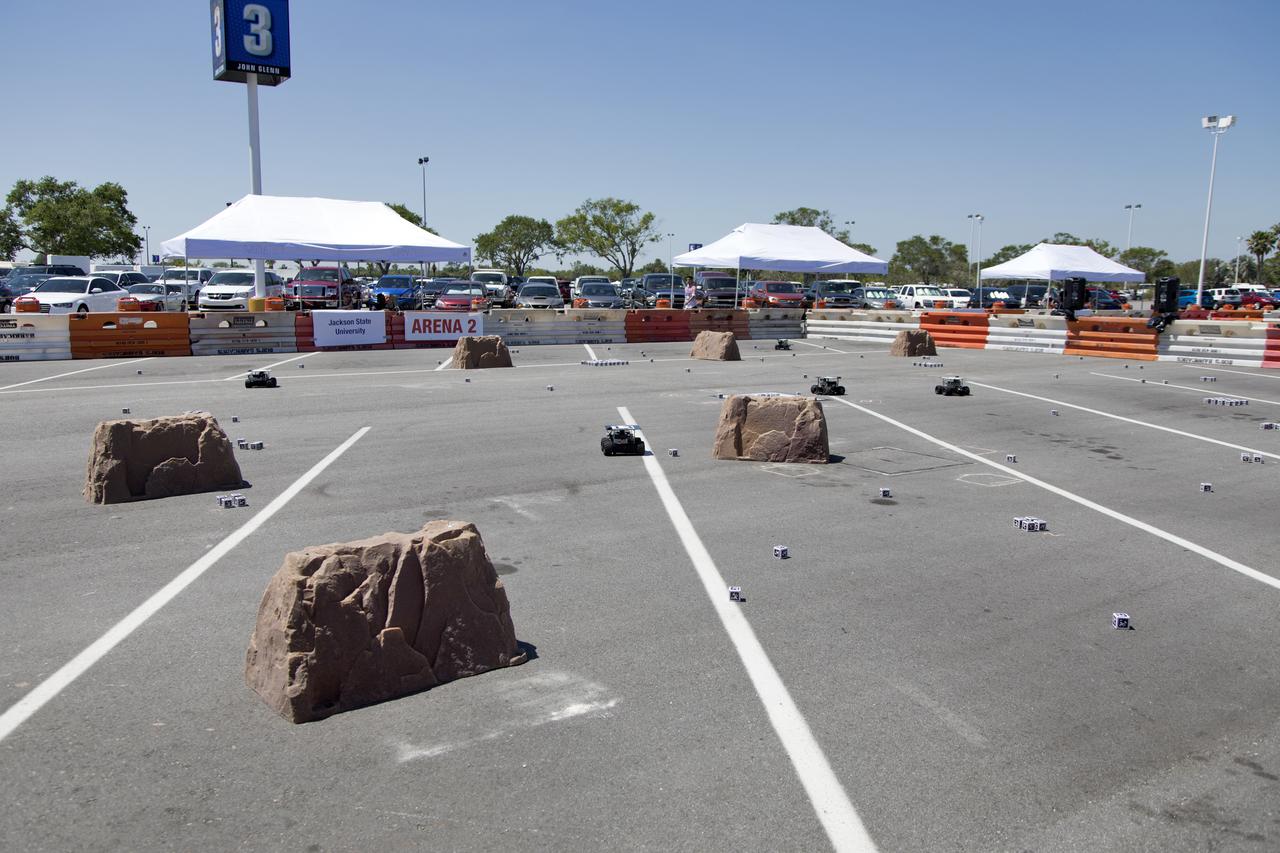
In the Swarmathon competition at the Kennedy Space Center Visitor Complex, students were asked to develop computer code for the small robots, programming them to look for "resources" in the form of AprilTag cubes, similar to barcodes. To add to the challenge, obstacles in the form of simulated rocks were placed in the completion arena. Teams developed search algorithms for the Swarmies to operate autonomously, communicating and interacting as a collective swarm similar to ants foraging for food. In the spaceport's third annual Swarmathon, 23 teams represented 24 minority serving universities and community colleges were invited to develop software code to operate these innovative robots known as "Swarmies" to help find resources when astronauts explore distant locations, such as the Moon or Mars.
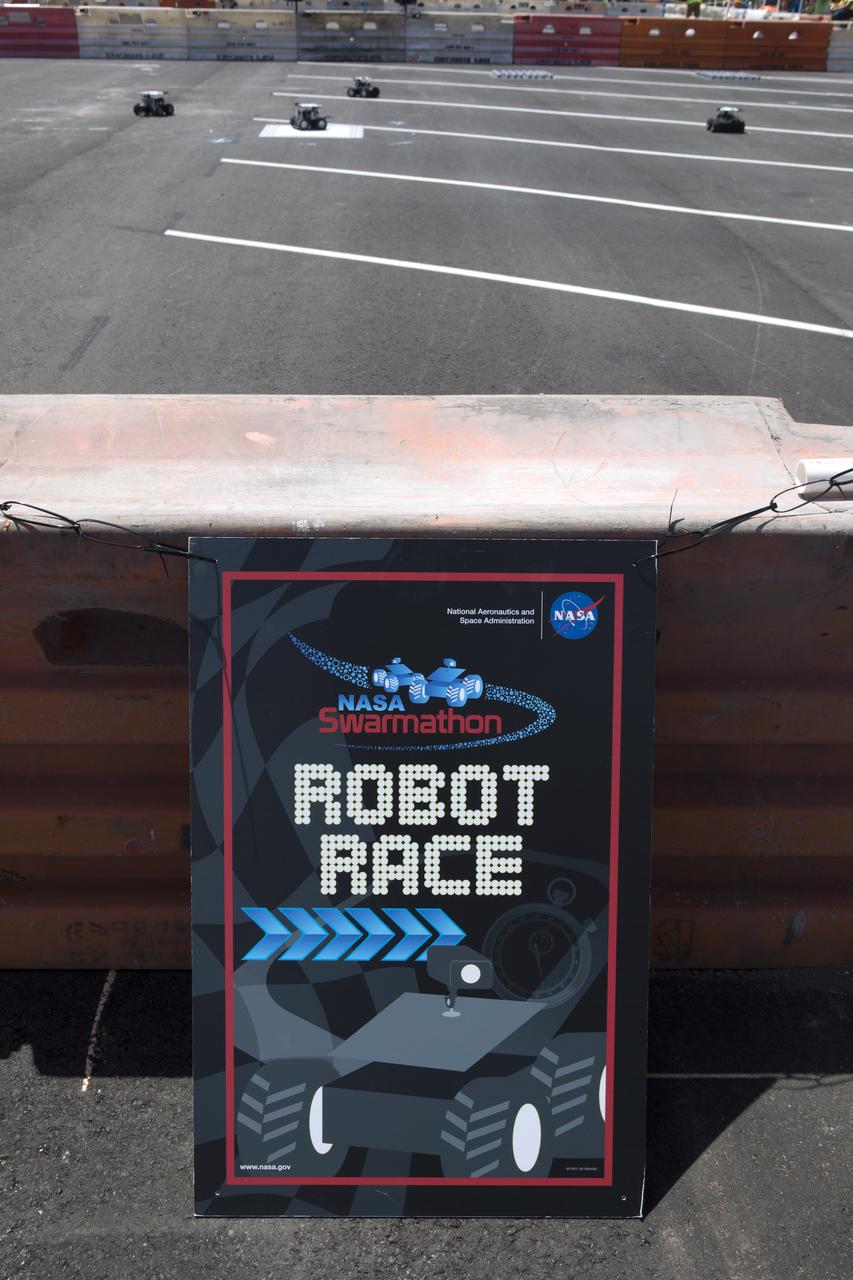
A sign at the Kennedy Space Center Visitor Complex announces the second annual Swarmathon competition. Students were asked to develop computer code for the small robots, programming them to look for "resources" in the form of cubes with AprilTags, similar to barcodes. Teams developed search algorithms for the Swarmies to operate autonomously, communicating and interacting as a collective swarm similar to ants foraging for food. In the spaceport's second annual Swarmathon, 20 teams representing 22 minority serving universities and community colleges were invited to develop software code to operate these innovative robots known as "Swarmies" to help find resources when astronauts explore distant locations, such as the moon or Mars.
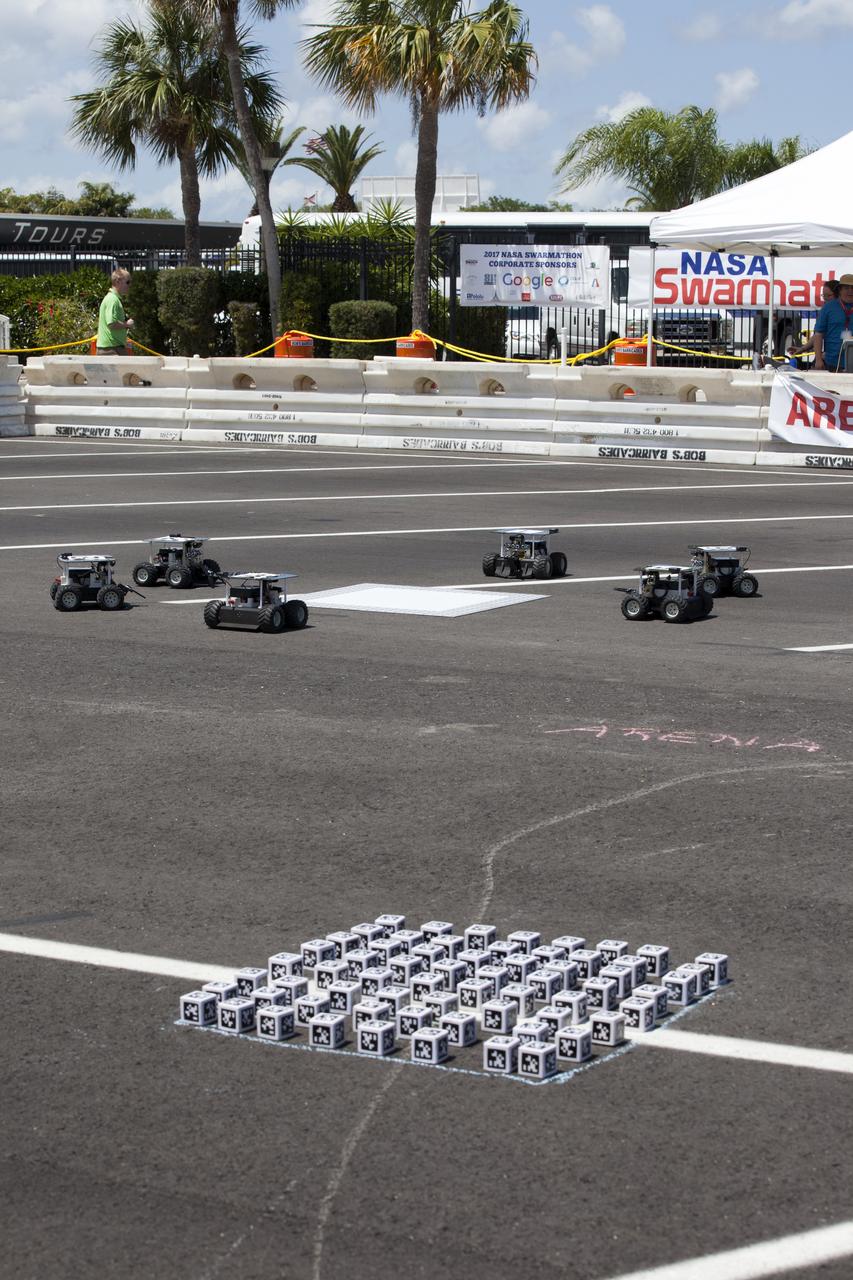
In the Swarmathon competition at the Kennedy Space Center Visitor Complex, students were asked to develop computer code for the small robots, programming them to look for "resources" in the form of AprilTag cubes, similar to barcodes. Teams developed search algorithms for the Swarmies to operate autonomously, communicating and interacting as a collective swarm similar to ants foraging for food. In the spaceport's second annual Swarmathon, 20 teams representing 22 minority serving universities and community colleges were invited to develop software code to operate these innovative robots known as "Swarmies" to help find resources when astronauts explore distant locations, such as the moon or Mars.
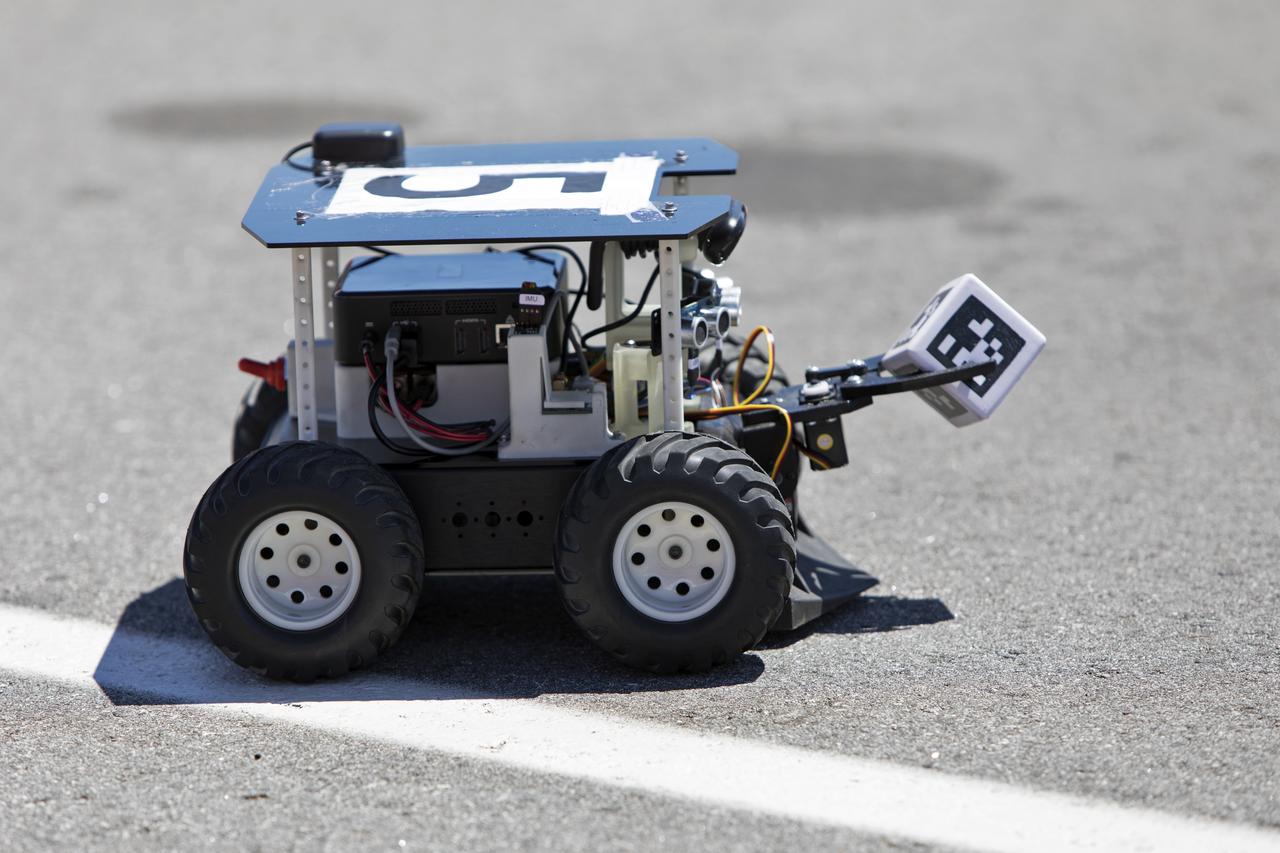
In the Swarmathon competition at the Kennedy Space Center Visitor Complex, students were asked to develop computer code for the small robots, programming them to look for "resources" in the form of AprilTag cubes, similar to barcodes. Teams developed search algorithms for the Swarmies to operate autonomously, communicating and interacting as a collective swarm similar to ants foraging for food. In the spaceport's third annual Swarmathon, 23 teams represented 24 minority serving universities and community colleges were invited to develop software code to operate these innovative robots known as "Swarmies" to help find resources when astronauts explore distant locations, such as the Moon or Mars.
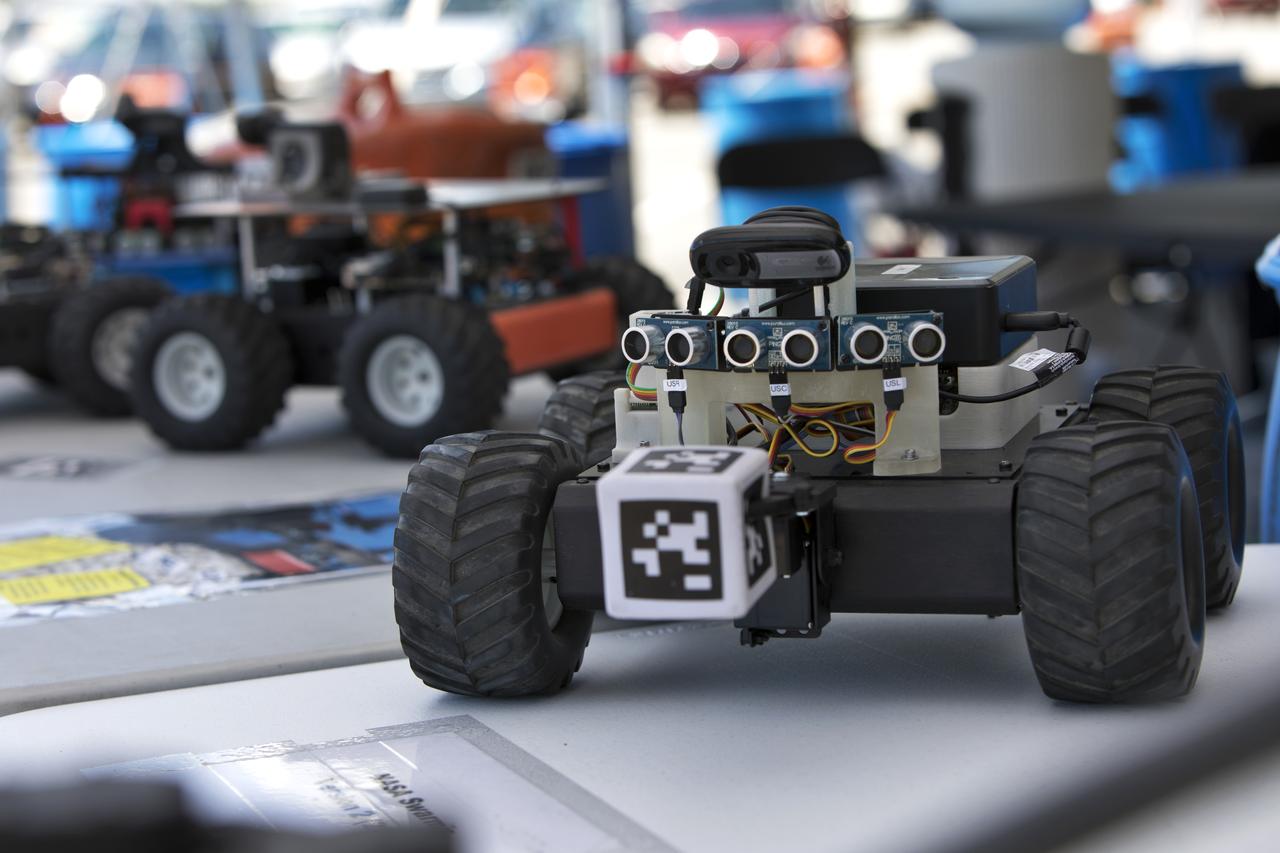
In the Swarmathon competition at the Kennedy Space Center Visitor Complex, students were asked to develop computer code for the small robots, programming them to look for "resources" in the form of AprilTag cubes, similar to barcodes. Teams developed search algorithms for the Swarmies to operate autonomously, communicating and interacting as a collective swarm similar to ants foraging for food. In the spaceport's third annual Swarmathon, 23 teams represented 24 minority serving universities and community colleges were invited to develop software code to operate these innovative robots known as "Swarmies" to help find resources when astronauts explore distant locations, such as the Moon or Mars.
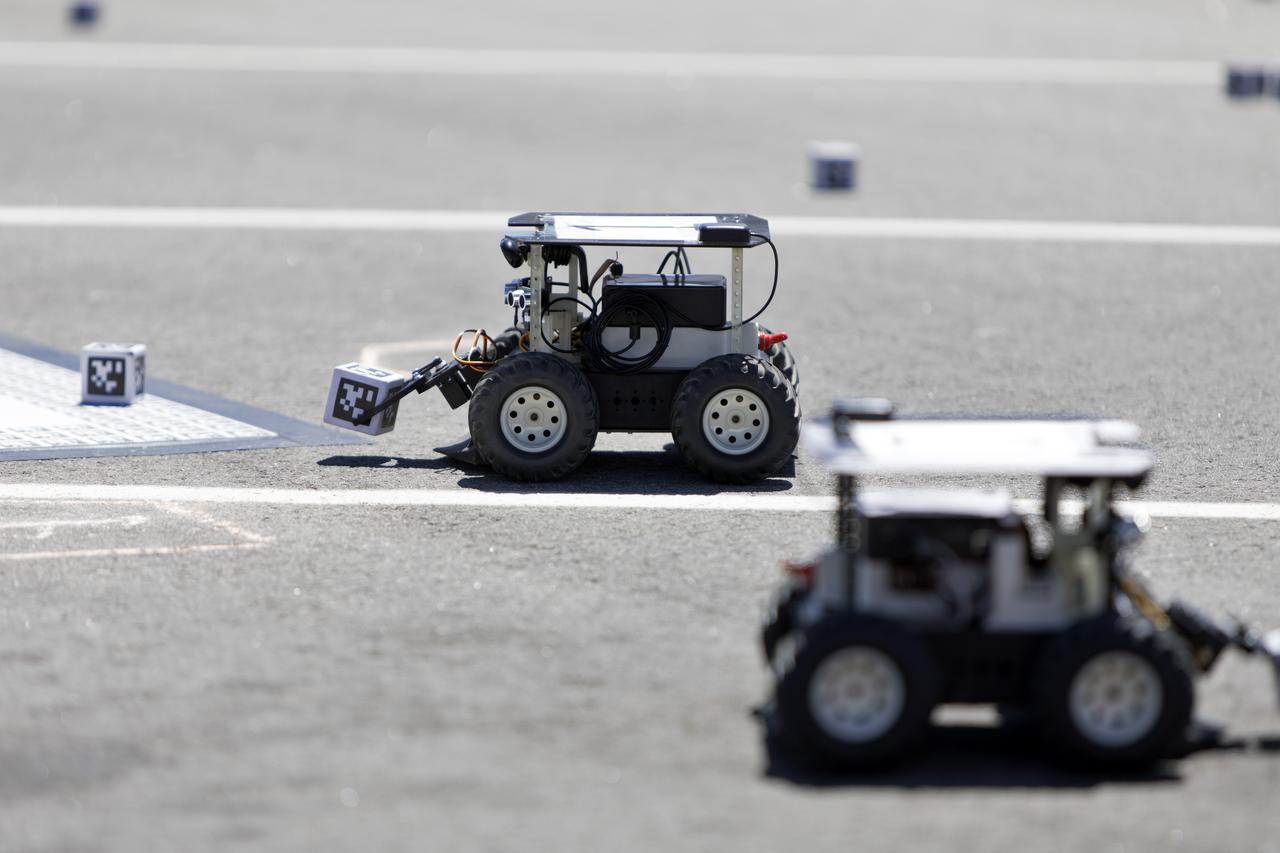
In the Swarmathon competition at the Kennedy Space Center Visitor Complex, students were asked to develop computer code for the small robots, programming them to look for "resources" in the form of AprilTag cubes, similar to barcodes. Teams developed search algorithms for the Swarmies to operate autonomously, communicating and interacting as a collective swarm similar to ants foraging for food. In the spaceport's third annual Swarmathon, 23 teams represented 24 minority serving universities and community colleges were invited to develop software code to operate these innovative robots known as "Swarmies" to help find resources when astronauts explore distant locations, such as the Moon or Mars.
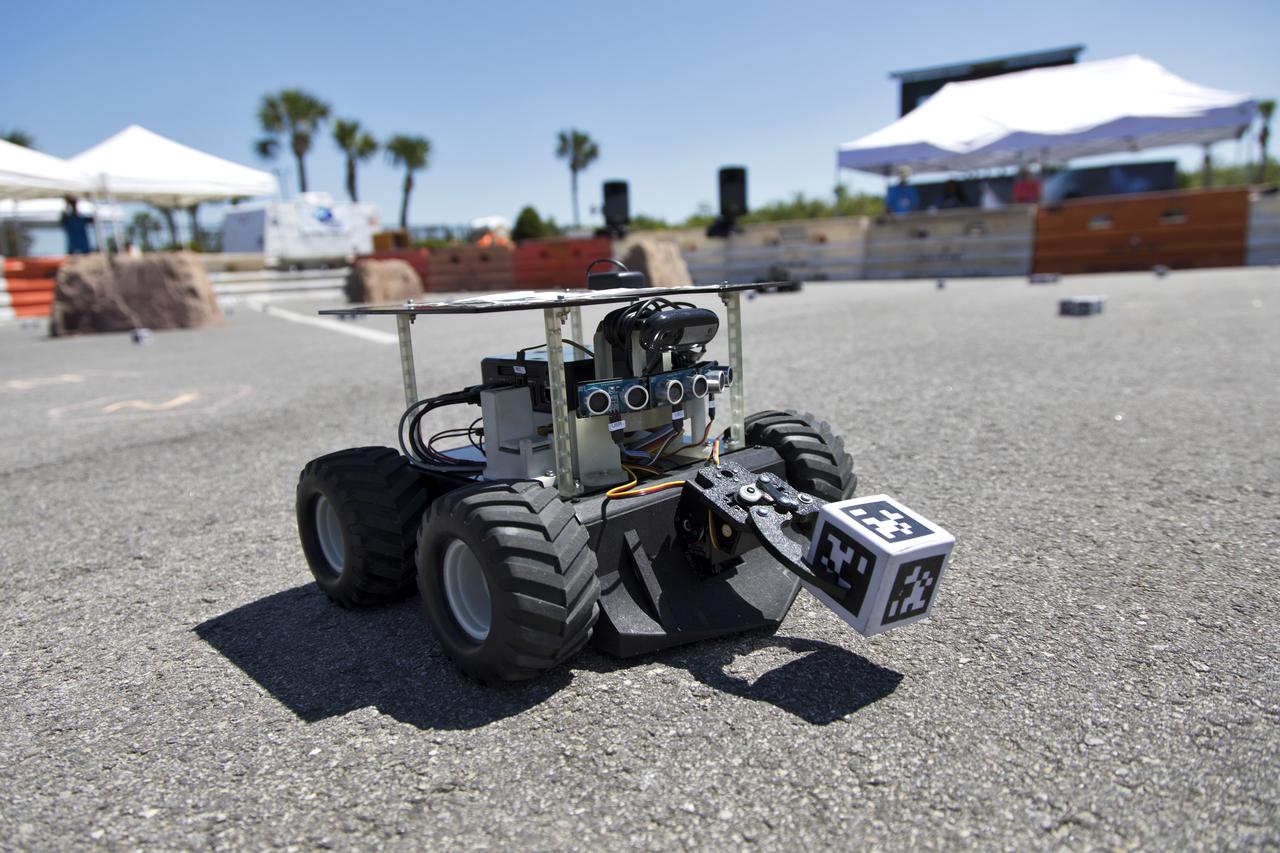
In the Swarmathon competition at the Kennedy Space Center Visitor Complex, students were asked to develop computer code for the small robots, programming them to look for "resources" in the form of AprilTag cubes, similar to barcodes. Teams developed search algorithms for the Swarmies to operate autonomously, communicating and interacting as a collective swarm similar to ants foraging for food. In the spaceport's third annual Swarmathon, 23 teams represented 24 minority serving universities and community colleges were invited to develop software code to operate these innovative robots known as "Swarmies" to help find resources when astronauts explore distant locations, such as the Moon or Mars.
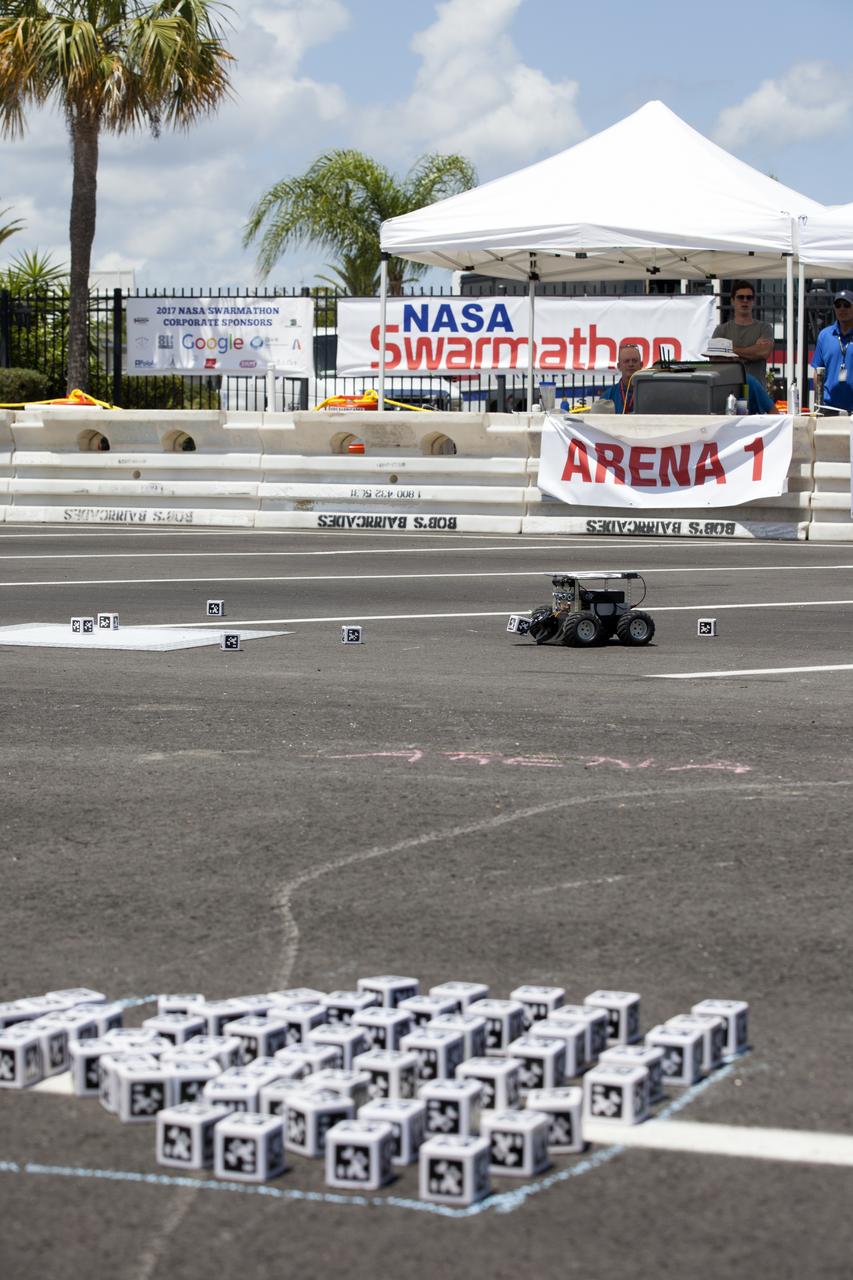
In the Swarmathon competition at the Kennedy Space Center Visitor Complex, students were asked to develop computer code for the small robots, programming them to look for "resources" in the form of AprilTag cubes, similar to barcodes. Teams developed search algorithms for the Swarmies to operate autonomously, communicating and interacting as a collective swarm similar to ants foraging for food. In the spaceport's second annual Swarmathon, 20 teams representing 22 minority serving universities and community colleges were invited to develop software code to operate these innovative robots known as "Swarmies" to help find resources when astronauts explore distant locations, such as the moon or Mars.
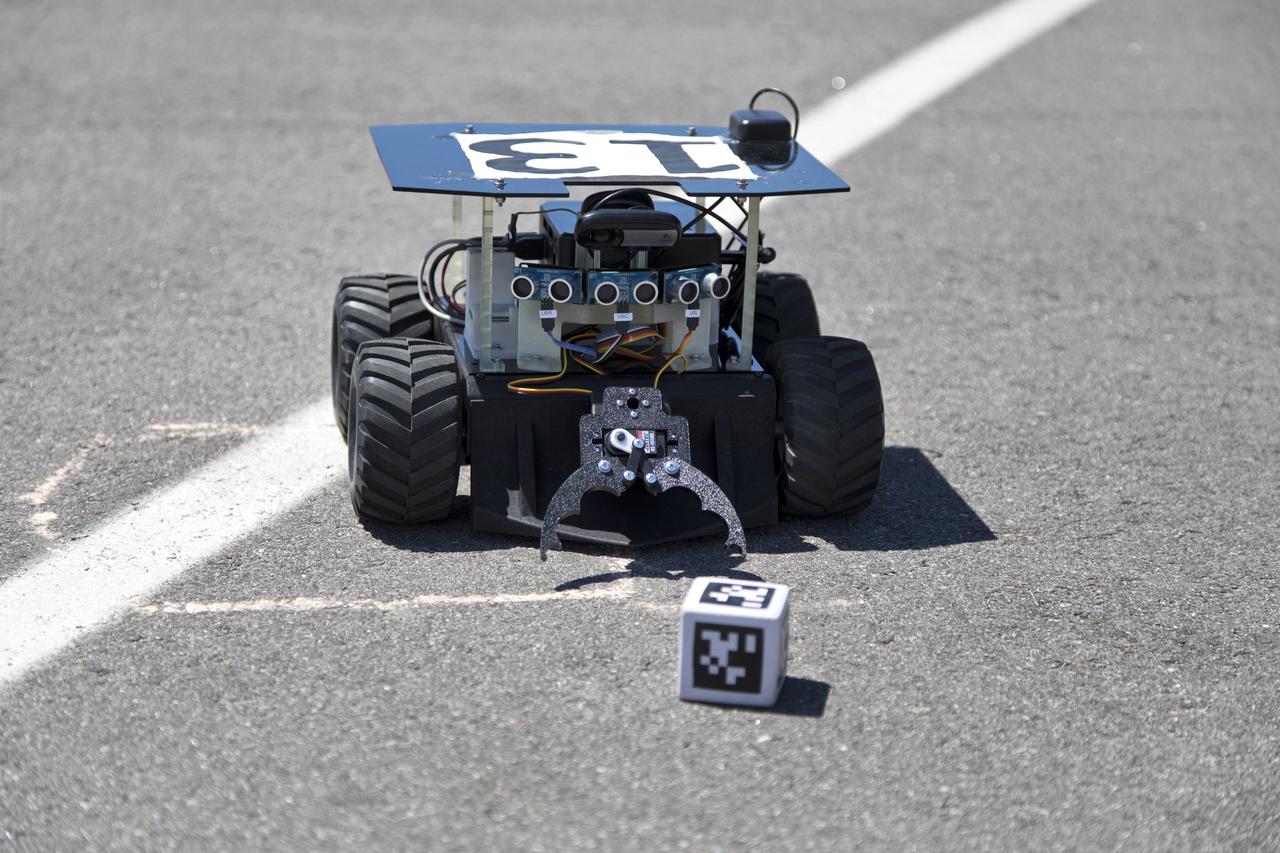
In the Swarmathon competition at the Kennedy Space Center Visitor Complex, students were asked to develop computer code for the small robots, programming them to look for "resources" in the form of AprilTag cubes, similar to barcodes. Teams developed search algorithms for the Swarmies to operate autonomously, communicating and interacting as a collective swarm similar to ants foraging for food. In the spaceport's third annual Swarmathon, 23 teams represented 24 minority serving universities and community colleges were invited to develop software code to operate these innovative robots known as "Swarmies" to help find resources when astronauts explore distant locations, such as the Moon or Mars.
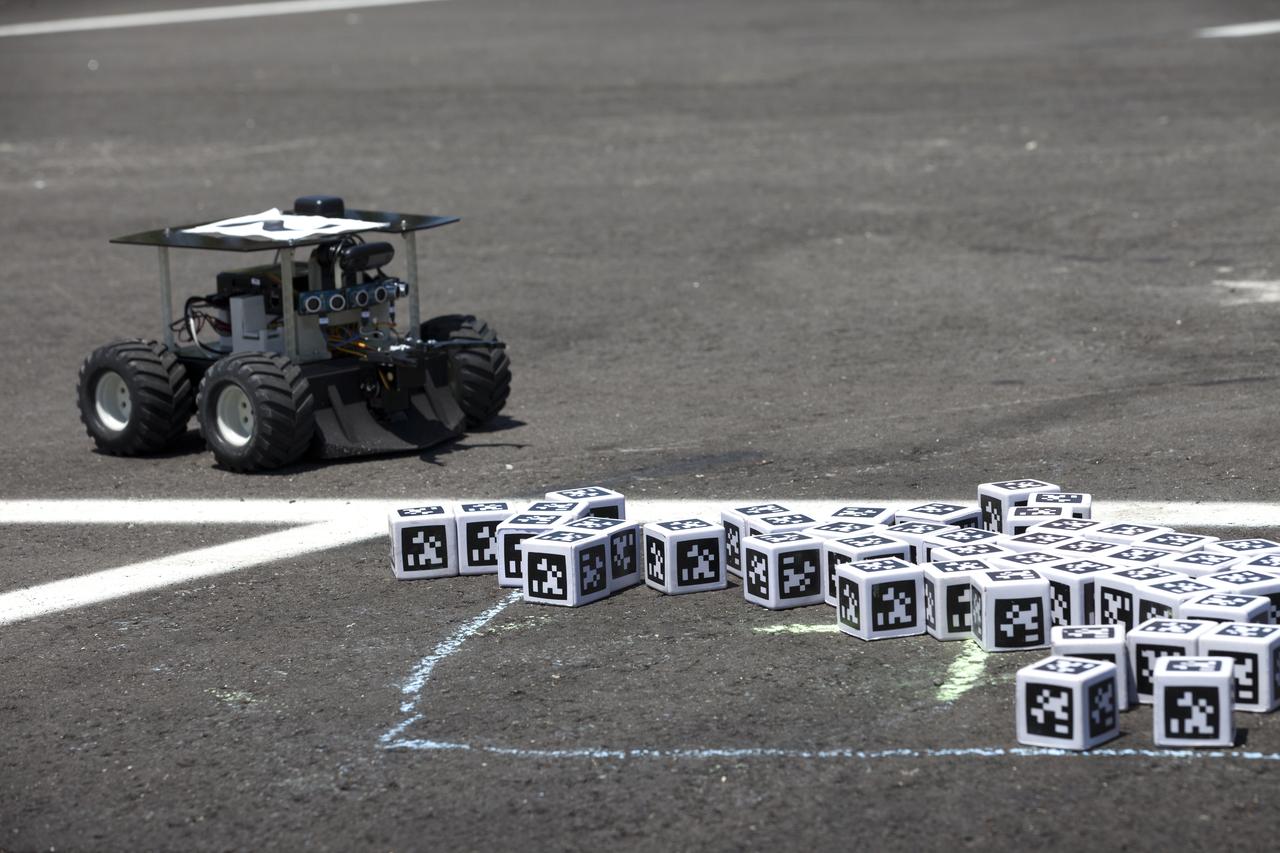
In the Swarmathon competition at the Kennedy Space Center Visitor Complex, students were asked to develop computer code for the small robots, programming them to look for "resources" in the form of AprilTag cubes, similar to barcodes. Teams developed search algorithms for the Swarmies to operate autonomously, communicating and interacting as a collective swarm similar to ants foraging for food. In the spaceport's second annual Swarmathon, 20 teams representing 22 minority serving universities and community colleges were invited to develop software code to operate these innovative robots known as "Swarmies" to help find resources when astronauts explore distant locations, such as the moon or Mars.
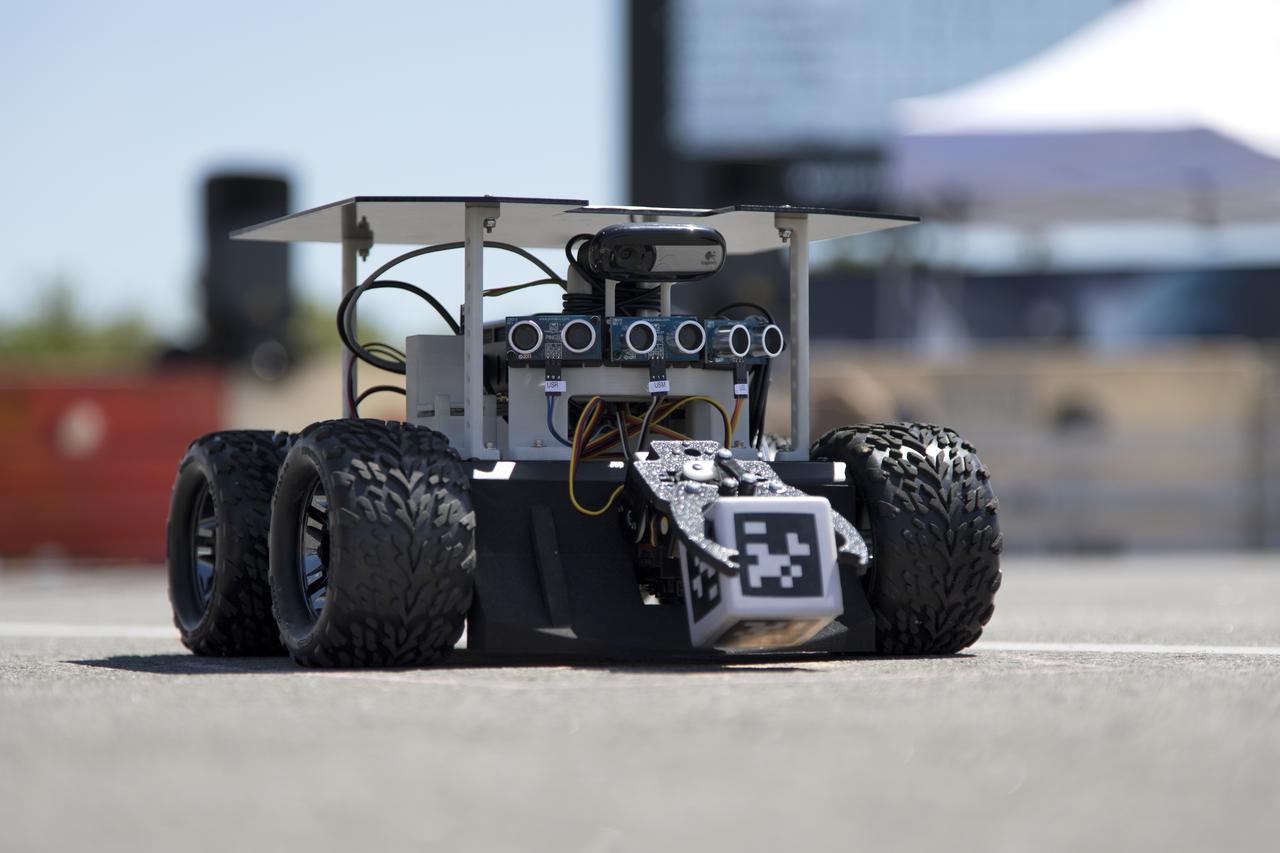
In the Swarmathon competition at the Kennedy Space Center Visitor Complex, students were asked to develop computer code for the small robots, programming them to look for "resources" in the form of AprilTag cubes, similar to barcodes. Teams developed search algorithms for the Swarmies to operate autonomously, communicating and interacting as a collective swarm similar to ants foraging for food. In the spaceport's third annual Swarmathon, 23 teams represented 24 minority serving universities and community colleges were invited to develop software code to operate these innovative robots known as "Swarmies" to help find resources when astronauts explore distant locations, such as the Moon or Mars.
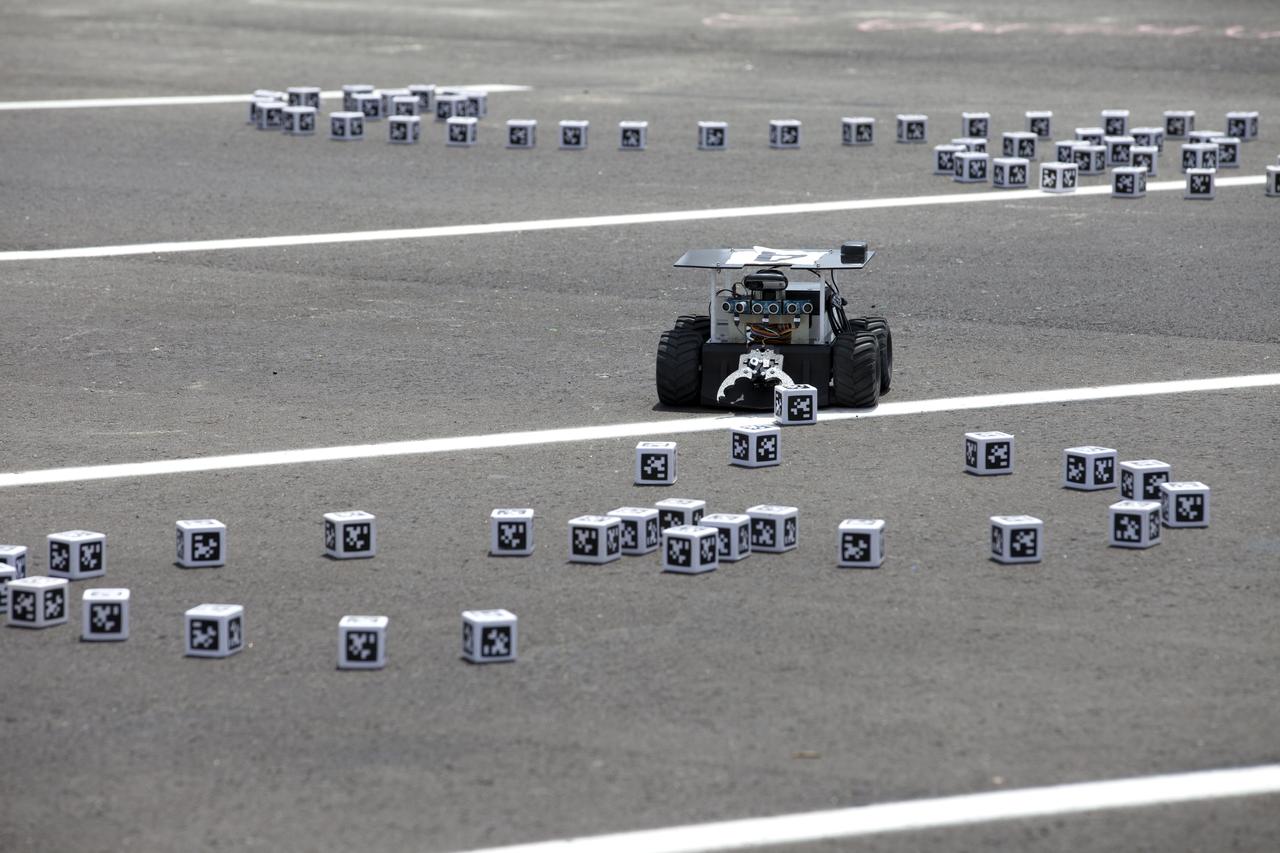
In the Swarmathon competition at the Kennedy Space Center Visitor Complex, students were asked to develop computer code for the small robots, programming them to look for "resources" in the form of cubes with AprilTags, similar to barcodes. Teams developed search algorithms for innovative robots known as "Swarmies" to operate autonomously, communicating and interacting as a collective swarm similar to ants foraging for food. In the spaceport's second annual Swarmathon, 20 teams representing 22 minority serving universities and community colleges were invited to participate. Similar robots could help find resources when astronauts explore distant locations, such as the moon or Mars.
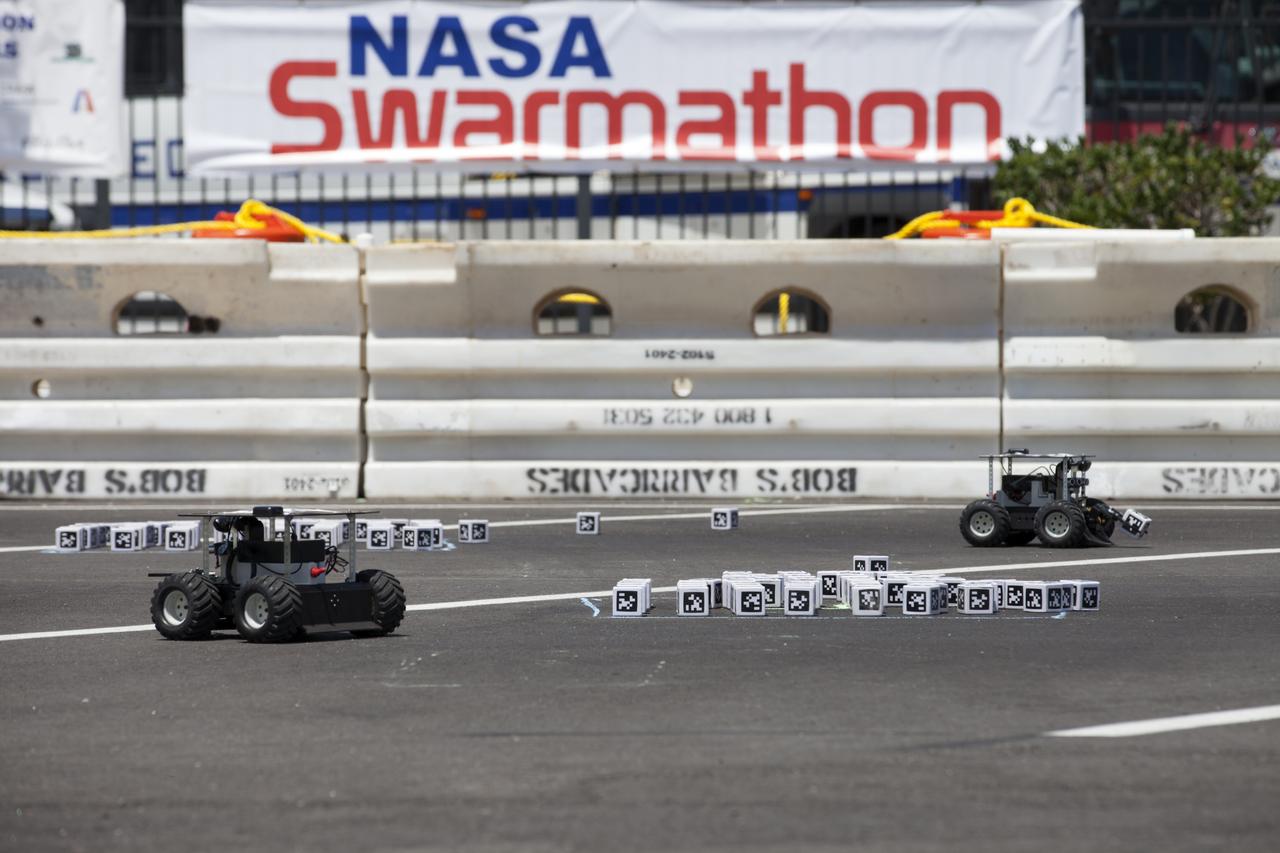
In the Swarmathon competition at the Kennedy Space Center Visitor Complex, students were asked to develop computer code for the small robots, programming them to look for "resources" in the form of AprilTag cubes, similar to barcodes. Teams developed search algorithms for the Swarmies to operate autonomously, communicating and interacting as a collective swarm similar to ants foraging for food. In the spaceport's second annual Swarmathon, 20 teams representing 22 minority serving universities and community colleges were invited to develop software code to operate these innovative robots known as "Swarmies" to help find resources when astronauts explore distant locations, such as the moon or Mars.
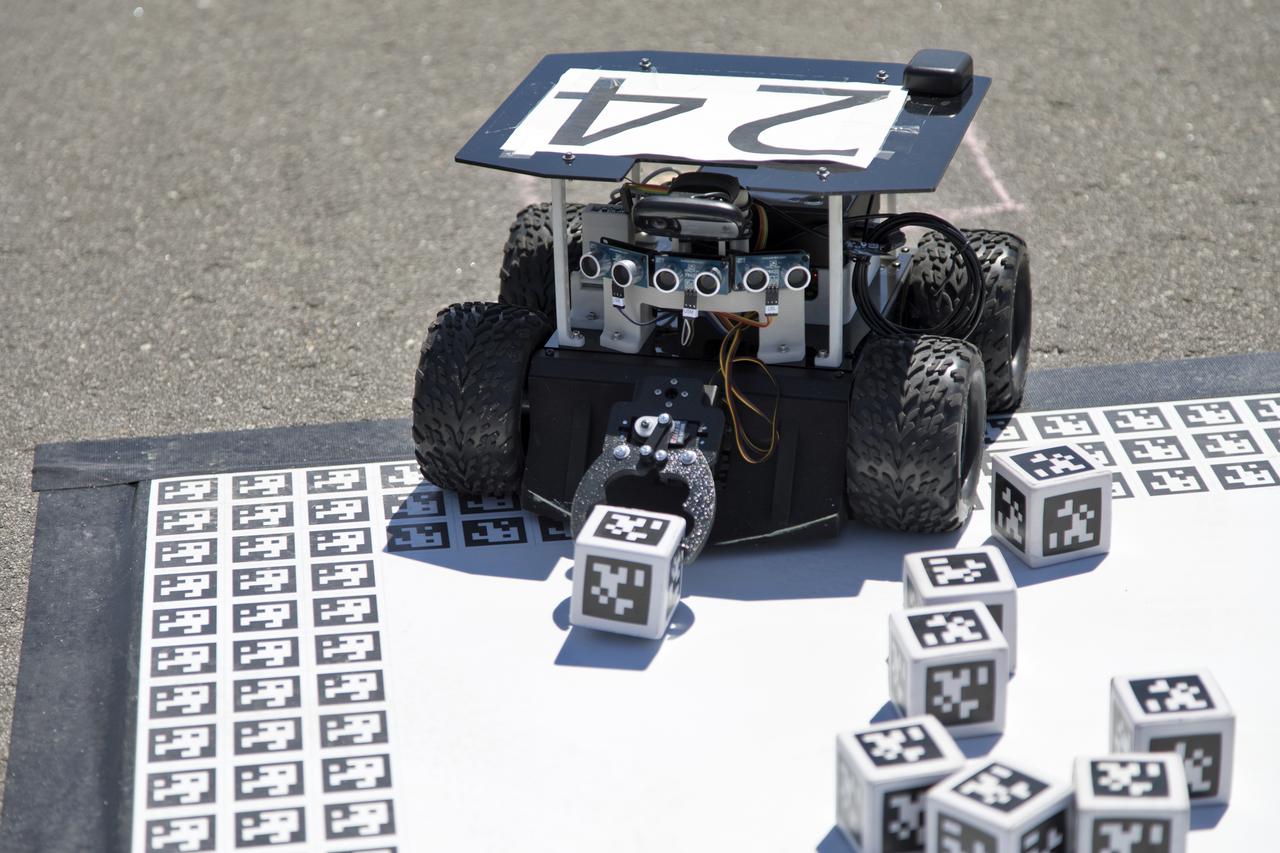
In the Swarmathon competition at the Kennedy Space Center Visitor Complex, students were asked to develop computer code for the small robots, programming them to look for "resources" in the form of AprilTag cubes, similar to barcodes. Teams developed search algorithms for the Swarmies to operate autonomously, communicating and interacting as a collective swarm similar to ants foraging for food. In the spaceport's third annual Swarmathon, 23 teams represented 24 minority serving universities and community colleges were invited to develop software code to operate these innovative robots known as "Swarmies" to help find resources when astronauts explore distant locations, such as the Moon or Mars.
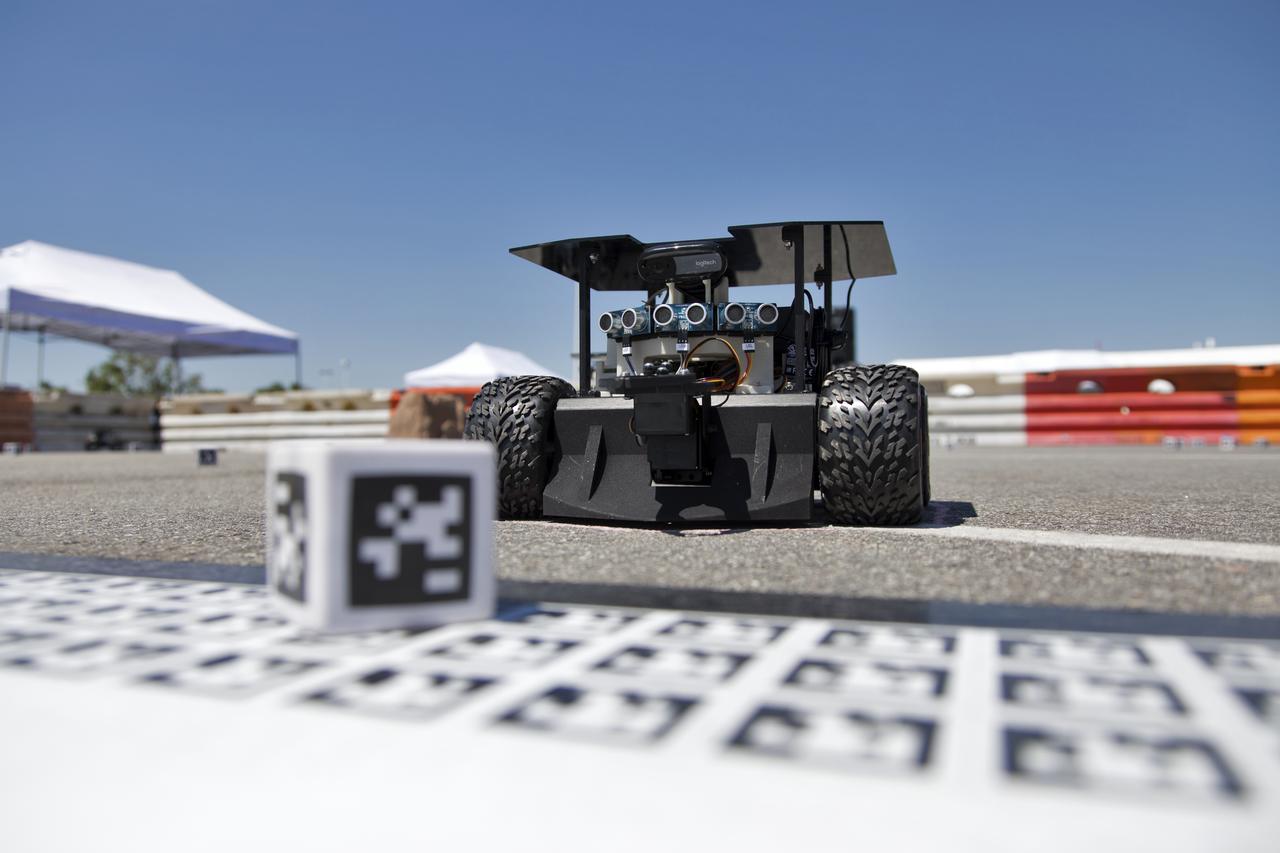
In the Swarmathon competition at the Kennedy Space Center Visitor Complex, students were asked to develop computer code for the small robots, programming them to look for "resources" in the form of AprilTag cubes, similar to barcodes. Teams developed search algorithms for the Swarmies to operate autonomously, communicating and interacting as a collective swarm similar to ants foraging for food. In the spaceport's third annual Swarmathon, 23 teams represented 24 minority serving universities and community colleges were invited to develop software code to operate these innovative robots known as "Swarmies" to help find resources when astronauts explore distant locations, such as the Moon or Mars.
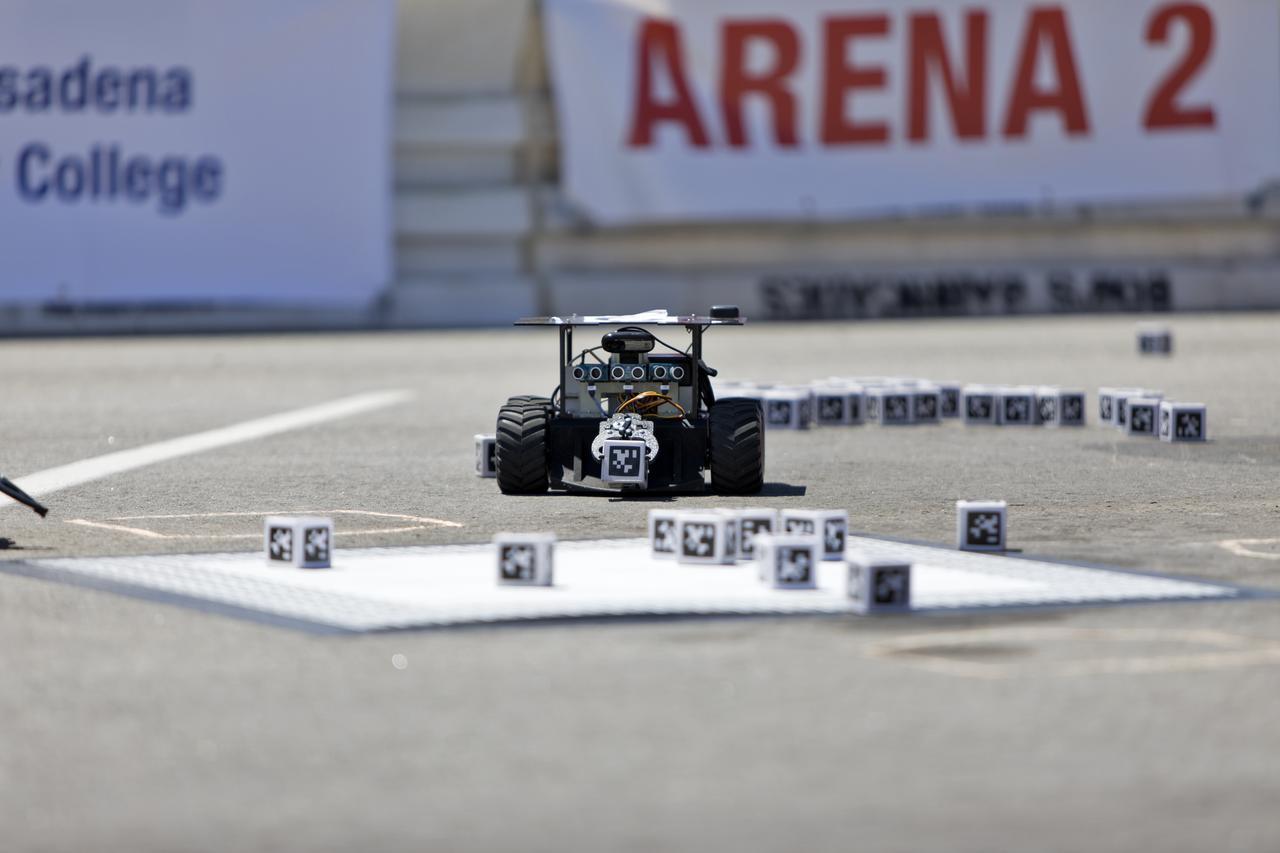
In the Swarmathon competition at the Kennedy Space Center Visitor Complex, students were asked to develop computer code for the small robots, programming them to look for "resources" in the form of AprilTag cubes, similar to barcodes. Teams developed search algorithms for the Swarmies to operate autonomously, communicating and interacting as a collective swarm similar to ants foraging for food. In the spaceport's third annual Swarmathon, 23 teams represented 24 minority serving universities and community colleges were invited to develop software code to operate these innovative robots known as "Swarmies" to help find resources when astronauts explore distant locations, such as the Moon or Mars.
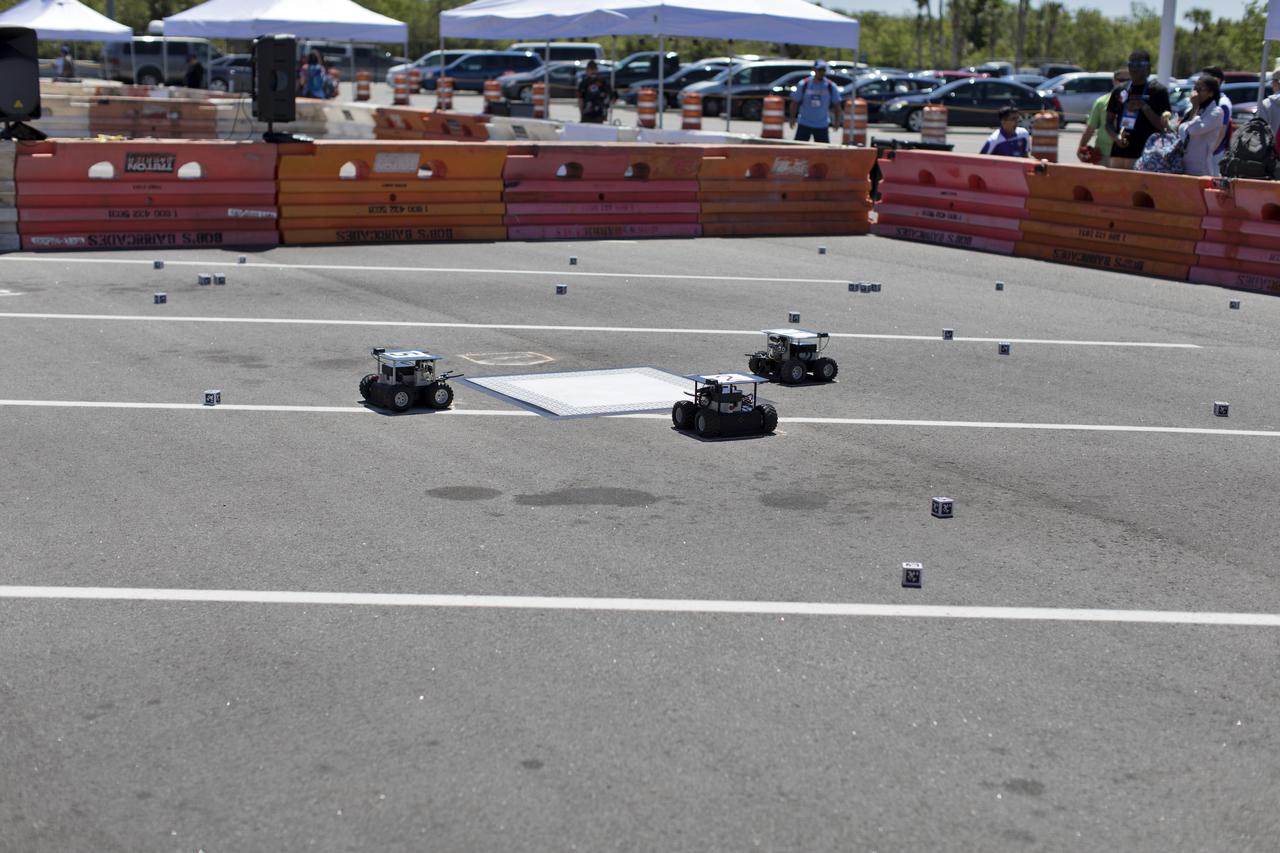
In the Swarmathon competition at the Kennedy Space Center Visitor Complex, students were asked to develop computer code for the small robots, programming them to look for "resources" in the form of AprilTag cubes, similar to barcodes. Teams developed search algorithms for the Swarmies to operate autonomously, communicating and interacting as a collective swarm similar to ants foraging for food. In the spaceport's third annual Swarmathon, 23 teams represented 24 minority serving universities and community colleges were invited to develop software code to operate these innovative robots known as "Swarmies" to help find resources when astronauts explore distant locations, such as the Moon or Mars.
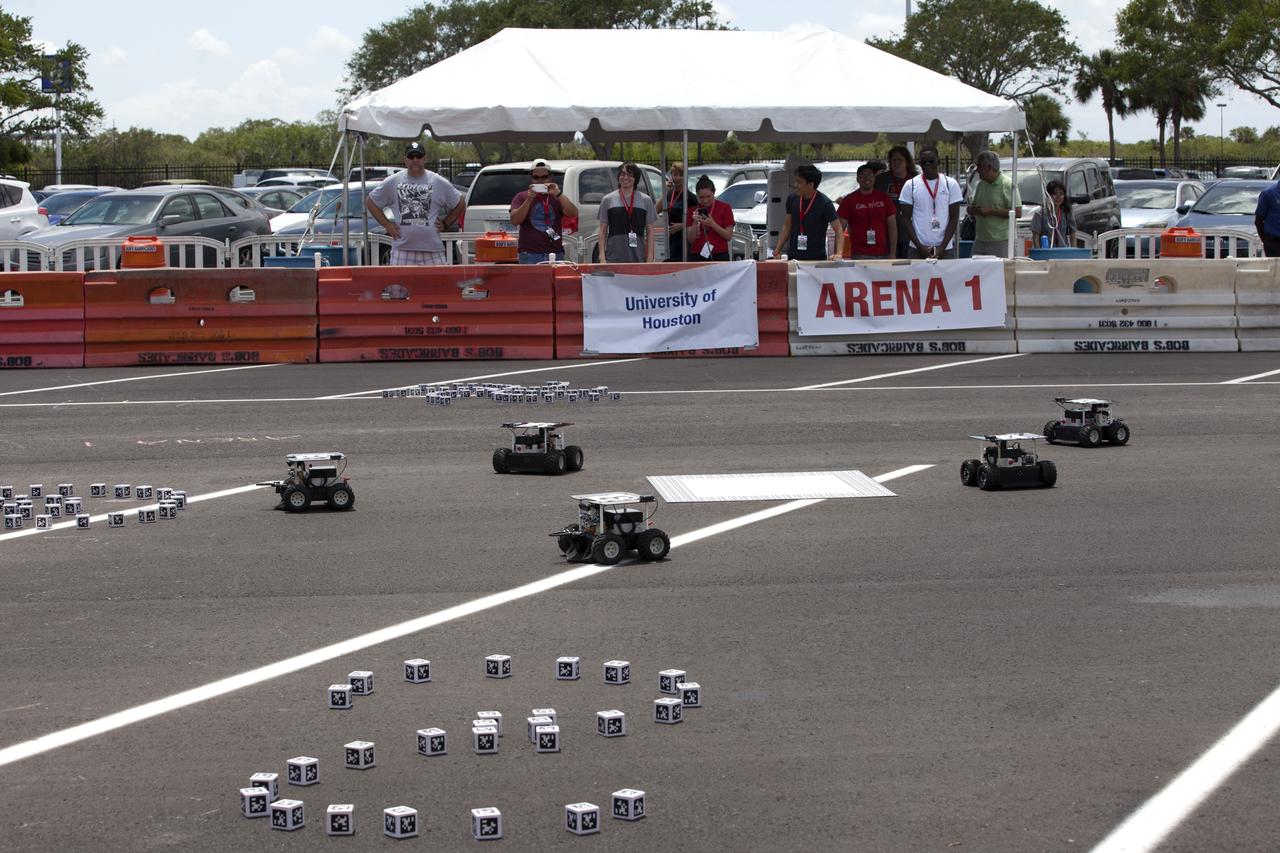
In the Swarmathon competition at the Kennedy Space Center Visitor Complex, students were asked to develop computer code for the small robots, programming them to look for "resources" in the form of cubes with AprilTags, similar to barcodes. Teams developed search algorithms for innovative robots known as "Swarmies" to operate autonomously, communicating and interacting as a collective swarm similar to ants foraging for food. In the spaceport's second annual Swarmathon, 20 teams representing 22 minority serving universities and community colleges were invited to participate. Similar robots could help find resources when astronauts explore distant locations, such as the moon or Mars.
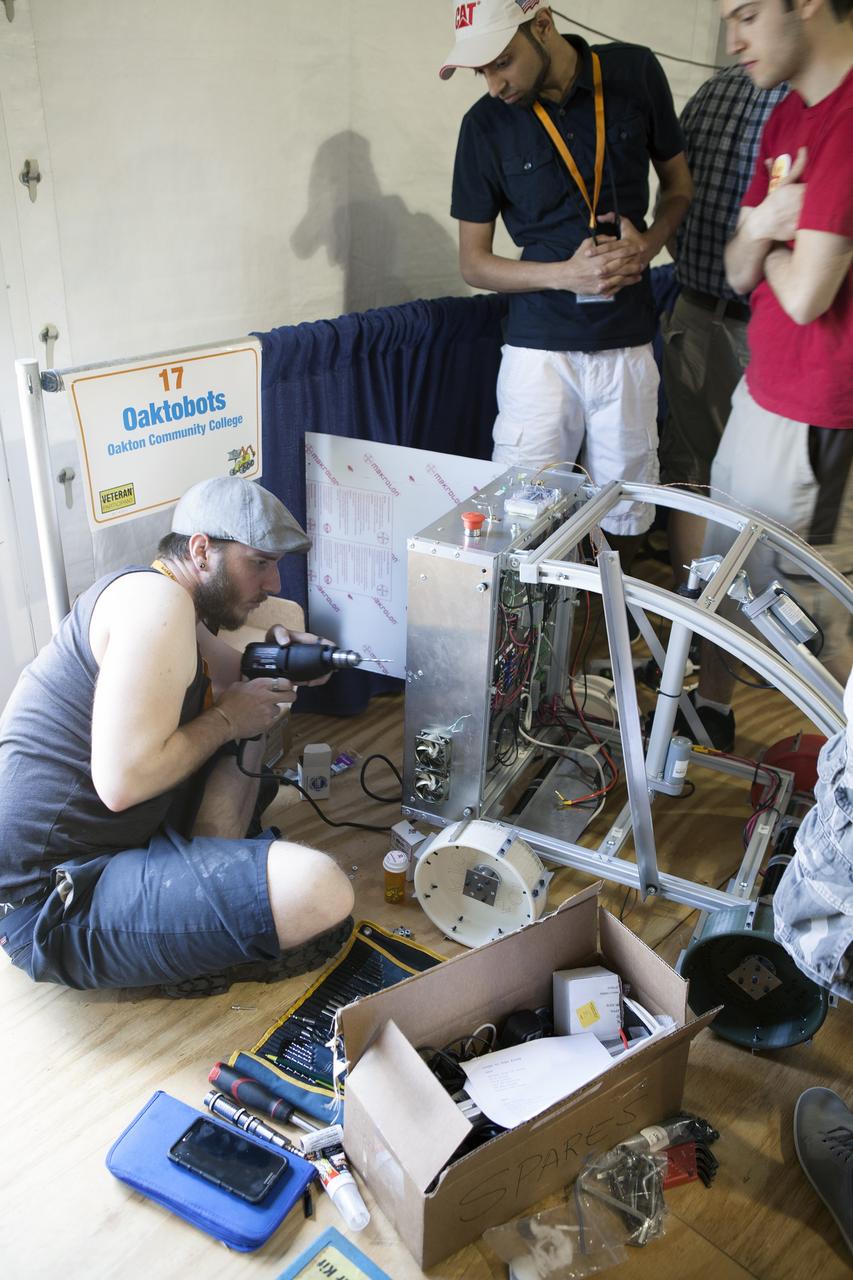
CAPE CANAVERAL, Fla. – Students from Oakton Community College in Illinois prepare their robot for NASA’s Robotics Mining Competition at the Kennedy Space Center Visitor Complex in Florida. More than 35 teams from around the U.S. have designed and built remote-controlled robots for the mining competition. The competition is a NASA Human Exploration and Operations Mission Directorate project designed to engage and retain students in science, technology, engineering and mathematics, or STEM, fields by expanding opportunities for student research and design. Teams use their remote-controlled robotics to maneuver and dig in a supersized sandbox filled with a crushed material that has characteristics similar to Martian soil. The objective of the challenge is to see which team’s robot can collect and move the most regolith within a specified amount of time. For more information, visit www.nasa.gov/nasarmc. Photo credit: NASA/Ben Smegelsky
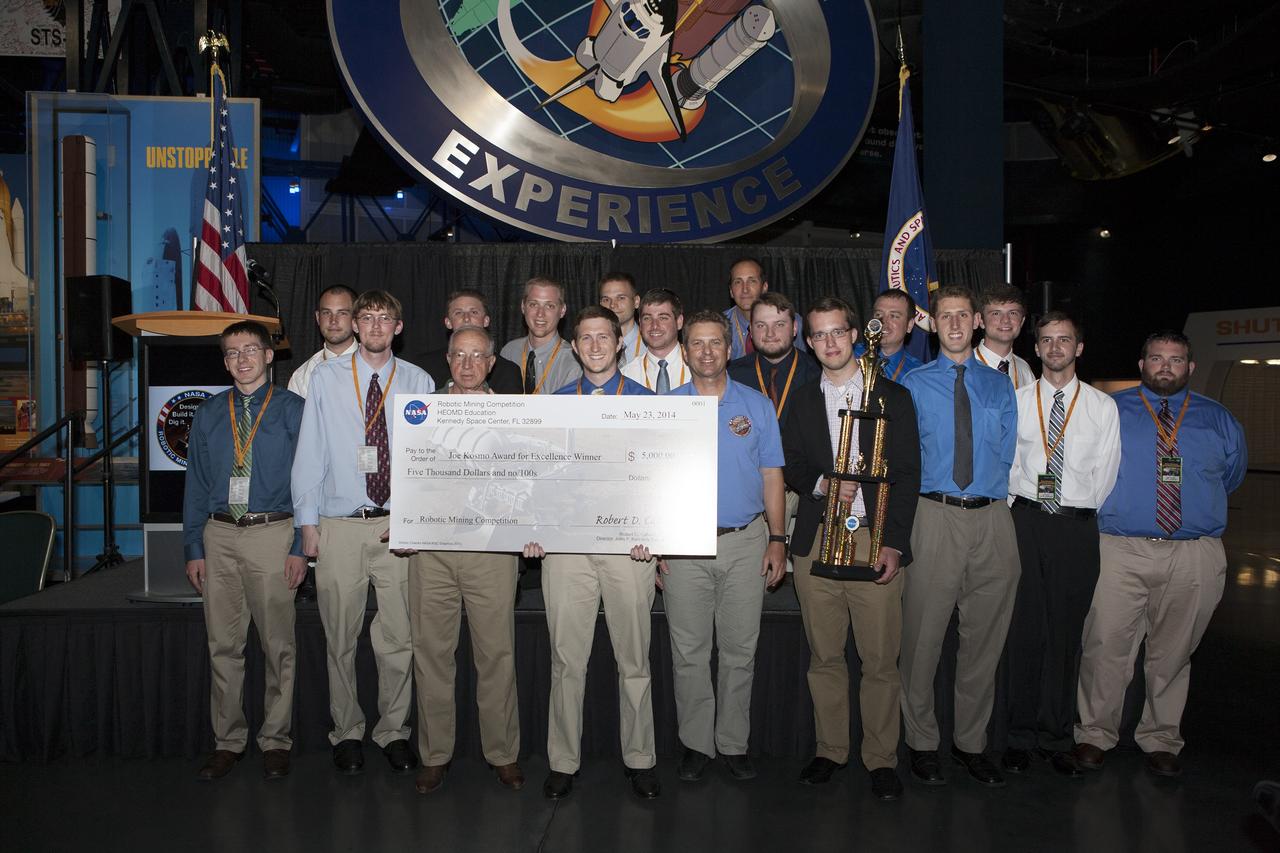
CAPE CANAVERAL, Fla. -- The University of Alabama team Astrobotics in collaboration with Shelton State Community College received the highest award, the Joe Kosmo Award for Excellence, during NASA's 2014 Robotic Mining Competition awards ceremony inside the Space Shuttle Atlantis attraction at the Kennedy Space Center Visitor Complex in Florida. More than 35 teams from colleges and universities around the U.S. designed and built remote-controlled robots for the mining competition. The competition is a NASA Human Exploration and Operations Mission Directorate project designed to engage and retain students in science, technology, engineering and mathematics, or STEM, fields by expanding opportunities for student research and design. Teams use their remote-controlled robotics to maneuver and dig in a supersized sandbox filled with a crushed material that has characteristics similar to Martian soil. The objective of the challenge is to see which team’s robot can collect and move the most regolith within a specified amount of time. The competition includes on-site mining, writing a systems engineering paper, performing outreach projects for K-12 students, slide presentation and demonstrations, and team spirit. For more information, visit www.nasa.gov/nasarmc. Photo credit: NASA/Kim Shiflett
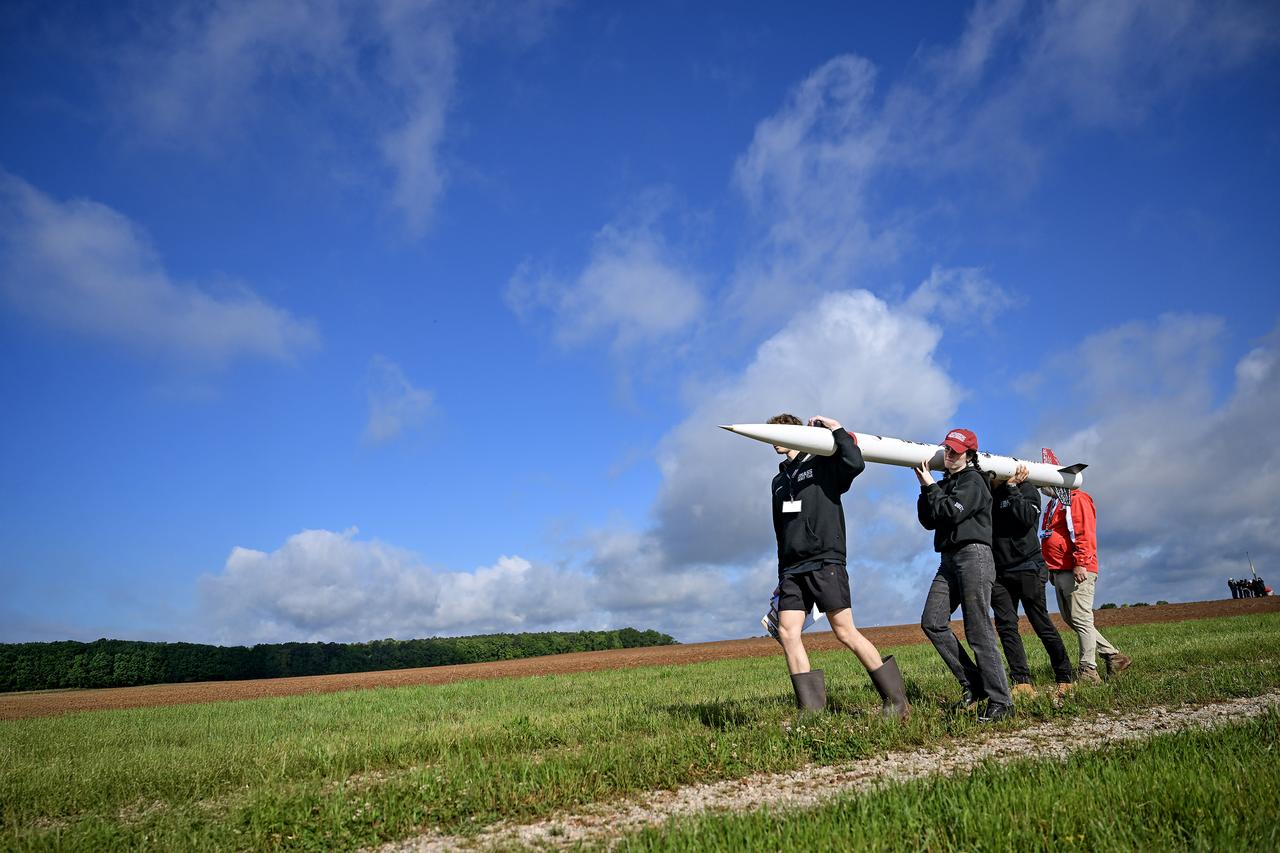
Students from the University of Massachusetts Amherst team carry their high-powered rocket toward the launch pad at NASA’s 2025 Student Launch launch day competition in Toney, Alabama, on May 4, 2025. More than 980 middle school, high school, and college students from across the nation launched more than 40 high-powered amateur rockets just north of NASA’s Marshall Space Flight Center in Huntsville, Alabama. This year marked the 25th anniversary of the competition. To compete, students follow the NASA engineering design lifecycle by going through a series of reviews for nine months leading up to launch day. Each year, a payload challenge is issued to the university teams, and this year’s task focused on communication. Teams were required to have “reports” from STEMnauts, non-living objects inside their rocket, that had to relay real-time data to the student team’s mission control. This Artemis Student Challenge took inspiration from the agency’s Artemis missions, where NASA will send astronauts to explore the Moon for scientific discovery, economic benefit, and to build the foundation for the first crewed missions to Mars. To learn more, visit: www.nasa.gov/studentlaunch.
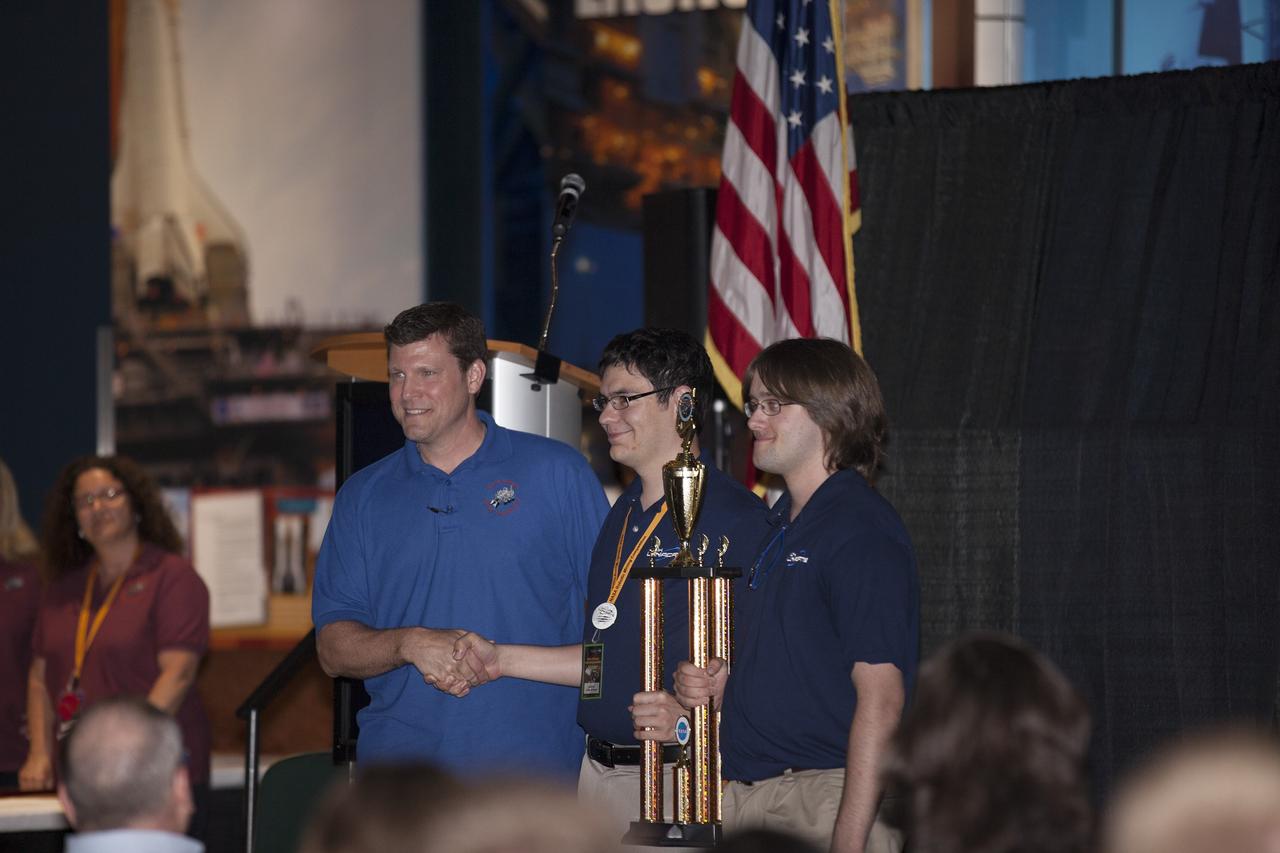
CAPE CANAVERAL, Fla. -- Kennedy Space Center engineer Marc Seibert presents the Communication Award to the University of New Hampshire team members during NASA's 2014 Robotic Mining Competition award ceremony inside the Space Shuttle Atlantis attraction at the Kennedy Space Center Visitor Complex in Florida. The team moved 10 kilograms of simulated Martian soil with its robot while using the least amount of communication power. More than 35 teams from colleges and universities around the U.S. designed and built remote-controlled robots for the mining competition. The competition is a NASA Human Exploration and Operations Mission Directorate project designed to engage and retain students in science, technology, engineering and mathematics, or STEM, fields by expanding opportunities for student research and design. Teams use their remote-controlled robotics to maneuver and dig in a supersized sandbox filled with a crushed material that has characteristics similar to Martian soil. The objective of the challenge is to see which team’s robot can collect and move the most regolith within a specified amount of time. The competition includes on-site mining, writing a systems engineering paper, performing outreach projects for K-12 students, slide presentation and demonstrations, and team spirit. For more information, visit www.nasa.gov/nasarmc. Photo credit: NASA/Kim Shiflett
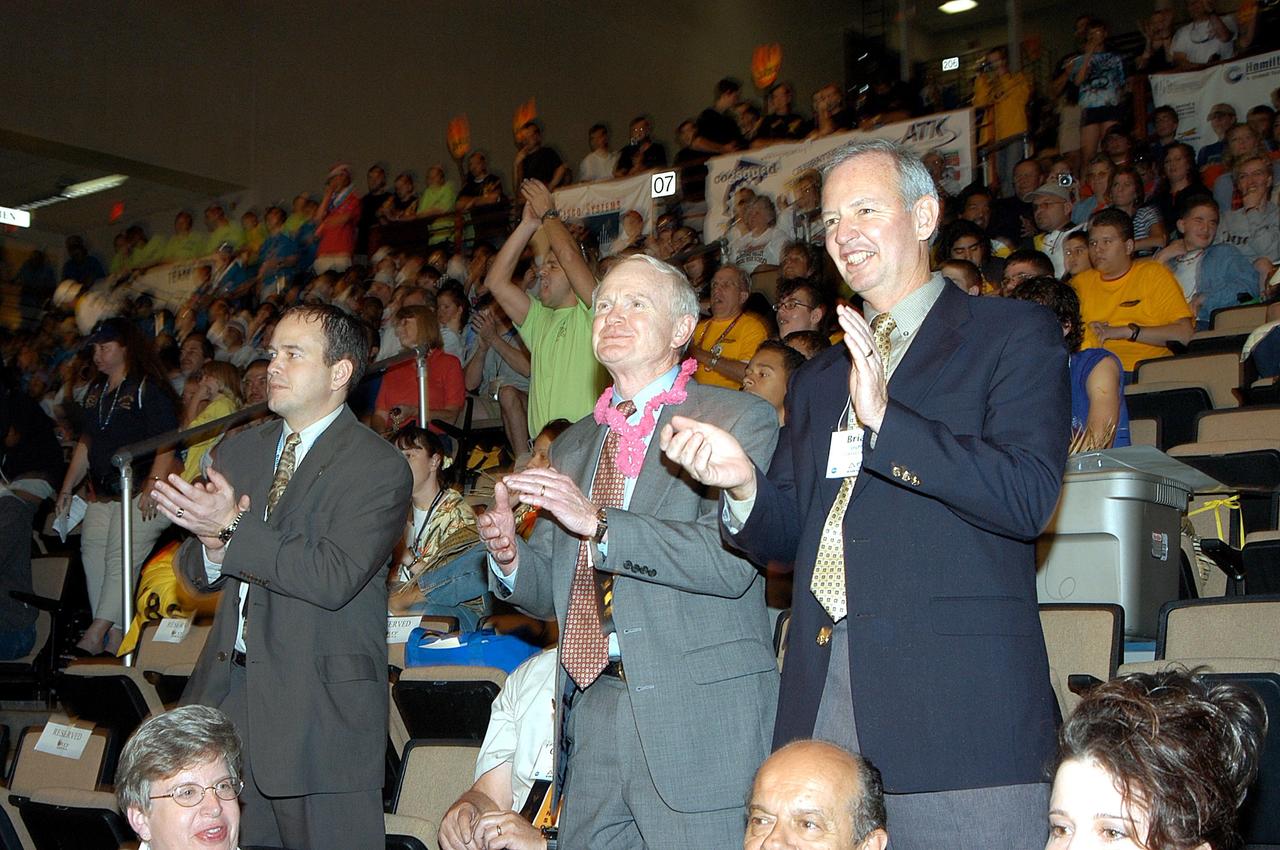
KENNEDY SPACE CENTER, FLA. - On their feet, applauding the student participants of the 2003 Southeastern Regional FIRST Robotic Competition are, from left, David Culp, executive intern to the director of KSC; Roy Bridges, KSC director; and Brian Duffy, Lockheed Martin vice president/associate program manager. The competition is being held at the University of Central Florida (UCF) in Orlando, March 20-23. Forty student teams from around the country are participating in the event that pits team-built gladiator robots against each other in an athletic-style competition. The teams are sponsored by NASA/Kennedy Space Center, The Boeing Company/Brevard Community College, and Lockheed Martin Space Operations/Mission Systems for the nonprofit organization For Inspiration and Recognition of Science and Technology, known as FIRST. The vision of FIRST is to inspire in the youth of our nation an appreciation of science and technology and an understanding that mastering these disciplines can enrich the lives of all mankind.
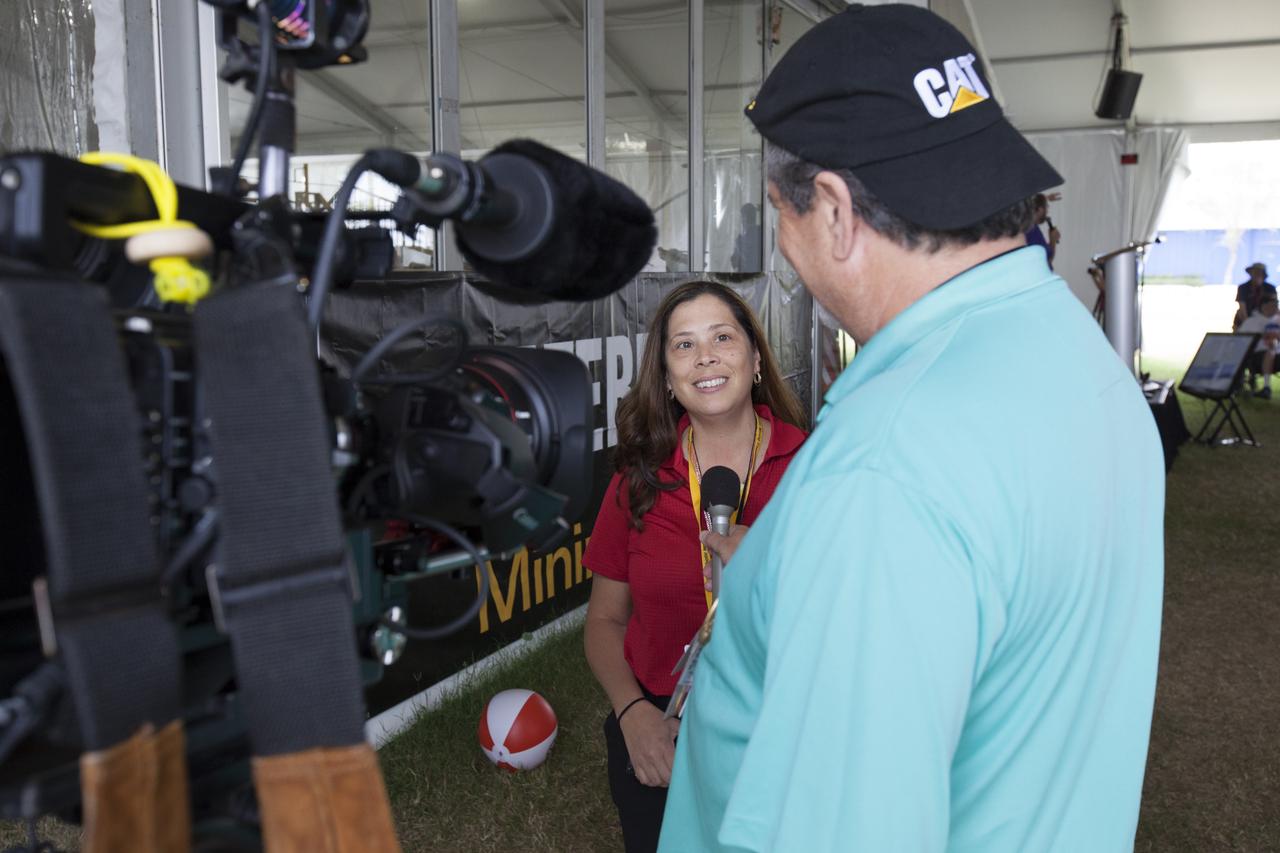
Lilliana Villareal, Spacecraft and Offline Operations manager in the Ground Systems Development and Operations Program, is interviewed on-camera by Al Feinberg, with the Communications and Public Engagement Directorate, during NASA's 8th Annual Robotic Mining Competition at the Kennedy Space Center Visitor Complex in Florida. More than 40 student teams from colleges and universities around the U.S. used their uniquely-designed mining robots to dig in a supersized sandbox filled with BP-1, or simulated Martian soil, and participated in other competition requirements, May 22-26. The Robotic Mining Competition is a NASA Human Exploration and Operations Mission Directorate project designed to encourage students in science, technology, engineering and math, or STEM fields. The project provides a competitive environment to foster innovative ideas and solutions that could be used on NASA's Journey to Mars.
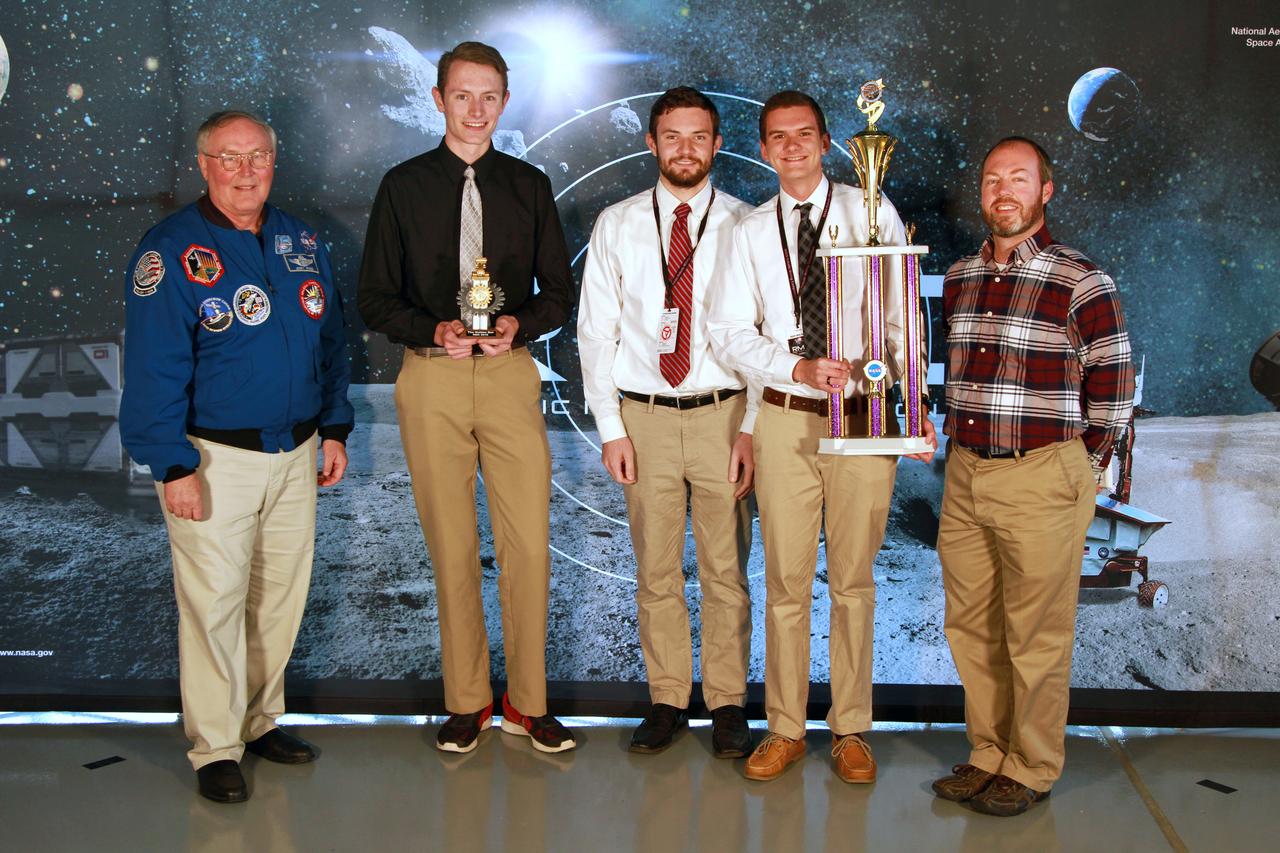
NASA's 9th Annual Robotic Mining Competition concludes with an awards ceremony May 18, 2018, at the Apollo/Saturn V Center at the Kennedy Space Center Visitor Complex in Florida. The University of Alabama Team Astrobotics received the Efficient Use of Communications Power Award. At left is retired NASA astronaut Jerry Ross. At right is Kurt Leucht, a NASA engineer in Swamp Works and event emcee. More than 40 student teams from colleges and universities around the U.S. participated in the competition, May 14-18, by using their mining robots to dig in a supersized sandbox filled with BP-1, or simulated lunar soil, gravel and rocks, and participate in other competition requirements. The Robotic Mining Competition is a NASA Human Exploration and Operations Mission Directorate project designed to encourage students in science, technology, engineering and math, or STEM fields. The project provides a competitive environment to foster innovative ideas and solutions that could be used on NASA's deep space missions.
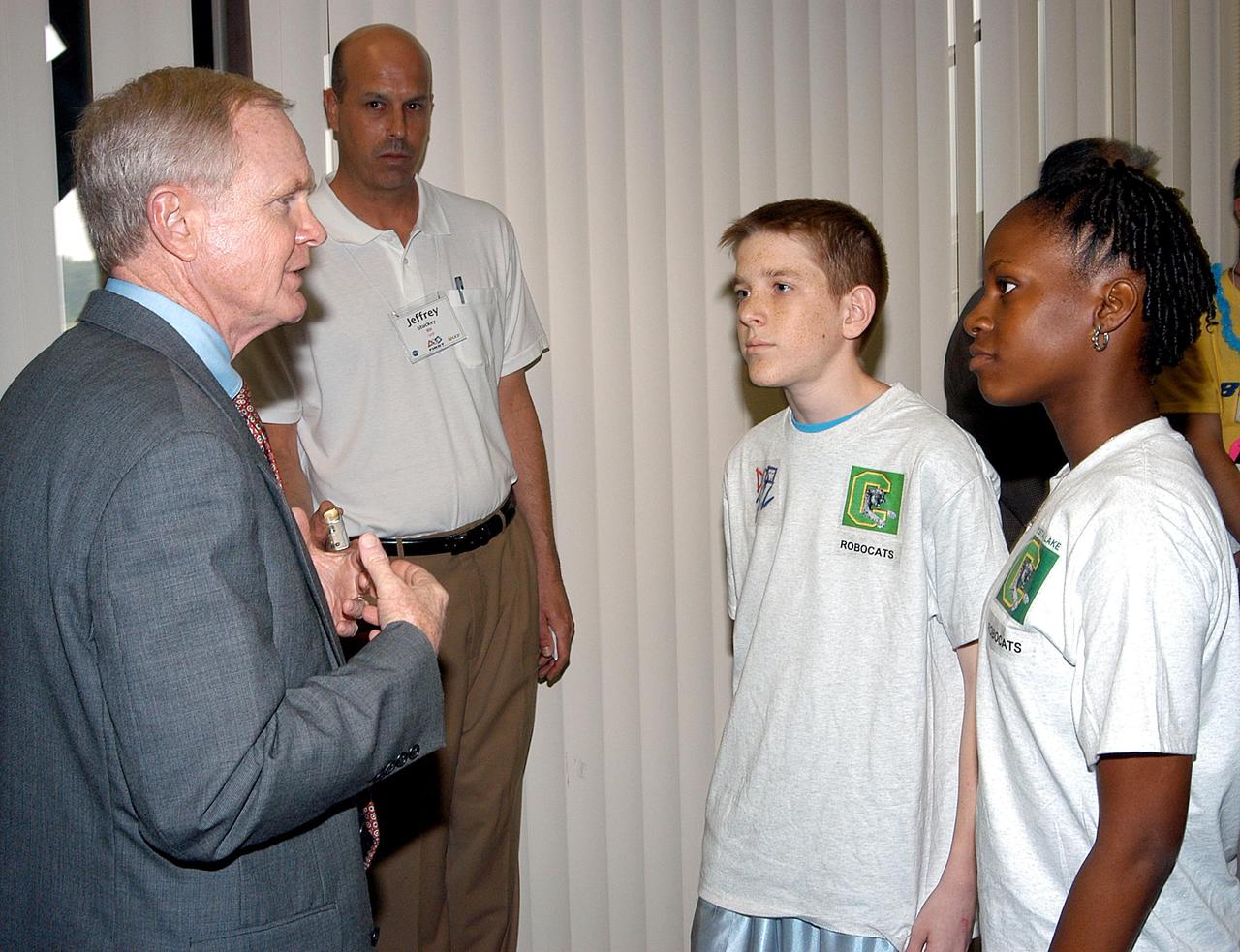
KENNEDY SPACE CENTER, FLA. - NASA Kennedy Space Center Director Roy Bridges (left) talks with some of the students involved in the 2003 Southeastern Regional FIRST Robotic Competition. The competition is being held at the University of Central Florida (UCF) in Orlando, March 20-23. Forty student teams from around the country are participating in the event that pits team-built gladiator robots against each other in an athletic-style competition. The teams are sponsored by NASA/Kennedy Space Center, The Boeing Company/Brevard Community College, and Lockheed Martin Space Operations/Mission Systems for the nonprofit organization For Inspiration and Recognition of Science and Technology, known as FIRST. The vision of FIRST is to inspire in the youth of our nation an appreciation of science and technology and an understanding that mastering these disciplines can enrich the lives of all mankind.
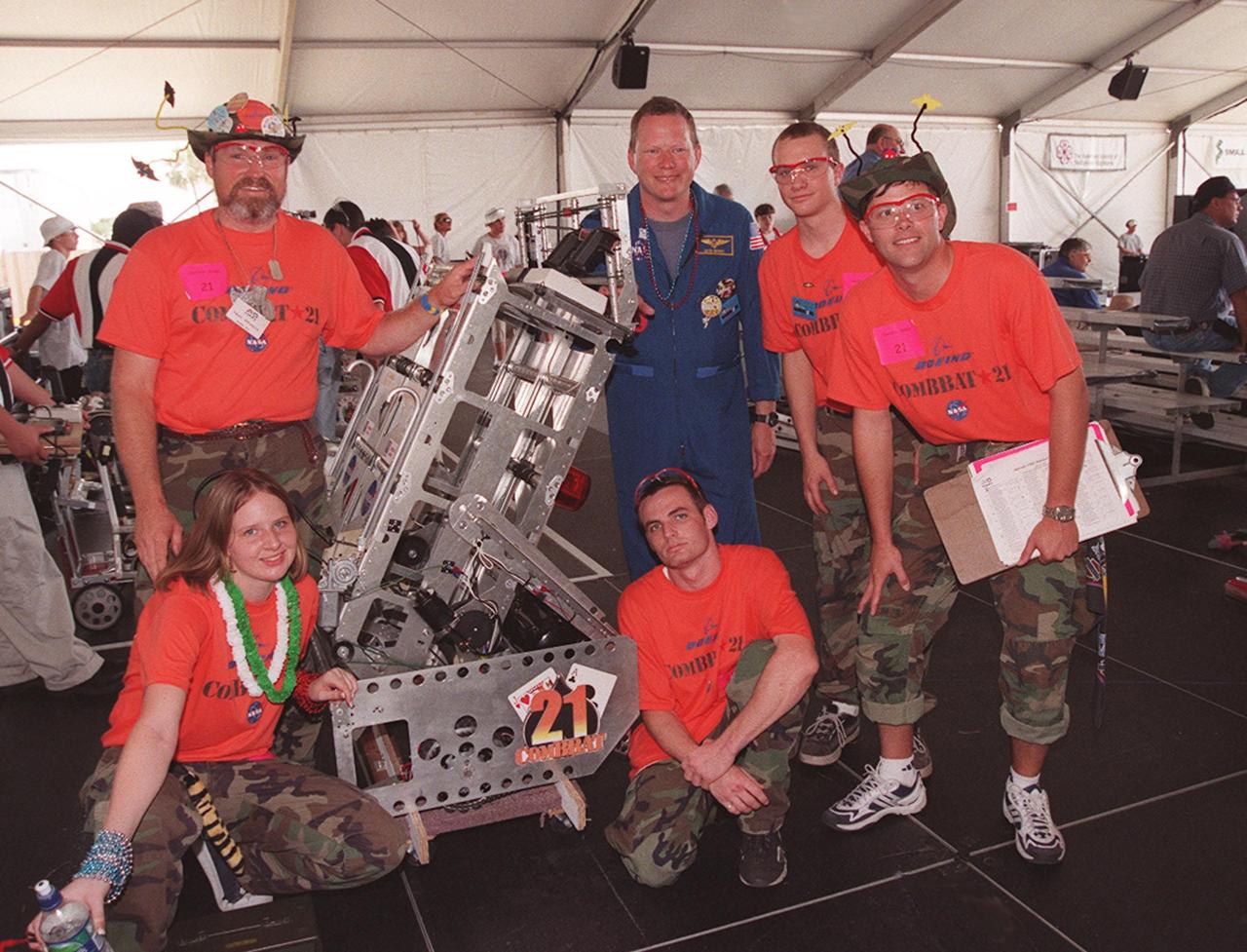
Astronaut David Brown poses with members of the team known as ComBBat, representing Central Florida's Astronaut and Titusville high schools. ComBBat was teamed with Boeing at KSC and Brevard Community College. Students from all over the country are at the KSC Visitor Complex for the FIRST (For Inspiration and Recognition of Science and Technology) Southeast Regional competition being held March 9-11 in the Rocket Garden. Teams of high school students are testing the limits of their imagination using robots they have designed, with the support of business and engineering professionals and corporate sponsors, to compete in a technological battle against other schools' robots. Of the 30 high school teams competing, 16 are Florida teams co-sponsored by NASA and KSC contractors. Local high schools participating are Astronaut, Bayside, Cocoa Beach, Eau Gallie, Melbourne, Melbourne Central Catholic, Palm Bay, Rockledge, Satellite, and Titusville
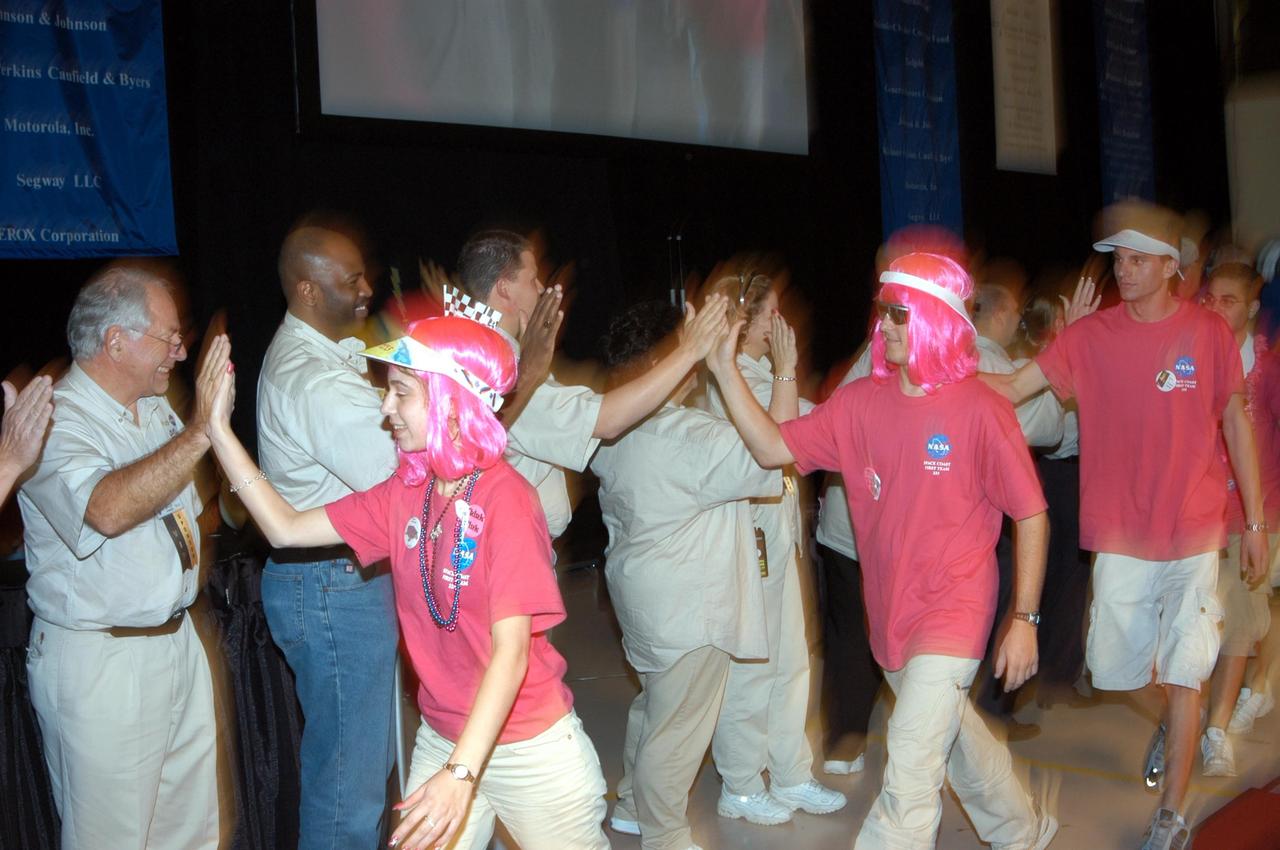
KENNEDY SPACE CENTER, FLA. - The NASA/Kennedy Space Center-sponsored student team (in pink wigs) is congratulated by the mentors and support staff of the 2003 Southeastern Regional FIRST Robotic Competition. The competition is being held at the University of Central Florida (UCF) in Orlando, March 20-23. The team won awards for Regional Finalist 2, GM Industrial Design and the Imagery Award. Forty student teams from around the country are participating in the event that pits team-built gladiator robots against each other in an athletic-style competition. The teams are sponsored by NASA/Kennedy Space Center, The Boeing Company/Brevard Community College, and Lockheed Martin Space Operations/Mission Systems for the nonprofit organization For Inspiration and Recognition of Science and Technology, known as FIRST. The vision of FIRST is to inspire in the youth of our nation an appreciation of science and technology and an understanding that mastering these disciplines can enrich the lives of all mankind.
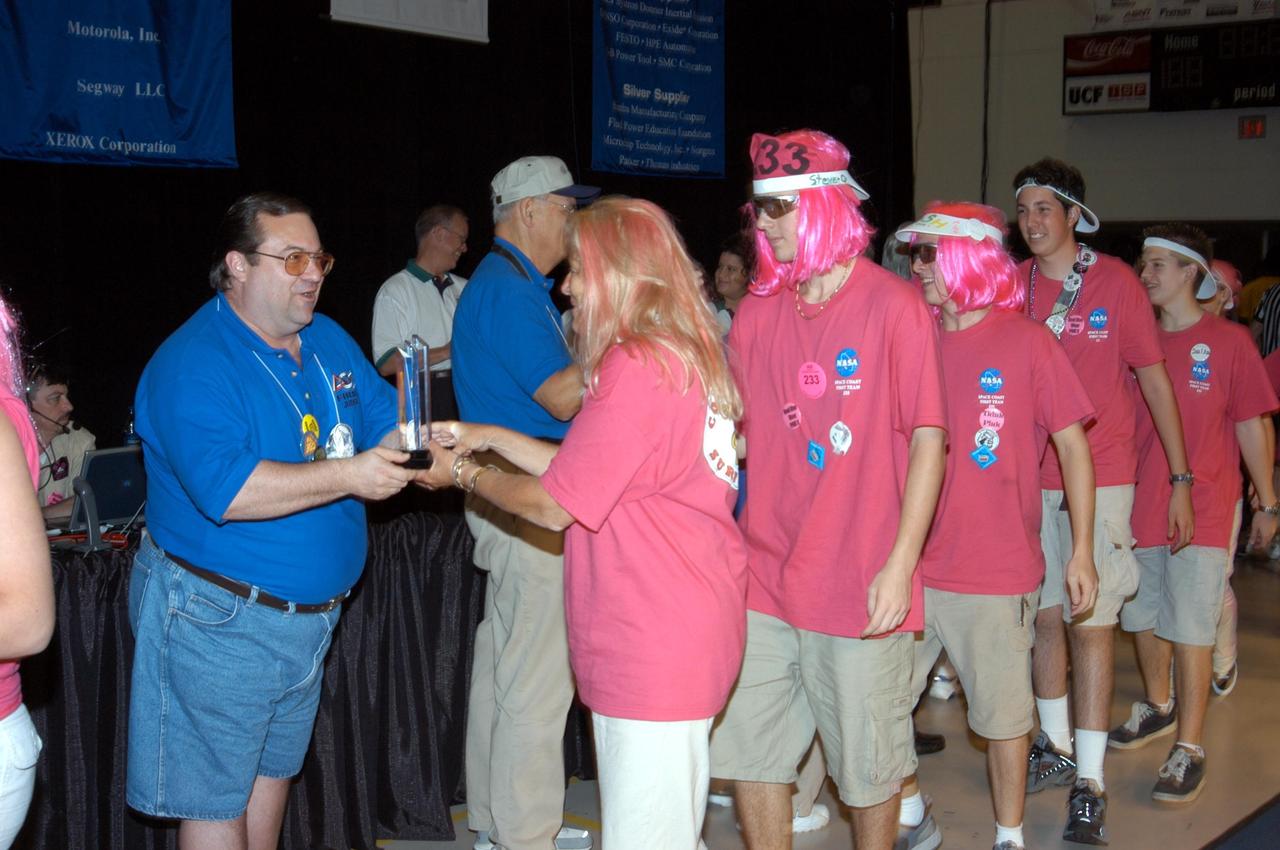
KENNEDY SPACE CENTER, FLA. - The NASA/Kennedy Space Center-sponsored student team (in pink wigs) is congratulated by the judges of the 2003 Southeastern Regional FIRST Robotic Competition. The competition is being held at the University of Central Florida (UCF) in Orlando, March 20-23. The team won awards for Regional Finalist 2, GM Industrial Design and the Imagery Award. Forty student teams from around the country are participating in the event that pits team-built gladiator robots against each other in an athletic-style competition. The teams are sponsored by NASA/Kennedy Space Center, The Boeing Company/Brevard Community College, and Lockheed Martin Space Operations/Mission Systems for the nonprofit organization For Inspiration and Recognition of Science and Technology, known as FIRST. The vision of FIRST is to inspire in the youth of our nation an appreciation of science and technology and an understanding that mastering these disciplines can enrich the lives of all mankind.
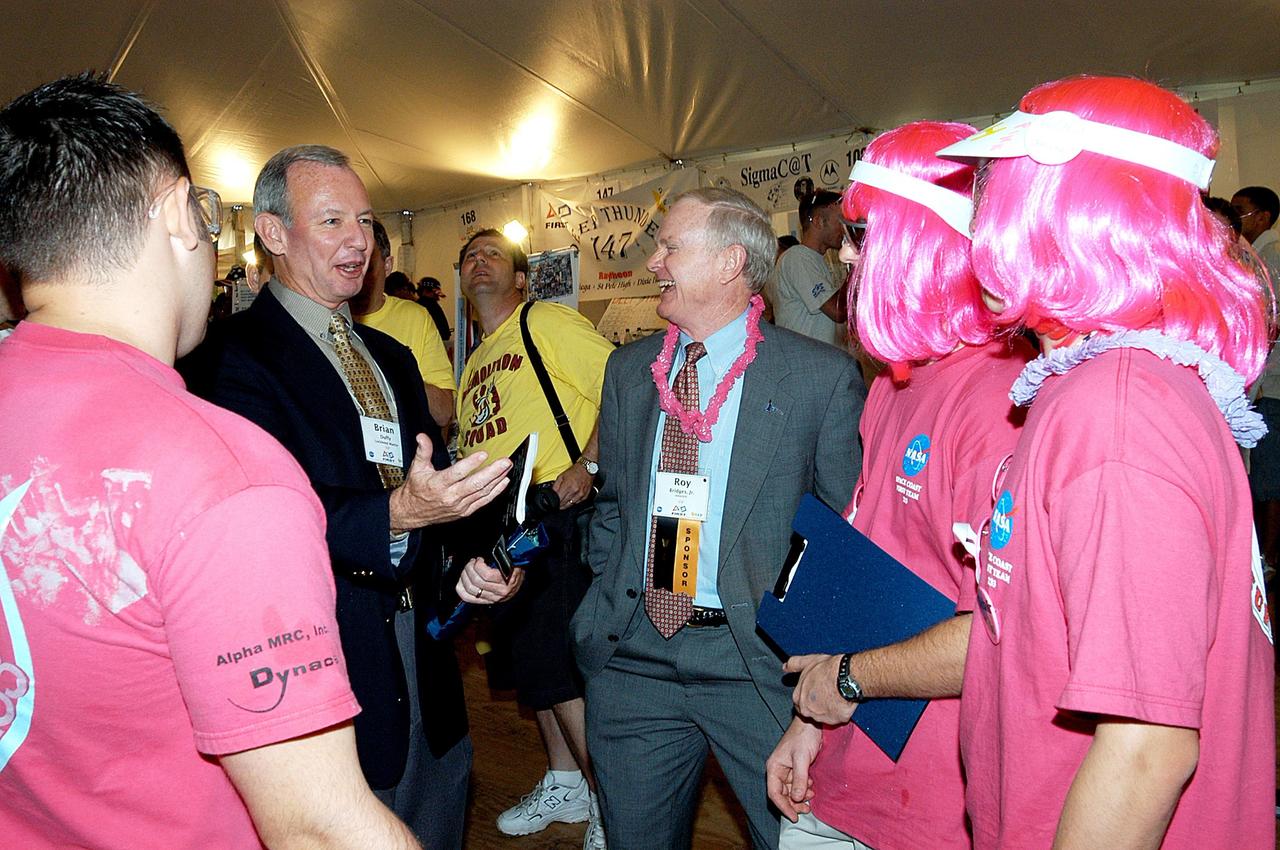
KENNEDY SPACE CENTER, FLA. - Lockheed Martin Vice President/Associate Program Manager Brian Duffy (second from left) and NASA/Kennedy Space Center Director Roy Bridges (center) share a laugh with student participants in the 2003 Southeastern Regional FIRST Robotic Competition. The competition is being held at the University of Central Florida (UCF) in Orlando, March 20-23. Forty student teams from around the country are participating in the event that pits team-built gladiator robots against each other in an athletic-style competition. The teams are sponsored by NASA/Kennedy Space Center, The Boeing Company/Brevard Community College, and Lockheed Martin Space Operations/Mission Systems for the nonprofit organization For Inspiration and Recognition of Science and Technology, known as FIRST. The vision of FIRST is to inspire in the youth of our nation an appreciation of science and technology and an understanding that mastering these disciplines can enrich the lives of all mankind.
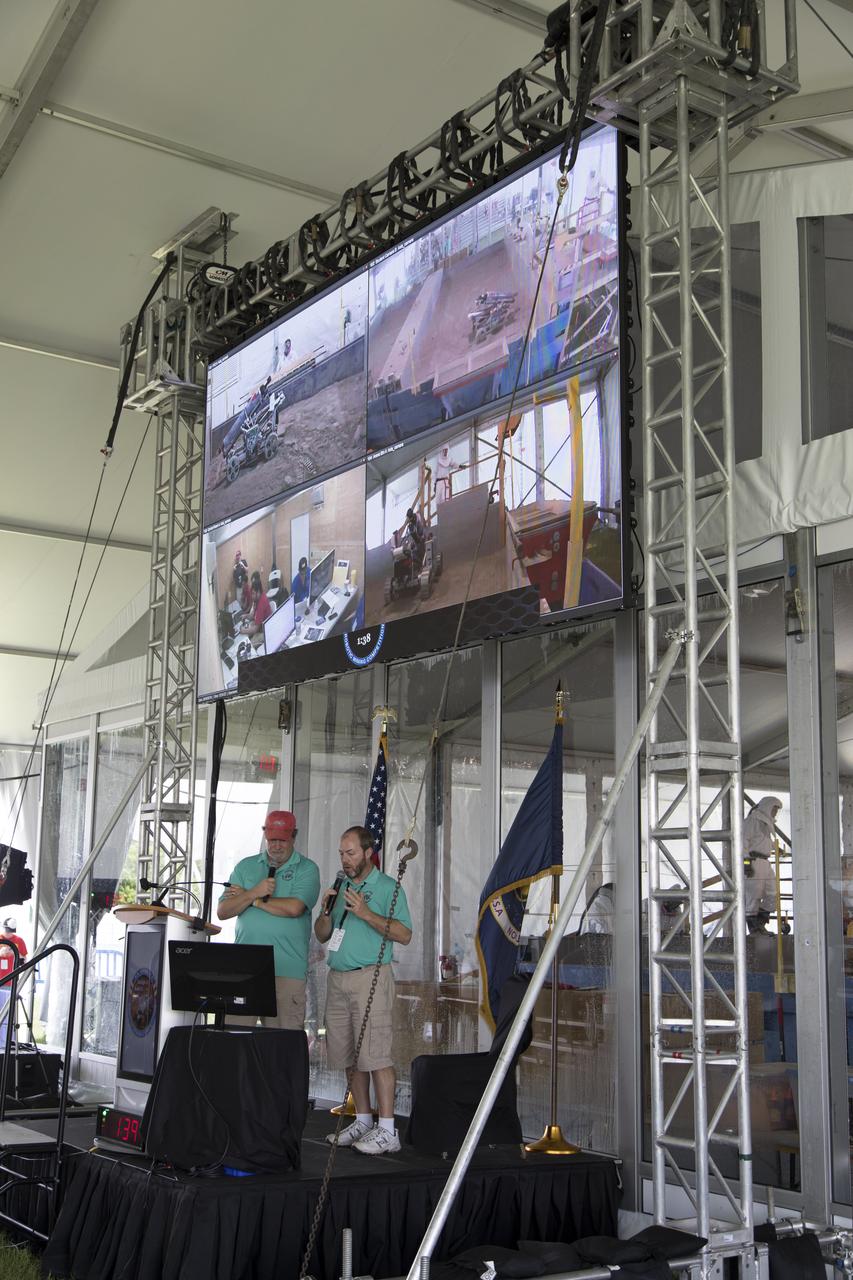
During the third day of NASA's 9th Robotic Mining Competition, May 16, Al Feinberg, left, with Kennedy Space Center's Communication and Public Engagement, and Kurt Leucht, with Kennedy's Engineering Directorate, provide commentary as robot miners dig in the dirt in the mining arena at NASA's Kennedy Space Center Visitor Complex in Florida. More than 40 student teams from colleges and universities around the U.S. will use their mining robots to dig in a supersized sandbox filled with BP-1, or simulated Lunar soil, gravel and rocks, and participate in other competition requirements. The Robotic Mining Competition is a NASA Human Exploration and Operations Mission Directorate project designed to encourage students in science, technology, engineering and math, or STEM fields. The project provides a competitive environment to foster innovative ideas and solutions that could be used on NASA's deep space missions.

CAPE CANAVERAL, Fla. - At NASA’s Kennedy Space Center Visitor Complex in Florida, Lunabotics Emcee Kimberly Land gives a high five to a student during the opening ceremony for NASA’s Lunabotics Mining Competition. Land is the Education, Public Outreach and Communications manager for NASA’s Game Changing Development Program and Earth System Science Pathfinder Program. The mining competition is sponsored by NASA Kennedy Space Center’s Education Office for the agency’s Exploration Systems Mission Directorate. Undergraduate and graduate students from more than 50 universities and colleges in the U.S. and other countries use their remote-controlled Lunabots to maneuver and dig in a supersized sandbox filled with a crushed material that has characteristics similar to lunar soil. For more information, visit www.nasa.gov/lunabotics. Photo credit: NASA/Frankie Martin
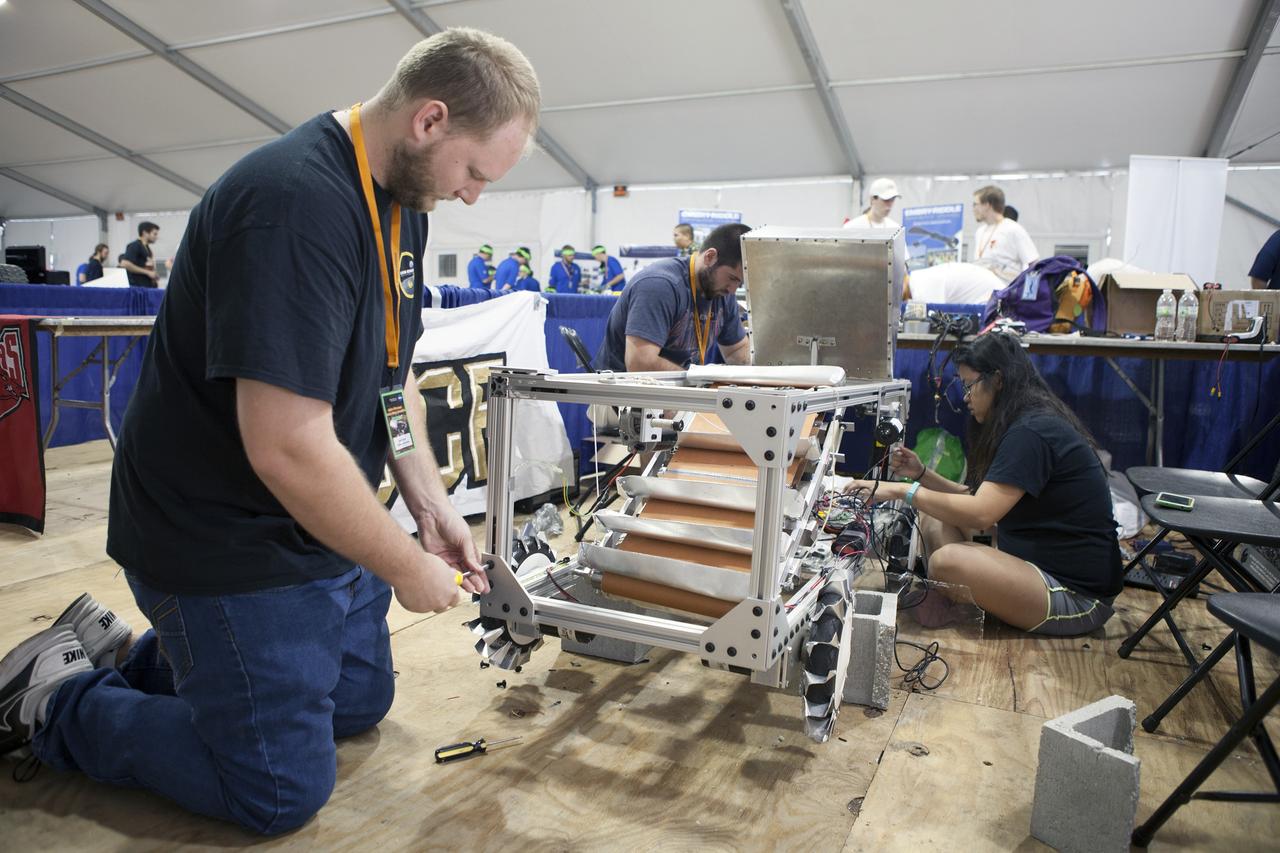
CAPE CANAVERAL, Fla. – The Hawai'l Marsbot Team members from Kapi'olani Community College in Hawaii prepare their robot for the mining portion of NASA's 2014 Robotics Mining Competition at the Kennedy Space Center Visitor Complex in Florida. More than 35 teams from around the U.S. have designed and built remote-controlled robots for the mining competition. The competition is a NASA Human Exploration and Operations Mission Directorate project designed to engage and retain students in science, technology, engineering and mathematics, or STEM, fields by expanding opportunities for student research and design. Teams use their remote-controlled robotics to maneuver and dig in a supersized sandbox filled with a crushed material that has characteristics similar to Martian soil. The objective of the challenge is to see which team’s robot can collect and move the most regolith within a specified amount of time. For more information, visit www.nasa.gov/nasarmc. Photo credit: NASA/Frankie Martin
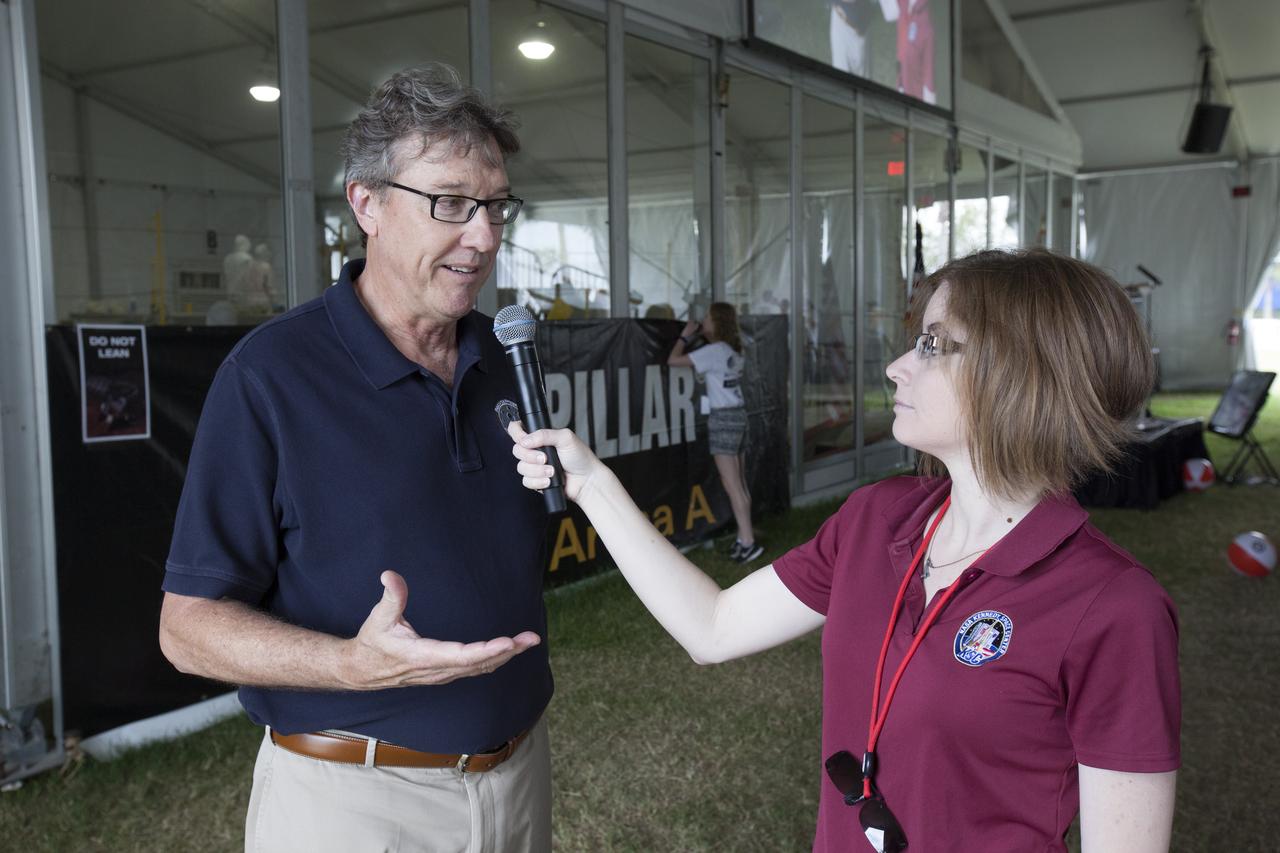
Stan Starr, branch chief for Applied Physics in the Exploration Research and Technology Programs, is interviewed on-camera by Sarah McNulty, with the Communication and Public Engagement Directorate, during NASA's 8th Annual Robotic Mining Competition at the Kennedy Space Center Visitor Complex in Florida. More than 40 student teams from colleges and universities around the U.S. used their uniquely-designed mining robots to dig in a supersized sandbox filled with BP-1, or simulated Martian soil, and participated in other competition requirements, May 22-26. The Robotic Mining Competition is a NASA Human Exploration and Operations Mission Directorate project designed to encourage students in science, technology, engineering and math, or STEM fields. The project provides a competitive environment to foster innovative ideas and solutions that could be used on NASA's Journey to Mars.
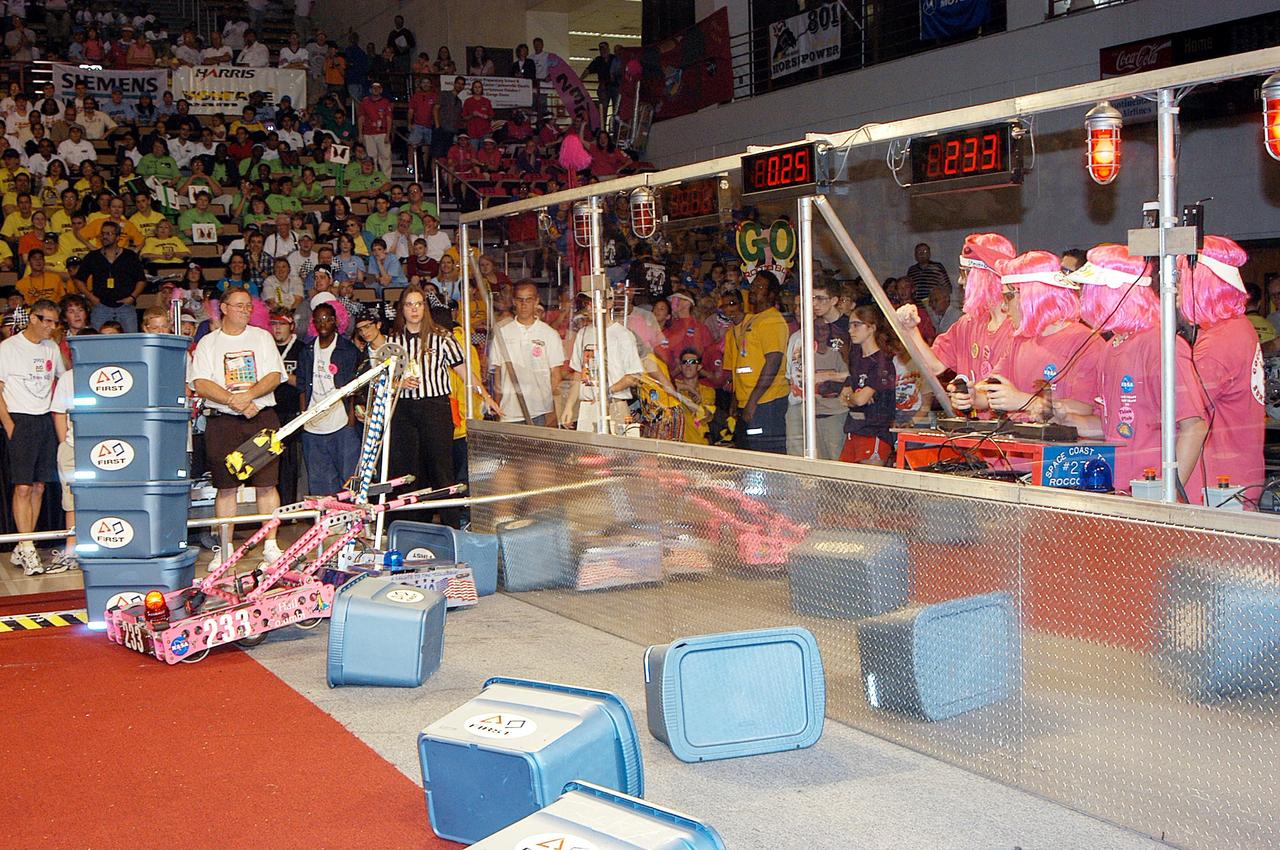
KENNEDY SPACE CENTER, FLA. - The NASA/Kennedy Space Center-sponsored student team (in pink wigs, right) demonstrates their robot's abilities during the 2003 Southeastern Regional FIRST Robotic Competition. The competition is being held at the University of Central Florida (UCF) in Orlando, March 20-23. Forty student teams from around the country are participating in the event that pits team-built gladiator robots against each other in an athletic-style competition. The teams are sponsored by NASA/Kennedy Space Center, The Boeing Company/Brevard Community College, and Lockheed Martin Space Operations/Mission Systems for the nonprofit organization For Inspiration and Recognition of Science and Technology, known as FIRST. The vision of FIRST is to inspire in the youth of our nation an appreciation of science and technology and an understanding that mastering these disciplines can enrich the lives of all mankind.
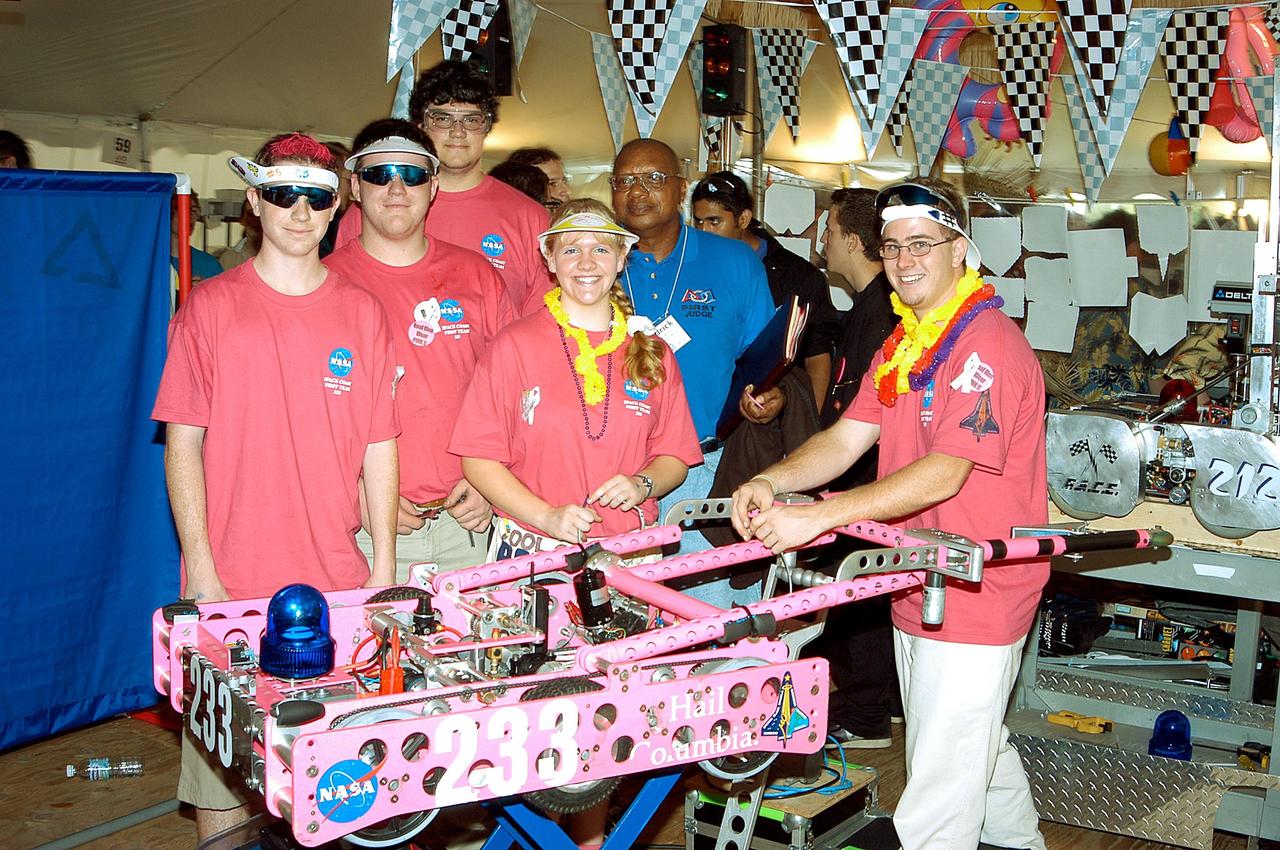
KENNEDY SPACE CENTER, FLA. - NASA/Kennedy Space Center-sponsored students, participating in the 2003 Southeastern Regional FIRST Robotic Competition, pose with their team-built robot. The competition is being held at the University of Central Florida (UCF) in Orlando, March 20-23. Forty student teams from around the country are participating in the event that pits team-built gladiator robots against each other in an athletic-style competition. The teams are sponsored by NASA/Kennedy Space Center, The Boeing Company/Brevard Community College, and Lockheed Martin Space Operations/Mission Systems for the nonprofit organization For Inspiration and Recognition of Science and Technology, known as FIRST. The vision of FIRST is to inspire in the youth of our nation an appreciation of science and technology and an understanding that mastering these disciplines can enrich the lives of all mankind.
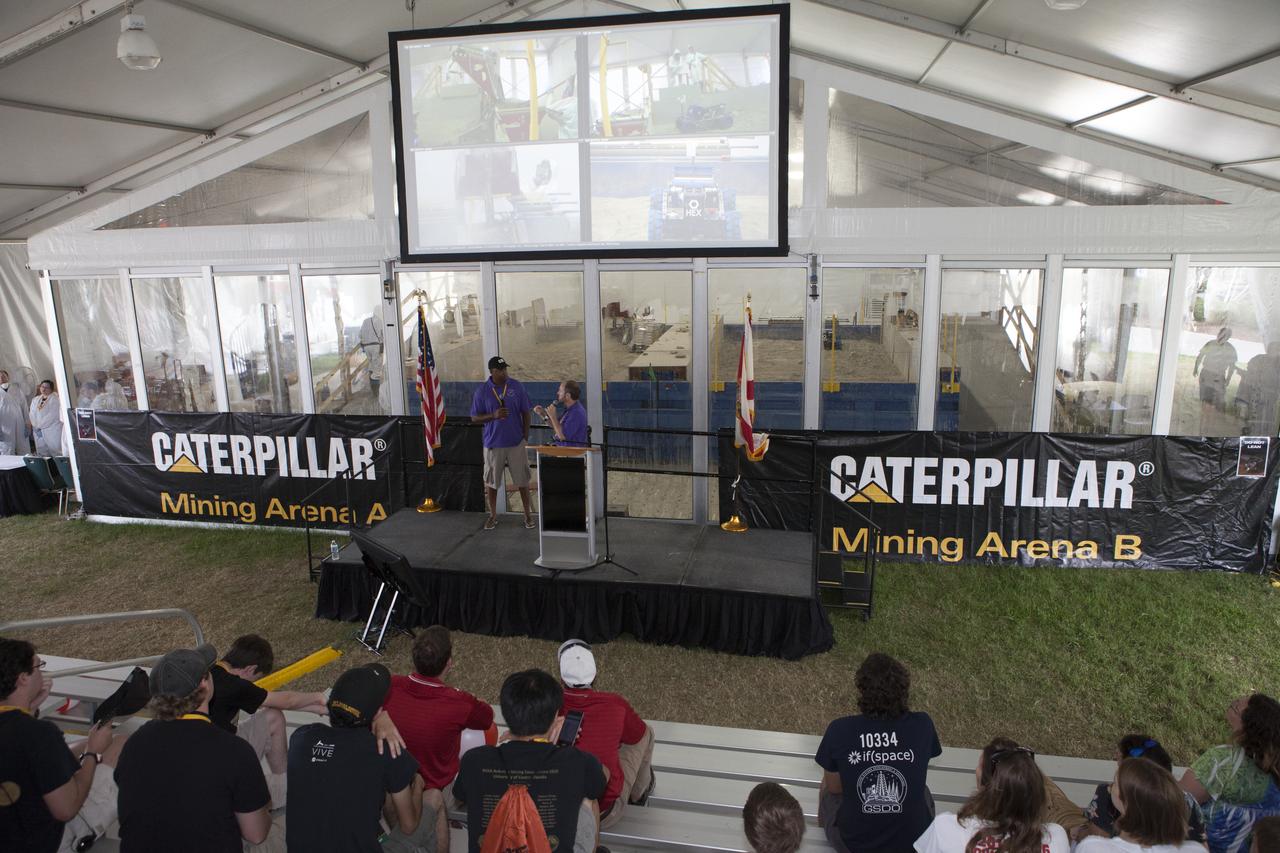
Derrick Matthews, left, with Kennedy Space Center's Communication and Public Engagement Directorate, and Kurt Leucht, event emcee, provide commentary at the mining arena during NASA's 8th Annual Robotic Mining Competition at the Kennedy Space Center Visitor Complex in Florida. More than 40 student teams from colleges and universities around the U.S. are using their uniquely-designed mining robots to dig in a supersized sandbox filled with BP-1, or simulated Martian soil, and participate in other competition requirements. The Robotic Mining Competition is a NASA Human Exploration and Operations Mission Directorate project designed to encourage students in science, technology, engineering and math, or STEM fields. The project provides a competitive environment to foster innovative ideas and solutions that could be used on NASA's Journey to Mars.
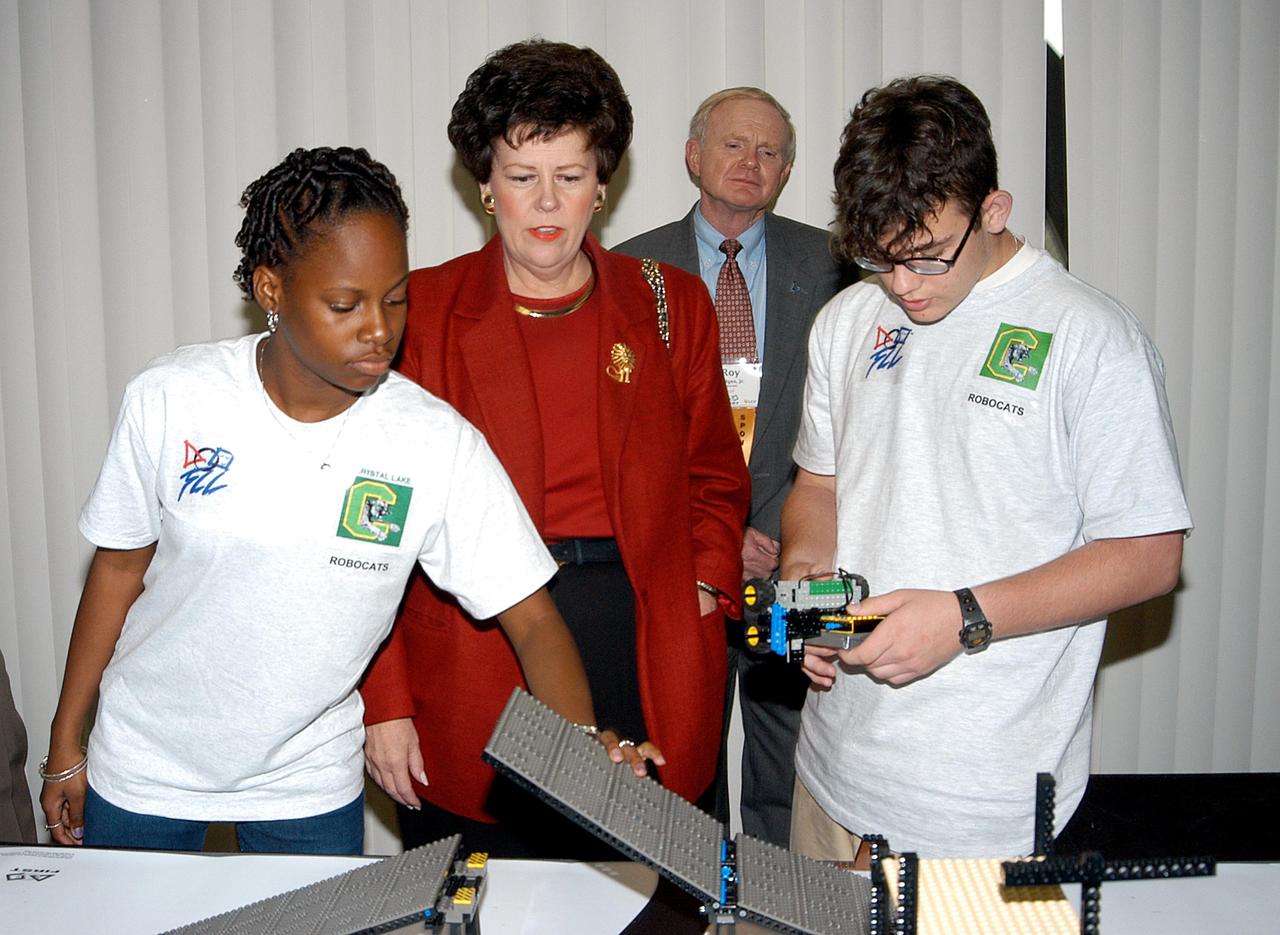
KENNEDY SPACE CENTER, FLA. - NASA/Kennedy Space Center Director Roy Bridges (background) observes as Florida Lt. Gov. Toni Jennings interacts with students at a display of space structures built from Lego blocks at the 2003 Southeastern Regional FIRST Robotic Competition. The competition is being held at the University of Central Florida (UCF) in Orlando, March 20-23. Forty student teams from around the country are participating in the event that pits team-built gladiator robots against each other in an athletic-style competition. The teams are sponsored by NASA/Kennedy Space Center, The Boeing Company/Brevard Community College, and Lockheed Martin Space Operations/Mission Systems for the nonprofit organization For Inspiration and Recognition of Science and Technology, known as FIRST. The vision of FIRST is to inspire in the youth of our nation an appreciation of science and technology and an understanding that mastering these disciplines can enrich the lives of all mankind.
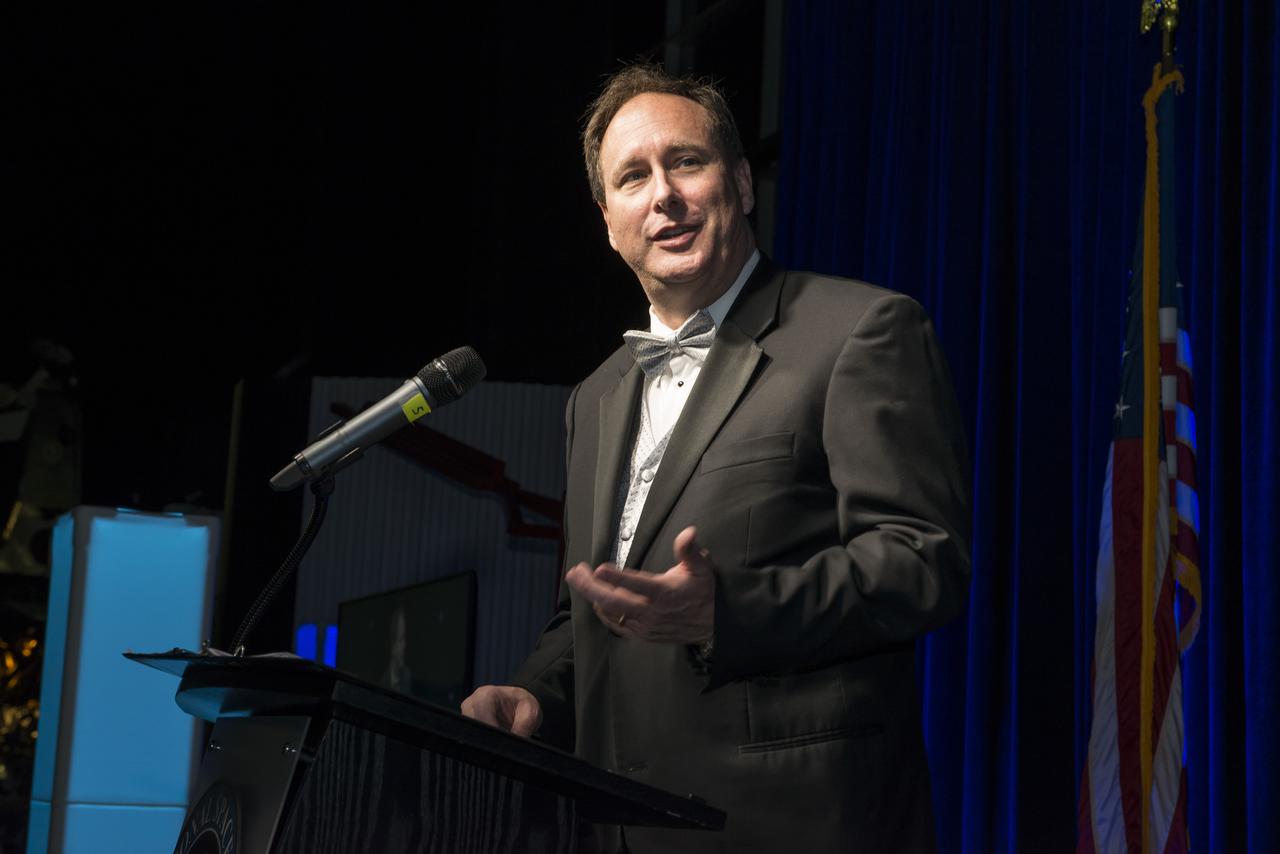
The annual Dr. Wernher Von Braun Memorial Dinner was held at the U.S. Space and Rocket Center's Davidson Center on October 26, 2017 with Keynote speaker General John Hyten, Commander of U.S. Strategic Command. Emcee was Mark Larson of Mark Larson Media Services, Inc. Dr. Wernher Von Braun Memorial Scholarships were presented to 8 college students by the National Space Club. Educator of the Year was awarded to Tammy Thorpe; Community Service award was presented to Huntsville, Al. Mayor Tommy Battle. The Communications Award was presented to retired astronaut Dr. Mike Massimino. The Distinguished Science Award was presented to Dr. Martin Weisskopf. The Astronautics Engineer Award was presented to Douglas R. Cooke. The Dr. Wernher Von Braun Space Flight Trophy was presented to Robert Lightfoot.
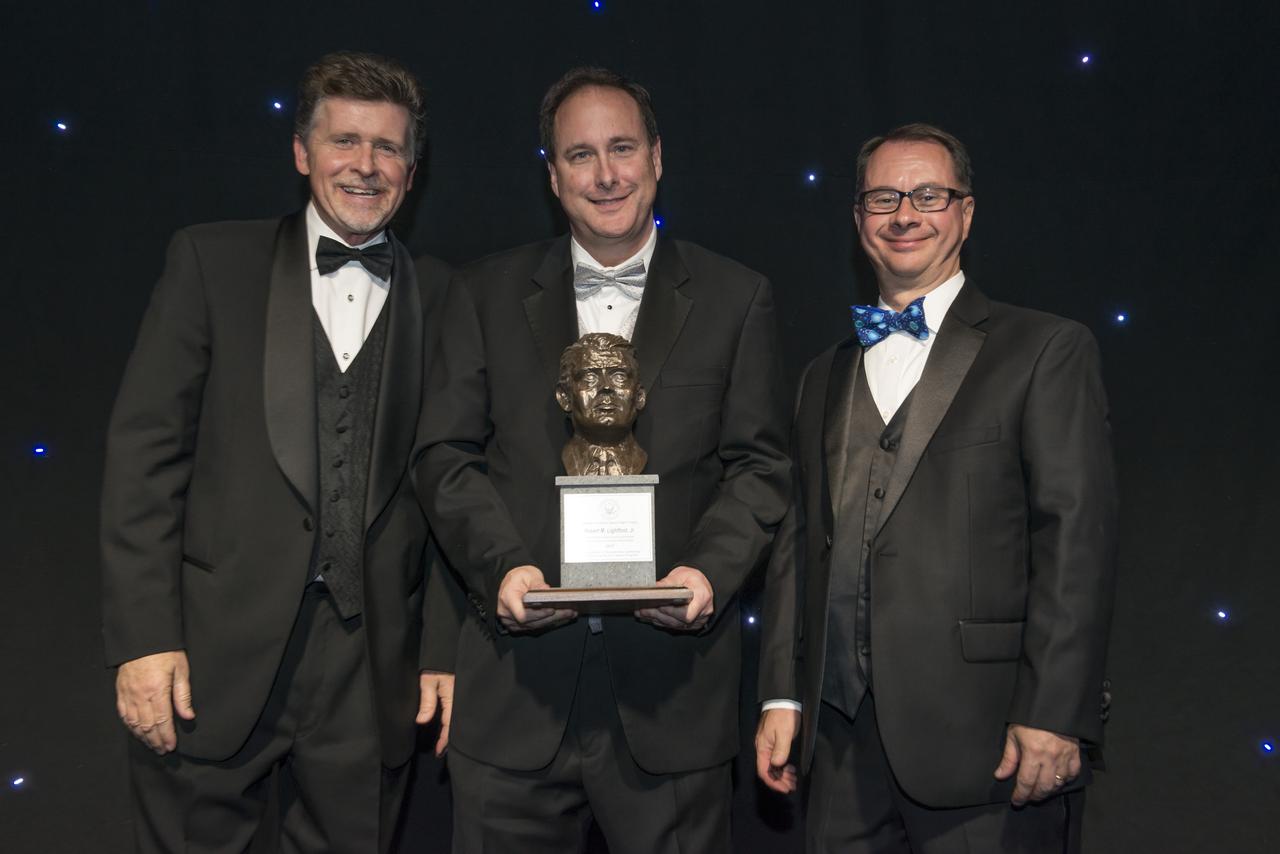
The annual Dr. Wernher Von Braun Memorial Dinner was held at the U.S. Space and Rocket Center's Davidson Center on October 26, 2017 with Keynote speaker General John Hyten, Commander of U.S. Strategic Command. Emcee was Mark Larson of Mark Larson Media Services, Inc. Dr. Wernher Von Braun Memorial Scholarships were presented to 8 college students by the National Space Club. Educator of the Year was awarded to Tammy Thorpe; Community Service award was presented to Huntsville, Al. Mayor Tommy Battle. The Communications Award was presented to retired astronaut Dr. Mike Massimino. The Distinguished Science Award was presented to Dr. Martin Weisskopf. The Astronautics Engineer Award was presented to Douglas R. Cooke. The Dr. Wernher Von Braun Space Flight Trophy was presented to Robert Lightfoot.
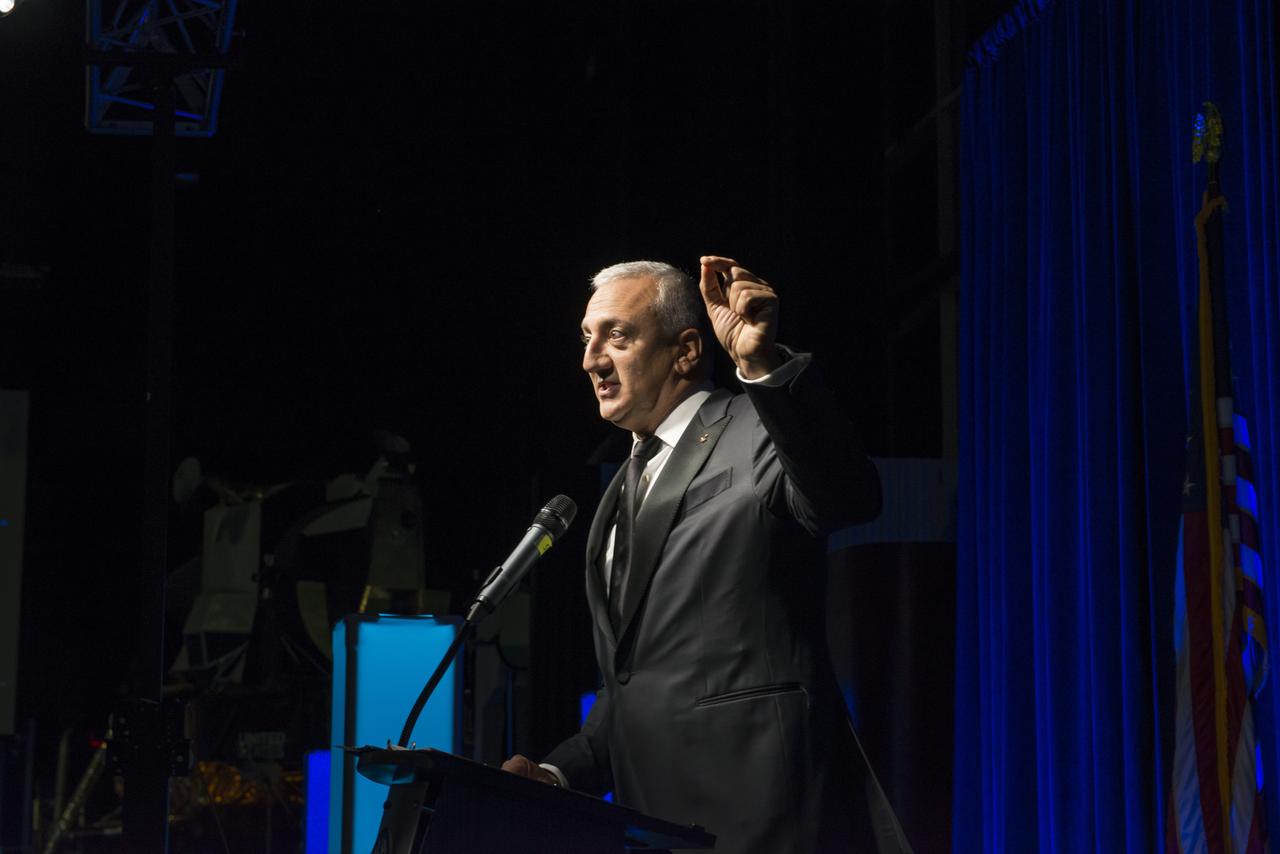
The annual Dr. Wernher Von Braun Memorial Dinner was held at the U.S. Space and Rocket Center's Davidson Center on October 26, 2017 with Keynote speaker General John Hyten, Commander of U.S. Strategic Command. Emcee was Mark Larson of Mark Larson Media Services, Inc. Dr. Wernher Von Braun Memorial Scholarships were presented to 8 college students by the National Space Club. Educator of the Year was awarded to Tammy Thorpe; Community Service award was presented to Huntsville, Al. Mayor Tommy Battle. The Communications Award was presented to retired astronaut Dr. Mike Massimino. The Distinguished Science Award was presented to Dr. Martin Weisskopf. The Astronautics Engineer Award was presented to Douglas R. Cooke. The Dr. Wernher Von Braun Space Flight Trophy was presented to Robert Lightfoot.
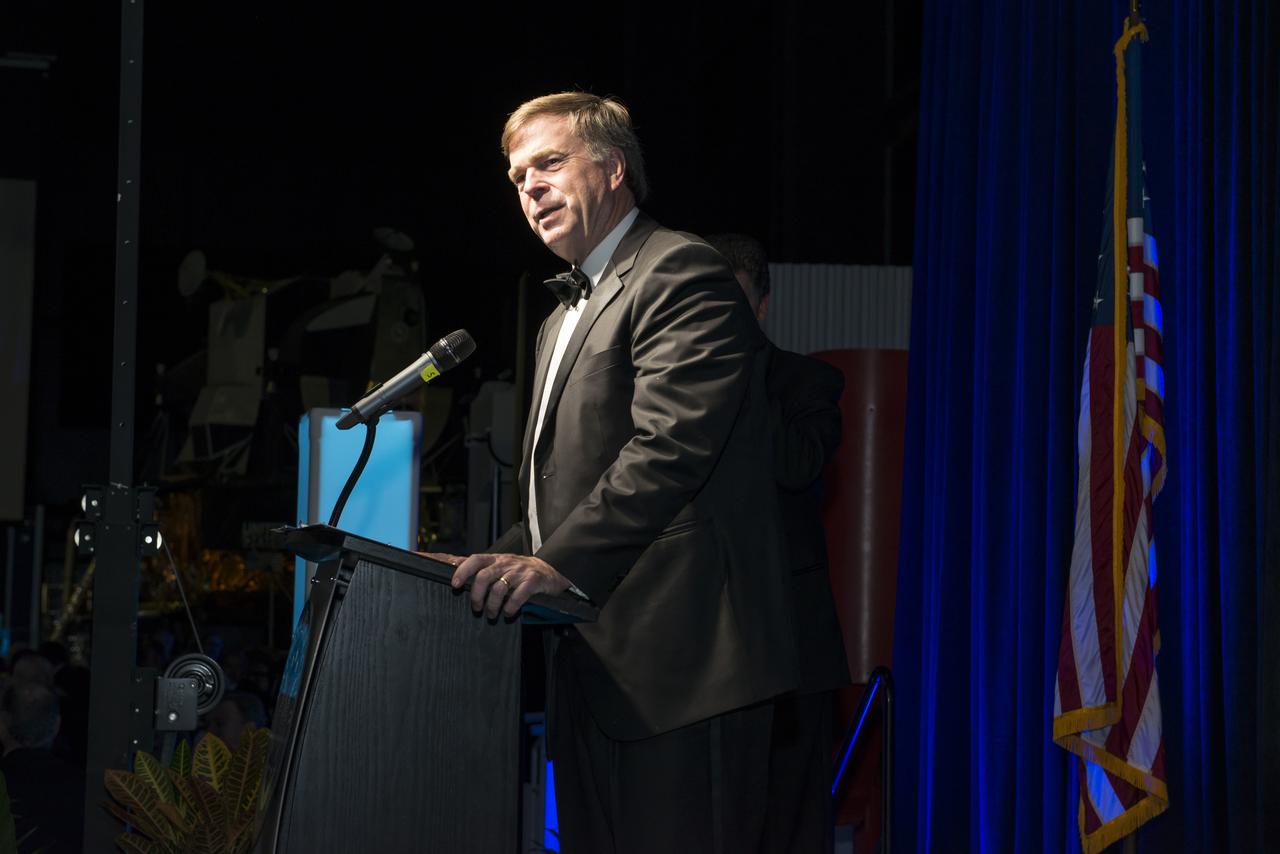
The annual Dr. Wernher Von Braun Memorial Dinner was held at the U.S. Space and Rocket Center's Davidson Center on October 26, 2017 with Keynote speaker General John Hyten, Commander of U.S. Strategic Command. Emcee was Mark Larson of Mark Larson Media Services, Inc. Dr. Wernher Von Braun Memorial Scholarships were presented to 8 college students by the National Space Club. Educator of the Year was awarded to Tammy Thorpe; Community Service award was presented to Huntsville, Al. Mayor Tommy Battle. The Communications Award was presented to retired astronaut Dr. Mike Massimino. The Distinguished Science Award was presented to Dr. Martin Weisskopf. The Astronautics Engineer Award was presented to Douglas R. Cooke. The Dr. Wernher Von Braun Space Flight Trophy was presented to Robert Lightfoot.
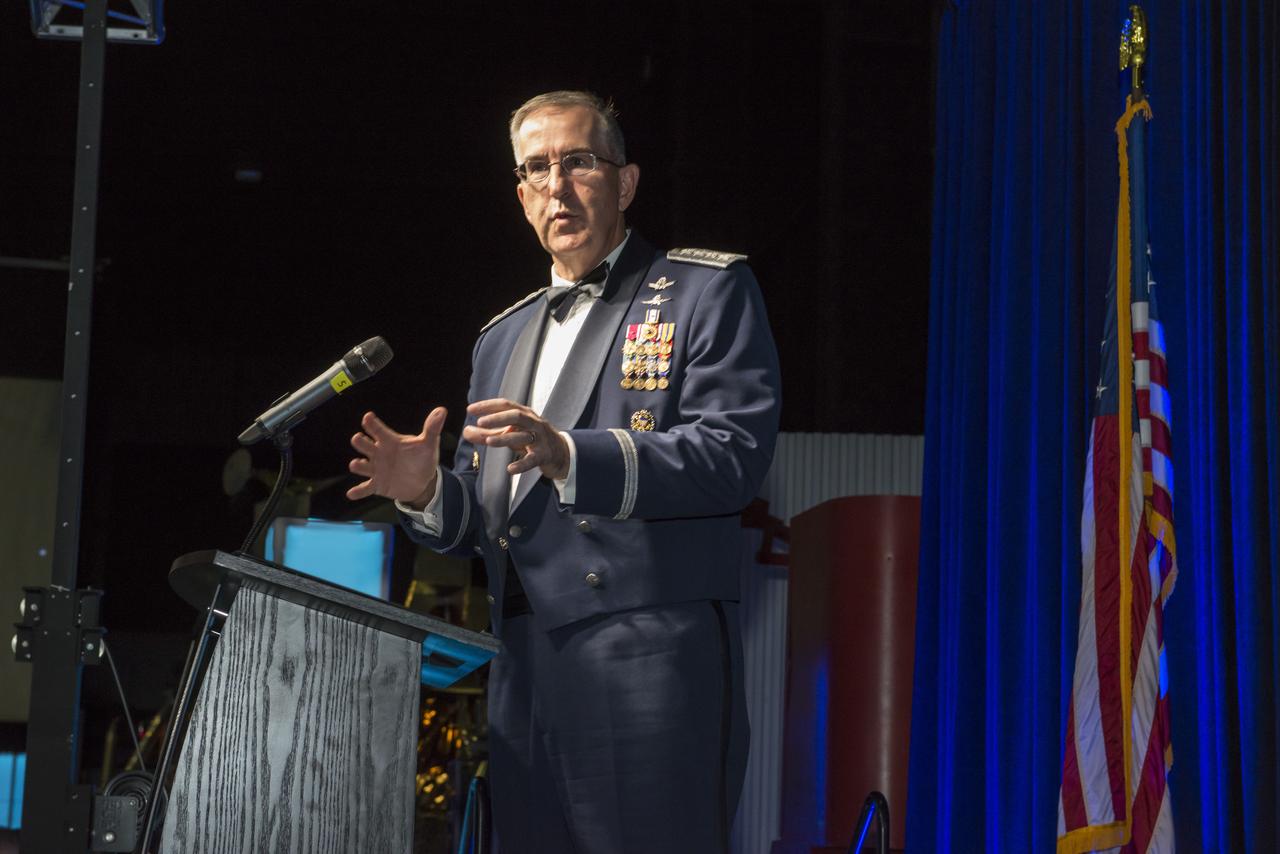
The annual Dr. Wernher Von Braun Memorial Dinner was held at the U.S. Space and Rocket Center's Davidson Center on October 26, 2017 with Keynote speaker General John Hyten, Commander of U.S. Strategic Command. Emcee was Mark Larson of Mark Larson Media Services, Inc. Dr. Wernher Von Braun Memorial Scholarships were presented to 8 college students by the National Space Club. Educator of the Year was awarded to Tammy Thorpe; Community Service award was presented to Huntsville, Al. Mayor Tommy Battle. The Communications Award was presented to retired astronaut Dr. Mike Massimino. The Distinguished Science Award was presented to Dr. Martin Weisskopf. The Astronautics Engineer Award was presented to Douglas R. Cooke. The Dr. Wernher Von Braun Space Flight Trophy was presented to Robert Lightfoot.
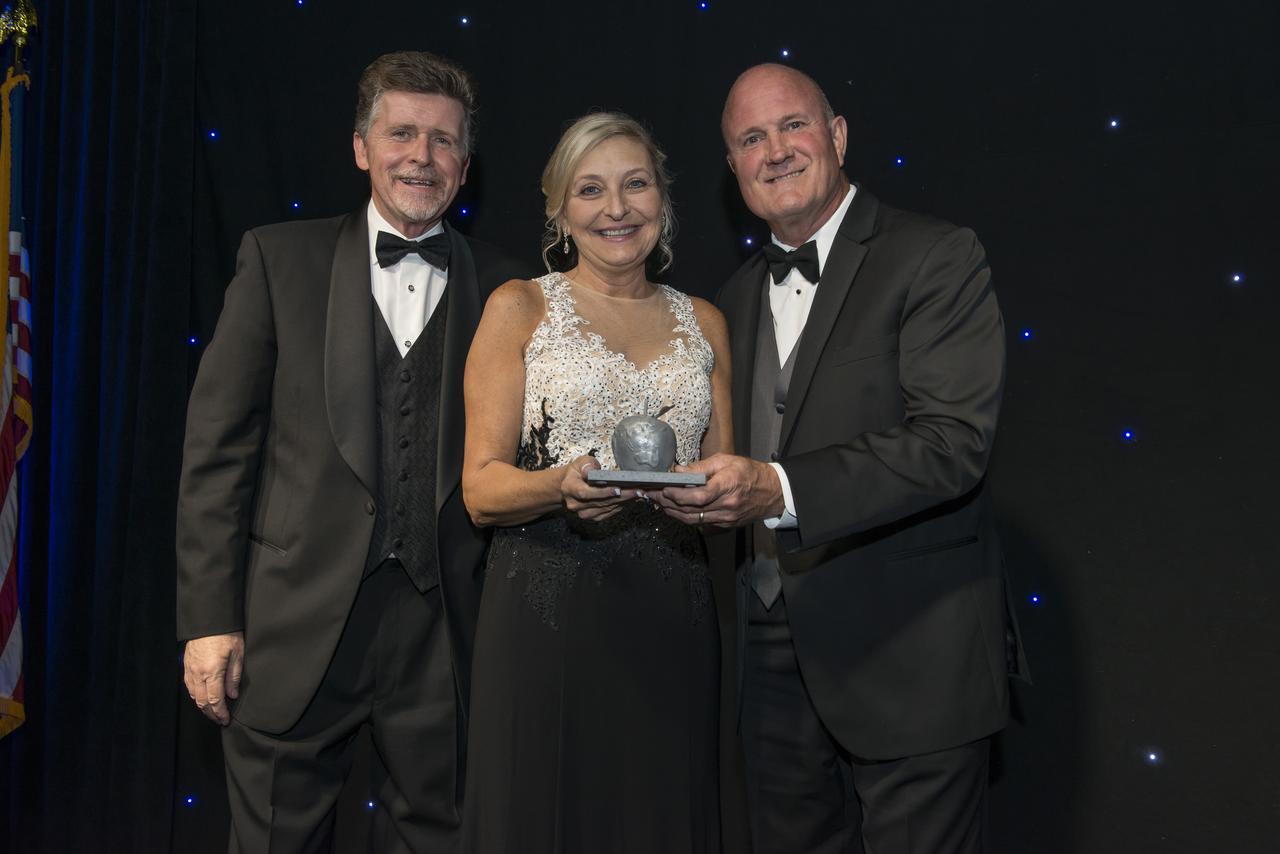
The annual Dr. Wernher Von Braun Memorial Dinner was held at the U.S. Space and Rocket Center's Davidson Center on October 26, 2017 with Keynote speaker General John Hyten, Commander of U.S. Strategic Command. Emcee was Mark Larson of Mark Larson Media Services, Inc. Dr. Wernher Von Braun Memorial Scholarships were presented to 8 college students by the National Space Club. Educator of the Year was awarded to Tammy Thorpe; Community Service award was presented to Huntsville, Al. Mayor Tommy Battle. The Communications Award was presented to retired astronaut Dr. Mike Massimino. The Distinguished Science Award was presented to Dr. Martin Weisskopf. The Astronautics Engineer Award was presented to Douglas R. Cooke. The Dr. Wernher Von Braun Space Flight Trophy was presented to Robert Lightfoot.
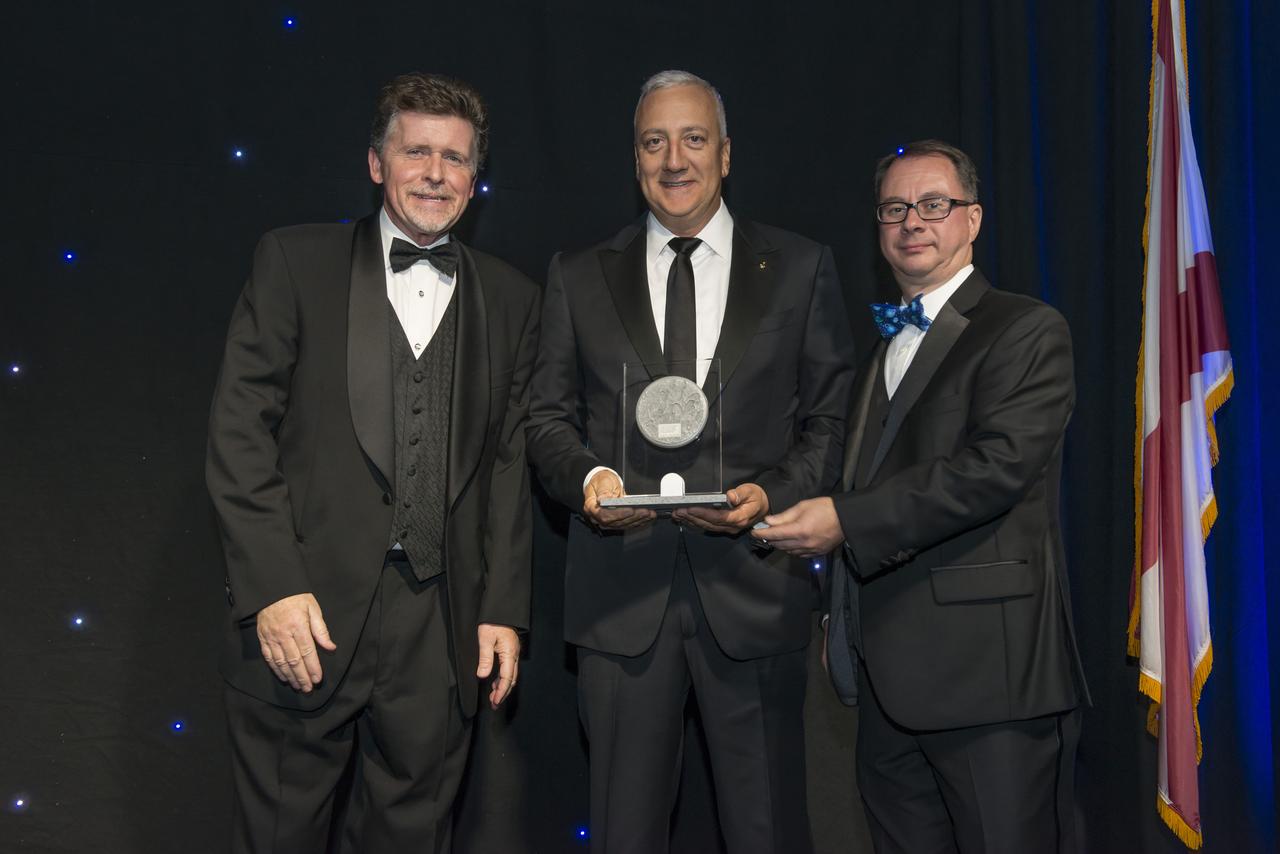
The annual Dr. Wernher Von Braun Memorial Dinner was held at the U.S. Space and Rocket Center's Davidson Center on October 26, 2017 with Keynote speaker General John Hyten, Commander of U.S. Strategic Command. Emcee was Mark Larson of Mark Larson Media Services, Inc. Dr. Wernher Von Braun Memorial Scholarships were presented to 8 college students by the National Space Club. Educator of the Year was awarded to Tammy Thorpe; Community Service award was presented to Huntsville, Al. Mayor Tommy Battle. The Communications Award was presented to retired astronaut Dr. Mike Massimino. The Distinguished Science Award was presented to Dr. Martin Weisskopf. The Astronautics Engineer Award was presented to Douglas R. Cooke. The Dr. Wernher Von Braun Space Flight Trophy was presented to Robert Lightfoot.
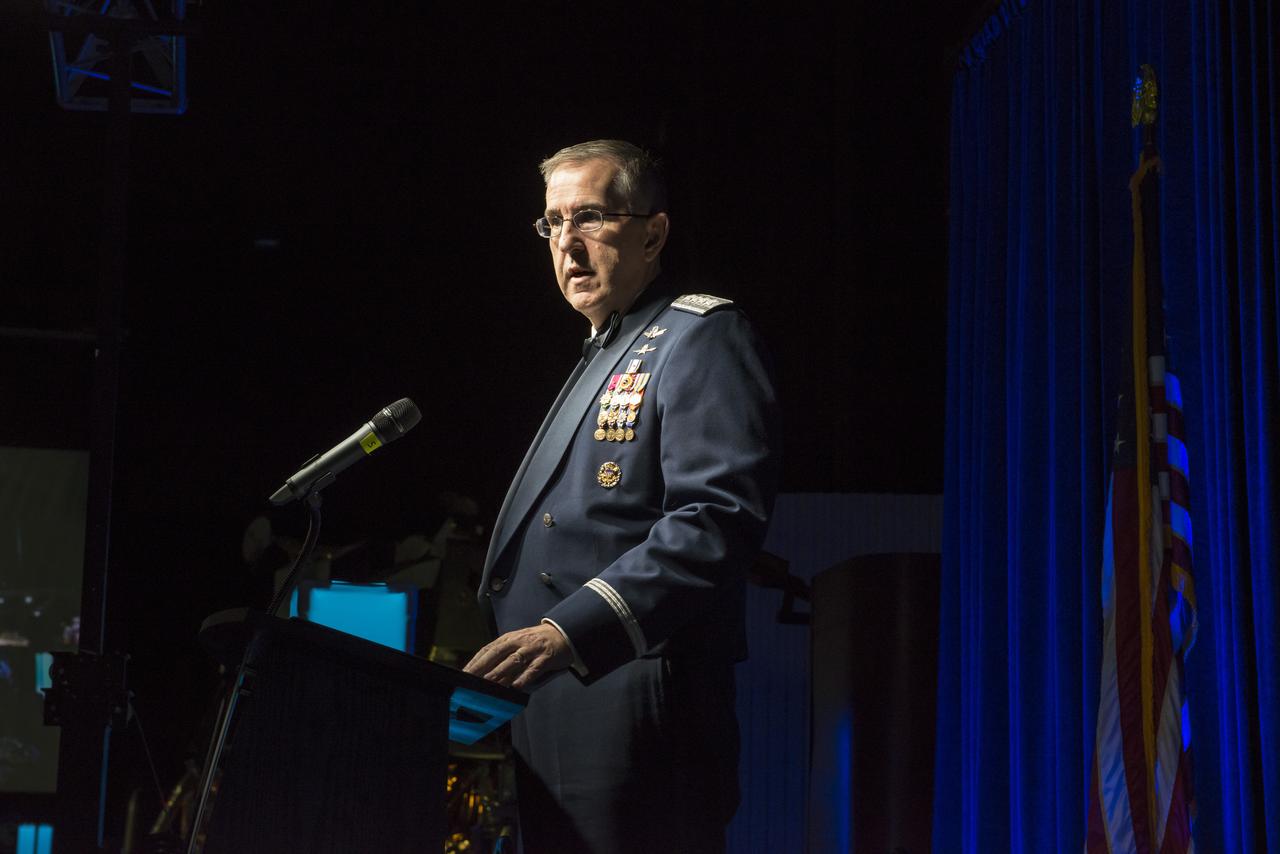
The annual Dr. Wernher Von Braun Memorial Dinner was held at the U.S. Space and Rocket Center's Davidson Center on October 26, 2017 with Keynote speaker General John Hyten, Commander of U.S. Strategic Command. Emcee was Mark Larson of Mark Larson Media Services, Inc. Dr. Wernher Von Braun Memorial Scholarships were presented to 8 college students by the National Space Club. Educator of the Year was awarded to Tammy Thorpe; Community Service award was presented to Huntsville, Al. Mayor Tommy Battle. The Communications Award was presented to retired astronaut Dr. Mike Massimino. The Distinguished Science Award was presented to Dr. Martin Weisskopf. The Astronautics Engineer Award was presented to Douglas R. Cooke. The Dr. Wernher Von Braun Space Flight Trophy was presented to Robert Lightfoot.
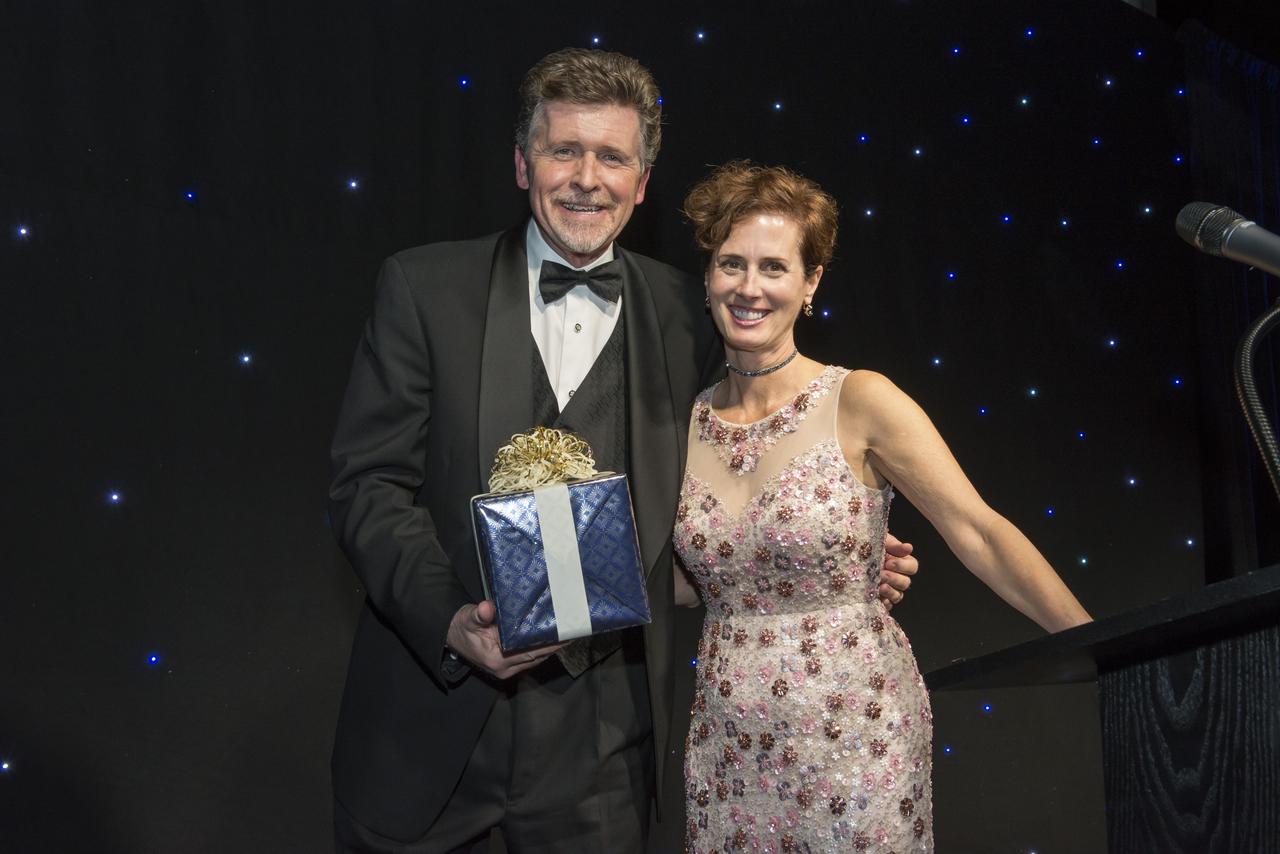
The annual Dr. Wernher Von Braun Memorial Dinner was held at the U.S. Space and Rocket Center's Davidson Center on October 26, 2017 with Keynote speaker General John Hyten, Commander of U.S. Strategic Command. Emcee was Mark Larson of Mark Larson Media Services, Inc. Dr. Wernher Von Braun Memorial Scholarships were presented to 8 college students by the National Space Club. Educator of the Year was awarded to Tammy Thorpe; Community Service award was presented to Huntsville, Al. Mayor Tommy Battle. The Communications Award was presented to retired astronaut Dr. Mike Massimino. The Distinguished Science Award was presented to Dr. Martin Weisskopf. The Astronautics Engineer Award was presented to Douglas R. Cooke. The Dr. Wernher Von Braun Space Flight Trophy was presented to Robert Lightfoot.

The annual Dr. Wernher Von Braun Memorial Dinner was held at the U.S. Space and Rocket Center's Davidson Center on October 26, 2017 with Keynote speaker General John Hyten, Commander of U.S. Strategic Command. Emcee was Mark Larson of Mark Larson Media Services, Inc. Dr. Wernher Von Braun Memorial Scholarships were presented to 8 college students by the National Space Club. Educator of the Year was awarded to Tammy Thorpe; Community Service award was presented to Huntsville, Al. Mayor Tommy Battle. The Communications Award was presented to retired astronaut Dr. Mike Massimino. The Distinguished Science Award was presented to Dr. Martin Weisskopf. The Astronautics Engineer Award was presented to Douglas R. Cooke. The Dr. Wernher Von Braun Space Flight Trophy was presented to Robert Lightfoot.
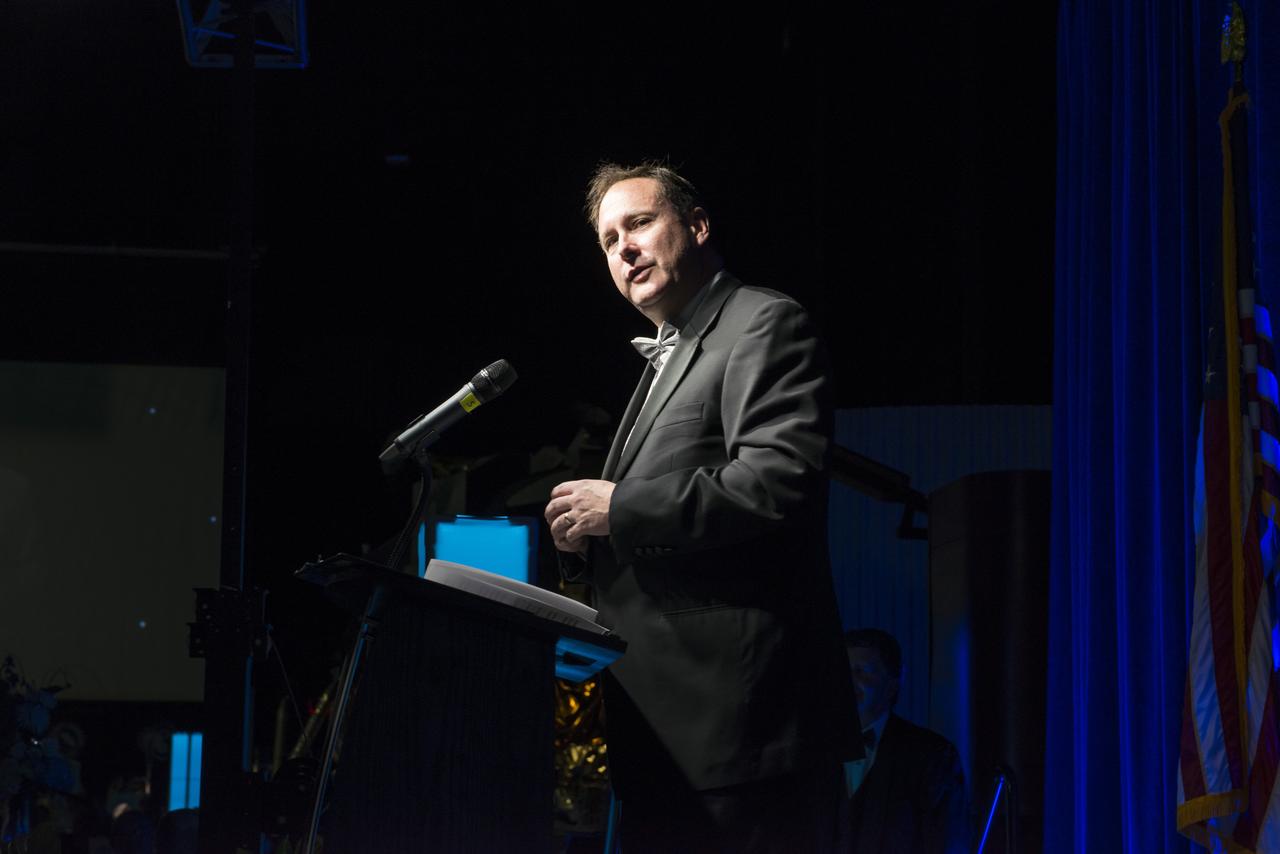
The annual Dr. Wernher Von Braun Memorial Dinner was held at the U.S. Space and Rocket Center's Davidson Center on October 26, 2017 with Keynote speaker General John Hyten, Commander of U.S. Strategic Command. Emcee was Mark Larson of Mark Larson Media Services, Inc. Dr. Wernher Von Braun Memorial Scholarships were presented to 8 college students by the National Space Club. Educator of the Year was awarded to Tammy Thorpe; Community Service award was presented to Huntsville, Al. Mayor Tommy Battle. The Communications Award was presented to retired astronaut Dr. Mike Massimino. The Distinguished Science Award was presented to Dr. Martin Weisskopf. The Astronautics Engineer Award was presented to Douglas R. Cooke. The Dr. Wernher Von Braun Space Flight Trophy was presented to Robert Lightfoot.
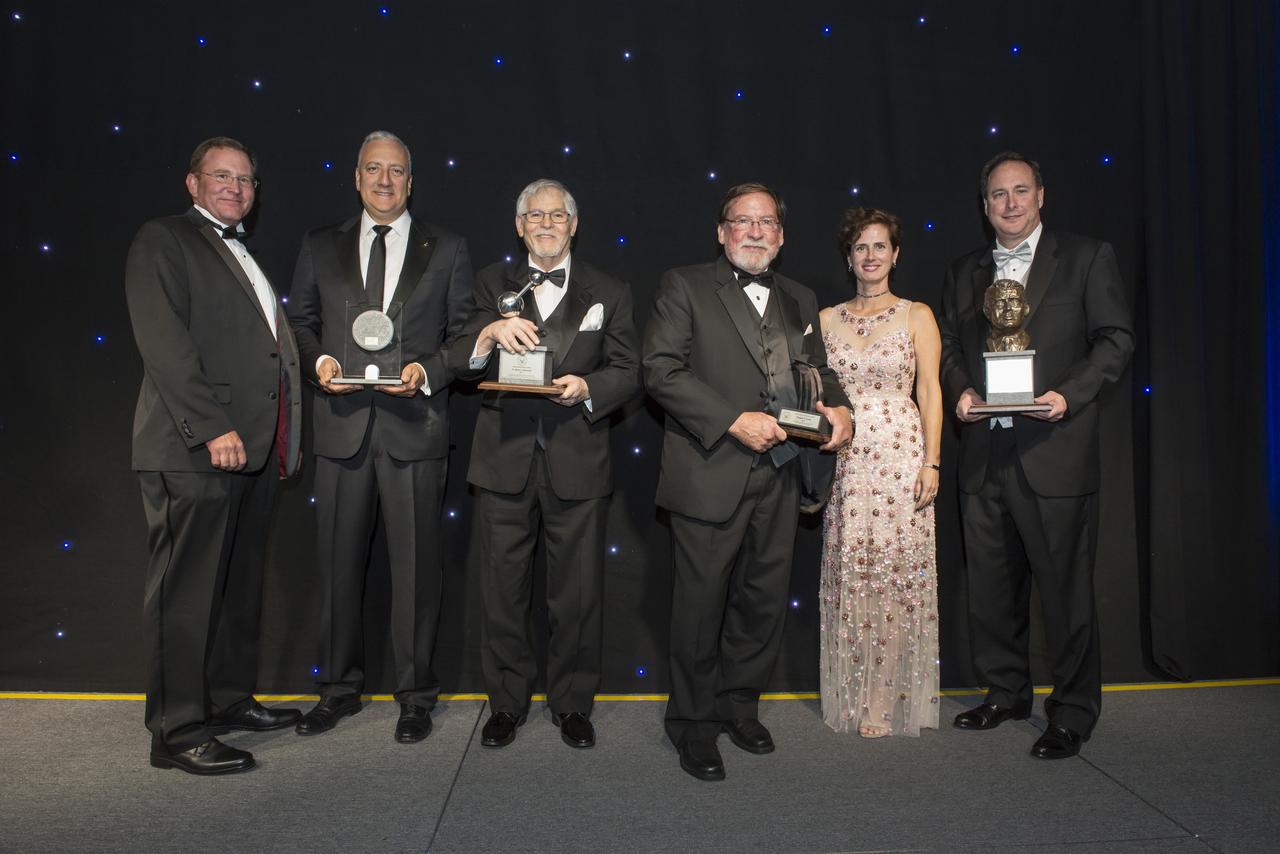
The annual Dr. Wernher Von Braun Memorial Dinner was held at the U.S. Space and Rocket Center's Davidson Center on October 26, 2017 with Keynote speaker General John Hyten, Commander of U.S. Strategic Command. Emcee was Mark Larson of Mark Larson Media Services, Inc. Dr. Wernher Von Braun Memorial Scholarships were presented to 8 college students by the National Space Club. Educator of the Year was awarded to Tammy Thorpe; Community Service award was presented to Huntsville, Al. Mayor Tommy Battle. The Communications Award was presented to retired astronaut Dr. Mike Massimino. The Distinguished Science Award was presented to Dr. Martin Weisskopf. The Astronautics Engineer Award was presented to Douglas R. Cooke. The Dr. Wernher Von Braun Space Flight Trophy was presented to Robert Lightfoot.
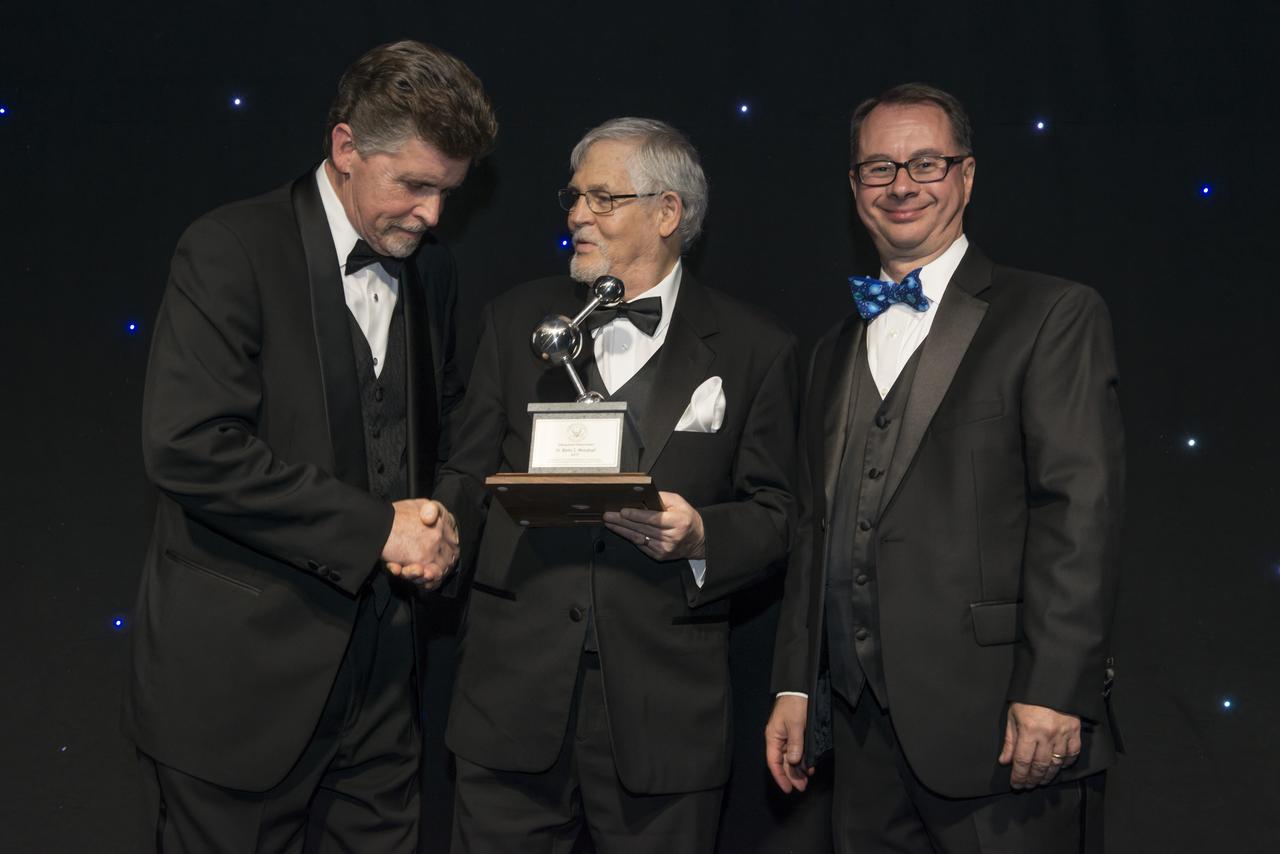
The annual Dr. Wernher Von Braun Memorial Dinner was held at the U.S. Space and Rocket Center's Davidson Center on October 26, 2017 with Keynote speaker General John Hyten, Commander of U.S. Strategic Command. Emcee was Mark Larson of Mark Larson Media Services, Inc. Dr. Wernher Von Braun Memorial Scholarships were presented to 8 college students by the National Space Club. Educator of the Year was awarded to Tammy Thorpe; Community Service award was presented to Huntsville, Al. Mayor Tommy Battle. The Communications Award was presented to retired astronaut Dr. Mike Massimino. The Distinguished Science Award was presented to Dr. Martin Weisskopf. The Astronautics Engineer Award was presented to Douglas R. Cooke. The Dr. Wernher Von Braun Space Flight Trophy was presented to Robert Lightfoot.
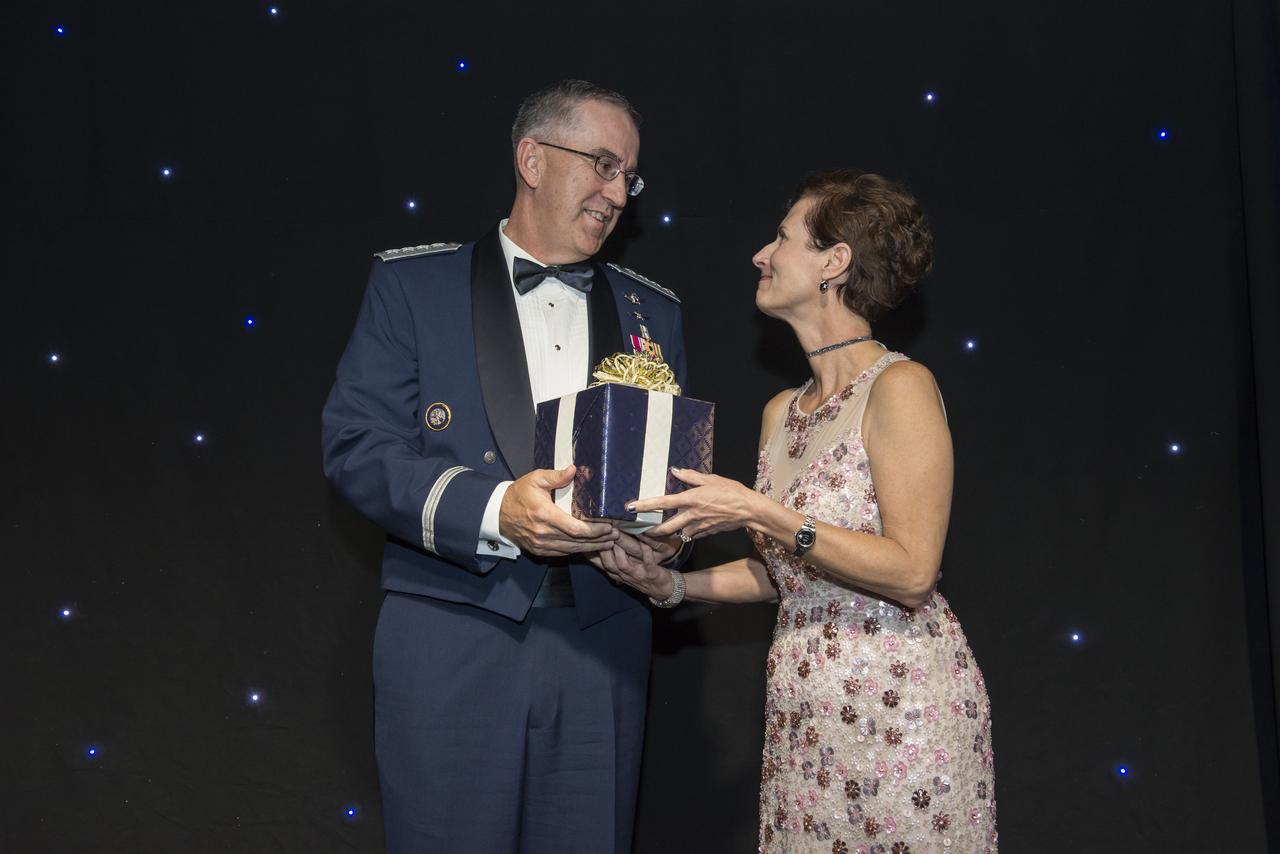
The annual Dr. Wernher Von Braun Memorial Dinner was held at the U.S. Space and Rocket Center's Davidson Center on October 26, 2017 with Keynote speaker General John Hyten, Commander of U.S. Strategic Command. Emcee was Mark Larson of Mark Larson Media Services, Inc. Dr. Wernher Von Braun Memorial Scholarships were presented to 8 college students by the National Space Club. Educator of the Year was awarded to Tammy Thorpe; Community Service award was presented to Huntsville, Al. Mayor Tommy Battle. The Communications Award was presented to retired astronaut Dr. Mike Massimino. The Distinguished Science Award was presented to Dr. Martin Weisskopf. The Astronautics Engineer Award was presented to Douglas R. Cooke. The Dr. Wernher Von Braun Space Flight Trophy was presented to Robert Lightfoot.
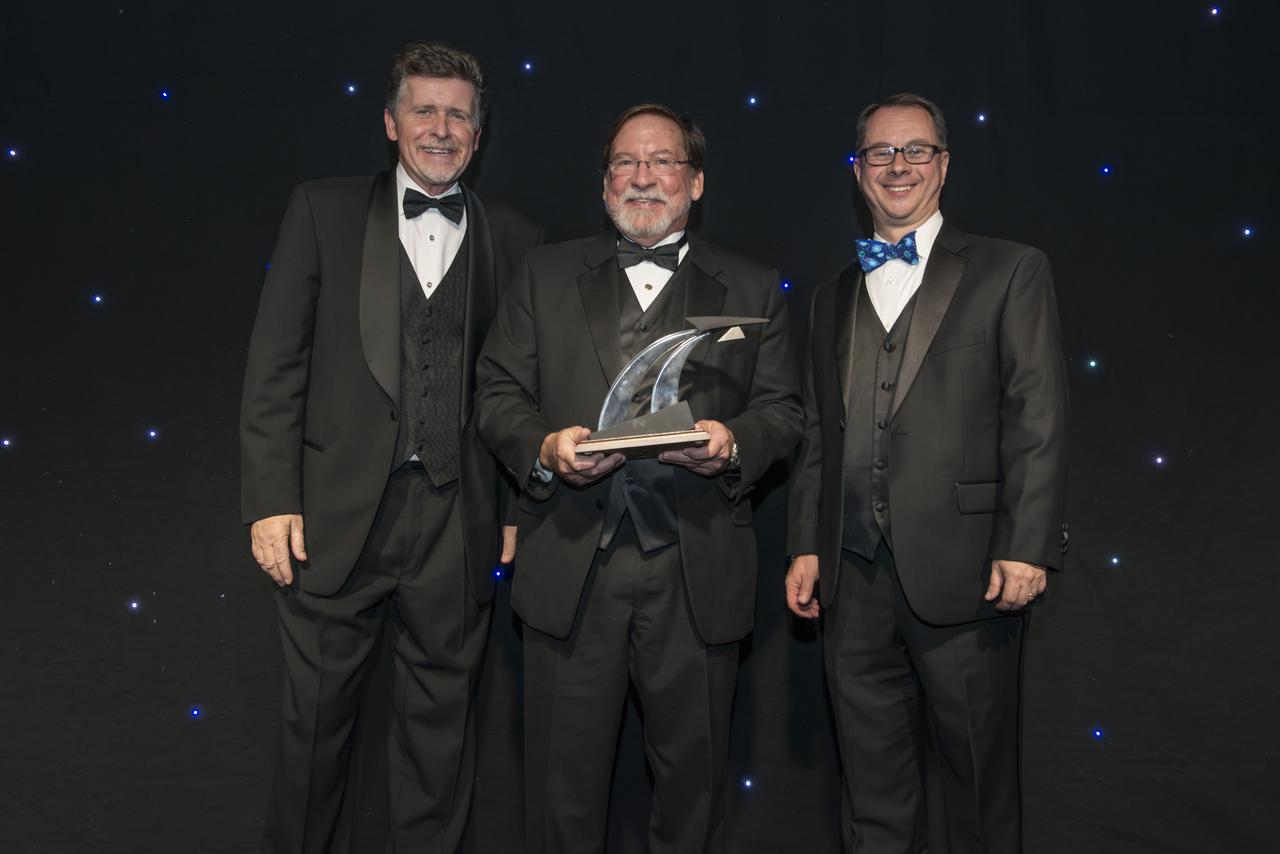
The annual Dr. Wernher Von Braun Memorial Dinner was held at the U.S. Space and Rocket Center's Davidson Center on October 26, 2017 with Keynote speaker General John Hyten, Commander of U.S. Strategic Command. Emcee was Mark Larson of Mark Larson Media Services, Inc. Dr. Wernher Von Braun Memorial Scholarships were presented to 8 college students by the National Space Club. Educator of the Year was awarded to Tammy Thorpe; Community Service award was presented to Huntsville, Al. Mayor Tommy Battle. The Communications Award was presented to retired astronaut Dr. Mike Massimino. The Distinguished Science Award was presented to Dr. Martin Weisskopf. The Astronautics Engineer Award was presented to Douglas R. Cooke. The Dr. Wernher Von Braun Space Flight Trophy was presented to Robert Lightfoot.
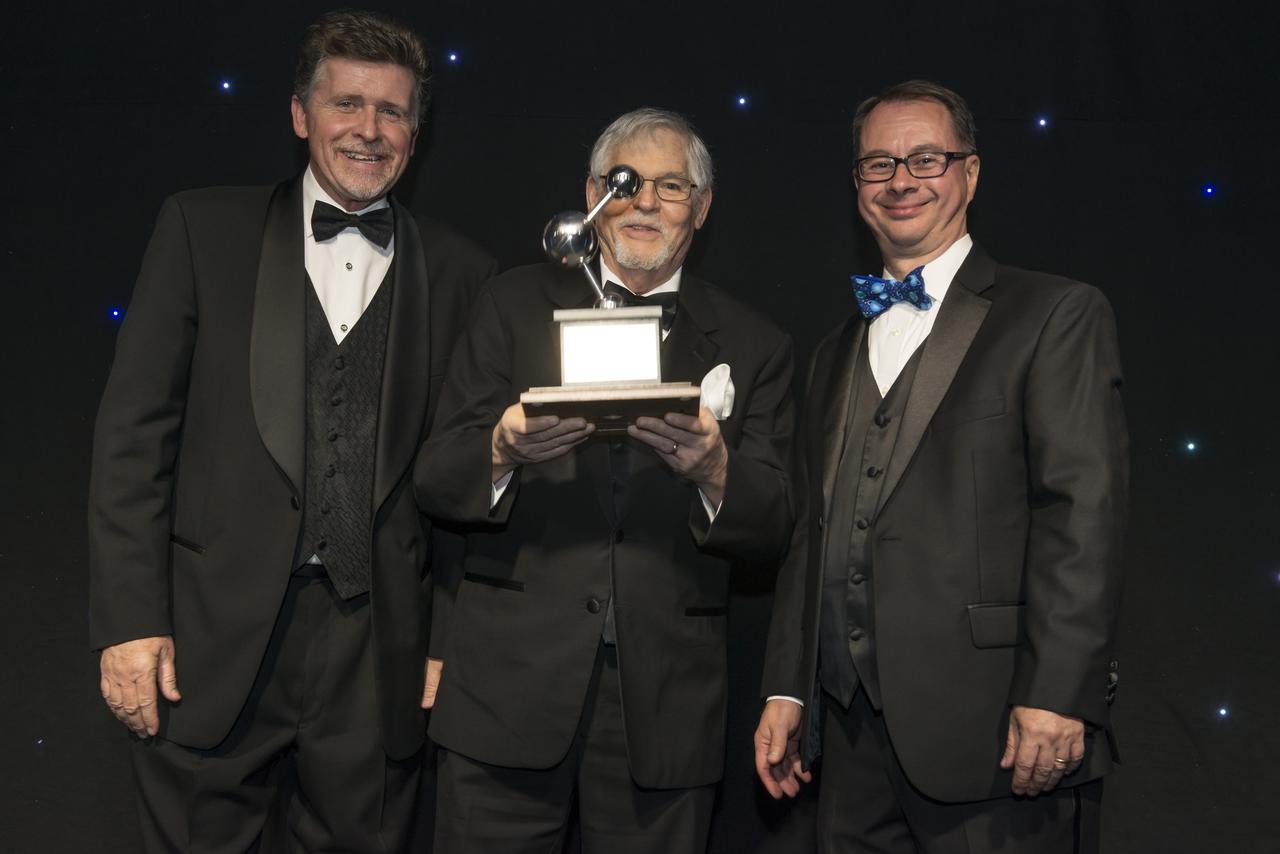
The annual Dr. Wernher Von Braun Memorial Dinner was held at the U.S. Space and Rocket Center's Davidson Center on October 26, 2017 with Keynote speaker General John Hyten, Commander of U.S. Strategic Command. Emcee was Mark Larson of Mark Larson Media Services, Inc. Dr. Wernher Von Braun Memorial Scholarships were presented to 8 college students by the National Space Club. Educator of the Year was awarded to Tammy Thorpe; Community Service award was presented to Huntsville, Al. Mayor Tommy Battle. The Communications Award was presented to retired astronaut Dr. Mike Massimino. The Distinguished Science Award was presented to Dr. Martin Weisskopf. The Astronautics Engineer Award was presented to Douglas R. Cooke. The Dr. Wernher Von Braun Space Flight Trophy was presented to Robert Lightfoot.
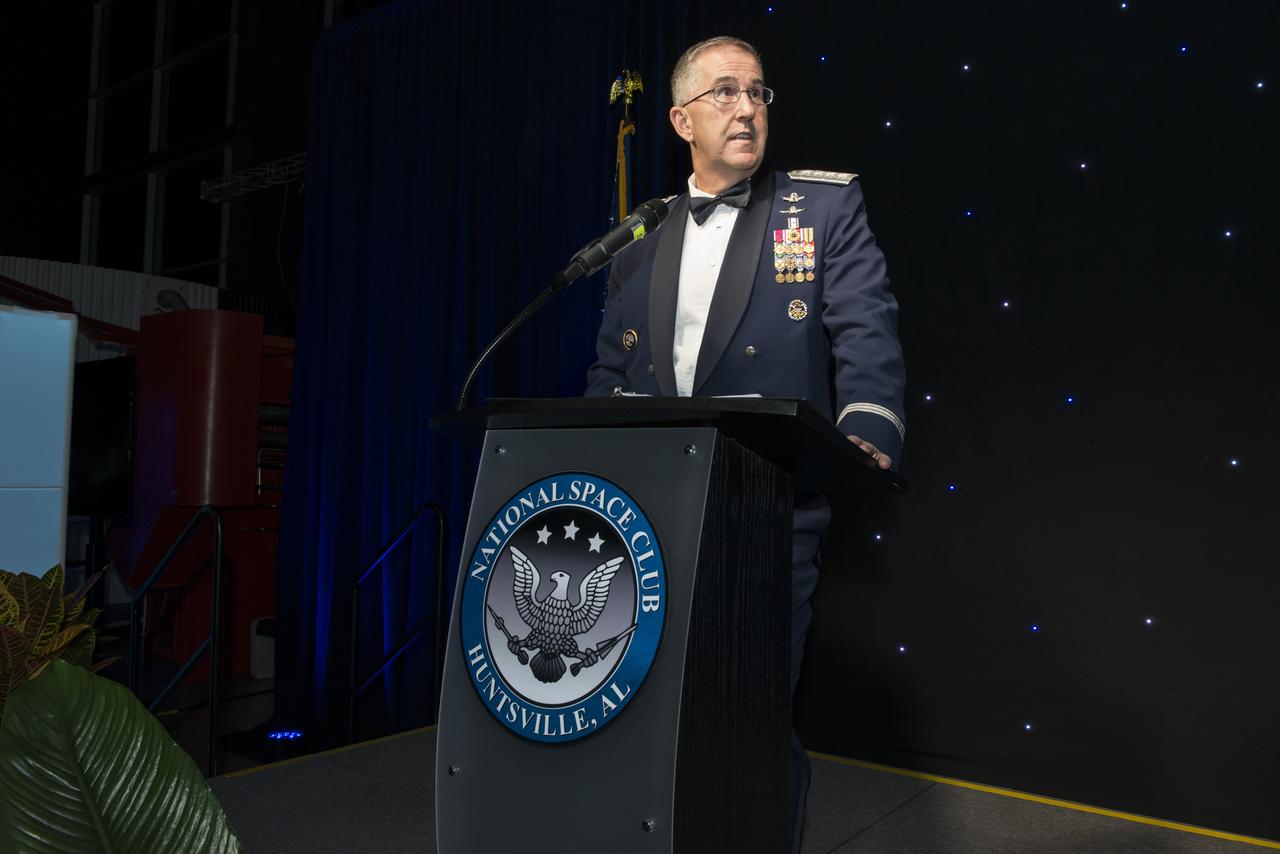
The annual Dr. Wernher Von Braun Memorial Dinner was held at the U.S. Space and Rocket Center's Davidson Center on October 26, 2017 with Keynote speaker General John Hyten, Commander of U.S. Strategic Command. Emcee was Mark Larson of Mark Larson Media Services, Inc. Dr. Wernher Von Braun Memorial Scholarships were presented to 8 college students by the National Space Club. Educator of the Year was awarded to Tammy Thorpe; Community Service award was presented to Huntsville, Al. Mayor Tommy Battle. The Communications Award was presented to retired astronaut Dr. Mike Massimino. The Distinguished Science Award was presented to Dr. Martin Weisskopf. The Astronautics Engineer Award was presented to Douglas R. Cooke. The Dr. Wernher Von Braun Space Flight Trophy was presented to Robert Lightfoot.
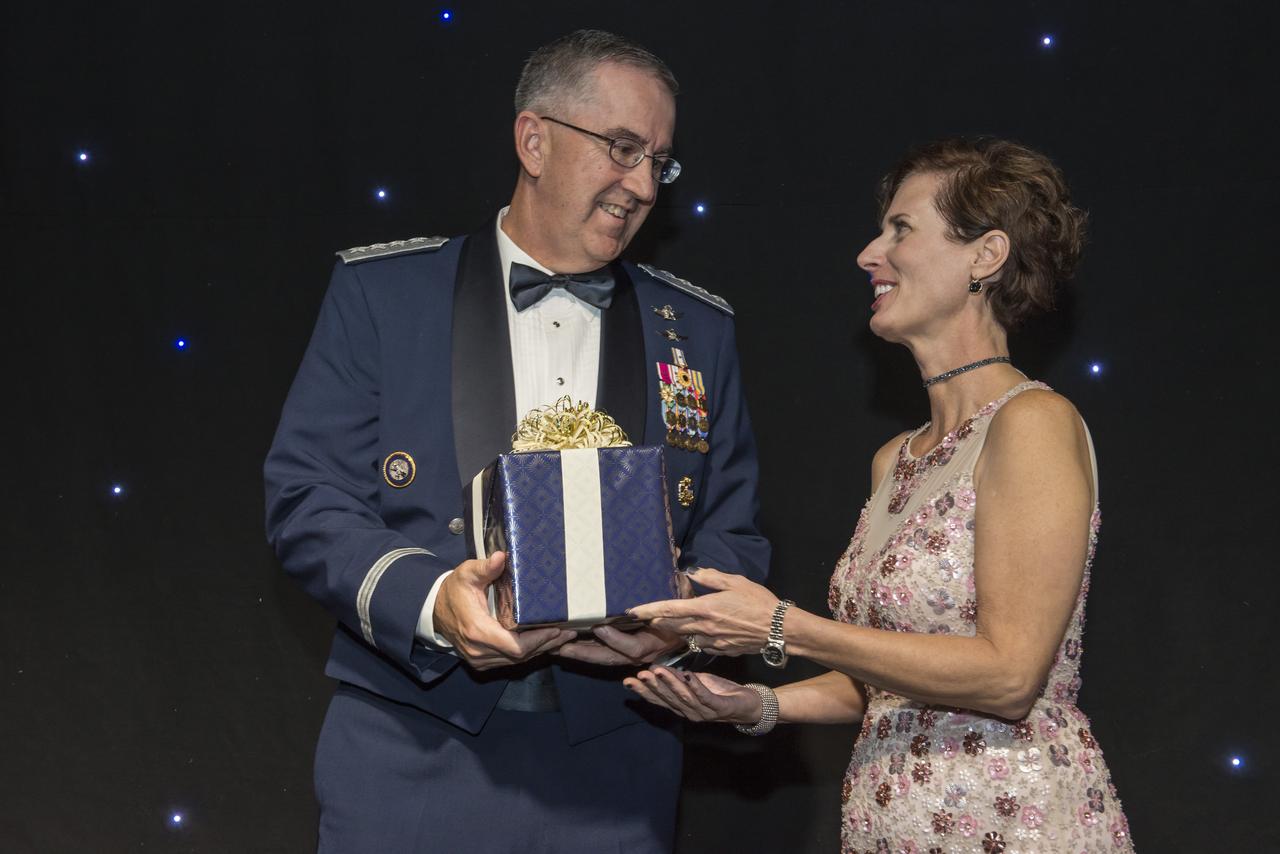
The annual Dr. Wernher Von Braun Memorial Dinner was held at the U.S. Space and Rocket Center's Davidson Center on October 26, 2017 with Keynote speaker General John Hyten, Commander of U.S. Strategic Command. Emcee was Mark Larson of Mark Larson Media Services, Inc. Dr. Wernher Von Braun Memorial Scholarships were presented to 8 college students by the National Space Club. Educator of the Year was awarded to Tammy Thorpe; Community Service award was presented to Huntsville, Al. Mayor Tommy Battle. The Communications Award was presented to retired astronaut Dr. Mike Massimino. The Distinguished Science Award was presented to Dr. Martin Weisskopf. The Astronautics Engineer Award was presented to Douglas R. Cooke. The Dr. Wernher Von Braun Space Flight Trophy was presented to Robert Lightfoot.
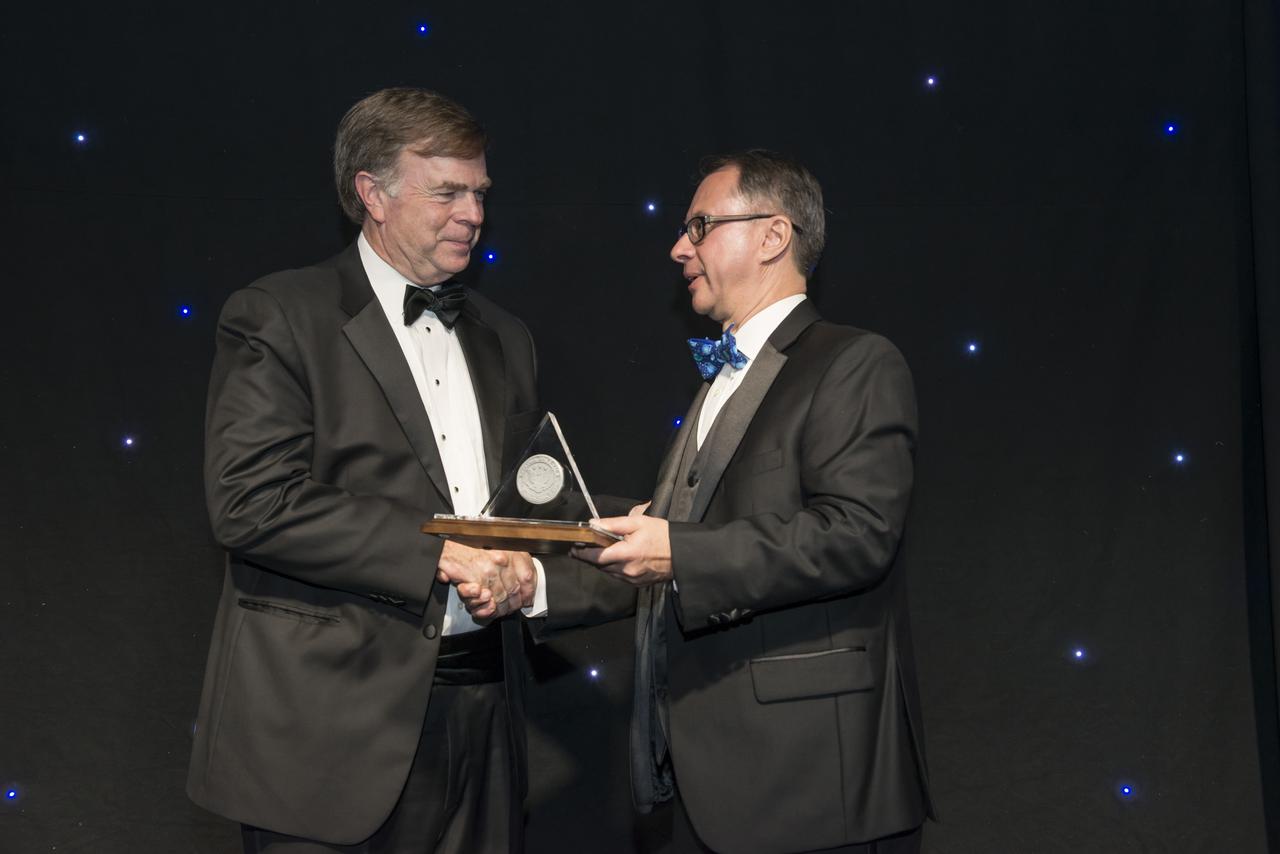
The annual Dr. Wernher Von Braun Memorial Dinner was held at the U.S. Space and Rocket Center's Davidson Center on October 26, 2017 with Keynote speaker General John Hyten, Commander of U.S. Strategic Command. Emcee was Mark Larson of Mark Larson Media Services, Inc. Dr. Wernher Von Braun Memorial Scholarships were presented to 8 college students by the National Space Club. Educator of the Year was awarded to Tammy Thorpe; Community Service award was presented to Huntsville, Al. Mayor Tommy Battle. The Communications Award was presented to retired astronaut Dr. Mike Massimino. The Distinguished Science Award was presented to Dr. Martin Weisskopf. The Astronautics Engineer Award was presented to Douglas R. Cooke. The Dr. Wernher Von Braun Space Flight Trophy was presented to Robert Lightfoot.
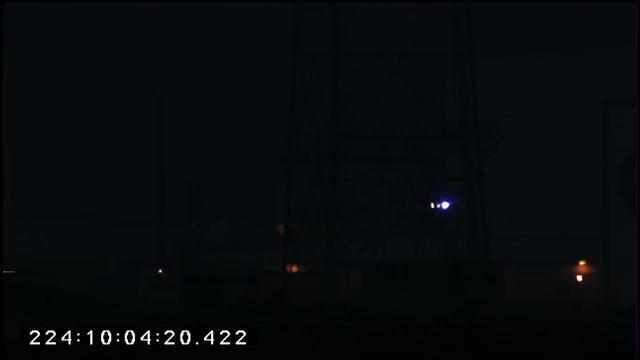
NASA launched a Terrier-Improved Malemute suborbital sounding rocket carrying the RockSat-X payload with university and community college student experiments at 6:04 a.m. EDT Wednesday, Aug. 12, from NASA’s Wallops Flight Facilityin Virginia. More than 60 students and instructors from across the continental United States, Hawaii and Puerto Rico were on hand to witness the launch of their experiments. The payload flew to an altitude of about 97 miles and descended via parachute into the Atlantic Ocean off the coast of Wallops. Payload recovery operations began after lift-off. Developed by students from seven higher education programs, the experiments flew through the RockSat-X program in conjunction with the Colorado Space Grant Consortium. Participating institutions in this flight are the University of Colorado, Boulder; Northwest Nazarene University, Nampa, Idaho; the University of Puerto Rico; the University of Nebraska, Lincoln; Virginia Tech University, Blacksburg; Capitol Technology University, Laurel, Maryland; and University of Hawai'i Community Colleges at the Honolulu, Kapi'olani, Kaua'i, and Windward campuses. The next launch scheduled from Wallops is a NASA Black Brant IX suborbital sounding rocket carrying several technology development instruments. The launch is scheduled between 7 and 7:41 p.m. Sept. 29. The backup launch days are Sept. 30 through Oct. 12. <b><a href="http://www.nasa.gov/audience/formedia/features/MP_Photo_Guidelines.html" rel="nofollow">NASA image use policy.</a></b> <b><a href="http://www.nasa.gov/centers/goddard/home/index.html" rel="nofollow">NASA Goddard Space Flight Center</a></b> enables NASA’s mission through four scientific endeavors: Earth Science, Heliophysics, Solar System Exploration, and Astrophysics. Goddard plays a leading role in NASA’s accomplishments by contributing compelling scientific knowledge to advance the Agency’s mission. <b>Follow us on <a href="http://twitter.com/NASAGoddardPix" rel="nofollow">Twitter</a></b> <b>Like us on <a href="http://www.facebook.com/pages/Greenbelt-MD/NASA-Goddard/395013845897?ref=tsd" rel="nofollow">Facebook</a></b> <b>Find us on <a href="http://instagrid.me/nasagoddard/?vm=grid" rel="nofollow">Instagram</a></b>
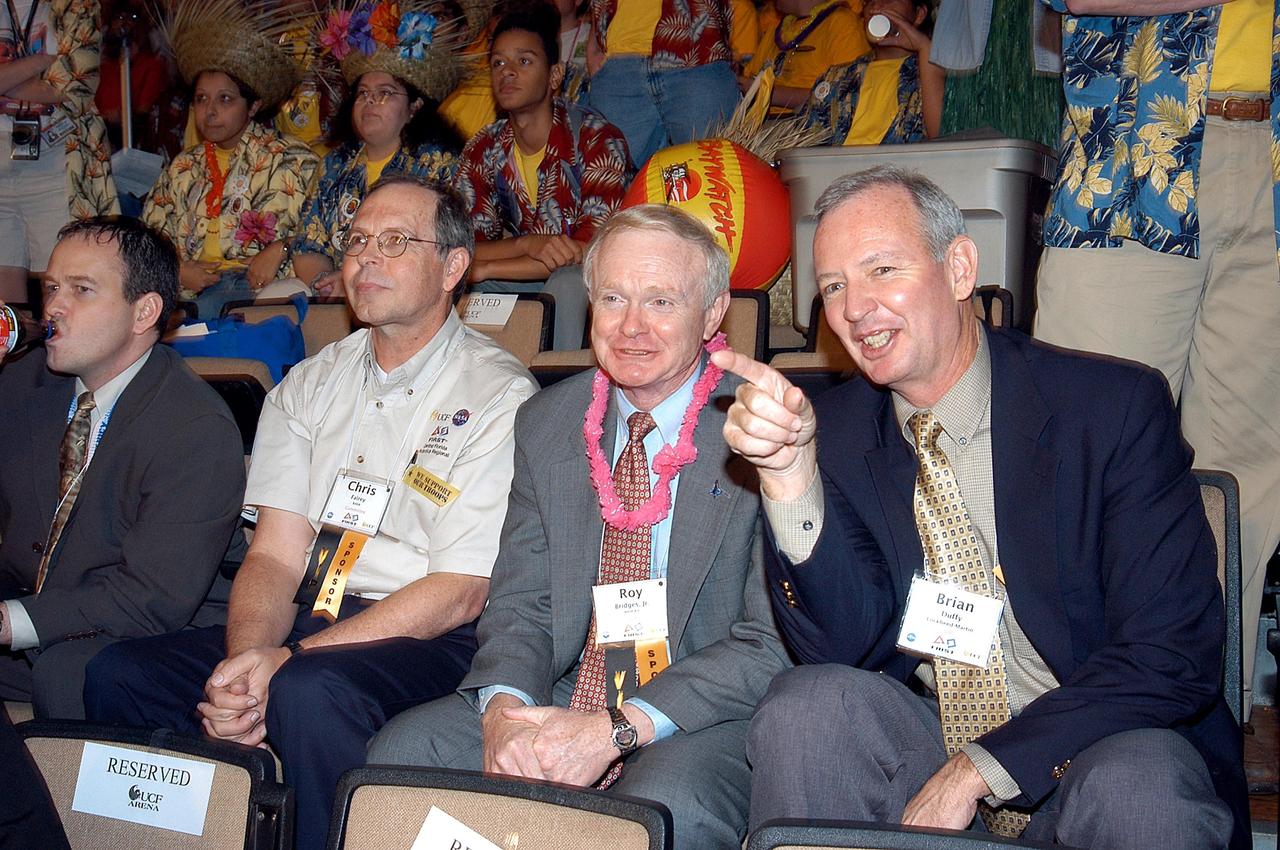
KENNEDY SPACE CENTER, FLA. - Observing the festivities at the 2003 Southeastern Regional FIRST Robotic Competition are, from left, David Culp, executive intern to the director of KSC; Chris Fairey, former director of Spaceport Services at KSC; Roy Bridges, KSC director; and Brian Duffy, Lockheed Martin vice president/associate program manager. The competition is being held at the University of Central Florida (UCF) in Orlando, March 20-23. Forty student teams from around the country are participating in the event that pits team-built gladiator robots against each other in an athletic-style competition. The teams are sponsored by NASA/Kennedy Space Center, The Boeing Company/Brevard Community College, and Lockheed Martin Space Operations/Mission Systems for the nonprofit organization For Inspiration and Recognition of Science and Technology, known as FIRST. The vision of FIRST is to inspire in the youth of our nation an appreciation of science and technology and an understanding that mastering these disciplines can enrich the lives of all mankind.
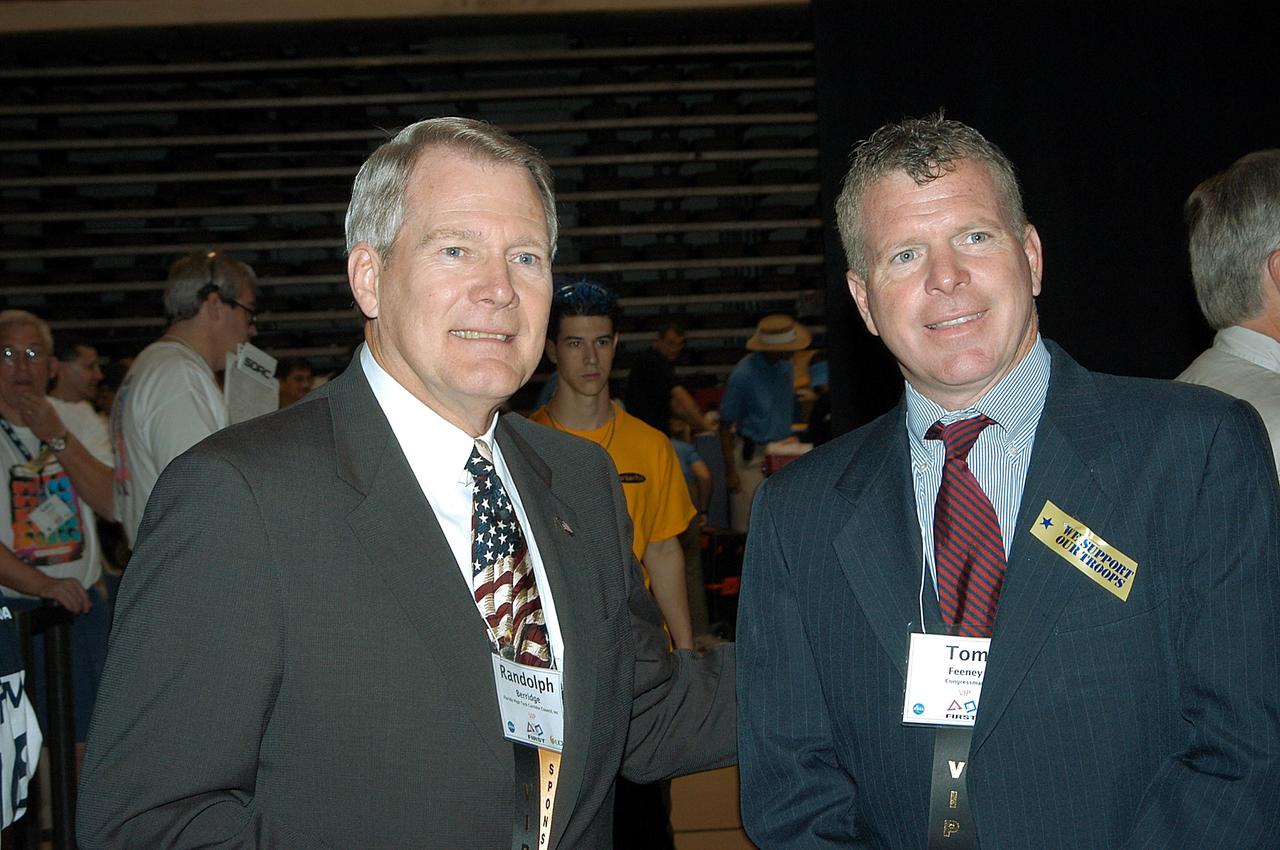
KENNEDY SPACE CENTER, FLA. - Randolph E. Berridge, president of the Florida High Tech Corridor Council, and Tom Feeney, Florida Representative from the 24th District, attend the 2003 Southeastern Regional FIRST Robotic Competition. The competition is being held at the University of Central Florida (UCF) in Orlando, March 20-23. Forty student teams from around the country are participating in the event that pits team-built gladiator robots against each other in an athletic-style competition. The teams are sponsored by NASA/Kennedy Space Center, The Boeing Company/Brevard Community College, and Lockheed Martin Space Operations/Mission Systems for the nonprofit organization For Inspiration and Recognition of Science and Technology, known as FIRST. The vision of FIRST is to inspire in the youth of our nation an appreciation of science and technology and an understanding that mastering these disciplines can enrich the lives of all mankind.
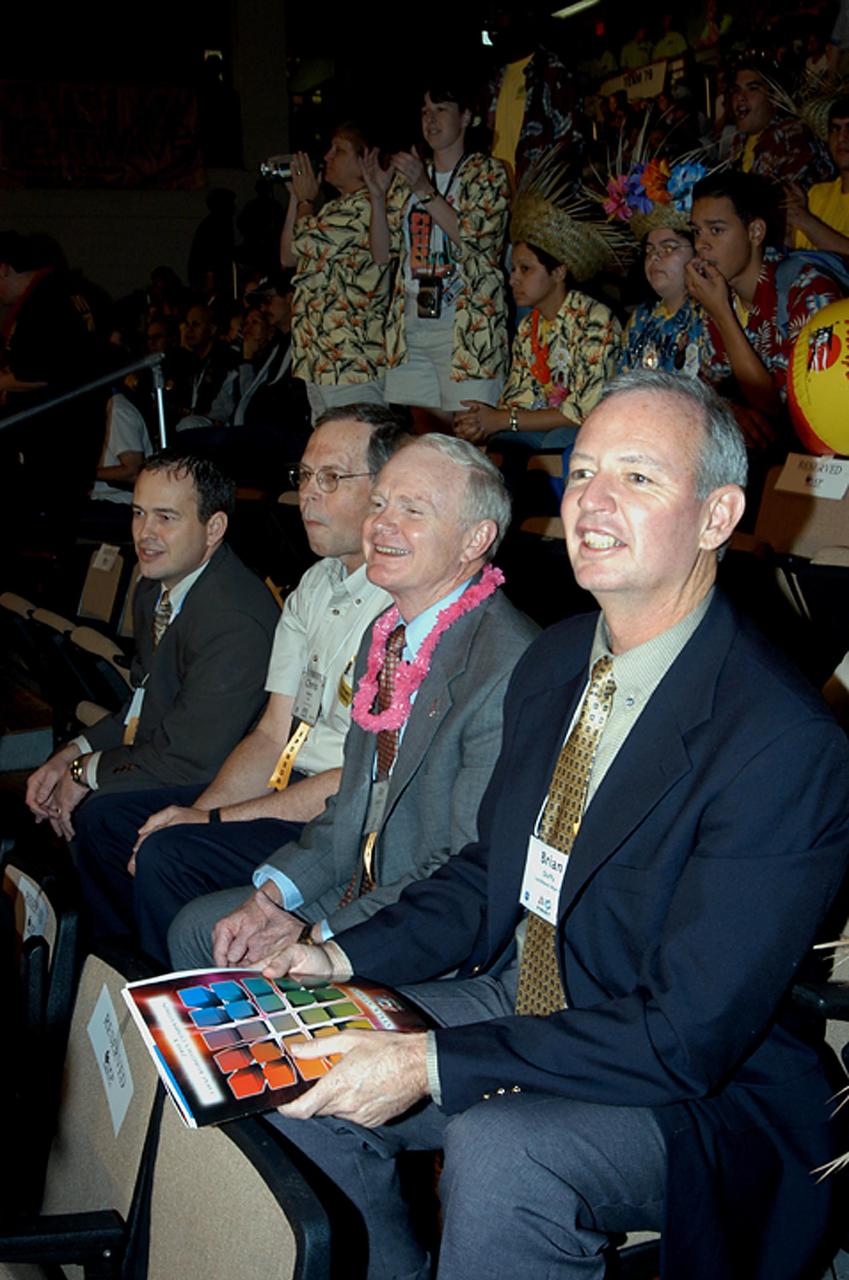
KENNEDY SPACE CENTER, FLA. - Observing the festivities at the 2003 Southeastern Regional FIRST Robotic Competition are, from left, David Culp, executive intern to the director of KSC; Chris Fairey, former director of Spaceport Services at KSC; Roy Bridges, KSC director; and Brian Duffy, Lockheed Martin vice president/associate program manager. The competition is being held at the University of Central Florida (UCF) in Orlando, March 20-23. Forty student teams from around the country are participating in the event that pits team-built gladiator robots against each other in an athletic-style competition. The teams are sponsored by NASA/Kennedy Space Center, The Boeing Company/Brevard Community College, and Lockheed Martin Space Operations/Mission Systems for the nonprofit organization For Inspiration and Recognition of Science and Technology, known as FIRST. The vision of FIRST is to inspire in the youth of our nation an appreciation of science and technology and an understanding that mastering these disciplines can enrich the lives of all mankind.
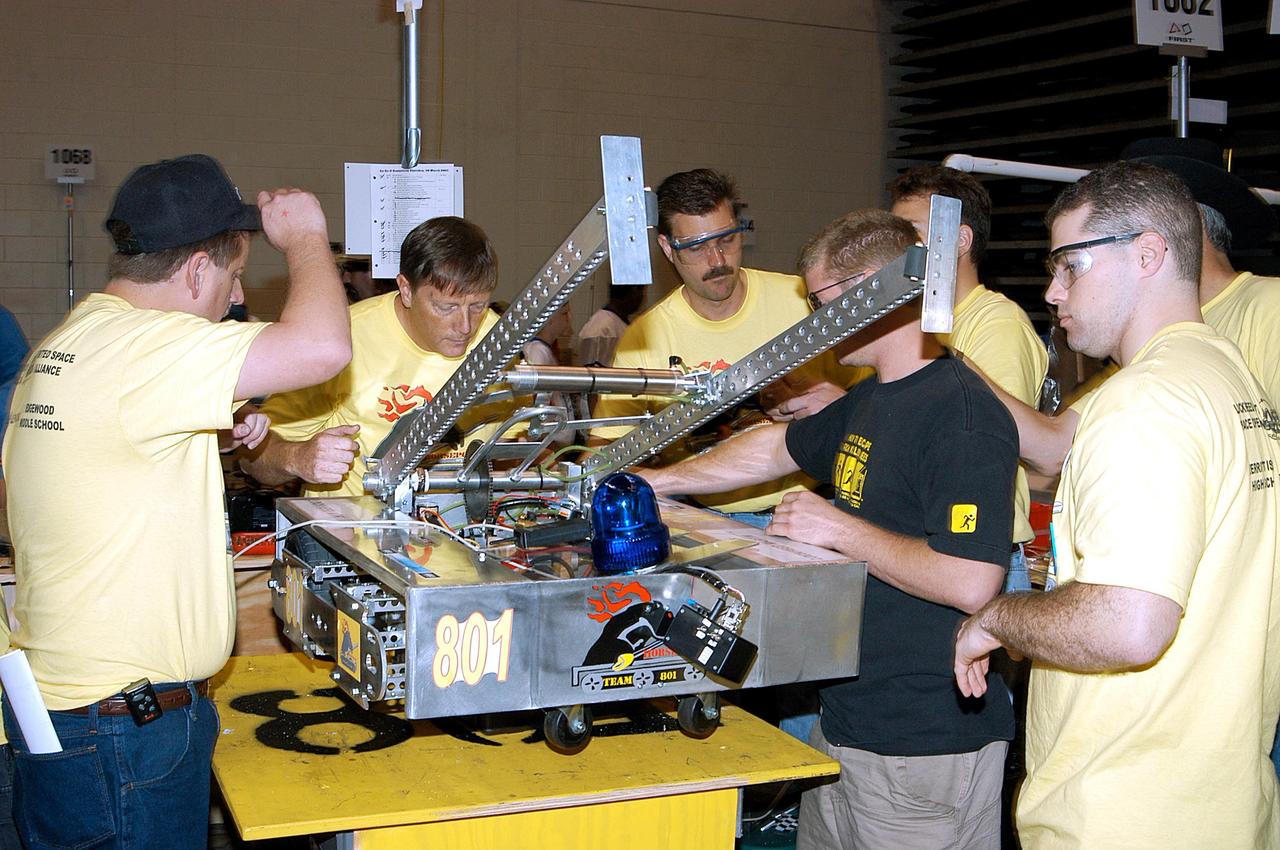
KENNEDY SPACE CENTER, FLA. - Members of the Merritt Island and Edgewood Middle School students/Lockheed Martin team look over their robot. They are participating in the 2003 Southeastern Regional FIRST Robotic Competition being held at the University of Central Florida (UCF) in Orlando, March 20-23. Forty teams from around the country are participating in the event that pits team-built gladiator robots against each other in an athletic-style competition. The teams are sponsored by NASA-Kennedy Space Center, The Boeing Company/Brevard Community College, and Lockheed Martin Space Operations/Mission Systems for the nonprofit organization For Inspiration and Recognition of Science and Technology, known as FIRST. The vision of FIRST is to inspire in the youth of our nation an appreciation of science and technology and an understanding that mastering these disciplines can enrich the lives of all mankind.
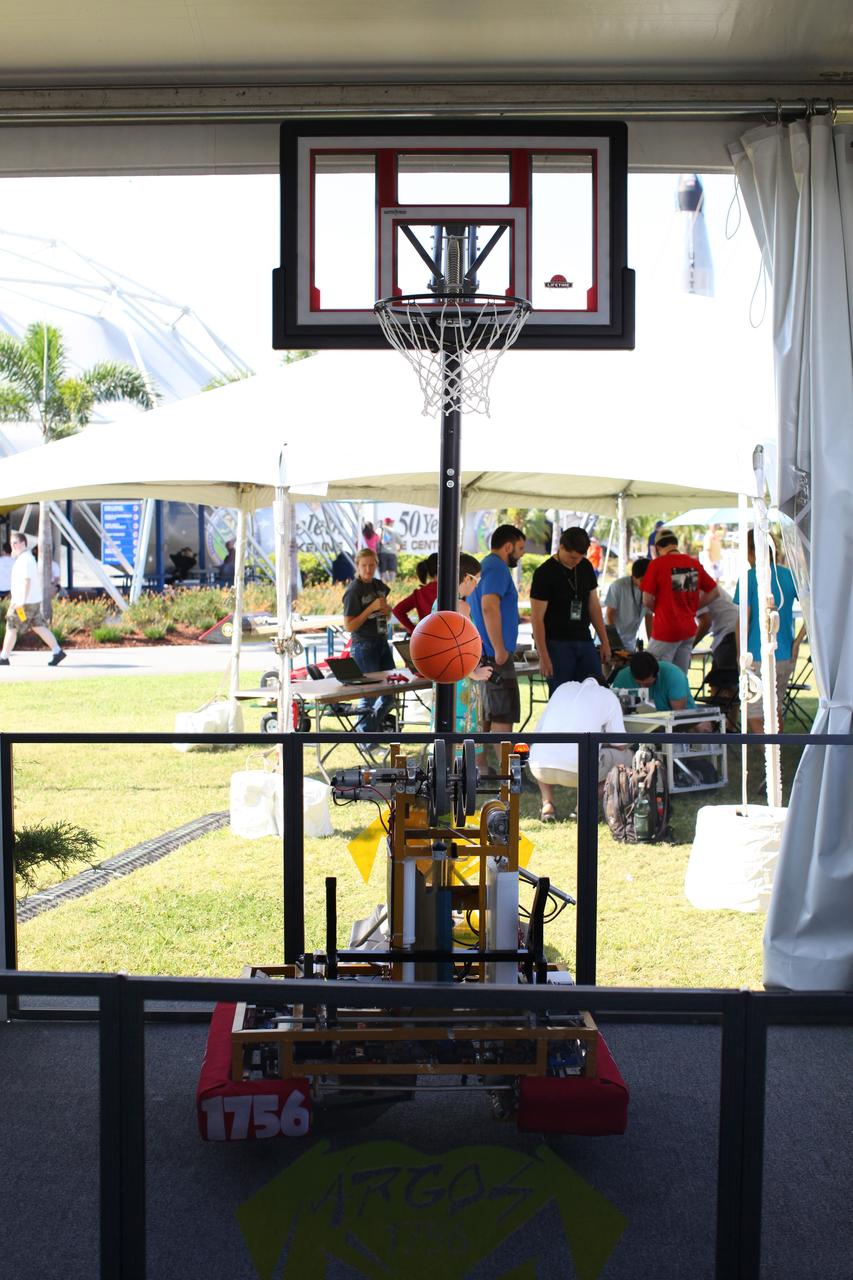
CAPE CANAVERAL, Fla. – At NASA’s Kennedy Space Center Visitor Complex in Florida, the For Inspiration and Recognition of Science and Technology FIRST Argos Team 1756 robot from Limestone Community, Brimfield and Richwoods High Schools in Peoria, Ill., is on display in Caterpillar’s sponsor booth at NASA’s Lunabotics Mining Competition. The mining competition is sponsored by NASA Kennedy Space Center’s Education Office for the agency’s Exploration Systems Mission Directorate. Undergraduate and graduate students from more than 50 universities and colleges in the U.S. and other countries use their remote-controlled Lunabots to maneuver and dig in a supersized sandbox filled with a crushed material that has characteristics similar to lunar soil. For more information, visit www.nasa.gov/lunabotics. Photo credit: NASA/Frankie Martin
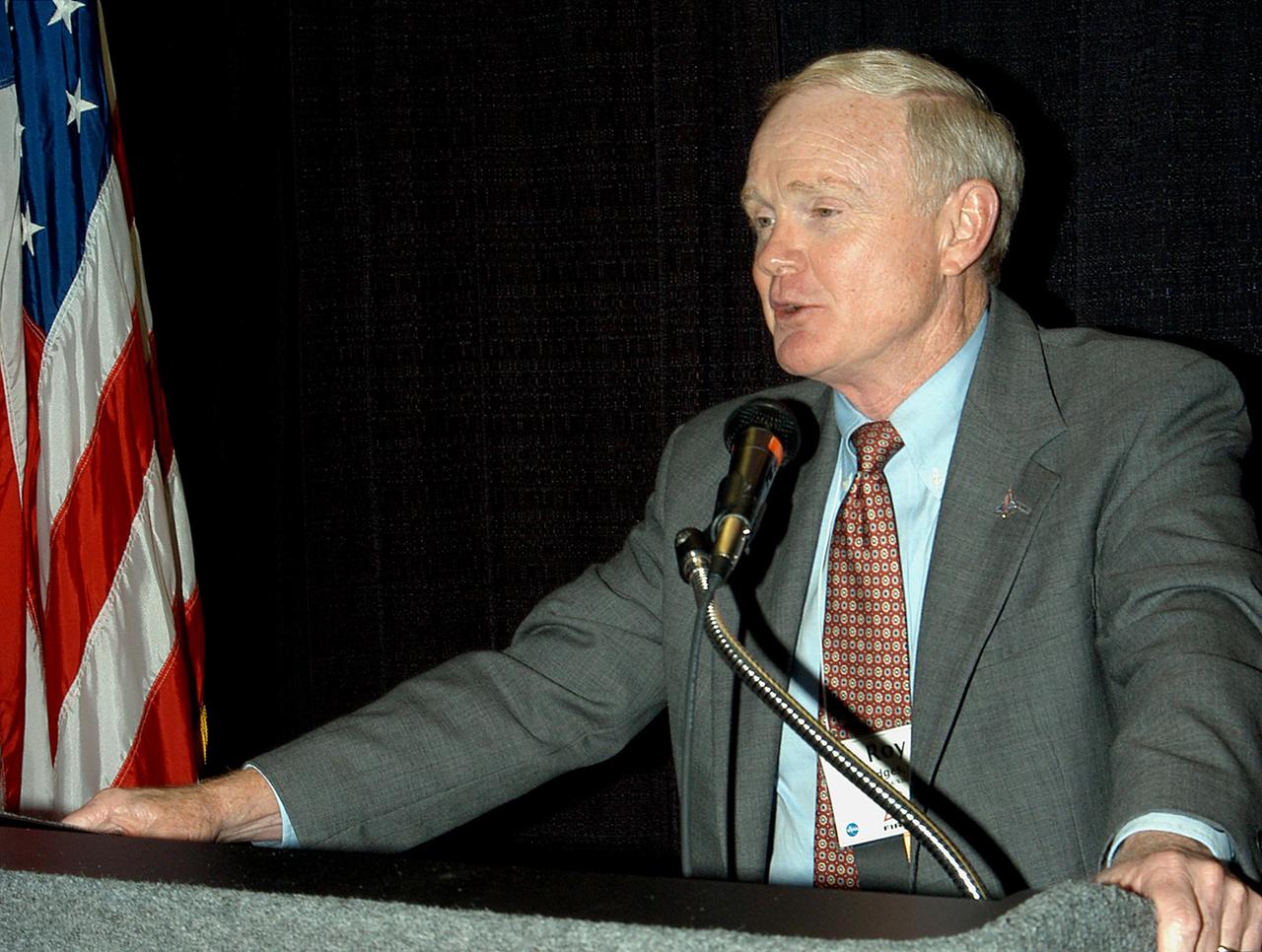
KENNEDY SPACE CENTER, FLA. - NASA/Kennedy Space Center Director Roy Bridges speaks to the attendees of an invitation-only luncheon held during the 2003 Southeastern Regional FIRST Robotic Competition. The competition is being held at the University of Central Florida (UCF) in Orlando, March 20-23. Forty student teams from around the country are participating in the event that pits team-built gladiator robots against each other in an athletic-style competition. The teams are sponsored by NASA/Kennedy Space Center, The Boeing Company/Brevard Community College, and Lockheed Martin Space Operations/Mission Systems for the nonprofit organization For Inspiration and Recognition of Science and Technology, known as FIRST. The vision of FIRST is to inspire in the youth of our nation an appreciation of science and technology and an understanding that mastering these disciplines can enrich the lives of all mankind.
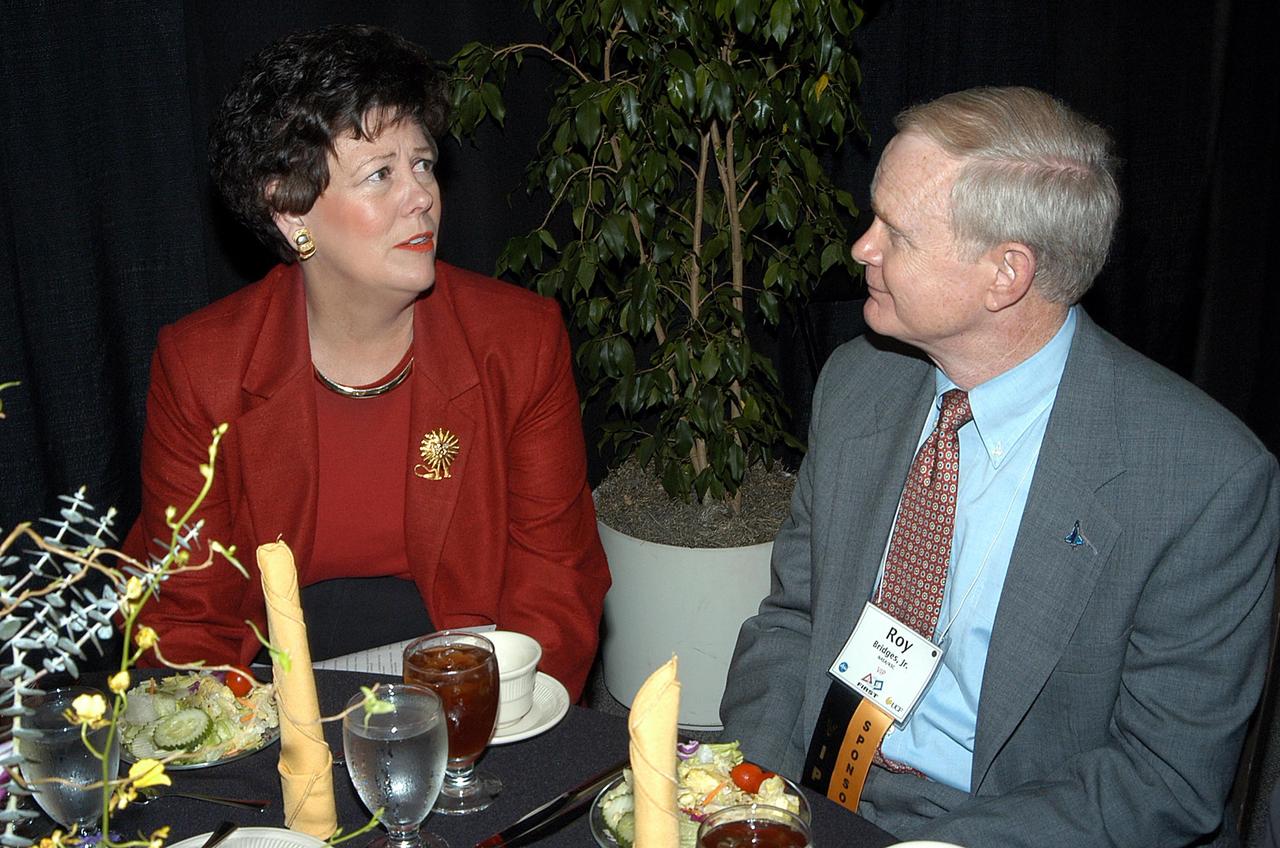
KENNEDY SPACE CENTER, FLA. - NASA/Kennedy Space Center Director Roy Bridges (right) talks with Florida Lt. Gov. Toni Jennings at an invitation-only luncheon held during the 2003 Southeastern Regional FIRST Robotic Competition. The competition is being held at the University of Central Florida (UCF) in Orlando, March 20-23. Forty student teams from around the country are participating in the event that pits team-built gladiator robots against each other in an athletic-style competition. The teams are sponsored by NASA/Kennedy Space Center, The Boeing Company/Brevard Community College, and Lockheed Martin Space Operations/Mission Systems for the nonprofit organization For Inspiration and Recognition of Science and Technology, known as FIRST. The vision of FIRST is to inspire in the youth of our nation an appreciation of science and technology and an understanding that mastering these disciplines can enrich the lives of all mankind.

KENNEDY SPACE CENTER, FLA. - NASA/Kennedy Space Center-sponsored students, participating in the 2003 Southeastern Regional FIRST Robotic Competition, pose with their team-built robot. The competition is being held at the University of Central Florida (UCF) in Orlando, March 20-23. Forty teams from around the country are participating in the event that pits team-built gladiator robots against each other in an athletic-style competition. The teams are sponsored by NASA-Kennedy Space Center, The Boeing Company/Brevard Community College, and Lockheed Martin Space Operations/Mission Systems for the nonprofit organization For Inspiration and Recognition of Science and Technology, known as FIRST. The vision of FIRST is to inspire in the youth of our nation an appreciation of science and technology and an understanding that mastering these disciplines can enrich the lives of all mankind.
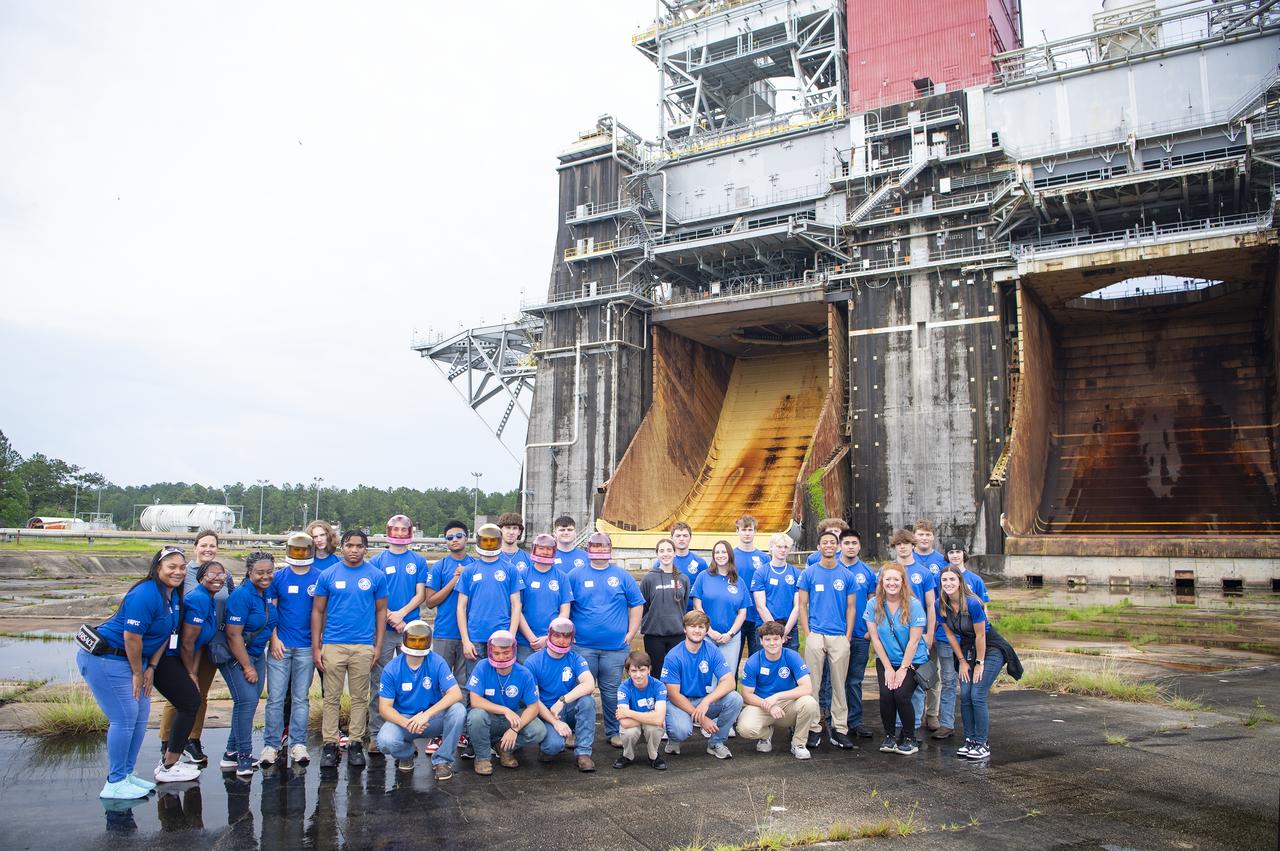
Rising high school juniors and seniors from Ascension Parish, Louisiana, visit the Thad Cochran Test Stand on June 6 during a tour of NASA’s Stennis Space Center. The students are part of the week-long BASF Tech Academy, in coordination with River Parishes Community College, where participants learn about technical careers and education. NASA Stennis is preparing the test stand to test the exploration upper stage, which will fly on future SLS (Space Launch System) missions as NASA continues its mission of exploring the secrets of the universe for the benefit of all. The upper stage is being built at NASA’s Michoud Assembly Facility in New Orleans as a more powerful second stage to send the Orion spacecraft to deep space. It is expected to fly on the Artemis IV mission. Before that, it will be installed on the Thad Cochran Test Stand (B-2) at NASA Stennis to undergo a series of Green Run tests of its integrated systems to demonstrate it is ready to fly.
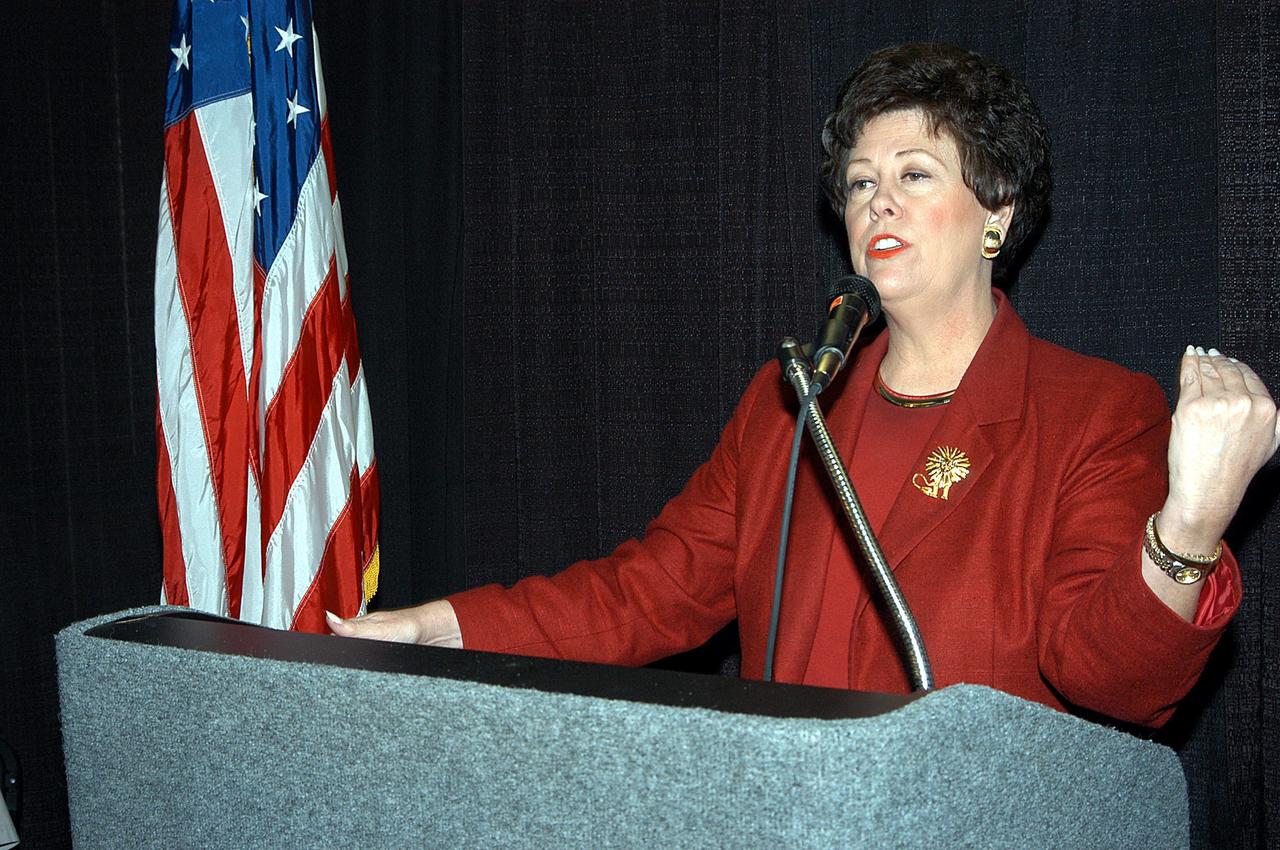
KENNEDY SPACE CENTER, FLA. - Florida Lt. Gov. Toni Jennings speaks to the attendees of an invitation-only luncheon held during the 2003 Southeastern Regional FIRST Robotic Competition. The competition is being held at the University of Central Florida (UCF) in Orlando, March 20-23. Forty student teams from around the country are participating in the event that pits team-built gladiator robots against each other in an athletic-style competition. The teams are sponsored by NASA/Kennedy Space Center, The Boeing Company/Brevard Community College, and Lockheed Martin Space Operations/Mission Systems for the nonprofit organization For Inspiration and Recognition of Science and Technology, known as FIRST. The vision of FIRST is to inspire in the youth of our nation an appreciation of science and technology and an understanding that mastering these disciplines can enrich the lives of all mankind.
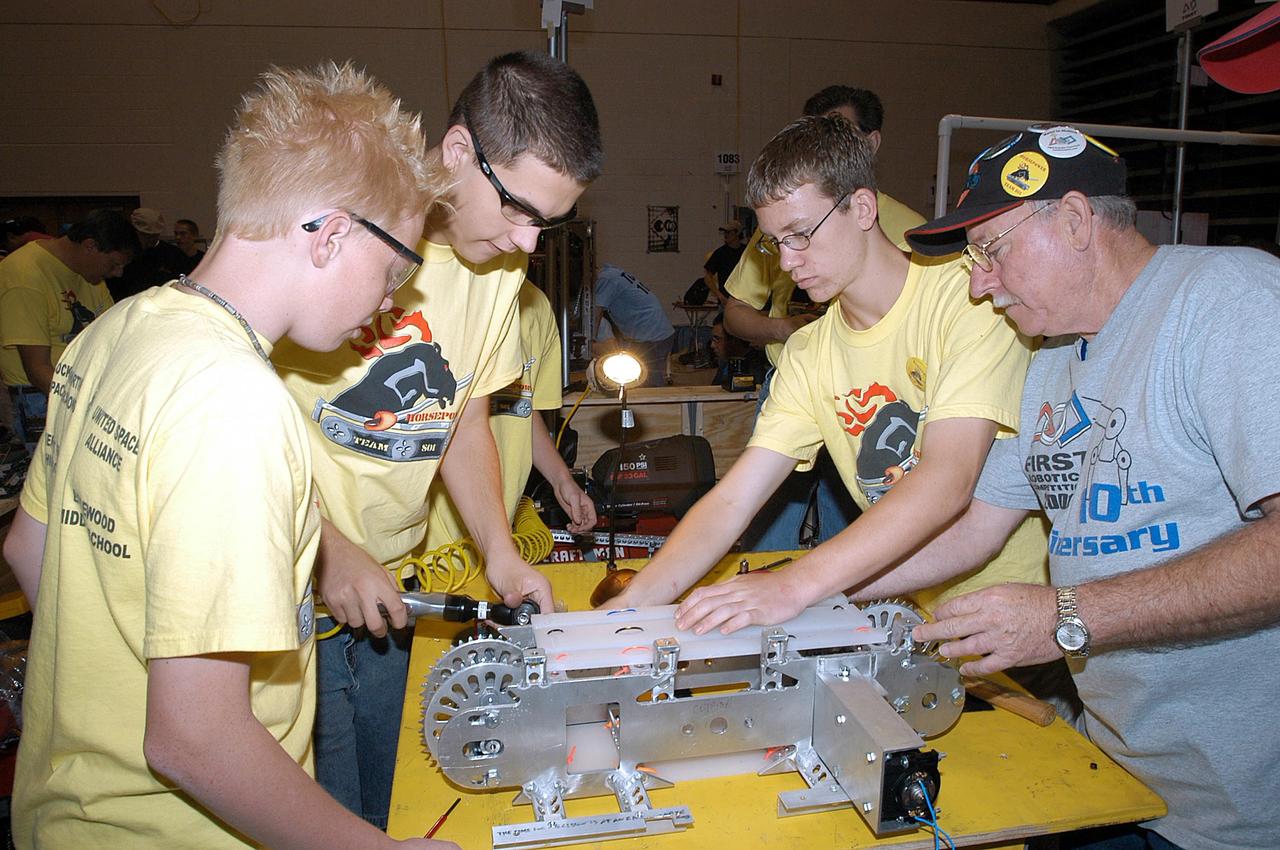
KENNEDY SPACE CENTER, FLA. -- The Merritt Island and Edgewood Middle School students/Lockheed Martin team, participating in the 2003 Southeastern Regional FIRST Robotic Competition, work on their team-built robot. The competition is being held at the University of Central Florida (UCF) in Orlando, March 20-23. Forty teams from around the country are participating in the event that pits team-built gladiator robots against each other in an athletic-style competition. The teams are sponsored by NASA-Kennedy Space Center, The Boeing Company/Brevard Community College, and Lockheed Martin Space Operations/Mission Systems for the nonprofit organization For Inspiration and Recognition of Science and Technology, known as FIRST. The vision of FIRST is to inspire in the youth of our nation an appreciation of science and technology and an understanding that mastering these disciplines can enrich the lives of all mankind.
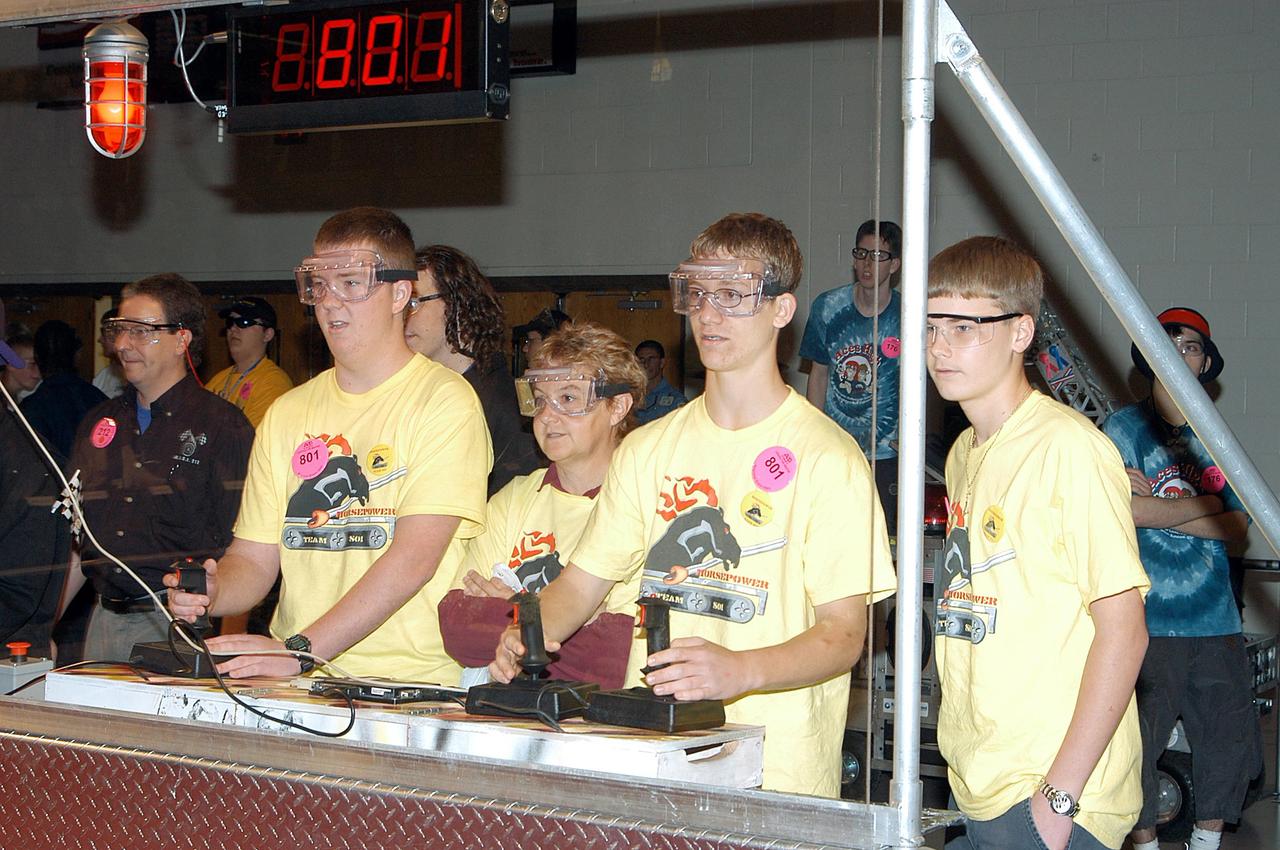
KENNEDY SPACE CENTER, FLA. - Members of the Merritt Island and Edgewood Middle School students/Lockheed Martin team maneuver their robot during competition. They are participating in the 2003 Southeastern Regional FIRST Robotic Competition being held at the University of Central Florida (UCF) in Orlando, March 20-23. Forty teams from around the country are participating in the event that pits team-built gladiator robots against each other in an athletic-style competition. The teams are sponsored by NASA-Kennedy Space Center, The Boeing Company/Brevard Community College, and Lockheed Martin Space Operations/Mission Systems for the nonprofit organization For Inspiration and Recognition of Science and Technology, known as FIRST. The vision of FIRST is to inspire in the youth of our nation an appreciation of science and technology and an understanding that mastering these disciplines can enrich the lives of all mankind.

KENNEDY SPACE CENTER, FLA. - Sponsor representatives of the 2003 Southeastern Regional FIRST Robotic Competition take a moment to compare notes between events. From left are Wayne Weinberg, director of development for the University of Central Florida College of Engineering and Computer Science; Erik Halleus, chair of the FIRST Regional Advisory Committee and a vice president at Siemens Enterprise Networks; and Roy D. Bridges, Jr., director of the NASA/Kennedy Space Center. The competition is being held at the University of Central Florida (UCF) in Orlando, March 20-23. Forty student teams from around the country are participating in the event that pits team-built gladiator robots against each other in an athletic-style competition. The teams are sponsored by NASA/Kennedy Space Center, The Boeing Company/Brevard Community College, and Lockheed Martin Space Operations/Mission Systems for the nonprofit organization For Inspiration and Recognition of Science and Technology, known as FIRST. The vision of FIRST is to inspire in the youth of our nation an appreciation of science and technology and an understanding that mastering these disciplines can enrich the lives of all mankind.
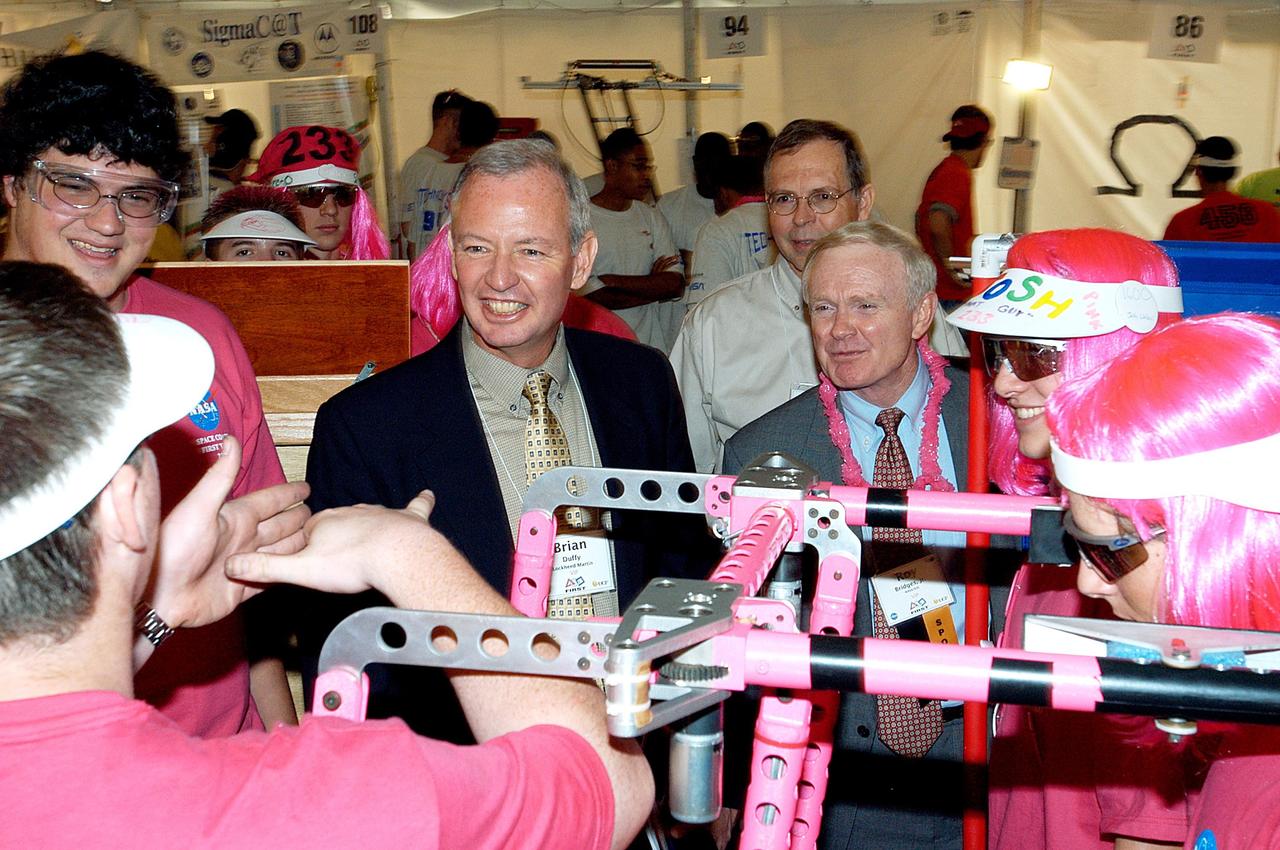
KENNEDY SPACE CENTER, FLA. - Lockheed Martin Vice President/Associate Program Manager Brian Duffy (second from left) and NASA Kennedy Space Center Director Roy Bridges (next to Duffy) talk with student participants in the 2003 Southeastern Regional FIRST Robotic Competition. Chris Fairey, the former director of Spaceport Services at KSC, looks on in the background. The competition is being held at the University of Central Florida (UCF) in Orlando, March 20-23. Forty student teams from around the country are participating in the event that pits team-built gladiator robots against each other in an athletic-style competition. The teams are sponsored by NASA/Kennedy Space Center, The Boeing Company/Brevard Community College, and Lockheed Martin Space Operations/Mission Systems for the nonprofit organization For Inspiration and Recognition of Science and Technology, known as FIRST. The vision of FIRST is to inspire in the youth of our nation an appreciation of science and technology and an understanding that mastering these disciplines can enrich the lives of all mankind.

NASA successfully launched the RockSat-X education payload on a Terrier-Improved Malemute suborbital sounding rocket at 7:33:30 a.m. EDT Aug. 17 from the Wallops Flight Facility in Virginia. Students from eight community colleges and universities from across the United States participated in the RockSat-X project.The payload carrying the experiments flew to an altitude of 95 miles. Data was received from most of the student experiments. However, the payload was not recovered as planned. NASA will investigate the anomaly. Credit: NASA/Wallops/A. Stancil <b><a href="http://www.nasa.gov/audience/formedia/features/MP_Photo_Guidelines.html" rel="nofollow">NASA image use policy.</a></b> <b><a href="http://www.nasa.gov/centers/goddard/home/index.html" rel="nofollow">NASA Goddard Space Flight Center</a></b> enables NASA’s mission through four scientific endeavors: Earth Science, Heliophysics, Solar System Exploration, and Astrophysics. Goddard plays a leading role in NASA’s accomplishments by contributing compelling scientific knowledge to advance the Agency’s mission. <b>Follow us on <a href="http://twitter.com/NASAGoddardPix" rel="nofollow">Twitter</a></b> <b>Like us on <a href="http://www.facebook.com/pages/Greenbelt-MD/NASA-Goddard/395013845897?ref=tsd" rel="nofollow">Facebook</a></b> <b>Find us on <a href="http://instagrid.me/nasagoddard/?vm=grid" rel="nofollow">Instagram</a></b>
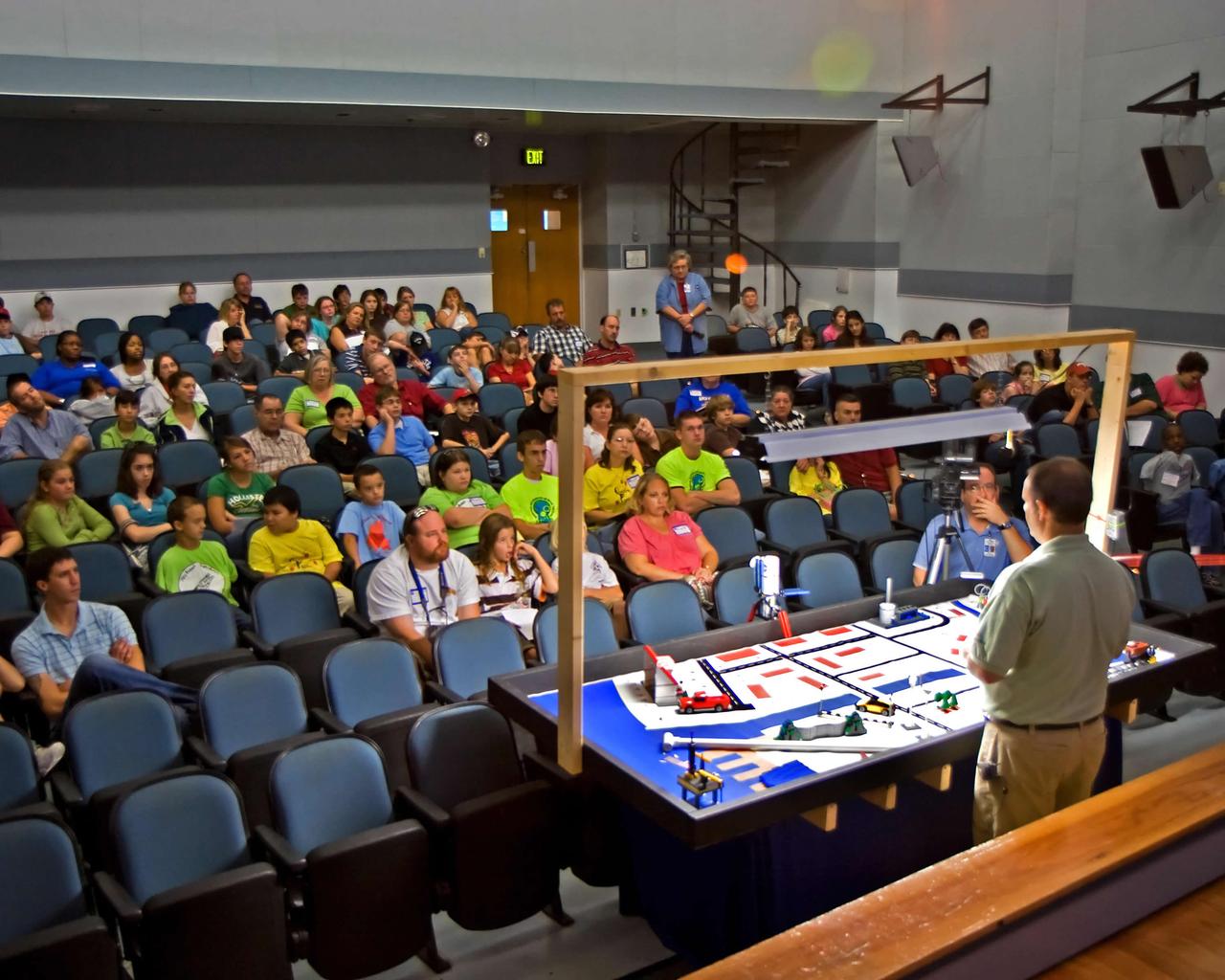
Randall Hicks (right), Jacobs Technology's Education Services manager at NASA John C. Stennis Space Center, answers questions about the playing field for FIRST (For Inspiration and Recognition of Science and Technology) LEGO League's 2007 Challenge, `Power Puzzle.' More than 140 teachers, mentors, parents and students from 15 schools attended the Sept. 15 FLL season kickoff at StenniSphere, the visitor center at SSC. The teams from southern and central Mississippi and Mobile, Ala., who came to SSC heard rules for and asked questions about `Power Puzzle,' and saw robot demonstrations by Gulfport and Picayune high schools' past FIRST Robotics competitions. Using LEGO Mindstorms NXT kits, FLL teams of children ages 9-14 will spend the next three months building and programming robots to perform 'Power Puzzle's' challenge tasks, then pit them in competitions. They also will submit a research project about how energy choices impact the environment and the economy. The season will culminate at the Mississippi Championship Tournament on Dec. 8 at the Mississippi Gulf Coast Community College. FLL, considered the `little league' of the FIRST Robotics Competition, partners FIRST and the LEGO Group. Competitions aim to inspire and celebrate science and technology using real-world context and hands-on experimentation. NASA recognizes FIRST activities as an excellent hands-on method to increase student knowledge of science, engineering, technology and mathematics. Schools represented in this year's kickoff were: Madison Avenue Upper Elementary, the Mississippi Band of Choctaw Indians' Conehatta Elementary, Hattiesburg's Lillie Burney Elementary, Pearl Upper Elementary, Long Beach Middle, Oktibehha Elementary, d'Iberville Middle, Saucier's West Wortham Middle, Picayune's Nicholson Elementary and Roseland Park Baptist Church Academy, Bay St. Louis' St. Stanislaus College and Mobile's Davidson High, as well as two home-school groups from the Jackson area.
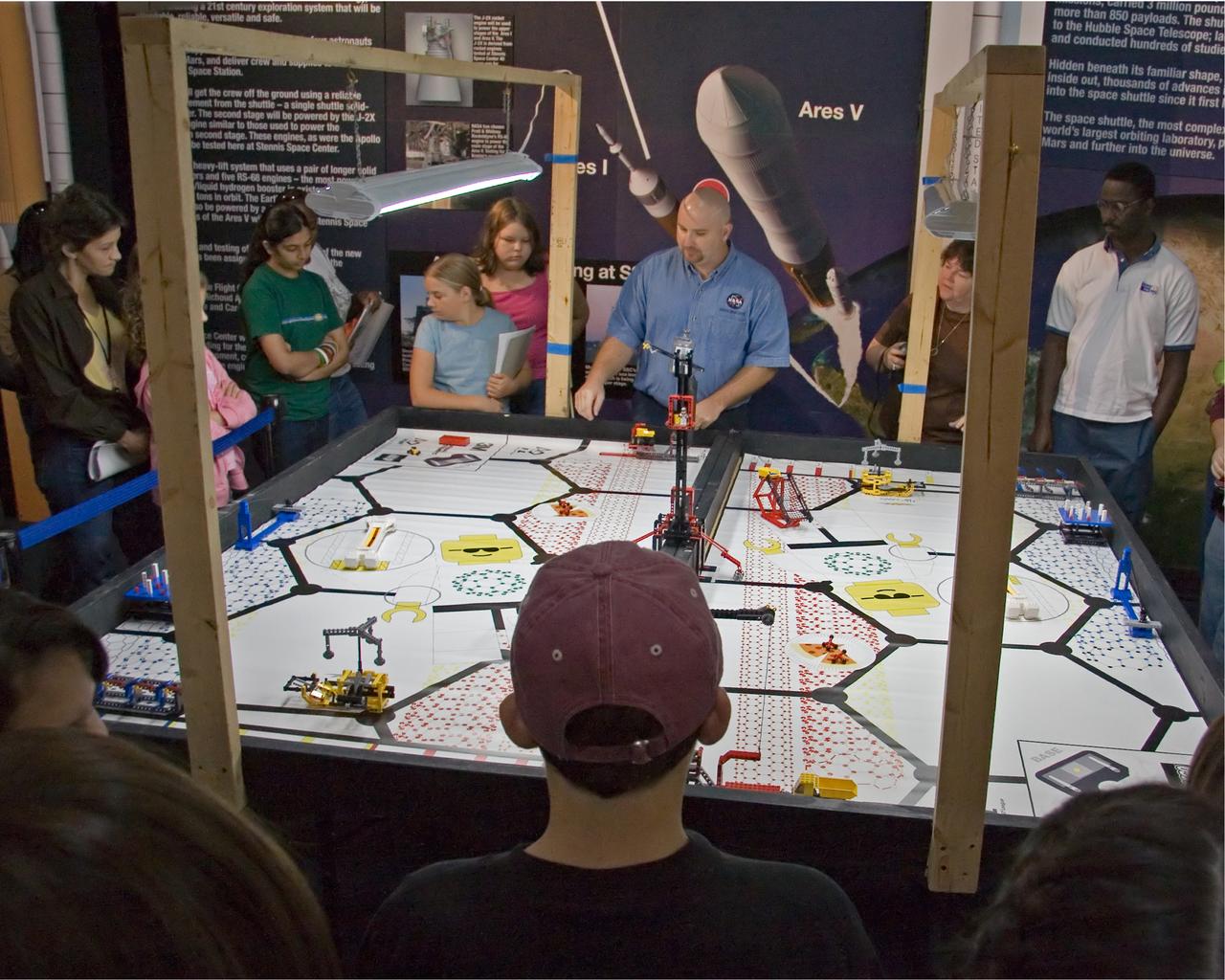
FIRST LEGO League participants listen to Aerospace Education Specialist Chris Copelan explain the playing field for 'Nano Quest' during a recent FLL kickoff event at StenniSphere, the visitor center at NASA Stennis Space Center. The kickoff began the 2006 FLL competition season. Eighty-five teachers, mentors, parents and 9- to 14-year-old students from southern and central Mississippi came to SSC to hear the rules for Nano Quest. The challenge requires teams to spend eight weeks building and programming robots from LEGO Mindstorms kits. They'll battle their creations in local and regional competitions. The Dec. 2 competition at Mississippi Gulf Coast Community College will involve about 200 students. FIRST LEGO League, considered the 'little league' of the FIRST (For Inspiration and Recognition of Science and Technology) Robotics Competition, partners FIRST and the LEGO Group. Competitions aim to inspire and celebrate science and technology using real-world context and hands-on experimentation, and to promote the principles of team play and gracious professionalism. Because NASA advocates robotics and science-technology education, the agency and SSC support FIRST by providing team coaches, mentors and training, as well as competition event judges, referees, audio-visual and other volunteer staff personnel. Two of Mississippi's NASA Explorer Schools, Bay-Waveland Middle and Hattiesburg's Lillie Burney Elementary, were in attendance. The following schools were also represented: Ocean Springs Middle, Pearl Upper Elementary, Long Beach Middle, Jackson Preparatory Academy, North Woolmarket Middle, D'Iberville Middle, West Wortham Middle, Picayune's Roseland Park Baptist Academy and Nicholson Elementary, as well as two home-school groups from McComb and Brandon. Gulfport and Picayune Memorial-Pearl River high schools' FIRST Robotics teams conducted robotics demonstrations for the FLL crowd.
!["Where I grew up [on my family farm] 100% shaped who I am. In fact, my son and I were talking about high schools and how big his is. His high school population is double the population of the town I grew up in. I had 20 kids in my graduating class, and three of them were foreign exchange students. He asked me, 'Do you wish you would have gone to a bigger school like us?' And I said, 'Actually, no, I don't.' I loved where I grew up. I absolutely cherish what it instilled in me, and that's something I carry with me all the time. "The earliest lesson was that you are part of something much bigger than yourself. Everybody has an important role in what they're doing, no matter how small. I remember when we were bringing in the corn. Right now, everybody buys it, but I didn't buy corn until maybe college because it was a whole family thing. We went and picked the corn. The little kids would shuck it, pulling off all the silk. The grown-ups would shave it off the cob and then push it off to the side, and then the older kids would bag it up into plastic bags. And then everybody went home. It was always about a team. You can be the youngest person or the lowest-ranking person, but you always bring something important to that table. "Everywhere I've been since I got commissioned [as an Air Force officer], my very first office in 1997, I hang an aerial picture of our farm on my wall because it's [a reminder to] remember where you came from, remember home, and don't get too big for your britches. No matter what, you could be part of something huge, and I look at that picture and say, 'I have always been part of something much bigger than myself.' All the little, tiny moments in life that build upon themselves trace back to that family farm for me." Alana Johnson, Senior Communications Specialist, poses for a portrait, Wednesday, Feb. 7, 2024, at the Mary W. Jackson NASA Headquarters building in Washington. Photo Credit: (NASA/Joel Kowsky)](https://images-assets.nasa.gov/image/NHQ202402070011/NHQ202402070011~medium.jpg)
"Where I grew up [on my family farm] 100% shaped who I am. In fact, my son and I were talking about high schools and how big his is. His high school population is double the population of the town I grew up in. I had 20 kids in my graduating class, and three of them were foreign exchange students. He asked me, 'Do you wish you would have gone to a bigger school like us?' And I said, 'Actually, no, I don't.' I loved where I grew up. I absolutely cherish what it instilled in me, and that's something I carry with me all the time. "The earliest lesson was that you are part of something much bigger than yourself. Everybody has an important role in what they're doing, no matter how small. I remember when we were bringing in the corn. Right now, everybody buys it, but I didn't buy corn until maybe college because it was a whole family thing. We went and picked the corn. The little kids would shuck it, pulling off all the silk. The grown-ups would shave it off the cob and then push it off to the side, and then the older kids would bag it up into plastic bags. And then everybody went home. It was always about a team. You can be the youngest person or the lowest-ranking person, but you always bring something important to that table. "Everywhere I've been since I got commissioned [as an Air Force officer], my very first office in 1997, I hang an aerial picture of our farm on my wall because it's [a reminder to] remember where you came from, remember home, and don't get too big for your britches. No matter what, you could be part of something huge, and I look at that picture and say, 'I have always been part of something much bigger than myself.' All the little, tiny moments in life that build upon themselves trace back to that family farm for me." Alana Johnson, Senior Communications Specialist, poses for a portrait, Wednesday, Feb. 7, 2024, at the Mary W. Jackson NASA Headquarters building in Washington. Photo Credit: (NASA/Joel Kowsky)