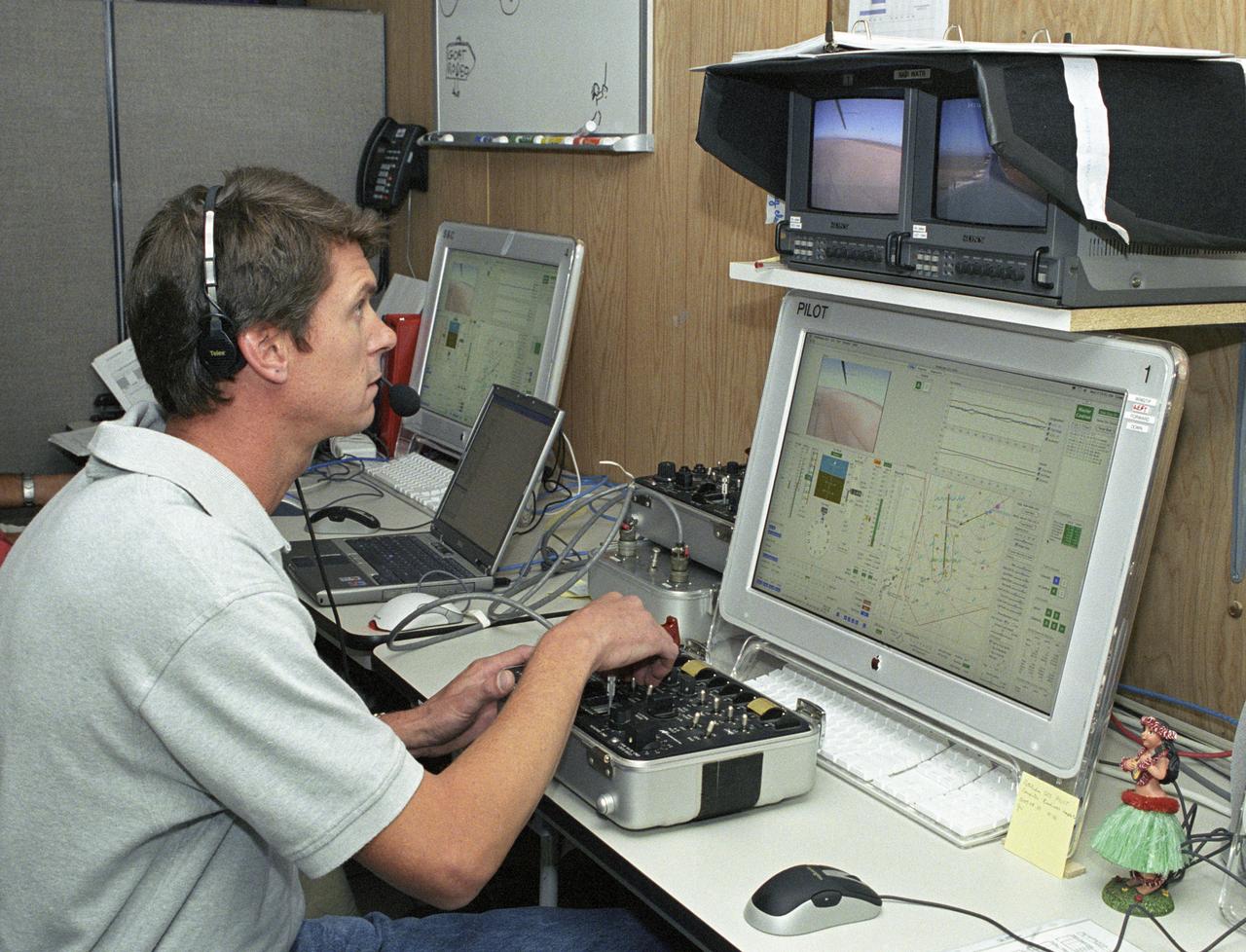
AeroVironment pilot Wyatt Sadler controls the Pathfinder-Plus flying wing from a small console, video and computer monitors in the ground station.

This image demonstrates a growth chamber within a CubeLab as part of Project Rapunzel. This investigation tests a special plant chamber and uses computer vision to monitor plant health. Investigation findings may inform ways to automatically monitor plant health and reduce plant stress during long-duration space missions. Credit. UniSQ
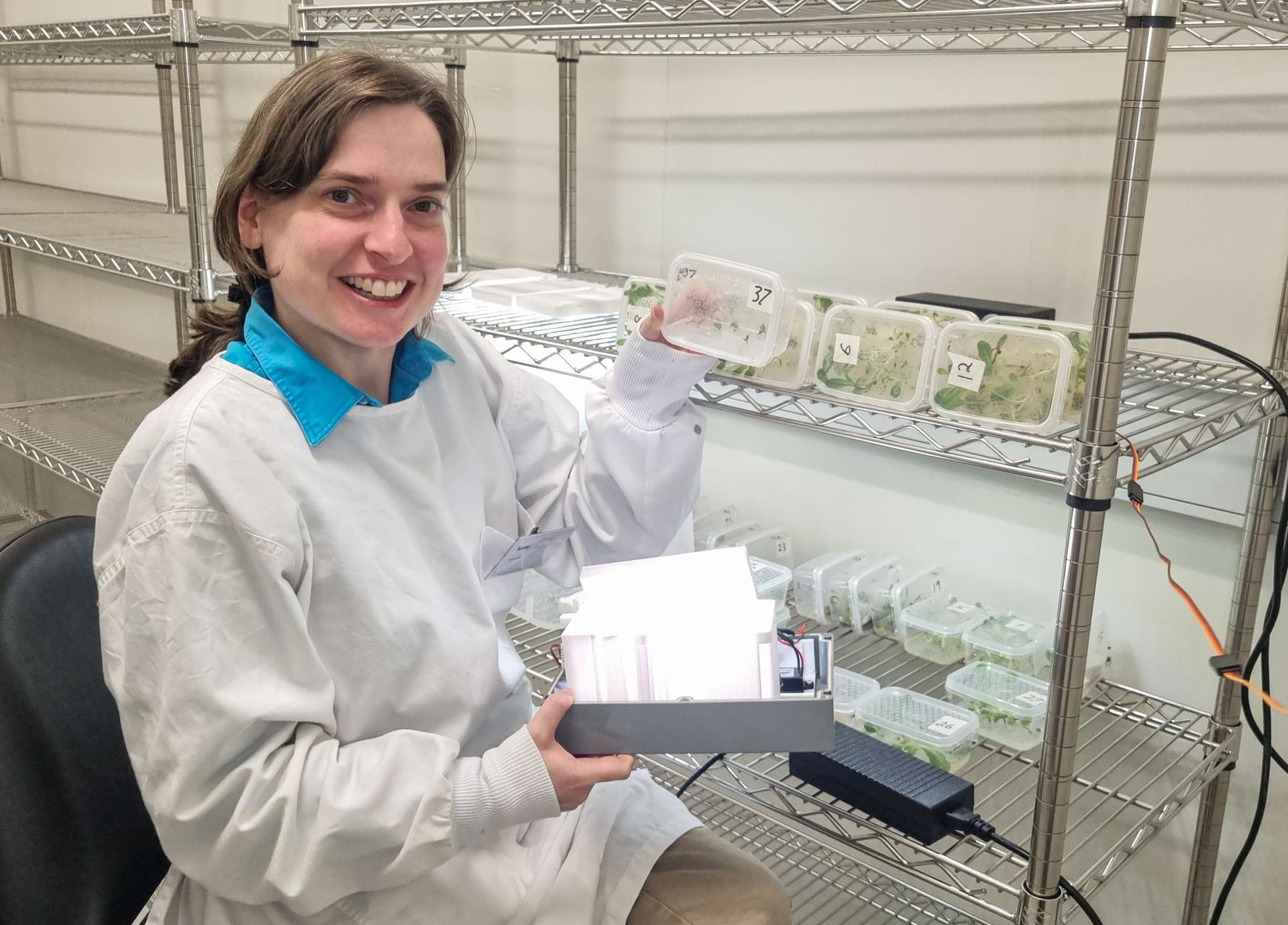
Project Rapunzel principal investigator testing the plant chambers on the ground. This investigation tests a special plant chamber and uses computer vision to monitor plant health. Investigation findings may inform ways to automatically monitor plant health and reduce plant stress during long-duration space missions. Credit. UniSQ
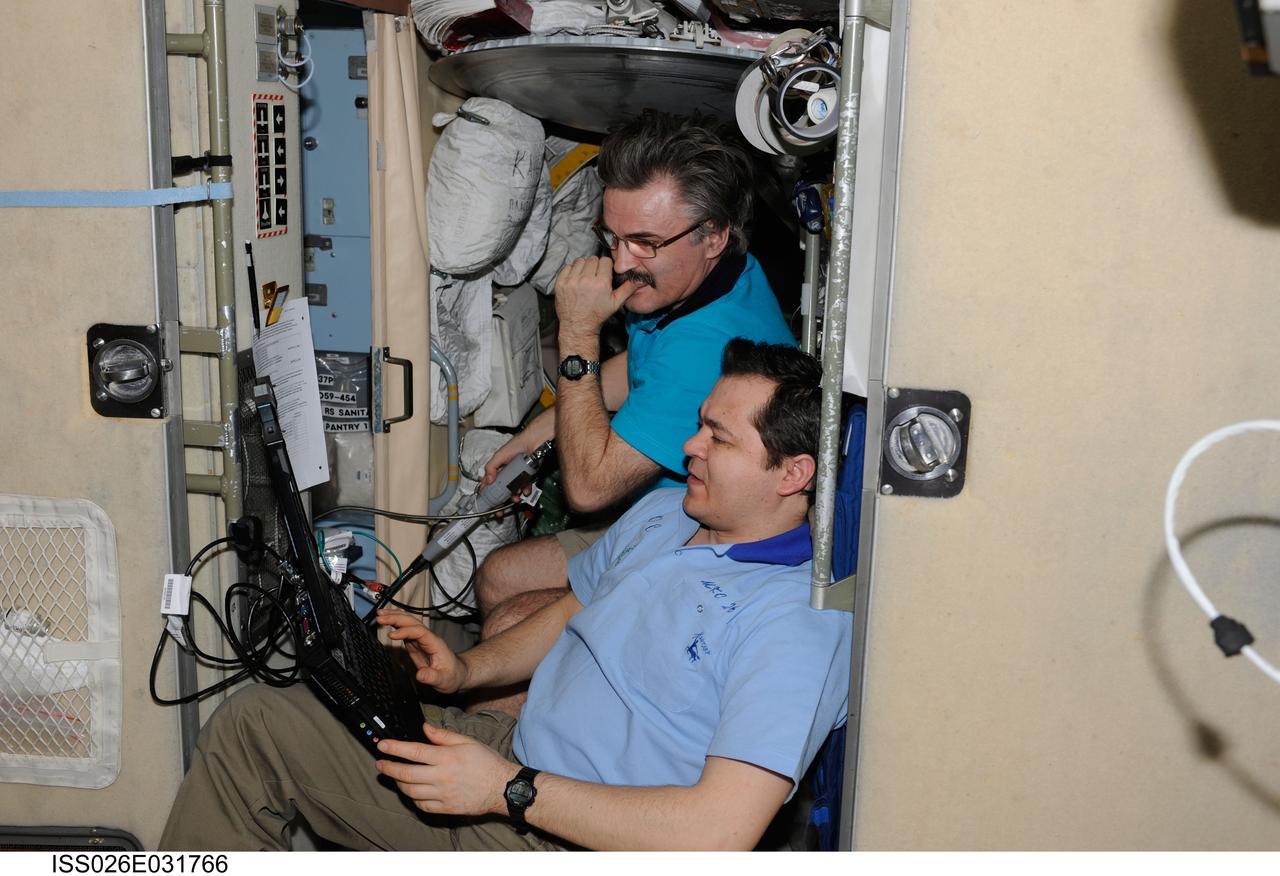
ISS026-E-031766 (4 March 2011) --- Russian cosmonauts Oleg Skripochka (foreground) and Alexander Kaleri, both Expedition 26 flight engineers, watch a computer monitor in the Zvezda Service Module of the International Space Station.
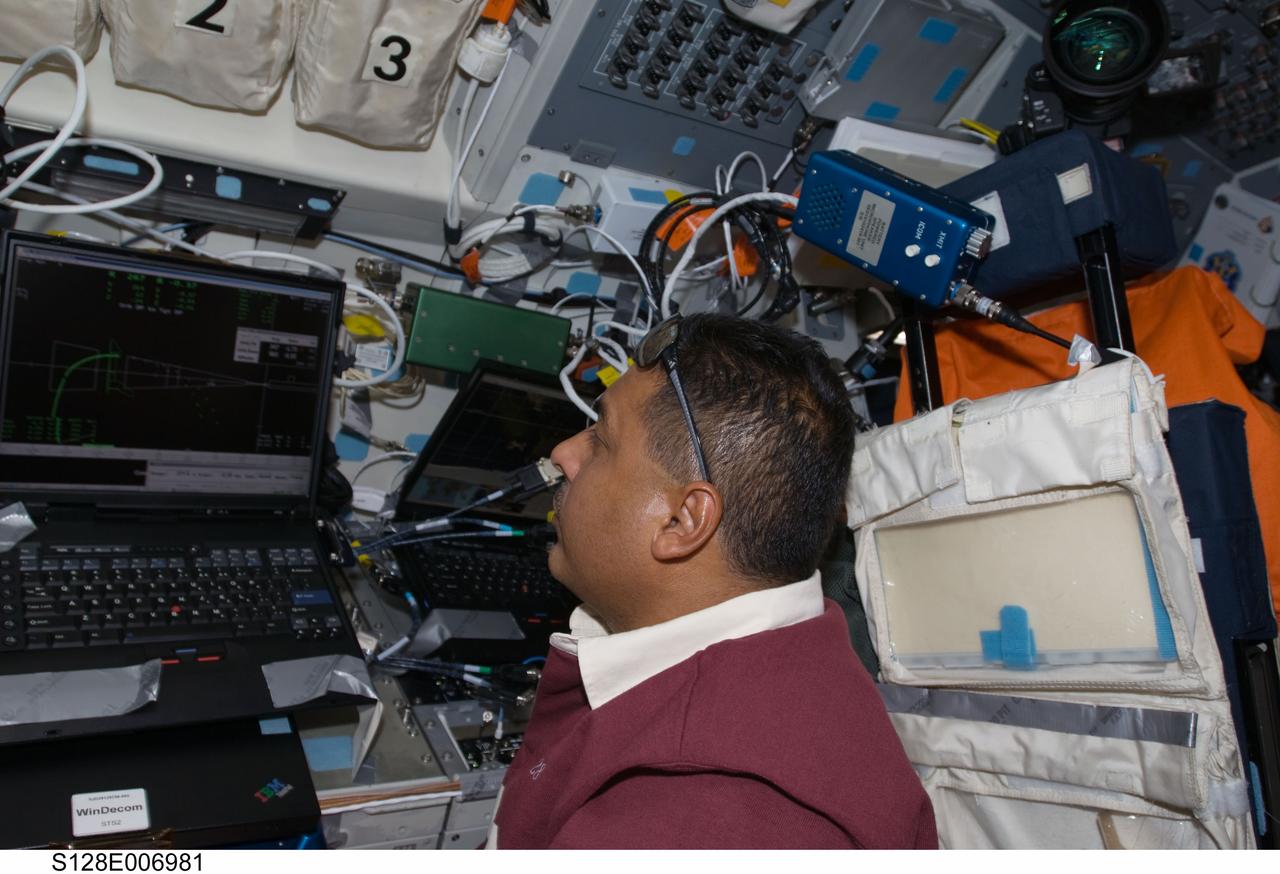
S128-E-006981 (30 Aug. 2009) --- Astronaut Jose Hernandez, STS-128 mission specialist, watches a computer monitor on the flight deck of Space Shuttle Discovery during flight day three activities.
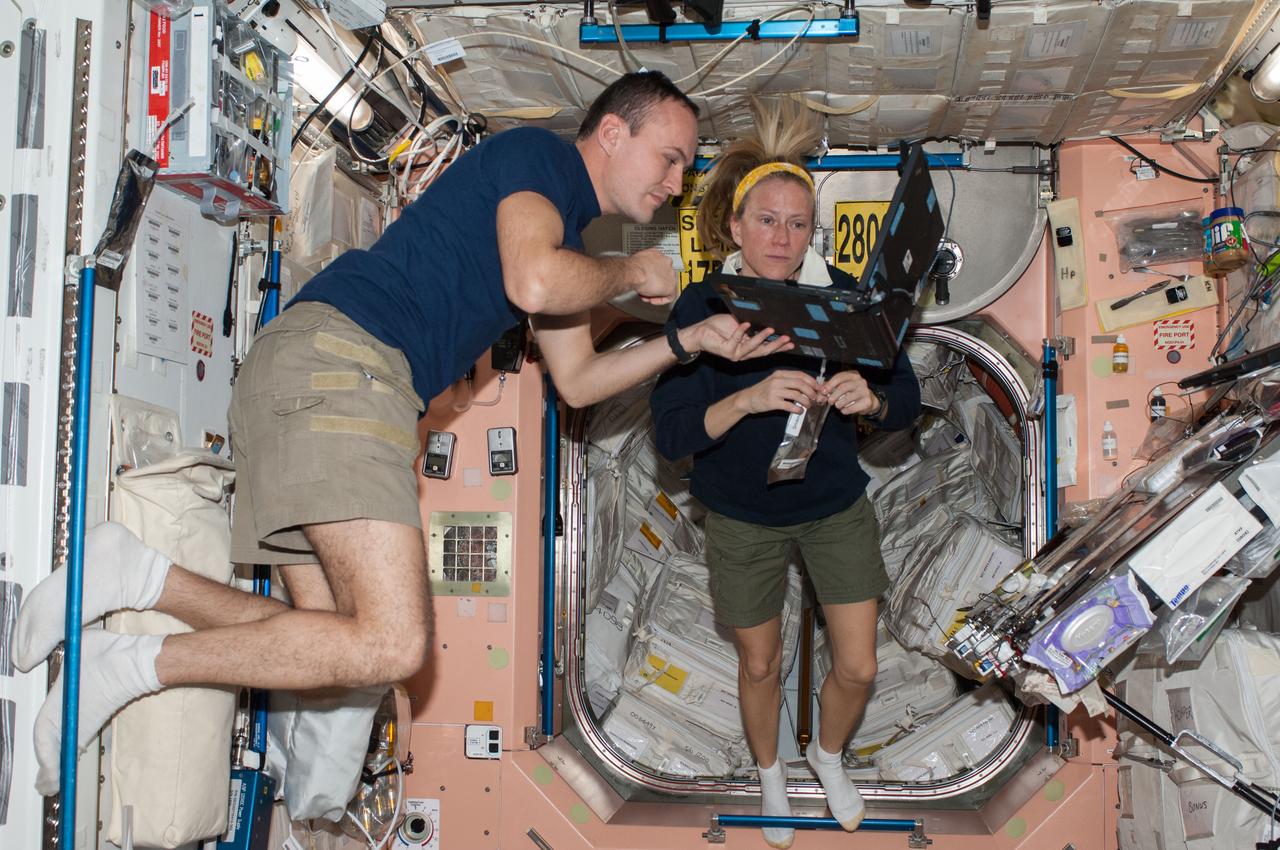
ISS037-E-005750 (2 Oct. 2013) --- NASA astronaut Karen Nyberg and Russian cosmonaut Sergey Ryazanskiy, both Expedition 37 flight engineers, look at a computer monitor in the Unity node of the International Space Station.
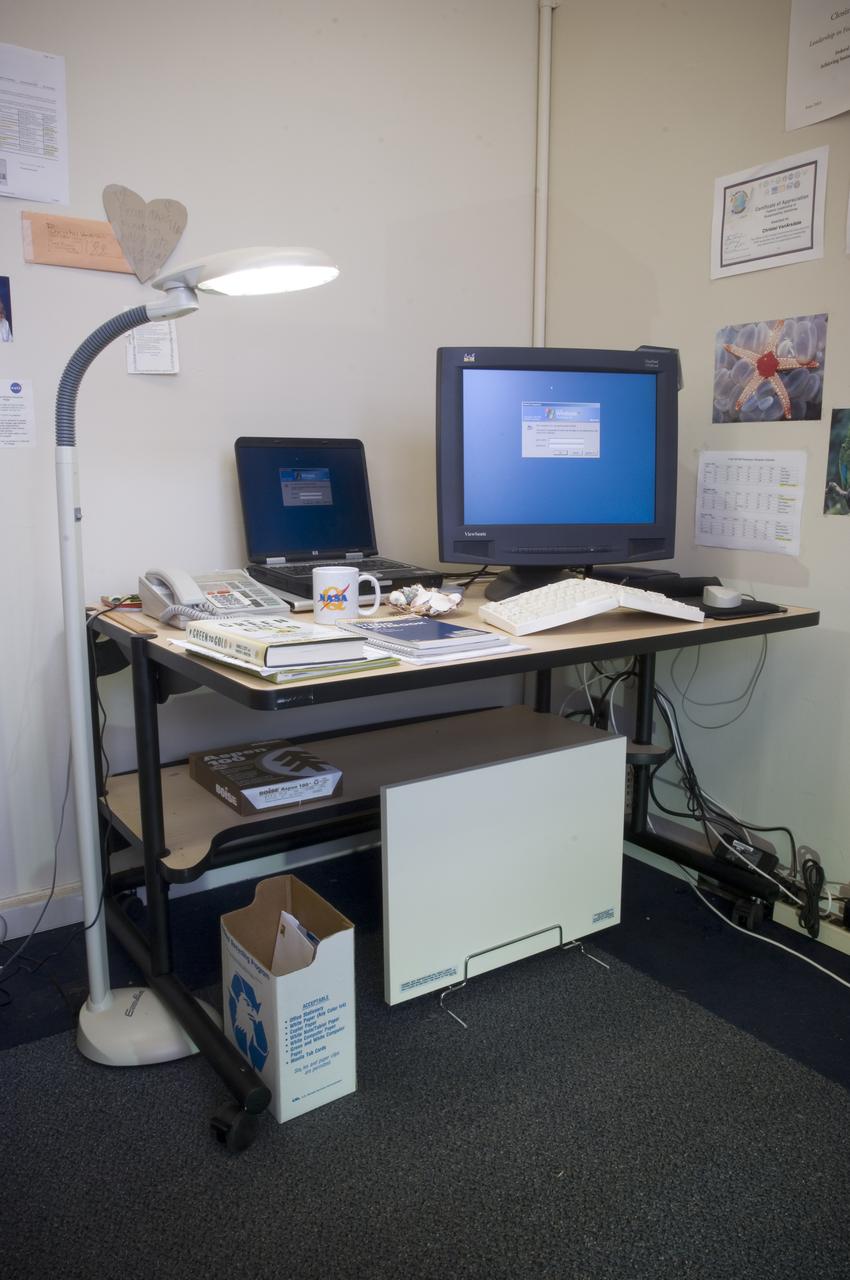
2007 Sustainability report: - Christel Van Arsdale's green office in N-218 with LCD computer monitor, a radiant heating panel, recycling bin, recycled content paper and notebooks, fluorescent lights
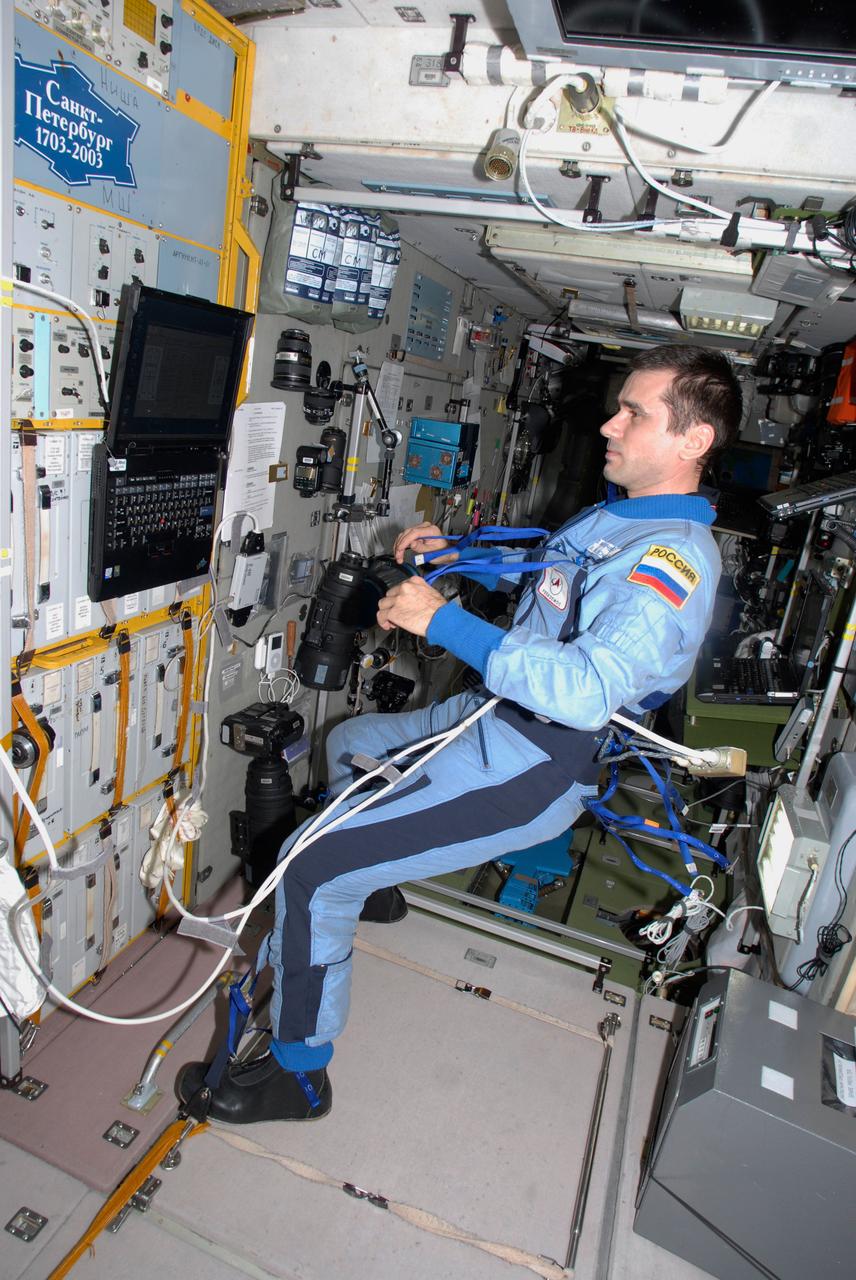
ISS016-E-022540 (13 Jan. 2008) --- Cosmonaut Yuri I. Malenchenko, Expedition 16 flight engineer representing Russia's Federal Space Agency, watches a computer monitor in the Zvezda Service Module of the International Space Station.
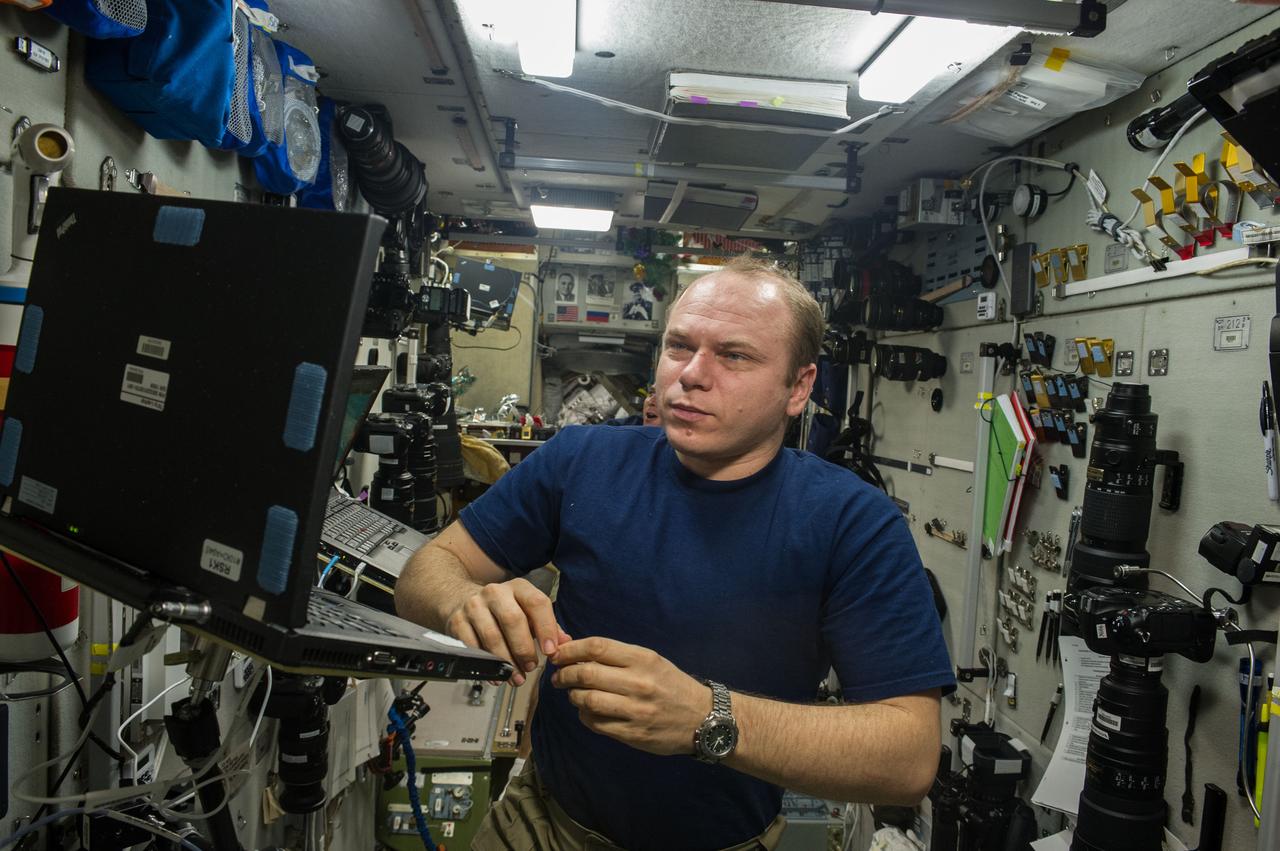
ISS038-E-032828 (14 Jan. 2014) --- Russian cosmonaut Oleg Kotov, Expedition 38 commander, looks at a computer monitor in the Zvezda Service Module of the International Space Station.

ISS036-E-047716 (5 Sept. 2013) --- NASA astronaut Chris Cassidy, Expedition 36 flight engineer, looks at a computer monitor in the Kibo laboratory of the International Space Station.
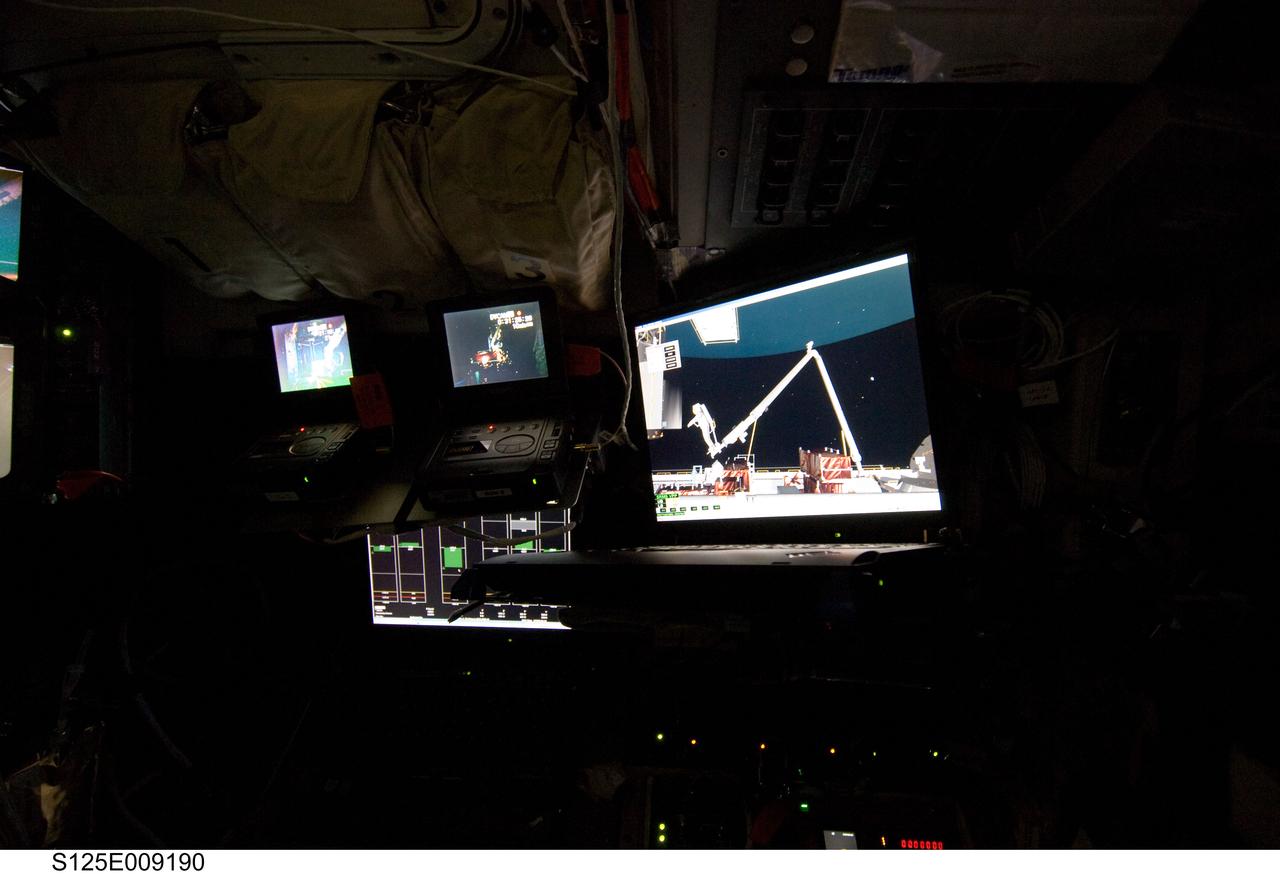
S125-E-009190 (17 May 2009) --- A computer monitor showing animation of an extravehicular activity (EVA) is visible in this image photographed by a STS-125 crewmember in a darkened flight deck on the Earth-orbiting Space Shuttle Atlantis.
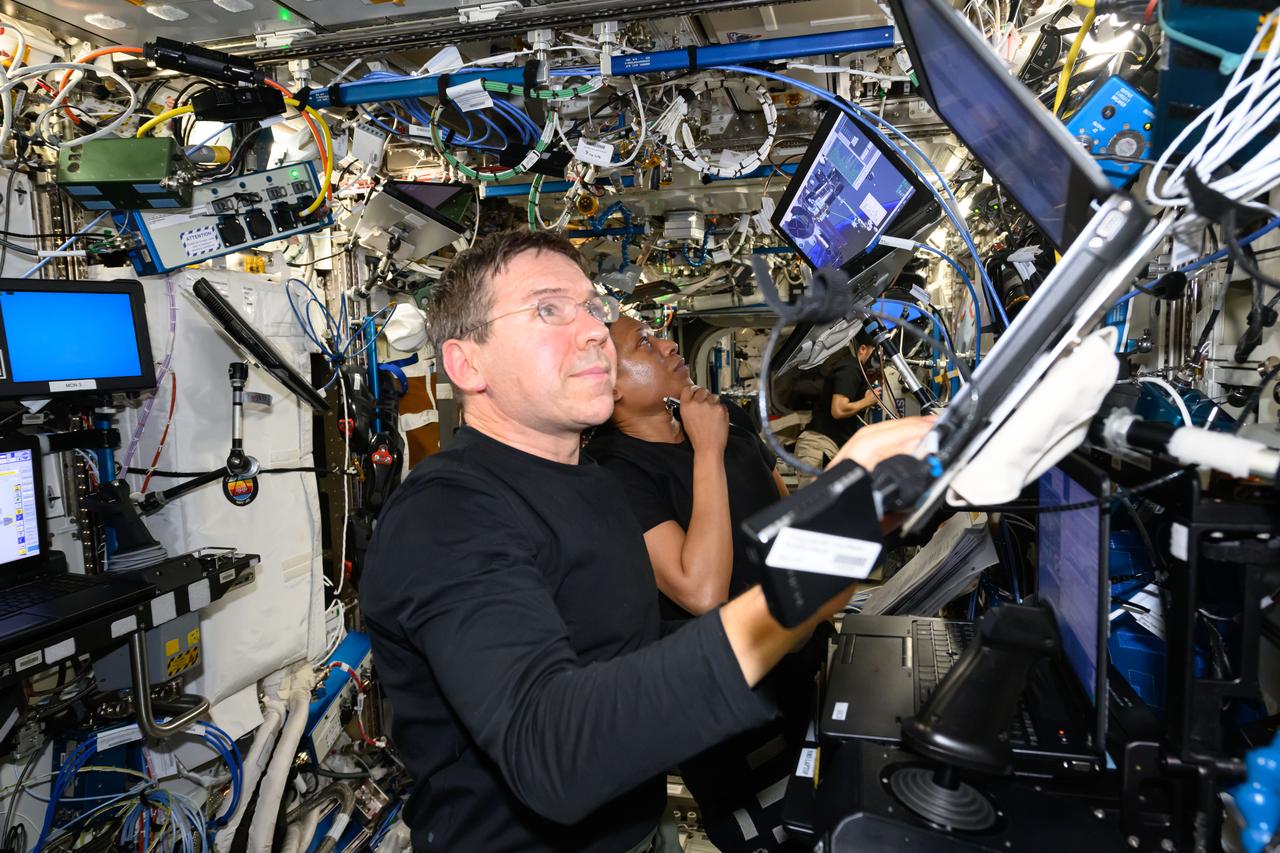
iss071e180163 (June 10, 2024) --- Expedition 71 Flight Engineers Mike Barratt and Jeanette Epps, both NASA astronauts, look at computer monitors on the Destiny laboratory module's robotics workstation that controls the Canadarm2 robotic arm.
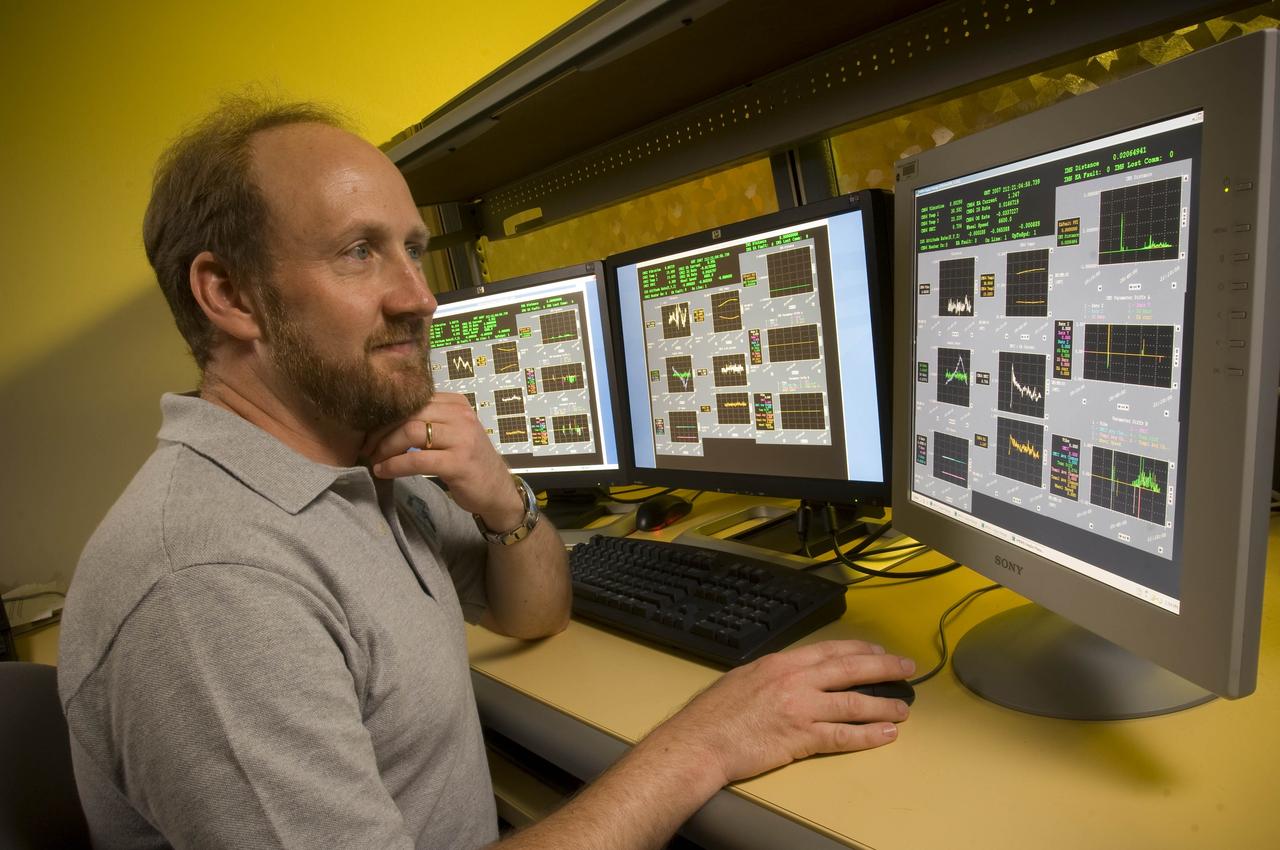
David L. Iverson of NASA Ames Research center, Moffett Field, California, led development of computer software to monitor the conditions of the gyroscopes that keep the International Space Station (ISS) properly oriented in space as the ISS orbits Earth. The gyroscopes are flywheels that control the station's attitude without the use of propellant fuel. NASA computer scientists designed the new software, the Inductive Monitoring System, to detect warning signs that precede a gyroscope's failure. According to NASA officials, engineers will add the new software tool to a group of existing tools to identify and track problems related to the gyroscopes. If the software detects warning signs, it will quickly warn the space station's mission control center.
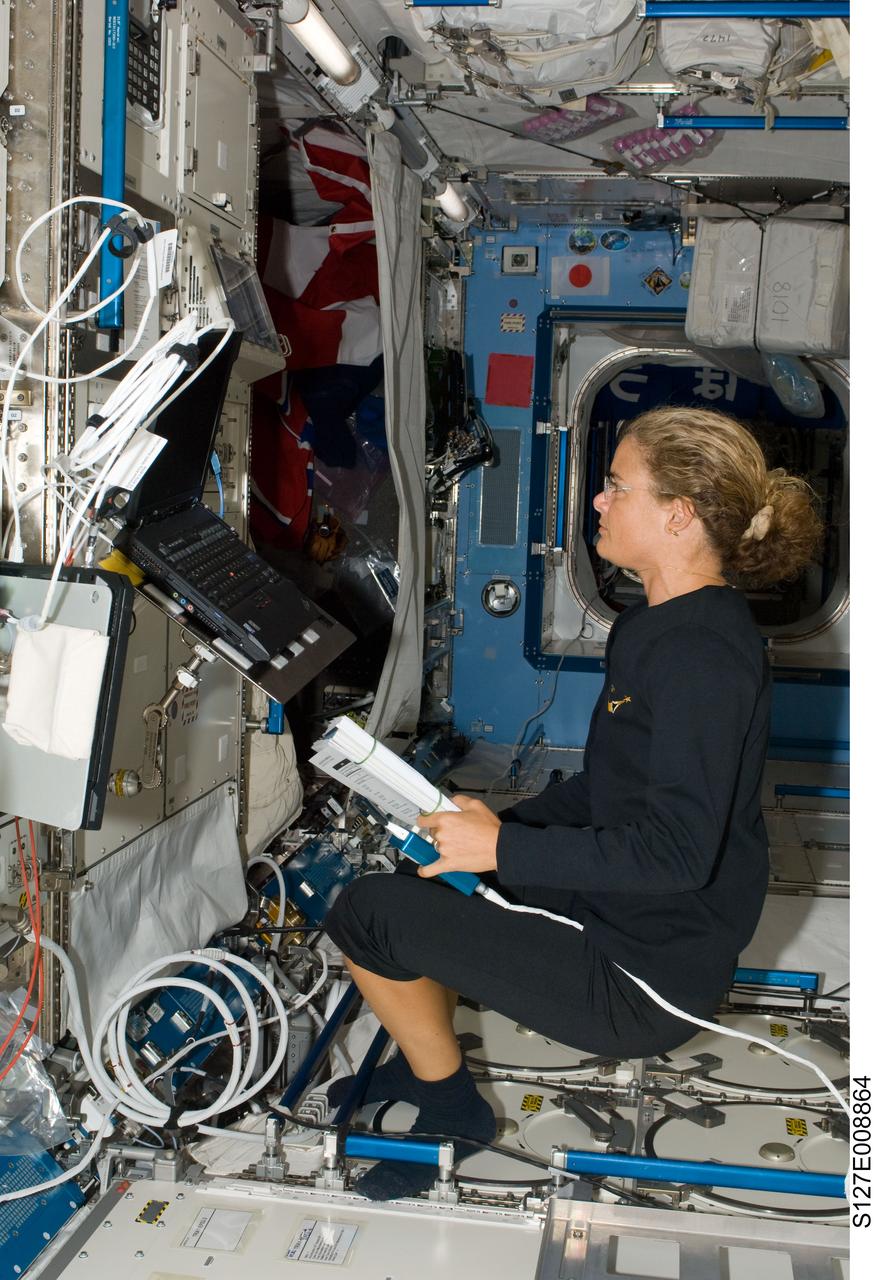
S127-E-008864 (26 July 2009) --- Canadian Space Agency astronaut Julie Payette, STS-127 mission specialist, views a computer monitor while working in the Destiny laboratory of the International Space Station while Space Shuttle Endeavour remains docked with the station.
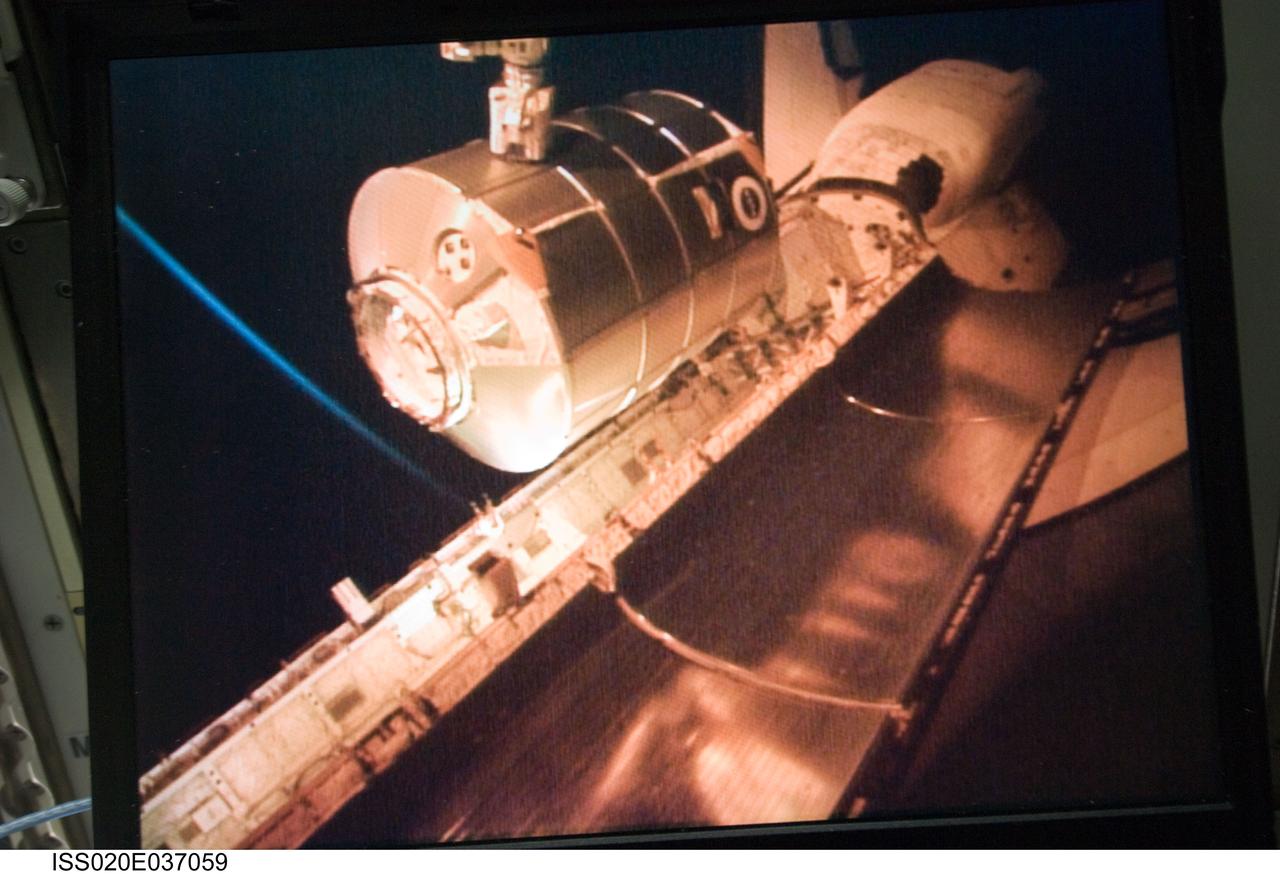
ISS020-E-037059 (31 Aug. 2009) --- Viewed from a computer monitor, the International Space Station’s robotic Canadarm2 unberths the Leonardo Multi-Purpose Logistics Module from Space Shuttle Discovery’s (STS-128) cargo bay for installation on the nadir port of the station’s Harmony node.

S88-E-5107 (12-11-98) --- Sergei Krikalev, mission specialist representing the Russian Space Agency (RSA), surrounded by monitors and computers on the flight deck, holds a large camera lens. The photo was taken with an electronic still camera (ESC) at 09:33:22 GMT, Dec. 11.
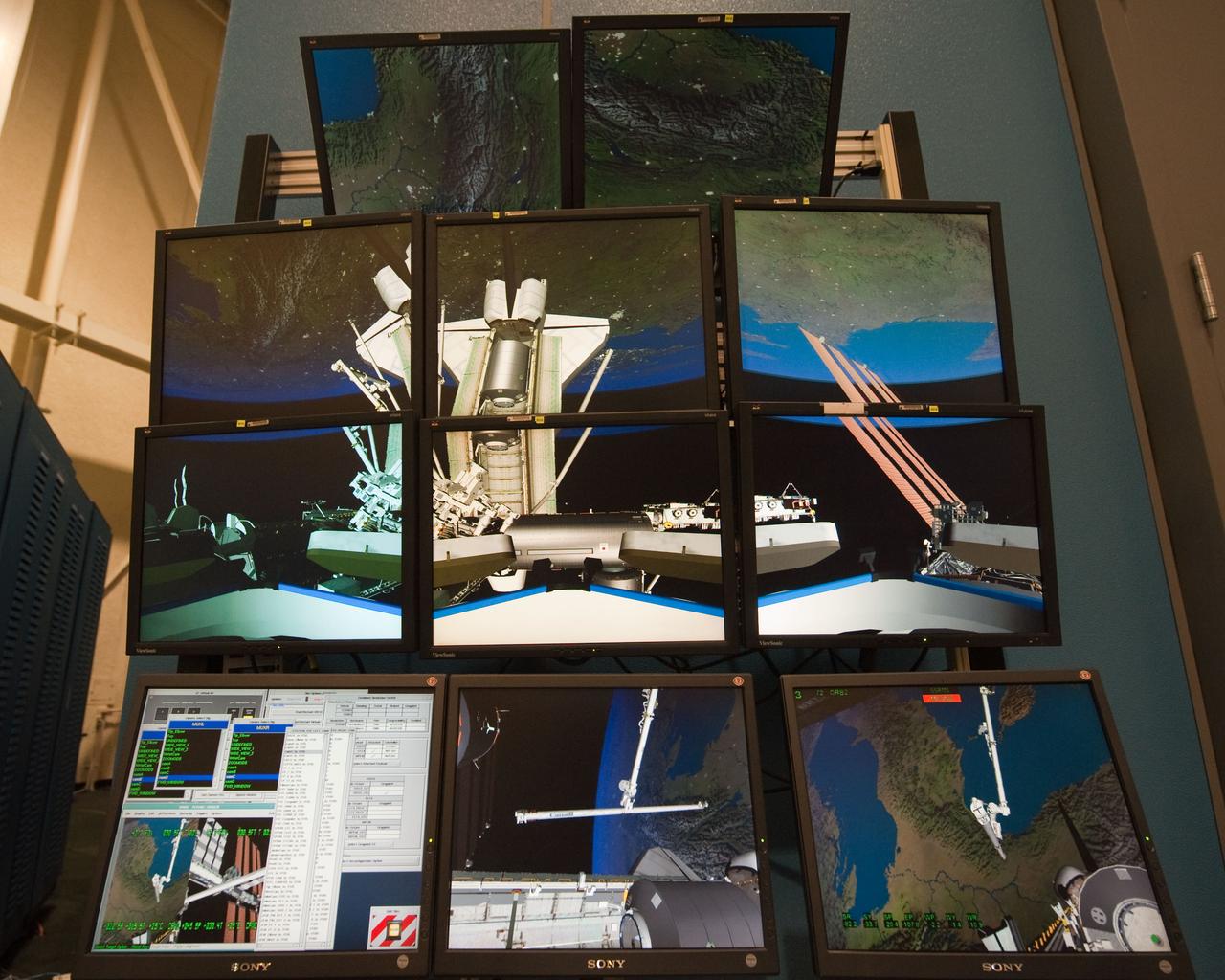
JSC2010-E-090701 (8 June 2010) --- Several computer monitors are featured in this image photographed during an STS-133 exercise in the systems engineering simulator in the Avionics Systems Laboratory at NASA's Johnson Space Center. The facility includes moving scenes of full-sized International Space Station components over a simulated Earth.
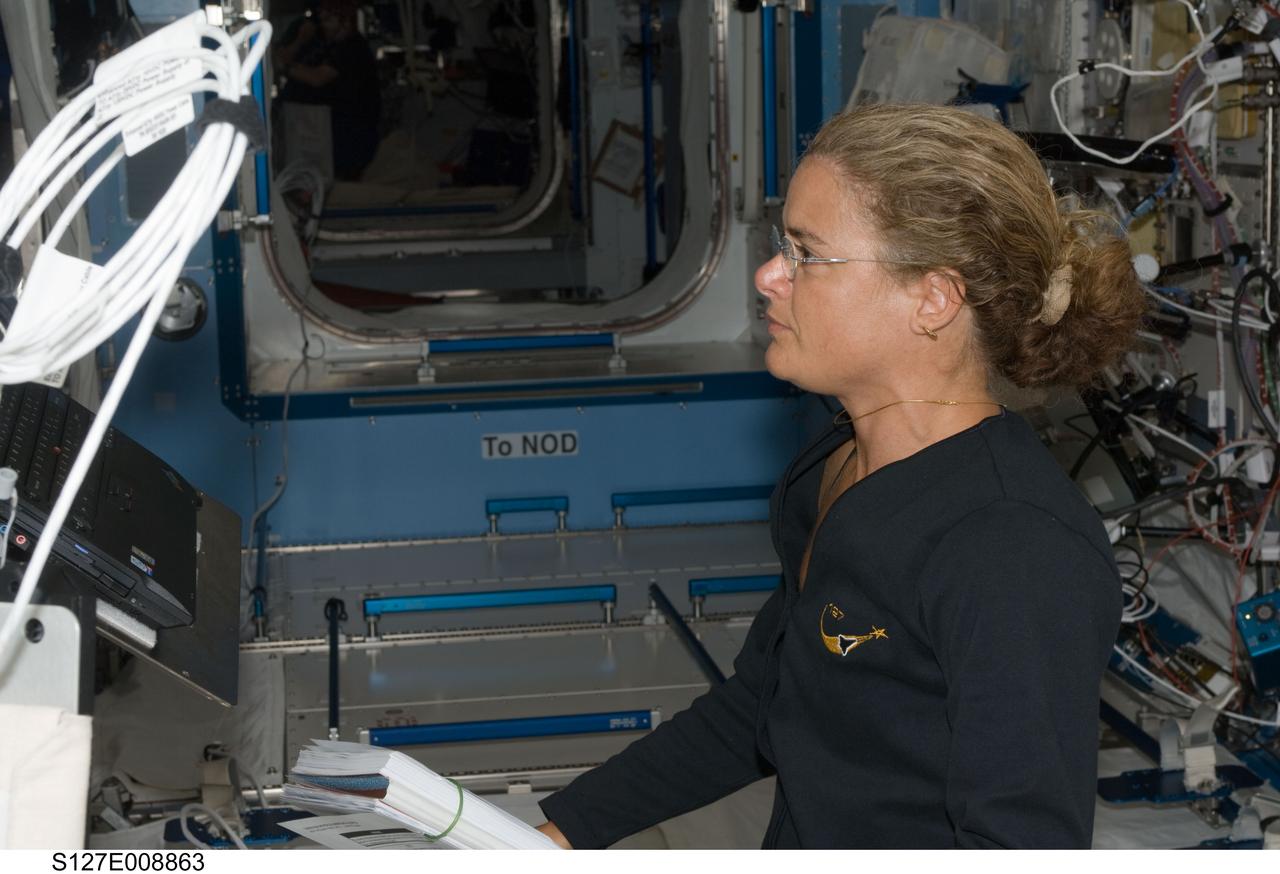
S127-E-008863 (26 July 2009) --- Canadian Space Agency astronaut Julie Payette, STS-127 mission specialist, views a computer monitor while working in the Destiny laboratory of the International Space Station while Space Shuttle Endeavour remains docked with the station.
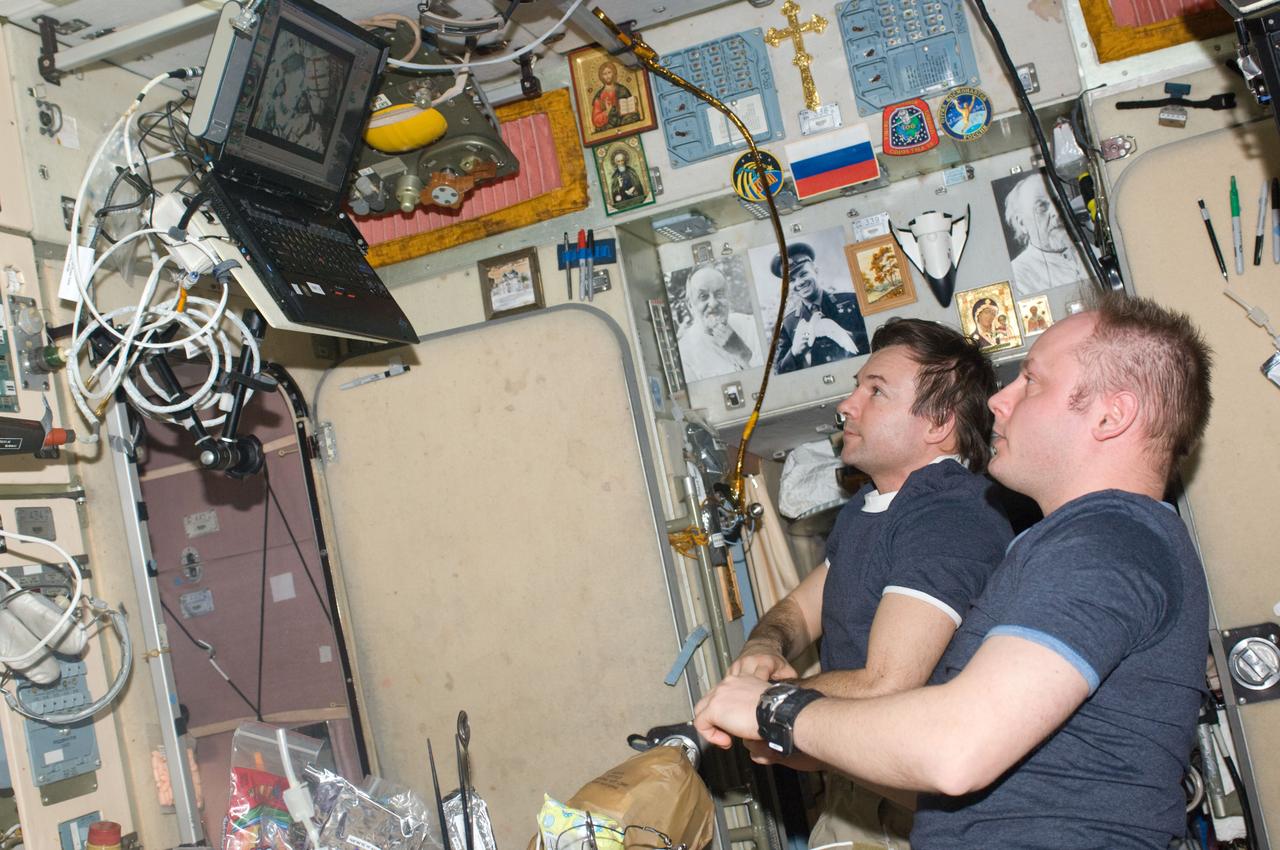
ISS018-E-044033 (26 March 2009) --- NASA astronaut Michael Fincke (foreground), Expedition 18 commander; and cosmonaut Yury Lonchakov, flight engineer, watch a computer monitor in the Zvezda Service Module of the International Space Station showing the Expedition 19 crew and spaceflight participant.
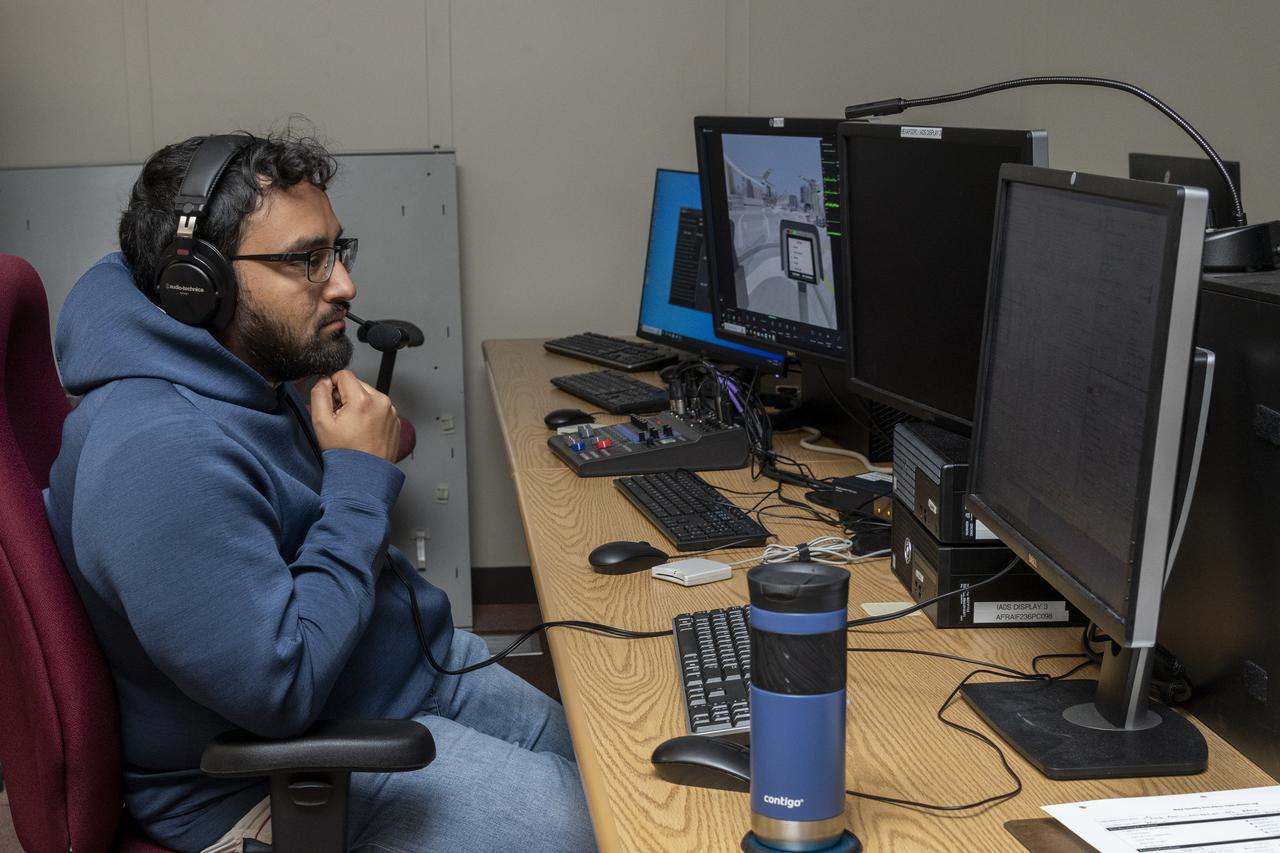
NASA researcher Saravanakumaar Ramia controls the air taxi passenger ride quality simulator by monitoring several computers in the Ride Quality Laboratory at NASA’s Armstrong Flight Research Center in Edwards, California, during an experiment on Oct. 23, 2024. Studies continue in this lab to better understand passenger comfort for future air taxi rides.
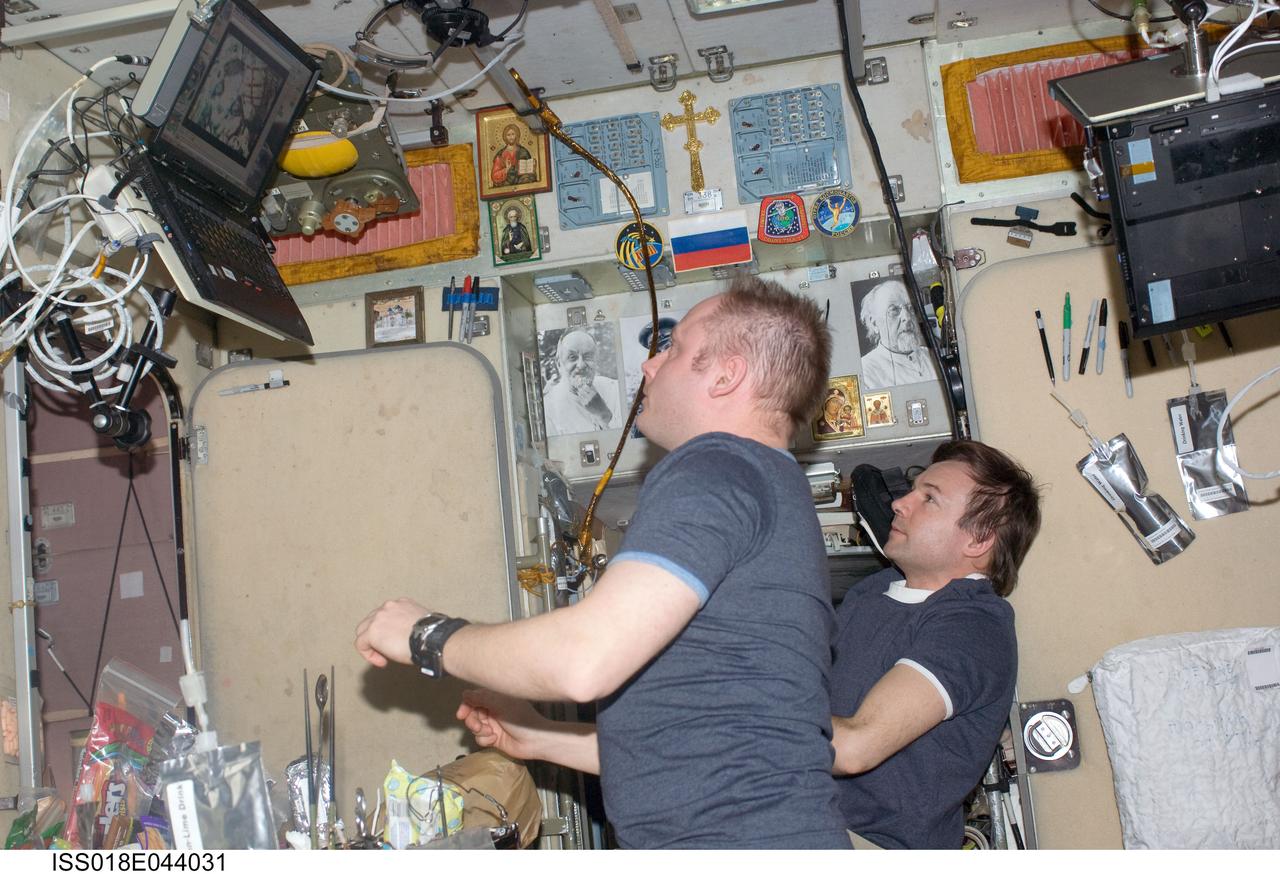
ISS018-E-044031 (26 March 2009) --- NASA astronaut Michael Fincke (foreground), Expedition 18 commander; and cosmonaut Yury Lonchakov, flight engineer, watch a computer monitor in the Zvezda Service Module of the International Space Station showing the Expedition 19 crew and spaceflight participant.
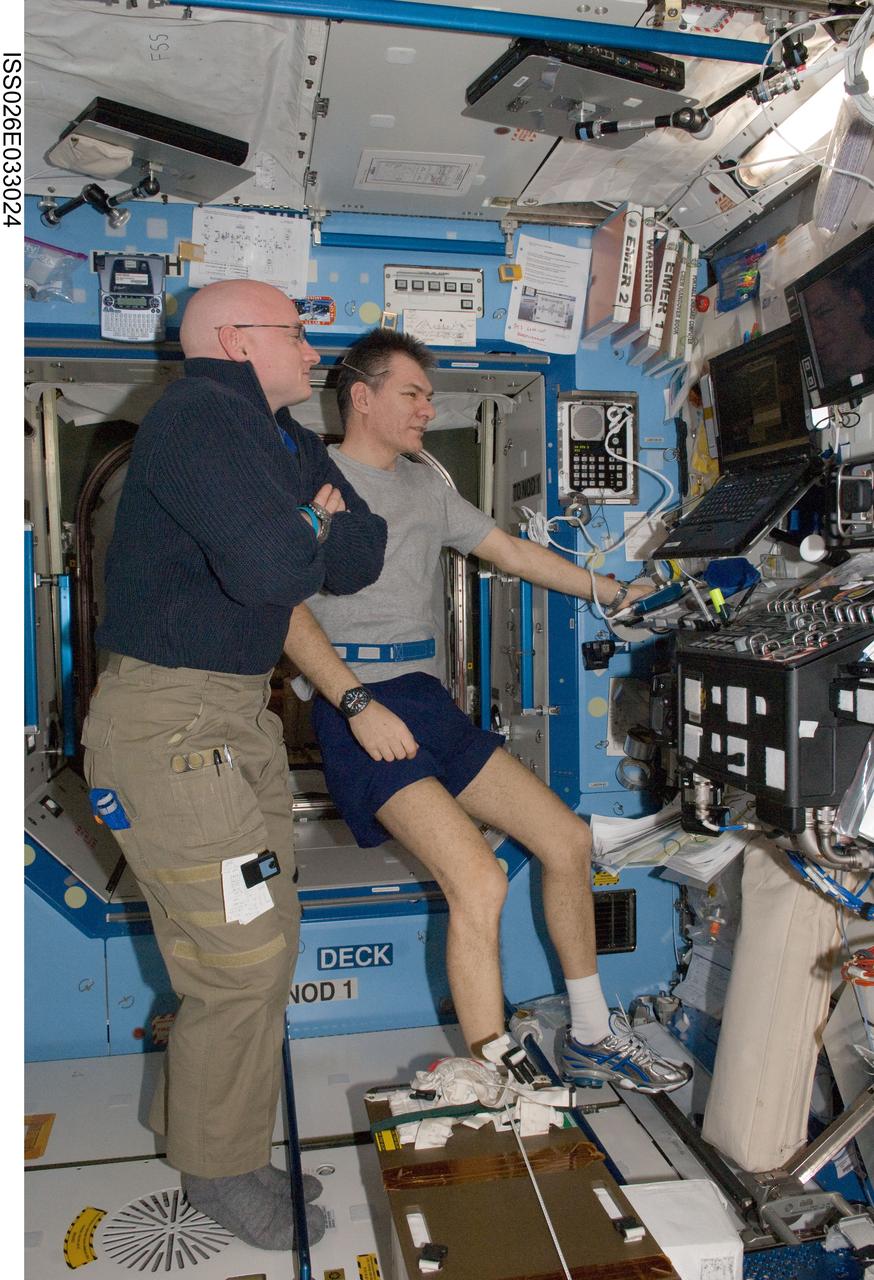
ISS026-E-033024 (9 March 2011) --- NASA astronaut Scott Kelly (foreground), Expedition 26 commander; and European Space Agency astronaut Paolo Nespoli, flight engineer, watch the landing of space shuttle Discovery (STS-133) on a computer monitor in the Destiny laboratory of the International Space Station.
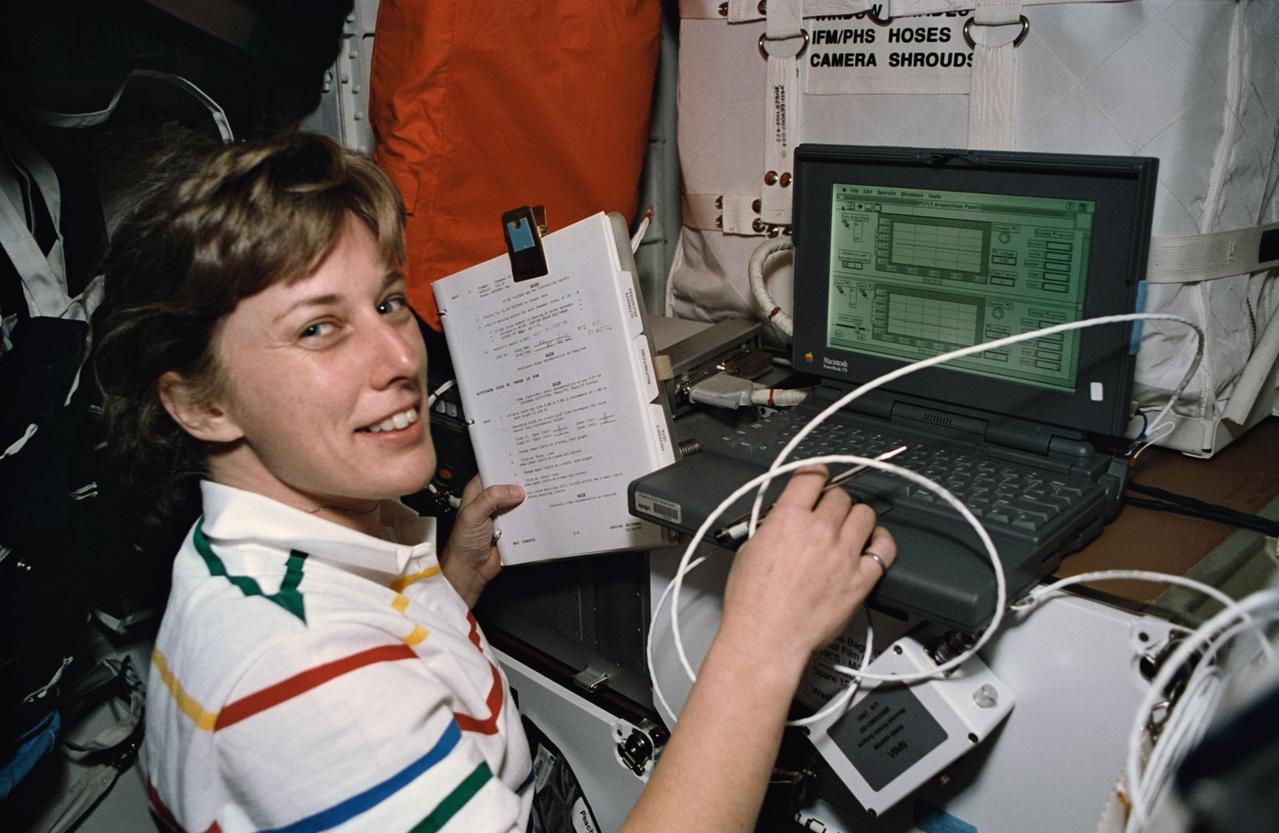
STS060-21-031 (3-11 Feb 1994) --- Using a lap top computer, astronaut N. Jan Davis monitors systems for the Commercial Protein Crystal Growth (CPCG) experiment onboard the Space Shuttle Discovery. Davis joined four other NASA astronauts and a Russian cosmonaut for eight days in space aboard Discovery.
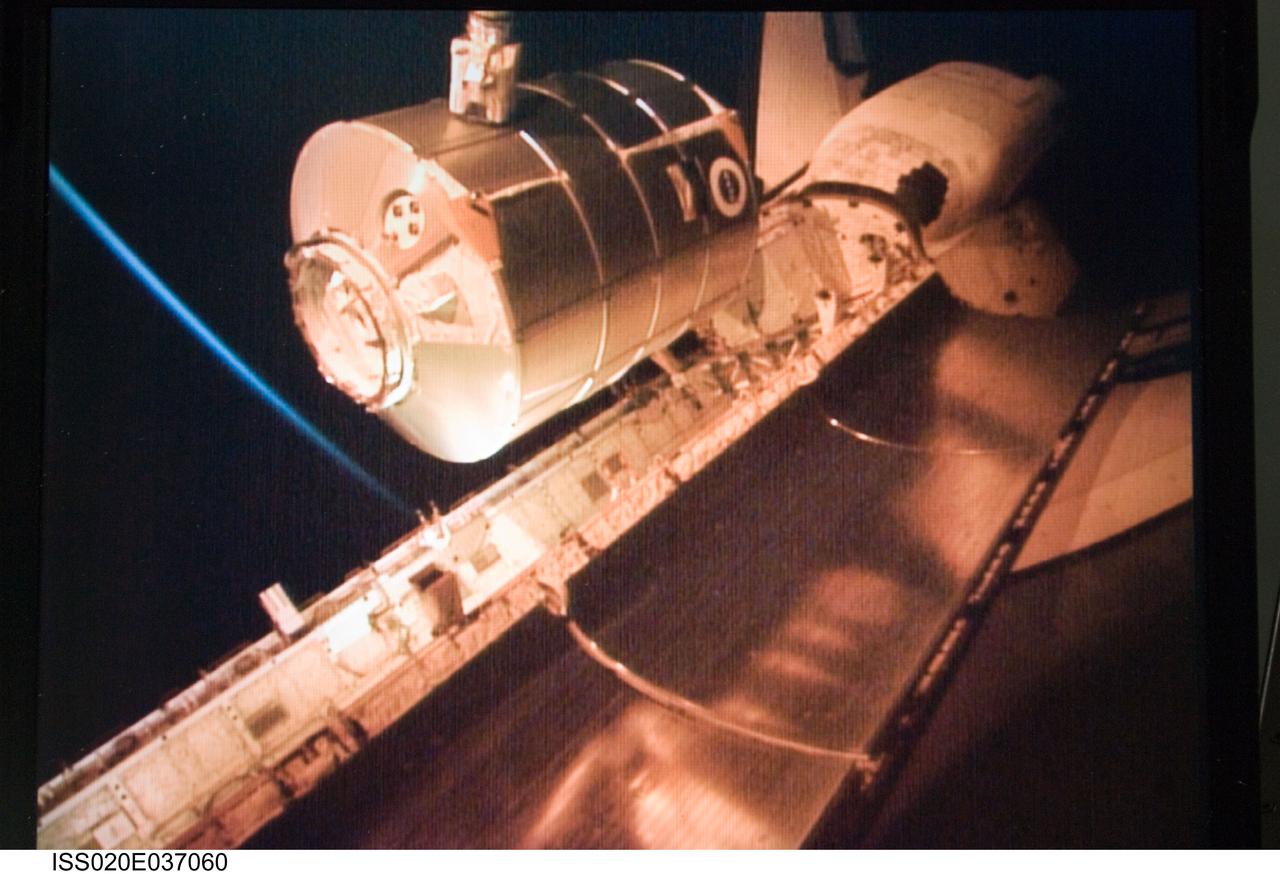
ISS020-E-037060 (31 Aug. 2009) --- Viewed from a computer monitor, the International Space Station’s robotic Canadarm2 unberths the Leonardo Multi-Purpose Logistics Module from Space Shuttle Discovery’s (STS-128) cargo bay for installation on the nadir port of the station’s Harmony node.
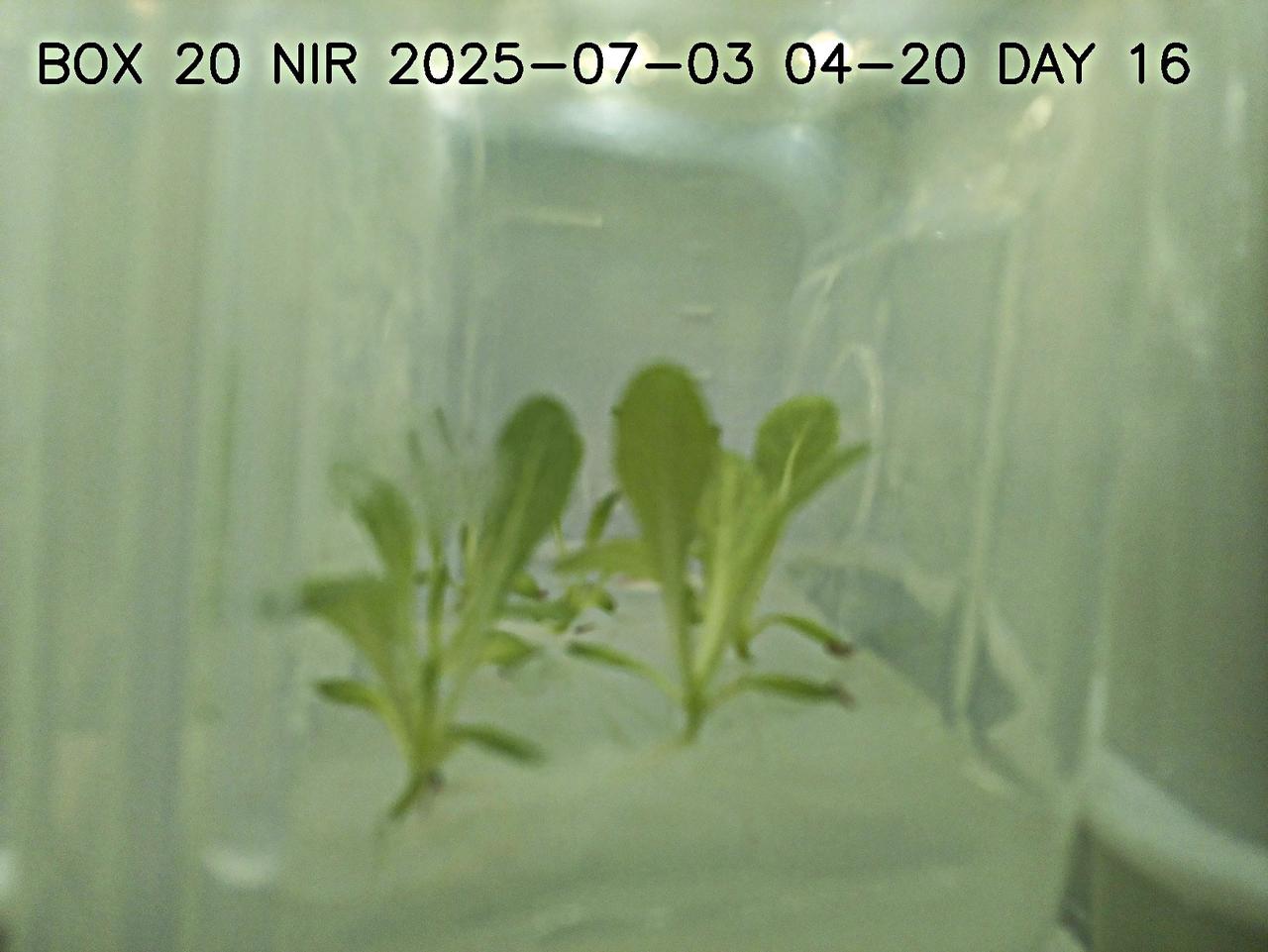
Example color image of lettuce plants growing in a plant chamber during preflight testing as part of Project Rapunzel. The image is captured using the same camera and lighting configuration as the spaceflight investigation. Project Rapunzel tests a special plant chamber and uses computer vision to monitor plant health. Investigation findings may inform ways to automatically monitor plant health and reduce plant stress during long-duration space missions. Credit. UniSQ
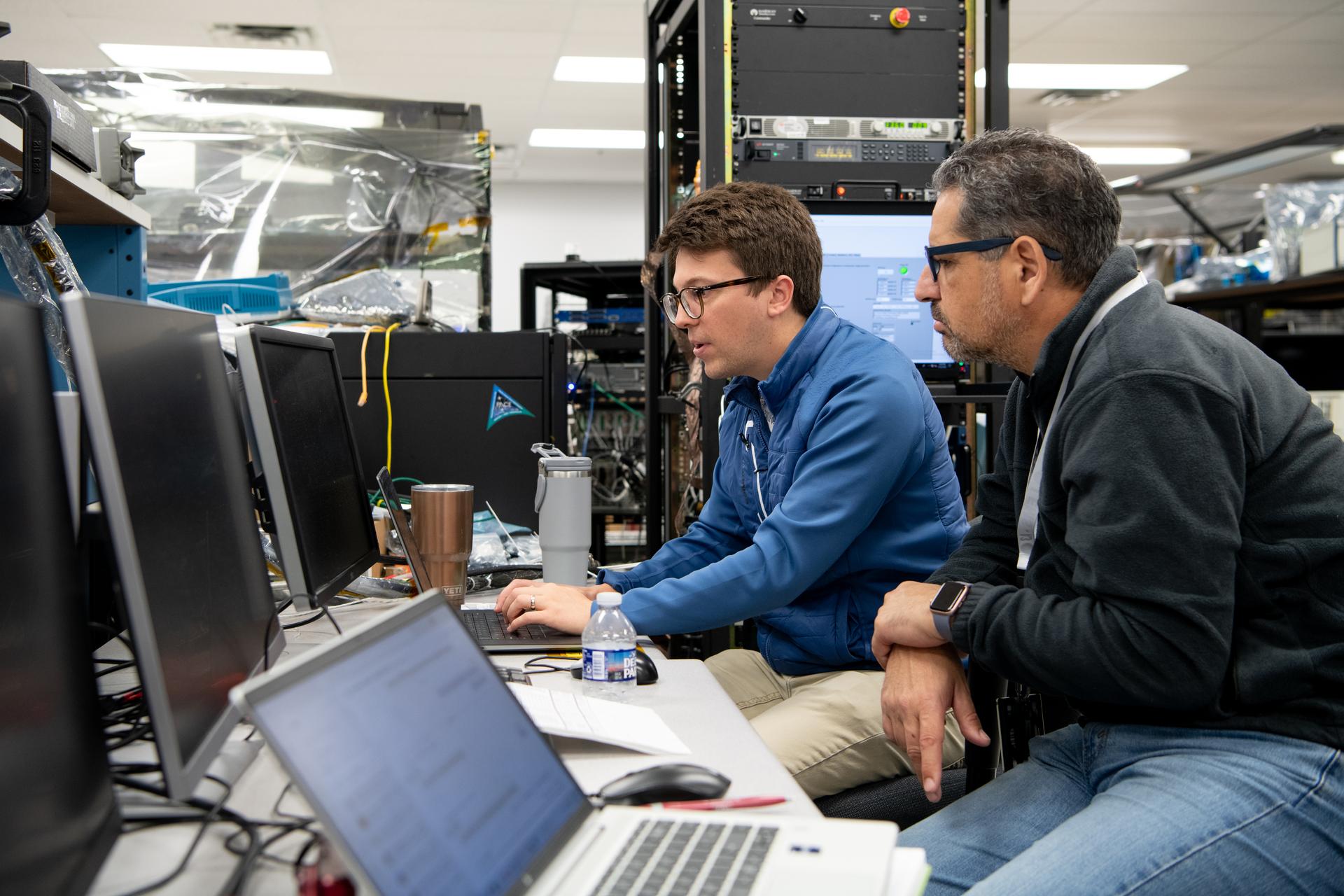
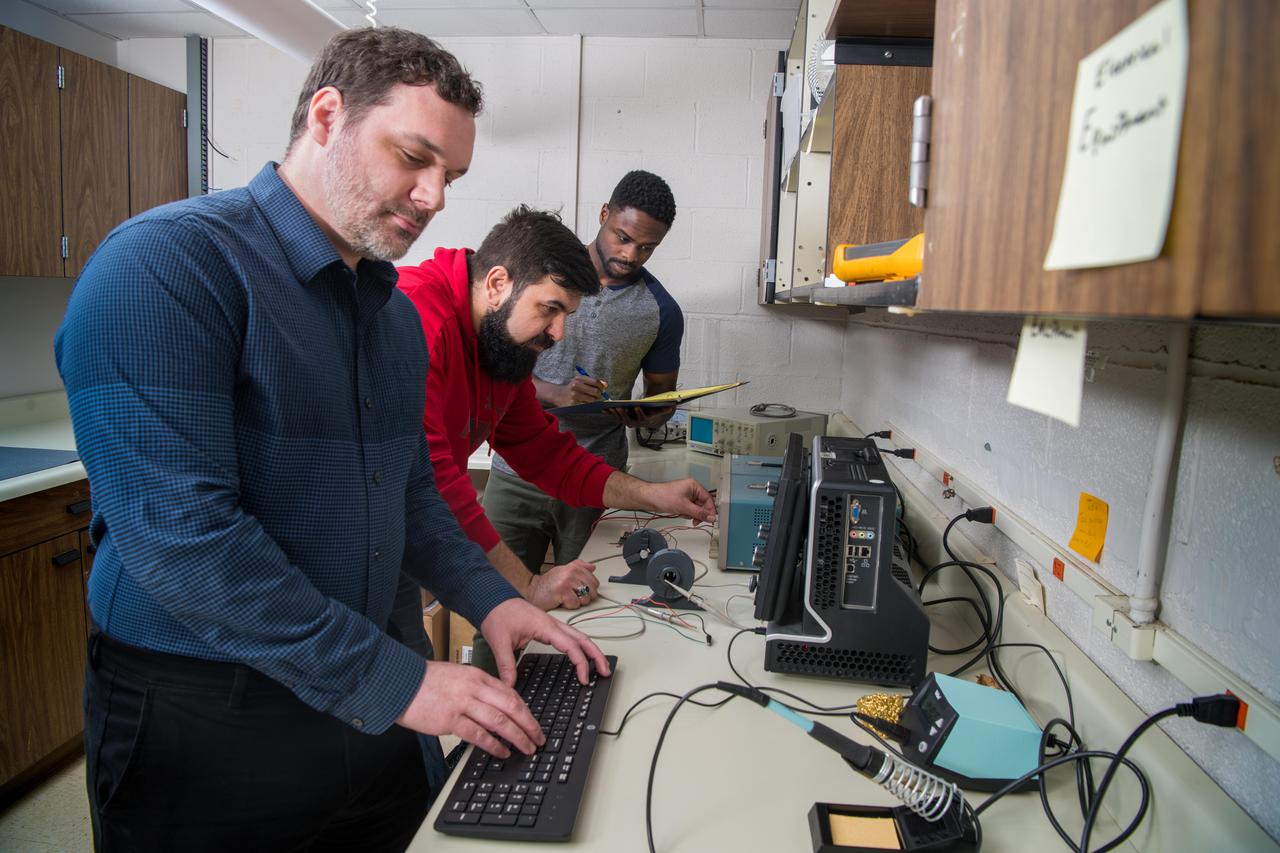
Lunar Environment Monitoring Station (LEMS) team members Computer Engineer James Olsen & Principle Investigator Dr. Medhi Benna perform electrical test procedures in the avoinics lab at at Goddard Space Flight Center in Greenbelt, Maryland. LEMS is a compact, autonomous, and self-sustaining seismometer suite designed to carry out continuous, long-term, monitoring of the lunar seismic environment at the South Polar region.NASA/Desiree Stover.
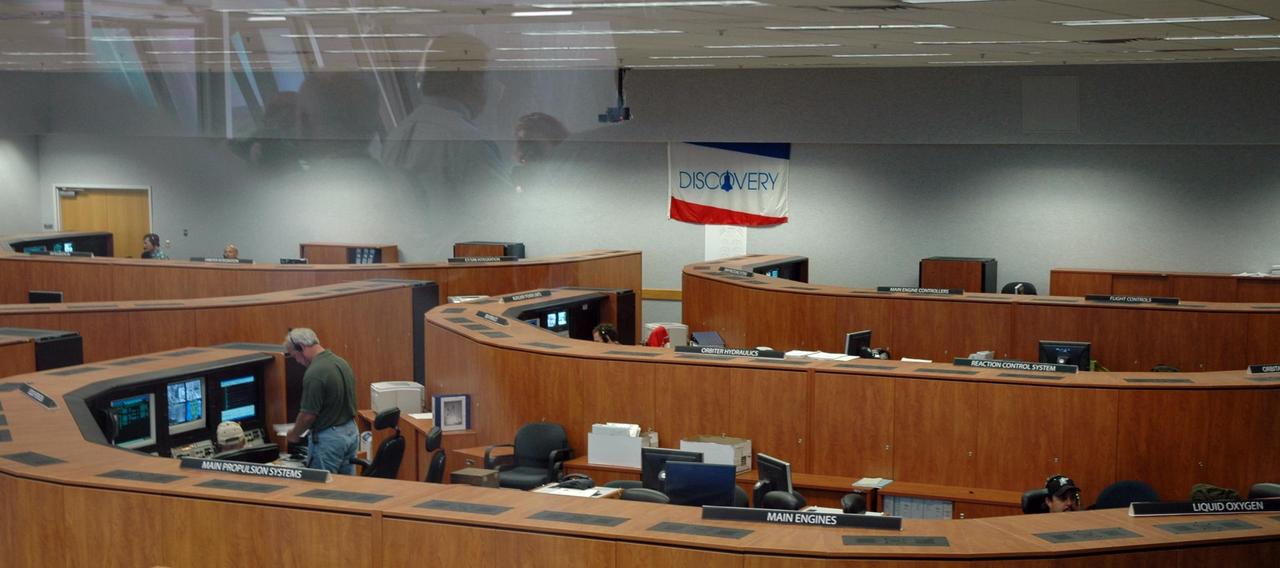
KENNEDY SPACE CENTER, FLA. - An overview of the new Firing Room 4 shows the expanse of computer stations and the various operations the facility will be able to manage. FR4 is now designated the primary firing room for all remaining shuttle launches, and will also be used daily to manage operations in the Orbiter Processing Facilities and for integrated processing for the shuttle. The firing room now includes sound-suppressing walls and floors, new humidity control, fire-suppression systems and consoles, support tables with computer stations, communication systems and laptop computer ports. FR 4 also has power and computer network connections and a newly improved Checkout, Control and Monitor Subsystem. The renovation is part of the Launch Processing System Extended Survivability Project that began in 2003. United Space Alliance's Launch Processing System directorate managed the FR 4 project for NASA. Photo credit: NASA/Dimitri Gerondidakis
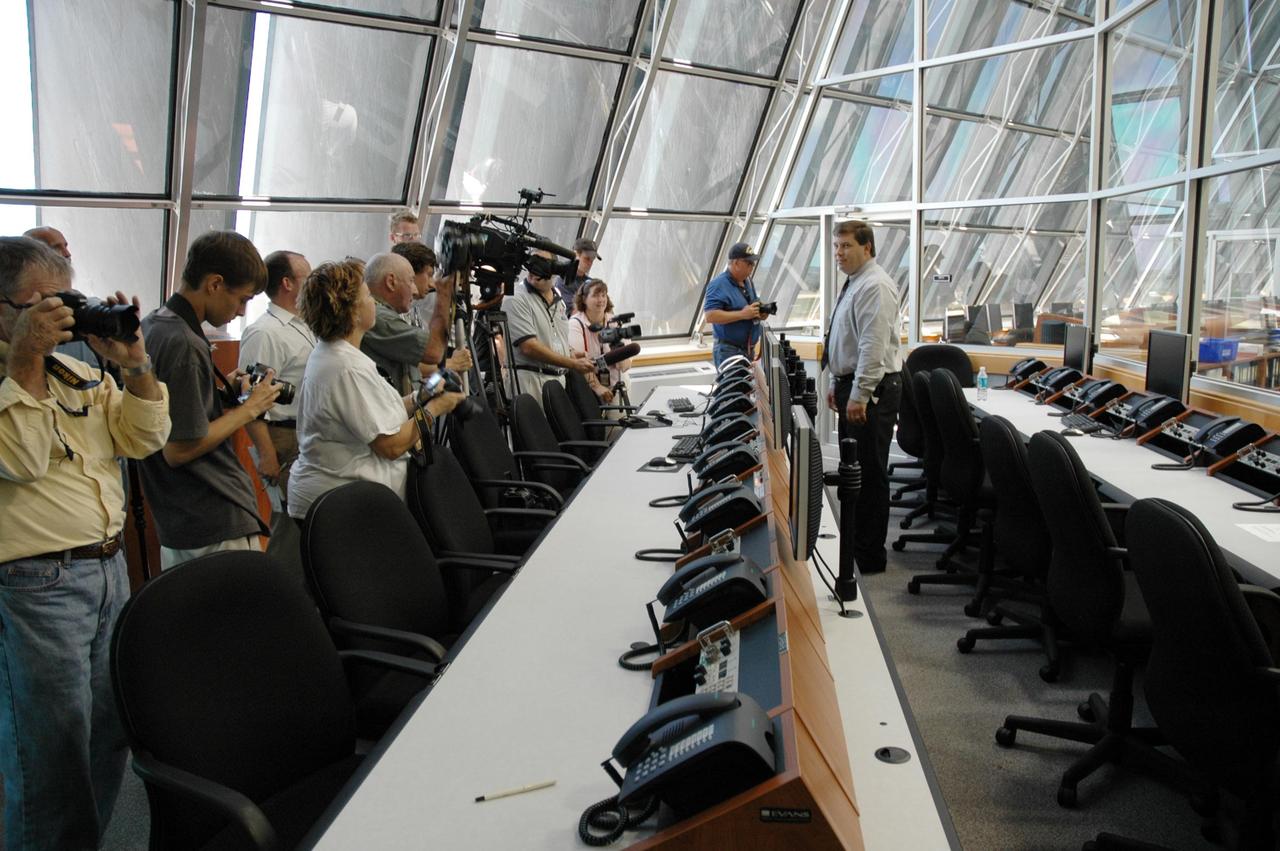
KENNEDY SPACE CENTER, FLA. - Ted Mosteller (right), NASA test director, briefs the media about Firing Room 4 (FR4), which has been undergoing renovations for two years. FR4 is now designated the primary firing room for all remaining shuttle launches, and will also be used daily to manage operations in the Orbiter Processing Facilities and for integrated processing for the shuttle. The firing room now includes sound-suppressing walls and floors, new humidity control, fire-suppression systems and consoles, support tables with computer stations, communication systems and laptop computer ports. FR 4 also has power and computer network connections and a newly improved Checkout, Control and Monitor Subsystem. The renovation is part of the Launch Processing System Extended Survivability Project that began in 2003. United Space Alliance's Launch Processing System directorate managed the FR 4 project for NASA. Photo credit: NASA/Dimitri Gerondidakis
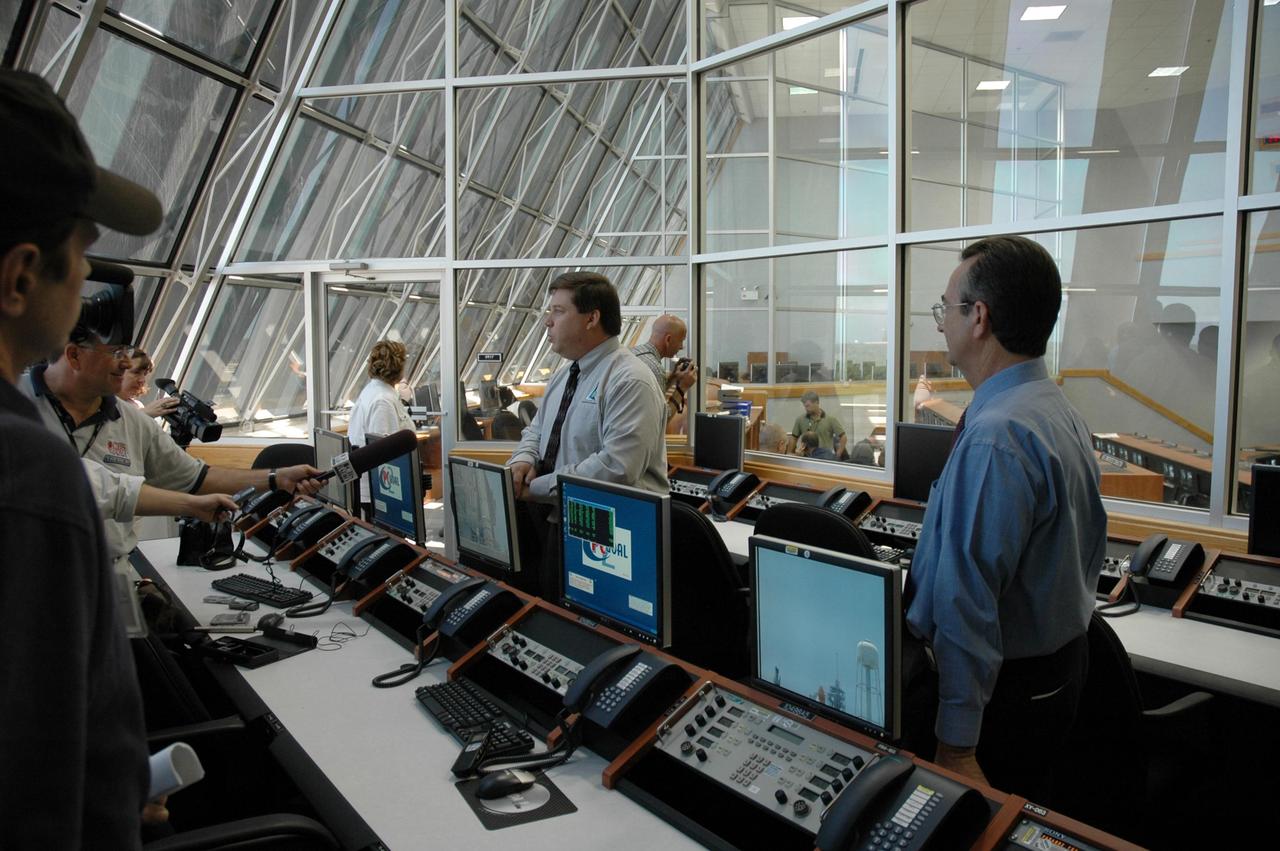
KENNEDY SPACE CENTER, FLA. - NASA Test Director Ted Mosteller (center) briefs the media about Firing Room 4 (FR4), which has been undergoing renovations for two years. FR4 is now designated the primary firing room for all remaining shuttle launches, and will also be used daily to manage operations in the Orbiter Processing Facilities and for integrated processing for the shuttle. The firing room now includes sound-suppressing walls and floors, new humidity control, fire-suppression systems and consoles, support tables with computer stations, communication systems and laptop computer ports. FR 4 also has power and computer network connections and a newly improved Checkout, Control and Monitor Subsystem. The renovation is part of the Launch Processing System Extended Survivability Project that began in 2003. United Space Alliance's Launch Processing System directorate managed the FR 4 project for NASA. Photo credit: NASA/Dimitri Gerondidakis
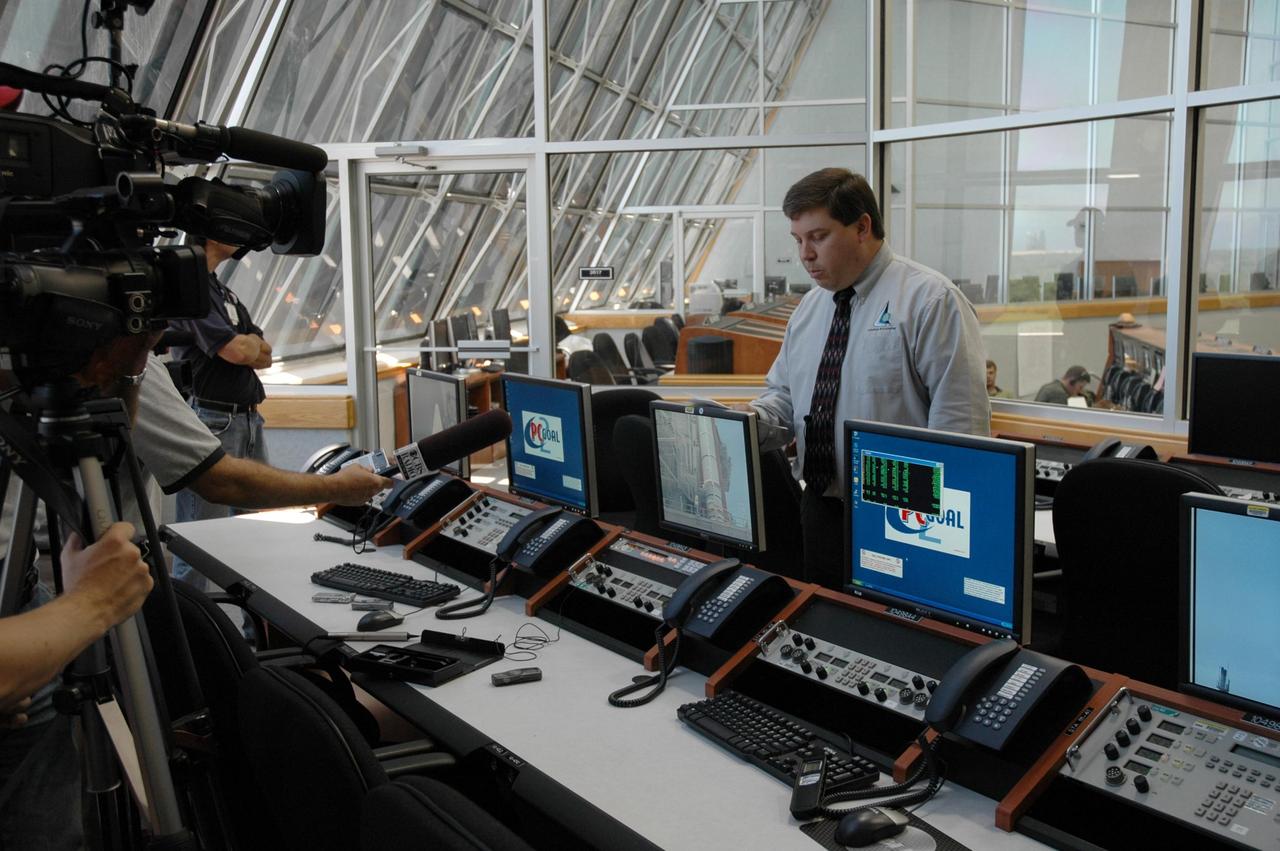
KENNEDY SPACE CENTER, FLA. - NASA Test Director Ted Mosteller (right) briefs the media about Firing Room 4 (FR4), which has been undergoing renovations for two years. FR4 is now designated the primary firing room for all remaining shuttle launches, and will also be used daily to manage operations in the Orbiter Processing Facilities and for integrated processing for the shuttle. The firing room now includes sound-suppressing walls and floors, new humidity control, fire-suppression systems and consoles, support tables with computer stations, communication systems and laptop computer ports. FR 4 also has power and computer network connections and a newly improved Checkout, Control and Monitor Subsystem. The renovation is part of the Launch Processing System Extended Survivability Project that began in 2003. United Space Alliance's Launch Processing System directorate managed the FR 4 project for NASA. Photo credit: NASA/Dimitri Gerondidakis
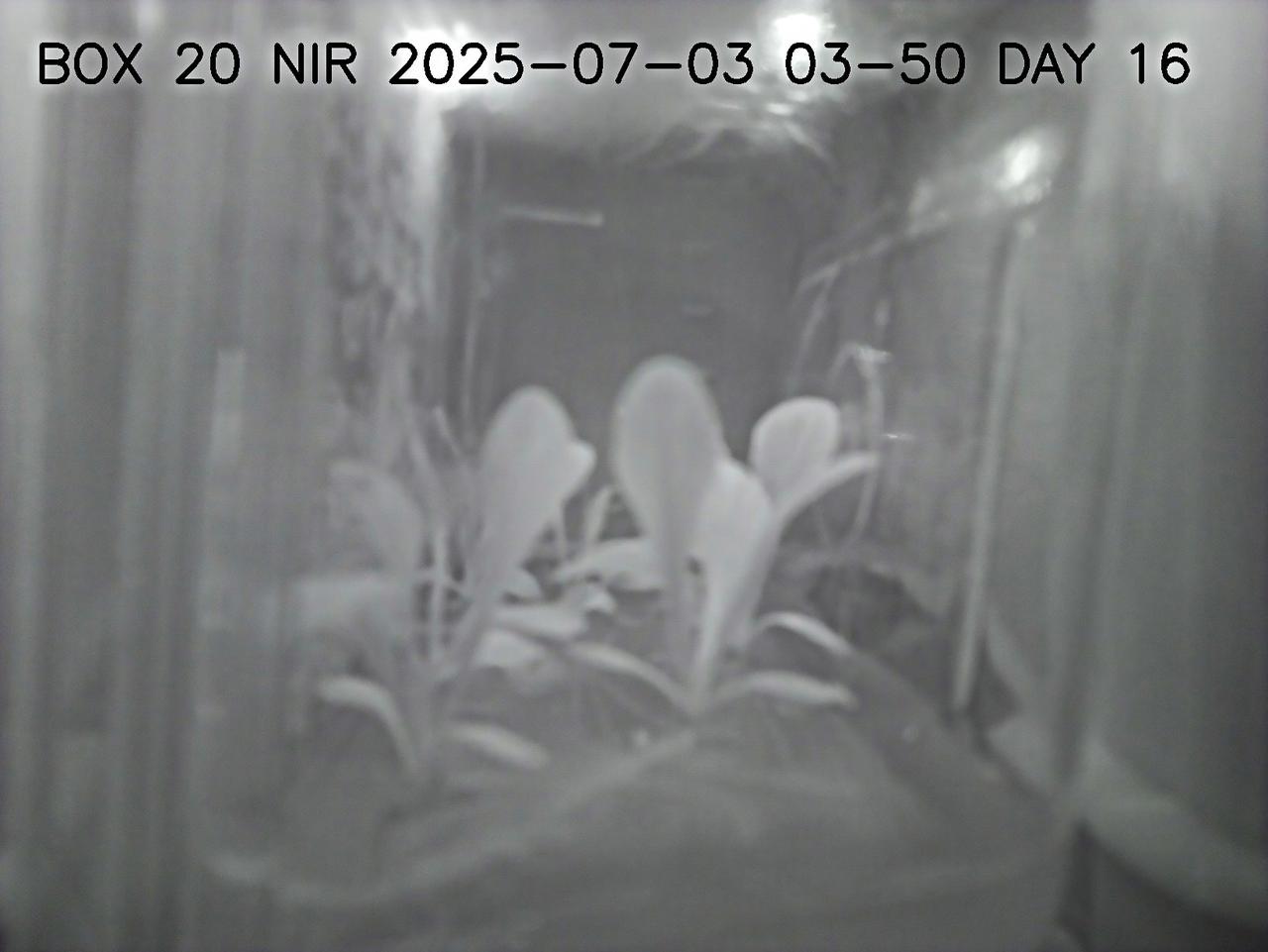
This image shows lettuce plants growing in a plant chamber during the preflight testing of Project Rapunzel. The image is captured using near infrared lights rather than white lights. Near infrared light allows plants to be observed during night hours without activating photosynthesis. Project Rapunzel aims to test a special plant chamber and uses computer vision to monitor plant health. Investigation findings may inform ways to automatically monitor plant health and reduce plant stress during long-duration space missions. Credit. UniSQ
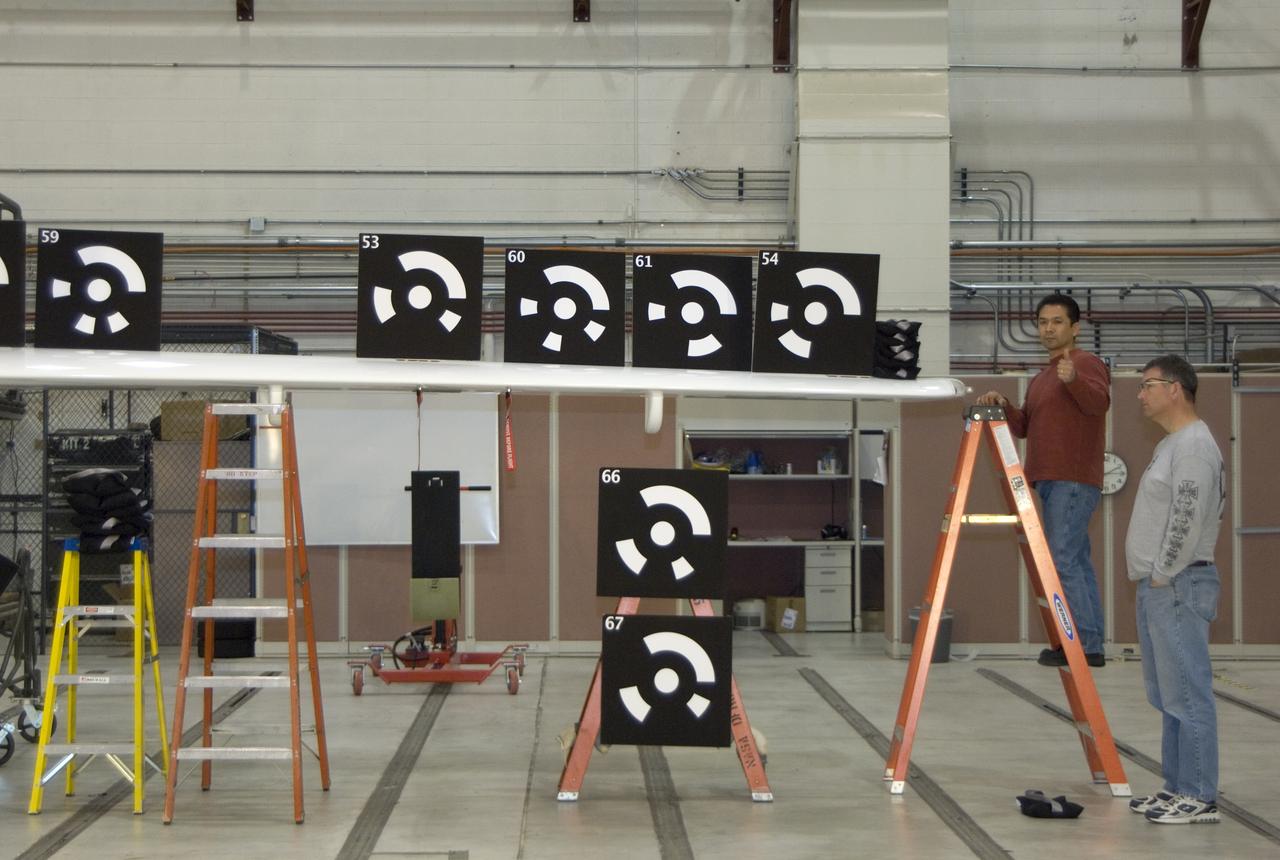
NASA engineer Larry Hudson and Ikhana ground crew member James Smith work on a ground validation test with new fiber optic sensors that led to validation flights on the Ikhana aircraft. NASA Dryden Flight Research Center is evaluating an advanced fiber optic-based sensing technology installed on the wings of NASA's Ikhana aircraft. The fiber optic system measures and displays the shape of the aircraft's wings in flight. There are other potential safety applications for the technology, such as vehicle structural health monitoring. If an aircraft structure can be monitored with sensors and a computer can manipulate flight control surfaces to compensate for stresses on the wings, structural control can be established to prevent situations that might otherwise result in a loss of control.
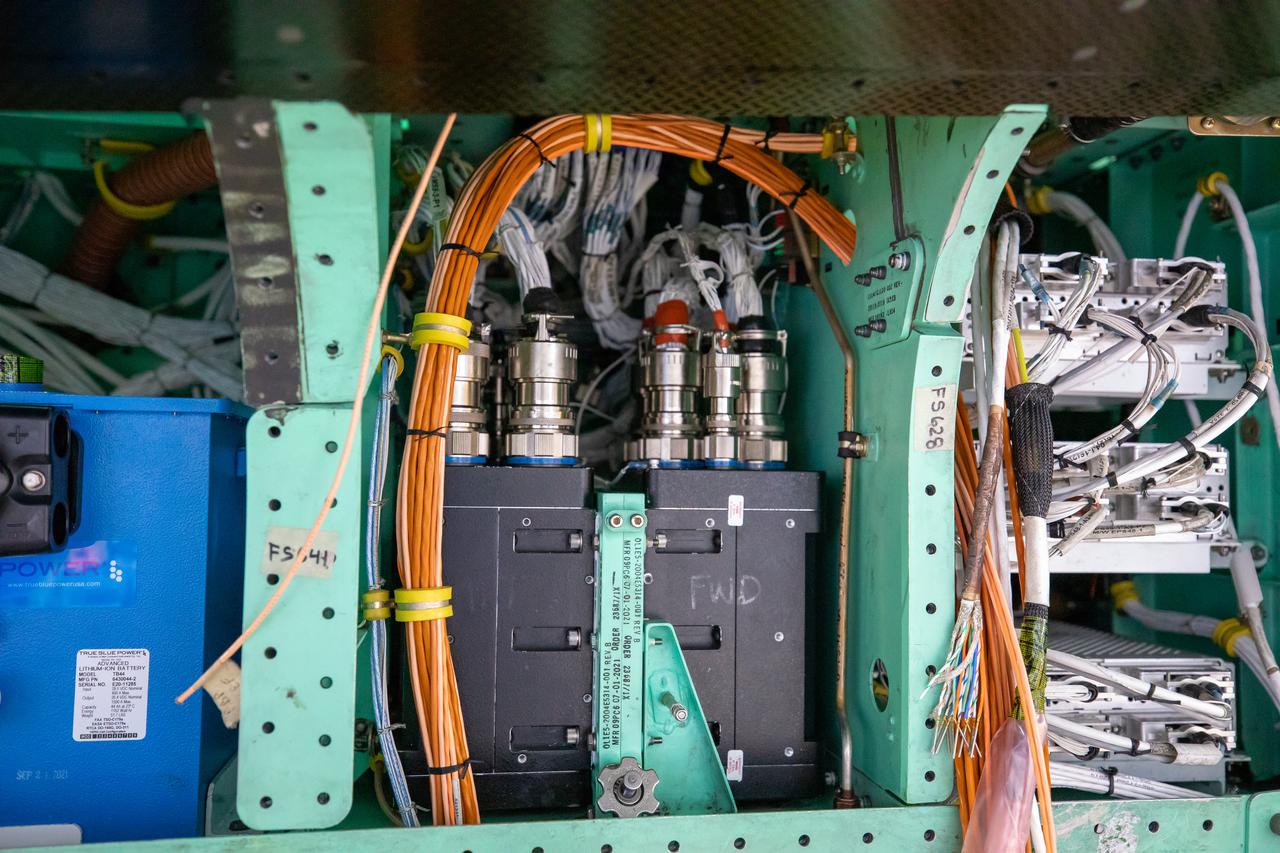
This is a closeup view of the inner workings of the X-59 aircraft. Visible are one the plane’s three lithium-ion batteries (blue box), electrical power system and other wiring components including the vehicle management systems computers (two black boxes) and the white wirings which assist in providing the power that is needed for the aircraft to function in flight. All of these components are essential to maintaining and monitoring the X-59 once it takes to the skies. The X-59 is the centerpiece of the Quesst mission which plans to help enable commercial supersonic air travel over land.
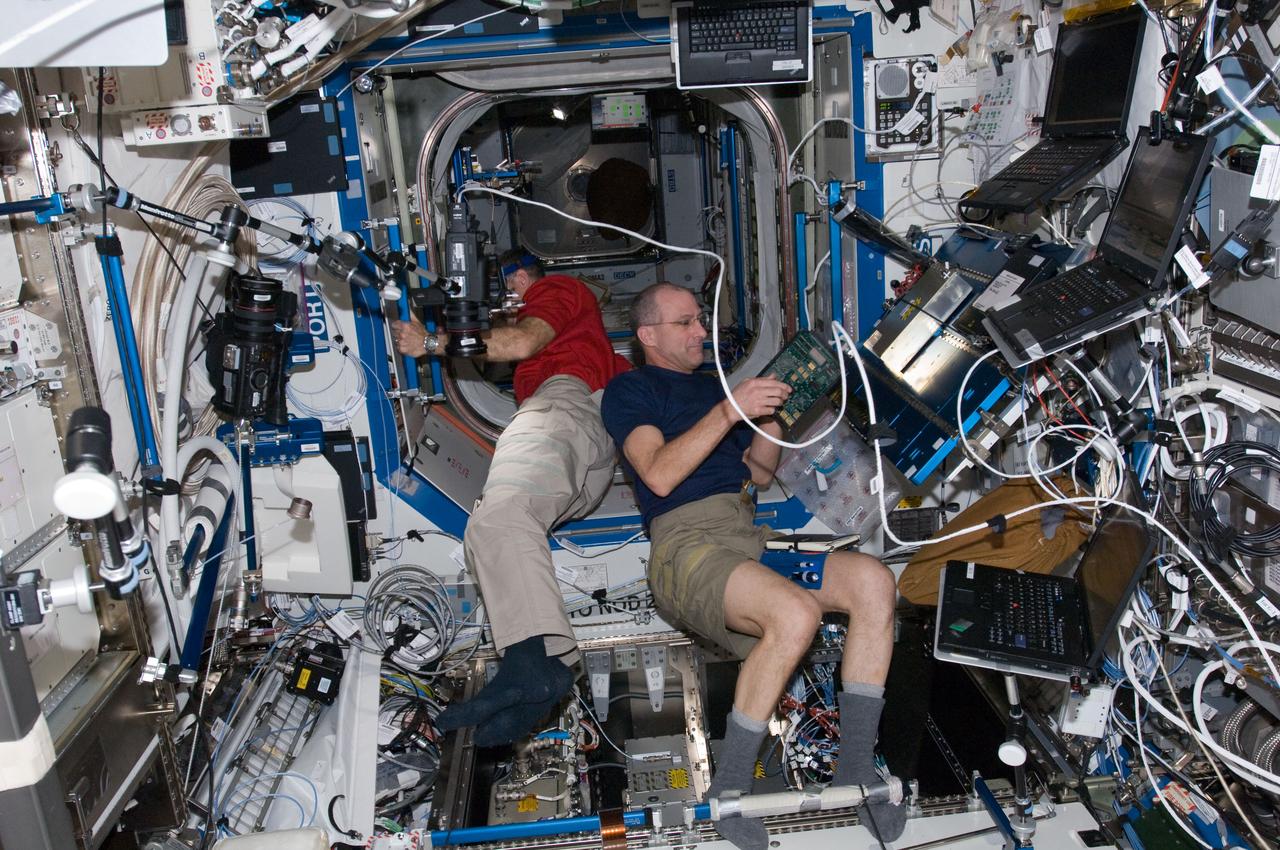
ISS030-E-022574 (28 Dec. 2011) -- NASA astronaut Don Pettit (foreground),Expedition 30 flight engineer, performs the Enhanced Processor and Integrated Communications (EPIC) card testing and X2R10 software transition. The software transition work will include EPIC card testing and card installations, and monitoring of the upgraded Multiplexer/ Demultiplexer (MDM) computers. Dan Burbank, Expedition 30 commander, is setting up a camcorder in the background.
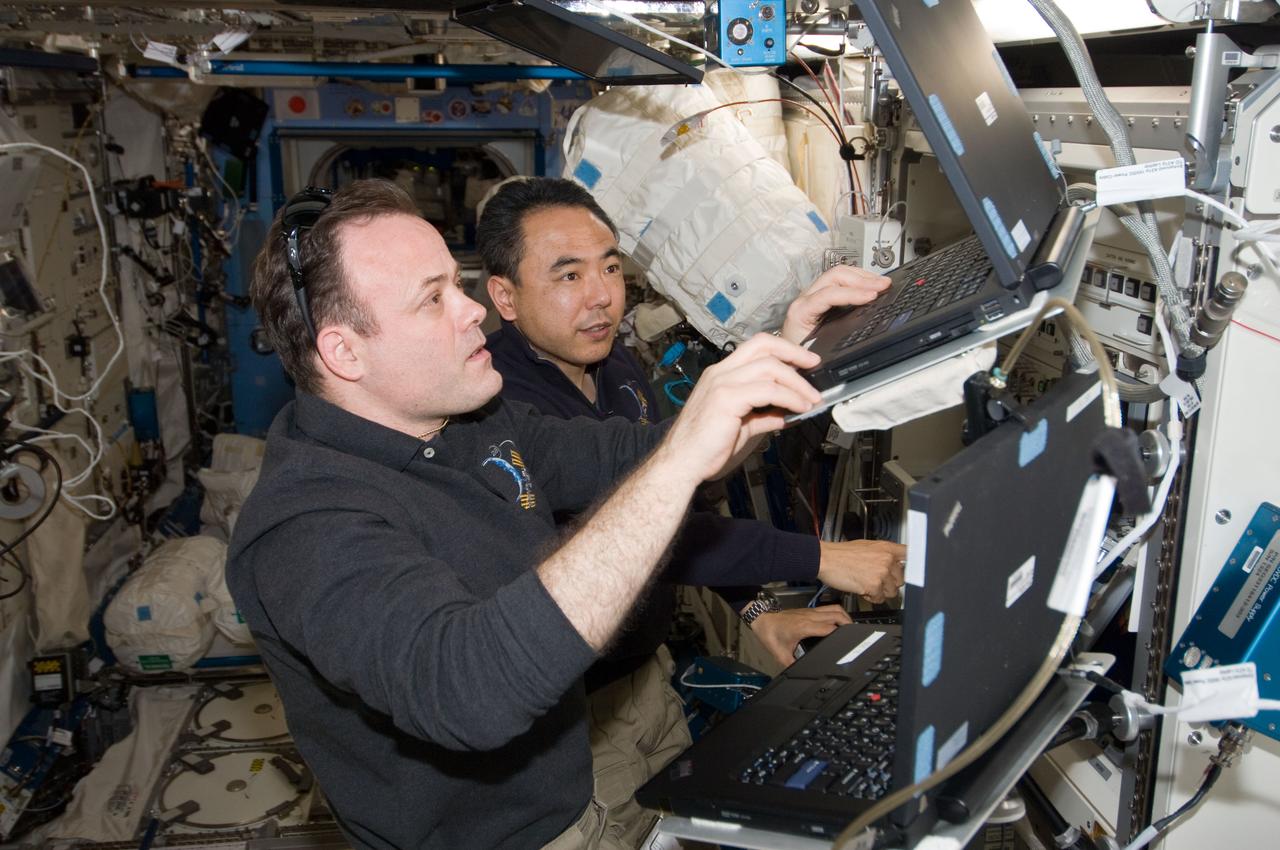
ISS028-E-020303 (2 Aug. 2011) --- NASA astronaut Ron Garan (foreground) and Japan Aerospace Exploration Agency astronaut Satoshi Furukawa, both Expedition 28 flight engineers, use computers in the International Space Station?s Kibo laboratory to monitor the Japanese Experiment Module Remote Manipulator System (JEMRMS) located on the exterior of the station.
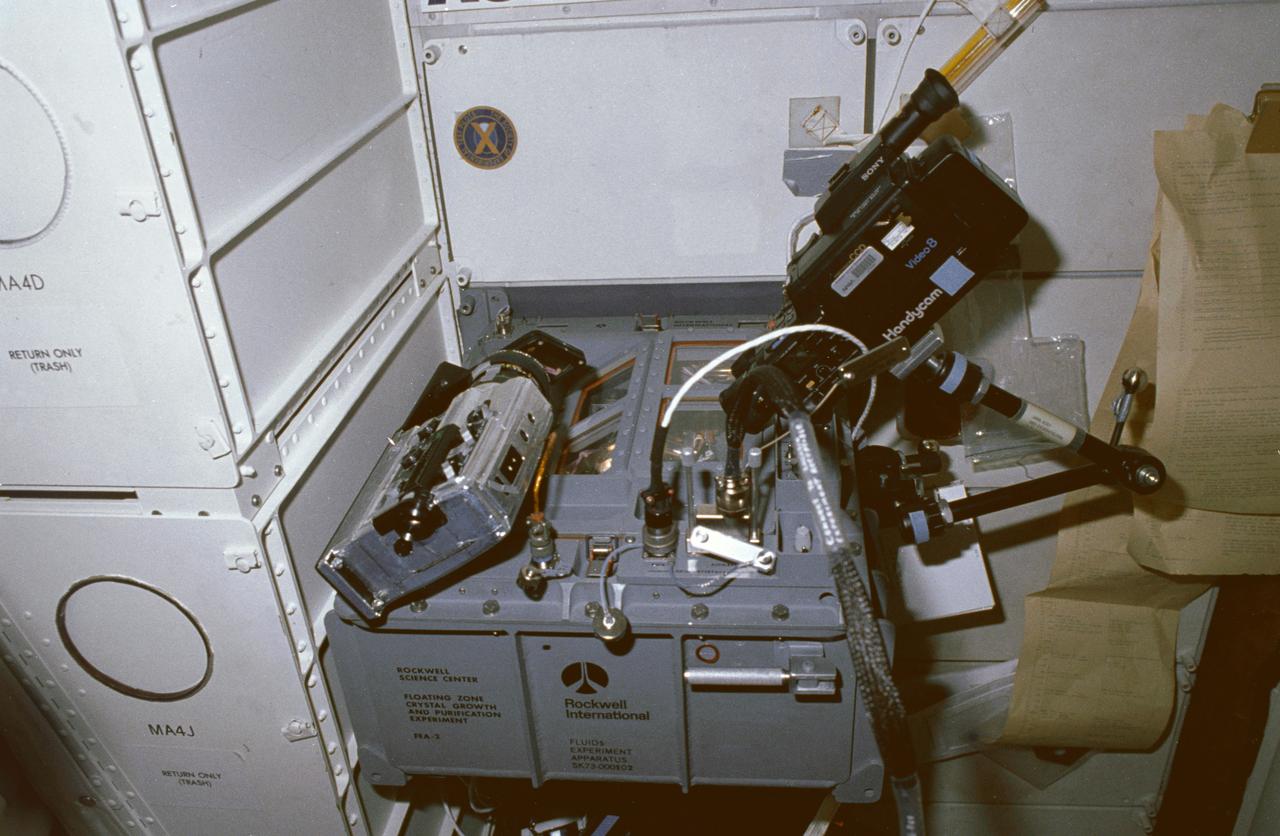
STS030-10-003 (4-8 May 1989) --- An overall scene of the onboard materials science project for STS-30. Seen is the fluids experiment apparatus, supported by an accompanying computer and an 8mm camcorder for its operation. Another major component of the project-- Astronaut Mary L. Cleave, who devoted a great deal of STS-30 monitoring various experiments--is out of frame.
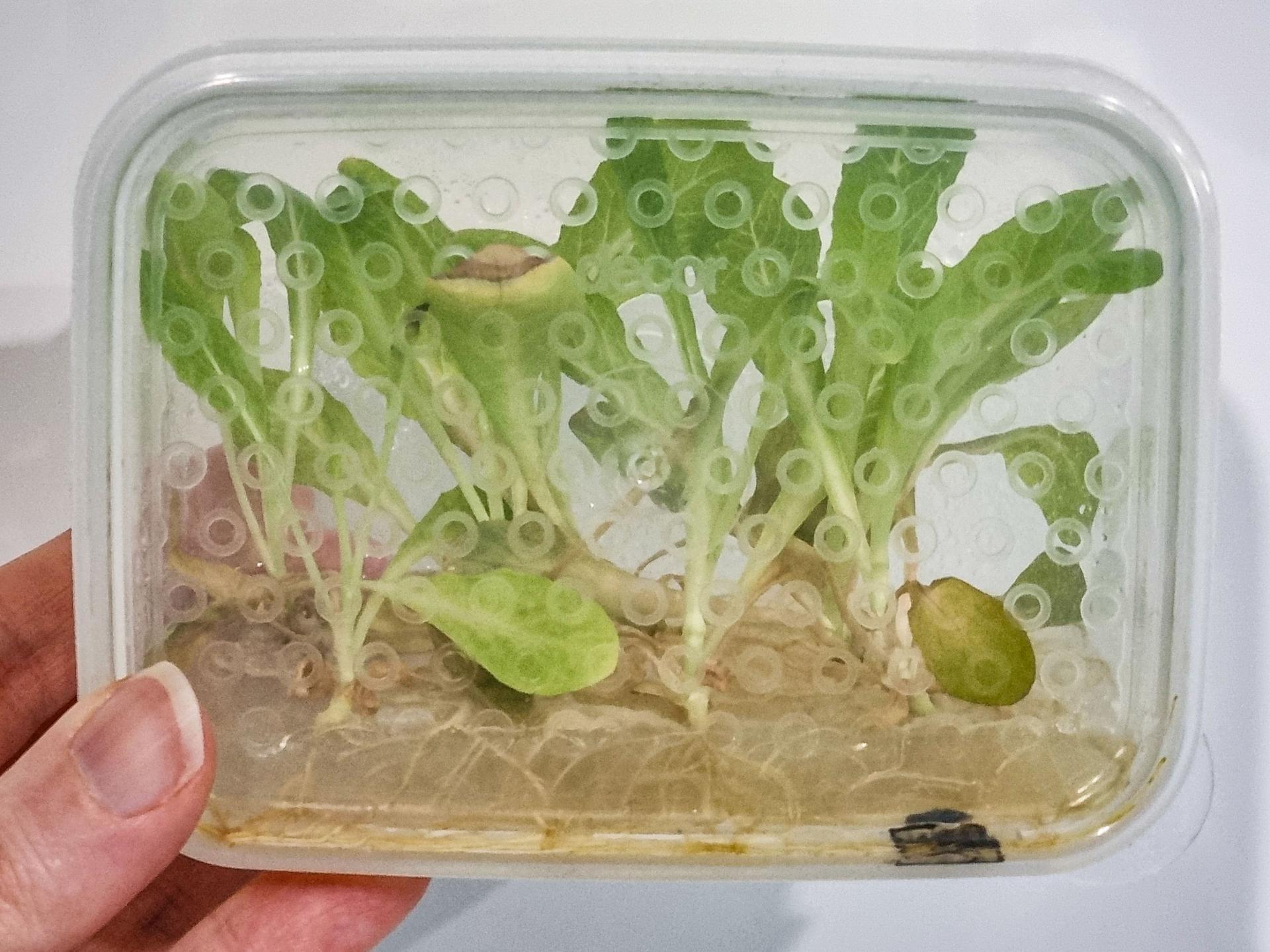
An image of a small polypropylene container that functions as a plant chamber as part of Project Rapunzel. This investigation tests a special plant chamber and uses computer vision to monitor plant health. The chambers are loaded with agar, nutrients, and seeds before launch then seal in a CubeLab containing the lights and camera. This image shows plant growth after four weeks during ground testing, using the same methods as on the mission.
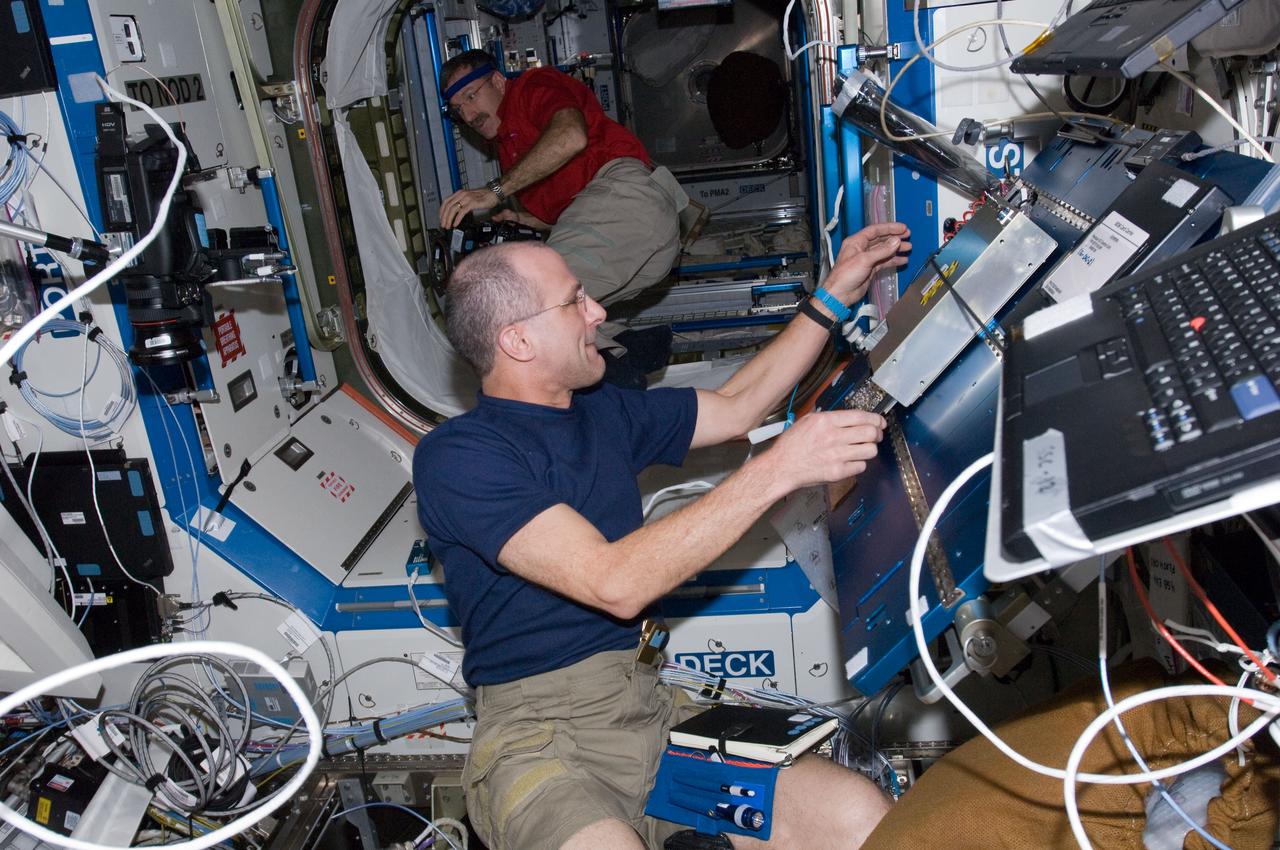
ISS030-E-022575 (28 Dec. 2011) -- NASA astronaut Don Pettit (foreground),Expedition 30 flight engineer, performs the Enhanced Processor and Integrated Communications (EPIC) card testing and X2R10 software transition. The software transition work will include EPIC card testing and card installations, and monitoring of the upgraded Multiplexer/ Demultiplexer (MDM) computers. Dan Burbank, Expedition 30 commander, is setting up a camcorder in the background.
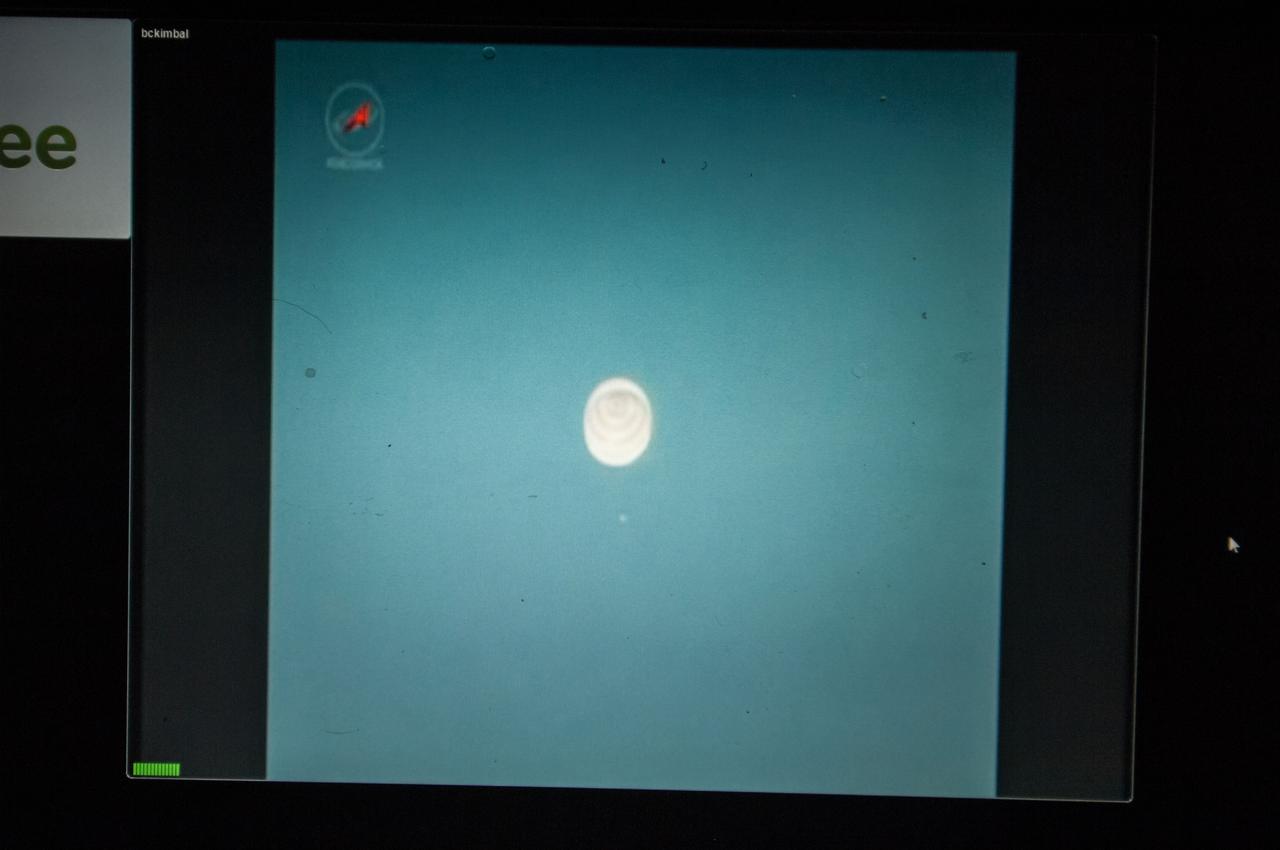
ISS041-E-000003 (11 Sept. 2014) --- A close-up view of a computer monitor onboard the International Space Station, photographed by an Expedition 41 crew member, shows the landing of the Soyuz TMA-12M spacecraft with NASA astronaut Steve Swanson, Expedition 40 commander; Russian cosmonaut Alexander Skvortsov, Soyuz commander and flight engineer; and Russian cosmonaut Oleg Artemyev, flight engineer, onboard.
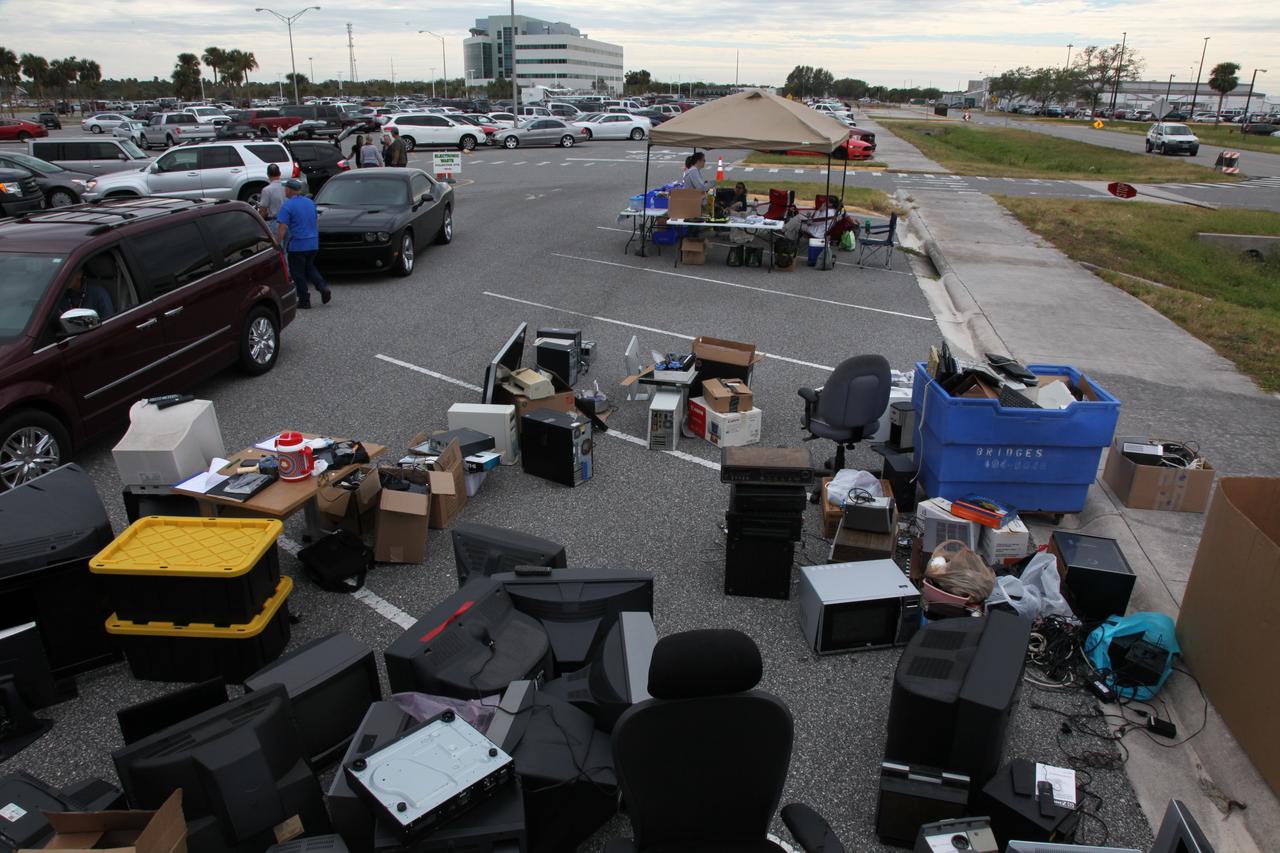
Computers, monitors, vacuum cleaners and other electronics have been donated by employees at NASA's Kennedy Space Center in Florida in conjunction with America Recycles Day. America Recycles Day is a nationally recognized initiative dedicated to promoting recycling in the United States. Kennedy partnered with several organizations in order to donate as many of the items as possible to those who could use them the most in the Space Coast community. Space center personnel brought in electronic waste, gently used household goods, clothing and more.
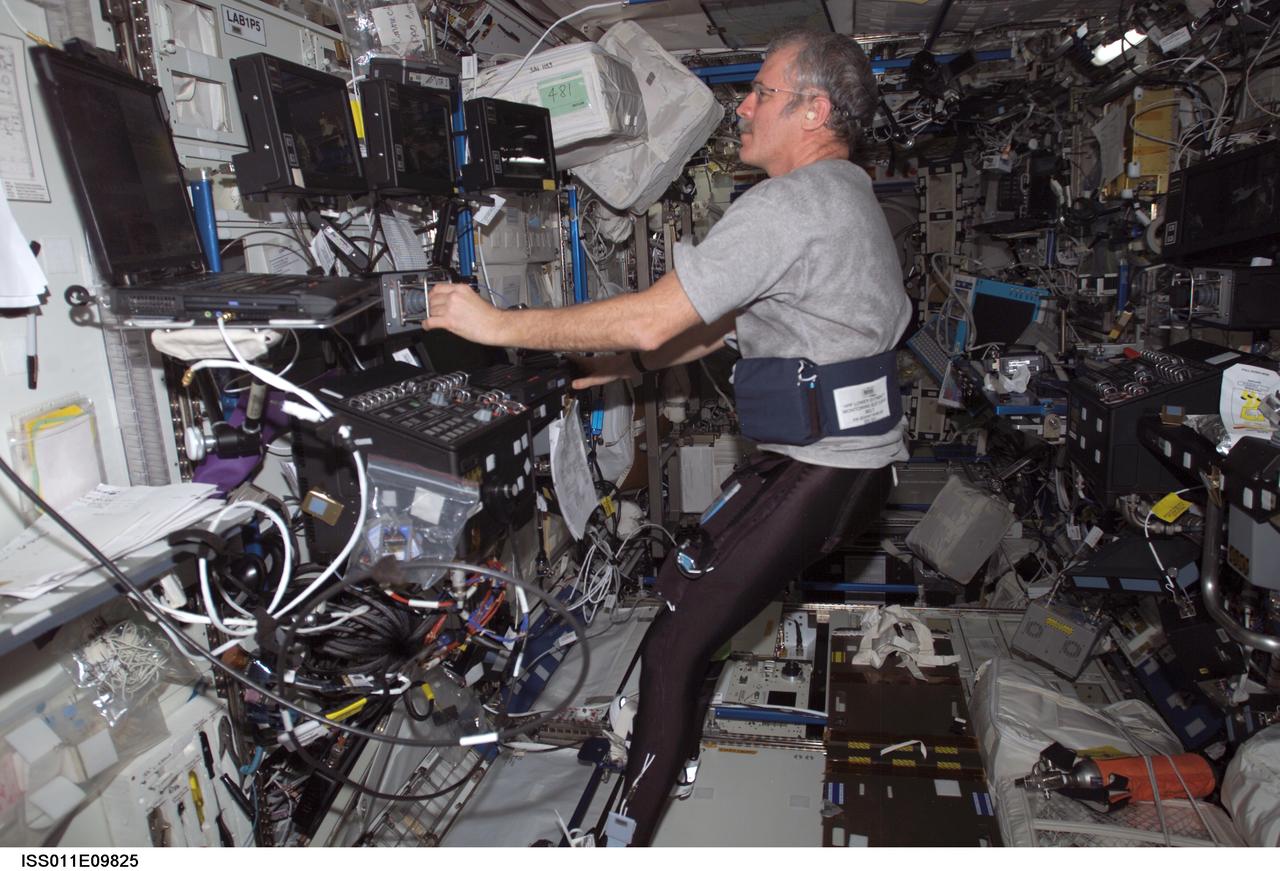
ISS011-E-09825 (29 June 2005) --- Astronaut John L. Phillips, Expedition 11 NASA Space Station science officer and flight engineer, enters data into a computer while participating in the Foot/Ground Reaction Forces During Spaceflight (FOOT) experiment in the Destiny laboratory of the International Space Station. Phillips wore the specially instrumented Lower Extremity Monitoring Suit (LEMS), cycling tights outfitted with sensors, during the experiment.
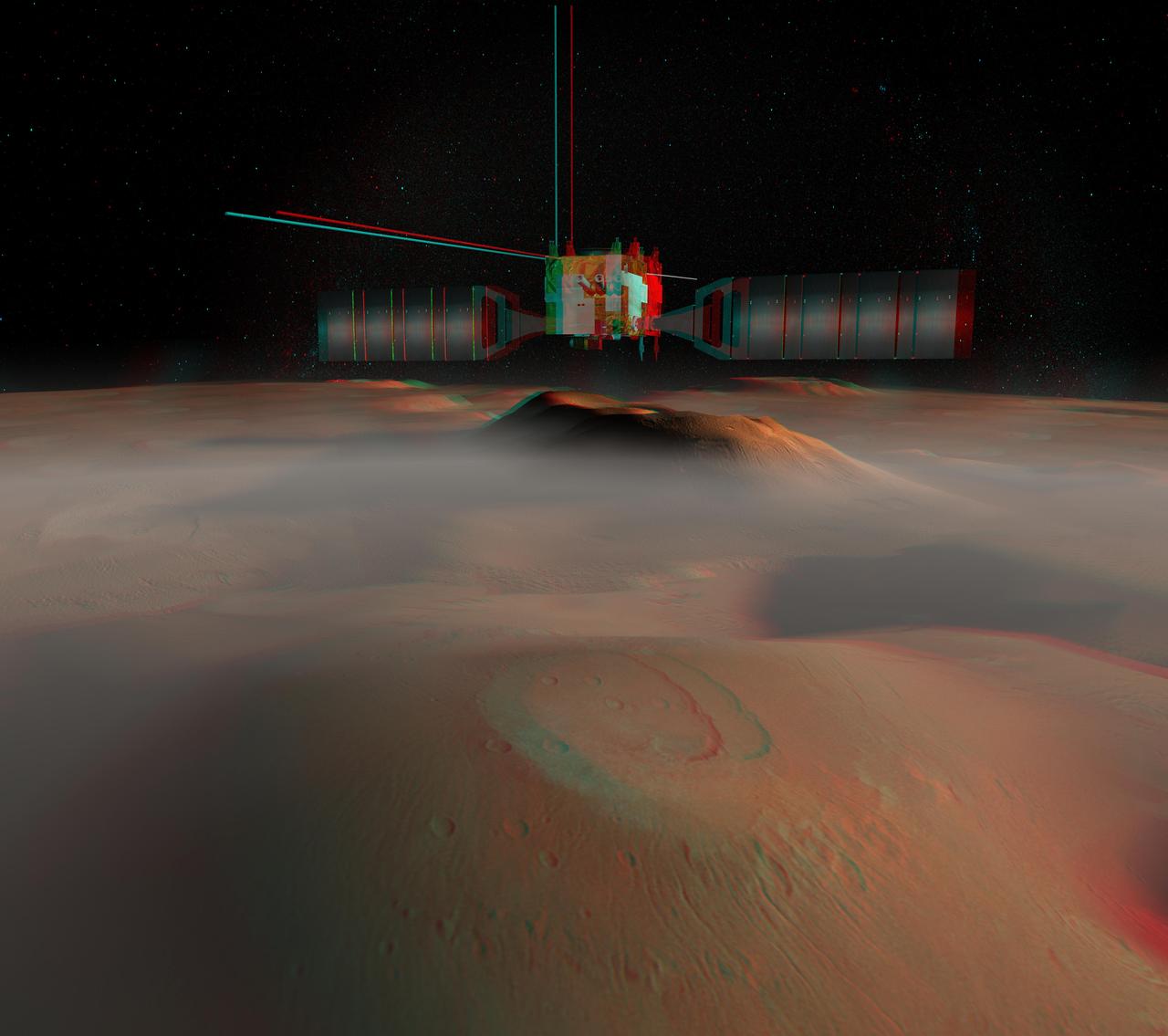
The European Space Agency's Mars Express spacecraft is depicted in orbit around Mars in this artist's concept stereo illustration. The spacecraft was launched June 2, 2003, from Baikonur, Kazakhstan, on a journey to arrive at Mars in December 2003. This red-blue anaglyph artwork can be viewed in 3-D on your computer monitor or in color print form by wearing red-blue (cyan) 3-D glasses. http://photojournal.jpl.nasa.gov/catalog/PIA04803
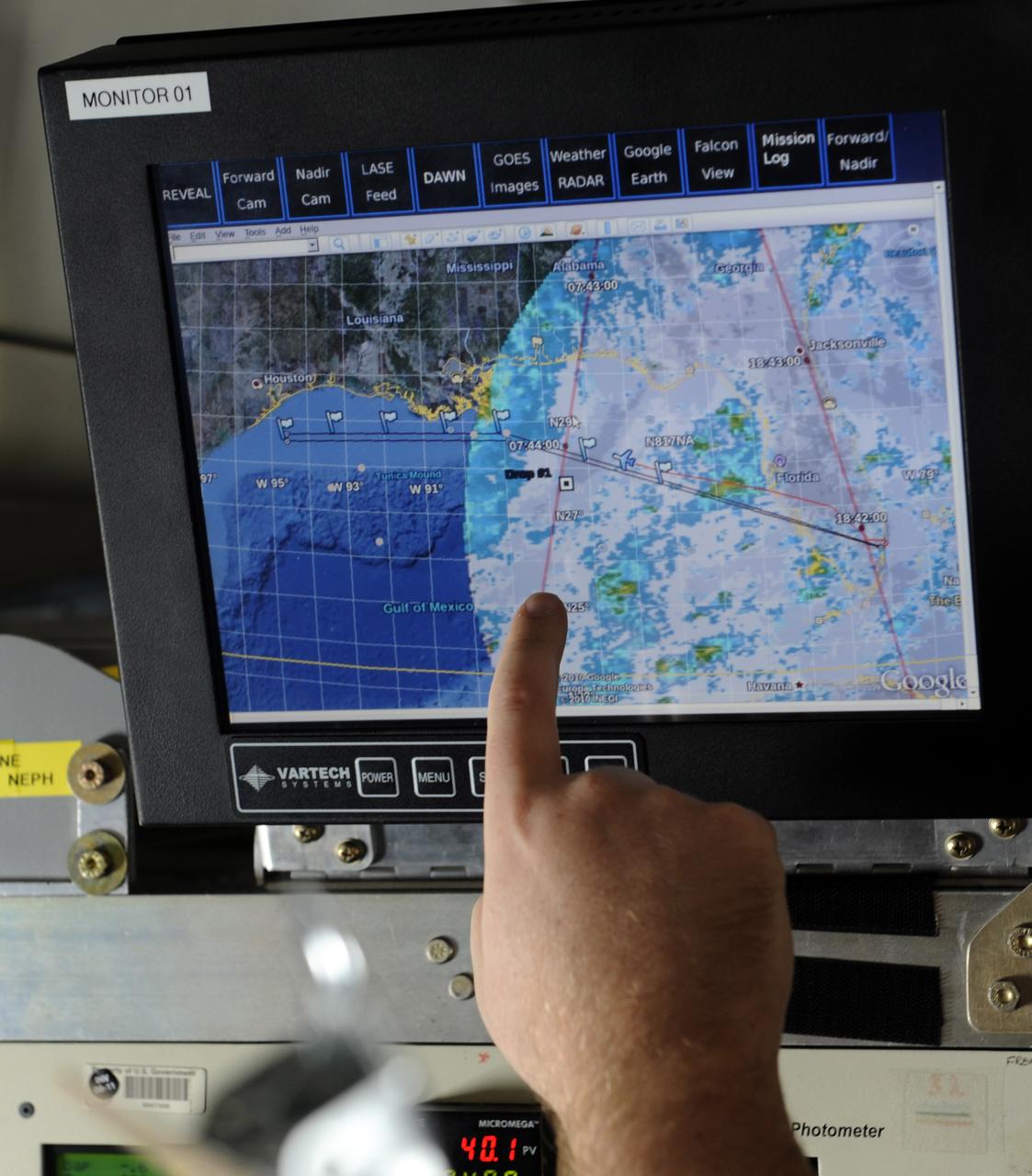
A researcher points out the trajectory of a weather pattern on a computer monitor during a flight aboard the NASA DC-8 aircraft, Tuesday, Aug. 17, 2010, over the Gulf of Mexico. Sceintists and researchers flew Tuesday to study weather as part of the Genesis and Rapid Intensification Processes (GRIP) experiment is a NASA Earth science field experiment in 2010 that is being conducted to better understand how tropical storms form and develop into major hurricanes. Photo Credit: (NASA/Paul E. Alers)
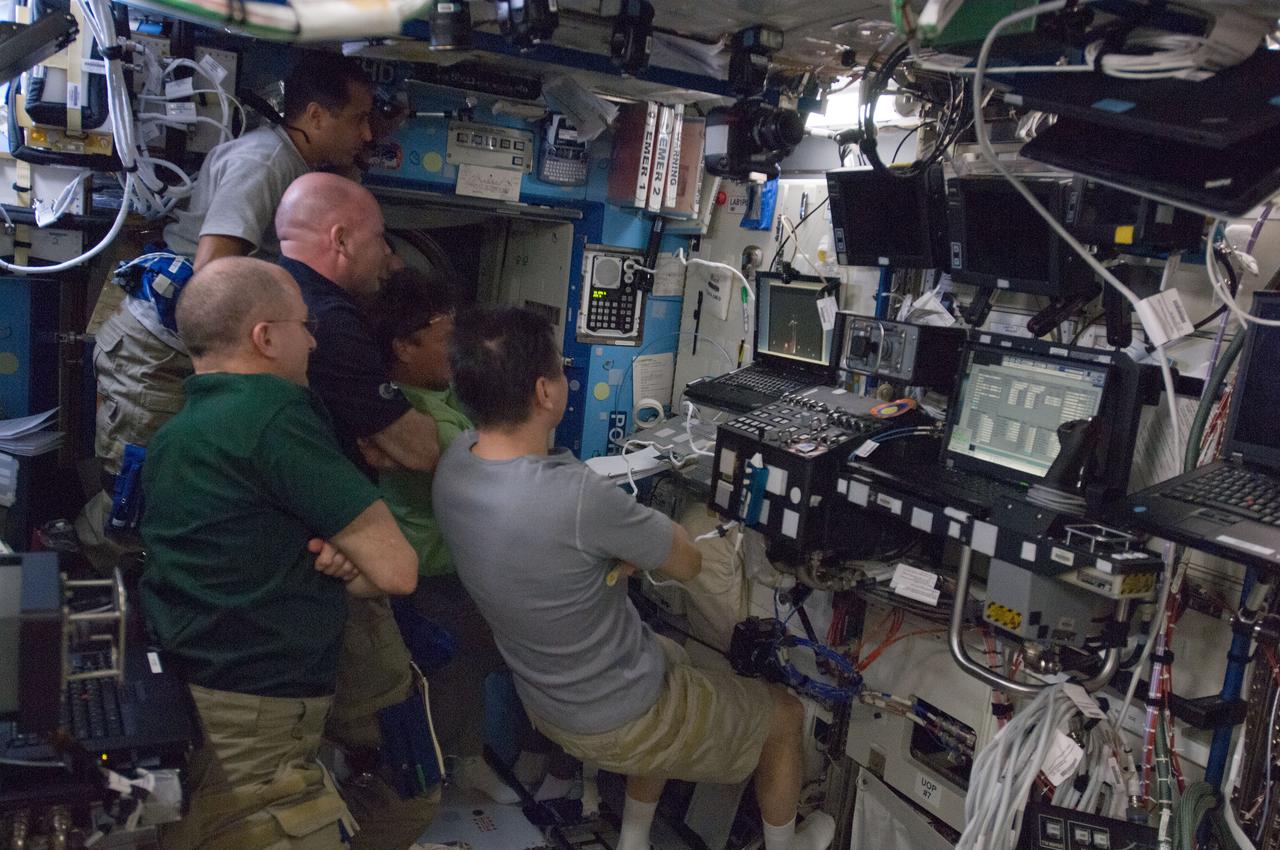
ISS031-E-140385 (22 May 2012) --- Expedition 31 crew members watch the launch of the SpaceX Falcon 9 rocket on a computer monitor in the Destiny laboratory of the International Space Station on May 22, 2012. Pictured clockwise (from bottom right) are Russian cosmonaut Oleg Kononenko, commander; NASA astronaut Don Pettit, European Space Agency astronaut Andre Kuipers, NASA astronaut Joe Acaba, Russian cosmonauts Sergei Revin (obscured) and Gennady Padalka, all flight engineers.
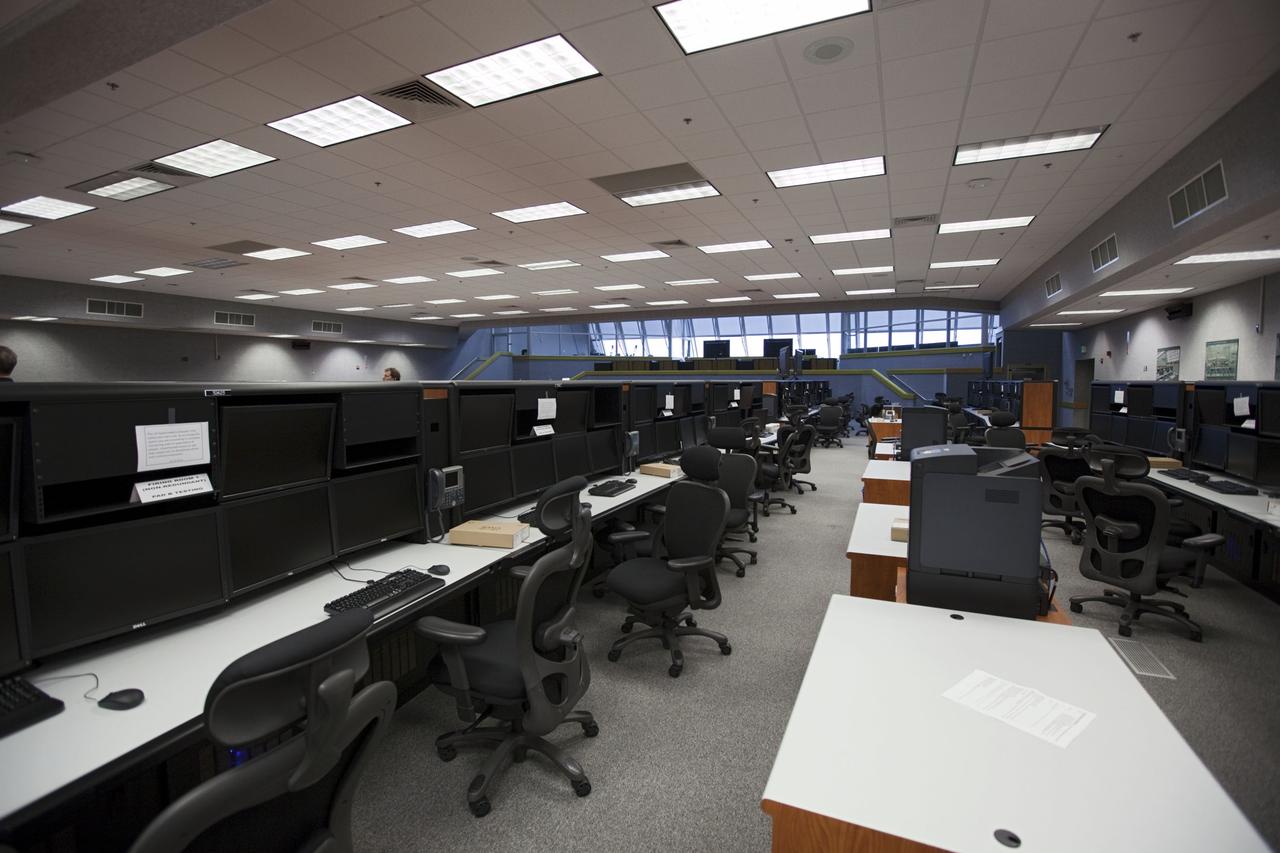
CAPE CANAVERAL, Fla. – Firing Room 1, also known as the Young-Crippen Firing Room, has been outfitted with computer, communications and networking systems to host rockets and spacecraft that are currently under development. The firing room is where the launch of rockets and spacecraft are controlled at NASA's Kennedy Space Center in Florida. Flight controllers also monitor processing and preparations of launch vehicles from the firing room. There are four firing rooms inside the Launch Control Center at Kennedy. Photo credit: NASA/Dmitri Gerondidakis
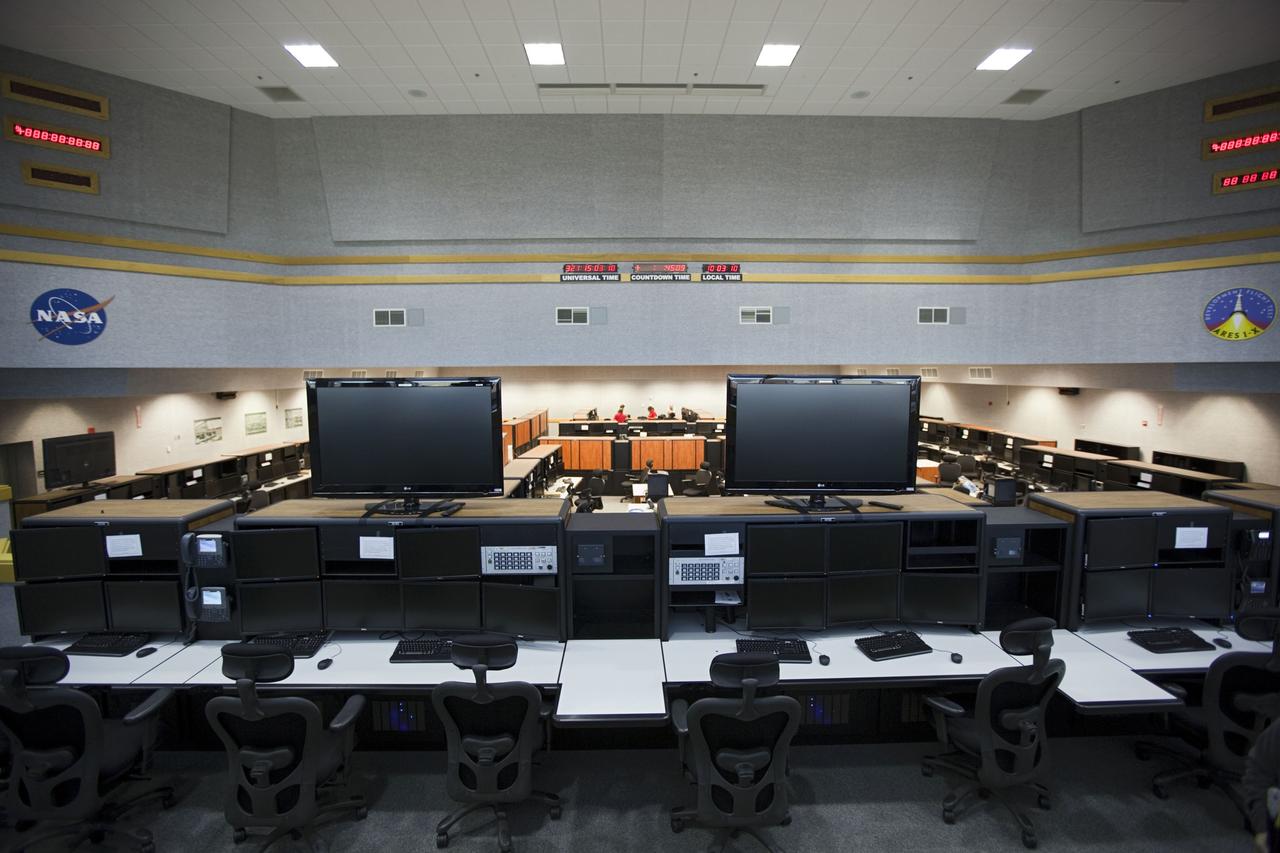
CAPE CANAVERAL, Fla. – Firing Room 1, also known as the Young-Crippen Firing Room, has been outfitted with computer, communications and networking systems to host rockets and spacecraft that are currently under development. The firing room is where the launch of rockets and spacecraft are controlled at NASA's Kennedy Space Center in Florida. Flight controllers also monitor processing and preparations of launch vehicles from the firing room. There are four firing rooms inside the Launch Control Center at Kennedy. Photo credit: NASA/Dmitri Gerondidakis
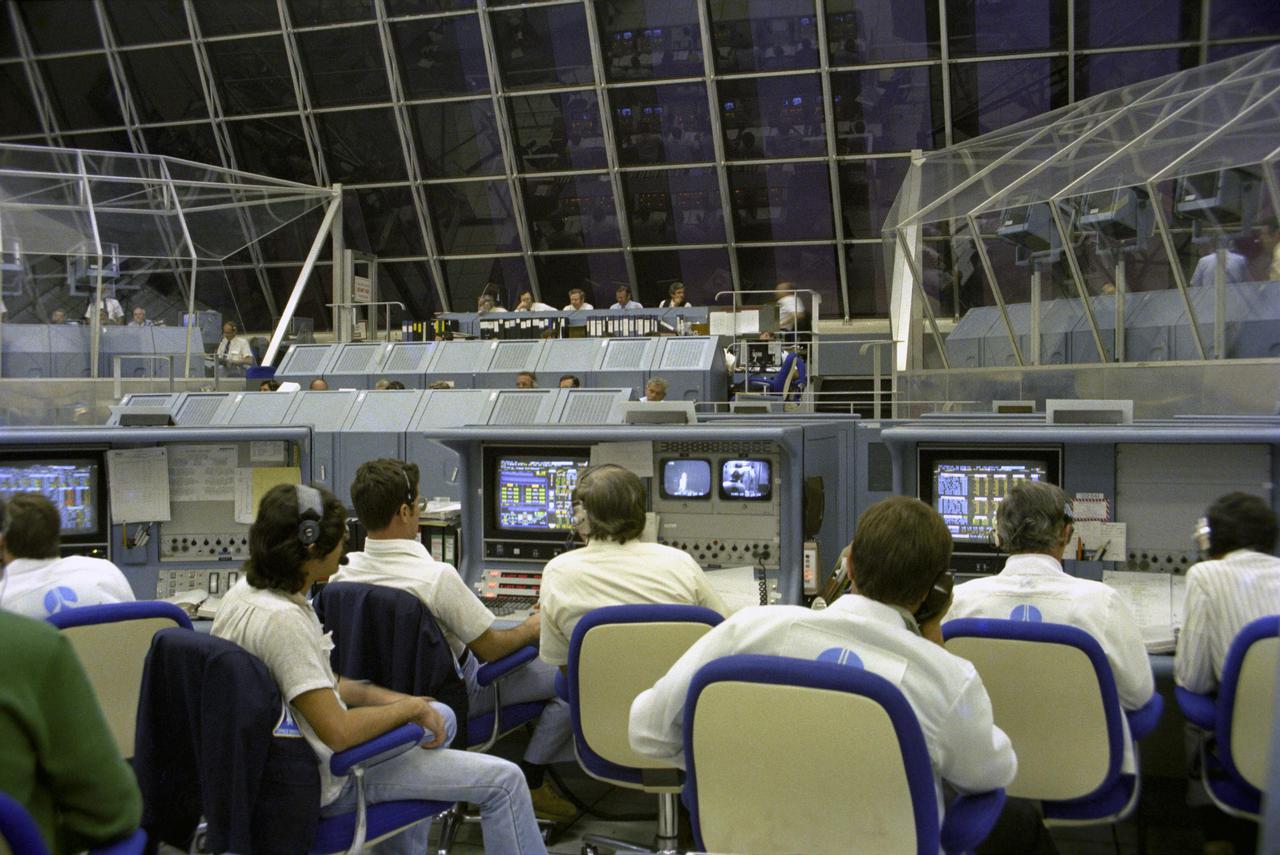
KENNEDY SPACE CENTER, FLA. - Heavy, blast-proof steel louvers seal the large windows of the Launch Control Center’s firing room against mishaps that fail to occur when the first flight of the Space Shuttle is launched from Pad 39A 3.5 mile away. Launch staff, intently watching their computer readouts and TV monitors during the critical moments of launch, will cheer and wave miniature American flags when Astronauts John Young and Robert Crippen complete their fiery rocket ascent safely.
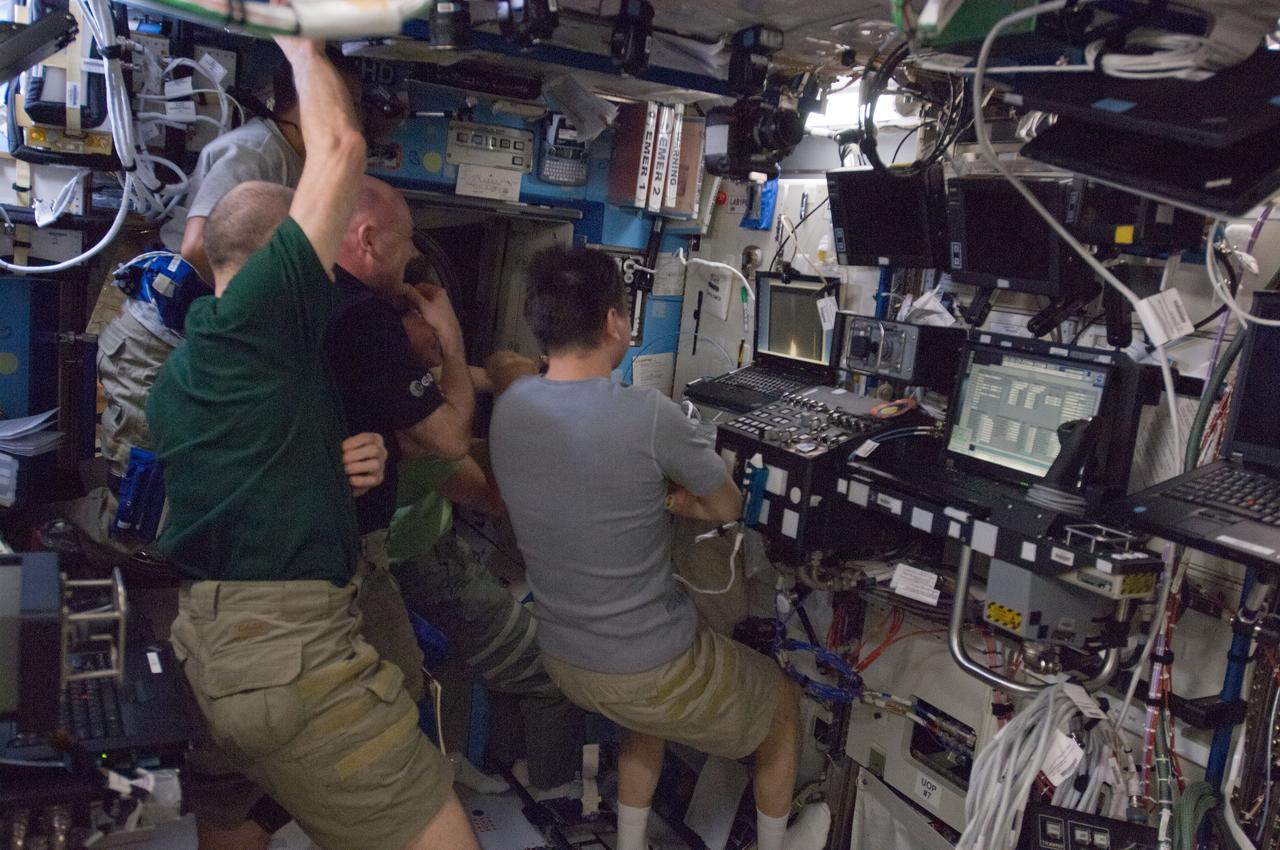
ISS031-E-140390 (22 May 2012) --- Expedition 31 crew members watch the launch of the SpaceX Falcon 9 rocket on a computer monitor in the Destiny laboratory of the International Space Station on May 22, 2012. Pictured clockwise (from bottom right) are Russian cosmonaut Oleg Kononenko, commander; NASA astronaut Don Pettit, European Space Agency astronaut Andre Kuipers, NASA astronaut Joe Acaba, Russian cosmonauts Sergei Revin (obscured) and Gennady Padalka, all flight engineers.
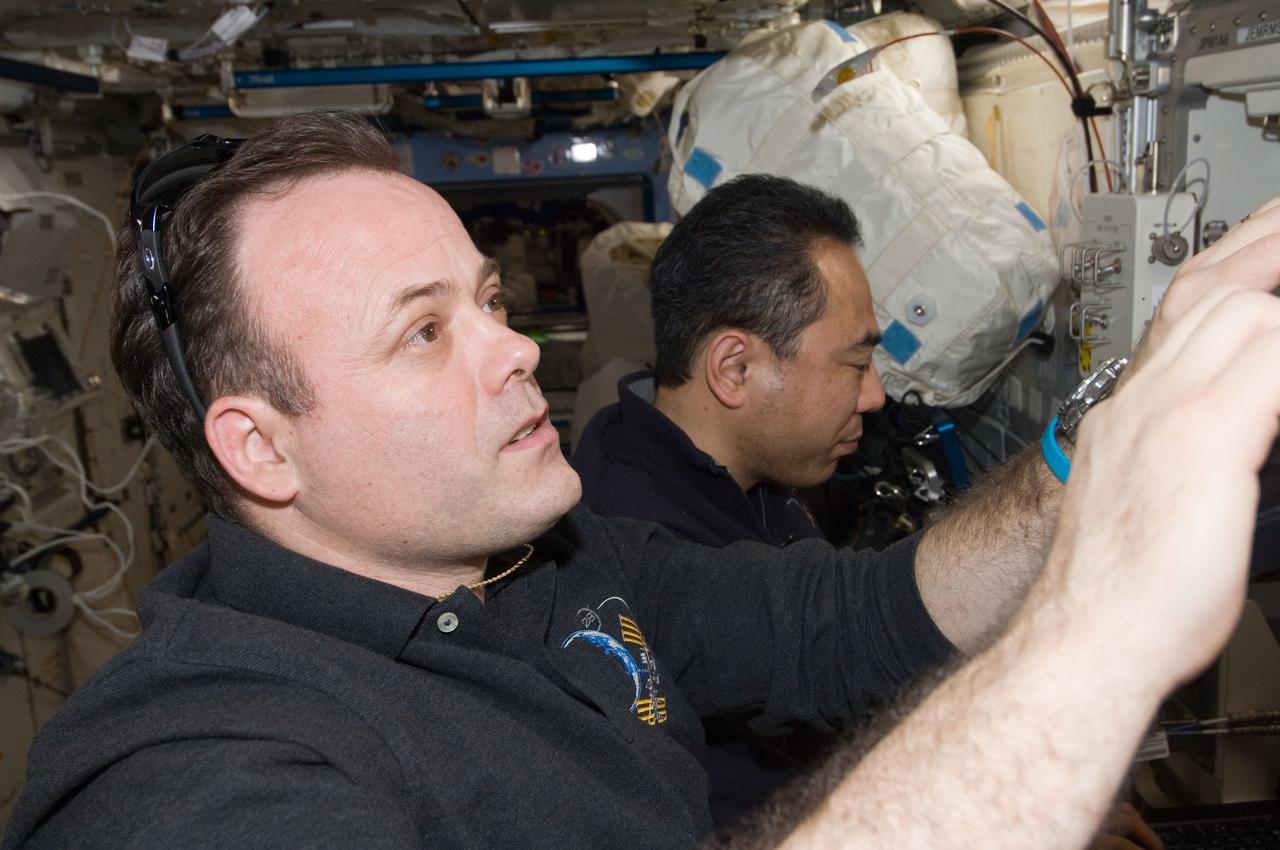
ISS028-E-020307 (2 Aug. 2011) --- NASA astronaut Ron Garan (foreground) and Japan Aerospace Exploration Agency astronaut Satoshi Furukawa, both Expedition 28 flight engineers, use computers in the International Space Station?s Kibo laboratory to monitor the Japanese Experiment Module Remote Manipulator System (JEMRMS) located on the exterior of the station.
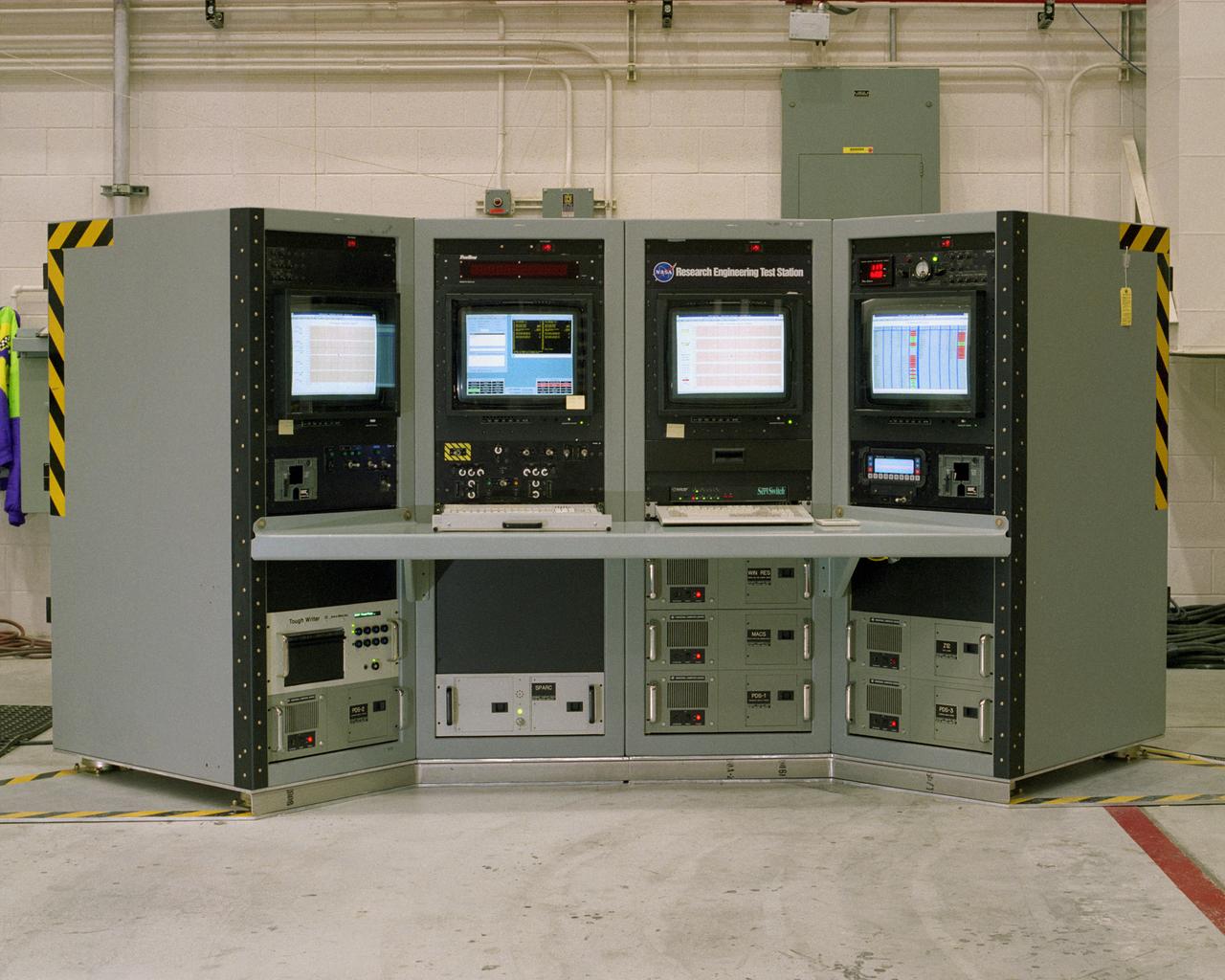
This console and its compliment of computers, monitors and commmunications equipment make up the Research Engineering Test Station, the nerve center for an aerodynamics experiment conducted by NASA's Dryden Flight Research Center, Edwards, California. The equipment was installed on a modified Lockheed L-1011 Tristar jetliner operated by Orbital Sciences Corp., of Dulles, Va., for Dryden's Adaptive Performance Optimization project. The experiment sought to improve the efficiency of long-range jetliners by using small movements of the ailerons to improve the aerodynamics of the wing at cruise conditions.
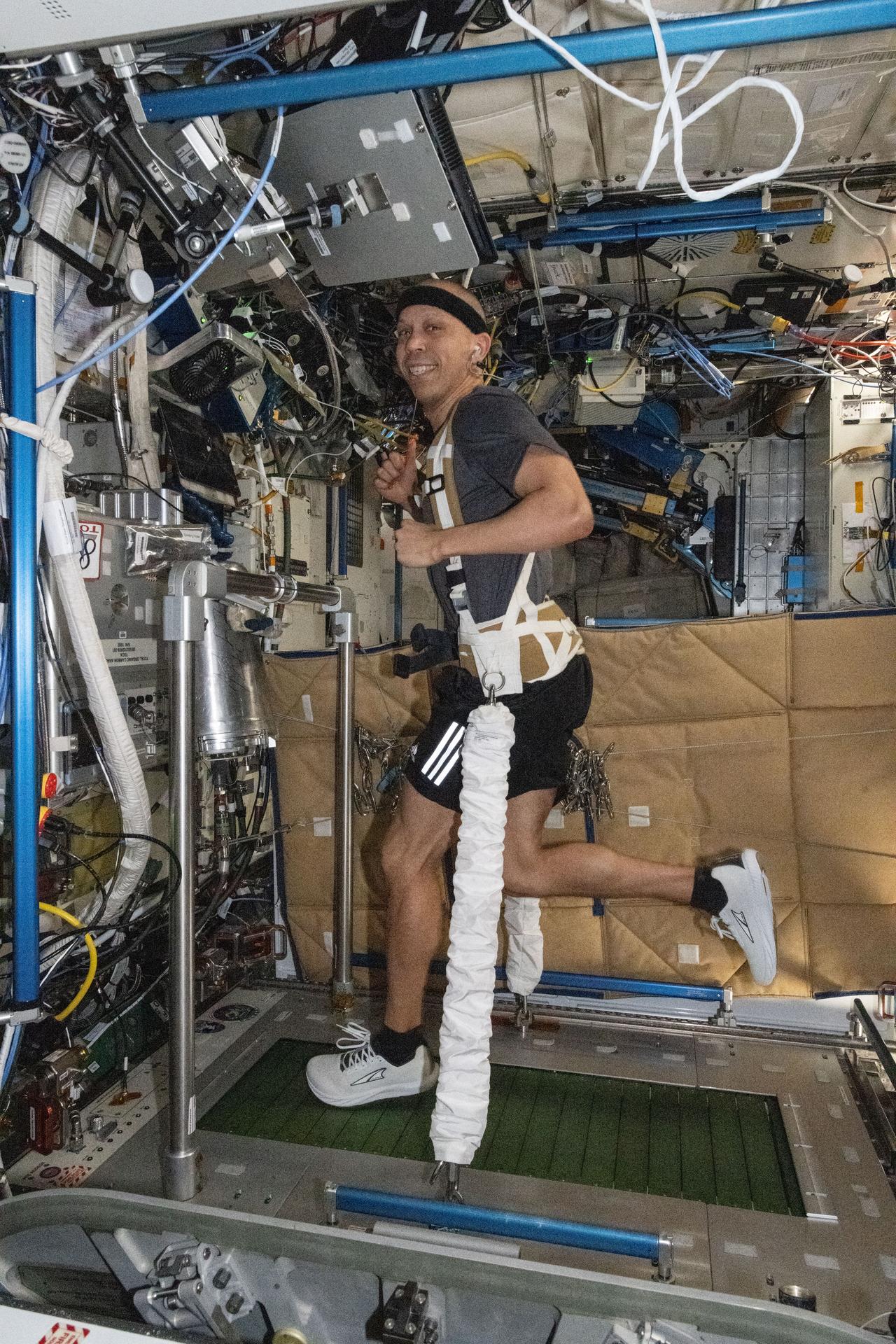
iss074e0792349 (June 7 ,2026) --- NASA astronaut and Expedition 74 flight engineer Chris Williams jogs while strapped to the treadmill inside the International Space Station's Tranquility module. The treadmill, formally known as COLBERT (Combined Operational Load-Bearing External Resistance Treadmill), is specifically designed to enable jogging and maintain cardiovascular health in microgravity. Williams is wearing a heart-rate monitor that uses Bluetooth to transmit his cardiac data to a computer tablet for analysis by doctors on Earth. Credit: NASA
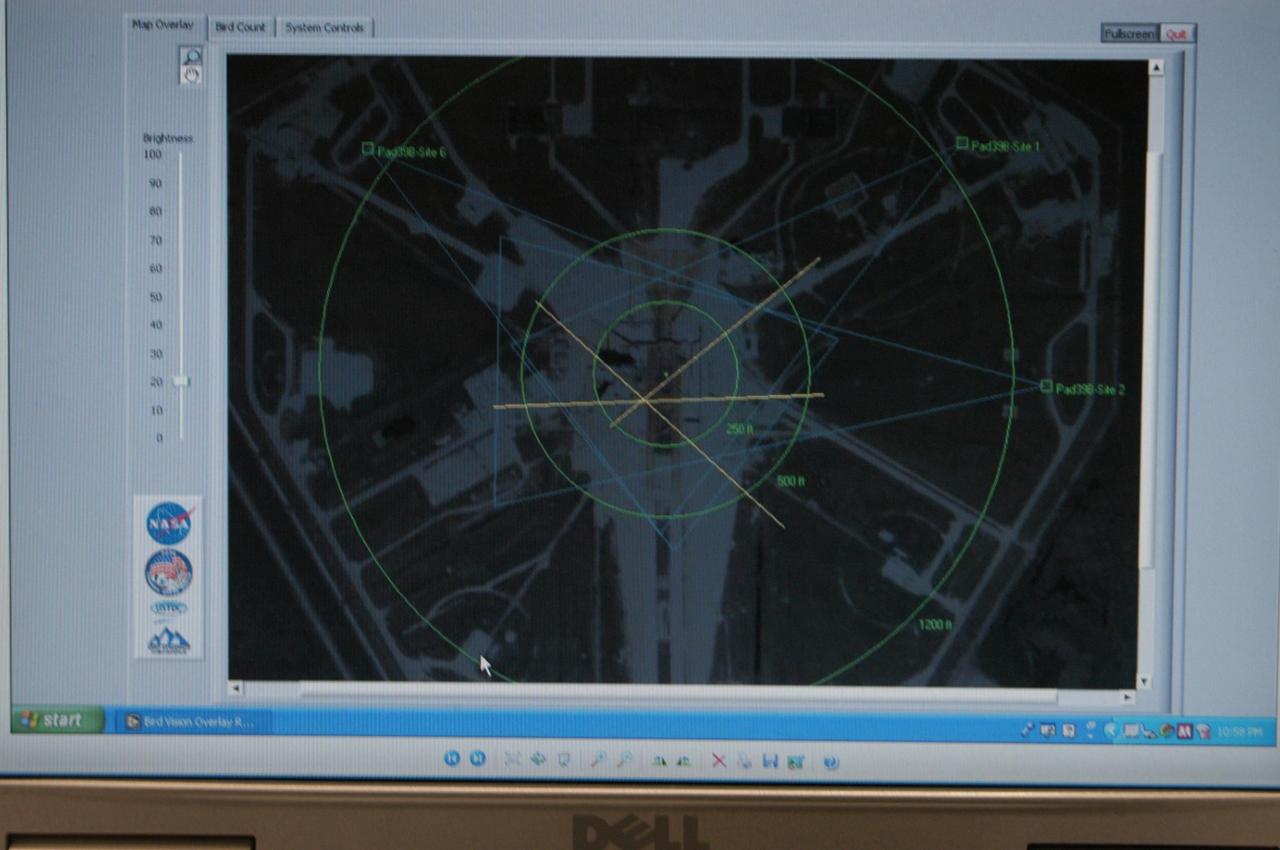
KENNEDY SPACE CENTER, FLA. - This associated computer image shows data being relayed from the avian radars recently set up on Launch Pad 39B. The computer is one of two in Firing Room 4 of the Launch Control Center. When birds, especially vultures, are near the shuttle during a launch, impact on a critical area is possible and could cause catastrophic damage to the vehicle. Already proven affective for aviation where threats posed by bird strikes have been a problem, the avian radar, known as Aircraft Birdstrike Avoidance Radar, provides horizontal and vertical scanning and can monitor either launch pad for movement of vultures around them. If data relayed from the avian radar indicates large birds are dangerously close to the vehicle, controllers could hold the countdown. Photo credit: NASA/George Shelton
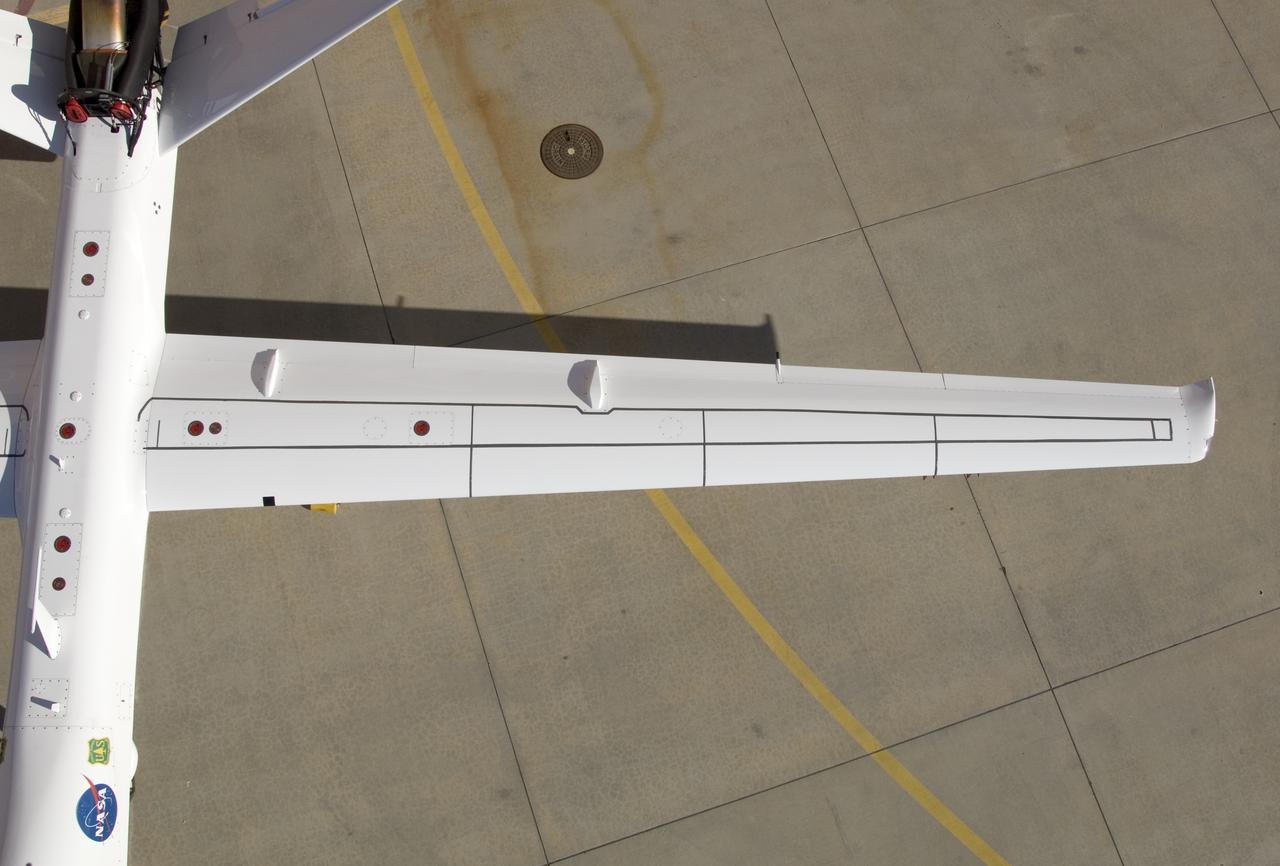
Although the new fiber optic sensors on the Ikhana, which are located on fibers that are the diameter of a human hair, are not visible, the sealant used to cover them can be seen in this view from above the left wing. NASA Dryden Flight Research Center is evaluating an advanced fiber optic-based sensing technology installed on the wings of NASA's Ikhana aircraft. The fiber optic system measures and displays the shape of the aircraft's wings in flight. There are other potential safety applications for the technology, such as vehicle structural health monitoring. If an aircraft structure can be monitored with sensors and a computer can manipulate flight control surfaces to compensate for stresses on the wings, structural control can be established to prevent situations that might otherwise result in a loss of control.
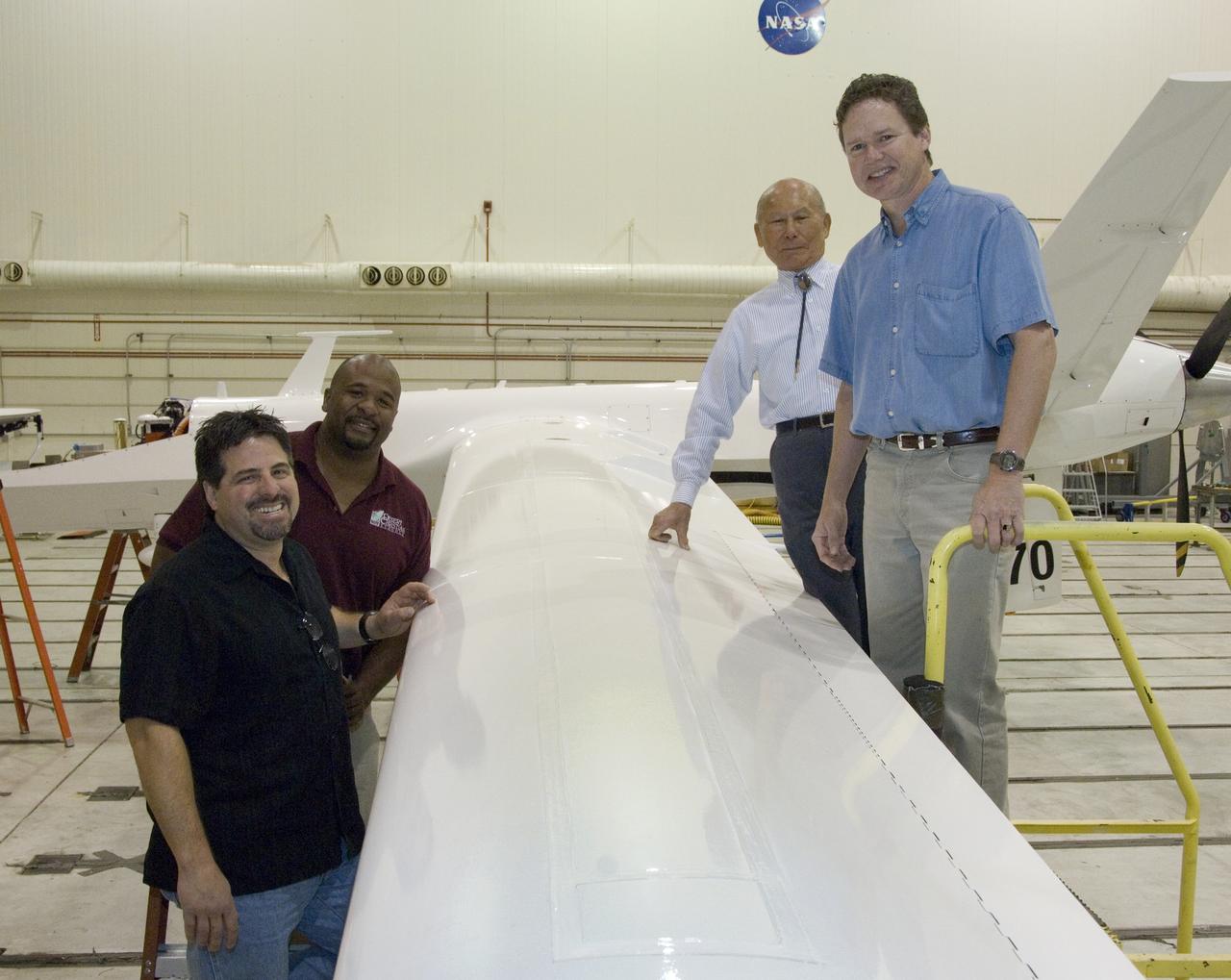
Ikhana fiber optic wing shape sensor team: clockwise from left, Anthony "Nino" Piazza, Allen Parker, William Ko and Lance Richards. The sensors, located along a fiber the thickness of a human hair, aren't visible in the center of the Ikhana aircraft's left wing. NASA Dryden Flight Research Center is evaluating an advanced fiber optic-based sensing technology installed on the wings of NASA's Ikhana aircraft. The fiber optic system measures and displays the shape of the aircraft's wings in flight. There are other potential safety applications for the technology, such as vehicle structural health monitoring. If an aircraft structure can be monitored with sensors and a computer can manipulate flight control surfaces to compensate for stresses on the wings, structural control can be established to prevent situations that might otherwise result in a loss of control.
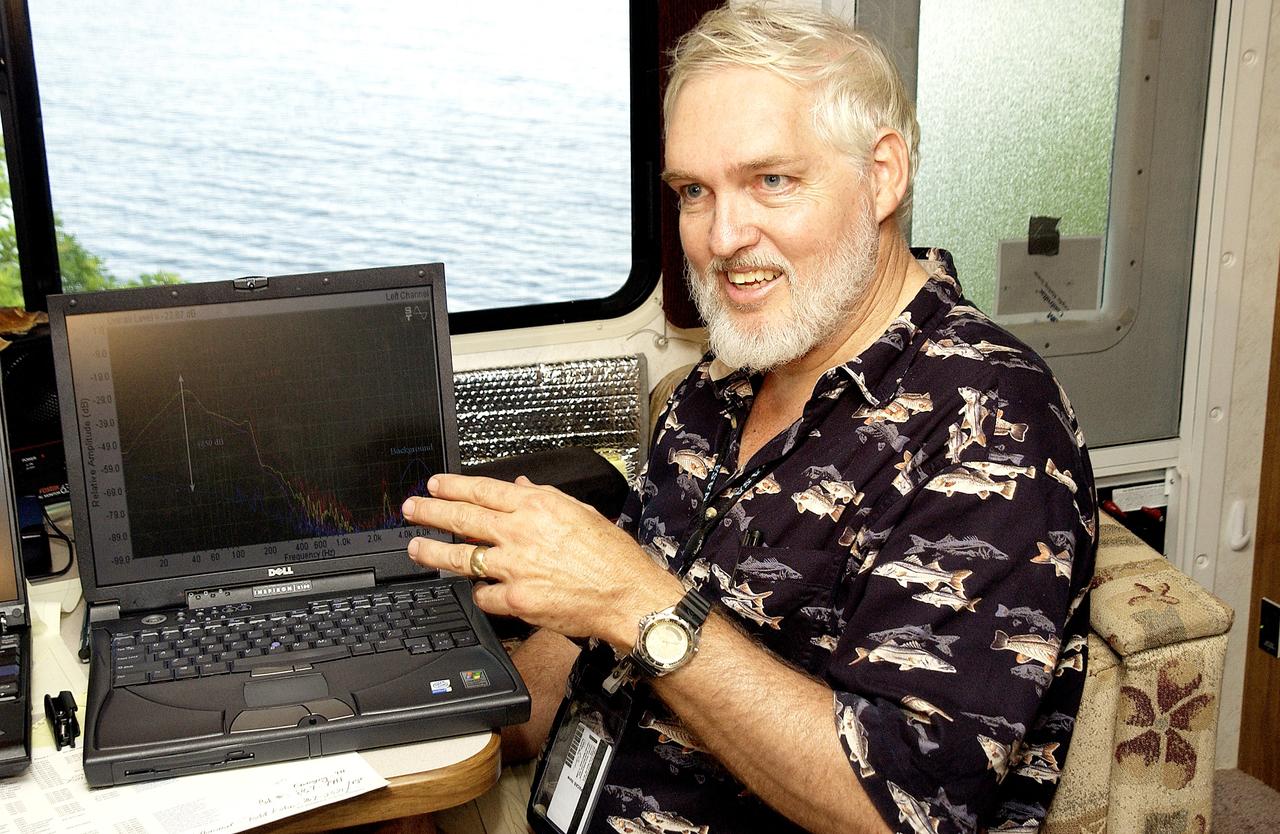
KENNEDY SPACE CENTER, FLA. - Dr. Grant Gilmore, Dynamac Corp., utilizes a laptop computer to explain aspects of the underwater acoustic research under way in the Launch Complex 39 turn basin. Several government agencies, including NASA, NOAA, the Navy, the Coast Guard, and the Florida Fish and Wildlife Commission are involved in the testing. The research involves demonstrations of passive and active sensor technologies, with applications in fields ranging from marine biological research to homeland security. The work is also serving as a pilot project to assess the cooperation between the agencies involved. Equipment under development includes a passive acoustic monitor developed by NASA’s Jet Propulsion Laboratory, and mobile robotic sensors from the Navy’s Mobile Diving and Salvage Unit.

A sign points the way to the electronic waste collection site, where NASA Kennedy Space Center employees donated computers, monitors, vacuum cleaners and other electronics in conjunction with America Recycles Day. America Recycles Day is a nationally recognized initiative dedicated to promoting recycling in the United States. Kennedy partnered with several organizations in order to donate as many of the items as possible to those who could use them the most in the Space Coast community. Space center personnel brought in electronic waste, gently used household goods, clothing and more. The two-day event was sponsored by Kennedy's Sustainability team.
Ultrasonic Measurement System. Ultrasonic measurement system will enable simultaneous measurement of temperature, velocity and density fields through a grid of ultrasonic sensors. This method incorporates a theoretical approach and machine learning techniques to develop a physics-informed data-driven calibration and operation workflow. This allows at least ten times faster data processing times as well as potential capability of transient measurements and solid particle detection. The system can also be utilized for health monitoring. This measurement technique is in line with the “air-breathing propulsion” core competency of GRC. However it can also enables next generation space data processing with higher performance computing capable of operating in harsh deep space environments.
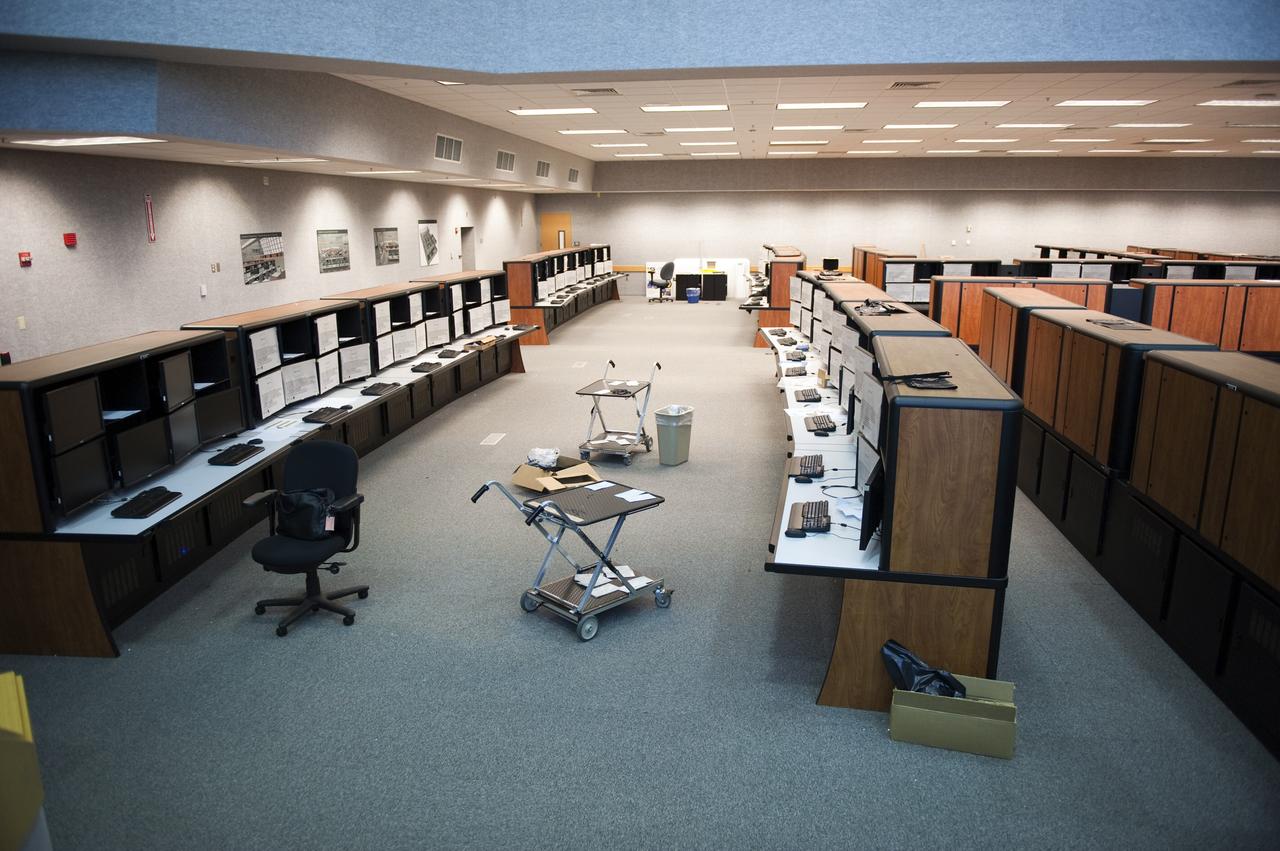
CAPE CANAVERAL, Fla. -- At NASA's Kennedy Space Center in Florida, remodeling for launches of future human spaceflight vehicles continues in the Launch Control Center's Young-Crippen Firing Room. Consoles already have been rewired for the comprehensive upgrade and are now being outfitted with new computers and monitors. Known as Firing Room 1 in the Apollo era, it was re-named as a tribute to the Space Shuttle Program's first crewed mission, STS-1, which was flown by Commander John Young and Pilot Robert Crippen in April 1981. The firing room most recently was set up to support the Ares I-X flight test in Oct. 2009. Photo credit: NASA/Kim Shiflett
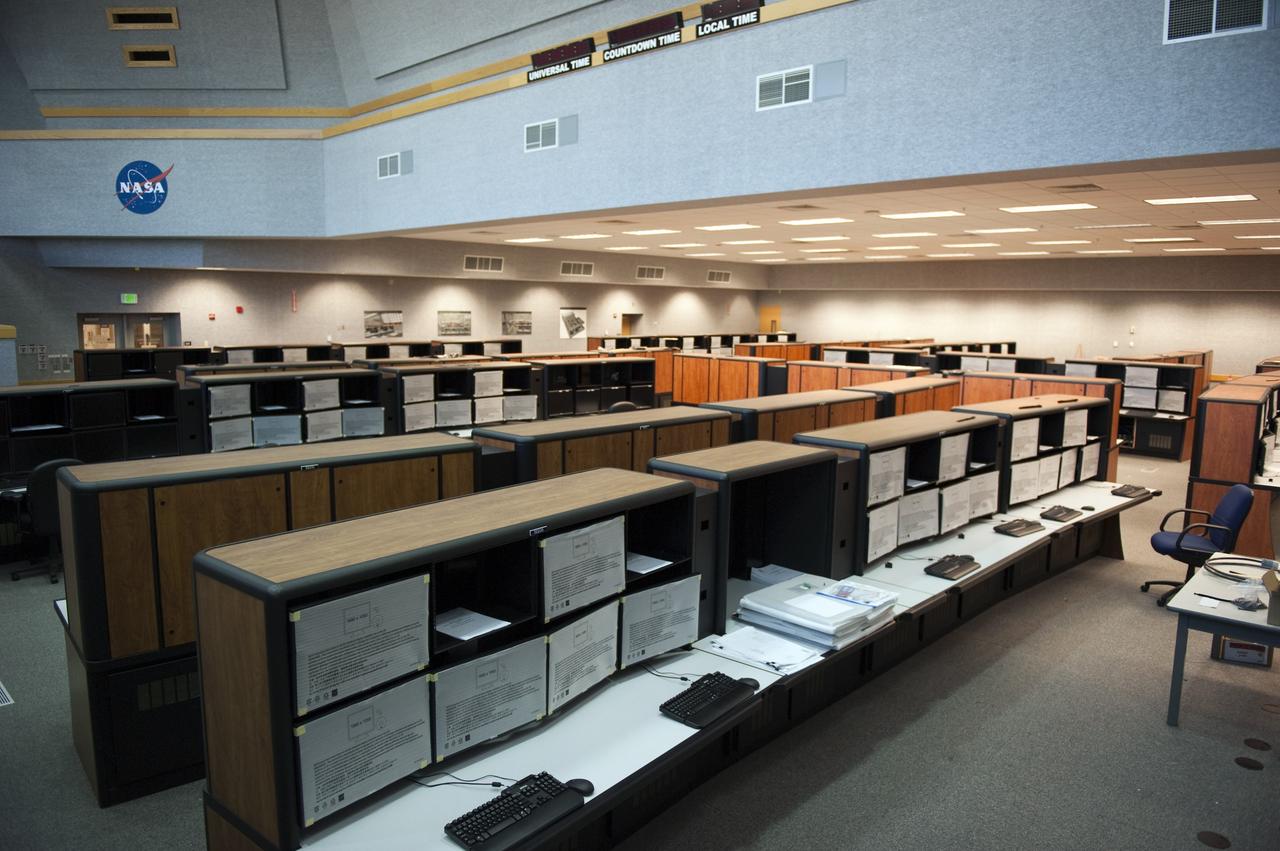
CAPE CANAVERAL, Fla. -- At NASA's Kennedy Space Center in Florida, remodeling for launches of future human spaceflight vehicles continues in the Launch Control Center's Young-Crippen Firing Room. Consoles already have been rewired for the comprehensive upgrade and are now being outfitted with new computers and monitors. Known as Firing Room 1 in the Apollo era, it was re-named as a tribute to the Space Shuttle Program's first crewed mission, STS-1, which was flown by Commander John Young and Pilot Robert Crippen in April 1981. The firing room most recently was set up to support the Ares I-X flight test in Oct. 2009. Photo credit: NASA/Kim Shiflett
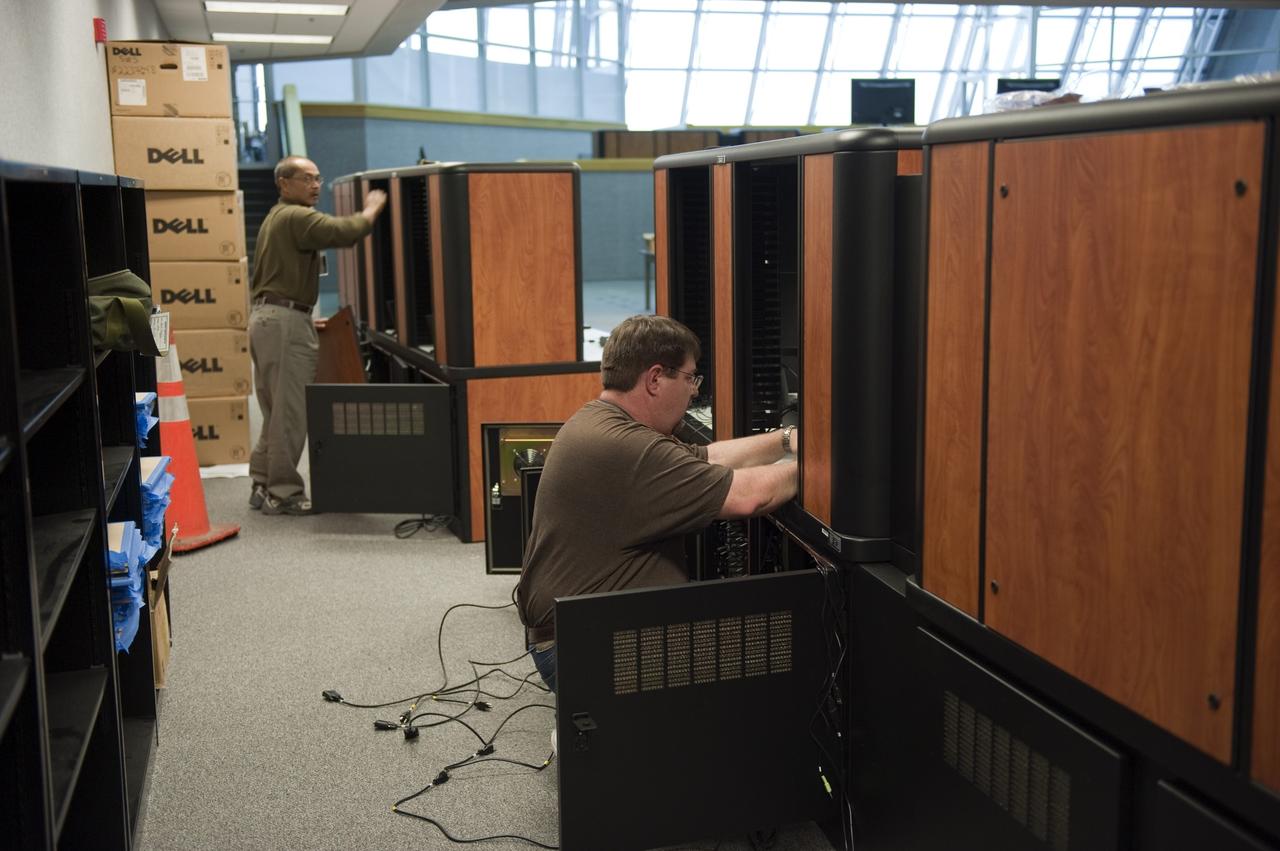
CAPE CANAVERAL, Fla. -- At NASA's Kennedy Space Center in Florida, remodeling for launches of future human spaceflight vehicles continues in the Launch Control Center's Young-Crippen Firing Room. Consoles already have been rewired for the comprehensive upgrade and are now being outfitted with new computers and monitors. Known as Firing Room 1 in the Apollo era, it was re-named as a tribute to the Space Shuttle Program's first crewed mission, STS-1, which was flown by Commander John Young and Pilot Robert Crippen in April 1981. The firing room most recently was set up to support the Ares I-X flight test in Oct. 2009. Photo credit: NASA/Kim Shiflett
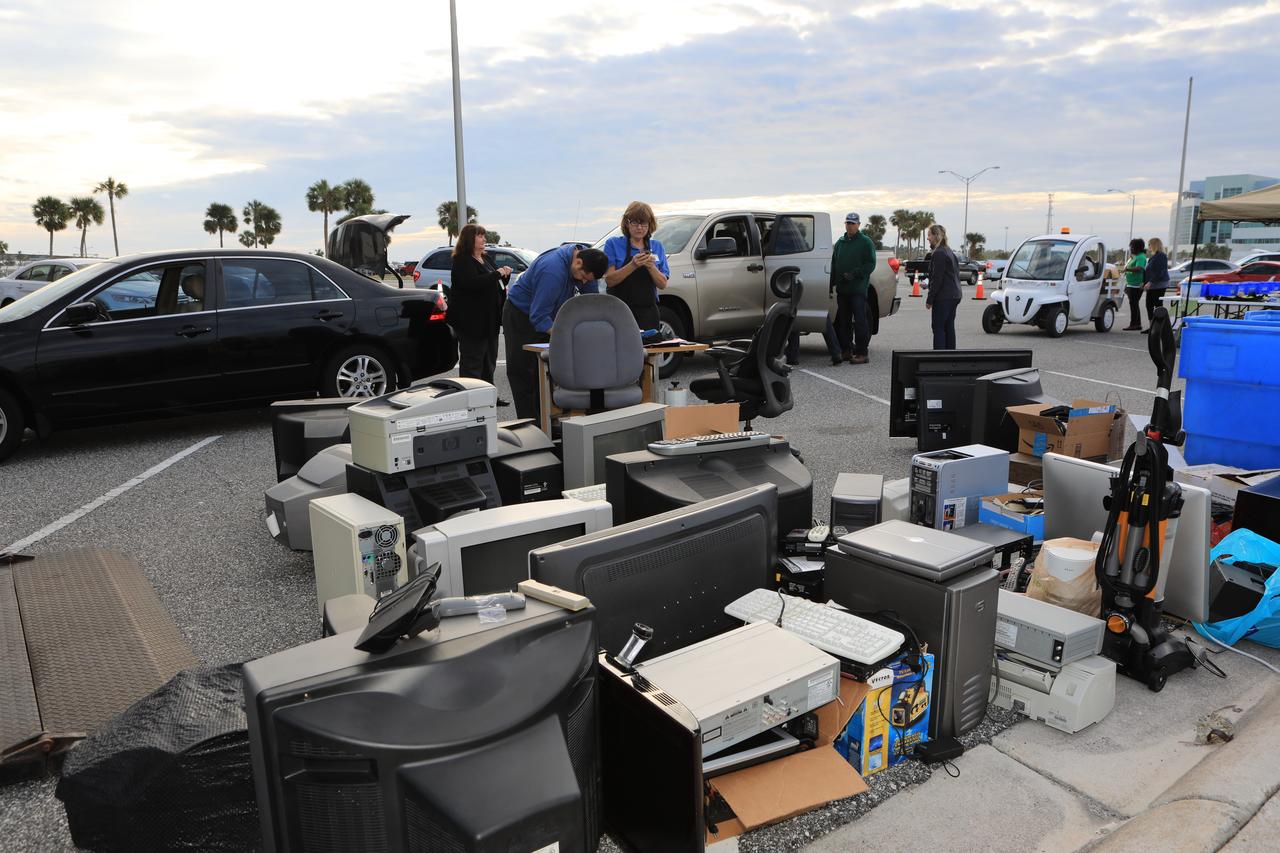
Computers, monitors, vacuum cleaners and other electronics have been donated by employees at NASA's Kennedy Space Center in Florida in conjunction with America Recycles Day. America Recycles Day is a nationally recognized initiative dedicated to promoting recycling in the United States. Kennedy partnered with several organizations in order to donate as many of the items as possible to those who could use them the most in the Space Coast community. Space center personnel brought in electronic waste, gently used household goods, clothing and more. The two-day event was sponsored by Kennedy's Sustainability team.
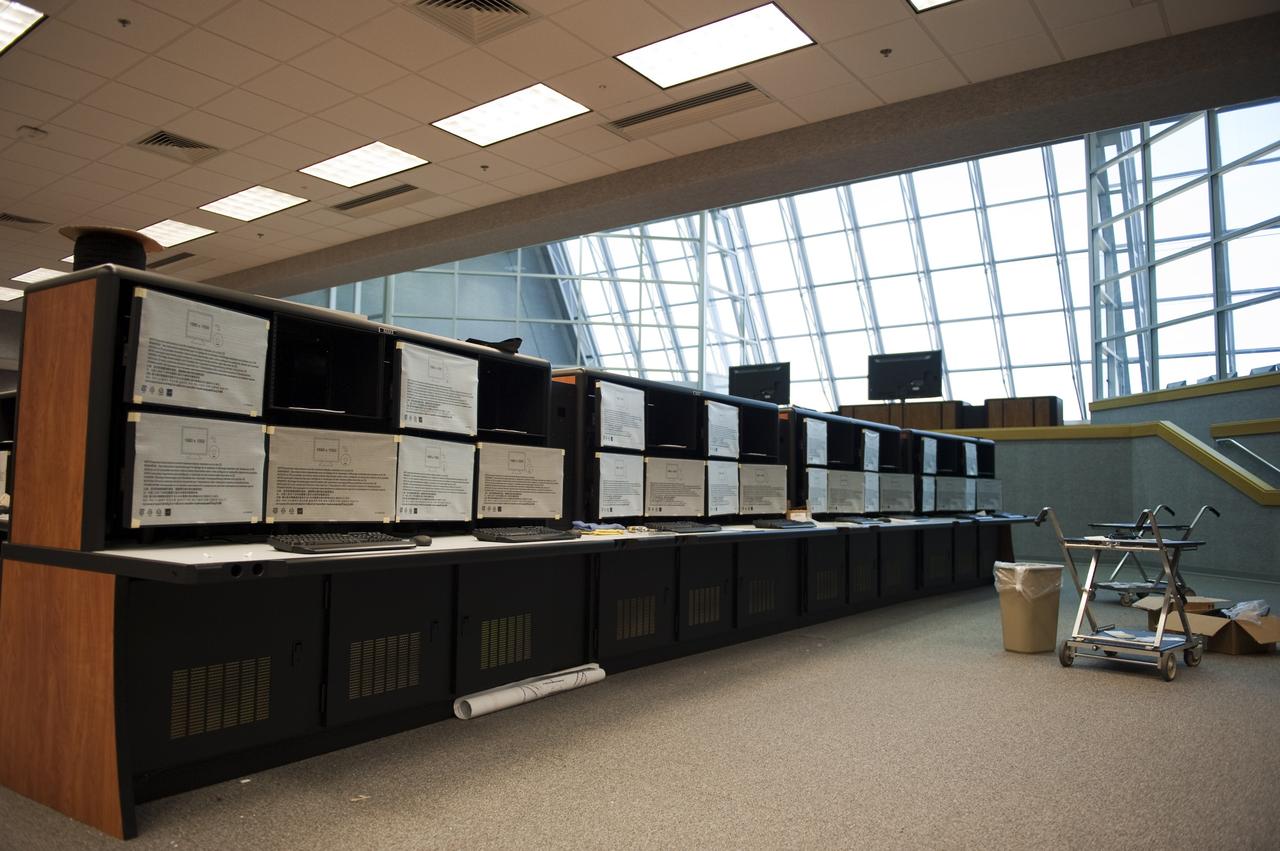
CAPE CANAVERAL, Fla. -- At NASA's Kennedy Space Center in Florida, remodeling for launches of future human spaceflight vehicles continues in the Launch Control Center's Young-Crippen Firing Room. Consoles already have been rewired for the comprehensive upgrade and are now being outfitted with new computers and monitors. Known as Firing Room 1 in the Apollo era, it was re-named as a tribute to the Space Shuttle Program's first crewed mission, STS-1, which was flown by Commander John Young and Pilot Robert Crippen in April 1981. The firing room most recently was set up to support the Ares I-X flight test in Oct. 2009. Photo credit: NASA/Kim Shiflett
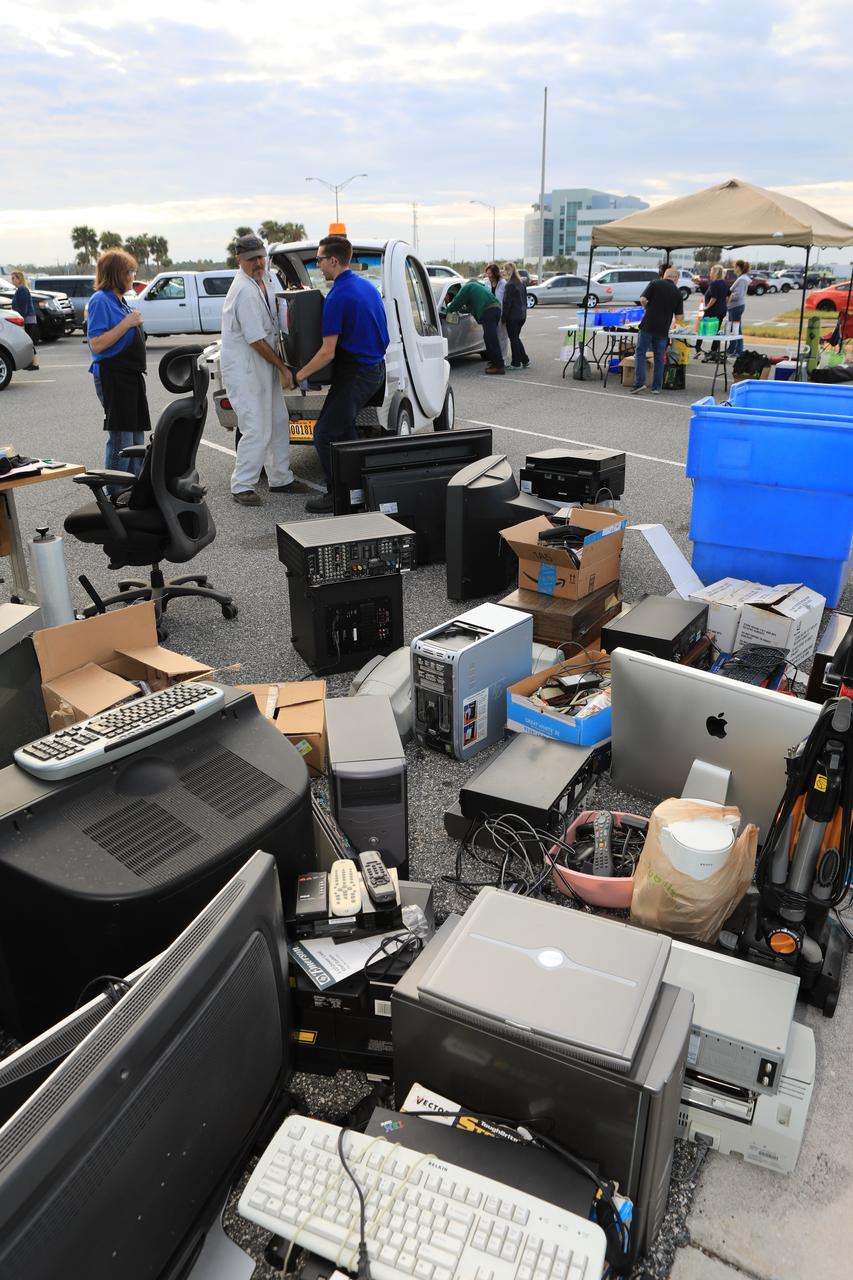
Computers, monitors, vacuum cleaners and other electronics have been donated by employees at NASA's Kennedy Space Center in Florida in conjunction with America Recycles Day. America Recycles Day is a nationally recognized initiative dedicated to promoting recycling in the United States. Kennedy partnered with several organizations in order to donate as many of the items as possible to those who could use them the most in the Space Coast community. Space center personnel brought in electronic waste, gently used household goods, clothing and more. The two-day event was sponsored by Kennedy's Sustainability team.
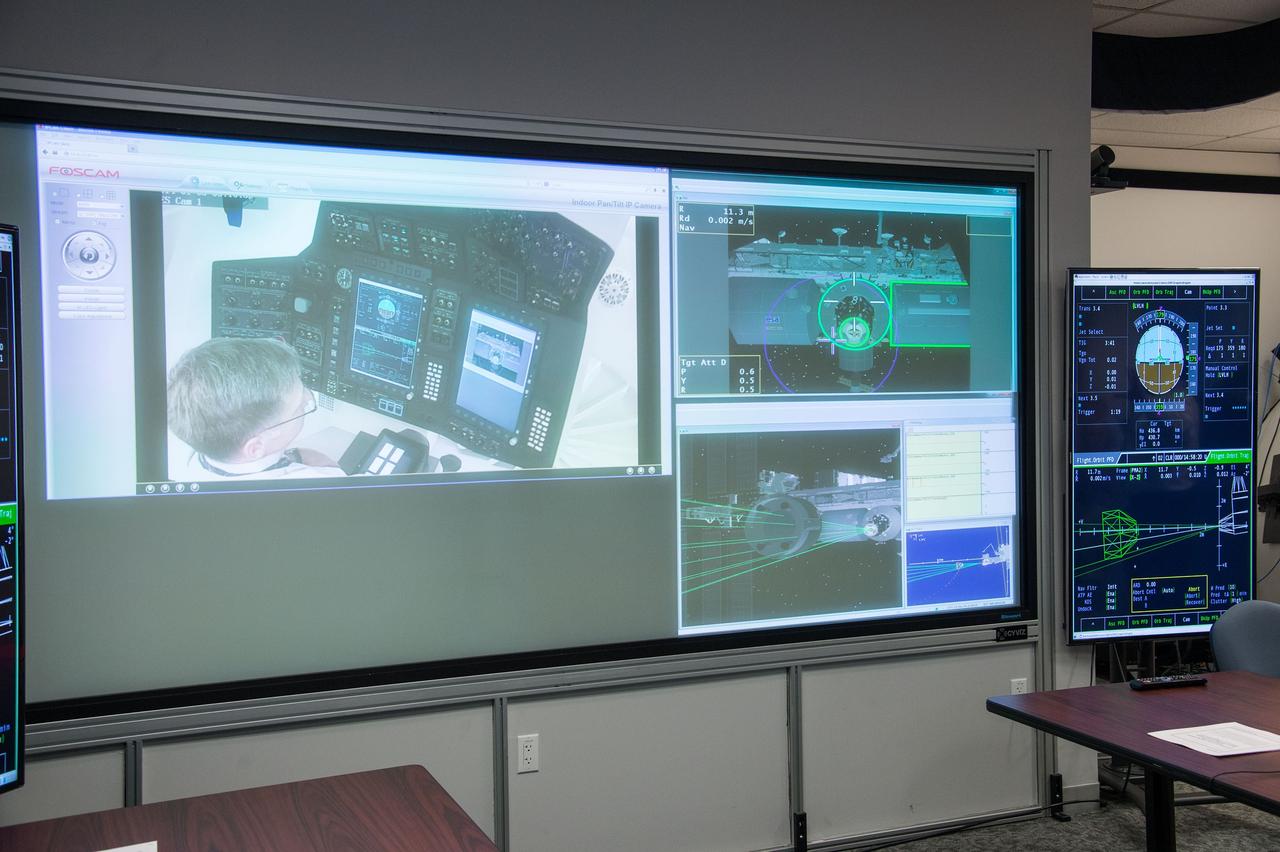
HOUSTON – Monitors show Chris Ferguson, a former space shuttle commander who is now director of Crew and Mission Operations for Boeing Space Exploration, at the controls in the inside the company's CST-100 spacecraft simulator. Boeing demonstrated that the CST-100 software allows a human pilot to take over control of the spacecraft from the computer during all phases of a mission following separation from the launch vehicle. The pilot-in-the-loop demonstration at the Houston Product Support Center is a milestone under Boeing's Commercial Crew Integrated Capability agreement with the agency and its Commercial Crew Program. Photo credit: NASA/Bill Stafford
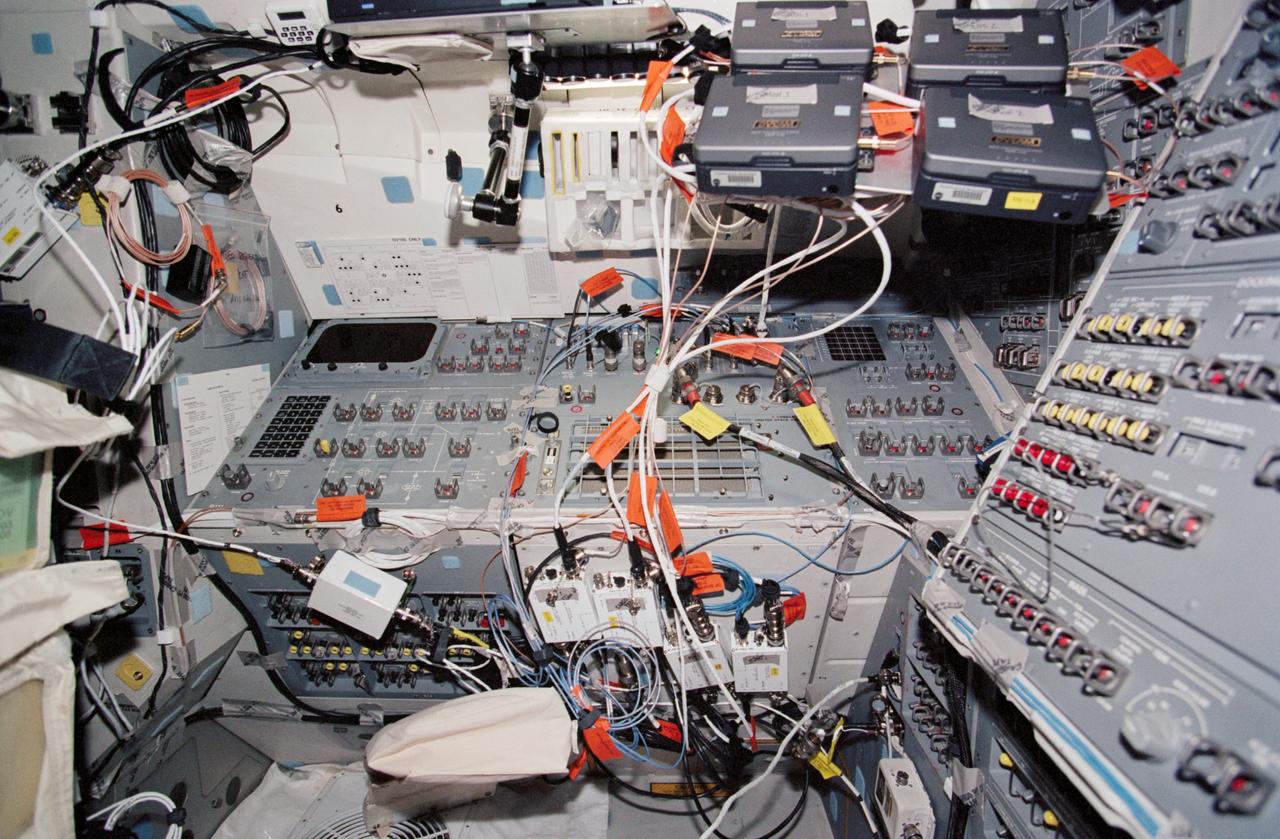
STS113-343-029 (23 November – 7 December 2002) --- View of the aft flight deck of the Space Shuttle Endeavour during the STS-113 mission to the International Space Station (ISS).
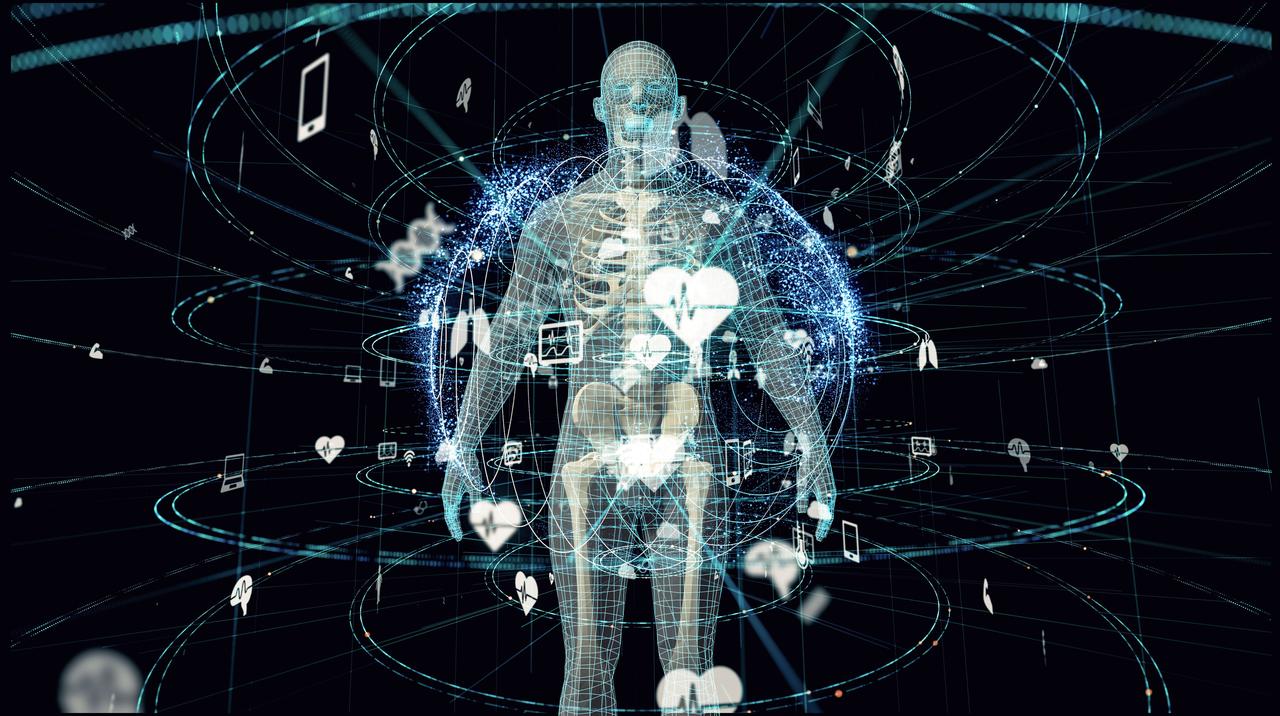
jsc2022e062020 (6/30/2022) --- Space Health will create a digital twin of the astronaut from the data collected by the Bio-Monitor and demonstrate how this could be used for autonomous health monitoring on future space missions. (Image courtesy of CSA)
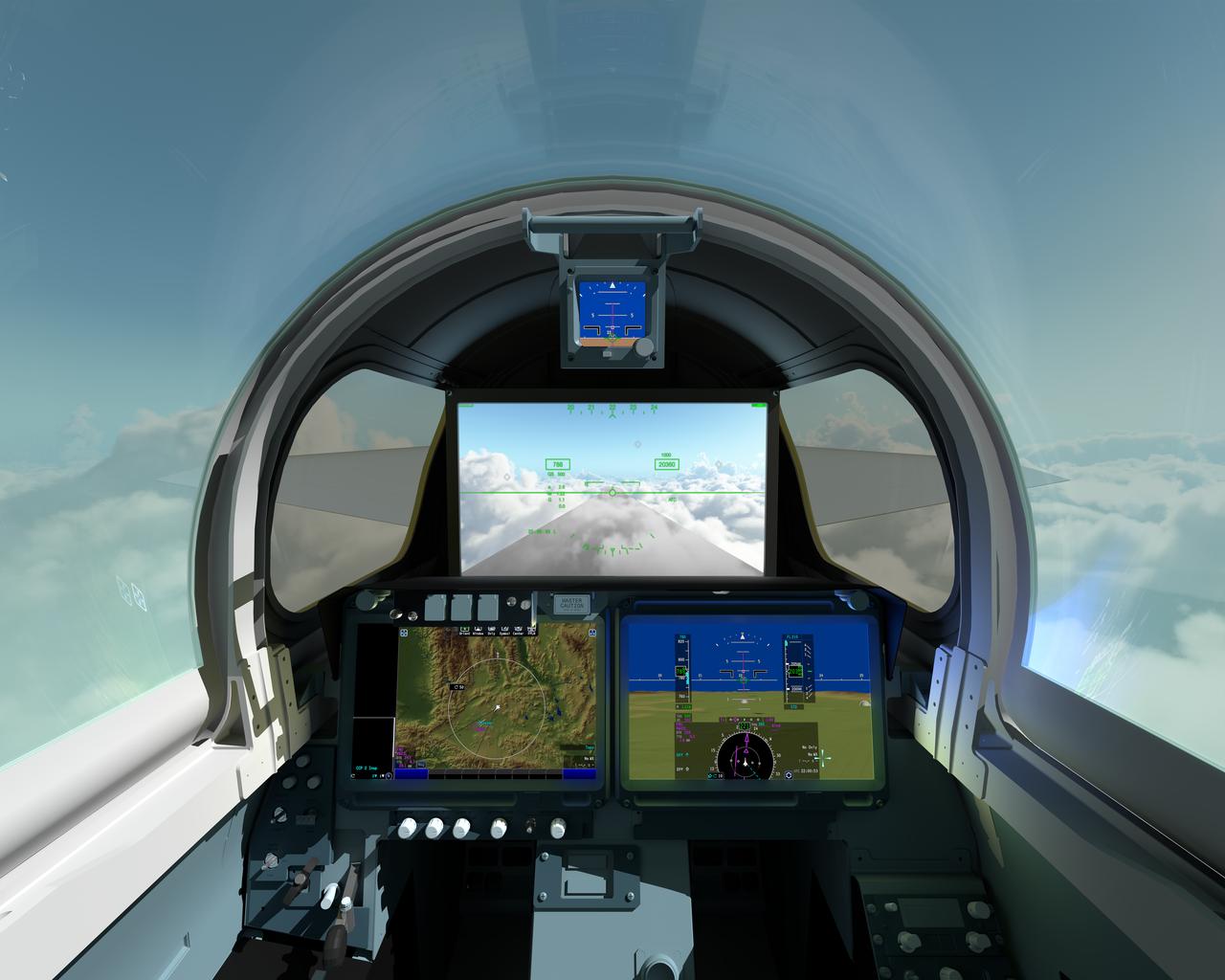
The pilot of NASAÕs X-59 Quiet SuperSonic Technology, or QueSST, aircraft will navigate the skies in a cockpit unlike any other. There wonÕt be a forward-facing window. ThatÕs right; itÕs actually a 4K monitor that serves as the central window and allows the pilot to safely see traffic in his or her flight path, and provides additional visual aids for airport approaches, landings and takeoffs. The 4K monitor, which is part of the aircraftÕs eXternal Visibility System, or XVS, displays stitched images from two cameras outside the aircraft combined with terrain data from an advanced computing system. The two portals and traditional canopy are real windows however, and help the pilot see the horizon. The displays below the XVS will provide a variety of aircraft systems and trajectory data for the pilot to safely fly. The XVS is one of several innovative solutions to help ensure the X-59Õs design shape reduces a sonic boom to a gentle thump heard by people on the ground. Though not intended to ever carry passengers, the X-59 boom-suppressing technology and community response data could help lift current bans on supersonic flight over land and enable a new generation of quiet supersonic commercial aircraft.
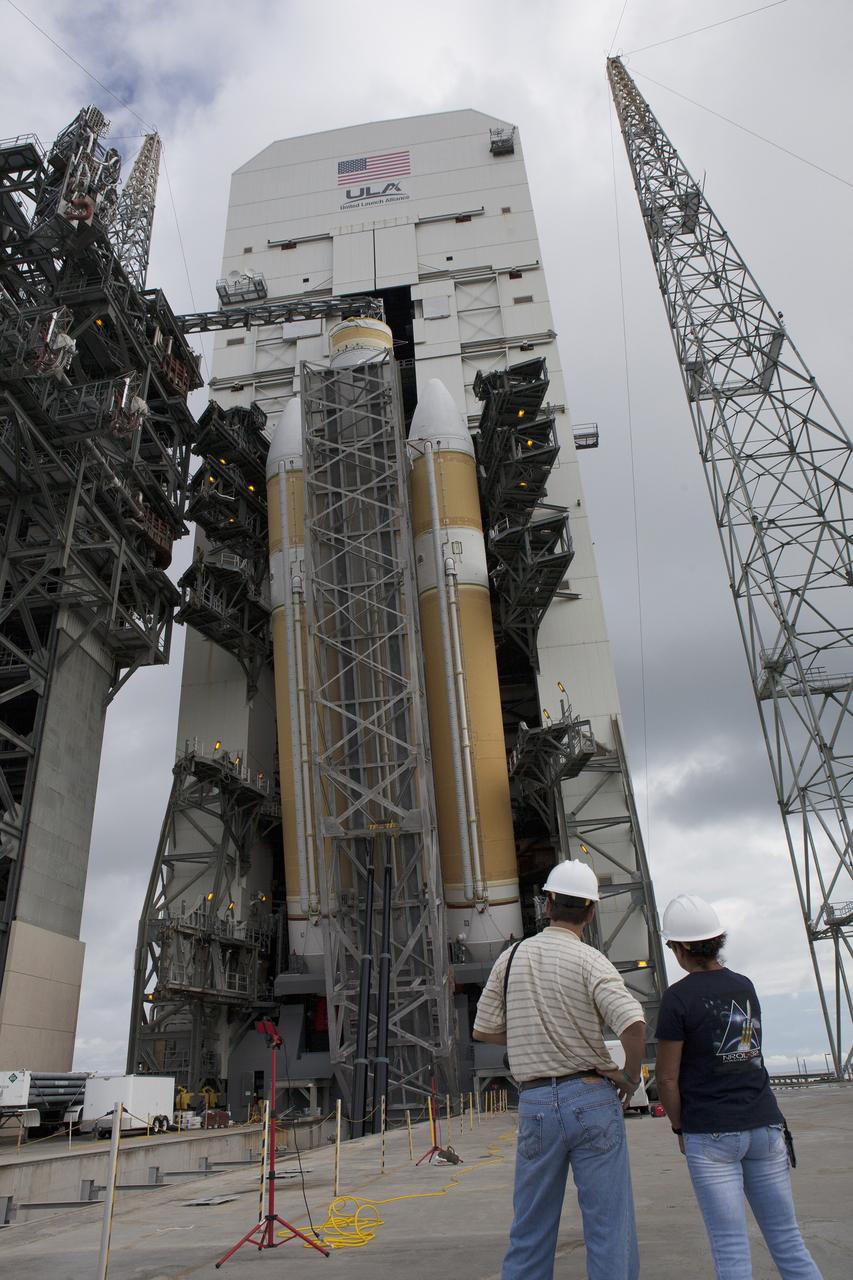
CAPE CANAVERAL, Fla. – United Launch Alliance, or ULA, workers monitor the progress as the ULA Delta IV Heavy rocket for Exploration Flight Test-1 is lifted to the vertical position in the mobile service tower on the pad at Space Launch Complex 37 at Cape Canaveral Air Force Station in Florida. The Delta IV Heavy is being readied to launch Orion on its first flight test. During its first flight test, Orion will travel farther into space than any human spacecraft has gone in more than 40 years. The data gathered during the flight will influence design decisions, validate existing computer models and innovative new approaches to space systems development, as well as reduce overall mission risks and costs for later Orion flights. Liftoff of Orion on the first flight test is planned for December 2014. Photo credit: NASA/Daniel Casper

CAPE CANAVERAL, Fla. – United Launch Alliance, or ULA, workers monitor the progress as the ULA Delta IV Heavy rocket for Exploration Flight Test-1 is lifted to the vertical position in the mobile service tower on the pad at Space Launch Complex 37 at Cape Canaveral Air Force Station in Florida. The Delta IV Heavy is being readied to launch Orion on its first flight test. During its first flight test, Orion will travel farther into space than any human spacecraft has gone in more than 40 years. The data gathered during the flight will influence design decisions, validate existing computer models and innovative new approaches to space systems development, as well as reduce overall mission risks and costs for later Orion flights. Liftoff of Orion on the first flight test is planned for December 2014. Photo credit: NASA/Daniel Casper
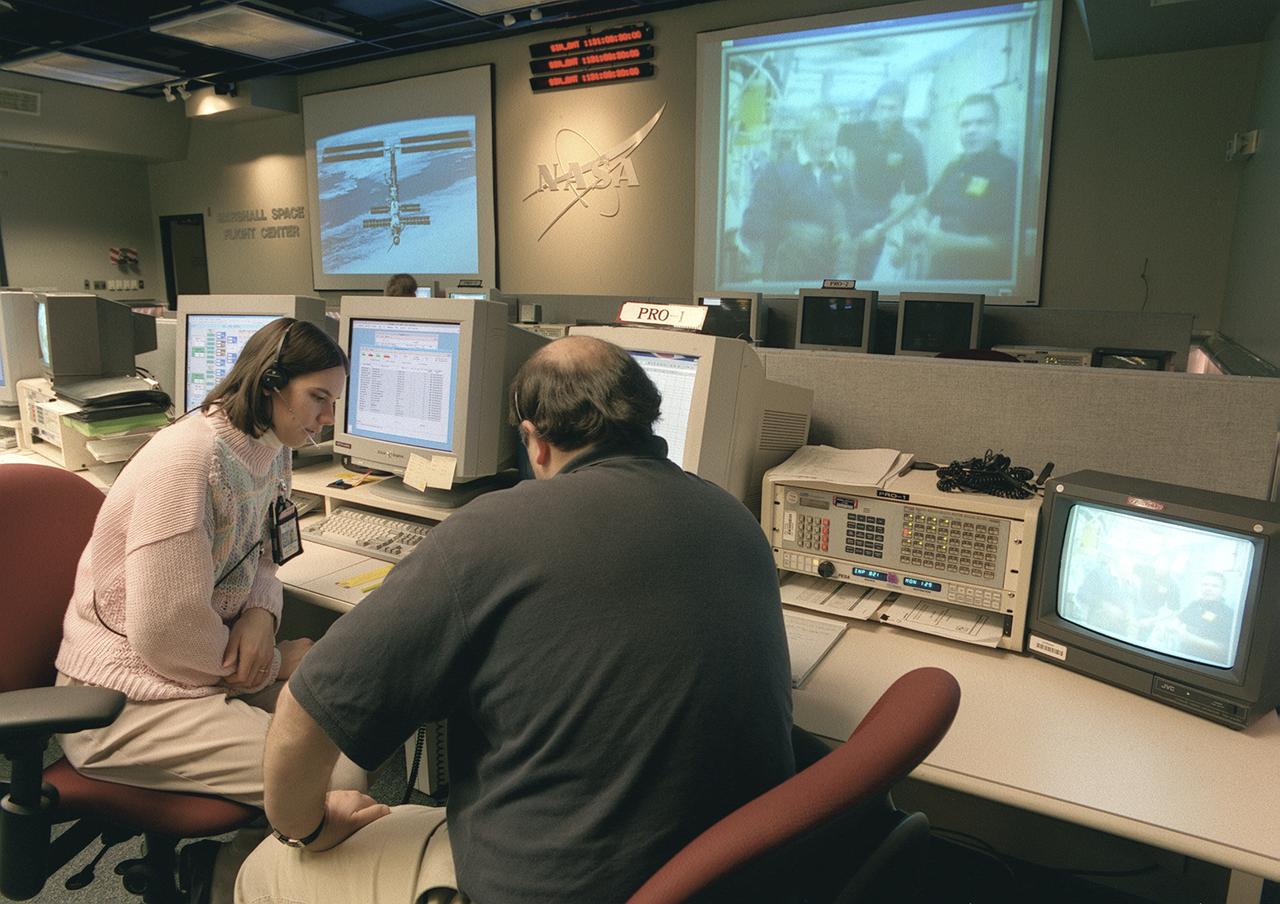
The Payload Operations Center (POC) is the science command post for the International Space Station (ISS). Located at NASA's Marshall Space Flight Center in Huntsville, Alabama, it is the focal point for American and international science activities aboard the ISS. The POC's unique capabilities allow science experts and researchers around the world to perform cutting-edge science in the unique microgravity environment of space. The POC is staffed around the clock by shifts of payload flight controllers. At any given time, 8 to 10 flight controllers are on consoles operating, plarning for, and controlling various systems and payloads. This photograph shows a Payload Rack Officer (PRO) at a work station. The PRO is linked by a computer to all payload racks aboard the ISS. The PRO monitors and configures the resources and environment for science experiments including EXPRESS Racks, multiple-payload racks designed for commercial payloads.

KENNEDY SPACE CENTER, FLA. -- In this closeup viewed from above, former Apollo astronauts (seated, left to right) Neil A. Armstrong and Edwin "Buzz" Aldrin who flew on Apollo 11, the launch to the moon; Gene Cernan, who flew on Apollo 10 and 17; and Walt Cunningham, who flew on Apollo 7, answer questions from the media during a press conference in the Apollo/Saturn V Center. At left is Lisa Malone, chief of KSC's Media Services branch, who monitored the session. In the background are the original computer consoles used in the firing room during the Apollo program. They are now part of the reenactment of the Apollo launches in the exhibit at the center. The four astronauts were at KSC for the 30th anniversary of the Apollo 11 launch and moon landing, July 16 and July 20, 1969

As the size of a satellite is scaled down to the form factor of a CubeSat, the hardware must scale down as well. Unfortunately, the software inside does not follow the same trend. Simulation-to-Flight 1 (STF-1) aims to solve this problem by providing a simulation of the CubeSat that can be used for developing and testing the software on any laptop or desktop computer. Additionally, STF-1 hosts payloads that aim to increase the accuracy of navigation for CubeSats, monitor Space Weather over the North and South Poles, and test the durability of new materials used for Light Emitting Diodes (LEDs). The first spacecraft built in the state of West Virginia, STF-1, is a collaborative effort between the NASA Independent Verification and Validation Program, West Virginia University, and West Virginia small businesses.

United Launch Alliance, or ULA, workers monitor the progress as the ULA Delta IV Heavy rocket for Exploration Flight Test-1 is lifted to the vertical position in the mobile service tower on the pad at Space Launch Complex 37 at Cape Canaveral Air Force Station in Florida. The Delta IV Heavy is being readied to launch Orion on its first flight test. During its first flight test, Orion will travel farther into space than any human spacecraft has gone in more than 40 years. The data gathered during the flight will influence design decisions, validate existing computer models and innovative new approaches to space systems development, as well as reduce overall mission risks and costs for later Orion flights. Liftoff of Orion on the first flight test is planned for December 2014.
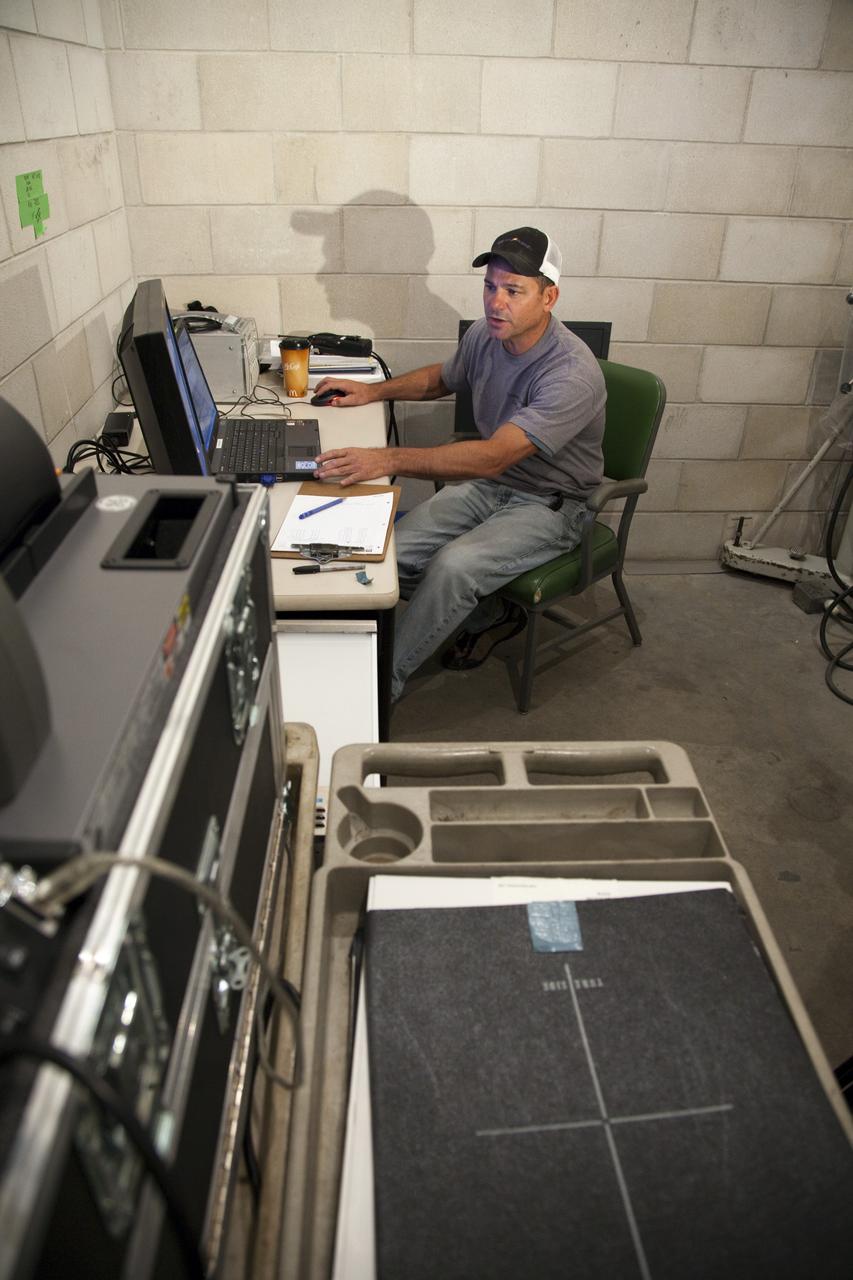
CAPE CANAVERAL, Fla. -- A technician prepares to monitor computed radiography scans of space shuttle Discovery's external fuel tank. The shuttle stack, consisting of the shuttle, external tank and solid rocket boosters, was moved from Launch Pad 39A to the Vehicle Assembly Building at NASA's Kennedy Space Center in Florida so technicians could examine 21-foot-long support beams, called stringers, on the outside of the tank's intertank and re-apply foam insulation. Discovery's next launch opportunity to the International Space Station on the STS-133 mission is no earlier than Feb. 3, 2011. For more information on STS-133, visit www.nasa.gov/mission_pages/shuttle/shuttlemissions/sts133/. Photo credit: NASA/Frankie Martin
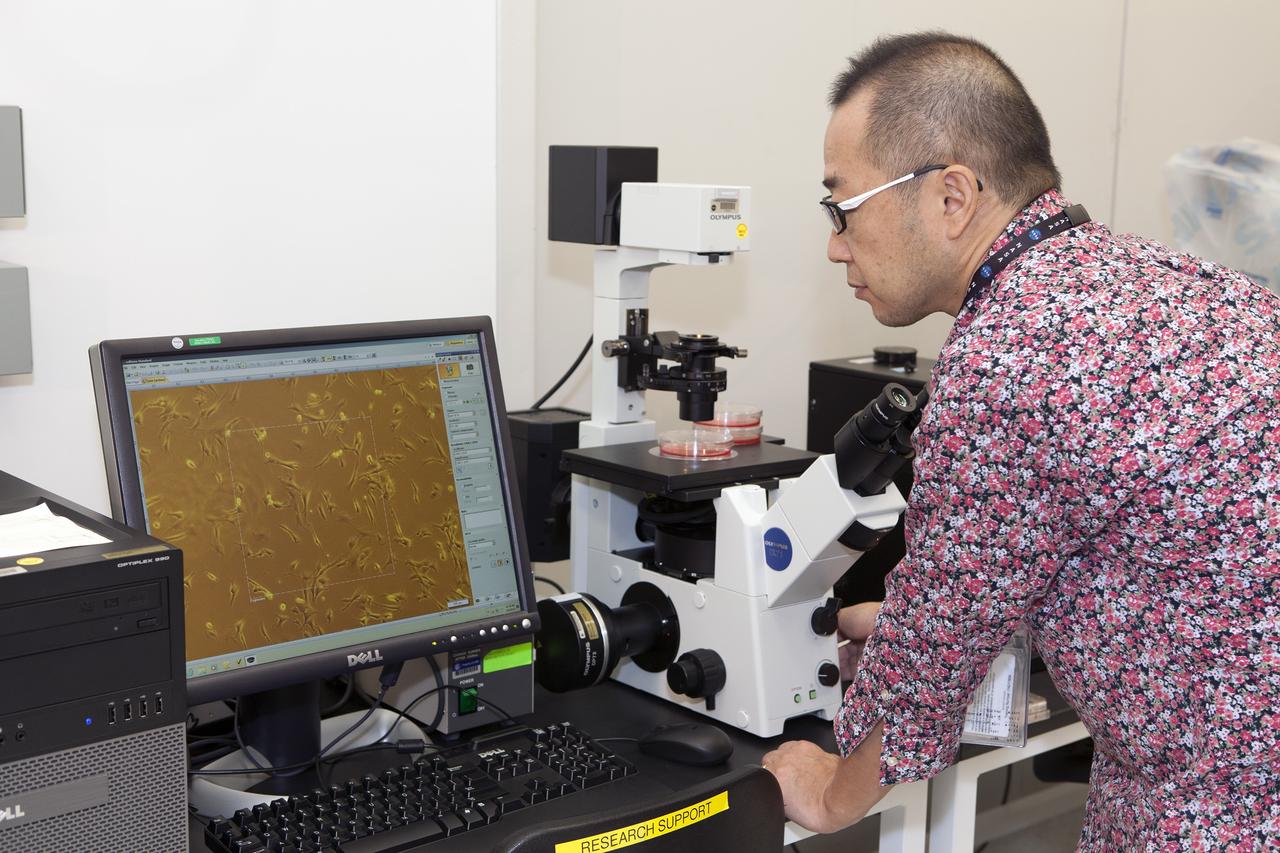
CAPE CANAVERAL, Fla. – Inside a laboratory in the Space Station Processing Facility at NASA's Kennedy Space Center in Florida, Dr. Takeshi Kobayashi, an assistant professor at Nagoya University in Japan, uses a microscope and computer monitor to check samples of the Cell-Mechanosensing 2 experiment for the Japan Aerospace Exploration Agency. The experiment is one of many that will be delivered to the International Space Station on the SpaceX-4 commercial cargo resupply mission. Kennedy's ISS Ground Processing and Research Project Office is providing the necessary laboratories, equipment, supplies and consumables for 61 principal investigators, including 17 from other countries, as they prepare their science experiments for flight. The SpaceX-4 flight is targeted to launch in September 2014. Photo credit: NASA/Dimitri Gerondidakis
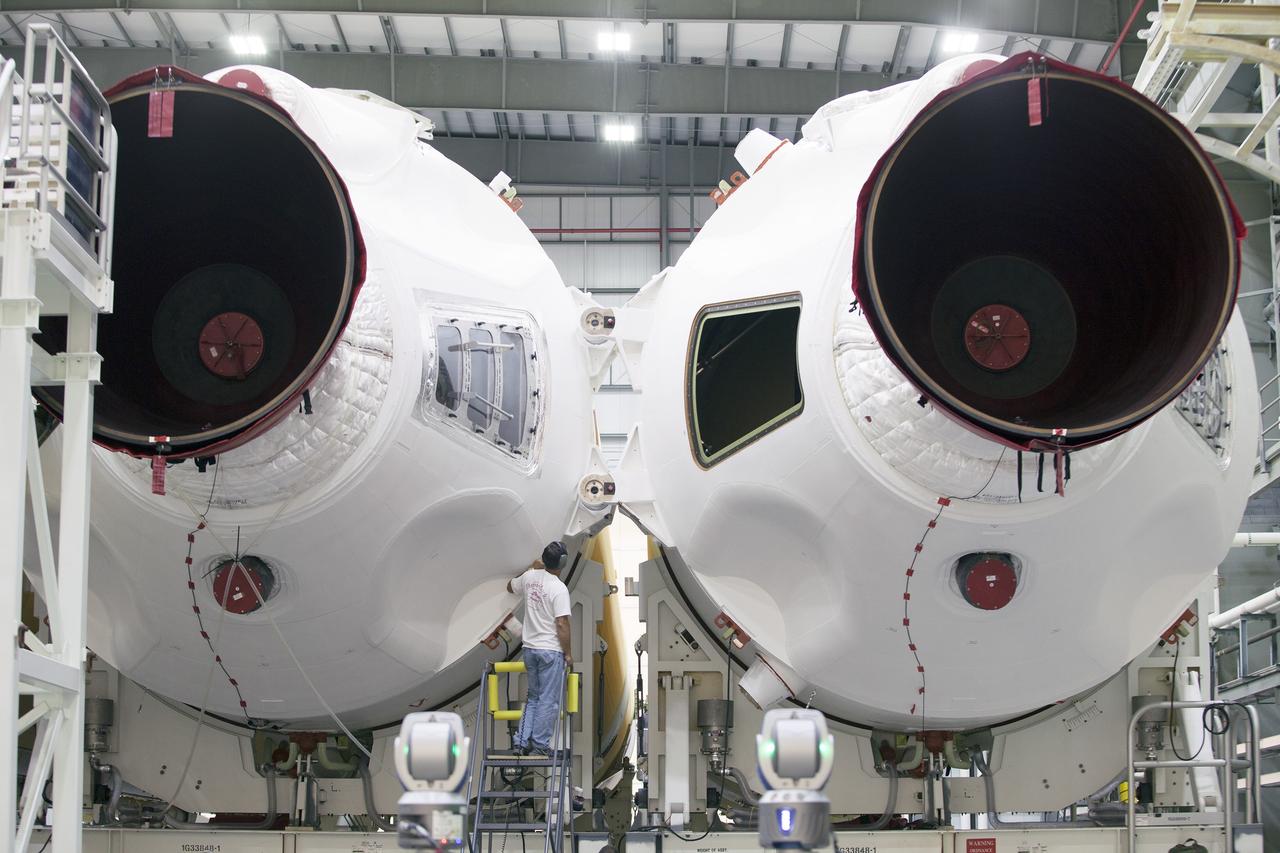
CAPE CANAVERAL, Fla. – A United Launch Alliance, or ULA, technician monitors the progress as the Delta IV port booster is mated to the core booster inside the Horizontal Integration Facility at Space Launch Complex 37 on Cape Canaveral Air Force Station in Florida. The ULA Delta IV Heavy rocket will launch an uncrewed Orion spacecraft on Exploration Flight Test-1. During the mission, Orion will travel farther into space than any human spacecraft has gone in more than 40 years. The data gathered during the flight will influence design decisions, validate existing computer models and innovative new approaches to space systems development, as well as reduce overall mission risks and costs for later Orion flights. Liftoff of Orion on the first flight test is planned for December 2014. Photo credit: NASA/Ben Smegelsky
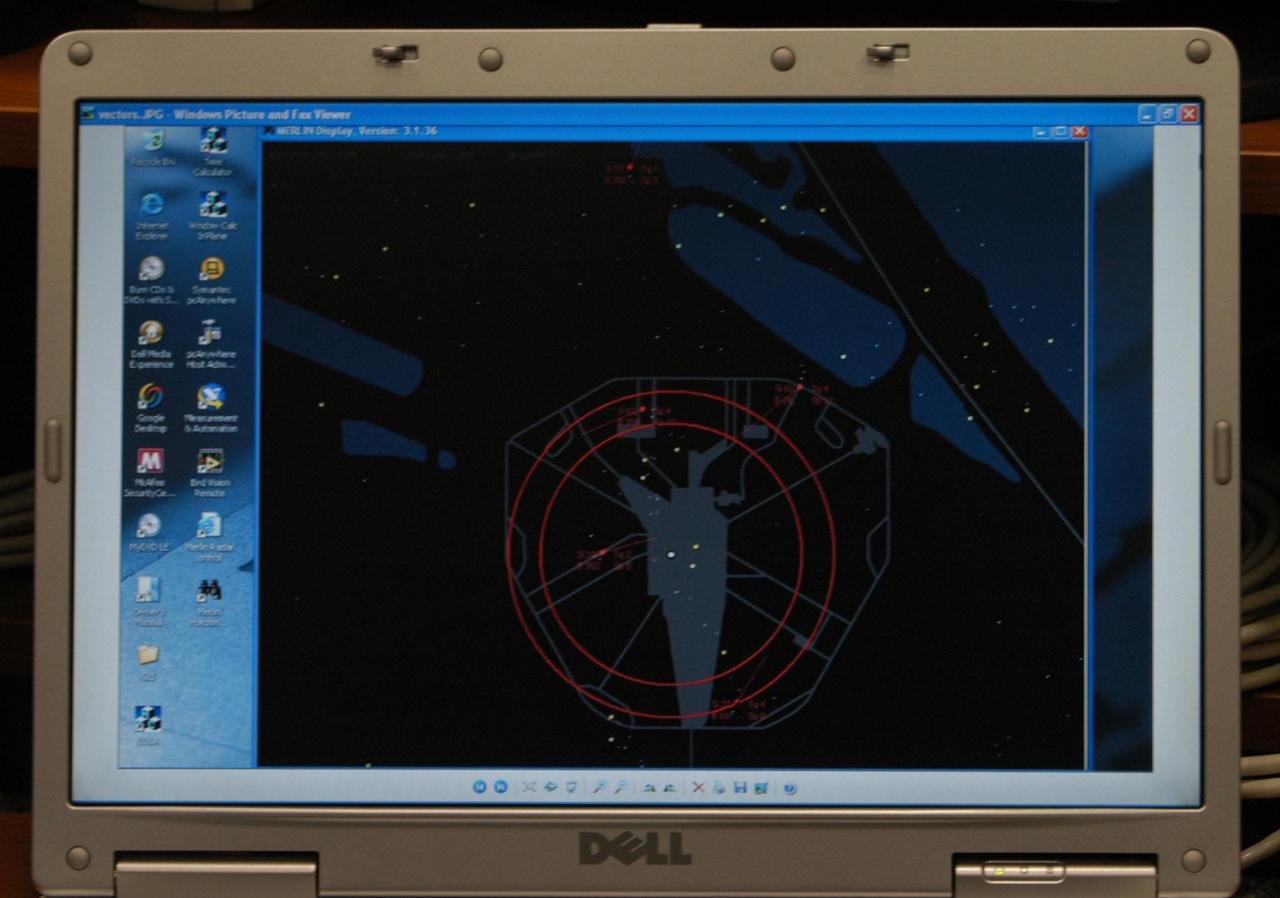
KENNEDY SPACE CENTER, FLA. - This radar image shows the presence of large birds around Launch Pad 39B. The data is being relayed from the avian radars recently set up on the pad. The computer is one of two set up in Firing Room 4 of the Launch Control Center. When birds, especially vultures, are near the shuttle during a launch, impact on a critical area is possible and could cause catastrophic damage to the vehicle. Already proven affective for aviation where threats posed by bird strikes have been a problem, the avian radar, known as Aircraft Birdstrike Avoidance Radar, provides horizontal and vertical scanning and can monitor either launch pad for movement of vultures around them. If data relayed from the avian radar indicates large birds are dangerously close to the vehicle, controllers could hold the countdown. Photo credit: NASA/George Shelton

David L. Iverson of NASA Ames Research Center, Moffett Field, California (in foreground) led development of computer software to monitor the conditions of the gyroscopes that keep the International Space Station (ISS) properly oriented in space as the ISS orbits Earth. Also, Charles Lee is pictured. During its develoment, researchers used the software to analyze archived gyroscope records. In these tests, users noticed problems with the gyroscopes long before the current systems flagged glitches. Testers trained using several months of normal space station gyroscope data collected by the International Space Station Mission Control Center at NASA Johnson Space Center, Houston. Promising tests results convinced officials to start using the software in 2007.
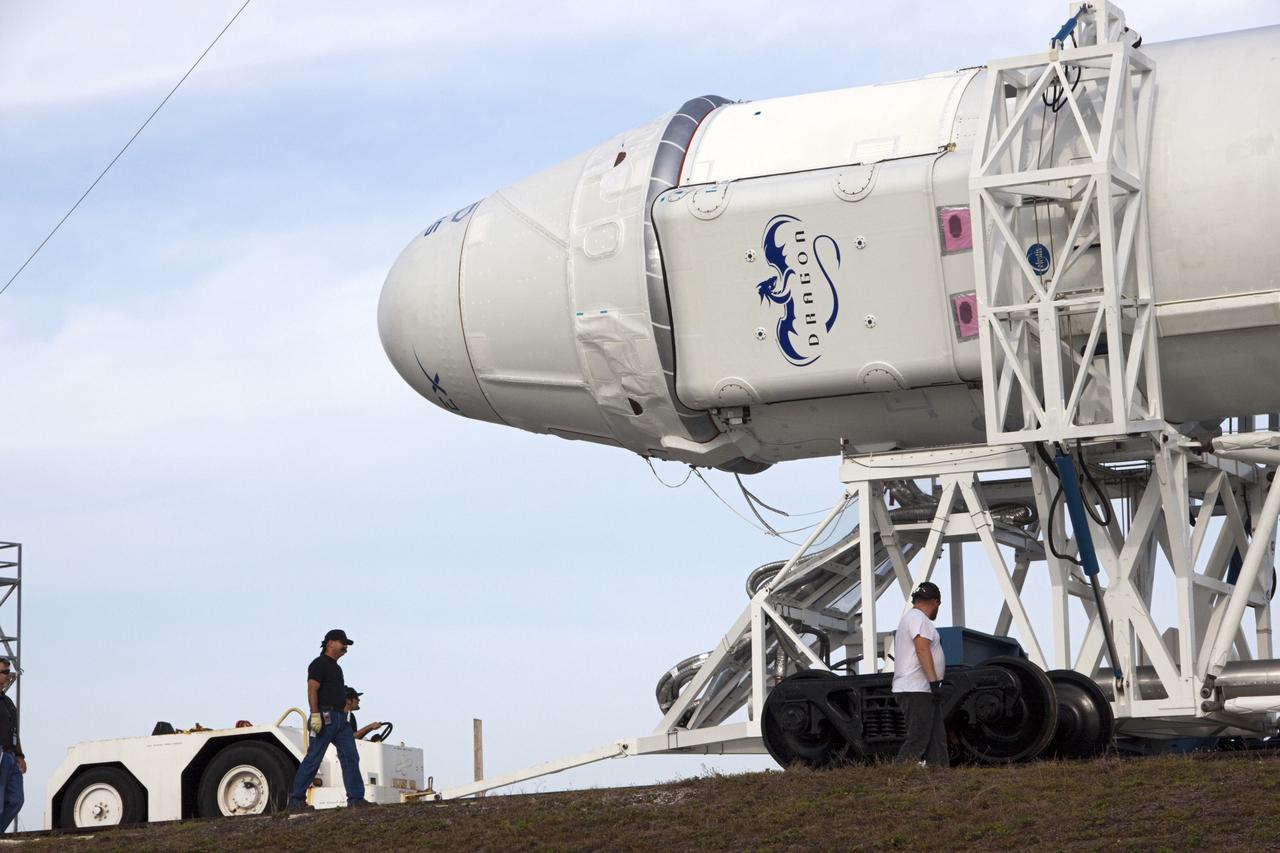
CAPE CANAVERAL, Fla. – As technicians monitor the progress of the transporter, the SpaceX Falcon 9 rocket with its Dragon spacecraft arrive at Space Launch Complex-40 on Cape Canaveral Air Force Station in Florida. Liftoff with the SpaceX Falcon 9 is set for 4:55 a.m. EDT on May 19. The launch will be the company's second demonstration test flight for NASA's Commercial Orbital Transportation Services Program, or COTS. During the flight, the capsule will conduct a series of check-out procedures to test and prove its systems, including rendezvous and berthing with the International Space Station. If the capsule performs as planned, the cargo and experiments it is carrying will be transferred to the station. The cargo includes food, water and provisions for the station’s Expedition crews, such as clothing, batteries and computer equipment. Under COTS, NASA has partnered with two aerospace companies to deliver cargo to the station. For more information, visit http://www.nasa.gov/spacex Photo credit: NASA/Jim Grossmann
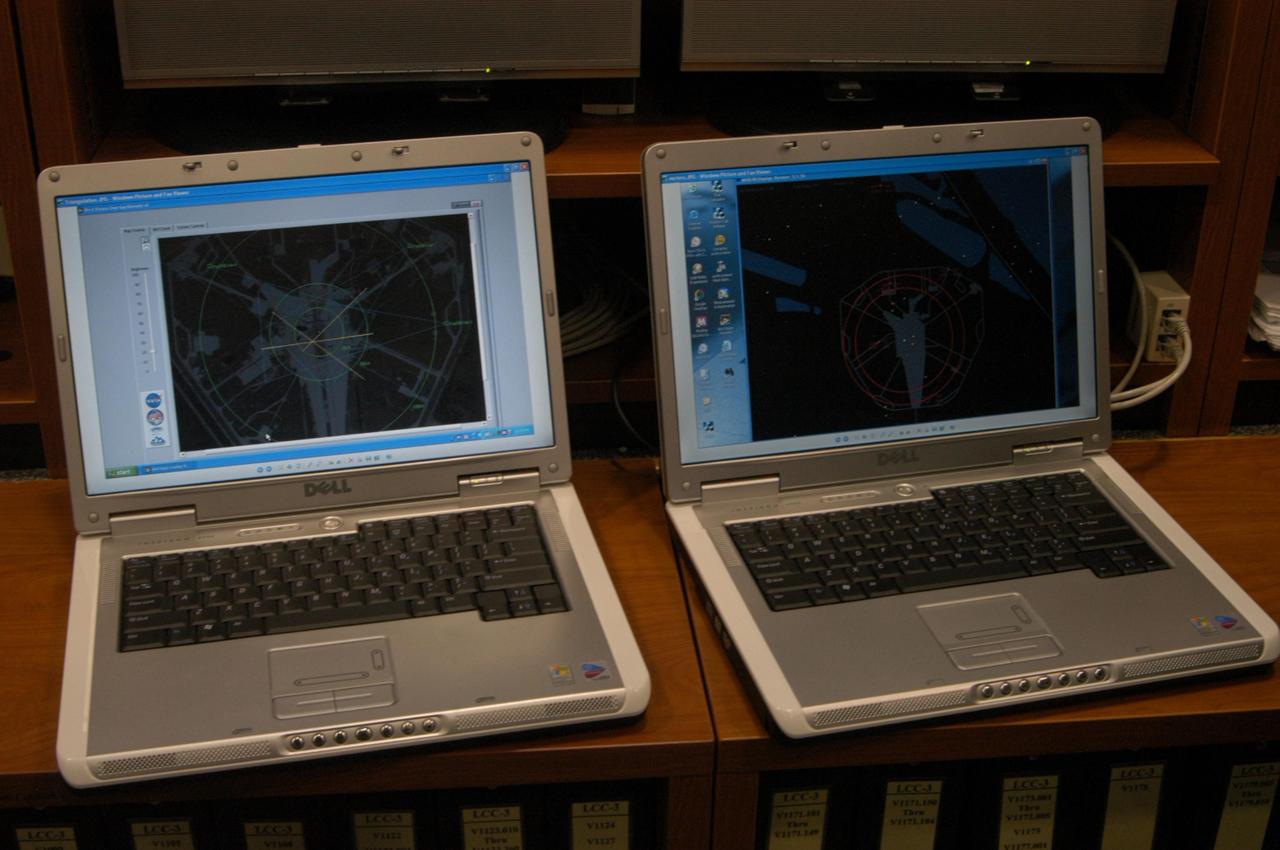
KENNEDY SPACE CENTER, FLA. - These laptop computers in Firing Room 4 of the Launch Control Center reveal data being relayed from the avian radars recently set up on Launch Pad 39B. On the left is an associated camera image. On the right is the radar image. When birds, especially vultures, are near the shuttle during a launch, impact on a critical area is possible and could cause catastrophic damage to the vehicle. Already proven affective for aviation where threats posed by bird strikes have been a problem, the avian radar, known as Aircraft Birdstrike Avoidance Radar, provides horizontal and vertical scanning and can monitor either launch pad for movement of vultures around them. If data relayed from the avian radar indicates large birds are dangerously close to the vehicle, controllers could hold the countdown. Photo credit: NASA/George Shelton
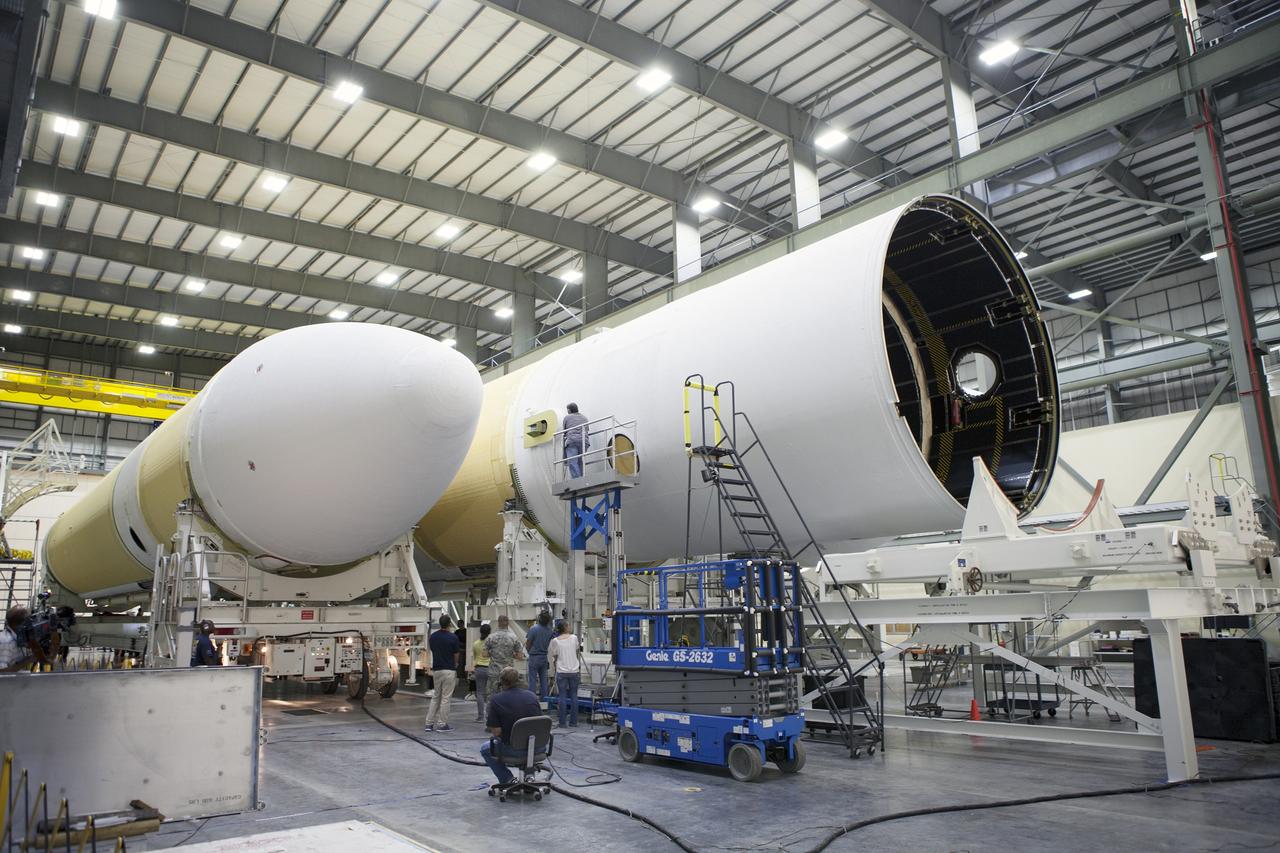
CAPE CANAVERAL, Fla. – United Launch Alliance, or ULA, technicians monitor the progress as the Delta IV port booster is mated to the core booster inside the Horizontal Integration Facility at Space Launch Complex 37 on Cape Canaveral Air Force Station in Florida. The ULA Delta IV Heavy rocket will launch an uncrewed Orion spacecraft on Exploration Flight Test-1. During the mission, Orion will travel farther into space than any human spacecraft has gone in more than 40 years. The data gathered during the flight will influence design decisions, validate existing computer models and innovative new approaches to space systems development, as well as reduce overall mission risks and costs for later Orion flights. Liftoff of Orion on the first flight test is planned for December 2014. Photo credit: NASA/Ben Smegelsky
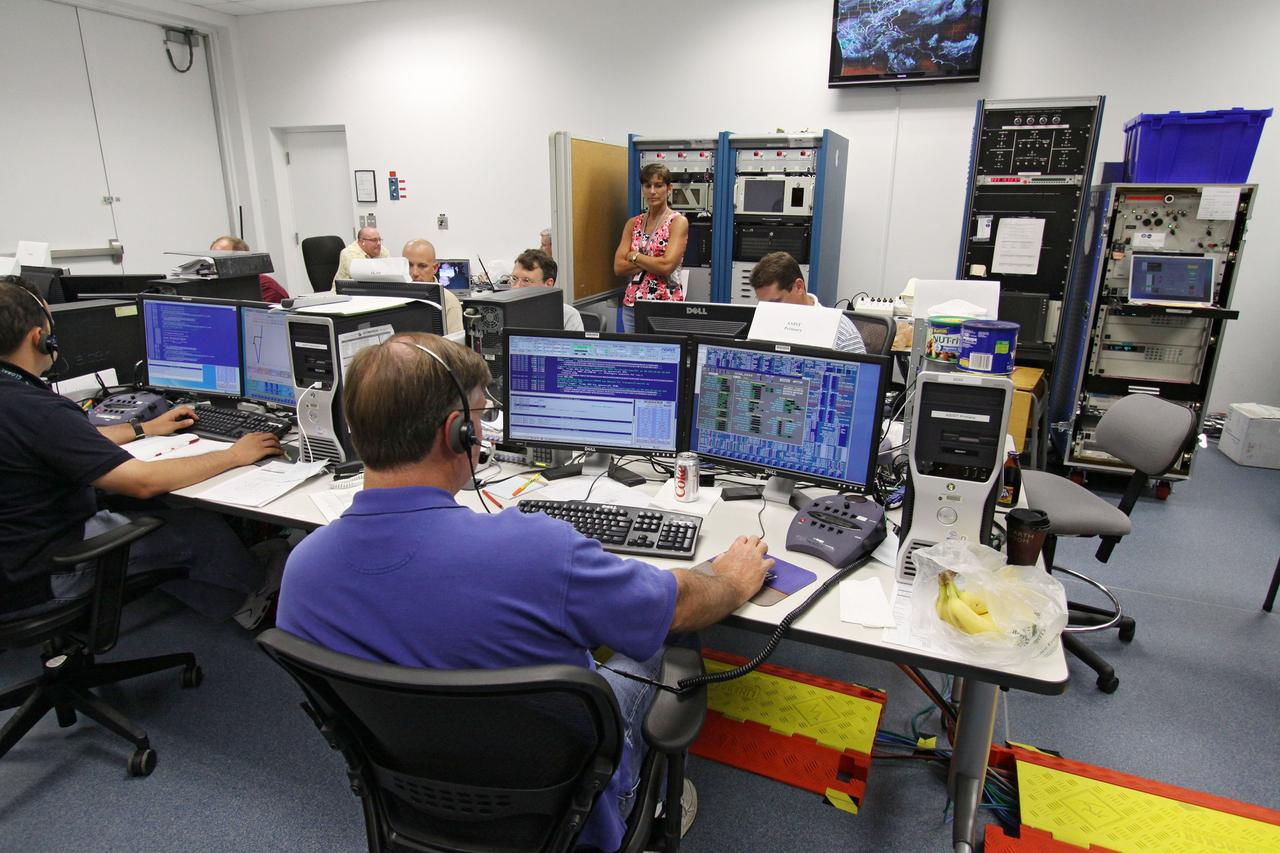
CAPE CANAVERAL, Fla. – At the Astrotech Space Operations facility in Titusville, Fla., workers in the control room monitor the data on computer screens from the movement of the high-gain antenna on the Solar Dynamics Observatory, or SDO. The SDO is undergoing performance testing. All of the spacecraft science instruments are being tested in their last major evaluation before launch. SDO is the first space weather research network mission in NASA's Living With a Star Program. The spacecraft's long-term measurements will give solar scientists in-depth information about changes in the sun's magnetic field and insight into how they affect Earth. In preparation for launch, engineers will perform a battery of comprehensive tests to ensure SDO can withstand the stresses and vibrations of the launch itself, as well as what it will encounter in the space environment after launch. Liftoff on an Atlas V rocket is scheduled for Dec. 4. Photo credit: NASA/Jack Pfaller
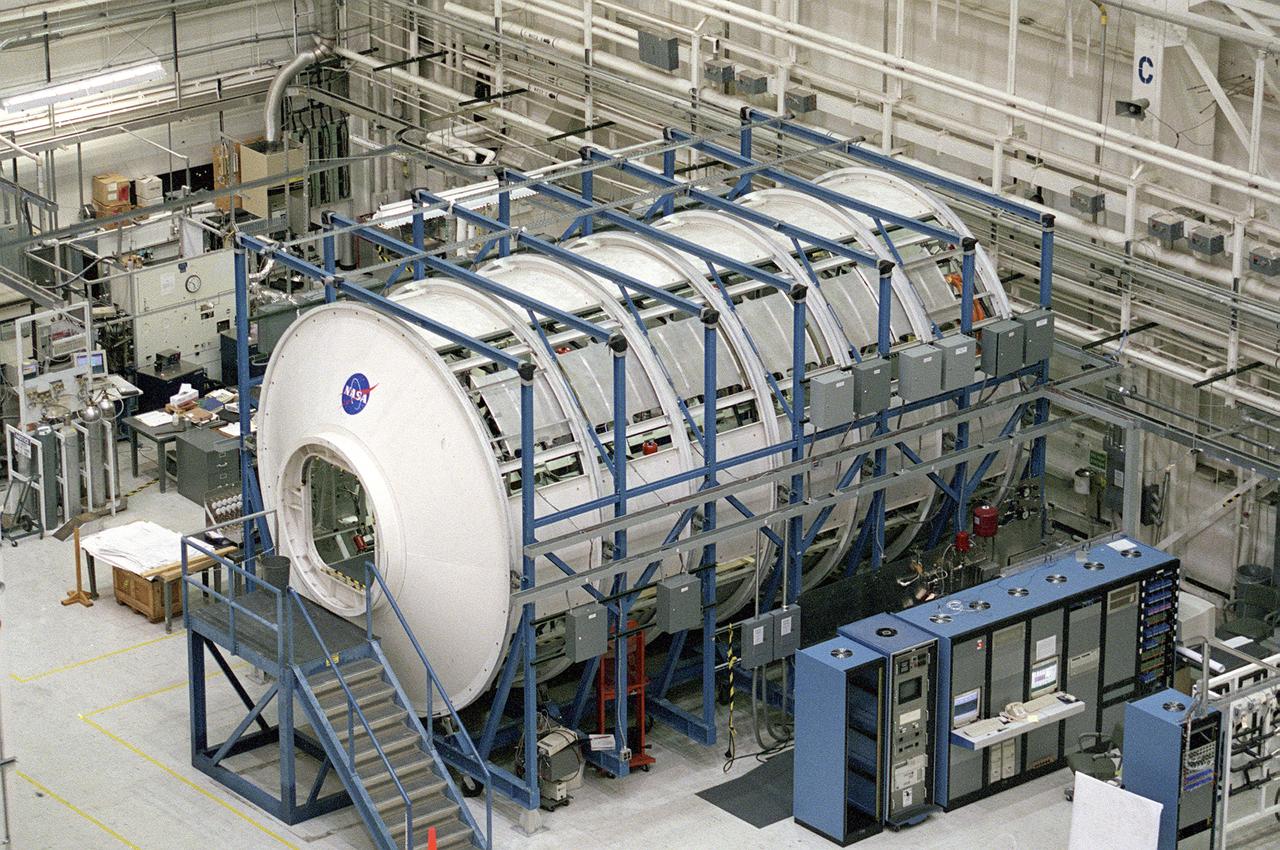
The Marshall Space Flight Center (MSFC) is responsible for designing and building the life support systems that will provide the crew of the International Space Station (ISS) a comfortable environment in which to live and work. Scientists and engineers at the MSFC are working together to provide the ISS with systems that are safe, efficient and cost-effective. These compact and powerful systems are collectively called the Environmental Control and Life Support Systems, or simply, ECLSS. This is an exterior view of the U.S. Laboratory Module Simulator containing the ECLSS Internal Thermal Control System (ITCS) testing facility at MSFC. At the bottom right is the data acquisition and control computers (in the blue equipment racks) that monitor the testing in the facility. The ITCS simulator facility duplicates the function, operation, and troubleshooting problems of the ITCS. The main function of the ITCS is to control the temperature of equipment and hardware installed in a typical ISS Payload Rack.
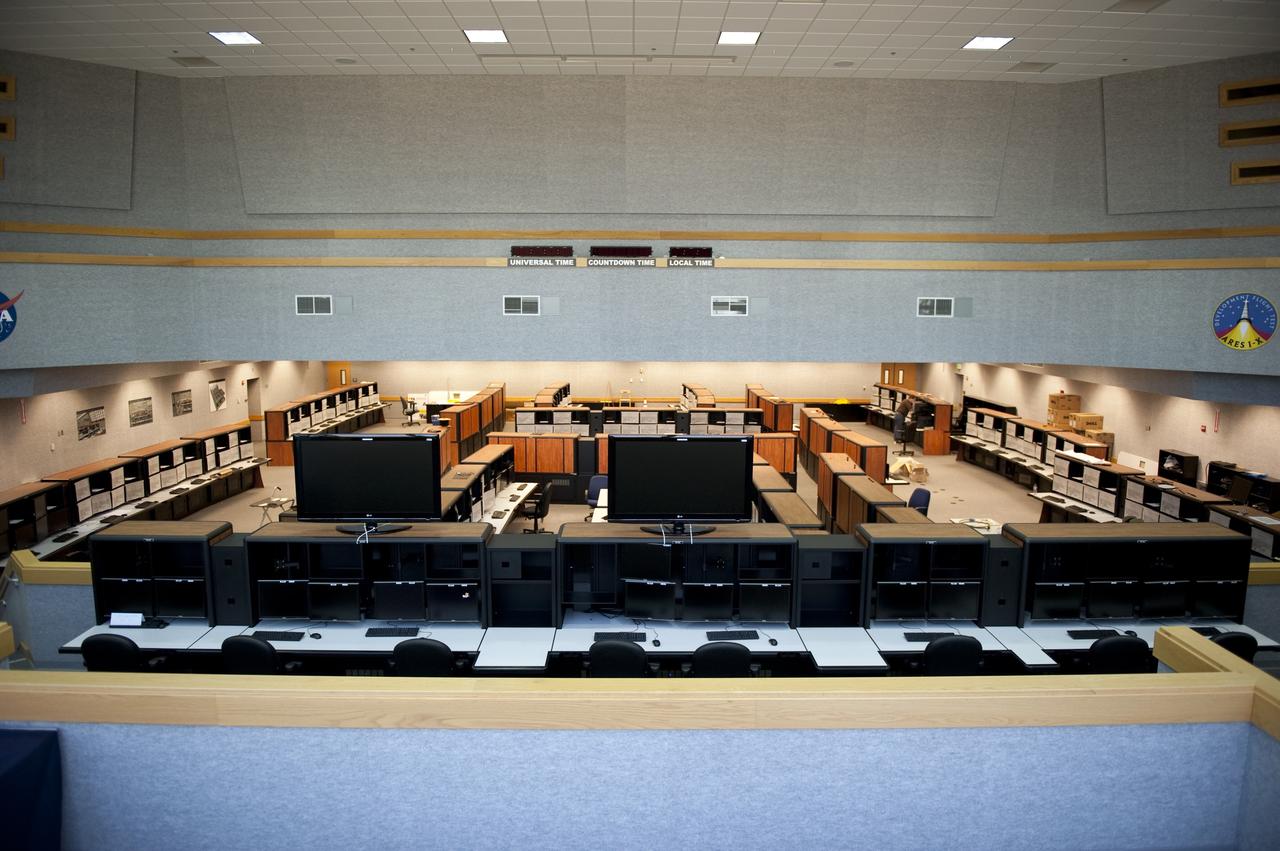
CAPE CANAVERAL, Fla. -- At NASA's Kennedy Space Center in Florida, remodeling for launches of future human spaceflight vehicles takes place in the Launch Control Center's Young-Crippen Firing Room. Consoles already have been rewired for the comprehensive upgrade and are now being outfitted with new computers and monitors. From here, the launch team members who give a final "go/no-go" to launch, can see the rest of the team. Known as Firing Room 1 in the Apollo era, it was re-named as a tribute to the Space Shuttle Program's first crewed mission, STS-1, which was flown by Commander John Young and Pilot Robert Crippen in April 1981. The firing room most recently was set up to support the Ares I-X flight test in Oct. 2009. Photo credit: NASA/Kim Shiflett
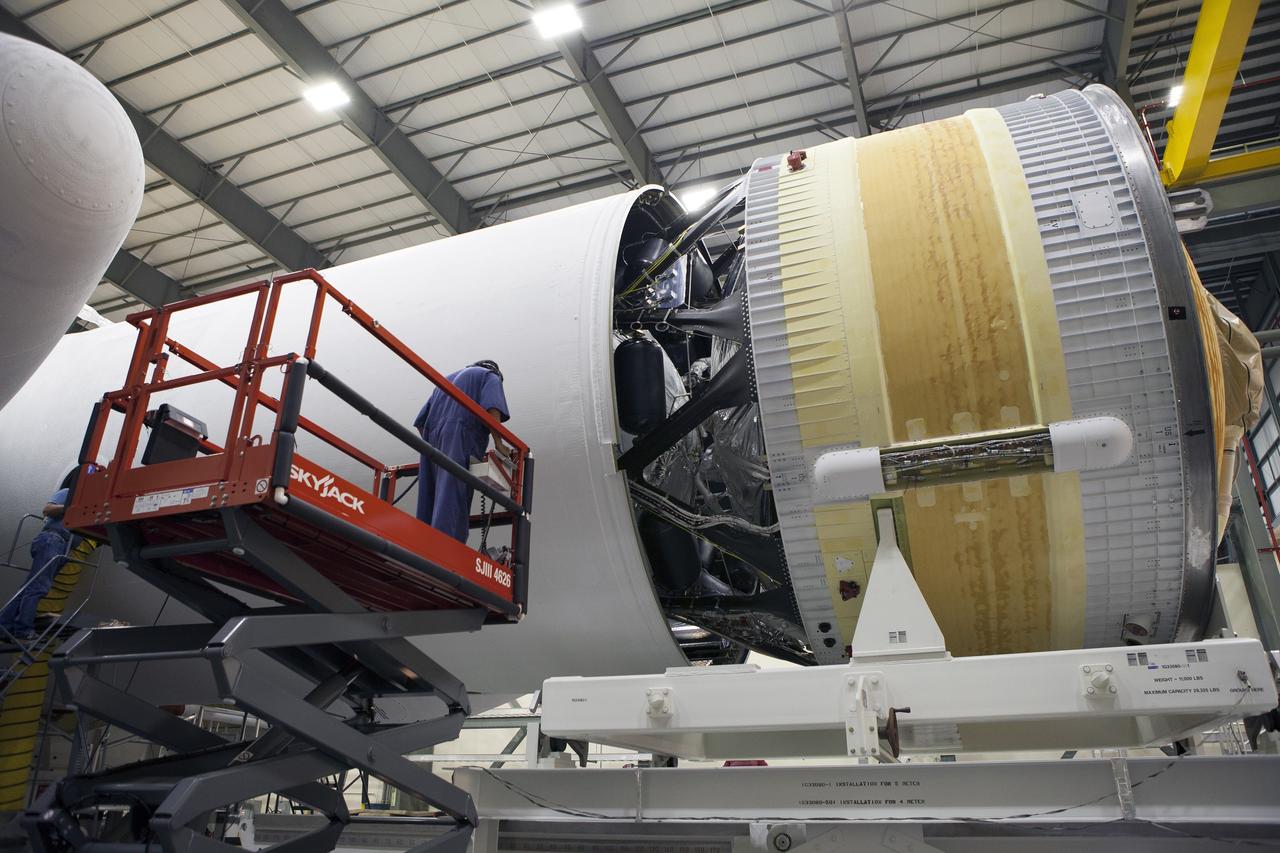
CAPE CANAVERAL, Fla. – Inside the Horizontal Integration Facility at Space Launch Complex 37 at Cape Canaveral Air Force Station in Florida, a United Launch Alliance technician on a scissor lift monitors the progress as the second stage of a Delta IV Heavy rocket is mated to the central core booster of the three booster stages for the unpiloted Exploration Flight Test-1, or EFT-1. During the mission, Orion will travel farther into space than any human spacecraft has gone in more than 40 years. The data gathered during the flight will influence design decisions, validate existing computer models and innovative new approaches to space systems development, as well as reduce overall mission risks and costs for later Orion flights. Liftoff of Orion on the first flight test is planned for December 2014. Photo credit: NASA/Daniel Casper

As the size of a satellite is scaled down to the form factor of a CubeSat, the hardware must scale down as well. Unfortunately, the software inside does not follow the same trend. Simulation-to-Flight 1 (STF-1) aims to solve this problem by providing a simulation of the CubeSat that can be used for developing and testing the software on any laptop or desktop computer. Additionally, STF-1 hosts payloads that aim to increase the accuracy of navigation for CubeSats, monitor Space Weather over the North and South Poles, and test the durability of new materials used for Light Emitting Diodes (LEDs). The first spacecraft built in the state of West Virginia, STF-1, is a collaborative effort between the NASA Independent Verification and Validation Program, West Virginia University, and West Virginia small businesses.
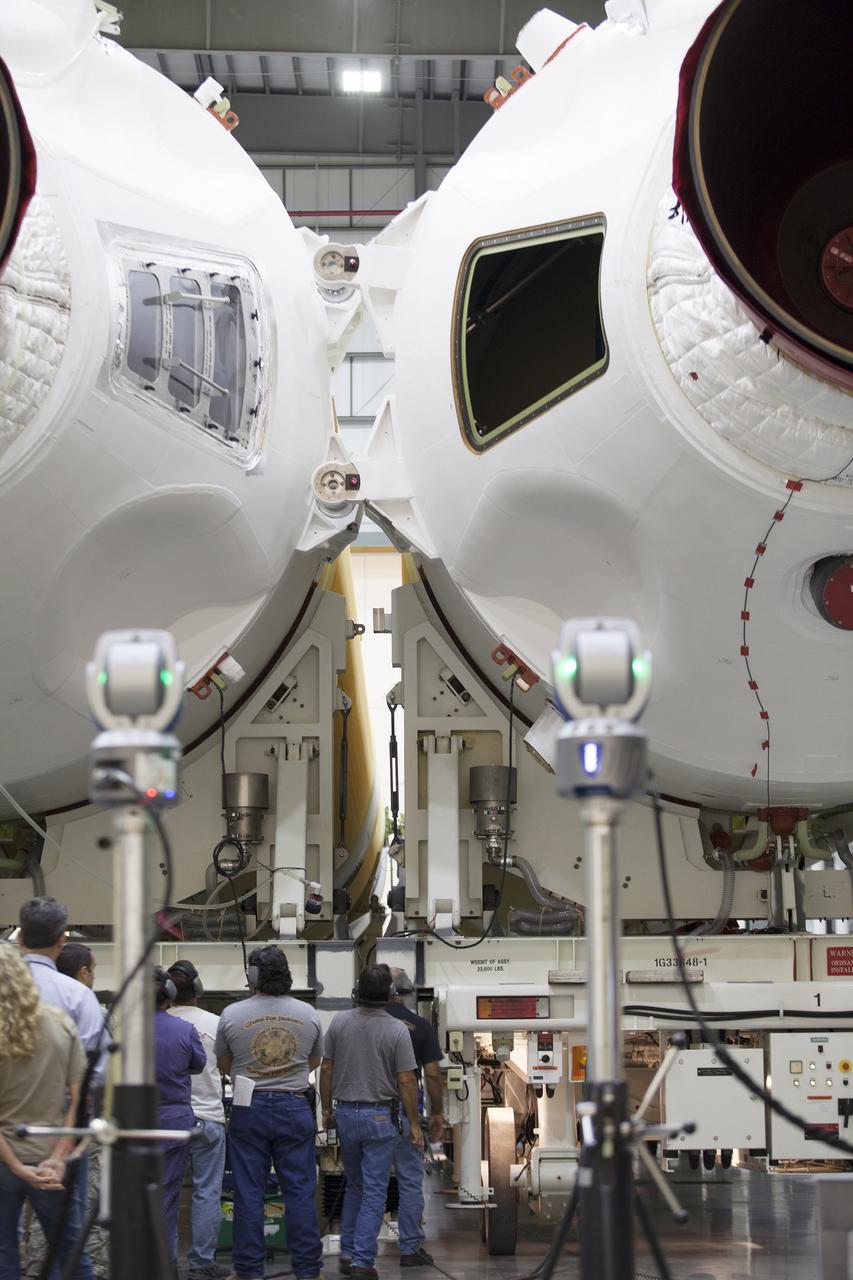
CAPE CANAVERAL, Fla. – United Launch Alliance, or ULA, technicians monitor the progress as the Delta IV port booster is mated to the core booster inside the Horizontal Integration Facility at Space Launch Complex 37 on Cape Canaveral Air Force Station in Florida. The ULA Delta IV Heavy rocket will launch an uncrewed Orion spacecraft on Exploration Flight Test-1. During the mission, Orion will travel farther into space than any human spacecraft has gone in more than 40 years. The data gathered during the flight will influence design decisions, validate existing computer models and innovative new approaches to space systems development, as well as reduce overall mission risks and costs for later Orion flights. Liftoff of Orion on the first flight test is planned for December 2014. Photo credit: NASA/Ben Smegelsky
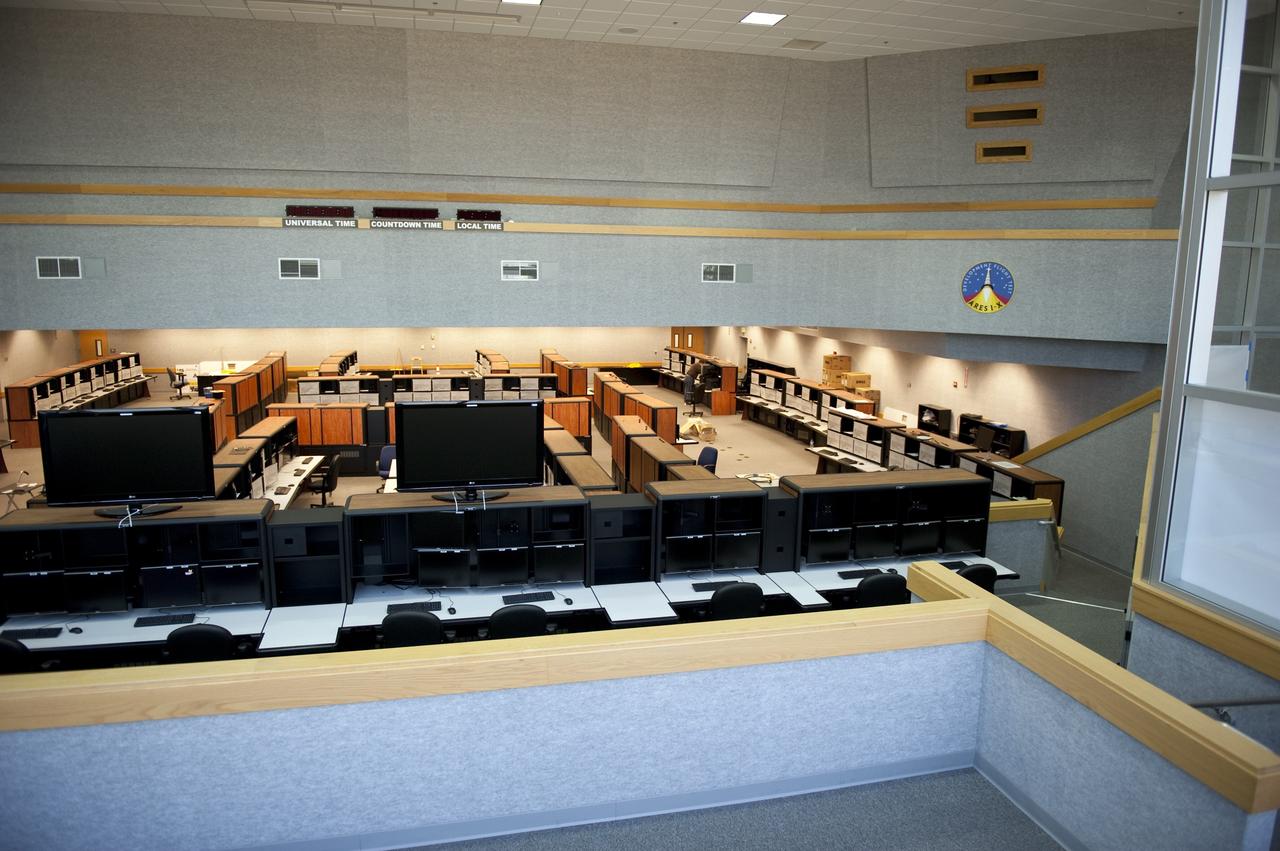
CAPE CANAVERAL, Fla. -- At NASA's Kennedy Space Center in Florida, remodeling for launches of future human spaceflight vehicles takes place in the Launch Control Center's Young-Crippen Firing Room. Consoles already have been rewired for the comprehensive upgrade and are now being outfitted with new computers and monitors. From here, the launch team members who give a final "go/no-go" to launch, can see the rest of the team. Known as Firing Room 1 in the Apollo era, it was re-named as a tribute to the Space Shuttle Program's first crewed mission, STS-1, which was flown by Commander John Young and Pilot Robert Crippen in April 1981. The firing room most recently was set up to support the Ares I-X flight test in Oct. 2009. Photo credit: NASA/Kim Shiflett
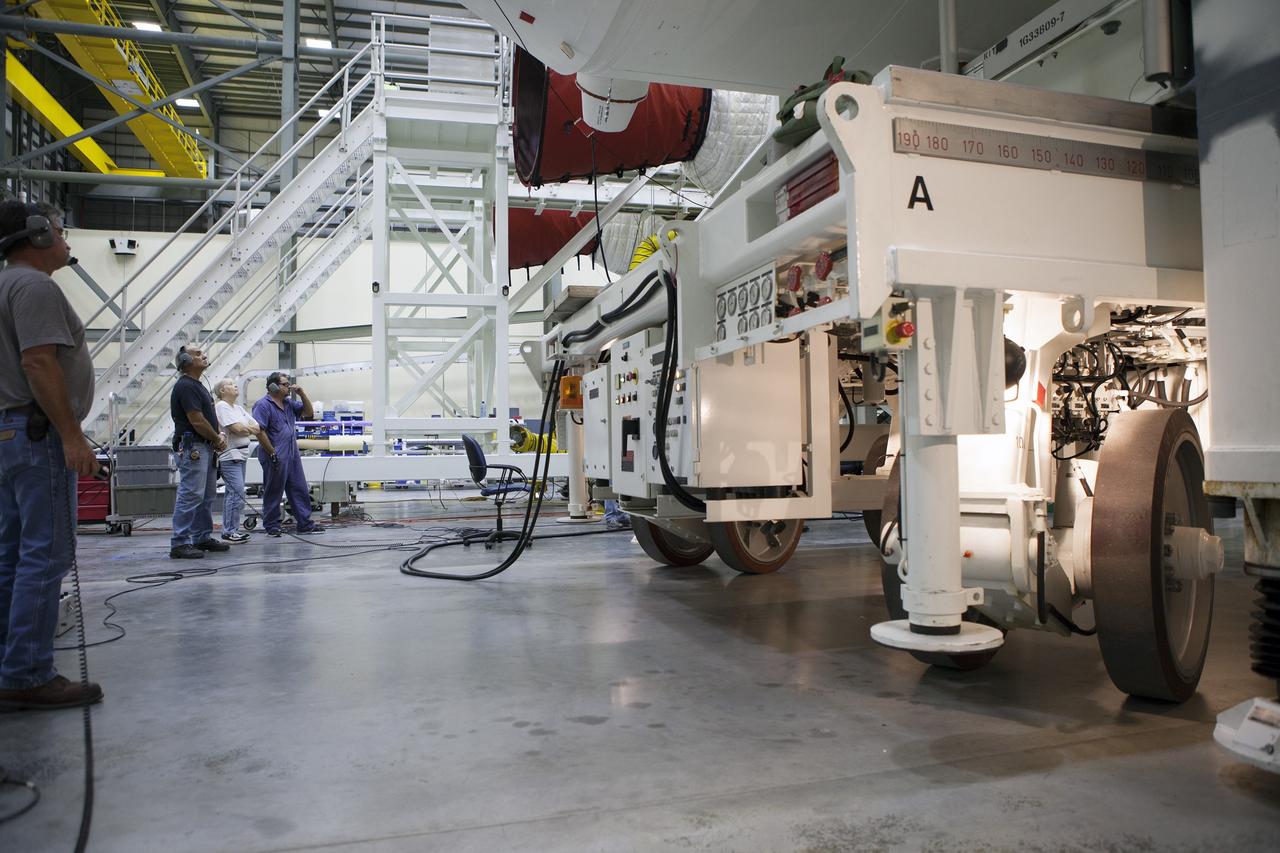
CAPE CANAVERAL, Fla. – United Launch Alliance, or ULA, technicians monitor the progress as the Delta IV port booster is mated to the core booster inside the Horizontal Integration Facility at Space Launch Complex 37 on Cape Canaveral Air Force Station in Florida. The ULA Delta IV Heavy rocket will launch an uncrewed Orion spacecraft on Exploration Flight Test-1. During the mission, Orion will travel farther into space than any human spacecraft has gone in more than 40 years. The data gathered during the flight will influence design decisions, validate existing computer models and innovative new approaches to space systems development, as well as reduce overall mission risks and costs for later Orion flights. Liftoff of Orion on the first flight test is planned for December 2014. Photo credit: NASA/Ben Smegelsky
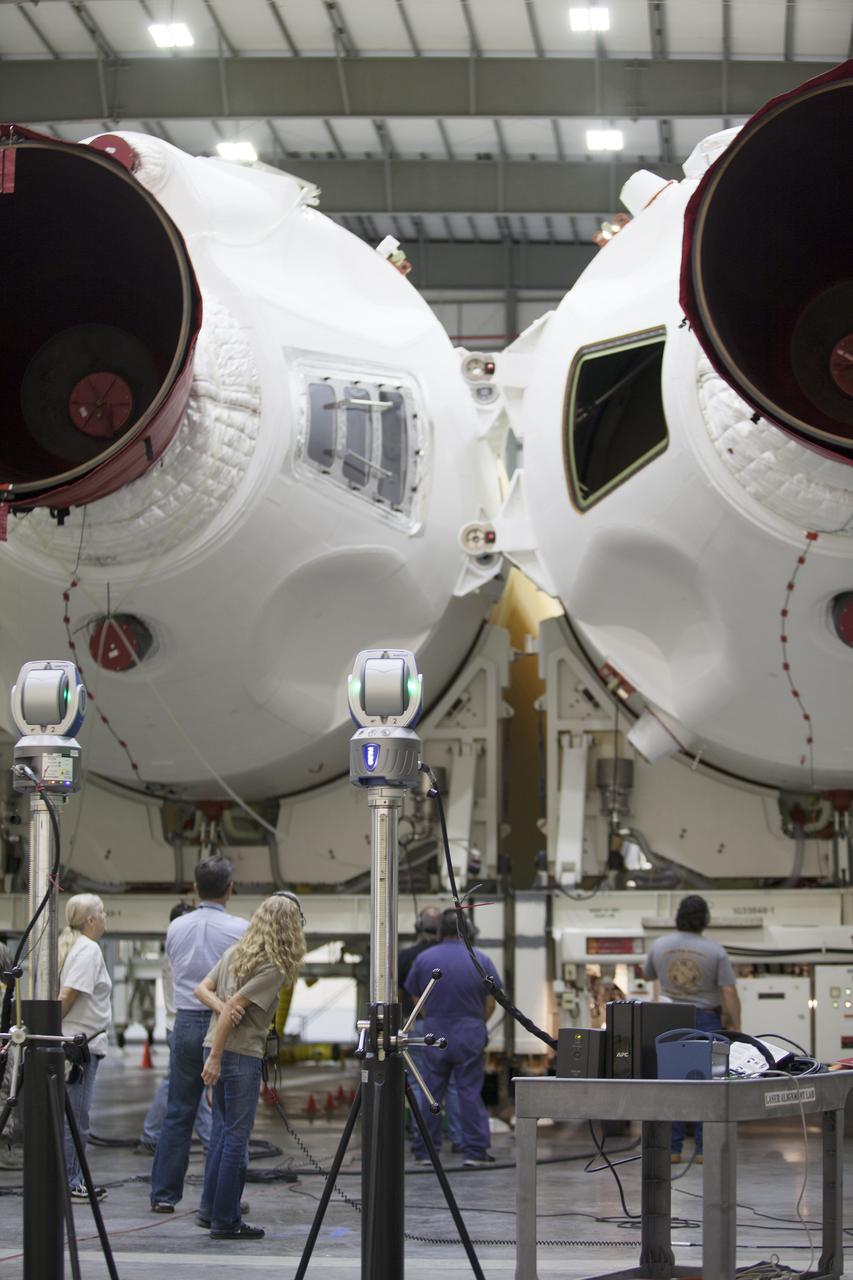
CAPE CANAVERAL, Fla. – United Launch Alliance, or ULA, technicians monitor the progress as the Delta IV port booster is mated to the core booster inside the Horizontal Integration Facility at Space Launch Complex 37 on Cape Canaveral Air Force Station in Florida. The ULA Delta IV Heavy rocket will launch an uncrewed Orion spacecraft on Exploration Flight Test-1. During the mission, Orion will travel farther into space than any human spacecraft has gone in more than 40 years. The data gathered during the flight will influence design decisions, validate existing computer models and innovative new approaches to space systems development, as well as reduce overall mission risks and costs for later Orion flights. Liftoff of Orion on the first flight test is planned for December 2014. Photo credit: NASA/Ben Smegelsky
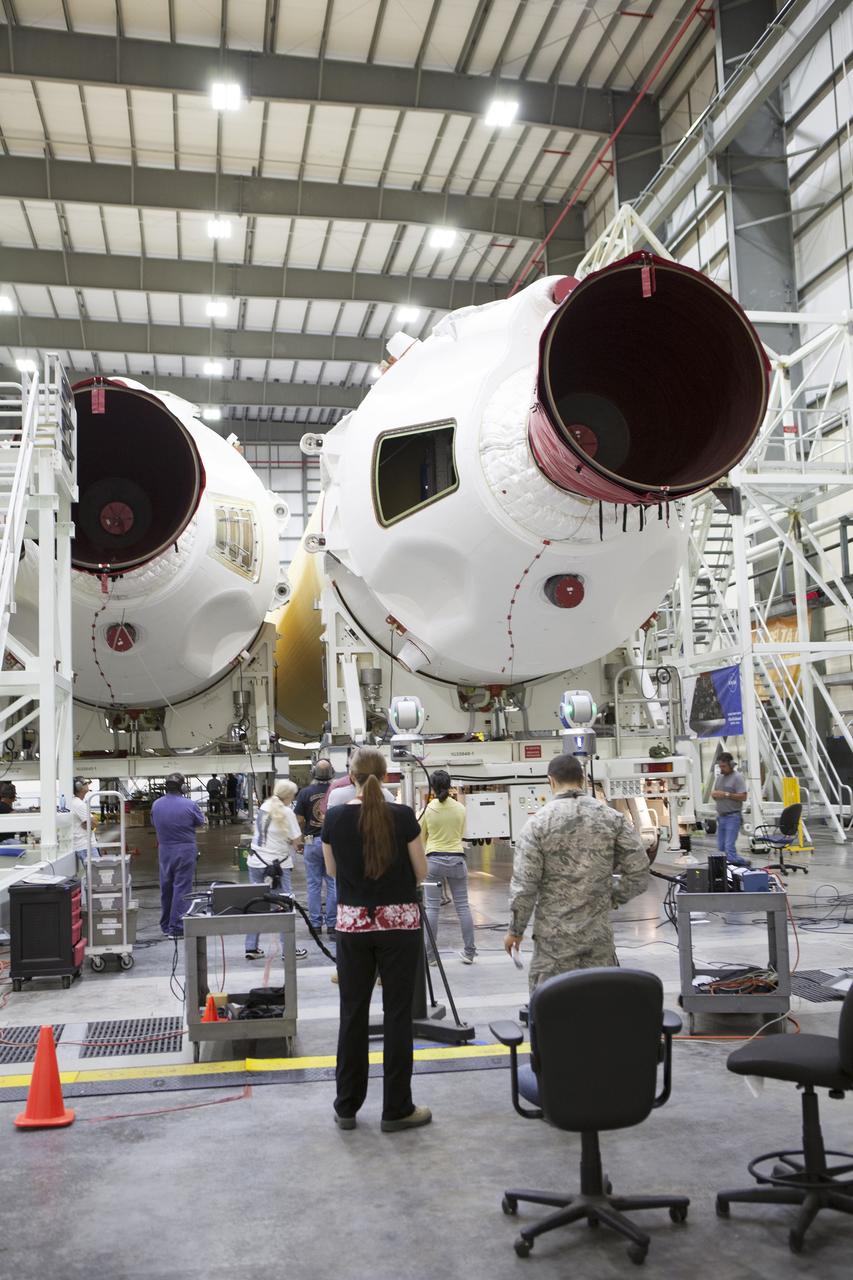
CAPE CANAVERAL, Fla. – United Launch Alliance, or ULA, technicians monitor the progress as the Delta IV port booster is mated to the core booster inside the Horizontal Integration Facility at Space Launch Complex 37 on Cape Canaveral Air Force Station in Florida. The ULA Delta IV Heavy rocket will launch an uncrewed Orion spacecraft on Exploration Flight Test-1. During the mission, Orion will travel farther into space than any human spacecraft has gone in more than 40 years. The data gathered during the flight will influence design decisions, validate existing computer models and innovative new approaches to space systems development, as well as reduce overall mission risks and costs for later Orion flights. Liftoff of Orion on the first flight test is planned for December 2014. Photo credit: NASA/Ben Smegelsky
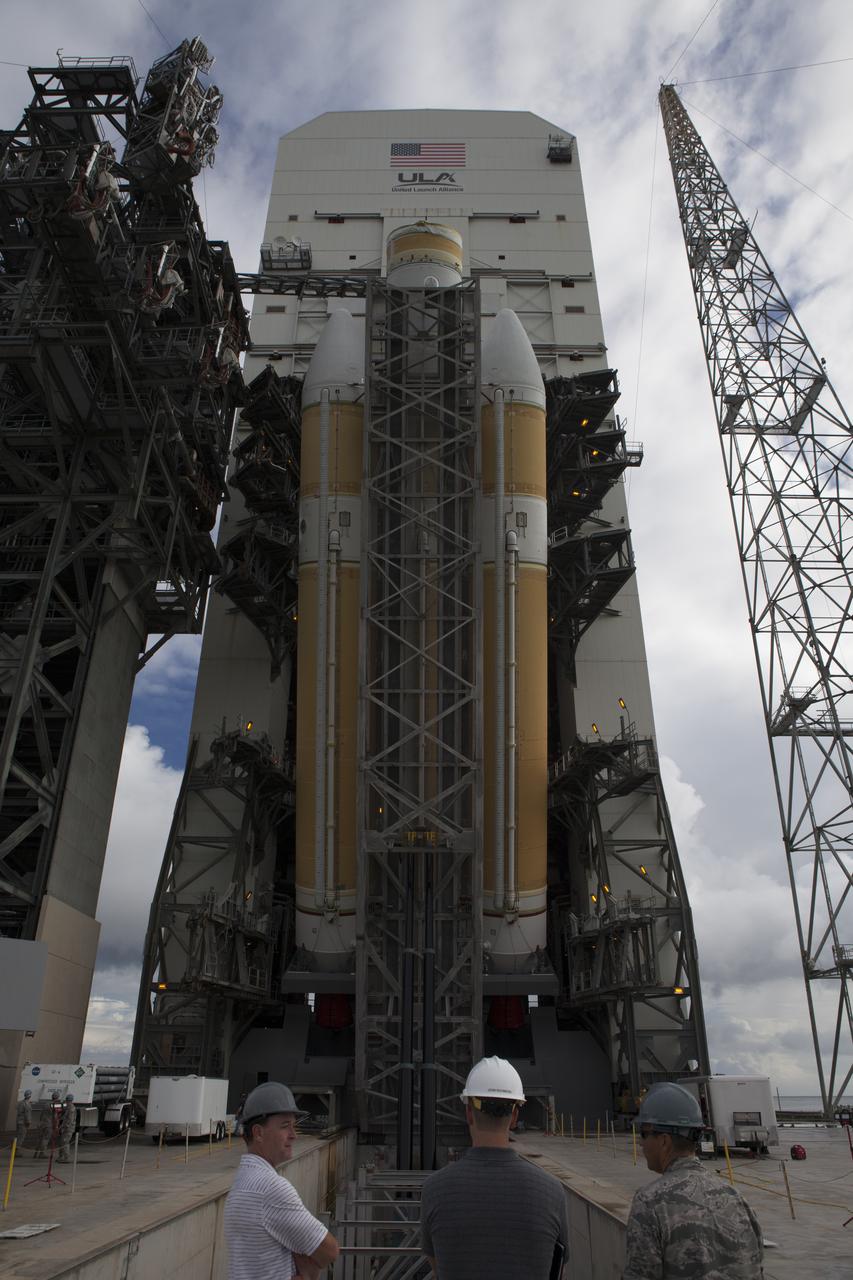
United Launch Alliance, or ULA, workers monitor the progress as the ULA Delta IV Heavy rocket for Exploration Flight Test-1 is lifted to the vertical position in the mobile service tower on the pad at Space Launch Complex 37 at Cape Canaveral Air Force Station in Florida. The Delta IV Heavy is being readied to launch Orion on its first flight test. During its first flight test, Orion will travel farther into space than any human spacecraft has gone in more than 40 years. The data gathered during the flight will influence design decisions, validate existing computer models and innovative new approaches to space systems development, as well as reduce overall mission risks and costs for later Orion flights. Liftoff of Orion on the first flight test is planned for December 2014.
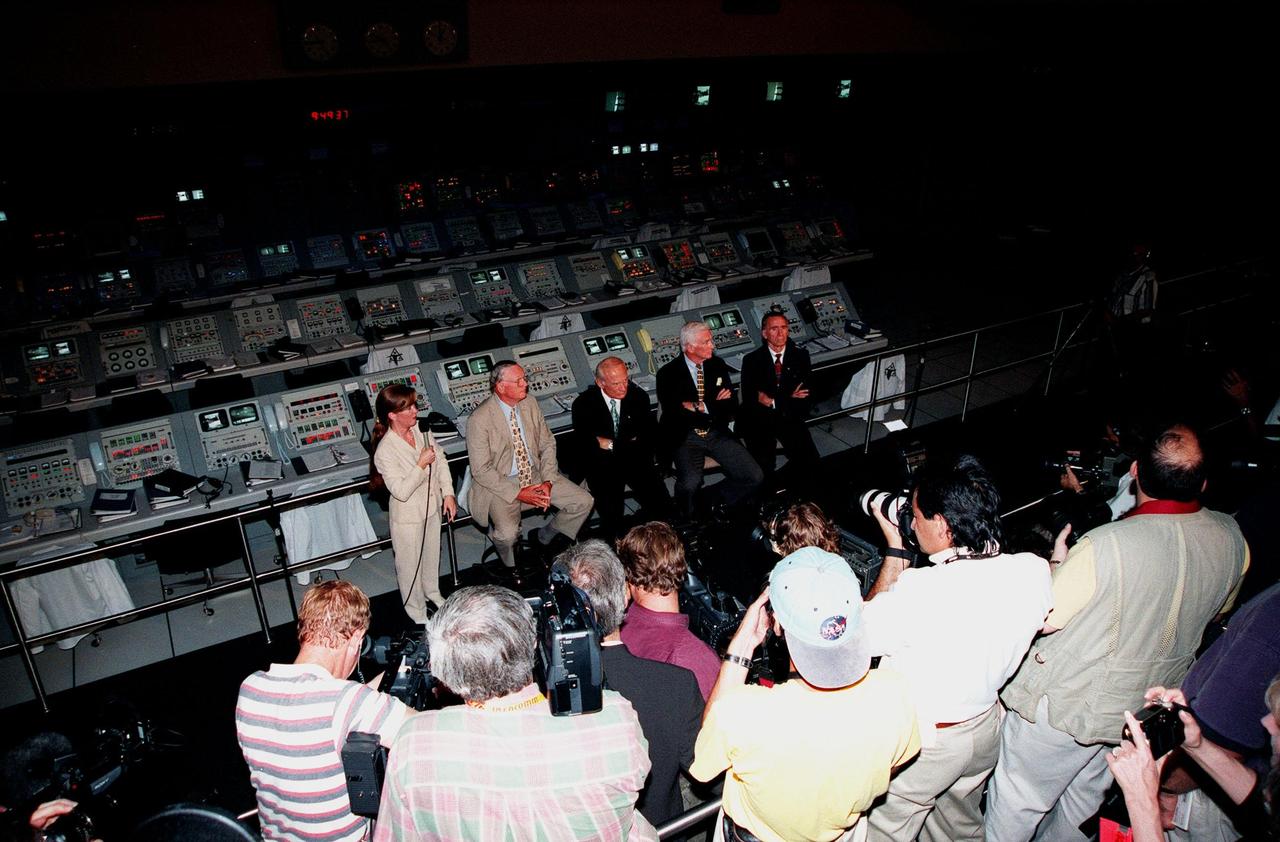
KENNEDY SPACE CENTER, FLA. -- Viewed from above, former Apollo astronauts (seated, left to right) Neil A. Armstrong and Edwin "Buzz" Aldrin who flew on Apollo 11, the launch to the moon; Gene Cernan, who flew on Apollo 10 and 17; and Walt Cunningham, who flew on Apollo 7, answer questions from the media during a press conference in the Apollo/Saturn V Center. At left is Lisa Malone, chief of KSC's Media Services branch, who monitored the session. In the background are the original computer consoles used in the firing room during the Apollo program. They are now part of the reenactment of the Apollo launches in the exhibit at the center. The four astronauts were at KSC for the 30th anniversary of the Apollo 11 launch and moon landing, July 16 and July 20, 1969
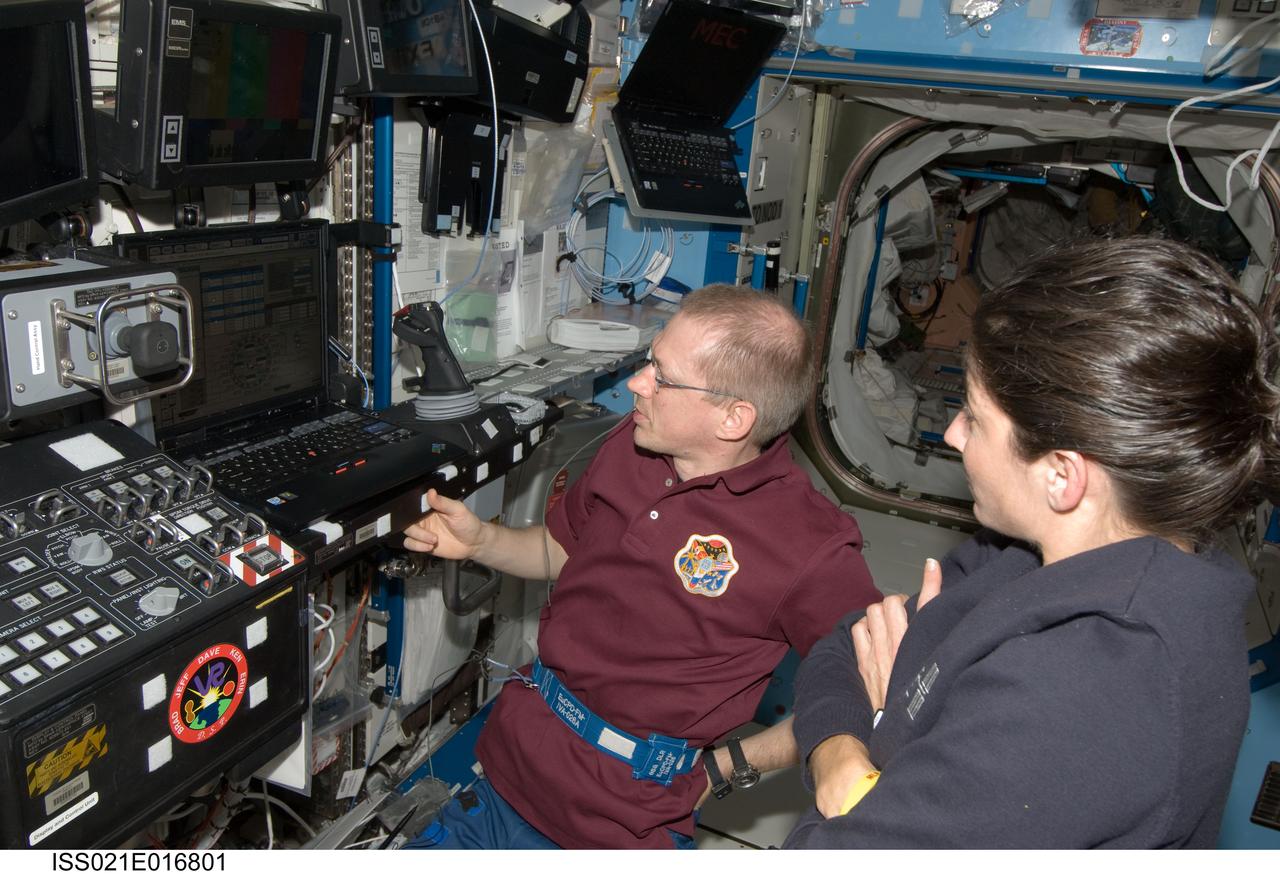
ISS021-E-016801 (30 Oct. 2009) --- European Space Agency astronaut Frank De Winne, Expedition 21 commander; and NASA astronaut Nicole Stott, flight engineer, view computer monitors at the Canadarm2 workstation in the Destiny laboratory of the International Space Station during the preparation for the release of the Japanese H-II Transfer Vehicle (HTV) from the station. De Winne, Stott and Canadian Space Agency astronaut Robert Thirsk (out of frame) used the station’s robotic arm to grab the HTV cargo craft, filled with trash and unneeded items, and unberth it from the Harmony node’s nadir port. The HTV was successfully unberthed at 10:18 a.m. (CDT) on Oct. 30, 2009, and released from the station’s Canadarm2 at 12:32 p.m.
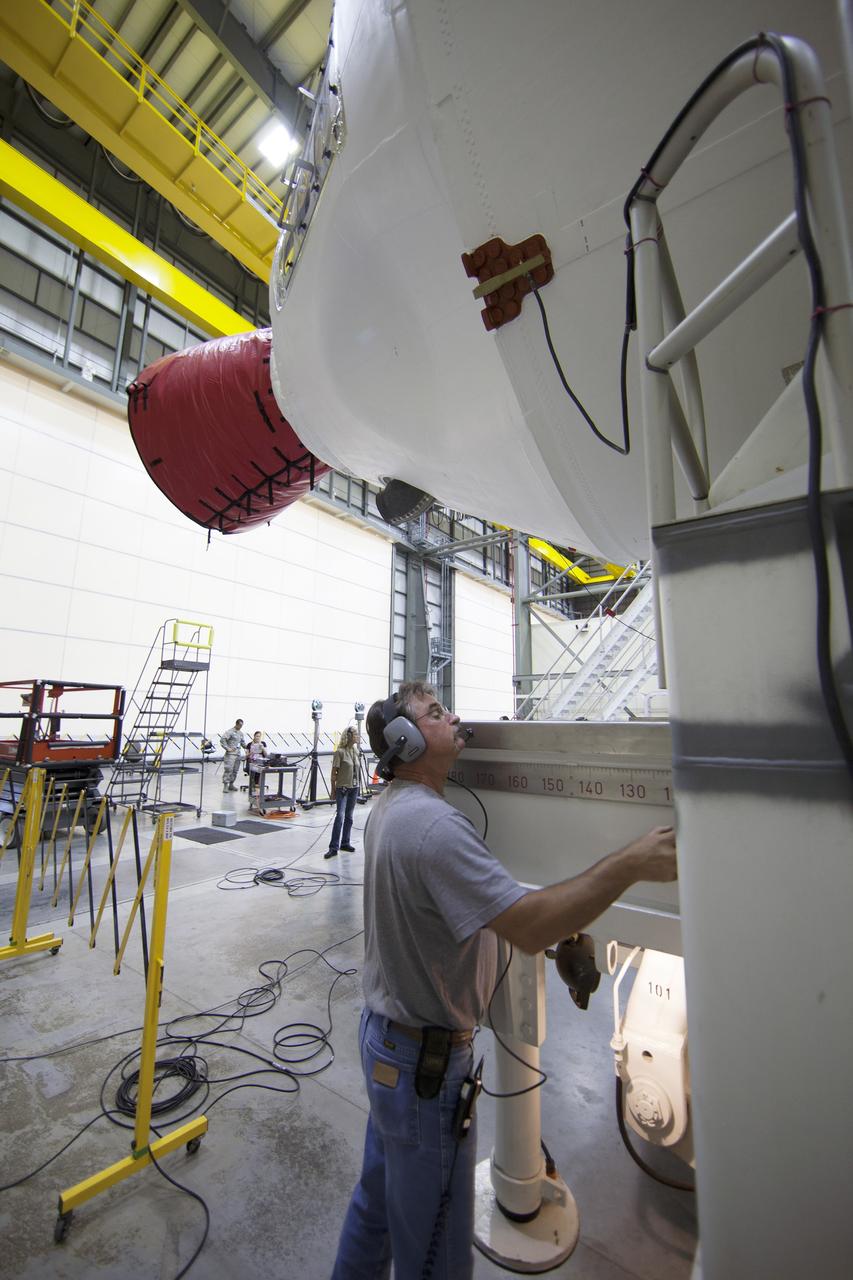
CAPE CANAVERAL, Fla. – United Launch Alliance, or ULA, technicians monitor the progress as the Delta IV port booster is mated to the core booster inside the Horizontal Integration Facility at Space Launch Complex 37 on Cape Canaveral Air Force Station in Florida. The ULA Delta IV Heavy rocket will launch an uncrewed Orion spacecraft on Exploration Flight Test-1. During the mission, Orion will travel farther into space than any human spacecraft has gone in more than 40 years. The data gathered during the flight will influence design decisions, validate existing computer models and innovative new approaches to space systems development, as well as reduce overall mission risks and costs for later Orion flights. Liftoff of Orion on the first flight test is planned for December 2014. Photo credit: NASA/Ben Smegelsky
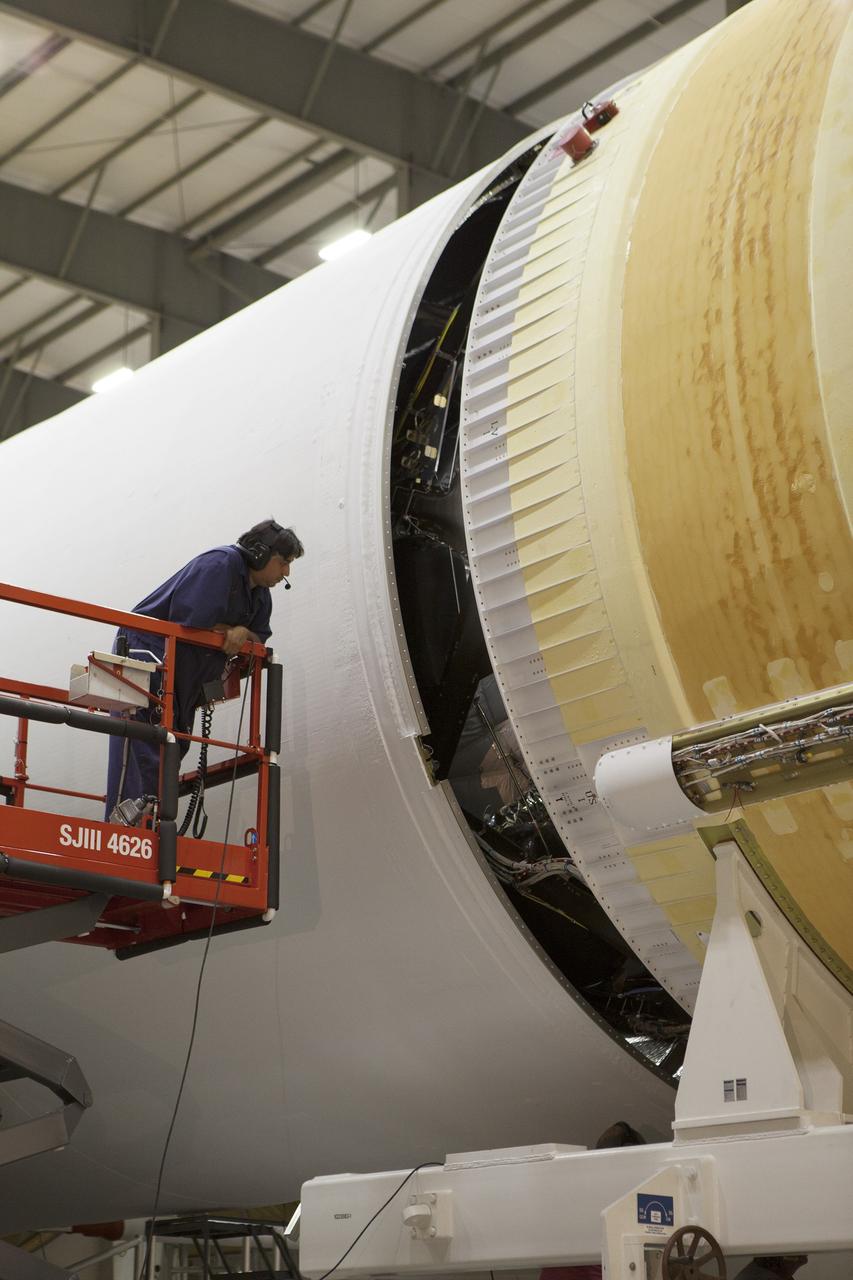
CAPE CANAVERAL, Fla. – Inside the Horizontal Integration Facility at Space Launch Complex 37 at Cape Canaveral Air Force Station in Florida, a United Launch Alliance technician on a scissor lift monitors the progress as the second stage of a Delta IV Heavy rocket is mated to the central core booster of the three booster stages for the unpiloted Exploration Flight Test-1, or EFT-1. During the mission, Orion will travel farther into space than any human spacecraft has gone in more than 40 years. The data gathered during the flight will influence design decisions, validate existing computer models and innovative new approaches to space systems development, as well as reduce overall mission risks and costs for later Orion flights. Liftoff of Orion on the first flight test is planned for December 2014. Photo credit: NASA/Daniel Casper
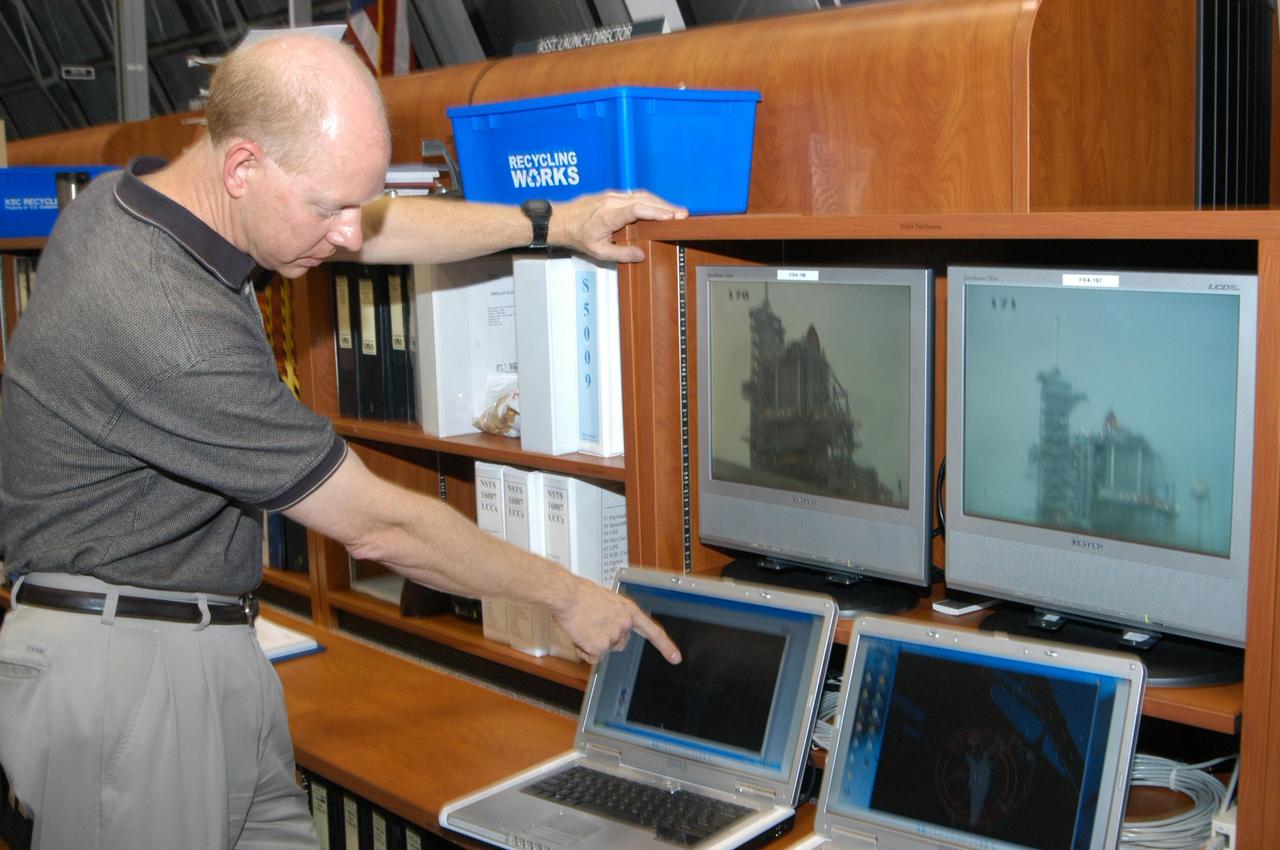
KENNEDY SPACE CENTER, FLA. - In Firing Room 4 of the Launch Control Center, NASA Test Director Steve Payne points to laptop computers that will display data relayed from the avian radars recently set up on Launch Pad 39B. When birds, especially vultures, are near the shuttle during a launch, impact on a critical area is possible and could cause catastrophic damage to the vehicle. Already proven affective for aviation where threats posed by bird strikes have been a problem, the avian radar, known as Aircraft Birdstrike Avoidance Radar, provides horizontal and vertical scanning and can monitor either launch pad for movement of vultures around them. If data relayed from the avian radar indicates large birds are dangerously close to the vehicle, controllers could hold the countdown. Photo credit: NASA/George Shelton
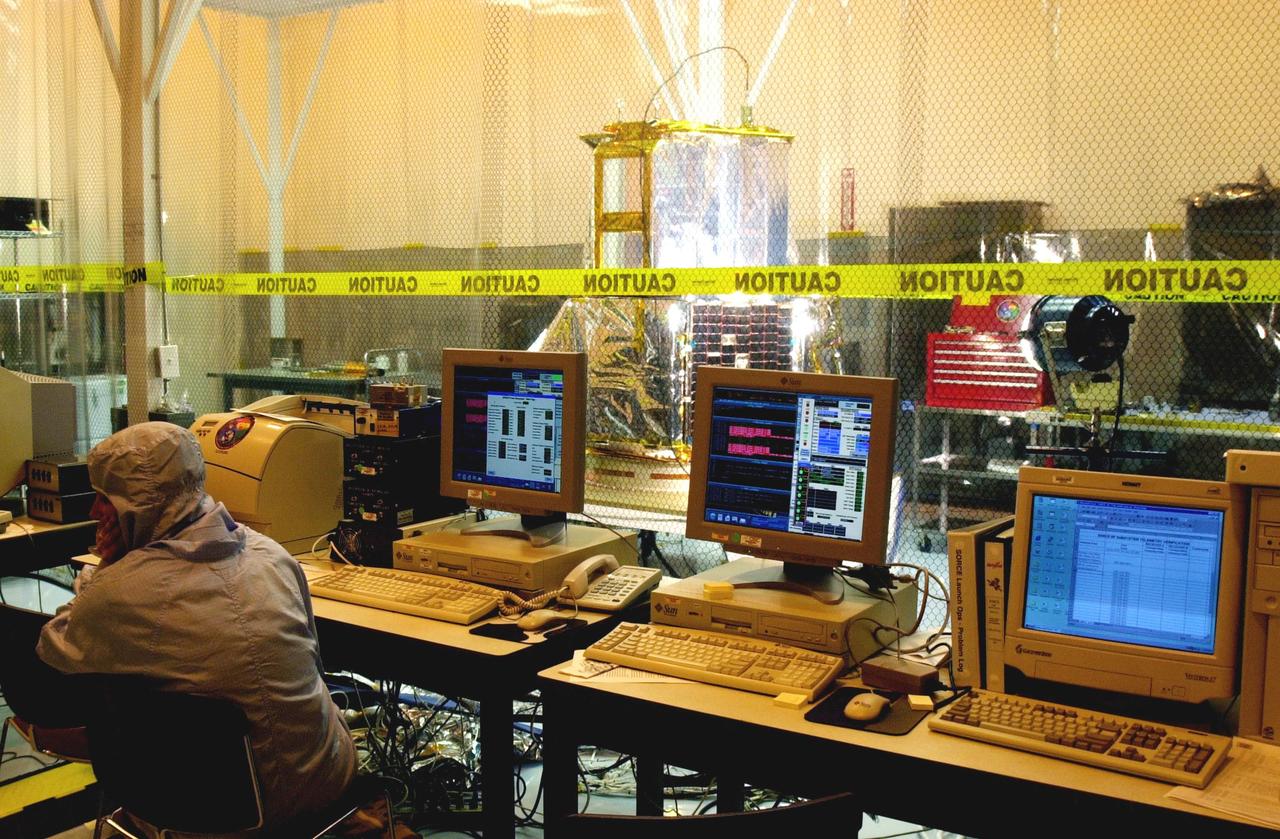
KENNEDY SPACE CENTER, FLA. - Computers in the Multi-Purpose Processing Facility monitor a solar array test on the SORCE satellite, beyond the screening. SORCE is equipped with four instruments that will measure variations in solar radiation much more accurately than anything now in use and observe some of the spectral properties of solar radiation for the first time. With data from NASA’s SORCE mission, researchers should be able to follow how the Sun affects our climate now and in the future. The SORCE project is managed by NASA’s Goddard Space Flight Center. The instruments on the SORCE spacecraft are built by the Laboratory for Atmospheric and Space Physics (LASP). Launch of SORCE aboard a Pegasus XL rocket is scheduled for mid-December 2002. Launch site is Cape Canaveral Air Force Station, Fla.
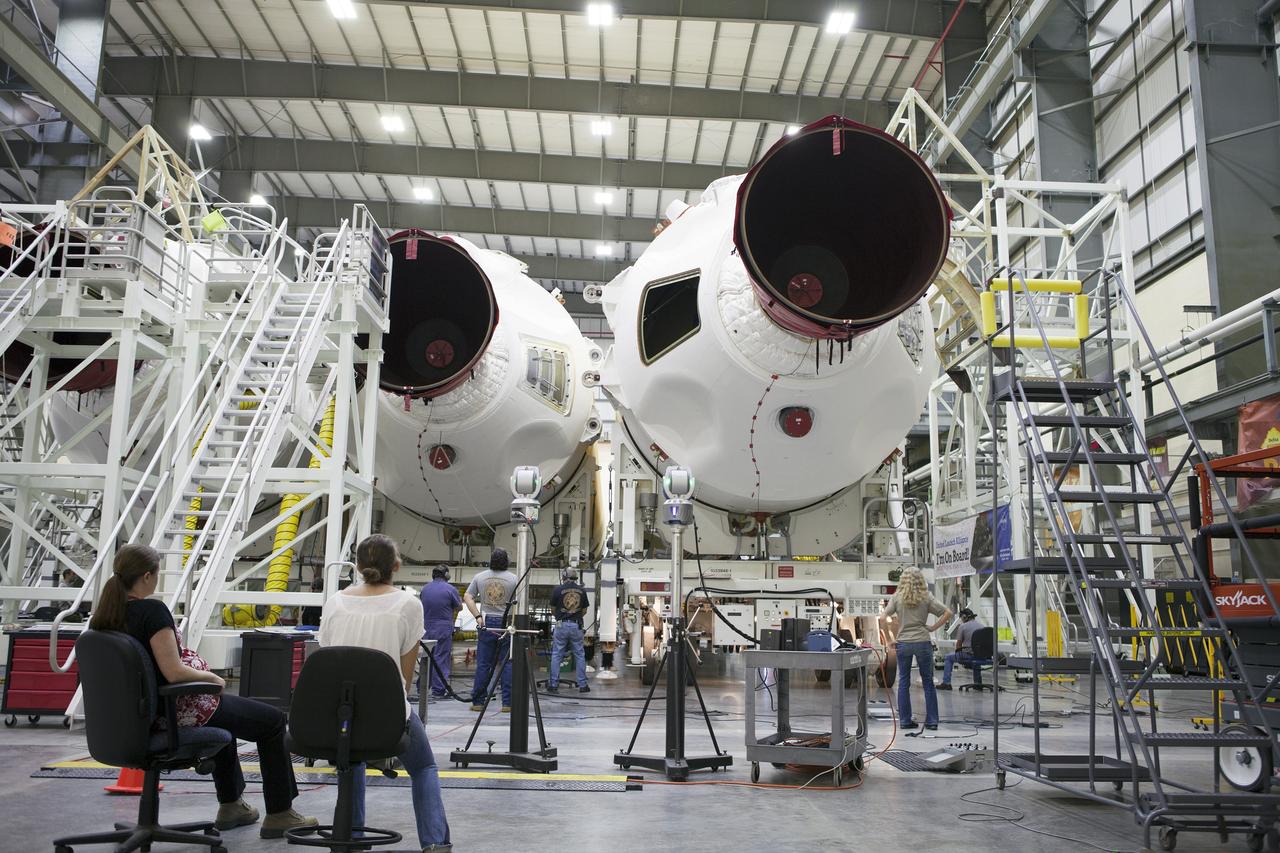
CAPE CANAVERAL, Fla. – United Launch Alliance, or ULA, technicians monitor the progress as the Delta IV port booster is mated to the core booster inside the Horizontal Integration Facility at Space Launch Complex 37 on Cape Canaveral Air Force Station in Florida. The ULA Delta IV Heavy rocket will launch an uncrewed Orion spacecraft on Exploration Flight Test-1. During the mission, Orion will travel farther into space than any human spacecraft has gone in more than 40 years. The data gathered during the flight will influence design decisions, validate existing computer models and innovative new approaches to space systems development, as well as reduce overall mission risks and costs for later Orion flights. Liftoff of Orion on the first flight test is planned for December 2014. Photo credit: NASA/Ben Smegelsky
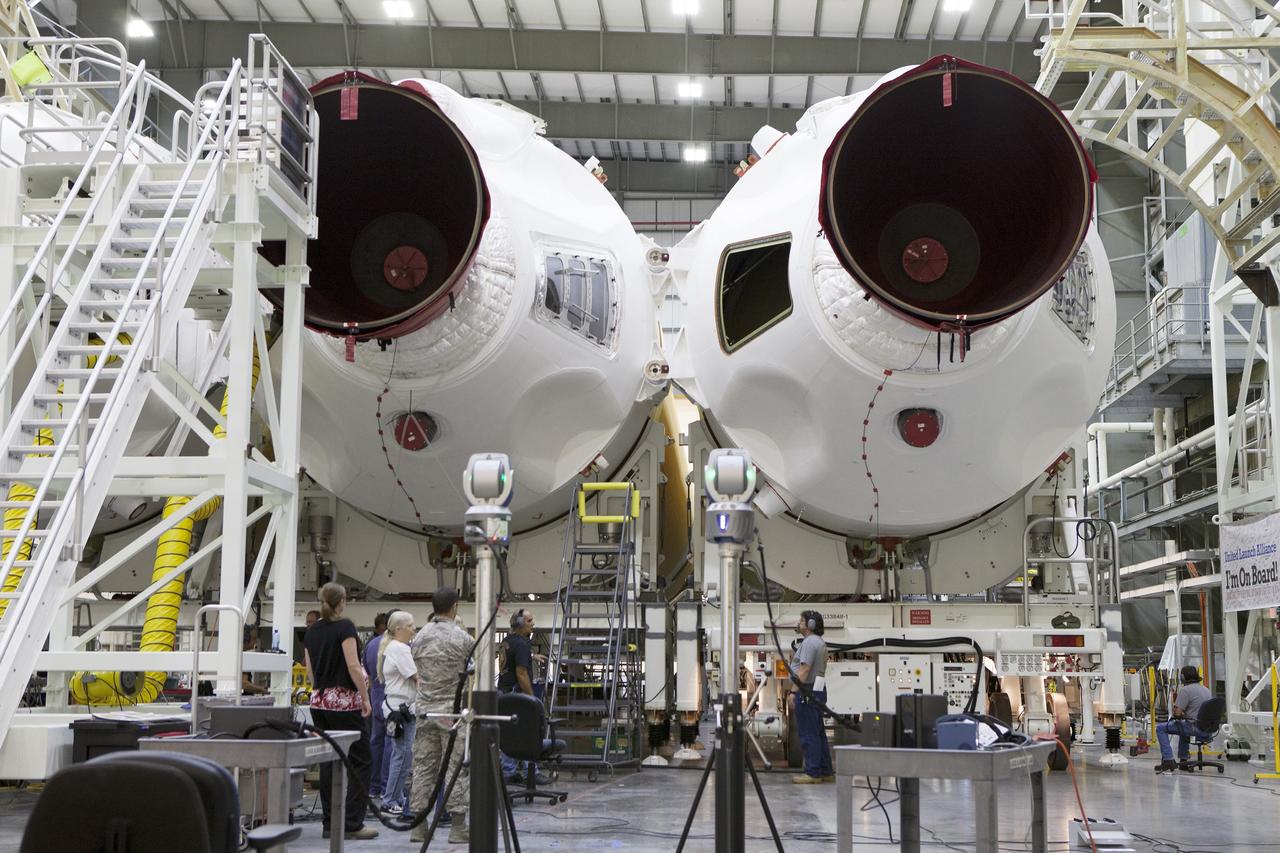
CAPE CANAVERAL, Fla. – United Launch Alliance, or ULA, technicians monitor the progress as the Delta IV port booster is mated to the core booster inside the Horizontal Integration Facility at Space Launch Complex 37 on Cape Canaveral Air Force Station in Florida. The ULA Delta IV Heavy rocket will launch an uncrewed Orion spacecraft on Exploration Flight Test-1. During the mission, Orion will travel farther into space than any human spacecraft has gone in more than 40 years. The data gathered during the flight will influence design decisions, validate existing computer models and innovative new approaches to space systems development, as well as reduce overall mission risks and costs for later Orion flights. Liftoff of Orion on the first flight test is planned for December 2014. Photo credit: NASA/Ben Smegelsky