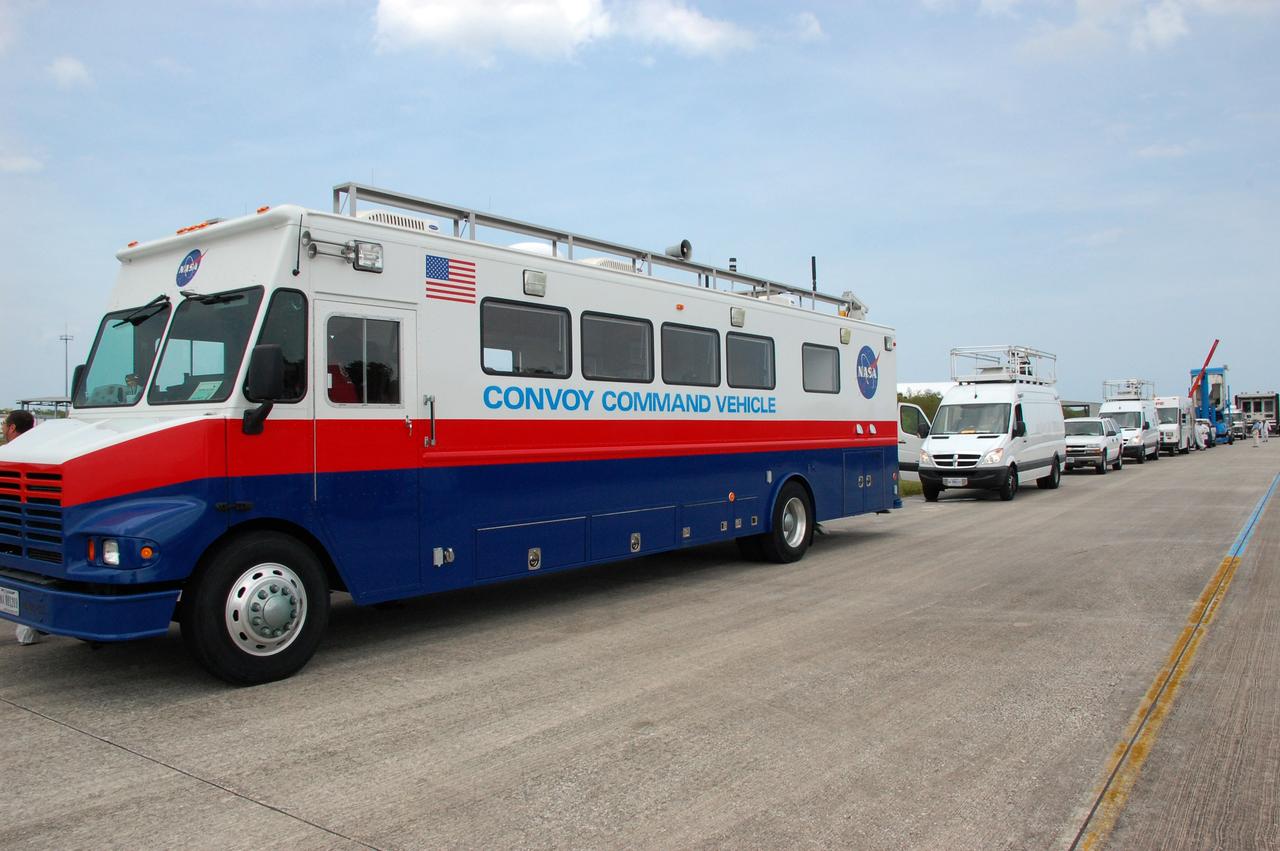
CAPE CANAVERAL, Fla. – The landing convoy is lined up on the Shuttle Landing Facility runway at NASA's Kennedy Space Center in Florida. The convoy awaits space shuttle Discovery's landing, after completing itsa 13-day journey of more than 5.3 million miles on the STS-119 mission. At left is the Convoy Command Vehicle which is the command post for the convoy commander. the convoy commander is in communication with the shuttle and all of the landing convoy vehicles during the post-landing operations. The landing convoy's purpose is to safe the vehicle and provide support for the disembarking crew and experiments. The STS-119 flight delivered the space station's fourth and final set of large solar array wings and the S6 truss segment, completing the station's truss, or backbone. The additional electricity provided by the arrays will fully power science experiments and help support six-person station operations in May. The mission was the 28th flight to the station, the 36th flight of Discovery and the 125th in the Space Shuttle Program, as well as the 70th landing at Kennedy. Photo credit: NASA/Ben Smegelsky
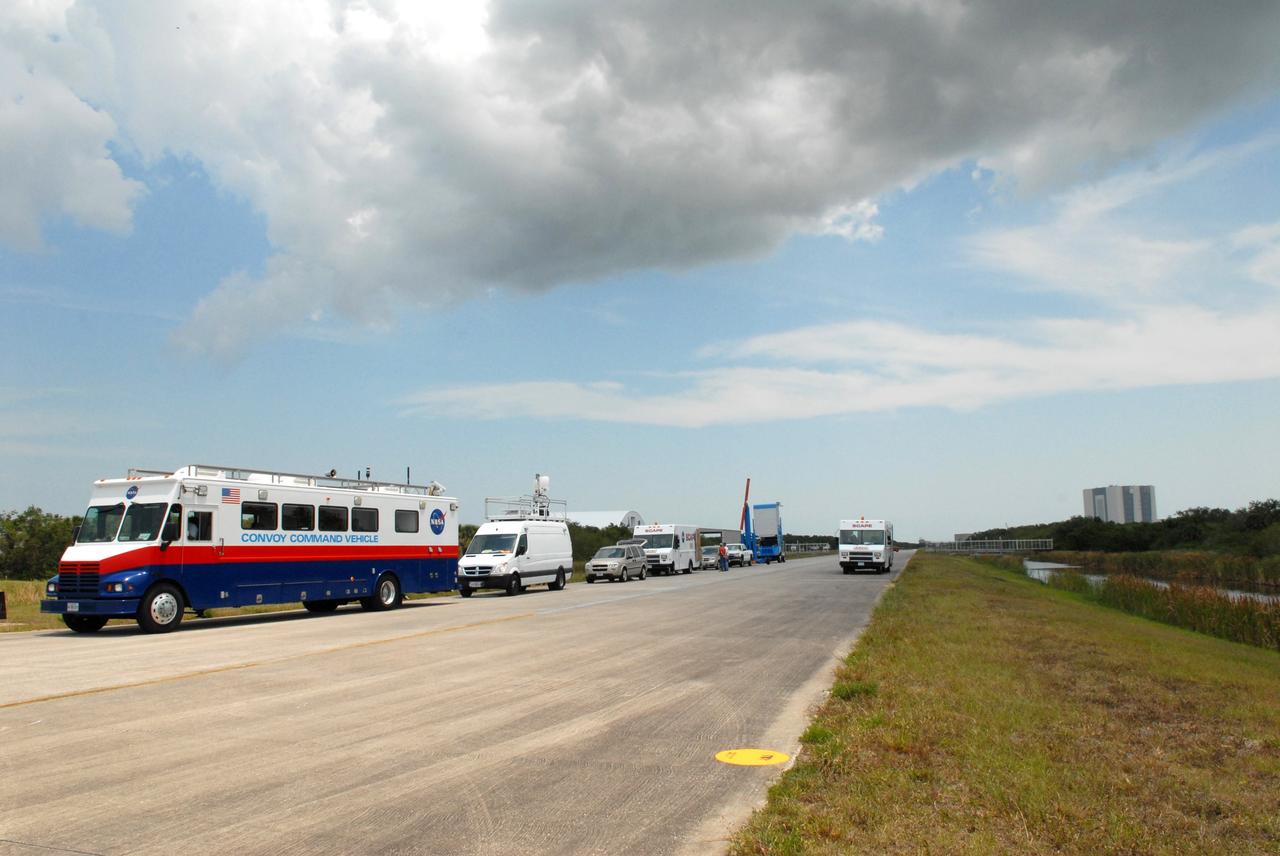
CAPE CANAVERAL, Fla. – The mini-convoy is lined up on the Shuttle Landing Facility runway at NASA's Kennedy Space Center in Florida awaiting space shuttle Atlantis' launch on the STS-125 mission to service NASA's Hubble Space Telescope. The convoy is prepared to act should the shuttle need to return to the launch site in the event of an emergency. At left is the Convoy Command Vehicle which is the command post for the convoy commander. Atlantis launched successfully on time at 2:01 p.m. EDT. Atlantis' 11-day flight will include five spacewalks to refurbish and upgrade the telescope with state-of-the-art science instruments that will expand Hubble's capabilities and extend its operational lifespan through at least 2014. The payload includes a Wide Field Camera 3, Fine Guidance Sensor and the Cosmic Origins Spectrograph. Photo credit: NASA/Jack Pfaller
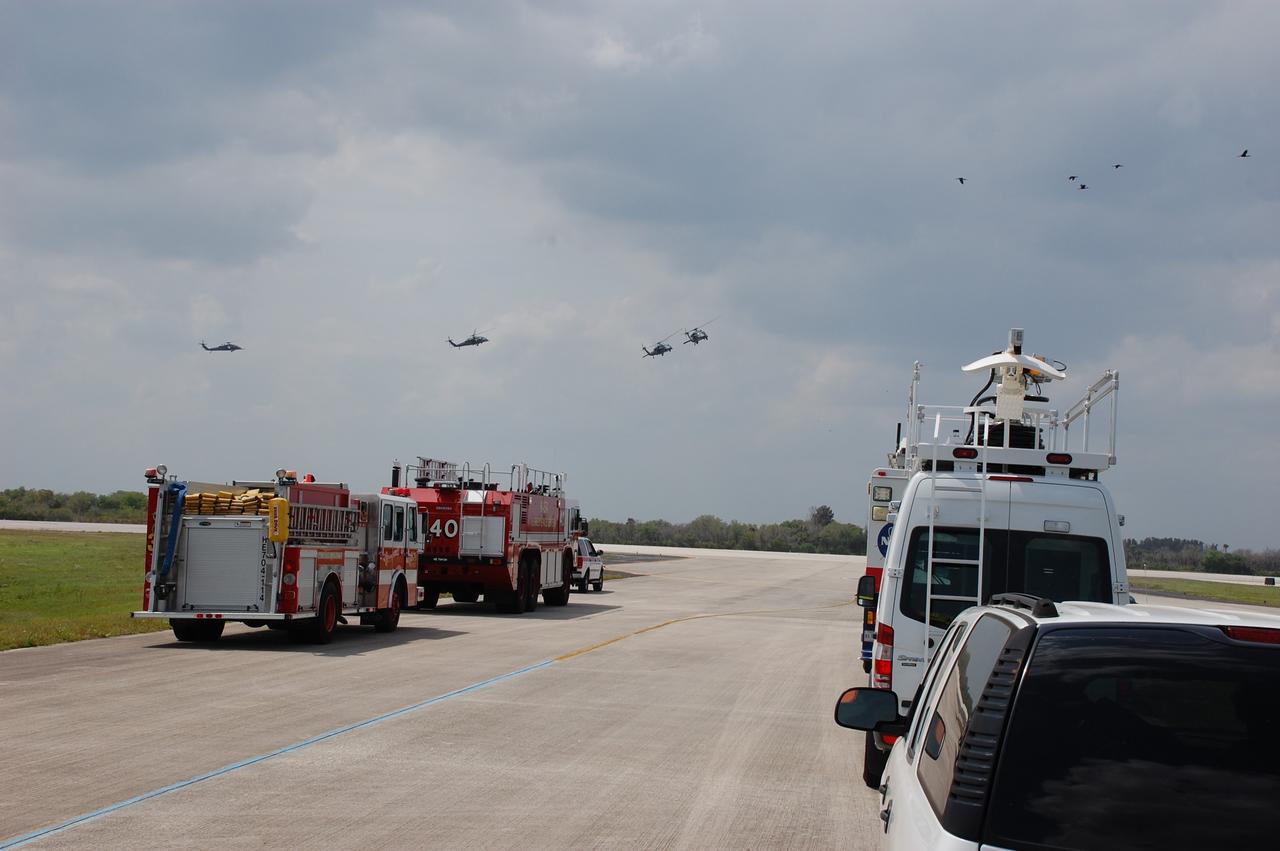
CAPE CANAVERAL, Fla. – The landing convoy arrives at the Shuttle Landing Facility runway at NASA's Kennedy Space Center in Florida. The convoy awaits space shuttle Discovery's landing, after completing its 13-day journey of more than 5.3 million miles on the STS-119 mission. The landing convoy's purpose is to safe the vehicle and provide support for the disembarking crew and experiments. The STS-119 flight delivered the space station's fourth and final set of large solar array wings and the S6 truss segment, completing the station's truss, or backbone. The additional electricity provided by the arrays will fully power science experiments and help support six-person station operations in May. The mission was the 28th flight to the station, the 36th flight of Discovery and the 125th in the Space Shuttle Program, as well as the 70th landing at Kennedy. Photo credit: NASA/Ben Smegelsky
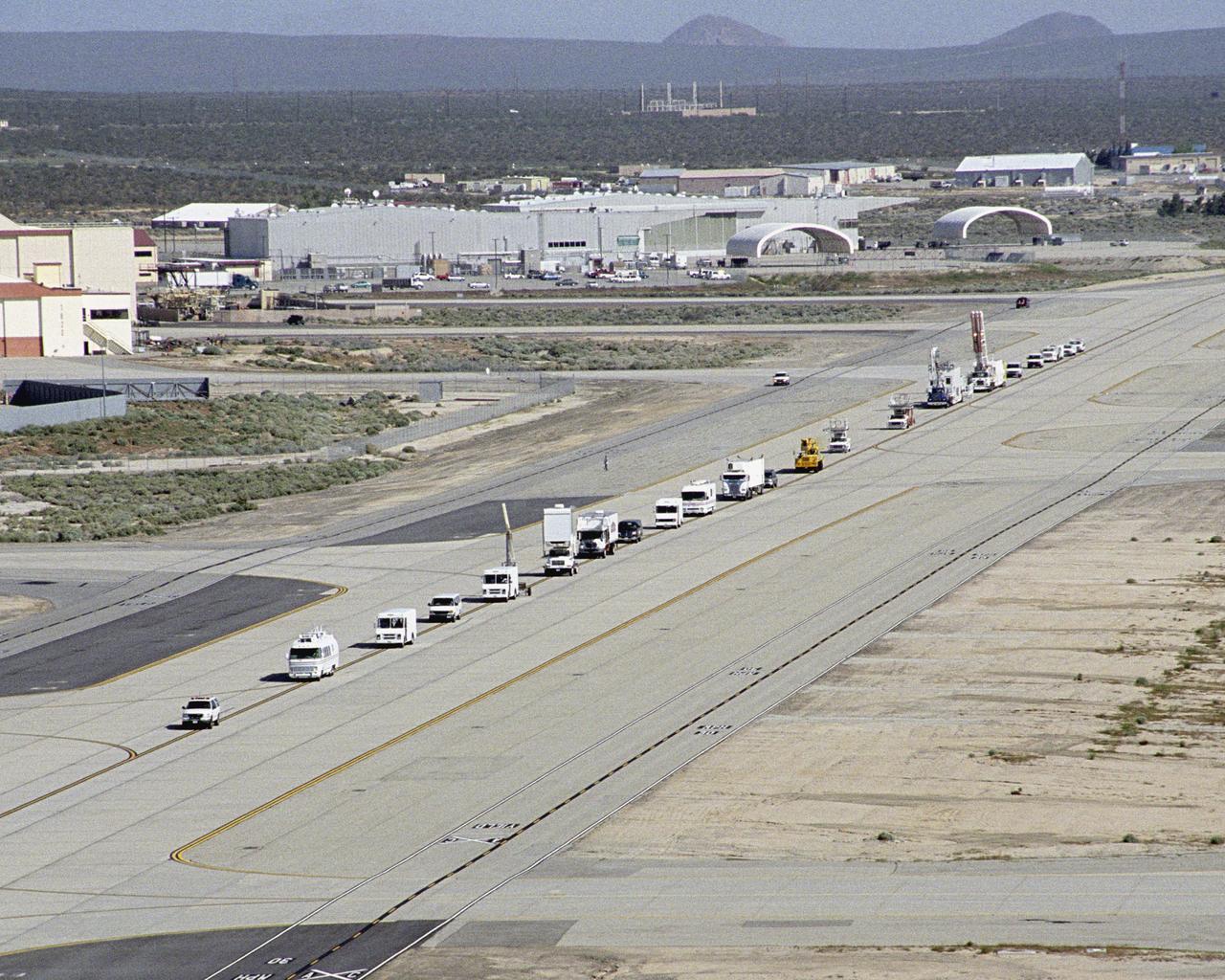
A long string of specialized NASA vehicles convoys down a taxiway at Edwards Air Force Base to begin a Space Shuttle rescue and recovery training exercise.

CAPE CANAVERAL, Fla. -- The Convoy Command Center vehicle is positioned on the Shuttle Landing Facility (SLF) at NASA's Kennedy Space Center in Florida awaiting the landing of space shuttle Atlantis. The command vehicle is equipped to control critical communications between the crew still aboard Atlantis and the Launch Control Center. The team will monitor the health of the orbiter systems and direct convoy operations made up of about 40 vehicles, including 25 specially designed vehicles to assist the crew in leaving the shuttle, and prepare the vehicle for towing from the SLF to its processing hangar. Seen here is Chris Hasselbring, USA Operations Manager. Securing the space shuttle fleet's place in history, Atlantis marks the 26th nighttime landing of NASA's Space Shuttle Program and the 78th landing at Kennedy. Atlantis and its crew delivered to the International Space Station the Raffaello multi-purpose logistics module packed with more than 9,400 pounds of spare parts, equipment and supplies that will sustain station operations for the next year. STS-135 is the 33rd and final flight for Atlantis and the final mission of the Space Shuttle Program. For more information, visit www.nasa.gov/mission_pages/shuttle/shuttlemissions/sts135/index.html. Photo credit: NASA/Ben Smegelsky
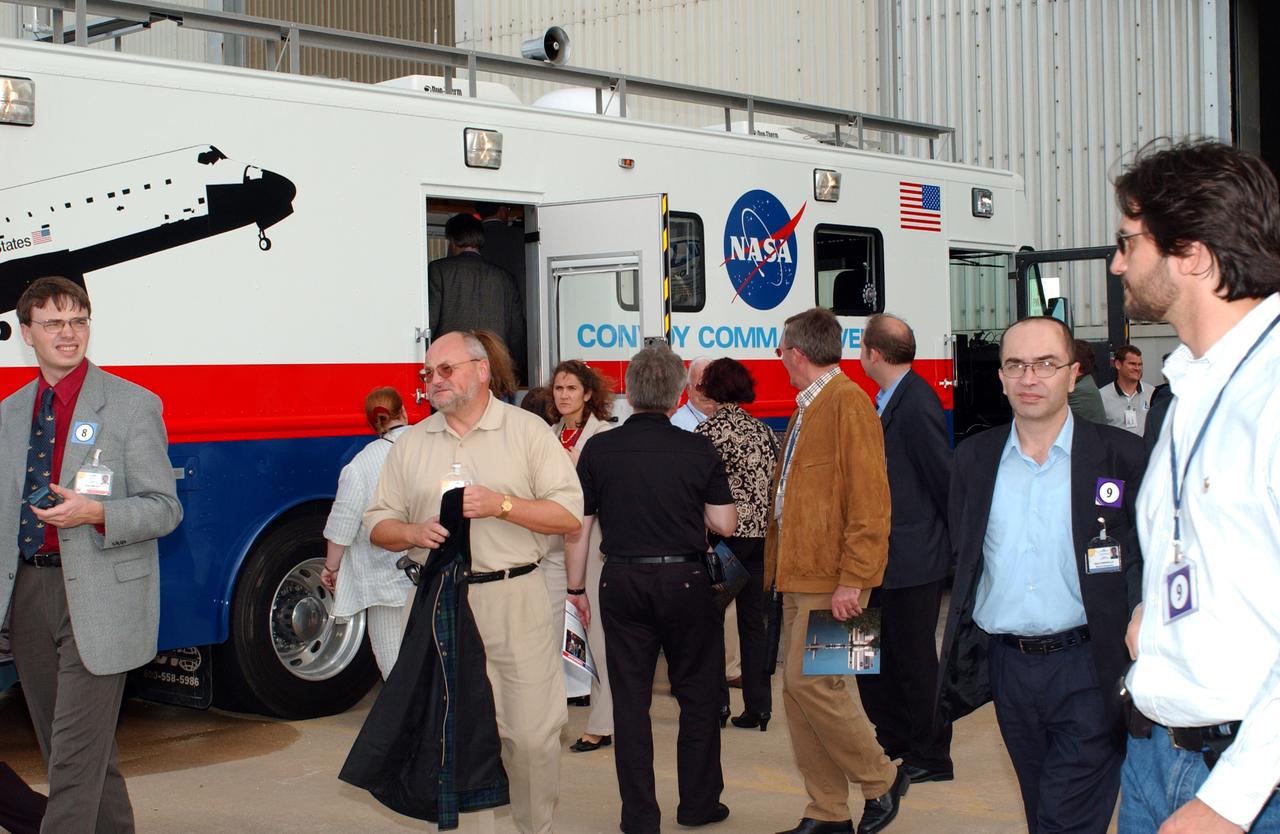
KENNEDY SPACE CENTER, FLA. - During their tour of KSC, members of the North American Treaty Organization (NATO) Parliamentary Assembly visit the Convoy Command Center, the prime vehicle to control critical communications between the orbiter, the crew and the Launch Control Center after a Shuttle landing, to monitor the health of the Shuttle Orbiter systems and to direct convoy operations at the Shuttle Landing Facility. The Parliamentarians are meeting in Orlando this year for their 49th annual gathering. They chose to visit KSC with their families during their one-day excursion break from meetings.
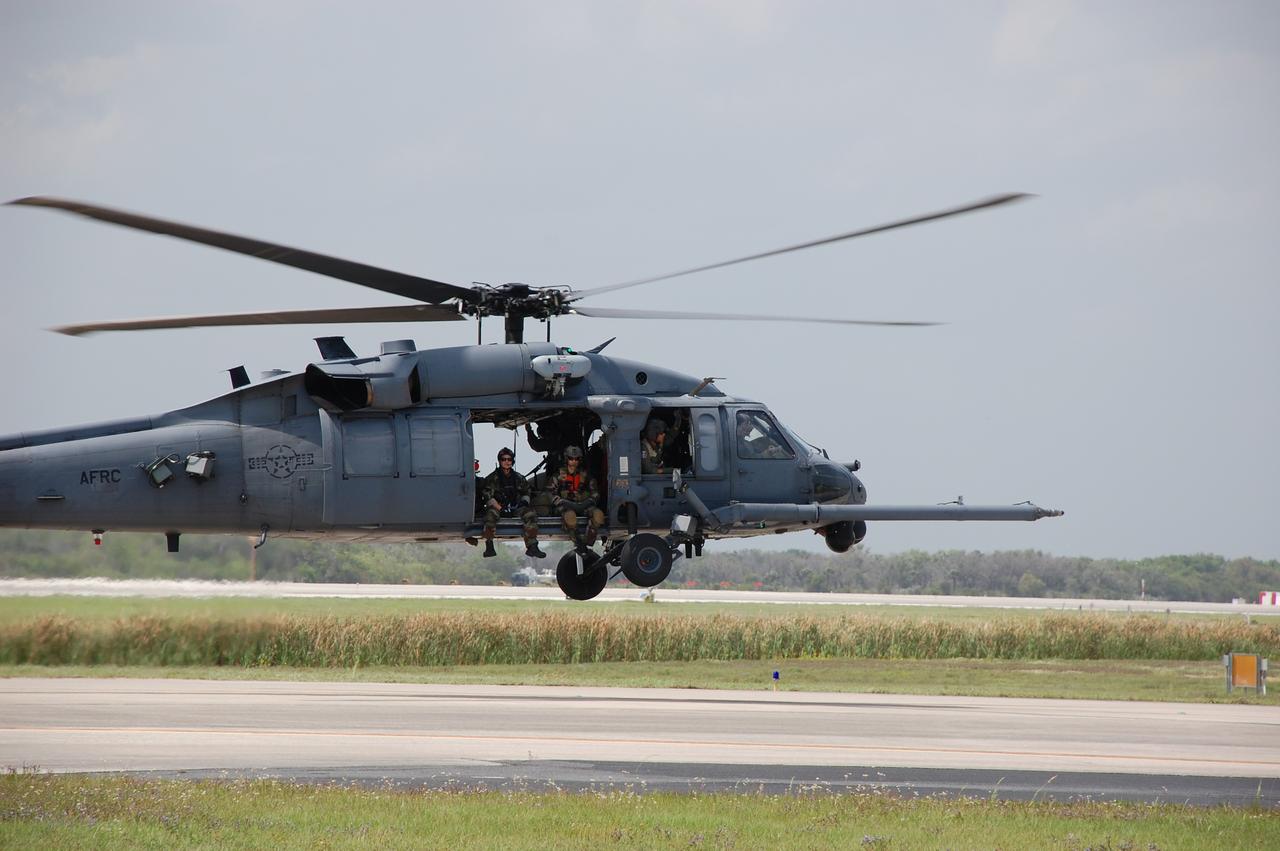
CAPE CANAVERAL, Fla. – Medical personnel aboard a helicopter arrive at the Shuttle Landing Facility at NASA's Kennedy Space Center in Florida before space shuttle Discovery's landing. Discovery returned from a 13-day journey of more than 5.3 million miles on the STS-119 mission. The STS-119 flight delivered the space station's fourth and final set of large solar array wings and the S6 truss segment, completing the station's truss, or backbone. The additional electricity provided by the arrays will fully power science experiments and help support six-person station operations in May. The mission was the 28th flight to the station, the 36th flight of Discovery and the 125th in the Space Shuttle Program, as well as the 70th landing at Kennedy. Photo credit: NASA/Ben Smegelsky
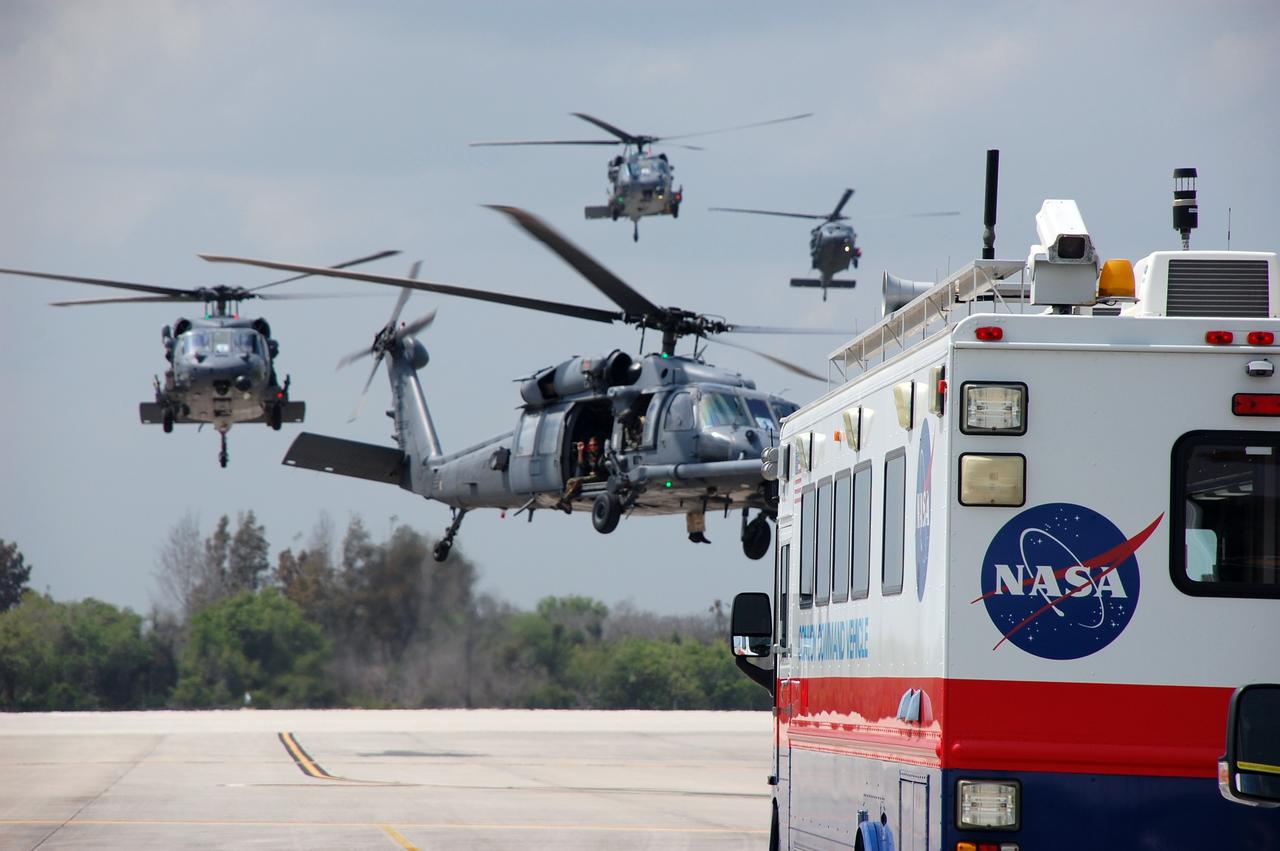
CAPE CANAVERAL, Fla. – Helicopters with medical personnel arrive at the Shuttle Landing Facility at NASA's Kennedy Space Center in Florida before space shuttle Discovery's landing. Discovery returned from a 13-day journey of more than 5.3 million miles on the STS-119 mission. The STS-119 flight delivered the space station's fourth and final set of large solar array wings and the S6 truss segment, completing the station's truss, or backbone. The additional electricity provided by the arrays will fully power science experiments and help support six-person station operations in May. The mission was the 28th flight to the station, the 36th flight of Discovery and the 125th in the Space Shuttle Program, as well as the 70th landing at Kennedy. Photo credit: NASA/Ben Smegelsky
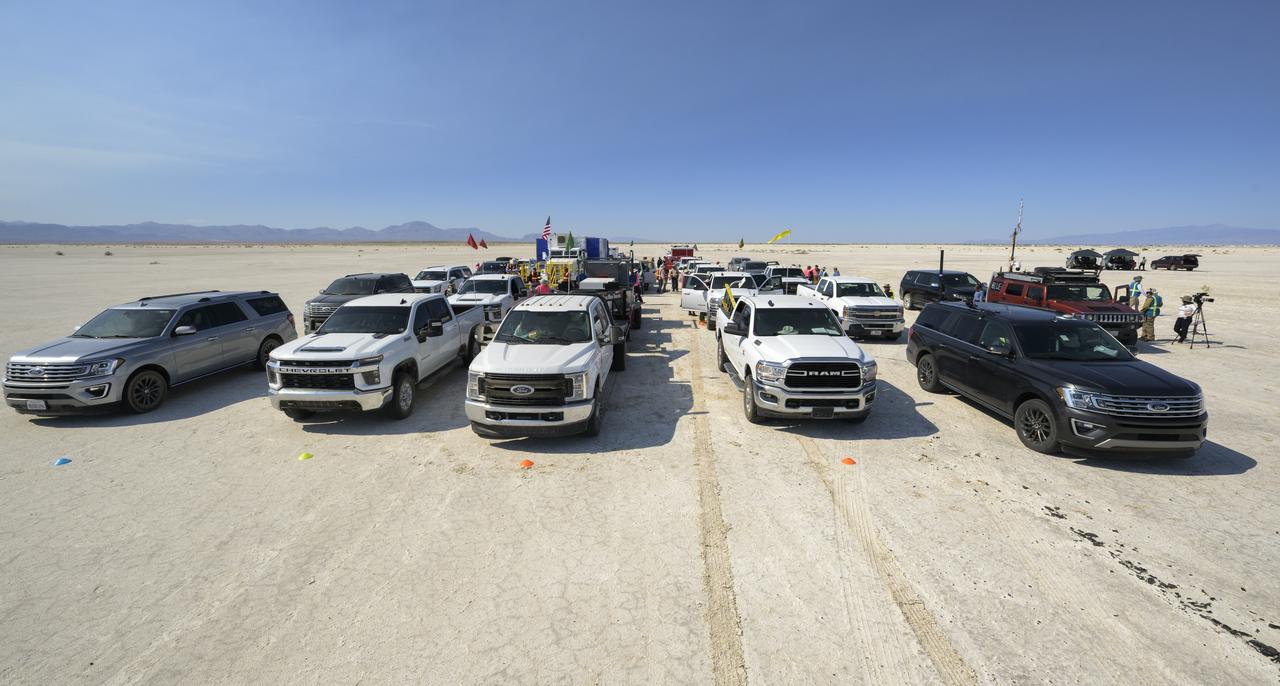
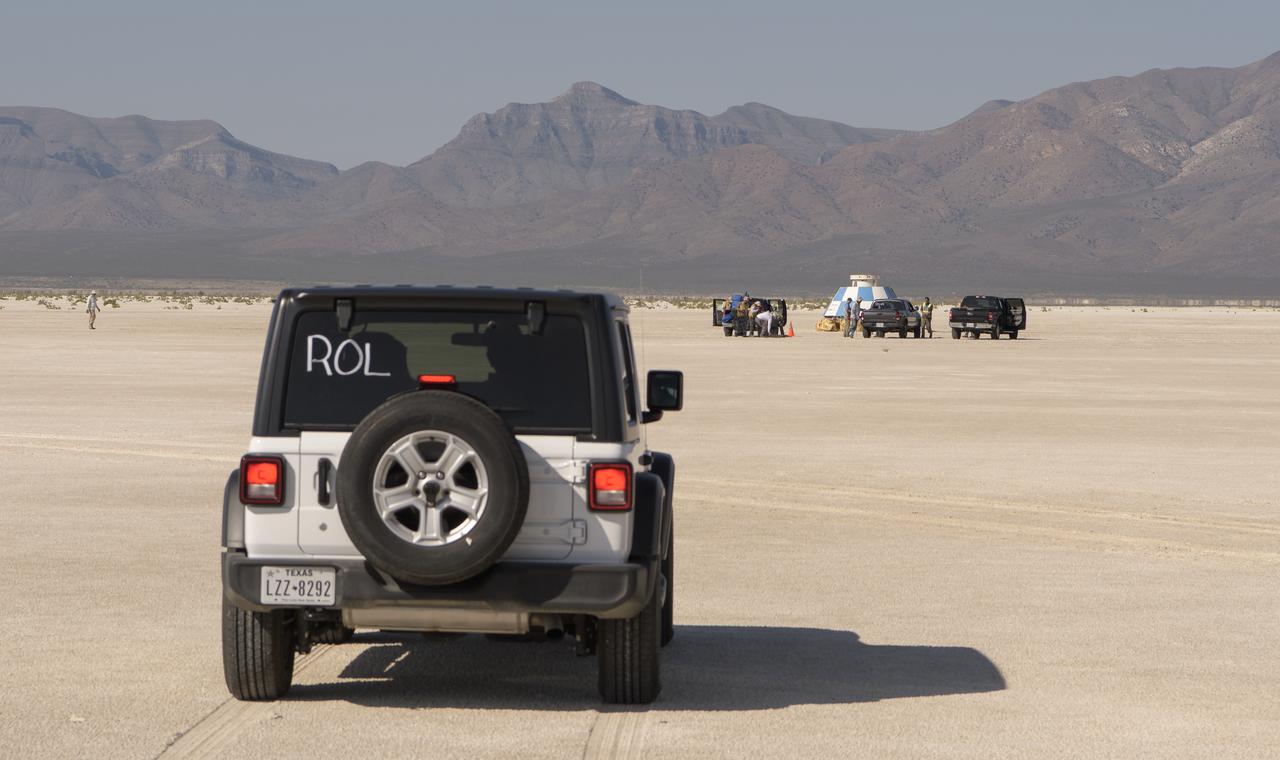
NASA and Boeing teams line up in a convoy as they prepare for the landing of Boeing’s CST-100 Starliner spacecraft at White Sands Missile Range’s Space Harbor, Wednesday, May 25, 2022, in New Mexico. Boeing’s Orbital Flight Test-2 (OFT-2) is Starliner’s second uncrewed flight test to the International Space Station as part of NASA's Commercial Crew Program. OFT-2 serves as an end-to-end test of the system's capabilities. Photo Credit: (NASA/Bill Ingalls)
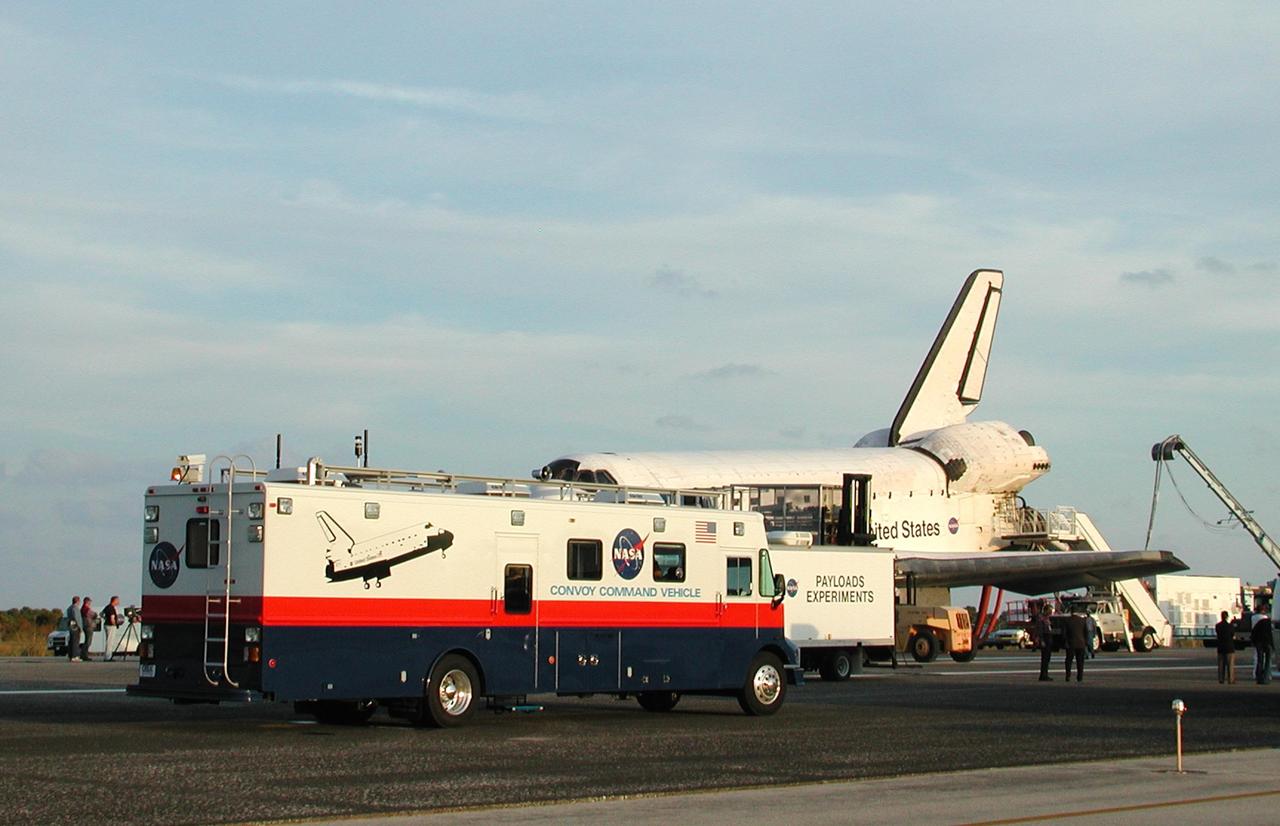
KENNEDY SPACE CENTER, FLA. - Space Shuttle Endeavour is surrounded by vehicles from the landing convoy on runway 33 at the Shuttle Landing Facility at the conclusion of the 13-day, 18-hour, 48-minute, 5.74-million mile STS-113 mission to the International Space Station. In the foreground is the Convoy Command Vehicle which is the command post for the Convoy Commander. The Convoy Commander is in communication with the orbiter and all of the landing convoy vehicles during the post-landing operations. The landing convoy's purpose is to safe the vehicle and provide support for the disembarking crew and experiments. Main gear touchdown was at 2:37:12 p.m. EST, nose gear touchdown was at 2:37:23 p.m., and wheel stop was at 2:38:25 p.m. Poor weather conditions thwarted landing opportunities until a fourth day, the first time in Shuttle program history that a landing has been waved off for three consecutive days. The vehicle carries the STS-113 crew, Commander James Wetherbee, Pilot Paul Lockhart and Mission Specialists Michael Lopez-Alegria and John Herrington, as well as the returning Expedition Five crew, Commander Valeri Korzun, ISS Science Officer Peggy Whitson and Flight Engineer Sergei Treschev. The installation of the P1 truss on the International Space Station was accomplished during the mission.
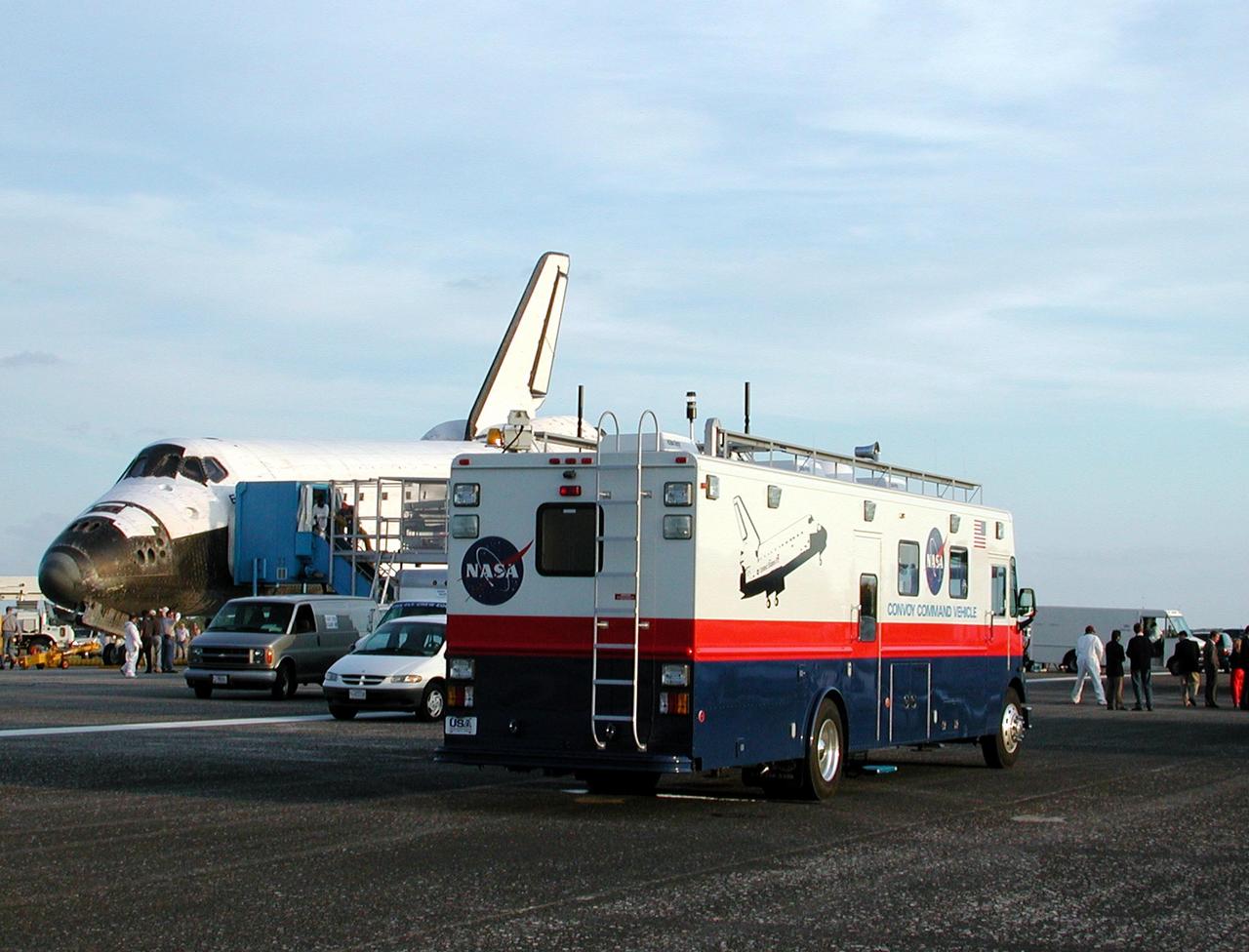
KENNEDY SPACE CENTER, FLA. - Space Shuttle Endeavour is surrounded by vehicles from the landing convoy on runway 33 at the Shuttle Landing Facility at the conclusion of the 13-day, 18-hour, 48-minute, 5.74-million mile STS-113 mission to the International Space Station. In the foreground is the Convoy Command Vehicle which is the command post for the Convoy Commander. The Convoy Commander is in communication with the orbiter and all of the landing convoy vehicles during the post-landing operations. The landing convoy's purpose is to safe the vehicle and provide support for the disembarking crew and experiments. Main gear touchdown was at 2:37:12 p.m. EST, nose gear touchdown was at 2:37:23 p.m., and wheel stop was at 2:38:25 p.m. Poor weather conditions thwarted landing opportunities until a fourth day, the first time in Shuttle program history that a landing has been waved off for three consecutive days. The vehicle carries the STS-113 crew, Commander James Wetherbee, Pilot Paul Lockhart and Mission Specialists Michael Lopez-Alegria and John Herrington, as well as the returning Expedition Five crew, Commander Valeri Korzun, ISS Science Officer Peggy Whitson and Flight Engineer Sergei Treschev. The installation of the P1 truss on the International Space Station was accomplished during the mission.
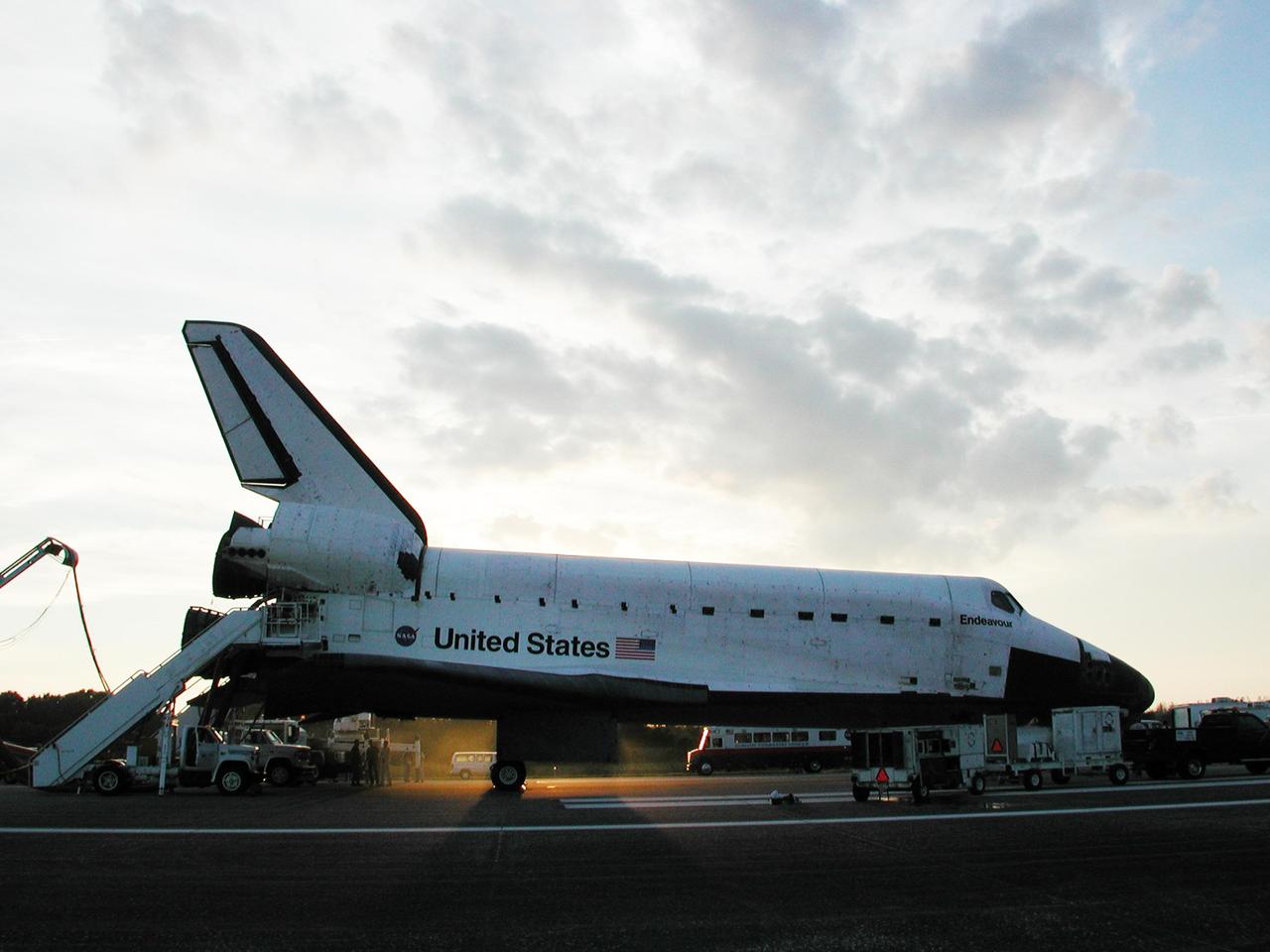
KENNEDY SPACE CENTER, FLA. - Space Shuttle Endeavour is surrounded by vehicles from the landing convoy, as the sun sets on runway 33 at the Shuttle Landing Facility at the conclusion of the 13-day, 18-hour, 48-minute, 5.74-million mile STS-113 mission to the International Space Station. Under the orbiter, the Convoy Command Vehicle, the command post for the Convoy Commander, can be seen on the far side of the runway. The Convoy Commander is in communication with the orbiter and all of the landing convoy vehicles during the post-landing operations. The landing convoy's purpose is to safe the vehicle and provide support for the disembarking crew and experiments. Main gear touchdown was at 2:37:12 p.m. EST, nose gear touchdown was at 2:37:23 p.m., and wheel stop was at 2:38:25 p.m. Poor weather conditions thwarted landing opportunities until a fourth day, the first time in Shuttle program history that a landing has been waved off for three consecutive days. The vehicle carries the STS-113 crew, Commander James Wetherbee, Pilot Paul Lockhart and Mission Specialists Michael Lopez-Alegria and John Herrington, as well as the returning Expedition Five crew, Commander Valeri Korzun, ISS Science Officer Peggy Whitson and Flight Engineer Sergei Treschev. The installation of the P1 truss on the International Space Station was accomplished during the mission.
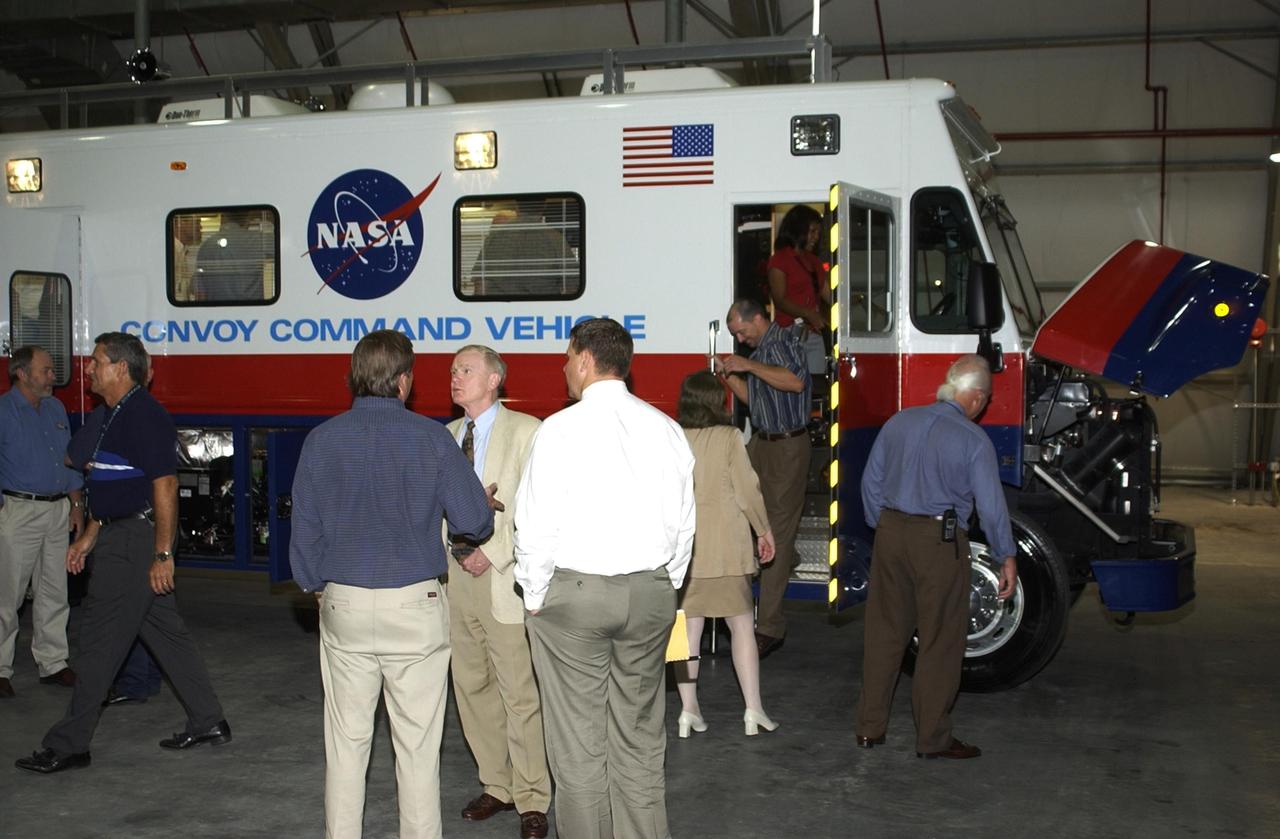
KENNEDY SPACE CENTER, FLA. -- While guests tour the new Convoy Command Vehicle (rear), Center Director Roy Bridges Jr. (center) talks to Launch Director Mike Leinbach. The tour followed a commissioning ceremony for the new vehicle. The 40-foot vehicle is replacing a 15-year old model, and will be used following Shuttle landings as the prime vehicle to control critical communications between the orbiter, the crew and the Launch Control Center, to monitor the health of the Shuttle Orbiter systems and to direct convoy operations at the Shuttle Landing Facility. Upgrades and high-tech features incorporated into the design and development of this vehicle make it more reliable and efficient for the convoy crew. Seating capacity was increased from 4 to 12, and video recorders and television monitors were added to provide the convoy team with the maximum amount of visual information
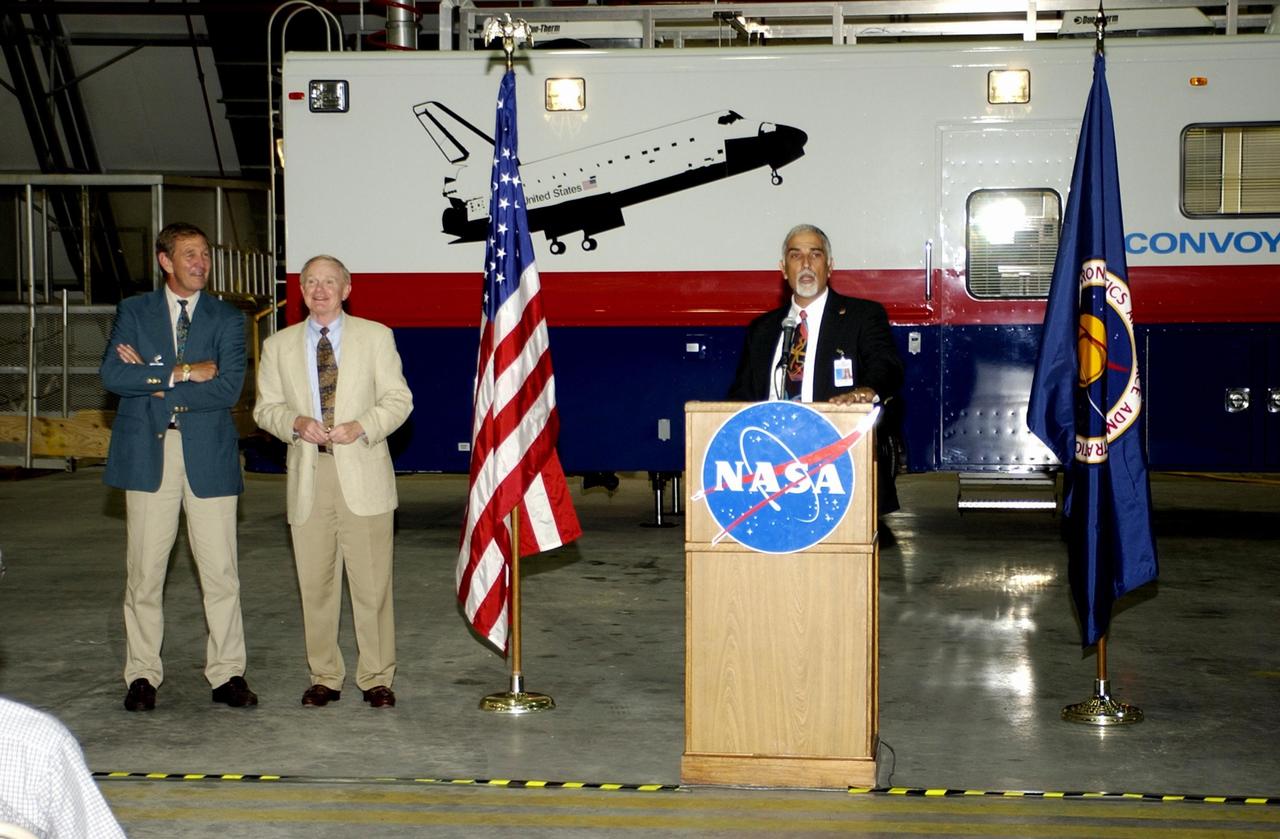
KENNEDY SPACE CENTER, FLA. -- During a commissioning ceremony for the new Convoy Command Vehicle (background), Tony Shibly, project manager, United Space Alliance, offers a few remarks to guests. At left are USA Chief Operating Officer Mike McCulley and Center Director Roy Bridges Jr. The new 40-foot vehicle is replacing a 15-year old model, and will be used following Shuttle landings as the prime vehicle to control critical communications between the orbiter, the crew and the Launch Control Center, to monitor the health of the Shuttle Orbiter systems and to direct convoy operations at the Shuttle Landing Facility. Upgrades and high-tech features incorporated into the design and development of this vehicle make it more reliable and efficient for the convoy crew. Seating capacity was increased from 4 to 12, and video recorders and television monitors were added to provide the convoy team with the maximum amount of visual information
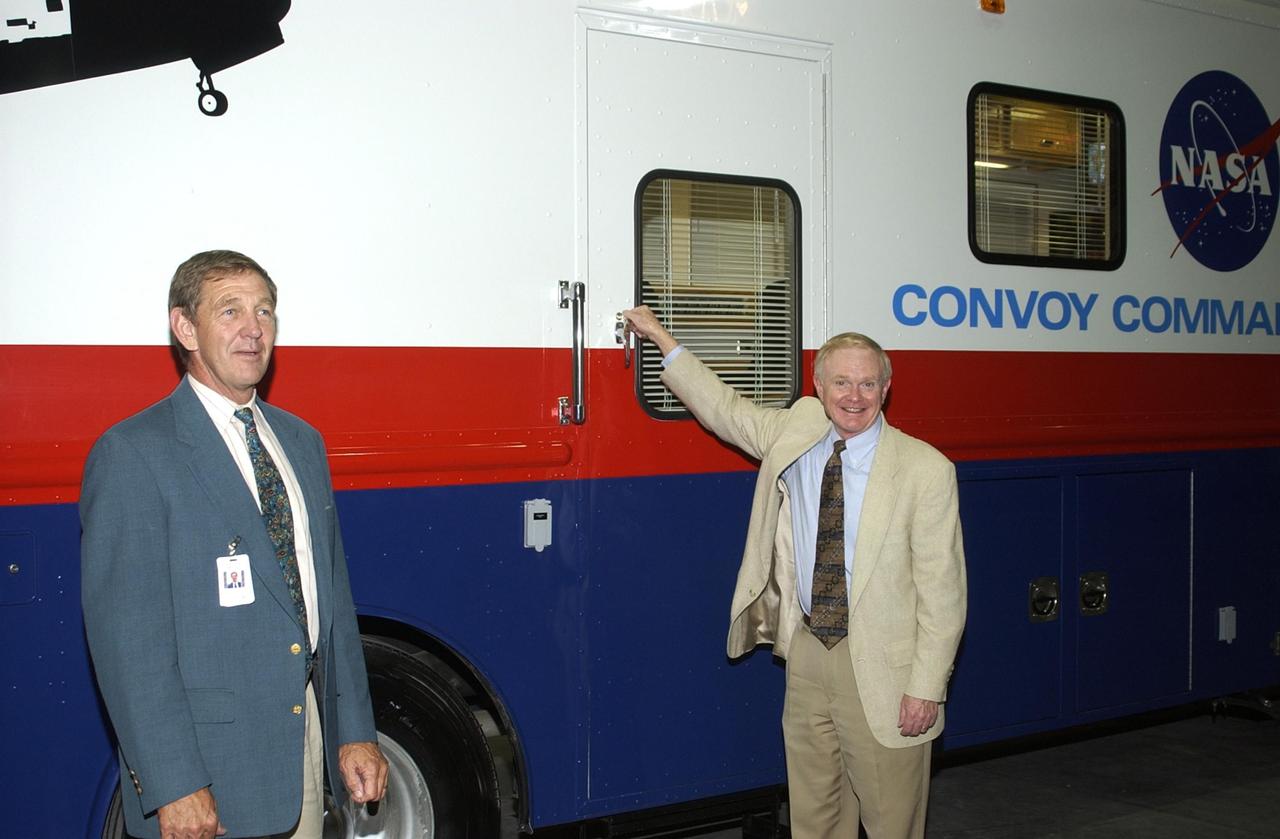
KENNEDY SPACE CENTER, FLA. - After opening remarks at a commissioning ceremony for the new Convoy Command Vehicle, Center Director Roy Bridges Jr. (right) gets ready to open the door for a tour of the vehicle. At left is United Space Alliance Chief Operating Officer Mike McCulley. The new 40-foot vehicle is replacing a 15-year old model, and will be used following Shuttle landings as the prime vehicle to control critical communications between the orbiter, the crew and the Launch Control Center, to monitor the health of the Shuttle Orbiter systems and to direct convoy operations at the Shuttle Landing Facility. Upgrades and high-tech features incorporated into the design and development of this vehicle make it more reliable and efficient for the convoy crew. Seating capacity was increased from 4 to 12, and video recorders and television monitors were added to provide the convoy team with the maximum amount of visual information
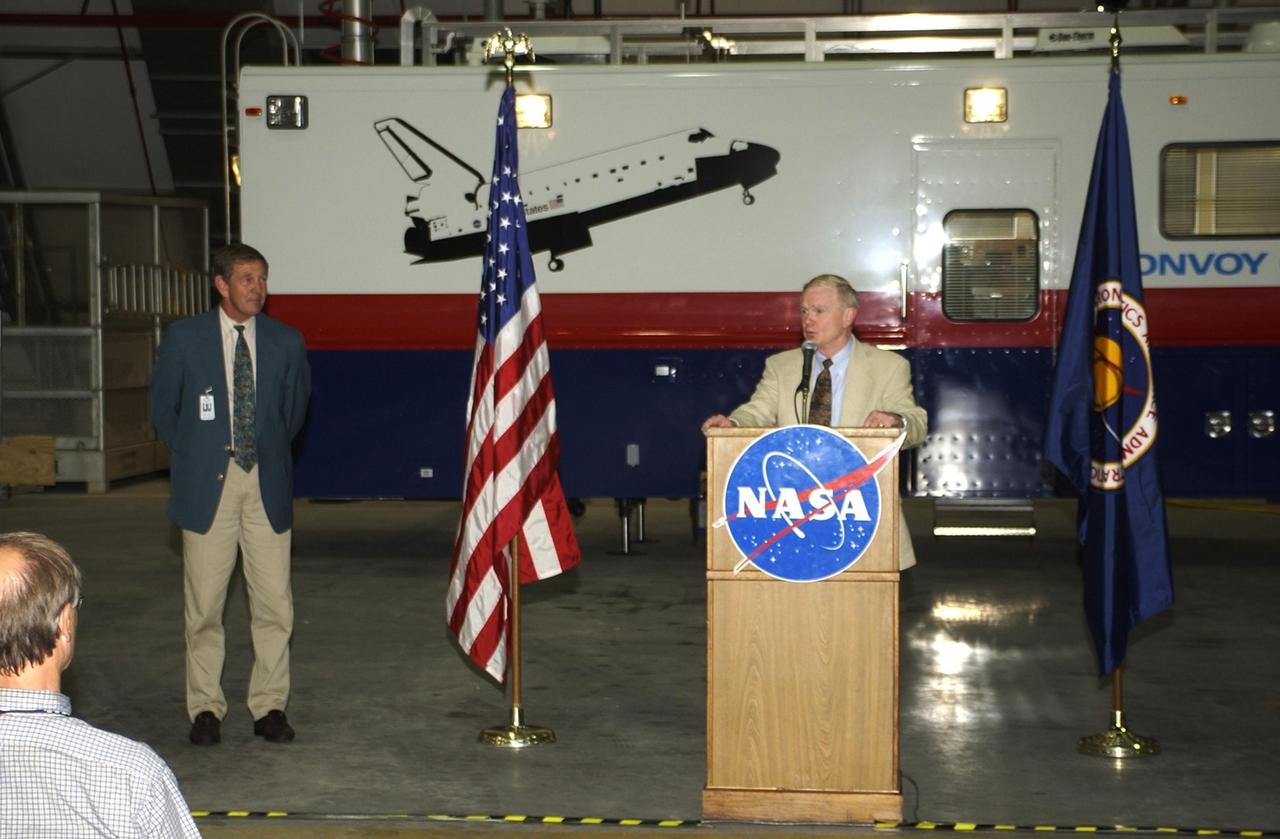
KENNEDY SPACE CENTER, FLA. -- At the podium, Center Director Roy Bridges Jr. offers remarks at the commissioning ceremony for the new Convoy Command Vehicle behind him. At left is Mike McCulley, chief operating officer, United Space Alliance. The new 40-foot vehicle is replacing a 15-year old model, and will be used following Shuttle landings as the prime vehicle to control critical communications between the orbiter, the crew and the Launch Control Center, to monitor the health of the Shuttle Orbiter systems and to direct convoy operations at the Shuttle Landing Facility. Upgrades and high-tech features incorporated into the design and development of this vehicle make it more reliable and efficient for the convoy crew. Seating capacity was increased from 4 to 12, and video recorders and television monitors were added to provide the convoy team with the maximum amount of visual information
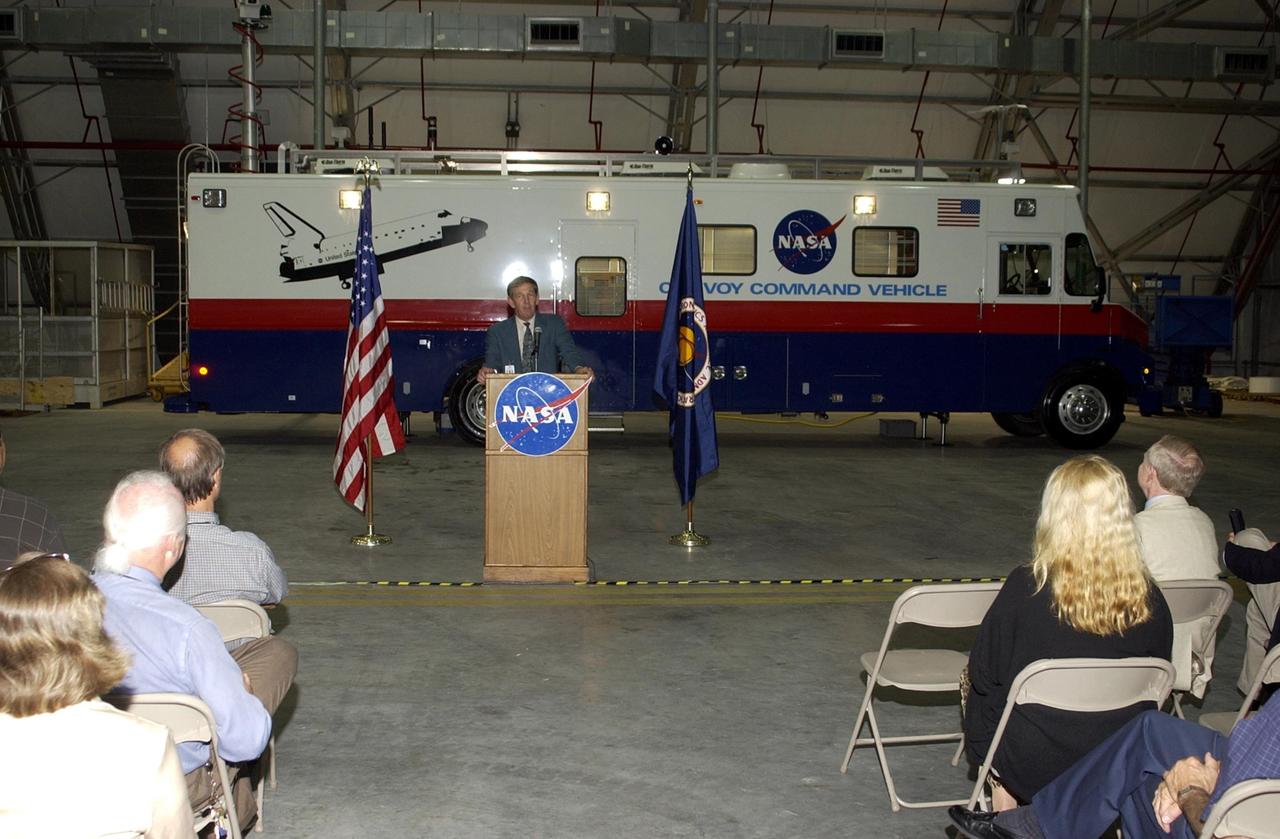
KENNEDY SPACE CENTER, FLA. -- United Space Alliance Chief Operating Officer Mike McCulley welcomes guests to the Landing Operations Facility and commissioning ceremony for the new Convoy Command Vehicle behind him. The new 40-foot vehicle is replacing a 15-year old model, and will be used following Shuttle landings as the prime vehicle to control critical communications between the orbiter, the crew and the Launch Control Center, to monitor the health of the Shuttle Orbiter systems and to direct convoy operations at the Shuttle Landing Facility. Upgrades and high-tech features incorporated into the design and development of this vehicle make it more reliable and efficient for the convoy crew. Seating capacity was increased from 4 to 12, and video recorders and television monitors were added to provide the convoy team with the maximum amount of visual information
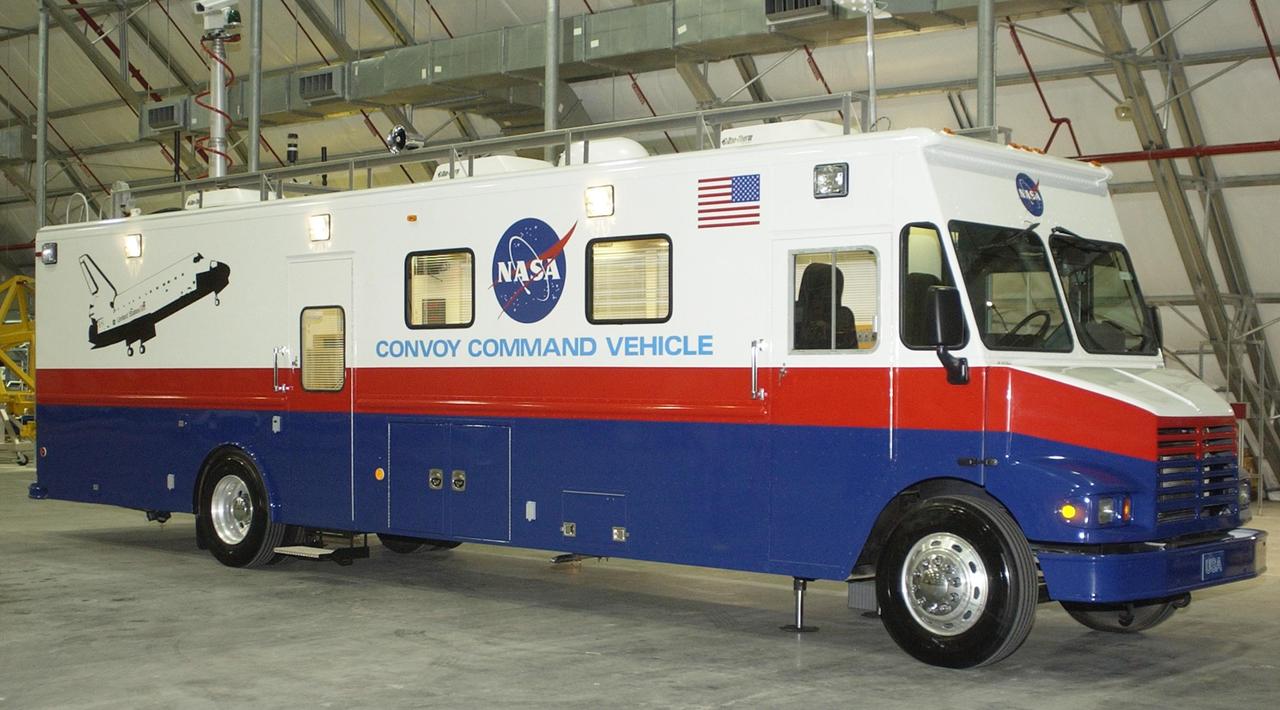
KENNEDY SPACE CENTER, FLA. -- The new Convoy Command Vehicle is displayed before a commissioning ceremony to hand it over to Center Director Roy Bridges Jr. The ceremony was to be held at the Landing Operations Facility. The new 40-foot vehicle is replacing a 15-year old model, and will be used following Shuttle landings as the prime vehicle to control critical communications between the orbiter, the crew and the Launch Control Center, to monitor the health of the Shuttle Orbiter systems and to direct convoy operations at the Shuttle Landing Facility. Upgrades and high-tech features incorporated into the design and development of this vehicle make it more reliable and efficient for the convoy crew. Seating capacity was increased from 4 to 12, and video recorders and television monitors were added to provide the convoy team with the maximum amount of visual information
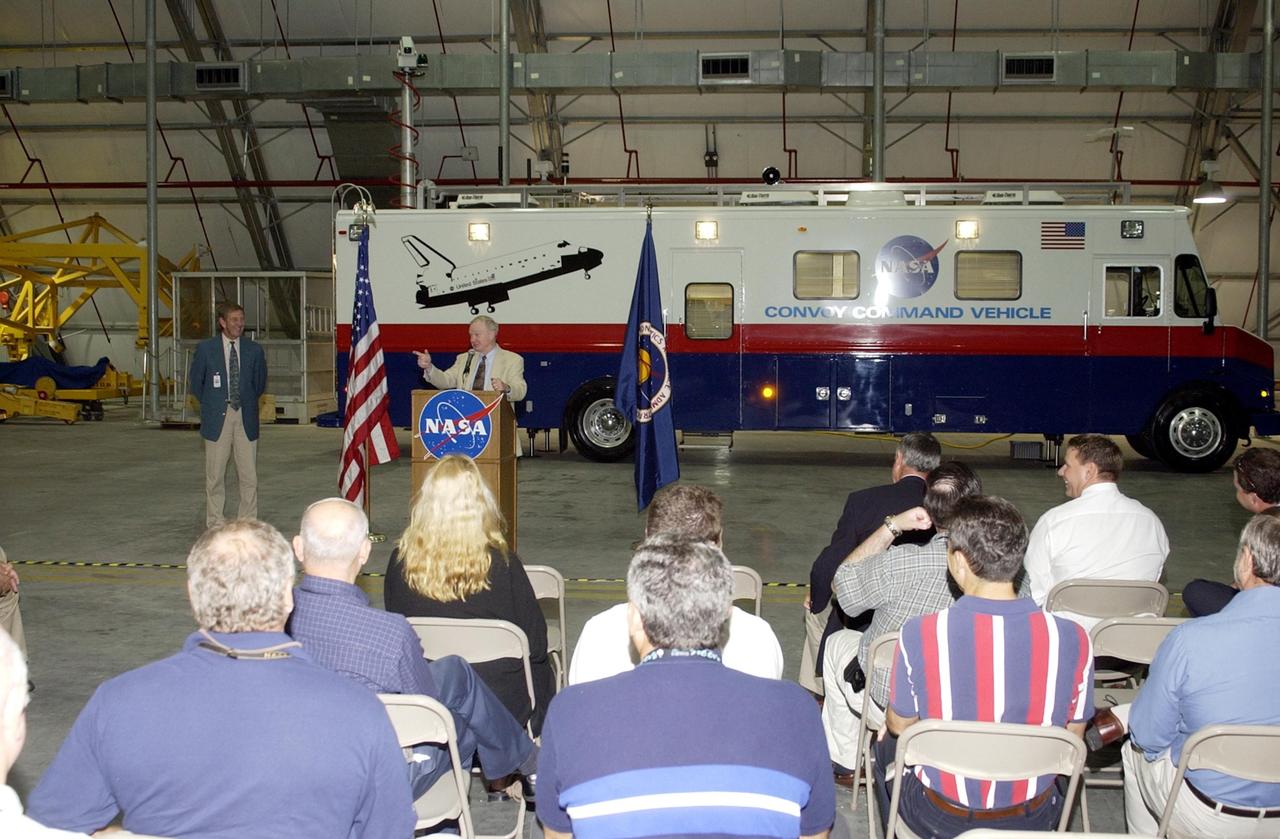
KENNEDY SPACE CENTER, FLA. -- At the podium, Center Director Roy Bridges Jr. offers remarks at the commissioning ceremony for the new Convoy Command Vehicle behind him. At left is Mike McCulley, chief operating officer, United Space Alliance. The new 40-foot vehicle is replacing a 15-year old model, and will be used following Shuttle landings as the prime vehicle to control critical communications between the orbiter, the crew and the Launch Control Center, to monitor the health of the Shuttle Orbiter systems and to direct convoy operations at the Shuttle Landing Facility. Upgrades and high-tech features incorporated into the design and development of this vehicle make it more reliable and efficient for the convoy crew. Seating capacity was increased from 4 to 12, and video recorders and television monitors were added to provide the convoy team with the maximum amount of visual information
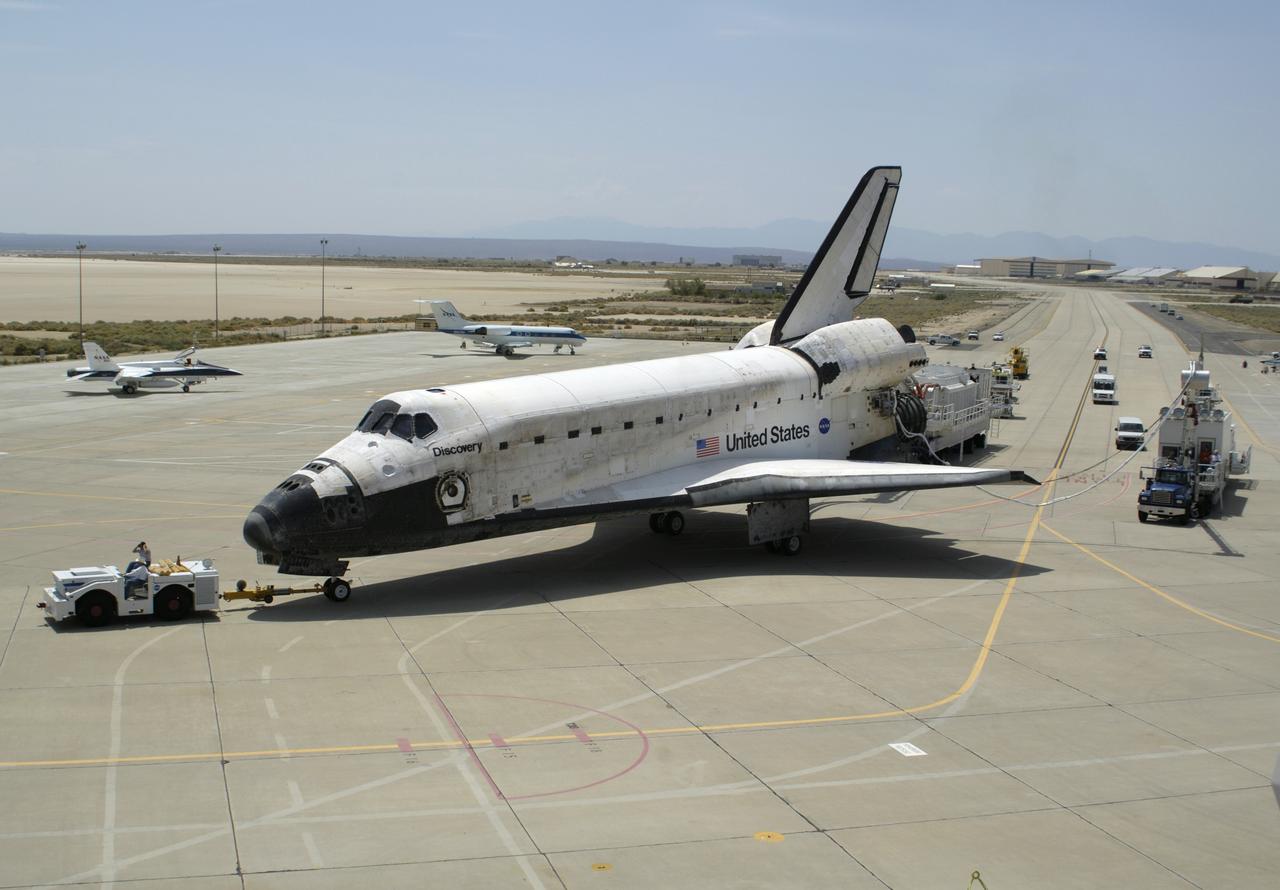
The Space Shuttle Discovery, accompanied by a convoy of recovery vehicles, is towed up the taxiway at NASA's Dryden Flight Research Center at Edwards Air Force Base, California, following its landing on August 9, 2005. Space Shuttle Discovery landed safely at NASA's Dryden Flight Research Center at Edwards Air Force Base in California at 5:11:22 a.m. PDT this morning, following the very successful 14-day STS-114 return to flight mission. During their two weeks in space, Commander Eileen Collins and her six crewmates tested out new safety procedures and delivered supplies and equipment the International Space Station. Discovery spent two weeks in space, where the crew demonstrated new methods to inspect and repair the Shuttle in orbit. The crew also delivered supplies, outfitted and performed maintenance on the International Space Station. A number of these tasks were conducted during three spacewalks. In an unprecedented event, spacewalkers were called upon to remove protruding gap fillers from the heat shield on Discovery's underbelly. In other spacewalk activities, astronauts installed an external platform onto the Station's Quest Airlock and replaced one of the orbital outpost's Control Moment Gyroscopes. Inside the Station, the STS-114 crew conducted joint operations with the Expedition 11 crew. They unloaded fresh supplies from the Shuttle and the Raffaello Multi-Purpose Logistics Module. Before Discovery undocked, the crews filled Raffeallo with unneeded items and returned to Shuttle payload bay. Discovery launched on July 26 and spent almost 14 days on orbit.

The Space Shuttle Endeavour, accompanied by a convoy of recovery vehicles, is towed up the taxiway at NASA's Dryden Flight Research Center at Edwards Air Force Base, California, following its landing on June 19, 2002. The landing, the 49th to occur at Edwards, concluded mission STS-111 to the International Space Station. It was the 18th orbital mission of Endeavour and the 110th space shuttle mission overall.
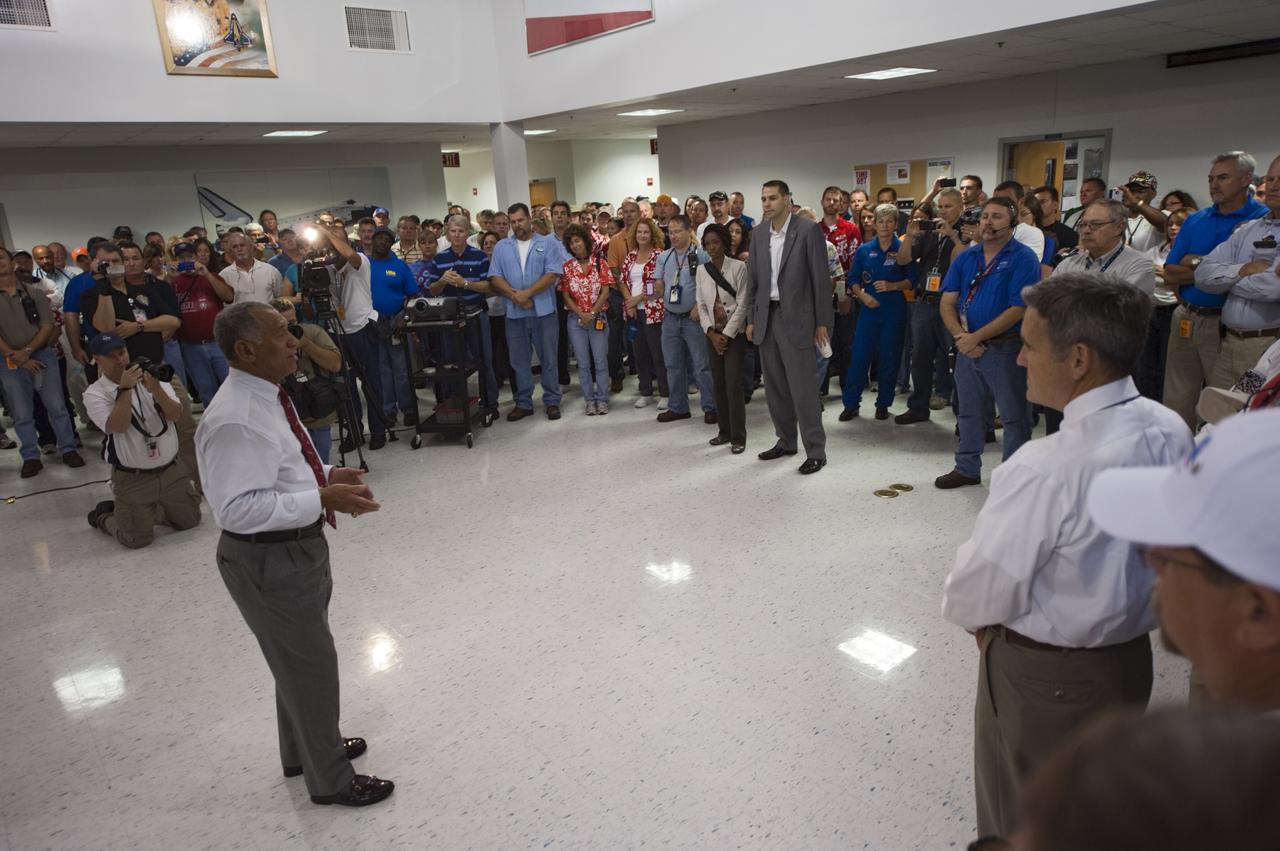
CAPE CANAVERAL, Fla. -- In the Flight Vehicle Support Building at NASA Kennedy Space Center's Shuttle Landing Facility (SLF), NASA Administrator Charles Bolden discusses strategies with NASA managers and convoy crew members during a prelanding convoy meeting. A Convoy Command Center vehicle will be positioned near shuttle Atlantis on the SLF. The command vehicle is equipped to control critical communications between the crew still aboard Atlantis and the Launch Control Center. The team will monitor the health of the orbiter systems and direct convoy operations made up of about 40 vehicles, including 25 specially designed vehicles to assist the crew in leaving the shuttle, and prepare the vehicle for towing from the SLF to its processing hangar. Securing the space shuttle fleet's place in history, Atlantis will mark the 26th nighttime landing of NASA's Space Shuttle Program and the 78th landing at Kennedy. Atlantis and its crew delivered to the International Space Station the Raffaello multi-purpose logistics module packed with more than 9,400 pounds of spare parts, equipment and supplies that will sustain station operations for the next year. STS-135 is the 33rd and final flight for Atlantis and final mission of the Space Shuttle Program. For more information, visit www.nasa.gov/mission_pages/shuttle/shuttlemissions/sts135/index.html. Photo credit: NASA/Kim Shiflett
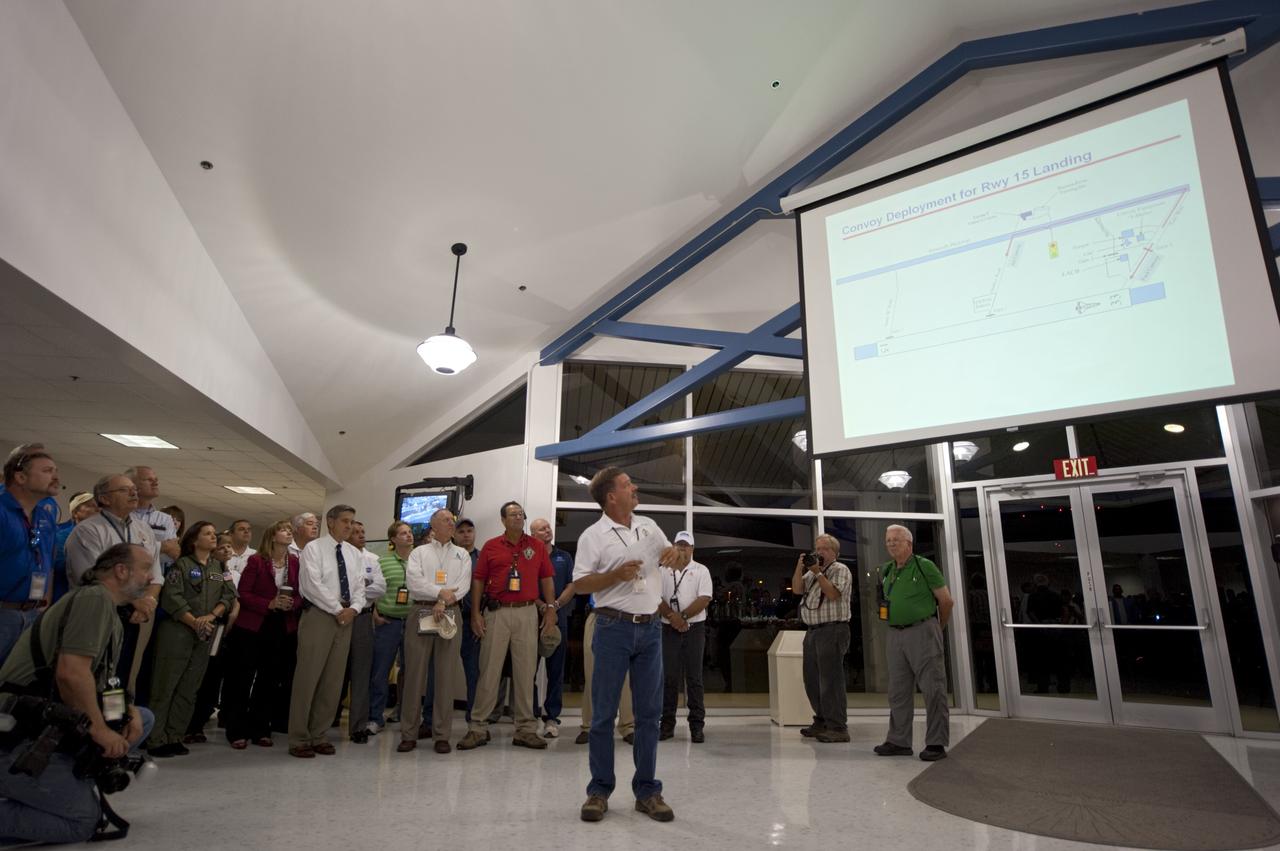
CAPE CANAVERAL, Fla. -- In the Flight Vehicle Support Building at NASA Kennedy Space Center's Shuttle Landing Facility (SLF), Mission Convoy Commander Tim Obrien strategies with NASA managers and convoy crew members during a prelanding meeting. A Convoy Command Center vehicle will be positioned near shuttle Atlantis on the SLF. The command vehicle is equipped to control critical communications between the crew still aboard Atlantis and the Launch Control Center. The team will monitor the health of the orbiter systems and direct convoy operations made up of about 40 vehicles, including 25 specially designed vehicles to assist the crew in leaving the shuttle, and prepare the vehicle for towing from the SLF to its processing hangar. Securing the space shuttle fleet's place in history, Atlantis will mark the 26th nighttime landing of NASA's Space Shuttle Program and the 78th landing at Kennedy. Atlantis and its crew delivered to the International Space Station the Raffaello multi-purpose logistics module packed with more than 9,400 pounds of spare parts, equipment and supplies that will sustain station operations for the next year. STS-135 is the 33rd and final flight for Atlantis and final mission of the Space Shuttle Program. For more information, visit www.nasa.gov/mission_pages/shuttle/shuttlemissions/sts135/index.html. Photo credit: NASA/Kim Shiflett
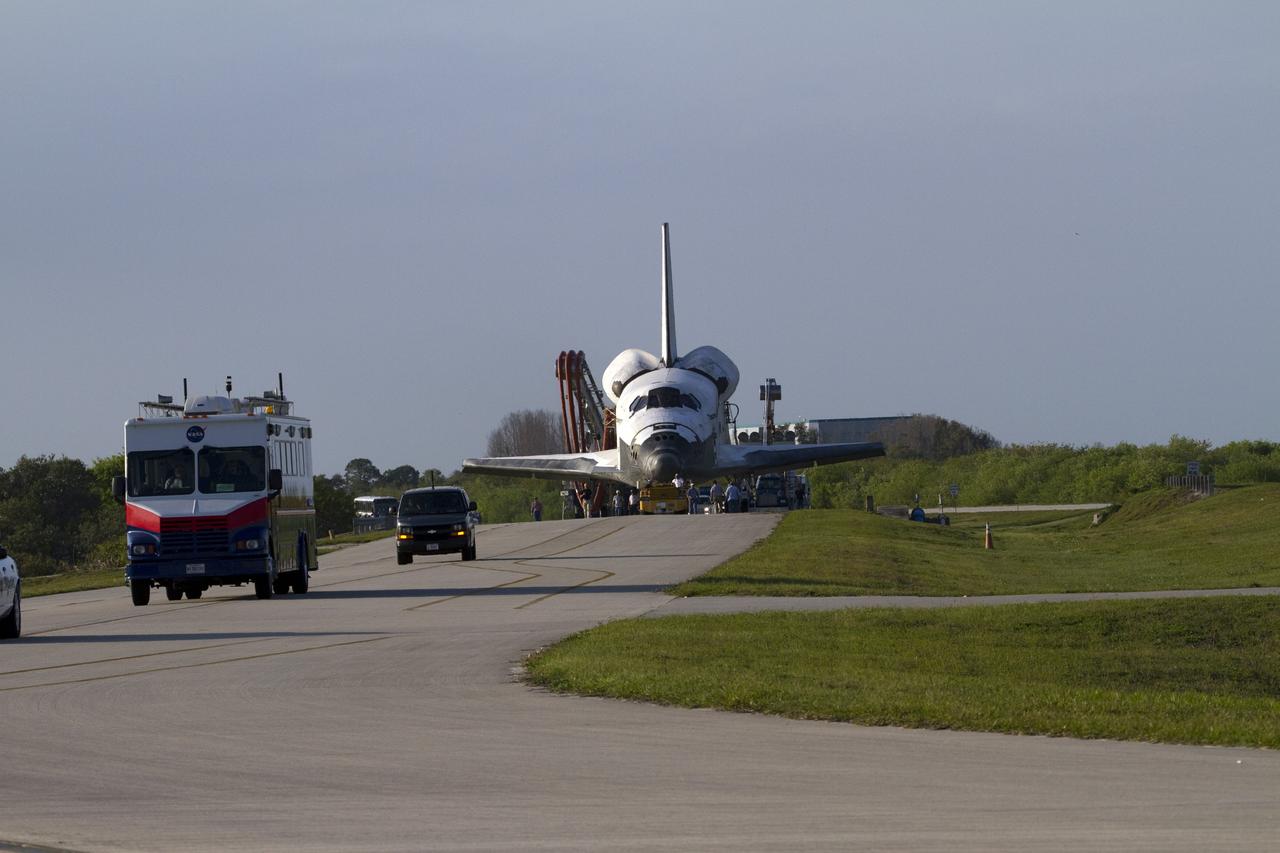
CAPE CANAVERAL, Fla. - The Convoy Command Vehicle leads space shuttle Discovery and the landing convoy along the towway from the Shuttle Landing Facility to Orbiter Processing Facility-2 at NASA's Kennedy Space Center in Florida. Discovery touched down on Runway 15 at 11:57 a.m., bringing an end to its 39th and final spaceflight mission, STS-133. Discovery and its six-member STS-133 crew delivered the Permanent Multipurpose Module, packed with supplies and critical spare parts, as well as Robonaut 2, the dexterous humanoid astronaut helper, to the International Space Station. Inside the processing facility, Discovery will be prepared for future public display. Photo credit: NASA/Jack Pfaller
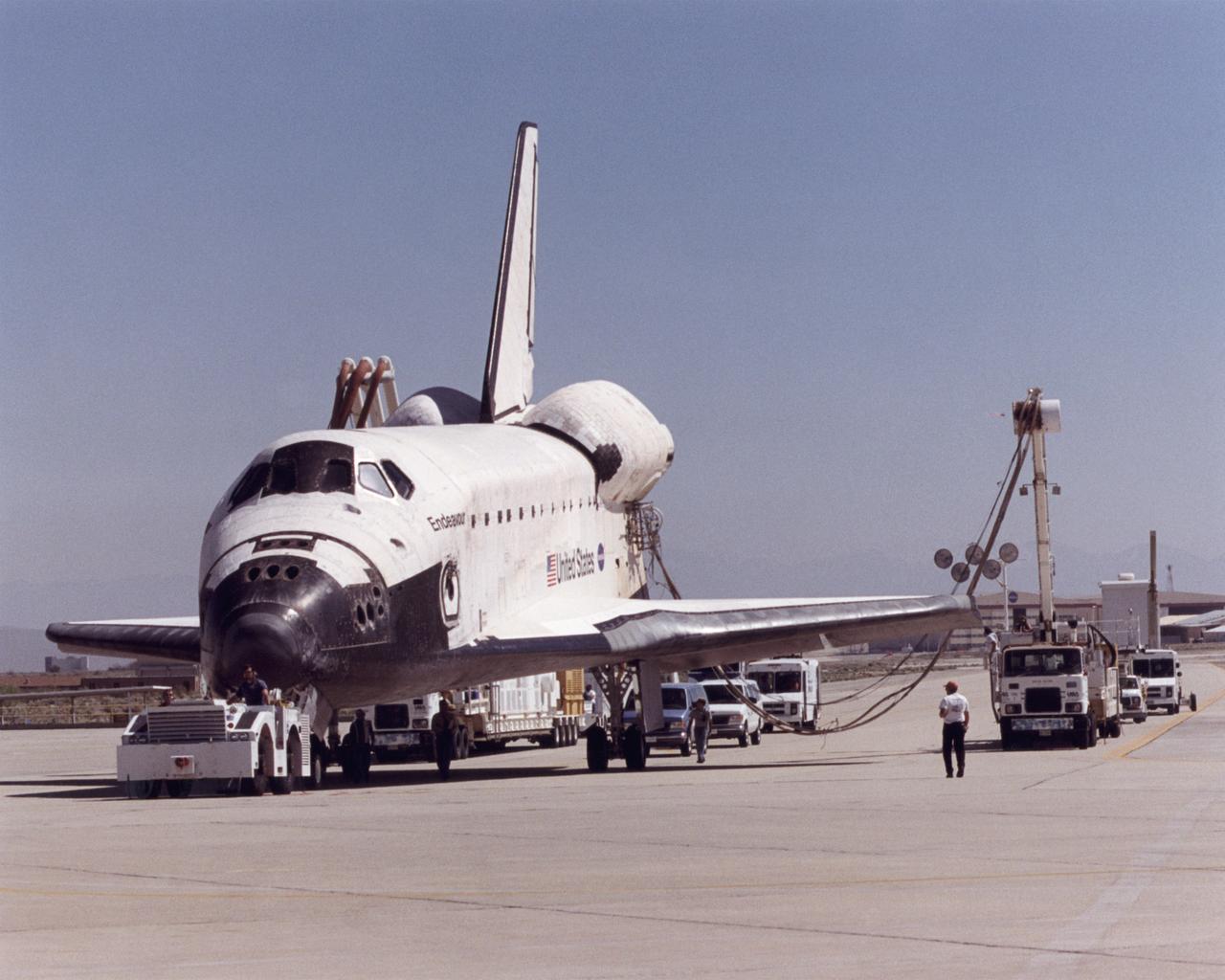
A convoy of specialized support vehicles follow the Space Shuttle Endeavour as it is towed up a taxiway at NASA's Dryden Flight Research Center on Edwards Air Force Base, California, after landing on May 1, 2001. The two largest vehicles trailing the shuttle provide electrical power and air conditioning to the shuttle's systems during post-flight recovery operations. The Endeavour had just completed mission STS-100, an almost 12-day mission to install the Canadarm 2 robotic arm and deliver some three tons of supplies and experiments to the International Space Station. The landing was the 48th shuttle landing at Edwards since shuttle flights began in 1981. After post-flight processing, the Endeavour was mounted atop one of NASA's modified Boeing 747 shuttle carrier aircraft and ferried back to the Kennedy Space Center in Florida on May 8, 2001.
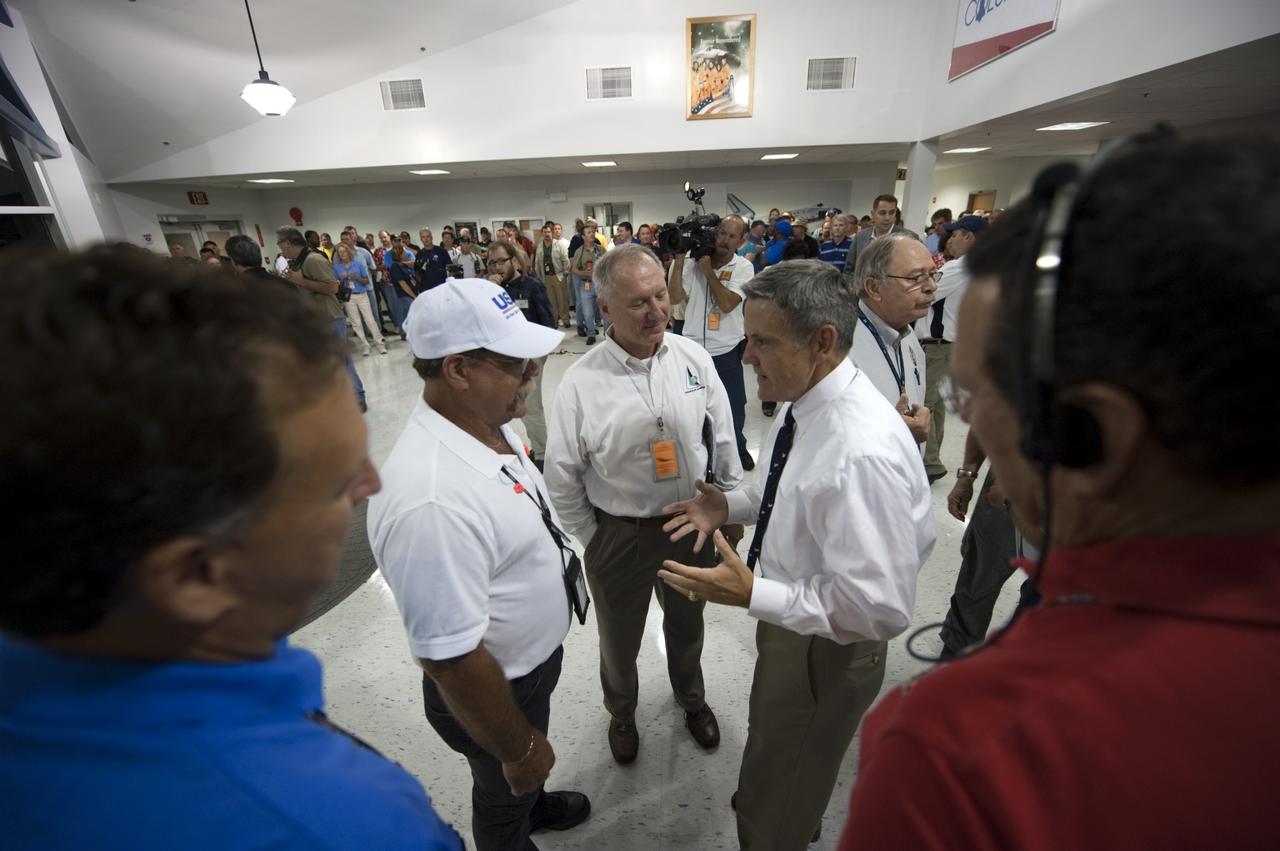
CAPE CANAVERAL, Fla. -- In the Flight Vehicle Support Building at NASA Kennedy Space Center's Shuttle Landing Facility (SLF), Kennedy Center Director Bob Cabana speaks with Closeout Crew lead Travis Thompson (left), and STS-135 Assistant Launch Director Pete Nickolenko during a prelanding convoy meeting. A Convoy Command Center vehicle will be positioned near shuttle Atlantis on the SLF. The command vehicle is equipped to control critical communications between the crew still aboard Atlantis and the Launch Control Center. The team will monitor the health of the orbiter systems and direct convoy operations made up of about 40 vehicles, including 25 specially designed vehicles to assist the crew in leaving the shuttle, and prepare the vehicle for towing from the SLF to its processing hangar. Securing the space shuttle fleet's place in history, Atlantis will mark the 26th nighttime landing of NASA's Space Shuttle Program and the 78th landing at Kennedy. Atlantis and its crew delivered to the International Space Station the Raffaello multi-purpose logistics module packed with more than 9,400 pounds of spare parts, equipment and supplies that will sustain station operations for the next year. STS-135 is the 33rd and final flight for Atlantis and final mission of the Space Shuttle Program. For more information, visit www.nasa.gov/mission_pages/shuttle/shuttlemissions/sts135/index.html. Photo credit: NASA/Kim Shiflett
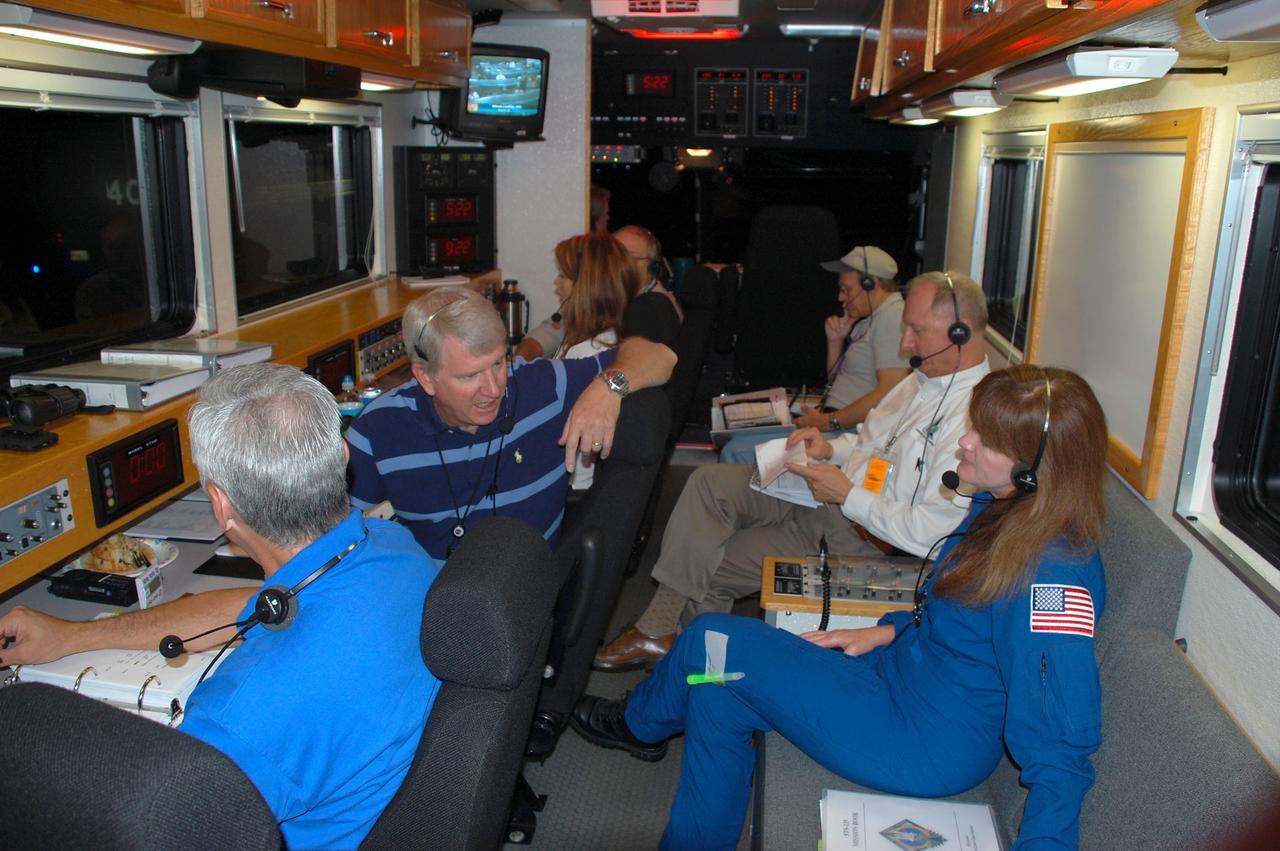
CAPE CANAVERAL, Fla. -- The Convoy Command Center vehicle is positioned on the Shuttle Landing Facility (SLF) at NASA's Kennedy Space Center in Florida awaiting the landing of space shuttle Atlantis. The command vehicle is equipped to control critical communications between the crew still aboard Atlantis and the Launch Control Center. The team will monitor the health of the orbiter systems and direct convoy operations made up of about 40 vehicles, including 25 specially designed vehicles to assist the crew in leaving the shuttle, and prepare the vehicle for towing from the SLF to its processing hangar. Accompanying the command convoy team are STS-135 Assistant Launch Director Pete Nickolenko (right), NASA astronaut Janet Kavandi and Chris Hasselbring, USA Operations Manager (left). Securing the space shuttle fleet's place in history, Atlantis marks the 26th nighttime landing of NASA's Space Shuttle Program and the 78th landing at Kennedy. Atlantis and its crew delivered to the International Space Station the Raffaello multi-purpose logistics module packed with more than 9,400 pounds of spare parts, equipment and supplies that will sustain station operations for the next year. STS-135 is the 33rd and final flight for Atlantis and the final mission of the Space Shuttle Program. For more information, visit www.nasa.gov/mission_pages/shuttle/shuttlemissions/sts135/index.html. Photo credit: NASA/Ben Smegelsky
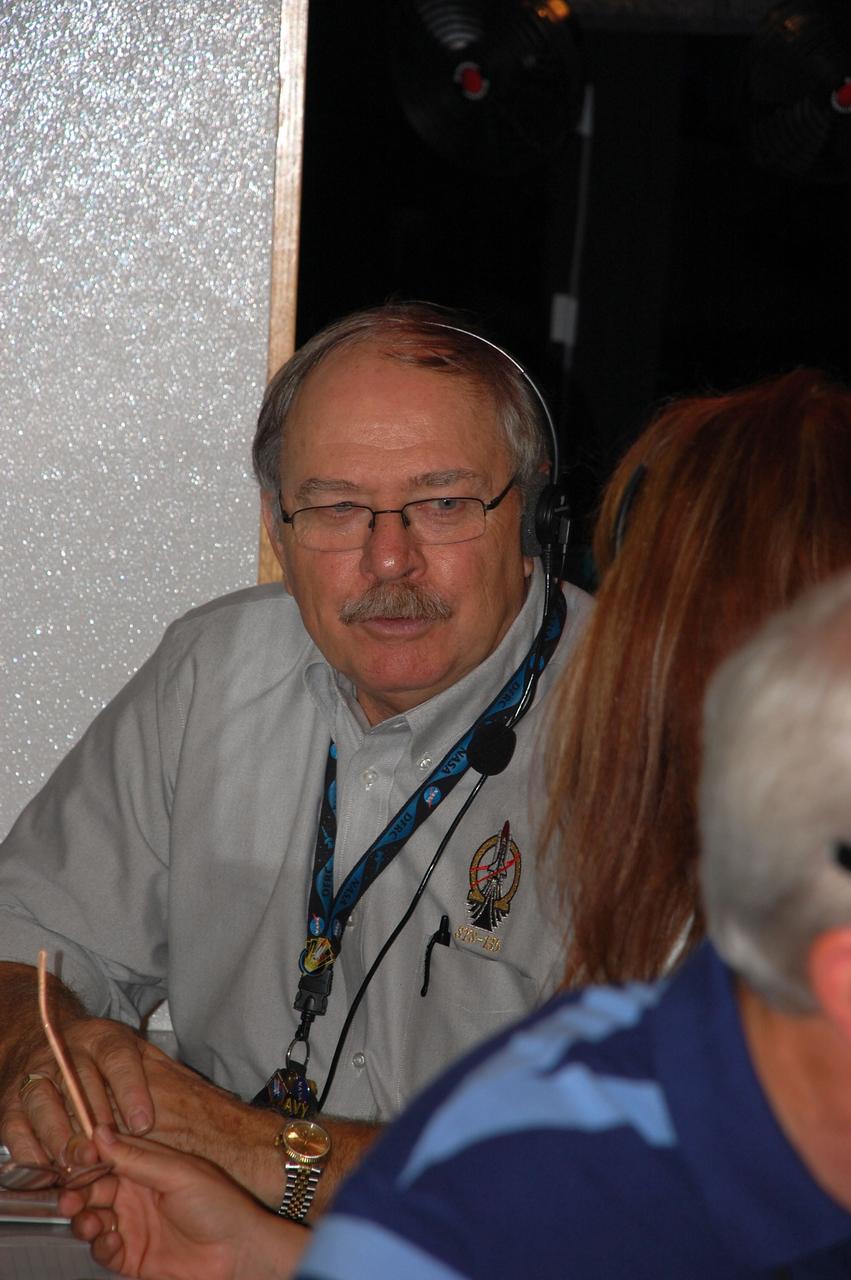
CAPE CANAVERAL, Fla. -- The Convoy Command Center vehicle is positioned on the Shuttle Landing Facility (SLF) at NASA's Kennedy Space Center in Florida awaiting the landing of space shuttle Atlantis. The command vehicle is equipped to control critical communications between the crew still aboard Atlantis and the Launch Control Center. The team will monitor the health of the orbiter systems and direct convoy operations made up of about 40 vehicles, including 25 specially designed vehicles to assist the crew in leaving the shuttle, and prepare the vehicle for towing from the SLF to its processing hangar. Seen here is Dean Schaaf with the Convoy Command Center. Securing the space shuttle fleet's place in history, Atlantis marks the 26th nighttime landing of NASA's Space Shuttle Program and the 78th landing at Kennedy. Atlantis and its crew delivered to the International Space Station the Raffaello multi-purpose logistics module packed with more than 9,400 pounds of spare parts, equipment and supplies that will sustain station operations for the next year. STS-135 is the 33rd and final flight for Atlantis and the final mission of the Space Shuttle Program. For more information, visit www.nasa.gov/mission_pages/shuttle/shuttlemissions/sts135/index.html. Photo credit: NASA/Ben Smegelsky
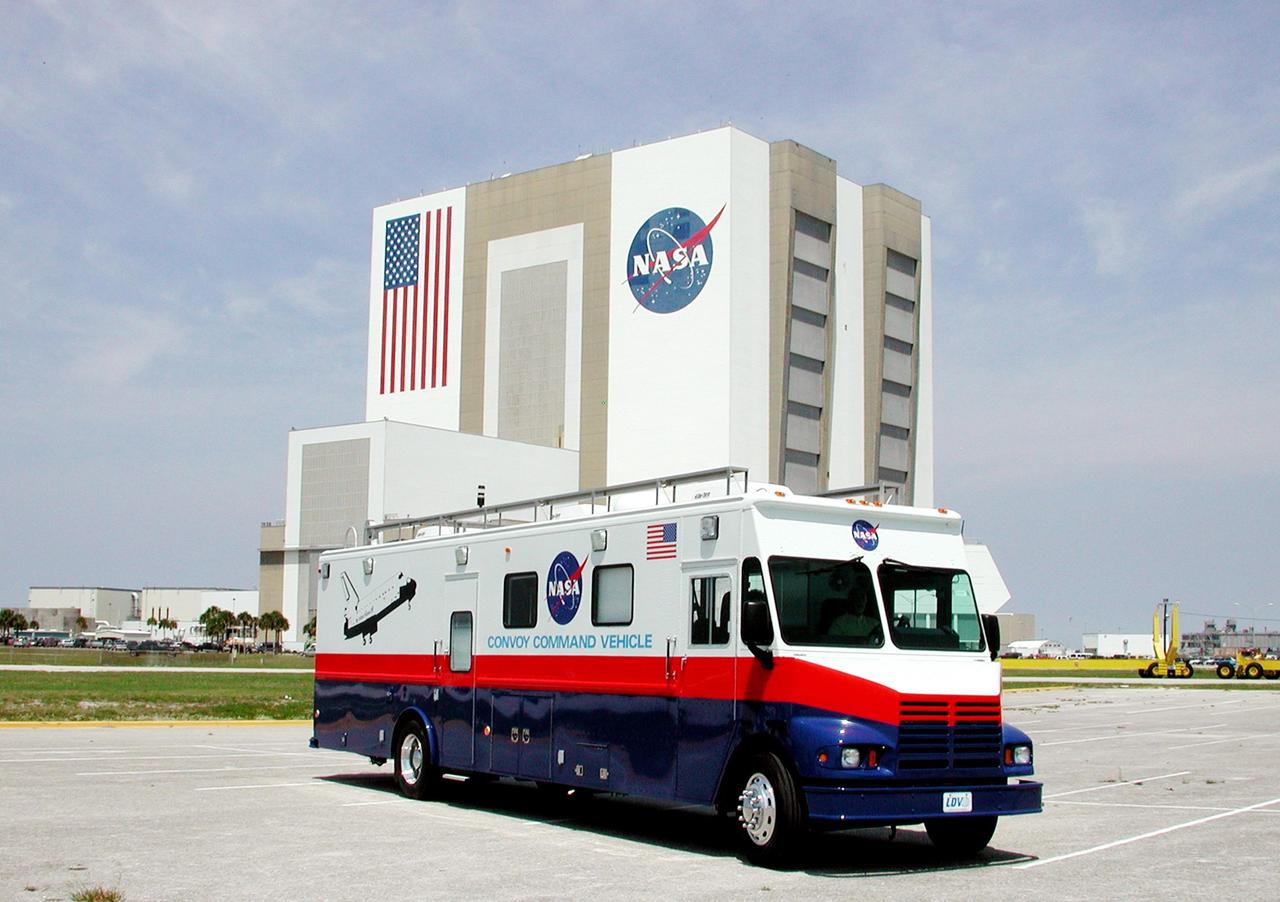
KENNEDY SPACE CENTER, FLA. - A new Convoy Command Vehicle, used for Shuttle landings, is displayed. It will replace a 15-year-old vehicle. The new one is not expected to be used before mid-June, the scheduled landing of Endeavour following mission STS-111.
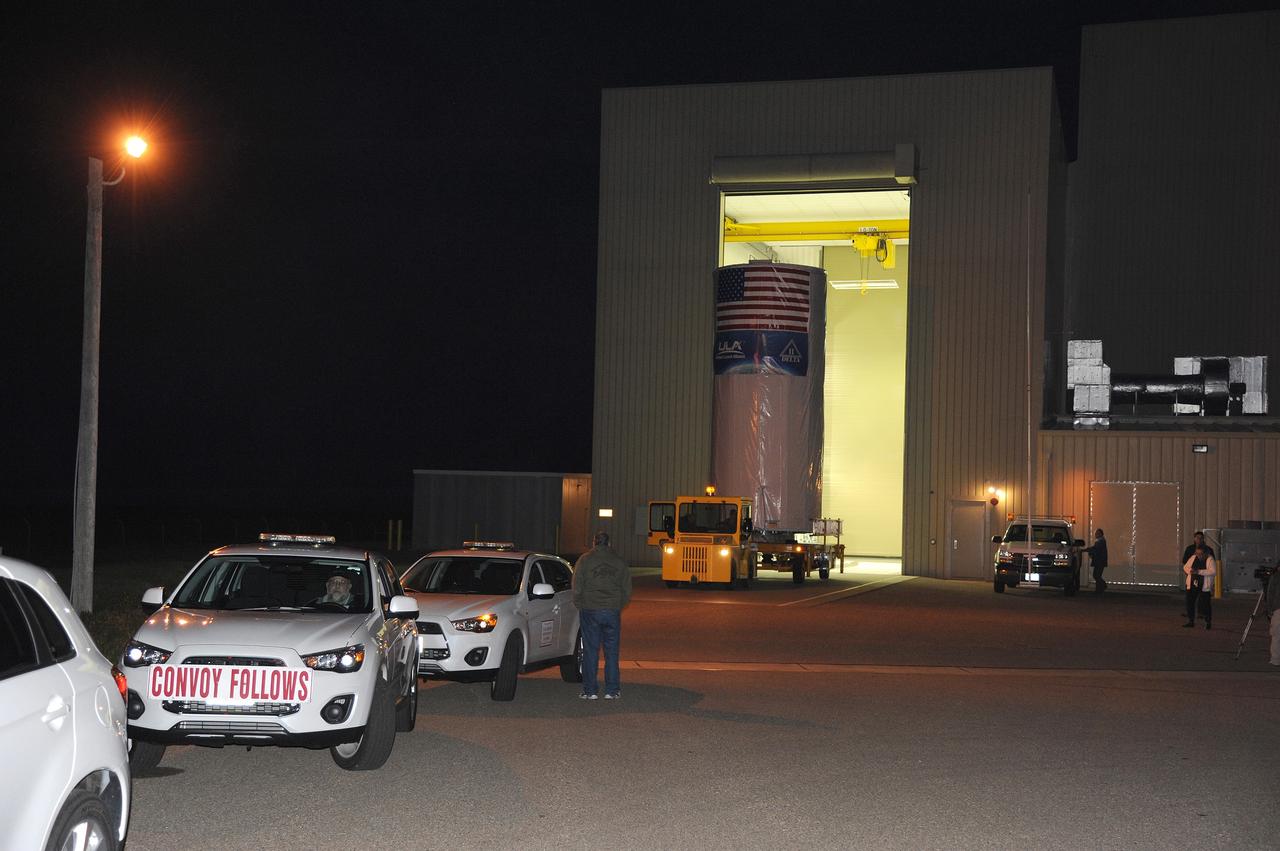
VANDENBERG AFB, California – A convoy assembles to take NASA's SMAP spacecraft from the Astrotech processing facility to Space Launch Complex-2 for placement atop a Delta II rocket for launch. For more, go to www.nasa.gov/smap Photo credit: USAF
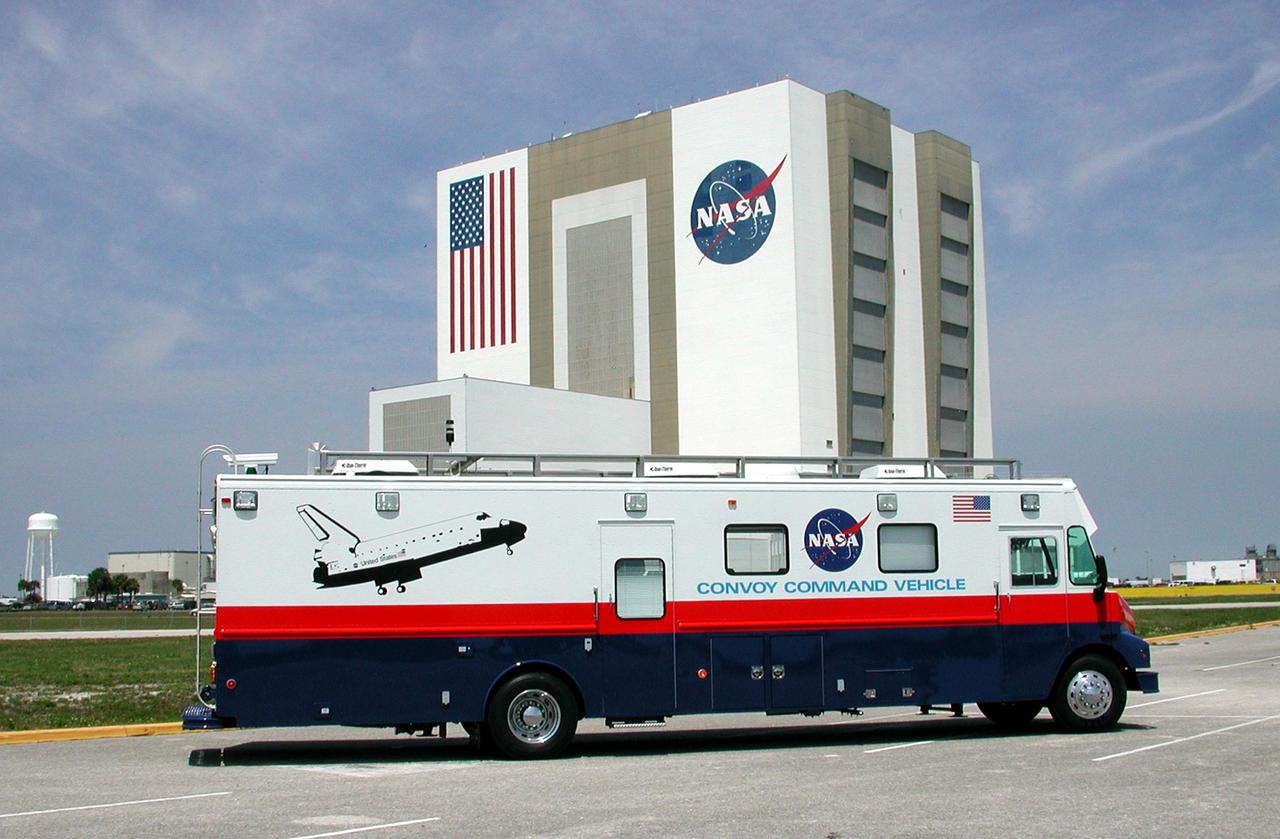
KENNEDY SPACE CENTER, FLA. - A new Convoy Command Vehicle, used for Shuttle landings, is displayed. It will replace a 15-year-old vehicle. The new one is not expected to be used before mid-June, the scheduled landing of Endeavour following mission STS-111.
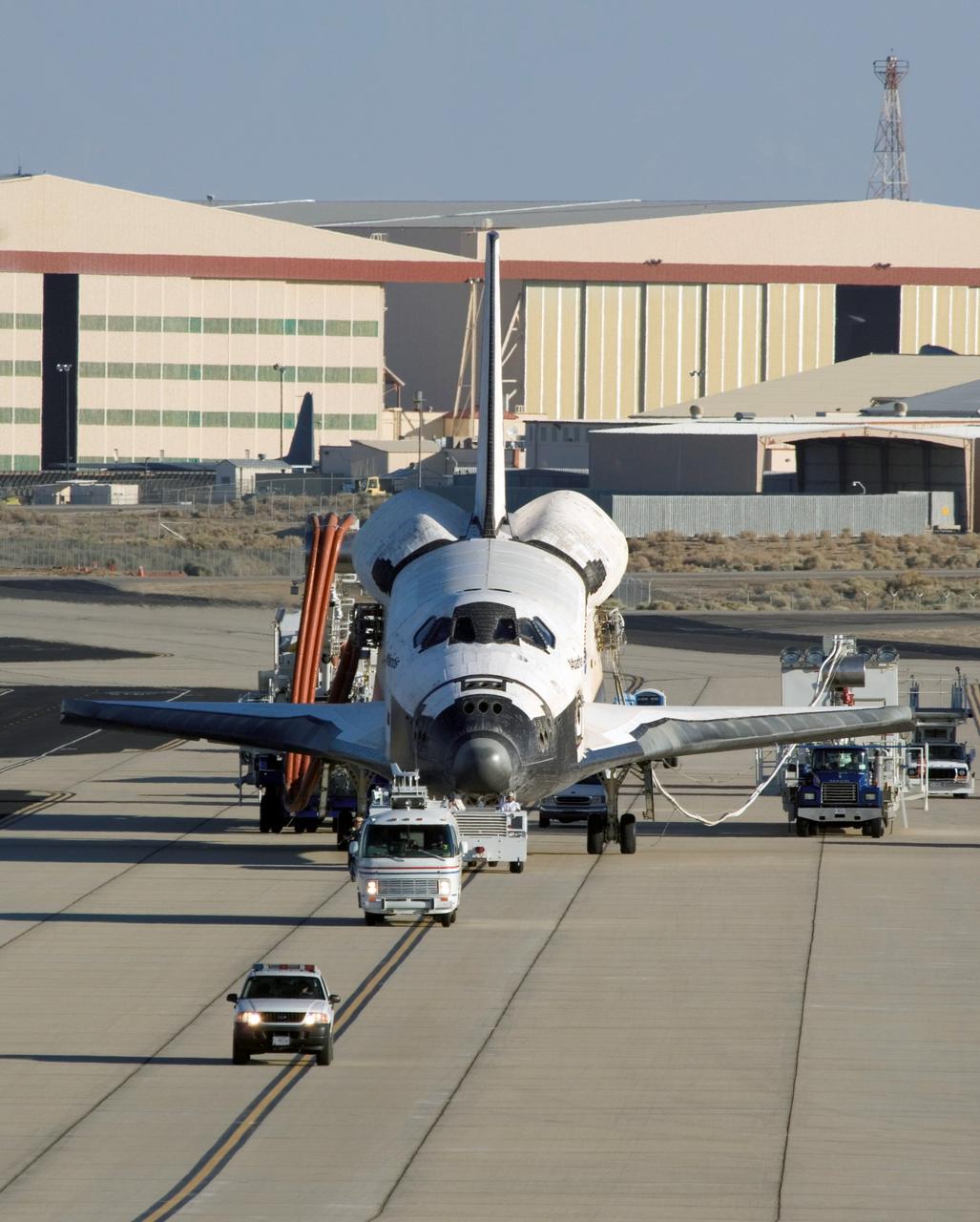
STS117-S-053 (22 June 2007) --- Accompanied by a convoy of recovery vehicles, the Space Shuttle Atlantis is towed up the taxiway at NASA Dryden Flight Research Center following a successful landing at 12:49 p.m. (PDT) on June 22, 2007 at Edwards Air Force Base in California.
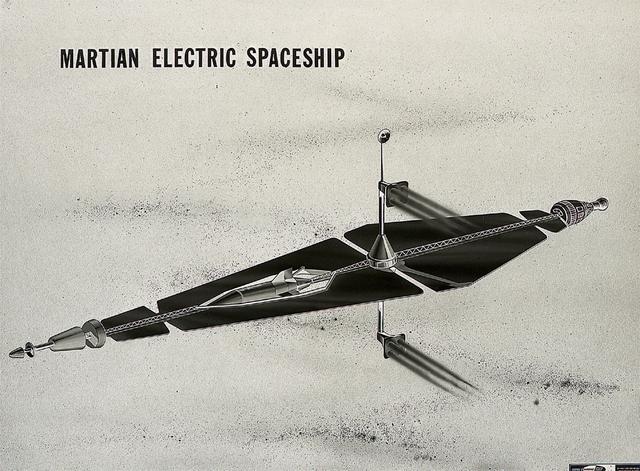
This artist's concept from 1962 show a three hundred-sixty ton spaceship, powered by a forty-megawatt nuclear-electric power plant, transporting a three-man crew to Mars. As envisioned by Marshall Space Flight Center engineers, a five-ship convoy would make the round trip journey in about five hundred days.
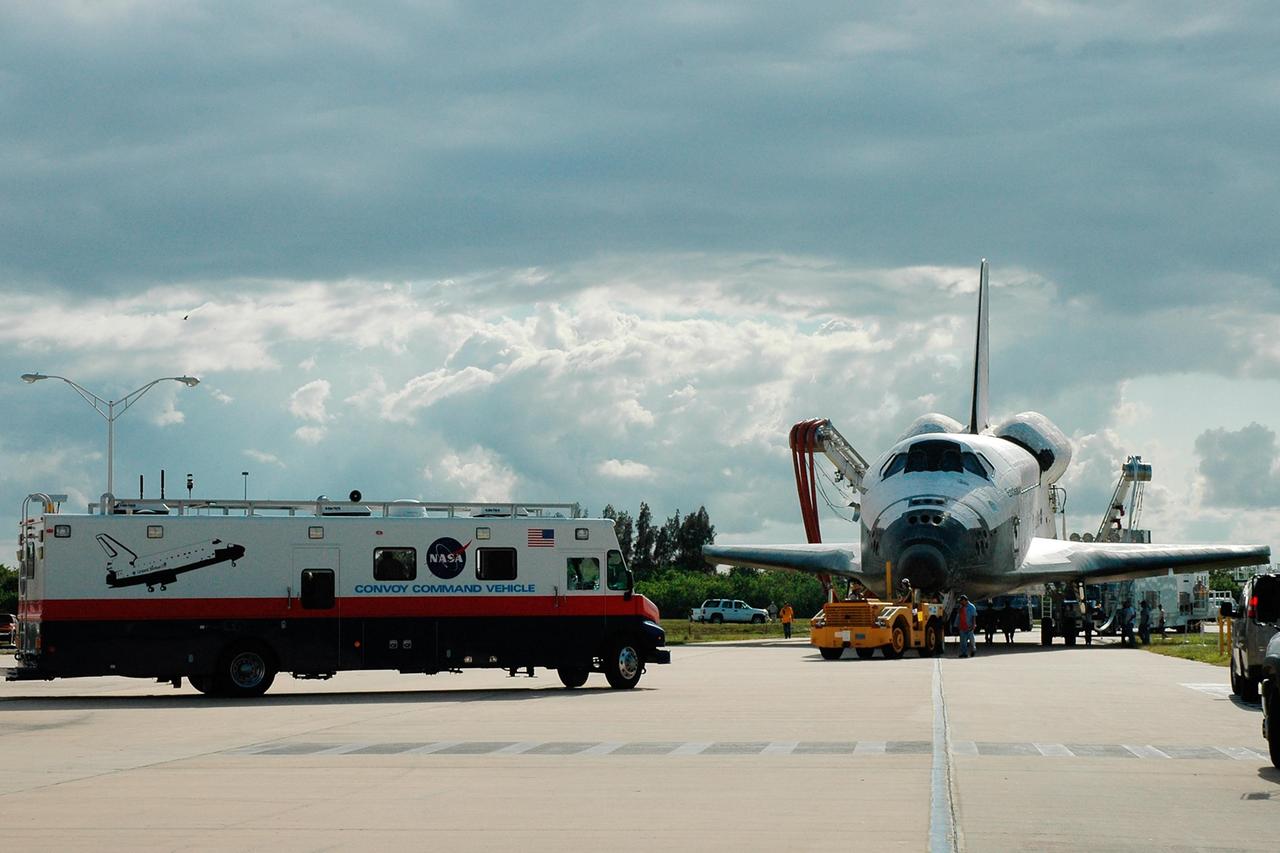
KENNEDY SPACE CENTER, FLA. -- The orbiter Endeavour is towed toward the Orbiter Processing Facility, known as the OPF. At left is the Convoy Command Vehicle. The mobile command center is the prime vehicle to control critical communications between the orbiter, the crew and the Launch Control Center after a shuttle landing to monitor the health of the shuttle orbiter systems and to direct convoy operations at the Shuttle Landing Facility. Endeavour returned to Earth Aug. 21 from mission STS-118, landing at Kennedy at 12:32 p.m. EDT. In the OPF bay 2, Endeavour will incur thermal protection system inspections and numerous other post-flight inspections before processing starts for its next voyage into space. Endeavour will next fly on mission STS-123 targeted for Feb. 14, 2008. Photo credit: NASA/Jack Pfaller
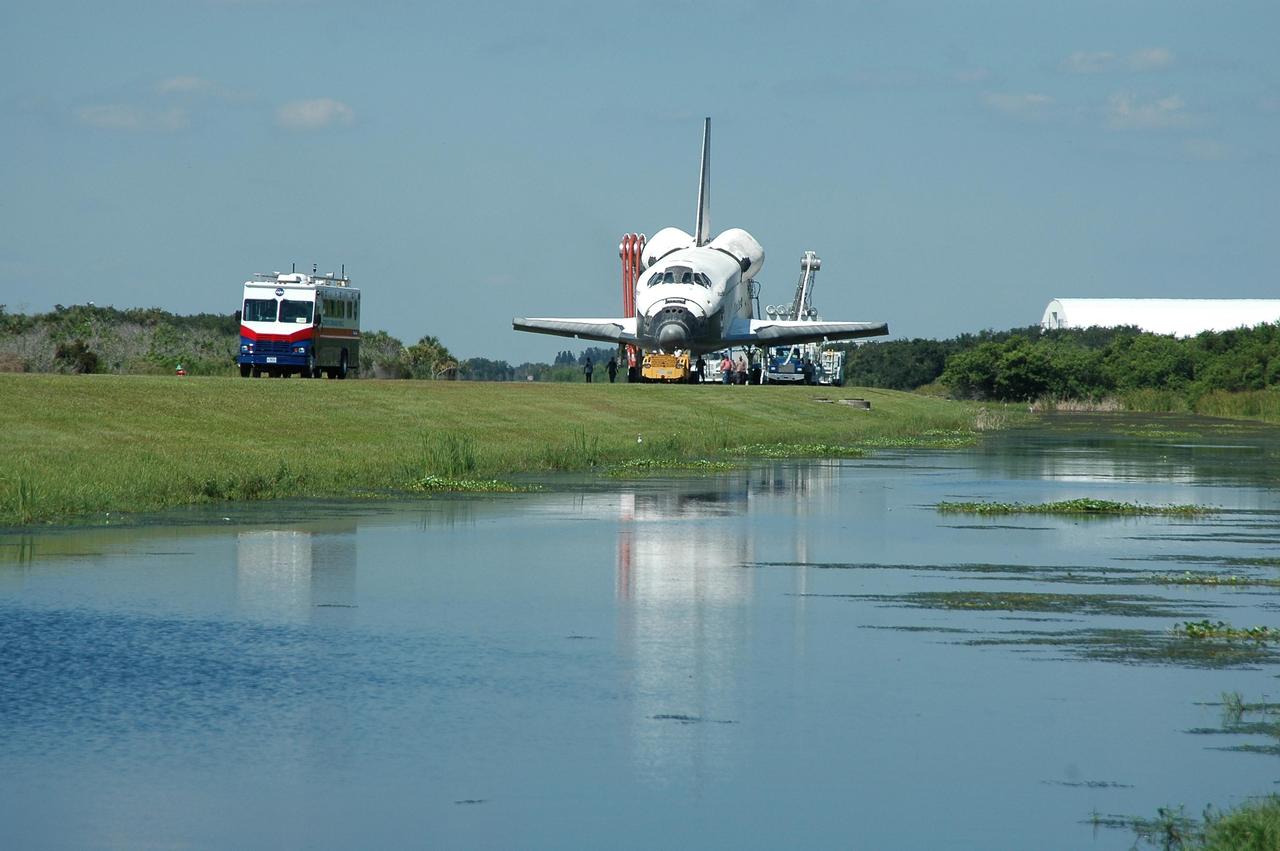
KENNEDY SPACE CENTER, FLA. - Led by the Convoy Command Center, Atlantis is towed from the Shuttle Landing Facility to the Orbiter Processing Facility. The command center is the prime vehicle to control critical communications between the orbiter, the crew and the Launch Control Center after a shuttle landing, to monitor the health of the shuttle orbiter systems and to direct convoy operations at the Shuttle Landing Facility. Atlantis landed on Runway 33 at 6:21:30 a.m. EDT after the 11-day, 19-hour, 6-minute mission STS-115 to the International Space Station. Atlantis traveled 4.9 million miles, landing on orbit 187. During the mission, astronauts delivered and installed the massive P3/P4 truss, an integral part of the station's backbone, and two sets of solar arrays that will eventually provide one quarter of the station's power. In the OPF, the process flow will begin to ready the vehicle for its next flight. Photo credit: NASA/Kim Shiflett
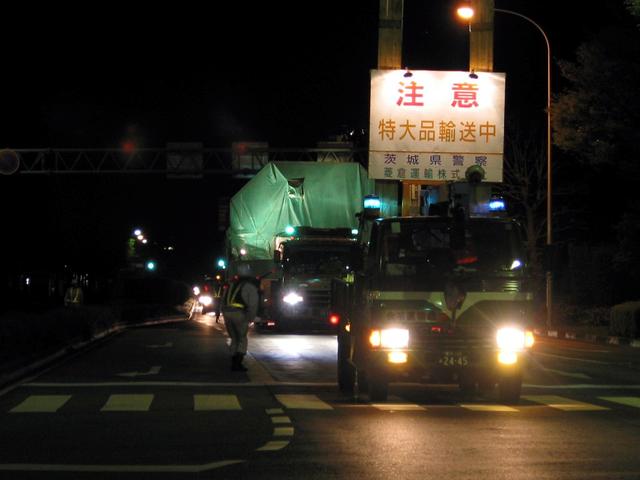
JSC2003-E-34751 (22 April 2003) --- A convoy transports the Kibo Pressurized Module, Japan's primary contribution to the International Space Station, from the National Space Development Agency of Japan's Tsukuba Space Center to be loaded onto a barge bound for Yokohama Harbor, where it was loaded on a container ship bound for Port Canaveral, Florida. Kibo is planned to arrive at the Kennedy Space Center for module integration tests with Node 2 and pre-launch processing in early June. Photo Credit: NASA
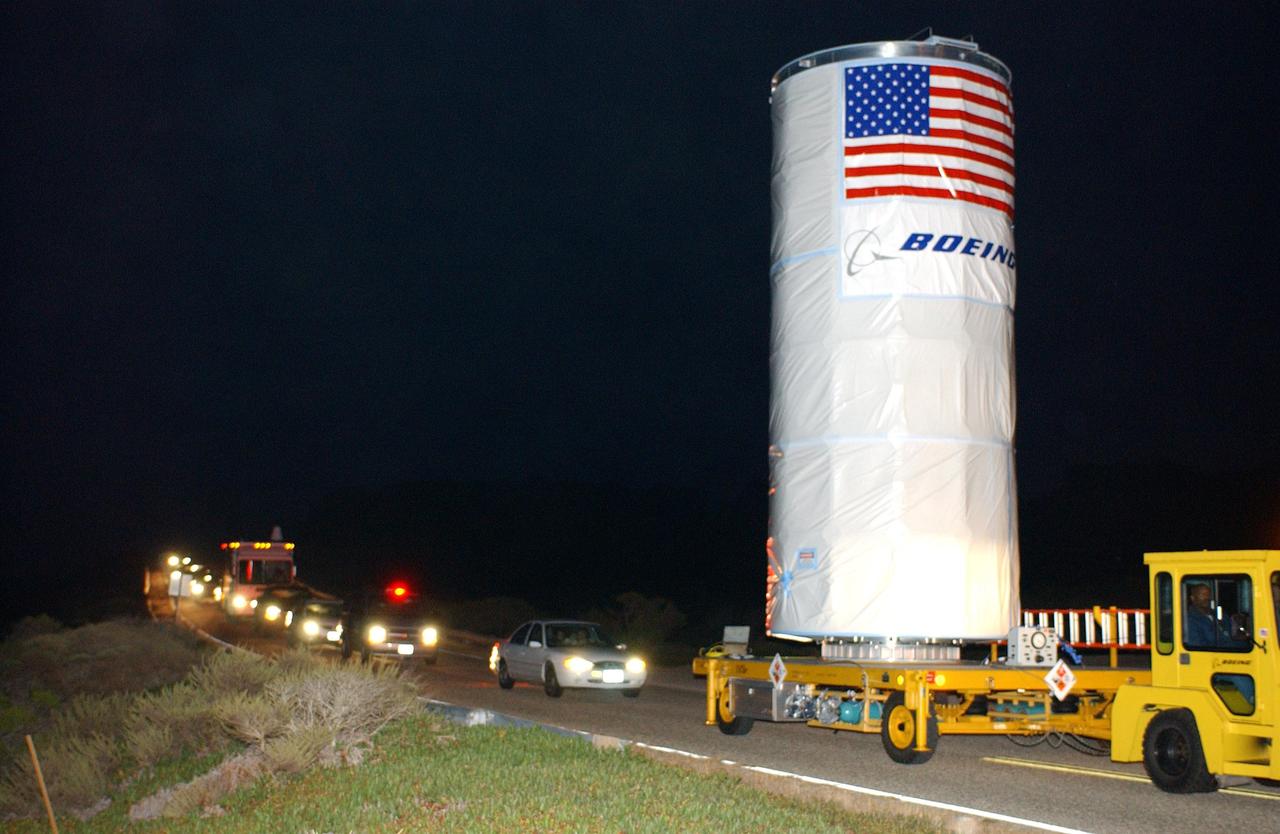
KENNEDY SPACE CENTER, FLA. - The Aura spacecraft on a transporter heads a convoy of vehicles in the predawn hours as it moves to Space Launch Complex 2 on North Vandenberg Air Force Base, Calif. The latest in the Earth Observing System (EOS) series, Aura is scheduled to launch July 10 aboard a Boeing Delta II rocket. Aura’s four state-of-the-art instruments will study the dynamics of chemistry occurring in the atmosphere. The spacecraft will provide data to help scientists better understand the Earth’s ozone, air quality and climate change.
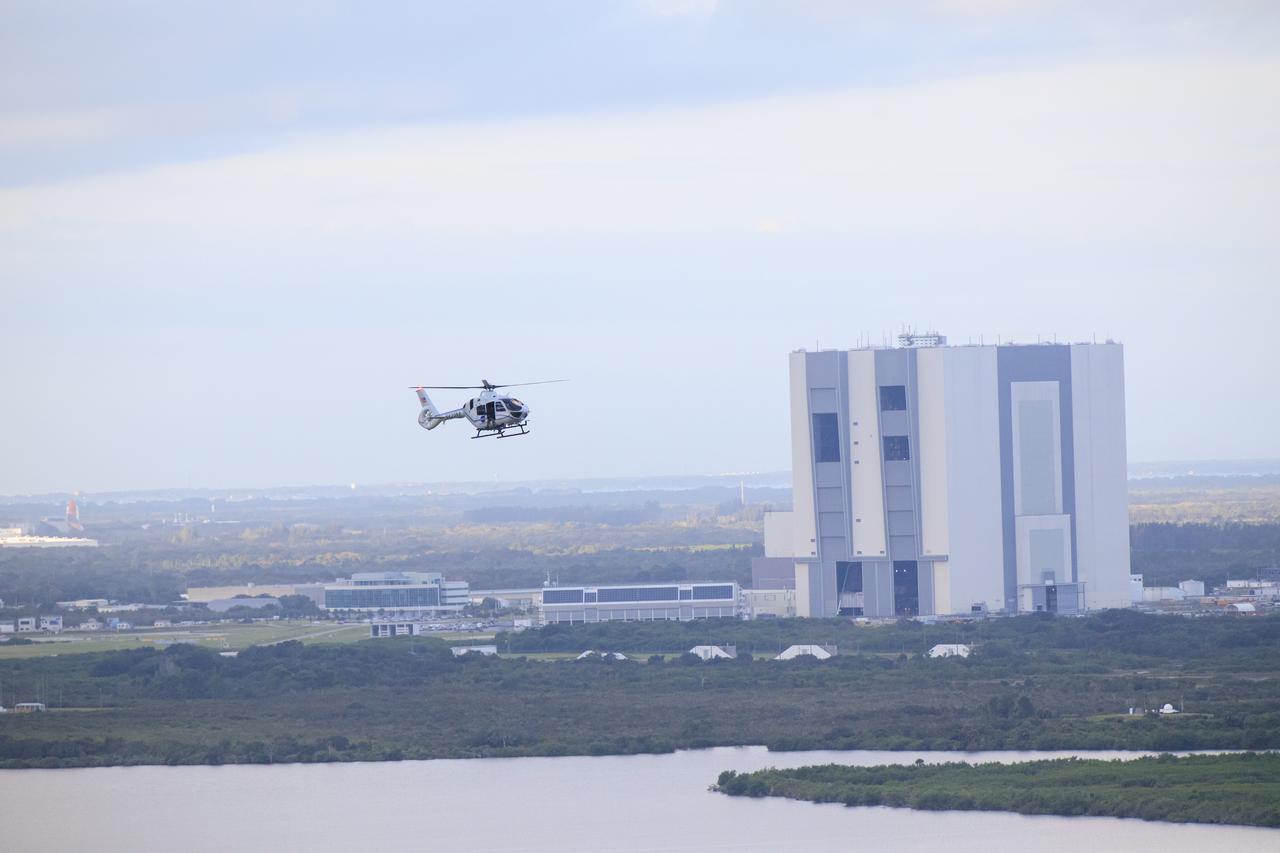
A NASA helicopter follows the convoy carrying Artemis II NASA astronauts Reid Wiseman, Victor Glover, and Christina Koch, and CSA (Canadian Space Agency) astronaut Jeremy Hansen, as they ride from Astronaut Crew Quarters in the Neil Armstrong Operations and Checkout Building to Launch Pad 39B in the Artemis crew transportation vehicles as part of an integrated ground systems test at Kennedy Space Center in Florida on Wednesday, Sept. 20, to test the crew timeline for launch day.
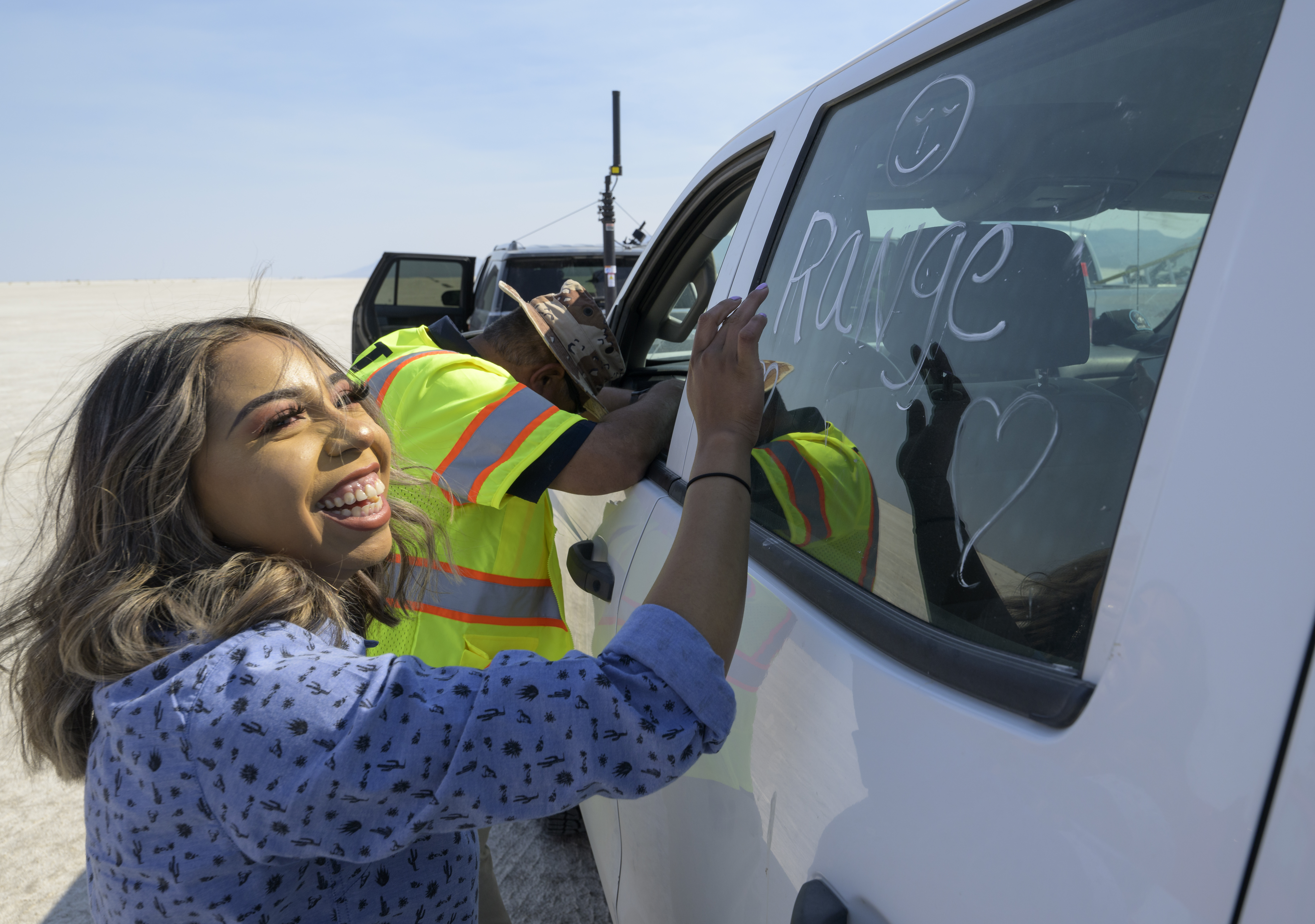
A member of the range safety team labels her convoy vehicle as they prepare for the landing of Boeing’s CST-100 Starliner spacecraft at White Sands Missile Range’s Space Harbor, Wednesday, May 25, 2022, in New Mexico. Boeing’s Orbital Flight Test-2 (OFT-2) is Starliner’s second uncrewed flight test to the International Space Station as part of NASA's Commercial Crew Program. OFT-2 serves as an end-to-end test of the system's capabilities. Photo Credit: (NASA/Bill Ingalls)
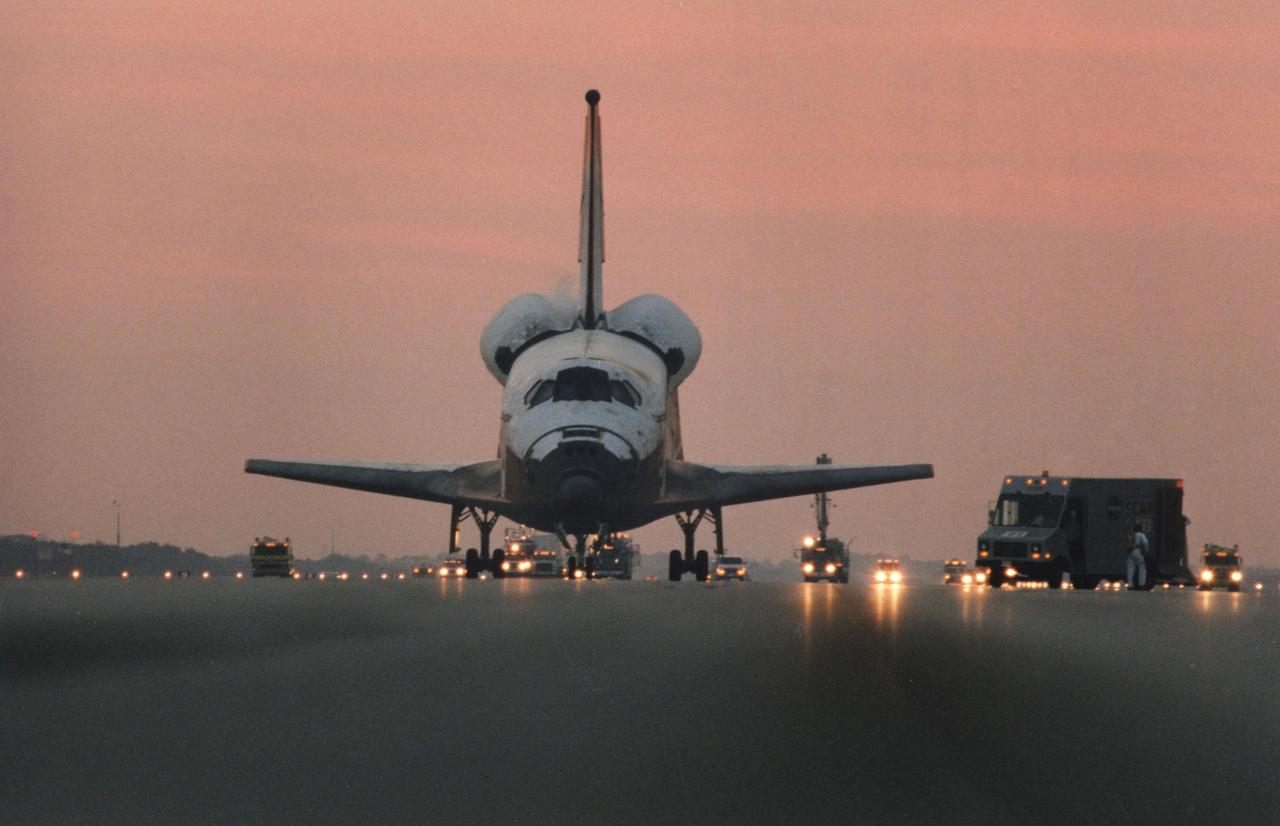
KENNEDY SPACE CENTER, FLA. -- Recovery convoy equipment greets the orbiter Columbia following main gear touchdown at 6:49:05 a.m. EST, Dec. 7, on Runway 33 of KSC’s Shuttle Landing Facility. The return to Earth of NASA’s oldest spaceplane occurred just moments before sunrise. This was the 33rd landing at KSC in Shuttle program history.
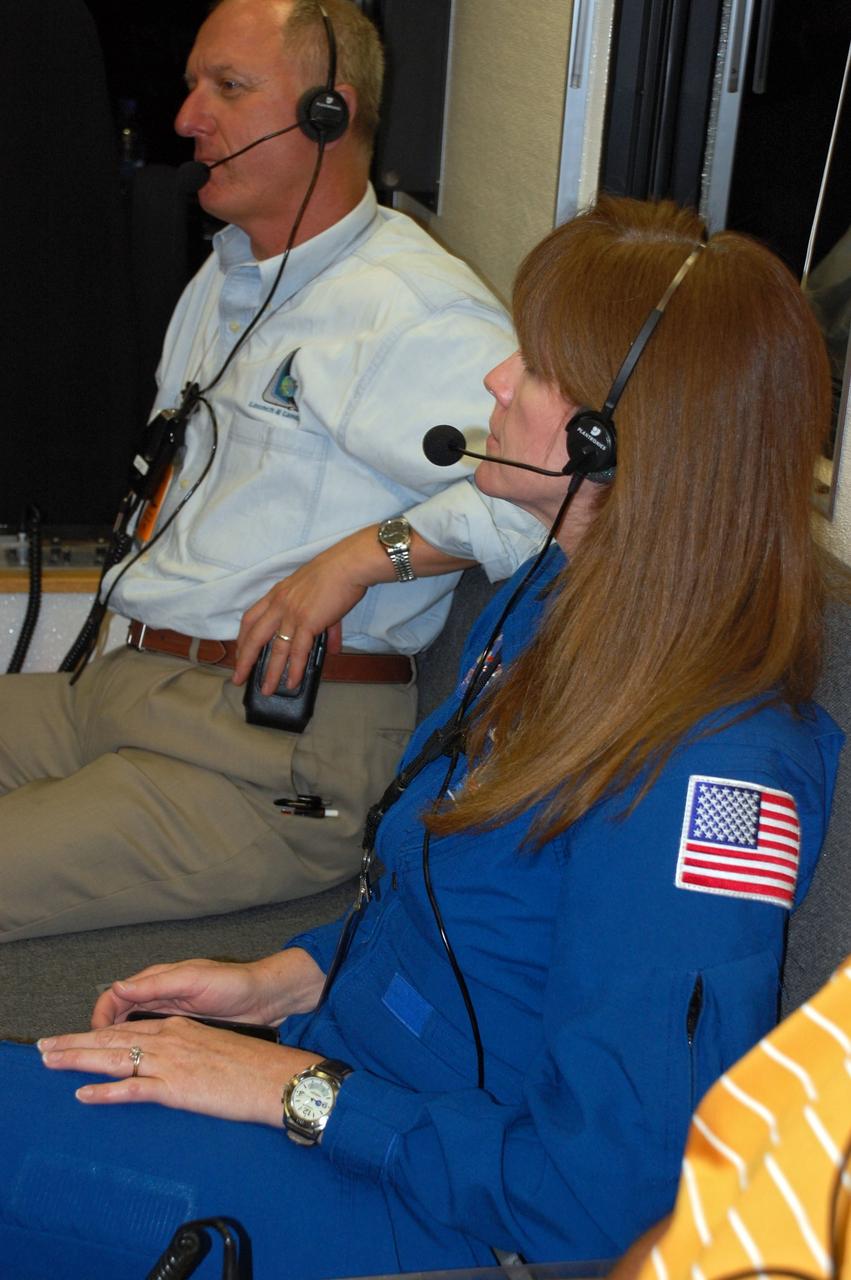
CAPE CANAVERAL, Fla. -- At NASA's Kennedy Space Center in Florida, a team of highly trained personnel inside the Convoy Command Vehicle is ready to "safe" shuttle Endeavour. The command vehicle is equipped to control critical communications between the crew still aboard Endeavour and the Launch Control Center. The team will monitor the health of the orbiter systems and direct convoy operations made up of about 40 vehicles, including 25 specially designed vehicles to assist the crew in leaving the shuttle, and prepare the vehicle for towing from the Shuttle Landing Facility to Orbiter Processing Facility-1. Accompanying the command convoy team are STS-134 assistant launch director Pete Nickolenko and NASA astronaut Janet Kavandi. Endeavour's final return from space completed the 16-day, 6.5-million-mile STS-134 mission. Main gear touchdown was at 2:34:51 a.m. EDT, followed by nose gear touchdown at 2:35:04 a.m., and wheelstop at 2:35:36 a.m. STS-134 delivered the Alpha Magnetic Spectrometer-2 (AMS) and the Express Logistics Carrier-3 (ELC-3) to the International Space Station. AMS will help researchers understand the origin of the universe and search for evidence of dark matter, strange matter and antimatter from the station. ELC-3 carried spare parts that will sustain station operations once the shuttles are retired from service. STS-134 was the 25th and final flight for Endeavour, which spent 299 days in space, orbited Earth 4,671 times and traveled 122,883,151 miles. Photo credit: NASA/Ben Smegelsky
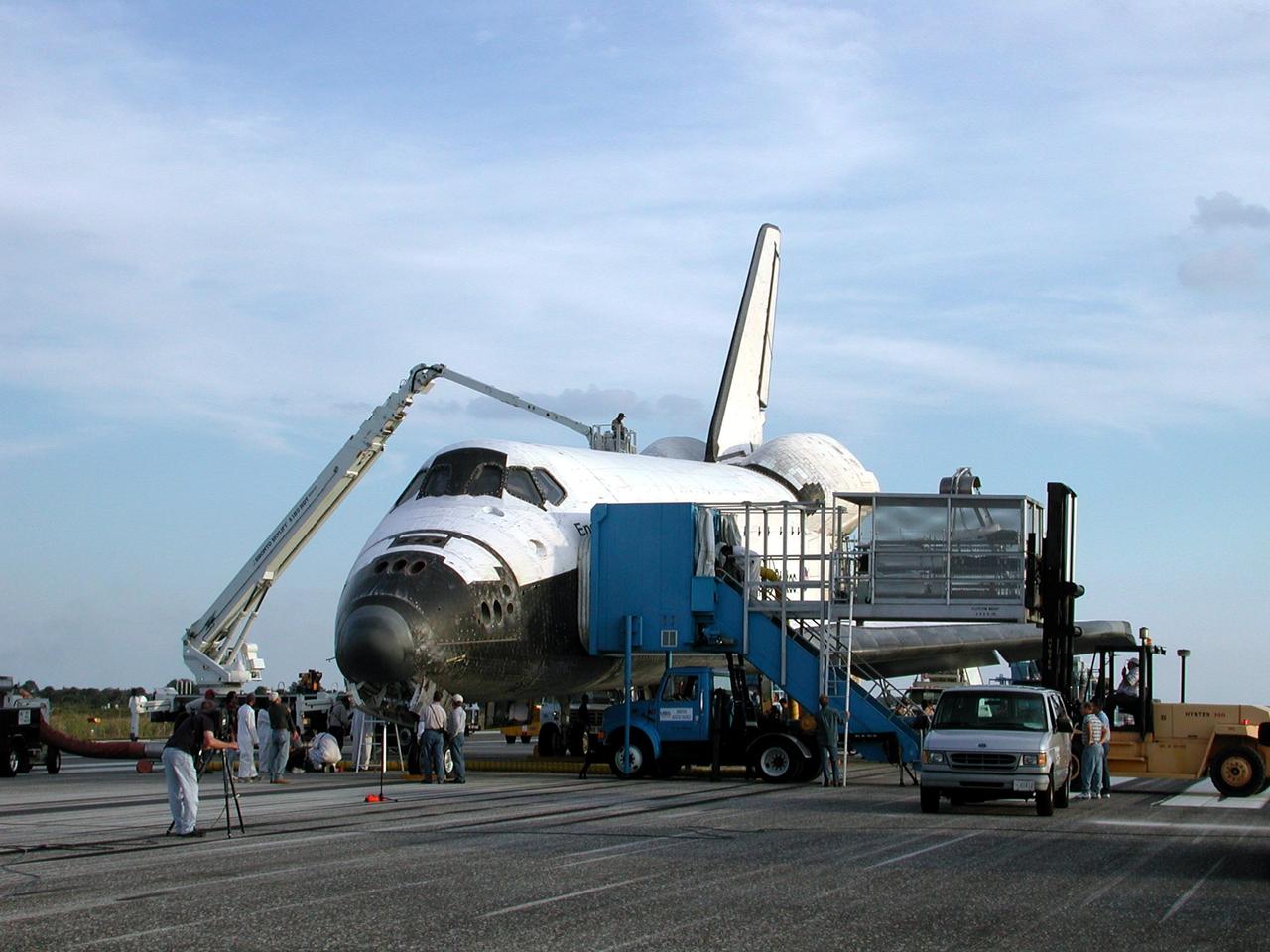
KENNEDY SPACE CENTER, FLA. - Space Shuttle Endeavour is surrounded by vehicles from the landing convoy on runway 33 at the Shuttle Landing Facility at the conclusion of the 13-day, 18-hour, 48-minute, 5.74-million mile STS-113 mission to the International Space Station. The landing convoy's purpose is to safe the vehicle and provide support for the disembarking crew and experiments. Main gear touchdown was at 2:37:12 p.m. EST, nose gear touchdown was at 2:37:23 p.m., and wheel stop was at 2:38:25 p.m. Poor weather conditions thwarted landing opportunities until a fourth day, the first time in Shuttle program history that a landing has been waved off for three consecutive days. The vehicle carries the STS-113 crew, Commander James Wetherbee, Pilot Paul Lockhart and Mission Specialists Michael Lopez-Alegria and John Herrington, as well as the returning Expedition Five crew, Commander Valeri Korzun, ISS Science Officer Peggy Whitson and Flight Engineer Sergei Treschev. The installation of the P1 truss on the International Space Station was accomplished during the mission.
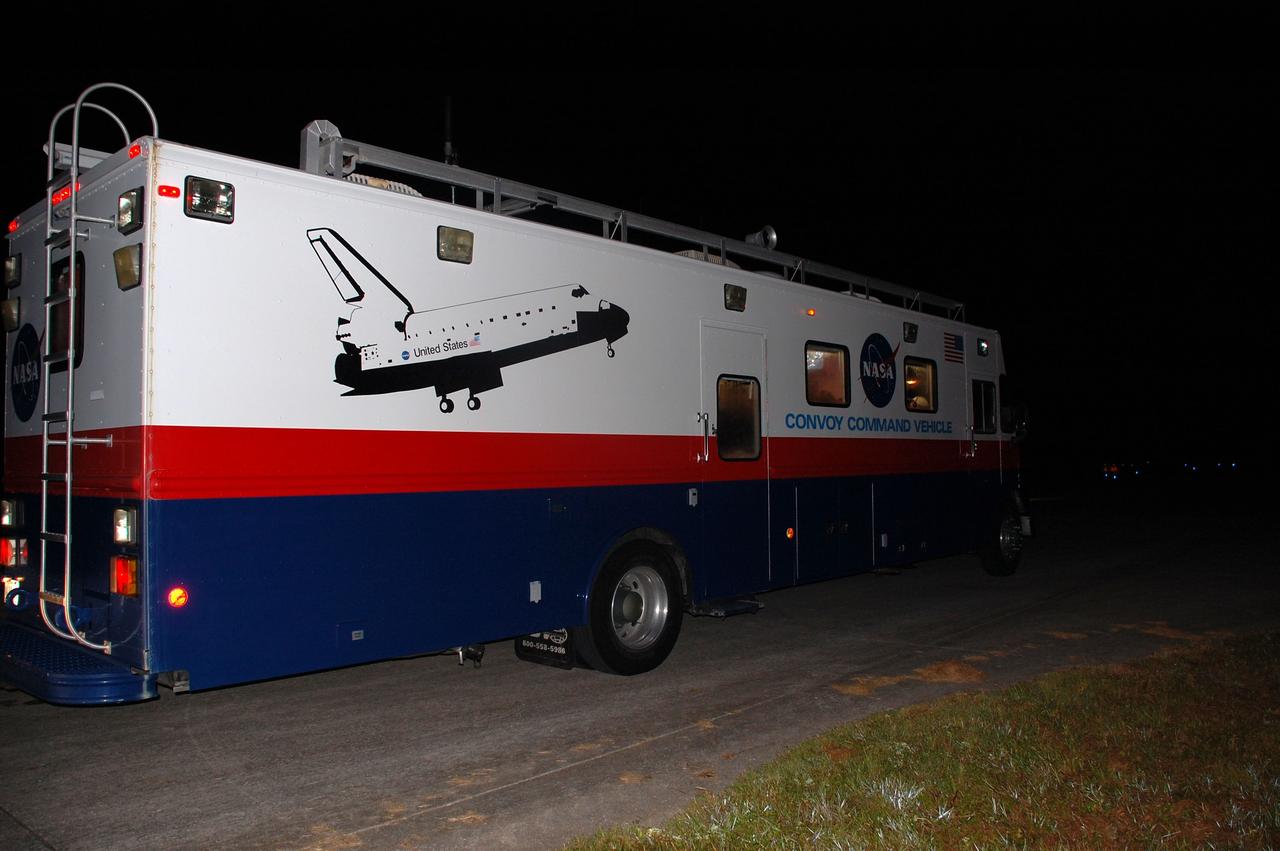
CAPE CANAVERAL, Fla. -- The Convoy Command Center vehicle is positioned on the Shuttle Landing Facility (SLF) at NASA's Kennedy Space Center in Florida awaiting the landing of space shuttle Atlantis. The command vehicle is equipped to control critical communications between the crew still aboard Atlantis and the Launch Control Center. The team will monitor the health of the orbiter systems and direct convoy operations made up of about 40 vehicles, including 25 specially designed vehicles to assist the crew in leaving the shuttle, and prepare the vehicle for towing from the SLF to its processing hangar. Securing the space shuttle fleet's place in history, Atlantis marks the 26th nighttime landing of NASA's Space Shuttle Program and the 78th landing at Kennedy. Atlantis and its crew delivered to the International Space Station the Raffaello multi-purpose logistics module packed with more than 9,400 pounds of spare parts, equipment and supplies that will sustain station operations for the next year. STS-135 is the 33rd and final flight for Atlantis and the final mission of the Space Shuttle Program. For more information, visit www.nasa.gov/mission_pages/shuttle/shuttlemissions/sts135/index.html. Photo credit: NASA/Ben Smegelsky
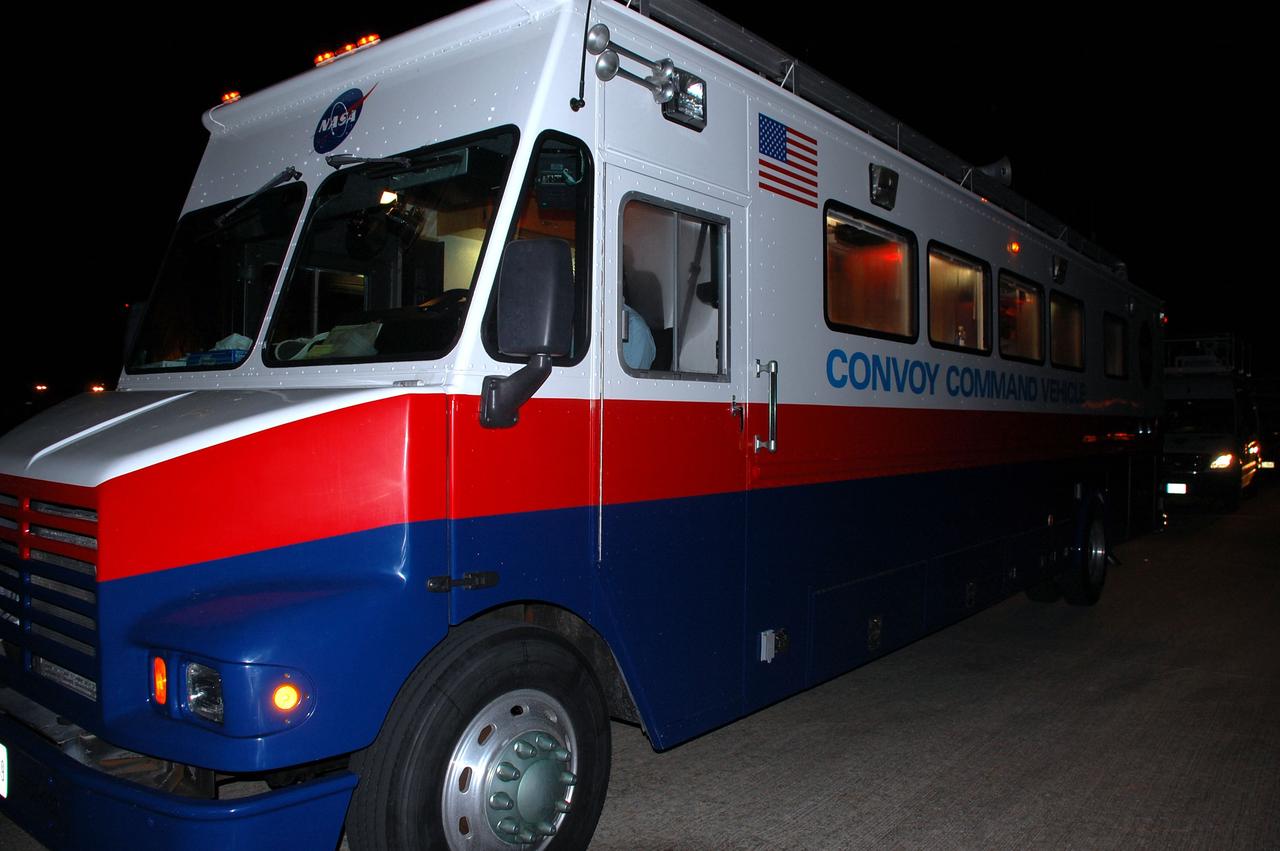
CAPE CANAVERAL, Fla. -- The Convoy Command Center vehicle is positioned on the Shuttle Landing Facility (SLF) at NASA's Kennedy Space Center in Florida awaiting the landing of space shuttle Atlantis. The command vehicle is equipped to control critical communications between the crew still aboard Atlantis and the Launch Control Center. The team will monitor the health of the orbiter systems and direct convoy operations made up of about 40 vehicles, including 25 specially designed vehicles to assist the crew in leaving the shuttle, and prepare the vehicle for towing from the SLF to its processing hangar. Securing the space shuttle fleet's place in history, Atlantis marks the 26th nighttime landing of NASA's Space Shuttle Program and the 78th landing at Kennedy. Atlantis and its crew delivered to the International Space Station the Raffaello multi-purpose logistics module packed with more than 9,400 pounds of spare parts, equipment and supplies that will sustain station operations for the next year. STS-135 is the 33rd and final flight for Atlantis and the final mission of the Space Shuttle Program. For more information, visit www.nasa.gov/mission_pages/shuttle/shuttlemissions/sts135/index.html. Photo credit: NASA/Ben Smegelsky
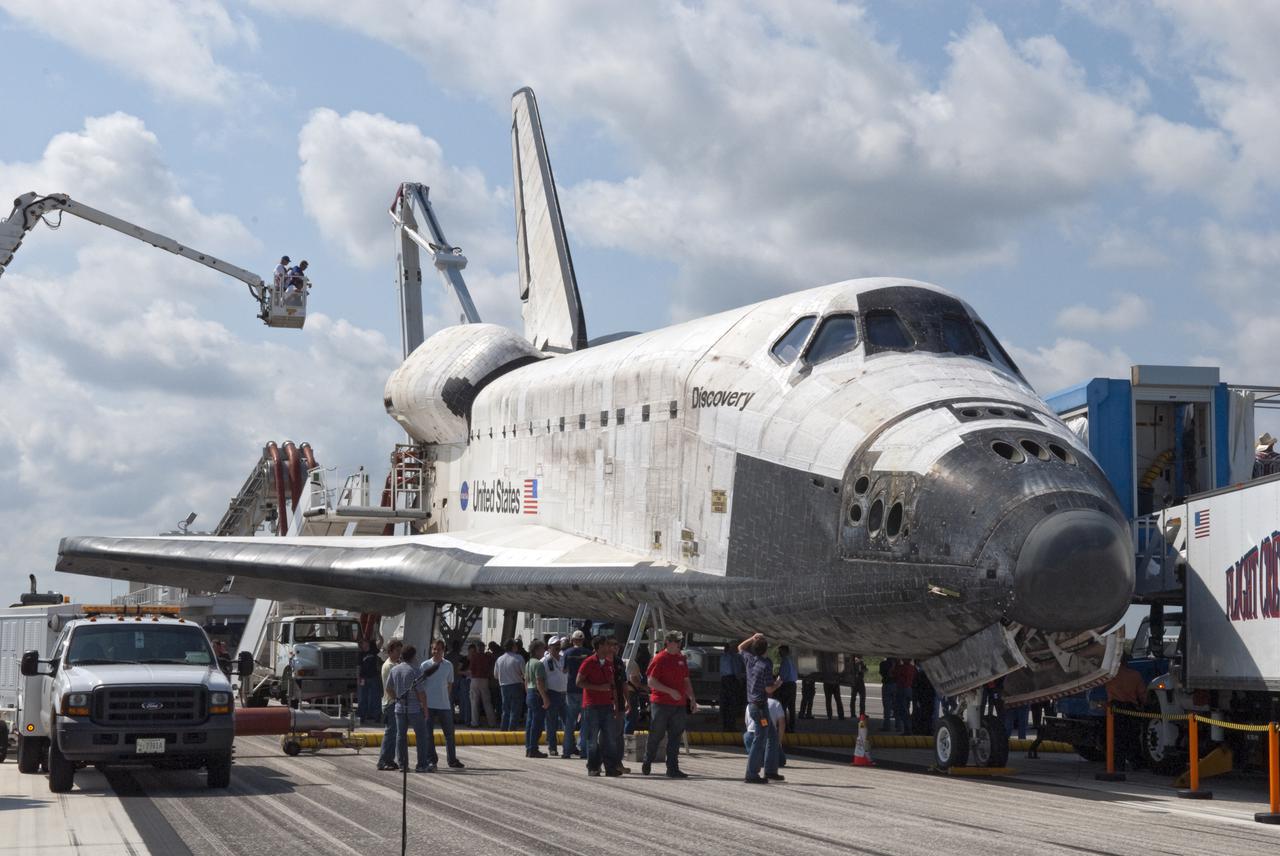
CAPE CANAVERAL, Fla. - At NASA's Kennedy Space Center in Florida, members of the convoy team 'safe' space shuttle Discovery after its landing on Runway 33 at the Shuttle Landing Facility. The convoy is made up of about 40 vehicles, including 25 specially designed vehicles, and a team of trained personnel who 'safe' the shuttle, prepare it for towing, assist the crew in leaving the shuttle, and finally, tow the shuttle to its hangar. Main gear touchdown was at 9:08:35 a.m. EDT followed by nose gear touchdown at 9:08:47 a.m. and wheelstop at 9:09:33 a.m. Aboard are Commander Alan Poindexter; Pilot James P. Dutton Jr.; and Mission Specialists Rick Mastracchio, Clayton Anderson, Dorothy Metcalf-Lindenburger, Stephanie Wilson and Naoko Yamazaki of the Japan Aerospace Exploration Agency. The seven-member STS-131 crew carried the multi-purpose logistics module Leonardo, filled with supplies, a new crew sleeping quarters and science racks that were transferred to the International Space Station's laboratories. The crew also switched out a gyroscope on the station’s truss, installed a spare ammonia storage tank and retrieved a Japanese experiment from the station’s exterior. STS-131 is the 33rd shuttle mission to the station and the 131st shuttle mission overall. For information on the STS-131 mission and crew, visit http:__www.nasa.gov_mission_pages_shuttle_shuttlemissions_sts131_index.html. Photo credit: NASA_Jim Grossmann
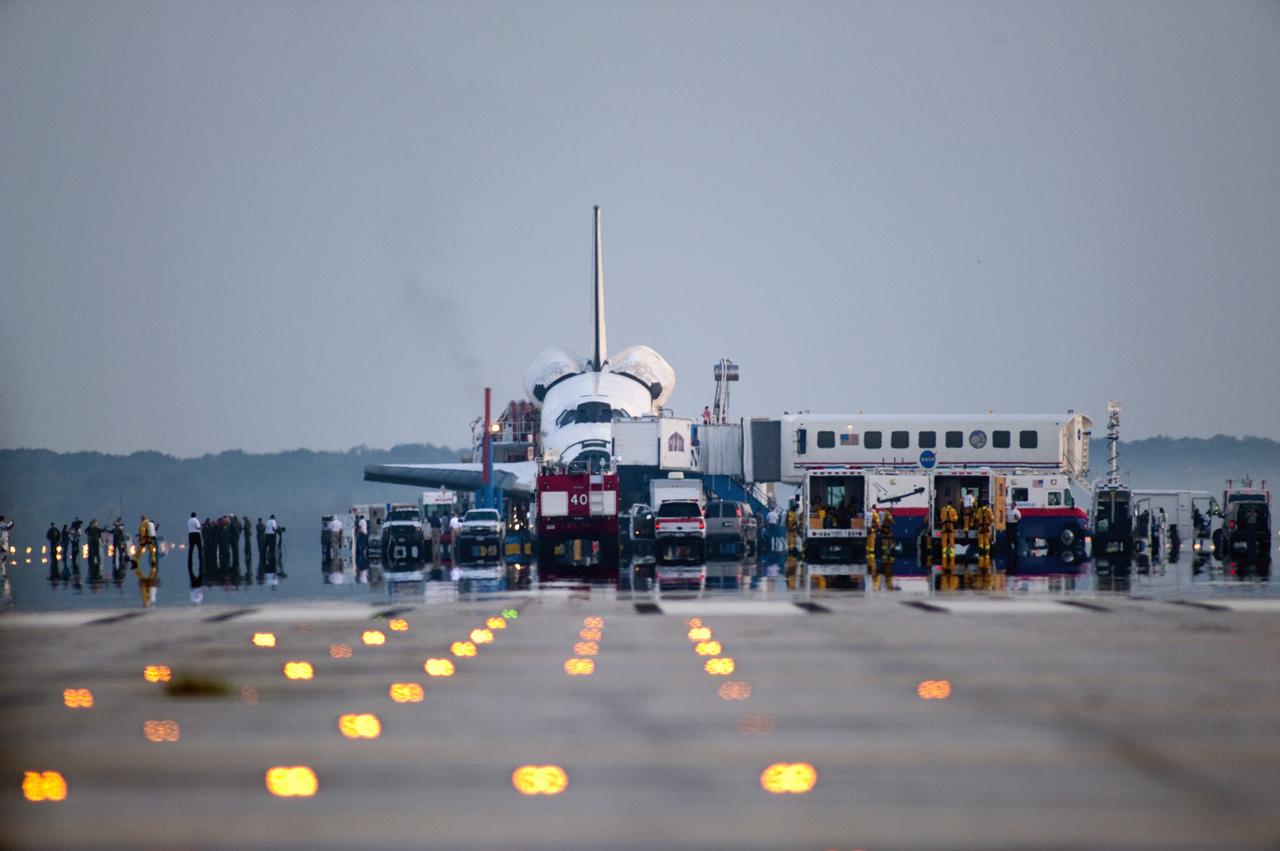
CAPE CANAVERAL, Fla. -- Landing convoy vehicles surround space shuttle Atlantis following its touchdown on Runway 15 at the Shuttle Landing Facility at NASA's Kennedy Space Center in Florida. The employees assigned to the convoy team prepare to safe the spacecraft before it is towed to Orbiter Processing Facility-2 for decommissioning. Atlantis marked the 26th nighttime landing of NASA's Space Shuttle Program and the 78th landing at Kennedy. Main gear touchdown was at 5:57:00 a.m. EDT, followed by nose gear touchdown at 5:57:20 a.m., and wheelstop at 5:57:54 a.m. On board are STS-135 Commander Chris Ferguson, Pilot Doug Hurley, and Mission Specialists Sandy Magnus and Rex Walheim. On the 37th shuttle mission to the International Space Station, STS-135 delivered the Raffaello multi-purpose logistics module filled with more than 9,400 pounds of spare parts, equipment and supplies that will sustain station operations for the next year. STS-135 was the 33rd and final flight for Atlantis, which has spent 307 days in space, orbited Earth 4,848 times and traveled 125,935,769 miles. STS-135 also was the final mission of the Space Shuttle Program. For more information, visit www.nasa.gov/mission_pages/shuttle/shuttlemissions/sts135/index.html. Photo credit: NASA/Tom Farrar and Tony Gray
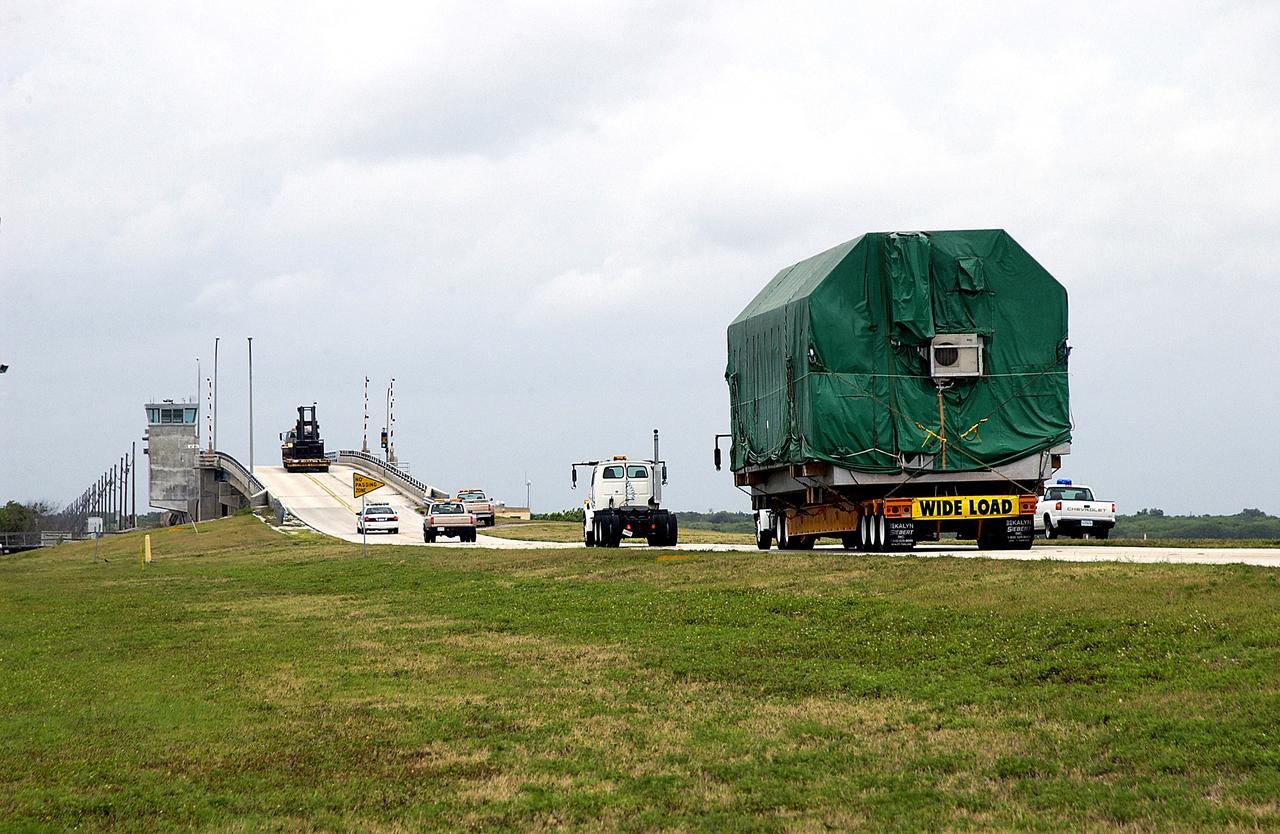
KENNEDY SPACE CENTER, FLA. - A convoy accompanies the truck transporting the Pressurized Module of the Japanese Experiment Module (JEM) to KSC’s Space Station Processing Facility. The National Space Development Agency of Japan (NASDA) developed the laboratory at the Tsukuba Space Center near Tokyo. The Pressurized Module is the first element of the JEM, named "Kibo" (Hope), to be delivered to KSC. The JEM is Japan's primary contribution to the Station. It will enhance the unique research capabilities of the orbiting complex by providing an additional environment for astronauts to conduct science experiments. The JEM also includes an exposed facility (platform) for space environment experiments, a robotic manipulator system, and two logistics modules. The various JEM components will be assembled in space over the course of three Shuttle missions.
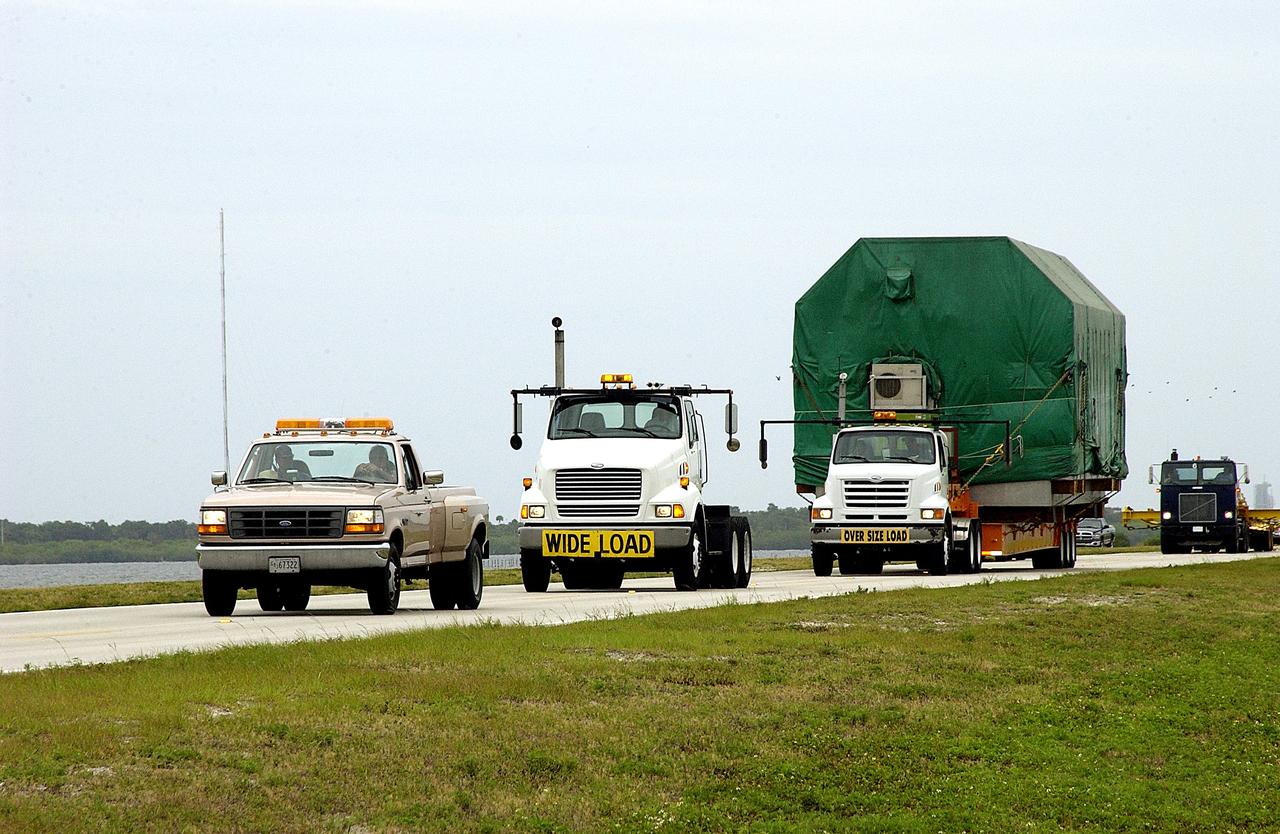
KENNEDY SPACE CENTER, FLA. - A convoy accompanies the truck transporting the Pressurized Module of the Japanese Experiment Module (JEM) to KSC’s Space Station Processing Facility. The National Space Development Agency of Japan (NASDA) developed the laboratory at the Tsukuba Space Center near Tokyo. The Pressurized Module is the first element of the JEM, named "Kibo" (Hope), to be delivered to KSC. The JEM is Japan's primary contribution to the Station. It will enhance the unique research capabilities of the orbiting complex by providing an additional environment for astronauts to conduct science experiments. The JEM also includes an exposed facility (platform) for space environment experiments, a robotic manipulator system, and two logistics modules. The various JEM components will be assembled in space over the course of three Shuttle missions.
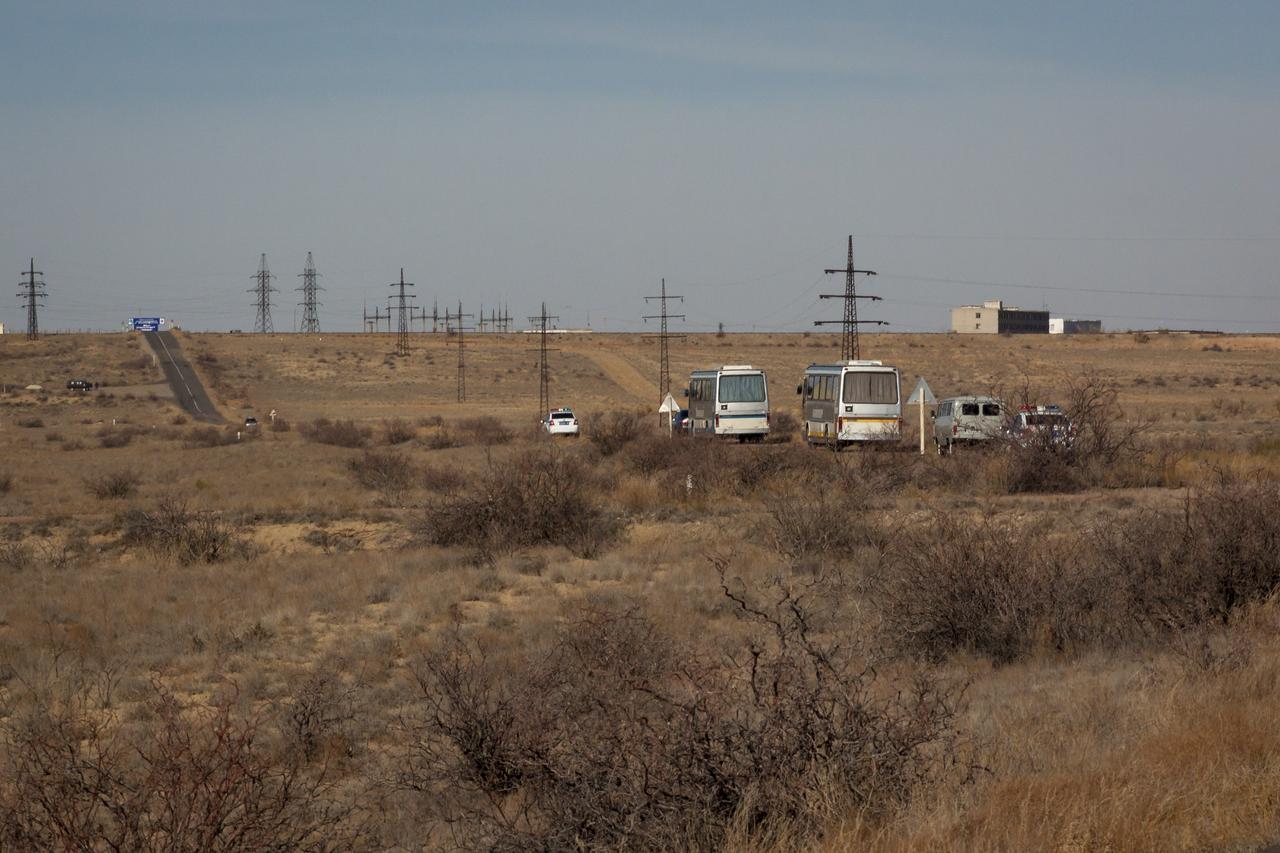
The bus convoy carrying Expedition 33/34 crew members, Russian Cosmonaut and Soyuz Commander Oleg Novitskiy, NASA Astronaut and Flight Engineer Kevin Ford, and Russian Cosmonaut and Flight Engineer Evgeny Tarelkin, heads to launch site 31 for the crews launch onboard a Soyuz TMA-06M spacecraft to the International Space Station, Tuesday, October 23, 2012, in Baikonur, Kazakhstan. Launch of the Soyuz rocket will send Ford, Novitskiy and Tarelkin on a five-month mission aboard the International Space Station. Photo Credit: (NASA/Victor Zelentsov)
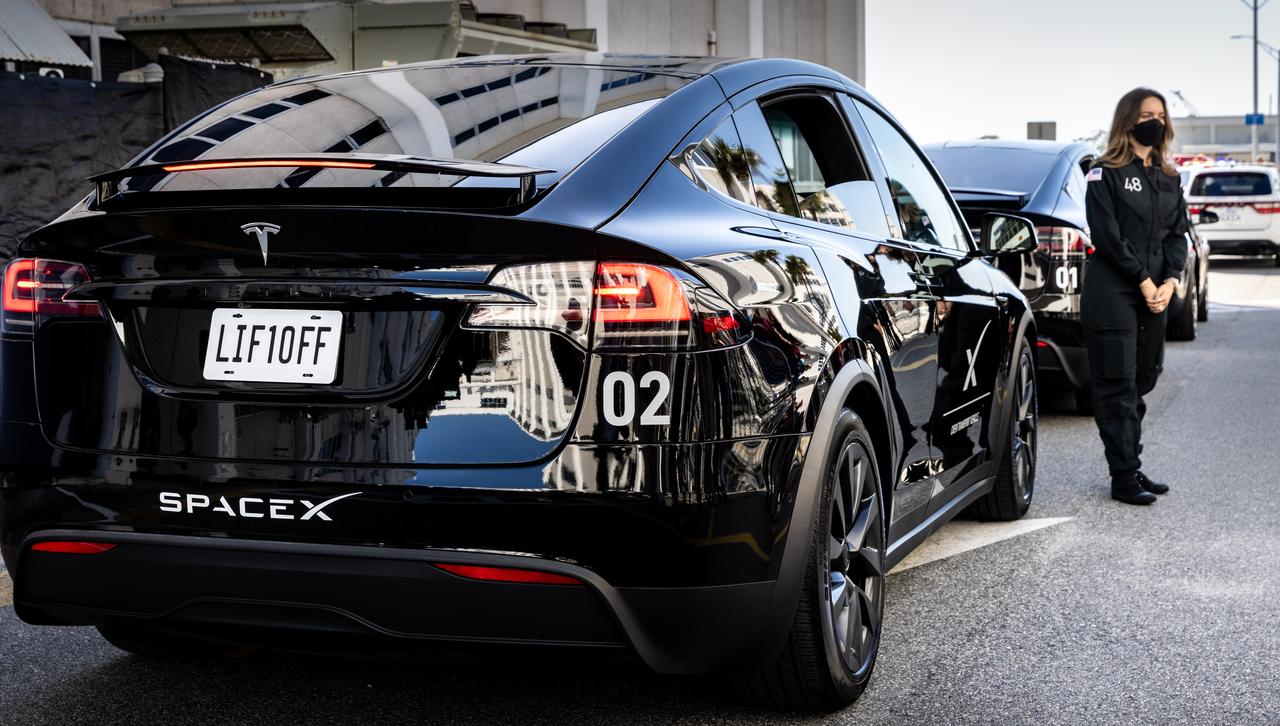
The convoy carrying NASA’s SpaceX Crew-10 makes the journey from the Neil A. Armstrong Operations and Checkout Building at the agency’s Kennedy Space Center in Florida to nearby Launch Complex 39A ahead of launch on Wednesday, March 12, 2025. NASA astronauts Anne McClain and Nichole Ayers, along with JAXA (Japan Aerospace Exploration Agency) astronaut Takuya Onishi and Roscosmos cosmonaut Kirill Peskov are scheduled to lift off aboard SpaceX’s Dragon spacecraft and Falcon 9 rocket at 7:48 p.m. EDT. Crew-10 is the 10th crew rotation mission with SpaceX to the space station as part of the agency’s Commercial Crew Program.
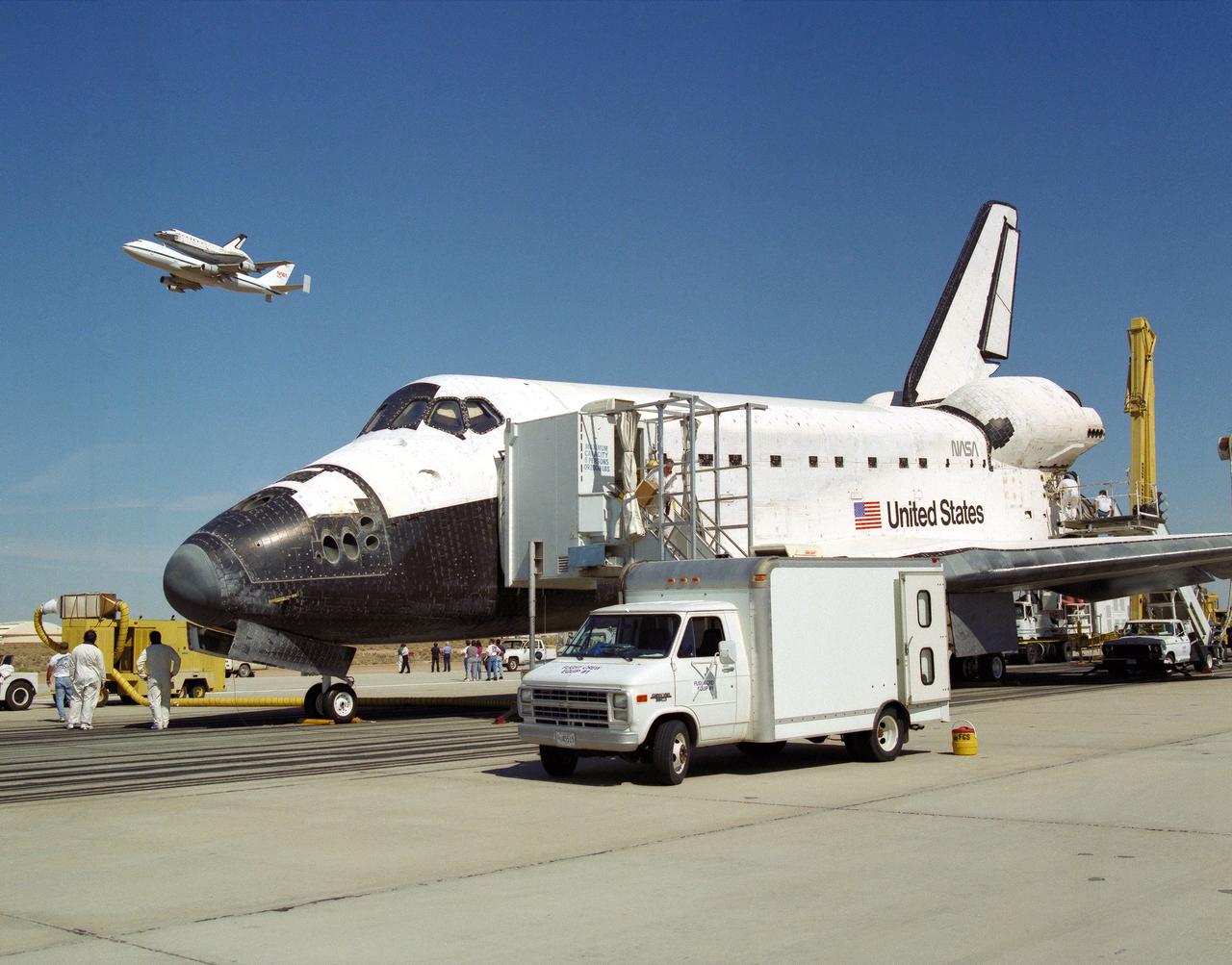
The space shuttle Endeavour receives a high-flying salute from its sister shuttle, Columbia, atop NASA's Shuttle Carrier Aircraft, shortly after Endeavor’s landing 11 October 1994, at Edwards, California, to complete mission STS-68. Columbia was being ferried from the Kennedy Space Center, Florida, to Air Force Plant 42, Palmdale, California, where it will undergo six months of inspections, modifications, and systems upgrades. The STS-68 11-day mission was devoted to radar imaging of Earth's geological features with the Space Radar Laboratory. The orbiter is surrounded by equipment and personnel that make up the ground support convoy that services the space vehicles as soon as they land.
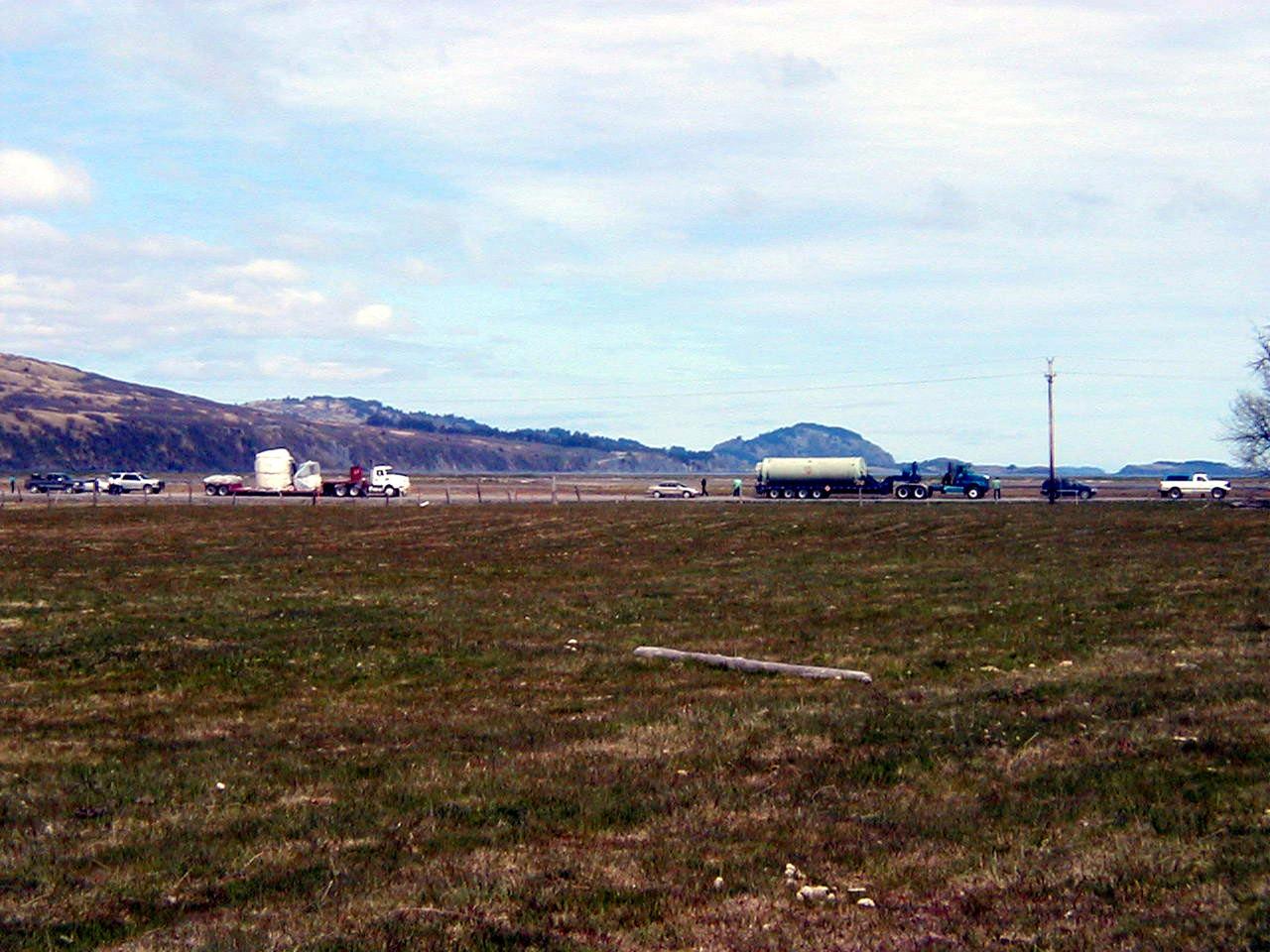
KODIAK ISLAND, Alaska -- A convoy of trucks transports the stages of an Athena launch vehicle and supporting launch equipment to the pad at Kodiak Island, Alaska, as preparations to launch the Kodiak Star continue. The first orbital launch to take place from Alaska's Kodiak Launch Complex, Kodiak Star is scheduled to lift off on a Lockheed Martin Athena I launch vehicle on Sept. 17 during a two-hour window that extends from 5:00 to 7:00 p.m. ADT. The payloads aboard include the Starshine 3, sponsored by NASA, and the PICOSat, PCSat and Sapphire, sponsored by the Department of Defense (DoD) Space Test Program.
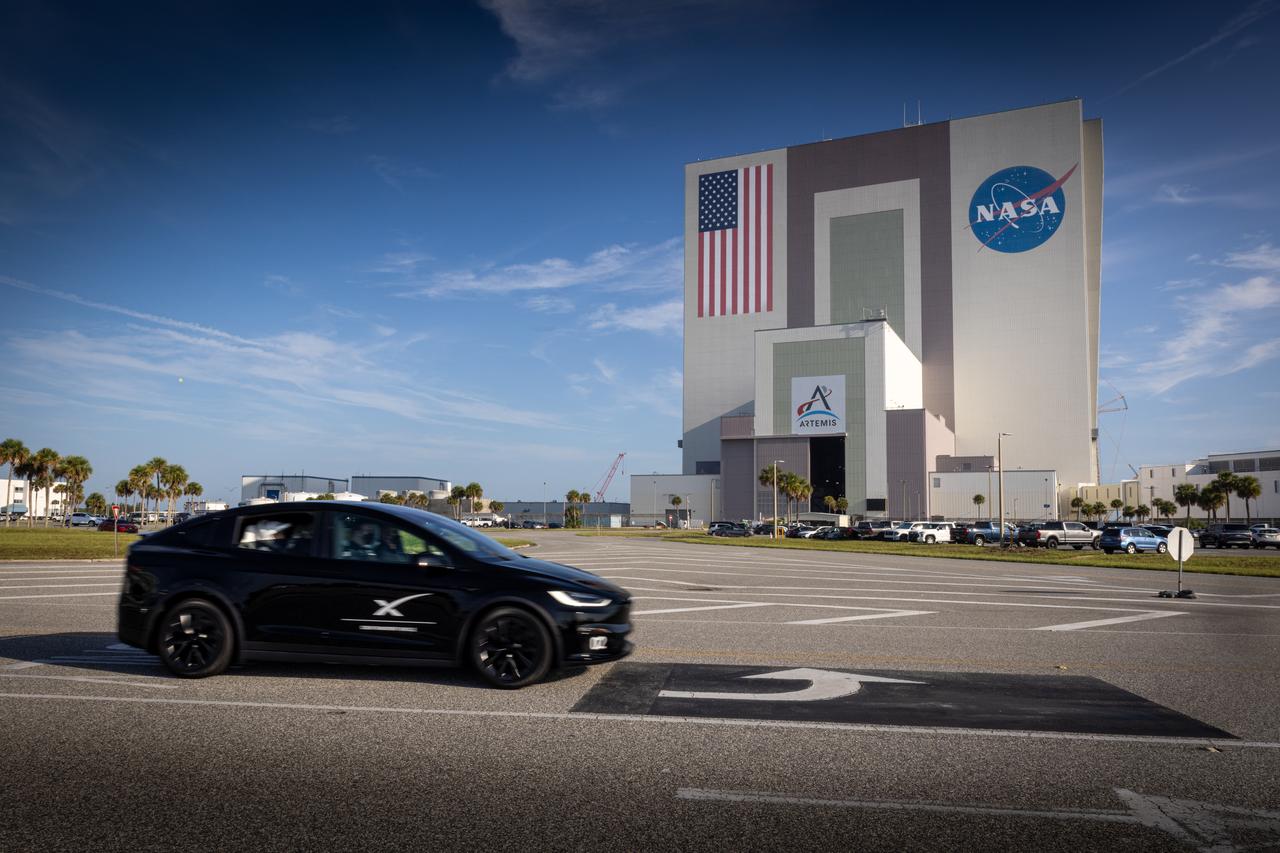
The convoy carrying NASA’s SpaceX Crew-11 makes the journey from the Neil A. Armstrong Operations and Checkout Building and drives passed the Vehicle Assembly Building on their way to Launch Complex 39A at NASA’s Kennedy Space Center in Florida ahead of launch during the second launch attempt of NASA’s SpaceX Crew-11 mission on Friday, Aug. 1, 2025. NASA astronauts Zena Cardman and Mike Fincke, along with JAXA (Japan Aerospace Exploration Agency) astronaut Kimiya Yui and Roscosmos cosmonaut Oleg Platonov, are scheduled to lift off aboard SpaceX’s Dragon spacecraft and Falcon 9 rocket to the International Space Station at 11:43 a.m. EDT.
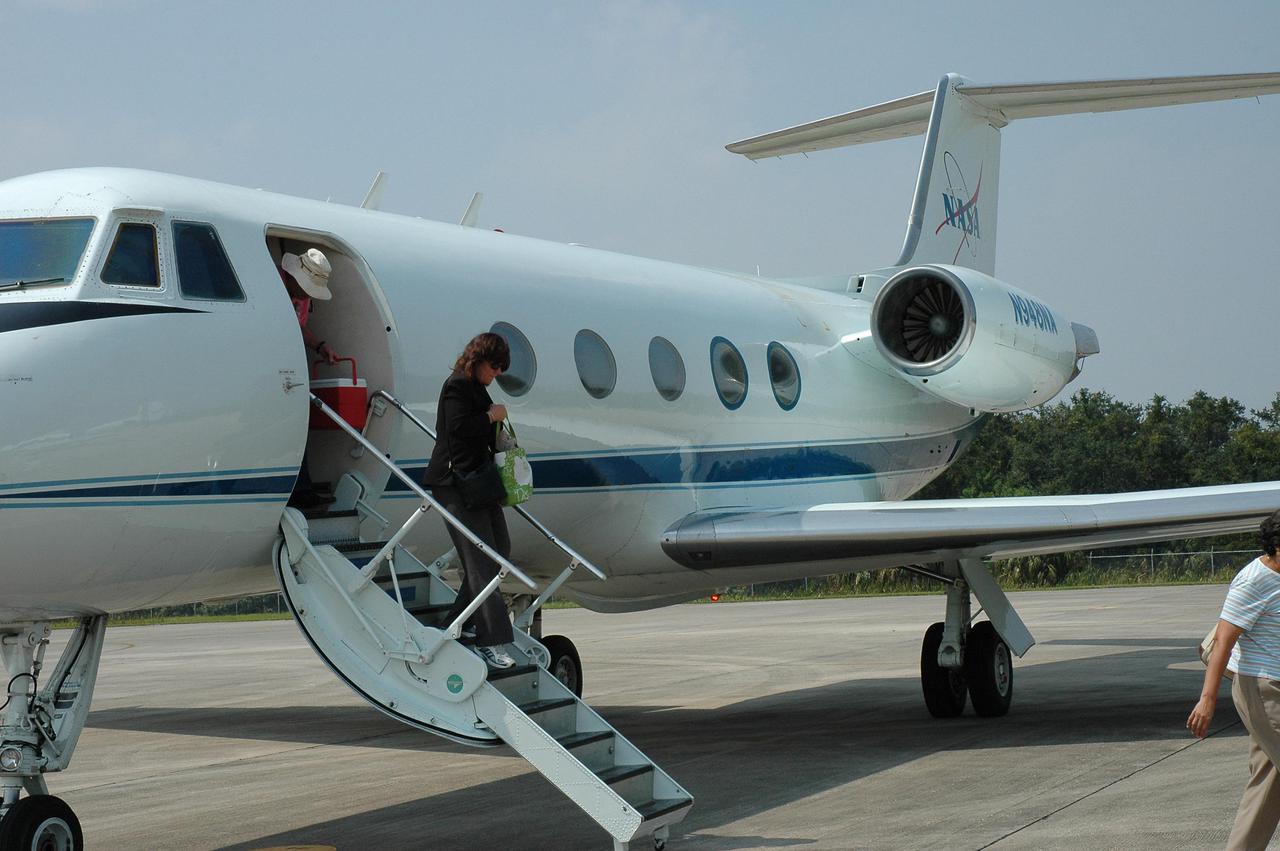
KENNEDY SPACE CENTER, FLA. - Patti Bell steps down the steps of the NASA aircraft on her return from Stennis Space Center in Mississippi. Bell is with Environmental and Occupational Health at KSC. She was part of a volunteer team helping rescue and recovery efforts at Stennis, which was damaged during Hurricane Katrina. Many employees of Stennis and Michoud Assembly Facility, near New Orleans, were rendered homeless by the hurricane. NASA centers have been generous with relief supplies and personnel. Stennis is now in limited operations mode. Daily convoys have been moving between Stennis and Michoud, transporting personnel and supplies as Michoud prepares to resume limited operations.
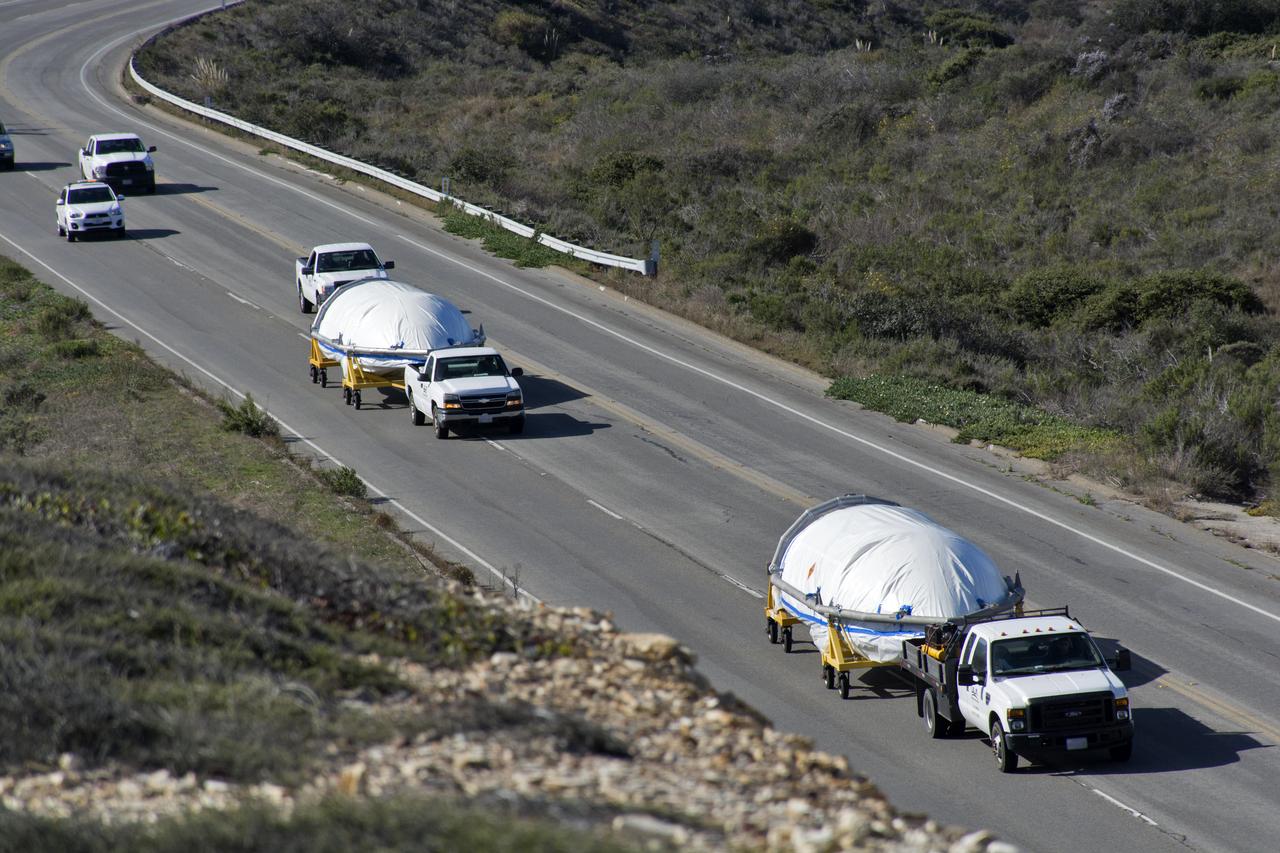
Both halves of the United Launch Alliance (ULA) Delta II rocket payload fairing are transported by convoy to ULA's Building B8337 at Vandenberg Air Force Base in California. NASA's Ice, Cloud and land Elevation Satellite-2 (ICESat-2) will launch later this year on the final Delta II rocket. ICESat-2 will measure the height of a changing Earth, one laser pulse at a time, 10,000 laser pulses a second. The satellite will carry a single instrument, the Advanced Topographic Laser Altimeter System. ICESat-2 will help scientists investigate why, and how much our planet's frozen and icy areas, called the cryosphere, is changing in a warming climate.
VANDENBERG AIR FORCE BASE, Calif. - A convoy accompanies NASA's Wide-field Infrared Survey Explorer, or WISE, enclosed in a transportation canister, from the Astrotech payload processing facility at Vandenberg Air Force Base in California to Space Launch Complex 2. WISE will survey the entire sky at infrared wavelengths, creating a cosmic clearinghouse of hundreds of millions of objects which will be catalogued and provide a vast storehouse of knowledge about the solar system, the Milky Way, and the universe. Launch is scheduled for Dec. 9. For additional information, visit http://www.nasa.gov/wise. Photo credit: NASA/Doug Kulkow, VAFB
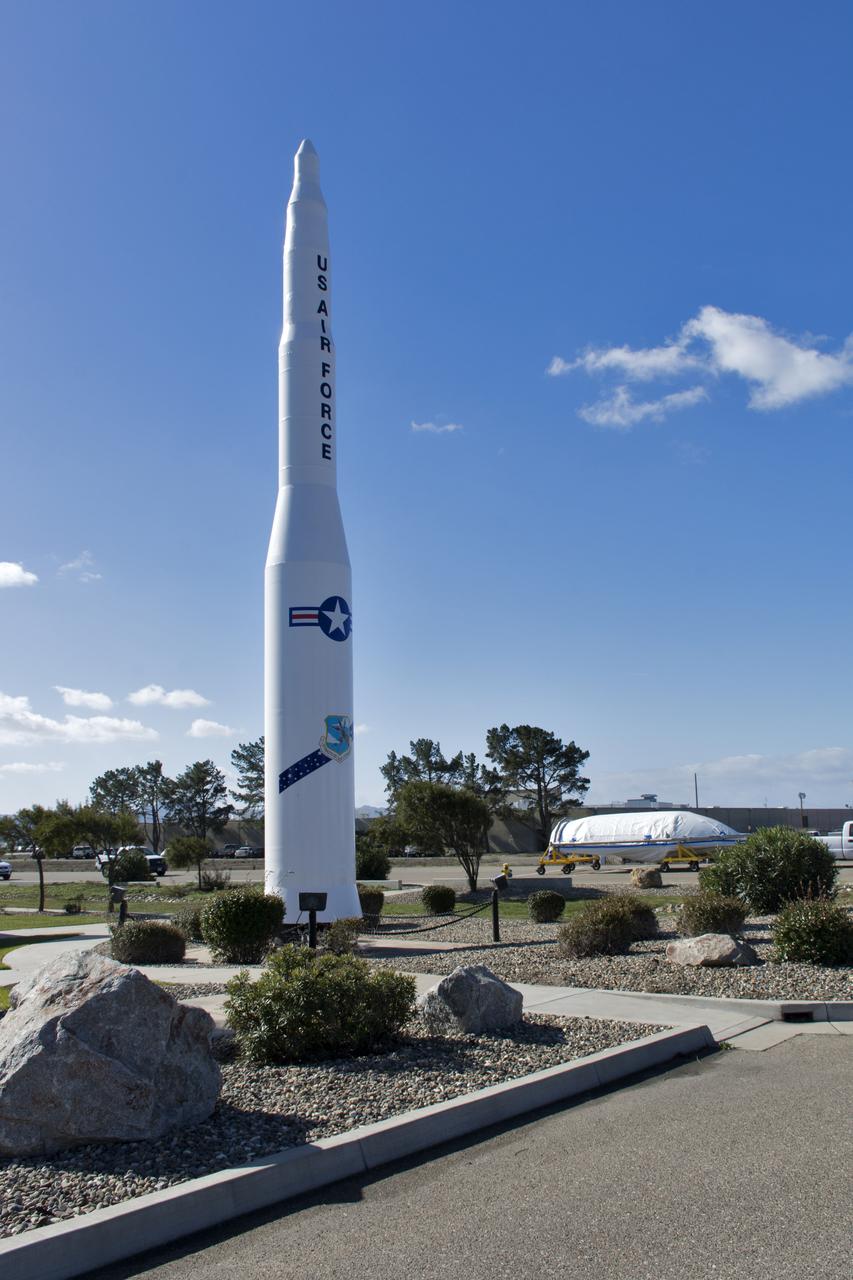
Both halves of the United Launch Alliance (ULA) Delta II rocket payload fairing are transported by convoy to ULA's Building B8337 at Vandenberg Air Force Base in California. NASA's Ice, Cloud and land Elevation Satellite-2 (ICESat-2) will launch later this year on the final Delta II rocket. ICESat-2 will measure the height of a changing Earth, one laser pulse at a time, 10,000 laser pulses a second. The satellite will carry a single instrument, the Advanced Topographic Laser Altimeter System. ICESat-2 will help scientists investigate why, and how much our planet's frozen and icy areas, called the cryosphere, is changing in a warming climate.
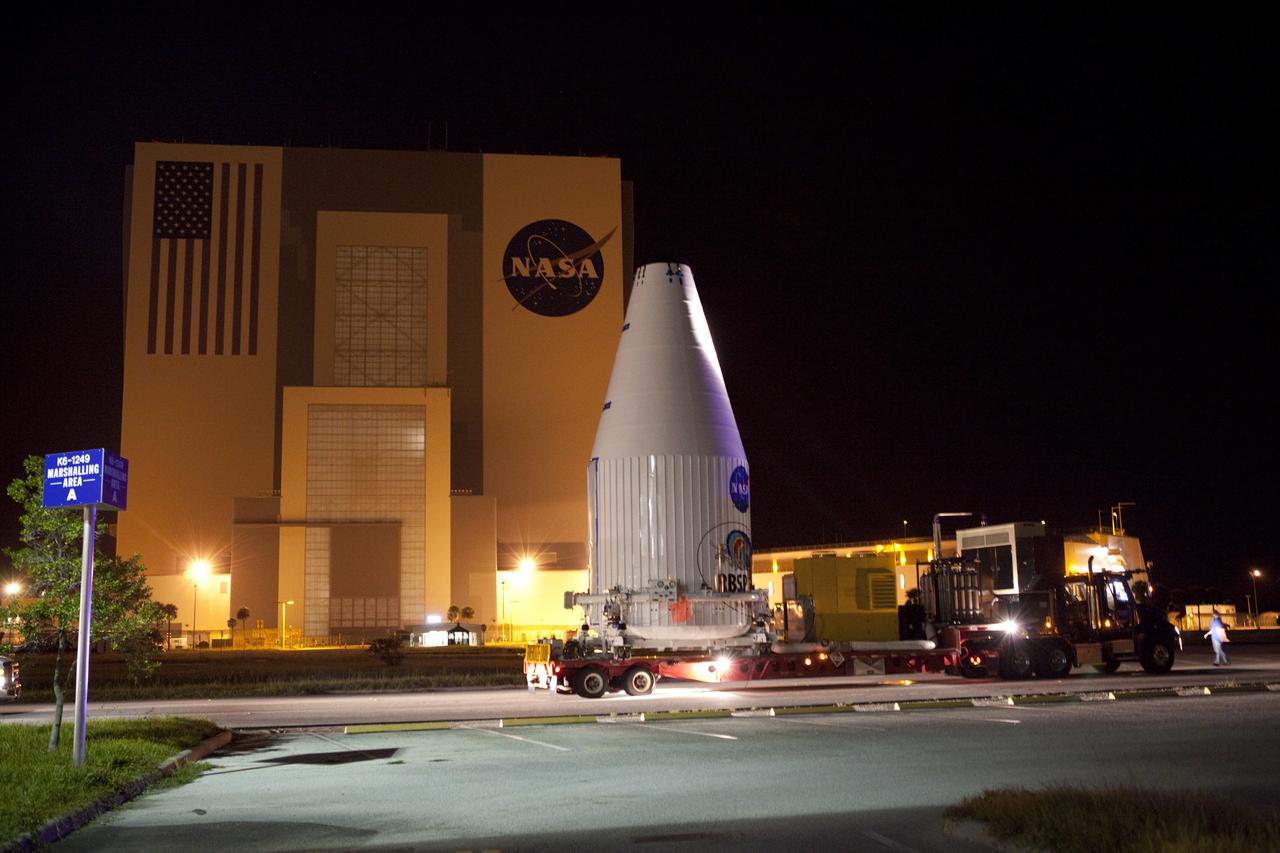
CAPE CANAVERAL, Fla. – The Radiation Belt Storm Probes, or RBSP, spacecraft are moved inside their payload fairing on the payload transporter from the Astrotech payload processing facility in Titusville, Fla. to Space Launch Complex-41 at Cape Canaveral Air Force Station. The convoy carried the spacecraft past the Vehicle Assembly Building at NASA's Kennedy Space Center. The fairing, which holds the twin RBSP spacecraft, will be lifted to the top of a United Launch Alliance Atlas V rocket for launch later in August. The two spacecraft are designed to study the Van Allen radiation belts in unprecedented detail. Photo credit: NASA/Dmitri Gerondidakis
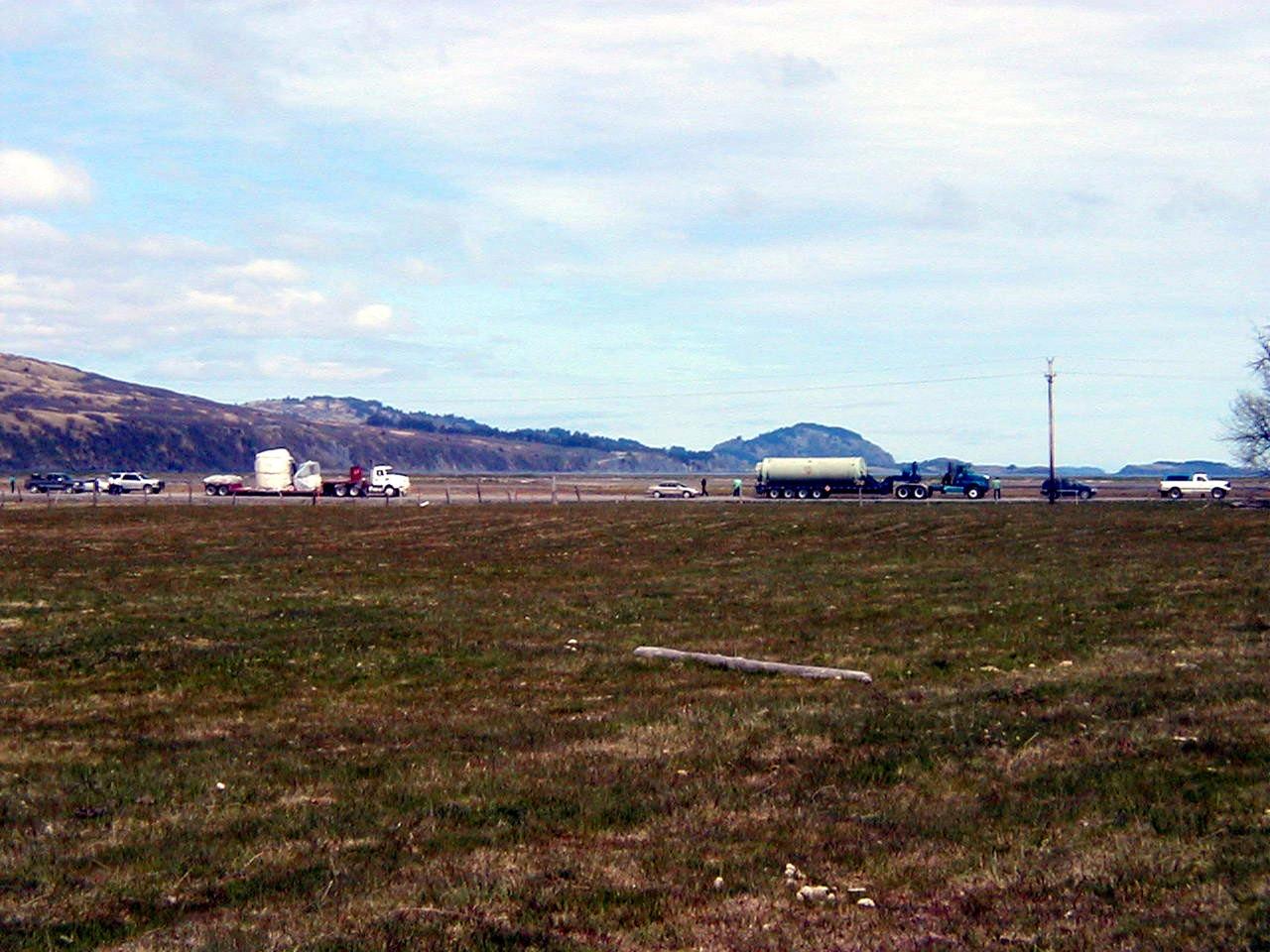
KODIAK ISLAND, Alaska -- A convoy of trucks transports the stages of an Athena launch vehicle and supporting launch equipment to the pad at Kodiak Island, Alaska, as preparations to launch the Kodiak Star continue. The first orbital launch to take place from Alaska's Kodiak Launch Complex, Kodiak Star is scheduled to lift off on a Lockheed Martin Athena I launch vehicle on Sept. 17 during a two-hour window that extends from 5:00 to 7:00 p.m. ADT. The payloads aboard include the Starshine 3, sponsored by NASA, and the PICOSat, PCSat and Sapphire, sponsored by the Department of Defense (DoD) Space Test Program.
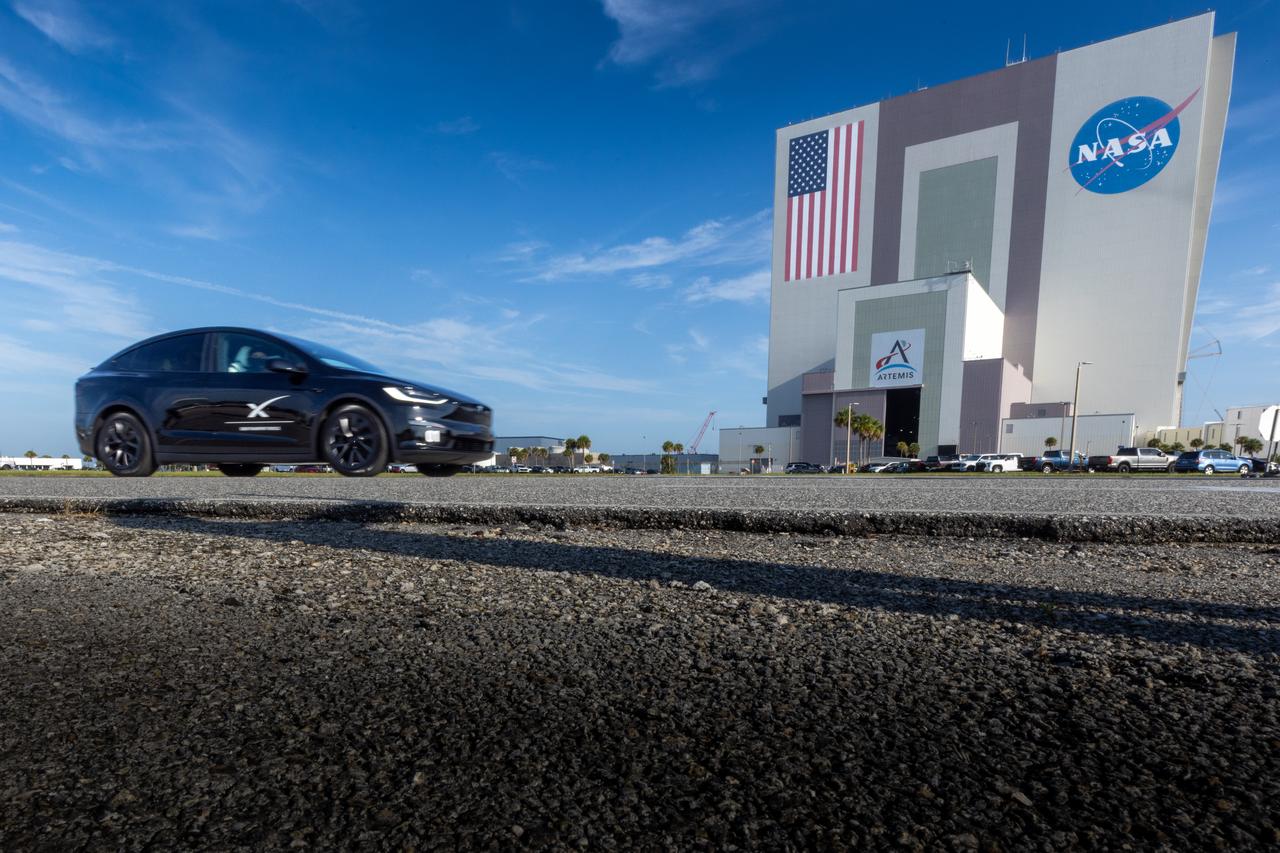
The convoy carrying NASA’s SpaceX Crew-11 makes the journey from the Neil A. Armstrong Operations and Checkout Building and drives passed the Vehicle Assembly Building on their way to Launch Complex 39A at NASA’s Kennedy Space Center in Florida ahead of launch during the second launch attempt of NASA’s SpaceX Crew-11 mission on Friday, Aug. 1, 2025. NASA astronauts Zena Cardman and Mike Fincke, along with JAXA (Japan Aerospace Exploration Agency) astronaut Kimiya Yui and Roscosmos cosmonaut Oleg Platonov, are scheduled to lift off aboard SpaceX’s Dragon spacecraft and Falcon 9 rocket to the International Space Station at 11:43 a.m. EDT.
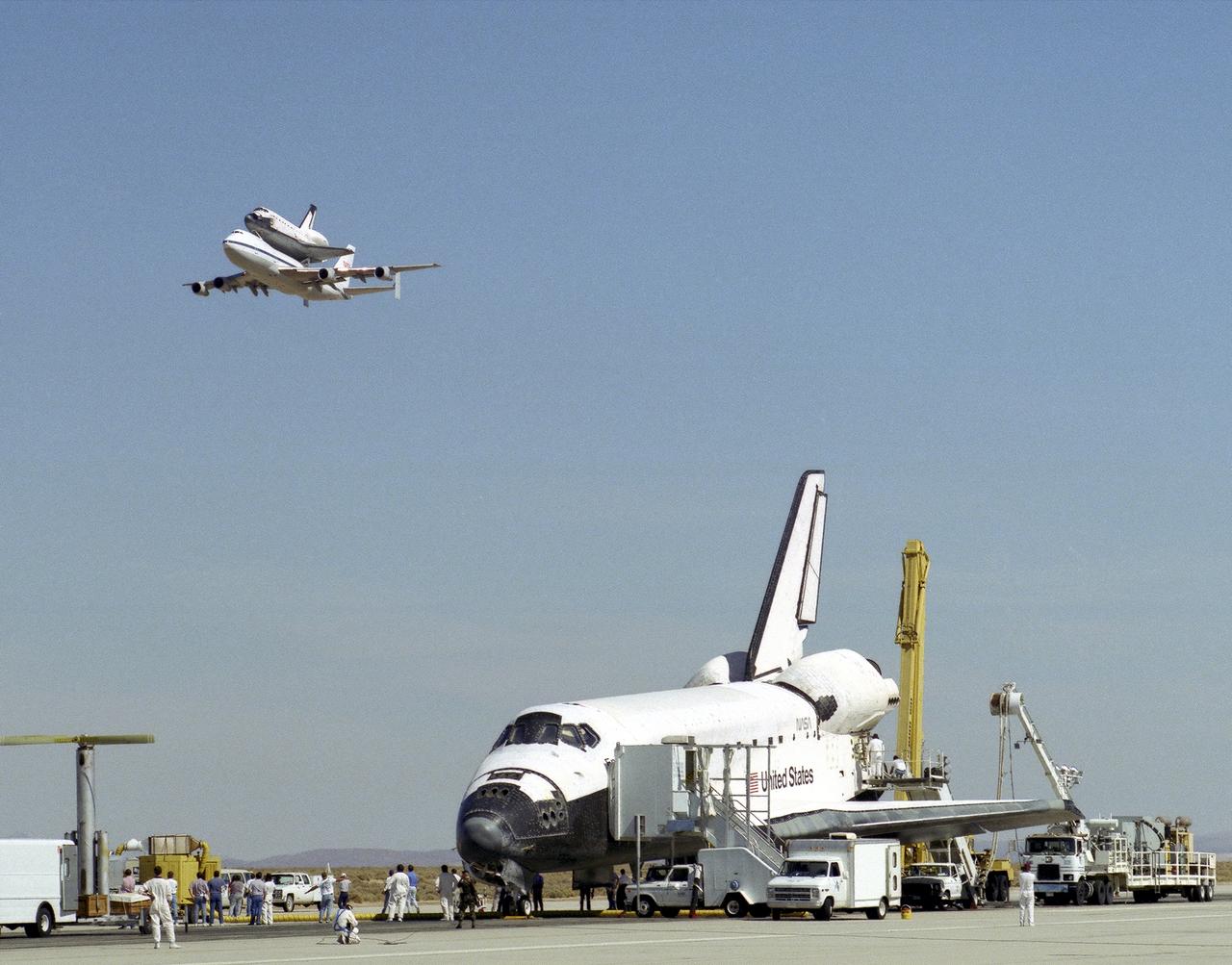
The space shuttle Endeavour receives a high-flying salute from its sister shuttle, Columbia, atop NASA's Shuttle Carrier Aircraft, shortly after Endeavor’s landing 11 October 1994, at Edwards, California, to complete mission STS-68. Columbia was being ferried from the Kennedy Space Center, Florida, to Air Force Plant 42, Palmdale, California, where it will undergo six months of inspections, modifications, and systems upgrades. The STS-68 11-day mission was devoted to radar imaging of Earth's geological features with the Space Radar Laboratory. The orbiter is surrounded by equipment and personnel that make up the ground support convoy that services the space vehicles as soon as they land.
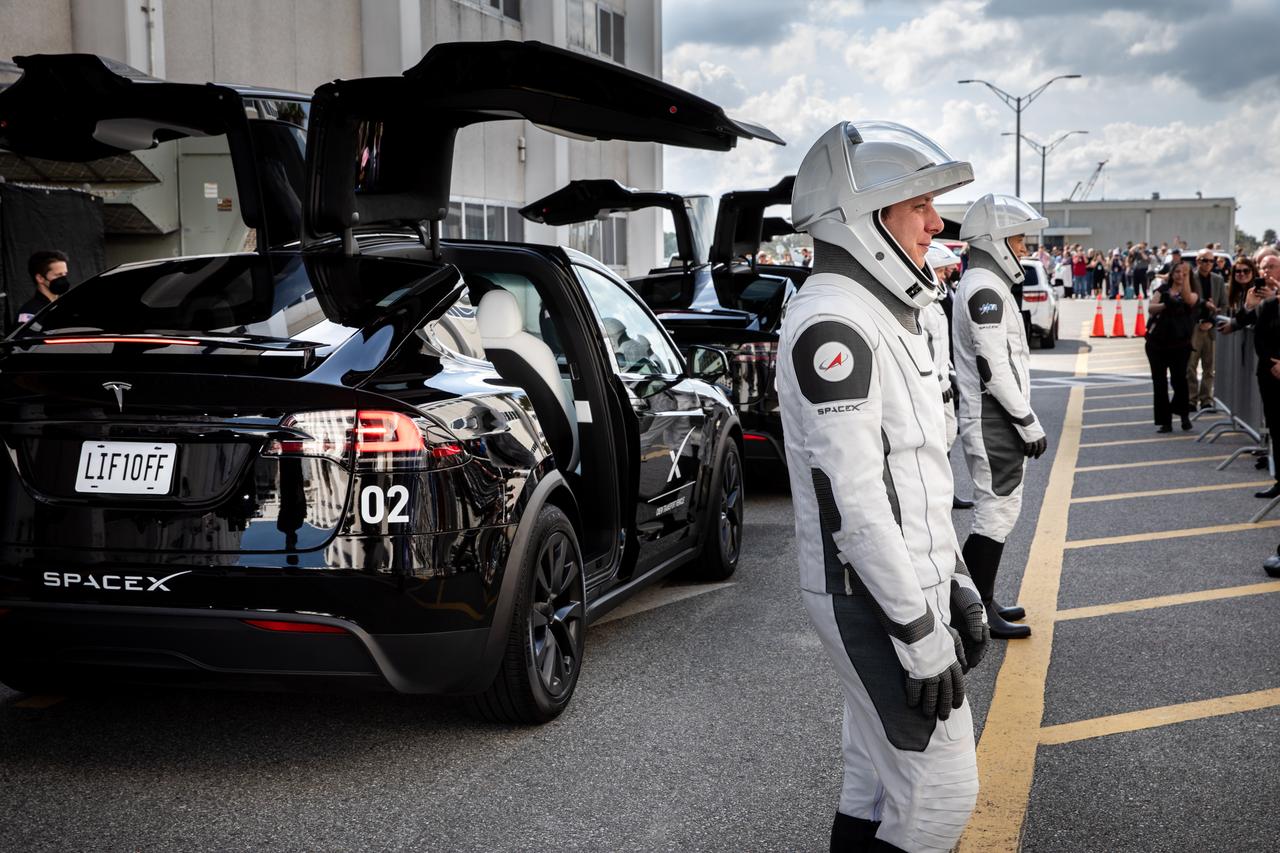
NASA’s SpaceX Crew-10 crew members prepare to enter the convoy carrying that will take them from the Neil A. Armstrong Operations and Checkout Building at the agency’s Kennedy Space Center in Florida to nearby Launch Complex 39A ahead of launch on Friday, March 14, 2025. NASA astronauts Anne McClain and Nichole Ayers, along with JAXA (Japan Aerospace Exploration Agency) astronaut Takuya Onishi and Roscosmos cosmonaut Kirill Peskov are scheduled to lift off aboard SpaceX’s Dragon spacecraft and Falcon 9 rocket at 7:03 p.m. EDT. Crew-10 is the 10th crew rotation mission with SpaceX to the space station as part of the agency’s Commercial Crew Program.
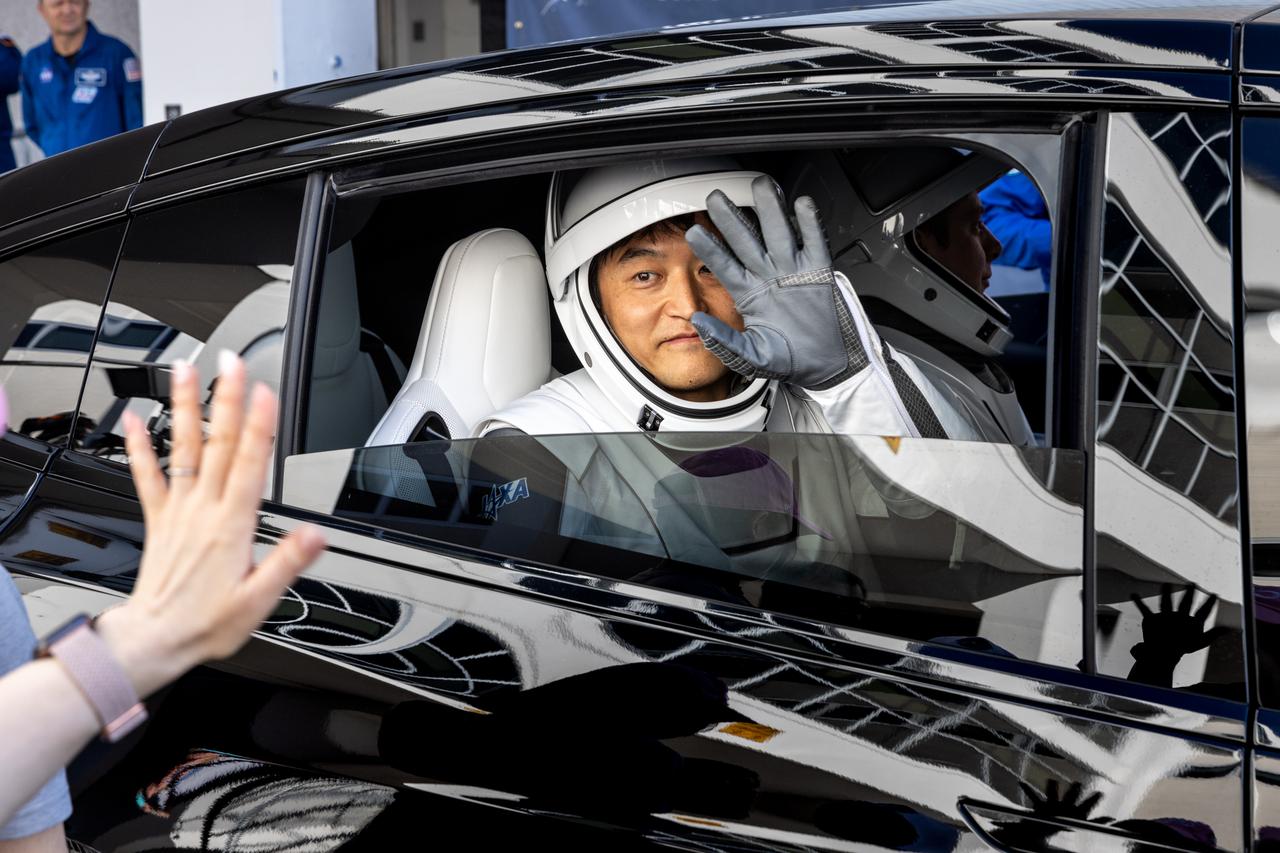
JAXA (Japan Aerospace Exploration Agency) astronaut Takuya Onishi waves from the convoy carrying NASA’s SpaceX Crew-10 from the Neil A. Armstrong Operations and Checkout Building at the agency’s Kennedy Space Center in Florida to nearby Launch Complex 39A ahead of launch on Wednesday, March 12, 2025. NASA astronauts Anne McClain and Nichole Ayers, along with Onishi and Roscosmos cosmonaut Kirill Peskov are scheduled to lift off aboard SpaceX’s Dragon spacecraft and Falcon 9 rocket at 7:48 p.m. EDT. Crew-10 is the 10th crew rotation mission with SpaceX to the space station as part of the agency’s Commercial Crew Program.
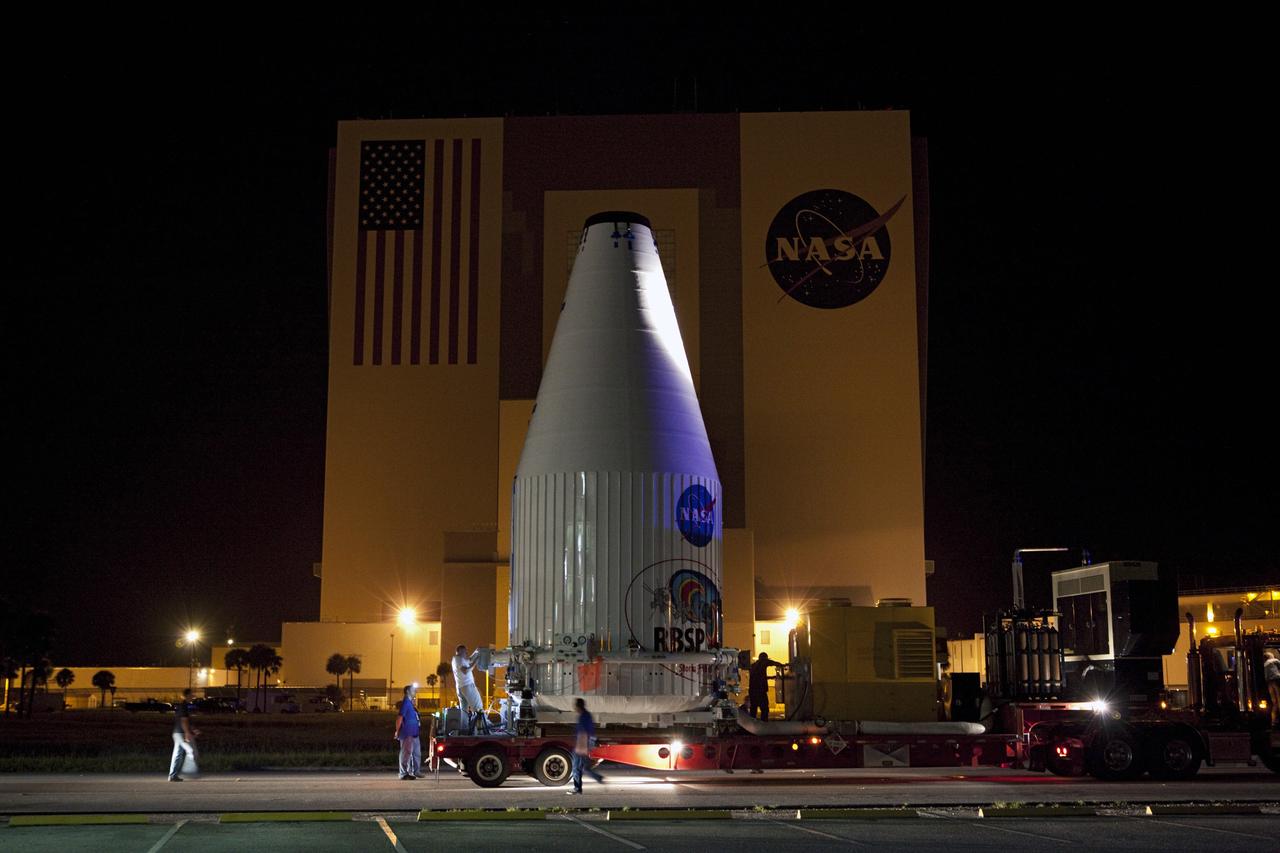
CAPE CANAVERAL, Fla. – The Radiation Belt Storm Probes, or RBSP, spacecraft are moved inside their payload fairing on the payload transporter from the Astrotech payload processing facility in Titusville, Fla. to Space Launch Complex-41 at Cape Canaveral Air Force Station. The convoy carried the spacecraft past the Vehicle Assembly Building at NASA's Kennedy Space Center. The fairing, which holds the twin RBSP spacecraft, will be lifted to the top of a United Launch Alliance Atlas V rocket for launch later in August. The two spacecraft are designed to study the Van Allen radiation belts in unprecedented detail. Photo credit: NASA/Dmitri Gerondidakis
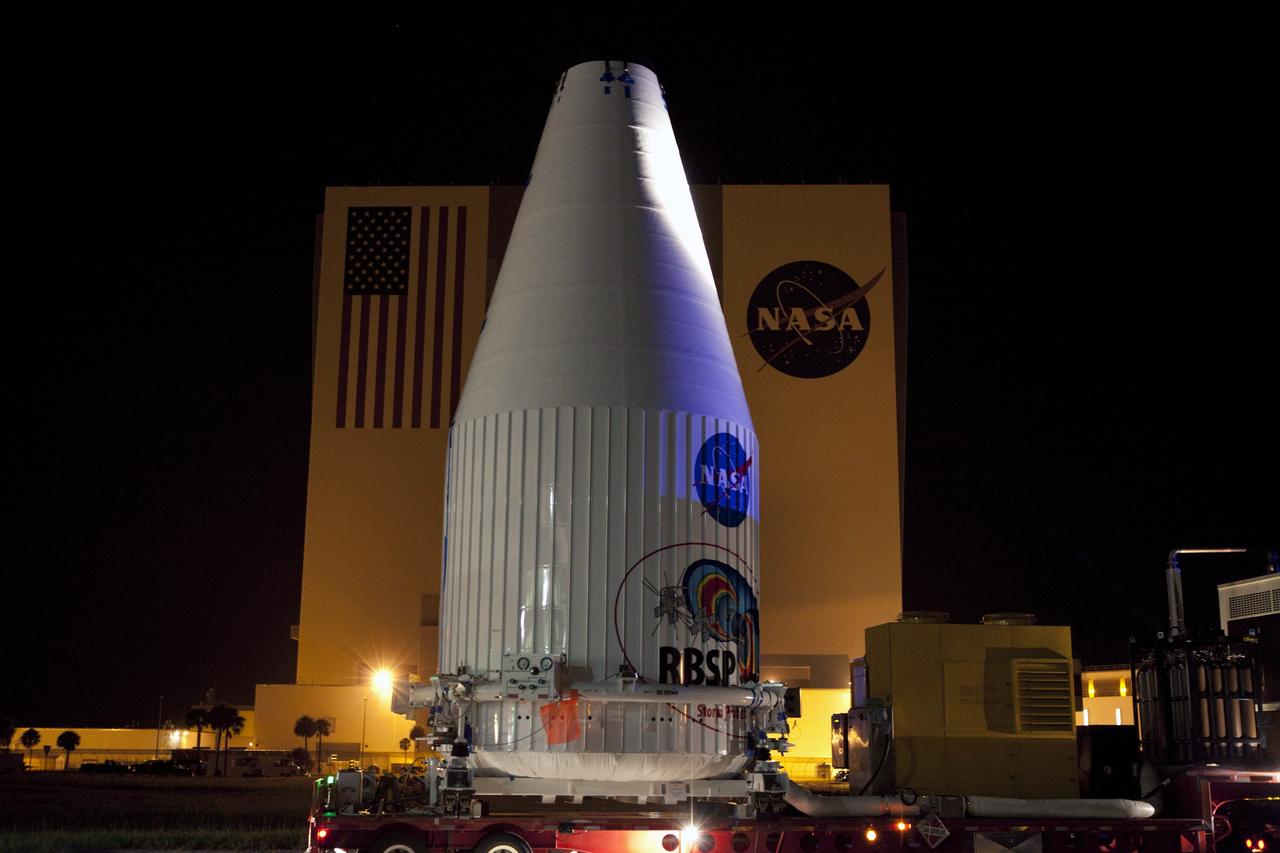
CAPE CANAVERAL, Fla. – The Radiation Belt Storm Probes, or RBSP, spacecraft are moved inside their payload fairing on the payload transporter from the Astrotech payload processing facility in Titusville, Fla. to Space Launch Complex-41 at Cape Canaveral Air Force Station. The convoy carried the spacecraft past the Vehicle Assembly Building at NASA's Kennedy Space Center. The fairing, which holds the twin RBSP spacecraft, will be lifted to the top of a United Launch Alliance Atlas V rocket for launch later in August. The two spacecraft are designed to study the Van Allen radiation belts in unprecedented detail. Photo credit: NASA/Dmitri Gerondidakis
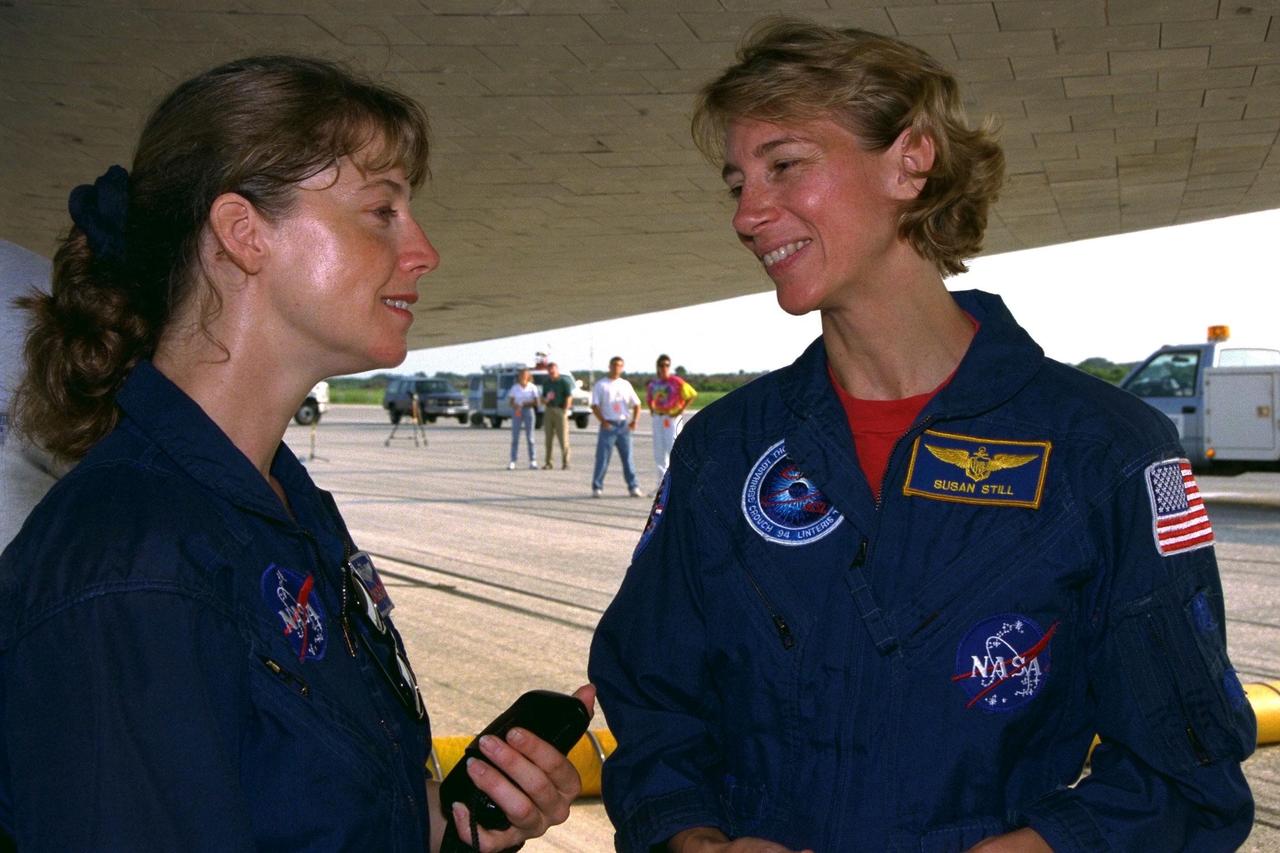
KENNEDY SPACE CENTER, FLA. -- Astronaut Support team member Pamela A. Melroy (left) greets STS-94 Pilot Susan L. Still underneath the Space Shuttle orbiter Columbia after an end-of-mission landing on Runway 33 of KSC’s Shuttle Landing Facility July 17 to complete the Microgravity Science Laboratory-1 (MSL-1) mission. Six of the seven STS-94 crew members took the traditional post-landing walk around the orbiter, meeting with members of the orbiter recovery convoy team and inspecting the vehicle that carried them through space for nearly 17 days on a highly successful microgravity research mission

Both halves of the United Launch Alliance (ULA) Delta II rocket payload fairing are transported by convoy to ULA's Building B8337 at Vandenberg Air Force Base in California. NASA's Ice, Cloud and land Elevation Satellite-2 (ICESat-2) will launch later this year on the final Delta II rocket. ICESat-2 will measure the height of a changing Earth, one laser pulse at a time, 10,000 laser pulses a second. The satellite will carry a single instrument, the Advanced Topographic Laser Altimeter System. ICESat-2 will help scientists investigate why, and how much our planet's frozen and icy areas, called the cryosphere, is changing in a warming climate.
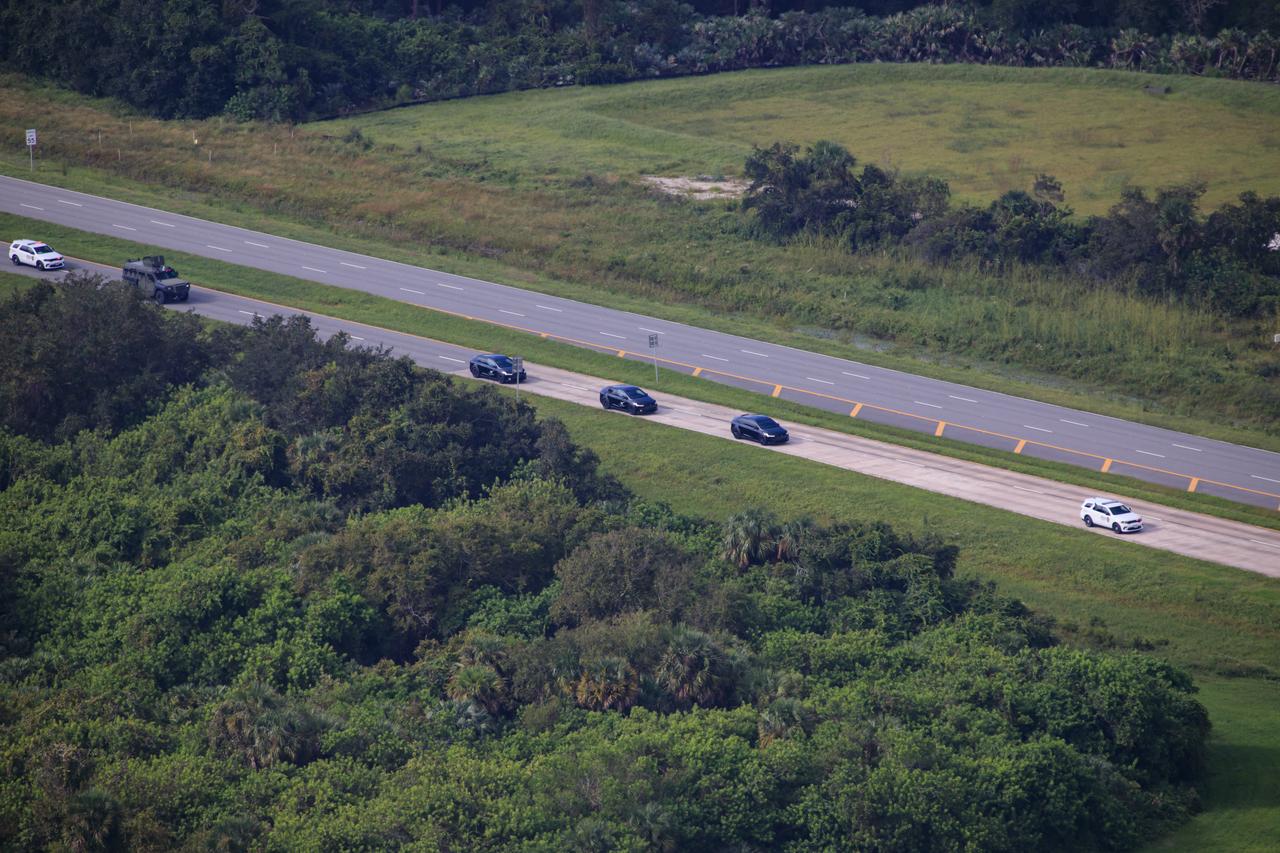
The vehicle convoy carrying NASA astronaut Nick Hague and Roscosmos cosmonaut Aleksandr Gorbunov makes the journey from the Neil A. Armstrong Operations and Checkout Building at the agency’s Kennedy Space Center in Florida to Space Launch Complex-40 at nearby Cape Canaveral Space Force Station ahead of launch on Saturday, Sept. 28, 2024. Hague and Gorbunov will launch to the International Space Station aboard SpaceX’s Dragon spacecraft and Falcon 9 rocket. Launch is targeted for 1:17 p.m. EDT for the ninth crew rotation mission with SpaceX to the space station as part of the agency’s Commercial Crew Program.
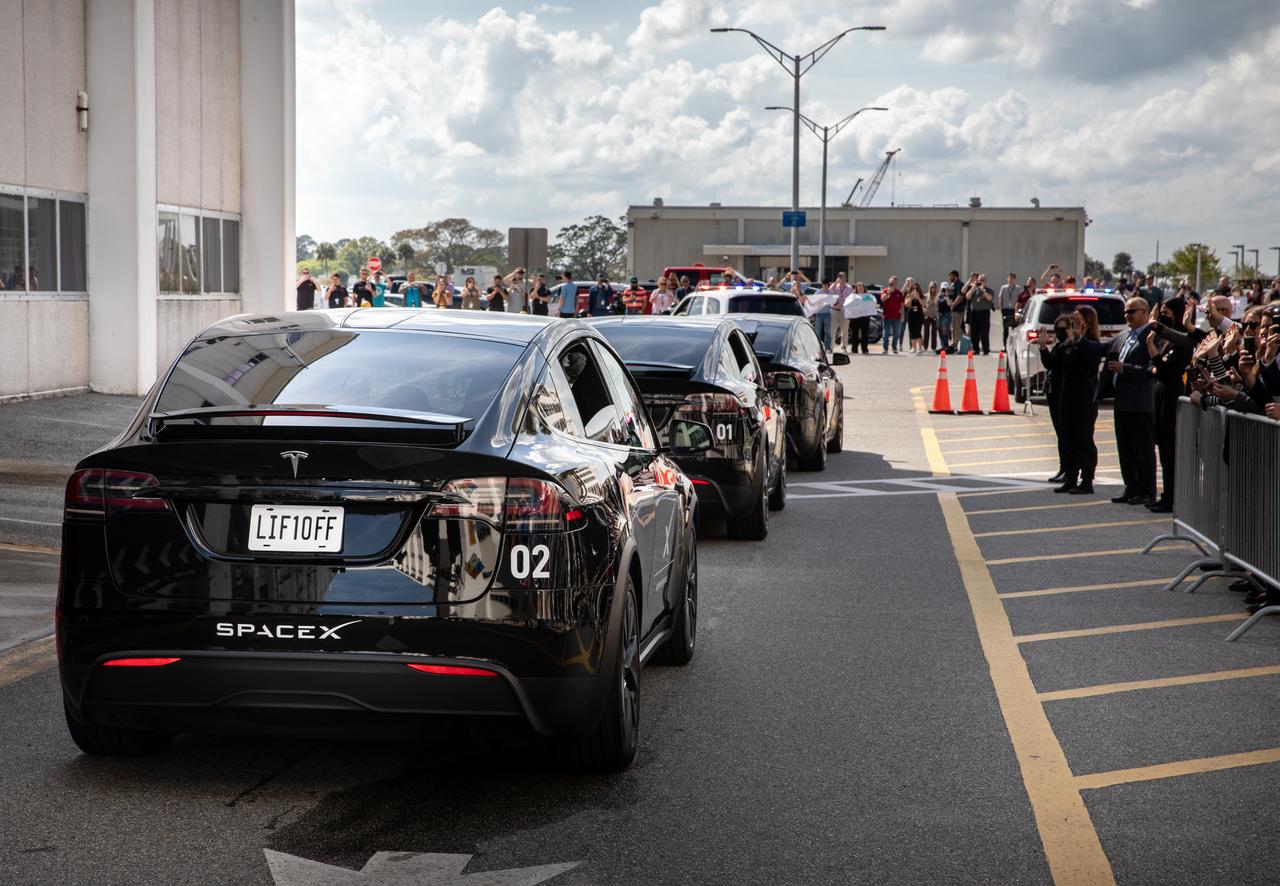
The convoy carrying NASA’s SpaceX Crew-10 makes the journey from the Neil A. Armstrong Operations and Checkout Building at the agency’s Kennedy Space Center in Florida to nearby Launch Complex 39A ahead of launch on Friday, March 14, 2025. NASA astronauts Anne McClain and Nichole Ayers, along with JAXA (Japan Aerospace Exploration Agency) astronaut Takuya Onishi and Roscosmos cosmonaut Kirill Peskov are scheduled to lift off aboard SpaceX’s Dragon spacecraft and Falcon 9 rocket at 7:03 p.m. EDT. Crew-10 is the 10th crew rotation mission with SpaceX to the space station as part of the agency’s Commercial Crew Program.
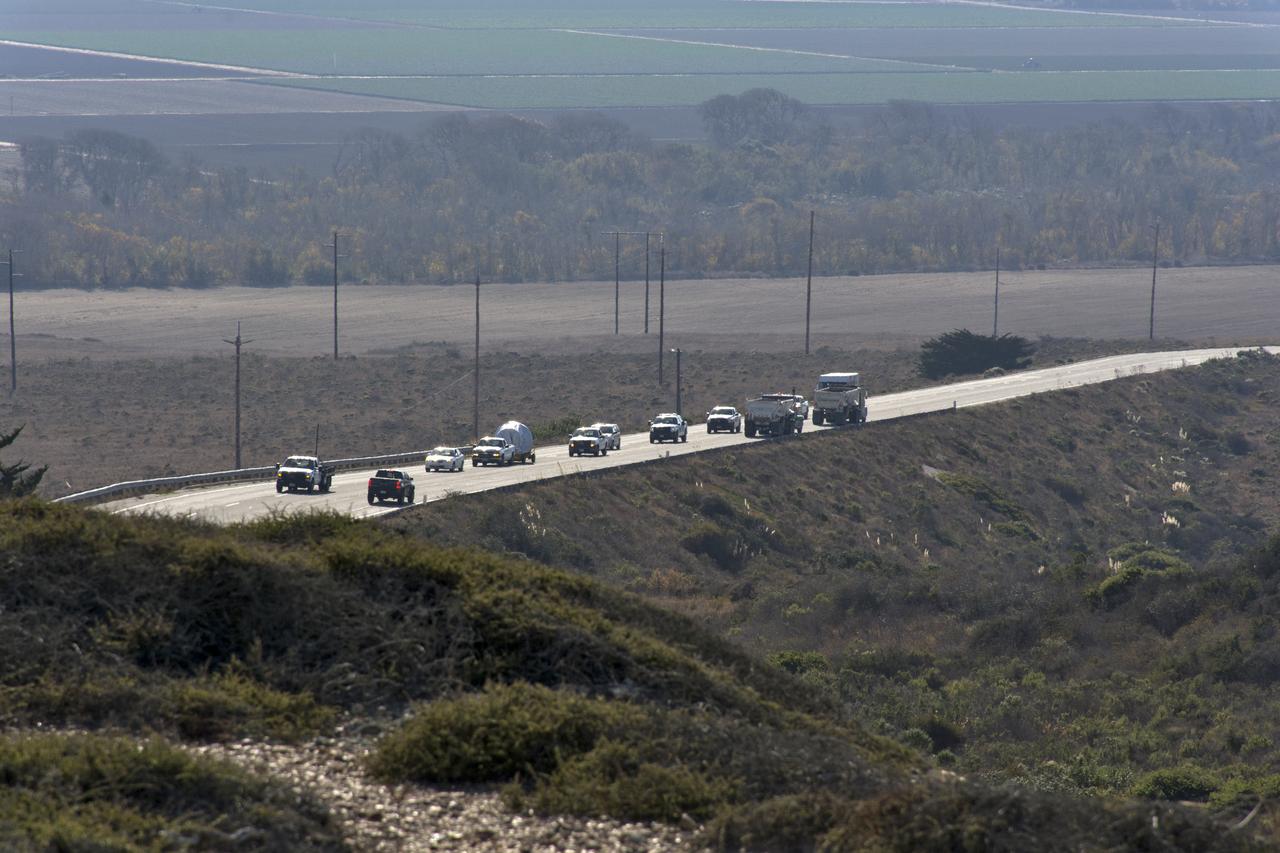
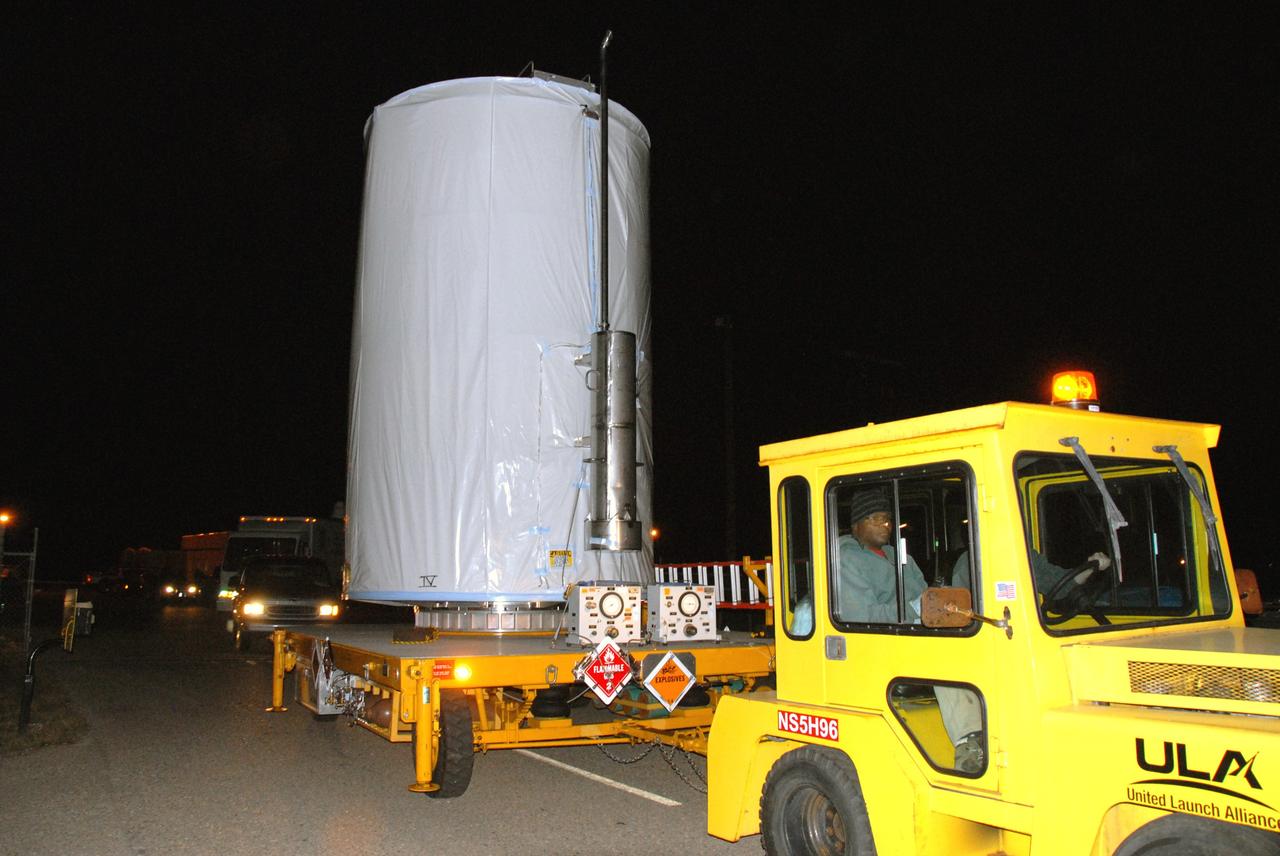
A convoy of vehicles accompanies the United Launch Alliance Delta II second stage on its way to the horizontal processing facility at Space Launch Complex-2 at Vandenberg Air Force Base in California. NASA's Ice, Cloud and land Elevation Satellite-2 (ICESat-2) will launch later this year on the final Delta II rocket. ICESat-2 will measure the height of a changing Earth, one laser pulse at a time, 10,000 laser pulses a second. The satellite will carry a single instrument, the Advanced Topographic Laser Altimeter System. ICESat-2 will help scientists investigate why, and how much our planet's frozen and icy areas, called the cryosphere, is changing in a warming climate.
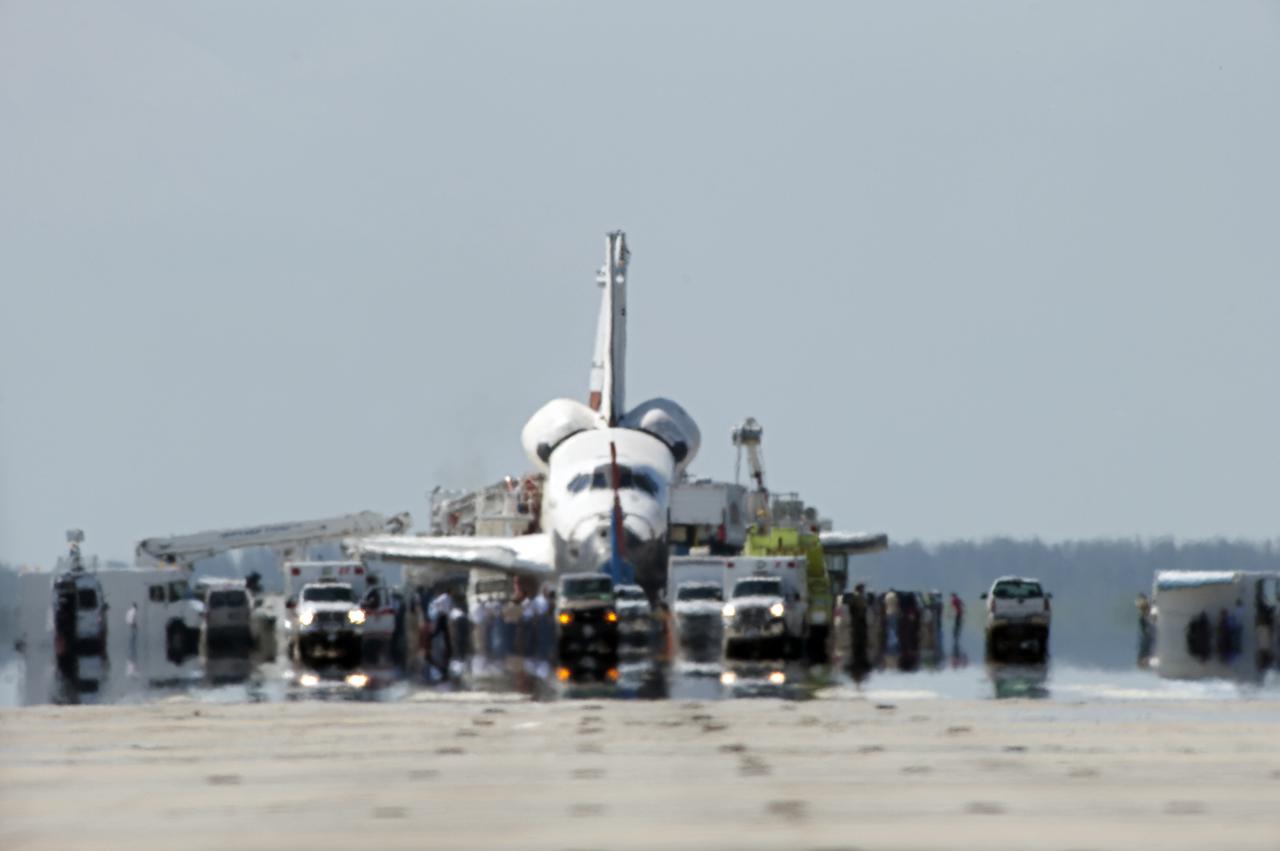
CAPE CANAVERAL, Fla. - A convoy of safing and emergency vehicles meet space shuttle Atlantis on Runway 33 at the Shuttle Landing Facility at NASA's Kennedy Space Center in Florida. Landing was at 8:48 a.m. EDT, completing the 12-day STS-132 mission to the International Space Station. The six-member STS-132 crew carried the Russian-built Mini Research Module-1 to the space station. STS-132 is the 34th shuttle mission to the station, the 132nd shuttle mission overall and the last planned flight for Atlantis. For information on the STS-132 mission and crew, visit www.nasa.gov_mission_pages_shuttle_shuttlemissions_sts132_index.html. Photo credit: NASA_Sandra Joseph and Carl Winebarger
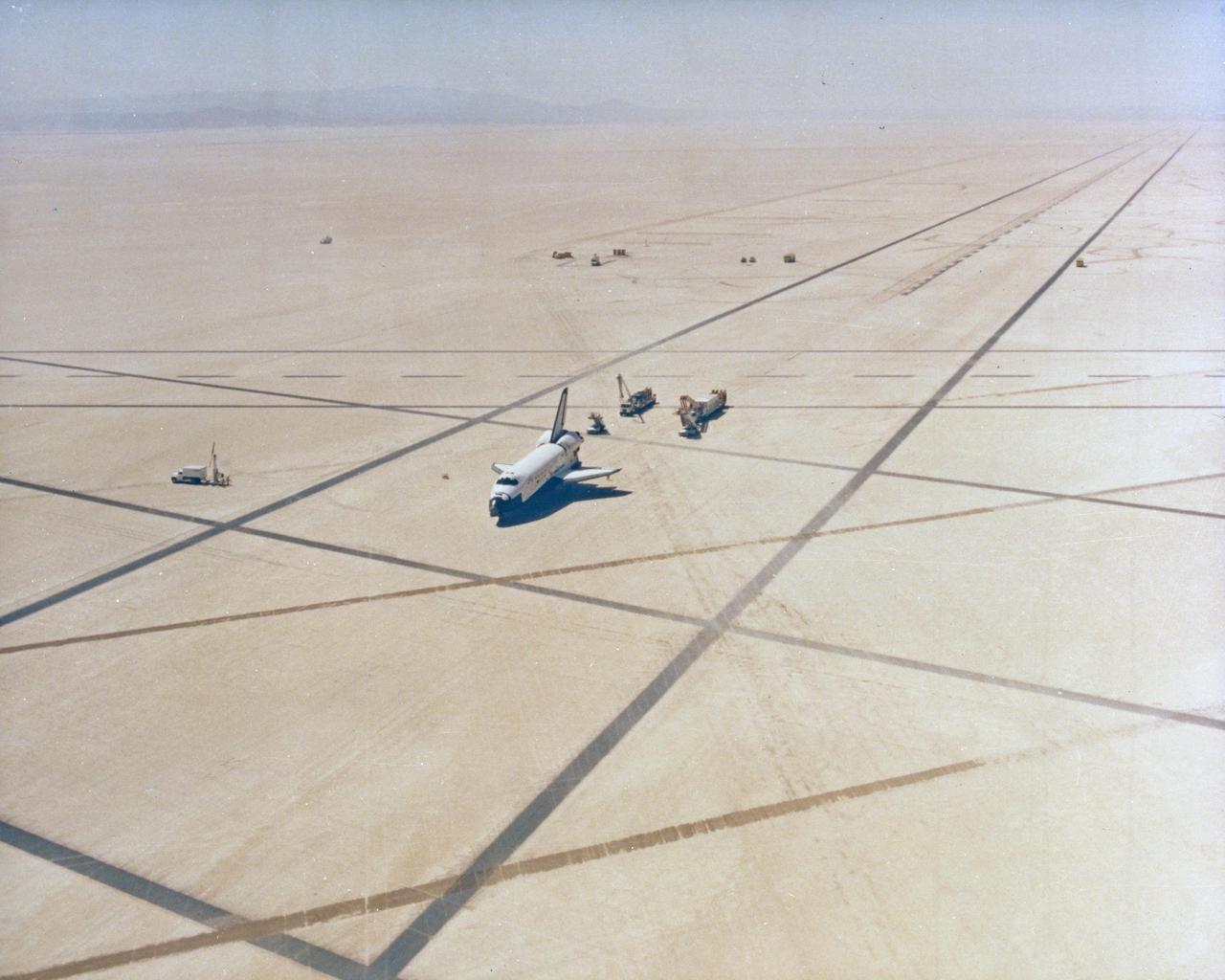
DRYDEN FLIGHT RESEARCH CENTER, CALIF. - Columbia returns to Earth after completing the first full test of the Space Transportation System (STS-1). The orbiter Columbia is seen here on the Rogers dry lake, Runway 23, at NASA's Dryden Flight Research Center, Edwards, California. From this aerial view, the orbiter Columbia is seen as it is being convoyed to a parking area. For this first flight, the Columbia was flown by Astronauts John Young, commander, and Robert Crippen, pilot. STS-1, known as a shuttle systems test flight, sought to demonstrate safe launch into orbit and safe return of the orbiter and crew and verify the combined performance of the entire shuttle vehicle -- orbiter, solid rocket boosters and external tank.
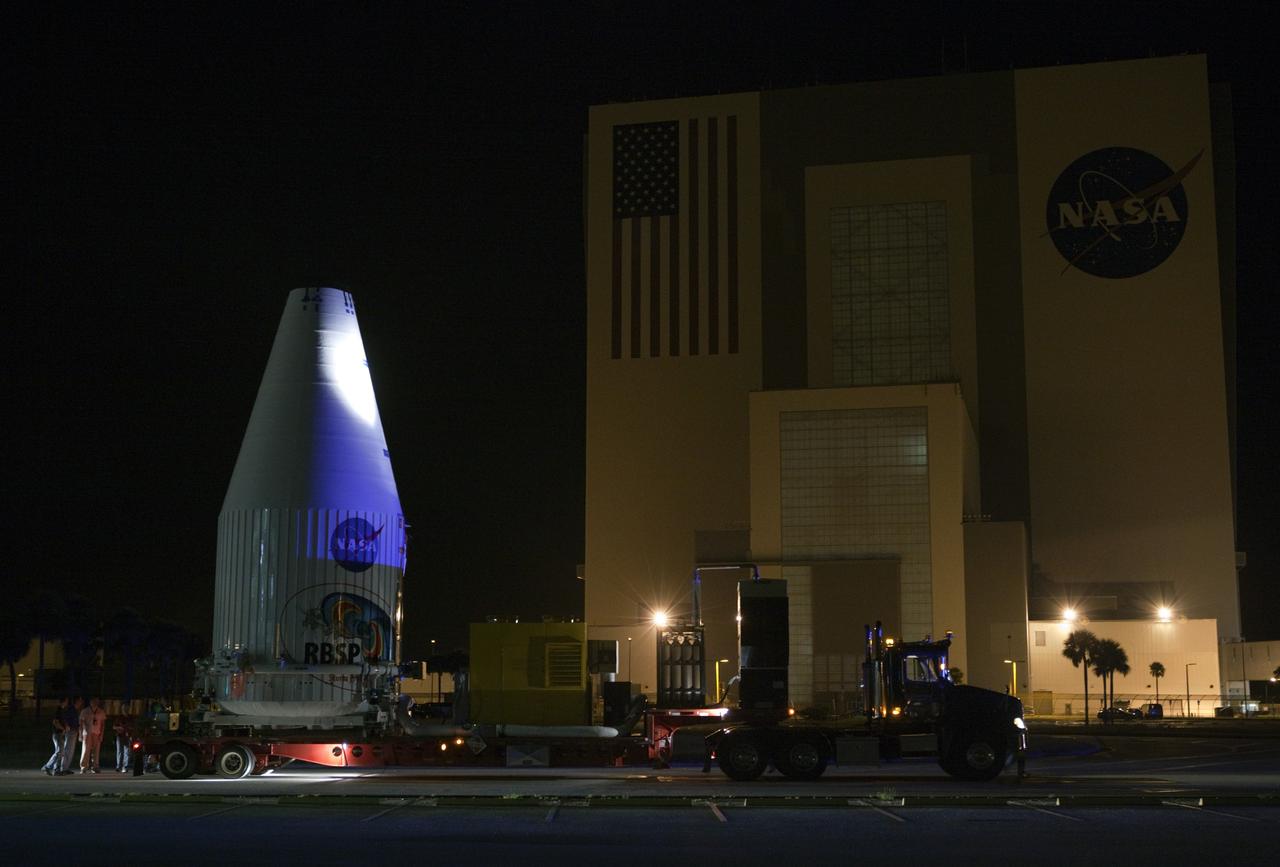
CAPE CANAVERAL, Fla. – The Radiation Belt Storm Probes, or RBSP, spacecraft are moved inside their payload fairing on the payload transporter from the Astrotech payload processing facility in Titusville, Fla. to Space Launch Complex-41 at Cape Canaveral Air Force Station. The convoy carried the spacecraft past the Vehicle Assembly Building at NASA's Kennedy Space Center. The fairing, which holds the twin RBSP spacecraft, will be lifted to the top of a United Launch Alliance Atlas V rocket for launch later in August. The two spacecraft are designed to study the Van Allen radiation belts in unprecedented detail. Photo credit: NASA/Dmitri Gerondidakis
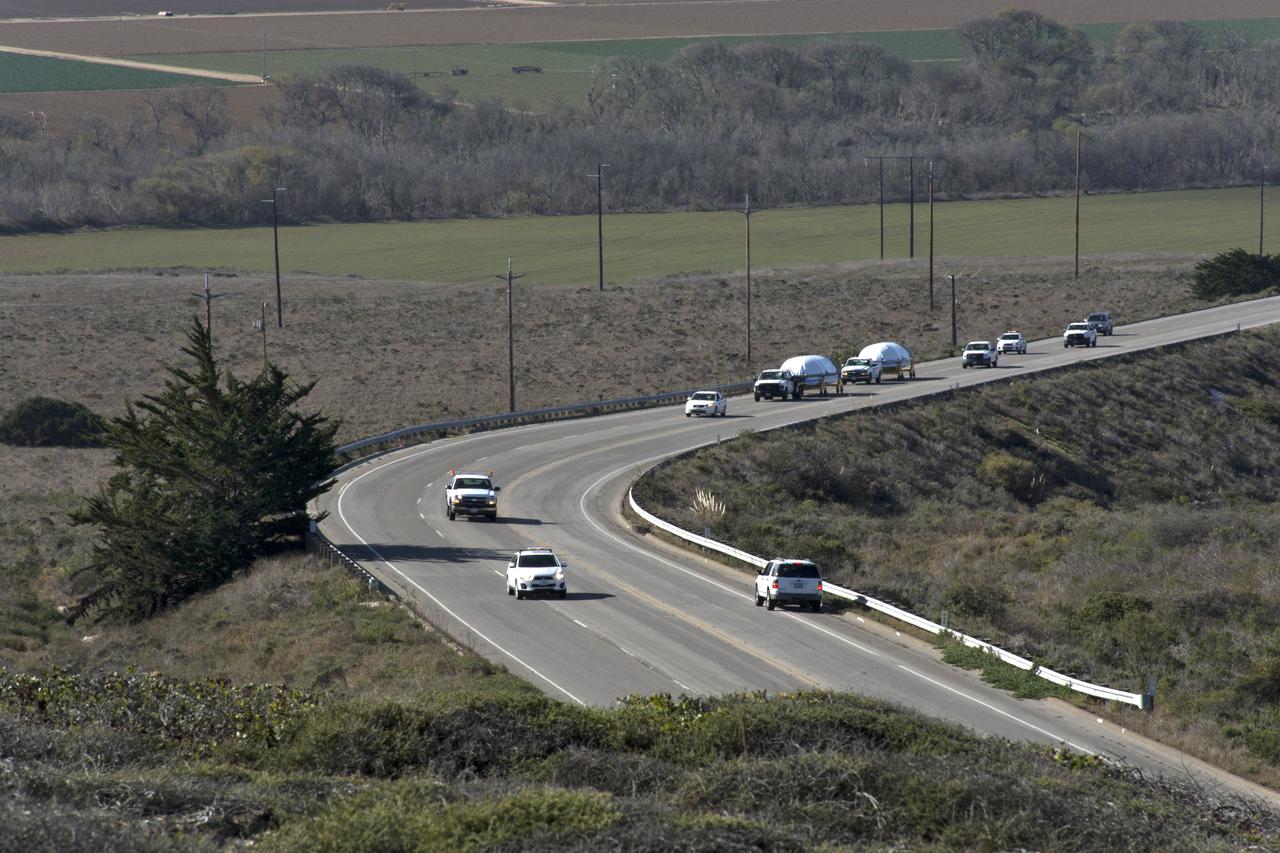
Both halves of the United Launch Alliance (ULA) Delta II rocket payload fairing are transported by convoy to ULA's Building B8337 at Vandenberg Air Force Base in California. NASA's Ice, Cloud and land Elevation Satellite-2 (ICESat-2) will launch later this year on the final Delta II rocket. ICESat-2 will measure the height of a changing Earth, one laser pulse at a time, 10,000 laser pulses a second. The satellite will carry a single instrument, the Advanced Topographic Laser Altimeter System. ICESat-2 will help scientists investigate why, and how much our planet's frozen and icy areas, called the cryosphere, is changing in a warming climate.
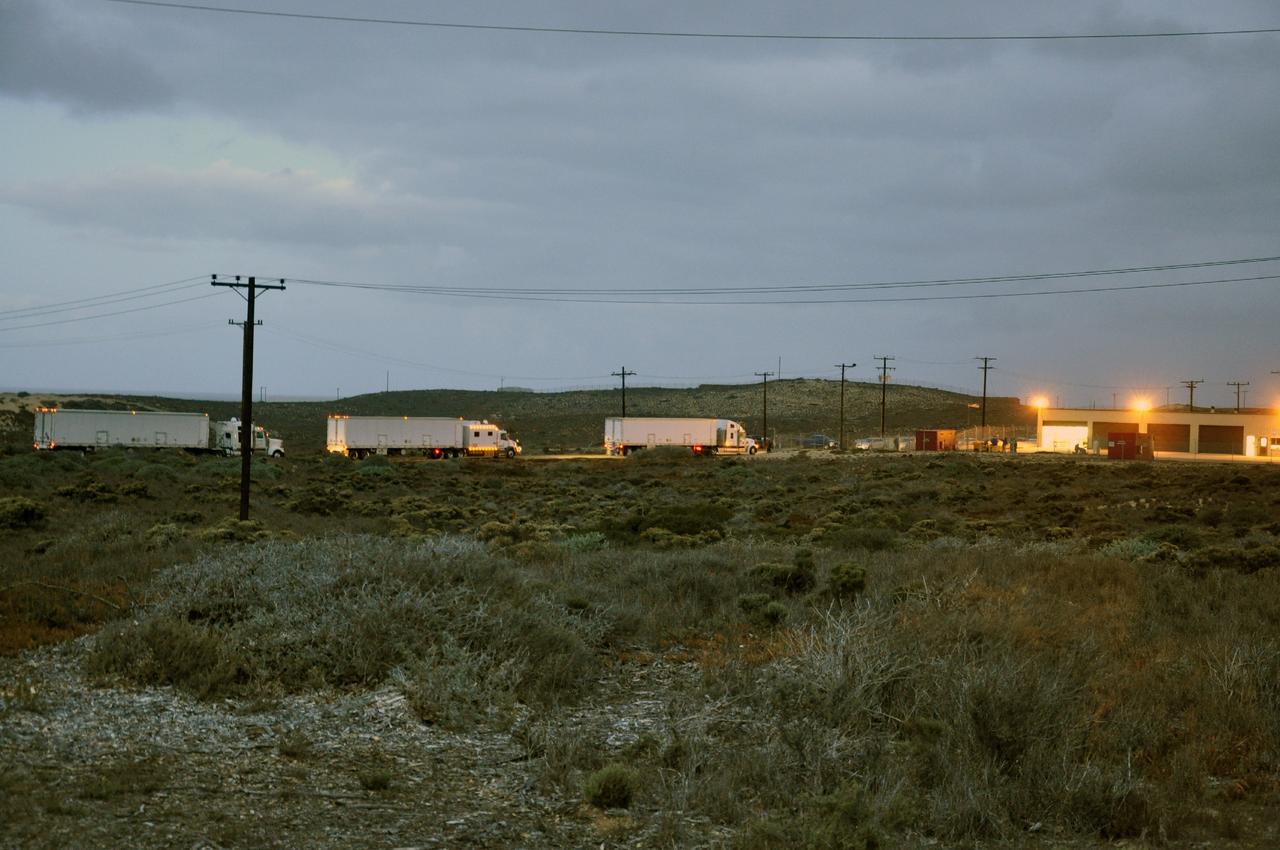
VANDENBERG AIR FORCE BASE, Calif. -- A convoy of trucks delivers solid rocket motors for a United Launch Alliance Delta II rocket to Vandenberg Air Force Base in California. The Delta II is slated to launch NASA's Orbiting Carbon Observatory-2, or OCO-2 spacecraft in July 2014. OCO-2 will collect precise global measurements of carbon dioxide in the Earth's atmosphere. Scientists will analyze this data to improve our understanding of the natural processes and human activities that regulate the abundance and distribution of this important atmospheric gas. Photo credit: NASA/Randy Beaudoin
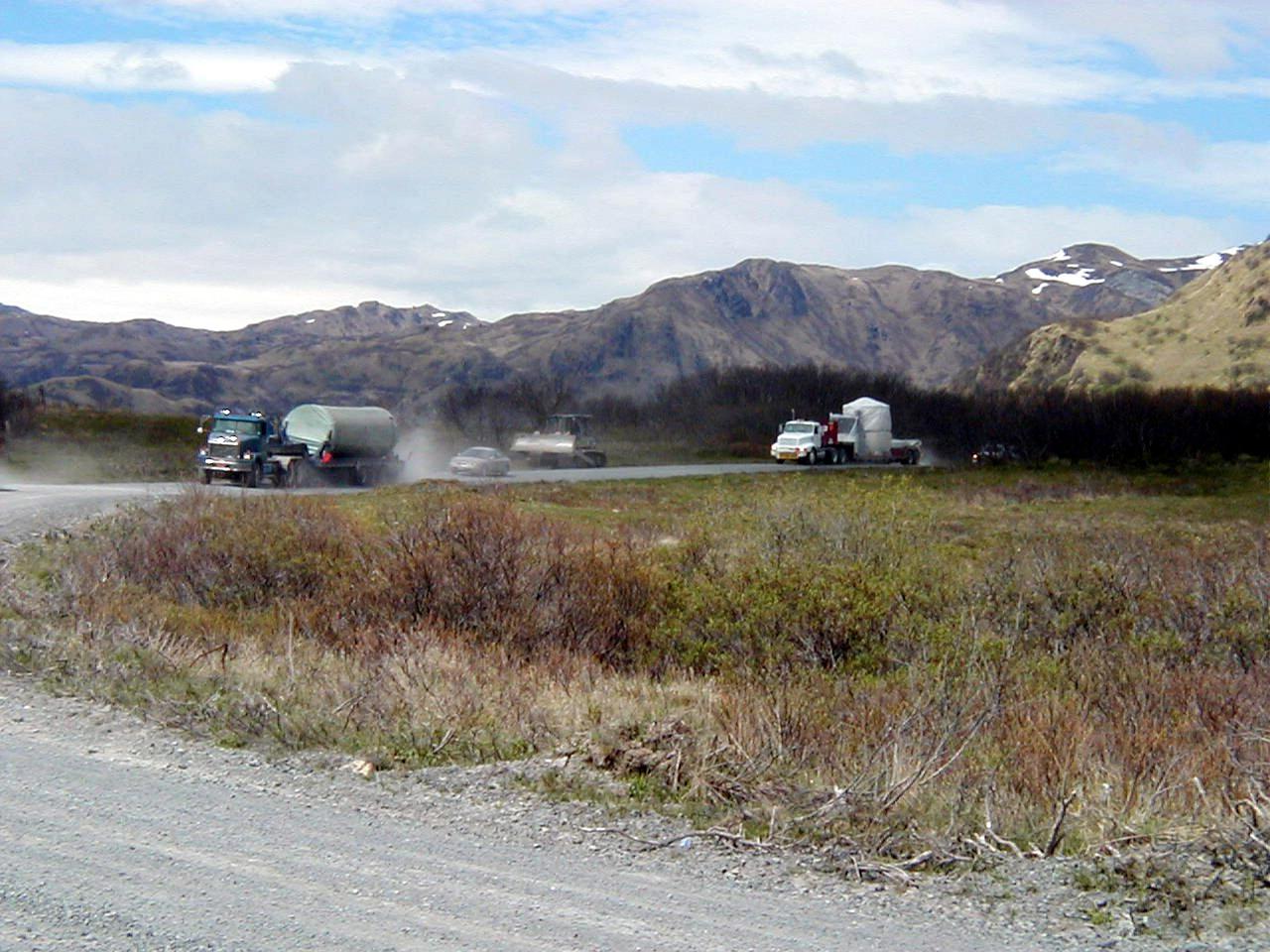
KODIAK ISLAND, Alaska -- A convoy of trucks transports the stages of an Athena launch vehicle and supporting launch equipment to the pad at Kodiak Island, Alaska, as preparations to launch the Kodiak Star continue. The first orbital launch to take place from Alaska's Kodiak Launch Complex, Kodiak Star is scheduled to lift off on a Lockheed Martin Athena I launch vehicle on Sept. 17 during a two-hour window that extends from 5:00 to 7:00 p.m. ADT. The payloads aboard include the Starshine 3, sponsored by NASA, and the PICOSat, PCSat and Sapphire, sponsored by the Department of Defense (DoD) Space Test Program.
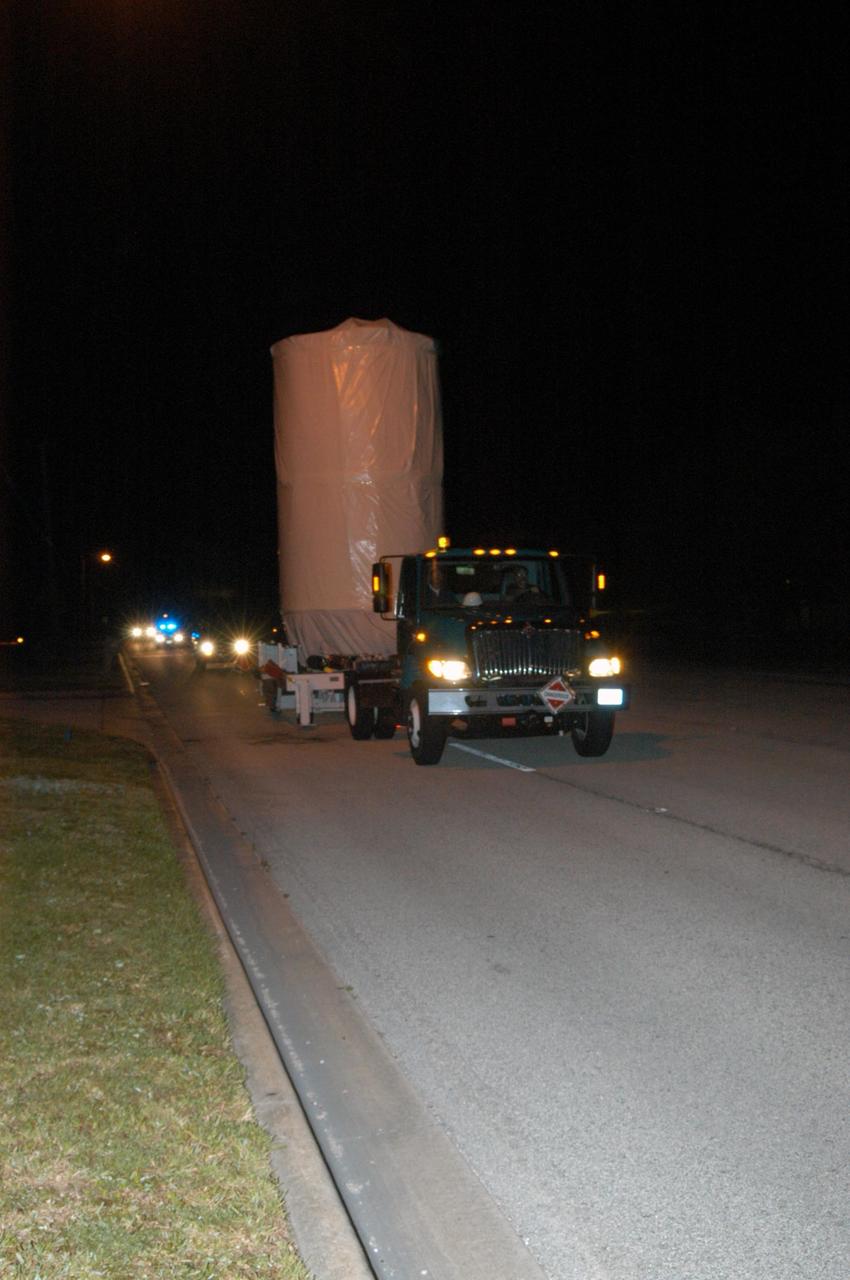
KENNEDY SPACE CENTER, FLA. - With a convoy of escorts, the STEREO spacecraft is transported to Launch Pad 17-B on Cape Canaveral Air Force Station. At the pad the spacecraft will be lifted into the mobile service tower. STEREO stands for Solar Terrestrial Relations Observatory and comprises two spacecraft. The STEREO mission is the first to take measurements of the sun and solar wind in 3-dimension. This new view will improve our understanding of space weather and its impact on the Earth. The STEREO mission is managed by Goddard Space Flight Center. The Applied Physics Laboratory designed and built the spacecraft. The laboratory will maintain command and control of the observatories throughout the mission, while NASA tracks and receives the data, determines the orbit of the satellites, and coordinates the science results. STEREO is expected to lift off Oct. 25. Photo credit: NASA/George Shelton
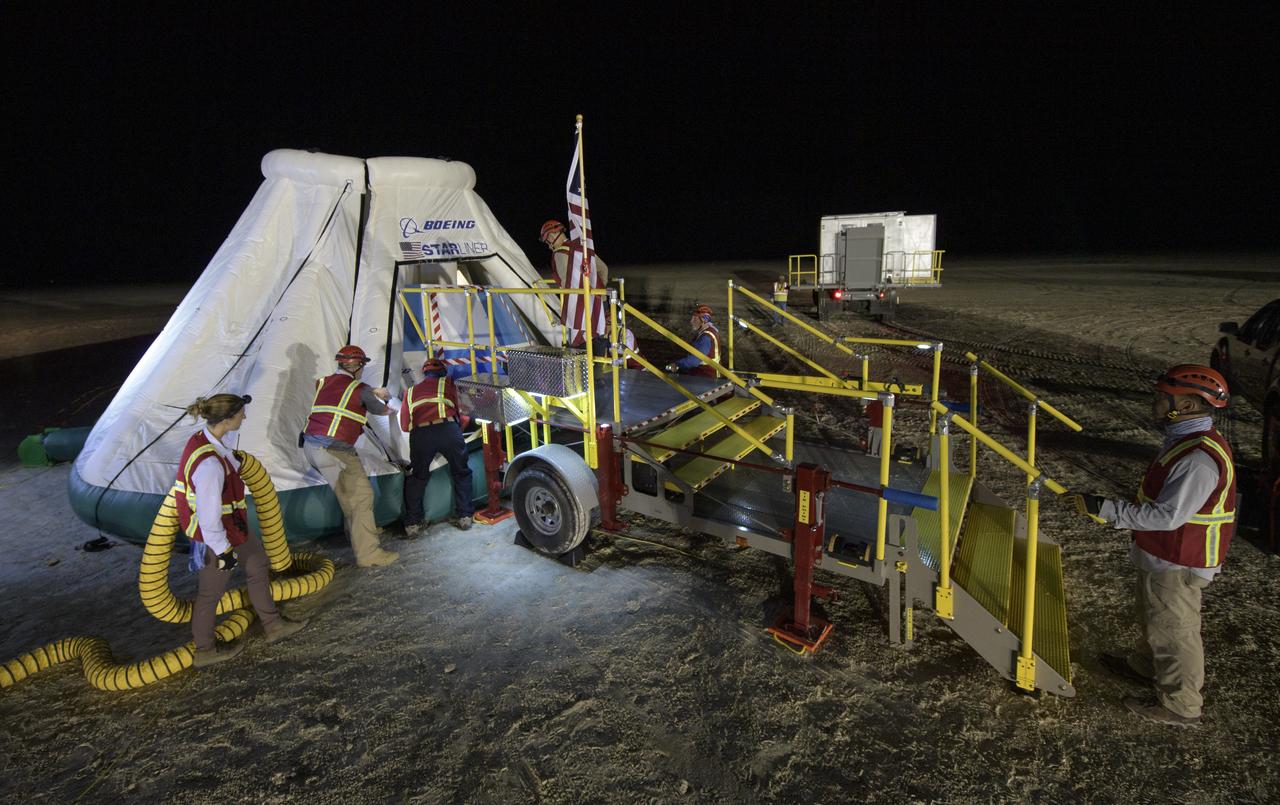
Teams from NASA, Boeing and the White Sands Missile Range, rehearse landing and crew extraction from Boeing’s CST-100 Starliner, which will be used to carry humans to the International Space Station, on Wednesday, Sept. 11, 2019 at the White Sands Missile Range outside Las Cruces, New Mexico. Using a convoy of vehicles Boeing uses to recover their spacecraft after landing and a boiler plate test article of the Starliner capsule, the teams worked through the steps necessary to safe the vehicle and get future crew members out of the Starliner to return home. NASA astronauts Mike Fincke and Nicole Mann and Boeing astronaut Chris Ferguson will fly to the space station aboard the Starliner for the Boeing Crew Flight Test mission. Photo Credit: (NASA/Bill Ingalls)
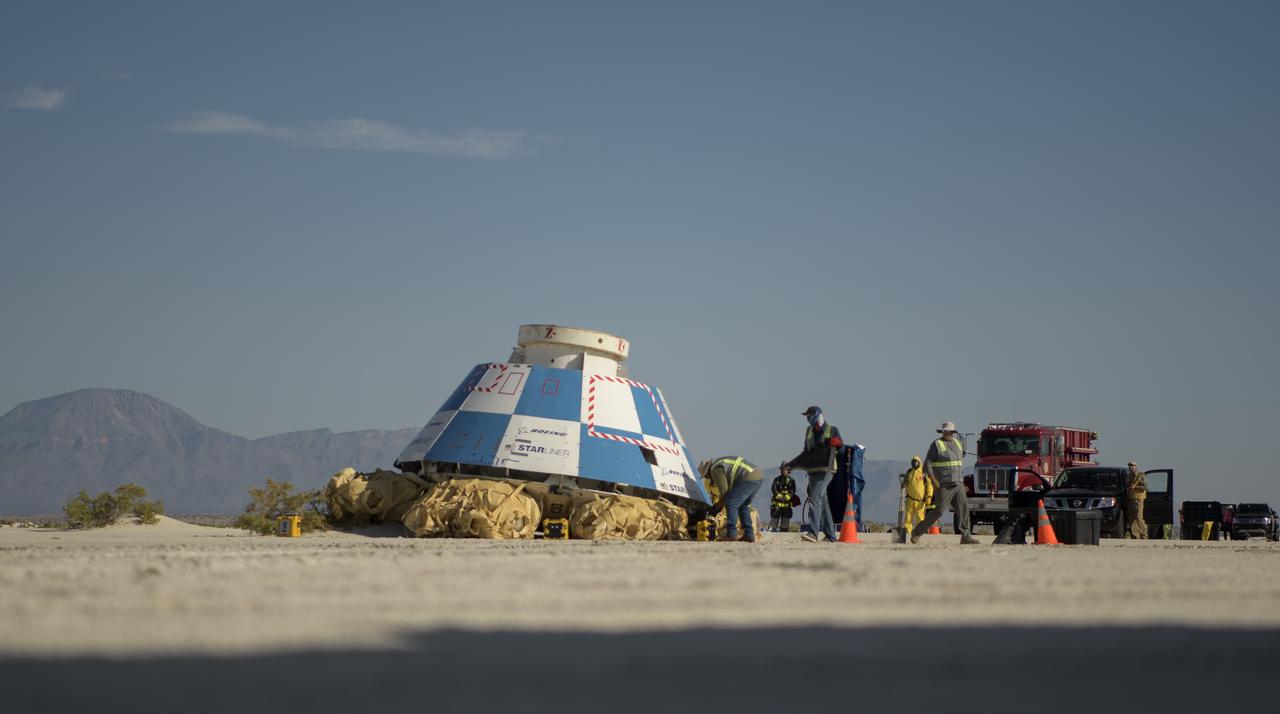
Teams from NASA, Boeing and the White Sands Missile Range, rehearse landing and crew extraction from Boeing’s CST-100 Starliner, which will be used to carry humans to the International Space Station, on Thursday, Sept. 12, 2019 at the White Sands Missile Range outside Las Cruces, New Mexico. Using a convoy of vehicles Boeing uses to recover their spacecraft after landing and a boiler plate test article of the Starliner capsule, the teams worked through the steps necessary to safe the vehicle and get future crew members out of the Starliner to return home. NASA astronauts Mike Fincke and Nicole Mann and Boeing astronaut Chris Ferguson will fly to the space station aboard the Starliner for the Boeing Crew Flight Test mission. Photo Credit: (NASA/Bill Ingalls)
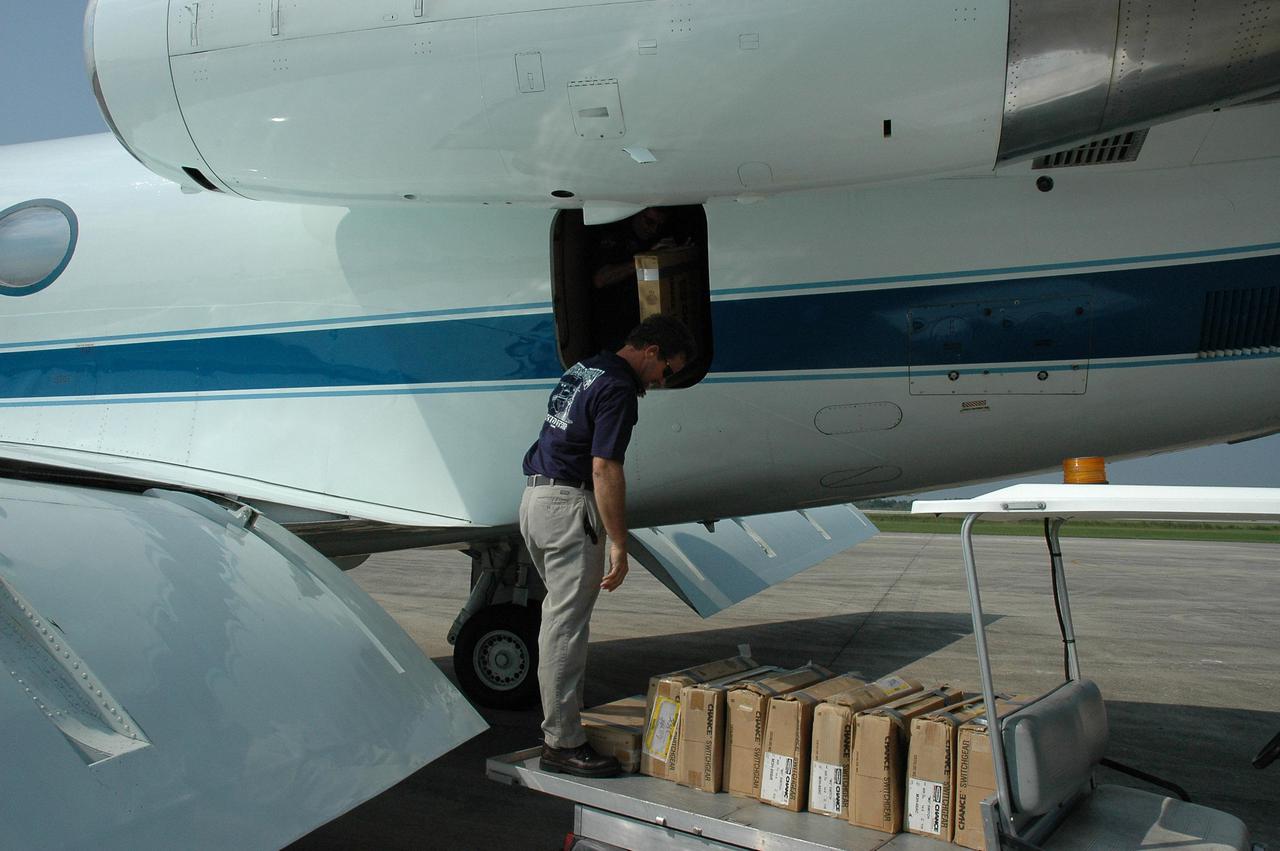
KENNEDY SPACE CENTER, FLA. - At the NASA Kennedy Space Center Shuttle Landing Facility, hurricane relief supplies are being loaded onto a NASA aircraft bound for Stennis Space Center in Mississippi, which suffered damage from Hurricane Katrina. The supplies included 10 boxes of load bus disconnects going to Michoud Assesmbly Facility near New Orleans and 17 boxes of personal hygiene items, along with boxes of clothing and water. Many Stennis and Michoud employees were rendered homeless by the hurricane. NASA centers have been generous with relief supplies and personnel. Stennis is in limited operations mode. Daily convoys have been moving between Stennis and Michould, transporting personnel and supplies as Michoud prepares to resume limited operations.
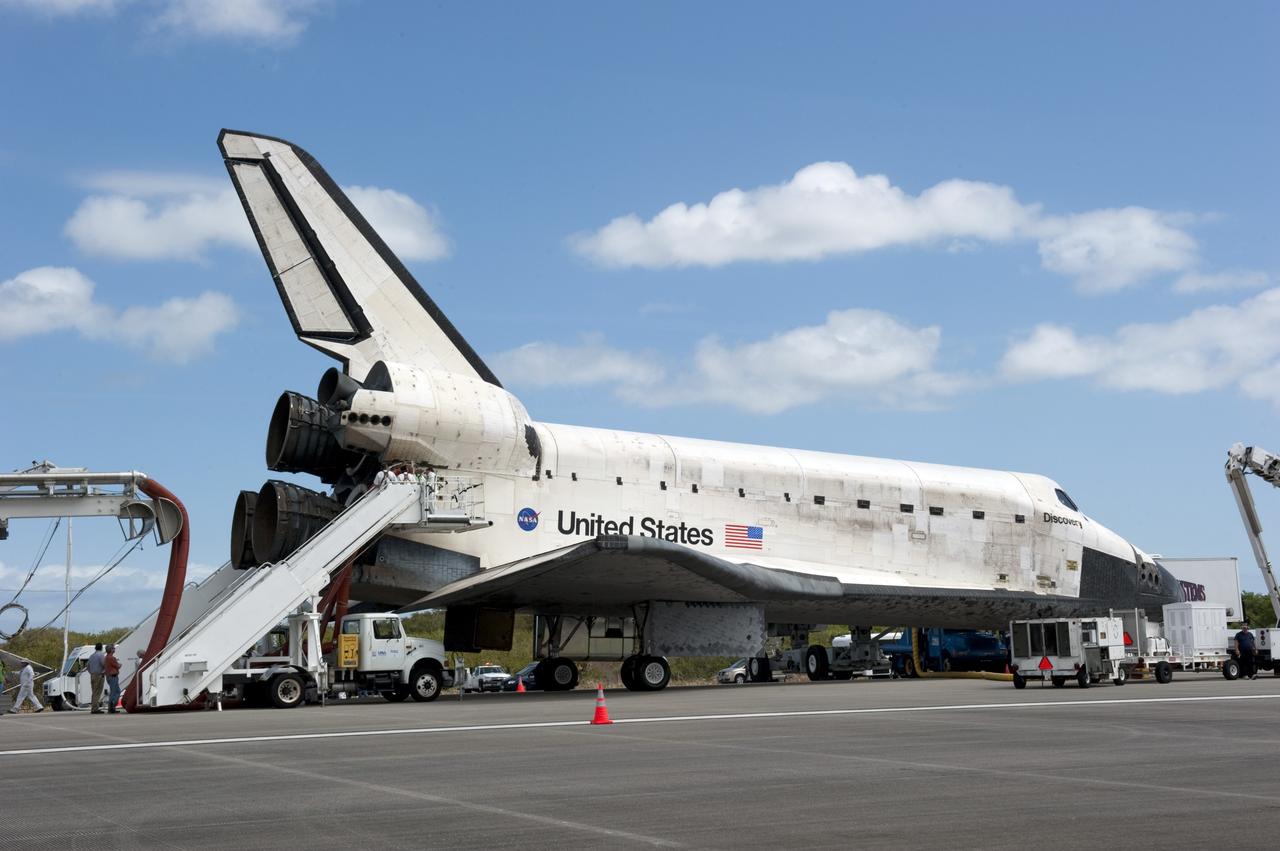
CAPE CANAVERAL, Fla. -- The landing convoy that will make space shuttle Discovery secure for towing to its processing hangar begins to pull up around the spacecraft following wheelstop on the Shuttle Landing Facility's Runway 15 at NASA's Kennedy Space Center in Florida. Discovery's final return from space completed the 13-day, 5.3-million-mile STS-133 mission. Main gear touchdown was at 11:57:17 a.m., followed by nose gear touchdown at 11:57:28, and wheelstop at 11:58:14 a.m. Discovery and its six-member crew delivered the Permanent Multipurpose Module, packed with supplies and critical spare parts, as well as Robonaut 2, the dexterous humanoid astronaut helper, to the orbiting outpost. STS-133 was Discovery's 39th and final mission. This was the 133rd Space Shuttle Program mission and the 35th shuttle voyage to the space station. Photo credit: NASA/Kim Shiflett
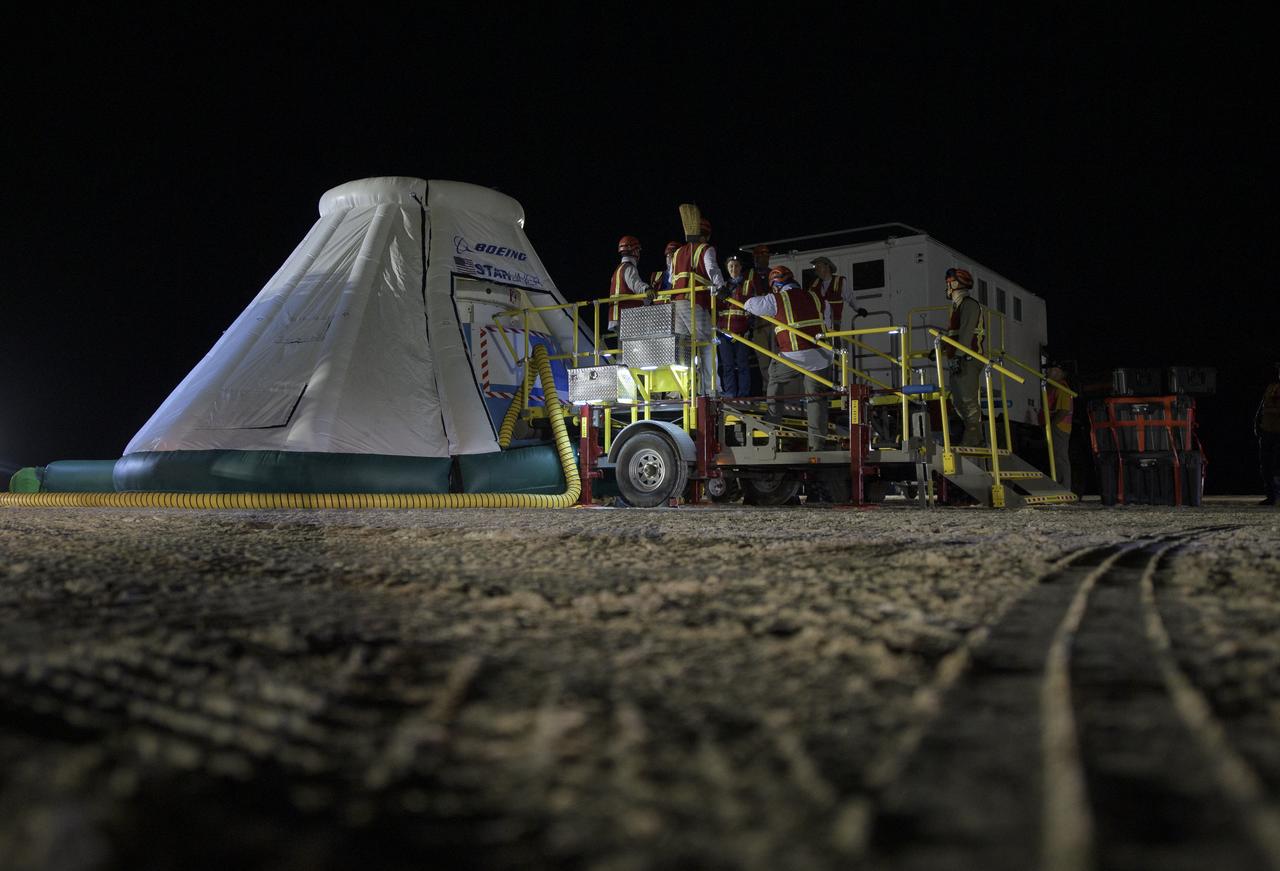
Teams from NASA, Boeing and the White Sands Missile Range, rehearse landing and crew extraction from Boeing’s CST-100 Starliner, which will be used to carry humans to the International Space Station, on Tuesday, Sept. 10, 2019 at the White Sands Missile Range outside Las Cruces, New Mexico. Using a convoy of vehicles Boeing uses to recover their spacecraft after landing and a boiler plate test article of the Starliner capsule, the teams worked through the steps necessary to safe the vehicle and get future crew members out of the Starliner to return home. NASA astronauts Mike Fincke and Nicole Mann and Boeing astronaut Chris Ferguson will fly to the space station aboard the Starliner for the Boeing Crew Flight Test mission. Photo Credit: (NASA/Bill Ingalls)
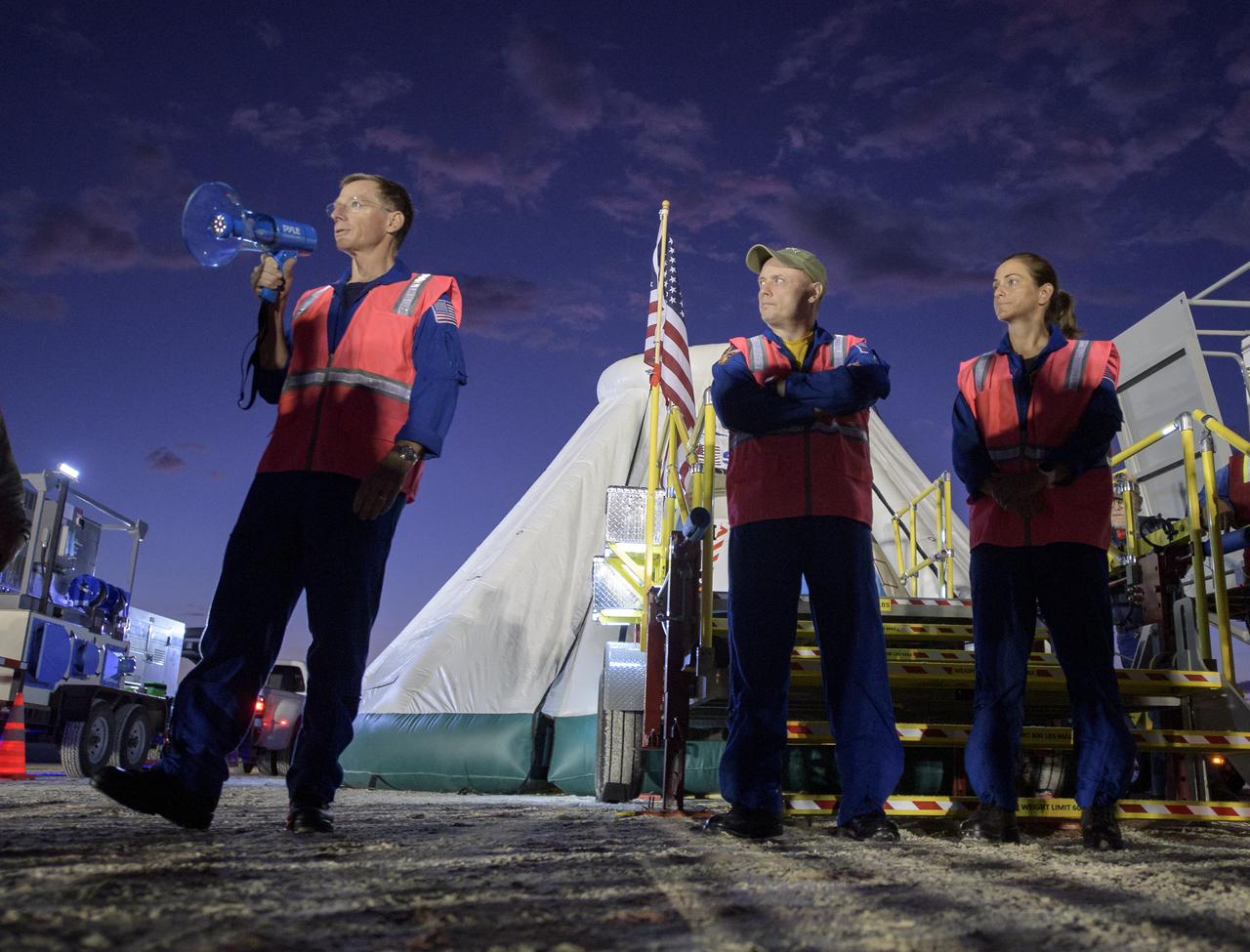
Boeing astronaut Chris Ferguson, left, and NASA astronauts Mike Fincke and Nicole Mann, along with teams from NASA, Boeing and the White Sands Missile Range, rehearse landing and crew extraction from Boeing’s CST-100 Starliner, which will be used to carry humans to the International Space Station, on Wednesday, Sept. 11, 2019 at the White Sands Missile Range outside Las Cruces, New Mexico. Using a convoy of vehicles Boeing uses to recover their spacecraft after landing and a boiler plate test article of the Starliner capsule, the teams worked through the steps necessary to safe the vehicle and get future crew members out of the Starliner to return home. Fincke, Mann and Ferguson will fly to the space station aboard the Starliner for the Boeing Crew Flight Test mission. Photo Credit: (NASA/Bill Ingalls)
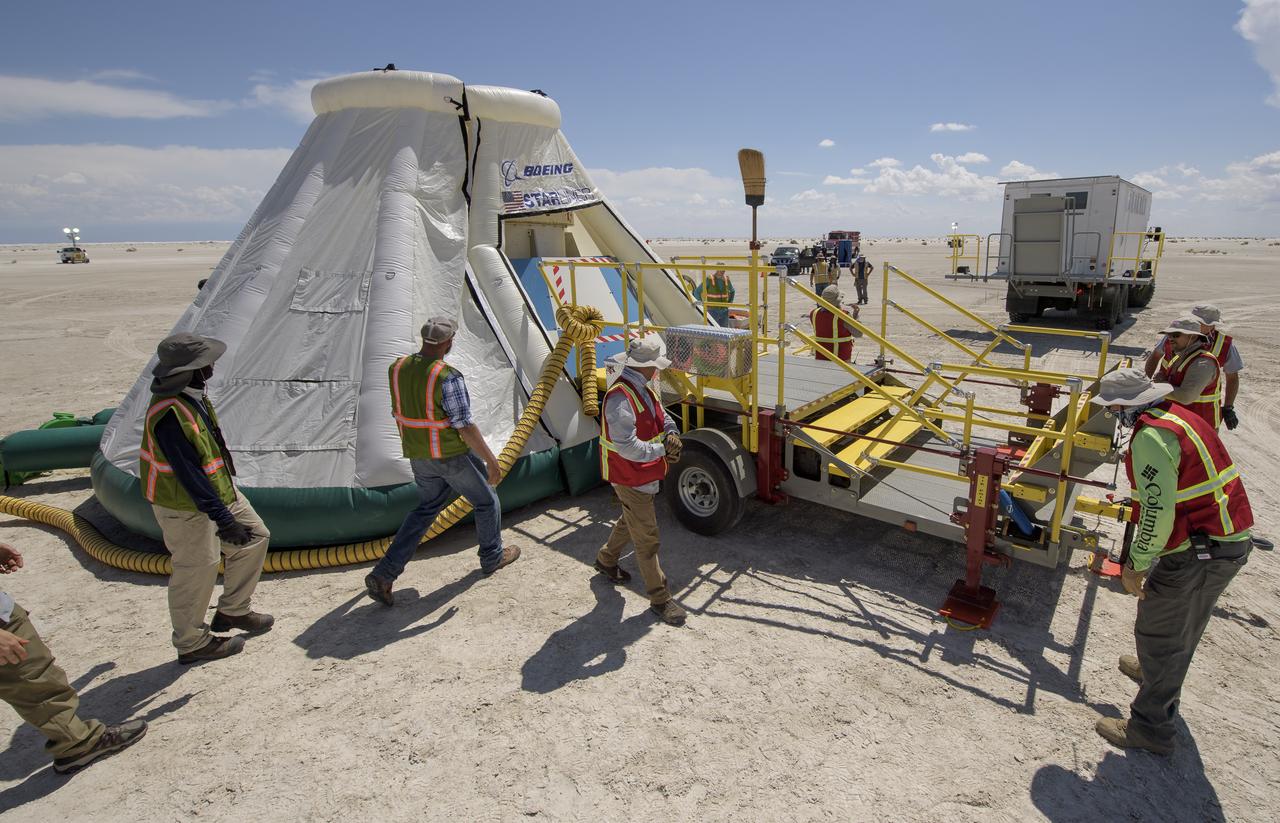
Teams from NASA, Boeing and the White Sands Missile Range, rehearse landing and crew extraction from Boeing’s CST-100 Starliner, which will be used to carry humans to the International Space Station, on Monday, Sept. 9, 2019 at the White Sands Missile Range outside Las Cruces, New Mexico. Using a convoy of vehicles Boeing uses to recover their spacecraft after landing and a boiler plate test article of the Starliner capsule, the teams worked through the steps necessary to safe the vehicle and get future crew members out of the Starliner to return home. NASA astronauts Mike Fincke and Nicole Mann and Boeing astronaut Chris Ferguson will fly to the space station aboard the Starliner for the Boeing Crew Flight Test mission. Photo Credit: (NASA/Bill Ingalls)
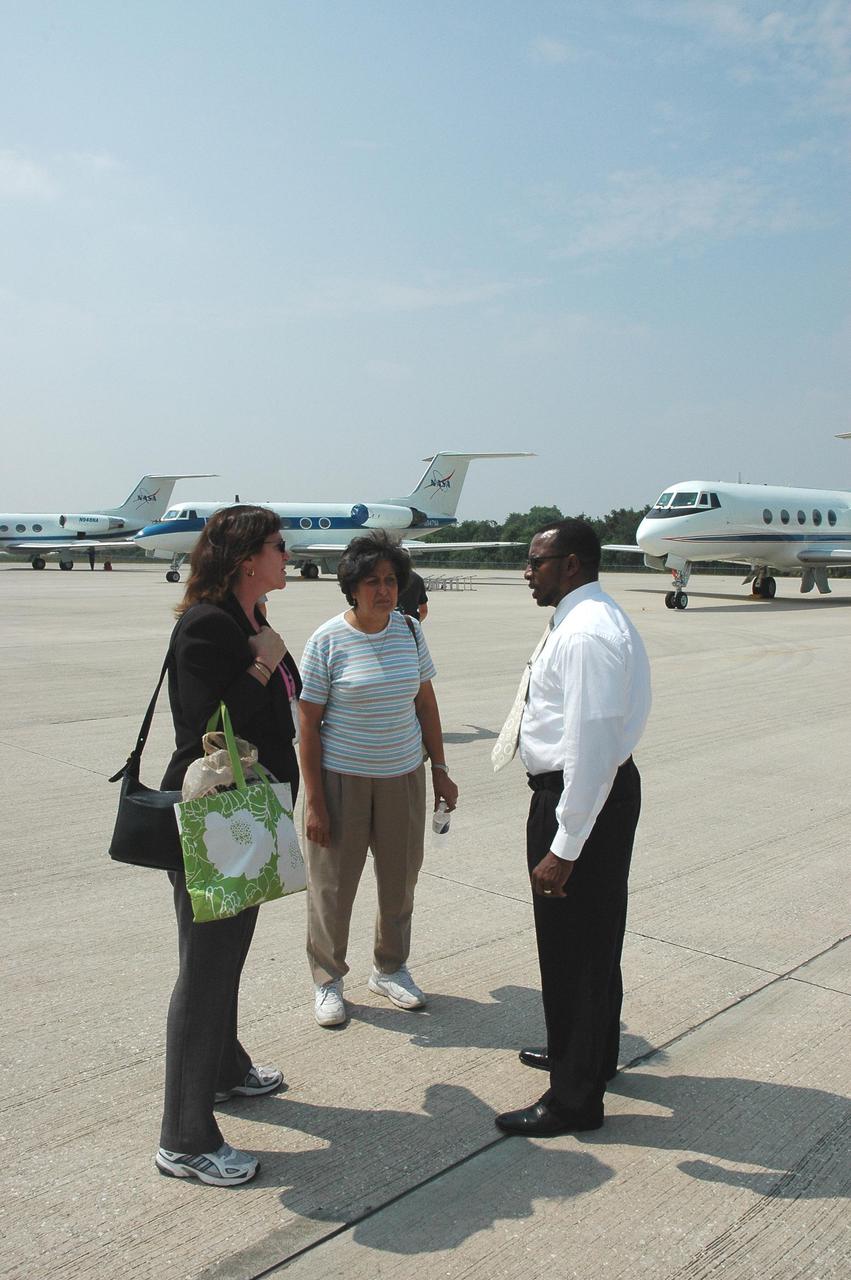
KENNEDY SPACE CENTER, FLA. - Patti Bell (left) and Dr. Violette Wahba Salib (center) are greeted by KSC Deputy Director Dr. Woodrow Whitlow Jr. after their return from Stennis Space Center in Mississippi. Bell and Salib are with Environmental and Occupational Health at KSC. They were part of a volunteer team helping rescue and recovery efforts at Stennis, which was damaged during Hurricane Katrina. Many employees of Stennis and Michoud Assembly Facility, near New Orleans, were rendered homeless by the hurricane. NASA centers have been generous with relief supplies and personnel. Stennis is now in limited operations mode. Daily convoys have been moving between Stennis and Michoud, transporting personnel and supplies as Michoud prepares to resume limited operations.
Teams from NASA, Boeing and the White Sands Missile Range, rehearse landing and crew extraction from Boeing’s CST-100 Starliner, which will be used to carry humans to the International Space Station, on Tuesday, Sept. 10, 2019 at the White Sands Missile Range outside Las Cruces, New Mexico. Using a convoy of vehicles Boeing uses to recover their spacecraft after landing and a boiler plate test article of the Starliner capsule, the teams worked through the steps necessary to safe the vehicle and get future crew members out of the Starliner to return home. NASA astronauts Mike Fincke and Nicole Mann and Boeing astronaut Chris Ferguson will fly to the space station aboard the Starliner for the Boeing Crew Flight Test mission. Photo Credit: (NASA/Bill Ingalls)
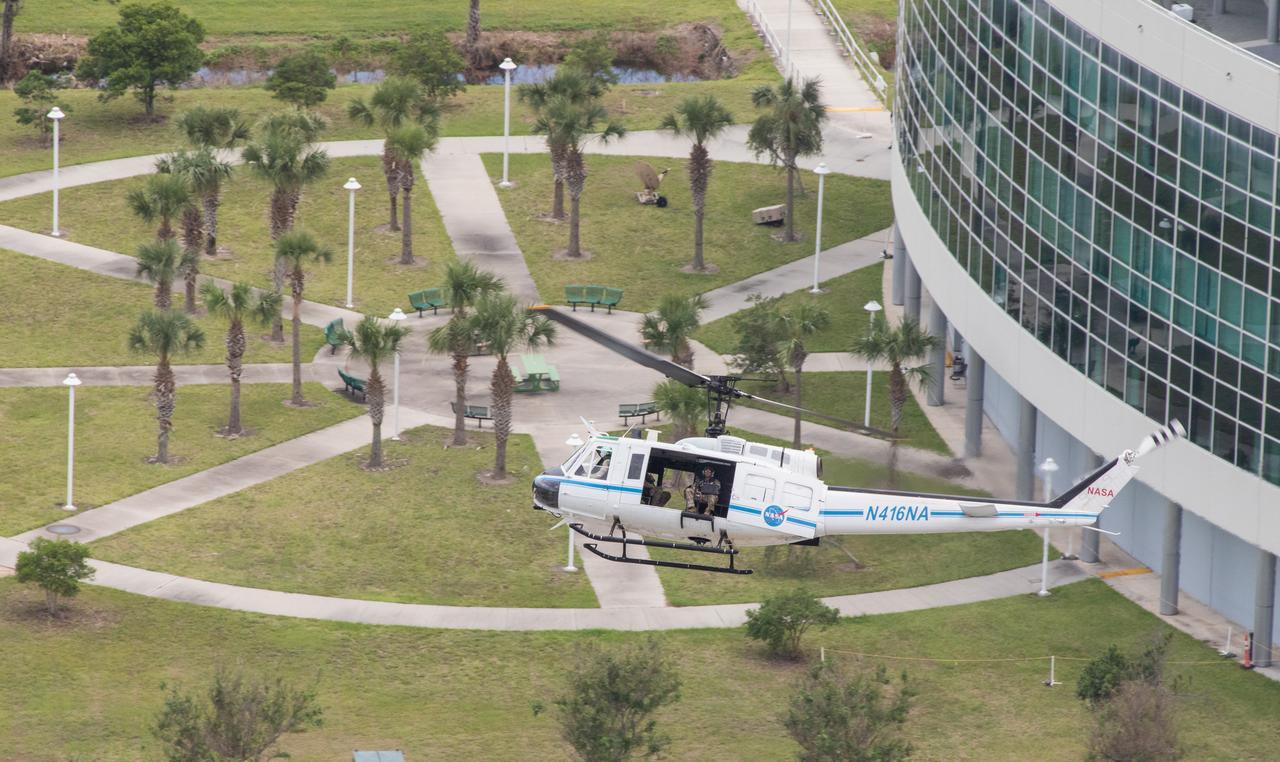
A helicopter that’s part of the convoy to escort NASA astronauts Robert Behnken and Douglas Hurley to Launch Complex 39A flies over the agency’s Kennedy Space Center in Florida on May 27, 2020, ahead of NASA’s SpaceX Demo-2 launch. The launch was scrubbed due to unfavorable weather conditions, and the next launch attempt will be Saturday, May 30. Liftoff of the SpaceX Falcon 9 rocket and Crew Dragon spacecraft is scheduled for 3:22 p.m. EDT from historic Launch Complex 39A. Behnken and Hurley will be the first astronauts to launch to the International Space Station from U.S. soil since the end of the Space Shuttle Program in 2011. Part of NASA’s Commercial Crew Program, this will be SpaceX’s final flight test, paving the way for the agency to certify the crew transportation system for regular, crewed flights to the orbiting laboratory.

KENNEDY SPACE CENTER, FLA. - At the NASA Kennedy Space Center Shuttle Landing Facility, the NASA aircraft filled with hurricane relief supplies is ready for takeoff. The plane is bound for Stennis Space Center in Mississippi, which suffered damage from Hurricane Katrina. The supplies included 10 boxes of load bus disconnects going to Michoud Assesmbly Facility near New Orleans and 17 boxes of personal hygiene items, along with boxes of clothing and water. Many Stennis and Michoud employees were rendered homeless by the hurricane. NASA centers have been generous with relief supplies and personnel. Stennis is in limited operations mode. Daily convoys have been moving between Stennis and Michould, transporting personnel and supplies as Michoud prepares to resume limited operations.
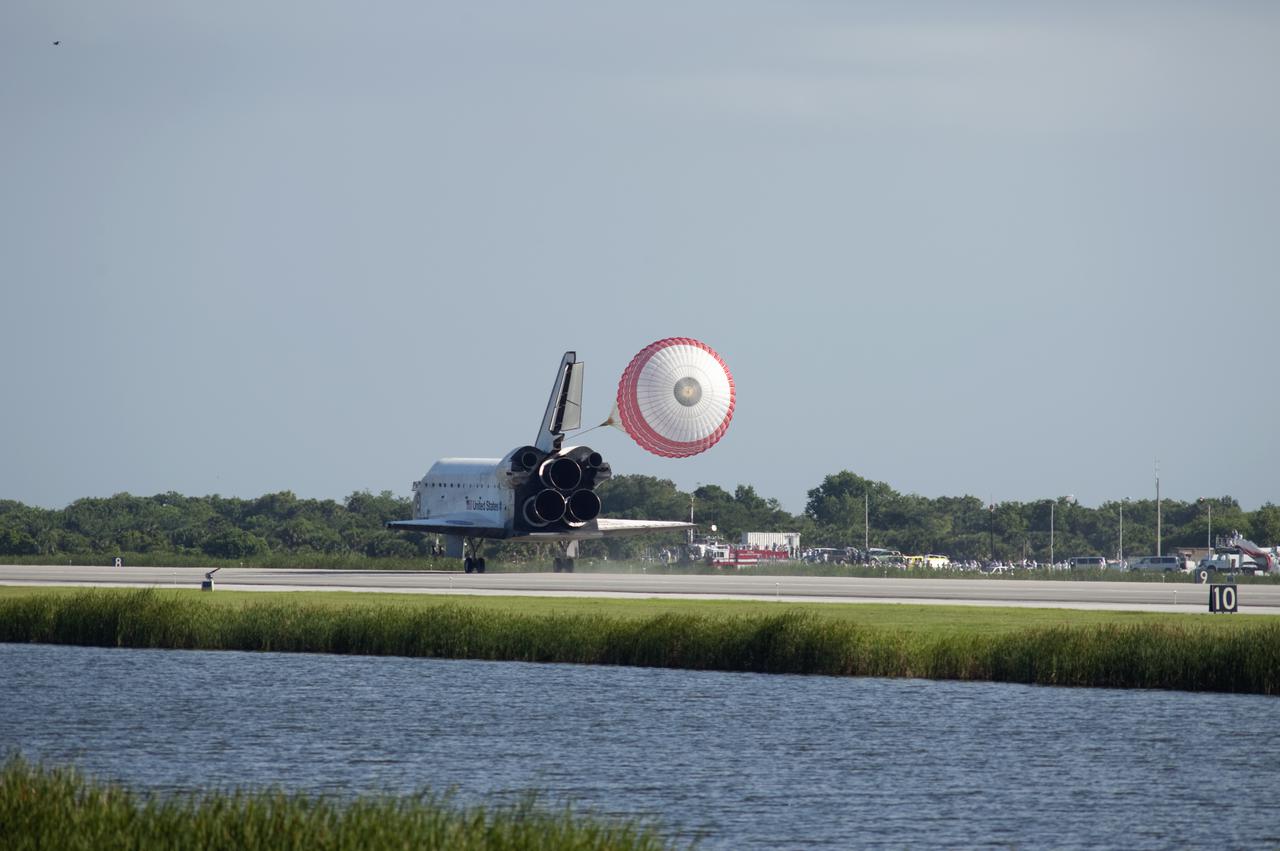
CAPE CANAVERAL, Fla. - Space shuttle Atlantis' drag chute slows the vehicle as it rolls to a stop on Runway 33 at the Shuttle Landing Facility at NASA's Kennedy Space Center in Florida. At right is the long convoy of rescue and safing vehicles that greet a space shuttle after landing. Landing was at 8:48 a.m. EDT, completing the 12-day STS-132 mission to the International Space Station. The six-member STS-132 crew carried the Russian-built Mini Research Module-1 to the International Space Station. STS-132 is the 34th shuttle mission to the station, the 132nd shuttle mission overall and the last planned flight for Atlantis. For information on the STS-132 mission and crew, visit www.nasa.gov_mission_pages_shuttle_shuttlemissions_sts132_index.html. Photo credit: NASA_Rick Wetherington
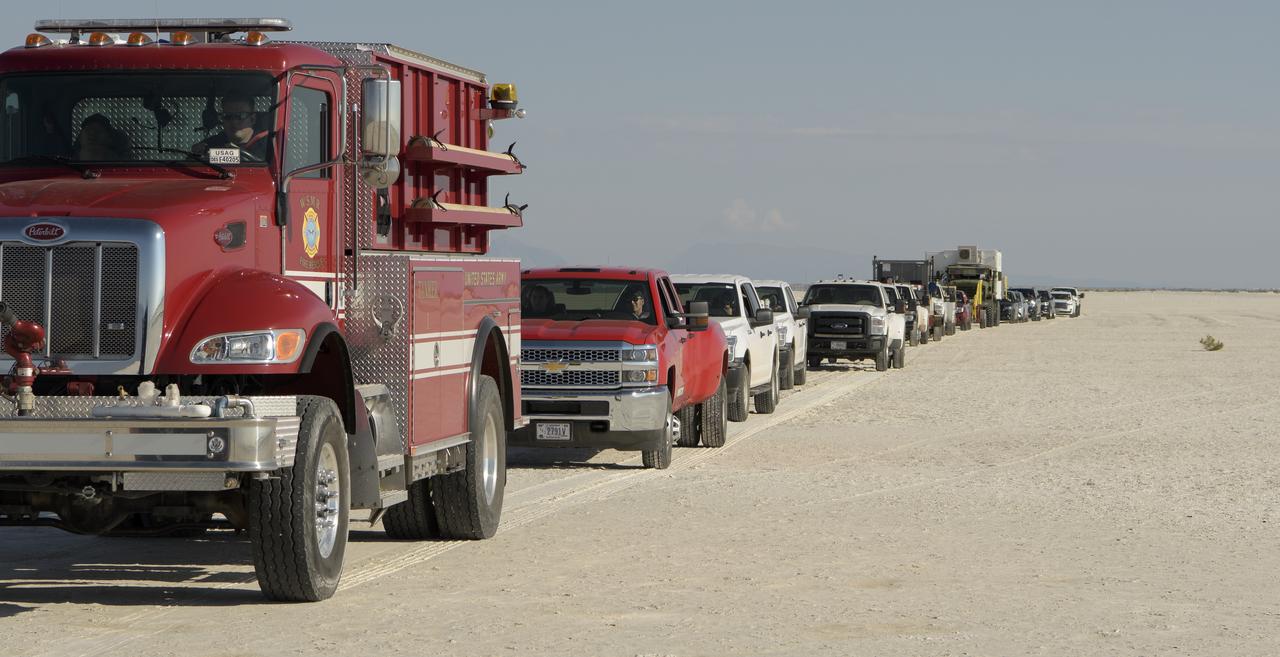
Teams from NASA, Boeing and the White Sands Missile Range, rehearse landing and crew extraction from Boeing’s CST-100 Starliner, which will be used to carry humans to the International Space Station, on Tuesday, Sept. 10, 2019 at the White Sands Missile Range outside Las Cruces, New Mexico. Using a convoy of vehicles Boeing uses to recover their spacecraft after landing and a boiler plate test article of the Starliner capsule, the teams worked through the steps necessary to safe the vehicle and get future crew members out of the Starliner to return home. NASA astronauts Mike Fincke and Nicole Mann and Boeing astronaut Chris Ferguson will fly to the space station aboard the Starliner for the Boeing Crew Flight Test mission. Photo Credit: (NASA/Bill Ingalls)
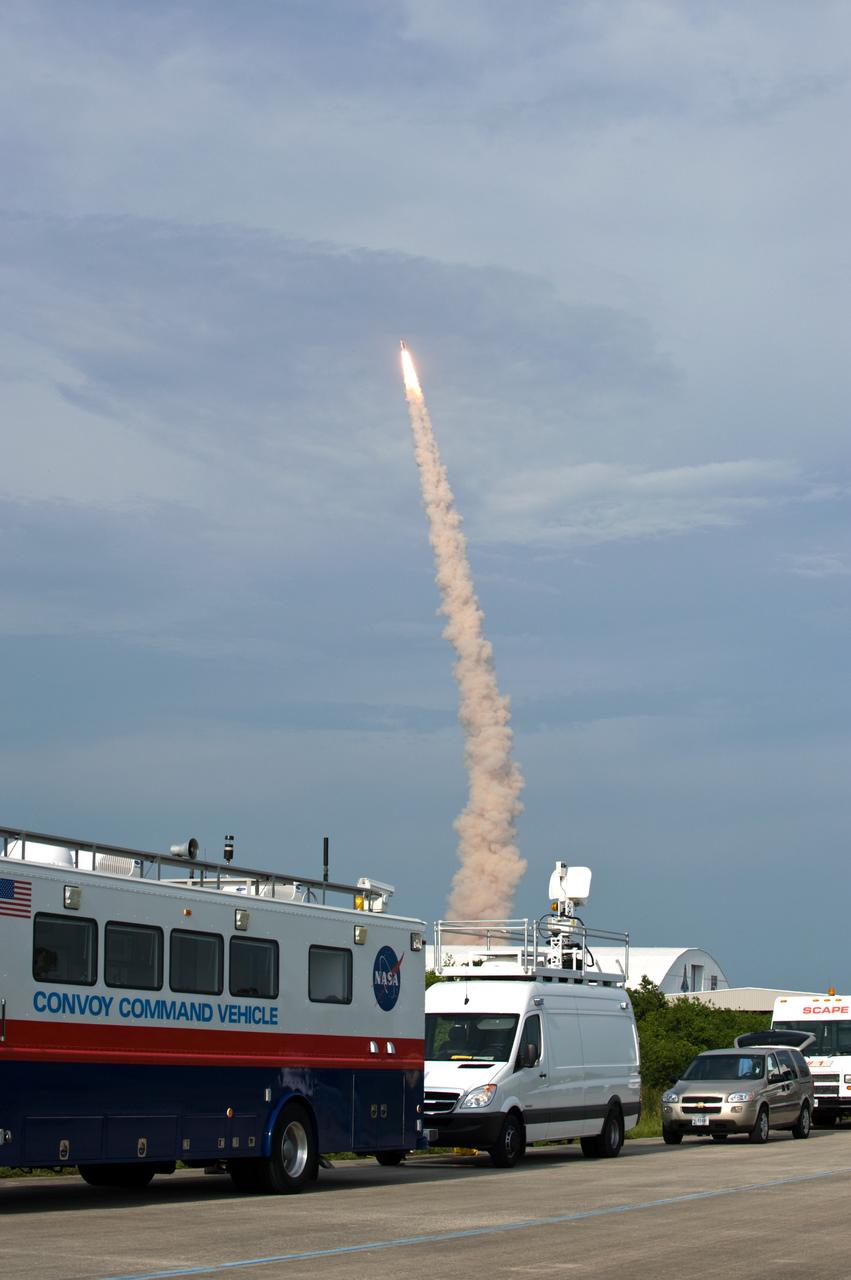
CAPE CANAVERAL, Fla. – Space shuttle Endeavour soars into the sky on the STS-127 mission from NASA Kennedy Space Center as convoy command and SCAPE vehicles are in position at the Shuttle Landing Facility in the event a return-to-landing-site is needed. Liftoff was on-time at 6:03 p.m. EDT. This was the sixth launch attempt for the STS-127 mission. The launch was scrubbed on June 13 and June 17 when a hydrogen gas leak occurred during tanking due to a misaligned Ground Umbilical Carrier Plate. The mission was postponed July 11, 12 and 13 due to weather conditions near the Shuttle Landing Facility at Kennedy that violated rules for launching, and lightning issues. Endeavour will deliver the Japanese Experiment Module's Exposed Facility and the Experiment Logistics Module-Exposed Section in the final of three flights dedicated to the assembly of the Japan Aerospace Exploration Agency's Kibo laboratory complex on the International Space Station. Photo credit: NASA/Carl Winebarger
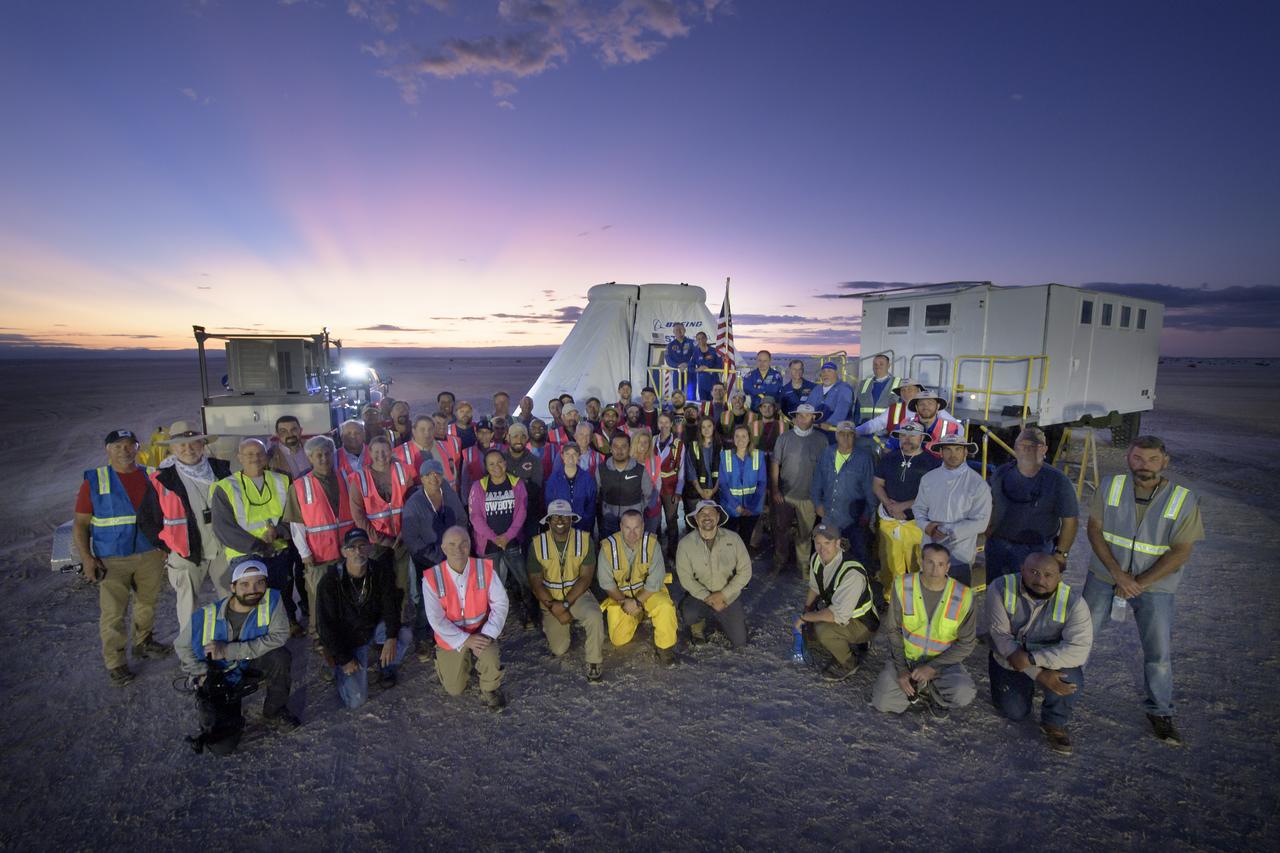
Teams from NASA, Boeing and the White Sands Missile Range, pose for a group photograph during rehearsals for landing and crew extraction from Boeing’s CST-100 Starliner, which will be used to carry humans to the International Space Station, on Wednesday, Sept. 11, 2019 at the White Sands Missile Range outside Las Cruces, New Mexico. Using a convoy of vehicles Boeing uses to recover their spacecraft after landing and a boiler plate test article of the Starliner capsule, the teams worked through the steps necessary to safe the vehicle and get future crew members out of the Starliner to return home. NASA astronauts Mike Fincke and Nicole Mann and Boeing astronaut Chris Ferguson will fly to the space station aboard the Starliner for the Boeing Crew Flight Test mission. Photo Credit: (NASA/Bill Ingalls)
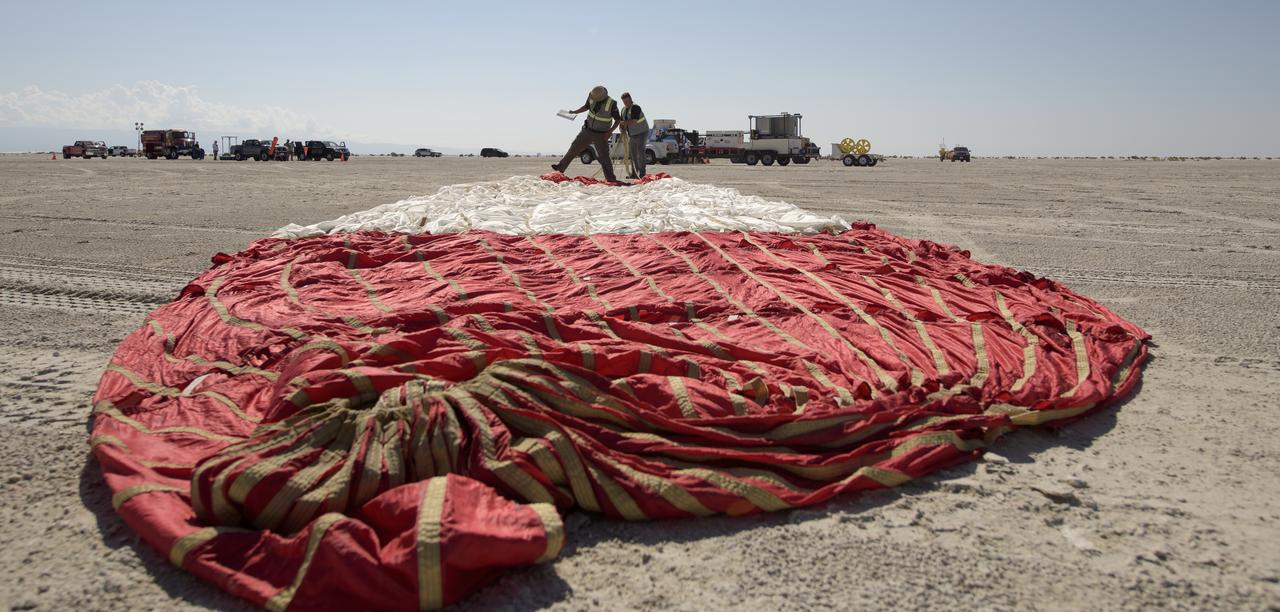
Teams from NASA, Boeing and the White Sands Missile Range, rehearse landing and crew extraction from Boeing’s CST-100 Starliner, which will be used to carry humans to the International Space Station, on Tuesday, Sept. 10, 2019 at the White Sands Missile Range outside Las Cruces, New Mexico. Using a convoy of vehicles Boeing uses to recover their spacecraft after landing and a boiler plate test article of the Starliner capsule, the teams worked through the steps necessary to safe the vehicle and get future crew members out of the Starliner to return home. NASA astronauts Mike Fincke and Nicole Mann and Boeing astronaut Chris Ferguson will fly to the space station aboard the Starliner for the Boeing Crew Flight Test mission. Photo Credit: (NASA/Bill Ingalls)
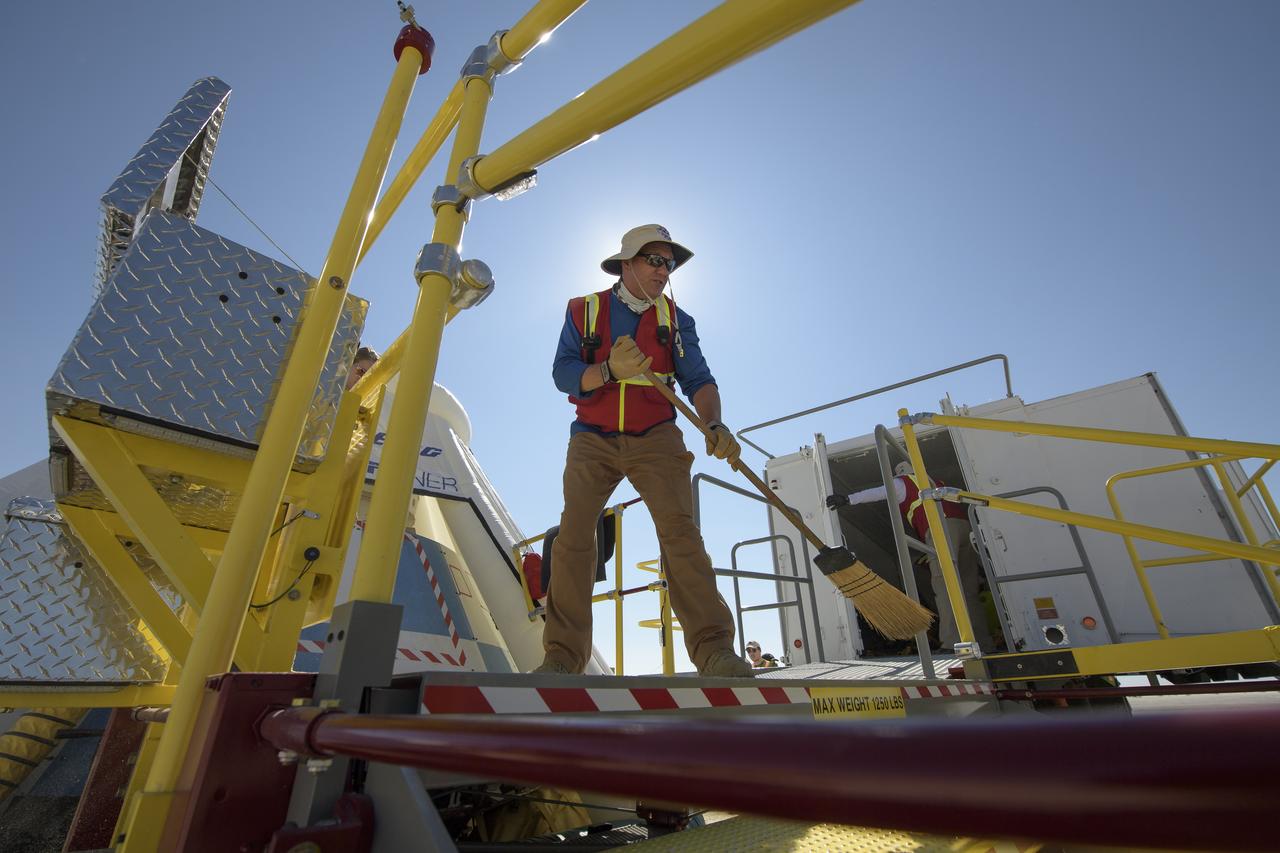
Teams from NASA, Boeing and the White Sands Missile Range, rehearse landing and crew extraction from Boeing’s CST-100 Starliner, which will be used to carry humans to the International Space Station, on Tuesday, Sept. 10, 2019 at the White Sands Missile Range outside Las Cruces, New Mexico. Using a convoy of vehicles Boeing uses to recover their spacecraft after landing and a boiler plate test article of the Starliner capsule, the teams worked through the steps necessary to safe the vehicle and get future crew members out of the Starliner to return home. NASA astronauts Mike Fincke and Nicole Mann and Boeing astronaut Chris Ferguson will fly to the space station aboard the Starliner for the Boeing Crew Flight Test mission. Photo Credit: (NASA/Bill Ingalls)
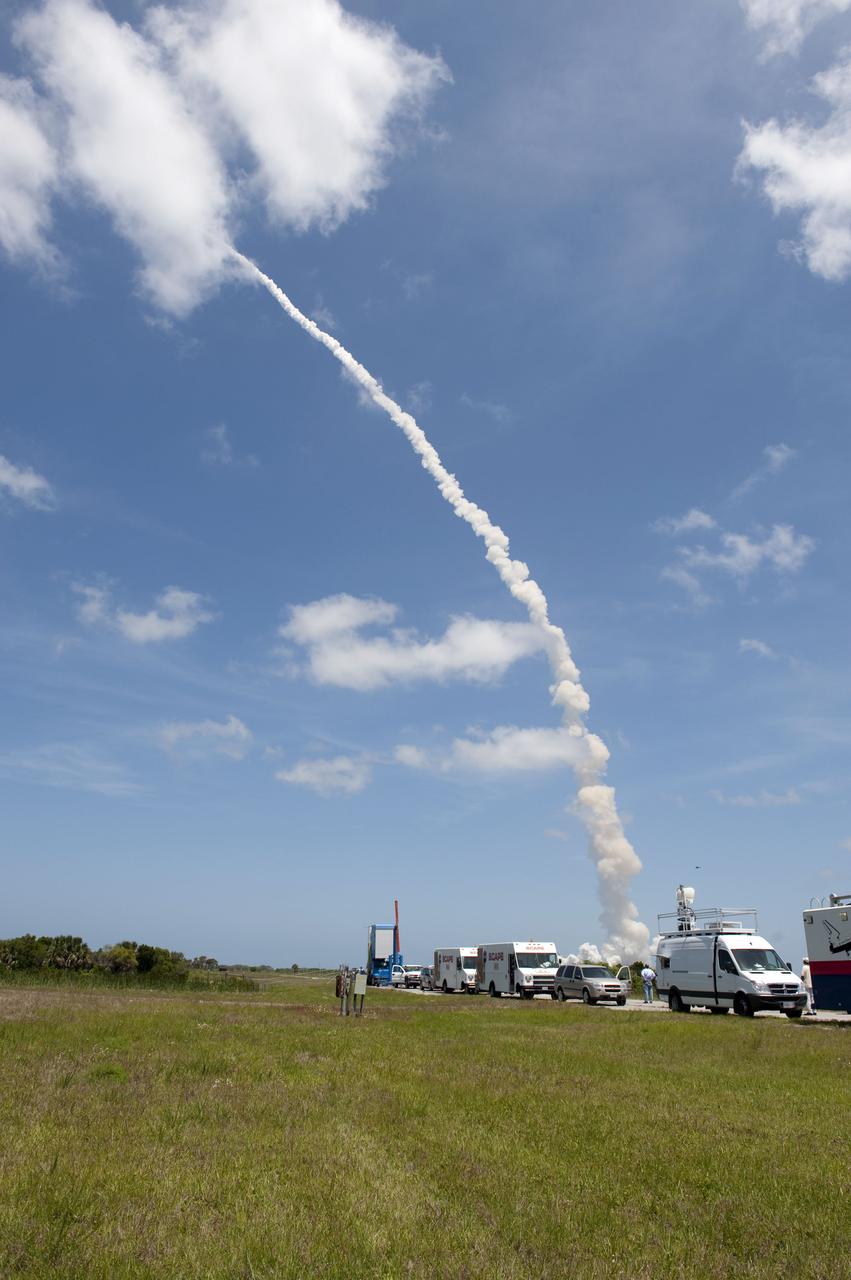
STS132-S-070 (14 May 2010) --- Convoy vehicles are standing by at the Shuttle Landing Facility at NASA's Kennedy Space Center in the event a Return-to-Launch-Site abort should be necessary following the launch of space shuttle Atlantis to the International Space Station. Liftoff from Launch Pad 39A occurred right on time at 2:20 p.m. EDT on May 14. Atlantis' primary payload for the STS-132 mission is the Russian-built Mini Research Module-1, which will provide additional storage space and a new docking port for Russian Soyuz and Progress spacecraft aboard the International Space Station. STS-132 is the 132nd shuttle flight, the 32nd for Atlantis and the 34th shuttle mission dedicated to station assembly and maintenance. For more information on the STS-132 mission objectives, payload and crew, visit www.nasa.gov/mission_pages/shuttle/shuttlemissions/sts132/index.html. Photo credit: NASA/Carl Winebarger
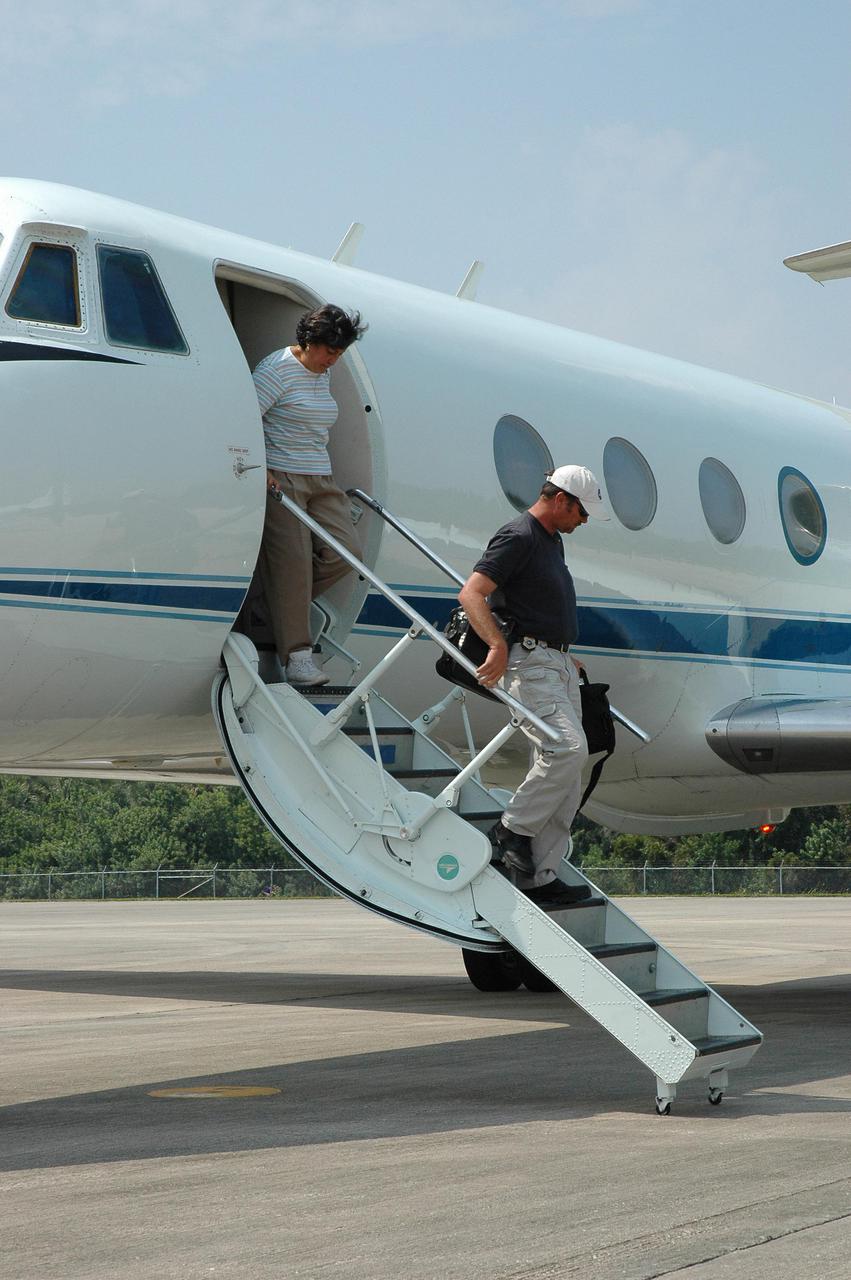
KENNEDY SPACE CENTER, FLA. - Dr. Violette Wahba Salib (left) and Ron Storey, a NASA Security agent, exit a NASA aircraft after its return from Stennis Space Center in Mississippi. Salib is with Occupational Medicine at KSC. The two were part of a volunteer team helping rescue and recovery efforts at Stennis, which was damaged during Hurricane Katrina. Many employees of Stennis and Michoud Assembly Facility, near New Orleans, were rendered homeless by the hurricane. NASA centers have been generous with relief supplies and personnel. Stennis is now in limited operations mode. Daily convoys have been moving between Stennis and Michoud, transporting personnel and supplies as Michoud prepares to resume limited operations.
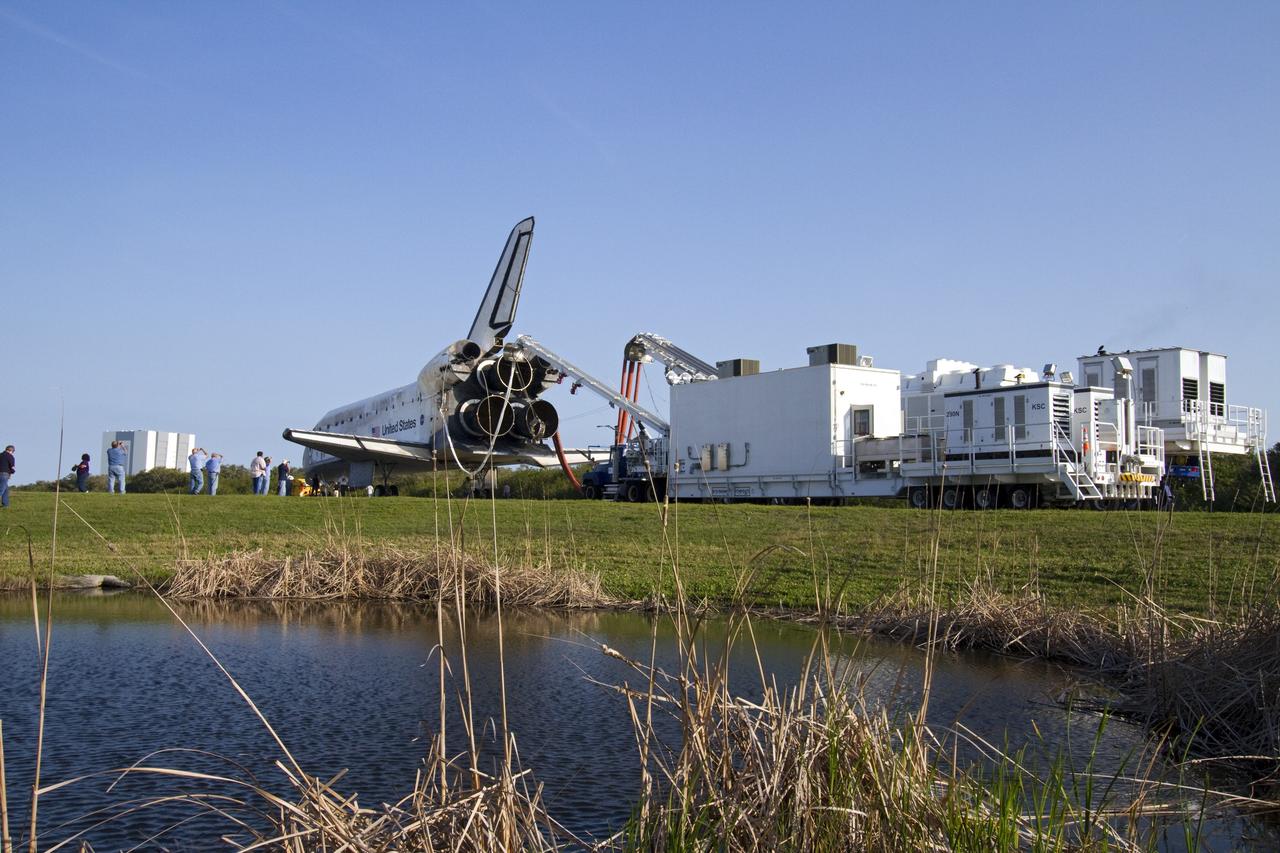
CAPE CANAVERAL, Fla. - Photographers are in position beside the towway to capture space shuttle Discovery and the landing convoy on its slow trip from the Shuttle Landing Facility to Orbiter Processing Facility-2 at NASA's Kennedy Space Center in Florida. A purge unit that pumps conditioned air into a shuttle after landing is connected to Discovery's aft end. In the background at left is the 525-foot-tall Vehicle Assembly Building. Discovery touched down on Runway 15 at 11:57 a.m., bringing an end to its 39th and final spaceflight mission, STS-133. Discovery and its six-member STS-133 crew delivered the Permanent Multipurpose Module, packed with supplies and critical spare parts, as well as Robonaut 2, the dexterous humanoid astronaut helper, to the International Space Station. Inside the processing facility, Discovery will be prepared for future public display. Photo credit: NASA/Jack Pfaller
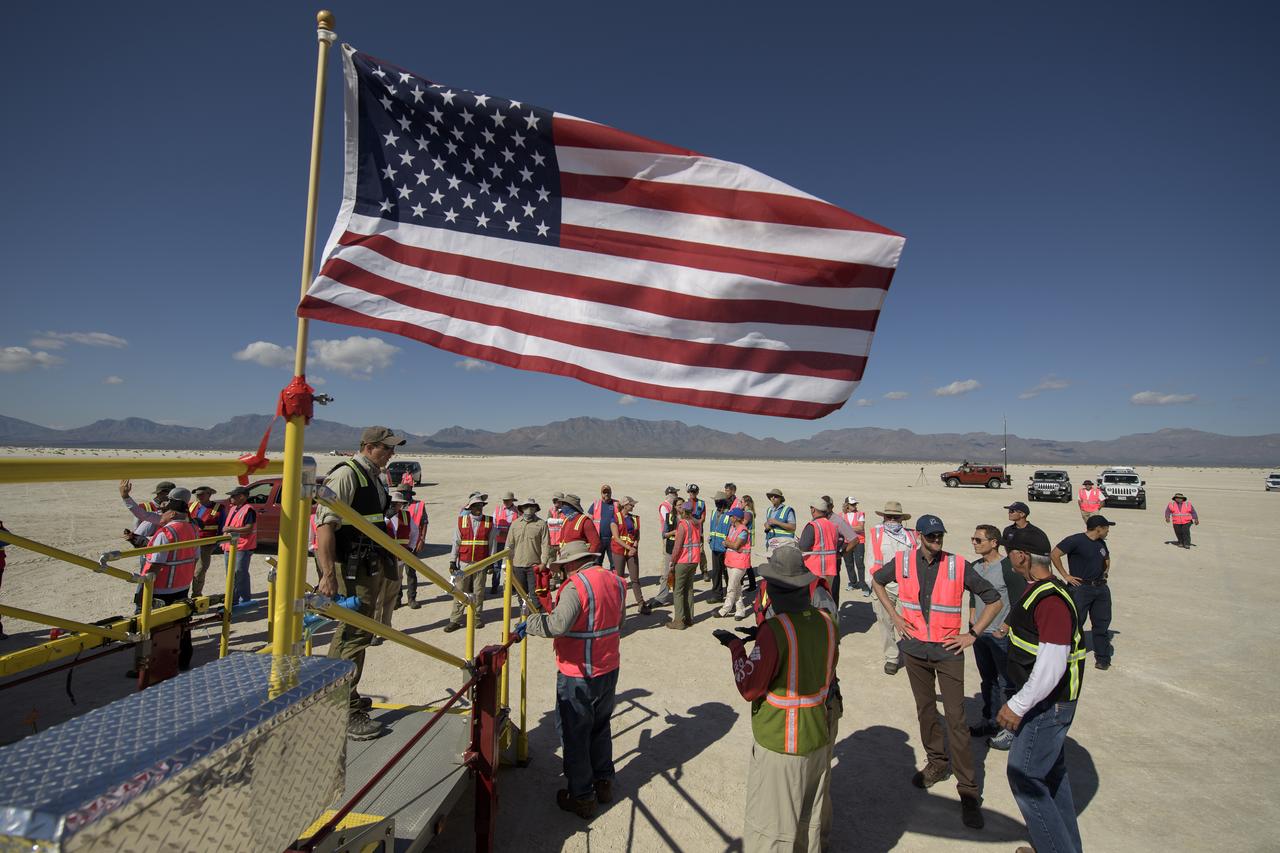
Teams from NASA, Boeing and the White Sands Missile Range, rehearse landing and crew extraction from Boeing’s CST-100 Starliner, which will be used to carry humans to the International Space Station, on Wednesday, Sept. 11, 2019 at the White Sands Missile Range outside Las Cruces, New Mexico. Using a convoy of vehicles Boeing uses to recover their spacecraft after landing and a boiler plate test article of the Starliner capsule, the teams worked through the steps necessary to safe the vehicle and get future crew members out of the Starliner to return home. NASA astronauts Mike Fincke and Nicole Mann and Boeing astronaut Chris Ferguson will fly to the space station aboard the Starliner for the Boeing Crew Flight Test mission. Photo Credit: (NASA/Bill Ingalls)
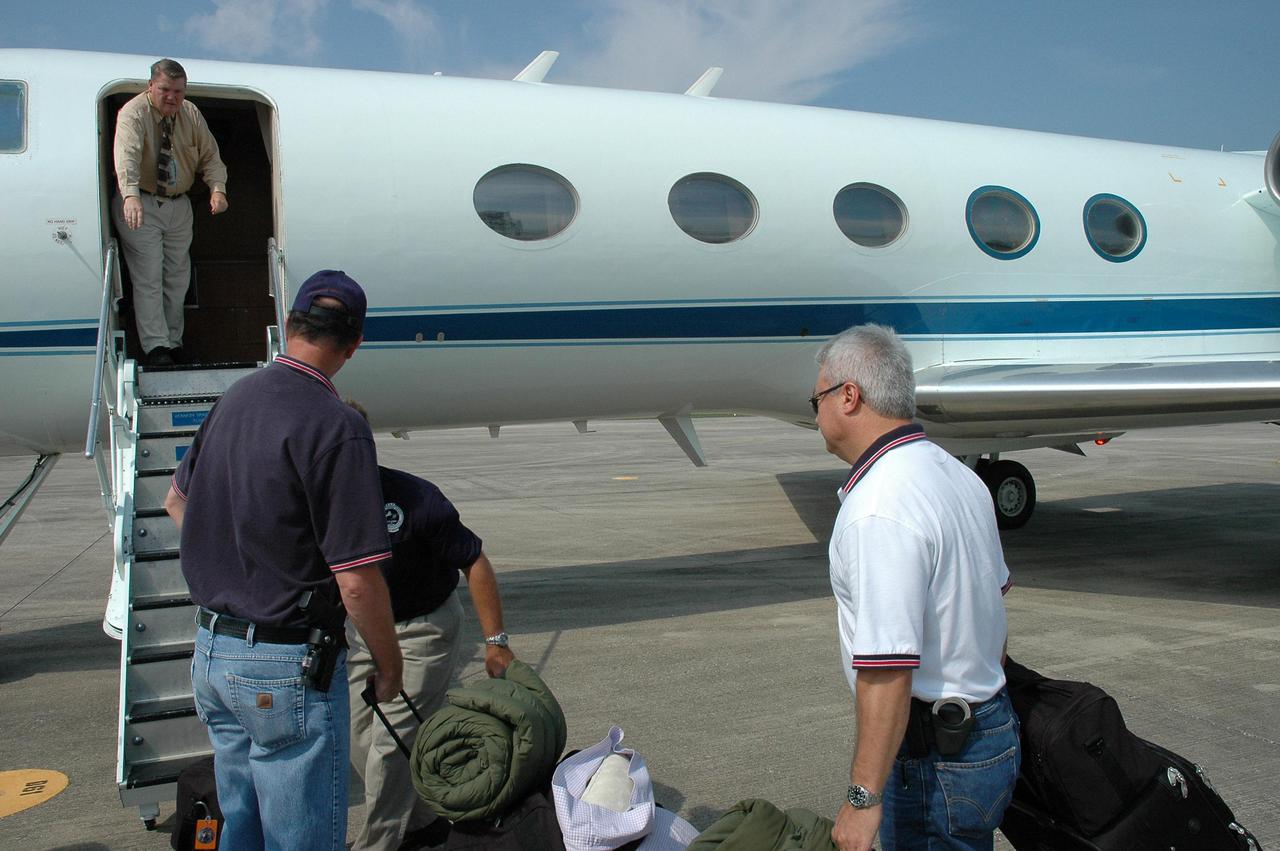
KENNEDY SPACE CENTER, FLA. - At the NASA Kennedy Space Center Shuttle Landing Facility, employees load hurricane relief supplies onto a NASA aircraft bound for Stennis Space Center in Mississippi, which suffered damage from Hurricane Katrina. The two men with backs to the camera are Security personnel going to Stennis to relieve others who have been helping at the center. The supplies included 10 boxes of load bus disconnects going to Michoud Assesmbly Facility near New Orleans and 17 boxes of personal hygiene items, along with boxes of clothing and water. Many Stennis and Michoud employees were rendered homeless by the hurricane. NASA centers have been generous with relief supplies and personnel. Stennis is in limited operations mode. Daily convoys have been moving between Stennis and Michould, transporting personnel and supplies as Michoud prepares to resume limited operations.
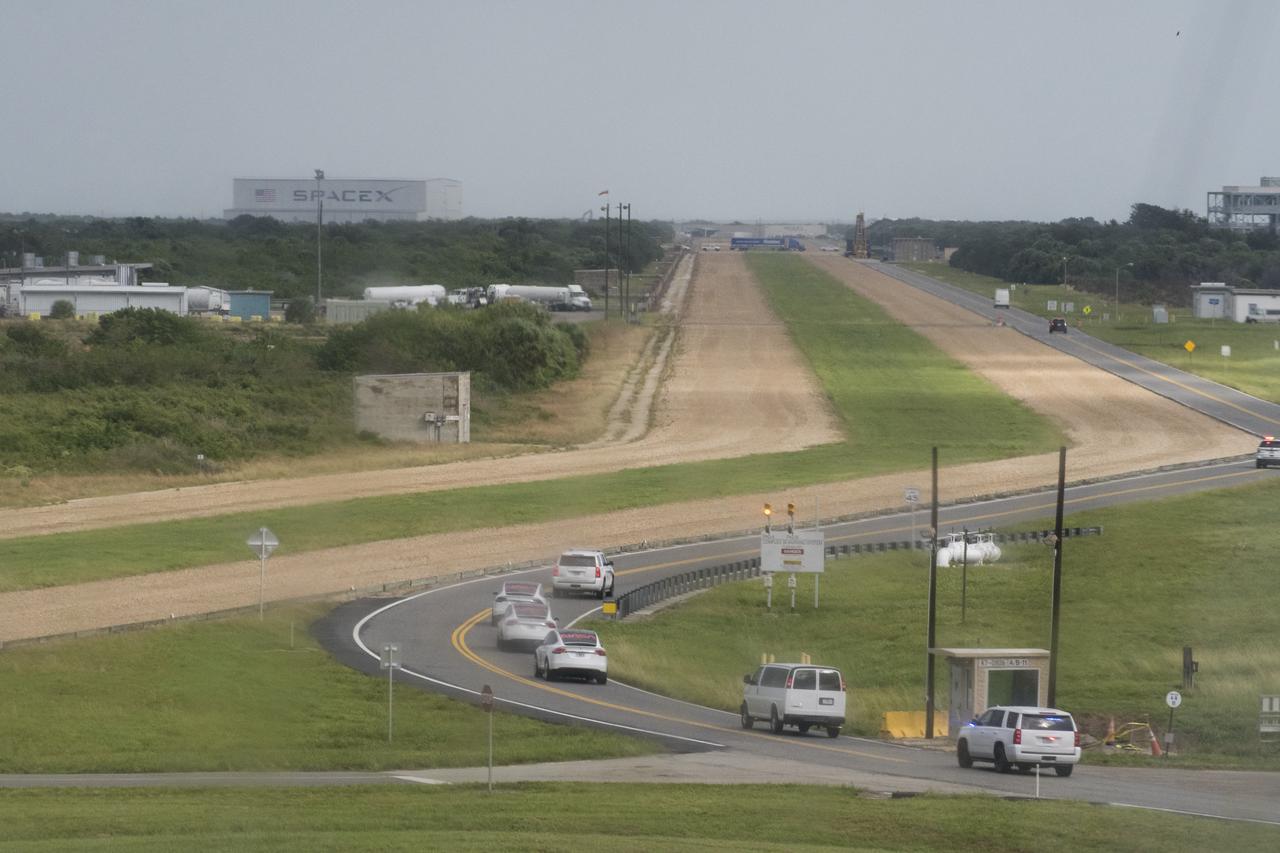
The convoy carrying NASA astronauts Mike Hopkins, Victor Glover, Shannon Walker, and Japan Aerospace Exploration Agency (JAXA) astronaut Soichi Noguchi are seen through the rain soaked windows of firing room four as it makes its way to Launch Complex 39A during a dress rehearsal in preparation for the launch of a SpaceX Falcon 9 rocket carrying the company's Crew Dragon spacecraft on NASA’s SpaceX Crew-1 mission, Thursday, Nov. 12, 2020, in the Launch Control Center at NASA’s Kennedy Space Center in Florida. NASA’s SpaceX Crew-1 mission is the first crew rotation mission of the SpaceX Crew Dragon spacecraft and Falcon 9 rocket to the International Space Station as part of the agency’s Commercial Crew Program. Hopkins, Glover, Walker, and Noguchi are scheduled to launch at 7:49 p.m. EST on Saturday, Nov. 14, from Launch Complex 39A at the Kennedy Space Center. Photo Credit: (NASA/Aubrey Gemignani)