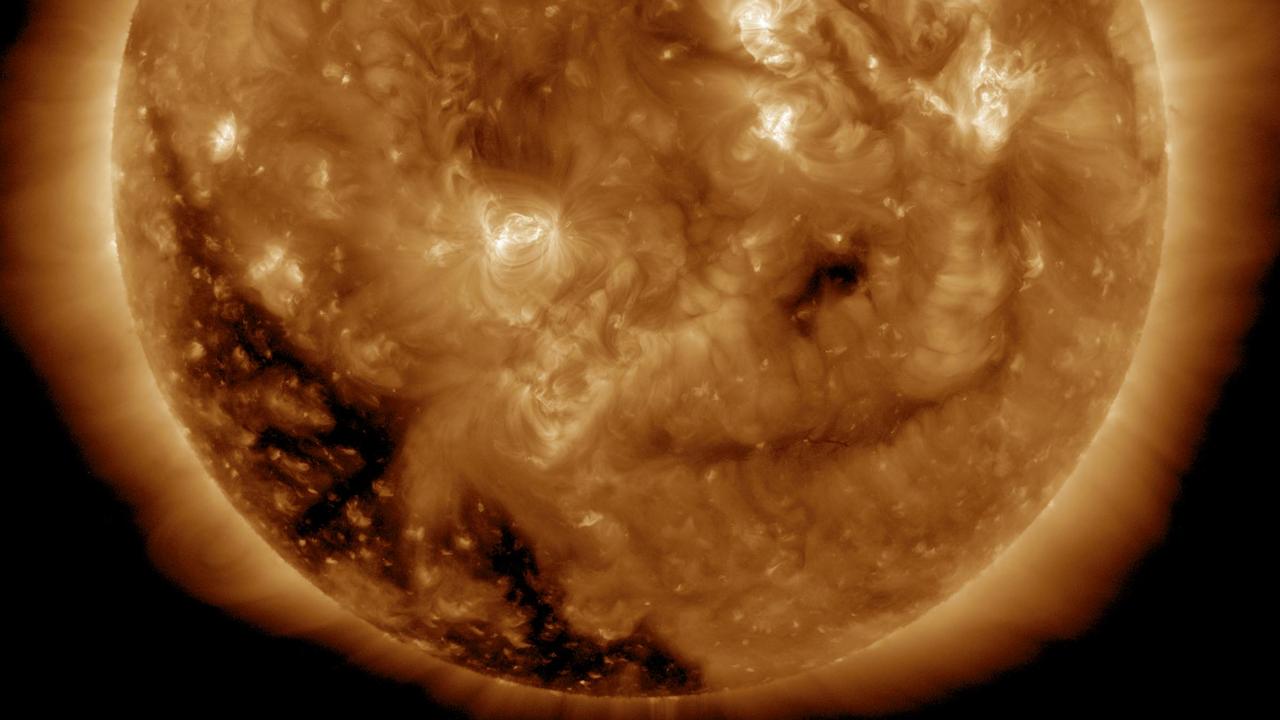
A substantial coronal hole began to rotate into view over the past few days (Dec. 1-2, 2016). Coronal holes are magnetically open areas of the sun's magnetic field structure that spew streams of high speed solar wind into space. In about a week or so that coronal hole might send streams of particles in the direction of Earth. Often times these streams can interact with Earth's magnetosphere and generate aurora. The images were taken in a wavelength of extreme ultraviolet light. Movies are available at http://photojournal.jpl.nasa.gov/catalog/PIA21208
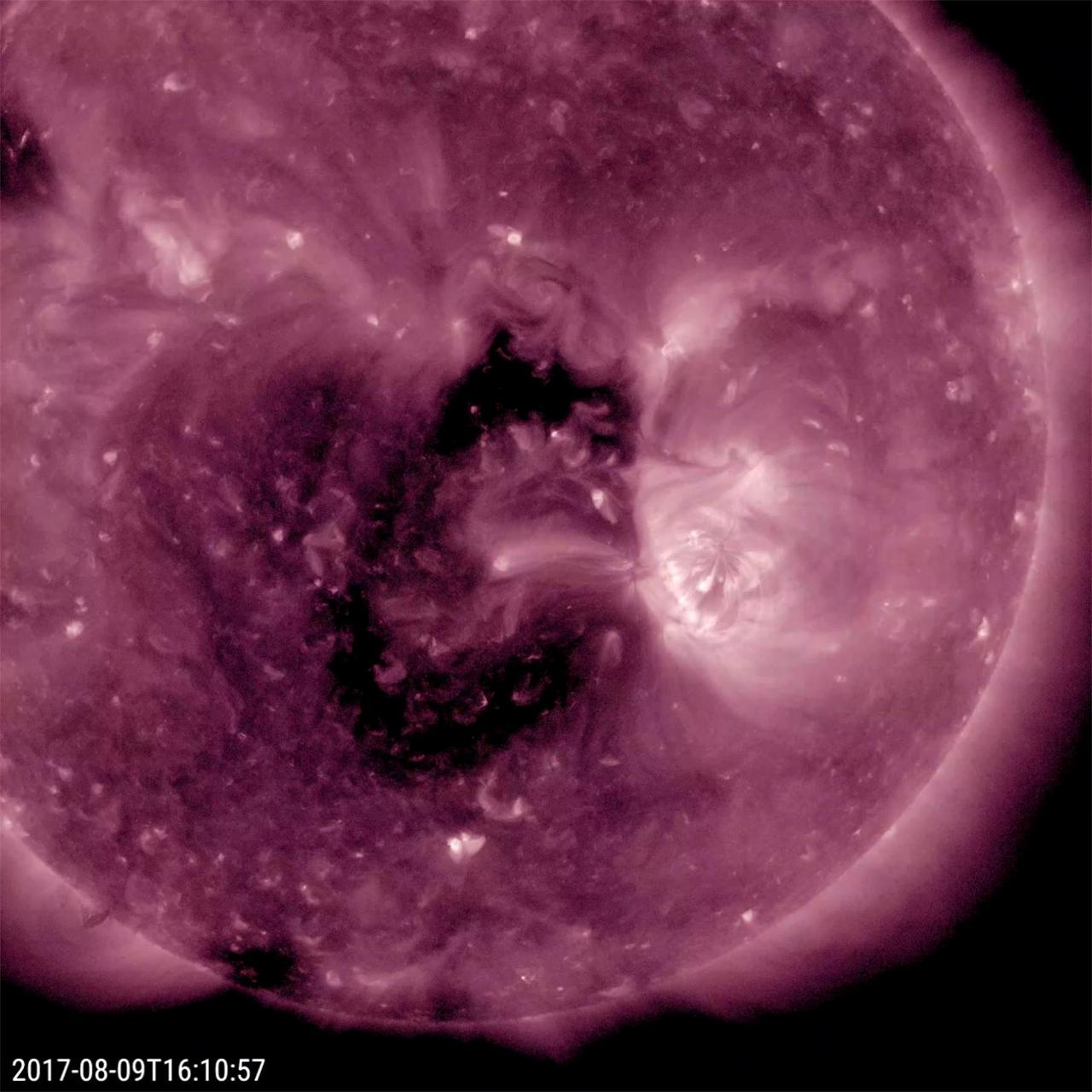
A substantial coronal hole rotated into a position where it is facing Earth (Aug. 9-11, 2017). Coronal holes are areas of open magnetic field that spew out charged particles as solar wind that spreads into space. If that solar wind interacts with our own magnetosphere it can generate aurora. In this view of the sun in extreme ultraviolet light, the coronal hole appears as the dark stretch near the center of the sun. It was the most distinctive feature on the sun over the past week. Movies are available at https://photojournal.jpl.nasa.gov/catalog/PIA21874
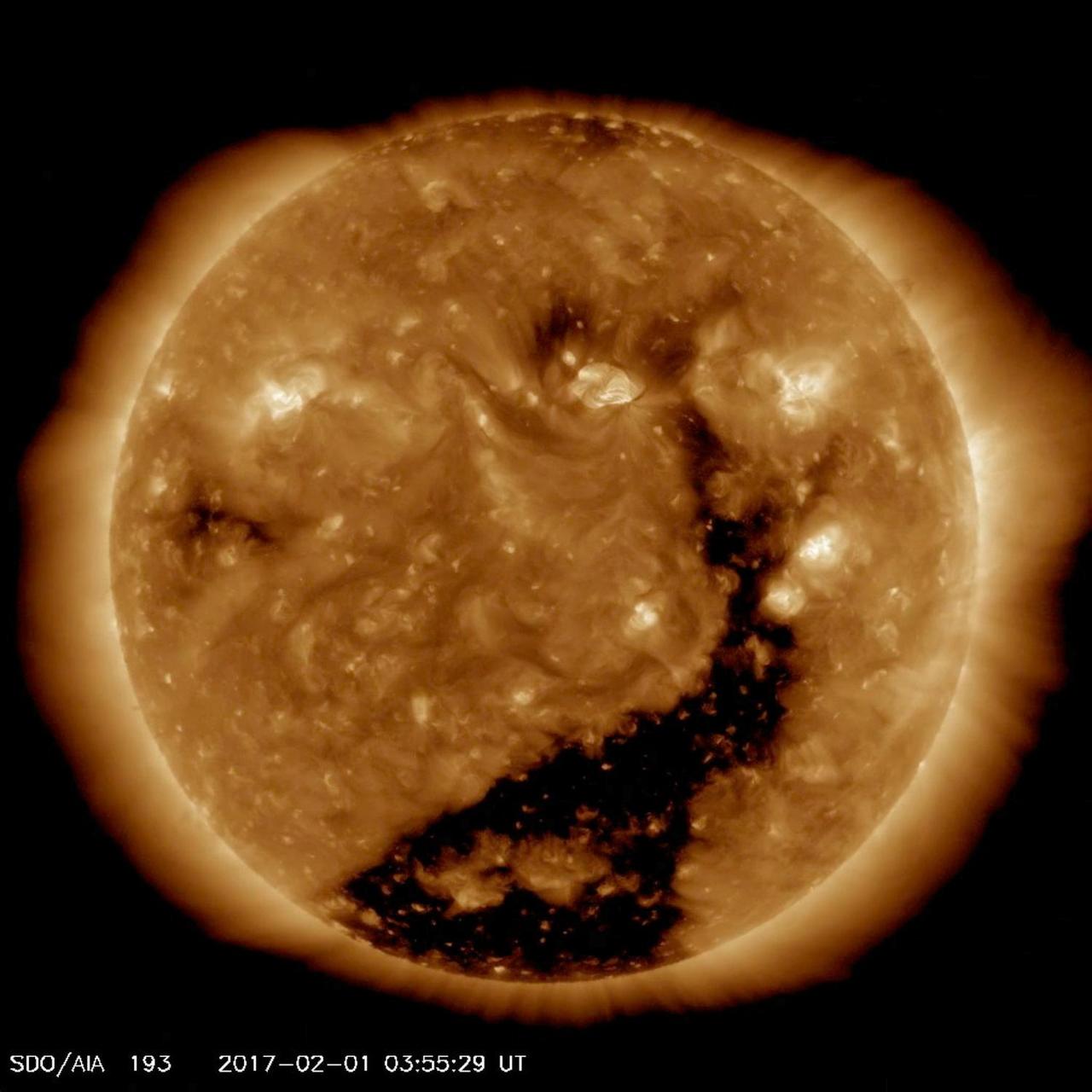
A substantial coronal hole rotated across the face of the sun this past week and is again streaming solar wind towards Earth (Jan. 30 - Feb. 2, 2017). This same coronal hole was facing Earth about a month ago and has rotated into a similar position again. Coronal holes are areas of open magnetic field from which solar wind particles stream into space. In this wavelength of extreme ultraviolet light it appears as a dark area near the center and lower portion of the sun. Movies are available at http://photojournal.jpl.nasa.gov/catalog/PIA11177
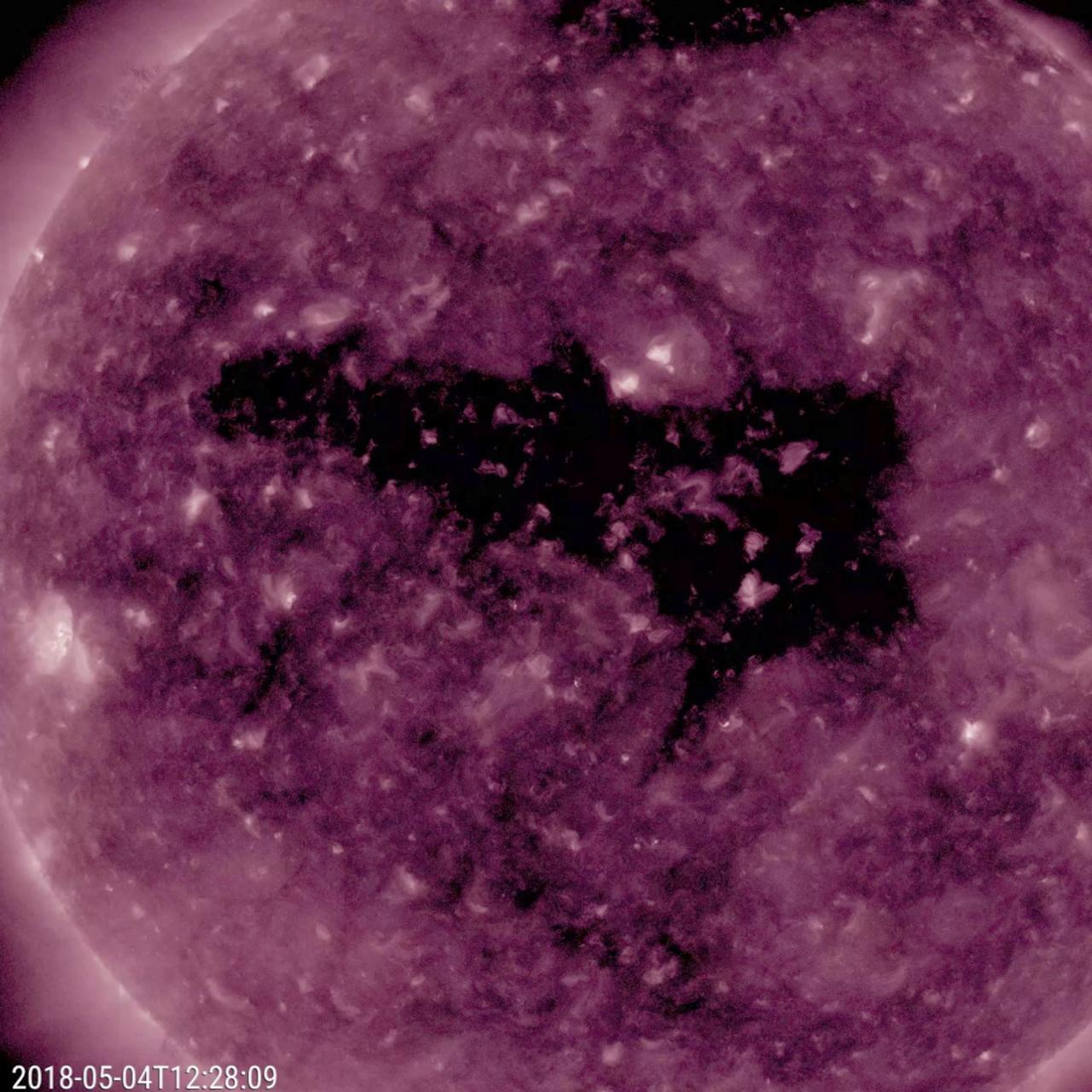
An extensive equatorial coronal hole has rotated so that it is now facing Earth (May 2-4, 2018). The dark coronal hole extends about halfway across the solar disk. It was observed in a wavelength of extreme ultraviolet light. This magnetically open area is streaming solar wind (i.e., a stream of charged particles released from the sun) into space. When Earth enters a solar wind stream and the stream interacts with our magnetosphere, we often experience nice displays of aurora. Videos are available at https://photojournal.jpl.nasa.gov/catalog/PIA00624

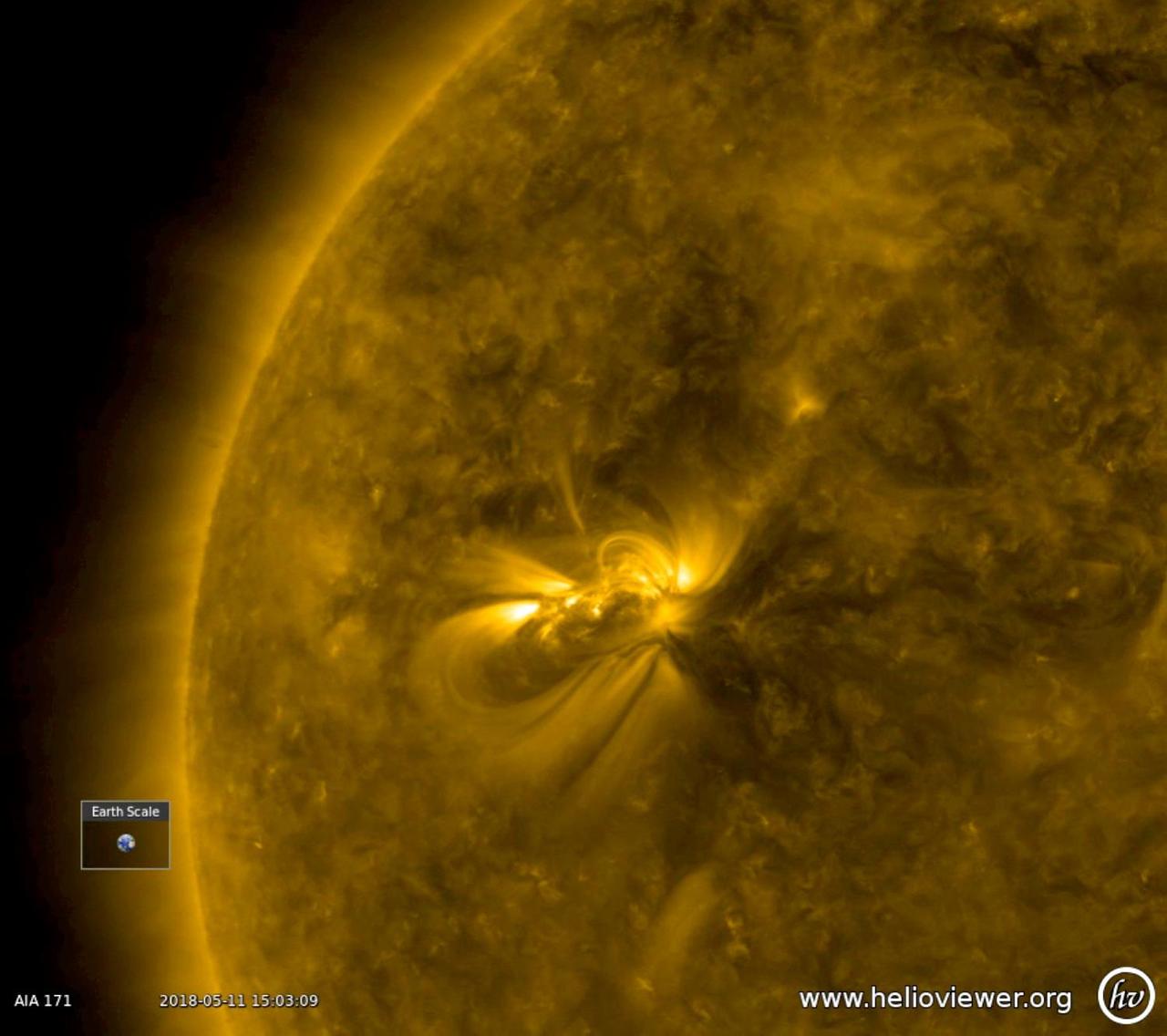
Over the past week, the single, largest feature on the sun was a long coronal hole that stretched out across more than half the diameter of the sun (Mar. 13-15, 2018). Coronal holes appear dark in certain wavelengths of extreme ultraviolet light like the one you see here. They are areas of open magnetic fields from which solar wind rushes out into space. This area likely generated the beautiful aurora that were reportedly observed on March 14th in regions near Earth's poles. With the Earth set in the image to show scale, you get a good sense of just how extensive this hole is. Movies are available at https://photojournal.jpl.nasa.gov/catalog/PIA22345
An extensive equatorial coronal hole has rotated so that it is now facing Earth (May 2-4, 2018). The dark coronal hole extends about halfway across the solar disk. It was observed in a wavelength of extreme ultraviolet light. This magnetically open area is streaming solar wind (i.e., a stream of charged particles released from the sun) into space. When Earth enters a solar wind stream and the stream interacts with our magnetosphere, we often experience nice displays of aurora. https://photojournal.jpl.nasa.gov/catalog/PIA00577

An elongated coronal hole rotated across the face of the sun this past week so that it is now streaming solar wind towards Earth (Jan. 2-5, 2017). Coronal holes are areas of open magnetic field from which solar wind particles stream into space. In this wavelength of extreme ultraviolet light it appears as a dark area near the center and lower portion of the sun. The particle stream will likely generate aurora here on Earth. Check spaceweather.com for updates on auroral activity. Movies are available at http://photojournal.jpl.nasa.gov/catalog/PIA14093
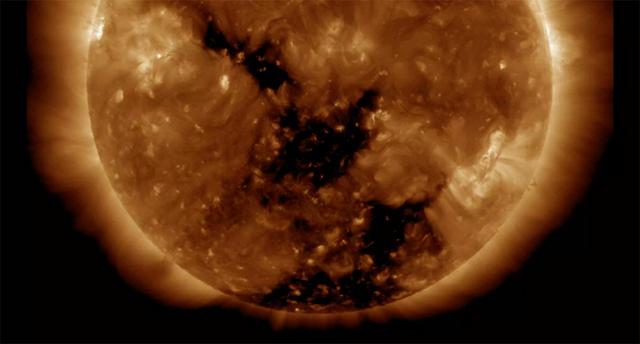
Two good-sized coronal holes have rotated around to the center of the sun where they will be spewing solar wind towards Earth (Nov. 8-9, 2016). Coronal holes are areas of open magnetic field from which solar wind particles stream into space. In this wavelength of extreme ultraviolet light they appear as the two dark areas at the center and lower portion of the sun. The stream of particles should reach Earth in a few days and are likely to generate aurora. Videos are available at http://photojournal.jpl.nasa.gov/catalog/PIA16909
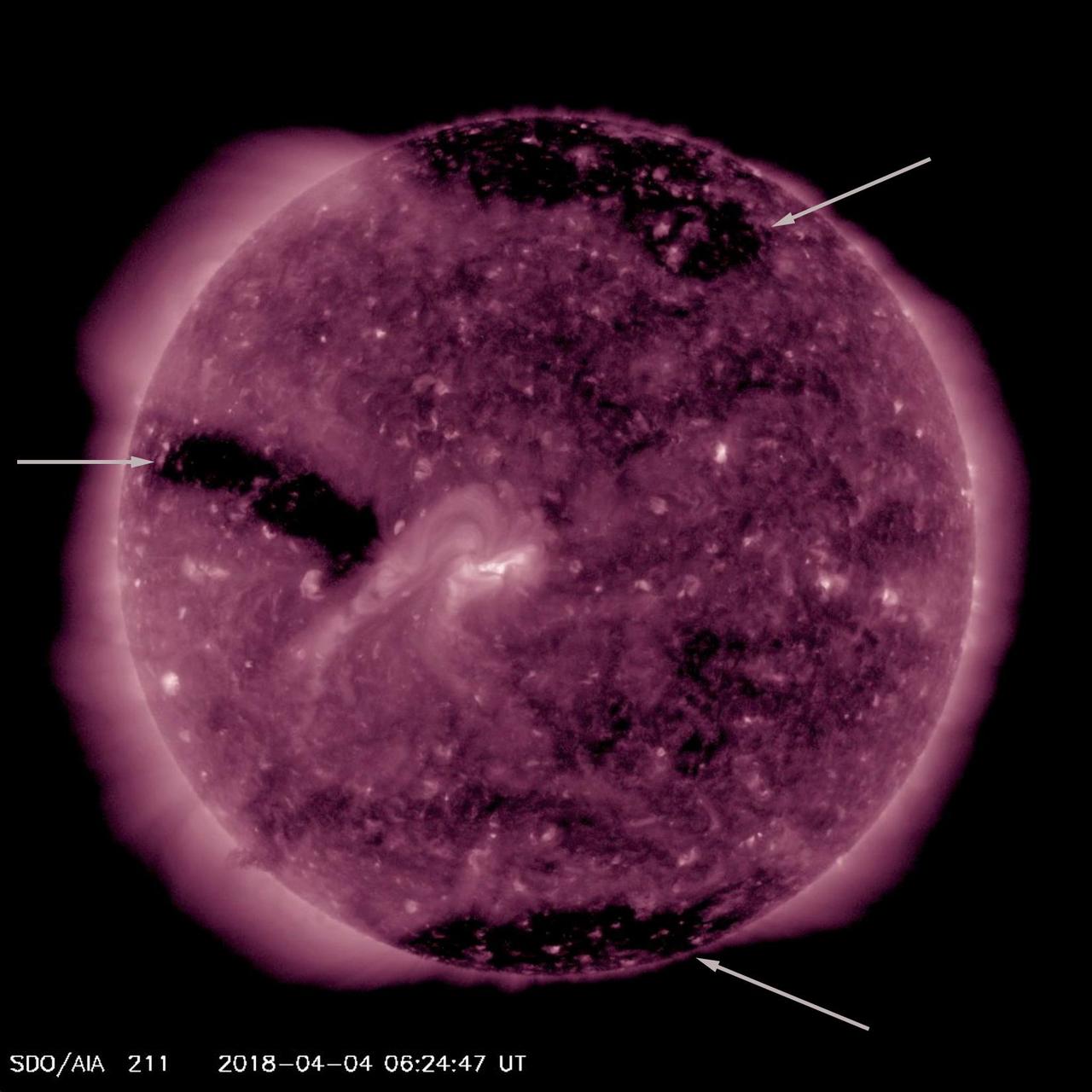
For much of this week the sun featured three substantial coronal holes (Apr. 3-6, 2018). Coronal holes appear as large dark areas which are identified with arrows in the still image. These are areas of open magnetic field from which high speed solar wind rushes out into space. This wind, if it interacts with Earth's magnetosphere, can cause aurora to appear near the poles. They are not at all uncommon. Animations are available at https://photojournal.jpl.nasa.gov/catalog/PIA22414

A large coronal hole has been spewing solar wind particles in the general direction of Earth over the past few days (Aug. 31- Sept. 1, 2017). It is the extensive dark area that stretches from the top of the sun and angles down to the right. Coronal holes are areas of open magnetic field, which allow charge particles to escape into space. They appear dark in certain wavelengths of extreme ultraviolet light such as shown here. These clouds of particles can cause aurora to appear, particularly in higher latitude regions. Movies are available at https://photojournal.jpl.nasa.gov/catalog/PIA21942
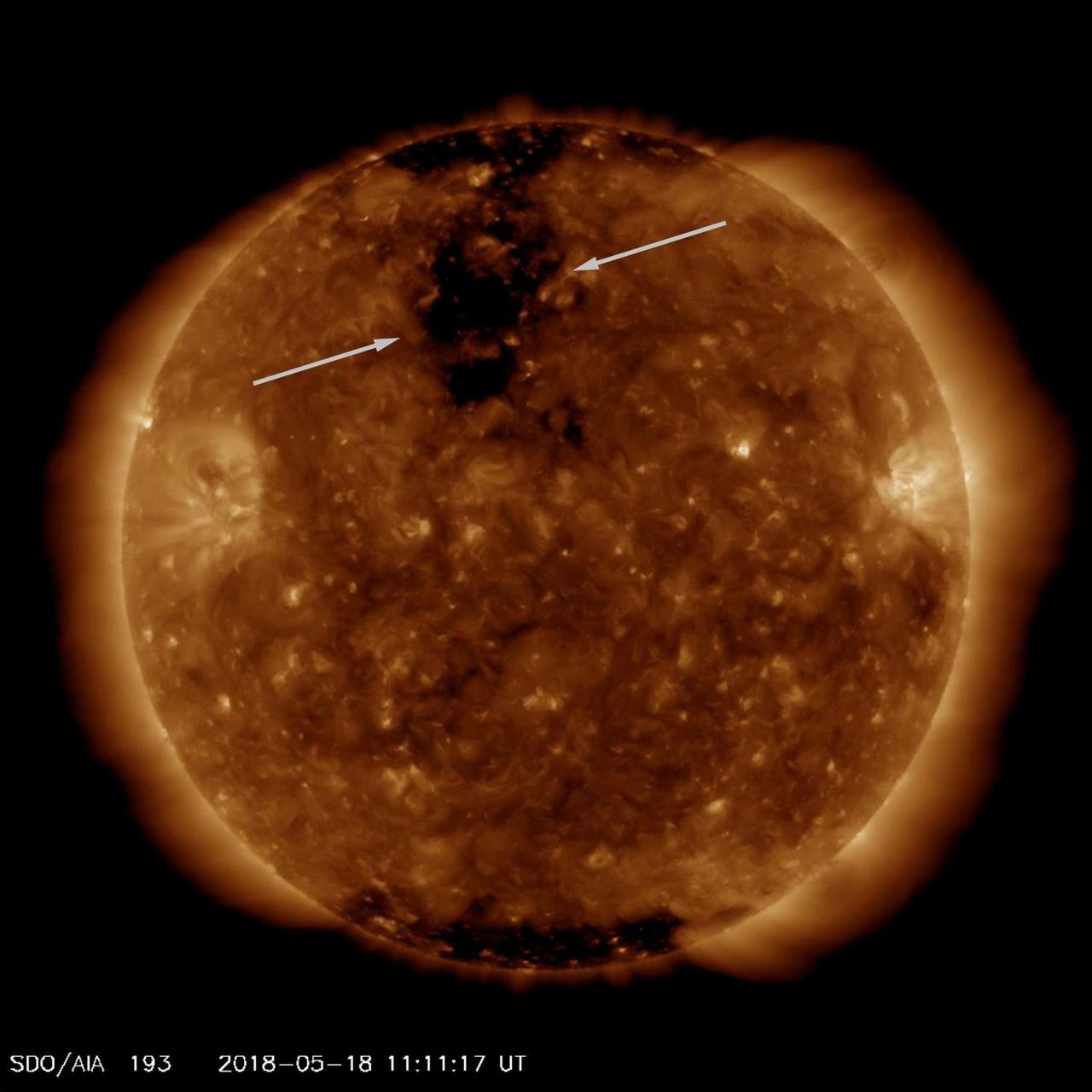
A good-sized coronal hole came around to where it is just about facing Earth (May 16-18, 2018). Coronal holes are areas of open magnetic field from which solar wind (consisting of charged particles) streams into space. The video clip covers two days and was taken in a wavelength of extreme ultraviolet light. Such streams of particles take several days to reach Earth, but they can generate aurora, particularly nearer the poles. An animation is available at https://photojournal.jpl.nasa.gov/catalog/PIA00575
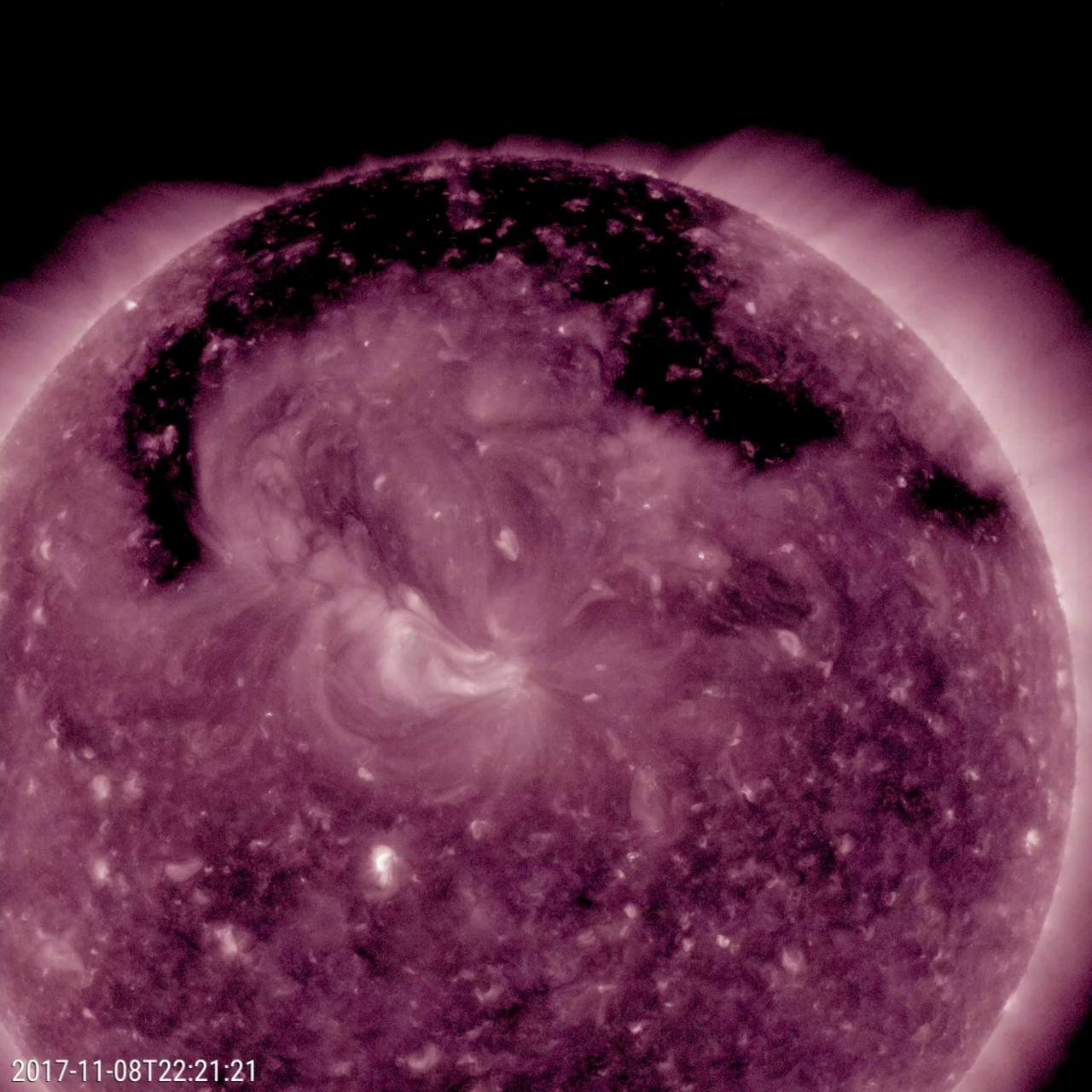
This image from NASA's Solar Dynamics Observatory shows a broad coronal hole was the dominant feature this week on the sun (Nov. 7-9, 2017). It was easily recognizable as the dark expanse across the top of the sun and extending down in each side. Coronal holes are magnetically open areas on the sun that allow high-speed solar wind to gush out into space. They always appear darker in extreme ultraviolet. This one was likely the source of bright aurora that shimmered for numerous observers, with some reaching down even to Nebraska. Movies are available at https://photojournal.jpl.nasa.gov/catalog/PIA22113
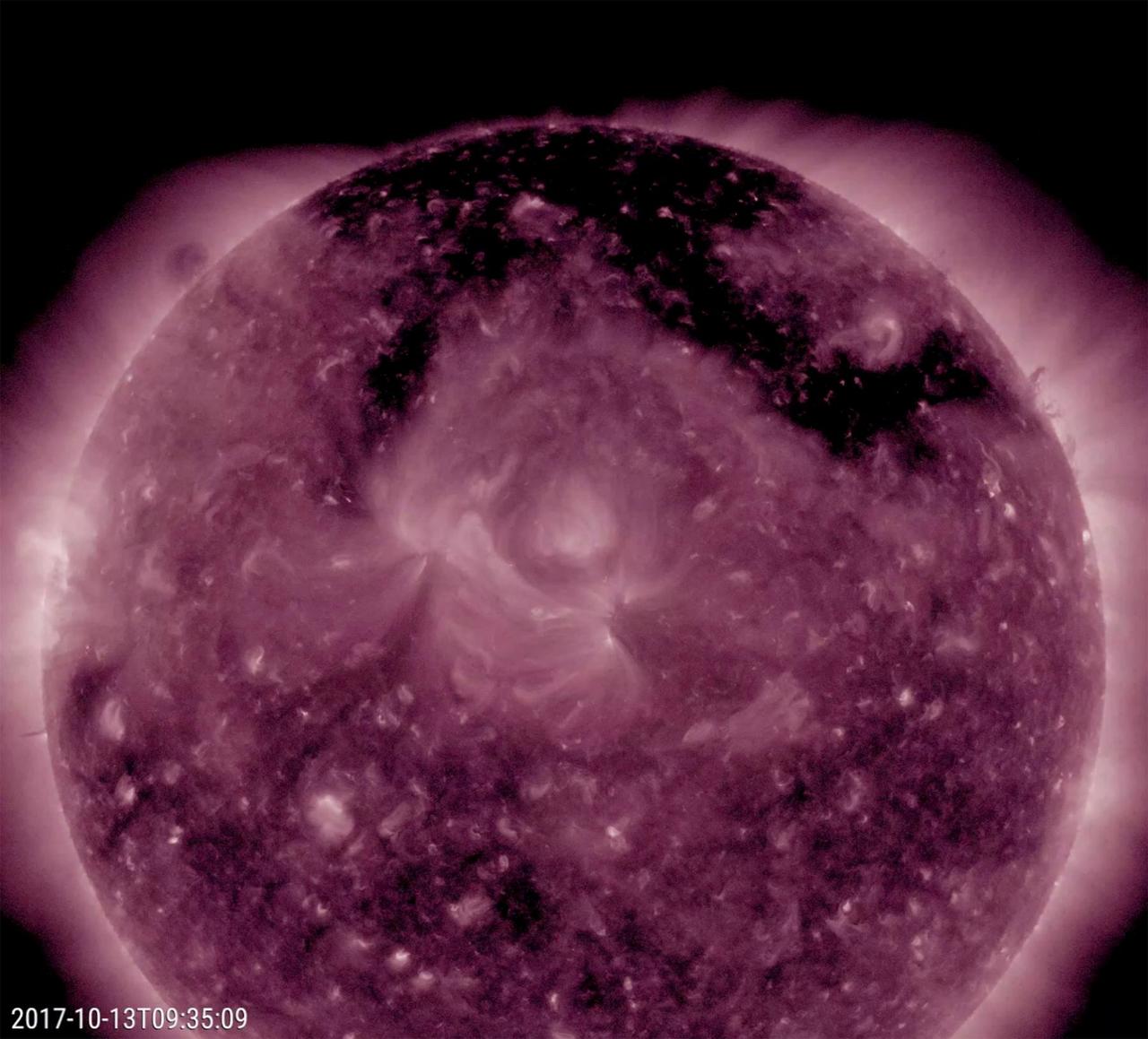
A large coronal hole stands out as the most obvious feature on the sun this week (Oct. 12-13, 2017). The dark structure, shaped kind of like the Pi symbol, spreads across much of the top of the sun. Though one cannot tell from this image and video clip in false-color extreme ultraviolet light, it is spewing high-speed solar wind particles into space and has been doing this all week. It is likely that these charged particles have been interacting with Earth's atmosphere and generating many aurora displays in regions near the poles the past several days. Animations are available at https://photojournal.jpl.nasa.gov/catalog/PIA22047
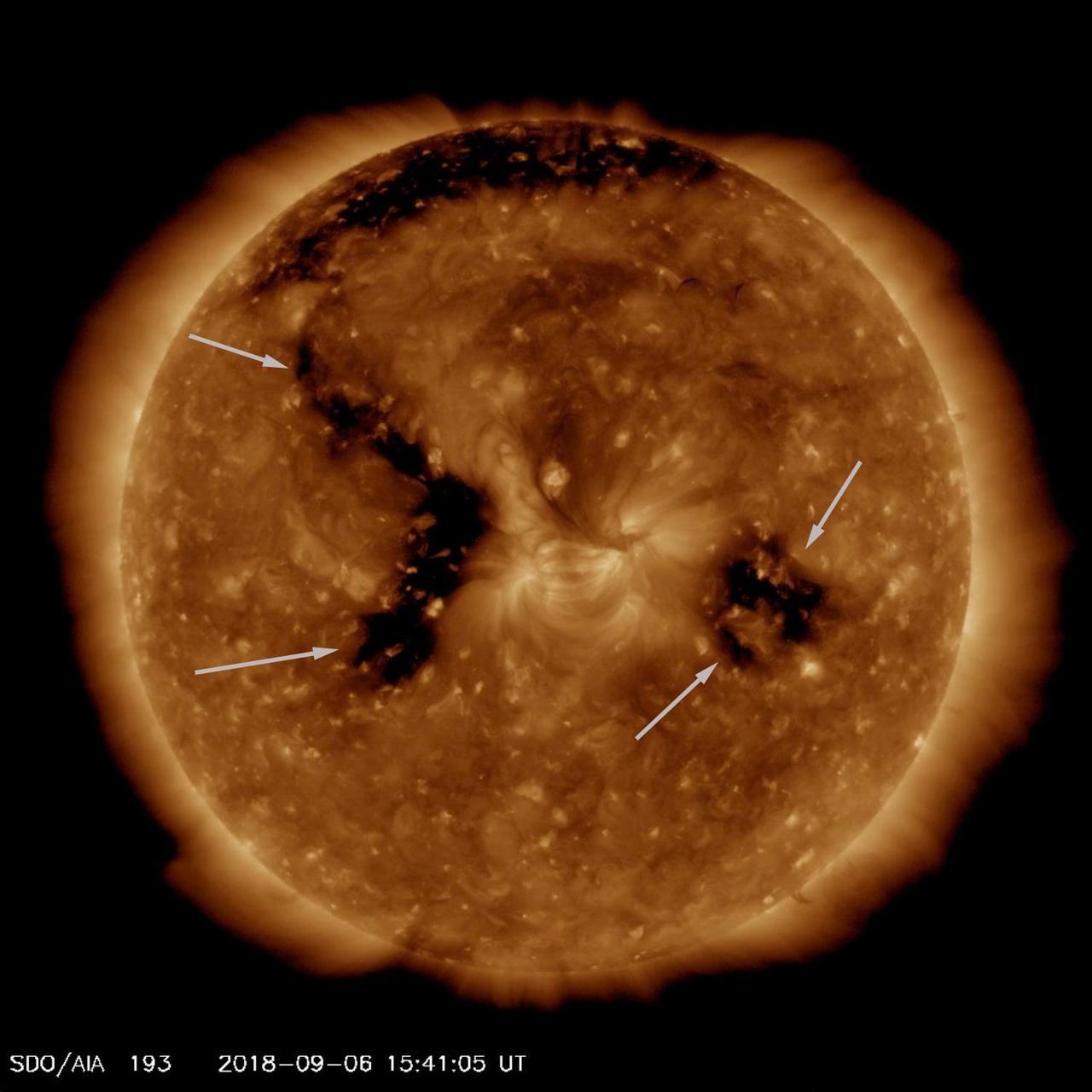
The Sun already featured one good-sized coronal hole, when another larger coronal hole began to emerge and intensify (Sept. 4-6, 2018). Coronal holes appear dark in extreme ultraviolet light, as is shown here. They are magnetically open areas from which solar wind streams out into space, and can last from days to months. The brighter area between the two coronal holes is an active region where the level of magnetic activity is strong. Movies are available at https://photojournal.jpl.nasa.gov/catalog/PIA22722
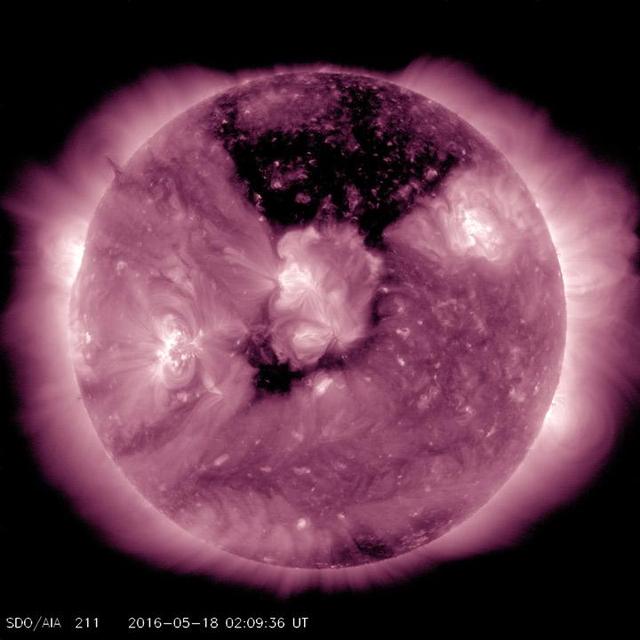
A substantial coronal hole had rotated so that it temporarily faced right towards Earth May, 17-19, 2016. This coronal hole area is the dark area at the top center of this image from NASA Solar Dynamics Observatory.
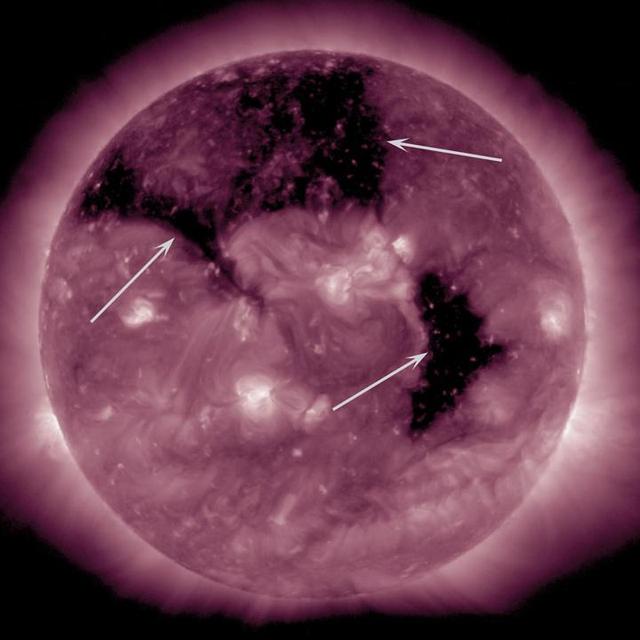
Three substantial coronal holes rotated across the face of the Sun the week of Sept. 8-10, 2015 as seen by NASA Solar Dynamics Observatory. Coronal holes are areas where the Sun magnetic field is open and a source of streaming solar wind. They appear darker in extreme ultraviolet light because there is less material in the hole areas being imaged in this specific wavelength of light. It is a little unusual to have three coronal holes at the same time, but neither is it a rare occurrence. http://photojournal.jpl.nasa.gov/catalog/PIA19950
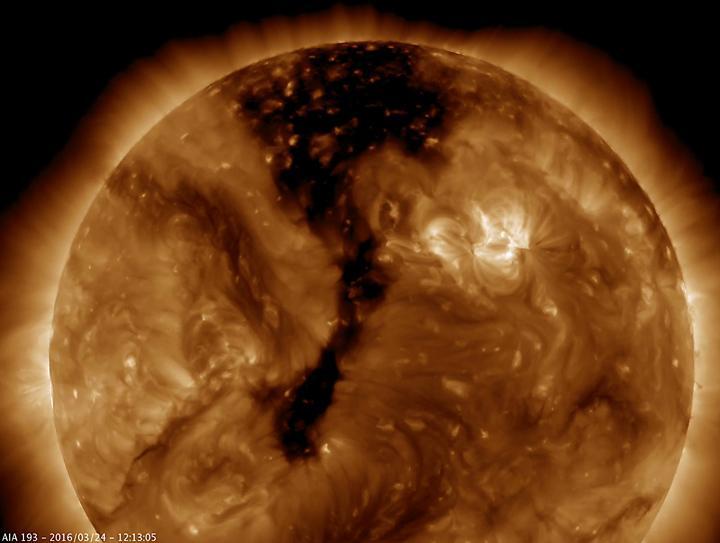
NASA Solar Dynamics Observatory shows a long coronal hole has rotated so that was temporarily facing right towards Earth Mar. 23-25, 2016. Coronal holes appear dark when viewed in some wavelengths of extreme ultraviolet light.
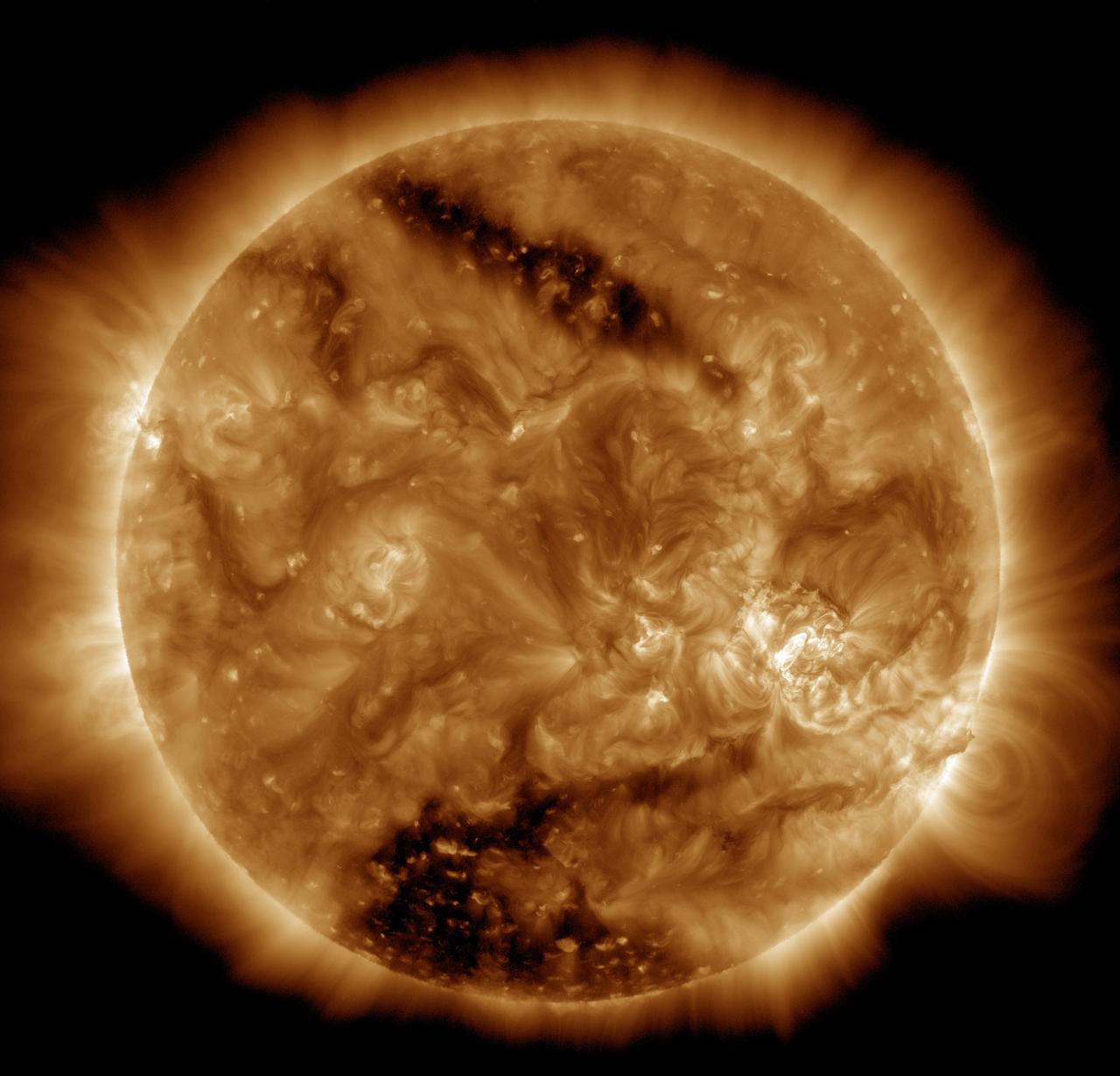
NASA’s Solar Dynamics Observatory, or SDO, captured this solar image on March 16, 2015, which clearly shows two dark patches, known as coronal holes. The larger coronal hole of the two, near the southern pole, covers an estimated 6- to 8-percent of the total solar surface. While that may not sound significant, it is one of the largest polar holes scientists have observed in decades. The smaller coronal hole, towards the opposite pole, is long and narrow. It covers about 3.8 billion square miles on the sun - only about 0.16-percent of the solar surface. Coronal holes are lower density and temperature regions of the sun’s outer atmosphere, known as the corona. Coronal holes can be a source of fast solar wind of solar particles that envelop the Earth. The magnetic field in these regions extends far out into space rather than quickly looping back into the sun’s surface. Magnetic fields that loop up and back down to the surface can be seen as arcs in non-coronal hole regions of the image, including over the lower right horizon. The bright active region on the lower right quadrant is the same region that produced solar flares last week. Credit: NASA/Goddard/SDO <b><a href="http://www.nasa.gov/audience/formedia/features/MP_Photo_Guidelines.html" rel="nofollow">NASA image use policy.</a></b> <b><a href="http://www.nasa.gov/centers/goddard/home/index.html" rel="nofollow">NASA Goddard Space Flight Center</a></b> enables NASA’s mission through four scientific endeavors: Earth Science, Heliophysics, Solar System Exploration, and Astrophysics. Goddard plays a leading role in NASA’s accomplishments by contributing compelling scientific knowledge to advance the Agency’s mission. <b>Follow us on <a href="http://twitter.com/NASAGoddardPix" rel="nofollow">Twitter</a></b> <b>Like us on <a href="http://www.facebook.com/pages/Greenbelt-MD/NASA-Goddard/395013845897?ref=tsd" rel="nofollow">Facebook</a></b> <b>Find us on <a href="http://instagrid.me/nasagoddard/?vm=grid" rel="nofollow">Instagram</a></b>
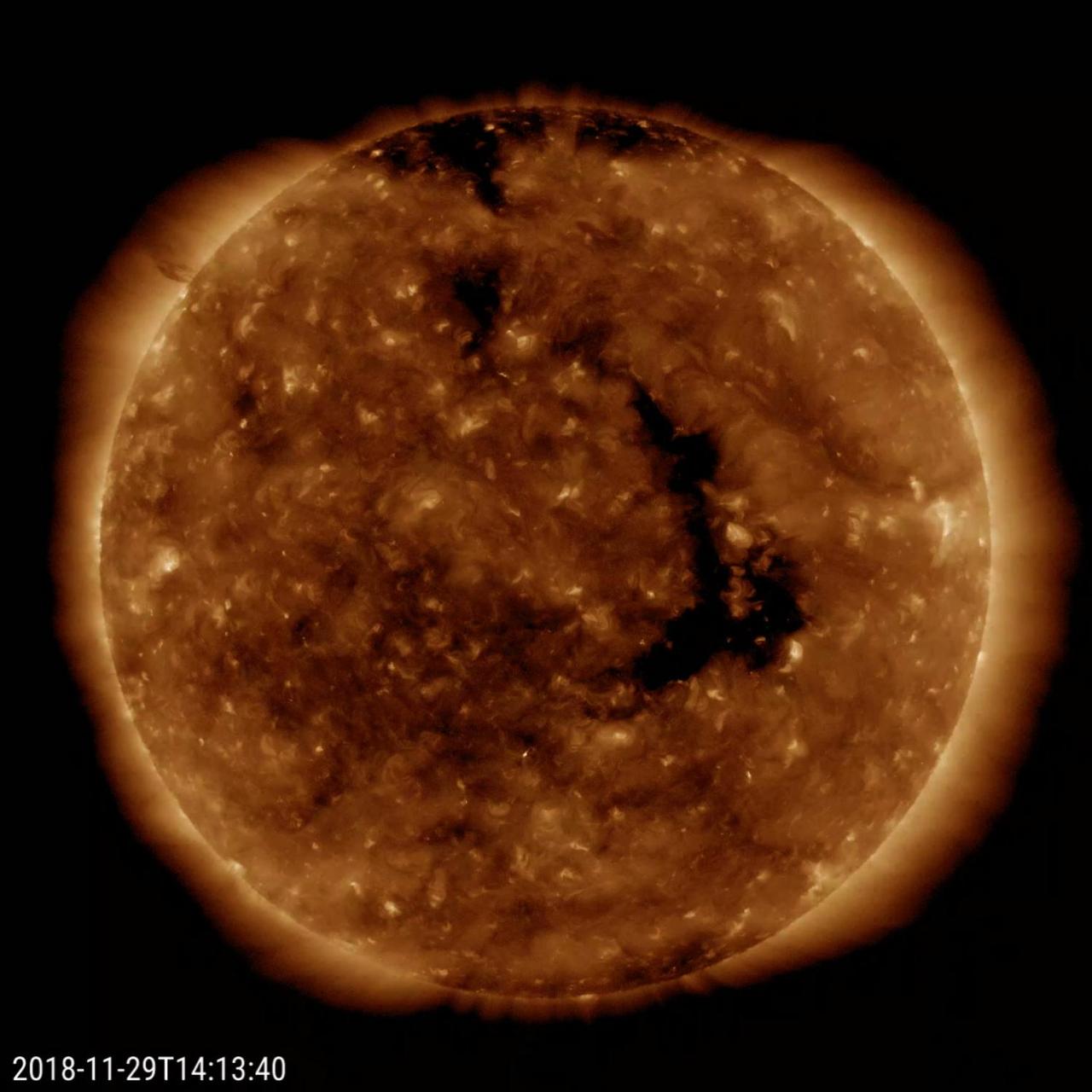
A long-lasting coronal hole has again rotated around to face the Earth (Nov. 28-30, 2018). This persistent hole - the elongated dark region seen in the still image - first appeared in July and has been observed each rotation of the Sun since. Coronal holes are the source of high-speed solar wind; when this one faced Earth, it sparked outbursts of aurora some of which were observed in our northern tier states. Coronal holes are magnetically open regions on the Sun that can last from days to months, although this one has lasted longer than most. The time-lapse video, taken in a wavelength of extreme ultraviolet light, covers about two days of activity. Movies available at https://photojournal.jpl.nasa.gov/catalog/PIA18144
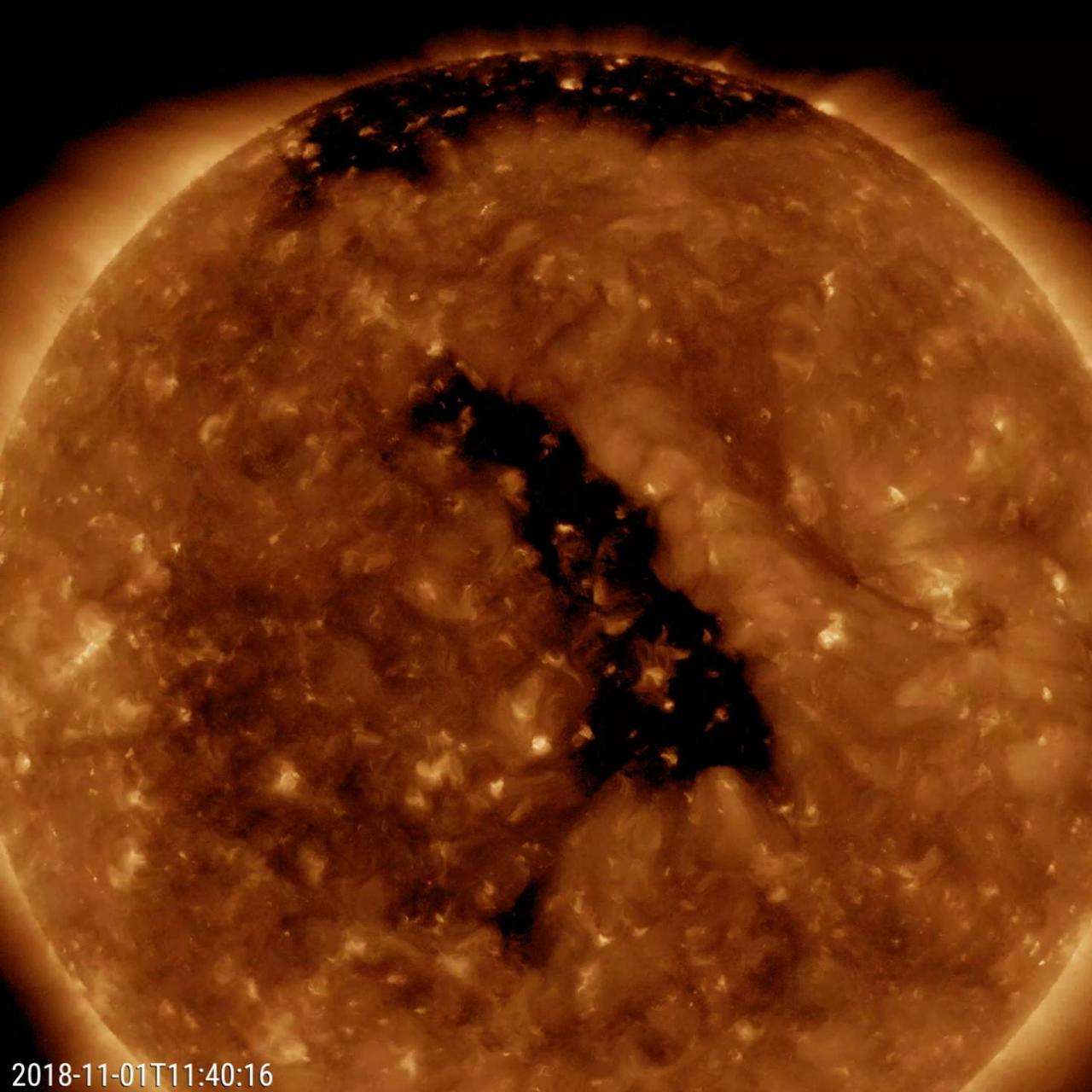
The most distinctive feature on the Sun this week was a good-sized coronal hole at a slanted angle nearly centered on the face of the sun (Oct. 31 - Nov. 2, 2018). Coronal holes are magnetically open areas from which solar wind particles speed into space. They appear darker in this wavelength of extreme ultraviolet light. If these particles impact Earth's magnetosphere, they will likely generate aurora near the Earth's poles regions. The video clip covers about two days of activity. Movies available at https://photojournal.jpl.nasa.gov/catalog/PIA18141
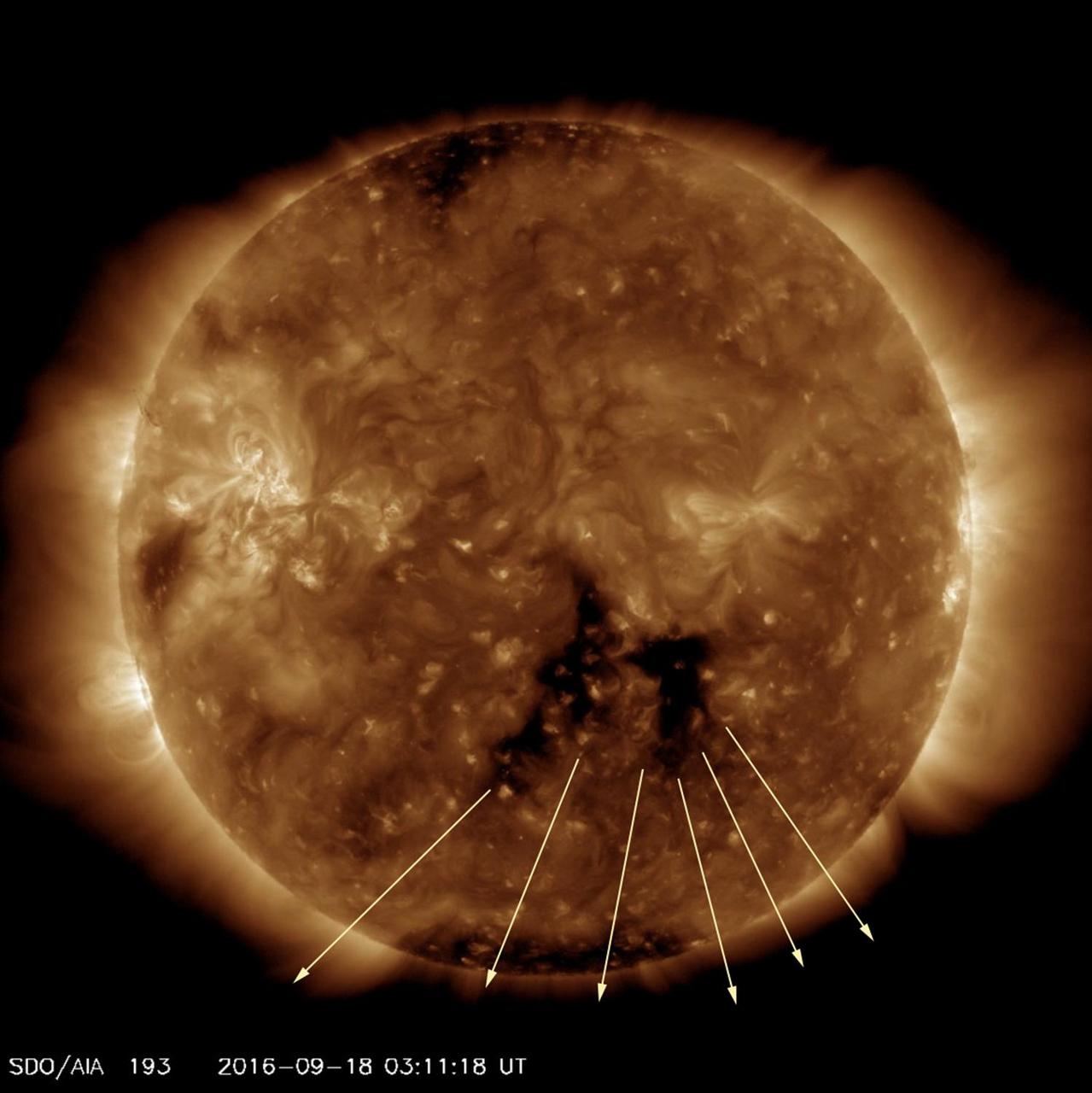
A dark coronal hole that was facing towards Earth for several days spewed streams of solar wind in our direction (Sept. 18-21, 2016). A coronal hole is a magnetically open region. The magnetic fields have opened up allowing solar wind (comprised of charged particles) to stream into space. Gusts of solar wind can generate beautiful aurora when they reach Earth. The video clip shows the sun in a wavelength of extreme ultraviolet light. Movies are available at http://photojournal.jpl.nasa.gov/catalog/PIA21067
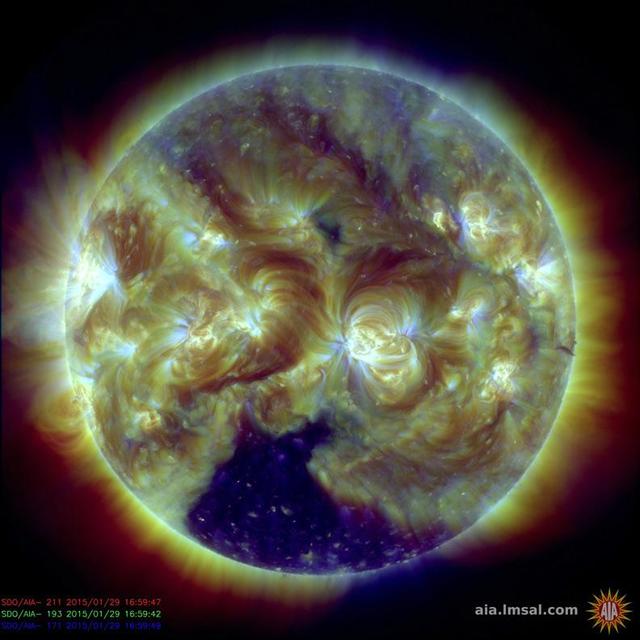
A large, dark coronal hole at the bottom of the Sun has been the most dominant feature this week Jan. 29, 2014 as seen by NASA GSFC Solar Dynamics Observatory.

Oddly enough, an elongated coronal hole (the darker area near the center) seems to shape itself into a single, recognizable question mark over the period of one day (Dec. 21-22, 2017). Coronal holes are areas of open magnetic field that appear darker in extreme ultraviolet light, as is seen here. These holes are the source of streaming plasma that we call solar wind. While this exercise is akin to seeing shapes in clouds, it is fun to consider what the sun might be asking? Perhaps what the new year will bring? Guess what I am going to do next? Movies are available at https://photojournal.jpl.nasa.gov/catalog/PIA22197
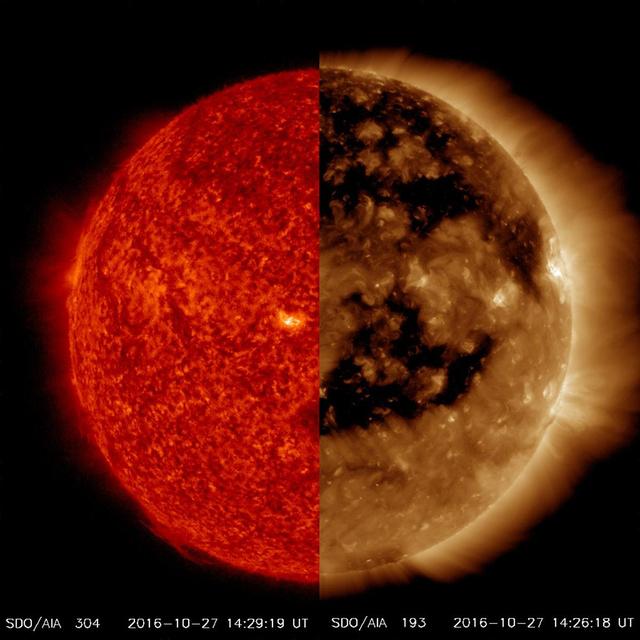
The difference in features that are visible in different wavelengths of extreme ultraviolet light can be stunning as we see when we compare very large coronal holes, easily seen in the AIA 171 image (colorized bronze) yet hardly perceptible in the AIA 304 image (colorized red). Both were taken at just about the same time (Oct. 27, 2016). Coronal holes are areas of open magnetic field that carry solar wind out into space. In fact, these holes are currently causing a lot of geomagnetic activity here on Earth. The bronze image wavelength captures material that is much hotter and further up in the corona than the red image. The comparison dramatizes the value of observing the sun in multiple wavelengths of light. Movies are available at http://photojournal.jpl.nasa.gov/catalog/PIA15377
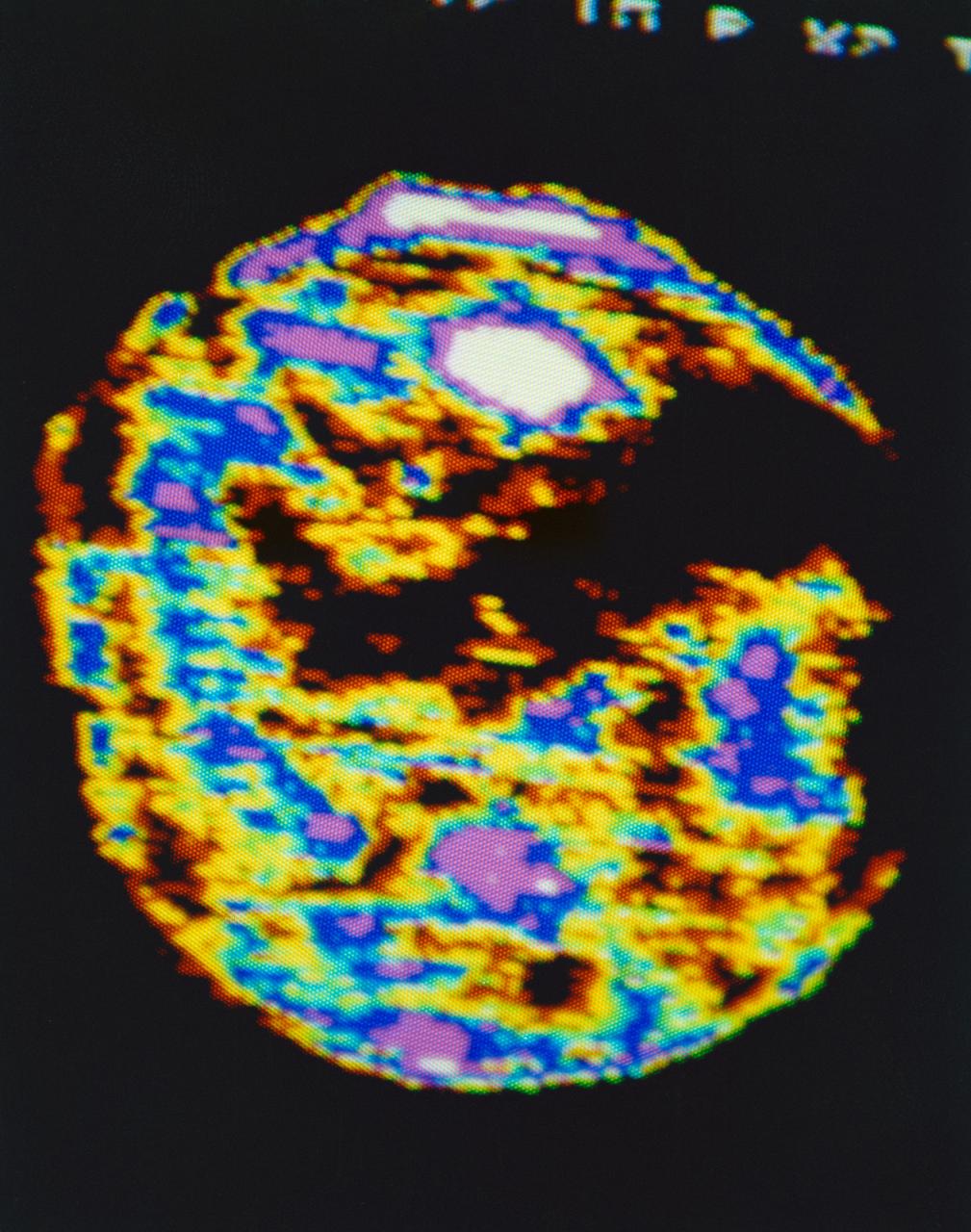
S73-32883 (20 Aug. 1973) --- This false color isophote, processed from an Aug. 20, 1973 television transmission of Apollo Telescope Mount (ATM) experiments from Skylab 3, dramatically reveals a significant change in the coronal hole as compared to the previous day. Solar rotation accounts for the new location of the coronal hole. Photo credit: NASA
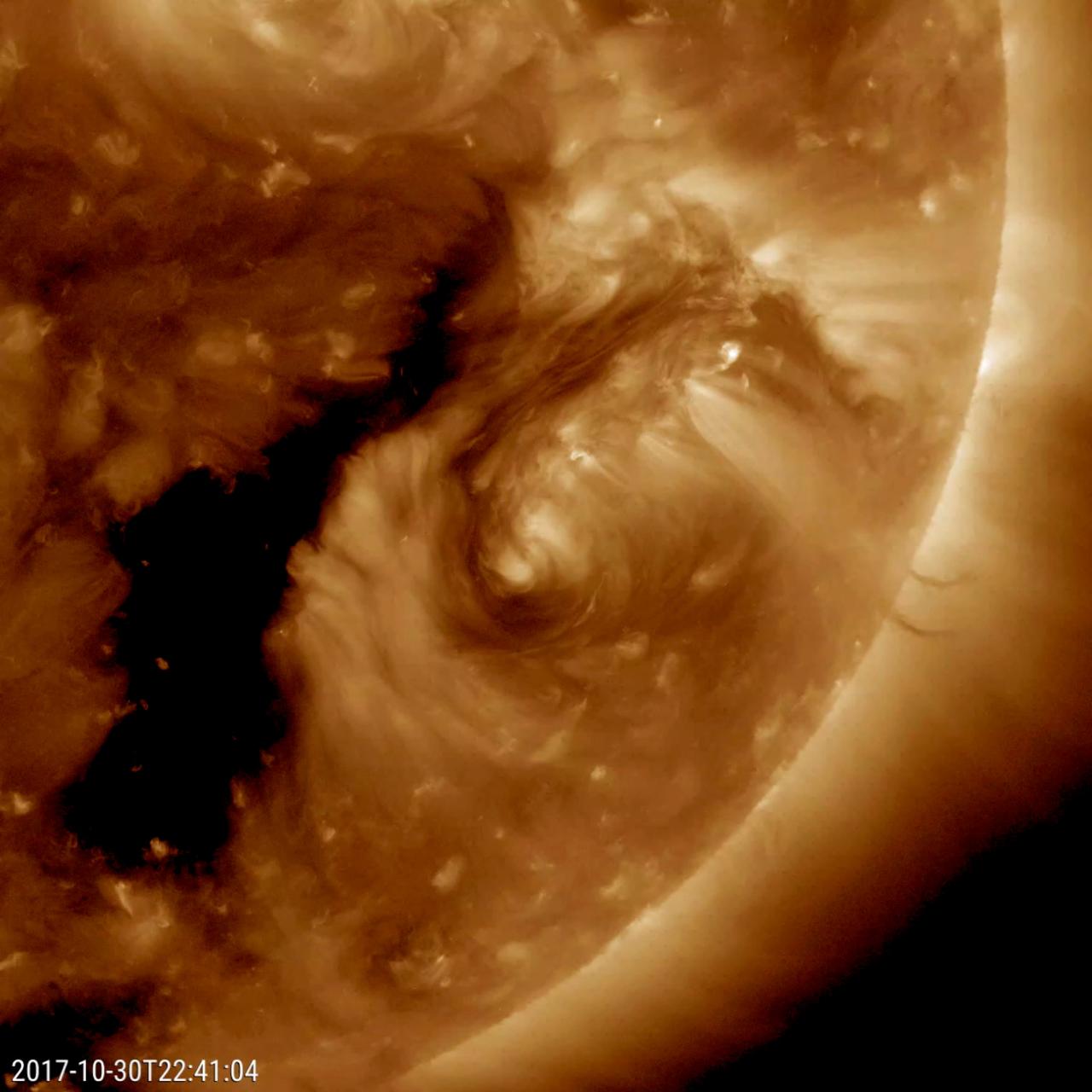
NASA's Solar Dynamics Observatory came across an oddity this week that the spacecraft has rarely observed before: a dark filament encircling an active region (Oct. 29-31, 2017). Solar filaments are clouds of charged particles that float above the sun, tethered to it by magnetic forces. They are usually elongated and uneven strands. Only a handful of times before have we seen one shaped like a circle. (The black area to the left of the brighter active region is a coronal hole, a magnetically open region of the sun). While it may no major scientific value, it is noteworthy because of its rarity. The still and video clip were taken in a wavelength of extreme ultraviolet light. Movies are available at https://photojournal.jpl.nasa.gov/catalog/PIA22104
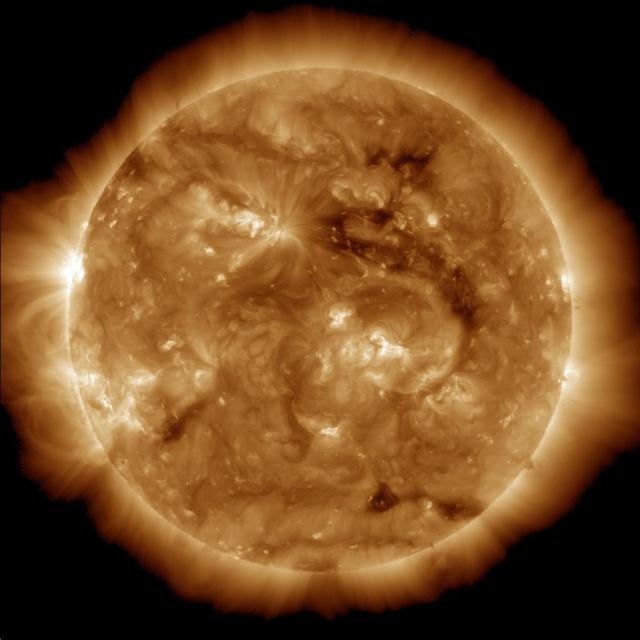
The dark region seen on the face of the sun at the end of March 2013 is a coronal hole just above and to the right of the middle of the picture, which is a source of fast solar wind leaving the sun in this image from NASA Solar Dynamic Observatory.
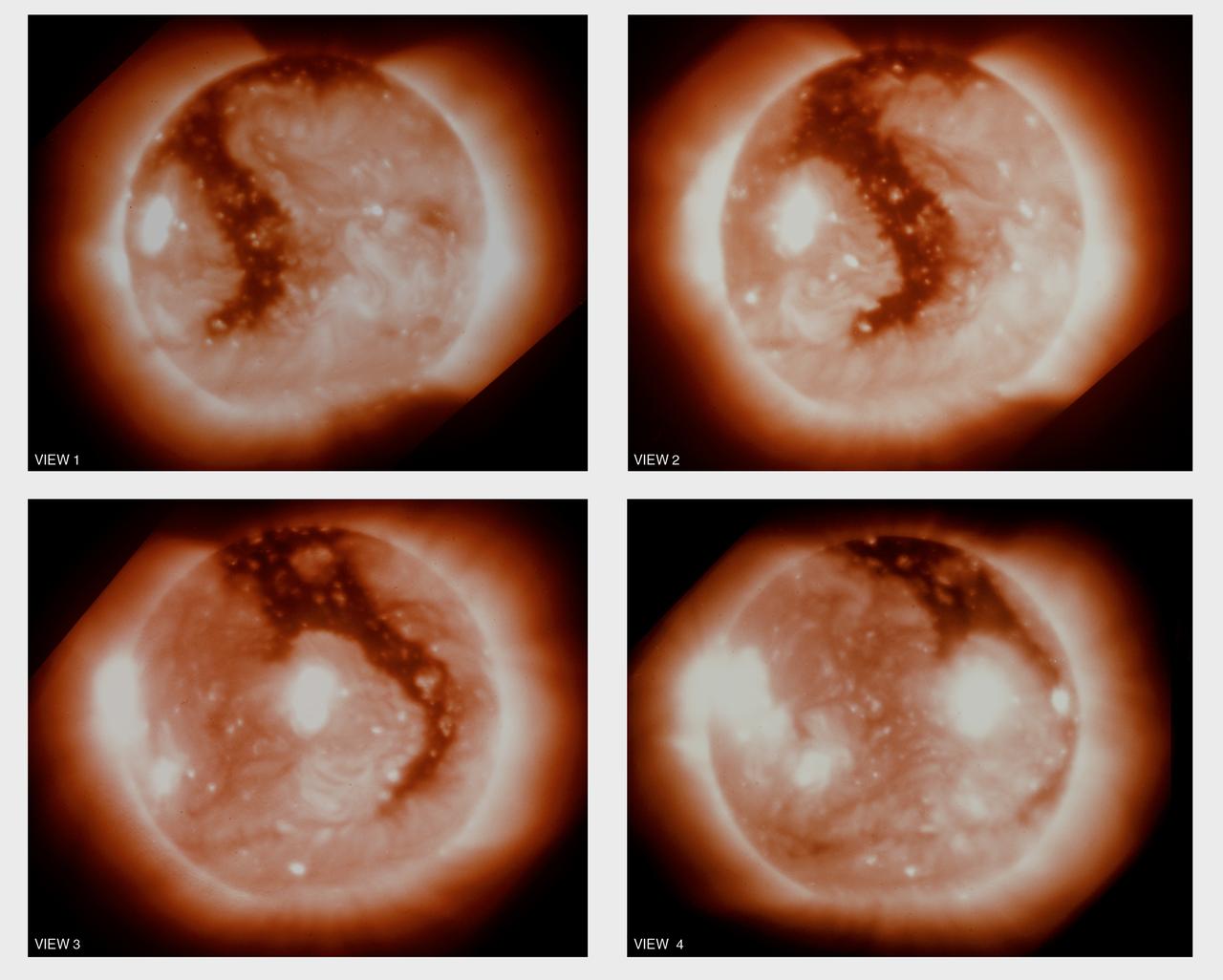
This montage is a sequence of soft x-ray photographs of the boot-shaped coronal hole rotating with the sun. The individual pictures were taken about 2 days apart by the Skylab telescope. Most of the apparent changes in this 6-day period resulted from a changing perspective. Skylab data helped demonstrate that coronal holes are sources of high-velocity streams in the solar wind. These high-velocity streams can be electrons, protons, and atomic nuclei that spray out from the Sun into interplanetary space. When the coronal hole is near the center of the Sun, as in view 2, the sprinkler is directed at Earth. These high-speed streams of solar wind distort Earth's magnetic field and disturb it's upper atmosphere.
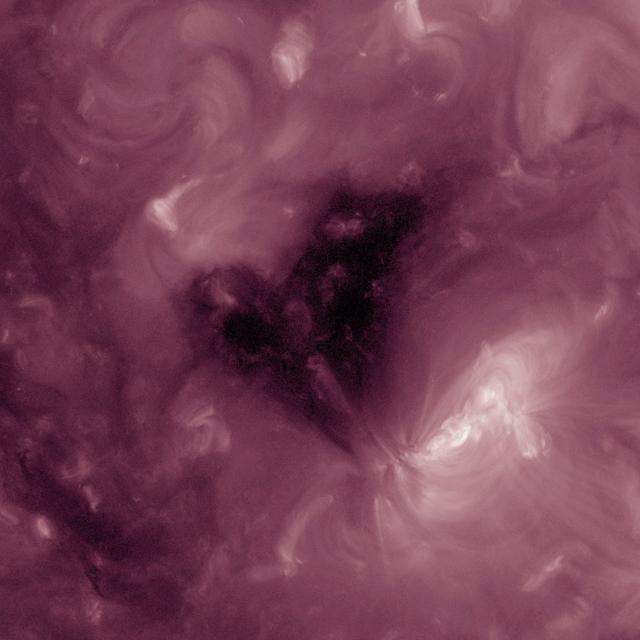
This Solar Dynamics Observatory image of the Sun taken on February 1, 2013 in extreme ultraviolet light captures a heart-shaped dark coronal hole. Coronal holes are areas of the Sun's surface that are the source of open magnetic field lines that head way out into space. They are also the source regions of the fast solar wind, which is characterized by a relatively steady speed of approximately 800 km/s (about 1.8 million mph).
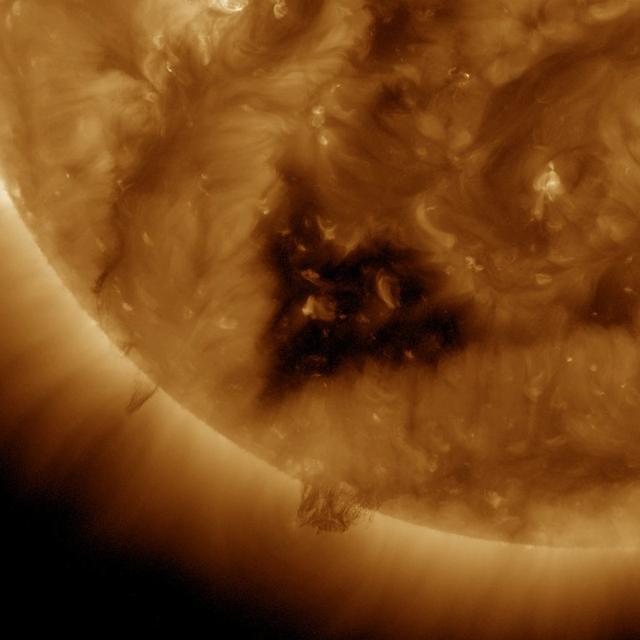
This Solar Dynamics Observatory (SDO) image of the Sun taken on January 20, 2012 in extreme ultraviolet light captures a heart-shaped dark coronal hole. Coronal holes are areas of the Sun's surface that are the source of open magnetic field lines that head way out into space. They are also the source regions of the fast solar wind, which is characterized by a relatively steady speed of approximately 800 km/s (about 1.8 million mph). <b><a href="http://www.nasa.gov/audience/formedia/features/MP_Photo_Guidelines.html" rel="nofollow">NASA image use policy.</a></b> <b><a href="http://www.nasa.gov/centers/goddard/home/index.html" rel="nofollow">NASA Goddard Space Flight Center</a></b> enables NASA’s mission through four scientific endeavors: Earth Science, Heliophysics, Solar System Exploration, and Astrophysics. Goddard plays a leading role in NASA’s accomplishments by contributing compelling scientific knowledge to advance the Agency’s mission. <b>Follow us on <a href="http://twitter.com/NASA_GoddardPix" rel="nofollow">Twitter</a></b> <b>Like us on <a href="http://www.facebook.com/pages/Greenbelt-MD/NASA-Goddard/395013845897?ref=tsd" rel="nofollow">Facebook</a></b> <b>Find us on <a href="http://instagram.com/nasagoddard?vm=grid" rel="nofollow">Instagram</a></b>

This Solar Dynamics Observatory (SDO) image of the Sun taken on January 20, 2012 in extreme ultraviolet light captures a heart-shaped dark coronal hole. Coronal holes are areas of the Sun's surface that are the source of open magnetic field lines that head way out into space. They are also the source regions of the fast solar wind, which is characterized by a relatively steady speed of approximately 800 km/s (about 1.8 million mph). <b><a href="http://www.nasa.gov/audience/formedia/features/MP_Photo_Guidelines.html" rel="nofollow">NASA image use policy.</a></b> <b><a href="http://www.nasa.gov/centers/goddard/home/index.html" rel="nofollow">NASA Goddard Space Flight Center</a></b> enables NASA’s mission through four scientific endeavors: Earth Science, Heliophysics, Solar System Exploration, and Astrophysics. Goddard plays a leading role in NASA’s accomplishments by contributing compelling scientific knowledge to advance the Agency’s mission. <b>Follow us on <a href="http://twitter.com/NASA_GoddardPix" rel="nofollow">Twitter</a></b> <b>Like us on <a href="http://www.facebook.com/pages/Greenbelt-MD/NASA-Goddard/395013845897?ref=tsd" rel="nofollow">Facebook</a></b> <b>Find us on <a href="http://instagram.com/nasagoddard?vm=grid" rel="nofollow">Instagram</a></b>
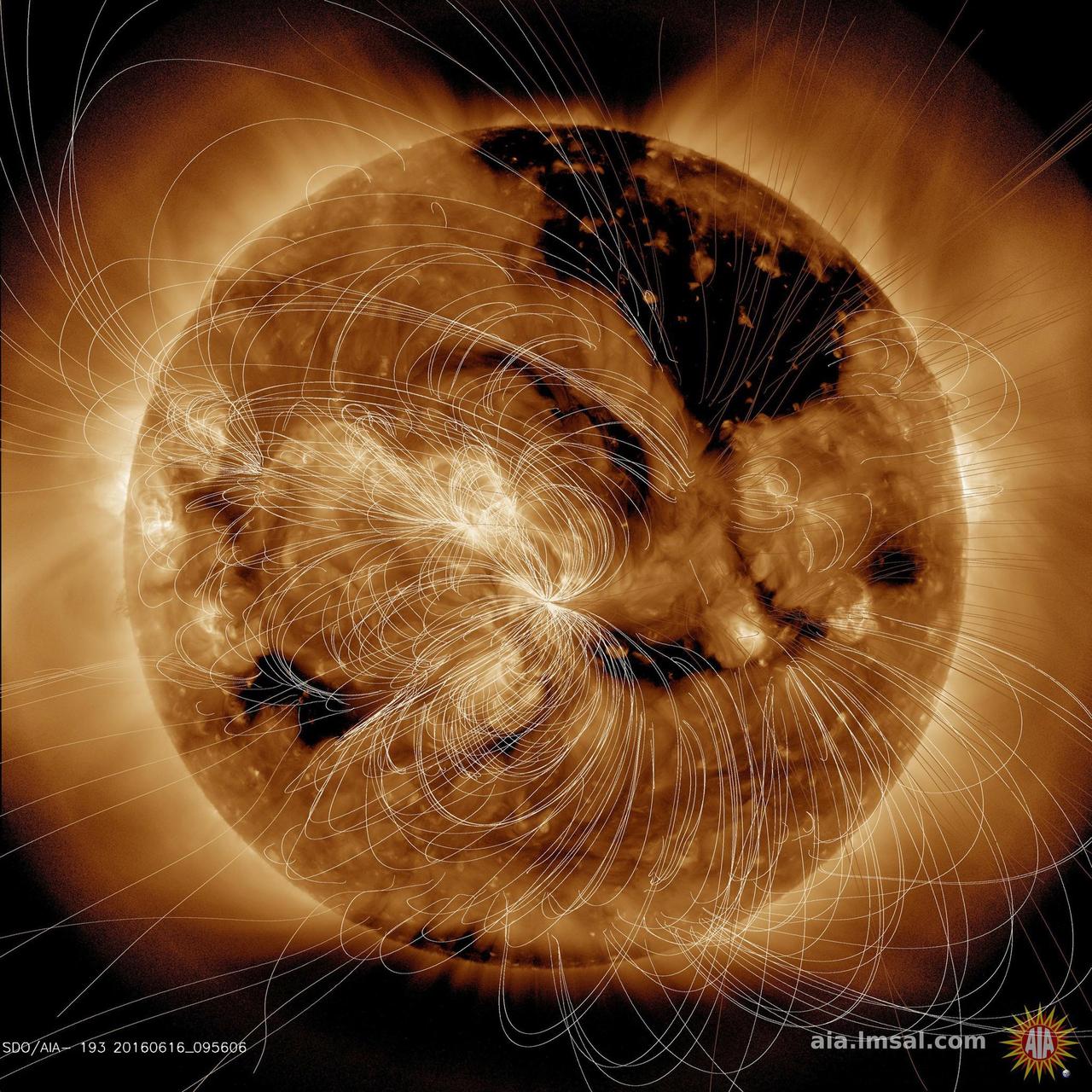
Each day NASA solar scientists produce overlays (in white lines) that show their estimation of how the magnetic field lines above the sun are configured (June16, 2016). In the video clip we show the sun in a wavelength of extreme ultraviolet light, then reveal the magnetic field line configuration in the same wavelength. Notice how the lines are tightly bundled near the lighter-toned active regions, which are magnetically intense regions. The magnetic lines from the darker areas, called coronal holes, open out into space and the extended lines show that. Our magnetically active sun is a dynamic body that changes all the time. Movie are also available at the Photojournal. http://photojournal.jpl.nasa.gov/catalog/PIA20881
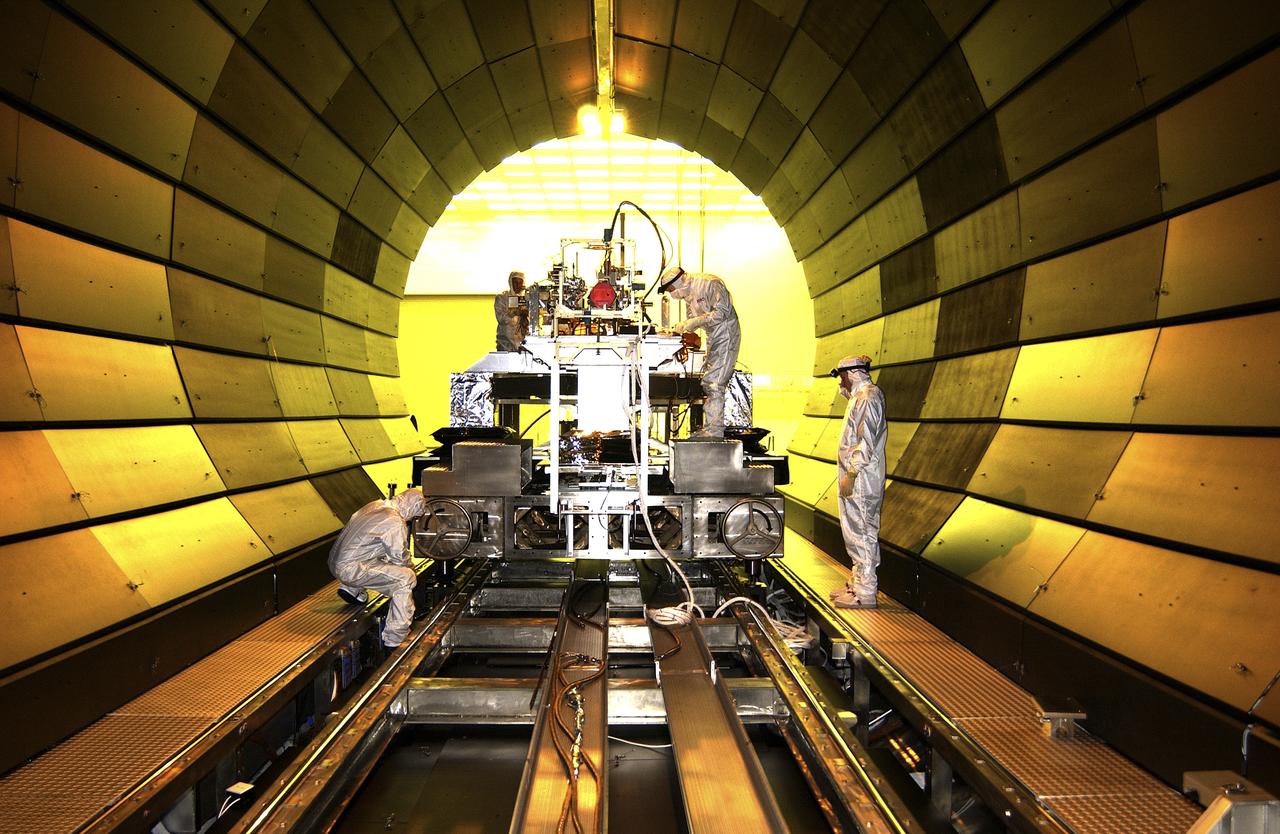
This photograph depicts the Solar X-Ray Imager (SXI) being installed in the X-Ray Calibration Facility (XRCF) vacuum chamber for testing at the Marshall Space Flight Center (MSFC). The XRCF vacuum chamber simulates a space environment with low temperature and pressure. The x-ray images from SXI on the Geostationary Operational Environmental Satellite-12 (GOES-12) will be used by the National Oceanic and Atmospheric Administration (NOAA) and U.S. Air Force to forecast the intensity and speed of solar disturbances that could destroy satellite electronics or disrupt long-distance radio communications. The SXI will observe solar flares, coronal mass ejections, coronal holes, and active regions in the x-ray region of the electromagnetic spectrum. These features are the dominant sources of disturbances in space weather. The imager instrument consists of a telescope assembly with a 6.3-inch (16-centimeter) diameter grazing incidence mirror and a detector system. The imager was developed, tested, and calibrated by MSFC, in conjunction with the NASA Goddard Space Flight Center and U.S. Air Force.
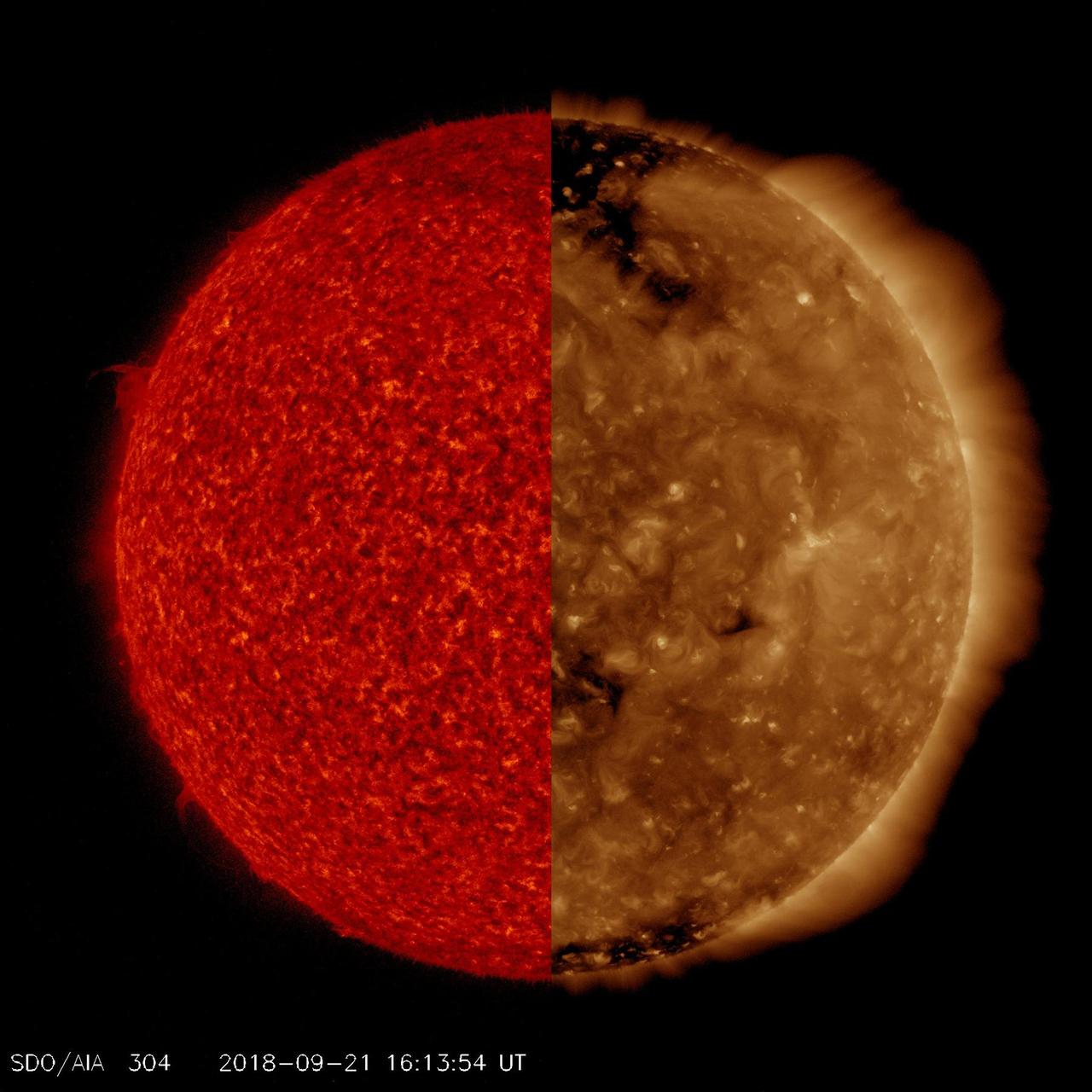
NASA's Solar Dynamics Observatory observes the Sun in ten different wavelengths because each wavelength reveals different solar features. Here, we have selected two images taken at virtually the same time but in different wavelengths of extreme ultraviolet light. The red tinted image, which captures material not far above the Sun's surface, is especially good for revealing details along the edge of the Sun, like the small prominence at the ten o'clock position. The brown tinted image clearly shows two large coronal holes (darker areas) as well as some faint magnetic field lines and hints of solar activity (lighter areas), neither of which are apparent in the red image. This activity is occurring somewhat higher in the Sun's corona. In a way it is like peeling away the layers of an onion, a little at a time. Animations are available at https://photojournal.jpl.nasa.gov/catalog/PIA22724
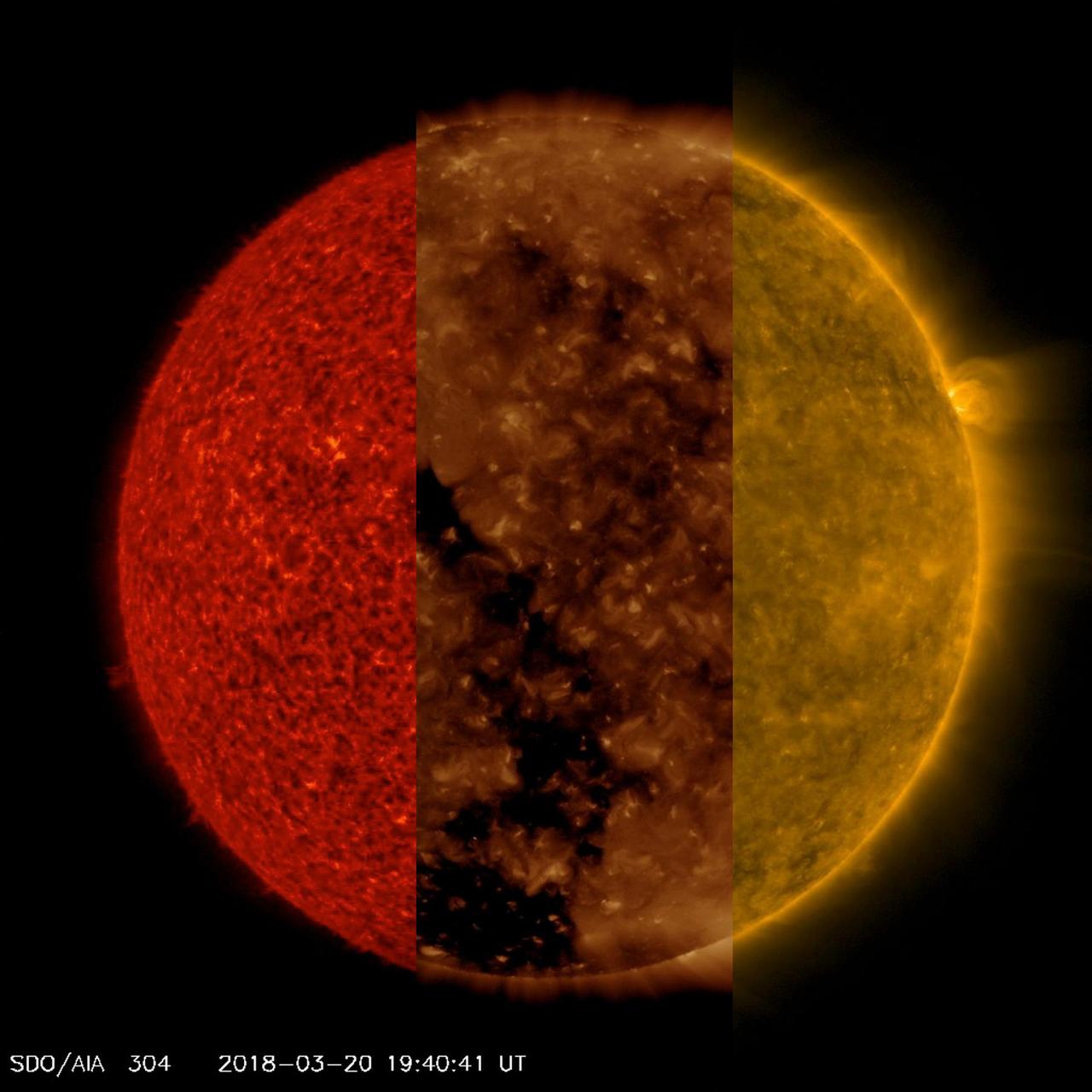
NASA's Solar Dynamics Observatory ran together three sequences of the sun taken in three different extreme ultraviolet wavelengths to better illustrate how different features that appear in one sequence are difficult if not impossible to see in the others (Mar. 20-21, 2018). In the red sequence (304 Angstroms), we can see very small spicules and some small prominences at the sun's edge, which are not easy to see in the other two sequences. In the second clip (193 Angstroms), we can readily observe the large and dark coronal hole, though it is difficult to make out in the others. In the third clip (171 wavelengths), we can see strands of plasma waving above the surface, especially above the one small, but bright, active region near the right edge. And these are just three of the 10 extreme ultraviolet wavelengths in which SDO images the sun every 12 seconds every day. That's a lot of data and a lot of science. Movies are available at https://photojournal.jpl.nasa.gov/catalog/PIA22360