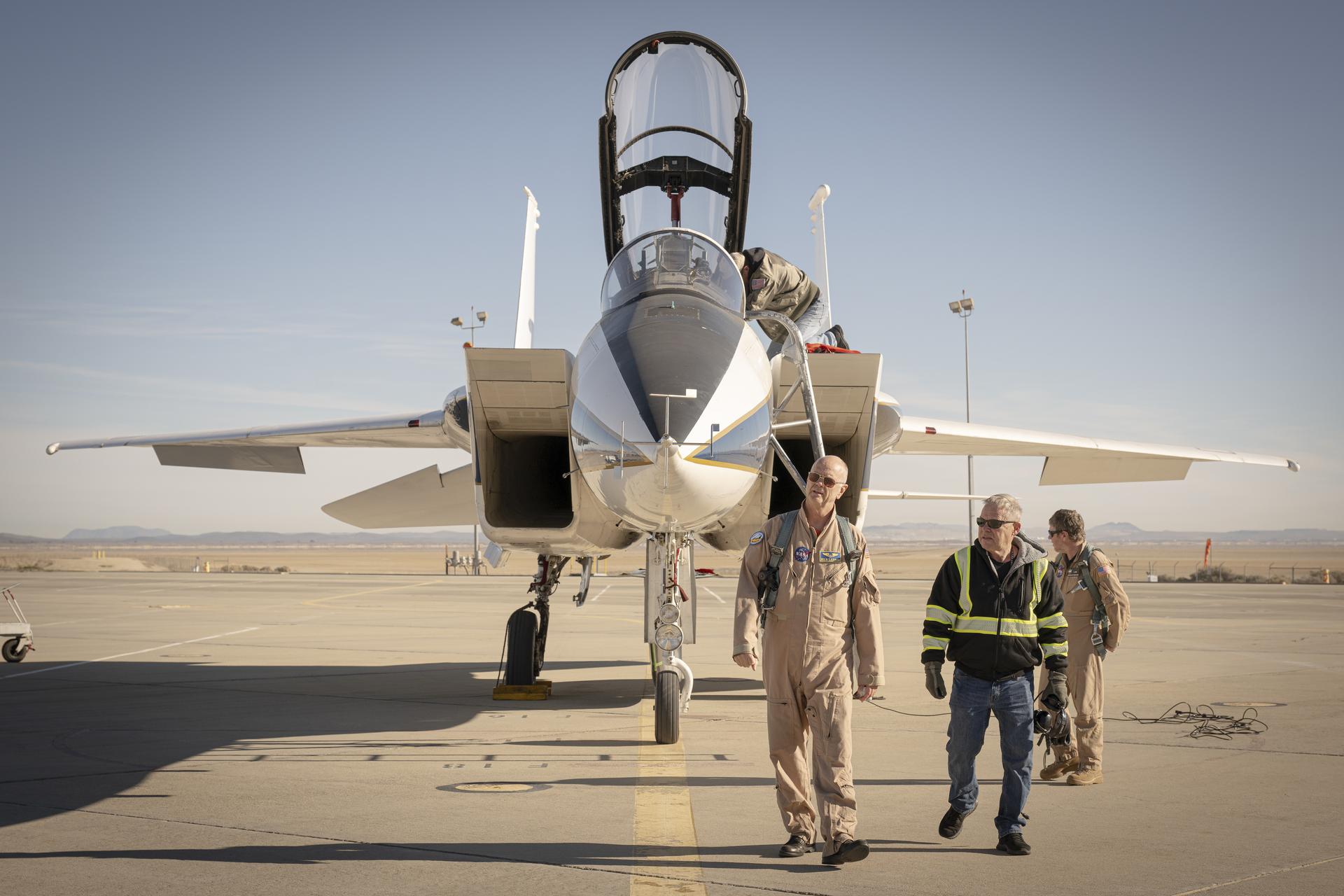
NASA pilot Nils Larson, left, walks next to crew chief Walt Kondracki, right, by an F-15 aircraft Tuesday, Jan. 13, 2026, at NASA’s Armstrong Flight Research Center in Edwards, California. In the background, NASA mechanic Tim Logan secures the cockpit inside of the F-15, and flight test engineer A.J. Jaffe stands to the right.
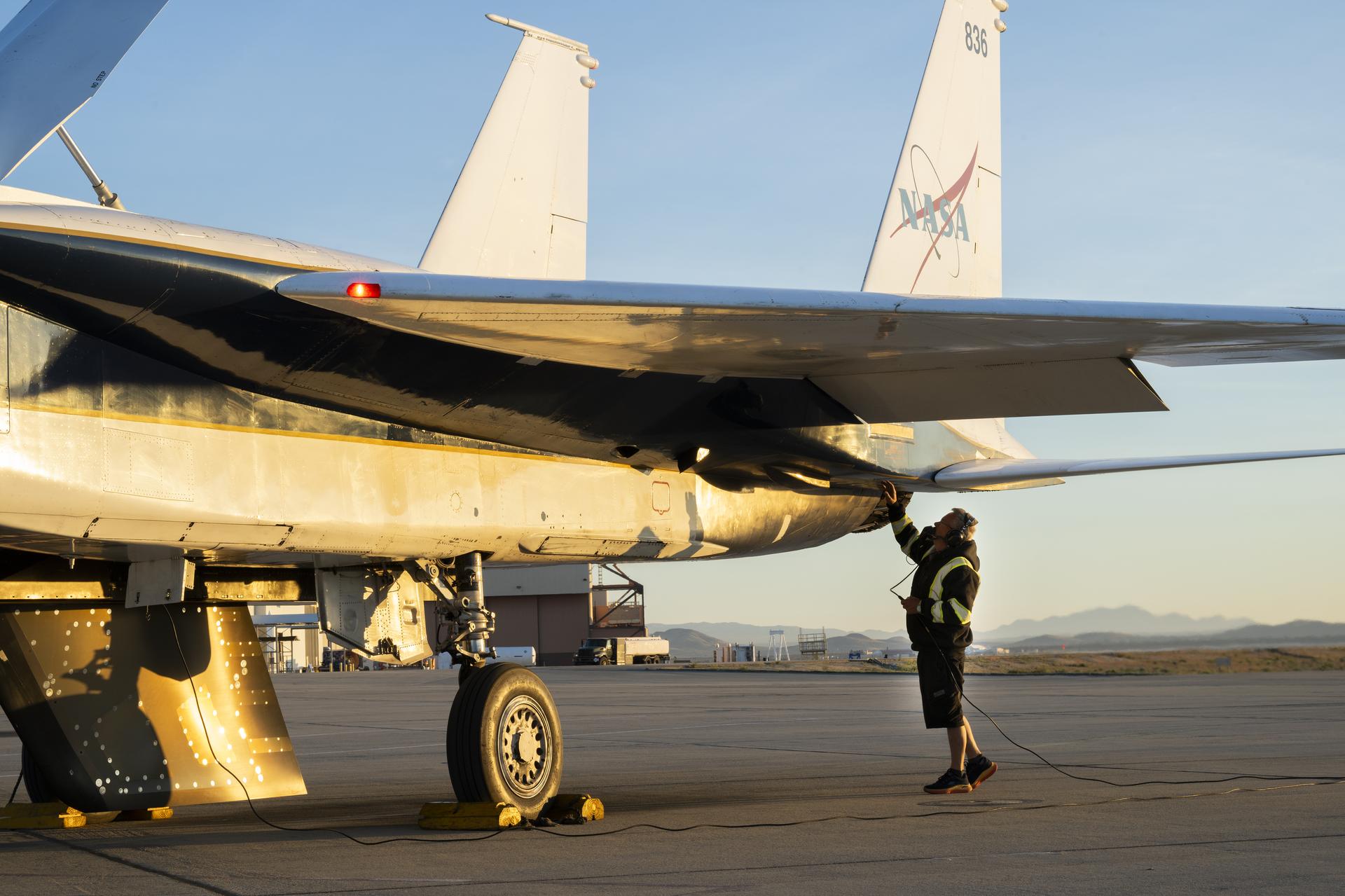
NASA crew chief Walt Kondracki checks an F-15 aircraft Tuesday, March 17, 2026, at NASA’s Armstrong Flight Research Center in Edwards, California. Ground crews, made of various roles, maintain the aircraft to be ready for each mission.
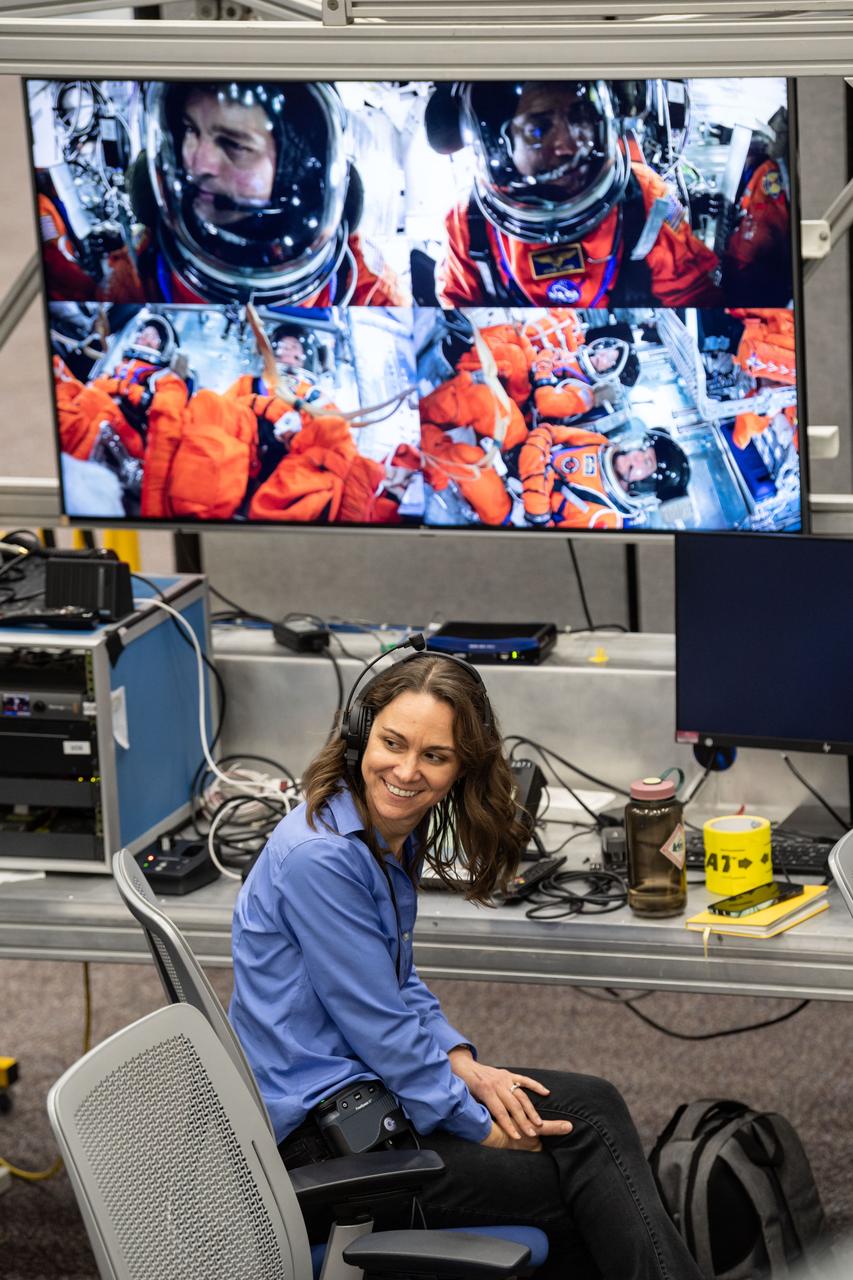
jsc2025e004084 (Jan. 30, 2025) --- The Artemis II crew’s Chief Training Officer Jacki Mahaffey smiles during Post Insertion and Deorbit Preparation training at the Space Vehicle Mockup Facility in Houston, Texas. The crew practiced getting the Orion spacecraft configured once in orbit, how to make it habitable, and suited up in their entry pressure suits to prepare for their return from the Moon. Credit: NASA/Mark Sowa
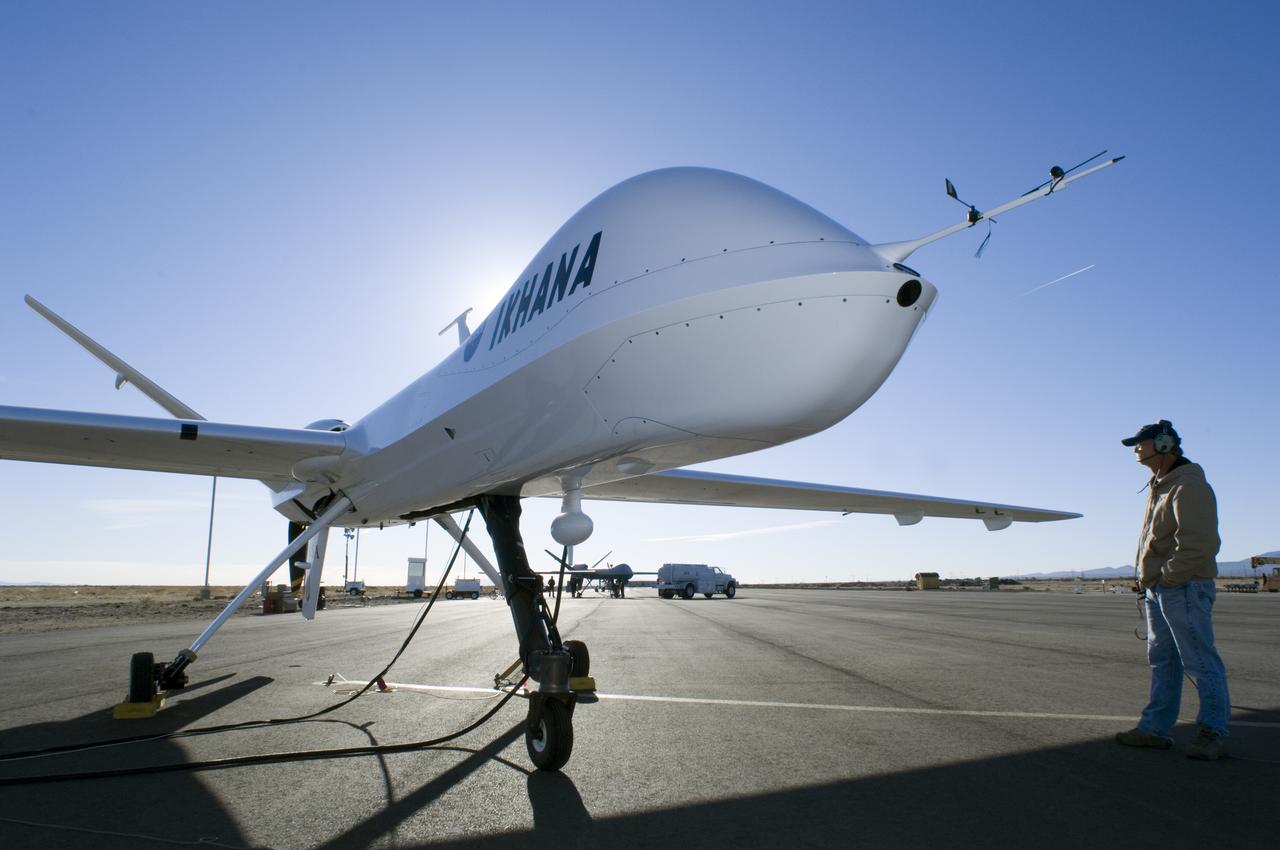
Silhouetted by the morning sun, NASA's Ikhana, a civil version of the Predator B unmanned aircraft, is readied for flight By NASA Dryden crew chief Joe Kinn.
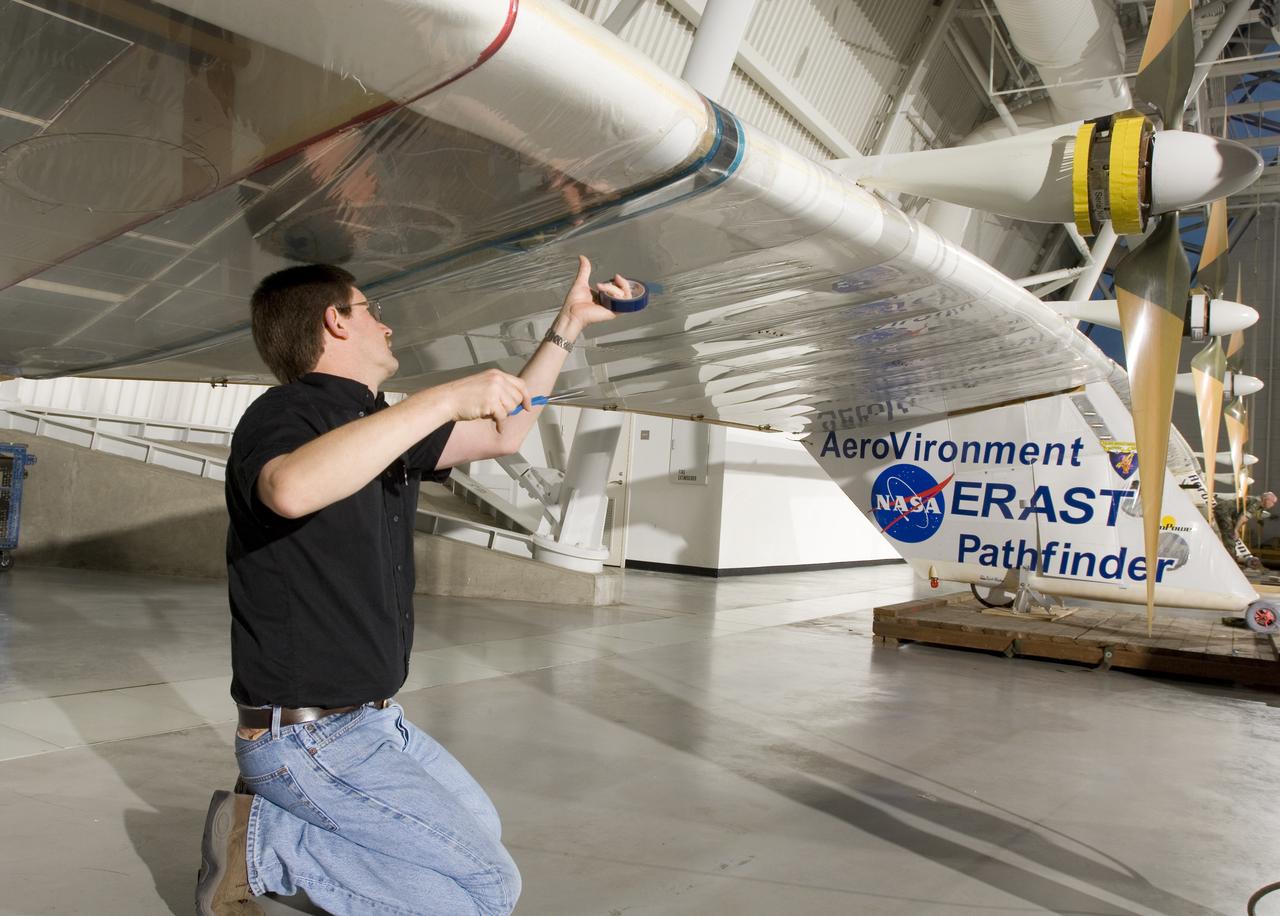
AeroVironment crew chief Mark Shipley applies sealing tape to a wing joint on Pathfinder-Plus before it is hoisted into place at the NASM's Udvar-Hazy Center.
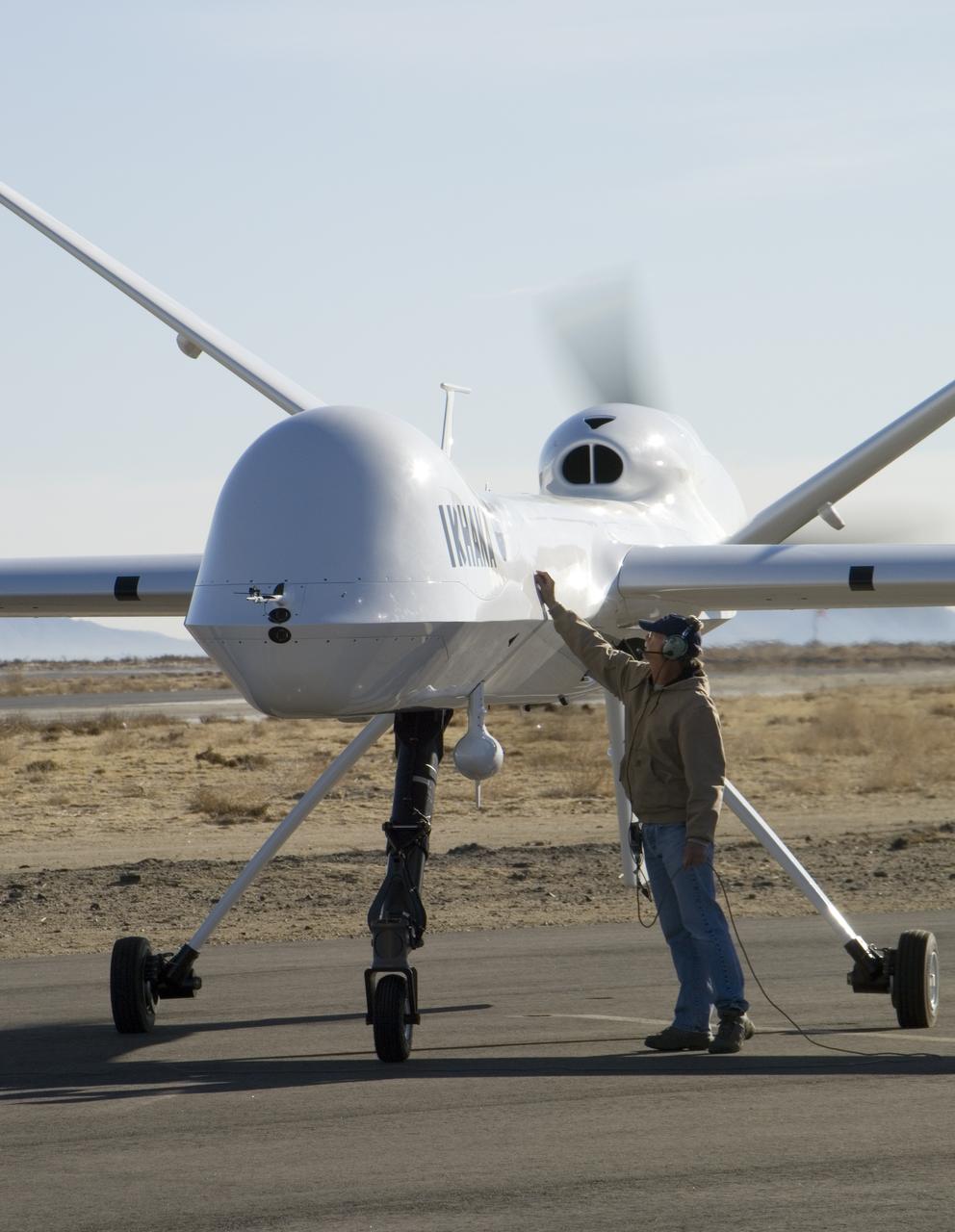
Crew chief Joe Kinn gives NASA's Ikhana unmanned aircraft a final check during engine run-up prior to takeoff at General Atomics Aeronautical Systems' airfield.
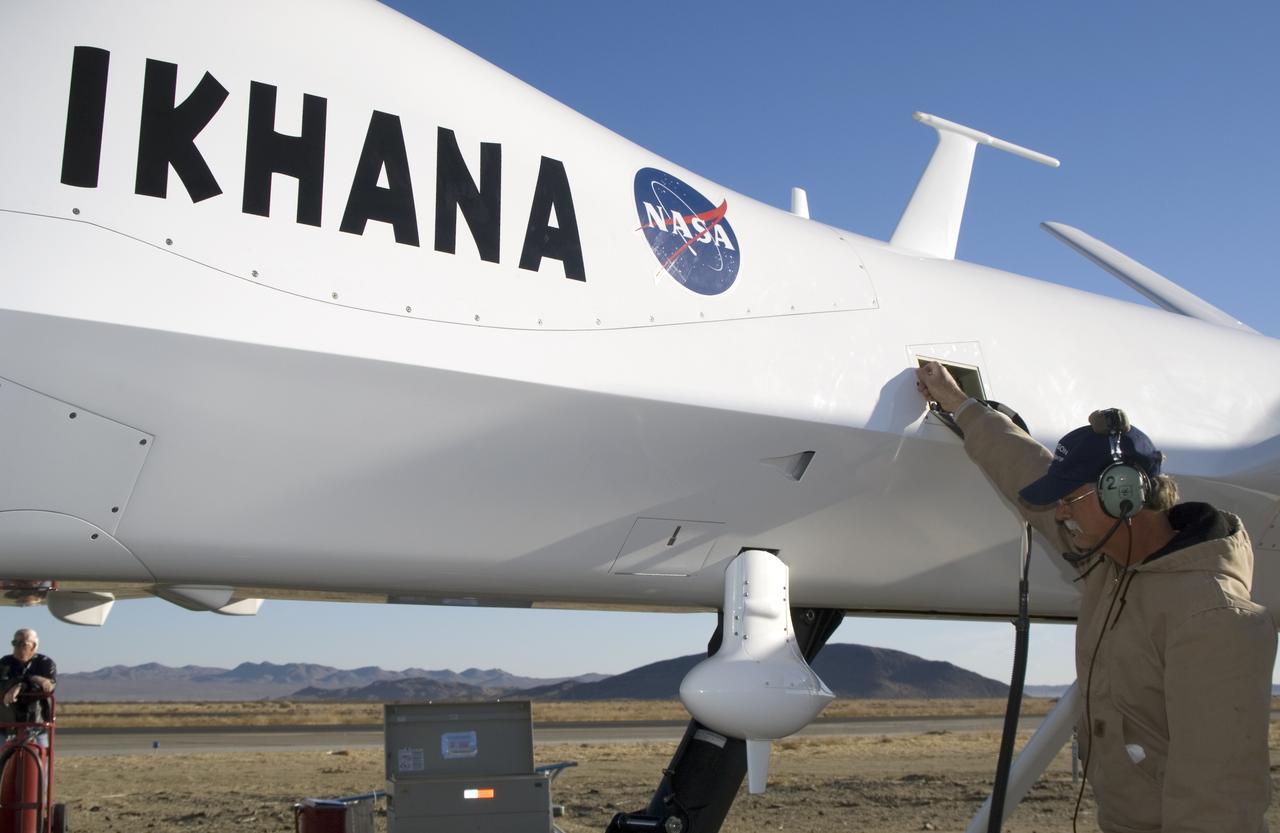
NASA Dryden crew chief Joe Kinn gives final checks to NASA's Ikhana, a civil version of the Predator B unmanned aircraft, prior to a morning checkout flight.

NASA’s X-59 quiet supersonic research aircraft moves under its own power for the first time at Lockheed Martin’s Skunk Works facility in Palmdale, California, on July 10, 2025. Guided by the aircraft’s crew chief, the event marks the beginning of taxi tests – a key milestone and the final series of ground tests before first flight.
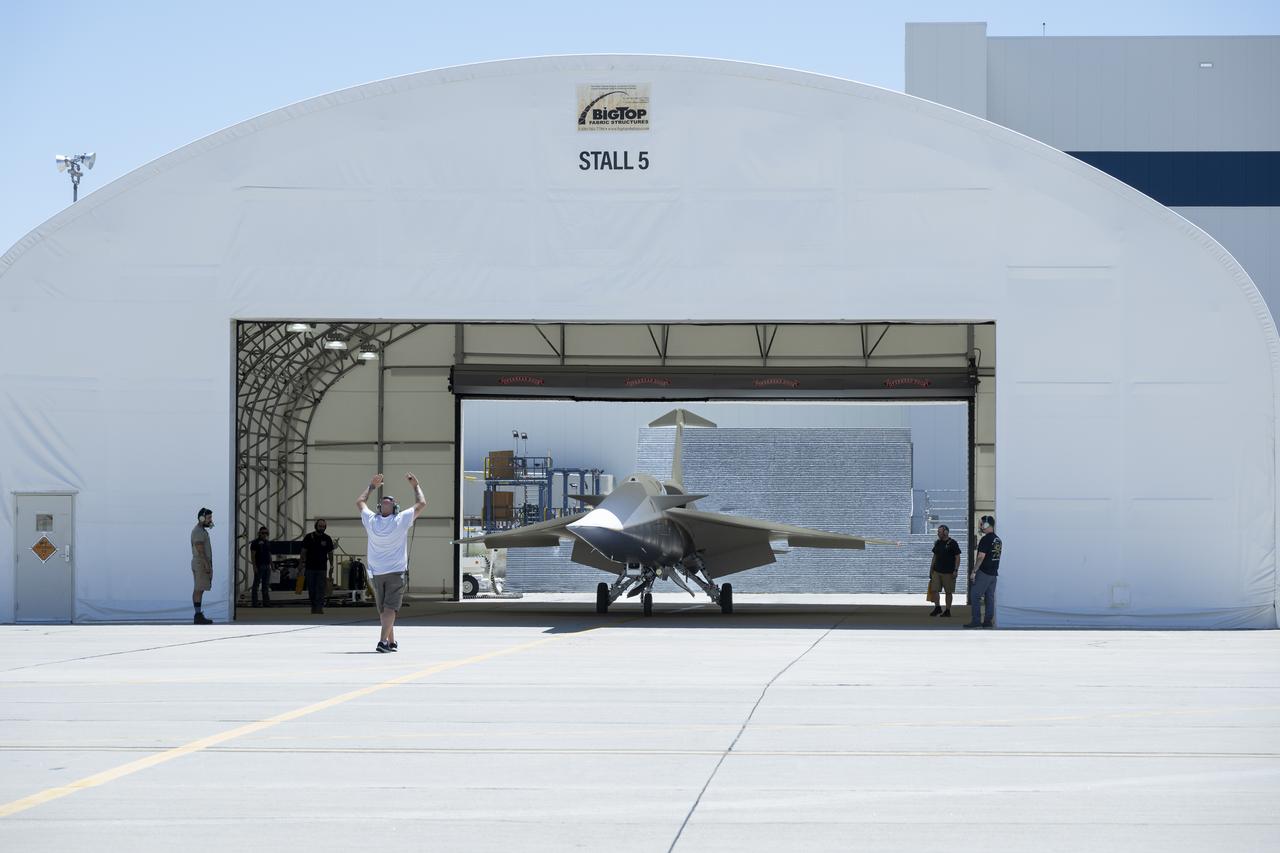
NASA’s X-59 quiet supersonic research aircraft moves under its own power for the first time at Lockheed Martin’s Skunk Works facility in Palmdale, California, on July 10, 2025. Guided by the aircraft’s crew chief, the event marks the beginning of taxi tests – a key milestone and the final series of ground tests before first flight.

C-20A crew chief Vince Moreno inspects the aircraft.
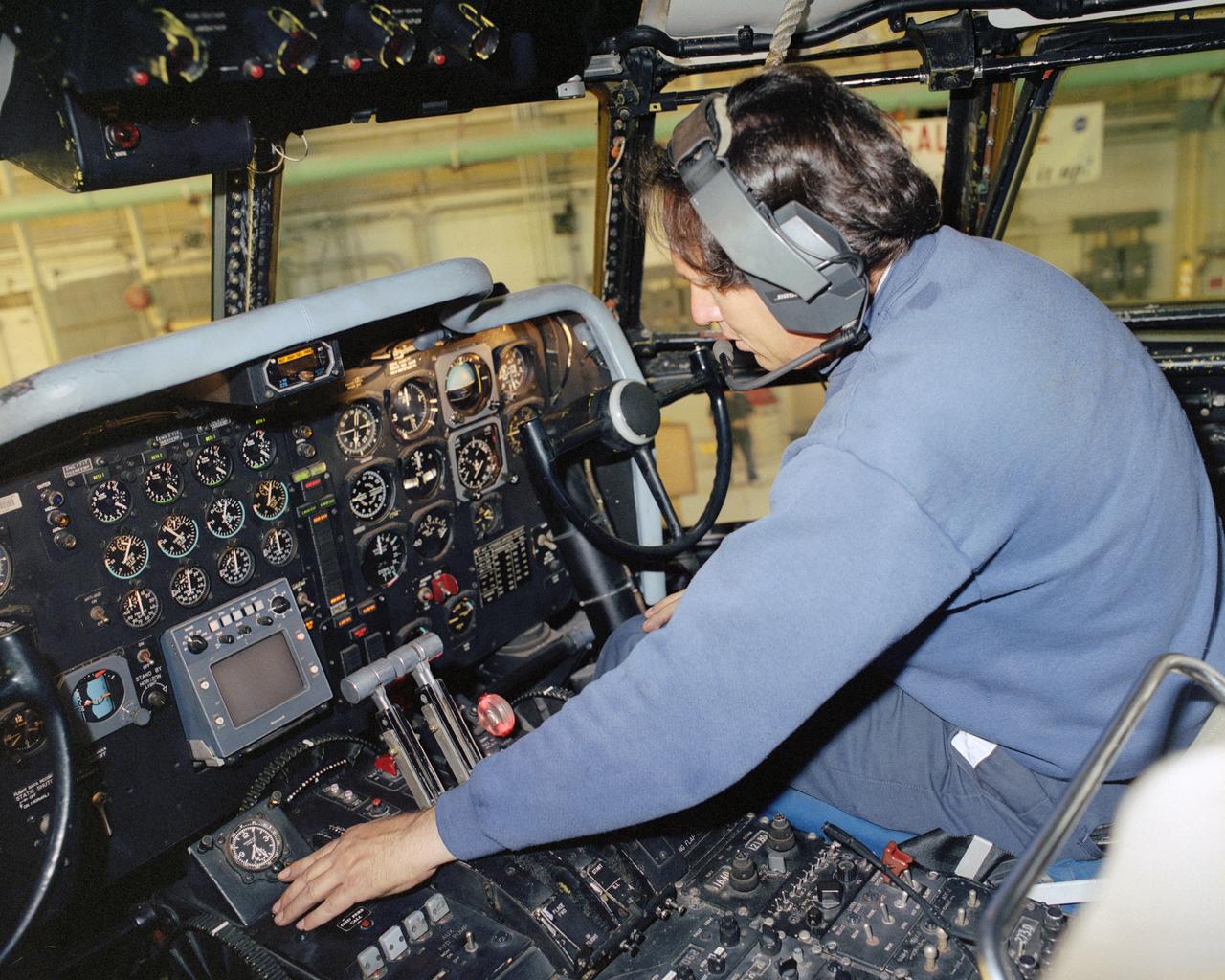
Assistant crew chief David Wyckoff checks out operation of the Super Guppy's new landing gear from the flight deck after changeout is complete.
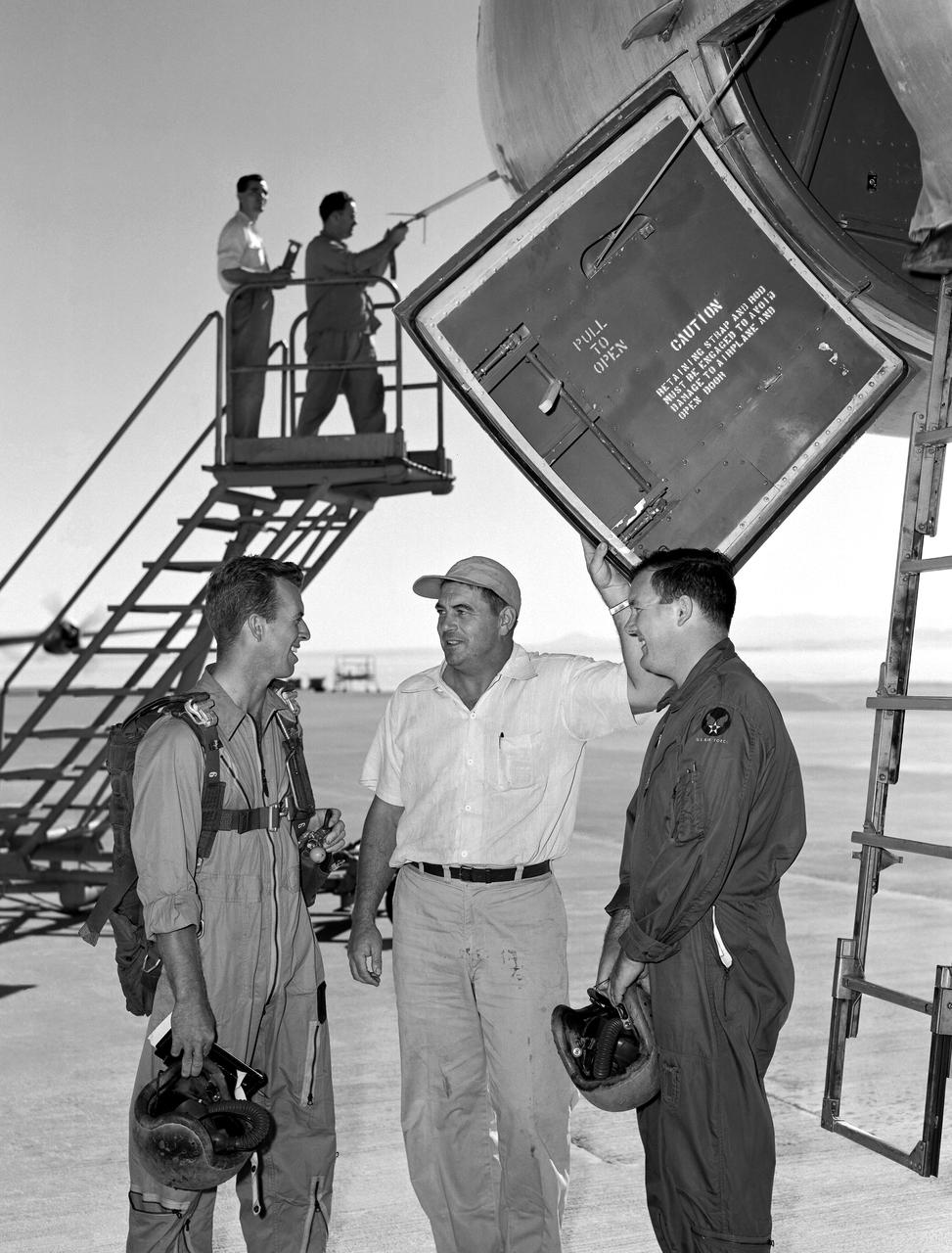
B-47A Stratojet on ramp with pilots and crew. In 1954 after a research flight in the Boeing B-47A Stratojet Crew Chief Wilbur McClenaghan (center) asks of the pilots if there are any "squawks" that should be taken care of before the next flight. Pilots are Joe Walker on the viewer's left and Stanley Butchart on the right. Data system technician Merle Curtis, in coveralls, is busy checking the airdata head mounted on the nose boom with the help of Instrumentation Crew Chief Raymond Langley. The door to the cockpit area is open showing a view of the ladder that folds down to be used by the pilots to enter and leave the area.
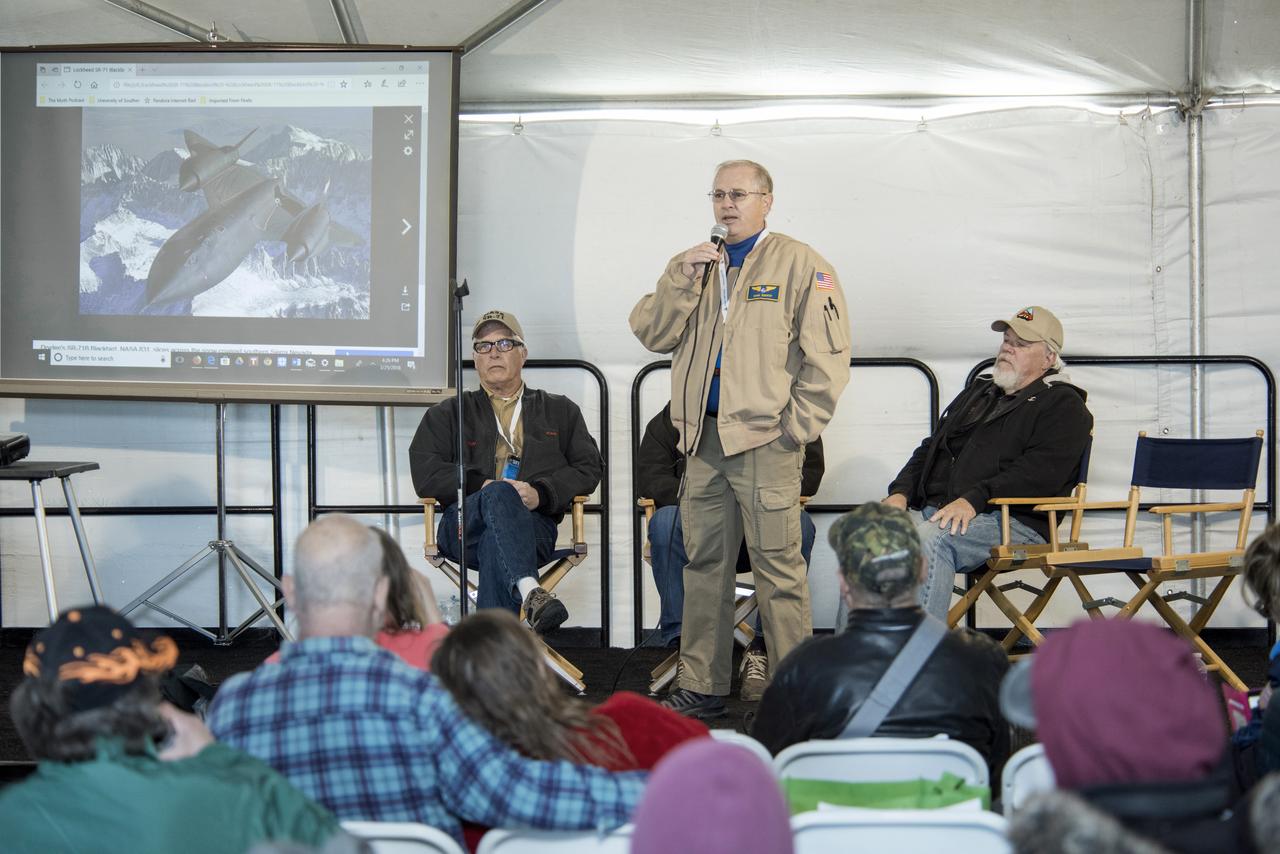
Dana Purifoy, NASA Armstrong director of Flight Operations, talking, and John McKay, former Armstrong SR-71 crew chief, participate on a panel discussion about the triple supersonic aircraft.
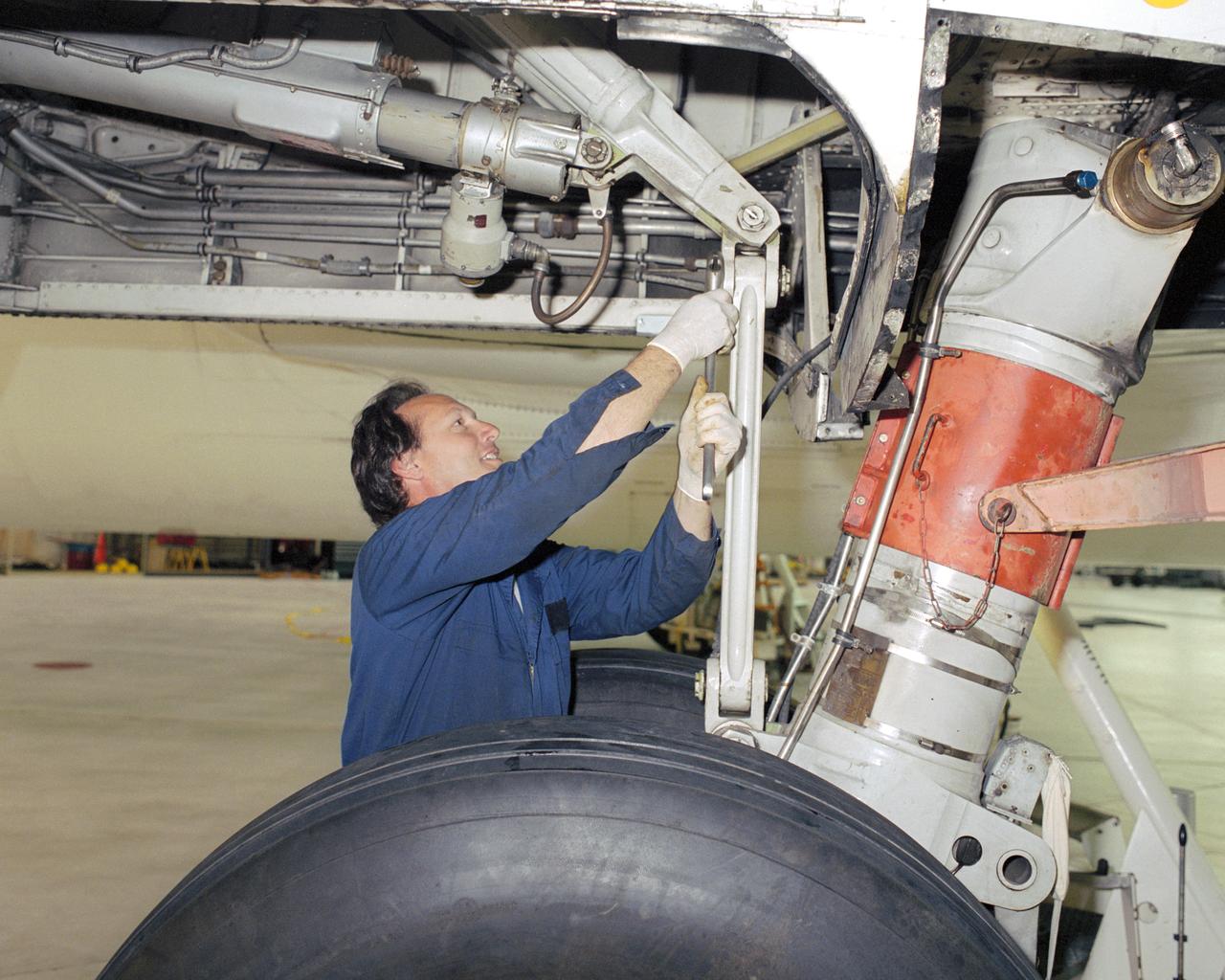
Assistant crew chief David Wyckoff applies some elbow grease to loosen a link pin during a landing gear changeout on NASA Johnson Space Center's Super Guppy.
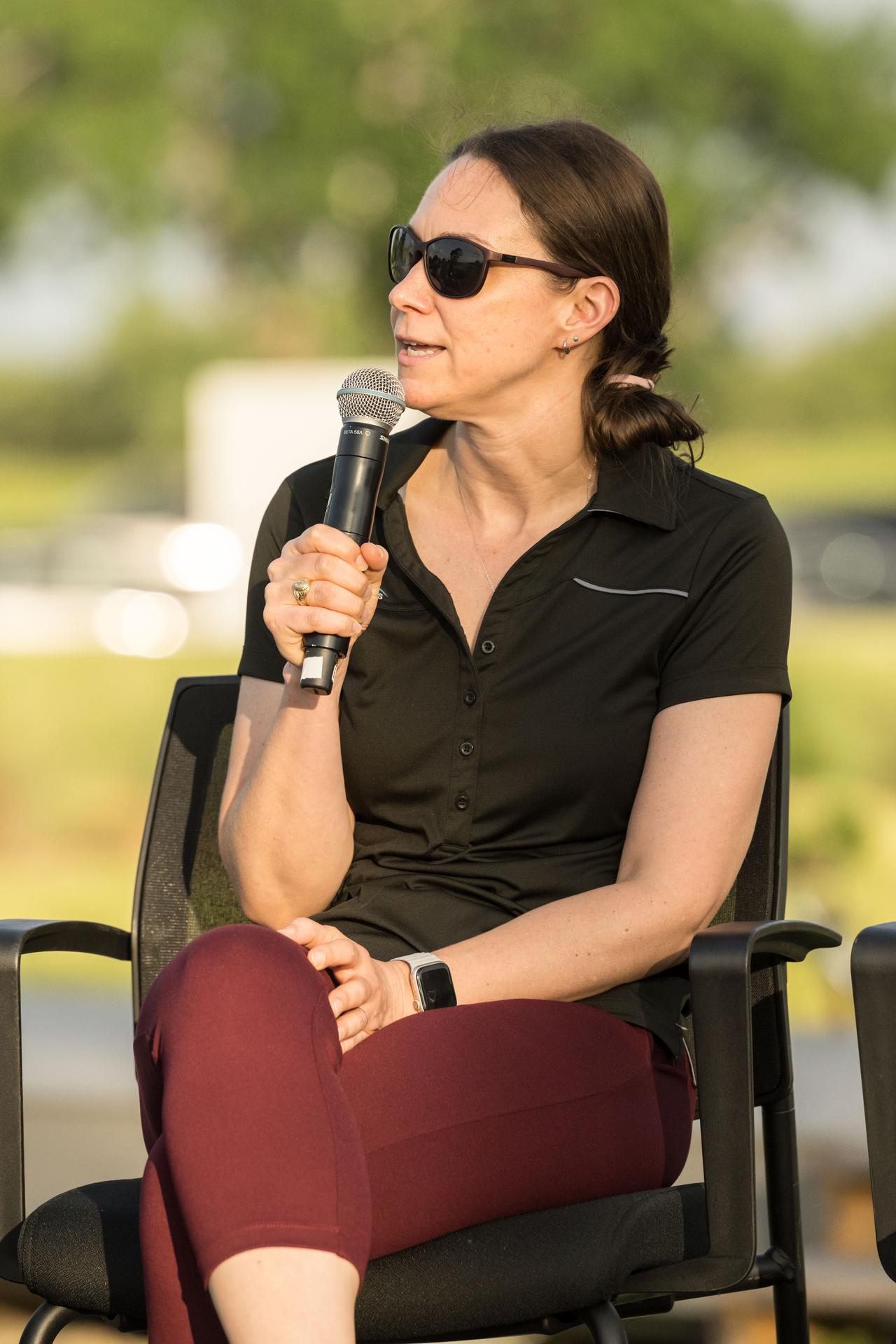
jsc2026e396783 (June 25, 2026) - Artemis II Chief Training Officer Jacki Mahaffey answers questions from the Artemis II crew during an employee celebration event at NASA's Johnson Space Center. Credit: NASA
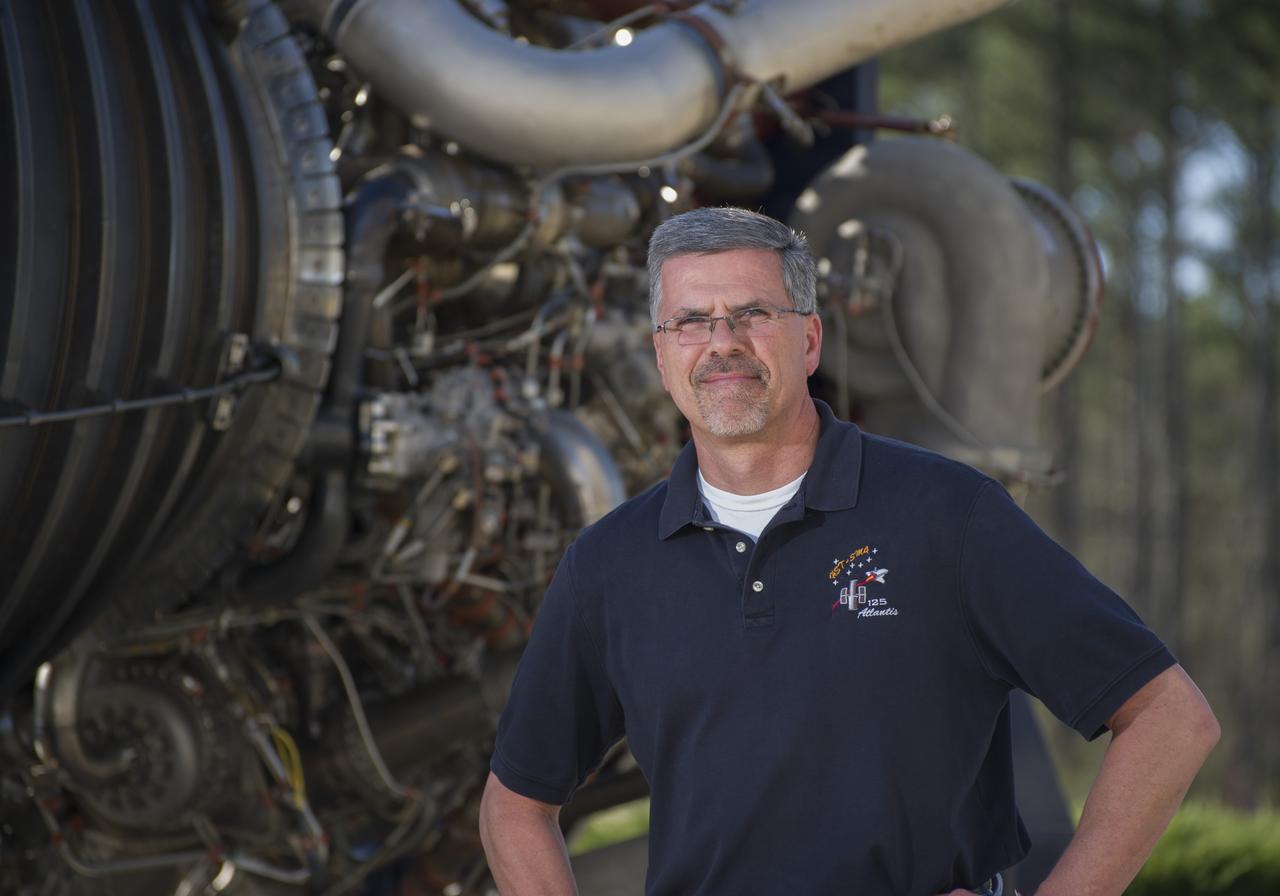
CHIEF ENGINEER OF THE LAUNCH VEHICLE FOR NASA'S COMMERCIAL CREW PROGRAM, DAN DORNEY GUIDES THE TEAM EVALUATING THE VEHICLES CREATED BY INDUSTRY PARTNERS AND ENSURES THE ROCKETS MEET THE REQUIREMENTS TO SAFELY CARRY ASTRONAUTS TO THE INTERNATIONAL SPACE STATION.
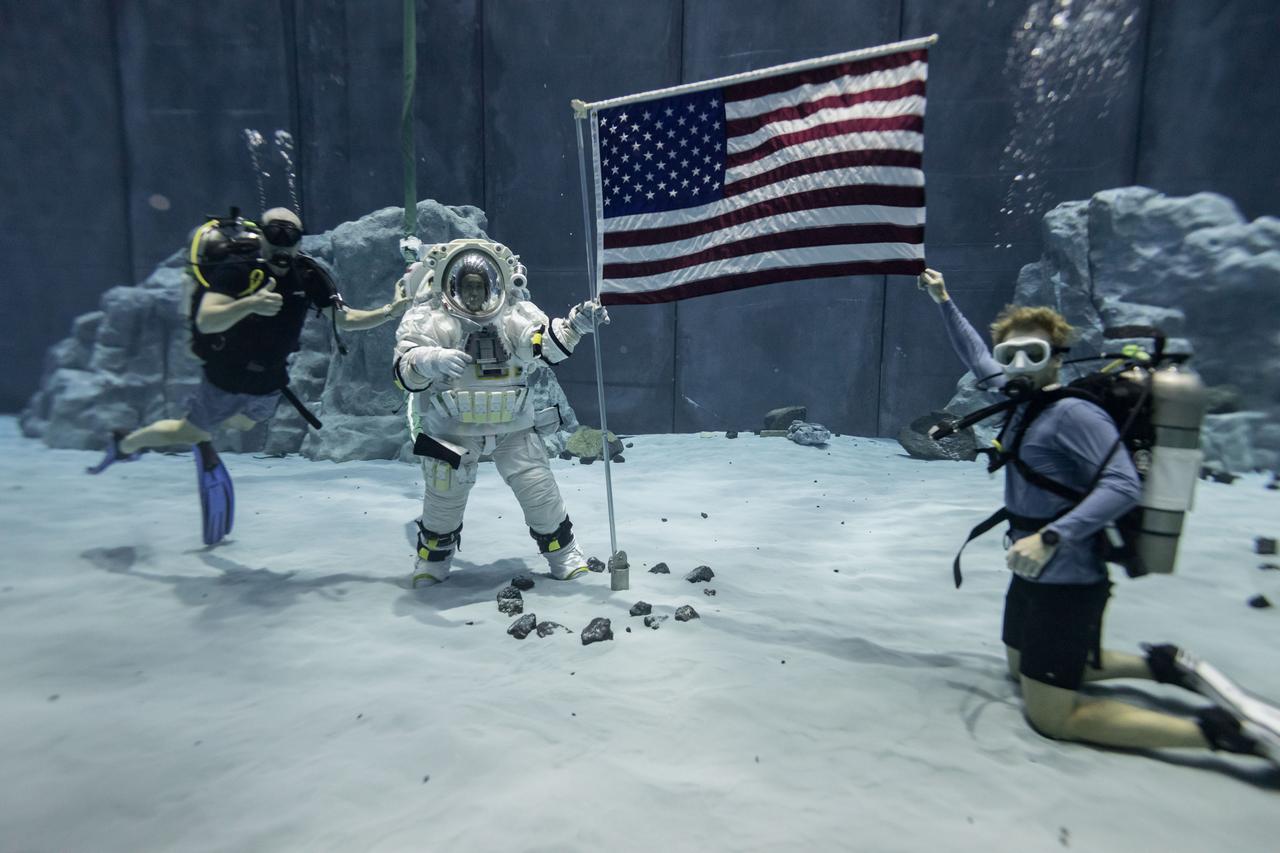
Axiom Space astronaut and Chief Technology Officer Koichi Wakata holds up an American flag in NASA's Neutral Buoyancy Laboratory during the first crewed underwater test of Axiom Space's lunar spacesuit. Image Credit: NASA
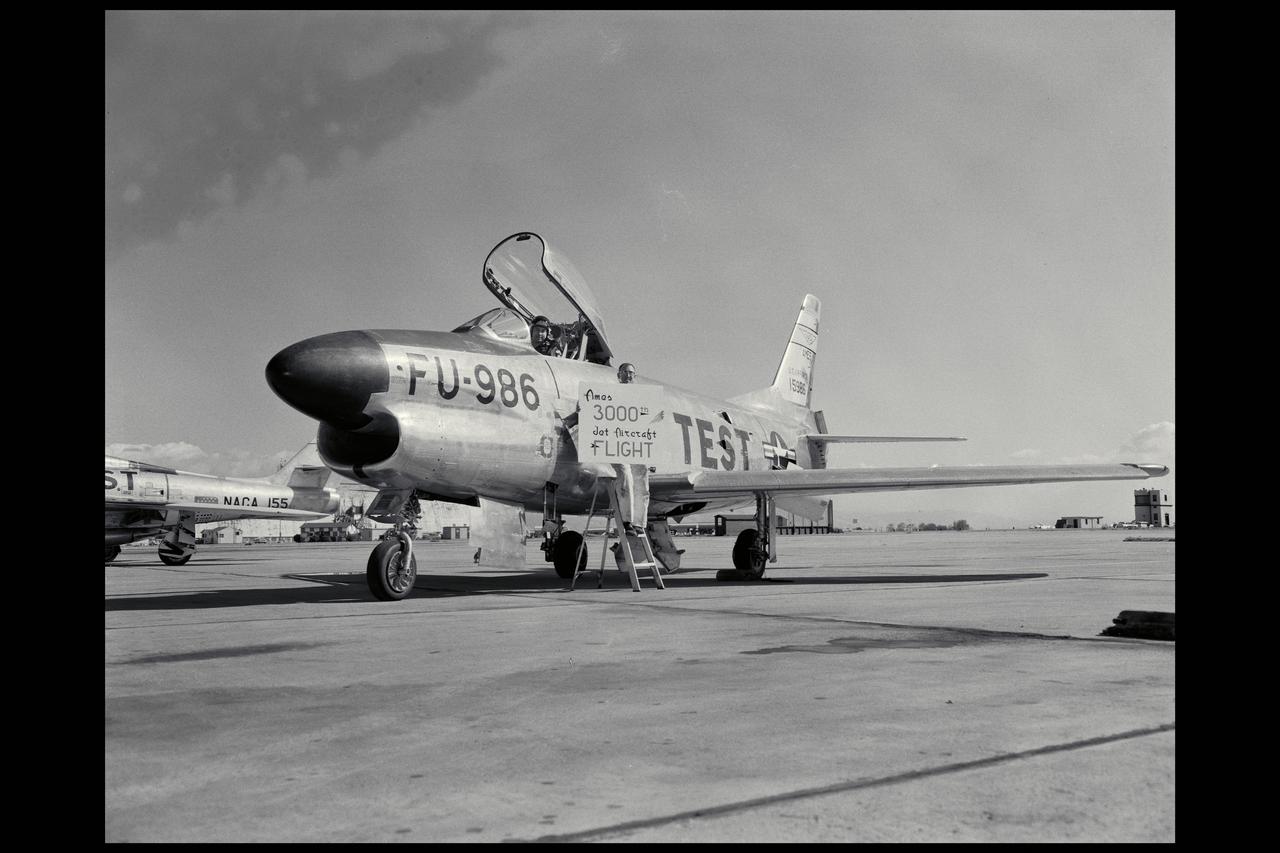
NACA/Ames photographer North American F-86D with Pilot Robert C Innis and Crew Chief Russell O. Barton hold sign celebrating Ames 3000th jet aircraft flight
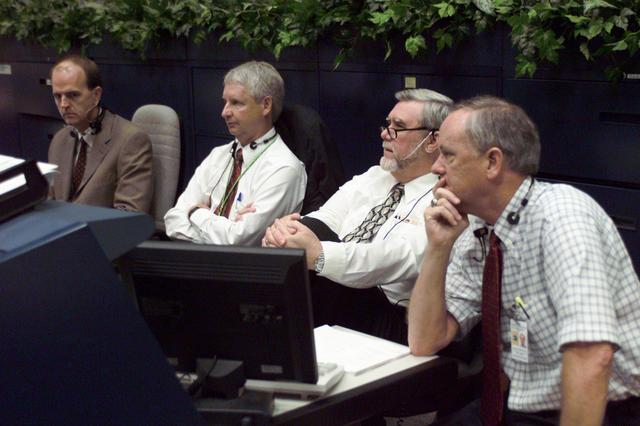
JSC2001-E-21323 (12 July 2001) --- From left to right, Robert Gest with United Space Alliance; Steven A. Hawley, deputy director of Flight Crew Operations; Alan L. (Lee) Briscoe, chief engineer for the Mission Operations Directorate (MOD); and J. Milton (Milt) Heflin, chief of the Flight Director's Office, watch the monitor at the MOD console during the pre-launch activity for the STS-104 mission in the shuttle flight control room (WFCR) of Houston's Mission Control Center (MCC).
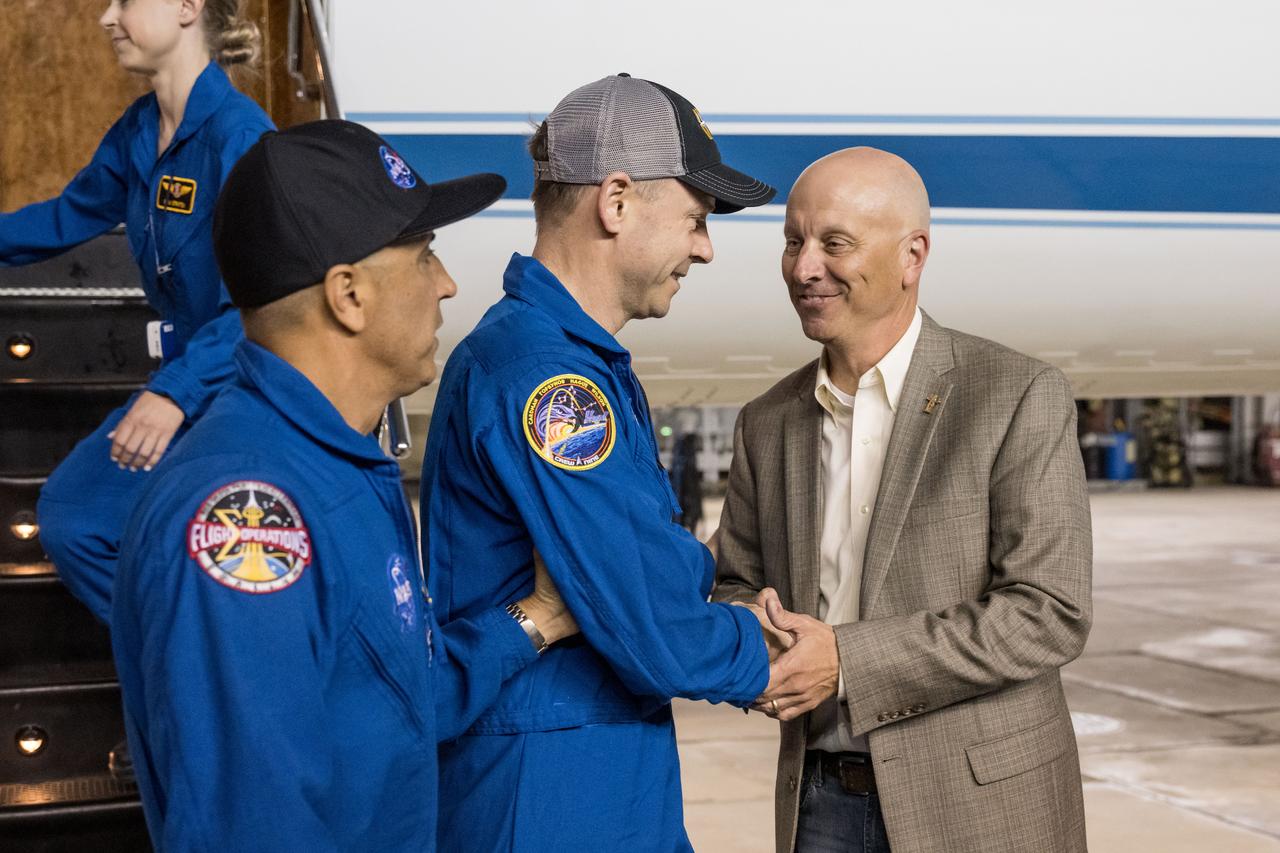
jsc2025e032542 (March 18, 2025) --- After completing a long-duration science mission aboard the International Space Station, NASA astronaut Nick Hague returns to Johnson Space Center's Ellington Field in Houston with Chief of the Astronaut Office, Joe Acaba and is greeted by Steve Koerner, acting center director. NASA’s SpaceX Crew-9 splashed down at 5:57 p.m. EDT on Tuesday, March 18, in the Gulf of America near Tallahassee, Florida.
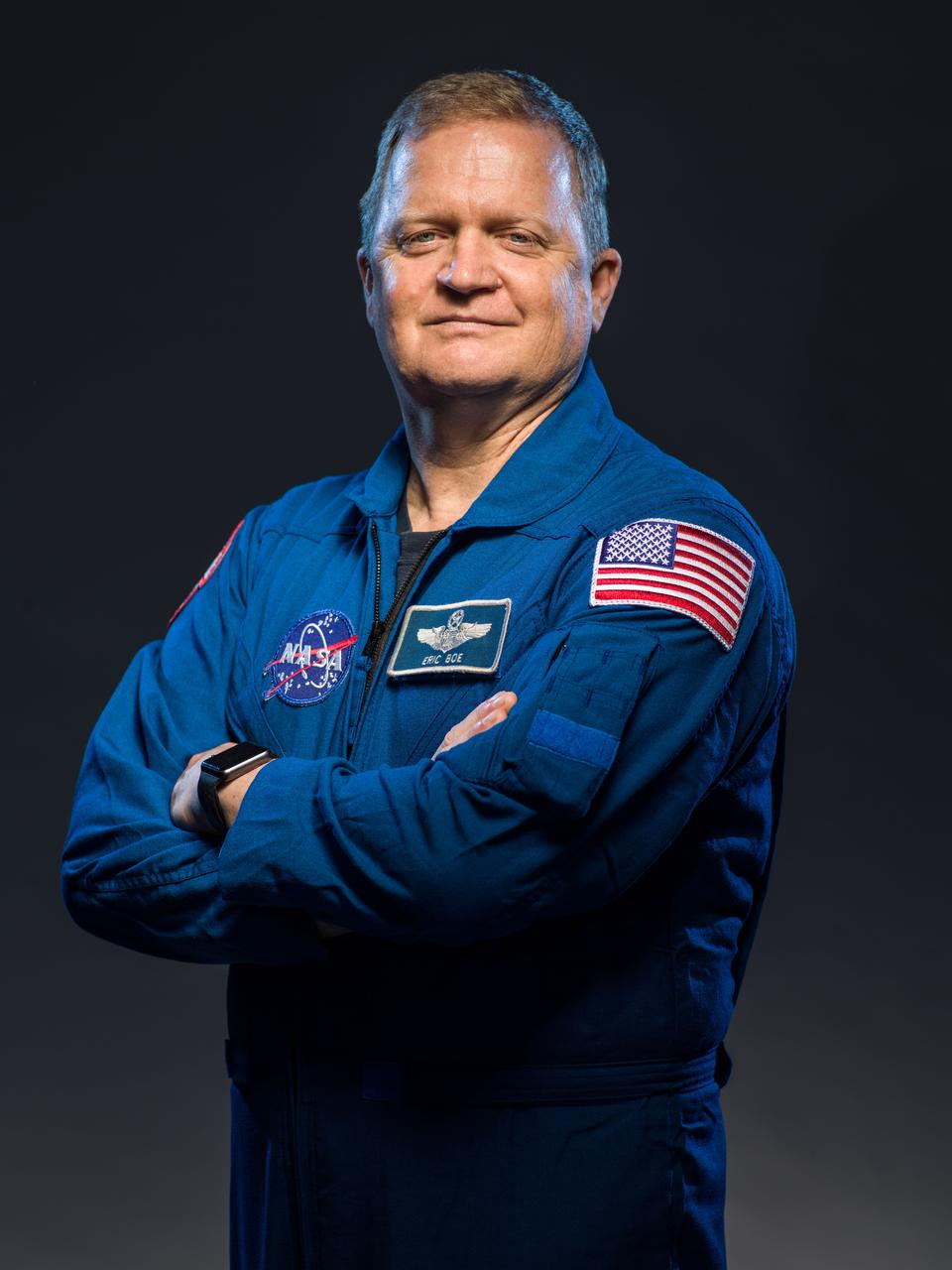
jsc2018e067582_alt (Aug. 1, 2018) --- NASA Astronaut Eric Boe was assigned to the first flight of Boeing’s CST-100 Starliner in August 2018. Editor's note: Boe was replaced by NASA Astronaut E. Michael “Mike” Fincke in January 2019 due to medical reasons; he will replace Fincke as the assistant to the chief for commercial crew in the astronaut office at NASA’s Johnson Space Center.
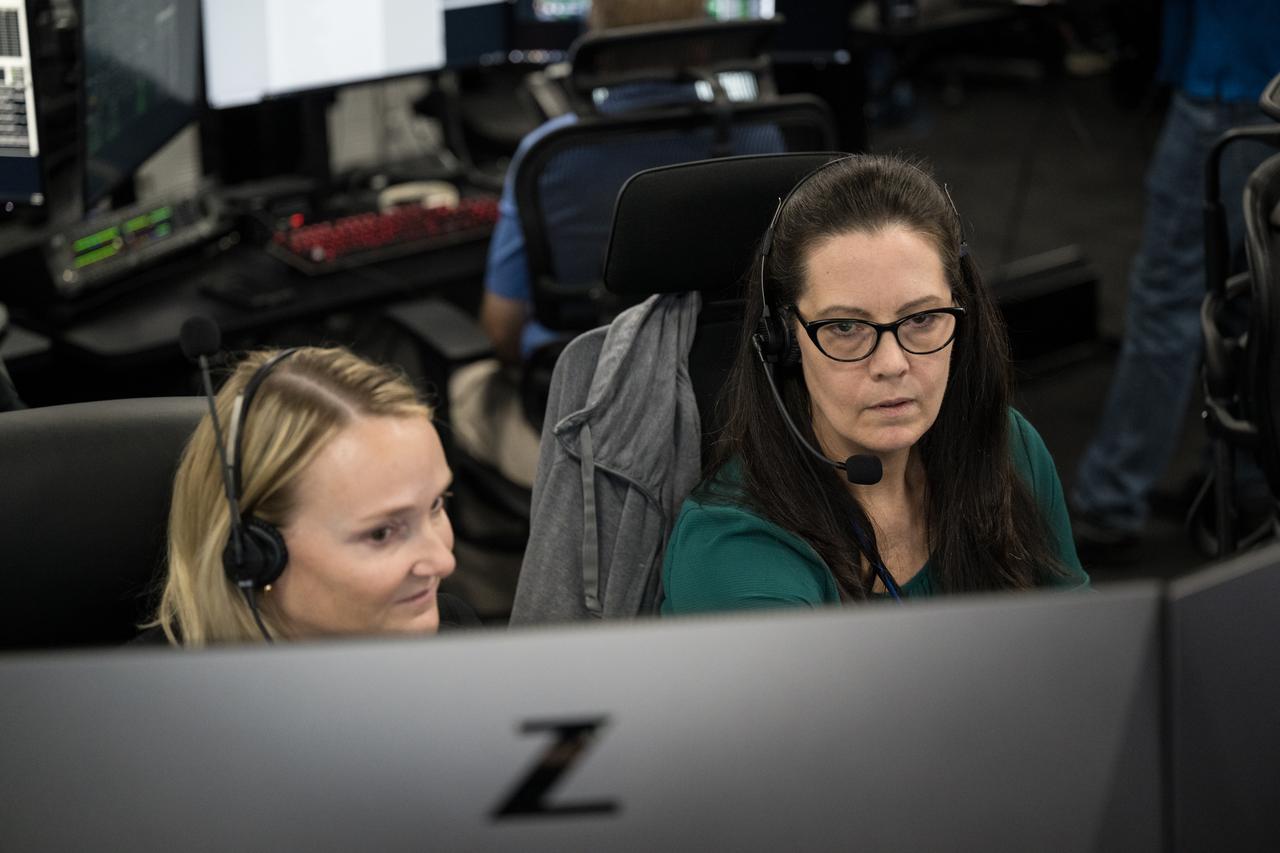
Katie Maynard, technical assistant to the Chief Flight Director, left, and Emily Nelson, NASA's chief flight director, second from left, monitor the countdown during a dress rehearsal in preparation for the launch of a SpaceX Falcon 9 rocket carrying the company's Dragon spacecraft on NASA’s SpaceX Crew-8 mission with NASA astronauts Matthew Dominick, Michael Barratt, and Jeanette Epps, and Roscosmos cosmonaut Alexander Grebenkin onboard, Monday, Feb. 26, 2024, in the control room of SpaceX’s HangerX at NASA’s Kennedy Space Center in Florida. NASA’s SpaceX Crew-8 mission is the eighth crew rotation mission of the SpaceX Dragon spacecraft and Falcon 9 rocket to the International Space Station as part of the agency’s Commercial Crew Program. Dominick, Barratt, Epps, and Grebenkin are scheduled to launch at 12:04 a.m. EST on Friday, March 1, from Launch Complex 39A at the Kennedy Space Center. Photo Credit: (NASA/Aubrey Gemignani)
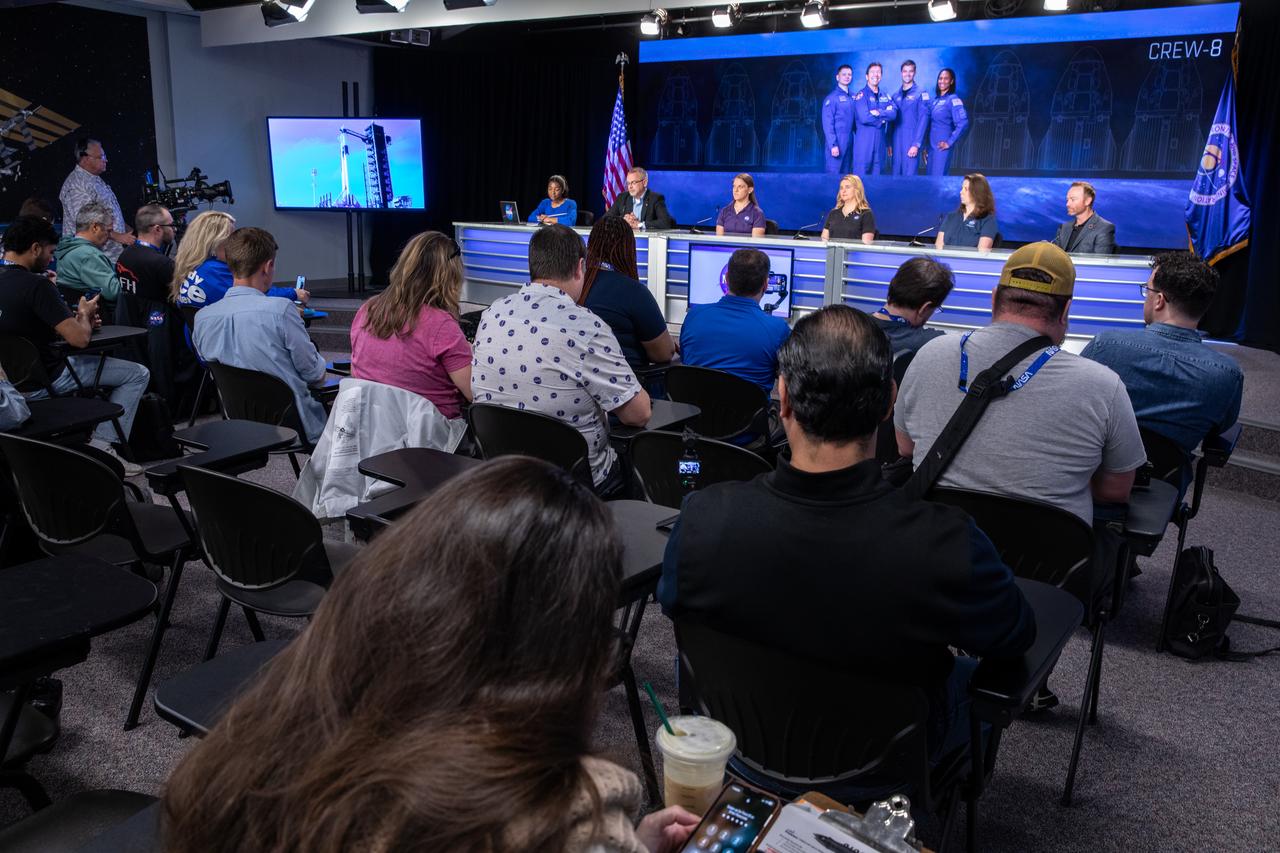
A social media panel discussion takes place inside the John Holliman Auditorium of the News Center at NASA’s Kennedy Space Center in Florida on Wednesday, Feb. 28, 2024, ahead of NASA’s SpaceX Crew-8 mission to the International Space Station. Participants, from left to right are Jasmine Hopkins, NASA Communications; NASA Associate Administrator Jim Free; Carla Koch, mission manager of NASA’s Commercial Crew Program; Jennifer Buchli, chief scientist, International Space Station; Kristin Fabre, deputy chief scientist of NASA’s Human Research Program; and Patrick O’Neill, public affairs and outreach lead of the ISS National Laboratory. Liftoff of the eighth crew rotation mission with SpaceX to the station and the ninth flight of Dragon with people as part of the agency’s Commercial Crew Program from Kennedy’s Launch Complex 39A is targeted for 12:04 a.m. on Friday, March 1.
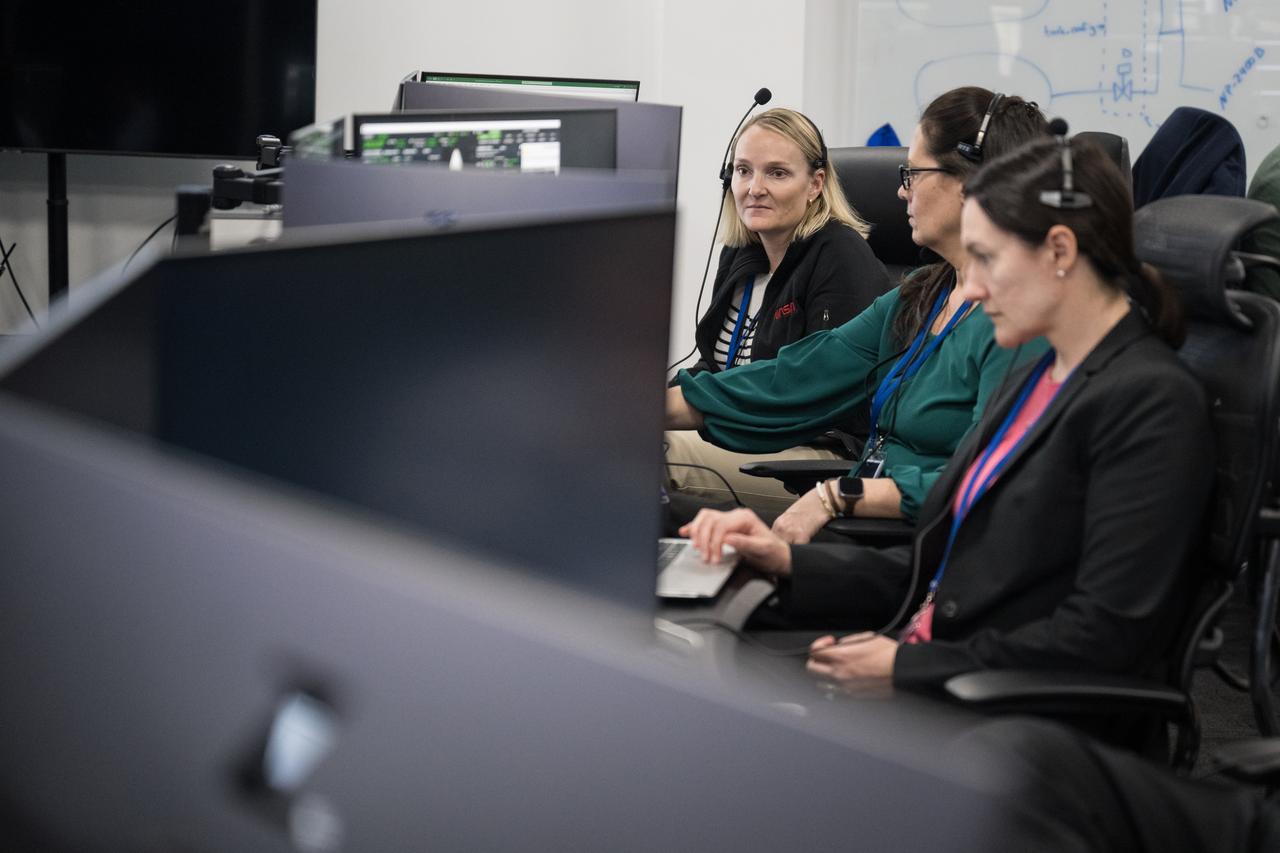
Katie Maynard, technical assistant to the Chief Flight Director, left, and Emily Nelson, NASA's chief flight director, second from left, monitor the countdown during a dress rehearsal in preparation for the launch of a SpaceX Falcon 9 rocket carrying the company's Dragon spacecraft on NASA’s SpaceX Crew-8 mission with NASA astronauts Matthew Dominick, Michael Barratt, Jeanette Epps, and Roscosmos cosmonaut Alexander Grebenkin onboard, Monday, Feb. 26, 2024, in the control room of SpaceX’s HangerX at NASA’s Kennedy Space Center in Florida. NASA’s SpaceX Crew-8 mission is the eighth crew rotation mission of the SpaceX Dragon spacecraft and Falcon 9 rocket to the International Space Station as part of the agency’s Commercial Crew Program. Dominick, Barratt, Epps, and Grebenkin are scheduled to launch at 12:04 a.m. EST on Friday, March 1, from Launch Complex 39A at the Kennedy Space Center. Photo Credit: (NASA/Aubrey Gemignani)
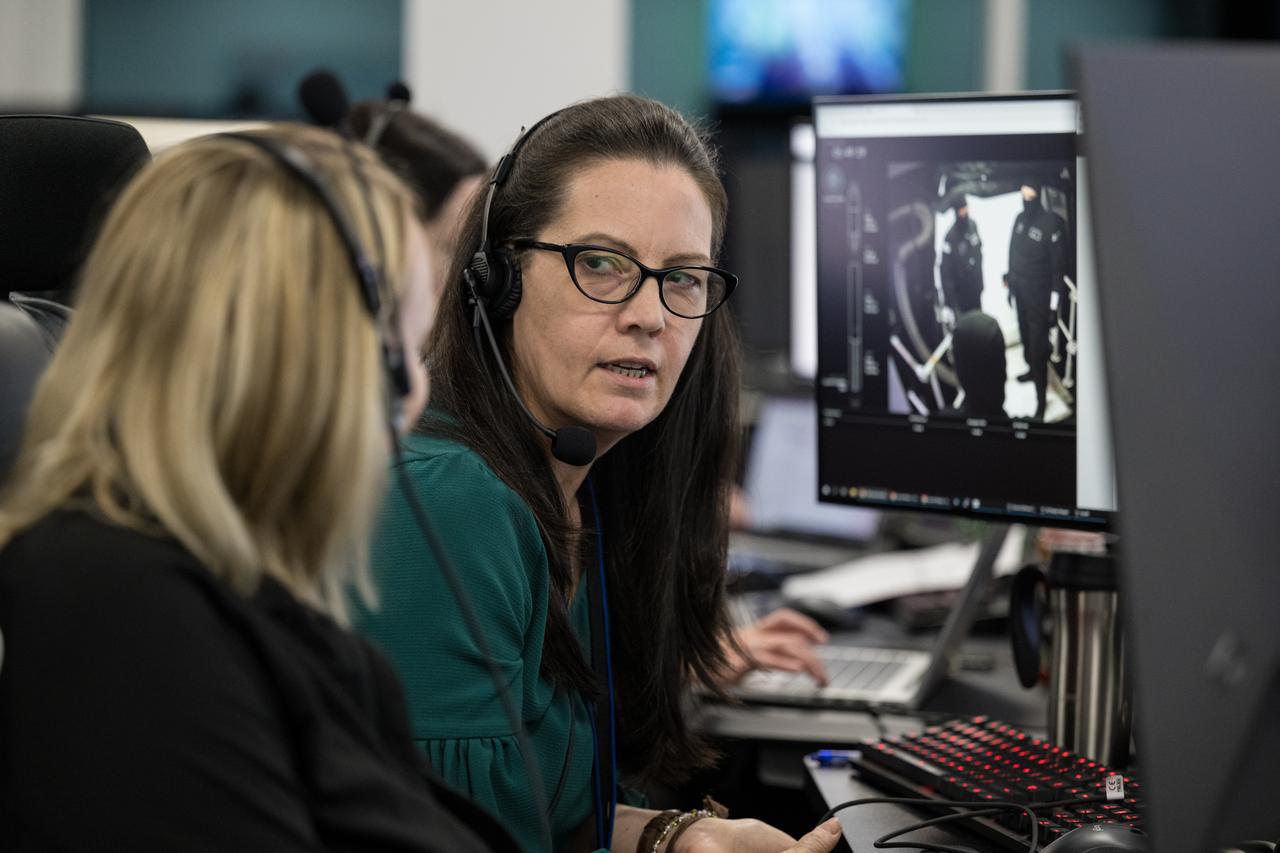
Katie Maynard, technical assistant to the Chief Flight Director, left, and Emily Nelson, NASA's chief flight director, second from left, monitor the countdown during a dress rehearsal in preparation for the launch of a SpaceX Falcon 9 rocket carrying the company's Dragon spacecraft on NASA’s SpaceX Crew-8 mission with NASA astronauts Matthew Dominick, Michael Barratt, and Jeanette Epps, and Roscosmos cosmonaut Alexander Grebenkin onboard, Monday, Feb. 26, 2024, in the control room of SpaceX’s HangerX at NASA’s Kennedy Space Center in Florida. NASA’s SpaceX Crew-8 mission is the eighth crew rotation mission of the SpaceX Dragon spacecraft and Falcon 9 rocket to the International Space Station as part of the agency’s Commercial Crew Program. Dominick, Barratt, Epps, and Grebenkin are scheduled to launch at 12:04 a.m. EST on Friday, March 1, from Launch Complex 39A at the Kennedy Space Center. Photo Credit: (NASA/Aubrey Gemignani)
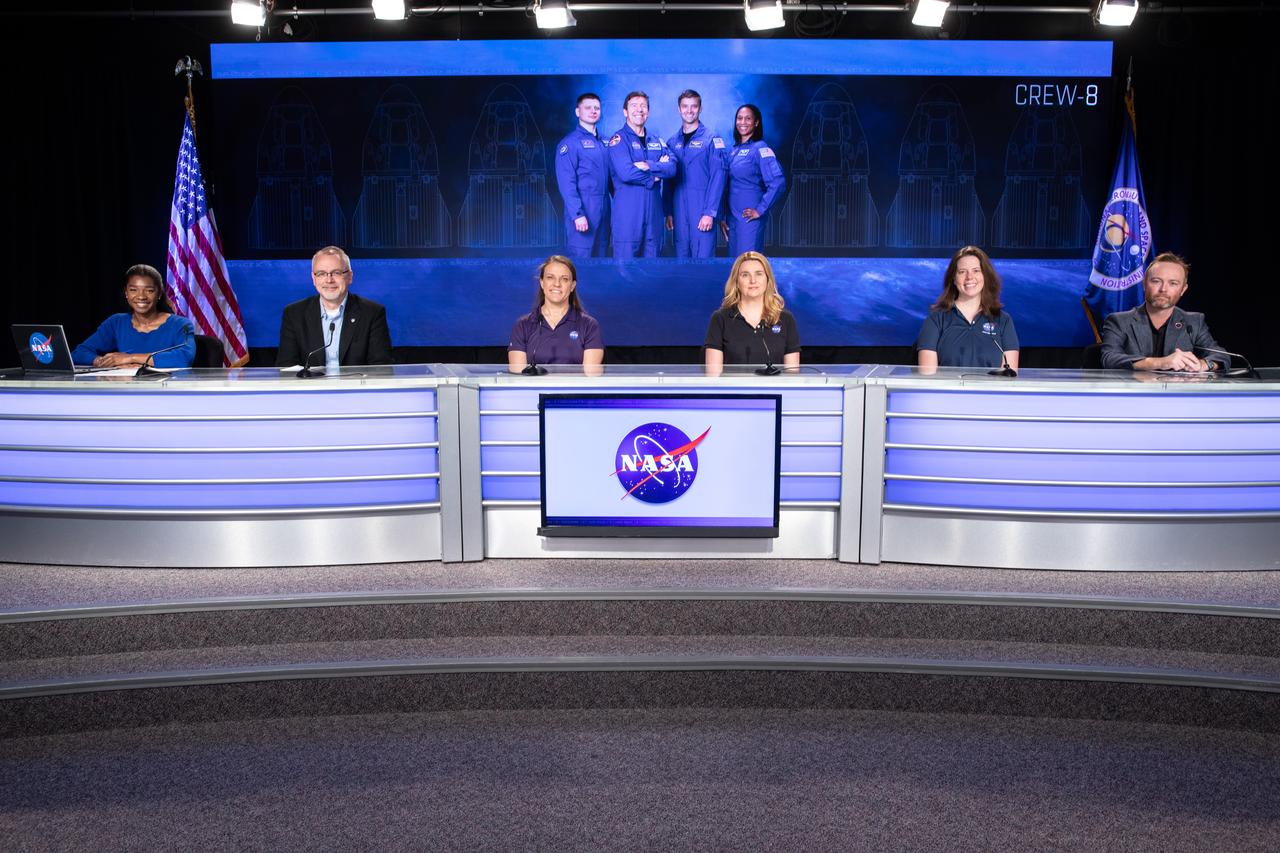
A social media panel discussion takes place inside the John Holliman Auditorium of the News Center at NASA’s Kennedy Space Center in Florida on Wednesday, Feb. 28, 2024, ahead of NASA’s SpaceX Crew-8 mission to the International Space Station. Participants, from left to right are Jasmine Hopkins, NASA Communications; NASA Associate Administrator Jim Free; Carla Koch, mission manager of NASA’s Commercial Crew Program; Jennifer Buchli, chief scientist, International Space Station; Kristin Fabre, deputy chief scientist of NASA’s Human Research Program; and Patrick O’Neill, public affairs and outreach lead of the ISS National Laboratory. Liftoff of the eighth crew rotation mission with SpaceX to the station and the ninth flight of Dragon with people as part of the agency’s Commercial Crew Program from Kennedy’s Launch Complex 39A is targeted for 12:04 a.m. on Friday, March 1.
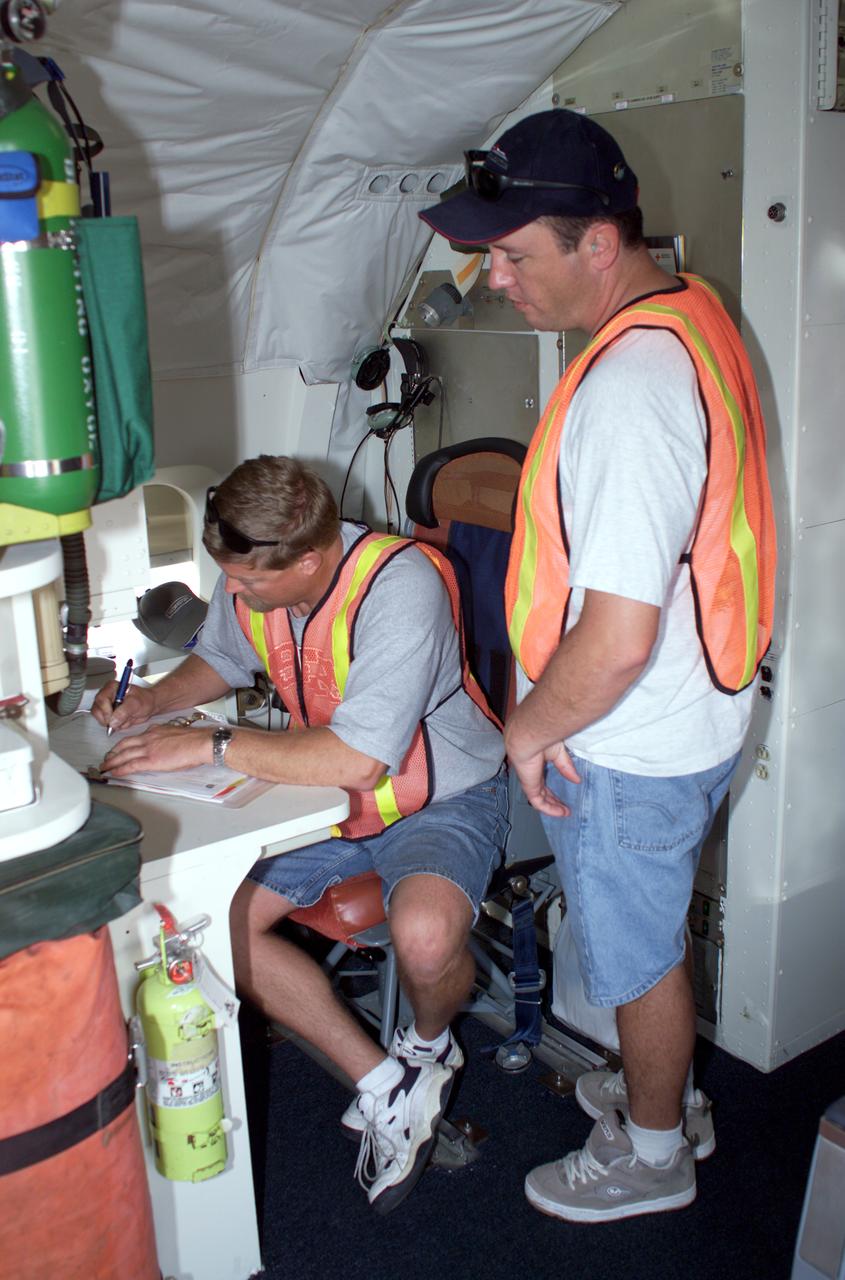
DC-8 Quality Inspector Scott Silver signs documents while Acting Crew Chief Mike Bereda looks on prior to a DC-8 AirSAR flight in Costa Rica. AirSAR 2004 Mesoamerica is a three-week expedition by an international team of scientists that uses an all-weather imaging tool, called the Airborne Synthetic Aperture Radar (AirSAR) which is located onboard NASA's DC-8 airborne laboratory. Scientists from many parts of the world including NASA's Jet Propulsion Laboratory are combining ground research done in several areas in Central America with NASA's AirSAR technology to improve and expand on the quality of research they are able to conduct. The radar, developed by NASA's Jet Propulsion Laboratory, can penetrate clouds and also collect data at night. Its high-resolution sensors operate at multiple wavelengths and modes, allowing AirSAR to see beneath treetops, through thin sand, and dry snow pack. AirSAR's 2004 campaign is a collaboration of many U.S. and Central American institutions and scientists, including NASA; the National Science Foundation; the Smithsonian Institution; National Geographic; Conservation International; the Organization of Tropical Studies; the Central American Commission for Environment and Development; and the Inter-American Development Bank.
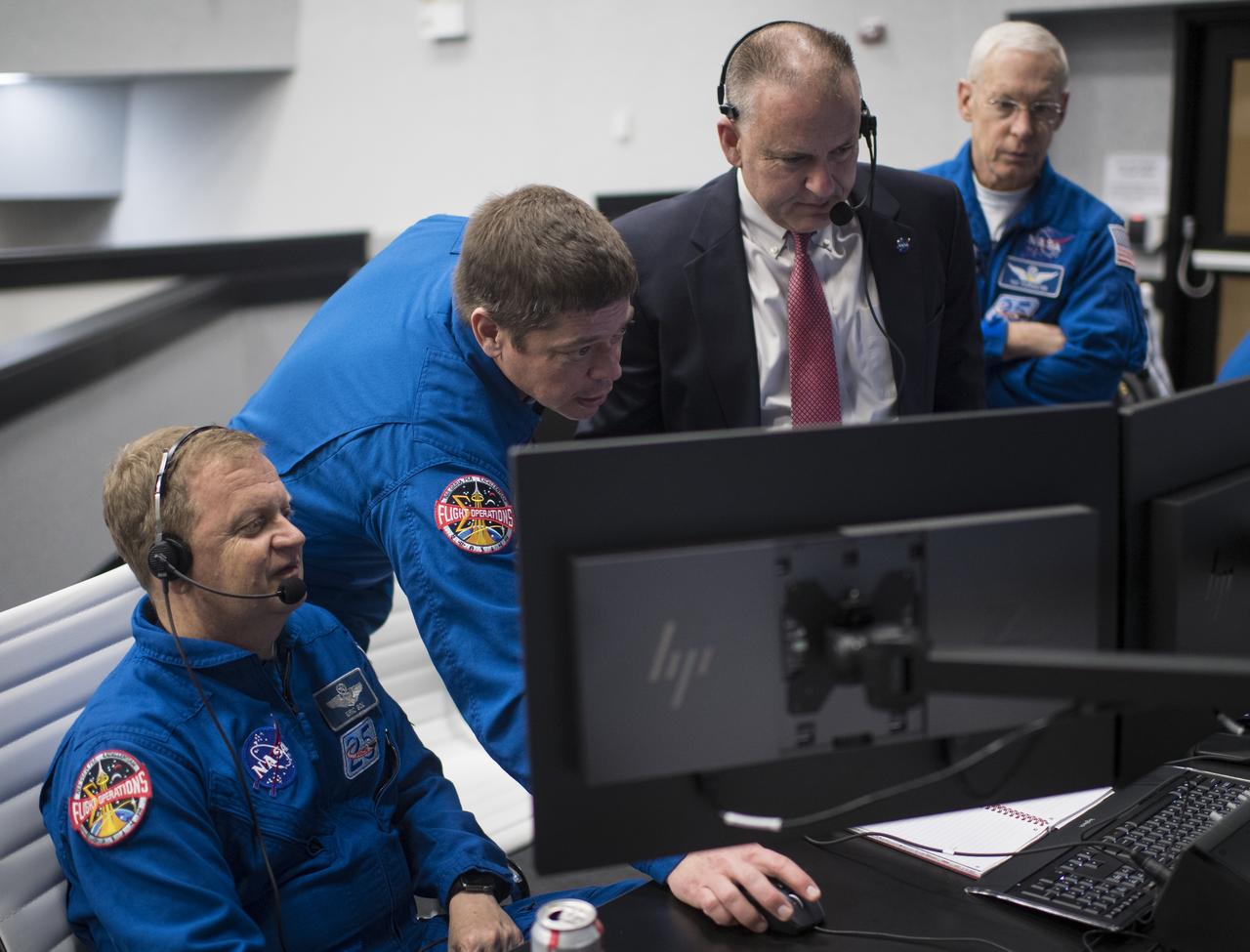
NASA astronaut Eric Boe, assistant to the chief of the astronaut office for commercial crew, left, NASA astronaut Bob Behnken, Norm Knight, deputy director of flight operations at NASA's Johnson Space Center and chief of the astronaut office Pat Forrester monitor the countdown of the launch of a SpaceX Falcon 9 rocket carrying the company's Crew Dragon spacecraft on the Demo-1 mission from firing room four of the Launch Control Center, Saturday, March 2, 2019 at the Kennedy Space Center in Florida. The Demo-1 mission will be the first launch of a commercially built and operated American spacecraft and space system designed for humans as part of NASA's Commercial Crew Program. The mission will serve as an end-to-end test of the system's capabilities. Photo Credit: (NASA/Joel Kowsky)
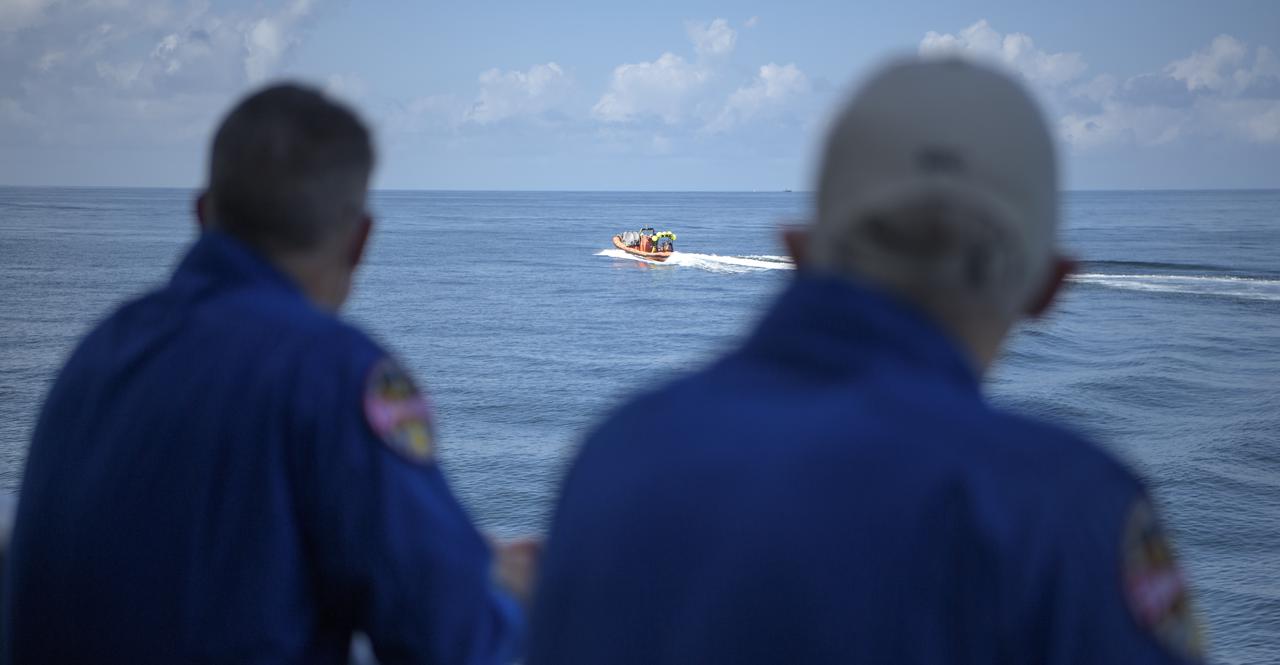
NASA astronaut and Crew Recovery Chief Shane Kimbrough, left, and NASA Chief Astronaut Pat Forrester watch as SpaceX support teams are deployed on fast boats from the SpaceX GO Navigator recovery ship ahead of the landing of the SpaceX Crew Dragon Endeavour spacecraft with NASA astronauts Robert Behnken and Douglas Hurley onboard, Sunday, Aug. 2, 2020 in the Gulf of Mexico off the cost of Pensacola, Florida. The Demo-2 test flight for NASA's Commercial Crew Program is the first to deliver astronauts to the International Space Station and return them to Earth onboard a commercially built and operated spacecraft. Behnken and Hurley are returning after spending 64 days in space. Photo Credit: (NASA/Bill Ingalls)
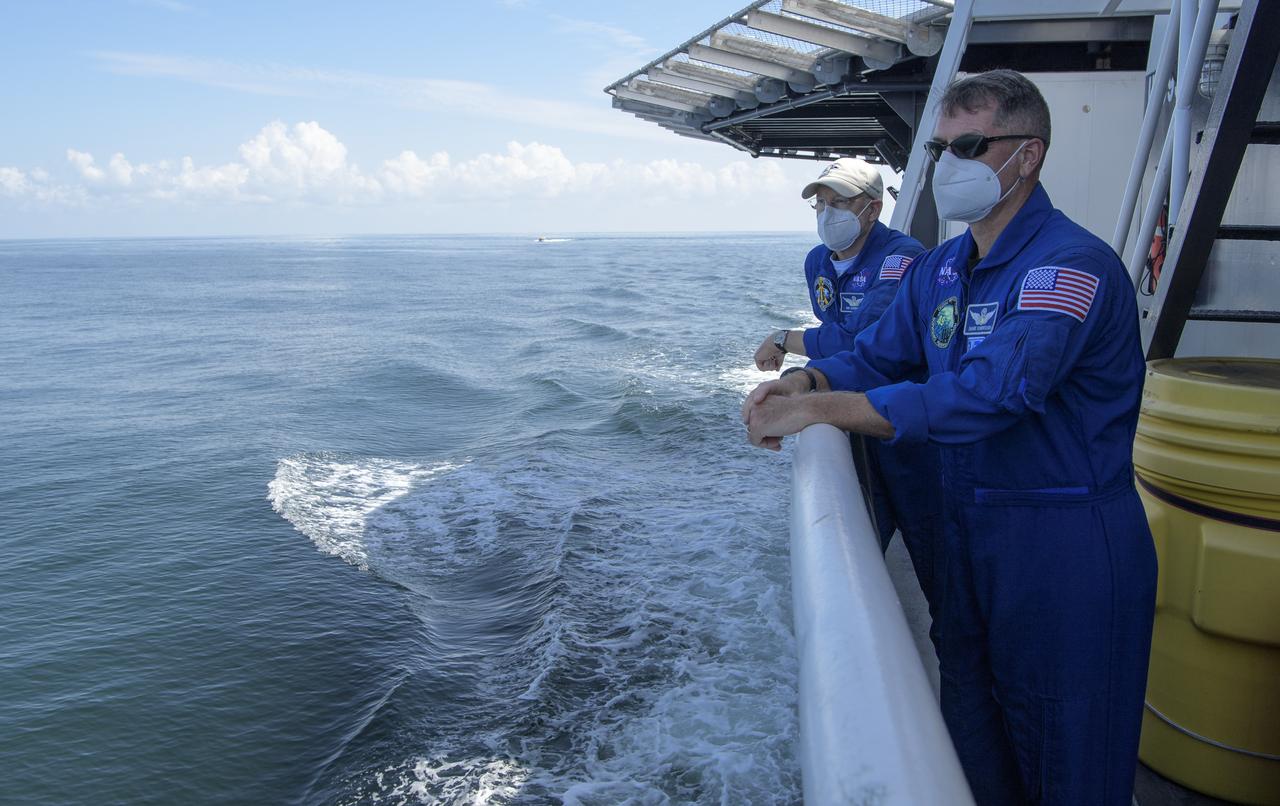
NASA Chief Astronaut Pat Forrester, left, and NASA astronaut and Crew Recovery Chief Shane Kimbrough, along with other NASA and SpaceX support teams onboard the SpaceX GO Navigator recovery ship, prepare for the landing of the SpaceX Crew Dragon Endeavour spacecraft with NASA astronauts Robert Behnken and Douglas Hurley onboard, Sunday, Aug. 2, 2020 in the Gulf of Mexico off the cost of Pensacola, Florida. The Demo-2 test flight for NASA's Commercial Crew Program is the first to deliver astronauts to the International Space Station and return them to Earth onboard a commercially built and operated spacecraft. Behnken and Hurley are returning after spending 64 days in space. Photo Credit: (NASA/Bill Ingalls)
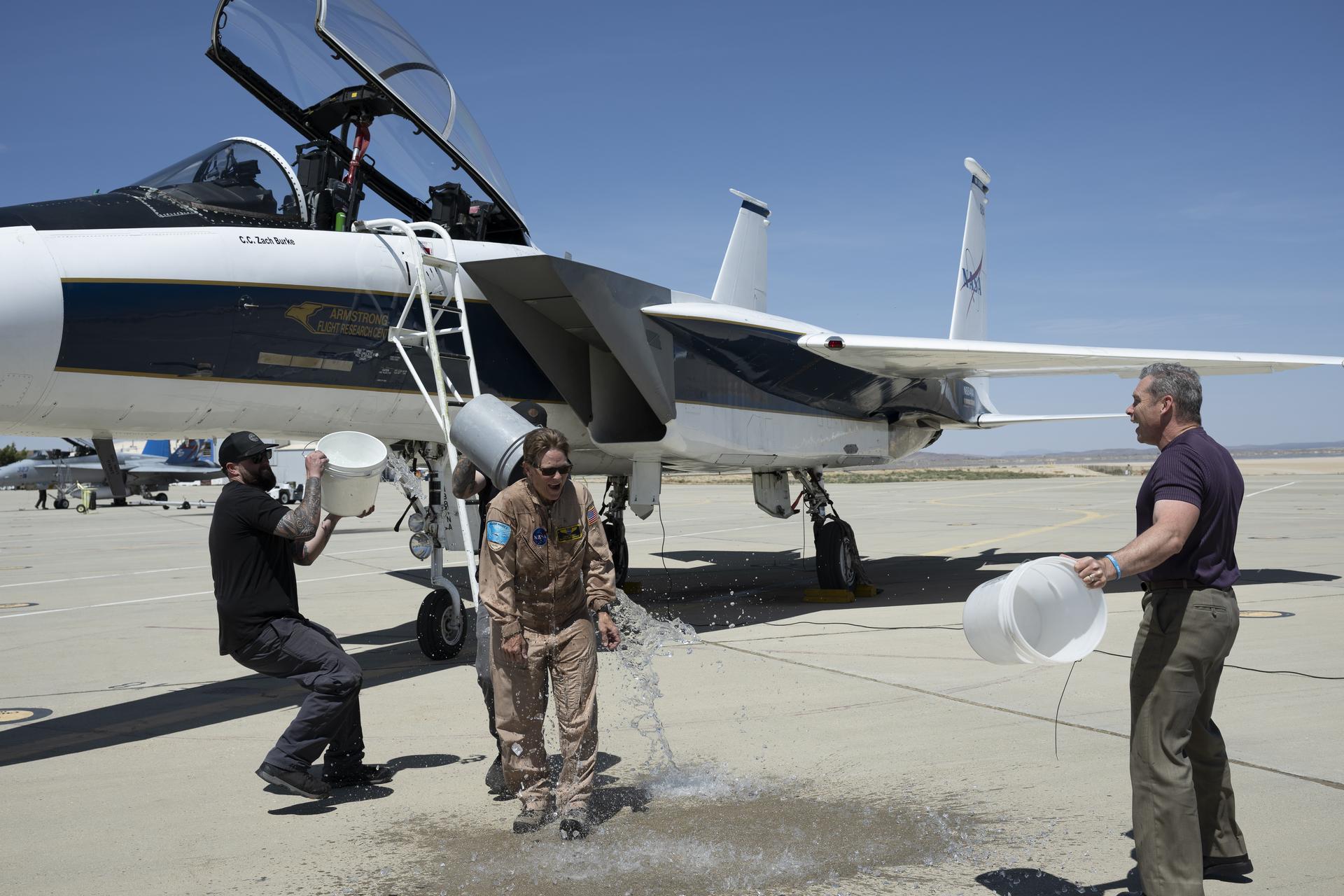
F-15 aircraft crew chief Zack Burke, left, and X-59 mechanic Jamie Trescott, center back, splash buckets of ice water on NASA aerial photographer Carla Thomas in celebration of her 1,000th flight at NASA’s Armstrong Flight Research Center in Edwards, California, on Monday, April 20, 2026. Tim Krall, NASA Armstrong support aircraft fleet manager, watches. Thomas completed her flight in the backseat of a NASA F-15 aircraft flown by NASA Armstrong chief pilot Wayne Ringelberg. For 38 years, Thomas has captured aerial photographs of research and science flights.

KENNEDY SPACE CENTER, FLA. - STS-114 Mission Commander Eileen Collins (left) is greeted at the entrance to the V.A. Outpatient Clinic in Viera, Fla., by Dr. Thomas Howard (center), chief medical officer, and Dr. Michael Doukas (right), chief of staff with the Orlando V.A. Medical Center. Collins is participating in the dedication of a hospital wing in honor of space shuttle Discovery, to be known as the Discovery wing. Collins and her crew have returned to Florida especially for a celebration in the KSC Visitor Complex of the successful return to flight mission that launched July 26 of this year.
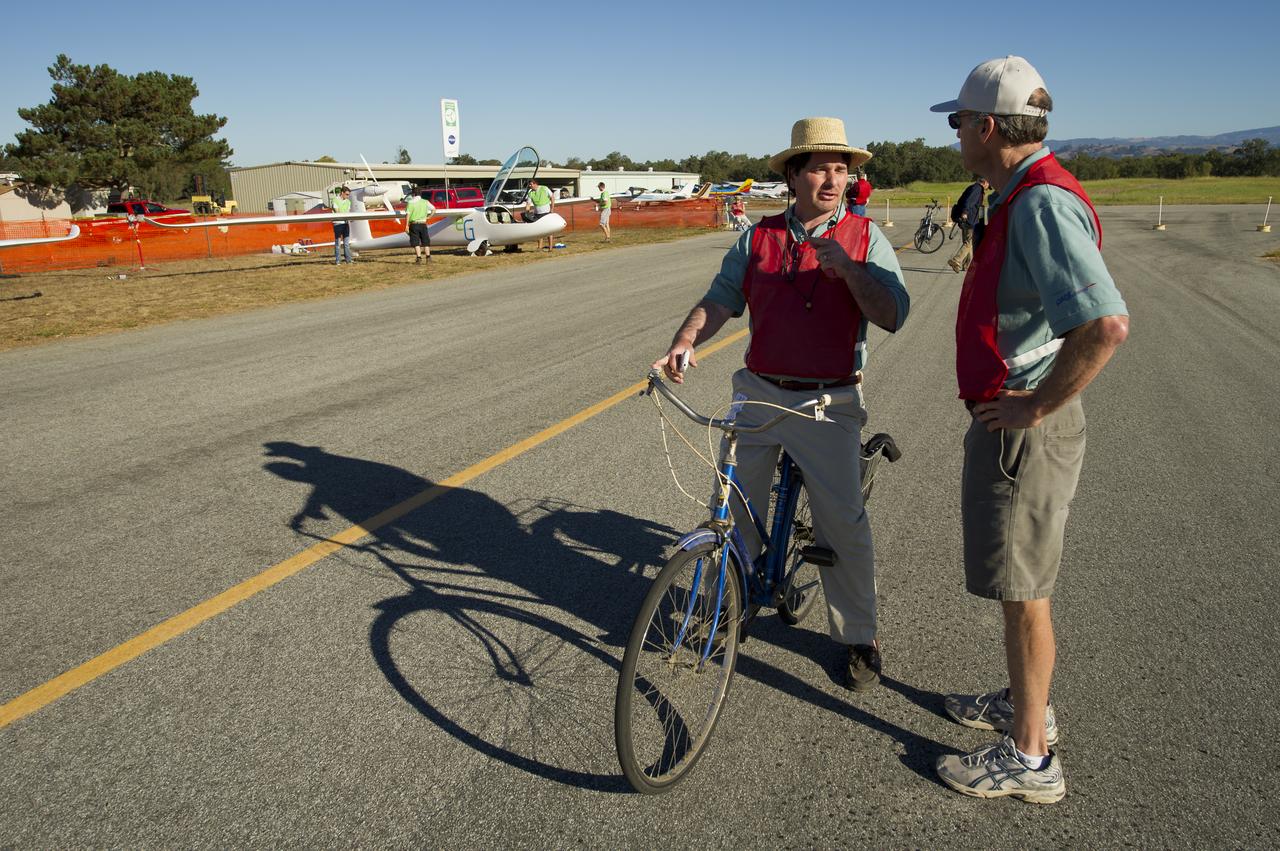
CAFE Foundation Security Chief and Event Manager Bruno Mombrinie, left, talks with CAFE Foundation eCharging Chief Alan Soule as flight crews prepare for the miles per gallon (MPG) flight during the 2011 Green Flight Challenge, sponsored by Google, at the Charles M. Schulz Sonoma County Airport in Santa Rosa, Calif. on Tuesday, Sept. 27, 2011. NASA and the Comparative Aircraft Flight Efficiency (CAFE) Foundation are having the challenge with the goal to advance technologies in fuel efficiency and reduced emissions with cleaner renewable fuels and electric aircraft. Photo Credit: (NASA/Bill Ingalls)
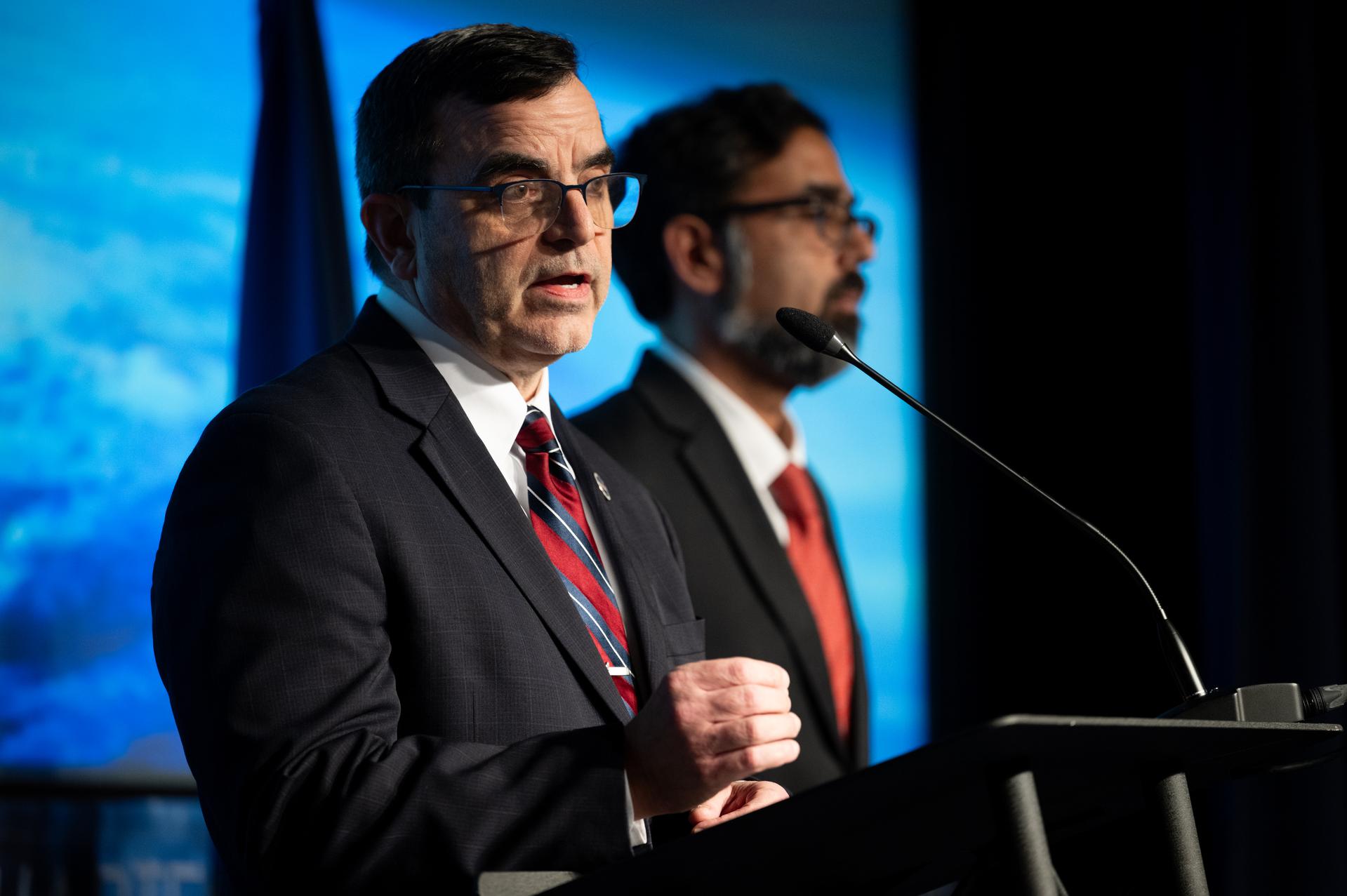
Dr. James Polk, NASA’s chief health and medical officer, provides an update on the International Space Station and its crew, Thursday, Jan. 8, 2026, at the Mary W. Jackson NASA Headquarters building in Washington. Photo Credit: (NASA/Joel Kowsky)
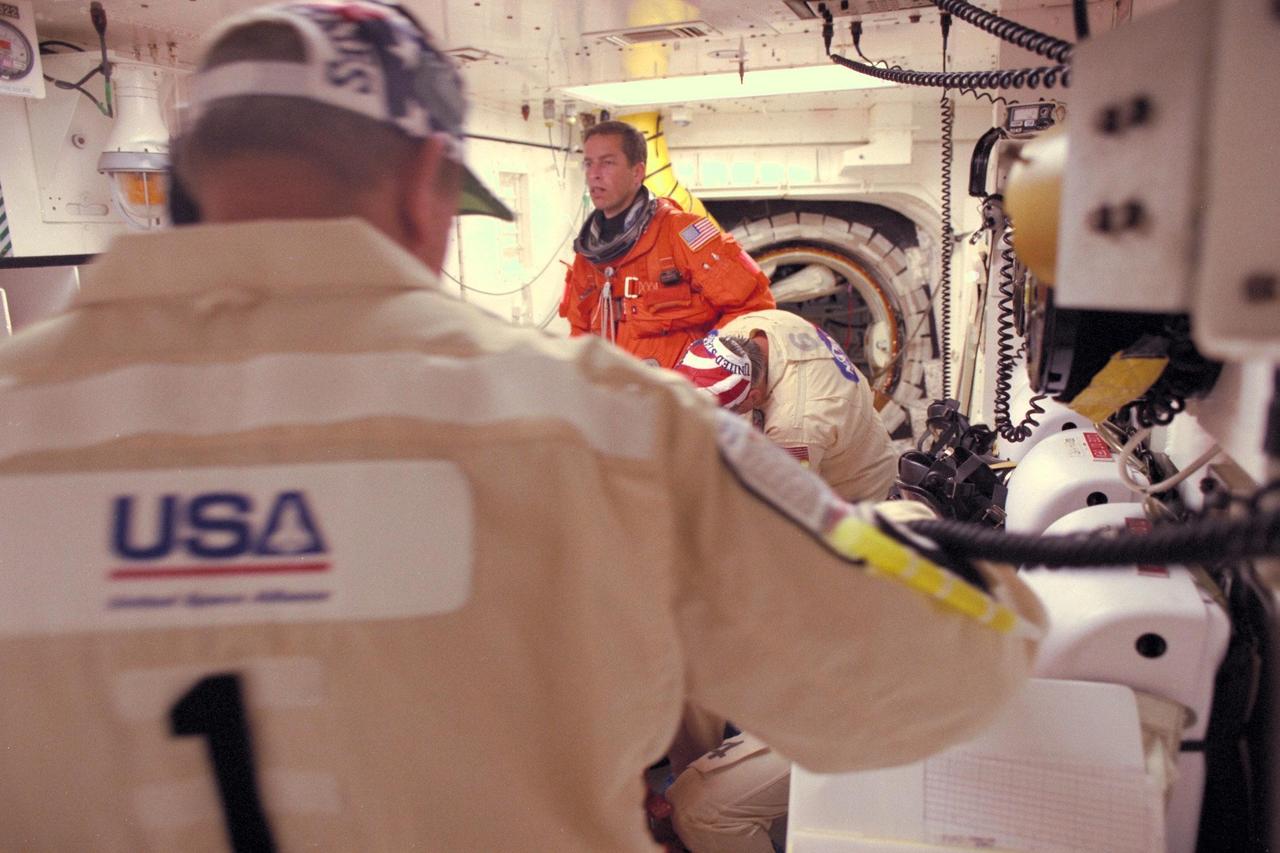
STS-86 Commander James D. Wetherbee prepares to enter the Space Shuttle Atlantis at Launch Pad 39A, with the assistance of white room closeout crew member Jim Davis, a NASA quality assurance specialist. Rick Welty, United Space Alliance orbiter vehicle closeout chief, is in foreground with back to camera
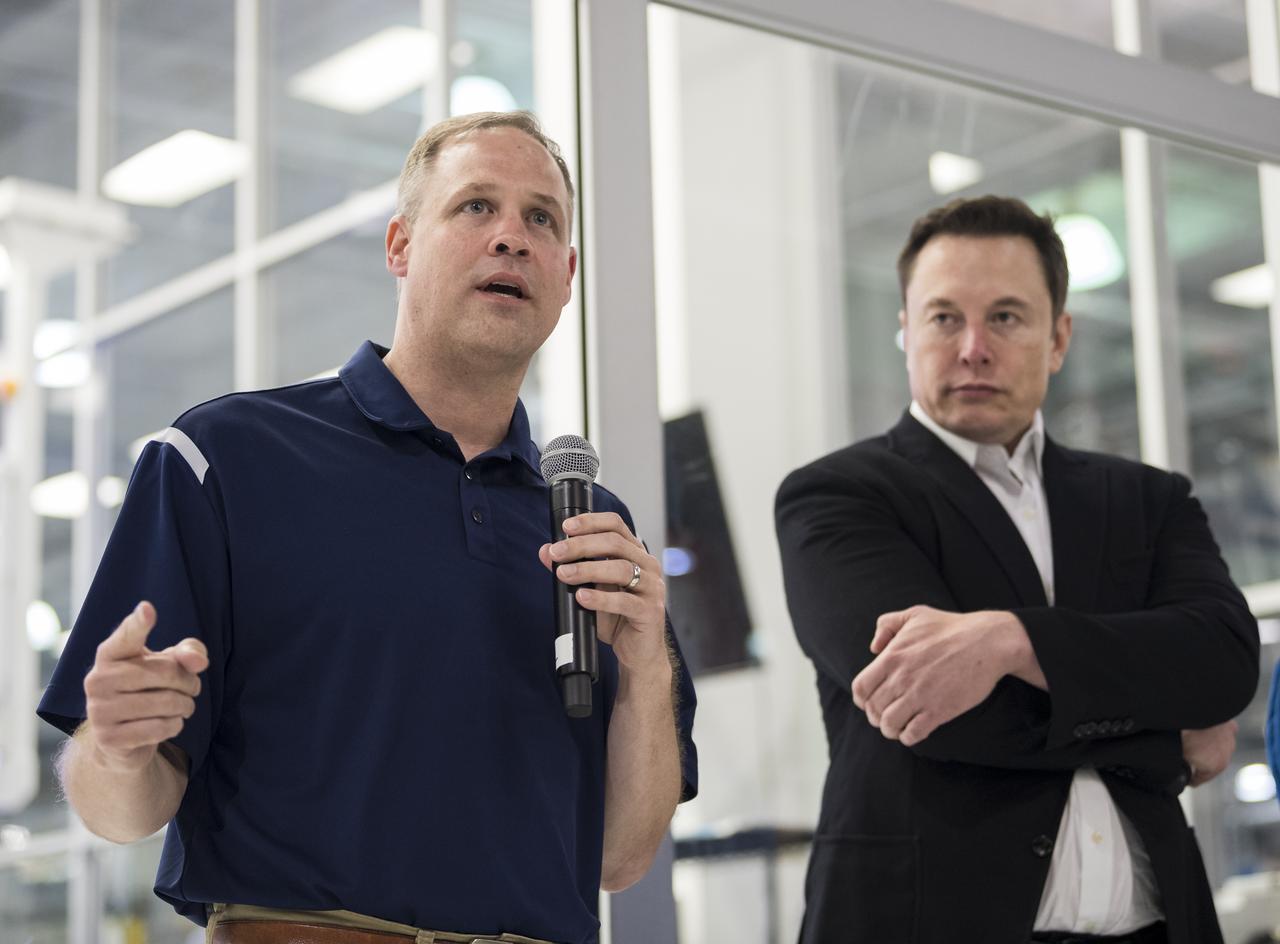
NASA Administrator Jim Bridenstine, left, and SpaceX Chief Engineer Elon Musk, right, speak to press in front of the Crew Dragon that is being prepared for the Demo-2 mission, at SpaceX Headquarters, Thursday, Oct. 10, 2019 in Hawthorne, CA. Photo credit: (NASA/Aubrey Gemignani)
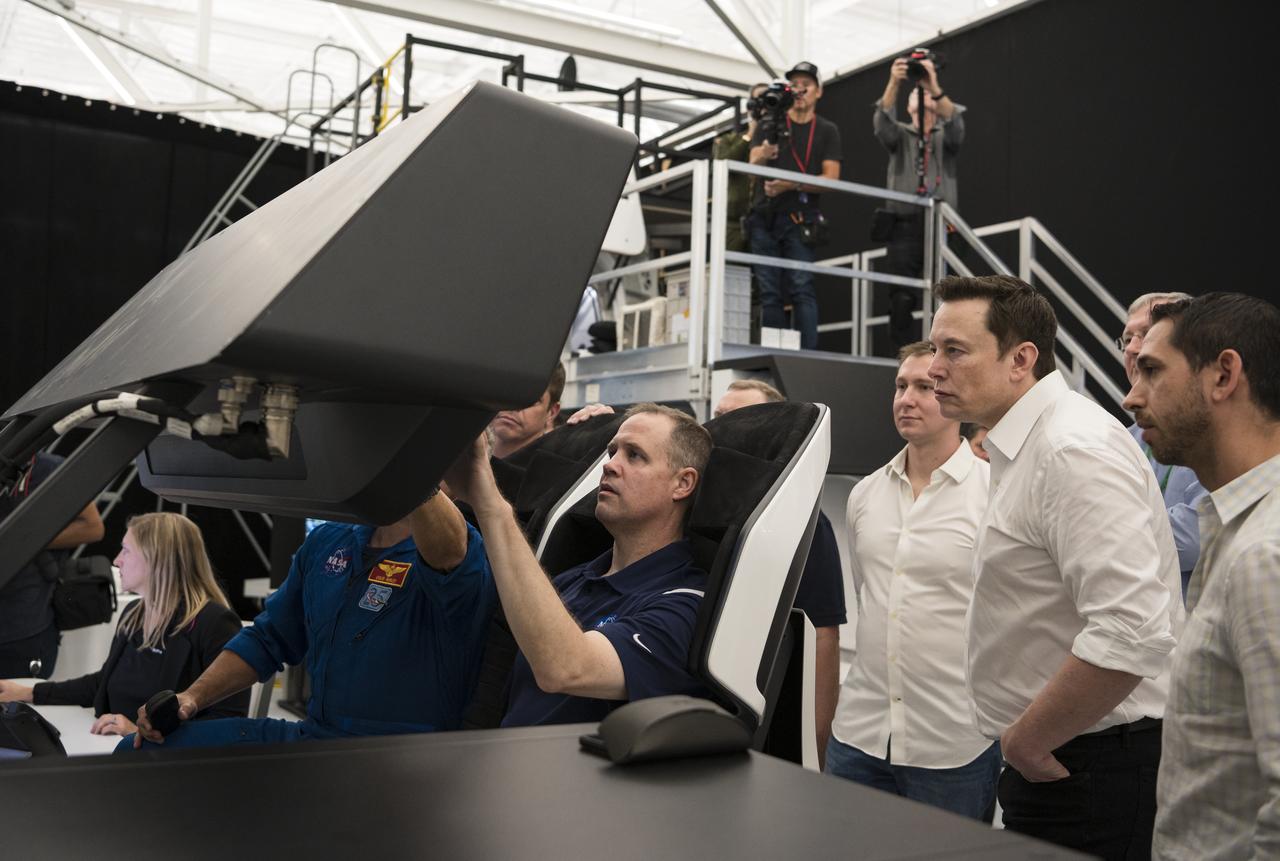
NASA Administrator Jim Bridenstine, center, participates in a crew Dragon flight simulation with NASA astronauts Doug Hurley, and Bob Behnken, while SpaceX Chief Engineer Elon Musk looks on, at the SpaceX Headquarters, Thursday, Oct. 10, 2019 in Hawthorne, CA. Photo credit: (NASA/Aubrey Gemignani)
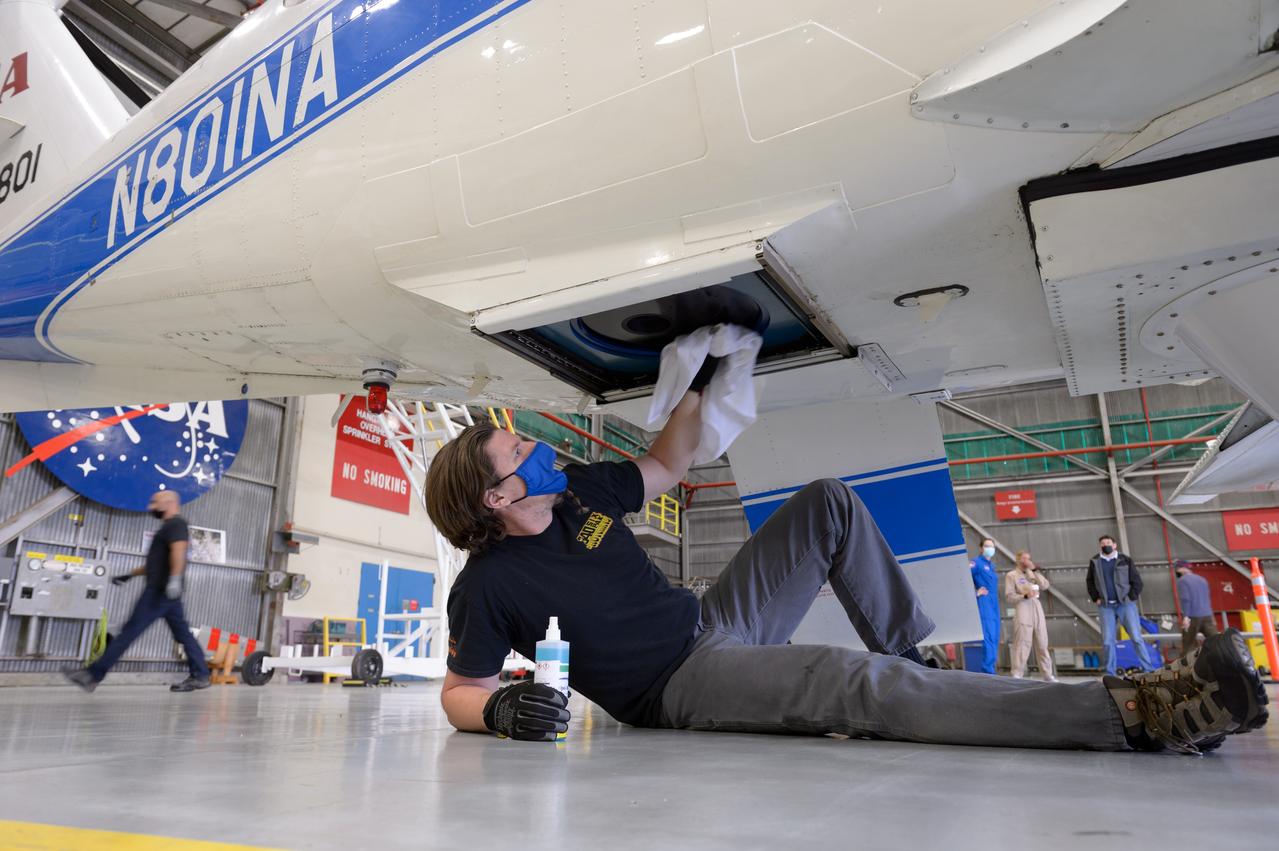
Dan Weishaar, crew chief for the Ames Aircraft Management Office, prepares to deploy NASA's Beechcraft B-200 Super King Air, N801NA, from N248 in support of NASA’s Sub-Mesoscale Ocean Dynamics Experiment, or S-MODE, mission.
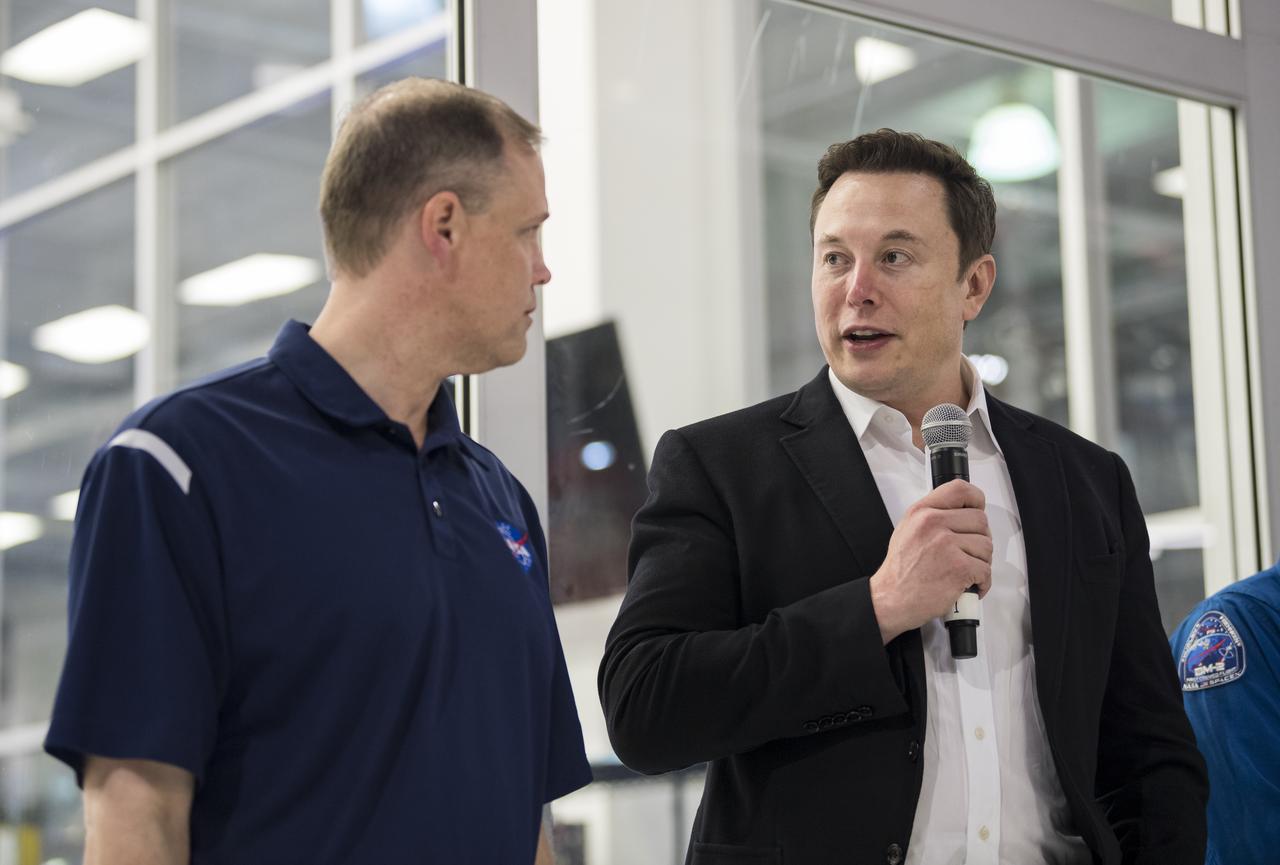
SpaceX Chief Engineer Elon Musk, right, speaks to press with NASA Administrator Jim Bridenstine, in front of the Crew Dragon that is being prepared for the Demo-2 mission, at SpaceX Headquarters, Thursday, Oct. 10, 2019 in Hawthorne, CA. Photo credit: (NASA/Aubrey Gemignani)
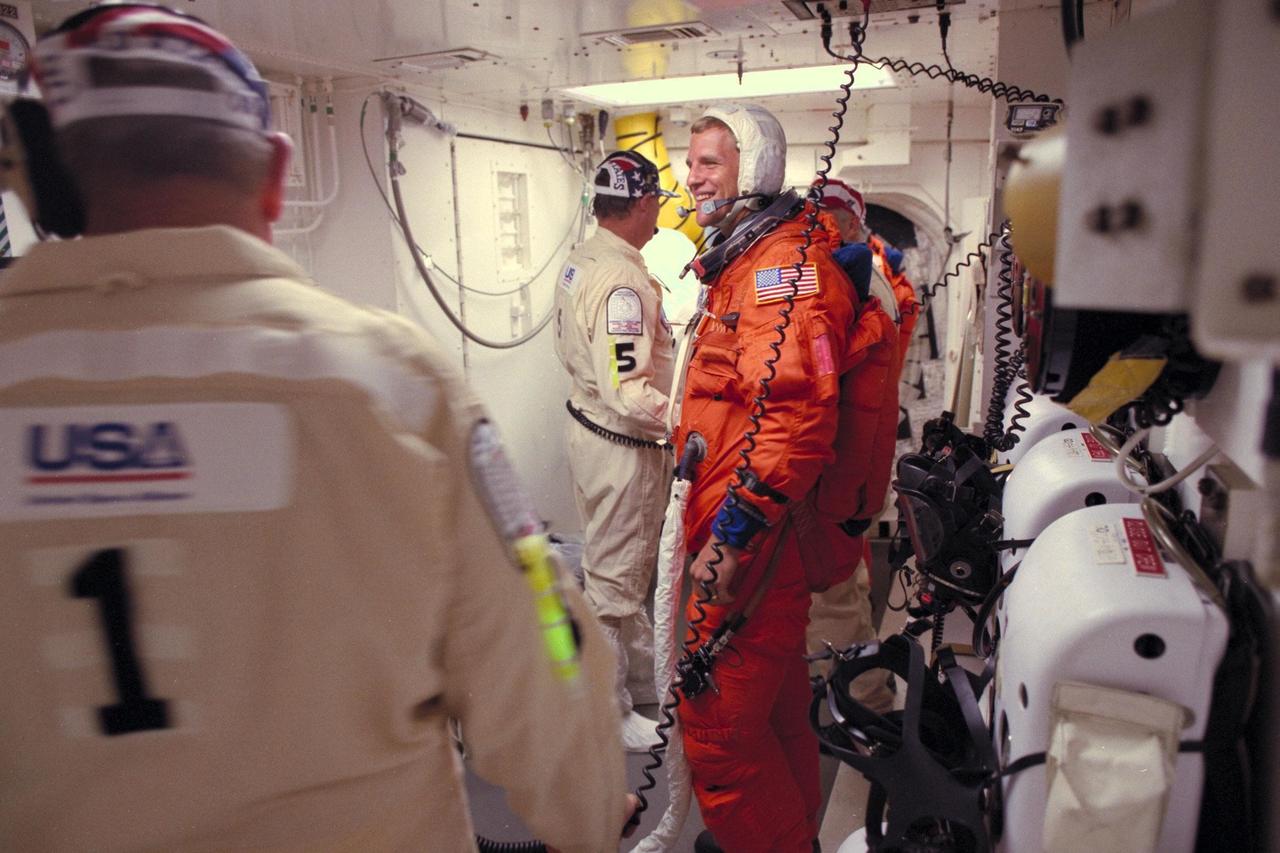
STS-86 crew members, including Mission Specialist Scott E. Parazynski, at center, prepare to enter the Space Shuttle Atlantis at Launch Pad 39A. They are being assisted by Rick Welty, at left, the United Space Alliance (USA) vehicle closeout chief, and George Schramm, USA mechanical technician
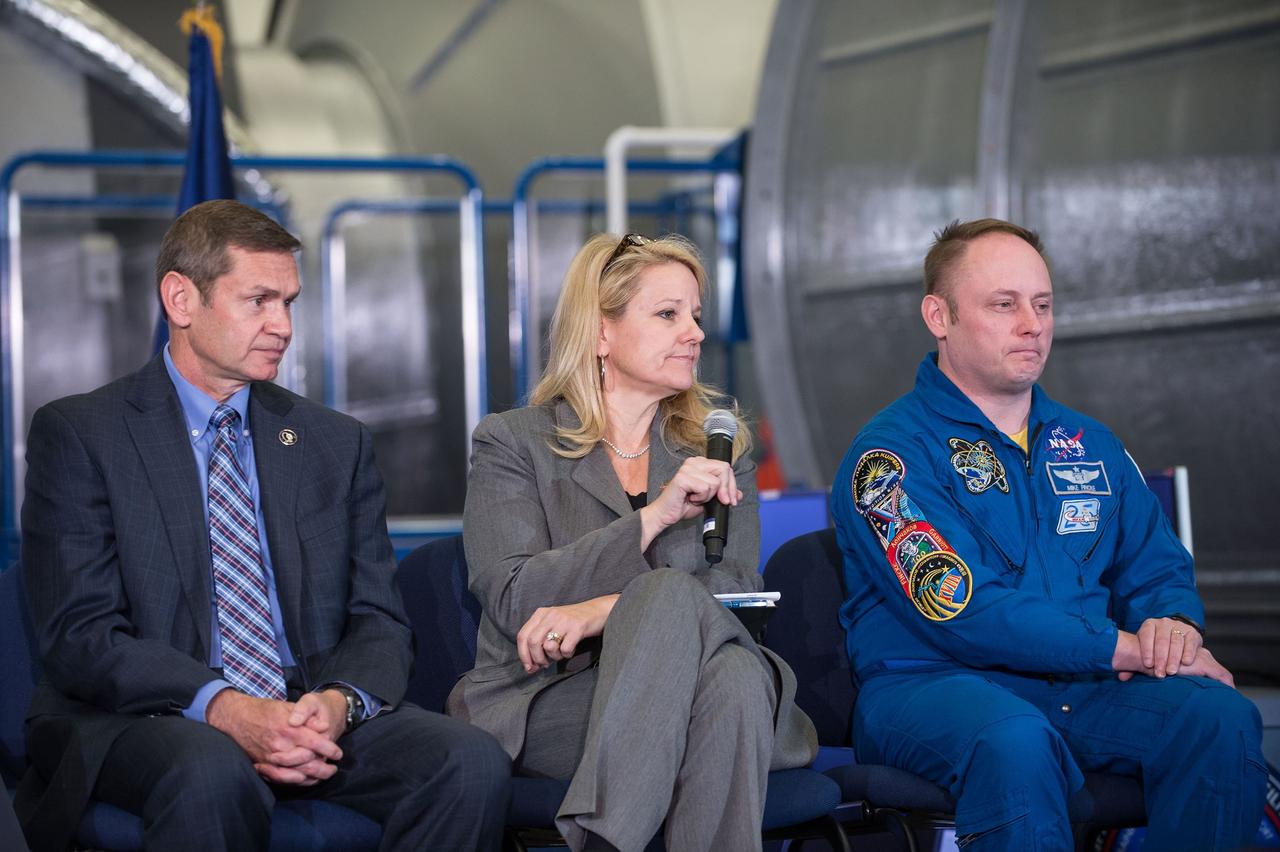
HOUSTON, Texas - jsc2015e031266 - Gwynne Shotwell, SpaceX President and Chief Operating Officer discusses the company's work with NASA's Commercial Crew Program as Boeing's John Elbon, left, and NASA astronaut Mike Fincke look on. Photo credit: NASA/Robert Markowitz
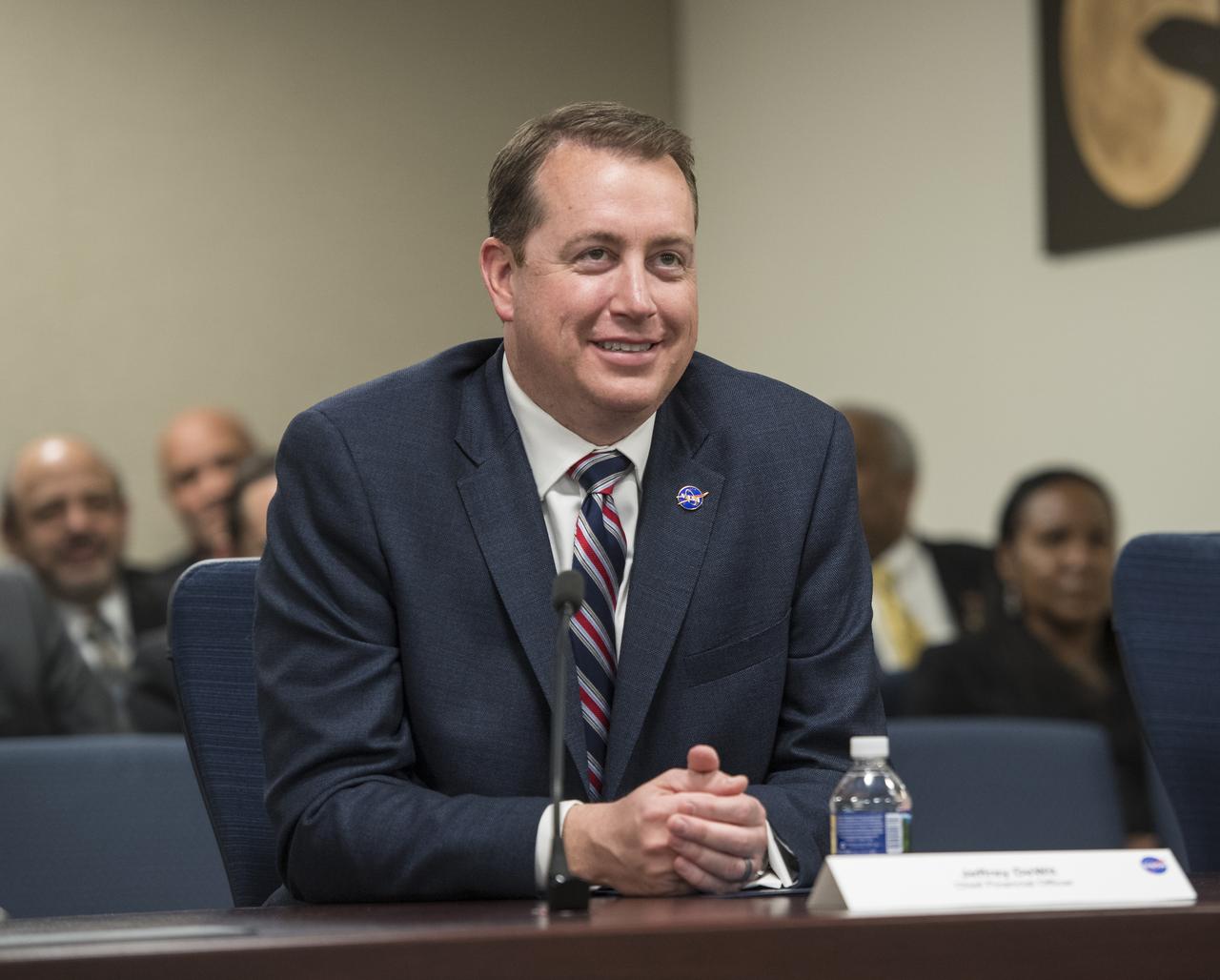
NASA Chief Financial Officer, Jeff DeWit, watches the live uplink with the crew of the International Space Station, Monday, April 23, 2018 at NASA Headquarters in Washington. Jim Bridenstine was just sworn in by the Vice President as NASA's 13th Administrator. Photo Credit: (NASA/Aubrey Gemignani)
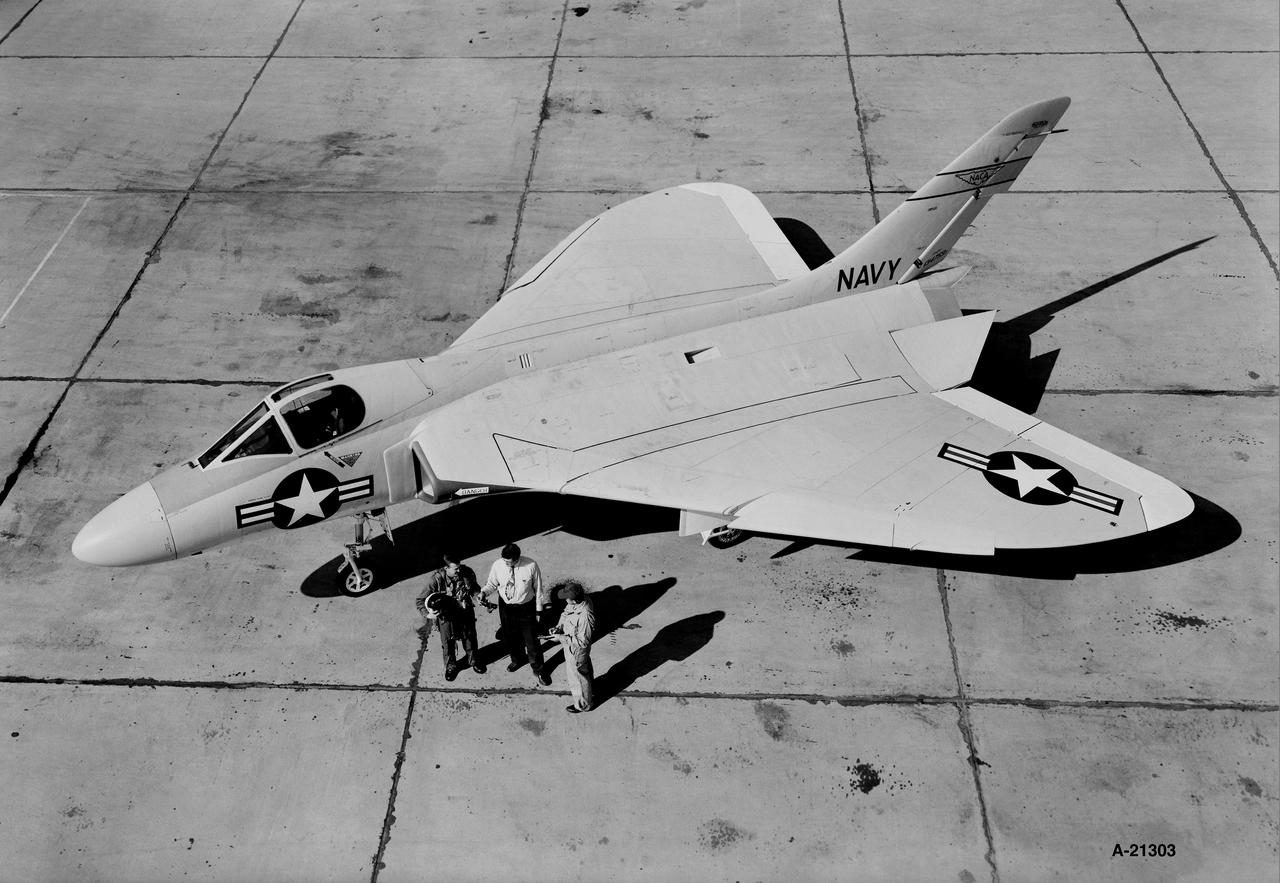
Douglas F4D-1 (Bu. No. 134759) Skyray Plan view of airplane with Ames Pilot Don R. Heinle, Engineer L. Stewart Rolls and Crew Chief Walter Liewar. Note: Used in Flight Research at Ames; 57 Years of Development and Validation of Aeronautical Technology NASA SP-1998-3300 fig.28
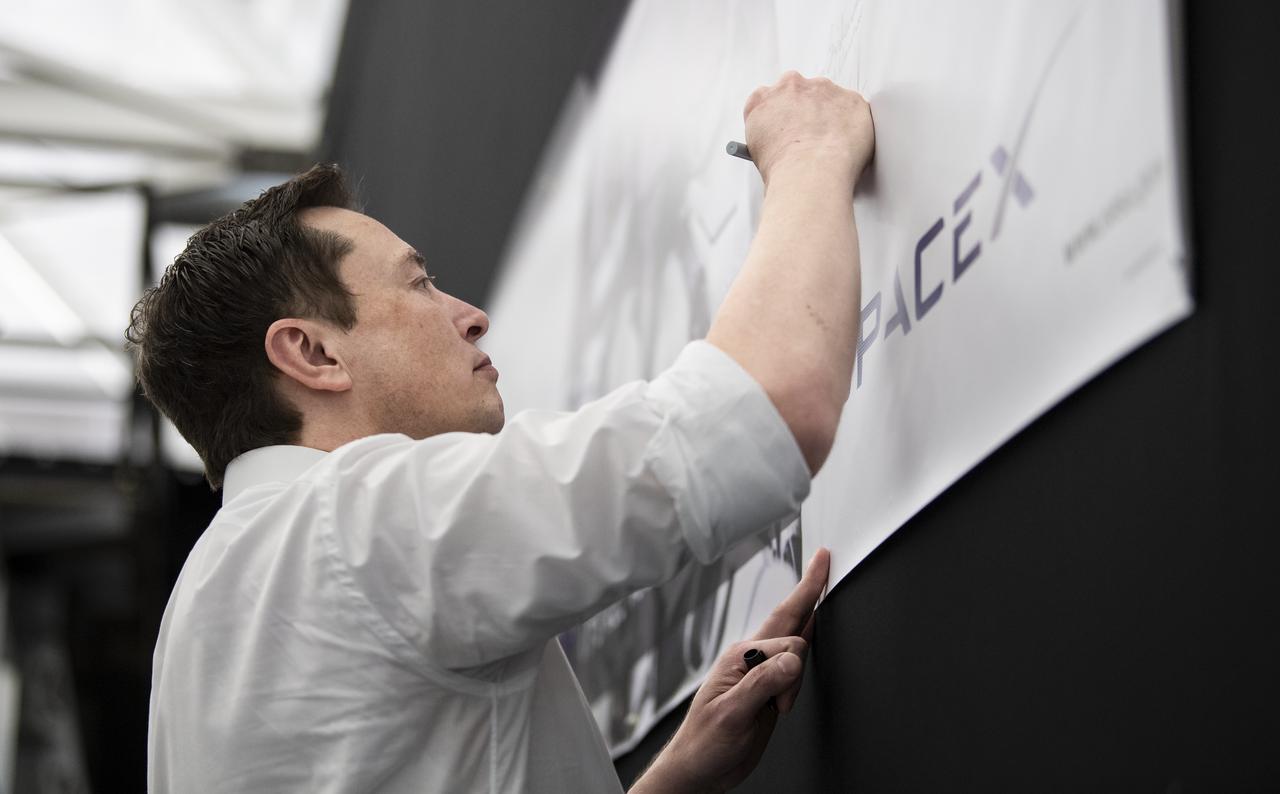
SpaceX Chief Engineer Elon Musk signs a banner after discussing progress on the Commercial Crew Program with NASA Administrator Jim Bridenstine at the SpaceX Headquarters, Thursday, Oct. 10, 2019 in Hawthorne, CA. Photo credit: (NASA/Aubrey Gemignani)
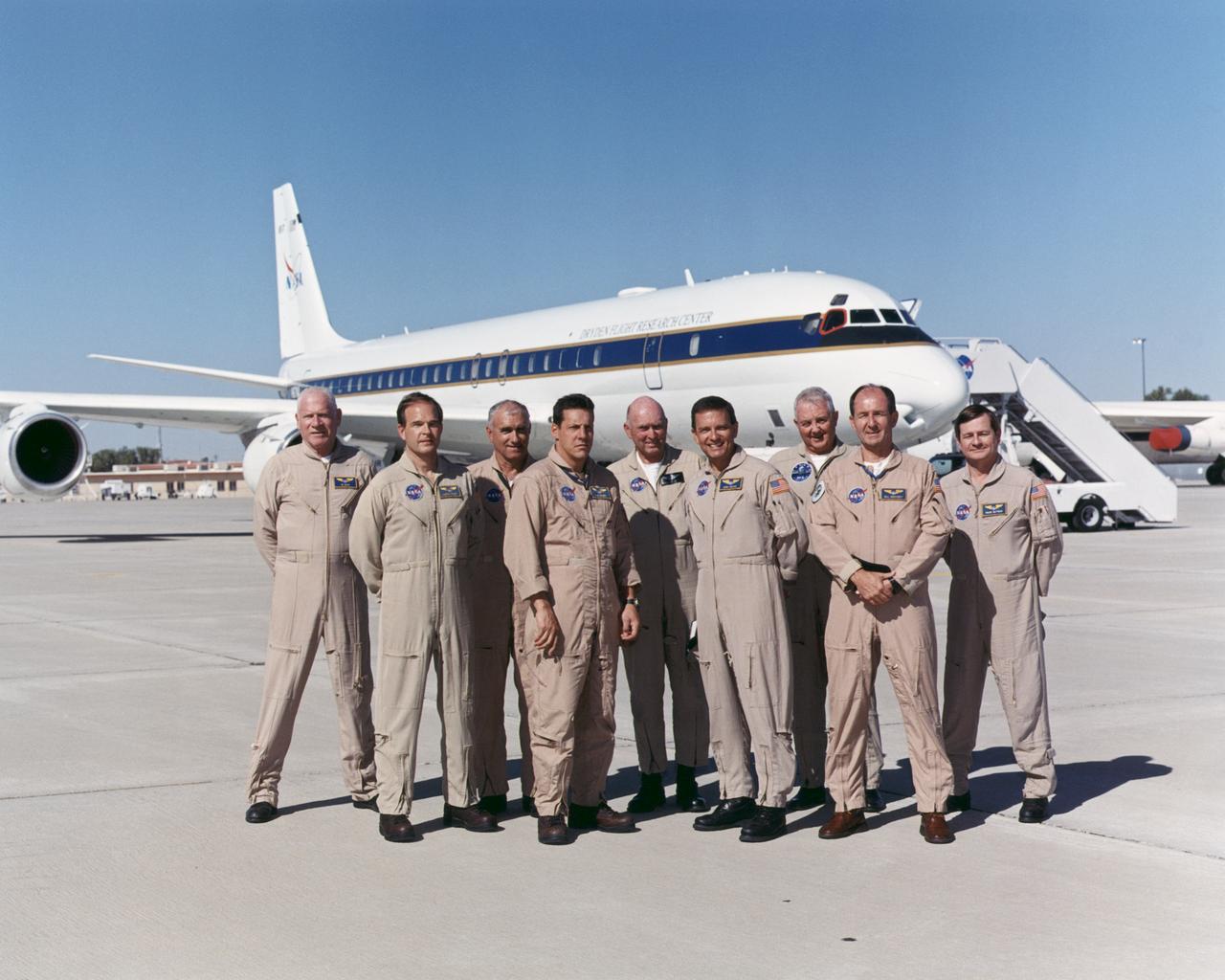
2004 NASA Dryden DC-8 flight crew. Left to Right: Edwin W. Lewis, Jr., Martin J. Trout, Richard G. Ewers, Craig R. Bomben, C. Gordon Fullerton (Chief Pilot), Mark Pestana, Douglas H. Baker, William Frederick Brockett, and Frank Batteas.
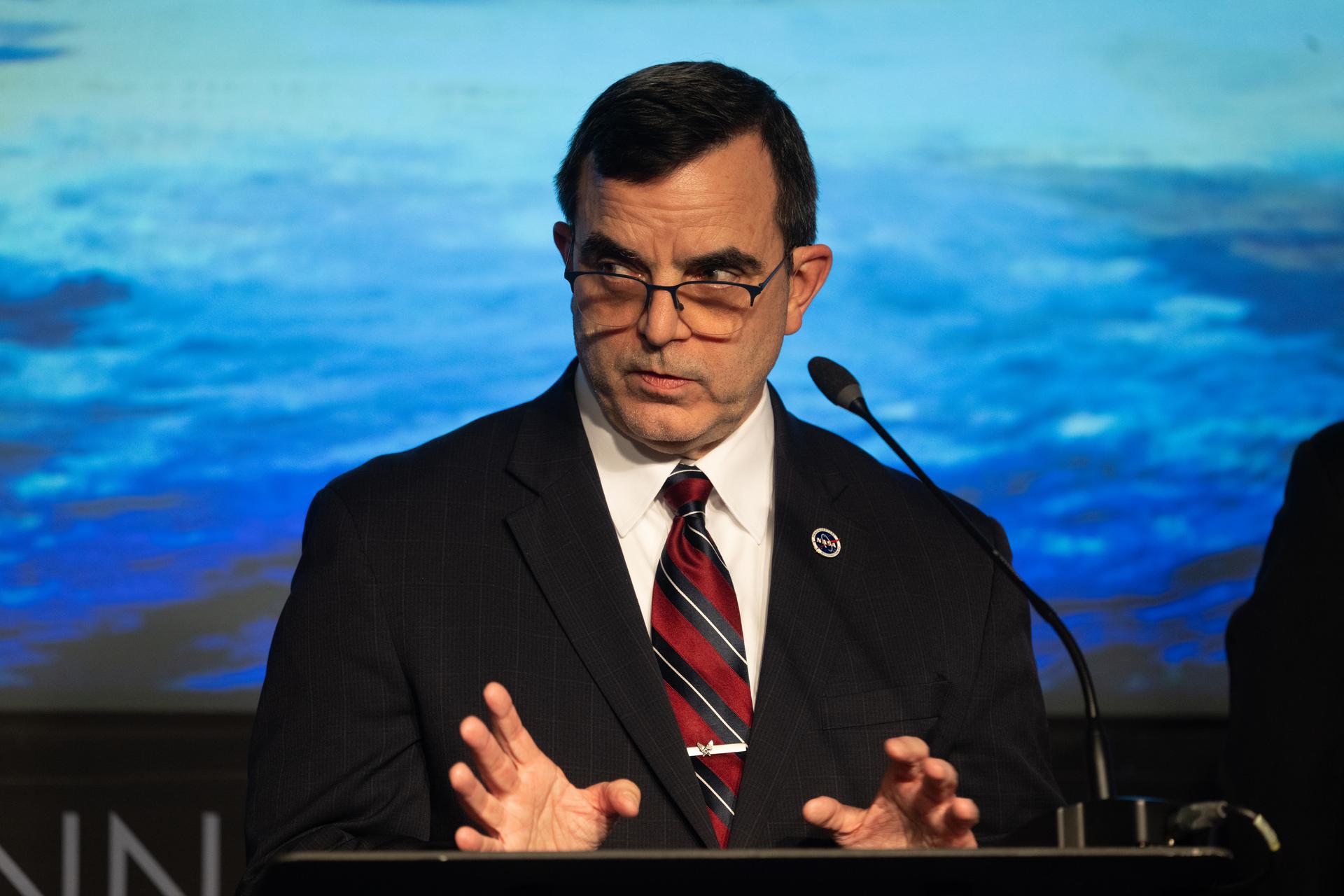
Dr. James Polk, NASA’s chief health and medical officer, provides an update on the International Space Station and its crew, Thursday, Jan. 8, 2026, at the Mary W. Jackson NASA Headquarters building in Washington. Photo Credit: (NASA/Joel Kowsky)
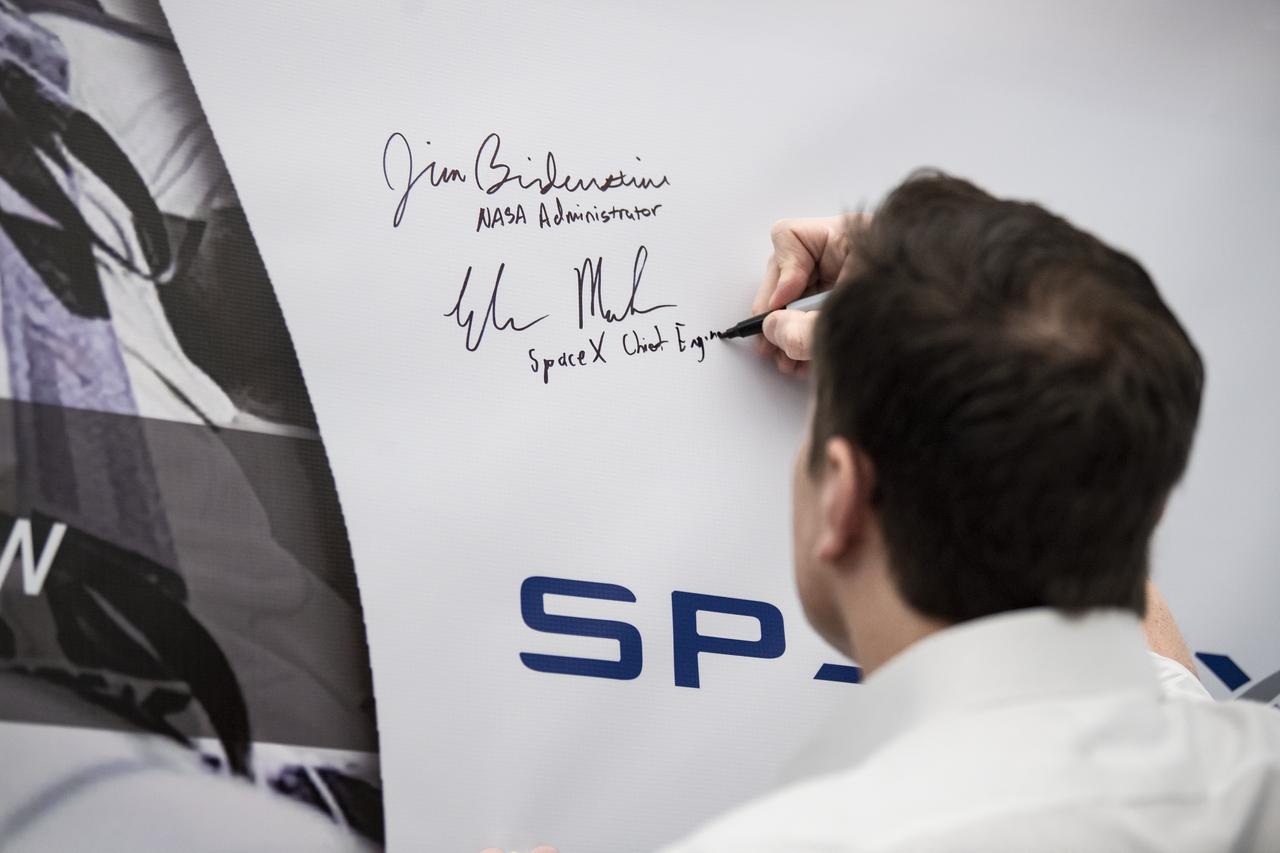
SpaceX Chief Engineer Elon Musk signs a banner after discussing progress on the Commercial Crew Program with NASA Administrator Jim Bridenstine at the SpaceX Headquarters, Thursday, Oct. 10, 2019 in Hawthorne, CA. Photo credit: (NASA/Aubrey Gemignani)

SpaceX Chief Engineer Elon Musk answers a question from the press in front of the Crew Dragon that is being prepared for the Demo-2 mission, at SpaceX Headquarters, Thursday, Oct. 10, 2019 in Hawthorne, CA. Photo credit: (NASA/Aubrey Gemignani)
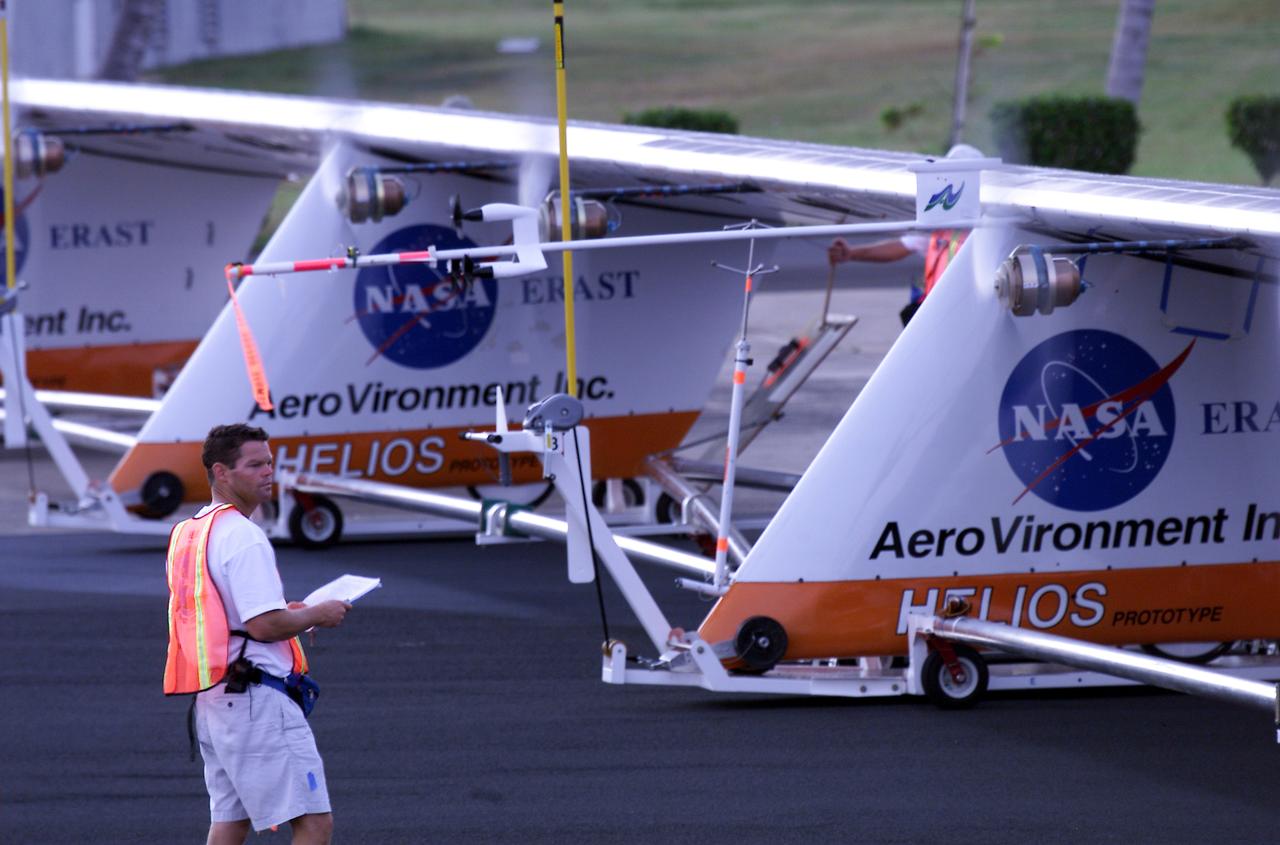
Helios Prototype crew chief Marshall MacCready of AeroVironment, Inc., carefully monitors motor runs during ground checkout of the solar-powered flying wing prior to its first flight from the U.S. Navy's Pacific Missile Range Facility on Kaua'i, Hawaii.
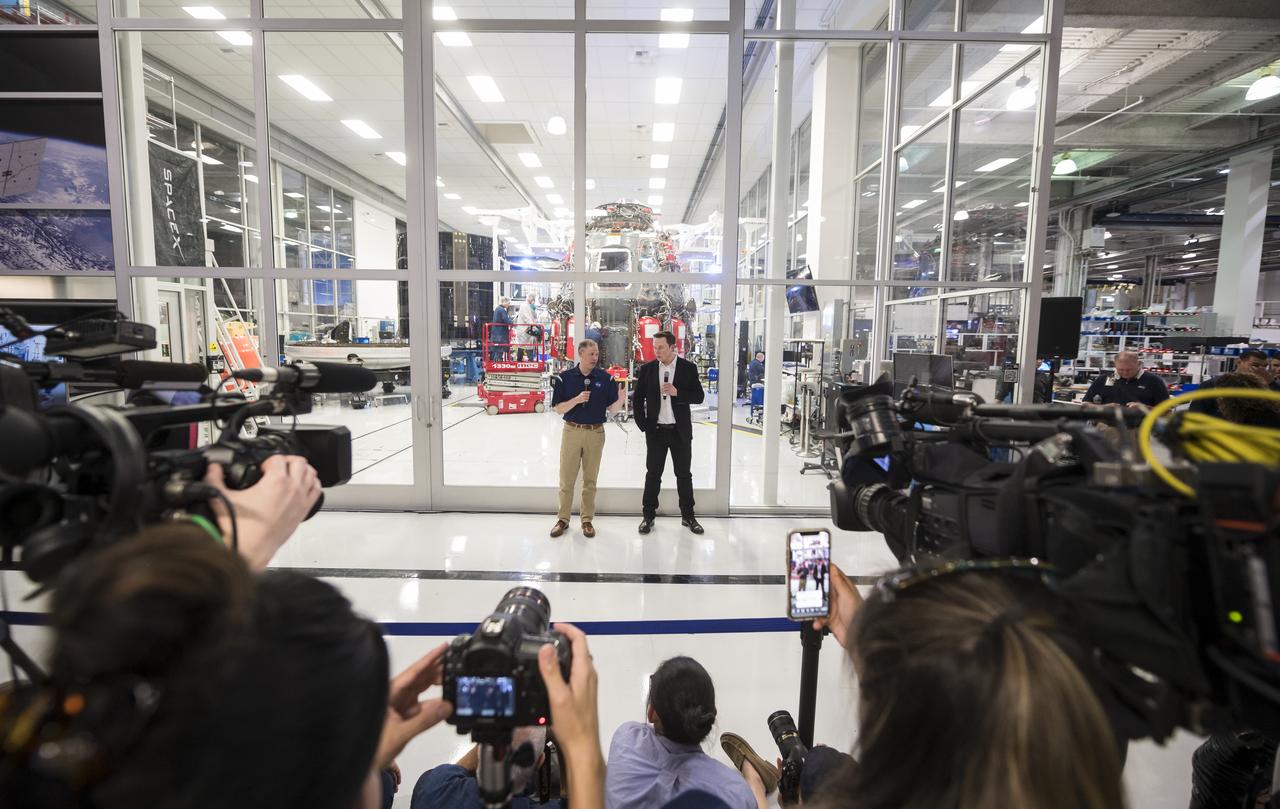
NASA Administrator Jim Bridenstine, left, and SpaceX Chief Engineer Elon Musk, right, speak to press in front of the Crew Dragon that is being prepared for the Demo-2 mission, at SpaceX Headquarters, Thursday, Oct. 10, 2019 in Hawthorne, CA. Photo credit: (NASA/Aubrey Gemignani)
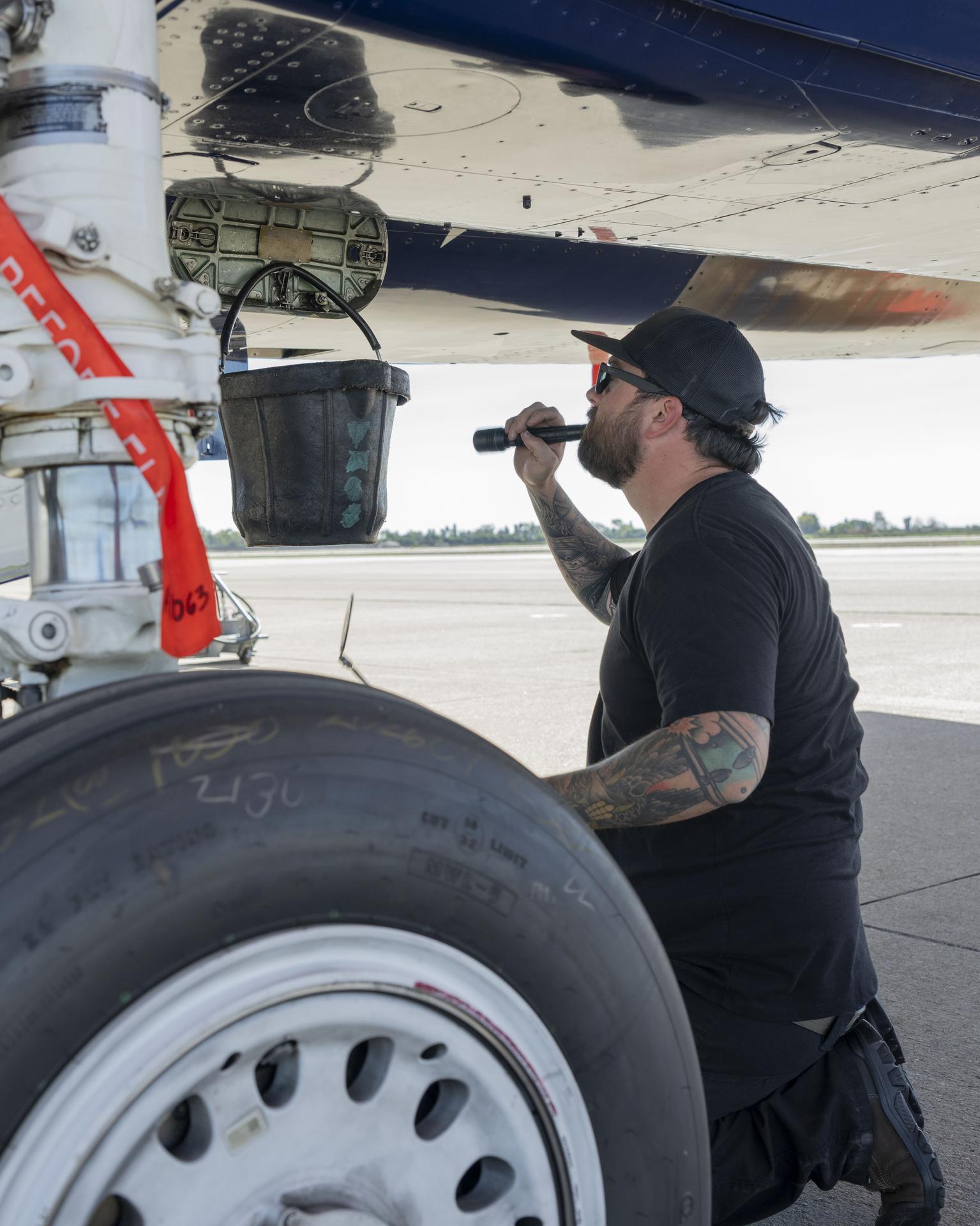
NASA F-15 Crew Chief Zach Burke inspects the aircraft at Los Alamitos Joint Forces Training Base, California, Sunday, Oct. 4, 2026. The jet was among the NASA aircraft that flew in the Pacific Airshow in Huntington Beach, California, Oct. 2-4.
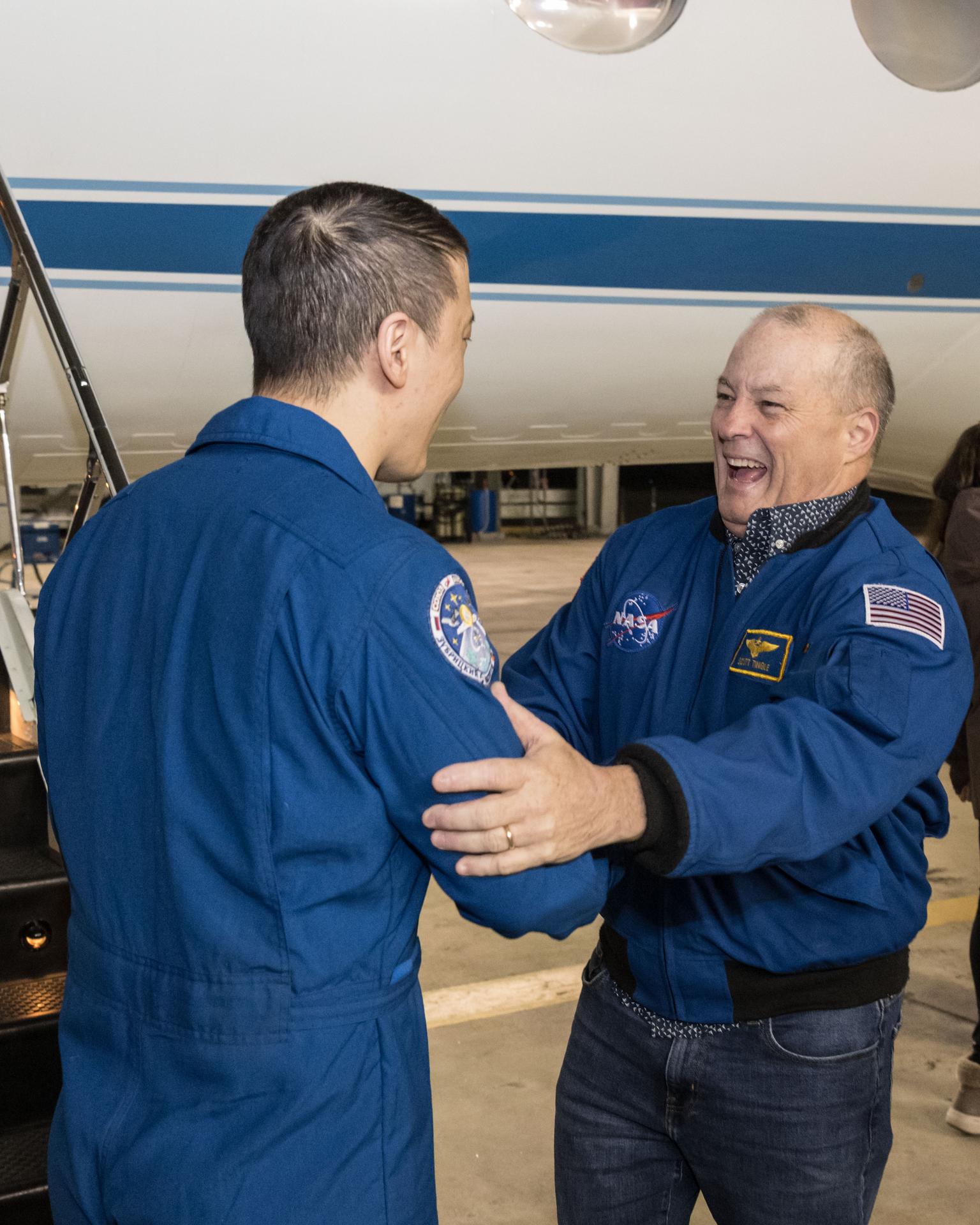
jsc2025e089533 (Dec. 10, 2025) --- NASA astronaut Jonny Kim, greeted by NASA astronaut and Chief of the Astronaut Office Scott Tingle, is pictured at Ellington Field outside the Gulfstream V aircraft that returned him to Houston, Texas, from Kazakhstan in Central Asia. The day before, Kim had landed in Kazakhstan aboard the Soyuz MS-27 crew spacecraft with Roscosmos cosmonauts Sergey Ryzhikov and Alexey Zubritsky after completing a 245-day research mission aboard the International Space Station. In the background (from left), is a NASA employee and NASA astronaut Scott Tingle. Credit: NASA/Robert Markowitz
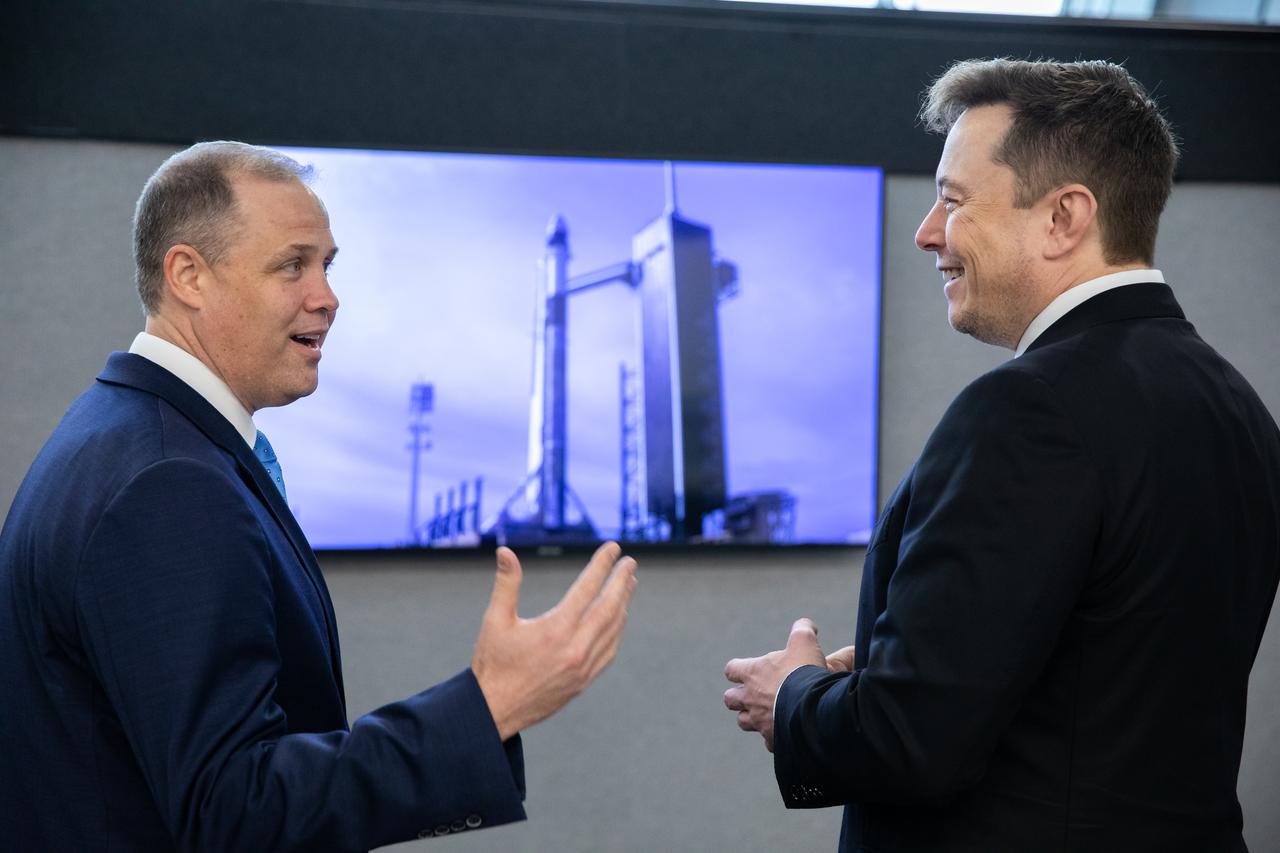
NASA Administrator Jim Bridenstine, left, and SpaceX Chief Engineer Elon Musk converse inside Firing Room 4 in Kennedy Space Center’s Launch Control Center while awaiting the liftoff of a SpaceX Falcon 9 rocket and Crew Dragon spacecraft on the uncrewed In-Flight Abort Test, Jan. 19, 2020. The test demonstrated the spacecraft’s escape capabilities in preparation for crewed flights to the International Space Station as part of the agency’s Commercial Crew Program.
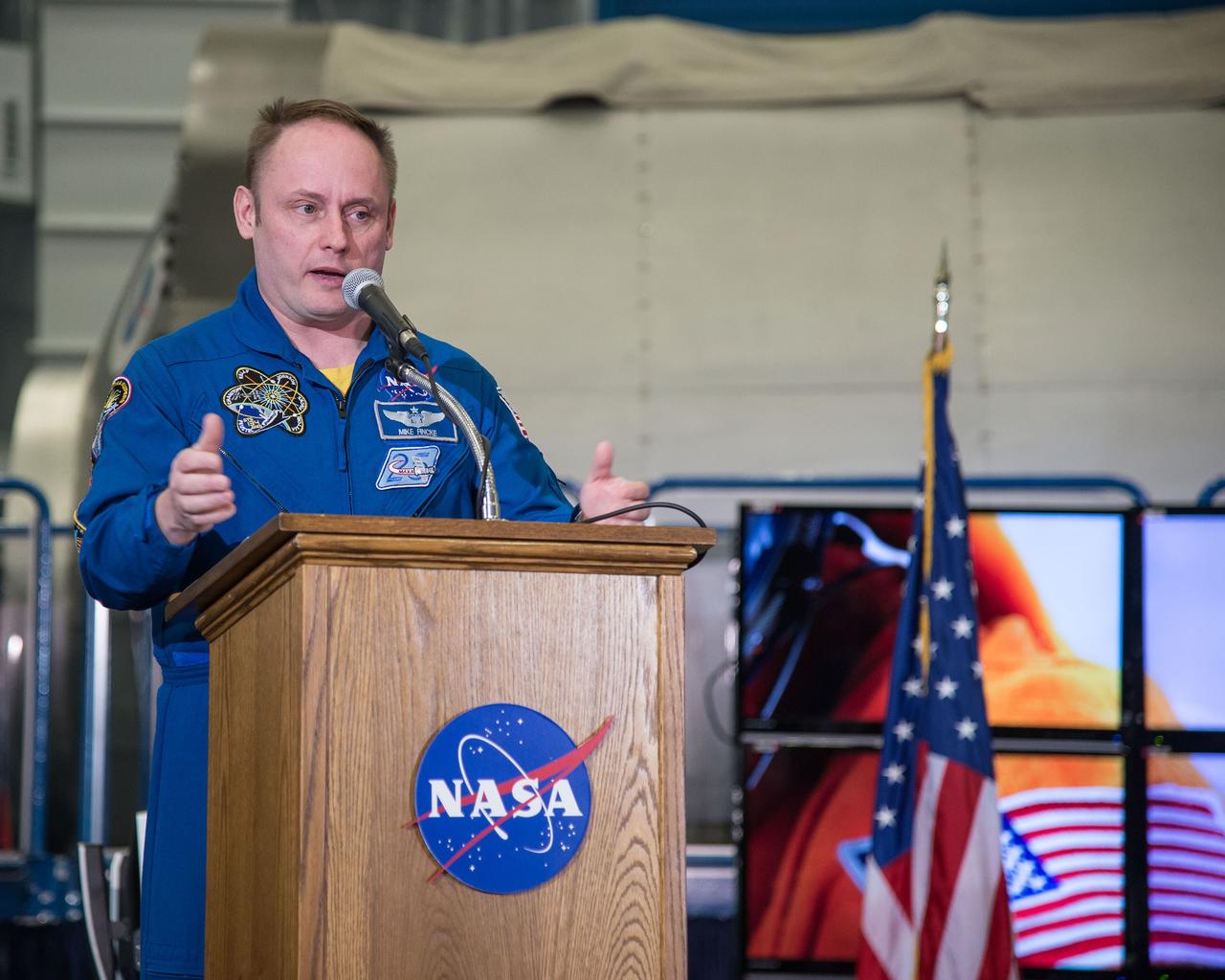
HOUSTON, Texas - jsc2015e031248 - NASA astronaut Mike Fincke discusses the agency's Commercial Crew Program during a presentation highlighting key development activities, test plans and objectives for achieving certification of two American crew transportation systems with NASA Administrator Charlie Bolden, Commercial Crew Program Manager Kathy Lueders, Boeing Space Exploration Vice President and General Manager John Elbon, Space X President and Chief Operating Officer Gwynne Shotwell and NASA Astronaut Mike Fincke. Photo credit: NASA/Robert Markowitz
HOUSTON, Texas - jsc2015e031229 - NASA Administrator Charles Bolden discusses the agency's Commercial Crew Program during a presentation highlighting key development activities, test plans and objectives for achieving certification of two American crew transportation systems with Commercial Crew Program Manager Kathy Lueders, Boeing Space Exploration Vice President and General Manager John Elbon, Space X President and Chief Operating Officer Gwynne Shotwell and NASA Astronaut Mike Fincke. Photo credit: NASA/Robert Markowitz
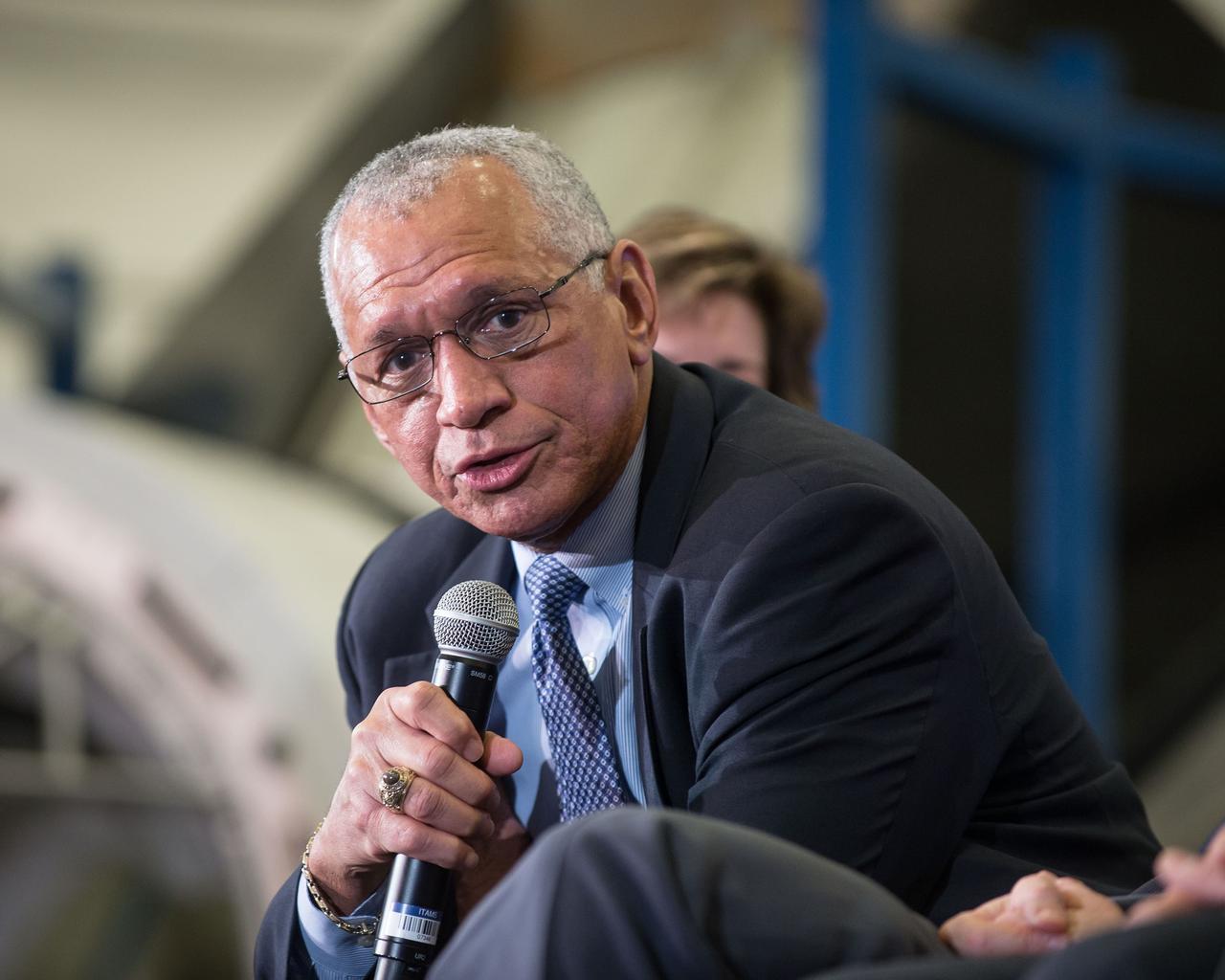
HOUSTON, Texas- jsc2015e031278 - NASA Administrator Charles Bolden discusses the agency's Commercial Crew Program during a presentation highlighting key development activities, test plans and objectives for achieving certification of two American crew transportation systems with Commercial Crew Program Manager Kathy Lueders, Boeing Space Exploration Vice President and General Manager John Elbon, Space X President and Chief Operating Officer Gwynne Shotwell and NASA Astronaut Mike Fincke. Photo credit: NASA/Robert Markowitz
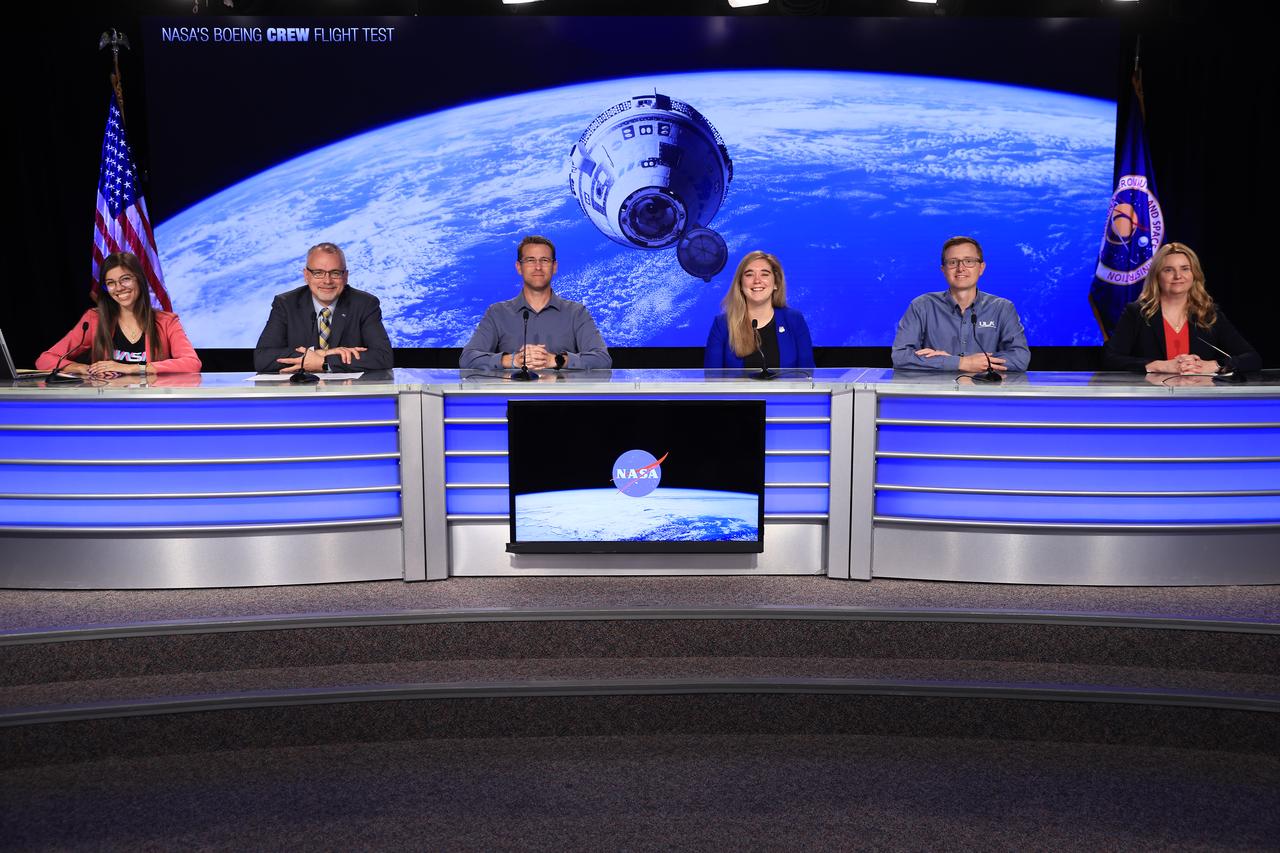
A social media panel discussion takes place at NASA’s Kennedy Space Center in Florida on Friday, May 3, 2024, ahead of NASA’s Boeing Crew Flight Test. Participants, from left to right are Antonia Jaramillo, NASA Communications; Jim Free, NASA associate administrator; Ian Kappes, deputy launch vehicle office manager, NASA’s Commercial Crew Program; Amy Comeau Denker, Starliner associate chief engineer, Boeing; Caleb Weiss, system engineering & test leader, ULA (United Launch Alliance); and Jennifer Buchli, chief scientist, NASA’s International Space Station Program. NASA astronauts Butch Wilmore and Suni Williams are the first to launch aboard Boeing’s Starliner spacecraft atop a ULA Atlas V rocket from Space Launch Complex-41 at Cape Canaveral Space Force Station in Florida. Liftoff is scheduled for 4:43 p.m. ET on Tuesday, May 21.
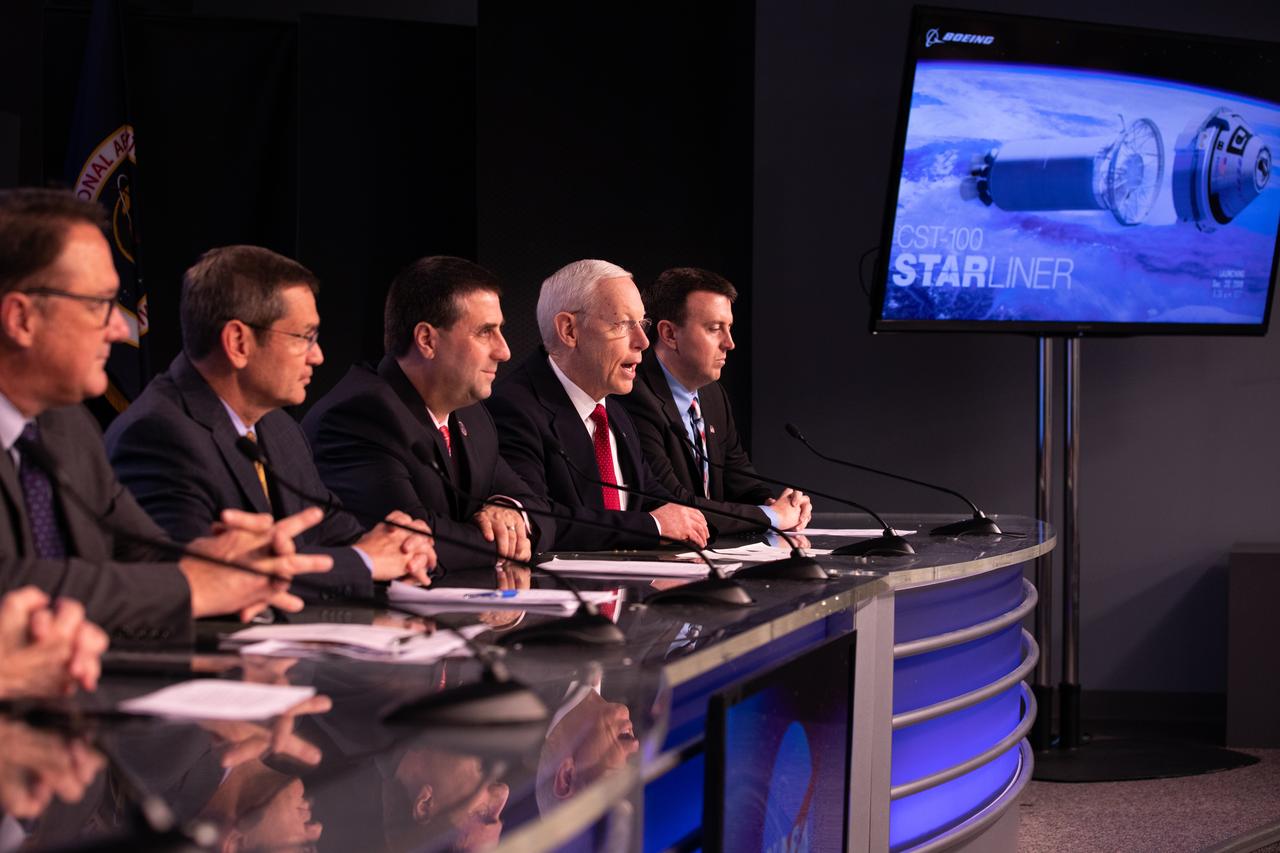
Officials from NASA, Boeing, United Launch Alliance and the U.S. Air Force 45th Weather Squadron participate in a prelaunch briefing for Boeing’s Orbital Flight Test at the agency’s Kennedy Space Center in Florida, Dec. 17, 2019. From left are John Mulholland, vice president and program manager, Boeing Commercial Crew Program; John Elbon, chief operating officer, United Launch Alliance; Joel Montalbano, deputy manager, International Space Station Program; Pat Forrester, Astronaut Office chief, Johnson Space Center; and Will Ulrich, launch weather officer, 45th Weather Squadron. Boeing’s CST-100 Starliner spacecraft will launch atop a United Launch Alliance Atlas V rocket from Space Launch Complex 41 at Cape Canaveral Air Force Station. The uncrewed Orbital Flight Test will be the Starliner’s first flight to the International Space Station for NASA’s Commercial Crew Program.

NASA Chief of the Astronaut Office Peggy Whitson, left, STS-135 mission Pilot Doug Hurley, second from left, NASA Administrator Charles Bolden, and Deputy Chief of Flight Crew Operations Directorate Brian Kelly, right, talk under the space shuttle Atlantis at the Kennedy Space Center Shuttle Landing Facility (SLF) shortly after Hurley and the rest of the STS-135 crew landed in Atlantis early Thursday morning, July 21, 2011, in Cape Canaveral, Fla. Overall, Atlantis spent 307 days in space and traveled nearly 126 million miles during its 33 flights. Atlantis, the fourth orbiter built, launched on its first mission on Oct. 3, 1985. Photo Credit: (NASA/Bill Ingalls)
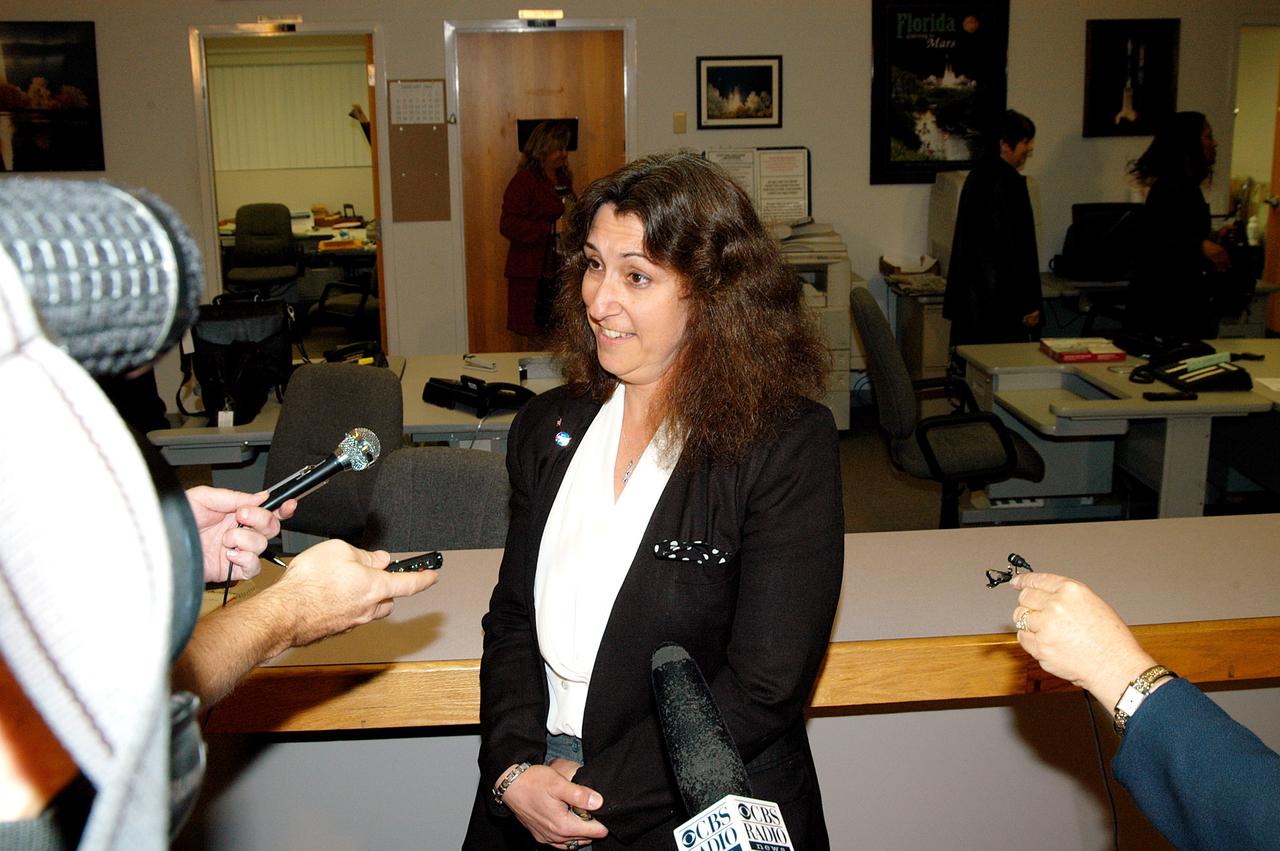
KENNEDY SPACE CENTER, FLA. -- Maria Littlefield, chief technologist with the Launch Services Program Office, talks to the media at the NASA-KSC News Center after viewing President George W. Bush’s message on the future of NASA. The President stated his goals for NASA’s new mission: Completing the International Space Station, retiring the Space Shuttle orbiters, developing a new crew exploration vehicle, and returning to the moon and beyond within the next two decades. Pres. Bush was welcomed by NASA Administrator Sean O’Keefe and Expedition 8 Commander Michael Foale, who greeted him from the International Space Station.
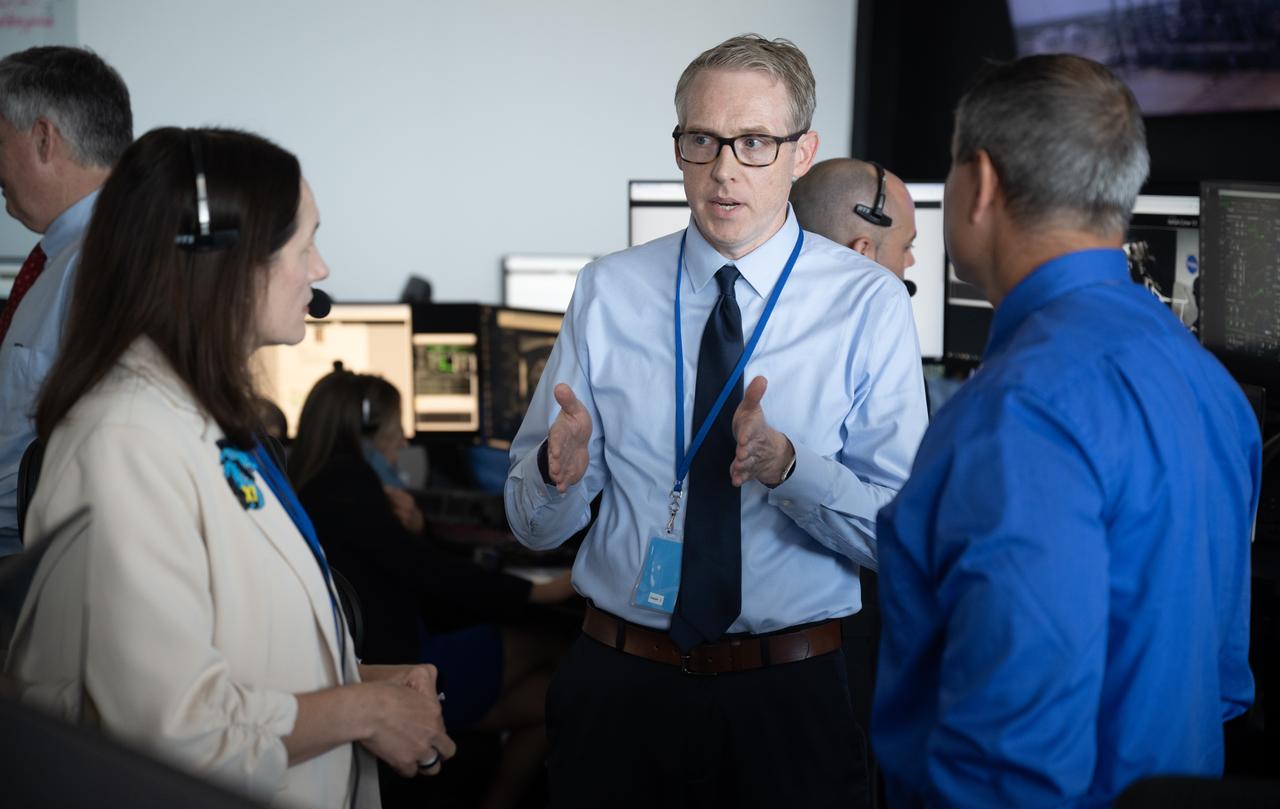
Jeremy Hart, Integrated Performance Chief Engineer for NASA's Commercial Crew Program, center, speaks with Nicole Jordan, NASA operations manager for the Commercial Crew Program, left, and Kevin Vega, Commercial Crew Program Chief Engineer, as teams monitor the countdown of a launch attempt of a SpaceX Falcon 9 rocket carrying the company's Dragon spacecraft on NASA’s SpaceX Crew-11 mission with NASA astronauts Zena Cardman, Mike Fincke, JAXA (Japan Aerospace Exploration Agency) astronaut Kimiya Yui, and Roscosmos cosmonaut Oleg Platonov onboard, Thursday, July 31, 2025, in the control center of SpaceX’s HangarX at NASA’s Kennedy Space Center in Florida. NASA’s SpaceX Crew-11 mission is the eleventh crew rotation mission of the SpaceX Dragon spacecraft and Falcon 9 rocket to the International Space Station as part of the agency’s Commercial Crew Program. Today’s launch of Cardman, Fincke, Yui, Platonov was scrubbed due to weather and is now scheduled for 11:43 a.m. EDT on Friday, August 1, from Launch Complex 39A at the NASA's Kennedy Space Center. Photo Credit: (NASA/Joel Kowsky)
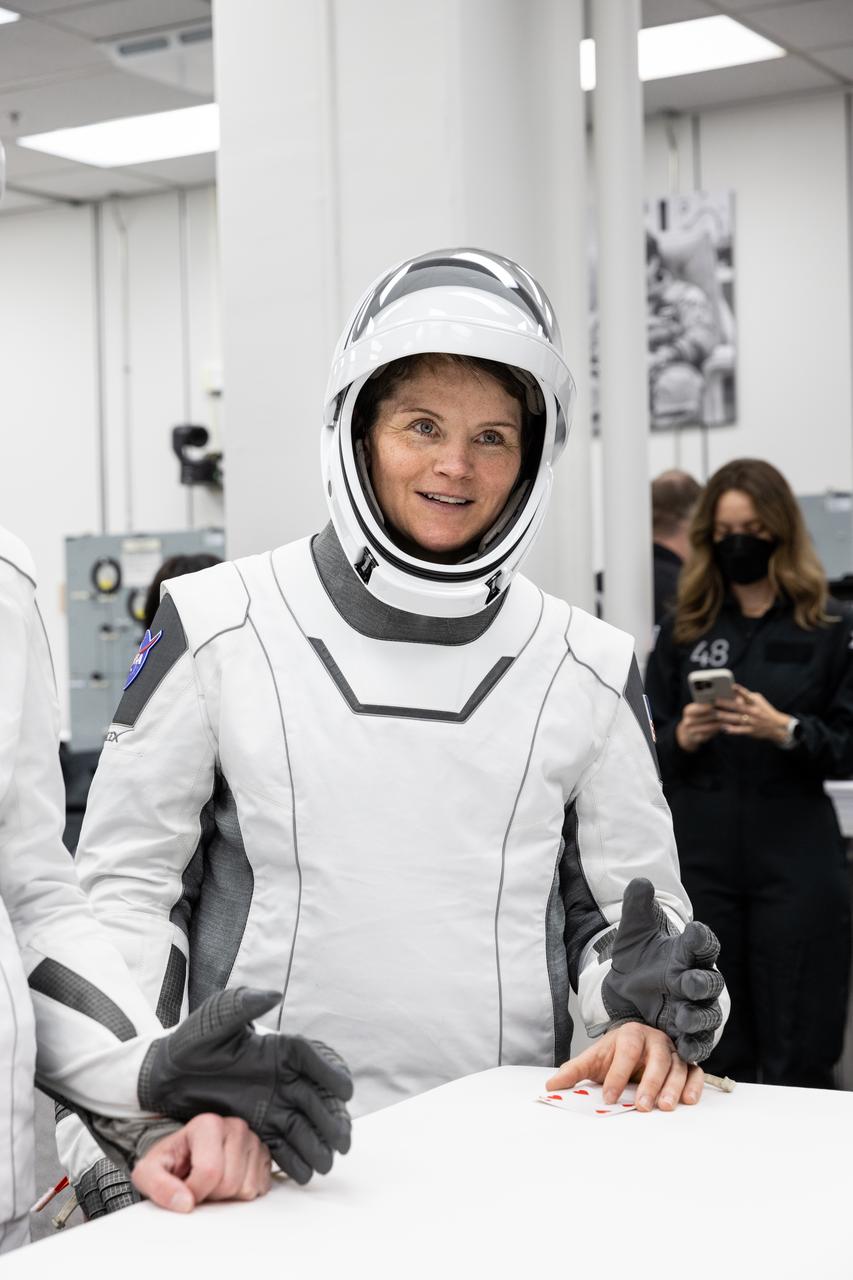
NASA astronaut Anne McClain and members of NASA’s SpaceX Crew-10 crew members play the traditional card with NASA Astronaut Chief Joe Acaba, inside the Neil A. Armstrong Operations and Checkout Building at the agency’s Kennedy Space Center in Florida ahead of launch to the International Space Station on Friday, March 14, 2025. Crew-10 is scheduled to liftoff aboard SpaceX’s Dragon spacecraft and Falcon 9 rocket at 7:03 p.m. EDT, from Launch Complex 39A at NASA Kennedy. Crew-10 is the 10th crew rotation mission with SpaceX to the space station as part of the agency’s Commercial Crew Program
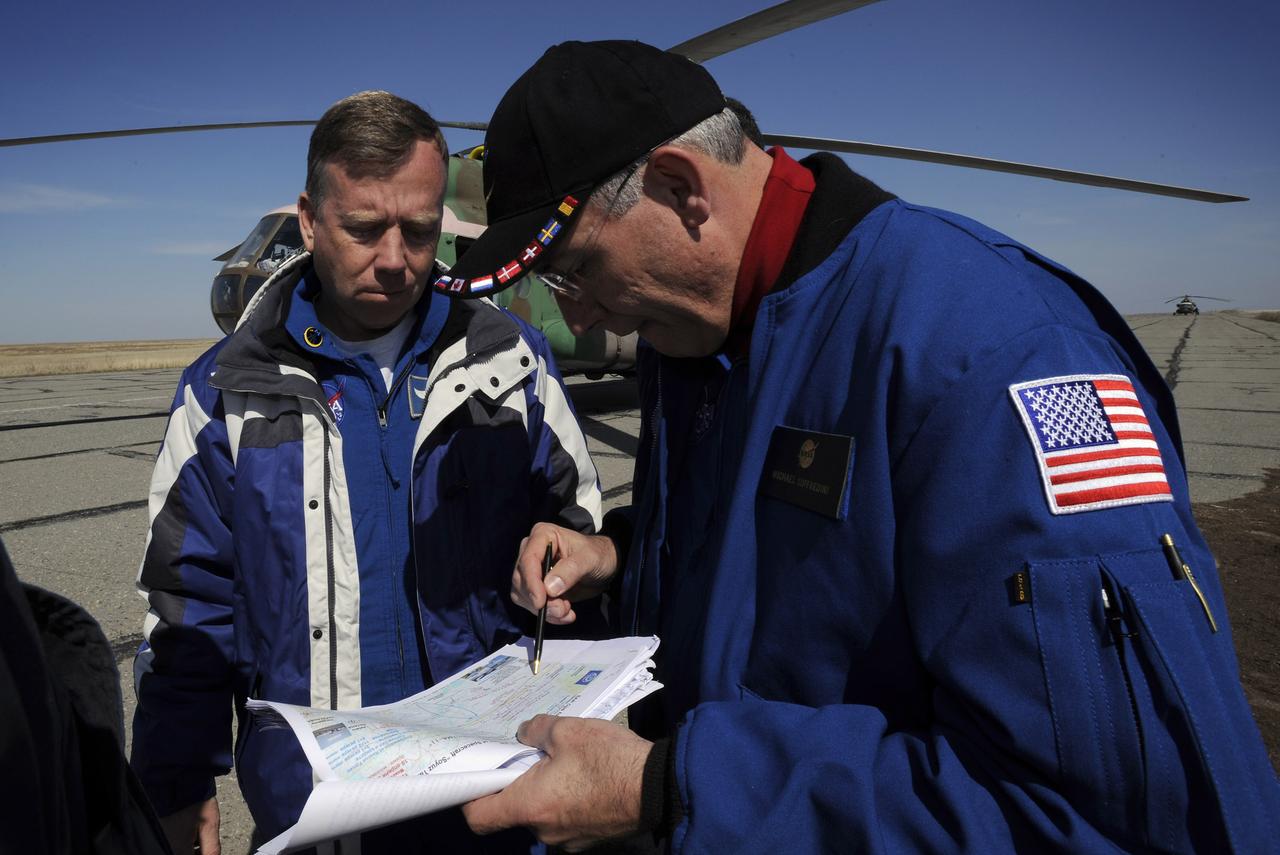
Steve Lindsey, Chief of NASA's Astronaut office, left, and Michael Sufferdini, International Station Program Manager, examine a map of central Kazakhstan as they received information at the Arkalyk airport April 19, 2008 on the landing of the Expedition 16 crew in the Soyuz TMA-11 capsule. The Soyuz made a ballistic landing, touching down more then 400 kilometers short of the intended target, but the crew reported by satellite phone to recovery forces that they were in good shape. Photo Credit: (NASA/Bill Ingalls)
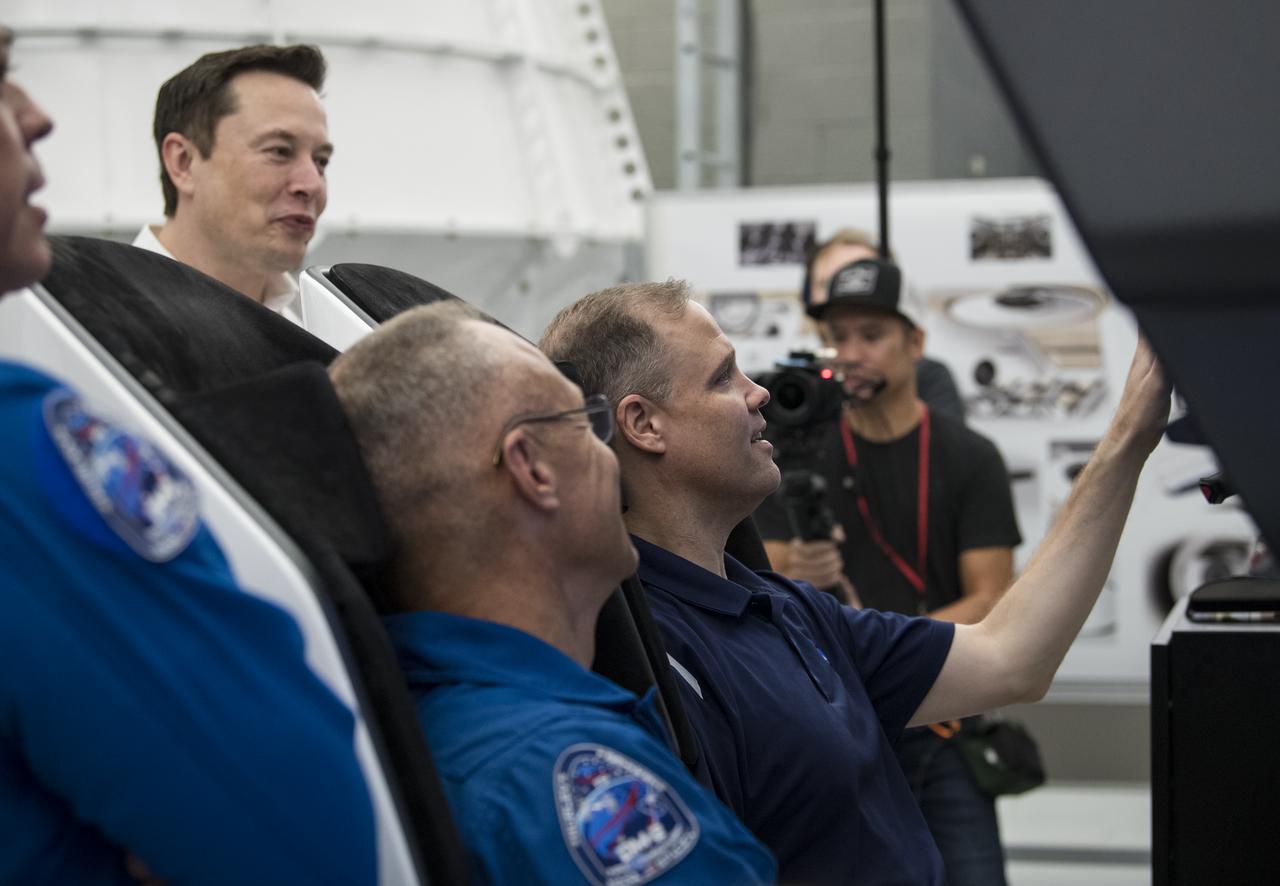
NASA Administrator Jim Bridenstine, right, participates in a crew Dragon flight simulation with NASA astronaut Doug Hurley, who will be flying aboard the Crew Dragon during the Demo-2 mission, while SpaceX Chief Engineer Elon Musk looks on, at the SpaceX Headquarters, Thursday, Oct. 10, 2019 in Hawthorne, CA. Photo credit: (NASA/Aubrey Gemignani)
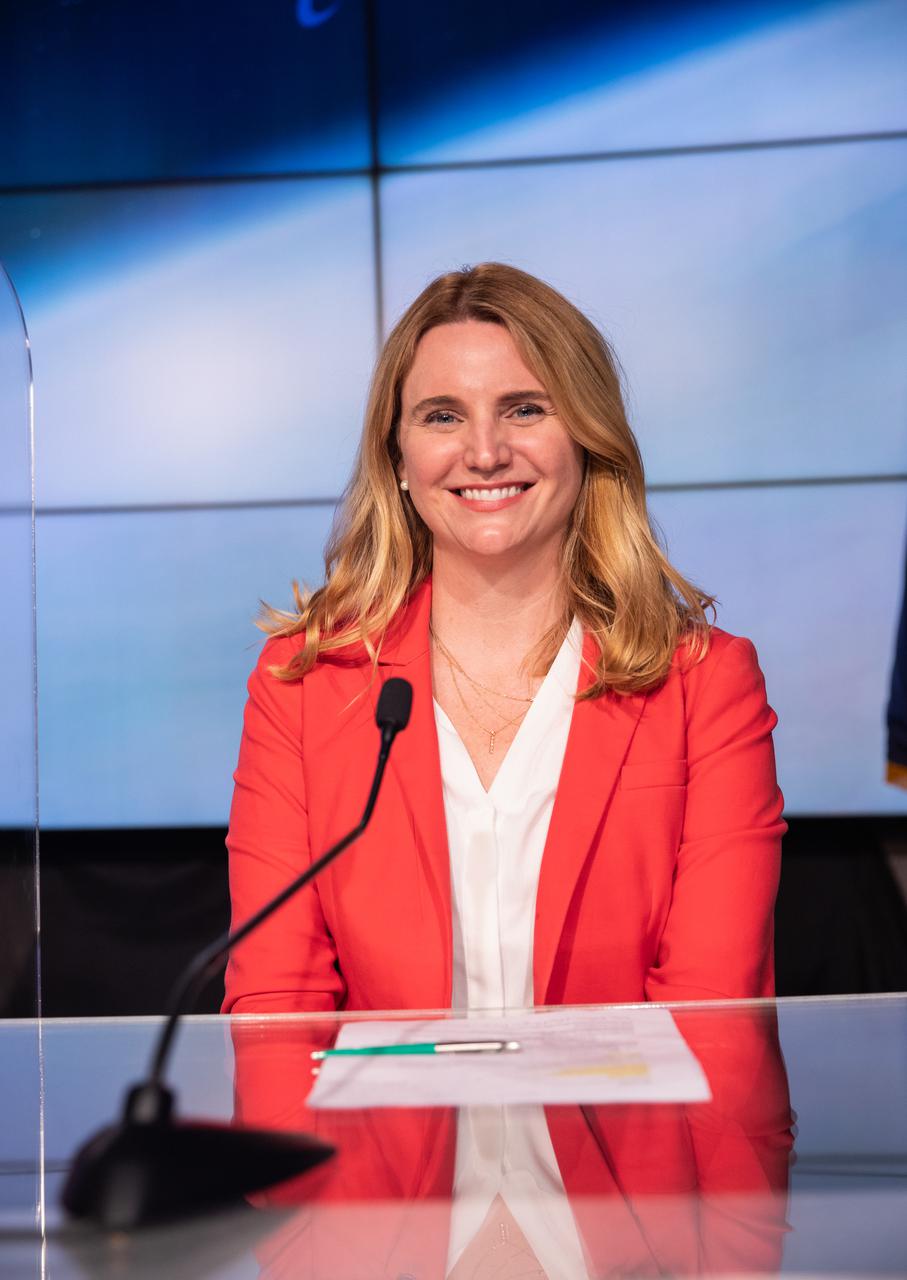
Jennifer Buchli, deputy chief scientist, NASA’s International Space Station Program, participates in a crew and science media briefing ahead of Boeing’s Orbital Flight Test-2 (OFT-2) at the agency’s Kennedy Space Center in Florida, July 29, 2021. Boeing’s CST-100 Starliner spacecraft will launch atop a United Launch Alliance Atlas V rocket from Space Launch Complex-41 at Cape Canaveral Space Force Station. The uncrewed OFT-2 will be the Starliner’s second flight for NASA’s Commercial Crew Program.
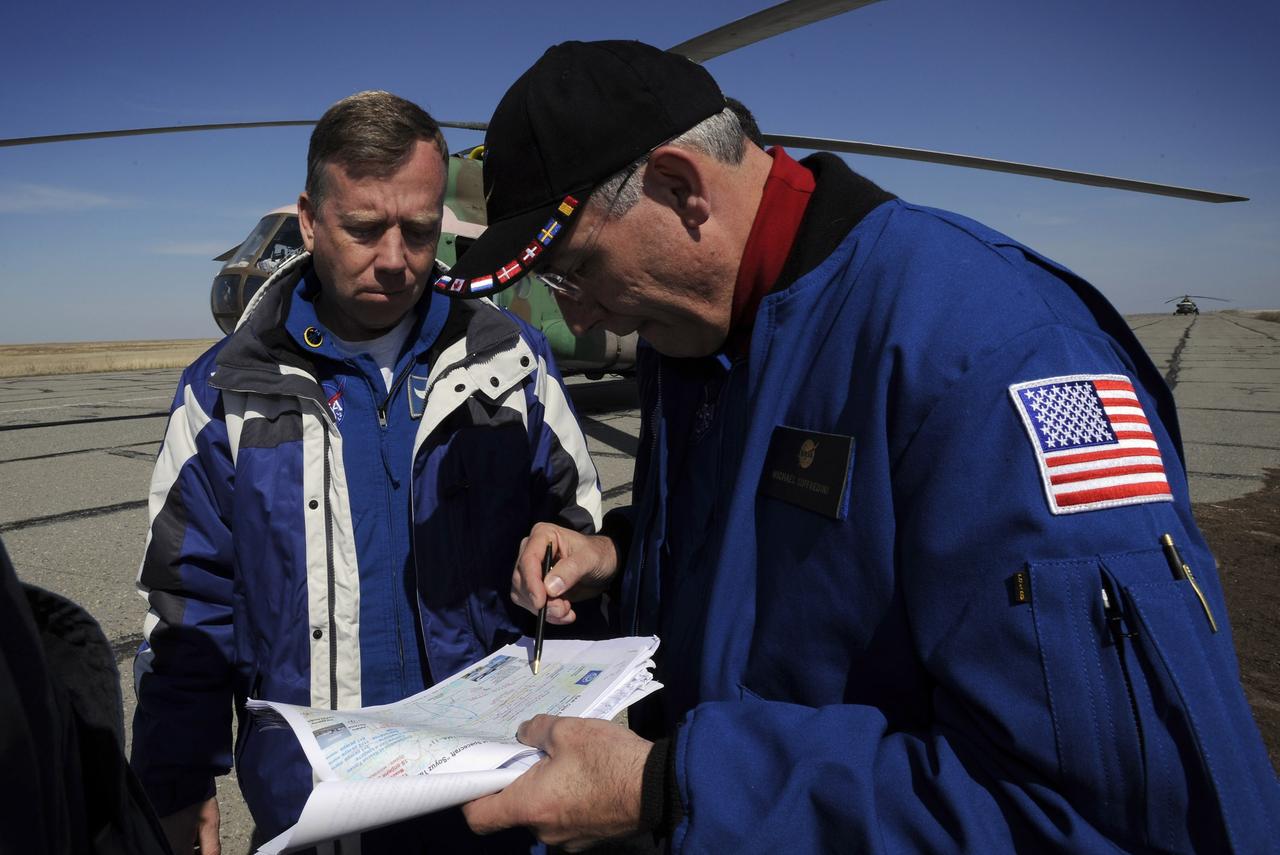
CHKALOVSKY, Russia -- Steve Lindsey, Chief of NASA's Astronaut office, left, and Michael Sufferdini, International Station Program Manager, examine a map of central Kazakhstan as they received information at the Arkalyk airport April 19, 2008, on the landing of the Expedition 16 crew in the Soyuz TMA-11 capsule. The Soyuz made a ballistic landing, touching down more then 400 kilometers short of the intended target, but the crew reported by satellite phone to recovery forces that they were in good shape. Photo Credit: (NASA/Bill Ingalls)
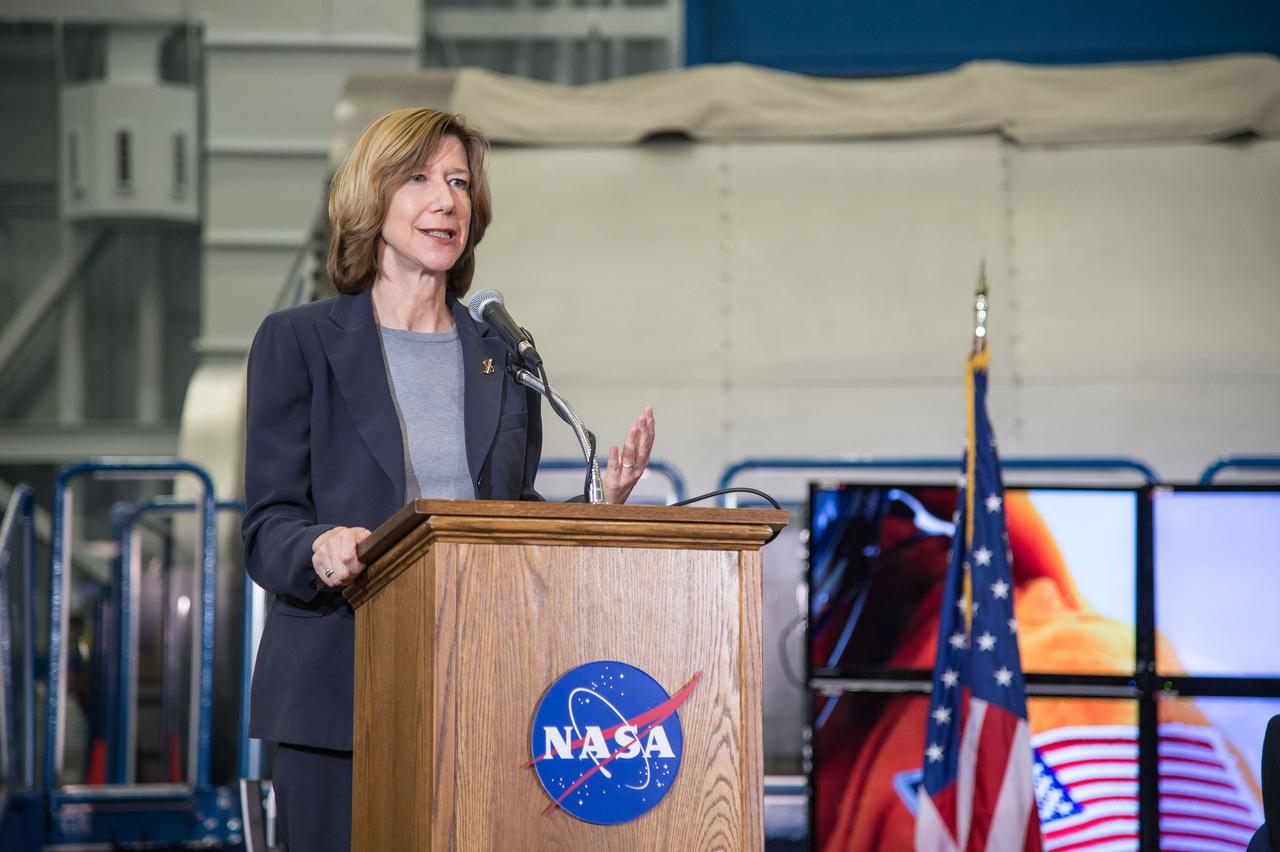
HOUSTON, Texas - jsc2015e031234 - Kathy Lueders, program manager of NASA's Commercial Crew Program, discusses the agency's approach during a presentation highlighting key development activities, test plans and objectives for achieving certification of two American crew transportation systems with NASA Administrator Charlie Bolden, Boeing Space Exploration Vice President and General Manager John Elbon, Space X President and Chief Operating Officer Gwynne Shotwell and NASA Astronaut Mike Fincke. Photo credit: NASA/Robert Markowitz
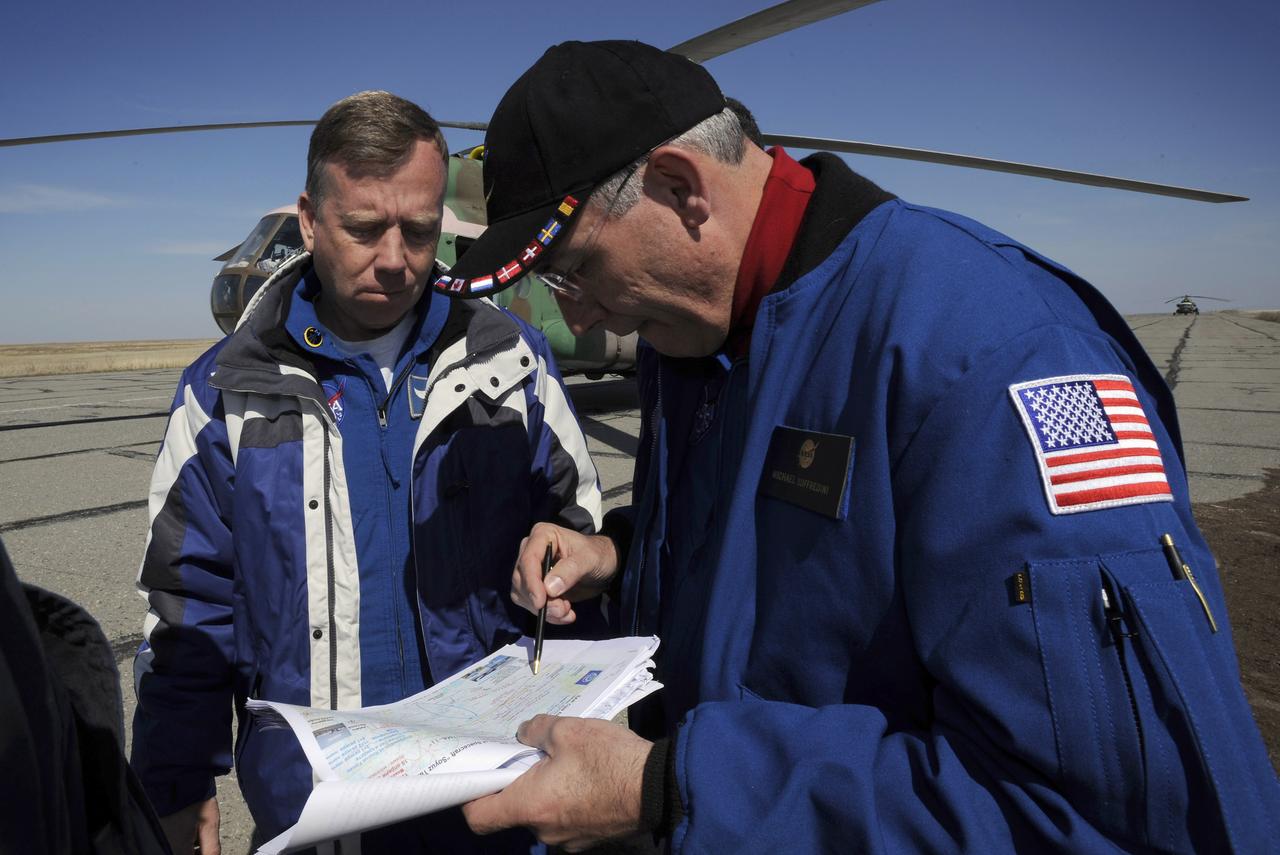
Chief of NASA's Astronaut office, Steve Lindsey, left, and International Space Station Program Manager, Michael Suffredini, examine a map of central Kazakhstan at the Arkalyk airport as they received information on the landing of the Expedition 16 crew in the Soyuz TMA-11 capsule, Saturday, April 19, 2008. The Soyuz made a ballistic landing, touching down more then 400 kilometers short of the intended target in central Kazakhstan. The crew reported by satellite phone to recovery forces that they were in good shape. Photo Credit: (NASA/Bill Ingalls)

SpaceX President and Chief Operation Officer Gwynne Shotwell gives remarks during a NASA event announcing the astronauts assigned to crew the first flight tests and missions of the Boeing CST-100 Starliner and SpaceX Crew Dragon, Friday, Aug. 3, 2018 at NASA’s Johnson Space Center in Houston, Texas. Photo Credit: (NASA/Bill Ingalls)
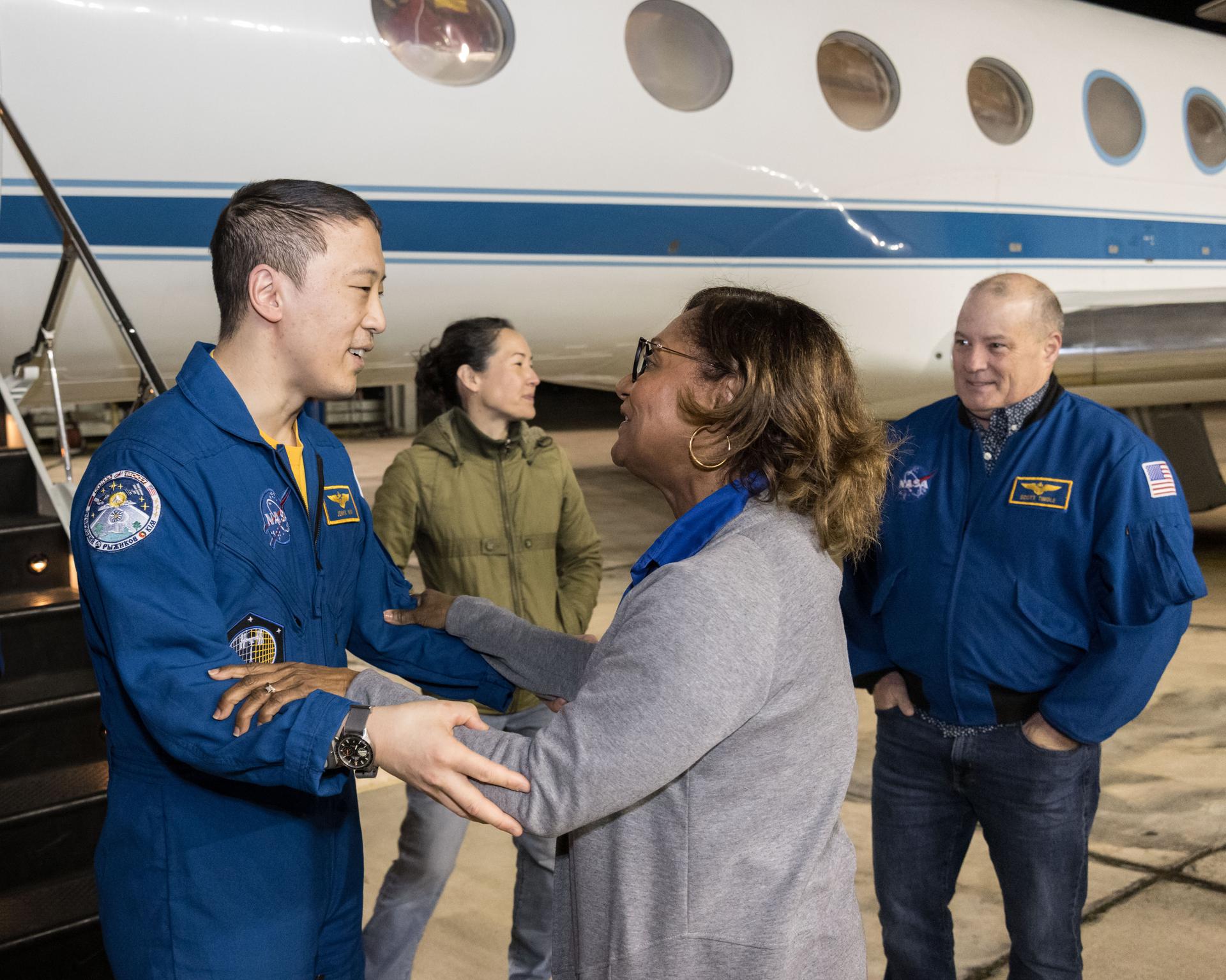
jsc2025e089532 (Dec. 10, 2025) --- NASA astronaut Jonny Kim, greeted by Johnson Space Center Director Vanessa Wyche, is pictured at Ellington Field outside the Gulfstream V aircraft that returned him to Houston, Texas, from Kazakhstan in Central Asia. The day before, Kim had landed in Kazakhstan aboard the Soyuz MS-27 crew spacecraft with Roscosmos cosmonauts Sergey Ryzhikov and Alexey Zubritsky after completing a 245-day research mission aboard the International Space Station. In the background (from left), is a NASA employee and NASA astronaut and Chief of the Astronaut Scott Tingle. Credit: NASA/Robert Markowitz

Kirt Costello, chief scientist, International Space Station Program, participates in the SpaceX Crew-2 prelaunch news conference held at NASA’s Kennedy Space Center in Florida on April 20, 2021. NASA astronauts Shane Kimbrough and Megan McArthur, JAXA astronaut Akihiko Hoshide, and ESA astronaut Thomas Pesquet will fly on Crew-2, the second crew rotation mission to the International Space Station as part of NASA’s Commercial Crew Program. They will launch aboard SpaceX’s Crew Dragon spacecraft, named Endeavour, powered by the company’s Falcon 9 rocket. Liftoff is set for Earth Day, Thursday, April 22, at 6:11 a.m. EDT.
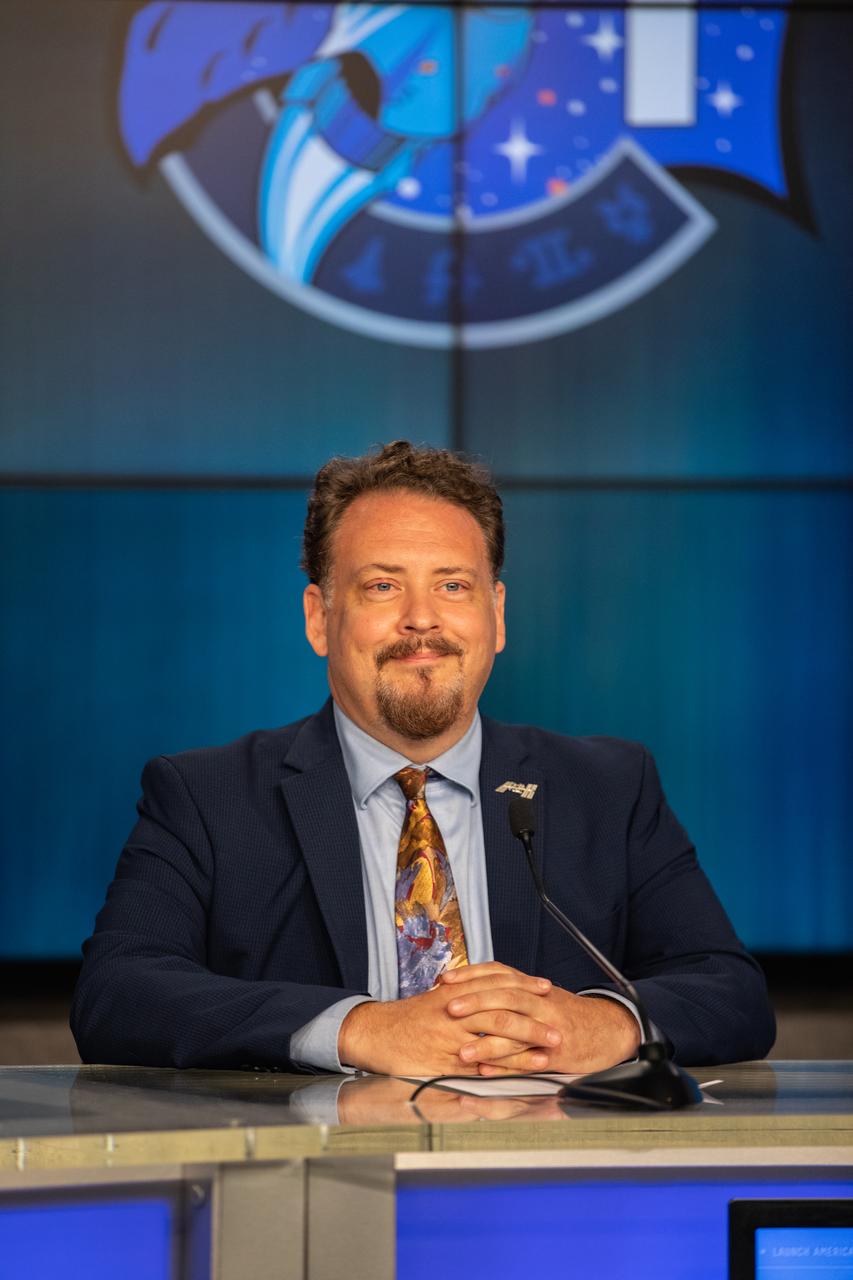
Kirt Costello, chief scientist, International Space Station Program, Johnson Space Center, answers questions during a virtual prelaunch news conference Nov. 13, 2020, inside the Press Site auditorium at NASA’s Kennedy Space Center in Florida ahead of the agency’s SpaceX Crew-1 launch. Crew-1 is the first regular crew mission of a U.S. commercial spacecraft with astronauts to the International Space Station as part of NASA’s Commercial Crew Program. The SpaceX Crew Dragon Resilience capsule will launch atop the company’s Falcon 9 rocket from Launch Complex 39A to the space station for a six-month science mission.
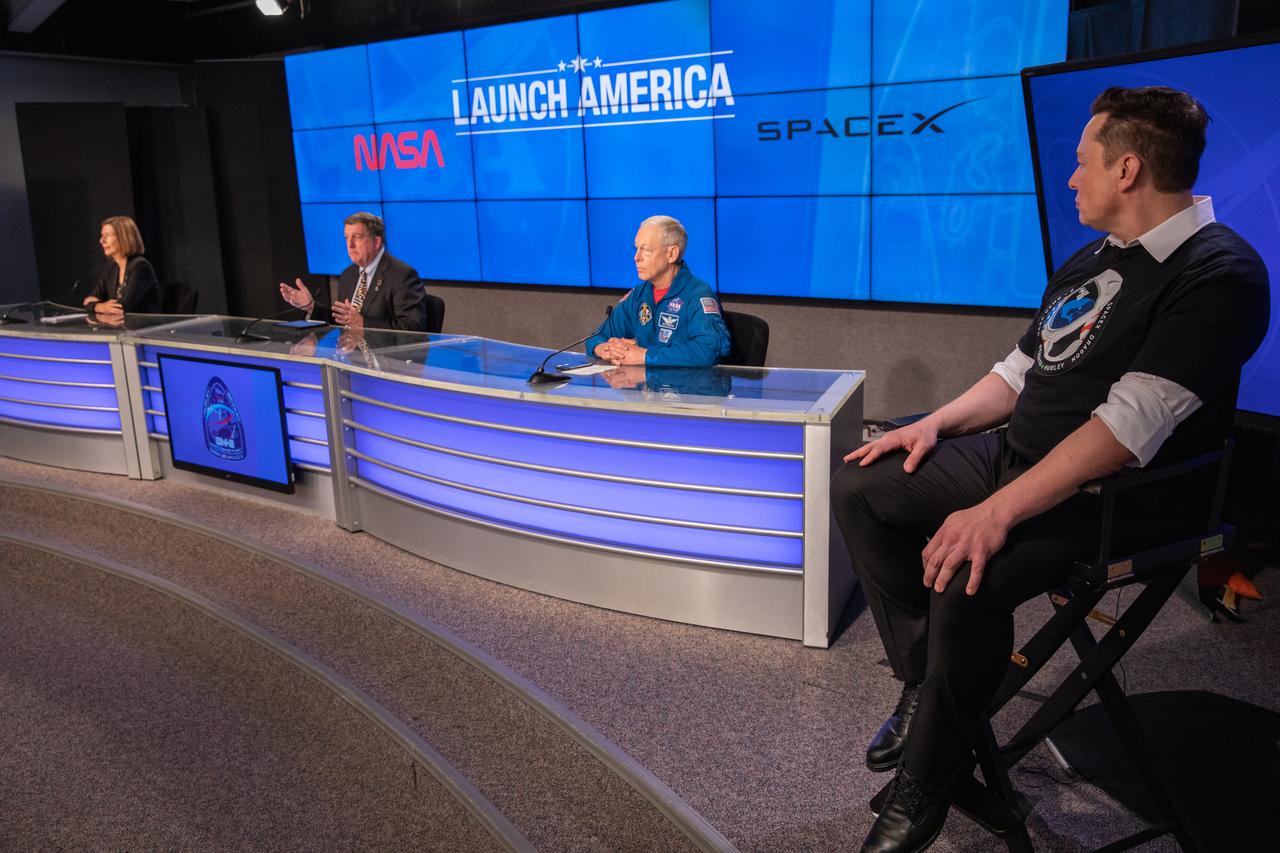
Inside the Press Site auditorium at NASA’s Kennedy Space Center in Florida, NASA and SpaceX officials conduct a postlaunch news conference on May 30, 2020, following the launch of the agency’s SpaceX Demo-2 mission to the International Space Station. From left are: Commercial Crew Program Manager Kathy Lueders; International Space Station Program Manager Kirk Shireman; NASA Chief Astronaut Pat Forrester; and Chief Engineer Elon Musk. Liftoff of the SpaceX Falcon 9 rocket and Crew Dragon spacecraft, carrying NASA astronauts Robert Behnken and Douglas Hurley, occurred at 3:22 p.m. EDT from historic Launch Complex 39A. Behnken and Hurley are the first astronauts to launch to the space station from U.S. soil since the end of the Space Shuttle Program in 2011. Part of NASA’s Commercial Crew Program, this will be SpaceX’s final flight test, paving the way for the agency to certify the crew transportation system for regular, crewed flights to the orbiting laboratory.
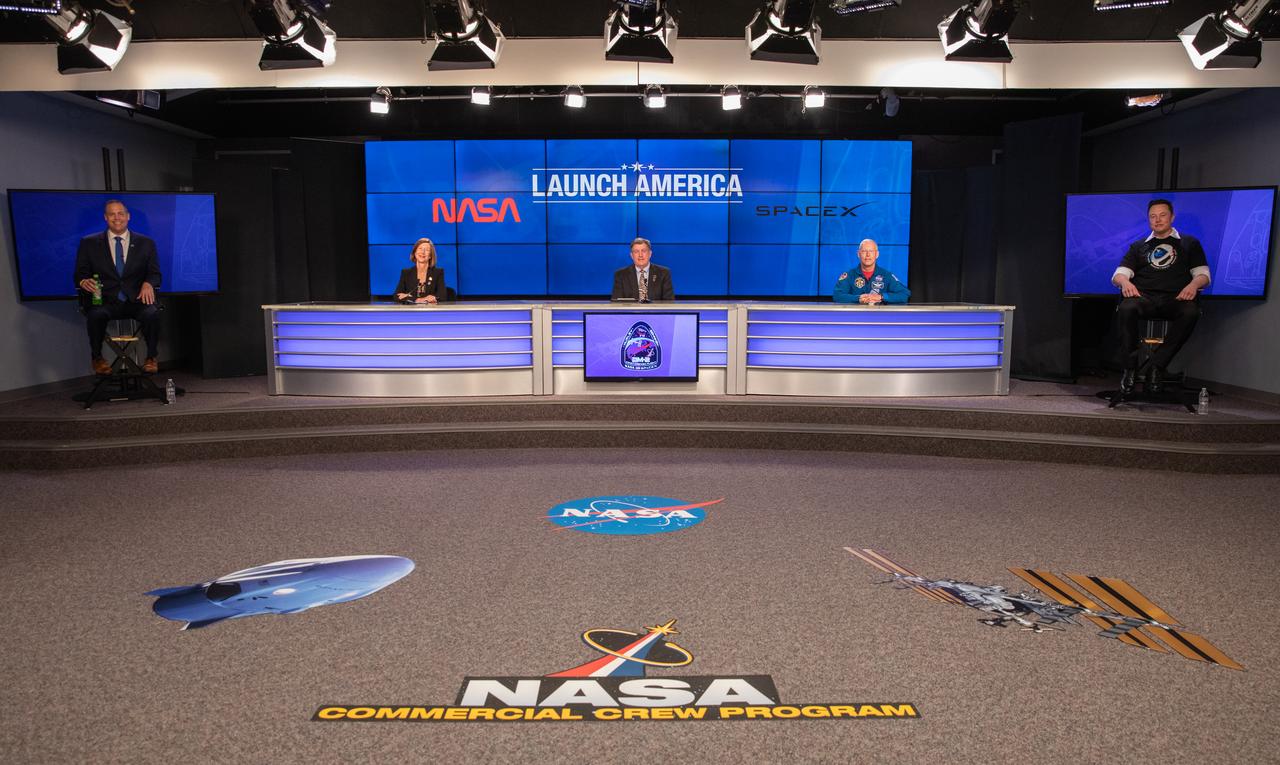
Inside the Press Site auditorium at NASA’s Kennedy Space Center in Florida, NASA and SpaceX officials conduct a postlaunch news conference on May 30, 2020, following the launch of the agency’s SpaceX Demo-2 mission to the International Space Station. From left are: NASA Administrator Jim Bridenstine; NASA Commercial Crew Program Manager Kathy Lueders; NASA International Space Station Program Manager Kirk Shireman; NASA Chief Astronaut Pat Forrester; and Chief Engineer Elon Musk. Liftoff of the SpaceX Falcon 9 rocket and Crew Dragon spacecraft, carrying NASA astronauts Robert Behnken and Douglas Hurley, occurred at 3:22 p.m. EDT from historic Launch Complex 39A. Behnken and Hurley are the first astronauts to launch to the space station from U.S. soil since the end of the Space Shuttle Program in 2011. Part of NASA’s Commercial Crew Program, this will be SpaceX’s final flight test, paving the way for the agency to certify the crew transportation system for regular, crewed flights to the orbiting laboratory.
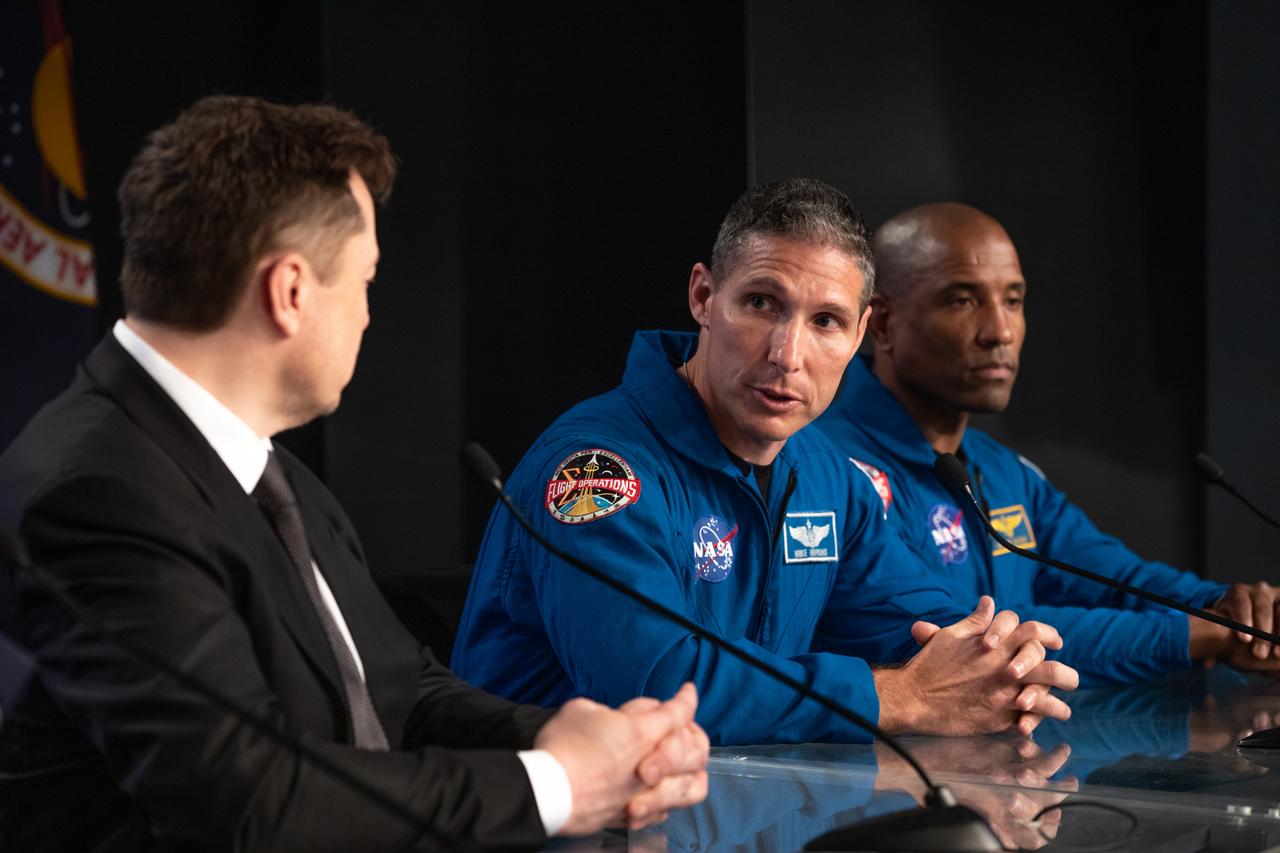
NASA astronaut Mike Hopkins, center, speaks during a briefing at the agency’s Kennedy Space Center in Florida following the uncrewed In-Flight Abort Test on Jan. 19, 2020. From left to right are SpaceX Chief Engineer Elon Musk, Hopkins, and NASA astronaut Victor Glover. During the flight test, a SpaceX Falcon 9 rocket and Crew Dragon spacecraft lifted off from Kennedy’s Launch Complex 39A and began a planned launch-abort sequence demonstrating the spacecraft’s escape capabilities. The Crew Dragon splashed down in the Atlantic Ocean as expected. The In-Flight Abort Test is a critical milestone in preparation for crewed flights to the International Space Station as part of the agency’s Commercial Crew Program.
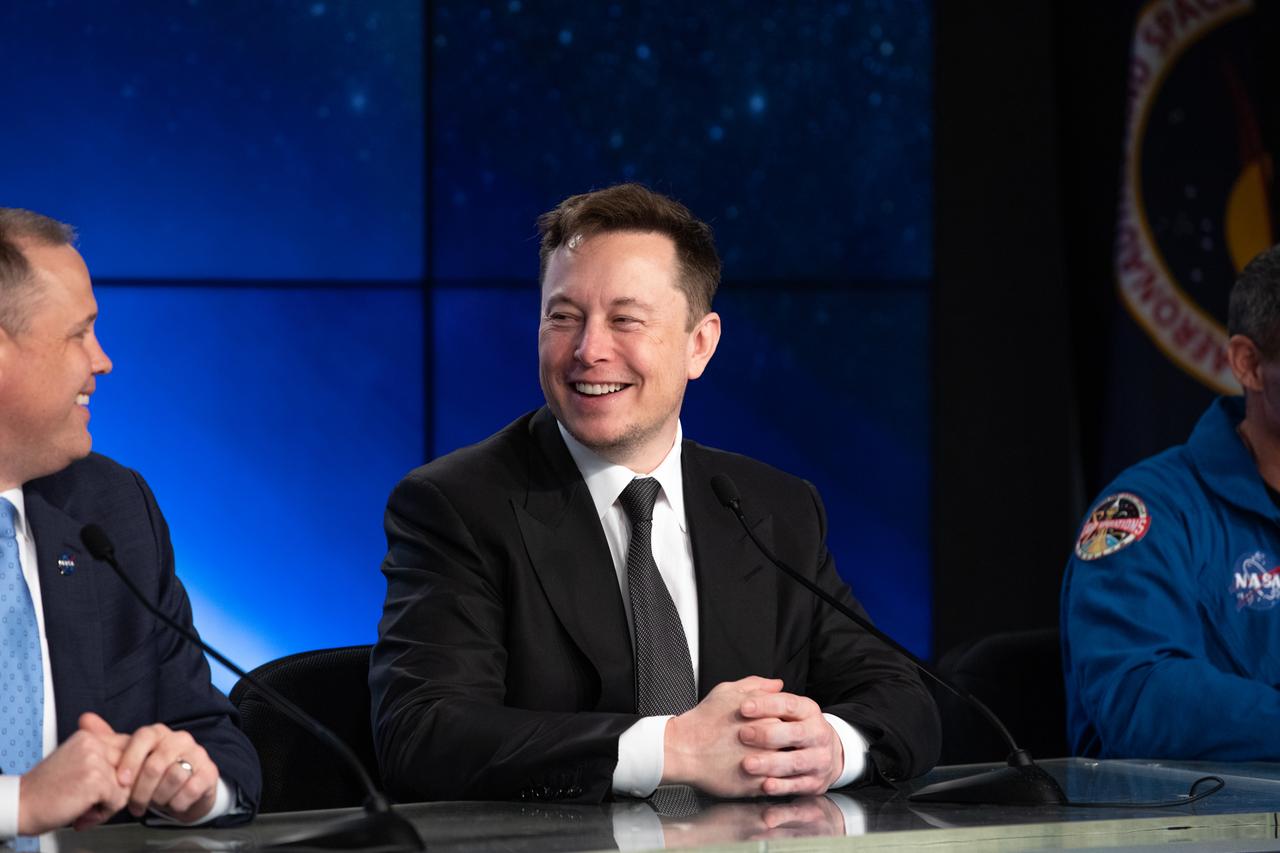
SpaceX Chief Engineer Elon Musk, right, speaks during a briefing at the agency’s Kennedy Space Center in Florida following the company’s uncrewed In-Flight Abort Test on Jan. 19, 2020. Beside Musk is NASA Administrator Jim Bridenstine. During the flight test, a SpaceX Falcon 9 rocket and Crew Dragon spacecraft lifted off from Kennedy’s Launch Complex 39A and began a planned launch-abort sequence demonstrating the spacecraft’s escape capabilities. The Crew Dragon splashed down in the Atlantic Ocean as expected. The In-Flight Abort Test is a critical milestone in preparation for crewed flights to the International Space Station as part of the agency’s Commercial Crew Program.
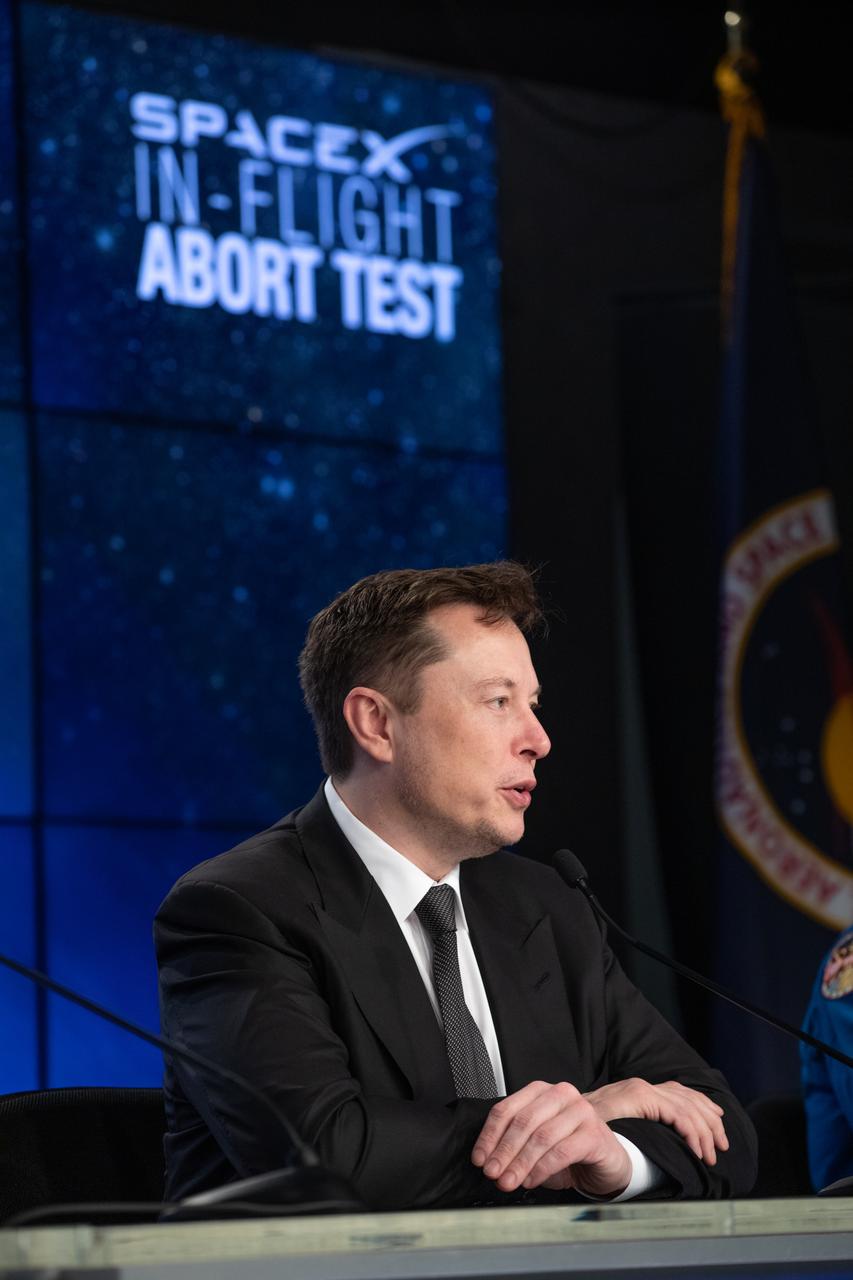
SpaceX Chief Engineer Elon Musk participates in a briefing at the agency’s Kennedy Space Center in Florida following the company’s uncrewed In-Flight Abort Test on Jan. 19, 2020. During the flight test, a SpaceX Falcon 9 rocket and Crew Dragon spacecraft lifted off from Kennedy’s Launch Complex 39A and began a planned launch-abort sequence demonstrating the spacecraft’s escape capabilities. The Crew Dragon splashed down in the Atlantic Ocean as expected. The In-Flight Abort Test is a critical milestone in preparation for crewed flights to the International Space Station as part of the agency’s Commercial Crew Program.

SpaceX President and Chief Operation Officer Gwynne Shotwell receives an American flag from NASA Administrator Jim Bridenstine during a NASA event announcing the astronauts assigned to crew the first flight tests and missions of the Boeing CST-100 Starliner and SpaceX Crew Dragon, Friday, Aug. 3, 2018 at NASA’s Johnson Space Center in Houston, Texas. The flag is to be flown to the International Space Station onboard SpaceX’s Demo-2 crew flight test and retrieved later during the SpaceX Crew Dragon first mission to station. Photo Credit: (NASA/Bill Ingalls)
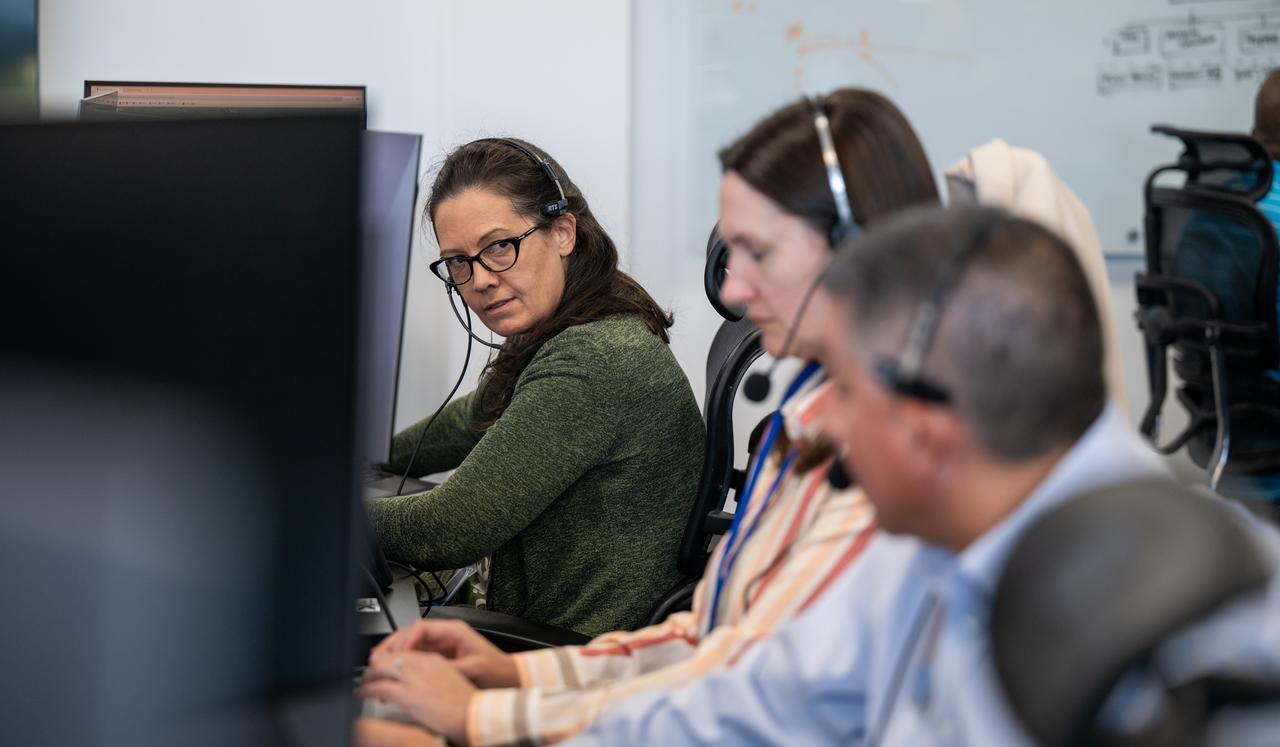
Emily Nelson, NASA's chief flight director, left, monitors the countdown during a dress rehearsal in preparation for the launch of a SpaceX Falcon 9 rocket carrying the company's Dragon spacecraft on NASA’s SpaceX Crew-9 mission with NASA astronaut Nick Hague and Roscosmos cosmonaut Aleksandr Gorbunov onboard, Tuesday, Sept. 24, 2024, in the control room of SpaceX’s HangarX at NASA’s Kennedy Space Center in Florida. NASA’s SpaceX Crew-9 mission is the ninth crew rotation mission of the SpaceX Dragon spacecraft and Falcon 9 rocket to the International Space Station as part of the agency’s Commercial Crew Program. Photo Credit: (NASA/Keegan Barber)
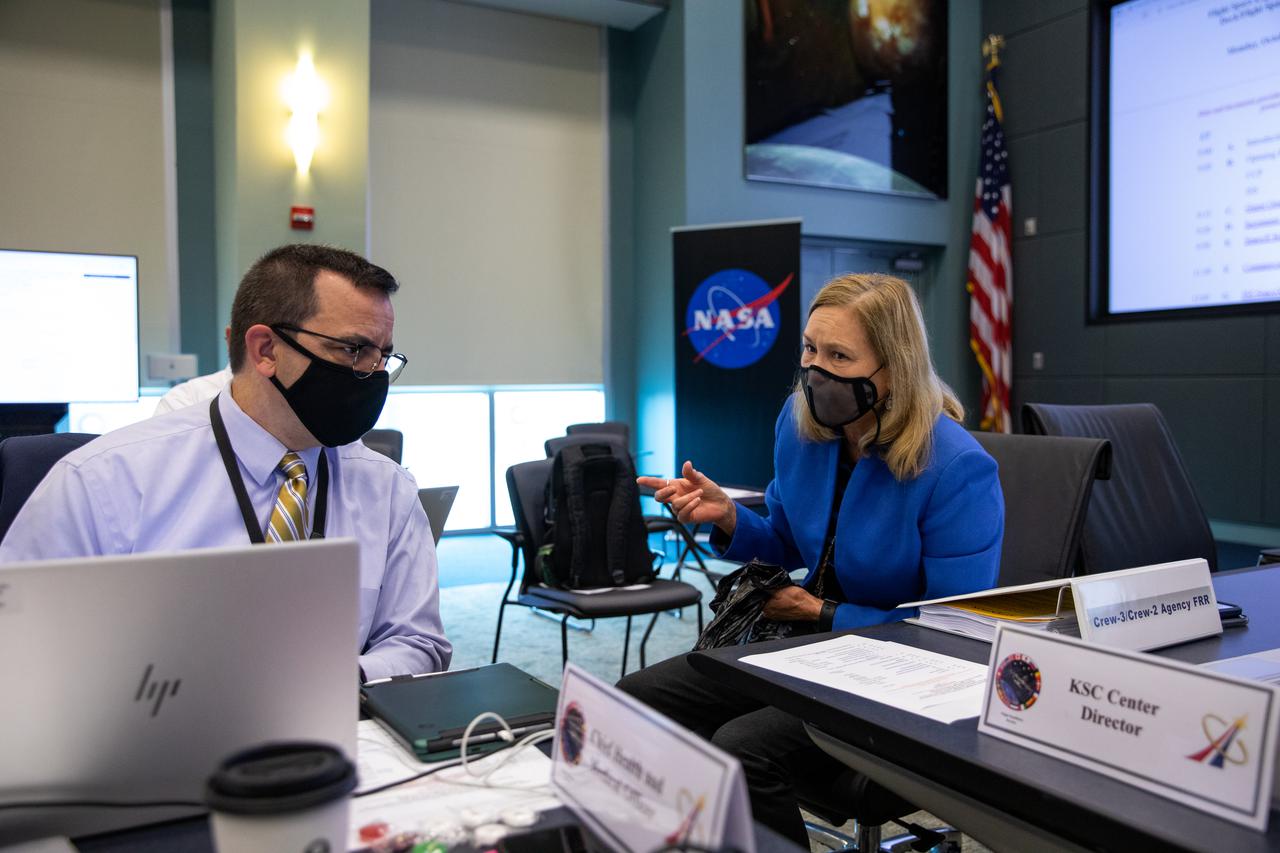
NASA and SpaceX managers participate in a Flight Readiness Review for the agency’s SpaceX Crew-3 mission at Kennedy Space Center in Florida on Oct. 25, 2021. International partners also participated. At right, Kennedy’s Center Director Janet Petro, speaks with J.D. Polk, chief Health and Medical officer. Crew-3 is scheduled to launch to the International Space Station from Kennedy’s Launch Complex 39A on Oct. 31, 2021 as part of NASA’s Commercial Crew Program. Liftoff of the Falcon 9 rocket and Crew Dragon spacecraft is targeted for 2:21 a.m. EDT.
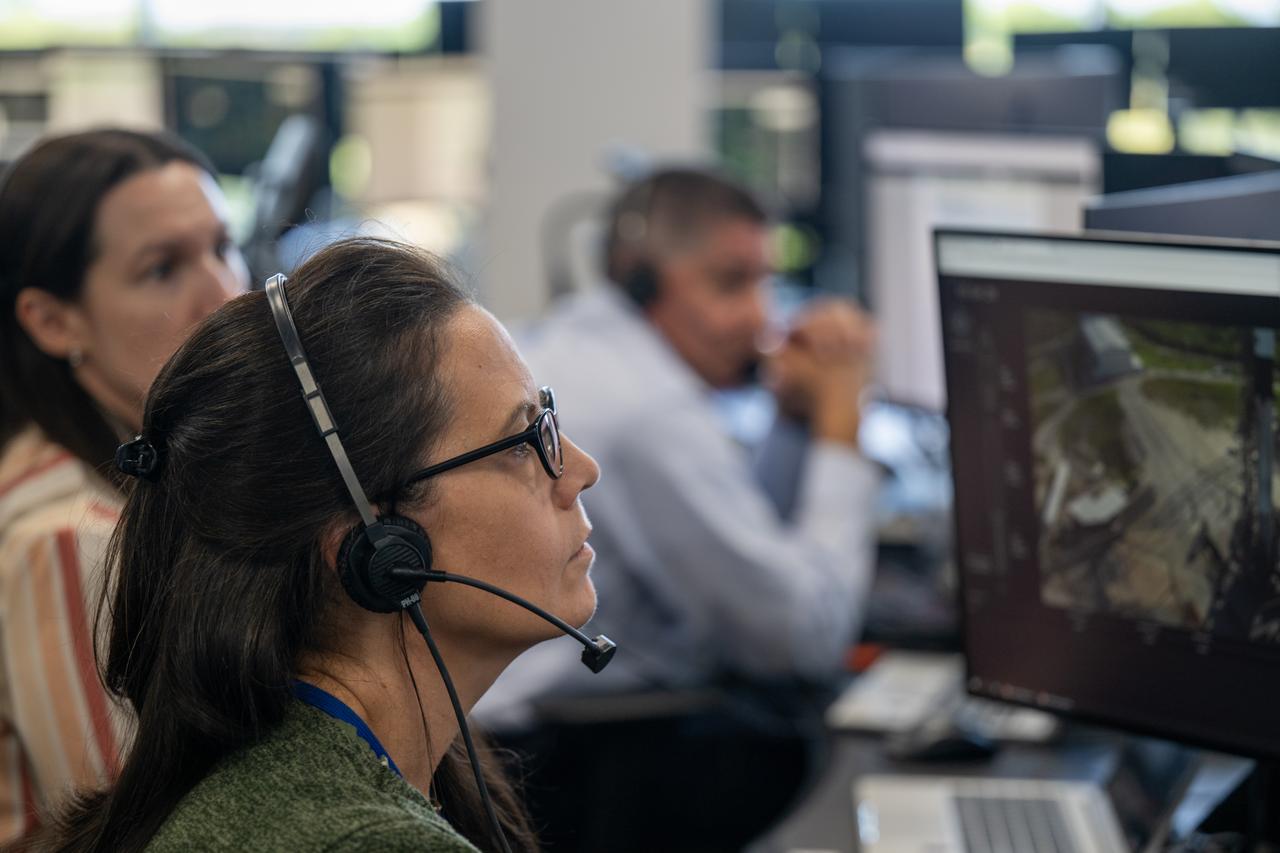
Emily Nelson, NASA's chief flight director, center, monitors the countdown during a dress rehearsal in preparation for the launch of a SpaceX Falcon 9 rocket carrying the company's Dragon spacecraft on NASA’s SpaceX Crew-9 mission with NASA astronaut Nick Hague and Roscosmos cosmonaut Aleksandr Gorbunov onboard, Tuesday, Sept. 24, 2024, in the control room of SpaceX’s HangarX at NASA’s Kennedy Space Center in Florida. NASA’s SpaceX Crew-9 mission is the ninth crew rotation mission of the SpaceX Dragon spacecraft and Falcon 9 rocket to the International Space Station as part of the agency’s Commercial Crew Program. Photo Credit: (NASA/Keegan Barber)
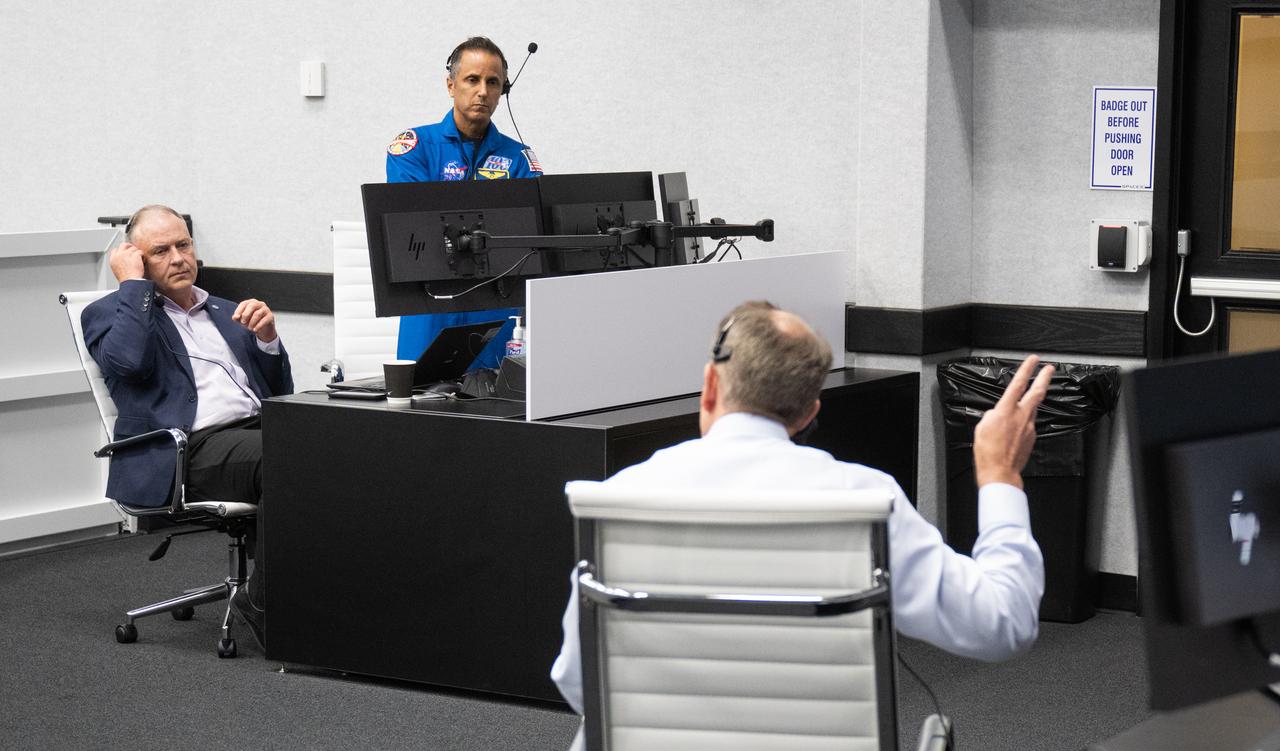
Norm Knight, director of Flight Operations at NASA's Johnson Space Center, left, Joe Acaba, Chief of the Astronaut Office, center, and Zeb Scoville, NASA's deputy chief flight director, right, are seen as they monitor the countdown of the attempted launch of a SpaceX Falcon 9 rocket carrying the company's Dragon spacecraft on NASA’s SpaceX Crew-6 mission with NASA astronauts Stephen Bowen and Warren "Woody" Hoburg, UAE (United Arab Emirates) astronaut Sultan Alneyadi, and Roscosmos cosmonaut Andrey Fedyaev onboard, Monday, Feb. 27, 2023, in firing room four of the Launch Control Center at NASA’s Kennedy Space Center in Florida. NASA’s SpaceX Crew-6 mission is the sixth crew rotation mission of the SpaceX Dragon spacecraft and Falcon 9 rocket to the International Space Station as part of the agency’s Commercial Crew Program. Today’s launch attempt was scrubbed due to an issue with ground systems. The next launch attempt is targeted for 12:34am ET on Thursday, March 2. Photo Credit: (NASA/Joel Kowsky)
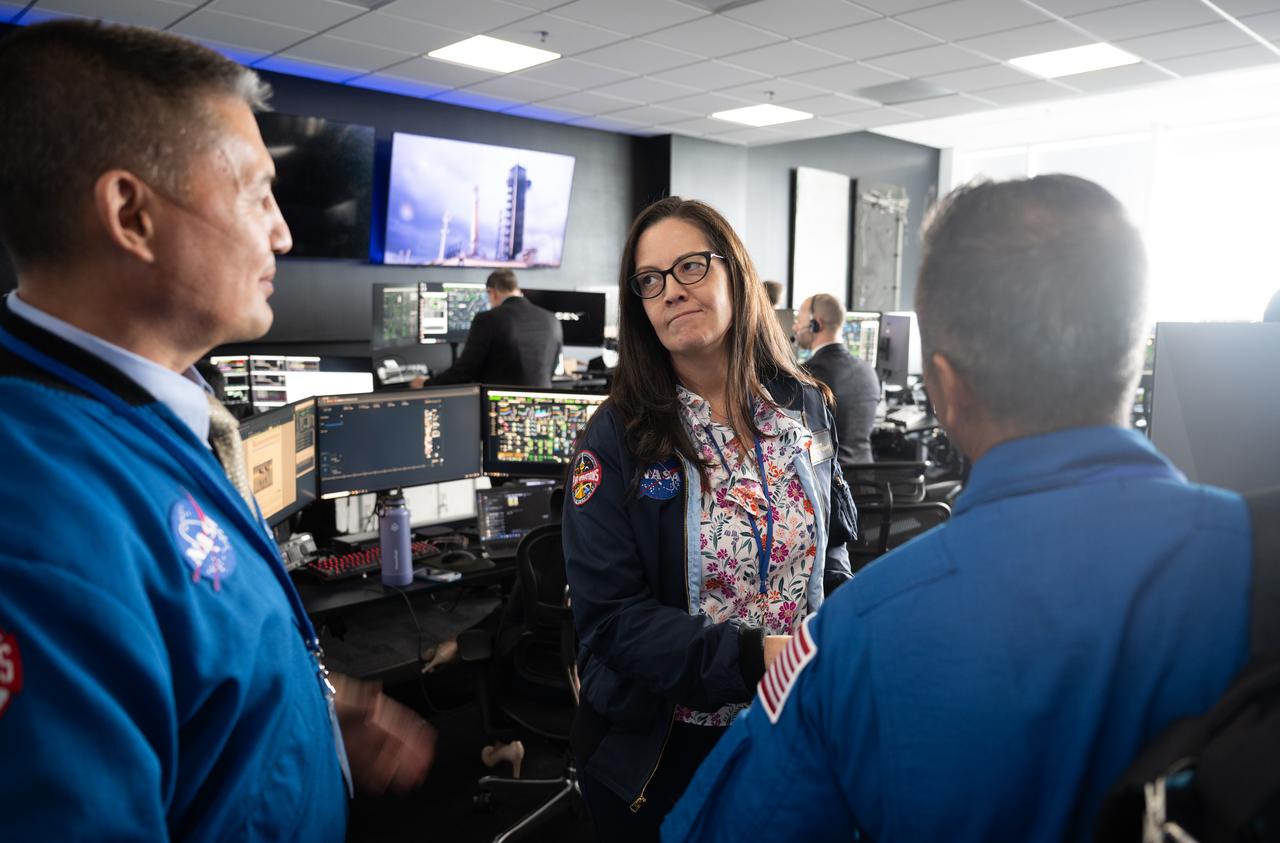
Emily Nelson, NASA's chief flight director, center, speaks with Kjell Lindegren, acting director of flight operations at NASA’s Johnson Space Center, left, and Joe Acaba, Chief of the Astronaut Office are seen following the launch of a SpaceX Falcon 9 rocket carrying the company's Dragon spacecraft on the Crew-11 mission with NASA astronauts Zena Cardman, Mike Fincke, JAXA (Japan Aerospace Exploration Agency) astronaut Kimiya Yui, and Roscosmos cosmonaut Oleg Platonov onboard, Friday, Aug. 1, 2025, in the control room of SpaceX’s HangarX at NASA’s Kennedy Space Center in Florida. NASA’s SpaceX Crew-11 mission is the eleventh crew rotation mission of the SpaceX Dragon spacecraft and Falcon 9 rocket to the International Space Station as part of the agency’s Commercial Crew Program. Cardman, Fincke, Yui, Platonov launched at 11:43 a.m. EDT, from Launch Complex 39A at the NASA's Kennedy Space Center to begin their mission aboard the International Space Station. Photo Credit: (NASA/Joel Kowsky)

Officials from NASA, Boeing, United Launch Alliance and the U.S. Air Force 45th Weather Squadron participate in a prelaunch briefing for Boeing’s Orbital Flight Test at the agency’s Kennedy Space Center in Florida, Dec. 17, 2019. From left are John Elbon, chief operating officer, United Launch Alliance; Joel Montalbano, deputy manager, International Space Station Program; Pat Forrester, Astronaut Office chief, Johnson Space Center; and Will Ulrich, launch weather officer, 45th Weather Squadron. Boeing’s CST-100 Starliner spacecraft will launch atop a United Launch Alliance Atlas V rocket from Space Launch Complex 41 at Cape Canaveral Air Force Station. The uncrewed Orbital Flight Test will be the Starliner’s first flight to the International Space Station for NASA’s Commercial Crew Program.

JSC2011-E-015241 (4 Feb. 2011) --- NASA astronaut Mark Kelly, STS-134 commander, listens to a reporter?s question during a news conference at NASA's Johnson Space Center. Seated next to Kelly are (left to right) Nicole Cloutier-Lemasters, public affairs officer; Brent Jett, Flight Crew Operations Directorate chief and Peggy Whitson, Astronaut Office chief. The briefing was held to discuss Kelly resuming training as the STS-134 shuttle mission commander. With the exception of some proficiency training, Kelly has been on personal leave since Jan. 8 to care for his wife, congresswoman Gabrielle Giffords, who was critically wounded in a Tucson, Ariz. shooting. Photo credit: NASA or National Aeronautics and Space Administration

CAPE CANAVERAL, Fla. -- At NASA's Kennedy Space Center in Florida, Mike Tillema, chief of Flight Operations in the Operations Support Division of NASA Center Operations, center, discusses plans for a training session to practice use of a Bambi Bucket in honing firefighting techniques. Bill Martin, a URS Federal Technical Services pilot in NASA Flight Operations, is on the left, with crew chief Mark Smith, also of URS. Firefighters respond to wildfires with teams on the ground and in the air. The most up-to-date tools include helicopters that use Bambi Buckets large quantities of water. NASA Flight Operations teams are training to perfect the skills needed to ensure they are ready to use tools, such as the Bambi Bucket, in the event of an out-of-control blaze at the spaceport. Photo credit: NASA/Frankie Martin
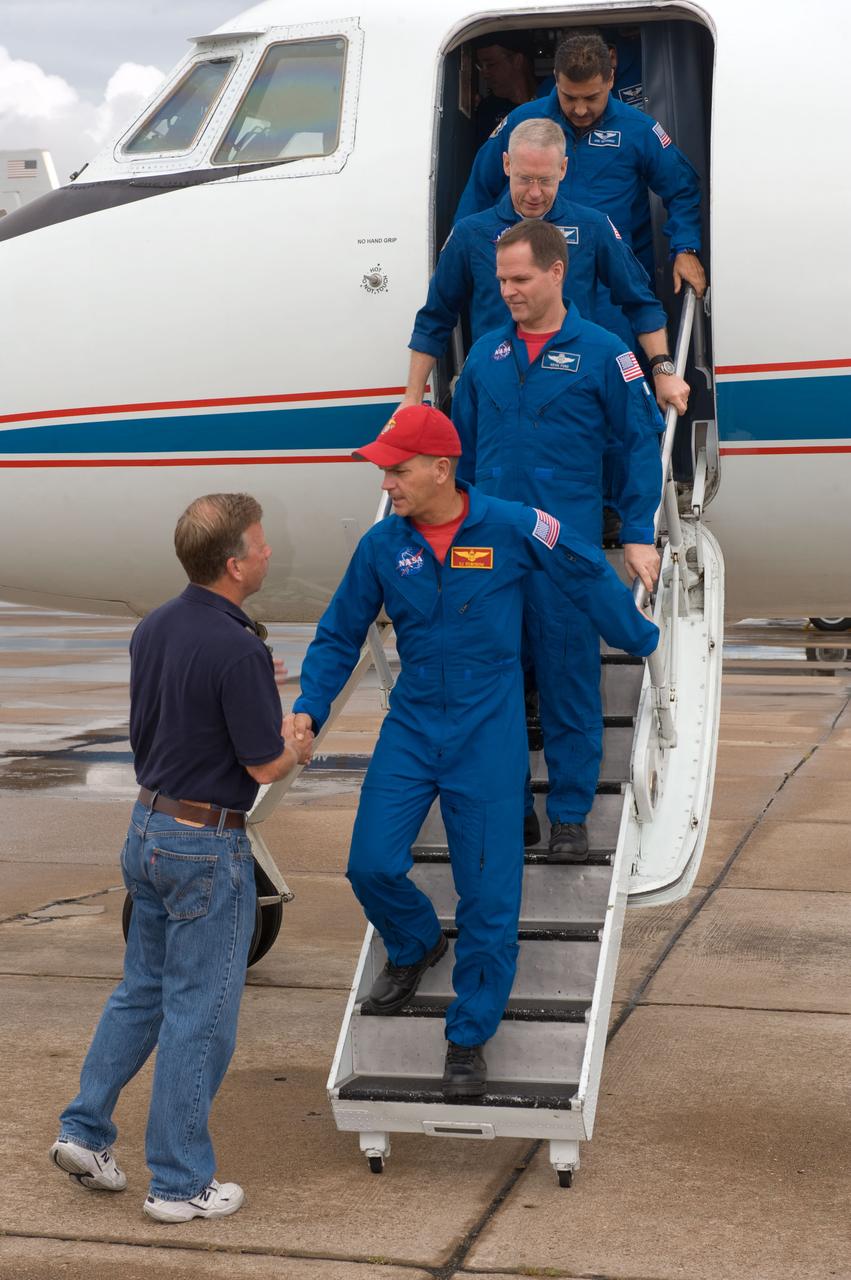
JSC2009-E-207787 (12 Sept. 2009) --- Stephen Lindsey, chief of the astronaut office, greets NASA astronaut Rick Sturckow, STS-128 commander, as the STS-128 crew members exit a Gulfstream aircraft prior to the crew return ceremonies at Ellington Field near NASA?s Johnson Space Center. Pictured behind Sturckow (front to back) are NASA astronauts Kevin Ford, pilot; Patrick Forrester and Jose Hernandez, both mission specialists. Crew members not pictured are NASA astronauts John ?Danny? Olivas and Tim Kopra; along with European Space Agency astronaut Christer Fuglesang, all mission specialists.
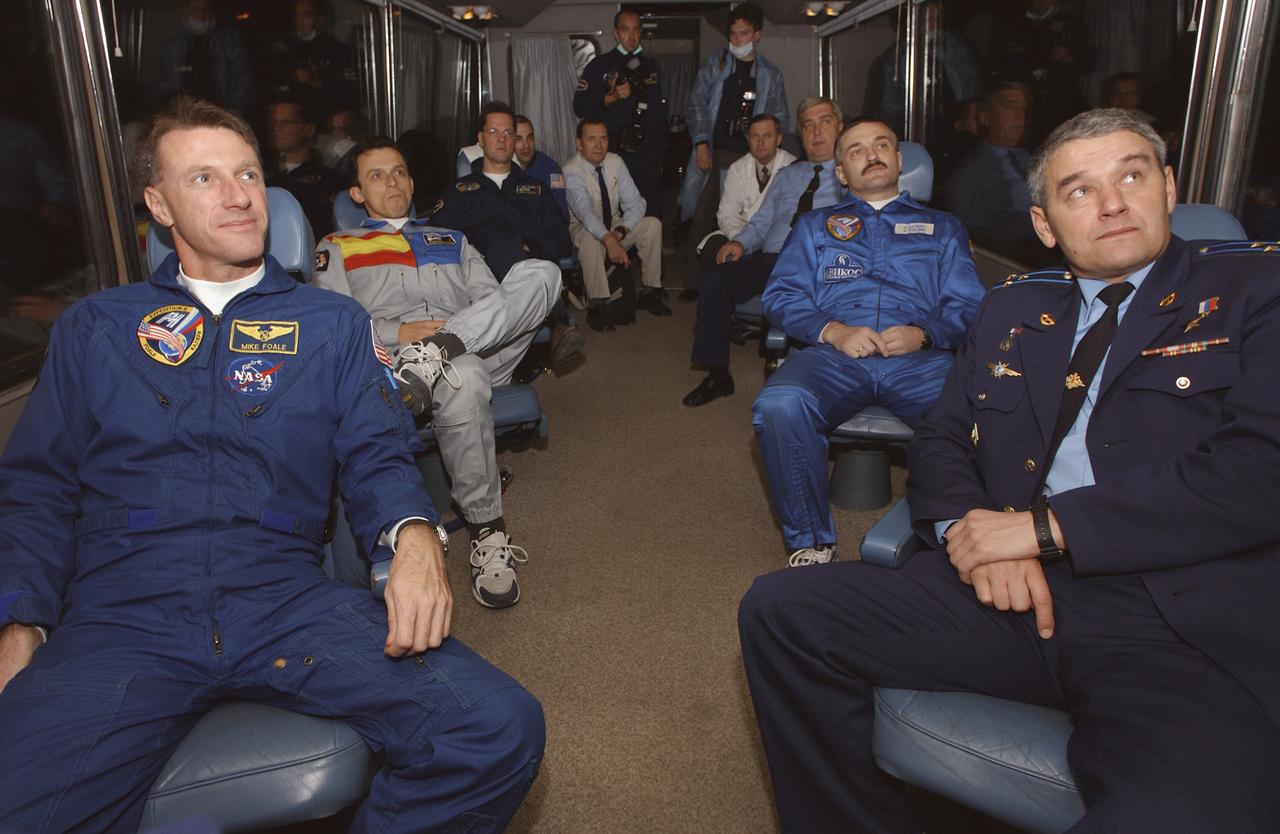
Expedition 8 Commander and NASA Science Officer Michael Foale, left, European Space Agency astronaut Pedro Duque of Spain, second left and Soyuz Commander Alexander Kaleri along with Gen. Valery Korzun, the Chief of the Cosmonaut Corps, front right, watch home videos aboard the bus transporting the crew to the launch pad at the Baikonur Cosmodrome in Kazakhstan on Saturday, Oct. 18, 2003 prior to the crew's launch to the Interrnational Space Station. The viewing of home videos on the bus is one of many prelaunch traditions for all departing crews. Photo Credit (NASA/Bill Ingalls)
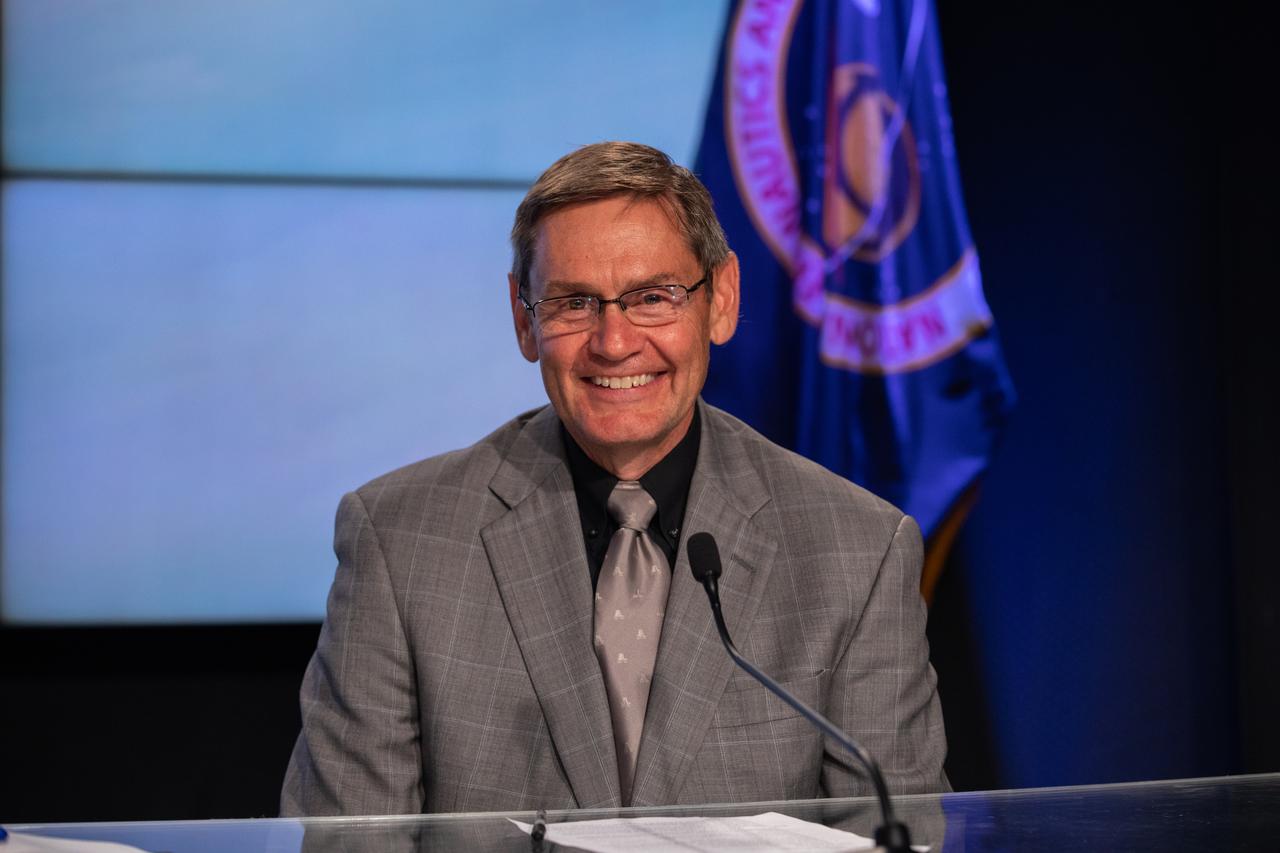
John Elbon, chief operating officer, United Launch Alliance, participates in a postlaunch news conference following the liftoff of NASA Boeing’s Orbital Flight Test-2 (OFT-2) on May 19, 2022. Liftoff occurred at 6:54 p.m. EDT from Space Launch Complex-41 at Florida’s Cape Canaveral Space Force Station. Boeing’s uncrewed flight test is designed to test the system’s end-to-end capabilities for NASA’s Commercial Crew Program providing valuable data towards NASA certifying Boeing’s crew transportation system for regular crewed flights to and from the International Space Station.
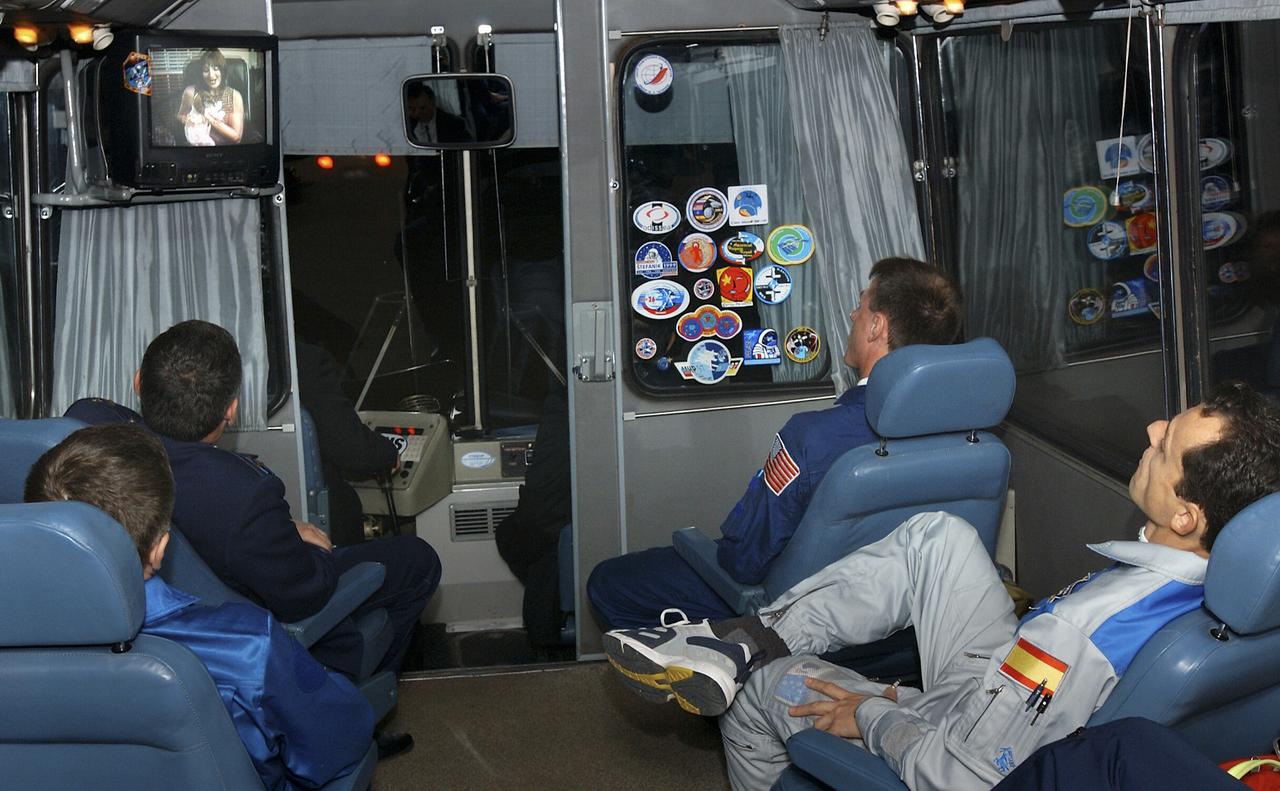
Expedition 8 Soyuz Commander Alexander Kaleri, clockwise from lower left, Gen. Valery Korzun, the Chief of the Cosmonaut Corps, Commander and NASA Science Officer Michael Foale and European Space Agency astronaut Pedro Duque of Spain watch home videos aboard the bus transporting the crew to the launch pad at the Baikonur Cosmodrome in Kazakhstan, Saturday, Oct. 18, 2003, prior to the crew's launch to the Interrnational Space Station. The viewing of home videos on the bus is one of many prelaunch traditions for all departing crews. Photo Credit (NASA/Bill Ingalls)
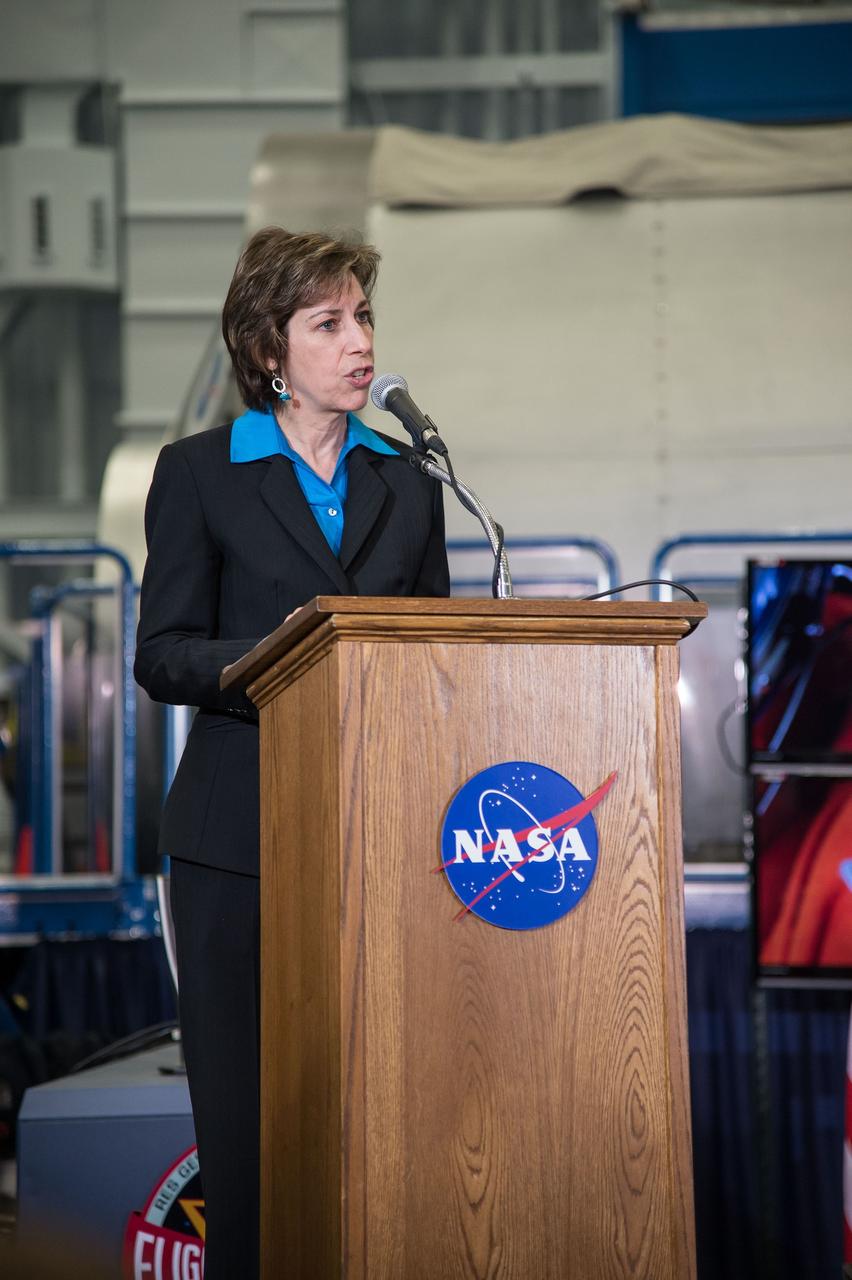
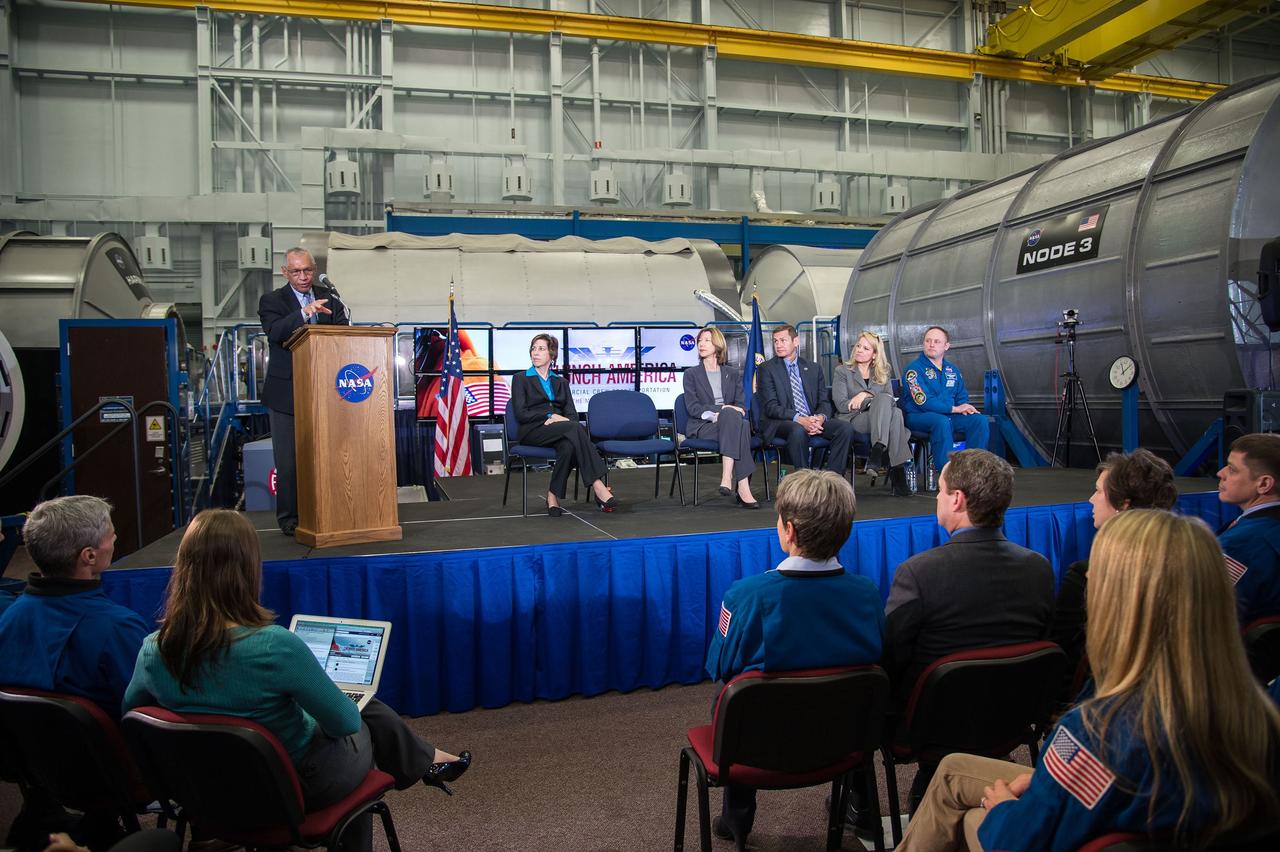
HOUSTON, Texas - jsc2015e031223 - Dr. Ellen Ochoa, director of NASA's Johnson Space Center in Houston, opens NASA's presentation about the agency's Commercial Crew Program highlighting key development activities, test plans and objectives for achieving certification of two American crew transportation systems with NASA Administrator Charlie Bolden, Commercial Crew Program Manager Kathy Lueders, Boeing Space Exploration Vice President and General Manager John Elbon, SpaceX President and Chief Operating Officer Gwynne Shotwell and NASA Astronaut Mike Fincke. Photo credit: NASA/Robert Markowitz
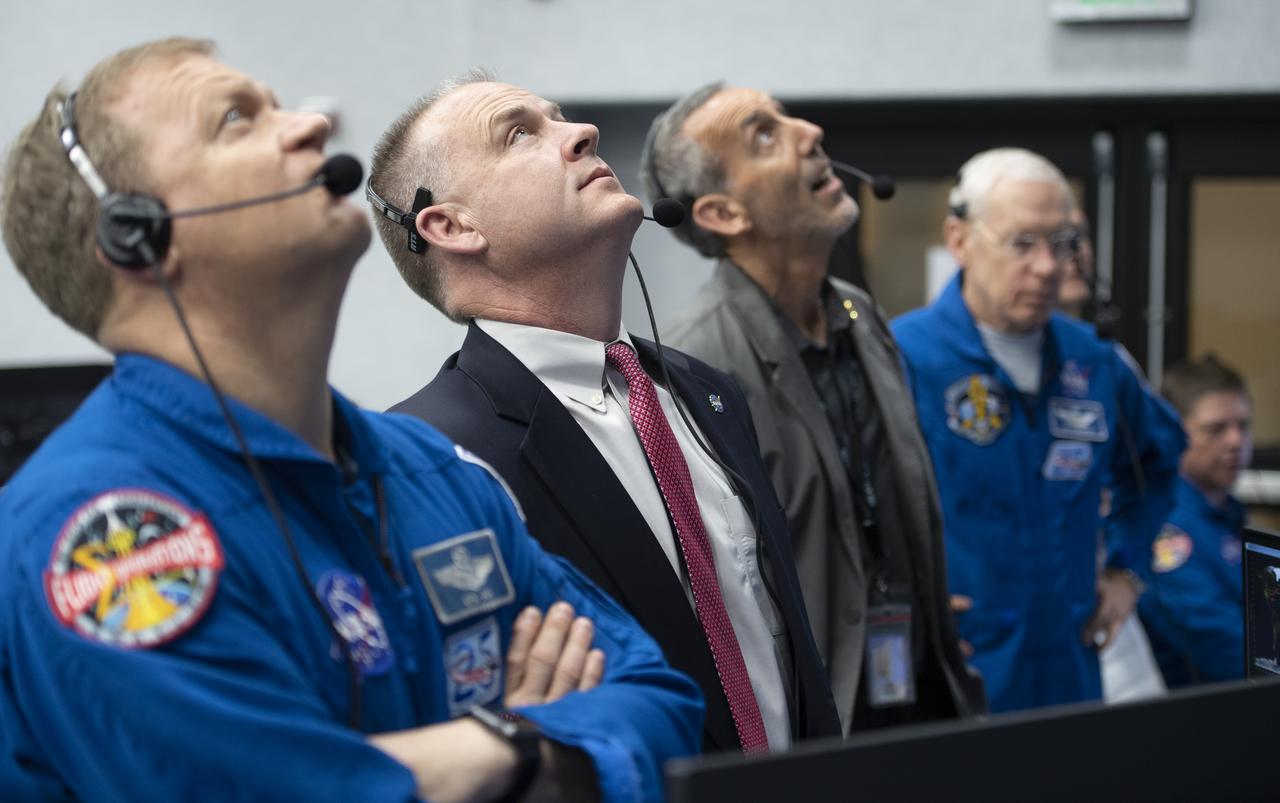
NASA astronaut Eric Boe, assistant to the chief of the astronaut office for commercial crew, left, and Norm Knight, deputy director of flight operations at NASA's Johnson Space Center watch the launch of a SpaceX Falcon 9 rocket carrying the company's Crew Dragon spacecraft on the Demo-1 mission from firing room four of the Launch Control Center, Saturday, March 2, 2019 at the Kennedy Space Center in Florida. The Demo-1 mission is the first launch of a commercially built and operated American spacecraft and space system designed for humans as part of NASA's Commercial Crew Program. The mission will serve as an end-to-end test of the system's capabilities. Photo Credit: (NASA/Joel Kowsky)
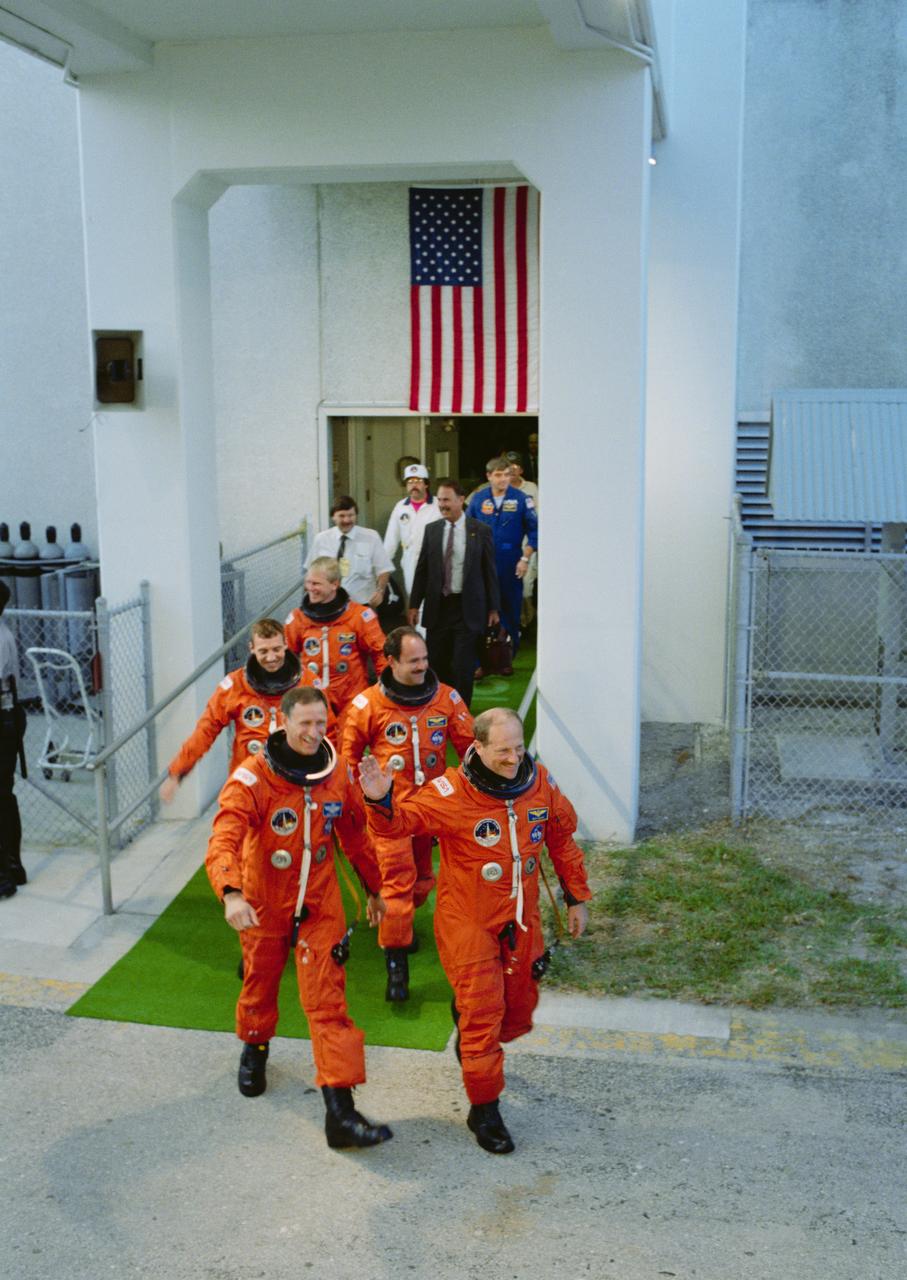
STS-26 crewmembers, suited in launch and entry suits (LESs), leave the Kennedy Space Center (KSC) Operations and Checkout (O&C) Building on their way to the launch complex (LC) pad 39B where they will board Discovery, Orbiter Vehicle (OV) 103. Commander Frederick H. Hauck, waving to spectators, is followed by Pilot Richard O. Covey, Mission Specialist (MS) John M. Lounge, MS David C. Hilmers, and MS George D. Nelson. Others accompanying the crew are JSC Flight Crew Operations Directorate (FCOD) Director Donald R. Puddy, Astronaut Office Chief Daniel C. Brandenstein, and a Crew Training Officer Richard W. Nygren.
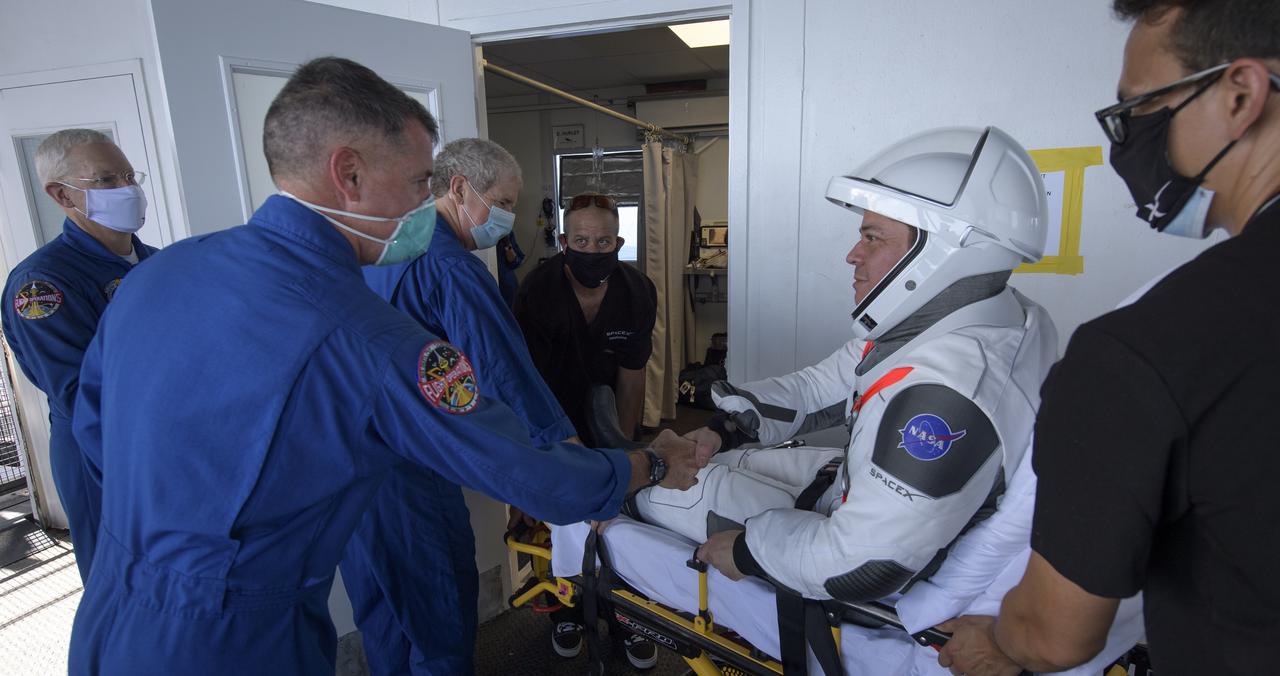
NASA astronaut Robert Behnken is greeted by NASA astronaut and Crew Recovery Chief Shane Kimbrough after egressing the SpaceX Crew Dragon Endeavour spacecraft onboard the SpaceX GO Navigator recovery ship after he and NASA astronaut Douglas Hurley landed in the Gulf of Mexico off the coast of Pensacola, Florida, Sunday, Aug. 2, 2020. The Demo-2 test flight for NASA's Commercial Crew Program was the first to deliver astronauts to the International Space Station and return them safely to Earth onboard a commercially built and operated spacecraft. Behnken and Hurley returned after spending 64 days in space. Photo Credit: (NASA/Bill Ingalls)
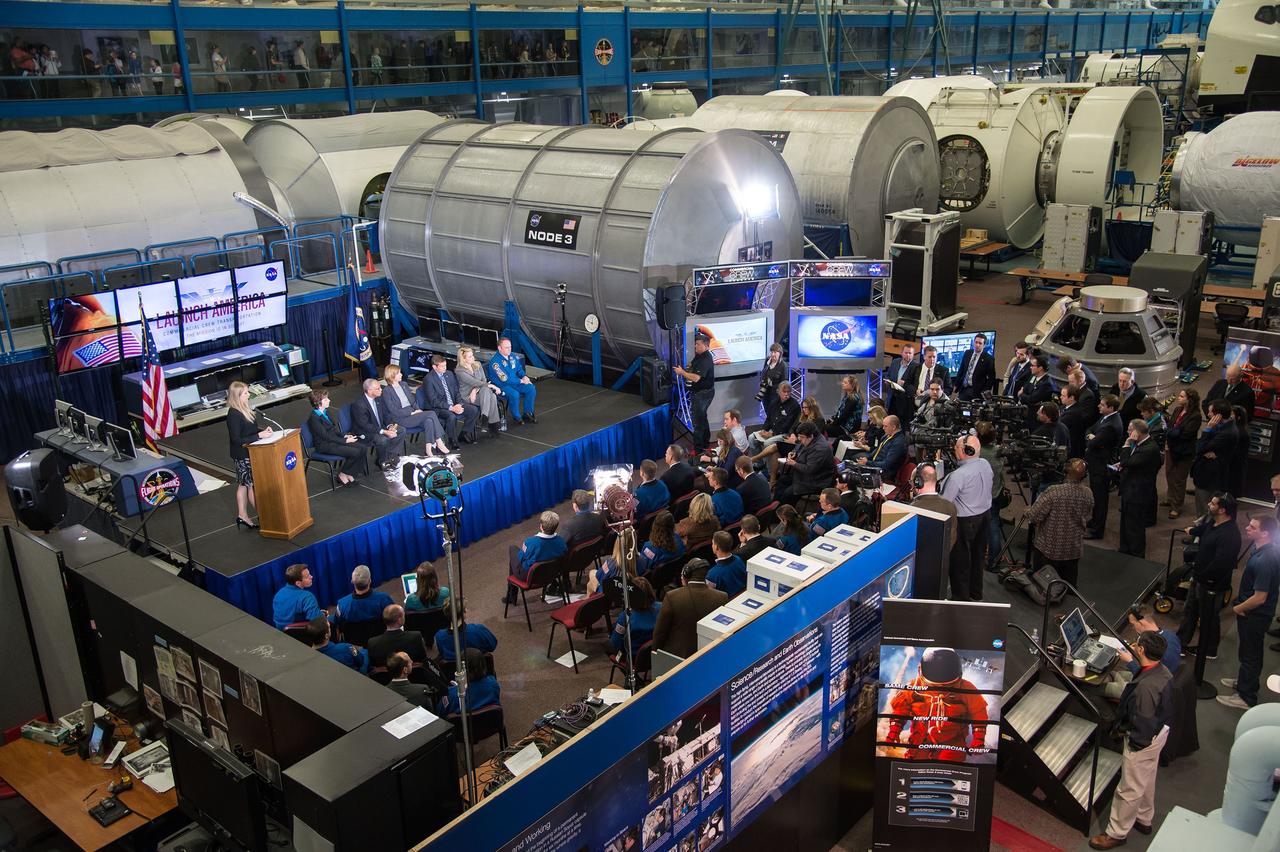
HOUSTON, Texas - jsc2015e031268 - HOUSTON, Texas - NASA's Stephanie Schierholz opens a presentation about the agency's Commercial Crew Program highlighting key development activities, test plans and objectives for achieving certification of two American crew transportation systems with Dr. Ellen Ochoa, director of NASA's Johnson Space Center in Houston, NASA Administrator Charlie Bolden, Commercial Crew Program Manager Kathy Lueders, Boeing Space Exploration Vice President and General Manager John Elbon, SpaceX President and Chief Operating Officer Gwynne Shotwell and NASA Astronaut Mike Fincke. Photo credit: NASA/Robert Markowitz

jsc2023e018436 (April 3, 2023) – NASA’s international astronaut corps greets NASA Chief Astronaut Joe Acaba and NASA Flight Operations Director Norm Knight on stage during the Monday, April 3, 2023, Artemis II crew announcement news conference at Ellington Field near NASA’s Johnson Space Center in Houston. The crew is comprised of Commander Reid Wiseman, Pilot Victor Glover, and Mission Specialists Christina Koch and Jeremy Hansen. The four astronauts will venture around the Moon on Artemis II, the first crewed mission on NASA’s path to establishing a long-term presence at the Moon for science and exploration through Artemis.
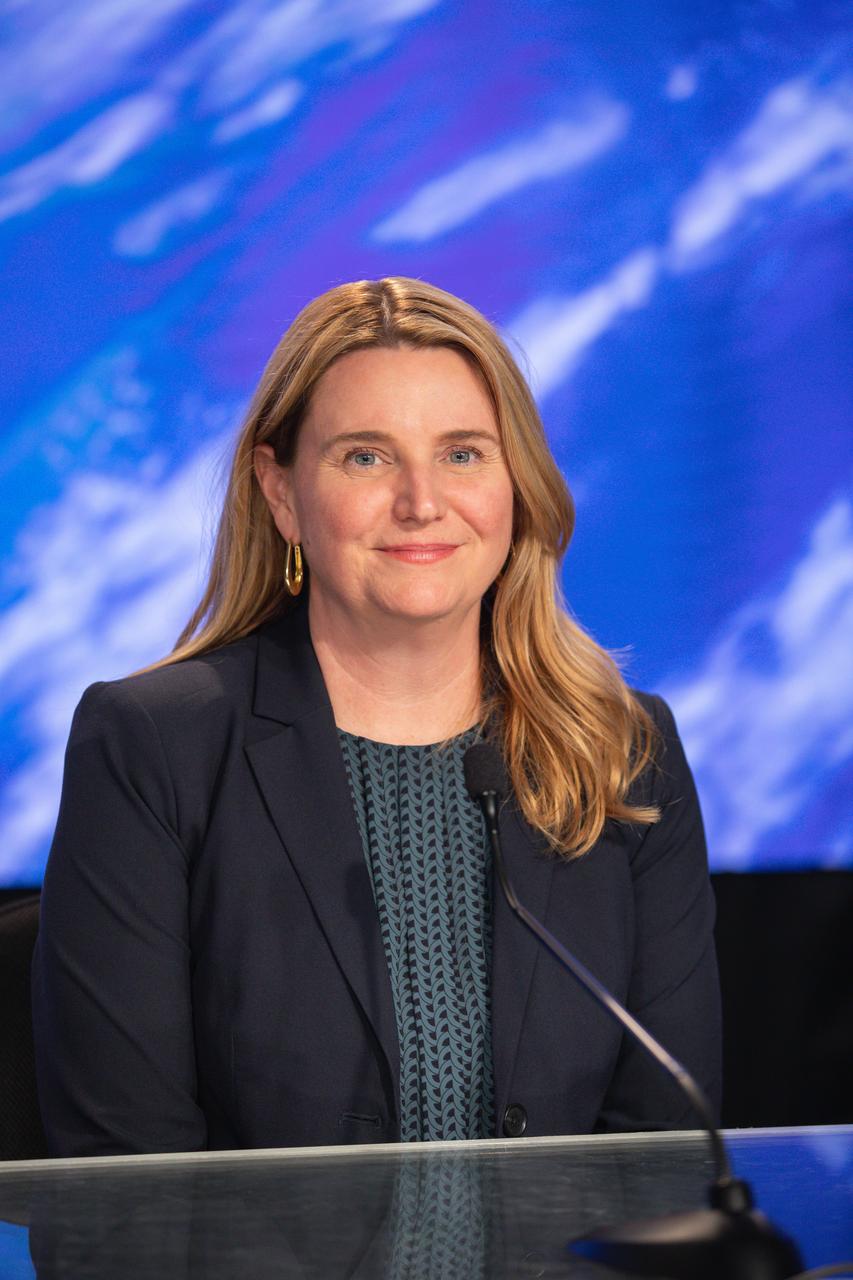
Jennifer Buchli, chief scientist, NASA’s International Space Station Program, participates in an International Space Station 101 Panel Livestream inside the John Holliman Auditorium of the News Center at NASA’s Kennedy Space Center in Florida on Friday, Sept. 27, 2024, ahead of NASA’s SpaceX Crew-9 mission to the International Space Station. Liftoff of the ninth crew rotation mission with SpaceX to the space station as part of the agency’s Commercial Crew Program is targeted for 1:17 p.m. EDT Sept. 28, 2024, from Space Launch Complex-40 at Cape Canaveral Space Force Station in Florida.
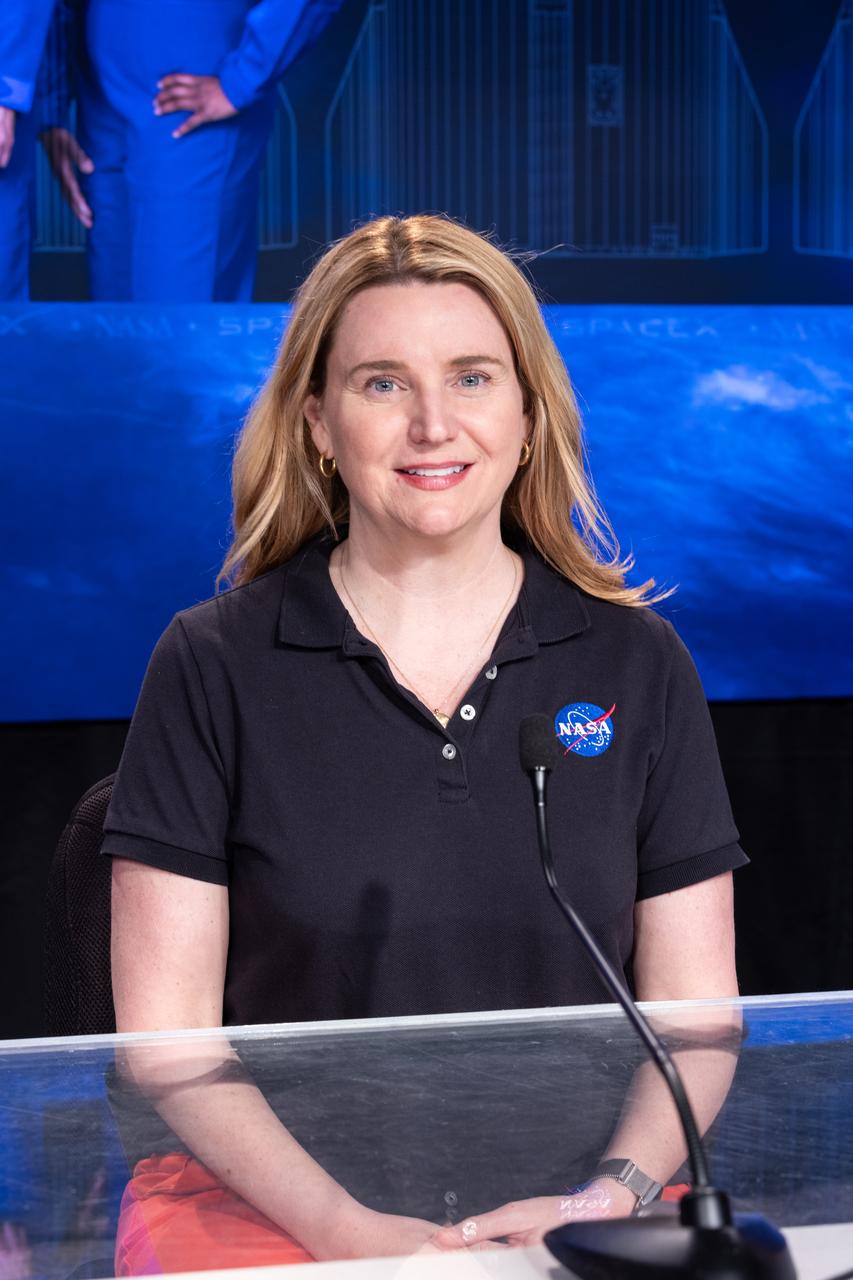
Chief Scientist of NASA’s International Space Station Program Jennifer Buchli participates in a social media panel discussion inside the John Holliman Auditorium of the News Center at NASA’s Kennedy Space Center in Florida on Wednesday, Feb. 28, 2024, ahead of NASA’s SpaceX Crew-8 mission to the International Space Station. Liftoff of the eighth crew rotation mission with SpaceX to the station and the ninth flight of Dragon with people as part of the agency’s Commercial Crew Program from Kennedy’s Launch Complex 39A is targeted for 12:04 a.m. on Friday, March 1.
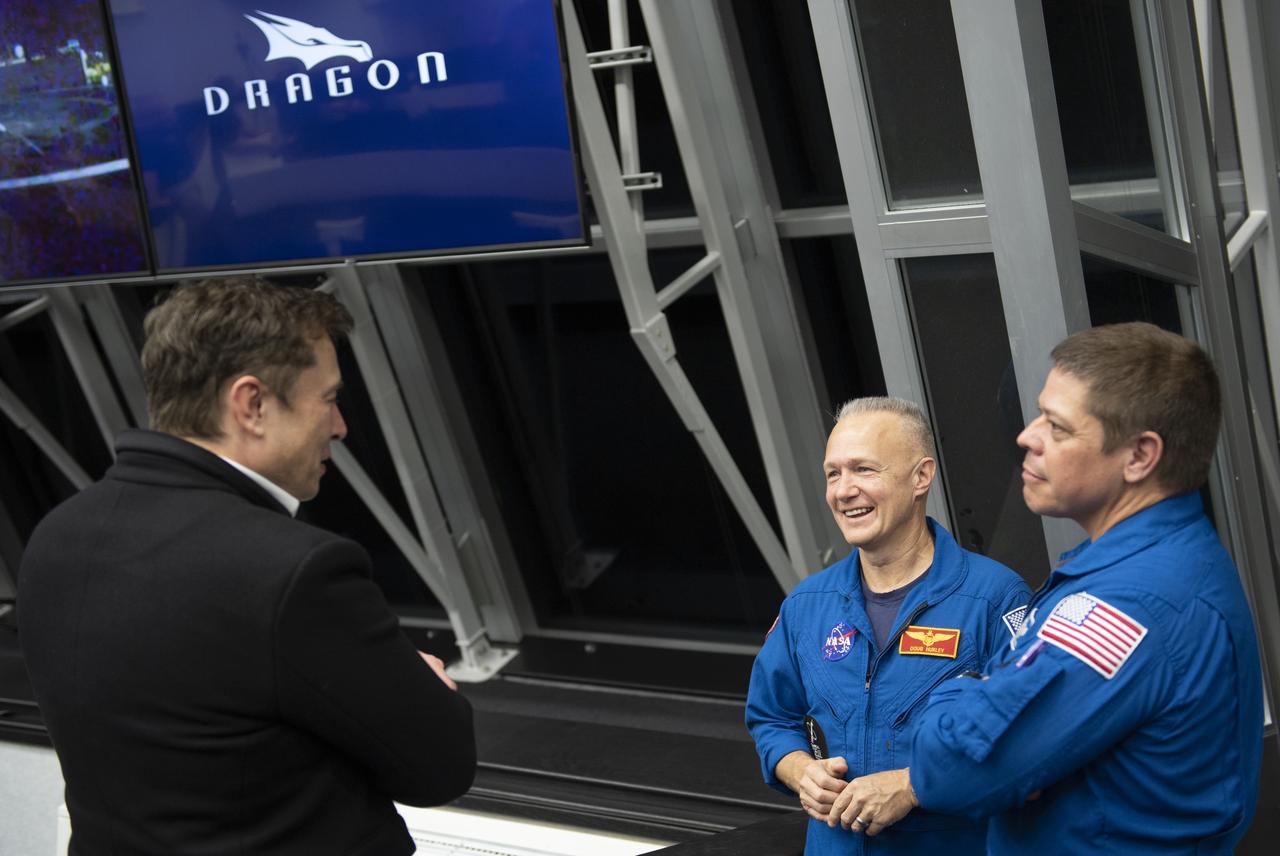
SpaceX CEO and Chief Designer Elon Musk, left, speaks with NASA astronauts Doug Hurley, center, and Bob Behnken, right, who are assigned to fly on the crewed Demo-2 mission after launch of a SpaceX Falcon 9 rocket carrying the company's Crew Dragon spacecraft on the Demo-1 mission from firing room four of the Launch Control Center, Saturday, March 2, 2019 at the Kennedy Space Center in Florida. The Demo-1 mission is the first launch of a commercially built and operated American spacecraft and space system designed for humans as part of NASA's Commercial Crew Program. The mission will serve as an end-to-end test of the system's capabilities. Photo Credit: (NASA/Joel Kowsky)
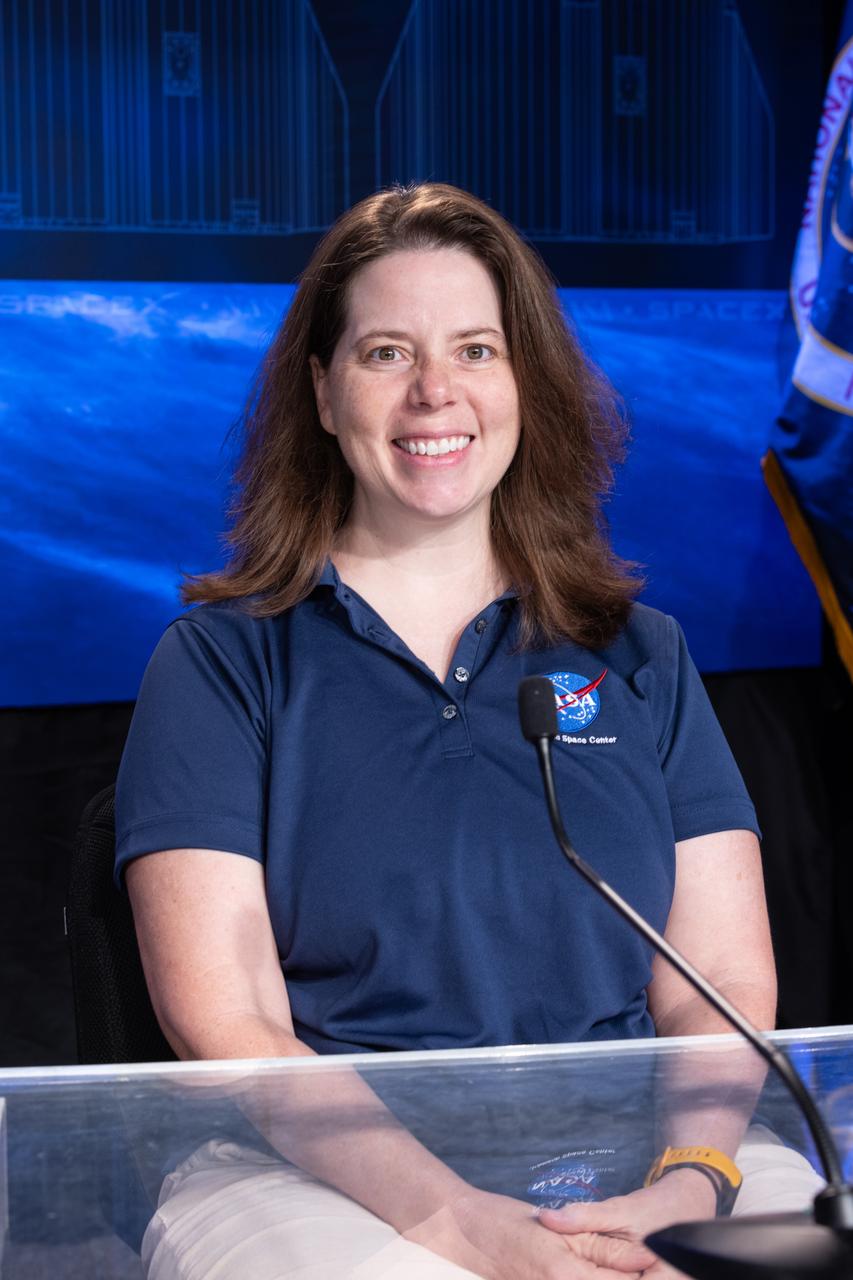
Deputy Chief Scientist of NASA’s Human Research Program Kristin Fabre participates in a social media panel discussion inside the John Holliman Auditorium of the News Center at NASA’s Kennedy Space Center in Florida on Wednesday, Feb. 28, 2024, ahead of NASA’s SpaceX Crew-8 mission to the International Space Station. Liftoff of the eighth crew rotation mission with SpaceX to the station and the ninth flight of Dragon with people as part of the agency’s Commercial Crew Program from Kennedy’s Launch Complex 39A is targeted for 12:04 a.m. on Friday, March 1.