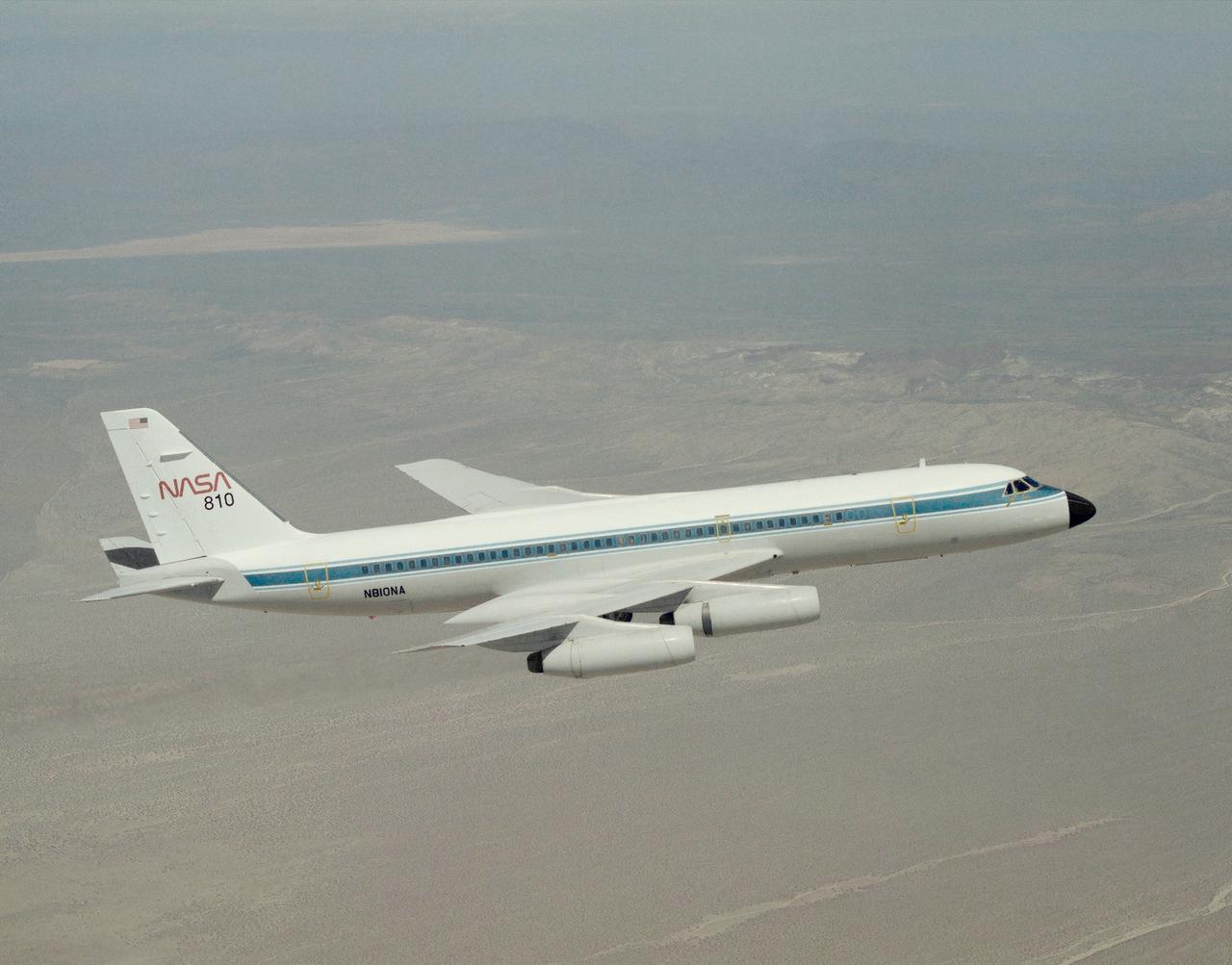
A NASA CV-990, modified as a Landing Systems Research Aircraft (LSRA), in flight over NASA's Dryden Flight Research Center, Edwards, California, for a test of the space shuttle landing gear system. The space shuttle landing gear test unit, operated by a high-pressure hydraulic system, allowed engineers to assess and document the performance of space shuttle main and nose landing gear systems, tires and wheel assemblies, plus braking and nose wheel steering performance. The series of 155 test missions for the space shuttle program provided extensive data about the life and endurance of the shuttle tire systems and helped raise the shuttle crosswind landing limits at Kennedy.
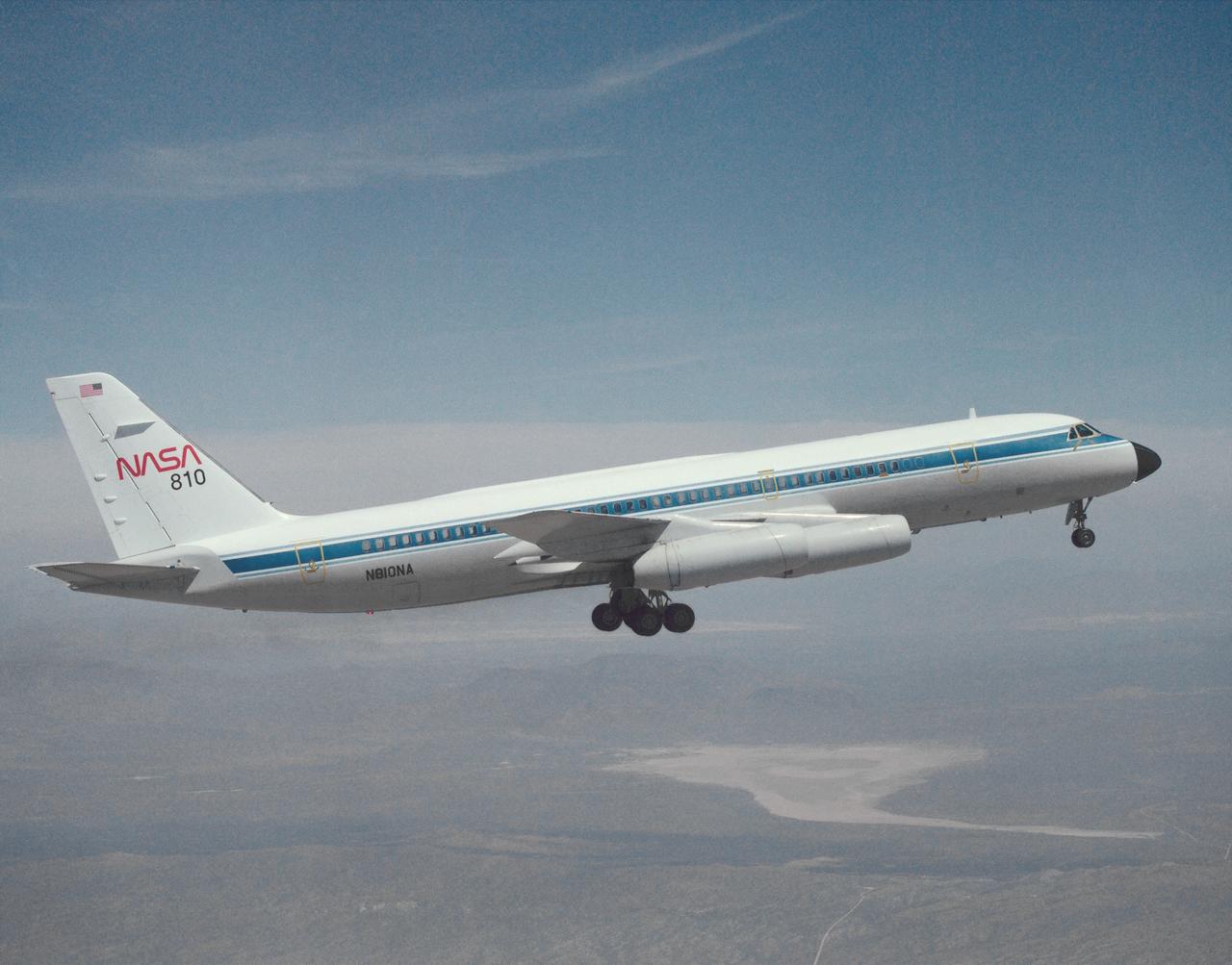
A NASA CV-990, modified as a Landing Systems Research Aircraft (LSRA), in flight over NASA's Dryden Flight Research Center, Edwards, California, for a test of the space shuttle landing gear system. The space shuttle landing gear test unit, operated by a high-pressure hydraulic system, allowed engineers to assess and document the performance of space shuttle main and nose landing gear systems, tires and wheel assemblies, plus braking and nose wheel steering performance. The series of 155 test missions for the space shuttle program provided extensive data about the life and endurance of the shuttle tire systems and helped raise the shuttle crosswind landing limits at Kennedy.
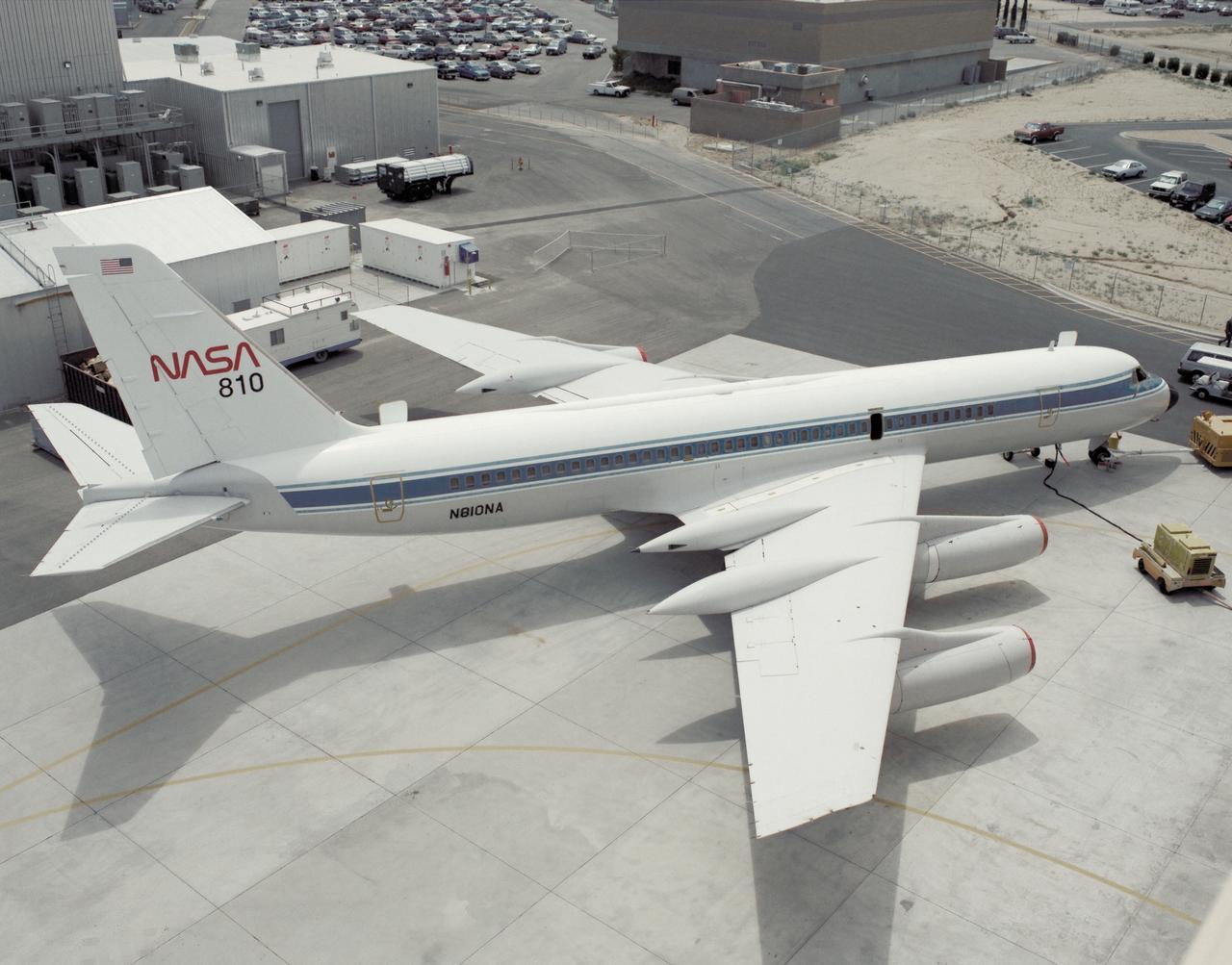
A NASA CV-990, modified as a Landing Systems Research Aircraft (LSRA), is serviced on the ramp at NASA's Dryden Flight Research Center, Edwards, California, before a test of the space shuttle landing gear system. The space shuttle landing gear test unit, operated by a high-pressure hydraulic system, allowed engineers to assess and document the performance of space shuttle main and nose landing gear systems, tires and wheel assemblies, plus braking and nose wheel steering performance. The series of 155 test missions for the space shuttle program provided extensive data about the life and endurance of the shuttle tire systems and helped raise the shuttle crosswind landing limits at Kennedy.

KENNEDY SPACE CENTER, FLA. -- With dust flying in the strong crosswinds at KSC’s Shuttle Landing Facility, a Shuttle Carrier Aircraft, carrying the orbiter Columbia on its back, lands on runway 33. Columbia arrives Facility after a protracted trip from California that began March 1. Unfavorable weather conditions kept it on the ground at Dyess AFB, Texas, until it could return to Florida on March 5 when it landed at the Cape Canaveral Air Force Station Skid Strip. Columbia had to wait for the orbiter Atlantis which had completed a ferry flight to KSC on March 5 to be towed from the SLF before making the final hop to KSC. Columbia is returning from a 17-month-long modification and refurbishment process as part of a routine maintenance plan. The orbiter will next fly on mission STS-107, scheduled Oct. 25
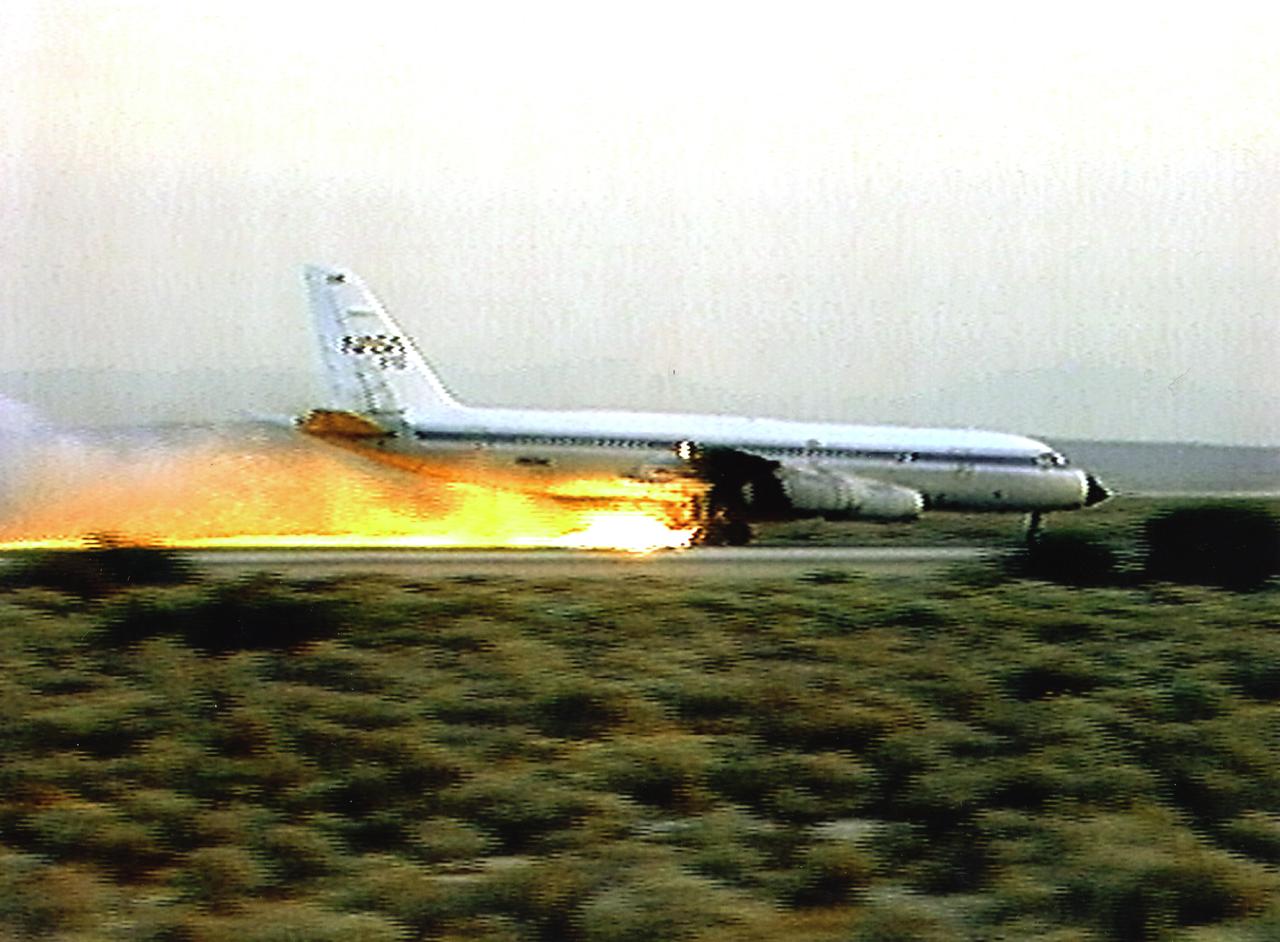
A NASA CV-990, modified as a Landing Systems Research Aircraft (LSRA), lands on the Edwards AFB main runway in test of the space shuttle landing gear system. In this case, the shuttle tire failed, bursting into flame during the rollout. The space shuttle landing gear test unit, operated by a high-pressure hydraulic system, allowed engineers to assess and document the performance of space shuttle main and nose landing gear systems, tires and wheel assemblies, plus braking and nose wheel steering performance. The series of 155 test missions for the space shuttle program provided extensive data about the life and endurance of the shuttle tire systems and helped raise the shuttle crosswind landing limits at Kennedy. The CV-990 used as the LSRA was built in 1962 by the Convair Division of General Dynamics Corp., Ft. Worth, Texas, served as a research aircraft at Ames Research Center, Moffett Field, California, before it came to Dryden.

KENNEDY SPACE CENTER, FLA. -- With dust flying in the strong crosswinds at KSC’s Shuttle Landing Facility, a Shuttle Carrier Aircraft, carrying the orbiter Columbia on its back, lands on runway 33. Columbia arrives Facility after a protracted trip from California that began March 1. Unfavorable weather conditions kept it on the ground at Dyess AFB, Texas, until it could return to Florida on March 5 when it landed at the Cape Canaveral Air Force Station Skid Strip. Columbia had to wait for the orbiter Atlantis which had completed a ferry flight to KSC on March 5 to be towed from the SLF before making the final hop to KSC. Columbia is returning from a 17-month-long modification and refurbishment process as part of a routine maintenance plan. The orbiter will next fly on mission STS-107, scheduled Oct. 25
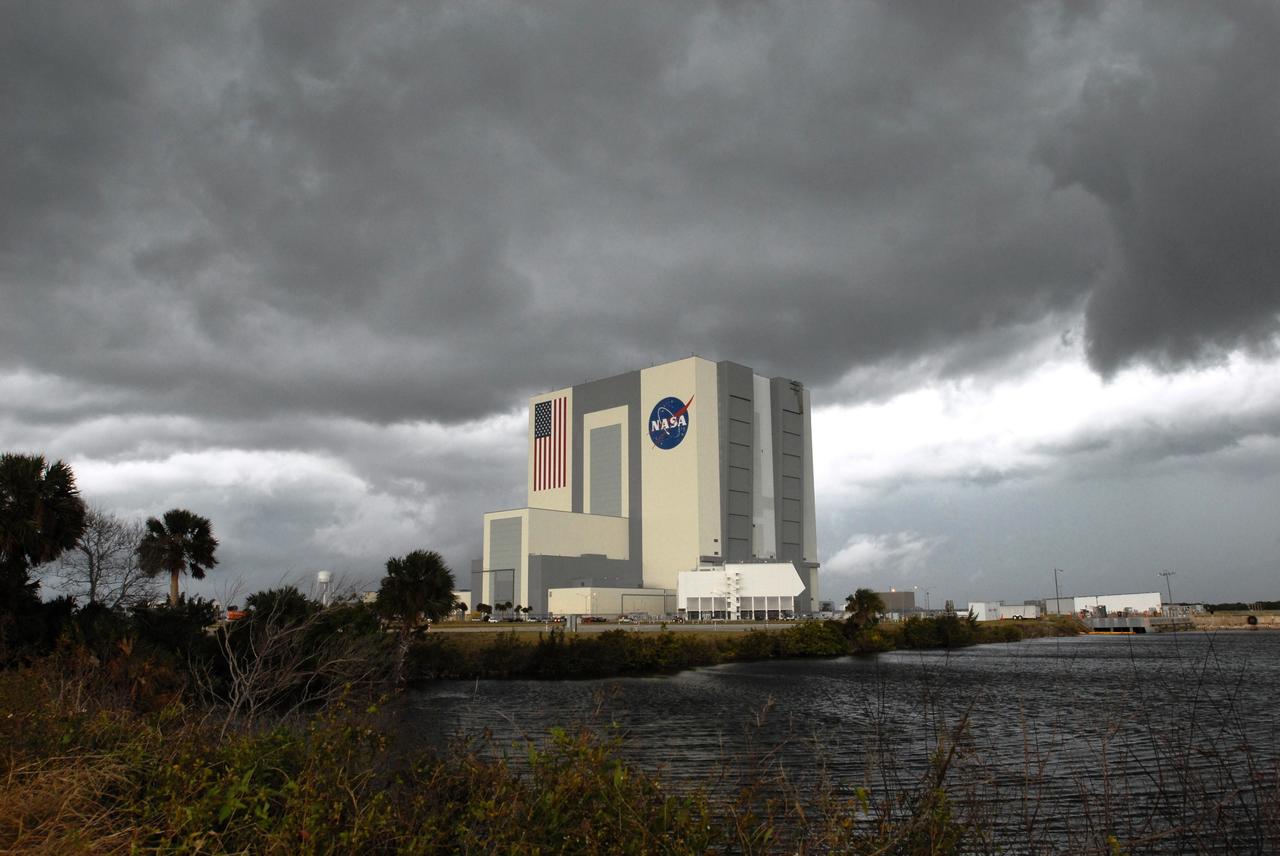
CAPE CANAVERAL, Fla. –- Dark gray clouds hover over the Vehicle Assembly Building at NASA's Kennedy Space Center in Florida, part of a strong weather system that included crosswinds and anvil clouds blowing across the state. The weather concerns prevented space shuttle Endeavour and its crew from returning to Kennedy, the primary end-of-mission landing site. Instead, Endeavour landed safely at 4:25 p.m. at Edwards Air Force Base in California after traveling more than 6.6 million miles in space. The main landing gear touched down at Edwards at 4:25:06 p.m. EST. The nose landing gear touched down at 4:25:21 p.m. and wheel stop was at 4:26:03 p.m. The STS-126 mission was the 27th flight to the International Space Station, carrying equipment and supplies in the Multi-Purpose Logistics Module Leonardo. The mission featured four spacewalks and work to prepare the space station to house six crew members for long-duration missions. Photo credit: NASA/Jim Grossmann
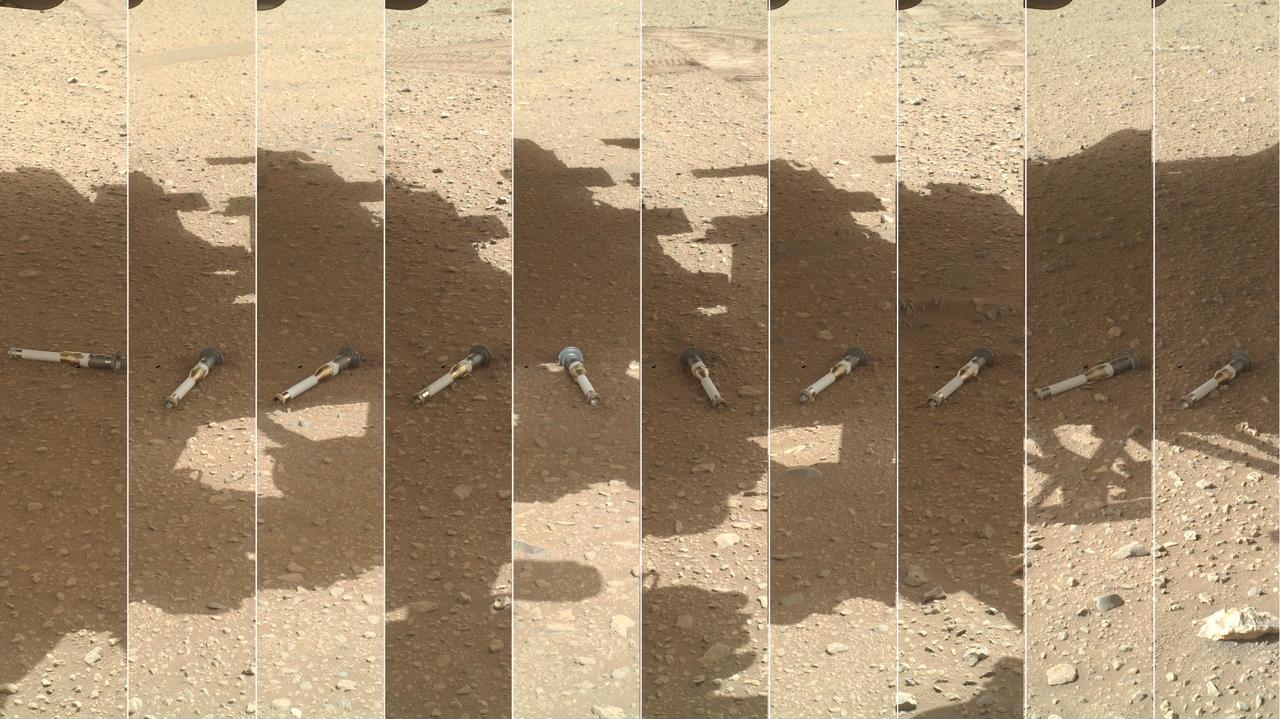
This photomontage shows each of the sample tubes shortly after they were deposited onto the surface by NASA's Perseverance Mars rover, as viewed by the WATSON (Wide Angle Topographic Sensor for Operations and eNgineering) camera on the end of the rover's 7-foot-long (2-meter-long) robotic arm. Shown, from left, are "Malay," "Mageik," "Crosswind Lake," "Roubion," "Coulettes," "Montdenier," "Bearwallow," "Skyland," "Atsah," and "Amalik." Deposited from Dec. 21, 2022, to Jan. 28, 2023, these samples make up the sample depot Perseverance built at "Three Forks," a location within Mars' Jezero Crater. Perseverance's sample depot is a collection of 10 sample tubes left on the Martian surface in a zig-zag pattern. These tubes represent a backup collection of rock cores and regolith (broken rock and dust) that could be recovered in the future by the NASA-ESA (European Space Agency) Mars Sample Return campaign, which aims to bring Mars samples to Earth for closer study. Perseverance will be collecting more samples on its journey that will be considered the primary samples for return, but the mission team wants to make sure backups are available in case anything happens to the rover. A key objective for Perseverance's mission on Mars is astrobiology, including the search for signs of ancient microbial life. The rover will characterize the planet's geology and past climate, pave the way for human exploration of the Red Planet, and be the first mission to collect and cache Martian rock and regolith (broken rock and dust). Subsequent NASA missions, in cooperation with ESA (European Space Agency), would send spacecraft to Mars to collect these sealed samples from the surface and return them to Earth for in-depth analysis. The Mars 2020 Perseverance mission is part of NASA's Moon to Mars exploration approach, which includes Artemis missions to the Moon that will help prepare for human exploration of the Red Planet. https://photojournal.jpl.nasa.gov/catalog/PIA25738

The single fire that ignited and split into nine separate fires still blazes in Southern California today. Firefighters are hoping for a break today (Thursday, May 15, 2014) but it doesn't look like luck may be on their side. Conditions continue to be bone dry with unseasonal heat (98-106 degrees) and the Santa Ana winds are kicking up and allowing these fires to easy jump fire lines. This particular fire started on Wednesday as a single fire and within a day is now nine separate fires which have burned close to 10,000 acres. These fires are threatening more than just landscape in San Diego county, they are also threatening homes, universities, a military base and a nuclear power plant. Day Two of the fires have seen them already destroying dozens of homes and forcing tens of thousands to evacuate. Camp Pendleton has also been partially evacuated due to the blazes as has the popular amusement park, Legoland. The Governor of California has declared a state of emergency. Thousands of firefighters are battling the flames both on the ground and in the air. Seven tankers and 20 military aircraft are also assisting the firefighters with their mission. Temperatures soaring over 100 degrees coupled with 30 mph wind gusts have severely hampered the efforts, however, and fire tornadoes have broken out. Fire tornadoes are caused by crosswinds that create a vortex and produce winds that twist and swirl just like a tornado but with flames that coil upwards in the center of the twister creating a terrifying specter. Although there is no chance of rain in the area for the next several days, the temperatures will start to subside on Friday and into the weekend. Winds are also expected to start to subside, giving firefighters that break that they so desperately need. This natural-color satellite image was collected by the Moderate Resolution Imaging Spectroradiometer (MODIS) aboard the Aqua satellite on May 14, 2014. Actively burning areas, detected by MODIS’s thermal bands, are outlined in red. Credit: NASA/GSFC/Jeff Schmaltz/MODIS Land Rapid Response Team <b><a href="http://www.nasa.gov/audience/formedia/features/MP_Photo_Guidelines.html" rel="nofollow">NASA image use policy.</a></b> <b><a href="http://www.nasa.gov/centers/goddard/home/index.html" rel="nofollow">NASA Goddard Space Flight Center</a></b> enables NASA’s mission through four scientific endeavors: Earth Science, Heliophysics, Solar System Exploration, and Astrophysics. Goddard plays a leading role in NASA’s accomplishments by contributing compelling scientific knowledge to advance the Agency’s mission. <b>Follow us on <a href="http://twitter.com/NASAGoddardPix" rel="nofollow">Twitter</a></b> <b>Like us on <a href="http://www.facebook.com/pages/Greenbelt-MD/NASA-Goddard/395013845897?ref=tsd" rel="nofollow">Facebook</a></b> <b>Find us on <a href="http://instagram.com/nasagoddard?vm=grid" rel="nofollow">Instagram</a></b>
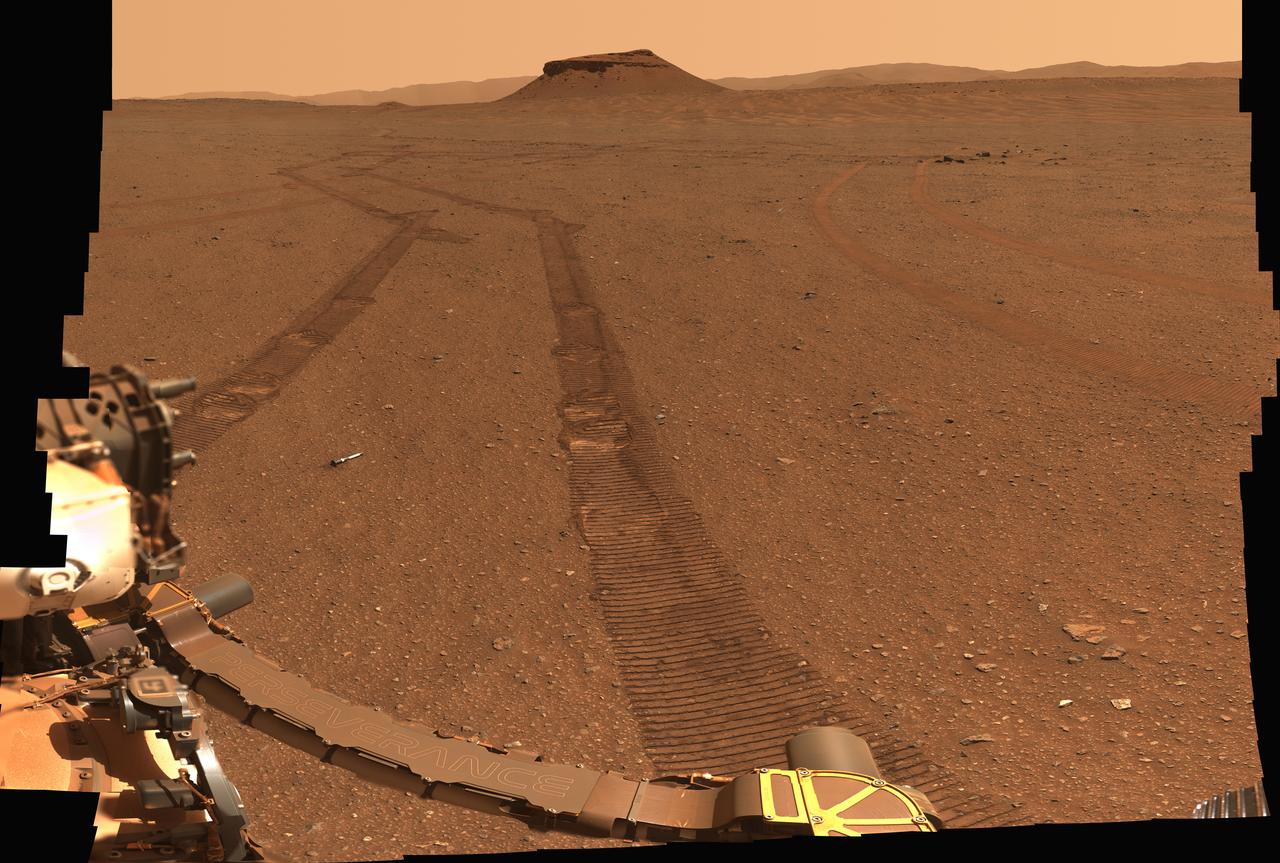
NASA's Perseverance Mars rover captured this portrait of its recently completed sample depot using its Mastcam-Z camera on Jan. 31, 2023, the 693rd Martian day, or sol, of the mission. This panorama is made up of 368 individual images that were stitched together after being sent back to Earth. The color in the scene has been adjusted to show the Martian surface as it would look to the human eye. Each sample tube is approximately 7 inches (18 centimeters) long and .8 inches (2 centimeters) in diameter. The "Amalik" sample closest to the rover was approximately 10 feet (3 meters) away from the camera at the time the image was taken. The "Atsah" and "Skyland" samples were approximately 66 feet (20 meters) away. "Bearwallow," "Coulettes," "Montdenier," "Crosswind Lake," and "Roubion" were approximately 115 to 164 feet (35 to 50 meters) away. "Mageik" and "Malay" were approximately 197 feet (60 meters) away. This is a natural-color view of the scene, showing the surface as it would appear to a human observer. Throughout its science campaigns, the rover has been taking a pair of samples from rocks the mission team deems scientifically significant. One sample from each pair taken so far now sits in the depot – along with one atmospheric sample and one "witness" tube – for a total of 10 tubes that were carefully arranged on the surface in a zigzag pattern. The depot is a crucial milestone in the NASA-ESA (European Space Agency) Mars Sample Return campaign, which aims to bring Mars samples to Earth for closer study. The Perseverance rover will be the primary means to hand off the collected samples to a future robotic lander as part of the campaign. The lander would, in turn, use a robotic arm to place the samples in a containment capsule aboard a small rocket that would blast off to Mars orbit, where another spacecraft would capture the sample container and return it safely to Earth. Hosting a duplicate set, the depot will serve as a backup if Perseverance can't deliver its samples. Perseverance built the depot at "Three Forks," a location within Mars' Jezero Crater. Billions of years ago, this crater was filled by a lake and delta. Sediment that built up in the delta formed a steep mound that Perseverance will be driving up in the months ahead to arrive at the top of the delta. Arizona State University leads the operations of the Mastcam-Z instrument, working in collaboration with Malin Space Science Systems in San Diego, on the design, fabrication, testing, and operation of the cameras, and in collaboration with the Neils Bohr Institute of the University of Copenhagen on the design, fabrication, and testing of the calibration targets. A key objective for Perseverance's mission on Mars is astrobiology, including the search for signs of ancient microbial life. The rover will characterize the planet's geology and past climate, pave the way for human exploration of the Red Planet, and be the first mission to collect and cache Martian rock and regolith (broken rock and dust). Subsequent NASA missions, in cooperation with ESA (European Space Agency), would send spacecraft to Mars to collect these sealed samples from the surface and return them to Earth for in-depth analysis. The Mars 2020 Perseverance mission is part of NASA's Moon to Mars exploration approach, which includes Artemis missions to the Moon that will help prepare for human exploration of the Red Planet. https://photojournal.jpl.nasa.gov/catalog/PIA25736