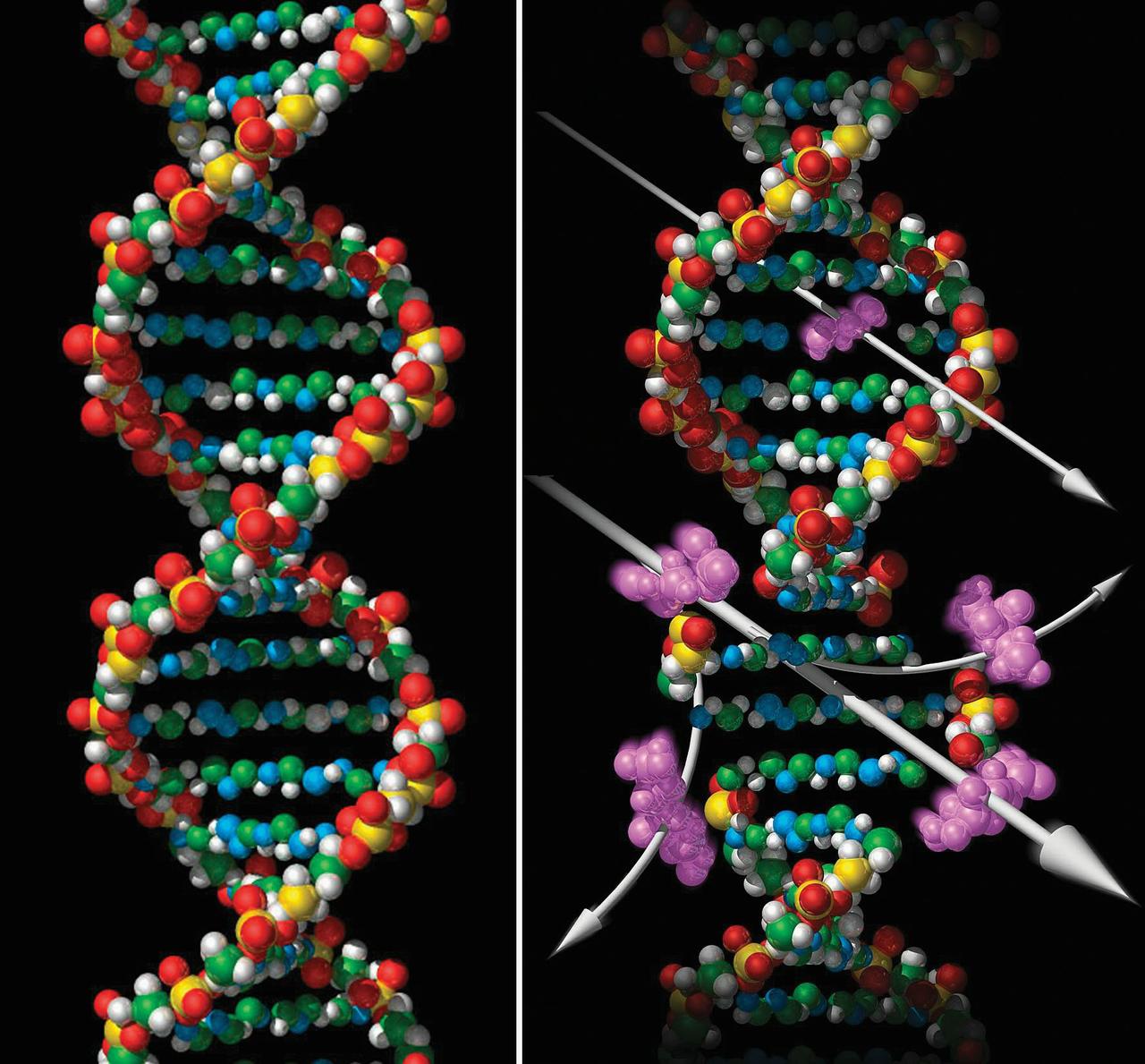
The blueprint of life, DNA's double helix is found in the cells of everything from bacteria to astronauts. Exposure to radiation(depicted at right) such as X-rays (upper) or heavy ion particles (lower), can damage DNA and cause dire consequences both to the organism itself and to future generations. One of NASA's main goals is to develop better radiation shielding materials to protect astronauts from destructive radiation in space. This is particularly important for long space missions. NASA has selected researchers to study materials that provide better shielding. This research is managed by NASA's Office of Biological and Physical Research and is supported by the Microgravity Science and Applications Department at NASA's Marshall Center. During International Space Station Expedition Six, the Extravehicular Activity Radiation Monitoring (EVARM) will continue to measure radiation dosage encountered by the eyes, internal organs and skin during specific spacewalks, and relate it to the type of activity, location and other factors. An analysis of this information may be useful in mitigating potential exposure to space walkers in the future. (Illustration by Dr. Frank Cucinotta, NASA/Johnson Space Center, and Prem Saganti, Lockheed Martin)
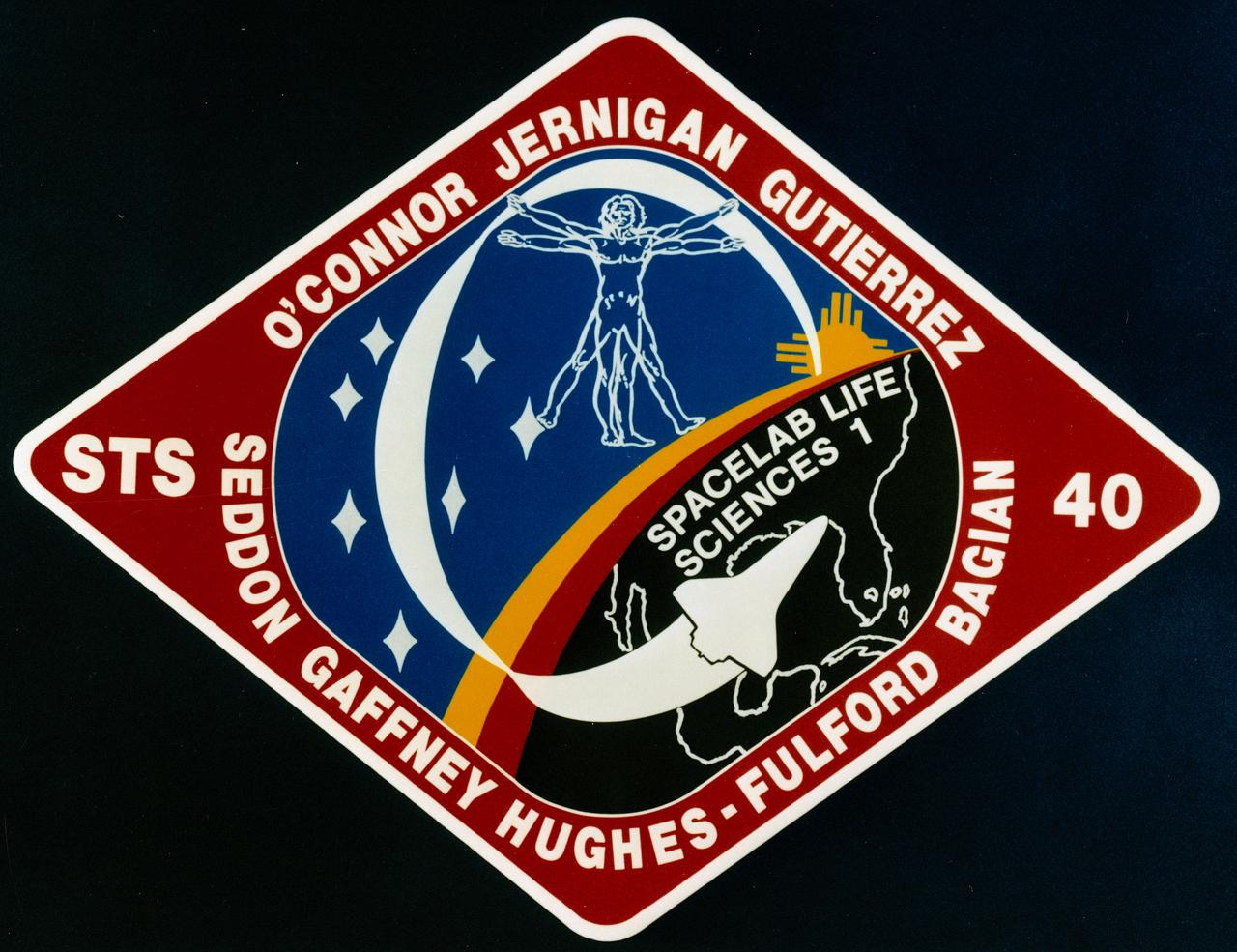
The STS-40 patch makes a contemporary statement focusing on human beings living and working in space. Against a background of the universe, seven silver stars, interspersed about the orbital path of Columbia, represent the seven crew members. The orbiter's flight path forms a double-helix, designed to represent the DNA molecule common to all living creatures. In the words of a crew spokesman, ...(the helix) affirms the ceaseless expansion of human life and American involvement in space while simultaneously emphasizing the medical and biological studies to which this flight is dedicated. Above Columbia, the phrase Spacelab Life Sciences 1 defines both the Shuttle mission and its payload. Leonardo Da Vinci's Vitruvian man, silhouetted against the blue darkness of the heavens, is in the upper center portion of the patch. With one foot on Earth and arms extended to touch Shuttle's orbit, the crew feels, he serves as a powerful embodiment of the extension of human inquiry from the boundaries of Earth to the limitless laboratory of space. Sturdily poised amid the stars, he serves to link scentists on Earth to the scientists in space asserting the harmony of efforts which produce meaningful scientific spaceflight missions. A brilliant red and yellow Earth limb (center) links Earth to space as it radiates from a native American symbol for the sun. At the frontier of space, the traditional symbol for the sun vividly links America's past to America's future, the crew states. Beneath the orbiting Shuttle, darkness of night rests peacefully over the United States. Drawn by artist Sean Collins, the STS 40 Space Shuttle patch was designed by the crewmembers for the flight.
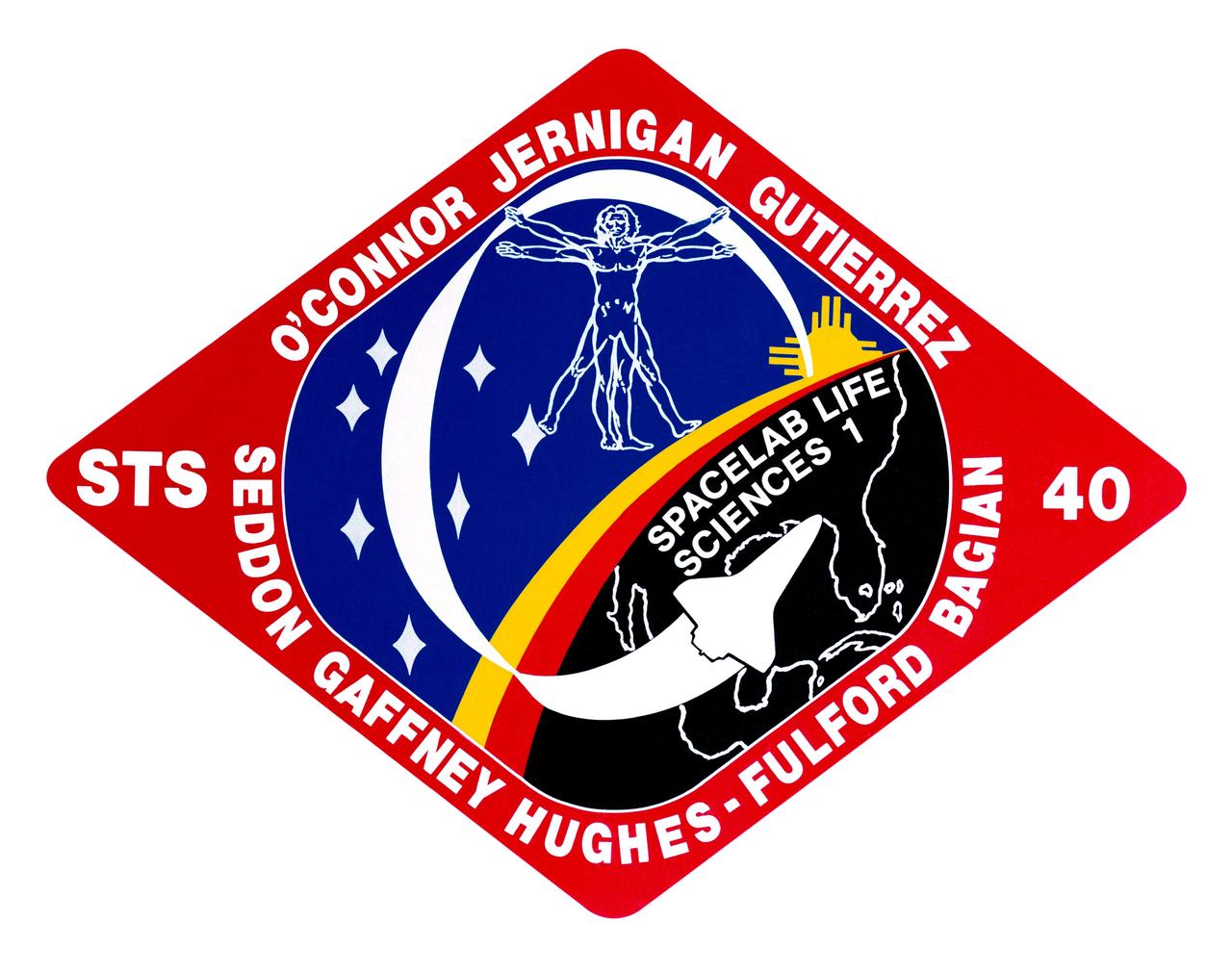
STS40-S-001 (May 1990) --- The STS-40 patch makes a contemporary statement focusing on human beings living and working in space. Against a background of the universe, seven silver stars, interspersed about the Orbital path of the space shuttle Columbia, represent the seven crew members. The orbiter's flight path forms a double-helix, designed to represent the DNA molecule common to all living creatures. In the words of a crew spokesman, "...(the helix) affirms the ceaseless expansion of human life and American involvement in space while simultaneously emphasizing the medical and biological studies to which this flight is dedicated." Above Columbia, the phrase "Spacelab Life Sciences 1" defines both the shuttle mission and its payload. Leonardo Da Vinci's Vitruvian man, silhouetted against the blue darkness of the heavens, is in the upper center portion of the patch. With one foot on Earth and arms extended to touch shuttle's orbit, the crew feels, he serves as a powerful embodiment of the extension of human inquiry from the boundaries of Earth to the limitless laboratory of space. Sturdily poised amid the stars, he serves to link scentists on Earth to the scientists in space asserting the harmony of efforts which produce meaningful scientific spaceflight missions. A brilliant red and yellow Earth limb (center) links Earth to space as it radiates from a native American symbol for the sun. At the frontier of space, the traditional symbol for the sun vividly links America's past to America's future, the crew states. Beneath the orbiting space shuttle, darkness of night rests peacefully over the United States. Drawn by artist Sean Collins, the STS-40 space shuttle patch was designed by the crew members for the flight. The NASA insignia design for space shuttle flights is reserved for use by the astronauts and for other official use as the NASA Administrator may authorize. Public availability has been approved only in the forms of illustrations by the various news media. When and if there is any change in this policy, which is not anticipated, the change will be publicly announced. Photo credit: NASA
Designed by members of the flight crew, the STS-58 insignia depicts the Space Shuttle Columbia with a Spacelab module in its payload bay in orbit around Earth. The Spacelab and the lettering Spacelab Life Sciences ll highlight the primary mission of the second Space Shuttle flight dedicated to life sciences research. An Extended Duration Orbiter (EDO) support pallet is shown in the aft payload bay, stressing the scheduled two-week duration of the longest Space Shuttle mission to date. The hexagonal shape of the patch depicts the carbon ring, a molecule common to all living organisms. Encircling the inner border of the patch is the double helix of DNA, representing the genetic basis of life. Its yellow background represents the sun, energy source for all life on Earth. Both medical and veterinary caducei are shown to represent the STS- 58 life sciences experiments. The position of the spacecraft in orbit about Earth with the United States in the background symbolizes the ongoing support of the American people for scientific research intended to benefit all mankind.
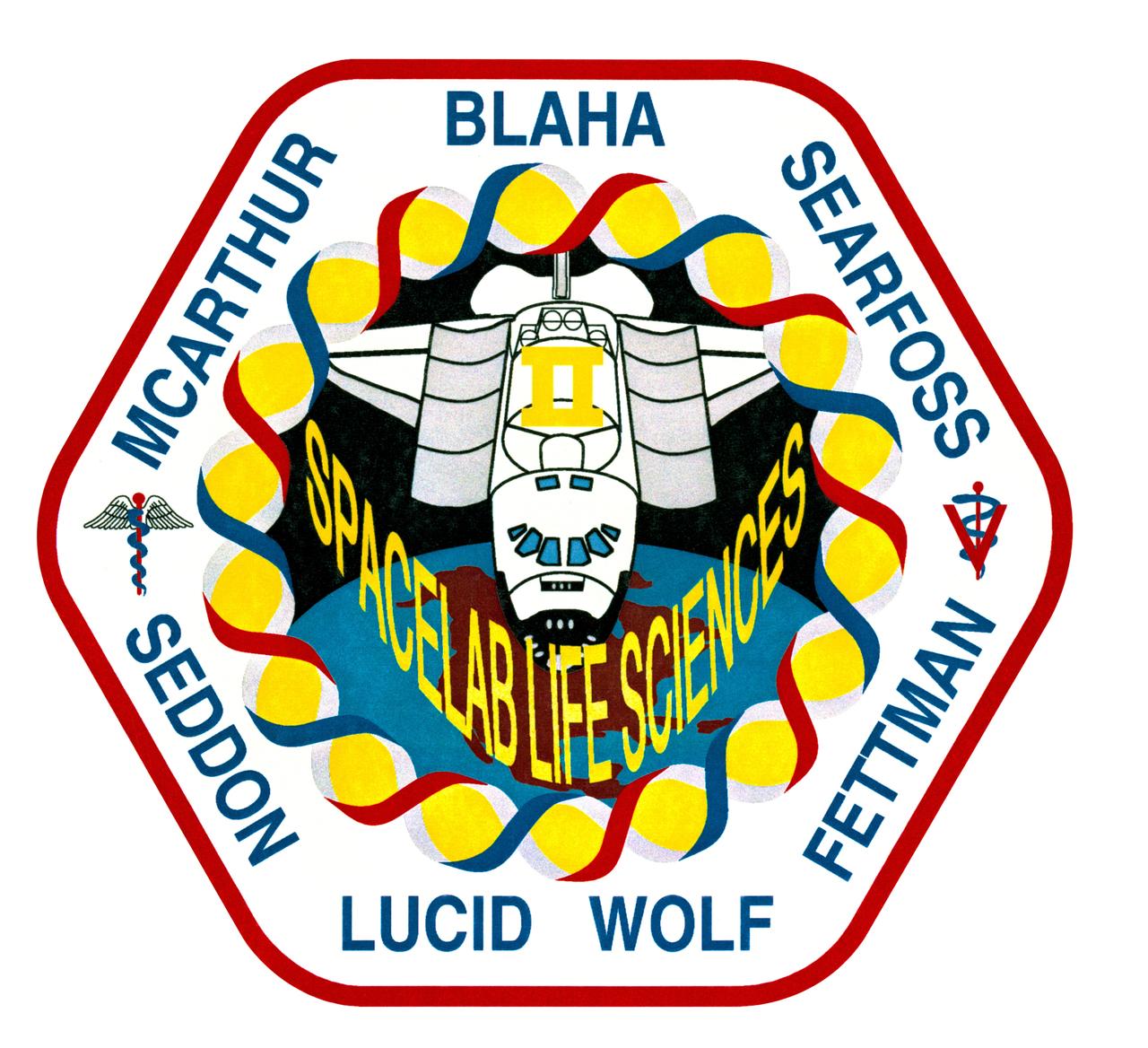
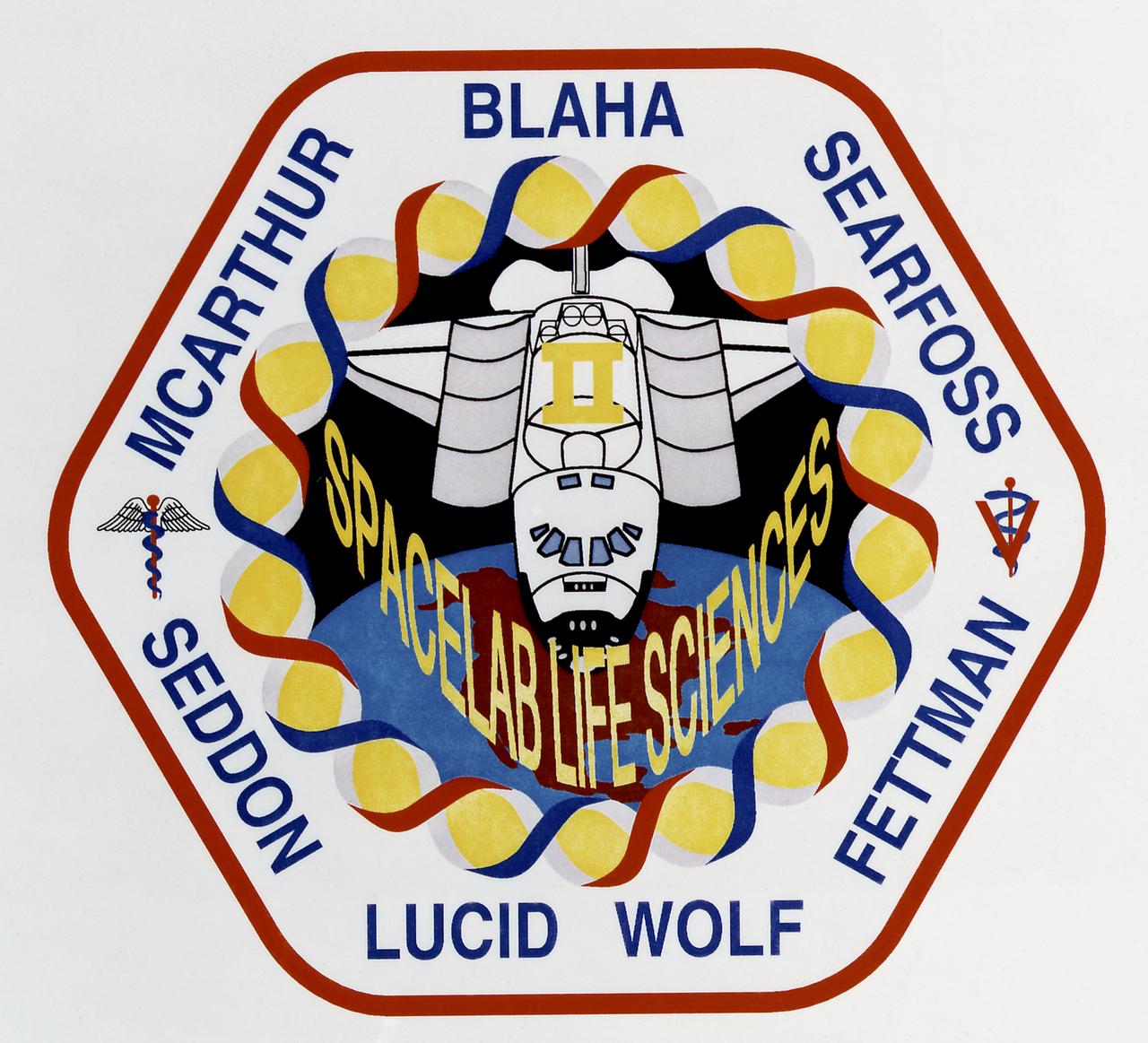
STS058-S-001 (May 1993) --- Designed by members of the flight crew, the STS-58 insignia depicts the space shuttle Columbia with a Spacelab module in its payload bay in orbit around Earth. The Spacelab and the lettering "Spacelab Life Sciences II" highlight the primary mission of the second space shuttle flight dedicated to life sciences research. An Extended Duration Orbiter (EDO) support pallet is shown in the aft payload bay, stressing the scheduled two-week duration of the longest space shuttle mission to date. The hexagonal shape of the patch depicts the carbon ring, a molecule common to all living organisms. Encircling the inner border of the patch is the double helix of DNA, representing the genetic basis of life. Its yellow background represents the sun, energy source for all life on Earth. Both medical and veterinary caducei are shown to represent the STS-58 life sciences experiments. The position of the spacecraft in orbit about Earth with the United States in the background symbolizes the ongoing support of the American people for scientific research intended to benefit all mankind. The NASA insignia design for space shuttle flights is reserved for use by the astronauts and for other official use as the NASA Administrator may authorize. Public availability has been approved only in the form of illustrations by the various news media. When and if there is any change in this policy, which we do not anticipate, it will be publicly announced. Photo credit: NASA