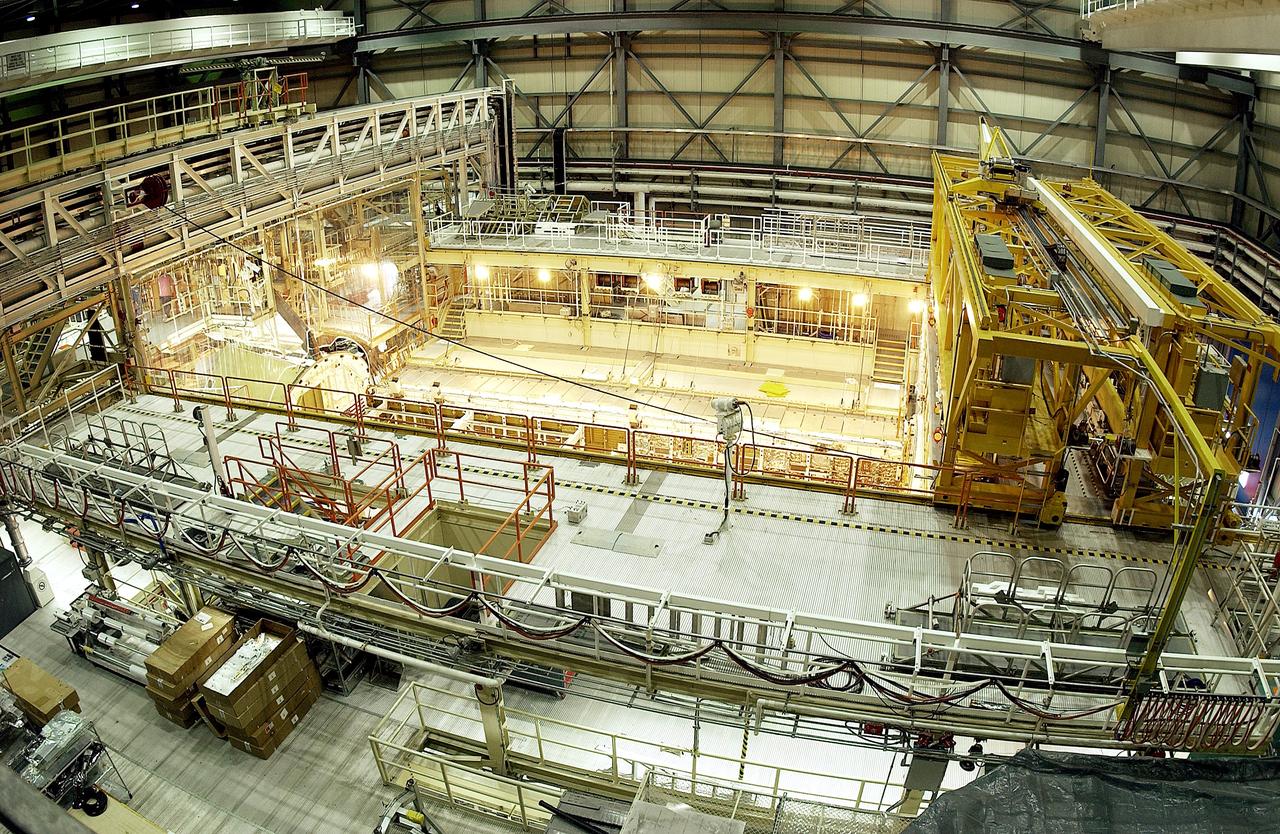
KENNEDY SPACE CENTER, FLA. - This bird's-eye view of a high bay in the Orbiter Processing Facility (OPF) shows the open payload bay of Space Shuttle Discovery surrounded by the standard platforms and equipment required to process a Space Shuttle orbiter. The high bay is 197 feet (60 meters) long, 150 feet (46 meters) wide, 95 feet (29 meters) high, and encompasses a 29,000-square-foot (2,694-meter) area. The 30-ton (27-metric-ton) bridge crane (yellow device, right) has a hook height of approximately 66 feet (20 meters). Platforms, a main access bridge, and two rolling bridges with trucks provide access to various parts of the orbiter. In addition to routine servicing and checkout, the inspections and modifications made to enhance Discovery's performance and upgrade its systems were performed in the OPF during its recently completed Orbiter Major Modification (OMM) period.
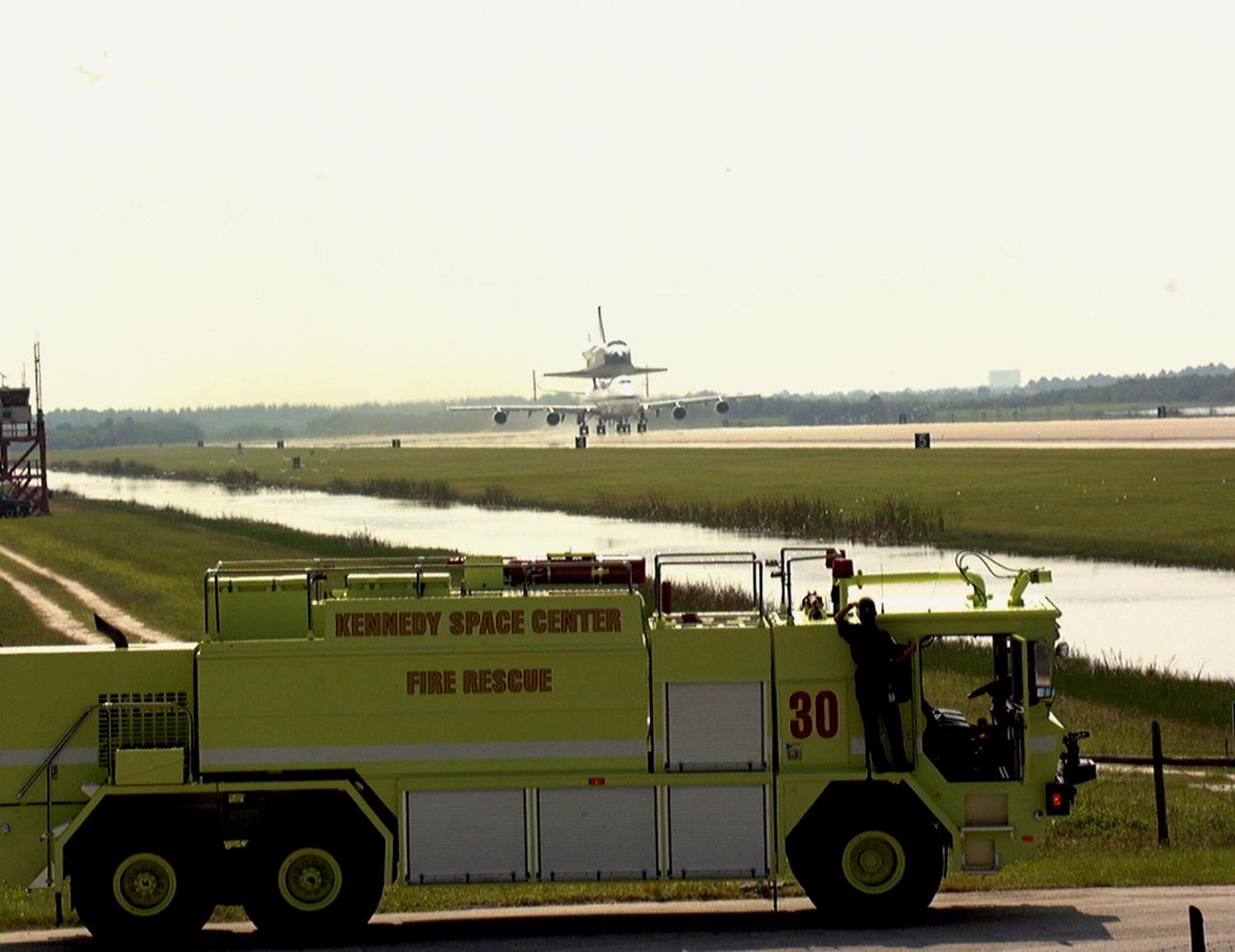
KENNEDY SPACE CENTER, FLA. -- From the Shuttle Landing Facility, the orbiter Columbia leaves Kennedy Space Center on the back of a Boeing 747 Shuttle Carrier Aircraft on a ferry flight to Palmdale, Calif. Columbia, the oldest of four orbiters in NASA's fleet, will undergo extensive inspections and modifications in Boeing's Orbiter Assembly Facility during a nine-month orbiter maintenance down period (OMDP), the second in its history. Orbiters are periodically removed from flight operations for an OMDP. Columbia's first was in 1994. Along with more than 100 modifications on the vehicle, Columbia will be the second orbiter to be outfitted with the multifunctional electronic display system, or "glass cockpit." Columbia is expected to return to KSC in July 2000

KENNEDY SPACE CENTER, FLA. -- The Boeing 747 Shuttle Carrier Aircraft is cast in morning shadows as it backs away from the Mate/Demate Device with the orbiter Columbia strapped to its back. The oldest of four orbiters in NASA's fleet, Columbia is being ferried to Palmdale, Calif., where it will undergo extensive inspections and modifications in Boeing's Orbiter Assembly Facility. The nine-month orbiter maintenance down period (OMDP) is the second in Columbia's history. Orbiters are periodically removed from flight operations for an OMDP. Columbia's first was in 1994. Along with more than 100 modifications on the vehicle, Columbia will be the second orbiter to be outfitted with the multifunctional electronic display system, or "glass cockpit." Columbia is expected to return to KSC in July 2000
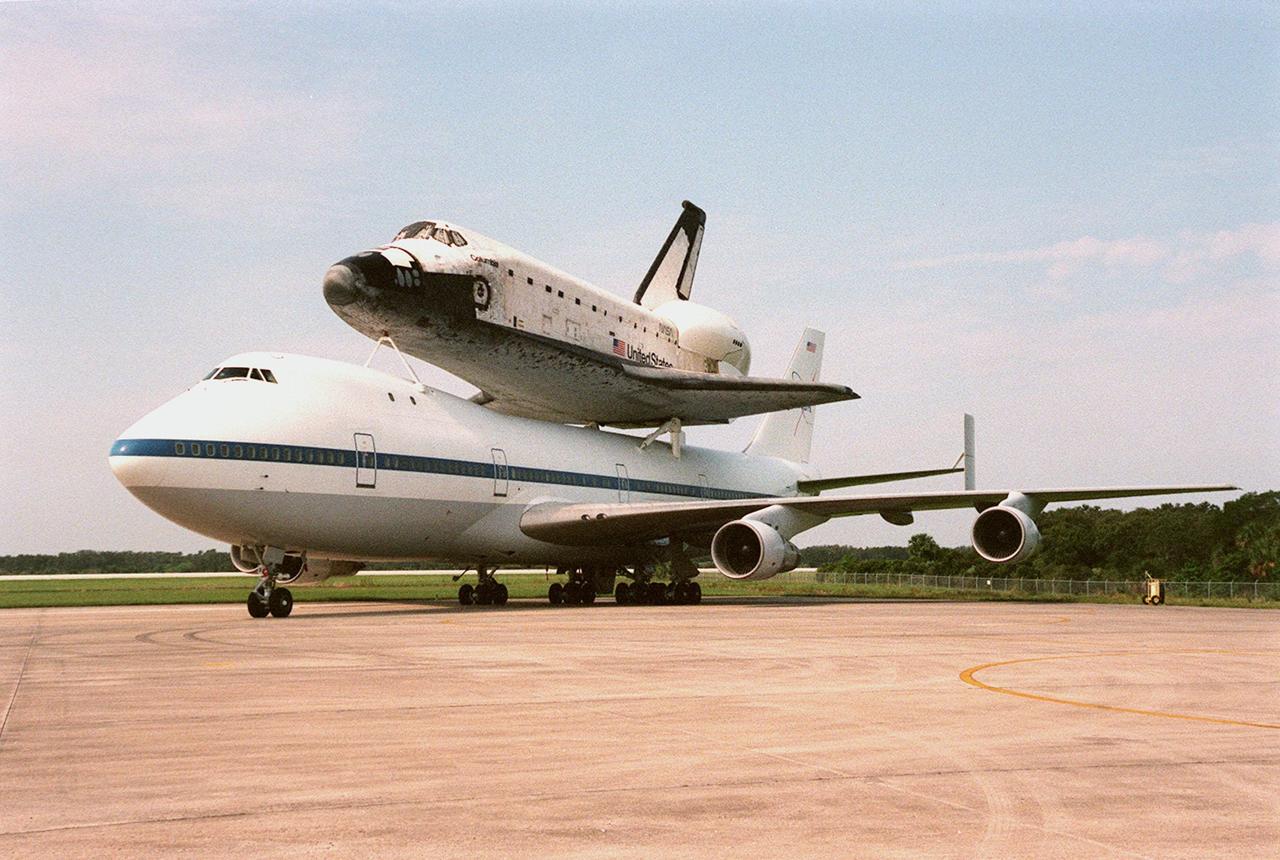
KENNEDY SPACE CENTER, FLA. -- The Boeing 747 Shuttle Carrier Aircraft, with the orbiter Columbia strapped to its back, waits at the Shuttle Landing Facility for clear weather to take off for its final destination, Palmdale, Calif. The oldest of four orbiters in NASA's fleet, Columbia is being ferried to Palmdale to undergo extensive inspections and modifications in Boeing's Orbiter Assembly Facility. The nine-month orbiter maintenance down period (OMDP) is the second in Columbia's history. Orbiters are periodically removed from flight operations for an OMDP. Columbia's first was in 1994. Along with more than 100 modifications on the vehicle, Columbia will be the second orbiter to be outfitted with the multifunctional electronic display system, or "glass cockpit." Columbia is expected to return to KSC in July 2000
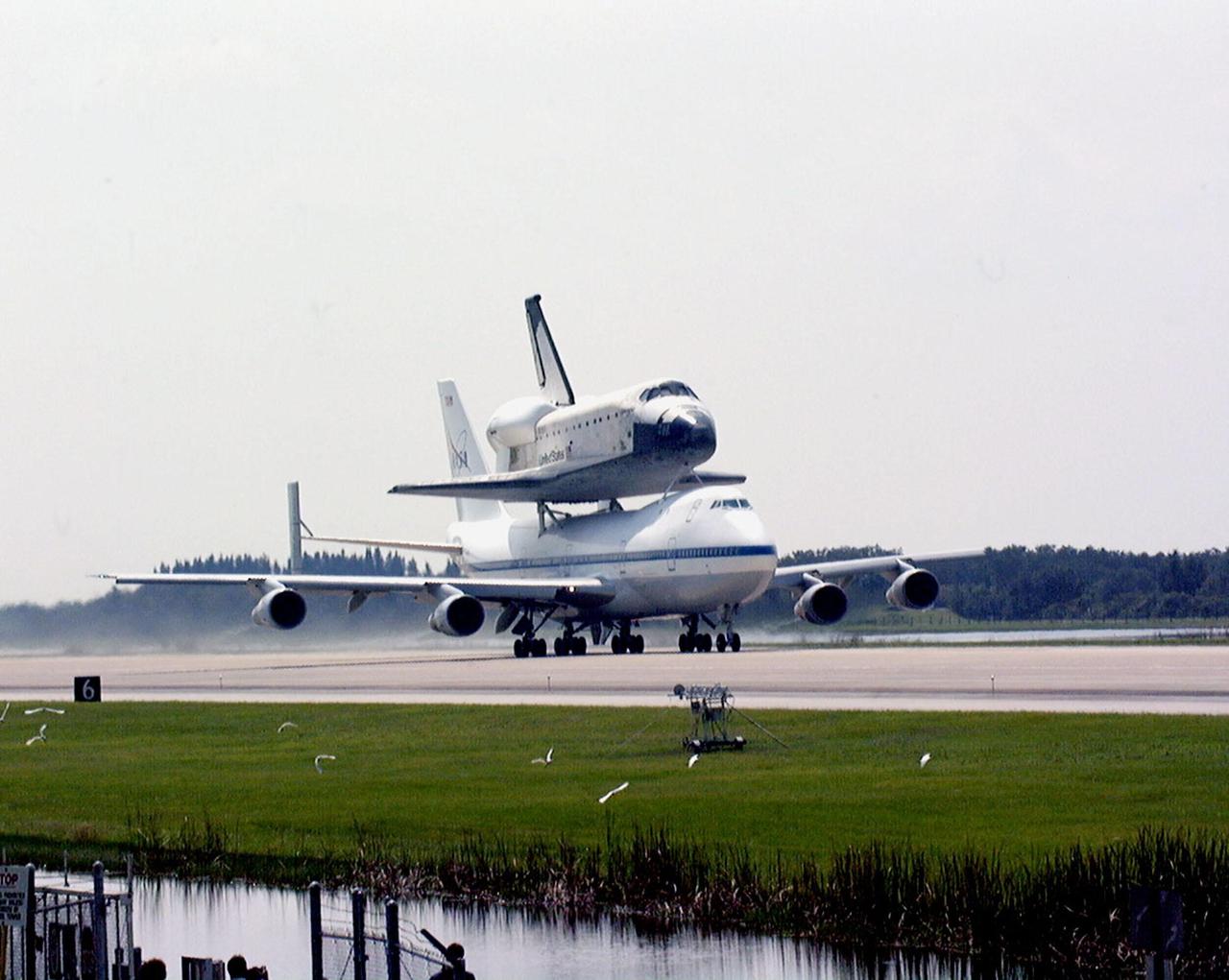
KENNEDY SPACE CENTER, FLA. -- At the Shuttle Landing Facility, egrets along the runway take flight as the orbiter Columbia leaves Kennedy Space Center on the back of a Boeing 747 Shuttle Carrier Aircraft on a ferry flight to Palmdale, Calif. Columbia, the oldest of four orbiters in NASA's fleet, will undergo extensive inspections and modifications in Boeing's Orbiter Assembly Facility during a nine-month orbiter maintenance down period (OMDP), the second in its history. Orbiters are periodically removed from flight operations for an OMDP. Columbia's first was in 1994. Along with more than 100 modifications on the vehicle, Columbia will be the second orbiter to be outfitted with the multifunctional electronic display system, or "glass cockpit." Columbia is expected to return to KSC in July 2000
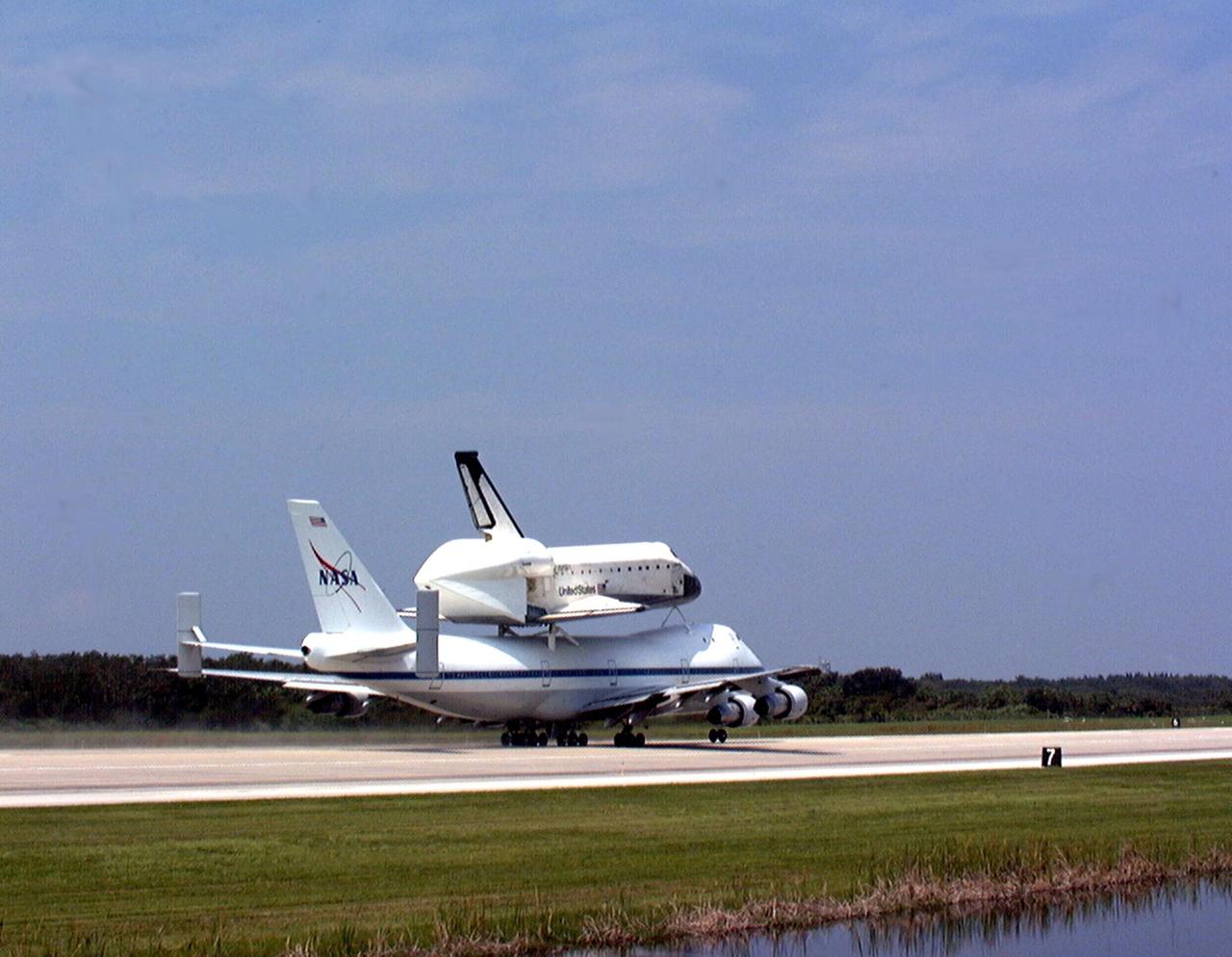
KENNEDY SPACE CENTER, FLA. -- From the Shuttle Landing Facility at Kennedy Space Center, the orbiter Columbia moves down the runway on the back of a Boeing 747 Shuttle Carrier Aircraft on a ferry flight to Palmdale, Calif. On the rear of the orbiter can be seen the tail cone, a fairing that is installed over the aft fuselage of the orbiter to decrease aerodynamic drag and buffet when the Shuttle Carrier Aircraft is transporting the orbiter cross-country. It is 36 feet long, 25 feet wide, and 22 feet high. Columbia, the oldest of four orbiters in NASA's fleet, will undergo extensive inspections and modifications in Boeing's Orbiter Assembly Facility during a nine-month orbiter maintenance down period (OMDP), the second in its history. Orbiters are periodically removed from flight operations for an OMDP. Columbia's first was in 1994. Along with more than 100 modifications on the vehicle, Columbia will be the second orbiter to be outfitted with the multifunctional electronic display system, or "glass cockpit." Columbia is expected to return to KSC in July 2000

KENNEDY SPACE CENTER, FLA. -- At the Shuttle Landing Facility at Kennedy Space Center, the orbiter Columbia takes to the sky on the back of a Boeing 747 Shuttle Carrier Aircraft on a ferry flight to Palmdale, Calif. On the rear of the orbiter can be seen the tail cone, a fairing that is installed over the aft fuselage of the orbiter to decrease aerodynamic drag and buffet when the Shuttle Carrier Aircraft is transporting the orbiter cross-country. It is 36 feet long, 25 feet wide, and 22 feet high. Columbia, the oldest of four orbiters in NASA's fleet, will undergo extensive inspections and modifications in Boeing's Orbiter Assembly Facility during a nine-month orbiter maintenance down period (OMDP), the second in its history. Orbiters are periodically removed from flight operations for an OMDP. Columbia's first was in 1994. Along with more than 100 modifications on the vehicle, Columbia will be the second orbiter to be outfitted with the multifunctional electronic display system, or "glass cockpit." Columbia is expected to return to KSC in July 2000
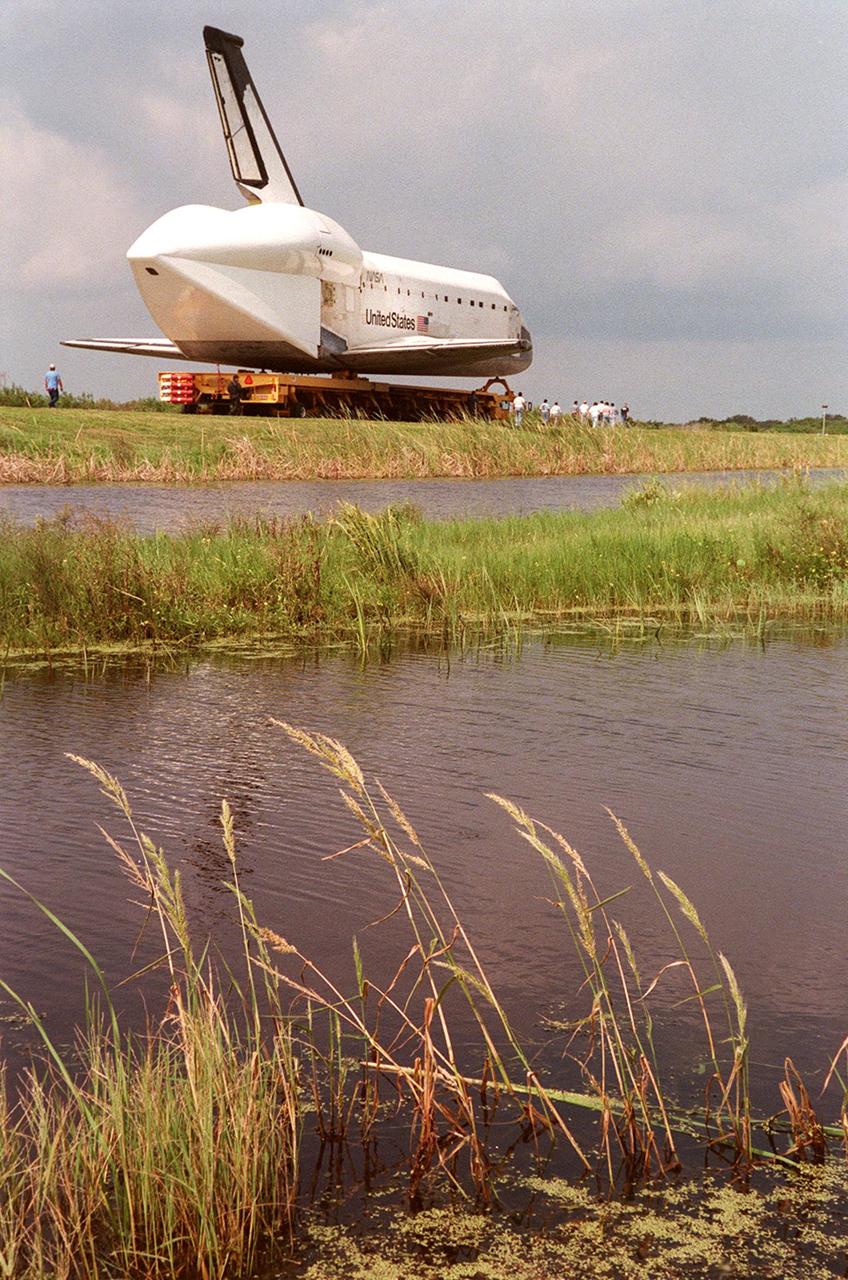
KENNEDY SPACE CENTER, FLA. -- Aboard a transporter, the orbiter Columbia is moved on the tow-way along the Banana Creek. Columbia is heading to the Shuttle Landing Facility's (SLF) Mate-Demate Device where it will be mated to the Boeing 747 Shuttle Carrier Aircraft for a ferry flight to Palmdale, Calif. On the rear of the orbiter can be seen the tail cone, a fairing that is installed over the aft fuselage of the orbiter to decrease aerodynamic drag and buffet when the Shuttle Carrier Aircraft is transporting the orbiter cross-country. It is 36 feet long, 25 feet wide, and 22 feet high. Columbia, the oldest of four orbiters in NASA's fleet, will undergo extensive inspections and modifications in Boeing's Orbiter Assembly Facility during a nine-month orbiter maintenance down period (OMDP), the second in its history. Orbiters are periodically removed from flight operations for an OMDP. Columbia's first was in 1994. Along with more than 100 modifications on the vehicle, Columbia will be the second orbiter to be outfitted with the multifunctional electronic display system, or "glass cockpit." Columbia is expected to return to KSC in July 2000
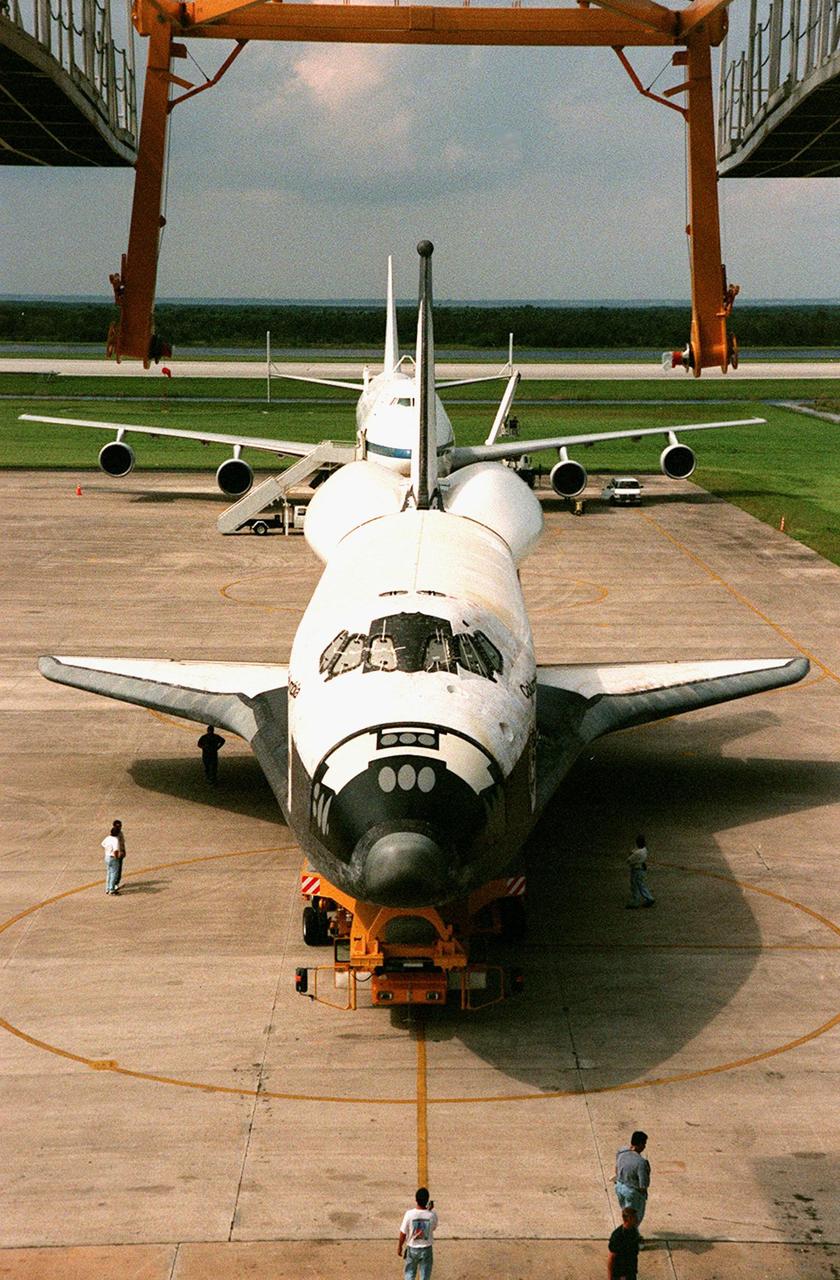
KENNEDY SPACE CENTER, FLA. -- The orbiter Columbia (foreground) moves under the Mate-Demate Device at KSC's Shuttle Landing Facility (SLF). The crane seen above it will lift the orbiter so that the Boeing 747 Shuttle Carrier Aircraft (SCA) in the background can move underneath Columbia, which will then be attached to the back of the SCA for a ferry flight to Palmdale, Calif. On the rear of the orbiter is the tail cone, a fairing that is installed over the aft fuselage of the orbiter to decrease aerodynamic drag and buffet when the Shuttle Carrier Aircraft is transporting the orbiter cross-country. It is 36 feet long, 25 feet wide, and 22 feet high. Columbia, the oldest of four orbiters in NASA's fleet, will undergo extensive inspections and modifications in Boeing's Orbiter Assembly Facility during a nine-month orbiter maintenance down period (OMDP), the second in its history. Orbiters are periodically removed from flight operations for an OMDP. Columbia's first was in 1994. Along with more than 100 modifications on the vehicle, Columbia will be the second orbiter to be outfitted with the multifunctional electronic display system, or "glass cockpit." Columbia is expected to return to KSC in July 2000
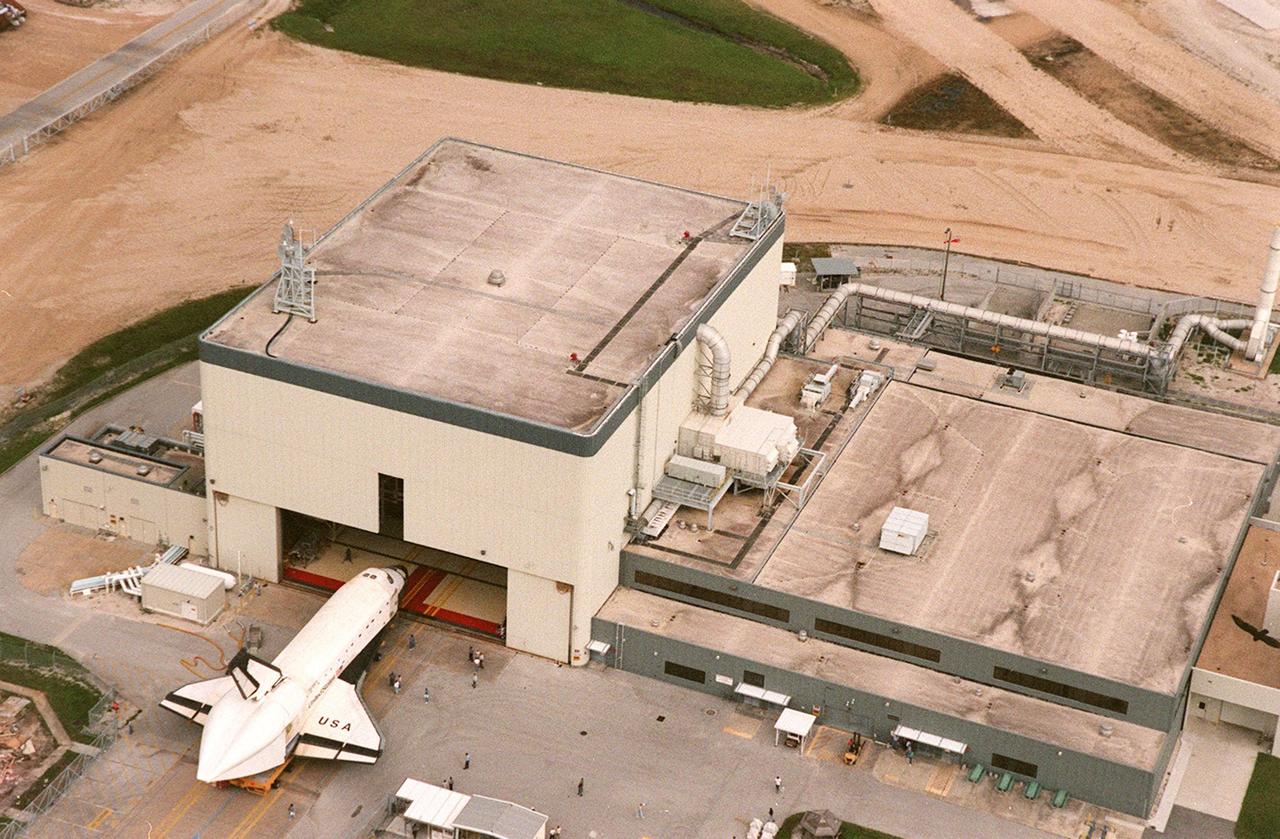
KENNEDY SPACE CENTER, FLA. -- The orbiter Columbia rolls out of KSC's Orbiter Processing Facility bay 3, bound for the Shuttle Landing Facility's (SLF) Mate-Demate Device. At the SLF the orbiter is to be mated to the Boeing 747 Shuttle Carrier Aircraft for a ferry flight to Palmdale, Calif. On the rear of the orbiter can be seen the tail cone, a fairing that is installed over the aft fuselage of the orbiter to decrease aerodynamic drag and buffet when the Shuttle Carrier Aircraft is transporting the orbiter cross-country. It is 36 feet long, 25 feet wide, and 22 feet high. Columbia, the oldest of four orbiters in NASA's fleet, will undergo extensive inspections and modifications in Boeing's Orbiter Assembly Facility during a nine-month orbiter maintenance down period (OMDP), the second in its history. Orbiters are periodically removed from flight operations for an OMDP. Columbia's first was in 1994. Along with more than 100 modifications on the vehicle, Columbia will be the second orbiter to be outfitted with the multifunctional electronic display system, or "glass cockpit." Columbia is expected to return to KSC in July 2000
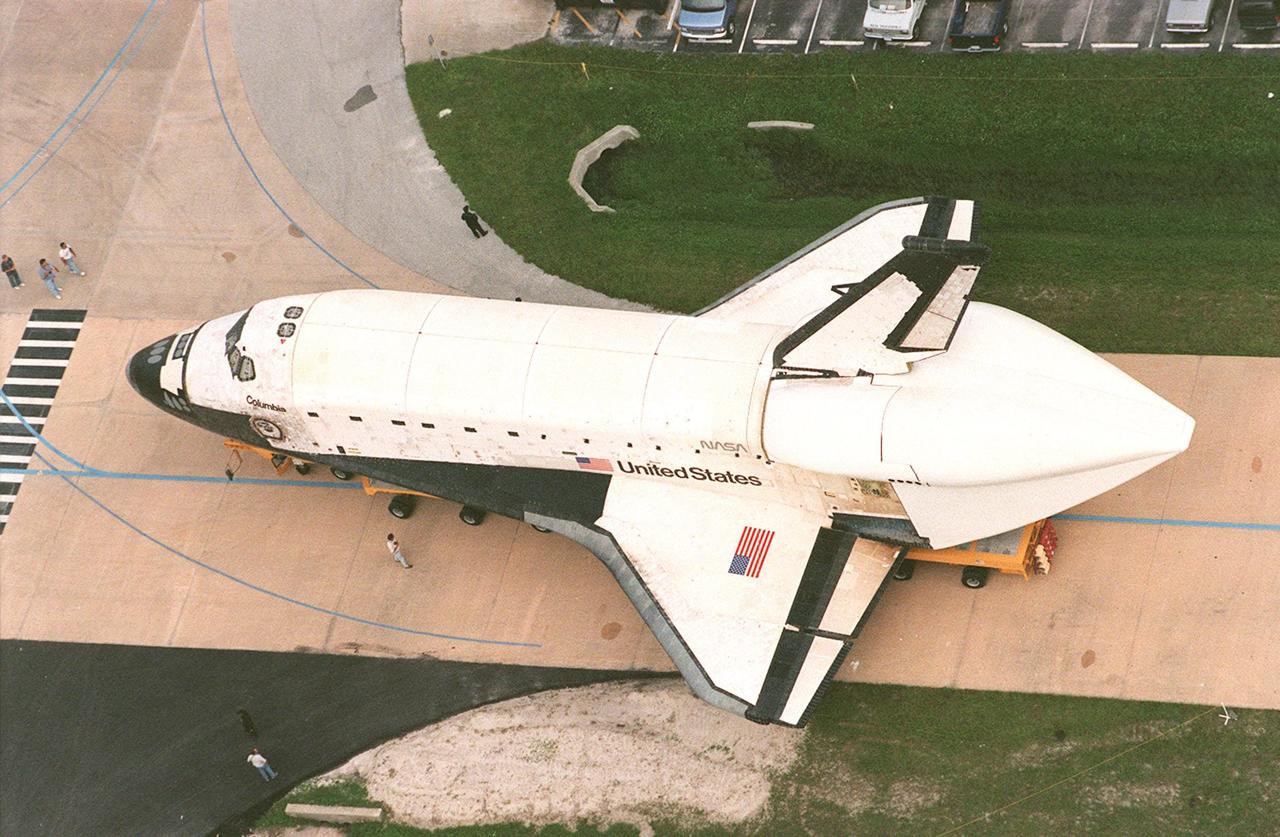
KENNEDY SPACE CENTER, FLA. -- On an orbiter transporter, Columbia is turned, after rolling out of KSC's Orbiter Processing Facility bay 3, for its move to the Shuttle Landing Facility's (SLF) Mate-Demate Device. At the SLF the orbiter is to be mated to the Boeing 747 Shuttle Carrier Aircraft for a ferry flight to Palmdale, Calif. On the rear of the orbiter can be seen the tail cone, a fairing that is installed over the aft fuselage of the orbiter to decrease aerodynamic drag and buffet when the Shuttle Carrier Aircraft is transporting the orbiter cross-country. It is 36 feet long, 25 feet wide, and 22 feet high. Columbia, the oldest of four orbiters in NASA's fleet, will undergo extensive inspections and modifications in Boeing's Orbiter Assembly Facility during a nine-month orbiter maintenance down period (OMDP), the second in its history. Orbiters are periodically removed from flight operations for an OMDP. Columbia's first was in 1994. Along with more than 100 modifications on the vehicle, Columbia will be the second orbiter to be outfitted with the multifunctional electronic display system, or "glass cockpit." Columbia is expected to return to KSC in July 2000

KENNEDY SPACE CENTER, FLA. -- Aboard a transporter, the orbiter Columbia moves past the Boeing 747 Shuttle Carrier Aircraft (SCA) at the Shuttle Landing Facility. There the orbiter will be mated to the SCA, with the help of a Mate-Demate Device, for a ferry flight to Palmdale, Calif. On the rear of the orbiter is the tail cone, a fairing that is installed over the aft fuselage of the orbiter to decrease aerodynamic drag and buffet when the Shuttle Carrier Aircraft is transporting the orbiter cross-country. It is 36 feet long, 25 feet wide, and 22 feet high. Columbia, the oldest of four orbiters in NASA's fleet, will undergo extensive inspections and modifications in Boeing's Orbiter Assembly Facility during a nine-month orbiter maintenance down period (OMDP), the second in its history. Orbiters are periodically removed from flight operations for an OMDP. Columbia's first was in 1994. Along with more than 100 modifications on the vehicle, Columbia will be the second orbiter to be outfitted with the multifunctional electronic display system, or "glass cockpit." Columbia is expected to return to KSC in July 2000
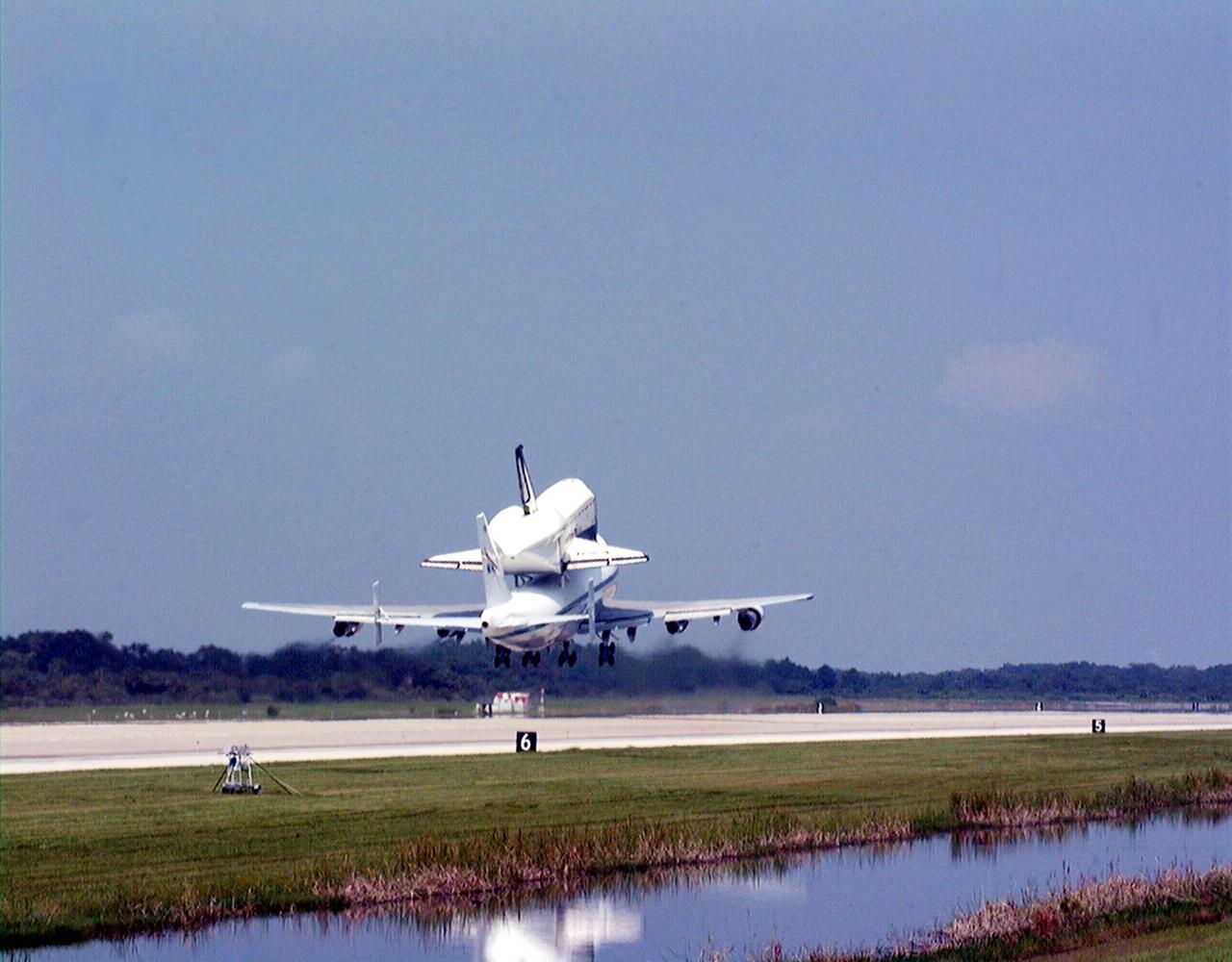
KENNEDY SPACE CENTER, FLA. -- At the Shuttle Landing Facility at Kennedy Space Center, the orbiter Columbia takes off into a clear sky on the back of a Boeing 747 Shuttle Carrier Aircraft on a ferry flight to Palmdale, Calif. On the rear of the orbiter can be seen the tail cone, a fairing that is installed over the aft fuselage of the orbiter to decrease aerodynamic drag and buffet when the Shuttle Carrier Aircraft is transporting the orbiter cross-country. It is 36 feet long, 25 feet wide, and 22 feet high. Columbia, the oldest of four orbiters in NASA's fleet, will undergo extensive inspections and modifications in Boeing's Orbiter Assembly Facility during a nine-month orbiter maintenance down period (OMDP), the second in its history. Orbiters are periodically removed from flight operations for an OMDP. Columbia's first was in 1994. Along with more than 100 modifications on the vehicle, Columbia will be the second orbiter to be outfitted with the multifunctional electronic display system, or "glass cockpit." Columbia is expected to return to KSC in July 2000
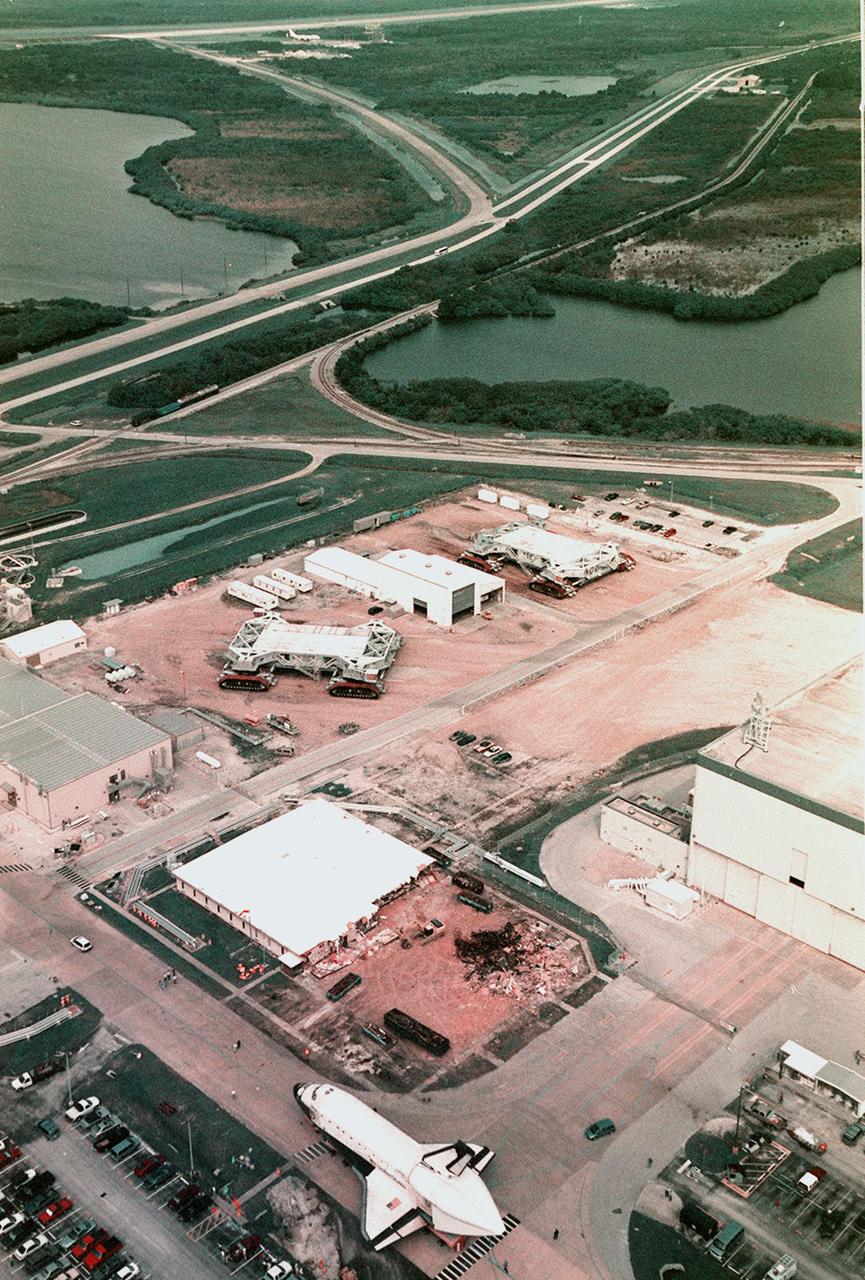
On an orbiter transporter, Columbia is ready for its move to the Shuttle Landing Facility's (SLF) Mate-Demate Device (MDD), in the distance at the top of the photo. Seen next to the MDD is the Boeing 747 Shuttle Carrier Aircraft which will carry the orbiter piggyback in a ferry flight to Palmdale, Calif. On the rear of the orbiter can be seen the tail cone, a fairing that is installed over the aft fuselage of the orbiter to decrease aerodynamic drag and buffet when the Shuttle Carrier Aircraft is transporting the orbiter cross-country. It is 36 feet long, 25 feet wide, and 22 feet high. Columbia, the oldest of four orbiters in NASA's fleet, will undergo extensive inspections and modifications in Boeing's Orbiter Assembly Facility during a nine-month orbiter maintenance down period (OMDP), the second in its history. Orbiters are periodically removed from flight operations for an OMDP. Columbia's first was in 1994. Along with more than 100 modifications on the vehicle, Columbia will be the second orbiter to be outfitted with the multifunctional electronic display system, or 'glass cockpit.' Columbia is expected to return to KSC in July 2000.
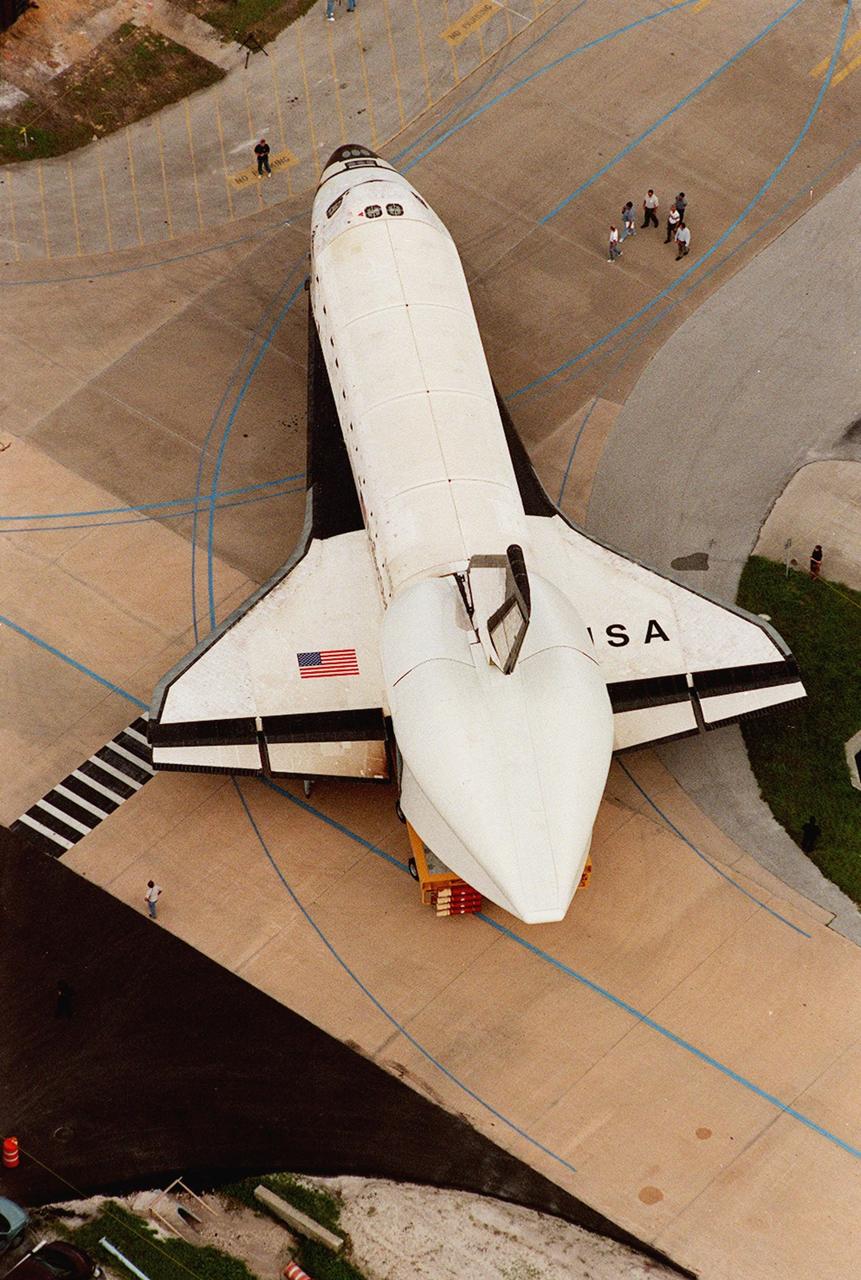
KENNEDY SPACE CENTER, FLA. -- Photographed from overhead, the orbiter Columbia begins to turn after rolling out of KSC's Orbiter Processing Facility bay 3, bound for the Shuttle Landing Facility's (SLF) Mate-Demate Device. At the SLF the orbiter is to be mated to the Boeing 747 Shuttle Carrier Aircraft for a ferry flight to Palmdale, Calif. On the rear of the orbiter can be seen the tail cone, a fairing that is installed over the aft fuselage of the orbiter to decrease aerodynamic drag and buffet when the Shuttle Carrier Aircraft is transporting the orbiter cross-country. It is 36 feet long, 25 feet wide, and 22 feet high. Columbia, the oldest of four orbiters in NASA's fleet, will undergo extensive inspections and modifications in Boeing's Orbiter Assembly Facility during a nine-month orbiter maintenance down period (OMDP), the second in its history. Orbiters are periodically removed from flight operations for an OMDP. Columbia's first was in 1994. Along with more than 100 modifications on the vehicle, Columbia will be the second orbiter to be outfitted with the multifunctional electronic display system, or "glass cockpit." Columbia is expected to return to KSC in July 2000