Dragging Its Foot
Dragging Its Foot
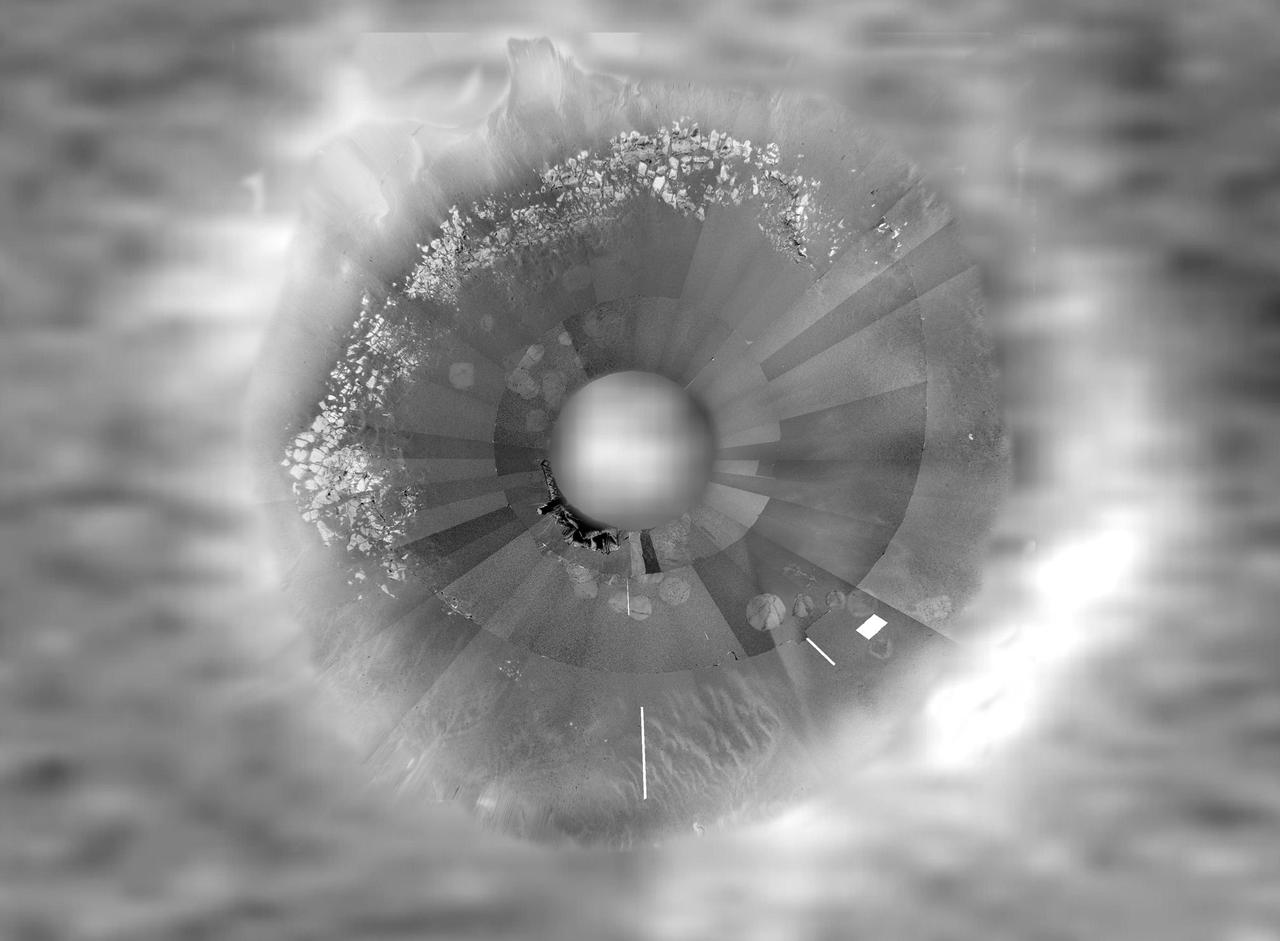
Track of Right-Wheel Drag
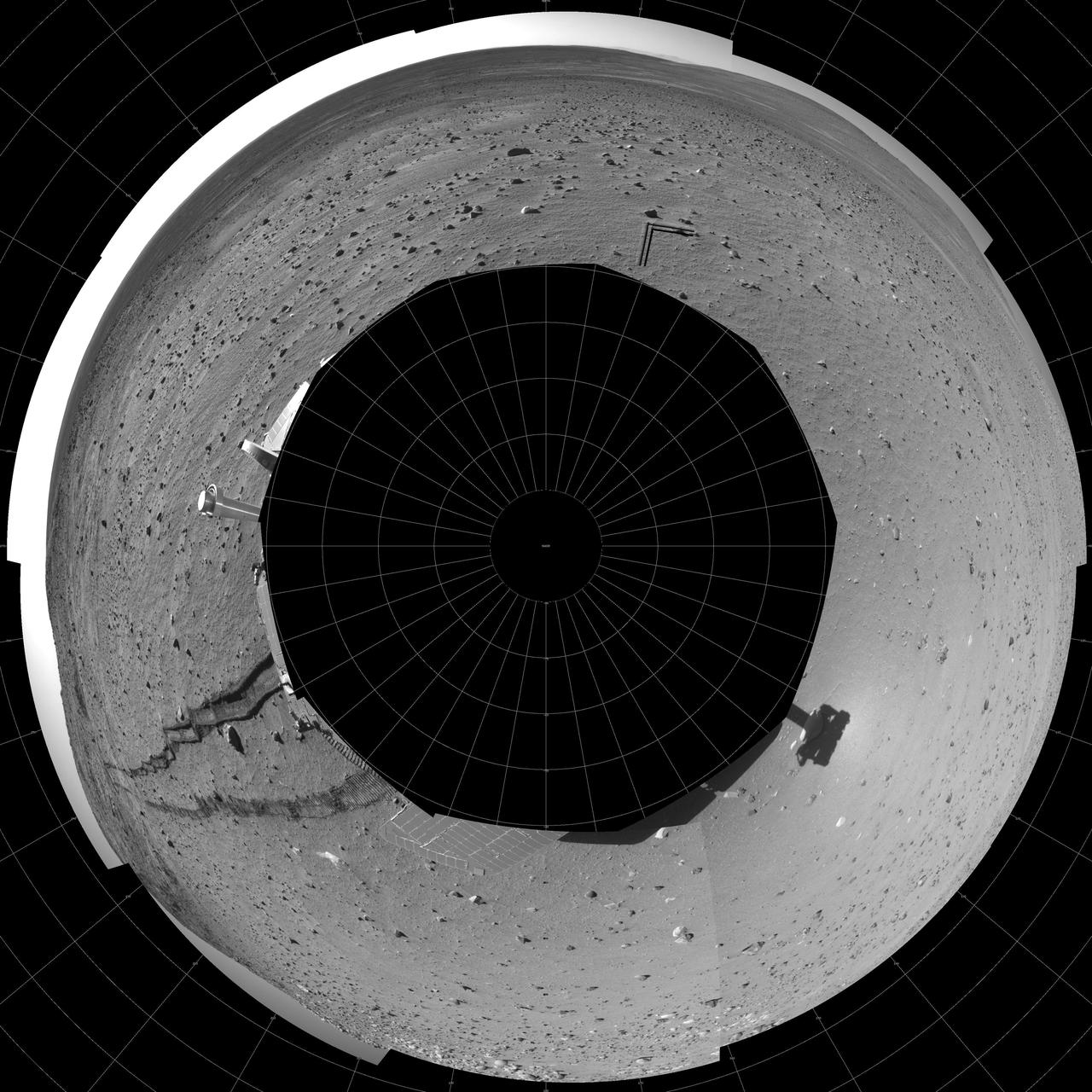
Track of Right-Wheel Drag Vertical
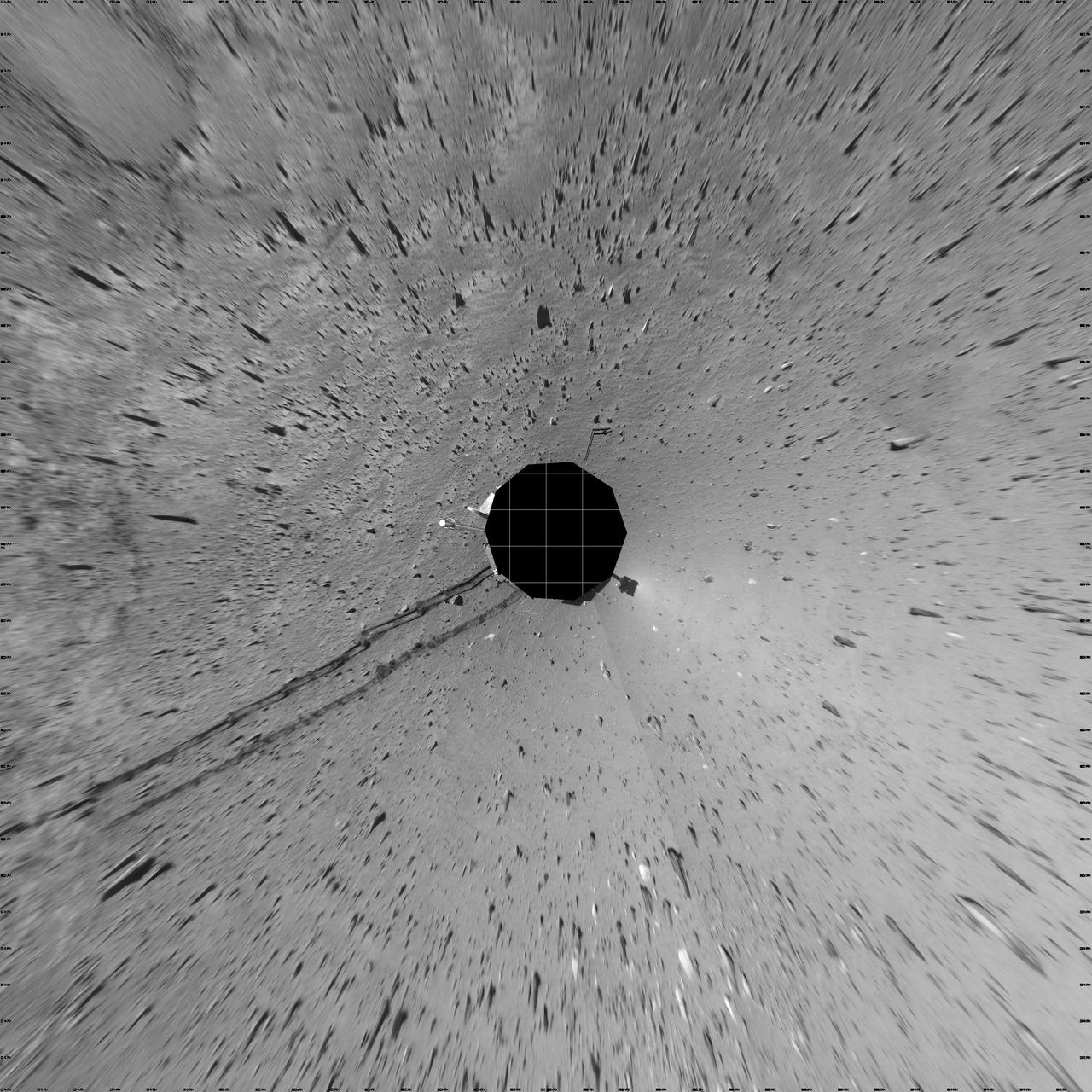
Track of Right-Wheel Drag Polar
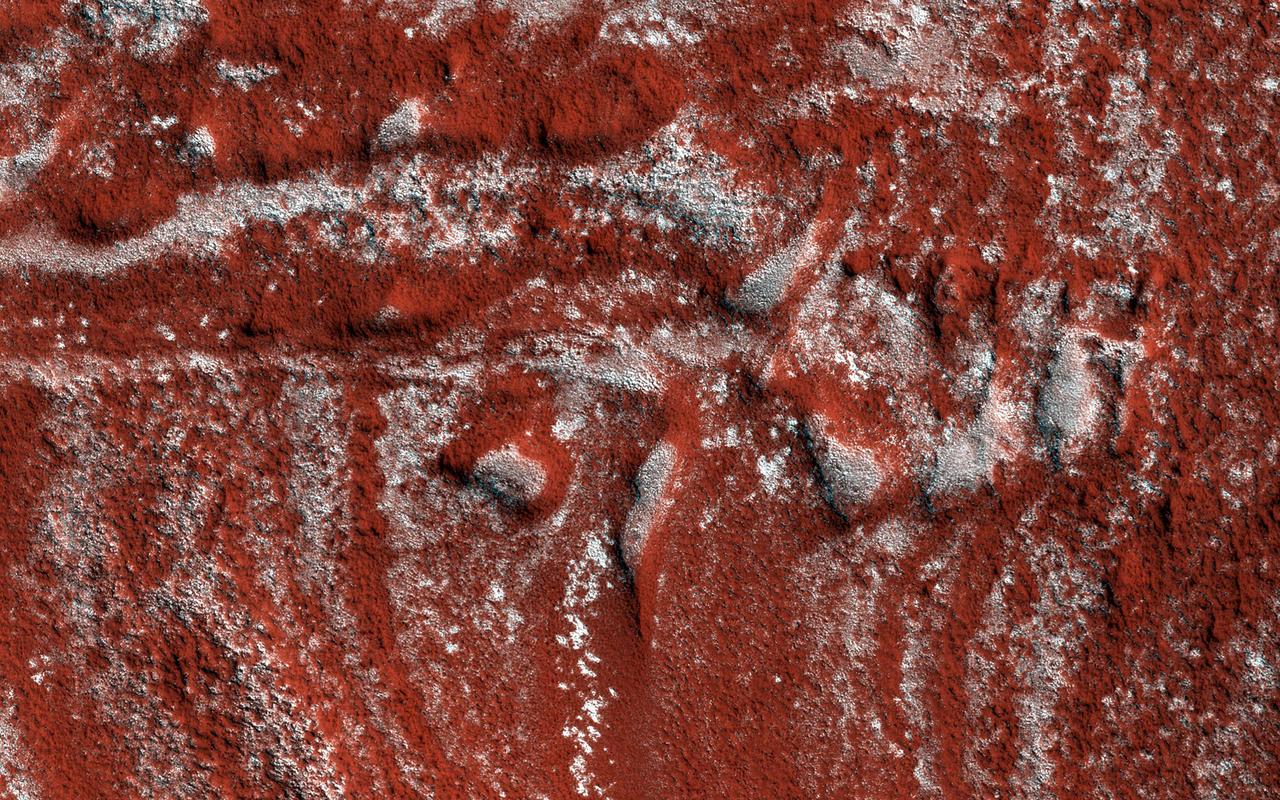
These North Polar layered deposits, composed of ice, captured by NASA Mars Reconnaissance Orbiter spacecraft, show what looks like drag folds, where rock layers bend fold before they break in a fault.  However, the North Polar layered deposits are composed of ice, and this is a large scale for such a feature, compared to drag folds on Earth. This image is part of a stereo pair, so with a 3D picture, we can better interpret the structure.  http://photojournal.jpl.nasa.gov/catalog/PIA20731
Drag Folds in the North Polar Layered Deposits
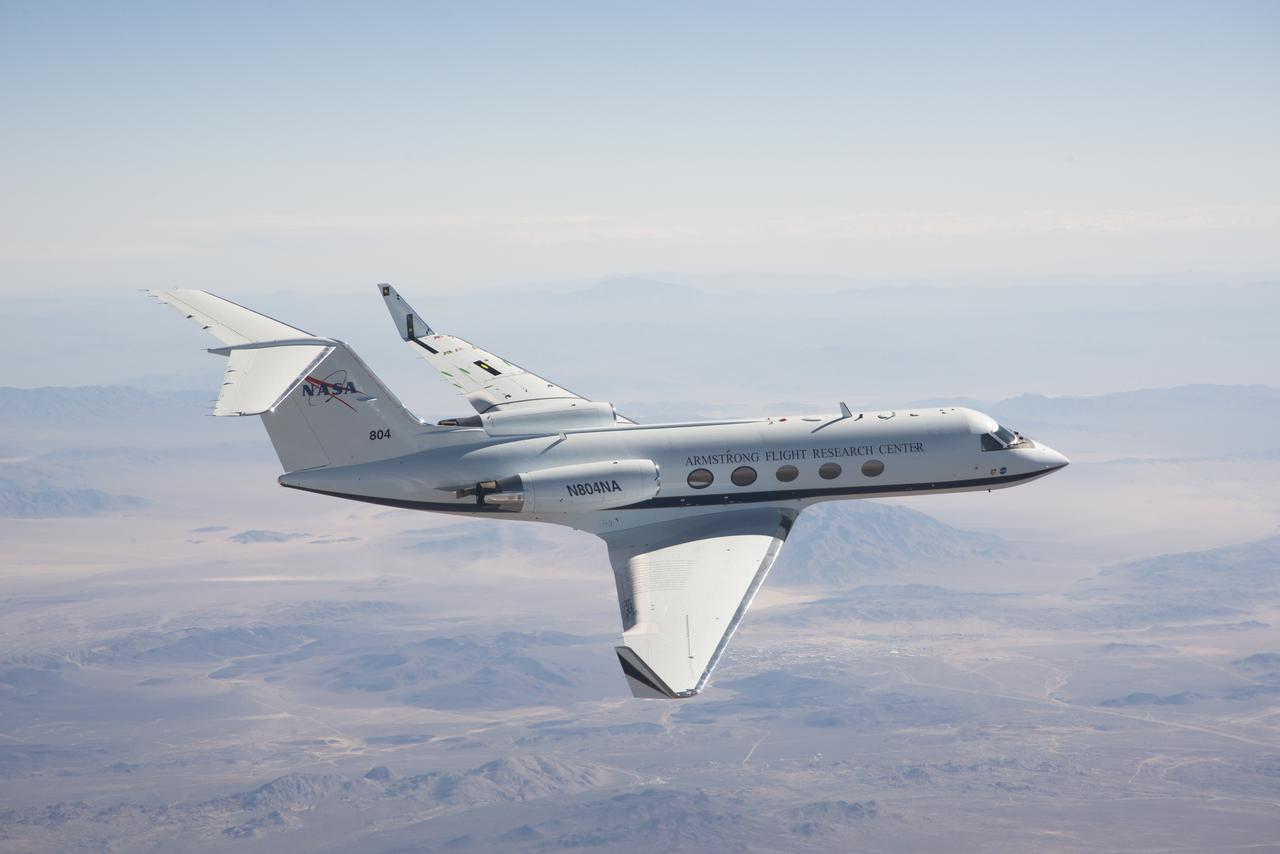
An Armstrong G-III aircraft carrying the Flexys© Adaptive Compliant Trailing Edge flap. The smooth transition between the flaps and wing reduced drag and noise.
Reducing Drag and Noise
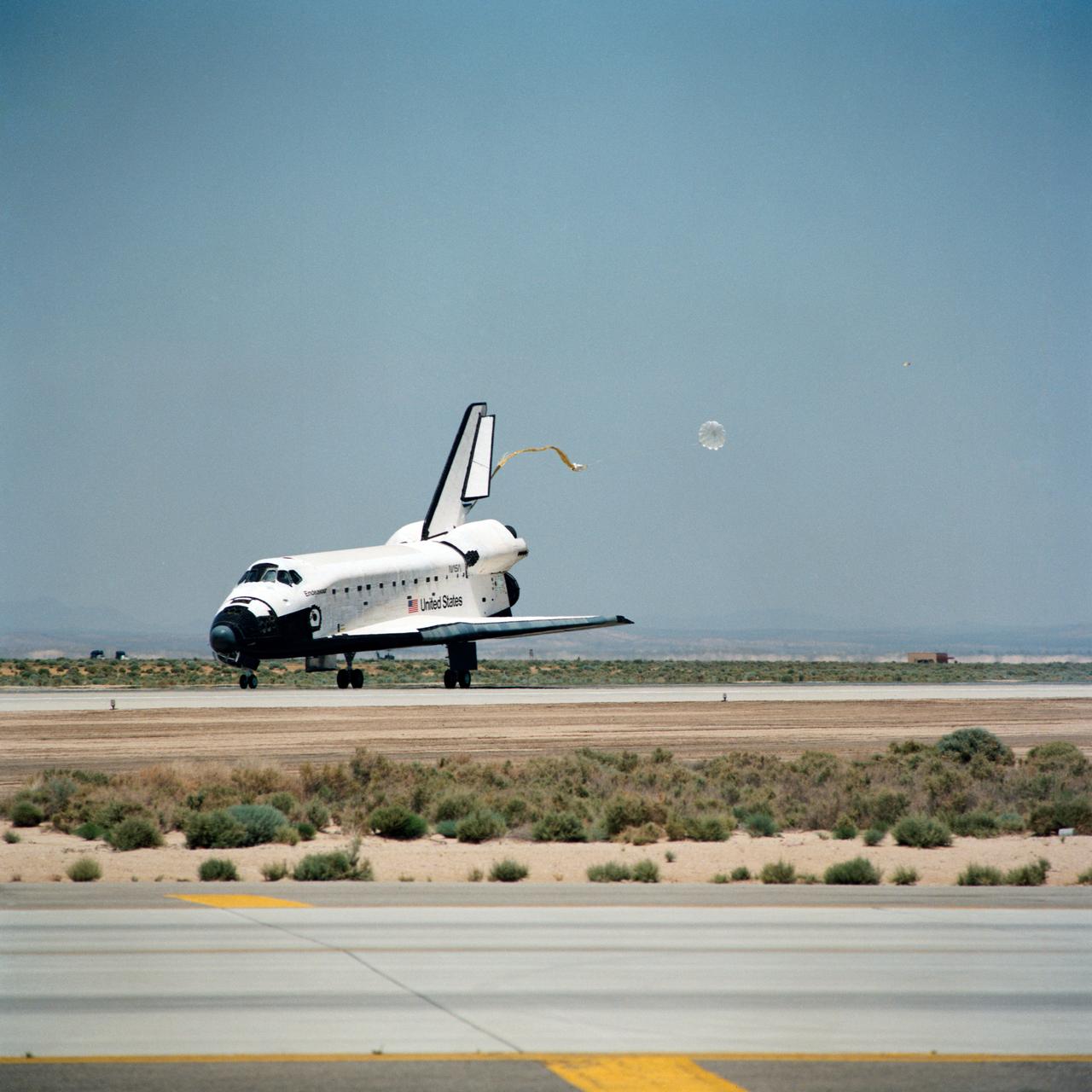
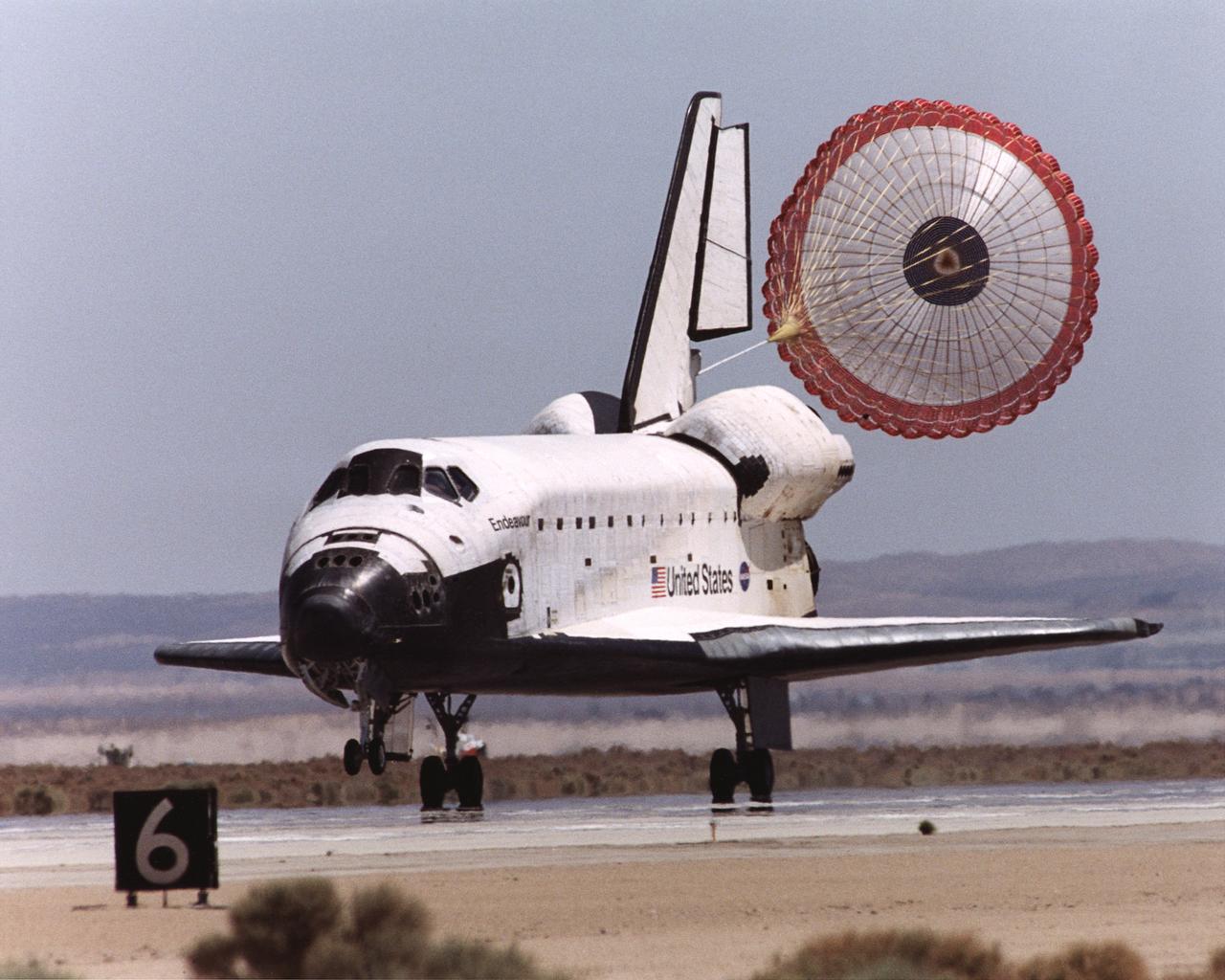
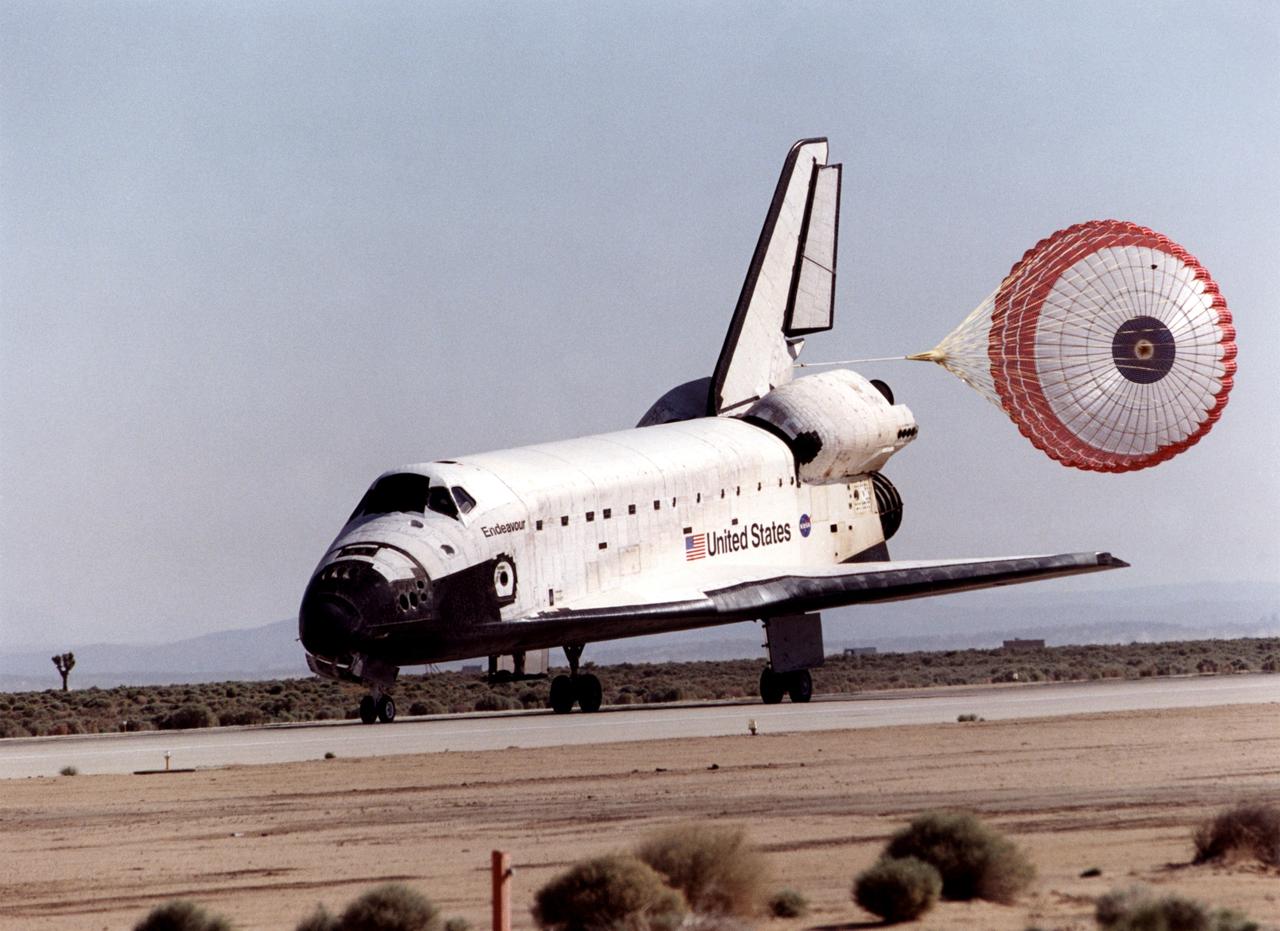
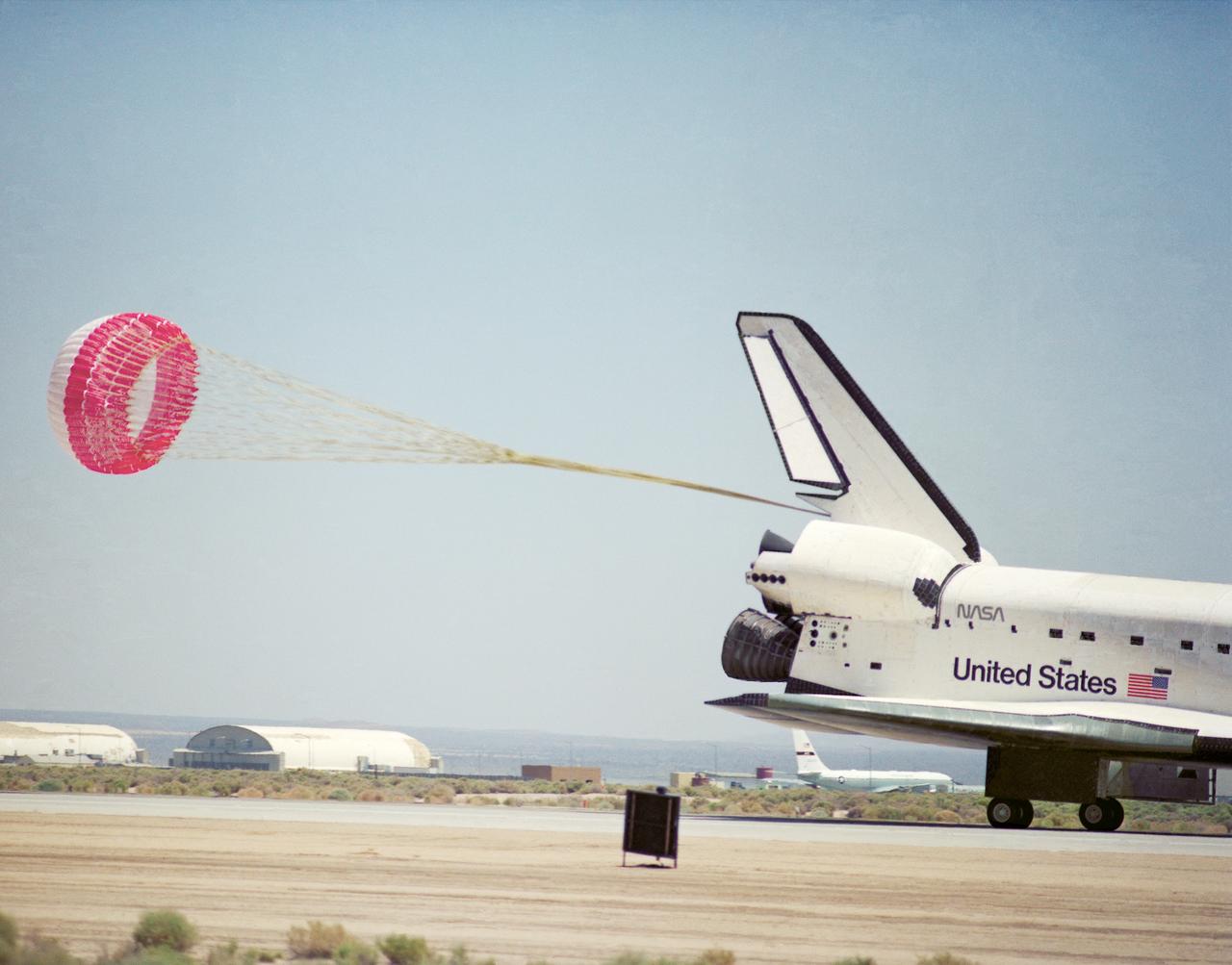
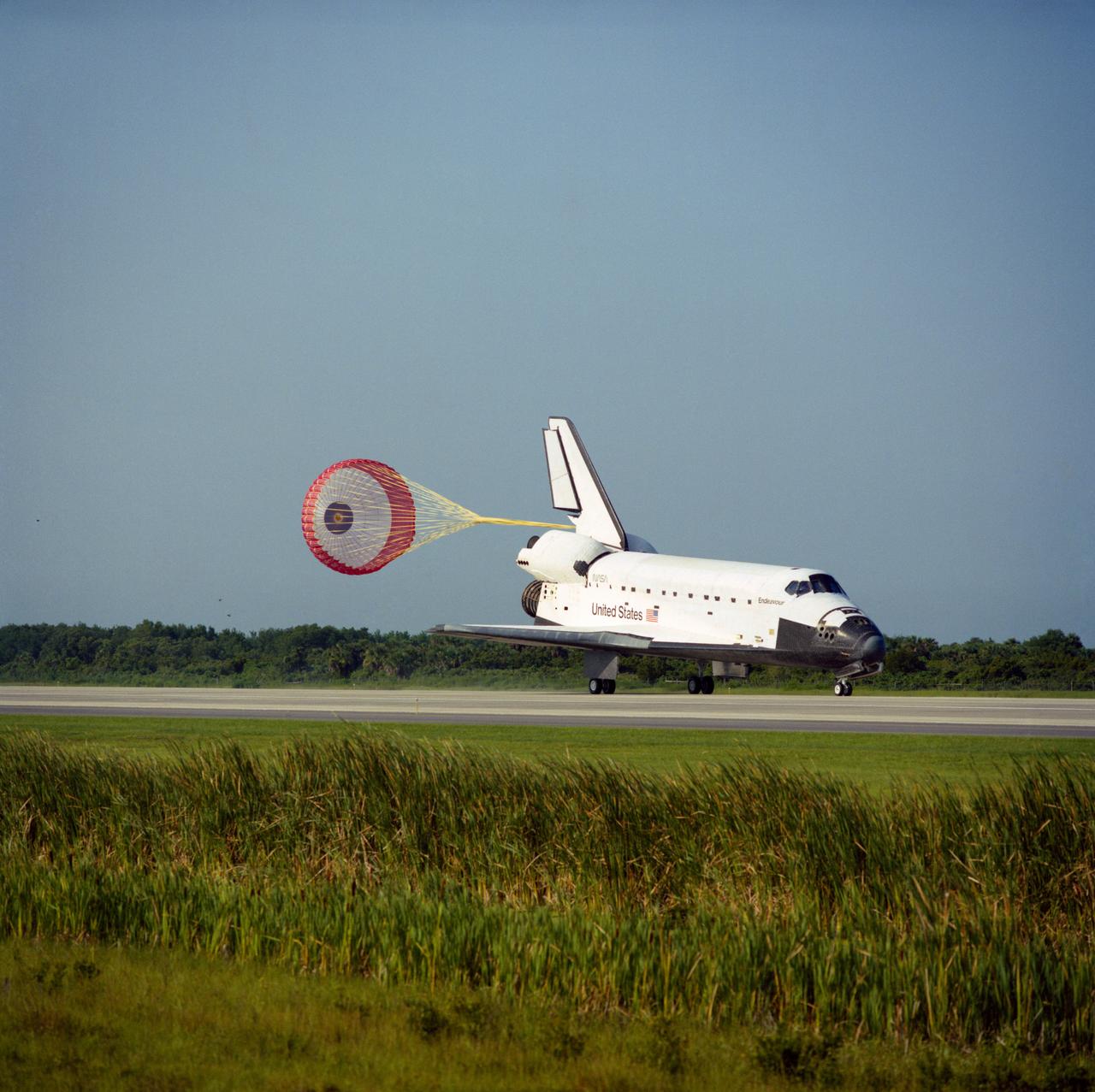
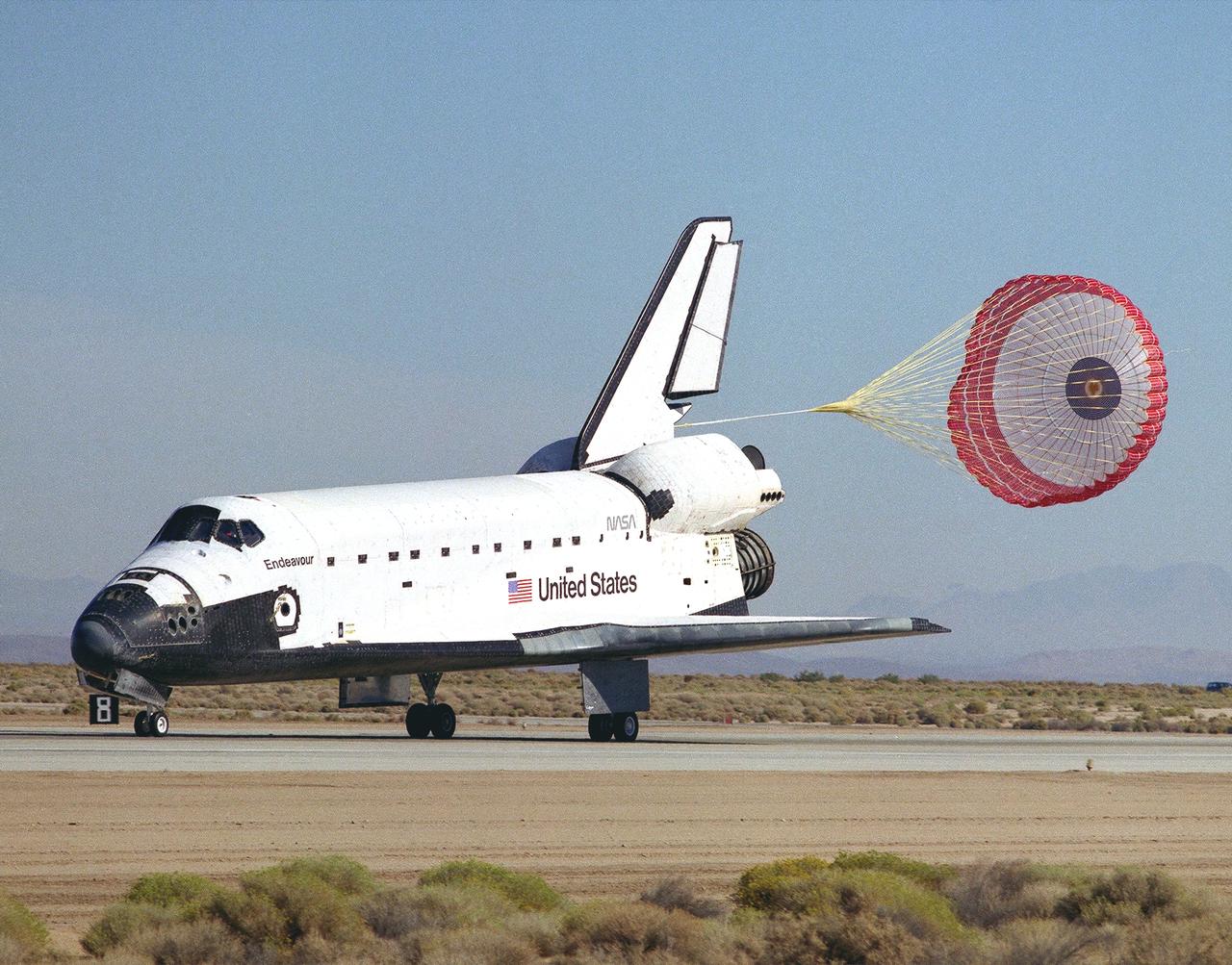
STS049-S-268 (16 May 1992) --- A three-quarter forward view of the Space Shuttle Endeavour making its first landing, following a successful nine-day mission in Earth orbit.  The drogue chute precedes the main chute in NASA's first exercise of its detailed test objective (DTO-521) on the drag chute system.  Main gear touchdown occurred at 1:57:38 p.m. (PDT), May 16, 1992.
STS-49 Endeavour, OV-105, drag chute deployment during landing at EAFB, Calif
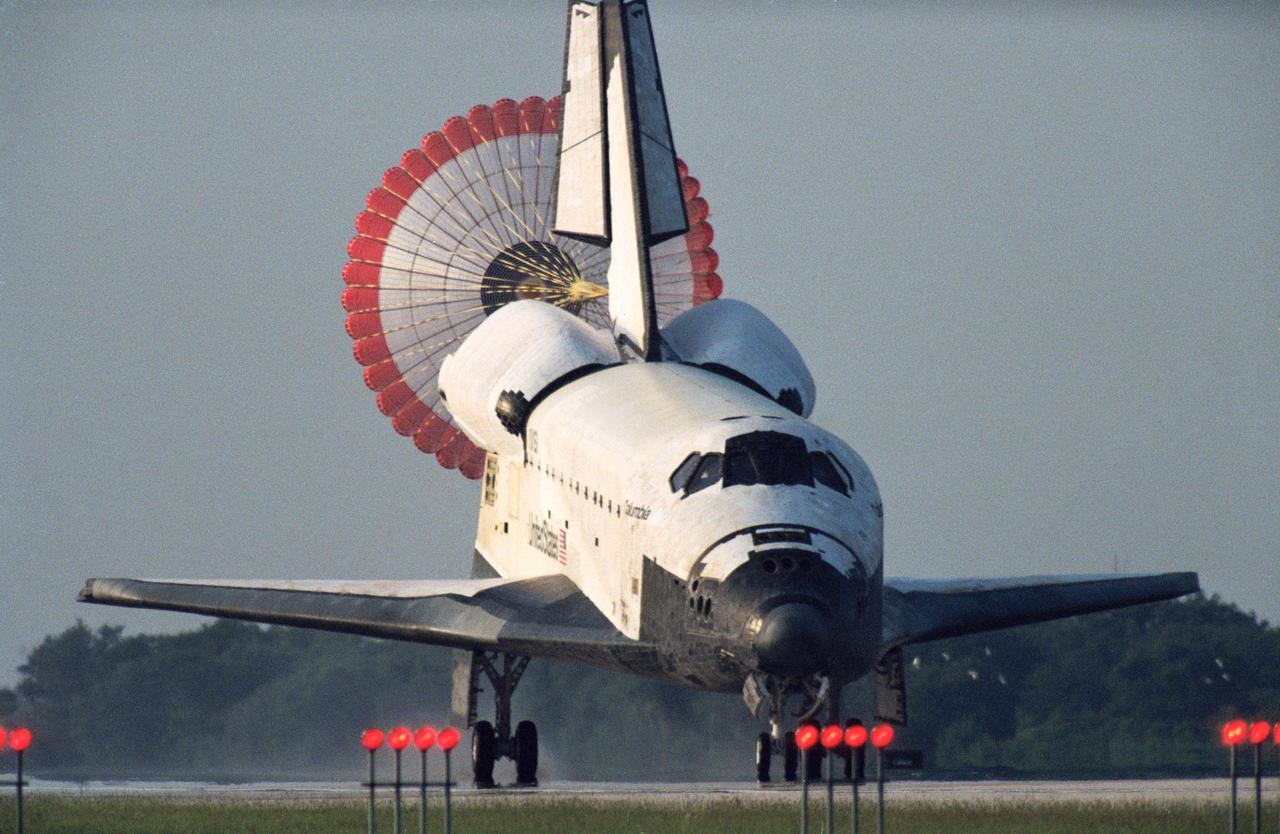
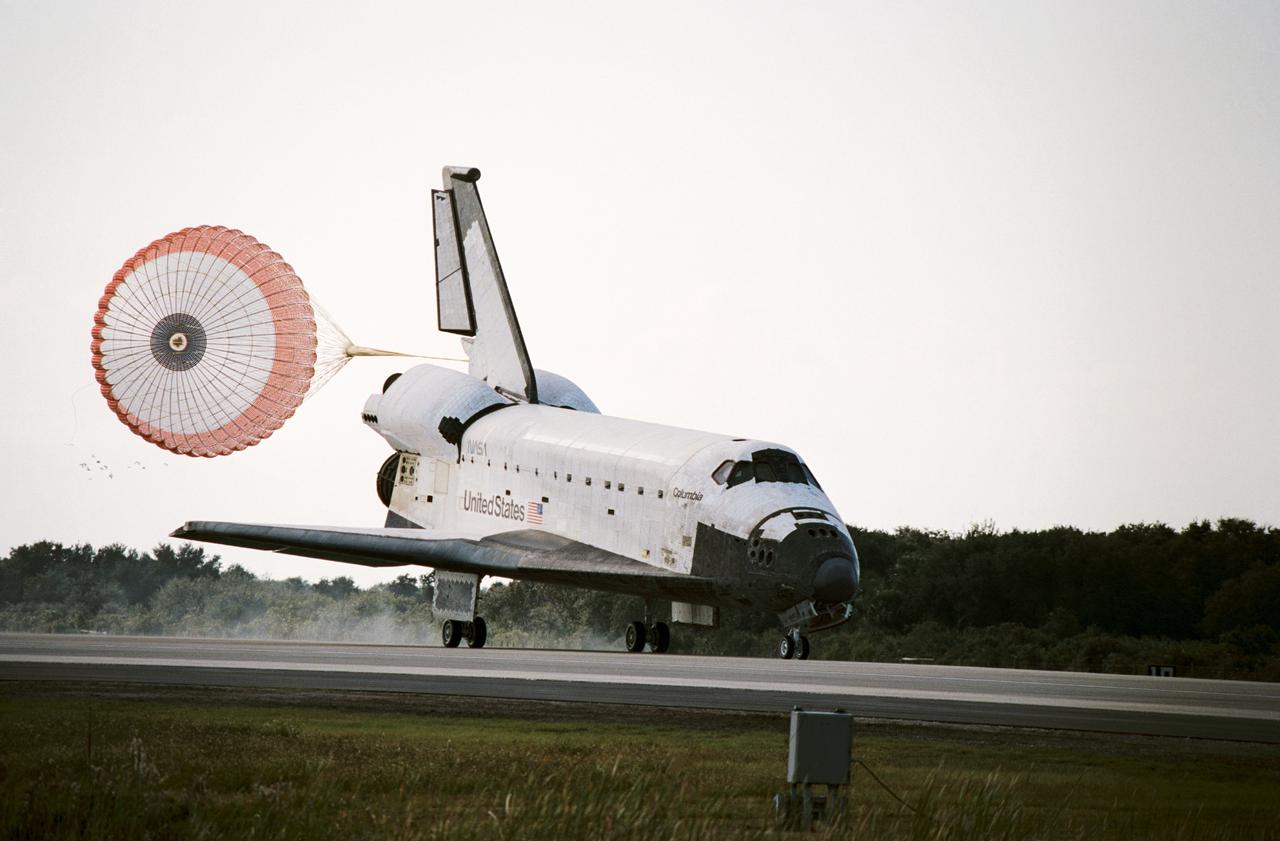
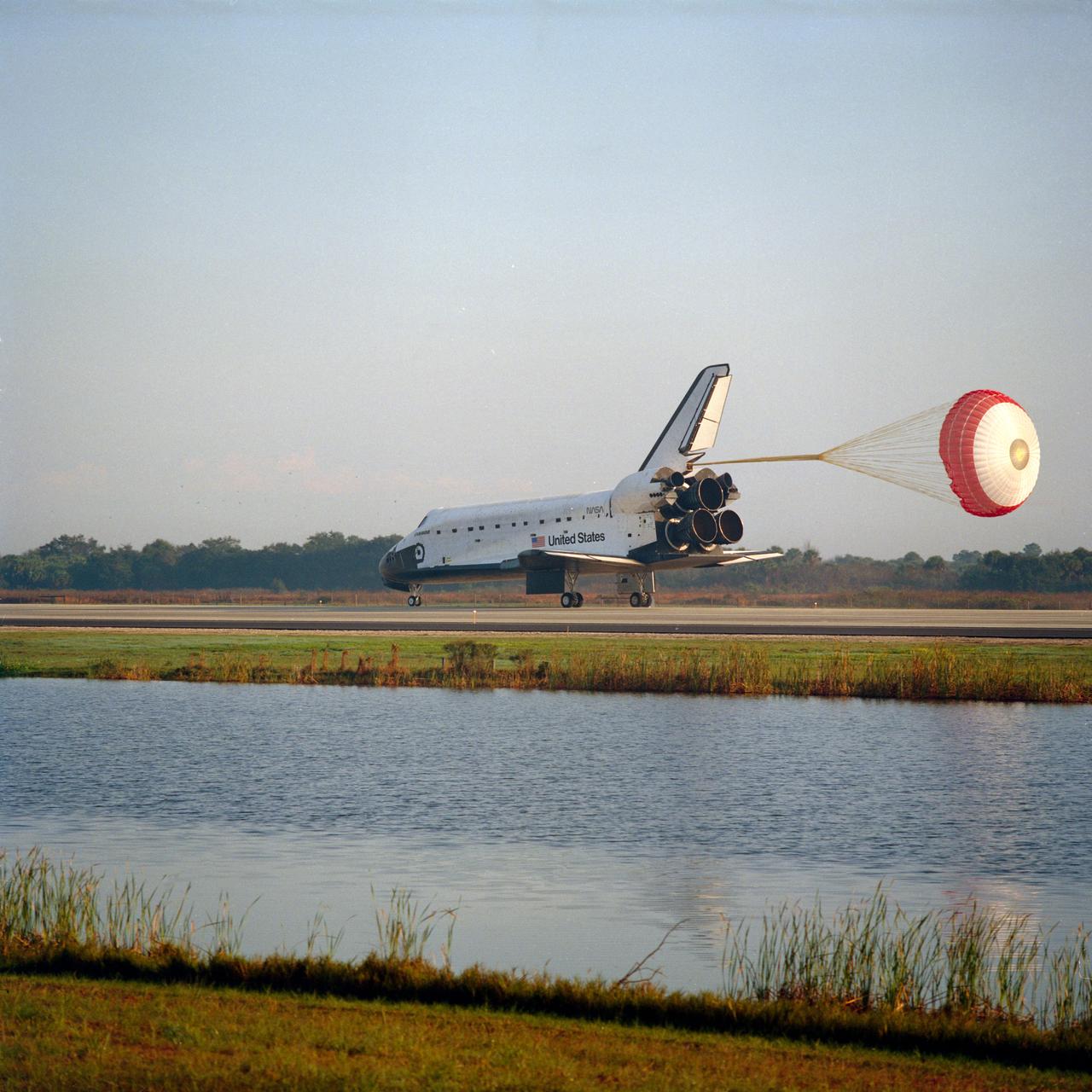
STS050-S-105 (9 July 1992) --- The main drag chute on the Space Shuttle Columbia is fully deployed soon after the Space Shuttle touches down at the Kennedy Space Center (KSC) landing facility.  Landing occurred at 7:42 a.m. (EDT).  Seven crew members, including five astronauts and two scientists from the private sector spent 14 days in space supporting the U.S. Microgravity Laboratory (USML-1).  This marks the first time for usage of the parachute system for a KSC landing and the second occurrence in the program.
STS-50 Columbia, OV-102, landing with drag chute deploy at KSC SLF runway 33
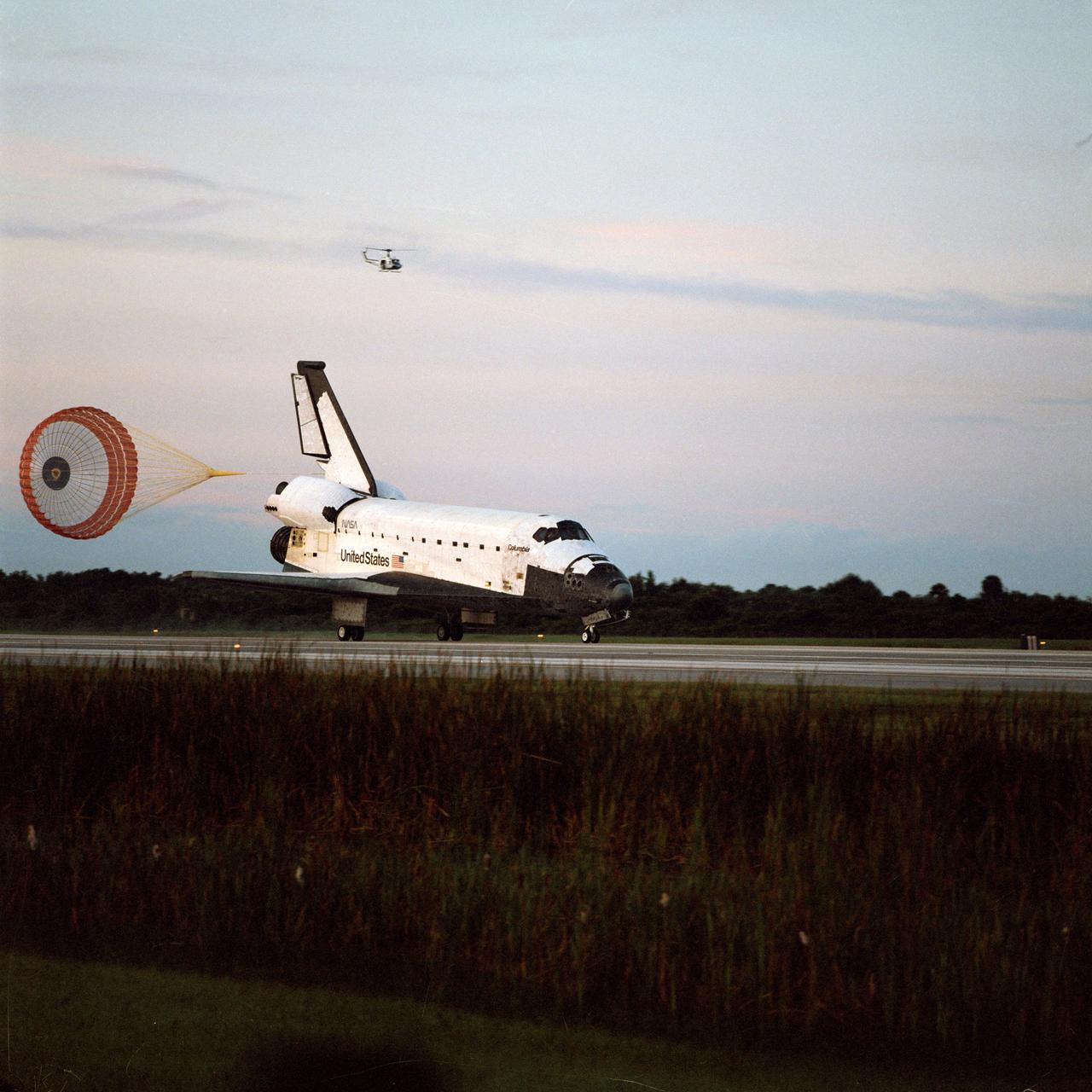
The Space Shuttle Columbia, Orbiter Vehicle (OV) 102, its drag chute fully deployed, completes a record duration mission as it lands on Runway 33 at the Kennedy Space Center (KSC) Shuttle Landing Facility (SLF). A helicopter flying overhead observes as OV-102's nose landing gear (NLG) and main landing gear (MLG) roll along the runway. Landing occurred at 6:38 am (Eastern Daylight Time (EDT)). STS-65 mission duration was 14 days 17 hours and 56 minutes. Onboard were six NASA astronauts and a Japanese payload specialist who conducted experiments in support of the International Microgravity Laboratory 2 (IML-2) during the mission.
STS-65 Columbia, OV-102, with drag chute deployed lands at KSC SLF
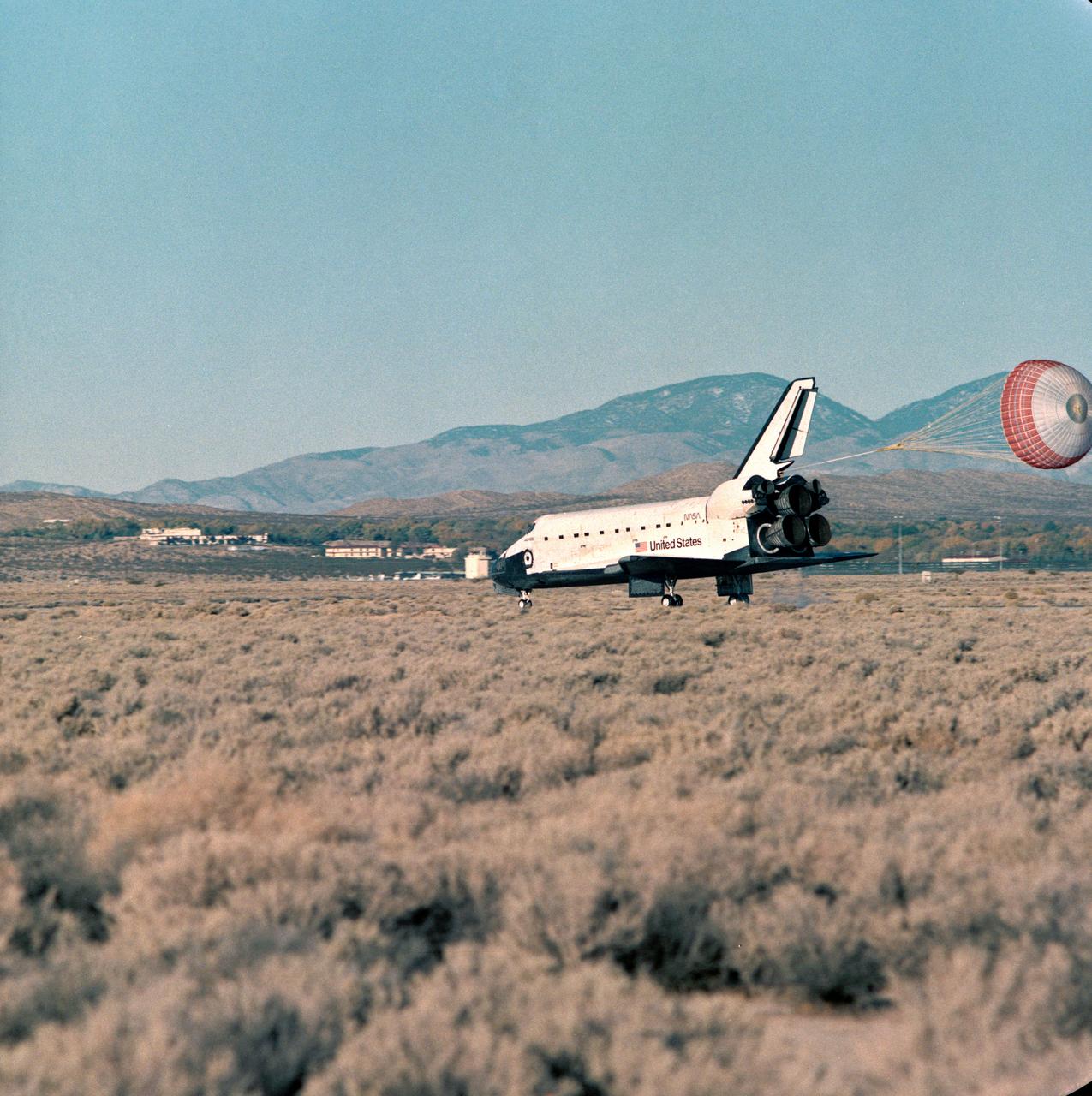
A drag chute slows the space shuttle Columbia as it rolls to a perfect landing concluding NASA's longest mission at that time, STS-58, at the Ames-Dryden Flight Research Facility (later redesignated the Dryden Flight Research Center), Edwards, California, with a 8:06 a.m. (PST) touchdown 1 November 1993 on Edward's concrete runway 22. The planned 14 day mission, which began with a launch from Kennedy Space Center, Florida, at 7:53 a.m. (PDT), October 18, was the second spacelab flight dedicated to life sciences research. Seven Columbia crewmembers performed a series of experiments to gain more knowledge on how the human body adapts to the weightless environment of space. Crewmembers on this flight included: John Blaha, commander; Rick Searfoss, pilot; payload commander Rhea Seddon; mission specialists Bill MacArthur, David Wolf, and Shannon Lucid; and payload specialist Martin Fettman.

STS-58 Landing at Edwards with Drag Chute
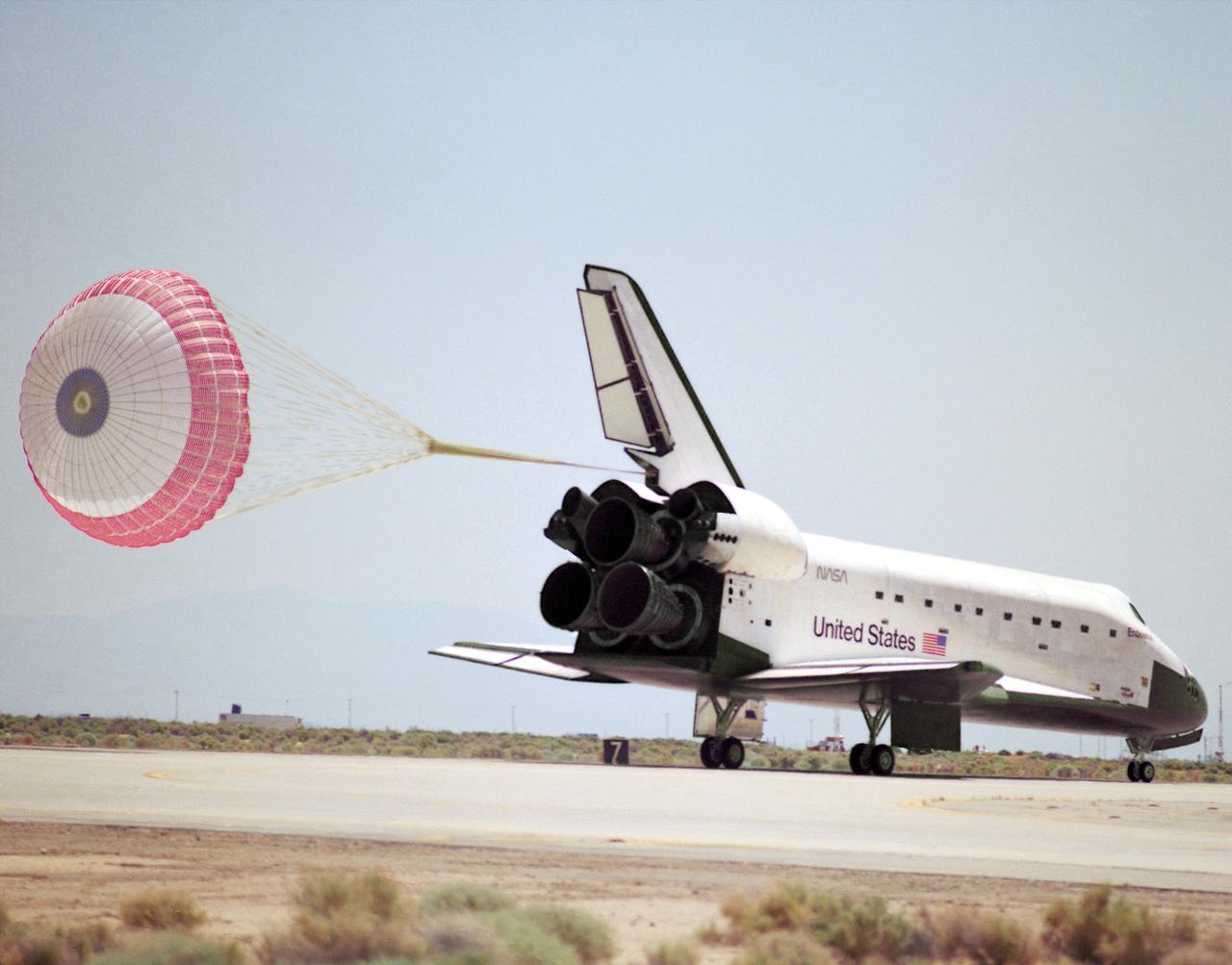
STS049-S-301 (16 May 1992) --- A three-quarter aft view of the Space Shuttle Endeavour making its first landing, following a successful nine-day mission in Earth orbit.  Fully deployed here is the main chute in NASA's first exercise of its detailed test objective (DTO-521) on the drag chute system. Main gear touchdown occurred at 1:57:38 p.m. (PDT), May 16, 1992.
STS-49 Endeavour, OV-105, drag chute deployment during landing at EAFB, Calif
The Space Shuttle Endeavour concludes mission STS-49 at NASA's Ames-Dryden Flight Research Facility (later redesignated Dryden Flight Research Center), Edwards, California, with a 1:57 p.m. (PDT) landing May 16 on Edward's concrete runway 22. The planned 7-day mission, which began with a launch from Kennedy Space Center, Florida, at 4:41 p.m. (PFT), 7 May, was extended two days to allow extra time to rescue the Intelsat VI satellite and complete Space Station assembly techniques originally planned. After a perfect rendezvous in orbit and numerous attempts to grab the satellite, space walking astronauts Pierre Thuot, Rick Hieb and Tom Akers successfully rescued it by hand on the third space walk with the support of mission specialists Kathy Thornton and Bruce Melnick. The three astronauts, on a record space walk, took hold of the satellite and directed it to the shuttle where a booster motor was attached to launch it to its proper orbit. Commander Dan Brandenstein and Pilot Kevin Chilton brought Endeavours's record setting maiden voyage to a perfect landing at Edwards with the first deployment of a drag chute on a shuttle mission.
STS-49 Landing at Edwards with First Drag Chute Landing
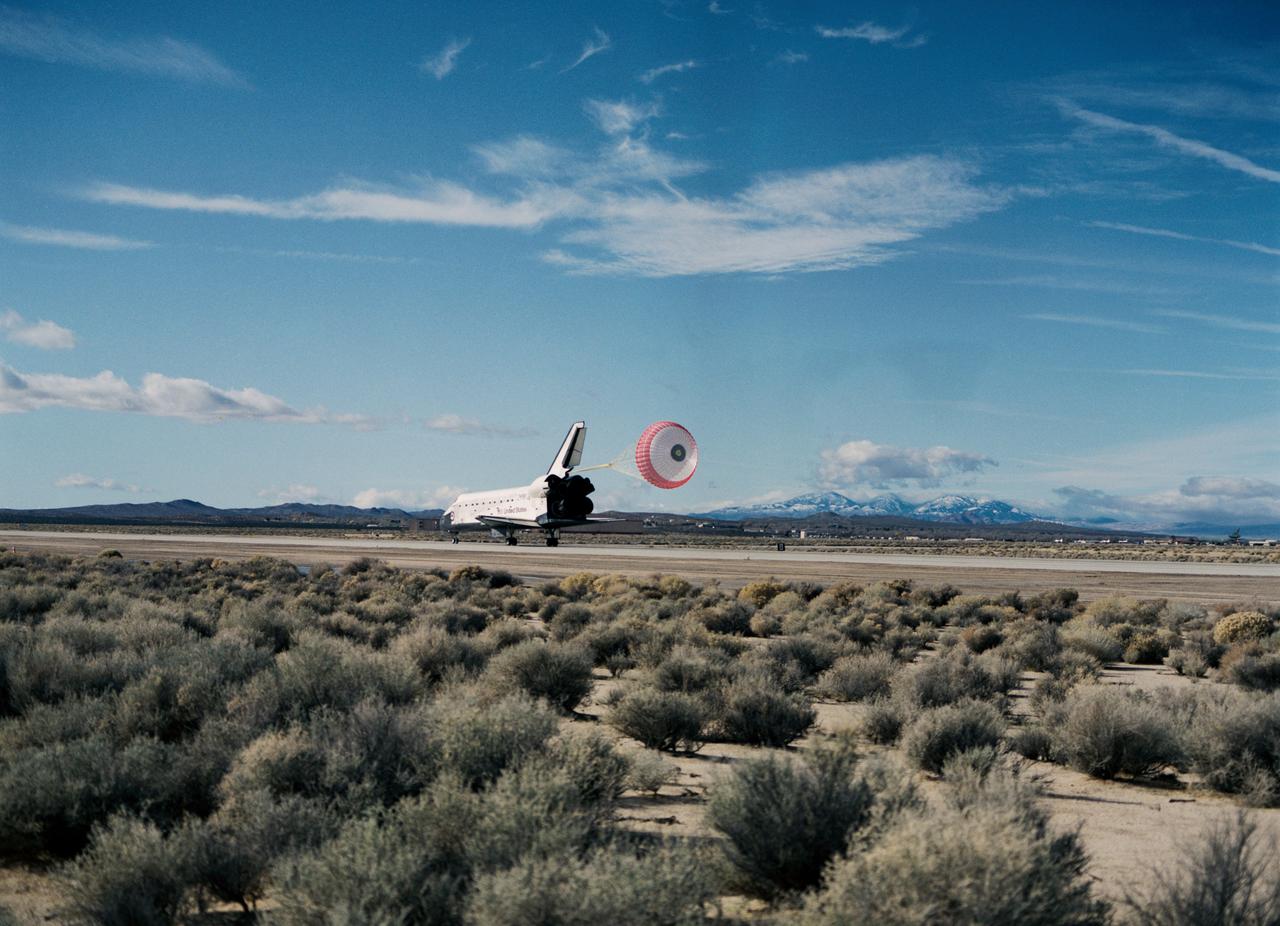
The space shuttle Atlantis lands with its drag chute deployed on runway 22 at Edwards, California, to complete the STS-66 mission dedicated to the third flight of the Atmospheric Laboratory for Applications and Science-3 (ATLAS-3), part of NASA's Mission to Planet Earth program. The astronauts also deployed and retrieved a free-flying satellite designed to study the middle and lower thermospheres and perform a series of experiments covering life sciences research and microgravity processing. The landing was at 7:34 a.m. (PST) 14 November 1994, after being waved off from the Kennedy Space Center, Florida, due to adverse weather.
STS-66 Edwards Landing with Drag Chute
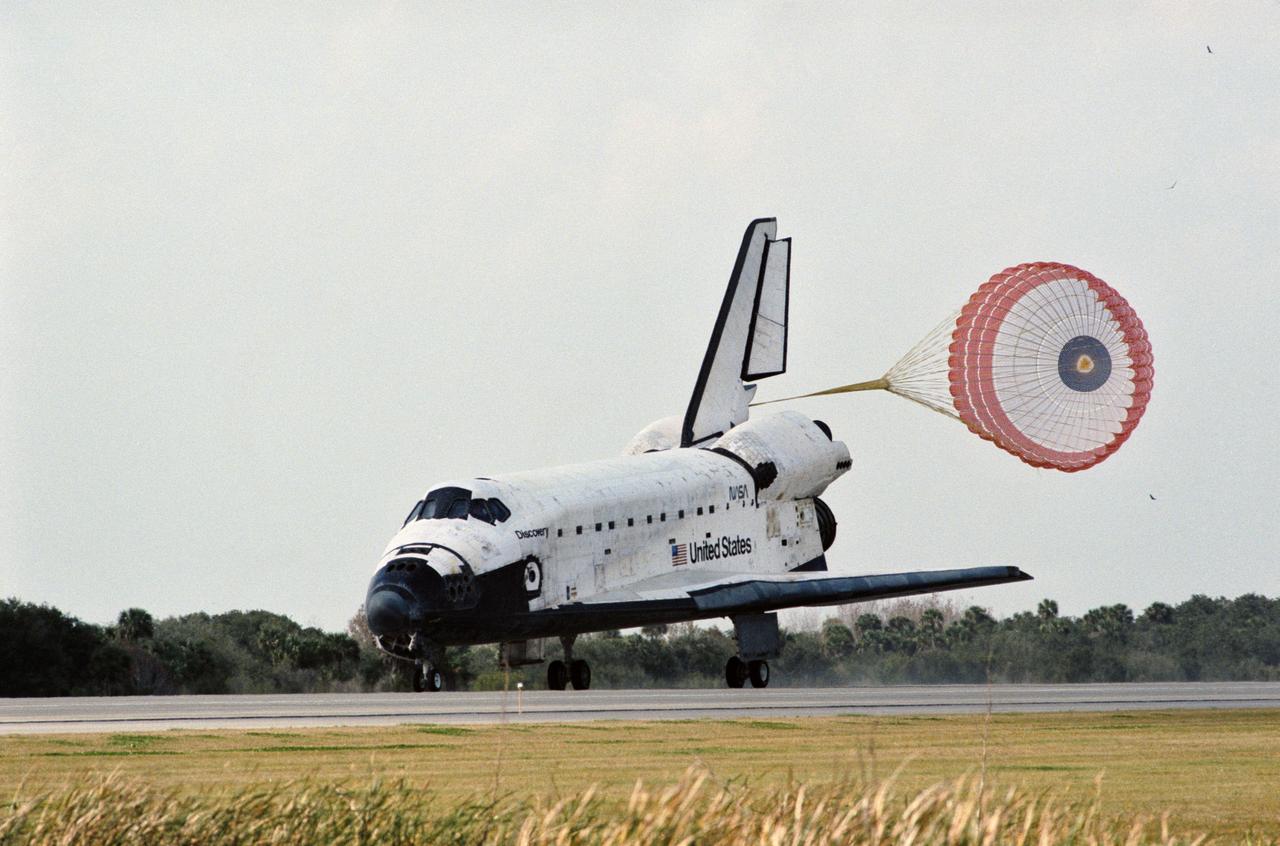
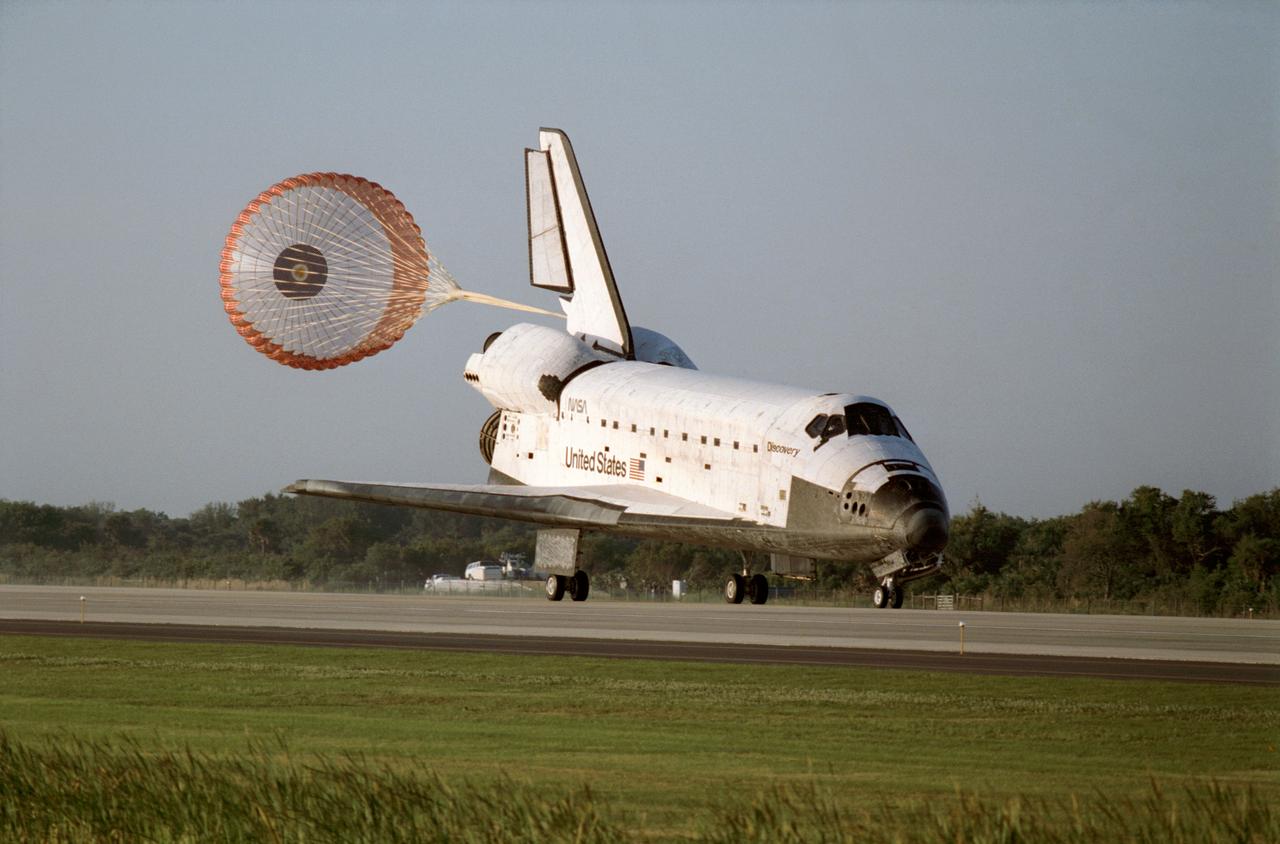
STS060-S-035 (11 Feb 1994) --- The drag chute for Space Shuttle Discovery is deployed on the Shuttle Landing Facility, marking an end to the eight-day STS-60 mission.  Landing occurred at 2:19:22 p.m. (EST).  Onboard were astronauts Charles F. Bolden Jr., Kenneth S. Reightler Jr., Franklin R. Chang-Diaz, N. Jan Davis and Ronald M. Sega along with Russian cosmonaut Sergei K. Krikalev.
Landing of STS-60 Space Shuttle Discovery at Kennedy Space Center
The Space Shuttle Atlantis' drag chute deploys as it rolls out on Runway 22 at Edwards AFB at the conclusion of its 13-day STS-117 mission to the ISS.
The Space Shuttle Atlantis' drag chute deploys as it rolls out on Runway 22 at Edwards AFB at the conclusion of its 13-day STS-117 mission to the ISS
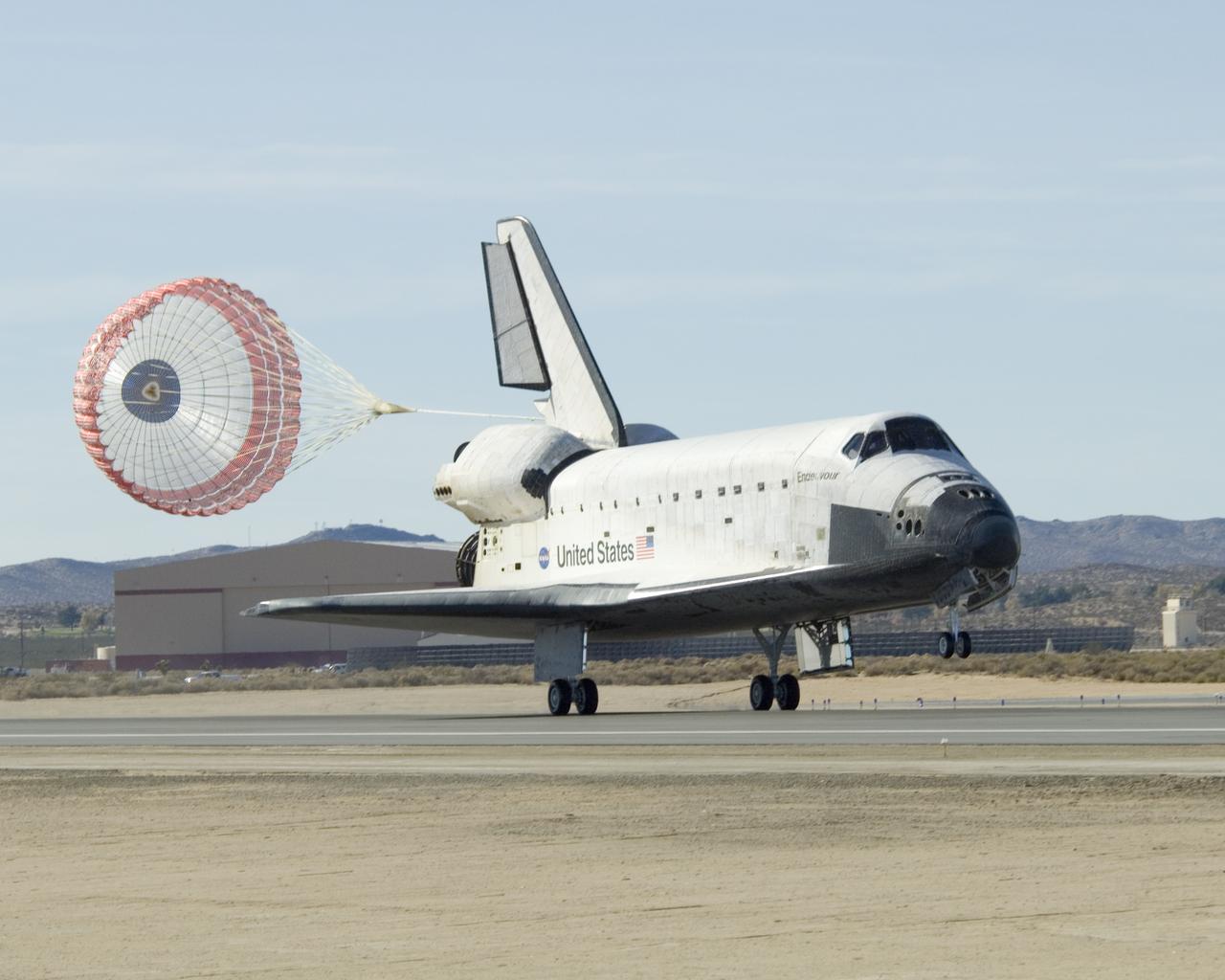
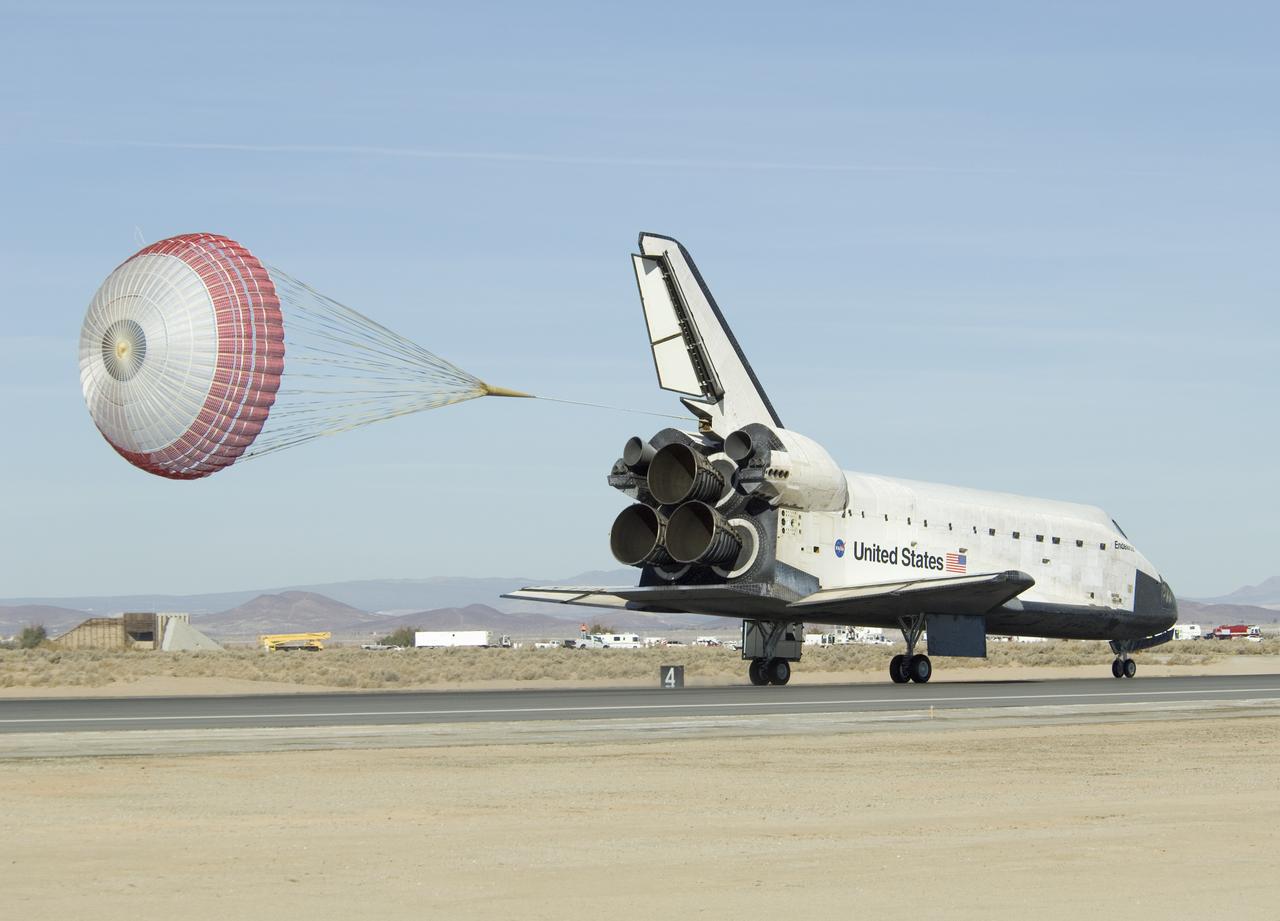
Space Shuttle Endeavour's drag chute deploys as it rolls down Runway 04-L at Edwards AFB moments after landing on Nov. 30, 2008.
Space Shuttle Endeavour's drag chute deploys as it rolls down Runway 04-L at Edwards AFB moments after landing on Nov. 30, 2008
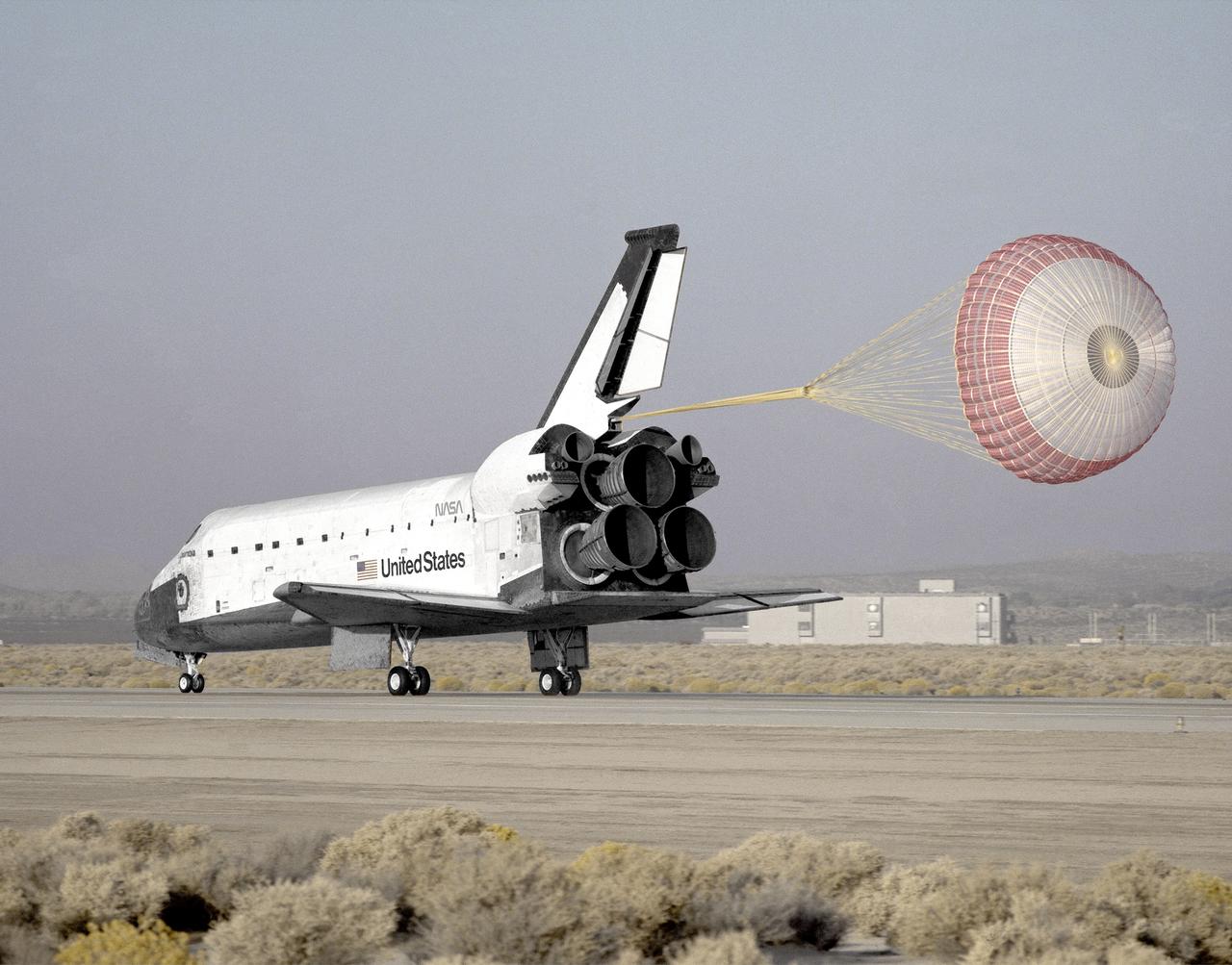
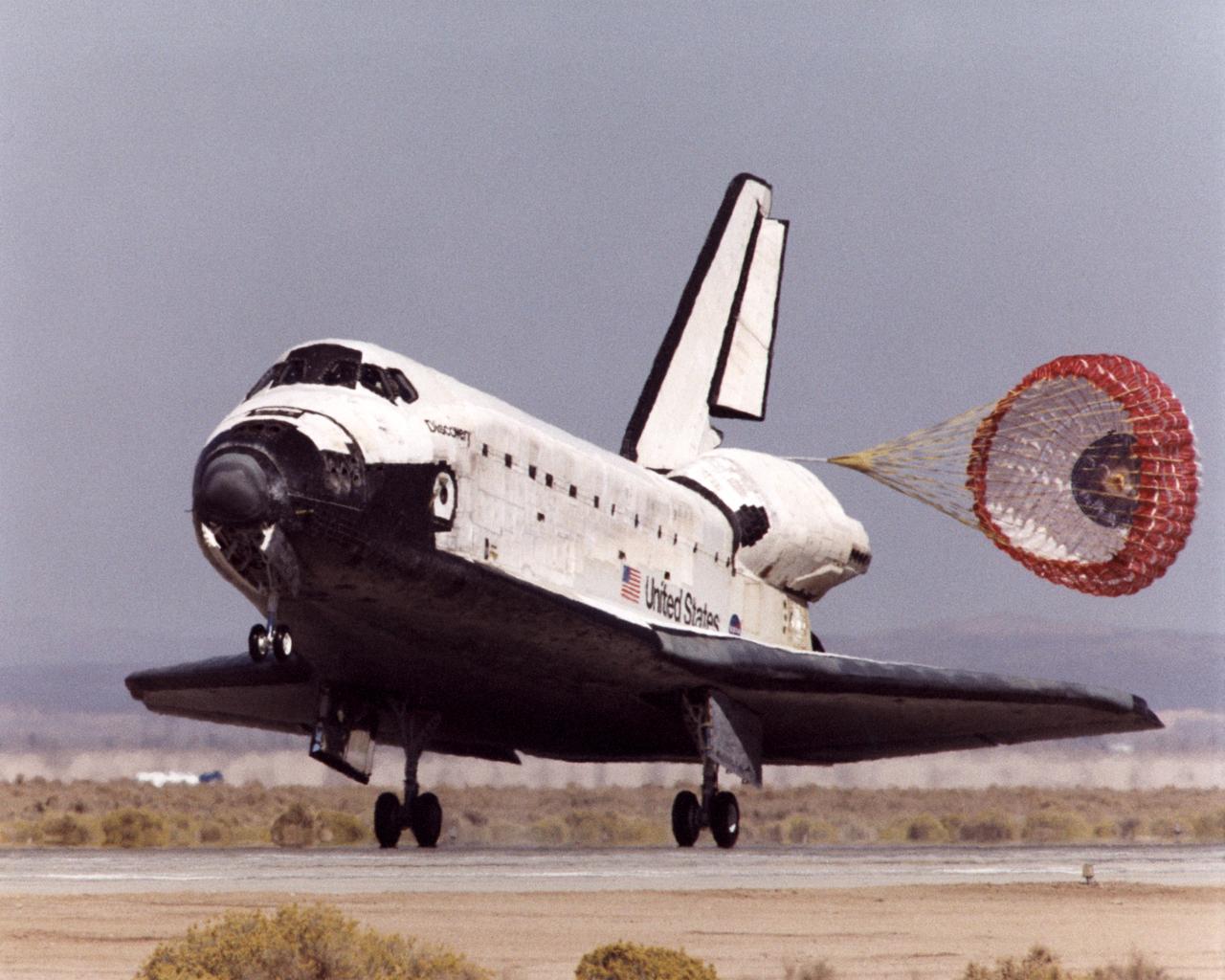
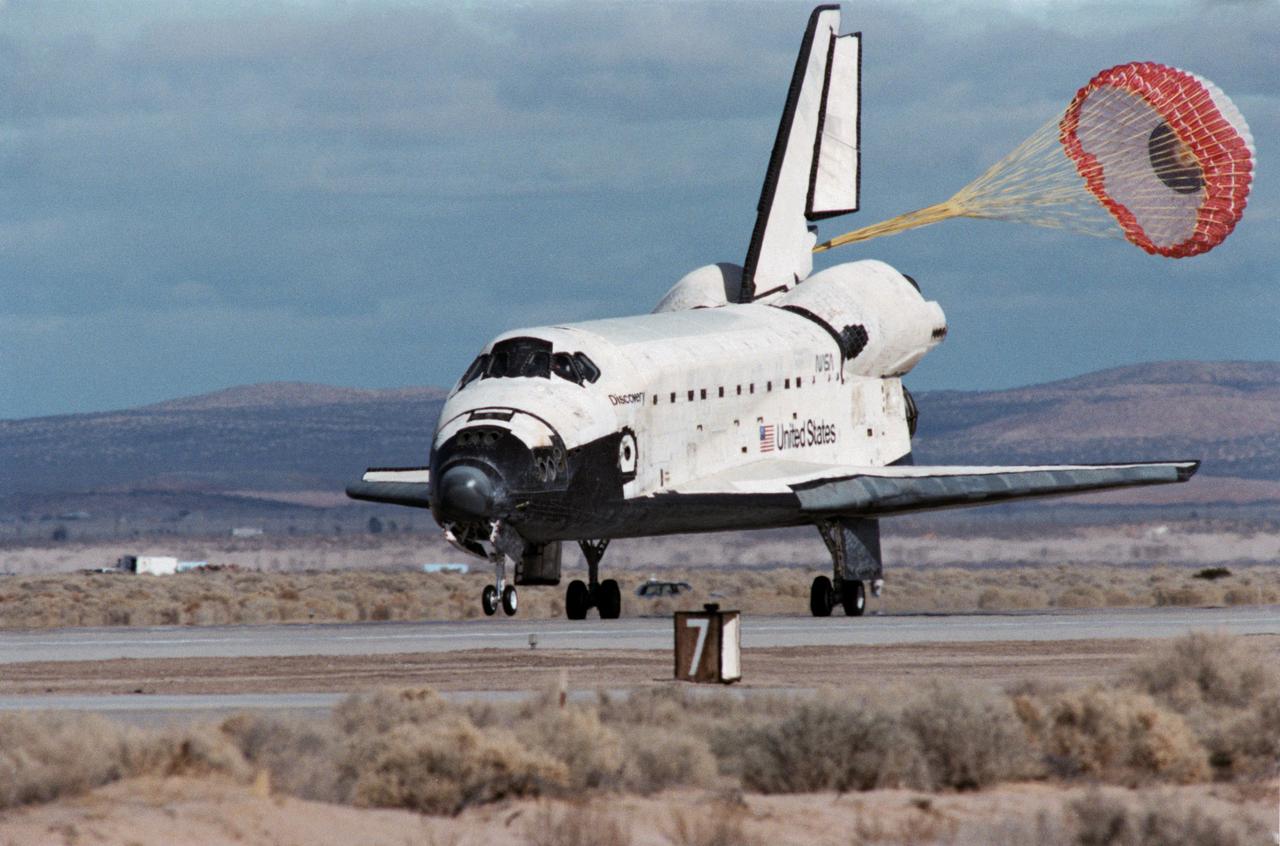
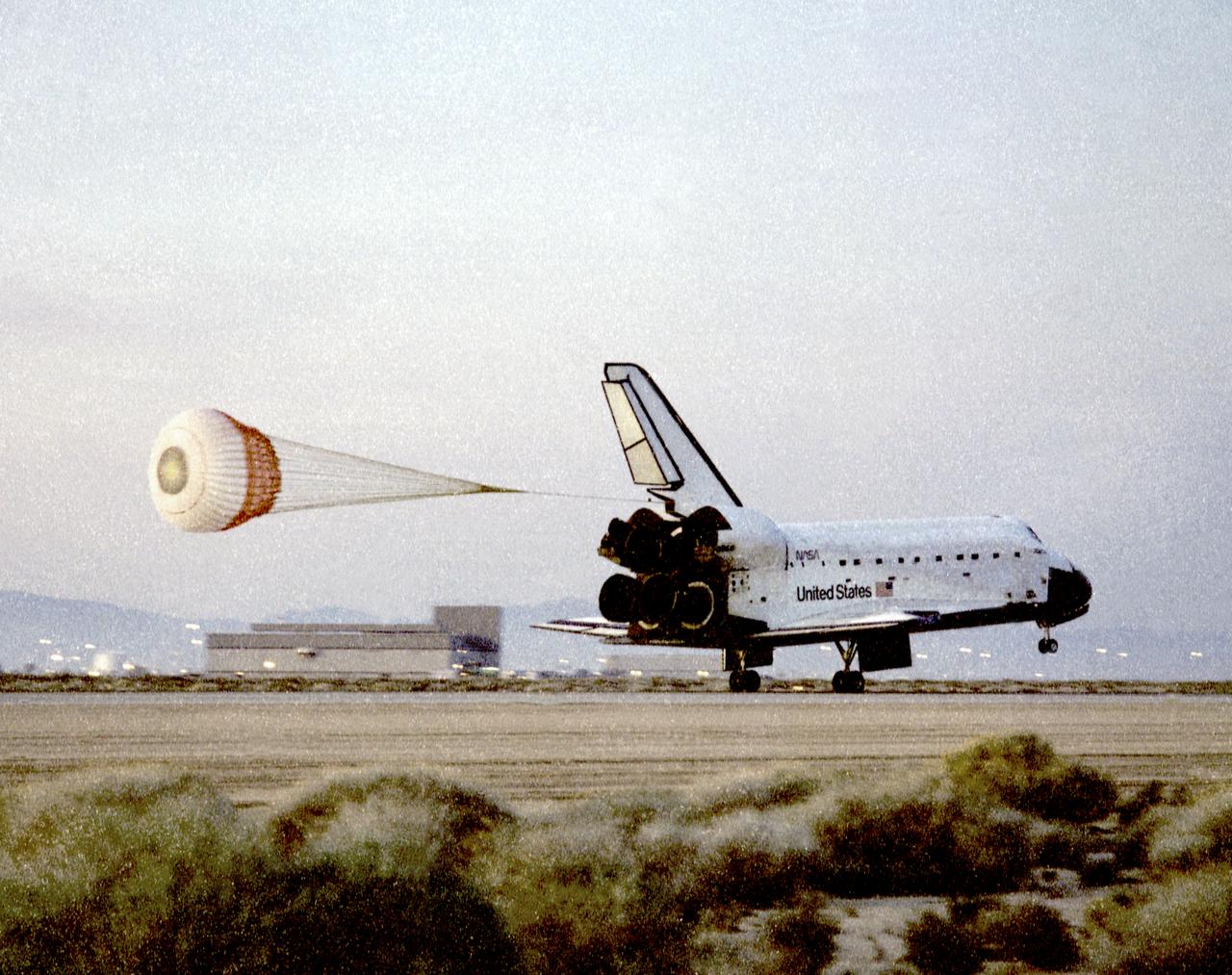
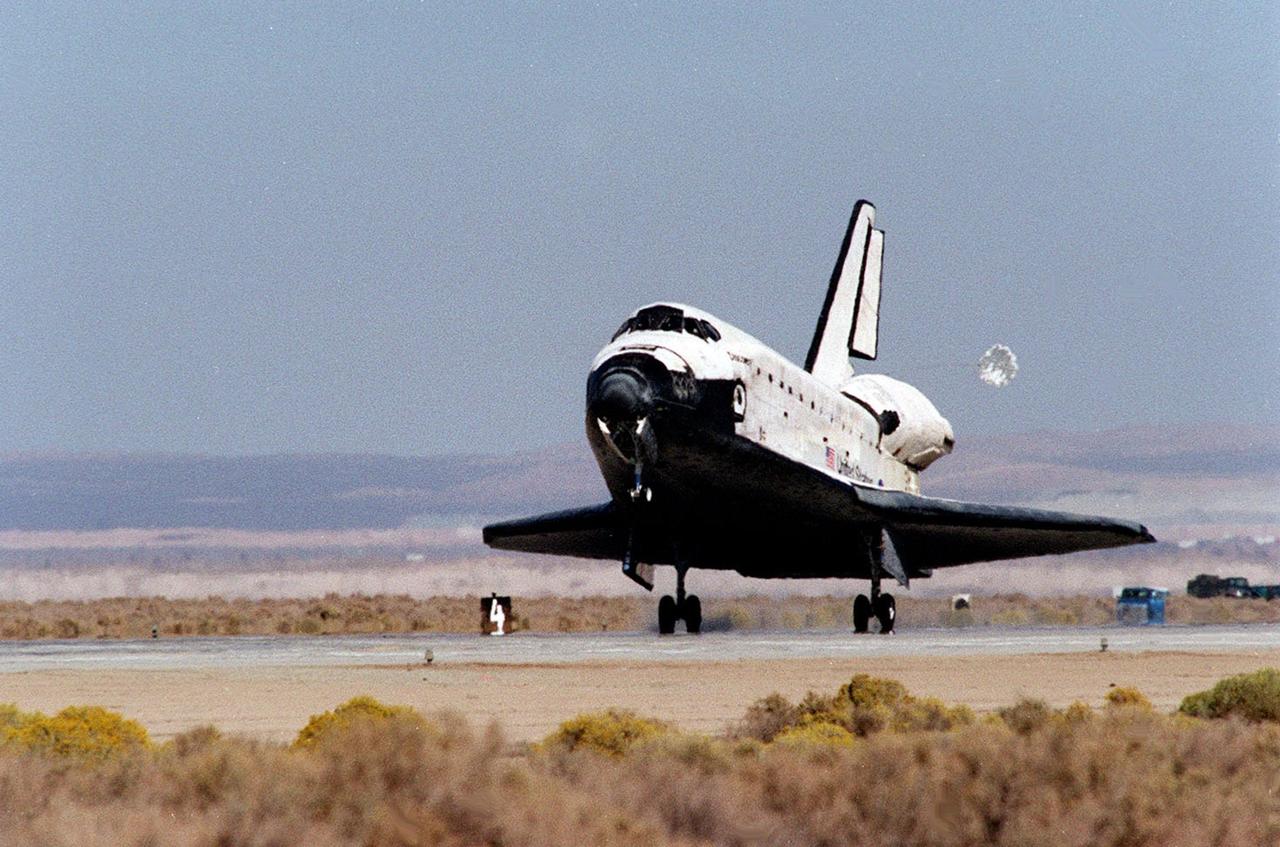
STS-53 Discovery, Orbiter Vehicle (OV) 103, is slowed by a red, white, and blue drag chute during its landing on concrete runway 22 at Edwards Air Force Base (EAFB), California. Main landing gear (MLG) touchdown occurred at 12:43:17 pm (Pacific Standard Time (PST)). This aft view of OV-103 shows the drag chute deployed from its compartment at the base of the vertical tail, the speedbrake/rudder flaps open, and the space shuttle main engines (SSMEs). Both MLG and nose landing gear (NLG) ride along the runway surface. Desert scrub brush appears in the foreground and mountains are seen in the background.
STS-53 Discovery, Orbiter Vehicle (OV) 103, lands on runway 22 at EAFB, Calif
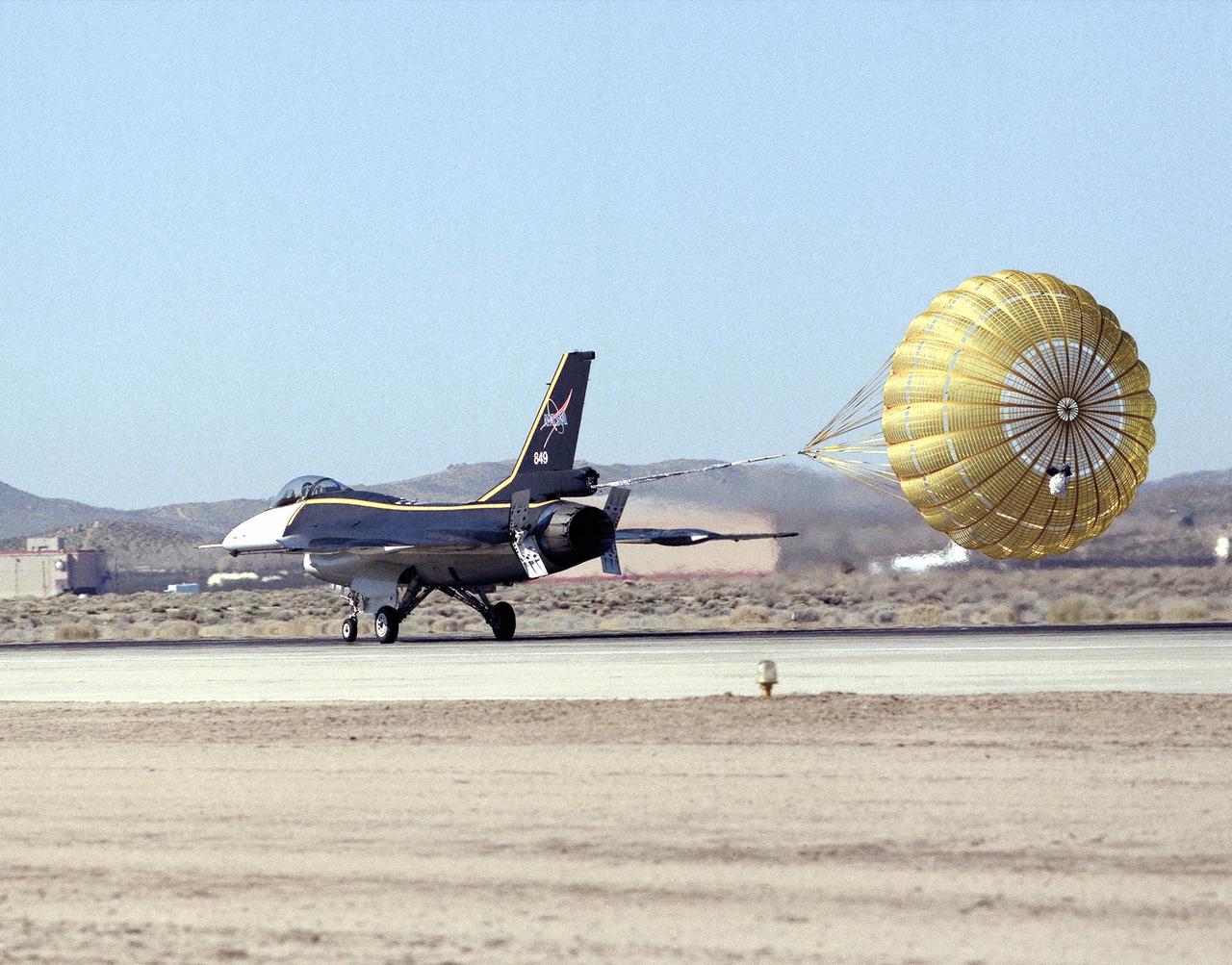
NASA's single-seat F-16XL makes a drag chute landing on the runway at Edwards Air Force Base in California's Mojave Desert. The aircraft was most recently used in the Cranked-Arrow Wing Aerodynamics Project (CAWAP) to test boundary layer pressures and distribution.  Previously it had been used in a program to investigate the characteristics of sonic booms for NASA's High Speed Research Program. Data from the program will be used in the development of a high speed civilian transport. During the series of sonic boom research flights, the F-16XL was used to probe the shock waves being generated by a NASA SR-71 and record their shape and intensity.
EC95-42960-5
STS052-S-099 (1 Nov. 1992) --- This three-quarter front view shows the Space Shuttle Columbia just after deployment of the drag chute during landing at KSC's Shuttle Landing Facility. Onboard were a crew of five NASA astronauts and a Canadian payload specialist. Landing occurred at 9:05:53 a.m. (EST), November 1, 1992. Crewmembers are astronauts James D. Wetherbee, Michael A. Baker, Tamara E. Jernigan, Charles L. (Lacy) Veach and William M. Shepherd along with payload specialist Steven G.  MacLean. The photo was taken with a 35mm camera.
STS-52 Columbia, Orbiter Vehicle (OV) 102, lands on runway 33 at KSC SLF
STS054-S-100 (19 Jan 1993) --- The drag chute is fully deployed as the Space Shuttle Endeavour rolls toward wheelstop at KSC's Shuttle landing facility. Landing occurred at 8:38 a.m. (EST), Jan. 19, 1993.  Onboard for the six-day mission were astronauts John H. Casper, mission commander, Donald R. McMonagle, pilot, Gregory J. Harbaugh, Mario Runco Jr. and Susan J. Helms, mission specialists.
STS-54 Endeavour, Orbiter Vehicle (OV) 105, lands on runway 33 at KSC's SLF
STS054-S-101 (19 Jan 1993) --- The drag chute is just about to be released as the Space Shuttle Endeavour rolls toward wheelstop at KSC's Shuttle landing facility. Landing occurred at 8:38 a.m. (EST), Jan. 19, 1993.  Onboard for the six-day mission were astronauts John H. Casper, mission commander, Donald R. McMonagle, pilot, Gregory J. Harbaugh, Mario Runco Jr. and Susan J. Helms, mission specialists.
STS-54 Endeavour, Orbiter Vehicle (OV) 105, lands on runway 33 at KSC's SLF
With its drag parachute deployed to help slow it down, the Space Shuttle Discovery rolls down the runway after landing at Edwards Air Force Base in Southern California at the conclusion of mission STS-92 on October 24, 2000.
STS-92 - Landing at Edwards Air Force Base
STS066-S-039 (14 November 1994) --- The drag chute is fully deployed as the Space Shuttle Atlantis heads toward a stop at Edwards Air Force Base in southern California, ending a successful 10 day, 22 hour and 34 minute space mission.  Landing occurred at 7:34 a.m. (PST), November 14, 1994.  Onboard were astronauts Donald R. McMonagle, commander; Curtis L. Brown, Jr., pilot; Ellen S. Ochoa, payload commander; Scott E. Parazynski and Joseph R. Tanner, both mission specialists, along with European Space Agency (ESA) mission specialist Jean-Francois Clervoy.  The crew supported the Atmospheric Laboratory for Applications and Science (ATLAS-3) mission.
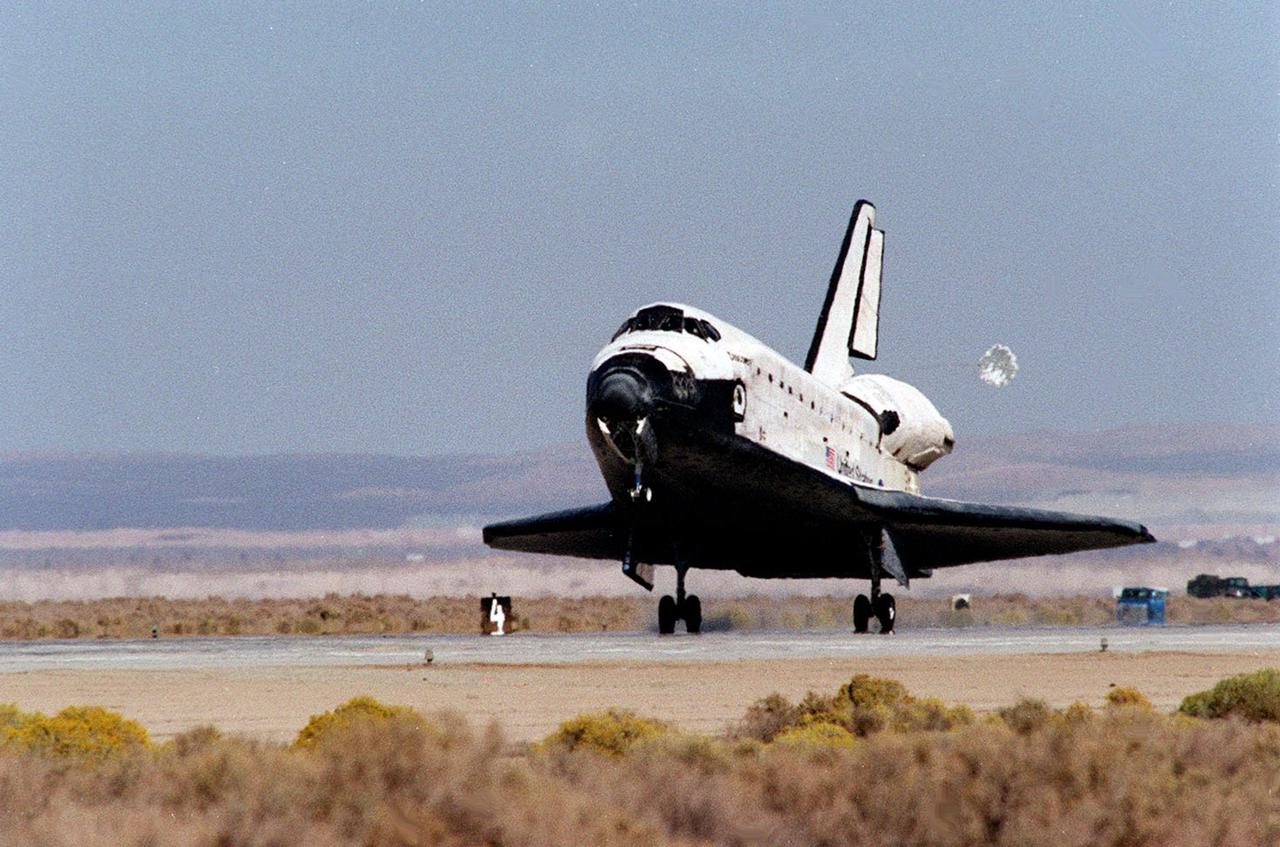
STS-66 landing at Edwards Air Force Base
Space Shuttle Endeavour's drag chute streams behind as it rolls down on Runway 04-L at Edwards AFB to conclude mission STS-126 on Nov. 30, 2008.
Space Shuttle Endeavour's drag chute streams behind as it rolls down on Runway 04-L at Edwards AFB to conclude mission STS-126 on Nov. 30, 2008
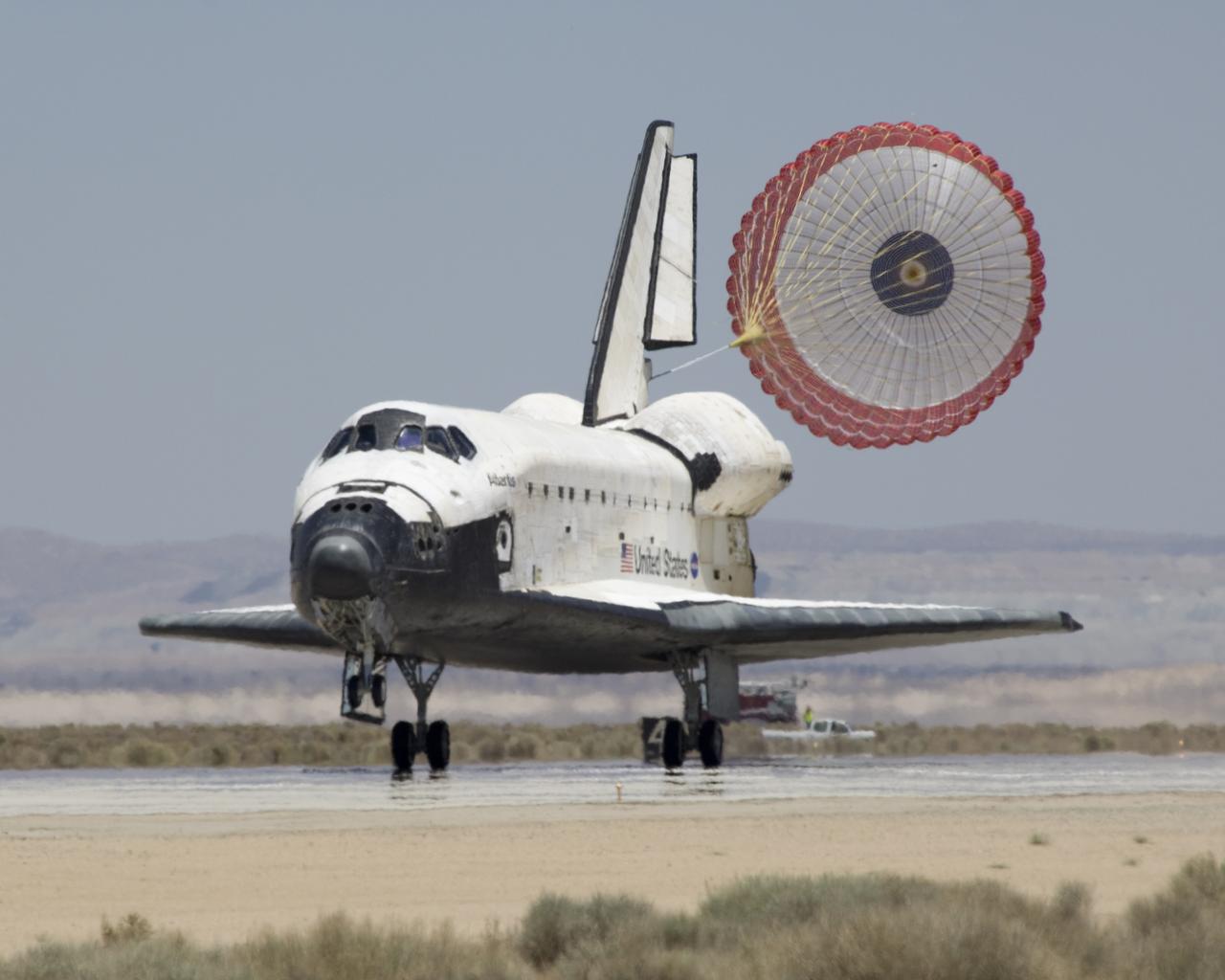
The Space Shuttle Endeavour's drag chute deploys to slow the orbiter as it rolls out on Runway 22 at Edwards Air Force Base at the conclusion of its 14-day STS-111 mission to the International Space Station.
The Space Shuttle Endeavour's drag chute deploys to slow the orbiter as it rolls out on Runway 22 at Edwards Air Force Base at the conclusion of its 14-day STS-111 mission to the International Space Station
The Space Shuttle Endeavour's drag chute deploys to slow the orbiter as it rolls out on Runway 22 at Edwards Air Force Base at the conclusion of its 14-day STS-111 mission to the International Space Station.
The Space Shuttle Endeavour's drag chute deploys to slow the orbiter as it rolls out on Runway 22 at Edwards Air Force Base at the conclusion of its 14-day STS-111 mission to the International Space Station
STS100-S-020 (1 May 2001) --- The drag chute on the space shuttle Endeavour helps to slow the vehicle down as it eases to the completion of the STS-100 mission on a desert runway at Edwards Air Force Base in California. Touchdown occurred at 9:11 a.m. (PDT), May 1, 2001. Onboard the shuttle were six NASA astronauts and a cosmonaut representing Rosaviakosmos. Photo credit: NASA
View of Endeavour deploying its drag chute during STS-100's landing at Edwards AFB
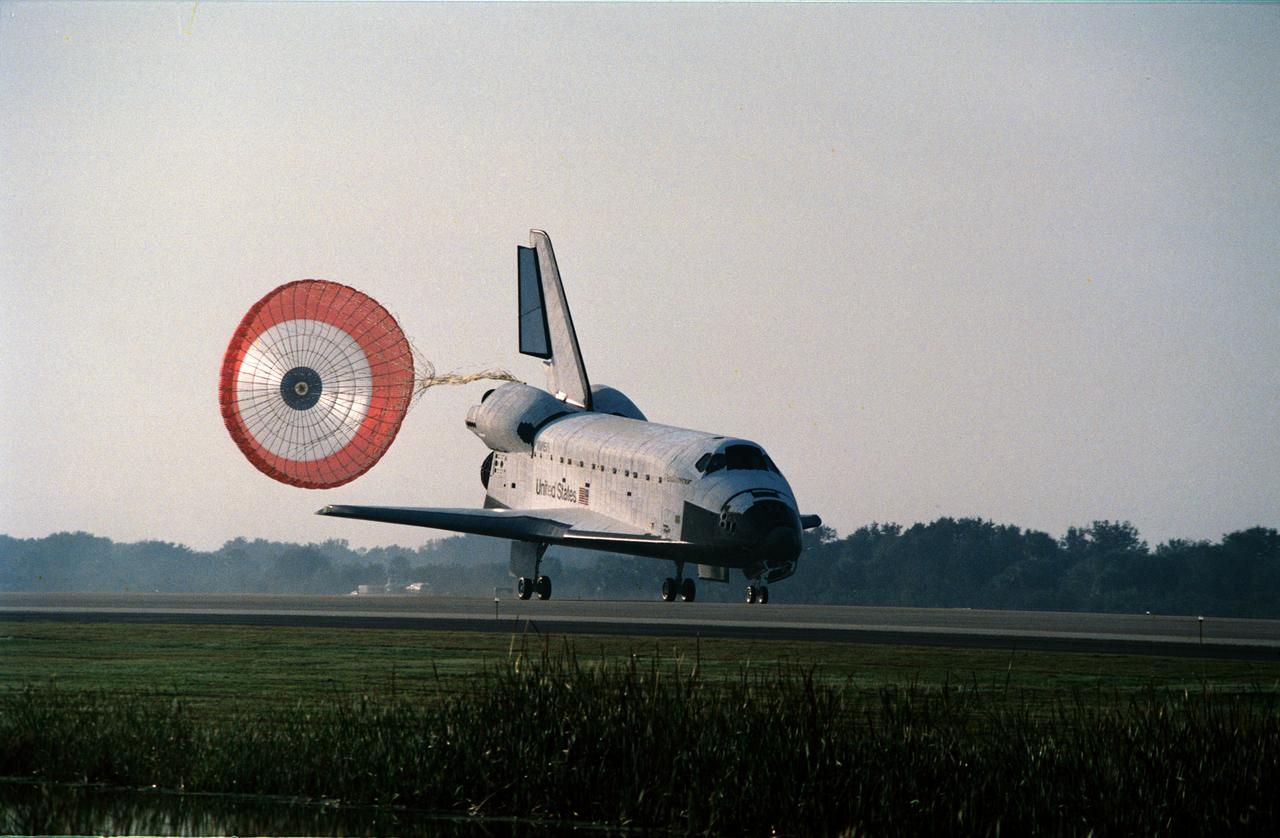
STS056-S-098 (17 April 1993) --- The drag chute is deployed following landing of the Space Shuttle Discovery on the Shuttle landing facility at the Kennedy Space Center to complete the STS-56\Atlas 2 mission.  Touchdown occurred at 7:37 a.m. (EDT).  Onboard the spacecraft were astronauts Kenneth D. Cameron, commander; Stephen S. Oswald, pilot; and C. Michael Foale, Ellen Ochoa and Kenneth D. Cockrell, mission specialists.
STS-56 Discovery, OV-103, with drag chute deployed lands on KSC SLF runway 33
STS055-S-089 (6 May 1993) --- The main drag chute on the Space Shuttle Columbia is almost fully deployed in this three-quarter aft view of the vehicle's runway landing at Edwards Air Force Base in California.  Landing occurred at 7:30 a.m. (PDT), May 6, 1993.  Onboard the spacecraft were astronauts Steven R. Nagel, Terence T. (Tom) Henricks, Jerry L. Ross, Bernard Harris Jr. and Charles J. Precourt, along with German payload specialists Hans Schlegel and Ulrich Walter.
STS-55 Columbia, OV-102, drag chute deployment during landing at EAFB, Calif
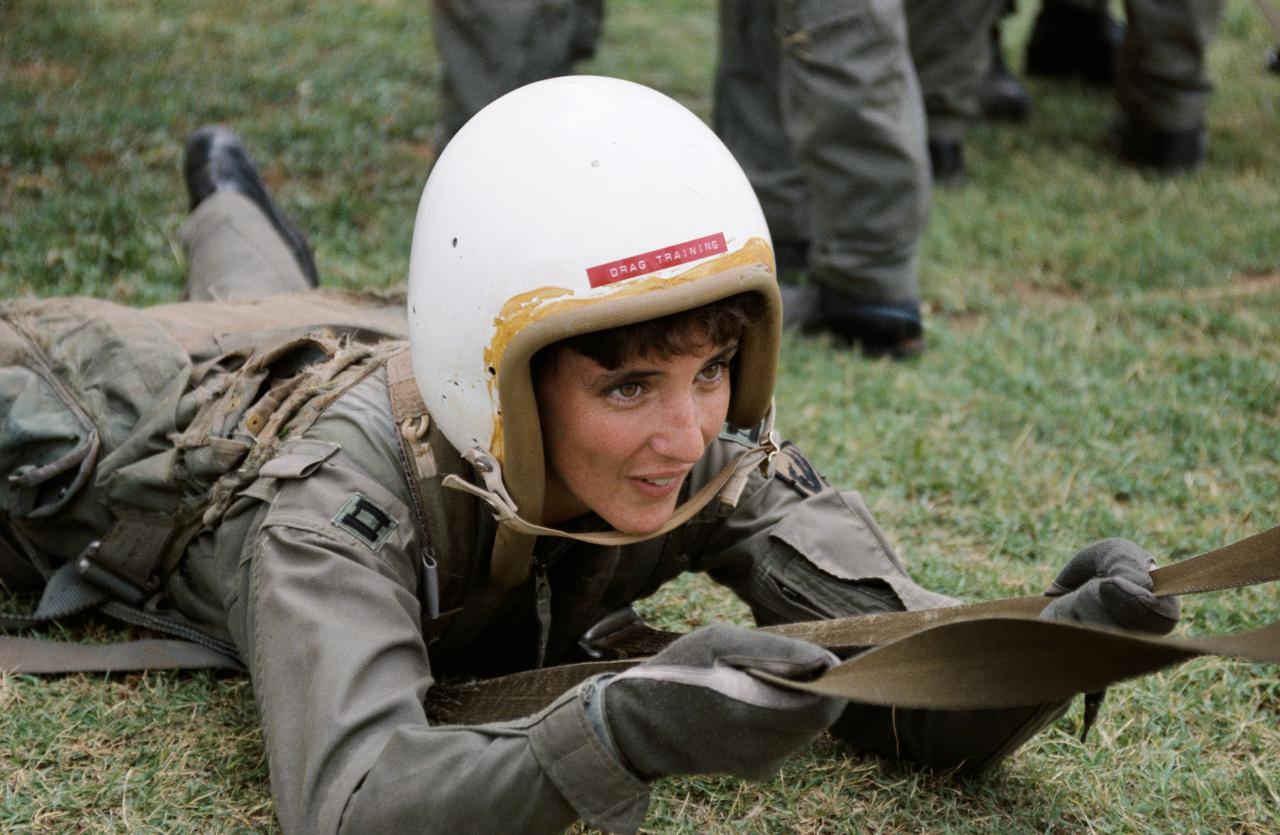
S90-45883 (29-31 July 1990) --- Nancy J. Sherlock, one of 23 astronaut candidates who began a year's training and evaluation in July, participates in one of many sessions at a survival training course at Vance Air Force Base.  Sherlock is about to take part in parachute drag training.  The overall course is designed to familiarize the trainees with procedures to follow in the event of an emergency ejection from a jet aircraft.
Group 13 1990 ASCAN Sherlock during Vance AFB parachute drag training
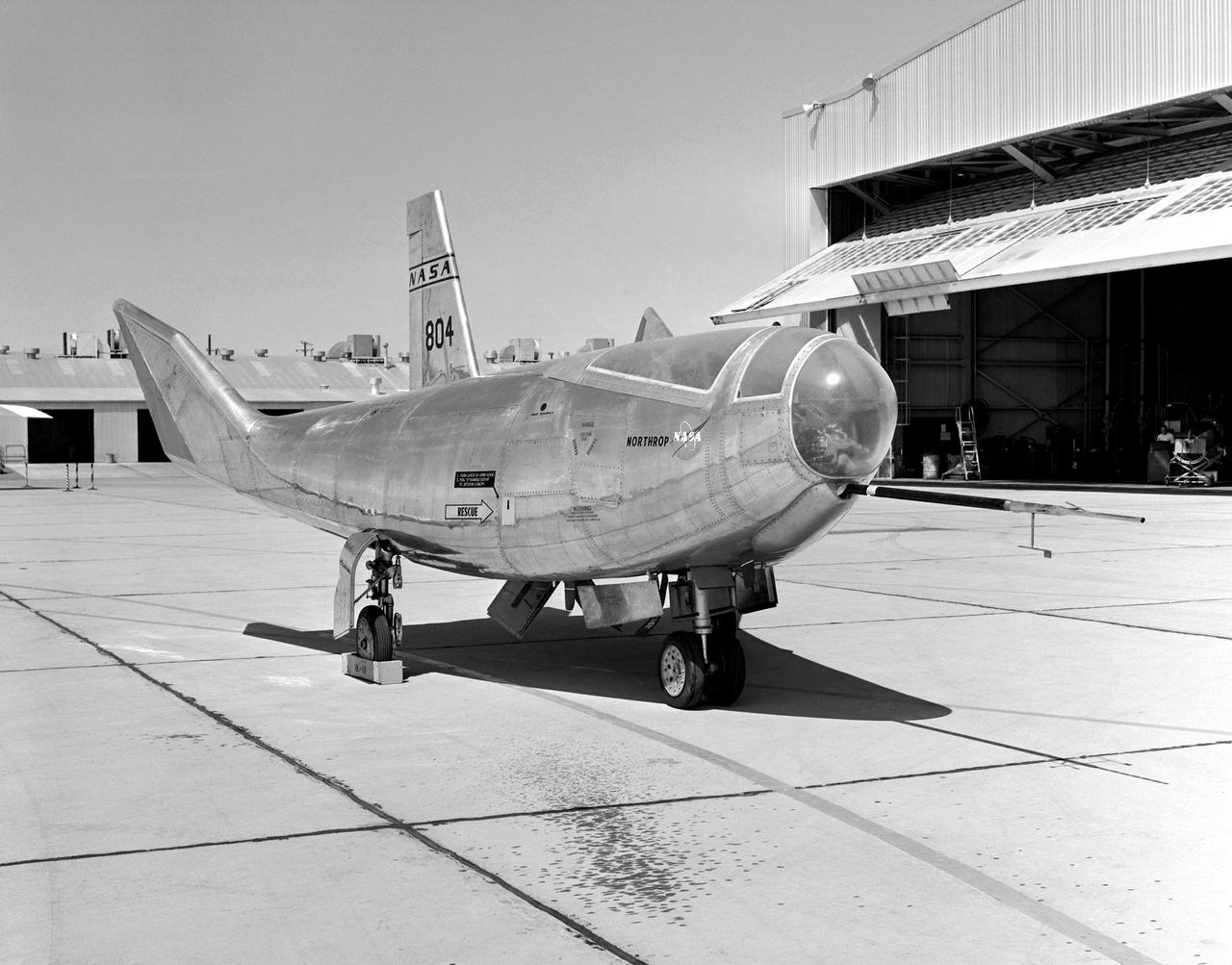
The HL-10, seen here parked on the ramp, was one of five lifting body designs flown at NASA's Dryden Flight Research Center, Edwards, California, from July 1966 to November 1975 to study and validate the concept of safely maneuvering and landing a low lift-over-drag vehicle designed for reentry from space.
E-14969
STS053-S-085 (9 Dec. 1992) --- The drag chute on the space shuttle Discovery is partially deployed during landing on Runway 22 at Edwards Air Force Base. The landing ended an eight-day space mission for the STS-53 crew. Main gear touchdown occurred at 12:43:17 p.m. (PST) on Dec. 9, 1992. Onboard were astronauts David M. Walker, Robert D. Cabana, Guion S. Bluford Jr., James S. Voss and Michael R.U. (Rich) Clifford.
STS-53 Discovery, Orbiter Vehicle (OV) 103, lands on runway 22 at EAFB, Calif
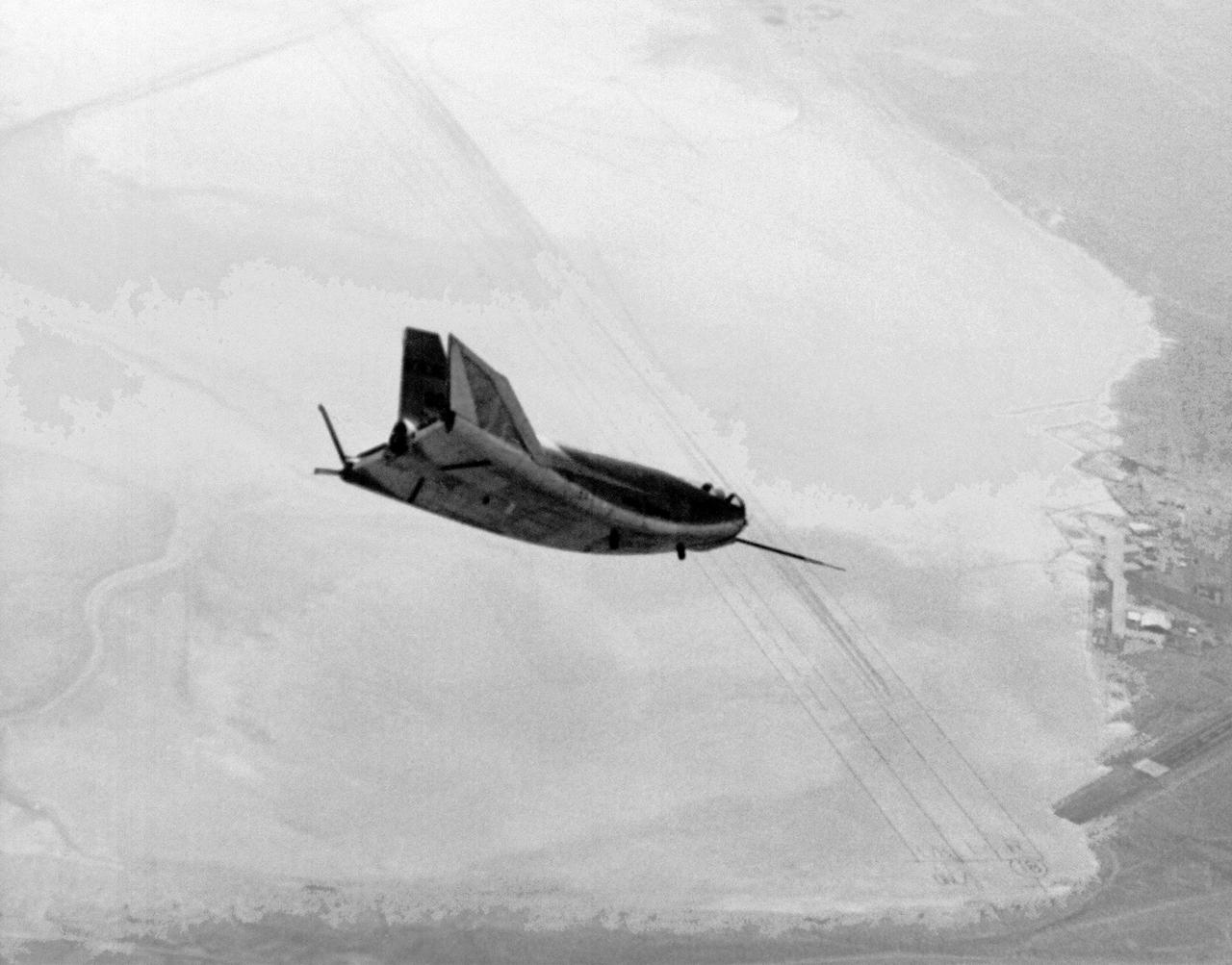
The HL-10 Lifting Body is seen here in flight over Rogers Dry lakebed. Like the other lifting bodies, the HL-10 made a steep descent toward the lakebed, followed by a high-speed landing. This was due to the vehicle's low lift-over-drag ratio. The first 11 flights of the HL-10 were unpowered, flown to check the vehicle's handling and stability before rocket-powered flights began using the XLR-11 rocket engine.
E-21089
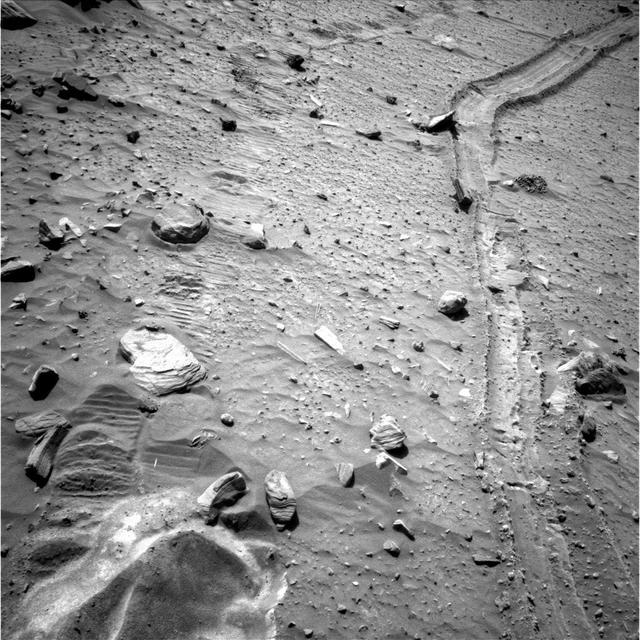
This view from the navigation camera near the top of the mast on NASA Mars Exploration Rover Spirit shows the tracks left by the rover as it drove southward and backward, dragging its inoperable right-front wheel.
Tracks in, Path out?
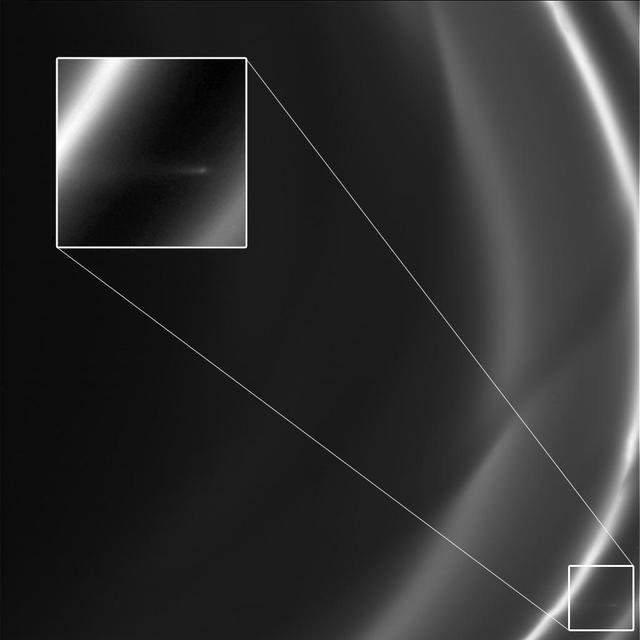
This image obtained by NASA Cassini spacecraft around the time it went into orbit around Saturn in 2004 shows a short trail of icy particles dragged out from Saturn F ring.
Small Trail at Saturn Orbit Insertion
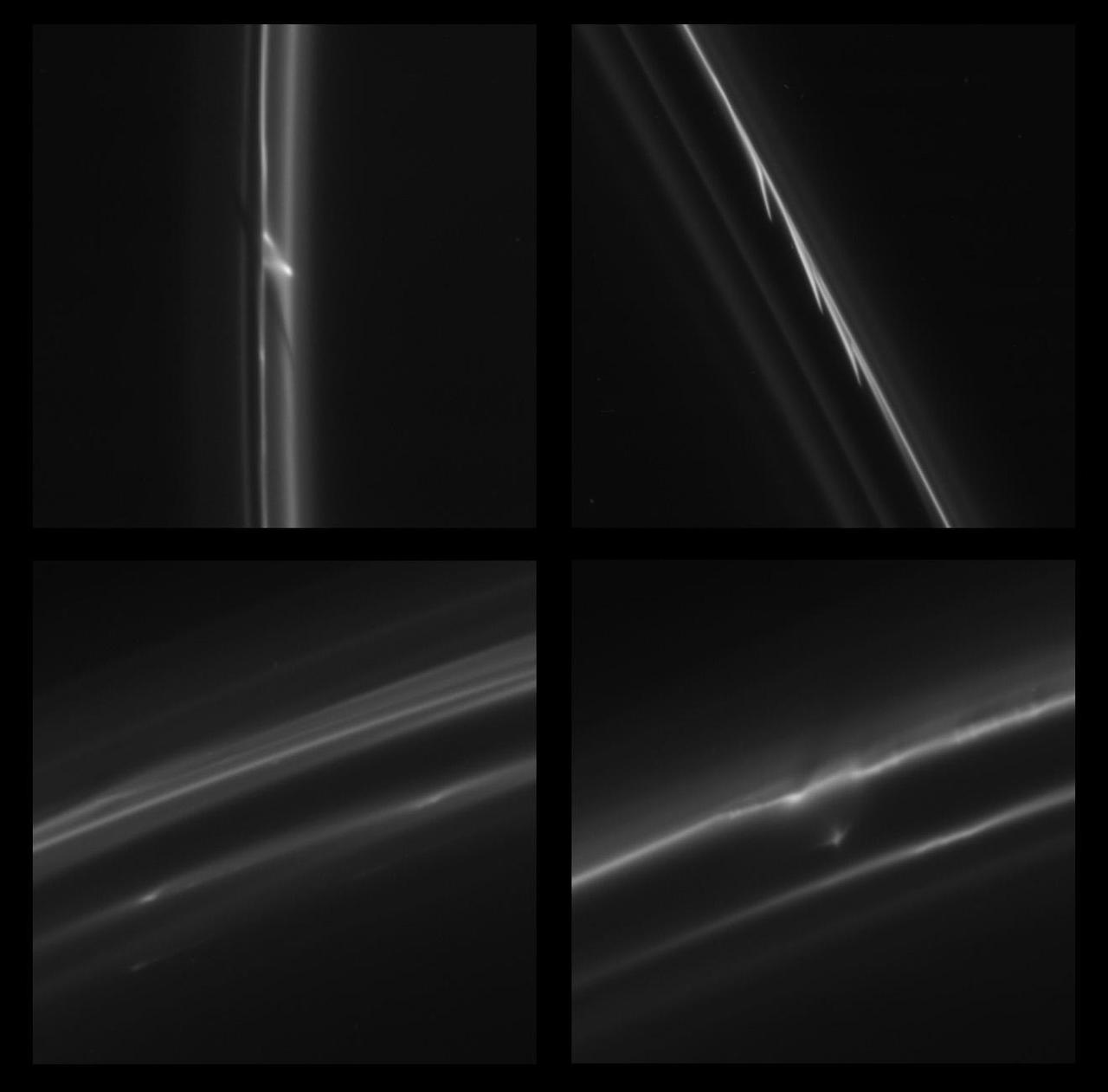
This image obtained by NASA Cassini spacecraft shows some of the more bizarre trails that were dragged out from Saturn F ring by objects about a half mile 1 kilometer in diameter.
Exotic Trails or Mini-Jets
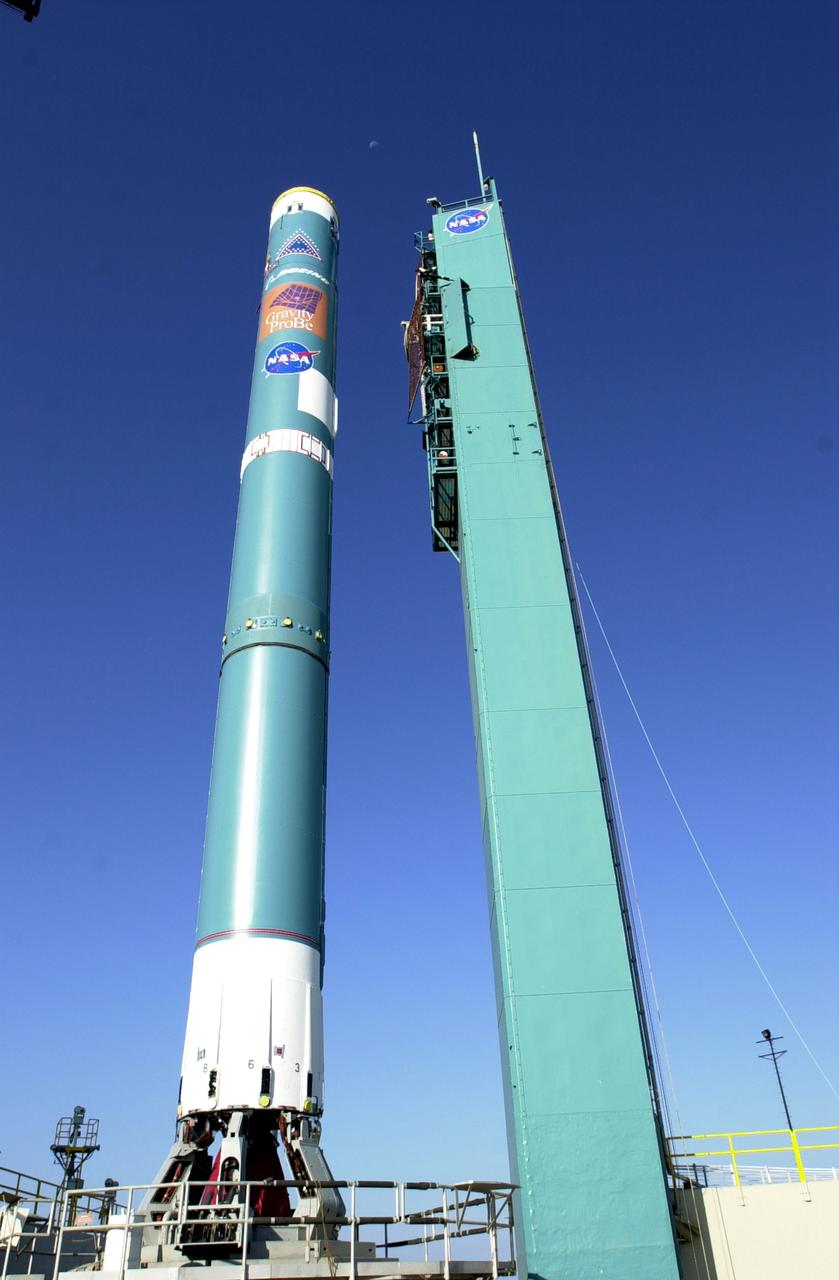
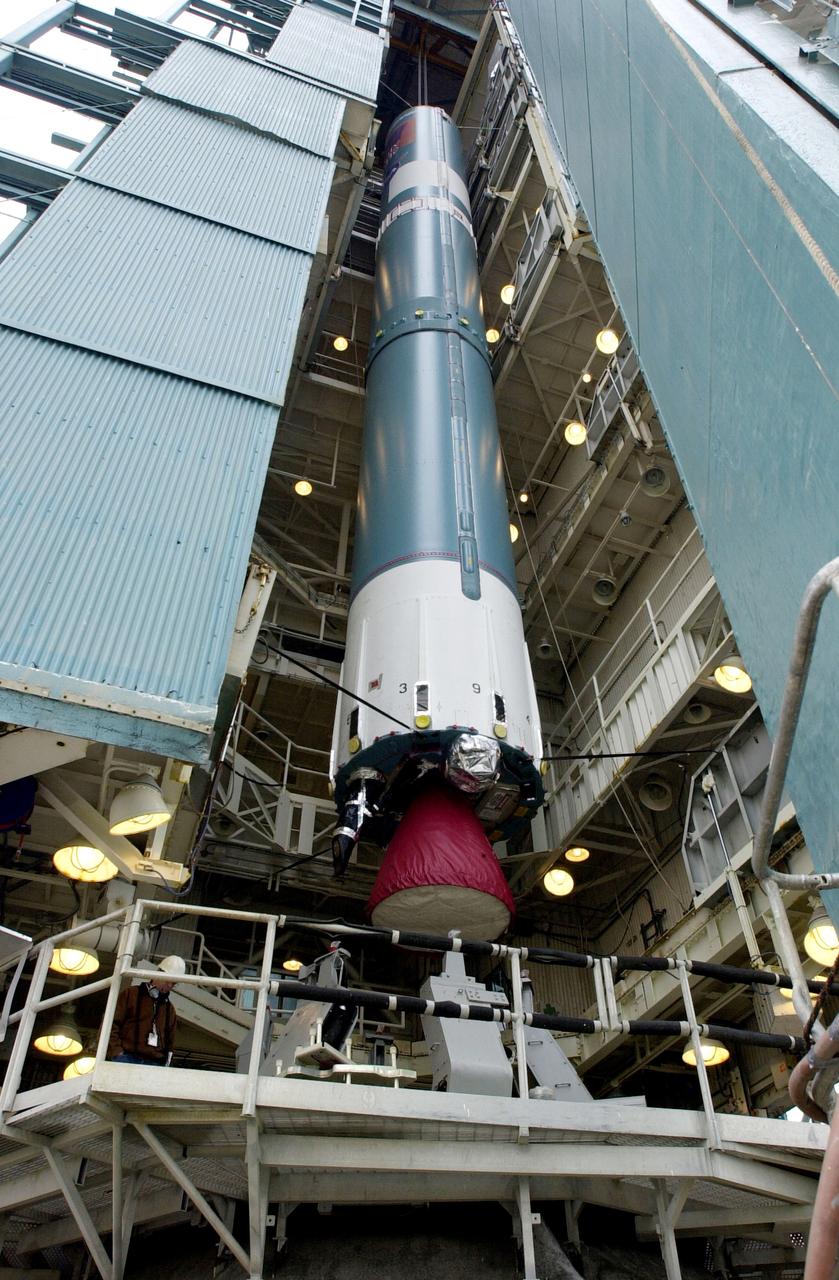
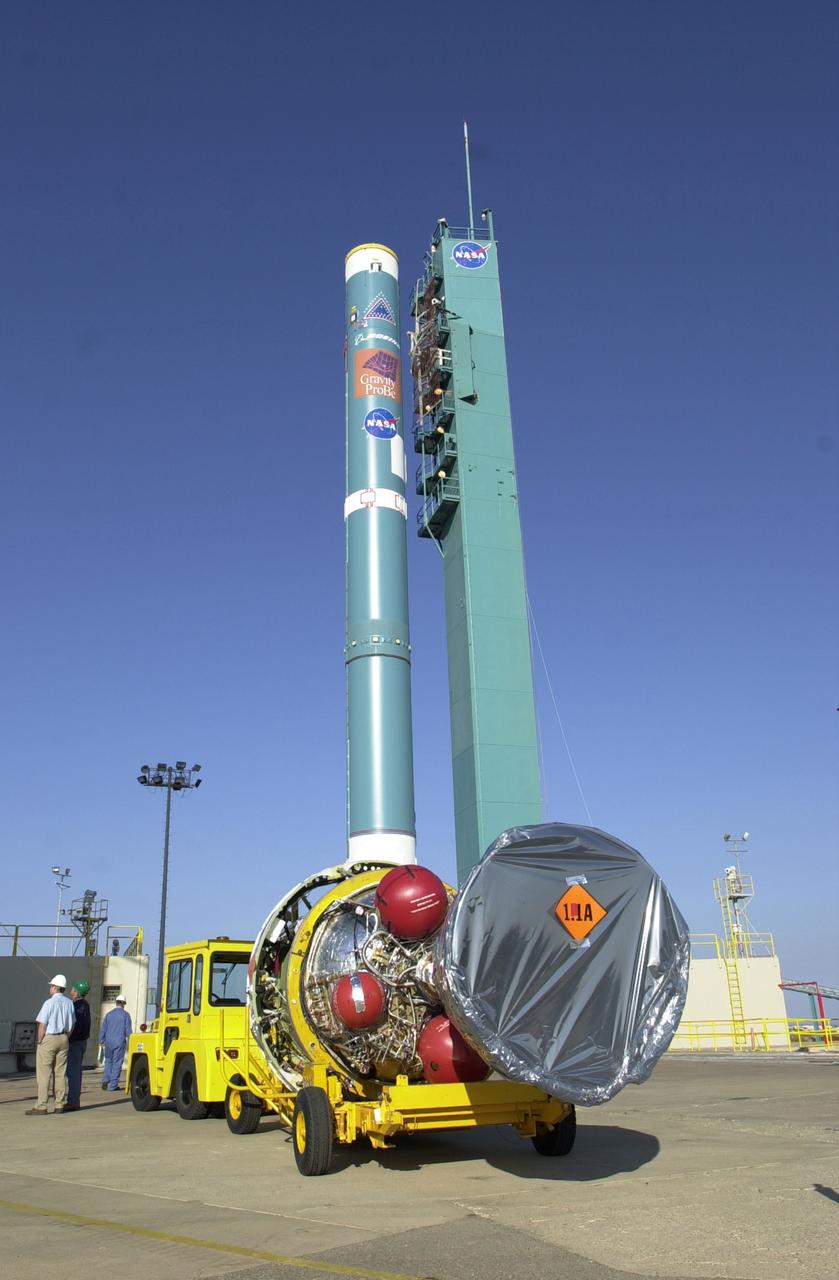
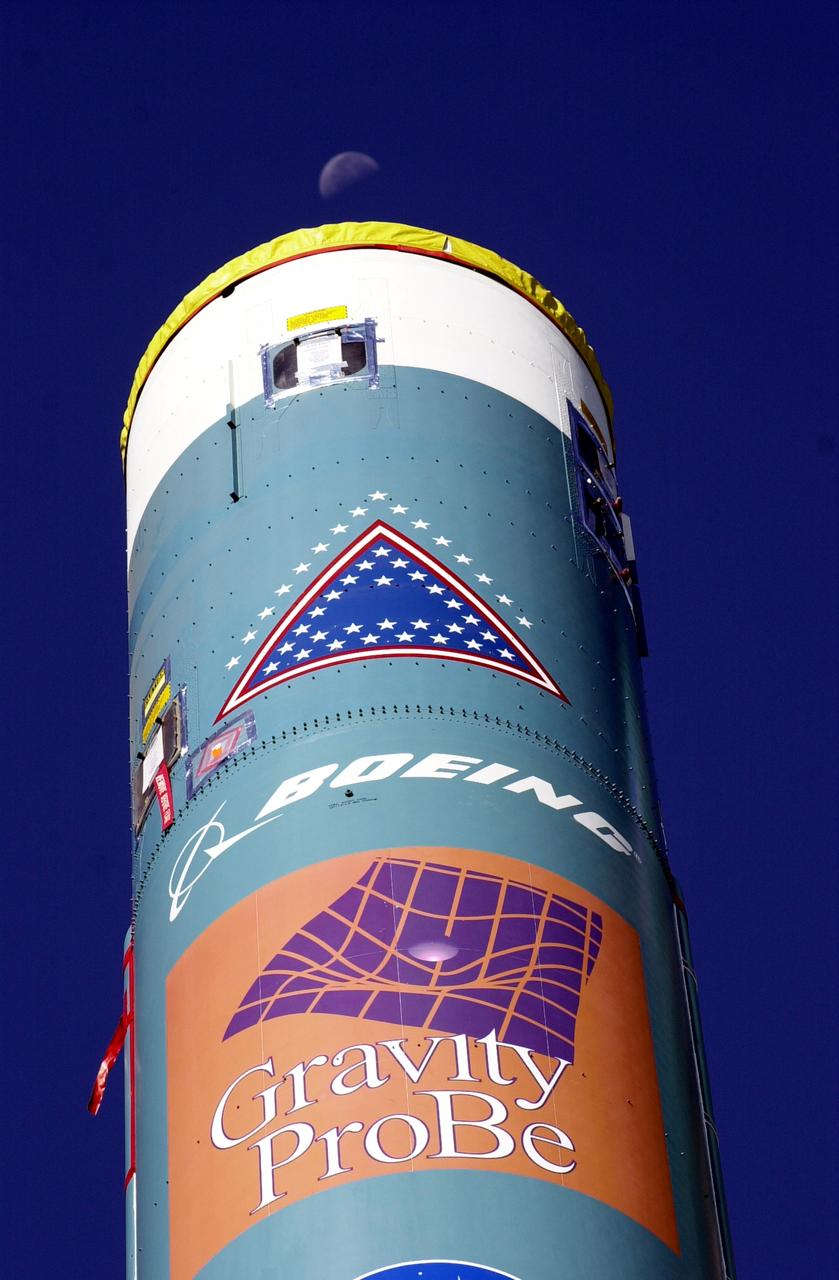
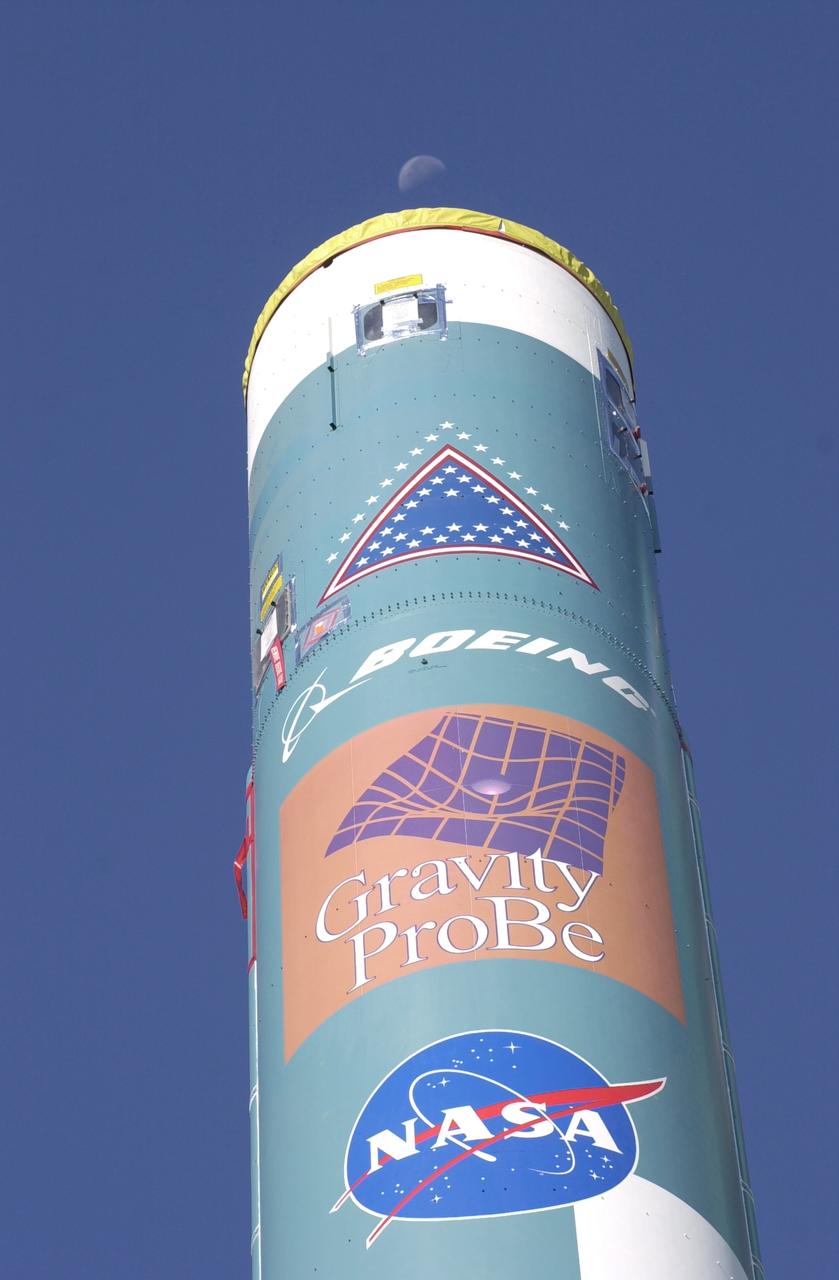
VANDENBERG AFB, CALIF. -  Logos identify the mission of this Delta II rocket that will launch the Gravity Probe B experiment, developed by Stanford University, Lockheed Martin and NASA’s Marshall Space Flight Center.   The Gravity Probe B will launch a payload of four gyroscopes into low-Earth polar orbit to test two extraordinary predictions of Albert Einstein’s general theory of relativity: the geodetic effect (how space and time are warped by the presence of the Earth) and frame dragging (how Earth’s rotation drags space and time around with it). Once in orbit, for 18 months each gyroscope’s spin axis will be monitored as it travels through local spacetime, observing and measuring these effects. The targeted launch date is Dec. 6, 2003.
VANDENBERG AFB, CALIF. - Logos identify the mission of this Delta II rocket that will launch the Gravity Probe B experiment, developed by Stanford University, Lockheed Martin and NASA’s Marshall Space Flight Center. The Gravity Probe B will launch a payload of four gyroscopes into low-Earth polar orbit to test two extraordinary predictions of Albert Einstein’s general theory of relativity: the geodetic effect (how space and time are warped by the presence of the Earth) and frame dragging (how Earth’s rotation drags space and time around with it). Once in orbit, for 18 months each gyroscope’s spin axis will be monitored as it travels through local spacetime, observing and measuring these effects. The targeted launch date is Dec. 6, 2003.
VANDENBERG AFB, CALIF. -  Logos identify the mission of this Delta II rocket that will launch the Gravity Probe B experiment, developed by Stanford University, Lockheed Martin and NASA’s Marshall Space Flight Center.   The Gravity Probe B will launch a payload of four gyroscopes into low-Earth polar orbit to test two extraordinary predictions of Albert Einstein’s general theory of relativity: the geodetic effect (how space and time are warped by the presence of the Earth) and frame dragging (how Earth’s rotation drags space and time around with it). Once in orbit, for 18 months each gyroscope’s spin axis will be monitored as it travels through local spacetime, observing and measuring these effects. The targeted launch date is Dec. 6, 2003.
VANDENBERG AFB, CALIF. - Logos identify the mission of this Delta II rocket that will launch the Gravity Probe B experiment, developed by Stanford University, Lockheed Martin and NASA’s Marshall Space Flight Center. The Gravity Probe B will launch a payload of four gyroscopes into low-Earth polar orbit to test two extraordinary predictions of Albert Einstein’s general theory of relativity: the geodetic effect (how space and time are warped by the presence of the Earth) and frame dragging (how Earth’s rotation drags space and time around with it). Once in orbit, for 18 months each gyroscope’s spin axis will be monitored as it travels through local spacetime, observing and measuring these effects. The targeted launch date is Dec. 6, 2003.
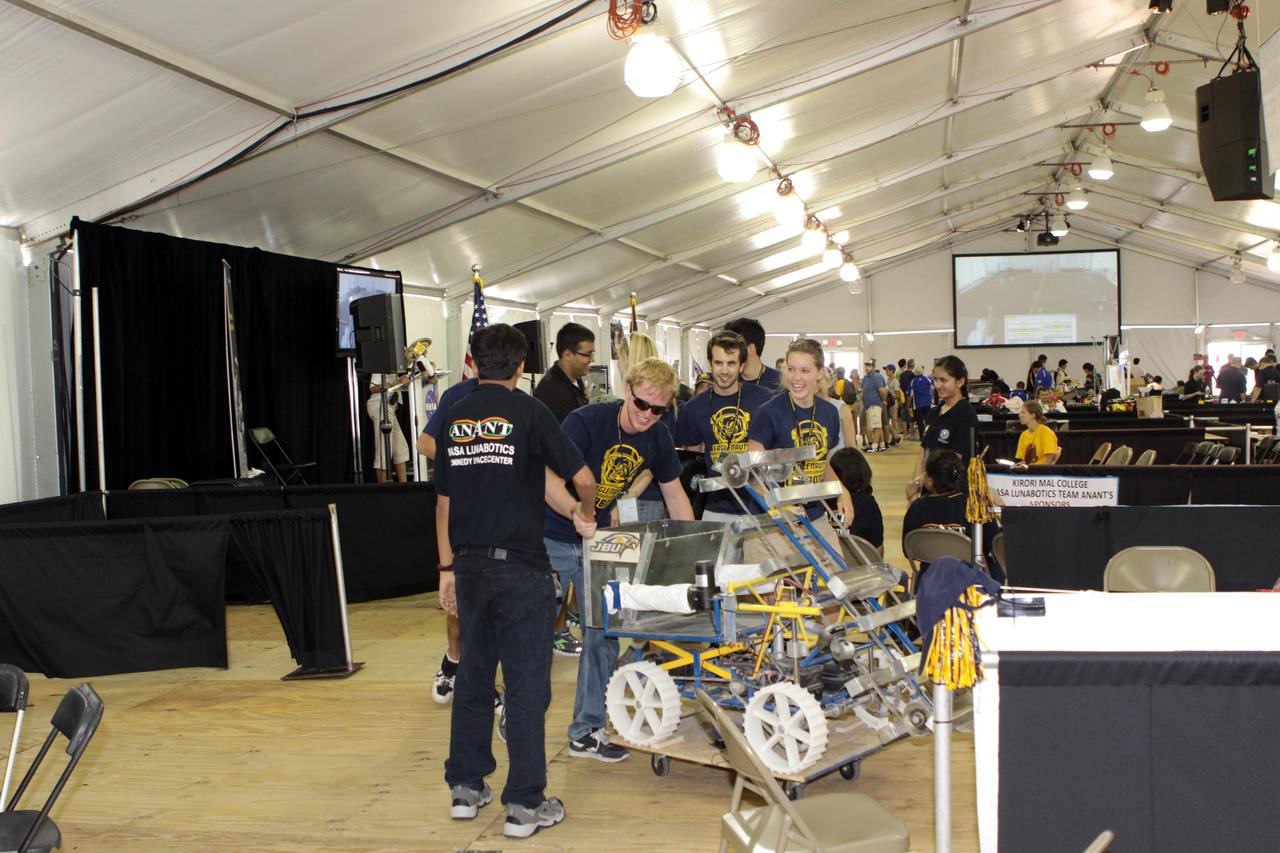
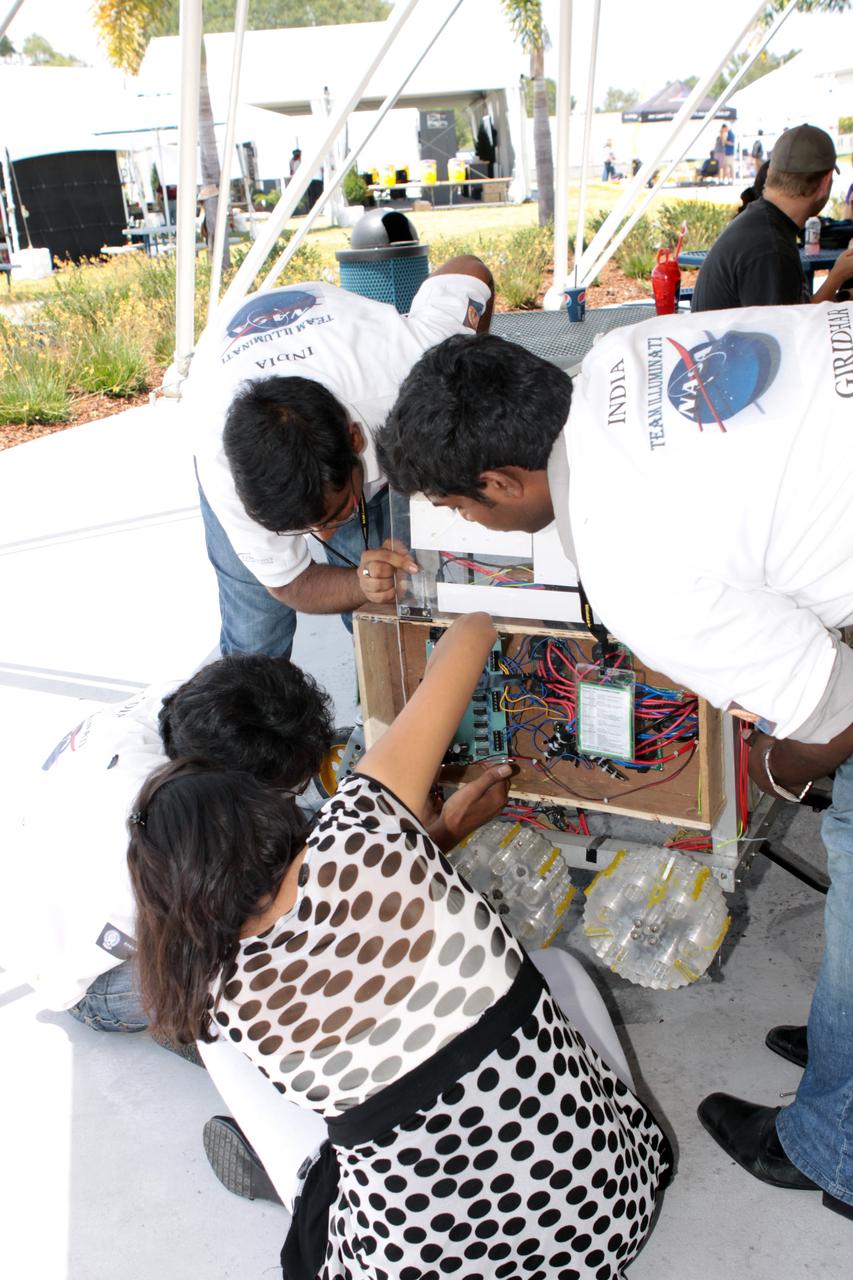
Lunabotics - Afternoon session with drag race
2012-3086
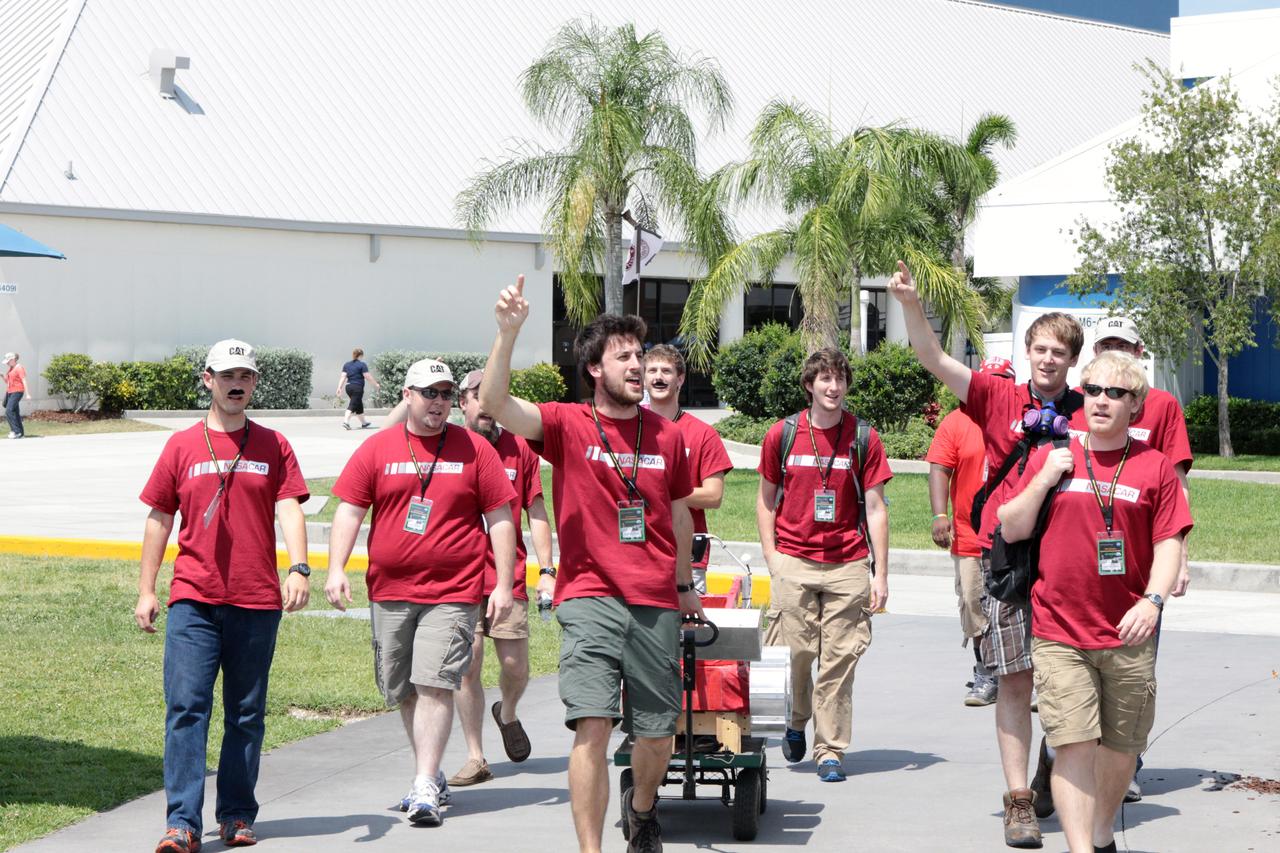
Lunabotics - Afternoon session with drag race
2012-3087
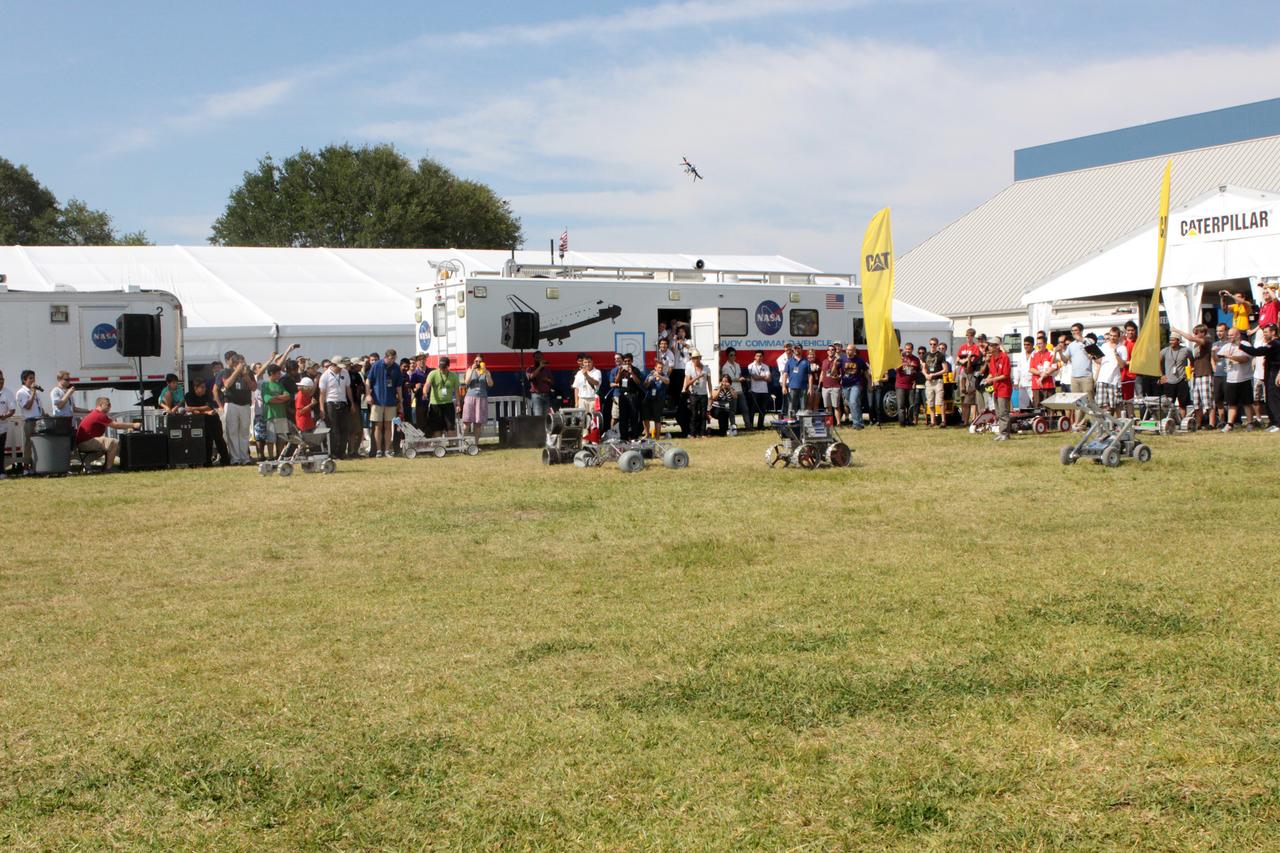
Lunabotics - Afternoon session with drag race
2012-3089
Lunabotics - Afternoon session with drag race
2012-3090
The Space Shuttle Endeavour concludes mission STS-49 at NASA's Ames-Dryden Flight Research Facility (later redesignated Dryden Flight Research Center), Edwards, California, with a 1:57 p.m. (PDT) landing 16 May on Edward's concrete runway 22. The planned 7-day mission, which began with a launch from Kennedy Space Center, Florida, at 4:41 p.m. (PFT), 7 May, was extended two days to allow extra time to rescue the Intelsat VI satellite and complete Space Station assembly techniques originally planned. After a perfect rendezvous in orbit and numerous attempts to grab the satellite, space walking astronauts Pierre Thuot, Rick Hieb and Tom Akers successfully rescued it by hand on the third space walk with the support of mission specialists Kathy Thornton and Bruce Melnick. The three astronauts, on a record space walk, took hold of the satellite and directed it to the shuttle where a booster motor was attached to launch it to its proper orbit. Commander Dan Brandenstein and Pilot Kevin Chilton brought Endeavours's record setting maiden voyage to a perfect landing at Edwards AFB with the first deployment of a drag chute on a shuttle mission.
STS-49 Landing at Edwards with First Drag Chute Landing
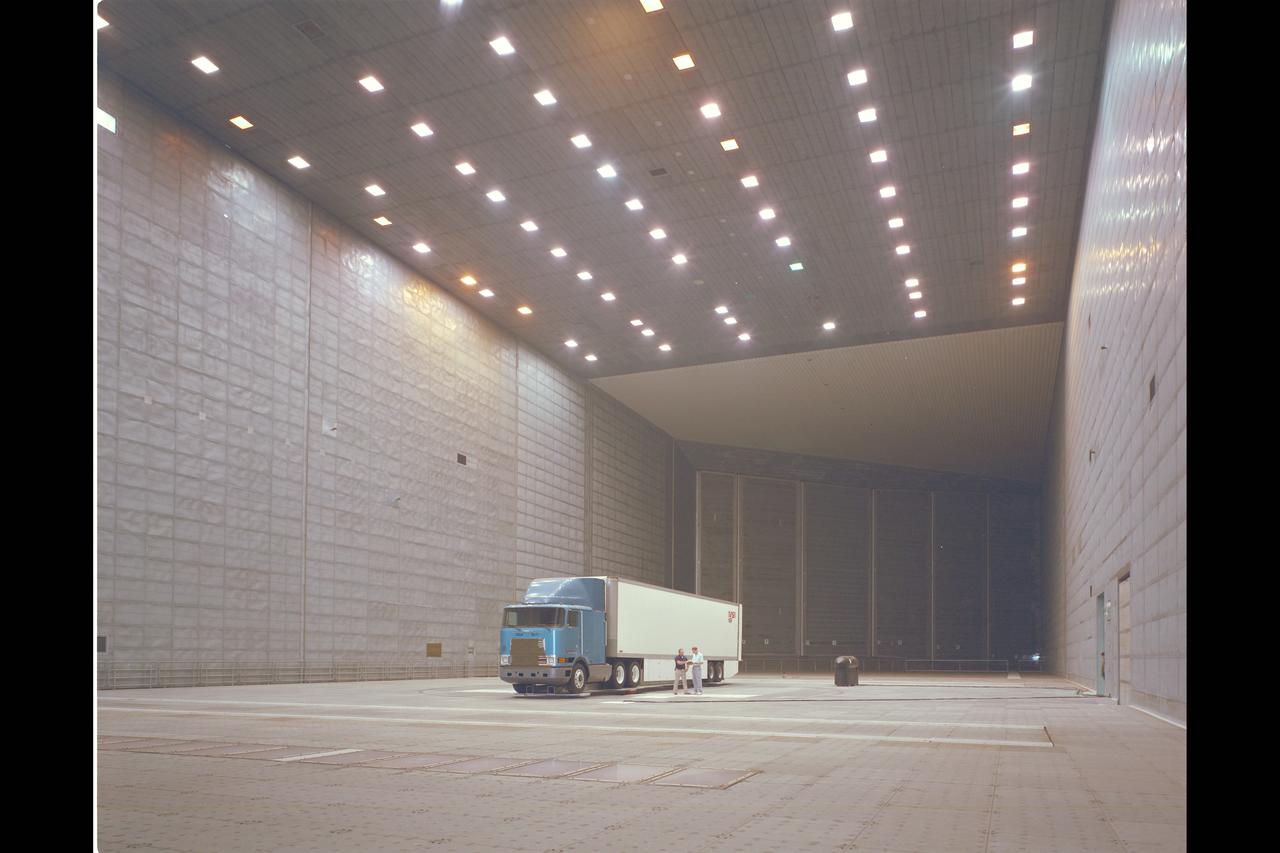
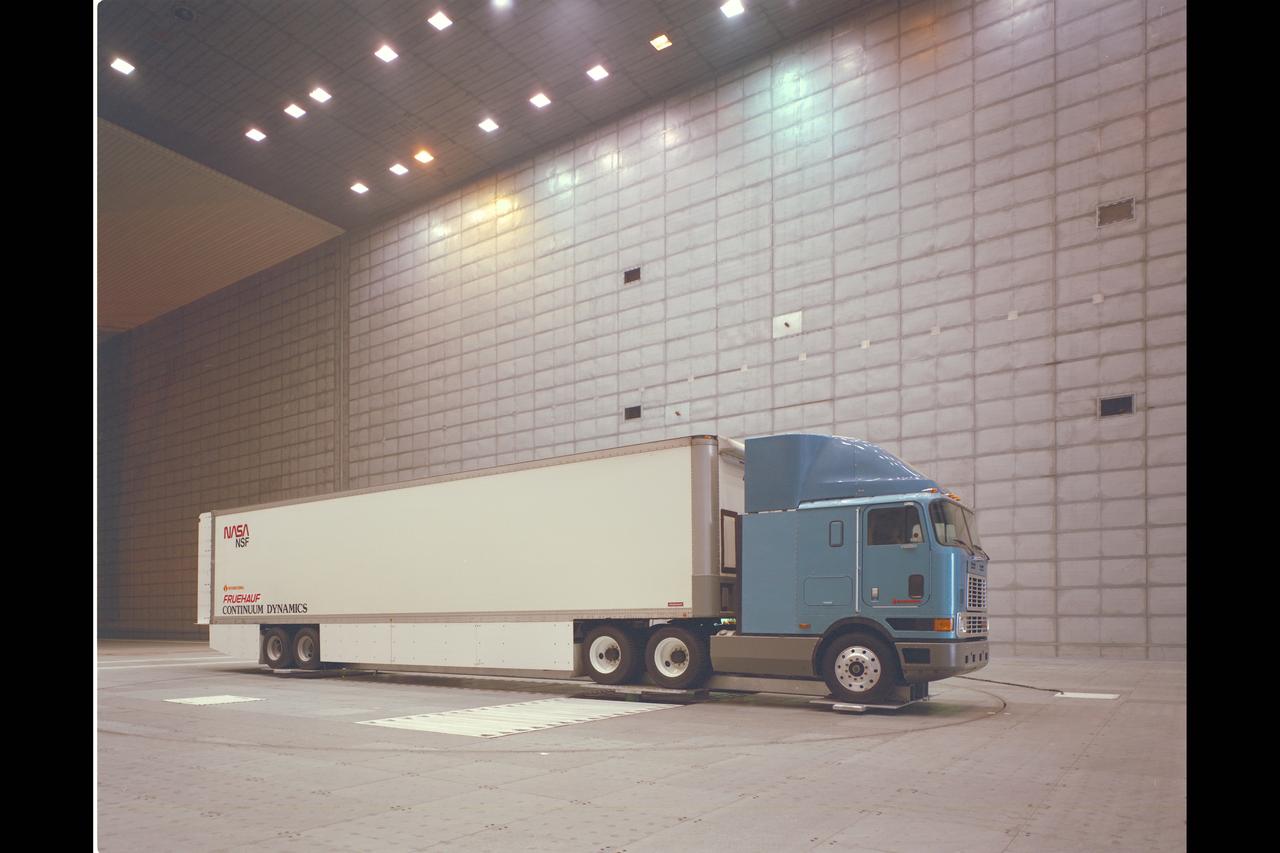
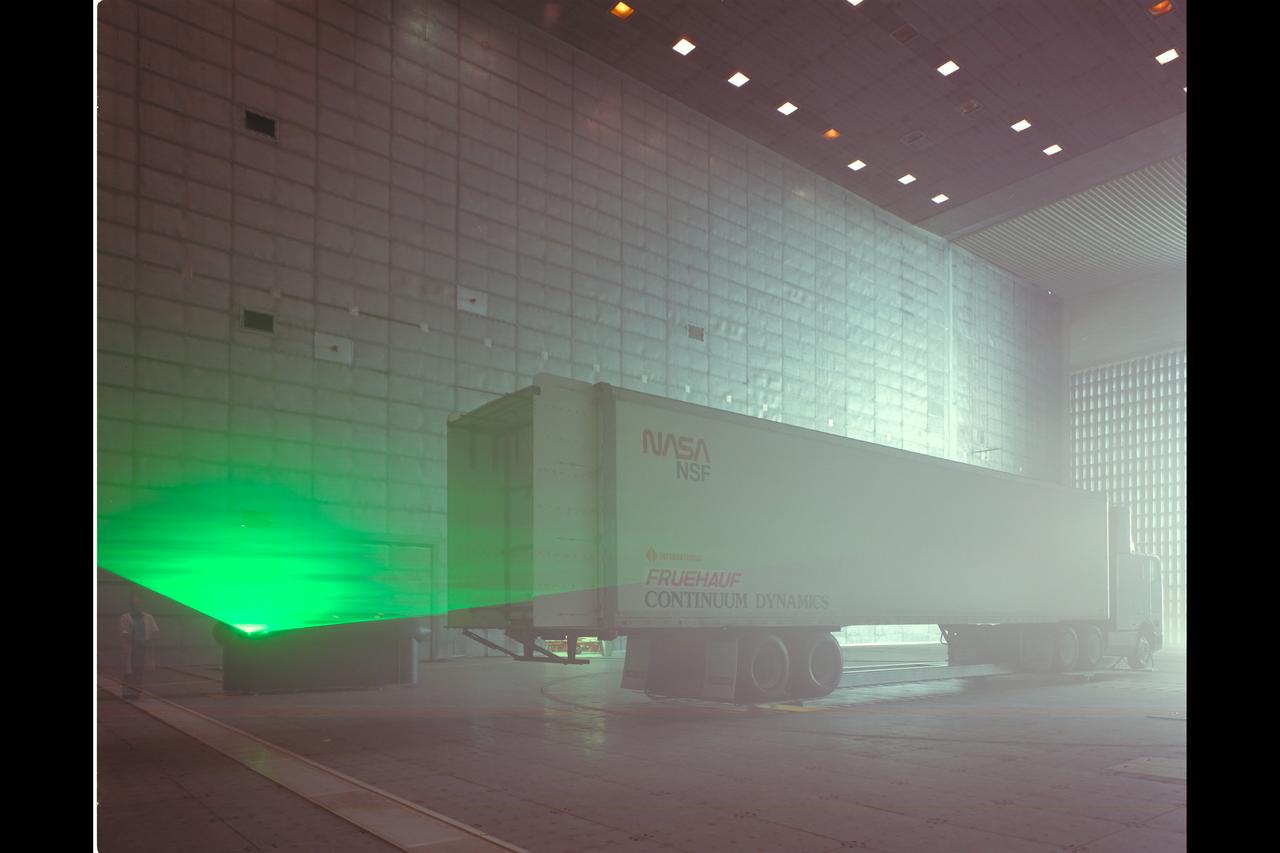
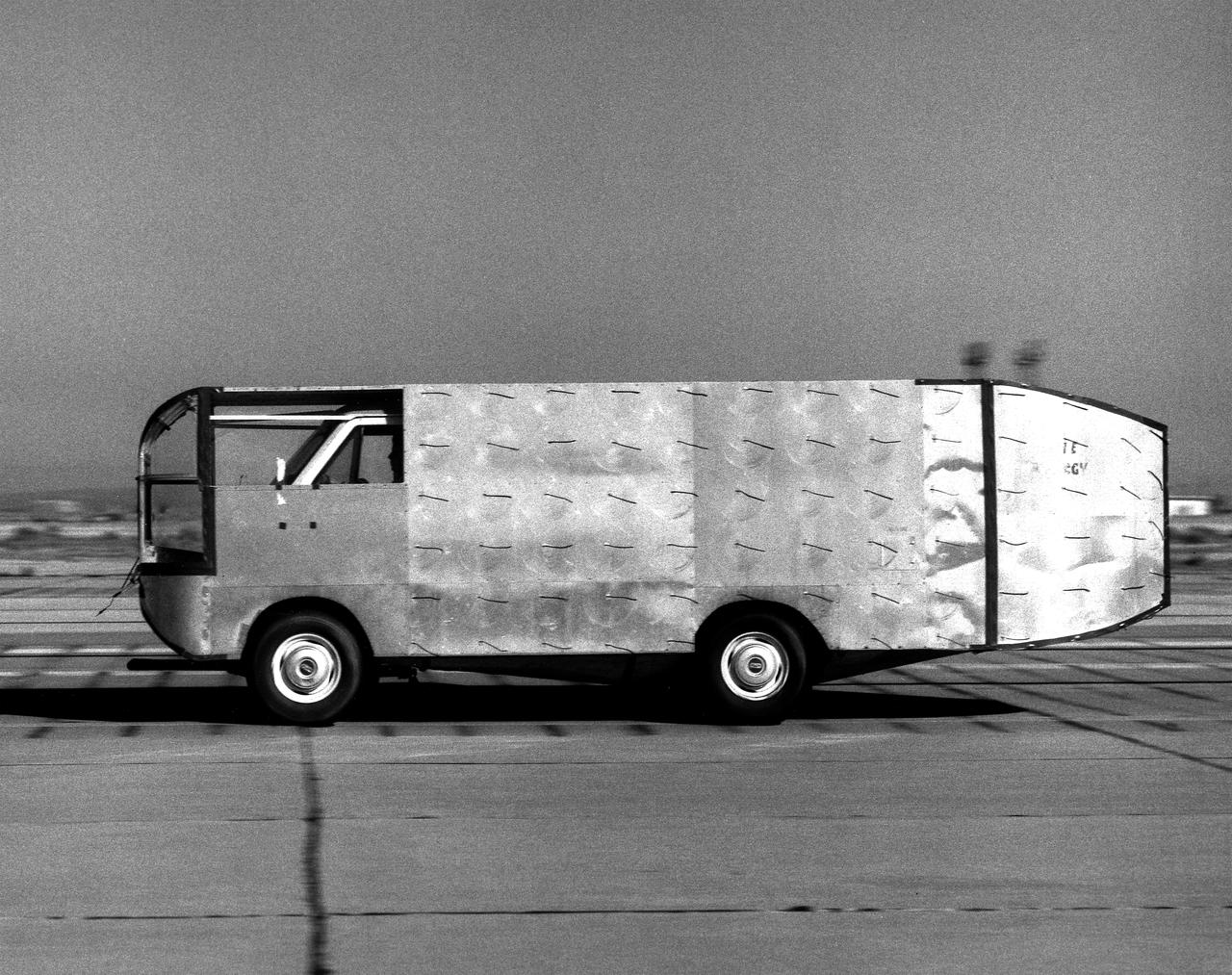
Fruehauf Truck and Trailer Test in 80x120ft W.T. (looking at drag and fuel efficiency)
ARC-1988-AC88-0620-24
Fruehauf Truck and Trailer Test in 80x120ft W.T. (looking at drag and fuel efficiency)
ARC-1988-AC88-0620-23
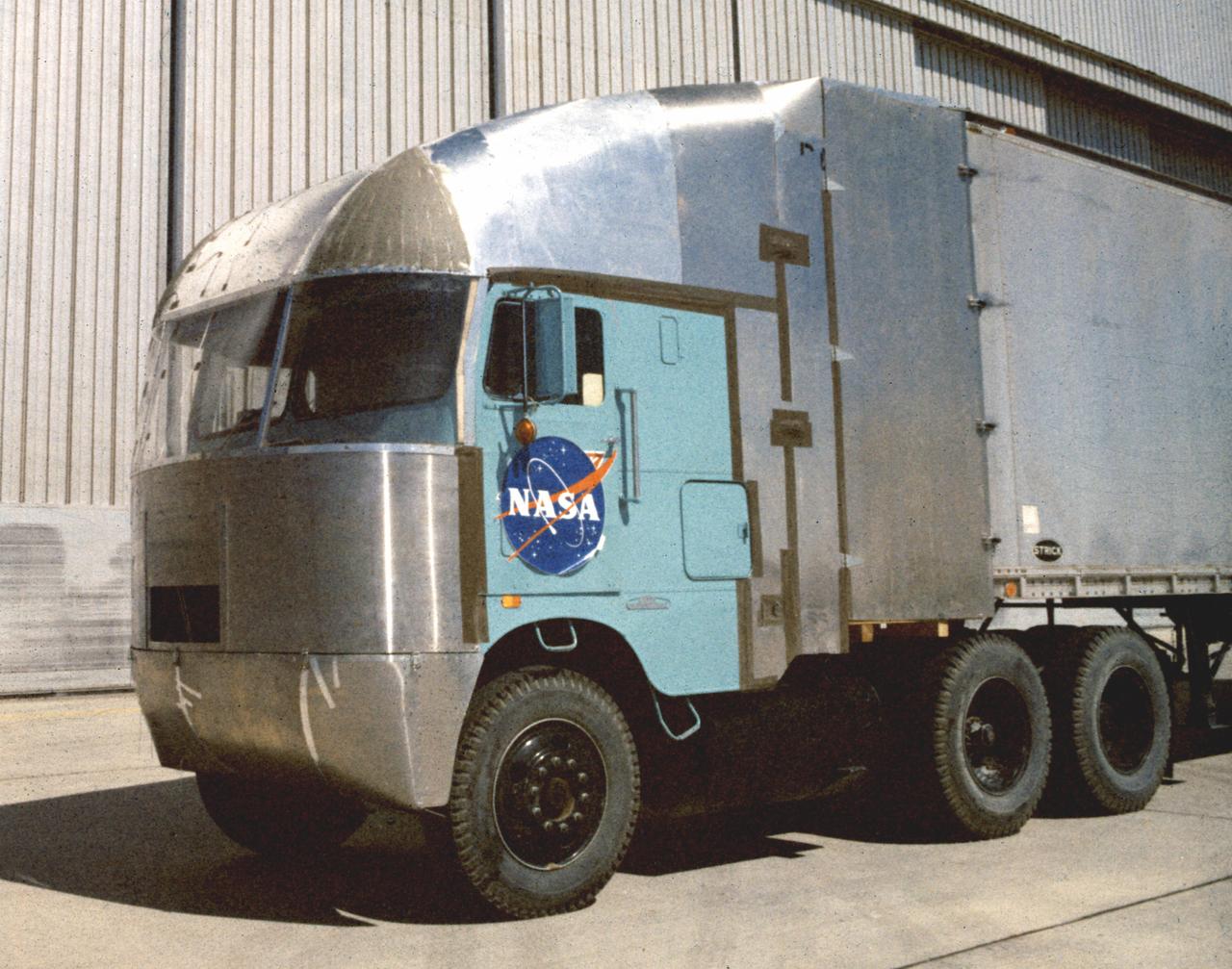
Air flow testing on aerodynamic truck
EC75-4724
STS057-S-082 (1 July 1993) --- The drag chute on the Space Shuttle Endeavour is fully deployed in this scene on Runway 33 (KSC's Shuttle Landing Facility) as the spacecraft successfully completes a ten-day mission in Earth orbit.  Official mission duration was nine days, twenty-three hours, forty-four minutes and fifty-five seconds.  Main gear touchdown occurred at 8:52:16 (EDT), July 1, 1993.  Onboard Endeavour for the landing were six NASA astronauts and the European Retrievable Carrier (EURECA) spacecraft.  Crewmembers were astronauts Ronald J. Grabe, Brian Duffy, G. David Low, Nancy J. Sherlock, Peter J. K. (Jeff) Wisoff and Janice E. Voss.
STS-57 Endeavour, OV-105, with drag chute deployed lands on KSC SLF runway 33
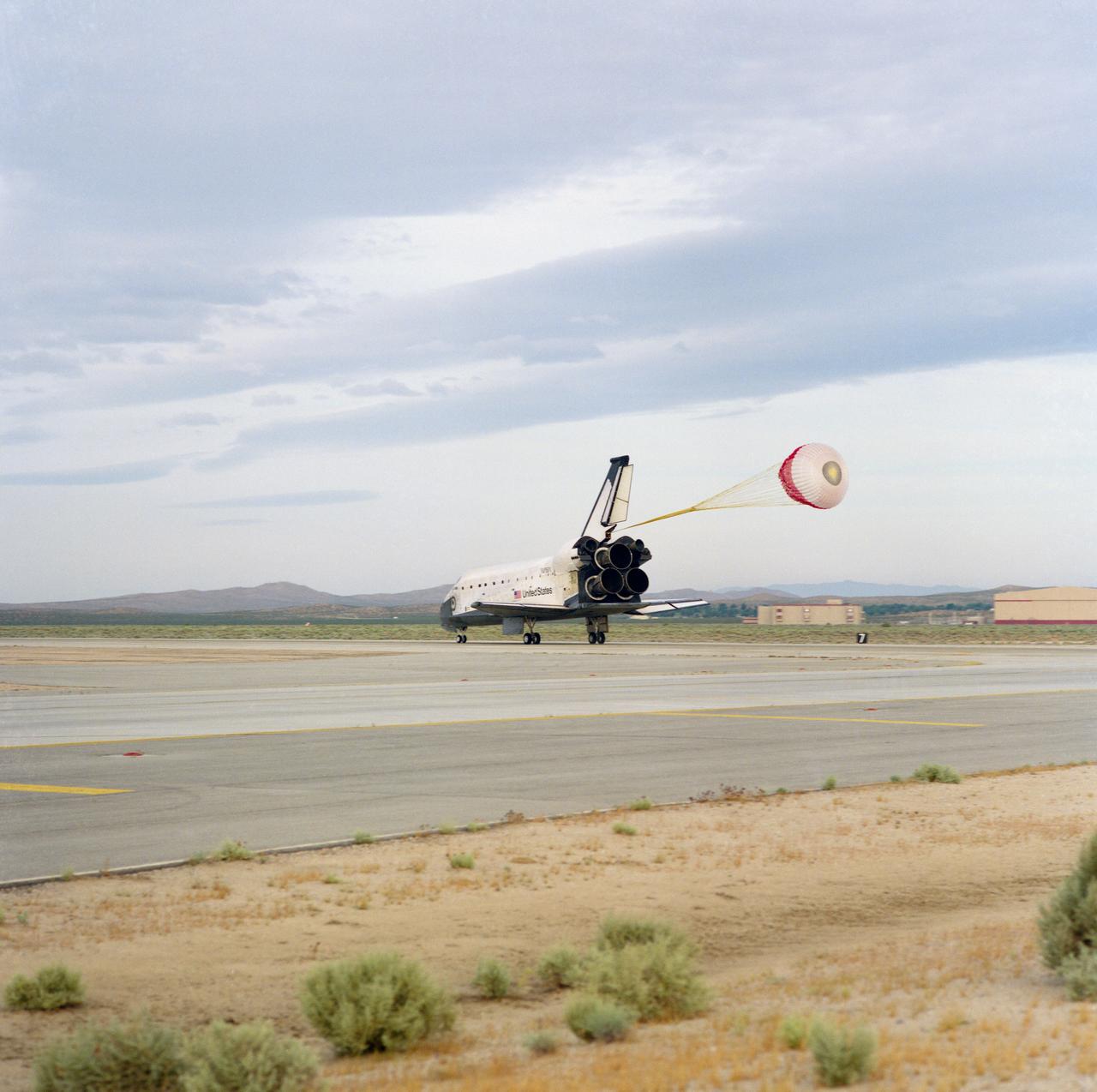
The space shuttle Atlantis touches down on the runway at Edwards, California, at approximately 5:29 a.m. Pacific Standard Time after completing the highly successful STS-76 mission to deliver Astronaut Shannon Lucid to the Russian Space Station Mir. She was the first American woman to serve as a Mir station researcher. Atlantis was originally scheduled to land at Kennedy Space Center, Florida, but bad weather there both 30 and 31 March necessitated a landing at the backup site at Edwards. This photo shows the drag chute deployed to help the shuttle roll to a stop. Mission commander for STS-76 was Kevin P. Chilton, and Richard A. Searfoss was the pilot. Ronald M. Sega was payload commander and mission specialist-1. Mission specialists were Richard Clifford, Linda Godwin and Shannon Lucid. The mission also featured a spacewalk while Atlantis was docked to Mir and experiments aboard the SPACEHAB module.
STS-76 Landing - Space Shuttle Atlantis Lands at Edwards Air Force Base, Drag Chute Deploy
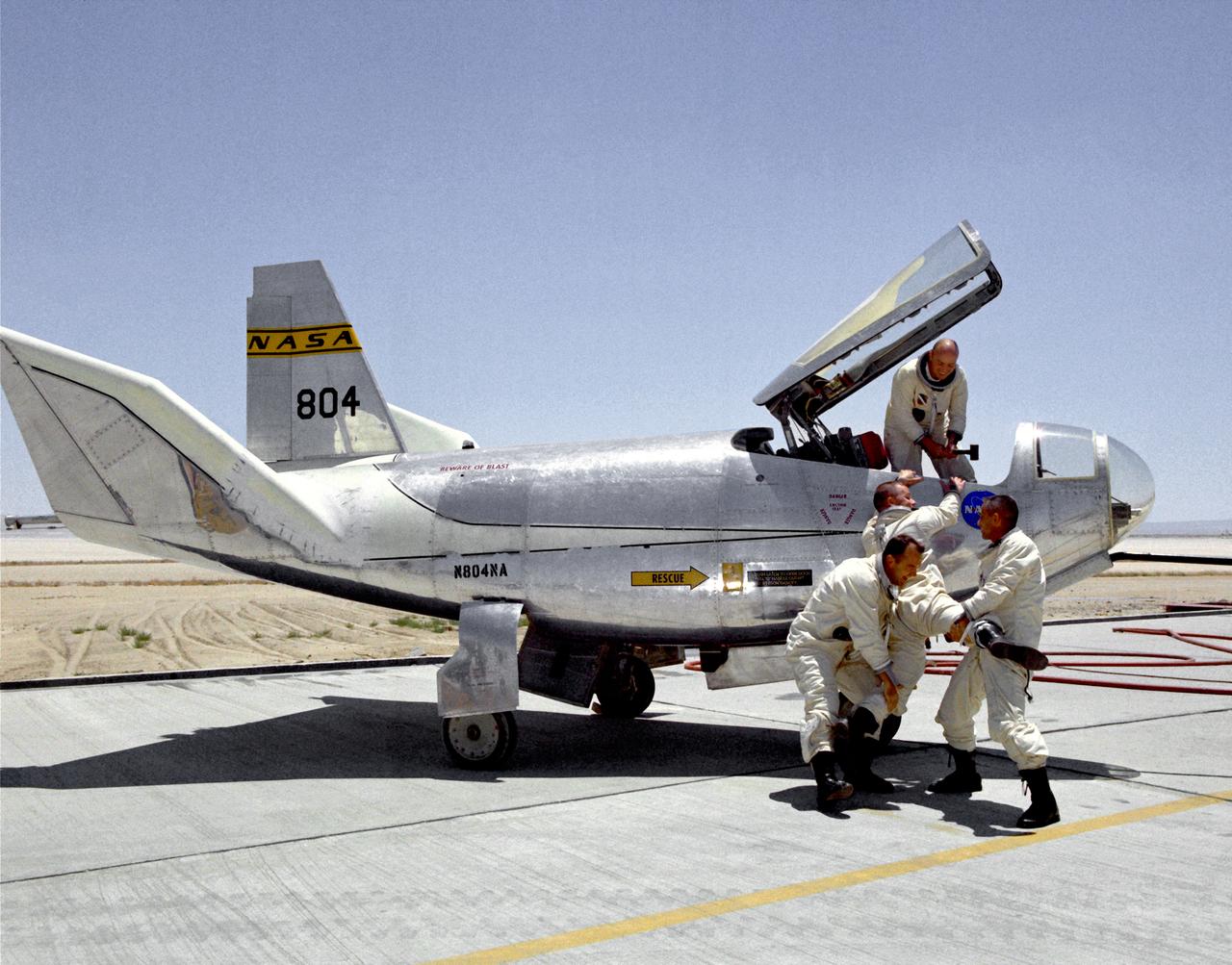
Not every moment of a test pilot's day is serious business. In a moment of levity, NASA pilots Bill Dana (left) and John A. Manke try to drag Air Force test pilot Peter Hoag away from the HL-10 lifting body while Air Force Major Jerauld R. Gentry helps from the cockpit. These four men were the principal pilots for the HL-10 program. This was not the only prank involving the HL-10 and its pilots. Once "Captain Midnight" (Gentry) and the "Midnight Skulkers" sneaked into the NASA hangar and put "U.S. Air Force" on the aircraft using stick-on letters. Later, while Gentry was making a lifting-body flight, his 1954 Ford was "borrowed" from the parking lot, painted with yellow-green zinc-chromate primer, and decorated with large stick-on flowers about one foot in diameter. After Gentry returned from the flight, he was surprised to see what had happened to his car.
ECN-2409
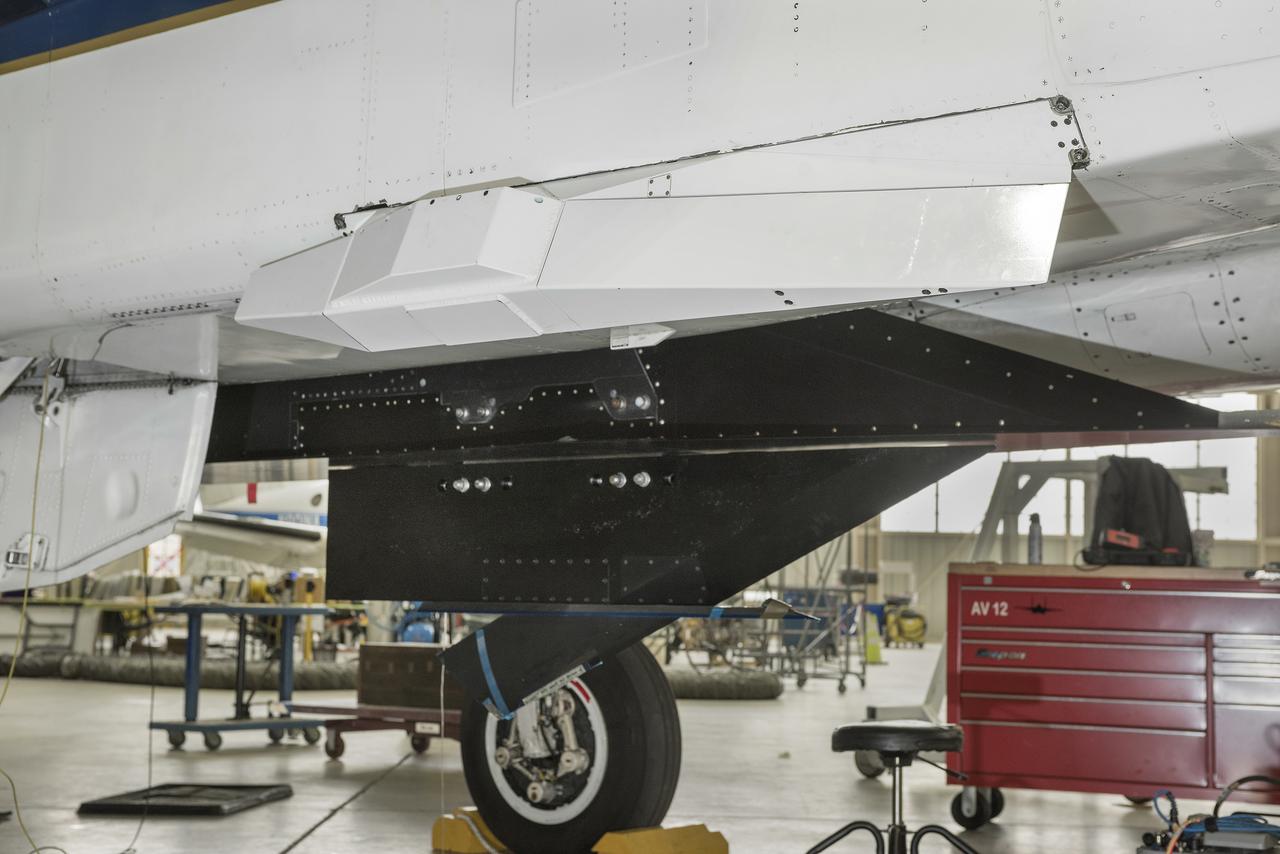
The Swept Wing Laminar Flow test article, integrated to the underside of a NASA F-15, will examine the effectiveness of different configurations of small dots, called distributed roughness elements, to extend smooth, laminar airflow over a wing’s depth, reducing friction drag.
AFRC2017-0037-01
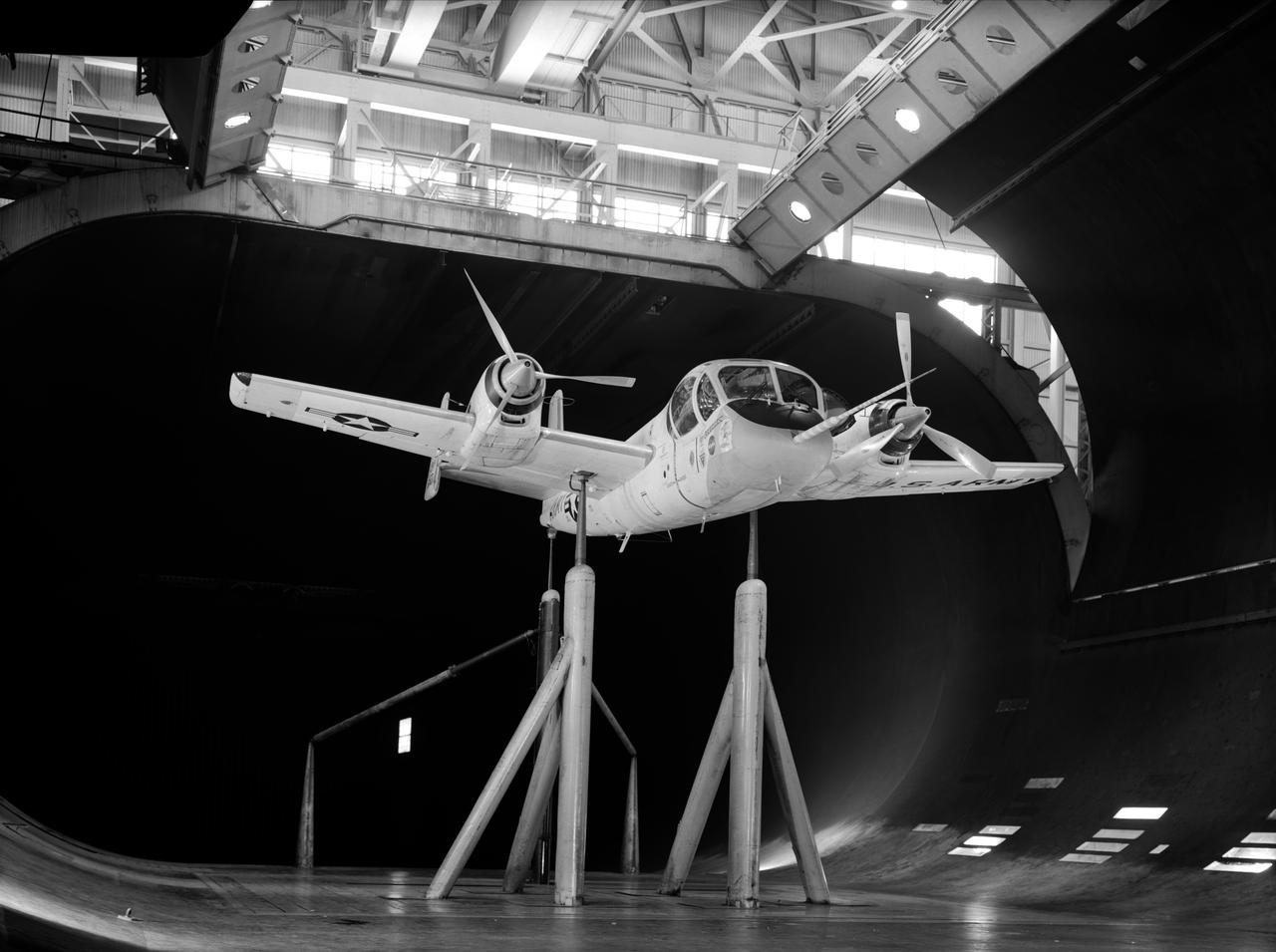
Drag studies for Full Scale wind tunnel test of Grumman YAO-1 airplane, 3/4 front view with propellers on
Grumman YAO-1 airplane mounted in the 40x80 foot wind tunnel at Ames.
Fruehauf Truck and Trailer Test in 80x120ft W.T. with LRLDV (looking at drag and fuel efficiency)
ARC-1988-AC88-0620-52
VANDENBERG AFB, CALIF. - Workers on the mobile service tower at Space Launch Complex 2, Vandenberg Air Force Base, Calif., check the Delta II rocket’s second stage as it is mated with the first stage. The Delta II is the launch vehicle for the Gravity Probe B experiment, developed by Stanford University, Lockheed Martin and NASA’s Marshall Space Flight Center.   The Gravity Probe B will launch a payload of four gyroscopes into low-Earth polar orbit to test two extraordinary predictions of Albert Einstein’s general theory of relativity: the geodetic effect (how space and time are warped by the presence of the Earth) and frame dragging (how Earth’s rotation drags space and time around with it). Once in orbit, for 18 months each gyroscope’s spin axis will be monitored as it travels through local spacetime, observing and measuring these effects. The targeted launch date is Dec. 6, 2003.
VANDENBERG AFB, CALIF. - Workers on the mobile service tower at Space Launch Complex 2, Vandenberg Air Force Base, Calif., check the Delta II rocket’s second stage as it is mated with the first stage. The Delta II is the launch vehicle for the Gravity Probe B experiment, developed by Stanford University, Lockheed Martin and NASA’s Marshall Space Flight Center. The Gravity Probe B will launch a payload of four gyroscopes into low-Earth polar orbit to test two extraordinary predictions of Albert Einstein’s general theory of relativity: the geodetic effect (how space and time are warped by the presence of the Earth) and frame dragging (how Earth’s rotation drags space and time around with it). Once in orbit, for 18 months each gyroscope’s spin axis will be monitored as it travels through local spacetime, observing and measuring these effects. The targeted launch date is Dec. 6, 2003.
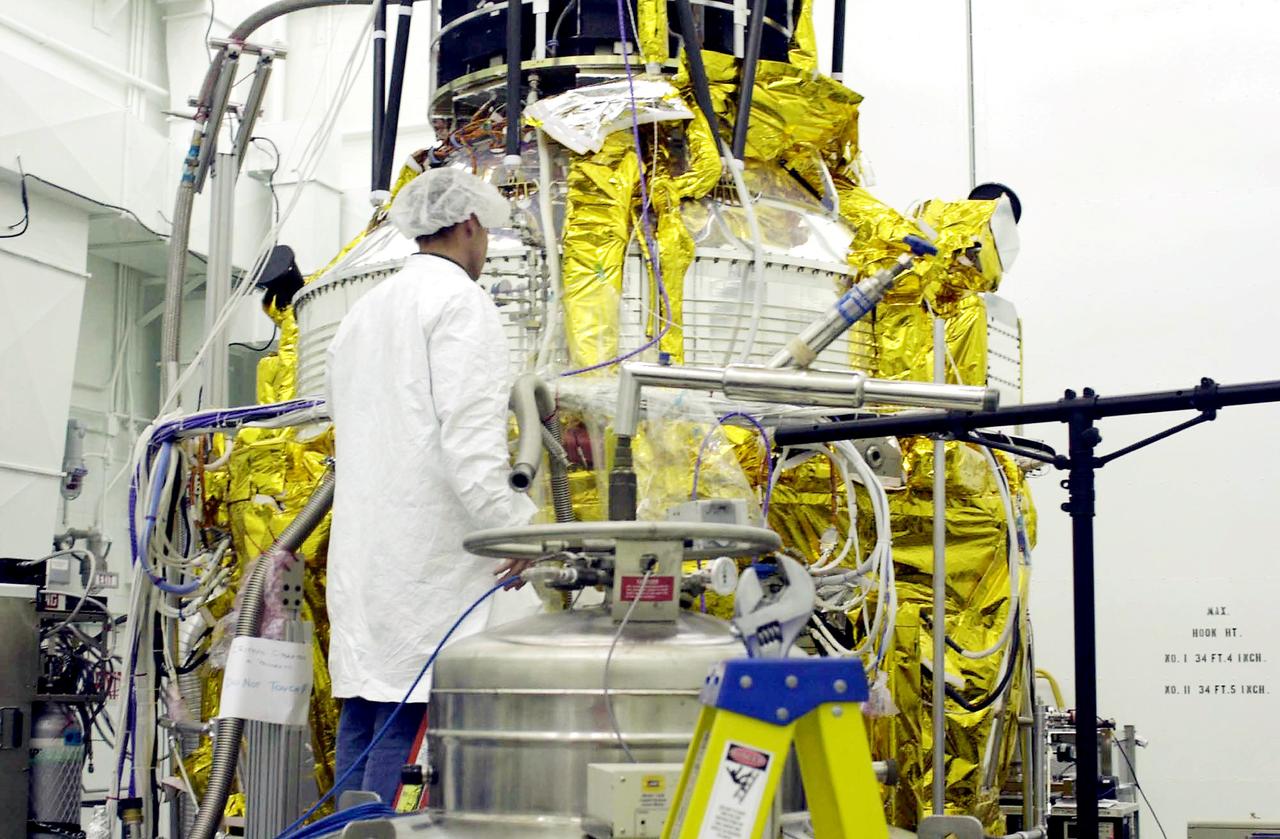
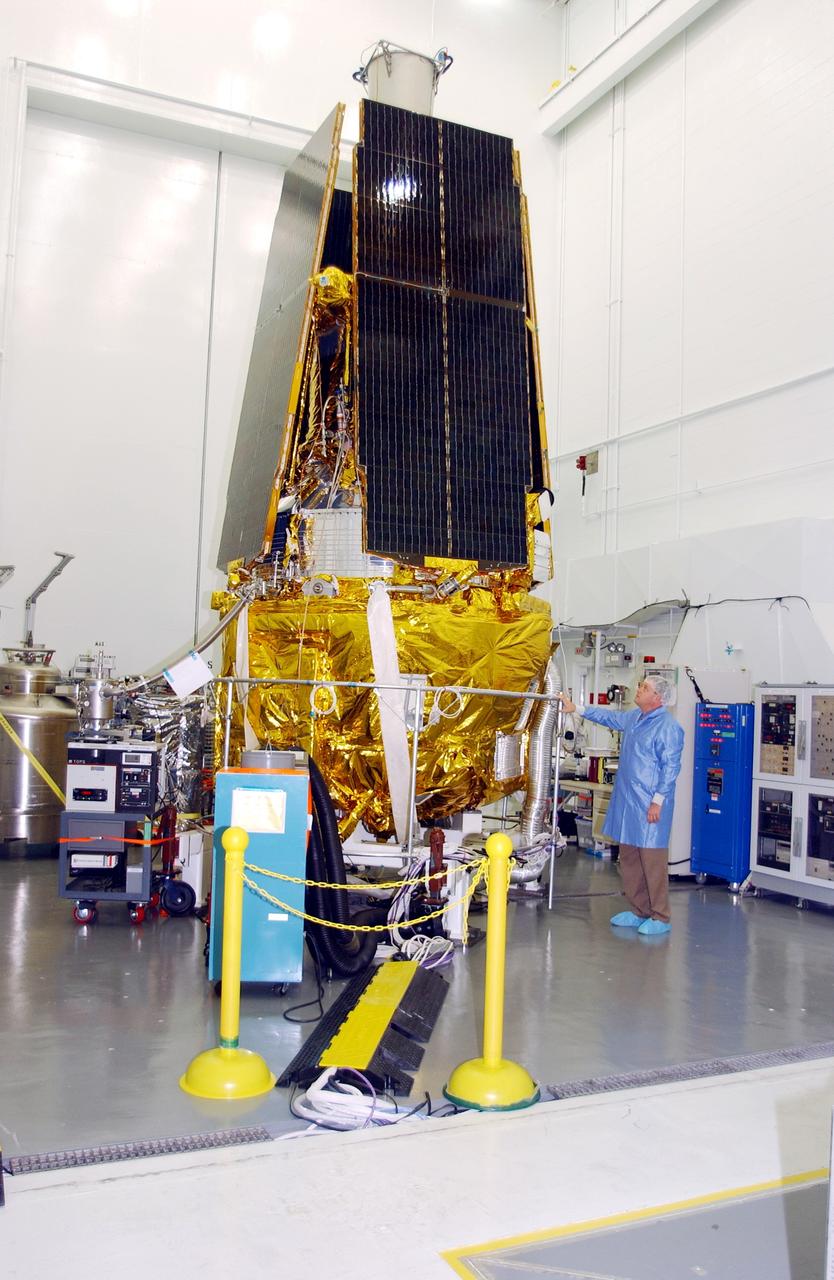
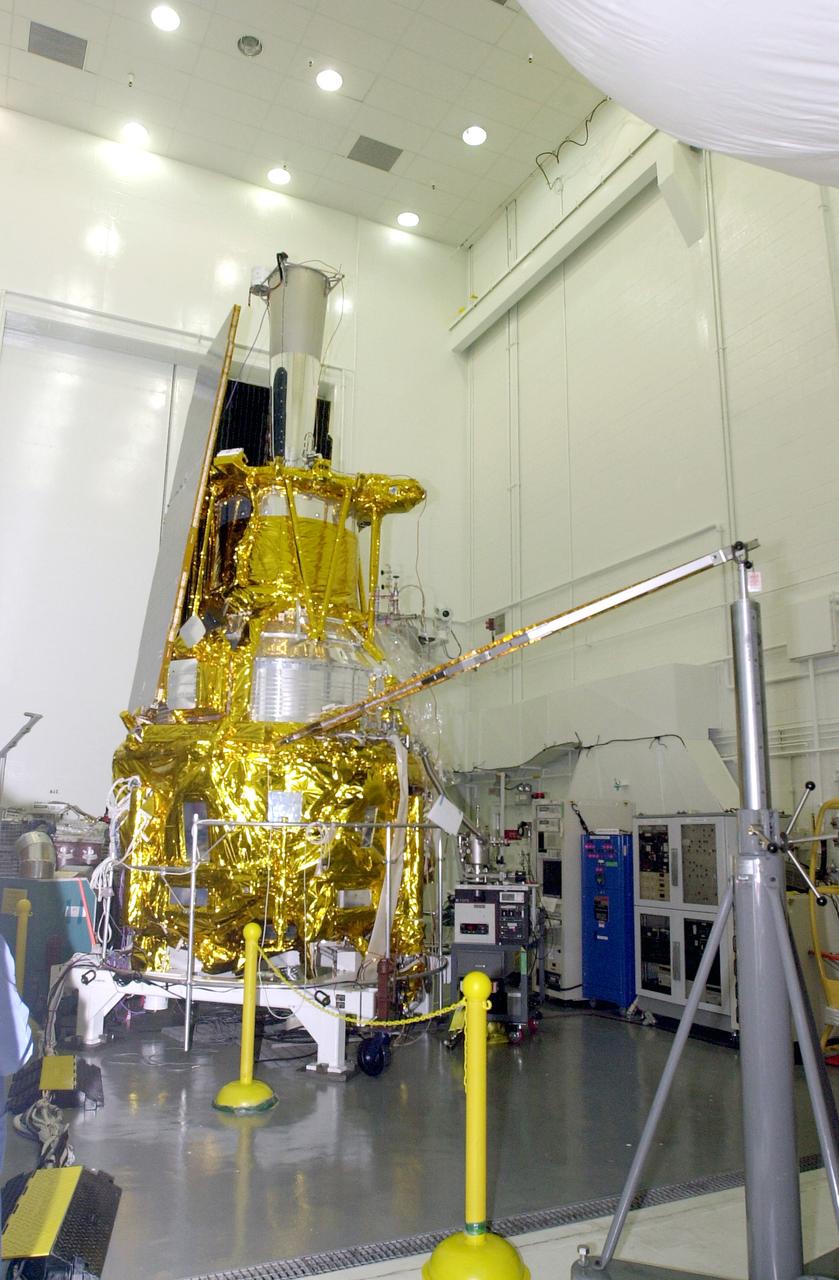
VANDENBERG AFB, CALIF. -   A worker in the spacecraft processing facility on North Vandenberg Air Force Base checks the Gravity Probe B experiment during prelaunch testing.  The Gravity Probe B will launch a payload of four gyroscopes into low-Earth polar orbit to test two extraordinary predictions of Albert Einstein’s general theory of relativity: the geodetic effect (how space and time are warped by the presence of the Earth) and frame dragging (how Earth’s rotation drags space and time around with it). Once in orbit, for 18 months each gyroscope’s spin axis will be monitored as it travels through local spacetime, observing and measuring these effects.  The experiment was developed by Stanford University, Lockheed Martin and NASA’s Marshall Space Flight Center.   The targeted launch date is Dec. 6, 2003.
VANDENBERG AFB, CALIF. - A worker in the spacecraft processing facility on North Vandenberg Air Force Base checks the Gravity Probe B experiment during prelaunch testing. The Gravity Probe B will launch a payload of four gyroscopes into low-Earth polar orbit to test two extraordinary predictions of Albert Einstein’s general theory of relativity: the geodetic effect (how space and time are warped by the presence of the Earth) and frame dragging (how Earth’s rotation drags space and time around with it). Once in orbit, for 18 months each gyroscope’s spin axis will be monitored as it travels through local spacetime, observing and measuring these effects. The experiment was developed by Stanford University, Lockheed Martin and NASA’s Marshall Space Flight Center. The targeted launch date is Dec. 6, 2003.
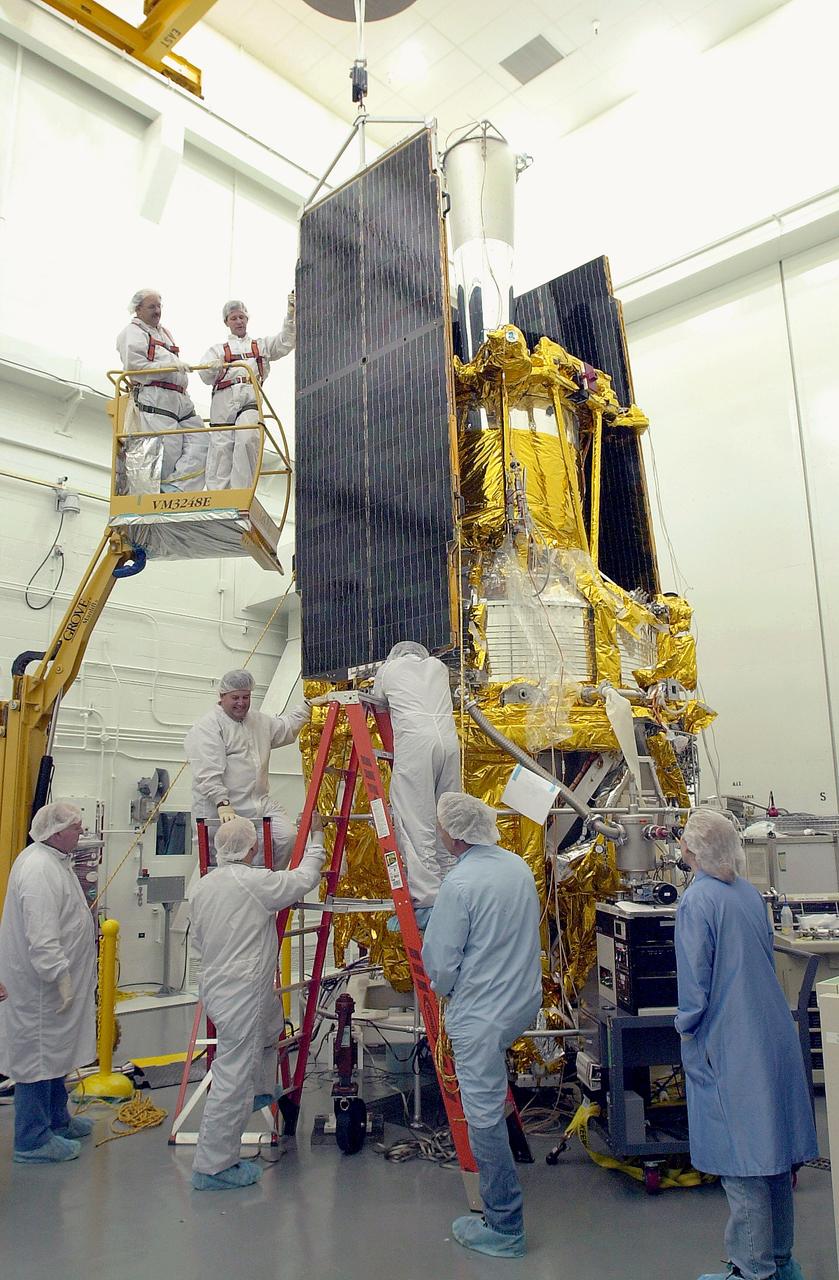
VANDENBERG AFB, CALIF. -  Workers in the NASA spacecraft processing facility on North Vandenberg Air Force Base attach a solar array panel on the Gravity Probe B spacecraft.  Installing each array is a 3-day process and includes a functional deployment test.  The Gravity Probe B mission is a relativity experiment developed by NASA’s Marshall Space Flight Center, Stanford University and Lockheed Martin.  The spacecraft will test two extraordinary predictions of Albert Einstein’s general theory of relativity that he advanced in 1916: the geodetic effect (how space and time are warped by the presence of the Earth) and frame dragging (how Earth’s rotation drags space and time around with it).  Gravity Probe B consists of four sophisticated gyroscopes that will provide an almost perfect space-time reference system.  The mission will look in a precision manner for tiny changes in the direction of spin.
VANDENBERG AFB, CALIF. - Workers in the NASA spacecraft processing facility on North Vandenberg Air Force Base attach a solar array panel on the Gravity Probe B spacecraft. Installing each array is a 3-day process and includes a functional deployment test. The Gravity Probe B mission is a relativity experiment developed by NASA’s Marshall Space Flight Center, Stanford University and Lockheed Martin. The spacecraft will test two extraordinary predictions of Albert Einstein’s general theory of relativity that he advanced in 1916: the geodetic effect (how space and time are warped by the presence of the Earth) and frame dragging (how Earth’s rotation drags space and time around with it). Gravity Probe B consists of four sophisticated gyroscopes that will provide an almost perfect space-time reference system. The mission will look in a precision manner for tiny changes in the direction of spin.
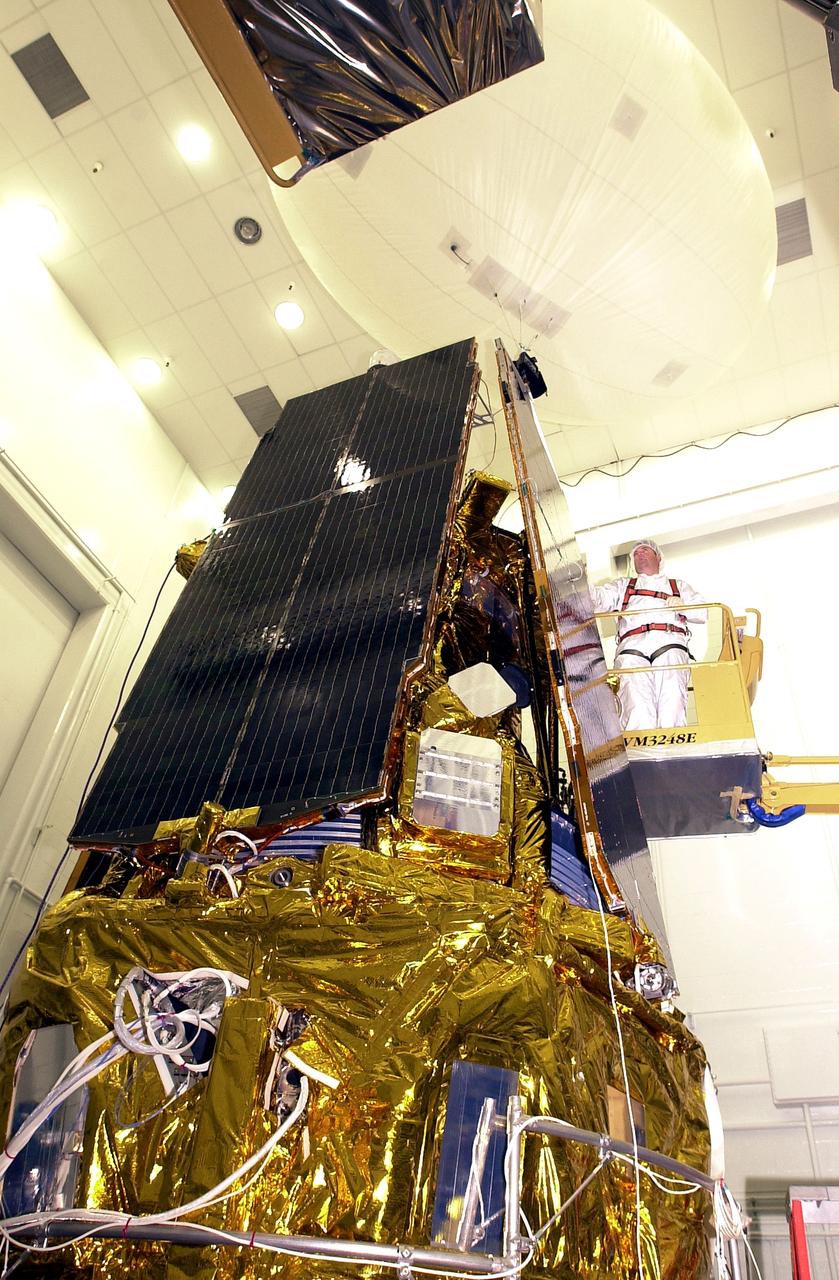
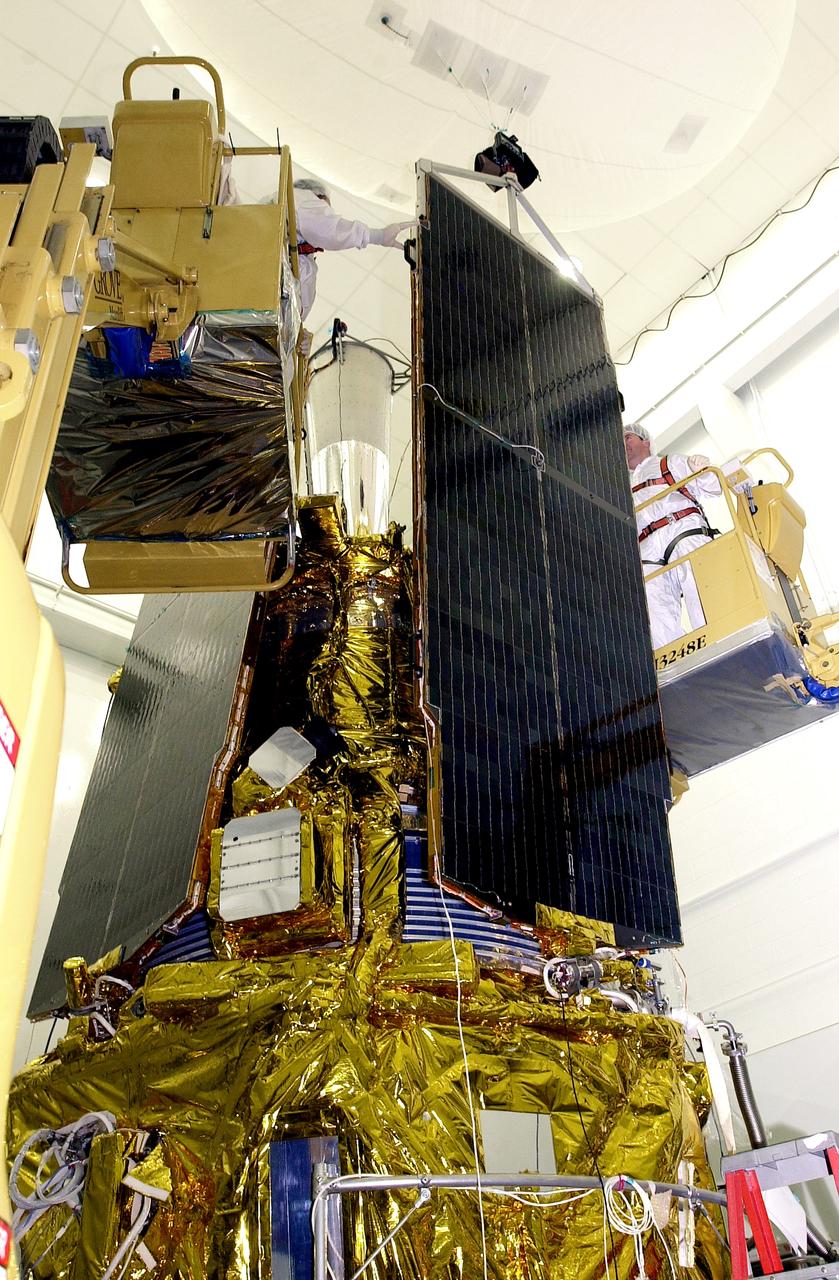
VANDENBERG AFB, CALIF. -  In the NASA spacecraft processing facility on North Vandenberg Air Force Base, the Gravity Probe B spacecraft is seen with two solar array panels installed.  Installing each array is a 3-day process and includes a functional deployment test.  The Gravity Probe B mission is a relativity experiment developed by NASA’s Marshall Space Flight Center, Stanford University and Lockheed Martin.  The spacecraft will test two extraordinary predictions of Albert Einstein’s general theory of relativity that he advanced in 1916: the geodetic effect (how space and time are warped by the presence of the Earth) and frame dragging (how Earth’s rotation drags space and time around with it).  Gravity Probe B consists of four sophisticated gyroscopes that will provide an almost perfect space-time reference system.  The mission will look in a precision manner for tiny changes in the direction of spin.
VANDENBERG AFB, CALIF. - In the NASA spacecraft processing facility on North Vandenberg Air Force Base, the Gravity Probe B spacecraft is seen with two solar array panels installed. Installing each array is a 3-day process and includes a functional deployment test. The Gravity Probe B mission is a relativity experiment developed by NASA’s Marshall Space Flight Center, Stanford University and Lockheed Martin. The spacecraft will test two extraordinary predictions of Albert Einstein’s general theory of relativity that he advanced in 1916: the geodetic effect (how space and time are warped by the presence of the Earth) and frame dragging (how Earth’s rotation drags space and time around with it). Gravity Probe B consists of four sophisticated gyroscopes that will provide an almost perfect space-time reference system. The mission will look in a precision manner for tiny changes in the direction of spin.
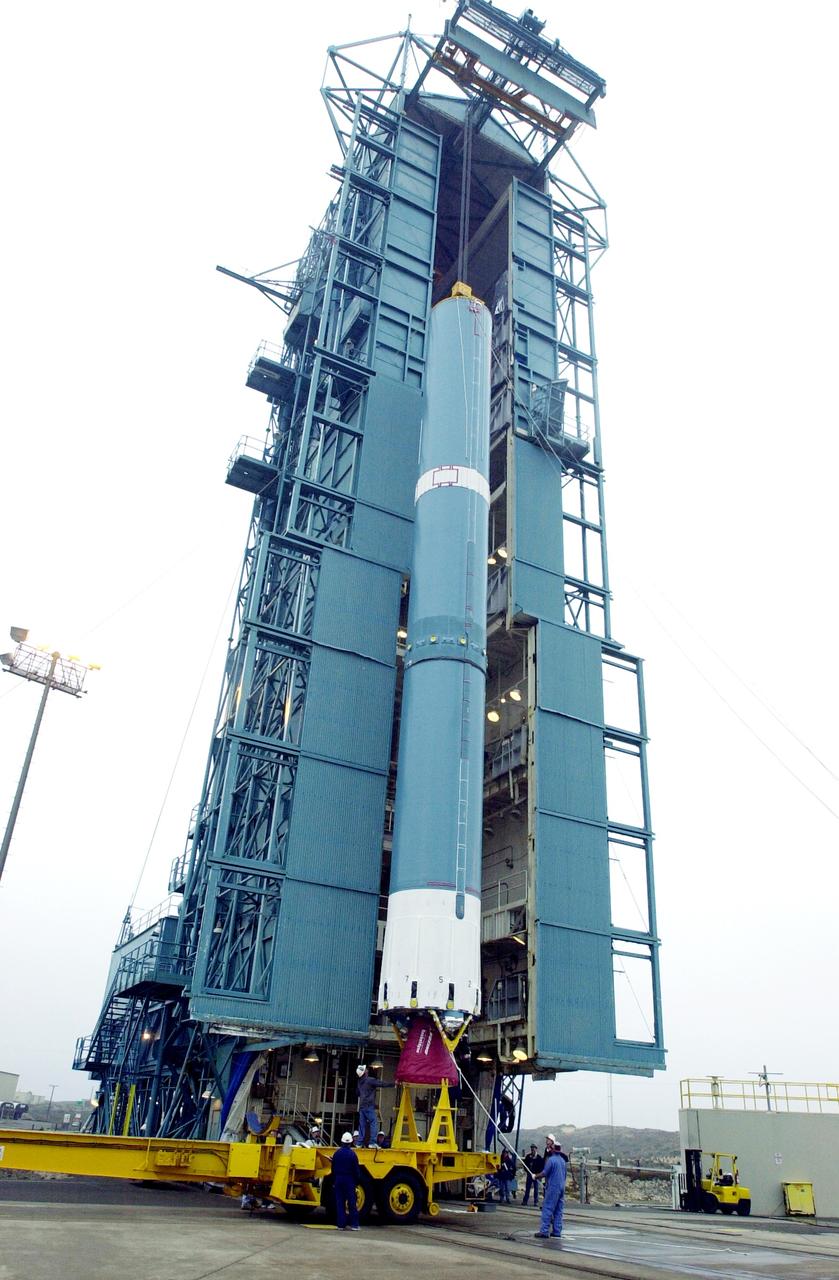
VANDENBERG AFB, CALIF. -  The first stage of the Delta II launch vehicle for the Gravity Probe B experiment is raised to a vertical position at Space Launch Complex 2, Vandenberg Air Force Base, Calif.  The Gravity Probe B will launch a payload of four gyroscopes into low-Earth polar orbit to test two extraordinary predictions of Albert Einstein’s general theory of relativity: the geodetic effect (how space and time are warped by the presence of the Earth) and frame dragging (how Earth’s rotation drags space and time around with it). Once in orbit, for 18 months each gyroscope’s spin axis will be monitored as it travels through local spacetime, observing and measuring these effects.  The experiment was developed by Stanford University, Lockheed Martin and NASA’s Marshall Space Flight Center.  The targeted launch date is Dec. 6, 2003.
VANDENBERG AFB, CALIF. - The first stage of the Delta II launch vehicle for the Gravity Probe B experiment is raised to a vertical position at Space Launch Complex 2, Vandenberg Air Force Base, Calif. The Gravity Probe B will launch a payload of four gyroscopes into low-Earth polar orbit to test two extraordinary predictions of Albert Einstein’s general theory of relativity: the geodetic effect (how space and time are warped by the presence of the Earth) and frame dragging (how Earth’s rotation drags space and time around with it). Once in orbit, for 18 months each gyroscope’s spin axis will be monitored as it travels through local spacetime, observing and measuring these effects. The experiment was developed by Stanford University, Lockheed Martin and NASA’s Marshall Space Flight Center. The targeted launch date is Dec. 6, 2003.
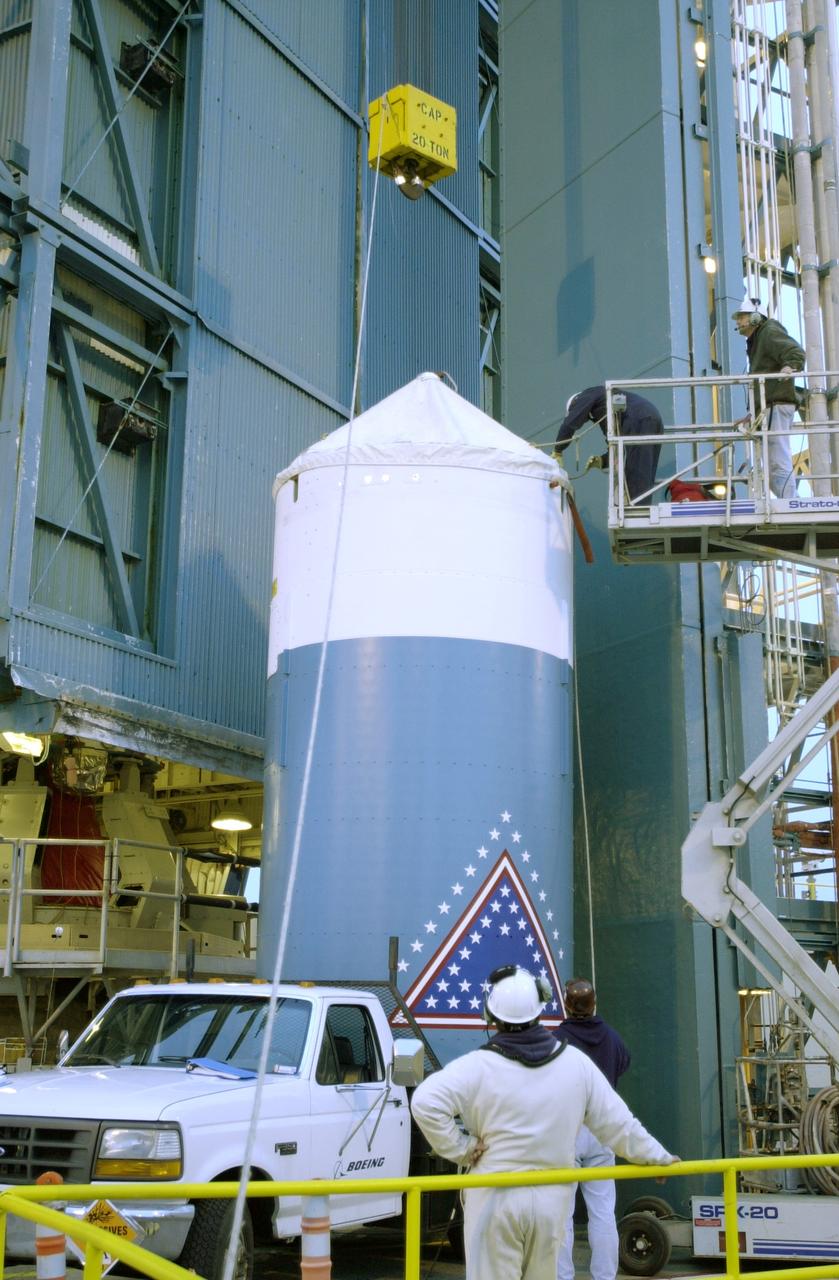
VANDENBERG AFB, CALIF. -  The second stage of the Delta II launch vehicle for the Gravity Probe B experiment arrives at the mobile service tower on Space Launch Complex 2, Vandenberg Air Force Base, Calif.  The Gravity Probe B will launch a payload of four gyroscopes into low-Earth polar orbit to test two extraordinary predictions of Albert Einstein’s general theory of relativity: the geodetic effect (how space and time are warped by the presence of the Earth) and frame dragging (how Earth’s rotation drags space and time around with it). Once in orbit, for 18 months each gyroscope’s spin axis will be monitored as it travels through local spacetime, observing and measuring these effects.  The experiment was developed by Stanford University, Lockheed Martin and NASA’s Marshall Space Flight Center.  The targeted launch date is Dec. 6, 2003.
VANDENBERG AFB, CALIF. - The second stage of the Delta II launch vehicle for the Gravity Probe B experiment arrives at the mobile service tower on Space Launch Complex 2, Vandenberg Air Force Base, Calif. The Gravity Probe B will launch a payload of four gyroscopes into low-Earth polar orbit to test two extraordinary predictions of Albert Einstein’s general theory of relativity: the geodetic effect (how space and time are warped by the presence of the Earth) and frame dragging (how Earth’s rotation drags space and time around with it). Once in orbit, for 18 months each gyroscope’s spin axis will be monitored as it travels through local spacetime, observing and measuring these effects. The experiment was developed by Stanford University, Lockheed Martin and NASA’s Marshall Space Flight Center. The targeted launch date is Dec. 6, 2003.
VANDENBERG AFB, CALIF. -  In the NASA spacecraft processing facility on North Vandenberg Air Force Base, the Gravity Probe B spacecraft is seen with all four solar array panels installed.  Installing each array is a 3-day process and includes a functional deployment test.  The Gravity Probe B mission is a relativity experiment developed by NASA’s Marshall Space Flight Center, Stanford University and Lockheed Martin.  The spacecraft will test two extraordinary predictions of Albert Einstein’s general theory of relativity that he advanced in 1916: the geodetic effect (how space and time are warped by the presence of the Earth) and frame dragging (how Earth’s rotation drags space and time around with it).  Gravity Probe B consists of four sophisticated gyroscopes that will provide an almost perfect space-time reference system.  The mission will look in a precision manner for tiny changes in the direction of spin.
VANDENBERG AFB, CALIF. - In the NASA spacecraft processing facility on North Vandenberg Air Force Base, the Gravity Probe B spacecraft is seen with all four solar array panels installed. Installing each array is a 3-day process and includes a functional deployment test. The Gravity Probe B mission is a relativity experiment developed by NASA’s Marshall Space Flight Center, Stanford University and Lockheed Martin. The spacecraft will test two extraordinary predictions of Albert Einstein’s general theory of relativity that he advanced in 1916: the geodetic effect (how space and time are warped by the presence of the Earth) and frame dragging (how Earth’s rotation drags space and time around with it). Gravity Probe B consists of four sophisticated gyroscopes that will provide an almost perfect space-time reference system. The mission will look in a precision manner for tiny changes in the direction of spin.
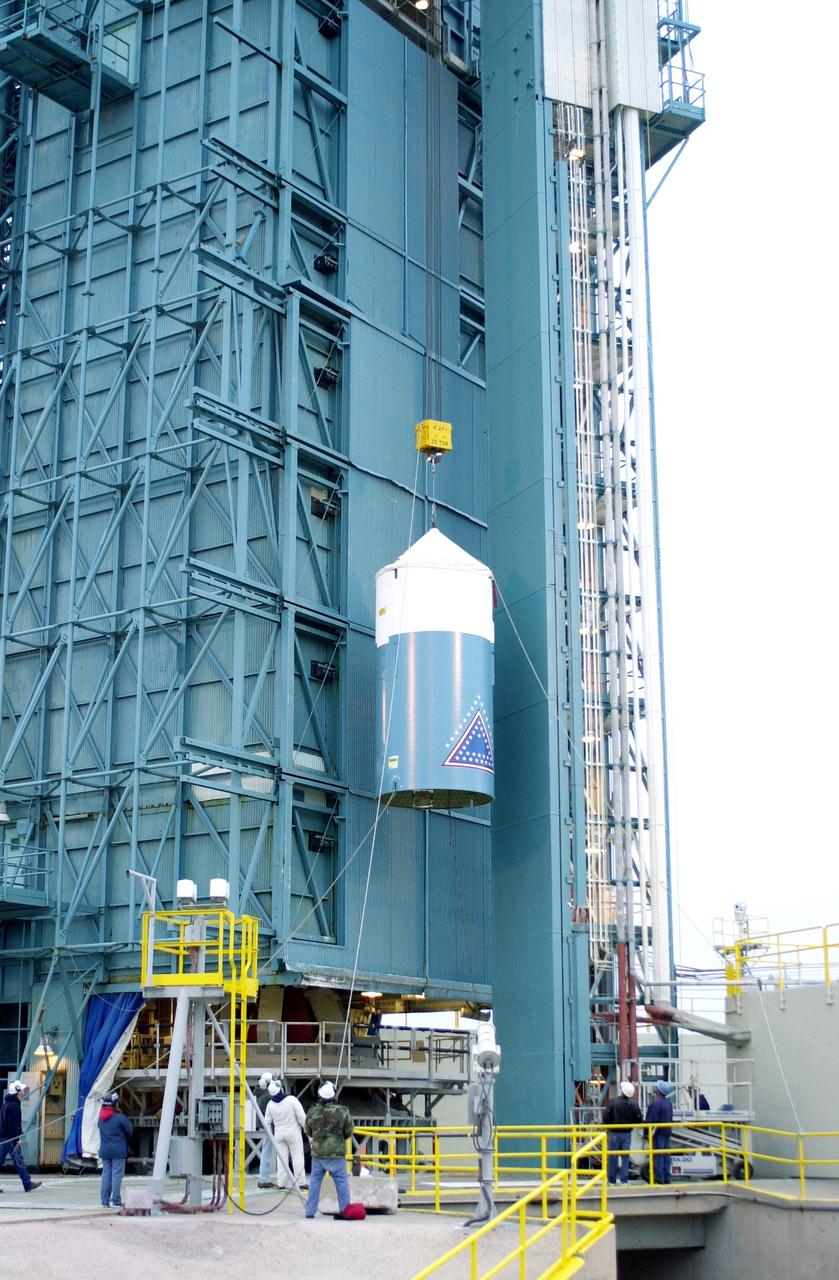
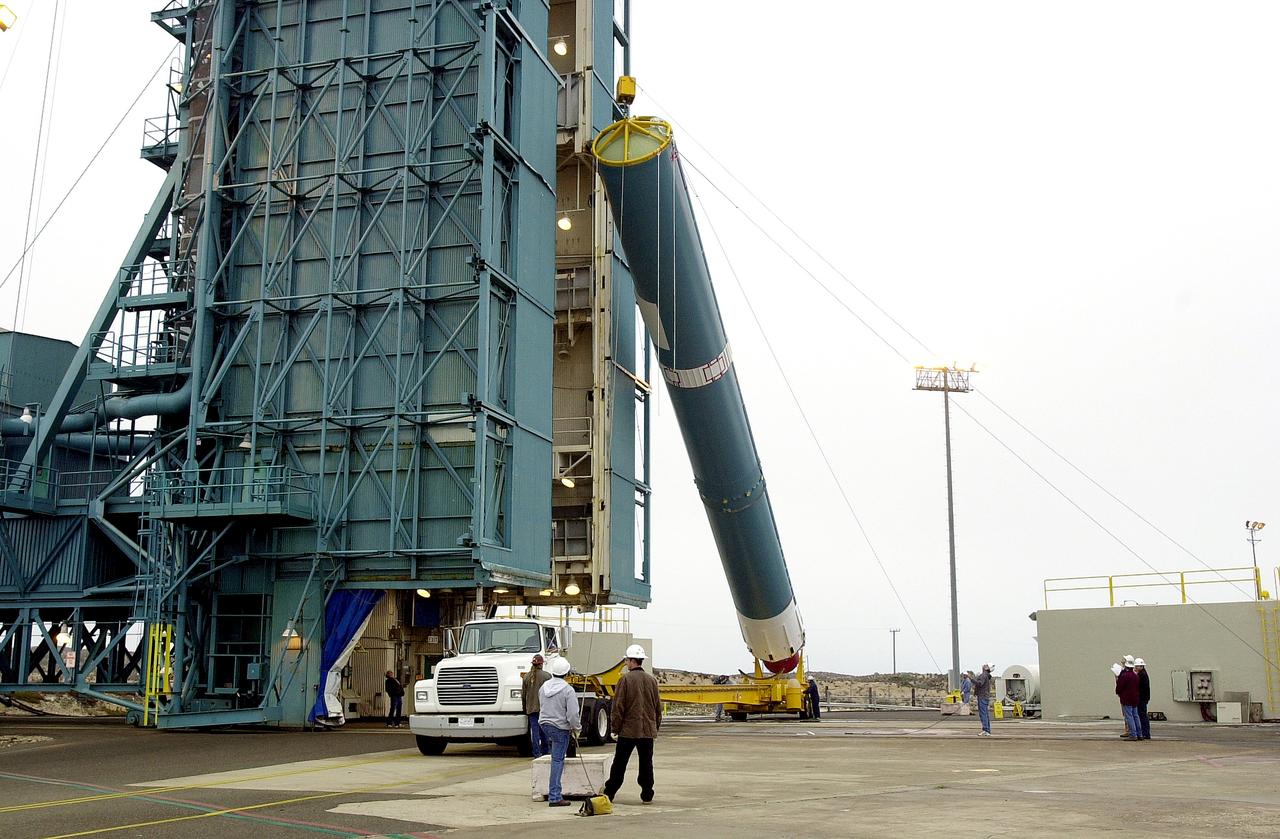
VANDENBERG AFB, CALIF. -   The interstage of the Delta II launch vehicle for the Gravity Probe B experiment is moved into the mobile service tower on Space Launch Complex 2, Vandenberg Air Force Base, Calif., where it will be mated with the second stage.  The Gravity Probe B will launch a payload of four gyroscopes into low-Earth polar orbit to test two extraordinary predictions of Albert Einstein’s general theory of relativity: the geodetic effect (how space and time are warped by the presence of the Earth) and frame dragging (how Earth’s rotation drags space and time around with it). Once in orbit, for 18 months each gyroscope’s spin axis will be monitored as it travels through local spacetime, observing and measuring these effects.  The experiment was developed by Stanford University, Lockheed Martin and NASA’s Marshall Space Flight Center.  The targeted launch date is Dec. 6, 2003.
VANDENBERG AFB, CALIF. - The interstage of the Delta II launch vehicle for the Gravity Probe B experiment is moved into the mobile service tower on Space Launch Complex 2, Vandenberg Air Force Base, Calif., where it will be mated with the second stage. The Gravity Probe B will launch a payload of four gyroscopes into low-Earth polar orbit to test two extraordinary predictions of Albert Einstein’s general theory of relativity: the geodetic effect (how space and time are warped by the presence of the Earth) and frame dragging (how Earth’s rotation drags space and time around with it). Once in orbit, for 18 months each gyroscope’s spin axis will be monitored as it travels through local spacetime, observing and measuring these effects. The experiment was developed by Stanford University, Lockheed Martin and NASA’s Marshall Space Flight Center. The targeted launch date is Dec. 6, 2003.
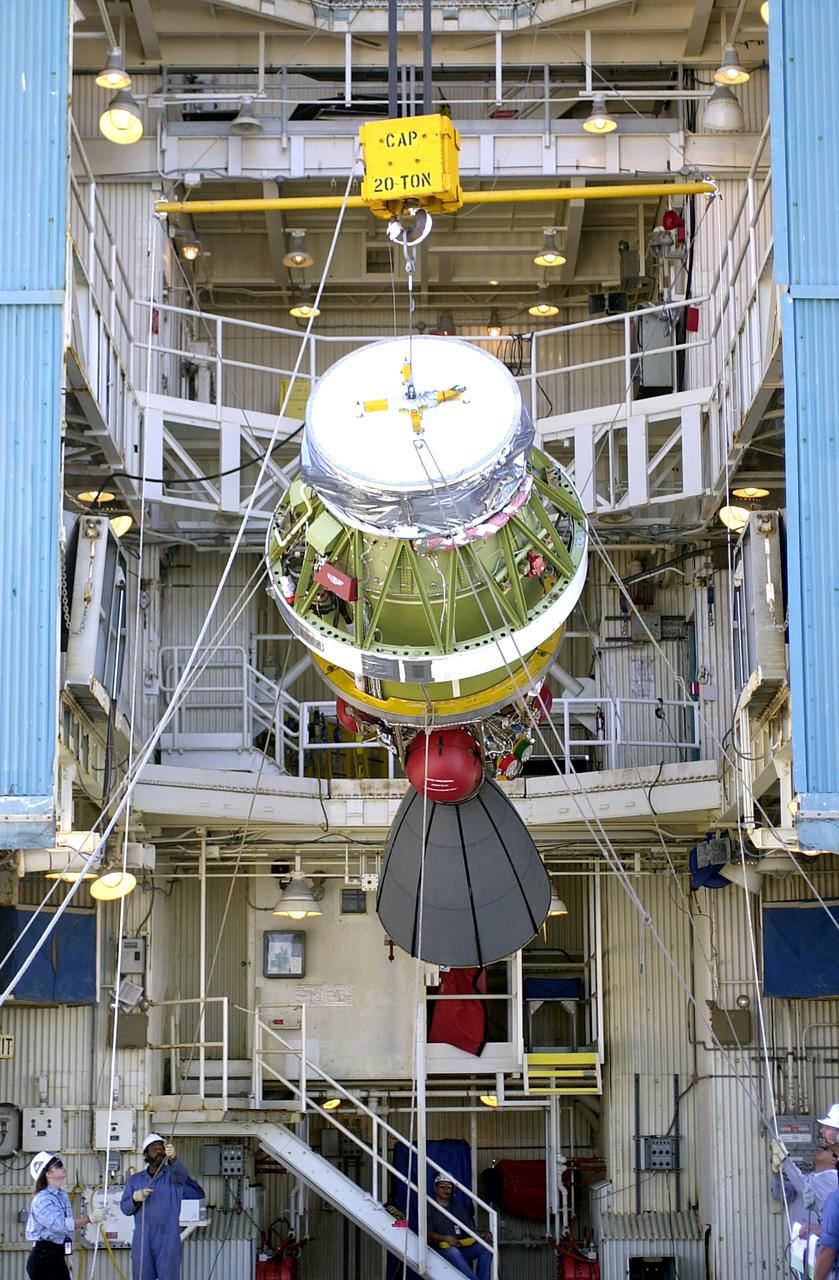
VANDENBERG AFB, CALIF. -  The second stage of the Delta II launch vehicle for the Gravity Probe B experiment is lifted up the mobile service tower on Space Launch Complex 2, Vandenberg Air Force Base, Calif.  The Gravity Probe B will launch a payload of four gyroscopes into low-Earth polar orbit to test two extraordinary predictions of Albert Einstein’s general theory of relativity: the geodetic effect (how space and time are warped by the presence of the Earth) and frame dragging (how Earth’s rotation drags space and time around with it). Once in orbit, for 18 months each gyroscope’s spin axis will be monitored as it travels through local spacetime, observing and measuring these effects.  The experiment was developed by Stanford University, Lockheed Martin and NASA’s Marshall Space Flight Center.  The targeted launch date is Dec. 6, 2003.
VANDENBERG AFB, CALIF. - The second stage of the Delta II launch vehicle for the Gravity Probe B experiment is lifted up the mobile service tower on Space Launch Complex 2, Vandenberg Air Force Base, Calif. The Gravity Probe B will launch a payload of four gyroscopes into low-Earth polar orbit to test two extraordinary predictions of Albert Einstein’s general theory of relativity: the geodetic effect (how space and time are warped by the presence of the Earth) and frame dragging (how Earth’s rotation drags space and time around with it). Once in orbit, for 18 months each gyroscope’s spin axis will be monitored as it travels through local spacetime, observing and measuring these effects. The experiment was developed by Stanford University, Lockheed Martin and NASA’s Marshall Space Flight Center. The targeted launch date is Dec. 6, 2003.
VANDENBERG AFB, CALIF. - Workers in the NASA spacecraft processing facility on North Vandenberg Air Force Base attach a solar array panel on the Gravity Probe B spacecraft.  Installing each array is a 3-day process and includes a functional deployment test.  The Gravity Probe B mission is a relativity experiment developed by NASA’s Marshall Space Flight Center, Stanford University and Lockheed Martin.  The spacecraft will test two extraordinary predictions of Albert Einstein’s general theory of relativity that he advanced in 1916: the geodetic effect (how space and time are warped by the presence of the Earth) and frame dragging (how Earth’s rotation drags space and time around with it).  Gravity Probe B consists of four sophisticated gyroscopes that will provide an almost perfect space-time reference system.  The mission will look in a precision manner for tiny changes in the direction of spin.
VANDENBERG AFB, CALIF. - Workers in the NASA spacecraft processing facility on North Vandenberg Air Force Base attach a solar array panel on the Gravity Probe B spacecraft. Installing each array is a 3-day process and includes a functional deployment test. The Gravity Probe B mission is a relativity experiment developed by NASA’s Marshall Space Flight Center, Stanford University and Lockheed Martin. The spacecraft will test two extraordinary predictions of Albert Einstein’s general theory of relativity that he advanced in 1916: the geodetic effect (how space and time are warped by the presence of the Earth) and frame dragging (how Earth’s rotation drags space and time around with it). Gravity Probe B consists of four sophisticated gyroscopes that will provide an almost perfect space-time reference system. The mission will look in a precision manner for tiny changes in the direction of spin.
VANDENBERG AFB, CALIF. - A worker in the NASA spacecraft processing facility on North Vandenberg Air Force Base adjust the supports on a solar array panel to be lifted and  installed on the Gravity Probe B spacecraft.  Installing each array is a 3-day process and includes a functional deployment test.  The Gravity Probe B mission is a relativity experiment developed by NASA’s Marshall Space Flight Center, Stanford University and Lockheed Martin.  The spacecraft will test two extraordinary predictions of Albert Einstein’s general theory of relativity that he advanced in 1916: the geodetic effect (how space and time are warped by the presence of the Earth) and frame dragging (how Earth’s rotation drags space and time around with it).  Gravity Probe B consists of four sophisticated gyroscopes that will provide an almost perfect space-time reference system.  The mission will look in a precision manner for tiny changes in the direction of spin.
VANDENBERG AFB, CALIF. - A worker in the NASA spacecraft processing facility on North Vandenberg Air Force Base adjust the supports on a solar array panel to be lifted and installed on the Gravity Probe B spacecraft. Installing each array is a 3-day process and includes a functional deployment test. The Gravity Probe B mission is a relativity experiment developed by NASA’s Marshall Space Flight Center, Stanford University and Lockheed Martin. The spacecraft will test two extraordinary predictions of Albert Einstein’s general theory of relativity that he advanced in 1916: the geodetic effect (how space and time are warped by the presence of the Earth) and frame dragging (how Earth’s rotation drags space and time around with it). Gravity Probe B consists of four sophisticated gyroscopes that will provide an almost perfect space-time reference system. The mission will look in a precision manner for tiny changes in the direction of spin.
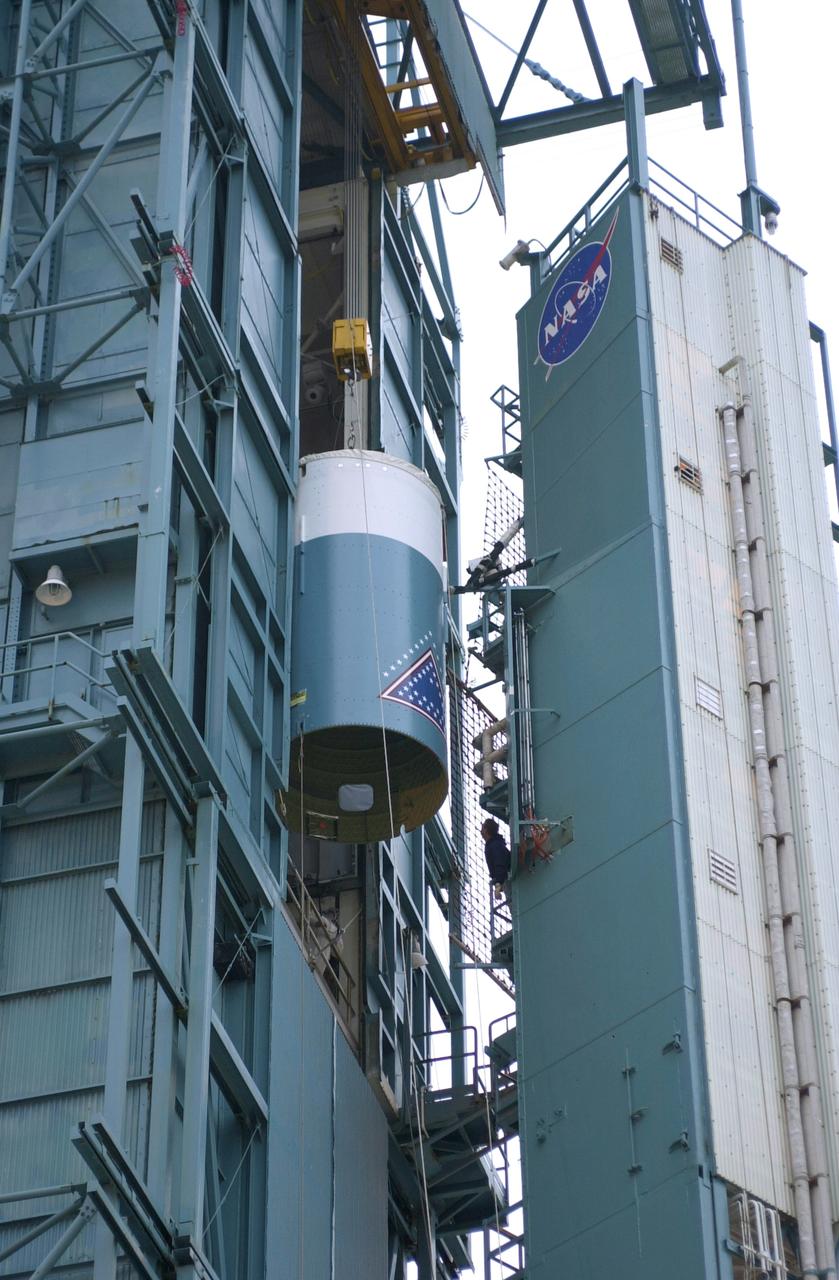
VANDENBERG AFB, CALIF. -  The interstage of the Delta II launch vehicle for the Gravity Probe B experiment is lifted up the mobile service tower on Space Launch Complex 2, Vandenberg Air Force Base, Calif.  It will enclose the second stage.  The Gravity Probe B will launch a payload of four gyroscopes into low-Earth polar orbit to test two extraordinary predictions of Albert Einstein’s general theory of relativity: the geodetic effect (how space and time are warped by the presence of the Earth) and frame dragging (how Earth’s rotation drags space and time around with it). Once in orbit, for 18 months each gyroscope’s spin axis will be monitored as it travels through local spacetime, observing and measuring these effects.  The experiment was developed by Stanford University, Lockheed Martin and NASA’s Marshall Space Flight Center.  The targeted launch date is Dec. 6, 2003.
VANDENBERG AFB, CALIF. - The interstage of the Delta II launch vehicle for the Gravity Probe B experiment is lifted up the mobile service tower on Space Launch Complex 2, Vandenberg Air Force Base, Calif. It will enclose the second stage. The Gravity Probe B will launch a payload of four gyroscopes into low-Earth polar orbit to test two extraordinary predictions of Albert Einstein’s general theory of relativity: the geodetic effect (how space and time are warped by the presence of the Earth) and frame dragging (how Earth’s rotation drags space and time around with it). Once in orbit, for 18 months each gyroscope’s spin axis will be monitored as it travels through local spacetime, observing and measuring these effects. The experiment was developed by Stanford University, Lockheed Martin and NASA’s Marshall Space Flight Center. The targeted launch date is Dec. 6, 2003.
VANDENBERG AFB, CALIF. -  The second stage of the Delta II launch vehicle for the Gravity Probe B experiment is moved into the mobile service tower on Space Launch Complex 2, Vandenberg Air Force Base, Calif.   Behind it can be seen the first stage of the Delta II.  The Gravity Probe B will launch a payload of four gyroscopes into low-Earth polar orbit to test two extraordinary predictions of Albert Einstein’s general theory of relativity: the geodetic effect (how space and time are warped by the presence of the Earth) and frame dragging (how Earth’s rotation drags space and time around with it). Once in orbit, for 18 months each gyroscope’s spin axis will be monitored as it travels through local spacetime, observing and measuring these effects.  The experiment was developed by Stanford University, Lockheed Martin and NASA’s Marshall Space Flight Center.  The targeted launch date is Dec. 6, 2003.
VANDENBERG AFB, CALIF. - The second stage of the Delta II launch vehicle for the Gravity Probe B experiment is moved into the mobile service tower on Space Launch Complex 2, Vandenberg Air Force Base, Calif. Behind it can be seen the first stage of the Delta II. The Gravity Probe B will launch a payload of four gyroscopes into low-Earth polar orbit to test two extraordinary predictions of Albert Einstein’s general theory of relativity: the geodetic effect (how space and time are warped by the presence of the Earth) and frame dragging (how Earth’s rotation drags space and time around with it). Once in orbit, for 18 months each gyroscope’s spin axis will be monitored as it travels through local spacetime, observing and measuring these effects. The experiment was developed by Stanford University, Lockheed Martin and NASA’s Marshall Space Flight Center. The targeted launch date is Dec. 6, 2003.
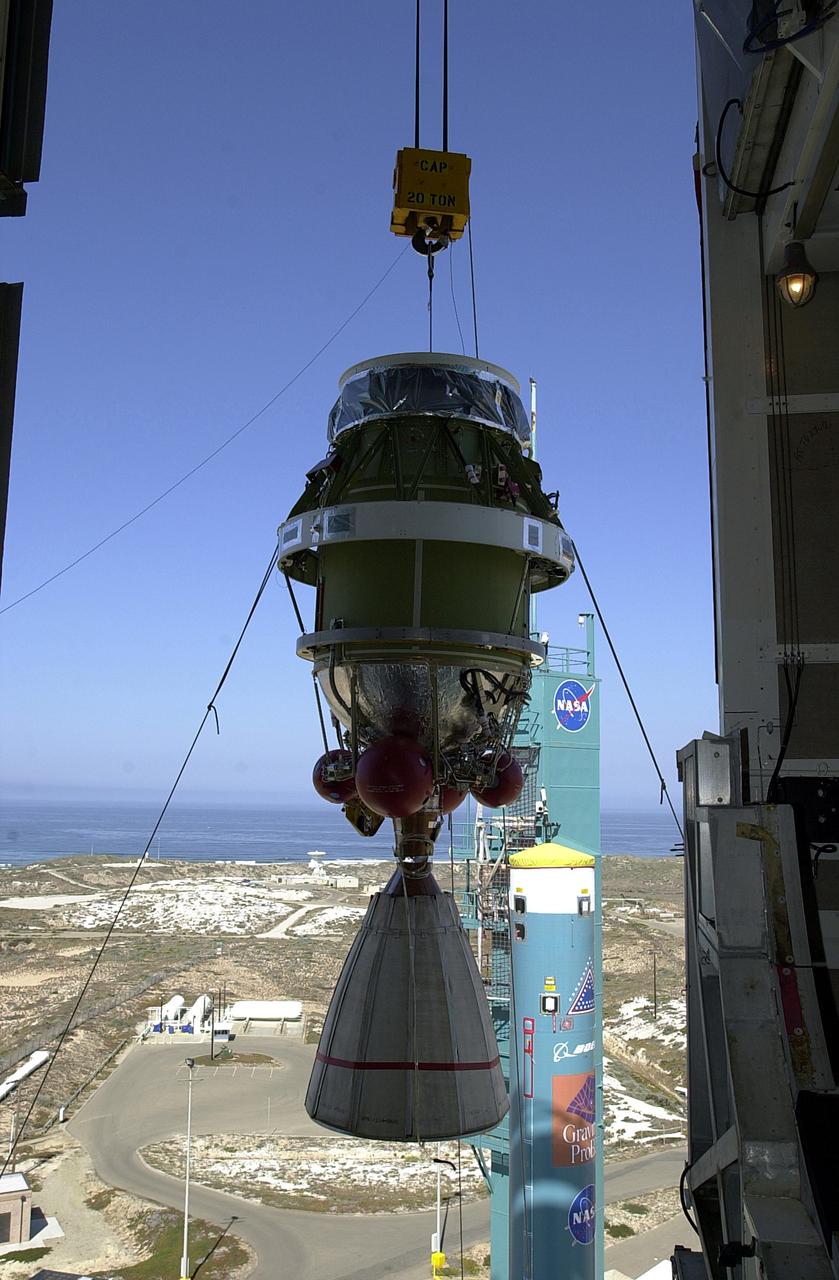
VANDENBERG AFB, CALIF. -  Viewed from inside, the second stage of the Delta II launch vehicle for the Gravity Probe B experiment is lifted up the mobile service tower on Space Launch Complex 2, Vandenberg Air Force Base, Calif.   Behind it is the first stage of the Delta II.  The Gravity Probe B will launch a payload of four gyroscopes into low-Earth polar orbit to test two extraordinary predictions of Albert Einstein’s general theory of relativity: the geodetic effect (how space and time are warped by the presence of the Earth) and frame dragging (how Earth’s rotation drags space and time around with it). Once in orbit, for 18 months each gyroscope’s spin axis will be monitored as it travels through local spacetime, observing and measuring these effects.  The experiment was developed by Stanford University, Lockheed Martin and NASA’s Marshall Space Flight Center.  The targeted launch date is Dec. 6, 2003.
VANDENBERG AFB, CALIF. - Viewed from inside, the second stage of the Delta II launch vehicle for the Gravity Probe B experiment is lifted up the mobile service tower on Space Launch Complex 2, Vandenberg Air Force Base, Calif. Behind it is the first stage of the Delta II. The Gravity Probe B will launch a payload of four gyroscopes into low-Earth polar orbit to test two extraordinary predictions of Albert Einstein’s general theory of relativity: the geodetic effect (how space and time are warped by the presence of the Earth) and frame dragging (how Earth’s rotation drags space and time around with it). Once in orbit, for 18 months each gyroscope’s spin axis will be monitored as it travels through local spacetime, observing and measuring these effects. The experiment was developed by Stanford University, Lockheed Martin and NASA’s Marshall Space Flight Center. The targeted launch date is Dec. 6, 2003.
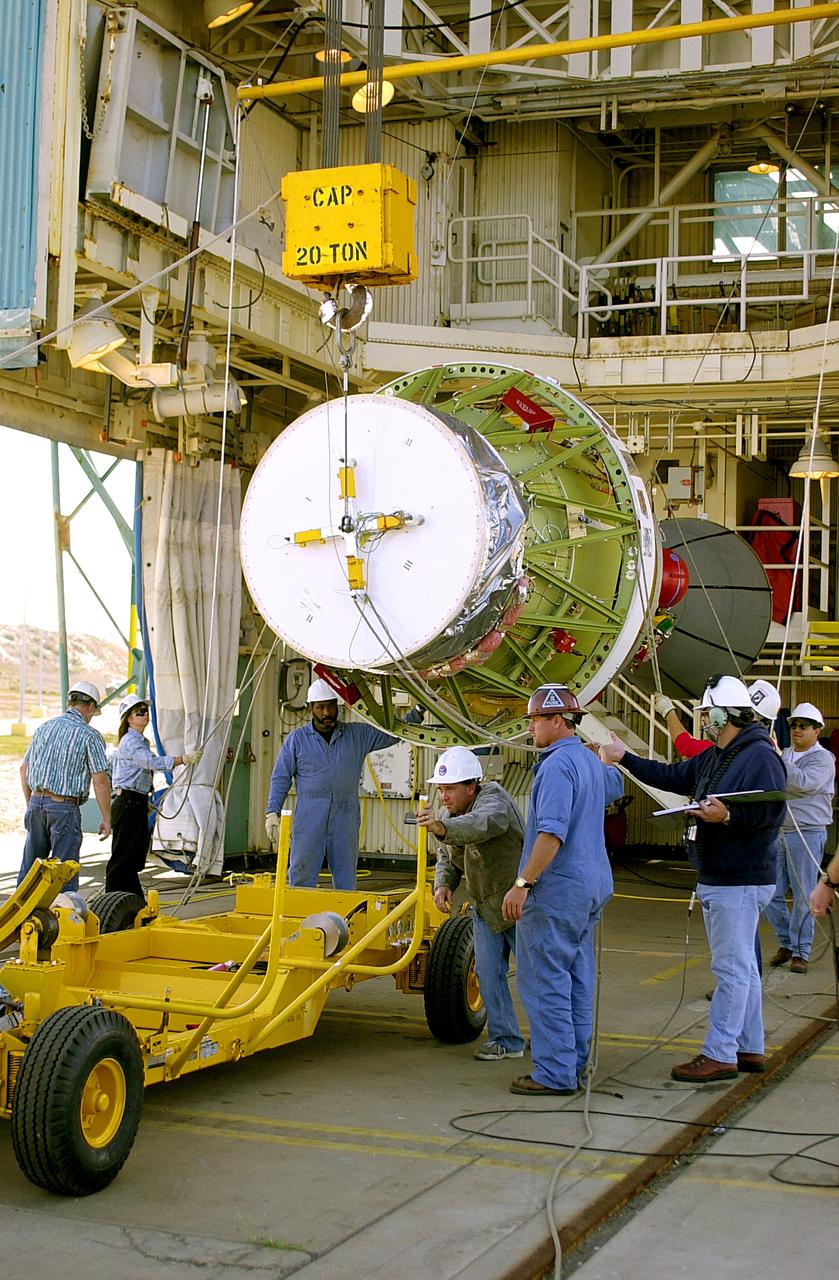
VANDENBERG AFB, CALIF. - The second stage of the Delta II launch vehicle for the Gravity Probe B experiment is lifted off the transporter after its arrival on Space Launch Complex 2, Vandenberg Air Force Base, Calif.  The Gravity Probe B will launch a payload of four gyroscopes into low-Earth polar orbit to test two extraordinary predictions of Albert Einstein’s general theory of relativity: the geodetic effect (how space and time are warped by the presence of the Earth) and frame dragging (how Earth’s rotation drags space and time around with it). Once in orbit, for 18 months each gyroscope’s spin axis will be monitored as it travels through local spacetime, observing and measuring these effects.  The experiment was developed by Stanford University, Lockheed Martin and NASA’s Marshall Space Flight Center.  The targeted launch date is Dec. 6, 2003.
VANDENBERG AFB, CALIF. - The second stage of the Delta II launch vehicle for the Gravity Probe B experiment is lifted off the transporter after its arrival on Space Launch Complex 2, Vandenberg Air Force Base, Calif. The Gravity Probe B will launch a payload of four gyroscopes into low-Earth polar orbit to test two extraordinary predictions of Albert Einstein’s general theory of relativity: the geodetic effect (how space and time are warped by the presence of the Earth) and frame dragging (how Earth’s rotation drags space and time around with it). Once in orbit, for 18 months each gyroscope’s spin axis will be monitored as it travels through local spacetime, observing and measuring these effects. The experiment was developed by Stanford University, Lockheed Martin and NASA’s Marshall Space Flight Center. The targeted launch date is Dec. 6, 2003.
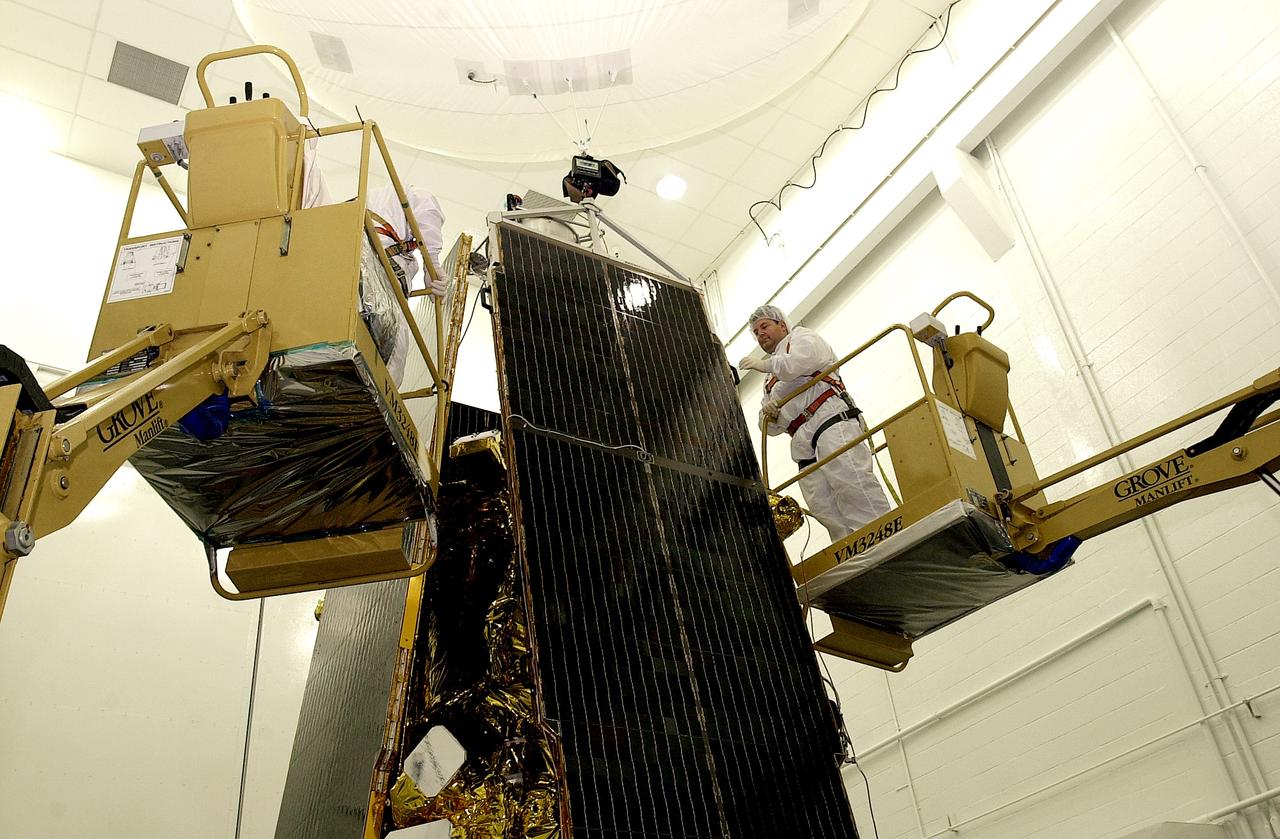
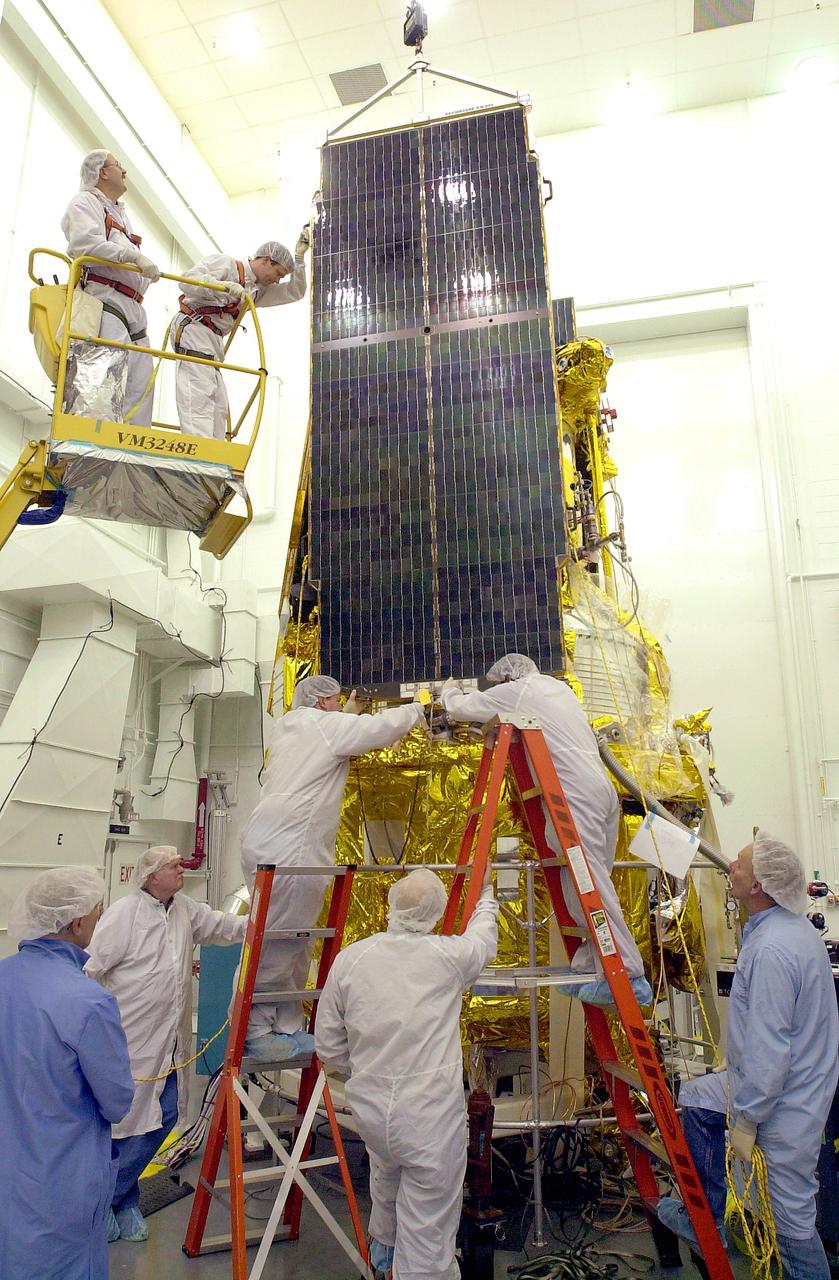
VANDENBERG AFB, CALIF. -  In the NASA spacecraft processing facility on North Vandenberg Air Force Base, workers prepare to attach the top of a solar array panel onto the Gravity Probe B spacecraft.  Installing each array is a 3-day process and includes a functional deployment test.  The Gravity Probe B mission is a relativity experiment developed by NASA’s Marshall Space Flight Center, Stanford University and Lockheed Martin.  The spacecraft will test two extraordinary predictions of Albert Einstein’s general theory of relativity that he advanced in 1916: the geodetic effect (how space and time are warped by the presence of the Earth) and frame dragging (how Earth’s rotation drags space and time around with it).  Gravity Probe B consists of four sophisticated gyroscopes that will provide an almost perfect space-time reference system.  The mission will look in a precision manner for tiny changes in the direction of spin.
VANDENBERG AFB, CALIF. - In the NASA spacecraft processing facility on North Vandenberg Air Force Base, workers prepare to attach the top of a solar array panel onto the Gravity Probe B spacecraft. Installing each array is a 3-day process and includes a functional deployment test. The Gravity Probe B mission is a relativity experiment developed by NASA’s Marshall Space Flight Center, Stanford University and Lockheed Martin. The spacecraft will test two extraordinary predictions of Albert Einstein’s general theory of relativity that he advanced in 1916: the geodetic effect (how space and time are warped by the presence of the Earth) and frame dragging (how Earth’s rotation drags space and time around with it). Gravity Probe B consists of four sophisticated gyroscopes that will provide an almost perfect space-time reference system. The mission will look in a precision manner for tiny changes in the direction of spin.
VANDENBERG AFB, CALIF. -  In the NASA spacecraft processing facility on North Vandenberg Air Force Base, workers prepare to attach the top of a solar array panel onto the Gravity Probe B spacecraft.  Installing each array is a 3-day process and includes a functional deployment test.  The Gravity Probe B mission is a relativity experiment developed by NASA’s Marshall Space Flight Center, Stanford University and Lockheed Martin.  The spacecraft will test two extraordinary predictions of Albert Einstein’s general theory of relativity that he advanced in 1916: the geodetic effect (how space and time are warped by the presence of the Earth) and frame dragging (how Earth’s rotation drags space and time around with it).  Gravity Probe B consists of four sophisticated gyroscopes that will provide an almost perfect space-time reference system.  The mission will look in a precision manner for tiny changes in the direction of spin.
VANDENBERG AFB, CALIF. - In the NASA spacecraft processing facility on North Vandenberg Air Force Base, workers prepare to attach the top of a solar array panel onto the Gravity Probe B spacecraft. Installing each array is a 3-day process and includes a functional deployment test. The Gravity Probe B mission is a relativity experiment developed by NASA’s Marshall Space Flight Center, Stanford University and Lockheed Martin. The spacecraft will test two extraordinary predictions of Albert Einstein’s general theory of relativity that he advanced in 1916: the geodetic effect (how space and time are warped by the presence of the Earth) and frame dragging (how Earth’s rotation drags space and time around with it). Gravity Probe B consists of four sophisticated gyroscopes that will provide an almost perfect space-time reference system. The mission will look in a precision manner for tiny changes in the direction of spin.
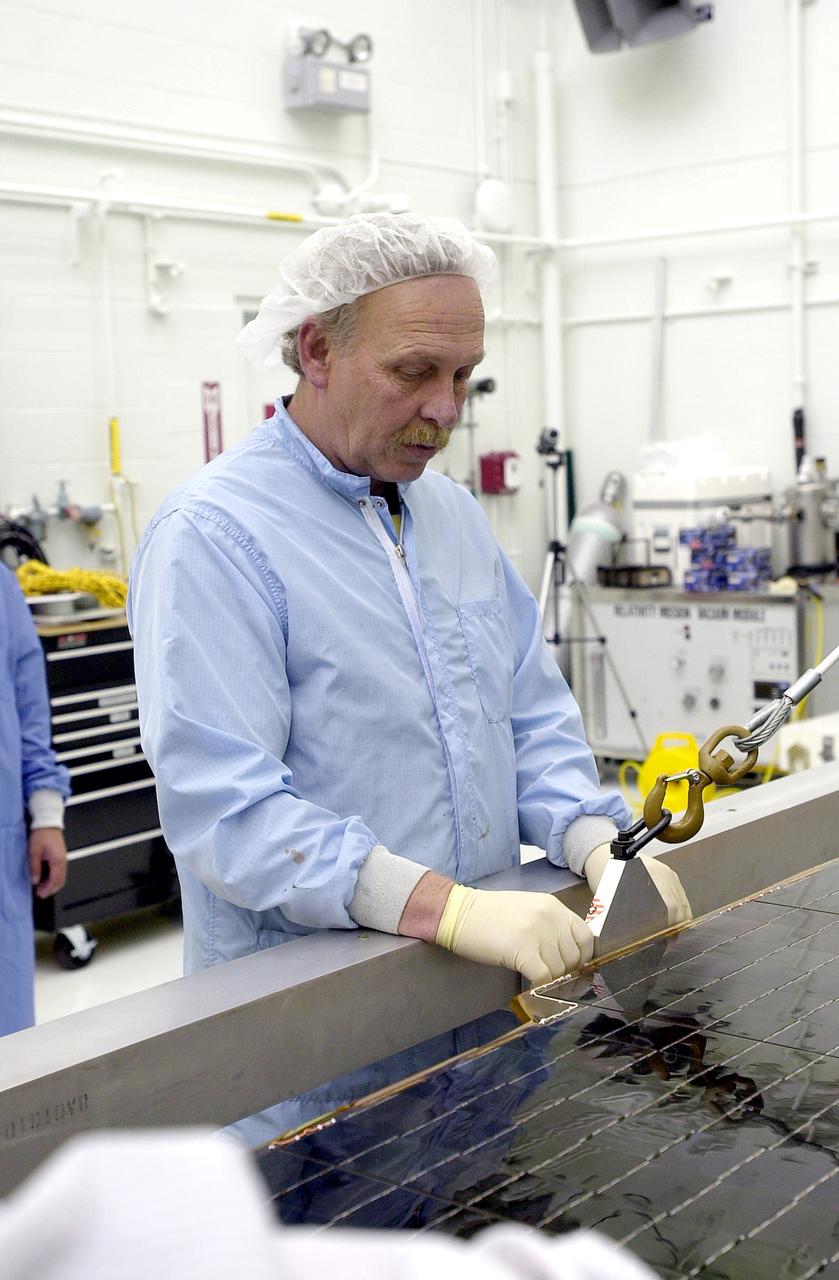
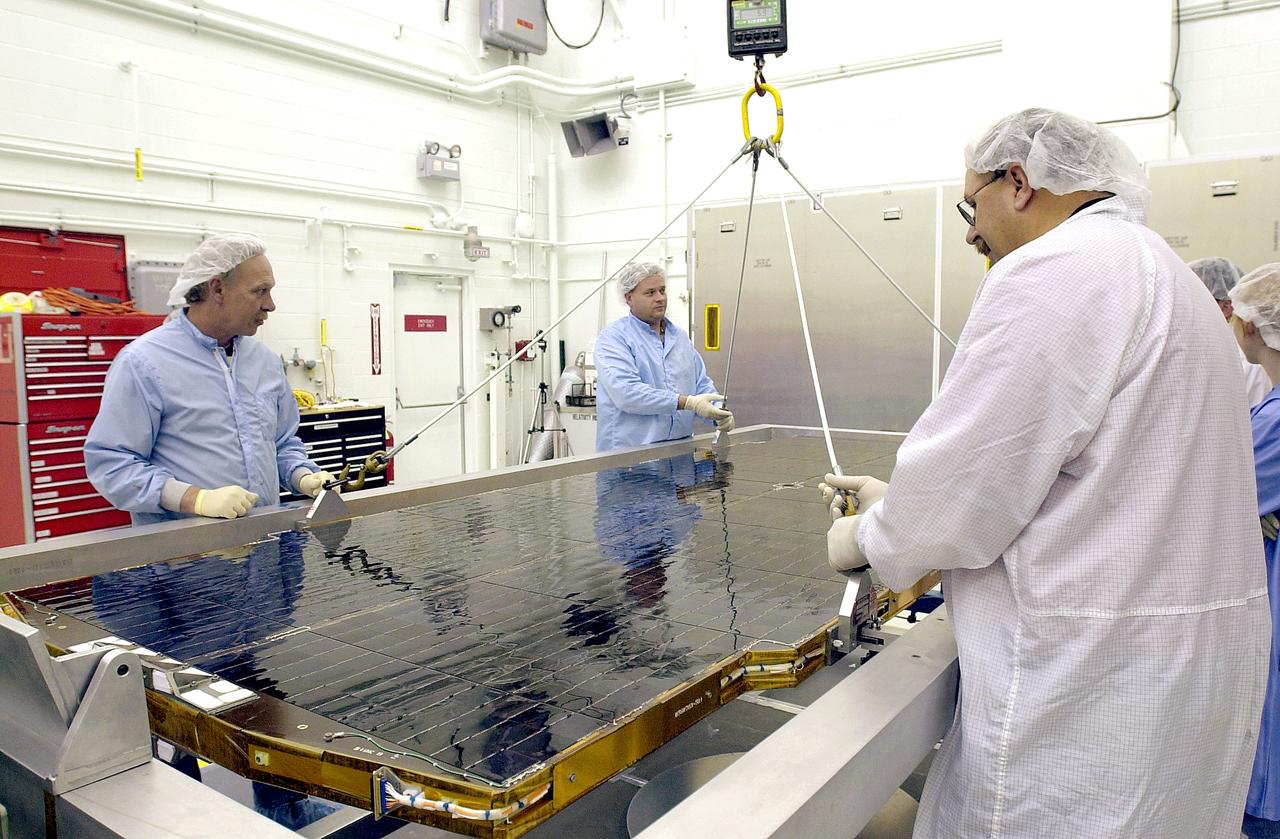
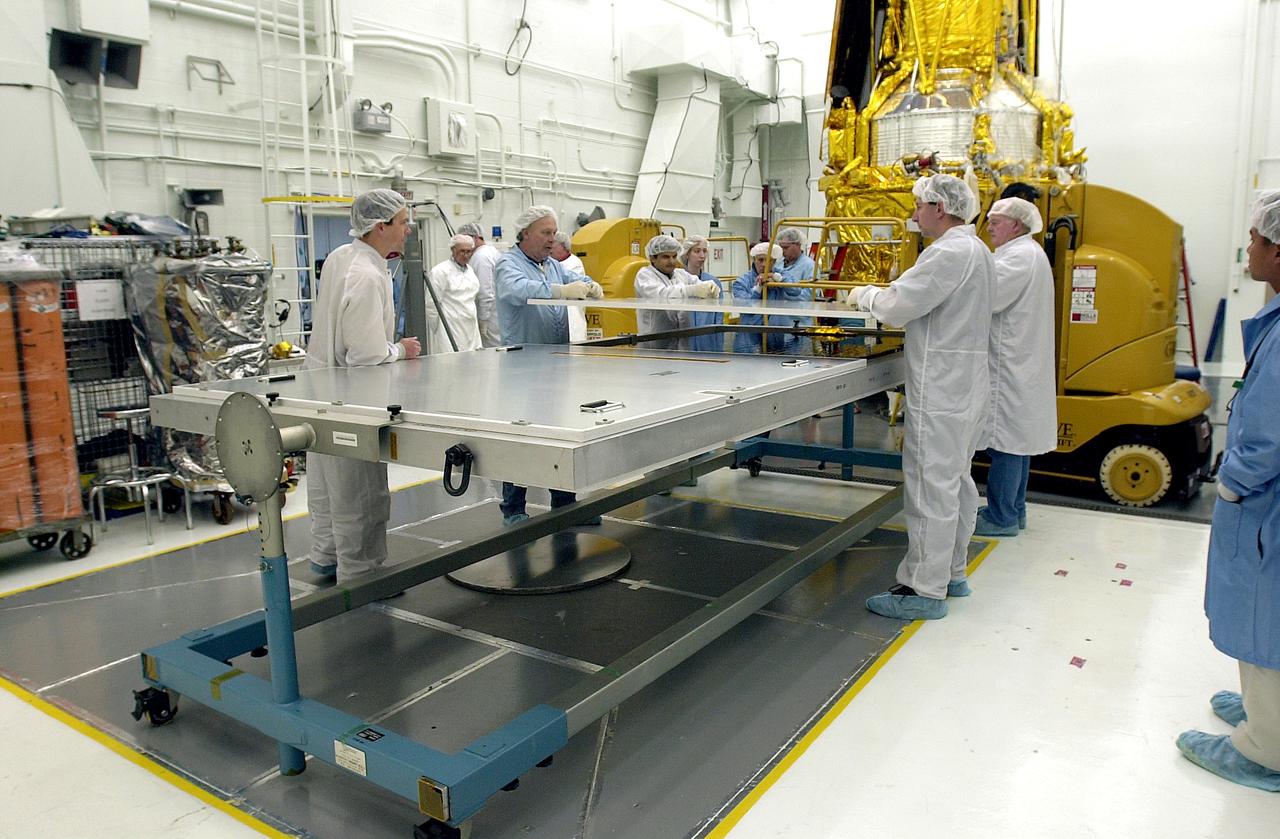
VANDENBERG AFB, CALIF. - Workers in the NASA spacecraft processing facility on North Vandenberg Air Force Base attach supports to a solar array panel to be lifted and  installed on the Gravity Probe B spacecraft.  Installing each array is a 3-day process and includes a functional deployment test.  The Gravity Probe B mission is a relativity experiment developed by NASA’s Marshall Space Flight Center, Stanford University and Lockheed Martin.  The spacecraft will test two extraordinary predictions of Albert Einstein’s general theory of relativity that he advanced in 1916: the geodetic effect (how space and time are warped by the presence of the Earth) and frame dragging (how Earth’s rotation drags space and time around with it).  Gravity Probe B consists of four sophisticated gyroscopes that will provide an almost perfect space-time reference system.  The mission will look in a precision manner for tiny changes in the direction of spin.
VANDENBERG AFB, CALIF. - Workers in the NASA spacecraft processing facility on North Vandenberg Air Force Base attach supports to a solar array panel to be lifted and installed on the Gravity Probe B spacecraft. Installing each array is a 3-day process and includes a functional deployment test. The Gravity Probe B mission is a relativity experiment developed by NASA’s Marshall Space Flight Center, Stanford University and Lockheed Martin. The spacecraft will test two extraordinary predictions of Albert Einstein’s general theory of relativity that he advanced in 1916: the geodetic effect (how space and time are warped by the presence of the Earth) and frame dragging (how Earth’s rotation drags space and time around with it). Gravity Probe B consists of four sophisticated gyroscopes that will provide an almost perfect space-time reference system. The mission will look in a precision manner for tiny changes in the direction of spin.
VANDENBERG AFB, CALIF. - Workers in the NASA spacecraft processing facility on North Vandenberg Air Force Base work on a solar array panel to be installed on the Gravity Probe B spacecraft.  Installing each array is a 3-day process and includes a functional deployment test.  The Gravity Probe B mission is a relativity experiment developed by NASA’s Marshall Space Flight Center, Stanford University and Lockheed Martin.  The spacecraft will test two extraordinary predictions of Albert Einstein’s general theory of relativity that he advanced in 1916: the geodetic effect (how space and time are warped by the presence of the Earth) and frame dragging (how Earth’s rotation drags space and time around with it).  Gravity Probe B consists of four sophisticated gyroscopes that will provide an almost perfect space-time reference system.  The mission will look in a precision manner for tiny changes in the direction of spin.
VANDENBERG AFB, CALIF. - Workers in the NASA spacecraft processing facility on North Vandenberg Air Force Base work on a solar array panel to be installed on the Gravity Probe B spacecraft. Installing each array is a 3-day process and includes a functional deployment test. The Gravity Probe B mission is a relativity experiment developed by NASA’s Marshall Space Flight Center, Stanford University and Lockheed Martin. The spacecraft will test two extraordinary predictions of Albert Einstein’s general theory of relativity that he advanced in 1916: the geodetic effect (how space and time are warped by the presence of the Earth) and frame dragging (how Earth’s rotation drags space and time around with it). Gravity Probe B consists of four sophisticated gyroscopes that will provide an almost perfect space-time reference system. The mission will look in a precision manner for tiny changes in the direction of spin.
VANDENBERG AFB, CALIF. -  Viewed from inside, the second stage of the Delta II launch vehicle for the Gravity Probe B experiment is lifted up the mobile service tower on Space Launch Complex 2, Vandenberg Air Force Base, Calif.   The Gravity Probe B will launch a payload of four gyroscopes into low-Earth polar orbit to test two extraordinary predictions of Albert Einstein’s general theory of relativity: the geodetic effect (how space and time are warped by the presence of the Earth) and frame dragging (how Earth’s rotation drags space and time around with it). Once in orbit, for 18 months each gyroscope’s spin axis will be monitored as it travels through local spacetime, observing and measuring these effects.  The experiment was developed by Stanford University, Lockheed Martin and NASA’s Marshall Space Flight Center.  The targeted launch date is Dec. 6, 2003.
VANDENBERG AFB, CALIF. - Viewed from inside, the second stage of the Delta II launch vehicle for the Gravity Probe B experiment is lifted up the mobile service tower on Space Launch Complex 2, Vandenberg Air Force Base, Calif. The Gravity Probe B will launch a payload of four gyroscopes into low-Earth polar orbit to test two extraordinary predictions of Albert Einstein’s general theory of relativity: the geodetic effect (how space and time are warped by the presence of the Earth) and frame dragging (how Earth’s rotation drags space and time around with it). Once in orbit, for 18 months each gyroscope’s spin axis will be monitored as it travels through local spacetime, observing and measuring these effects. The experiment was developed by Stanford University, Lockheed Martin and NASA’s Marshall Space Flight Center. The targeted launch date is Dec. 6, 2003.
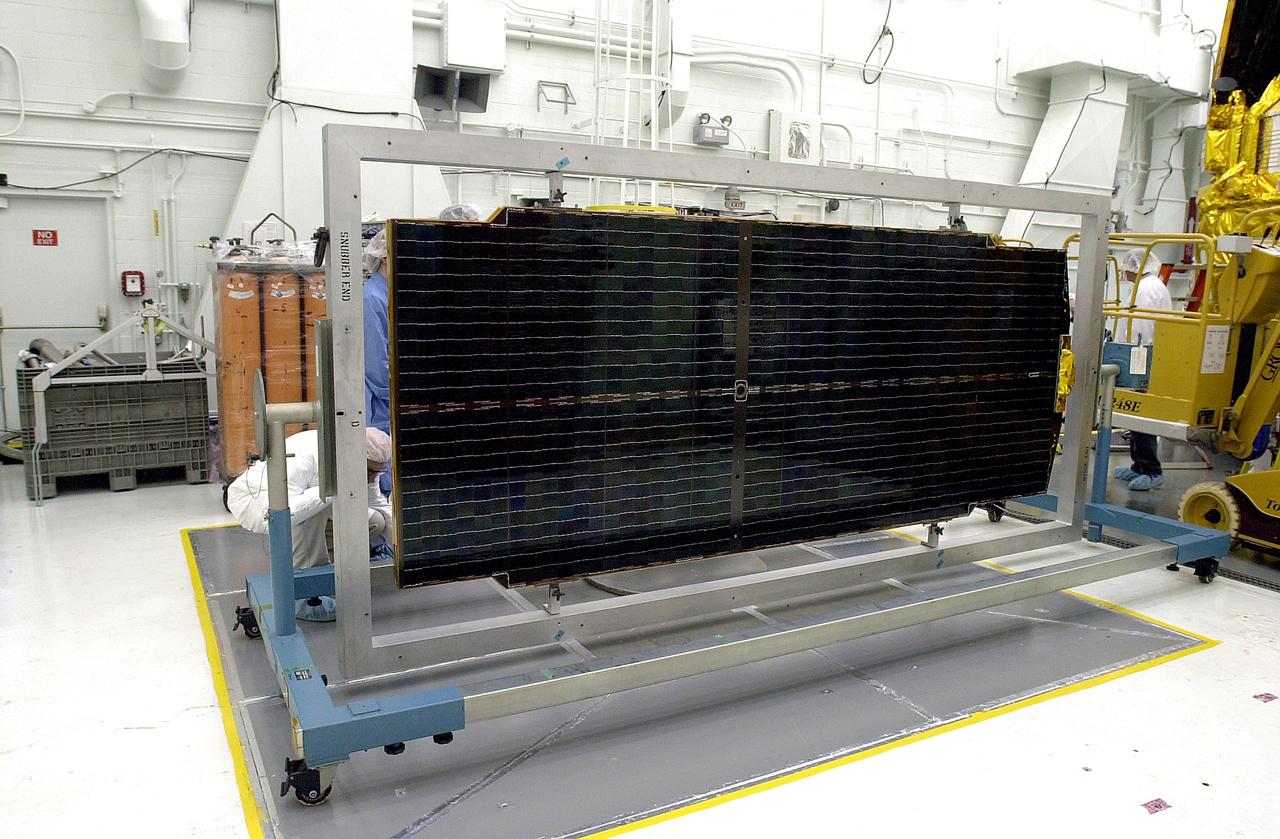
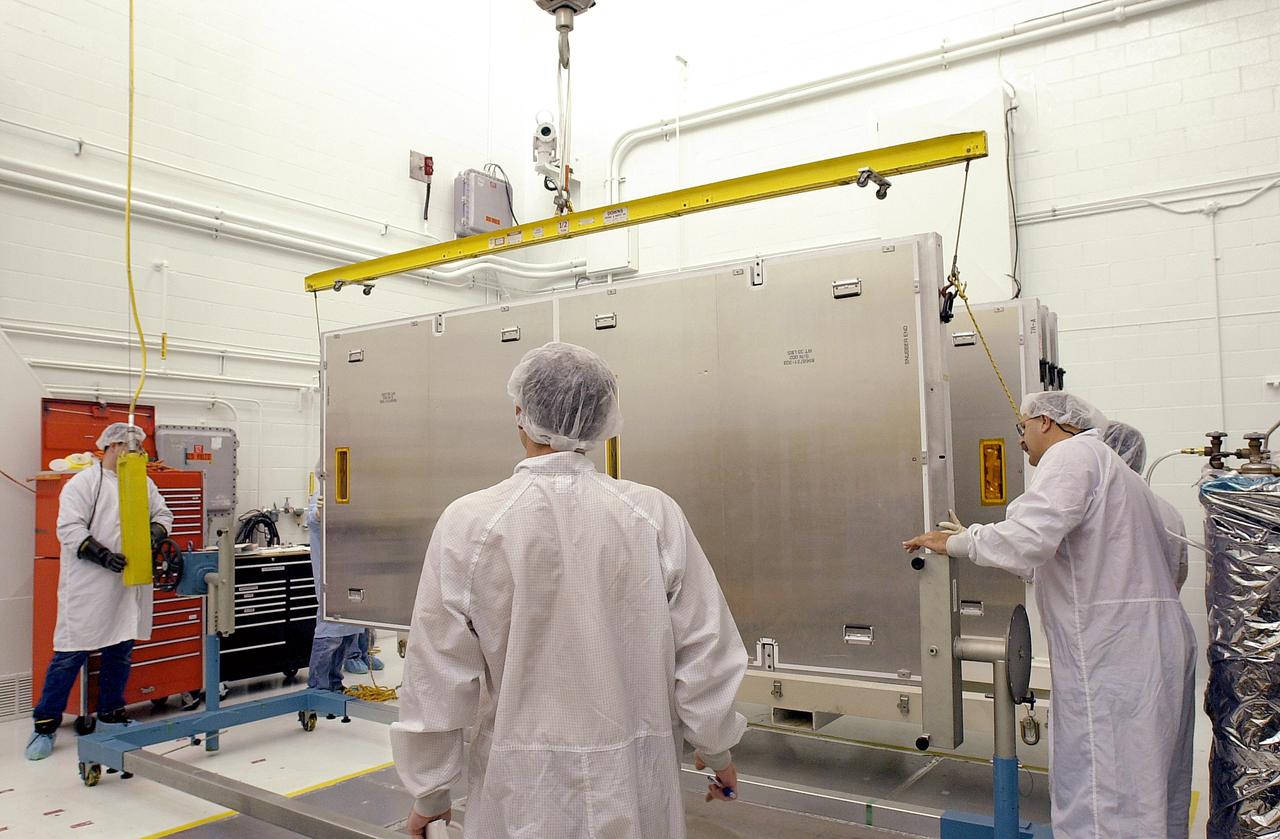
VANDENBERG AFB, CALIF. - Workers in the NASA spacecraft processing facility on North Vandenberg Air Force Base prepare to rotate the framework containing one of four solar panels to be installed on the Gravity Probe B spacecraft.  Installing each array is a 3-day process and includes a functional deployment test.  The Gravity Probe B mission is a relativity experiment developed by NASA’s Marshall Space Flight Center, Stanford University and Lockheed Martin.  The spacecraft will test two extraordinary predictions of Albert Einstein’s general theory of relativity that he advanced in 1916: the geodetic effect (how space and time are warped by the presence of the Earth) and frame dragging (how Earth’s rotation drags space and time around with it).  Gravity Probe B consists of four sophisticated gyroscopes that will provide an almost perfect space-time reference system.  The mission will look in a precision manner for tiny changes in the direction of spin.
VANDENBERG AFB, CALIF. - Workers in the NASA spacecraft processing facility on North Vandenberg Air Force Base prepare to rotate the framework containing one of four solar panels to be installed on the Gravity Probe B spacecraft. Installing each array is a 3-day process and includes a functional deployment test. The Gravity Probe B mission is a relativity experiment developed by NASA’s Marshall Space Flight Center, Stanford University and Lockheed Martin. The spacecraft will test two extraordinary predictions of Albert Einstein’s general theory of relativity that he advanced in 1916: the geodetic effect (how space and time are warped by the presence of the Earth) and frame dragging (how Earth’s rotation drags space and time around with it). Gravity Probe B consists of four sophisticated gyroscopes that will provide an almost perfect space-time reference system. The mission will look in a precision manner for tiny changes in the direction of spin.
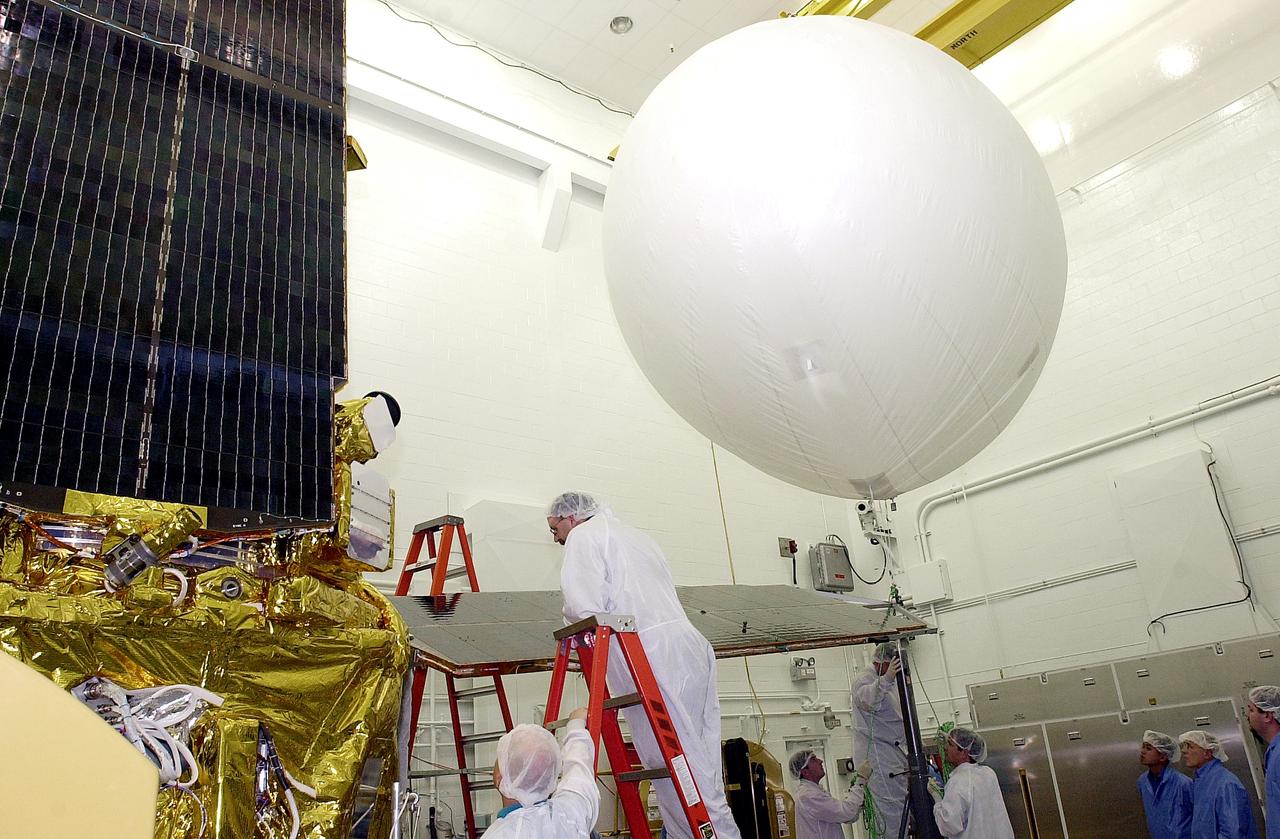
VANDENBERG AFB, CALIF. -  In the NASA spacecraft processing facility on North Vandenberg Air Force Base, workers stand by as the balloon at right is released to lift the solar array panel into position for installation on the Gravity Probe B spacecraft.  Installing each array is a 3-day process and includes a functional deployment test.  The Gravity Probe B mission is a relativity experiment developed by NASA’s Marshall Space Flight Center, Stanford University and Lockheed Martin.  The spacecraft will test two extraordinary predictions of Albert Einstein’s general theory of relativity that he advanced in 1916: the geodetic effect (how space and time are warped by the presence of the Earth) and frame dragging (how Earth’s rotation drags space and time around with it).  Gravity Probe B consists of four sophisticated gyroscopes that will provide an almost perfect space-time reference system.  The mission will look in a precision manner for tiny changes in the direction of spin.
VANDENBERG AFB, CALIF. - In the NASA spacecraft processing facility on North Vandenberg Air Force Base, workers stand by as the balloon at right is released to lift the solar array panel into position for installation on the Gravity Probe B spacecraft. Installing each array is a 3-day process and includes a functional deployment test. The Gravity Probe B mission is a relativity experiment developed by NASA’s Marshall Space Flight Center, Stanford University and Lockheed Martin. The spacecraft will test two extraordinary predictions of Albert Einstein’s general theory of relativity that he advanced in 1916: the geodetic effect (how space and time are warped by the presence of the Earth) and frame dragging (how Earth’s rotation drags space and time around with it). Gravity Probe B consists of four sophisticated gyroscopes that will provide an almost perfect space-time reference system. The mission will look in a precision manner for tiny changes in the direction of spin.
VANDENBERG AFB, CALIF. -   The first stage of the Delta II launch vehicle for the Gravity Probe B experiment is lifted up the mobile service tower on Space Launch Complex 2, Vandenberg Air Force Base, Calif.  The Gravity Probe B will launch a payload of four gyroscopes into low-Earth polar orbit to test two extraordinary predictions of Albert Einstein’s general theory of relativity: the geodetic effect (how space and time are warped by the presence of the Earth) and frame dragging (how Earth’s rotation drags space and time around with it). Once in orbit, for 18 months each gyroscope’s spin axis will be monitored as it travels through local spacetime, observing and measuring these effects.  The experiment was developed by Stanford University, Lockheed Martin and NASA’s Marshall Space Flight Center.  The targeted launch date is Dec. 6, 2003.
VANDENBERG AFB, CALIF. - The first stage of the Delta II launch vehicle for the Gravity Probe B experiment is lifted up the mobile service tower on Space Launch Complex 2, Vandenberg Air Force Base, Calif. The Gravity Probe B will launch a payload of four gyroscopes into low-Earth polar orbit to test two extraordinary predictions of Albert Einstein’s general theory of relativity: the geodetic effect (how space and time are warped by the presence of the Earth) and frame dragging (how Earth’s rotation drags space and time around with it). Once in orbit, for 18 months each gyroscope’s spin axis will be monitored as it travels through local spacetime, observing and measuring these effects. The experiment was developed by Stanford University, Lockheed Martin and NASA’s Marshall Space Flight Center. The targeted launch date is Dec. 6, 2003.
VANDENBERG AFB, CALIF. -   In the spacecraft processing facility on North Vandenberg Air Force Base, the Gravity Probe B experiment sits on an assembly and test stand where it has been subject to various prelaunch testing.  The Gravity Probe B will launch a payload of four gyroscopes into low-Earth polar orbit to test two extraordinary predictions of Albert Einstein’s general theory of relativity: the geodetic effect (how space and time are warped by the presence of the Earth) and frame dragging (how Earth’s rotation drags space and time around with it). Once in orbit, for 18 months each gyroscope’s spin axis will be monitored as it travels through local spacetime, observing and measuring these effects.  The experiment was developed by Stanford University, Lockheed Martin and NASA’s Marshall Space Flight Center.   The targeted launch date is Dec. 6, 2003.
VANDENBERG AFB, CALIF. - In the spacecraft processing facility on North Vandenberg Air Force Base, the Gravity Probe B experiment sits on an assembly and test stand where it has been subject to various prelaunch testing. The Gravity Probe B will launch a payload of four gyroscopes into low-Earth polar orbit to test two extraordinary predictions of Albert Einstein’s general theory of relativity: the geodetic effect (how space and time are warped by the presence of the Earth) and frame dragging (how Earth’s rotation drags space and time around with it). Once in orbit, for 18 months each gyroscope’s spin axis will be monitored as it travels through local spacetime, observing and measuring these effects. The experiment was developed by Stanford University, Lockheed Martin and NASA’s Marshall Space Flight Center. The targeted launch date is Dec. 6, 2003.
VANDENBERG AFB, CALIF. -  The second stage of the Delta II launch vehicle for the Gravity Probe B experiment arrives at the mobile service tower on Space Launch Complex 2, Vandenberg Air Force Base, Calif.  The Gravity Probe B will launch a payload of four gyroscopes into low-Earth polar orbit to test two extraordinary predictions of Albert Einstein’s general theory of relativity: the geodetic effect (how space and time are warped by the presence of the Earth) and frame dragging (how Earth’s rotation drags space and time around with it). Once in orbit, for 18 months each gyroscope’s spin axis will be monitored as it travels through local spacetime, observing and measuring these effects.  The experiment was developed by Stanford University, Lockheed Martin and NASA’s Marshall Space Flight Center.  The targeted launch date is Dec. 6, 2003.
VANDENBERG AFB, CALIF. - The second stage of the Delta II launch vehicle for the Gravity Probe B experiment arrives at the mobile service tower on Space Launch Complex 2, Vandenberg Air Force Base, Calif. The Gravity Probe B will launch a payload of four gyroscopes into low-Earth polar orbit to test two extraordinary predictions of Albert Einstein’s general theory of relativity: the geodetic effect (how space and time are warped by the presence of the Earth) and frame dragging (how Earth’s rotation drags space and time around with it). Once in orbit, for 18 months each gyroscope’s spin axis will be monitored as it travels through local spacetime, observing and measuring these effects. The experiment was developed by Stanford University, Lockheed Martin and NASA’s Marshall Space Flight Center. The targeted launch date is Dec. 6, 2003.
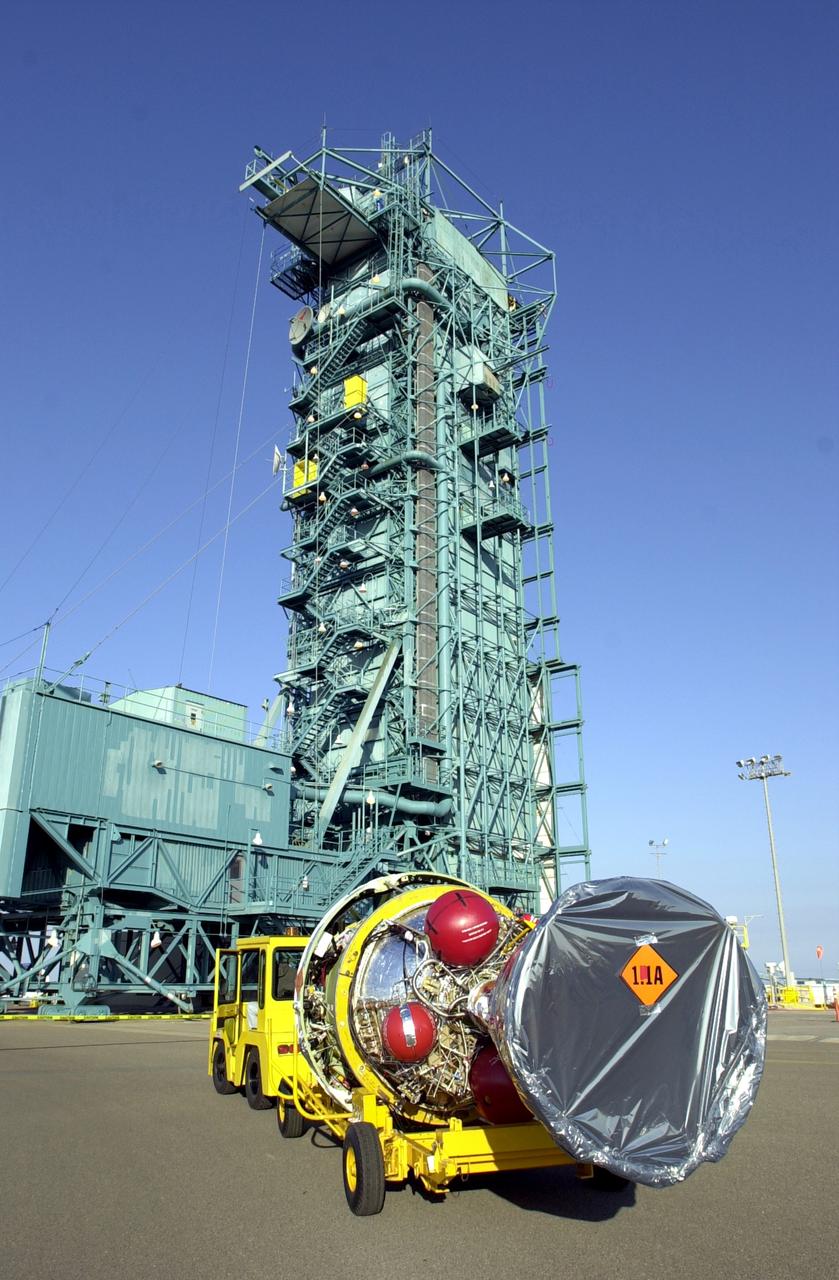
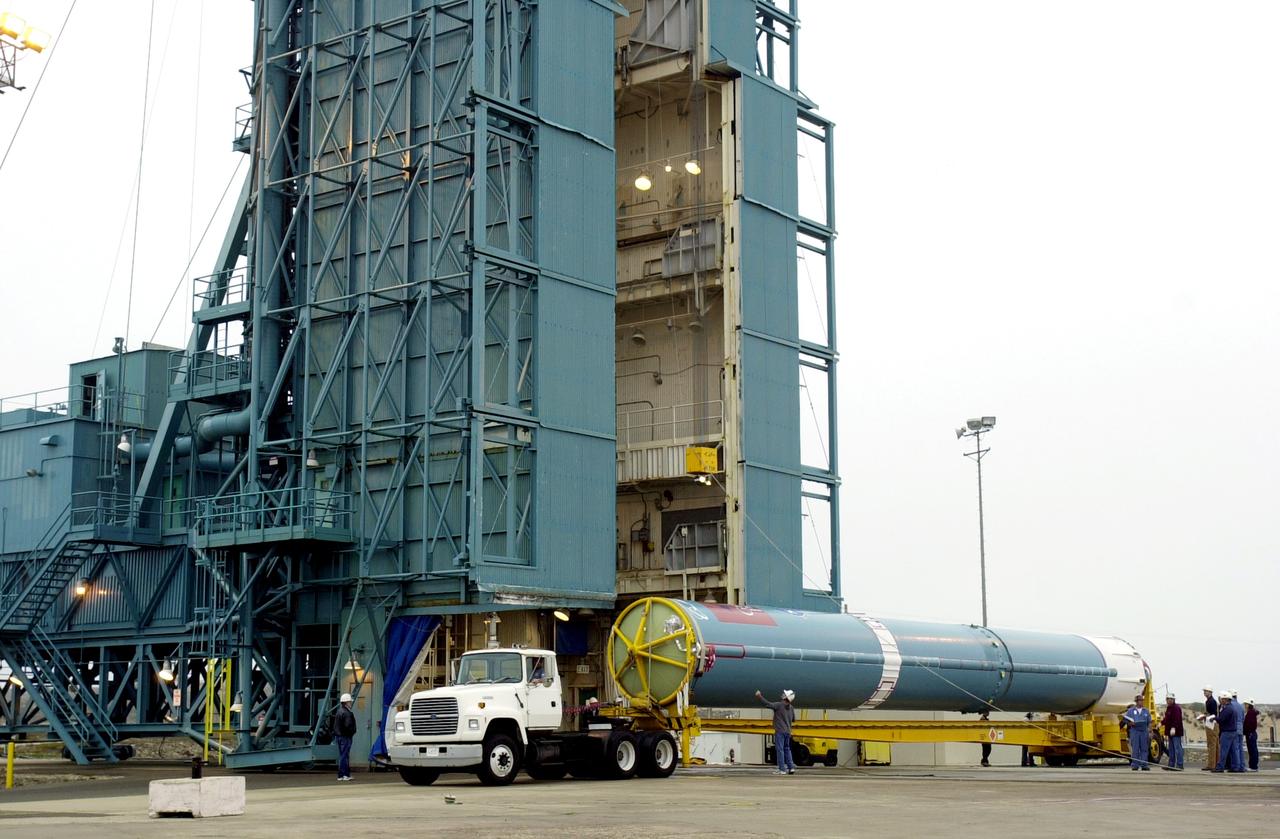
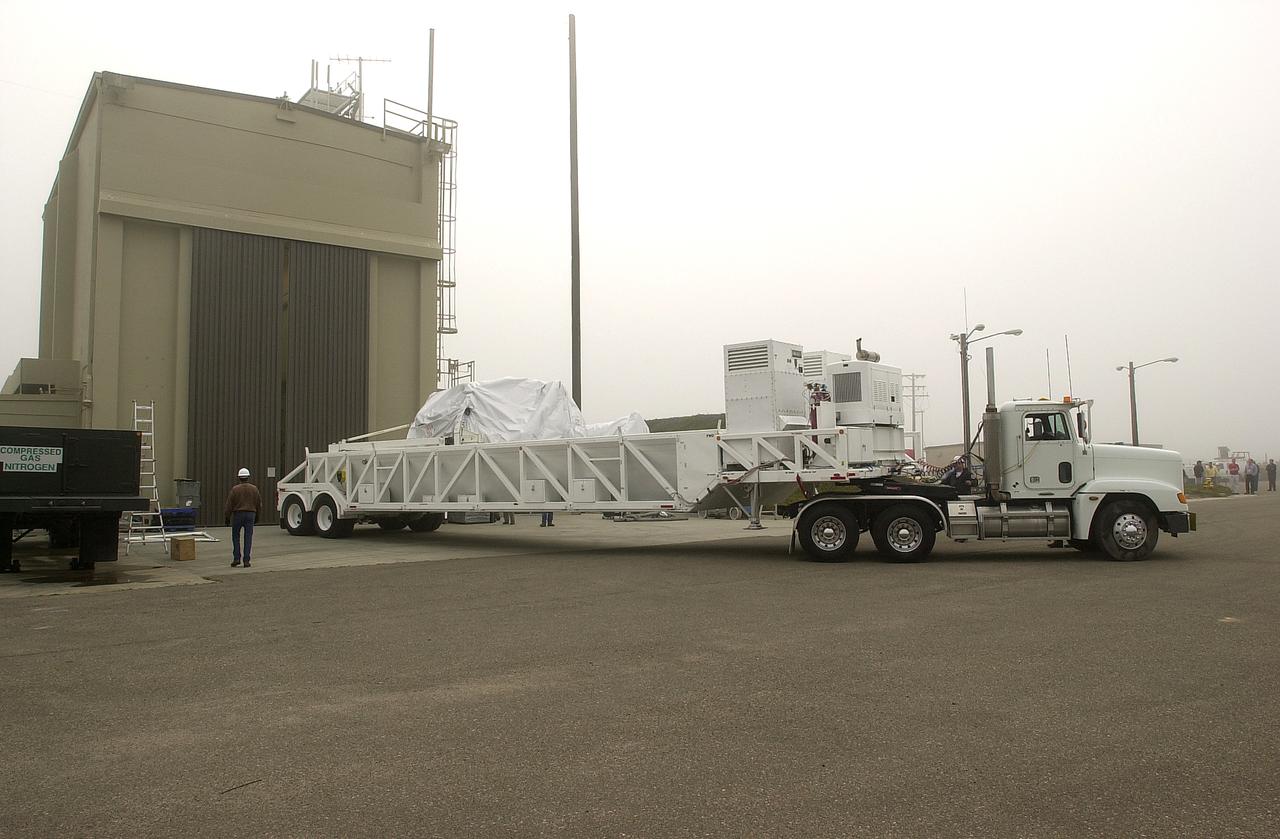
VANDENBERG AFB, CALIF. -  The first stage of the Delta II launch vehicle for the Gravity Probe B experiment arrives at Space Launch Complex 2, Vandenberg Air Force Base, Calif.  The Gravity Probe B will launch a payload of four gyroscopes into low-Earth polar orbit to test two extraordinary predictions of Albert Einstein’s general theory of relativity: the geodetic effect (how space and time are warped by the presence of the Earth) and frame dragging (how Earth’s rotation drags space and time around with it). Once in orbit, for 18 months each gyroscope’s spin axis will be monitored as it travels through local spacetime, observing and measuring these effects.  The experiment was developed by Stanford University, Lockheed Martin and NASA’s Marshall Space Flight Center.  The targeted launch date is Dec. 6, 2003.
VANDENBERG AFB, CALIF. - The first stage of the Delta II launch vehicle for the Gravity Probe B experiment arrives at Space Launch Complex 2, Vandenberg Air Force Base, Calif. The Gravity Probe B will launch a payload of four gyroscopes into low-Earth polar orbit to test two extraordinary predictions of Albert Einstein’s general theory of relativity: the geodetic effect (how space and time are warped by the presence of the Earth) and frame dragging (how Earth’s rotation drags space and time around with it). Once in orbit, for 18 months each gyroscope’s spin axis will be monitored as it travels through local spacetime, observing and measuring these effects. The experiment was developed by Stanford University, Lockheed Martin and NASA’s Marshall Space Flight Center. The targeted launch date is Dec. 6, 2003.
VANDENBERG AFB, CALIF. -  The interstage of the Delta II launch vehicle for the Gravity Probe B experiment is  prepared for lifting up the mobile service tower on Space Launch Complex 2, Vandenberg Air Force Base, Calif.  It will enclose the second stage.  The Gravity Probe B will launch a payload of four gyroscopes into low-Earth polar orbit to test two extraordinary predictions of Albert Einstein’s general theory of relativity: the geodetic effect (how space and time are warped by the presence of the Earth) and frame dragging (how Earth’s rotation drags space and time around with it). Once in orbit, for 18 months each gyroscope’s spin axis will be monitored as it travels through local spacetime, observing and measuring these effects.  The experiment was developed by Stanford University, Lockheed Martin and NASA’s Marshall Space Flight Center.  The targeted launch date is Dec. 6, 2003.
VANDENBERG AFB, CALIF. - The interstage of the Delta II launch vehicle for the Gravity Probe B experiment is prepared for lifting up the mobile service tower on Space Launch Complex 2, Vandenberg Air Force Base, Calif. It will enclose the second stage. The Gravity Probe B will launch a payload of four gyroscopes into low-Earth polar orbit to test two extraordinary predictions of Albert Einstein’s general theory of relativity: the geodetic effect (how space and time are warped by the presence of the Earth) and frame dragging (how Earth’s rotation drags space and time around with it). Once in orbit, for 18 months each gyroscope’s spin axis will be monitored as it travels through local spacetime, observing and measuring these effects. The experiment was developed by Stanford University, Lockheed Martin and NASA’s Marshall Space Flight Center. The targeted launch date is Dec. 6, 2003.
VANDENBERG AFB, CALIF. -   The interstage of the Delta II launch vehicle for the Gravity Probe B experiment is moved into the mobile service tower on Space Launch Complex 2, Vandenberg Air Force Base, Calif., where it will be mated with the second stage.  The Gravity Probe B will launch a payload of four gyroscopes into low-Earth polar orbit to test two extraordinary predictions of Albert Einstein’s general theory of relativity: the geodetic effect (how space and time are warped by the presence of the Earth) and frame dragging (how Earth’s rotation drags space and time around with it). Once in orbit, for 18 months each gyroscope’s spin axis will be monitored as it travels through local spacetime, observing and measuring these effects.  The experiment was developed by Stanford University, Lockheed Martin and NASA’s Marshall Space Flight Center.  The targeted launch date is Dec. 6, 2003.
VANDENBERG AFB, CALIF. - The interstage of the Delta II launch vehicle for the Gravity Probe B experiment is moved into the mobile service tower on Space Launch Complex 2, Vandenberg Air Force Base, Calif., where it will be mated with the second stage. The Gravity Probe B will launch a payload of four gyroscopes into low-Earth polar orbit to test two extraordinary predictions of Albert Einstein’s general theory of relativity: the geodetic effect (how space and time are warped by the presence of the Earth) and frame dragging (how Earth’s rotation drags space and time around with it). Once in orbit, for 18 months each gyroscope’s spin axis will be monitored as it travels through local spacetime, observing and measuring these effects. The experiment was developed by Stanford University, Lockheed Martin and NASA’s Marshall Space Flight Center. The targeted launch date is Dec. 6, 2003.
VANDENBERG AFB, CALIF. -  In the NASA spacecraft processing facility on North Vandenberg Air Force Base, a worker checks the installation of a solar array panel onto the Gravity Probe B spacecraft.  Installing each array is a 3-day process and includes a functional deployment test.  The Gravity Probe B mission is a relativity experiment developed by NASA’s Marshall Space Flight Center, Stanford University and Lockheed Martin.  The spacecraft will test two extraordinary predictions of Albert Einstein’s general theory of relativity that he advanced in 1916: the geodetic effect (how space and time are warped by the presence of the Earth) and frame dragging (how Earth’s rotation drags space and time around with it).  Gravity Probe B consists of four sophisticated gyroscopes that will provide an almost perfect space-time reference system.  The mission will look in a precision manner for tiny changes in the direction of spin.
VANDENBERG AFB, CALIF. - In the NASA spacecraft processing facility on North Vandenberg Air Force Base, a worker checks the installation of a solar array panel onto the Gravity Probe B spacecraft. Installing each array is a 3-day process and includes a functional deployment test. The Gravity Probe B mission is a relativity experiment developed by NASA’s Marshall Space Flight Center, Stanford University and Lockheed Martin. The spacecraft will test two extraordinary predictions of Albert Einstein’s general theory of relativity that he advanced in 1916: the geodetic effect (how space and time are warped by the presence of the Earth) and frame dragging (how Earth’s rotation drags space and time around with it). Gravity Probe B consists of four sophisticated gyroscopes that will provide an almost perfect space-time reference system. The mission will look in a precision manner for tiny changes in the direction of spin.
VANDENBERG AFB, CALIF. -  The first stage of the Delta II launch vehicle for the Gravity Probe B experiment is ready to be lifted up the mobile service tower on Space Launch Complex 2, Vandenberg Air Force Base, Calif.  The Gravity Probe B will launch a payload of four gyroscopes into low-Earth polar orbit to test two extraordinary predictions of Albert Einstein’s general theory of relativity: the geodetic effect (how space and time are warped by the presence of the Earth) and frame dragging (how Earth’s rotation drags space and time around with it). Once in orbit, for 18 months each gyroscope’s spin axis will be monitored as it travels through local spacetime, observing and measuring these effects.  The experiment was developed by Stanford University, Lockheed Martin and NASA’s Marshall Space Flight Center.  The targeted launch date is Dec. 6, 2003.
VANDENBERG AFB, CALIF. - The first stage of the Delta II launch vehicle for the Gravity Probe B experiment is ready to be lifted up the mobile service tower on Space Launch Complex 2, Vandenberg Air Force Base, Calif. The Gravity Probe B will launch a payload of four gyroscopes into low-Earth polar orbit to test two extraordinary predictions of Albert Einstein’s general theory of relativity: the geodetic effect (how space and time are warped by the presence of the Earth) and frame dragging (how Earth’s rotation drags space and time around with it). Once in orbit, for 18 months each gyroscope’s spin axis will be monitored as it travels through local spacetime, observing and measuring these effects. The experiment was developed by Stanford University, Lockheed Martin and NASA’s Marshall Space Flight Center. The targeted launch date is Dec. 6, 2003.
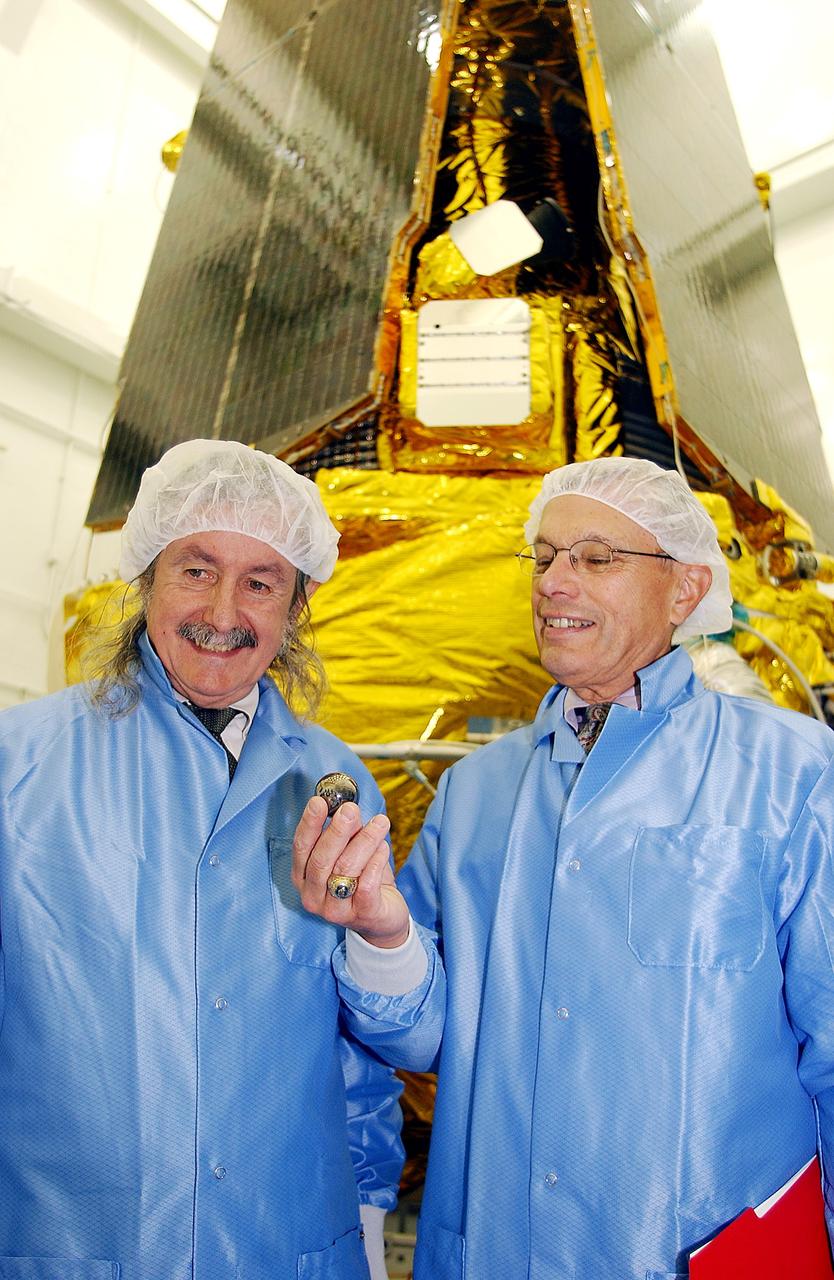
VANDENBERG AFB, CALIF. -  In the NASA spacecraft processing facility on North Vandenberg Air Force Base,  Dr. Francis Everitt, principal investigator, and Brad Parkinson, co-principal investigator, both from Stanford University, hold one of the small gyroscopes used in the Gravity Probe B spacecraft.  The GP-B towers behind them.  The Gravity Probe B mission is a relativity experiment developed by NASA’s Marshall Space Flight Center, Stanford University and Lockheed Martin.  The spacecraft will test two extraordinary predictions of Albert Einstein’s general theory of relativity that he advanced in 1916: the geodetic effect (how space and time are warped by the presence of the Earth) and frame dragging (how Earth’s rotation drags space and time around with it).  Gravity Probe B consists of four sophisticated gyroscopes that will provide an almost perfect space-time reference system.  The mission will look in a precision manner for tiny changes in the direction of spin.
VANDENBERG AFB, CALIF. - In the NASA spacecraft processing facility on North Vandenberg Air Force Base, Dr. Francis Everitt, principal investigator, and Brad Parkinson, co-principal investigator, both from Stanford University, hold one of the small gyroscopes used in the Gravity Probe B spacecraft. The GP-B towers behind them. The Gravity Probe B mission is a relativity experiment developed by NASA’s Marshall Space Flight Center, Stanford University and Lockheed Martin. The spacecraft will test two extraordinary predictions of Albert Einstein’s general theory of relativity that he advanced in 1916: the geodetic effect (how space and time are warped by the presence of the Earth) and frame dragging (how Earth’s rotation drags space and time around with it). Gravity Probe B consists of four sophisticated gyroscopes that will provide an almost perfect space-time reference system. The mission will look in a precision manner for tiny changes in the direction of spin.
VANDENBERG AFB, CALIF. - Workers in the NASA spacecraft processing facility on North Vandenberg Air Force Base prepare for the installation of solar array panel 3 on the Gravity Probe B spacecraft.  Installing each array is a 3-day process and includes a functional deployment test.  The Gravity Probe B mission is a relativity experiment developed by NASA’s Marshall Space Flight Center, Stanford University and Lockheed Martin.  The spacecraft will test two extraordinary predictions of Albert Einstein’s general theory of relativity that he advanced in 1916: the geodetic effect (how space and time are warped by the presence of the Earth) and frame dragging (how Earth’s rotation drags space and time around with it).  Gravity Probe B consists of four sophisticated gyroscopes that will provide an almost perfect space-time reference system.  The mission will look in a precision manner for tiny changes in the direction of spin.
VANDENBERG AFB, CALIF. - Workers in the NASA spacecraft processing facility on North Vandenberg Air Force Base prepare for the installation of solar array panel 3 on the Gravity Probe B spacecraft. Installing each array is a 3-day process and includes a functional deployment test. The Gravity Probe B mission is a relativity experiment developed by NASA’s Marshall Space Flight Center, Stanford University and Lockheed Martin. The spacecraft will test two extraordinary predictions of Albert Einstein’s general theory of relativity that he advanced in 1916: the geodetic effect (how space and time are warped by the presence of the Earth) and frame dragging (how Earth’s rotation drags space and time around with it). Gravity Probe B consists of four sophisticated gyroscopes that will provide an almost perfect space-time reference system. The mission will look in a precision manner for tiny changes in the direction of spin.
VANDENBERG AFB, CALIF. -  The mobile service tower on Space Launch Complex 2, Vandenberg Air Force Base, Calif., rolls back from the Delta II rocket that will launch the Gravity Probe B experiment.  The Gravity Probe B will launch a payload of four gyroscopes into low-Earth polar orbit to test two extraordinary predictions of Albert Einstein’s general theory of relativity: the geodetic effect (how space and time are warped by the presence of the Earth) and frame dragging (how Earth’s rotation drags space and time around with it). Once in orbit, for 18 months each gyroscope’s spin axis will be monitored as it travels through local spacetime, observing and measuring these effects.  The experiment was developed by Stanford University, Lockheed Martin and NASA’s Marshall Space Flight Center.  The targeted launch date is Dec. 6, 2003.
VANDENBERG AFB, CALIF. - The mobile service tower on Space Launch Complex 2, Vandenberg Air Force Base, Calif., rolls back from the Delta II rocket that will launch the Gravity Probe B experiment. The Gravity Probe B will launch a payload of four gyroscopes into low-Earth polar orbit to test two extraordinary predictions of Albert Einstein’s general theory of relativity: the geodetic effect (how space and time are warped by the presence of the Earth) and frame dragging (how Earth’s rotation drags space and time around with it). Once in orbit, for 18 months each gyroscope’s spin axis will be monitored as it travels through local spacetime, observing and measuring these effects. The experiment was developed by Stanford University, Lockheed Martin and NASA’s Marshall Space Flight Center. The targeted launch date is Dec. 6, 2003.
VANDENBERG AFB, CALIF. -  In the NASA spacecraft processing facility on North Vandenberg Air Force Base, a balloon gently lifts the solar array panel to be installed on the Gravity Probe B spacecraft.  Installing each array is a 3-day process and includes a functional deployment test.  The Gravity Probe B mission is a relativity experiment developed by NASA’s Marshall Space Flight Center, Stanford University and Lockheed Martin.  The spacecraft will test two extraordinary predictions of Albert Einstein’s general theory of relativity that he advanced in 1916: the geodetic effect (how space and time are warped by the presence of the Earth) and frame dragging (how Earth’s rotation drags space and time around with it).  Gravity Probe B consists of four sophisticated gyroscopes that will provide an almost perfect space-time reference system.  The mission will look in a precision manner for tiny changes in the direction of spin.
VANDENBERG AFB, CALIF. - In the NASA spacecraft processing facility on North Vandenberg Air Force Base, a balloon gently lifts the solar array panel to be installed on the Gravity Probe B spacecraft. Installing each array is a 3-day process and includes a functional deployment test. The Gravity Probe B mission is a relativity experiment developed by NASA’s Marshall Space Flight Center, Stanford University and Lockheed Martin. The spacecraft will test two extraordinary predictions of Albert Einstein’s general theory of relativity that he advanced in 1916: the geodetic effect (how space and time are warped by the presence of the Earth) and frame dragging (how Earth’s rotation drags space and time around with it). Gravity Probe B consists of four sophisticated gyroscopes that will provide an almost perfect space-time reference system. The mission will look in a precision manner for tiny changes in the direction of spin.
40x80ft w.t. - balance house, control room with Brad Wick soon after it opened. The scales measured lift, drag and other forces mechanically.
ARC-1945-A-8087
The KC-135 with the winglets in flight over the San Gabriel mountains, south of Edwards AFB. While wind tunnel tests suggested that winglets - developed by NASA Langley's Richard Whitcomb - would significantly reduce drag, flight research proved their usefulness. Winglets were installed on an Air Force KC-135 and research flights were made in 1979 and 1980. These showed drag in flight was reduced by as much as 7 percent. Winglets soon appeared on production aircraft, although these were smaller than those mounted on the KC-135.
EC79-11484
An artist's concept of a space based vehicle using the Propulsive Small Expendable Deployer System (ProSEDS) to generate its thrust to maintain orbit without using a propellant. ProSEDS will obtain thrust as the current flowing through the tether experiences a drag force due to interaction with the Earth's magnetic field. Drag force is coupled mechanically to the stage via the tether, thus lowering the stage's orbital altitude.
Pathfinder
NACA photographer Northrop P-61A Black Widow towing P-51B to release altitude of 28,000 ft over Muroc Dry Lake, California for in flight validating of wind tunnel measurements of drag. After the pilot released the tow cable, drag measurementrs were obtained at various airspeeds in a 20-minute unpowered flight.  Note:  Used in publication in Flight Research at Ames;  57 Years of Development and Validation of Aeronautical Technology  NASA SP-1998-3300  Fig. 17
ARC-1944-A-6538
Air flow testing on aerodynamic truck
E81-38096
NASA Armstrong Flight Research Center conducted its first formation flight with the Preliminary Research Aerodynamic Design to Lower Drag (Prandtl) aircrafts Prandtl-D2 and Prandtl-3C.
Prandtl Formation Flight
A drag chute slows the shuttle Endeavour after landing on runway 22 at Edwards, California, to complete the highly successful STS-68 mission dedicated to radar imaging of the earth's surface as part of NASA's Mission To Planet Earth program. The landing was at 10:02 a.m. (PDT) 11 October 1994, after waiving off from the Kennedy Space Center, Florida, earlier that morning due to adverse weather at Kennedy. The Endeavour crew was originally scheduled to land at Kennedy the morning of 10 October, but mission planners decided early in the flight to extend the mission by one day. Mission commander was Michael A. Baker and the pilot was Terrence W. Wilcutt. The four mission specialists were Thomas D. Jones, payload; Steven L. Smith; Daniel W. Bursch; and Peter J.K. Wisoff.
STS-68 Landing at Edwards
The Gravity Probe B experiment rests on an assembly and test stand in the spacecraft processing facility on North Vandenberg Air Force Base. Gravity Probe B will launch a payload of four gyroscopes into low-Earth polar orbit to test two extraordinary predictions of Albert Einstein’s general theory of relativity: the geodetic effect (how space and time are warped by the presence of the Earth) and frame dragging (how Earth’s rotation drags space and time around with it). Once in orbit, for 18 months each gyroscope’s spin axis will be monitored as it travels through local spacetime, observing and measuring these effects. The experiment was developed by Stanford University, Lockheed Martin and NASA’s Marshall Space Flight Center.
Gravity Probe B
The Gravity Probe B experiment is lifted from its transporter in the spacecraft processing facility on North Vandenberg Air Force Base. Gravity Probe B will launch a payload of four gyroscopes into low-Earth polar orbit to test two extraordinary predictions of Albert Einstein’s general theory of relativity: the geodetic effect (how space and time are warped by the presence of the Earth) and frame dragging (how Earth’s rotation drags space and time around with it). Once in orbit, for 18 months each gyroscope’s spin axis will be monitored as it travels through local spacetime, observing and measuring these effects. The experiment was developed by Stanford University, Lockheed Martin and NASA’s Marshall Space Flight Center.
Gravity Probe B
Enclosed in a canister, the Gravity Probe B (GP-B) spacecraft arrives on Vandenberg Air Force Base, headed for the spacecraft processing facility. Gravity Probe B will launch a payload of four gyroscopes into low-Earth polar orbit to test two extraordinary predictions of Albert Einstein’s general theory of relativity: the geodetic effect (how space and time are warped by the presence of the Earth) and frame dragging (how Earth’s rotation drags space and time around with it). Once in orbit, for 18 months each gyroscope’s spin axis will be monitored as it travels through local spacetime, observing and measuring these effects. The experiment was developed by Stanford University, Lockheed Martin and NASA’s Marshall Space Flight Center.
Gravity Probe B
With its drag chute deployed, orbiter Discovery and its seven-member crew roll toward a stop at Edwards Air Force Base, Calif., after an 11-day mission to the International Space Station. The orbiter’s main landing gear touched down on EAFB runway 22 at 5 p.m. With the aid of its drag chute, Discovery came to a complete stop at 5:01 p.m. At the conclusion of mission STS-92, Discovery and crew had traveled about 5.3 million statute miles. Following vehicle safing and preliminary offloading efforts, workers will begin preparations for Discovery’s transcontinental ferry flight back to KSC on the back of NASA’s modified Boeing 747
KSC-00pp1669
With its drag chute deployed, orbiter Discovery and its seven-member crew roll toward a stop at Edwards Air Force Base, Calif., after an 11-day mission to the International Space Station. The orbiter’s main landing gear touched down on EAFB runway 22 at 5 p.m. With the aid of its drag chute, Discovery came to a complete stop at 5:01 p.m. At the conclusion of mission STS-92, Discovery and crew had traveled about 5.3 million statute miles. Following vehicle safing and preliminary offloading efforts, workers will begin preparations for Discovery’s transcontinental ferry flight back to KSC on the back of NASA’s modified Boeing 747
KSC00pp1669
The Gravity Probe B experiment enters the spacecraft processing facility on North Vandenberg Air Force Base. Gravity Probe B will launch a payload of four gyroscopes into low-Earth polar orbit to test two extraordinary predictions of Albert Einstein’s general theory of relativity: the geodetic effect (how space and time are warped by the presence of the Earth) and frame dragging (how Earth’s rotation drags space and time around with it). Once in orbit, for 18 months each gyroscope’s spin axis will be monitored as it travels through local spacetime, observing and measuring these effects. The experiment was developed by Stanford University, Lockheed Martin and NASA’s Marshall Space Flight Center.
Gravity Probe B
A transporter carrying the Gravity Probe B experiment backs into the spacecraft processing facility on North Vandenberg Air Force Base. Gravity Probe B will launch a payload of four gyroscopes into low-Earth polar orbit to test two extraordinary predictions of Albert Einstein’s general theory of relativity: the geodetic effect (how space and time are warped by the presence of the Earth) and frame dragging (how Earth’s rotation drags space and time around with it). Once in orbit, for 18 months each gyroscope’s spin axis will be monitored as it travels through local spacetime, observing and measuring these effects. The experiment was developed by Stanford University, Lockheed Martin and NASA’s Marshall Space Flight Center.
Gravity Probe B