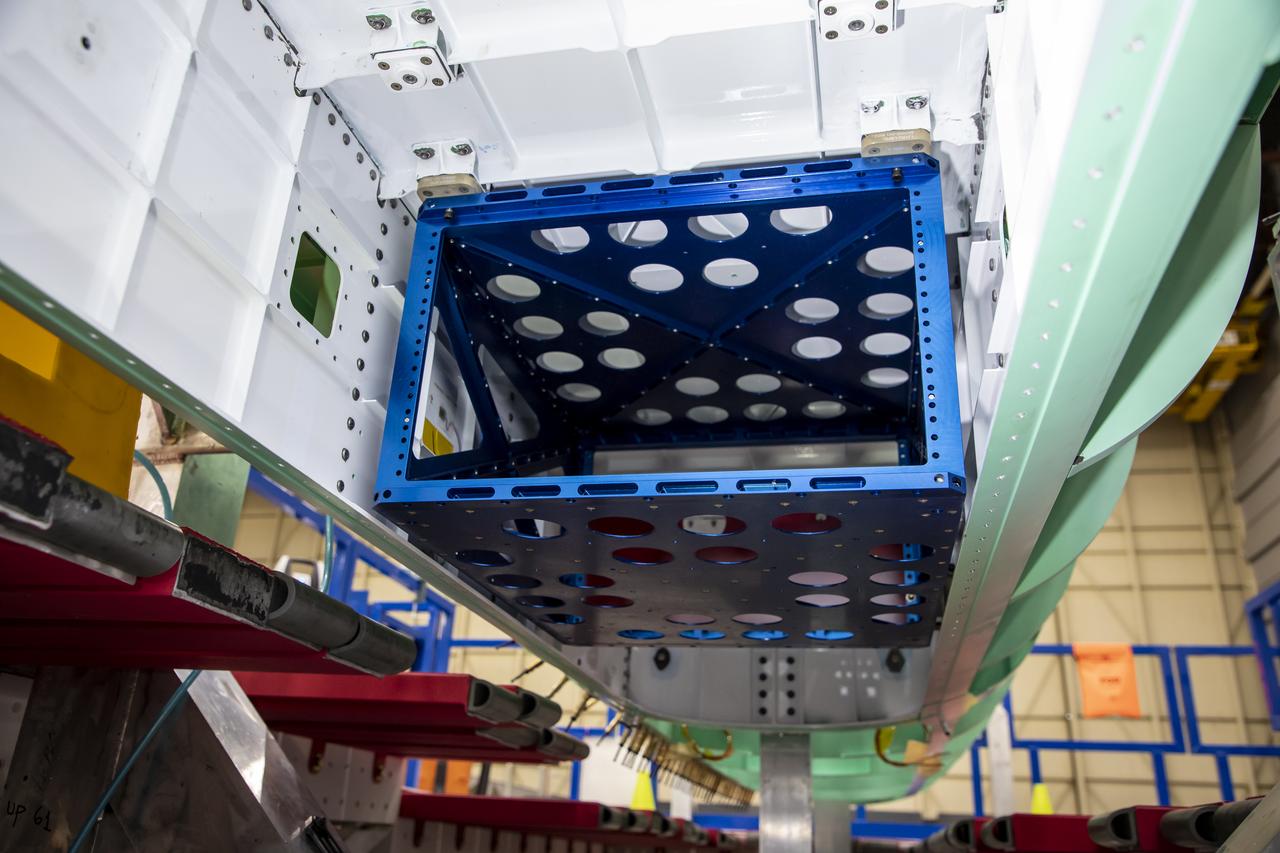
Following the successful installation of mounting brackets, technicians successfully installed the pallet for the eXternal Visibility System, or XVS, onto the X-59 Quiet SuperSonic Technology X-plane, also known as X-59 QueSST. The pallet installation marks an assembly milestone as the first NASA flight systems hardware to be installed onto the vehicle. X-59 will fly to demonstrate the ability to produce quiet thumps at supersonic speeds, instead of the typical, loud sonic booms associated with supersonic flight.
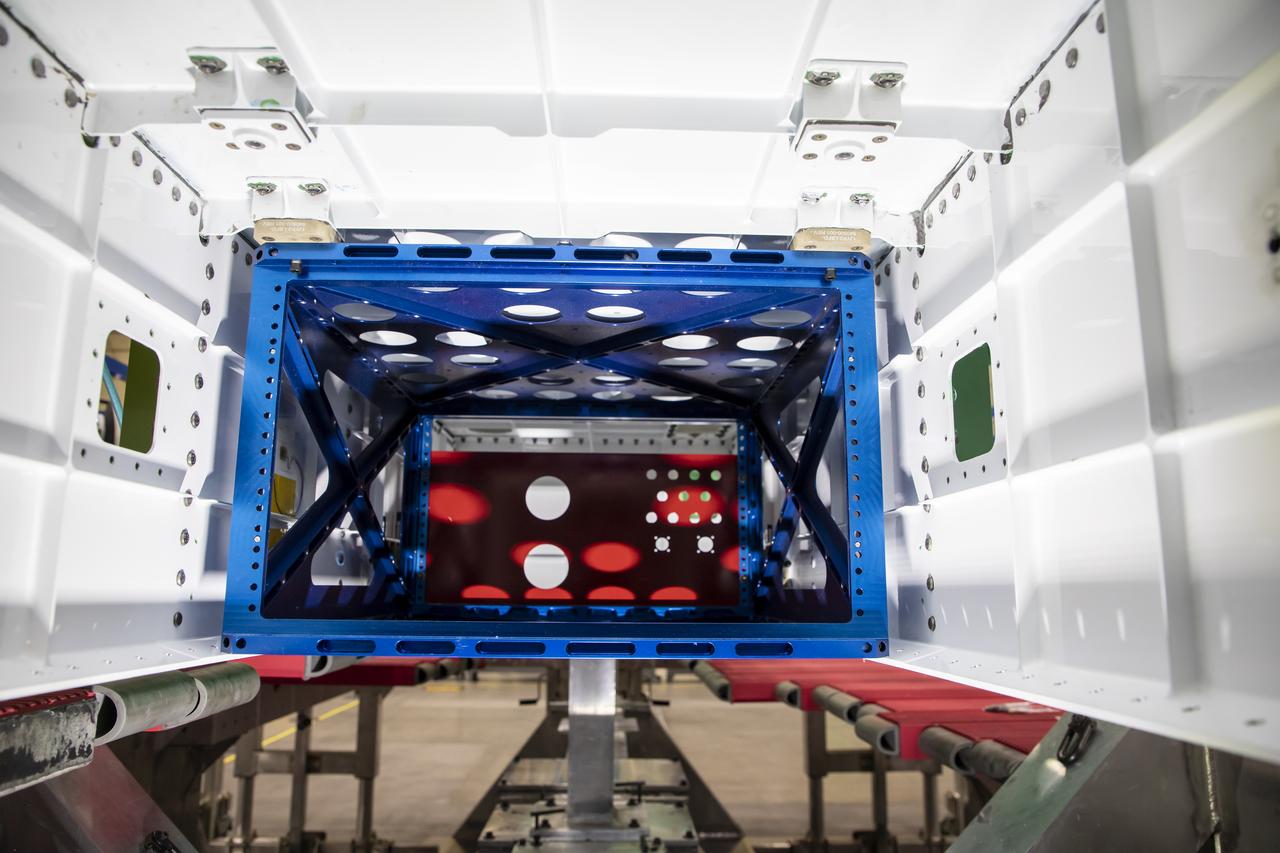
Following the successful installation of mounting brackets, technicians successfully installed the pallet for the eXternal Visibility System, or XVS, onto the X-59 Quiet SuperSonic Technology X-plane, also known as X-59 QueSST. The pallet installation marks an assembly milestone as the first NASA flight systems hardware to be installed onto the vehicle. X-59 will fly to demonstrate the ability to produce quiet thumps at supersonic speeds, instead of the typical, loud sonic booms associated with supersonic flight.
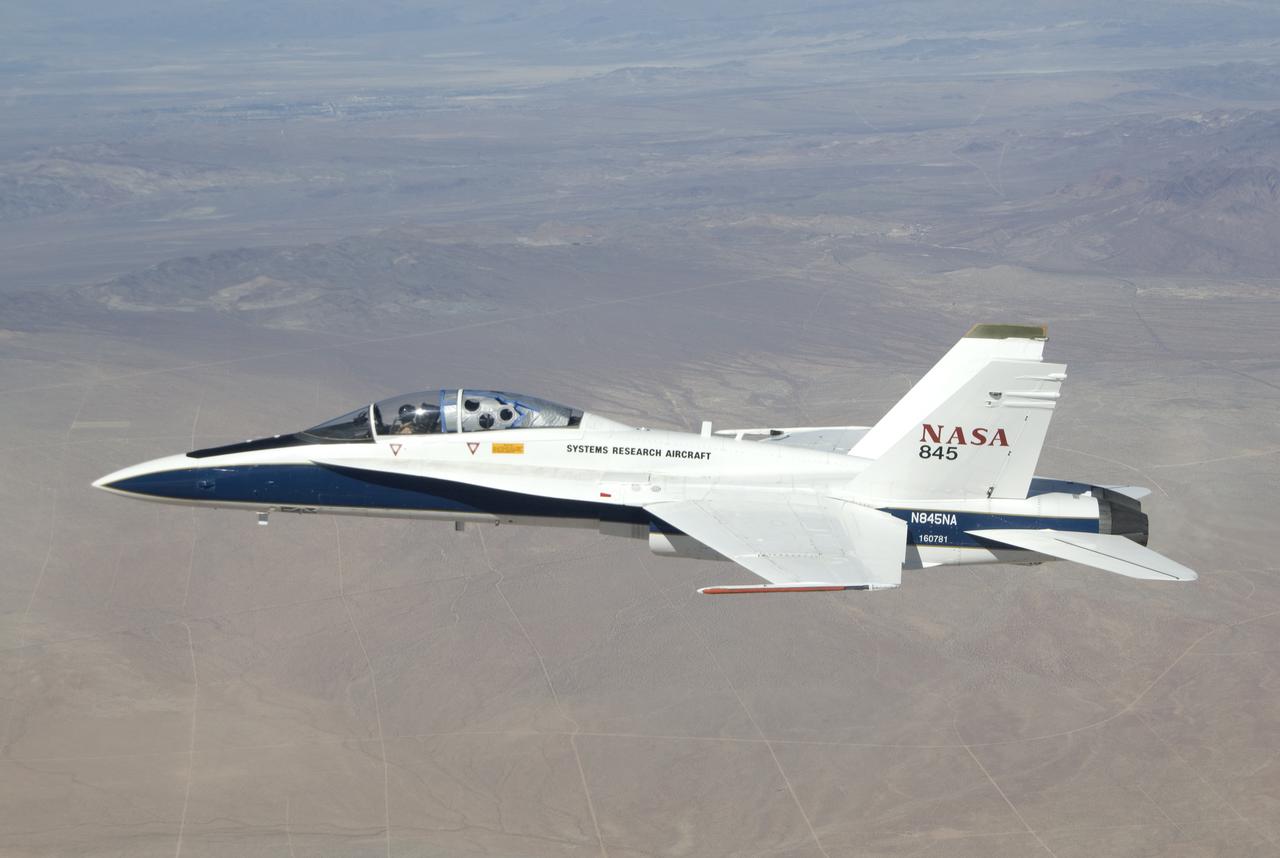
NASA Dryden Flight Research Center's F-18B Systems Research Aircraft on an External Vision System project flight.
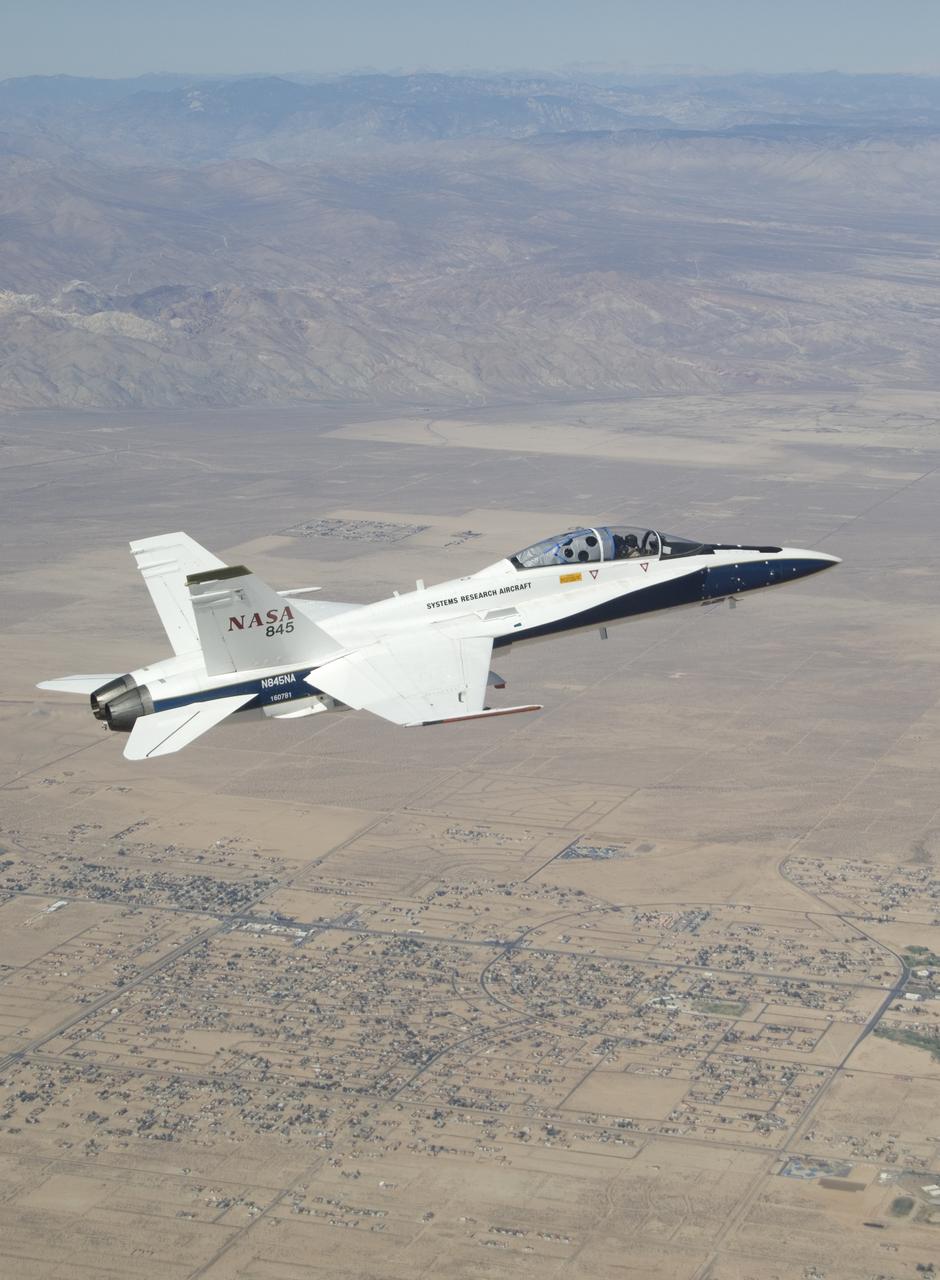
NASA Dryden Flight Research Center's F-18B Systems Research Aircraft on an External Vision System project flight.

An HD camera is mounted behind the head-up display of NASA's F-18 SRA aircraft. NASA is partnering with Gulfstream on the External Vision System project.
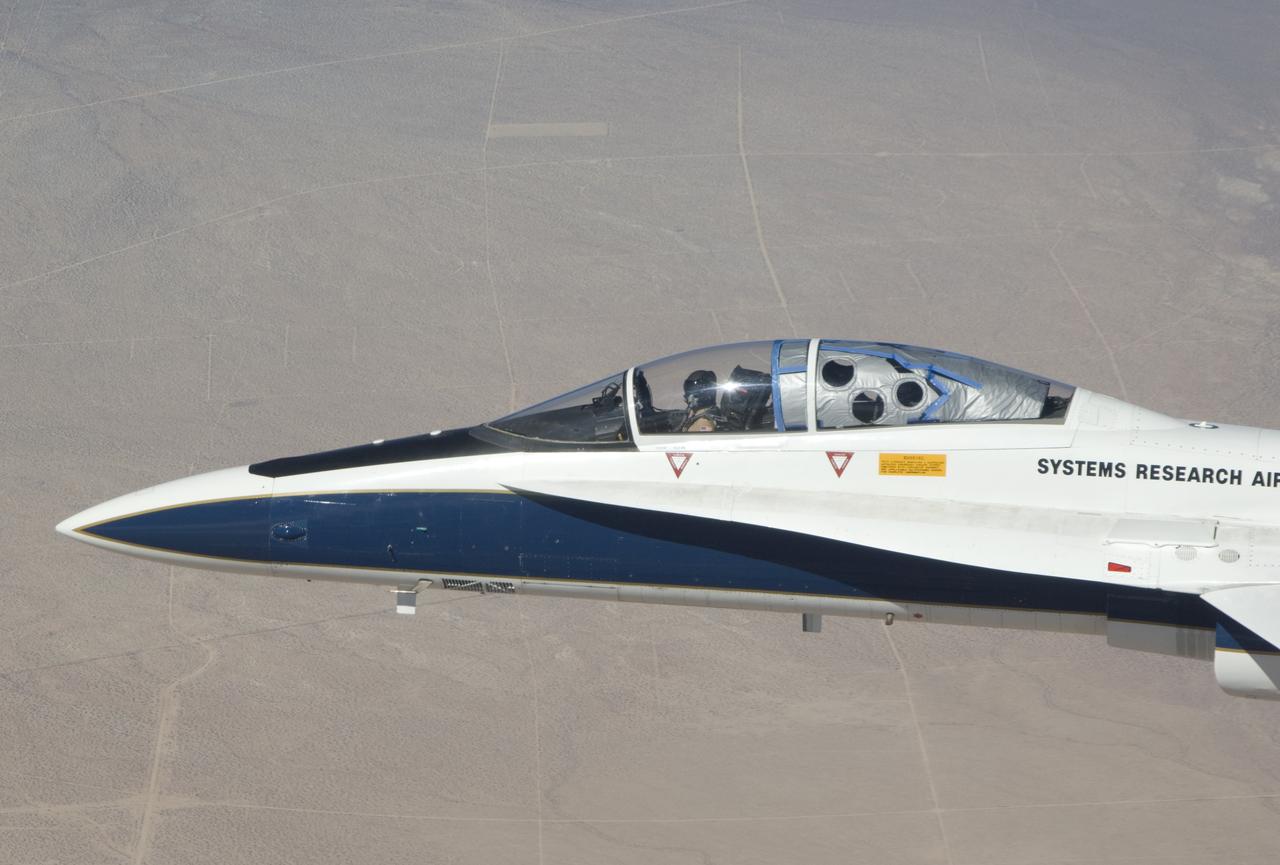
NASA Dryden Flight Research Center's F-18B Systems Research Aircraft on an External Vision System project flight.
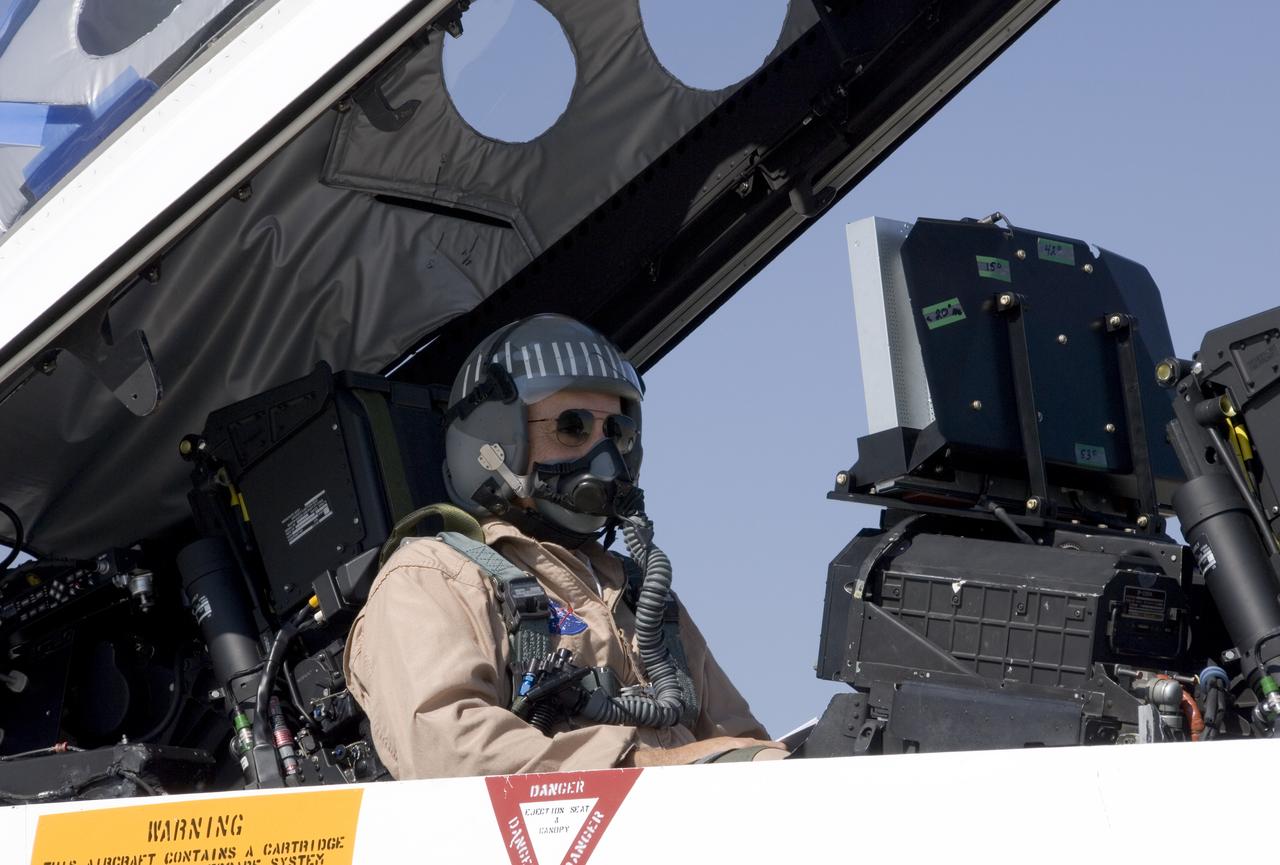
Gulfstream project pilot Tom Horne readies to fly an External Vision System project flight from the backseat of NASA's F-18 Systems Research Aircraft.
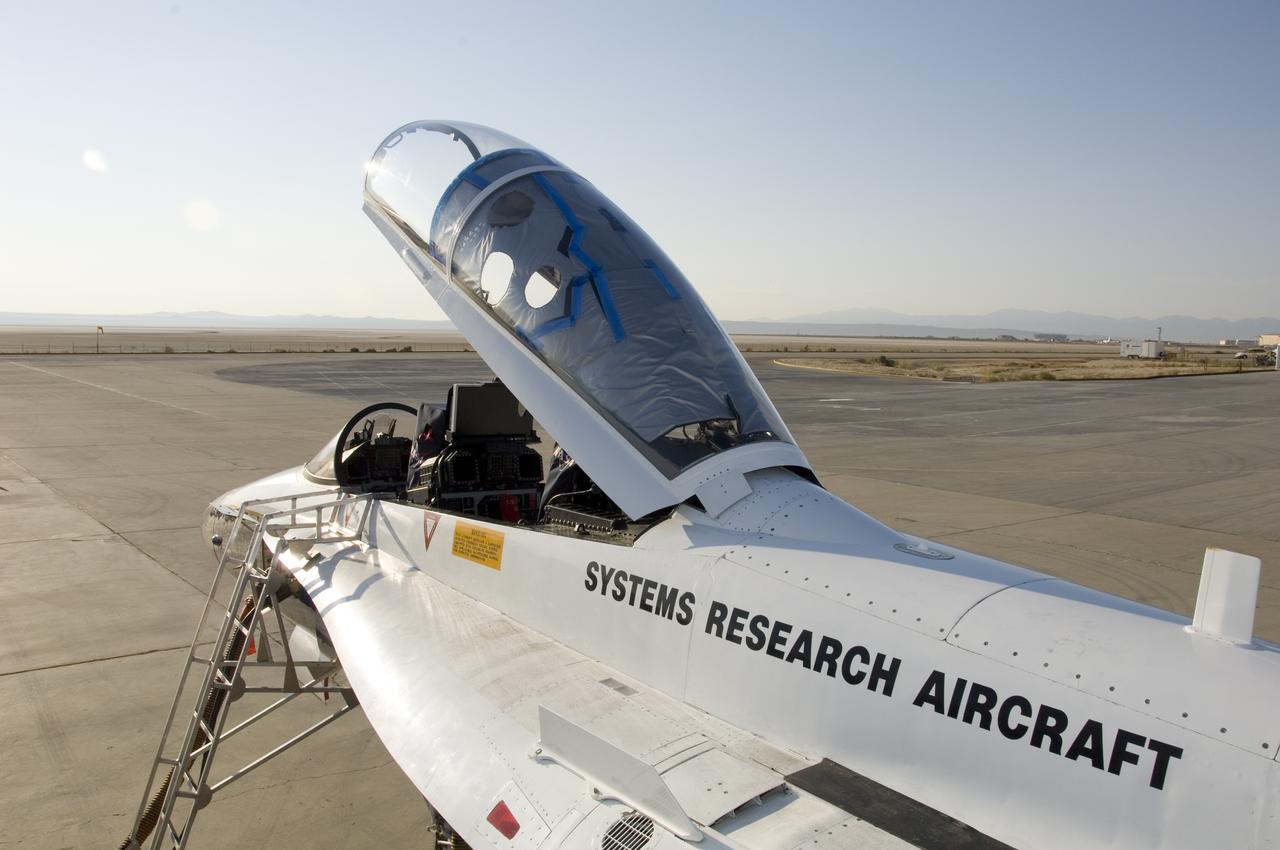
NASA is partnering with Gulfstream on the External Vision System project to demonstrate the use of an HD video system on the F-18B Systems Research Aircraft.
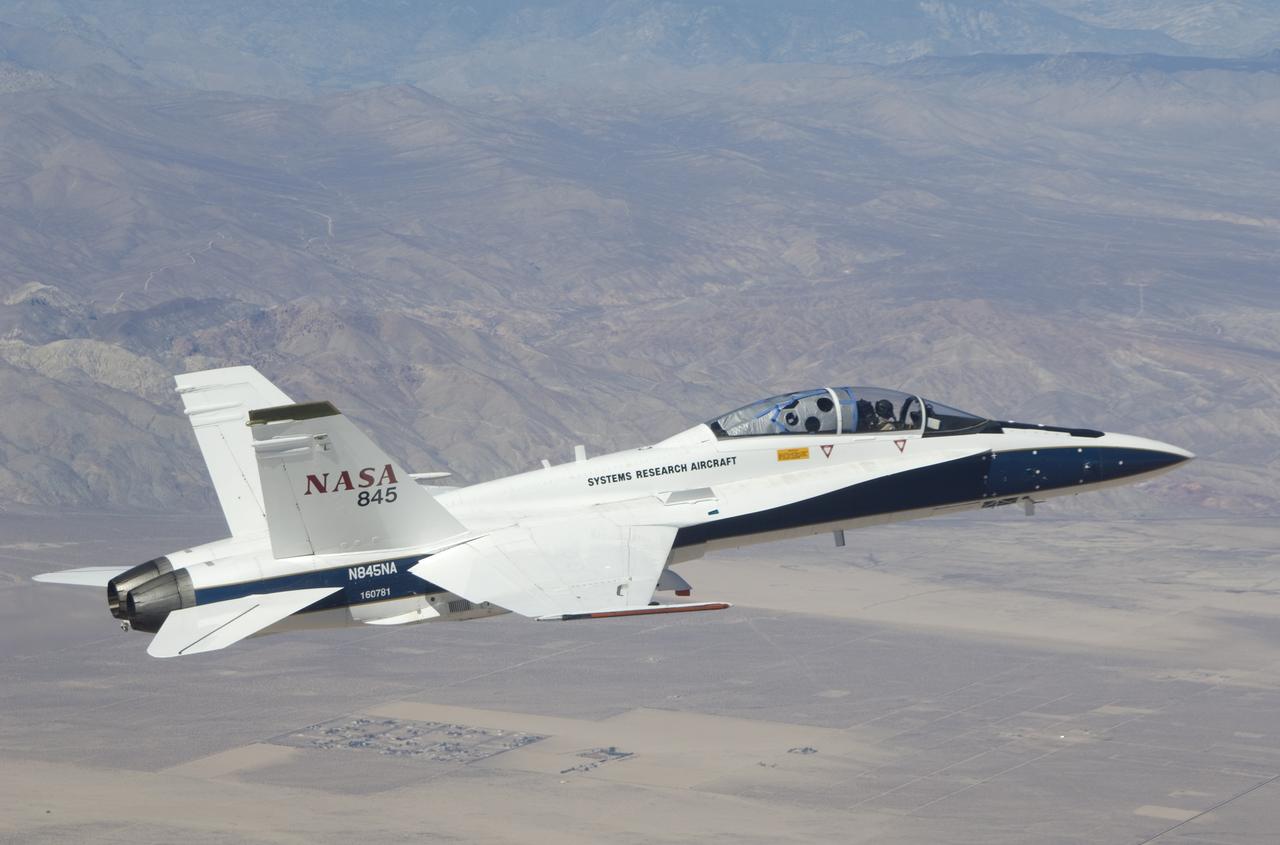
NASA Dryden Flight Research Center's F-18B Systems Research Aircraft on an External Vision System project flight.
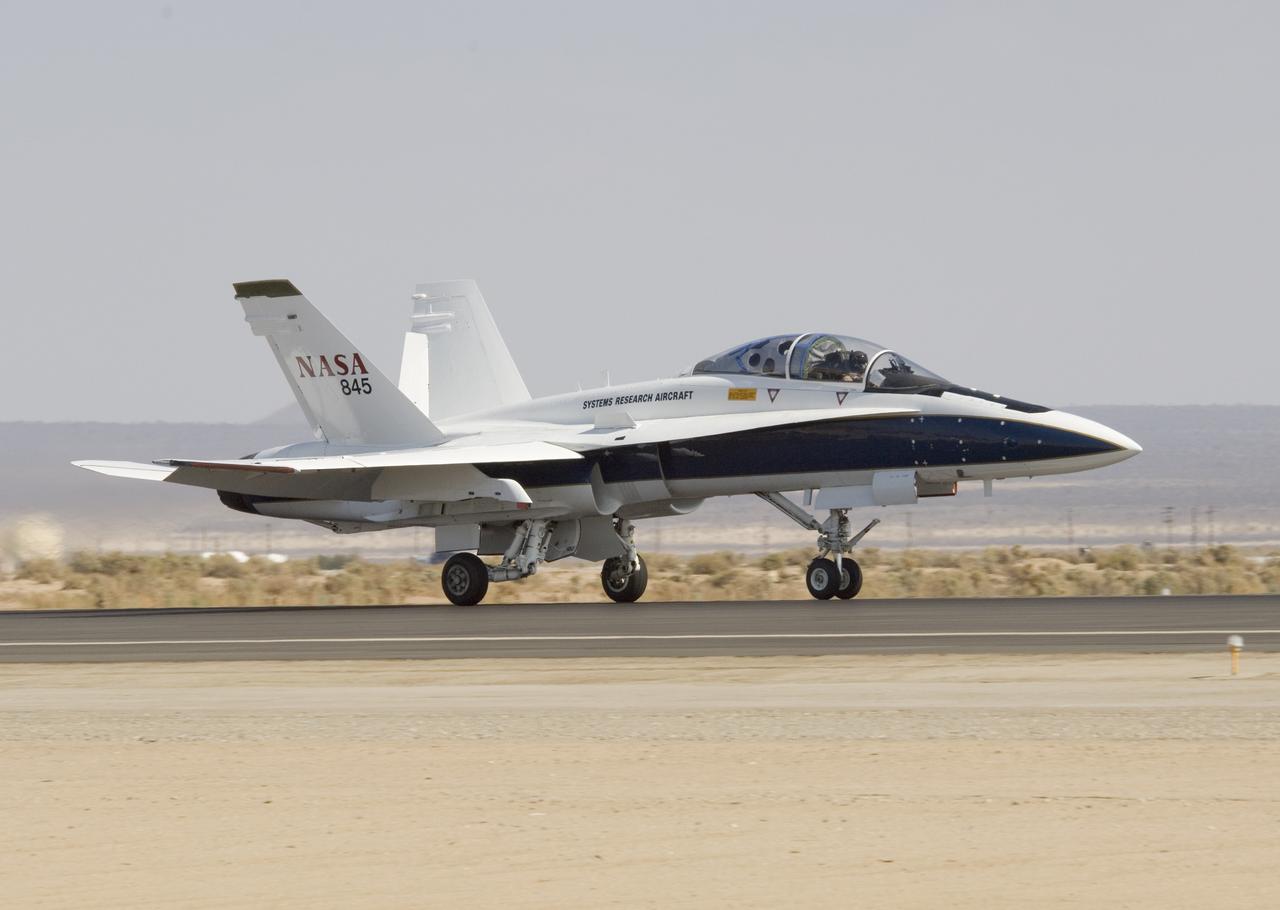
NASA research pilot Jim Smolka prepares to take off in NASA's F-18 Systems Research Aircraft for an External Vision System project flight.
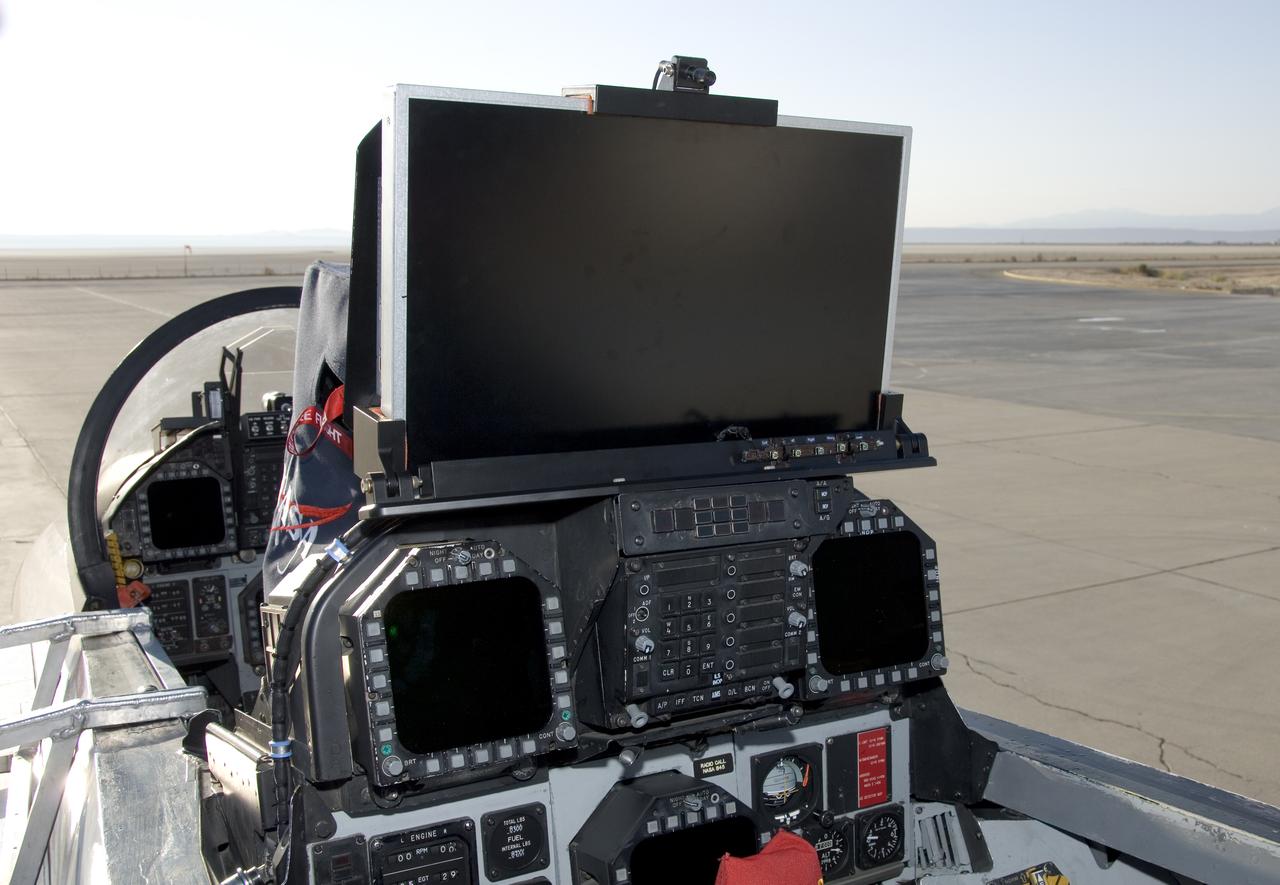
An HD display is mounted on top of the rear instrument panel in NASA's F-18 SRA aircraft, as NASA is partnering with Gulfstream on the External Vision System project.

KENNEDY SPACE CENTER, FLA. - Thousands of Space Center guests line the NASA Causeway awaiting the first launch of the Space Shuttle. The Vehicle Assembly Building where the orbiter is mated to the solid rocket boosters and the external tank, is visible in the distance. The STS-1 mission, known as a shuttle systems test flight, will seek to demonstrate safe launch into orbit and safe return of the orbiter and crew and verify the combined performance of the entire shuttle vehicle -- orbiter, solid rocket boosters and external tank.
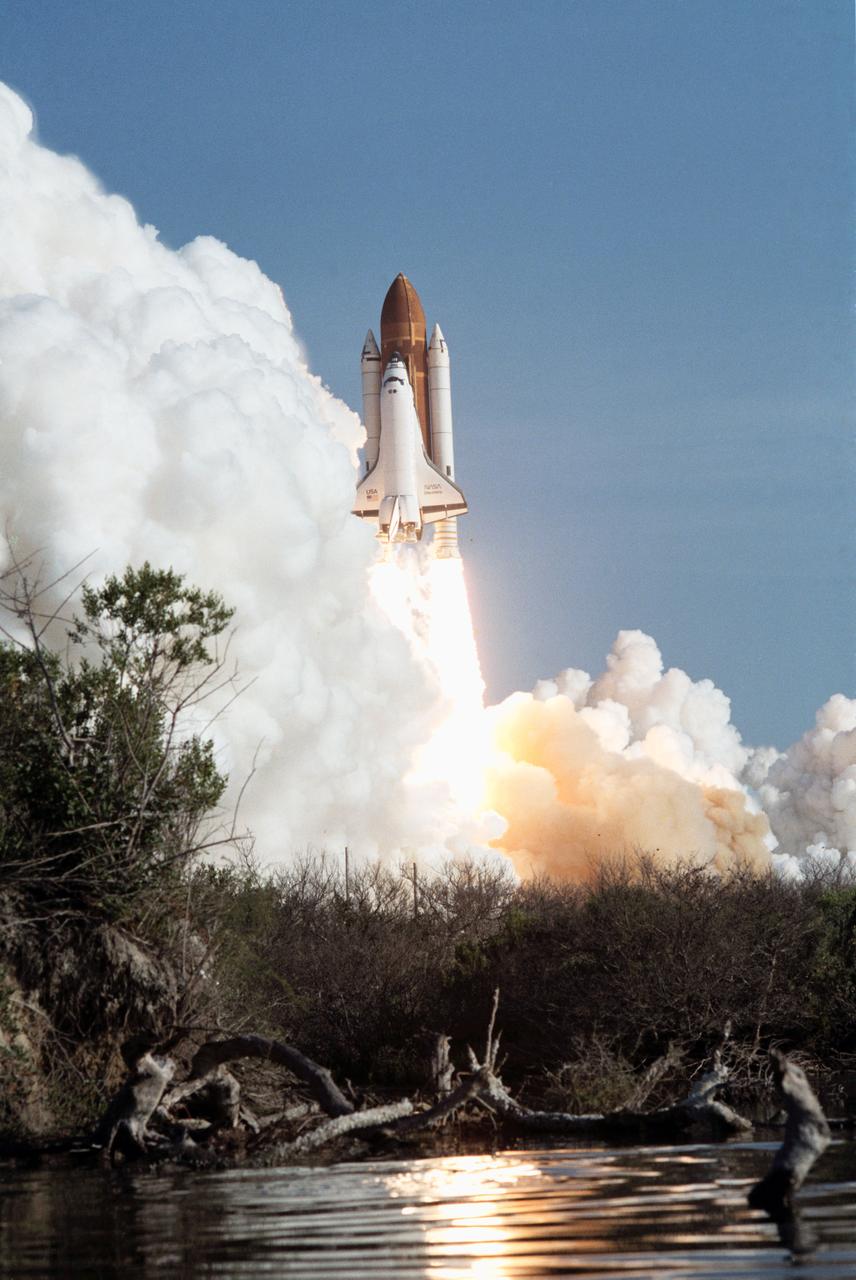
View of the launch of the shuttle Discovery and the 41-D mission. The orbiter and its plume of smoke are photographed from across the river in the early stages of liftoff (3085,3087); The orbiter can be seen just clearing the pad, with a cloud of smoke billowing to the left of the frame. The orbiters two orbital maneuvering system (OMS) pods and external tank are visible along with the orbiter (3086).
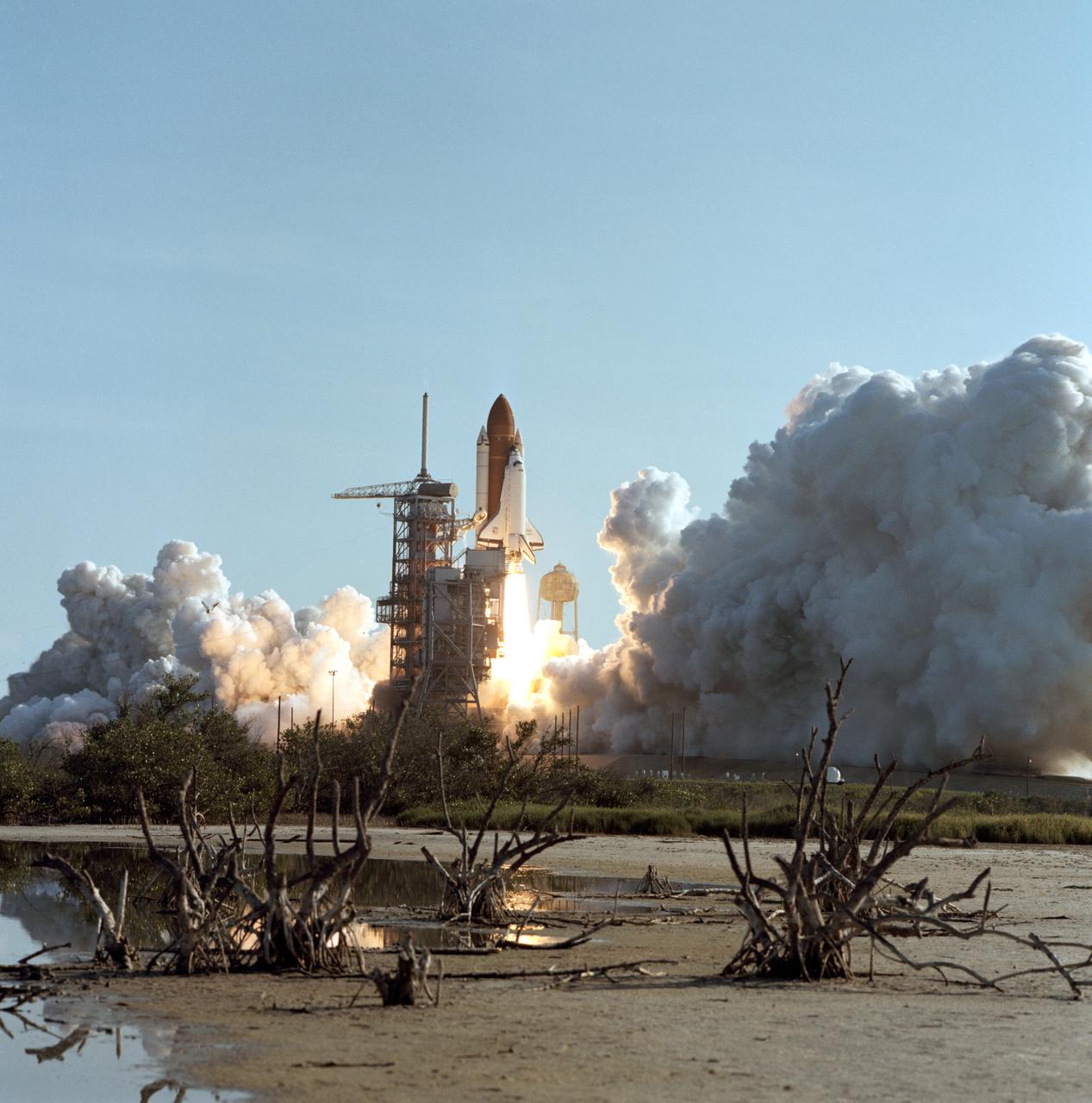
View of the launch of the shuttle Discovery and the 41-D mission. The orbiter and its plume of smoke are photographed from across the river in the early stages of liftoff (3085,3087); The orbiter can be seen just clearing the pad, with a cloud of smoke billowing to the left of the frame. The orbiters two orbital maneuvering system (OMS) pods and external tank are visible along with the orbiter (3086).
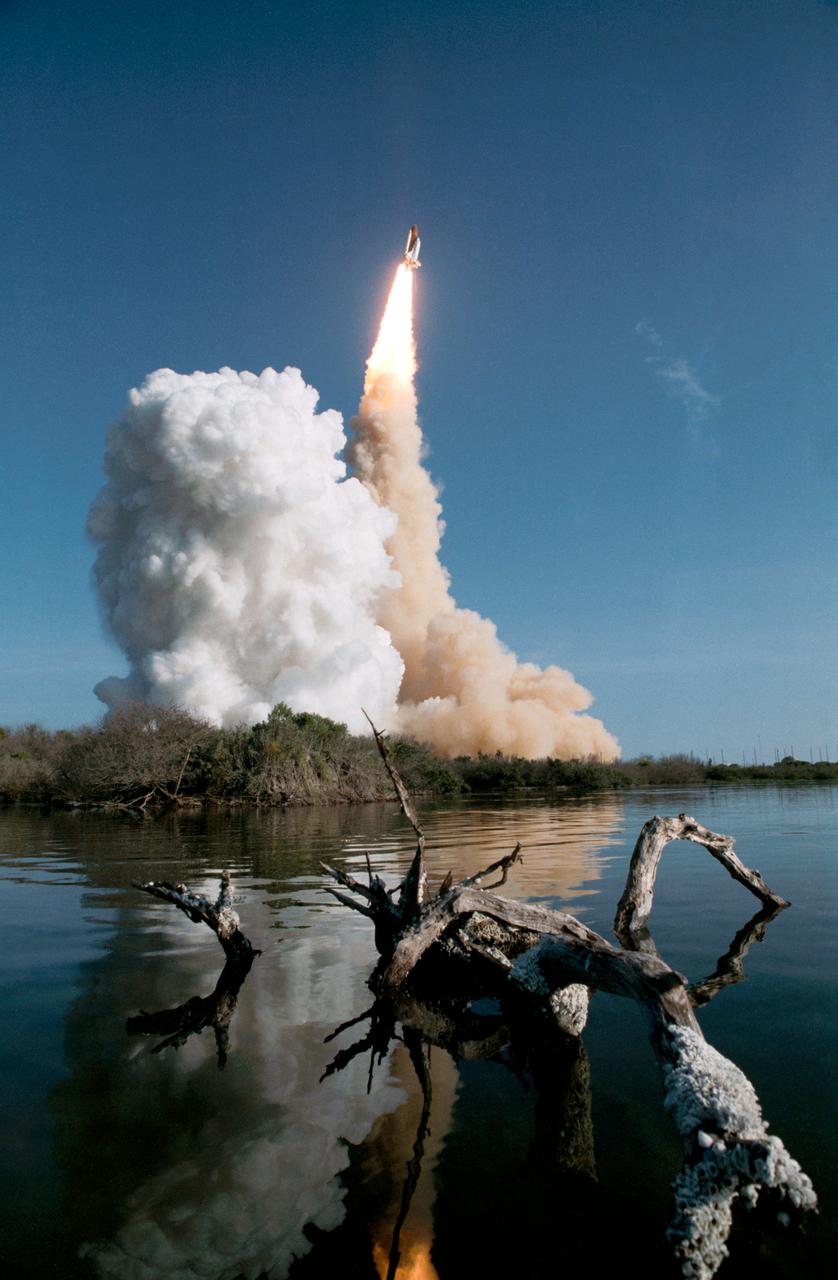
View of the launch of the shuttle Discovery and the 41-D mission. The orbiter and its plume of smoke are photographed from across the river in the early stages of liftoff (3085,3087); The orbiter can be seen just clearing the pad, with a cloud of smoke billowing to the left of the frame. The orbiters two orbital maneuvering system (OMS) pods and external tank are visible along with the orbiter (3086).
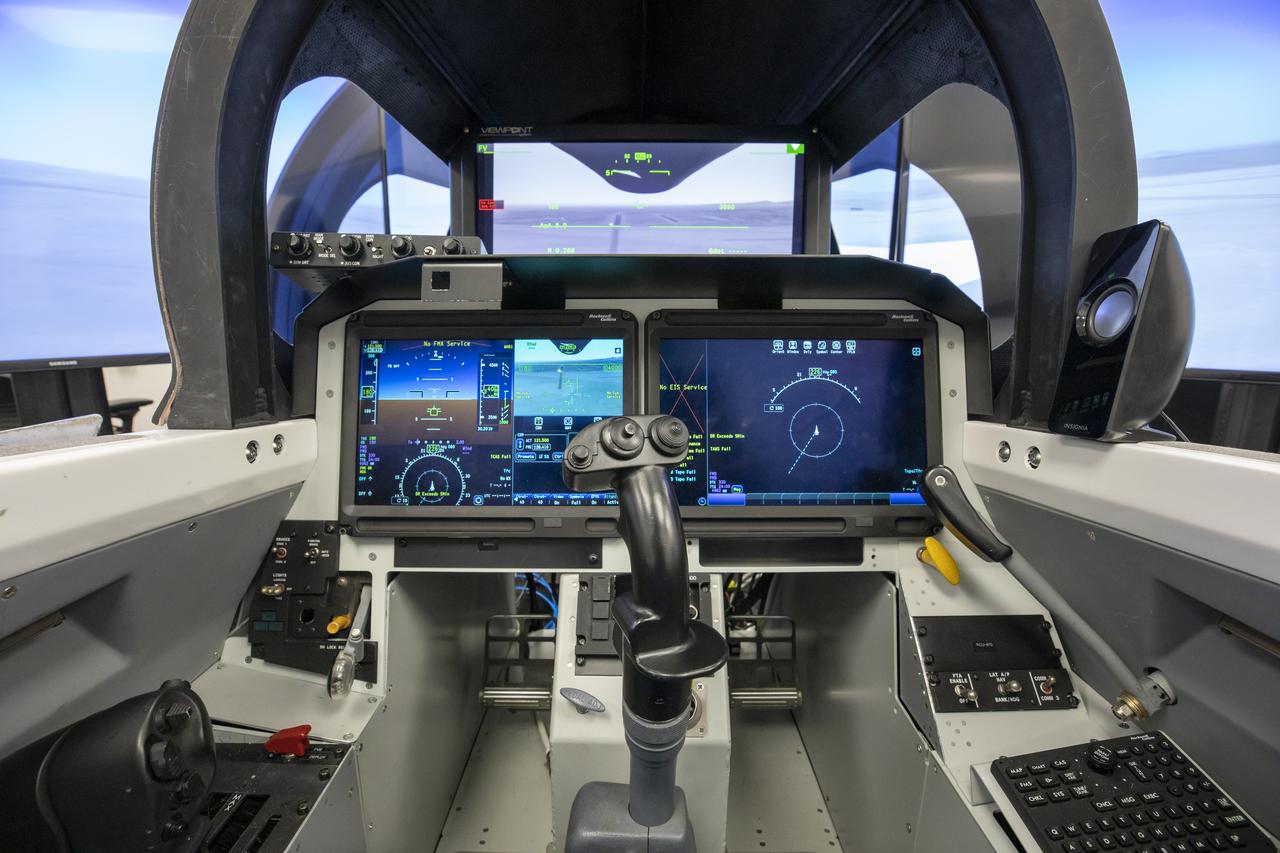
This image shows a close up of the cockpit view of the eXternal Vision System that will be placed in the X-59. Instead of a front facing window, the pilot will use these monitors for forward facing visibility. Lockheed Martin Photography By Garry Tice 1011 Lockheed Way, Palmdale, Ca. 93599 Event: X-59 SIL Round 2 Date: 6/10/2021
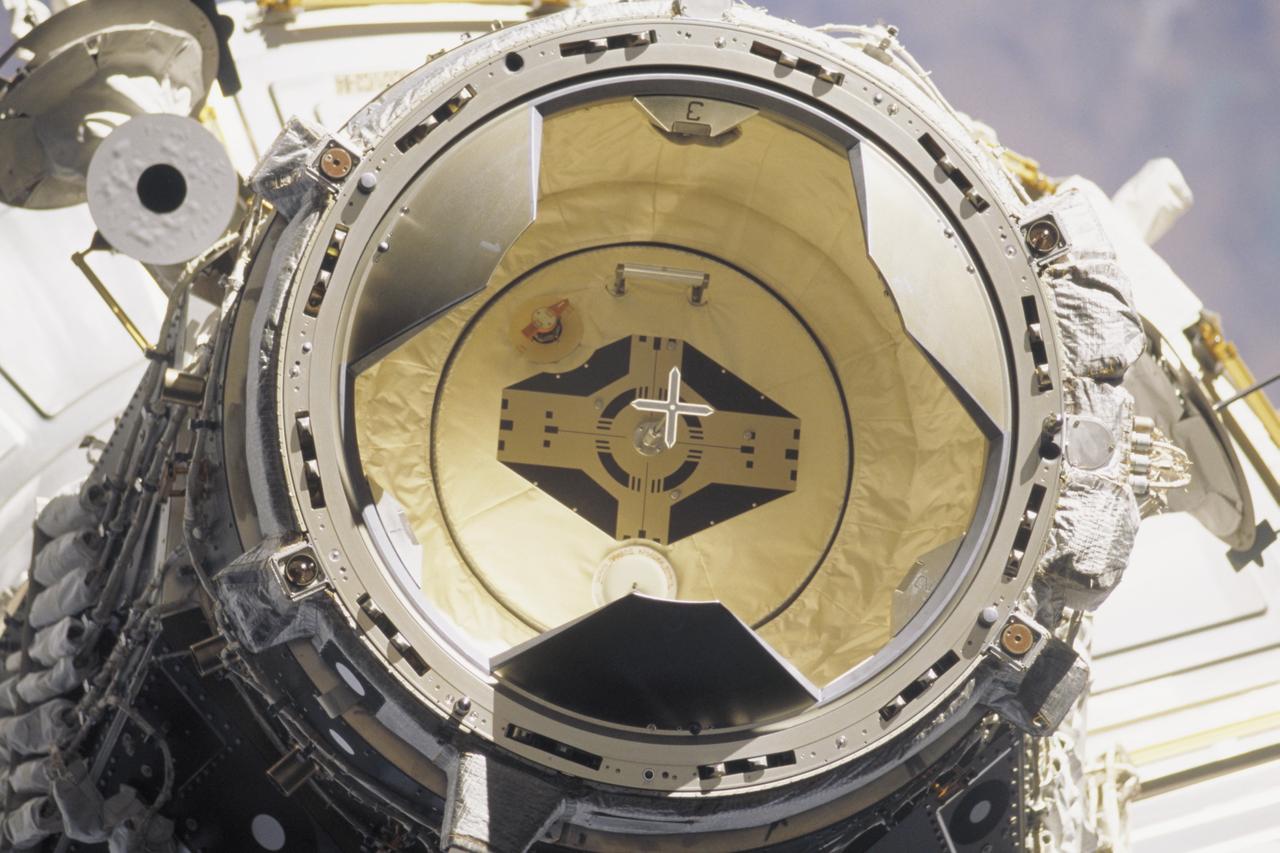
STS106-346-008 (17 Sept. 2000) --- This close-up external view of the Androgynous Peripheral Attachment System (APAS) of Pressurized Mating Adapter 2 (PMA2) was taken from the space shuttle Atlantis during undocking with the International Space Station. Visible are the APAS petals, hatch and target, as well as the forward endcone of Unity node on the ISS. The undocking took place on Sept. 17, 2000 at 10:46 p.m. (CDT).
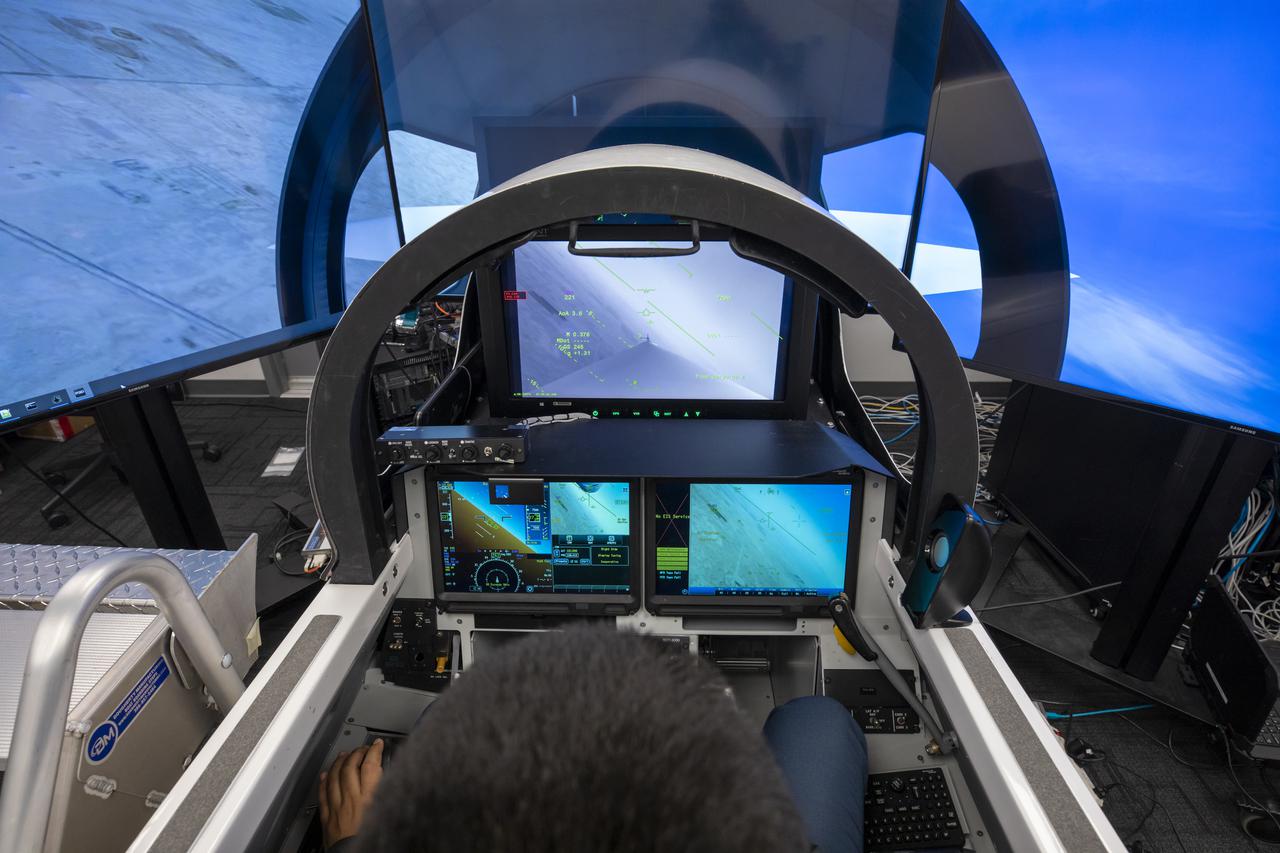
This image shows a close up of the cockpit view of the eXternal Vision System that will be placed in the X-59. Instead of a front facing window, the pilot will use these monitors for forward facing visibility. Lockheed Martin Photography By Garry Tice 1011 Lockheed Way, Palmdale, Ca. 93599 Event: X-59 SIL Round 2 Date: 6/10/2021
This image shows a close up of the cockpit view of the eXternal Vision System that will be placed in the X-59. Instead of a front facing window, the pilot will use these monitors for forward facing visibility. Lockheed Martin Photography By Garry Tice 1011 Lockheed Way, Palmdale, Ca. 93599 Event: X-59 SIL Date: 6/08/2021
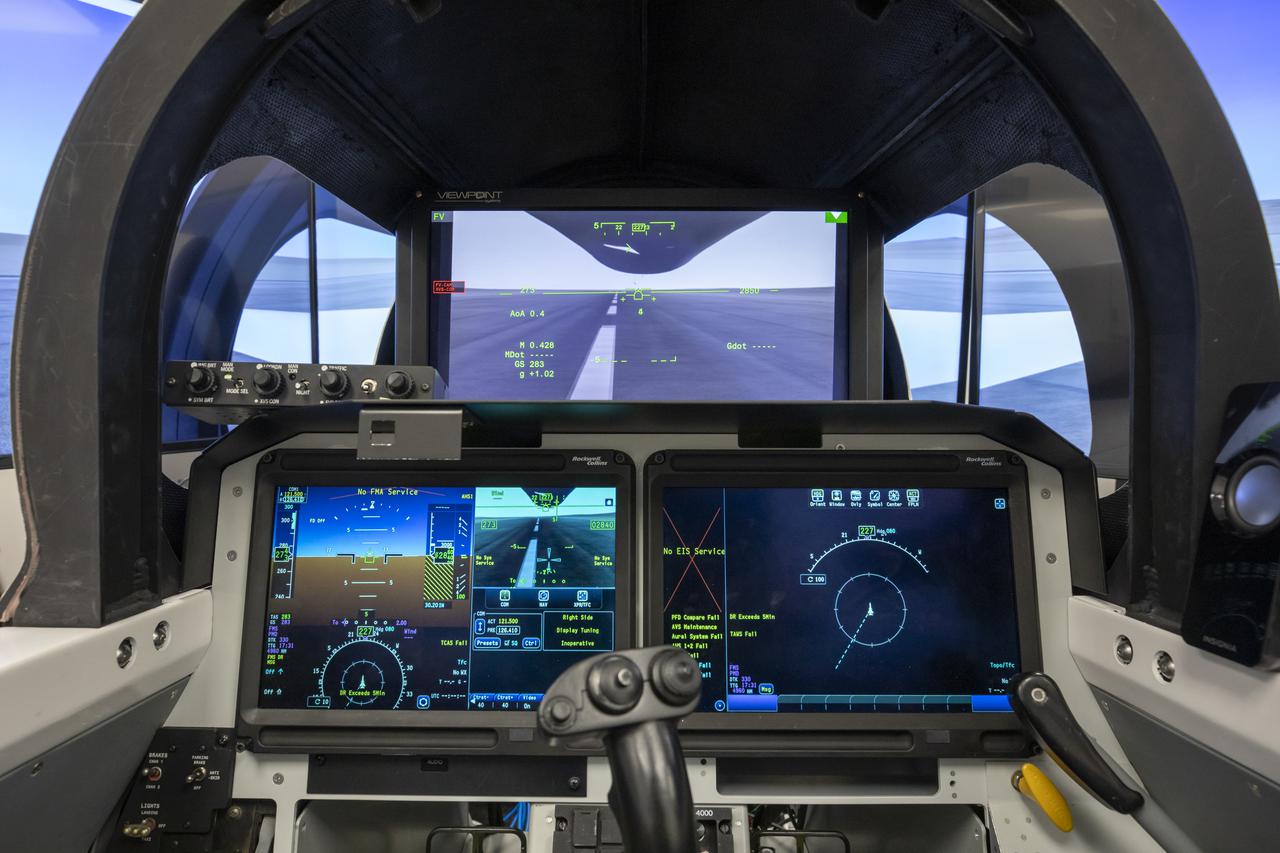
This image shows a close up of the cockpit view of the eXternal Vision System that will be placed in the X-59. Instead of a front facing window, the pilot will use these monitors for forward facing visibility. Lockheed Martin Photography By Garry Tice 1011 Lockheed Way, Palmdale, Ca. 93599 Event: X-59 SIL Round 2 Date: 6/10/2021
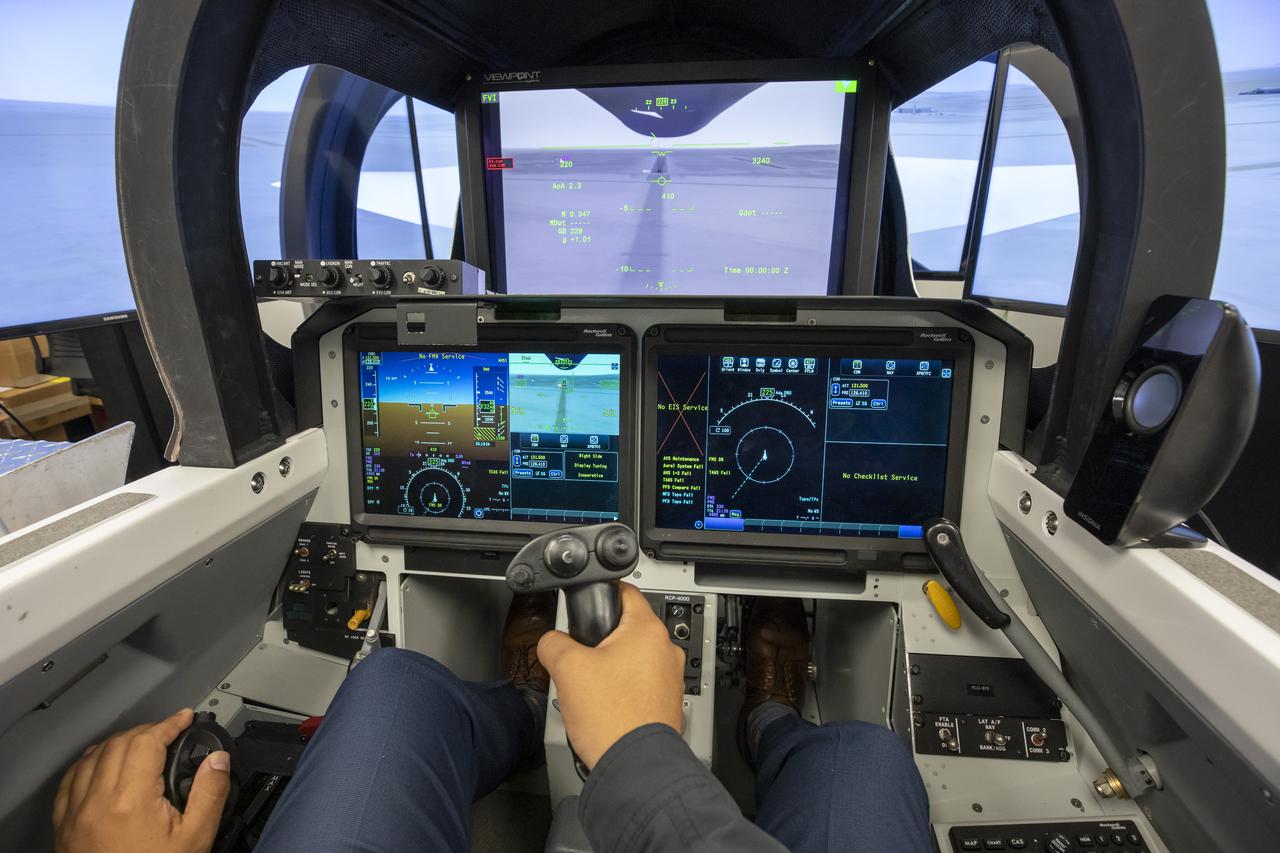
This image shows a close up of the cockpit view of the eXternal Vision System that will be placed in the X-59. Instead of a front facing window, the pilot will use these monitors for forward facing visibility. Lockheed Martin Photography By Garry Tice 1011 Lockheed Way, Palmdale, Ca. 93599 Event: X-59 SIL Round 2 Date: 6/10/2021
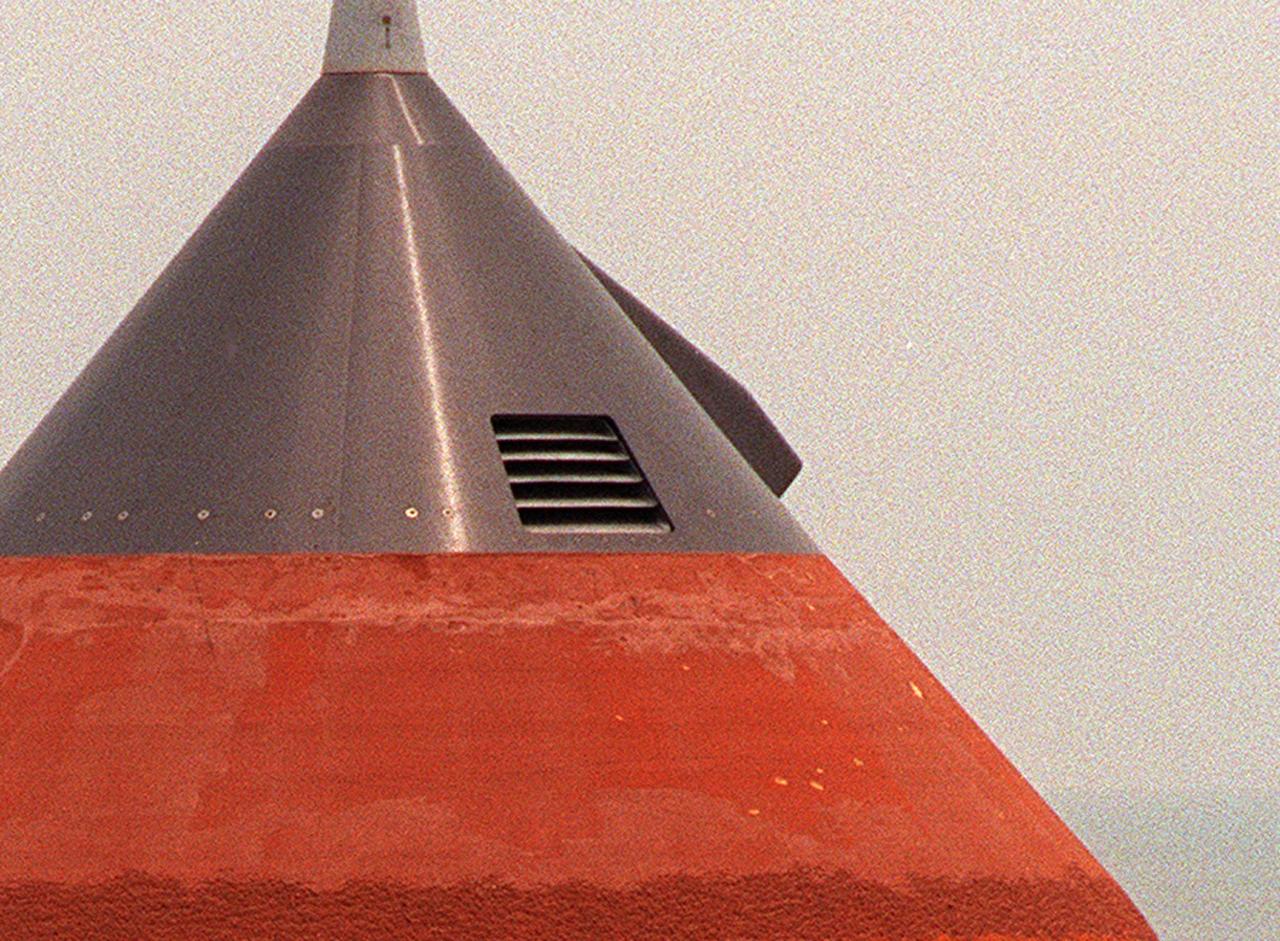
At Launch Pad 39B, the top of the external tank (ET) mated to Space Shuttle Discovery is dotted with nearly a dozen visible dings from recent hail storms. Workers are investigating the damage and potential problems for launch posed by ice forming in the holes, which may number as many as 150 over the entire tank. The average size of the dings is one-half inch in diameter and one-tenth inch deep. The external tank contains the liquid hydrogen fuel and liquid oxygen oxidizer and supplies them under pressure to the three space shuttle main engines in the orbiter during liftoff and ascent. The ET thermal protection system consists of sprayed-on foam insulation. The Shuttle Discovery is targeted for launch of mission STS-96 on May 20 at 9:32 a.m
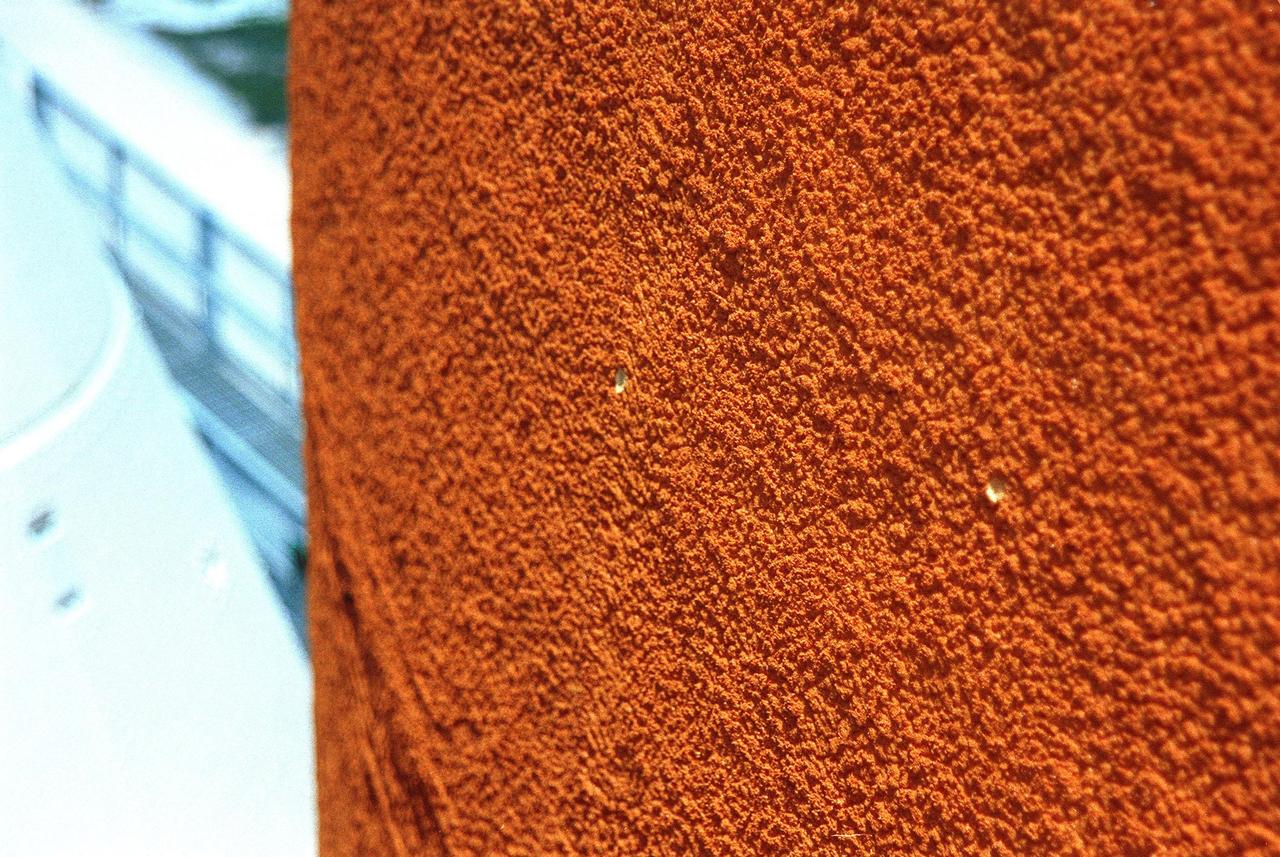
At Launch Pad 39B, two holes caused by hail on Space Shuttle Discovery's external tank (ET) are visible. Left of the tank is one of the solid rocket boosters. Workers are investigating the damage and potential problems for launch posed by ice forming in the holes, which may number as many as 150 over the entire tank. The average size of the holes is one-half inch in diameter and one-tenth inch deep. The external tank contains the liquid hydrogen fuel and liquid oxygen oxidizer and supplies them under pressure to the three space shuttle main engines in the orbiter during liftoff and ascent. The ET thermal protection system consists of sprayed-on foam insulation. The Shuttle Discovery is targeted for launch of mission STS-96 on May 20 at 9:32 a.m
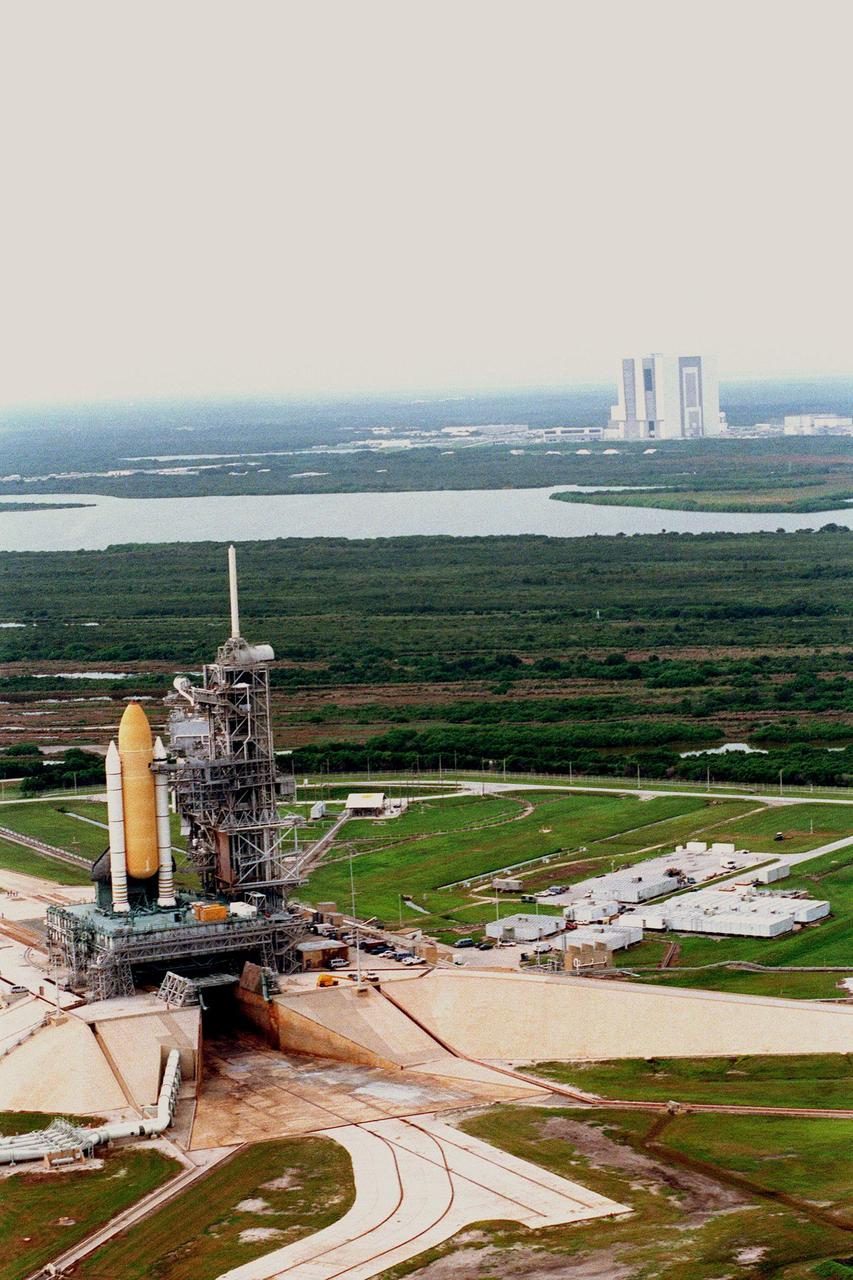
At the end of its 6-hour, 4.2-mile circular trek from the Vehicle Assembly Building (background), the STS-95 Space Shuttle Discovery (barely visible behind the external tank and solid rocket boosters) is moved into place at Launch Pad 39B. To its right is the Fixed Service Structure that provides access to the orbiter and the Rotating Service Structure. Below it is the flame trench. At the launch pad, the orbiter, external tank and solid rocket boosters will undergo final preparations for the launch, scheduled to lift off Oct. 29. The mission includes research payloads such as the Spartan solar-observing deployable spacecraft, the Hubble Space Telescope Orbital Systems Test Platform, the International Extreme Ultraviolet Hitchhiker, as well as the SPACEHAB single module with experiments on space flight and the aging process.
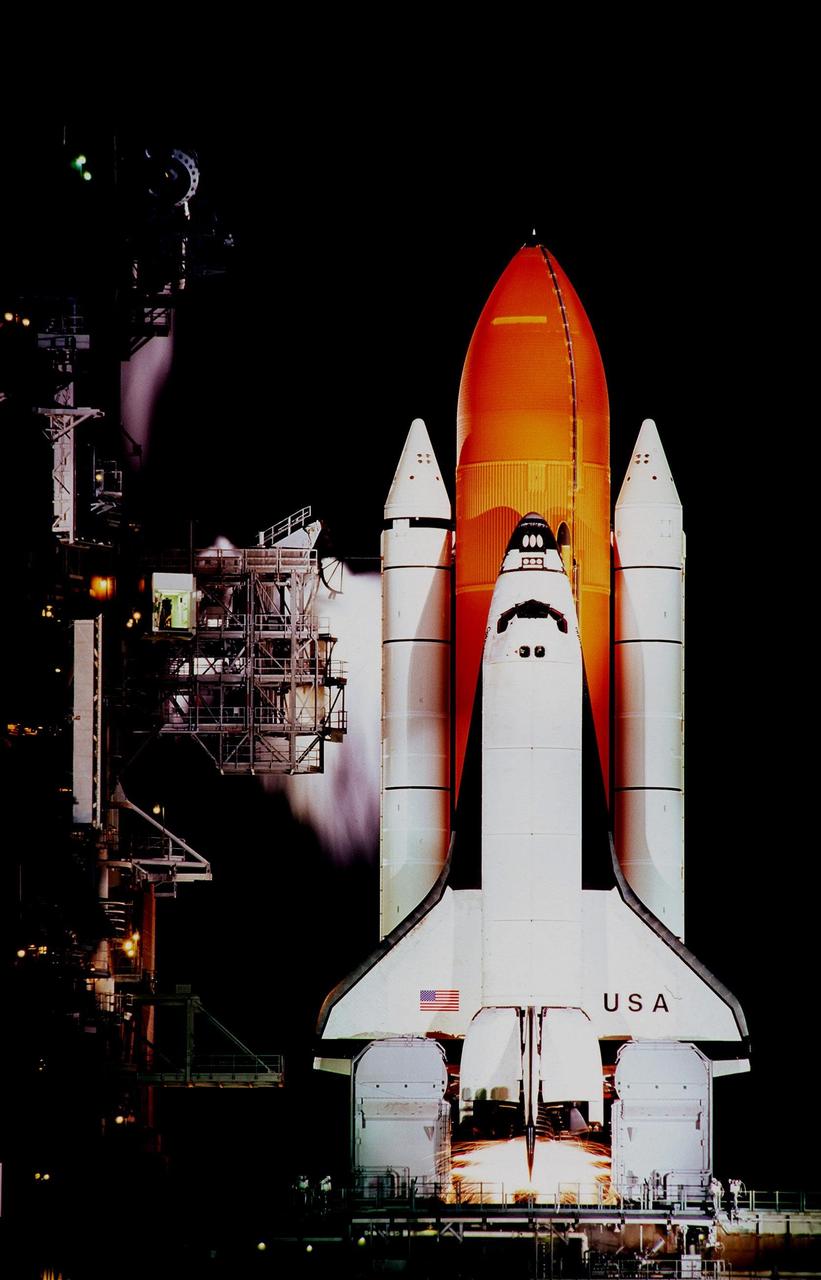
Moments before launch, sparks from the external ignitors are visible below the engines of Space Shuttle Columbia. The ignitors burn off a hydrogen concentration outside the orbiter near the main engines. A cloud effect behind the Shuttle's solid rocket booster and access arm to the left is created by spray from the water deluge system. The launch of STS-93 was scrubbed at the T-7 second mark in the countdown due to an indication of a high concentration of hydrogen in an aft engine compartment. The reading was proven to be a false alarm. The launch is rescheduled for July 22 at 12:28 a.m
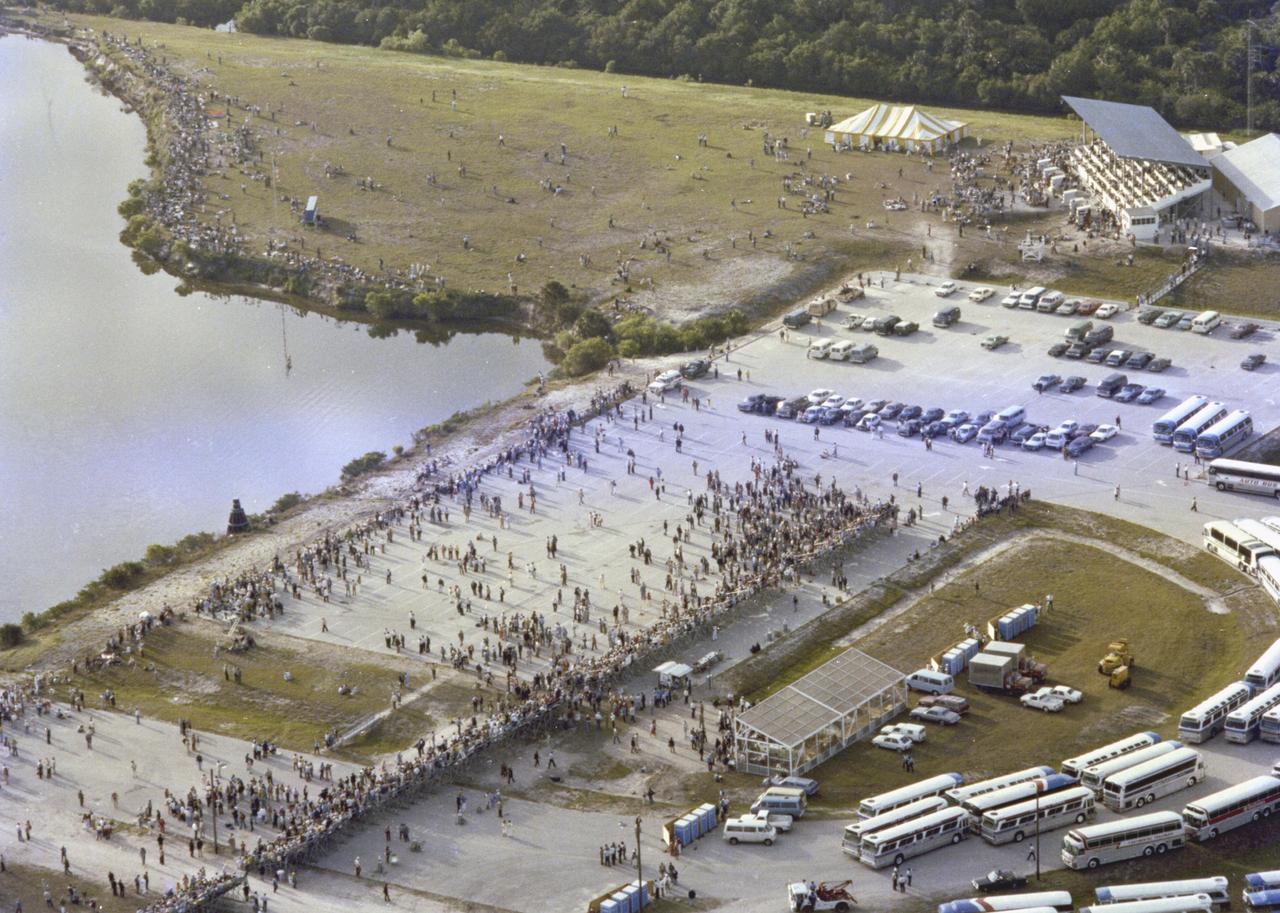
KENNEDY SPACE CENTER, FLA. - Viewed from the top of the Vehicle Assembly Building, crowds wait in vain for the launch of the maiden flight of the Space Shuttle, “scrubbed” on April 10. Visible at center is the “V.I.P.” site, with waiting buses parked at lower right. Above are the NASA Complex 39 Press Site and viewing stands, and major news media facilities. The STS-1 mission, known as a shuttle systems test flight, will seek to demonstrate safe launch into orbit and safe return of the orbiter and crew and verify the combined performance of the entire shuttle vehicle -- orbiter, solid rocket boosters and external tank.
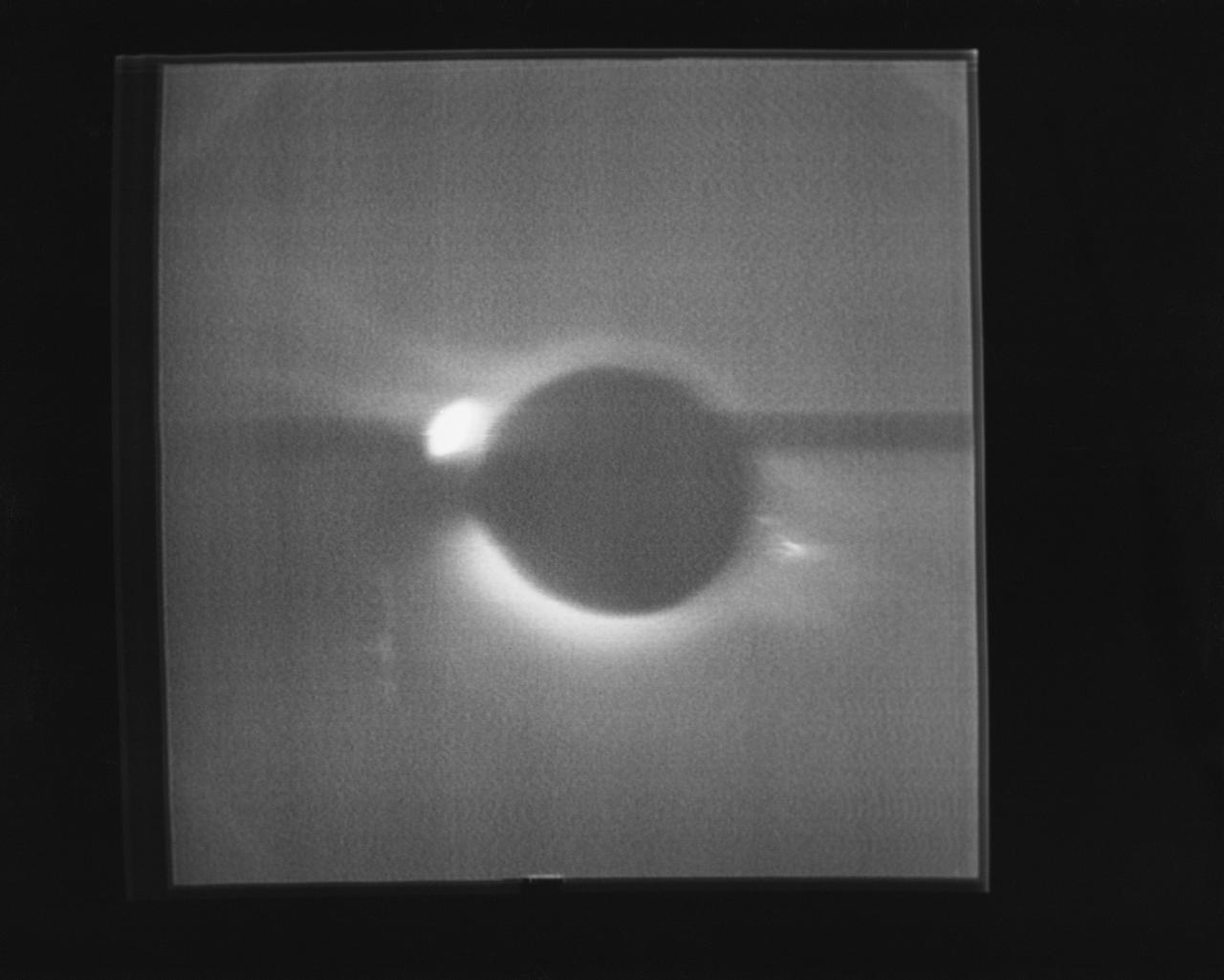
S74-15697 (17 Jan. 1974) --- The solar corona and a solar prominence as seen through the White Light Coronograph, Skylab Experiment S052, on Jan. 17, 1974. This view was reproduced from a television transmission made by a TV camera aboard the Skylab space station in Earth orbit. The bright spot is a burn in the vidicon. The solar corona is the halo around the sun which is normally visible only at the time of solar eclipse by the moon. The Skylab coronography uses an externally-mounted disk system which occults the brilliant solar surface while allowing the fainter radiation of the corona to enter an annulus and be photographed. A mirror system allows either TV viewing of the corona or photographic recording of the image. Photo credit: NASA
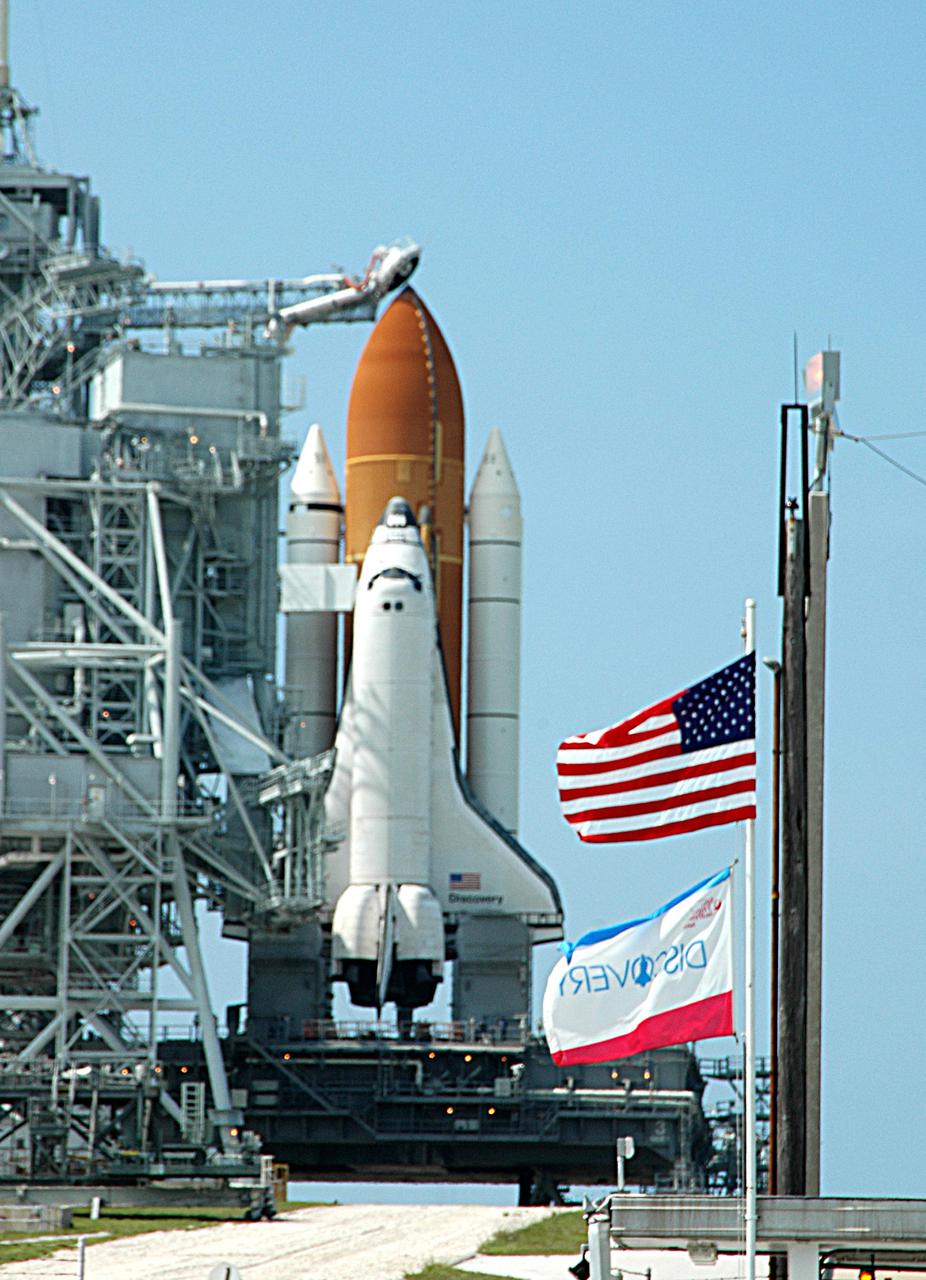
KENNEDY SPACE CENTER, FLA. - Flags are flying on Launch Pad 39B at NASA Kennedy Space Center as Space Shuttle Discovery is ready on the pad for launch after rollback of the Rotating Service Structure. Visible above the External Tank is the gaseous oxygen vent arm (beanie cap). Rollback of the RSS is a major preflight milestone, typically occurring during the T-11-hour hold on L-1 (the day before launch). Discovery is scheduled to lift off on the historic Return to Flight mission STS-114 at 10:39 a.m. EDT July 26 with a crew of seven. On the mission to the International Space Station the crew will perform inspections on orbit for the first time of all of the Reinforced Carbon-Carbon (RCC) panels on the leading edge of the wings and the Thermal Protection System tiles using the new Canadian-built Orbiter Boom Sensor System and the data from 176 impact and temperature sensors. Mission Specialists will also practice repair techniques on RCC and tile samples during a spacewalk in the payload bay. During two additional spacewalks, the crew will install the External Stowage Platform-2, equipped with spare part assemblies, and a replacement Control Moment Gyroscope contained in the Lightweight Multi-Purpose Experiment Support Structure.
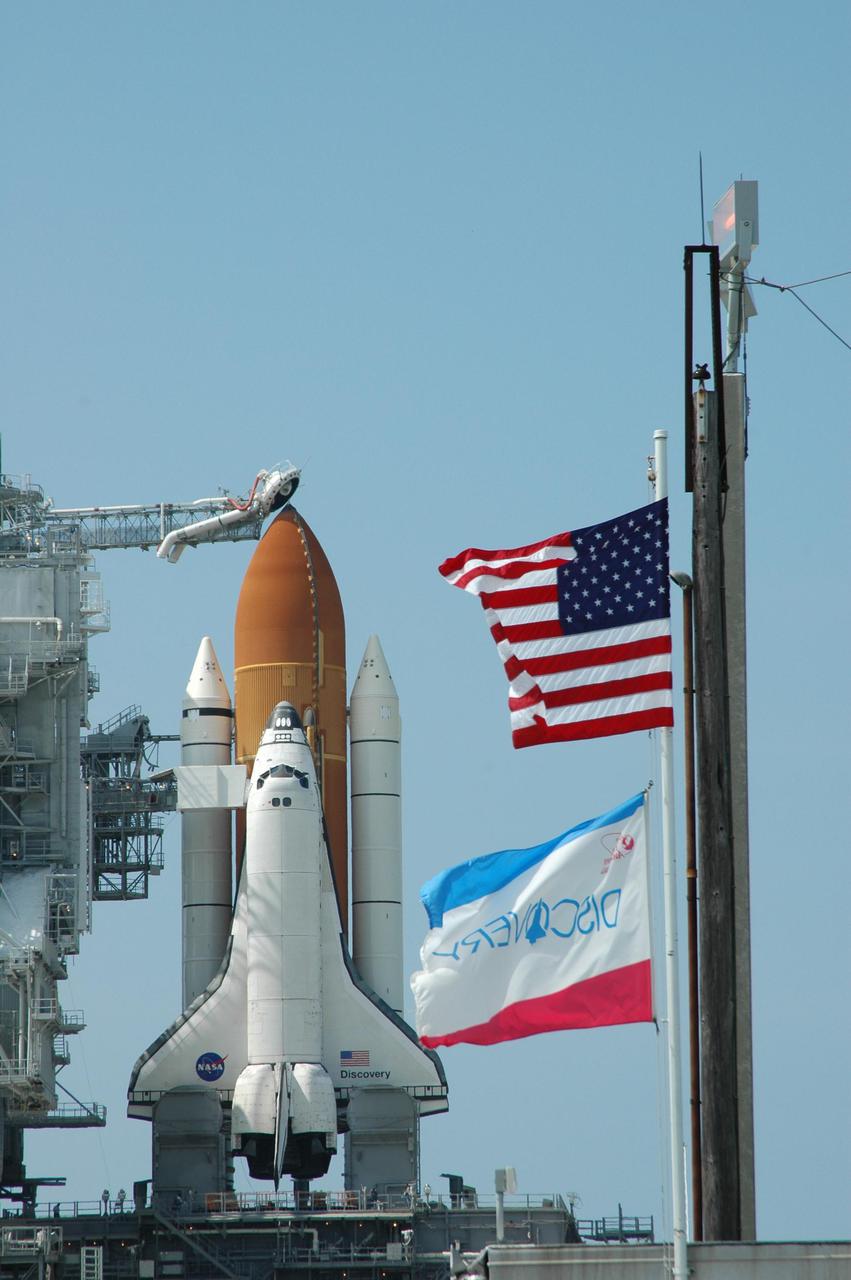
KENNEDY SPACE CENTER, FLA. - Flags are flying on Launch Pad 39B at NASA Kennedy Space Center as Space Shuttle Discovery is ready on the pad for launch after rollback of the Rotating Service Structure. Visible above the External Tank is the gaseous oxygen vent arm (beanie cap). Rollback of the RSS is a major preflight milestone, typically occurring during the T-11-hour hold on L-1 (the day before launch). Discovery is scheduled to lift off on the historic Return to Flight mission STS-114 at 10:39 a.m. EDT July 26 with a crew of seven. On the mission to the International Space Station the crew will perform inspections on orbit for the first time of all of the Reinforced Carbon-Carbon (RCC) panels on the leading edge of the wings and the Thermal Protection System tiles using the new Canadian-built Orbiter Boom Sensor System and the data from 176 impact and temperature sensors. Mission Specialists will also practice repair techniques on RCC and tile samples during a spacewalk in the payload bay. During two additional spacewalks, the crew will install the External Stowage Platform-2, equipped with spare part assemblies, and a replacement Control Moment Gyroscope contained in the Lightweight Multi-Purpose Experiment Support Structure.
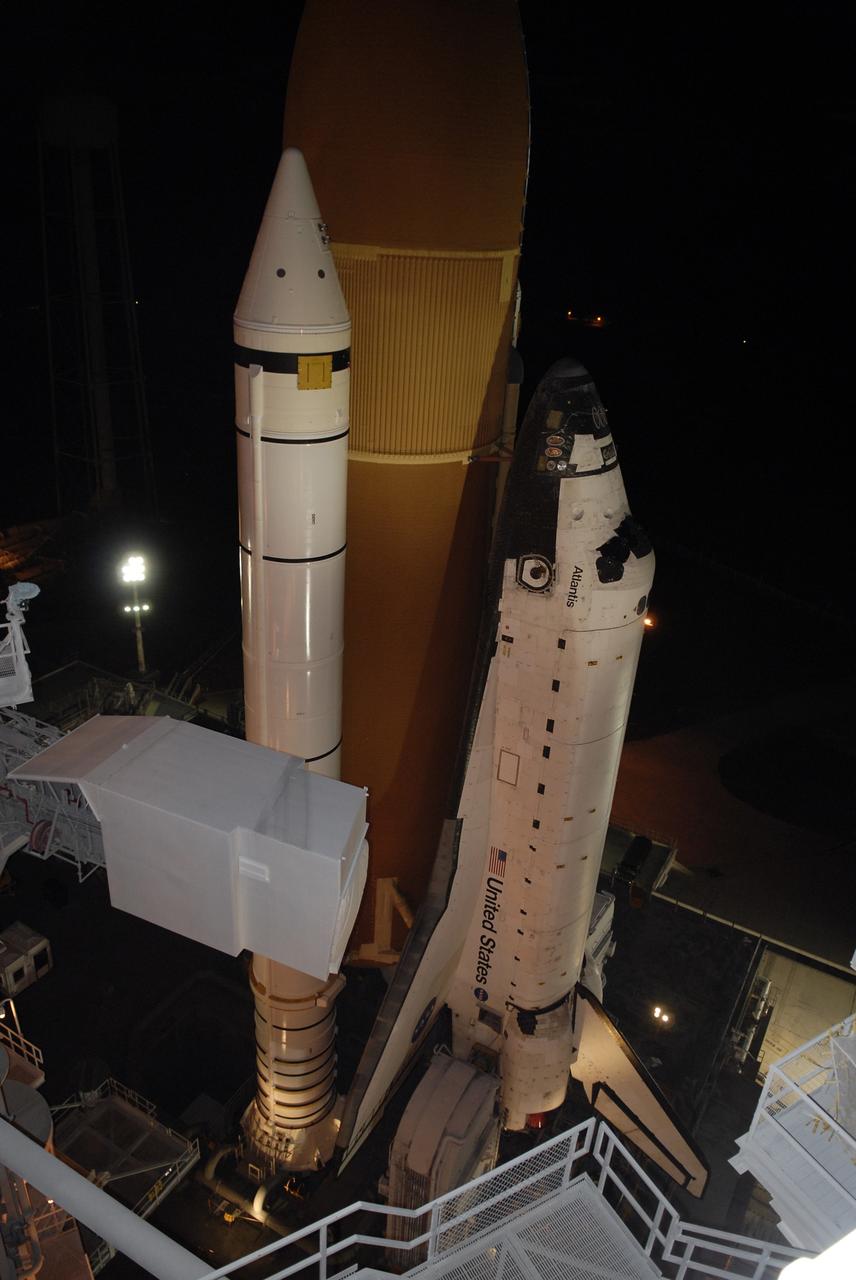
CAPE CANAVERAL, Fla. - Space Shuttle Atlantis is viewed from an upper level of the fixed service structure on Launch Pad 39A at NASA's Kennedy Space Center in Florida. Visible are the orange external tank, a solid rocket booster and Atlantis. In the foreground is the White Room at the end of the orbiter access arm. Atlantis is rolling back to the Vehicle Assembly Building to await launch on its STS-125 mission to repair NASA's Hubble Space Telescope. Atlantis' targeted launch on Oct. 14 was delayed when a system that transfers science data from the orbiting observatory to Earth malfunctioned on Sept. 27. The new target launch date is under review. The space shuttle is mounted on a Mobile Launcher Platform and will be delivered to the Vehicle Assembly Building atop a crawler transporter. traveling slower than 1 mph during the 3.4-mile journey. The rollback is expected to take approximately six hours. Photo credit: NASA/Kim Shiflett
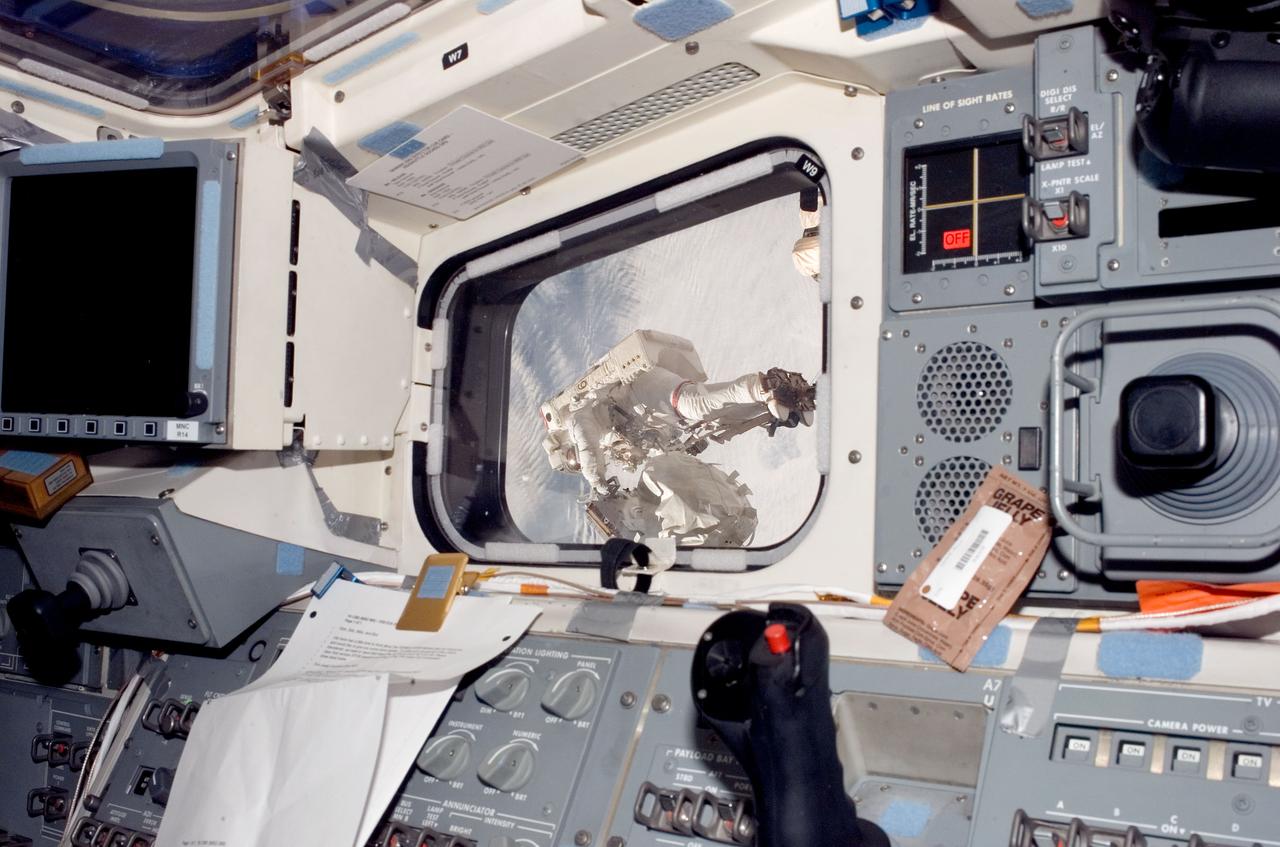
S123-E-006749 (17/18 March 2008) --- Visible through a window on Endeavour's aft flight deck, astronaut Rick Linnehan, STS-123 mission specialist, participates in the mission's third scheduled session of extravehicular activity (EVA) as construction and maintenance continue on the International Space Station. During the 6-hour, 53-minute spacewalk, Linnehan and astronaut Robert L. Behnken (out of frame), mission specialist, installed a spare-parts platform and tool-handling assembly for Dextre, also known as the Special Purpose Dextrous Manipulator (SPDM). Among other tasks, they also checked out and calibrated Dextre's end effector and attached critical spare parts to an external stowage platform. The new robotic system is scheduled to be activated on a power and data grapple fixture located on the Destiny laboratory on flight day nine.
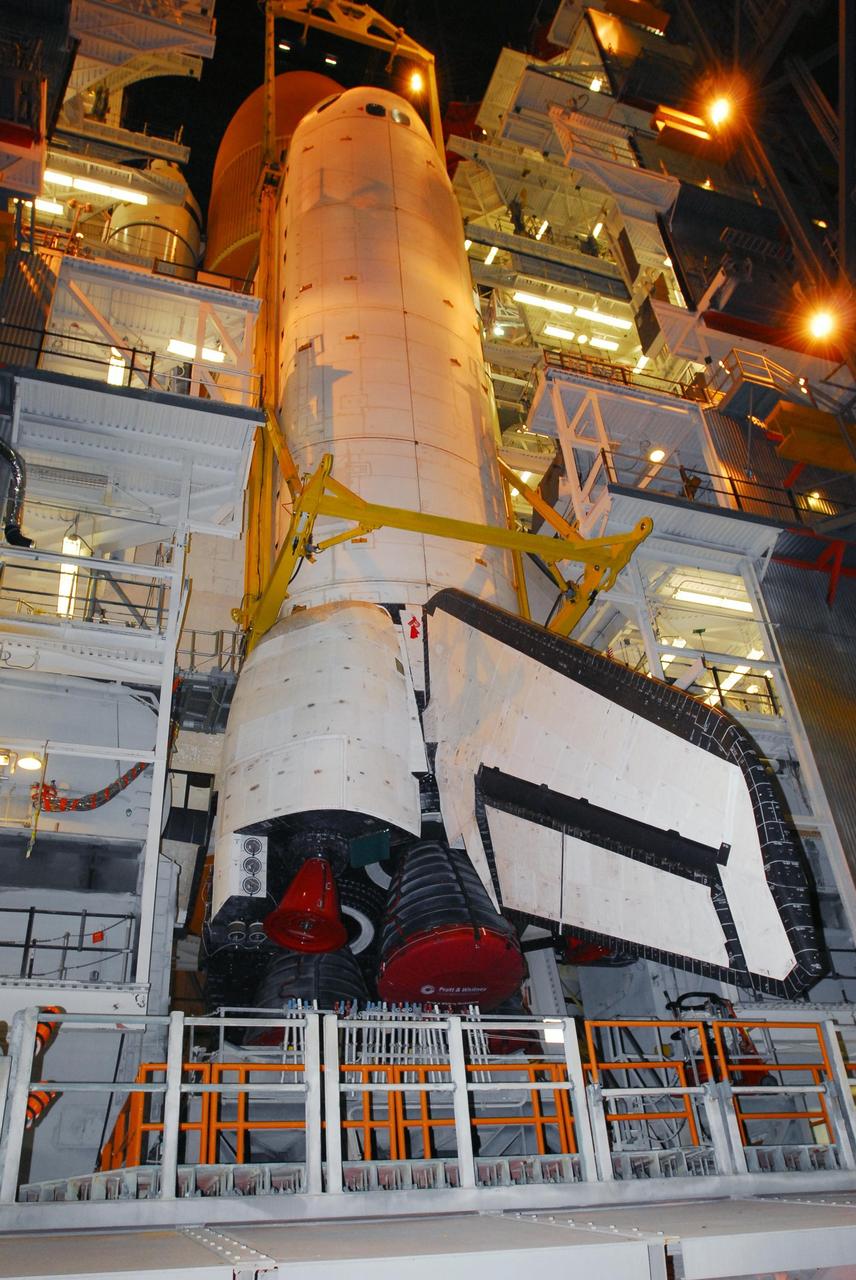
KENNEDY SPACE CENTER, FLA. -- In high bay 1 of the Vehicle Assembly Building, platforms surround Endeavour to complete stacking of the orbiter, external tank and solid rocket boosters, barely visible behind the platforms. Endeavour will be launched on mission STS-118, its first flight in more than four years. The shuttle has undergone extensive modifications, including the addition of safety upgrades already added to shuttles Discovery and Atlantis. Endeavour also features new hardware, such as the Station-to-Shuttle Power Transfer System that will allow the docked shuttle to draw electrical power from the station and extend its visits to the orbiting lab. Endeavour is targeted for launch on Aug. 7. Photo credit: NASA/George Shelton
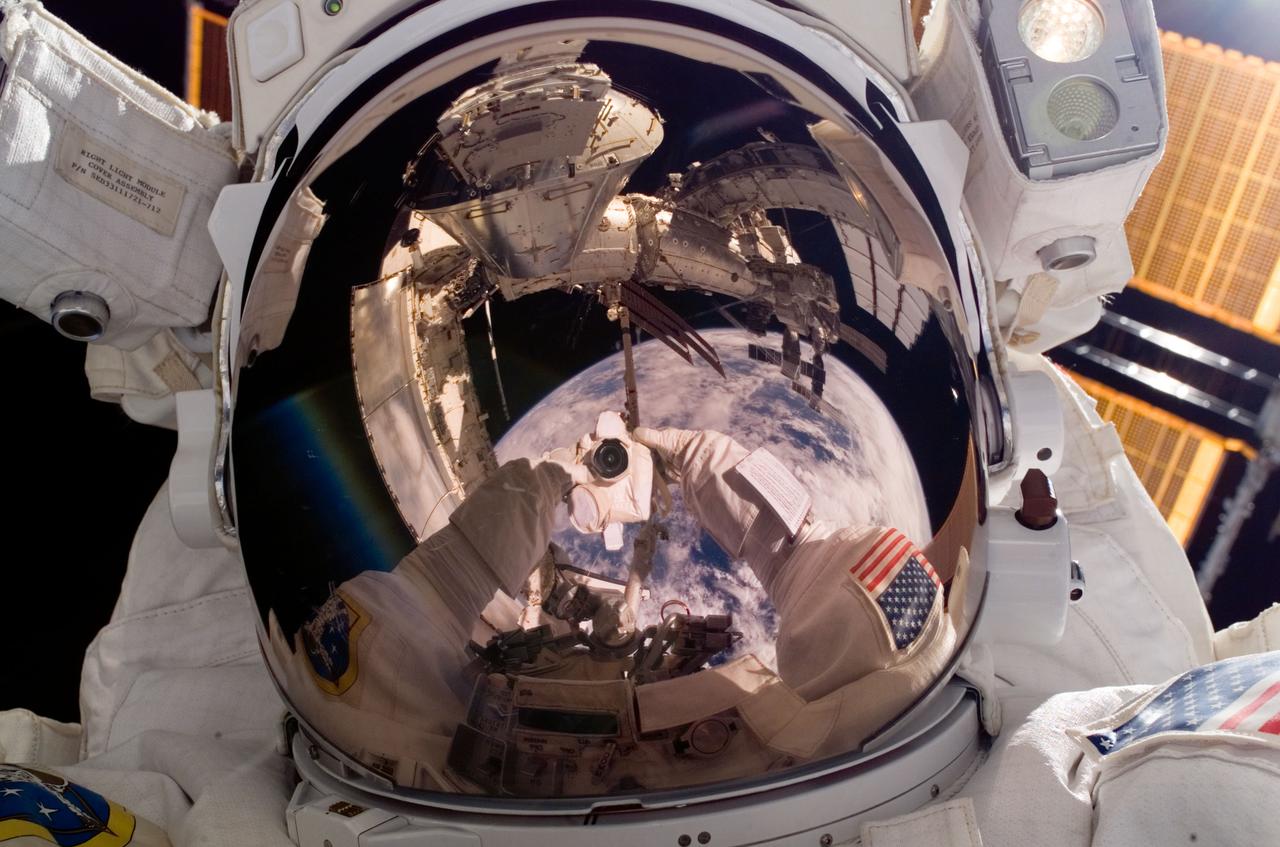
ISS016-E-033024 (17/18 March 2008) --- Astronaut Rick Linnehan, STS-123 mission specialist, uses a digital camera to expose a photo of his helmet visor during the mission's third scheduled session of extravehicular activity (EVA) as construction and maintenance continue on the International Space Station. Also visible in the reflections in the visor are various components of the station, the docked Space Shuttle Endeavour and a blue and white portion of Earth. During the 6-hour, 53-minute spacewalk, Linnehan and astronaut Robert L. Behnken (out of frame), mission specialist, installed a spare-parts platform and tool-handling assembly for Dextre, also known as the Special Purpose Dextrous Manipulator (SPDM). Among other tasks, they also checked out and calibrated Dextre's end effector and attached critical spare parts to an external stowage platform. The new robotic system is scheduled to be activated on a power and data grapple fixture located on the Destiny laboratory on flight day nine.
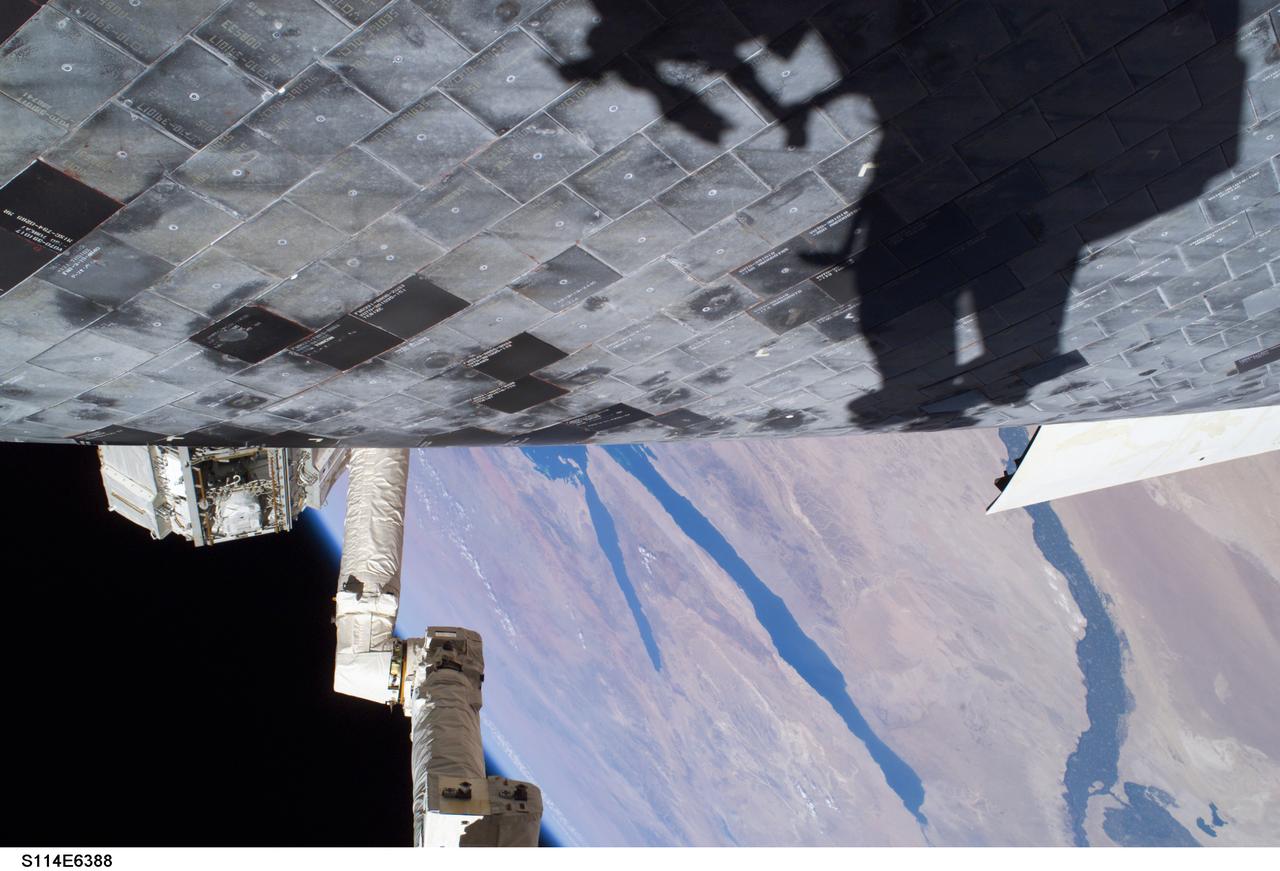
Launched on July 26, 2005 from the Kennedy Space Center in Florida, STS-114 was classified as Logistics Flight 1. Among the Station-related activities of the mission were the delivery of new supplies and the replacement of one of the orbital outpost's Control Moment Gyroscopes (CMGs). STS-114 also carried the Raffaello Multi-Purpose Logistics Module and the External Stowage Platform-2. A major focus of the mission was the testing and evaluation of new Space Shuttle flight safety, which included new inspection and repair techniques. Upon its approach to the International Space Station (ISS), the Space Shuttle Discovery underwent a photography session in order to assess any damages that may have occurred during its launch and/or journey through Space. The mission’s third and final Extra Vehicular Activity (EVA) included taking a close-up look and the repair of the damaged heat shield. Gap fillers were removed from between the orbiter’s heat-shielding tiles located on the craft’s underbelly. Never before had any repairs been done to an orbiter while still in space. This particular photo was taken by astronaut Stephen K. Robinson, STS-114 mission specialist, whose shadow is visible on the thermal protection tiles, and a portion of the Canadian built Remote Manipulator System (RMS) robotic arm and the Nile River is visible at the bottom.
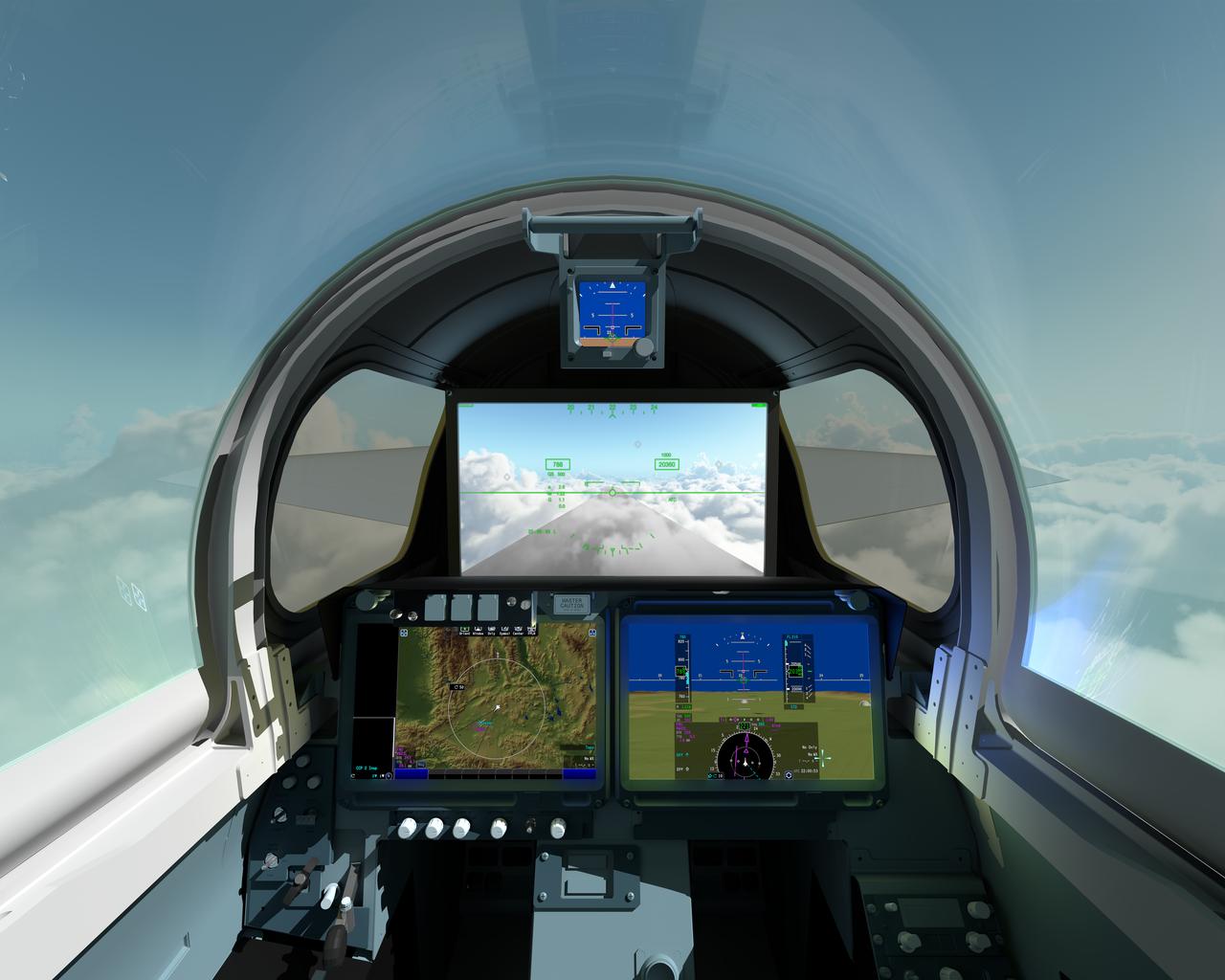
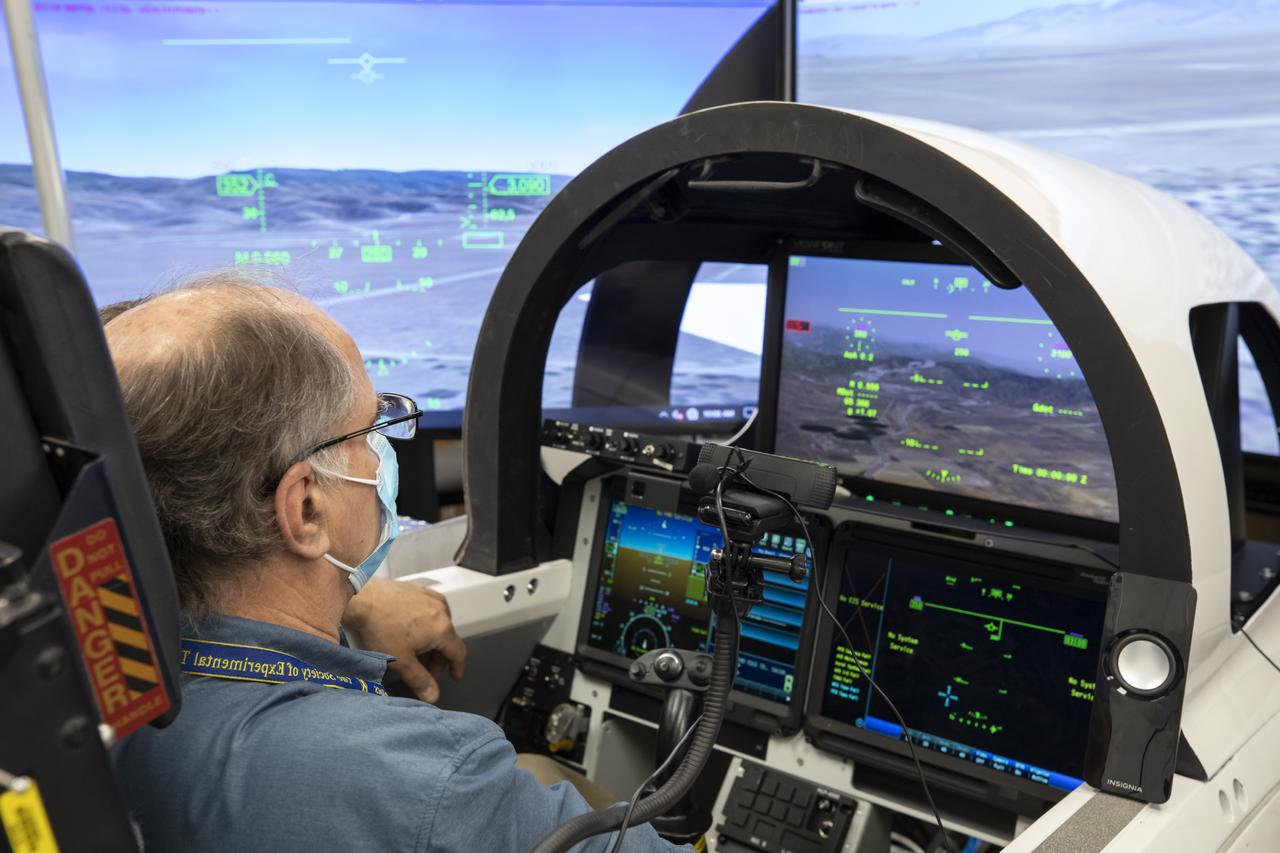
The pilot of NASAÕs X-59 Quiet SuperSonic Technology, or QueSST, aircraft will navigate the skies in a cockpit unlike any other. There wonÕt be a forward-facing window. ThatÕs right; itÕs actually a 4K monitor that serves as the central window and allows the pilot to safely see traffic in his or her flight path, and provides additional visual aids for airport approaches, landings and takeoffs. The 4K monitor, which is part of the aircraftÕs eXternal Visibility System, or XVS, displays stitched images from two cameras outside the aircraft combined with terrain data from an advanced computing system. The two portals and traditional canopy are real windows however, and help the pilot see the horizon. The displays below the XVS will provide a variety of aircraft systems and trajectory data for the pilot to safely fly. The XVS is one of several innovative solutions to help ensure the X-59Õs design shape reduces a sonic boom to a gentle thump heard by people on the ground. Though not intended to ever carry passengers, the X-59 boom-suppressing technology and community response data could help lift current bans on supersonic flight over land and enable a new generation of quiet supersonic commercial aircraft.
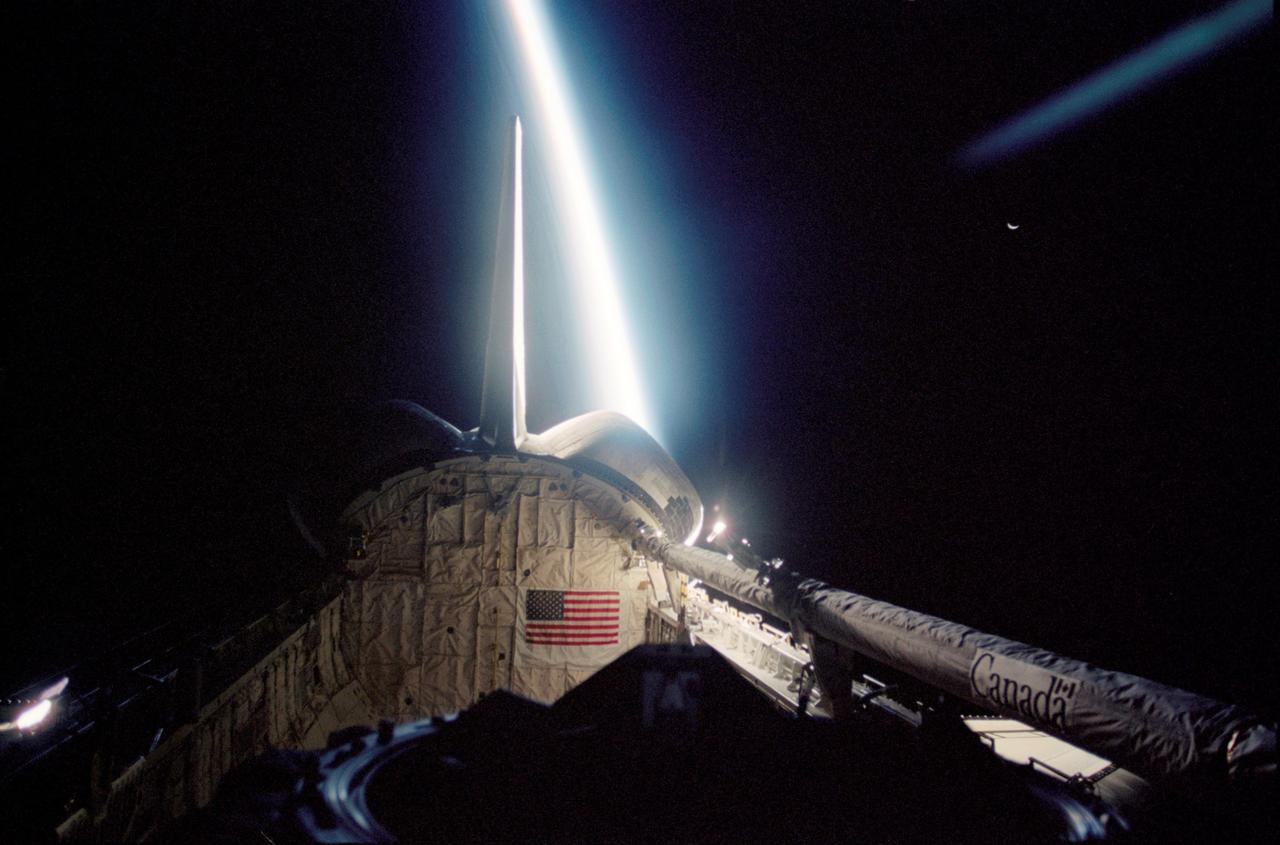
This STS-113 photograph shows an incredible view of the Space Shuttle Endeavour's payload bay. The blackness of space, Earth's moon (upper right frame), and a thin slice of Earth's horizon which runs vertically across the photograph, form the back drop for this photograph. The remote manipulator system (RMS) robotic arm is visible in lower right frame. The 16th American assembly flight and 112th overall American flight to the International Space Station (ISS) launched on November 23, 2002 from Kennedy's launch pad 39A aboard the Space Shuttle Orbiter Endeavour STS-113. Mission objectives included the installation and activation of the Port 1 Integrated Truss Assembly (P1). The first major component installed on the left side of the Station, the P1 truss provides three additional External Thermal Control System radiators. Weighing in at 27,506 pounds, the P1 truss is 45 feet (13.7 meters) long, 15 feet (4.6 meters) wide, and 13 feet (4 meters) high. Three space walks, aided by the use of the Robotic Manipulator Systems of both the Shuttle and the Station, were performed in the installation of P1.
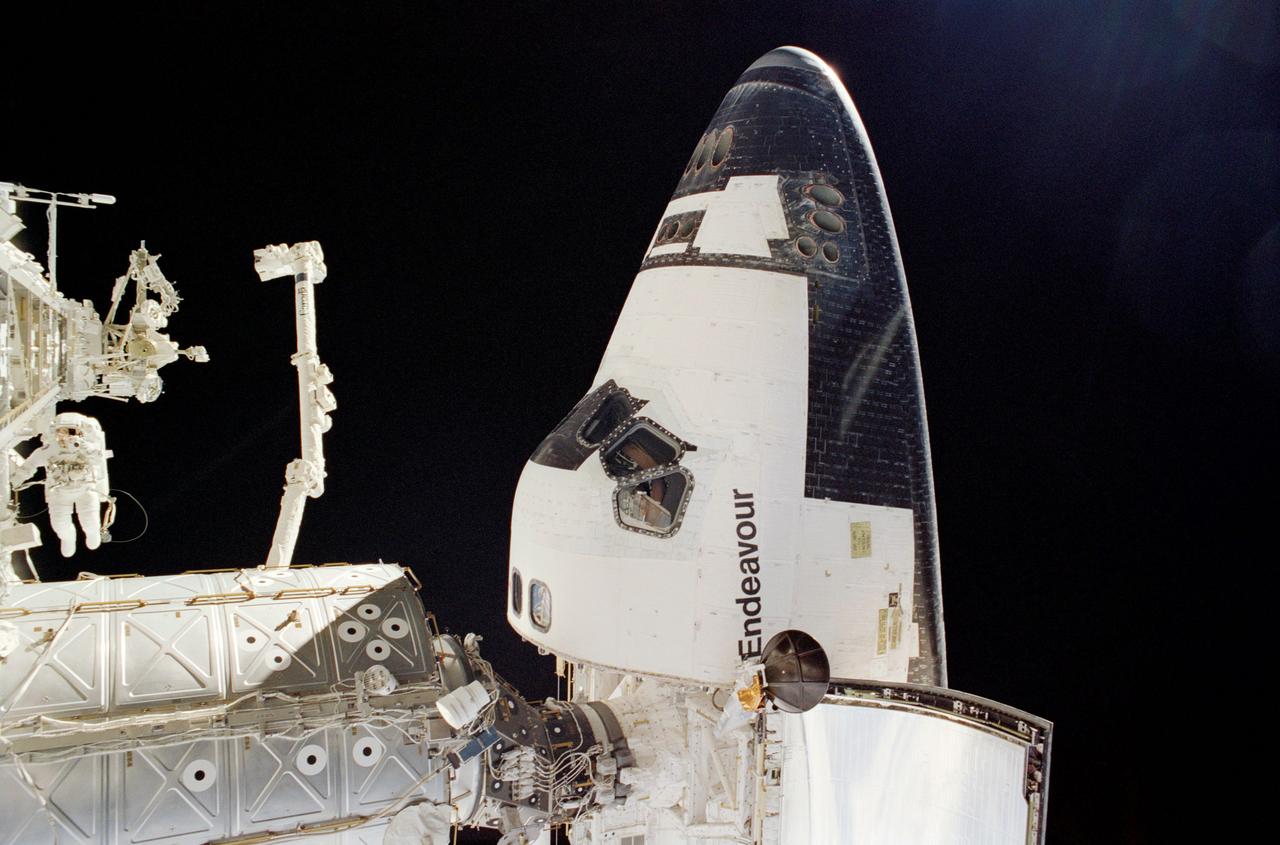
STS-113, the 16th American assembly flight and 112th overall American flight to the International Space Station (ISS), launched on November 23, 2002 from Kennedy's launch pad 39A aboard the Space Shuttle Orbiter Endeavour. The main mission objective was the the installation and activation of the Port 1 Integrated Truss Assembly (P1). The first major component installed on the left side of the Station, the P1 truss provides an additional three External Thermal Control System radiators. Weighing in at 27,506 pounds, the P1 truss is 45 feet (13.7 meters) long, 15 feet (4.6 meters) wide, and 13 feet (4 meters) high. Three space walks, aided by the use of the Robotic Manipulator Systems of both the Shuttle and the Station, were performed in the installation of P1. In this photograph astronaut and mission specialist John B. Herrington, (center left frame), participates in the mission's third space walk. The forward section of the Space Shuttle Endeavour, docked to the Pressurized Mating Adapter (PMA-2) on the ISS, is visible center frame. The station's Canadarm2 appears to stand in between the shuttle and Herrington.
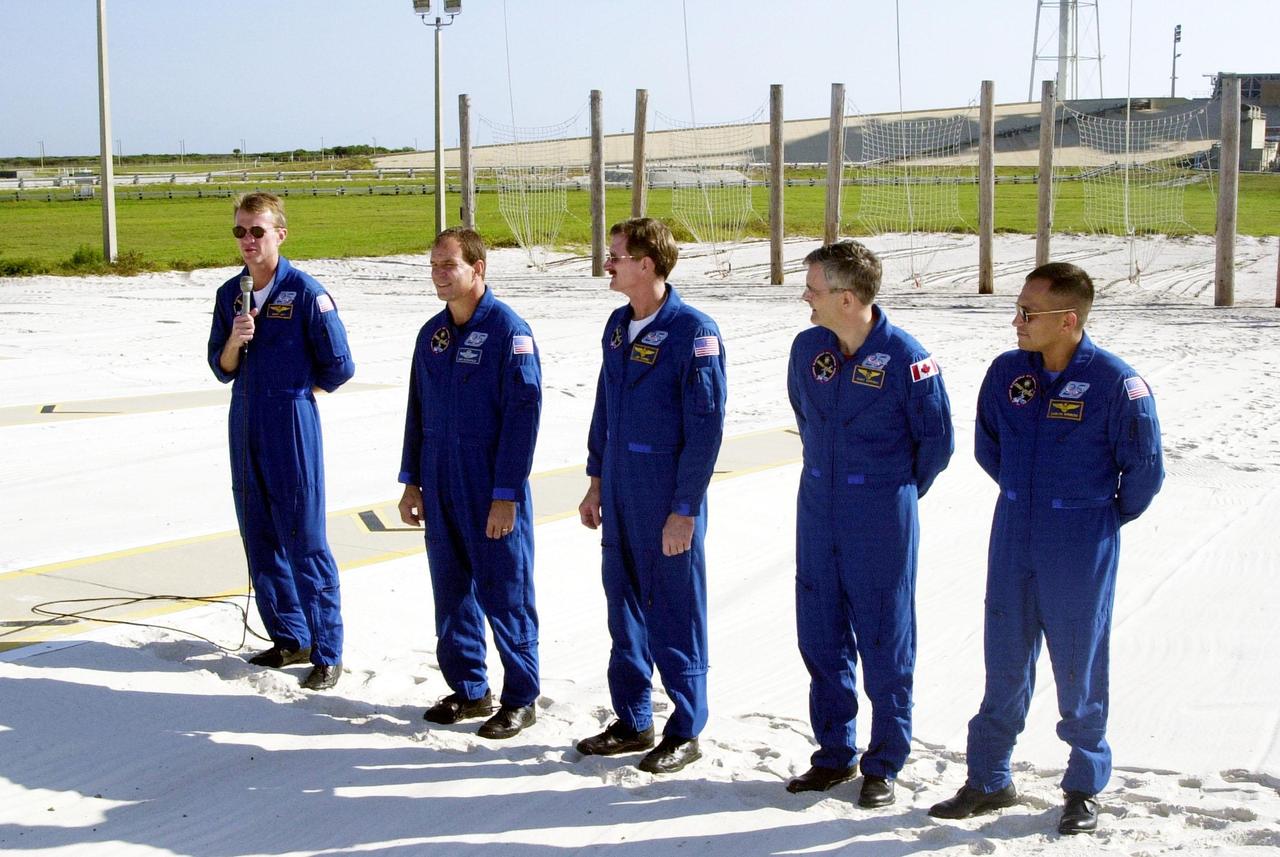
KENNEDY SPACE CENTER, Fla. -- Standing in the slidewire landing zone at Launch Pad 39B, the STS-97 crew respond to questions from the media. They are, left to right, Commander Brent Jett, Pilot Mike Bloomfield and Mission Specialists Joe Tanner, Marc Garneau and Carlos Noriega. Garneau is with the Canadian Space Agency. The nets suspended behind them are a braking system catch net for the slidewire baskets that provide emergency exit from the orbiter and Fixed Service Structure. The crew is at KSC to take part in Terminal Countdown Demonstration Test activities that include emergency egress training, familiarization with the payload, and a simulated launch countdown. Visible in the background are the solid rocket booster and external tank on Space Shuttle Endeavour. Mission STS-97is the sixth construction flight to the International Space Station. Its payload includes the P6 Integrated Truss Structure and a photovoltaic (PV) module, with giant solar arrays that will provide power to the Station. The mission includes two spacewalks to complete the solar array connections. STS-97 is scheduled to launch Nov. 30 at about 10:05 p.m. EST
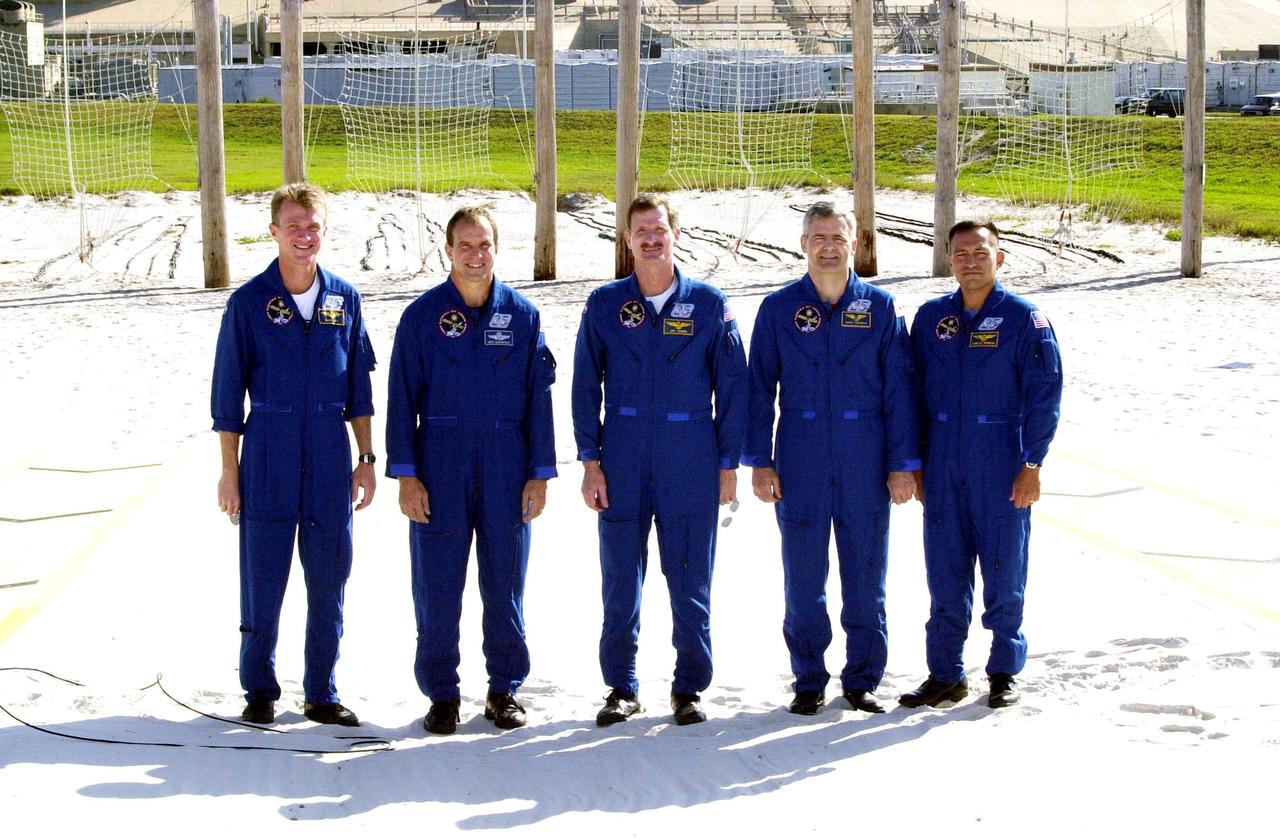
KENNEDY SPACE CENTER, Fla. -- The STS-97 crew poses for another photo after meeting with the media at the slidewire landing zone. They are, left to right, Commander Brent Jett, Pilot Mike Bloomfield and Mission Specialists Joe Tanner, Marc Garneau and Carlos Noriega. Garneau is with the Canadian Space Agency. The nets suspended behind them are a braking system catch net for the slidewire baskets that provide emergency exit from the orbiter and Fixed Service Structure. The crew is at KSC to take part in Terminal Countdown Demonstration Test activities that include emergency egress training, familiarization with the payload, and a simulated launch countdown. Visible in the background are the solid rocket booster and external tank on Space Shuttle Endeavour. Mission STS-97is the sixth construction flight to the International Space Station. Its payload includes the P6 Integrated Truss Structure and a photovoltaic (PV) module, with giant solar arrays that will provide power to the Station. The mission includes two spacewalks to complete the solar array connections. STS-97 is scheduled to launch Nov. 30 at 10:05 p.m. EST
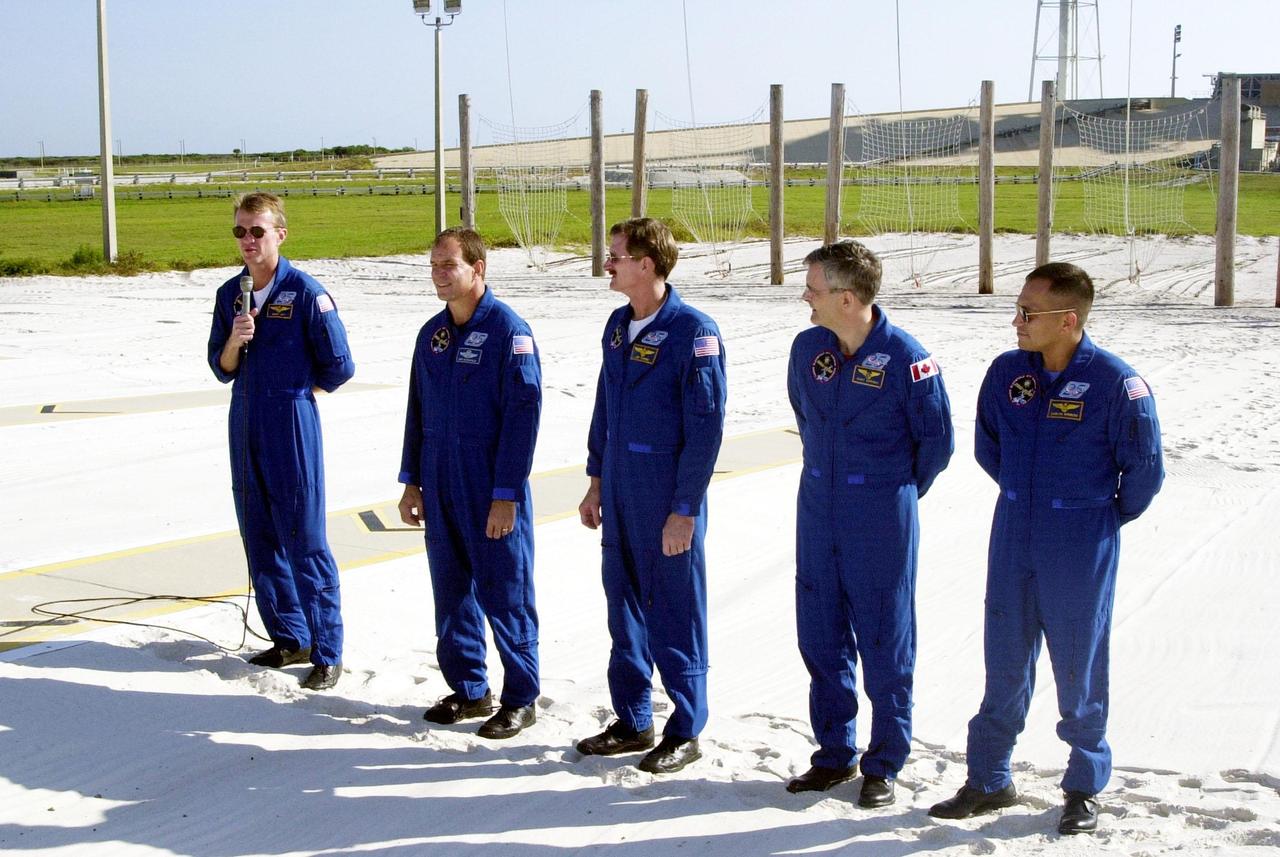
KENNEDY SPACE CENTER, Fla. -- Standing in the slidewire landing zone at Launch Pad 39B, the STS-97 crew respond to questions from the media. They are, left to right, Commander Brent Jett, Pilot Mike Bloomfield and Mission Specialists Joe Tanner, Marc Garneau and Carlos Noriega. Garneau is with the Canadian Space Agency. The nets suspended behind them are a braking system catch net for the slidewire baskets that provide emergency exit from the orbiter and Fixed Service Structure. The crew is at KSC to take part in Terminal Countdown Demonstration Test activities that include emergency egress training, familiarization with the payload, and a simulated launch countdown. Visible in the background are the solid rocket booster and external tank on Space Shuttle Endeavour. Mission STS-97is the sixth construction flight to the International Space Station. Its payload includes the P6 Integrated Truss Structure and a photovoltaic (PV) module, with giant solar arrays that will provide power to the Station. The mission includes two spacewalks to complete the solar array connections. STS-97 is scheduled to launch Nov. 30 at about 10:05 p.m. EST
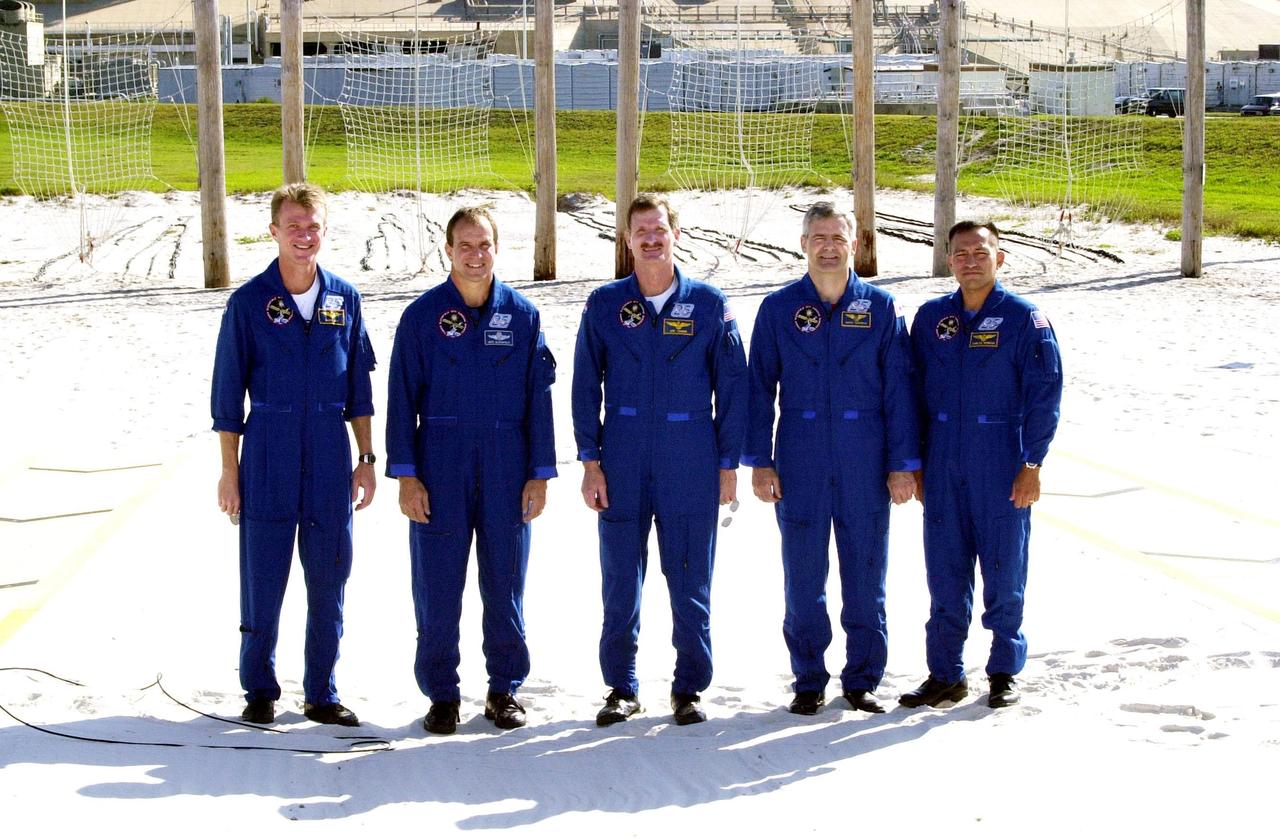
KENNEDY SPACE CENTER, Fla. -- The STS-97 crew poses for another photo after meeting with the media at the slidewire landing zone. They are, left to right, Commander Brent Jett, Pilot Mike Bloomfield and Mission Specialists Joe Tanner, Marc Garneau and Carlos Noriega. Garneau is with the Canadian Space Agency. The nets suspended behind them are a braking system catch net for the slidewire baskets that provide emergency exit from the orbiter and Fixed Service Structure. The crew is at KSC to take part in Terminal Countdown Demonstration Test activities that include emergency egress training, familiarization with the payload, and a simulated launch countdown. Visible in the background are the solid rocket booster and external tank on Space Shuttle Endeavour. Mission STS-97is the sixth construction flight to the International Space Station. Its payload includes the P6 Integrated Truss Structure and a photovoltaic (PV) module, with giant solar arrays that will provide power to the Station. The mission includes two spacewalks to complete the solar array connections. STS-97 is scheduled to launch Nov. 30 at 10:05 p.m. EST
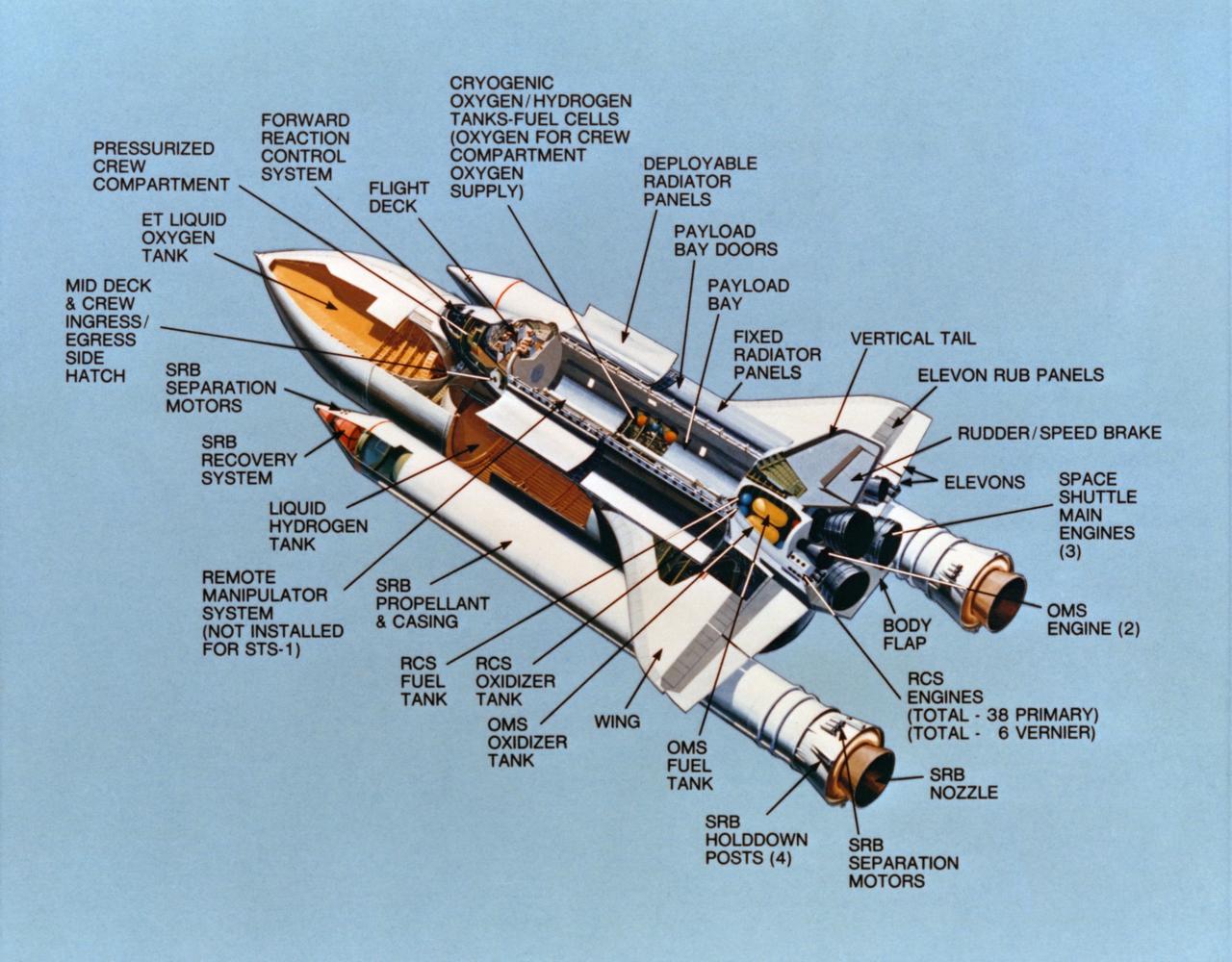
S81-30630 (February 1981) --- This "cutaway" artist's concept exercises some artistic license to reveal systems of the major components of a space shuttle vehicle. With its payload bay doors open here, the shuttle's cryogenic supply station (note cutaway) and the deployable radiator panels (visible) can be seen. In reality, the cargo bay panels would never be open while the orbiter is attached to the solid rocket boosters (SRB) and external fuel tank (ET). The thick-bodied, delta-winged aerospace craft is 37 meters long, has a span of 24 meters (120 feet by 80 feet), and weighs about 75,000 kilograms empty (165,000 lbs). Its payload bay, 18.3 meters long and 4.6 meters in diameter (60 feet by 15 feet) can deliver single or conglomerate payloads of up to 370 kilometers altitude or smaller loads up to 1110 kilometers (230 miles to 690 miles). It can bring payloads of 14,515 kilograms (32,000 lbs) back to Earth and it can carry out a variety of missions lasting seven to 30 days. Photo credit: NASA
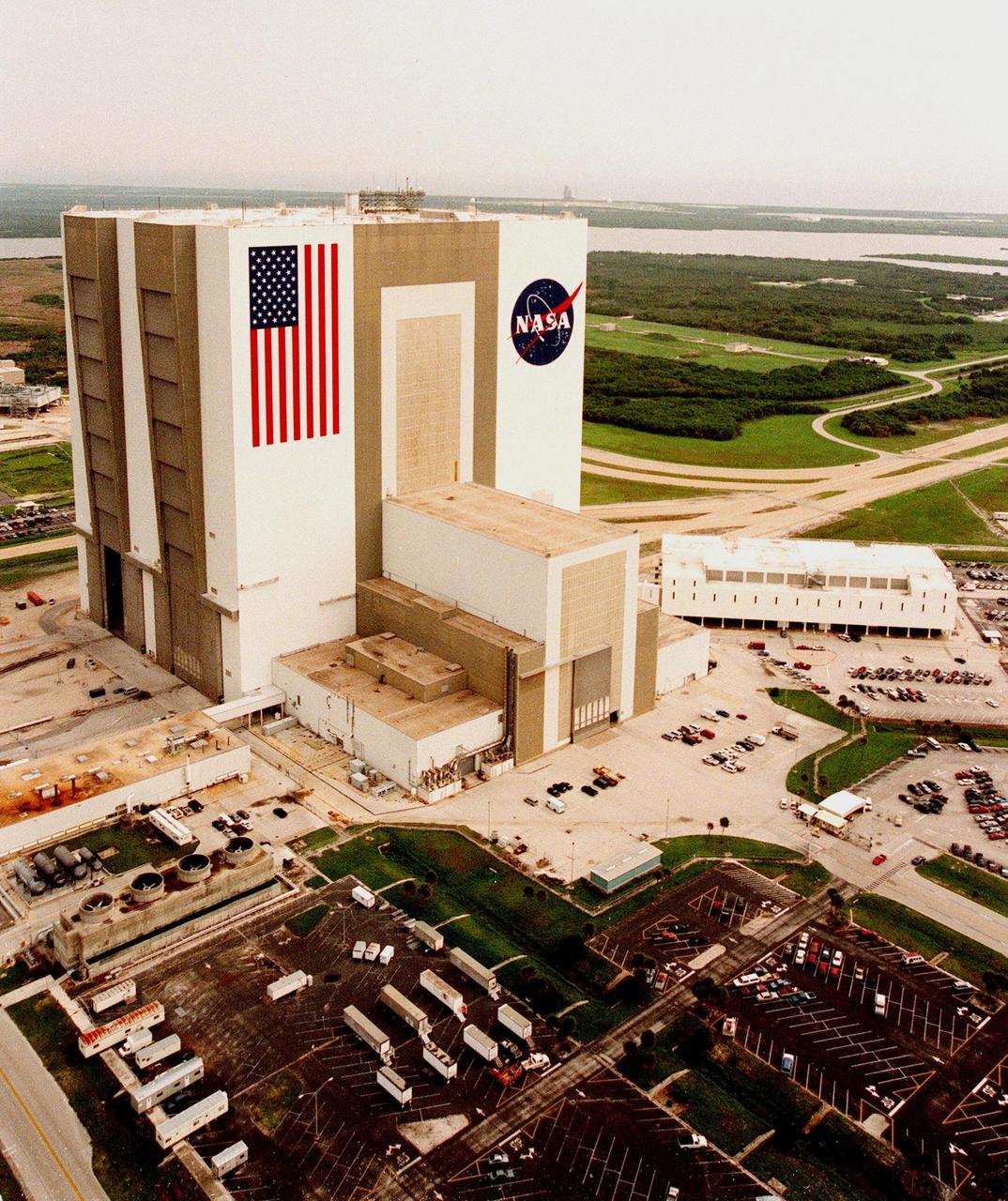
KENNEDY SPACE CENTER, FLA. -- The Vehicle Assembly Building (VAB) in the Launch Complex 39 area wears a new coat of paint, along with newly painted American flag and NASA logo. The improved look was finished in time to honor NASA's 40th anniversary on Oct. 1. In order to do the job, workers were suspended on platforms from the top of the 525-foot-high VAB. One of the world's largest buildings by volume, the VAB is the last stop for the Shuttle before rollout to the launch pad. Integration and stacking of the complete Space Shuttle vehicle (orbiter, two solid rocket boosters and the external tank) takes place in High Bays 1 or 3. To the right of the VAB is the Launch Control Center. Each of its four firing rooms are equipped with automated, computer-controlled Launch Processing System (LPS) for monitoring and controlling Shuttle assembly, checkout and launch operations, as well as work order control and scheduling. Banana Creek is visible behind and to the right of the VAB
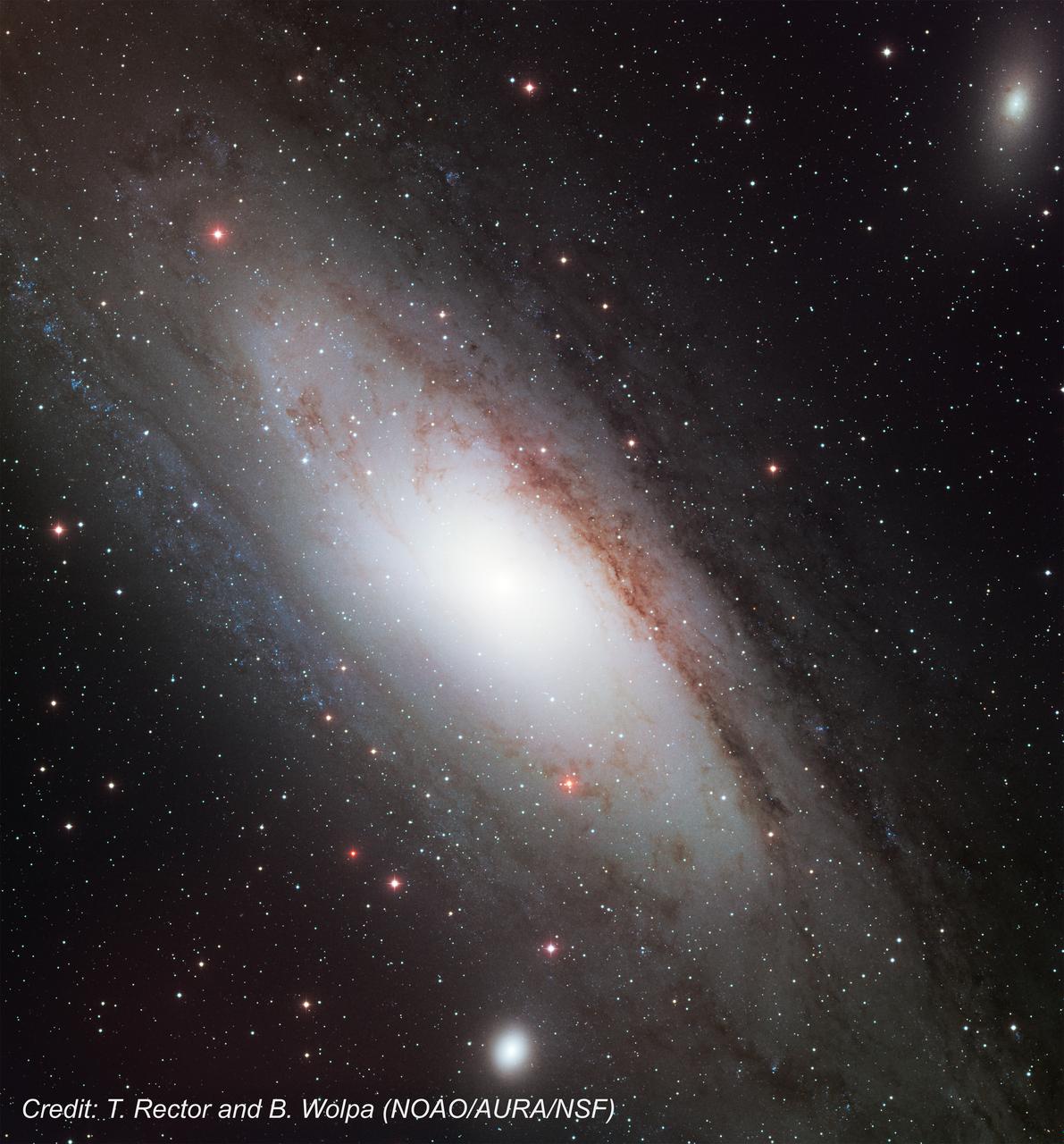
Image release January 11, 2012 A new Hubble Space Telescope image centers on the 100-million-solar-mass black hole at the hub of the neighboring spiral galaxy M31, or the Andromeda galaxy, one of the few galaxies outside the Milky Way visible to the naked eye and the only other giant galaxy in the Local Group. This is the sharpest visible-light image ever made of the nucleus of an external galaxy. The Hubble image is being presented today at the meeting of the American Astronomical Society in Austin, Texas. To read more go to: <a href="http://www.nasa.gov/mission_pages/hubble/science/ultra-blue.html" rel="nofollow">www.nasa.gov/mission_pages/hubble/science/ultra-blue.html</a> <b><a href="http://www.nasa.gov/audience/formedia/features/MP_Photo_Guidelines.html" rel="nofollow">NASA image use policy.</a></b> <b><a href="http://www.nasa.gov/centers/goddard/home/index.html" rel="nofollow">NASA Goddard Space Flight Center</a></b> enables NASA’s mission through four scientific endeavors: Earth Science, Heliophysics, Solar System Exploration, and Astrophysics. Goddard plays a leading role in NASA’s accomplishments by contributing compelling scientific knowledge to advance the Agency’s mission. <b>Follow us on <a href="http://twitter.com/NASA_GoddardPix" rel="nofollow">Twitter</a></b> <b>Like us on <a href="http://www.facebook.com/pages/Greenbelt-MD/NASA-Goddard/395013845897?ref=tsd" rel="nofollow">Facebook</a></b> <b>Find us on <a href="http://instagrid.me/nasagoddard/?vm=grid" rel="nofollow">Instagram</a></b>
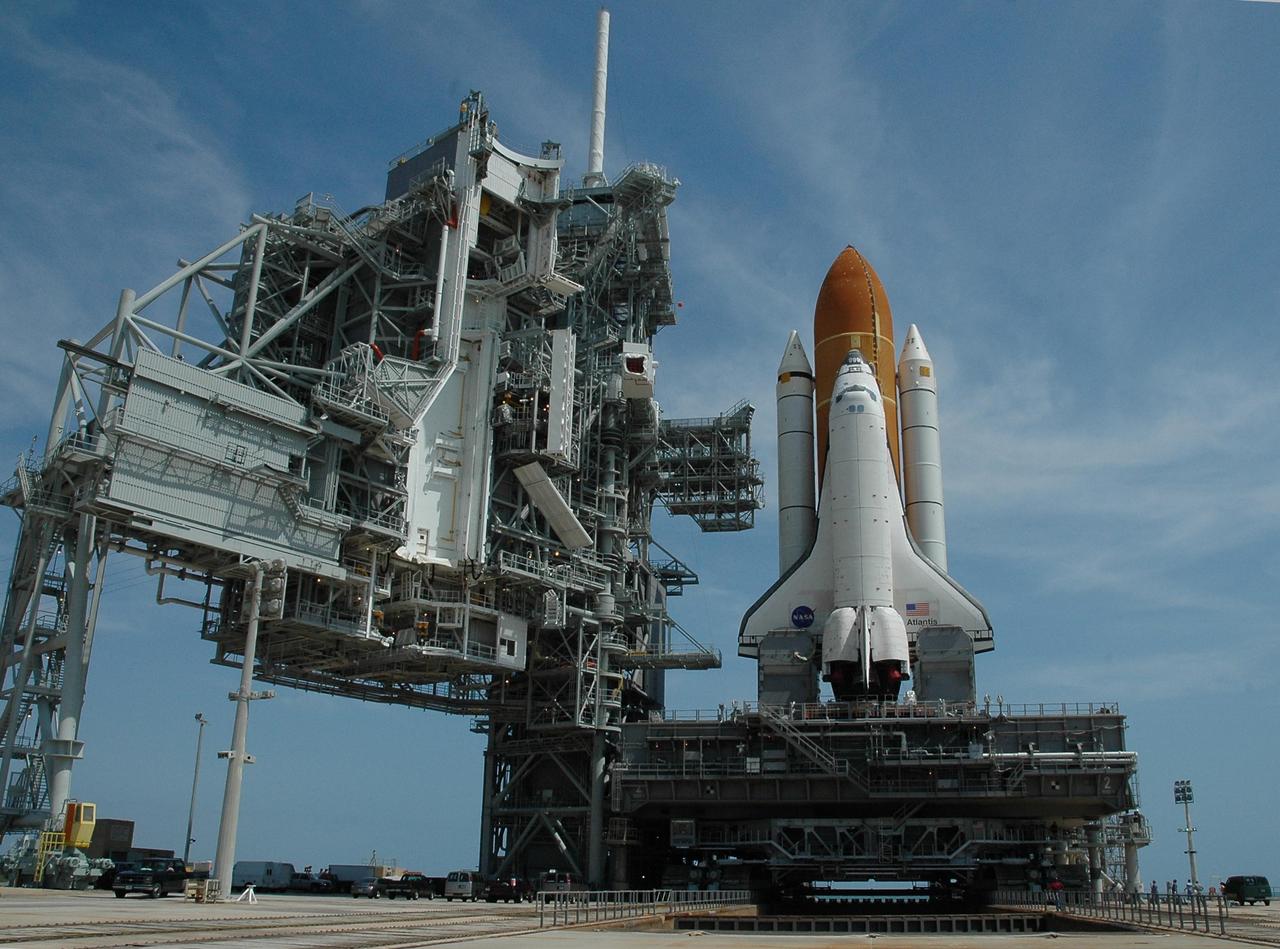
KENNEDY SPACE CENTER, FLA. -- Space Shuttle Atlantis, mounted on a mobile launch platform, finally rests on the hard stand of Launch Pad 39A, straddling the flame trench. This is the second rollout for the shuttle. The flame trench transecting the pad's mound at ground level is 490 feet long, 58 feet wide and 40 feet high. It is made of concrete and refractory brick. Pad structures are insulated from the intense heat of launch by the flame deflector system, which protects the flame trench floor and the pad surface along the top of the flame trench. On the left of the shuttle are the fixed service structure and rotating service structure in open position. When closed, the rotating structure provides protected access to the orbiter for changeout and servicing of payloads at the pad. It is supported by a rotating bridge that pivots about a vertical axis on the west side of the pad's flame trench. The white area in the center is the Payload Changeout Room, an enclosed, environmentally controlled portion of the rotating service structure that supports payload delivery at the launch pad and subsequent vertical installation in the orbiter payload bay. First motion out of the Vehicle Assembly Building was at 5:02 a.m. EDT. In late February, while Atlantis was on the launch pad, Atlantis' external tank received hail damage during a severe thunderstorm that passed through the Kennedy Space Center Launch Complex 39 area. The hail caused visible divots in the giant tank's foam insulation, as well as minor surface damage to about 26 heat shield tiles on the shuttle's left wing. The shuttle was returned to the VAB for repairs. The launch of Space Shuttle Atlantis on mission STS-117 is now targeted for June 8. A flight readiness review will be held on May 30 and 31. Photo credit: NASA/Troy Cryder