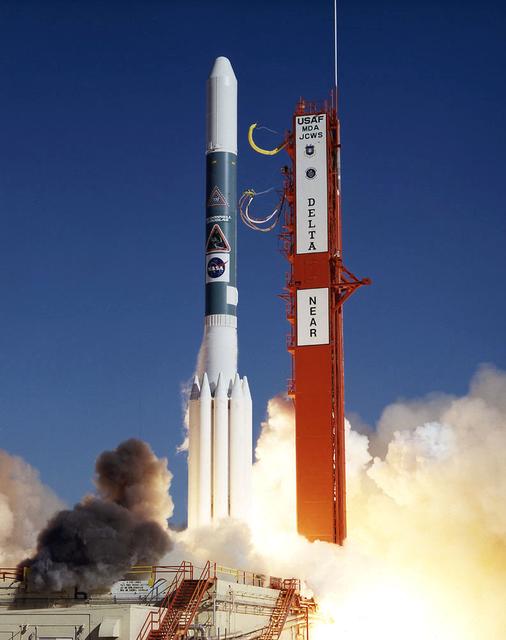
The Near Earth Asteroid Rendezvous (NEAR) spacecraft embarks on a journey that will culminate in a close encounter with an asteroid. The launch of NEAR inaugurates NASA's irnovative Discovery program of small-scale planetary missions with rapid, lower-cost development cycles and focused science objectives. NEAR will rendezvous in 1999 with the asteroid 433 Eros to begin the first long-term, close-up look at an asteroid's surface composition and physical properties. NEAR's science payload includes an x-ray/gamma ray spectrometer, an near-infrared spectrograph, a laser rangefinder, a magnetometer, a radio science experiment and a multi-spectral imager.
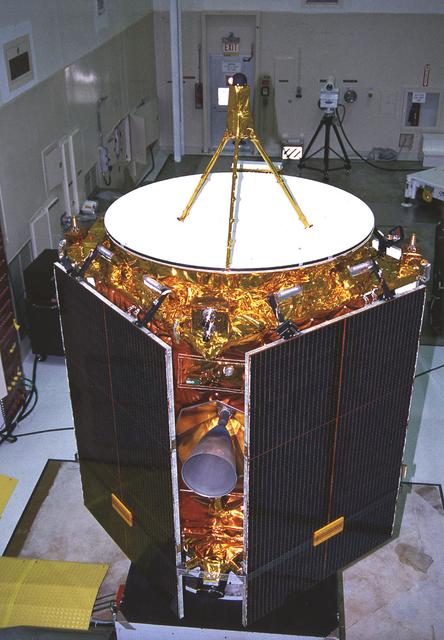
The Near Earth Asteroid Rendezvous (NEAR) spacecraft undergoing preflight preparation in the Spacecraft Assembly Encapsulation Facility-2 (SAEF-2) at Kennedy Space Center (KSC). NEAR will perform two critical mission events - Mathilde flyby and the Deep-Space maneuver. NEAR will fly-by Mathilde, a 38-mile (61-km) diameter C-type asteroid, making use of its imaging system to obtain useful optical navigation images. The primary science instrument will be the camera, but measurements of magnetic fields and mass also will be made. The Deep-Space Maneuver (DSM) will be executed about a week after the Mathilde fly-by. The DSM represents the first of two major burns during the NEAR mission of the 100-pound bi-propellant (Hydrazine/nitrogen tetroxide) thruster. This maneuver is necessary to lower the perihelion distance of NEAR's trajectory. The DSM will be conducted in two segments to minimize the possibility of an overburn situation.
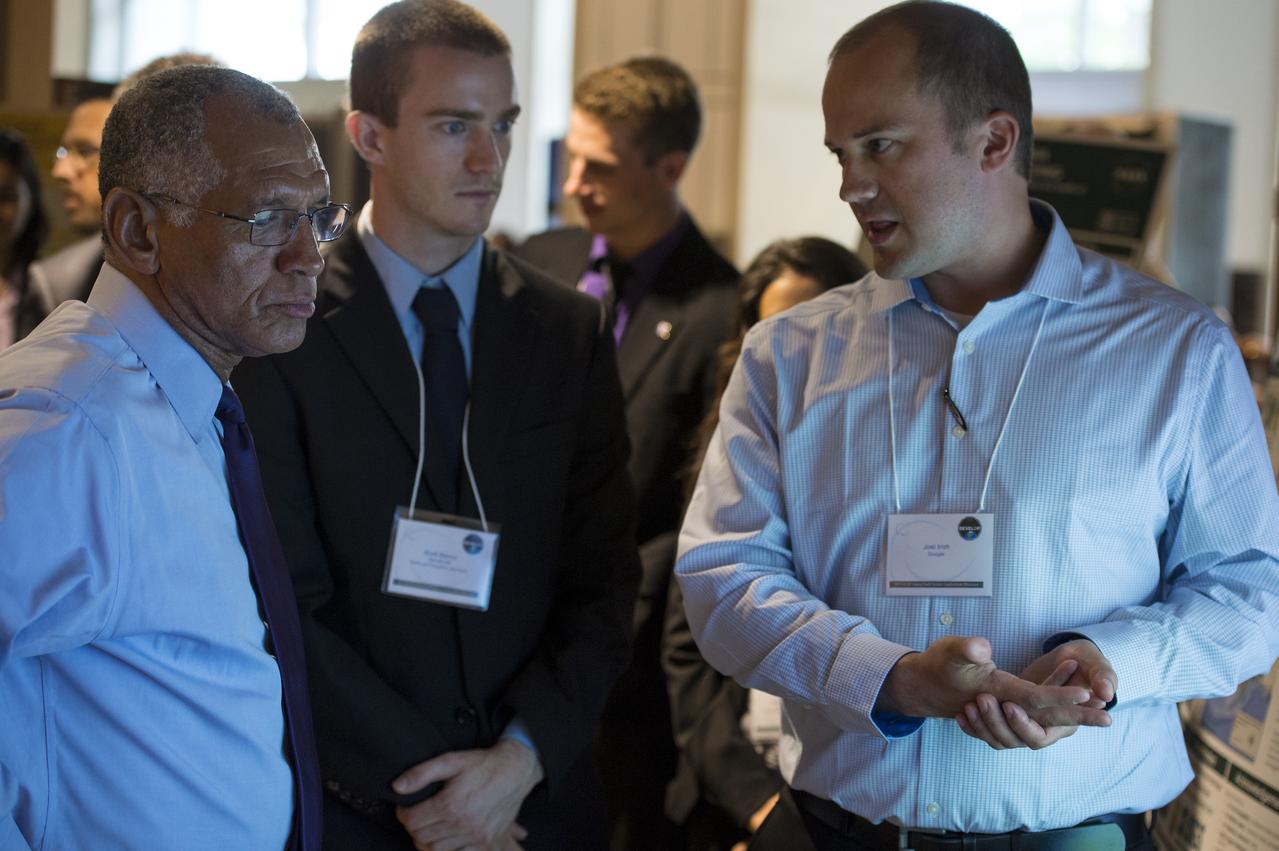
NASA Administrator Charles Bolden speaks with young professionals about their project during the annual DEVELOP Earth Science Application Showcase at NASA headquarters Tuesday, August 5, 2014. The Earth Science Applications Showcase highlights the work of over 150 participants in the 10-week DEVELOP program that started in June. The DEVELOP Program bridges the gap between NASA Earth science and society, building capacity in both its participants and partner organizations, to better prepare them to handle the challenges that face our society and future generations. Photo Credit: (NASA/Aubrey Gemignani)
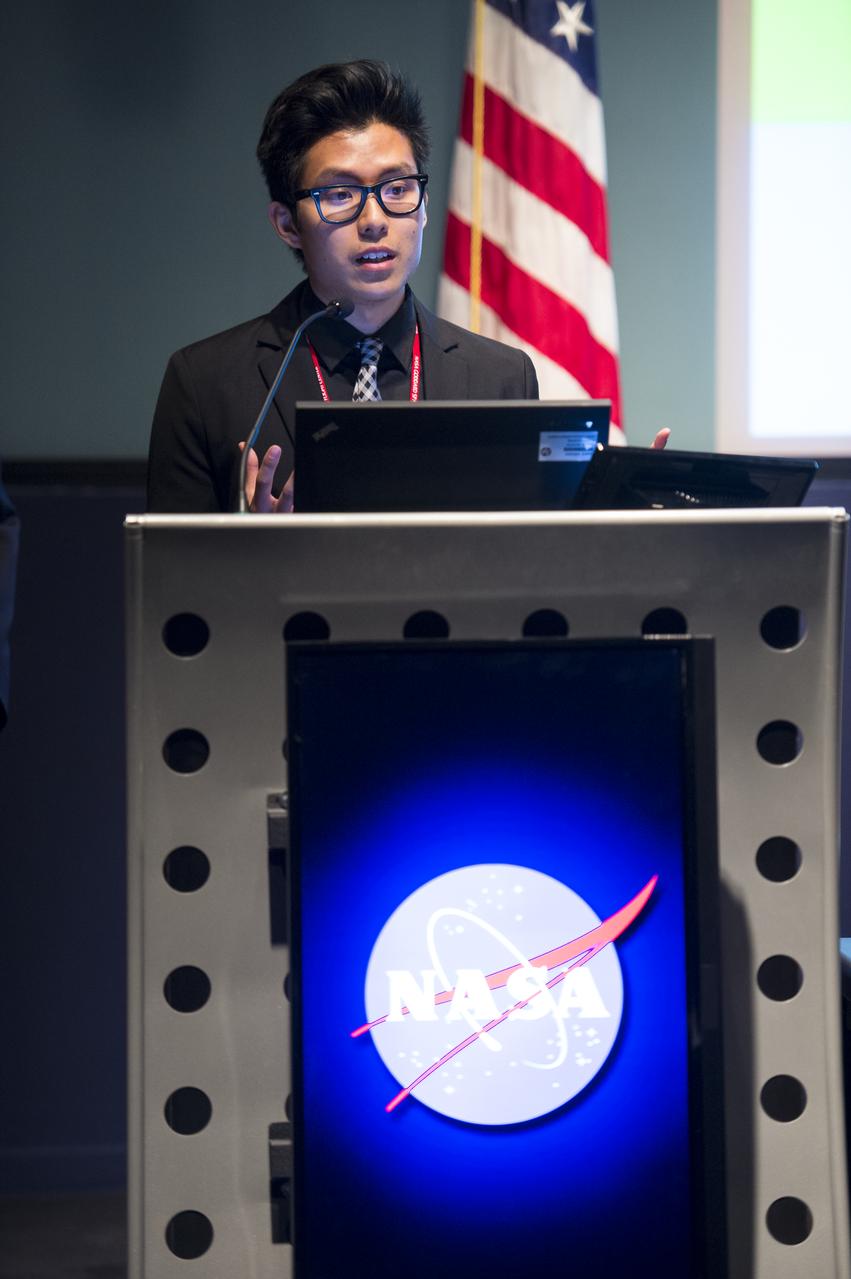
Michael Gao presents his project on Southeast Asian disasters during the annual DEVELOP Earth Science Application Showcase at NASA headquarters Tuesday, August 5, 2014. The Earth Science Applications Showcase highlights the work of over 150 participants in the 10-week DEVELOP program that started in June. The DEVELOP Program bridges the gap between NASA Earth science and society, building capacity in both its participants and partner organizations, to better prepare them to handle the challenges that face our society and future generations. Photo Credit: (NASA/Aubrey Gemignani)
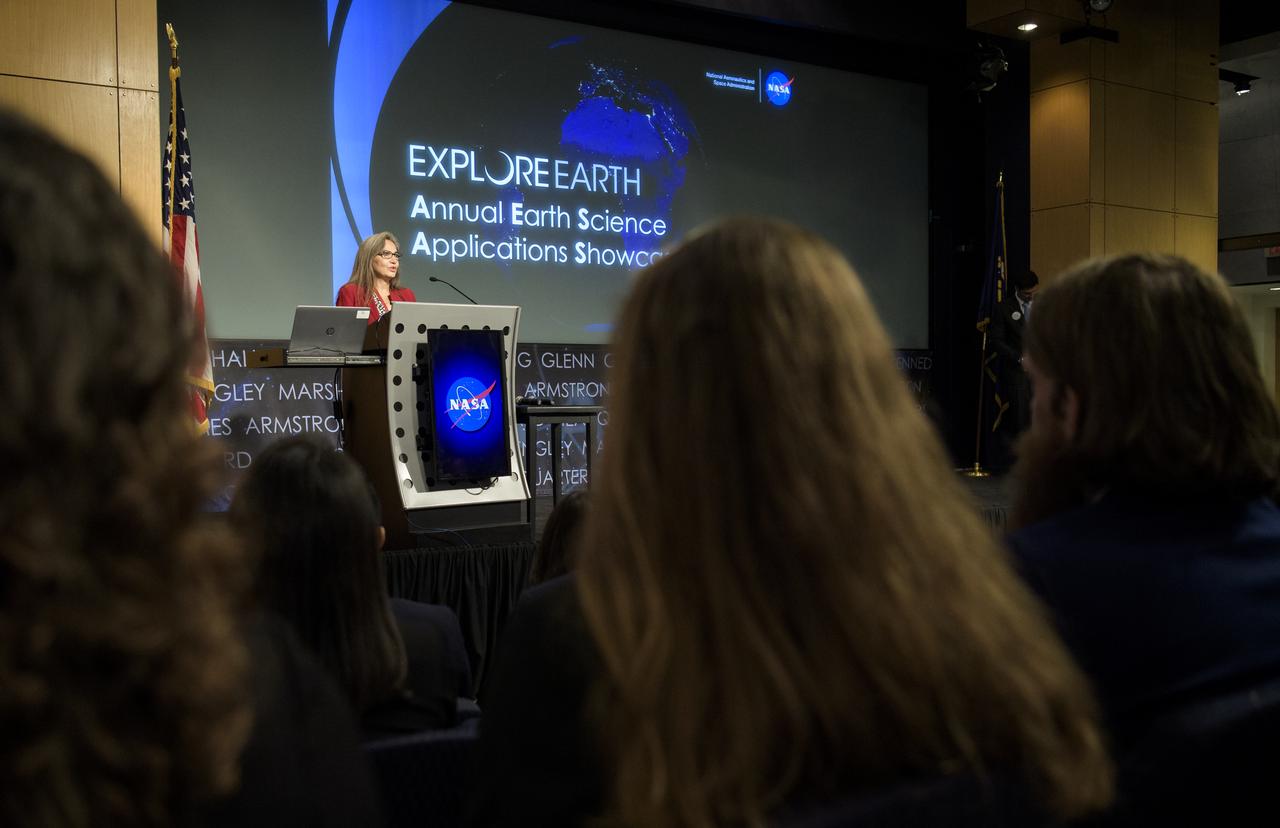
Sandra Cauffman, acting Director of the Earth Sciences Division of the Science Mission Directorate at NASA Headquarters, speaks during the 2019 Annual Earth Science Applications Showcase, Thursday, Aug. 1, 2019 at NASA Headquarters in Washington, DC. Every summer students and young professionals from NASA’s Applied Sciences’ DEVELOP National Program come to NASA Headquarters and present their research projects. DEVELOP is a training and development program where students work on Earth science research projects, mentored by science advisers from NASA and partner agencies, and extend research results to local communities. Photo Credit: (NASA/Joel Kowsky)
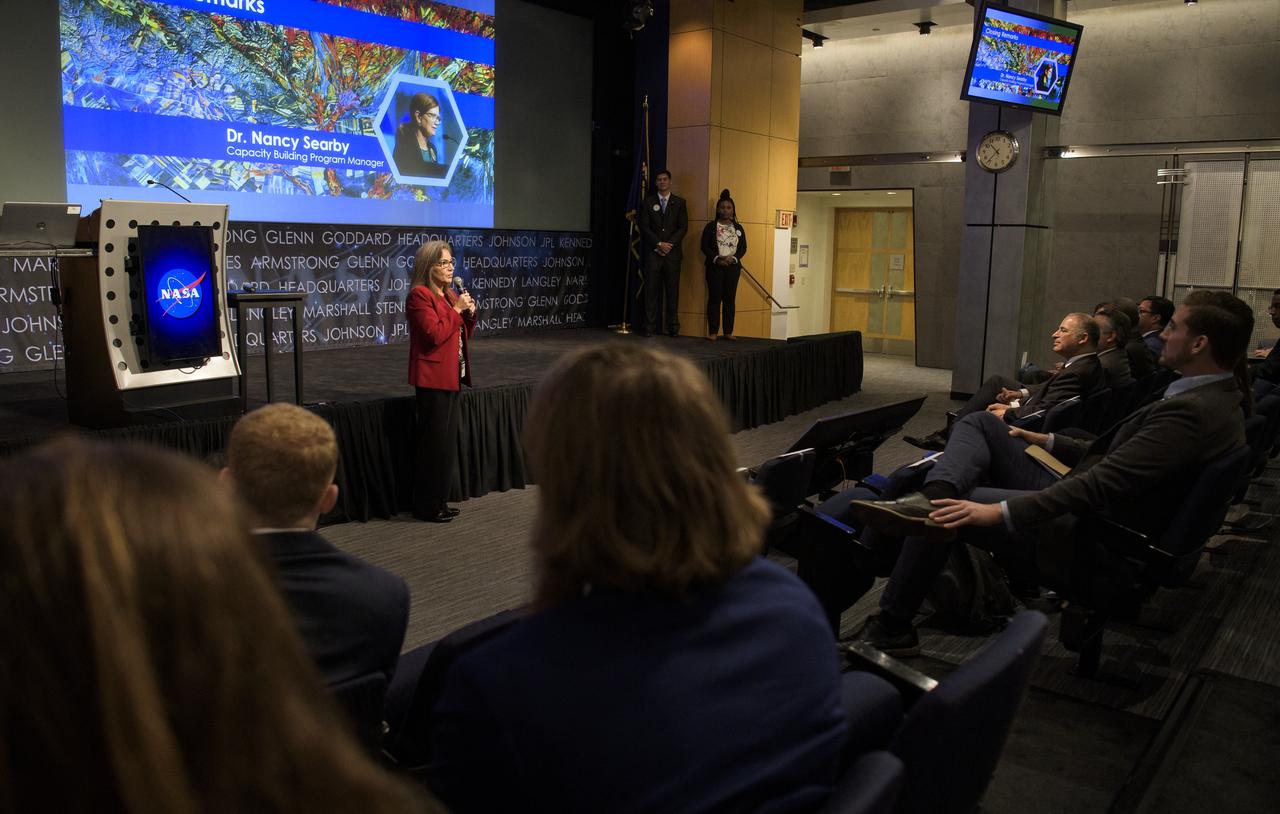
Sandra Cauffman, acting Director of the Earth Sciences Division of the Science Mission Directorate at NASA Headquarters, speaks during the 2019 Annual Earth Science Applications Showcase, Thursday, Aug. 1, 2019 at NASA Headquarters in Washington, DC. Every summer students and young professionals from NASA’s Applied Sciences’ DEVELOP National Program come to NASA Headquarters and present their research projects. DEVELOP is a training and development program where students work on Earth science research projects, mentored by science advisers from NASA and partner agencies, and extend research results to local communities. Photo Credit: (NASA/Joel Kowsky)
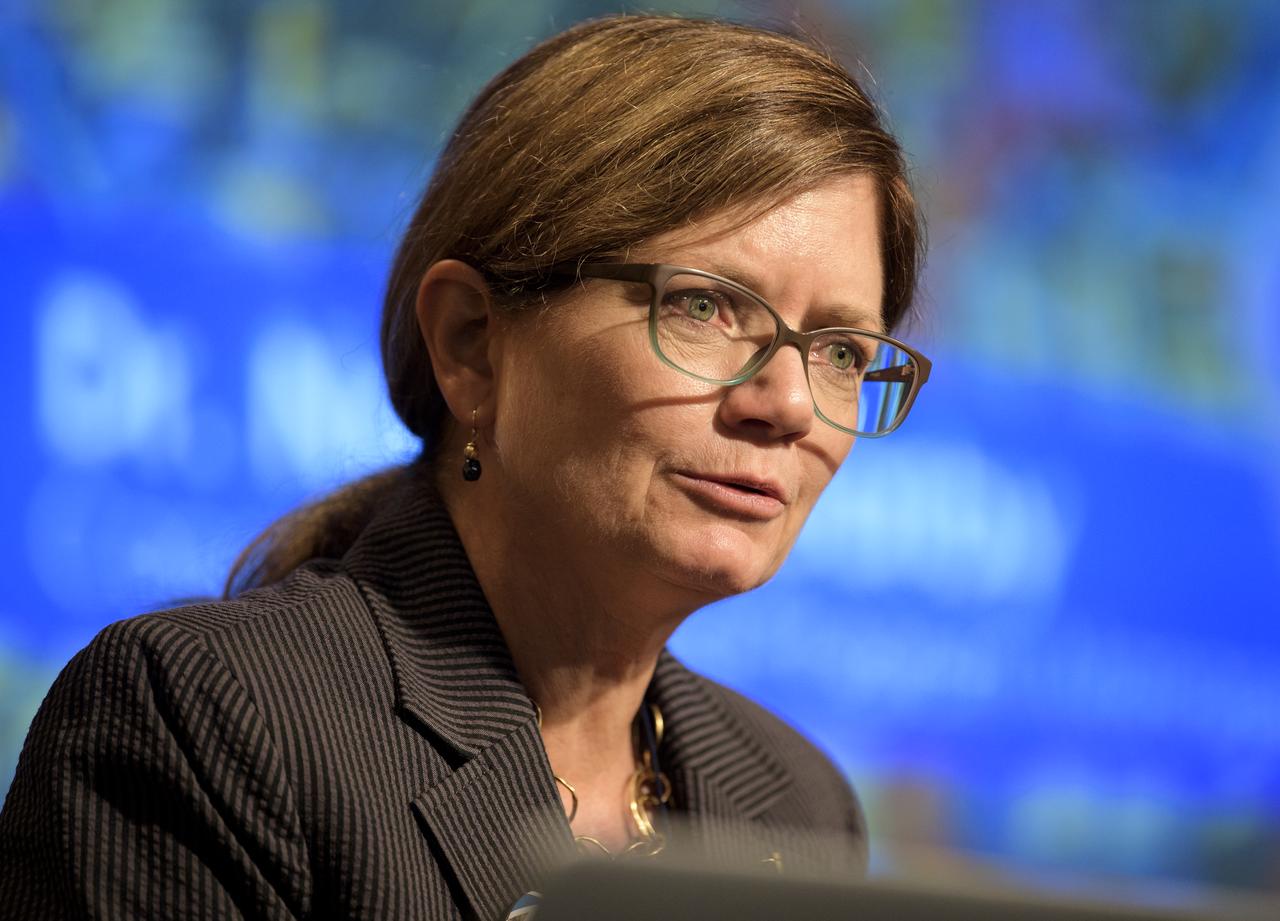
Capacity Building Program Manager for NASA's Applied Sciences Program (Earth Science Division) Nancy Searby speaks during the 2019 Annual Earth Science Applications Showcase, Thursday, Aug. 1, 2019 at NASA Headquarters in Washington, DC. Every summer students and young professionals from NASA’s Applied Sciences’ DEVELOP National Program come to NASA Headquarters and present their research projects. DEVELOP is a training and development program where students work on Earth science research projects, mentored by science advisers from NASA and partner agencies, and extend research results to local communities. Photo Credit: (NASA/Joel Kowsky)
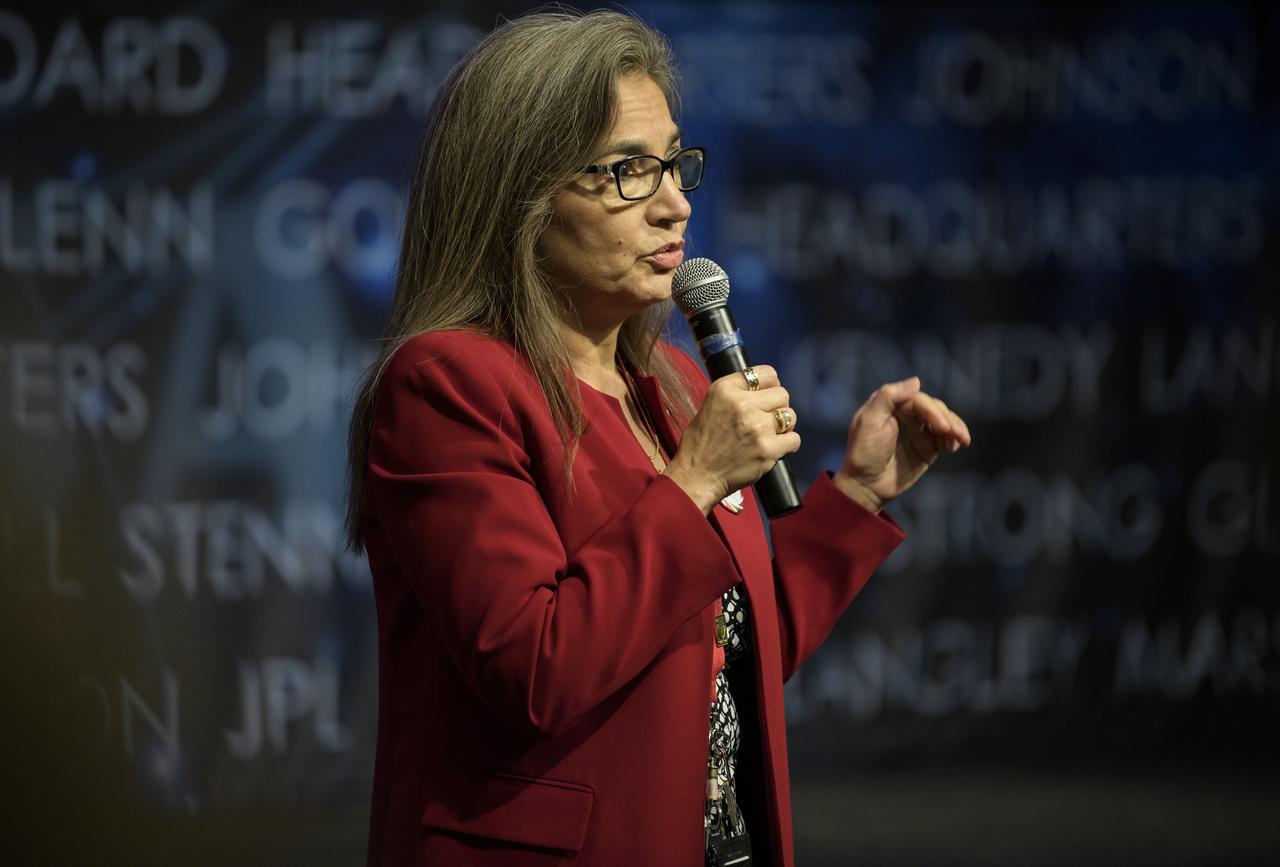
Sandra Cauffman, acting Director of the Earth Sciences Division of the Science Mission Directorate at NASA Headquarters, speaks during the 2019 Annual Earth Science Applications Showcase, Thursday, Aug. 1, 2019 at NASA Headquarters in Washington, DC. Every summer students and young professionals from NASA’s Applied Sciences’ DEVELOP National Program come to NASA Headquarters and present their research projects. DEVELOP is a training and development program where students work on Earth science research projects, mentored by science advisers from NASA and partner agencies, and extend research results to local communities. Photo Credit: (NASA/Joel Kowsky)
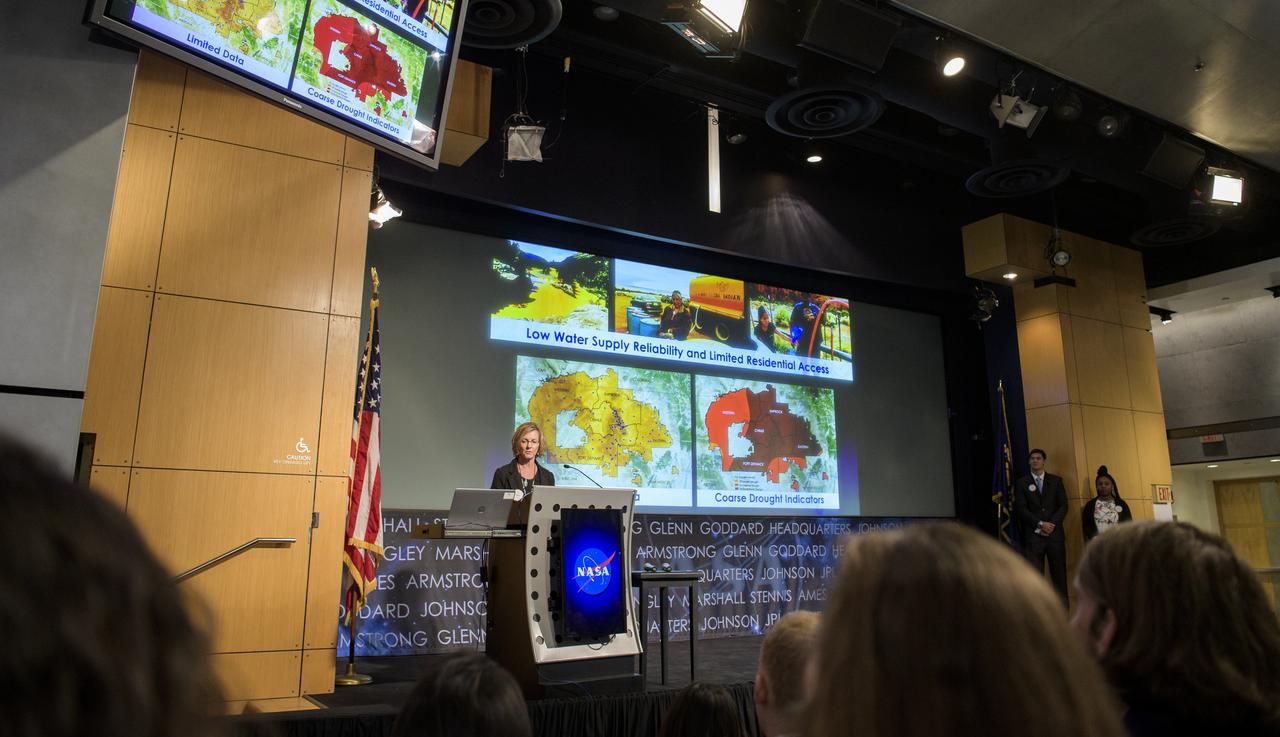
Cindy Schmidt, a research scientist in the Earth Science Division at NASA's Ames Research Center, speaks about the Indigenous Peoples Pilot and drought monitoring in the Navajo Nation during the 2019 Annual Earth Science Applications Showcase, Thursday, Aug. 1, 2019 at NASA Headquarters in Washington, DC. Every summer students and young professionals from NASA’s Applied Sciences’ DEVELOP National Program come to NASA Headquarters and present their research projects. DEVELOP is a training and development program where students work on Earth science research projects, mentored by science advisers from NASA and partner agencies, and extend research results to local communities. Photo Credit: (NASA/Joel Kowsky)

Students and young professionals discuss their projects at the Earth Science Applications Showcase Wednesday, August 1, 2018 at NASA Headquarters in Washington. Every summer, participants in NASA’s Applied Sciences’ DEVELOP National Program come to NASA Headquarters and present their research projects. DEVELOP is a training and development program where students work on Earth science research projects, mentored by science advisers from NASA and partner agencies, and extend research results to local communities. Photo Credit: (NASA/Aubrey Gemignani)
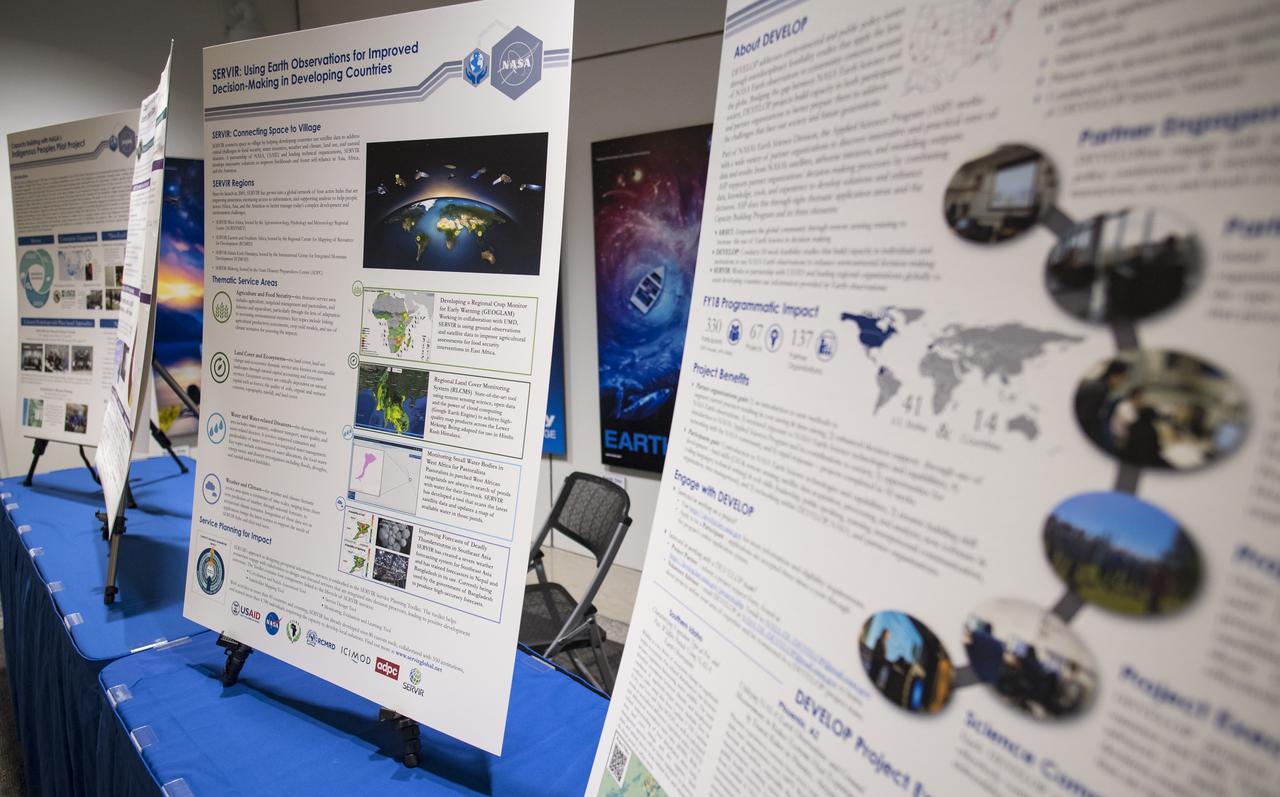
Posters are seen at the Earth Science Applications Showcase Wednesday, August 1, 2018 at NASA Headquarters in Washington. Every summer, participants in NASA’s Applied Sciences’ DEVELOP National Program come to NASA Headquarters and present their research projects. DEVELOP is a training and development program where students work on Earth science research projects, mentored by science advisers from NASA and partner agencies, and extend research results to local communities. Photo Credit: (NASA/Aubrey Gemignani)
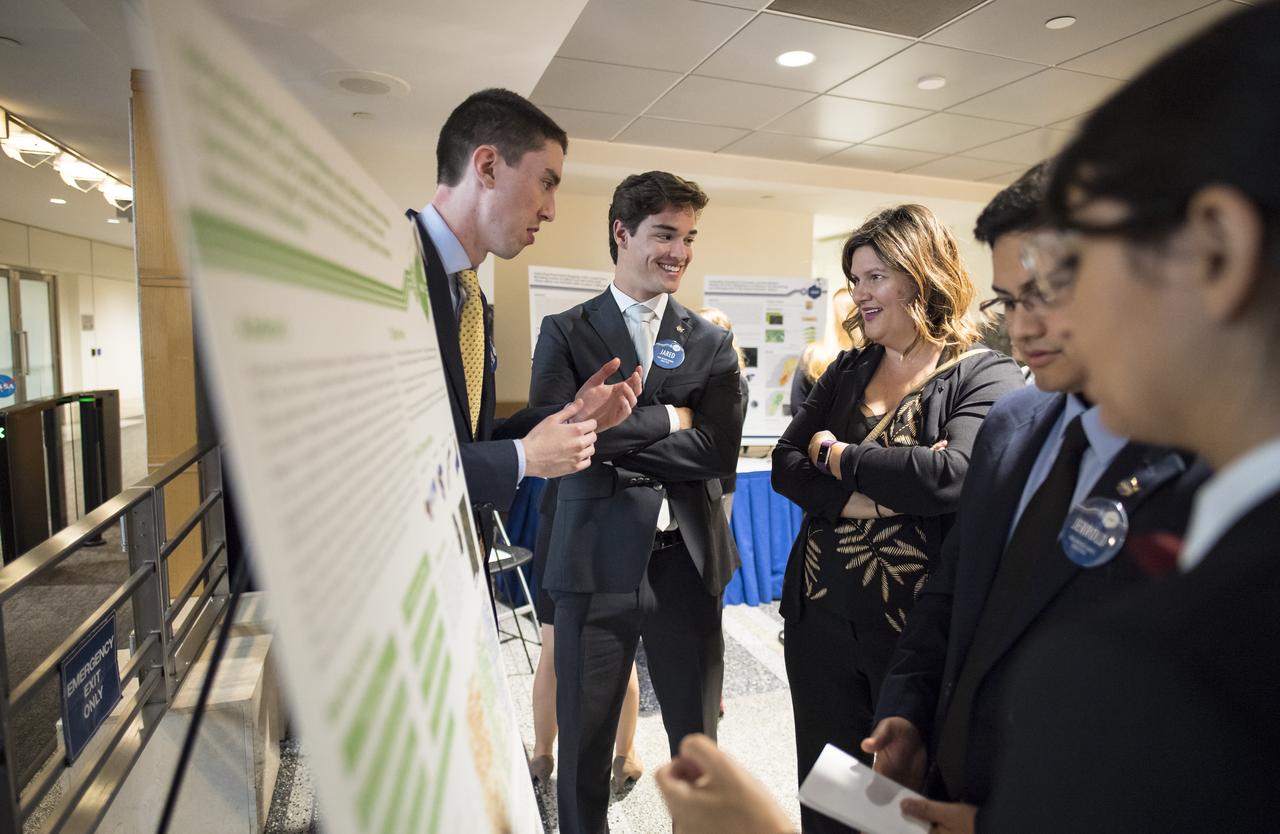
Students and young professionals discuss their projects at the Earth Science Applications Showcase Wednesday, August 1, 2018 at NASA Headquarters in Washington. Every summer, participants in NASA’s Applied Sciences’ DEVELOP National Program come to NASA Headquarters and present their research projects. DEVELOP is a training and development program where students work on Earth science research projects, mentored by science advisers from NASA and partner agencies, and extend research results to local communities. Photo Credit: (NASA/Aubrey Gemignani)
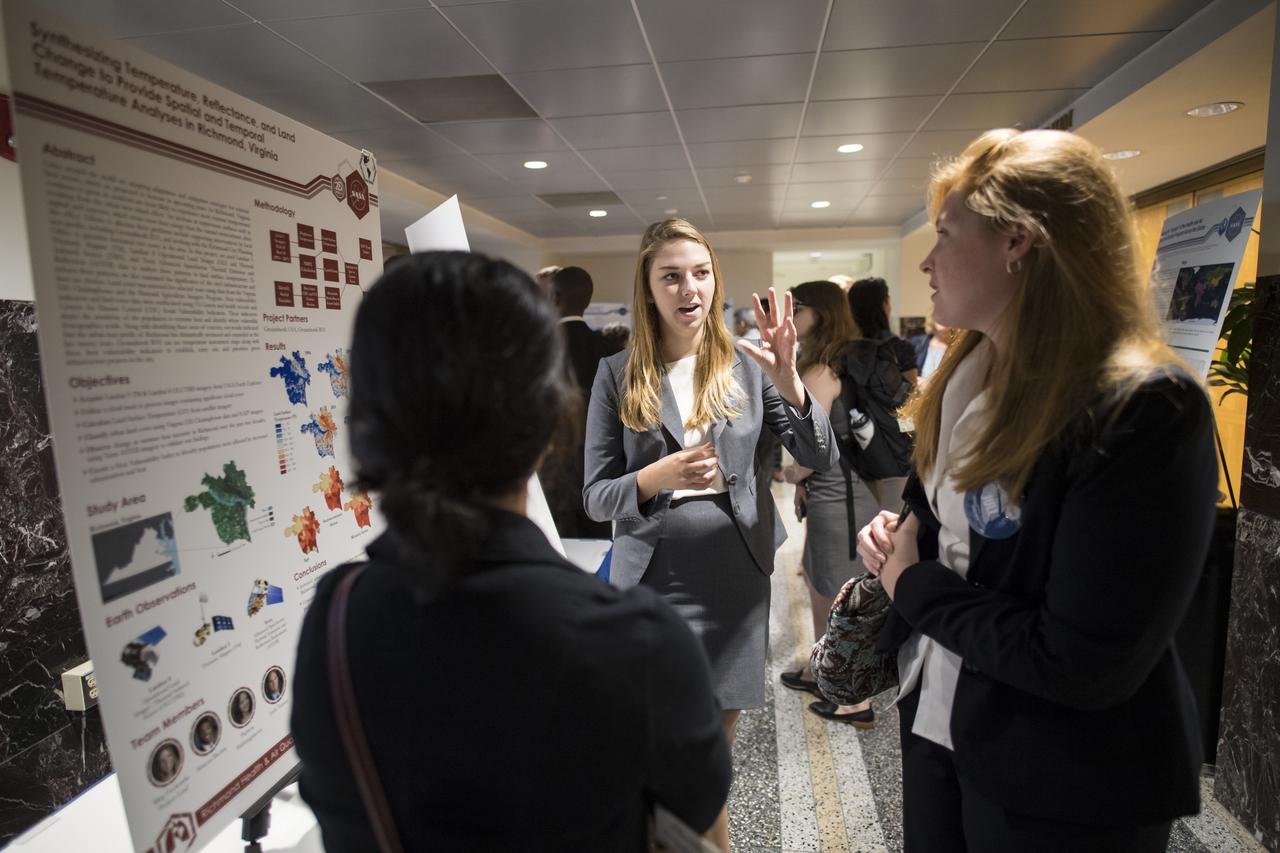
Students and young professionals discuss their projects at the Earth Science Applications Showcase Wednesday, August 1, 2018 at NASA Headquarters in Washington. Every summer, participants in NASA’s Applied Sciences’ DEVELOP National Program come to NASA Headquarters and present their research projects. DEVELOP is a training and development program where students work on Earth science research projects, mentored by science advisers from NASA and partner agencies, and extend research results to local communities. Photo Credit: (NASA/Aubrey Gemignani)

Students and young professionals discuss their projects at the Earth Science Applications Showcase Wednesday, August 1, 2018 at NASA Headquarters in Washington. Every summer, participants in NASA’s Applied Sciences’ DEVELOP National Program come to NASA Headquarters and present their research projects. DEVELOP is a training and development program where students work on Earth science research projects, mentored by science advisers from NASA and partner agencies, and extend research results to local communities. Photo Credit: (NASA/Aubrey Gemignani)
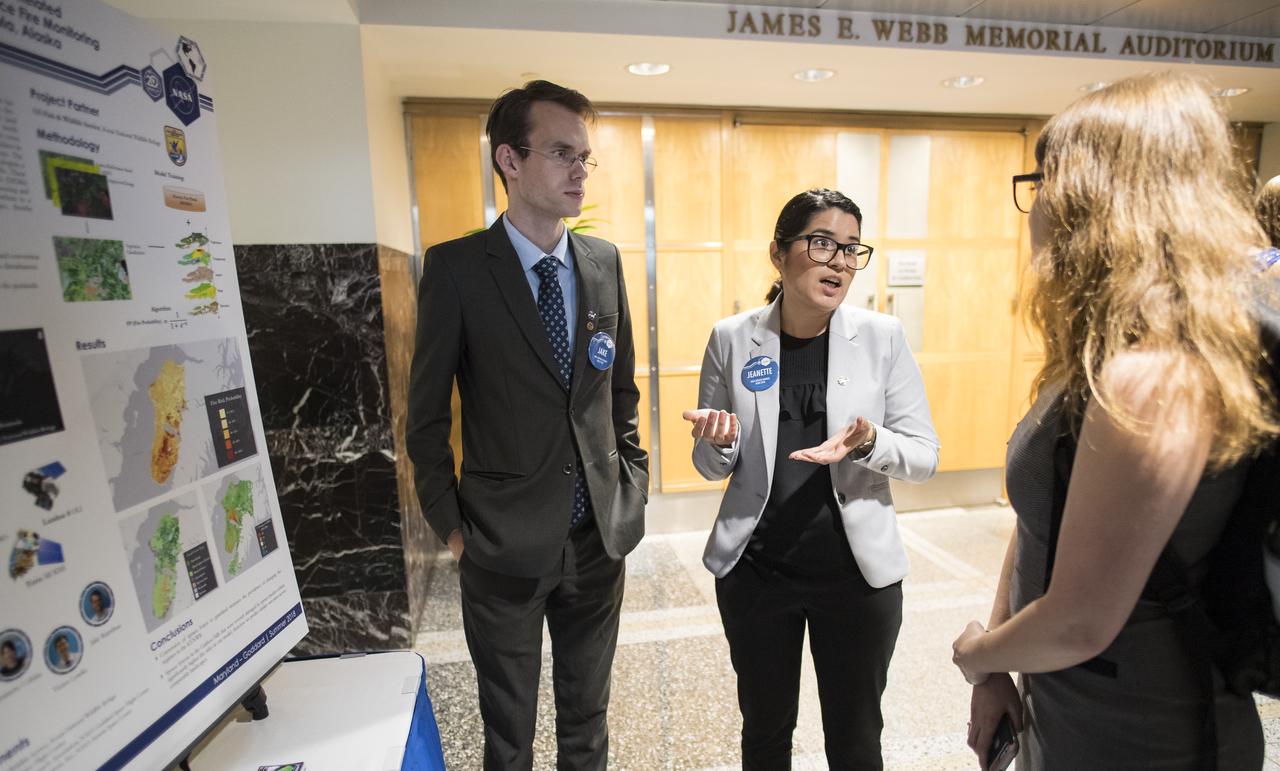
Students and young professionals discuss their projects at the Earth Science Applications Showcase Wednesday, August 1, 2018 at NASA Headquarters in Washington. Every summer, participants in NASA’s Applied Sciences’ DEVELOP National Program come to NASA Headquarters and present their research projects. DEVELOP is a training and development program where students work on Earth science research projects, mentored by science advisers from NASA and partner agencies, and extend research results to local communities. Photo Credit: (NASA/Aubrey Gemignani)
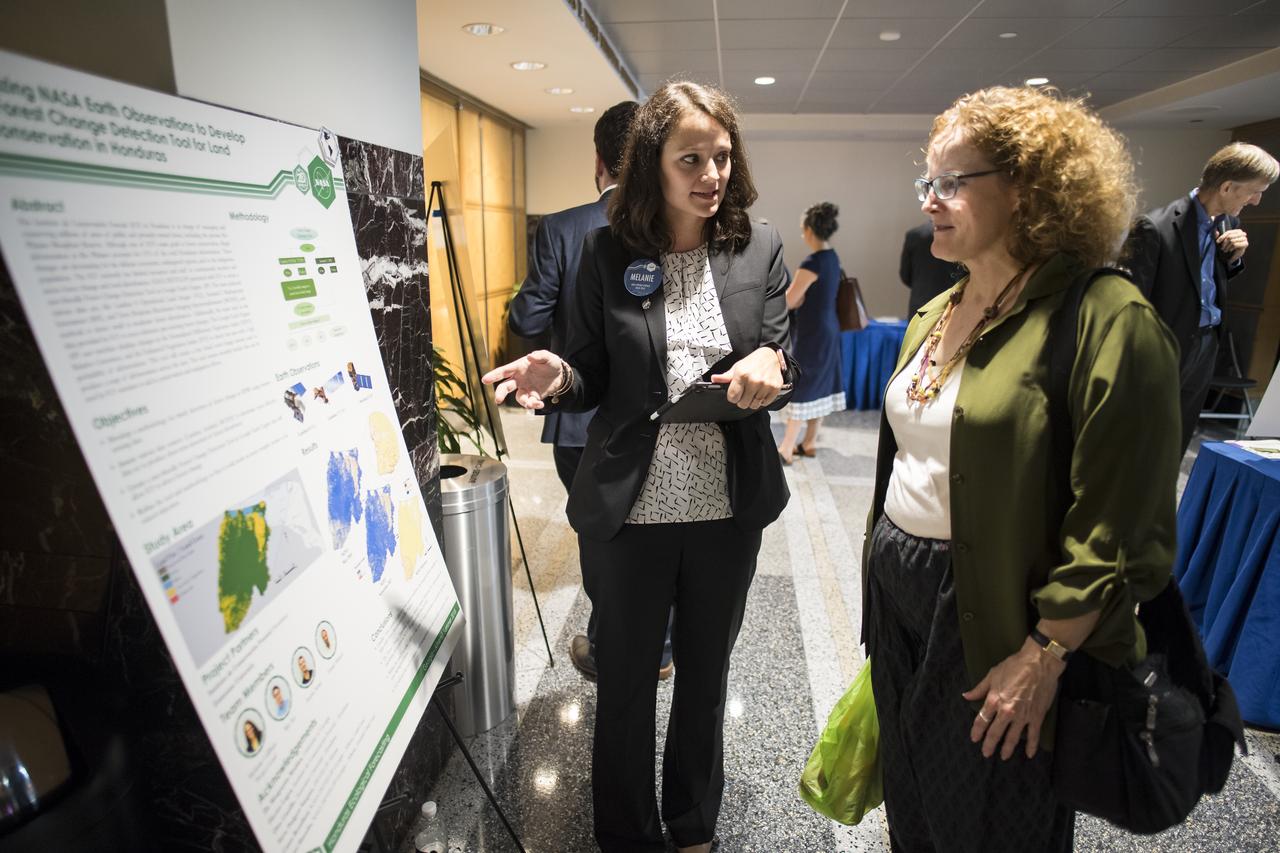
Students and young professionals discuss their projects at the Earth Science Applications Showcase Wednesday, August 1, 2018 at NASA Headquarters in Washington. Every summer, participants in NASA’s Applied Sciences’ DEVELOP National Program come to NASA Headquarters and present their research projects. DEVELOP is a training and development program where students work on Earth science research projects, mentored by science advisers from NASA and partner agencies, and extend research results to local communities. Photo Credit: (NASA/Aubrey Gemignani)
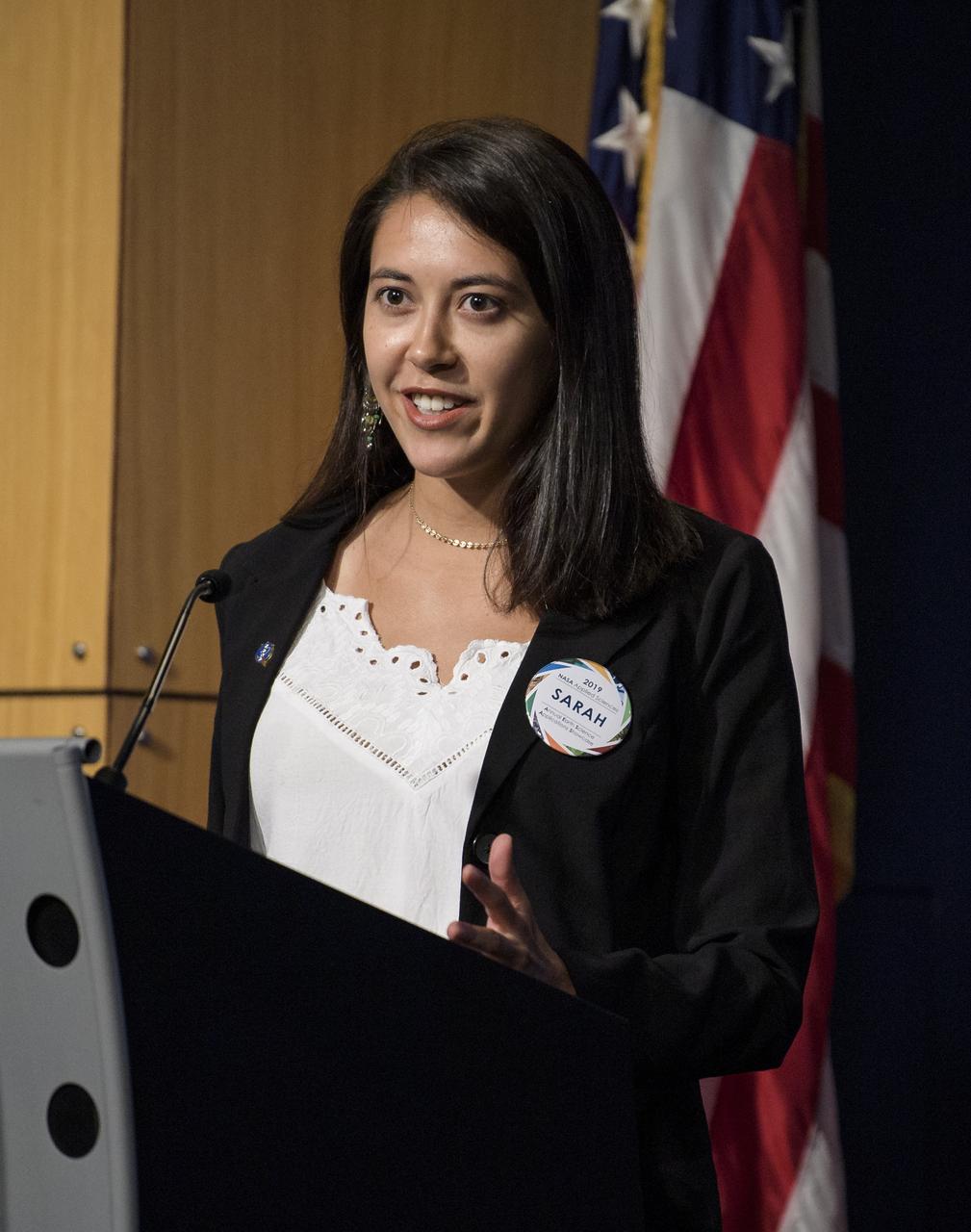
Sarah Aldama, project lead for DEVELOP Dominican Republic Disasters, speaks about mapping landslide susceptibility and exposure in the Dominican Republic using NASA's earth observation data during the 2019 Annual Earth Science Applications Showcase, Thursday, Aug. 1, 2019 at NASA Headquarters in Washington, DC. Every summer students and young professionals from NASA’s Applied Sciences’ DEVELOP National Program come to NASA Headquarters and present their research projects. DEVELOP is a training and development program where students work on Earth science research projects, mentored by science advisers from NASA and partner agencies, and extend research results to local communities. Photo Credit: (NASA/Joel Kowsky)
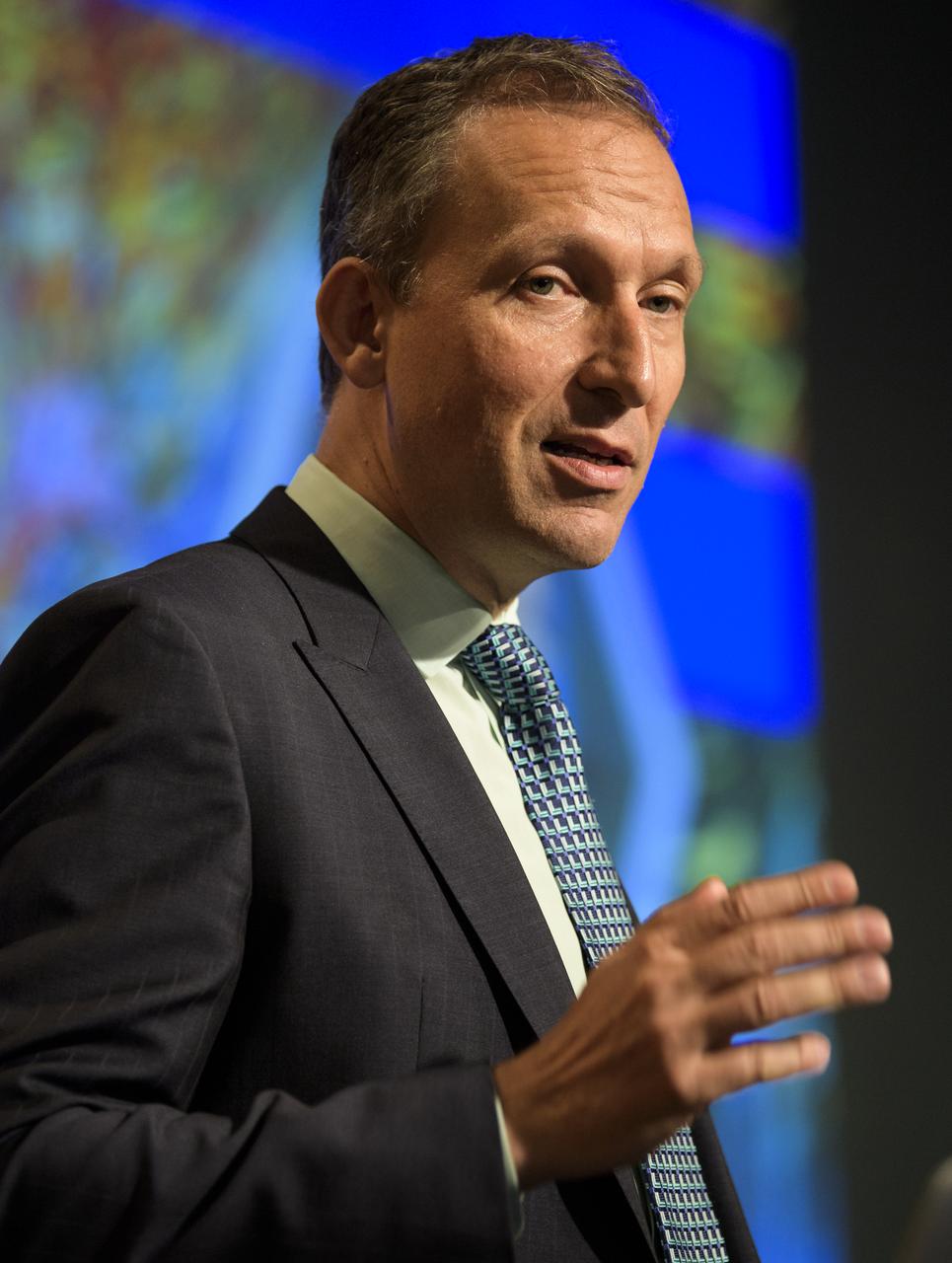
Thomas Zurbuchen, Associate Administrator for NASA's Science Mission Directorate, speaks during the 2019 Annual Earth Science Applications Showcase, Thursday, Aug. 1, 2019 at NASA Headquarters in Washington, DC. Every summer students and young professionals from NASA’s Applied Sciences’ DEVELOP National Program come to NASA Headquarters and present their research projects. DEVELOP is a training and development program where students work on Earth science research projects, mentored by science advisers from NASA and partner agencies, and extend research results to local communities. Photo Credit: (NASA/Joel Kowsky)
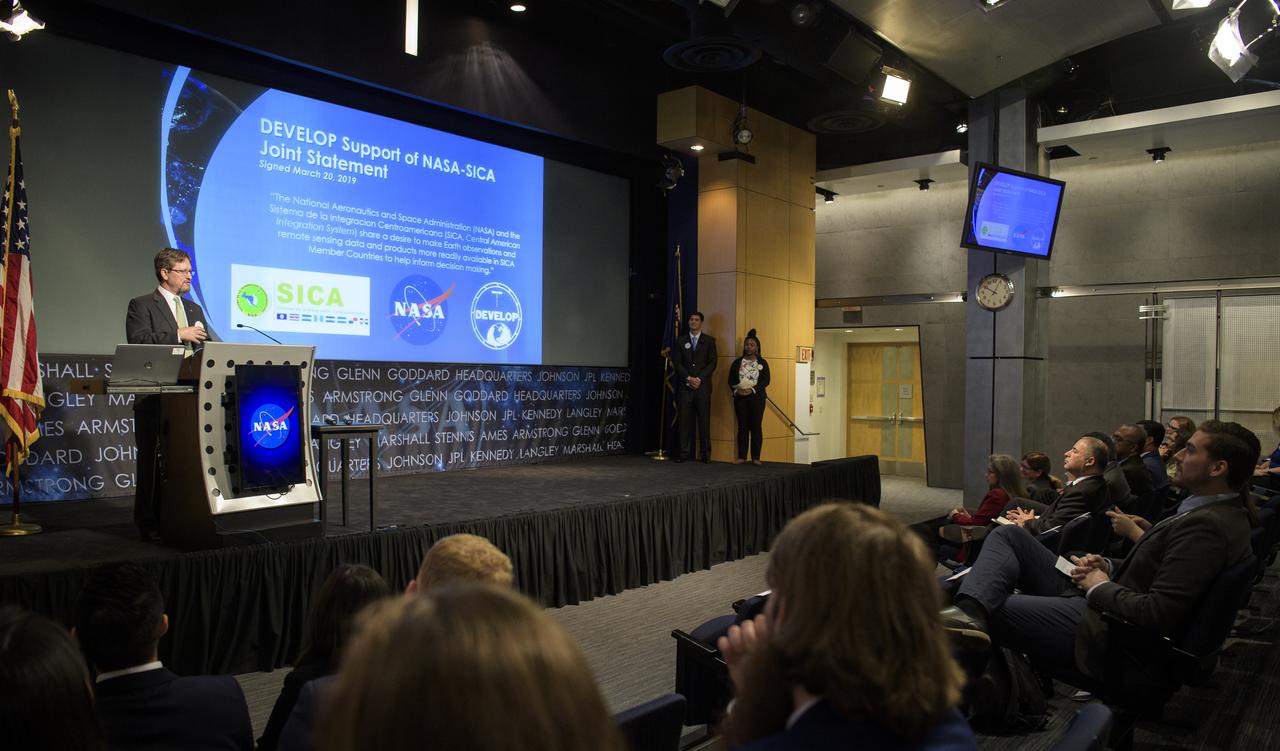
Kenton Ross, DEVELOP's National Science Advisor, speaks about SICA during the 2019 Annual Earth Science Applications Showcase, Thursday, Aug. 1, 2019 at NASA Headquarters in Washington, DC. Every summer students and young professionals from NASA’s Applied Sciences’ DEVELOP National Program come to NASA Headquarters and present their research projects. DEVELOP is a training and development program where students work on Earth science research projects, mentored by science advisers from NASA and partner agencies, and extend research results to local communities. Photo Credit: (NASA/Joel Kowsky)
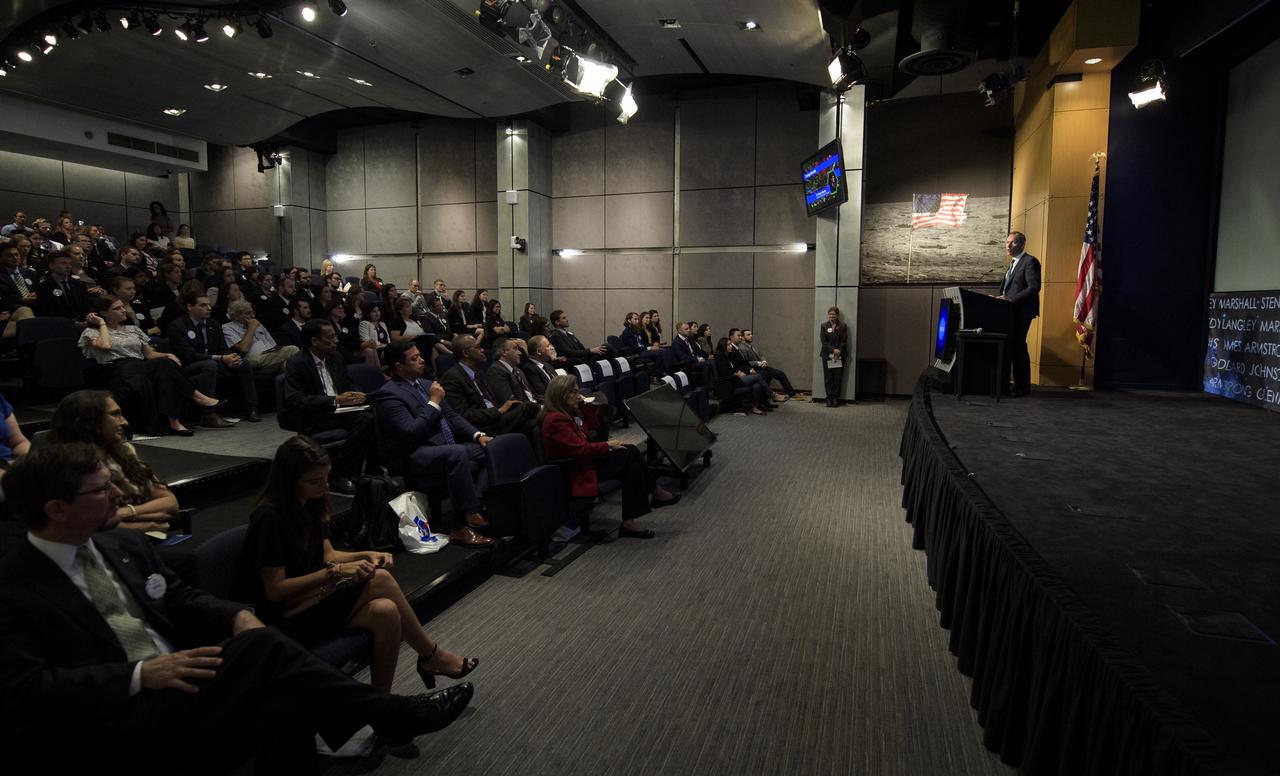
Thomas Zurbuchen, Associate Administrator for NASA's Science Mission Directorate, speaks during the 2019 Annual Earth Science Applications Showcase, Thursday, Aug. 1, 2019 at NASA Headquarters in Washington, DC. Every summer students and young professionals from NASA’s Applied Sciences’ DEVELOP National Program come to NASA Headquarters and present their research projects. DEVELOP is a training and development program where students work on Earth science research projects, mentored by science advisers from NASA and partner agencies, and extend research results to local communities. Photo Credit: (NASA/Joel Kowsky)
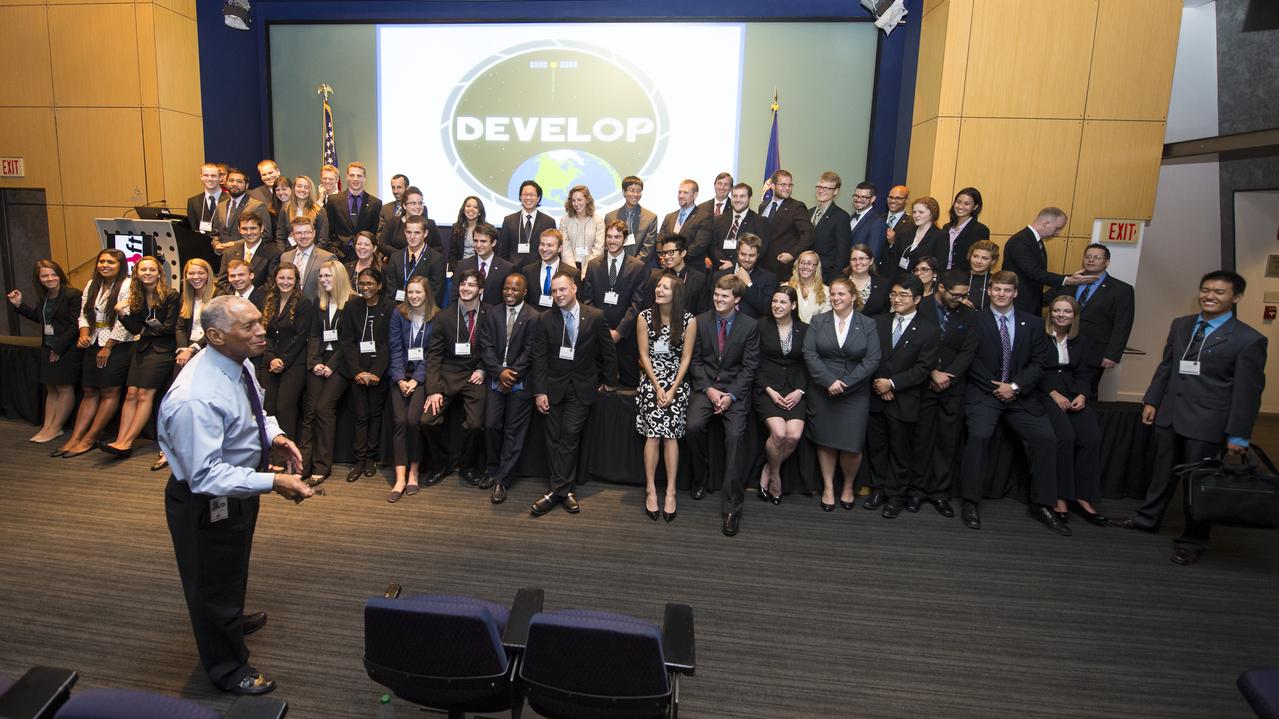
NASA Administrator Charles Bolden asks young professionals about their projects after posing for a group photo during the annual DEVELOP Earth Science Application Showcase at NASA headquarters Tuesday, August 5, 2014. The Earth Science Applications Showcase highlights the work of over 150 participants in the 10-week DEVELOP program that started in June. The DEVELOP Program bridges the gap between NASA Earth science and society, building capacity in both its participants and partner organizations, to better prepare them to handle the challenges that face our society and future generations. Photo Credit: (NASA/Aubrey Gemignani)
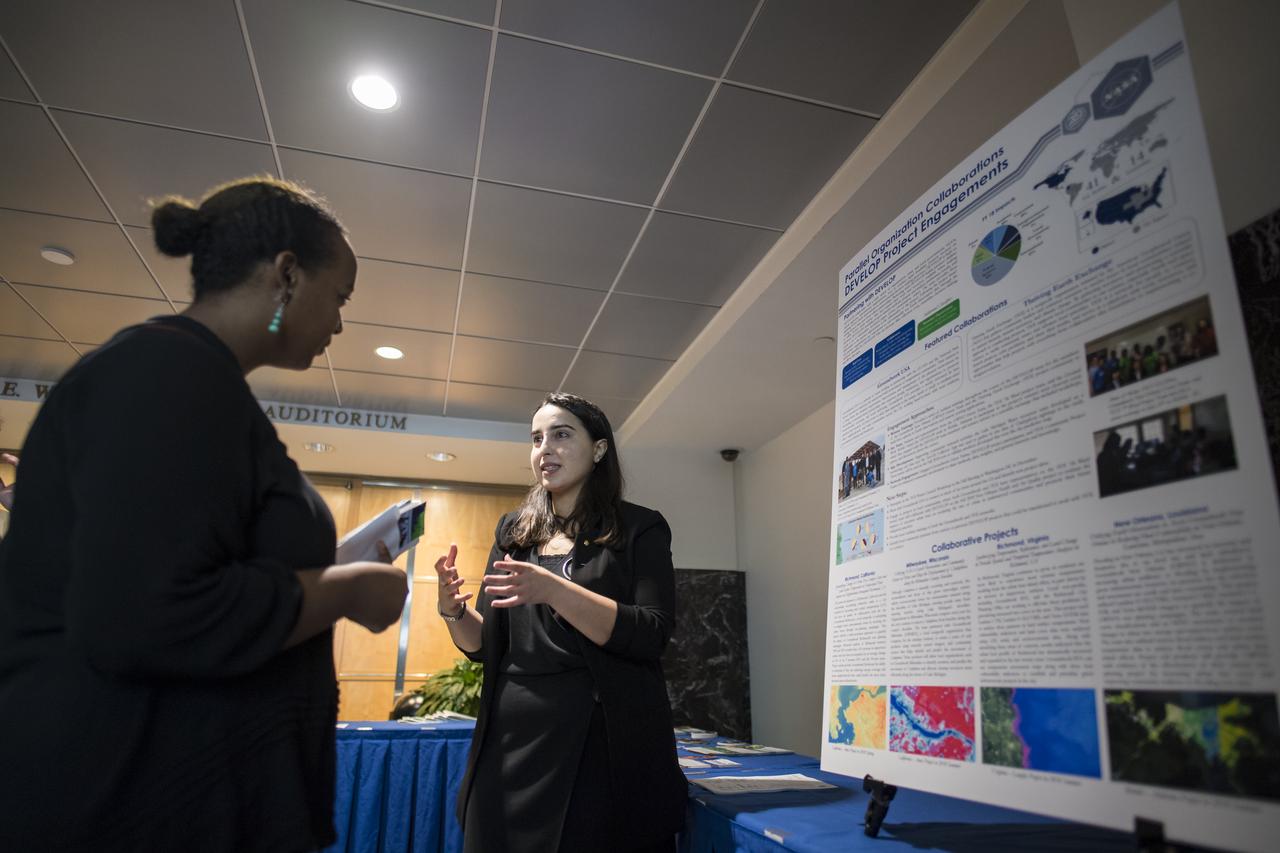
Farnaz Bayat from Mobile, Alabama, discusses her project with a participant at the Earth Science Applications Showcase Wednesday, August 1, 2018 at NASA Headquarters in Washington. Farnaz has been with the DEVELOP program since 2016 and has worked on several projects, including her current one using NASA Earth observations to identify areas in New Orleans that are vulnerable to flooding. DEVELOP is a training and development program where students work on Earth science research projects, mentored by science advisers from NASA and partner agencies, and extend research results to local communities. Photo Credit: (NASA/Aubrey Gemignani)
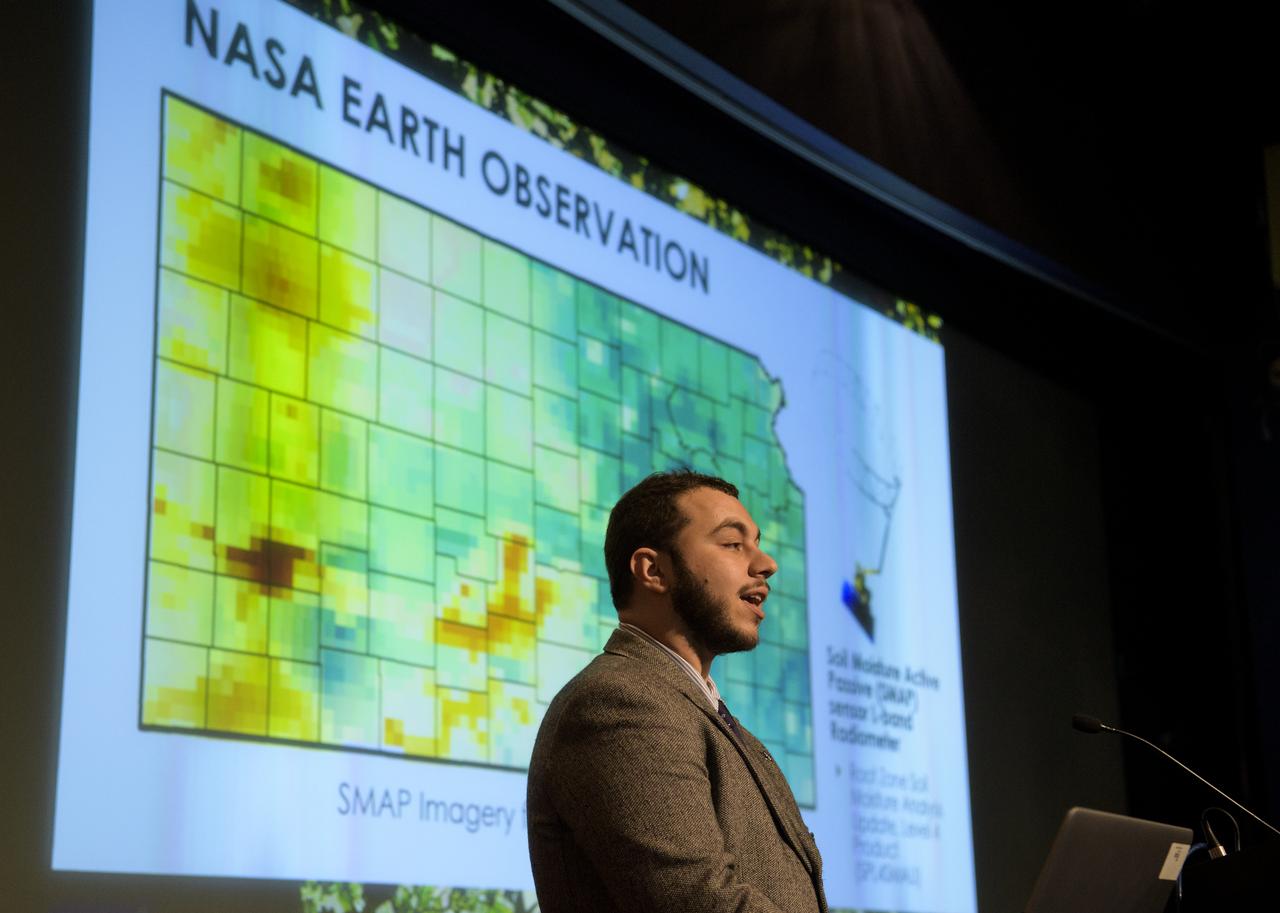
Max Dunsker speaks about the DEVELOP Kansas Agriculture and Food Security Project, which modeled soil drydown parameters for drought mitigation, during the 2019 Annual Earth Science Applications Showcase, Thursday, Aug. 1, 2019 at NASA Headquarters in Washington, DC. Every summer students and young professionals from NASA’s Applied Sciences’ DEVELOP National Program come to NASA Headquarters and present their research projects. DEVELOP is a training and development program where students work on Earth science research projects, mentored by science advisers from NASA and partner agencies, and extend research results to local communities. Photo Credit: (NASA/Joel Kowsky)
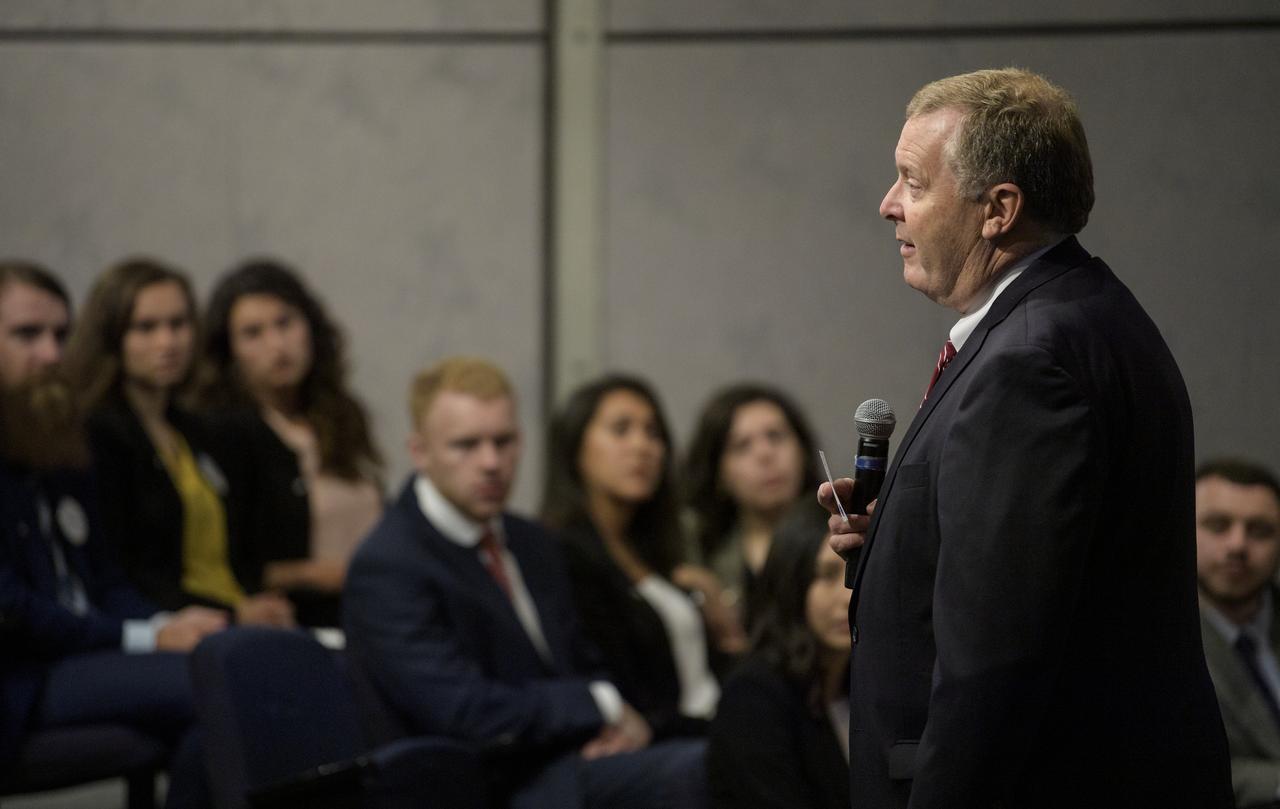
NASA Deputy Administrator Jim Morhard speaks during the 2019 Annual Earth Science Applications Showcase, Thursday, Aug. 1, 2019 at NASA Headquarters in Washington, DC. Every summer students and young professionals from NASA’s Applied Sciences’ DEVELOP National Program come to NASA Headquarters and present their research projects. DEVELOP is a training and development program where students work on Earth science research projects, mentored by science advisers from NASA and partner agencies, and extend research results to local communities. Photo Credit: (NASA/Joel Kowsky)
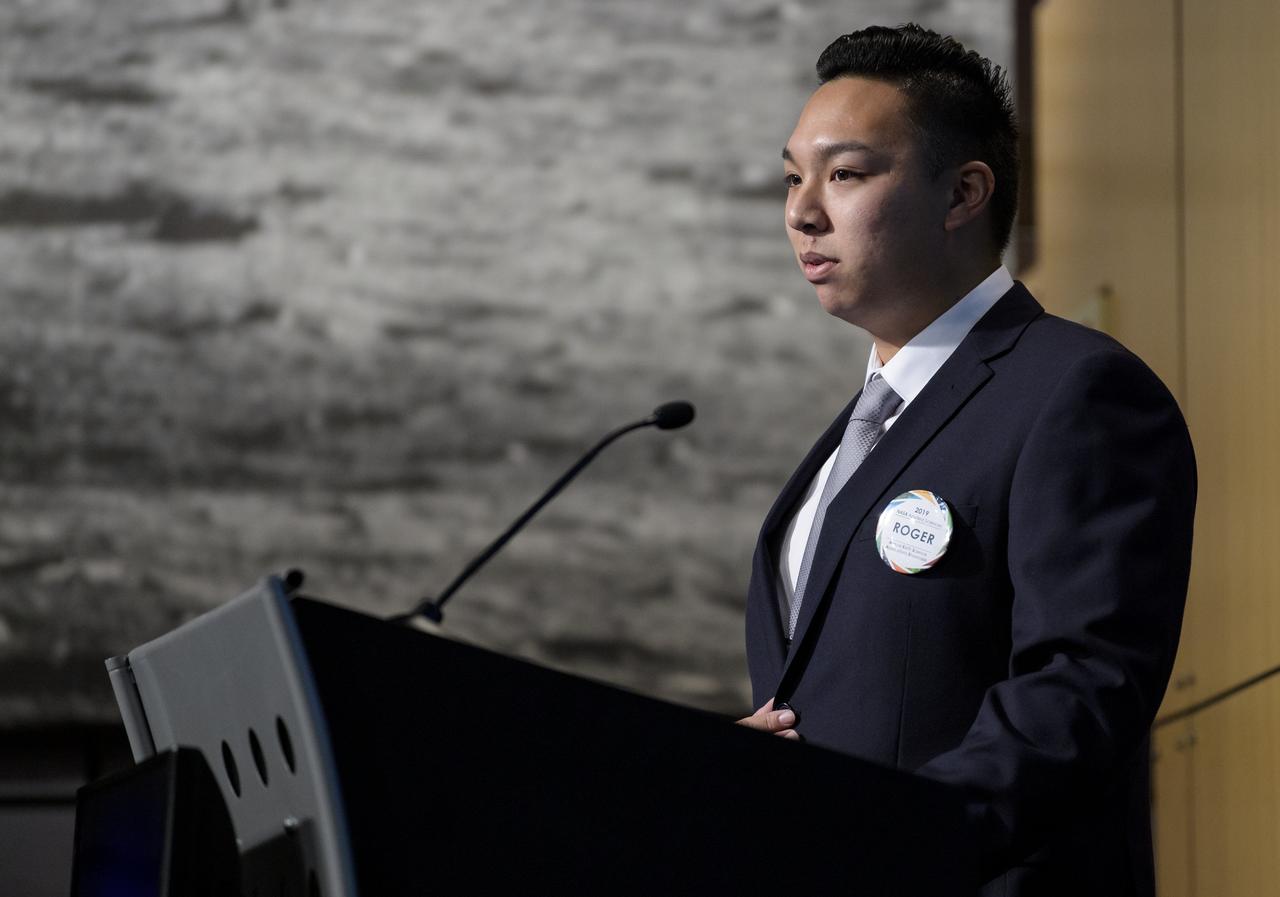
Roger Ly speaks about DEVELOP's Santa Monica Mountains Ecological Forecasting III project during the 2019 Annual Earth Science Applications Showcase, Thursday, Aug. 1, 2019 at NASA Headquarters in Washington, DC. Every summer students and young professionals from NASA’s Applied Sciences’ DEVELOP National Program come to NASA Headquarters and present their research projects. DEVELOP is a training and development program where students work on Earth science research projects, mentored by science advisers from NASA and partner agencies, and extend research results to local communities. Photo Credit: (NASA/Joel Kowsky)
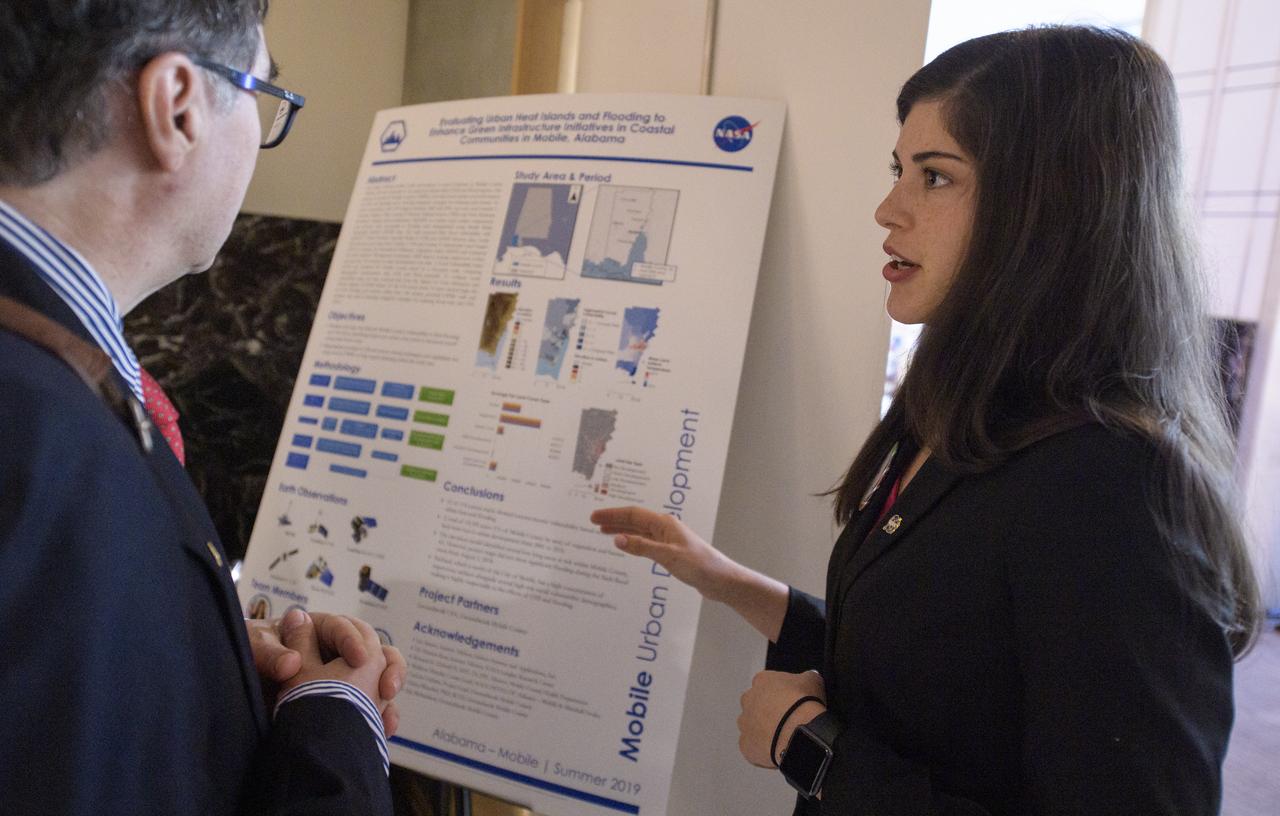
Students and young professionals discuss their projects during the 2019 Annual Earth Science Applications Showcase, Thursday, Aug. 1, 2019 at NASA Headquarters in Washington, DC. Every summer students and young professionals from NASA’s Applied Sciences’ DEVELOP National Program come to NASA Headquarters and present their research projects. DEVELOP is a training and development program where students work on Earth science research projects, mentored by science advisers from NASA and partner agencies, and extend research results to local communities. Photo Credit: (NASA/Joel Kowsky)
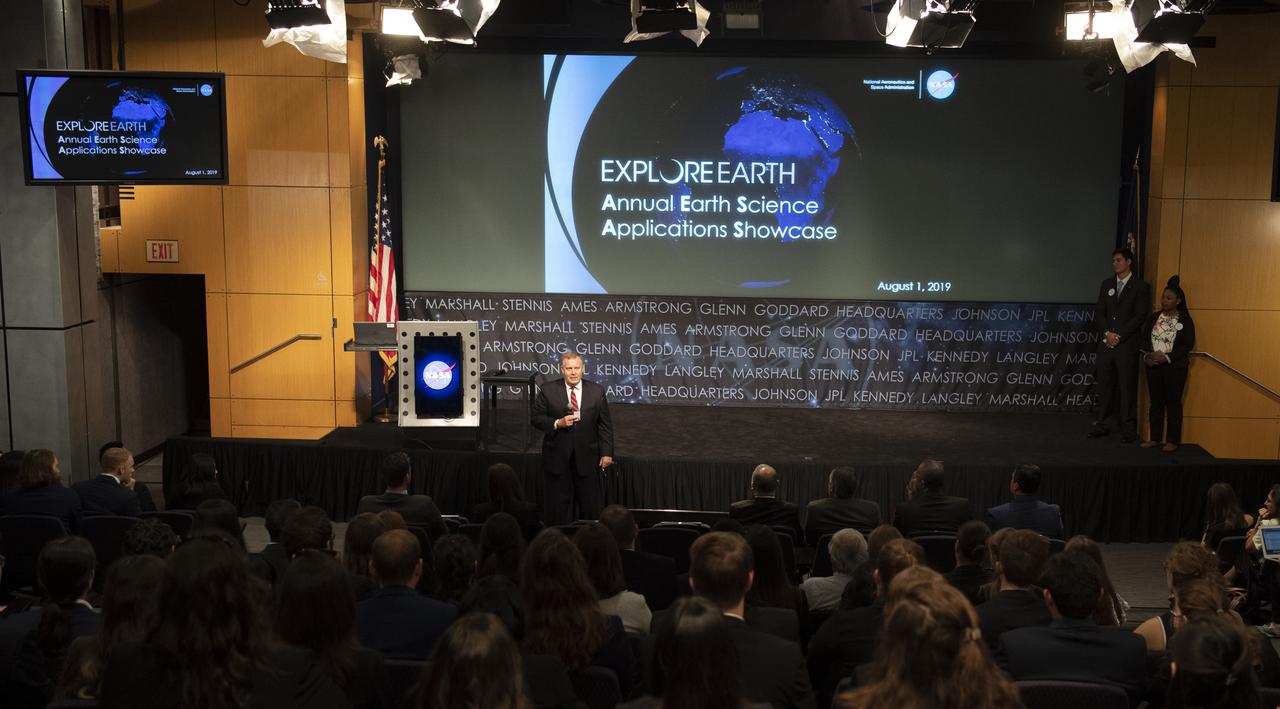
NASA Deputy Administrator Jim Morhard speaks during the 2019 Annual Earth Science Applications Showcase, Thursday, Aug. 1, 2019 at NASA Headquarters in Washington, DC. Every summer students and young professionals from NASA’s Applied Sciences’ DEVELOP National Program come to NASA Headquarters and present their research projects. DEVELOP is a training and development program where students work on Earth science research projects, mentored by science advisers from NASA and partner agencies, and extend research results to local communities. Photo Credit: (NASA/Joel Kowsky)
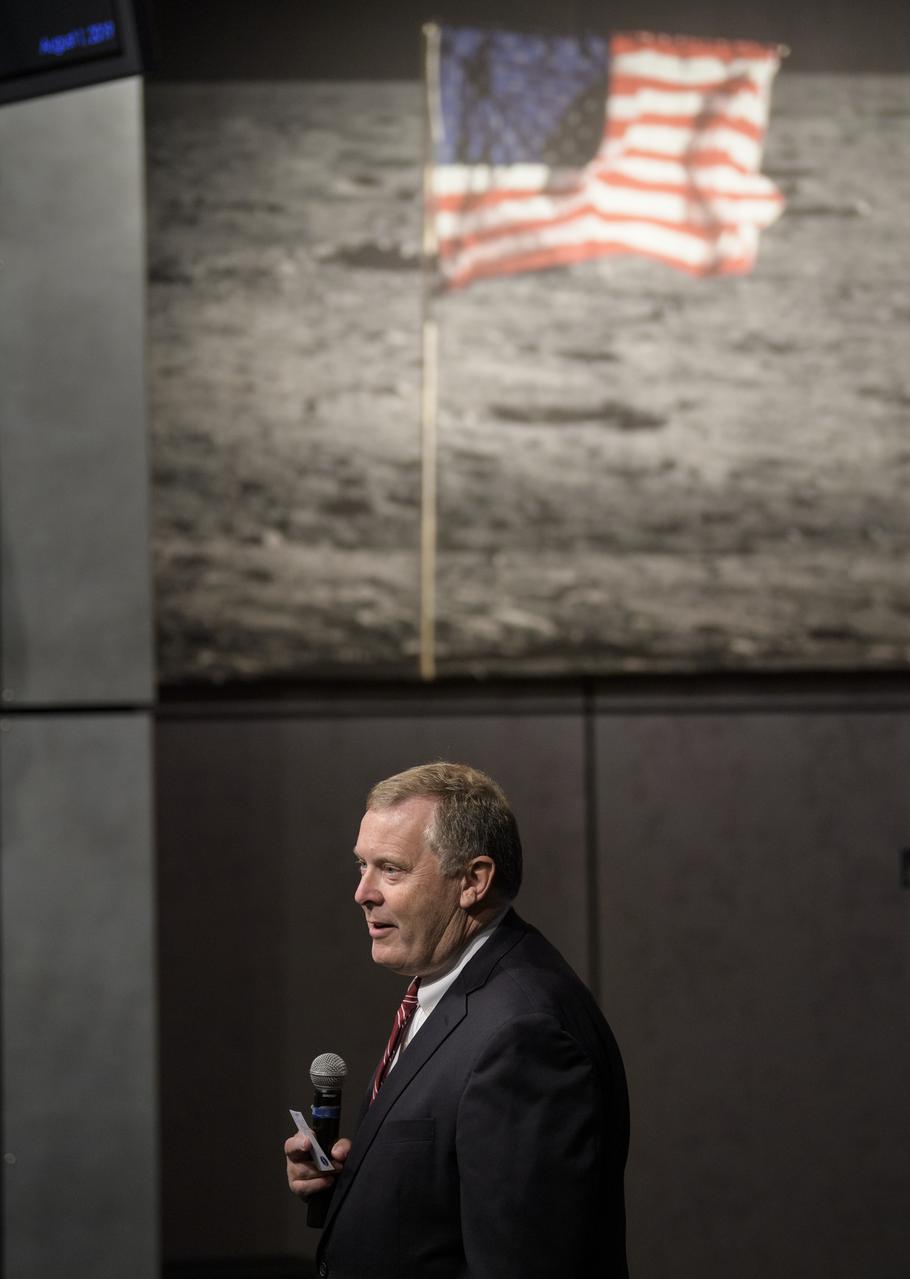
NASA Deputy Administrator Jim Morhard speaks during the 2019 Annual Earth Science Applications Showcase, Thursday, Aug. 1, 2019 at NASA Headquarters in Washington, DC. Every summer students and young professionals from NASA’s Applied Sciences’ DEVELOP National Program come to NASA Headquarters and present their research projects. DEVELOP is a training and development program where students work on Earth science research projects, mentored by science advisers from NASA and partner agencies, and extend research results to local communities. Photo Credit: (NASA/Joel Kowsky)
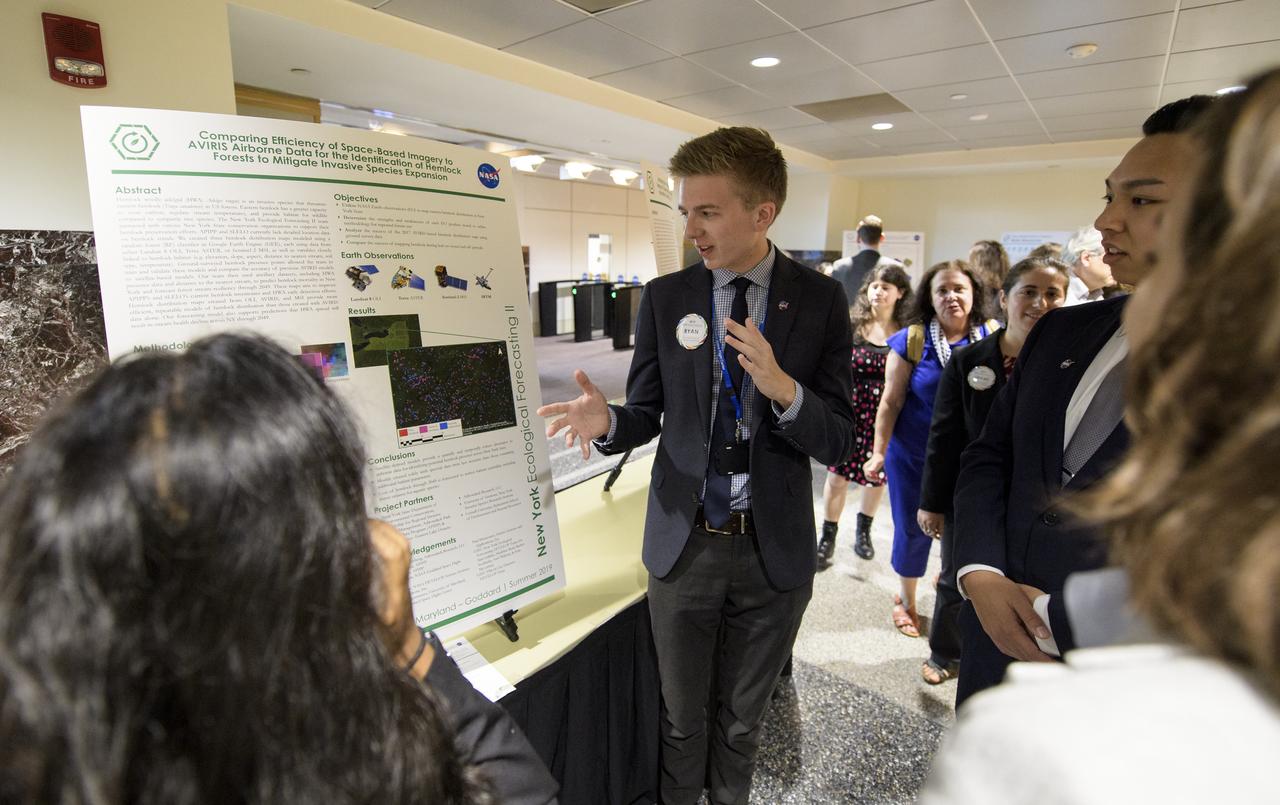
Students and young professionals discuss their projects during the 2019 Annual Earth Science Applications Showcase, Thursday, Aug. 1, 2019 at NASA Headquarters in Washington, DC. Every summer students and young professionals from NASA’s Applied Sciences’ DEVELOP National Program come to NASA Headquarters and present their research projects. DEVELOP is a training and development program where students work on Earth science research projects, mentored by science advisers from NASA and partner agencies, and extend research results to local communities. Photo Credit: (NASA/Joel Kowsky)
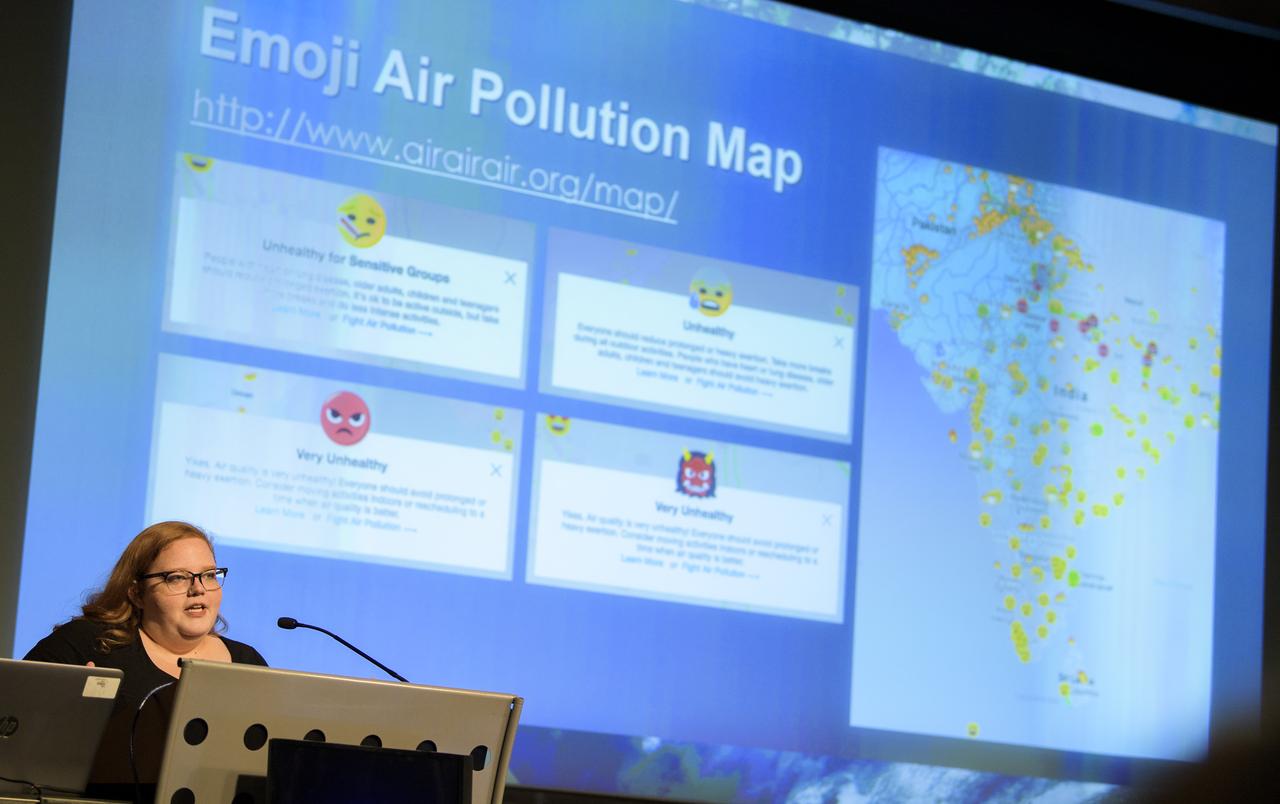
Elizabeth Hook, outreach coordinator for NASA's Applied Remote Sensing Training (ARSET) Program speaks about ARSET and its impact during the 2019 Annual Earth Science Applications Showcase, Thursday, Aug. 1, 2019 at NASA Headquarters in Washington, DC. Every summer students and young professionals from NASA’s Applied Sciences’ DEVELOP National Program come to NASA Headquarters and present their research projects. DEVELOP is a training and development program where students work on Earth science research projects, mentored by science advisers from NASA and partner agencies, and extend research results to local communities. Photo Credit: (NASA/Joel Kowsky)
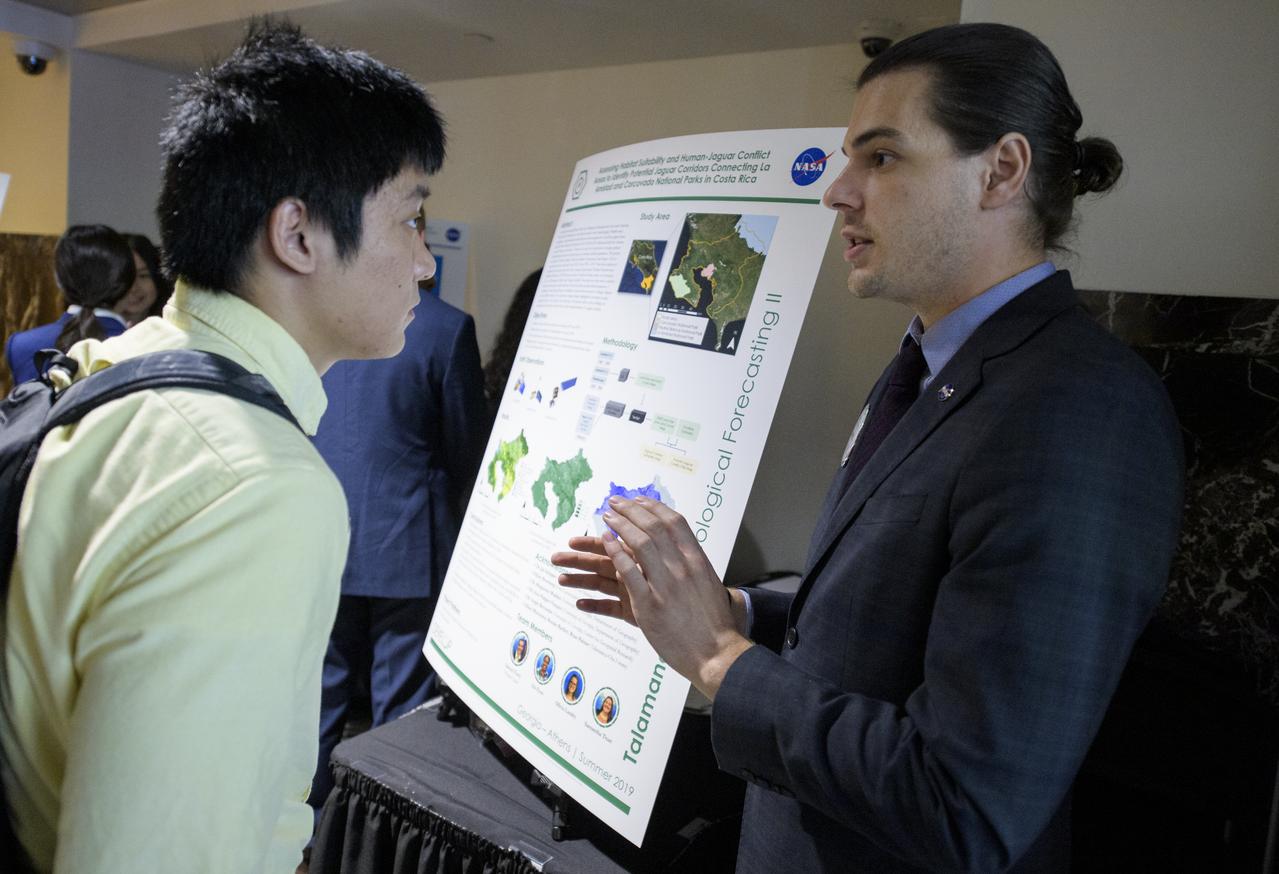
Students and young professionals discuss their projects during the 2019 Annual Earth Science Applications Showcase, Thursday, Aug. 1, 2019 at NASA Headquarters in Washington, DC. Every summer students and young professionals from NASA’s Applied Sciences’ DEVELOP National Program come to NASA Headquarters and present their research projects. DEVELOP is a training and development program where students work on Earth science research projects, mentored by science advisers from NASA and partner agencies, and extend research results to local communities. Photo Credit: (NASA/Joel Kowsky)
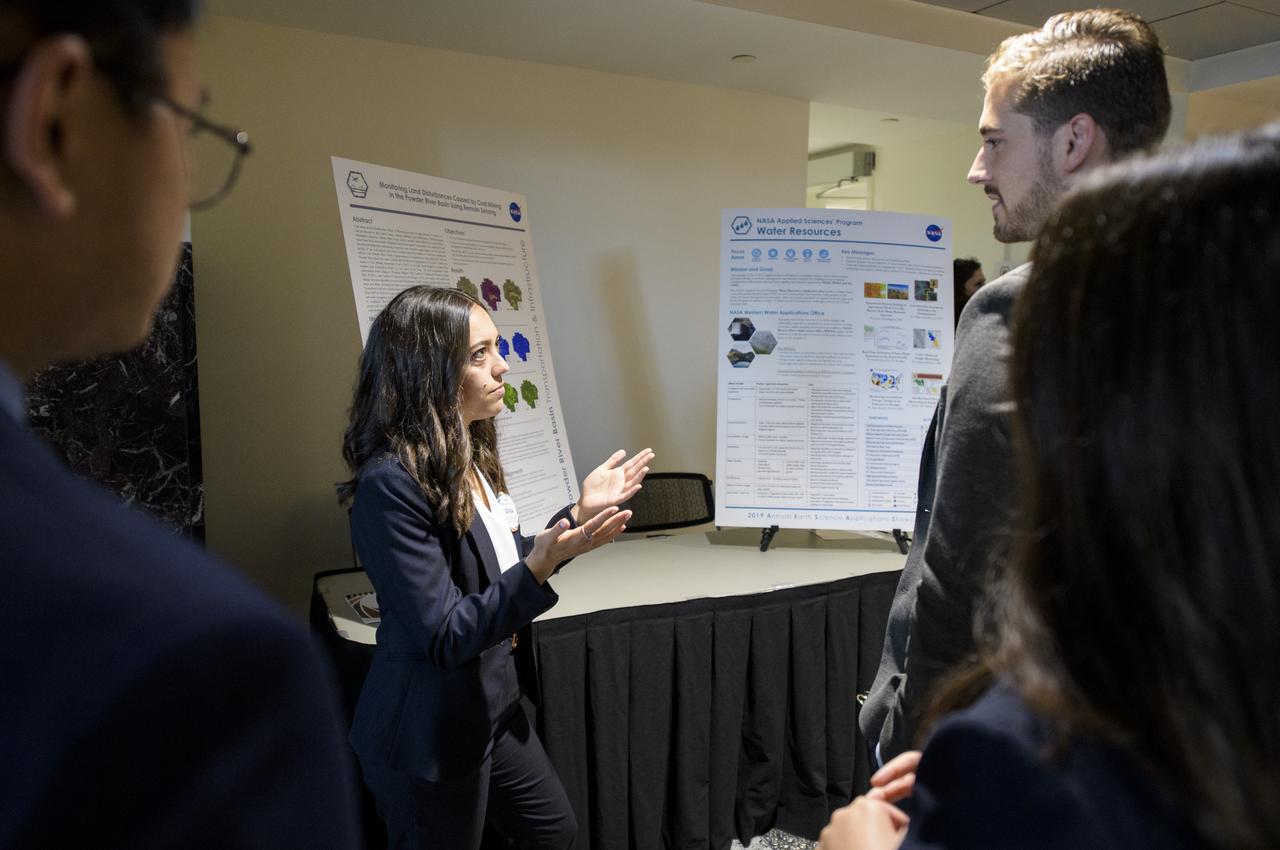
Students and young professionals discuss their projects during the 2019 Annual Earth Science Applications Showcase, Thursday, Aug. 1, 2019 at NASA Headquarters in Washington, DC. Every summer students and young professionals from NASA’s Applied Sciences’ DEVELOP National Program come to NASA Headquarters and present their research projects. DEVELOP is a training and development program where students work on Earth science research projects, mentored by science advisers from NASA and partner agencies, and extend research results to local communities. Photo Credit: (NASA/Joel Kowsky)
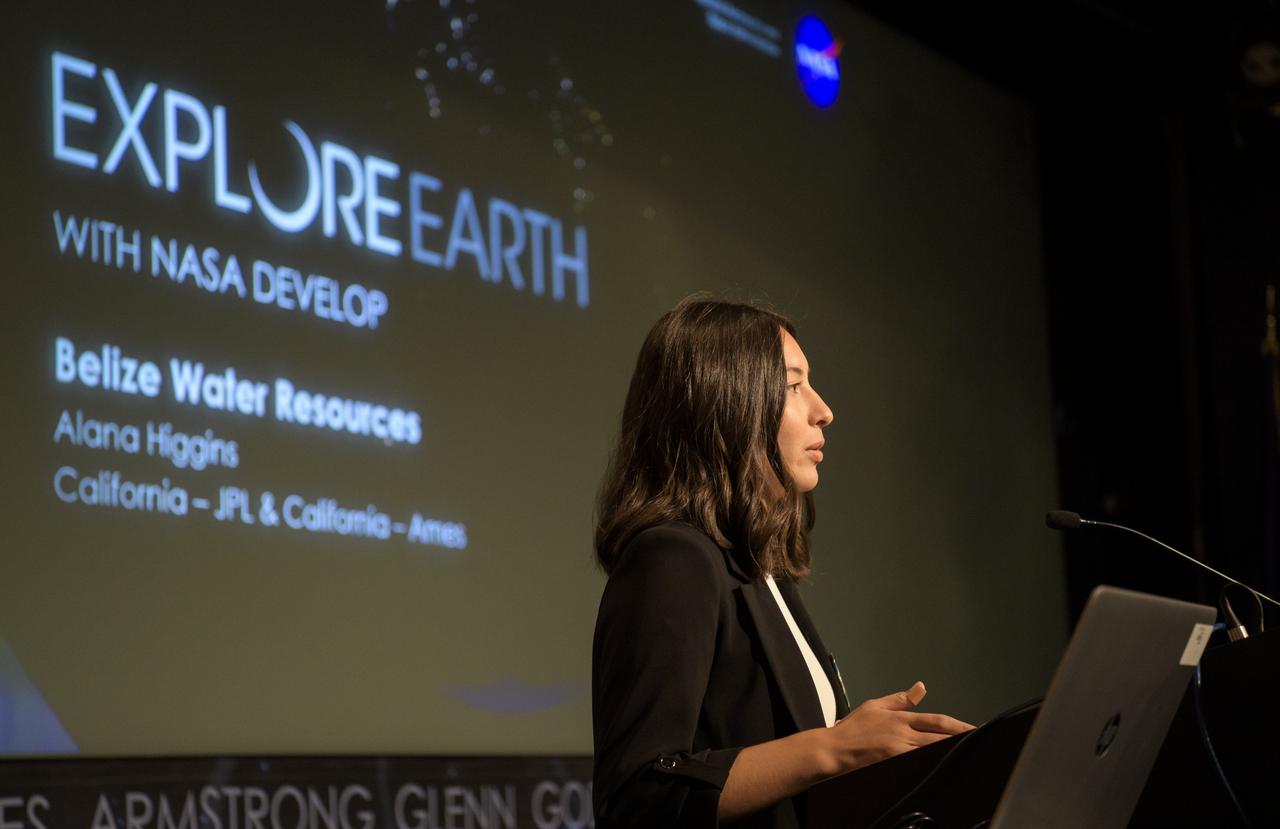
Alana Higgins speaks about water resources in Belize during the 2019 Annual Earth Science Applications Showcase, Thursday, Aug. 1, 2019 at NASA Headquarters in Washington, DC. Every summer students and young professionals from NASA’s Applied Sciences’ DEVELOP National Program come to NASA Headquarters and present their research projects. DEVELOP is a training and development program where students work on Earth science research projects, mentored by science advisers from NASA and partner agencies, and extend research results to local communities. Photo Credit: (NASA/Joel Kowsky)

NASA Administrator Charles Bolden speaks with young professionals about their project on New England water resources during the annual DEVELOP Earth Science Application Showcase at NASA headquarters Tuesday, August 5, 2014. The Earth Science Applications Showcase highlights the work of over 150 participants in the 10-week DEVELOP program that started in June. The DEVELOP Program bridges the gap between NASA Earth science and society, building capacity in both its participants and partner organizations, to better prepare them to handle the challenges that face our society and future generations. Photo Credit: (NASA/Aubrey Gemignani)
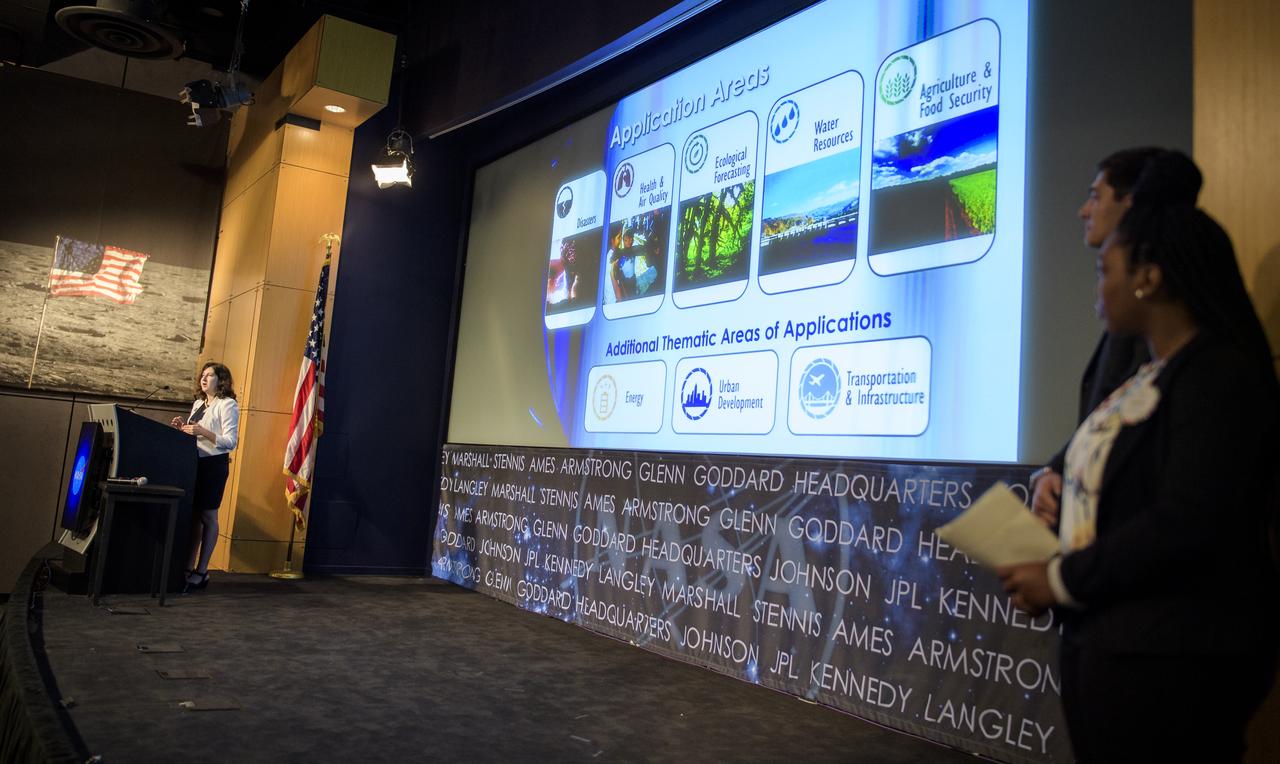
Emily Sylak-Glassman, Program Manager for the Applied Sciences Program in NASA's Earth Science Divison, speaks during the 2019 Annual Earth Science Applications Showcase, Thursday, Aug. 1, 2019 at NASA Headquarters in Washington, DC. Every summer students and young professionals from NASA’s Applied Sciences’ DEVELOP National Program come to NASA Headquarters and present their research projects. DEVELOP is a training and development program where students work on Earth science research projects, mentored by science advisers from NASA and partner agencies, and extend research results to local communities. Photo Credit: (NASA/Joel Kowsky)
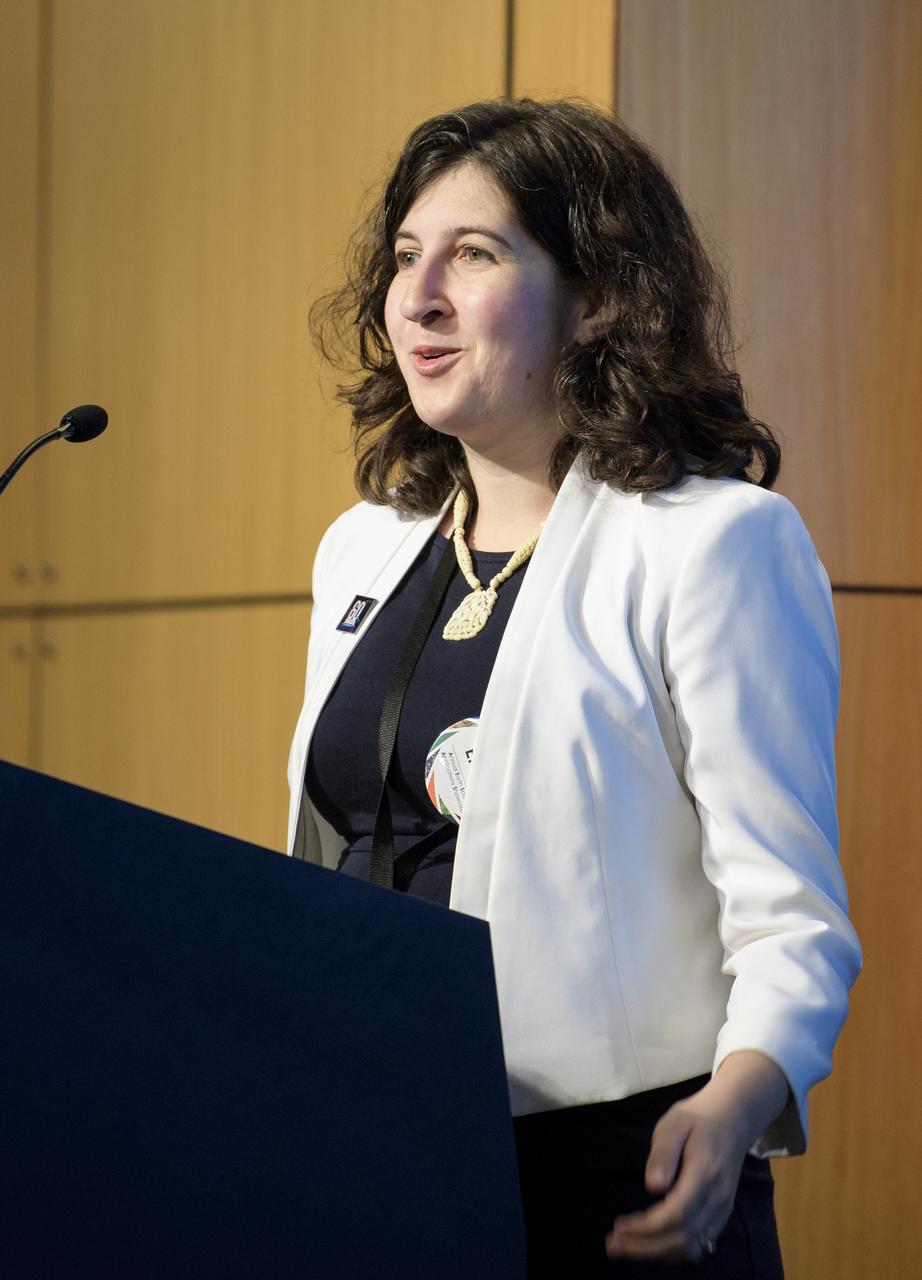
Emily Sylak-Glassman, Program Manager for the Applied Sciences Program in NASA's Earth Science Divison, speaks during the 2019 Annual Earth Science Applications Showcase, Thursday, Aug. 1, 2019 at NASA Headquarters in Washington, DC. Every summer students and young professionals from NASA’s Applied Sciences’ DEVELOP National Program come to NASA Headquarters and present their research projects. DEVELOP is a training and development program where students work on Earth science research projects, mentored by science advisers from NASA and partner agencies, and extend research results to local communities. Photo Credit: (NASA/Joel Kowsky)
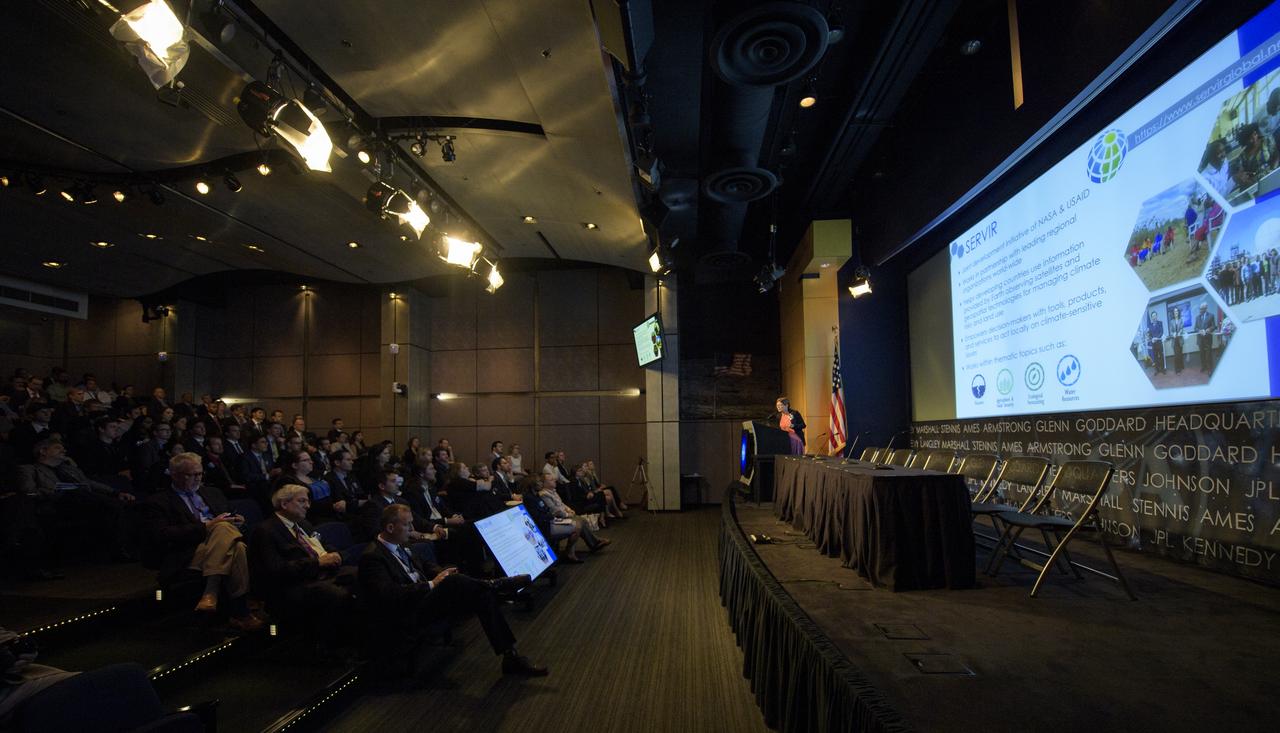
Capacity Building Program Manager for NASA's Applied Sciences Program (Earth Science Division) Nancy Searby speaks during the 2018 Annual Earth Science Applications Showcase, Wednesday, Aug. 1, 2018 at NASA Headquarters in Washington. Every summer students and young professionals from NASA’s Applied Sciences’ DEVELOP National Program come to NASA Headquarters and present their research projects. DEVELOP is a training and development program where students work on Earth science research projects, mentored by science advisers from NASA and partner agencies, and extend research results to local communities. Photo Credit: (NASA/Joel Kowsky)
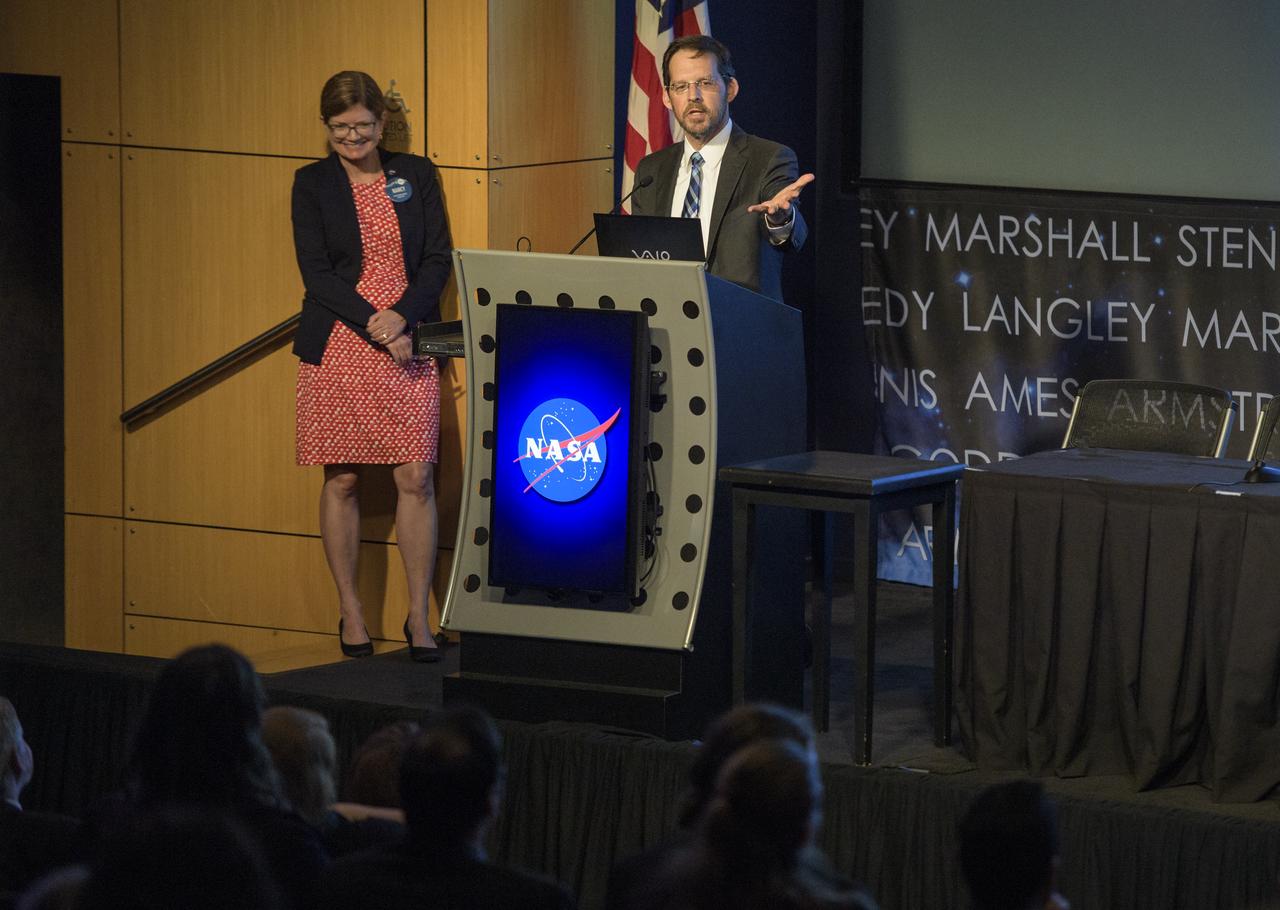
NASA Director of Applied Sciences Program (Earth Science Division) Lawrence Friedl speaks during the 2016 Annual Earth Science Applications Showcase, Wednesday, Aug. 1, 2018 at NASA Headquarters in Washington. Every summer students and young professionals from NASA’s Applied Sciences’ DEVELOP National Program come to NASA Headquarters and present their research projects. DEVELOP is a training and development program where students work on Earth science research projects, mentored by science advisers from NASA and partner agencies, and extend research results to local communities. Photo Credit: (NASA/Joel Kowsky)
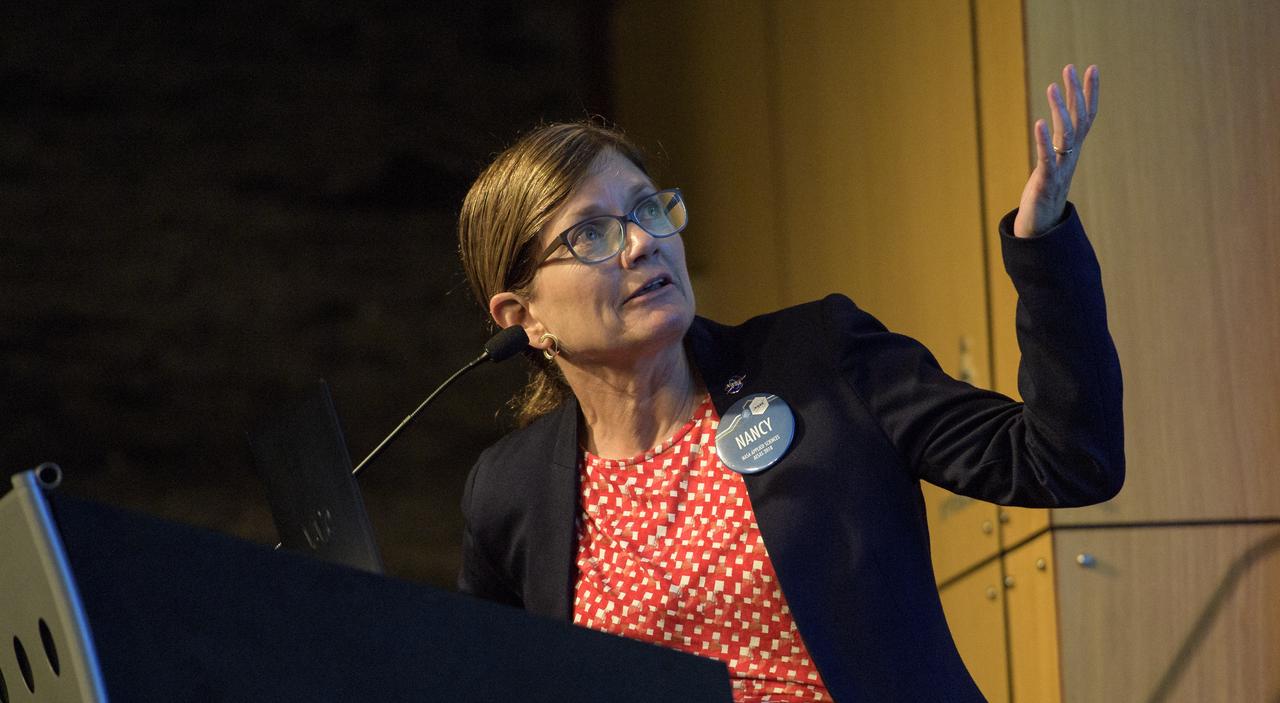
Capacity Building Program Manager for NASA's Applied Sciences Program (Earth Science Division) Nancy Searby speaks during the 2018 Annual Earth Science Applications Showcase, Wednesday, Aug. 1, 2018 at NASA Headquarters in Washington. Every summer students and young professionals from NASA’s Applied Sciences’ DEVELOP National Program come to NASA Headquarters and present their research projects. DEVELOP is a training and development program where students work on Earth science research projects, mentored by science advisers from NASA and partner agencies, and extend research results to local communities. Photo Credit: (NASA/Joel Kowsky)
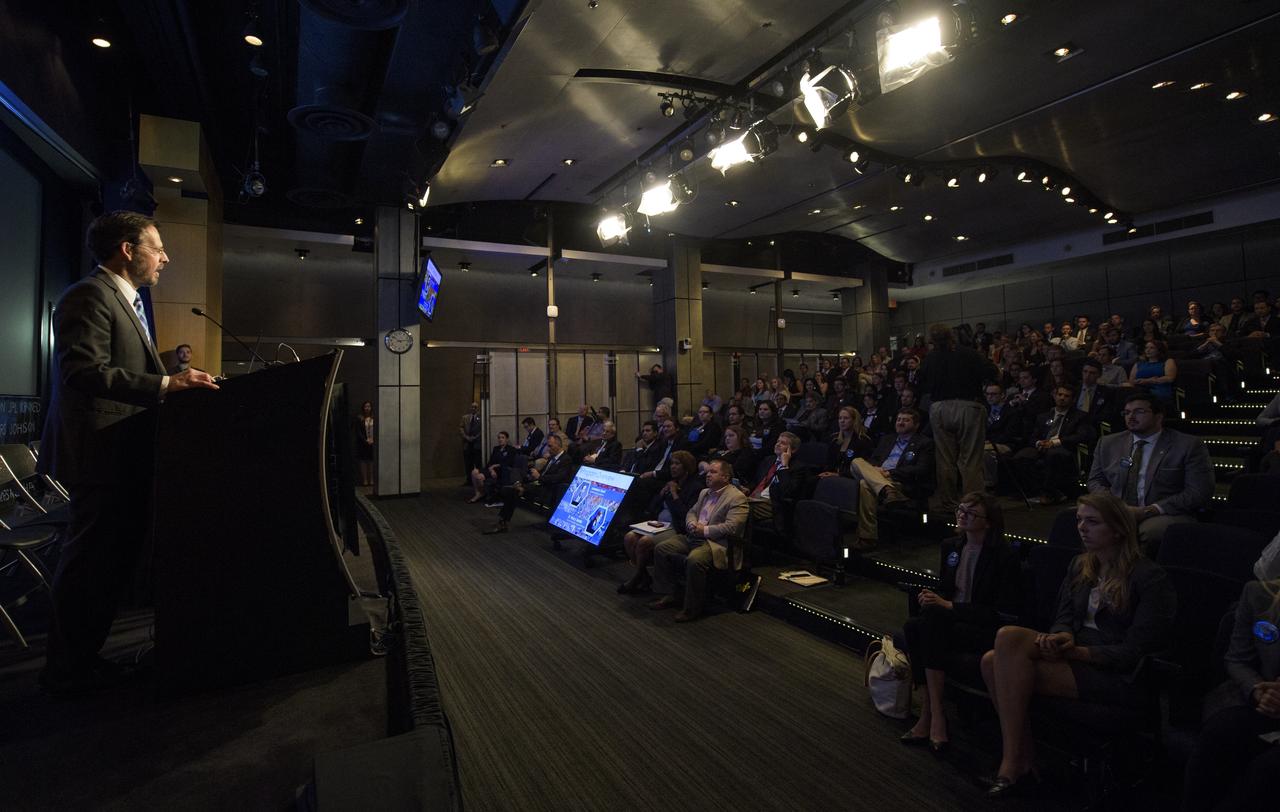
NASA Director of Applied Sciences Program (Earth Science Division) Lawrence Friedl speaks during the 2018 Annual Earth Science Applications Showcase, Wednesday, Aug. 1, 2018 at NASA Headquarters in Washington. Every summer students and young professionals from NASA’s Applied Sciences’ DEVELOP National Program come to NASA Headquarters and present their research projects. DEVELOP is a training and development program where students work on Earth science research projects, mentored by science advisers from NASA and partner agencies, and extend research results to local communities. Photo Credit: (NASA/Joel Kowsky)
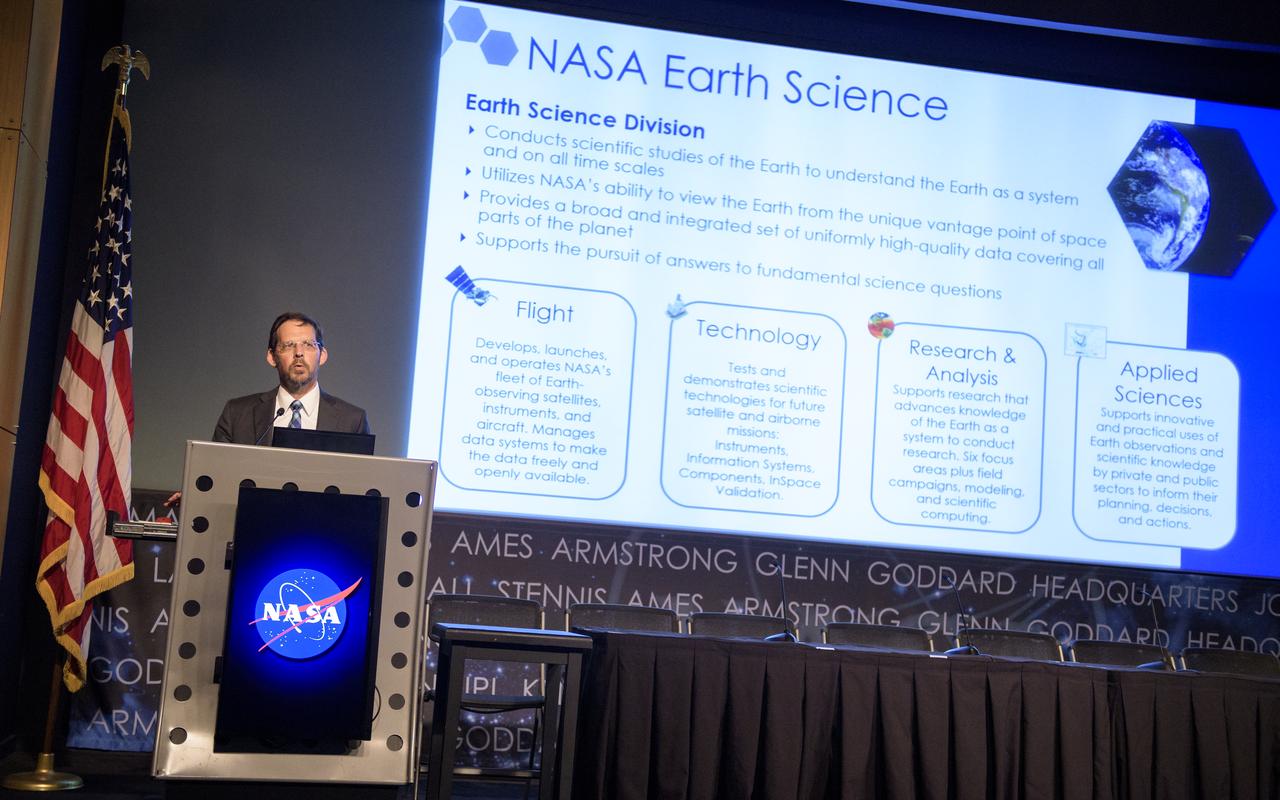
NASA Director of Applied Sciences Program (Earth Science Division) Lawrence Friedl speaks during the 2018 Annual Earth Science Applications Showcase, Wednesday, Aug. 1, 2018 at NASA Headquarters in Washington. Every summer students and young professionals from NASA’s Applied Sciences’ DEVELOP National Program come to NASA Headquarters and present their research projects. DEVELOP is a training and development program where students work on Earth science research projects, mentored by science advisers from NASA and partner agencies, and extend research results to local communities. Photo Credit: (NASA/Joel Kowsky)
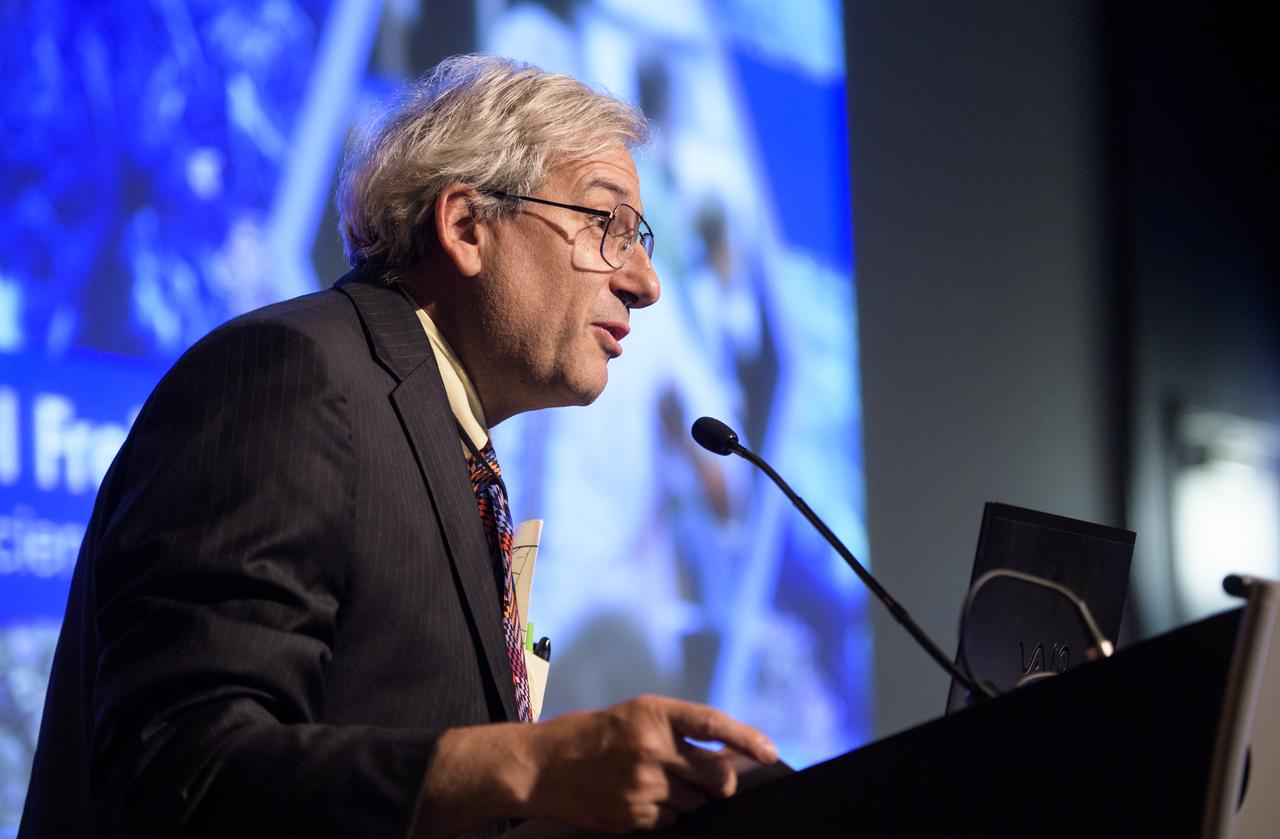
Michael Freilich, Director of the Earth Science Division at NASA Headquarters, speaks during the 2018 Annual Earth Science Applications Showcase, Wednesday, Aug. 1, 2018 at NASA Headquarters in Washington. Every summer students and young professionals from NASA’s Applied Sciences’ DEVELOP National Program come to NASA Headquarters and present their research projects. DEVELOP is a training and development program where students work on Earth science research projects, mentored by science advisers from NASA and partner agencies, and extend research results to local communities. Photo Credit: (NASA/Joel Kowsky)
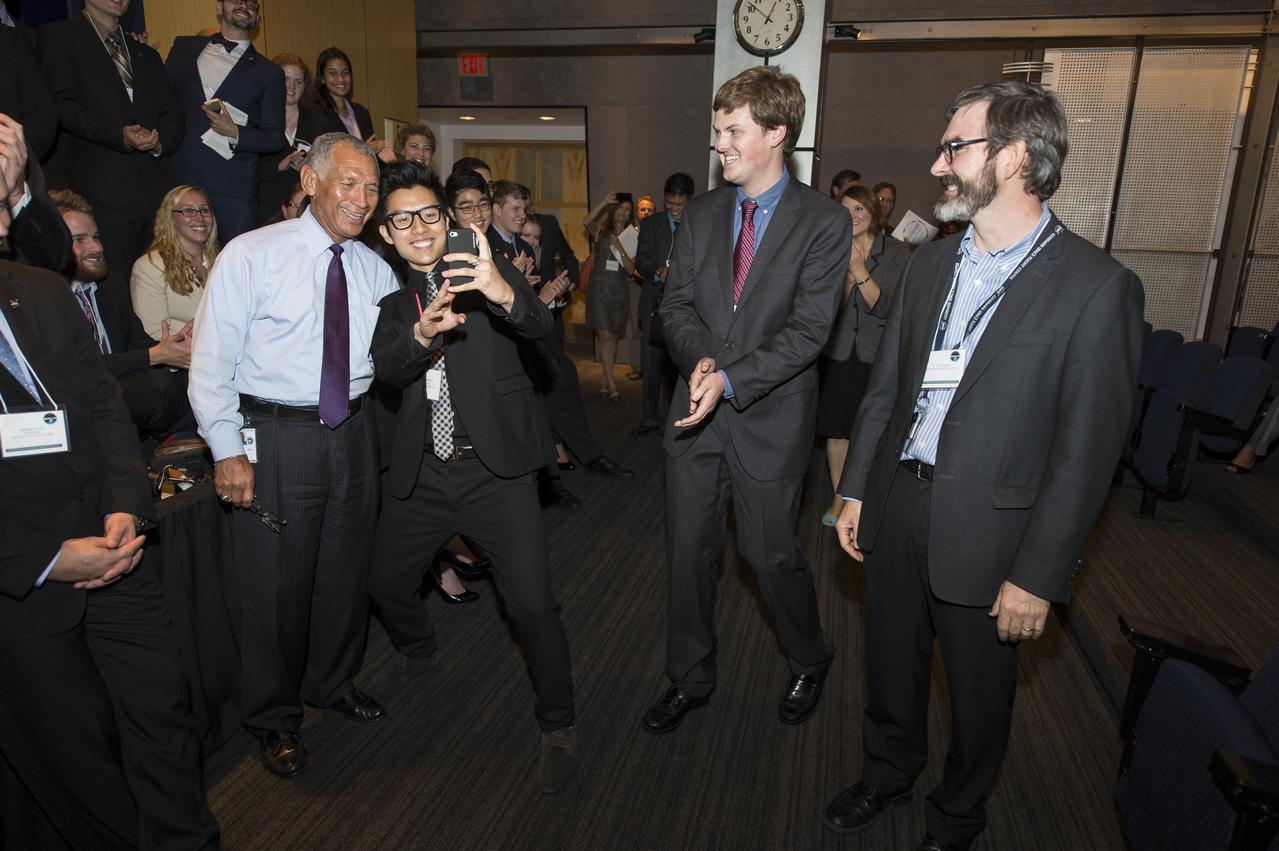
NASA Administrator Charles Bolden poses for a selfie after a quick rap performance by some young professionals during the annual DEVELOP Earth Science Application Showcase at NASA headquarters Tuesday, August 5, 2014. The Earth Science Applications Showcase highlights the work of over 150 participants in the 10-week DEVELOP program that started in June. The DEVELOP Program bridges the gap between NASA Earth science and society, building capacity in both its participants and partner organizations, to better prepare them to handle the challenges that face our society and future generations. Photo Credit: (NASA/Aubrey Gemignani)
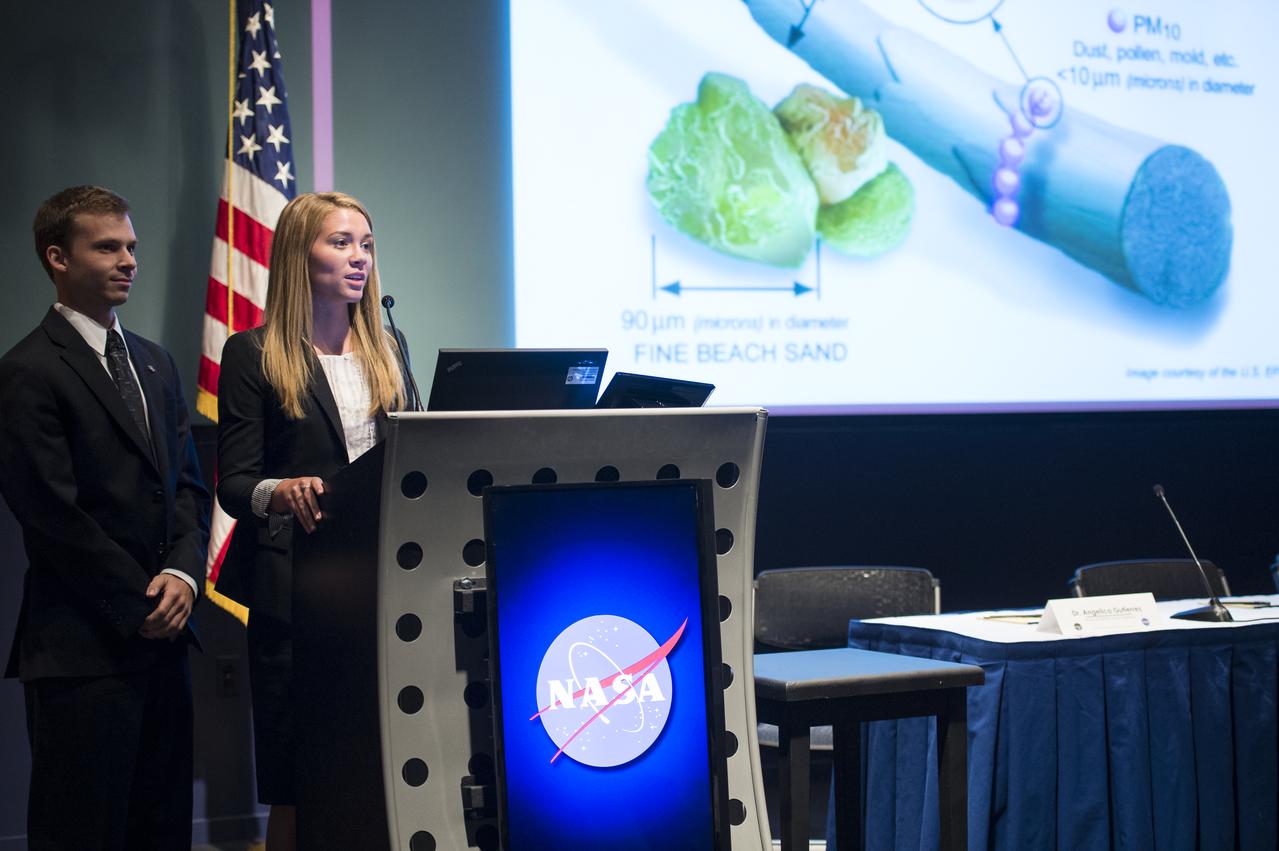
Lisa Waldron and Justin Roberts-Pierel present their project on Texas health and air quality during the annual DEVELOP Earth Science Application Showcase at NASA headquarters Tuesday, August 5, 2014. The Earth Science Applications Showcase highlights the work of over 150 participants in the 10-week DEVELOP program that started in June. The DEVELOP Program bridges the gap between NASA Earth science and society, building capacity in both its participants and partner organizations, to better prepare them to handle the challenges that face our society and future generations. Photo Credit: (NASA/Aubrey Gemignani)

Workers at Launch Complex 17 Pad A, Kennedy Space Center (KSC) encapsulate the Geomagnetic Tail (GEOTAIL) spacecraft (upper) and attached payload Assist Module-D upper stage (lower) in the protective payload fairing. GEOTAIL project was designed to study the effects of Earth's magnetic field. The solar wind draws the Earth's magnetic field into a long tail on the night side of the Earth and stores energy in the stretched field lines of the magnetotail. During active periods, the tail couples with the near-Earth magnetosphere, sometimes releasing energy stored in the tail and activating auroras in the polar ionosphere. GEOTAIL measures the flow of energy and its transformation in the magnetotail and will help clarify the mechanisms that control the imput, transport, storage, release, and conversion of mass, momentum, and energy in the magnetotail.

Small Expendable Deployer System (SEDS) is a tethered date collecting satellite and is intended to demonstrate a versatile and economical way of delivering smaller payloads to higher orbits or downward toward Earth's atmosphere. 19th Navstar Global Positioning System Satellite mission joined with previously launched satellites used for navigational purposes and geodite studies. These satellites are used commercially as well as by the military.

A Delta II rocket carrying the Geomagnetic Tail Lab (GEOTAIL) spacecraft lifts off at Launch Complex 17, Kennedy Space Center (KSC) into a cloud-dappled sky. This liftoff marks the first Delta launch under the medium expendable launch vehicle services contract between NASA and McDonnell Douglas Space Systems Co. The GEOTAIL mission, a joint US/Japanese project, is the first in a series of five satellites to study the interactions between the Sun, the Earth's magnetic field, and the Van Allen radiation belts.
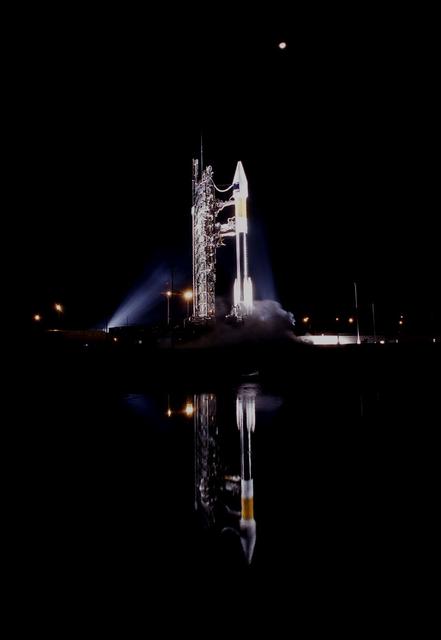
The reflection of the Atlas IIAS expendable launch vehicle with the Solar Heliospheric Observatory (SOHO) inside its payload fairing can be seen on the surface of a retention pond at Launch Pad 36B on Cape Canaveral Air Station just hours before liftoff. SOHO is a cooperative effort involving NASA and the European Space Agency (ESA) within the framework of the International Solar-Terrestrial Physics Program. During its 2-year mission, the SOHO spacecraft will gather data on the internal structure of the Sun, its extensive outer atmosphere and the origin of the solar wind.
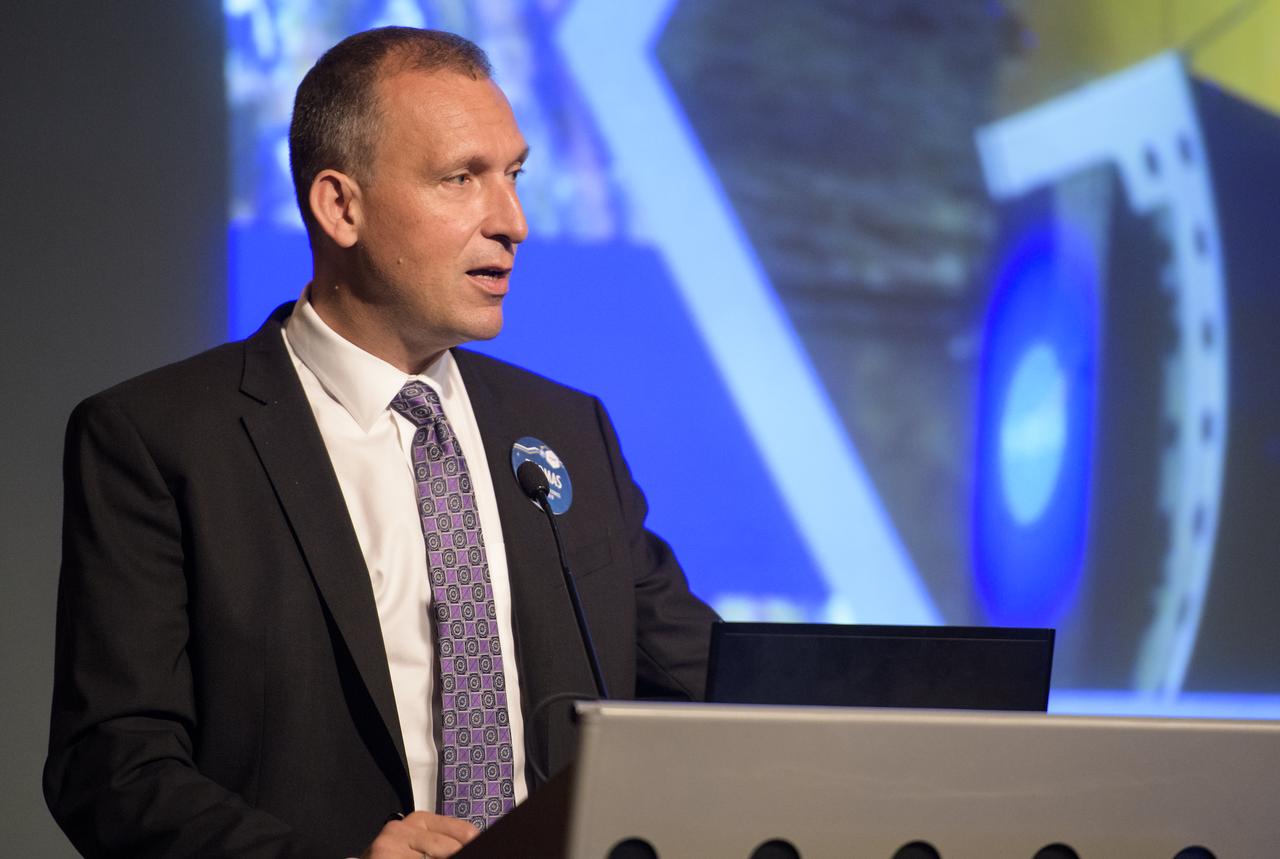
Thomas Zurbuchen, Associate Administrator for NASA's Science Mission Directorate, speaks during the 2018 Annual Earth Science Applications Showcase, Wednesday, Aug. 1, 2018 at NASA Headquarters in Washington. Every summer students and young professionals from NASA’s Applied Sciences’ DEVELOP National Program come to NASA Headquarters and present their research projects. DEVELOP is a training and development program where students work on Earth science research projects, mentored by science advisers from NASA and partner agencies, and extend research results to local communities. Photo Credit: (NASA/Joel Kowsky)
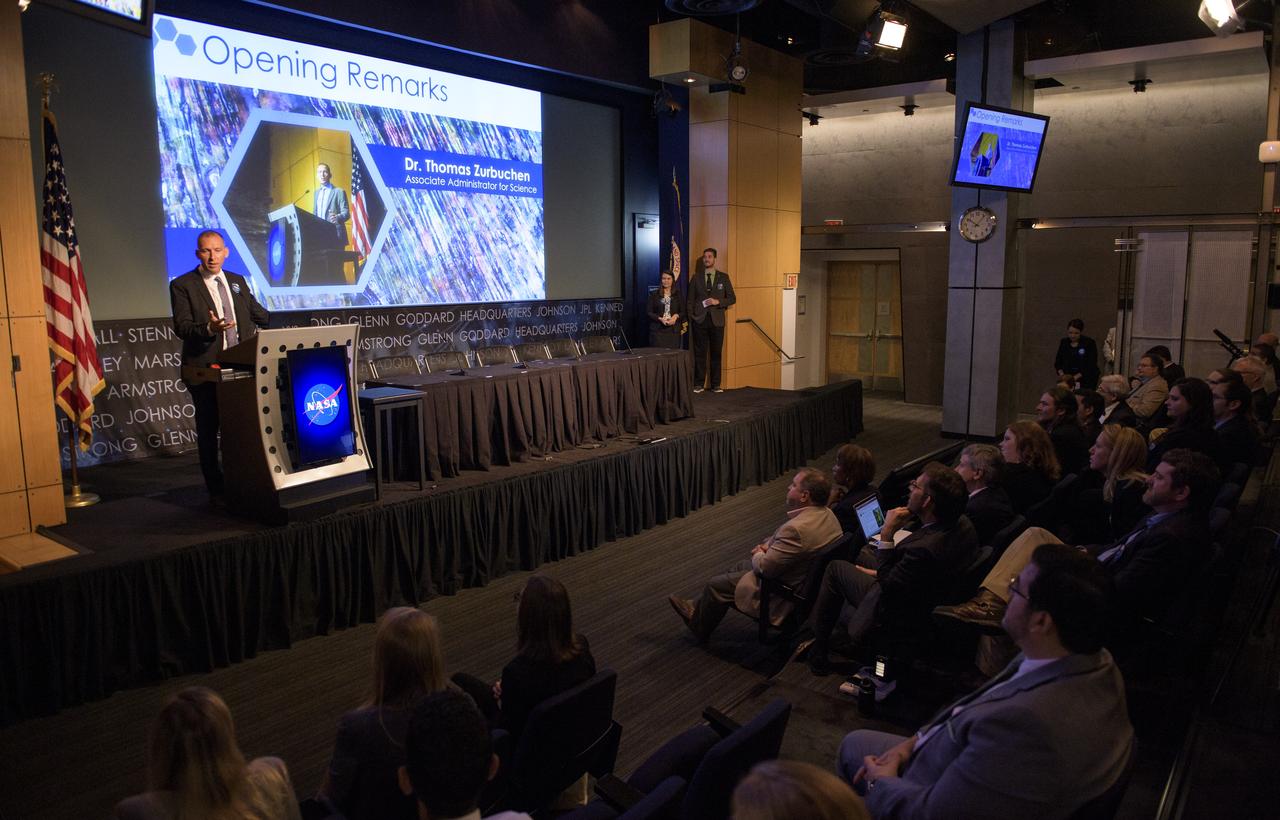
Thomas Zurbuchen, Associate Administrator for NASA's Science Mission Directorate, speaks during the 2016 Annual Earth Science Applications Showcase, Wednesday, Aug. 1, 2018 at NASA Headquarters in Washington. Every summer students and young professionals from NASA’s Applied Sciences’ DEVELOP National Program come to NASA Headquarters and present their research projects. DEVELOP is a training and development program where students work on Earth science research projects, mentored by science advisers from NASA and partner agencies, and extend research results to local communities. Photo Credit: (NASA/Joel Kowsky)
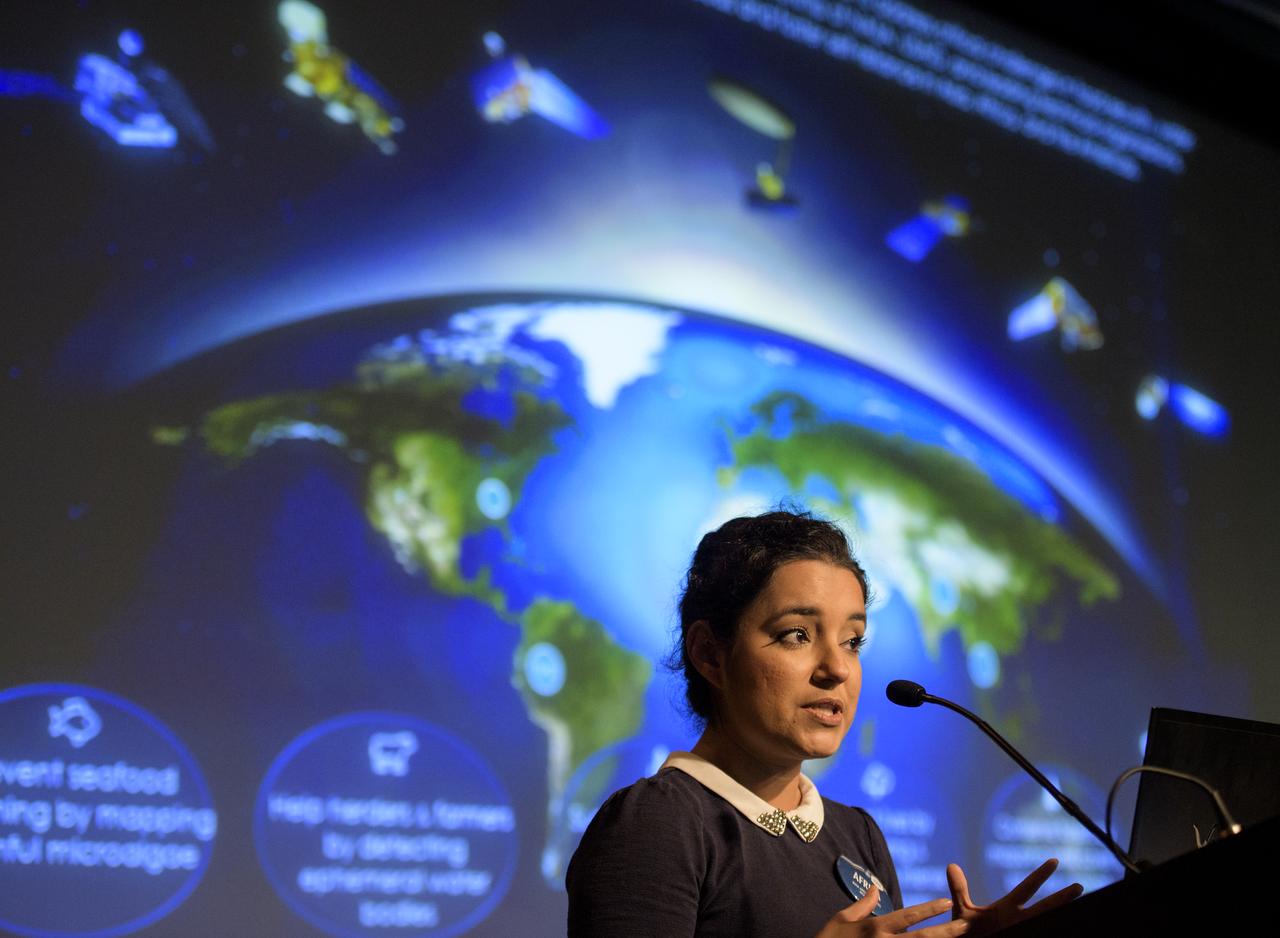
Africa Flores, Land Cover and Land Use Change Theme Lead for SERVIR, speaks during the 2018 Annual Earth Science Applications Showcase, Wednesday, Aug. 1, 2018 at NASA Headquarters in Washington. Every summer students and young professionals from NASA’s Applied Sciences’ DEVELOP National Program come to NASA Headquarters and present their research projects. DEVELOP is a training and development program where students work on Earth science research projects, mentored by science advisers from NASA and partner agencies, and extend research results to local communities. Photo Credit: (NASA/Joel Kowsky)
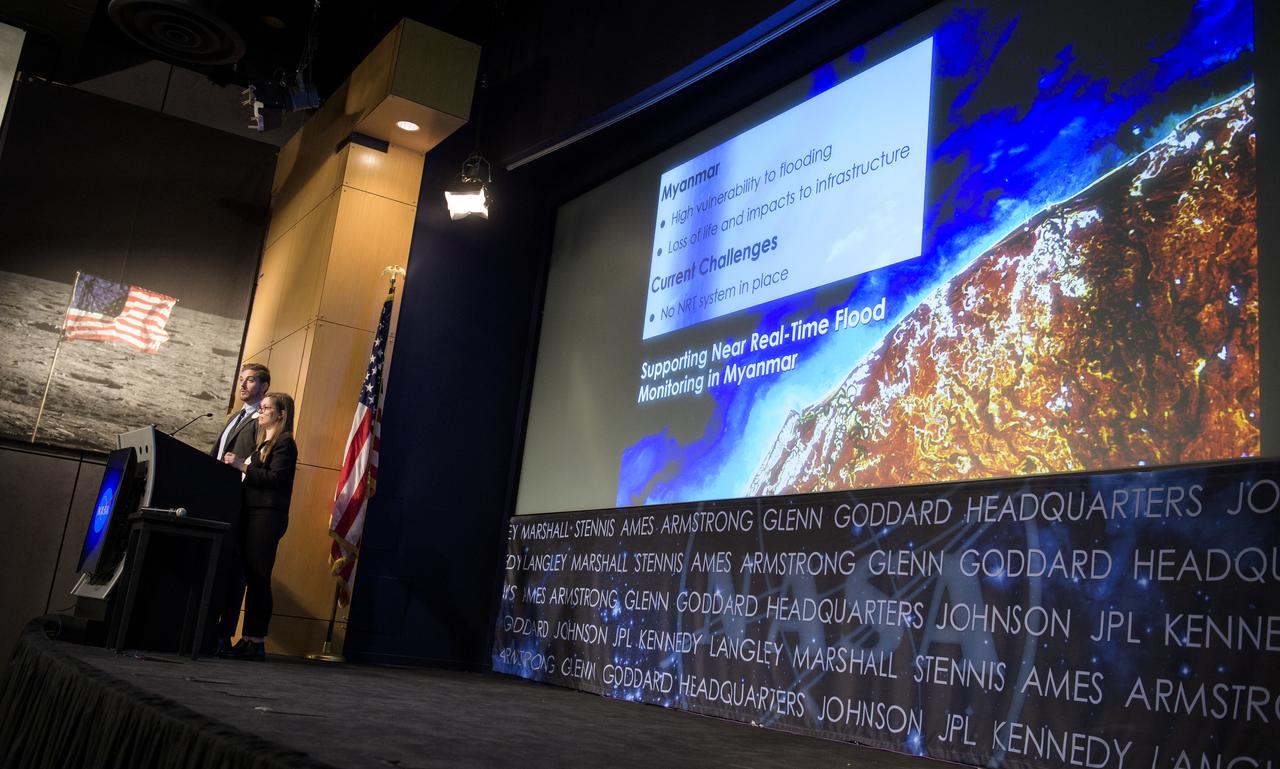
Tim Mayer, Mekong Regional Science Associate for SERVIR, and Helen Baldwin, Hindu Kush Himalaya Regional Science Associate for SERVIR, speak about SERVIR's water related disaster services during the 2019 Annual Earth Science Applications Showcase, Thursday, Aug. 1, 2019 at NASA Headquarters in Washington, DC. Every summer students and young professionals from NASA’s Applied Sciences’ DEVELOP National Program come to NASA Headquarters and present their research projects. DEVELOP is a training and development program where students work on Earth science research projects, mentored by science advisers from NASA and partner agencies, and extend research results to local communities. Photo Credit: (NASA/Joel Kowsky)
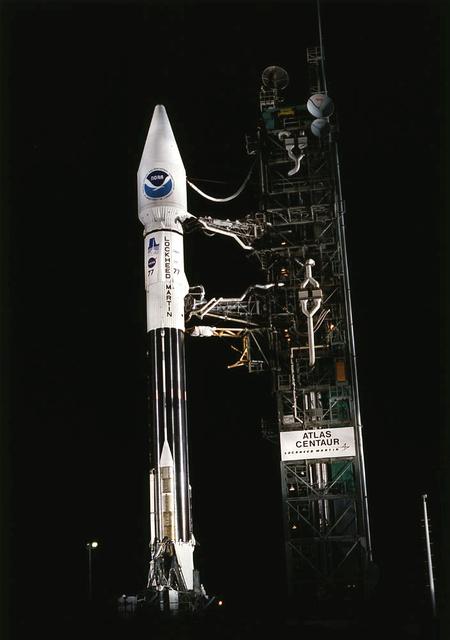
The Atlas-1 (AC-77) that will loft the Geostationary Operational Environmental Satellite-J (GOES-J) next-generation advanced technology weather satellite into space sits poised for takeoff during final countdown operations at Cape Canaveral Air Station, Kennedy Space Center (KSC). GOES-J is atop the expendable launch vehicle inside the rocket's payload fairing.
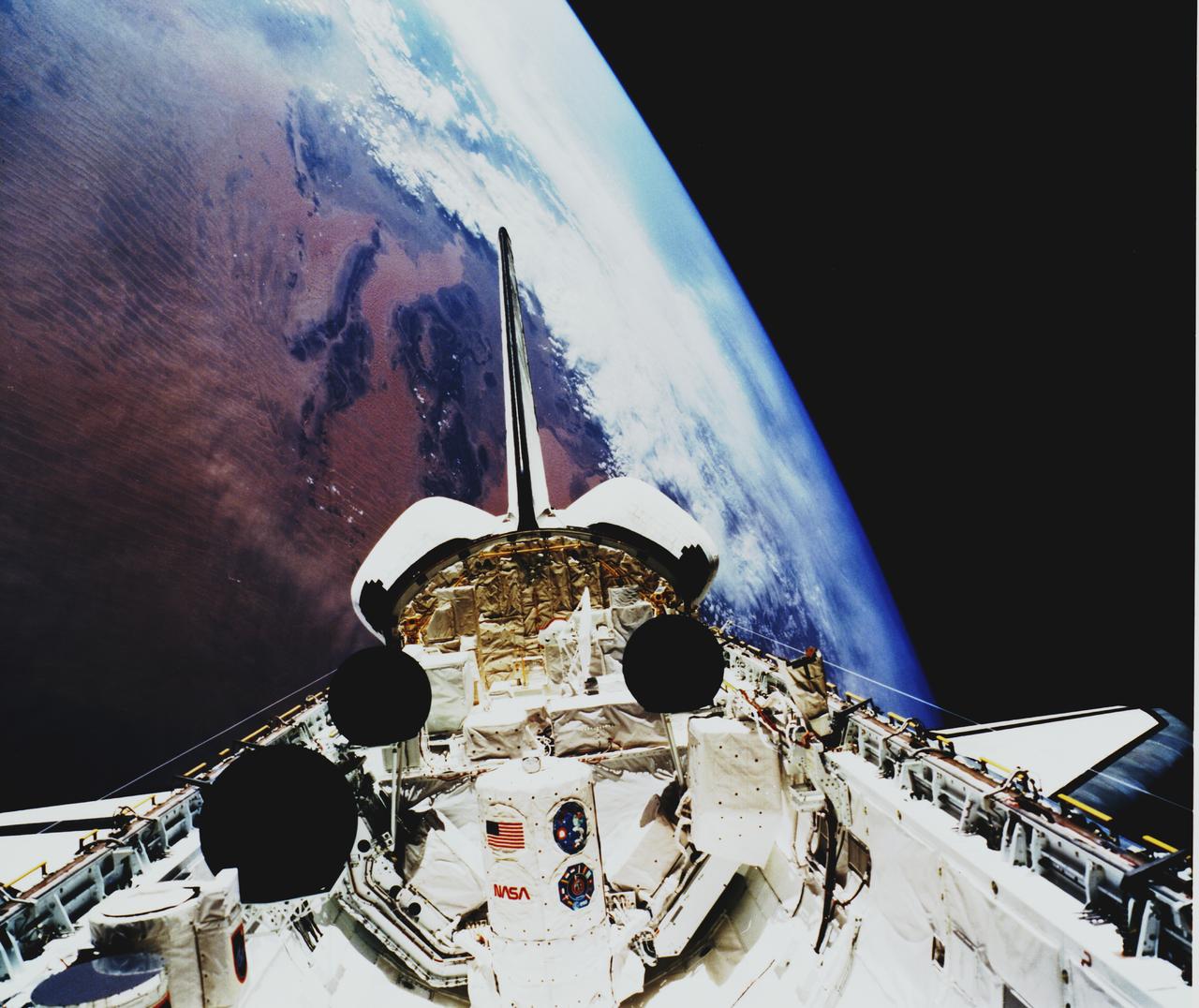
Space Shuttle Atlantis (STS-45) onboard photo of Atmospheric Laboratory for Applications and Science (Atlas-1) module in open cargo bay. Atlas-1 pallets are back dropped against the Atlas Mountains. Taken over Mali in the western Sahara, shows dunes in the Iguidi Dune Sea.

The LAGEOS I (Laser Geodynamics Satellite) was developed and launched by the Marshall Space Flight Center on May 4, 1976 from Vandenberg Air Force Base, California . The two-foot diameter satellite orbited the Earth from pole to pole and measured the movements of the Earth's surface.

Workers at the Astrotech processing facility in Titusville prepared for a news media showing of the Geostationary Operational Environmental Satellite-1 (GOES-1). GOES-1 was the first in a new generation of weather satellites deployed above Earth. It was the first 3-axis, body-stabilized meteorological satellite to be used by the National Oceanic Atmospheric Administration (NOAA) and NASA. These features allowed GOES-1 to continuously monitor the Earth, rather than viewing it just five percent of the time as was the case with spin-stabilized meteorological satellites. GOES-1 also has independent imaging and sounding instruments which can operate simultaneously yet independently. As a result, observations provided by each instrument will not be interrupted. The imager produces visual and infrared images of the Earth's surface, oceans, cloud cover and severe storm development, while the prime sounding products include vertical temperature and moisture profiles, and layer mean moisture.
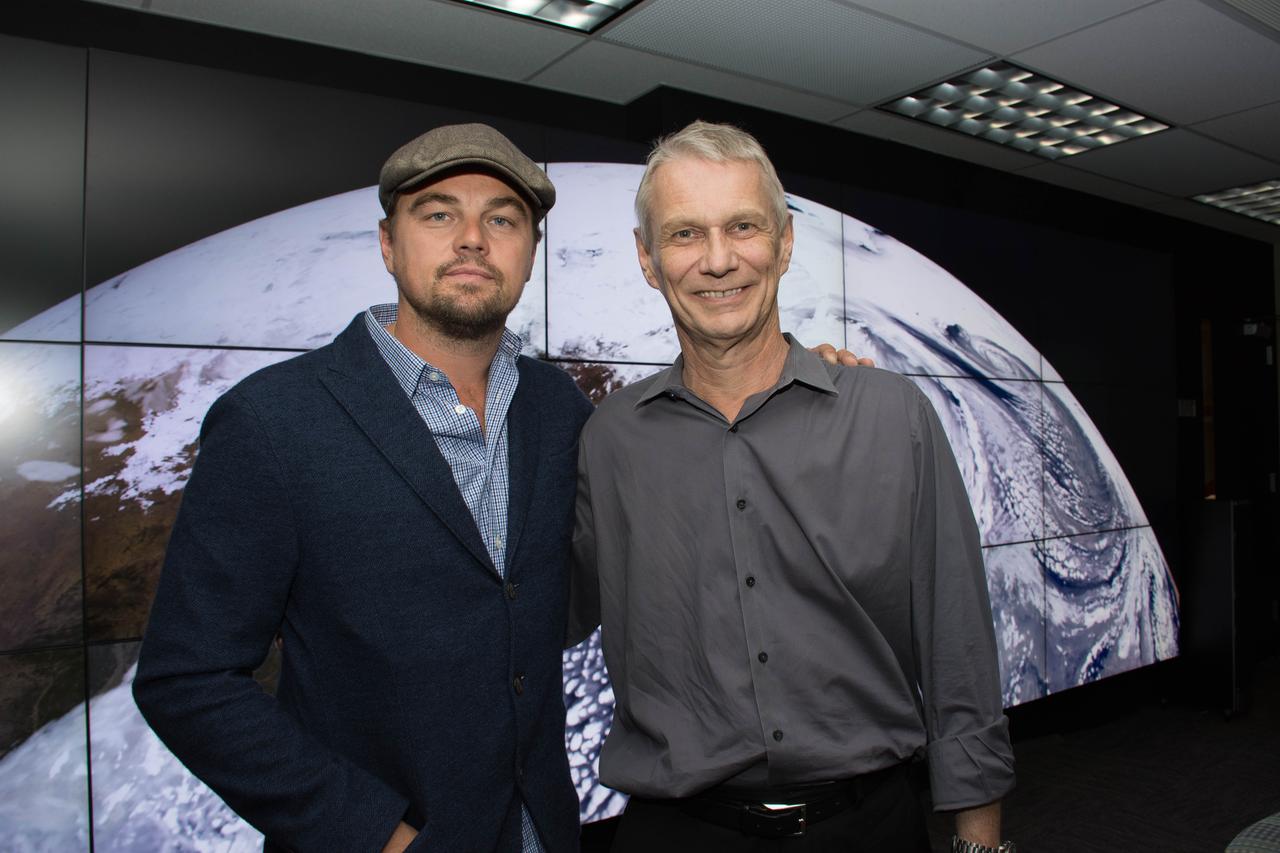
Academy Award®- winning actor and environmental activist Leonardo DiCaprio visited NASA’s Goddard Space Flight Center in Greenbelt, Maryland on Saturday, April 23, 2016. During his visit, Mr. DiCaprio interviewed Dr. Piers Sellers, an Earth scientist, former astronaut and current deputy director of Goddard’s Sciences and Exploration Directorate. The two discussed the different missions NASA has underway to study changes in the Earth’s atmosphere, water and land masses for a climate change documentary that Mr. DiCaprio has in production. Using a wall-size, high-definition display system that shows visual representations based on actual science data, Mr. DiCaprio and Dr. Sellers discussed data results from NASA’s fleet of satellites in Earth’s orbit. During his visit, Mr. DiCaprio also visited the facility holding NASA’s James Webb Space Telescope that is being developed as a large infrared telescope with a 6.5-meter primary mirror. The telescope will be launched on an Ariane 5 rocket from French Guiana in October of 2018, and will be a premier observatory of the next decade, serving thousands of astronomers worldwide. Credit: NASA/Goddard/Rebecca Roth <b><a href="http://www.nasa.gov/audience/formedia/features/MP_Photo_Guidelines.html" rel="nofollow">NASA image use policy.</a></b> <b><a href="http://www.nasa.gov/centers/goddard/home/index.html" rel="nofollow">NASA Goddard Space Flight Center</a></b> enables NASA’s mission through four scientific endeavors: Earth Science, Heliophysics, Solar System Exploration, and Astrophysics. Goddard plays a leading role in NASA’s accomplishments by contributing compelling scientific knowledge to advance the Agency’s mission. <b>Follow us on <a href="http://twitter.com/NASAGoddardPix" rel="nofollow">Twitter</a></b> <b>Like us on <a href="http://www.facebook.com/pages/Greenbelt-MD/NASA-Goddard/395013845897?ref=tsd" rel="nofollow">Facebook</a></b> <b>Find us on <a href="http://instagrid.me/nasagoddard/?vm=grid" rel="nofollow">Instagram</a></b>
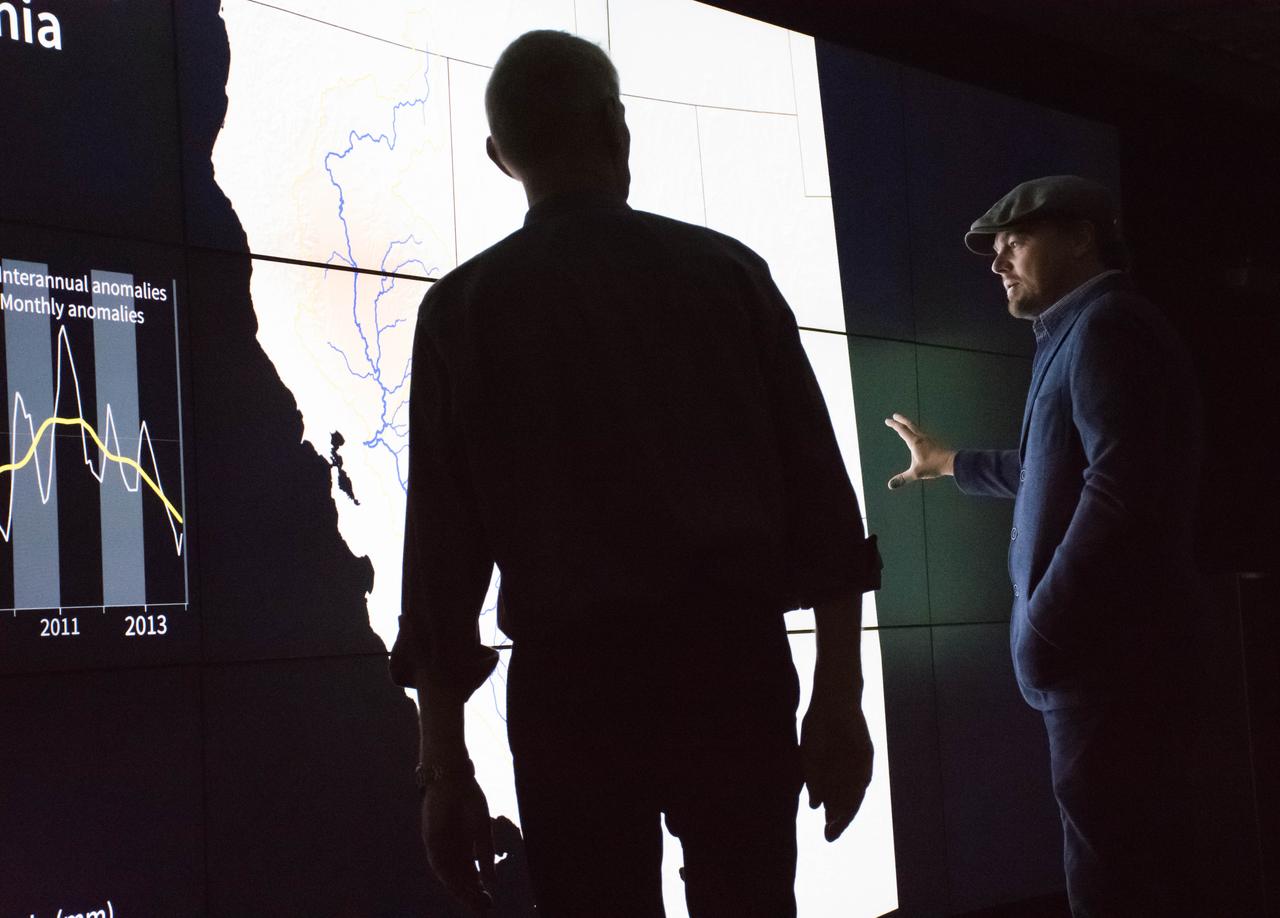
Academy Award®- winning actor and environmental activist Leonardo DiCaprio visited NASA’s Goddard Space Flight Center in Greenbelt, Maryland on Saturday, April 23, 2016. During his visit, Mr. DiCaprio interviewed Dr. Piers Sellers, an Earth scientist, former astronaut and current deputy director of Goddard’s Sciences and Exploration Directorate. The two discussed the different missions NASA has underway to study changes in the Earth’s atmosphere, water and land masses for a climate change documentary that Mr. DiCaprio has in production. Using a wall-size, high-definition display system that shows visual representations based on actual science data, Mr. DiCaprio and Dr. Sellers discussed data results from NASA’s fleet of satellites in Earth’s orbit. During his visit, Mr. DiCaprio also visited the facility holding NASA’s James Webb Space Telescope that is being developed as a large infrared telescope with a 6.5-meter primary mirror. The telescope will be launched on an Ariane 5 rocket from French Guiana in October of 2018, and will be a premier observatory of the next decade, serving thousands of astronomers worldwide. Credit: NASA/Goddard/Rebecca Roth <b><a href="http://www.nasa.gov/audience/formedia/features/MP_Photo_Guidelines.html" rel="nofollow">NASA image use policy.</a></b> <b><a href="http://www.nasa.gov/centers/goddard/home/index.html" rel="nofollow">NASA Goddard Space Flight Center</a></b> enables NASA’s mission through four scientific endeavors: Earth Science, Heliophysics, Solar System Exploration, and Astrophysics. Goddard plays a leading role in NASA’s accomplishments by contributing compelling scientific knowledge to advance the Agency’s mission. <b>Follow us on <a href="http://twitter.com/NASAGoddardPix" rel="nofollow">Twitter</a></b> <b>Like us on <a href="http://www.facebook.com/pages/Greenbelt-MD/NASA-Goddard/395013845897?ref=tsd" rel="nofollow">Facebook</a></b> <b>Find us on <a href="http://instagrid.me/nasagoddard/?vm=grid" rel="nofollow">Instagram</a></b>
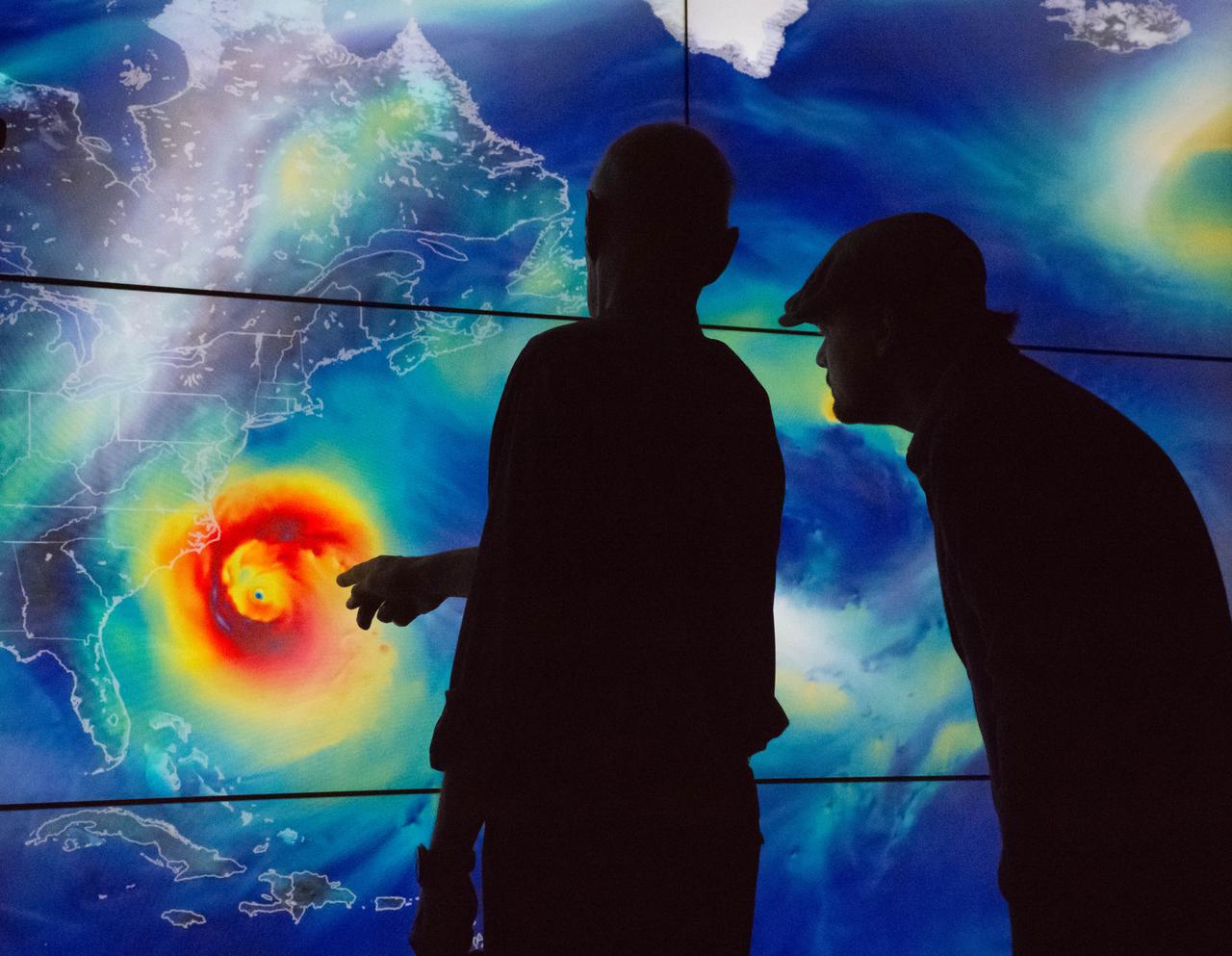
Academy Award®- winning actor and environmental activist Leonardo DiCaprio visited NASA’s Goddard Space Flight Center in Greenbelt, Maryland on Saturday, April 23, 2016. During his visit, Mr. DiCaprio interviewed Dr. Piers Sellers, an Earth scientist, former astronaut and current deputy director of Goddard’s Sciences and Exploration Directorate. The two discussed the different missions NASA has underway to study changes in the Earth’s atmosphere, water and land masses for a climate change documentary that Mr. DiCaprio has in production. Using a wall-size, high-definition display system that shows visual representations based on actual science data, Mr. DiCaprio and Dr. Sellers discussed data results from NASA’s fleet of satellites in Earth’s orbit. The visual shows Hurricane Sandy. The visual uses data from Goddard Earth Observing System Model, Version 5 (GEOS-5) to simulate surface wind speeds across the Atlantic during Sandy’s lifecycle. <a href="http://svs.gsfc.nasa.gov/cgi-bin/details.cgi?aid=30465" rel="nofollow">svs.gsfc.nasa.gov/cgi-bin/details.cgi?aid=30465</a> During his visit, Mr. DiCaprio also visited the facility holding NASA’s James Webb Space Telescope that is being developed as a large infrared telescope with a 6.5-meter primary mirror. The telescope will be launched on an Ariane 5 rocket from French Guiana in October of 2018, and will be a premier observatory of the next decade, serving thousands of astronomers worldwide. Credit: NASA/Goddard/Rebecca Roth <b><a href="http://www.nasa.gov/audience/formedia/features/MP_Photo_Guidelines.html" rel="nofollow">NASA image use policy.</a></b> <b><a href="http://www.nasa.gov/centers/goddard/home/index.html" rel="nofollow">NASA Goddard Space Flight Center</a></b> enables NASA’s mission through four scientific endeavors: Earth Science, Heliophysics, Solar System Exploration, and Astrophysics. Goddard plays a leading role in NASA’s accomplishments by contributing compelling scientific knowledge to advance the Agency’s mission. <b>Follow us on <a href="http://twitter.com/NASAGoddardPix" rel="nofollow">Twitter</a></b> <b>Like us on <a href="http://www.facebook.com/pages/Greenbelt-MD/NASA-Goddard/395013845897?ref=tsd" rel="nofollow">Facebook</a></b> <b>Find us on <a href="http://instagrid.me/nasagoddard/?vm=grid" rel="nofollow">Instagram</a></b>
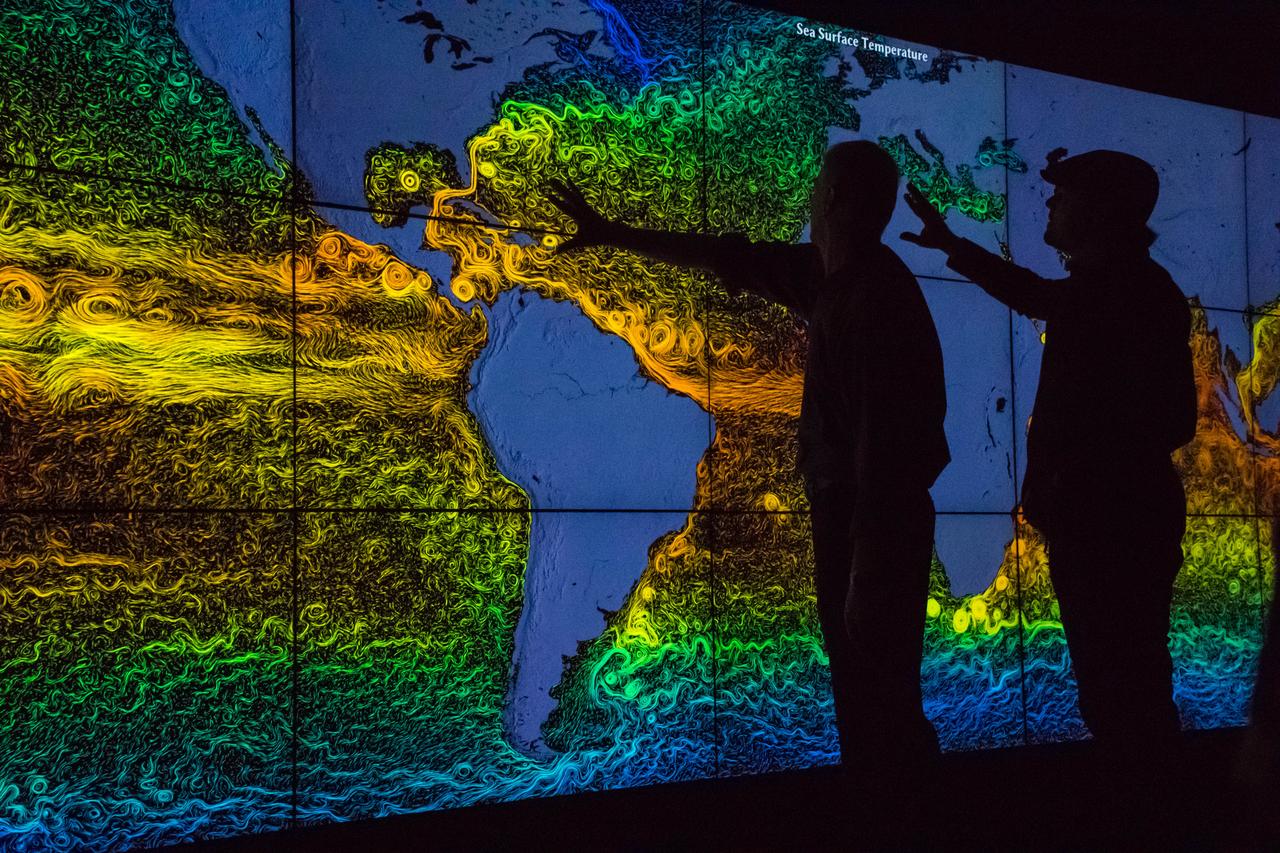
Academy Award®- winning actor and environmental activist Leonardo DiCaprio visited NASA’s Goddard Space Flight Center in Greenbelt, Maryland on Saturday, April 23, 2016. During his visit, Mr. DiCaprio interviewed Dr. Piers Sellers, an Earth scientist, former astronaut and current deputy director of Goddard’s Sciences and Exploration Directorate. The two discussed the different missions NASA has underway to study changes in the Earth’s atmosphere, water and land masses for a climate change documentary that Mr. DiCaprio has in production. Using a wall-size, high-definition display system that shows visual representations based on actual science data, Mr. DiCaprio and Dr. Sellers discussed data results from NASA’s fleet of satellites in Earth’s orbit. The background image showing global sea surface circulation colored by temperature where reds are warm areas (32 degrees Celsius) and blues are cold regions (0 degrees Celsius). The data used for this visual is a joint MIT/JPL project called Estimating the Circulation and Climate of the Ocean, Phase II (ECCO2). For more info on this visual, <a href="http://svs.gsfc.nasa.gov/cgi-bin/details.cgi?aid=3912" rel="nofollow">svs.gsfc.nasa.gov/cgi-bin/details.cgi?aid=3912</a> During his visit, Mr. DiCaprio also visited the facility holding NASA’s James Webb Space Telescope that is being developed as a large infrared telescope with a 6.5-meter primary mirror. The telescope will be launched on an Ariane 5 rocket from French Guiana in October of 2018, and will be a premier observatory of the next decade, serving thousands of astronomers worldwide. Credit: NASA/Goddard/Rebecca Roth <b><a href="http://www.nasa.gov/audience/formedia/features/MP_Photo_Guidelines.html" rel="nofollow">NASA image use policy.</a></b> <b><a href="http://www.nasa.gov/centers/goddard/home/index.html" rel="nofollow">NASA Goddard Space Flight Center</a></b> enables NASA’s mission through four scientific endeavors: Earth Science, Heliophysics, Solar System Exploration, and Astrophysics. Goddard plays a leading role in NASA’s accomplishments by contributing compelling scientific knowledge to advance the Agency’s mission. <b>Follow us on <a href="http://twitter.com/NASAGoddardPix" rel="nofollow">Twitter</a></b> <b>Like us on <a href="http://www.facebook.com/pages/Greenbelt-MD/NASA-Goddard/395013845897?ref=tsd" rel="nofollow">Facebook</a></b> <b>Find us on <a href="http://instagrid.me/nasagoddard/?vm=grid" rel="nofollow">Instagram</a></b>
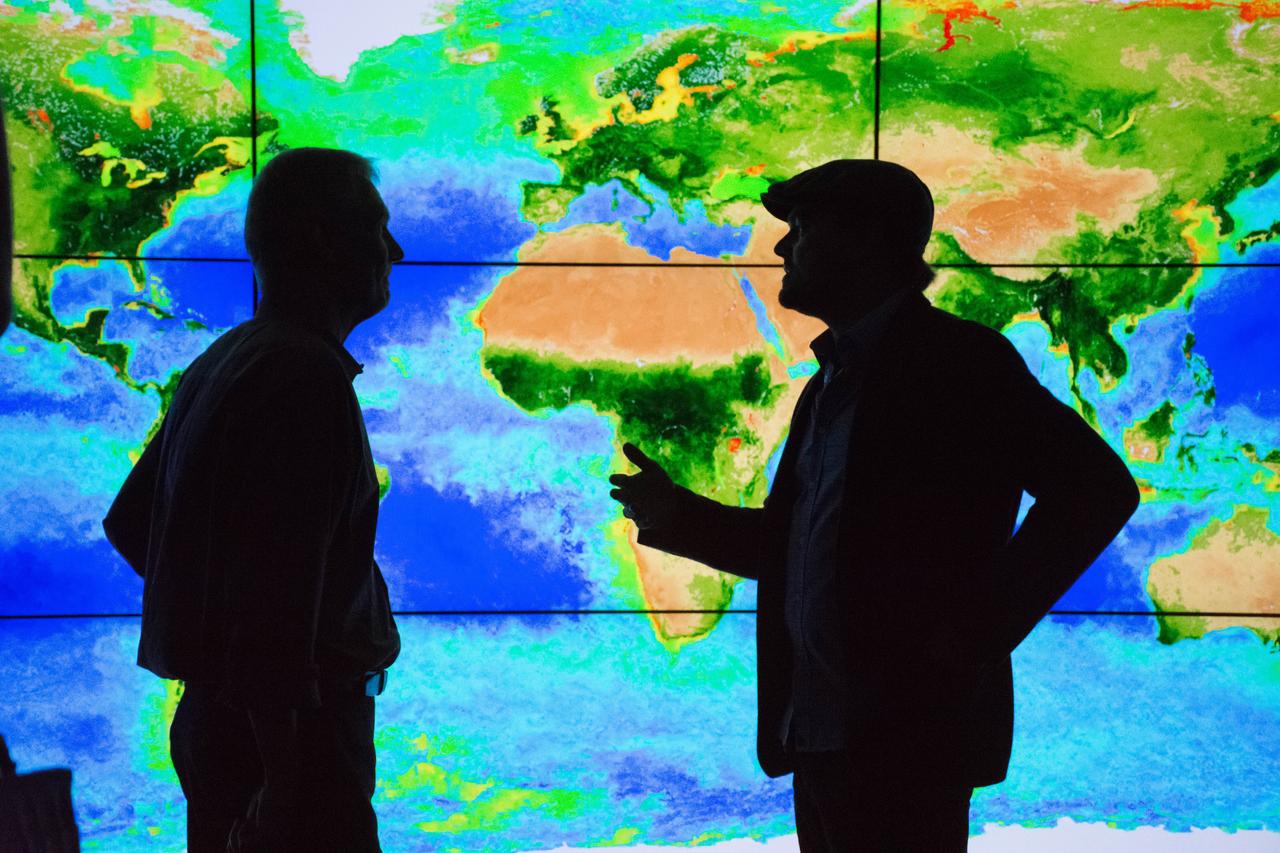
Academy Award®- winning actor and environmental activist Leonardo DiCaprio visited NASA’s Goddard Space Flight Center in Greenbelt, Maryland on Saturday, April 23, 2016. During his visit, Mr. DiCaprio interviewed Dr. Piers Sellers, an Earth scientist, former astronaut and current deputy director of Goddard’s Sciences and Exploration Directorate. The two discussed the different missions NASA has underway to study changes in the Earth’s atmosphere, water and land masses for a climate change documentary that Mr. DiCaprio has in production. Using a wall-size, high-definition display system that shows visual representations based on actual science data, Mr. DiCaprio and Dr. Sellers discussed data results from NASA’s fleet of satellites in Earth’s orbit. The background visual shows the biosphere with data from a NASA satellite instrument called the Sea-viewing Wide Field-of-View Sensor (SeaWiFS). <a href="http://svs.gsfc.nasa.gov/cgi-bin/details.cgi?aid=10704" rel="nofollow">svs.gsfc.nasa.gov/cgi-bin/details.cgi?aid=10704</a> During his visit, Mr. DiCaprio also visited the facility holding NASA’s James Webb Space Telescope that is being developed as a large infrared telescope with a 6.5-meter primary mirror. The telescope will be launched on an Ariane 5 rocket from French Guiana in October of 2018, and will be a premier observatory of the next decade, serving thousands of astronomers worldwide. Credit: NASA/Goddard/Rebecca Roth <b><a href="http://www.nasa.gov/audience/formedia/features/MP_Photo_Guidelines.html" rel="nofollow">NASA image use policy.</a></b> <b><a href="http://www.nasa.gov/centers/goddard/home/index.html" rel="nofollow">NASA Goddard Space Flight Center</a></b> enables NASA’s mission through four scientific endeavors: Earth Science, Heliophysics, Solar System Exploration, and Astrophysics. Goddard plays a leading role in NASA’s accomplishments by contributing compelling scientific knowledge to advance the Agency’s mission. <b>Follow us on <a href="http://twitter.com/NASAGoddardPix" rel="nofollow">Twitter</a></b> <b>Like us on <a href="http://www.facebook.com/pages/Greenbelt-MD/NASA-Goddard/395013845897?ref=tsd" rel="nofollow">Facebook</a></b> <b>Find us on <a href="http://instagrid.me/nasagoddard/?vm=grid" rel="nofollow">Instagram</a></b>

A CREW INSTALLS A NEW EARTH SCIENCE RECEIVING SATELLITE ANTENNA OUTSIDE MARSHALL SPACE FLIGHT CENTER'S ACTIVITIES BUILDING 4316

A CREW INSTALLS A NEW EARTH SCIENCE RECEIVING SATELLITE ANTENNA OUTSIDE MARSHALL SPACE FLIGHT CENTER'S ACTIVITIES BUILDING 4316

A CREW INSTALLS A NEW EARTH SCIENCE RECEIVING SATELLITE ANTENNA OUTSIDE MARSHALL SPACE FLIGHT CENTER'S ACTIVITIES BUILDING 4316

A CREW INSTALLS A NEW EARTH SCIENCE RECEIVING SATELLITE ANTENNA OUTSIDE MARSHALL SPACE FLIGHT CENTER'S ACTIVITIES BUILDING 4316
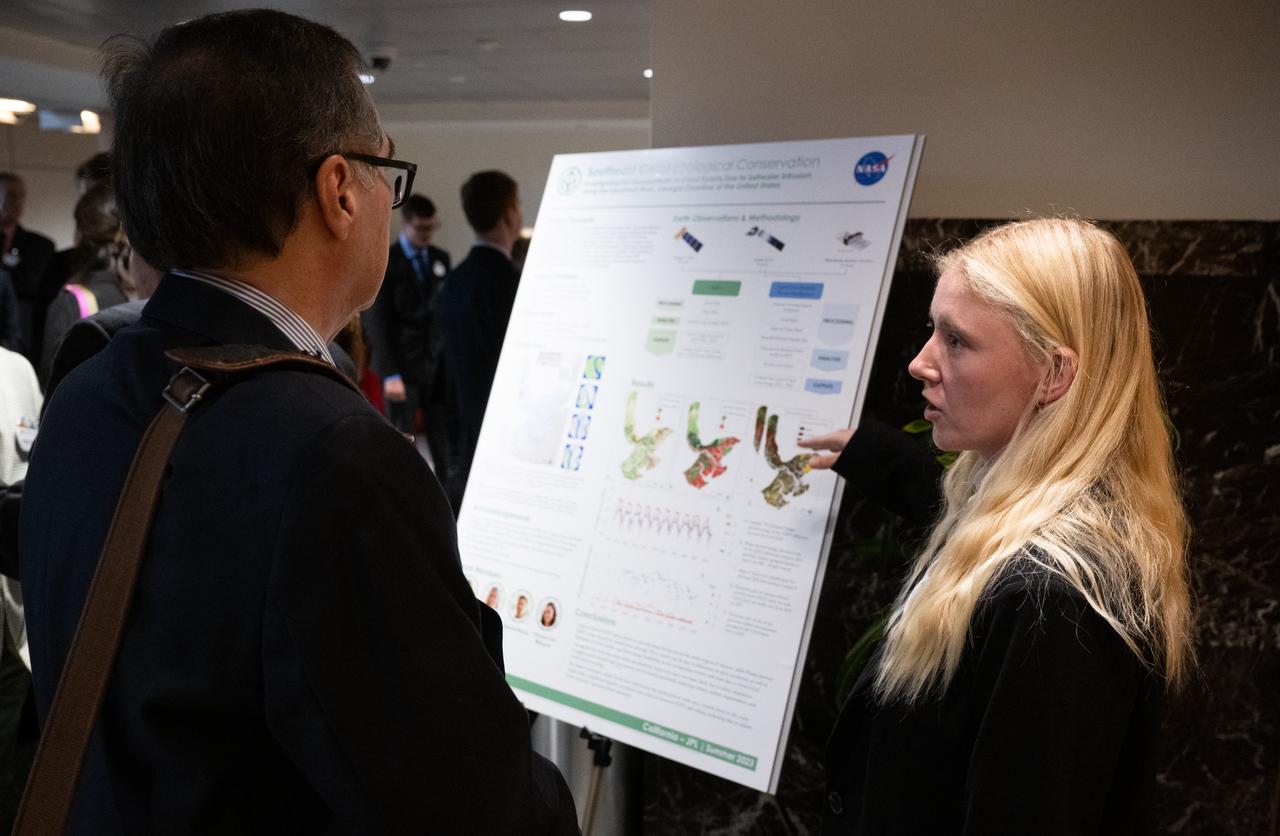
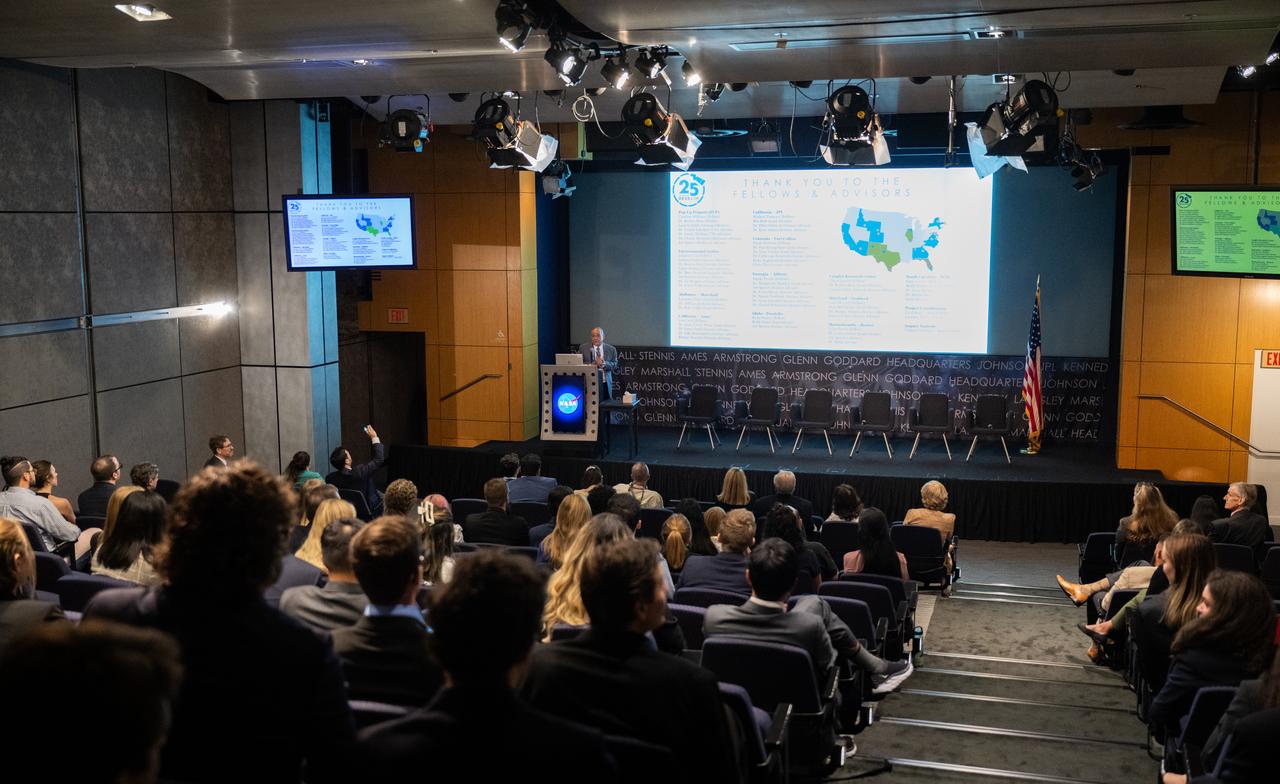
Students and young professionals discuss their projects during the 2023 DEVELOP Day, Wednesday, Aug. 9, 2023, at the Mary W. Jackson NASA Headquarters building in Washington. Every summer students and young professionals from NASA’s Applied Sciences’ DEVELOP National Program come to NASA Headquarters to present their research. This year marks the 25th year of DEVELOP, a training and development program where students work on Earth science research projects, mentored by science advisors from NASA and partner agencies, and extend research results to local communities. Photo Credit: (NASA/Joel Kowsky)
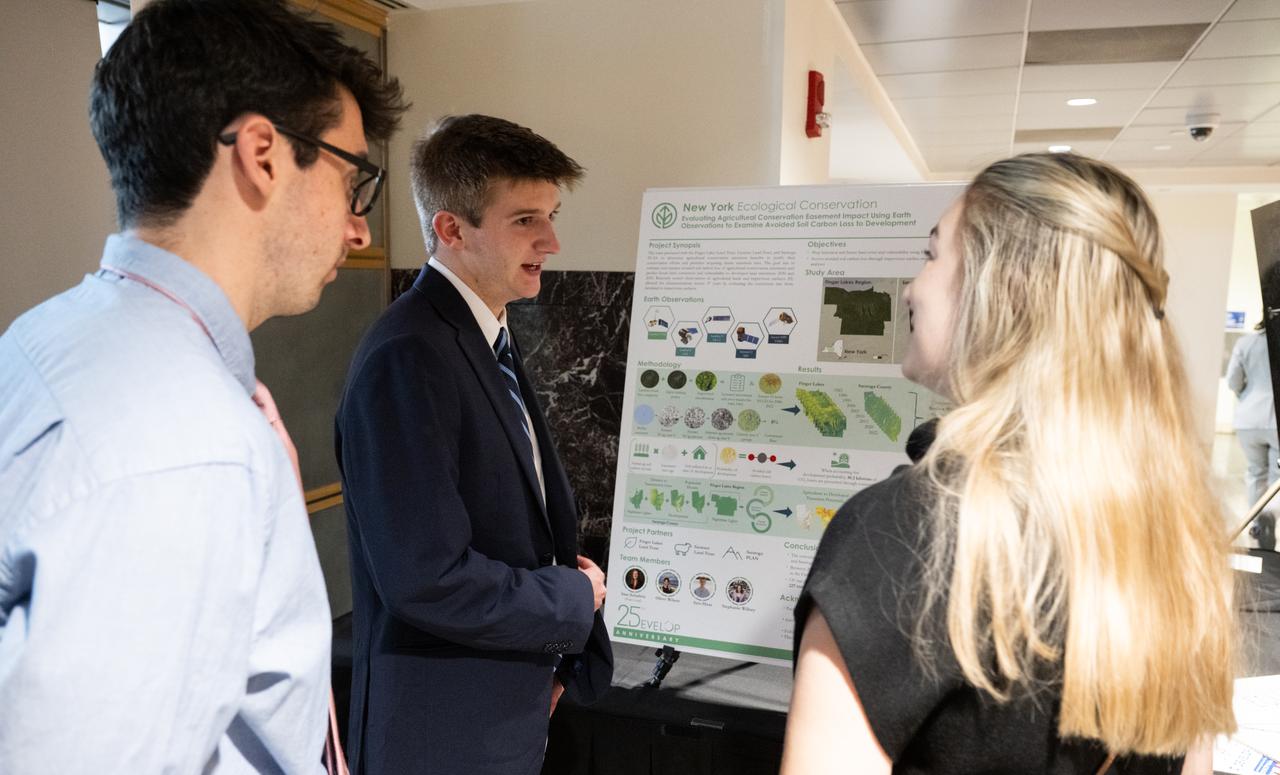
Students and young professionals discuss their projects during the 2023 DEVELOP Day, Wednesday, Aug. 9, 2023, at the Mary W. Jackson NASA Headquarters building in Washington. Every summer students and young professionals from NASA’s Applied Sciences’ DEVELOP National Program come to NASA Headquarters to present their research. This year marks the 25th year of DEVELOP, a training and development program where students work on Earth science research projects, mentored by science advisors from NASA and partner agencies, and extend research results to local communities. Photo Credit: (NASA/Joel Kowsky)
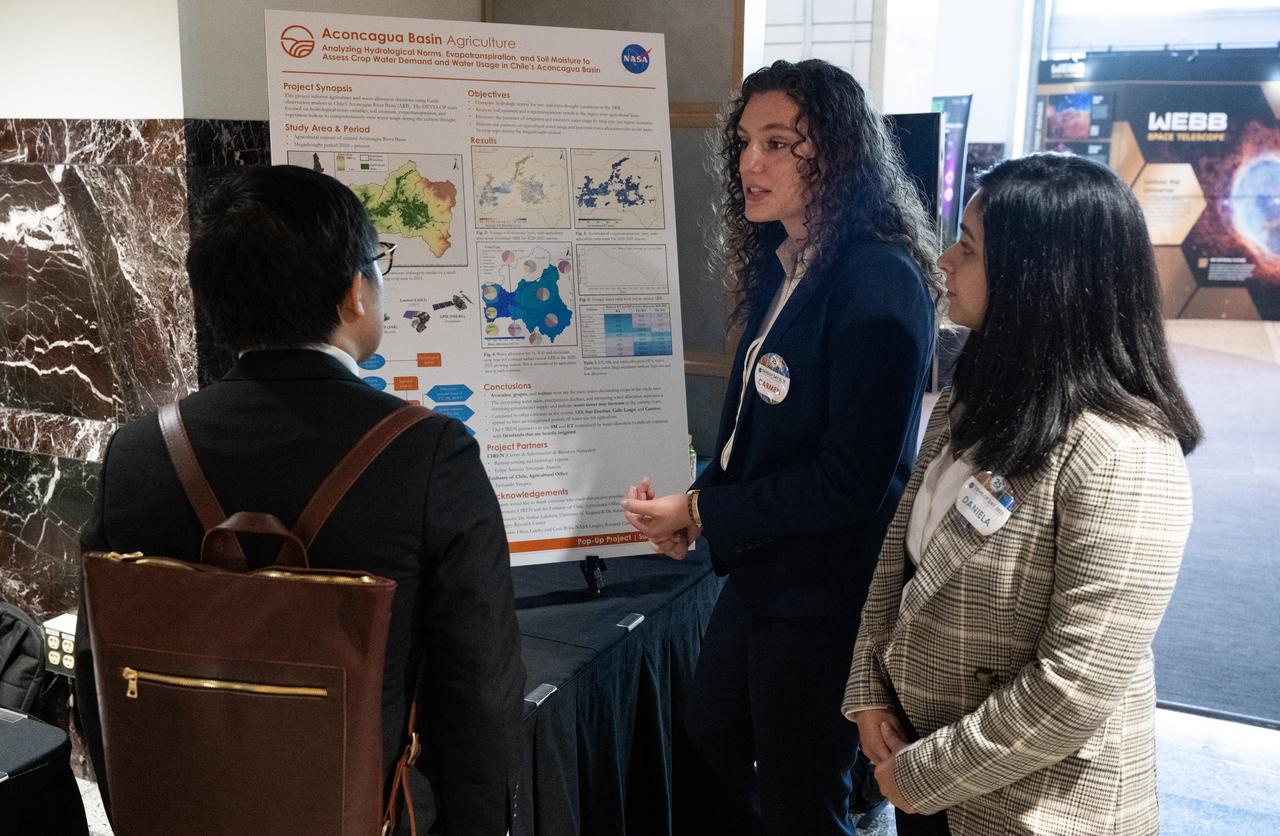
Students and young professionals discuss their projects during the 2023 DEVELOP Day, Wednesday, Aug. 9, 2023, at the Mary W. Jackson NASA Headquarters building in Washington. Every summer students and young professionals from NASA’s Applied Sciences’ DEVELOP National Program come to NASA Headquarters to present their research. This year marks the 25th year of DEVELOP, a training and development program where students work on Earth science research projects, mentored by science advisors from NASA and partner agencies, and extend research results to local communities. Photo Credit: (NASA/Joel Kowsky)
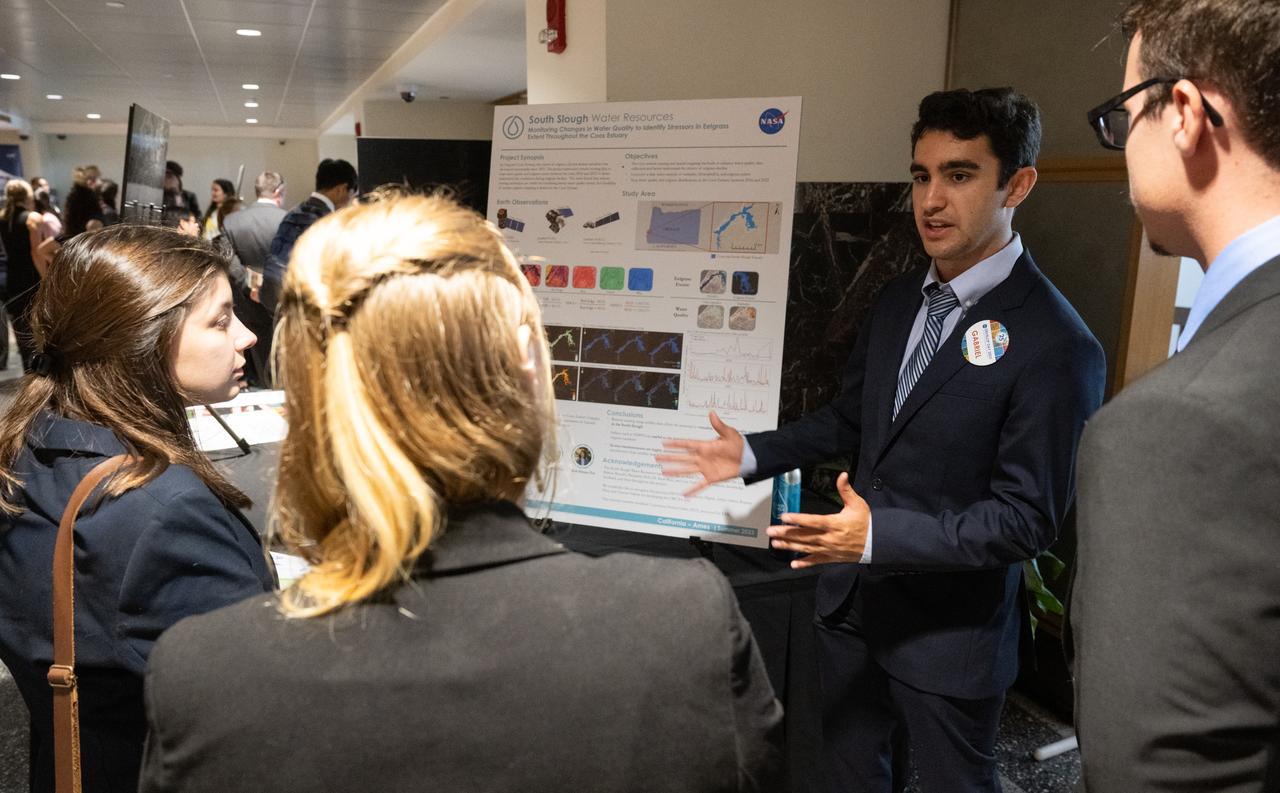
Students and young professionals discuss their projects during the 2023 DEVELOP Day, Wednesday, Aug. 9, 2023, at the Mary W. Jackson NASA Headquarters building in Washington. Every summer students and young professionals from NASA’s Applied Sciences’ DEVELOP National Program come to NASA Headquarters to present their research. This year marks the 25th year of DEVELOP, a training and development program where students work on Earth science research projects, mentored by science advisors from NASA and partner agencies, and extend research results to local communities. Photo Credit: (NASA/Joel Kowsky)

Australian Space Agency Head Enrico Palermo, left, and NASA Deputy Administrator Pam Melroy, shake hands after signing a joint statement of intent for cooperation in Earth science during the 37th Space Symposium, Monday, April 4, 2022, in Colorado Springs, Colorado. Photo Credit: (NASA/Bill Ingalls)
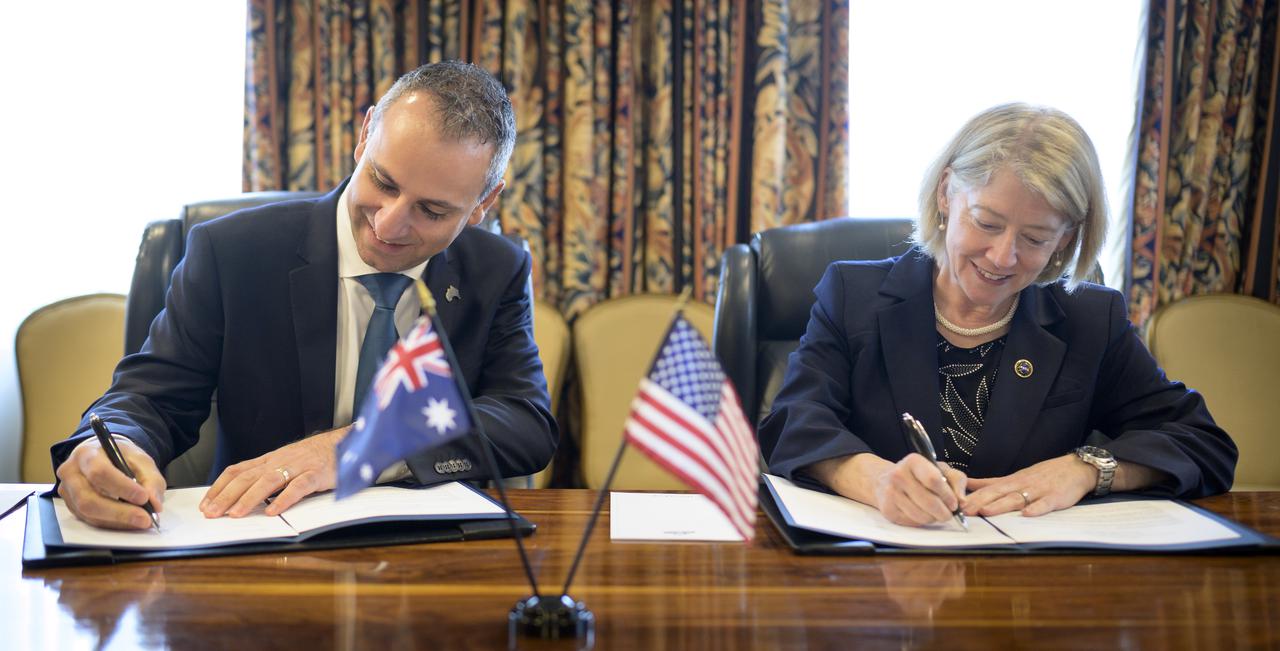
Australian Space Agency Head Enrico Palermo, left, and NASA Deputy Administrator Pam Melroy, sign a joint statement of intent for cooperation in Earth science during the 37th Space Symposium, Monday, April 4, 2022, in Colorado Springs, Colorado. Photo Credit: (NASA/Bill Ingalls)
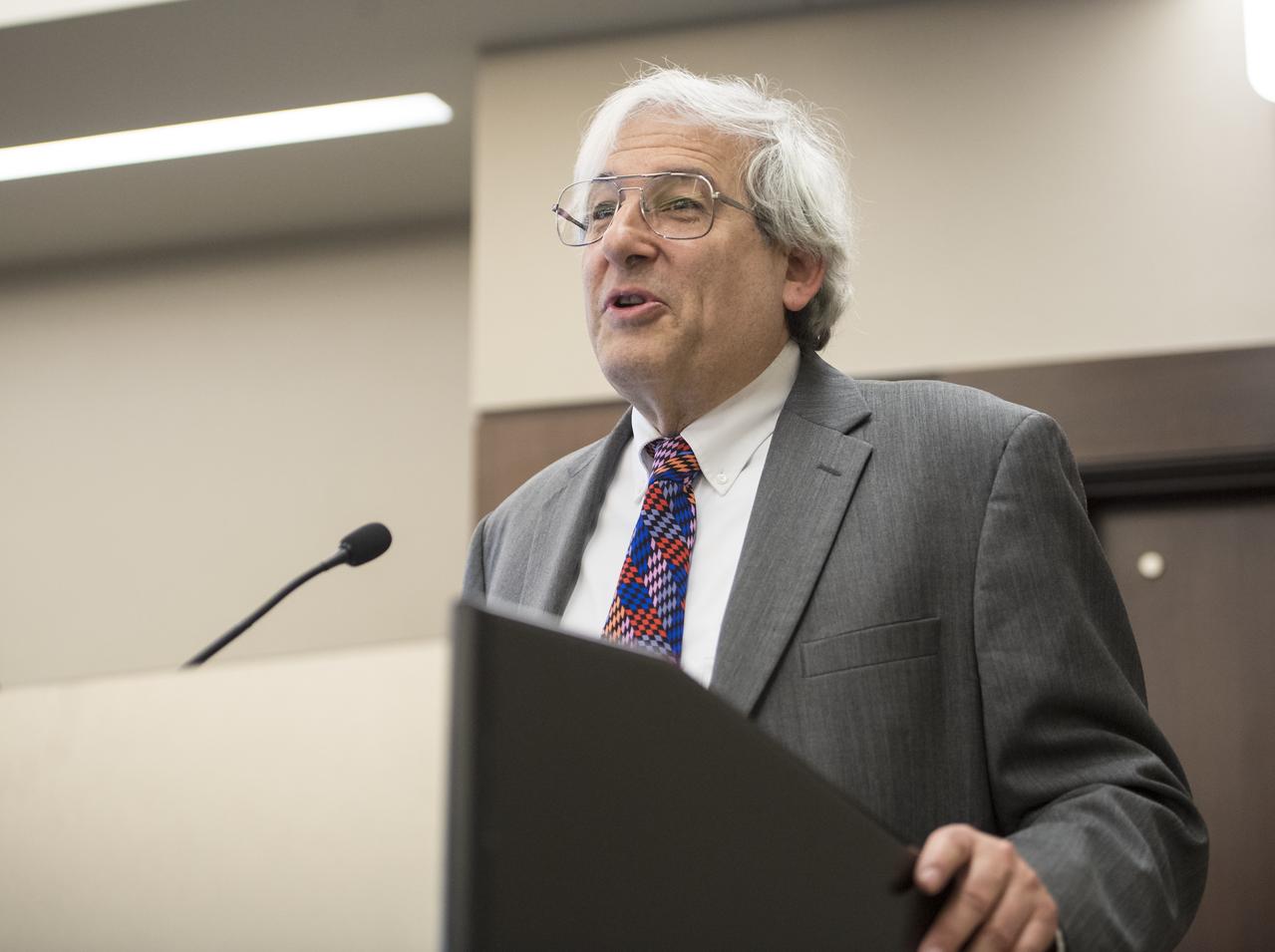
Dr. Michael Freilich, Earth Science Director, Science Mission Directorate, NASA, speaks at the Earth Science Town Hall at the American Geophysical Union (AGU) annual meeting, Tuesday, December 11, 2018 at the Marriott Marquis in Washington. Photo Credit: (NASA/Aubrey Gemignani)
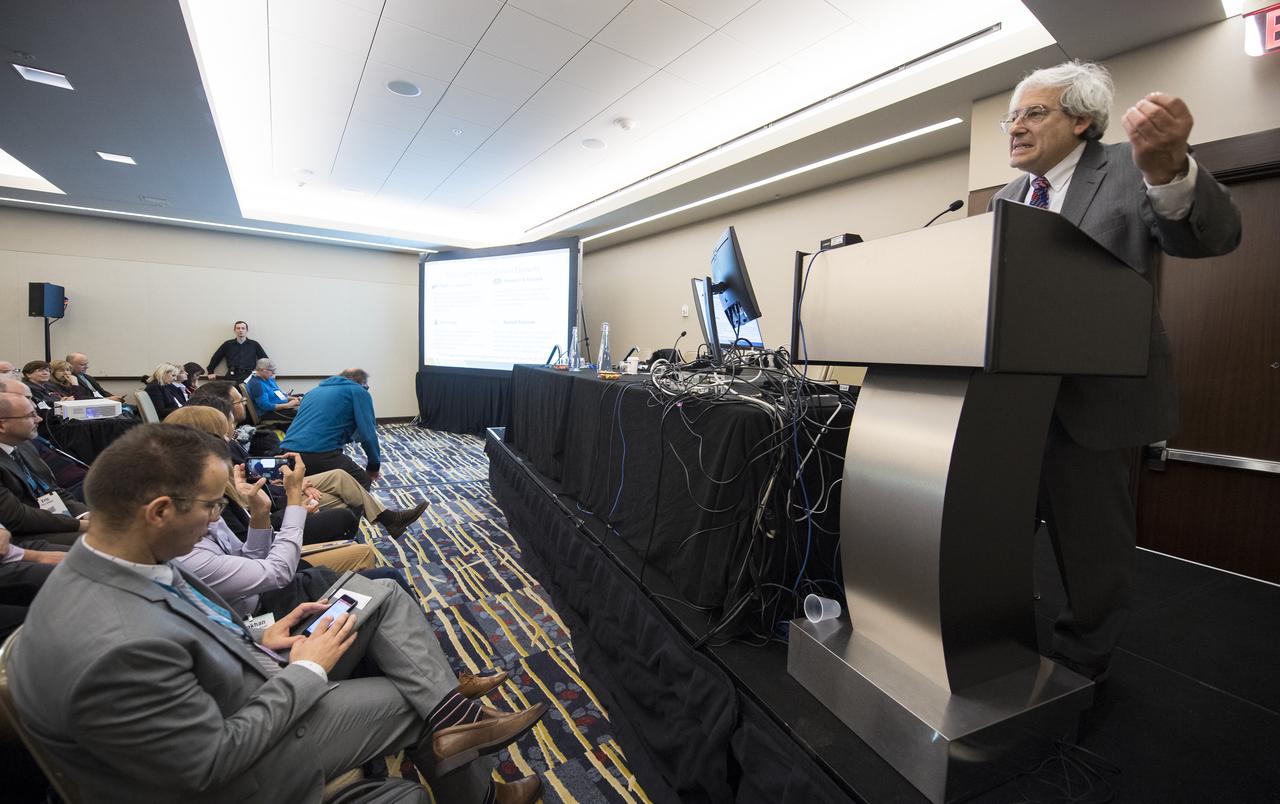
Dr. Michael Freilich, Earth Science Director, Science Mission Directorate, NASA, speaks at the Earth Science Town Hall at the American Geophysical Union (AGU) annual meeting, Tuesday, December 11, 2018 at the Marriott Marquis in Washington. Photo Credit: (NASA/Aubrey Gemignani)
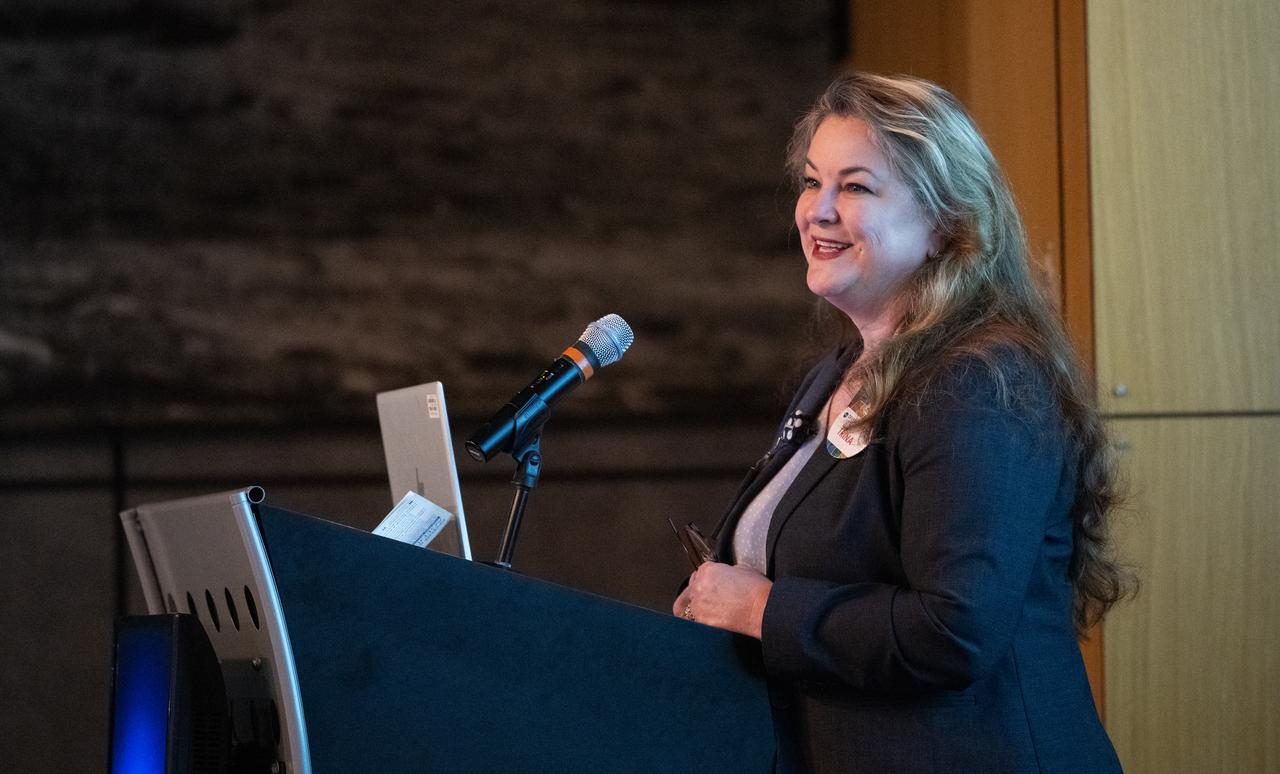
Trina Dyal, Director of the Science Directorate at NASA’s Langley Research Center, delivers closing remarks during the 2023 DEVELOP Day, Wednesday, Aug. 9, 2023, at the Mary W. Jackson NASA Headquarters building in Washington. Every summer students and young professionals from NASA’s Applied Sciences’ DEVELOP National Program come to NASA Headquarters to present their research. This year marks the 25th year of DEVELOP, a training and development program where students work on Earth science research projects, mentored by science advisors from NASA and partner agencies, and extend research results to local communities. Photo Credit: (NASA/Joel Kowsky)
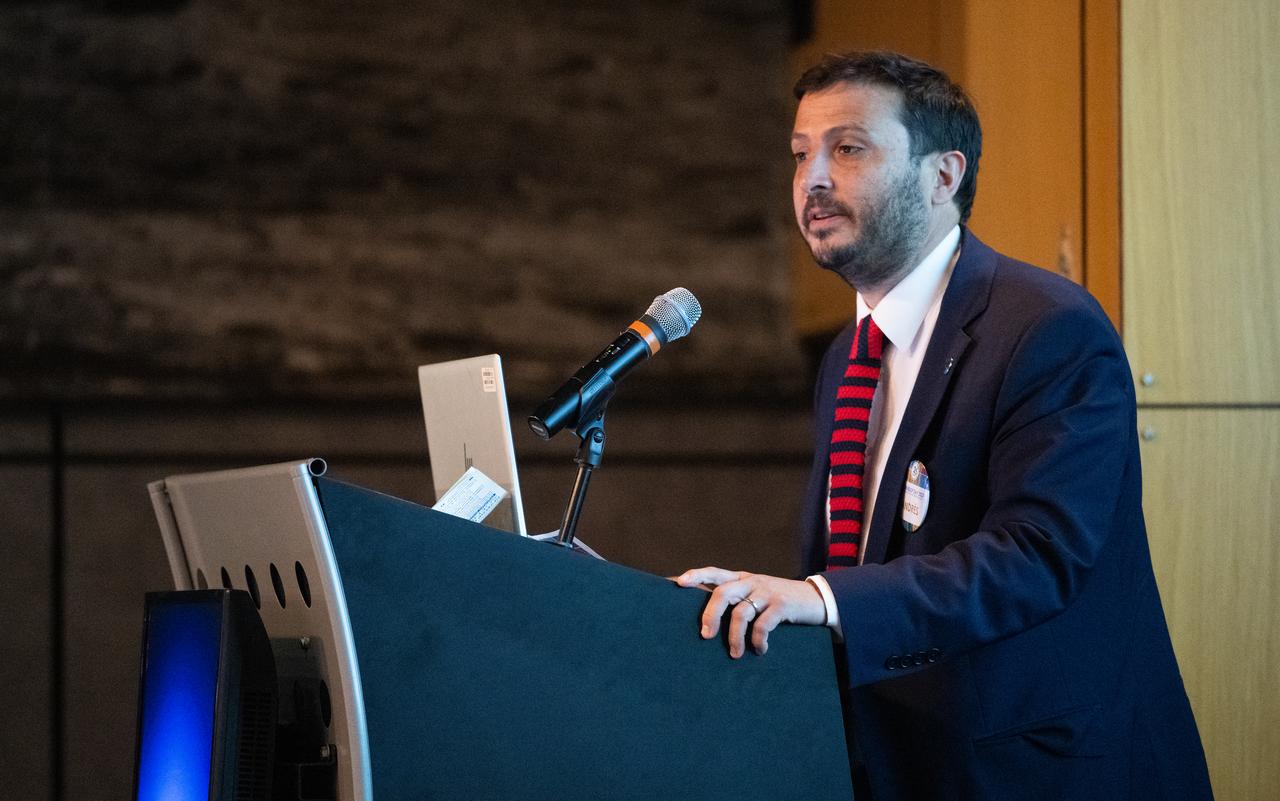
Andrés Rodriguez, Agricultural Attaché at the Embassy of Chile, delivers closing remarks during the 2023 DEVELOP Day, Wednesday, Aug. 9, 2023, at the Mary W. Jackson NASA Headquarters building in Washington. Every summer students and young professionals from NASA’s Applied Sciences’ DEVELOP National Program come to NASA Headquarters to present their research. This year marks the 25th year of DEVELOP, a training and development program where students work on Earth science research projects, mentored by science advisors from NASA and partner agencies, and extend research results to local communities. Photo Credit: (NASA/Joel Kowsky)
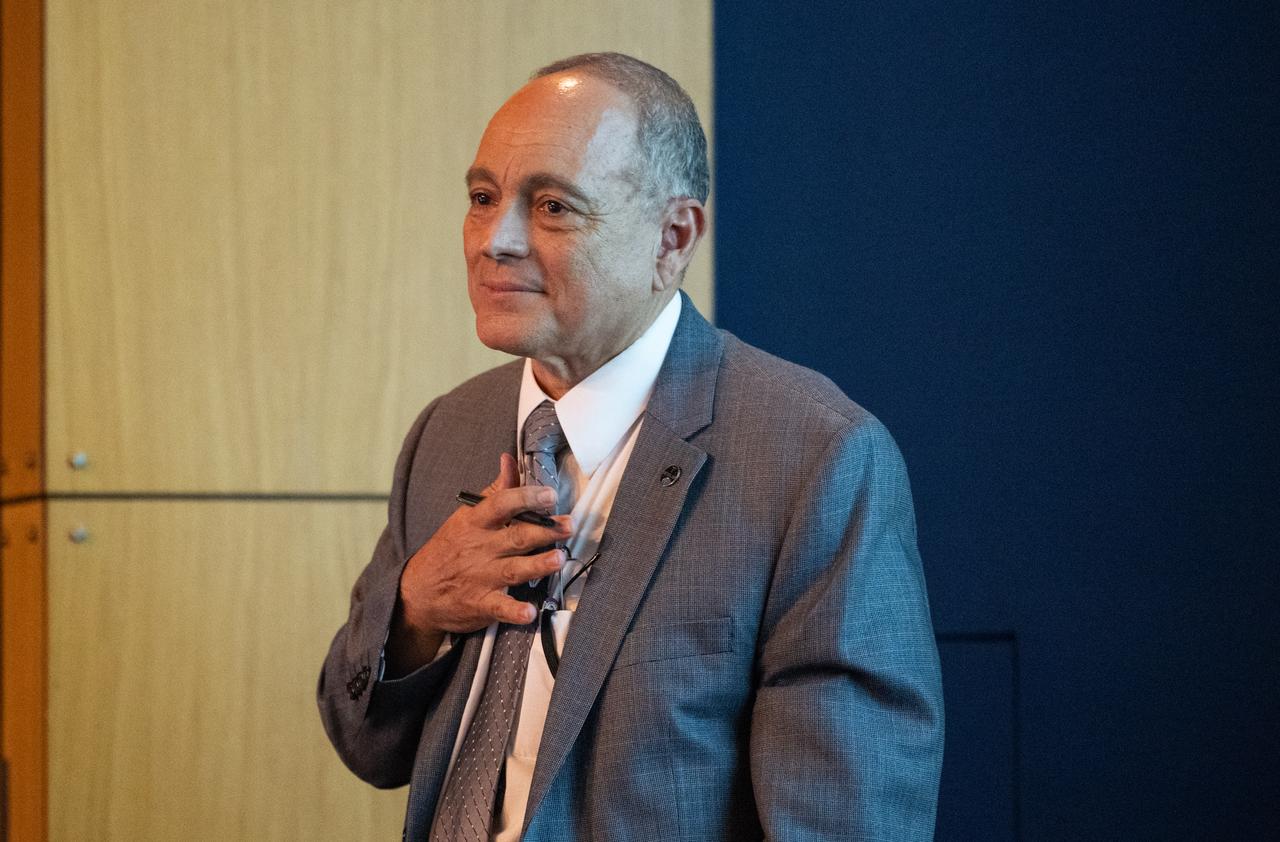
Mike Ruiz, former program manager for DEVELOP, delivers closing remarks during the 2023 DEVELOP Day, Wednesday, Aug. 9, 2023, at the Mary W. Jackson NASA Headquarters building in Washington. Every summer students and young professionals from NASA’s Applied Sciences’ DEVELOP National Program come to NASA Headquarters to present their research. This year marks the 25th year of DEVELOP, a training and development program where students work on Earth science research projects, mentored by science advisors from NASA and partner agencies, and extend research results to local communities. Photo Credit: (NASA/Joel Kowsky)
Mike Ruiz, former program manager for DEVELOP, delivers closing remarks during the 2023 DEVELOP Day, Wednesday, Aug. 9, 2023, at the Mary W. Jackson NASA Headquarters building in Washington. Every summer students and young professionals from NASA’s Applied Sciences’ DEVELOP National Program come to NASA Headquarters to present their research. This year marks the 25th year of DEVELOP, a training and development program where students work on Earth science research projects, mentored by science advisors from NASA and partner agencies, and extend research results to local communities. Photo Credit: (NASA/Joel Kowsky)
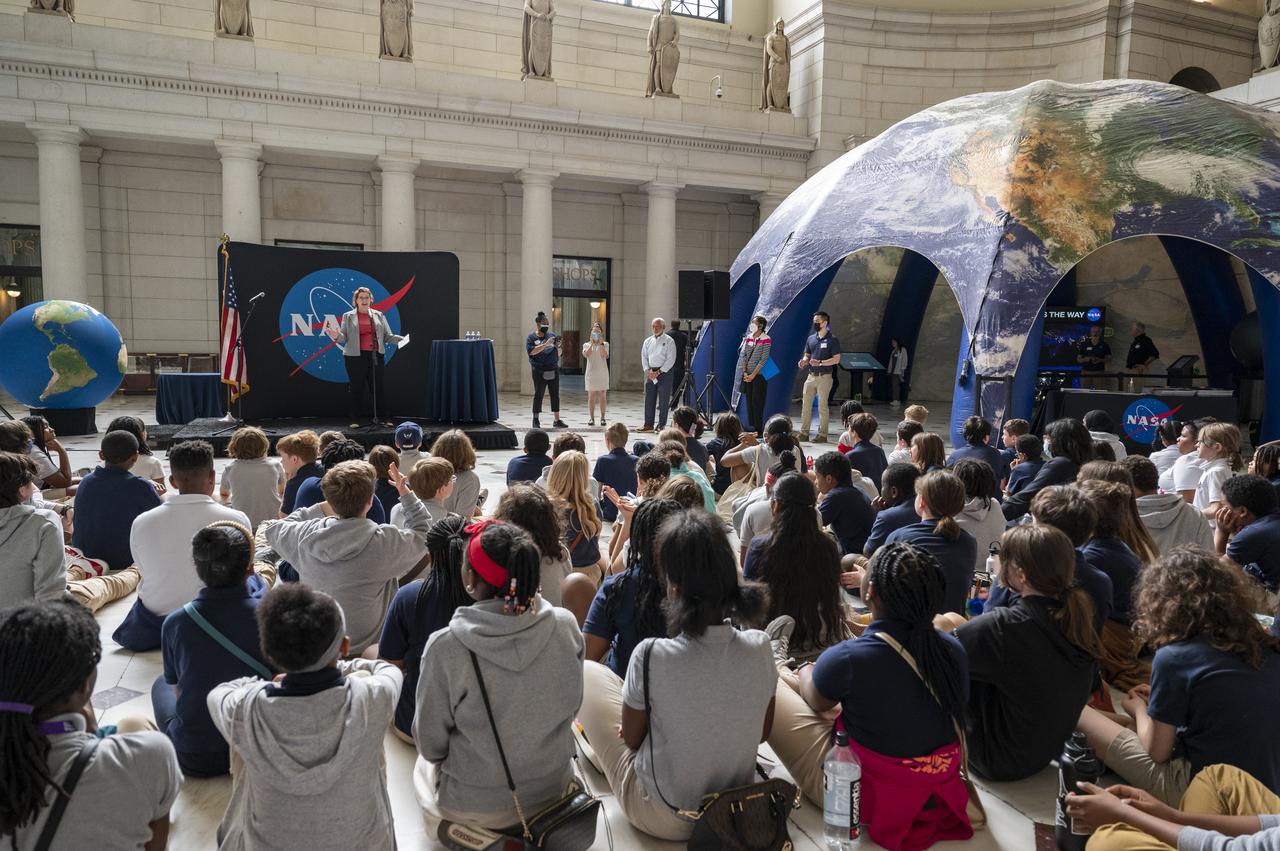
Earth Science Division Deputy Director Julie Robinson speaks with local students during an Earth Day event, Thursday, April 20, 2023, at Union Station in Washington. Photo Credit: (NASA/Keegan Barber)
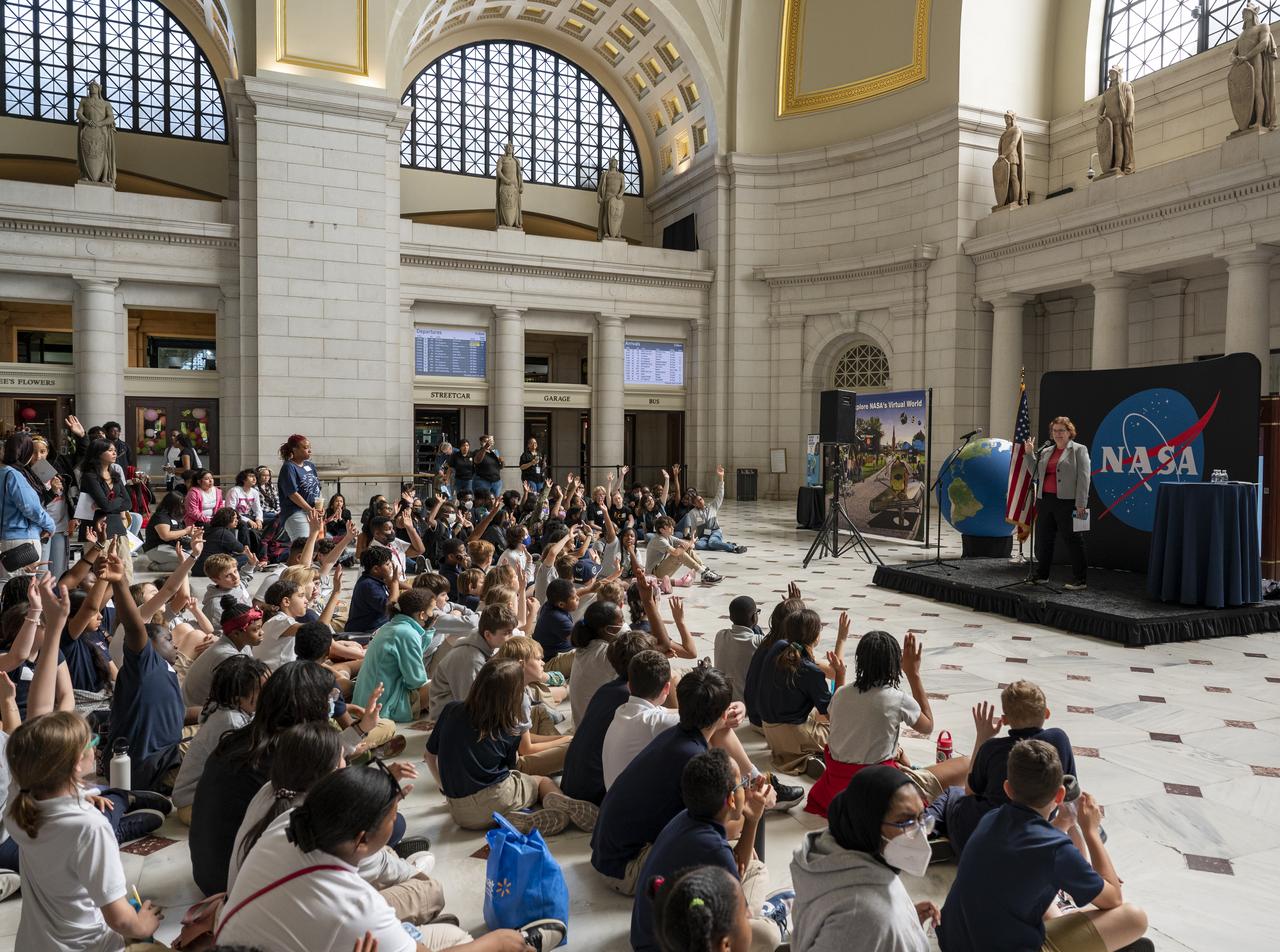
Earth Science Division Deputy Director Julie Robinson speaks with local students during an Earth Day event, Thursday, April 20, 2023, at Union Station in Washington. Photo Credit: (NASA/Keegan Barber)

Earth Science Division Deputy Director Julie Robinson speaks with local students during an Earth Day event, Thursday, April 20, 2023, at Union Station in Washington. Photo Credit: (NASA/Keegan Barber)
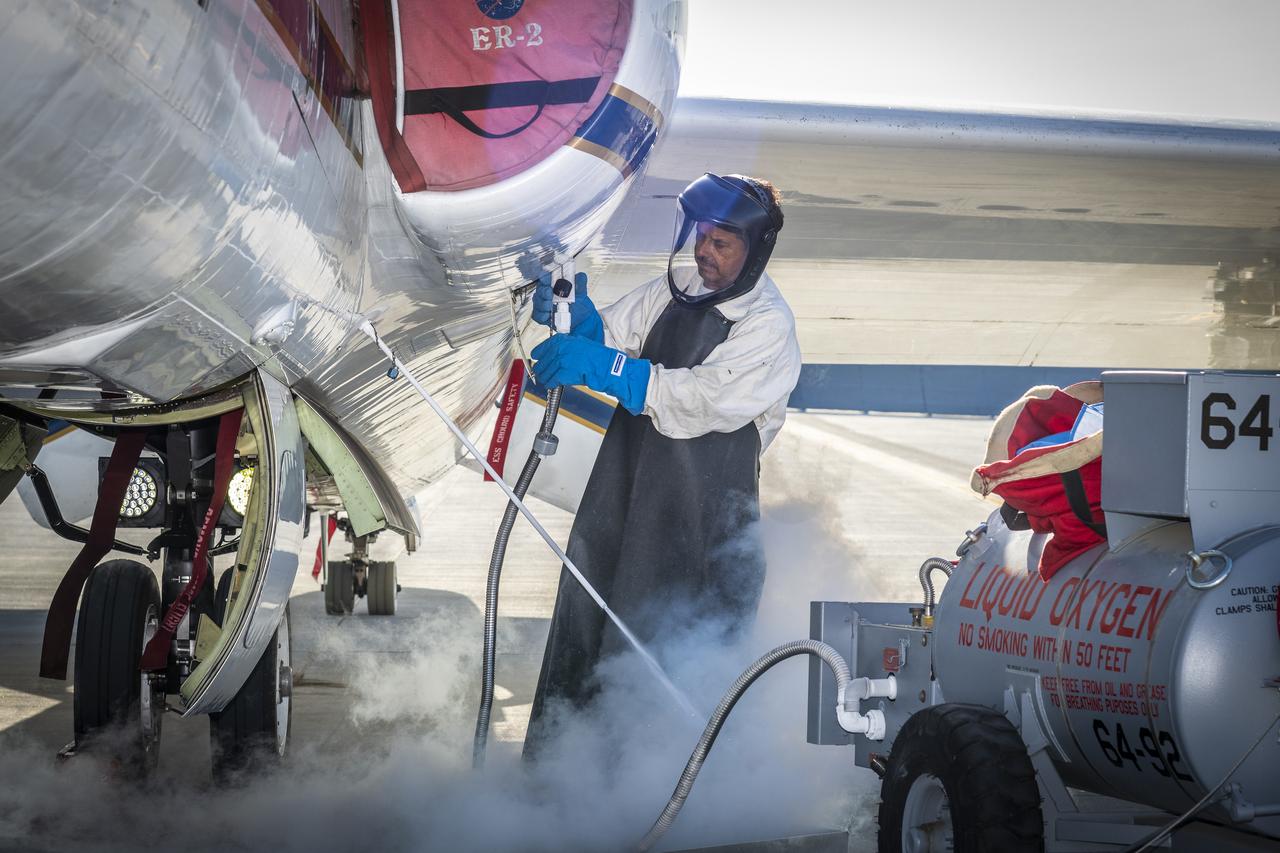
Francisco Rodriguez (aircraft mechanic) services liquid oxygen or LOX on the ER-2 during the Geological Earth Mapping Experiment (GEMx) research project. Experts like Rodriguez sustain a high standard of safety on airborne science aircraft like the ER-2 and science missions like GEMx. The ER-2 is based out of NASA’s Armstrong Flight Research Center in Edwards, California.
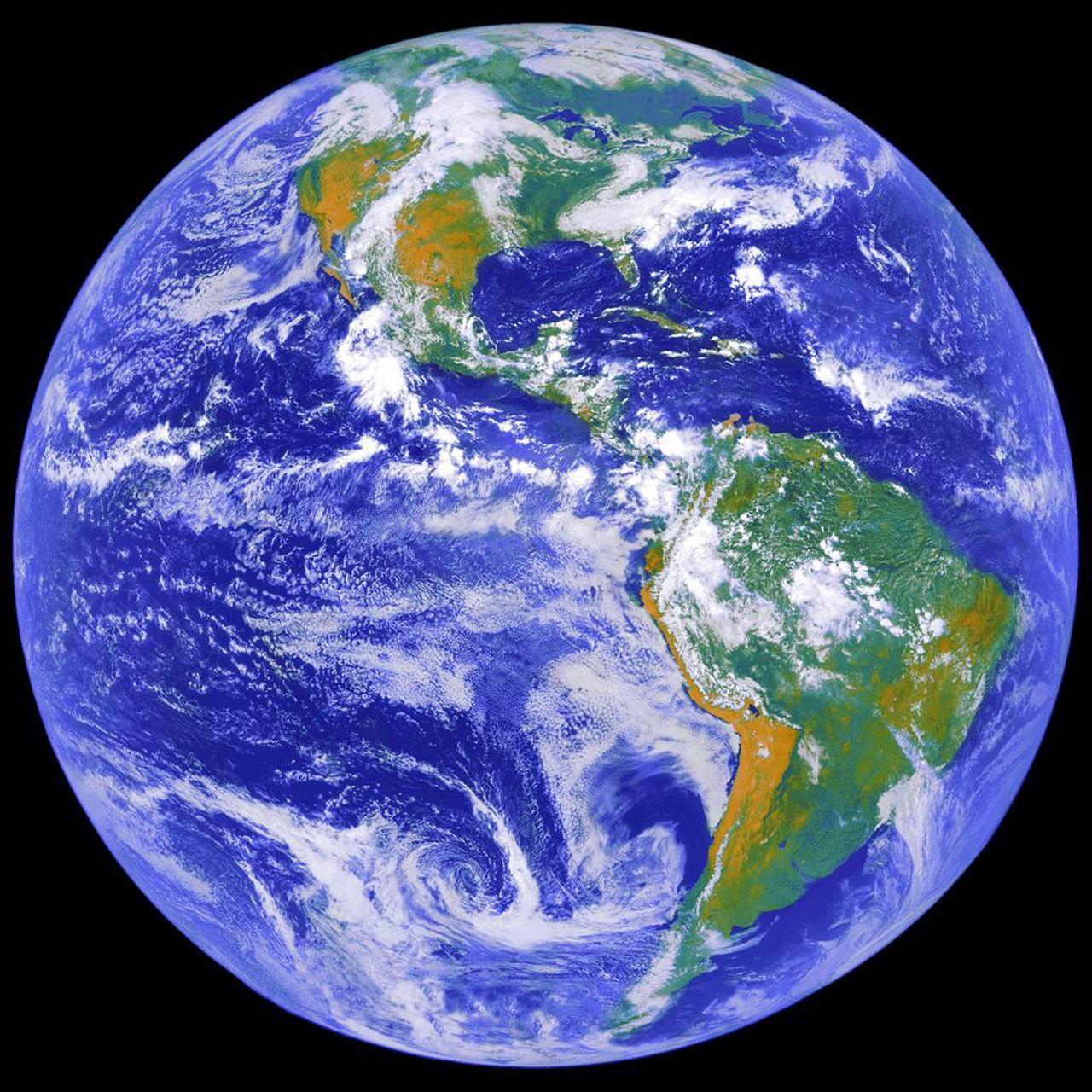
This image depicts a full view of the Earth, taken by the Geostationary Operational Environment Satellite (GOES-8). The red and green charnels represent visible data, while the blue channel represents inverted 11 micron infrared data. The north and south poles were not actually observed by GOES-8. To produce this image, poles were taken from a GOES-7 image. Owned and operated by the National Oceanic and Atmospheric Administration (NOAA), GOES satellites provide the kind of continuous monitoring necessary for intensive data analysis. They circle the Earth in a geosynchronous orbit, which means they orbit the equatorial plane of the Earth at a speed matching the Earth's rotation. This allows them to hover continuously over one position on the surface. The geosynchronous plane is about 35,800 km (22,300 miles) above the Earth, high enough to allow the satellites a full-disc view of the Earth. Because they stay above a fixed spot on the surface, they provide a constant vigil for the atmospheric triggers for severe weather conditions such as tornadoes, flash floods, hail storms, and hurricanes. When these conditions develop, the GOES satellites are able to monitor storm development and track their movements. NASA manages the design and launch of the spacecraft. NASA launched the first GOES for NOAA in 1975 and followed it with another in 1977. Currently, the United States is operating GOES-8, positioned at 75 west longitude and the equator, and GOES-10, which is positioned at 135 west longitude and the equator. (GOES-9, which malfunctioned in 1998, is being stored in orbit as an emergency backup should either GOES-8 or GOES-10 fail. GOES-11 was launched on May 3, 2000 and GOES-12 on July 23, 2001. Both are being stored in orbit as a fully functioning replacement for GOES-8 or GOES-10 on failure.
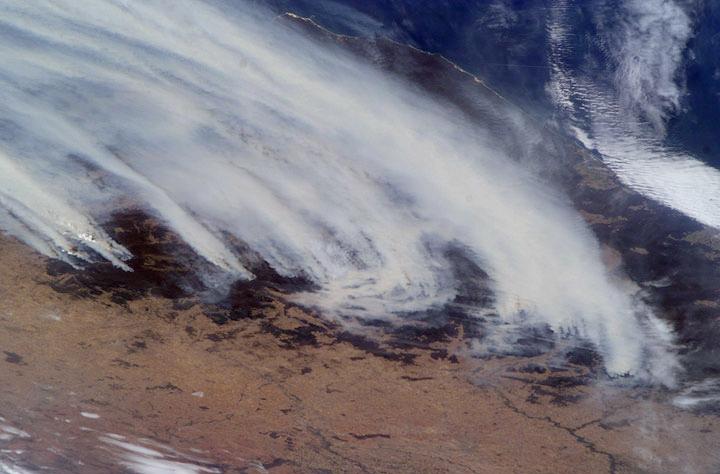
This dramatic image of the Australian brushers was taken from orbit by one of the crew members aboard the International Space Station (ISS). Following the worst regional drought in 50 years, this summer's fire season has resulted in numerous large fires over much of the Great Dividing Range as well as the enormous smoke pall over New South Wales, Victoria, and the adjacent South Pacific Ocean.
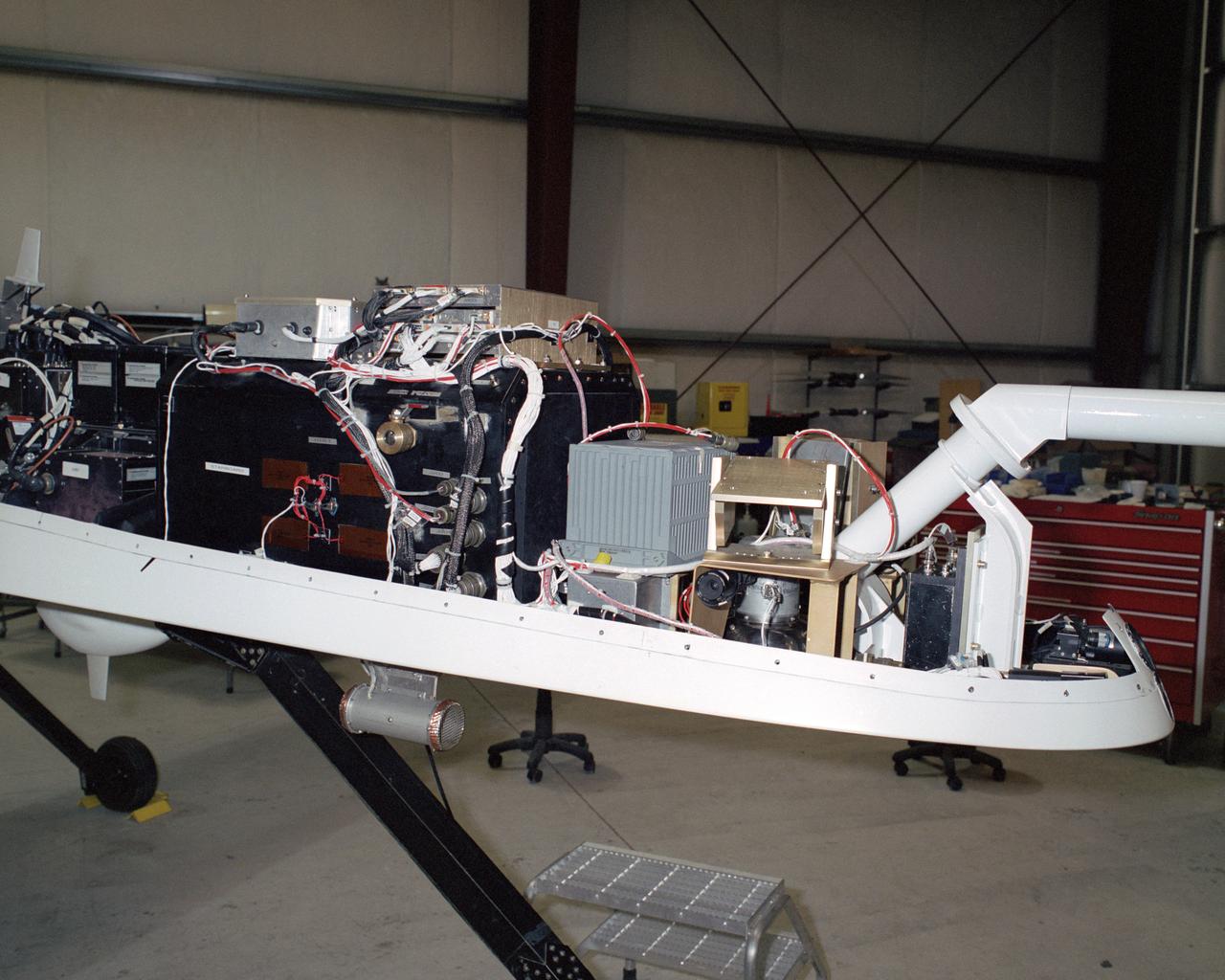
A NASA team studying the causes of electrical storms and their effects on our home planet achieved a milestone on August 21, 2002, completing the study's longest-duration research flight and monitoring four thunderstorms in succession. Based at the Naval Air Station Key West, Florida, researchers with the Altus Cumulus Electrification Study (ACES) used the Altus II remotely-piloted aircraft to study thunderstorms in the Atlantic Ocean off Key West and the west of the Everglades. Using special equipment aboard the Altus II, scientists in ACES will gather electric, magnetic, and optical measurements of the thunderstorms, gauging elements such as lightning activity and the electrical environment in and around the storms. With dual goals of gathering weather data safely and testing the adaptability of the uninhabited aircraft, the ACES study is a collaboration among the Marshall Space Flight Center, the University of Alabama in Huntsville, NASA's Goddard Space Flight Center in Greenbelt, Maryland, Pernsylvania State University in University Park, and General Atomics Aeronautical Systems, Inc.
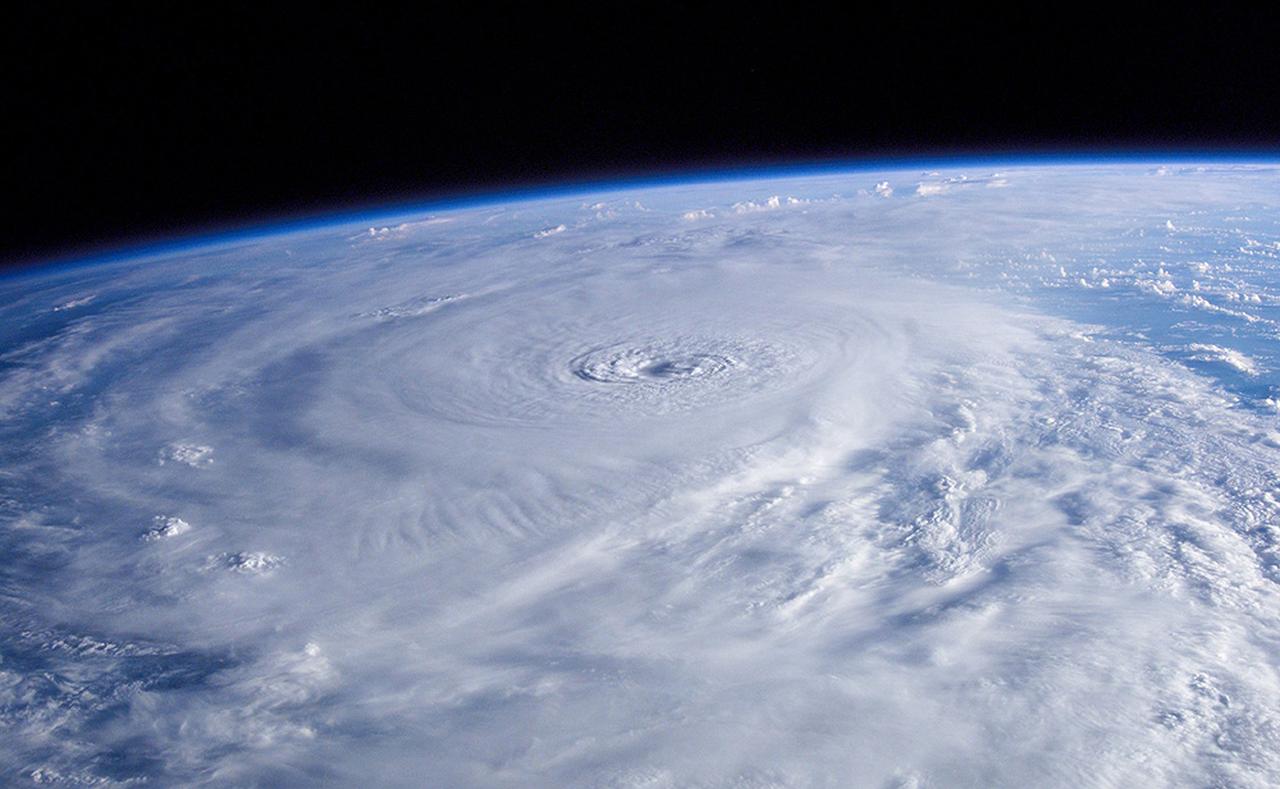
This photo of hurricane Lili, captured during the Expedition Five mission, shows the compact storm system and the structure of its estimated 15 nautical mile wide eye. After strengthening to a Category 4 storm (125 knots with the central pressure of 940 millibars), Lili weakened to a Category 2 before slamming into the central coast of Louisiana just south of Lafayette. This is one of many photos that stem form the Crew Observation (CEO) experiment that has been a part of every Space Station expedition.
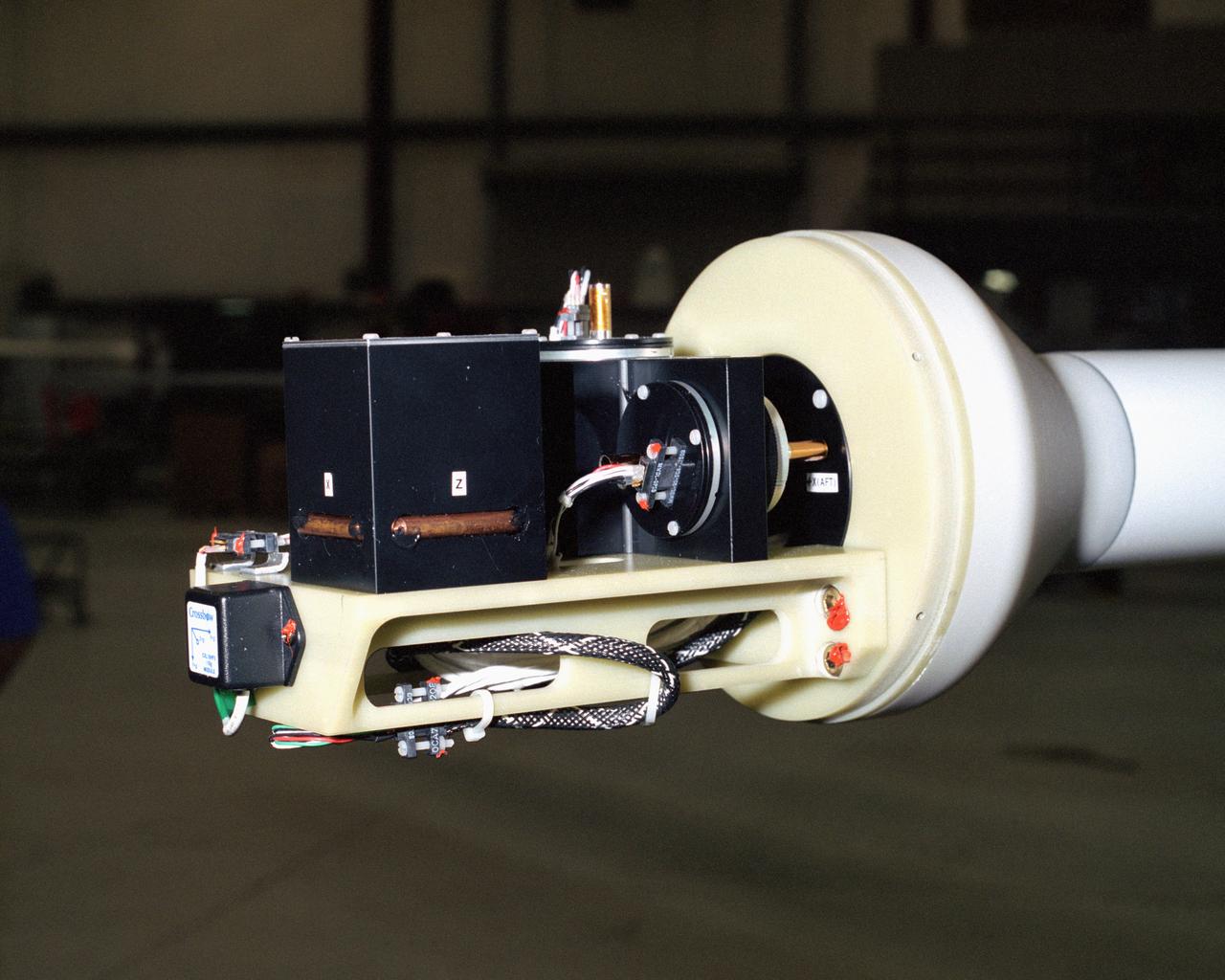
A NASA team studying the causes of electrical storms and their effects on our home planet achieved a milestone on August 21, 2002, completing the study's longest-duration research flight and monitoring four thunderstorms in succession. Based at the Naval Air Station Key West, Florida, researchers with the Altus Cumulus Electrification Study (ACES) used the Altus II remotely-piloted aircraft to study thunderstorms in the Atlantic Ocean off Key West and the west of the Everglades. Data obtained through sensors mounted to the aircraft will allow researchers in ACES to gauge elements such as lightning activity and the electrical environment in and around storms. By learning more about individual storms, scientists hope to better understand the global water and energy cycle, as well as climate variability. Contained in one portion of the aircraft is a three-axis magnetic search coil, which measures the AC magnetic field; a three-axis electric field change sensor; an accelerometer; and a three-axis magnetometer, which measures the DC magnetic field. With dual goals of gathering weather data safely and testing the adaptability of the uninhabited aircraft, the ACES study is a collaboration among the Marshall Space Flight Center, the University of Alabama in Huntsville, NASA's Goddard Space Flight Center in Greenbelt, Maryland, Pernsylvania State University in University Park, and General Atomics Aeronautical Systems, Inc.
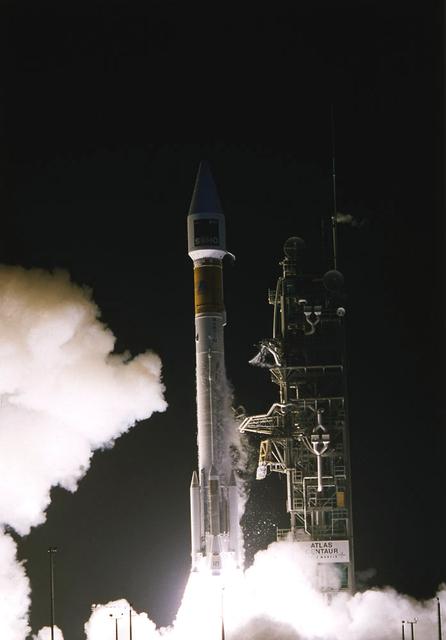
The Solar Heliospheric Observatory (SOHO) is launched atop an ATLAS-IIAS expendable launch vehicle. Liftoff from launch complex 36B at Cape Canaveral Air Station marked the 10th Atlas launch from the Eastern range for 1995. SOHO is a cooperative effort involving NASA and the European Space Agency (ESA) within the framework of the International Solar-Terrestrial Physics Program. During its 2-year mission, the SOHO spacecraft gathered data on the internal structure of the Sun, its extensive outer atmosphere and the origin of the solar wind.
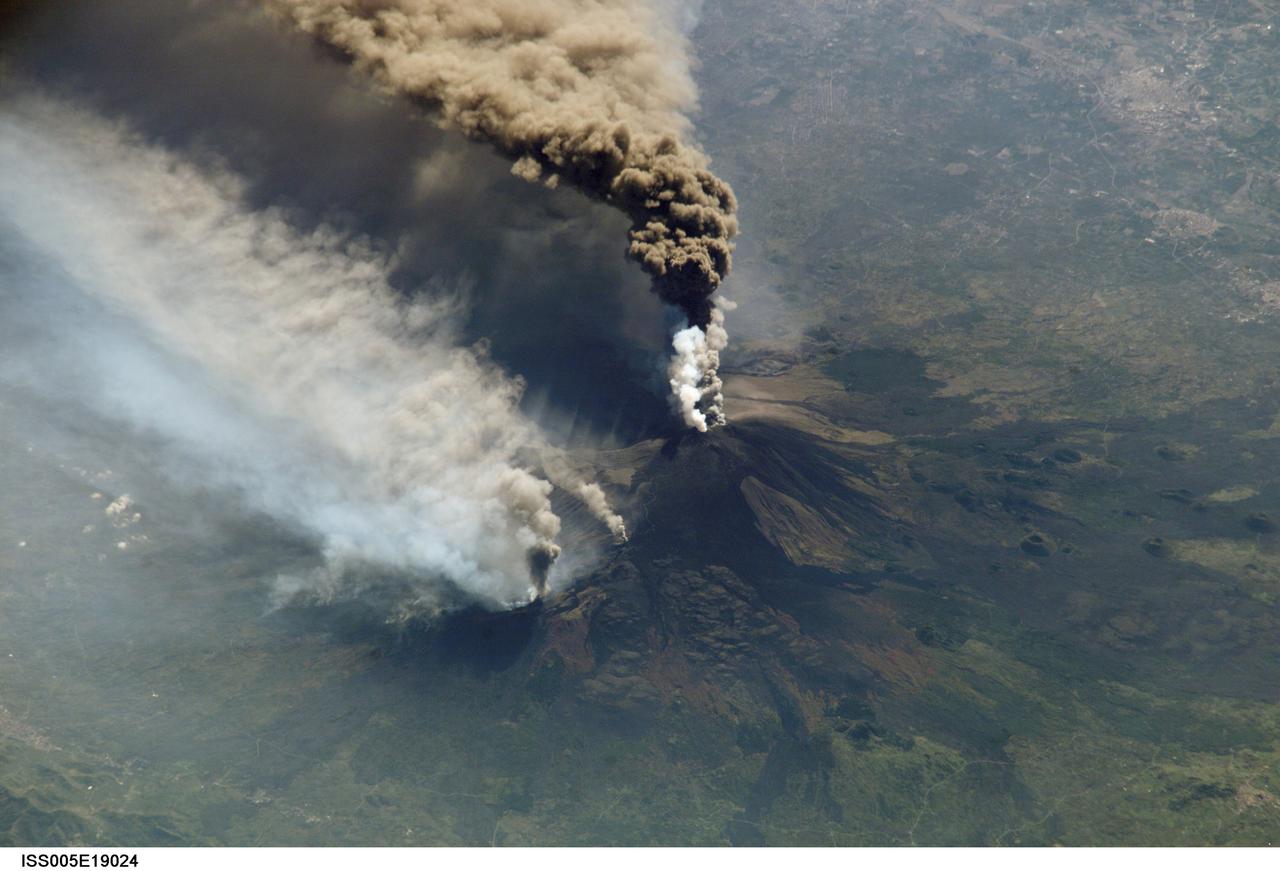
Expedition Five crew members aboard the International Space Station (ISS) captured this overhead look at the smoke and ash regurgitated from the erupting volcano Mt. Etna on the island of Sicily, Italy in October 2002. Triggered by a series of earthquakes on October 27, 2002, this eruption was one of Etna's most vigorous in years. This image shows the ash plume curving out toward the horizon. The lighter-colored plumes down slope and north of the summit seen in this frame are produced by forest fires set by flowing lava. At an elevation of 10,990 feet (3,350 m), the summit of the Mt. Etna volcano, one of the most active and most studied volcanoes in the world, has been active for a half-million years and has erupted hundreds of times in recorded history.
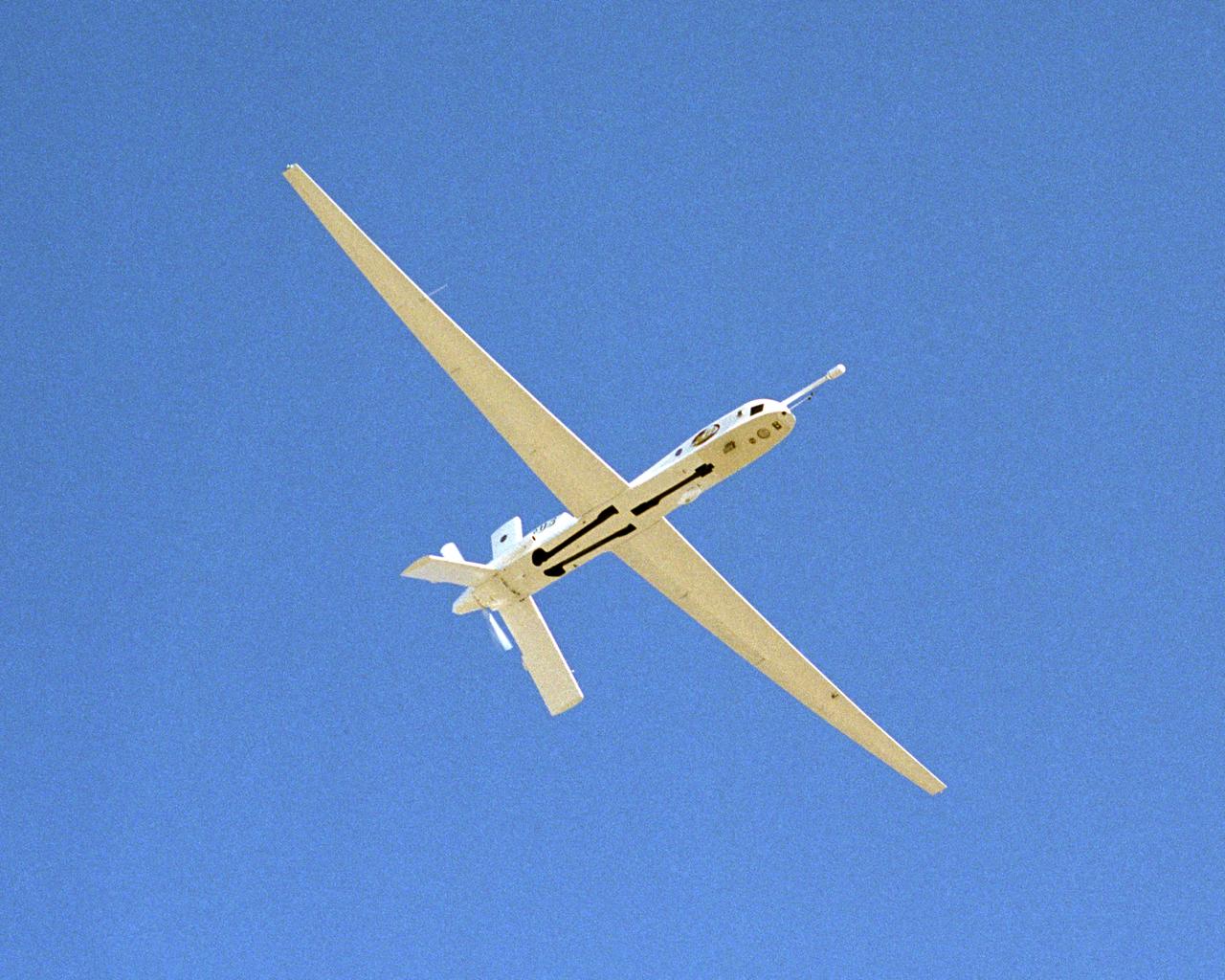
A NASA team studying the causes of electrical storms and their effects on our home planet achieved a milestone on August 21, 2002, completing the study's longest-duration research flight and monitoring four thunderstorms in succession. Based at the Naval Air Station Key West, Florida, researchers with the Altus Cumulus Electrification Study (ACES) used the Altus II remotely piloted aircraft to study thunderstorms in the Atlantic Ocean off Key West and the west of the Everglades. The ACES lightning study used the Altus II twin turbo uninhabited aerial vehicle, built by General Atomics Aeronautical Systems, Inc. of San Diego. The Altus II was chosen for its slow flight speed of 75 to 100 knots (80 to 115 mph), long endurance, and high-altitude flight (up to 65,000 feet). These qualities gave the Altus II the ability to fly near and around thunderstorms for long periods of time, allowing investigations to be conducted over the entire life cycle of storms. The vehicle has a wing span of 55 feet and a payload capacity of over 300 lbs. With dual goals of gathering weather data safely and testing the adaptability of the uninhabited aircraft, the ACES study is a collaboration among the Marshall Space Flight Center, the University of Alabama in Huntsville, NASA's Goddard Space Flight Center in Greenbelt, Maryland, Pernsylvania State University in University Park, and General Atomics Aeronautical Systems, Inc.
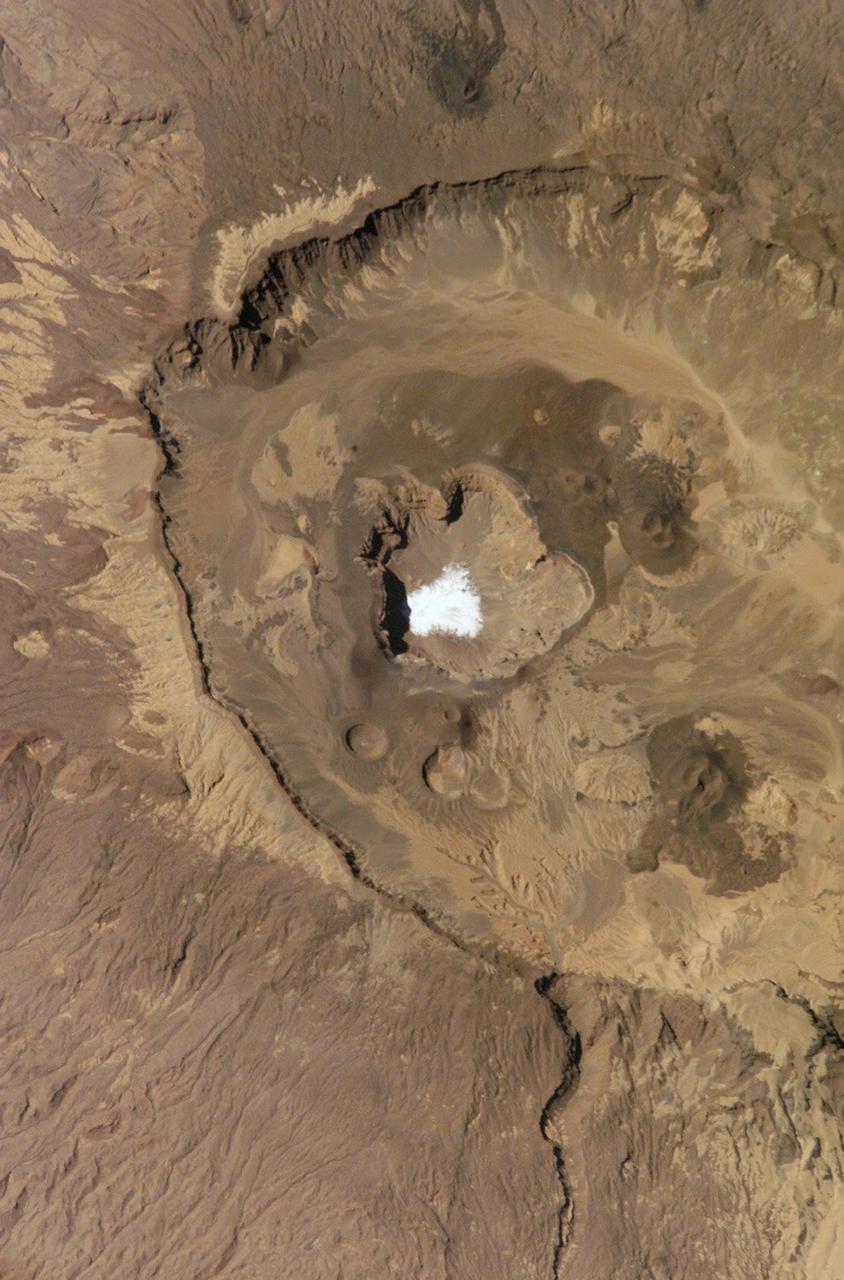
This is a view of the Emi Koussi Caldera captured by the Expedition Six Crew Observation (CEO) experiment aboard the International Space Station (ISS). Rising 2.3 km above the surrounding sandstone plains, Emi Koussi is a 6.5 km wide volcano located at the south end of the Tibesti Mountains in the central Sahara desert. The volcano is one of several in the Tibesti massif and has been used as a close analog to the famous Martian volcano Elysium Mons. Major charnels can be seen on volcanoes on both planets that indicate low points in caldera rims where lava spilled out of the pre-collapsed craters.
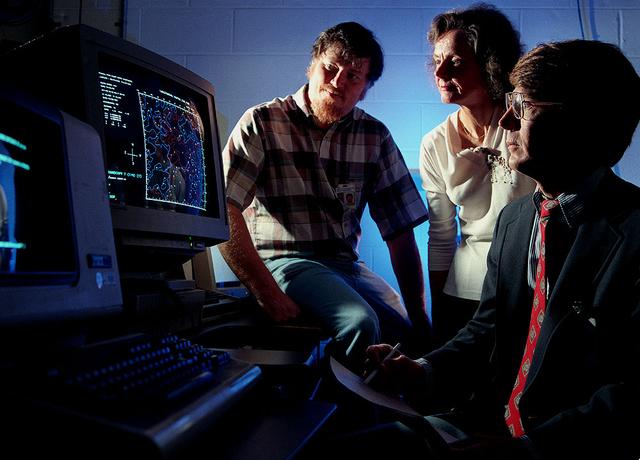
Solar Vector Magnetograph is used to predict solar flares, and other activities associated with sun spots. This research provides new understanding about weather on the Earth, and solar-related conditions in orbit.
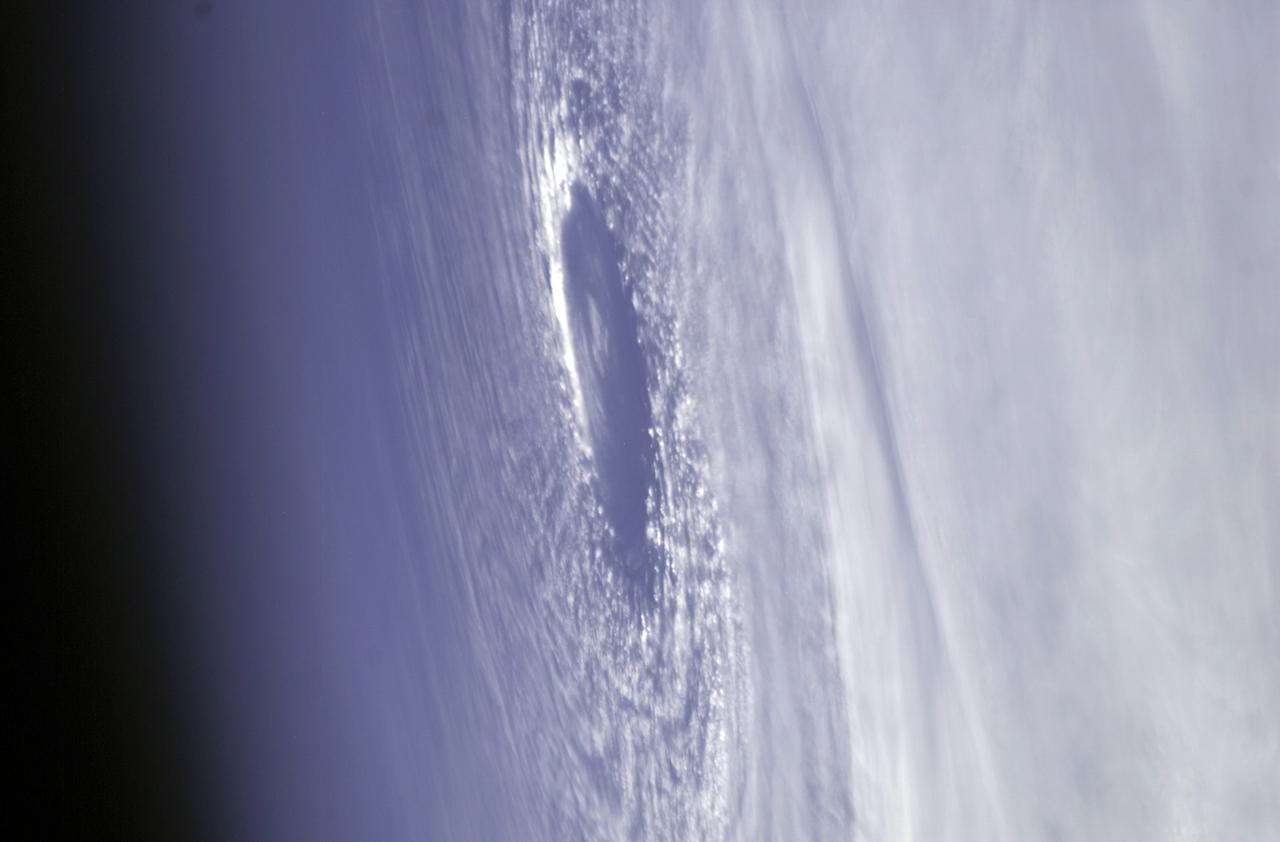
This image hosts a look at the eye of Hurricane Ivan, one of the strongest hurricanes on record, as the storm topped the western Caribbean Sea on Saturday, September 11, 2004. The hurricane was photographed by astronaut Edward M. (Mike) Fincke from aboard the International Space Station (ISS) at an altitude of approximately 230 miles. At the time, the category 5 storm sustained winds in the eye of the wall that were reported at about 160 mph. Crew Earth Observations record Earth surface changes over time, as well as more fleeting events such as storms, floods, fires, and volcanic eruptions.
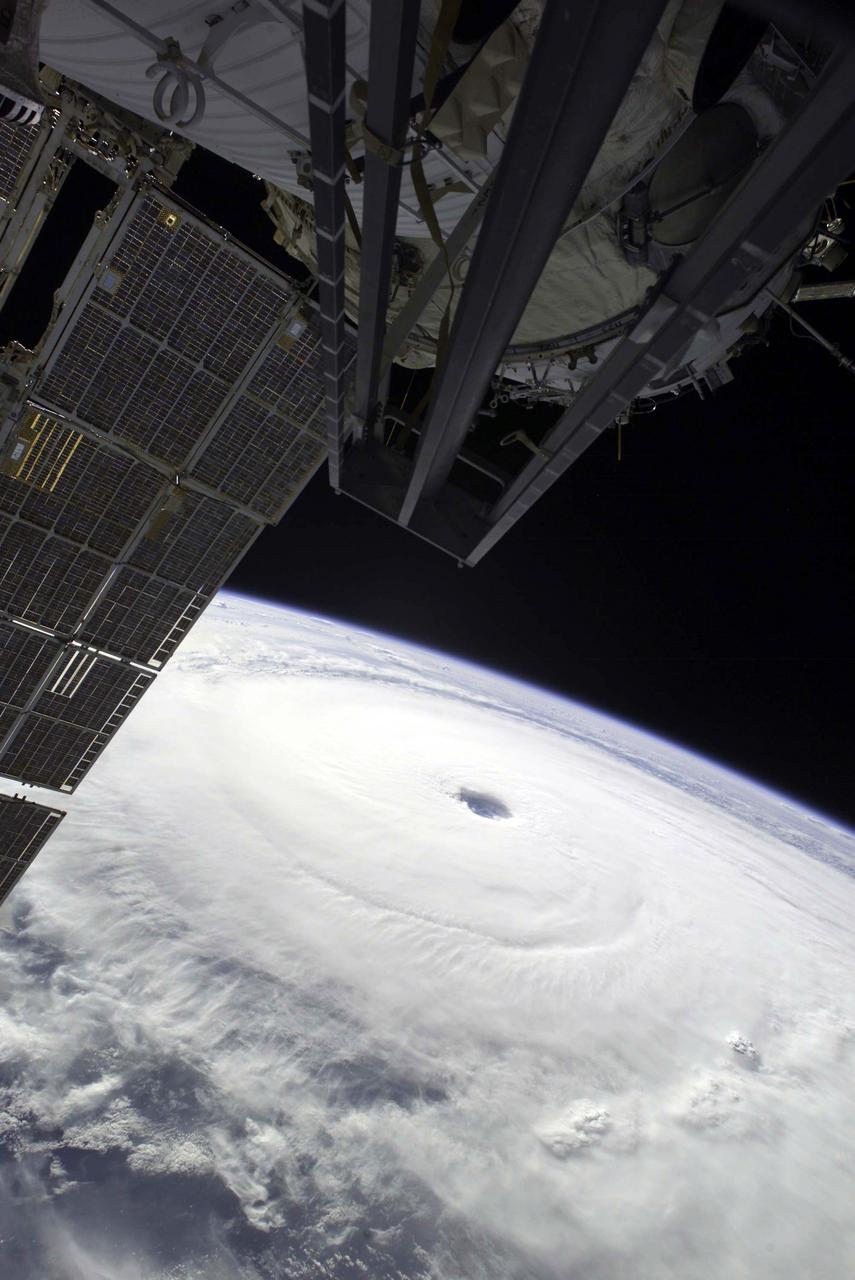
Except for a small portion of the International Space Station (ISS) in the foreground, Hurricane Ivan, one of the strongest hurricanes on record, fills this image over the northern Gulf of Mexico. As the downgraded category 4 storm approached landfall on the Alabama coast Wednesday afternoon on September 15, 2004, sustained winds in the eye of the wall were reported at about 135 mph. The hurricane was photographed by astronaut Edward M. (Mike) Fincke from aboard the ISS at an altitude of approximately 230 miles. Crew Earth Observations record Earth surface changes over time, as well as more fleeting events such as storms, floods, fires, and volcanic eruptions.
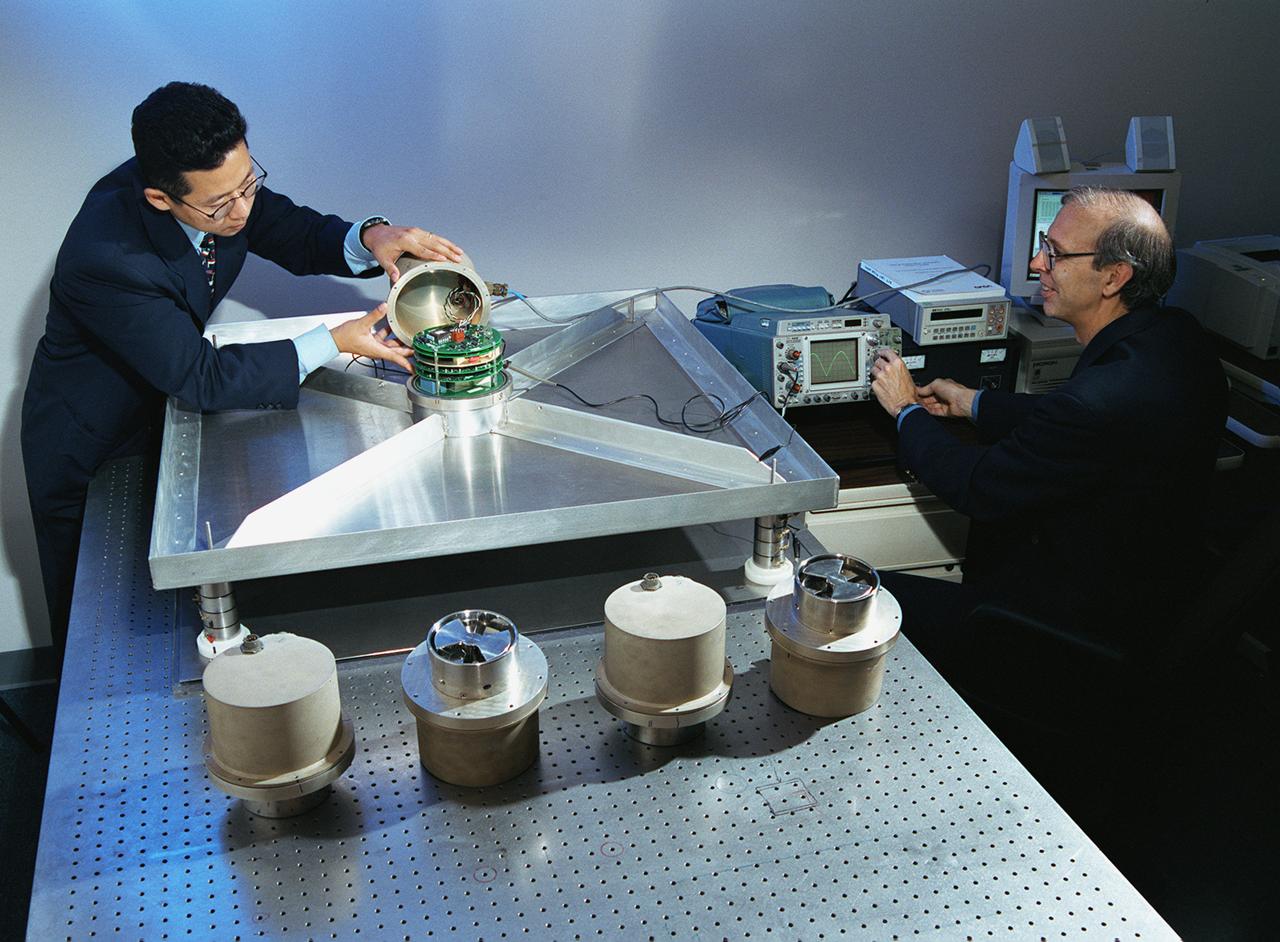
A NASA team studying the causes of electrical storms and their effects on our home planet achieved a milestone on August 21, 2002, completing the study's longest-duration research flight and monitoring four thunderstorms in succession. Radio news media can talk with Dr. Richard Blakeslee, the project's principal investigator, and Tony Kim, project manager at the Marshall Space Flight Center (MSFC), about their results and how their work will help improve future weather forecasting ability. Based at the Naval Air Station Key West, Florida, researchers with the Altus Cumulus Electrification Study (ACES) used the Altus II remotely- piloted aircraft to study a thunderstorm in the Atlantic Ocean off Key West, two storms at the western edge of the Everglades, and a large storm over the northwestern corner of the Everglades. This photograph shows Tony Kim And Dr. Richard Blakeslee of MSFC testing aircraft sensors that would be used to measure the electric fields produced by thunderstorm as part of NASA's ACES. With dual goals of gathering weather data safely and testing the adaptability of the uninhabited aircraft, the ACES study is a collaboration among the MSFC, the University of Alabama in Huntsville, NASA's Goddard Space Flight Center in Greenbelt, Maryland, Pernsylvania State University in University Park, and General Atomics Aeronautical Systems, Inc.
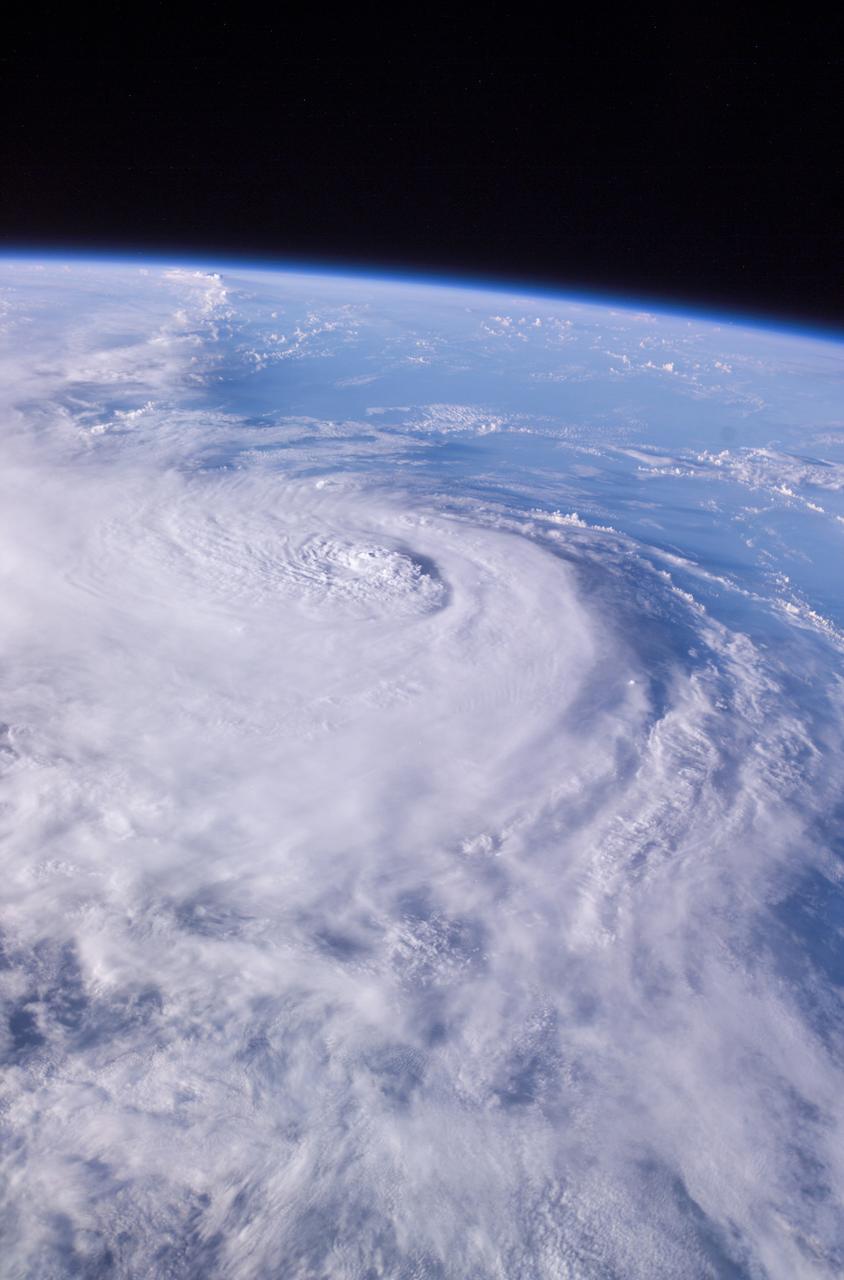
This panoramic view of Hurricane Charley was photographed by the Expedition 9 crew aboard the International Space Station (ISS) on August 13, 2004, at a vantage point just north of Tampa, Florida. The small eye was not visible in this view, but the raised cloud tops near the center coincide roughly with the time that the storm began to rapidly strengthen. The category 2 hurricane was moving north-northwest at 18 mph packing winds of 105 mph. Crew Earth Observations record Earth surface changes over time, as well as more fleeting events such as storms, floods, fires, and volcanic eruptions.
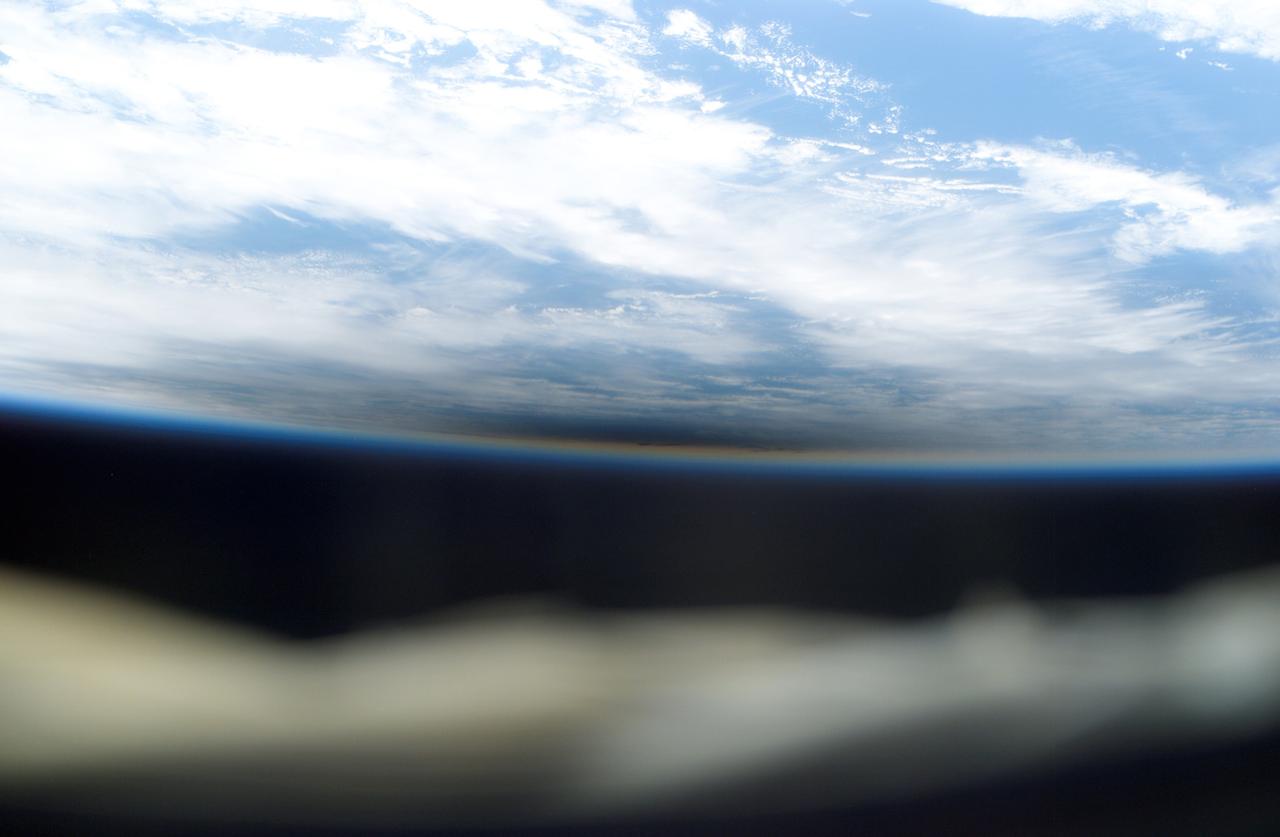
International Space Station (ISS) crew members were able to document a rare occurrence. The dark area near the center of the frame is actually a shadow cast by the moon during the total solar eclipse of December 4, 2002. The shadow obscures an area of cloud cover. The Station, with three Expedition Six crew members aboard, was over the Indian Ocean at the time of the eclipse.
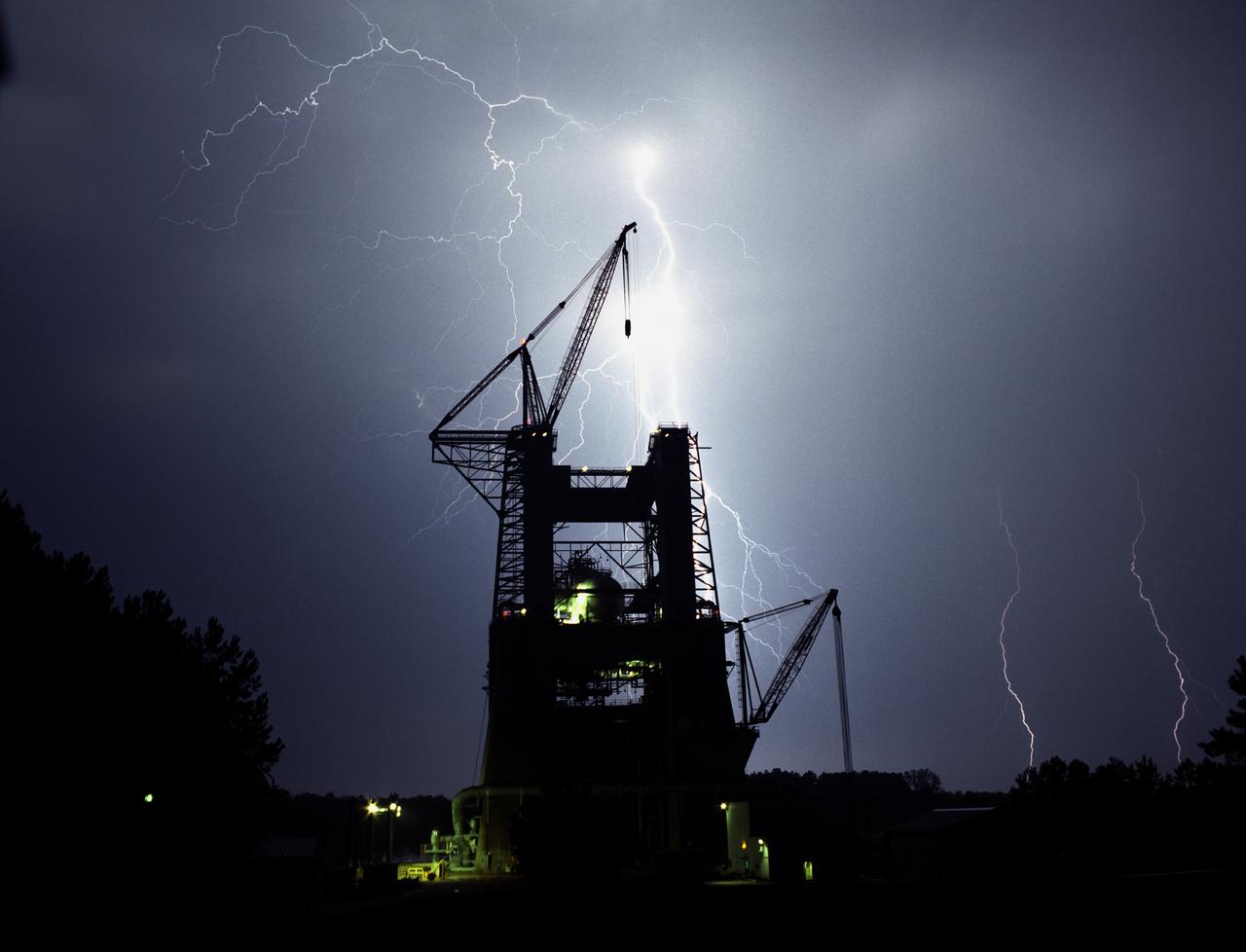
Multiple lightning bolts struck the Technology Test Bed, formerly the S-IC Static Test Stand, at the Marshall Space Flight Center (MSFC) during a thunderstorm. This spectacular image of lightning was photographed by MSFC photographer Dernis Olive on August 29, 1990.
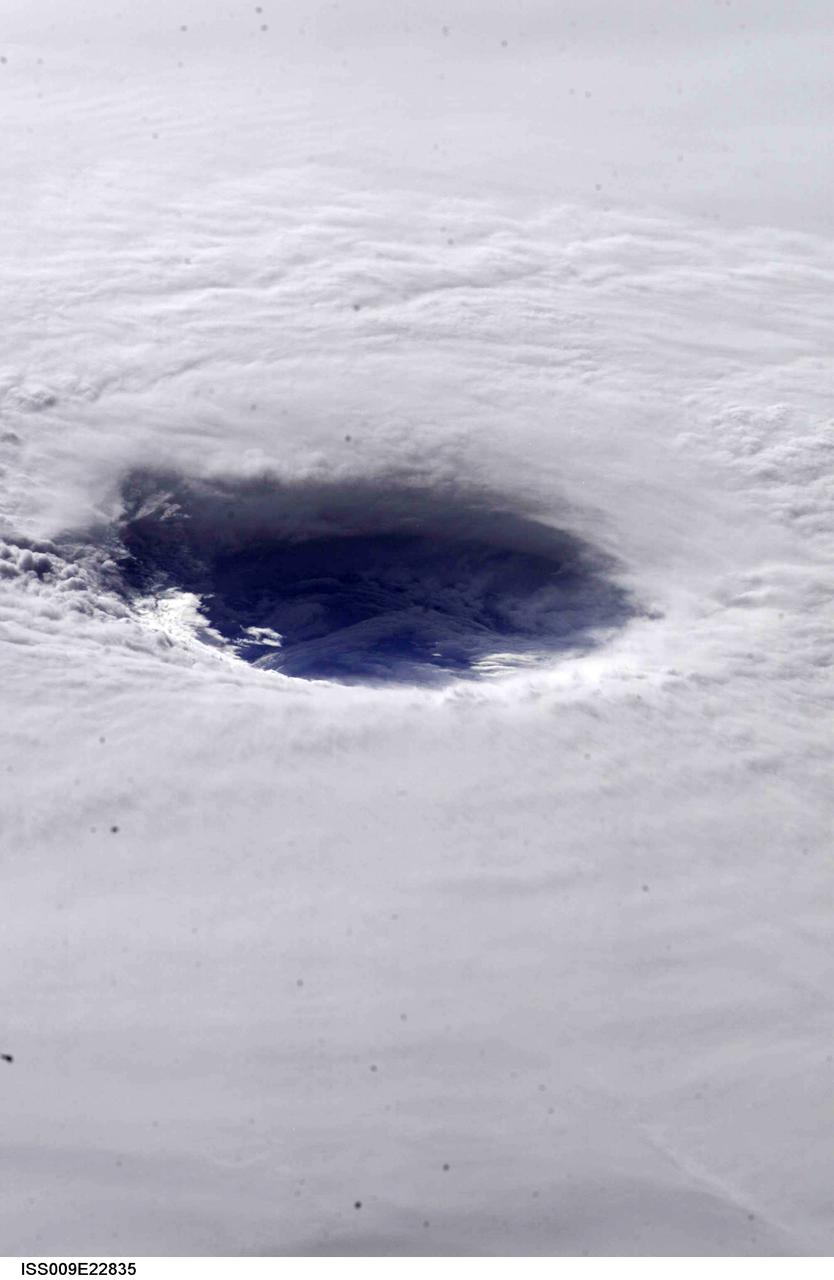
This image hosts a look into the eye of Hurricane Ivan, one of the strongest hurricanes on record, as the storm approached landfall on the central Gulf coast Wednesday afternoon on September 15, 2004. The hurricane was photographed by astronaut Edward M. (Mike) Fincke from aboard the International Space Station (ISS) at an altitude of approximately 230 miles. At the time, sustained winds in the eye of the wall were reported at about 135 mph as the downgraded category 4 storm approached the Alabama coast. Crew Earth Observations record Earth surface changes over time, as well as more fleeting events such as storms, floods, fires, and volcanic eruptions.
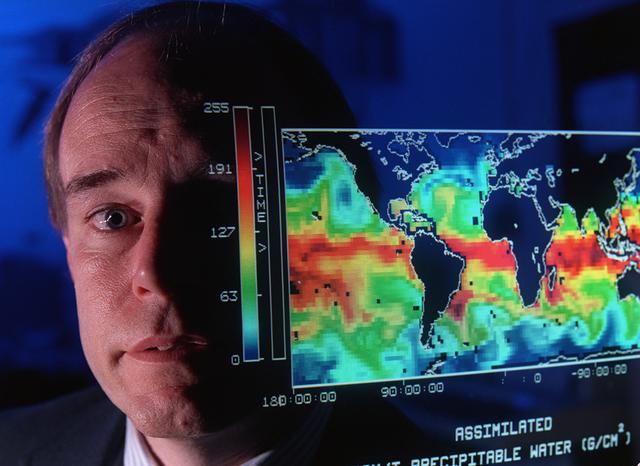
This map shows the presence of water vapor over global oceans. The imagery was produced by combining Special Sensor Microwave Imager measurements and computer models. This data will help scientists better understand how weather systems move water vapor from the tropics toward the poles producing precipitation.
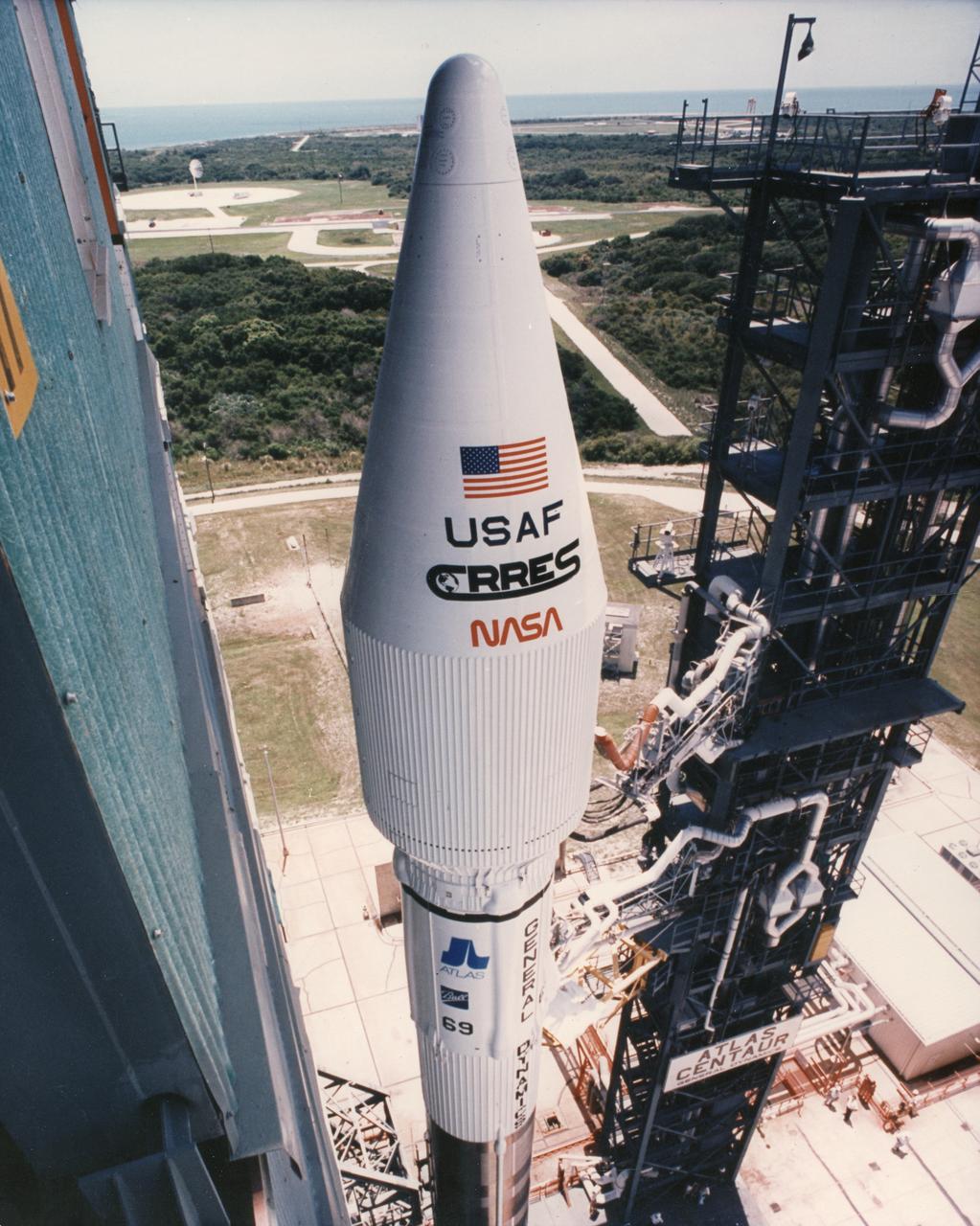
In July 1990, the Marshall Space Flight Center, in a joint project with the Department of Defense/Air Force Space Test Program, launched the Combined Release and Radiation Effects Satellite (CRRES) using an Atlas I launch vehicle. The mission was designed to study the effects of artificial ion clouds produced by chemical releases on the Earth's ionosphere and magnetosphere, and to monitor the effects of space radiation environment on sophisticated electronics.