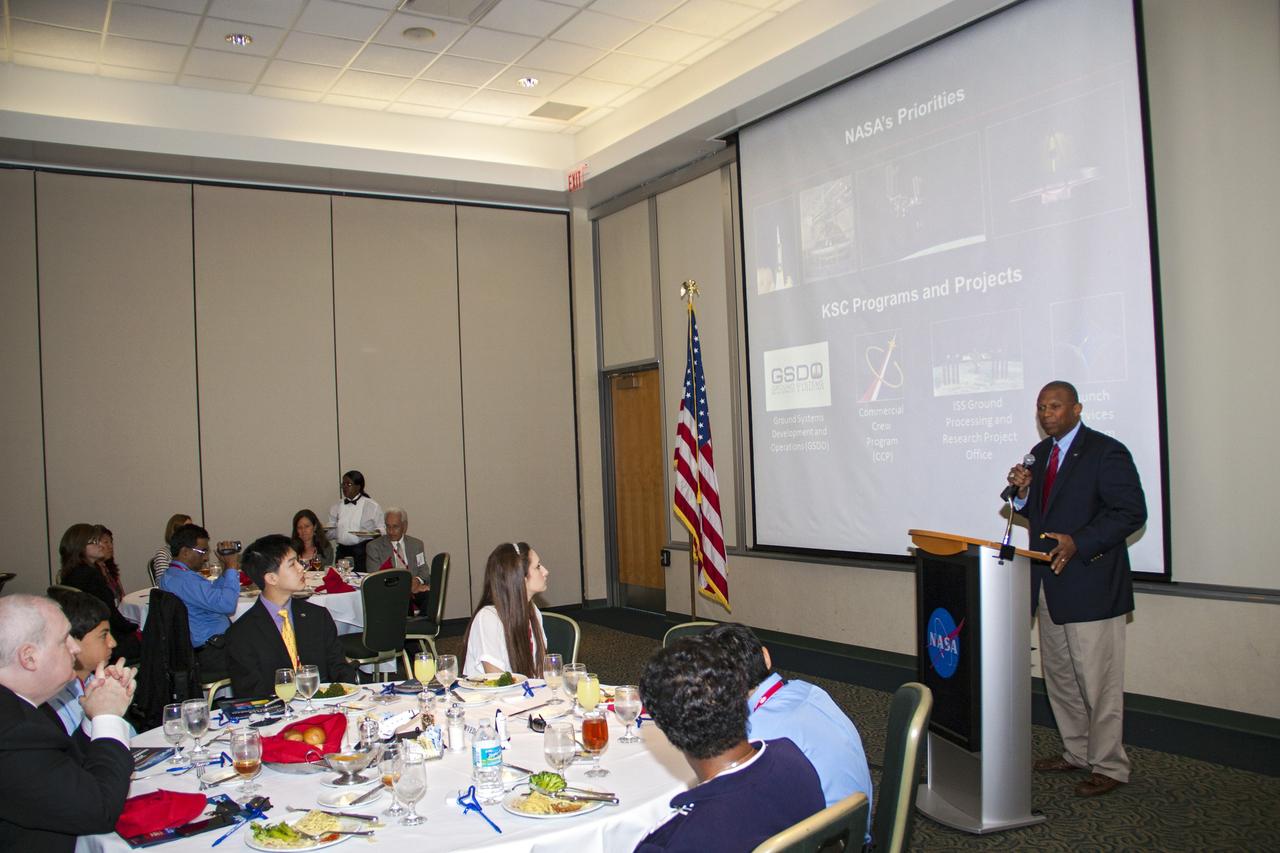
CAPE CANAVERAL, Fla. – At the Kennedy Space Center Visitor Complex in Florida, Kelvin Manning, the center's associate deputy director, addresses students, teachers, parents and VIPs during the 2013 DuPont Challenge Science Essay Competition awards ceremony. The challenge, now in its 27th year, reaches out to students from grades seven through 12 from all 50 states and Canada. More than 200,000 students entered the competition. The DuPont Challenge aims to inspire students to excel and achieve in scientific writing and pursue careers in science, technology, engineering and mathematics STEM. The challenge honors space shuttle Challenger's STS-51L crew members who gave their lives while furthering the cause of exploration and discovery. For more information on the challenge, go to http://thechallenge.dupont.com/sponsors/nasa.php.
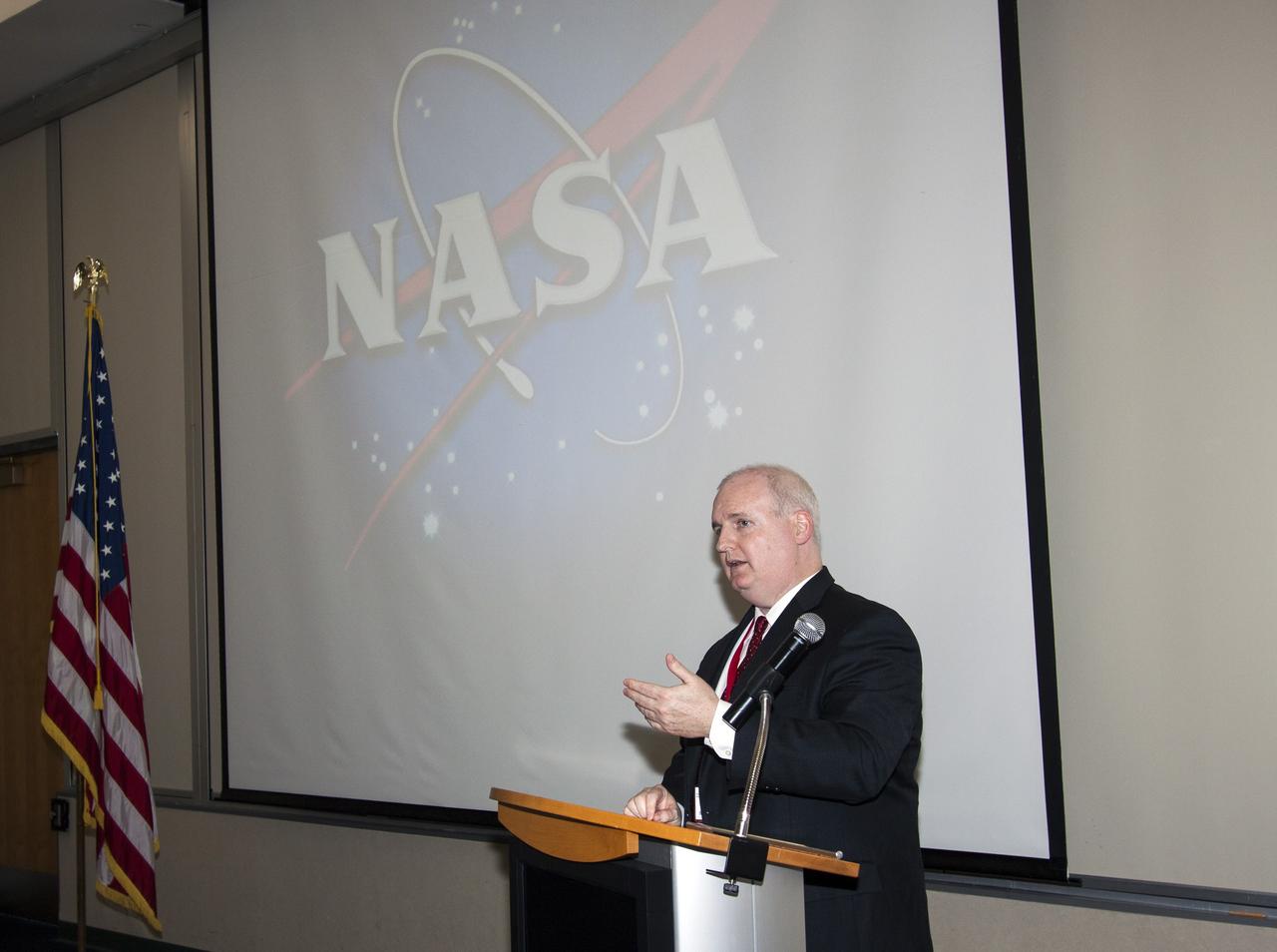
CAPE CANAVERAL, Fla. – At the Kennedy Space Center Visitor Complex in Florida, Marc Doyle, Dupont's global marketing and product director, addresses students, teachers, parents and VIPs during the 2013 DuPont Challenge Science Essay Competition awards ceremony. The challenge, now in its 27th year, reaches out to students from grades seven through 12 from all 50 states and Canada. More than 200,000 students entered the competition. The DuPont Challenge aims to inspire students to excel and achieve in scientific writing and pursue careers in science, technology, engineering and mathematics STEM. The challenge honors space shuttle Challenger's STS-51L crew members who gave their lives while furthering the cause of exploration and discovery. For more information on the challenge, go to http://thechallenge.dupont.com/sponsors/nasa.php.
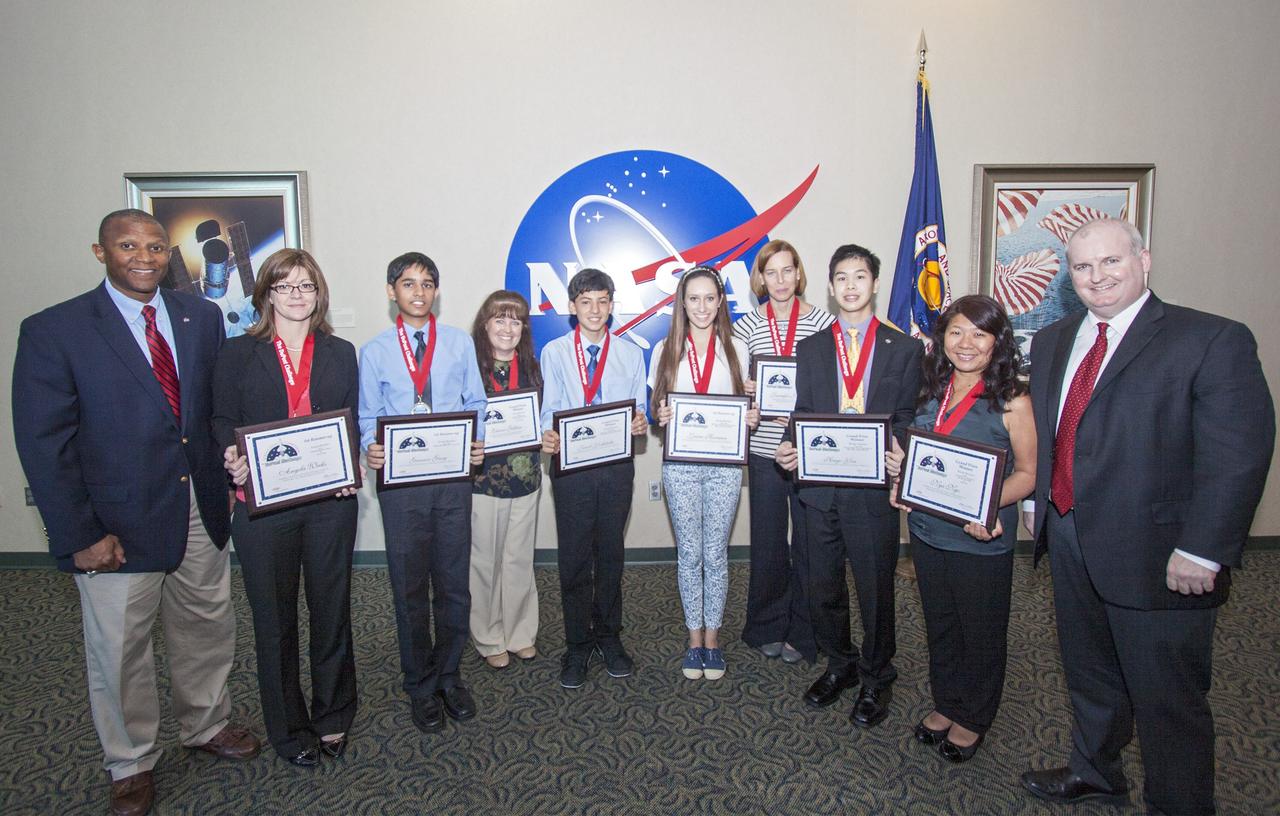
CAPE CANAVERAL, Fla. - The winning students and their teachers of the 2013 DuPont Challenge Science Essay Competition show off their awards after a ceremony at the Kennedy Space Center Visitor Complex in Florida. From left are, Kelvin Manning, the center's associate deputy director sponsoring teacher Angela Weeks and Junior Division first runner-up Gaurav Garg of Beckendorff Junior High in Katy, Texas sponsoring teacher Elaine Gillum and Senior Division grand prize winner Jacob Yoshitake of Marshall Middle School in San Diego, Calif. Senior Division first runner-up Laura Herman and sponsoring teacher Jennifer Gordinier of Pine Crest School in Fort Lauderdale, Fla. and Senior Division grand prize awardee Hugo Yen and sponsoring teacher Nga Ngo of Troy High in Fullerton, Calif. The challenge, now in its 27th year, reaches out to students from grades seven through 12 from all 50 states and Canada. More than 200,000 students entered the competition. The DuPont Challenge aims to inspire students to excel and achieve in scientific writing and pursue careers in science, technology, engineering and mathematics STEM. The challenge honors space shuttle Challenger's STS-51L crew members who gave their lives while furthering the cause of exploration and discovery. For more information on the challenge, go to http://thechallenge.dupont.com/sponsors/nasa.php.
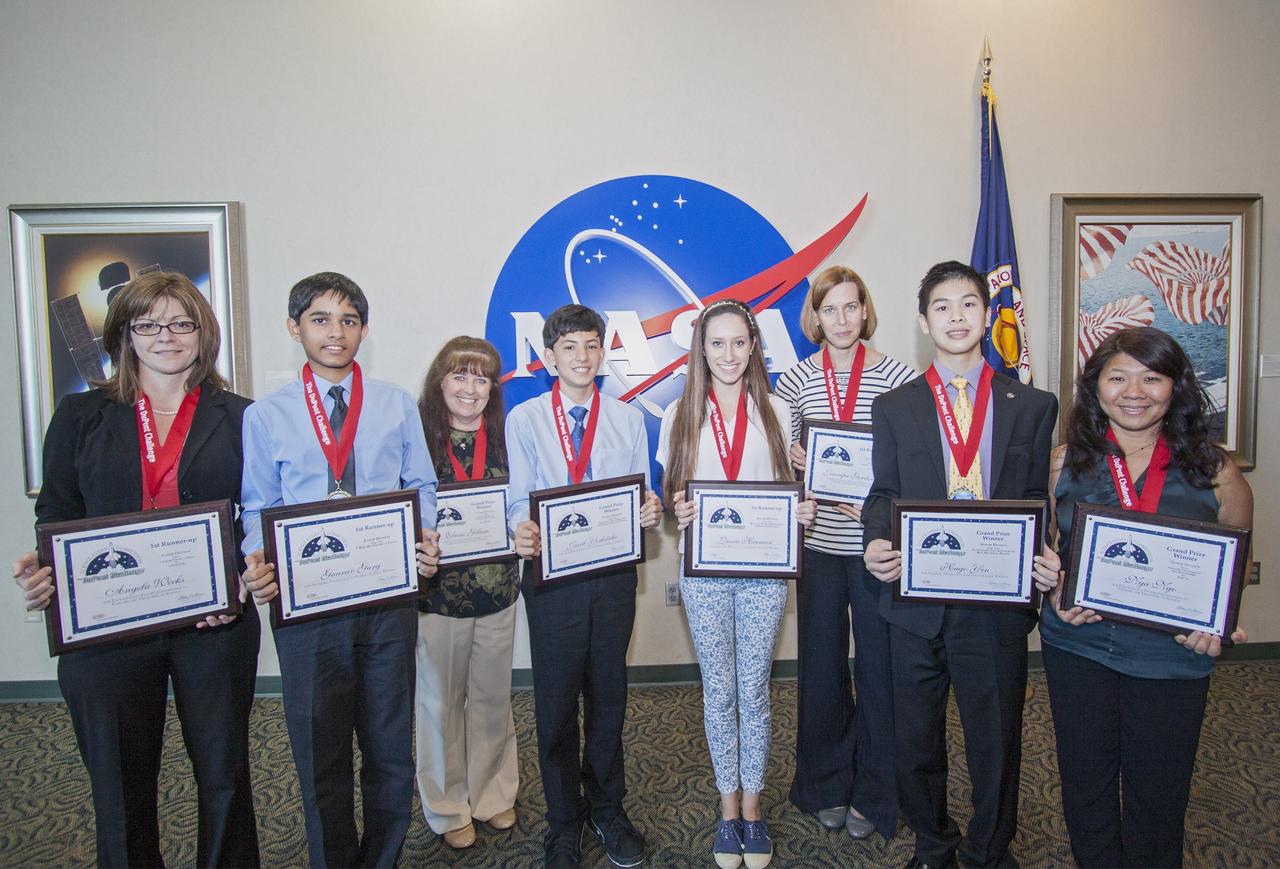
CAPE CANAVERAL, Fla. - The winning students and their teachers of the 2013 DuPont Challenge Science Essay Competition show off their awards after a ceremony at the Kennedy Space Center Visitor Complex in Florida. From left are sponsoring teacher Angela Weeks and Junior Division first runner-up Gaurav Garg of Beckendorff Junior High in Katy, Texas sponsoring teacher Elaine Gillum and Senior Division grand prize winner Jacob Yoshitake of Marshall Middle School in San Diego, Calif. Senior Division first runner-up Laura Herman and sponsoring teacher Jennifer Gordinier of Pine Crest School in Fort Lauderdale, Fla. and Senior Division grand prize awardee Hugo Yen and sponsoring teacher Nga Ngo of Troy High in Fullerton, Calif. The challenge, now in its 27th year, reaches out to students from grades seven through 12 from all 50 states and Canada. More than 200,000 students entered the competition. The DuPont Challenge aims to inspire students to excel and achieve in scientific writing and pursue careers in science, technology, engineering and mathematics STEM. The challenge honors space shuttle Challenger's STS-51L crew members who gave their lives while furthering the cause of exploration and discovery. For more information on the challenge, go to http://thechallenge.dupont.com/sponsors/nasa.php.
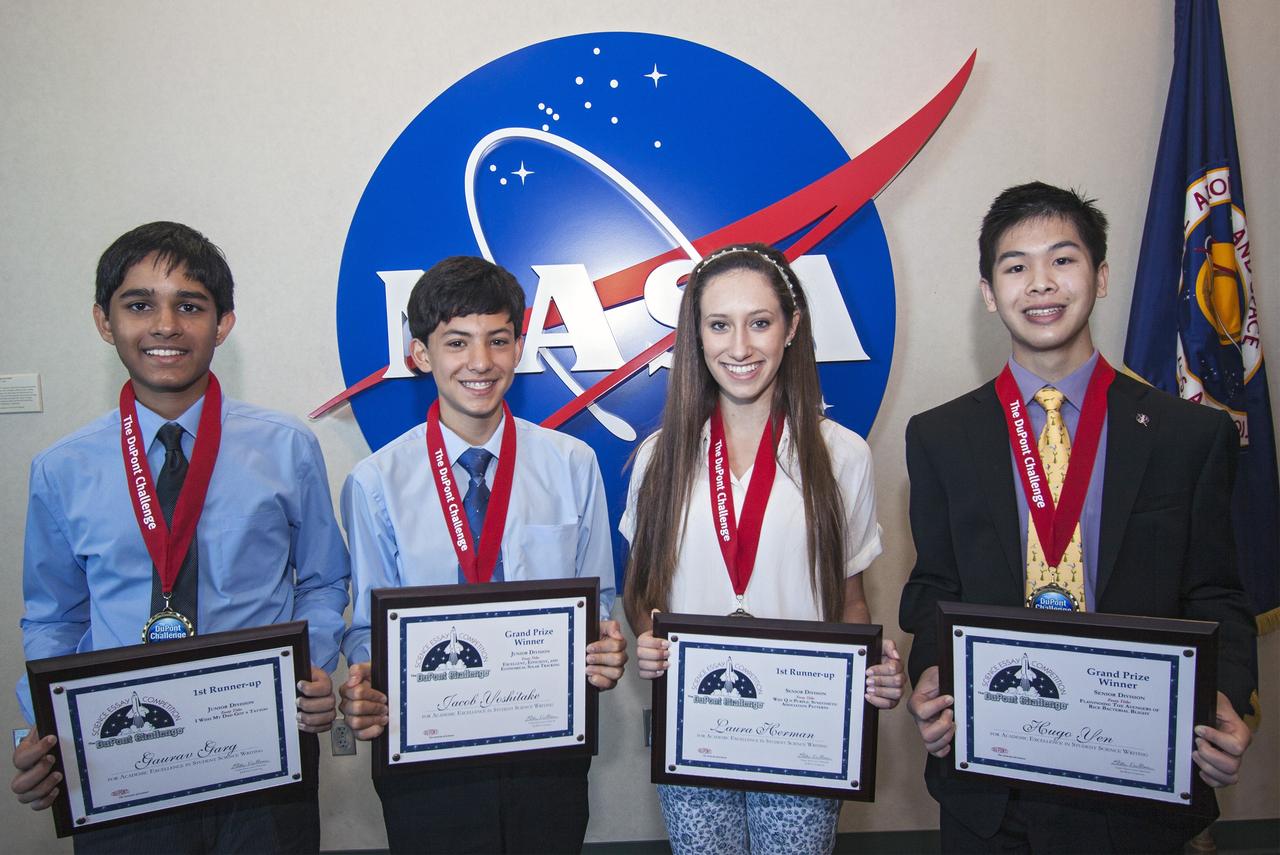
CAPE CANAVERAL, Fla. – The winning students of the 2013 DuPont Challenge Science Essay Competition show off their awards after a ceremony at the Kennedy Space Center Visitor Complex in Florida. From left are Junior Division first runner-up Gaurav Garg of Beckendorff Junior High in Katy, Texas Senior Division grand prize winner Jacob Yoshitake of Marshall Middle School in San Diego, Calif. Senior Division first runner-up Laura Herman of Pine Crest School in Fort Lauderdale, Fla. and Senior Division grand prize awardee Hugo Yen of Troy High in Fullerton, Calif. and Marc Doyle, Dupont's global marketing and product director. The challenge, now in its 27th year, reaches out to students from grades seven through 12 from all 50 states and Canada. More than 200,000 students entered the competition. The DuPont Challenge aims to inspire students to excel and achieve in scientific writing and pursue careers in science, technology, engineering and mathematics STEM. The challenge honors space shuttle Challenger's STS-51L crew members who gave their lives while furthering the cause of exploration and discovery. For more information on the challenge, go to http://thechallenge.dupont.com/sponsors/nasa.php.
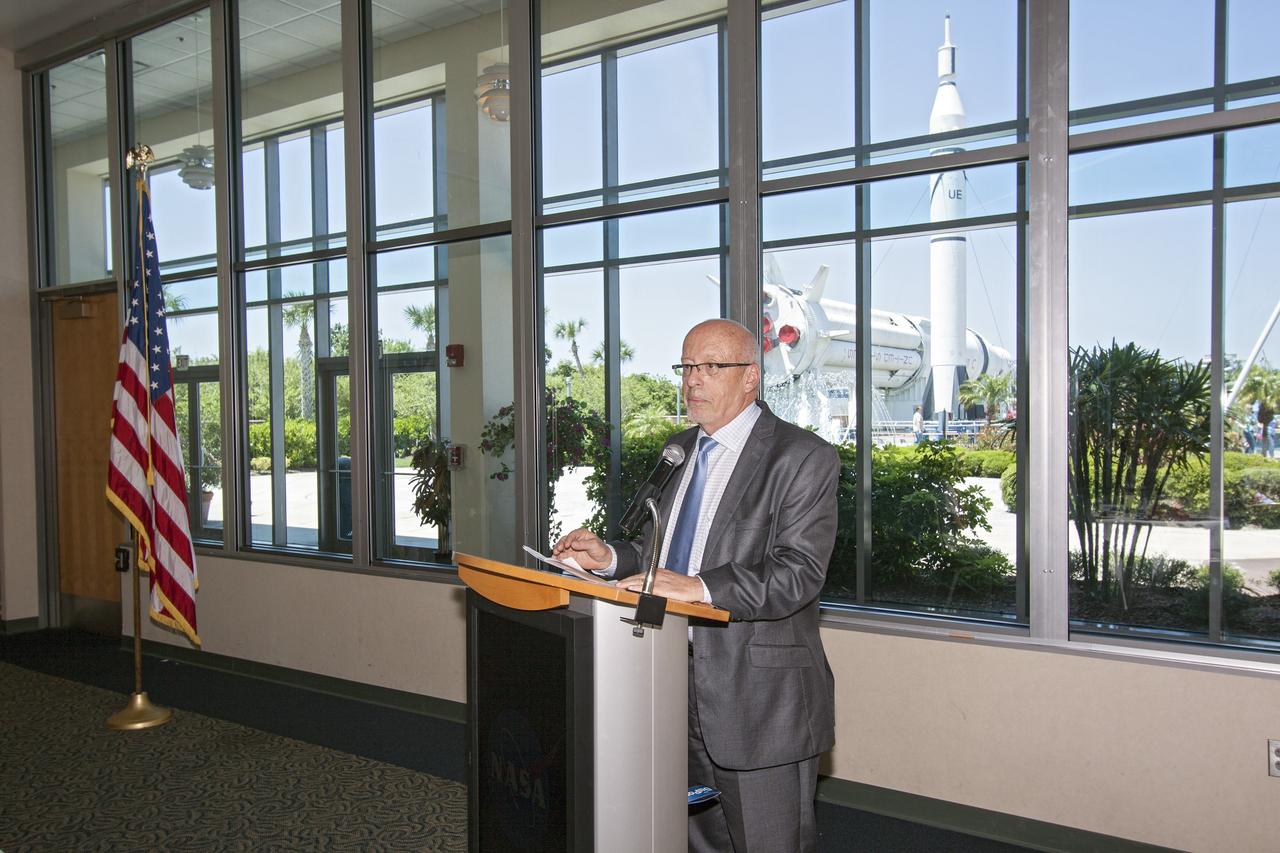
CAPE CANAVERAL, Fla. – At the Kennedy Space Center Visitor Complex in Florida, William Badders, resident-elect of the National Science Teachers Association, addresses students, teachers, parents and VIPs during the 2013 DuPont Challenge Science Essay Competition awards ceremony. The challenge, now in its 27th year, reaches out to students from grades seven through 12 from all 50 states and Canada. More than 200,000 students entered the competition. The DuPont Challenge aims to inspire students to excel and achieve in scientific writing and pursue careers in science, technology, engineering and mathematics STEM. The challenge honors space shuttle Challenger's STS-51L crew members who gave their lives while furthering the cause of exploration and discovery. For more information on the challenge, go to http://thechallenge.dupont.com/sponsors/nasa.php.

Founding head of MC2 STEM High School Jeffrey McClellan talks during the NASA Future Forum Inspiration and Education Panel at The Ohio State University on Monday, Feb. 20, 2012, in Columbus, Ohio. The NASA Future Forum features panel discussions on the importance of education to our nation's future in space, the benefit of commercialized space technology to our economy and lives here on Earth, and the shifting roles for the public, commercial and international communities in space. Photo Credit: (NASA/Bill Ingalls)

Pickerington High School student Jordan Elliott, left, and Dayton Regional STEM student Cheyenne Benson participate in the NASA Future Forum Inspiration and Education Panel at The Ohio State University on Monday, Feb. 20, 2012, in Columbus, Ohio. The NASA Future Forum features panel discussions on the importance of education to our nation's future in space, the benefit of commercialized space technology to our economy and lives here on Earth, and the shifting roles for the public, commercial and international communities in space. Photo Credit: (NASA/Bill Ingalls)

Dayton Regional STEM student Cheyenne Benson talks during the NASA Future Forum Inspiration and Education Panel at The Ohio State University on Monday, Feb. 20, 2012, in Columbus, Ohio. The NASA Future Forum features panel discussions on the importance of education to our nation's future in space, the benefit of commercialized space technology to our economy and lives here on Earth, and the shifting roles for the public, commercial and international communities in space. Photo Credit: (NASA/Bill Ingalls)
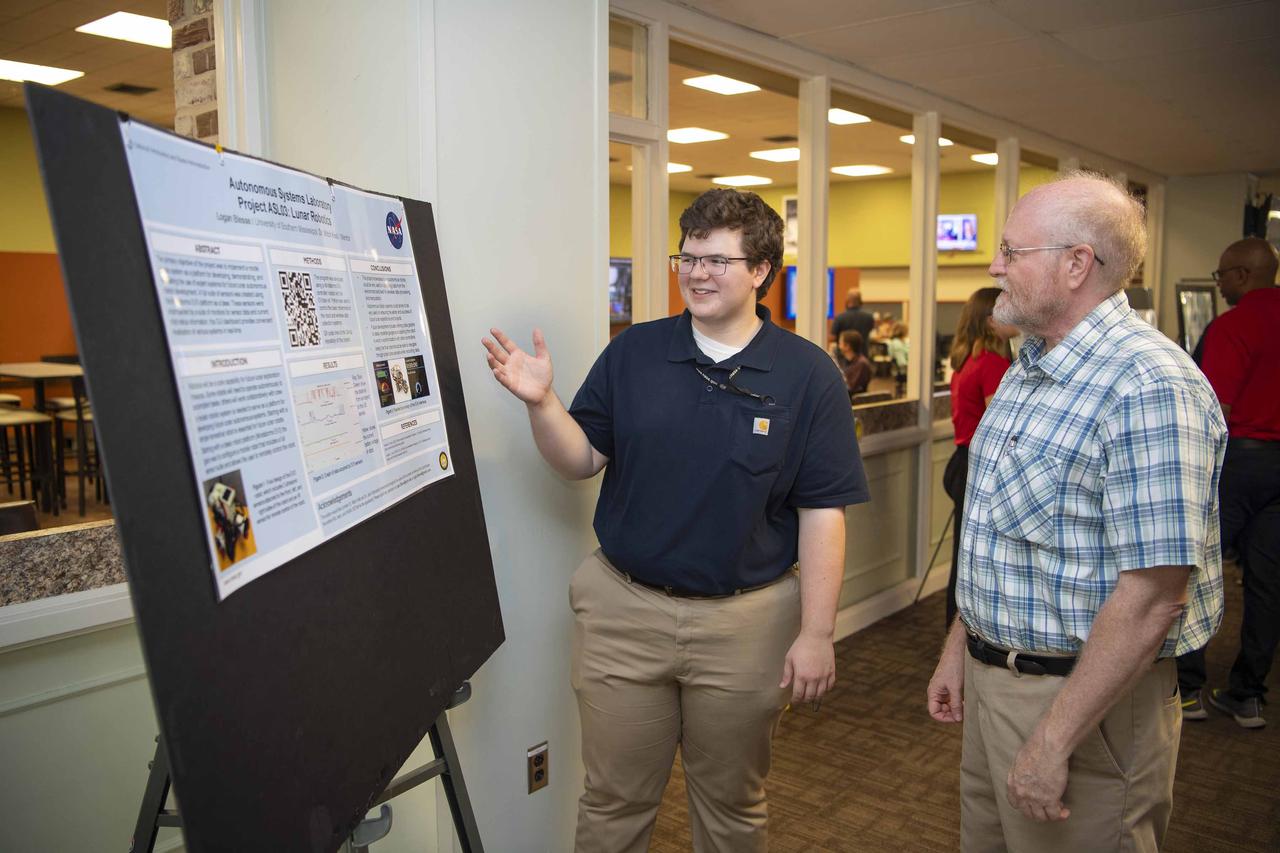
NASA Stennis summer intern Logan Blesse, left, shares about his work on future lunar autonomous robotic development during an Aug. 7 event hosted by the Office of STEM Engagement. Blesse, a student at The University of Southern Mississippi in Hattiesburg, worked with the NASA Stennis Autonomous Systems Laboratory. The poster symposium highlighted research topics, including propulsion test operations, lunar robotics, autonomous systems, STEM education, and more. NASA’s Office of STEM Engagement paid internships allow high school and college-level students to contribute to the agency’s mission to advance science, technology, aeronautics, and space exploration.
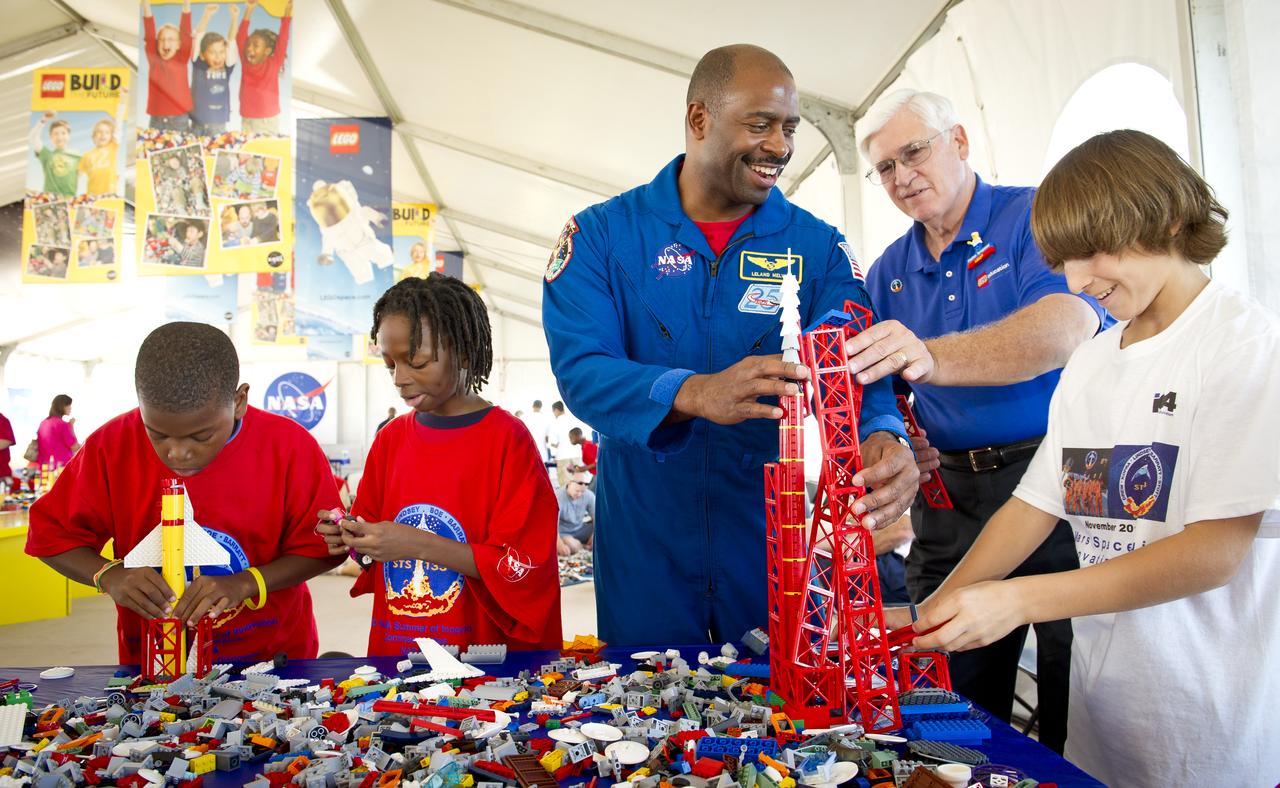
Associate Administrator for Education and Astronaut Leland Melvin, left, and President of LEGO Education USA Stephan Turnipseed, right, help students during the “Build the Future” activity where students created their vision of the future in space with LEGO bricks and elements inside a tent that was set up on the launch viewing area at NASA's Kennedy Space Center in Cape Canaveral, Fla. on Monday, Nov. 1, 2010. NASA and The LEGO Group signed a Space Act Agreement to spark children's interest in science, technology, engineering and math (STEM). Photo Credit: (NASA/Bill Ingalls)
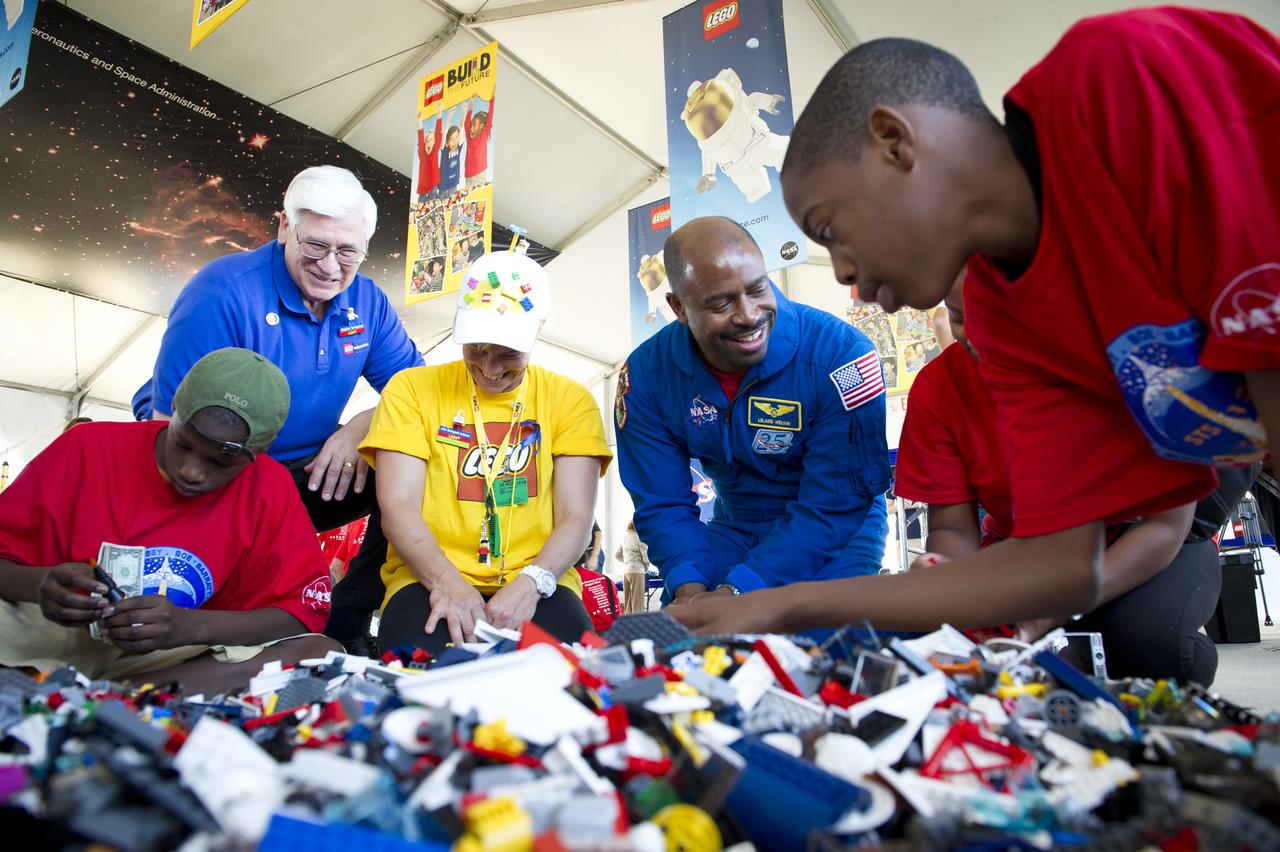
President of LEGO Education USA Stephan Turnipseed, back left, and Associate Administrator for Education and Astronaut Leland Melvin, 2nd from right, talk with a student during the “Build the Future” activity where students created their vision of the future in space with LEGO bricks and elements inside a tent that was set up on the launch viewing area at NASA's Kennedy Space Center in Cape Canaveral, Fla. on Monday, Nov. 1, 2010. NASA and The LEGO Group signed a Space Act Agreement to spark children's interest in science, technology, engineering and math (STEM). Photo Credit: (NASA/Bill Ingalls)
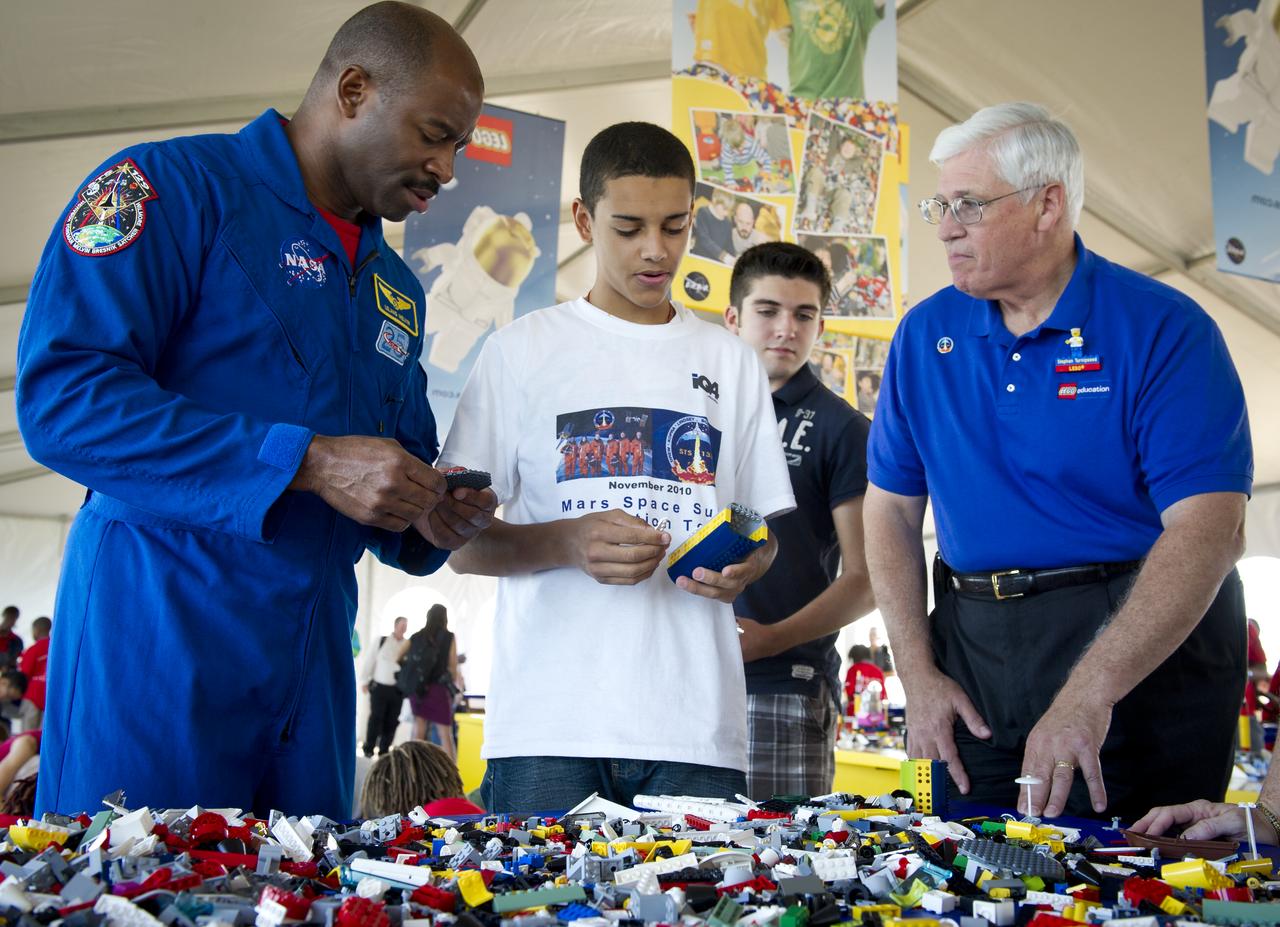
Associate Administrator for Education and Astronaut Leland Melvin, left, and President of LEGO Education USA Stephan Turnipseed, right, talk with a student during the “Build the Future” activity where students created their vision of the future in space with LEGO bricks and elements inside a tent that was set up on the launch viewing area at NASA's Kennedy Space Center in Cape Canaveral, Fla. on Monday, Nov. 1, 2010. NASA and The LEGO Group signed a Space Act Agreement to spark children's interest in science, technology, engineering and math (STEM). Photo Credit: (NASA/Bill Ingalls)
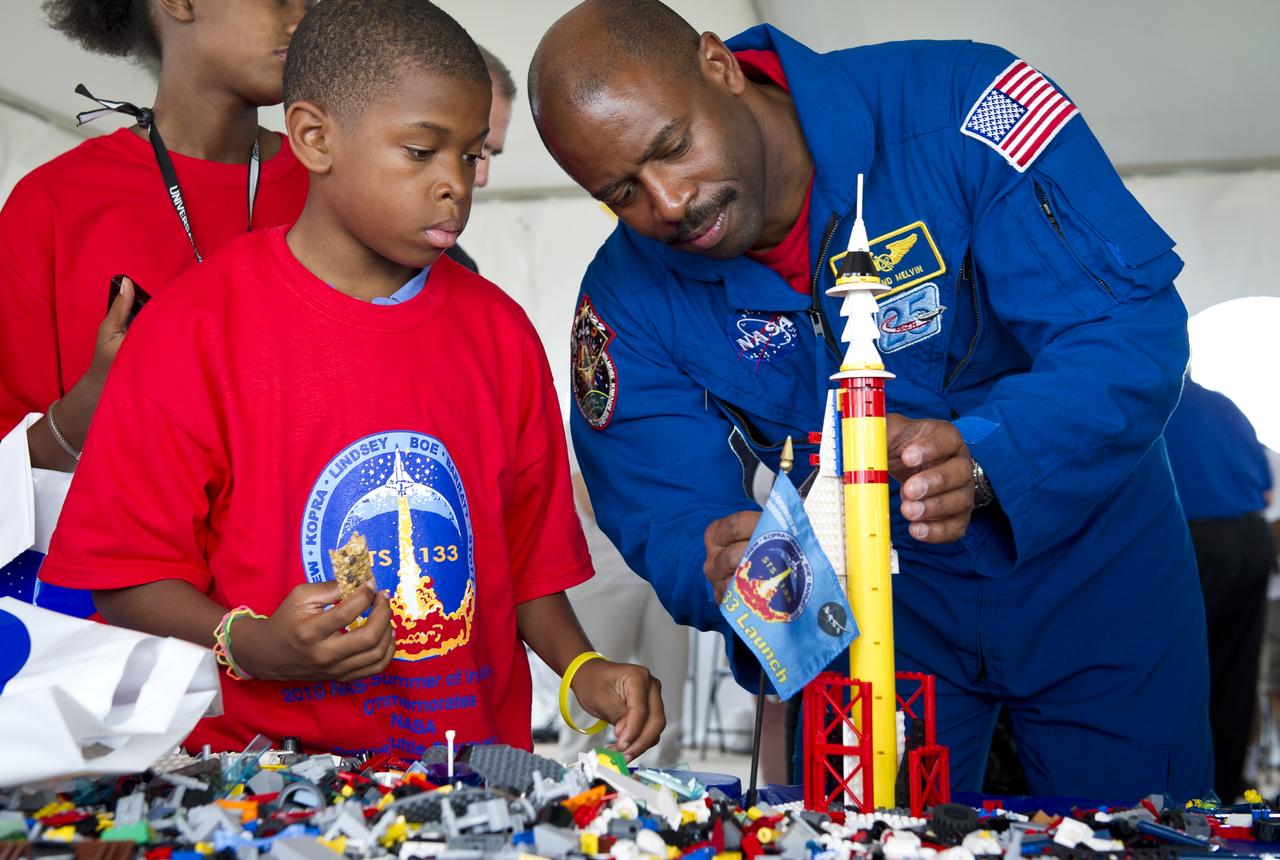
Associate Administrator for Education and Astronaut Leland Melvin talks with school children during the “Build the Future” activity where students created their vision of the future in space with LEGO bricks and elements inside a tent that was set up on the launch viewing area at NASA's Kennedy Space Center in Cape Canaveral, Fla. on Monday, Nov. 1, 2010. NASA and The LEGO Group signed a Space Act Agreement to spark children's interest in science, technology, engineering and math (STEM). Photo Credit: (NASA/Bill Ingalls)
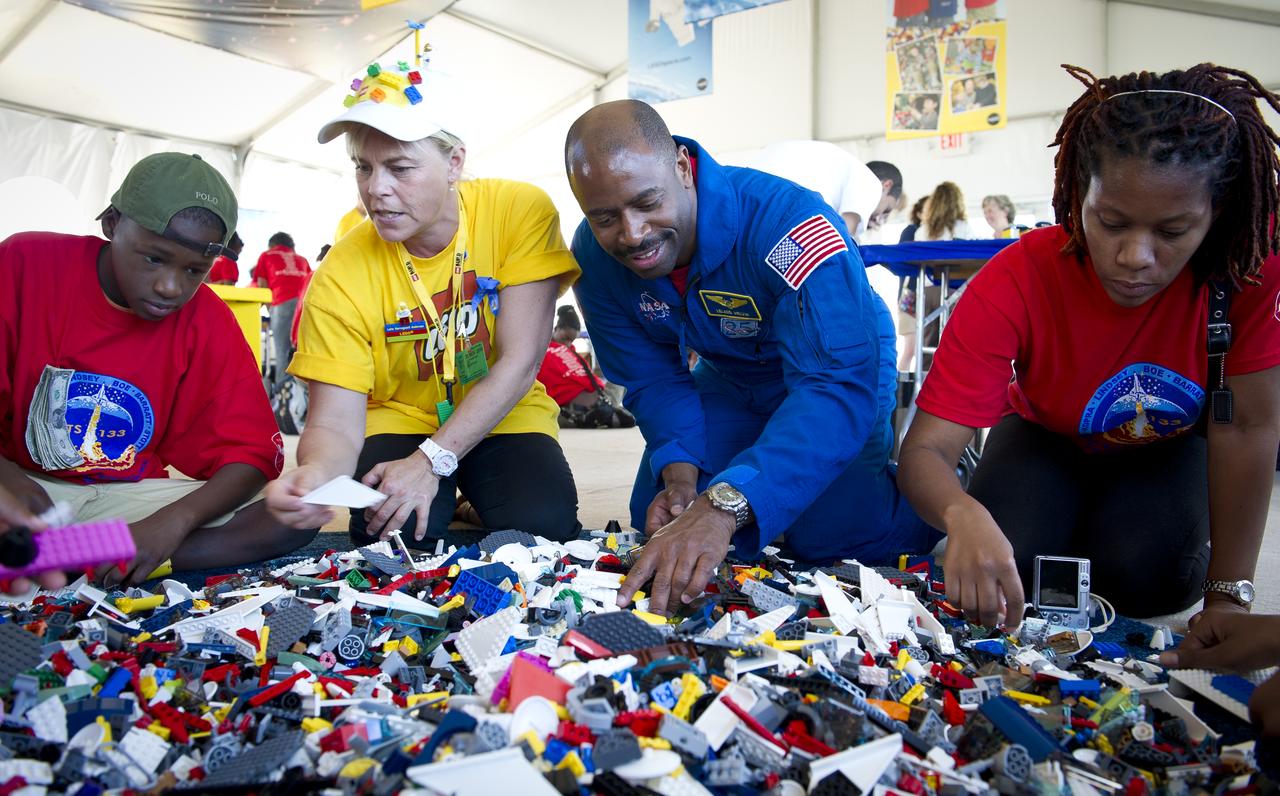
Associate Administrator for Education and Astronaut Leland Melvin, 3rd from left, talks with school children during the “Build the Future” activity where students created their vision of the future in space with LEGO bricks and elements inside a tent that was set up on the launch viewing area at NASA's Kennedy Space Center in Cape Canaveral, Fla. on Monday, Nov. 1, 2010. NASA and The LEGO Group signed a Space Act Agreement to spark children's interest in science, technology, engineering and math (STEM). Photo Credit: (NASA/Bill Ingalls)
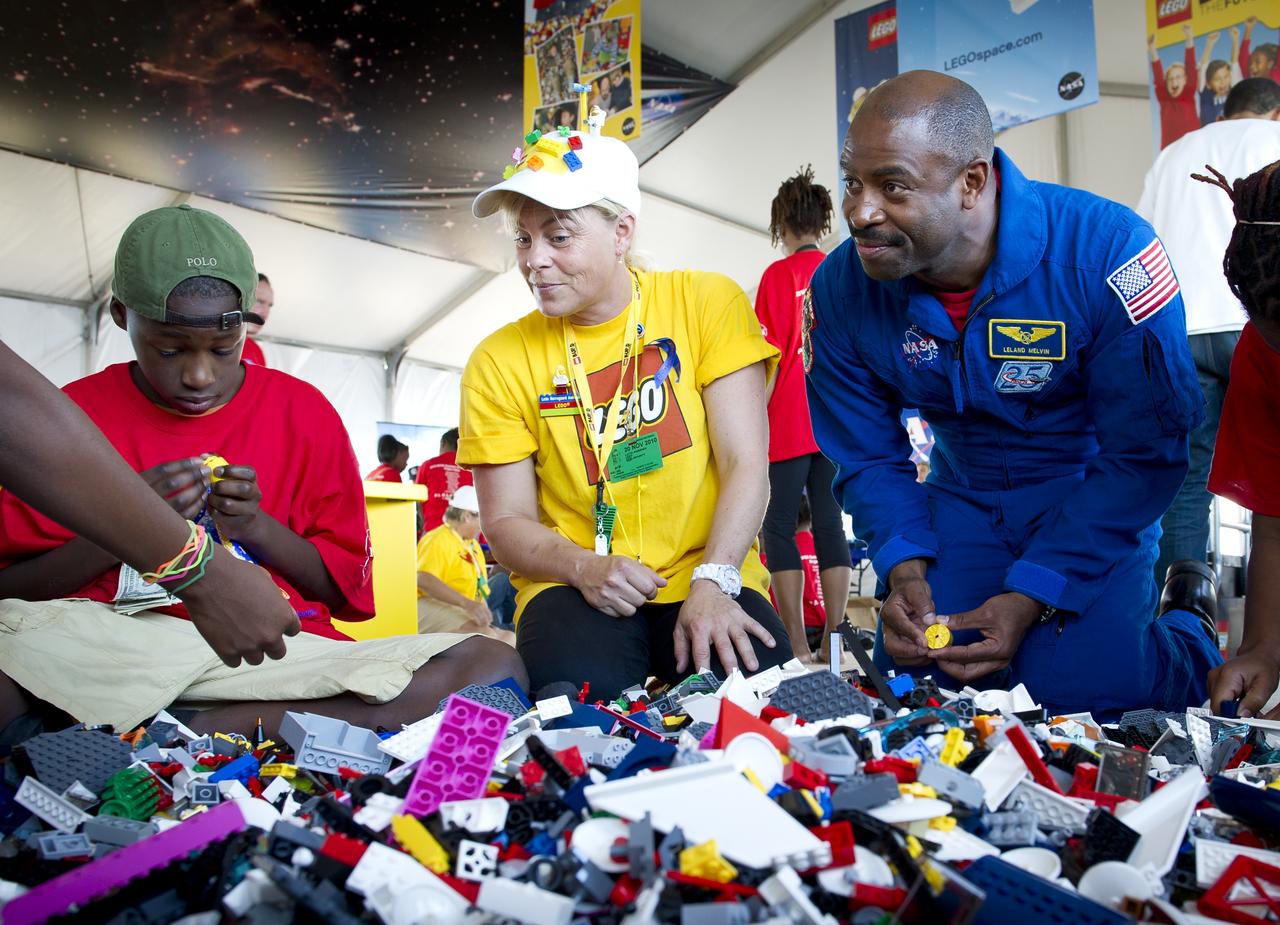
Associate Administrator for Education and Astronaut Leland Melvin talks with school children during the “Build the Future” activity where students created their vision of the future in space with LEGO bricks and elements inside a tent that was set up on the launch viewing area at NASA's Kennedy Space Center in Cape Canaveral, Fla. on Monday, Nov. 1, 2010. NASA and The LEGO Group signed a Space Act Agreement to spark children's interest in science, technology, engineering and math (STEM). Photo Credit: (NASA/Bill Ingalls)
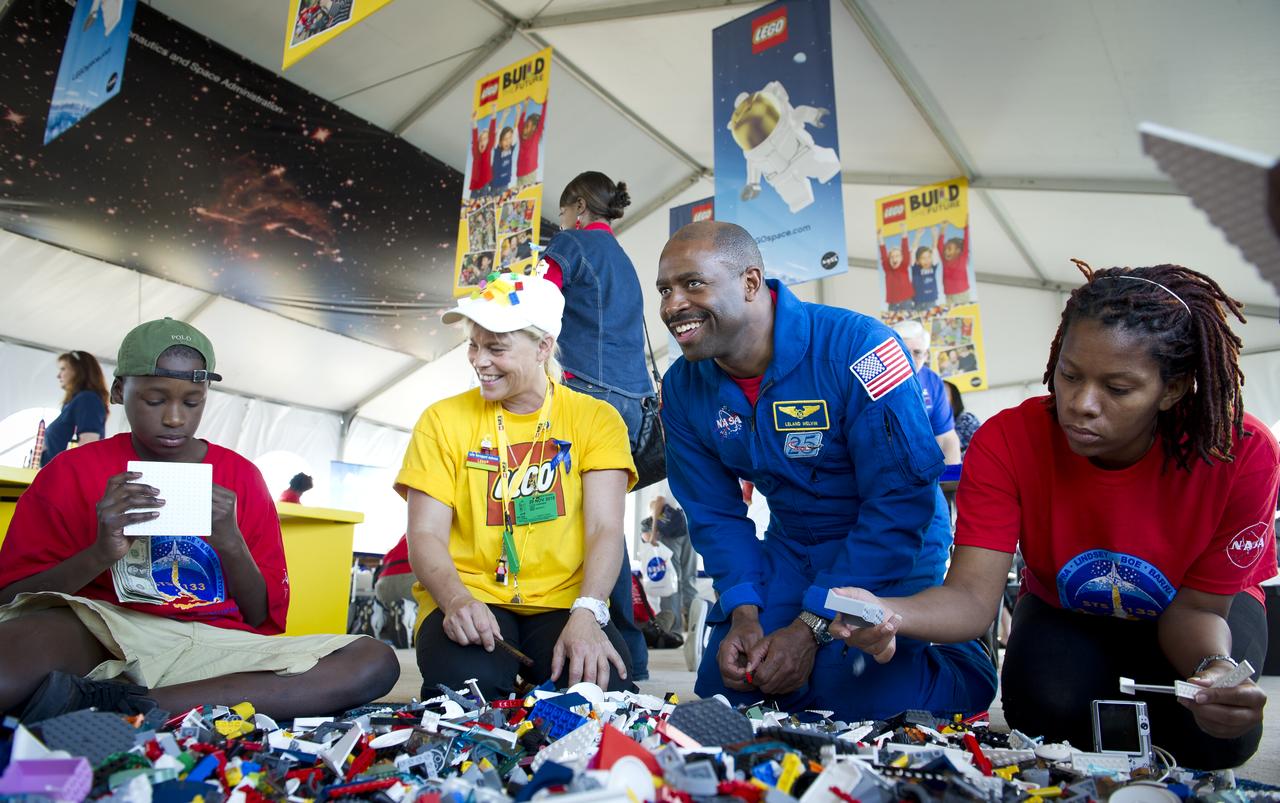
Associate Administrator for Education and Astronaut Leland Melvin, 3rd from left, talks with school children during the “Build the Future” activity where students created their vision of the future in space with LEGO bricks and elements inside a tent that was set up on the launch viewing area at NASA's Kennedy Space Center in Cape Canaveral, Fla. on Monday, Nov. 1, 2010. NASA and The LEGO Group signed a Space Act Agreement to spark children's interest in science, technology, engineering and math (STEM). Photo Credit: (NASA/Bill Ingalls)
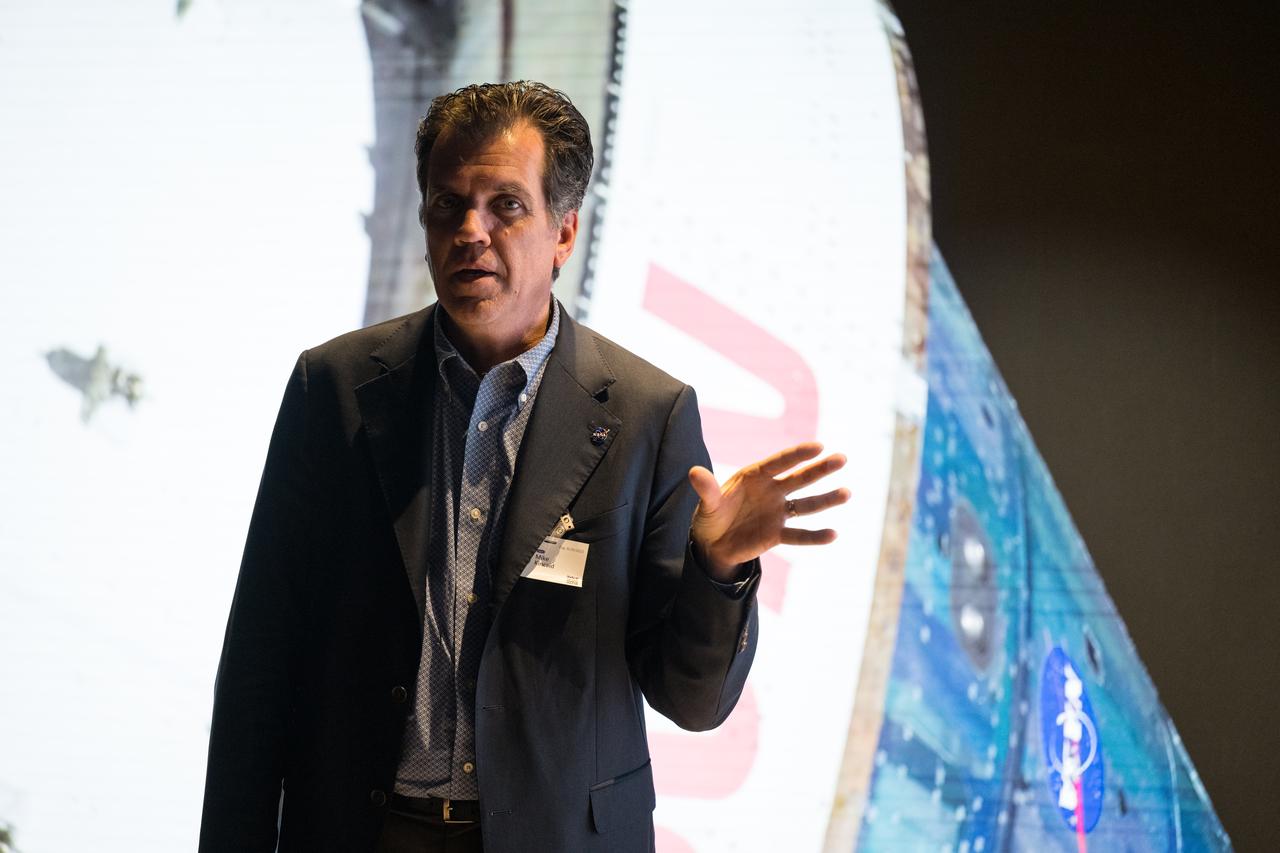
NASA Associate Administrator for the STEM Engagement Office, Mike Kincaid, provides remarks during Space Education Day, Tuesday, June 20, 2023, at the Microsoft Technology Center in Arlington, Va. Microsoft hosted the event to showcase the collaboration, early successes, and future plans for high quality student engagement through activities that combined space content and technologies like artificial intelligence and cloud computing. Photo Credit: (NASA/Aubrey Gemignani)
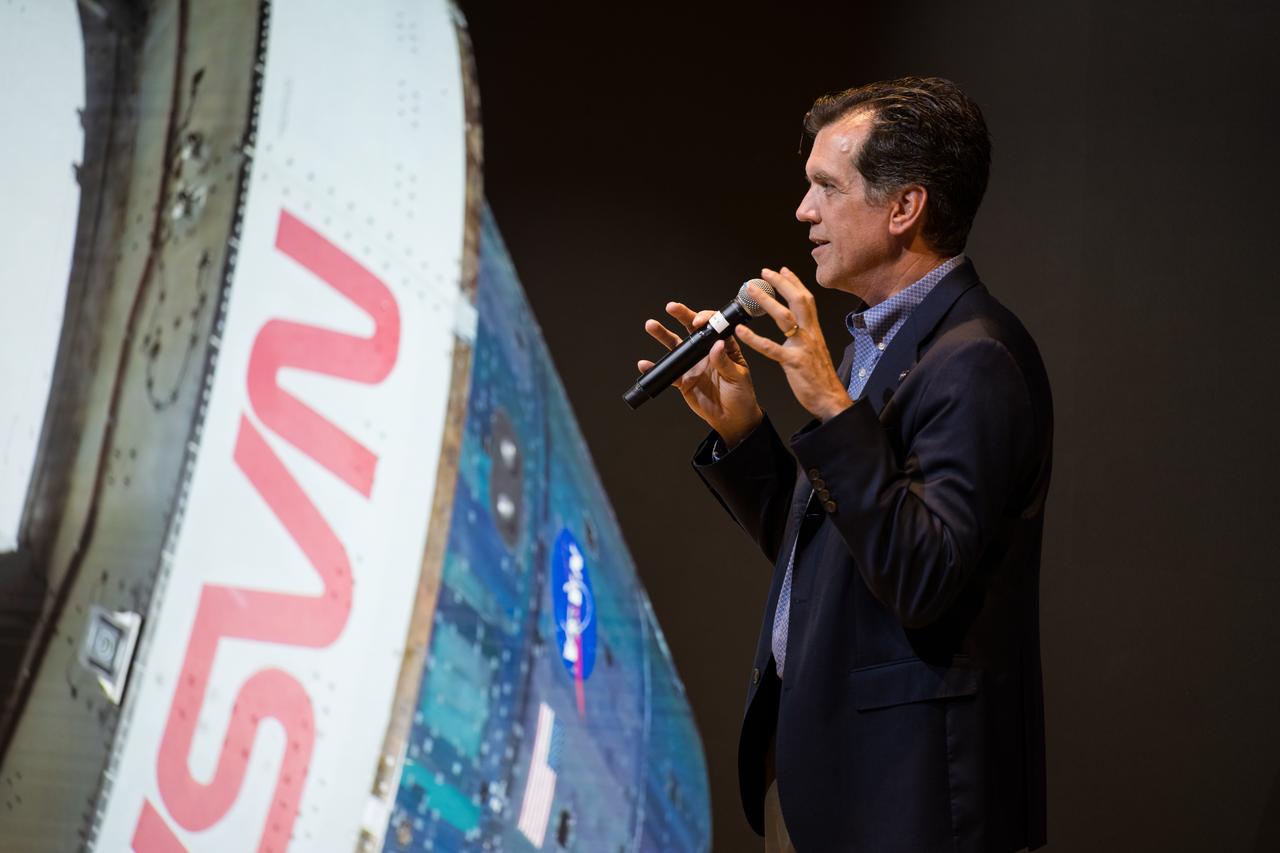
NASA Associate Administrator for the STEM Engagement Office, Mike Kincaid, provides remarks during Space Education Day, Tuesday, June 20, 2023, at the Microsoft Technology Center in Arlington, Va. Microsoft hosted the event to showcase the collaboration, early successes, and future plans for high quality student engagement through activities that combined space content and technologies like artificial intelligence and cloud computing. Photo Credit: (NASA/Aubrey Gemignani)

NASA Strategic Partnerships Manager for STEM Engagement, Rob LaSalvia, provides remarks during Space Education Day, Tuesday, June 20, 2023, at the Microsoft Technology Center in Arlington, Va. Microsoft hosted the event to showcase the collaboration, early successes, and future plans for high quality student engagement through activities that combined space content and technologies like artificial intelligence and cloud computing. Photo Credit: (NASA/Aubrey Gemignani)
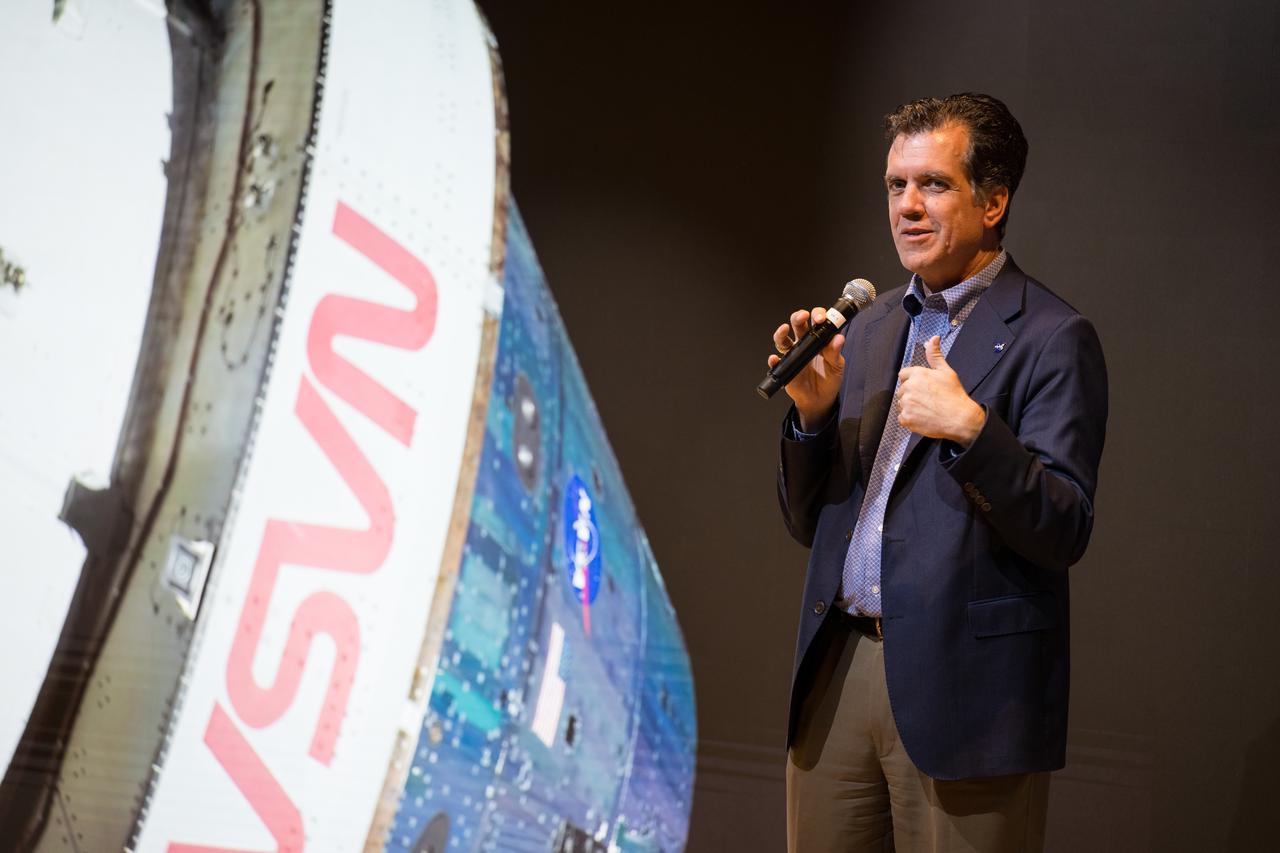
NASA Associate Administrator for the STEM Engagement Office, Mike Kincaid, provides remarks during Space Education Day, Tuesday, June 20, 2023, at the Microsoft Technology Center in Arlington, Va. Microsoft hosted the event to showcase the collaboration, early successes, and future plans for high quality student engagement through activities that combined space content and technologies like artificial intelligence and cloud computing. Photo Credit: (NASA/Aubrey Gemignani)
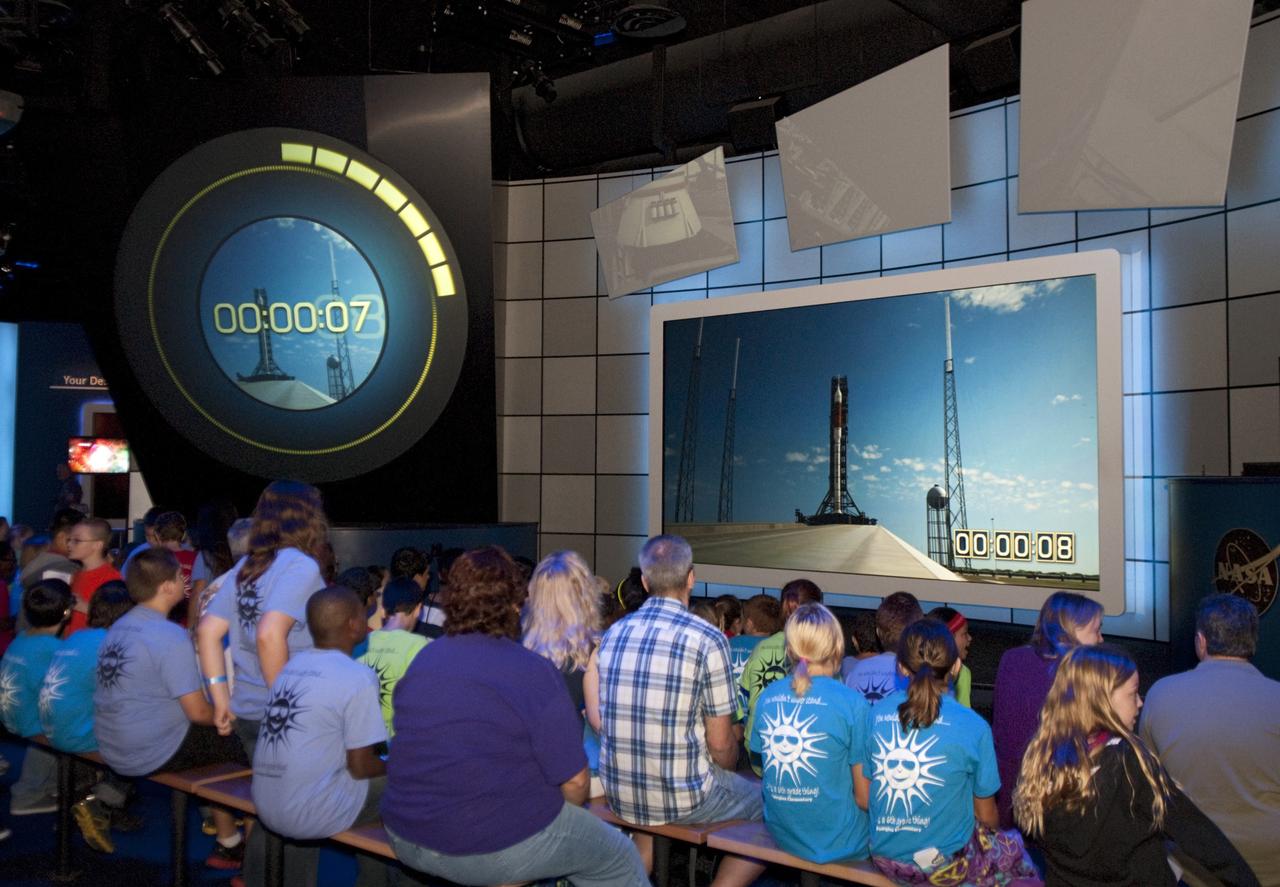
CAPE CANAVERAL, Fla. – At the Kennedy Space Center Visitor Complex in Florida sixth-grade students watch a video presentation about a future rocket launch. Between Nov. 26 and Dec. 7, 2012, about 5,300 sixth-graders in Brevard County, Florida were bused to Kennedy's Visitor Complex for Brevard Space Week, an educational program designed to encourage interest in science, technology, engineering and mathematics STEM careers. Photo credit: NASA/Tim Jacobs
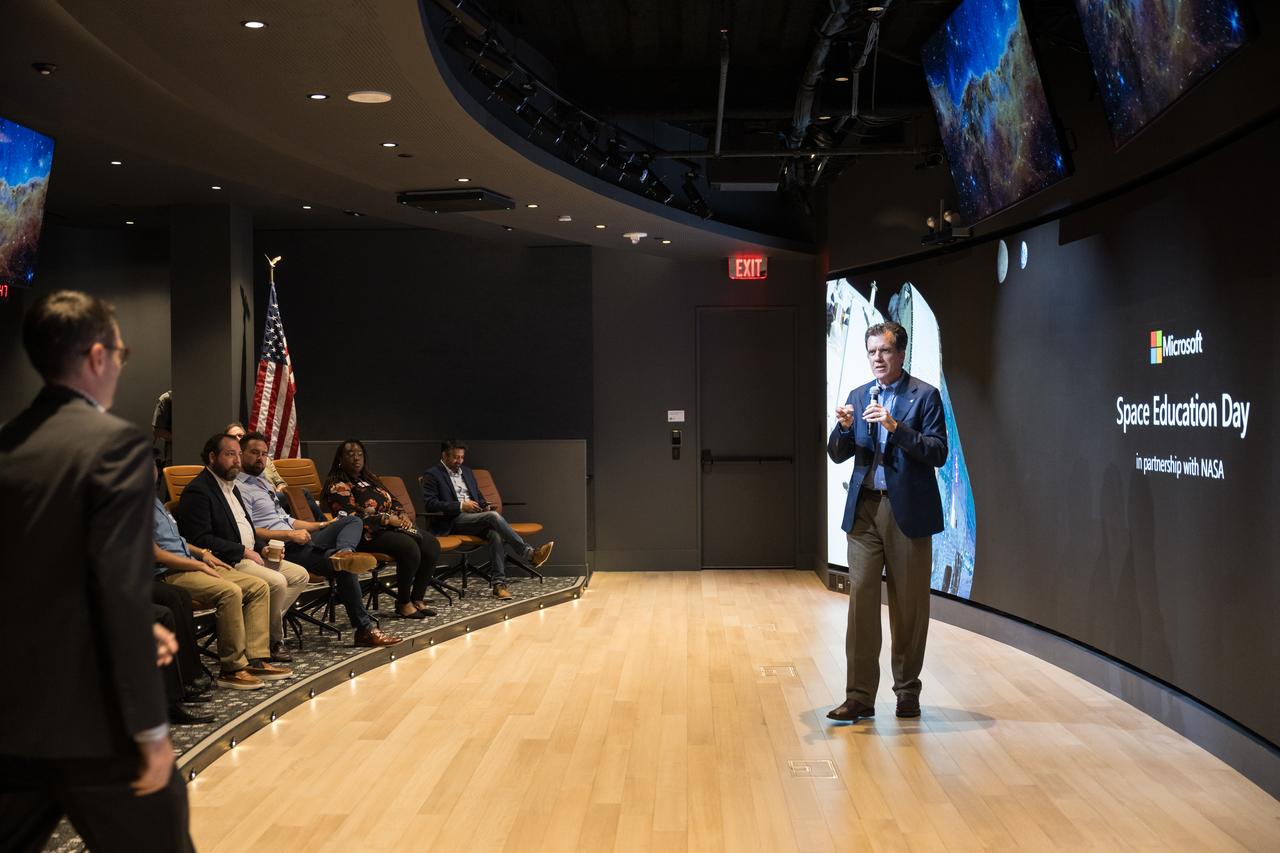
NASA Associate Administrator for the STEM Engagement Office, Mike Kincaid, provides remarks during Space Education Day, Tuesday, June 20, 2023, at the Microsoft Technology Center in Arlington, Va. Microsoft hosted the event to showcase the collaboration, early successes, and future plans for high quality student engagement through activities that combined space content and technologies like artificial intelligence and cloud computing. Photo Credit: (NASA/Aubrey Gemignani)
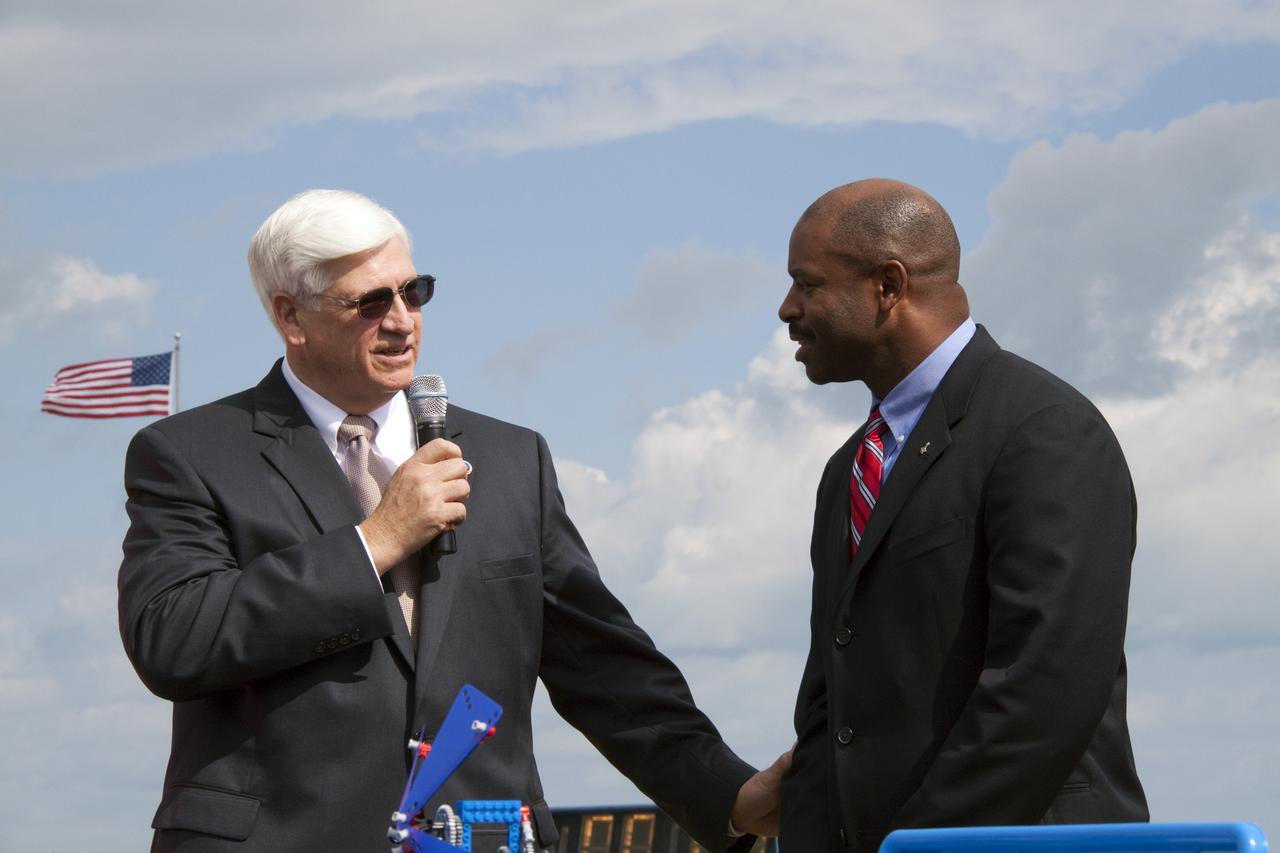
CAPE CANAVERAL, Fla. -- NASA and The LEGO Group announce a three-year Space Act Agreement meant to spark the interest of children in science, technology, engineering and mathematics (STEM) with the future release of four NASA-inspired products in the toy company's LEGO CITY line. From left, are Stephan Turnipseed, president of LEGO Education North America, and Leland Melvin, NASA's associate administrator for Education. To commemorate the beginning of the partnership, two small LEGO space shuttles will launch aboard space shuttle Discovery's STS-133 mission to the International Space Station. A 40- by 70-foot activity tent will be set up at Kennedy on Nov. 3 for children of all ages to build their vision of the future with LEGO bricks. LEGO sets also will fly to the space station aboard Endeavour's STS-134 mission, and will be put together on orbit to demonstrate the challenges faced while building things in microgravity. Photo credit: NASA/Jack Pfaller
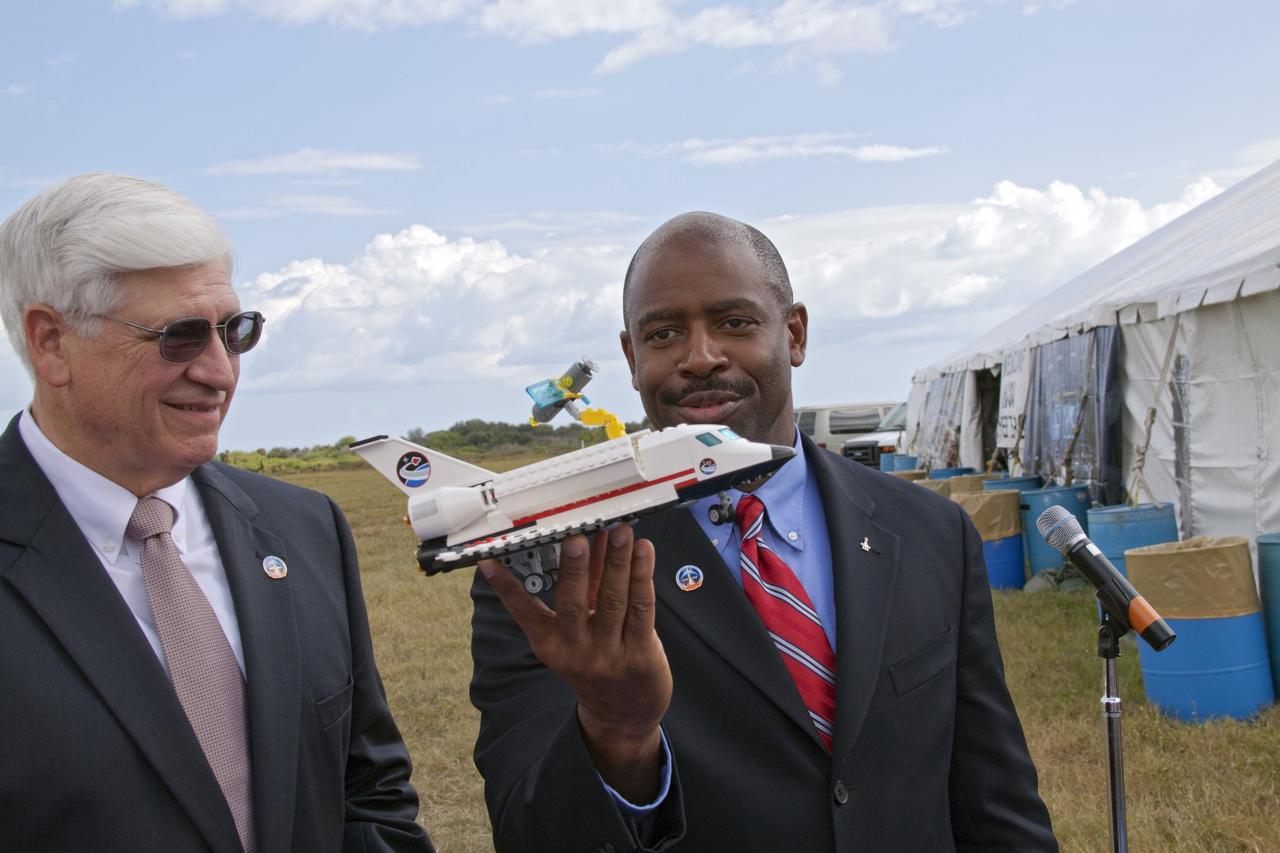
CAPE CANAVERAL, Fla. -- NASA and The LEGO Group announce a three-year Space Act Agreement meant to spark the interest of children in science, technology, engineering and mathematics (STEM) with the future release of four NASA-inspired products in the toy company's LEGO CITY line. From left, are Stephan Turnipseed, president of LEGO Education North America, and Leland Melvin, NASA's associate administrator for Education. To commemorate the beginning of the partnership, two small LEGO space shuttles will launch aboard space shuttle Discovery's STS-133 mission to the International Space Station. A 40- by 70-foot activity tent will be set up at Kennedy on Nov. 3 for children of all ages to build their vision of the future with LEGO bricks. LEGO sets also will fly to the space station aboard Endeavour's STS-134 mission, and will be put together on orbit to demonstrate the challenges faced while building things in microgravity. Photo credit: NASA/Jack Pfaller
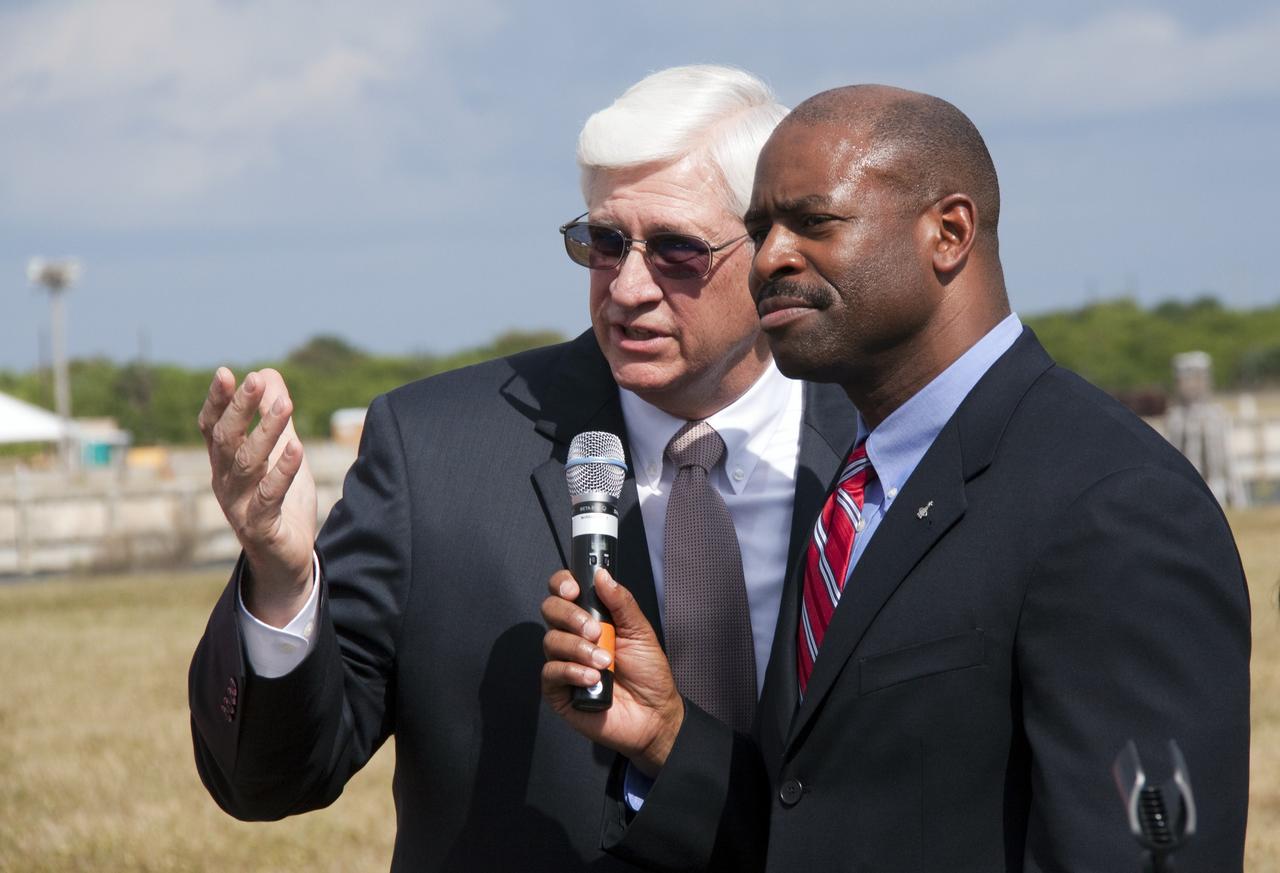
CAPE CANAVERAL, Fla. -- NASA and The LEGO Group announce a three-year Space Act Agreement meant to spark the interest of children in science, technology, engineering and mathematics (STEM) with the future release of four NASA-inspired products in the toy company's LEGO CITY line. From left, are Stephan Turnipseed, president of LEGO Education North America, and Leland Melvin, NASA's associate administrator for Education. To commemorate the beginning of the partnership, two small LEGO space shuttles will launch aboard space shuttle Discovery's STS-133 mission to the International Space Station. A 40- by 70-foot activity tent will be set up at Kennedy on Nov. 3 for children of all ages to build their vision of the future with LEGO bricks. LEGO sets also will fly to the space station aboard Endeavour's STS-134 mission, and will be put together on orbit to demonstrate the challenges faced while building things in microgravity. Photo credit: NASA/Jack Pfaller
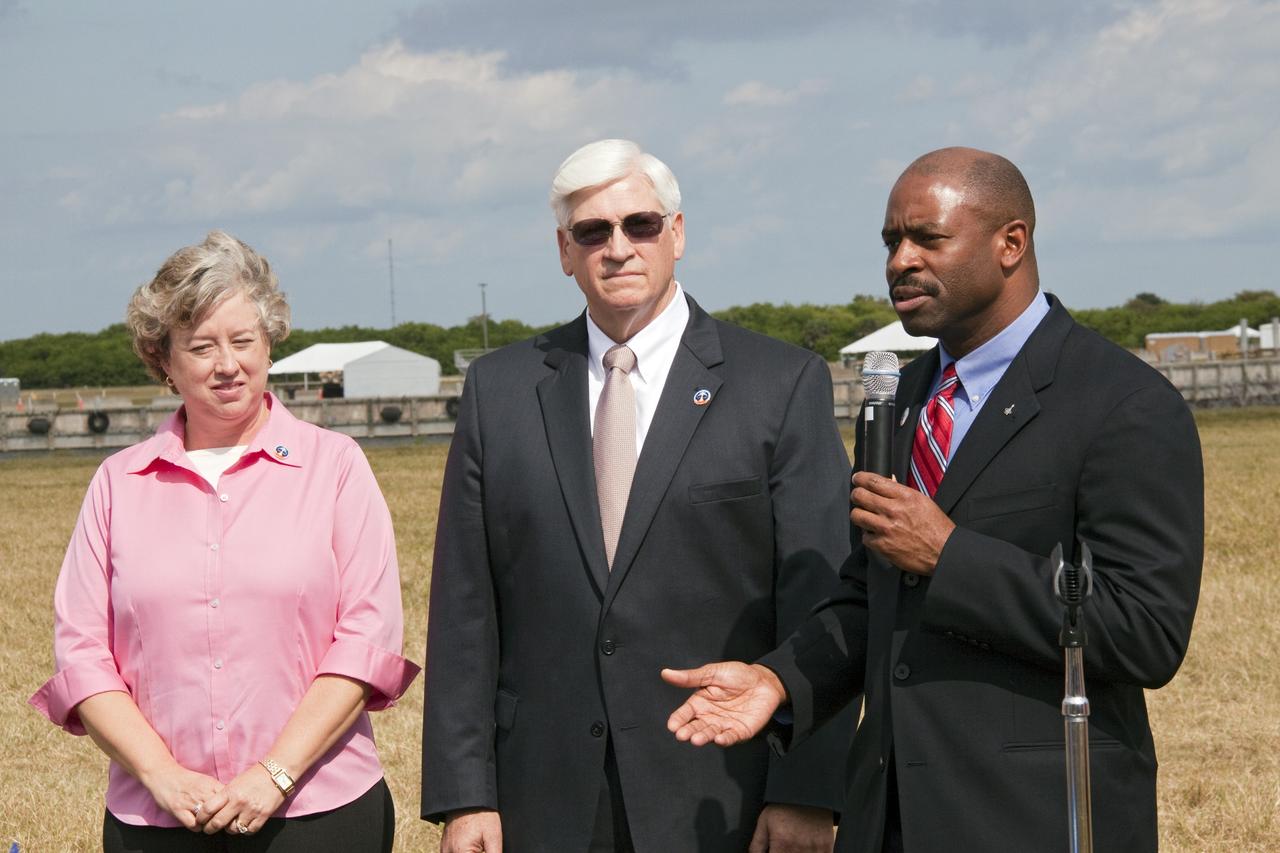
CAPE CANAVERAL, Fla. -- NASA and The LEGO Group announce a three-year Space Act Agreement meant to spark the interest of children in science, technology, engineering and mathematics (STEM) with the future release of four NASA-inspired products in the toy company's LEGO CITY line. From left, are Debbie Biggs, education specialist for International Space Station National Lab Education Projects, Stephan Turnipseed, president of LEGO Education North America, and Leland Melvin, NASA's associate administrator for Education. To commemorate the beginning of the partnership, two small LEGO space shuttles will launch aboard space shuttle Discovery's STS-133 mission to the International Space Station. A 40- by 70-foot activity tent will be set up at Kennedy on Nov. 3 for children of all ages to build their vision of the future with LEGO bricks. LEGO sets also will fly to the space station aboard Endeavour's STS-134 mission, and will be put together on orbit to demonstrate the challenges faced while building things in microgravity. Photo credit: NASA/Jack Pfaller

CAPE CANAVERAL, Fla. -- NASA and The LEGO Group announce a three-year Space Act Agreement meant to spark the interest of children in science, technology, engineering and mathematics (STEM) with the future release of four NASA-inspired products in the toy company's LEGO CITY line. From left, are Debbie Biggs, education specialist for International Space Station National Lab Education Projects, Stephan Turnipseed, president of LEGO Education North America, Leland Melvin, NASA's associate administrator for Education, and Ann Marie Trotta, NASA Public Affairs officer. To commemorate the beginning of the partnership, two small LEGO space shuttles will launch aboard space shuttle Discovery's STS-133 mission to the International Space Station. A 40- by 70-foot activity tent will be set up at Kennedy on Nov. 3 for children of all ages to build their vision of the future with LEGO bricks. LEGO sets also will fly to the space station aboard Endeavour's STS-134 mission, and will be put together on orbit to demonstrate the challenges faced while building things in microgravity. Photo credit: NASA/Jack Pfaller
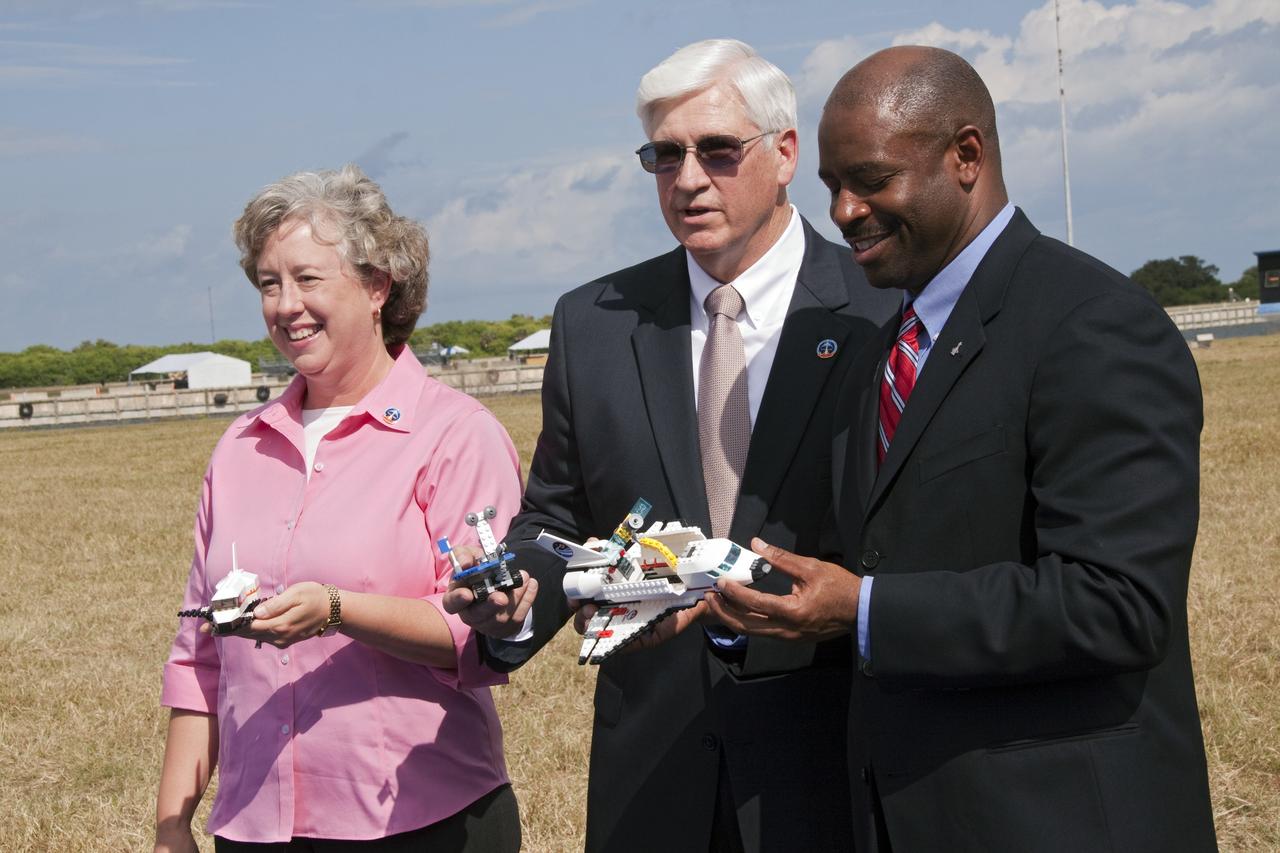
CAPE CANAVERAL, Fla. -- NASA and The LEGO Group announce a three-year Space Act Agreement meant to spark the interest of children in science, technology, engineering and mathematics (STEM) with the future release of four NASA-inspired products in the toy company's LEGO CITY line. From left, are Debbie Biggs, education specialist for International Space Station National Lab Education Projects, Stephan Turnipseed, president of LEGO Education North America, and Leland Melvin, NASA's associate administrator for Education. To commemorate the beginning of the partnership, two small LEGO space shuttles will launch aboard space shuttle Discovery's STS-133 mission to the International Space Station. A 40- by 70-foot activity tent will be set up at Kennedy on Nov. 3 for children of all ages to build their vision of the future with LEGO bricks. LEGO sets also will fly to the space station aboard Endeavour's STS-134 mission, and will be put together on orbit to demonstrate the challenges faced while building things in microgravity. Photo credit: NASA/Jack Pfaller

CAPE CANAVERAL, Fla. - University students gather for the opening ceremony of NASA's first Lunabotics Mining Competition at the Kennedy Space Center Visitor Complex's Astronaut Hall of Fame. Twenty-two teams from around the country will maneuver their remote controlled or autonomous excavators, called lunabots, in about 60 tons of ultra-fine simulated lunar soil, called BP-1. The competition is an Exploration Systems Mission Directorate project managed by Kennedy's Education Division. The purpose is to engage and retain students in science, technology, engineering and mathematics, or STEM, fields. It also provides a competitive environment that could result in innovative ideas and solutions for NASA's future excavation of the moon. Photo credit: NASA_Dimitri Gerondidakis
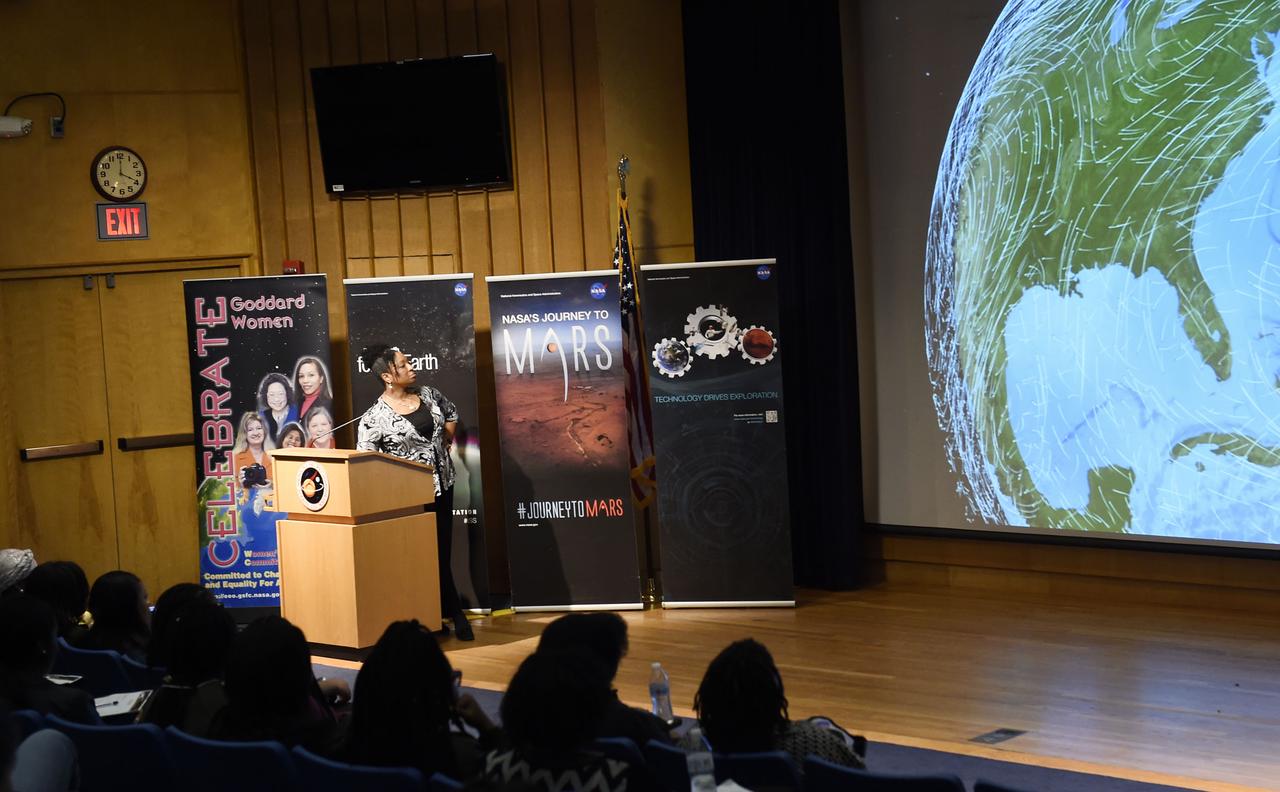
Girls Night In was held at Goddard on Nov 4-5, 2016. This is a pilot program which reinvigorates, inspires, and engages high school girls who may be struggling or not fully engaged in STEM (Science, Technology Engineering and Math) education. The program allowed NASA women to share and demonstrate the work they do, provide the girls an opportunity to completely immerse themselves in Goddard science, technology, engineering and math as well as provide them activities that will challenge and promote knowledge and discovery. Goddard invites other NASA centers tolearn from this pilot program and work towards a simultaneous multicenter event in the future. Participating schools were: DuVal, Crossland, Flowers, High Point, Northwestern and Oxon Hill
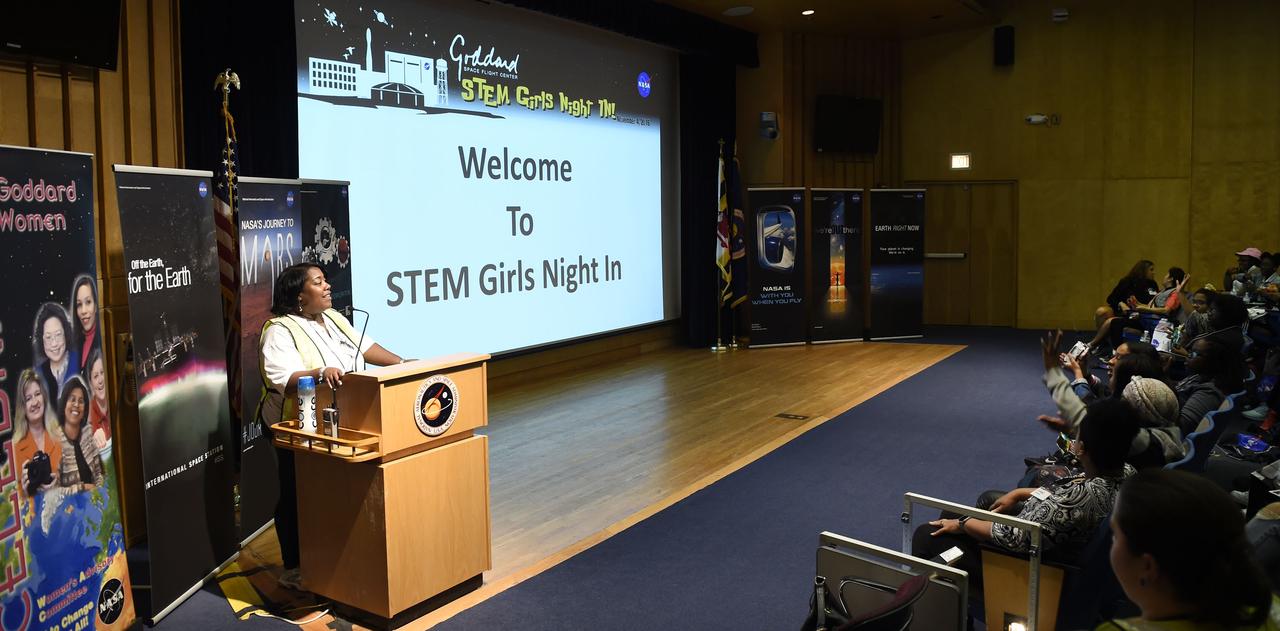
Girls Night In was held at Goddard on Nov 4-5, 2016. This is a pilot program which reinvigorates, inspires, and engages high school girls who may be struggling or not fully engaged in STEM (Science, Technology Engineering and Math) education. The program allowed NASA women to share and demonstrate the work they do, provide the girls an opportunity to completely immerse themselves in Goddard science, technology, engineering and math as well as provide them activities that will challenge and promote knowledge and discovery. Goddard invites other NASA centers tolearn from this pilot program and work towards a simultaneous multicenter event in the future. Participating schools were: DuVal, Crossland, Flowers, High Point, Northwestern and Oxon Hill
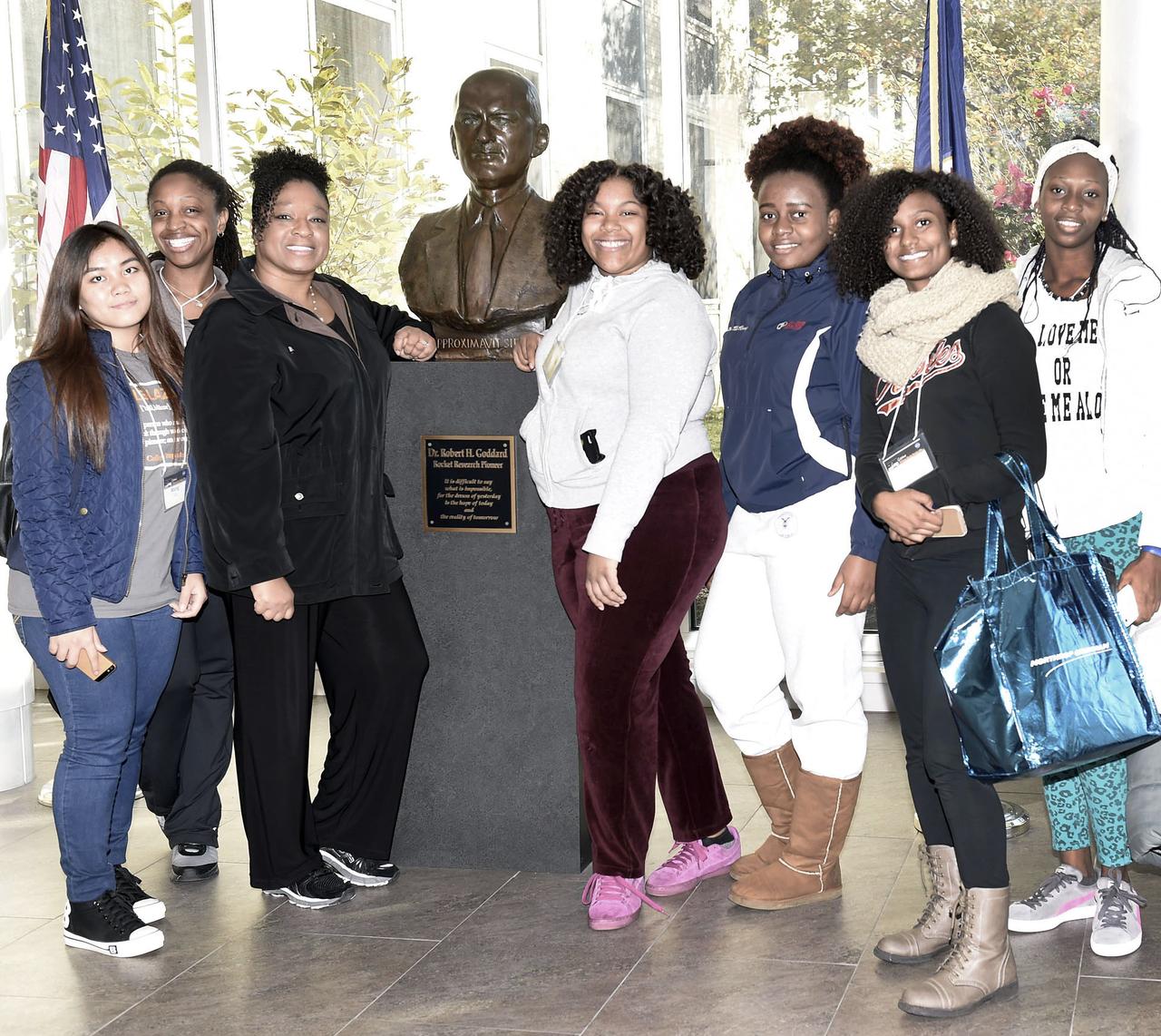
Girls Night In was held at Goddard on Nov 4-5, 2016. This is a pilot program which reinvigorates, inspires, and engages high school girls who may be struggling or not fully engaged in STEM (Science, Technology Engineering and Math) education. The program allowed NASA women to share and demonstrate the work they do, provide the girls an opportunity to completely immerse themselves in Goddard science, technology, engineering and math as well as provide them activities that will challenge and promote knowledge and discovery. Goddard invites other NASA centers tolearn from this pilot program and work towards a simultaneous multicenter event in the future. Participating schools were: DuVal, Crossland, Flowers, High Point, Northwestern and Oxon Hill
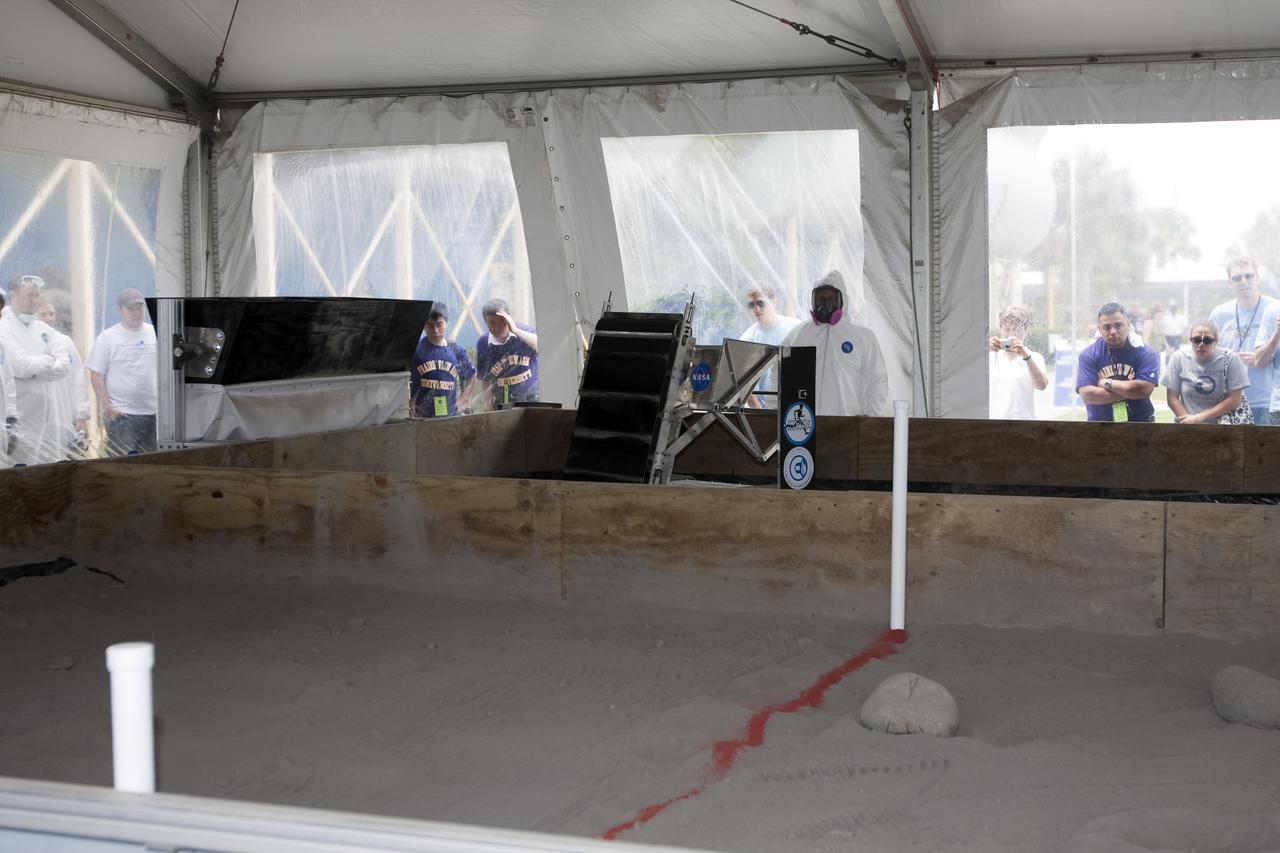
CAPE CANAVERAL, Fla. - Inside the 'Lunarena' at the Kennedy Space Center Visitor Complex's Astronaut Hall of Fame, university students are ready to maneuver their remote controlled or autonomous excavators, called lunabots, in about 60 tons of ultra-fine simulated lunar soil, called BP-1. Twenty-two teams from around the country are competing in NASA's first Lunabotics Mining Competition. The competition is an Exploration Systems Mission Directorate project managed by Kennedy's Education Division. The purpose is to engage and retain students in science, technology, engineering and mathematics, or STEM, fields. It also provides a competitive environment that could result in innovative ideas and solutions for NASA's future excavation of the moon. Photo credit: NASA_Dimitri Gerondidakis
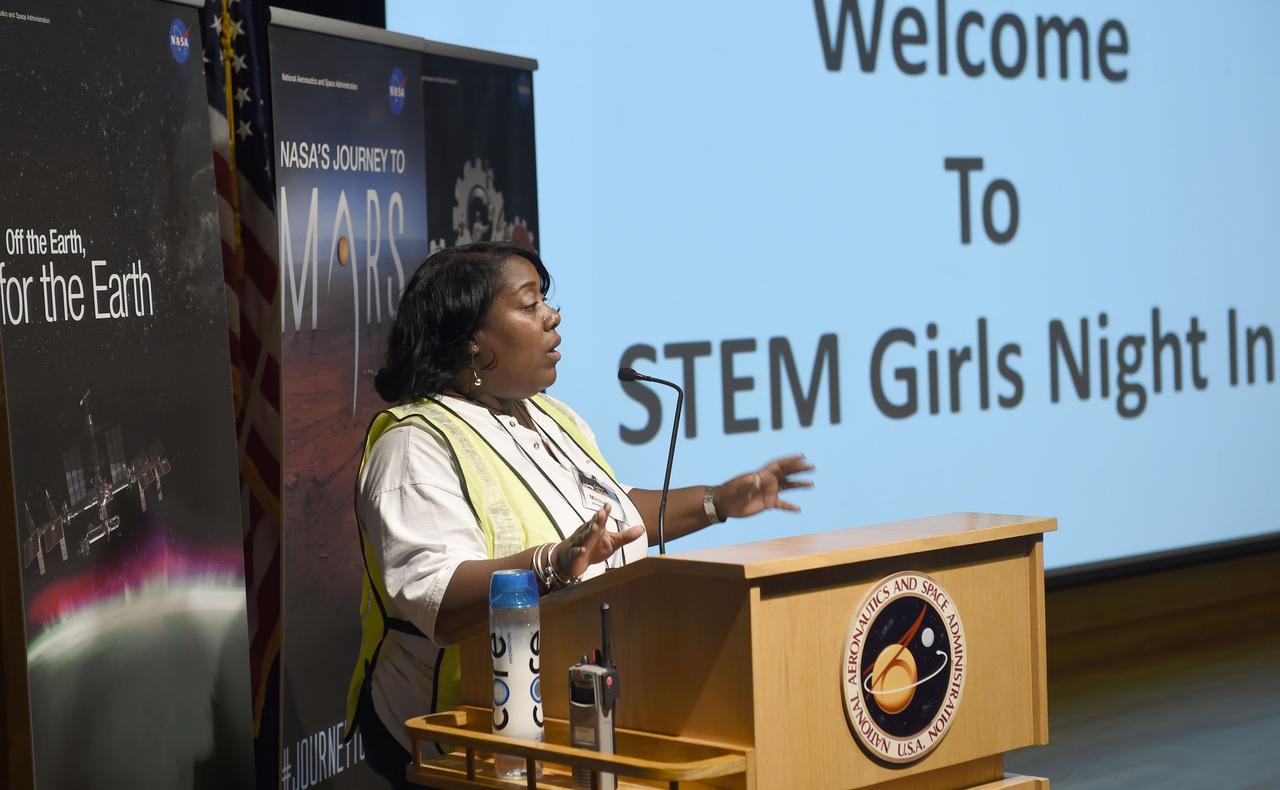
Girls Night In was held at Goddard on Nov 4-5, 2016. This is a pilot program which reinvigorates, inspires, and engages high school girls who may be struggling or not fully engaged in STEM (Science, Technology Engineering and Math) education. The program allowed NASA women to share and demonstrate the work they do, provide the girls an opportunity to completely immerse themselves in Goddard science, technology, engineering and math as well as provide them activities that will challenge and promote knowledge and discovery. Goddard invites other NASA centers tolearn from this pilot program and work towards a simultaneous multicenter event in the future. Participating schools were: DuVal, Crossland, Flowers, High Point, Northwestern and Oxon Hill
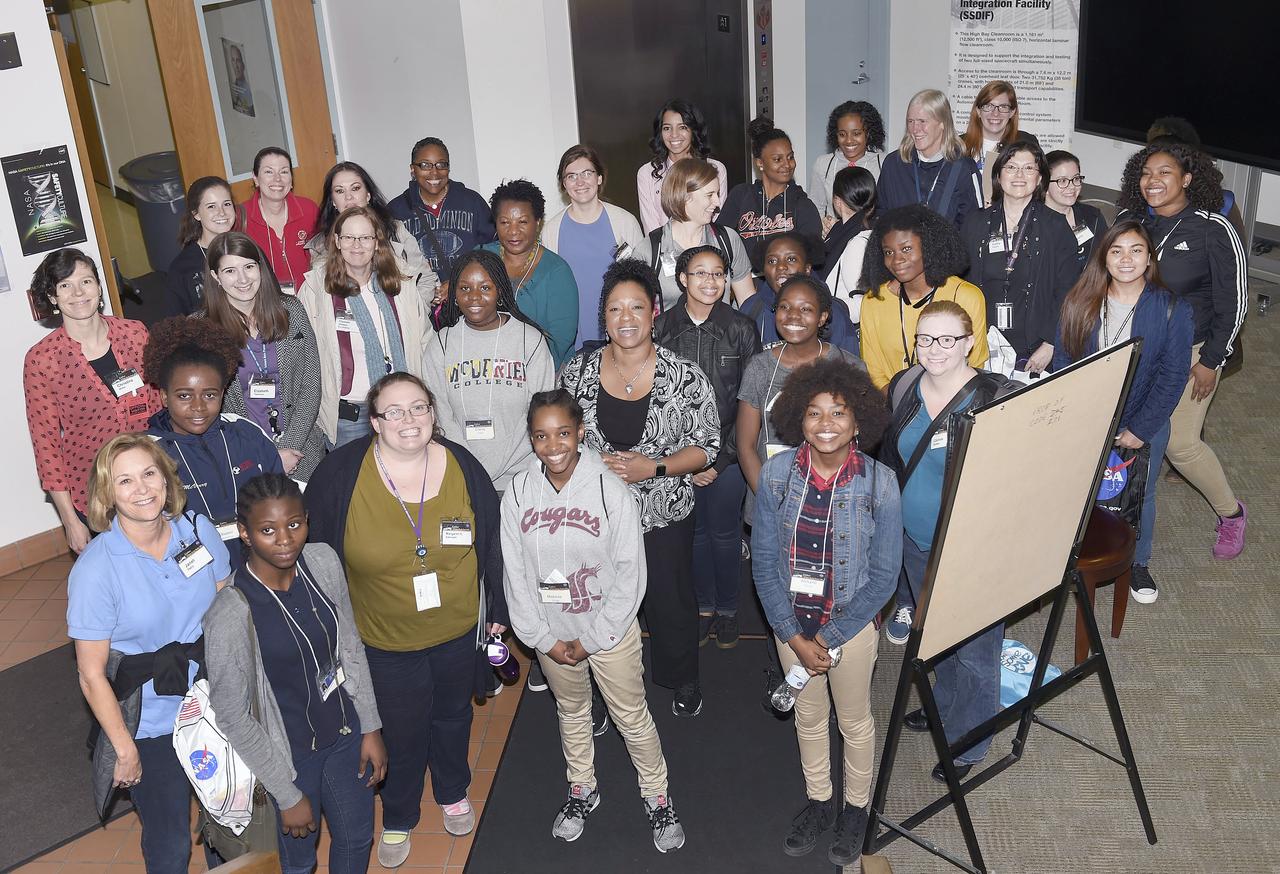
Girls Night In was held at Goddard on Nov 4-5, 2016. This is a pilot program which reinvigorates, inspires, and engages high school girls who may be struggling or not fully engaged in STEM (Science, Technology Engineering and Math) education. The program allowed NASA women to share and demonstrate the work they do, provide the girls an opportunity to completely immerse themselves in Goddard science, technology, engineering and math as well as provide them activities that will challenge and promote knowledge and discovery. Goddard invites other NASA centers tolearn from this pilot program and work towards a simultaneous multicenter event in the future. Participating schools were: DuVal, Crossland, Flowers, High Point, Northwestern and Oxon Hill
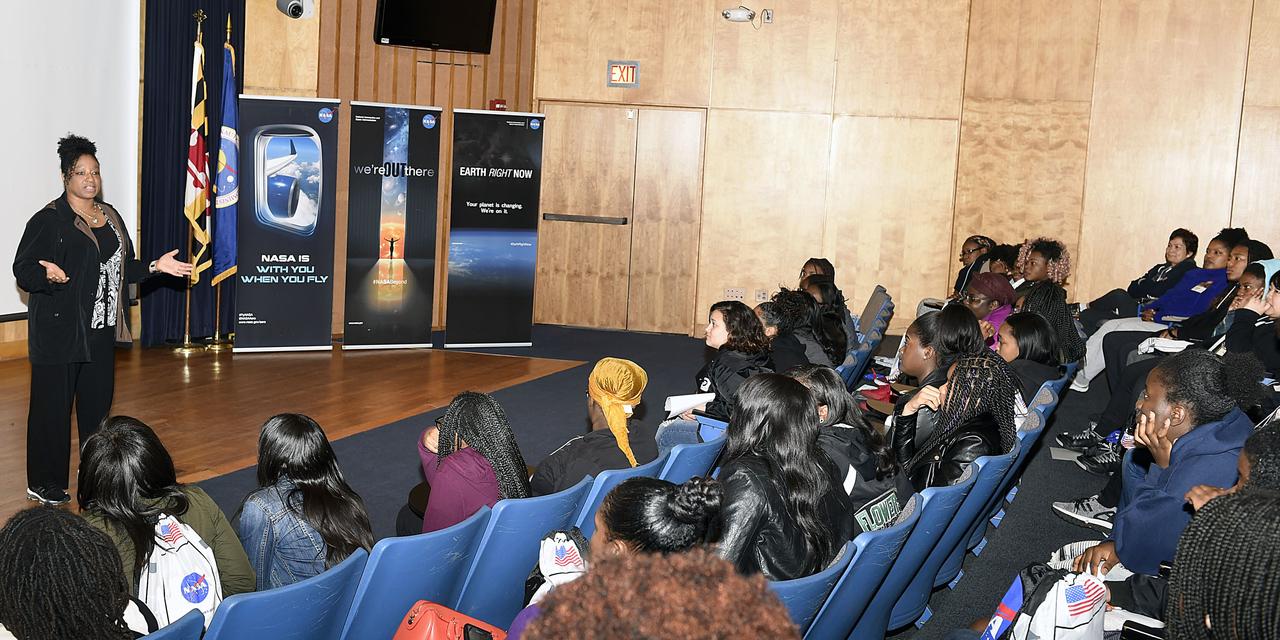
Girls Night In was held at Goddard on Nov 4-5, 2016. This is a pilot program which reinvigorates, inspires, and engages high school girls who may be struggling or not fully engaged in STEM (Science, Technology Engineering and Math) education. The program allowed NASA women to share and demonstrate the work they do, provide the girls an opportunity to completely immerse themselves in Goddard science, technology, engineering and math as well as provide them activities that will challenge and promote knowledge and discovery. Goddard invites other NASA centers tolearn from this pilot program and work towards a simultaneous multicenter event in the future. Participating schools were: DuVal, Crossland, Flowers, High Point, Northwestern and Oxon Hill
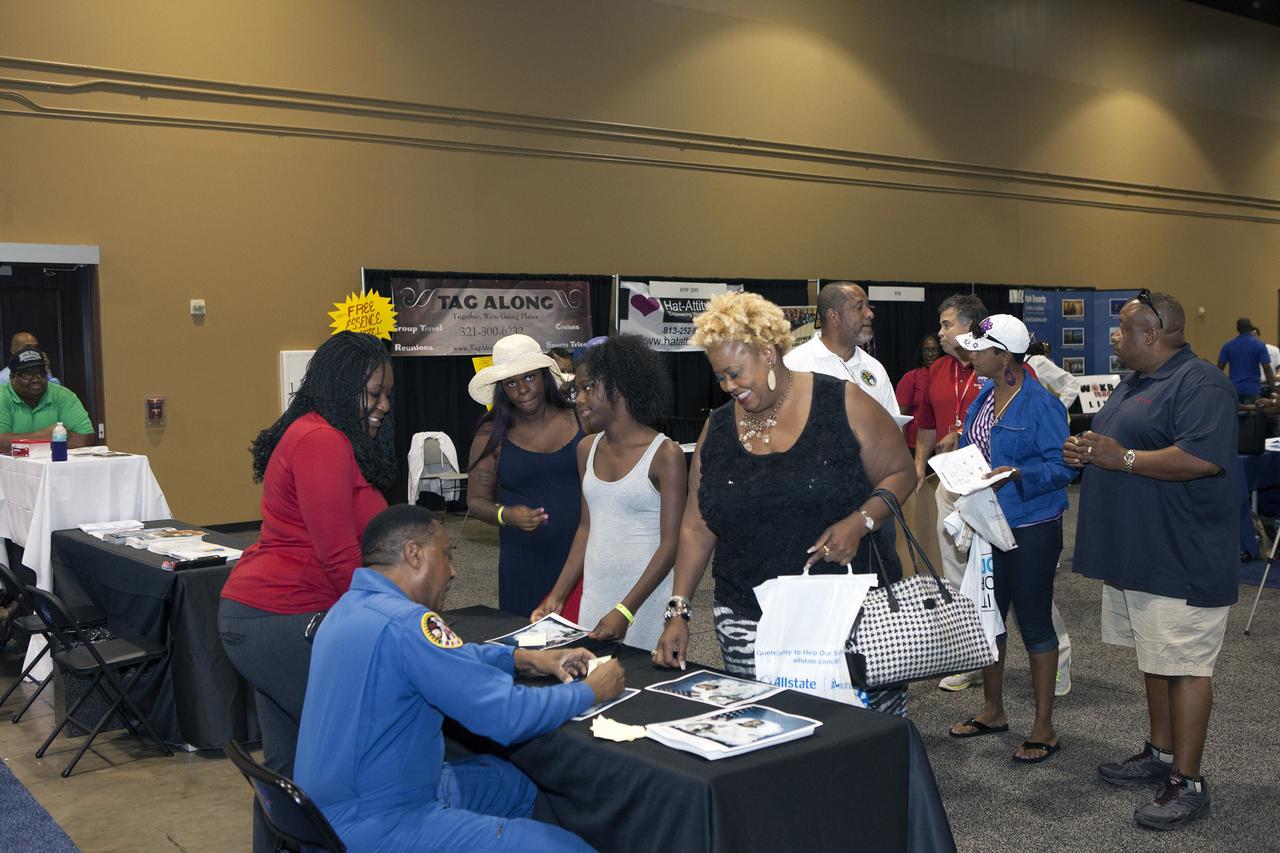
KISSIMMEE, Fla. – Former NASA astronaut Winston Scott signed autographs and posed for pictures with guests at the agency exhibit during the Tom Joyner Family Reunion. Now a senior vice president at the Florida Institute of Technology, he said that he likes to emphasize to young people how important a good education is in preparation for the future. The Tom Joyner Family Reunion is designed to present uplifting programs, entertainment and information about growing, diverse communities. An annual event of the nationally-syndicated Tom Joyner Morning Show, the many exhibits included NASA's participation focusing on encouraging young people to consider studies and careers in STEM -- science, technology, engineering and math. NASA's Education Division promoted the benefits of math and scientific learning along with career opportunities offered by the space agency. The activities took place at the Gaylord Palms Resort in Kissimmee, Florida, during the Labor Day weekend. Photo credit: NASA/Daniel Casper

KISSIMMEE, Fla. – Former NASA astronaut Winston Scott signed autographs and posed for pictures with guests at the agency exhibit during the Tom Joyner Family Reunion. Now a senior vice president at the Florida Institute of Technology, he said that he likes to emphasize to young people how important a good education is in preparation for the future. The Tom Joyner Family Reunion is designed to present uplifting programs, entertainment and information about growing, diverse communities. An annual event of the nationally-syndicated Tom Joyner Morning Show, the many exhibits included NASA's participation focusing on encouraging young people to consider studies and careers in STEM -- science, technology, engineering and math. NASA's Education Division promoted the benefits of math and scientific learning along with career opportunities offered by the space agency. The activities took place at the Gaylord Palms Resort in Kissimmee, Florida, during the Labor Day weekend. Photo credit: NASA/Daniel Casper
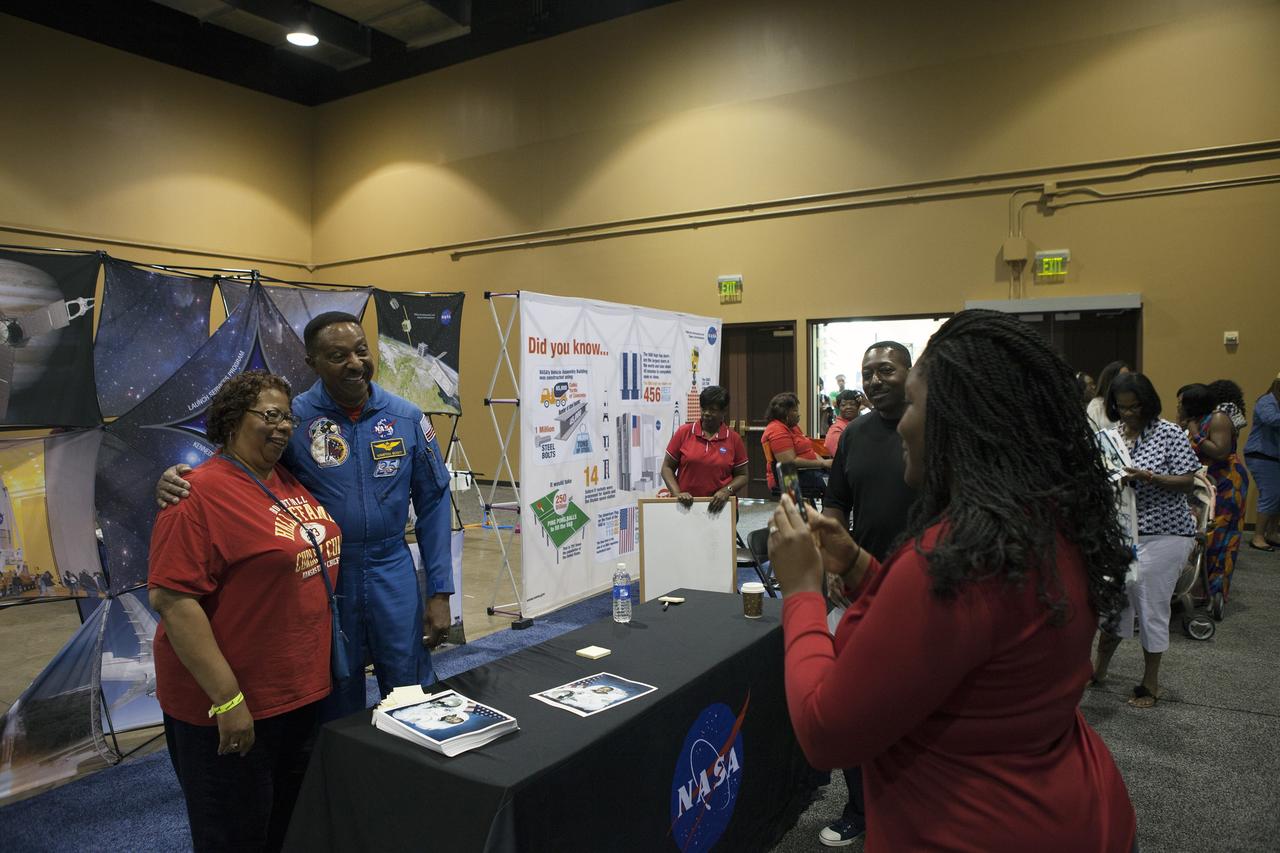
KISSIMMEE, Fla. – Former NASA astronaut Winston Scott signed autographs and posed for pictures with guests at the agency exhibit during the Tom Joyner Family Reunion. Now a senior vice president at the Florida Institute of Technology, he said that he likes to emphasize to young people how important a good education is in preparation for the future. The Tom Joyner Family Reunion is designed to present uplifting programs, entertainment and information about growing, diverse communities. An annual event of the nationally-syndicated Tom Joyner Morning Show, the many exhibits included NASA's participation focusing on encouraging young people to consider studies and careers in STEM -- science, technology, engineering and math. NASA's Education Division promoted the benefits of math and scientific learning along with career opportunities offered by the space agency. The activities took place at the Gaylord Palms Resort in Kissimmee, Florida, during the Labor Day weekend. Photo credit: NASA/Daniel Casper
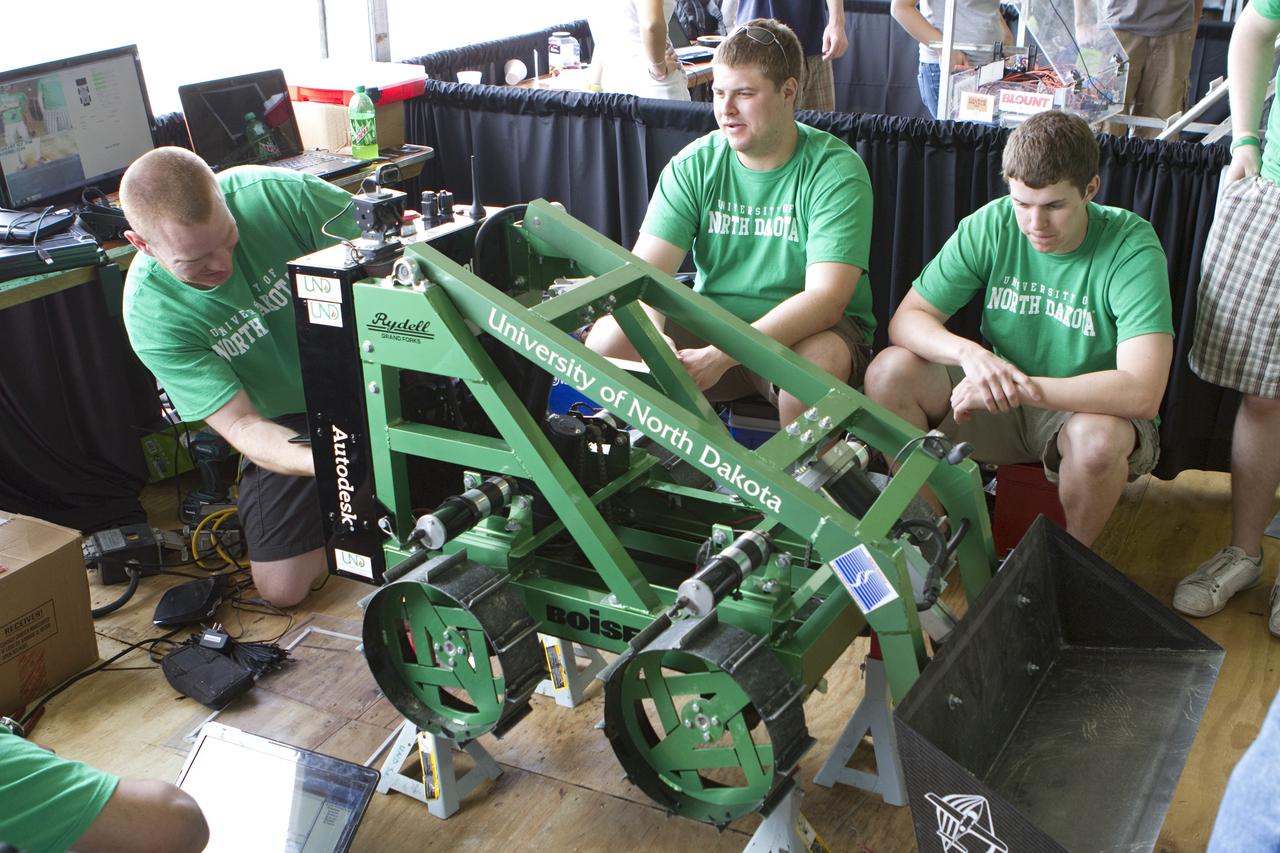
CAPE CANAVERAL, Fla. -- University students prepare for NASA's second annual Lunabotics Mining Competition at the Kennedy Space Center Visitor Complex in Florida. Thirty-six teams of undergraduate and graduate students from the United States, Bangladesh, Canada, Colombia and India will participate in NASA's Lunabotics Mining Competition May 26 - 28. The competition is designed to engage and retain students in science, technology, engineering and mathematics (STEM). Teams will maneuver their remote controlled or autonomous excavators, called lunabots, in about 60 tons of ultra-fine simulated lunar soil, called BP-1. The competition is an Exploration Systems Mission Directorate project managed by Kennedy's Education Division. The event also provides a competitive environment that could result in innovative ideas and solutions for NASA's future excavation of the moon. Photo credit: NASA/Cory Huston
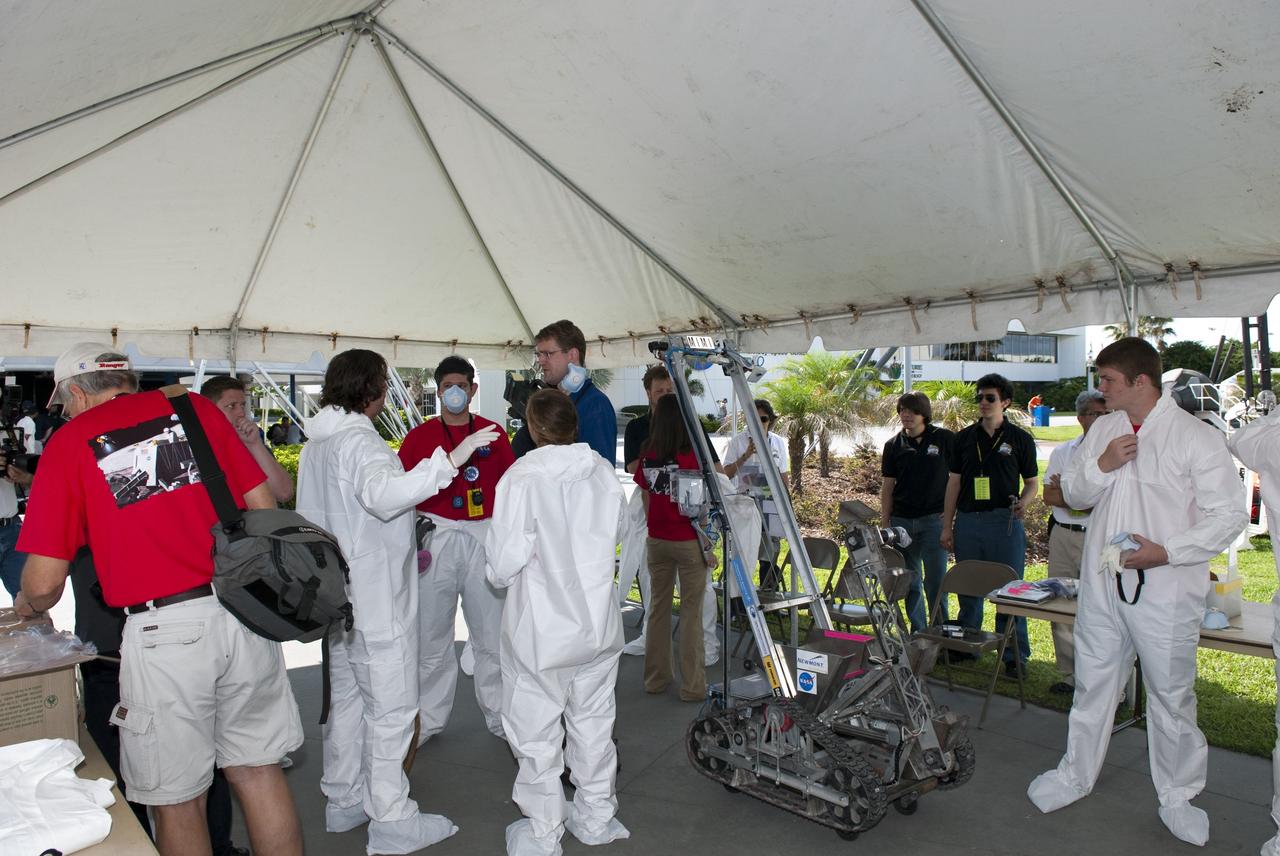
CAPE CANAVERAL, Fla. -- University students make final preparations for NASA's second annual Lunabotics Mining Competition at the Kennedy Space Center Visitor Complex in Florida. Thirty-six teams of undergraduate and graduate students from the United States, Bangladesh, Canada, Colombia and India will participate in NASA's Lunabotics Mining Competition May 26 - 28 at the agency's Kennedy Space Center in Florida. The competition is designed to engage and retain students in science, technology, engineering and mathematics (STEM). Teams will maneuver their remote controlled or autonomous excavators, called lunabots, in about 60 tons of ultra-fine simulated lunar soil, called BP-1. The competition is an Exploration Systems Mission Directorate project managed by Kennedy's Education Division. The event also provides a competitive environment that could result in innovative ideas and solutions for NASA's future excavation of the moon. Photo credit: NASA/Jim Grossmann
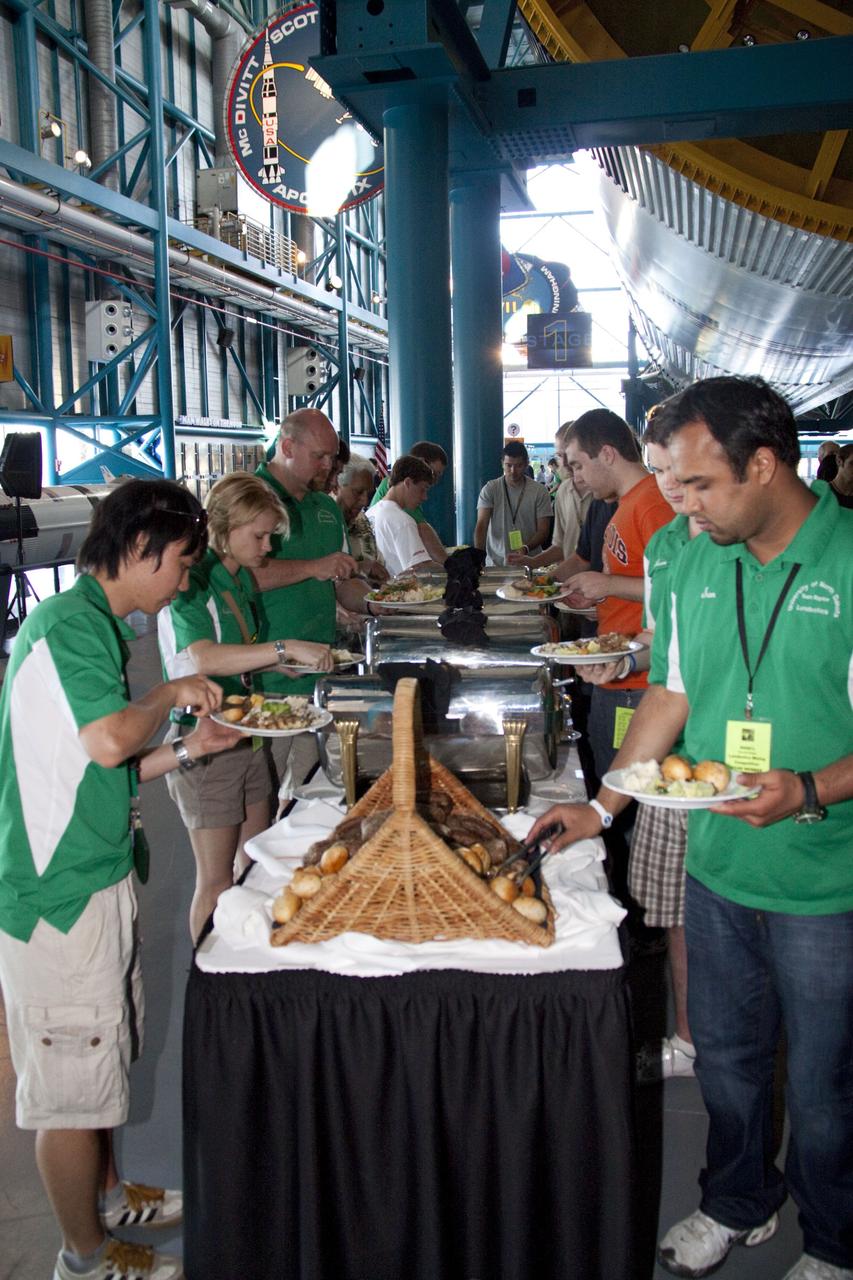
CAPE CANAVERAL, Fla. -- At NASA Kennedy Space Center's Apollo/Saturn V Center, university students take part in an award ceremony for NASA's second annual Lunabotics Mining Competition. Thirty-six teams of undergraduate and graduate students from the United States, Bangladesh, Canada, Colombia and India participated in NASA's Lunabotics Mining Competition May 26 - 28 at the agency's Kennedy Space Center in Florida. The competition is designed to engage and retain students in science, technology, engineering and mathematics (STEM). Teams will maneuver their remote controlled or autonomous excavators, called lunabots, in about 60 tons of ultra-fine simulated lunar soil, called BP-1. The competition is an Exploration Systems Mission Directorate project managed by Kennedy's Education Division. The event also provides a competitive environment that could result in innovative ideas and solutions for NASA's future excavation of the moon. Photo credit: NASA/Jack Pfaller
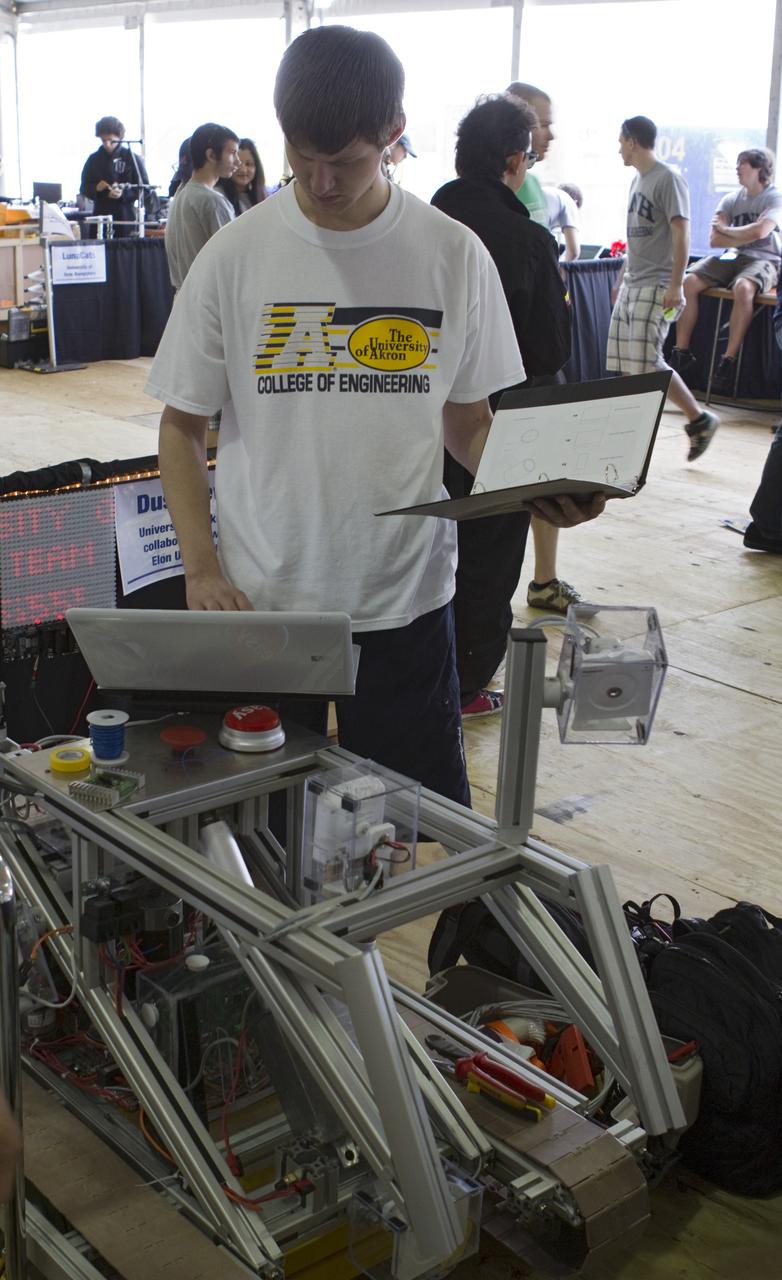
CAPE CANAVERAL, Fla. -- University students prepare for NASA's second annual Lunabotics Mining Competition at the Kennedy Space Center Visitor Complex in Florida. Thirty-six teams of undergraduate and graduate students from the United States, Bangladesh, Canada, Colombia and India will participate in NASA's Lunabotics Mining Competition May 26 - 28. The competition is designed to engage and retain students in science, technology, engineering and mathematics (STEM). Teams will maneuver their remote controlled or autonomous excavators, called lunabots, in about 60 tons of ultra-fine simulated lunar soil, called BP-1. The competition is an Exploration Systems Mission Directorate project managed by Kennedy's Education Division. The event also provides a competitive environment that could result in innovative ideas and solutions for NASA's future excavation of the moon. Photo credit: NASA/Cory Huston
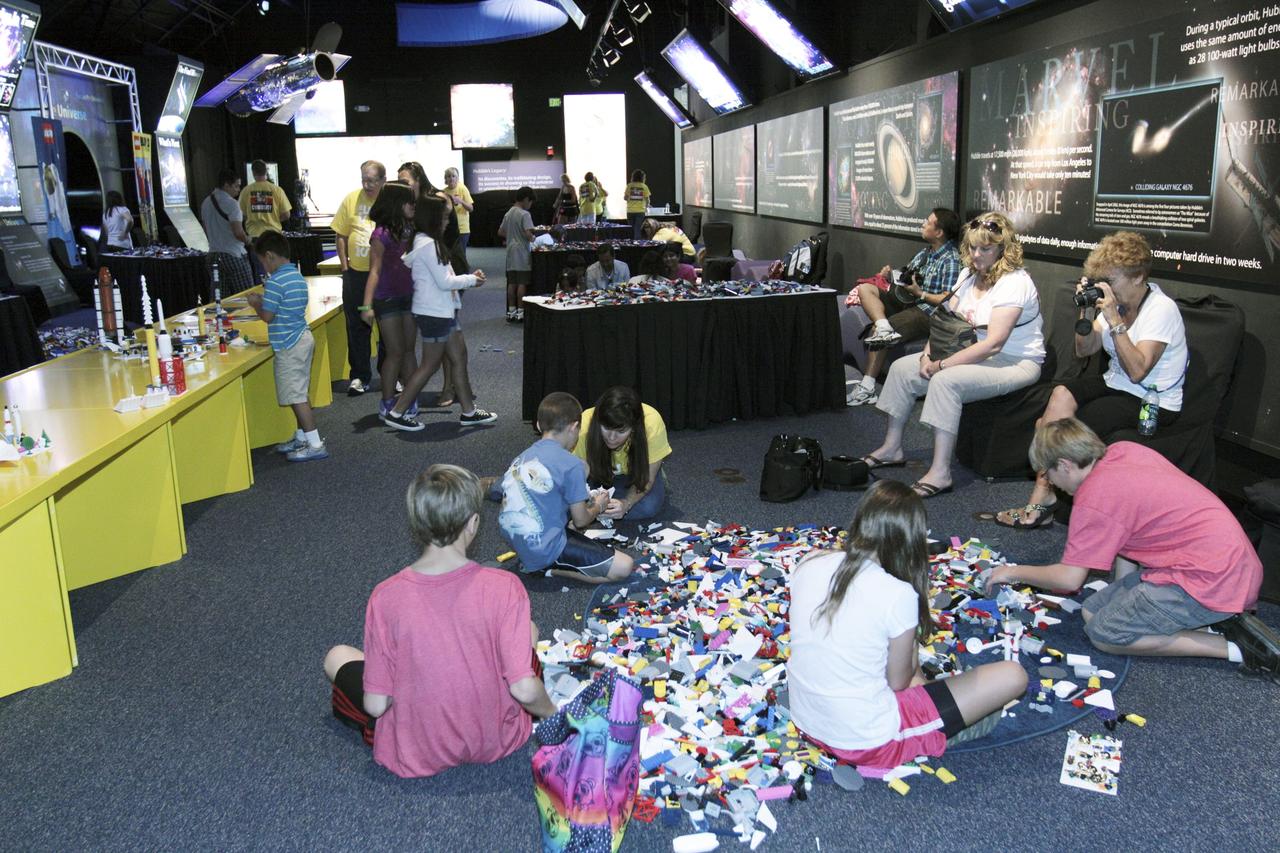
CAPE CANAVERAL, Fla. – LEGO blocks are spread out on the floor of an exhibition hall at the Kennedy Space Center Visitor Complex in Florida for easy access during the LEGO "Build the Future" event. The festivities coincide with the launch of NASA's Mars Science Laboratory (MSL), carrying a compact car-sized rover, Curiosity, to the red planet. Part of the Space Act Agreement between NASA and LEGO A/S, the activities are designed to inspire students of every age to consider an education and careers in the science, technology, engineering and mathematics, or STEM, disciplines. Launch of MSL aboard a United Launch Alliance Atlas V rocket is scheduled for Nov. 26 from Space Launch Complex-41 on Cape Canaveral Air Force Station in Florida. For more information, visit http://www.nasa.gov/audience/foreducators/nasa-lego-partnership.html. Photo credit: NASA/Kim Shiflett

CAPE CANAVERAL, Fla. -- Inside the "Lunarena" at the Kennedy Space Center Visitor Complex is a remote controlled or autonomous excavator, called a lunabot. Thirty-six teams of undergraduate and graduate students from the United States, Bangladesh, Canada, Colombia and India will participate in NASA's Lunabotics Mining Competition May 26 - 28 at the agency's Kennedy Space Center in Florida. The competition is designed to engage and retain students in science, technology, engineering and mathematics (STEM). Teams will maneuver their remote controlled or autonomous excavators, called lunabots, in about 60 tons of ultra-fine simulated lunar soil, called BP-1. The competition is an Exploration Systems Mission Directorate project managed by Kennedy's Education Division. The event also provides a competitive environment that could result in innovative ideas and solutions for NASA's future excavation of the moon. Photo credit: NASA/Jack Pfaller
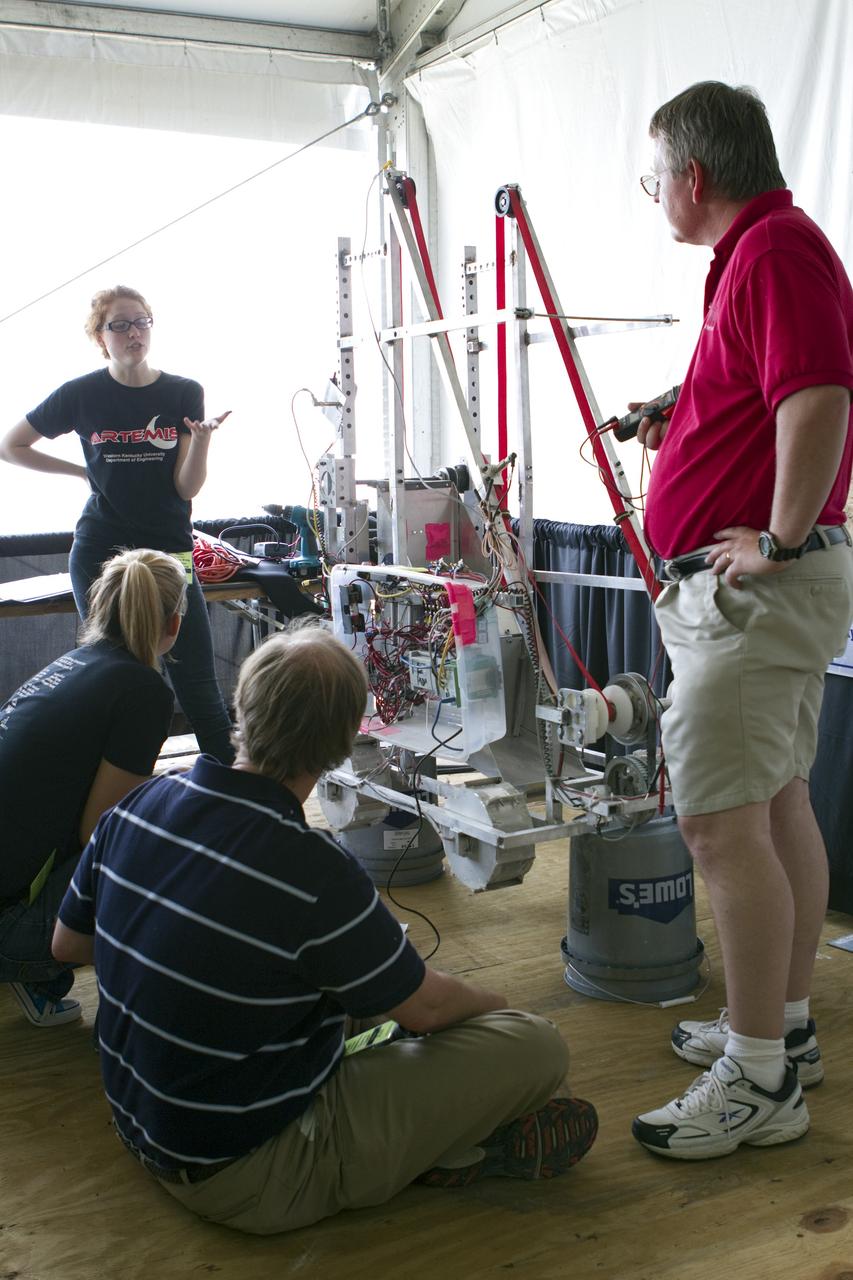
CAPE CANAVERAL, Fla. -- University students prepare for NASA's second annual Lunabotics Mining Competition at the Kennedy Space Center Visitor Complex in Florida. Thirty-six teams of undergraduate and graduate students from the United States, Bangladesh, Canada, Colombia and India will participate in NASA's Lunabotics Mining Competition May 26 - 28. The competition is designed to engage and retain students in science, technology, engineering and mathematics (STEM). Teams will maneuver their remote controlled or autonomous excavators, called lunabots, in about 60 tons of ultra-fine simulated lunar soil, called BP-1. The competition is an Exploration Systems Mission Directorate project managed by Kennedy's Education Division. The event also provides a competitive environment that could result in innovative ideas and solutions for NASA's future excavation of the moon. Photo credit: NASA/Cory Huston
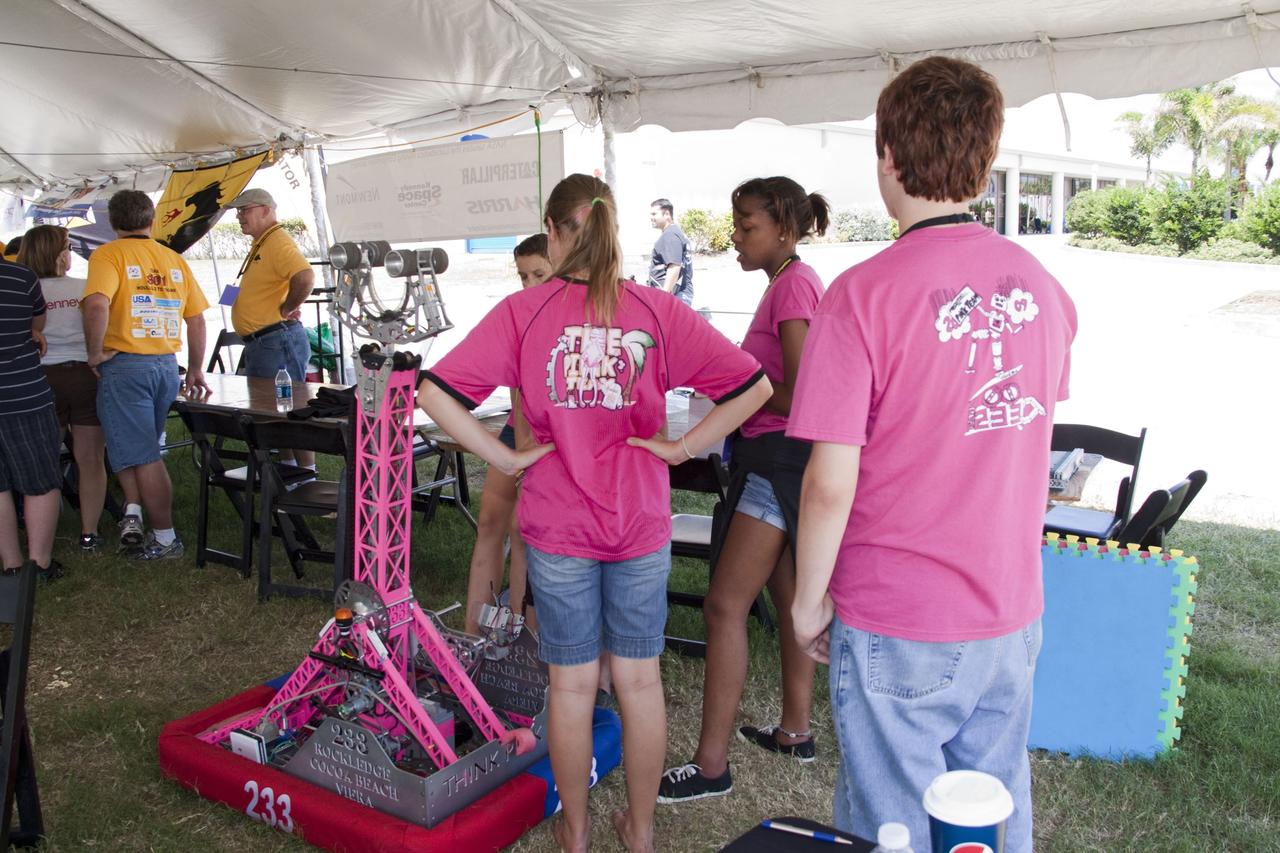
CAPE CANAVERAL, Fla. -- University students wait their turn to compete in NASA's second annual Lunabotics Mining Competition at the Kennedy Space Center Visitor Complex in Florida. Thirty-six teams of undergraduate and graduate students from the United States, Bangladesh, Canada, Colombia and India will participate in NASA's Lunabotics Mining Competition May 26 - 28 at the agency's Kennedy Space Center in Florida. The competition is designed to engage and retain students in science, technology, engineering and mathematics (STEM). Teams will maneuver their remote controlled or autonomous excavators, called lunabots, in about 60 tons of ultra-fine simulated lunar soil, called BP-1. The competition is an Exploration Systems Mission Directorate project managed by Kennedy's Education Division. The event also provides a competitive environment that could result in innovative ideas and solutions for NASA's future excavation of the moon. Photo credit: NASA/Jack Pfaller

University students prepare their team's remote controlled or autonomous excavator, called a lunabot, to maneuver in about 60 tons of ultra-fine simulated lunar soil, called BP-1. Thirty-six teams of undergraduate and graduate students from the United States, Bangladesh, Canada, Colombia and India will participate in NASA's Lunabotics Mining Competition May 26 - 28 at the agency's Kennedy Space Center in Florida. The competition is designed to engage and retain students in science, technology, engineering and mathematics (STEM). Teams will maneuver their remote controlled or autonomous excavators, called lunabots, in about 60 tons of ultra-fine simulated lunar soil. The competition is an Exploration Systems Mission Directorate project managed by Kennedy's Education Division. The event also provides a competitive environment that could result in innovative ideas and solutions for NASA's future excavation of the moon. Photo credit: NASA/Jack Pfaller
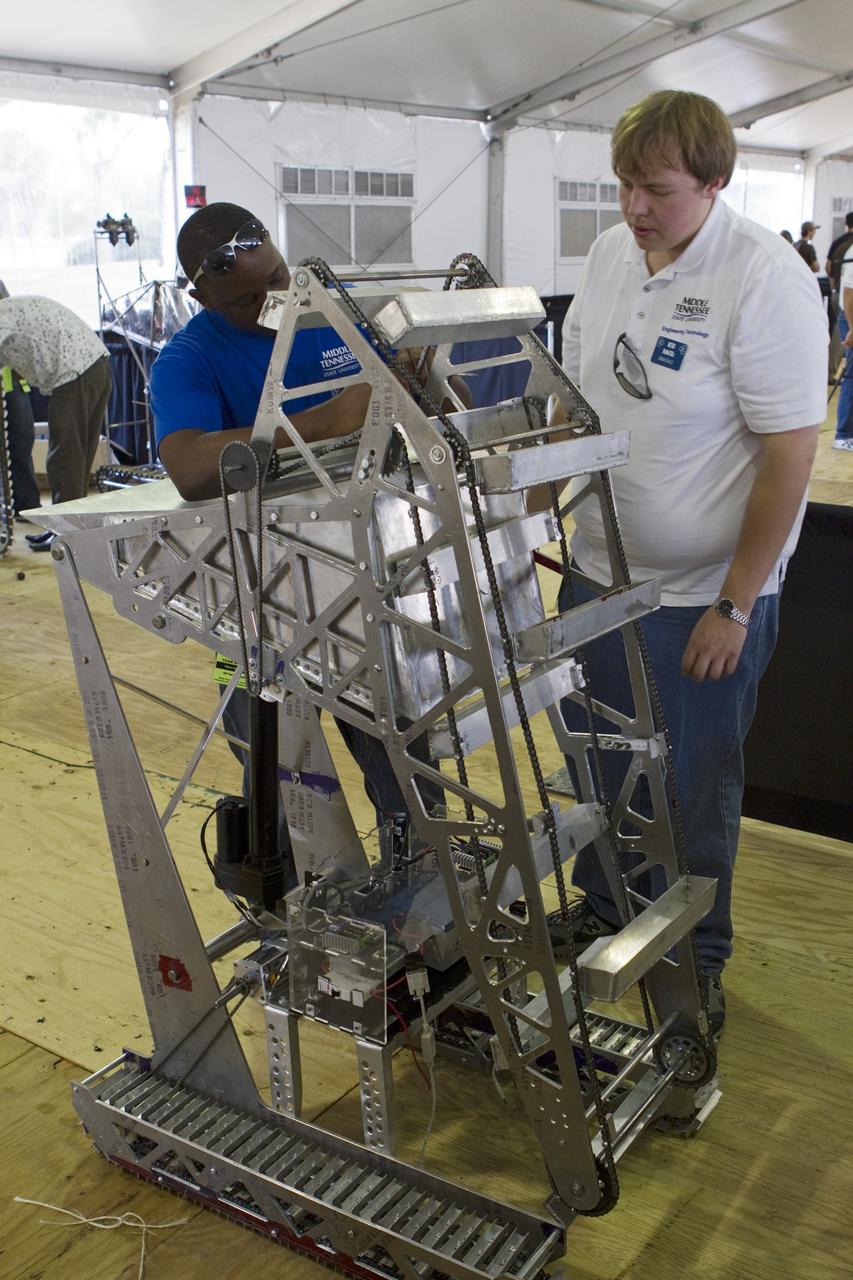
CAPE CANAVERAL, Fla. -- University students prepare for NASA's second annual Lunabotics Mining Competition at the Kennedy Space Center Visitor Complex in Florida. Thirty-six teams of undergraduate and graduate students from the United States, Bangladesh, Canada, Colombia and India will participate in NASA's Lunabotics Mining Competition May 26 - 28. The competition is designed to engage and retain students in science, technology, engineering and mathematics (STEM). Teams will maneuver their remote controlled or autonomous excavators, called lunabots, in about 60 tons of ultra-fine simulated lunar soil, called BP-1. The competition is an Exploration Systems Mission Directorate project managed by Kennedy's Education Division. The event also provides a competitive environment that could result in innovative ideas and solutions for NASA's future excavation of the moon. Photo credit: NASA/Cory Huston
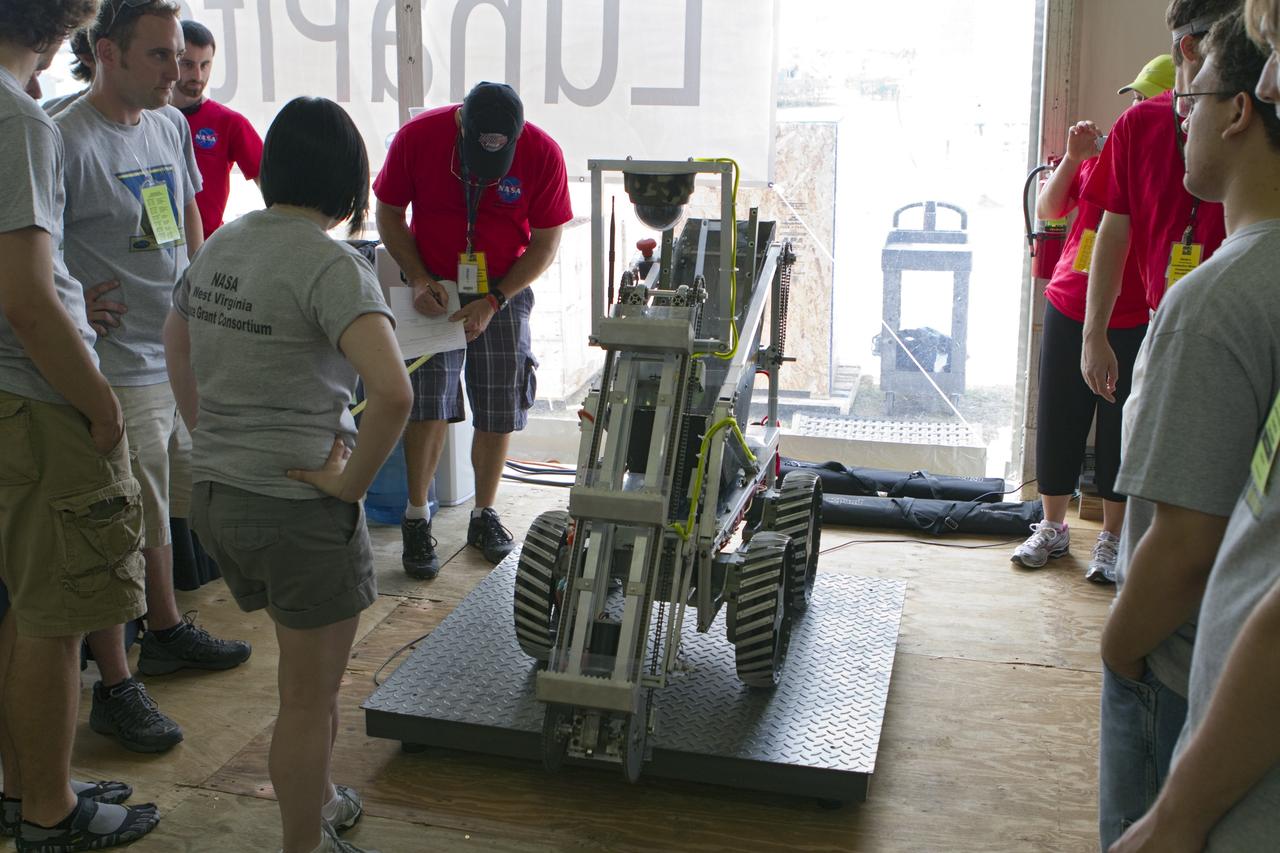
CAPE CANAVERAL, Fla. -- University students prepare for NASA's second annual Lunabotics Mining Competition at the Kennedy Space Center Visitor Complex in Florida. Thirty-six teams of undergraduate and graduate students from the United States, Bangladesh, Canada, Colombia and India will participate in NASA's Lunabotics Mining Competition May 26 - 28. The competition is designed to engage and retain students in science, technology, engineering and mathematics (STEM). Teams will maneuver their remote controlled or autonomous excavators, called lunabots, in about 60 tons of ultra-fine simulated lunar soil, called BP-1. The competition is an Exploration Systems Mission Directorate project managed by Kennedy's Education Division. The event also provides a competitive environment that could result in innovative ideas and solutions for NASA's future excavation of the moon. Photo credit: NASA/Cory Huston
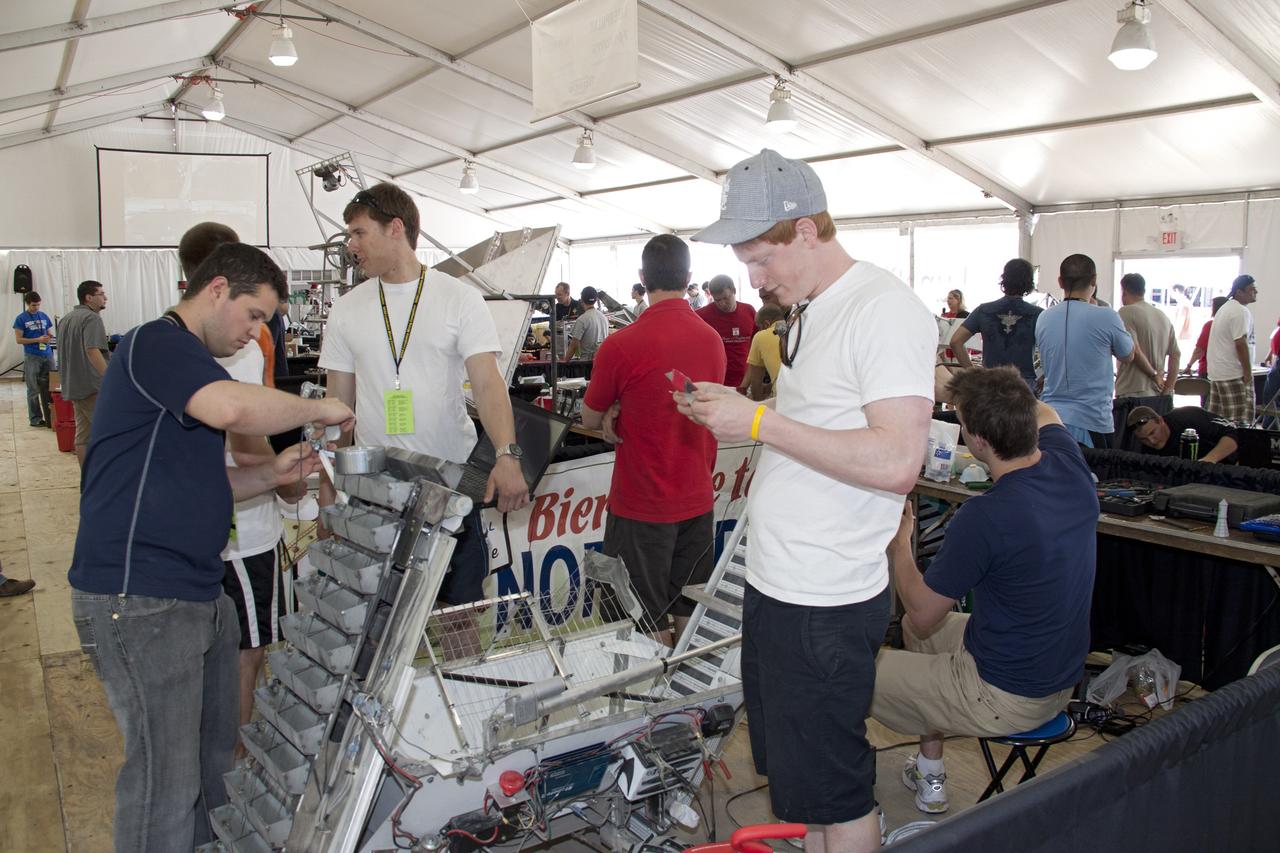
CAPE CANAVERAL, Fla. -- University students prepare for NASA's second annual Lunabotics Mining Competition at the Kennedy Space Center Visitor Complex in Florida. Thirty-six teams of undergraduate and graduate students from the United States, Bangladesh, Canada, Colombia and India will participate in NASA's Lunabotics Mining Competition May 26 - 28 at the agency's Kennedy Space Center in Florida. The competition is designed to engage and retain students in science, technology, engineering and mathematics (STEM). Teams will maneuver their remote controlled or autonomous excavators, called lunabots, in about 60 tons of ultra-fine simulated lunar soil, called BP-1. The competition is an Exploration Systems Mission Directorate project managed by Kennedy's Education Division. The event also provides a competitive environment that could result in innovative ideas and solutions for NASA's future excavation of the moon. Photo credit: NASA/Jack Pfaller
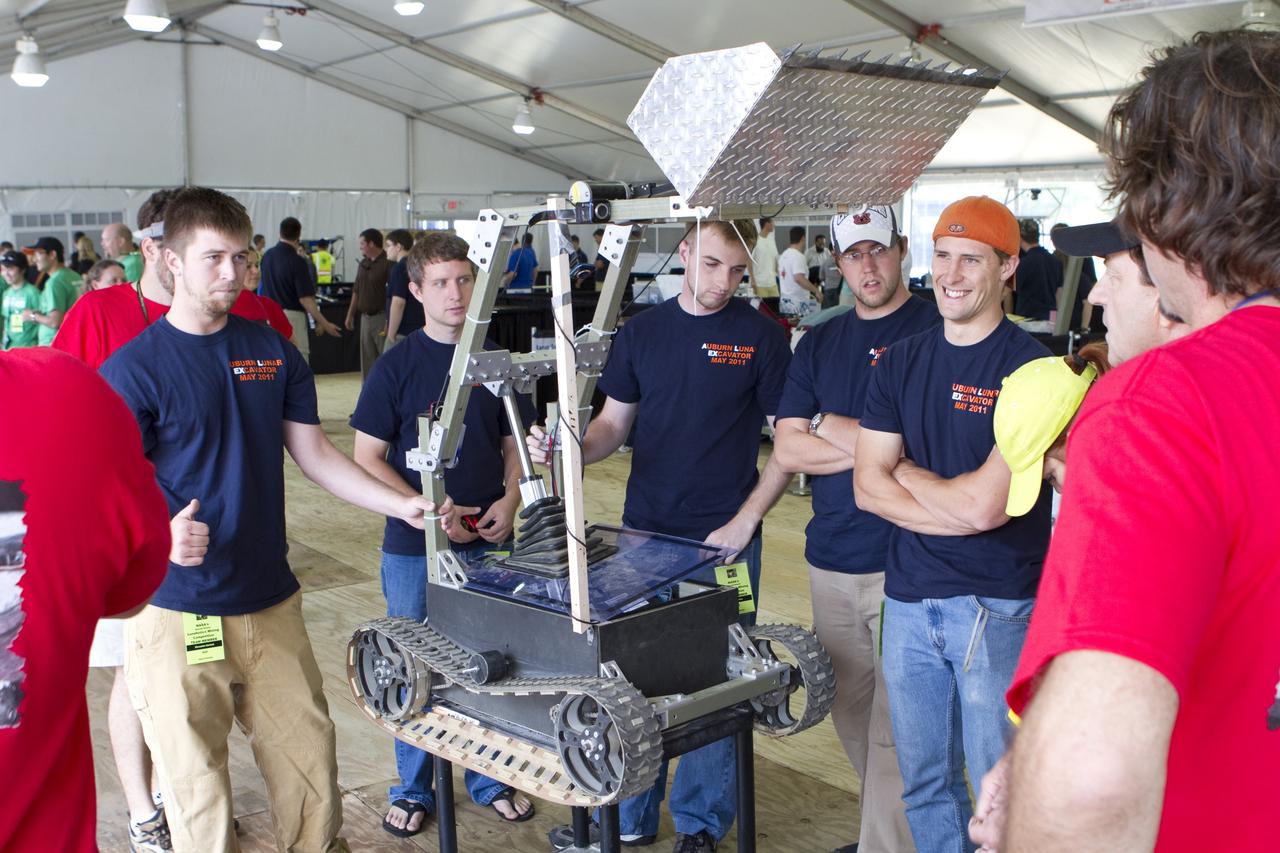
CAPE CANAVERAL, Fla. -- University students prepare for NASA's second annual Lunabotics Mining Competition at the Kennedy Space Center Visitor Complex in Florida. Thirty-six teams of undergraduate and graduate students from the United States, Bangladesh, Canada, Colombia and India will participate in NASA's Lunabotics Mining Competition May 26 - 28. The competition is designed to engage and retain students in science, technology, engineering and mathematics (STEM). Teams will maneuver their remote controlled or autonomous excavators, called lunabots, in about 60 tons of ultra-fine simulated lunar soil, called BP-1. The competition is an Exploration Systems Mission Directorate project managed by Kennedy's Education Division. The event also provides a competitive environment that could result in innovative ideas and solutions for NASA's future excavation of the moon. Photo credit: NASA/Cory Huston
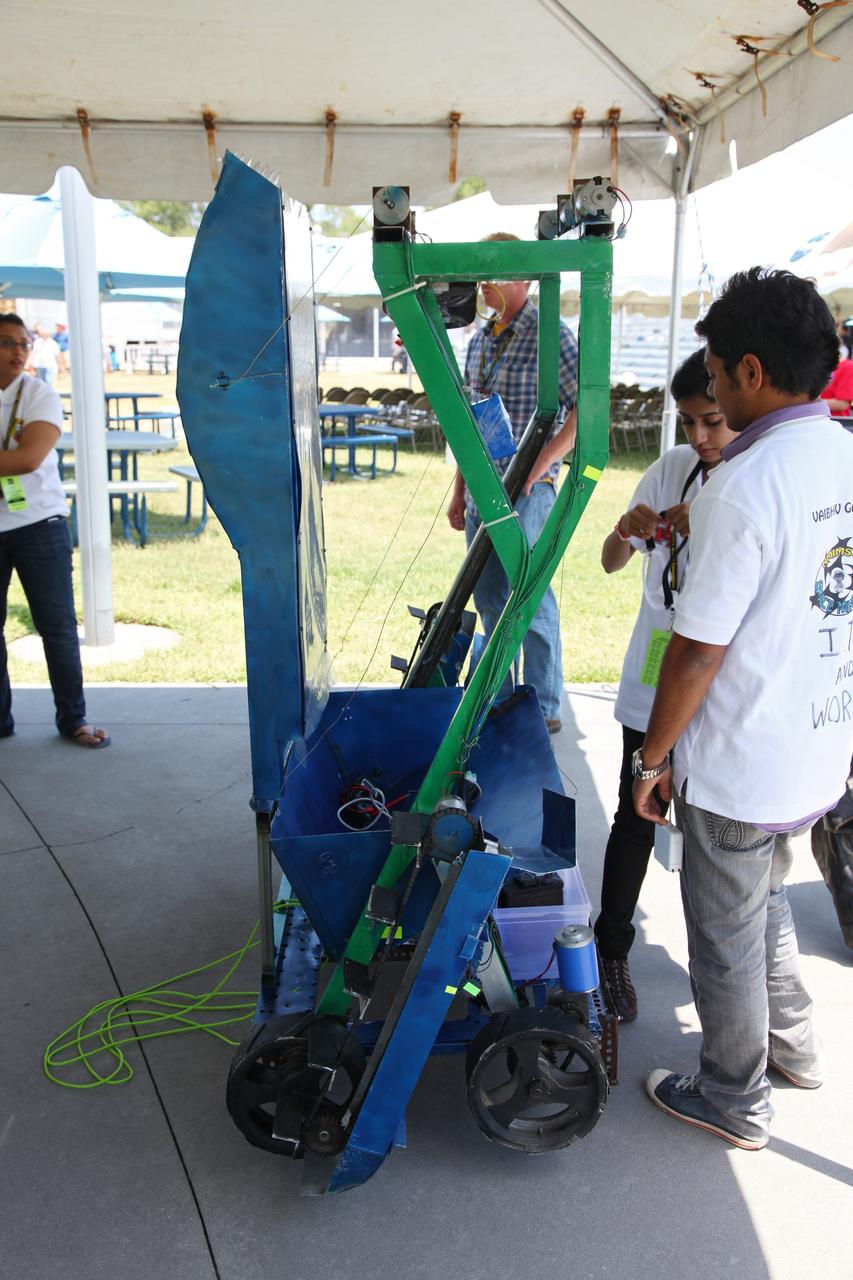
CAPE CANAVERAL, Fla. -- University students prepare their remote controlled or autonomous excavator, called a lunabot, in a tent next to the "Lunarena" at the Kennedy Space Center Visitor Complex. Thirty-six teams of undergraduate and graduate students from the United States, Bangladesh, Canada, Colombia and India will participate in NASA's Lunabotics Mining Competition May 26 - 28 at the agency's Kennedy Space Center in Florida. The competition is designed to engage and retain students in science, technology, engineering and mathematics (STEM). Teams will maneuver their remote controlled or autonomous excavators, called lunabots, in about 60 tons of ultra-fine simulated lunar soil, called BP-1. The competition is an Exploration Systems Mission Directorate project managed by Kennedy's Education Division. The event also provides a competitive environment that could result in innovative ideas and solutions for NASA's future excavation of the moon. Photo credit: NASA/Frankie Martin
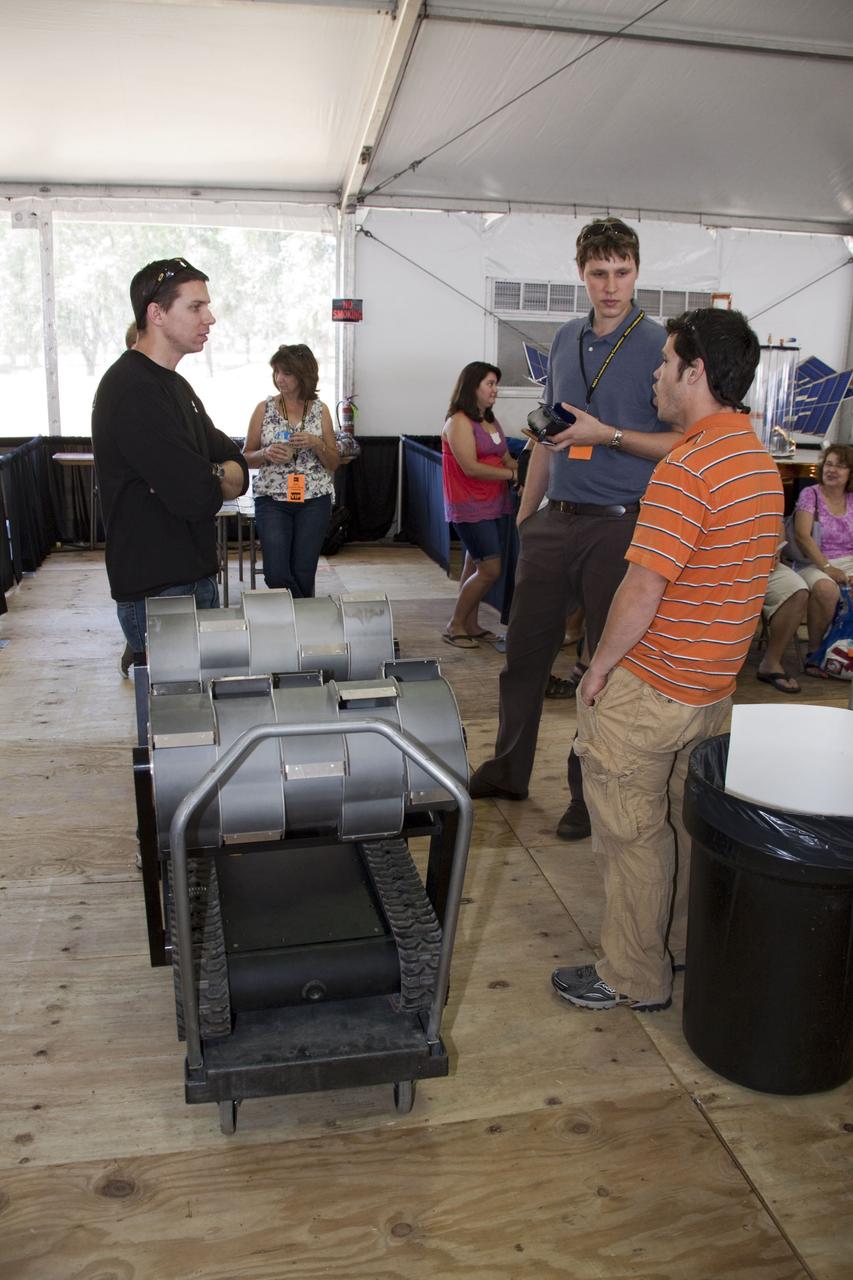
CAPE CANAVERAL, Fla. -- University students wait their turn to compete in NASA's second annual Lunabotics Mining Competition at the Kennedy Space Center Visitor Complex in Florida. Thirty-six teams of undergraduate and graduate students from the United States, Bangladesh, Canada, Colombia and India will participate in NASA's Lunabotics Mining Competition May 26 - 28 at the agency's Kennedy Space Center in Florida. The competition is designed to engage and retain students in science, technology, engineering and mathematics (STEM). Teams will maneuver their remote controlled or autonomous excavators, called lunabots, in about 60 tons of ultra-fine simulated lunar soil, called BP-1. The competition is an Exploration Systems Mission Directorate project managed by Kennedy's Education Division. The event also provides a competitive environment that could result in innovative ideas and solutions for NASA's future excavation of the moon. Photo credit: NASA/Jack Pfaller
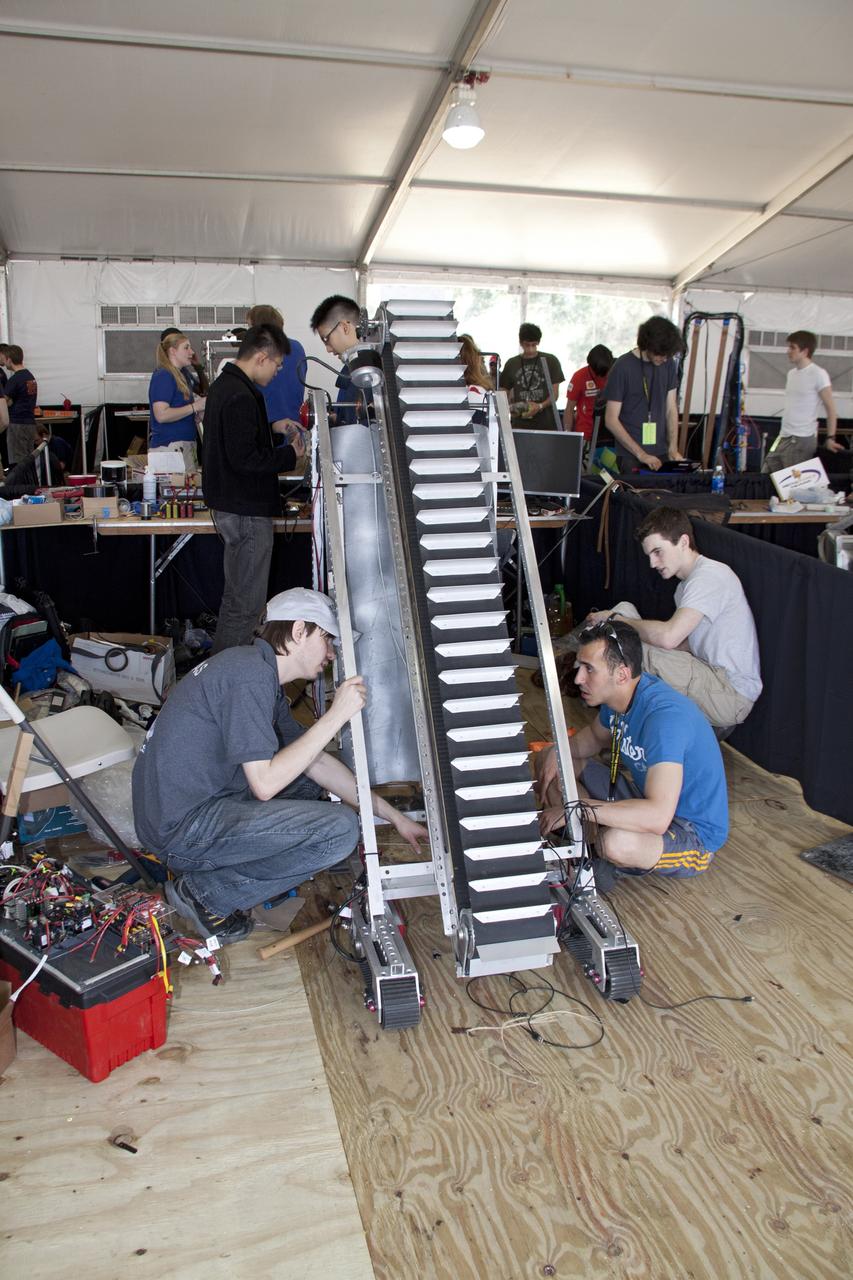
CAPE CANAVERAL, Fla. -- University students prepare for NASA's second annual Lunabotics Mining Competition at the Kennedy Space Center Visitor Complex in Florida. Thirty-six teams of undergraduate and graduate students from the United States, Bangladesh, Canada, Colombia and India will participate in NASA's Lunabotics Mining Competition May 26 - 28 at the agency's Kennedy Space Center in Florida. The competition is designed to engage and retain students in science, technology, engineering and mathematics (STEM). Teams will maneuver their remote controlled or autonomous excavators, called lunabots, in about 60 tons of ultra-fine simulated lunar soil, called BP-1. The competition is an Exploration Systems Mission Directorate project managed by Kennedy's Education Division. The event also provides a competitive environment that could result in innovative ideas and solutions for NASA's future excavation of the moon. Photo credit: NASA/Jack Pfaller
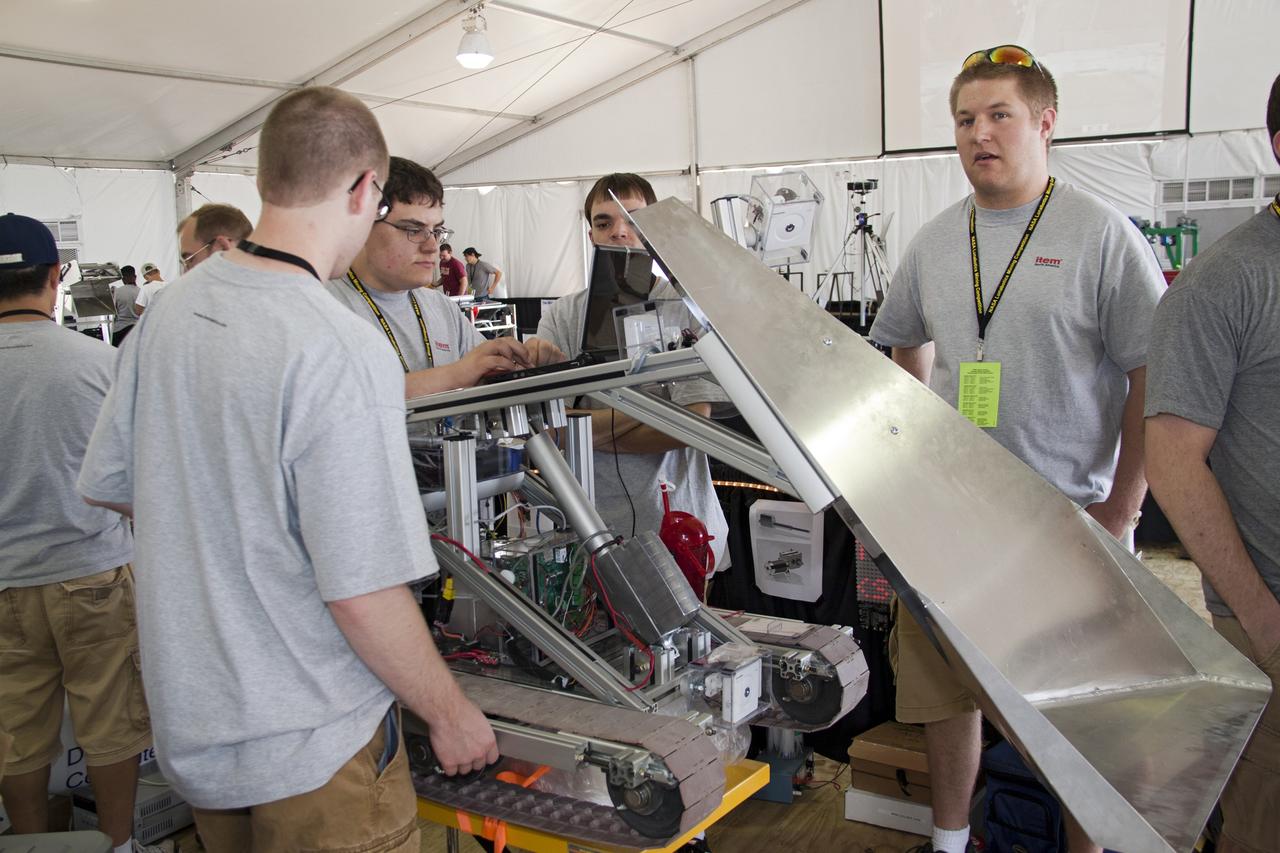
CAPE CANAVERAL, Fla. -- University students prepare for NASA's second annual Lunabotics Mining Competition at the Kennedy Space Center Visitor Complex in Florida. Thirty-six teams of undergraduate and graduate students from the United States, Bangladesh, Canada, Colombia and India will participate in NASA's Lunabotics Mining Competition May 26 - 28 at the agency's Kennedy Space Center in Florida. The competition is designed to engage and retain students in science, technology, engineering and mathematics (STEM). Teams will maneuver their remote controlled or autonomous excavators, called lunabots, in about 60 tons of ultra-fine simulated lunar soil, called BP-1. The competition is an Exploration Systems Mission Directorate project managed by Kennedy's Education Division. The event also provides a competitive environment that could result in innovative ideas and solutions for NASA's future excavation of the moon. Photo credit: NASA/Jack Pfaller
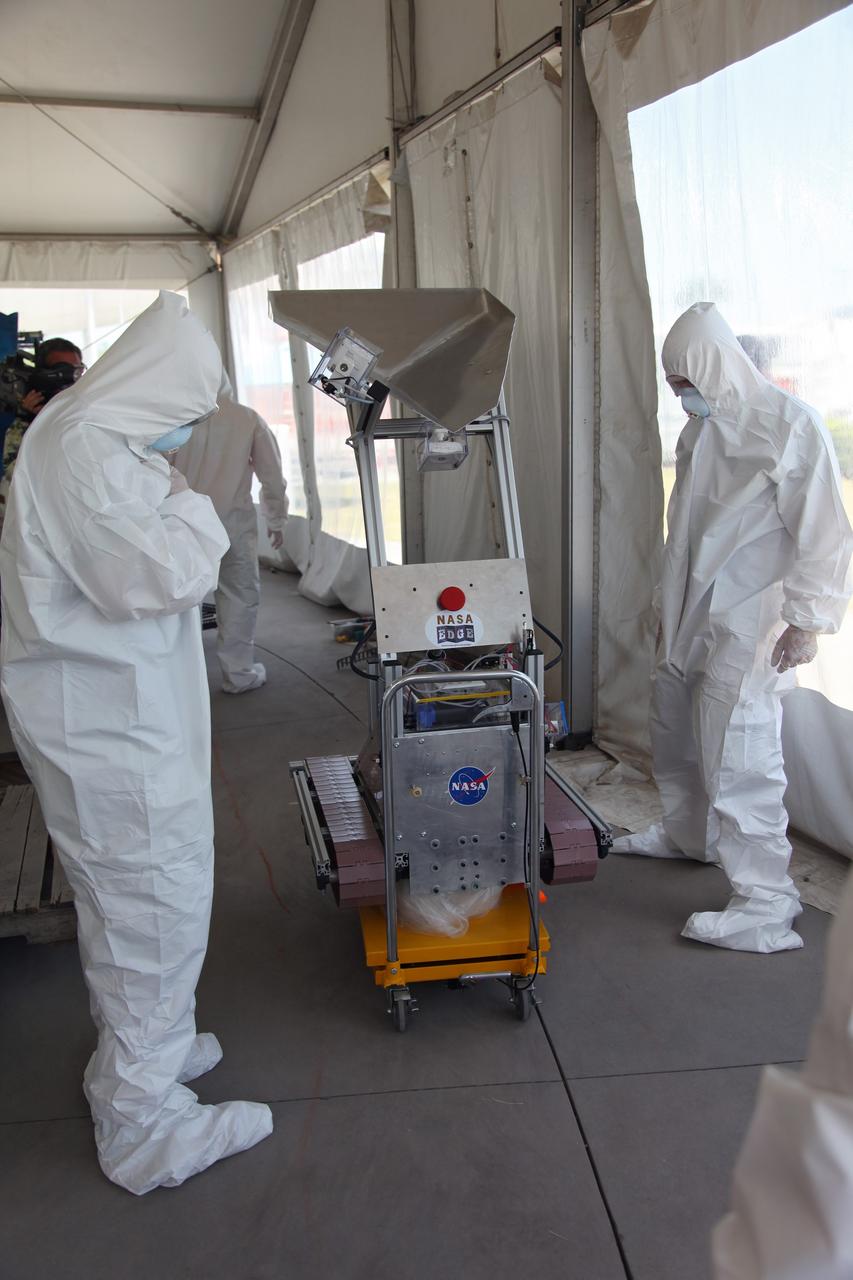
CAPE CANAVERAL, Fla. -- University students prepare for NASA's second annual Lunabotics Mining Competition at the Kennedy Space Center Visitor Complex in Florida. Thirty-six teams of undergraduate and graduate students from the United States, Bangladesh, Canada, Colombia and India will participate in NASA's Lunabotics Mining Competition May 26 - 28 at the agency's Kennedy Space Center in Florida. The competition is designed to engage and retain students in science, technology, engineering and mathematics (STEM). Teams will maneuver their remote controlled or autonomous excavators, called lunabots, in about 60 tons of ultra-fine simulated lunar soil, called BP-1. The competition is an Exploration Systems Mission Directorate project managed by Kennedy's Education Division. The event also provides a competitive environment that could result in innovative ideas and solutions for NASA's future excavation of the moon. Photo credit: NASA/Frankie Martin
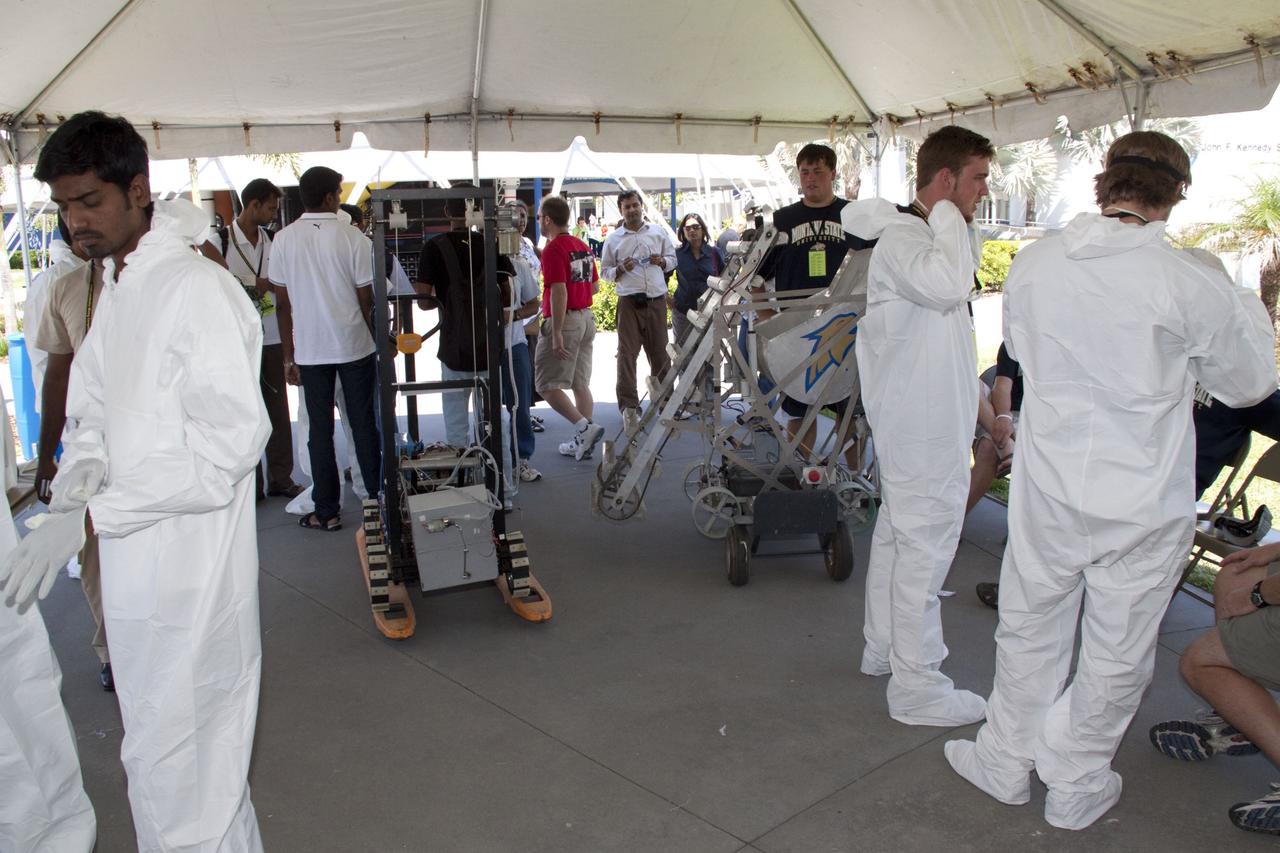
CAPE CANAVERAL, Fla. -- University students wait their turn to compete in NASA's second annual Lunabotics Mining Competition at the Kennedy Space Center Visitor Complex in Florida. Thirty-six teams of undergraduate and graduate students from the United States, Bangladesh, Canada, Colombia and India will participate in NASA's Lunabotics Mining Competition May 26 - 28 at the agency's Kennedy Space Center in Florida. The competition is designed to engage and retain students in science, technology, engineering and mathematics (STEM). Teams will maneuver their remote controlled or autonomous excavators, called lunabots, in about 60 tons of ultra-fine simulated lunar soil, called BP-1. The competition is an Exploration Systems Mission Directorate project managed by Kennedy's Education Division. The event also provides a competitive environment that could result in innovative ideas and solutions for NASA's future excavation of the moon. Photo credit: NASA/Jack Pfaller
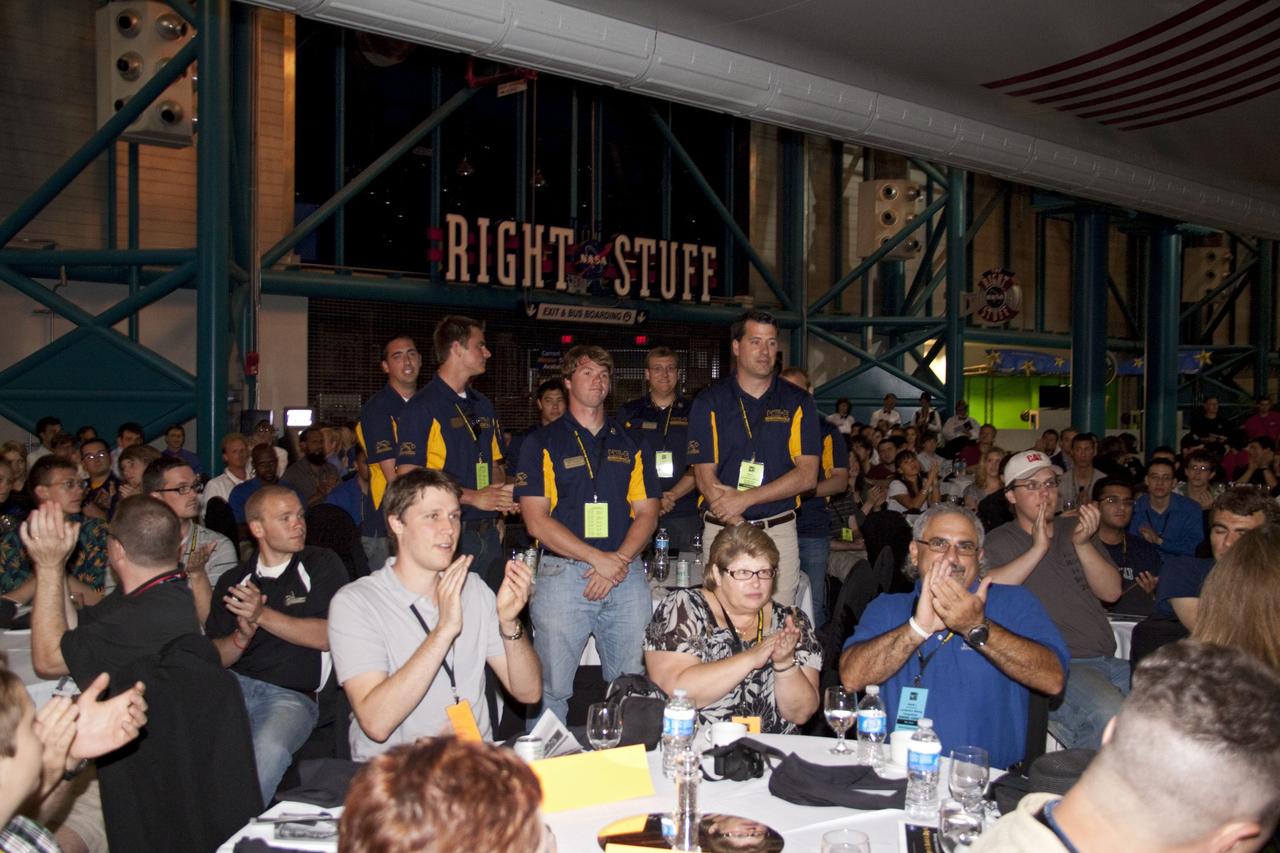
CAPE CANAVERAL, Fla. -- At NASA Kennedy Space Center's Apollo/Saturn V Center, participants applaud the winning team of the competition during the NASA's second annual Lunabotics Mining Competition award ceremony. Thirty-six teams of undergraduate and graduate students from the United States, Bangladesh, Canada, Colombia and India participated in NASA's Lunabotics Mining Competition May 26 - 28 at the agency's Kennedy Space Center in Florida. The competition is designed to engage and retain students in science, technology, engineering and mathematics (STEM). Teams will maneuver their remote controlled or autonomous excavators, called lunabots, in about 60 tons of ultra-fine simulated lunar soil, called BP-1. The competition is an Exploration Systems Mission Directorate project managed by Kennedy's Education Division. The event also provides a competitive environment that could result in innovative ideas and solutions for NASA's future excavation of the moon. Photo credit: NASA/Jack Pfaller

CAPE CANAVERAL, Fla. -- University students prepare for NASA's second annual Lunabotics Mining Competition at the Kennedy Space Center Visitor Complex in Florida. Thirty-six teams of undergraduate and graduate students from the United States, Bangladesh, Canada, Colombia and India will participate in NASA's Lunabotics Mining Competition May 26 - 28. The competition is designed to engage and retain students in science, technology, engineering and mathematics (STEM). Teams will maneuver their remote controlled or autonomous excavators, called lunabots, in about 60 tons of ultra-fine simulated lunar soil, called BP-1. The competition is an Exploration Systems Mission Directorate project managed by Kennedy's Education Division. The event also provides a competitive environment that could result in innovative ideas and solutions for NASA's future excavation of the moon. Photo credit: NASA/Cory Huston
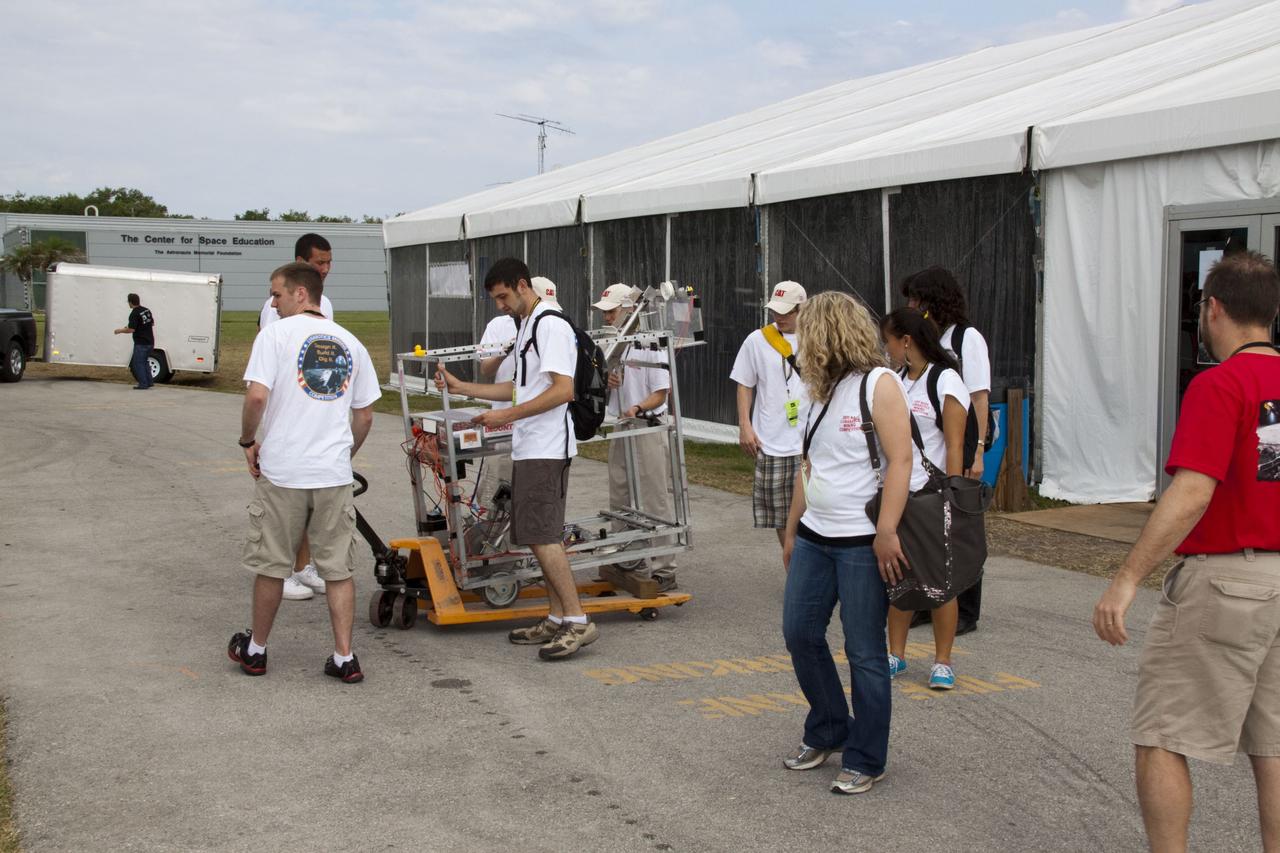
CAPE CANAVERAL, Fla. -- University students make final preparations for NASA's second annual Lunabotics Mining Competition held at the Kennedy Space Center Visitor Complex in Florida. Thirty-six teams of undergraduate and graduate students from the United States, Bangladesh, Canada, Colombia and India will participate in NASA's Lunabotics Mining Competition May 26 - 28 at the agency's Kennedy Space Center in Florida. The competition is designed to engage and retain students in science, technology, engineering and mathematics (STEM). Teams will maneuver their remote controlled or autonomous excavators, called lunabots, in about 60 tons of ultra-fine simulated lunar soil, called BP-1. The competition is an Exploration Systems Mission Directorate project managed by Kennedy's Education Division. The event also provides a competitive environment that could result in innovative ideas and solutions for NASA's future excavation of the moon. Photo credit: NASA/Jack Pfaller
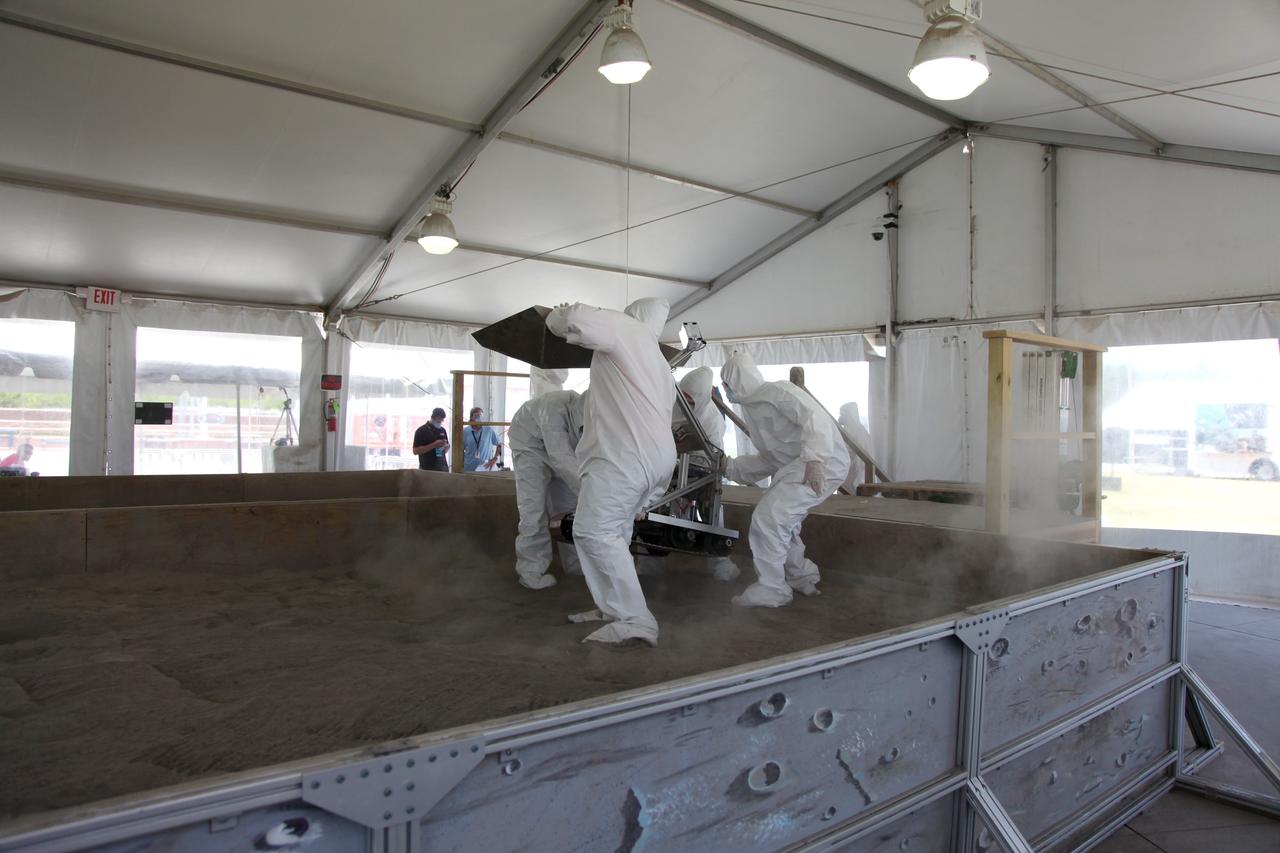
CAPE CANAVERAL, Fla. -- University students prepare for NASA's second annual Lunabotics Mining Competition inside the "Lunarena" at the Kennedy Space Center Visitor Complex in Florida. Thirty-six teams of undergraduate and graduate students from the United States, Bangladesh, Canada, Colombia and India will participate in NASA's Lunabotics Mining Competition May 26 - 28 at the agency's Kennedy Space Center in Florida. The competition is designed to engage and retain students in science, technology, engineering and mathematics (STEM). Teams will maneuver their remote controlled or autonomous excavators, called lunabots, in about 60 tons of ultra-fine simulated lunar soil, called BP-1. The competition is an Exploration Systems Mission Directorate project managed by Kennedy's Education Division. The event also provides a competitive environment that could result in innovative ideas and solutions for NASA's future excavation of the moon. Photo credit: NASA/Frankie Martin
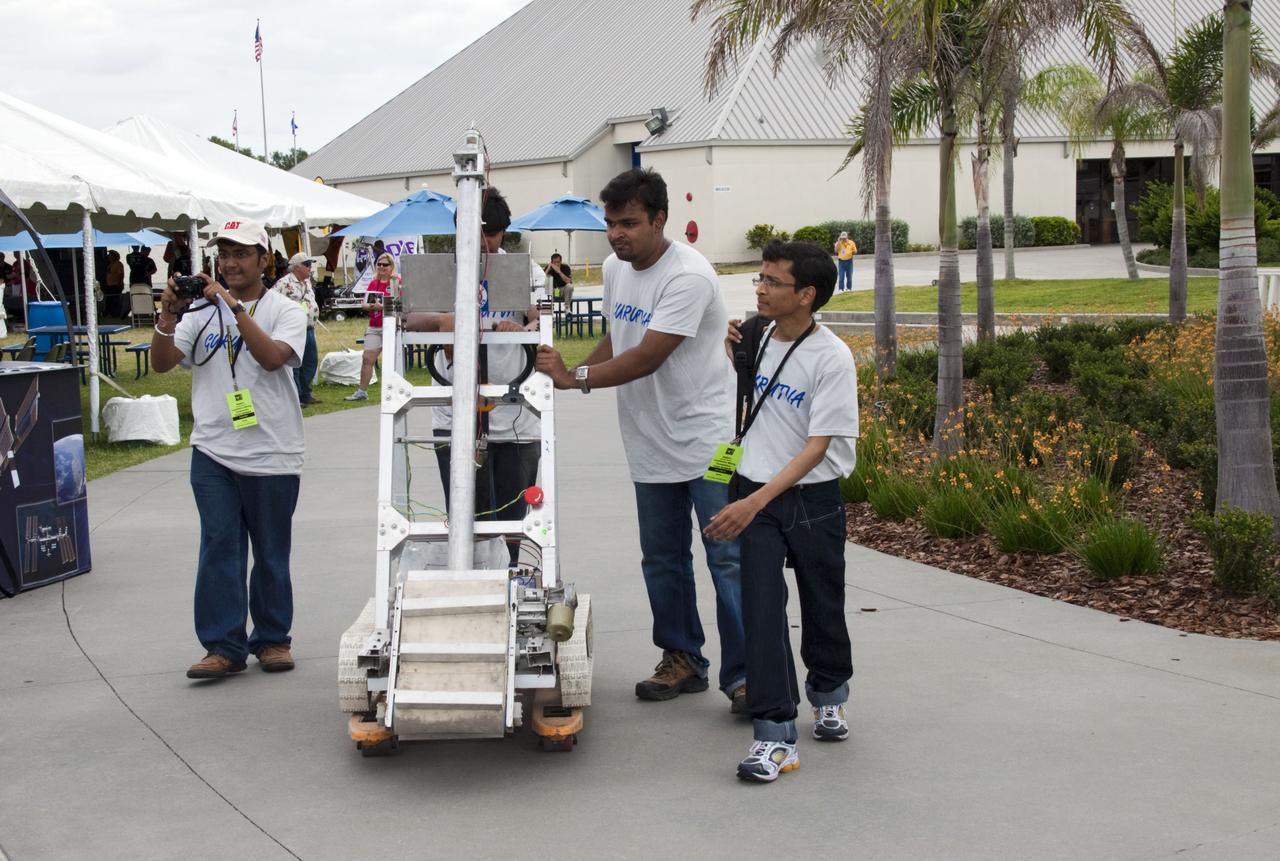
CAPE CANAVERAL, Fla. -- University students make final preparations for NASA's second annual Lunabotics Mining Competition held at the Kennedy Space Center Visitor Complex in Florida. Thirty-six teams of undergraduate and graduate students from the United States, Bangladesh, Canada, Colombia and India will participate in NASA's Lunabotics Mining Competition May 26 - 28 at the agency's Kennedy Space Center in Florida. The competition is designed to engage and retain students in science, technology, engineering and mathematics (STEM). Teams will maneuver their remote controlled or autonomous excavators, called lunabots, in about 60 tons of ultra-fine simulated lunar soil, called BP-1. The competition is an Exploration Systems Mission Directorate project managed by Kennedy's Education Division. The event also provides a competitive environment that could result in innovative ideas and solutions for NASA's future excavation of the moon. Photo credit: NASA/Jack Pfaller
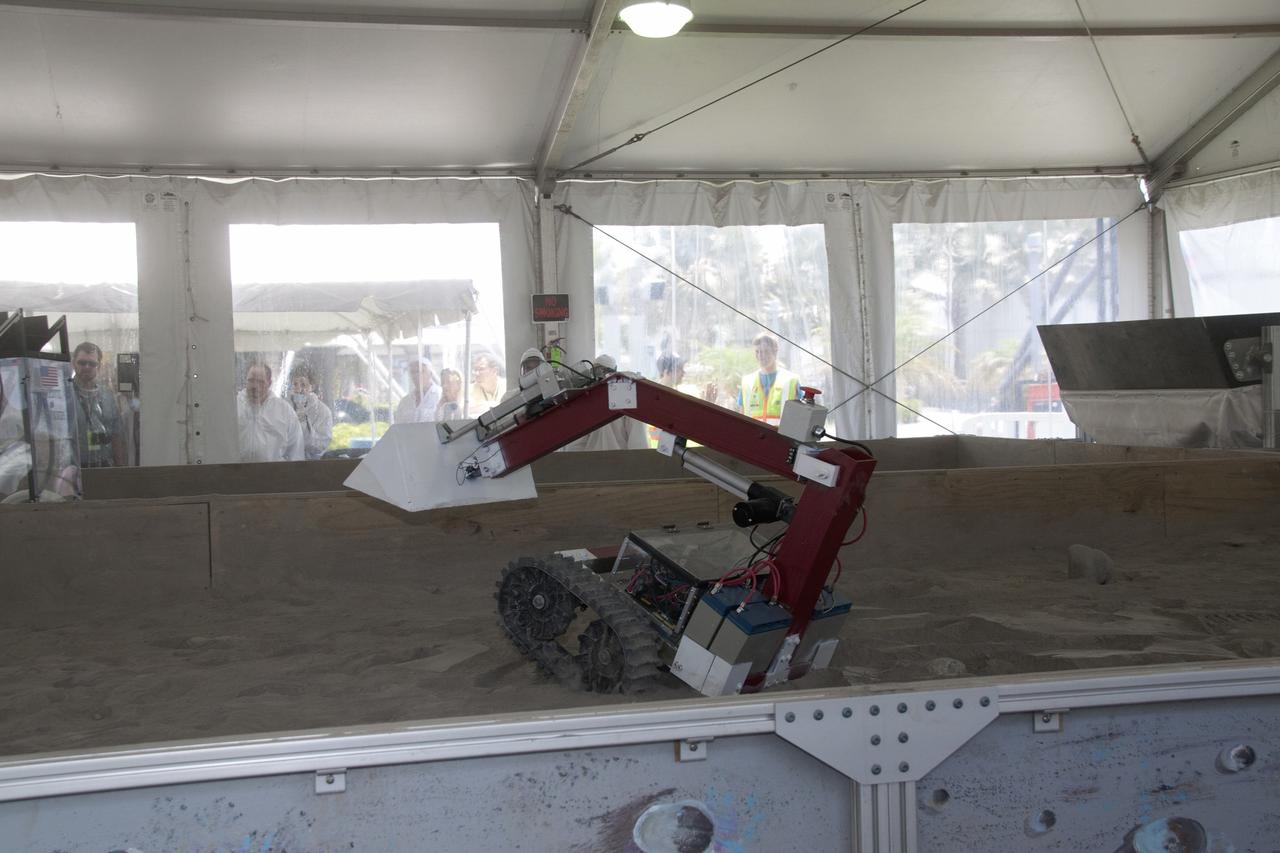
CAPE CANAVERAL, Fla. -- Inside the "Lunarena" at the Kennedy Space Center Visitor Complex is a remote controlled or autonomous excavator, called a lunabot. Thirty-six teams of undergraduate and graduate students from the United States, Bangladesh, Canada, Colombia and India will participate in NASA's Lunabotics Mining Competition May 26 - 28 at the agency's Kennedy Space Center in Florida. The competition is designed to engage and retain students in science, technology, engineering and mathematics (STEM). Teams will maneuver their remote controlled or autonomous excavators, called lunabots, in about 60 tons of ultra-fine simulated lunar soil, called BP-1. The competition is an Exploration Systems Mission Directorate project managed by Kennedy's Education Division. The event also provides a competitive environment that could result in innovative ideas and solutions for NASA's future excavation of the moon. Photo credit: NASA/Jack Pfaller
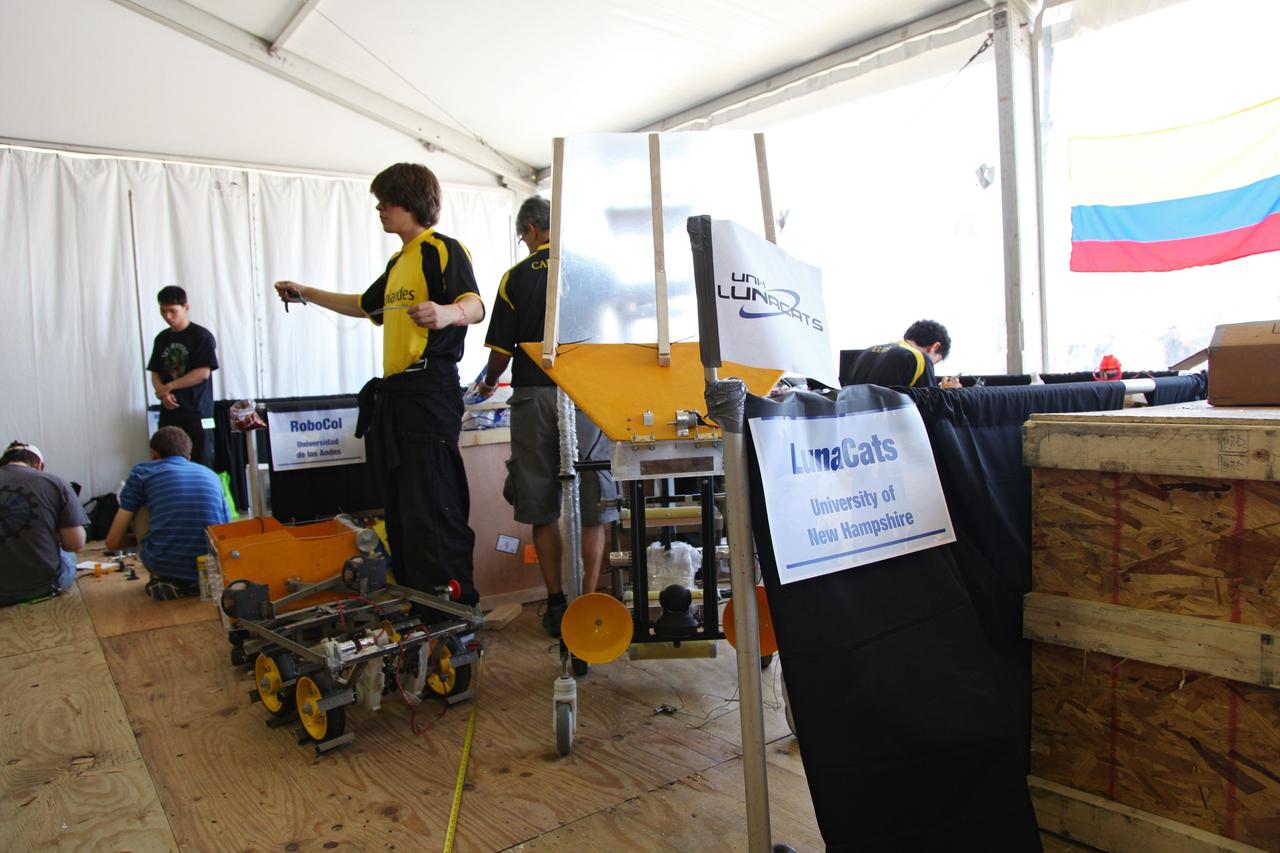
CAPE CANAVERAL, Fla. -- University students prepare for NASA's second annual Lunabotics Mining Competition at the Kennedy Space Center Visitor Complex in Florida. Thirty-six teams of undergraduate and graduate students from the United States, Bangladesh, Canada, Colombia and India will participate in NASA's Lunabotics Mining Competition May 26 - 28 at the agency's Kennedy Space Center in Florida. The competition is designed to engage and retain students in science, technology, engineering and mathematics (STEM). Teams will maneuver their remote controlled or autonomous excavators, called lunabots, in about 60 tons of ultra-fine simulated lunar soil, called BP-1. The competition is an Exploration Systems Mission Directorate project managed by Kennedy's Education Division. The event also provides a competitive environment that could result in innovative ideas and solutions for NASA's future excavation of the moon. Photo credit: NASA/Frankie Martin
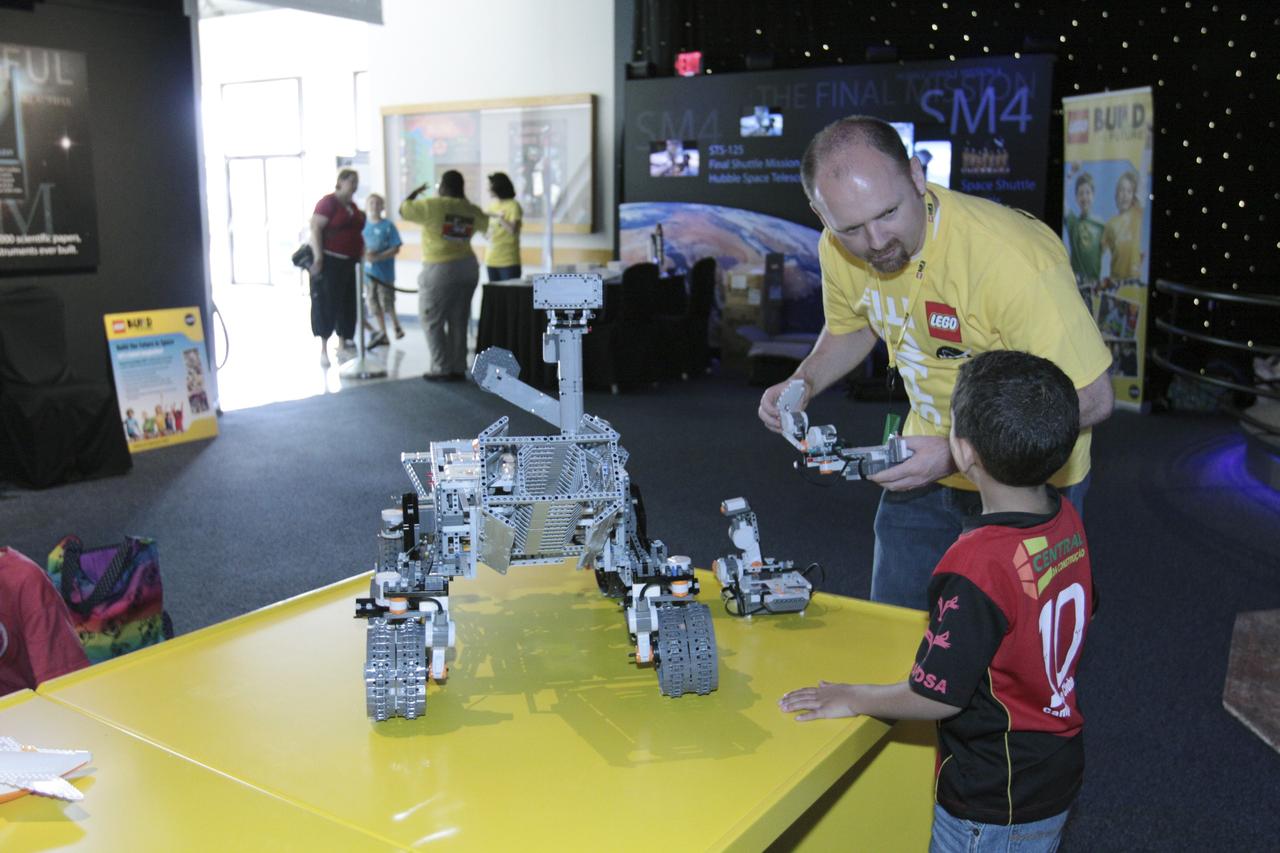
CAPE CANAVERAL, Fla. – LEGO NXT robots, designed to look like Mars rovers, are on display at the LEGO "Build the Future" event at the Kennedy Space Center Visitor Complex in Florida. The festivities coincide with the launch of NASA's Mars Science Laboratory (MSL), carrying a compact car-sized rover, Curiosity, to the red planet. Part of the Space Act Agreement between NASA and LEGO A/S, the activities are designed to inspire students of every age to consider an education and careers in the science, technology, engineering and mathematics, or STEM, disciplines. Launch of MSL aboard a United Launch Alliance Atlas V rocket is scheduled for Nov. 26 from Space Launch Complex-41 on Cape Canaveral Air Force Station in Florida. For more information, visit http://www.nasa.gov/audience/foreducators/nasa-lego-partnership.html. Photo credit: NASA/Kim Shiflett
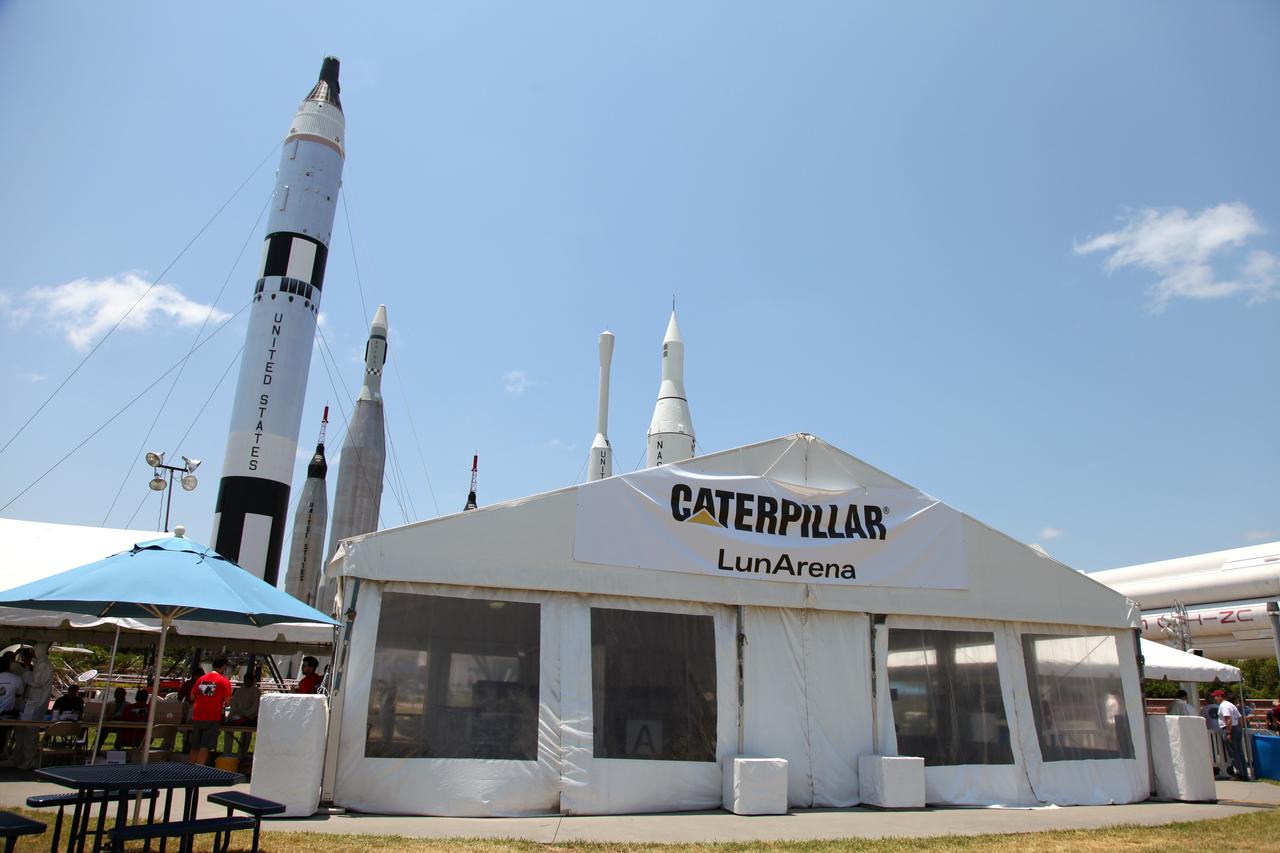
CAPE CANAVERAL, Fla. -- This tent called a "Lunarena" is a giant "sandbox," with about 60 tons of ultra-fine simulated lunar soil spread on the floor for NASA's second annual Lunabotics Mining Competition at the Kennedy Space Center Visitor Complex. Thirty-six teams of undergraduate and graduate students from the United States, Bangladesh, Canada, Colombia and India will participate in NASA's Lunabotics Mining Competition May 26 - 28 at the agency's Kennedy Space Center in Florida. The competition is designed to engage and retain students in science, technology, engineering and mathematics (STEM). Teams will maneuver their remote controlled or autonomous excavators, called lunabots, in about 60 tons of ultra-fine simulated lunar soil, called BP-1. The competition is an Exploration Systems Mission Directorate project managed by Kennedy's Education Division. The event also provides a competitive environment that could result in innovative ideas and solutions for NASA's future excavation of the moon. Photo credit: NASA/Frankie Martin
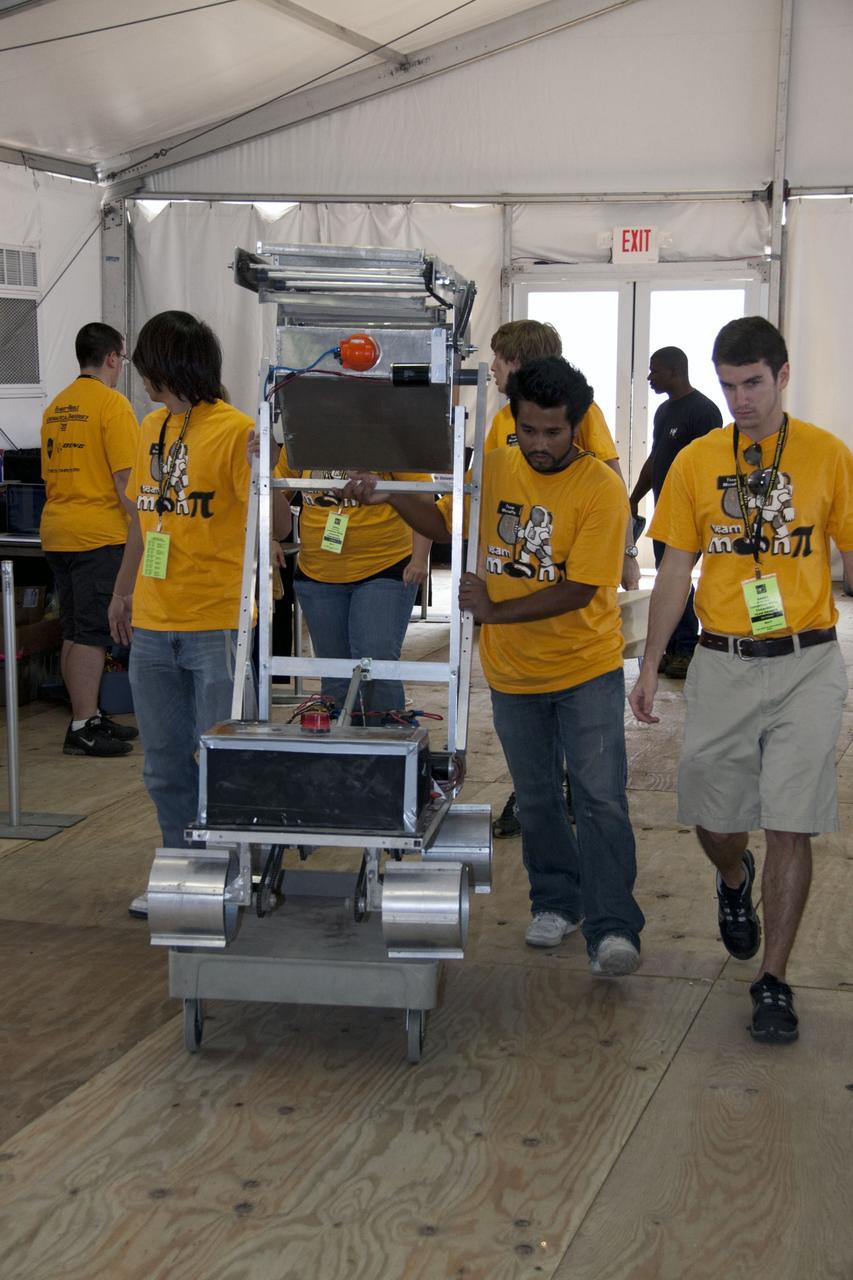
CAPE CANAVERAL, Fla. -- University students make final preparations for NASA's second annual Lunabotics Mining Competition held at the Kennedy Space Center Visitor Complex in Florida. Thirty-six teams of undergraduate and graduate students from the United States, Bangladesh, Canada, Colombia and India will participate in NASA's Lunabotics Mining Competition May 26 - 28 at the agency's Kennedy Space Center in Florida. The competition is designed to engage and retain students in science, technology, engineering and mathematics (STEM). Teams will maneuver their remote controlled or autonomous excavators, called lunabots, in about 60 tons of ultra-fine simulated lunar soil, called BP-1. The competition is an Exploration Systems Mission Directorate project managed by Kennedy's Education Division. The event also provides a competitive environment that could result in innovative ideas and solutions for NASA's future excavation of the moon. Photo credit: NASA/Jack Pfaller
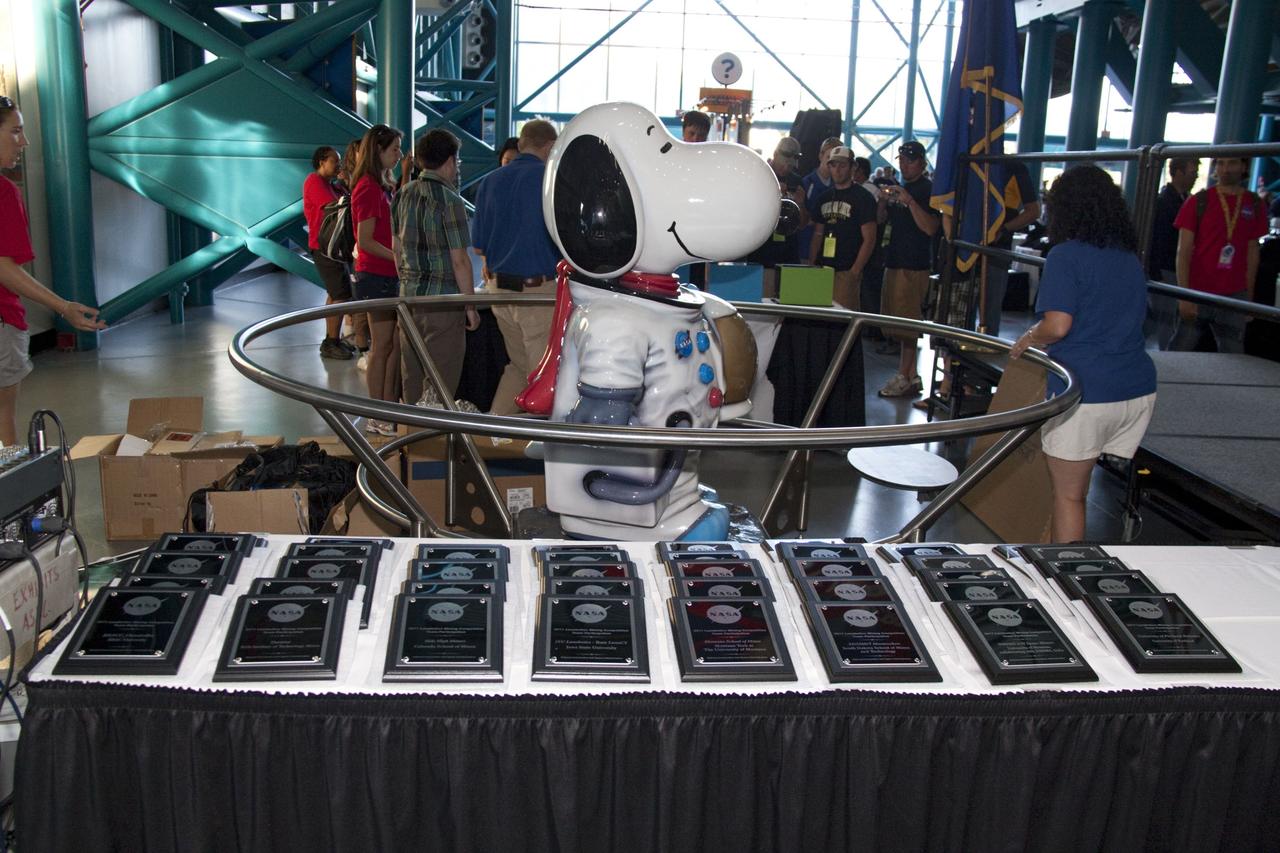
CAPE CANAVERAL, Fla. -- At NASA Kennedy Space Center's Apollo/Saturn V Center, university students take part in an award ceremony for NASA's second annual Lunabotics Mining Competition. Thirty-six teams of undergraduate and graduate students from the United States, Bangladesh, Canada, Colombia and India participated in NASA's Lunabotics Mining Competition May 26 - 28 at the agency's Kennedy Space Center in Florida. The competition is designed to engage and retain students in science, technology, engineering and mathematics (STEM). Teams will maneuver their remote controlled or autonomous excavators, called lunabots, in about 60 tons of ultra-fine simulated lunar soil, called BP-1. The competition is an Exploration Systems Mission Directorate project managed by Kennedy's Education Division. The event also provides a competitive environment that could result in innovative ideas and solutions for NASA's future excavation of the moon. Photo credit: NASA/Jack Pfaller
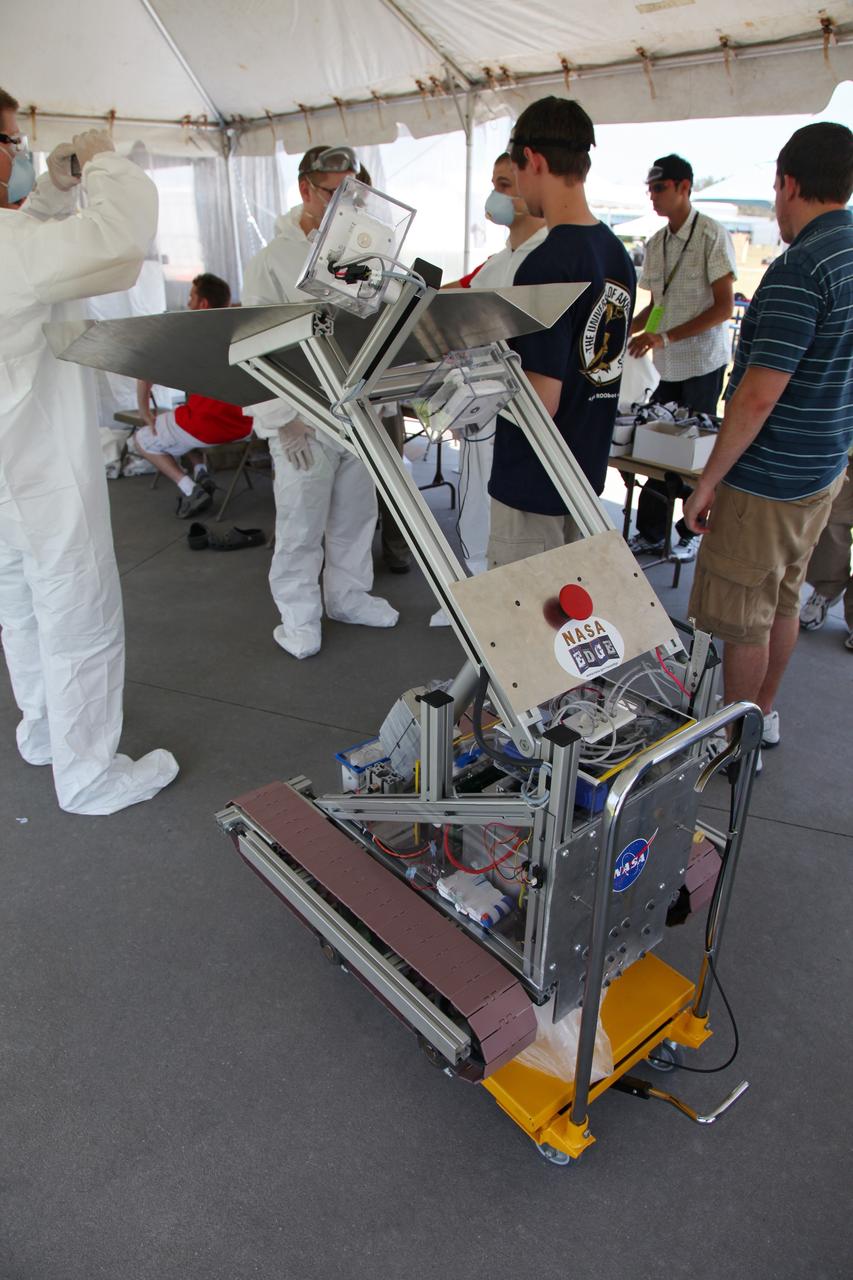
CAPE CANAVERAL, Fla. -- University students prepare their remote controlled or autonomous excavator, called a lunabot, in a tent next to the "Lunarena" at the Kennedy Space Center Visitor Complex. Thirty-six teams of undergraduate and graduate students from the United States, Bangladesh, Canada, Colombia and India will participate in NASA's Lunabotics Mining Competition May 26 - 28 at the agency's Kennedy Space Center in Florida. The competition is designed to engage and retain students in science, technology, engineering and mathematics (STEM). Teams will maneuver their remote controlled or autonomous excavators, called lunabots, in about 60 tons of ultra-fine simulated lunar soil, called BP-1. The competition is an Exploration Systems Mission Directorate project managed by Kennedy's Education Division. The event also provides a competitive environment that could result in innovative ideas and solutions for NASA's future excavation of the moon. Photo credit: NASA/Frankie Martin
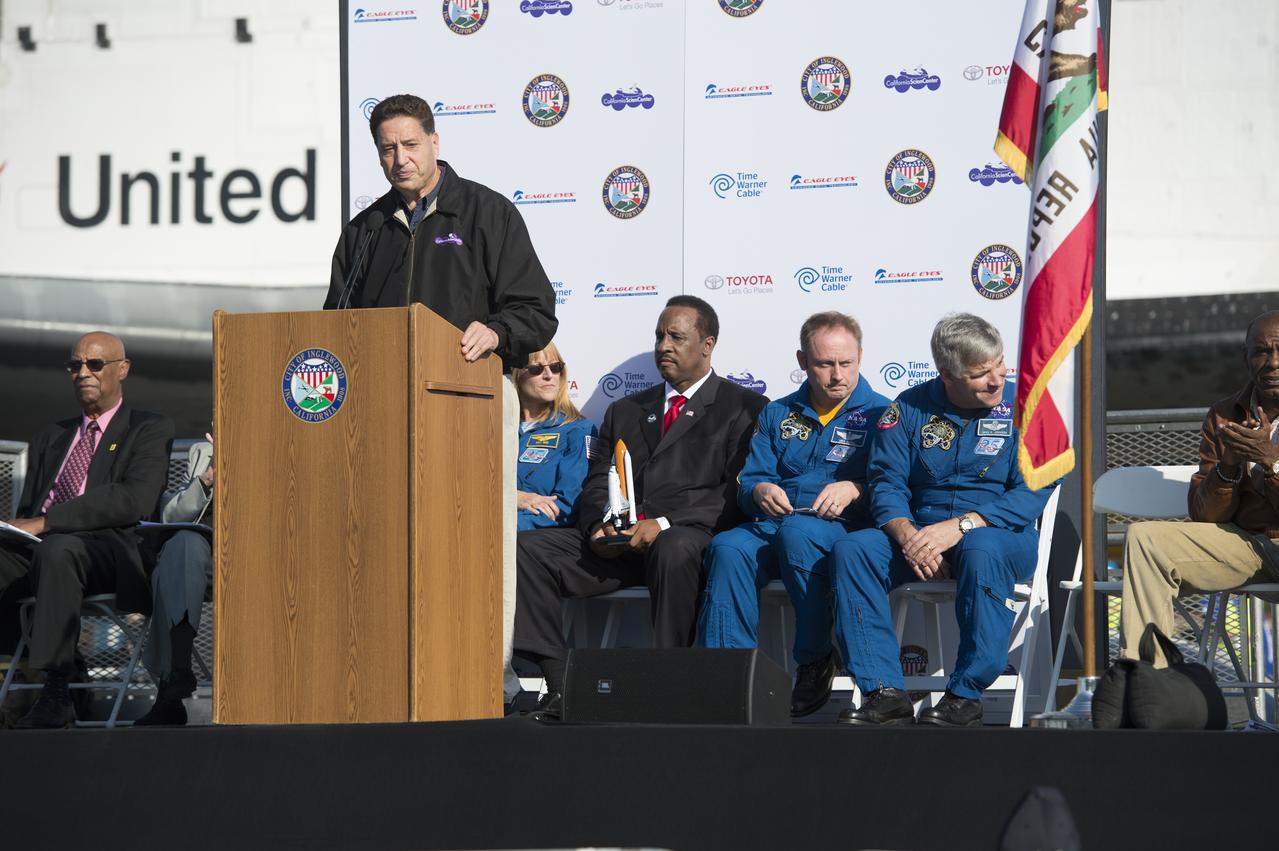
Jeffrey Rudolph, President and CEO, California Science Center speaks at the Endeavour Kick-Off Ceremony at The Forum in Inglewood, Saturday, Oct. 13, 2012. Behind him are seen Hildreth Walker, Founder of A-Man Inc. STEM International Science Center, far left; James T. Butts, Jr., Mayor of Inglewood; NASA astronauts Michael Fincke and Gregory Johnson, far right. Endeavour, built as a replacement for space shuttle Challenger, completed 25 missions, spent 299 days in orbit, and orbited Earth 4,671 times while traveling 122,883,151 miles. Beginning Oct. 30, the shuttle will be on display in the CSC’s Samuel Oschin Space Shuttle Endeavour Display Pavilion, embarking on its new mission to commemorate past achievements in space and educate and inspire future generations of explorers. Photo Credit: (NASA/Carla Cioffi)
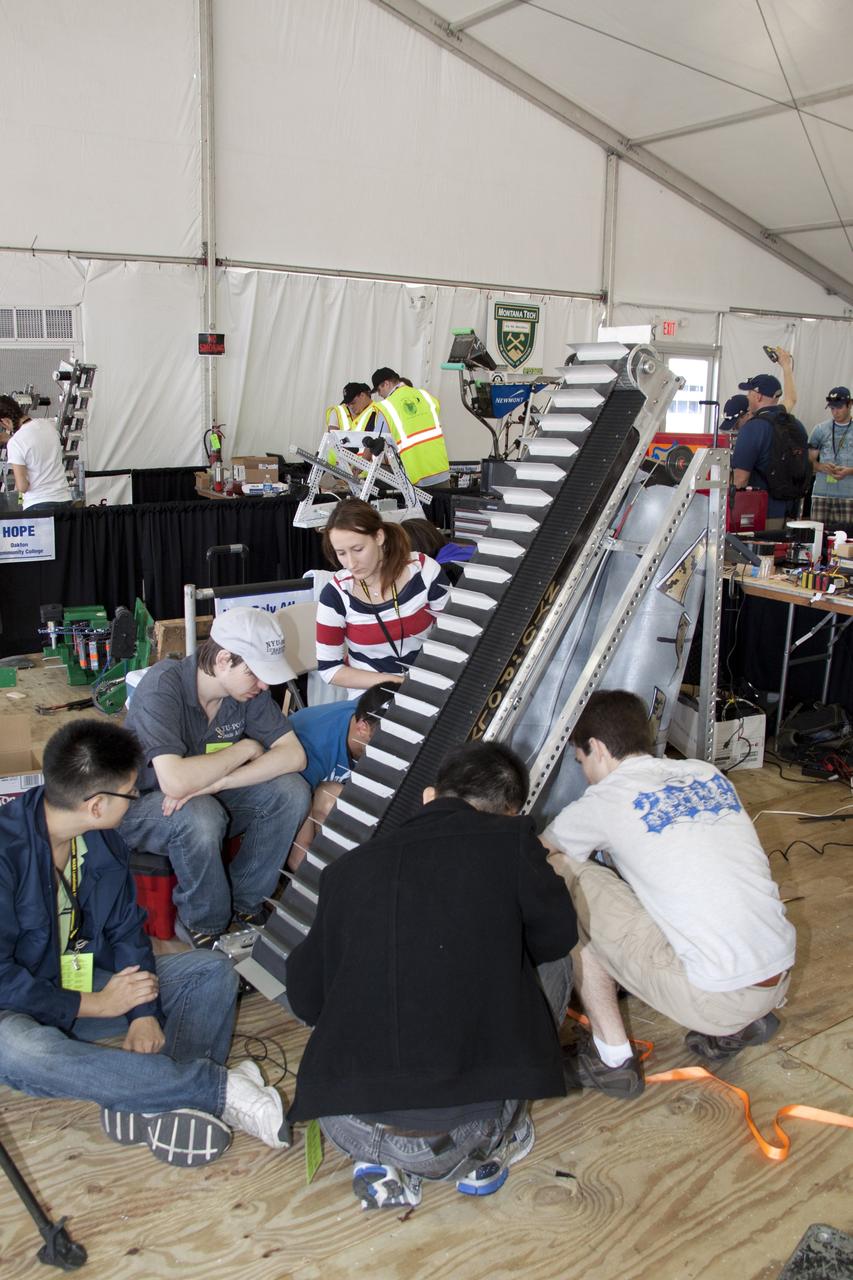
CAPE CANAVERAL, Fla. -- University students prepare for NASA's second annual Lunabotics Mining Competition at the Kennedy Space Center Visitor Complex in Florida. Thirty-six teams of undergraduate and graduate students from the United States, Bangladesh, Canada, Colombia and India will participate in NASA's Lunabotics Mining Competition May 26 - 28 at the agency's Kennedy Space Center in Florida. The competition is designed to engage and retain students in science, technology, engineering and mathematics (STEM). Teams will maneuver their remote controlled or autonomous excavators, called lunabots, in about 60 tons of ultra-fine simulated lunar soil, called BP-1. The competition is an Exploration Systems Mission Directorate project managed by Kennedy's Education Division. The event also provides a competitive environment that could result in innovative ideas and solutions for NASA's future excavation of the moon. Photo credit: NASA/Jack Pfaller
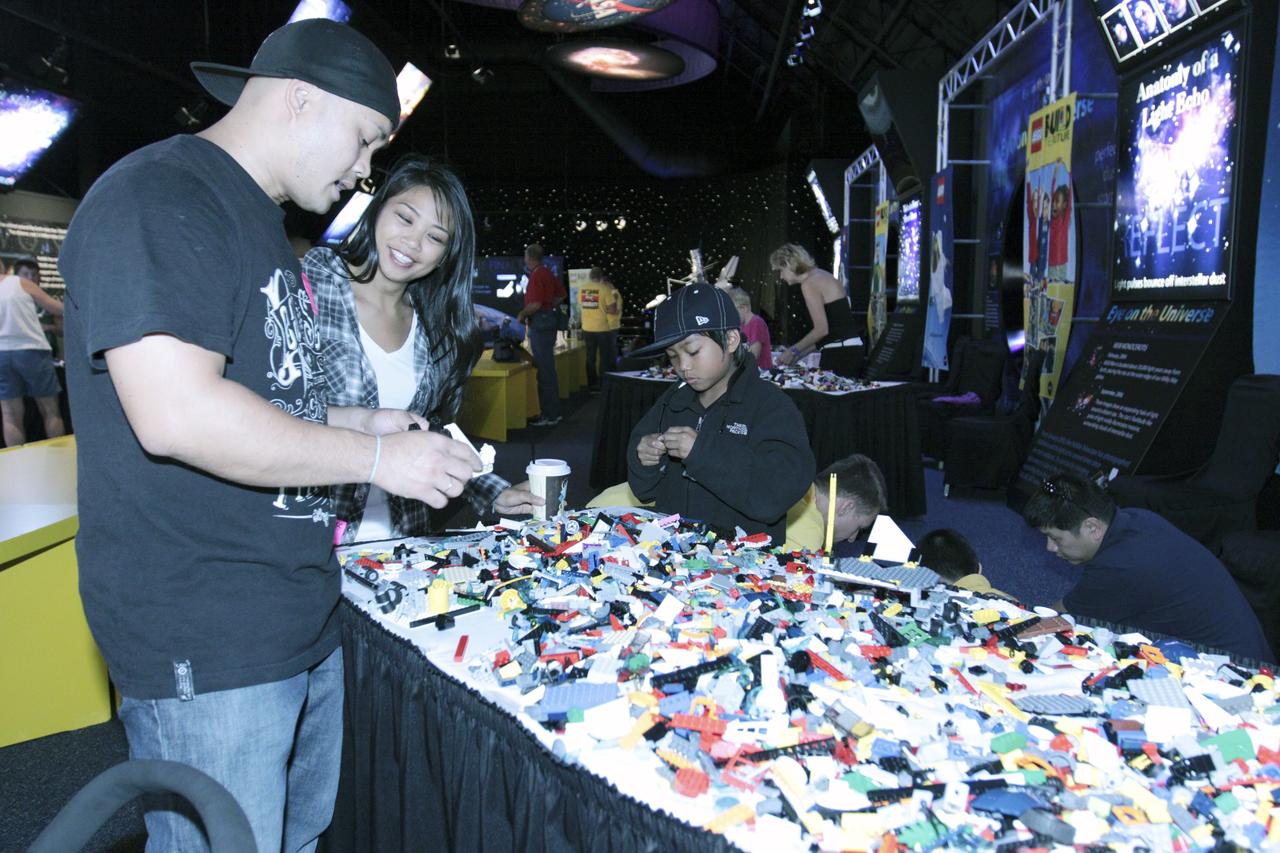
CAPE CANAVERAL, Fla. – Families visiting the Kennedy Space Center Visitor Complex in Florida participate in a LEGO "Build the Future" event. The festivities coincide with the launch of NASA's Mars Science Laboratory (MSL), carrying a compact car-sized rover, Curiosity, to the red planet. Part of the Space Act Agreement between NASA and LEGO A/S, the activities are designed to inspire students of every age to consider an education and careers in the science, technology, engineering and mathematics, or STEM, disciplines. Launch of MSL aboard a United Launch Alliance Atlas V rocket is scheduled for Nov. 26 from Space Launch Complex-41 on Cape Canaveral Air Force Station in Florida. For more information, visit http://www.nasa.gov/audience/foreducators/nasa-lego-partnership.html. Photo credit: NASA/Kim Shiflett
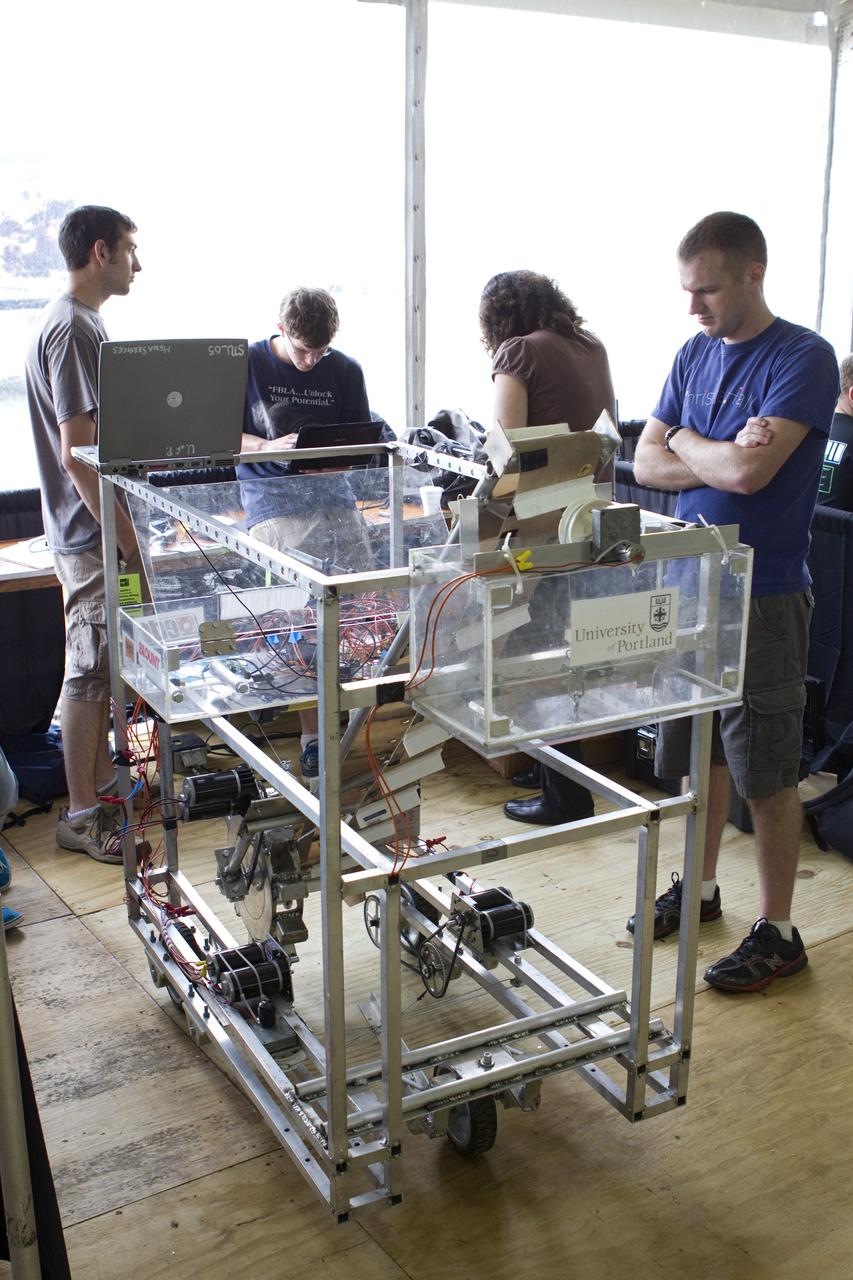
CAPE CANAVERAL, Fla. -- University students prepare for NASA's second annual Lunabotics Mining Competition at the Kennedy Space Center Visitor Complex in Florida. Thirty-six teams of undergraduate and graduate students from the United States, Bangladesh, Canada, Colombia and India will participate in NASA's Lunabotics Mining Competition May 26 - 28. The competition is designed to engage and retain students in science, technology, engineering and mathematics (STEM). Teams will maneuver their remote controlled or autonomous excavators, called lunabots, in about 60 tons of ultra-fine simulated lunar soil, called BP-1. The competition is an Exploration Systems Mission Directorate project managed by Kennedy's Education Division. The event also provides a competitive environment that could result in innovative ideas and solutions for NASA's future excavation of the moon. Photo credit: NASA/Cory Huston
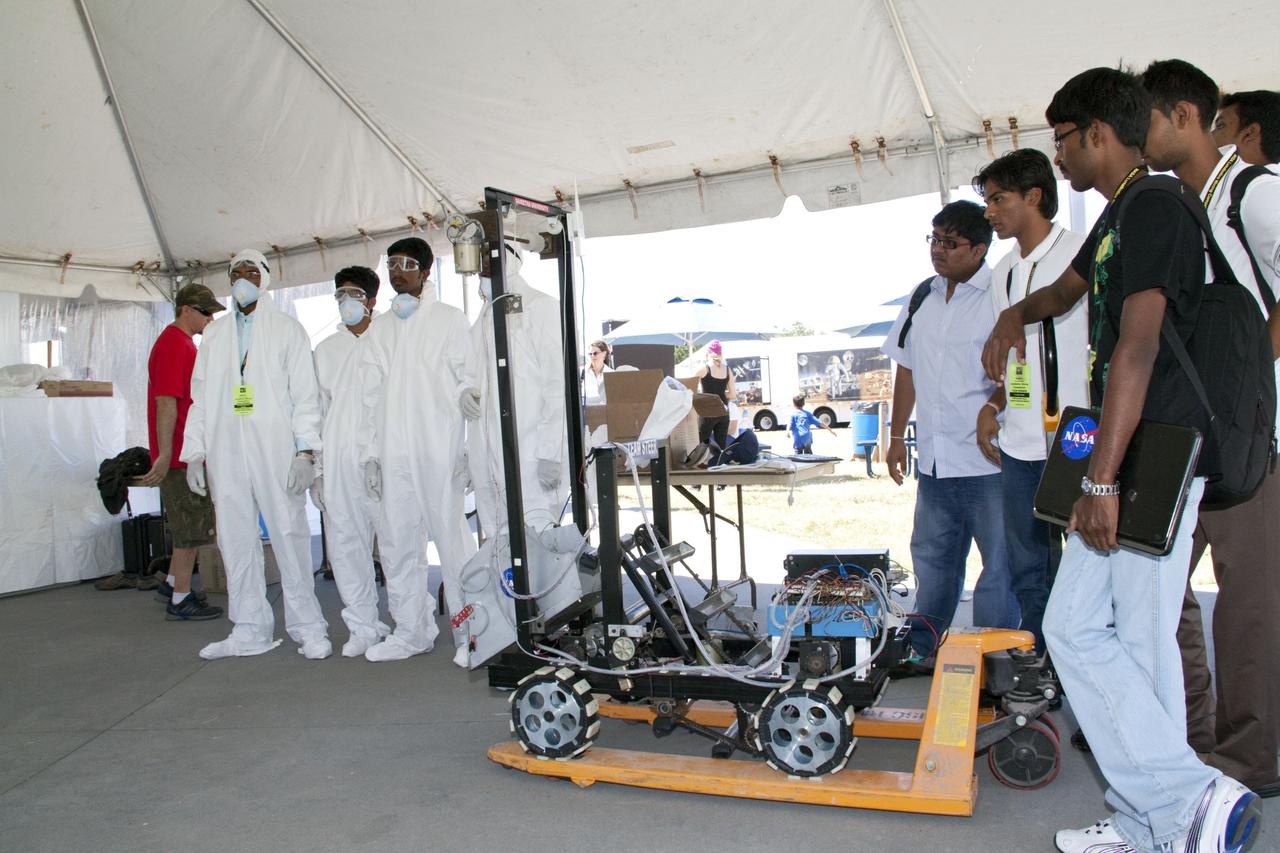
CAPE CANAVERAL, Fla. -- University students wait their turn to compete in NASA's second annual Lunabotics Mining Competition at the Kennedy Space Center Visitor Complex in Florida. Thirty-six teams of undergraduate and graduate students from the United States, Bangladesh, Canada, Colombia and India will participate in NASA's Lunabotics Mining Competition May 26 - 28 at the agency's Kennedy Space Center in Florida. The competition is designed to engage and retain students in science, technology, engineering and mathematics (STEM). Teams will maneuver their remote controlled or autonomous excavators, called lunabots, in about 60 tons of ultra-fine simulated lunar soil, called BP-1. The competition is an Exploration Systems Mission Directorate project managed by Kennedy's Education Division. The event also provides a competitive environment that could result in innovative ideas and solutions for NASA's future excavation of the moon. Photo credit: NASA/Jack Pfaller
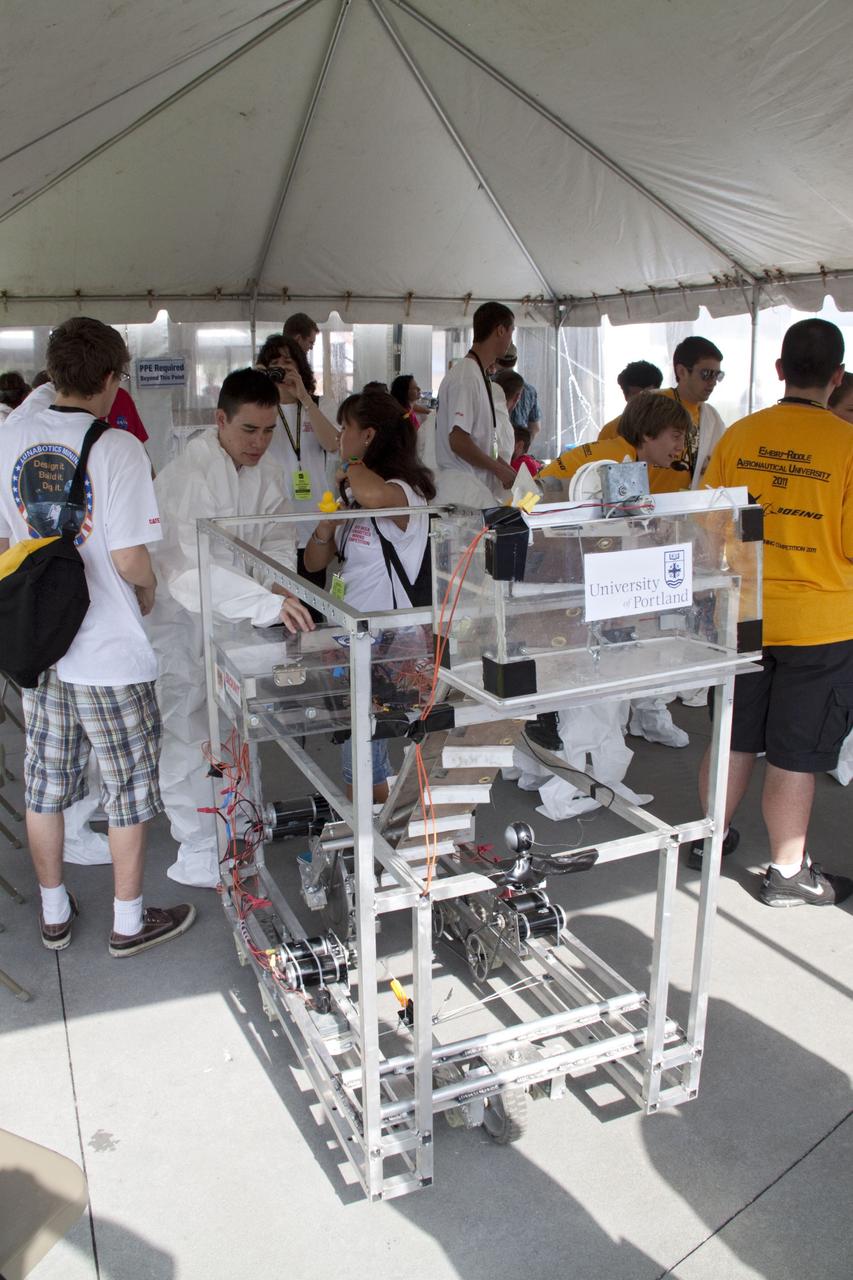
CAPE CANAVERAL, Fla. -- University students make final preparations for NASA's second annual Lunabotics Mining Competition held at the Kennedy Space Center Visitor Complex in Florida. Thirty-six teams of undergraduate and graduate students from the United States, Bangladesh, Canada, Colombia and India will participate in NASA's Lunabotics Mining Competition May 26 - 28 at the agency's Kennedy Space Center in Florida. The competition is designed to engage and retain students in science, technology, engineering and mathematics (STEM). Teams will maneuver their remote controlled or autonomous excavators, called lunabots, in about 60 tons of ultra-fine simulated lunar soil, called BP-1. The competition is an Exploration Systems Mission Directorate project managed by Kennedy's Education Division. The event also provides a competitive environment that could result in innovative ideas and solutions for NASA's future excavation of the moon. Photo credit: NASA/Jack Pfaller
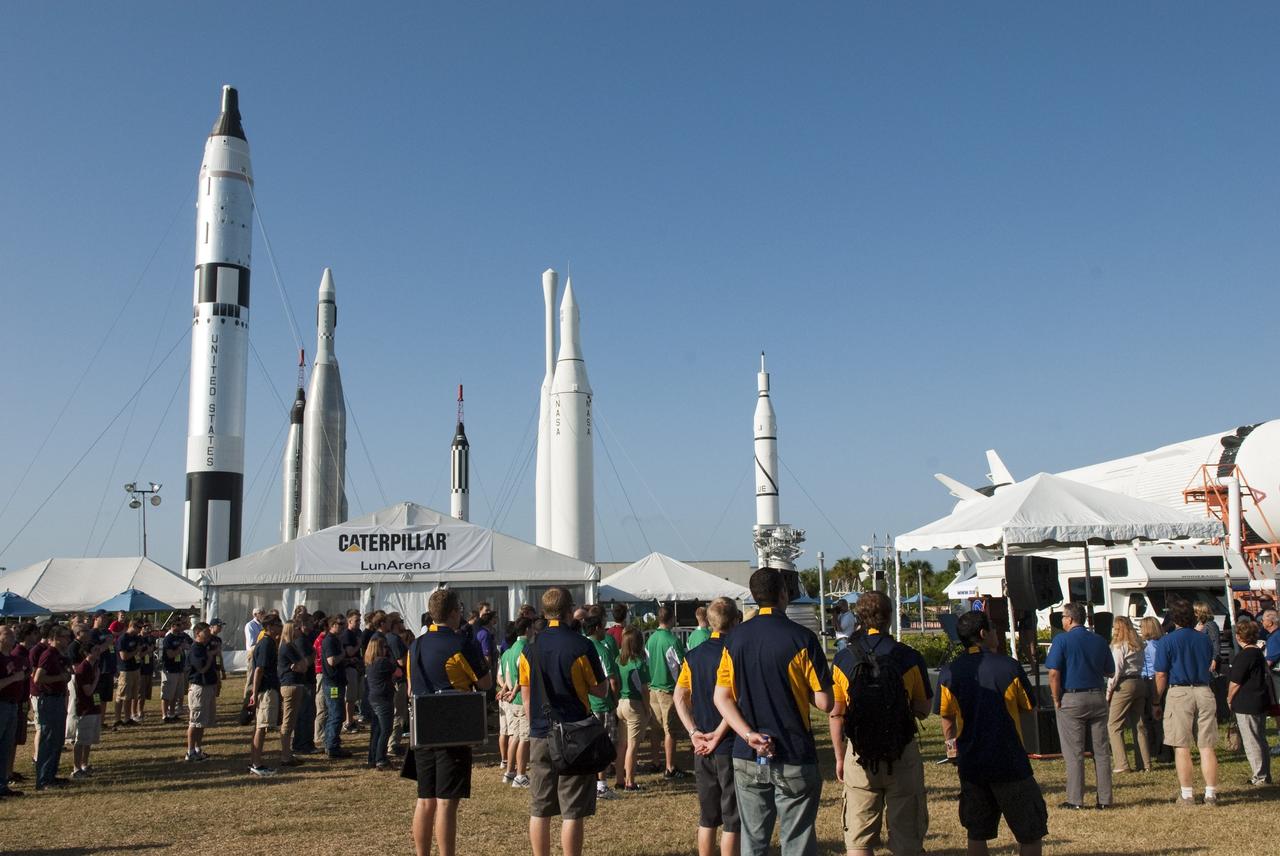
CAPE CANAVERAL, Fla. -- University students gather for the opening ceremony of NASA's second annual Lunabotics Mining Competition at the Kennedy Space Center Visitor Complex in Florida. Thirty-six teams of undergraduate and graduate students from the United States, Bangladesh, Canada, Colombia and India will participate in NASA's Lunabotics Mining Competition May 26 - 28 at the agency's Kennedy Space Center in Florida. The competition is designed to engage and retain students in science, technology, engineering and mathematics (STEM). Teams will maneuver their remote controlled or autonomous excavators, called lunabots, in about 60 tons of ultra-fine simulated lunar soil, called BP-1. The competition is an Exploration Systems Mission Directorate project managed by Kennedy's Education Division. The event also provides a competitive environment that could result in innovative ideas and solutions for NASA's future excavation of the moon. Photo credit: NASA/Jim Grossmann
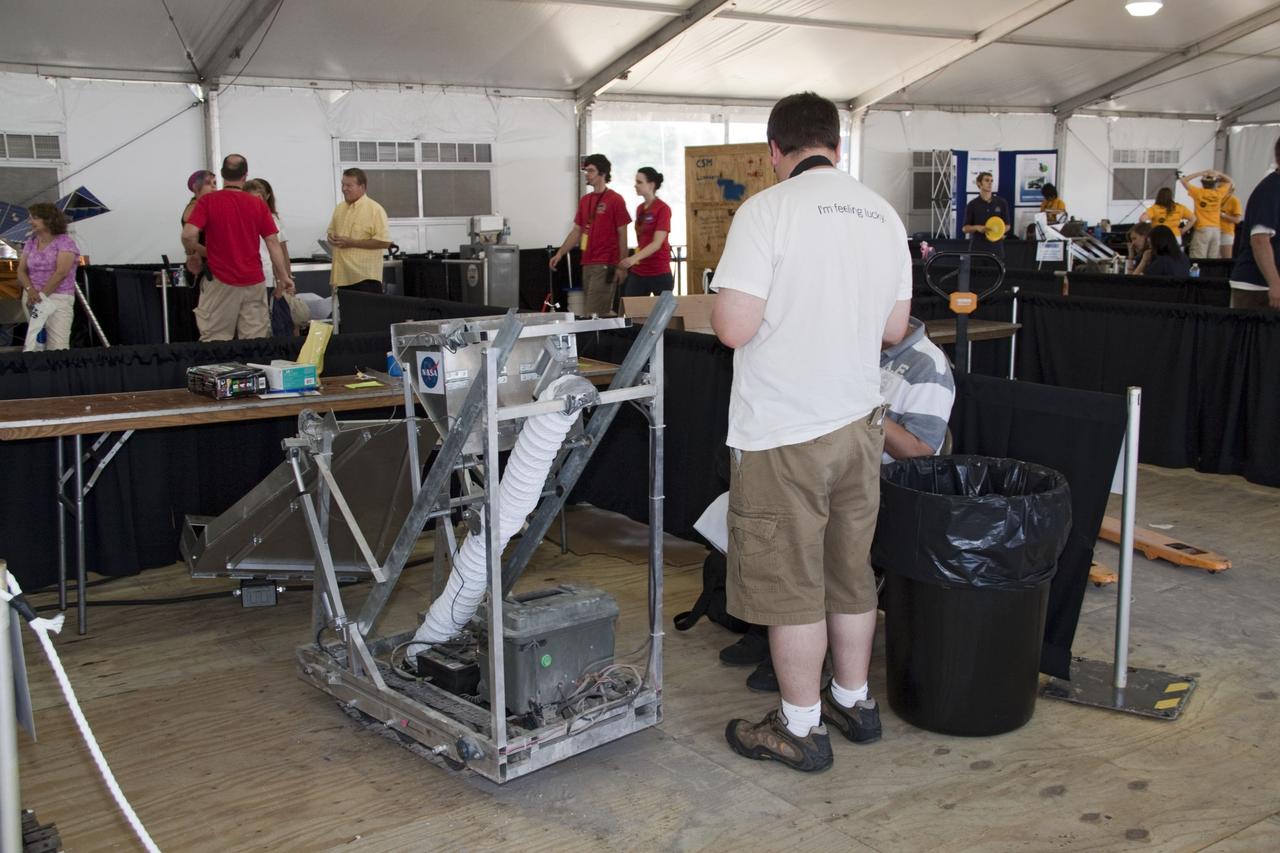
CAPE CANAVERAL, Fla. -- University students wait their turn to compete in NASA's second annual Lunabotics Mining Competition at the Kennedy Space Center Visitor Complex in Florida. hirty-six teams of undergraduate and graduate students from the United States, Bangladesh, Canada, Colombia and India will participate in NASA's Lunabotics Mining Competition May 26 - 28 at the agency's Kennedy Space Center in Florida. The competition is designed to engage and retain students in science, technology, engineering and mathematics (STEM). Teams will maneuver their remote controlled or autonomous excavators, called lunabots, in about 60 tons of ultra-fine simulated lunar soil, called BP-1. The competition is an Exploration Systems Mission Directorate project managed by Kennedy's Education Division. The event also provides a competitive environment that could result in innovative ideas and solutions for NASA's future excavation of the moon. Photo credit: NASA/Jack Pfaller
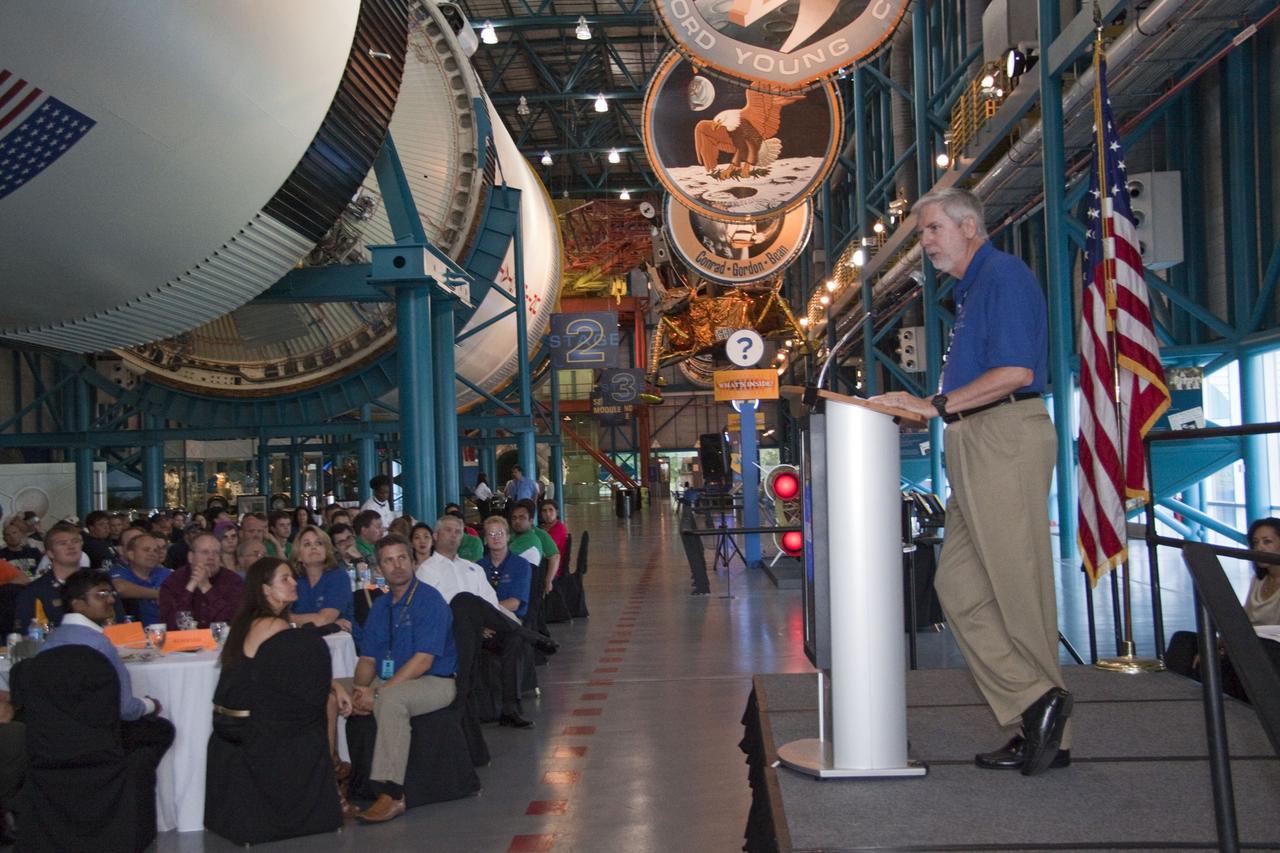
CAPE CANAVERAL, Fla. -- At NASA Kennedy Space Center's Apollo/Saturn V Center, Bill Moore, Visitor Complex chief operating officer speaks to university students at the award ceremony for NASA's second annual Lunabotics Mining Competition. Thirty-six teams of undergraduate and graduate students from the United States, Bangladesh, Canada, Colombia and India participated in NASA's Lunabotics Mining Competition May 26 - 28 at the agency's Kennedy Space Center in Florida. The competition is designed to engage and retain students in science, technology, engineering and mathematics (STEM). Teams will maneuver their remote controlled or autonomous excavators, called lunabots, in about 60 tons of ultra-fine simulated lunar soil, called BP-1. The competition is an Exploration Systems Mission Directorate project managed by Kennedy's Education Division. The event also provides a competitive environment that could result in innovative ideas and solutions for NASA's future excavation of the moon. Photo credit: NASA/Jack Pfaller

CAPE CANAVERAL, Fla. -- University students make final preparations for NASA's second annual Lunabotics Mining Competition at the Kennedy Space Center Visitor Complex in Florida. Thirty-six teams of undergraduate and graduate students from the United States, Bangladesh, Canada, Colombia and India will participate in NASA's Lunabotics Mining Competition May 26 - 28 at the agency's Kennedy Space Center in Florida. The competition is designed to engage and retain students in science, technology, engineering and mathematics (STEM). Teams will maneuver their remote controlled or autonomous excavators, called lunabots, in about 60 tons of ultra-fine simulated lunar soil, called BP-1. The competition is an Exploration Systems Mission Directorate project managed by Kennedy's Education Division. The event also provides a competitive environment that could result in innovative ideas and solutions for NASA's future excavation of the moon. Photo credit: NASA/Jack Pfaller
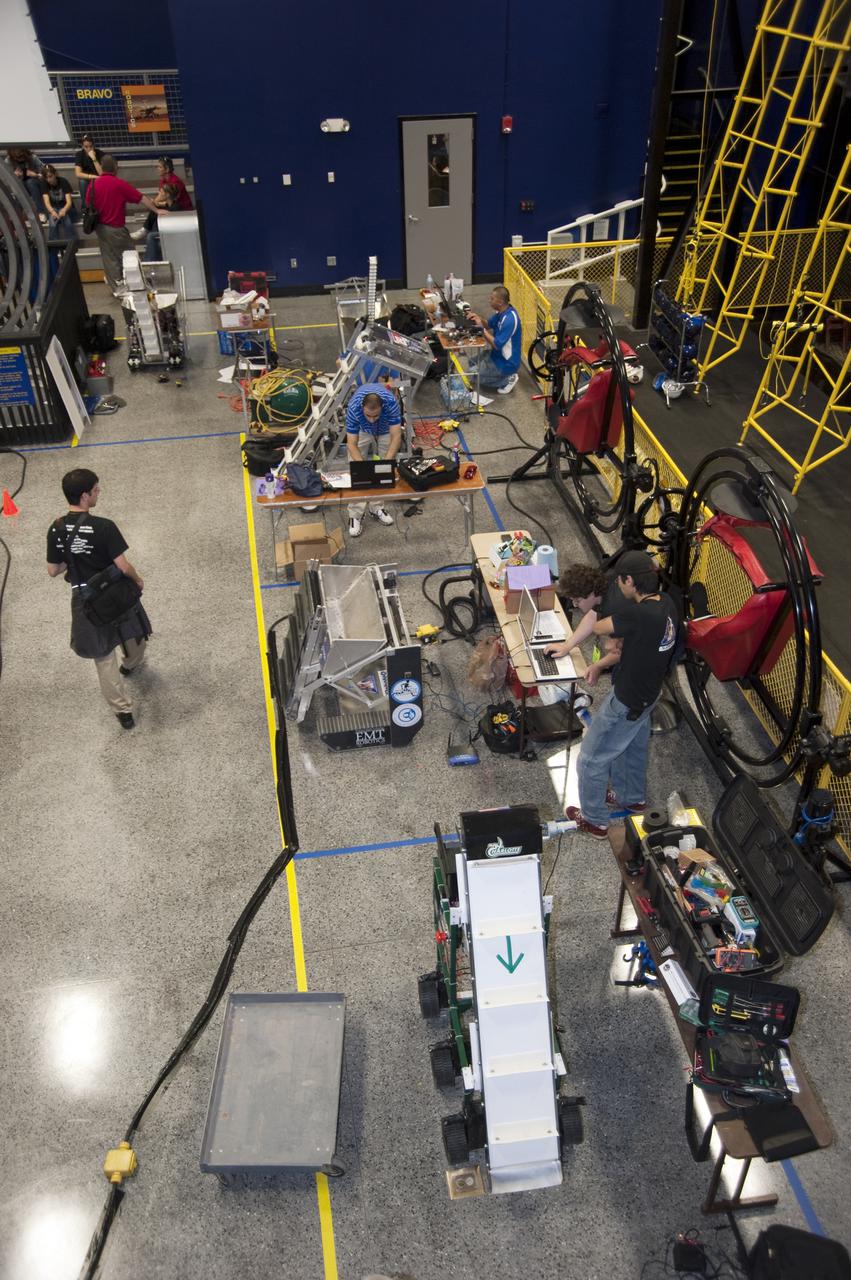
CAPE CANAVERAL, Fla. - University students tune up and tinker with their remote controlled or autonomous excavators, called lunabots, for NASA's first Lunabotics Mining Competition at the Kennedy Space Center Visitor Complex's Astronaut Hall of Fame. Twenty-two teams from around the country will maneuver their lunabots in about 60 tons of ultra-fine simulated lunar soil, called BP-1, on May 27-28. The competition is an Exploration Systems Mission Directorate project managed by Kennedy's Education Division. The purpose is to engage and retain students in science, technology, engineering and mathematics, or STEM, fields. It also provides a competitive environment that could result in innovative ideas and solutions for NASA's future excavation of the moon. Photo credit: NASA_Kim Shiflett
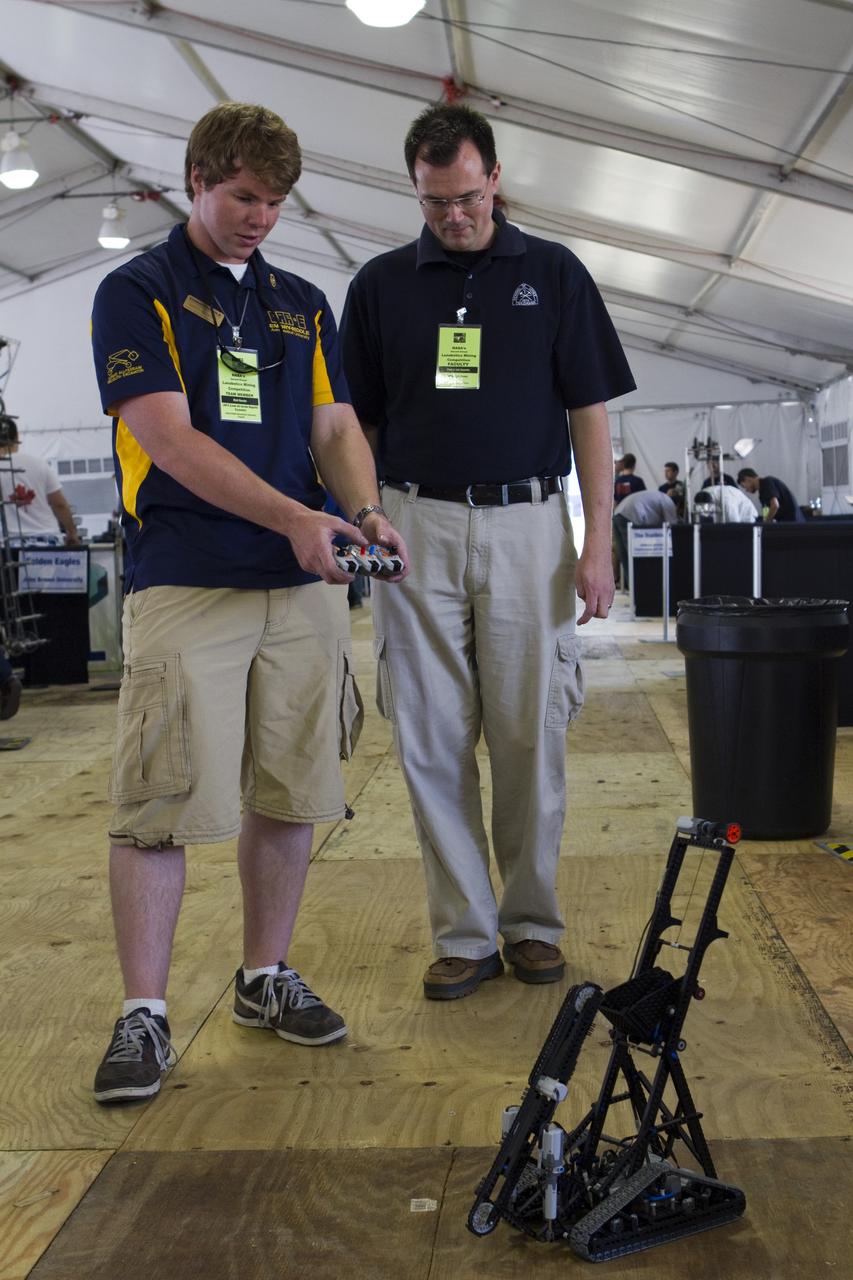
CAPE CANAVERAL, Fla. -- University students prepare for NASA's second annual Lunabotics Mining Competition at the Kennedy Space Center Visitor Complex in Florida. Thirty-six teams of undergraduate and graduate students from the United States, Bangladesh, Canada, Colombia and India will participate in NASA's Lunabotics Mining Competition May 26 - 28. The competition is designed to engage and retain students in science, technology, engineering and mathematics (STEM). Teams will maneuver their remote controlled or autonomous excavators, called lunabots, in about 60 tons of ultra-fine simulated lunar soil, called BP-1. The competition is an Exploration Systems Mission Directorate project managed by Kennedy's Education Division. The event also provides a competitive environment that could result in innovative ideas and solutions for NASA's future excavation of the moon. Photo credit: NASA/Cory Huston
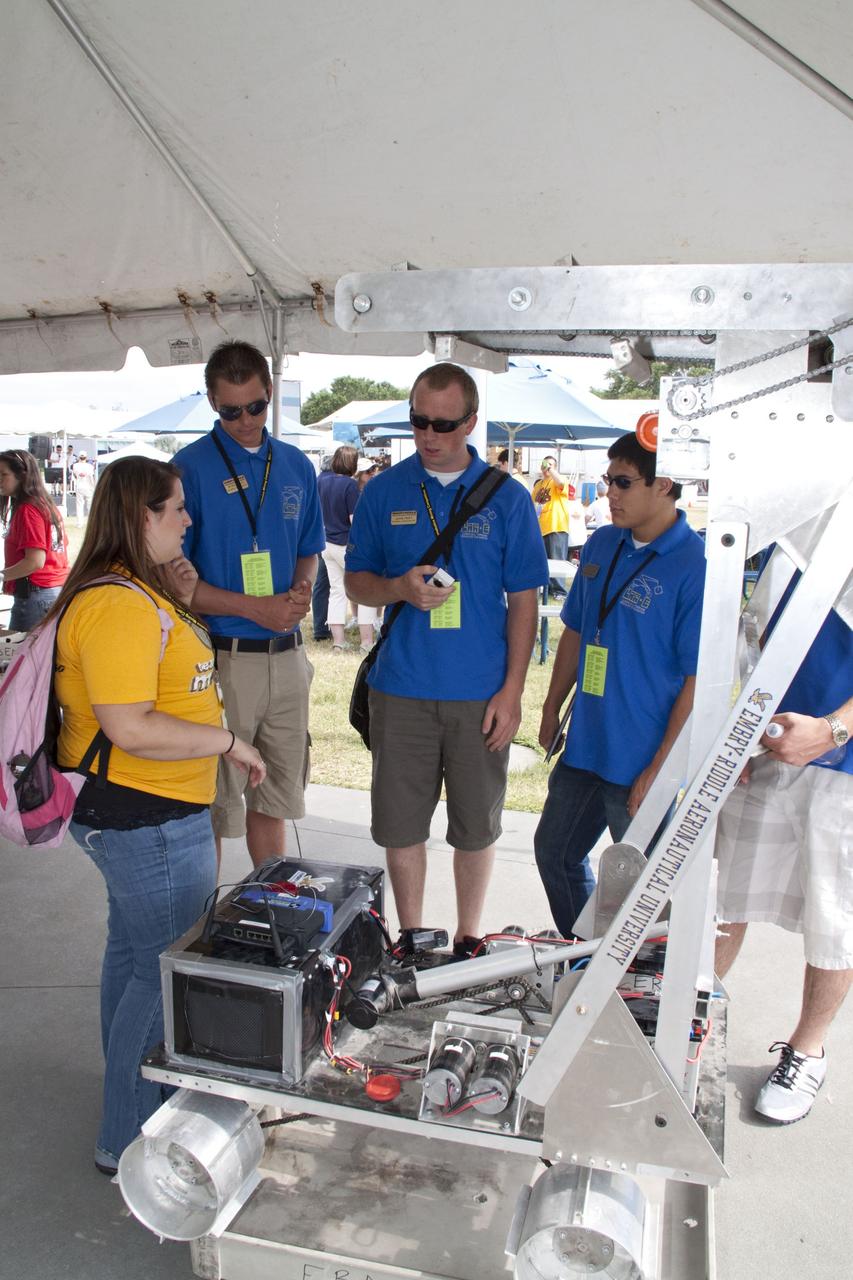
CAPE CANAVERAL, Fla. -- University students make final preparations for NASA's second annual Lunabotics Mining Competition held at the Kennedy Space Center Visitor Complex in Florida. Thirty-six teams of undergraduate and graduate students from the United States, Bangladesh, Canada, Colombia and India will participate in NASA's Lunabotics Mining Competition May 26 - 28 at the agency's Kennedy Space Center in Florida. The competition is designed to engage and retain students in science, technology, engineering and mathematics (STEM). Teams will maneuver their remote controlled or autonomous excavators, called lunabots, in about 60 tons of ultra-fine simulated lunar soil, called BP-1. The competition is an Exploration Systems Mission Directorate project managed by Kennedy's Education Division. The event also provides a competitive environment that could result in innovative ideas and solutions for NASA's future excavation of the moon. Photo credit: NASA/Jack Pfaller
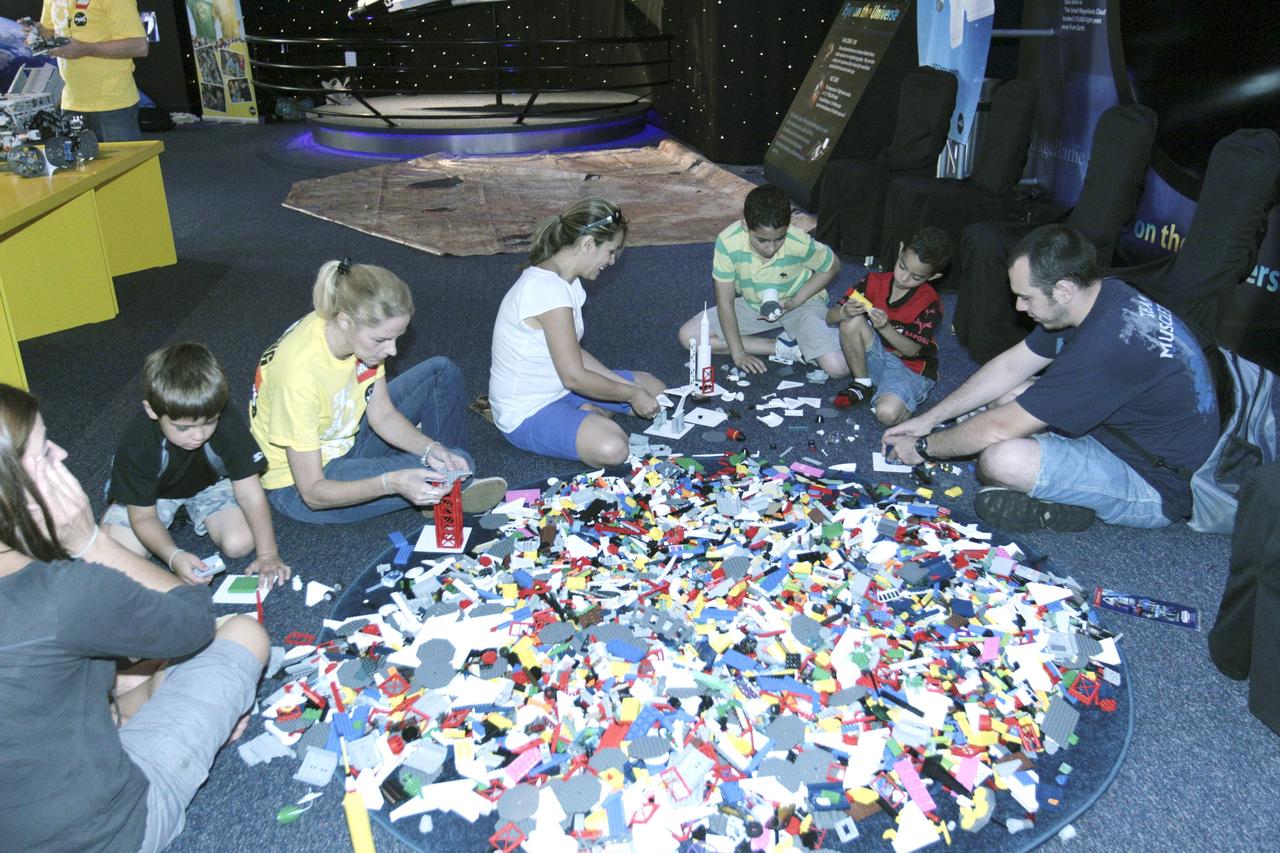
CAPE CANAVERAL, Fla. – Parents and children of all ages participate in a LEGO "Build the Future" event at the Kennedy Space Center Visitor Complex in Florida. The festivities coincide with the launch of NASA's Mars Science Laboratory (MSL), carrying a compact car-sized rover, Curiosity, to the red planet. Part of the Space Act Agreement between NASA and LEGO A/S, the activities are designed to inspire students of every age to consider an education and careers in the science, technology, engineering and mathematics, or STEM, disciplines. Launch of MSL aboard a United Launch Alliance Atlas V rocket is scheduled for Nov. 26 from Space Launch Complex-41 on Cape Canaveral Air Force Station in Florida. For more information, visit http://www.nasa.gov/audience/foreducators/nasa-lego-partnership.html. Photo credit: NASA/Kim Shiflett
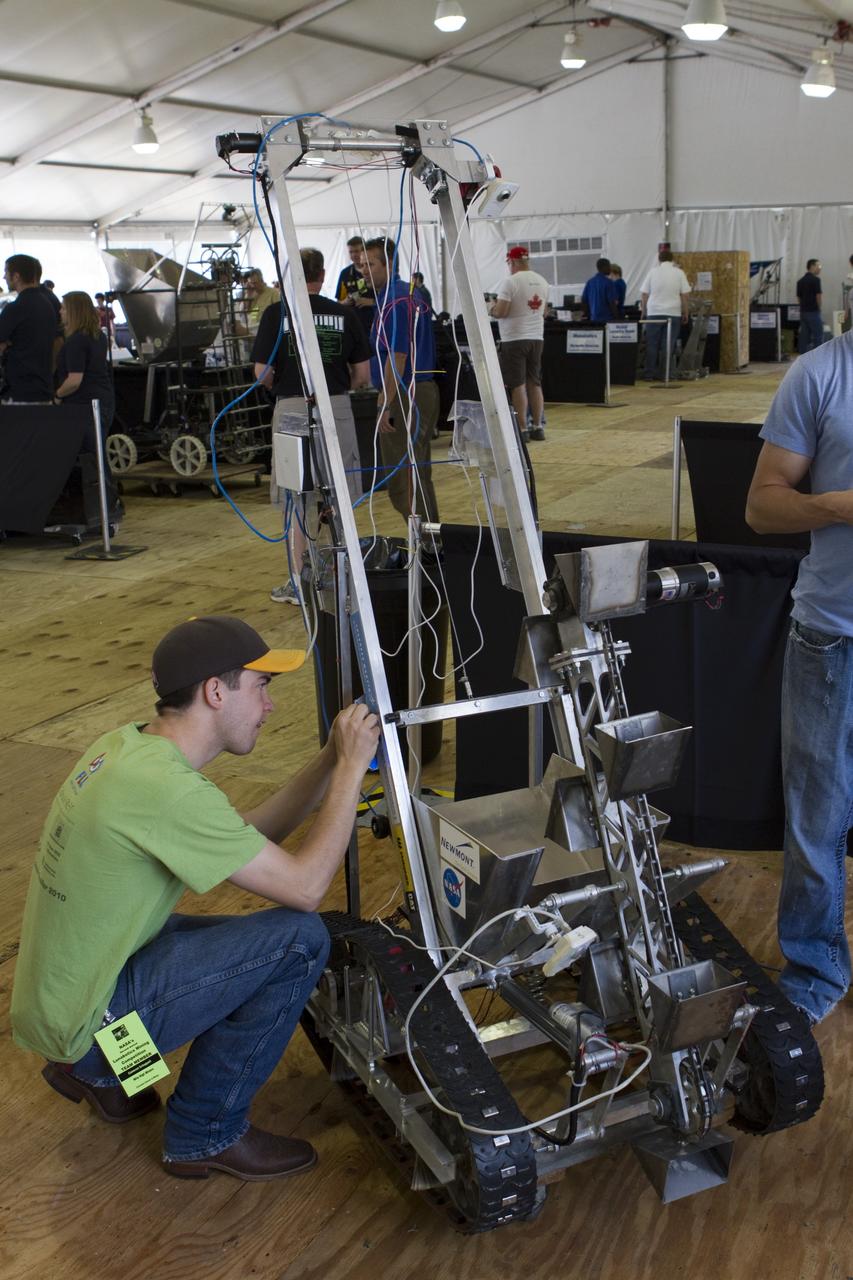
CAPE CANAVERAL, Fla. -- University students prepare for NASA's second annual Lunabotics Mining Competition at the Kennedy Space Center Visitor Complex in Florida. Thirty-six teams of undergraduate and graduate students from the United States, Bangladesh, Canada, Colombia and India will participate in NASA's Lunabotics Mining Competition May 26 - 28. The competition is designed to engage and retain students in science, technology, engineering and mathematics (STEM). Teams will maneuver their remote controlled or autonomous excavators, called lunabots, in about 60 tons of ultra-fine simulated lunar soil, called BP-1. The competition is an Exploration Systems Mission Directorate project managed by Kennedy's Education Division. The event also provides a competitive environment that could result in innovative ideas and solutions for NASA's future excavation of the moon. Photo credit: NASA/Cory Huston
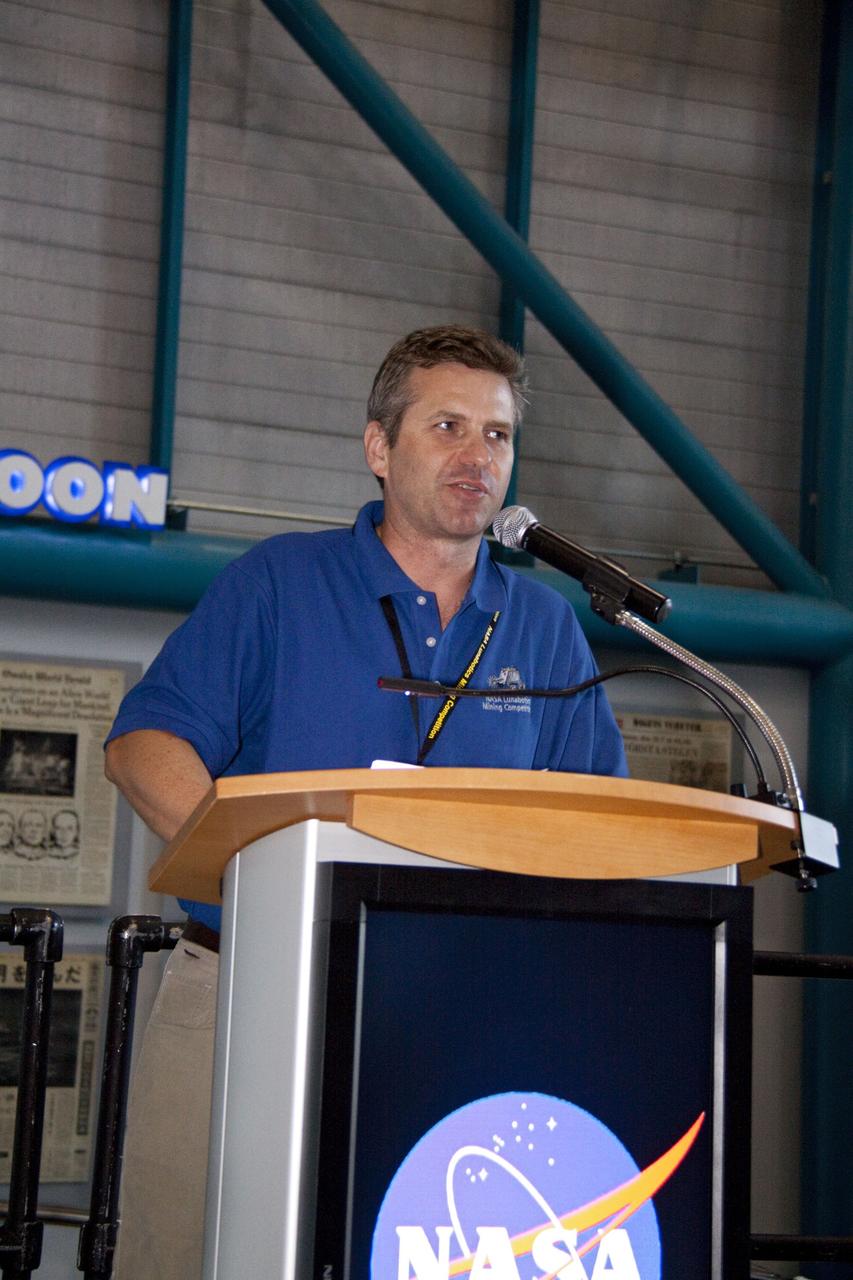
CAPE CANAVERAL, Fla. -- At NASA Kennedy Space Center's Apollo/Saturn V Center, Rob Mueller Kennedy's chief of the Surface Systems Office speaks to university students at the award ceremony for NASA's second annual Lunabotics Mining Competition. Thirty-six teams of undergraduate and graduate students from the United States, Bangladesh, Canada, Colombia and India participated in NASA's Lunabotics Mining Competition May 26 - 28 at the agency's Kennedy Space Center in Florida. The competition is designed to engage and retain students in science, technology, engineering and mathematics (STEM). Teams will maneuver their remote controlled or autonomous excavators, called lunabots, in about 60 tons of ultra-fine simulated lunar soil, called BP-1. The competition is an Exploration Systems Mission Directorate project managed by Kennedy's Education Division. The event also provides a competitive environment that could result in innovative ideas and solutions for NASA's future excavation of the moon. Photo credit: NASA/Jack Pfaller

From left to right are seen Apollo 7 astronaut Walter Cunningham (second from right), NASA astronaut Kay Hire, Hildreth Walker, Founder of A-MAN Inc. STEM International Science Center; NASA astronauts Michael Fincke and Gregory Johnson at the Endeavour Kick-Off Ceremony, Saturday, Oct. 13, 2012 in Inglewood. Endeavour, built as a replacement for space shuttle Challenger, completed 25 missions, spent 299 days in orbit, and orbited Earth 4,671 times while traveling 122,883,151 miles. Beginning Oct. 30, the shuttle will be on display in the CSC’s Samuel Oschin Space Shuttle Endeavour Display Pavilion, embarking on its new mission to commemorate past achievements in space and educate and inspire future generations of explorers. Photo Credit: (NASA/Carla Cioffi)
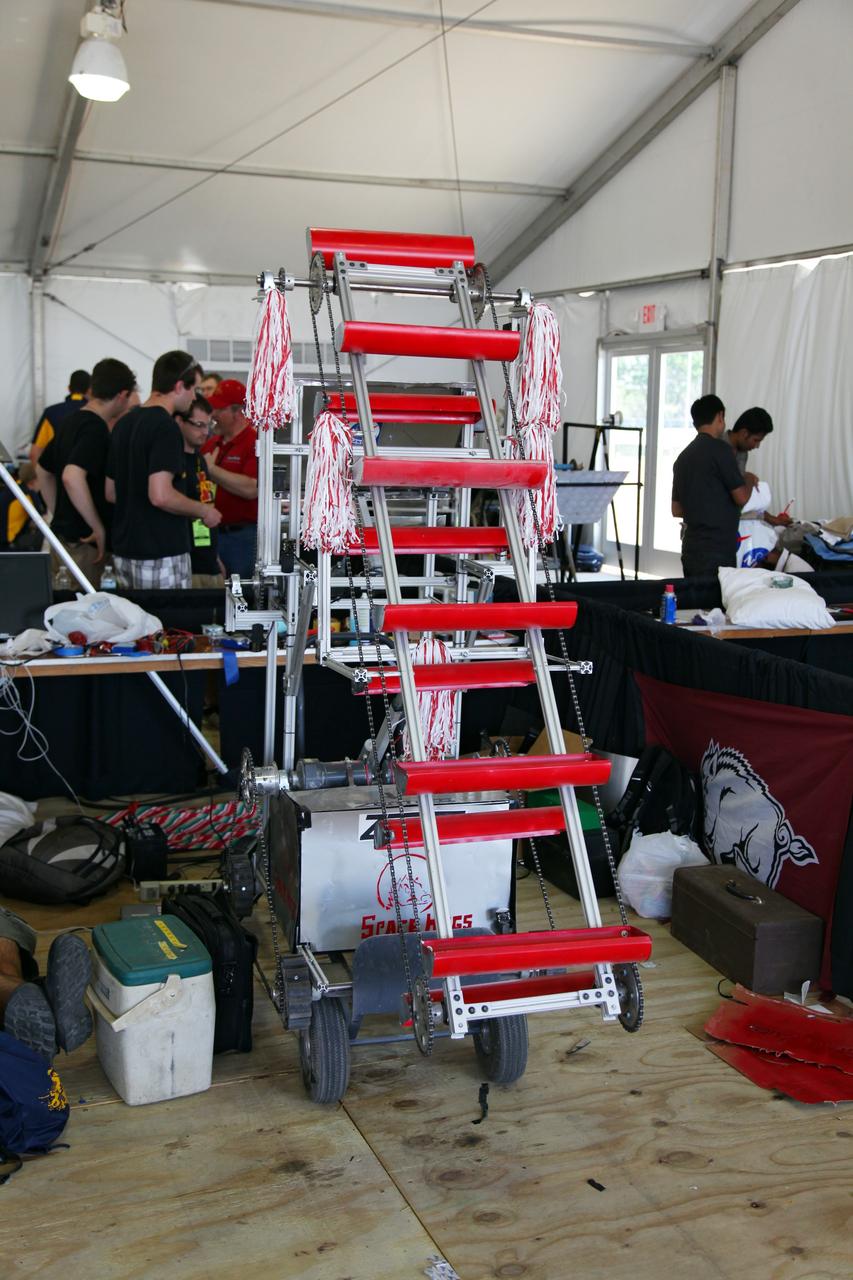
CAPE CANAVERAL, Fla. -- University students prepare for NASA's second annual Lunabotics Mining Competition at the Kennedy Space Center Visitor Complex in Florida. Thirty-six teams of undergraduate and graduate students from the United States, Bangladesh, Canada, Colombia and India will participate in NASA's Lunabotics Mining Competition May 26 - 28 at the agency's Kennedy Space Center in Florida. The competition is designed to engage and retain students in science, technology, engineering and mathematics (STEM). Teams will maneuver their remote controlled or autonomous excavators, called lunabots, in about 60 tons of ultra-fine simulated lunar soil, called BP-1. The competition is an Exploration Systems Mission Directorate project managed by Kennedy's Education Division. The event also provides a competitive environment that could result in innovative ideas and solutions for NASA's future excavation of the moon. Photo credit: NASA/Frankie Martin
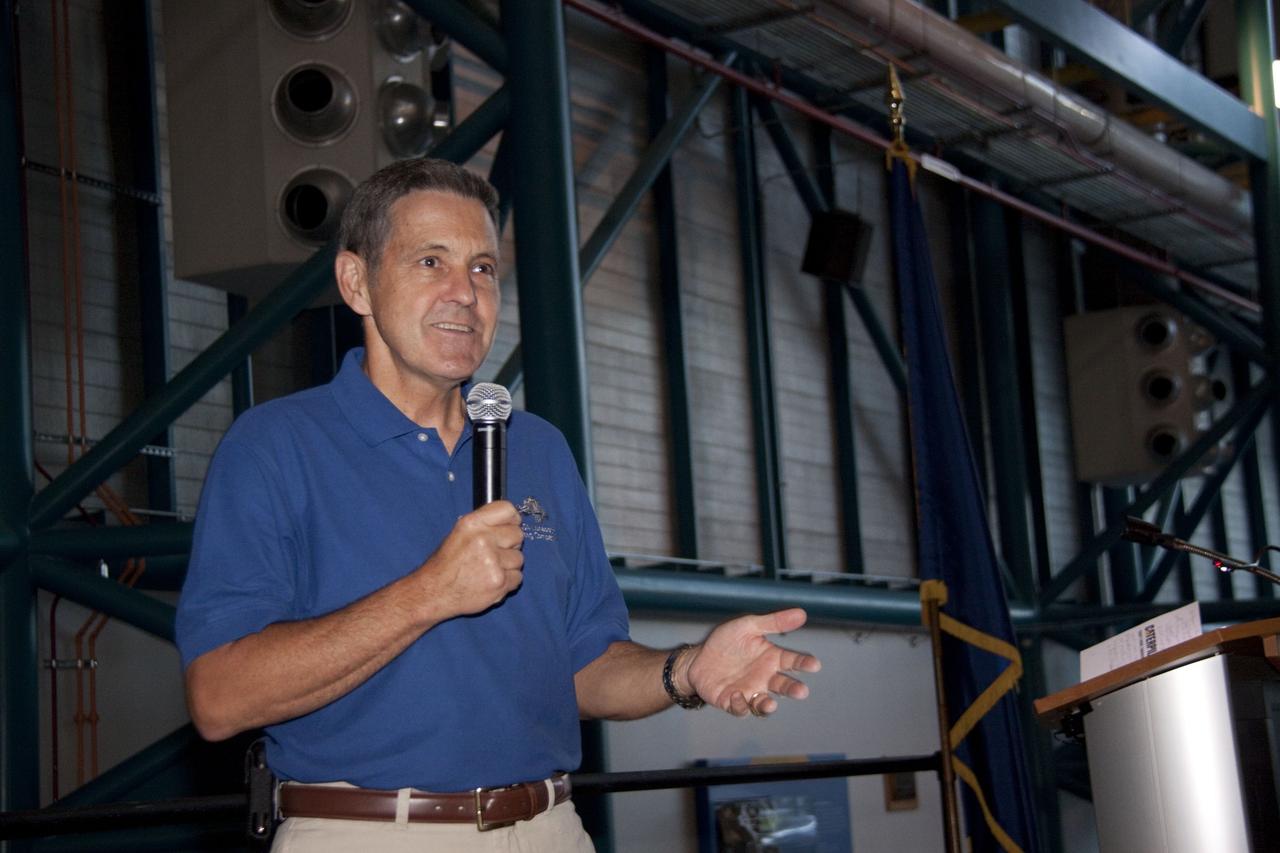
CAPE CANAVERAL, Fla. -- At NASA Kennedy Space Center's Apollo/Saturn V Center, Kennedy Center Director Bob Cabana speaks to university students at the award ceremony for NASA's second annual Lunabotics Mining Competition. Thirty-six teams of undergraduate and graduate students from the United States, Bangladesh, Canada, Colombia and India participated in NASA's Lunabotics Mining Competition May 26 - 28 at the agency's Kennedy Space Center in Florida. The competition is designed to engage and retain students in science, technology, engineering and mathematics (STEM). Teams will maneuver their remote controlled or autonomous excavators, called lunabots, in about 60 tons of ultra-fine simulated lunar soil, called BP-1. The competition is an Exploration Systems Mission Directorate project managed by Kennedy's Education Division. The event also provides a competitive environment that could result in innovative ideas and solutions for NASA's future excavation of the moon. Photo credit: NASA/Jack Pfaller
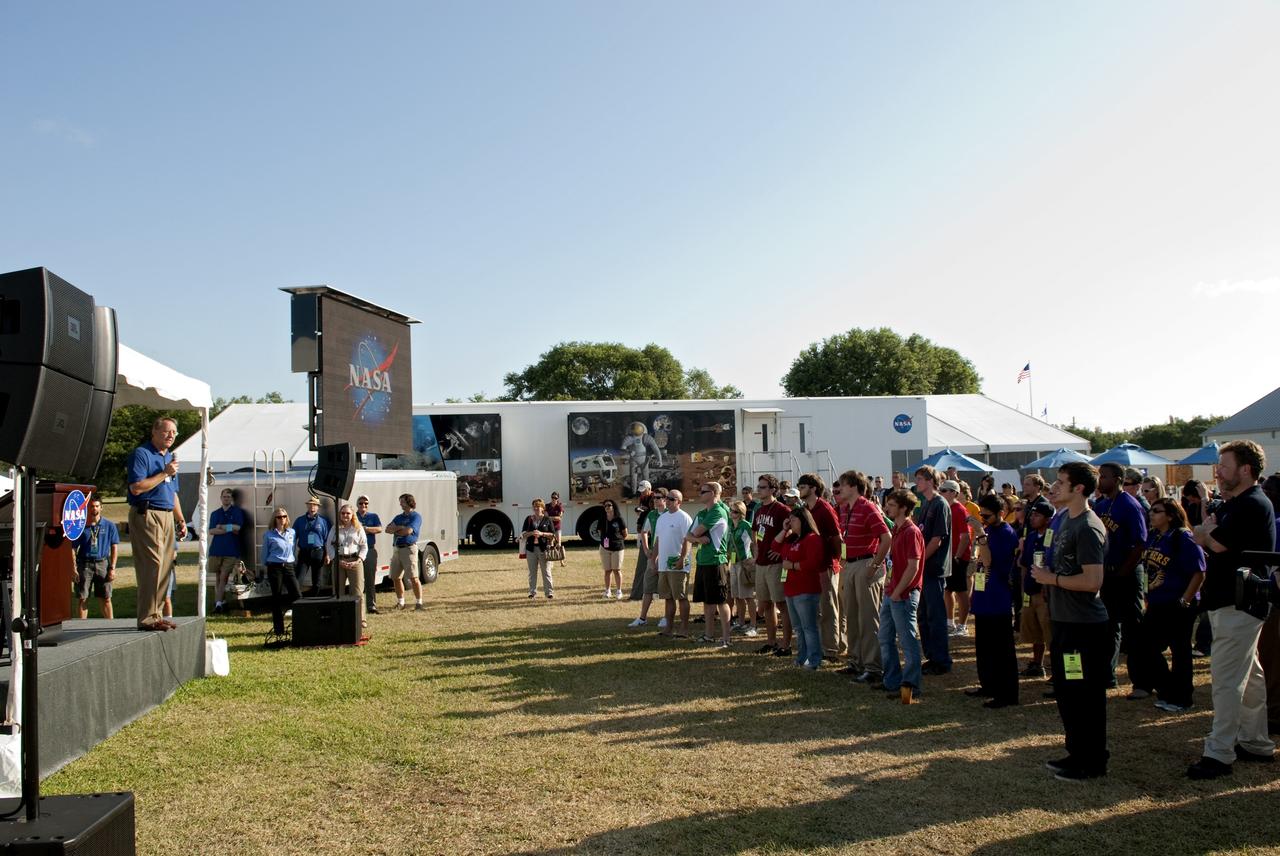
CAPE CANAVERAL, Fla. -- Pat Simpkins, Kennedy Space Center engineering director talks to university students gathered for the opening ceremony of NASA's second annual Lunabotics Mining Competition at the Kennedy Space Center Visitor Complex in Florida. Thirty-six teams of undergraduate and graduate students from the United States, Bangladesh, Canada, Colombia and India will participate in NASA's Lunabotics Mining Competition May 26 - 28 at the agency's Kennedy Space Center in Florida. The competition is designed to engage and retain students in science, technology, engineering and mathematics (STEM). Teams will maneuver their remote controlled or autonomous excavators, called lunabots, in about 60 tons of ultra-fine simulated lunar soil, called BP-1. The competition is an Exploration Systems Mission Directorate project managed by Kennedy's Education Division. The event also provides a competitive environment that could result in innovative ideas and solutions for NASA's future excavation of the moon. Photo credit: NASA/Jim Grossmann
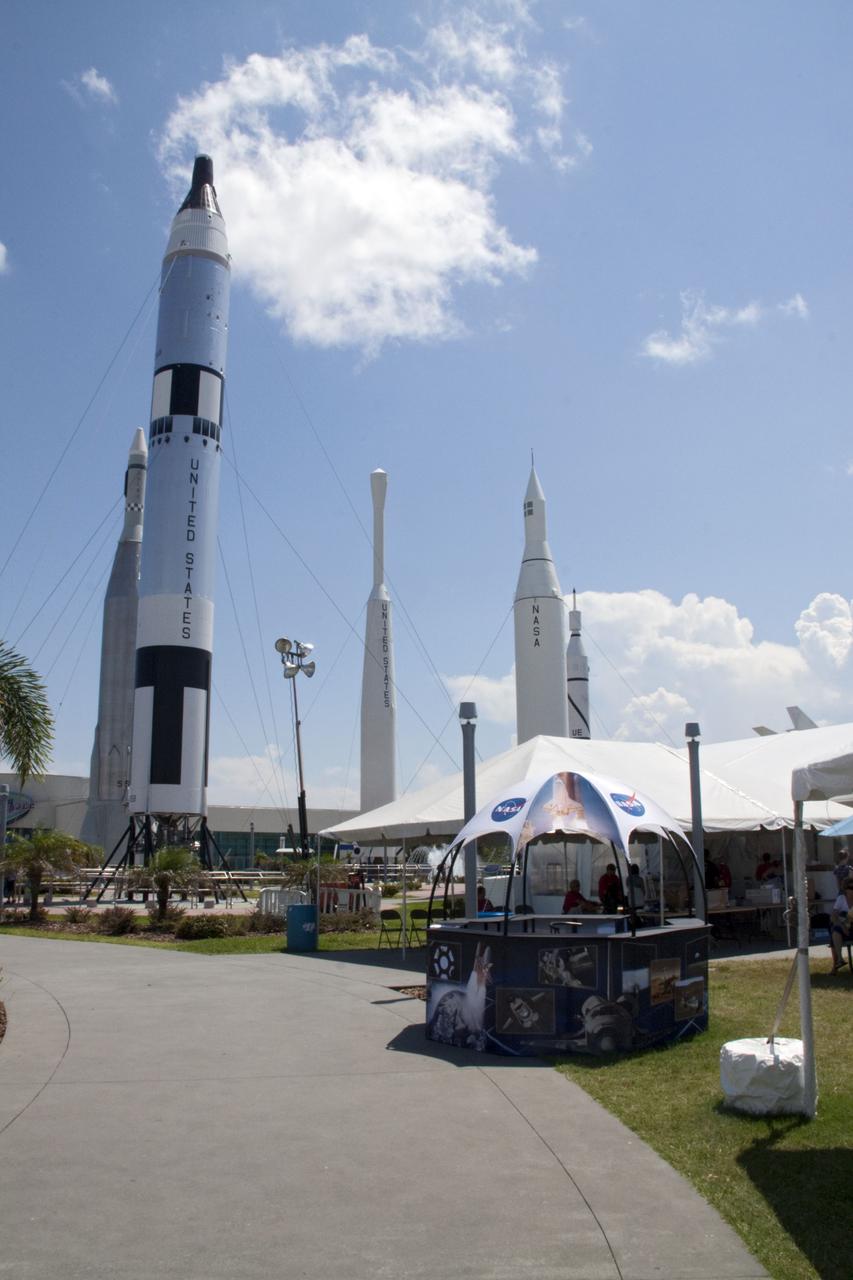
CAPE CANAVERAL, Fla. -- University students wait their turn to compete in NASA's second annual Lunabotics Mining Competition at the Kennedy Space Center Visitor Complex in Florida taking place near the complex's Rocket Garden. Thirty-six teams of undergraduate and graduate students from the United States, Bangladesh, Canada, Colombia and India will participate in NASA's Lunabotics Mining Competition May 26 - 28 at the agency's Kennedy Space Center in Florida. The competition is designed to engage and retain students in science, technology, engineering and mathematics (STEM). Teams will maneuver their remote controlled or autonomous excavators, called lunabots, in about 60 tons of ultra-fine simulated lunar soil, called BP-1. The competition is an Exploration Systems Mission Directorate project managed by Kennedy's Education Division. The event also provides a competitive environment that could result in innovative ideas and solutions for NASA's future excavation of the moon. Photo credit: NASA/Jack Pfaller
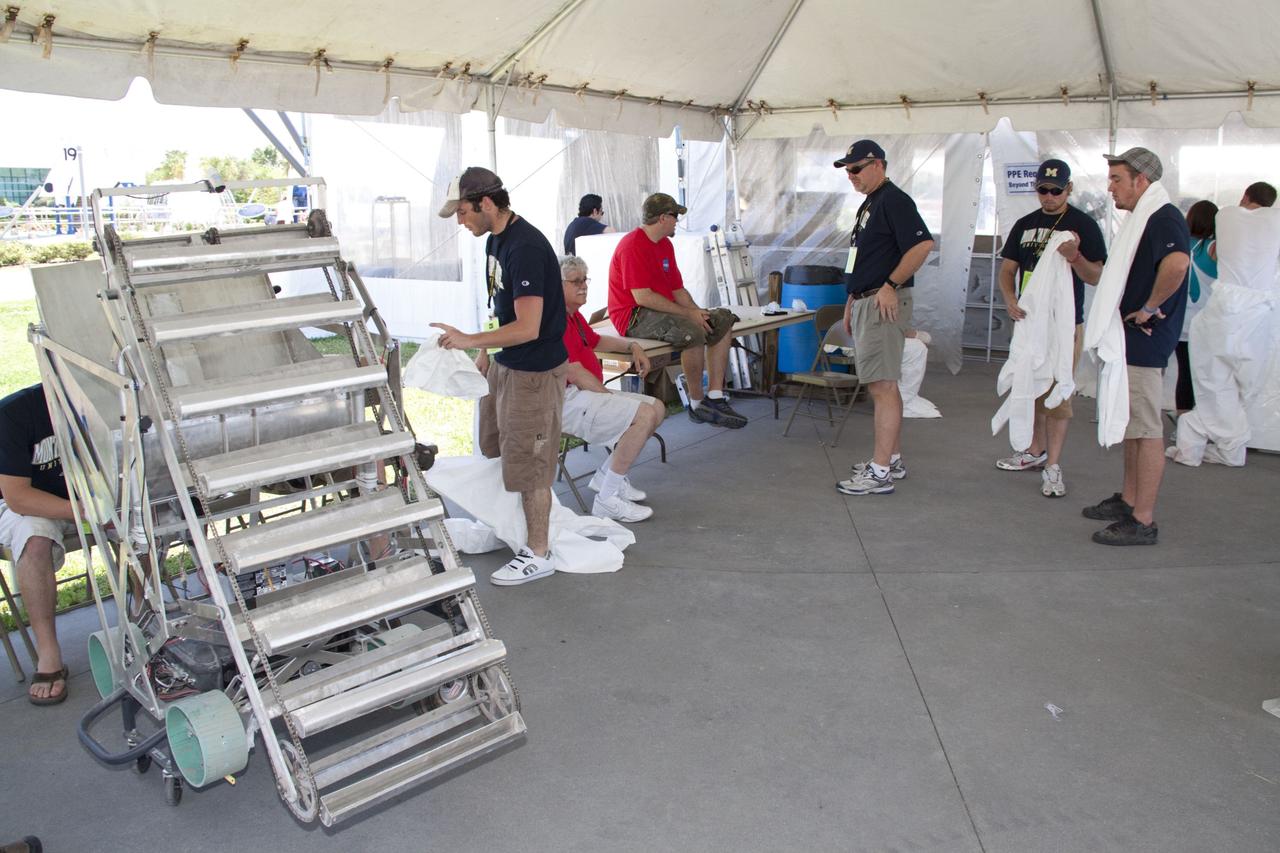
CAPE CANAVERAL, Fla. -- University students wait their turn to compete in NASA's second annual Lunabotics Mining Competition at the Kennedy Space Center Visitor Complex in Florida. Thirty-six teams of undergraduate and graduate students from the United States, Bangladesh, Canada, Colombia and India will participate in NASA's Lunabotics Mining Competition May 26 - 28 at the agency's Kennedy Space Center in Florida. The competition is designed to engage and retain students in science, technology, engineering and mathematics (STEM). Teams will maneuver their remote controlled or autonomous excavators, called lunabots, in about 60 tons of ultra-fine simulated lunar soil, called BP-1. The competition is an Exploration Systems Mission Directorate project managed by Kennedy's Education Division. The event also provides a competitive environment that could result in innovative ideas and solutions for NASA's future excavation of the moon. Photo credit: NASA/Jack Pfaller
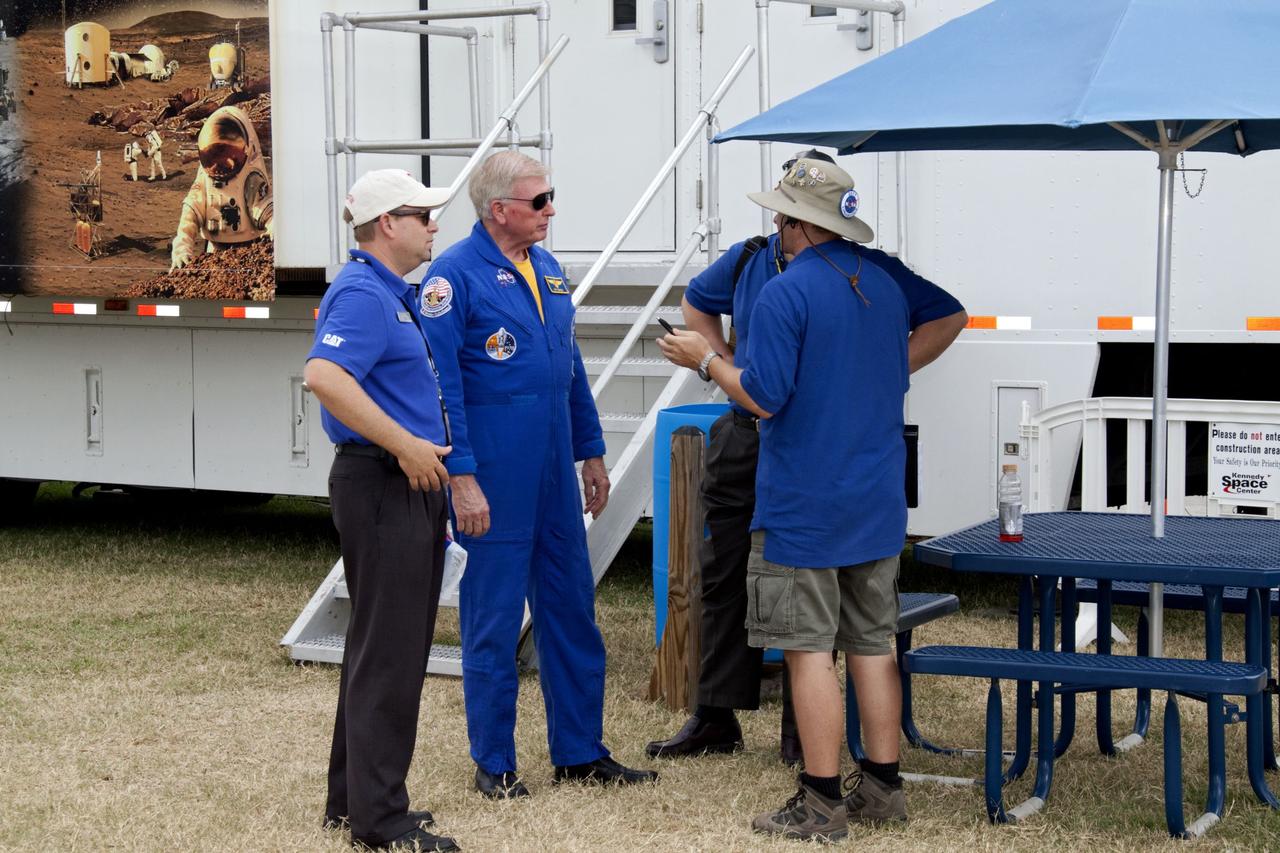
CAPE CANAVERAL, Fla. -- Outside the "Lunarena" at the Kennedy Space Center Visitor Complex in Florida, NASA astronaut John McBride (center) discusses the day's events with event leaders during NASA's second annual Lunabotics Mining Competition. Thirty-six teams of undergraduate and graduate students from the United States, Bangladesh, Canada, Colombia and India will participate in NASA's Lunabotics Mining Competition May 26 - 28 at the agency's Kennedy Space Center in Florida. The competition is designed to engage and retain students in science, technology, engineering and mathematics (STEM). Teams will maneuver their remote controlled or autonomous excavators, called lunabots, in about 60 tons of ultra-fine simulated lunar soil, called BP-1. The competition is an Exploration Systems Mission Directorate project managed by Kennedy's Education Division. The event also provides a competitive environment that could result in innovative ideas and solutions for NASA's future excavation of the moon. Photo credit: NASA/Jack Pfaller
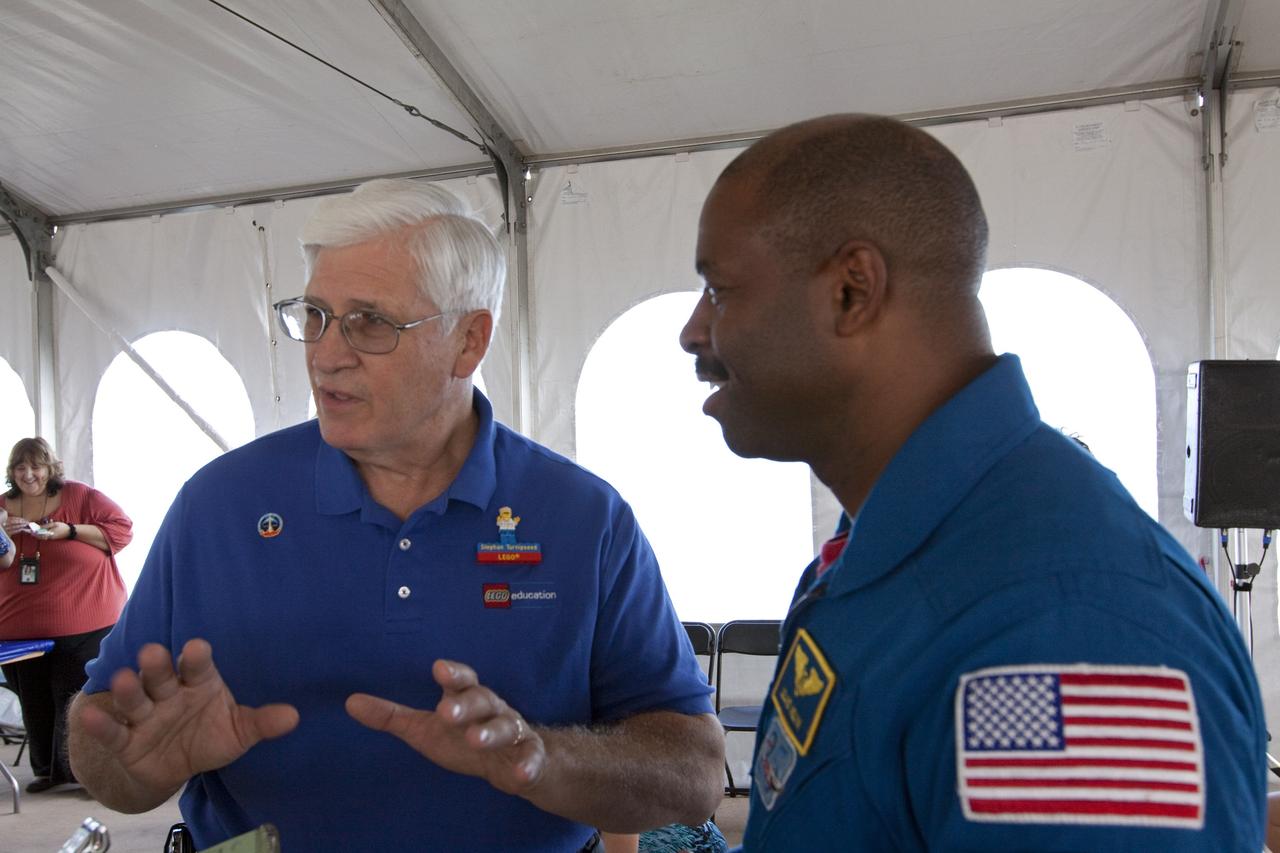
CAPE CANAVERAL, Fla. -- Stephan Turnipseed, president of LEGO Education North America, left, and Leland Melvin, NASA's associate administrator for Education, discuss the new partnership between the U.S. space agency and the toy company inside a 40- by 70-foot activity tent chock full of LEGO bricks on the NASA Causeway at Kennedy Space Center in Florida. There, children of all ages are building their vision of the future with LEGO bricks, marking the beginning of a three-year Space Act Agreement meant to spark the interest of children in science, technology, engineering and mathematics (STEM). To commemorate the partnership, two small LEGO space shuttles will launch aboard space shuttle Discovery's STS-133 mission to the International Space Station and the company will release four NASA-inspired products in its LEGO CITY line next year. LEGO sets also will fly to the space station aboard Endeavour's STS-134 mission, and will be put together on orbit to demonstrate the challenges faced while building things in microgravity. Photo credit: NASA/Jack Pfaller
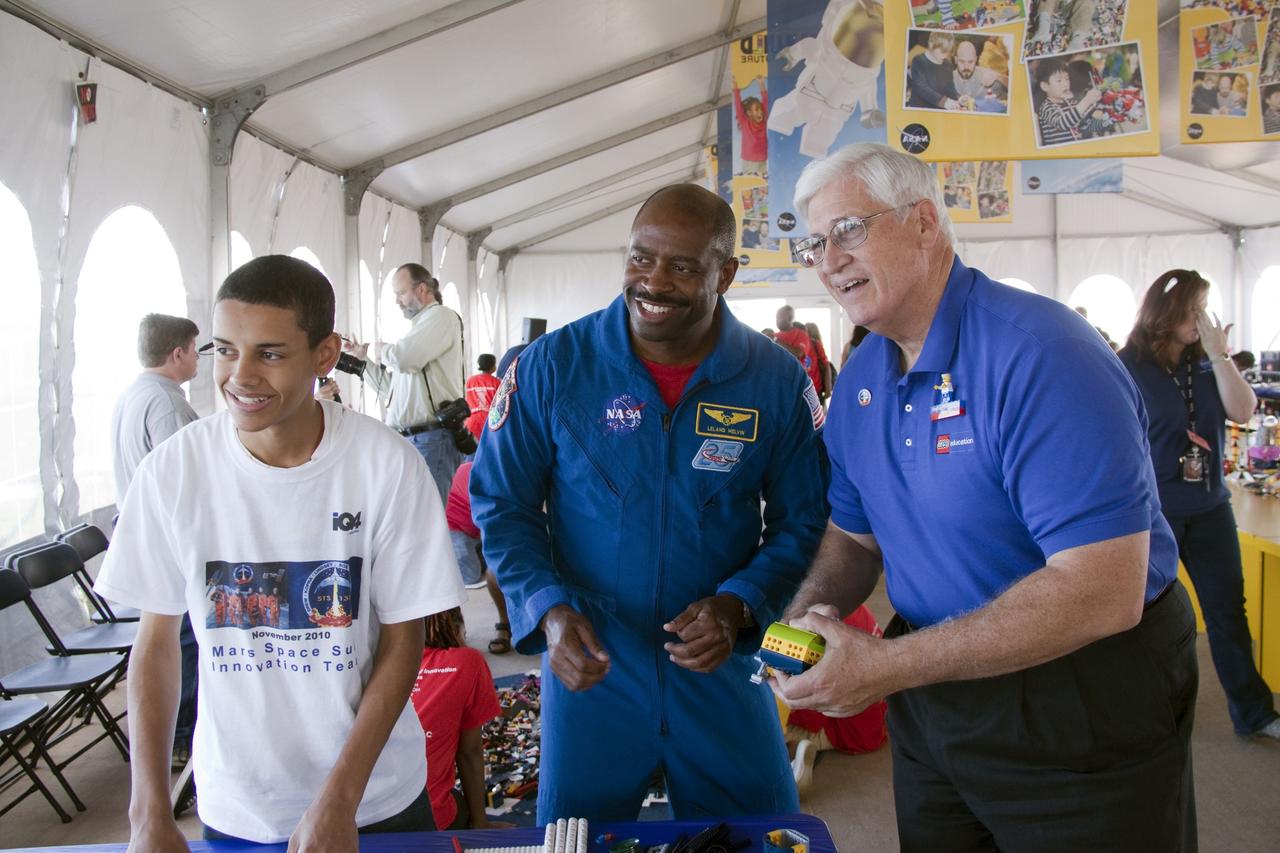
CAPE CANAVERAL, Fla. -- On the NASA Causeway at Kennedy Space Center in Florida, Leland Melvin, NASA's associate administrator for Education, center, and Stephan Turnipseed, president of LEGO Education North America, right, help a student build LEGO space vehicles inside a 40- by 70-foot activity tent. There, children of all ages are building their vision of the future with LEGO bricks, marking the beginning of a three-year Space Act Agreement meant to spark the interest of children in science, technology, engineering and mathematics (STEM). To commemorate the partnership, two small LEGO space shuttles will launch aboard space shuttle Discovery's STS-133 mission to the International Space Station and the company will release four NASA-inspired products in its LEGO CITY line next year. LEGO sets also will fly to the space station aboard Endeavour's STS-134 mission, and will be put together on orbit to demonstrate the challenges faced while building things in microgravity. Photo credit: NASA/Jack Pfaller
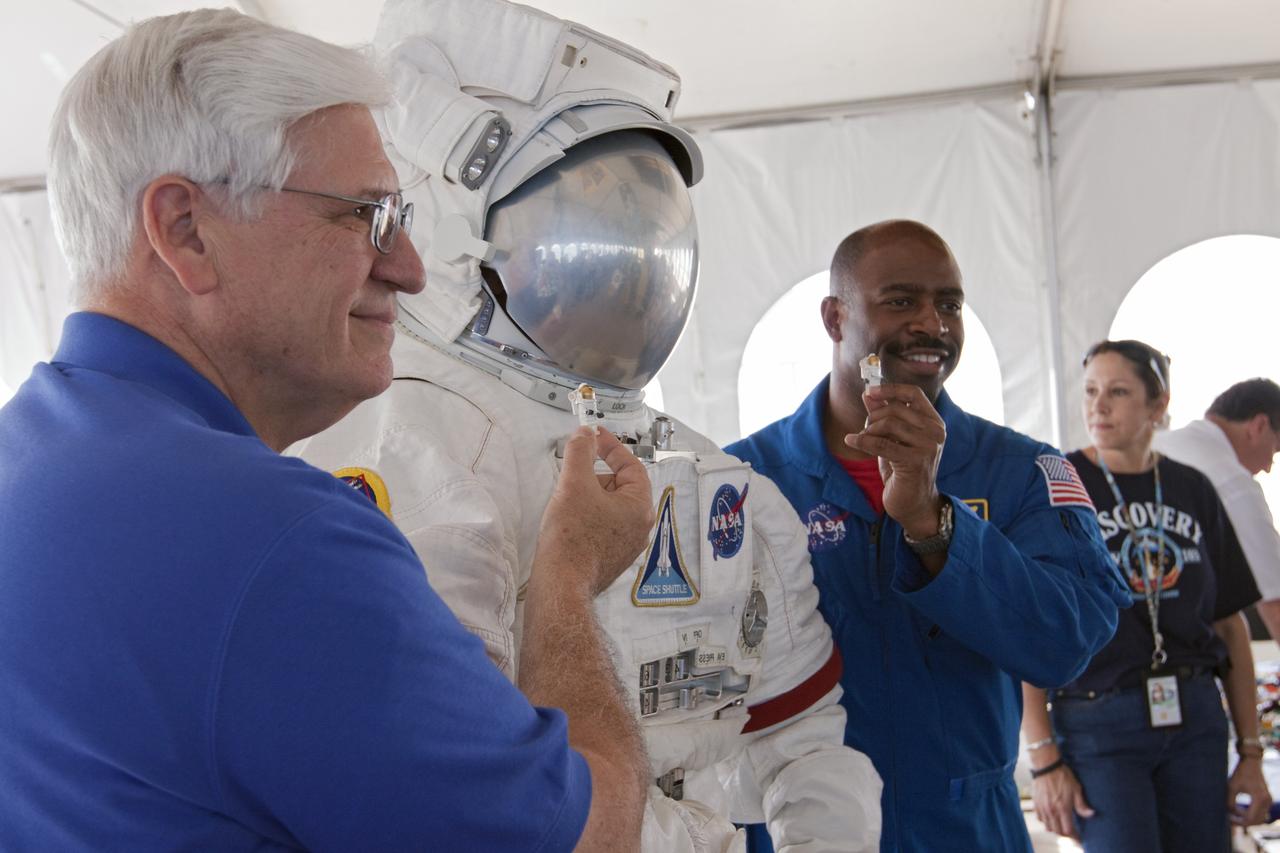
CAPE CANAVERAL, Fla. -- Stephan Turnipseed, president of LEGO Education North America, left, a space person, and Leland Melvin, NASA's associate administrator for Education, show off toy space people inside a 40- by 70-foot activity tent chock full of LEGO bricks on the NASA Causeway at Kennedy Space Center in Florida. There, children of all ages are building their vision of the future with LEGO bricks, marking the beginning of a three-year Space Act Agreement meant to spark the interest of children in science, technology, engineering and mathematics (STEM). To commemorate the partnership, two small LEGO space shuttles will launch aboard space shuttle Discovery's STS-133 mission to the International Space Station and the company will release four NASA-inspired products in its LEGO CITY line next year. LEGO sets also will fly to the space station aboard Endeavour's STS-134 mission, and will be put together on orbit to demonstrate the challenges faced while building things in microgravity. Photo credit: NASA/Jack Pfaller
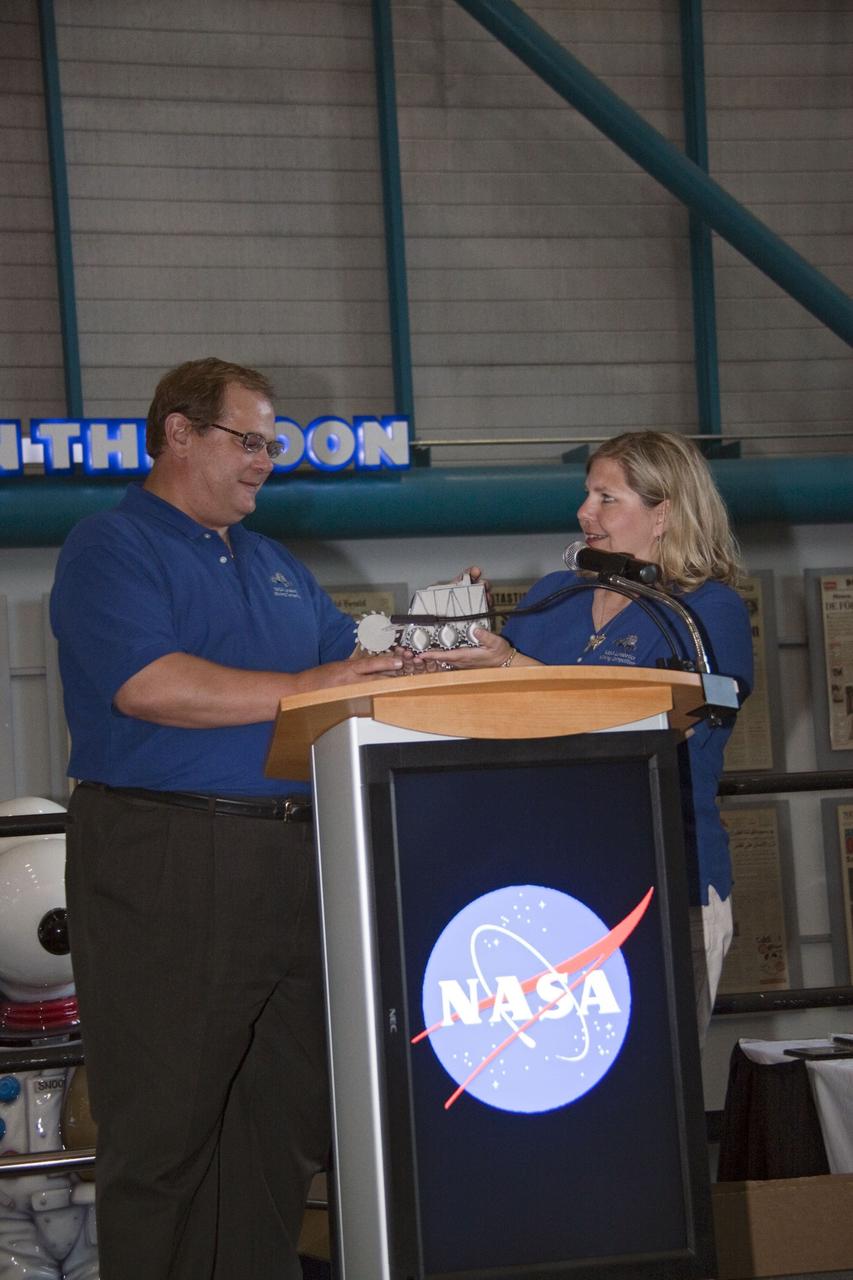
CAPE CANAVERAL, Fla. -- At NASA Kennedy Space Center's Apollo/Saturn V Center, Jerry Hartman, Education Lead with the Exploration Systems Mission Directorate at NASA Headquarters and Susan Sawyer, Lunabotics Project Coordinator with ReDe/Critique, display the trophy the winning team will receive at the award ceremony for NASA's second annual Lunabotics Mining Competition. Thirty-six teams of undergraduate and graduate students from the United States, Bangladesh, Canada, Colombia and India participated in NASA's Lunabotics Mining Competition May 26 - 28 at the agency's Kennedy Space Center in Florida. The competition is designed to engage and retain students in science, technology, engineering and mathematics (STEM). Teams will maneuver their remote controlled or autonomous excavators, called lunabots, in about 60 tons of ultra-fine simulated lunar soil, called BP-1. The competition is an Exploration Systems Mission Directorate project managed by Kennedy's Education Division. The event also provides a competitive environment that could result in innovative ideas and solutions for NASA's future excavation of the moon. Photo credit: NASA/Jack Pfaller
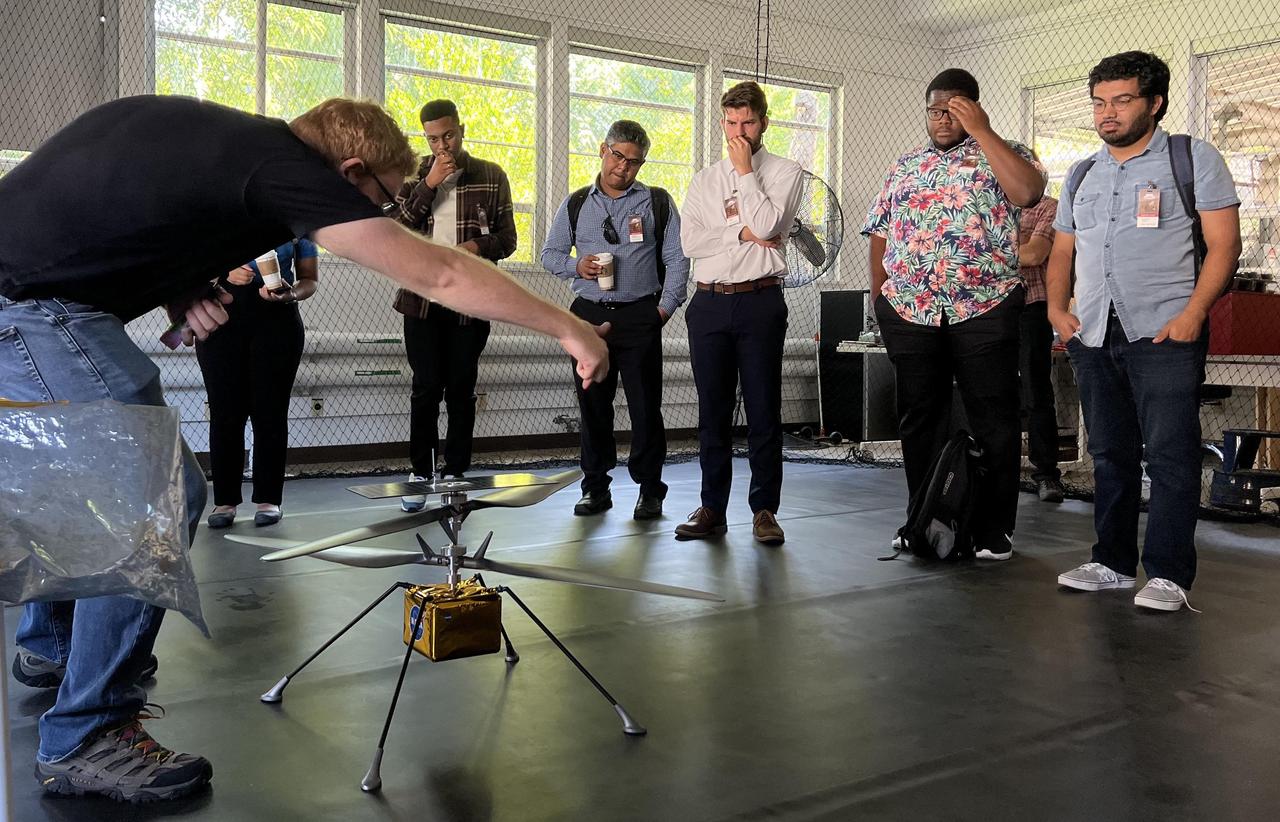
Participants in NASA's Minority Serving Institutions Space Accelerator program surround a full-scale model of NASA's Mars Ingenuity Helicopter as engineer Michael Starch discusses the mission. The group was visiting NASA's Jet Propulsion Laboratory on Aug. 18, 2022. These participants were members of three teams named as awardees in the first-of-its-kind accelerator program, a competition to advance the NASA's goals and meet its needs in the areas of machine learning, artificial intelligence, and development of autonomous systems while also engaging underrepresented academic institutions and reducing barriers for them to submit ideas to the agency. The program provides funding, business training through a 10-week accelerator course, and mentorship to help the teams develop ideas for systems that can operate without human oversight for future science missions in space and on Earth. The teams were made up of professors and students from Fayetteville State University in North Carolina, University of Massachusetts Boston, and California State University, Northridge. At the conclusion of the accelerator, participants arrived in Southern California for a variety of events, including two days at JPL. The program is a partnership between NASA's Science Mission Directorate, its Earth Science Technology Office, the Minority University Research Education Project within the agency's Office of STEM Engagement, JPL, and Starburst, a global aerospace accelerator company based in Los Angeles. https://photojournal.jpl.nasa.gov/catalog/PIA25315
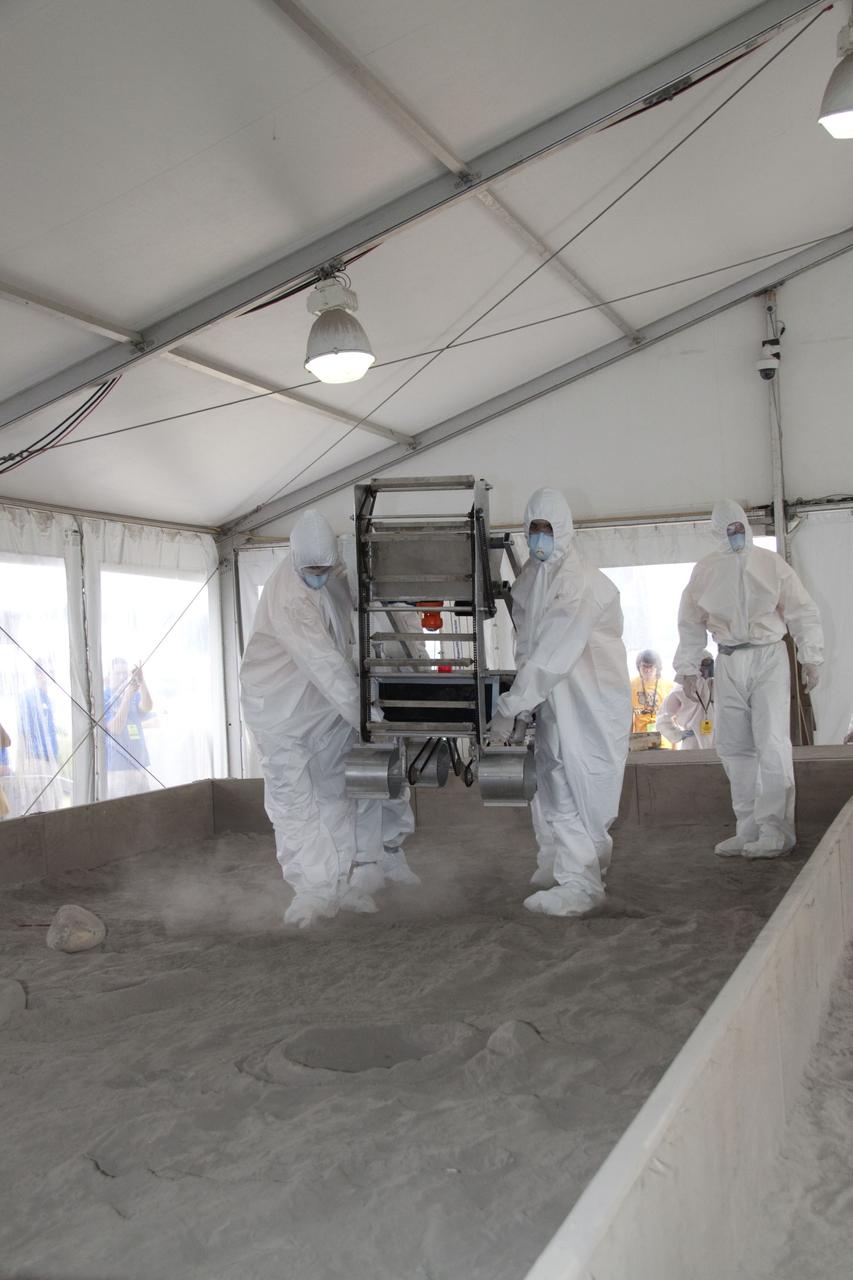
CAPE CANAVERAL, Fla. -- Inside the "Lunarena" at the Kennedy Space Center Visitor Complex in Florida, university students maneuver their remote controlled or autonomous excavators, called lunabots, in a "sand box" of ultra-fine simulated lunar soil during NASA's second annual Lunabotics Mining Competition. Thirty-six teams of undergraduate and graduate students from the United States, Bangladesh, Canada, Colombia and India will participate in NASA's Lunabotics Mining Competition May 26 - 28 at the agency's Kennedy Space Center in Florida. The competition is designed to engage and retain students in science, technology, engineering and mathematics (STEM). Teams will maneuver their remote controlled or autonomous excavators, called lunabots, in about 60 tons of ultra-fine simulated lunar soil, called BP-1. The competition is an Exploration Systems Mission Directorate project managed by Kennedy's Education Division. The event also provides a competitive environment that could result in innovative ideas and solutions for NASA's future excavation of the moon. Photo credit: NASA/Jack Pfaller