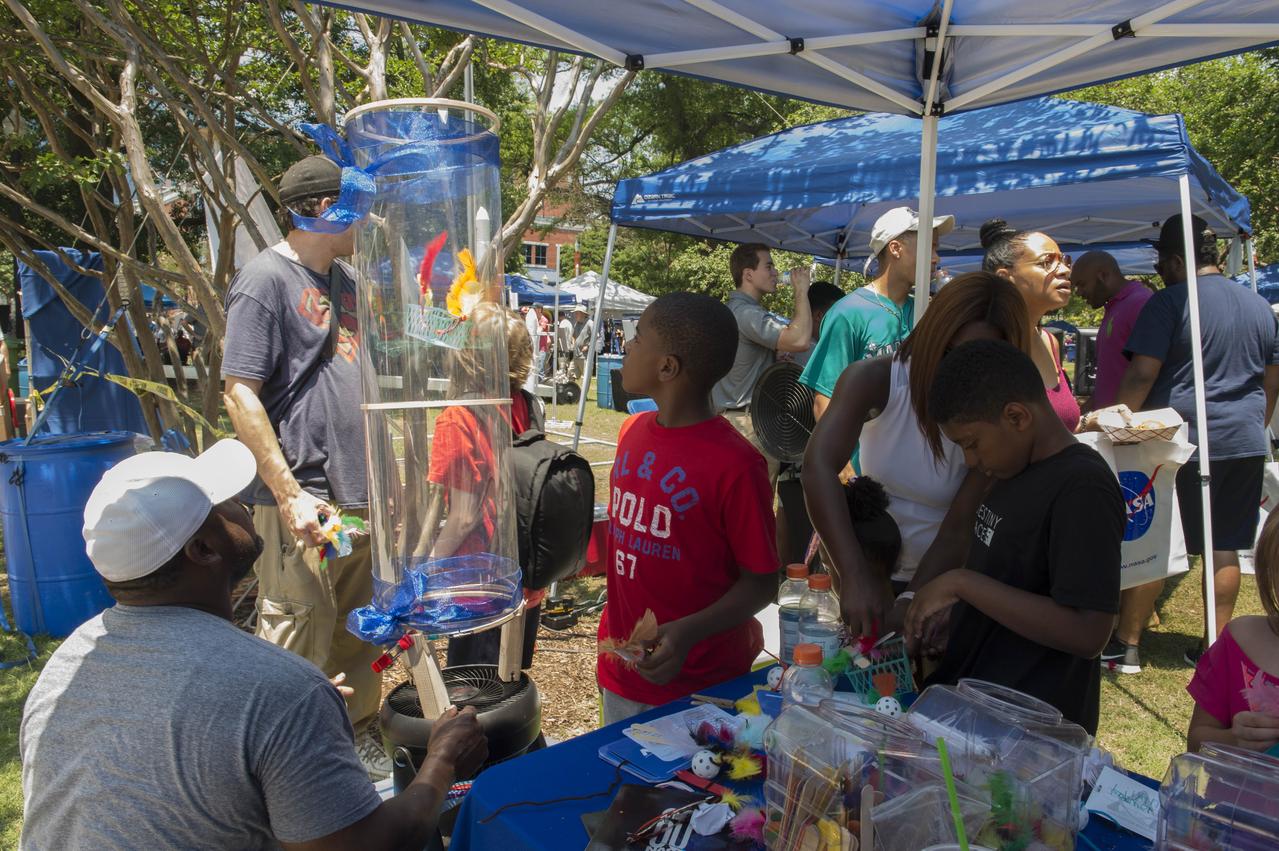
NASA in the Park on June 16 in Huntsville featured more than 60 exhibits and demonstrations by NASA experts, as well as performances by Marshall musicians, educational opportunities, games and hands-on activities for all ages. Many of the exhibits at NASA in the Park were interactive.
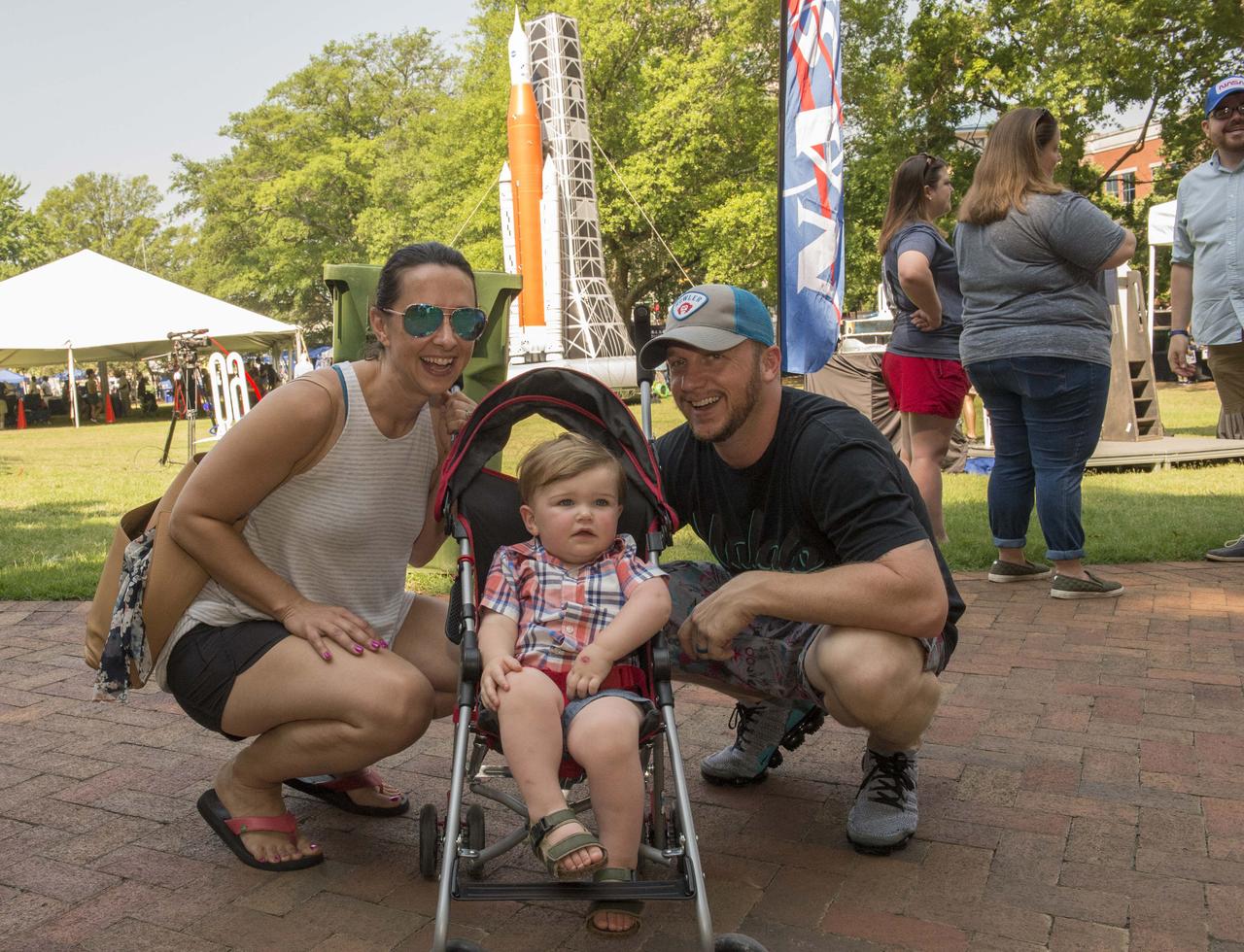
NASA in the Park on June 16 in Huntsville featured more than 60 exhibits and demonstrations by NASA experts, as well as performances by Marshall musicians, educational opportunities, games and hands-on activities for all ages. NASA employee Renae Scoble and her husband Ryan and son Titus enjoy the the fun and games at NASA in the Park.
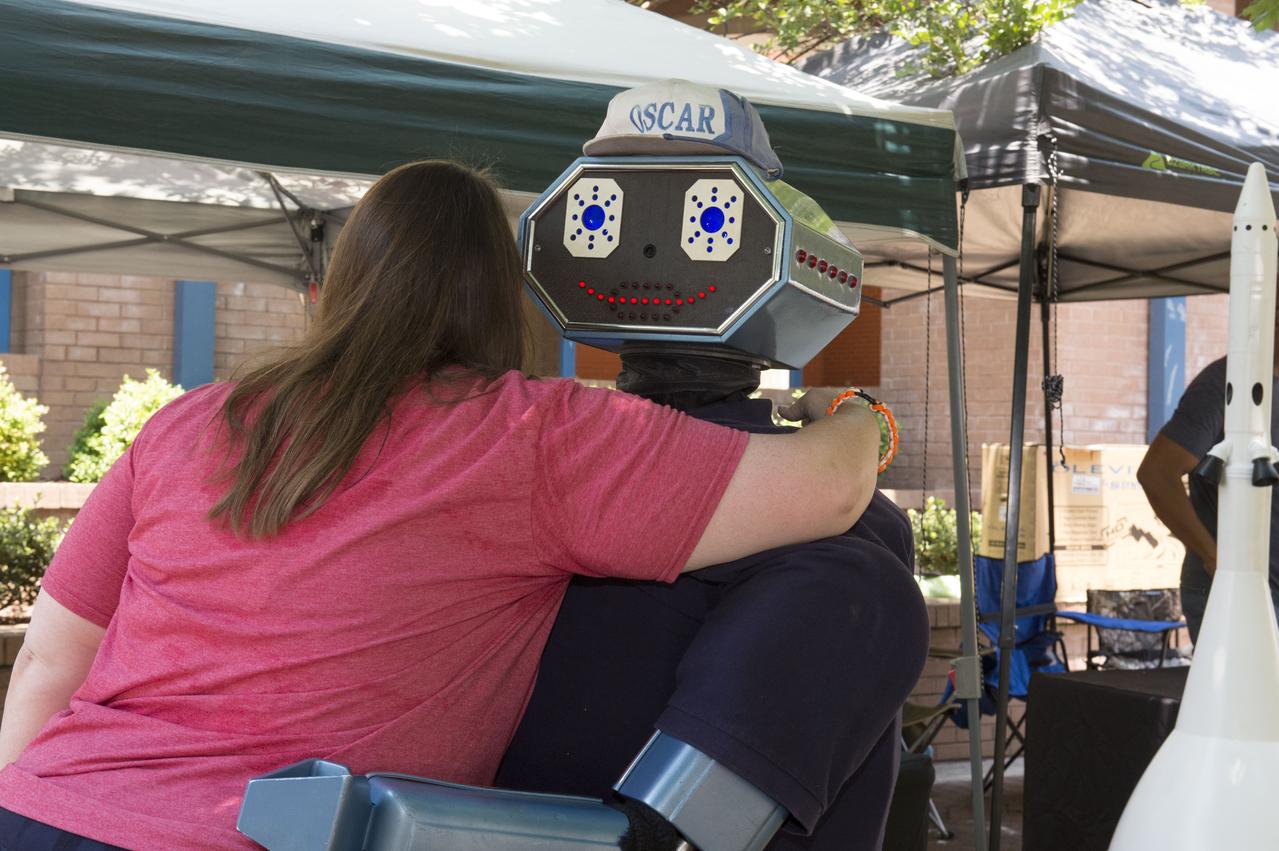
NASA in the Park on June 16 in Huntsville featured more than 60 exhibits and demonstrations by NASA experts, as well as performances by Marshall musicians, educational opportunities, games and hands-on activities for all ages. â€Oscar the Robot†gets and gives lots of hugs.
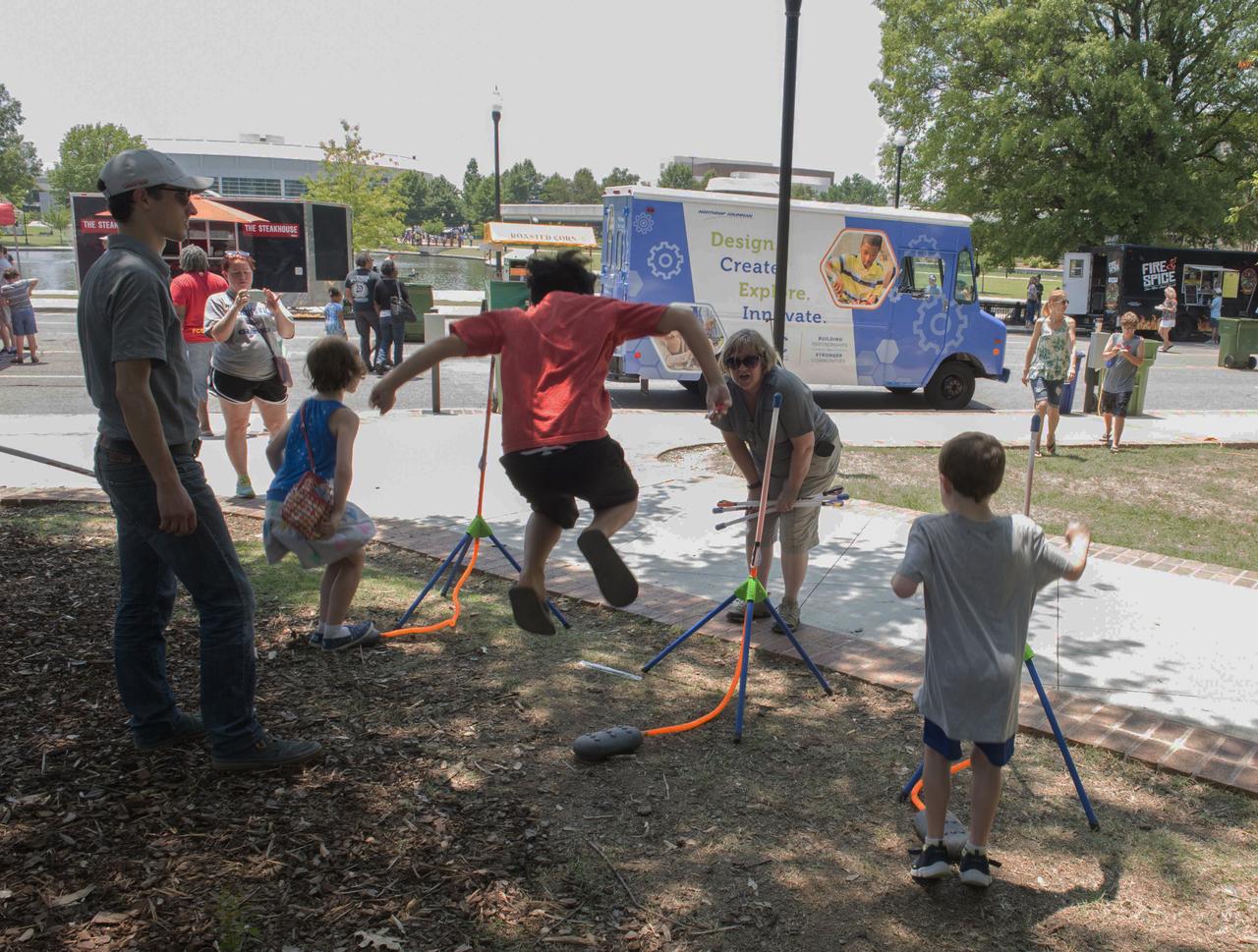
NASA in the Park on June 16 in Huntsville featured more than 60 exhibits and demonstrations by NASA experts, as well as performances by Marshall musicians, educational opportunities, games and hands-on activities for all ages. Youthful energy is exhibited in the foot rocket demonstration.
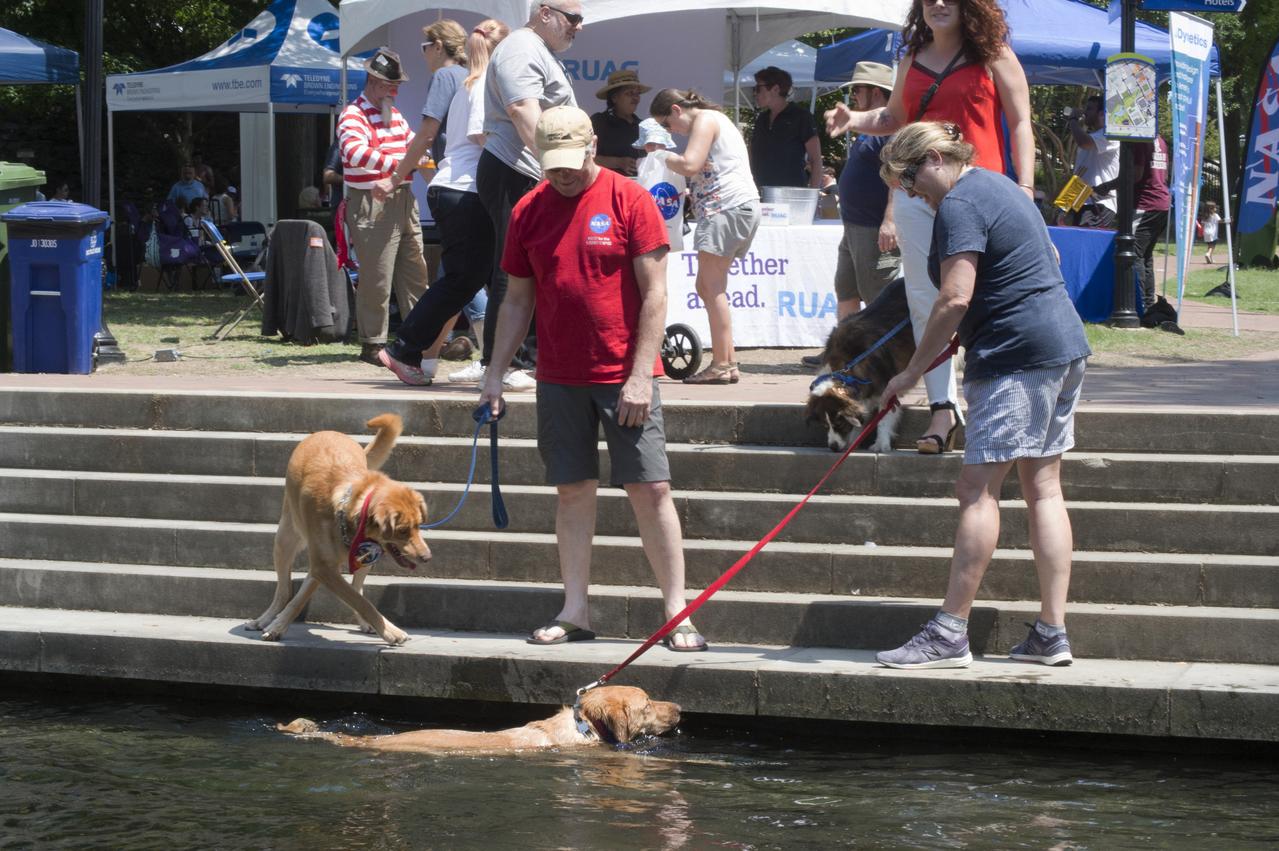
NASA in the Park on June 16 in Huntsville featured more than 60 exhibits and demonstrations by NASA experts, as well as performances by Marshall musicians, educational opportunities, games and hands-on activities for all ages. Big Spring canal is a good place to cool off in the 90 degree heat
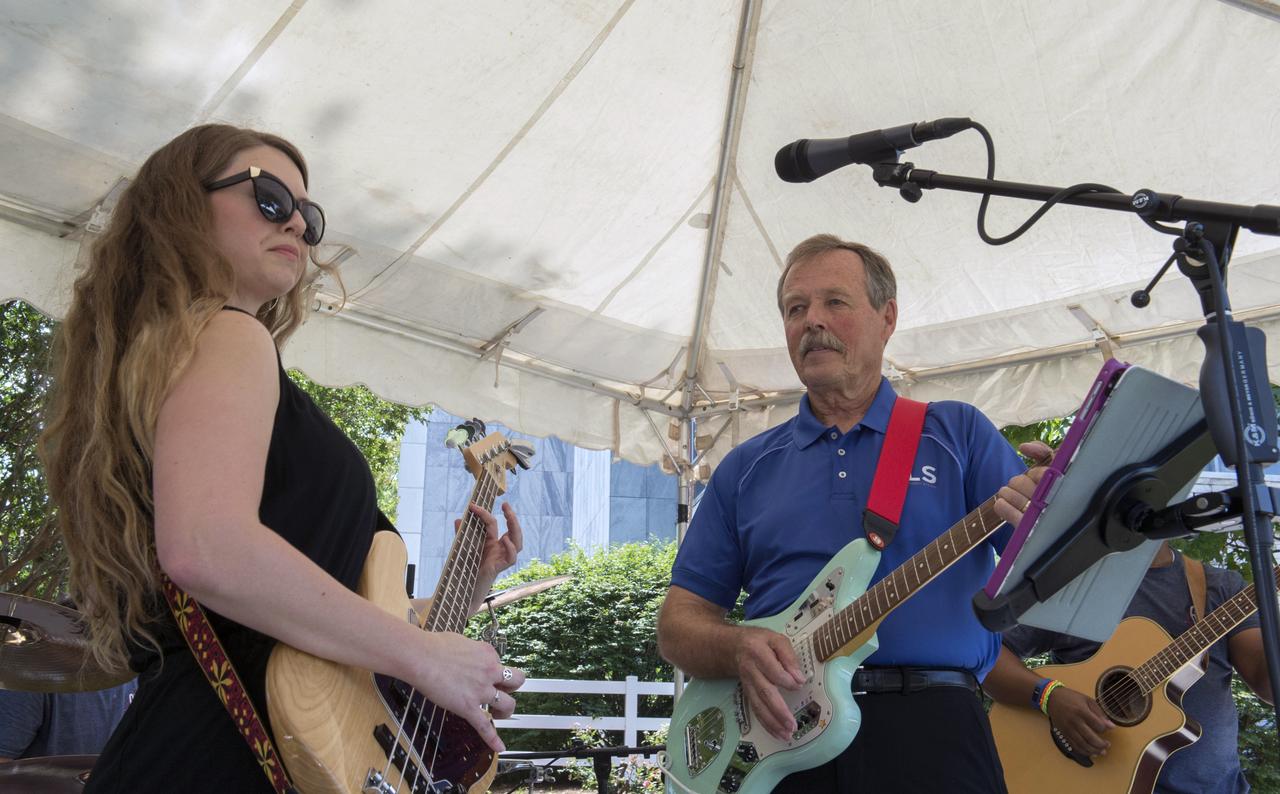
NASA in the Park on June 16 in Huntsville featured more than 60 exhibits and demonstrations by NASA experts, as well as performances by Marshall musicians, educational opportunities, games and hands-on activities for all ages. Astronaut Hoot Gibson and Nina Ricks of the band “Just Like Grady†entertained audiences at NASA in the Park.
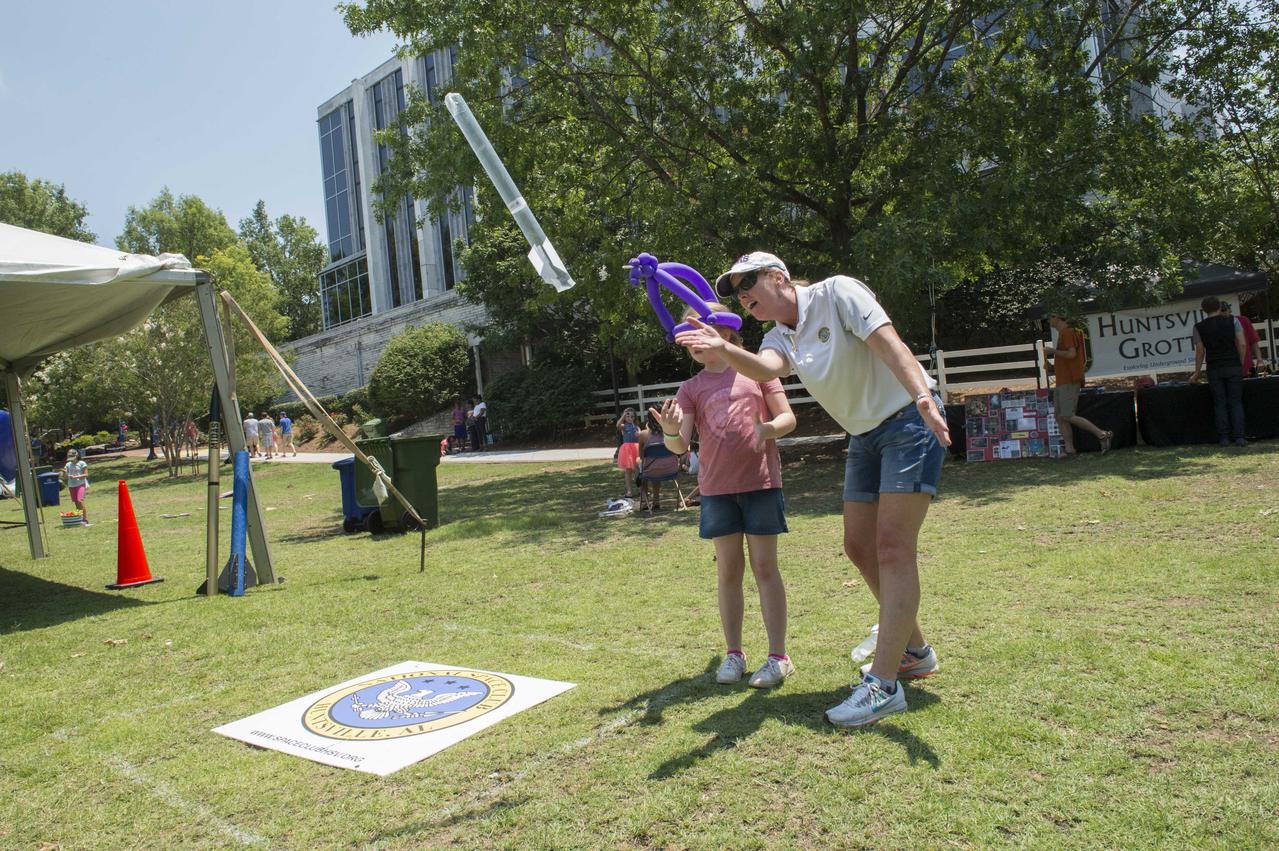
NASA in the Park on June 16 in Huntsville featured more than 60 exhibits and demonstrations by NASA experts, as well as performances by Marshall musicians, educational opportunities, games and hands-on activities for all ages. National Space Club members help demonstrate propulsion principles at NASA in the Park.
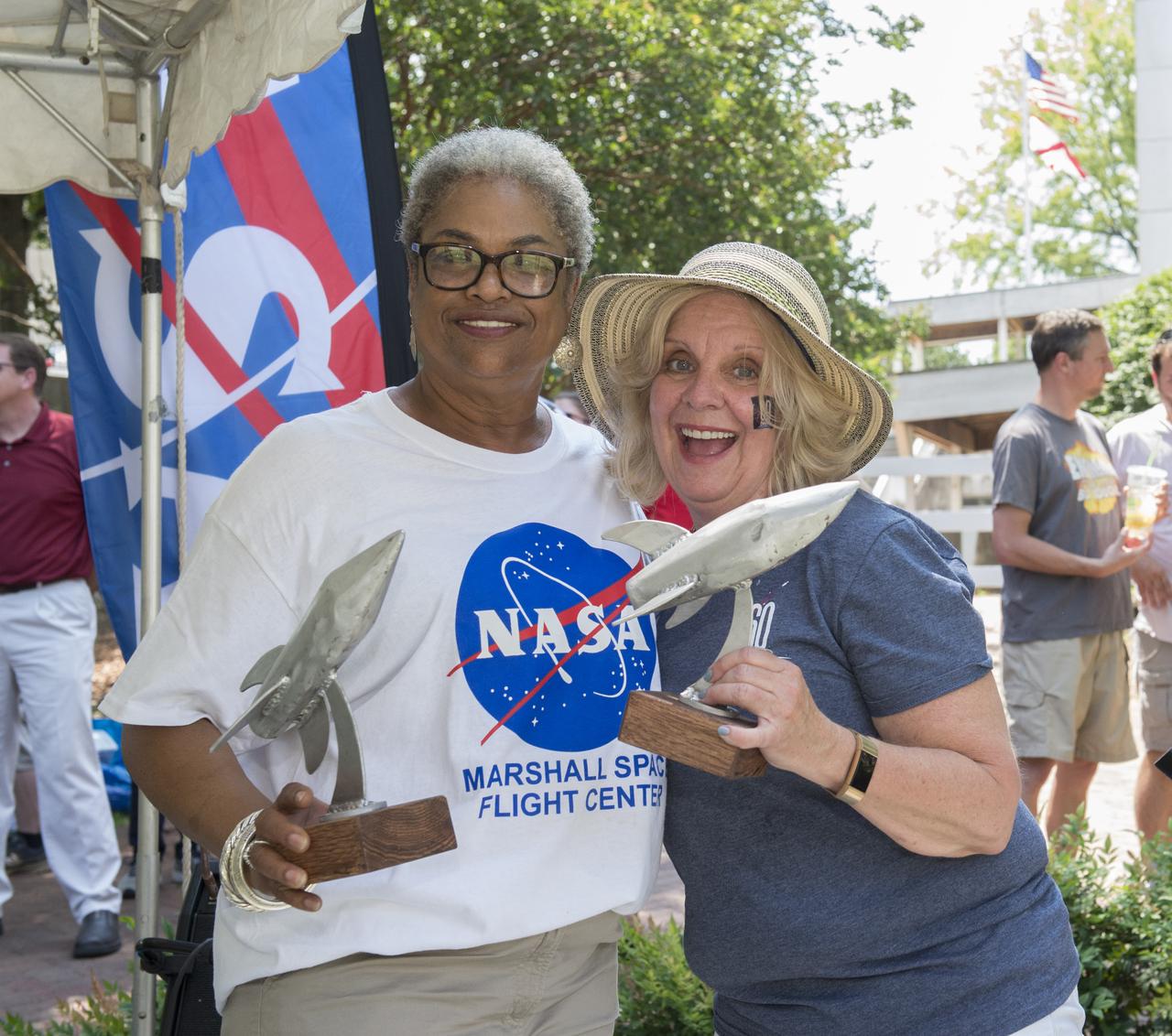
NASA in the Park on June 16 in Huntsville featured more than 60 exhibits and demonstrations by NASA experts, as well as performances by Marshall musicians, educational opportunities, games and hands-on activities for all ages. Marshall employees Ola Metcalfe (L), and Sherrie Stroud proudly display trophies awarded to them by Downtown Inc. President, Chad Emerson, in appreciation of their efforts in the five year partnership with NASA in the Park.
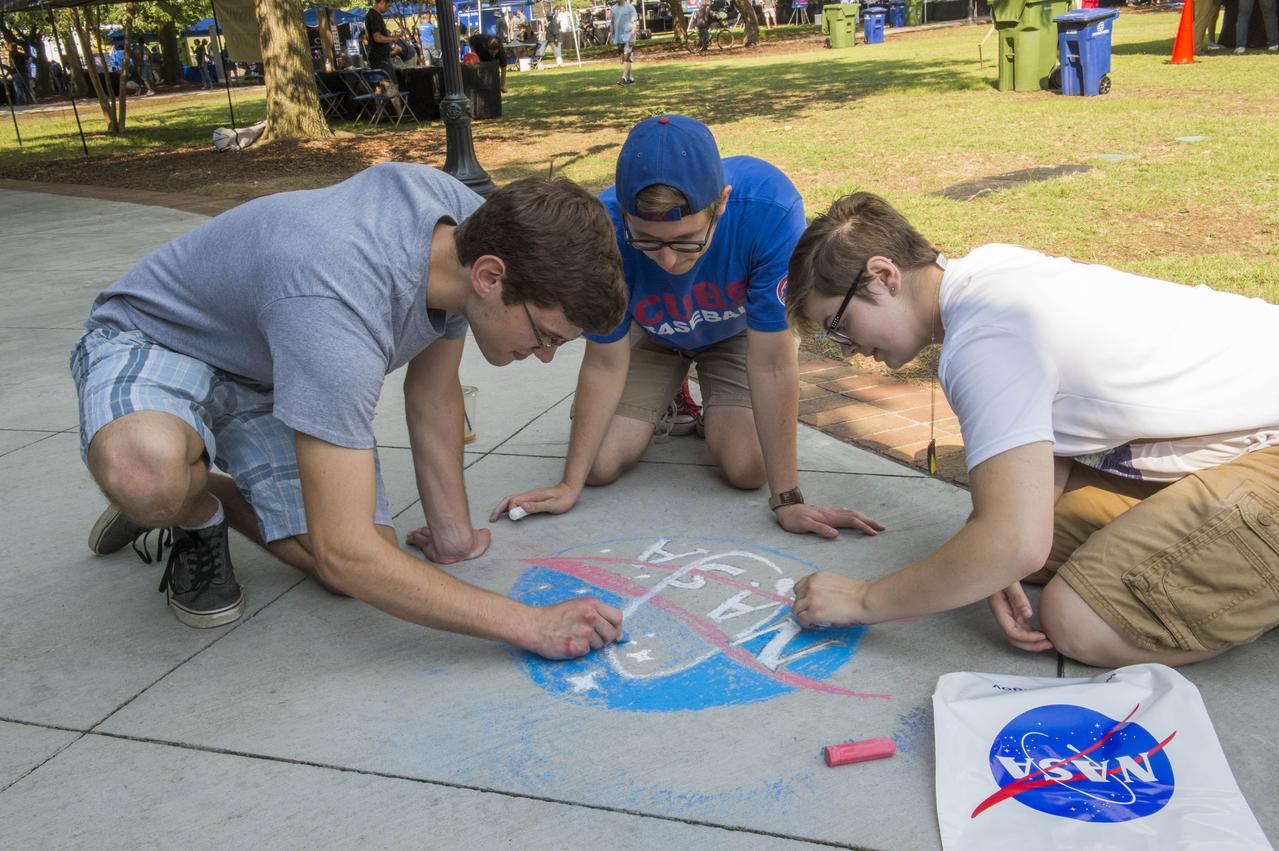
NASA in the Park on June 16 in Huntsville featured more than 60 exhibits and demonstrations by NASA experts, as well as performances by Marshall musicians, educational opportunities, games and hands-on activities for all ages. MSFC Summer Interns Eben Lenfest, Nick Bonini, and April Benedict display their artistic talents on Big Spring Park sidewalk during NASA in the Park festivities.
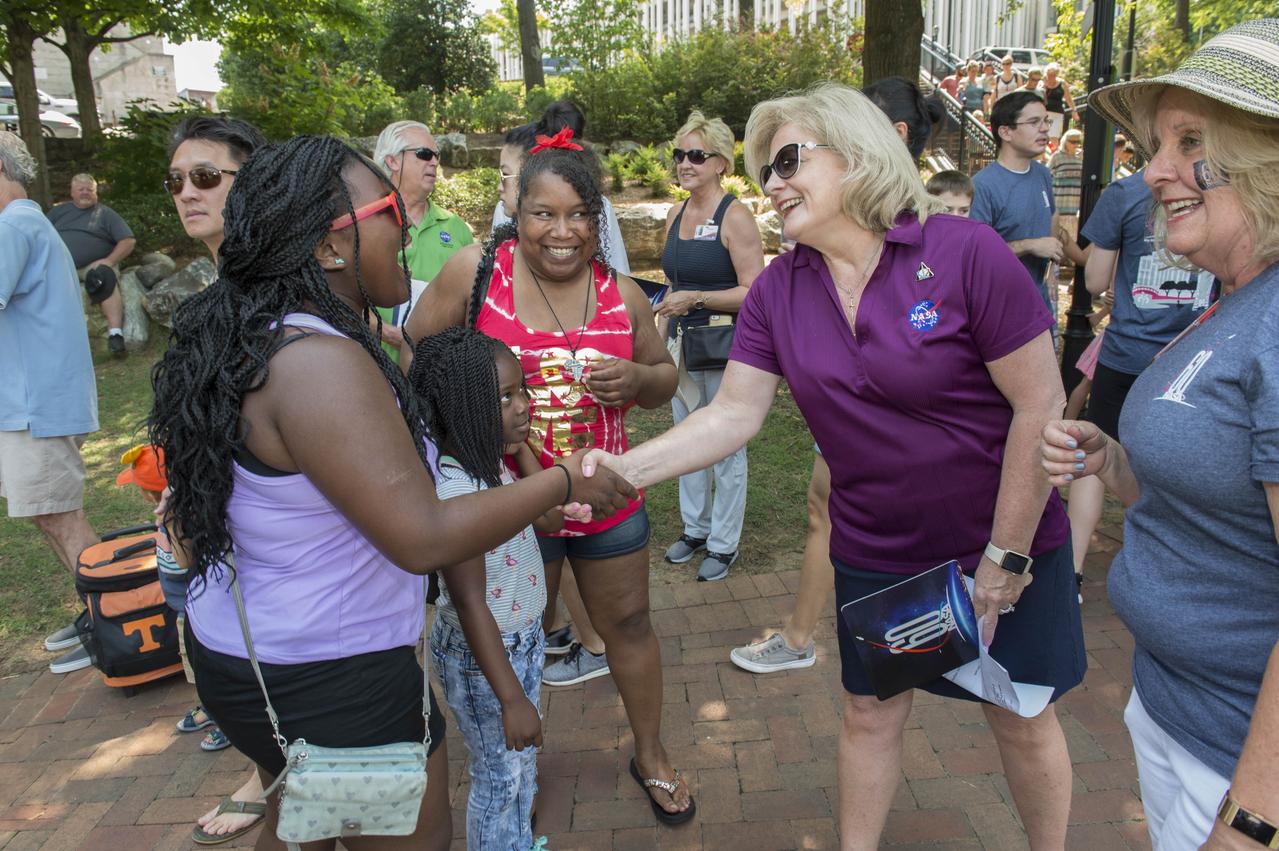
NASA in the Park on June 16 in Huntsville featured more than 60 exhibits and demonstrations by NASA experts, as well as performances by Marshall musicians, educational opportunities, games and hands-on activities for all ages. MSFC Deputy Director Jody Singer welcomes soloist Alyssa Slocum who sang the National Anthem to officially open NASA in the Park activities.
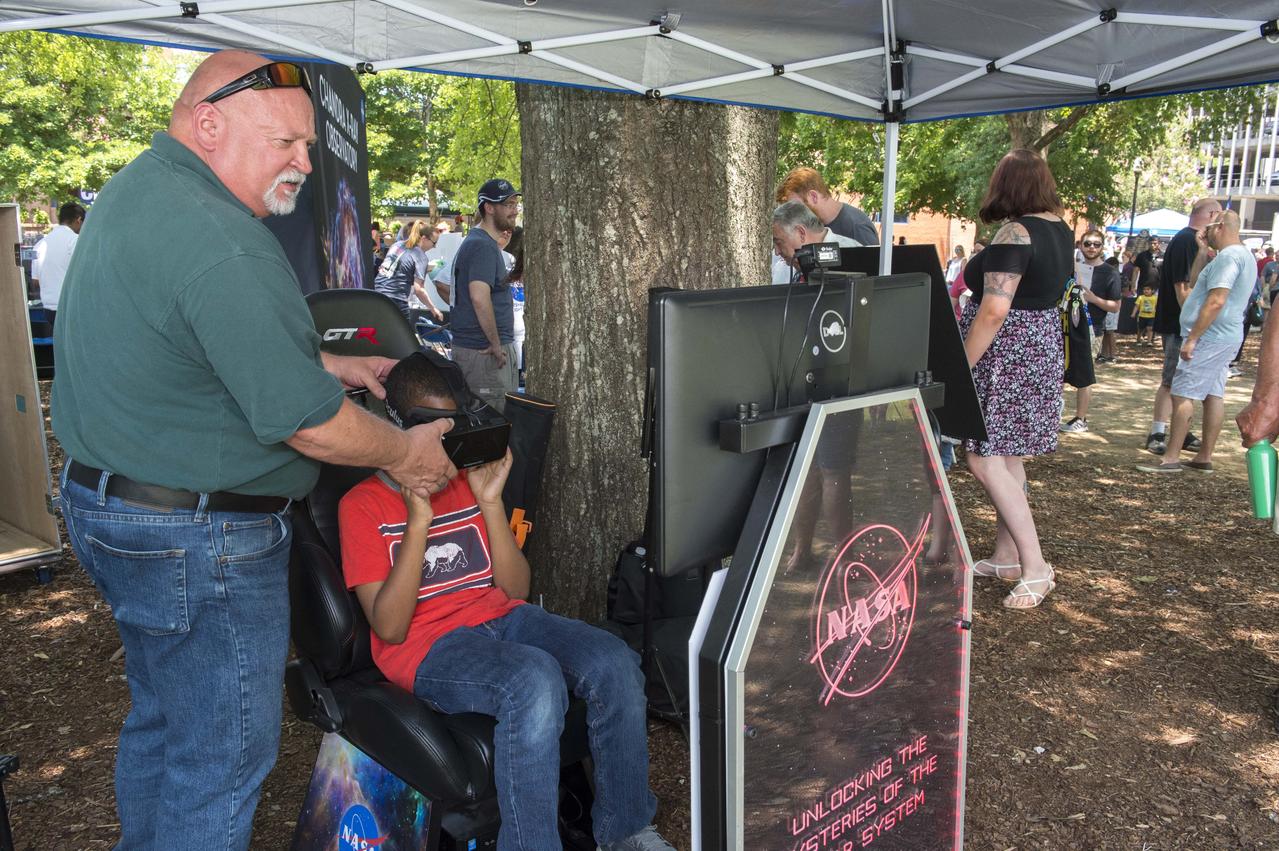
NASA in the Park on June 16 in Huntsville featured more than 60 exhibits and demonstrations by NASA experts, as well as performances by Marshall musicians, educational opportunities, games and hands-on activities for all ages. Brian Mitchell of Marshall’s Planetary Mission Planning Office gives attendees an opportunity to learn about Science missions managed by his office.

EDWARDS AIR FORCE BASE, Calif. – While on the space station, Buzz Lightyear supported NASA’s education outreach program – STEM (Science, Technology, Engineering and Mathematics) -- by creating a series of fun, educational online outreach programs. Following his return, Disney is partnering with NASA to create a new online educational game and an online mission patch competition for school kids across America. NASA will fly the winning patch in space. In addition, NASA plans to announce on Oct. 2 the details of a new exciting educational competition that will give students the opportunity to design an experiment for the astronauts on the space station.
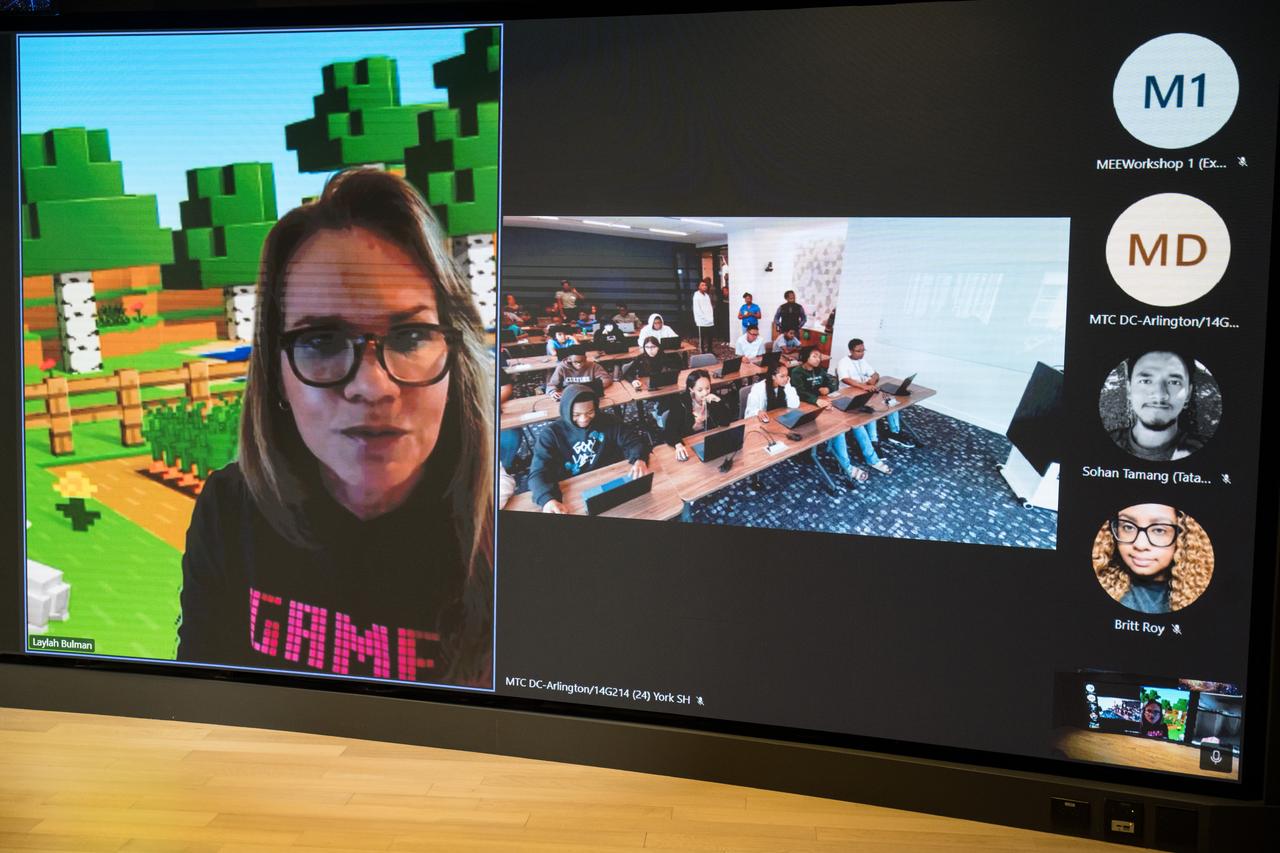
Microsoft Senior Program Manager and Executive Game Producer for Minecraft Education, Laylah Bulman, provides instruction to DC area students during Space Education Day, Tuesday, June 20, 2023, at the Microsoft Technology Center in Arlington, Va. Microsoft hosted the event to showcase the collaboration, early successes, and future plans for high quality student engagement through activities that combined space content and technologies like artificial intelligence and cloud computing. Photo Credit: (NASA/Aubrey Gemignani)
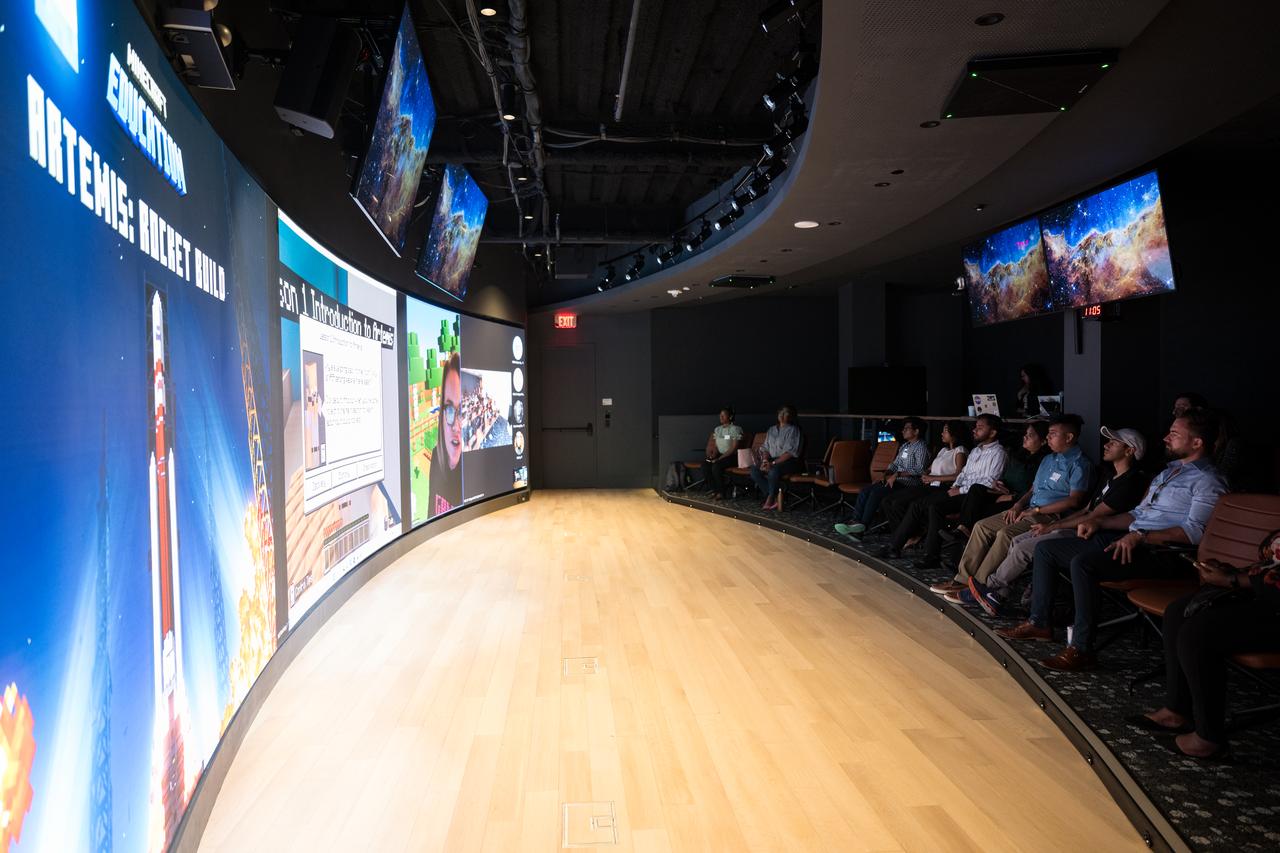
Microsoft Senior Program Manager and Executive Game Producer for Minecraft Education, Laylah Busman, provides instruction to DC area students during Space Education Day, Tuesday, June 20, 2023, at the Microsoft Technology Center in Arlington, Va. Microsoft hosted the event to showcase the collaboration, early successes, and future plans for high quality student engagement through activities that combined space content and technologies like artificial intelligence and cloud computing. Photo Credit: (NASA/Aubrey Gemignani)
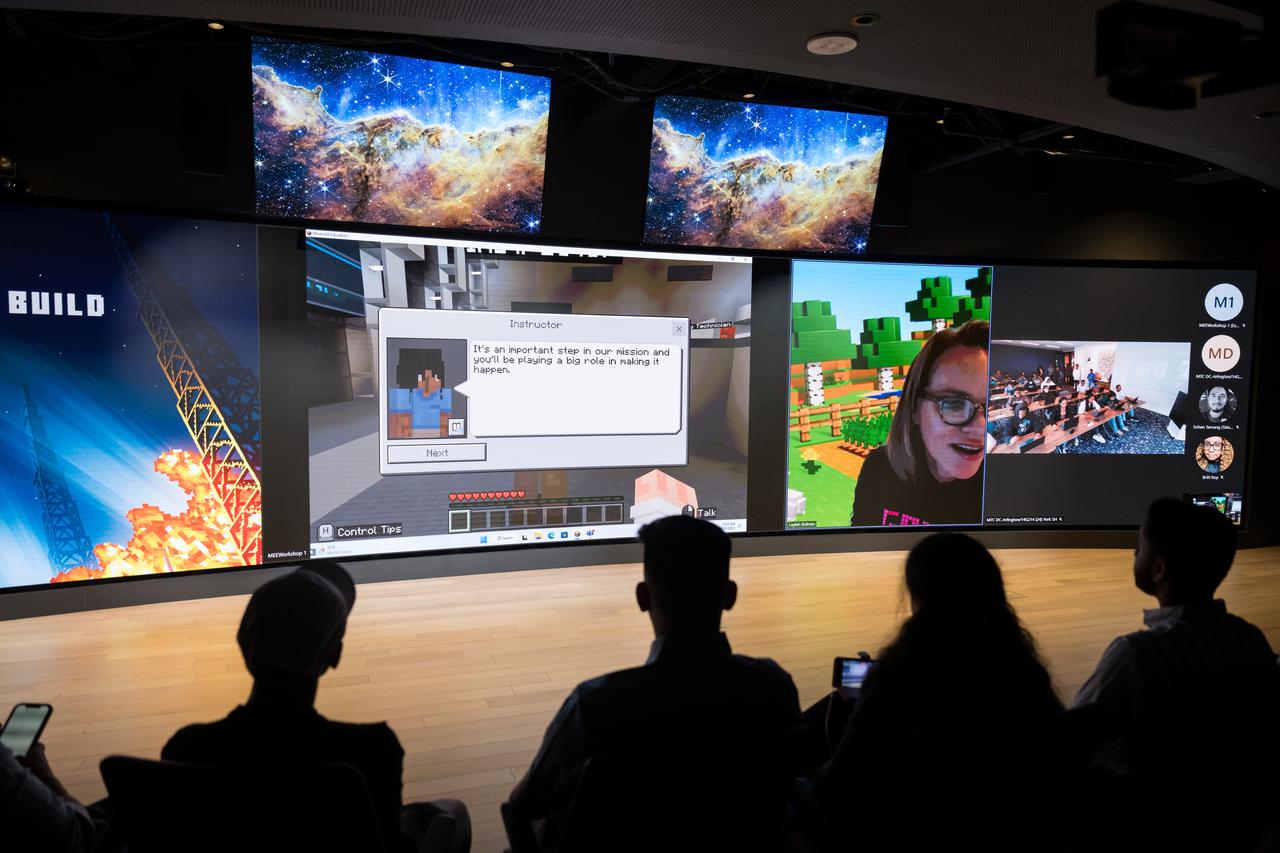
Microsoft Senior Program Manager and Executive Game Producer for Minecraft Education, Laylah Busman, provides instruction to DC area students during Space Education Day, Tuesday, June 20, 2023, at the Microsoft Technology Center in Arlington, Va. Microsoft hosted the event to showcase the collaboration, early successes, and future plans for high quality student engagement through activities that combined space content and technologies like artificial intelligence and cloud computing. Photo Credit: (NASA/Aubrey Gemignani)
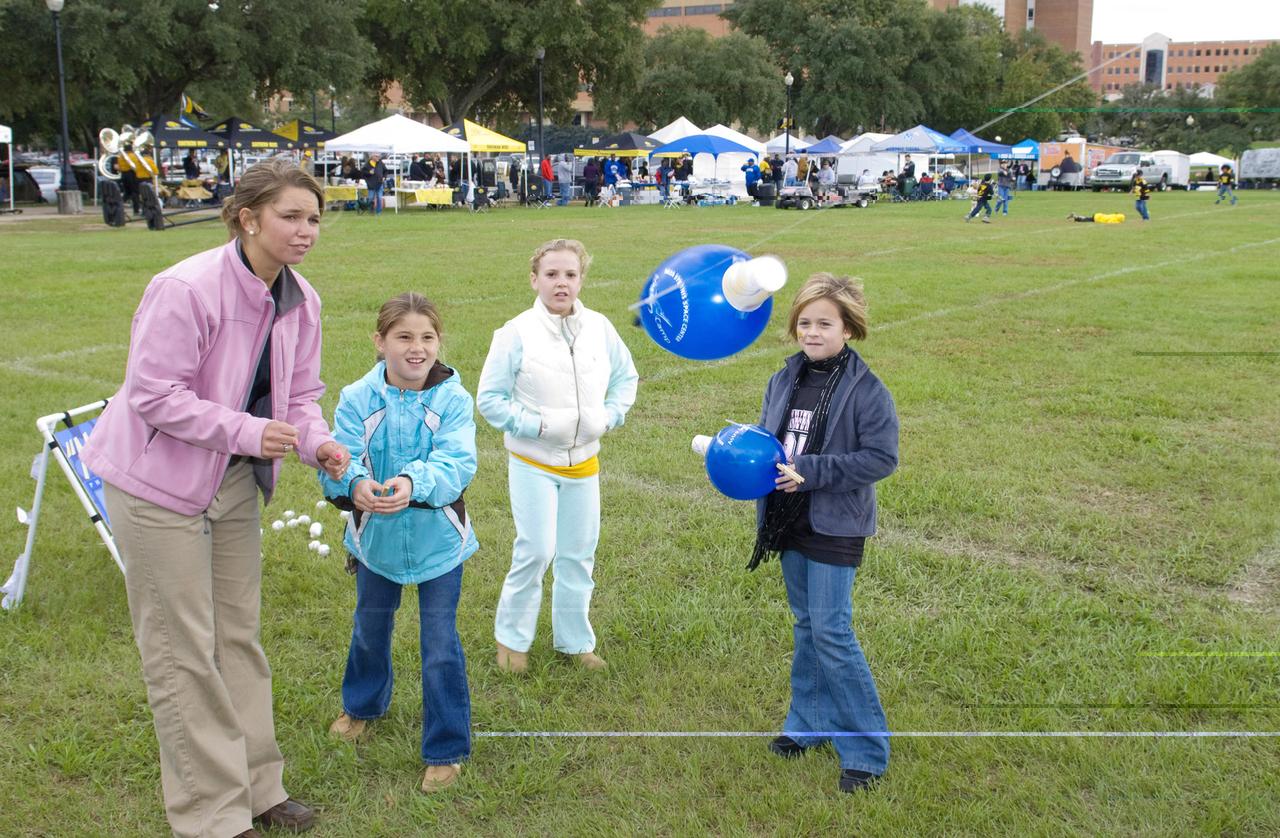
Fallon Nettles (left), an Astro Camp counselor at NASA's John C. Stennis Space Center, assists a young fan attending the University of Southern Mississippi football game in Hattiesburg, Miss., on Oct. 17 in launching a balloon 'rocket.' Prior to the game, Stennis Space Center hosted hands-on activities and exhibits for families as part of its first-ever Space Day at USM. The activities were versions of those featured in the daylong and weeklong Astro Camp sessions sponsored by Stennis throughout each year. Stennis Space Center is located in nearby Hancock County and is the nation's premier rocket engine testing facility. The USM activities were part of Stennis' ongoing effort to educate people about the NASA mission and to introduce children and young people to space and space exploration.
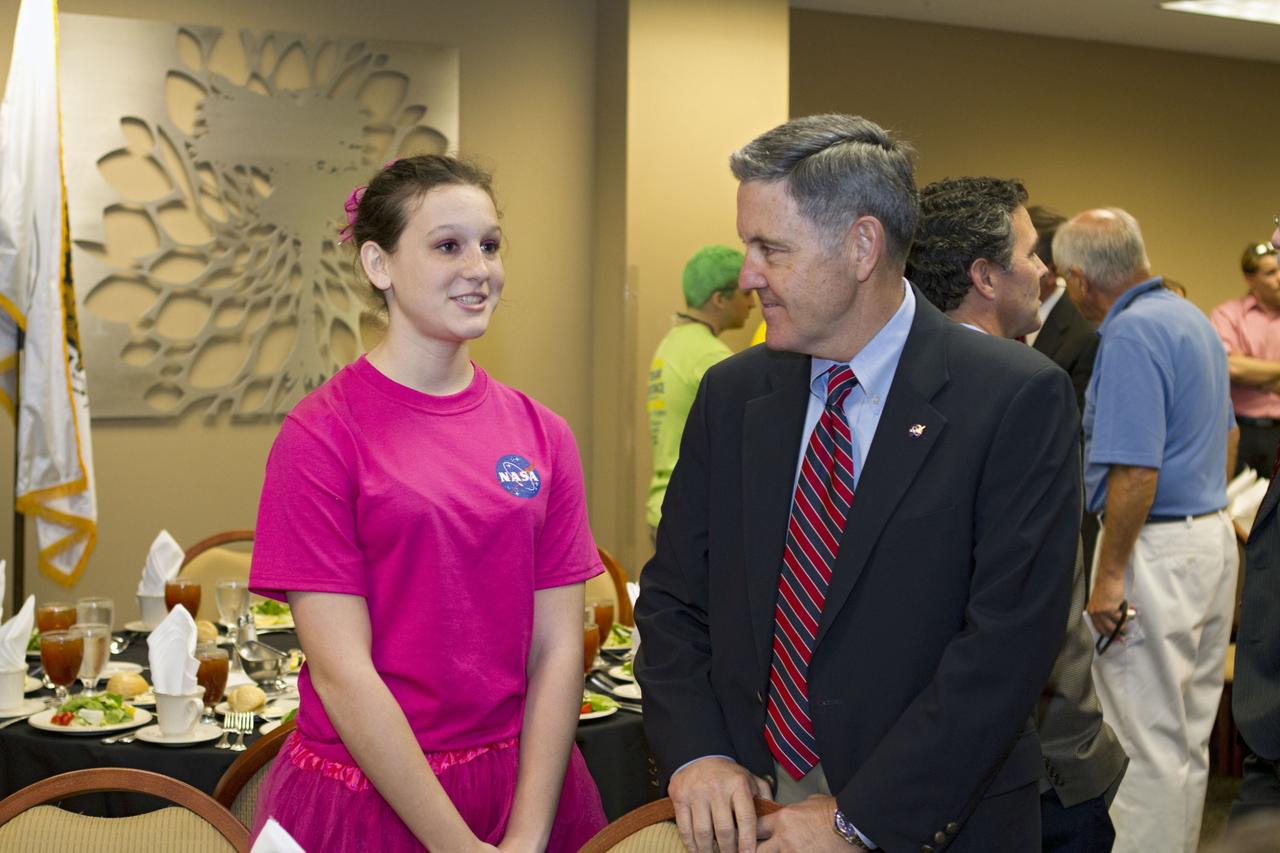
ORLANDO, Fla. -- NASA Kennedy Space Center Director Bob Cabana talks with a member of Team 233, "The Pink Team," which is participating in the regional FIRST robotics competition at the University of Central Florida in Orlando, Fla. The team is made up of students from Rockledge, Cocoa Beach and Viera high schools along the Space Coast of Florida. Kennedy is a sponsor of the team. More than 60 teams took part in the competition called "For Inspiration and Recognition of Science and Technology," or FIRST, in hopes of advancing to the national robotics championship. This year, the competition resembled a basketball game and was dubbed "Rebound Rumble." The game measured the effectiveness of each robot, the power of collaboration and the determination of the teams. FIRST, founded in 1989, is a non-profit organization that designs accessible, innovative programs to build self-confidence, knowledge and life skills while motivating young people to pursue academic opportunities. The robotics competition challenges teams of high school students and their mentors to solve a common problem in a six-week timeframe using a standard kit of parts and a common set of rules. NASA is the largest sponsor of the international program. Kennedy Space Center is a sponsor of the regional event. For more information on Kennedy's education events and initiatives, go to http://www.nasa.gov/offices/education/centers/kennedy/home/index.html. Photo credit: NASA/Kim Shiflett
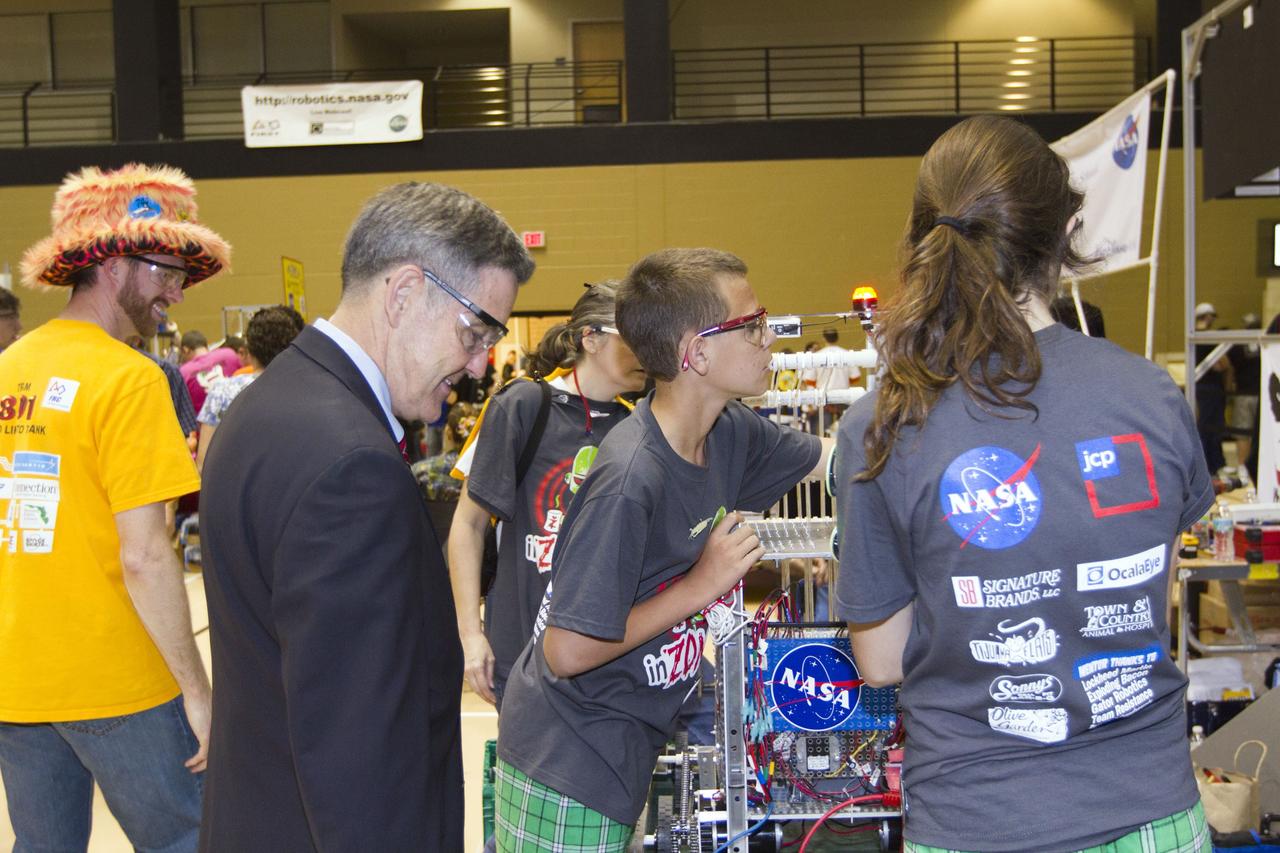
ORLANDO, Fla. -- NASA Kennedy Space Center Director Bob Cabana talks with members of Team 4064, which is participating in the regional FIRST robotics competition at the University of Central Florida in Orlando, Fla. The team is made up of students from Vanguard High School in Ocala, Fla. More than 60 high school teams from throughout the country took part in the competition called "For Inspiration and Recognition of Science and Technology," or FIRST, in hopes of advancing to the national robotics championship. This year the competition resembled a basketball game and was dubbed "Rebound Rumble." The game measured the effectiveness of each robot, the power of collaboration and the determination of the teams. FIRST, founded in 1989, is a non-profit organization that designs accessible, innovative programs to build self-confidence, knowledge and life skills while motivating young people to pursue academic opportunities. The robotics competition challenges teams of high school students and their mentors to solve a common problem in a six-week timeframe using a standard kit of parts and a common set of rules. NASA is the largest sponsor of the international program. Kennedy Space Center is a sponsor of the regional event. For more information on Kennedy's education events and initiatives, go to http://www.nasa.gov/offices/education/centers/kennedy/home/index.html. Photo credit: NASA/Kim Shiflett
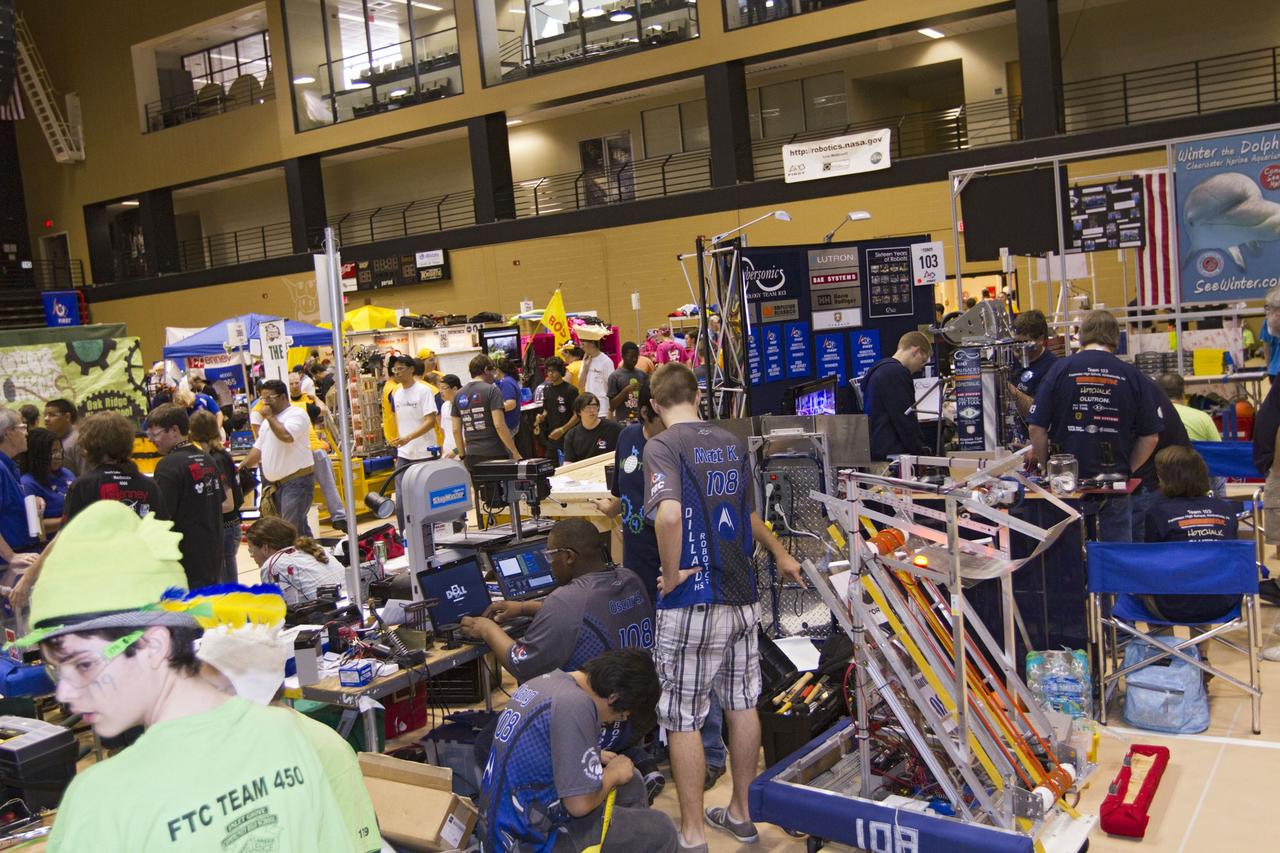
ORLANDO, Fla. -- High school teams tinker with their robots during the regional FIRST robotics competition at the University of Central Florida in Orlando, Fla. More than 60 teams took part in the competition called "For Inspiration and Recognition of Science and Technology," or FIRST, in hopes of advancing to the national robotics championship. This year ,the competition resembled a basketball game and was dubbed "Rebound Rumble." The game measured the effectiveness of each robot, the power of collaboration and the determination of the teams. FIRST, founded in 1989, is a non-profit organization that designs accessible, innovative programs to build self-confidence, knowledge and life skills while motivating young people to pursue academic opportunities. The robotics competition challenges teams of high school students and their mentors to solve a common problem in a six-week timeframe using a standard kit of parts and a common set of rules. NASA is the largest sponsor of the international program. Kennedy Space Center is a sponsor of the regional event. For more information on Kennedy's education events and initiatives, go to http://www.nasa.gov/offices/education/centers/kennedy/home/index.html. Photo credit: NASA/Kim Shiflett

ORLANDO, Fla. -- High school teams compete in the regional FIRST robotics competition at the University of Central Florida in Orlando, Fla. More than 60 teams took part in the competition called "For Inspiration and Recognition of Science and Technology," or FIRST, in hopes of advancing to the national robotics championship. This year, the competition resembled a basketball game and was dubbed "Rebound Rumble." The game measured the effectiveness of each robot, the power of collaboration and the determination of the teams. FIRST, founded in 1989, is a non-profit organization that designs accessible, innovative programs to build self-confidence, knowledge and life skills while motivating young people to pursue academic opportunities. The robotics competition challenges teams of high school students and their mentors to solve a common problem in a six-week timeframe using a standard kit of parts and a common set of rules. NASA is the largest sponsor of the international program. Kennedy Space Center is a sponsor of the regional event. For more information on Kennedy's education events and initiatives, go to http://www.nasa.gov/offices/education/centers/kennedy/home/index.html. Photo credit: NASA/Kim Shiflett
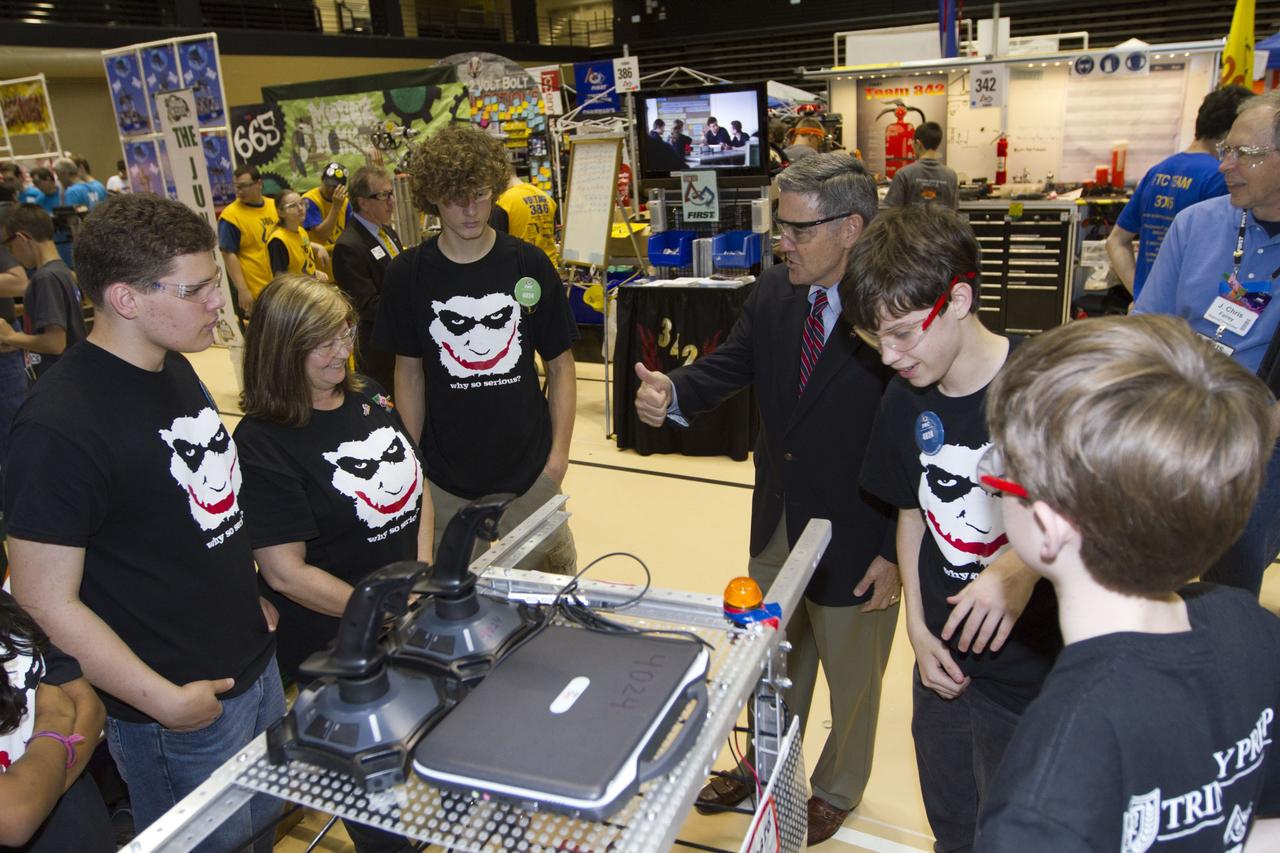
ORLANDO, Fla. -- NASA Kennedy Space Center Director Bob Cabana talks with members of Team 4024, which is participating in the regional FIRST robotics competition at the University of Central Florida in Orlando, Fla. The team is made up of students from Trinity Preparatory School in Winter Park, Fla. More than 60 high school teams took part in the competition called "For Inspiration and Recognition of Science and Technology," or FIRST, in hopes of advancing to the national robotics championship. This year, the competition resembled a basketball game and was dubbed "Rebound Rumble." The game measured the effectiveness of each robot, the power of collaboration and the determination of the teams. FIRST, founded in 1989, is a non-profit organization that designs accessible, innovative programs to build self-confidence, knowledge and life skills while motivating young people to pursue academic opportunities. The robotics competition challenges teams of high school students and their mentors to solve a common problem in a six-week timeframe using a standard kit of parts and a common set of rules. NASA is the largest sponsor of the international program. Kennedy Space Center is a sponsor of the regional event. For more information on Kennedy's education events and initiatives, go to http://www.nasa.gov/offices/education/centers/kennedy/home/index.html. Photo credit: NASA/Kim Shiflett
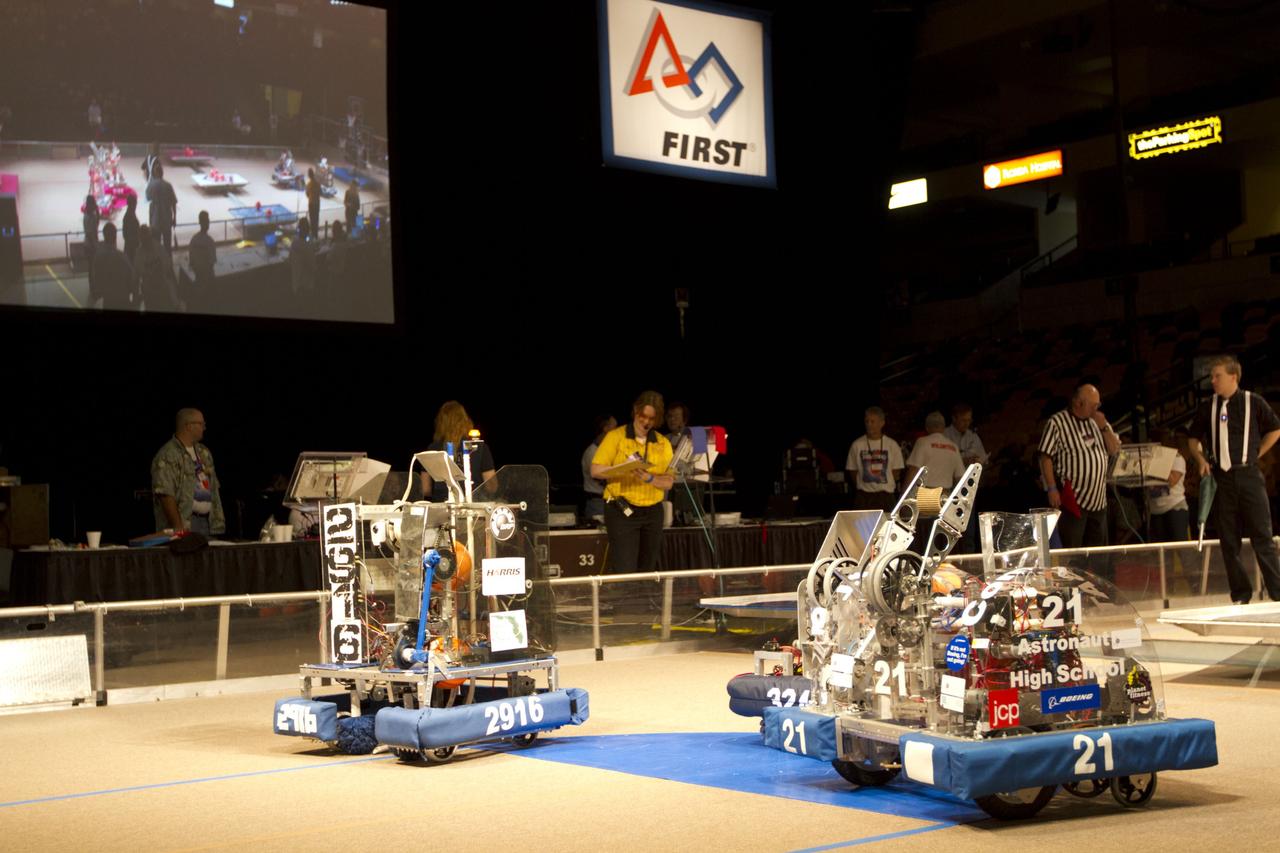
ORLANDO, Fla. -- High school teams compete in the regional FIRST robotics competition at the University of Central Florida in Orlando, Fla. More than 60 teams took part in the competition called "For Inspiration and Recognition of Science and Technology," or FIRST, in hopes of advancing to the national robotics championship. This year, the competition resembled a basketball game and was dubbed "Rebound Rumble." The game measured the effectiveness of each robot, the power of collaboration and the determination of the teams. FIRST, founded in 1989, is a non-profit organization that designs accessible, innovative programs to build self-confidence, knowledge and life skills while motivating young people to pursue academic opportunities. The robotics competition challenges teams of high school students and their mentors to solve a common problem in a six-week timeframe using a standard kit of parts and a common set of rules. NASA is the largest sponsor of the international program. Kennedy Space Center is a sponsor of the regional event. For more information on Kennedy's education events and initiatives, go to http://www.nasa.gov/offices/education/centers/kennedy/home/index.html. Photo credit: NASA/Kim Shiflett
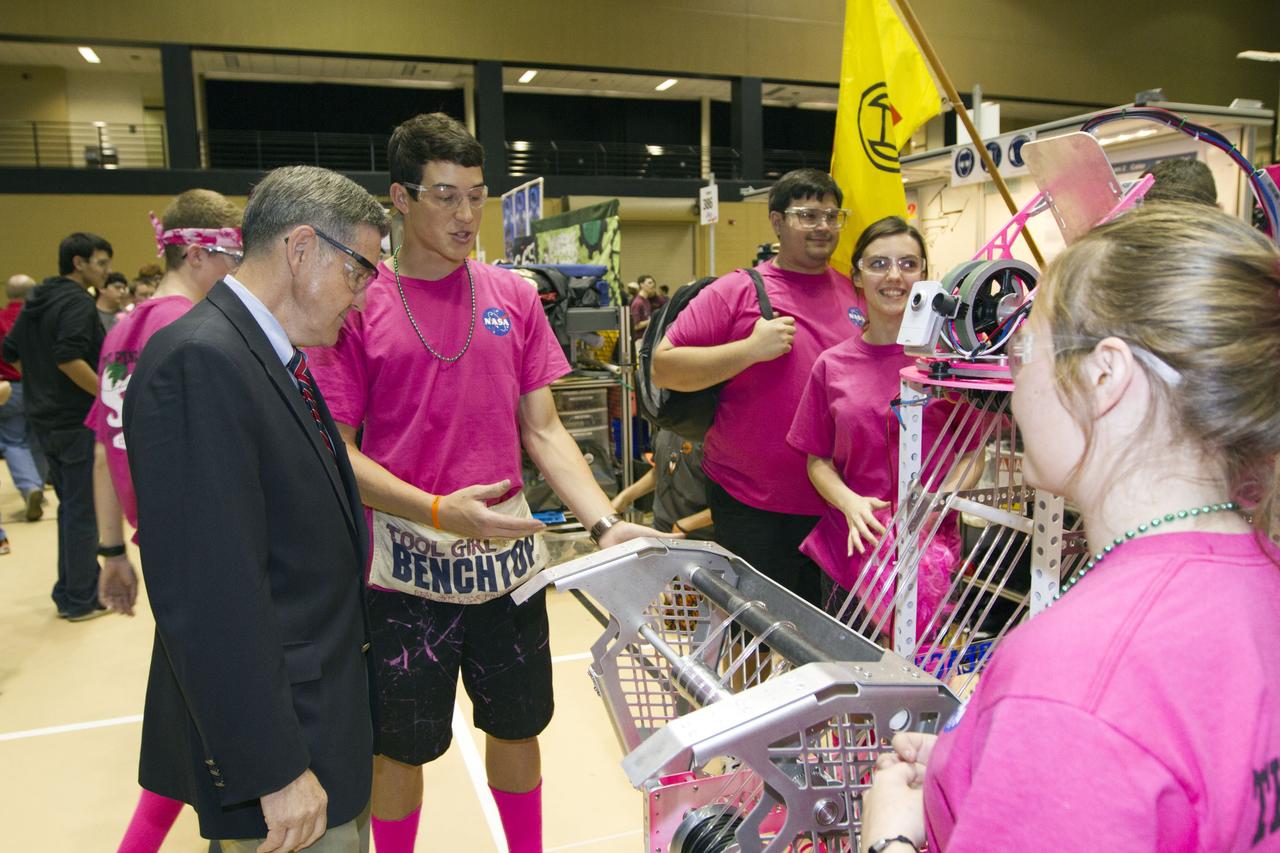
ORLANDO, Fla. -- NASA Kennedy Space Center Director Bob Cabana talks with members of Team 233, "The Pink Team," which is participating in the regional FIRST robotics competition at the University of Central Florida in Orlando, Fla. The team is made up of students from Rockledge, Cocoa Beach and Viera high schools along the Space Coast of Florida. Kennedy is a sponsor of the team. More than 60 high school teams took part in the competition called "For Inspiration and Recognition of Science and Technology," or FIRST, in hopes of advancing to the national robotics championship. This year, the competition resembled a basketball game and was dubbed "Rebound Rumble." The game measured the effectiveness of each robot, the power of collaboration and the determination of the teams. FIRST, founded in 1989, is a non-profit organization that designs accessible, innovative programs to build self-confidence, knowledge and life skills while motivating young people to pursue academic opportunities. The robotics competition challenges teams of high school students and their mentors to solve a common problem in a six-week timeframe using a standard kit of parts and a common set of rules. NASA is the largest sponsor of the international program. Kennedy Space Center is a sponsor of the regional event. For more information on Kennedy's education events and initiatives, go to http://www.nasa.gov/offices/education/centers/kennedy/home/index.html. Photo credit: NASA/Kim Shiflett
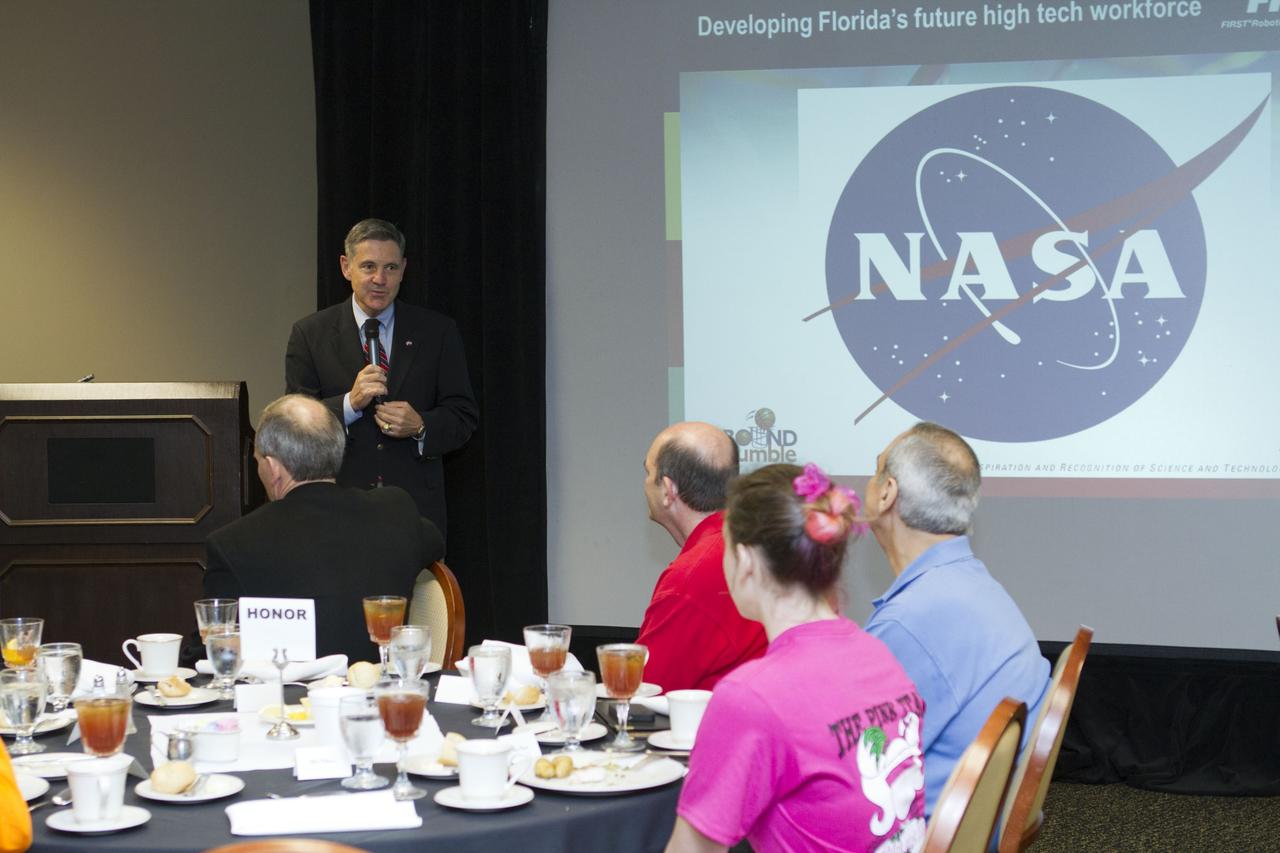
ORLANDO, Fla. -- NASA Kennedy Space Center Director Bob Cabana talks to teams that are participating in the regional FIRST robotics competition at the University of Central Florida in Orlando, Fla. More than 60 high school teams took part in the competition called "For Inspiration and Recognition of Science and Technology," or FIRST, in hopes of advancing to the national robotics championship. This year, the competition resembled a basketball game and was dubbed "Rebound Rumble." The game measured the effectiveness of each robot, the power of collaboration and the determination of the teams. FIRST, founded in 1989, is a non-profit organization that designs accessible, innovative programs to build self-confidence, knowledge and life skills while motivating young people to pursue academic opportunities. The robotics competition challenges teams of high school students and their mentors to solve a common problem in a six-week timeframe using a standard kit of parts and a common set of rules. NASA is the largest sponsor of the international program. Kennedy Space Center is a sponsor of the regional event. For more information on Kennedy's education events and initiatives, go to http://www.nasa.gov/offices/education/centers/kennedy/home/index.html. Photo credit: NASA/Kim Shiflett
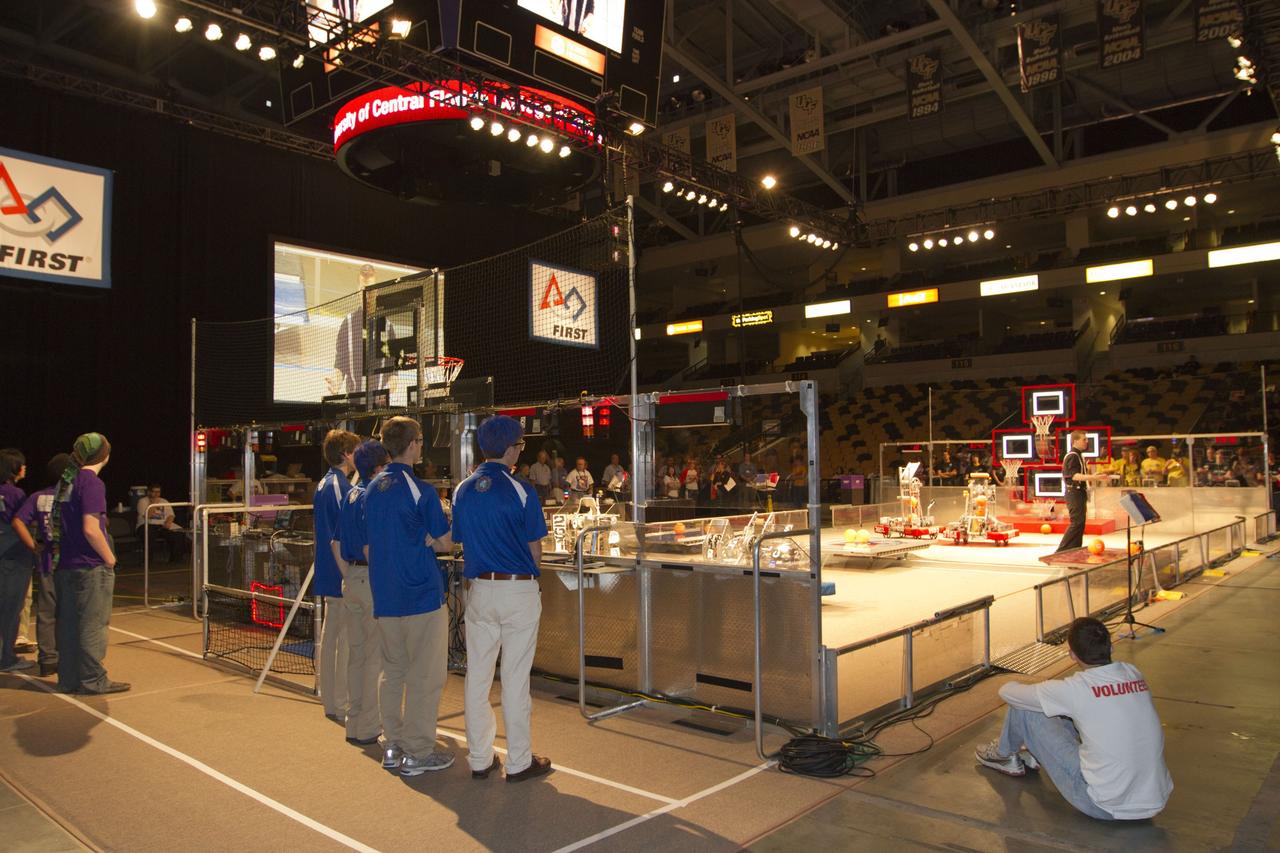
ORLANDO, Fla. -- High school teams compete in the regional FIRST robotics competition at the University of Central Florida in Orlando, Fla. More than 60 teams took part in the competition called "For Inspiration and Recognition of Science and Technology," or FIRST, in hopes of advancing to the national robotics championship. This year, the competition resembled a basketball game and was dubbed "Rebound Rumble." The game measured the effectiveness of each robot, the power of collaboration and the determination of the teams. FIRST, founded in 1989, is a non-profit organization that designs accessible, innovative programs to build self-confidence, knowledge and life skills while motivating young people to pursue academic opportunities. The robotics competition challenges teams of high school students and their mentors to solve a common problem in a six-week timeframe using a standard kit of parts and a common set of rules. NASA is the largest sponsor of the international program. Kennedy Space Center is a sponsor of the regional event. For more information on Kennedy's education events and initiatives, go to http://www.nasa.gov/offices/education/centers/kennedy/home/index.html. Photo credit: NASA/Kim Shiflett
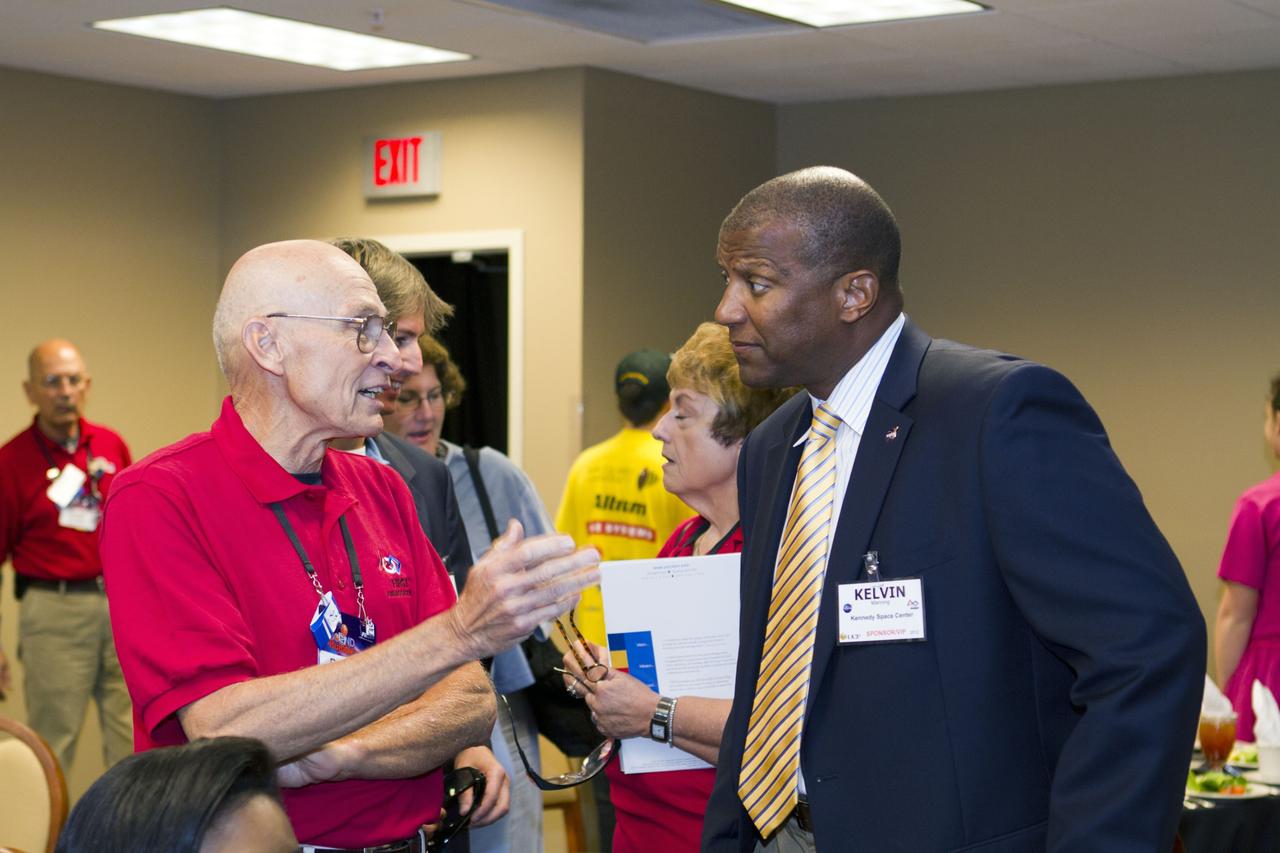
ORLANDO, Fla. -- Former space shuttle launch director, Bob Sieck, left, and NASA Kennedy Space Center Associate Director Kelvin Manning, right, talk amongst high school teams that are competing in the regional FIRST robotics competition at the University of Central Florida in Orlando, Fla. More than 60 teams took part in the competition called "For Inspiration and Recognition of Science and Technology," or FIRST, in hopes of advancing to the national robotics championship. This year, the competition resembled a basketball game and was dubbed "Rebound Rumble." The game measured the effectiveness of each robot, the power of collaboration and the determination of the teams. FIRST, founded in 1989, is a non-profit organization that designs accessible, innovative programs to build self-confidence, knowledge and life skills while motivating young people to pursue academic opportunities. The robotics competition challenges teams of high school students and their mentors to solve a common problem in a six-week timeframe using a standard kit of parts and a common set of rules. NASA is the largest sponsor of the international program. Kennedy Space Center is a sponsor of the regional event. For more information on Kennedy's education events and initiatives, go to http://www.nasa.gov/offices/education/centers/kennedy/home/index.html. Photo credit: NASA/Kim Shiflett
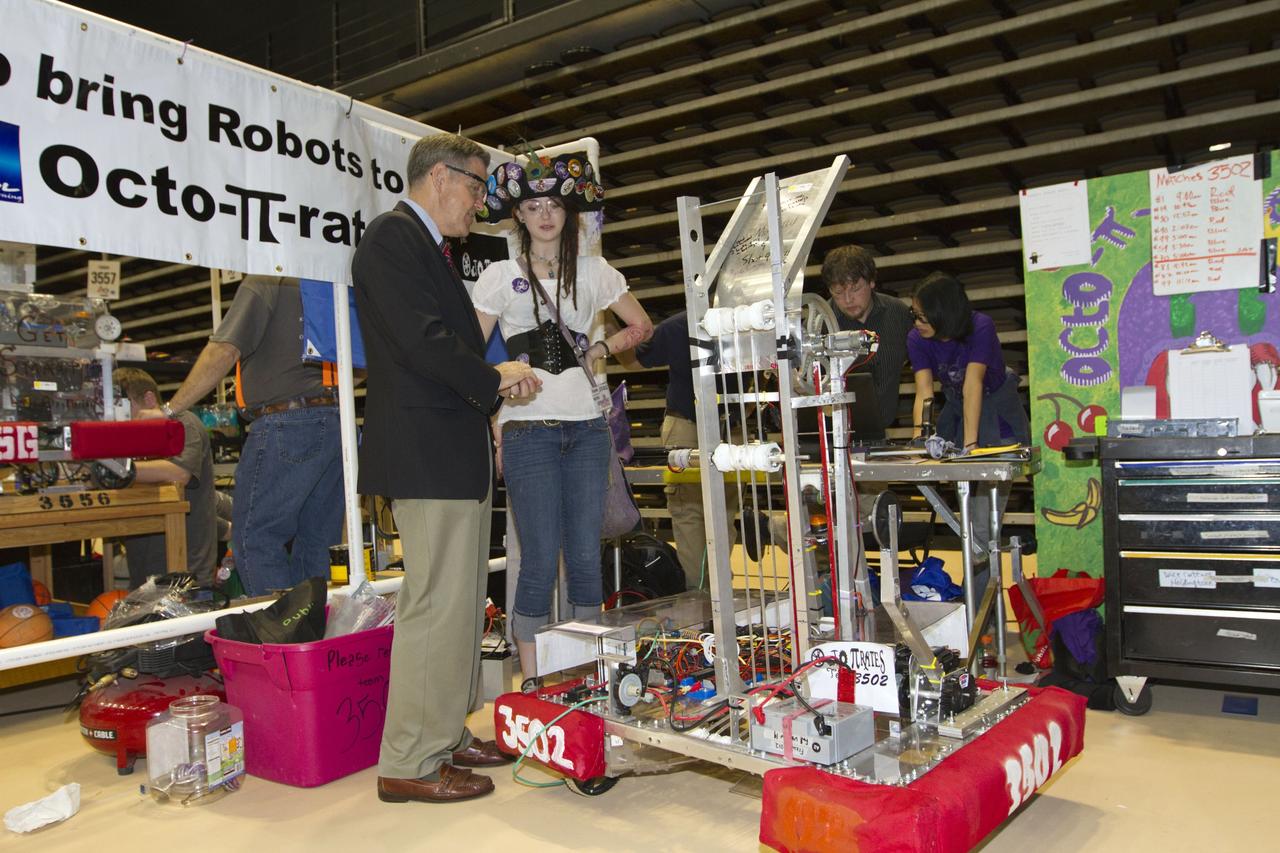
ORLANDO, Fla. -- NASA Kennedy Space Center Director Bob Cabana talks with a member of Team 3502, called "The Octo Pie-Rates," which is participating in the regional FIRST robotics competition at the University of Central Florida in Orlando, Fla. The team is made up of students from the School for Arts and Innovative Learning SAIL High School in Tallahassee. More than 60 high school teams took part in the competition called "For Inspiration and Recognition of Science and Technology," or FIRST, in hopes of advancing to the national robotics championship. This year, the competition resembled a basketball game and was dubbed "Rebound Rumble." The game measured the effectiveness of each robot, the power of collaboration and the determination of the teams. FIRST, founded in 1989, is a non-profit organization that designs accessible, innovative programs to build self-confidence, knowledge and life skills while motivating young people to pursue academic opportunities. The robotics competition challenges teams of high school students and their mentors to solve a common problem in a six-week timeframe using a standard kit of parts and a common set of rules. NASA is the largest sponsor of the international program. Kennedy Space Center is a sponsor of the regional event. For more information on Kennedy's education events and initiatives, go to http://www.nasa.gov/offices/education/centers/kennedy/home/index.html. Photo credit: NASA/Kim Shiflett
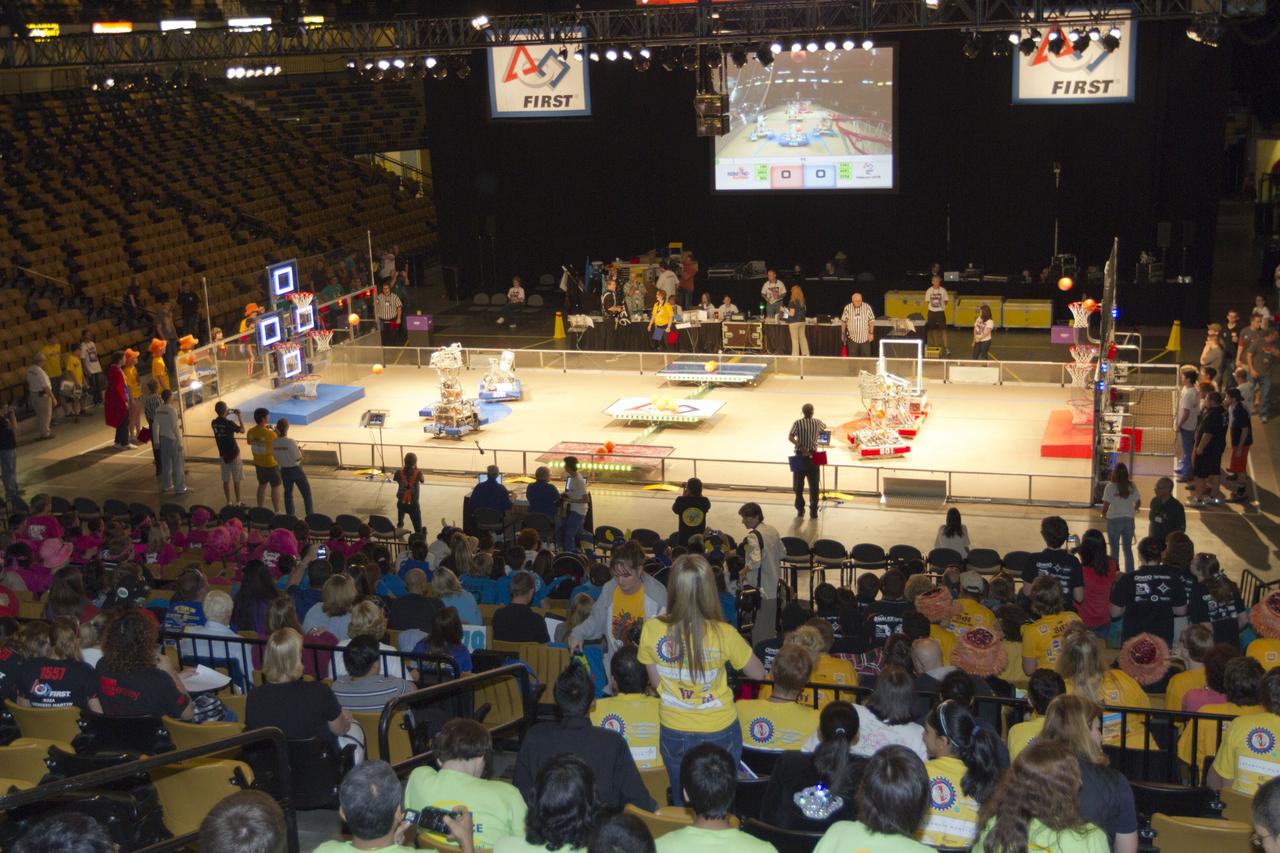
ORLANDO, Fla. -- High school teams compete in the regional FIRST robotics competition at the University of Central Florida in Orlando, Fla. More than 60 teams took part in the competition called "For Inspiration and Recognition of Science and Technology," or FIRST, in hopes of advancing to the national robotics championship. This year, the competition resembled a basketball game and was dubbed "Rebound Rumble." The game measured the effectiveness of each robot, the power of collaboration and the determination of the teams. FIRST, founded in 1989, is a non-profit organization that designs accessible, innovative programs to build self-confidence, knowledge and life skills while motivating young people to pursue academic opportunities. The robotics competition challenges teams of high school students and their mentors to solve a common problem in a six-week timeframe using a standard kit of parts and a common set of rules. NASA is the largest sponsor of the international program. Kennedy Space Center is a sponsor of the regional event. For more information on Kennedy's education events and initiatives, go to http://www.nasa.gov/offices/education/centers/kennedy/home/index.html. Photo credit: NASA/Kim Shiflett
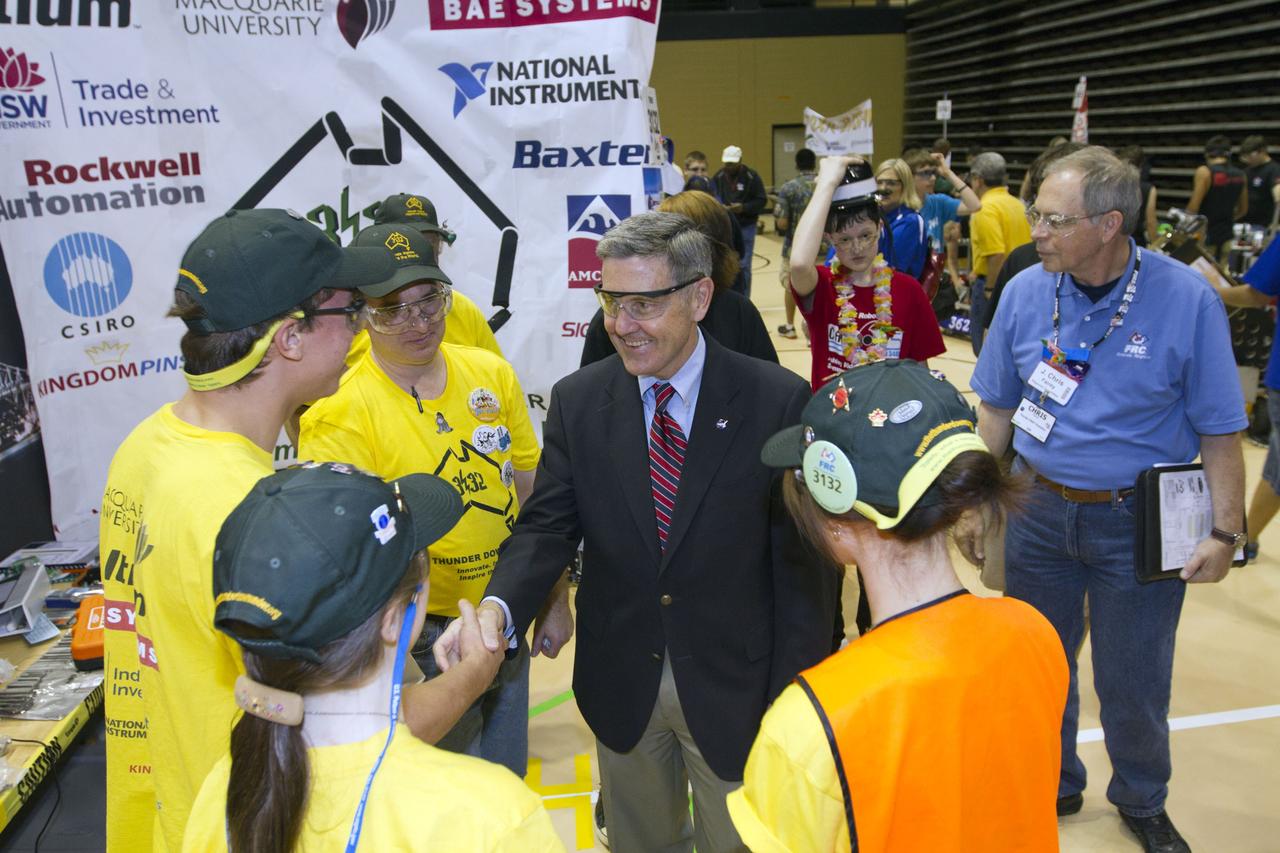
ORLANDO, Fla. -- NASA Kennedy Space Center Director Bob Cabana talks with members of Team 3132, called "Thunder Down Under," which is participating in the regional FIRST robotics competition at the University of Central Florida in Orlando, Fla. The team is made up of students from Sydney, Australia. More than 60 high school teams took part in the competition called "For Inspiration and Recognition of Science and Technology," or FIRST, in hopes of advancing to the national robotics championship. This year, the competition resembled a basketball game and was dubbed "Rebound Rumble." The game measured the effectiveness of each robot, the power of collaboration and the determination of the teams. FIRST, founded in 1989, is a non-profit organization that designs accessible, innovative programs to build self-confidence, knowledge and life skills while motivating young people to pursue academic opportunities. The robotics competition challenges teams of high school students and their mentors to solve a common problem in a six-week timeframe using a standard kit of parts and a common set of rules. NASA is the largest sponsor of the international program. Kennedy Space Center is a sponsor of the regional event. For more information on Kennedy's education events and initiatives, go to http://www.nasa.gov/offices/education/centers/kennedy/home/index.html. Photo credit: NASA/Kim Shiflett
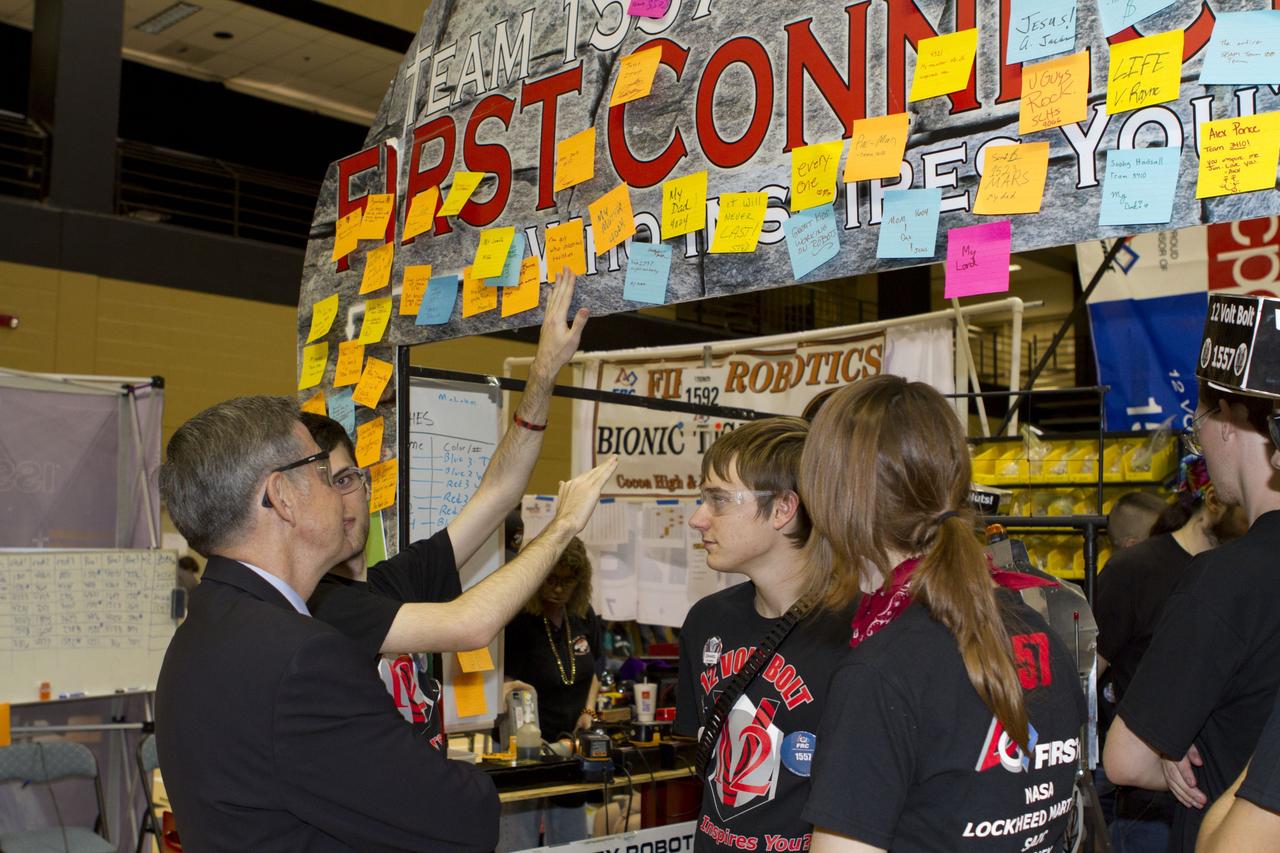
ORLANDO, Fla. -- NASA Kennedy Space Center Director Bob Cabana talks with members of the "12 Volt Bolt Team," which is participating in the regional FIRST robotics competition at the University of Central Florida in Orlando, Fla. The team is from Eustis, Fla., and consists of students from many Lake County schools, including Mt. Dora High, Eustis High, Tavares High, Mt. Dora Bible and homeschooled students. More than 60 high school teams took part in the competition called "For Inspiration and Recognition of Science and Technology," or FIRST, in hopes of advancing to the national robotics championship. This year, the competition resembled a basketball game and was dubbed "Rebound Rumble." The game measured the effectiveness of each robot, the power of collaboration and the determination of the teams. FIRST, founded in 1989, is a non-profit organization that designs accessible, innovative programs to build self-confidence, knowledge and life skills while motivating young people to pursue academic opportunities. The robotics competition challenges teams of high school students and their mentors to solve a common problem in a six-week timeframe using a standard kit of parts and a common set of rules. NASA is the largest sponsor of the international program. Kennedy Space Center is a sponsor of the regional event. For more information on Kennedy's education events and initiatives, go to http://www.nasa.gov/offices/education/centers/kennedy/home/index.html. Photo credit: NASA/Kim Shiflett
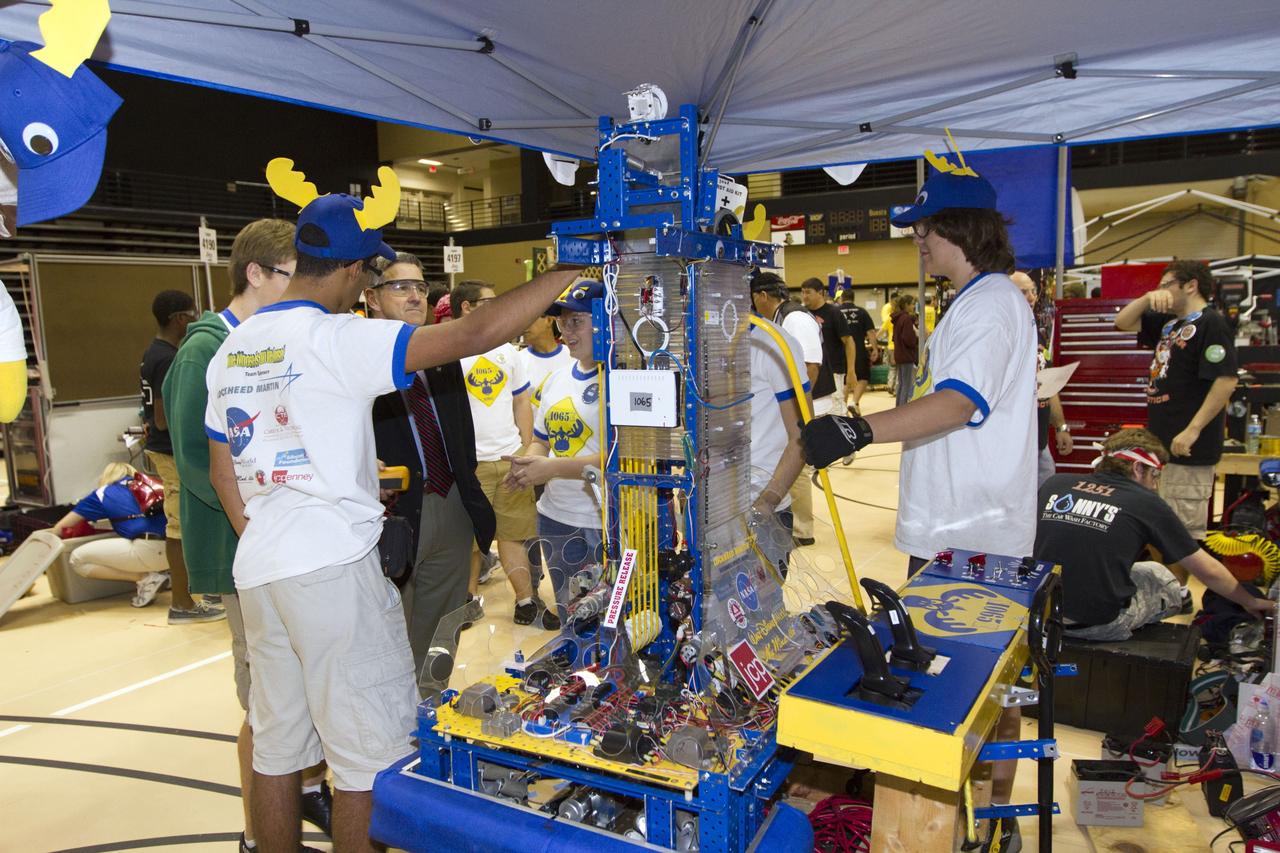
ORLANDO, Fla. -- NASA Kennedy Space Center Director Bob Cabana talks with members of Team 1056 "The Moose," which is participating in the regional FIRST robotics competition at the University of Central Florida in Orlando, Fla. The team is from Kissimmee, Fla., and consists of students from Osceola High School. More than 60 high school teams from took part in the competition called "For Inspiration and Recognition of Science and Technology," or FIRST, in hopes of advancing to the national robotics championship. This year, the competition resembled a basketball game and was dubbed "Rebound Rumble." The game measured the effectiveness of each robot, the power of collaboration and the determination of the teams. FIRST, founded in 1989, is a non-profit organization that designs accessible, innovative programs to build self-confidence, knowledge and life skills while motivating young people to pursue academic opportunities. The robotics competition challenges teams of high school students and their mentors to solve a common problem in a six-week timeframe using a standard kit of parts and a common set of rules. NASA is the largest sponsor of the international program. Kennedy Space Center is a sponsor of the regional event. For more information on Kennedy's education events and initiatives, go to http://www.nasa.gov/offices/education/centers/kennedy/home/index.html. Photo credit: NASA/Kim Shiflett
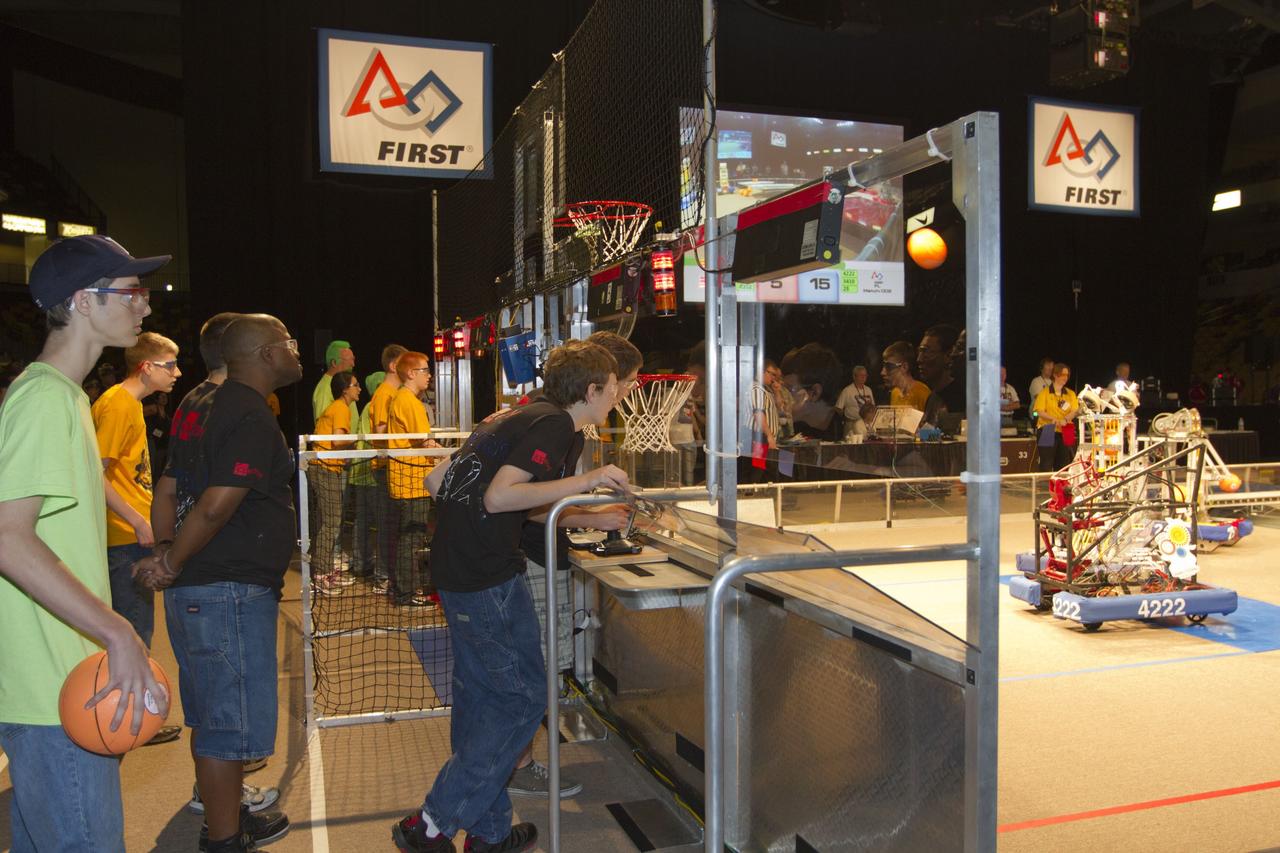
ORLANDO, Fla. -- High school teams compete in the regional FIRST robotics competition at the University of Central Florida in Orlando, Fla. More than 60 teams took part in the competition called "For Inspiration and Recognition of Science and Technology," or FIRST, in hopes of advancing to the national robotics championship. This year, the competition resembled a basketball game and was dubbed "Rebound Rumble." The game measured the effectiveness of each robot, the power of collaboration and the determination of the teams. FIRST, founded in 1989, is a non-profit organization that designs accessible, innovative programs to build self-confidence, knowledge and life skills while motivating young people to pursue academic opportunities. The robotics competition challenges teams of high school students and their mentors to solve a common problem in a six-week timeframe using a standard kit of parts and a common set of rules. NASA is the largest sponsor of the international program. Kennedy Space Center is a sponsor of the regional event. For more information on Kennedy's education events and initiatives, go to http://www.nasa.gov/offices/education/centers/kennedy/home/index.html. Photo credit: NASA/Kim Shiflett
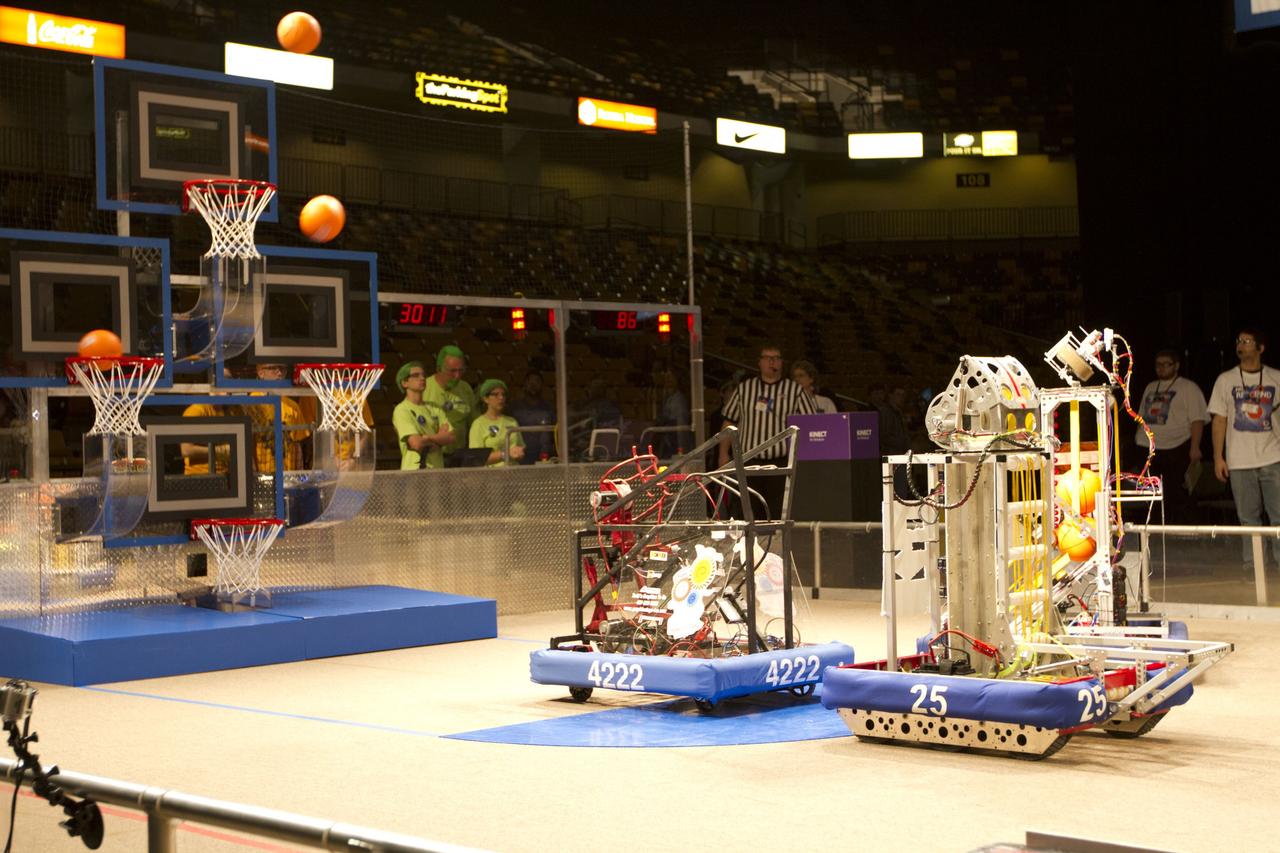
ORLANDO, Fla. -- High school teams compete in the regional FIRST robotics competition at the University of Central Florida in Orlando, Fla. More than 60 teams took part in the competition called "For Inspiration and Recognition of Science and Technology," or FIRST, in hopes of advancing to the national robotics championship. This year, the competition resembled a basketball game and was dubbed "Rebound Rumble." The game measured the effectiveness of each robot, the power of collaboration and the determination of the teams. FIRST, founded in 1989, is a non-profit organization that designs accessible, innovative programs to build self-confidence, knowledge and life skills while motivating young people to pursue academic opportunities. The robotics competition challenges teams of high school students and their mentors to solve a common problem in a six-week timeframe using a standard kit of parts and a common set of rules. NASA is the largest sponsor of the international program. Kennedy Space Center is a sponsor of the regional event. For more information on Kennedy's education events and initiatives, go to http://www.nasa.gov/offices/education/centers/kennedy/home/index.html. Photo credit: NASA/Kim Shiflett
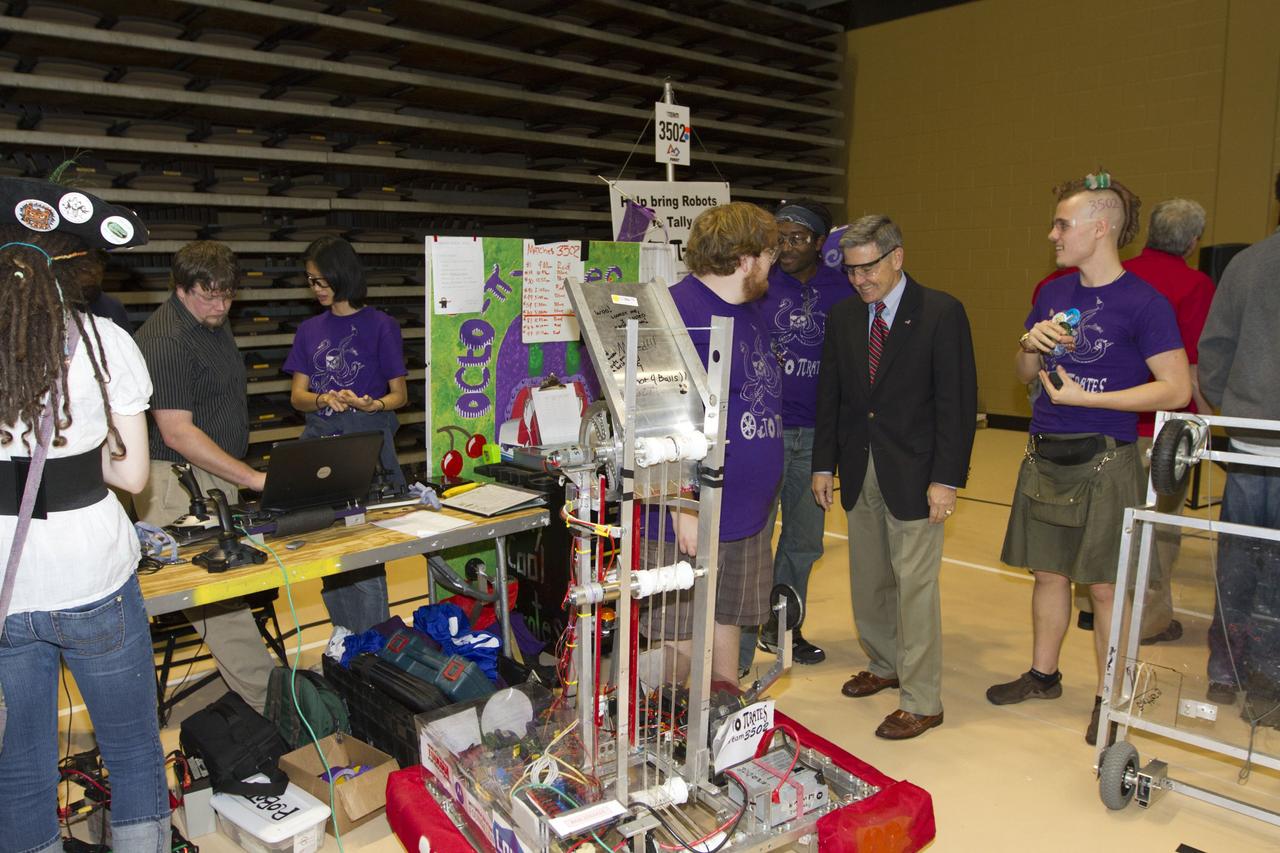
ORLANDO, Fla. -- NASA Kennedy Space Center Director Bob Cabana talks with members of Team 3502, called "The Octo Pie-Rates," which is participating in the regional FIRST robotics competition at the University of Central Florida in Orlando, Fla. The team is made up of students from the School for Arts and Innovative Learning SAIL High School in Tallahassee. More than 60 high school teams took part in the competition called "For Inspiration and Recognition of Science and Technology," or FIRST, in hopes of advancing to the national robotics championship. This year, the competition resembled a basketball game and was dubbed "Rebound Rumble." The game measured the effectiveness of each robot, the power of collaboration and the determination of the teams. FIRST, founded in 1989, is a non-profit organization that designs accessible, innovative programs to build self-confidence, knowledge and life skills while motivating young people to pursue academic opportunities. The robotics competition challenges teams of high school students and their mentors to solve a common problem in a six-week timeframe using a standard kit of parts and a common set of rules. NASA is the largest sponsor of the international program. Kennedy Space Center is a sponsor of the regional event. For more information on Kennedy's education events and initiatives, go to http://www.nasa.gov/offices/education/centers/kennedy/home/index.html. Photo credit: NASA/Kim Shiflett

ORLANDO, Fla. -- "The Pink Team," Team 233, tinkers with its robot during the regional FIRST robotics competition at the University of Central Florida in Orlando, Fla. The team is made up of students from Rockledge, Cocoa Beach and Viera high schools along the Space Coast of Florida. NASA’s Kennedy Space Center is a sponsor of the team. More than 60 high school teams took part in the competition called "For Inspiration and Recognition of Science and Technology," or FIRST, in hopes of advancing to the national robotics championship. This year, the competition resembled a basketball game and was dubbed "Rebound Rumble." The game measured the effectiveness of each robot, the power of collaboration and the determination of the teams. FIRST, founded in 1989, is a non-profit organization that designs accessible, innovative programs to build self-confidence, knowledge and life skills while motivating young people to pursue academic opportunities. The robotics competition challenges teams of high school students and their mentors to solve a common problem in a six-week timeframe using a standard kit of parts and a common set of rules. NASA is the largest sponsor of the international program. Kennedy Space Center is a sponsor of the regional event. For more information on Kennedy's education events and initiatives, go to http://www.nasa.gov/offices/education/centers/kennedy/home/index.html. Photo credit: NASA/Kim Shiflett
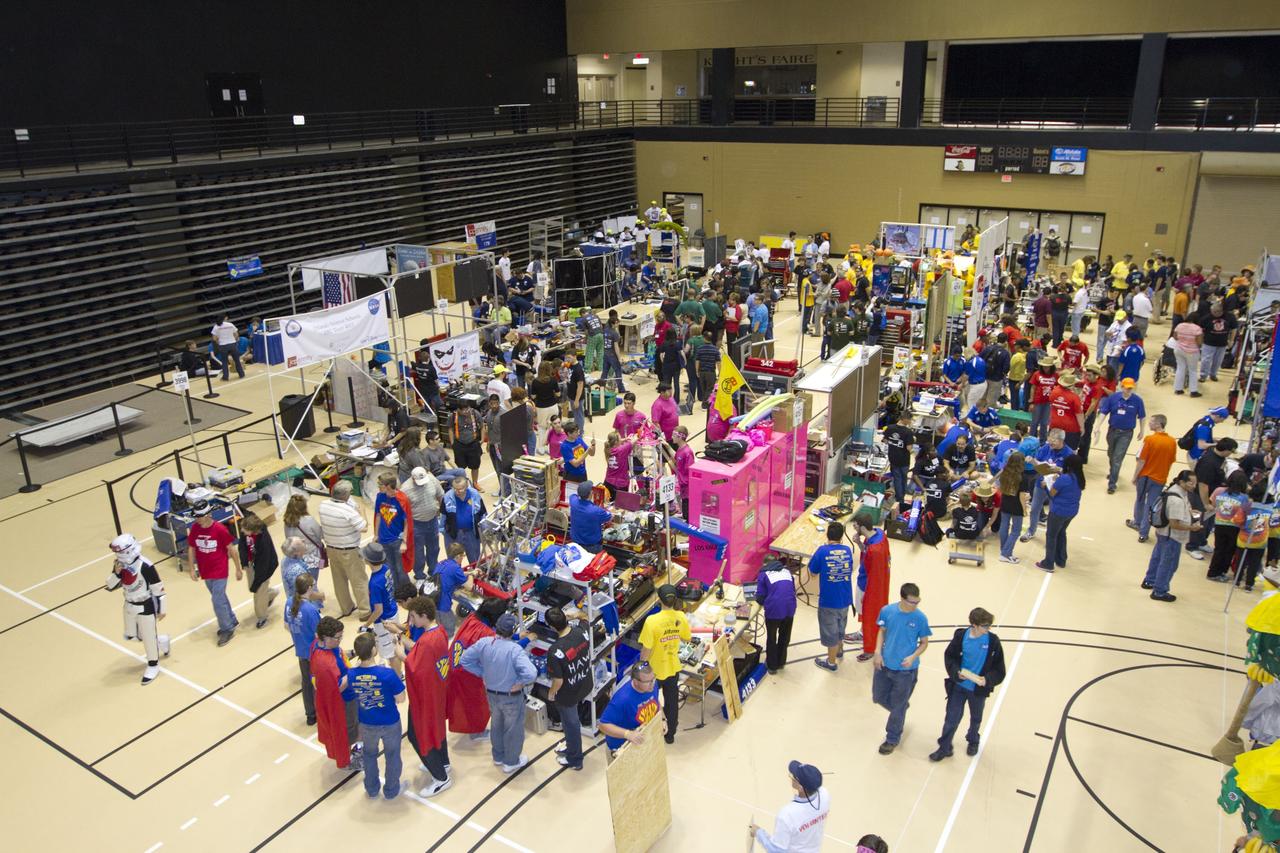
ORLANDO, Fla. -- High school teams tinker with their robots during the regional FIRST robotics competition at the University of Central Florida in Orlando, Fla. More than 60 teams took part in the competition called "For Inspiration and Recognition of Science and Technology," or FIRST, in hopes of advancing to the national robotics championship. This year, the competition resembled a basketball game and was dubbed "Rebound Rumble." The game measured the effectiveness of each robot, the power of collaboration and the determination of the teams. FIRST, founded in 1989, is a non-profit organization that designs accessible, innovative programs to build self-confidence, knowledge and life skills while motivating young people to pursue academic opportunities. The robotics competition challenges teams of high school students and their mentors to solve a common problem in a six-week timeframe using a standard kit of parts and a common set of rules. NASA is the largest sponsor of the international program. Kennedy Space Center is a sponsor of the regional event. For more information on Kennedy's education events and initiatives, go to http://www.nasa.gov/offices/education/centers/kennedy/home/index.html. Photo credit: NASA/Kim Shiflett
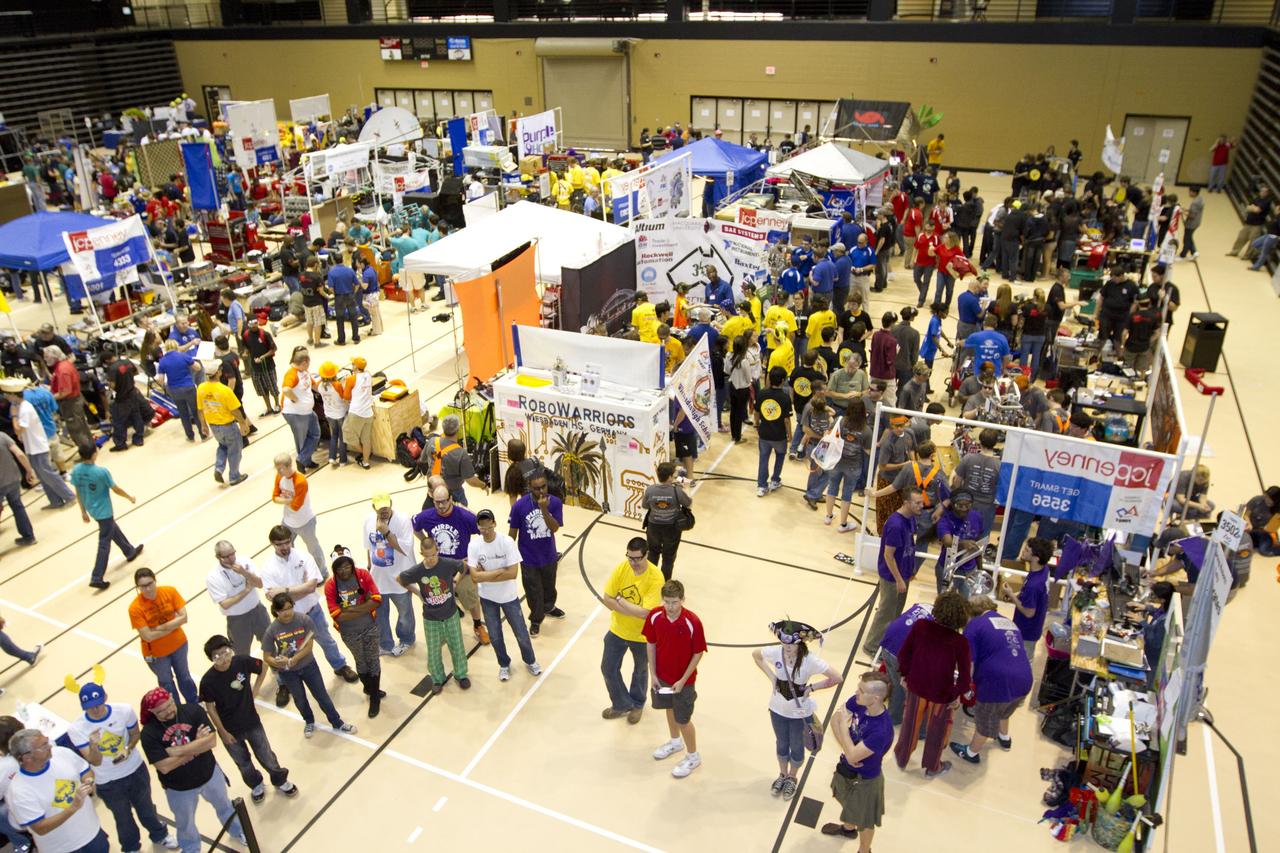
ORLANDO, Fla. -- High school teams tinker with their robots during the regional FIRST robotics competition at the University of Central Florida in Orlando, Fla. More than 50 teams took part in the competition called "For Inspiration and Recognition of Science and Technology," or FIRST, in hopes of advancing to the national robotics championship. This year, the competition resembled a basketball game and was dubbed "Rebound Rumble." The game measured the effectiveness of each robot, the power of collaboration and the determination of the teams. FIRST, founded in 1989, is a non-profit organization that designs accessible, innovative programs to build self-confidence, knowledge and life skills while motivating young people to pursue academic opportunities. The robotics competition challenges teams of high school students and their mentors to solve a common problem in a six-week timeframe using a standard kit of parts and a common set of rules. NASA is the largest sponsor of the international program. Kennedy Space Center is a sponsor of the regional event. For more information on Kennedy's education events and initiatives, go to http://www.nasa.gov/offices/education/centers/kennedy/home/index.html. Photo credit: NASA/Kim Shiflett
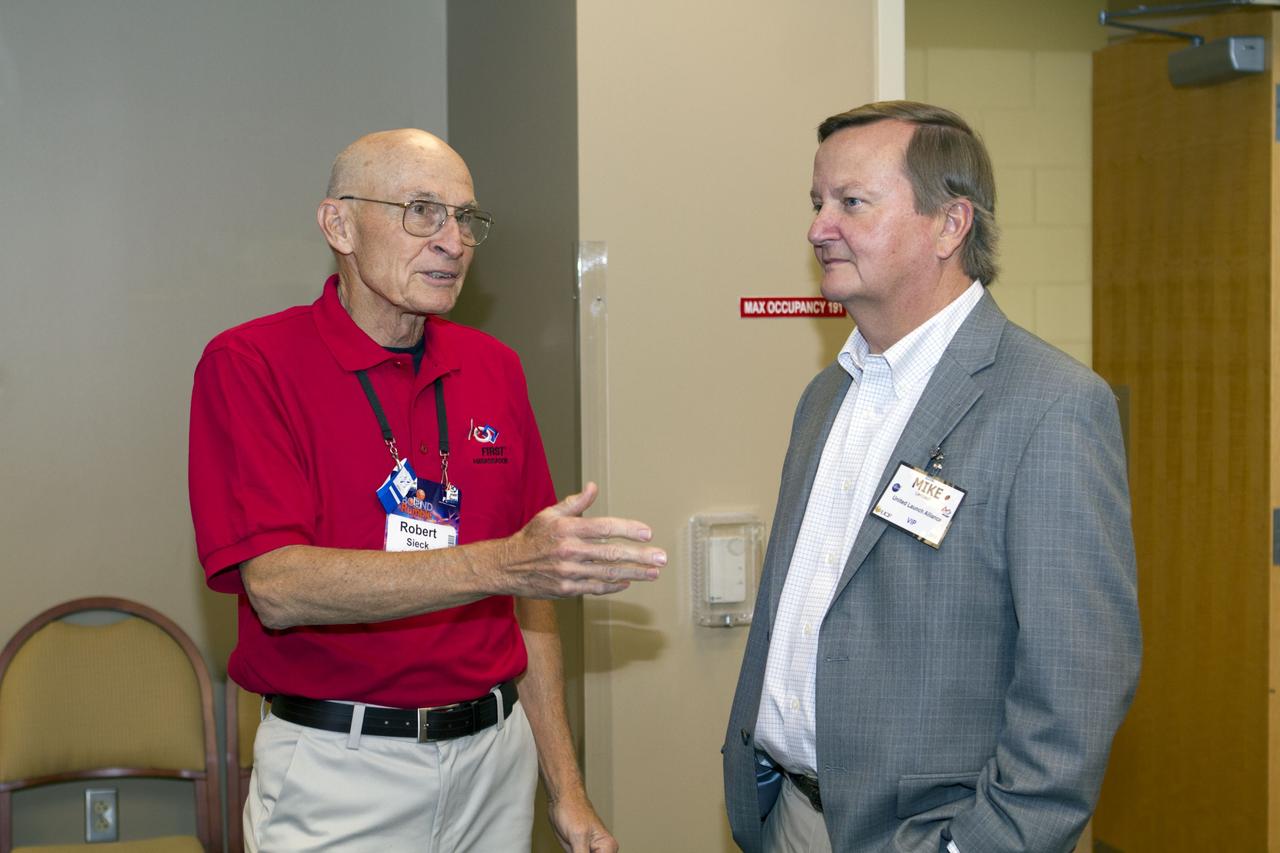
ORLANDO, Fla. -- Former space shuttle launch directors, Bob Sieck, left, and Mike Leinbach, right, talk with high school teams that are competing in the regional FIRST robotics competition at the University of Central Florida in Orlando, Fla. More than 60 teams took part in the competition called "For Inspiration and Recognition of Science and Technology," or FIRST, in hopes of advancing to the national robotics championship. This year, the competition resembled a basketball game and was dubbed "Rebound Rumble." The game measured the effectiveness of each robot, the power of collaboration and the determination of the teams. FIRST, founded in 1989, is a non-profit organization that designs accessible, innovative programs to build self-confidence, knowledge and life skills while motivating young people to pursue academic opportunities. The robotics competition challenges teams of high school students and their mentors to solve a common problem in a six-week timeframe using a standard kit of parts and a common set of rules. NASA is the largest sponsor of the international program. Kennedy Space Center is a sponsor of the regional event. For more information on Kennedy's education events and initiatives, go to http://www.nasa.gov/offices/education/centers/kennedy/home/index.html. Photo credit: NASA/Kim Shiflett
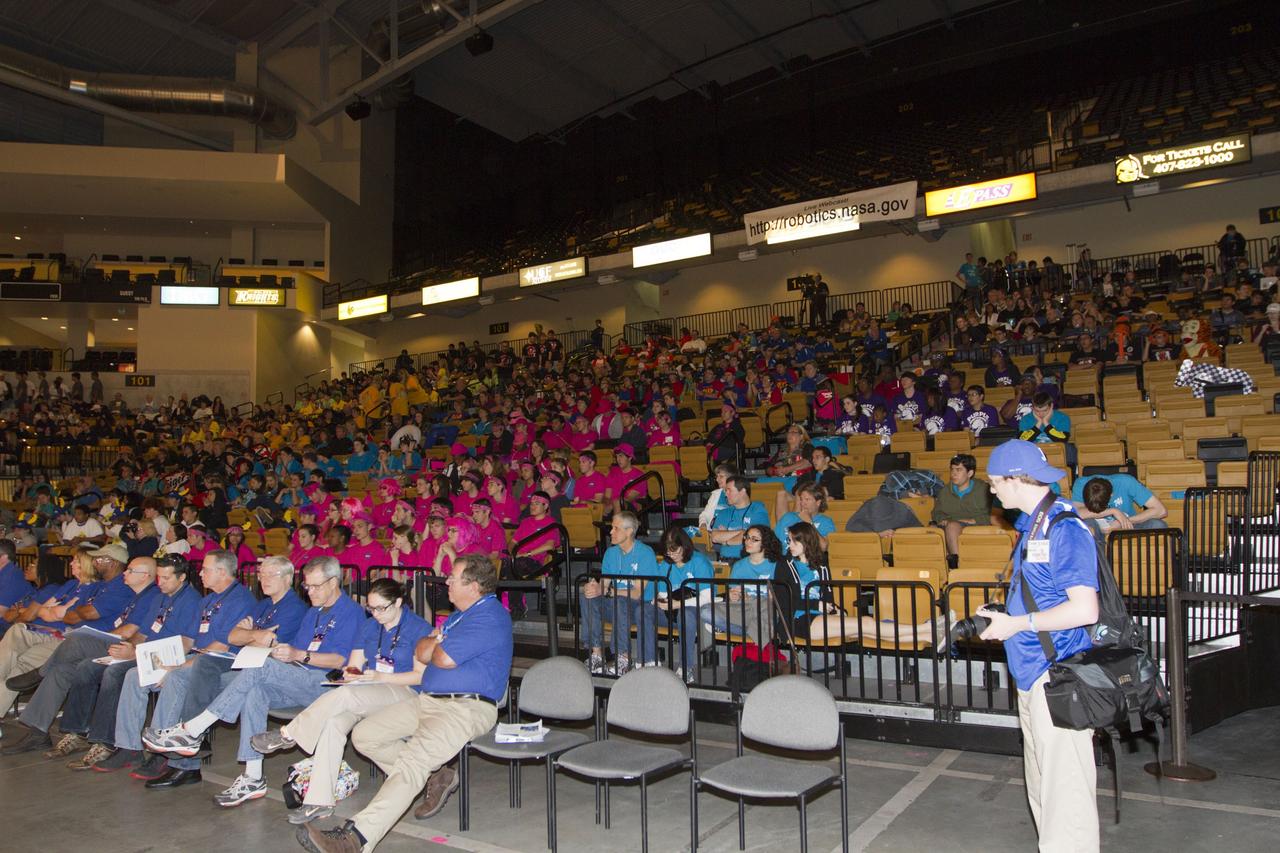
ORLANDO, Fla. -- High school teams compete in the regional FIRST robotics competition at the University of Central Florida in Orlando, Fla. More than 60 teams took part in the competition called "For Inspiration and Recognition of Science and Technology," or FIRST, in hopes of advancing to the national robotics championship. This year, the competition resembled a basketball game and was dubbed "Rebound Rumble." The game measured the effectiveness of each robot, the power of collaboration and the determination of the teams. On the left is Team 3502, called "The Octo Pie-Rates," which is comprised of students from School for Arts and Innovative Learning SAIL High School in Tallahassee. On the right is Team 3164, called "Tiger Robotics," which is comprised of students from Jesuit and The Academy of the Holy Names high schools in Tampa, Fla. FIRST, founded in 1989, is a non-profit organization that designs accessible, innovative programs to build self-confidence, knowledge and life skills while motivating young people to pursue academic opportunities. The robotics competition challenges teams of high school students and their mentors to solve a common problem in a six-week timeframe using a standard kit of parts and a common set of rules. NASA is the largest sponsor of the international program. Kennedy Space Center is a sponsor of the regional event. For more information on Kennedy's education events and initiatives, go to http://www.nasa.gov/offices/education/centers/kennedy/home/index.html. Photo credit: NASA/Kim Shiflett

CAPE CANAVERAL, Fla. - At NASA’s Kennedy Space Center Visitor Complex in Florida, Lunabotics Emcee Kimberly Land gives a high five to a student during the opening ceremony for NASA’s Lunabotics Mining Competition. Land is the Education, Public Outreach and Communications manager for NASA’s Game Changing Development Program and Earth System Science Pathfinder Program. The mining competition is sponsored by NASA Kennedy Space Center’s Education Office for the agency’s Exploration Systems Mission Directorate. Undergraduate and graduate students from more than 50 universities and colleges in the U.S. and other countries use their remote-controlled Lunabots to maneuver and dig in a supersized sandbox filled with a crushed material that has characteristics similar to lunar soil. For more information, visit www.nasa.gov/lunabotics. Photo credit: NASA/Frankie Martin
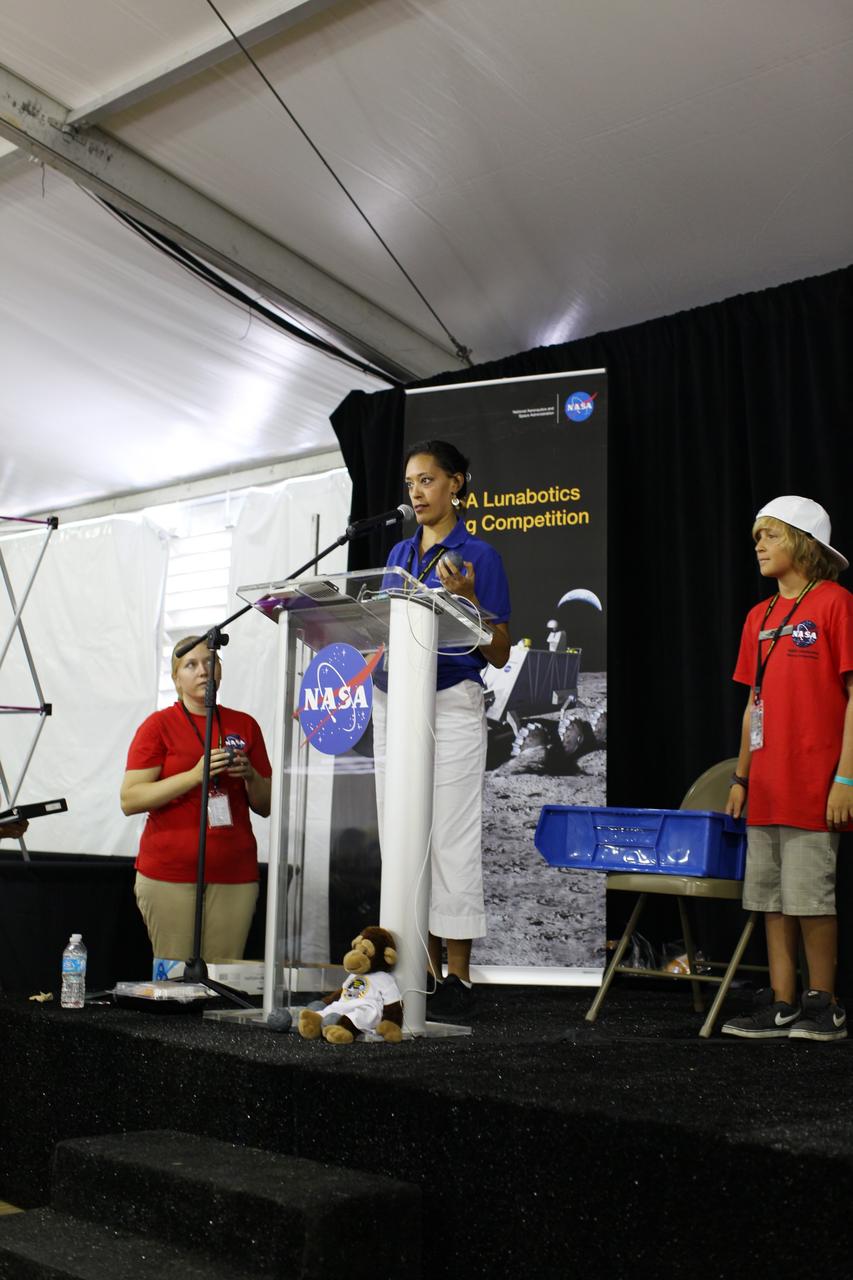
CAPE CANAVERAL, Fla. - At NASA’s Kennedy Space Center Visitor Complex in Florida, Lunabotics Emcee Kimberly Land welcomes U.S. and international college students to NASA’s Lunabotics Mining Competition. Land is the Education, Public Outreach and Communications manager for NASA’s Game Changing Development Program and Earth System Science Pathfinder Program. The mining competition is sponsored by NASA Kennedy Space Center’s Education Office for the agency’s Exploration Systems Mission Directorate. Undergraduate and graduate students from more than 50 universities and colleges in the U.S. and other countries use their remote-controlled Lunabots to maneuver and dig in a supersized sandbox filled with a crushed material that has characteristics similar to lunar soil. For more information, visit www.nasa.gov/lunabotics. Photo credit: NASA/Frankie Martin
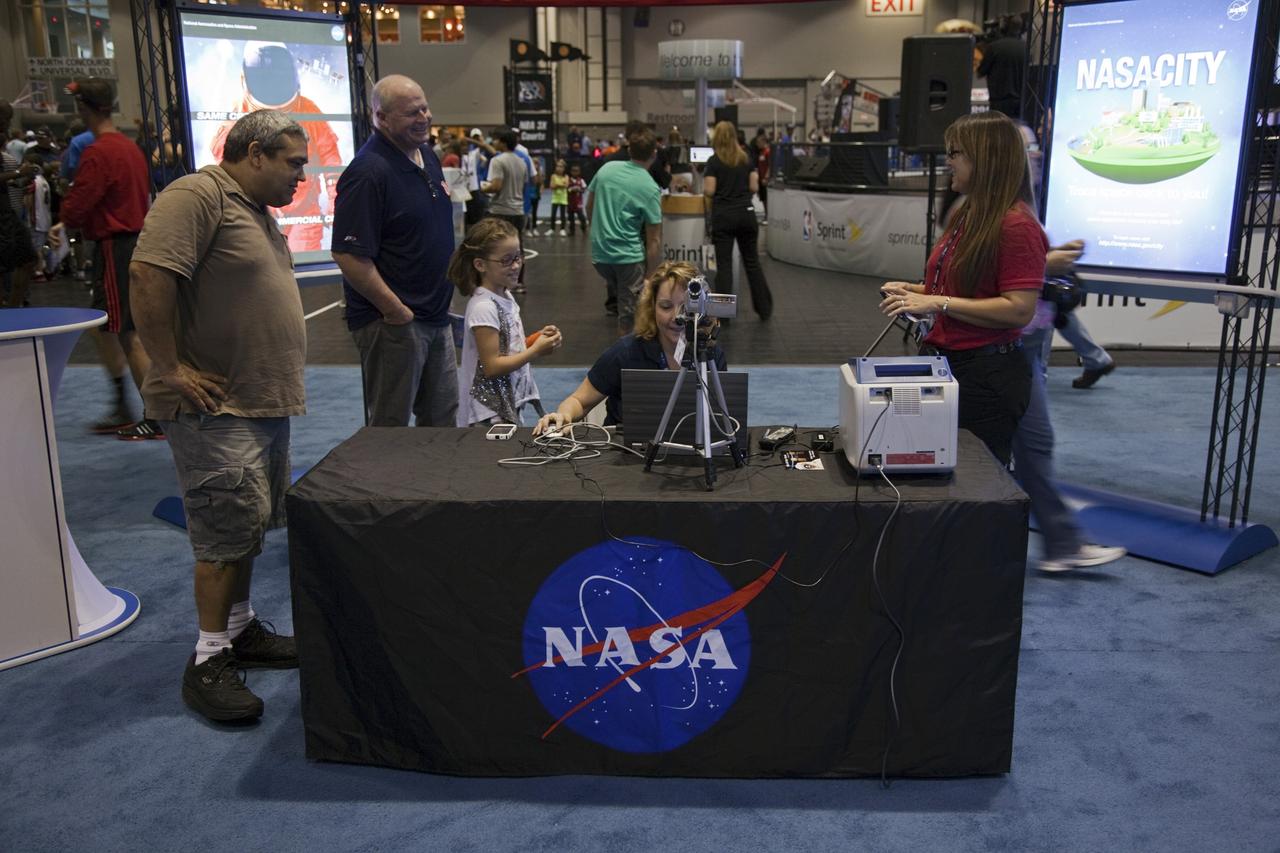
ORLANDO, Fla. -- Inside the Orange County Convention Center in Orlando, Fla., representatives from NASA's Kennedy Space Center in Florida speak to attendees visiting the NBA All-Star Jam Session. The NASA exhibit offers hands-on educational activities highlighting some of the contributions the space agency has made to sports, transportation and everyday life. One of the events leading up to the NBA All-Star game being held in Orlando on Feb. 26, the NBA All-Star Jam Session is a basketball experience intended for all ages, allowing fans to compete against their friends in skills challenges and collect autographs from players and legends. Photo credit: NASA/Frankie Martin
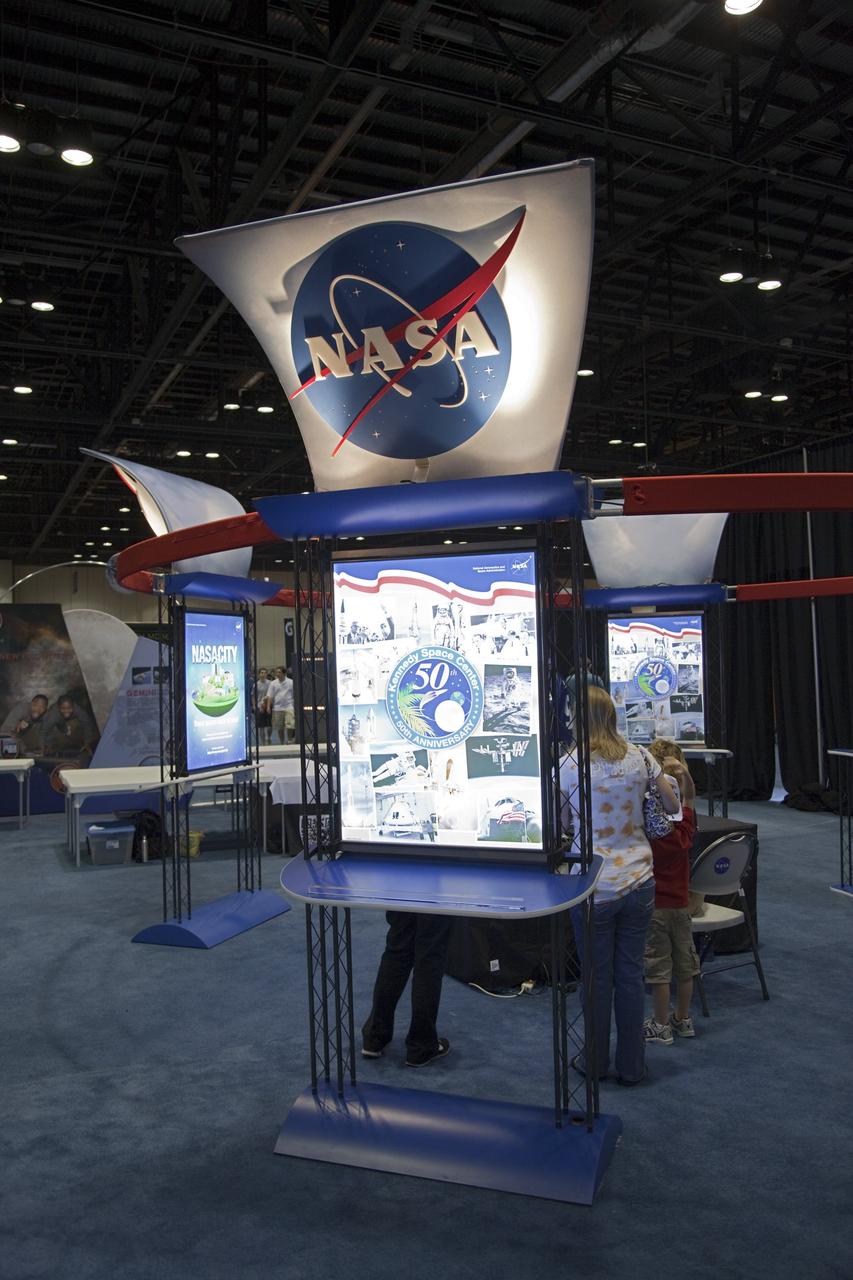
ORLANDO, Fla. -- At NASA's exhibit inside the Orange County Convention Center in Orlando, Fla., visitors to the NBA All-Star Jam Session participate in hands-on educational activities to learn more about how science plays into sports. One of the events leading up to the NBA All-Star game being held in Orlando on Feb. 26, the NBA All-Star Jam Session is a basketball experience intended for all ages, allowing fans to compete against their friends in skills challenges and collect autographs from players and legends. Photo credit: NASA/Frankie Martin
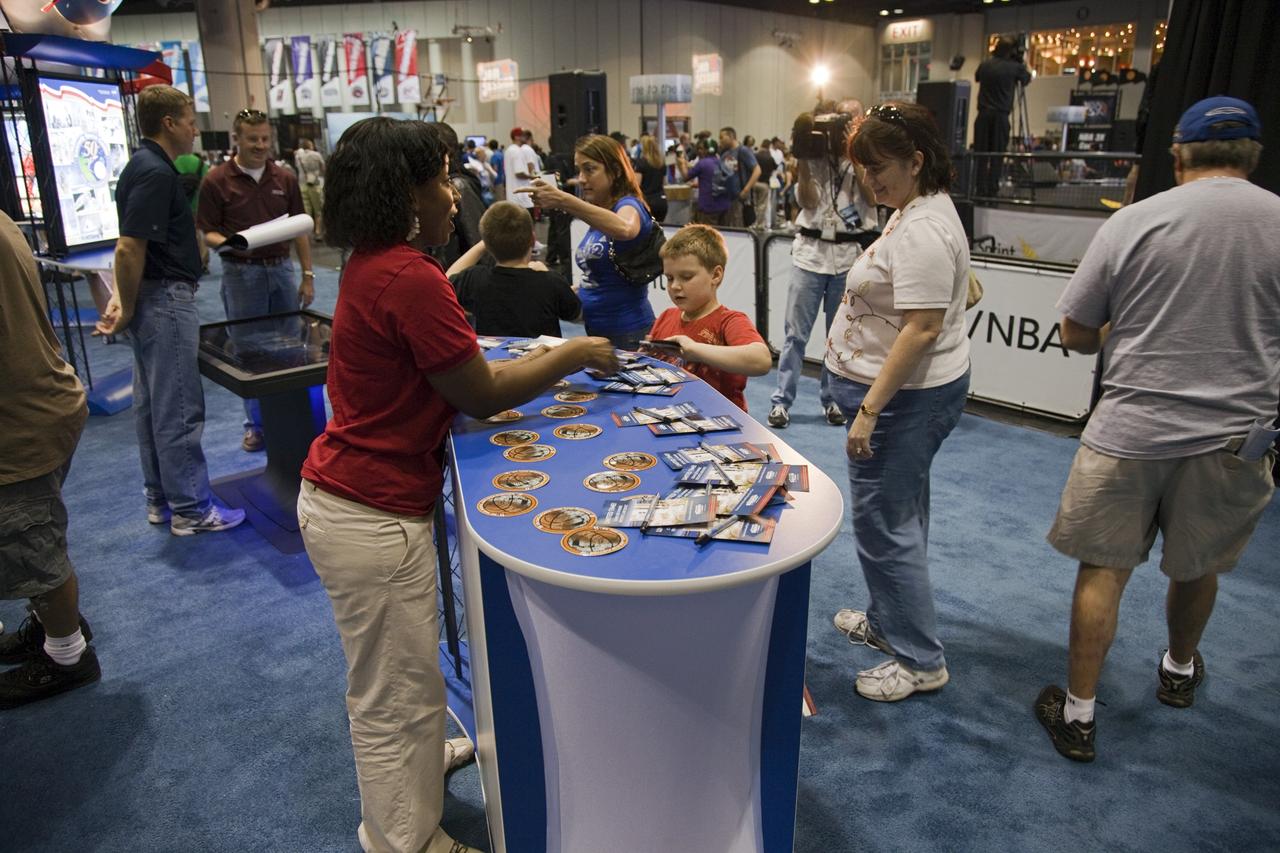
ORLANDO, Fla. -- Representatives from NASA's Kennedy Space Center in Florida talk to visitors attending the NBA All-Star Jam Session at the Orange County Convention Center in Orlando, Fla. The NASA exhibit offers hands-on educational activities highlighting some of the contributions the space agency has made to sports, transportation and everyday life. One of the events leading up to the NBA All-Star game being held in Orlando on Feb. 26, the NBA All-Star Jam Session is a basketball experience intended for all ages, allowing fans to compete against their friends in skills challenges and collect autographs from players and legends. Photo credit: NASA/Frankie Martin
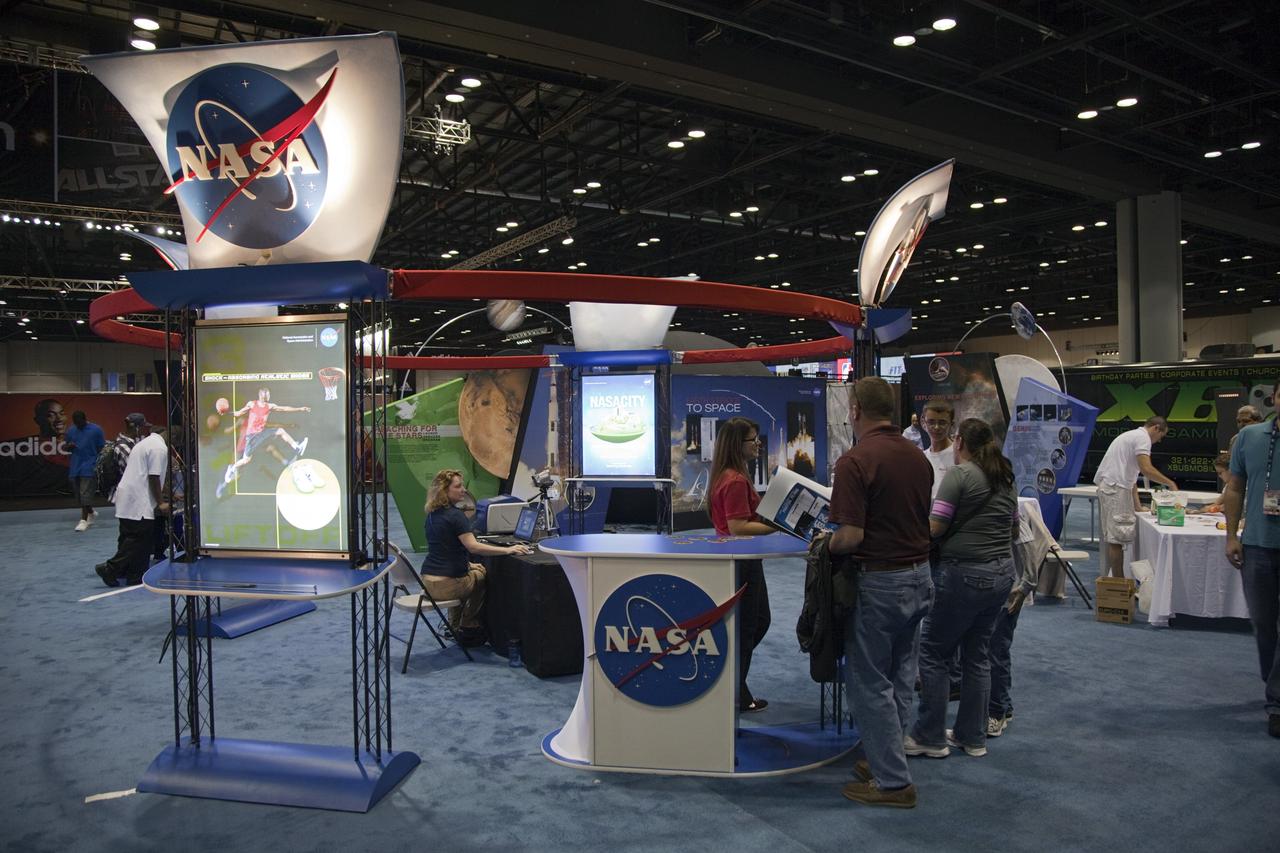
ORLANDO, Fla. -- Inside the Orange County Convention Center in Orlando, Fla., representatives from NASA's Kennedy Space Center in Florida speak to attendees visiting the NBA All-Star Jam Session. The NASA exhibit offers hands-on educational activities highlighting some of the contributions the space agency has made to sports, transportation and everyday life. One of the events leading up to the NBA All-Star game being held in Orlando on Feb. 26, the NBA All-Star Jam Session is a basketball experience intended for all ages, allowing fans to compete against their friends in skills challenges and collect autographs from players and legends. Photo credit: NASA/Frankie Martin
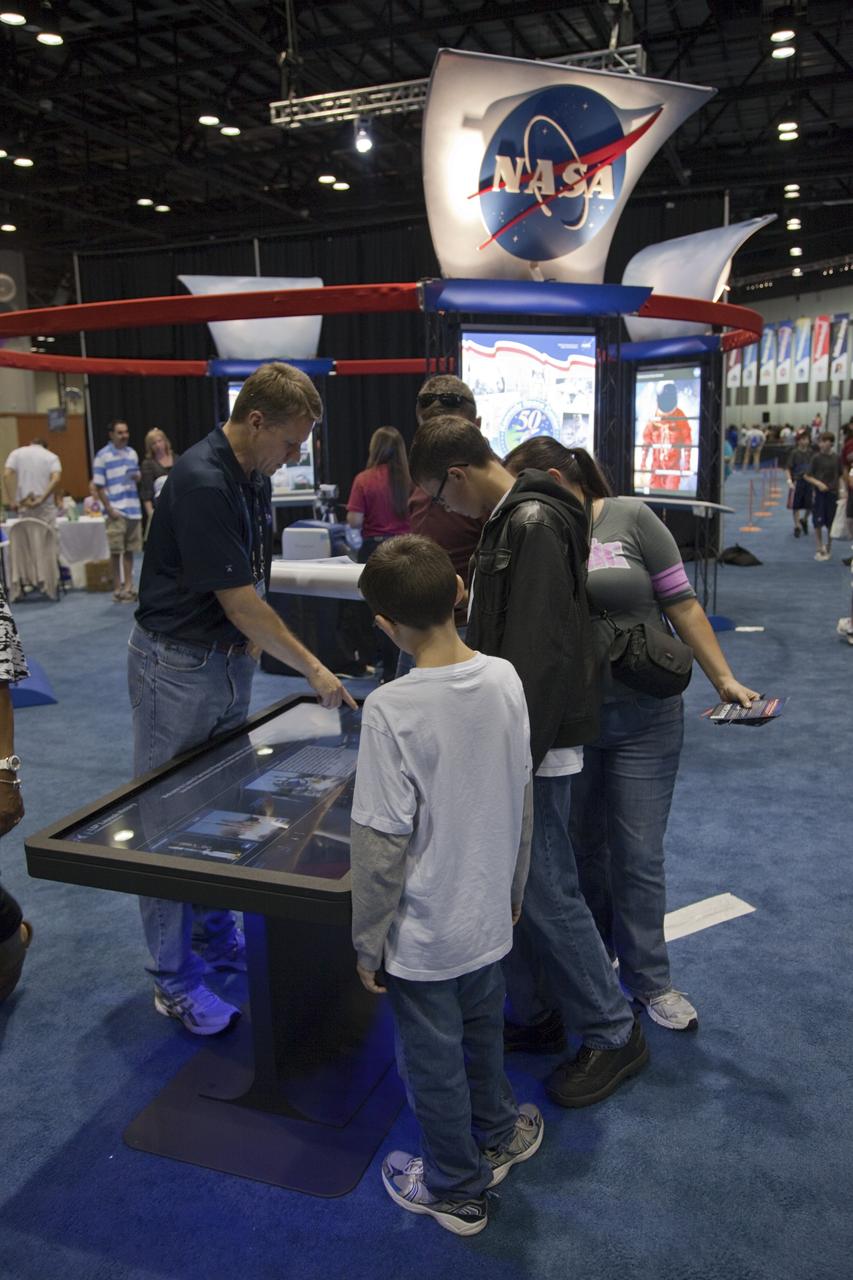
ORLANDO, Fla. -- Visitors to the NBA All-Star Jam Session at the Orange County Convention Center in Orlando, Fla., use a large touch-screen to learn more about NASA's activities and missions. Representatives from Kennedy Space Center in Florida helped attendees participate in hands-on educational activities to learn more about how science plays into sports. One of the events leading up to the NBA All-Star game being held in Orlando on Feb. 26, the NBA All-Star Jam Session is a basketball experience intended for all ages, allowing fans to compete against their friends in skills challenges and collect autographs from players and legends. Photo credit: NASA/Frankie Martin
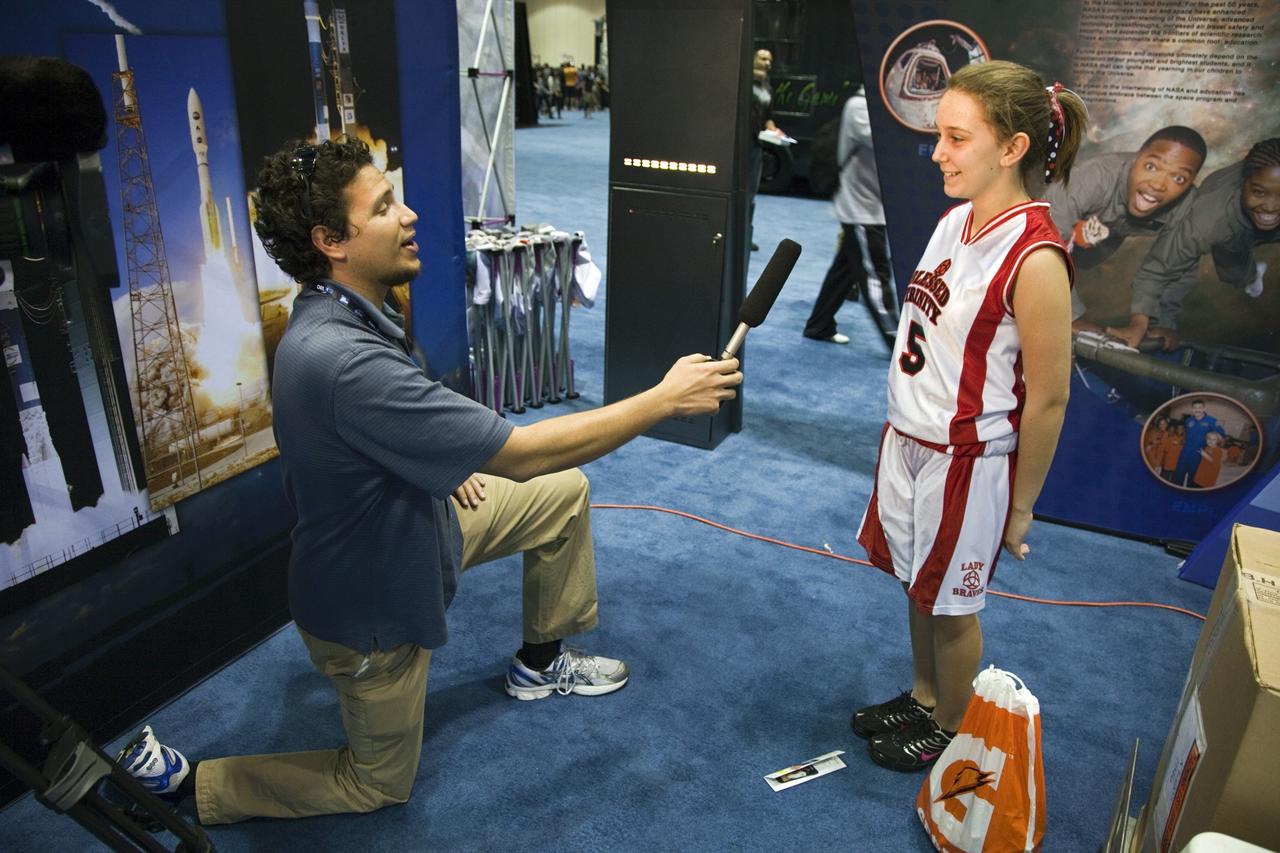
ORLANDO, Fla. -- A representative from NASA's Kennedy Space Center in Florida speaks with a young visitor attending the NBA All-Star Jam Session at the Orange County Convention Center in Orlando, Fla. The NASA exhibit offers hands-on educational activities highlighting some of the contributions the space agency has made to sports, transportation and everyday life. One of the events leading up to the NBA All-Star game being held in Orlando on Feb. 26, the NBA All-Star Jam Session is a basketball experience intended for all ages, allowing fans to compete against their friends in skills challenges and collect autographs from players and legends. Photo credit: NASA/Frankie Martin
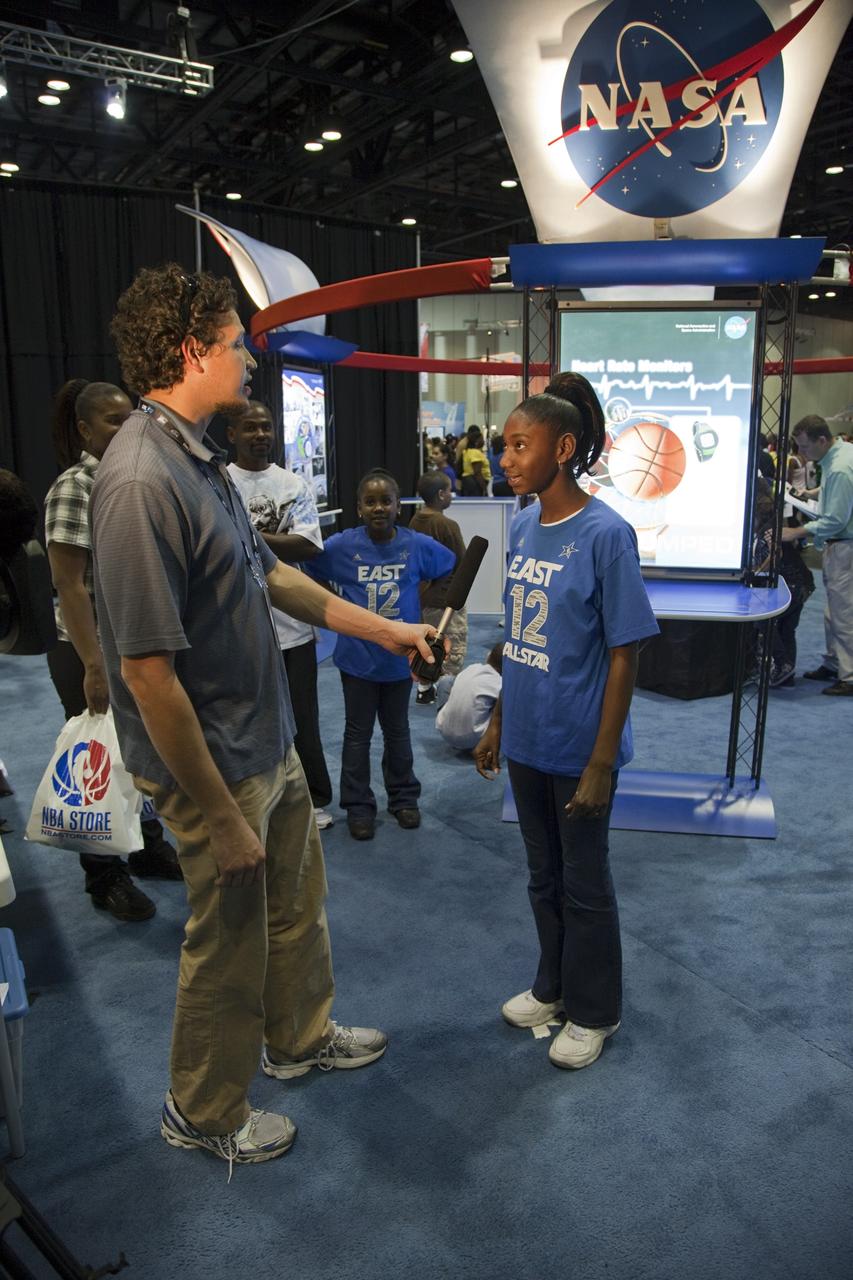
ORLANDO, Fla. -- A representative from NASA's Kennedy Space Center in Florida speaks with a young visitor attending the NBA All-Star Jam Session at the Orange County Convention Center in Orlando, Fla. The NASA exhibit offers hands-on educational activities highlighting some of the contributions the space agency has made to sports, transportation and everyday life. One of the events leading up to the NBA All-Star game being held in Orlando on Feb. 26, the NBA All-Star Jam Session is a basketball experience intended for all ages, allowing fans to compete against their friends in skills challenges and collect autographs from players and legends. Photo credit: NASA/Frankie Martin
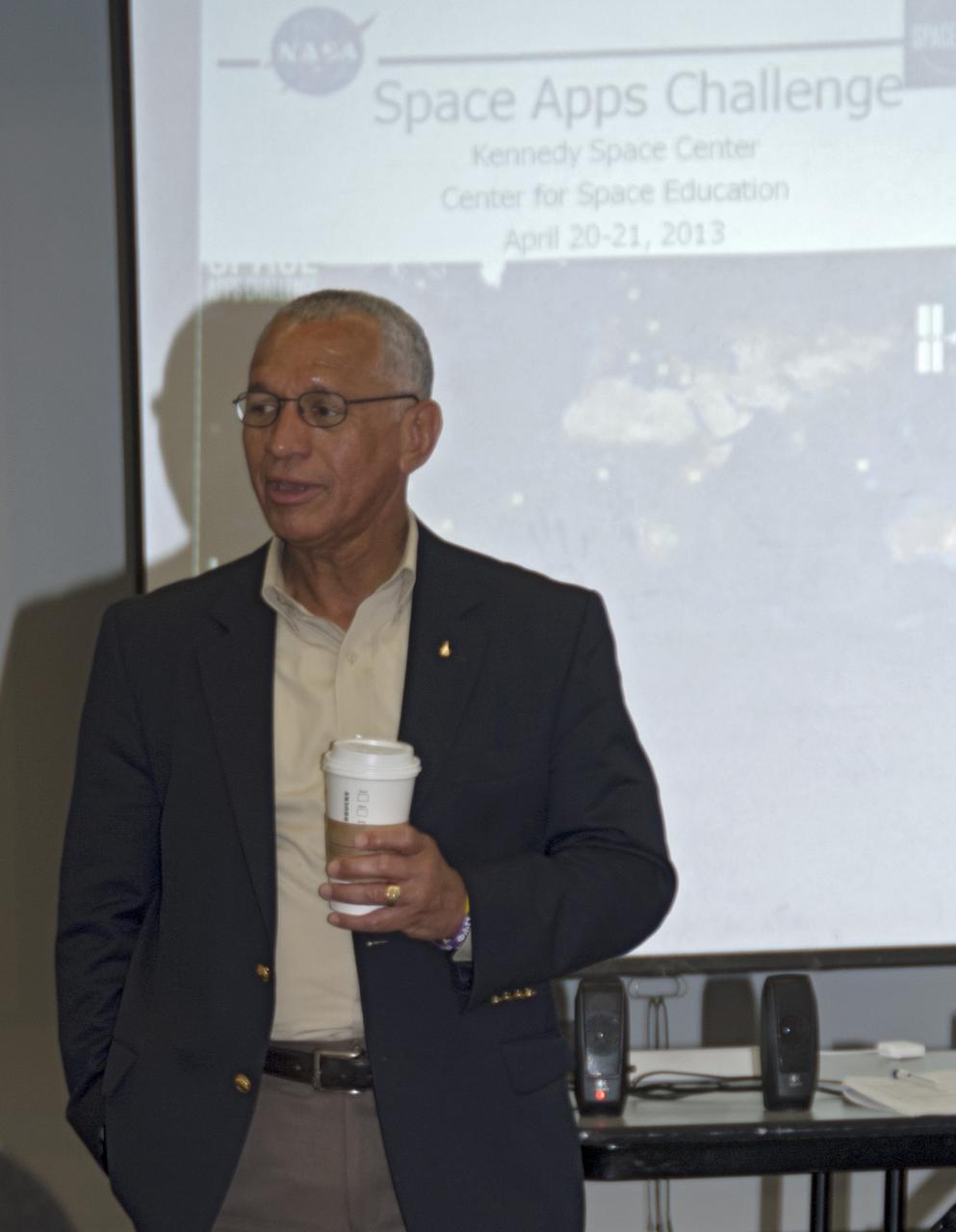
CAPE CANAVERAL, Fla. – NASA Administrator Charlie Bolden speaks with participants of the 2013 International Space Apps Challenge, or ISAC, at The Astronaut Memorial Foundation’s Center for Space Education in Florida during a networking event. During the worldwide two-day challenge, more than 9,000 people and 484 organizations came together in 83 cities across 44 countries, as well as online, to develop new ways of solving challenges that NASA faces. At Kennedy, four teams brainstormed ideas with subject matter experts and others and worked nearly 32 hours straight to present their concepts to a panel of three technical and non-technical judges. Challenges tackled at Kennedy were: Deployable Greenhouse, Kennedy Space Center 2040, Seven Minutes of Science, and Moonville – Lunar Industry Game. Photo credit: NASA_Charisse Nahser
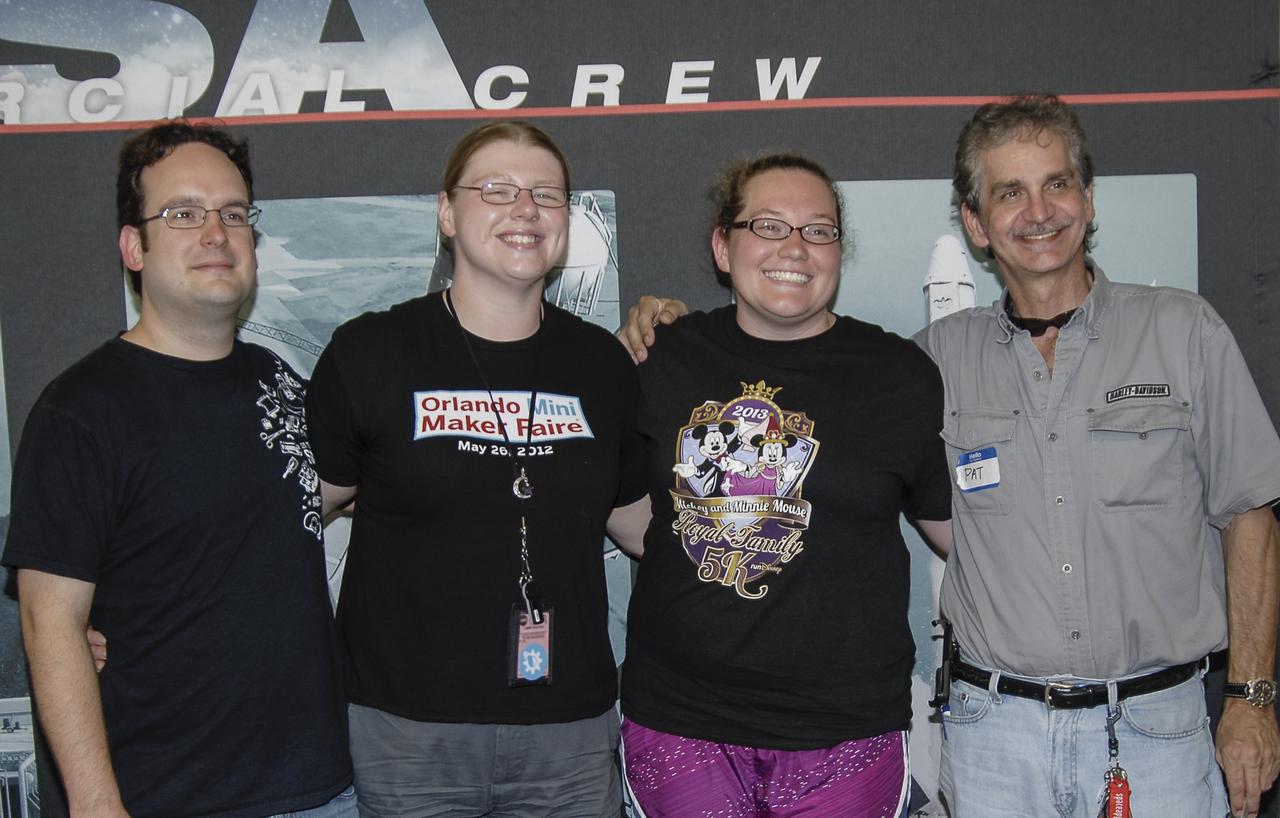
CAPE CANAVERAL, Fla. – Space enthusiasts Mike King, at left, Jamie Szafran, Jessica King and Pat Starace, were first-place winners from Kennedy Space Center during the 2013 International Space Apps Challenge held at the Center for Space Education at the Kennedy Space Center Visitor Complex in Florida. During the worldwide two-day challenge, more than 9,000 people and 484 organizations came together in 83 cities across 44 countries, as well as online, to develop new ways of solving challenges that NASA faces. At Kennedy, four teams brainstormed ideas with subject matter experts and others and worked nearly 32 hours straight to present their concepts to a panel of three technical and non-technical judges. Challenges tackled at Kennedy were: Deployable Greenhouse, Kennedy Space Center 2040, Seven Minutes of Science, and Moonville – Lunar Industry Game. Photo credit: NASA_Charisse Nahser
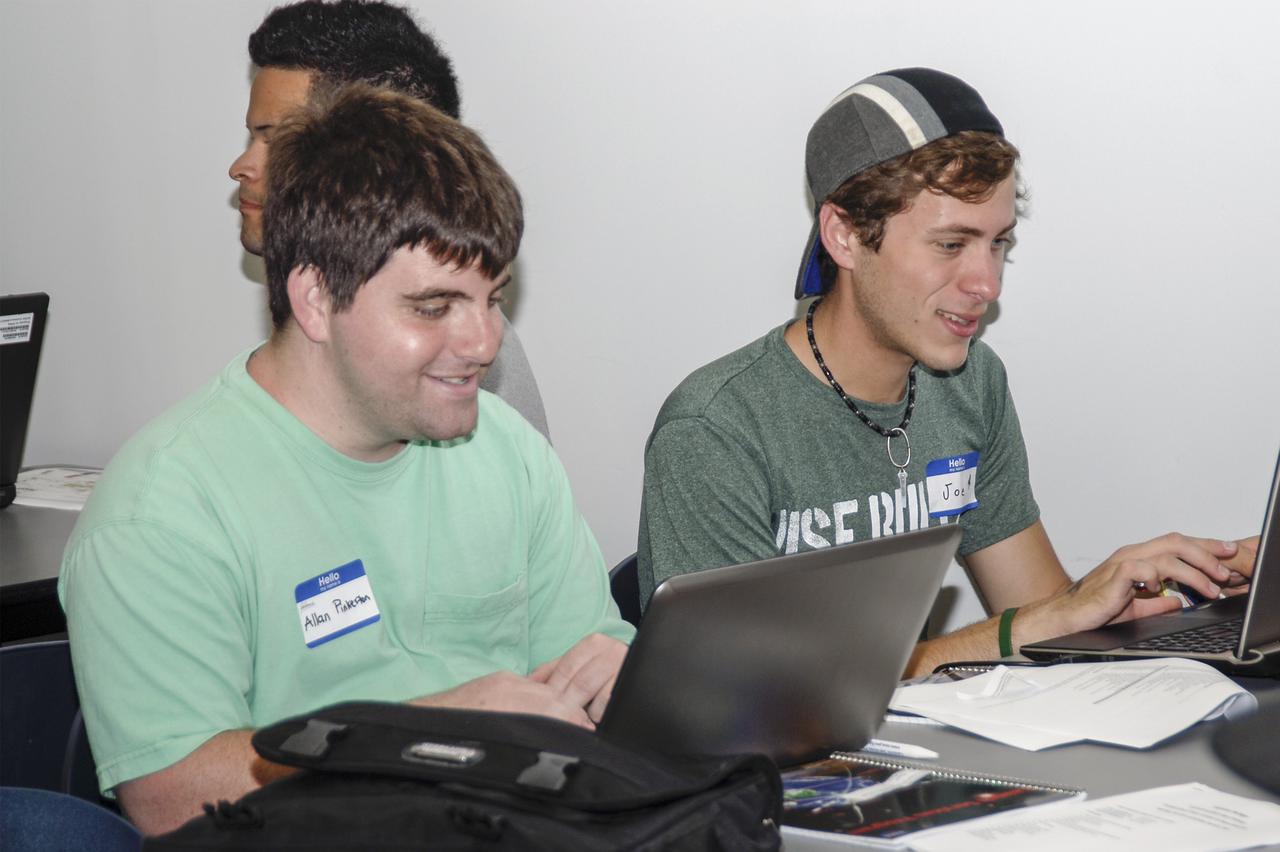
CAPE CANAVERAL, Fla. – Allan Pinkerton, at left, and Joey Vars, students from the University of South Florida at St. Petersburg, brainstorm ideas during the 2013 International Space Apps Challenge at the Center for Space Education at the Kennedy Space Center Visitor Complex in Florida. During the worldwide two-day challenge, more than 9,000 people and 484 organizations came together in 83 cities across 44 countries, as well as online, to develop new ways of solving challenges that NASA faces. At Kennedy, four teams brainstormed ideas with subject matter experts and others and worked nearly 32 hours straight to present their concepts to a panel of three technical and non-technical judges. Challenges tackled at Kennedy were: Deployable Greenhouse, Kennedy Space Center 2040, Seven Minutes of Science, and Moonville – Lunar Industry Game. Photo credit: NASA_Charisse Nahser
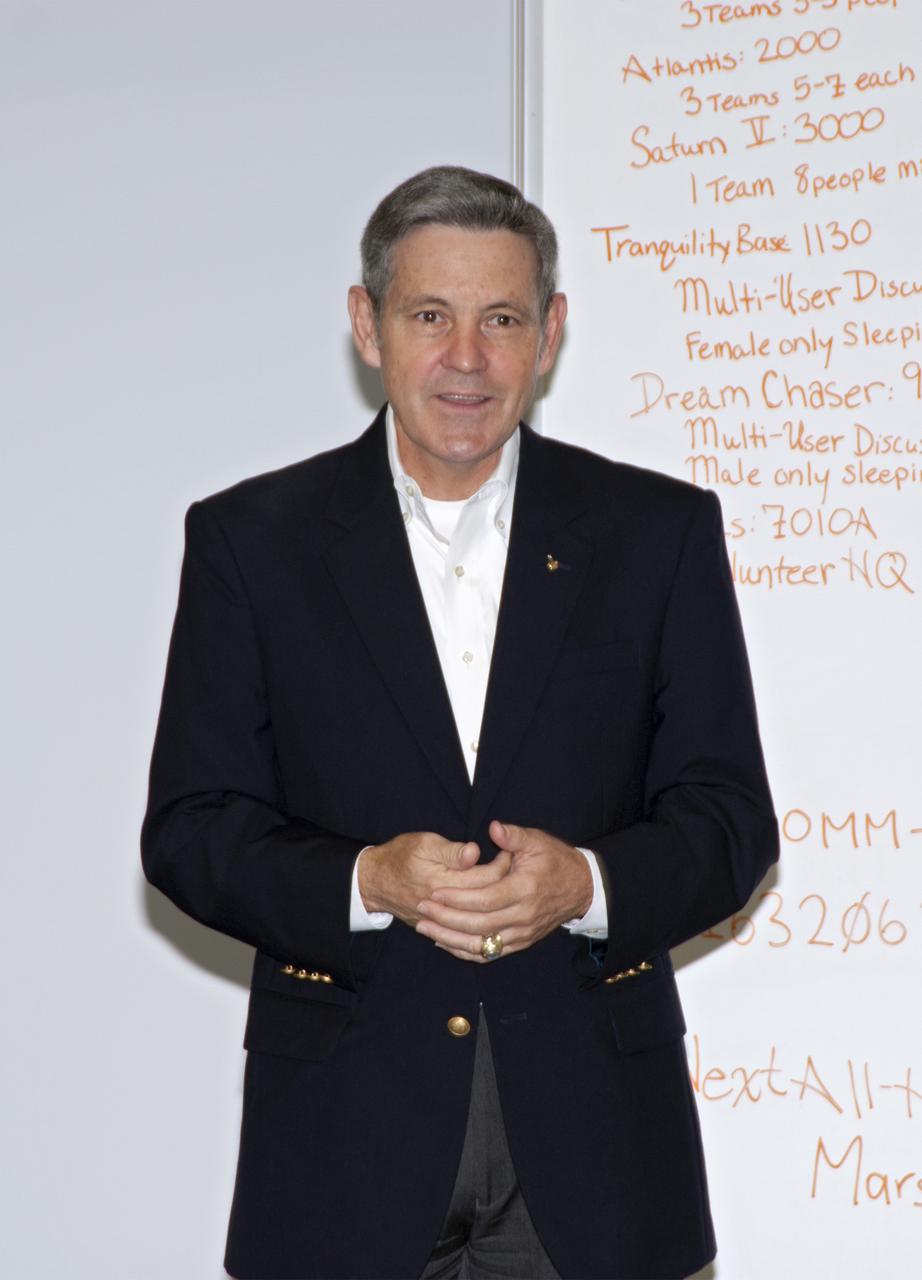
CAPE CANAVERAL, Fla. – Kennedy Space Center Director Bob Cabana speaks with participants of the 2013 International Space Apps Challenge, or ISAC, at The Astronaut Memorial Foundation’s Center for Space Education in Florida during a networking event. During the worldwide two-day challenge, more than 9,000 people and 484 organizations came together in 83 cities across 44 countries, as well as online, to develop new ways of solving challenges that NASA faces. At Kennedy, four teams brainstormed ideas with subject matter experts and others and worked nearly 32 hours straight to present their concepts to a panel of three technical and non-technical judges. Challenges tackled at Kennedy were: Deployable Greenhouse, Kennedy Space Center 2040, Seven Minutes of Science, and Moonville – Lunar Industry Game. Photo credit: NASA_Charisse Nahser
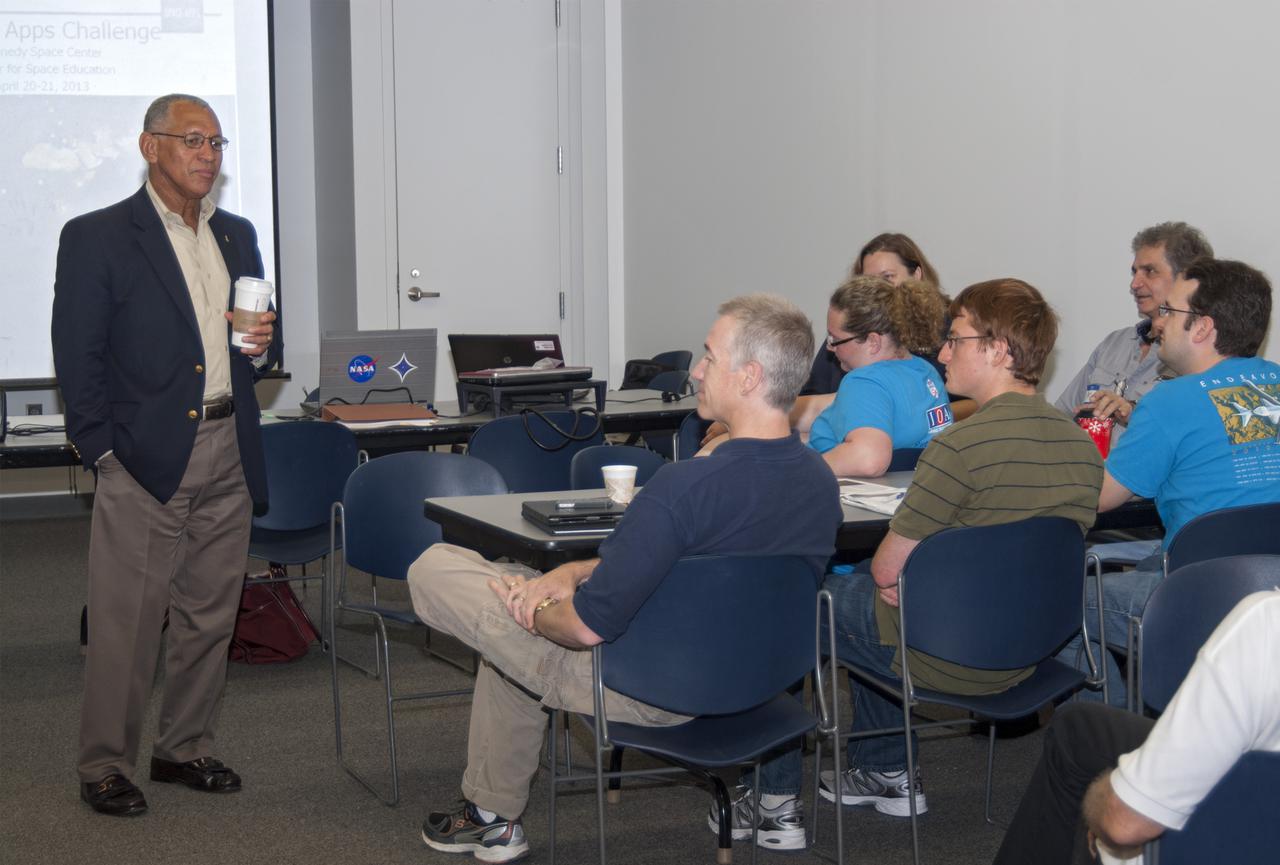
CAPE CANAVERAL, Fla. – NASA Administrator Charlie Bolden speaks with participants of the 2013 International Space Apps Challenge, or ISAC, at The Astronaut Memorial Foundation’s Center for Space Education in Florida during a networking event. During the worldwide two-day challenge, more than 9,000 people and 484 organizations came together in 83 cities across 44 countries, as well as online, to develop new ways of solving challenges that NASA faces. At Kennedy, four teams brainstormed ideas with subject matter experts and others and worked nearly 32 hours straight to present their concepts to a panel of three technical and non-technical judges. Challenges tackled at Kennedy were: Deployable Greenhouse, Kennedy Space Center 2040, Seven Minutes of Science, and Moonville – Lunar Industry Game. Photo credit: NASA_Charisse Nahser
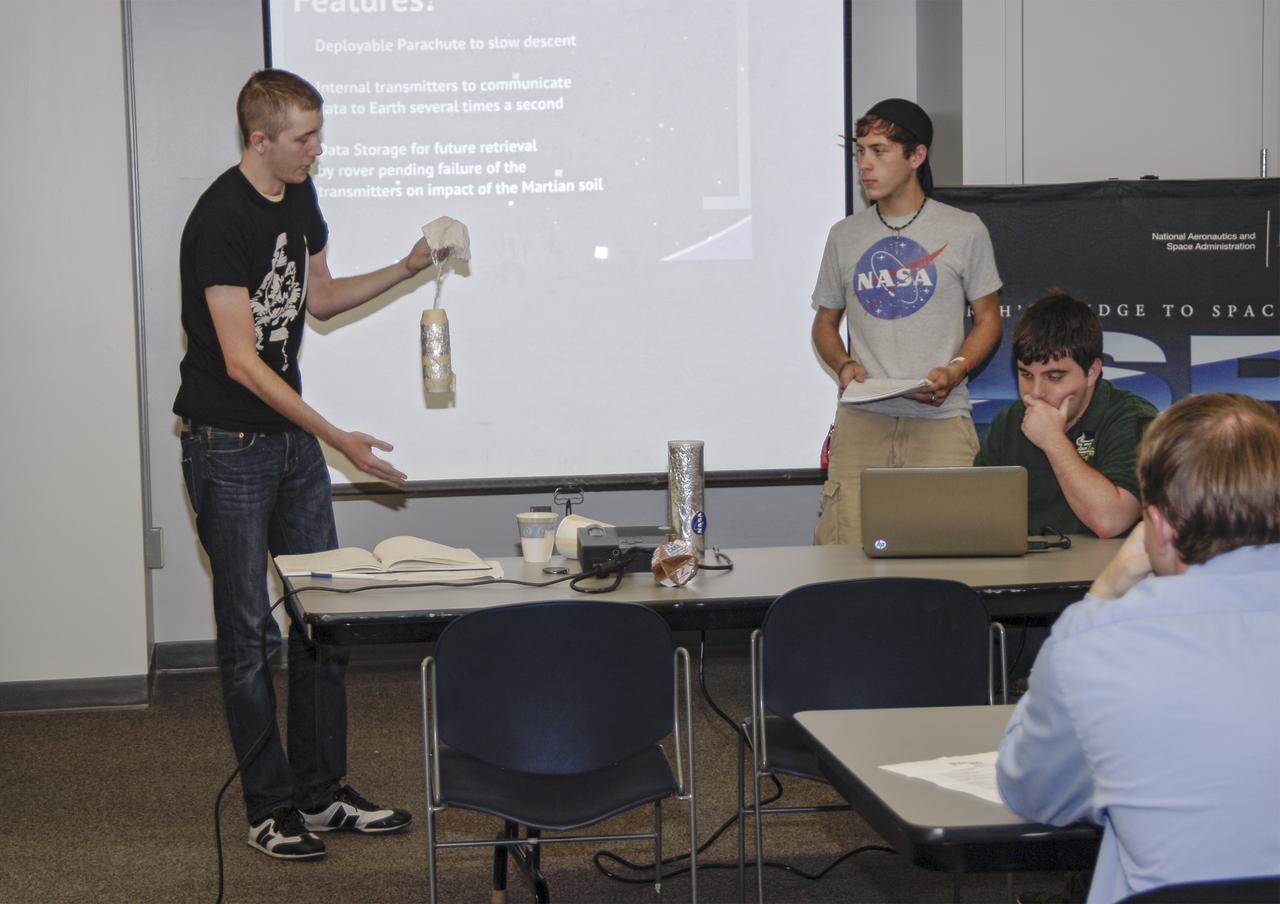
CAPE CANAVERAL, Fla. – Michael Strittmatter, at left, Joey Vars and Allan Pinkerton, all students at the University of South Florida St. Petersburg, present their ideas to a panel of technical and non-technical judges during the 2013 International Space Apps Challenge at The Astronaut Memorial Foundation’s Center for Space Education in Florida. During the worldwide two-day challenge, more than 9,000 people and 484 organizations came together in 83 cities across 44 countries, as well as online, to develop new ways of solving challenges that NASA faces. At Kennedy, four teams brainstormed ideas with subject matter experts and others and worked nearly 32 hours straight to present their concepts to a panel of three technical and non-technical judges. Challenges tackled at Kennedy were: Deployable Greenhouse, Kennedy Space Center 2040, Seven Minutes of Science, and Moonville – Lunar Industry Game. Photo credit: NASA_Charisse Nahser
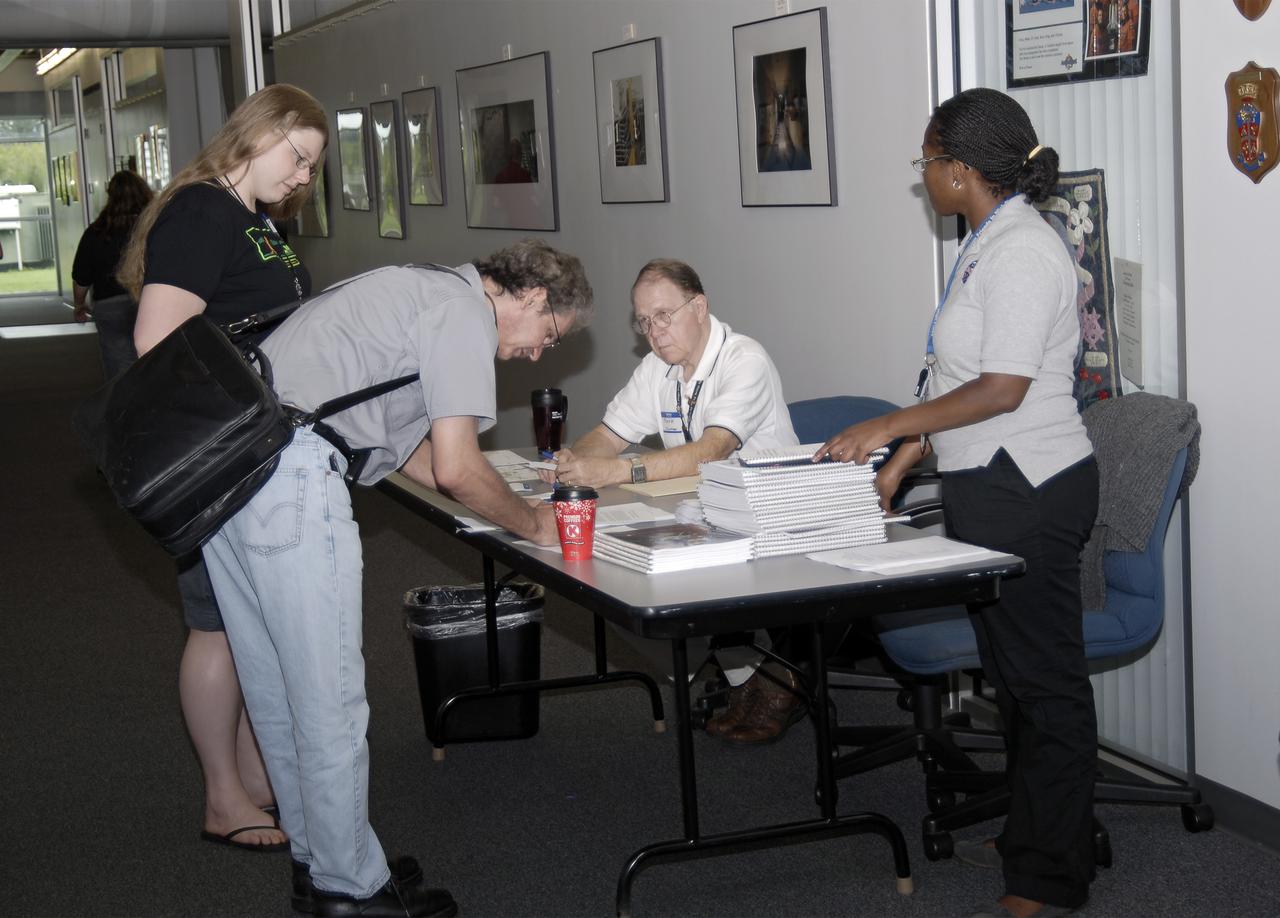
CAPE CANAVERAL, Fla. – Participants sign in at the Center for Space Education at the Kennedy Space Center Visitor Complex in Florida for the 2013 International Space Apps Challenge. . During the worldwide two-day challenge, more than 9,000 people and 484 organizations came together in 83 cities across 44 countries, as well as online, to develop new ways of solving challenges that NASA faces. At Kennedy, four teams brainstormed ideas with subject matter experts and others and worked nearly 32 hours straight to present their concepts to a panel of three technical and non-technical judges. Challenges tackled at Kennedy were: Deployable Greenhouse, Kennedy Space Center 2040, Seven Minutes of Science, and Moonville – Lunar Industry Game. Photo credit: NASA_Charisse Nahser
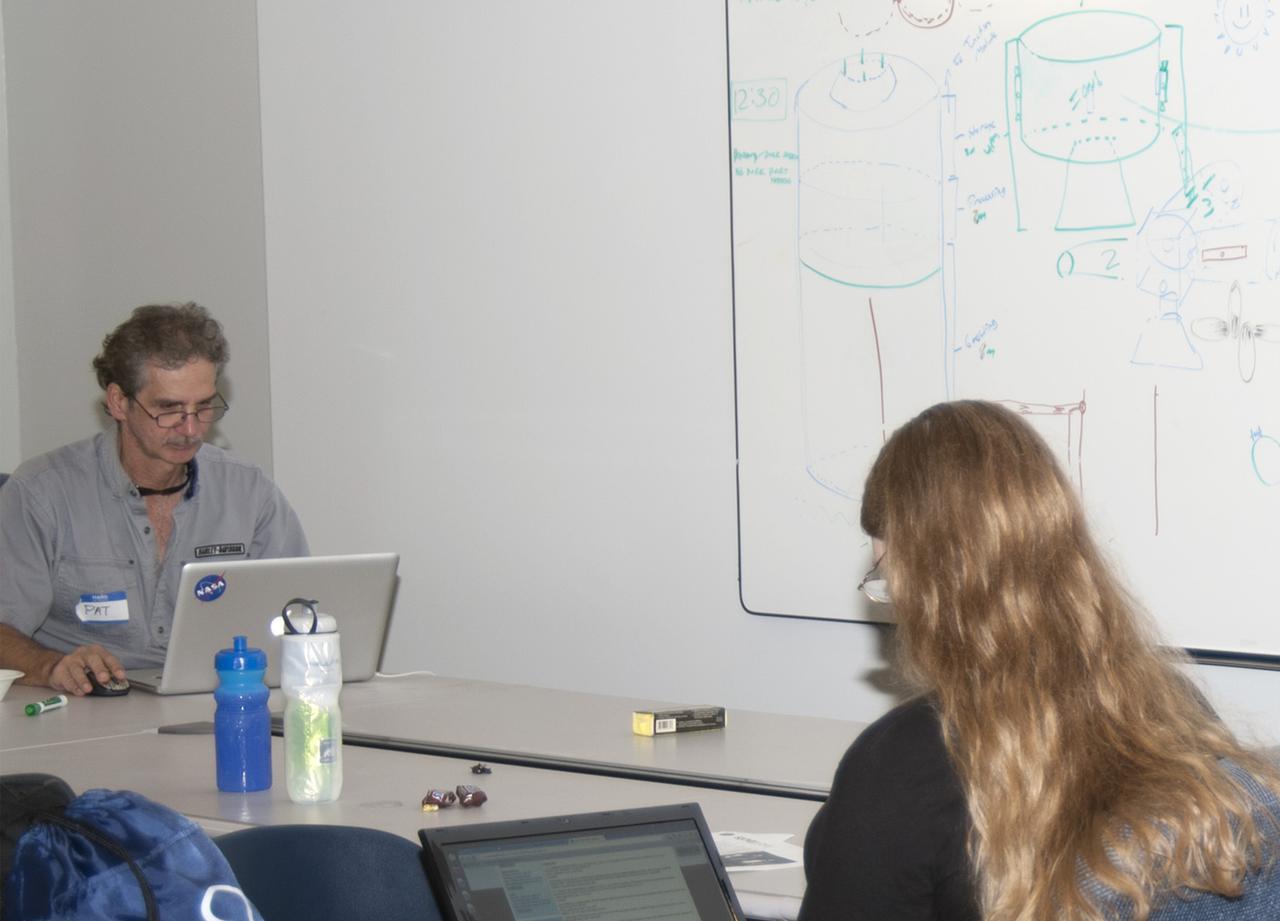
CAPE CANAVERAL, Fla. – Pat Starace, at left, from Orlando, and Kennedy Space Center engineer Jamie Szafran brainstorm ideas on deployable greenhouses during the 2013 International Space Apps Challenge, or ISAC, at The Astronaut Memorial Foundation’s Center for Space Education in Florida. During the worldwide two-day challenge, more than 9,000 people and 484 organizations came together in 83 cities across 44 countries, as well as online, to develop new ways of solving challenges that NASA faces. At Kennedy, four teams brainstormed ideas with subject matter experts and others and worked nearly 32 hours straight to present their concepts to a panel of three technical and non-technical judges. Challenges tackled at Kennedy were: Deployable Greenhouse, Kennedy Space Center 2040, Seven Minutes of Science, and Moonville – Lunar Industry Game. Photo credit: NASA_Charisse Nahser
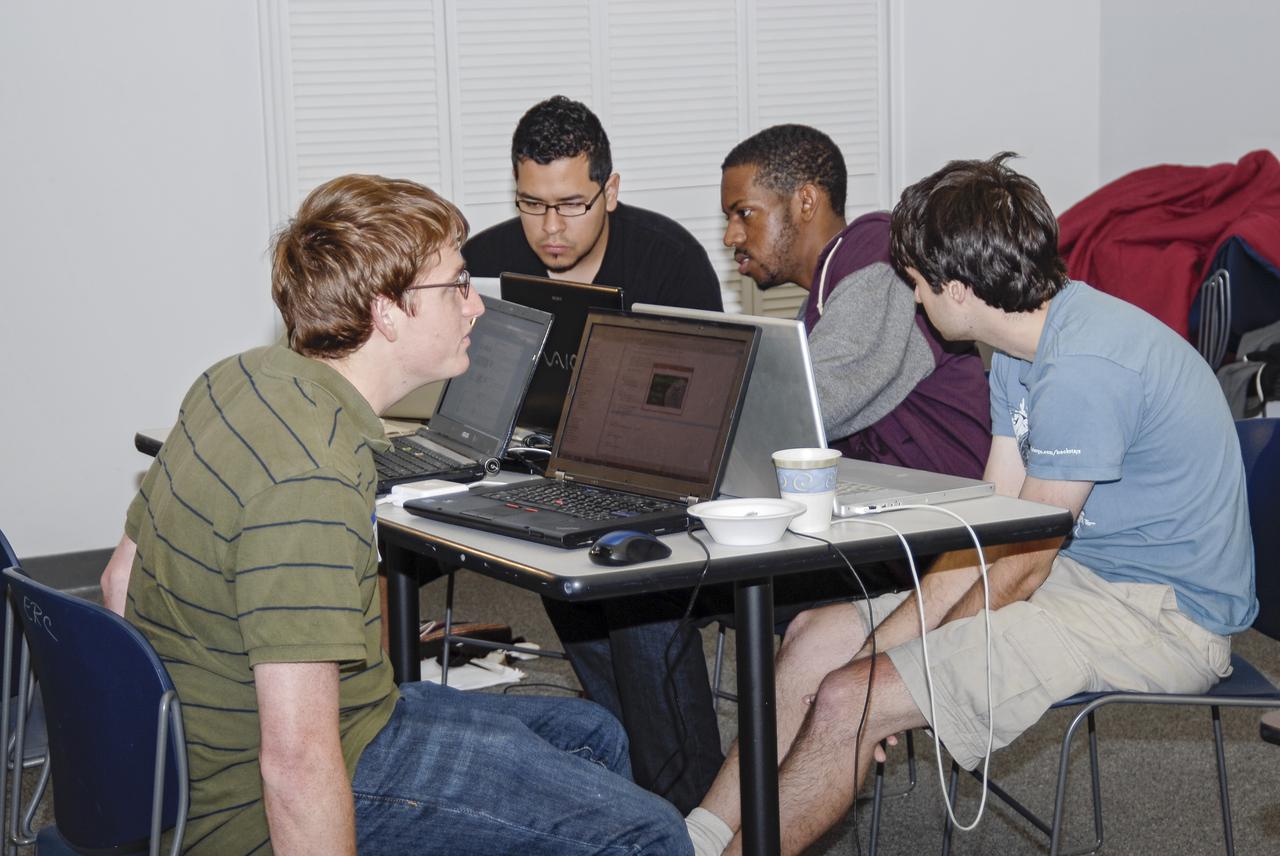
CAPE CANAVERAL, Fla. – Students from the University of Florida, University of Central Florida and the University of Puerto Rico brainstorm ideas during the 2013 International Space Apps Challenge, or ISAC, at The Astronaut Memorial Foundation’s Center for Space Education in Florida. During the worldwide two-day challenge, more than 9,000 people and 484 organizations came together in 83 cities across 44 countries, as well as online, to develop new ways of solving challenges that NASA faces. At Kennedy, four teams brainstormed ideas with subject matter experts and others and worked nearly 32 hours straight to present their concepts to a panel of three technical and non-technical judges. Challenges tackled at Kennedy were: Deployable Greenhouse, Kennedy Space Center 2040, Seven Minutes of Science, and Moonville – Lunar Industry Game. Photo credit: NASA_Charisse Nahser
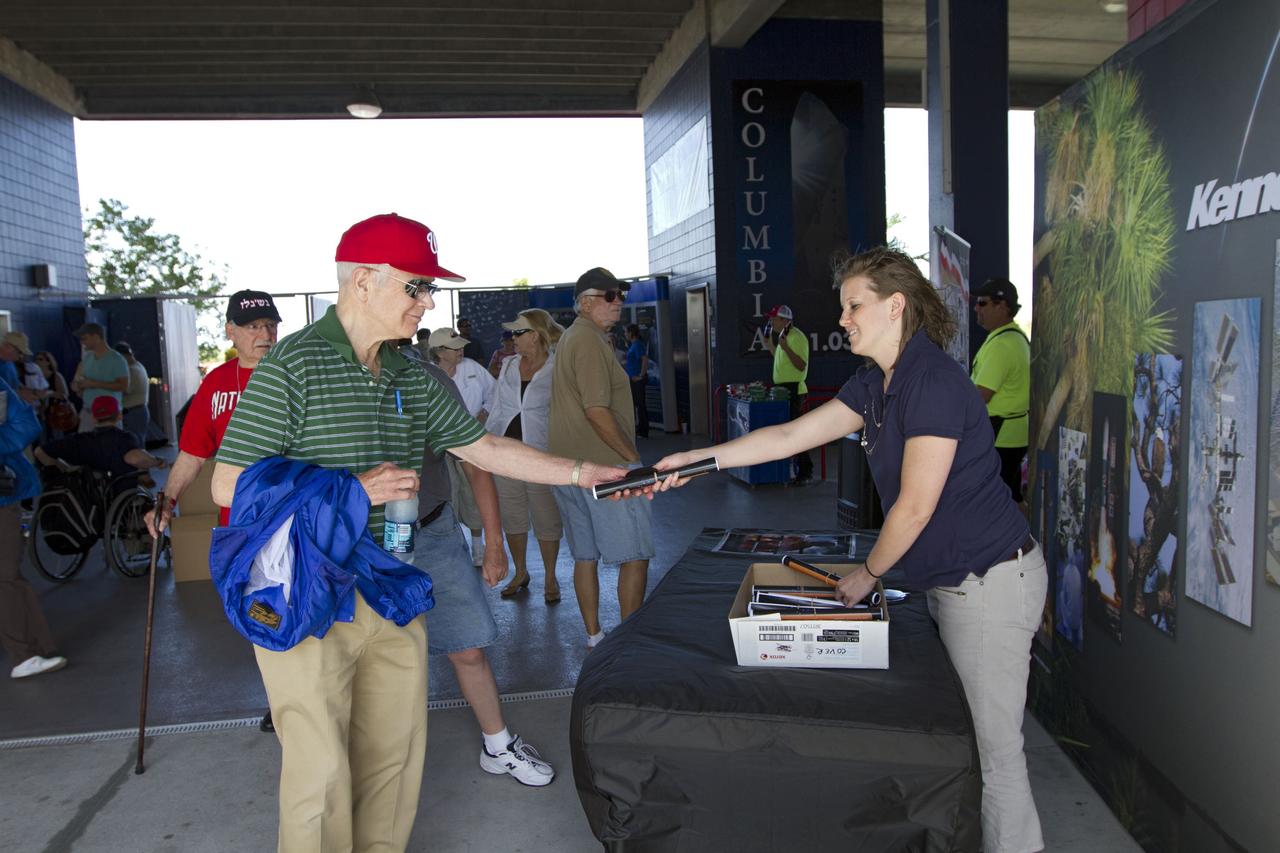
VIERA, Fla. – Tiffany Lindsley, with Education and External Relations at NASA’s Kennedy Space Center in Florida, hands out information on some of the contributions the space agency has made to sports, transportation and everyday life to a baseball fan attending Space Day at the Space Coast Stadium. Bob Cabana, director of Kennedy, was on hand to throw the first pitch of a spring training game between Major League Baseball's Washington Nationals and the Houston Astros. A full-scale test version of NASA's new Orion Multi-Purpose Crew Vehicle was on display outside the stadium for the occasion to show the public the spacecraft under development that will take astronauts farther into space than ever before. For more information, visit http://www.nasa.gov/kennedy. Photo credit: NASA/Kim Shiflett
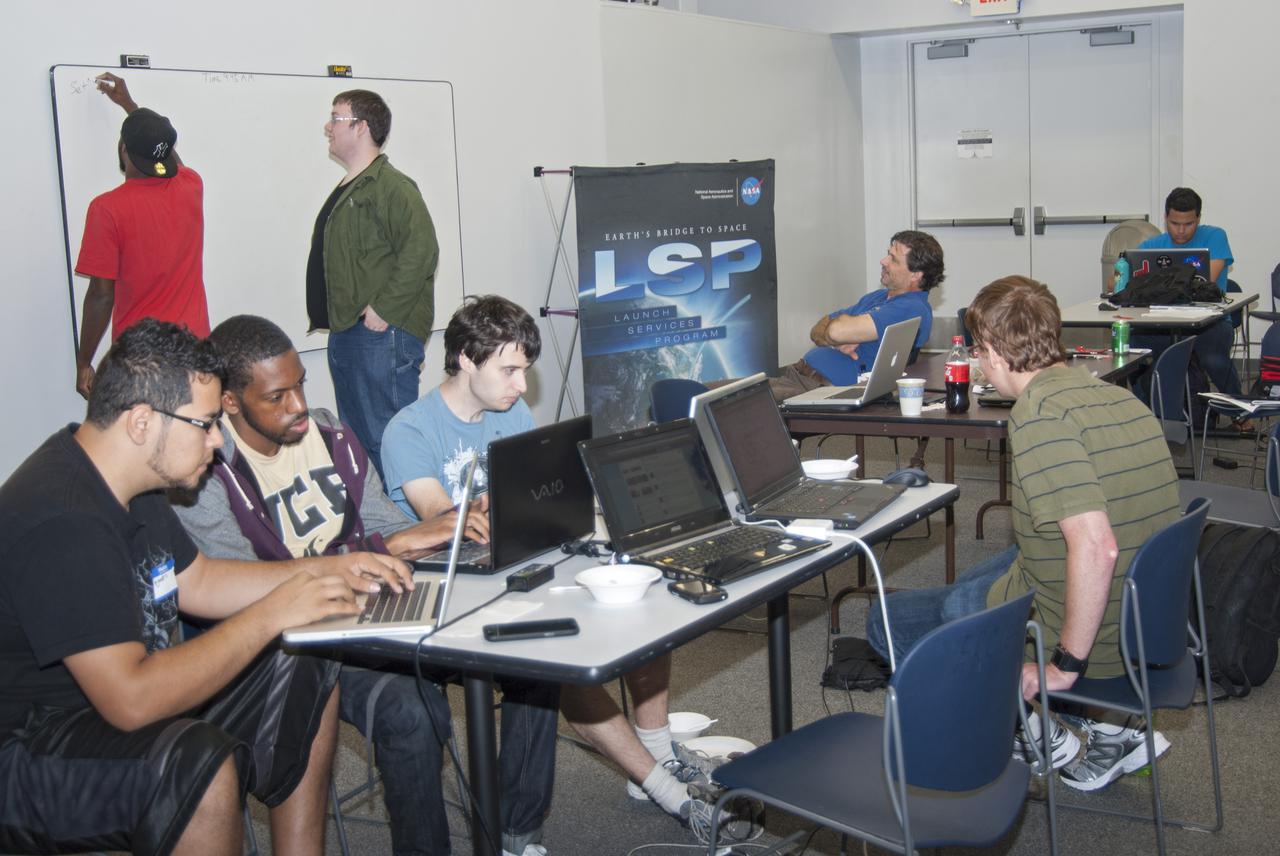
CAPE CANAVERAL, Fla. – Students from the University of Florida, the University of Central Florida, the University of Puerto Rico and private citizens brainstorm ideas during the 2013 International Space Apps Challenge, or ISAC, at The Astronaut Memorial Foundation’s Center for Space Education in Florida. Seated near the Launch Services Program poster is NASA subject matter expert Dr. Phil Metzger from Kennedy Space Center’s Swampworks Laboratory. During the worldwide two-day challenge, more than 9,000 people and 484 organizations came together in 83 cities across 44 countries, as well as online, to develop new ways of solving challenges that NASA faces. At Kennedy, four teams brainstormed ideas with subject matter experts and others and worked nearly 32 hours straight to present their concepts to a panel of three technical and non-technical judges. Challenges tackled at Kennedy were: Deployable Greenhouse, Kennedy Space Center 2040, Seven Minutes of Science, and Moonville – Lunar Industry Game. Photo credit: NASA_Charisse Nahser
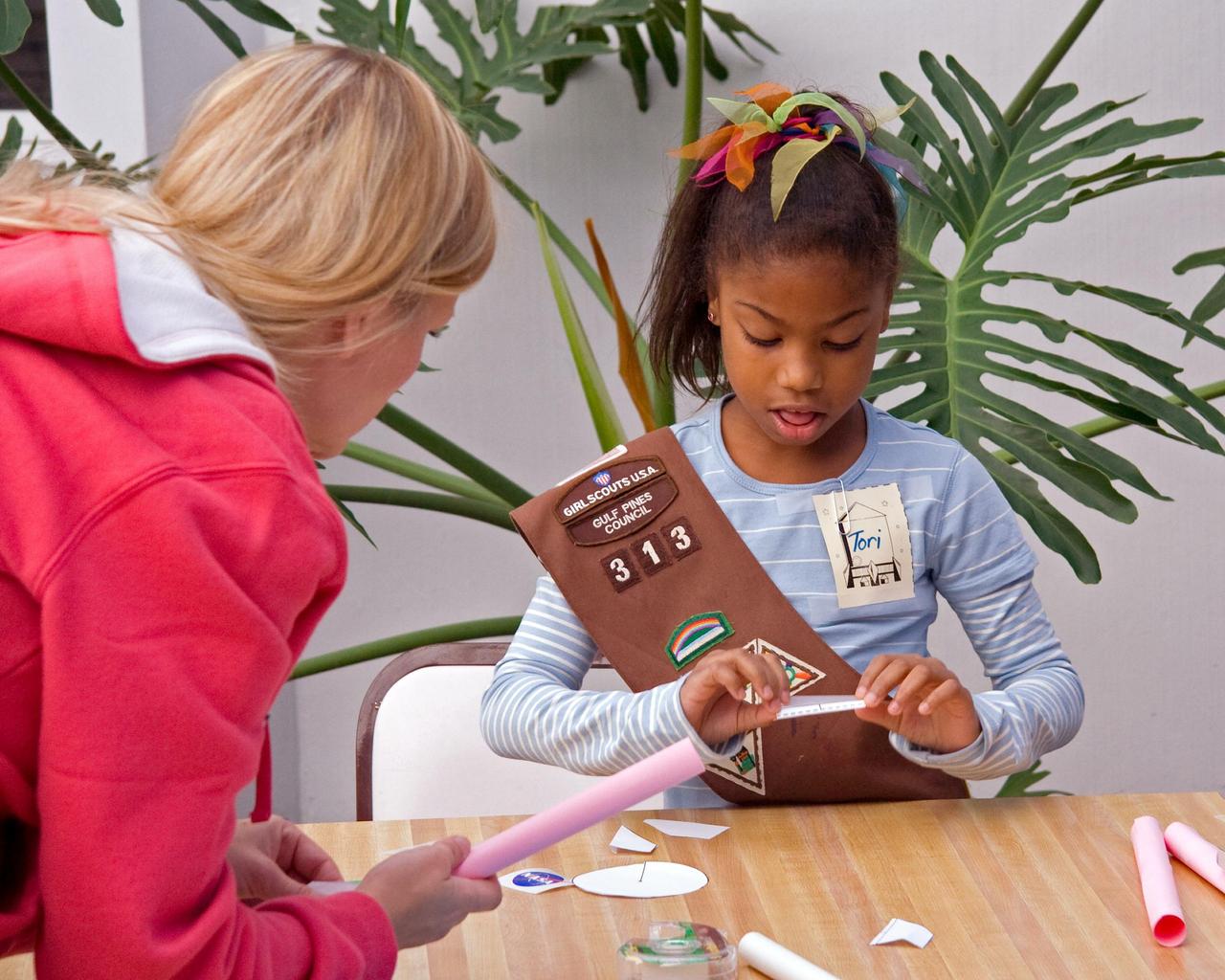
Tori Williams, of Brownie Girl Scout Troop 313, builds her own `stomp rocket' with the help of adult chaperone Pamela Cottrell. The two, of Gulfport, participated in NASA Brownie Day on Oct. 13 at Stennis Space Center. They were among nearly 200 members of Brownie Girl Scout Troops within the Gulf Pines Council who took part in the day of educational activities at SSC. Brownie Day used NASA curriculum support materials to teach about the sun and its significance in our solar system. In addition to building and launching their own model rockets, the girls toured the center's portable Starlab planetarium; viewed demonstrations about living and working in space; played games of `Moon Phasers' that teach about the rotation of the moon around the earth; made bracelets with ultraviolet-sensitive beads; and other activities that celebrated Earth's very own star. They also toured StenniSphere and were able to earn their Earth and Sky and Space Explorer `Try-Its.'
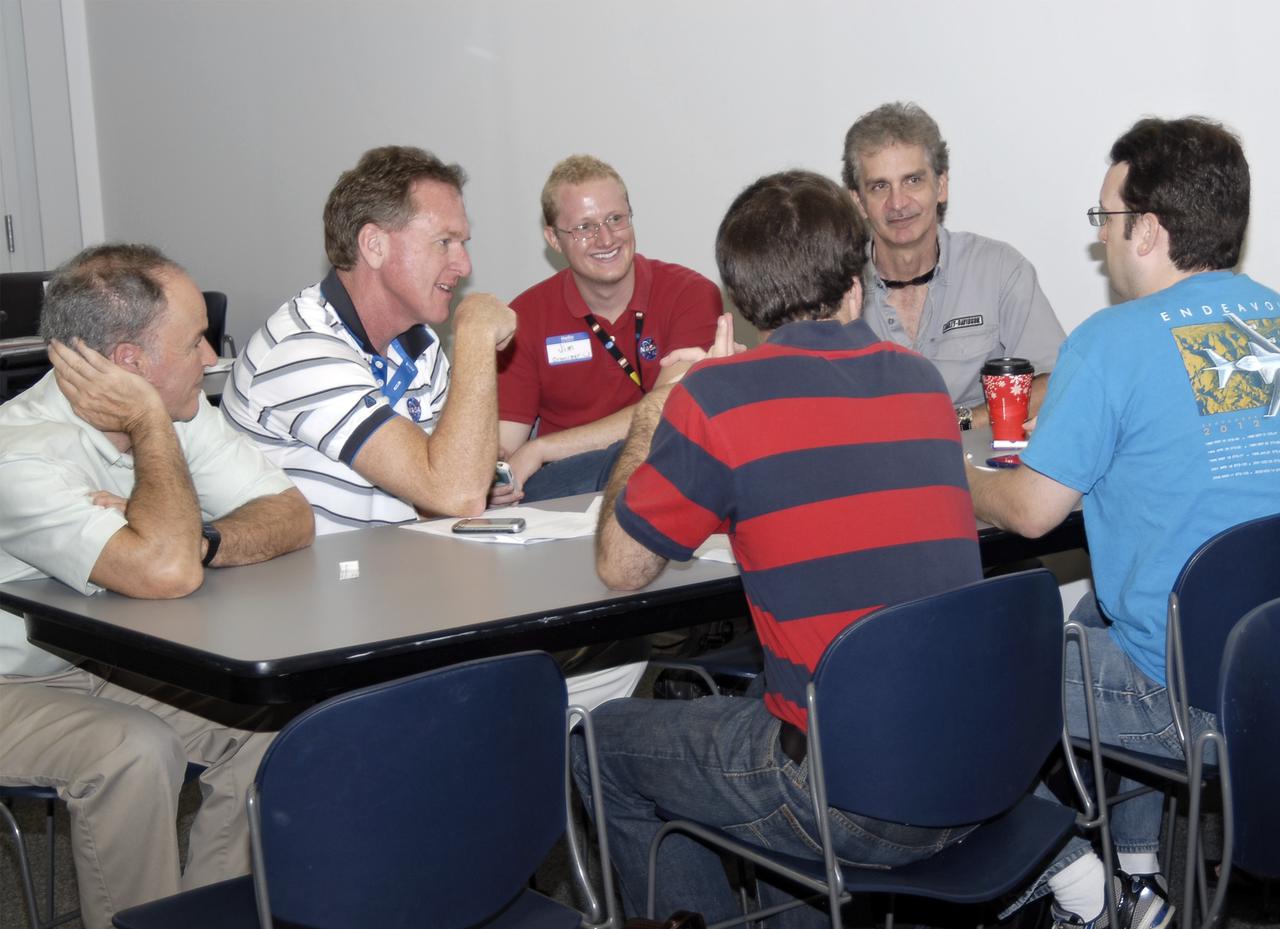
CAPE CANAVERAL, Fla. – Subject matter experts, event volunteers and participants discuss ideas during the 2013 International Space Apps Challenge at the Center for Space Education at the Kennedy Space Center Visitor Complex in Florida. From left, are Dr. Ray Wheeler, NASA subject matter expert Mike Bolger, Kennedy’s Information Technology director Jim Wood, event volunteer challenge participants Pat Starace and Mike King from Orlando and David Thorpe in Kennedy’s Center Planning and Development Directorate. During the worldwide two-day challenge, more than 9,000 people and 484 organizations came together in 83 cities across 44 countries, as well as online, to develop new ways of solving challenges that NASA faces. At Kennedy, four teams brainstormed ideas with subject matter experts and others and worked nearly 32 hours straight to present their concepts to a panel of three technical and non-technical judges. Challenges tackled at Kennedy were: Deployable Greenhouse, Kennedy Space Center 2040, Seven Minutes of Science, and Moonville – Lunar Industry Game. Photo credit: NASA_Charisse Nahser
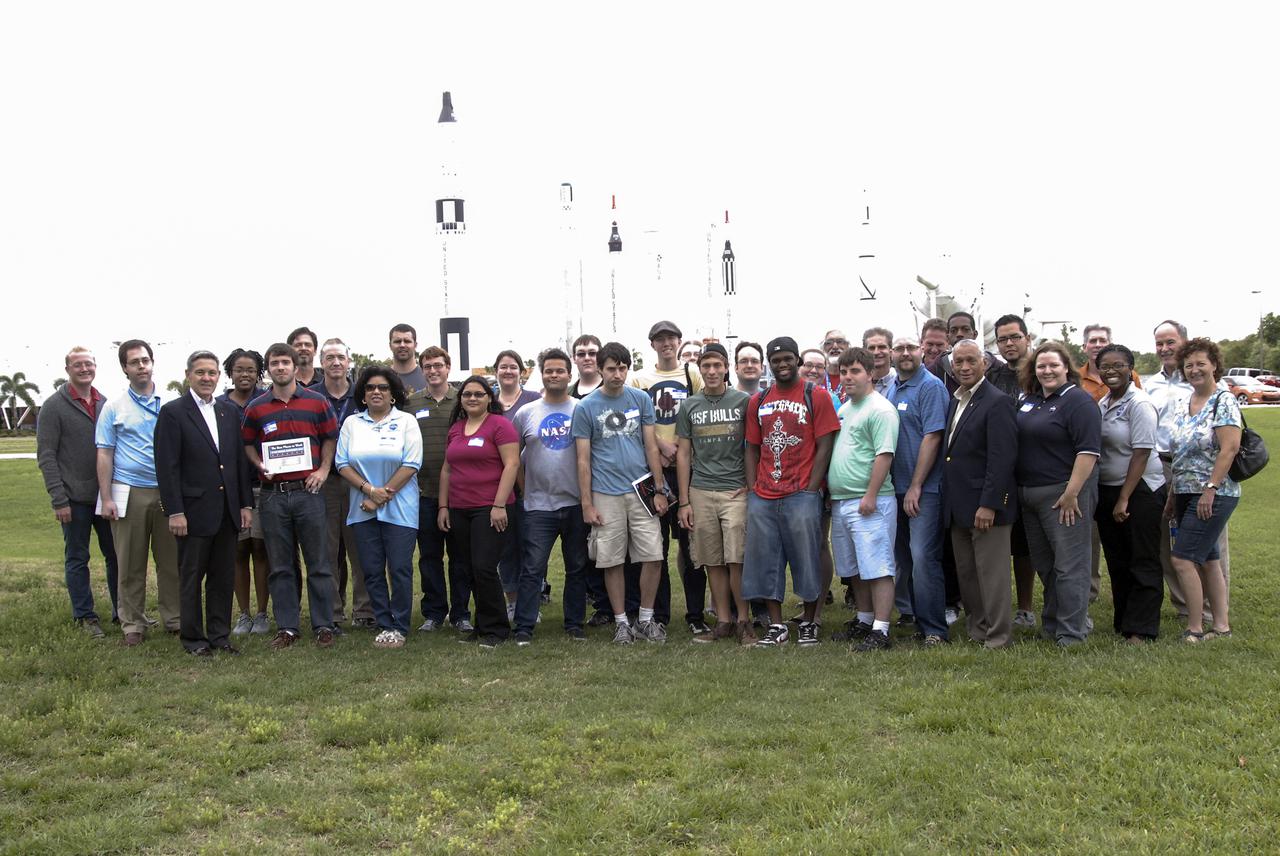
CAPE CANAVERAL, Fla. – Kennedy Space Center Director Bob Cabana, third from left, and NASA Administrator Charlie Bolden, fourth from right, gather with participants, subject matter experts and volunteers in front of the Rocket Garden at the Kennedy Space Center Visitor Complex in Florida during the 2013 International Space Apps Challenge. The group took a brief break before returning to The Astronaut Memorial Foundation’s Center for Space Education to continue working on their challenges. During the worldwide two-day challenge, more than 9,000 people and 484 organizations came together in 83 cities across 44 countries, as well as online, to develop new ways of solving challenges that NASA faces. At Kennedy, four teams brainstormed ideas with subject matter experts and others and worked nearly 32 hours straight to present their concepts to a panel of three technical and non-technical judges. Challenges tackled at Kennedy were: Deployable Greenhouse, Kennedy Space Center 2040, Seven Minutes of Science, and Moonville – Lunar Industry Game. Photo credit: NASA_Charisse Nahser

This image depicts a vast canyon of dust and gas in the Orion Nebula from a 3-D computer model based on observations by NASA's Hubble Space Telescope and created by science visualization specialists at the Space Telescope Science Institute (STScI) in Baltimore, Md. A 3-D visualization of this model takes viewers on an amazing four-minute voyage through the 15-light-year-wide canyon. Credit: NASA, G. Bacon, L. Frattare, Z. Levay, and F. Summers (STScI/AURA) Go here to learn more about Hubble 3D: <a href="http://www.nasa.gov/topics/universe/features/hubble_imax_premiere.html" rel="nofollow">www.nasa.gov/topics/universe/features/hubble_imax_premier...</a> or <a href="http://www.imax.com/hubble/" rel="nofollow">www.imax.com/hubble/</a> Take an exhilarating ride through the Orion Nebula, a vast star-making factory 1,500 light-years away. Swoop through Orion's giant canyon of gas and dust. Fly past behemoth stars whose brilliant light illuminates and energizes the entire cloudy region. Zoom by dusty tadpole-shaped objects that are fledgling solar systems. This virtual space journey isn't the latest video game but one of several groundbreaking astronomy visualizations created by specialists at the Space Telescope Science Institute (STScI) in Baltimore, the science operations center for NASA's Hubble Space Telescope. The cinematic space odysseys are part of the new Imax film "Hubble 3D," which opens today at select Imax theaters worldwide. The 43-minute movie chronicles the 20-year life of Hubble and includes highlights from the May 2009 servicing mission to the Earth-orbiting observatory, with footage taken by the astronauts. The giant-screen film showcases some of Hubble's breathtaking iconic pictures, such as the Eagle Nebula's "Pillars of Creation," as well as stunning views taken by the newly installed Wide Field Camera 3. While Hubble pictures of celestial objects are awe-inspiring, they are flat 2-D photographs. For this film, those 2-D images have been converted into 3-D environments, giving the audience the impression they are space travelers taking a tour of Hubble's most popular targets. "A large-format movie is a truly immersive experience," says Frank Summers, an STScI astronomer and science visualization specialist who led the team that developed the movie visualizations. The team labored for nine months, working on four visualization sequences that comprise about 12 minutes of the movie. "Seeing these Hubble images in 3-D, you feel like you are flying through space and not just looking at picture postcards," Summers continued. "The spacescapes are all based on Hubble images and data, though some artistic license is necessary to produce the full depth of field needed for 3-D." The most ambitious sequence is a four-minute voyage through the Orion Nebula's gas-and-dust canyon, about 15 light-years across. During the ride, viewers will see bright and dark, gaseous clouds; thousands of stars, including a grouping of bright, hefty stars called the Trapezium; and embryonic planetary systems. The tour ends with a detailed look at a young circumstellar disk, which is much like the structure from which our solar system formed 4.5 billion years ago. Based on a Hubble image of Orion released in 2006, the visualization was a collaborative effort between science visualization specialists at STScI, including Greg Bacon, who sculpted the Orion Nebula digital model, with input from STScI astronomer Massimo Roberto; the National Center for Supercomputing Applications at the University of Illinois at Urbana-Champaign; and the Spitzer Science Center at the California Institute of Technology in Pasadena. For some of the sequences, STScI imaging specialists developed new techniques for transforming the 2-D Hubble images into 3-D. STScI image processing specialists Lisa Frattare and Zolt Levay, for example, created methods of splitting a giant gaseous pillar in the Carina Nebula into multiple layers to produce a 3-D effect, giving the structure depth. The Carina Nebula is a nursery for baby stars. Frattare painstakingly removed the thousands of stars in the image so that Levay could separate the gaseous layers on the isolated Carina pillar. Frattare then replaced the stars into both foreground and background layers to complete the 3-D model. For added effect, the same separation was done for both visible and infrared Hubble images, allowing the film to cross-fade between wavelength views in 3-D. In another sequence viewers fly into a field of 170,000 stars in the giant star cluster Omega Centauri. STScI astronomer Jay Anderson used his stellar database to create a synthetic star field in 3-D that matches recent razor-sharp Hubble photos. The film's final four-minute sequence takes viewers on a voyage from our Milky Way Galaxy past many of Hubble's best galaxy shots and deep into space. Some 15,000 galaxies from Hubble's deepest surveys stretch billions of light-years across the universe in a 3-D sequence created by STScI astronomers and visualizers. The view dissolves into a cobweb that traces the universe's large-scale structure, the backbone from which galaxies were born. In addition to creating visualizations, STScI's education group also provided guidance on the "Hubble 3D" Educator Guide, which includes standards-based lesson plans and activities about Hubble and its mission. Students will use the guide before or after seeing the movie. "The guide will enhance the movie experience for students and extend the movie into classrooms," says Bonnie Eisenhamer, STScI's Hubble Formal Education manager. The Hubble Space Telescope is a project of international cooperation between NASA and the European Space Agency (ESA) and is managed by NASA’s Goddard Space Flight Center (GSFC) in Greenbelt, Md. The Space Telescope Science Institute (STScI) conducts Hubble science operations. The institute is operated for NASA by the Association of Universities for Research in Astronomy, Inc., Washington, D.C.