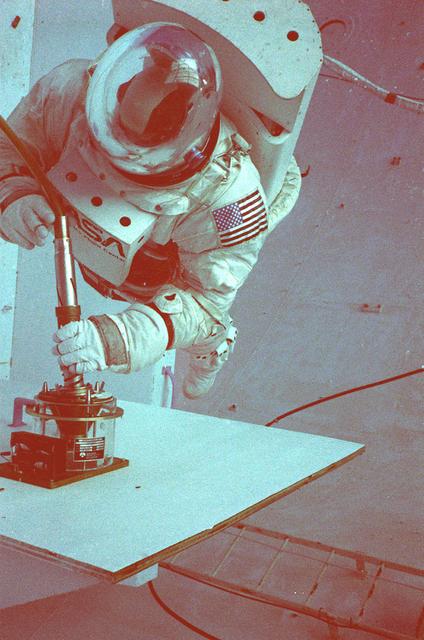
Once the United States' space program had progressed from Earth's orbit into outerspace, the prospect of building and maintaining a permanent presence in space was realized. To accomplish this feat, NASA launched a temporary workstation, Skylab, to discover the effects of low gravity and weightlessness on the human body, and also to develop tools and equipment that would be needed in the future to build and maintain a more permanent space station. The structures, techniques, and work schedules had to be carefully designed to fit this unique construction site. The components had to be lightweight for transport into orbit, yet durable. The station also had to be made with removable parts for easy servicing and repairs by astronauts. All of the tools necessary for service and repairs had to be designed for easy manipulation by a suited astronaut. And construction methods had to be efficient due to limited time the astronauts could remain outside their controlled environment. In lieu of all the specific needs for this project, an environment on Earth had to be developed that could simulate a low gravity atmosphere. A Neutral Buoyancy Simulator (NBS) was constructed by NASA Marshall Space Flight Center (MSFC) in 1968. Since then, NASA scientists have used this facility to understand how humans work best in low gravity and also provide information about the different kinds of structures that can be built. Another facet of the space station would be electrical cornectors which would be used for powering tools the astronauts would need for construction, maintenance and repairs. Shown is an astronaut training during an underwater electrical connector test in the NBS.
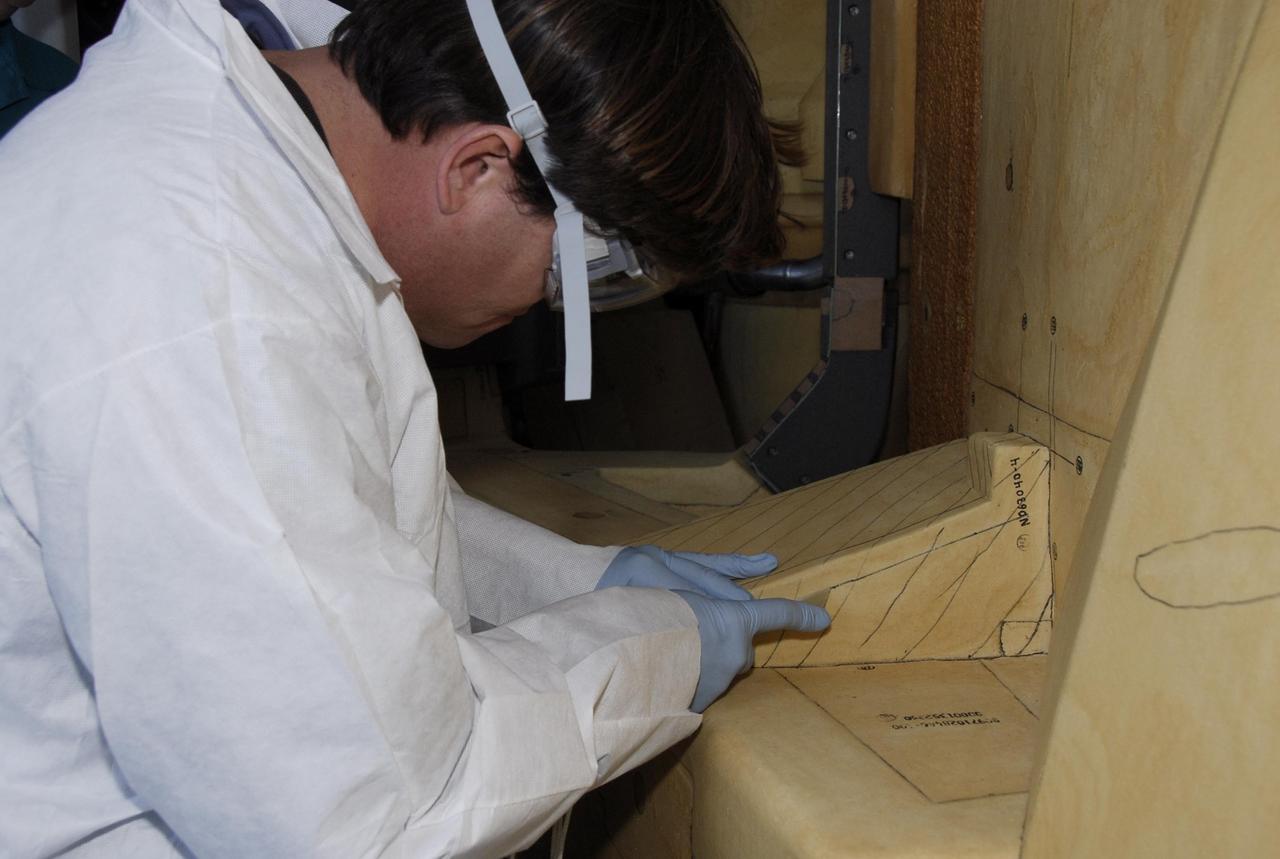
KENNEDY SPACE CENTER, FLA. -- At Launch Pad 39A, a United Space Alliance technician carefully cuts away the foam insulation surrounding the covers over the feed-through connector box on the external tank for space shuttle Atlantis' STS-122 mission. The covers will be removed for access to the feed-through connectors. Following the failure of some of the tank's engine cutoff sensors, or ECO sensors, during propellant tanking for launch attempts on Dec. 6 and Dec. 9, a tanking test was conducted on Dec. 18 to aid in troubleshooting the cause. Technicians spliced test wiring into the ECO sensor electrical system and used time domain reflectometry equipment to help locate the electrical anomaly. Results of the tanking test pointed to an open circuit in the feed-through connector wiring, which is located at the base of the tank. The feed-through connector passes the wires from the inside of the tank to the outside. During the holiday period, workers from Lockheed Martin will begin inspecting and testing the connector. Shuttle program managers will meet on Dec. 27 to review the test and analysis, and decide on a forward plan. Photo credit: NASA/Kim Shiflett
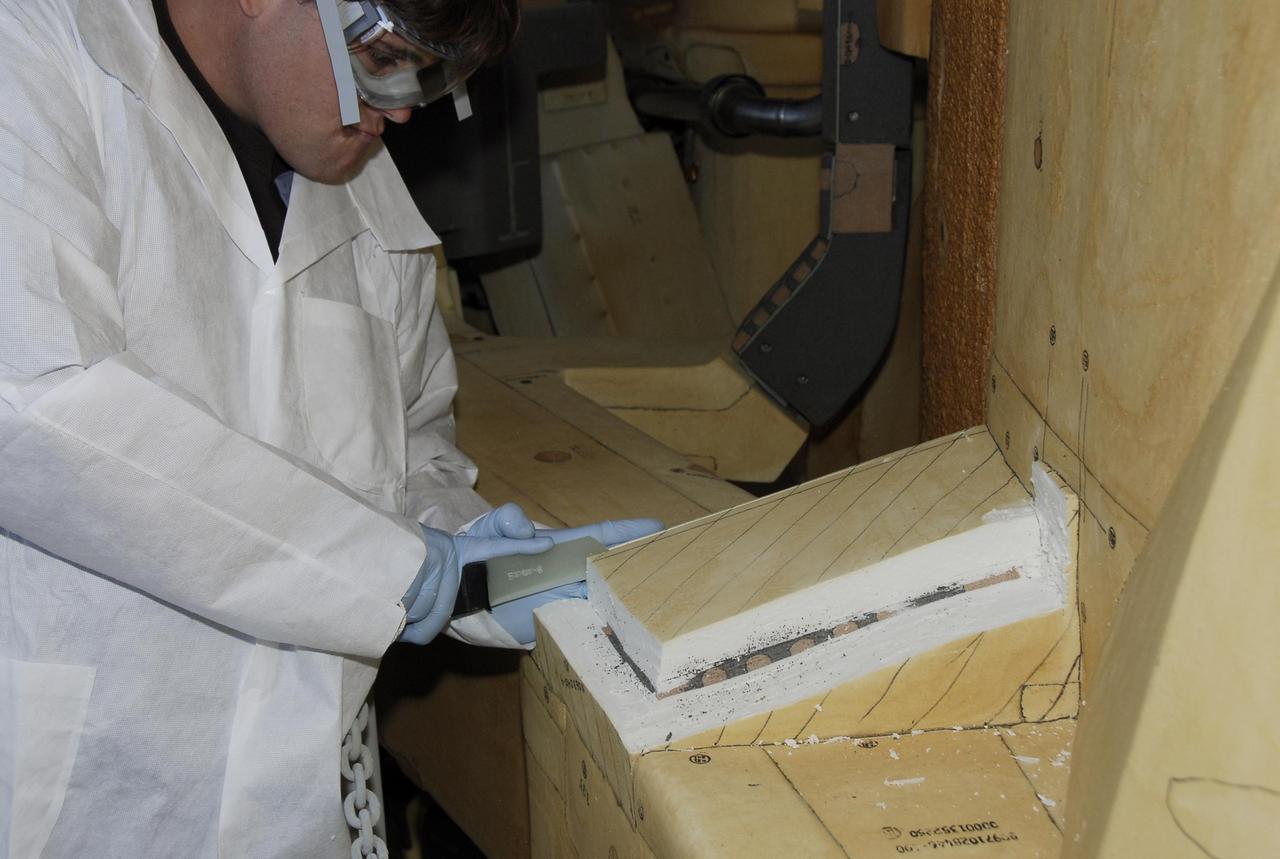
KENNEDY SPACE CENTER, FLA. -- At Launch Pad 39A, a United Space Alliance technician carefully cuts away the foam insulation surrounding the covers over the feed-through connector box on the external tank for space shuttle Atlantis' STS-122 mission, revealing the fastener holes on the covers. The covers will be removed for access to the feed-through connectors. Following the failure of some of the tank's engine cutoff sensors, or ECO sensors, during propellant tanking for launch attempts on Dec. 6 and Dec. 9, a tanking test was conducted on Dec. 18 to aid in troubleshooting the cause. Technicians spliced test wiring into the ECO sensor electrical system and used time domain reflectometry equipment to help locate the electrical anomaly. Results of the tanking test pointed to an open circuit in the feed-through connector wiring, which is located at the base of the tank. The feed-through connector passes the wires from the inside of the tank to the outside. During the holiday period, workers from Lockheed Martin will begin inspecting and testing the connector. Shuttle program managers will meet on Dec. 27 to review the test and analysis, and decide on a forward plan. Photo credit: NASA/Kim Shiflett
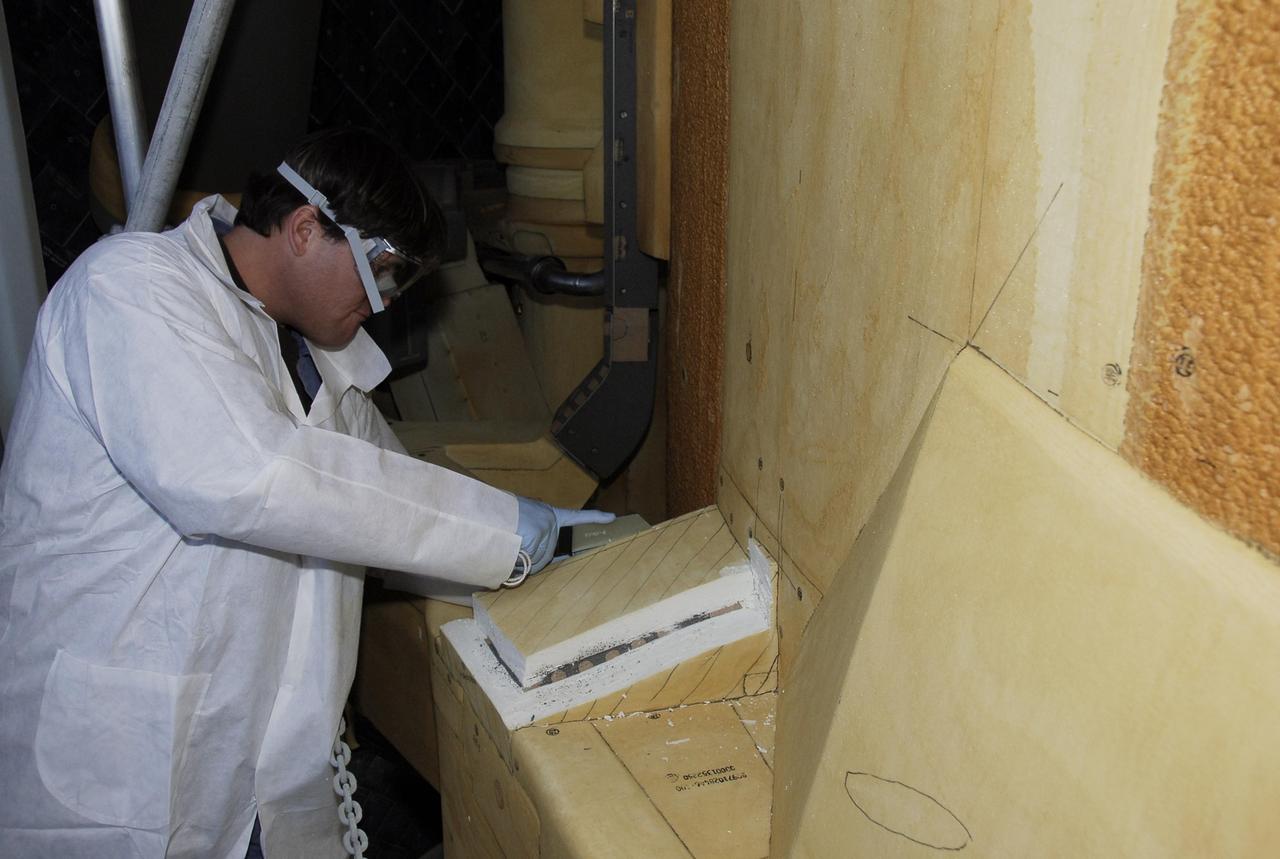
KENNEDY SPACE CENTER, FLA. -- At Launch Pad 39A, a United Space Alliance technician carefully cuts away the foam insulation surrounding the covers over the feed-through connector box on the external tank for space shuttle Atlantis' STS-122 mission, revealing the fastener holes on the covers. The covers will be removed for access to the feed-through connectors. Following the failure of some of the tank's engine cutoff sensors, or ECO sensors, during propellant tanking for launch attempts on Dec. 6 and Dec. 9, a tanking test was conducted on Dec. 18 to aid in troubleshooting the cause. Technicians spliced test wiring into the ECO sensor electrical system and used time domain reflectometry equipment to help locate the electrical anomaly. Results of the tanking test pointed to an open circuit in the feed-through connector wiring, which is located at the base of the tank. The feed-through connector passes the wires from the inside of the tank to the outside. During the holiday period, workers from Lockheed Martin will begin inspecting and testing the connector. Shuttle program managers will meet on Dec. 27 to review the test and analysis, and decide on a forward plan. Photo credit: NASA/Kim Shiflett

KENNEDY SPACE CENTER, FLA. -- At Launch Pad 39A, a United Space Alliance technician removes foam insulation revealing the fastener holes on the covers over the feed-through connector box on the external tank for space shuttle Atlantis' STS-122 mission. The covers will be removed for access to the feed-through connectors. Following the failure of some of the tank's engine cutoff sensors, or ECO sensors, during propellant tanking for launch attempts on Dec. 6 and Dec. 9, a tanking test was conducted on Dec. 18 to aid in troubleshooting the cause. Technicians spliced test wiring into the ECO sensor electrical system and used time domain reflectometry equipment to help locate the electrical anomaly. Results of the tanking test pointed to an open circuit in the feed-through connector wiring, which is located at the base of the tank. The feed-through connector passes the wires from the inside of the tank to the outside. During the holiday period, workers from Lockheed Martin will begin inspecting and testing the connector. Shuttle program managers will meet on Dec. 27 to review the test and analysis, and decide on a forward plan. Photo credit: NASA/Kim Shiflett
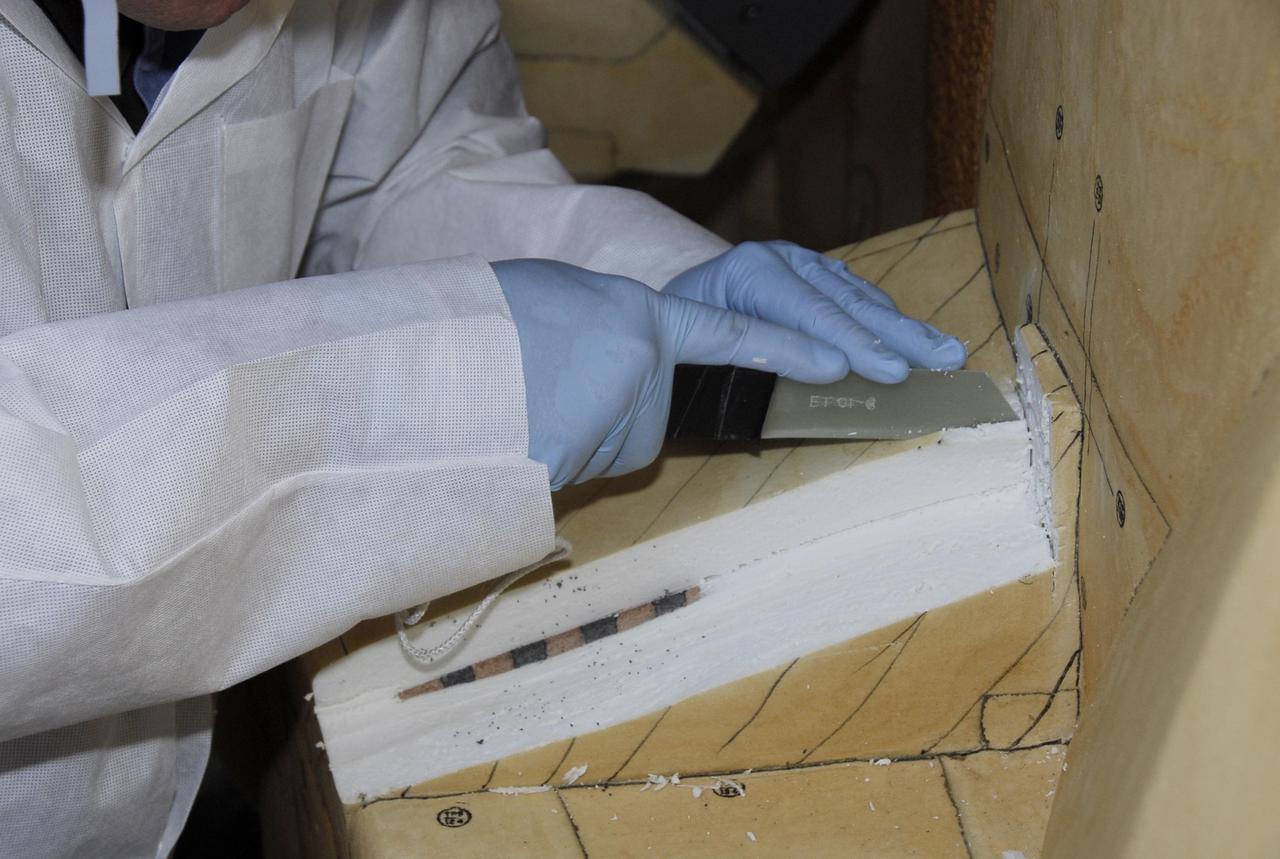
KENNEDY SPACE CENTER, FLA. -- At Launch Pad 39A, the foam insulation surrounding the covers over the feed-through connector box on the external tank for space shuttle Atlantis' STS-122 mission is carefully cut away by a United Space Alliance technician. The covers will be removed for access to the feed-through connectors. Following the failure of some of the tank's engine cutoff sensors, or ECO sensors, during propellant tanking for launch attempts on Dec. 6 and Dec. 9, a tanking test was conducted on Dec. 18 to aid in troubleshooting the cause. Technicians spliced test wiring into the ECO sensor electrical system and used time domain reflectometry equipment to help locate the electrical anomaly. Results of the tanking test pointed to an open circuit in the feed-through connector wiring, which is located at the base of the tank. The feed-through connector passes the wires from the inside of the tank to the outside. During the holiday period, workers from Lockheed Martin will begin inspecting and testing the connector. Shuttle program managers will meet on Dec. 27 to review the test and analysis, and decide on a forward plan. Photo credit: NASA/Kim Shiflett
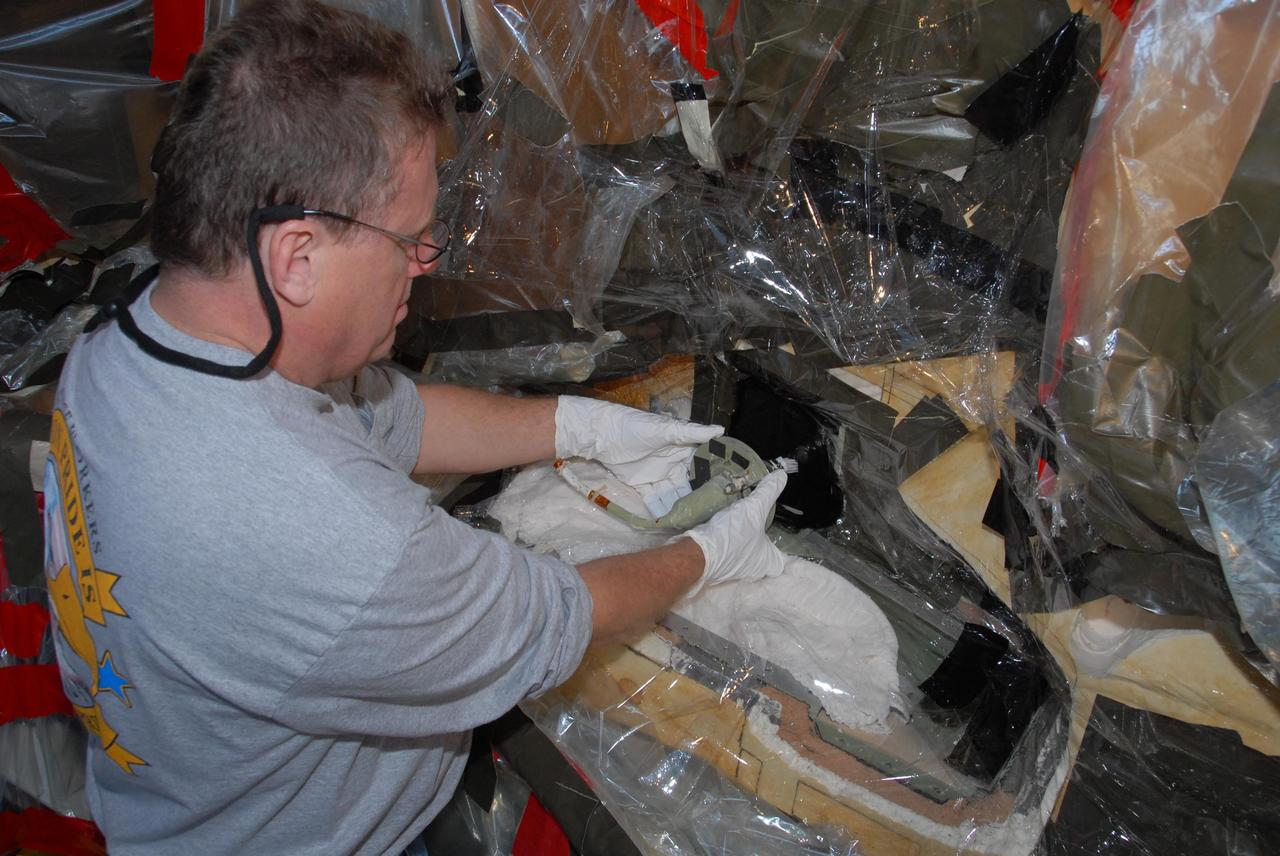
KENNEDY SPACE CENTER, FLA. -- At Launch Pad 39A, a team of external tank specialists from Lockheed Martin and the United Space Alliance undertakes the task of removing the hydrogen feed-through connector in support of space shuttle Atlantis' STS-122 mission. Here, a technician pulls the connector assembly, with its associated electrical harness, away from the tank. Some of the tank's engine cutoff sensors, or ECO sensors, failed during propellant tanking for launch attempts on Dec. 6 and Dec. 9. Results of a tanking test on Dec. 18 pointed to an open circuit in the feed-through connector wiring, which is located at the base of the tank. The feed-through connector passes the wires from the inside of the tank to the outside. After the data from additional testing on the connector is analyzed, shuttle program managers will decide on a forward plan. Launch of STS-122 is targeted for January 2008. Photo credit: NASA/George Shelton
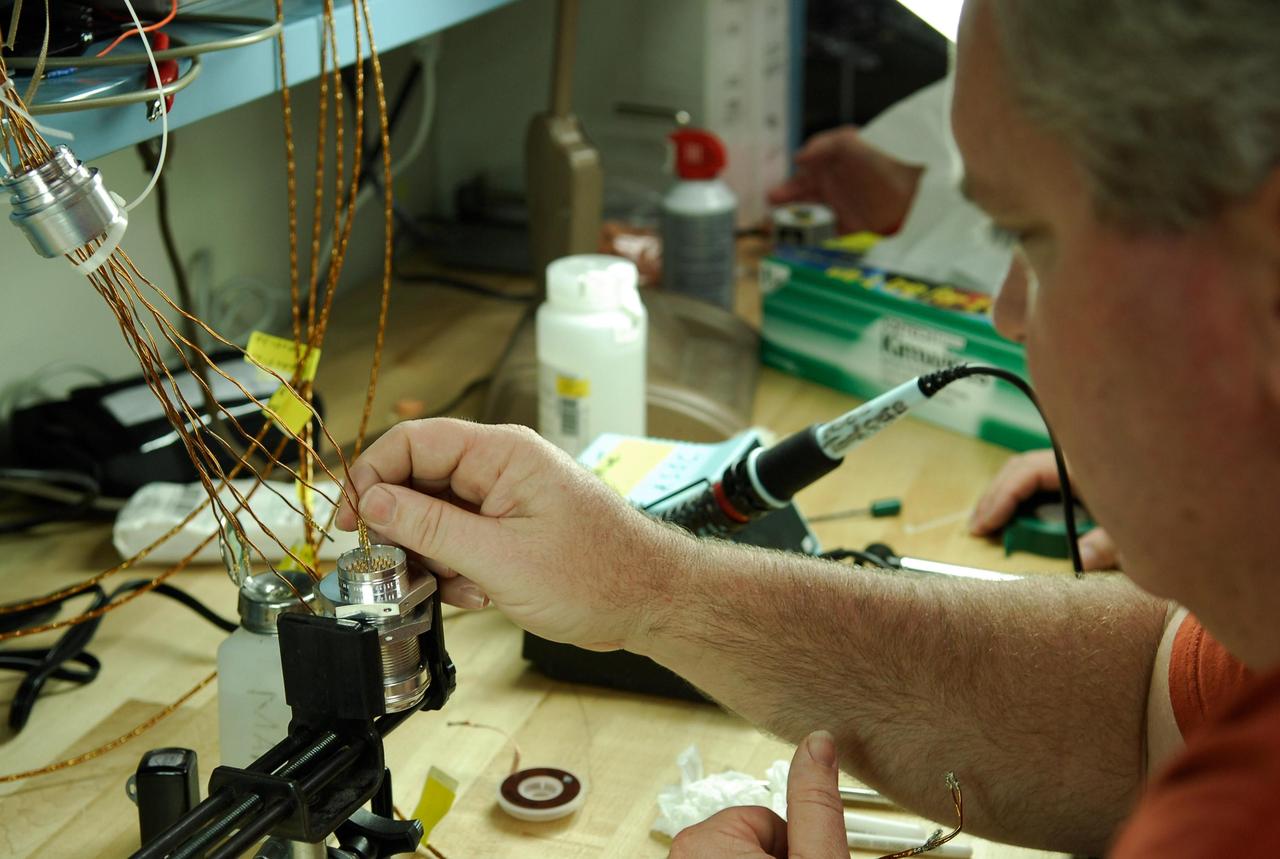
KENNEDY SPACE CENTER, FLA. -- At a lab at NASA's Kennedy Space Center, Bob Arp, an aerospace technician with the United Launch Alliance, inserts a wire from an electrical harness onto the pin of a replacement feed-through connector during preparations to solder the pins to the socket of the connector. The connector will be installed in the external fuel tank for space shuttle Atlantis' STS-122 mission. The technician performed this exacting task on the Centaur upper stage for Atlas and Titan launches in 1994 and was specifically chosen for the task. Soldering the connector pins and sockets together addresses the most likely cause of a problem in the engine cutoff sensor system, or ECO system. Some of the tank's ECO sensors failed during propellant tanking for launch attempts on Dec. 6 and Dec. 9. Results of a tanking test on Dec. 18 pointed to an open circuit in the feed-through connector wiring, which is located at the base of the tank. The feed-through connector passes the wires from the inside of the tank to the outside. After the soldering is completed and the connector is reinstalled, shuttle program managers will decide on how to proceed. The launch date for mission STS-122 is under review. Photo credit: NASA/Kim Shiflett
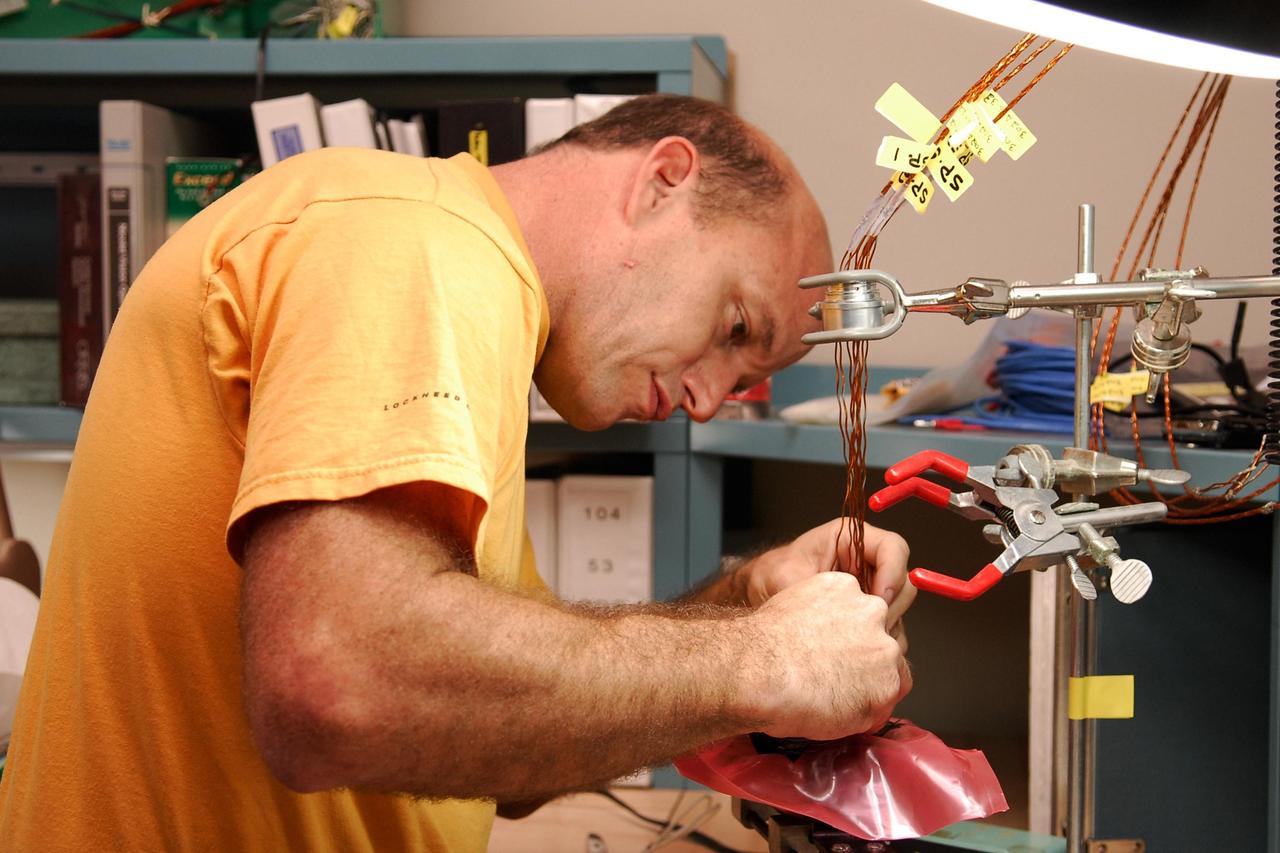
KENNEDY SPACE CENTER, FLA. -- At a lab at NASA's Kennedy Space Center, Kevin Wyckoff, an aerospace technician with the United Launch Alliance, inserts an electrical wiring harness into a replacement feed-through connector during preparations to solder the pins to the socket of the connector. The connector will later be installed in the external fuel tank for space shuttle Atlantis' STS-122 mission. The technician performed this exacting task on the Centaur upper stage for Atlas and Titan launches in 1994 and was specifically chosen for the task. Soldering the connector pins and sockets together addresses the most likely cause of a problem in the engine cutoff sensor system, or ECO system. Some of the tank's ECO sensors failed during propellant tanking for launch attempts on Dec. 6 and Dec. 9. Results of a tanking test on Dec. 18 pointed to an open circuit in the feed-through connector wiring, which is located at the base of the tank. The feed-through connector passes the wires from the inside of the tank to the outside. After the soldering is completed and the connector is reinstalled, shuttle program managers will decide on how to proceed. The launch date for mission STS-122 is under review. Photo credit: NASA/Kim Shiflett
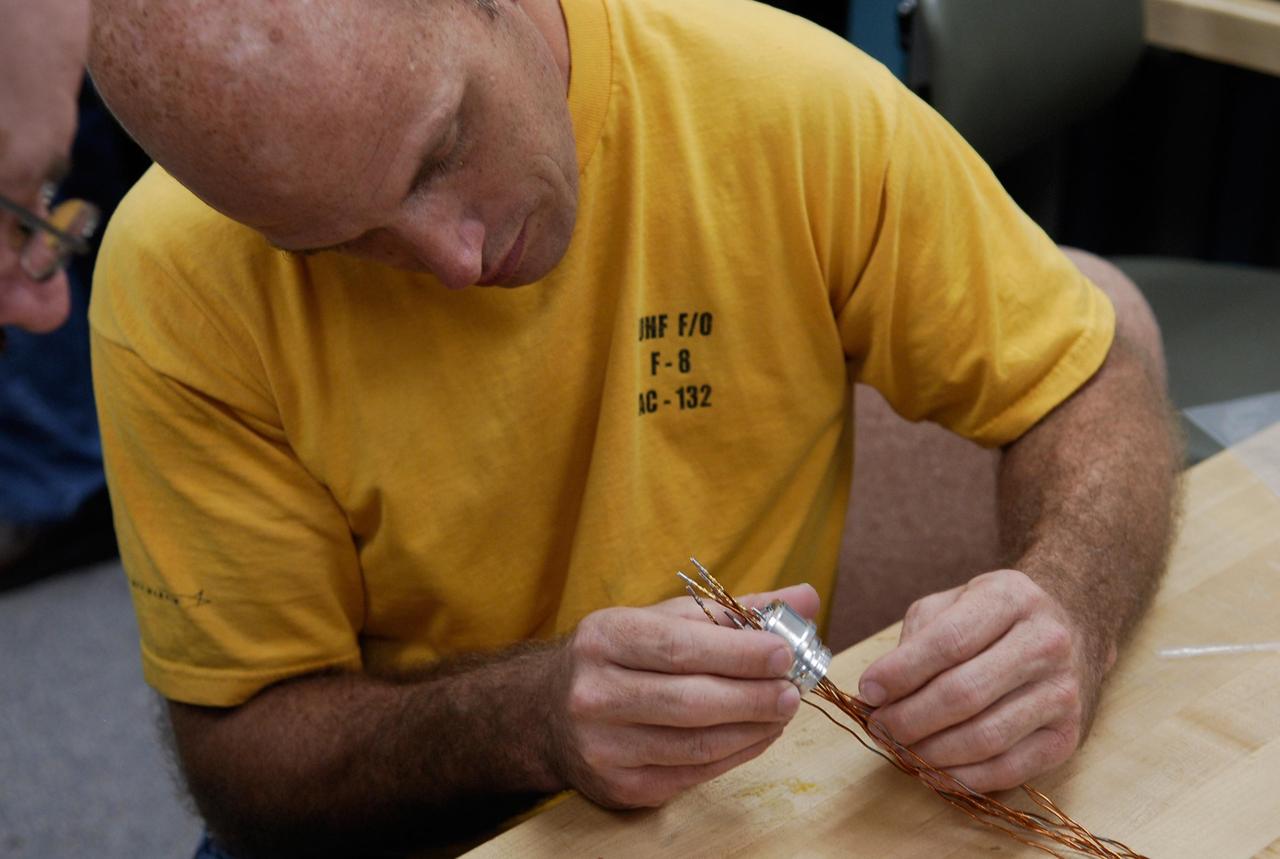
KENNEDY SPACE CENTER, FLA. -- At a lab at NASA's Kennedy Space Center, Kevin Wyckoff, an aerospace technician with the United Launch Alliance, examines an electrical wiring harness. The harness will be inserted into a replacement feed-through connector during preparations to solder the pins to the socket of the connector. The connector will later be installed in the external fuel tank for space shuttle Atlantis' STS-122 mission. The technician performed this exacting task on the Centaur upper stage for Atlas and Titan launches in 1994 and was specifically chosen for the task. Soldering the connector pins and sockets together addresses the most likely cause of a problem in the engine cutoff sensor system, or ECO system. Some of the tank's ECO sensors failed during propellant tanking for launch attempts on Dec. 6 and Dec. 9. Results of a tanking test on Dec. 18 pointed to an open circuit in the feed-through connector wiring, which is located at the base of the tank. The feed-through connector passes the wires from the inside of the tank to the outside. After the soldering is completed and the connector is reinstalled, shuttle program managers will decide on how to proceed. The launch date for mission STS-122 is under review. Photo credit: NASA/Kim Shiflett

KENNEDY SPACE CENTER, FLA. -- At a lab at NASA's Kennedy Space Center, aerospace technicians with the United Launch Alliance inspect an electrical wiring harness that has been inserted into a replacement feed-through connector during preparations to solder the pins to the socket of the connector that will be installed in the external fuel tank for space shuttle Atlantis' STS-122 mission. The technicians performed this exacting task on the Centaur upper stage for Atlas and Titan launches in 1994 and were specifically chosen for the task. Soldering the connector pins and sockets together addresses the most likely cause of a problem in the engine cutoff sensor system, or ECO system. Some of the tank's ECO sensors failed during propellant tanking for launch attempts on Dec. 6 and Dec. 9. Results of a tanking test on Dec. 18 pointed to an open circuit in the feed-through connector wiring, which is located at the base of the tank. The feed-through connector passes the wires from the inside of the tank to the outside. After the soldering is completed and the connector is reinstalled, shuttle program managers will decide on how to proceed. The launch date for mission STS-122 is under review. Photo credit: NASA/Kim Shiflett
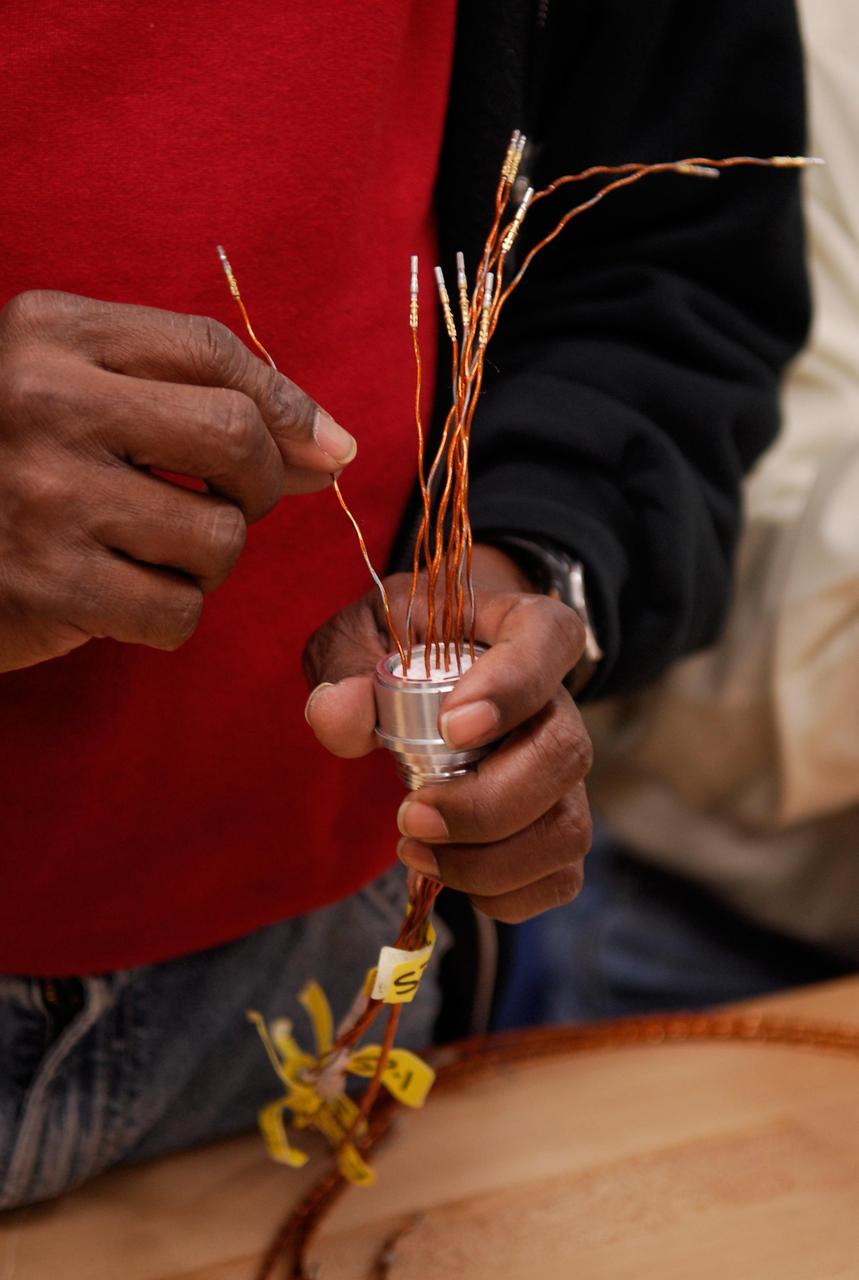
KENNEDY SPACE CENTER, FLA. -- At a lab at NASA's Kennedy Space Center, a Lockheed Martin technician prepares an electrical wiring harness during a procedure to solder the pins to the socket of the replacement feed-through connector that will be installed in the external fuel tank for space shuttle Atlantis' STS-122 mission. Two United Launch Alliance technicians, who performed this exacting task on the Centaur upper stage for Atlas and Titan launches in 1994, will be doing the soldering. Soldering the connector pins and sockets together addresses the most likely cause of a problem in the engine cutoff sensor system, or ECO system. Some of the tank's ECO sensors failed during propellant tanking for launch attempts on Dec. 6 and Dec. 9. Results of a tanking test on Dec. 18 pointed to an open circuit in the feed-through connector wiring, which is located at the base of the tank. The feed-through connector passes the wires from the inside of the tank to the outside. After the soldering is completed and the connector is reinstalled, shuttle program managers will decide on how to proceed. The launch date for mission STS-122 is under review. Photo credit: NASA/Kim Shiflett

Jet Propulsion Laboratory (JPL) worker Mary Reaves mates connectors on a radioisotope thermoelectric generator (RTG) to power up the Cassini spacecraft, while quality assurance engineer Peter Sorci looks on. The three RTGs which will be used on Cassini are undergoing mechanical and electrical verification testing in the Payload Hazardous Servicing Facility. The RTGs will provide electrical power to Cassini on its 6.7-year trip to the Saturnian system and during its four-year mission at Saturn. RTGs use heat from the natural decay of plutonium to generate electric power. The generators enable spacecraft to operate at great distances from the Sun where solar power systems are not feasible. The Cassini mission is targeted for an Oct. 6 launch aboard a Titan IVB/Centaur expendable launch vehicle. Cassini is built and managed by JPL