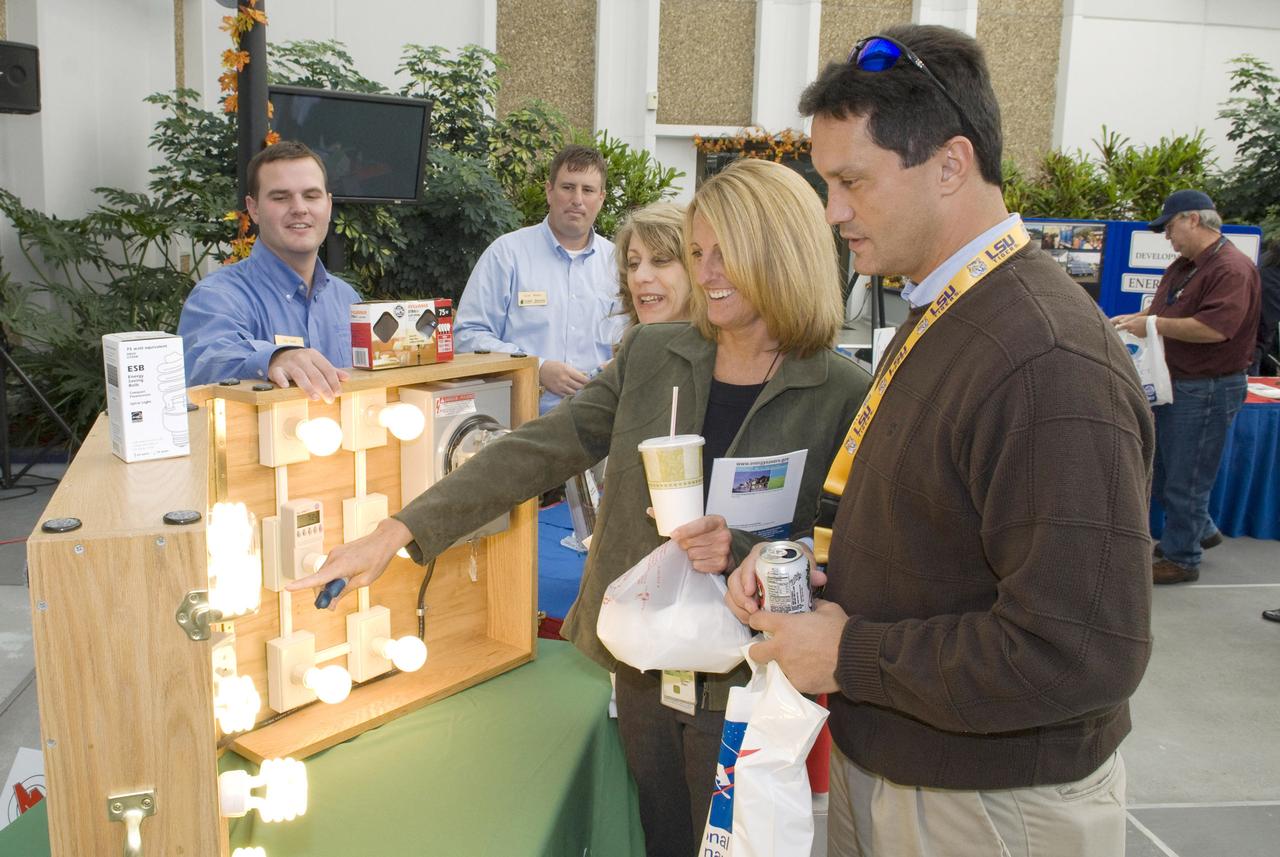
Stennis Space Center employees Maria Etheridge (l to r), Linda Sauland Maurice Prevost visit a Coast Electric Power Association display featuring energy-efficient light bulbs during 2009 Energy Awareness Day activities on Oct. 20. The exhibit was one of several energy-efficiency and energy-awareness displays on-site for employees to visit. Vendors included Mississippi Power Company, Coast Electric Power Association, Mississippi Development Authority - Energy Division,Jacobs FOSC Environmental, Southern Energy Technologies, and Siemens Building Technologies.
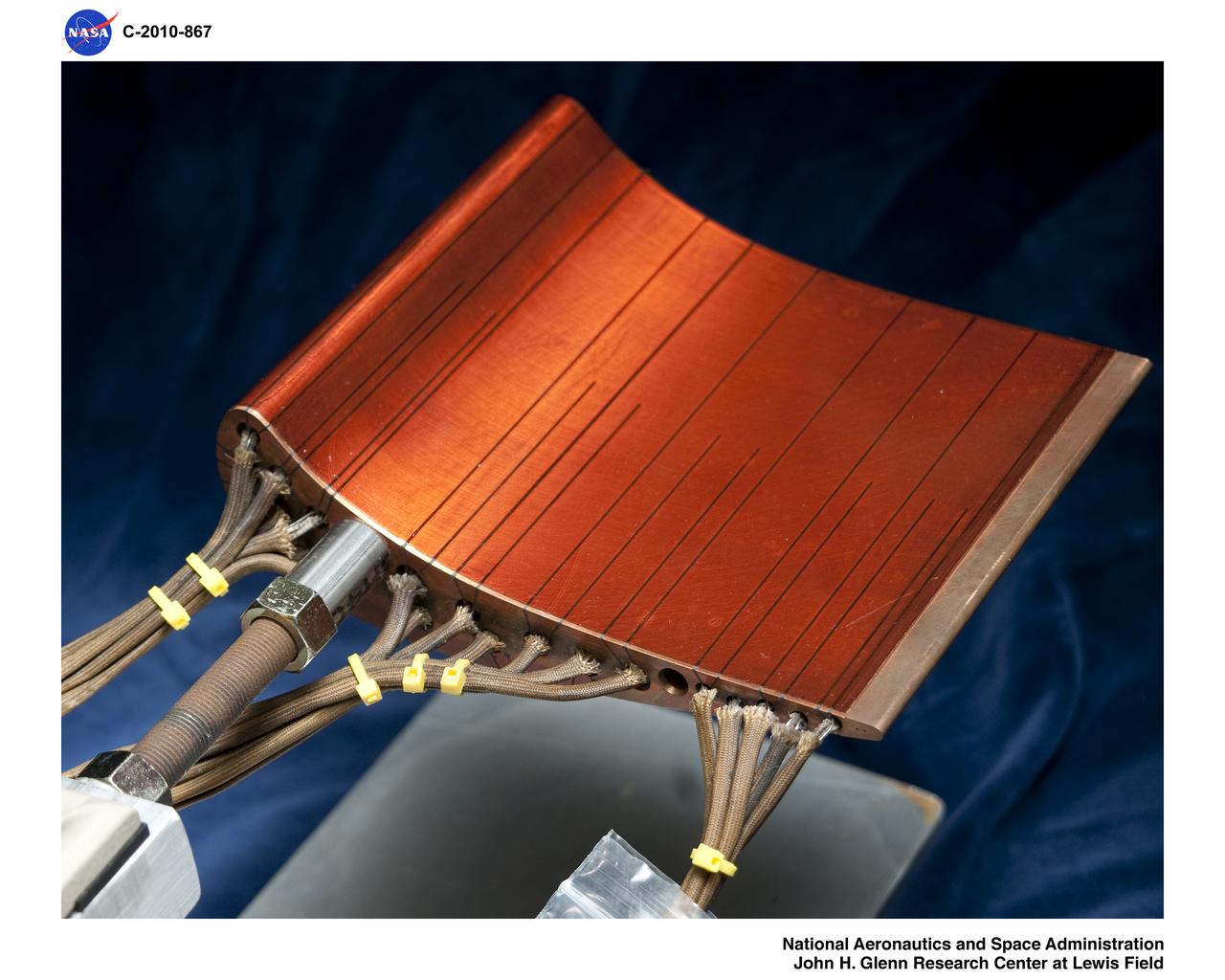
Energy Efficient Engine Heat Transfer Blades
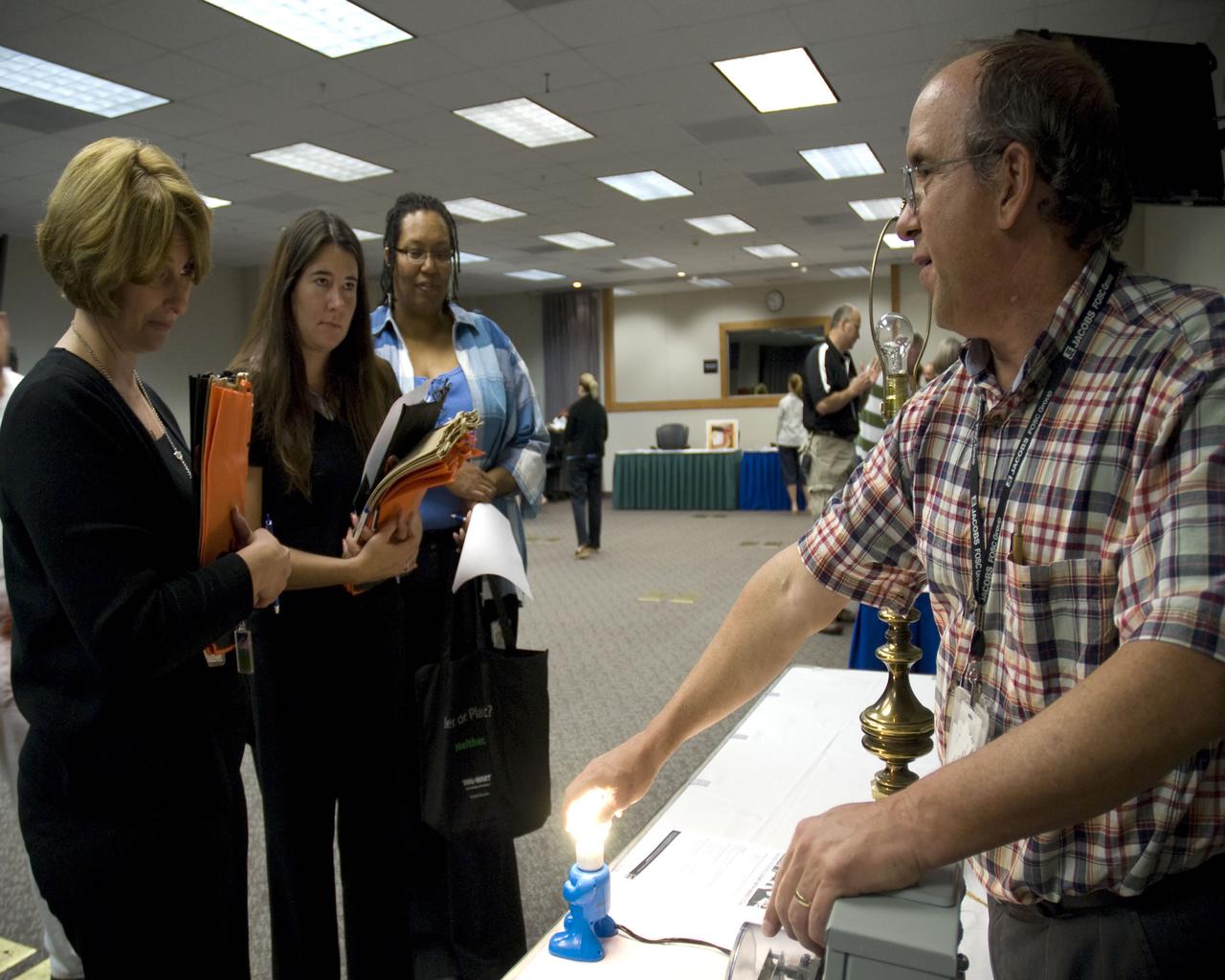
Donnie Thompson, site energy manager for the Jacobs Technology FOSC Group, demonstrates the efficiency of fluorescent bulbs during Energy Awareness Day at Stennis on Sept. 30.
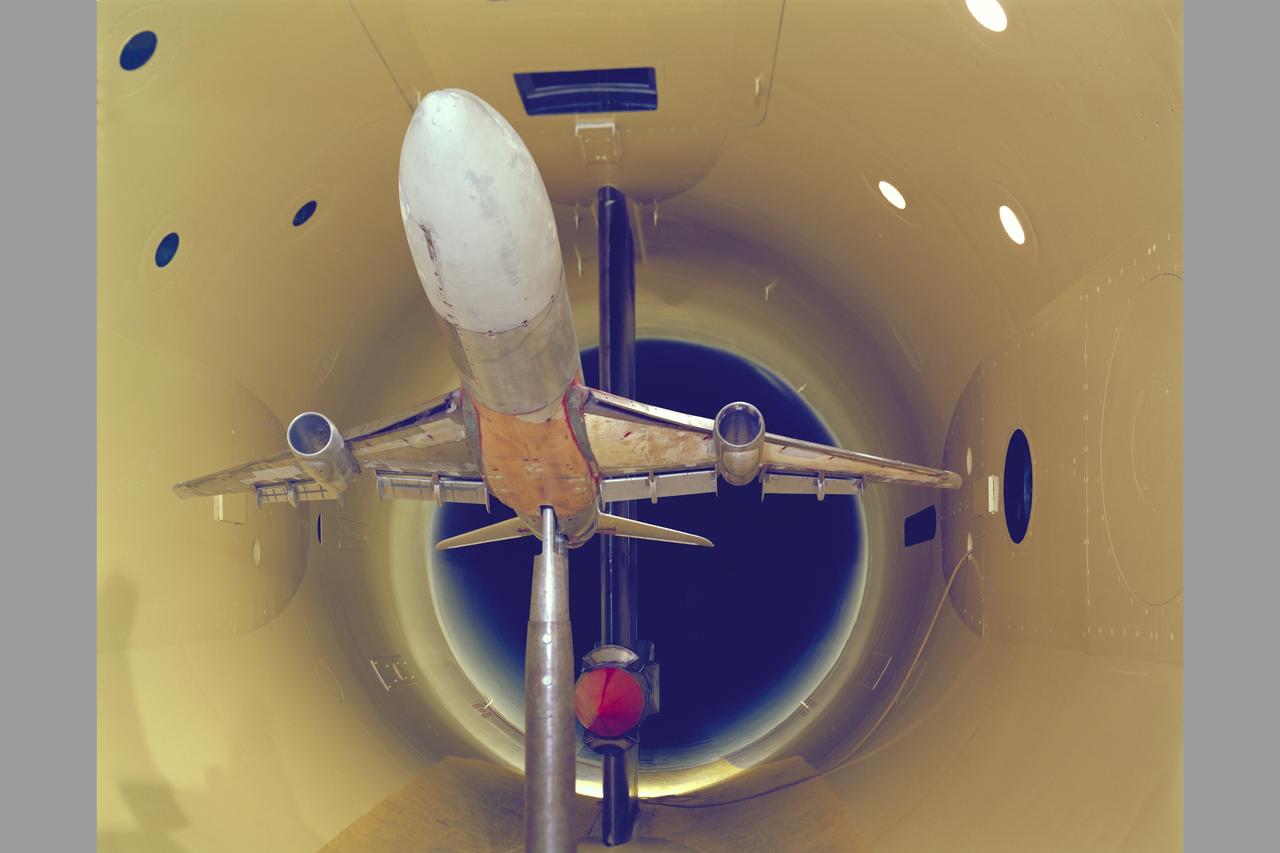
Lockheed L-1011 EET (Energy Efficient Transport) test-516 in 12ft. W.T.
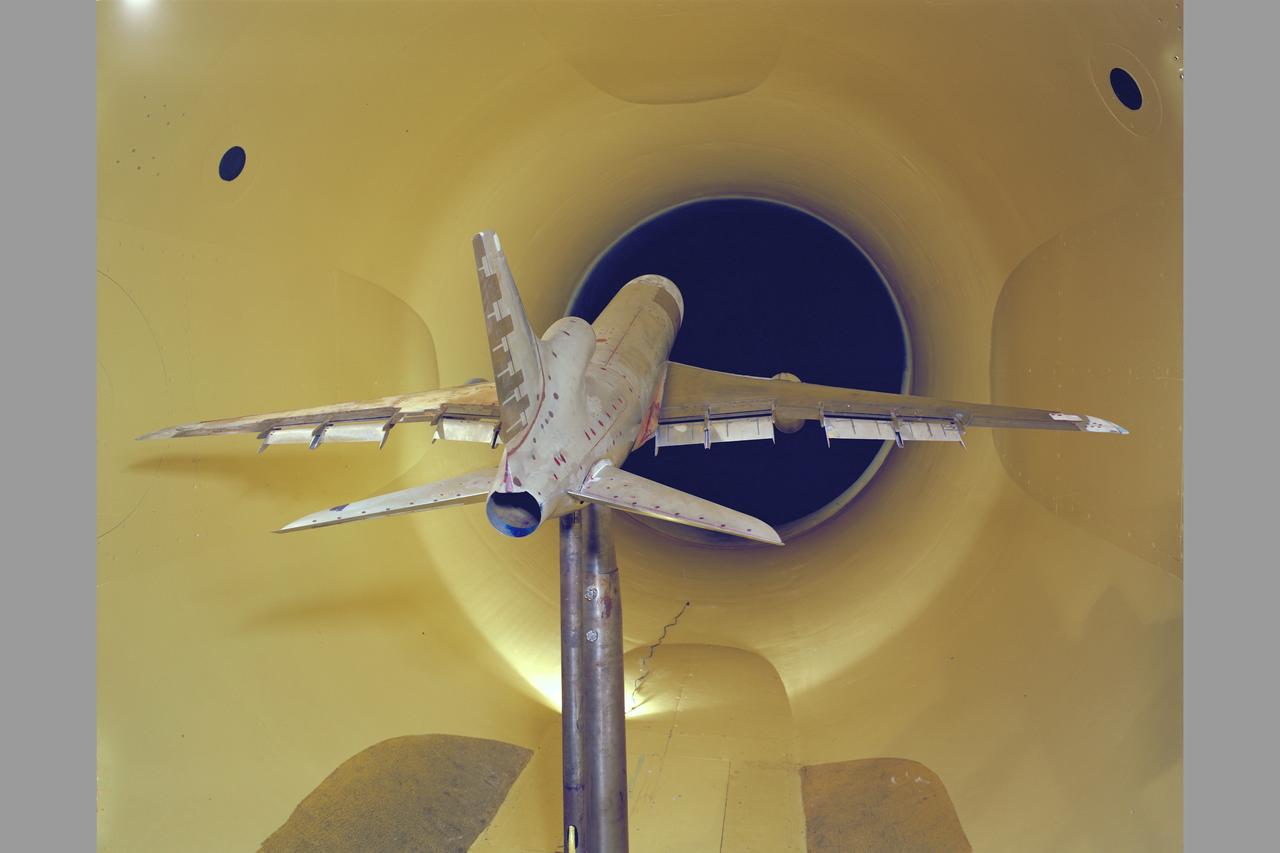
Lockheed L-1011 EET (Energy Efficient Transport) 12ft w.t. test-516

Energy Efficient Engine (EEE) Tip Clearance Static Pressure Measurement Blades for CW-22
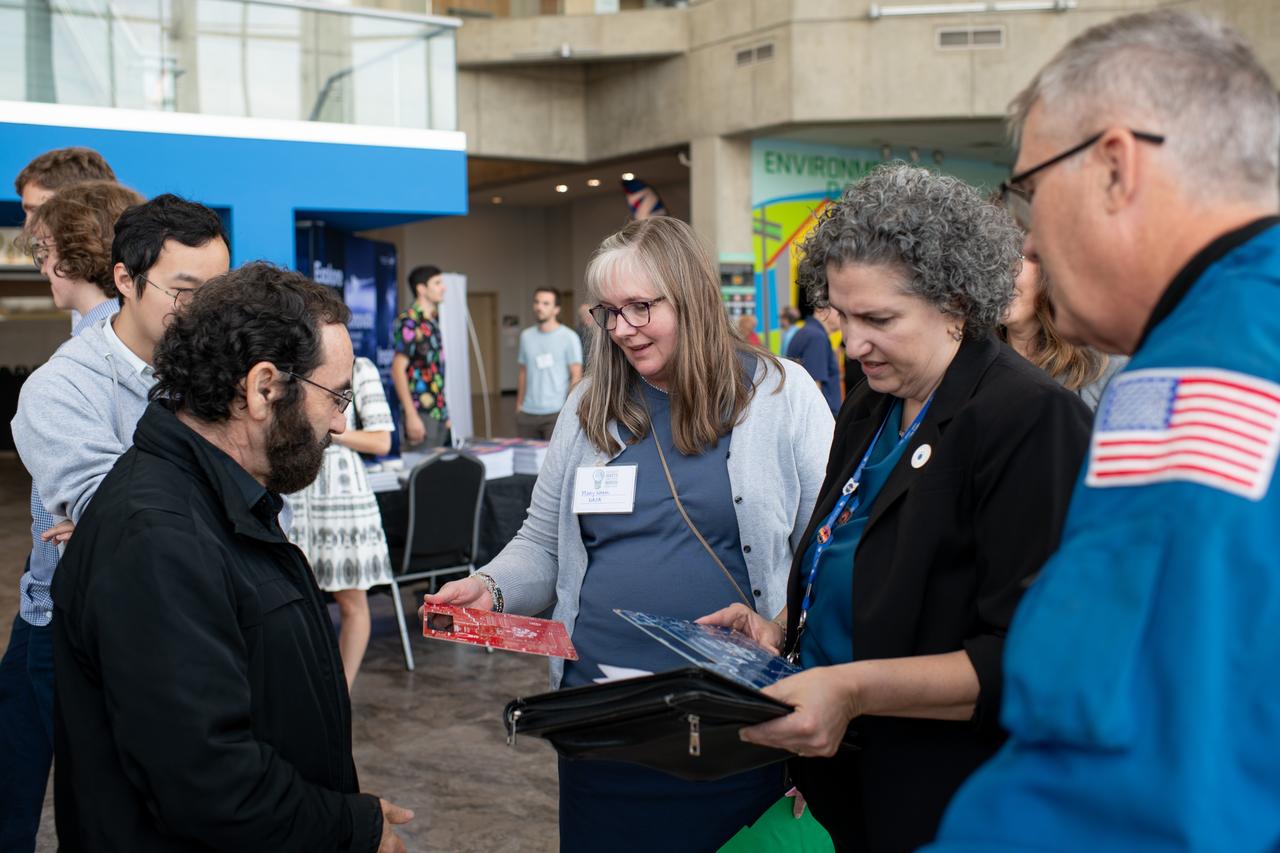
Philip Lubin from Team H.E.L.P.S. (High Efficiency Long-Range Power Solution) explains his project to Mary Wadel, Kirsten Ellenbogen and Stephen Bowen. NASA has awarded a total of $1.5 million to two U.S. teams for their novel technology solutions addressing energy distribution, management, and storage as part of the agency’s Watts on the Moon Challenge. The innovations from this challenge aim to support NASA’s Artemis missions, which will establish long-term human presence on the Moon. This two-phase competition has challenged U.S. innovators to develop breakthrough power transmission and energy storage technologies that could enable long-duration Moon missions to advance the nation’s lunar exploration goals. The final phase of the challenge concluded with a technology showcase and winners’ announcement ceremony Friday at Great Lakes Science Center, home of the visitor center for NASA’s Glenn Research Center in Cleveland. Team H.E.L.P.S. (High Efficiency Long-Range Power Solution) from The University of California, Santa Barbara won the $1 million grand prize in NASA’s Watts on the Moon Challenge. Their team developed a low-mass, high efficiency cable and featured energy storage batteries on both ends of their power transmission and energy storage system. Second prize ($500,000): Orbital Mining Corporation of Golden, Colorado Photo Credit: (NASA/Sara Lowthian-Hanna)
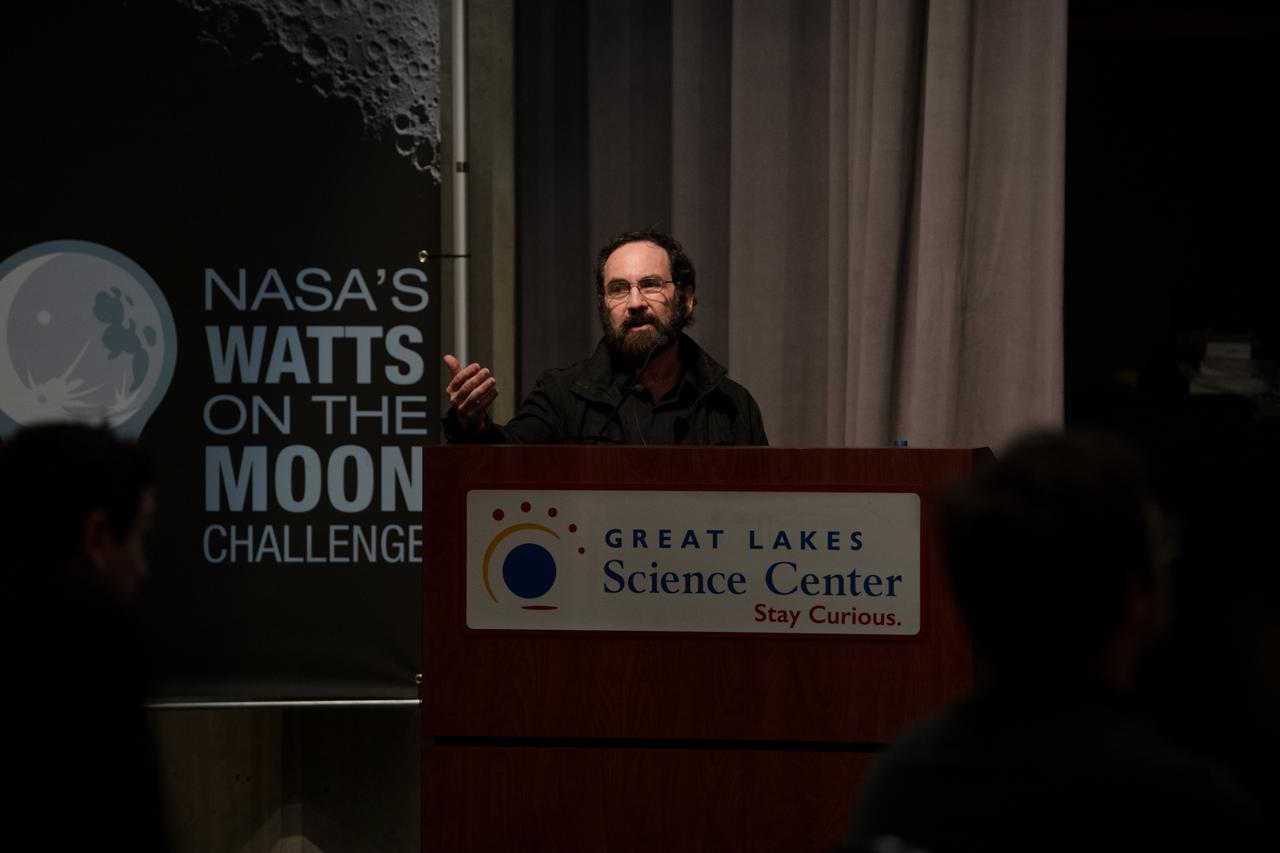
Philip Lubin from H.E.L.P.S. (High Efficiency Long-Range Power Solution) from The University of California gives their presentation. NASA has awarded a total of $1.5 million to two U.S. teams for their novel technology solutions addressing energy distribution, management, and storage as part of the agency’s Watts on the Moon Challenge. The innovations from this challenge aim to support NASA’s Artemis missions, which will establish long-term human presence on the Moon. This two-phase competition has challenged U.S. innovators to develop breakthrough power transmission and energy storage technologies that could enable long-duration Moon missions to advance the nation’s lunar exploration goals. The final phase of the challenge concluded with a technology showcase and winners’ announcement ceremony on September 11, 2024 at Great Lakes Science Center, home of the visitor center for NASA’s Glenn Research Center in Cleveland. Team H.E.L.P.S. (High Efficiency Long-Range Power Solution) from The University of California, Santa Barbara won the $1 million grand prize in NASA’s Watts on the Moon Challenge. Their team developed a low-mass, high efficiency cable and featured energy storage batteries on both ends of their power transmission and energy storage system. Second prize ($500,000): Orbital Mining Corporation of Golden, Colorado. Photo Credit: (NASA/Sara Lowthian-Hanna)
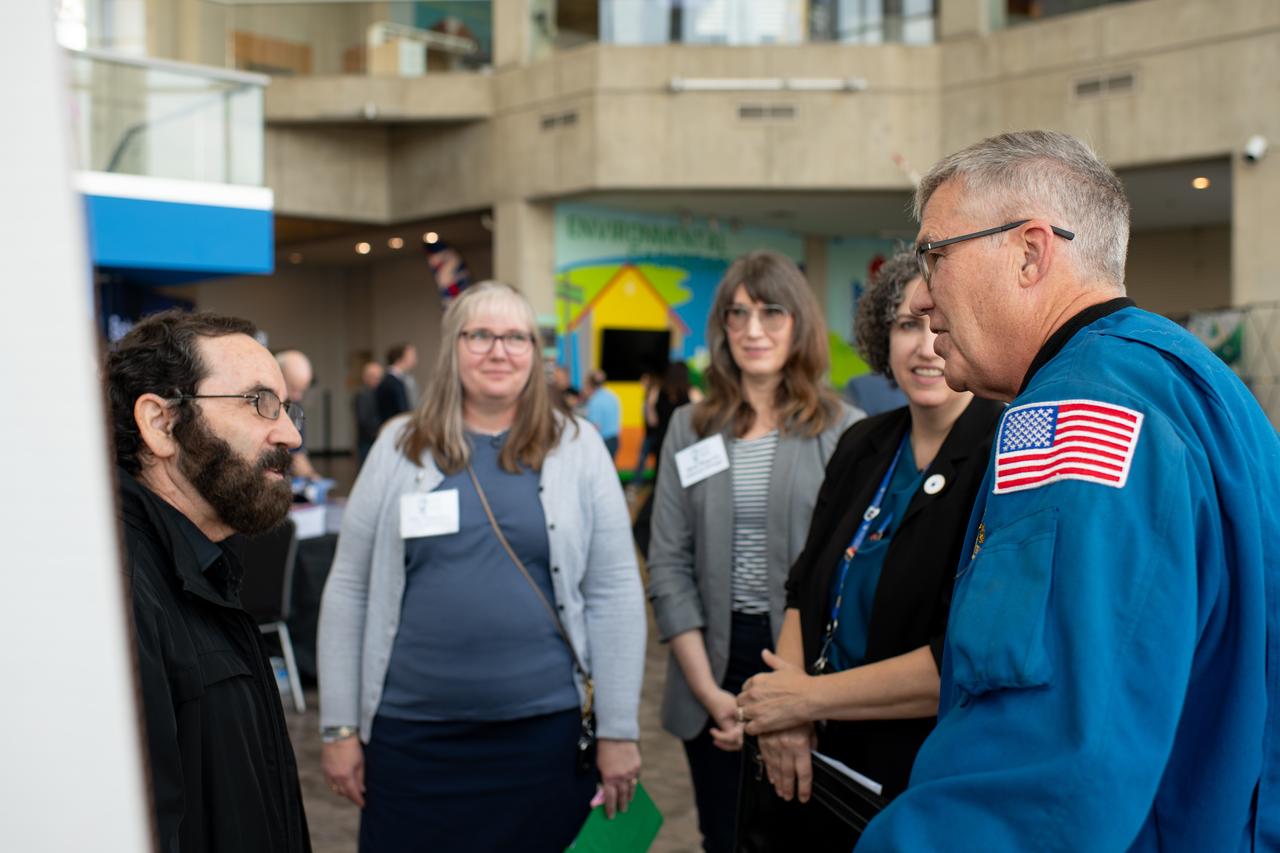
Philip Lubin from Team H.E.L.P.S. (High Efficiency Long-Range Power Solution) explains his project to Mary Wadel, Lisa Ferguson, Kirsten Ellenbogen and Stephen Bowen. NASA has awarded a total of $1.5 million to two U.S. teams for their novel technology solutions addressing energy distribution, management, and storage as part of the agency’s Watts on the Moon Challenge. The innovations from this challenge aim to support NASA’s Artemis missions, which will establish long-term human presence on the Moon. This two-phase competition has challenged U.S. innovators to develop breakthrough power transmission and energy storage technologies that could enable long-duration Moon missions to advance the nation’s lunar exploration goals. The final phase of the challenge concluded with a technology showcase and winners’ announcement ceremony on September 20, 2024 at Great Lakes Science Center, home of the visitor center for NASA’s Glenn Research Center in Cleveland. Team H.E.L.P.S. (High Efficiency Long-Range Power Solution) from The University of California, Santa Barbara won the $1 million grand prize in NASA’s Watts on the Moon Challenge. Their team developed a low-mass, high efficiency cable and featured energy storage batteries on both ends of their power transmission and energy storage system. Second prize ($500,000): Orbital Mining Corporation of Golden, Colorado. Photo Credit: (NASA/Sara Lowthian-Hanna)
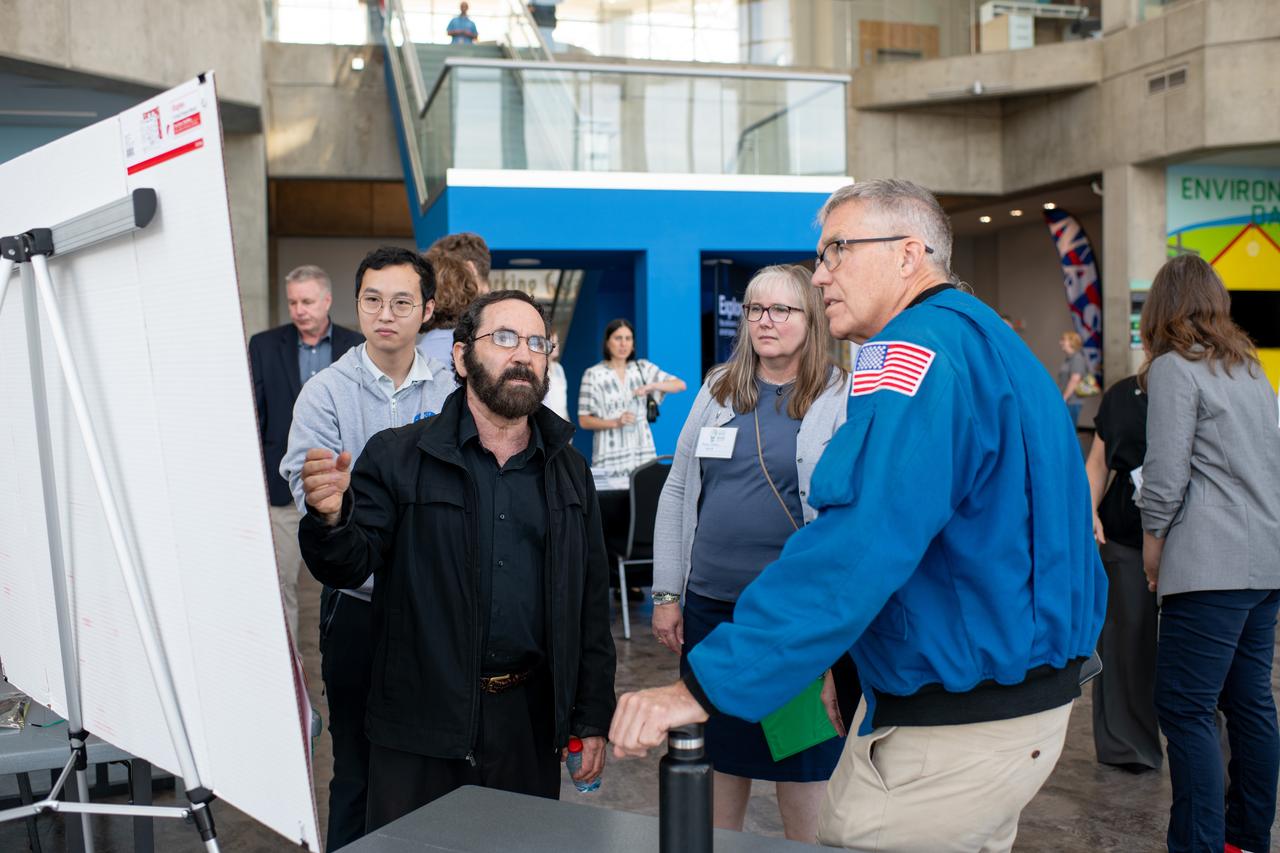
Philip Lubin from Team H.E.L.P.S. (High Efficiency Long-Range Power Solution) explains his project to Mary Wadel and Stephen Bowen. NASA has awarded a total of $1.5 million to two U.S. teams for their novel technology solutions addressing energy distribution, management, and storage as part of the agency’s Watts on the Moon Challenge. The innovations from this challenge aim to support NASA’s Artemis missions, which will establish long-term human presence on the Moon. This two-phase competition has challenged U.S. innovators to develop breakthrough power transmission and energy storage technologies that could enable long-duration Moon missions to advance the nation’s lunar exploration goals. The final phase of the challenge concluded with a technology showcase and winners’ announcement ceremony on September 20, 2024 at Great Lakes Science Center, home of the visitor center for NASA’s Glenn Research Center in Cleveland. Team H.E.L.P.S. (High Efficiency Long-Range Power Solution) from The University of California, Santa Barbara won the $1 million grand prize in NASA’s Watts on the Moon Challenge. Their team developed a low-mass, high efficiency cable and featured energy storage batteries on both ends of their power transmission and energy storage system. Second prize ($500,000): Orbital Mining Corporation of Golden, Colorado. Photo Credit: (NASA/Sara Lowthian-Hanna)

Building 4200 of Marshall’s administrative complex is prepared for demolition in the fall of 2022. Building 4200 was Marshall’s administrative headquarters from 1963 until 2020. The project will make way for a newer, more energy-efficient facilities, providing worksites for new generations of engineers, scientists, and support teams.
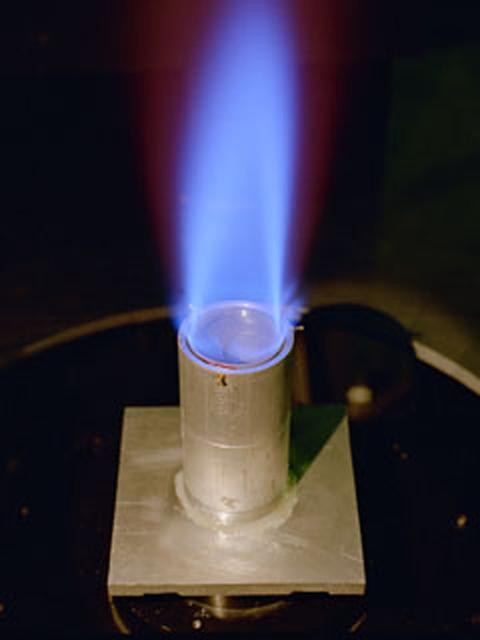
The Ring Flame Stabilizer has been developed in conjunction with Lewis Research Center. This device can lower pollutant emissions (which contribute to smog and air pollution) from natural-gas appliances such as furnaces and water heaters by 90 percent while improving energy efficiency by 2 percent.
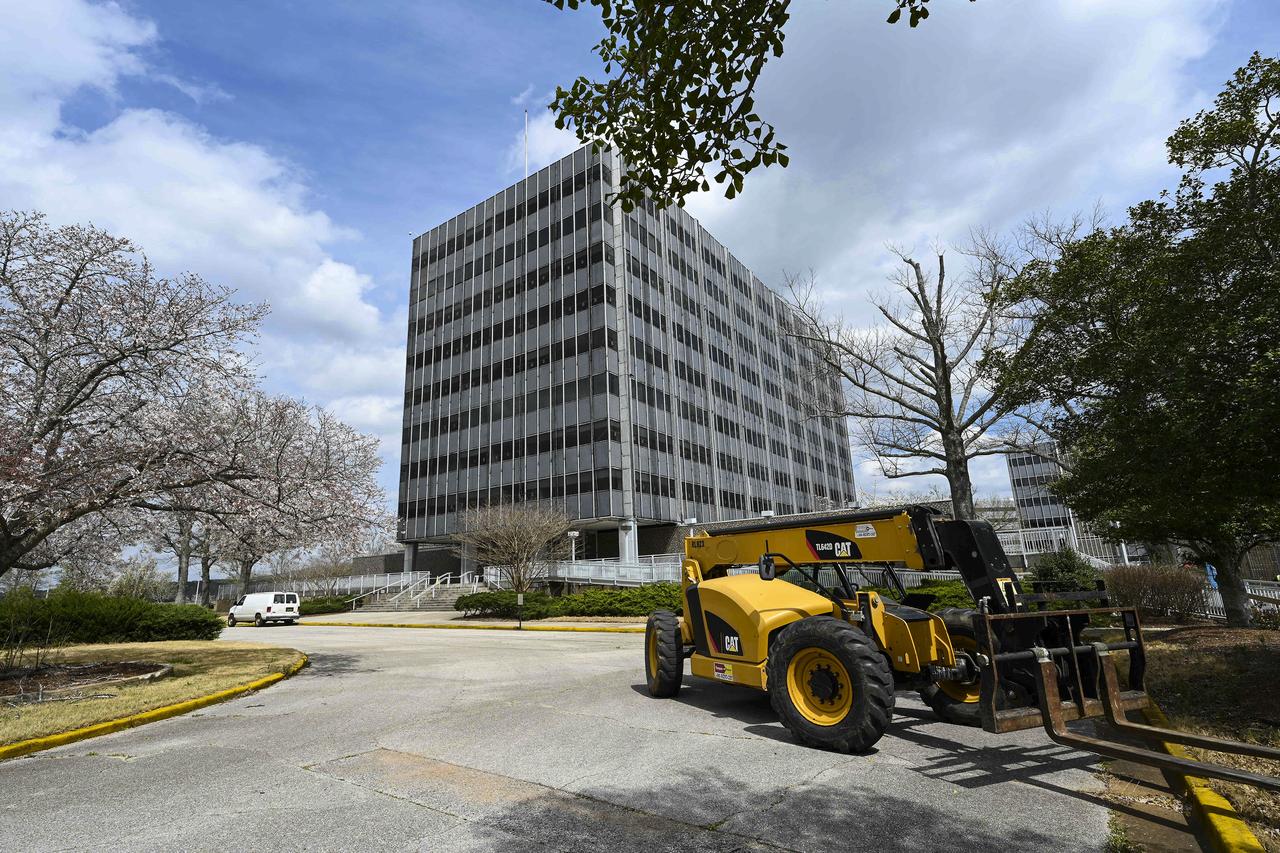
Building 4200 of Marshall’s administrative complex is prepared for demolition in the fall of 2022. Building 4200 was Marshall’s administrative headquarters from 1963 until 2020. The project will make way for a newer, more energy-efficient facilities, providing worksites for new generations of engineers, scientists, and support teams.
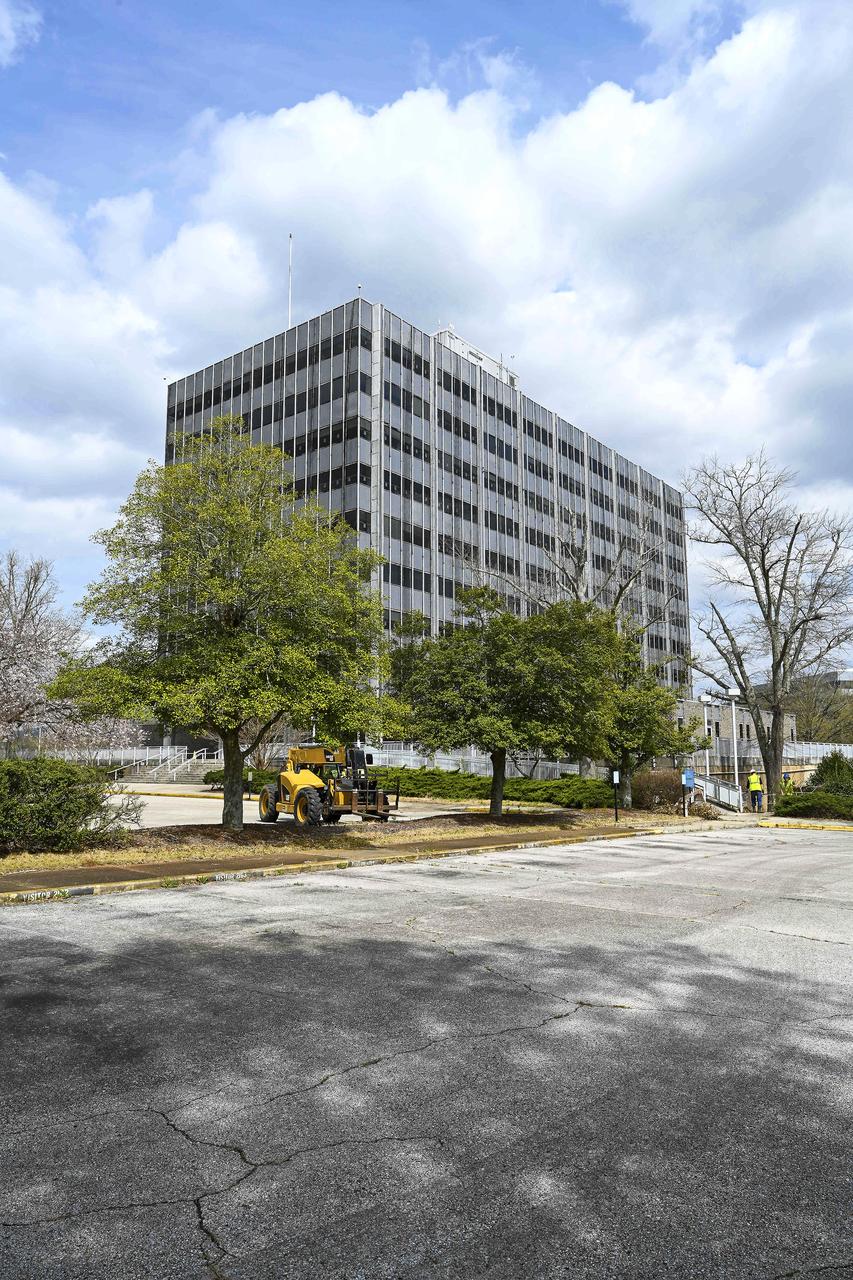
Building 4200 of Marshall’s administrative complex is prepared for demolition in the fall of 2022. Building 4200 was Marshall’s administrative headquarters from 1963 until 2020. The project will make way for a newer, more energy-efficient facilities, providing worksites for new generations of engineers, scientists, and support teams.
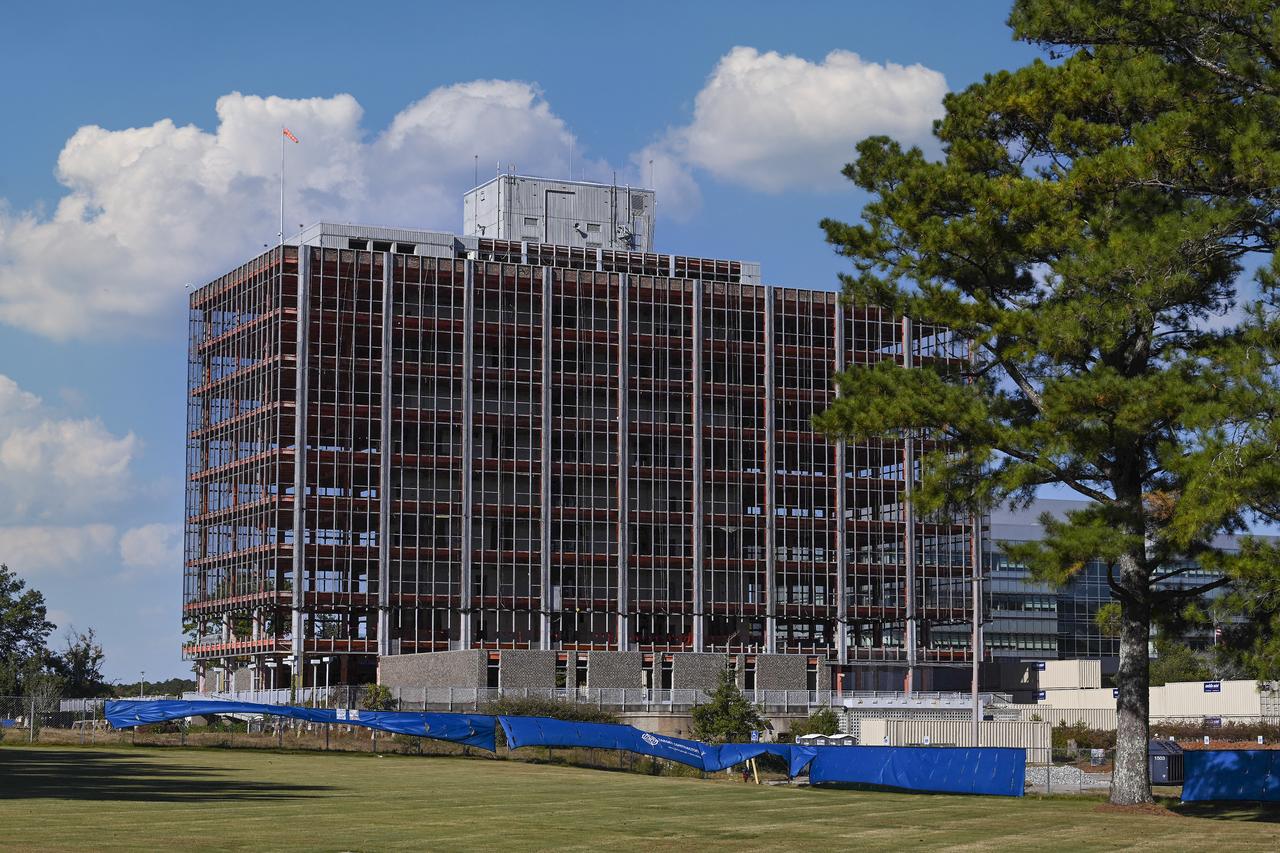
Building 4200 of Marshall’s administrative complex is prepared for demolition in the fall of 2022. Building 4200 was Marshall’s administrative headquarters from 1963 until 2020. The project will make way for a newer, more energy-efficient facilities, providing worksites for new generations of engineers, scientists, and support teams.

KENNEDY SPACE CENTER, FLA. - KSC employees stop at display tables set up in a tent near the Operations and Checkout Building for KSC’s annual Environmental and Energy Awareness Week, held April 20-22. The slogan for this year’s event was “Today's Conservation Defines Tomorrow's Future.” Presentations included Chemistry Safety, Cost-Effective Solar Applications, Non-Native Invasive Plant Identification and Control, Energy Efficient Lighting Systems, and Historical Changes in KSC’s Ecosystems.
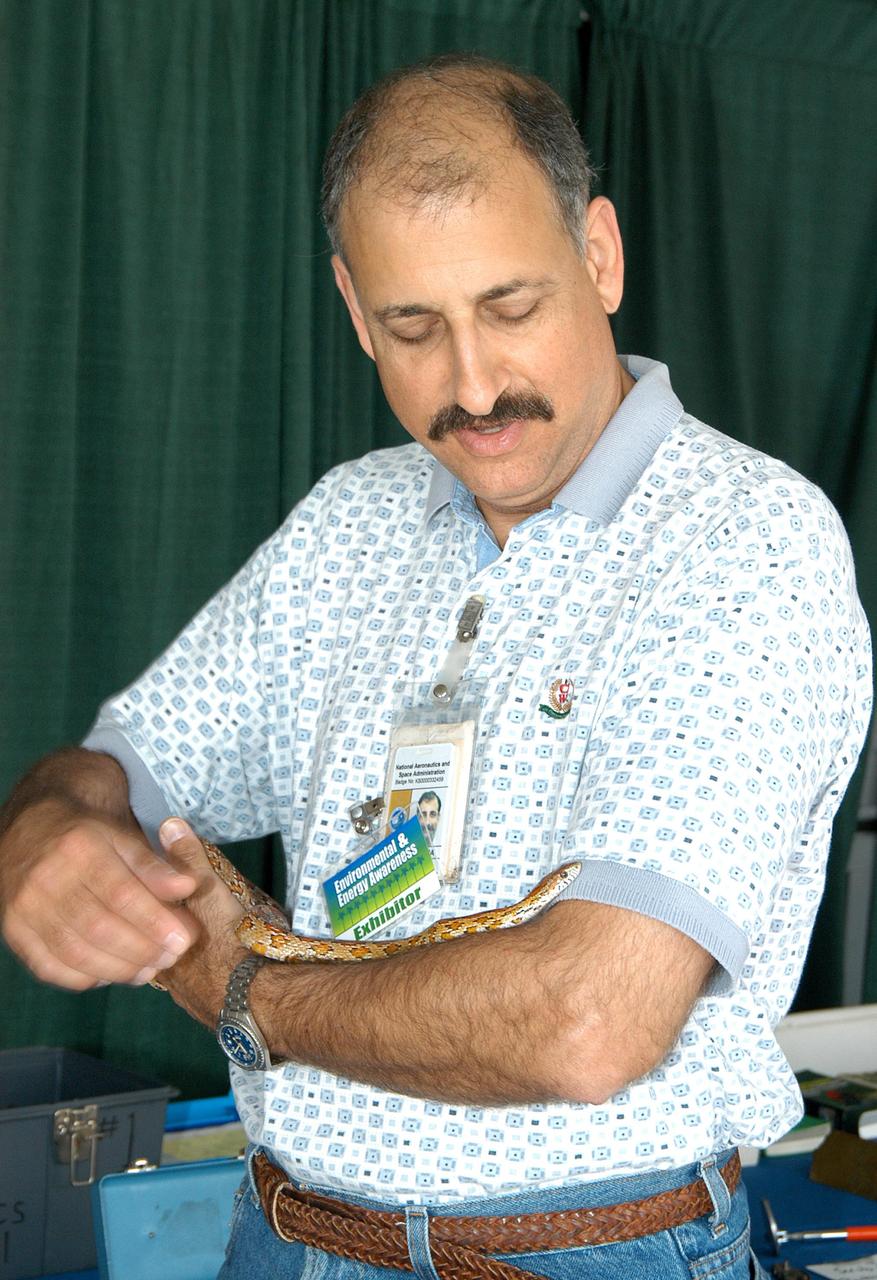
KENNEDY SPACE CENTER, FLA. - Mario Busacca, with the Safety, Occupational Health and Environmental Division, handles a snake at one of the exhibits for KSC’s annual Environmental and Energy Awareness Week, held April 20-22. Presentations included Chemistry Safety, Cost-Effective Solar Applications, Non-Native Invasive Plant Identification and Control, Energy Efficient Lighting Systems, and Historical Changes in KSC’s Ecosystems. The slogan for this year’s event was “Today's Conservation Defines Tomorrow's Future.”
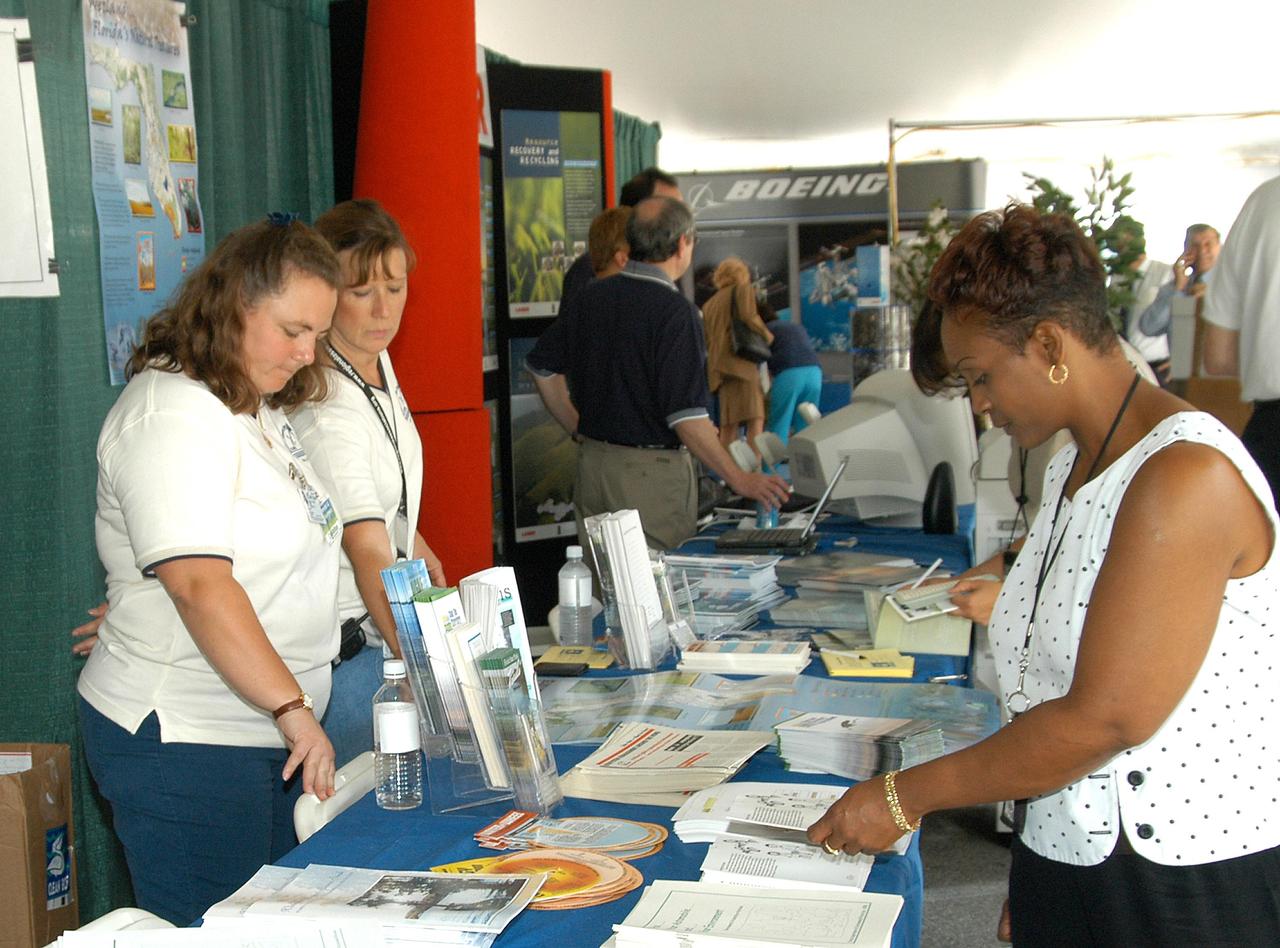
KENNEDY SPACE CENTER, FLA. - KSC employees stop at display tables set up in a tent near the Operations and Checkout Building for KSC’s annual Environmental and Energy Awareness Week, held April 20-22. The slogan for this year’s event was “Today's Conservation Defines Tomorrow's Future.” Presentations included Chemistry Safety, Cost-Effective Solar Applications, Non-Native Invasive Plant Identification and Control, Energy Efficient Lighting Systems, and Historical Changes in KSC’s Ecosystems.
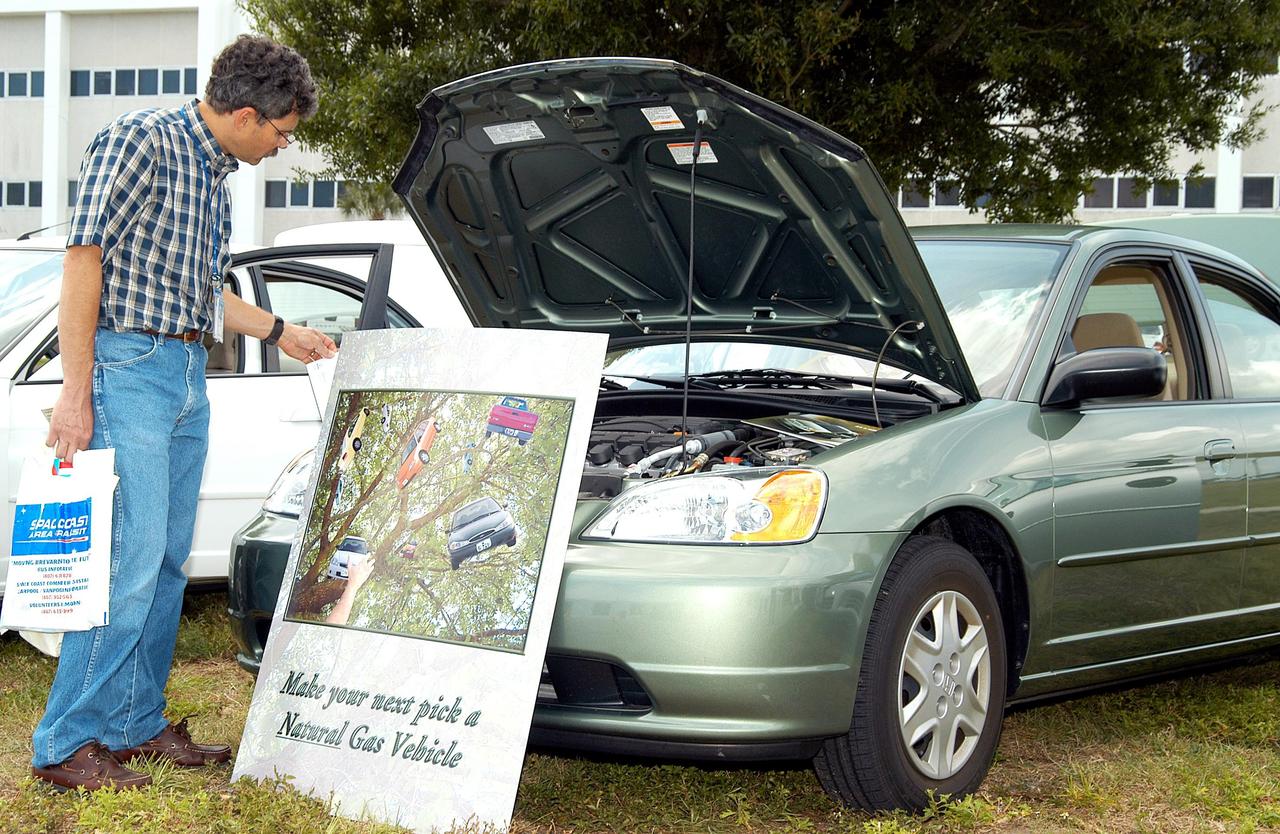
KENNEDY SPACE CENTER, FLA. - A KSC employee stops to look at a car equipped to use natural gas as fuel. Several cars using alternative fuel technology were part of an exhibit during KSC’s annual Environmental and Energy Awareness Week, held April 20-22. The slogan for this year’s event was “Today's Conservation Defines Tomorrow's Future.” Presentations included Chemistry Safety, Cost-Effective Solar Applications, Non-Native Invasive Plant Identification and Control, Energy Efficient Lighting Systems, and Historical Changes in KSC’s Ecosystems.
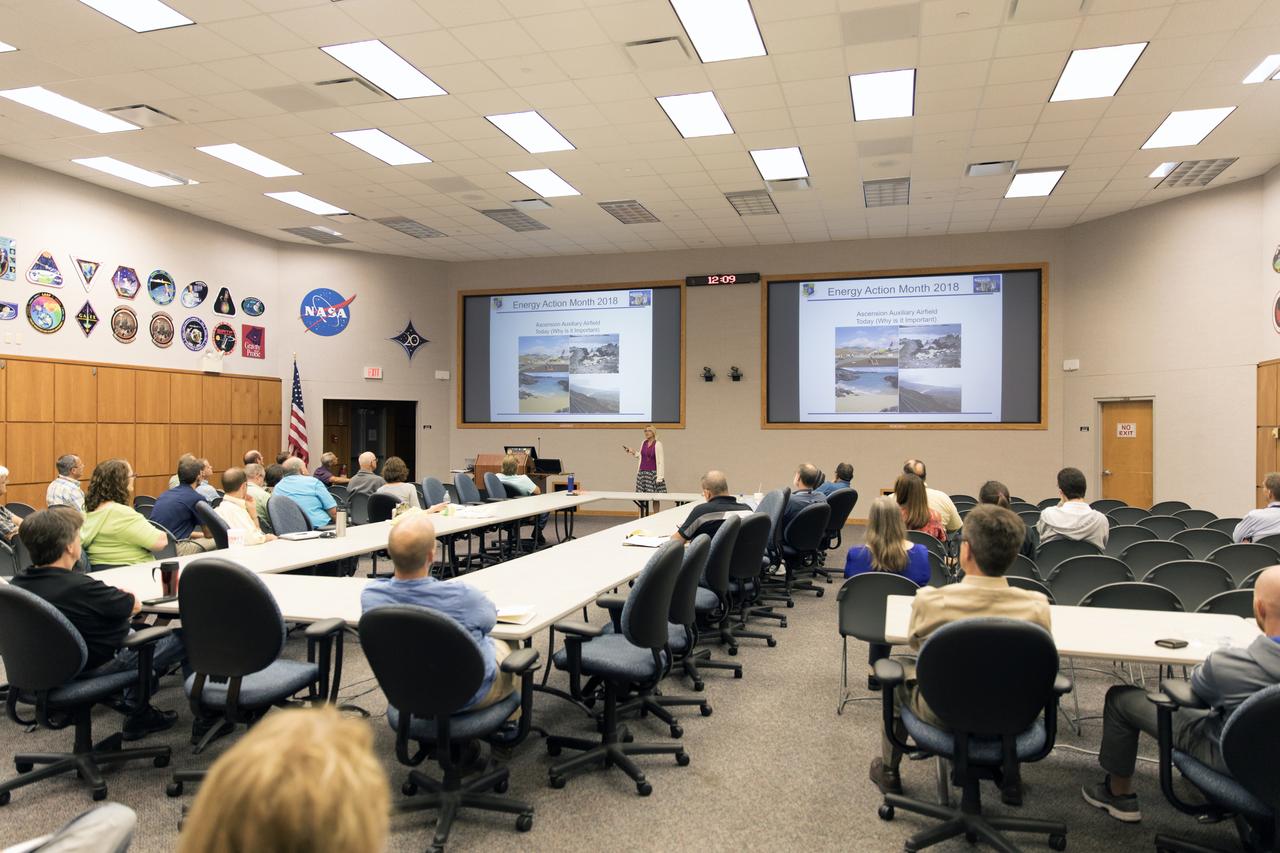
Guest speaker Robin Thomas shares a presentation focusing on energy resilience and the Ascension Island wind turbine generator project during a “lunch and learn” held Tuesday, Oct. 23, 2018, for employees at NASA’s Kennedy Space Center in Florida. Thomas is a resource efficiency manager working with the U.S. Air Force 45th Space Wing’s Civil Engineering Squadron based at Patrick Air Force Base. The event was one of two held during October in conjunction with Energy Awareness Month, which aims to recognize the importance of energy management for our national prosperity, security and environmental sustainability.

Guest speaker Robin Thomas discusses energy resilience and the Ascension Island wind turbine generator project during a “lunch and learn” held Tuesday, Oct. 23, 2018, for employees at NASA’s Kennedy Space Center in Florida. Thomas is a resource efficiency manager working with the U.S. Air Force 45th Space Wing’s Civil Engineering Squadron based at Patrick Air Force Base. The event was one of two held during October in conjunction with Energy Awareness Month, which aims to recognize the importance of energy management for our national prosperity, security and environmental sustainability.

Guest speaker Robin Thomas discusses energy resilience and the Ascension Island wind turbine generator project during a “lunch and learn” held Tuesday, Oct. 23, 2018, for employees at NASA’s Kennedy Space Center in Florida. Thomas is a resource efficiency manager working with the U.S. Air Force 45th Space Wing’s Civil Engineering Squadron based at Patrick Air Force Base. The event was one of two held during October in conjunction with Energy Awareness Month, which aims to recognize the importance of energy management for our national prosperity, security and environmental sustainability.
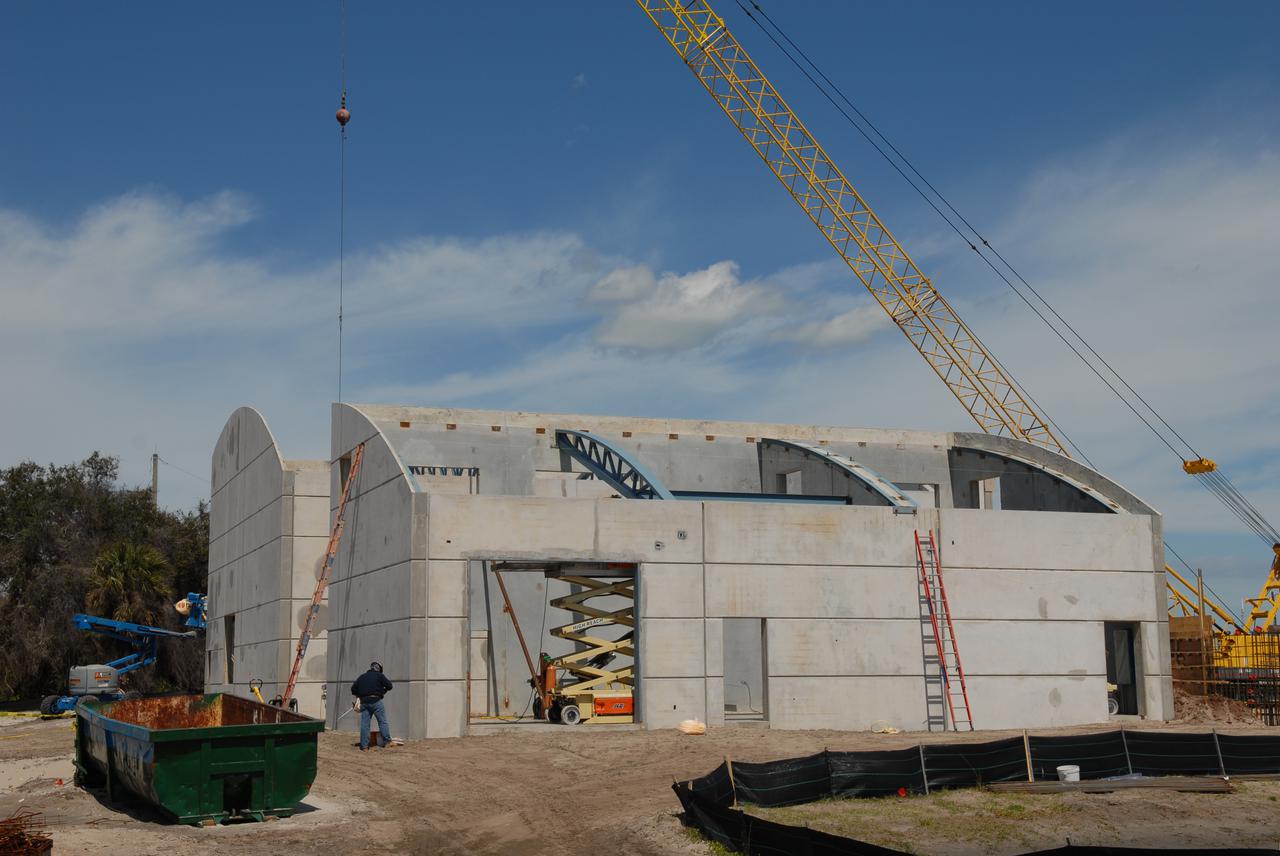
CAPE CANAVERAL, Fla. - In Launch Complex 39 at NASA's Kennedy Space Center in Florida, preparations are under way to install the roofs on the Propellants North Administrative and Maintenance Facility buildings. The facility will have a two-story administrative building to house managers, mechanics and technicians who fuel spacecraft at Kennedy adjacent to an 1,800-square-foot single-story shop to store cryogenic fuel transfer equipment. The new facility will feature high-efficiency roofs and walls, “Cool Dry Quiet” air conditioning with energy recovery technology, efficient lighting, and other sustainable features. The facility is striving to qualify for the U.S. Green Building Council’s Leadership in Energy and Environmental Design, or LEED, Platinum certification. If successful, Propellants North will be the first Kennedy facility to achieve this highest of LEED ratings after it is completed in December 2010. The facility was designed for NASA by Jones Edmunds and Associates. H. W. Davis Construction is the construction contractor. Photo credit: NASA_Jim Grossmann
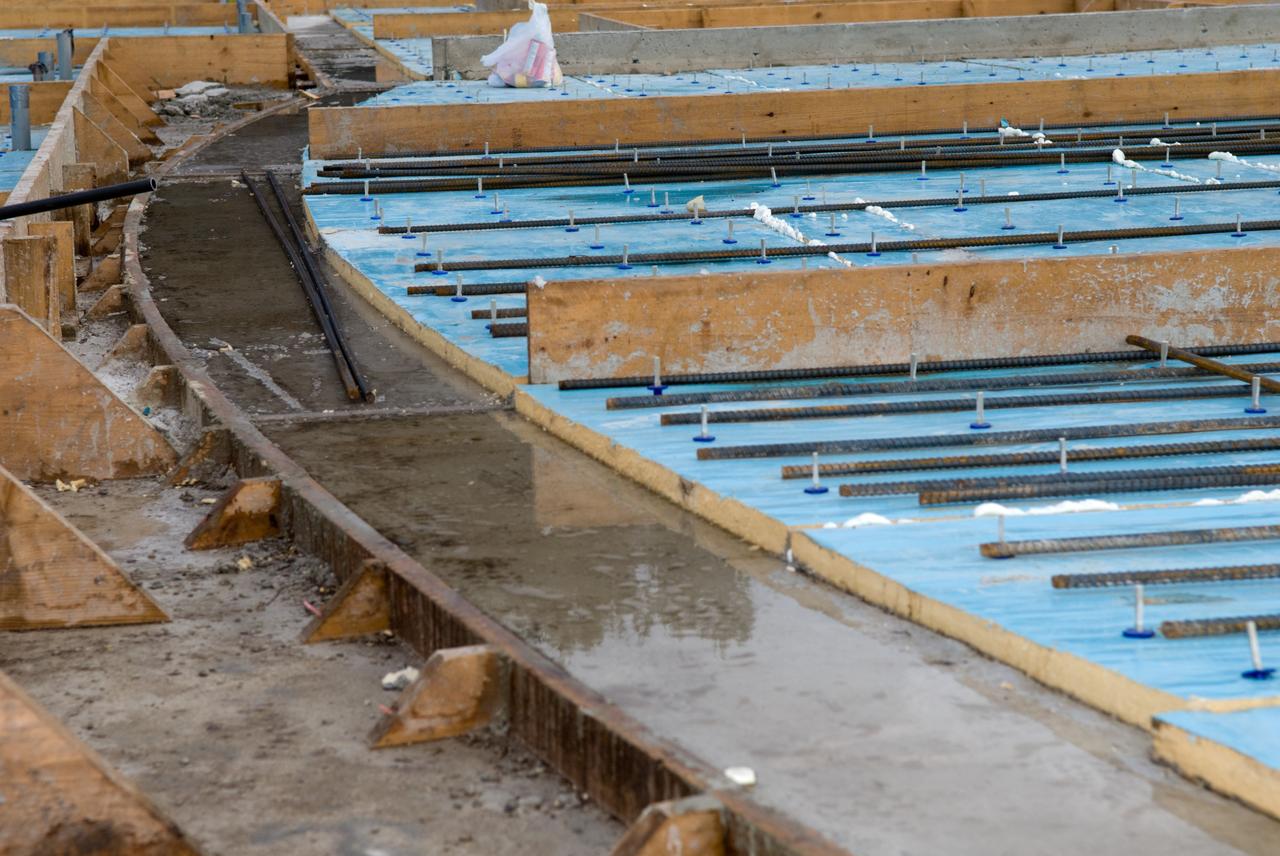
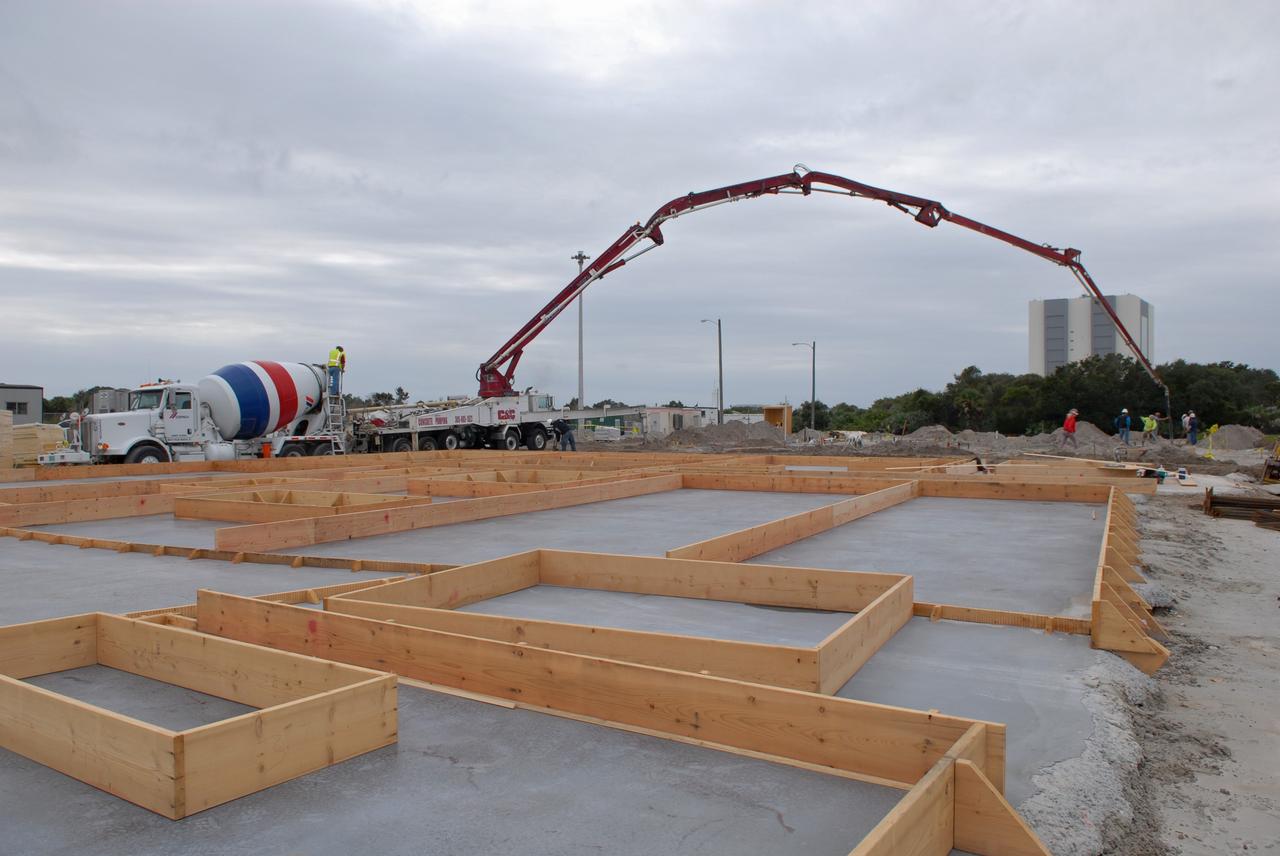
CAPE CANAVERAL, Fla. - Trenches are prepared to support the walls of the Propellants North Administrative and Maintenance Facility in Launch Complex 39 at NASA's Kennedy Space Center in Florida. The facility will have a two-story administrative building to house managers, mechanics and technicians who fuel spacecraft at Kennedy adjacent to an 1,800-square-foot single-story shop to store cryogenic fuel transfer equipment. The new facility will feature high-efficiency roofs and walls, “Cool Dry Quiet” air conditioning with energy recovery technology, efficient lighting, and other sustainable features. The facility is striving to qualify for the U.S. Green Building Council’s Leadership in Energy and Environmental Design, or LEED, Platinum certification. If successful, Propellants North will be the first Kennedy facility to achieve this highest of LEED ratings after it is completed in the summer of 2010. The facility was designed for NASA by Jones Edmunds and Associates. Photo credit: NASA/Jim Grossmann
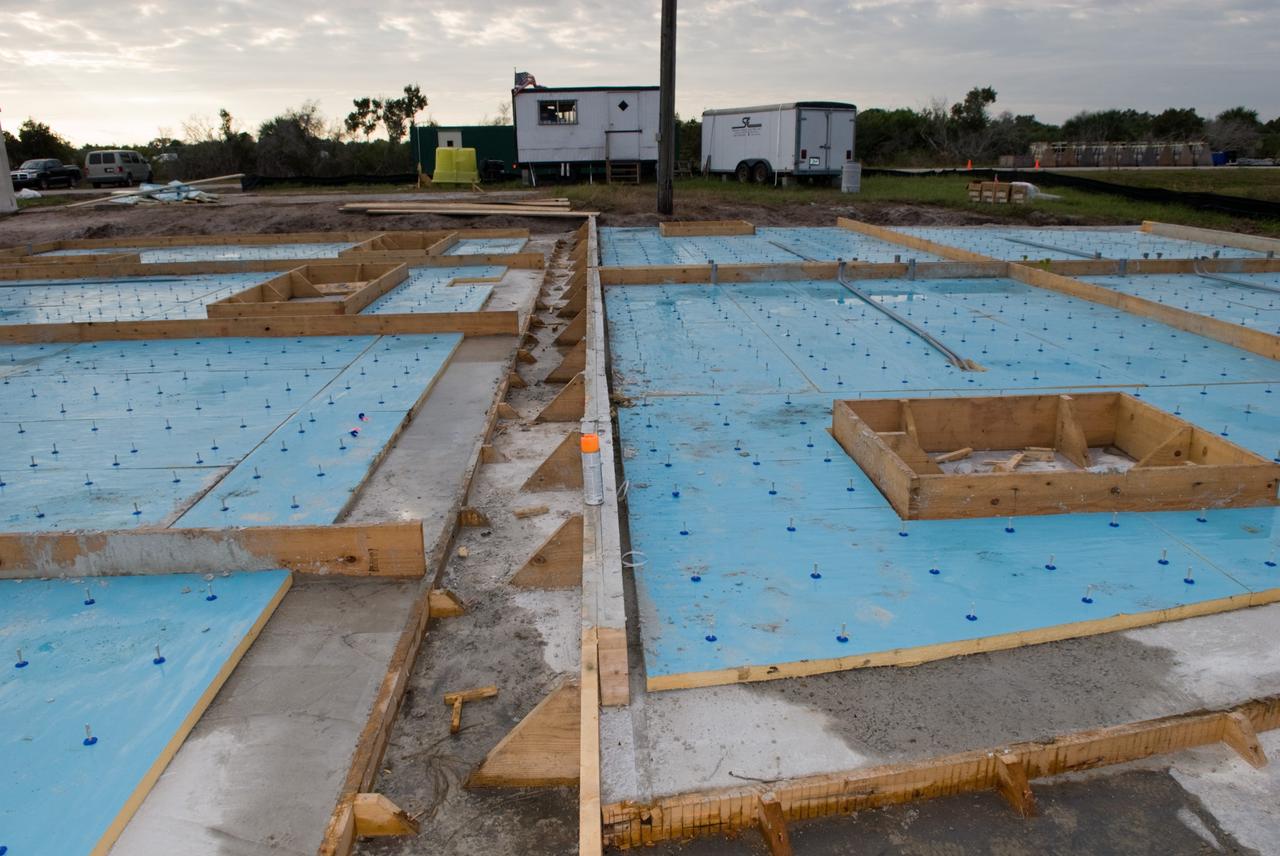
CAPE CANAVERAL, Fla. - Construction of the Propellants North Administrative and Maintenance Facility begins in Launch Complex 39 at NASA's Kennedy Space Center in Florida. The facility will have a two-story administrative building to house managers, mechanics and technicians who fuel spacecraft at Kennedy adjacent to an 1,800-square-foot single-story shop to store cryogenic fuel transfer equipment. The new facility will feature high-efficiency roofs and walls, “Cool Dry Quiet” air conditioning with energy recovery technology, efficient lighting, and other sustainable features. The facility is striving to qualify for the U.S. Green Building Council’s Leadership in Energy and Environmental Design, or LEED, Platinum certification. If successful, Propellants North will be the first Kennedy facility to achieve this highest of LEED ratings after it is completed in the summer of 2010. The facility was designed for NASA by Jones Edmunds and Associates. Photo credit: NASA/Jim Grossmann
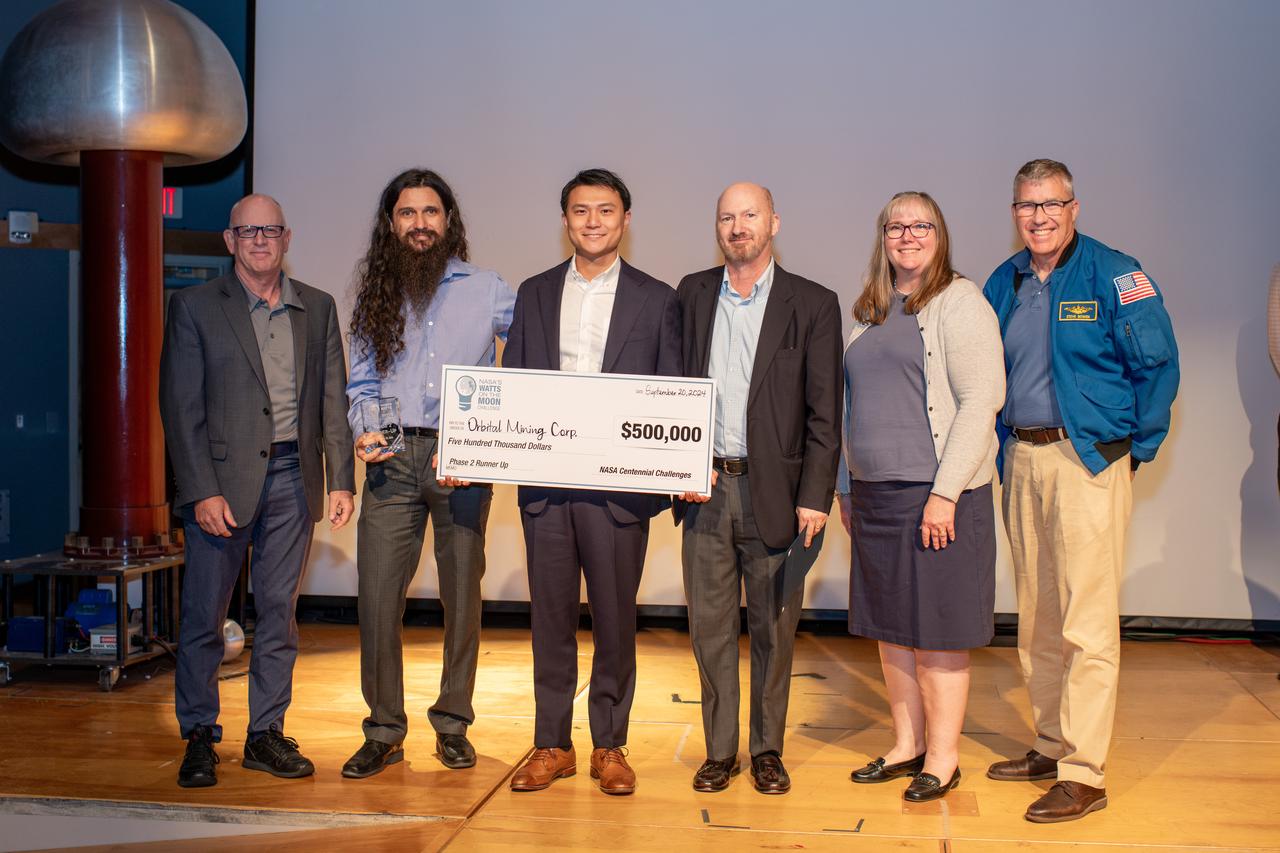
Individuals from Orbital Mining Corporation of Golden, Colorado pose with Robert Button, Mary Wadel and Astronaut Stephen Bowen. NASA has awarded a total of $1.5 million to two U.S. teams for their novel technology solutions addressing energy distribution, management, and storage as part of the agency’s Watts on the Moon Challenge. The innovations from this challenge aim to support NASA’s Artemis missions, which will establish long-term human presence on the Moon. This two-phase competition has challenged U.S. innovators to develop breakthrough power transmission and energy storage technologies that could enable long-duration Moon missions to advance the nation’s lunar exploration goals. The final phase of the challenge concluded with a technology showcase and winners’ announcement ceremony Friday at Great Lakes Science Center, home of the visitor center for NASA’s Glenn Research Center in Cleveland. Team H.E.L.P.S. (High Efficiency Long-Range Power Solution) from The University of California, Santa Barbara won the $1 million grand prize in NASA’s Watts on the Moon Challenge. Their team developed a low-mass, high efficiency cable and featured energy storage batteries on both ends of their power transmission and energy storage system. Second prize ($500,000): Orbital Mining Corporation of Golden, Colorado
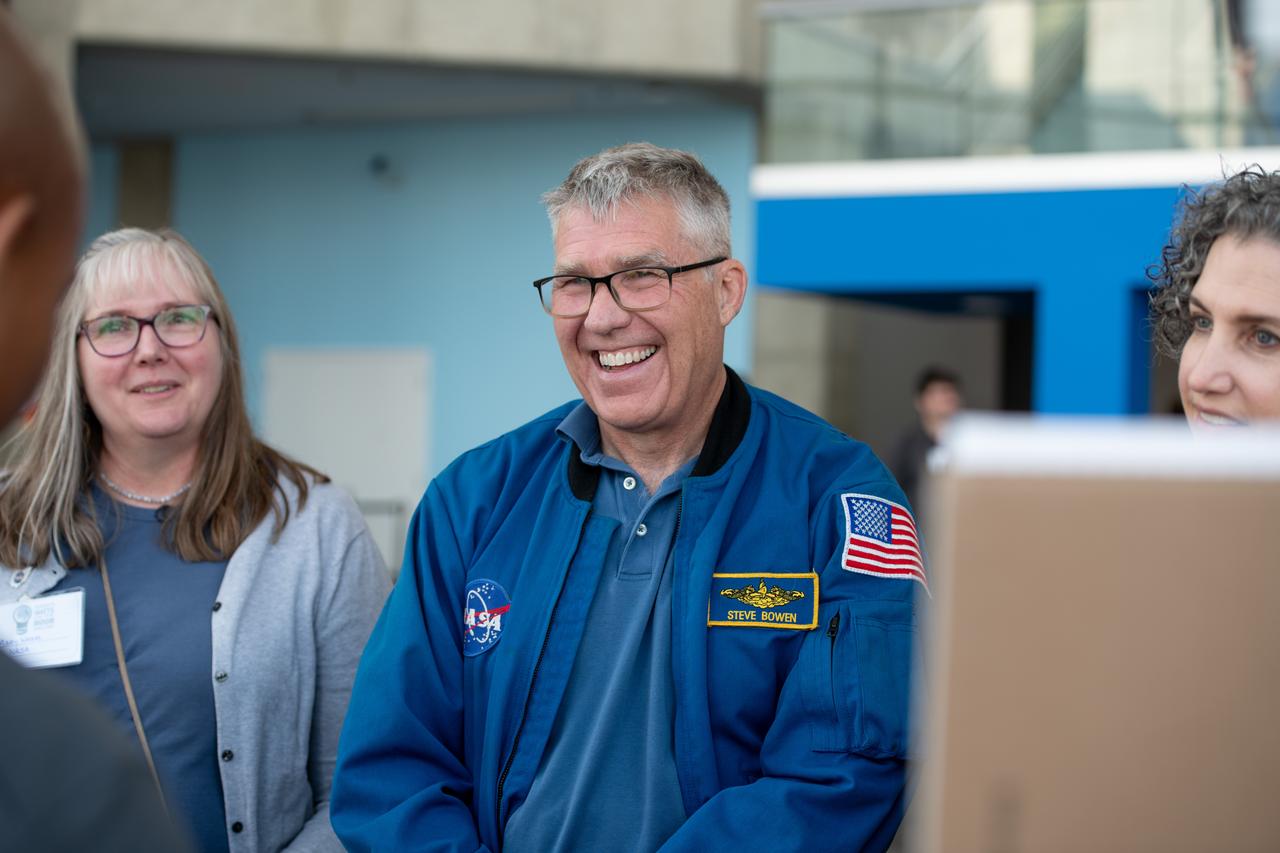
NASA has awarded a total of $1.5 million to two U.S. teams for their novel technology solutions addressing energy distribution, management, and storage as part of the agency’s Watts on the Moon Challenge. The innovations from this challenge aim to support NASA’s Artemis missions, which will establish long-term human presence on the Moon. This two-phase competition has challenged U.S. innovators to develop breakthrough power transmission and energy storage technologies that could enable long-duration Moon missions to advance the nation’s lunar exploration goals. The final phase of the challenge concluded with a technology showcase and winners’ announcement ceremony Friday at Great Lakes Science Center, home of the visitor center for NASA’s Glenn Research Center in Cleveland. Team H.E.L.P.S. (High Efficiency Long-Range Power Solution) from The University of California, Santa Barbara won the $1 million grand prize in NASA’s Watts on the Moon Challenge. Their team developed a low-mass, high efficiency cable and featured energy storage batteries on both ends of their power transmission and energy storage system. Second prize ($500,000): Orbital Mining Corporation of Golden, Colorado

Astronaut Stephen Bowen speaks during the award ceremony. NASA has awarded a total of $1.5 million to two U.S. teams for their novel technology solutions addressing energy distribution, management, and storage as part of the agency’s Watts on the Moon Challenge. The innovations from this challenge aim to support NASA’s Artemis missions, which will establish long-term human presence on the Moon. This two-phase competition has challenged U.S. innovators to develop breakthrough power transmission and energy storage technologies that could enable long-duration Moon missions to advance the nation’s lunar exploration goals. The final phase of the challenge concluded with a technology showcase and winners’ announcement ceremony Friday at Great Lakes Science Center, home of the visitor center for NASA’s Glenn Research Center in Cleveland. Team H.E.L.P.S. (High Efficiency Long-Range Power Solution) from The University of California, Santa Barbara won the $1 million grand prize in NASA’s Watts on the Moon Challenge. Their team developed a low-mass, high efficiency cable and featured energy storage batteries on both ends of their power transmission and energy storage system. Second prize ($500,000): Orbital Mining Corporation of Golden, Colorado

NASA has awarded a total of $1.5 million to two U.S. teams for their novel technology solutions addressing energy distribution, management, and storage as part of the agency’s Watts on the Moon Challenge. The innovations from this challenge aim to support NASA’s Artemis missions, which will establish long-term human presence on the Moon. This two-phase competition has challenged U.S. innovators to develop breakthrough power transmission and energy storage technologies that could enable long-duration Moon missions to advance the nation’s lunar exploration goals. The final phase of the challenge concluded with a technology showcase and winners’ announcement ceremony Friday at Great Lakes Science Center, home of the visitor center for NASA’s Glenn Research Center in Cleveland. Team H.E.L.P.S. (High Efficiency Long-Range Power Solution) from The University of California, Santa Barbara won the $1 million grand prize in NASA’s Watts on the Moon Challenge. Their team developed a low-mass, high efficiency cable and featured energy storage batteries on both ends of their power transmission and energy storage system. Second prize ($500,000): Orbital Mining Corporation of Golden, Colorado
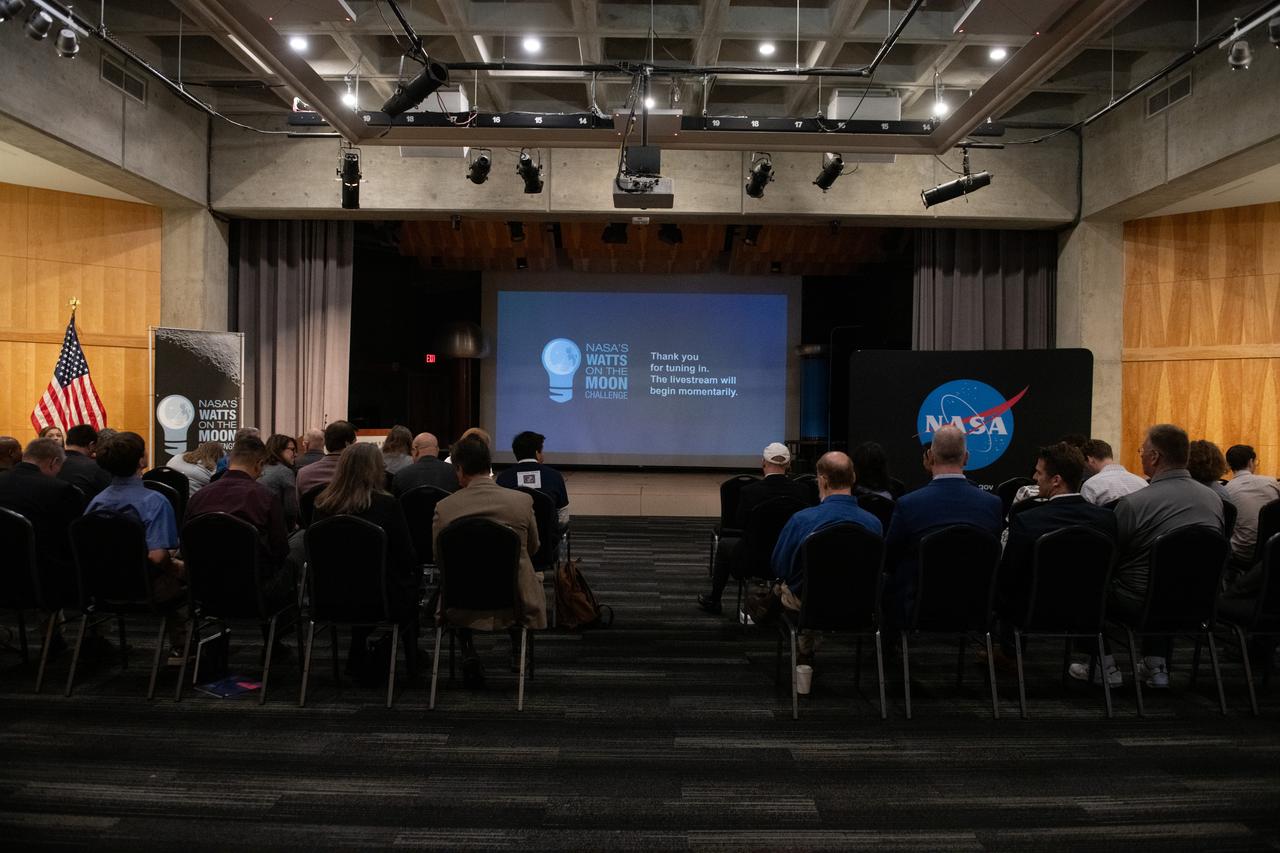
NASA has awarded a total of $1.5 million to two U.S. teams for their novel technology solutions addressing energy distribution, management, and storage as part of the agency’s Watts on the Moon Challenge. The innovations from this challenge aim to support NASA’s Artemis missions, which will establish long-term human presence on the Moon. This two-phase competition has challenged U.S. innovators to develop breakthrough power transmission and energy storage technologies that could enable long-duration Moon missions to advance the nation’s lunar exploration goals. The final phase of the challenge concluded with a technology showcase and winners’ announcement ceremony Friday at Great Lakes Science Center, home of the visitor center for NASA’s Glenn Research Center in Cleveland. Team H.E.L.P.S. (High Efficiency Long-Range Power Solution) from The University of California, Santa Barbara won the $1 million grand prize in NASA’s Watts on the Moon Challenge. Their team developed a low-mass, high efficiency cable and featured energy storage batteries on both ends of their power transmission and energy storage system. Second prize ($500,000): Orbital Mining Corporation of Golden, Colorado
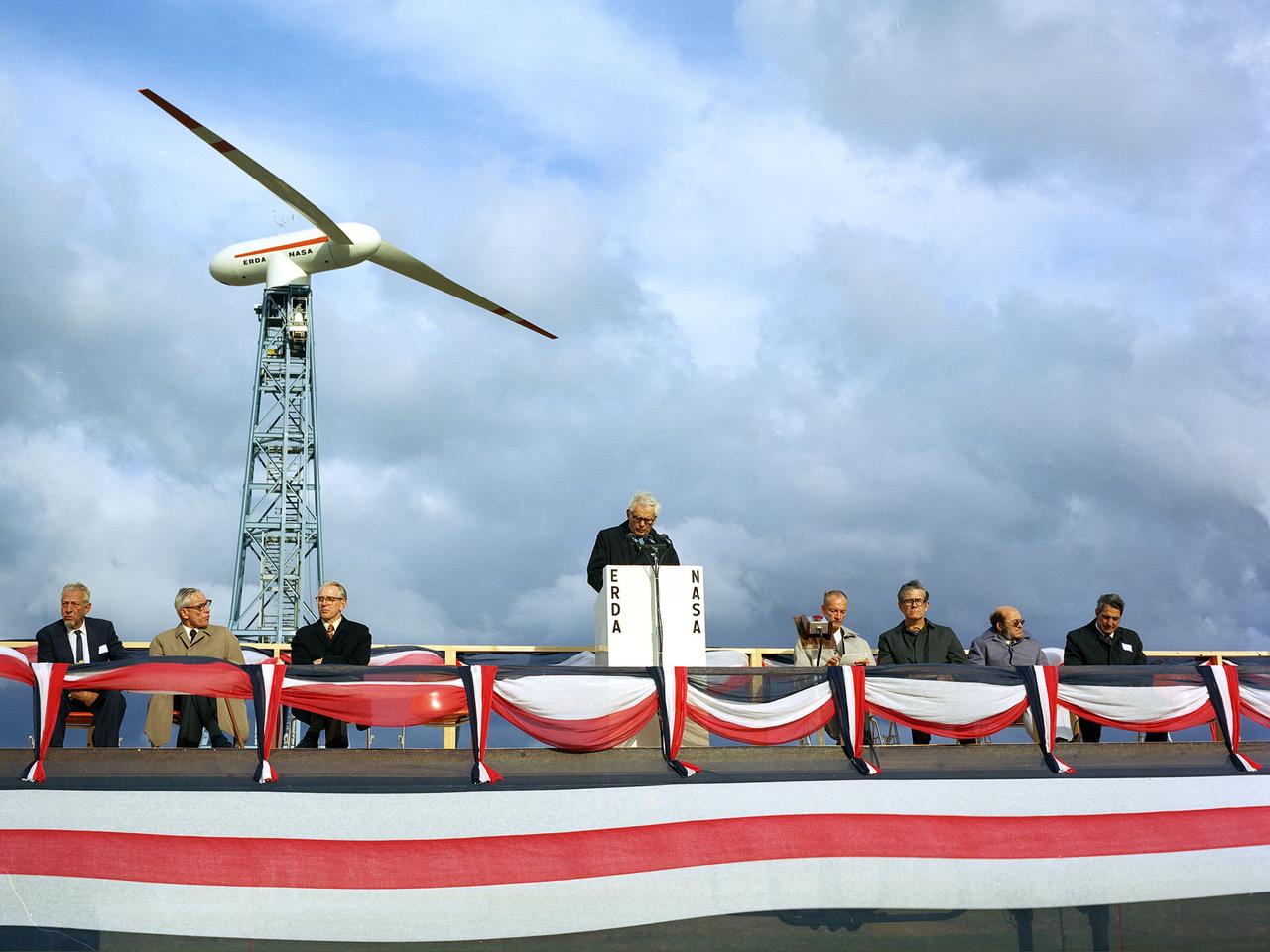
Energy Research and Development Administration (ERDA) Administrator Robert Seamans addresses the crowd at the dedication ceremony for the Mod-0 100-kilowatt wind turbine at the National Aeronautics and Space Administration’s (NASA) Plum Brook Station. The wind turbine program was a joint NASA/ERDA effort to develop less expensive forms of energy during the 1970s. NASA Lewis was able to use its experience with aerodynamics, powerplants, and energy transfer to develop efficient and cost-effective wind energy systems. The Plum Brook wind turbine was the first of a series of increasingly powerful NASA-ERDA wind turbines built around the nation. From left to right: Congressional Committee aide John Dugan, retired S. Morgan Smith Company chief engineer Carl Wilcox, windmill pioneer Beauchamp Smith, NASA Administrator James Fletcher, Seamans, and Lewis Center Director Bruce Lundin. The three men to the right are unidentified.
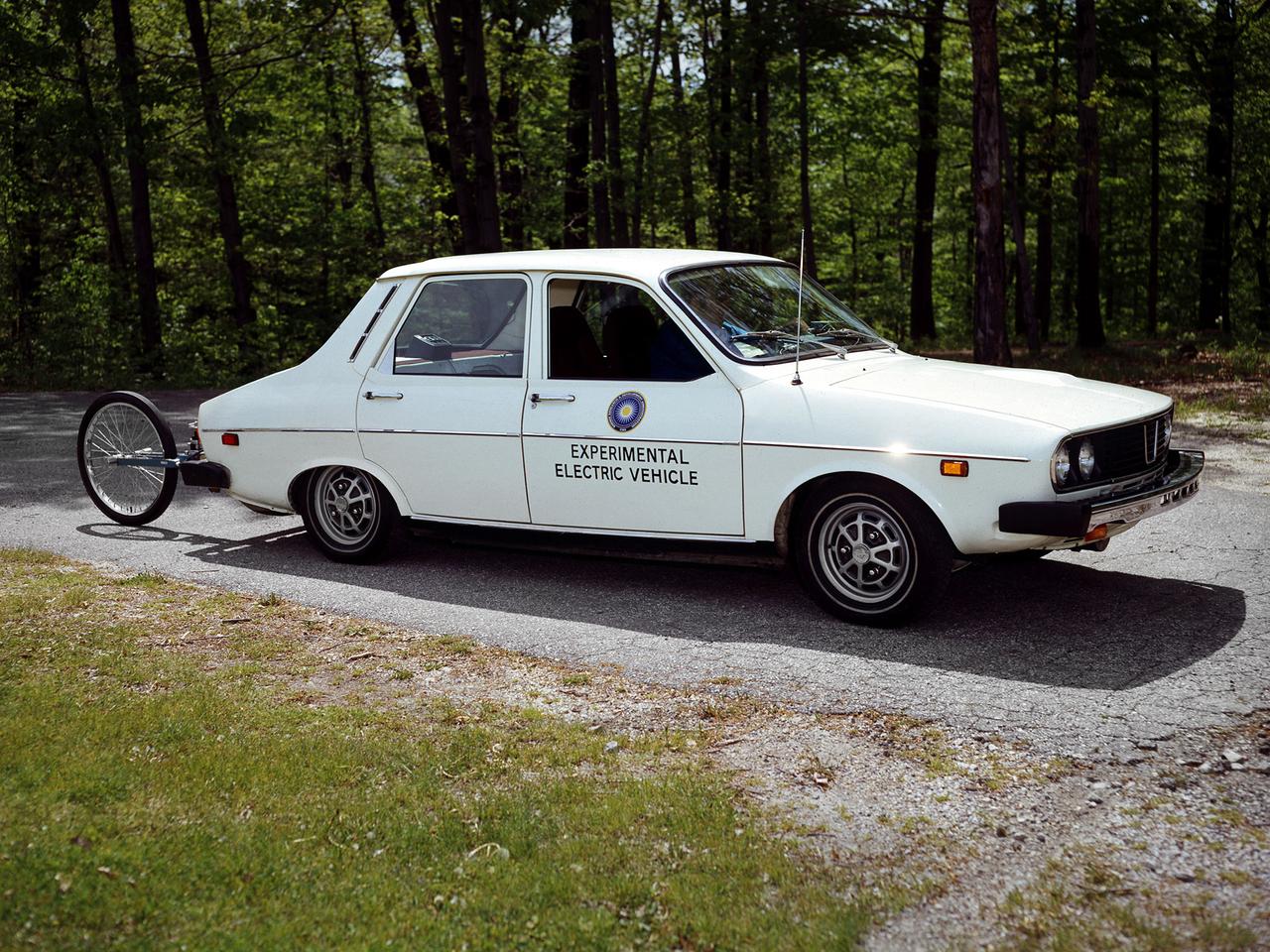
The National Aeronautics and Space Administration (NASA) Lewis Research Center tested 16 commercially-manufactured electric vehicles, including this Metro, during the mid-1970s. Lewis and the Energy Research and Development Administration (ERDA) engaged in several energy-related programs in the mid-1970s, including the Electric Vehicle Project. NASA and ERDA undertook the program in 1976 to determine the state of the current electric vehicle technology. As part of the project, Lewis and ERDA tested every commercially available electric car model. Electric Vehicle Associates, located in a Cleveland suburb, modified a Renault 12 vehicle to create this Metro. Its 1040-pound golfcart-type battery provided approximately 106 minutes of operation. The tests analyzed the vehicle’s range, acceleration, coast-down, braking, and energy consumption. Some of the vehicles had analog data recording systems to measure the battery during operation and sensors to determine speed and distance. The researchers found the performance of the different vehicles varied significantly. In general, the range, acceleration, and speed were lower than that found on conventional vehicles. They also found that traditional gasoline-powered vehicles were as efficient as the electric vehicles. The researchers concluded, however, that advances in battery technology and electric drive systems would significantly improve efficiency and performance.

The National Aeronautics and Space Administration (NASA) Lewis Research Center tested 16 commercially-manufactured electric vehicles, including this modified Pacer, during the mid-1970s. The Electric Vehicle Project was just one of several energy-related programs that Lewis and the Energy Research and Development Administration (ERDA) undertook in the mid-1970s. NASA and ERDA embarked on this program in 1976 to determine the state of the current electric vehicle technology. As part of the project, Lewis tested a fleet composed of every commercially available electric car. The Cleveland-area Electric Vehicle Associates modified an American Motors Pacer vehicle to create this Change-of-Pace Coupe. It was powered by twenty 6-volt batteries whose voltage could be varied by a foot control. The tests analyzed the vehicle’s range, acceleration, coast-down, braking, and energy consumption. Some of the vehicles had analog data recording systems to measure the battery during operation and sensors to determine speed and distance. Lewis researchers found that the vehicle performance varied significantly from model to model. In general, the range, acceleration, and speed were lower than conventional vehicles. They also found that traditional gasoline-powered vehicles were as efficient as the electric vehicles. The researchers concluded, however, that advances in battery technology and electric drive systems would significantly improve the performance and efficiency.
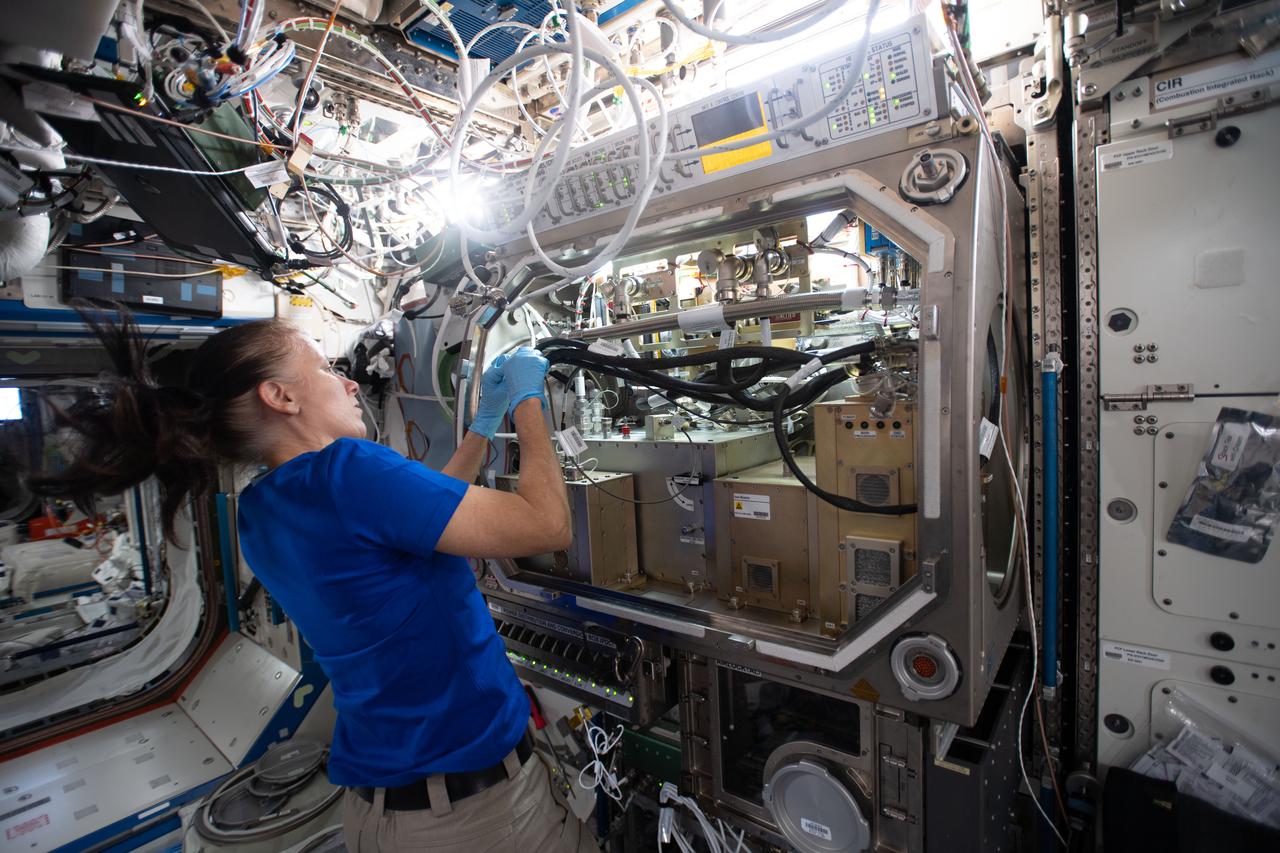
iss064e035056 (Feb. 19, 2021) --- NASA astronaut and Expedition 64 Flight Engineer Shannon Walker sets up Packed Bed Reactor Experiment (PBRE) hardware components inside the Destiny laboratory module's Microgravity Science Glovebox. The PBRE study explores how liquids and gases in behave together microgravity which may enable the design of more efficient, lightweight thermal management and life support systems that use less energy on future space exploration missions.
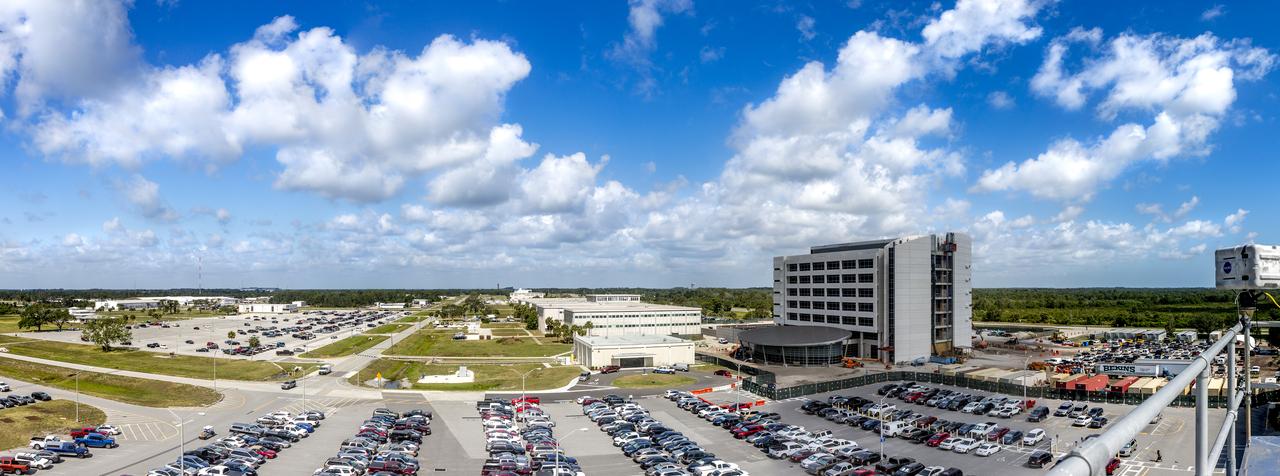
A panoramic view of the Industrial Area at NASA's Kennedy Space Center in Florida, shows the nearly-complete new headquarters building at right. The new seven-story, 200,000-square-foot facility will house about 500 NASA civil service and contractor employees. The building will be more energy efficient than the current Headquarters building and will feature the latest in office and administrative building technology to fulfill Kennedy's role as the premiere spaceport for NASA and, increasingly, commercial entities.

The new headquarters building’s seven floors are clearly visible as construction continues in the industrial area at NASA’s Kennedy Space Center in Florida. The 200,000-square-foot facility will anchor the spaceport’s Central Campus and house about 500 NASA civil service and contractor employees. The building will be more energy efficient than the current Headquarters building and will feature the latest in office and administrative building technology to fulfill Kennedy's role as the premiere multi-user spaceport for NASA and, increasingly, commercial entities.
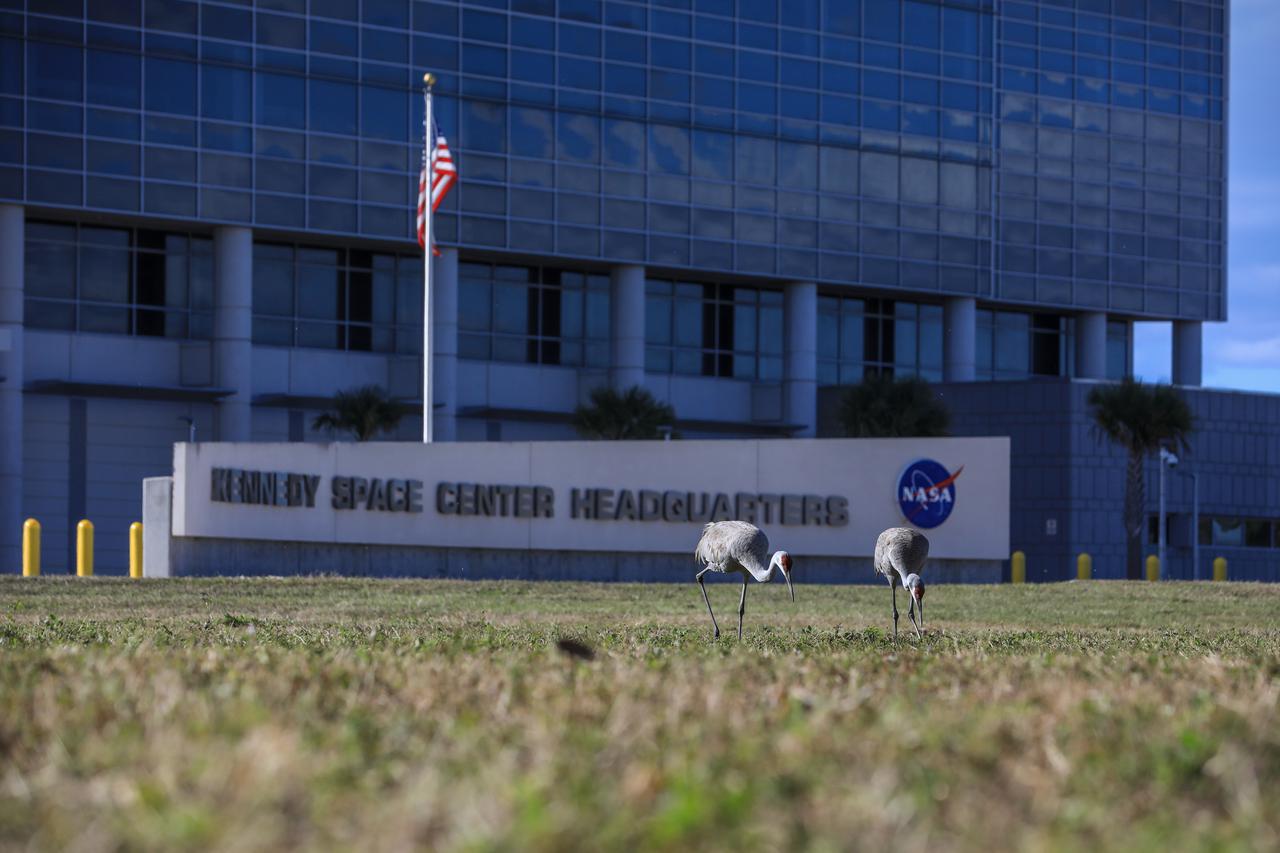
Sandhill cranes dig in the ground in front of the Central Campus Headquarters (CCHQ) Building at NASA’s Kennedy Space Center in Florida on Jan. 11, 2022. The CCHQ is a modernized, energy efficient facility representative of Kennedy’s transformation to America’s premier multi-user spaceport. It opened in May 2019. Built in 1965, the former headquarters building was recently demolished. The area previously occupied by the 439,000 square-foot-facility will be utilized as greenspace.
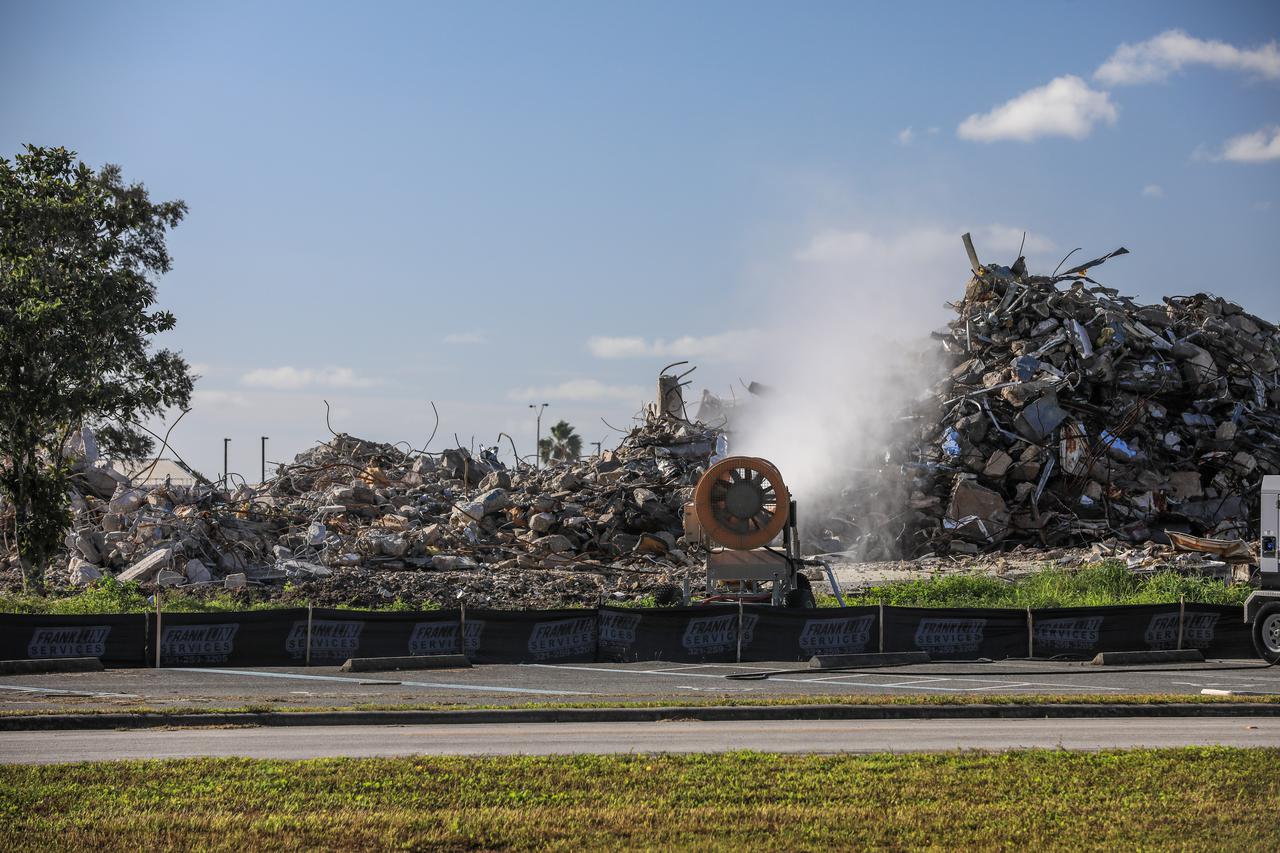
Shown is remnants of the former headquarters building at NASA’s Kennedy Space Center on Jan. 11, 2022. Built in 1965, the 439,000-square-foot structure was demolished and replaced at the Florida spaceport by the 200,000-square-foot, seven-story Central Campus Headquarters (CCHQ) Building. The CCHQ is a modernized, energy efficient facility representative of Kennedy’s transformation to America’s premier multi-user spaceport. The area previously occupied by the old headquarters building will be utilized as greenspace.
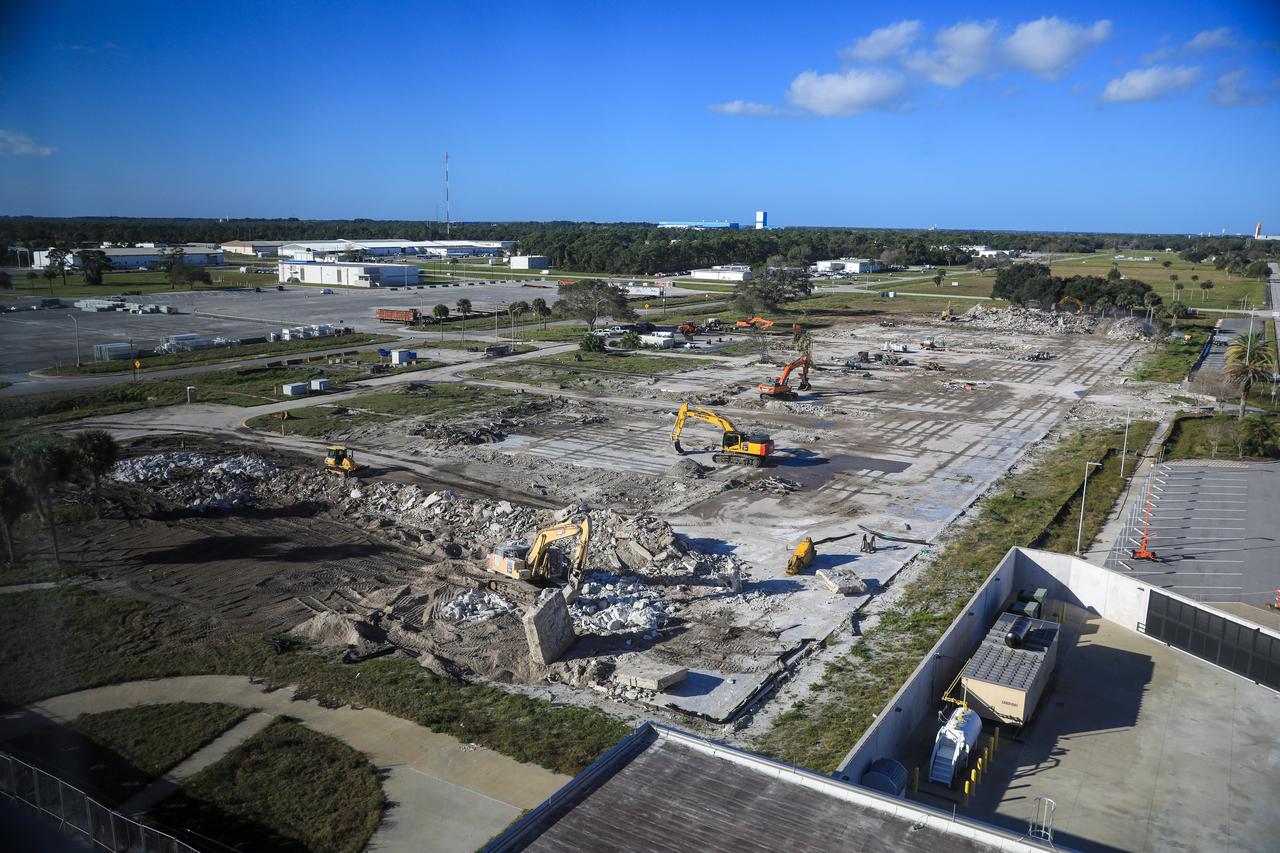
Shown on Jan. 11, 2022, is the area formerly occupied by the headquarters building at NASA’s Kennedy Space Center. Built in 1965, the 439,000-square-foot-structure was demolished and replaced at the Florida spaceport by the 200,000-square-foot, seven-story Central Campus Headquarters (CCHQ) Building. The CCHQ is a modernized, energy efficient facility representative of Kennedy’s transformation to America’s premier multi-user spaceport. It opened in May 2019. The area previously occupied by the old headquarters building will be utilized as greenspace.
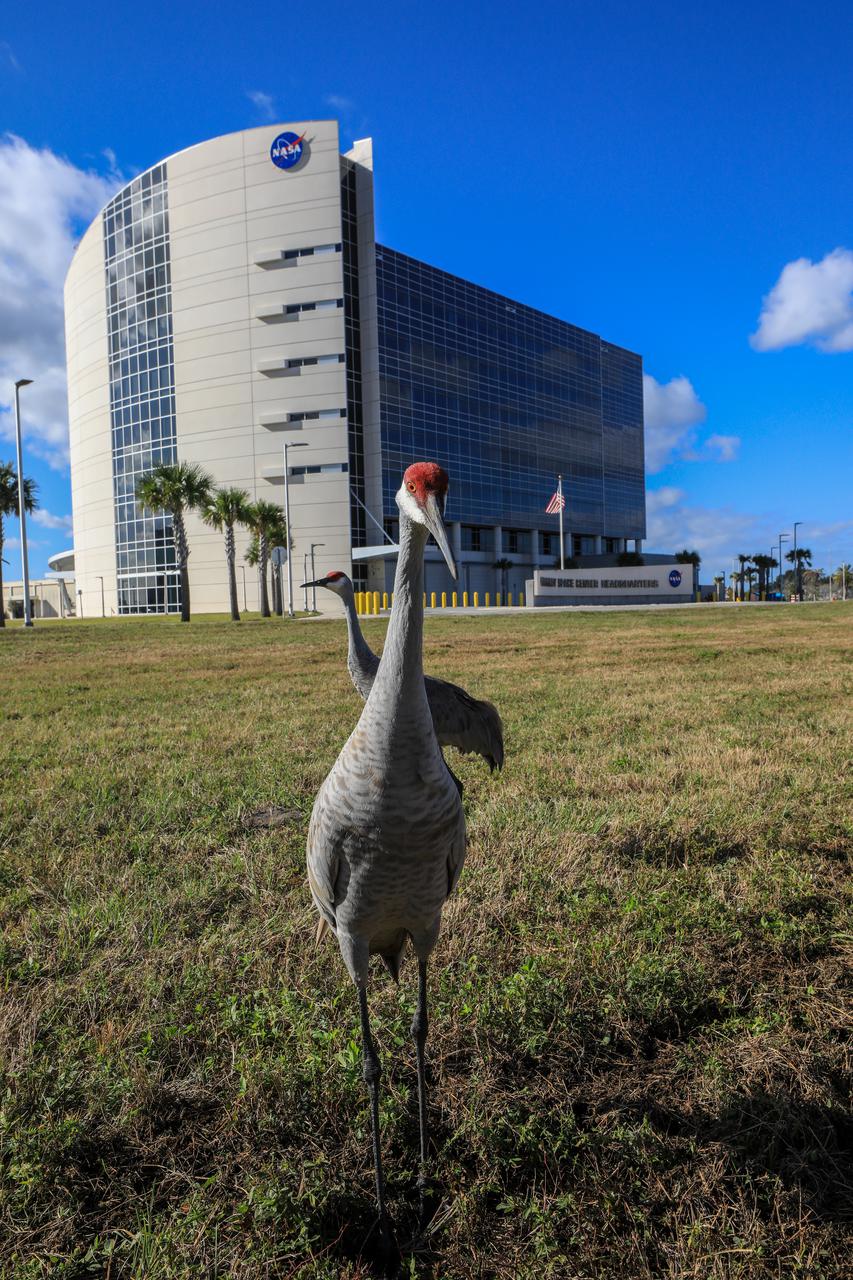
Sandhill cranes pose in front of the Central Campus Headquarters (CCHQ) Building at NASA’s Kennedy Space Center in Florida on Jan. 11, 2022. The CCHQ is a modernized, energy efficient facility representative of Kennedy’s transformation to America’s premier multi-user spaceport. It opened in May 2019. Built in 1965, the former headquarters building was recently demolished. The area previously occupied by the 439,000 square-foot-facility will be utilized as greenspace.
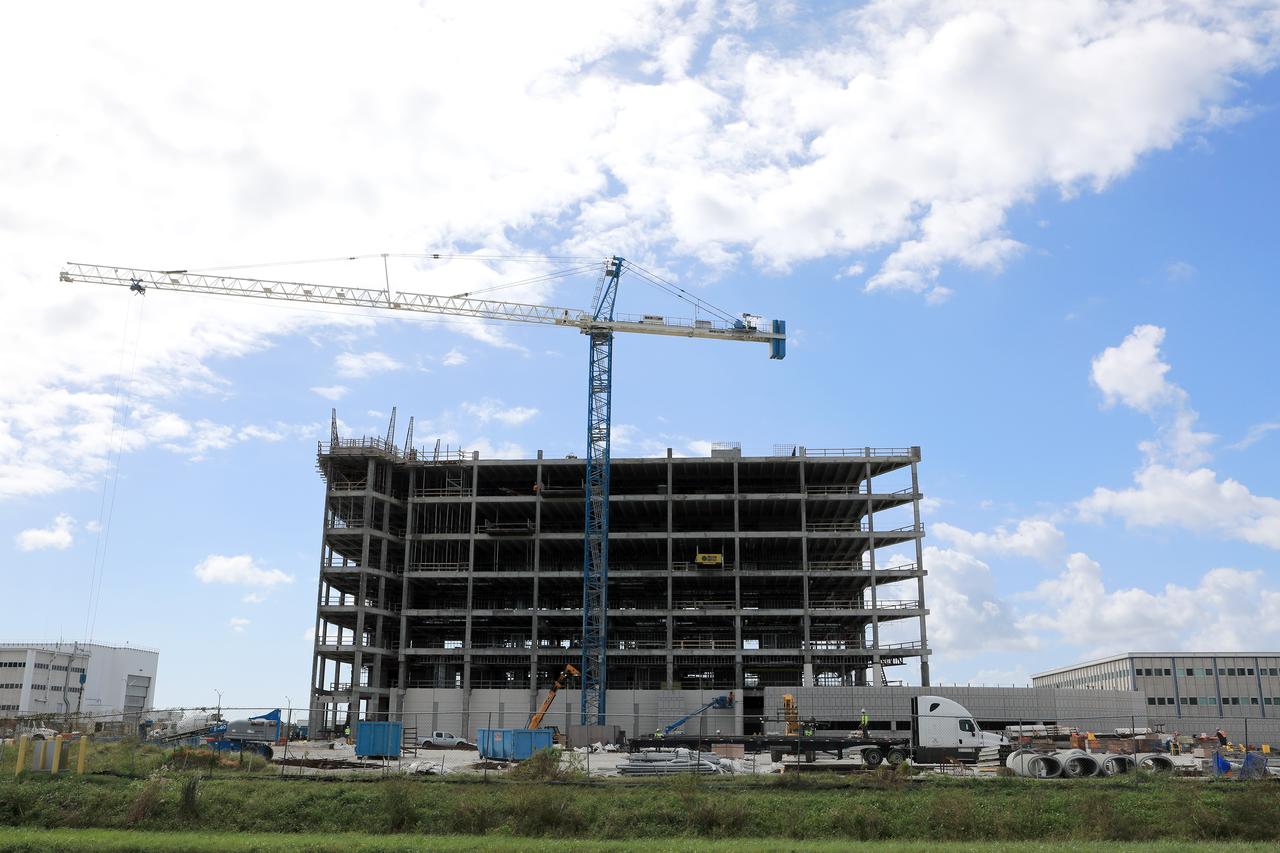
A large crane towers overhead as the new, seven-story headquarters building takes shape in the industrial area at NASA’s Kennedy Space Center in Florida. The 200,000-square-foot facility will anchor the spaceport’s Central Campus and house about 500 NASA civil service and contractor employees. The building will be more energy efficient than the current Headquarters building and will feature the latest in office and administrative building technology to fulfill Kennedy's role as the premiere multi-user spaceport for NASA and, increasingly, commercial entities.
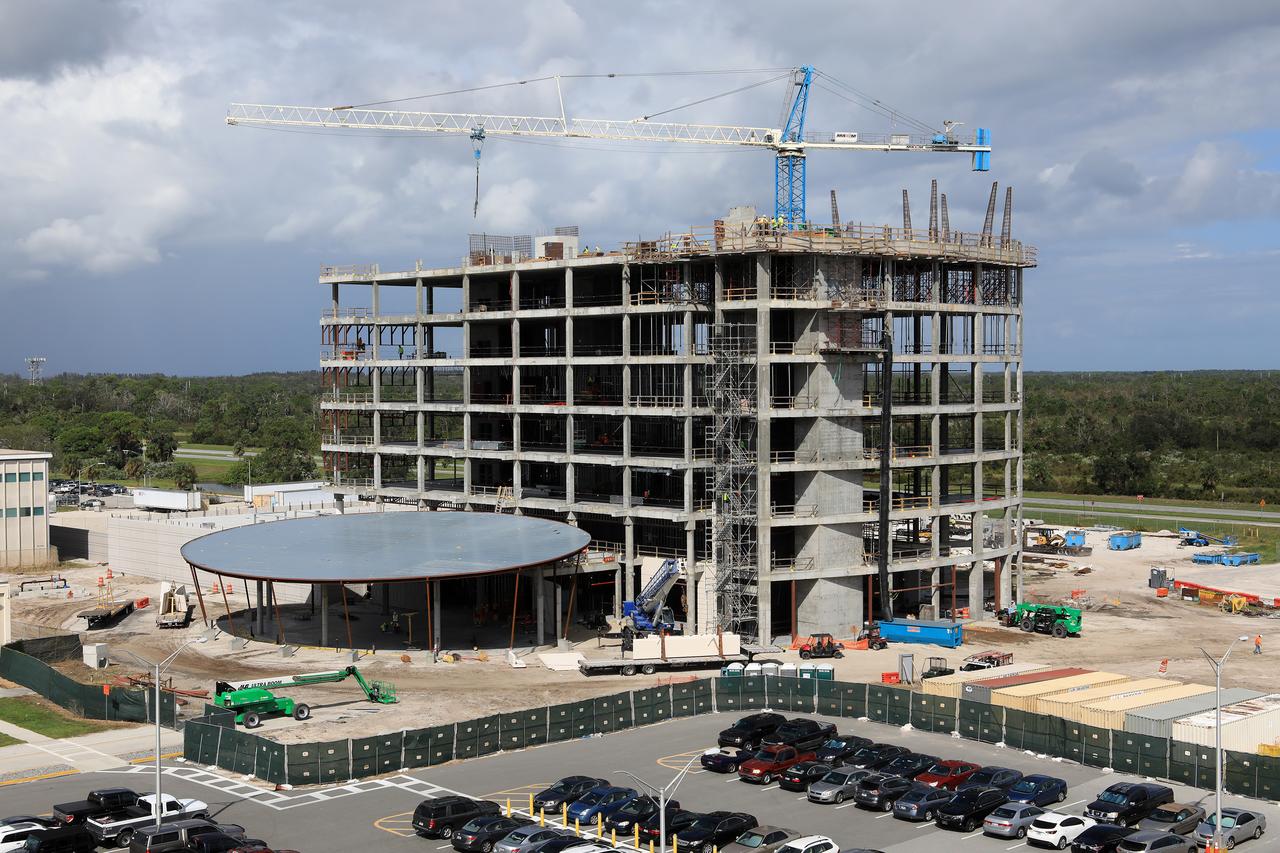
A large crane towers overhead as the new, seven-story headquarters building takes shape in the industrial area at NASA’s Kennedy Space Center in Florida. The 200,000-square-foot facility will anchor the spaceport’s Central Campus and house about 500 NASA civil service and contractor employees. The building will be more energy efficient than the current Headquarters building and will feature the latest in office and administrative building technology to fulfill Kennedy's role as the premiere multi-user spaceport for NASA and, increasingly, commercial entities.
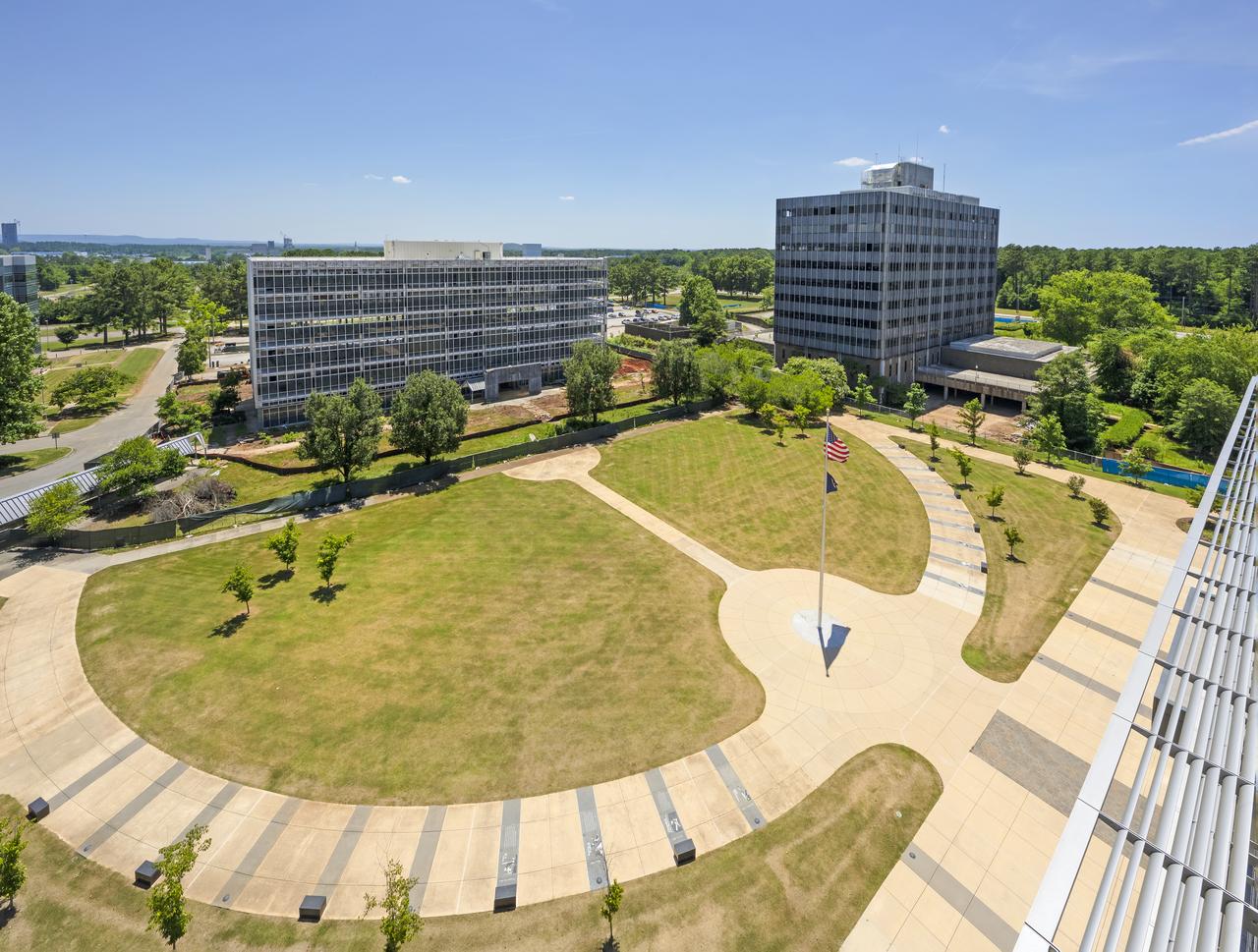
Buildings 4201 (left) and 4200 (right) of Marshall’s administrative complex are seen in September 2022 as they were being prepared for demolition. Building 4200 was Marshall’s administrative headquarters from 1963 until 2020. The projects will make way for a series of newer, more energy-efficient facilities, providing worksites for new generations of engineers, scientists, and support teams.
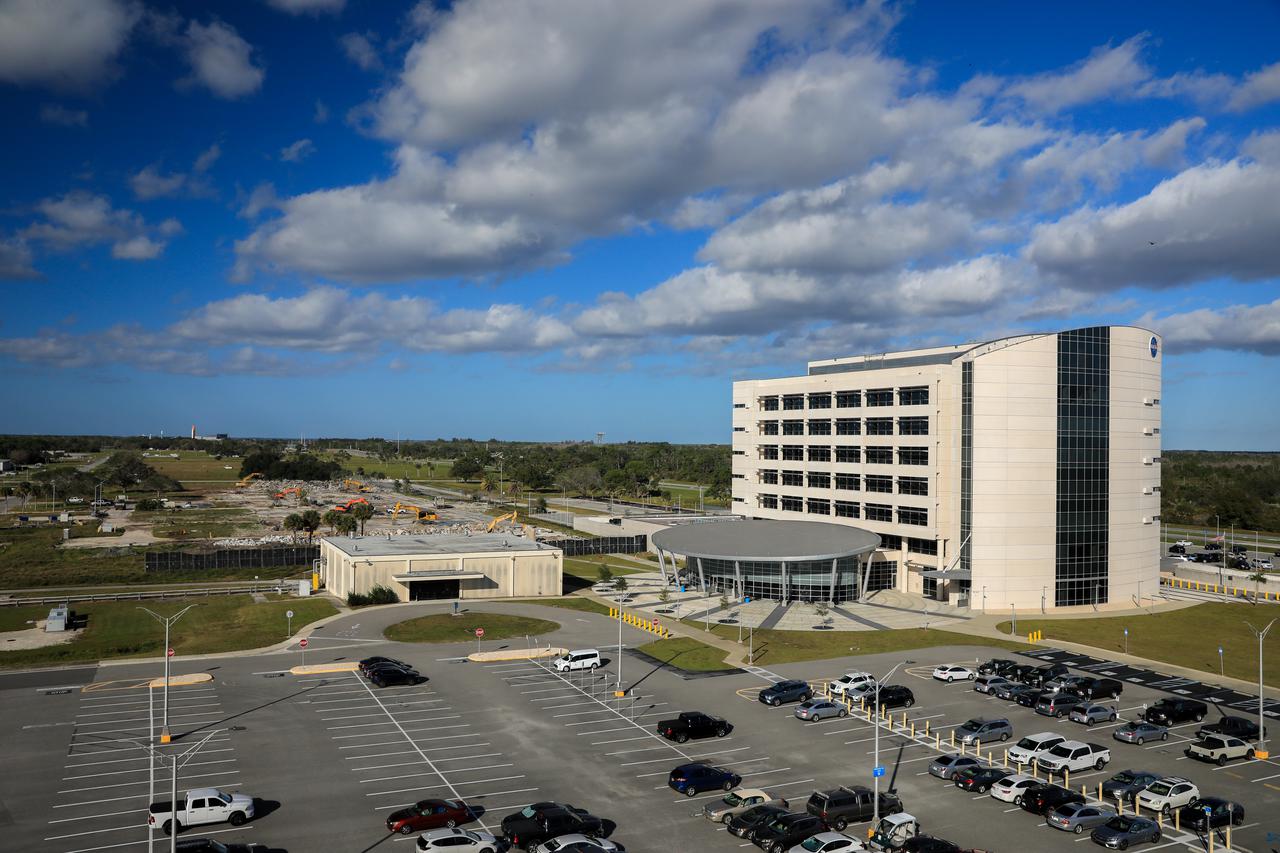
Shown is a view of the seven-story, 200,000-square-foot Central Campus Headquarters (CCHQ) Building at NASA’s Kennedy Space Center in Florida on Jan. 11, 2022. The CCHQ is a modernized, energy efficient facility representative of Kennedy’s transformation to America’s premier multi-user spaceport. It opened in May 2019. Built in 1965, the former headquarters building was recently demolished. The area previously occupied by the 439,000 square-foot-facility will be utilized as greenspace.
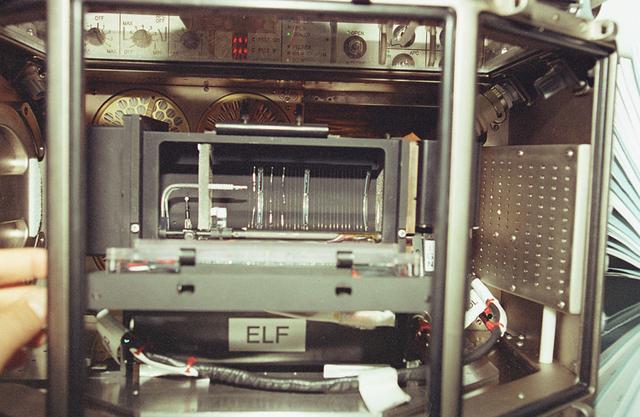
The goal of the ELF investigation is to improve our fundamental understanding of the effects of the flow environment on flame stability. The flame's stability refers to the position of its base and ultimately its continued existence. Combustion research focuses on understanding the important hidden processes of ignitions, flame spreading, and flame extinction. Understanding these processes will directly affect the efficiency of combustion operations in converting chemical energy to heat and will create a more balanced ecology and healthy environment by reducing pollutants emitted during combustion.
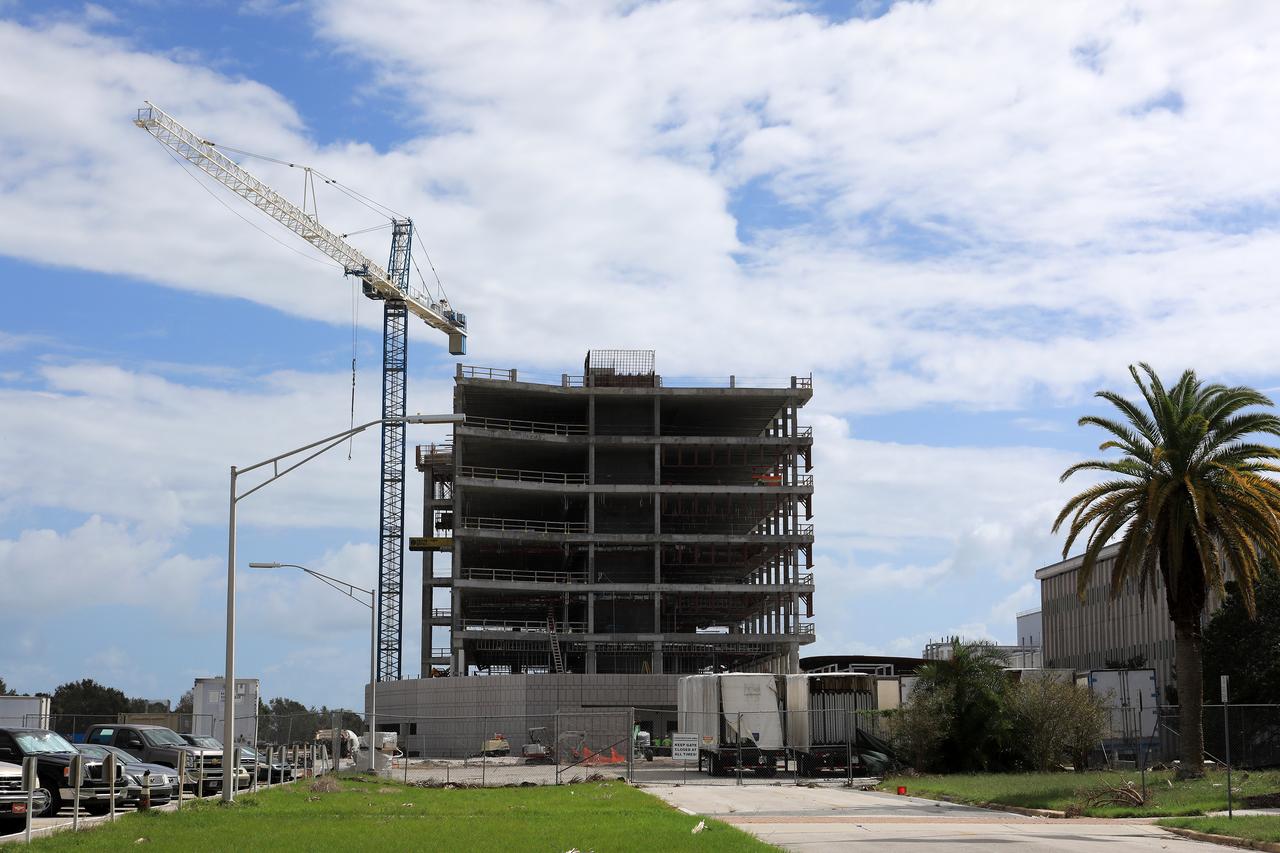
A large crane towers overhead as the new, seven-story headquarters building takes shape in the industrial area at NASA’s Kennedy Space Center in Florida. The 200,000-square-foot facility will anchor the spaceport’s Central Campus and house about 500 NASA civil service and contractor employees. The building will be more energy efficient than the current Headquarters building and will feature the latest in office and administrative building technology to fulfill Kennedy's role as the premiere multi-user spaceport for NASA and, increasingly, commercial entities.

Buildings 4201 (left) and 4200 (right) of Marshall’s administrative complex are seen in September 2022 as they were being prepared for demolition. Building 4200 was Marshall’s administrative headquarters from 1963 until 2020. The projects will make way for a series of newer, more energy-efficient facilities, providing worksites for new generations of engineers, scientists, and support teams.
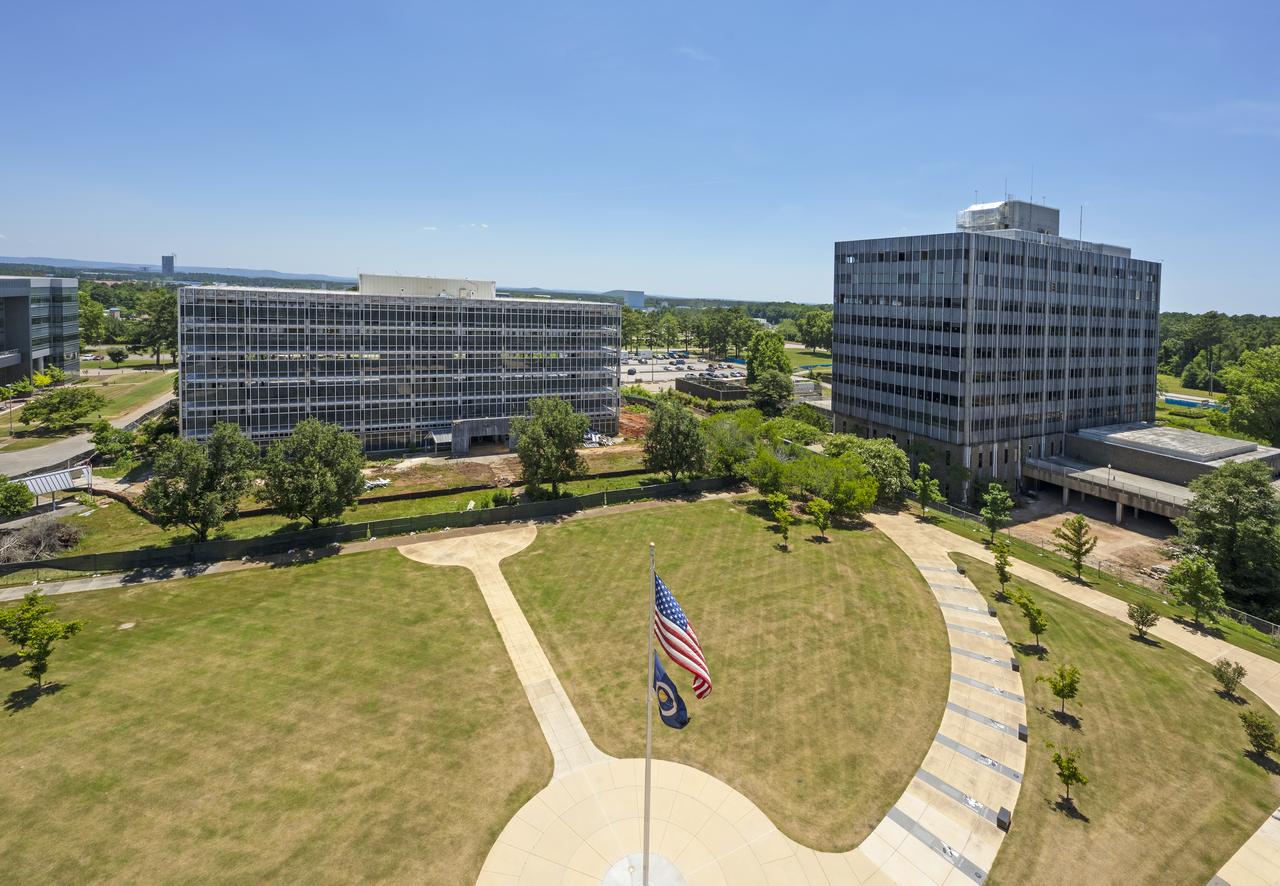
Buildings 4201 (left) and 4200 (right) of Marshall’s administrative complex are seen in September 2022 as they were being prepared for demolition. Building 4200 was Marshall’s administrative headquarters from 1963 until 2020. The projects will make way for a series of newer, more energy-efficient facilities, providing worksites for new generations of engineers, scientists, and support teams.
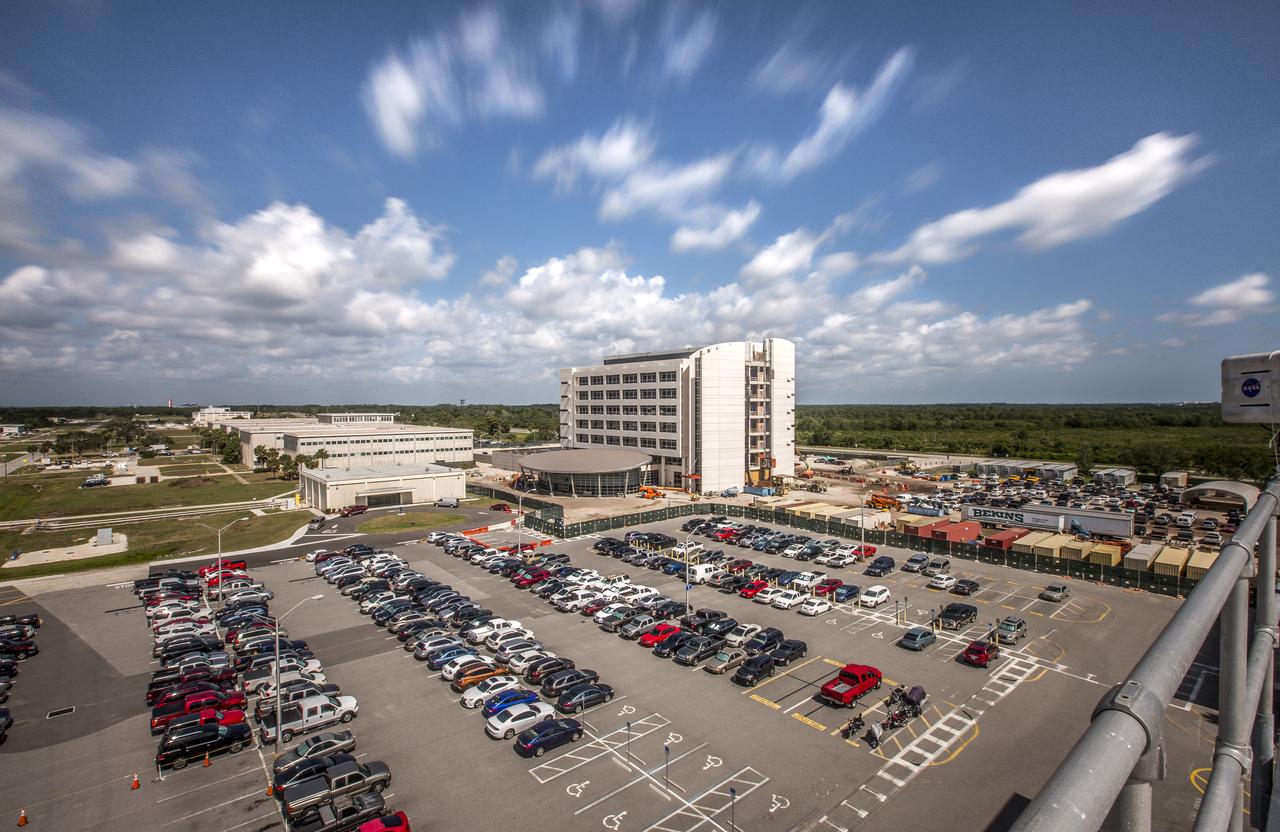
A long exposure photograph of the new headquarters building, part of the Central Campus in the industrial area at NASA’s Kennedy Space Center in Florida. The nearly-complete seven-story, 200,000-square-foot facility will house about 500 NASA civil service and contractor employees. The building will be more energy efficient than the current Headquarters building and will feature the latest in office and administrative building technology to fulfill Kennedy's role as the premiere spaceport for NASA and, increasingly, commercial entities.

Budding flowers adorn the forefront of the Central Campus Headquarters (CCHQ) Building at NASA’s Kennedy Space Center in Florida on Jan. 11, 2022. The CCHQ is a modernized, energy efficient facility representative of Kennedy’s transformation to America’s premier multi-user spaceport. It opened in May 2019. Built in 1965, the former headquarters building was recently demolished. The area previously occupied by the 439,000 square-foot-facility will be utilized as greenspace.
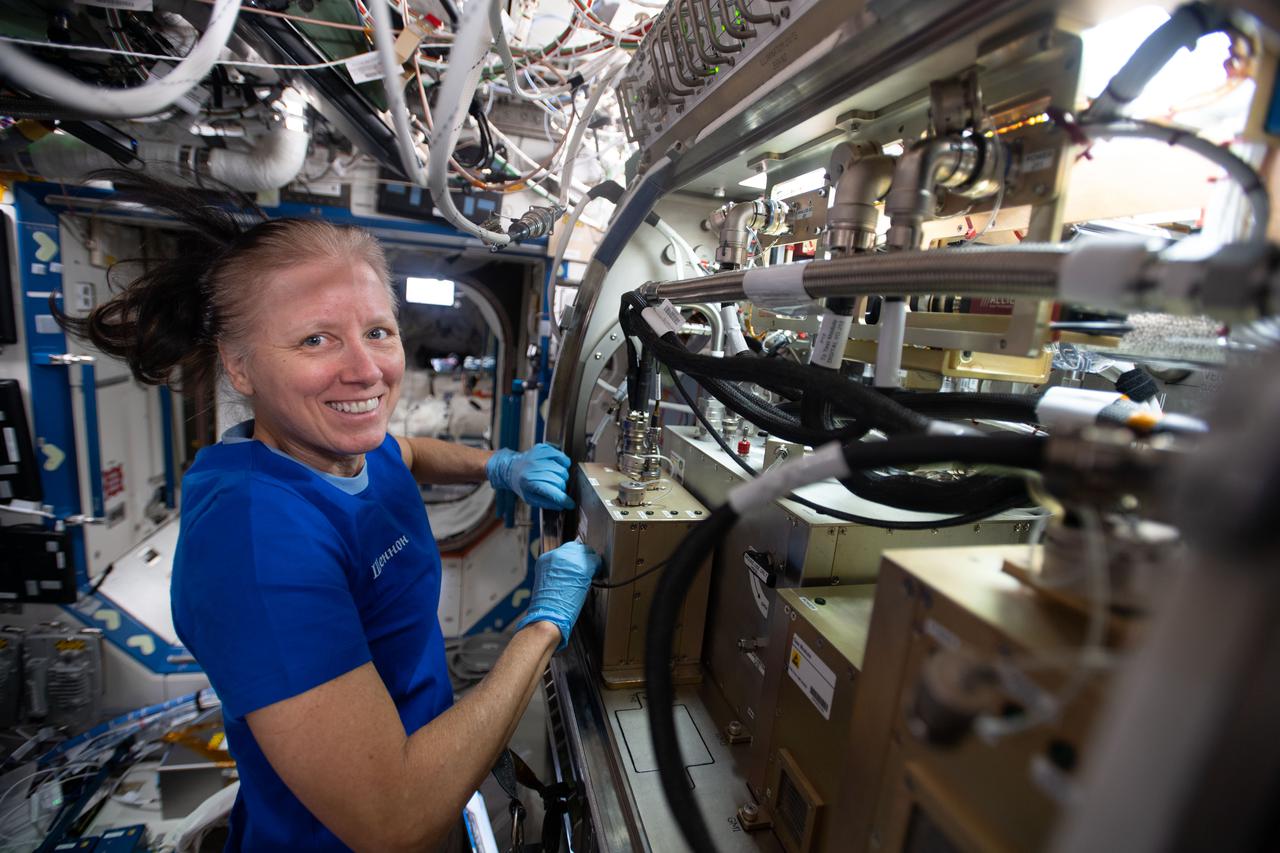
iss064e035059 (Feb. 19, 2021) --- NASA astronaut and Expedition 64 Flight Engineer Shannon Walker sets up Packed Bed Reactor Experiment (PBRE) hardware components inside the Destiny laboratory module's Microgravity Science Glovebox. The PBRE study explores how liquids and gases behave together in microgravity which may enable the design of more efficient, lightweight thermal management and life support systems that use less energy on future space exploration missions.
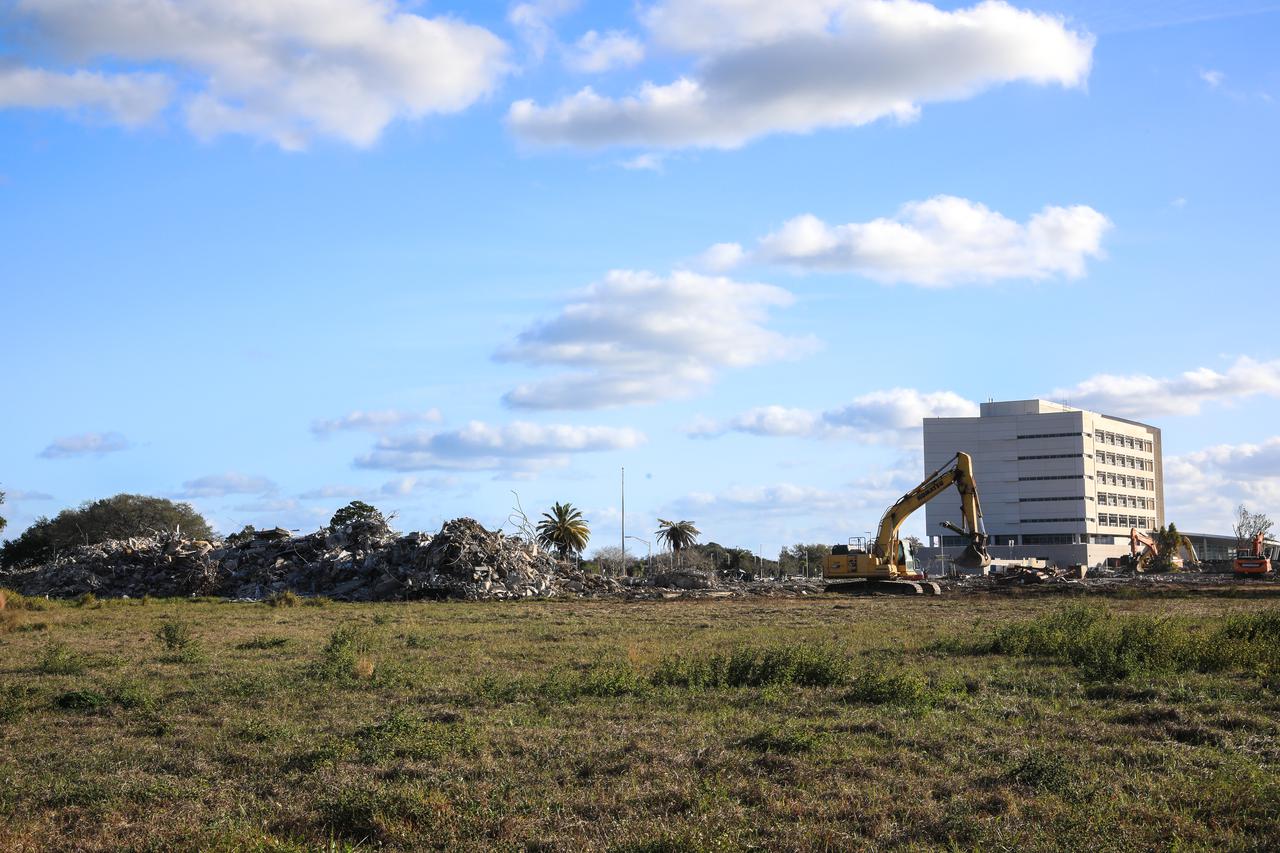
In the foreground is remnants of the former headquarters building at NASA’s Kennedy Space Center on Jan. 11, 2022. Built in 1965, the 439,000-square-foot structure was demolished and replaced at the Florida spaceport by the 200,000-square-foot, seven-story Central Campus Headquarters (CCHQ) Building, shown in the background. The CCHQ is a modernized, energy efficient facility representative of Kennedy’s transformation to America’s premier multi-user spaceport. It opened in May 2019. The area previously occupied by the old headquarters building will be utilized as greenspace.
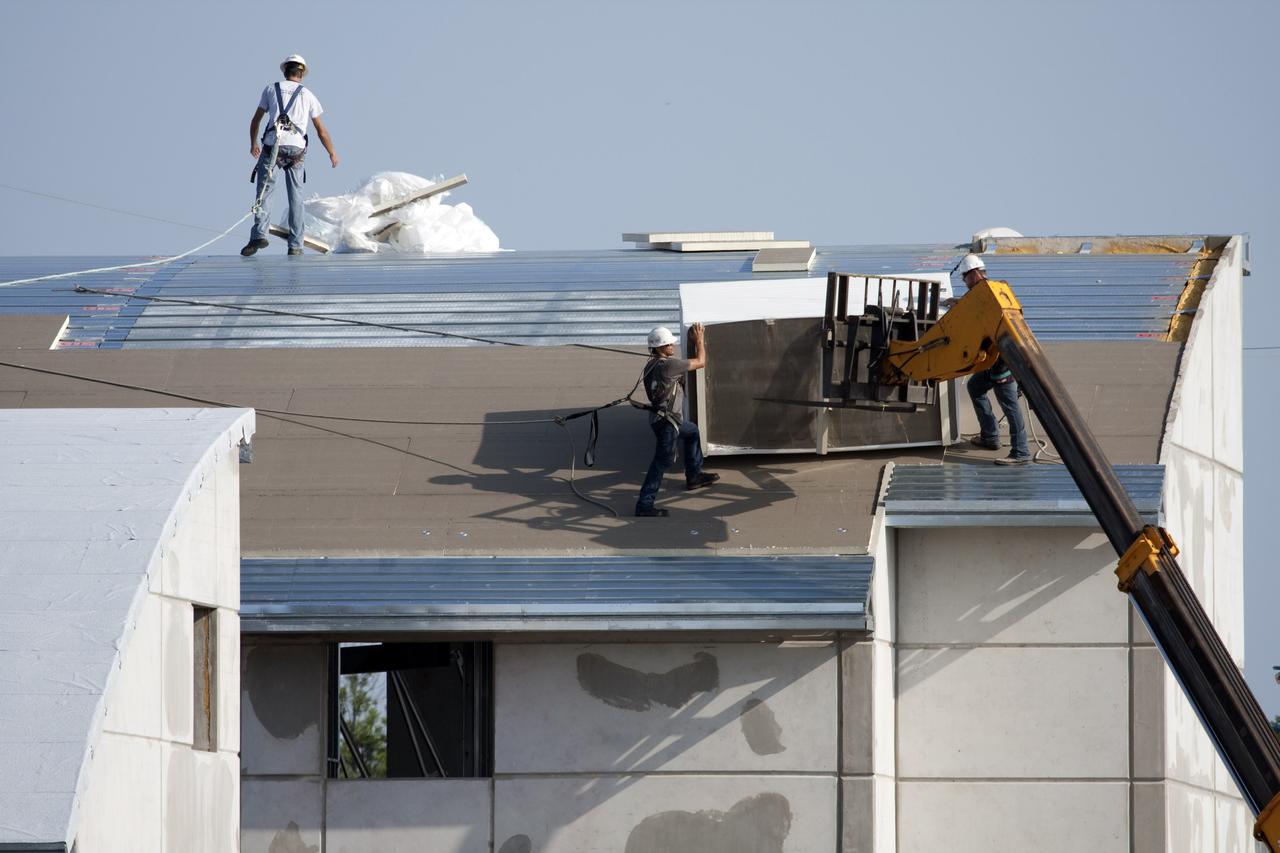
CAPE CANAVERAL, Fla. - At Launch Complex 39 at NASA's Kennedy Space Center in Florida, insulation material is delivered to roofers on one of the Propellants North Administrative and Maintenance Facility buildings by a boom lift. The insulation has an R-40 rating, compared to the insulation under the roof of an average home which has a rating of R-10 or R-15. The facility will have a two-story administrative building to house managers, mechanics and technicians who fuel spacecraft at Kennedy adjacent to an 1,800-square-foot single-story shop to store cryogenic fuel transfer equipment. The new facility will feature high-efficiency roofs and walls, “Cool Dry Quiet” air conditioning with energy recovery technology, efficient lighting, and other sustainable features. The facility is striving to qualify for the U.S. Green Building Council’s Leadership in Energy and Environmental Design, or LEED, Platinum certification. If successful, Propellants North will be the first Kennedy facility to achieve this highest of LEED ratings after it is completed in December 2010. The facility was designed for NASA by Jones Edmunds and Associates. H. W. Davis Construction is the construction contractor. Photo credit: NASA_Dimitri Gerondidakis
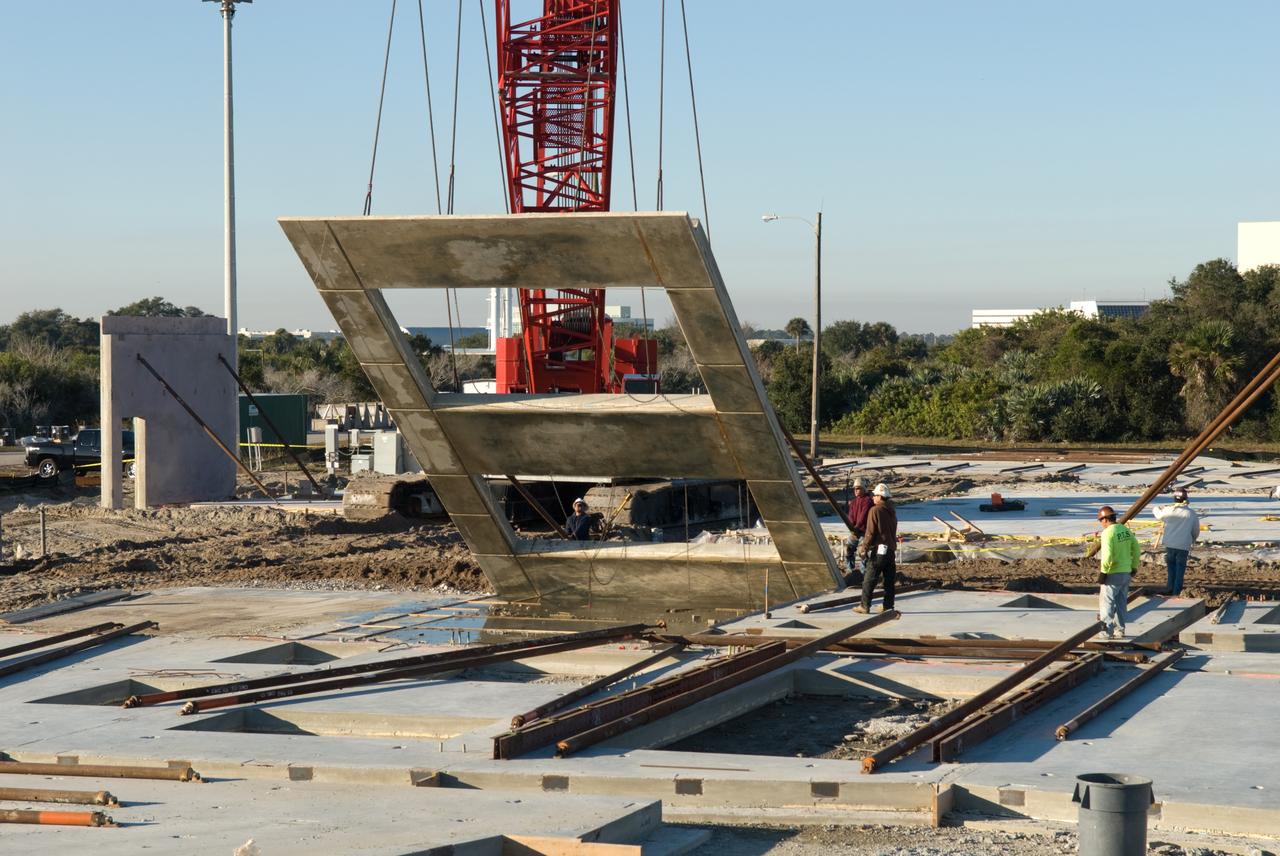
CAPE CANAVERAL, Fla. - In Launch Complex 39 at NASA's Kennedy Space Center in Florida, workers lift one of the walls of the Propellants North Administrative and Maintenance Facility into an upright position. A tilt-up construction method is being used to erect a THERMOMASS concrete wall insulation system for the facility's walls. In this approach, the exterior layer of concrete for the wall panels is poured and leveled on the building's footprint. Then, prefabricated, predrilled insulation sheets are arranged on top of the unhardened concrete, and connectors, designed to hold the sandwiched layers of concrete and insulation secure, are inserted through the predrilled holes. Next, the structural wythe is poured. Once cured, these panels are lifted upright to form the building's envelope. The facility will have a two-story administrative building to house managers, mechanics and technicians who fuel spacecraft at Kennedy adjacent to an 1,800-square-foot single-story shop to store cryogenic fuel transfer equipment. The new facility will feature high-efficiency roofs and walls, “Cool Dry Quiet” air conditioning with energy recovery technology, efficient lighting, and other sustainable features. The facility is striving to qualify for the U.S. Green Building Council’s Leadership in Energy and Environmental Design, or LEED, Platinum certification. If successful, Propellants North will be the first Kennedy facility to achieve this highest of LEED ratings after it is completed in the summer of 2010. The facility was designed for NASA by Jones Edmunds and Associates. Photo credit: NASA/Jim Grossmann
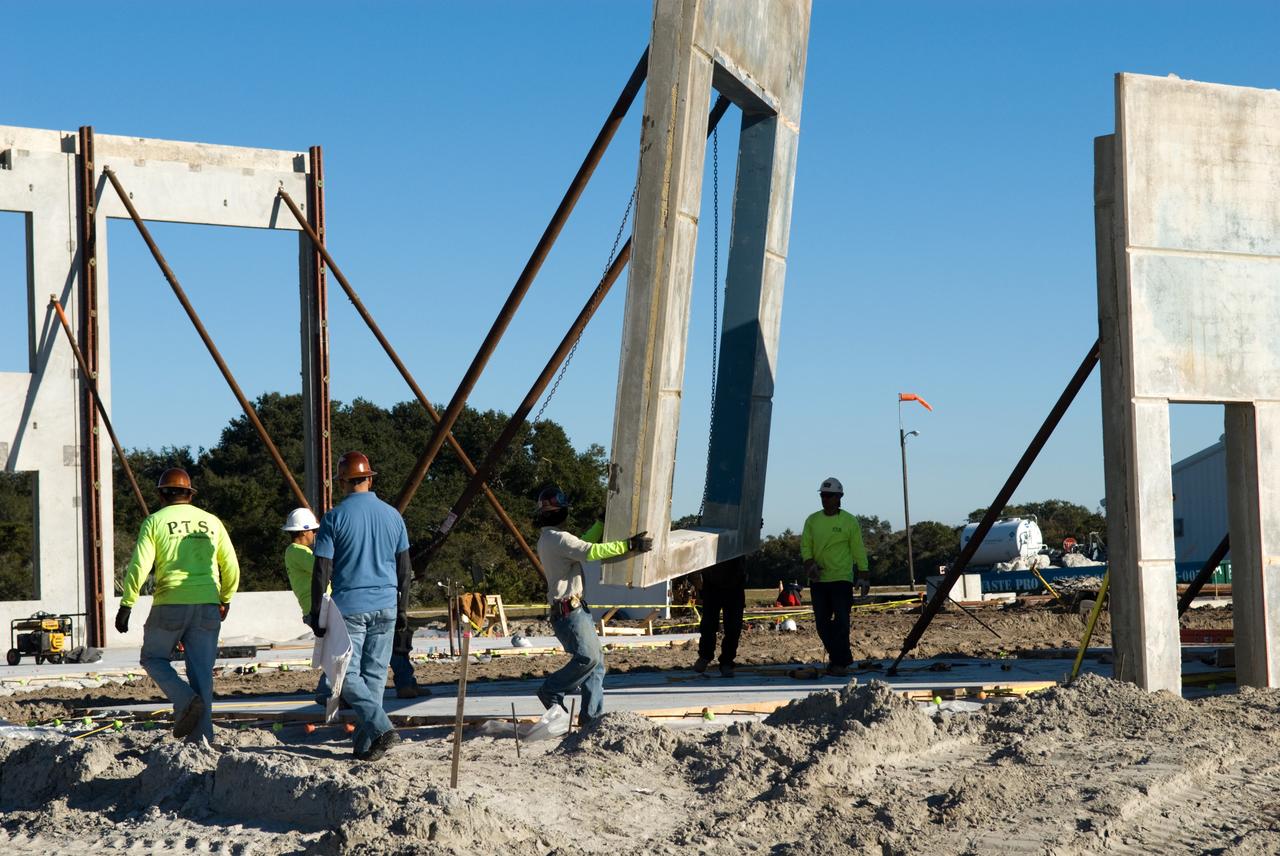
CAPE CANAVERAL, Fla. - In Launch Complex 39 at NASA's Kennedy Space Center in Florida, one of the walls of the Propellants North Administrative and Maintenance Facility is lowered into the trench which will support it. A tilt-up construction method is being used to erect a THERMOMASS concrete wall insulation system for the facility's walls. In this approach, the exterior layer of concrete for the wall panels is poured and leveled on the building's footprint. Then, prefabricated, predrilled insulation sheets are arranged on top of the unhardened concrete, and connectors, designed to hold the sandwiched layers of concrete and insulation secure, are inserted through the predrilled holes. Next, the structural wythe is poured. Once cured, these panels are lifted upright to form the building's envelope. The facility will have a two-story administrative building to house managers, mechanics and technicians who fuel spacecraft at Kennedy adjacent to an 1,800-square-foot single-story shop to store cryogenic fuel transfer equipment. The new facility will feature high-efficiency roofs and walls, “Cool Dry Quiet” air conditioning with energy recovery technology, efficient lighting, and other sustainable features. The facility is striving to qualify for the U.S. Green Building Council’s Leadership in Energy and Environmental Design, or LEED, Platinum certification. If successful, Propellants North will be the first Kennedy facility to achieve this highest of LEED ratings after it is completed in the summer of 2010. The facility was designed for NASA by Jones Edmunds and Associates. Photo credit: NASA/Jim Grossmann
CAPE CANAVERAL, Fla. - Insulation is placed in the walls for the Propellants North Administrative and Maintenance Facility in Launch Complex 39 at NASA's Kennedy Space Center in Florida. A tilt-up construction method is being used to erect a THERMOMASS concrete wall insulation system for the facility's walls. In this approach, the exterior layer of concrete for the wall panels is poured and leveled on the building's footprint. Then, prefabricated, predrilled insulation sheets are arranged on top of the unhardened concrete, and connectors, designed to hold the sandwiched layers of concrete and insulation secure, are inserted through the predrilled holes. Next, the structural wythe is poured. Once cured, these panels are lifted upright to form the building's envelope. The facility will have a two-story administrative building to house managers, mechanics and technicians who fuel spacecraft at Kennedy adjacent to an 1,800-square-foot single-story shop to store cryogenic fuel transfer equipment. The new facility will feature high-efficiency roofs and walls, “Cool Dry Quiet” air conditioning with energy recovery technology, efficient lighting, and other sustainable features. The facility is striving to qualify for the U.S. Green Building Council’s Leadership in Energy and Environmental Design, or LEED, Platinum certification. If successful, Propellants North will be the first Kennedy facility to achieve this highest of LEED ratings after it is completed in the summer of 2010. The facility was designed for NASA by Jones Edmunds and Associates. Photo credit: NASA/Jim Grossmann
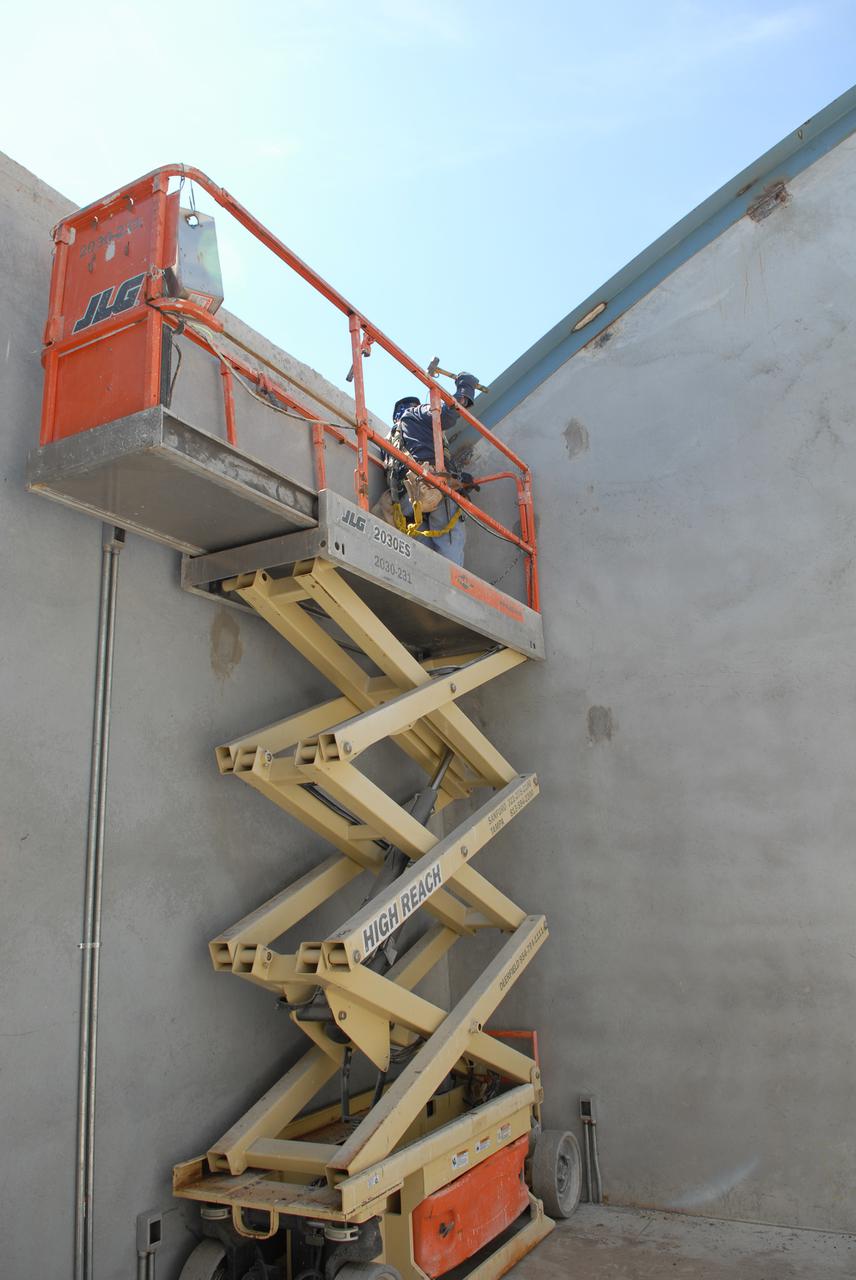
CAPE CANAVERAL, Fla. - In Launch Complex 39 at NASA's Kennedy Space Center in Florida, a worker installs the metal framing that will support the roof beams for the shop building of the Propellants North Administrative and Maintenance Facility. The facility will have a two-story administrative building to house managers, mechanics and technicians who fuel spacecraft at Kennedy adjacent to an 1,800-square-foot single-story shop to store cryogenic fuel transfer equipment. The new facility will feature high-efficiency roofs and walls, “Cool Dry Quiet” air conditioning with energy recovery technology, efficient lighting, and other sustainable features. The facility is striving to qualify for the U.S. Green Building Council’s Leadership in Energy and Environmental Design, or LEED, Platinum certification. If successful, Propellants North will be the first Kennedy facility to achieve this highest of LEED ratings after it is completed in December 2010. The facility was designed for NASA by Jones Edmunds and Associates. H. W. Davis Construction is the construction contractor. Photo credit: NASA_Jim Grossmann

CAPE CANAVERAL, Fla. - In Launch Complex 39 at NASA's Kennedy Space Center in Florida, one of the walls of the Propellants North Administrative and Maintenance Facility glides through the air into position. A tilt-up construction method is being used to erect a THERMOMASS concrete wall insulation system for the facility's walls. In this approach, the exterior layer of concrete for the wall panels is poured and leveled on the building's footprint. Then, prefabricated, predrilled insulation sheets are arranged on top of the unhardened concrete, and connectors, designed to hold the sandwiched layers of concrete and insulation secure, are inserted through the predrilled holes. Next, the structural wythe is poured. Once cured, these panels are lifted upright to form the building's envelope. The facility will have a two-story administrative building to house managers, mechanics and technicians who fuel spacecraft at Kennedy adjacent to an 1,800-square-foot single-story shop to store cryogenic fuel transfer equipment. The new facility will feature high-efficiency roofs and walls, “Cool Dry Quiet” air conditioning with energy recovery technology, efficient lighting, and other sustainable features. The facility is striving to qualify for the U.S. Green Building Council’s Leadership in Energy and Environmental Design, or LEED, Platinum certification. If successful, Propellants North will be the first Kennedy facility to achieve this highest of LEED ratings after it is completed in the summer of 2010. The facility was designed for NASA by Jones Edmunds and Associates. Photo credit: NASA/Jim Grossmann
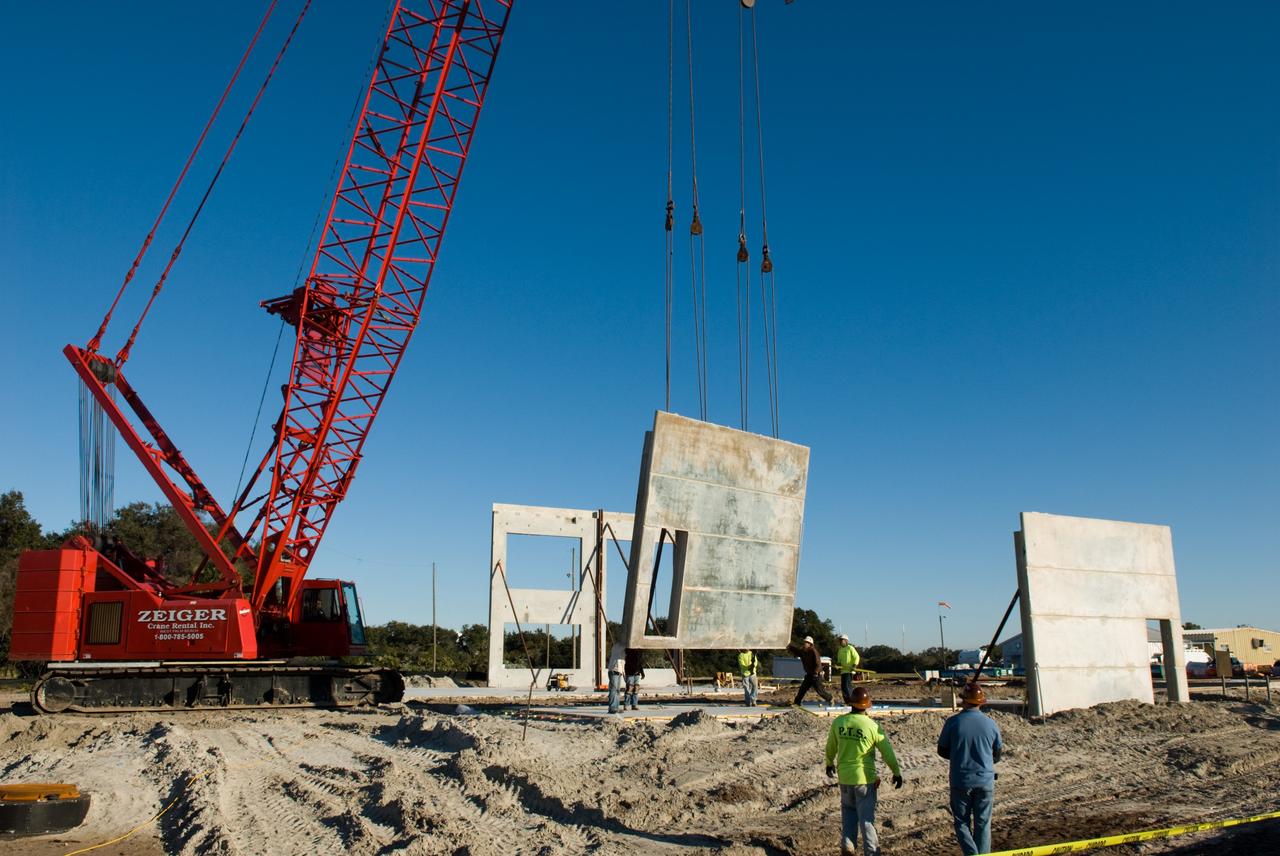
CAPE CANAVERAL, Fla. - In Launch Complex 39 at NASA's Kennedy Space Center in Florida, workers guide one of the walls of the Propellants North Administrative and Maintenance Facility into place. A tilt-up construction method is being used to erect a THERMOMASS concrete wall insulation system for the facility's walls. In this approach, the exterior layer of concrete for the wall panels is poured and leveled on the building's footprint. Then, prefabricated, predrilled insulation sheets are arranged on top of the unhardened concrete, and connectors, designed to hold the sandwiched layers of concrete and insulation secure, are inserted through the predrilled holes. Next, the structural wythe is poured. Once cured, these panels are lifted upright to form the building's envelope. The facility will have a two-story administrative building to house managers, mechanics and technicians who fuel spacecraft at Kennedy adjacent to an 1,800-square-foot single-story shop to store cryogenic fuel transfer equipment. The new facility will feature high-efficiency roofs and walls, “Cool Dry Quiet” air conditioning with energy recovery technology, efficient lighting, and other sustainable features. The facility is striving to qualify for the U.S. Green Building Council’s Leadership in Energy and Environmental Design, or LEED, Platinum certification. If successful, Propellants North will be the first Kennedy facility to achieve this highest of LEED ratings after it is completed in the summer of 2010. The facility was designed for NASA by Jones Edmunds and Associates. Photo credit: NASA/Jim Grossmann
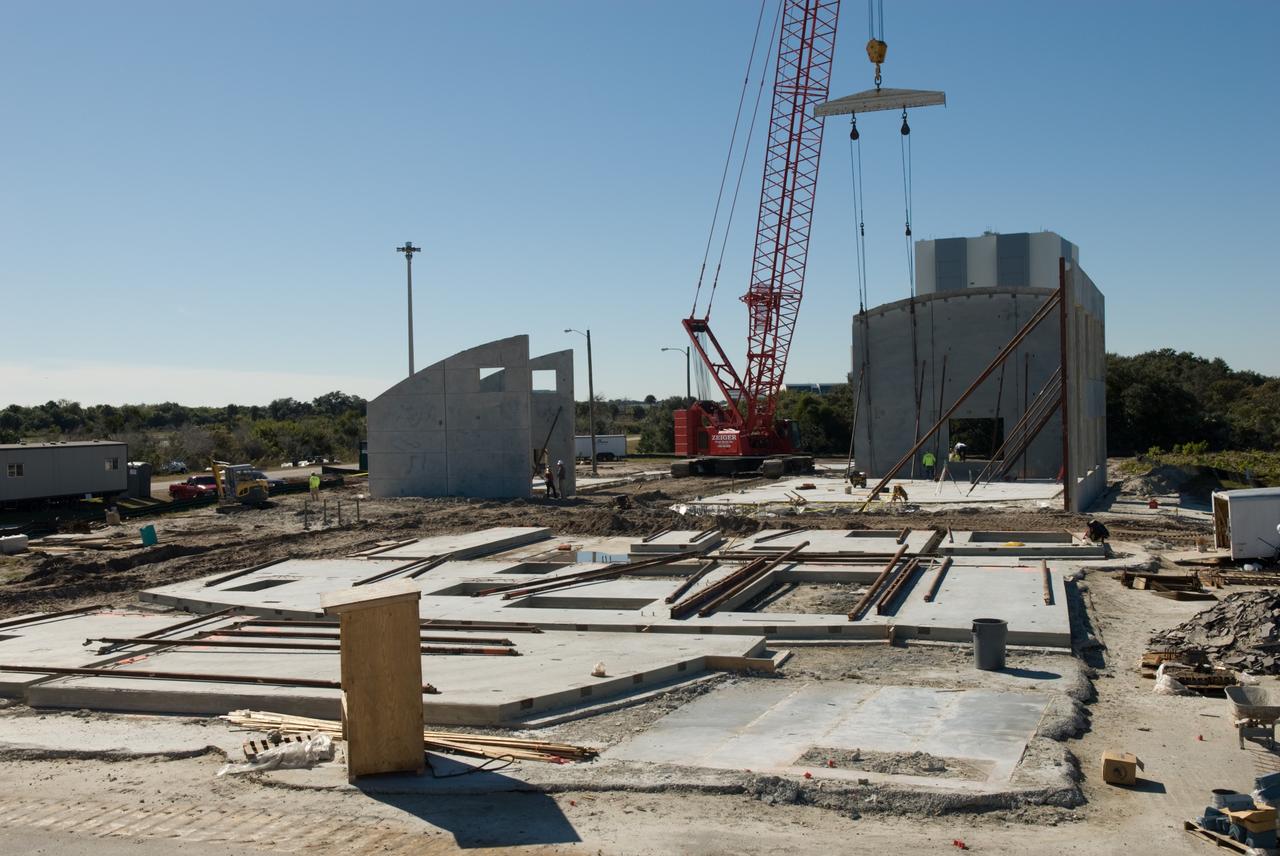
CAPE CANAVERAL, Fla. - In Launch Complex 39 at NASA's Kennedy Space Center in Florida, a crane is enlisted to lift the walls of the Propellants North Administrative and Maintenance Facility into position. A tilt-up construction method is being used to erect a THERMOMASS concrete wall insulation system for the facility's walls. In this approach, the exterior layer of concrete for the wall panels is poured and leveled on the building's footprint. Then, prefabricated, predrilled insulation sheets are arranged on top of the unhardened concrete, and connectors, designed to hold the sandwiched layers of concrete and insulation secure, are inserted through the predrilled holes. Next, the structural wythe is poured. Once cured, these panels are lifted upright to form the building's envelope. The facility will have a two-story administrative building to house managers, mechanics and technicians who fuel spacecraft at Kennedy adjacent to an 1,800-square-foot single-story shop to store cryogenic fuel transfer equipment. The new facility will feature high-efficiency roofs and walls, “Cool Dry Quiet” air conditioning with energy recovery technology, efficient lighting, and other sustainable features. The facility is striving to qualify for the U.S. Green Building Council’s Leadership in Energy and Environmental Design, or LEED, Platinum certification. If successful, Propellants North will be the first Kennedy facility to achieve this highest of LEED ratings after it is completed in the summer of 2010. The facility was designed for NASA by Jones Edmunds and Associates. Photo credit: NASA/Jim Grossmann
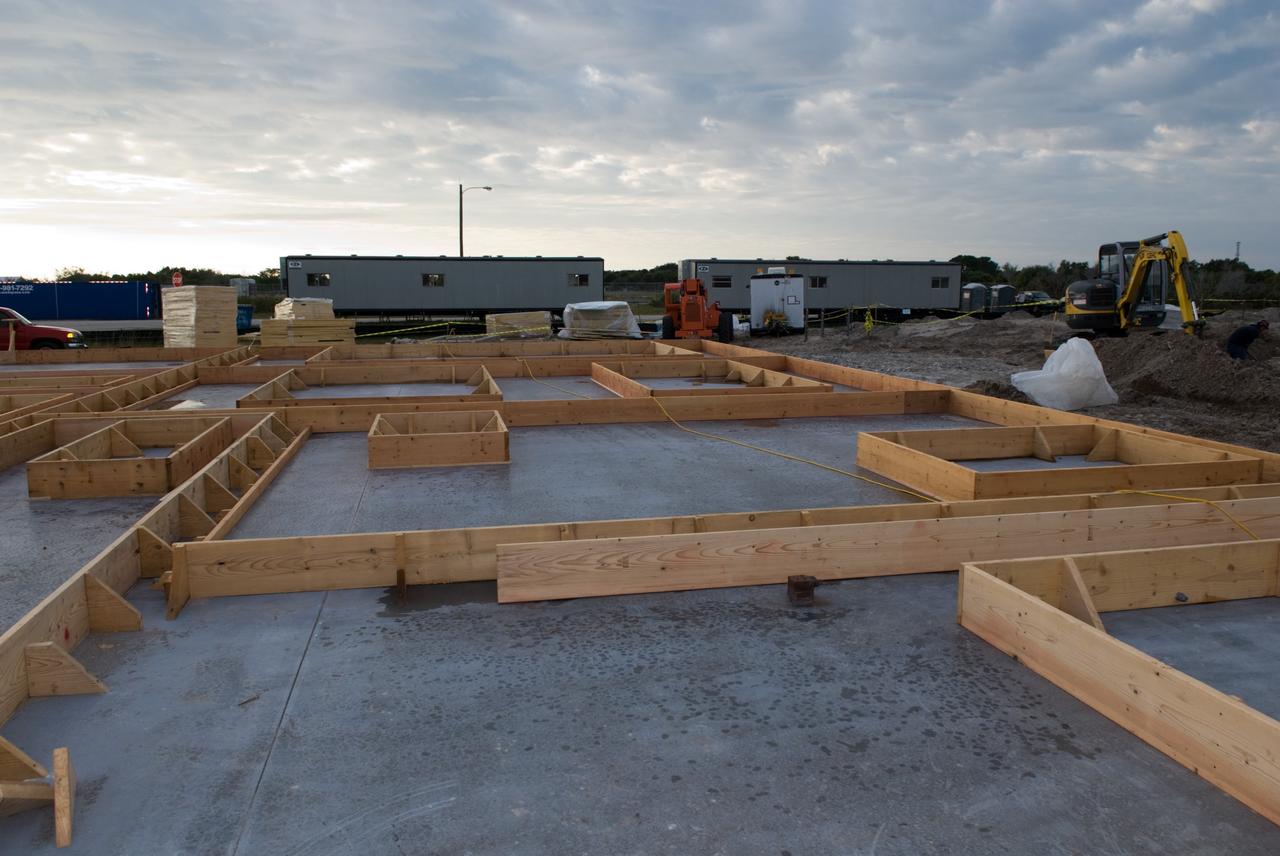
CAPE CANAVERAL, Fla. - Concrete covers the insulation in the walls for the Propellants North Administrative and Maintenance Facility in Launch Complex 39 at NASA's Kennedy Space Center in Florida. A tilt-up construction method is being used to erect a THERMOMASS concrete wall insulation system for the facility's walls. In this approach, the exterior layer of concrete for the wall panels is poured and leveled on the building's footprint. Then, prefabricated, predrilled insulation sheets are arranged on top of the unhardened concrete, and connectors, designed to hold the sandwiched layers of concrete and insulation secure, are inserted through the predrilled holes. Next, the structural wythe is poured. Once cured, these panels are lifted upright to form the building's envelope. The facility will have a two-story administrative building to house managers, mechanics and technicians who fuel spacecraft at Kennedy adjacent to an 1,800-square-foot single-story shop to store cryogenic fuel transfer equipment. The new facility will feature high-efficiency roofs and walls, “Cool Dry Quiet” air conditioning with energy recovery technology, efficient lighting, and other sustainable features. The facility is striving to qualify for the U.S. Green Building Council’s Leadership in Energy and Environmental Design, or LEED, Platinum certification. If successful, Propellants North will be the first Kennedy facility to achieve this highest of LEED ratings after it is completed in the summer of 2010. The facility was designed for NASA by Jones Edmunds and Associates. Photo credit: NASA/Jim Grossmann
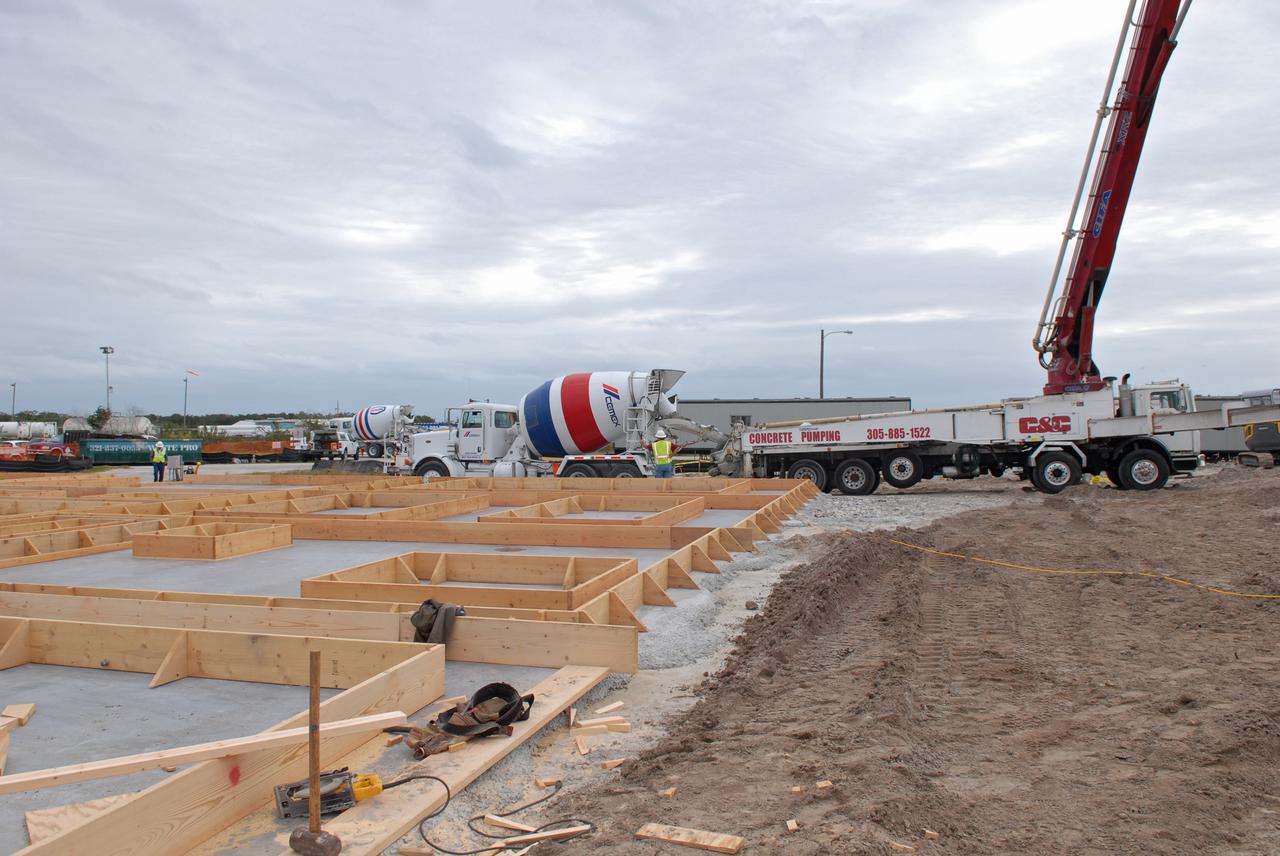
CAPE CANAVERAL, Fla. - Construction of the walls for the Propellants North Administrative and Maintenance Facility begins in Launch Complex 39 at NASA's Kennedy Space Center in Florida. A tilt-up construction method is being used to erect a THERMOMASS concrete wall insulation system for the facility's walls. In this approach, the exterior layer of concrete for the wall panels is poured and leveled on the building's footprint. Then, prefabricated, predrilled insulation sheets are arranged on top of the unhardened concrete, and connectors, designed to hold the sandwiched layers of concrete and insulation secure, are inserted through the predrilled holes. Next, the structural wythe is poured. Once cured, these panels are lifted upright to form the building's envelope. The facility will have a two-story administrative building to house managers, mechanics and technicians who fuel spacecraft at Kennedy adjacent to an 1,800-square-foot single-story shop to store cryogenic fuel transfer equipment. The new facility will feature high-efficiency roofs and walls, “Cool Dry Quiet” air conditioning with energy recovery technology, efficient lighting, and other sustainable features. The facility is striving to qualify for the U.S. Green Building Council’s Leadership in Energy and Environmental Design, or LEED, Platinum certification. If successful, Propellants North will be the first Kennedy facility to achieve this highest of LEED ratings after it is completed in the summer of 2010. The facility was designed for NASA by Jones Edmunds and Associates. Photo credit: NASA/Jim Grossmann
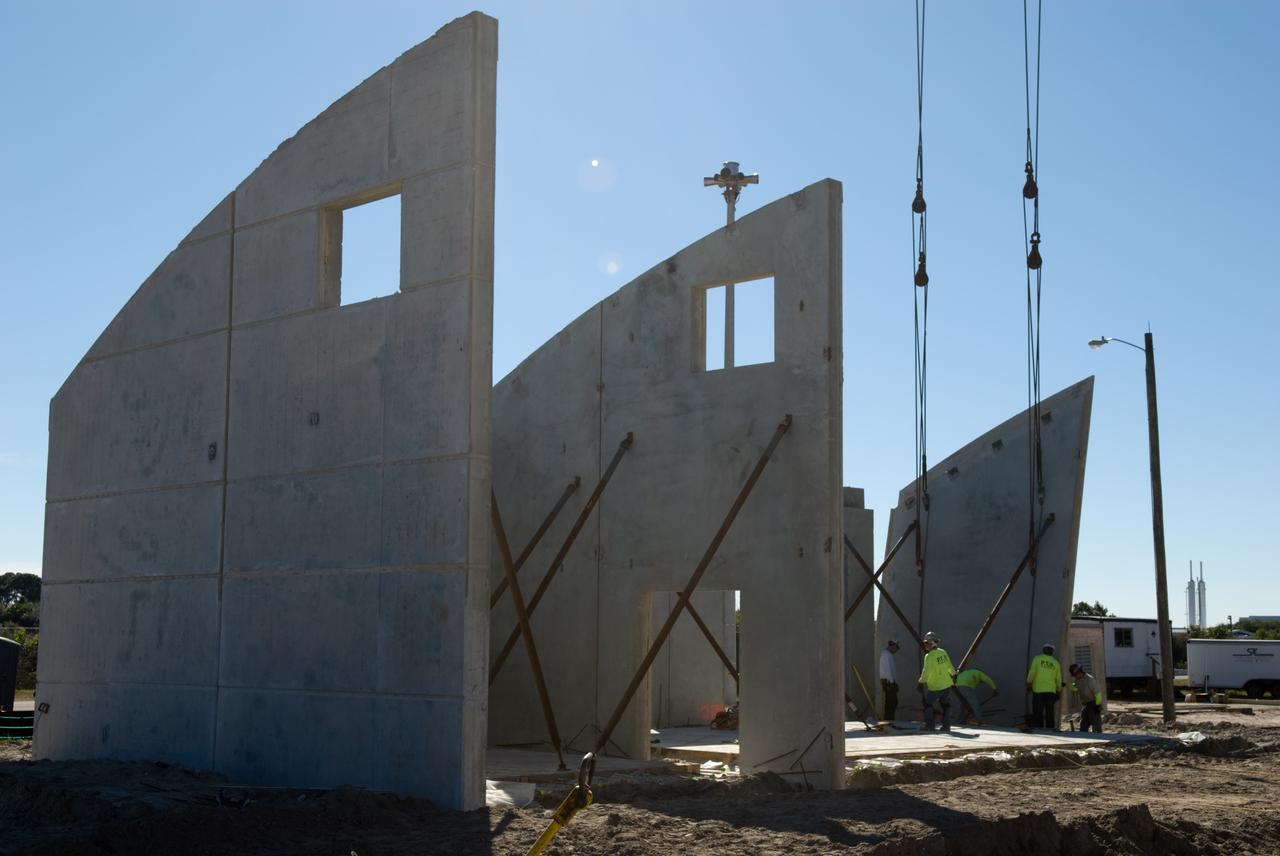
CAPE CANAVERAL, Fla. - In Launch Complex 39 at NASA's Kennedy Space Center in Florida, a row of walls is erected as the Propellants North Administrative and Maintenance Facility takes shape. A tilt-up construction method is being used to erect a THERMOMASS concrete wall insulation system for the facility's walls. In this approach, the exterior layer of concrete for the wall panels is poured and leveled on the building's footprint. Then, prefabricated, predrilled insulation sheets are arranged on top of the unhardened concrete, and connectors, designed to hold the sandwiched layers of concrete and insulation secure, are inserted through the predrilled holes. Next, the structural wythe is poured. Once cured, these panels are lifted upright to form the building's envelope. The facility will have a two-story administrative building to house managers, mechanics and technicians who fuel spacecraft at Kennedy adjacent to an 1,800-square-foot single-story shop to store cryogenic fuel transfer equipment. The new facility will feature high-efficiency roofs and walls, “Cool Dry Quiet” air conditioning with energy recovery technology, efficient lighting, and other sustainable features. The facility is striving to qualify for the U.S. Green Building Council’s Leadership in Energy and Environmental Design, or LEED, Platinum certification. If successful, Propellants North will be the first Kennedy facility to achieve this highest of LEED ratings after it is completed in the summer of 2010. The facility was designed for NASA by Jones Edmunds and Associates. Photo credit: NASA/Jim Grossmann
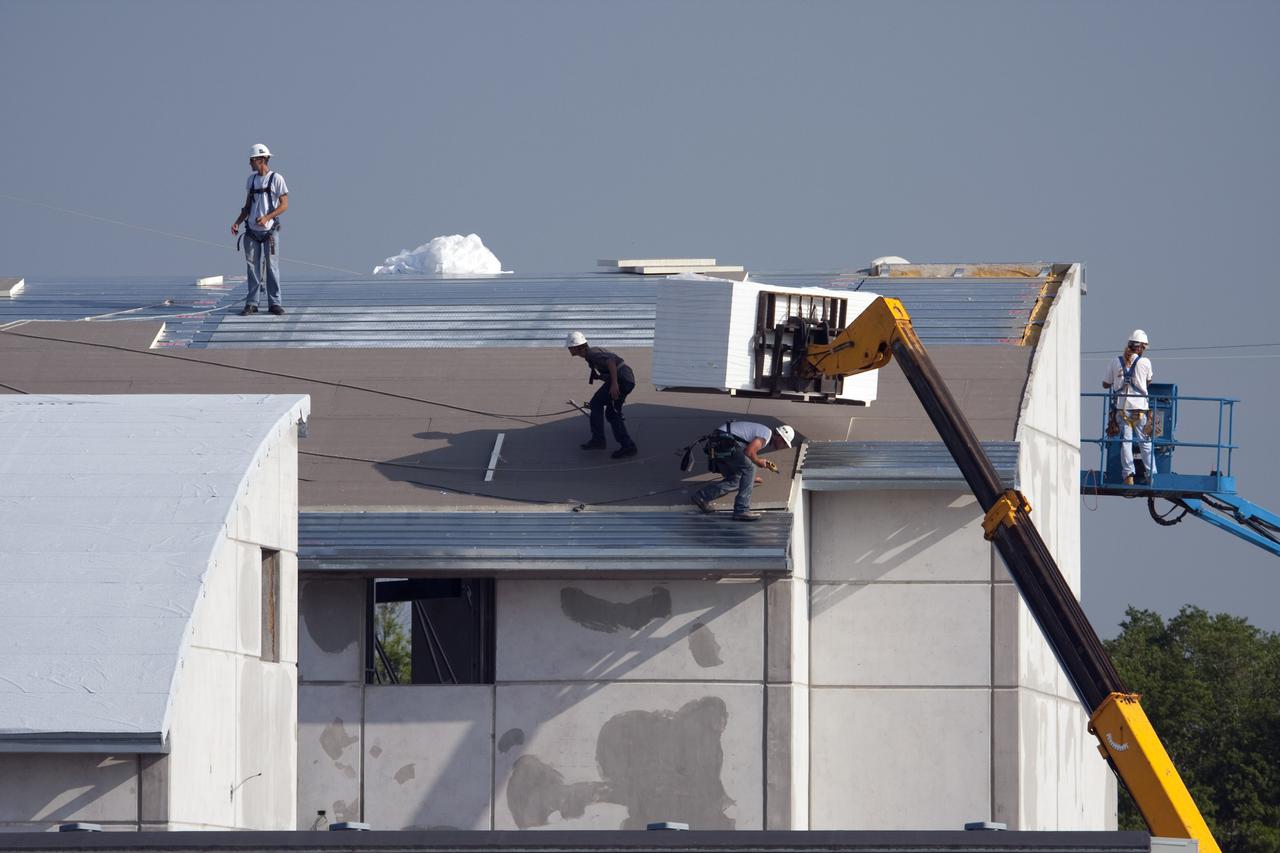
CAPE CANAVERAL, Fla. - At Launch Complex 39 at NASA's Kennedy Space Center in Florida, a boom lift delivers insulation material to the workers installing it on the roof of one of the Propellants North Administrative and Maintenance Facility buildings. The insulation has an R-40 rating, compared to the insulation under the roof of an average home which has a rating of R-10 or R-15. The facility will have a two-story administrative building to house managers, mechanics and technicians who fuel spacecraft at Kennedy adjacent to an 1,800-square-foot single-story shop to store cryogenic fuel transfer equipment. The new facility will feature high-efficiency roofs and walls, “Cool Dry Quiet” air conditioning with energy recovery technology, efficient lighting, and other sustainable features. The facility is striving to qualify for the U.S. Green Building Council’s Leadership in Energy and Environmental Design, or LEED, Platinum certification. If successful, Propellants North will be the first Kennedy facility to achieve this highest of LEED ratings after it is completed in December 2010. The facility was designed for NASA by Jones Edmunds and Associates. H. W. Davis Construction is the construction contractor. Photo credit: NASA_Dimitri Gerondidakis
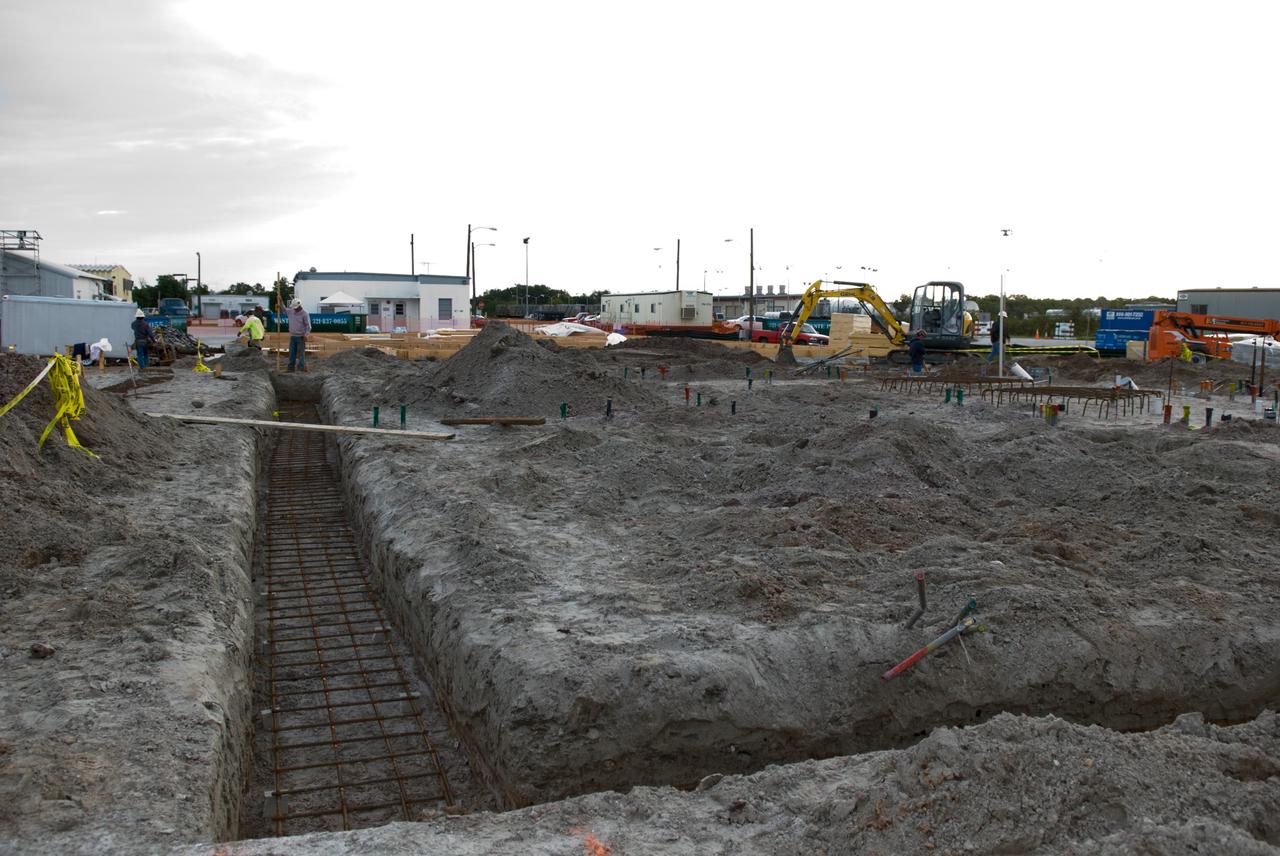
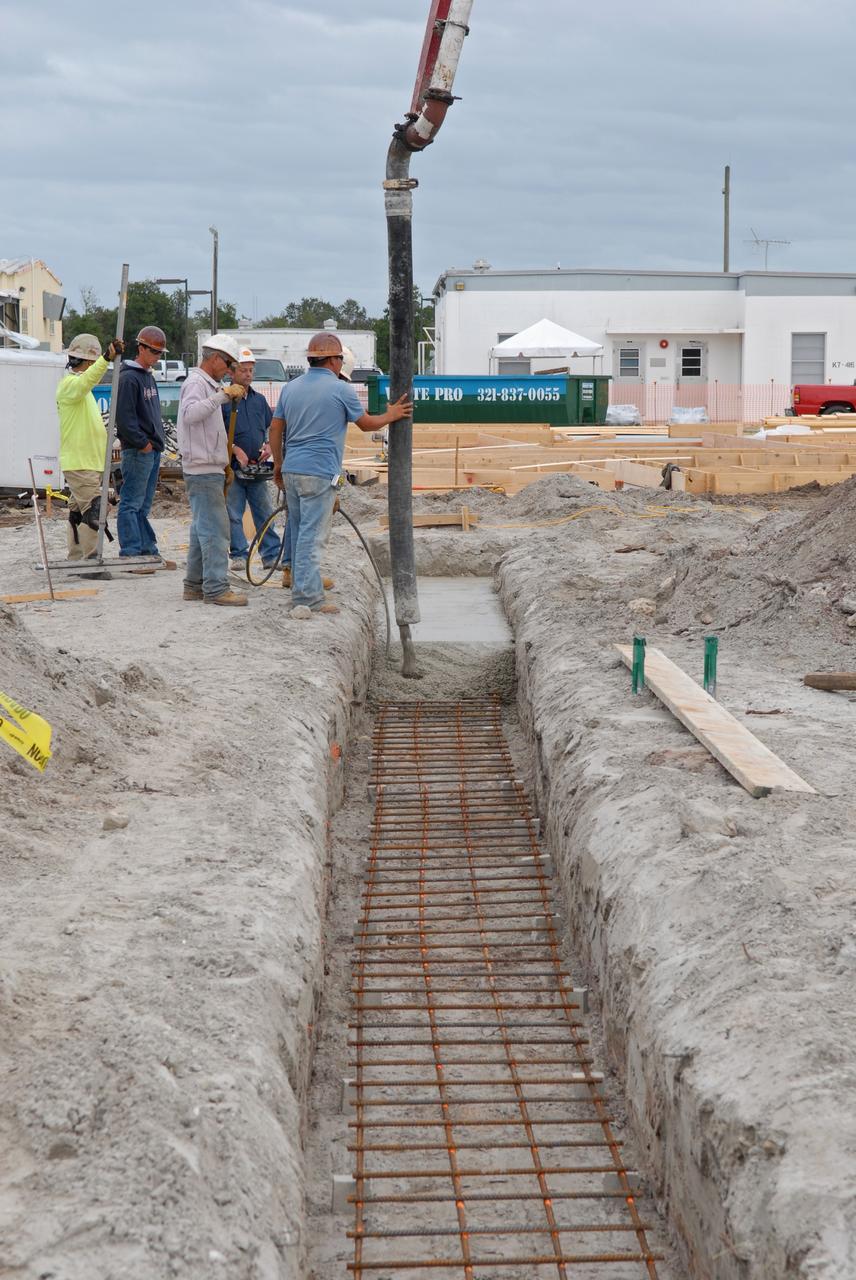
CAPE CANAVERAL, Fla. - Concrete is poured into the trenches that will provide the foundation for the walls of the Propellants North Administrative and Maintenance Facility in Launch Complex 39 at NASA's Kennedy Space Center in Florida. A tilt-up construction method is being used to erect a THERMOMASS concrete wall insulation system for the facility's walls. The facility will have a two-story administrative building to house managers, mechanics and technicians who fuel spacecraft at Kennedy adjacent to an 1,800-square-foot single-story shop to store cryogenic fuel transfer equipment. The new facility will feature high-efficiency roofs and walls, “Cool Dry Quiet” air conditioning with energy recovery technology, efficient lighting, and other sustainable features. The facility is striving to qualify for the U.S. Green Building Council’s Leadership in Energy and Environmental Design, or LEED, Platinum certification. If successful, Propellants North will be the first Kennedy facility to achieve this highest of LEED ratings after it is completed in the summer of 2010. The facility was designed for NASA by Jones Edmunds and Associates. Photo credit: NASA/Jim Grossmann
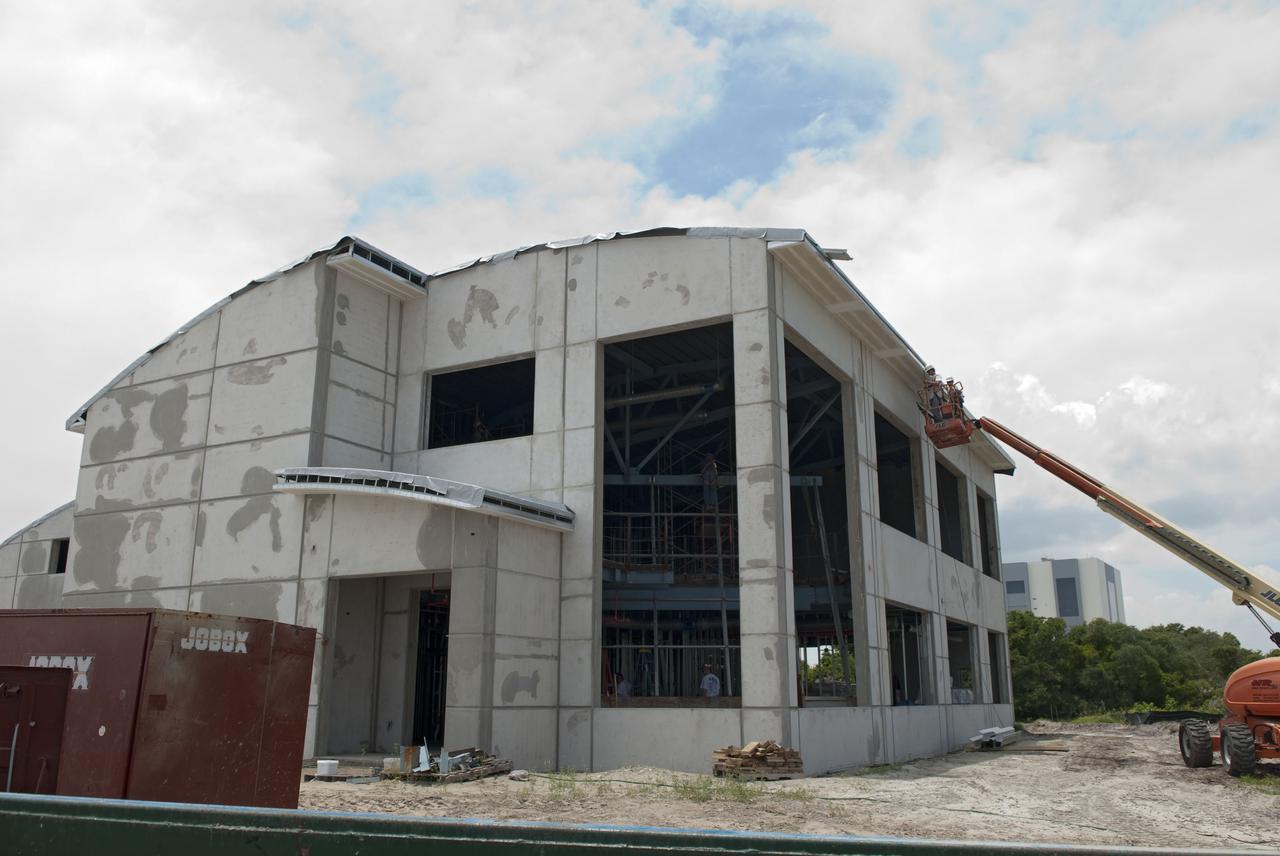
CAPE CANAVERAL, Fla. - At the Propellants North Administrative and Maintenance Facility at NASA's Kennedy Space Center in Florida, workers prepare to install window glazing and framing recycled from the iconic firing rooms of the Launch Control Center. New energy-efficient windows will be set at the same orientation and angle as the old windows were at the control center, looking out toward Launch Complex 39. The green facility will have a two-story administrative building to house managers, mechanics and technicians who fuel spacecraft at Kennedy adjacent to a single-story shop to store cryogenic fuel transfer equipment. The facility is striving to qualify for the U.S. Green Building Council’s Leadership in Energy and Environmental Design, or LEED, Platinum certification. If successful, it will be the first NASA facility to achieve this highest of LEED ratings after it is completed in December 2010. The facility was designed for NASA by Jones Edmunds and Associates. H. W. Davis Construction is the construction contractor. Photo credit: NASA_Jim Grossmann
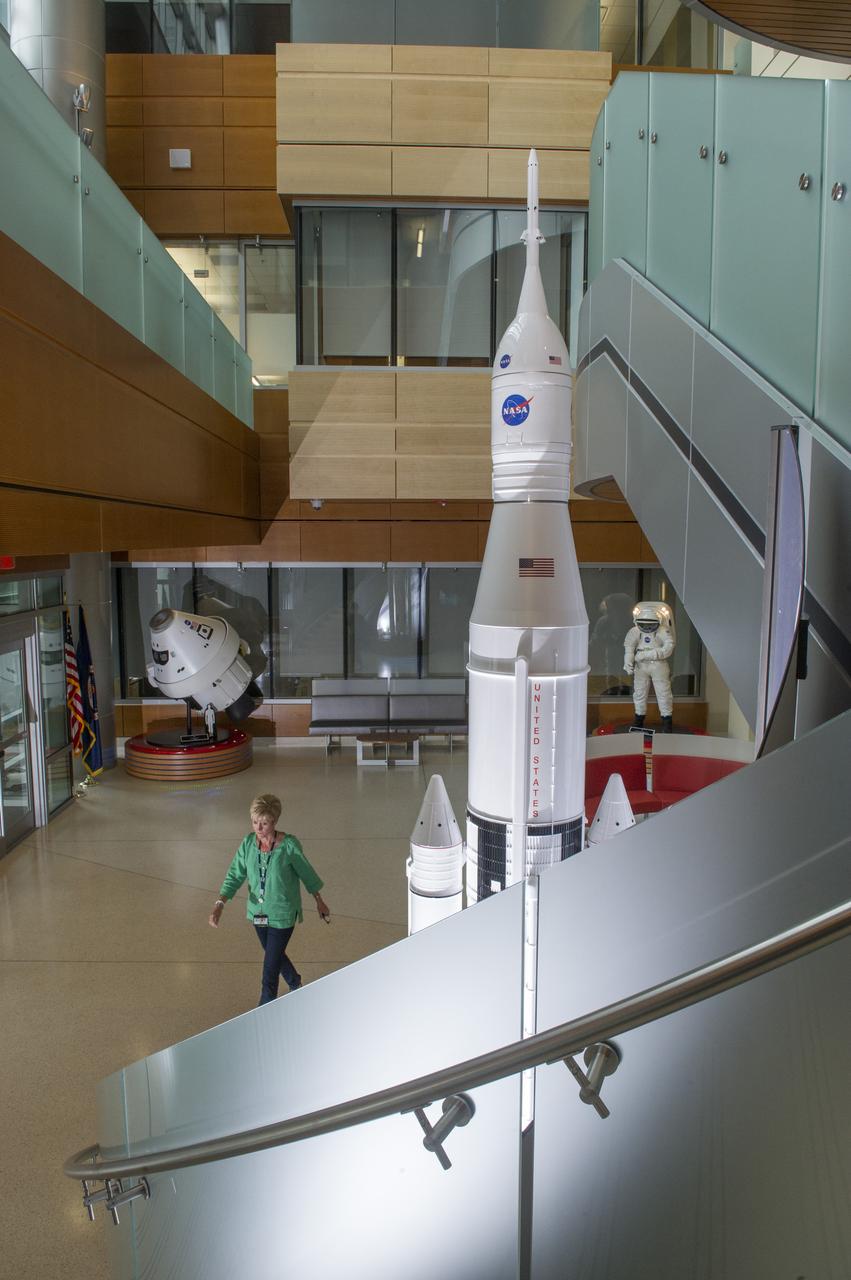
THE INTERIOR OF THE MARSHALL SPACE FLIGHT CENTER’S NEWLY OPENED BUILDING 4220, PRIMARILY HOME TO THE SPACE LAUNCH SYSTEM PROGRAM, REFLECTS A BLEND OF AESTHETICS, PRACTICALITY AND HIGH EFFICIENCY. THE COST-CONSCIOUS NEW FACILITY IS ENVIRONMENTALLY FRIENDLY ON ALL FRONTS, FEATURING STATE-OF-THE-ART GREEN TECHNOLOGIES AND ENERGY-CONSERVATION SYSTEMS THROUGHOUT THE BUILDING. THE ENTIRE STRUCTURE IS SPECIALLY INSULATED, WITH MUCH OF THE EXTERIOR COVERED IN LOW-EMISSIVITY GLASS THAT DEFLECTS HEAT TO REDUCE COOLING COSTS WITHIN. ROOFTOP SOLAR-POWER UNITS ABSORB ENERGY TO AUGMENT ELECTRICAL POWER, AND A 10,000-GALLON CISTERN COLLECTS STORMWATER TO IRRIGATE THE SURROUNDING GREENERY. EVEN THE FACILITY'S NEW PARKING LOT HAS A GREEN ELEMENT: RATHER THAN GUTTERS, IT INCLUDES A "BIOSWALE," A NATURAL, SOIL-AND-VEGETATION-BASED MEANS OF CAPTURING AND FILTERING STORMWATER RUNOFF, WHICH IS DIRECTED INTO A NEARBY COLLECTING POND. ONCE CERTIFICATION IS COMPLETE, BUILDING 4220 WILL BECOME THE SEVENTH LEED CERTIFIED MARSHALL STRUCTURE ON CAMPUS
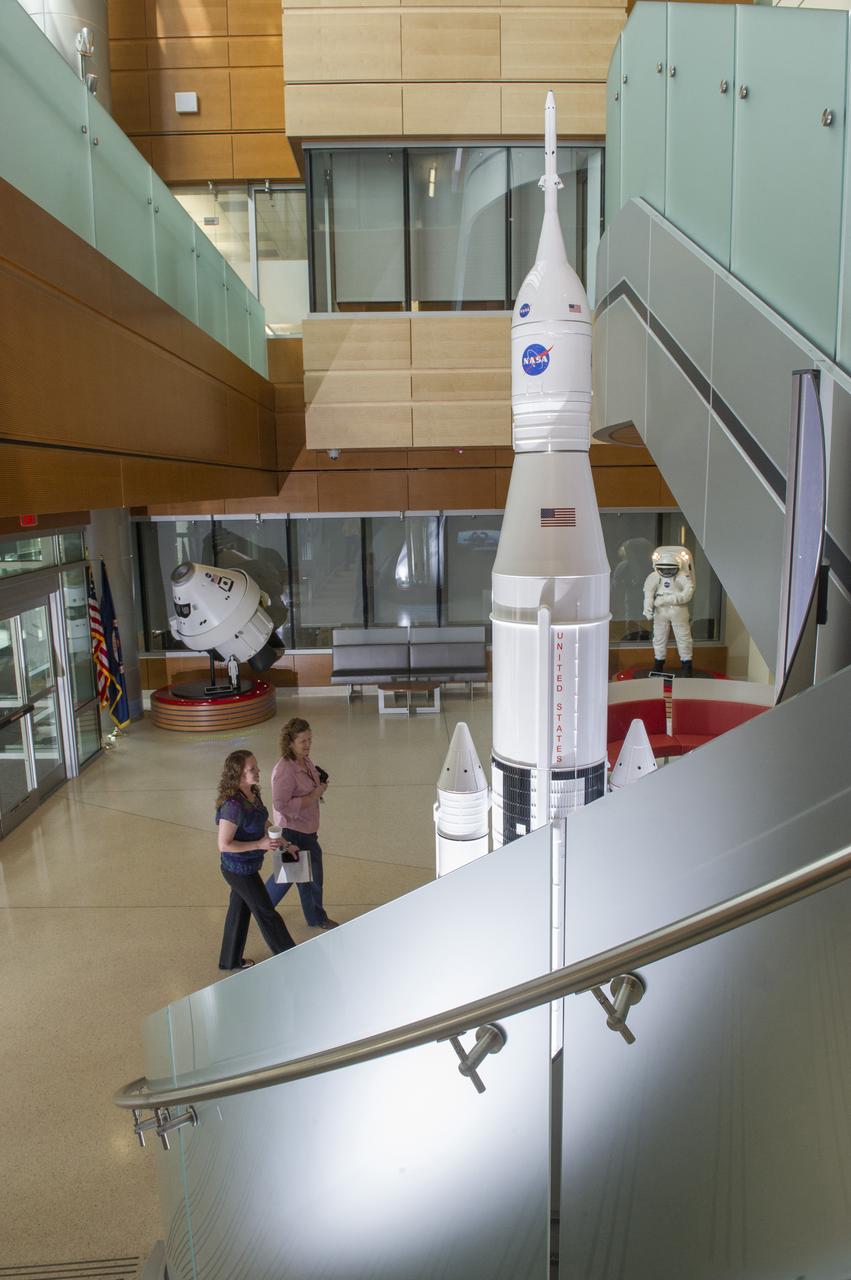
THE INTERIOR OF THE MARSHALL SPACE FLIGHT CENTER’S NEWLY OPENED BUILDING 4220, PRIMARILY HOME TO THE SPACE LAUNCH SYSTEM PROGRAM, REFLECTS A BLEND OF AESTHETICS, PRACTICALITY AND HIGH EFFICIENCY. THE COST-CONSCIOUS NEW FACILITY IS ENVIRONMENTALLY FRIENDLY ON ALL FRONTS, FEATURING STATE-OF-THE-ART GREEN TECHNOLOGIES AND ENERGY-CONSERVATION SYSTEMS THROUGHOUT THE BUILDING. THE ENTIRE STRUCTURE IS SPECIALLY INSULATED, WITH MUCH OF THE EXTERIOR COVERED IN LOW-EMISSIVITY GLASS THAT DEFLECTS HEAT TO REDUCE COOLING COSTS WITHIN. ROOFTOP SOLAR-POWER UNITS ABSORB ENERGY TO AUGMENT ELECTRICAL POWER, AND A 10,000-GALLON CISTERN COLLECTS STORMWATER TO IRRIGATE THE SURROUNDING GREENERY. EVEN THE FACILITY'S NEW PARKING LOT HAS A GREEN ELEMENT: RATHER THAN GUTTERS, IT INCLUDES A "BIOSWALE," A NATURAL, SOIL-AND-VEGETATION-BASED MEANS OF CAPTURING AND FILTERING STORMWATER RUNOFF, WHICH IS DIRECTED INTO A NEARBY COLLECTING POND. ONCE CERTIFICATION IS COMPLETE, BUILDING 4220 WILL BECOME THE SEVENTH LEED CERTIFIED MARSHALL STRUCTURE ON CAMPUS
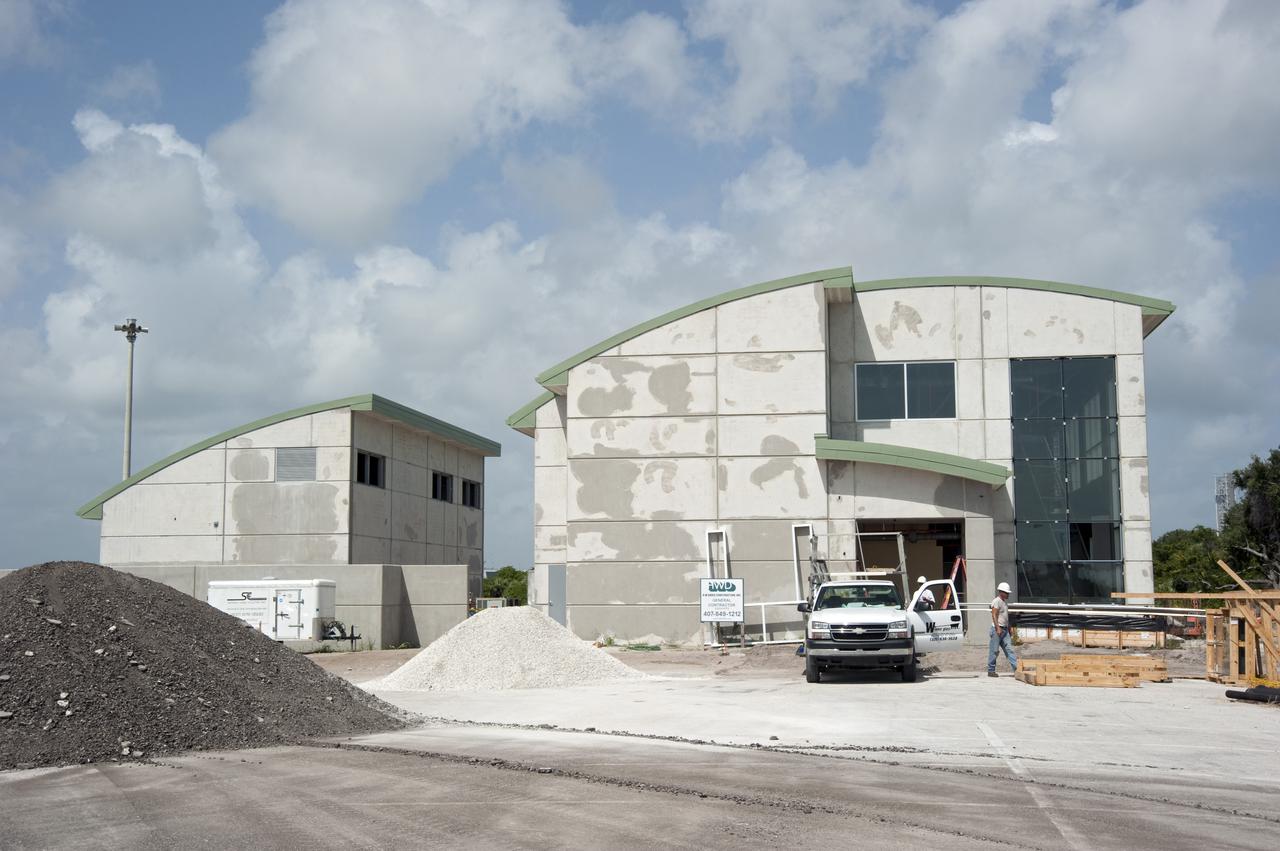
CAPE CANAVERAL, Fla. - The Propellants North Administrative and Maintenance Facility at NASA's Kennedy Space Center in Florida is coming together in the Launch Complex 39 area. New energy-efficient windows recently were installed and up next will be the installation of solar panels. The green facility will have a two-story administrative building to house managers, mechanics and technicians who fuel spacecraft at Kennedy adjacent to a single-story shop to store cryogenic fuel transfer equipment. The facility is striving to qualify for the U.S. Green Building Council’s Leadership in Energy and Environmental Design, or LEED, Platinum certification. If successful, it will be the first NASA facility to achieve this highest of LEED ratings after it is completed in December 2010. The facility was designed for NASA by Jones Edmunds and Associates. H. W. Davis Construction is the construction contractor. Photo credit: NASA_Kim Shiflett
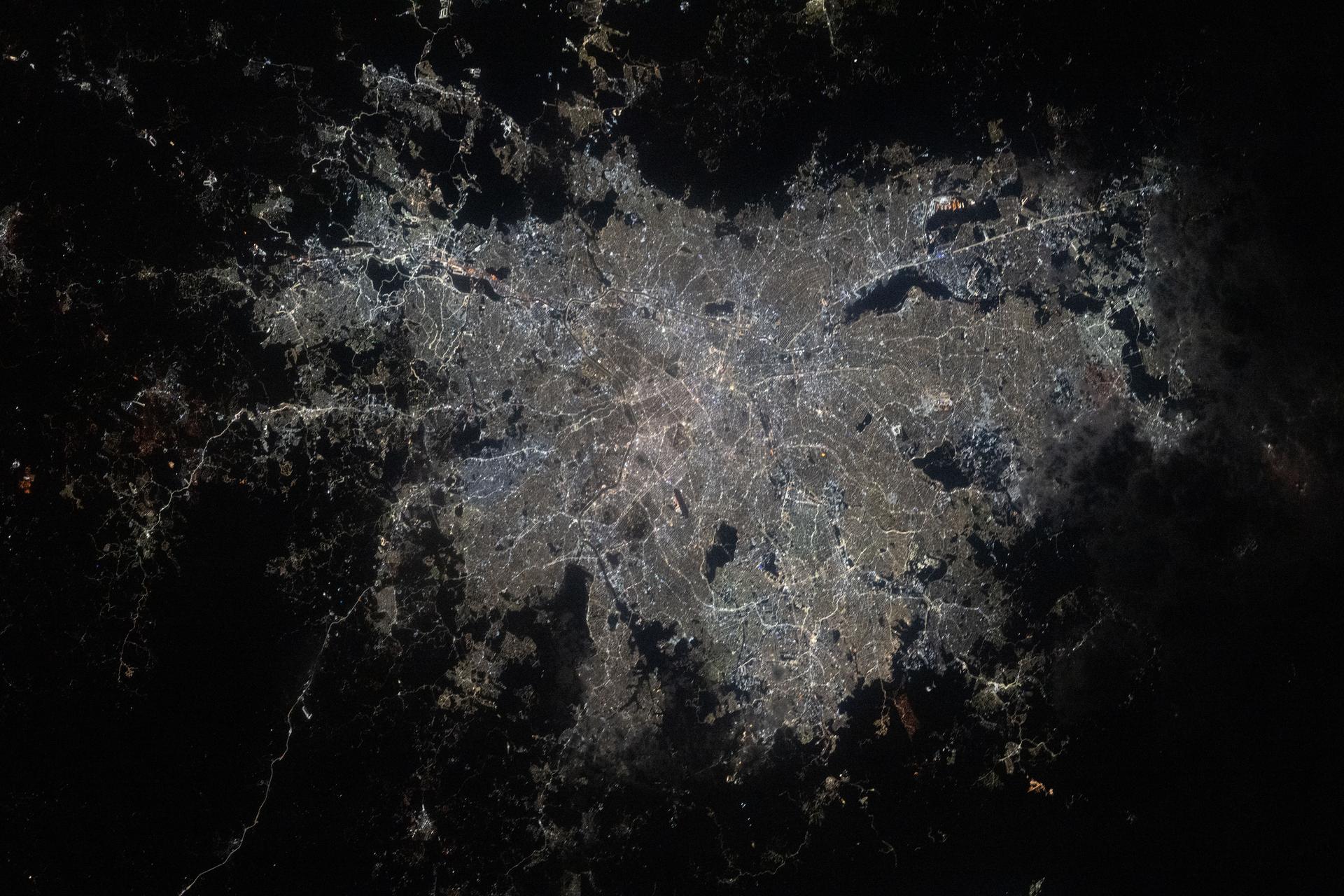
iss073e0982063 (Oct. 21, 2025) --- São Paulo, Brazil—with a metropolitan population of about 23 million—is the fifth most populous region in the world. As Brazil's economic powerhouse, São Paulo hosts one of the largest stock exchanges in the world and leads in the automotive, aerospace, and pharmaceutical industries. The city's brighter, more energy-efficient white LED lights reflect the region’s ongoing progress and modernization of its infrastructure. This photograph was taken from the International Space Station as it orbited 264 miles above the Brazilian coast at approximately 2:20 a.m. local time.

iss073e0515603 (Aug. 24, 2025) --- Shanghai, China, situated on the Yangtze River where it meets the East China Sea, is pictured at approximately 1:32 a.m. local time from the International Space Station as it orbited 261 miles above the nation's eastern coastline. Visible landmarks include Shanghai Hongqiao International Airport near the top of the frame and Shanghai Pudong International Airport at the bottom. The city's lights appear dimmer from orbit due to the widespread use of modern, downward-facing, energy-efficient lighting that reduces light pollution. Credit: JAXA (Japan Aerospace Exploration Agency)
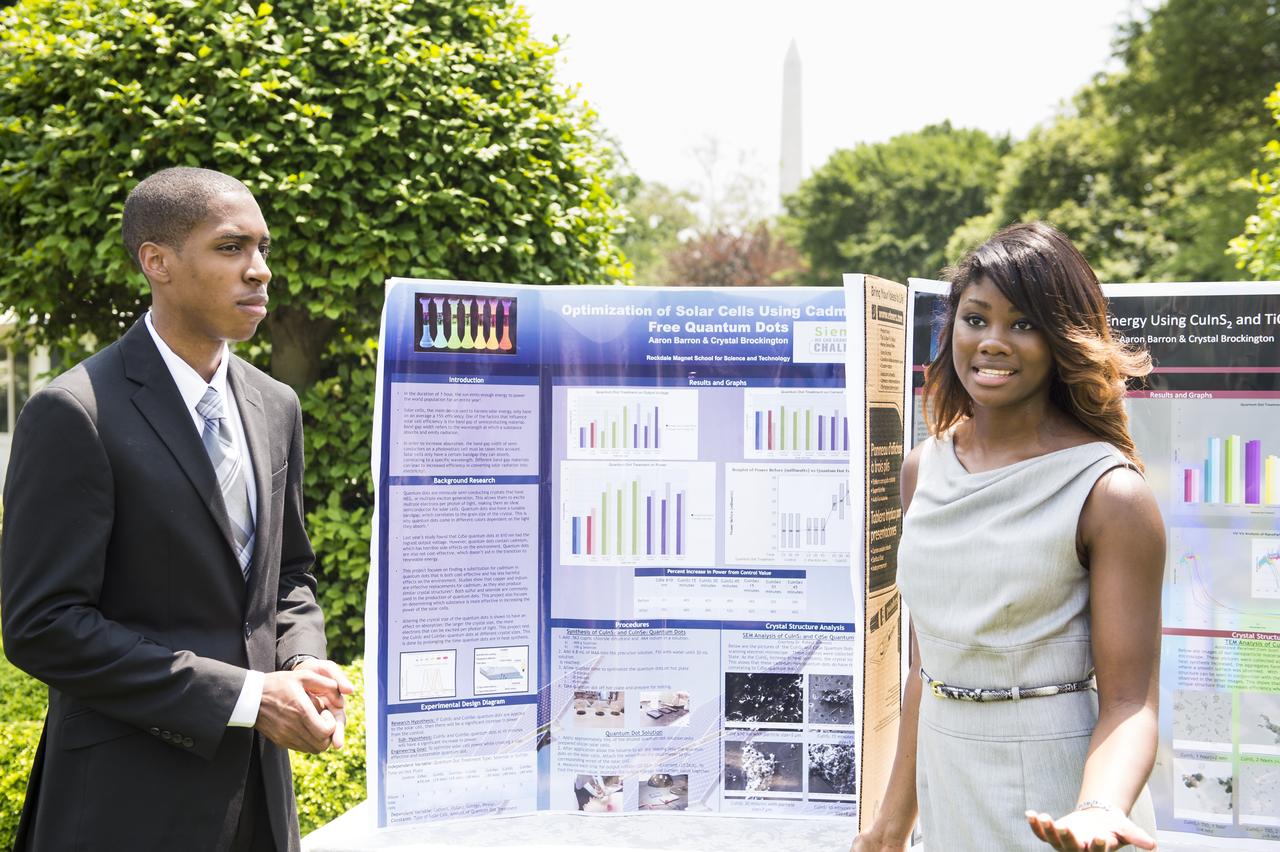
Crystal Brockington and Aaron Barron, both 18 years old, designed a more efficient and cost effective solar cell that harnesses energy without cadmium, which has been shown to be harmful to the environment. They were selected to participate in the White House Science Fair after they were awarded the High School Grand Prize at the Siemens We Can Change the World Challenge. The fourth White House Science Fair was held at the White House on May 27, 2014 and included 100 students from more than 30 different states who competed in science, technology, engineering, and math (STEM) competitions. (Photo Credit: NASA/Aubrey Gemignani)

NASA climatologist Gary Jedlovec, a member of the Earth Science team in Marshall Space Flight Center’s Science and Technology Office, discusses the satellite technology and ground-based tools used to record and trend regional and global climate changes over the past century and to provide forecast models looking 100 years into the future. Jedlovec and his team, which partners with National Oceanic and Atmospheric Association researchers and their colleagues around the world, spoke to the Marshall “Green Team” -- environmental engineers and support personnel who help guide Marshall’s focus on safer, more cost-efficient energy use. The Green Team, led by Marshall Sustainability Engineer Donna Leach of the Environmental Engineering & Occupational Health Office, currently is preparing activities and outreach for Earth Day 2020, set for next April.

KENNEDY SPACE CENTER, Fla. -- On Launch Pad 39A, two Hitchhiker Experiments Advancing Technology (HEAT) payloads are loaded onto Discovery’s port adapter beam in the payload bay. At left is the Space Experiment Module, an educational initiative to increase educational access to space. The canister contains up to 10 small, enclosed modules that contain separate, passive experiments designed and constructed by students. Many of the experiments will study the growing characteristics of plants subjected to the space environment. At right is the Get Away Special canister containing the Alkali Metal Thermal-to-Electric Converter (AMTEC), designed for efficient conversion of heat into electrical energy. The HEAT payloads are flying on mission STS-105, scheduled to launch Aug. 9, 2001

A Mod-0A 200-kilowatt wind turbine designed by National Aeronautics and Space Administration (NASA) Lewis Research Center and constructed in Block Island, Rhode Island. The wind turbine program was a joint program between NASA and the Energy Research and Development Administration (ERDA) during the 1970s to develop less expensive forms of energy. NASA Lewis was assigned the responsibility of developing large horizontal-axis wind turbines. The program included a series of increasingly powerful wind turbines, designated: Mod-0A, Mod-1, WTS-4, and Mod-5. The program’s first device was a Mod-0 100-kilowatt wind turbine test bed at NASA’s Plum Brook Station. This Mod-0A 200-kilowatt turbine, completed in 1977, was the program’s second-generation device. It included a 125-foot diameter blade atop a 100-foot tall tower. This early wind turbine was designed determine its operating problems, integrate with the local utilities, and assess the attitude of the local community. There were additional Mod-0A turbines built in Culebra, Puerto Rico; Clayton, New Mexico; and Oahu, Hawaii. The Mod-0A turbines suffered durability issues with the rotor blade and initially appeared unreliable. NASA engineers addressed the problems, and the turbines proved to be reliable and efficient devices that operated for a number of years. The information gained from these early models was vital to the design and improvement of the later generations.
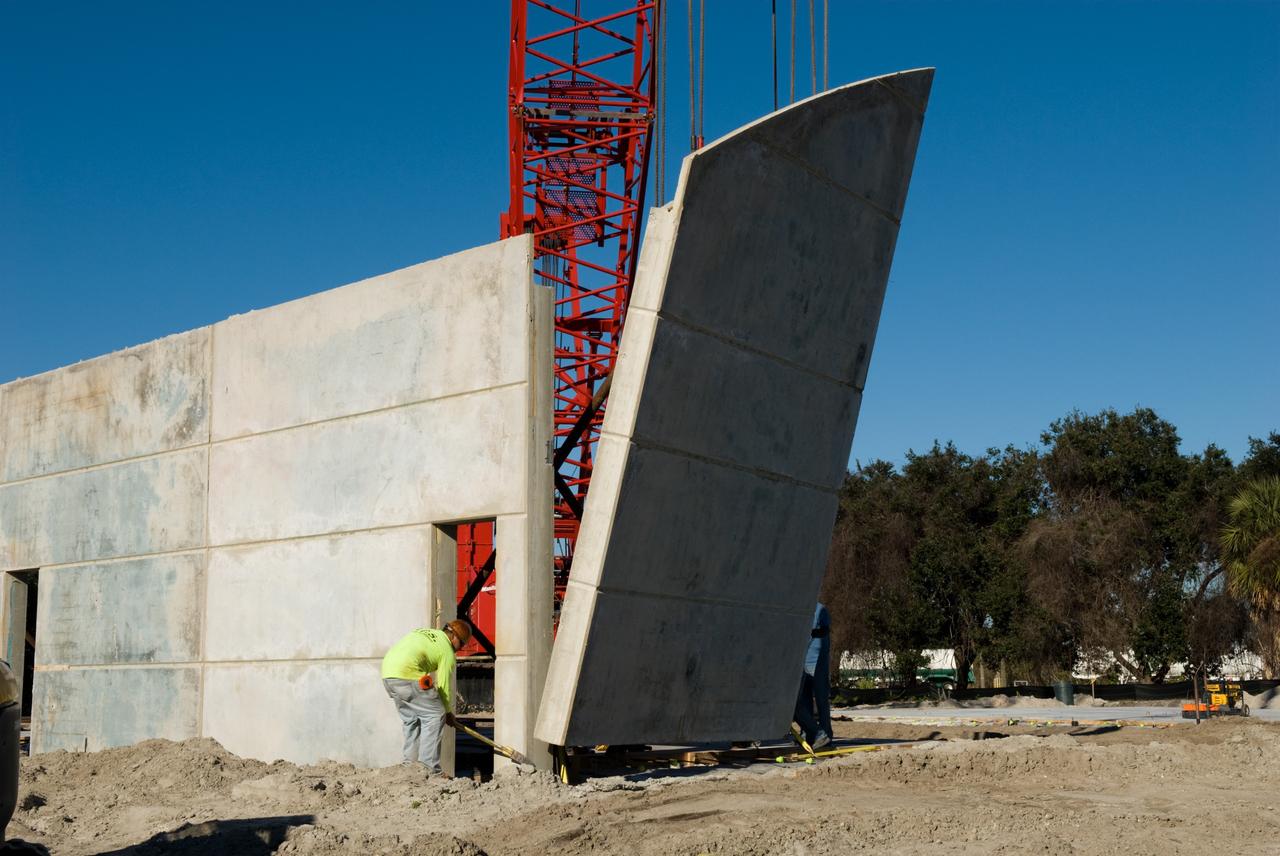
CAPE CANAVERAL, Fla. - In Launch Complex 39 at NASA's Kennedy Space Center in Florida, the Propellants North Administrative and Maintenance Facility begins to take shape as its walls are lifted into position. A tilt-up construction method is being used to erect a THERMOMASS concrete wall insulation system for the facility's walls. In this approach, the exterior layer of concrete for the wall panels is poured and leveled on the building's footprint. Then, prefabricated, predrilled insulation sheets are arranged on top of the unhardened concrete, and connectors, designed to hold the sandwiched layers of concrete and insulation secure, are inserted through the predrilled holes. Next, the structural wythe is poured. Once cured, these panels are lifted upright to form the building's envelope. The facility will have a two-story administrative building to house managers, mechanics and technicians who fuel spacecraft at Kennedy adjacent to an 1,800-square-foot single-story shop to store cryogenic fuel transfer equipment. The new facility will feature high-efficiency roofs and walls, “Cool Dry Quiet” air conditioning with energy recovery technology, efficient lighting, and other sustainable features. The facility is striving to qualify for the U.S. Green Building Council’s Leadership in Energy and Environmental Design, or LEED, Platinum certification. If successful, Propellants North will be the first Kennedy facility to achieve this highest of LEED ratings after it is completed in the summer of 2010. The facility was designed for NASA by Jones Edmunds and Associates. Photo credit: NASA/Jim Grossmann
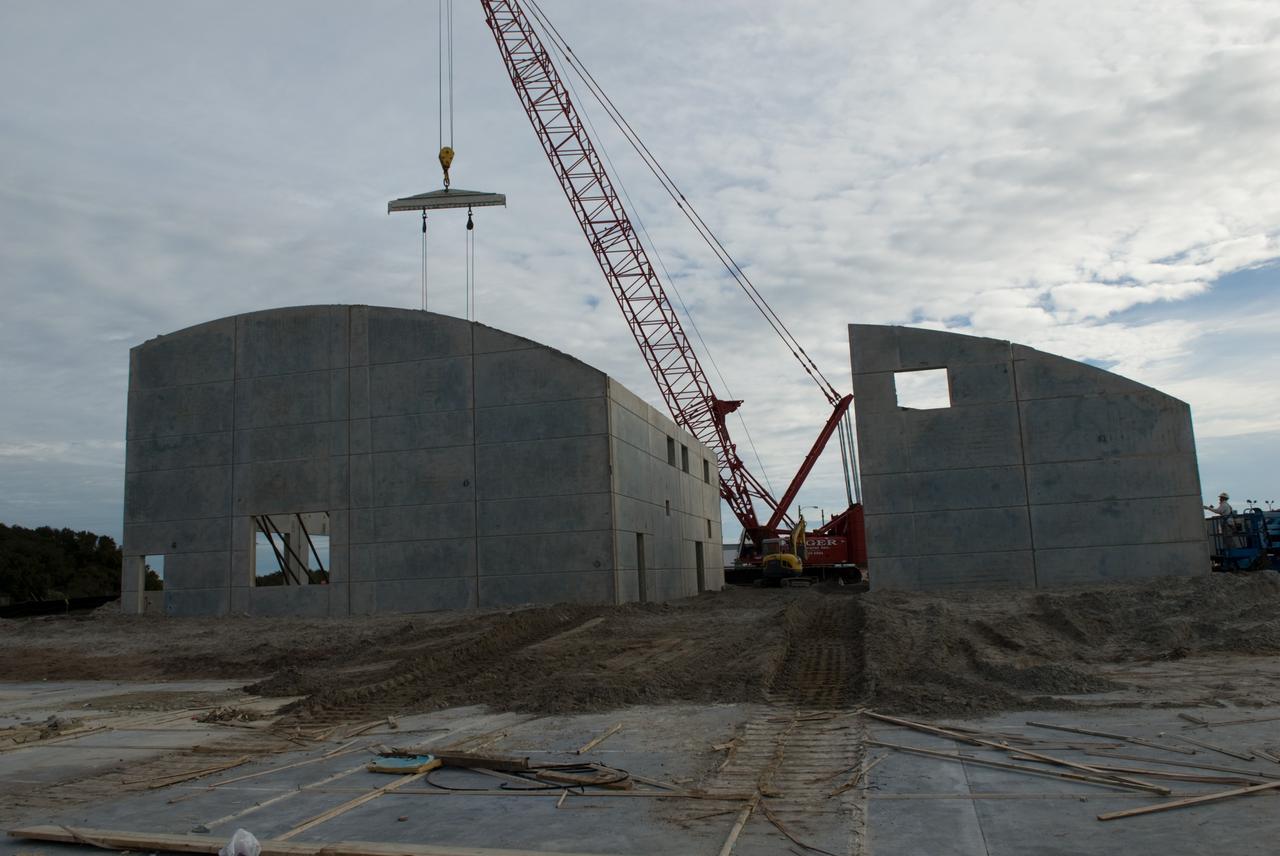
CAPE CANAVERAL, Fla. - In Launch Complex 39 at NASA's Kennedy Space Center in Florida, with the placement of the last outside wall of the Propellants North Administrative and Maintenance Facility, the "barn-raising" of the new "green" facility is complete. Concrete layers on either side of high-density foam insulation in the facility's walls will prevent any transfer of radiant heat between the exterior and interior of the buildings. A tilt-up construction method is being used to erect a THERMOMASS concrete wall insulation system for the facility's walls. In this approach, the exterior layer of concrete for the wall panels is poured and leveled on the building's footprint. Then, prefabricated, predrilled insulation sheets are arranged on top of the unhardened concrete, and connectors, designed to hold the sandwiched layers of concrete and insulation secure, are inserted through the predrilled holes. Next, the structural wythe is poured. Once cured, these panels are lifted upright to form the building's envelope. The facility will have a two-story administrative building to house managers, mechanics and technicians who fuel spacecraft at Kennedy adjacent to an 1,800-square-foot single-story shop to store cryogenic fuel transfer equipment. The new facility will feature high-efficiency roofs and walls, “Cool Dry Quiet” air conditioning with energy recovery technology, efficient lighting, and other sustainable features. The facility is striving to qualify for the U.S. Green Building Council’s Leadership in Energy and Environmental Design, or LEED, Platinum certification. If successful, Propellants North will be the first Kennedy facility to achieve this highest of LEED ratings after it is completed in the summer of 2010. The facility was designed for NASA by Jones Edmunds and Associates. Photo credit: NASA/Jim Grossmann

CAPE CANAVERAL, Fla. - In Launch Complex 39 at NASA's Kennedy Space Center in Florida, man and machine work side by side to position the walls of the Propellants North Administrative and Maintenance Facility. A tilt-up construction method is being used to erect a THERMOMASS concrete wall insulation system for the facility's walls. In this approach, the exterior layer of concrete for the wall panels is poured and leveled on the building's footprint. Then, prefabricated, predrilled insulation sheets are arranged on top of the unhardened concrete, and connectors, designed to hold the sandwiched layers of concrete and insulation secure, are inserted through the predrilled holes. Next, the structural wythe is poured. Once cured, these panels are lifted upright to form the building's envelope. The facility will have a two-story administrative building to house managers, mechanics and technicians who fuel spacecraft at Kennedy adjacent to an 1,800-square-foot single-story shop to store cryogenic fuel transfer equipment. The new facility will feature high-efficiency roofs and walls, “Cool Dry Quiet” air conditioning with energy recovery technology, efficient lighting, and other sustainable features. The facility is striving to qualify for the U.S. Green Building Council’s Leadership in Energy and Environmental Design, or LEED, Platinum certification. If successful, Propellants North will be the first Kennedy facility to achieve this highest of LEED ratings after it is completed in the summer of 2010. The facility was designed for NASA by Jones Edmunds and Associates. Photo credit: NASA/Jim Grossmann
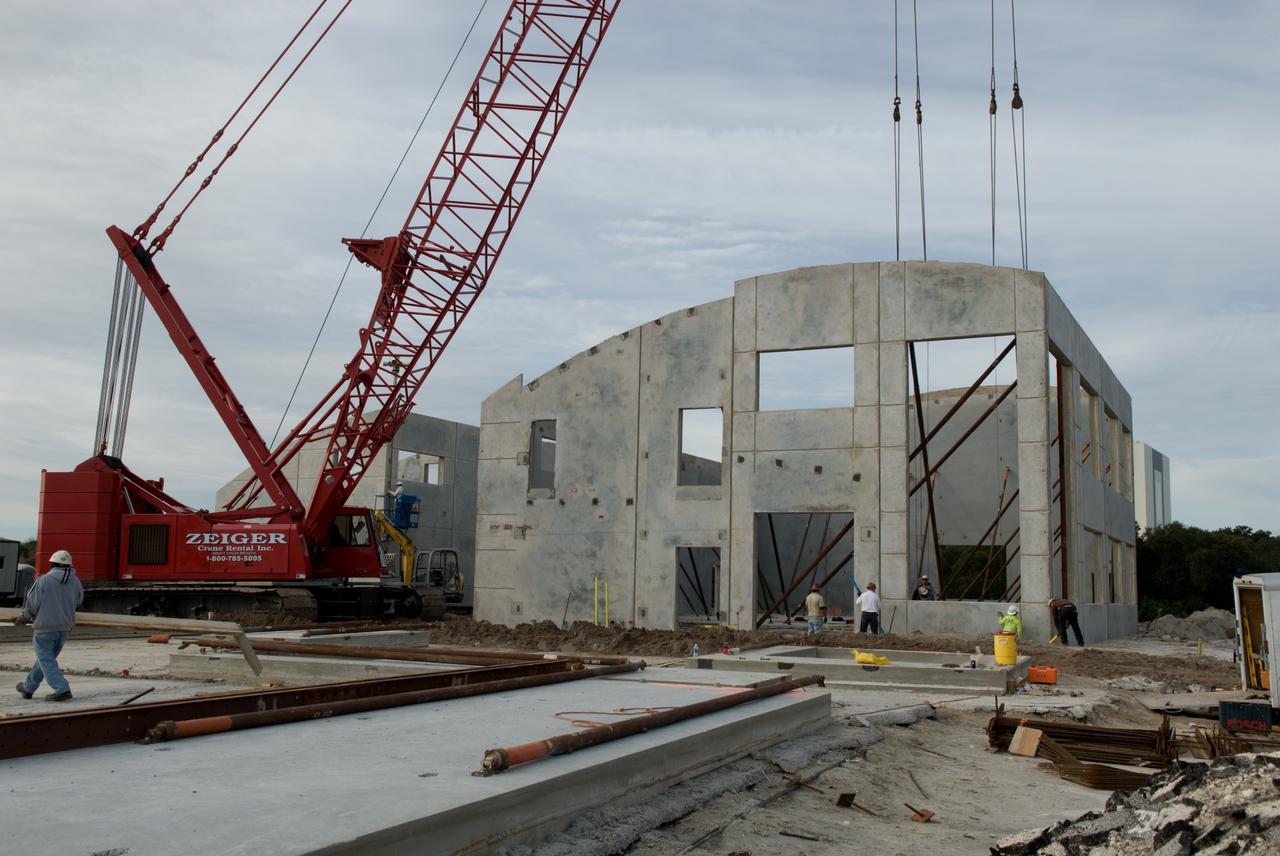
CAPE CANAVERAL, Fla. - In Launch Complex 39 at NASA's Kennedy Space Center in Florida, all of the exterior walls of the Propellants North Administrative and Maintenance Facility have been lifted into place. Concrete layers on either side of high-density foam insulation in the facility's walls will prevent any transfer of radiant heat between the exterior and interior of the buildings. A tilt-up construction method is being used to erect a THERMOMASS concrete wall insulation system for the facility's walls. In this approach, the exterior layer of concrete for the wall panels is poured and leveled on the building's footprint. Then, prefabricated, predrilled insulation sheets are arranged on top of the unhardened concrete, and connectors, designed to hold the sandwiched layers of concrete and insulation secure, are inserted through the predrilled holes. Next, the structural wythe is poured. Once cured, these panels are lifted upright to form the building's envelope. The facility will have a two-story administrative building to house managers, mechanics and technicians who fuel spacecraft at Kennedy adjacent to an 1,800-square-foot single-story shop to store cryogenic fuel transfer equipment. The new facility will feature high-efficiency roofs and walls, “Cool Dry Quiet” air conditioning with energy recovery technology, efficient lighting, and other sustainable features. The facility is striving to qualify for the U.S. Green Building Council’s Leadership in Energy and Environmental Design, or LEED, Platinum certification. If successful, Propellants North will be the first Kennedy facility to achieve this highest of LEED ratings after it is completed in the summer of 2010. The facility was designed for NASA by Jones Edmunds and Associates. Photo credit: NASA/Jim Grossmann
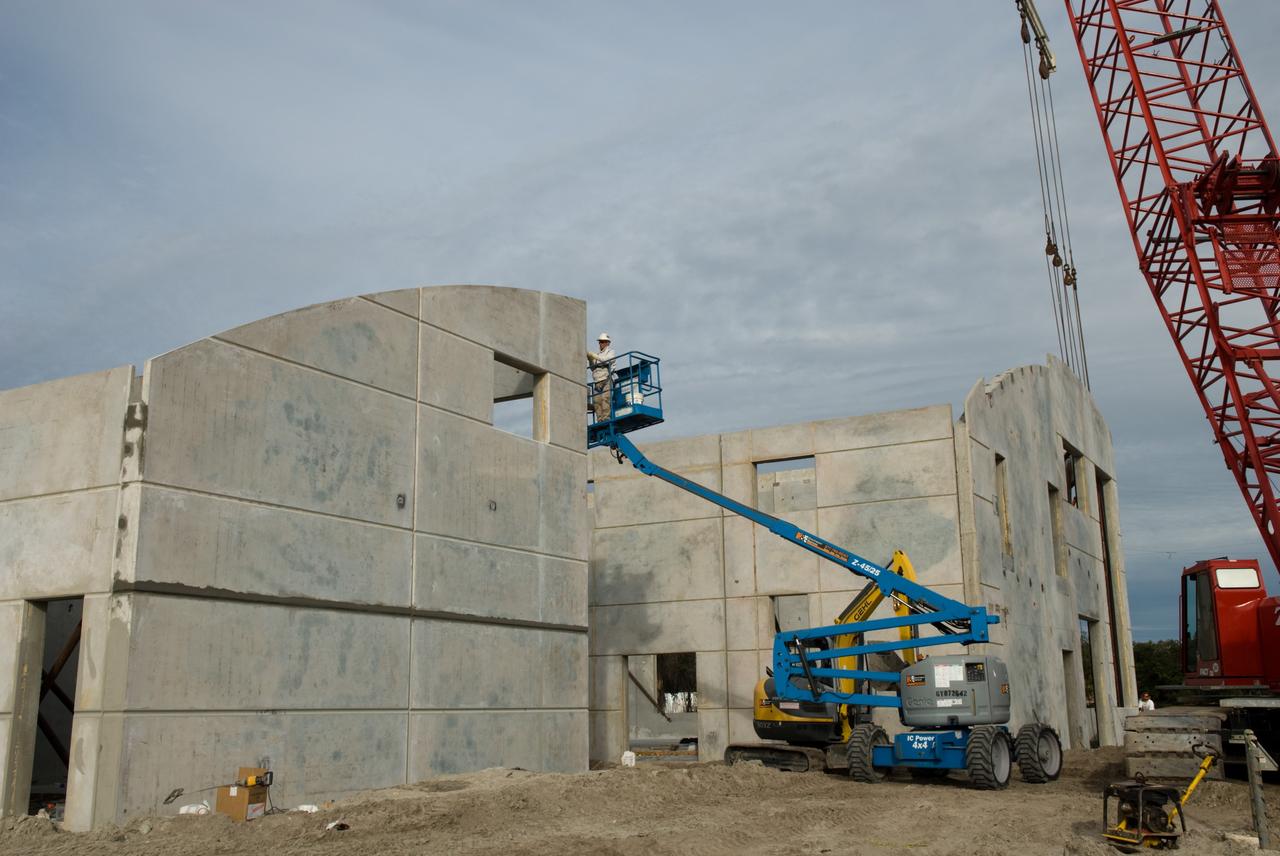
CAPE CANAVERAL, Fla. - In Launch Complex 39 at NASA's Kennedy Space Center in Florida, the last outside wall of the Propellants North Administrative and Maintenance Facility is lifted into place. Concrete layers on either side of high-density foam insulation in the facility's walls will prevent any transfer of radiant heat between the exterior and interior of the buildings. A tilt-up construction method is being used to erect a THERMOMASS concrete wall insulation system for the facility's walls. In this approach, the exterior layer of concrete for the wall panels is poured and leveled on the building's footprint. Then, prefabricated, predrilled insulation sheets are arranged on top of the unhardened concrete, and connectors, designed to hold the sandwiched layers of concrete and insulation secure, are inserted through the predrilled holes. Next, the structural wythe is poured. Once cured, these panels are lifted upright to form the building's envelope. The facility will have a two-story administrative building to house managers, mechanics and technicians who fuel spacecraft at Kennedy adjacent to an 1,800-square-foot single-story shop to store cryogenic fuel transfer equipment. The new facility will feature high-efficiency roofs and walls, “Cool Dry Quiet” air conditioning with energy recovery technology, efficient lighting, and other sustainable features. The facility is striving to qualify for the U.S. Green Building Council’s Leadership in Energy and Environmental Design, or LEED, Platinum certification. If successful, Propellants North will be the first Kennedy facility to achieve this highest of LEED ratings after it is completed in the summer of 2010. The facility was designed for NASA by Jones Edmunds and Associates. Photo credit: NASA/Jim Grossmann
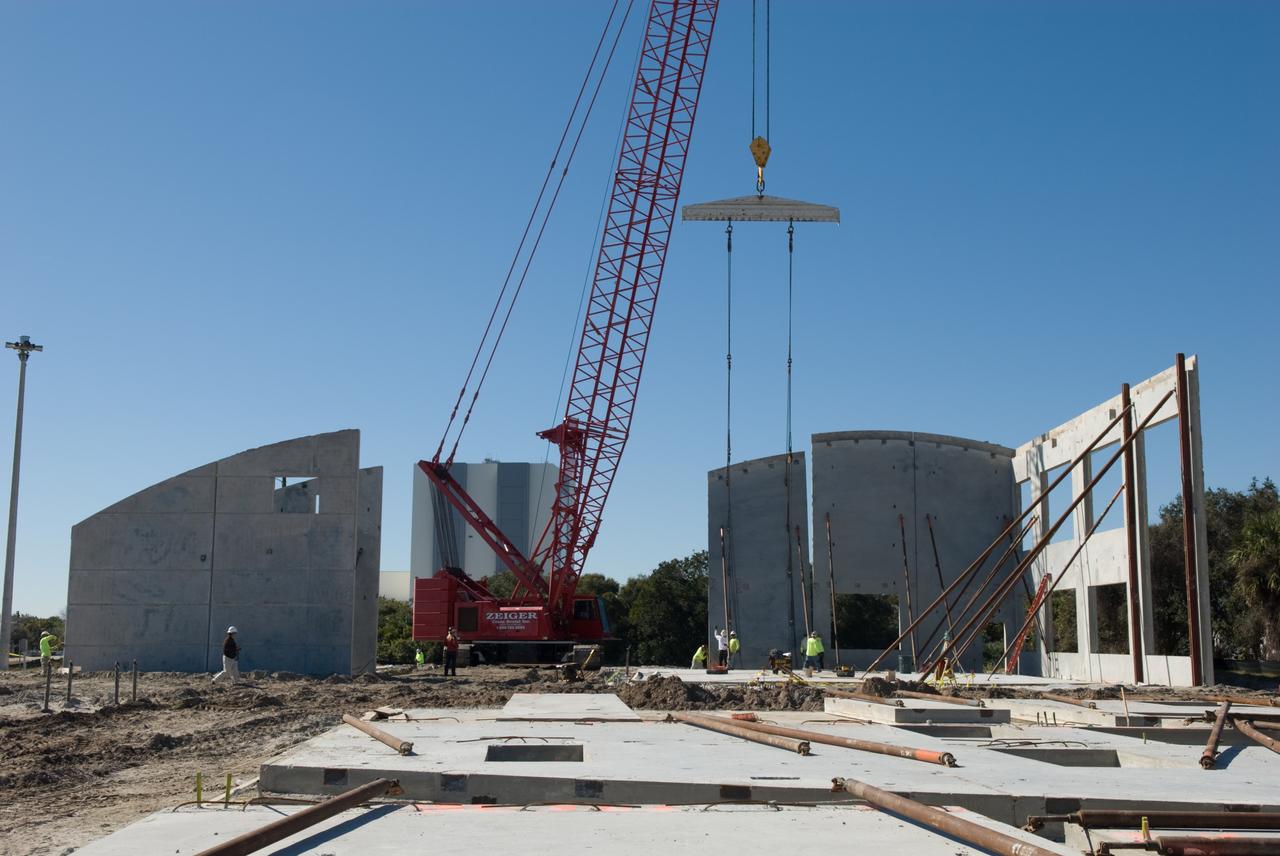
CAPE CANAVERAL, Fla. - The 525-foot-tall Vehicle Assembly Building, in the background, is witness to the formation of the Propellants North Administrative and Maintenance Facility, a new "green" building under construction in Launch Complex 39 at NASA's Kennedy Space Center in Florida. Concrete layers on either side of high-density foam insulation in the facility's walls will prevent any transfer of radiant heat between the exterior and interior of the buildings. A tilt-up construction method is being used to erect a THERMOMASS concrete wall insulation system for the facility's walls. In this approach, the exterior layer of concrete for the wall panels is poured and leveled on the building's footprint. Then, prefabricated, predrilled insulation sheets are arranged on top of the unhardened concrete, and connectors, designed to hold the sandwiched layers of concrete and insulation secure, are inserted through the predrilled holes. Next, the structural wythe is poured. Once cured, these panels are lifted upright to form the building's envelope. The facility will have a two-story administrative building to house managers, mechanics and technicians who fuel spacecraft at Kennedy adjacent to an 1,800-square-foot single-story shop to store cryogenic fuel transfer equipment. The new facility will feature high-efficiency roofs and walls, “Cool Dry Quiet” air conditioning with energy recovery technology, efficient lighting, and other sustainable features. The facility is striving to qualify for the U.S. Green Building Council’s Leadership in Energy and Environmental Design, or LEED, Platinum certification. If successful, Propellants North will be the first Kennedy facility to achieve this highest of LEED ratings after it is completed in the summer of 2010. The facility was designed for NASA by Jones Edmunds and Associates. Photo credit: NASA/Jim Grossmann
CAPE CANAVERAL, Fla. - In Launch Complex 39 at NASA's Kennedy Space Center in Florida, the walls for the Propellants North Administrative and Maintenance Facility get a layer of high-density foam insulation. A tilt-up construction method is being used to erect a THERMOMASS concrete wall insulation system for the facility's walls. In this approach, the exterior layer of concrete for the wall panels is poured and leveled on the building's footprint. Then, prefabricated, predrilled insulation sheets are arranged on top of the unhardened concrete, and connectors, designed to hold the sandwiched layers of concrete and insulation secure, are inserted through the predrilled holes. Next, the structural wythe is poured. Once cured, these panels are lifted upright to form the building's envelope. The facility will have a two-story administrative building to house managers, mechanics and technicians who fuel spacecraft at Kennedy adjacent to an 1,800-square-foot single-story shop to store cryogenic fuel transfer equipment. The new facility will feature high-efficiency roofs and walls, “Cool Dry Quiet” air conditioning with energy recovery technology, efficient lighting, and other sustainable features. The facility is striving to qualify for the U.S. Green Building Council’s Leadership in Energy and Environmental Design, or LEED, Platinum certification. If successful, Propellants North will be the first Kennedy facility to achieve this highest of LEED ratings after it is completed in the summer of 2010. The facility was designed for NASA by Jones Edmunds and Associates. Photo credit: NASA/Jim Grossmann

CAPE CANAVERAL, Fla. - In Launch Complex 39 at NASA's Kennedy Space Center in Florida, the first wall of the Propellants North Administrative and Maintenance Facility is lifted into place. In the background is the 525-foot-tall Vehicle Assembly Building. A tilt-up construction method is being used to erect a THERMOMASS concrete wall insulation system for the facility's walls. In this approach, the exterior layer of concrete for the wall panels is poured and leveled on the building's footprint. Then, prefabricated, predrilled insulation sheets are arranged on top of the unhardened concrete, and connectors, designed to hold the sandwiched layers of concrete and insulation secure, are inserted through the predrilled holes. Next, the structural wythe is poured. Once cured, these panels are lifted upright to form the building's envelope. The facility will have a two-story administrative building to house managers, mechanics and technicians who fuel spacecraft at Kennedy adjacent to an 1,800-square-foot single-story shop to store cryogenic fuel transfer equipment. The new facility will feature high-efficiency roofs and walls, “Cool Dry Quiet” air conditioning with energy recovery technology, efficient lighting, and other sustainable features. The facility is striving to qualify for the U.S. Green Building Council’s Leadership in Energy and Environmental Design, or LEED, Platinum certification. If successful, Propellants North will be the first Kennedy facility to achieve this highest of LEED ratings after it is completed in the summer of 2010. The facility was designed for NASA by Jones Edmunds and Associates. Photo credit: NASA/Jim Grossmann
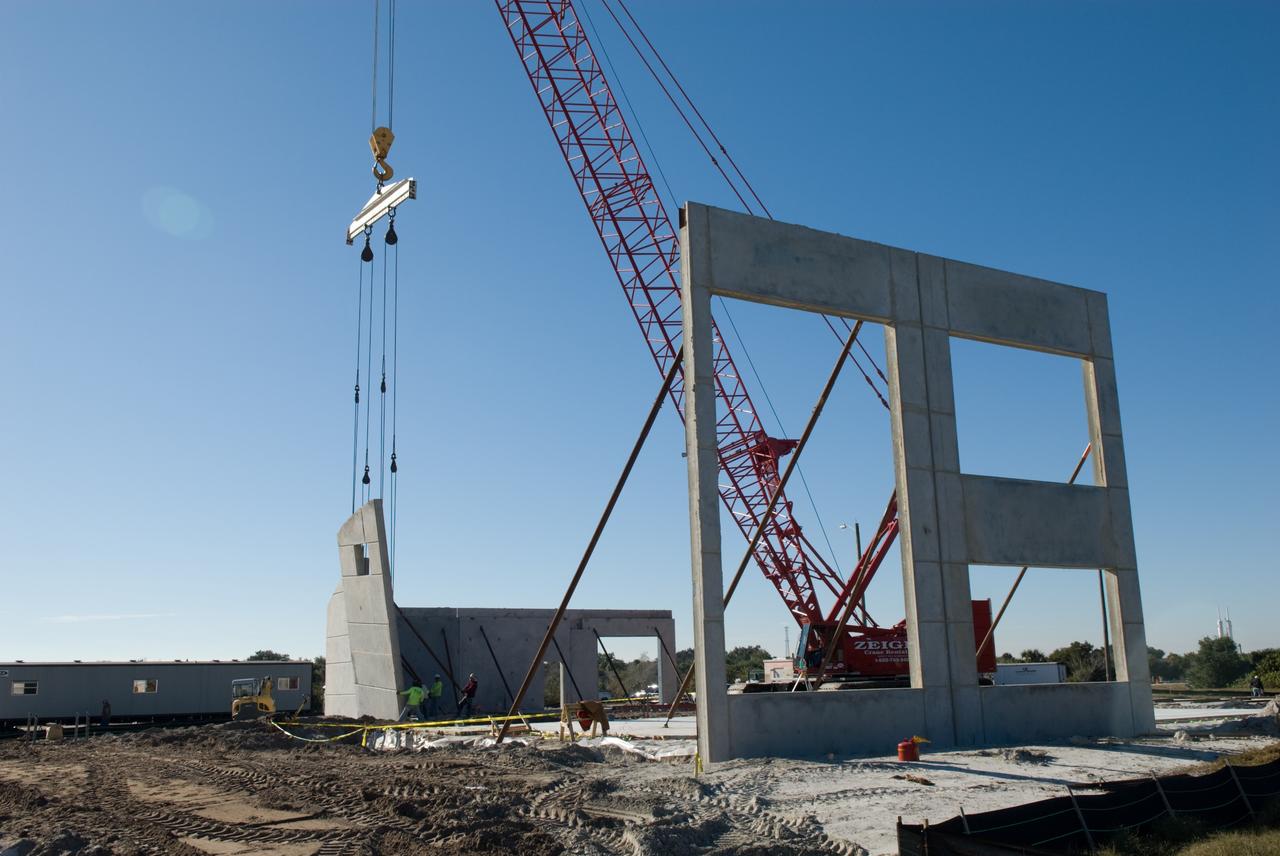
CAPE CANAVERAL, Fla. - In Launch Complex 39 at NASA's Kennedy Space Center in Florida, the Propellants North Administrative and Maintenance Facility begins to take shape as its walls are lifted into position. A tilt-up construction method is being used to erect a THERMOMASS concrete wall insulation system for the facility's walls. In this approach, the exterior layer of concrete for the wall panels is poured and leveled on the building's footprint. Then, prefabricated, predrilled insulation sheets are arranged on top of the unhardened concrete, and connectors, designed to hold the sandwiched layers of concrete and insulation secure, are inserted through the predrilled holes. Next, the structural wythe is poured. Once cured, these panels are lifted upright to form the building's envelope. The facility will have a two-story administrative building to house managers, mechanics and technicians who fuel spacecraft at Kennedy adjacent to an 1,800-square-foot single-story shop to store cryogenic fuel transfer equipment. The new facility will feature high-efficiency roofs and walls, “Cool Dry Quiet” air conditioning with energy recovery technology, efficient lighting, and other sustainable features. The facility is striving to qualify for the U.S. Green Building Council’s Leadership in Energy and Environmental Design, or LEED, Platinum certification. If successful, Propellants North will be the first Kennedy facility to achieve this highest of LEED ratings after it is completed in the summer of 2010. The facility was designed for NASA by Jones Edmunds and Associates. Photo credit: NASA/Jim Grossmann
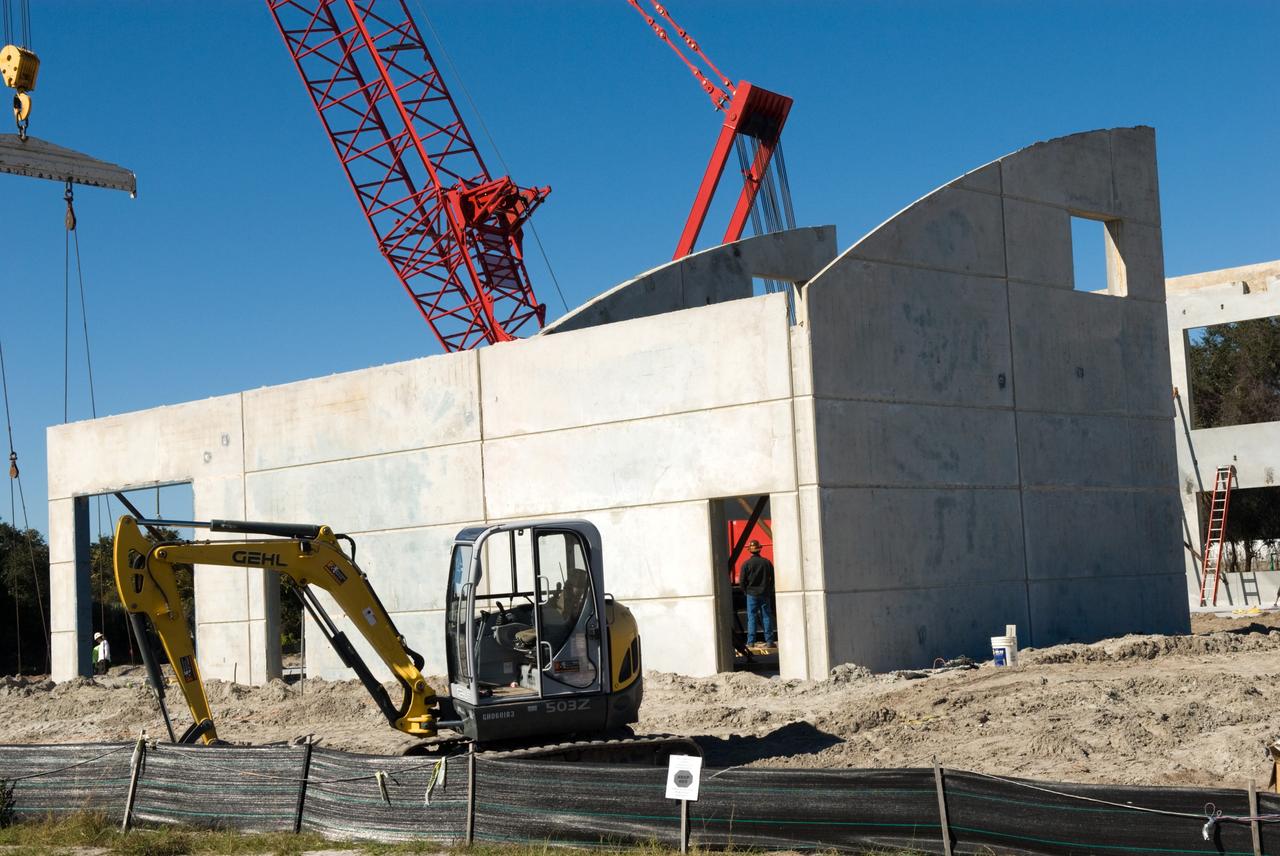
CAPE CANAVERAL, Fla. - In Launch Complex 39 at NASA's Kennedy Space Center in Florida, a worker is seen through an opening left for a doorway in a newly erected wall of the Propellants North Administrative and Maintenance Facility. A tilt-up construction method is being used to erect a THERMOMASS concrete wall insulation system for the facility's walls. In this approach, the exterior layer of concrete for the wall panels is poured and leveled on the building's footprint. Then, prefabricated, predrilled insulation sheets are arranged on top of the unhardened concrete, and connectors, designed to hold the sandwiched layers of concrete and insulation secure, are inserted through the predrilled holes. Next, the structural wythe is poured. Once cured, these panels are lifted upright to form the building's envelope. The facility will have a two-story administrative building to house managers, mechanics and technicians who fuel spacecraft at Kennedy adjacent to an 1,800-square-foot single-story shop to store cryogenic fuel transfer equipment. The new facility will feature high-efficiency roofs and walls, “Cool Dry Quiet” air conditioning with energy recovery technology, efficient lighting, and other sustainable features. The facility is striving to qualify for the U.S. Green Building Council’s Leadership in Energy and Environmental Design, or LEED, Platinum certification. If successful, Propellants North will be the first Kennedy facility to achieve this highest of LEED ratings after it is completed in the summer of 2010. The facility was designed for NASA by Jones Edmunds and Associates. Photo credit: NASA/Jim Grossmann
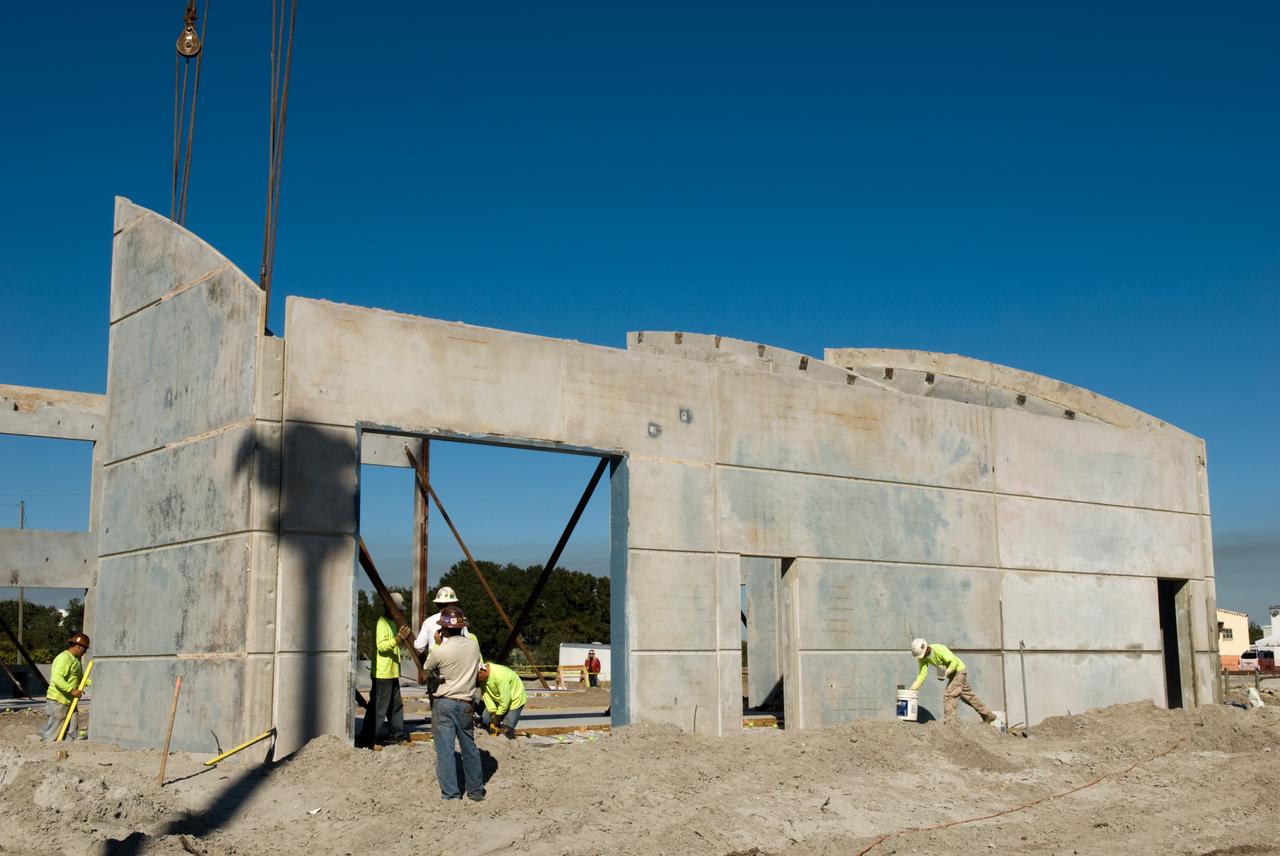
CAPE CANAVERAL, Fla. - In Launch Complex 39 at NASA's Kennedy Space Center in Florida, steady progress is made by a team of construction workers to erect the walls of the Propellants North Administrative and Maintenance Facility. A tilt-up construction method is being used to erect a THERMOMASS concrete wall insulation system for the facility's walls. In this approach, the exterior layer of concrete for the wall panels is poured and leveled on the building's footprint. Then, prefabricated, predrilled insulation sheets are arranged on top of the unhardened concrete, and connectors, designed to hold the sandwiched layers of concrete and insulation secure, are inserted through the predrilled holes. Next, the structural wythe is poured. Once cured, these panels are lifted upright to form the building's envelope. The facility will have a two-story administrative building to house managers, mechanics and technicians who fuel spacecraft at Kennedy adjacent to an 1,800-square-foot single-story shop to store cryogenic fuel transfer equipment. The new facility will feature high-efficiency roofs and walls, “Cool Dry Quiet” air conditioning with energy recovery technology, efficient lighting, and other sustainable features. The facility is striving to qualify for the U.S. Green Building Council’s Leadership in Energy and Environmental Design, or LEED, Platinum certification. If successful, Propellants North will be the first Kennedy facility to achieve this highest of LEED ratings after it is completed in the summer of 2010. The facility was designed for NASA by Jones Edmunds and Associates. Photo credit: NASA/Jim Grossmann

CAPE CANAVERAL, Fla. - In Launch Complex 39 at NASA's Kennedy Space Center in Florida, a team of construction workers ensures that the walls of the Propellants North Administrative and Maintenance Facility are installed properly. A tilt-up construction method is being used to erect a THERMOMASS concrete wall insulation system for the facility's walls. In this approach, the exterior layer of concrete for the wall panels is poured and leveled on the building's footprint. Then, prefabricated, predrilled insulation sheets are arranged on top of the unhardened concrete, and connectors, designed to hold the sandwiched layers of concrete and insulation secure, are inserted through the predrilled holes. Next, the structural wythe is poured. Once cured, these panels are lifted upright to form the building's envelope. The facility will have a two-story administrative building to house managers, mechanics and technicians who fuel spacecraft at Kennedy adjacent to an 1,800-square-foot single-story shop to store cryogenic fuel transfer equipment. The new facility will feature high-efficiency roofs and walls, “Cool Dry Quiet” air conditioning with energy recovery technology, efficient lighting, and other sustainable features. The facility is striving to qualify for the U.S. Green Building Council’s Leadership in Energy and Environmental Design, or LEED, Platinum certification. If successful, Propellants North will be the first Kennedy facility to achieve this highest of LEED ratings after it is completed in the summer of 2010. The facility was designed for NASA by Jones Edmunds and Associates. Photo credit: NASA/Jim Grossmann
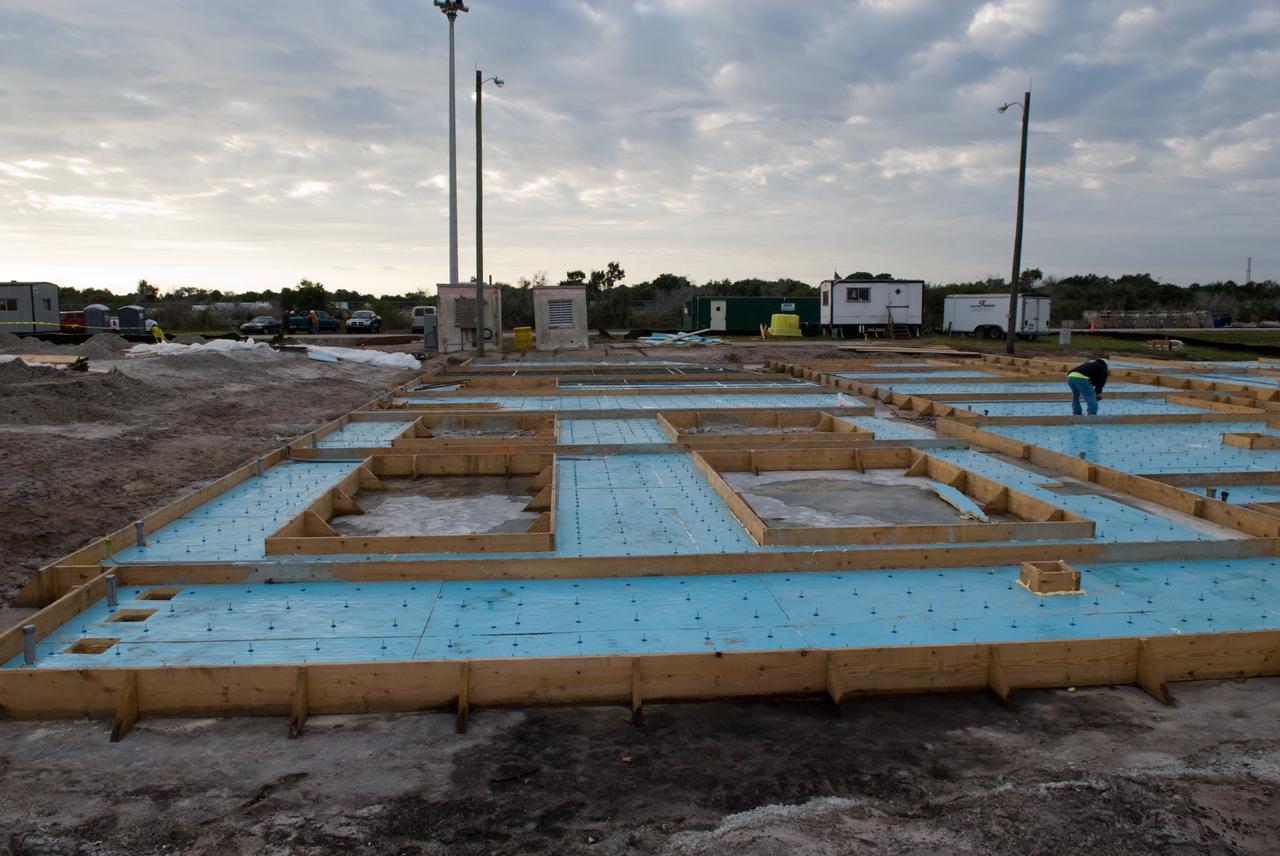
CAPE CANAVERAL, Fla. - In Launch Complex 39 at NASA's Kennedy Space Center in Florida, concrete layers on either side of the high-density foam insulation of the Propellants North Administrative and Maintenance Facility's walls will prevent any transfer of radiant heat between the exterior and interior of the building. A tilt-up construction method is being used to erect a THERMOMASS concrete wall insulation system for the facility's walls. In this approach, the exterior layer of concrete for the wall panels is poured and leveled on the building's footprint. Then, prefabricated, predrilled insulation sheets are arranged on top of the unhardened concrete, and connectors, designed to hold the sandwiched layers of concrete and insulation secure, are inserted through the predrilled holes. Next, the structural wythe is poured. Once cured, these panels are lifted upright to form the building's envelope. The facility will have a two-story administrative building to house managers, mechanics and technicians who fuel spacecraft at Kennedy adjacent to an 1,800-square-foot single-story shop to store cryogenic fuel transfer equipment. The new facility will feature high-efficiency roofs and walls, “Cool Dry Quiet” air conditioning with energy recovery technology, efficient lighting, and other sustainable features. The facility is striving to qualify for the U.S. Green Building Council’s Leadership in Energy and Environmental Design, or LEED, Platinum certification. If successful, Propellants North will be the first Kennedy facility to achieve this highest of LEED ratings after it is completed in the summer of 2010. The facility was designed for NASA by Jones Edmunds and Associates. Photo credit: NASA/Jim Grossmann

CAPE CANAVERAL, Fla. - In Launch Complex 39 at NASA's Kennedy Space Center in Florida, construction of the Propellants North Administrative and Maintenance Facility is moving ahead with the placement of all of the outside walls complete. Concrete layers on either side of high-density foam insulation in the facility's walls will prevent any transfer of radiant heat between the exterior and interior of the buildings. A tilt-up construction method is being used to erect a THERMOMASS concrete wall insulation system for the facility's walls. In this approach, the exterior layer of concrete for the wall panels is poured and leveled on the building's footprint. Then, prefabricated, predrilled insulation sheets are arranged on top of the unhardened concrete, and connectors, designed to hold the sandwiched layers of concrete and insulation secure, are inserted through the predrilled holes. Next, the structural wythe is poured. Once cured, these panels are lifted upright to form the building's envelope. The facility will have a two-story administrative building to house managers, mechanics and technicians who fuel spacecraft at Kennedy adjacent to an 1,800-square-foot single-story shop to store cryogenic fuel transfer equipment. The new facility will feature high-efficiency roofs and walls, “Cool Dry Quiet” air conditioning with energy recovery technology, efficient lighting, and other sustainable features. The facility is striving to qualify for the U.S. Green Building Council’s Leadership in Energy and Environmental Design, or LEED, Platinum certification. If successful, Propellants North will be the first Kennedy facility to achieve this highest of LEED ratings after it is completed in the summer of 2010. The facility was designed for NASA by Jones Edmunds and Associates. Photo credit: NASA/Jim Grossmann
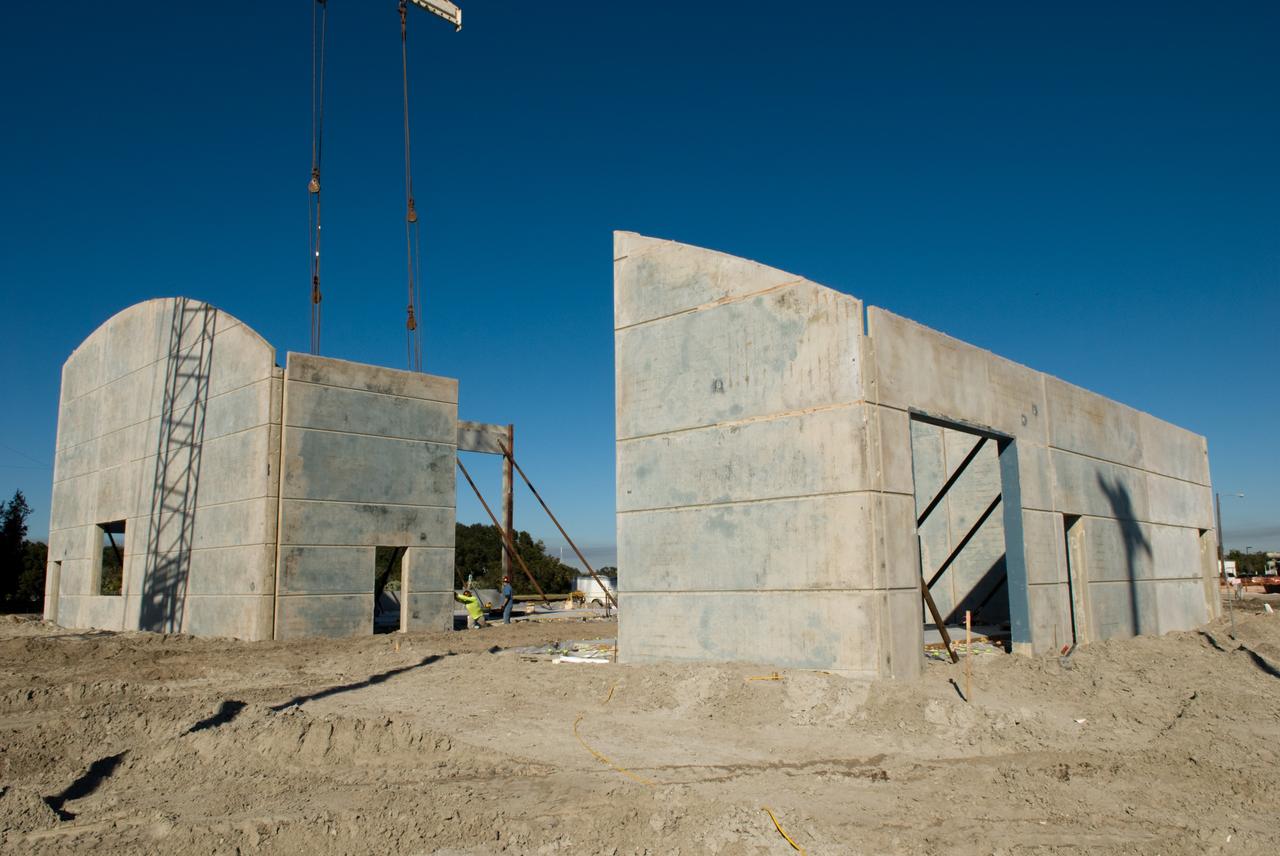
CAPE CANAVERAL, Fla. - In Launch Complex 39 at NASA's Kennedy Space Center in Florida, reminiscent of a barn-raising, the Propellants North Administrative and Maintenance Facility springs into being in a single day as its walls are lifted into position. A tilt-up construction method is being used to erect a THERMOMASS concrete wall insulation system for the facility's walls. In this approach, the exterior layer of concrete for the wall panels is poured and leveled on the building's footprint. Then, prefabricated, predrilled insulation sheets are arranged on top of the unhardened concrete, and connectors, designed to hold the sandwiched layers of concrete and insulation secure, are inserted through the predrilled holes. Next, the structural wythe is poured. Once cured, these panels are lifted upright to form the building's envelope. The facility will have a two-story administrative building to house managers, mechanics and technicians who fuel spacecraft at Kennedy adjacent to an 1,800-square-foot single-story shop to store cryogenic fuel transfer equipment. The new facility will feature high-efficiency roofs and walls, “Cool Dry Quiet” air conditioning with energy recovery technology, efficient lighting, and other sustainable features. The facility is striving to qualify for the U.S. Green Building Council’s Leadership in Energy and Environmental Design, or LEED, Platinum certification. If successful, Propellants North will be the first Kennedy facility to achieve this highest of LEED ratings after it is completed in the summer of 2010. The facility was designed for NASA by Jones Edmunds and Associates. Photo credit: NASA/Jim Grossmann
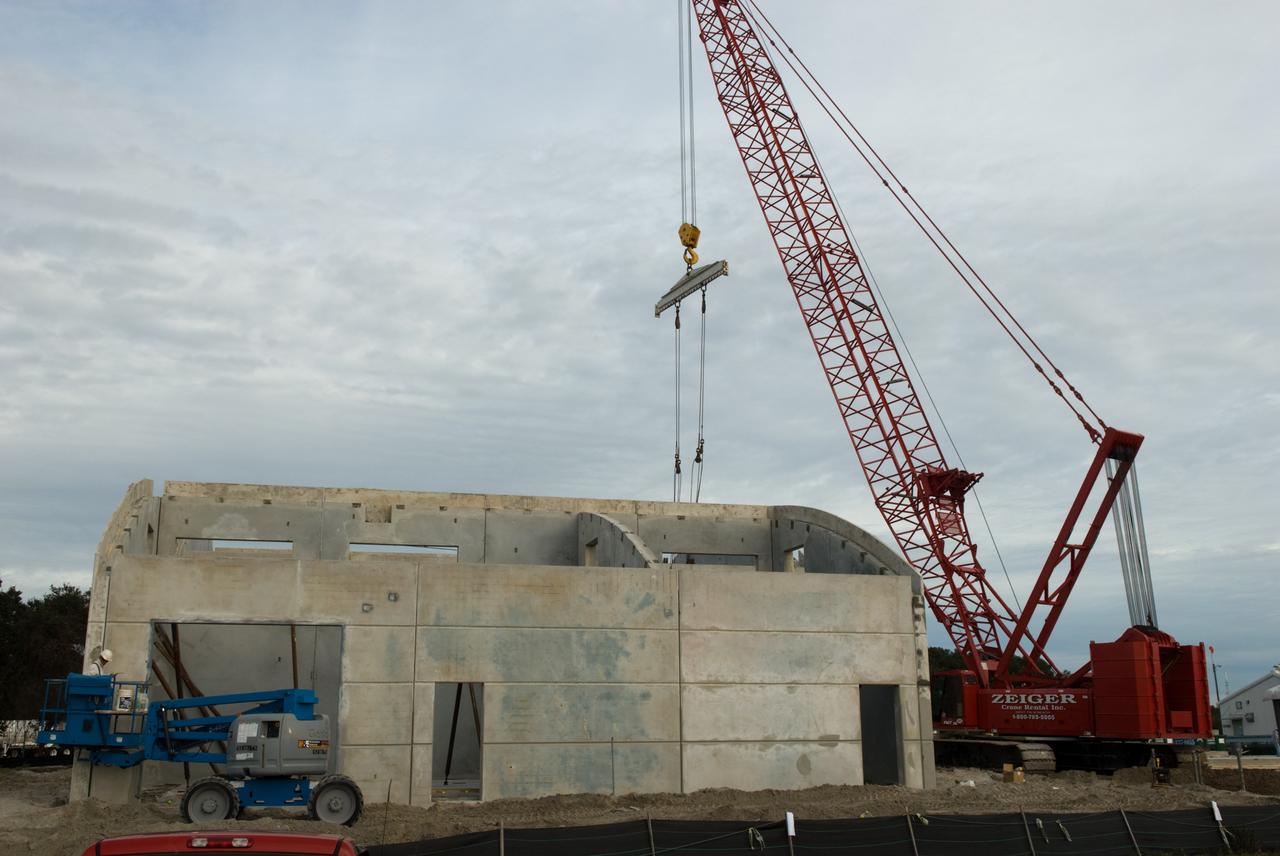
CAPE CANAVERAL, Fla. - In Launch Complex 39 at NASA's Kennedy Space Center in Florida, this crane raised all of the outside walls of the Propellants North Administrative and Maintenance Facility over a period of two days. Concrete layers on either side of high-density foam insulation in the facility's walls will prevent any transfer of radiant heat between the exterior and interior of the buildings. A tilt-up construction method is being used to erect a THERMOMASS concrete wall insulation system for the facility's walls. In this approach, the exterior layer of concrete for the wall panels is poured and leveled on the building's footprint. Then, prefabricated, predrilled insulation sheets are arranged on top of the unhardened concrete, and connectors, designed to hold the sandwiched layers of concrete and insulation secure, are inserted through the predrilled holes. Next, the structural wythe is poured. Once cured, these panels are lifted upright to form the building's envelope. The facility will have a two-story administrative building to house managers, mechanics and technicians who fuel spacecraft at Kennedy adjacent to an 1,800-square-foot single-story shop to store cryogenic fuel transfer equipment. The new facility will feature high-efficiency roofs and walls, “Cool Dry Quiet” air conditioning with energy recovery technology, efficient lighting, and other sustainable features. The facility is striving to qualify for the U.S. Green Building Council’s Leadership in Energy and Environmental Design, or LEED, Platinum certification. If successful, Propellants North will be the first Kennedy facility to achieve this highest of LEED ratings after it is completed in the summer of 2010. The facility was designed for NASA by Jones Edmunds and Associates. Photo credit: NASA/Jim Grossmann
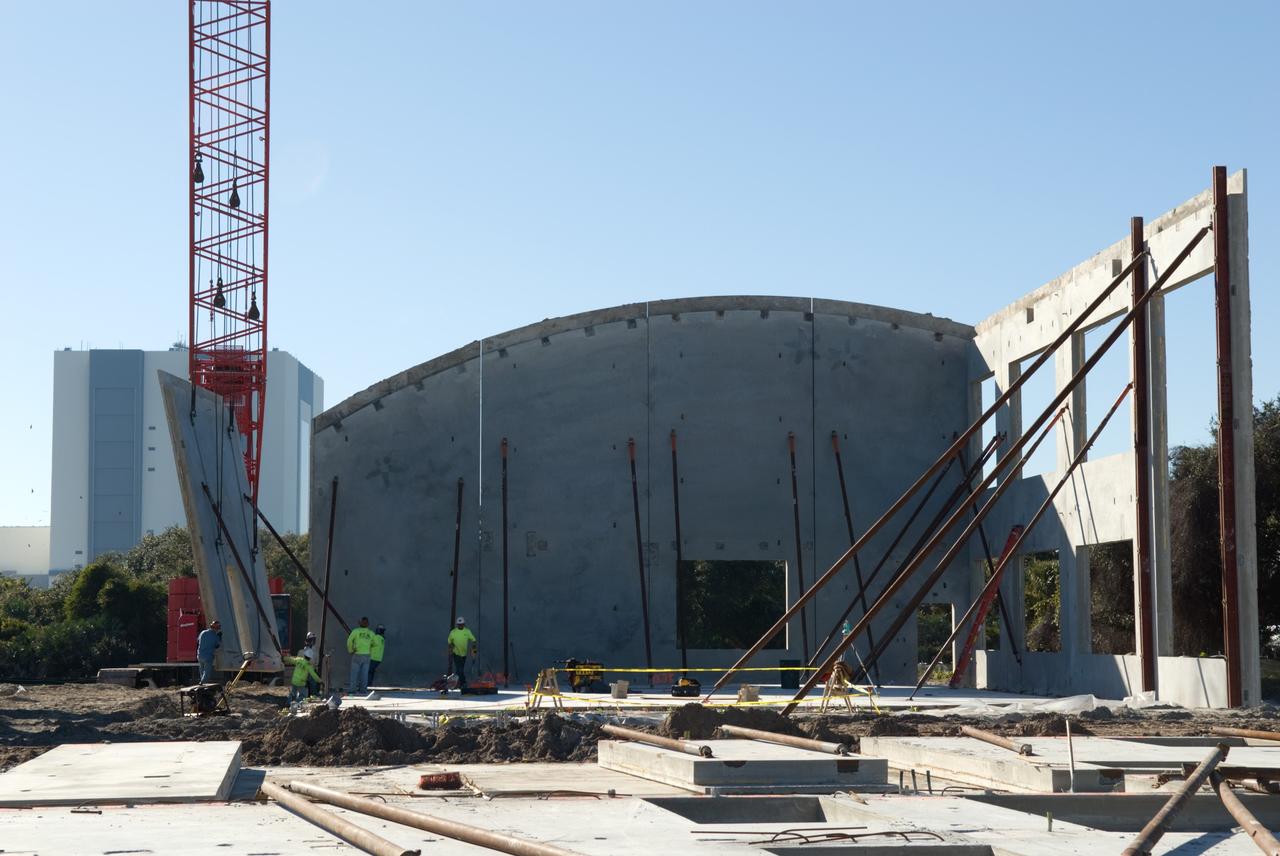
CAPE CANAVERAL, Fla. - In Launch Complex 39 at NASA's Kennedy Space Center in Florida, the final shape of the Propellants North Administrative and Maintenance Facility becomes apparent as its walls are erected. A tilt-up construction method is being used to erect a THERMOMASS concrete wall insulation system for the facility's walls. In this approach, the exterior layer of concrete for the wall panels is poured and leveled on the building's footprint. Then, prefabricated, predrilled insulation sheets are arranged on top of the unhardened concrete, and connectors, designed to hold the sandwiched layers of concrete and insulation secure, are inserted through the predrilled holes. Next, the structural wythe is poured. Once cured, these panels are lifted upright to form the building's envelope. The facility will have a two-story administrative building to house managers, mechanics and technicians who fuel spacecraft at Kennedy adjacent to an 1,800-square-foot single-story shop to store cryogenic fuel transfer equipment. The new facility will feature high-efficiency roofs and walls, “Cool Dry Quiet” air conditioning with energy recovery technology, efficient lighting, and other sustainable features. The facility is striving to qualify for the U.S. Green Building Council’s Leadership in Energy and Environmental Design, or LEED, Platinum certification. If successful, Propellants North will be the first Kennedy facility to achieve this highest of LEED ratings after it is completed in the summer of 2010. The facility was designed for NASA by Jones Edmunds and Associates. Photo credit: NASA/Jim Grossmann
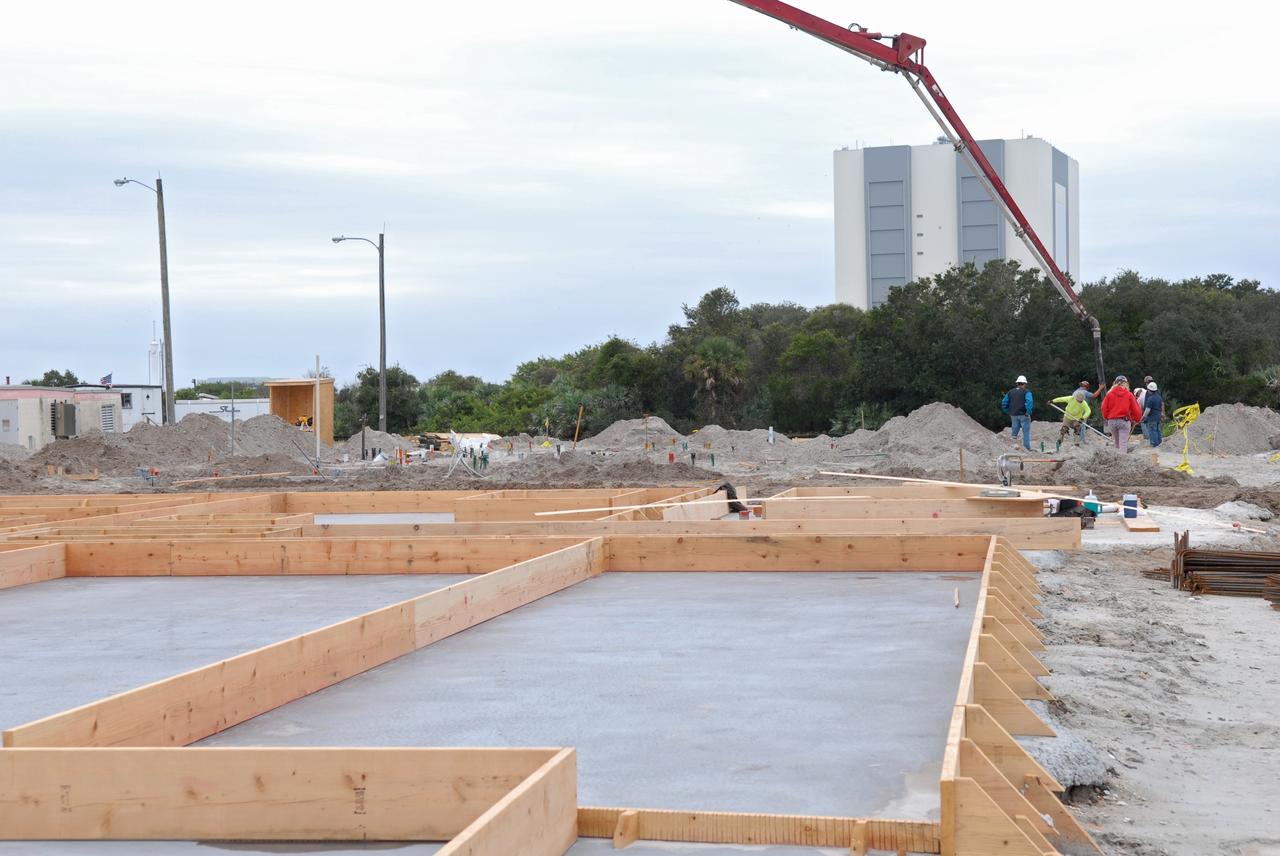
CAPE CANAVERAL, Fla. - In Launch Complex 39 at NASA's Kennedy Space Center in Florida, high-density foam insulation between the concrete layers of the Propellants North Administrative and Maintenance Facility's walls will prevent any transfer of radiant heat between the exterior and interior of the building. A tilt-up construction method is being used to erect a THERMOMASS concrete wall insulation system for the facility's walls. In this approach, the exterior layer of concrete for the wall panels is poured and leveled on the building's footprint. Then, prefabricated, predrilled insulation sheets are arranged on top of the unhardened concrete, and connectors, designed to hold the sandwiched layers of concrete and insulation secure, are inserted through the predrilled holes. Next, the structural wythe is poured. Once cured, these panels are lifted upright to form the building's envelope. The facility will have a two-story administrative building to house managers, mechanics and technicians who fuel spacecraft at Kennedy adjacent to an 1,800-square-foot single-story shop to store cryogenic fuel transfer equipment. The new facility will feature high-efficiency roofs and walls, “Cool Dry Quiet” air conditioning with energy recovery technology, efficient lighting, and other sustainable features. The facility is striving to qualify for the U.S. Green Building Council’s Leadership in Energy and Environmental Design, or LEED, Platinum certification. If successful, Propellants North will be the first Kennedy facility to achieve this highest of LEED ratings after it is completed in the summer of 2010. The facility was designed for NASA by Jones Edmunds and Associates. Photo credit: NASA/Jim Grossmann
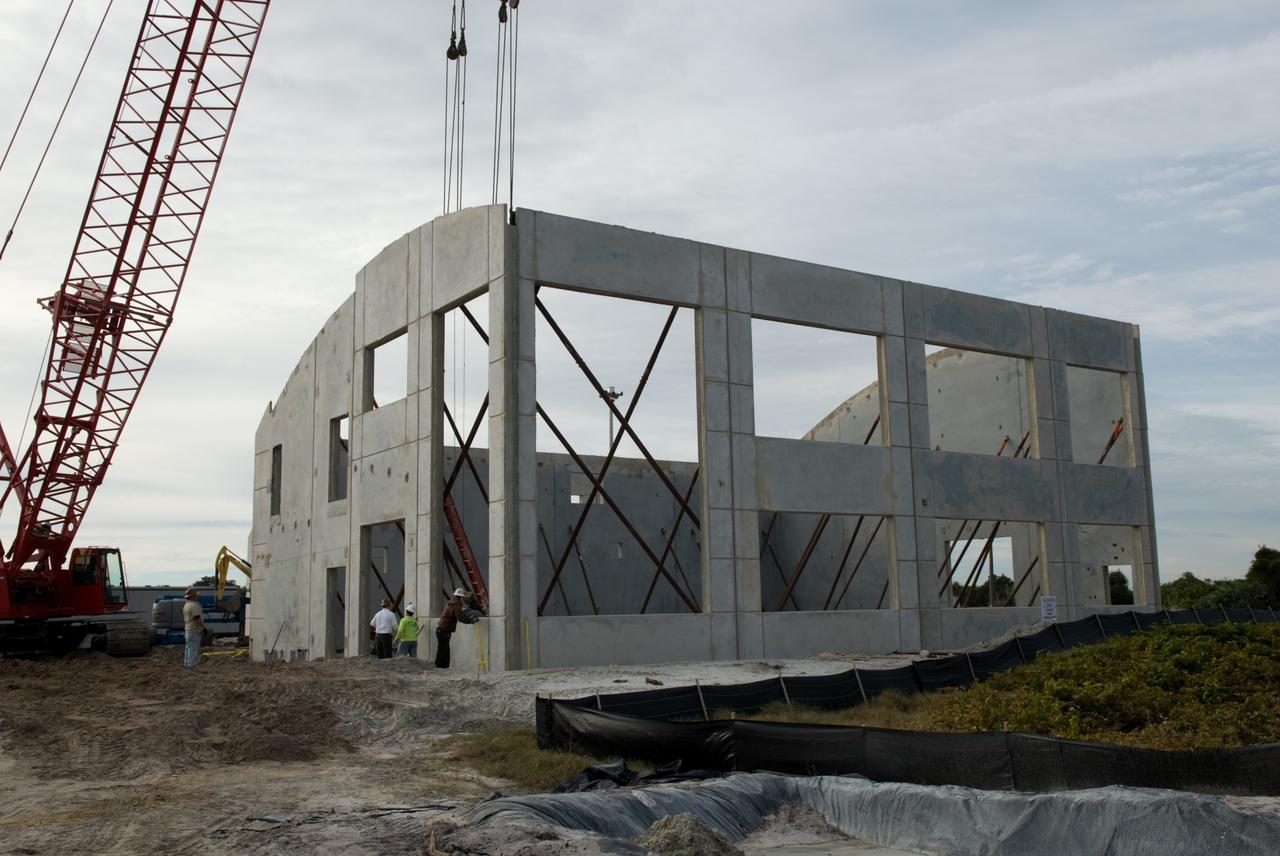
CAPE CANAVERAL, Fla. - In Launch Complex 39 at NASA's Kennedy Space Center in Florida, construction workers survey the last outside wall of the Propellants North Administrative and Maintenance Facility. Concrete layers on either side of high-density foam insulation in the facility's walls will prevent any transfer of radiant heat between the exterior and interior of the buildings. A tilt-up construction method is being used to erect a THERMOMASS concrete wall insulation system for the facility's walls. In this approach, the exterior layer of concrete for the wall panels is poured and leveled on the building's footprint. Then, prefabricated, predrilled insulation sheets are arranged on top of the unhardened concrete, and connectors, designed to hold the sandwiched layers of concrete and insulation secure, are inserted through the predrilled holes. Next, the structural wythe is poured. Once cured, these panels are lifted upright to form the building's envelope. The facility will have a two-story administrative building to house managers, mechanics and technicians who fuel spacecraft at Kennedy adjacent to an 1,800-square-foot single-story shop to store cryogenic fuel transfer equipment. The new facility will feature high-efficiency roofs and walls, “Cool Dry Quiet” air conditioning with energy recovery technology, efficient lighting, and other sustainable features. The facility is striving to qualify for the U.S. Green Building Council’s Leadership in Energy and Environmental Design, or LEED, Platinum certification. If successful, Propellants North will be the first Kennedy facility to achieve this highest of LEED ratings after it is completed in the summer of 2010. The facility was designed for NASA by Jones Edmunds and Associates. Photo credit: NASA/Jim Grossmann
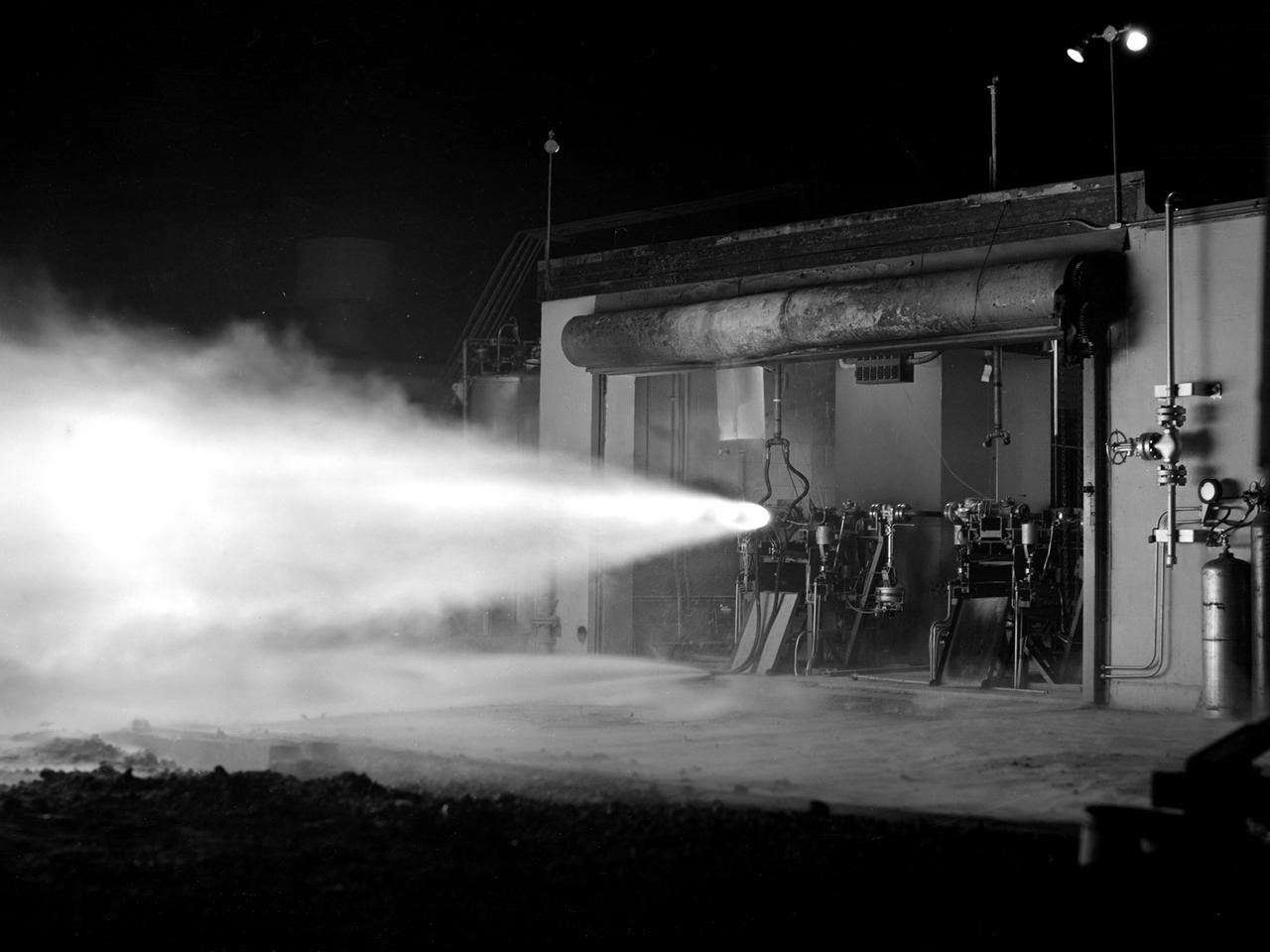
A rocket using high-energy propellant is fired from the Rocket Laboratory at the National Advisory Committee for Aeronautics (NACA) Lewis Flight Propulsion Laboratory. The Rocket Lab was a collection of ten one-story cinderblock test cells located behind earthen barriers at the western edge of the campus. The rocket engines tested there were comparatively small, but the Lewis researchers were able to study different configurations, combustion performance, and injectors and nozzle design. The rockets were generally mounted horizontally and fired, as seen in this photograph of Test Cell No. 22. A group of fuels researchers at Lewis refocused their efforts after World War II in order to explore high energy propellants, combustion, and cooling. Research in these three areas began in 1945 and continued through the 1960s. The group of rocket researches was not elevated to a division branch until 1952. The early NACA Lewis work led to the development of liquid hydrogen as a viable propellant in the late 1950s. Following the 1949 reorganization of the research divisions, the rocket group began working with high-energy propellants such as diborane, pentaborane, and hydrogen. The lightweight fuels offered high levels of energy but were difficult to handle and required large tanks. In late 1954, Lewis researchers studied the combustion characteristics of gaseous hydrogen in a turbojet combustor. Despite poor mixing of the fuel and air, it was found that the hydrogen yielded more than a 90-percent efficiency. Liquid hydrogen became the focus of Lewis researchers for the next 15 years.
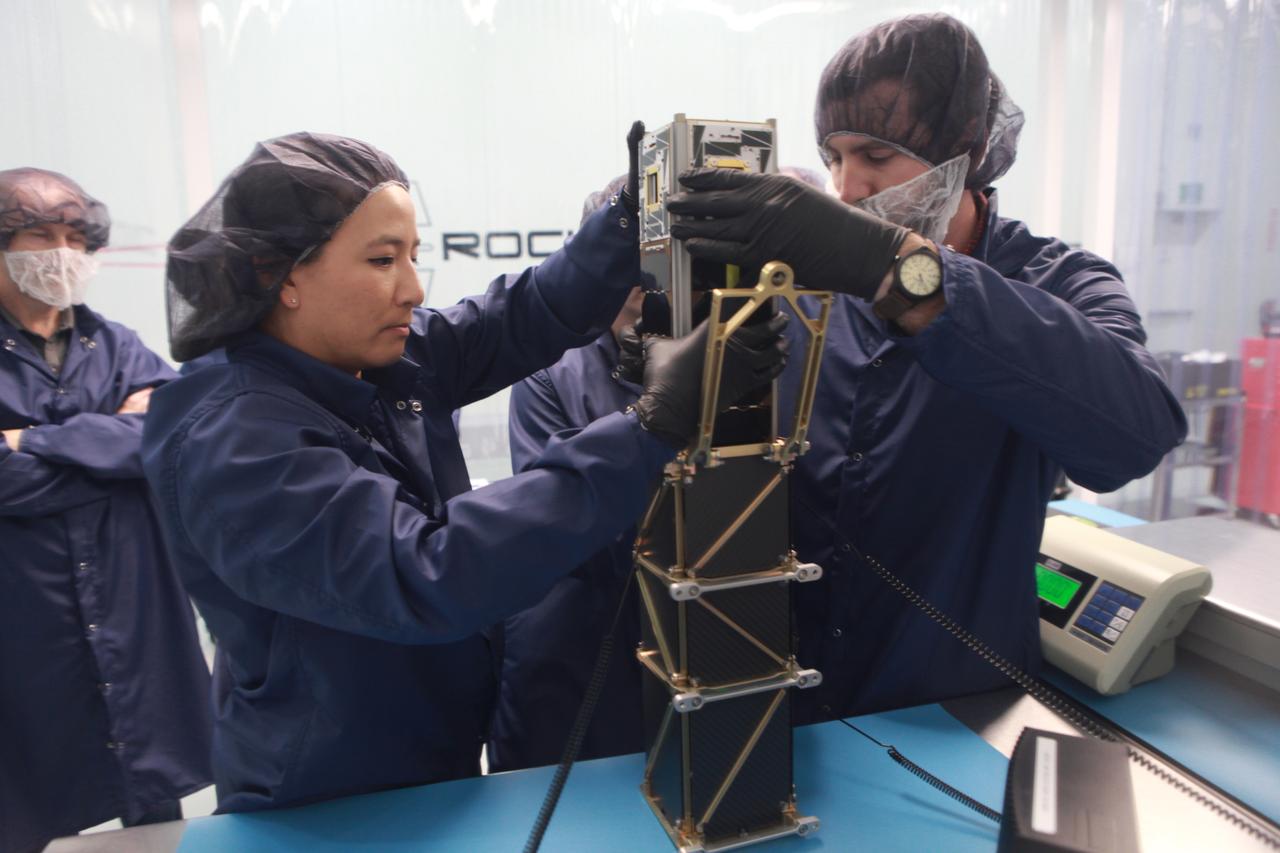
The goal of the CHOMPTT mission is to demonstrate new technologies that could be used for navigation and satellite networking in deep space. For future explorers and colonizers of the Moon or Mars, navigation systems like GPS here on Earth, will be essential. The key idea behind CHOMPTT is to use lasers to transfer time code data over long distances instead of radio waves. Because lasers can be more tightly beamed compared to radio waves, more of the transmitted energy reaches its intended target, making them more power-efficient. CHOMPTT takes advantage of this and of new miniature but very stable atomic clocks to produce a timing system with performance similar to that of GPS, but in a very compact and power efficient form factor. We will use a pulsed laser system, located at the Kennedy Space Center that will be synchronized with an atomic clock. Laser pulses will propagate from the ground to the orbiting CHOMPTT CubeSat and back. By precisely measuring the time of emission and detection of these pulses on the ground and in space we can calculate the time discrepancy between the ground atomic clock and the atomic clock on CHOMPTT. Our goal is to do this with an accuracy of 0.2 billionths of a second, or the time it takes light to travel just 6 centimeters. In the future, we envision using this technology on constellations or swarms of small satellites, for example orbiting the Moon, to equip them with precision navigation, networking, and ranging capabilities. CHOMPTT is a collaboration between the University of Florida and the NASA Ames Research Center. The CHOMPTT precision timing payload was designed and built by the Precision Space Systems Lab at the University of Florida, while the 3U CubeSat bus that has prior flight heritage, was provided by NASA Ames. The CHOMPTT mission has been funded by the Air Force Research Lab and by NASA.
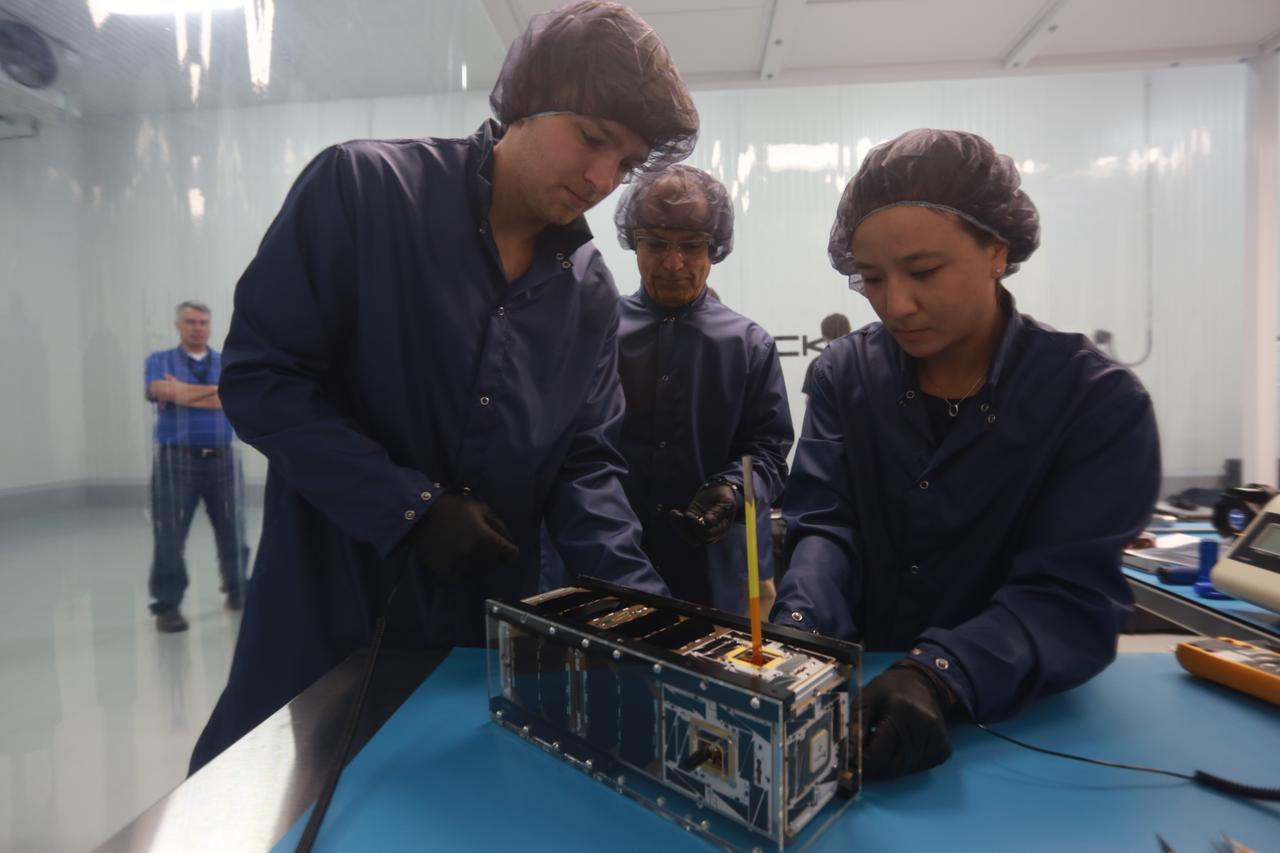
The goal of the CHOMPTT mission is to demonstrate new technologies that could be used for navigation and satellite networking in deep space. For future explorers and colonizers of the Moon or Mars, navigation systems like GPS here on Earth, will be essential. The key idea behind CHOMPTT is to use lasers to transfer time code data over long distances instead of radio waves. Because lasers can be more tightly beamed compared to radio waves, more of the transmitted energy reaches its intended target, making them more power-efficient. CHOMPTT takes advantage of this and of new miniature but very stable atomic clocks to produce a timing system with performance similar to that of GPS, but in a very compact and power efficient form factor. We will use a pulsed laser system, located at the Kennedy Space Center that will be synchronized with an atomic clock. Laser pulses will propagate from the ground to the orbiting CHOMPTT CubeSat and back. By precisely measuring the time of emission and detection of these pulses on the ground and in space we can calculate the time discrepancy between the ground atomic clock and the atomic clock on CHOMPTT. Our goal is to do this with an accuracy of 0.2 billionths of a second, or the time it takes light to travel just 6 centimeters. In the future, we envision using this technology on constellations or swarms of small satellites, for example orbiting the Moon, to equip them with precision navigation, networking, and ranging capabilities. CHOMPTT is a collaboration between the University of Florida and the NASA Ames Research Center. The CHOMPTT precision timing payload was designed and built by the Precision Space Systems Lab at the University of Florida, while the 3U CubeSat bus that has prior flight heritage, was provided by NASA Ames. The CHOMPTT mission has been funded by the Air Force Research Lab and by NASA.
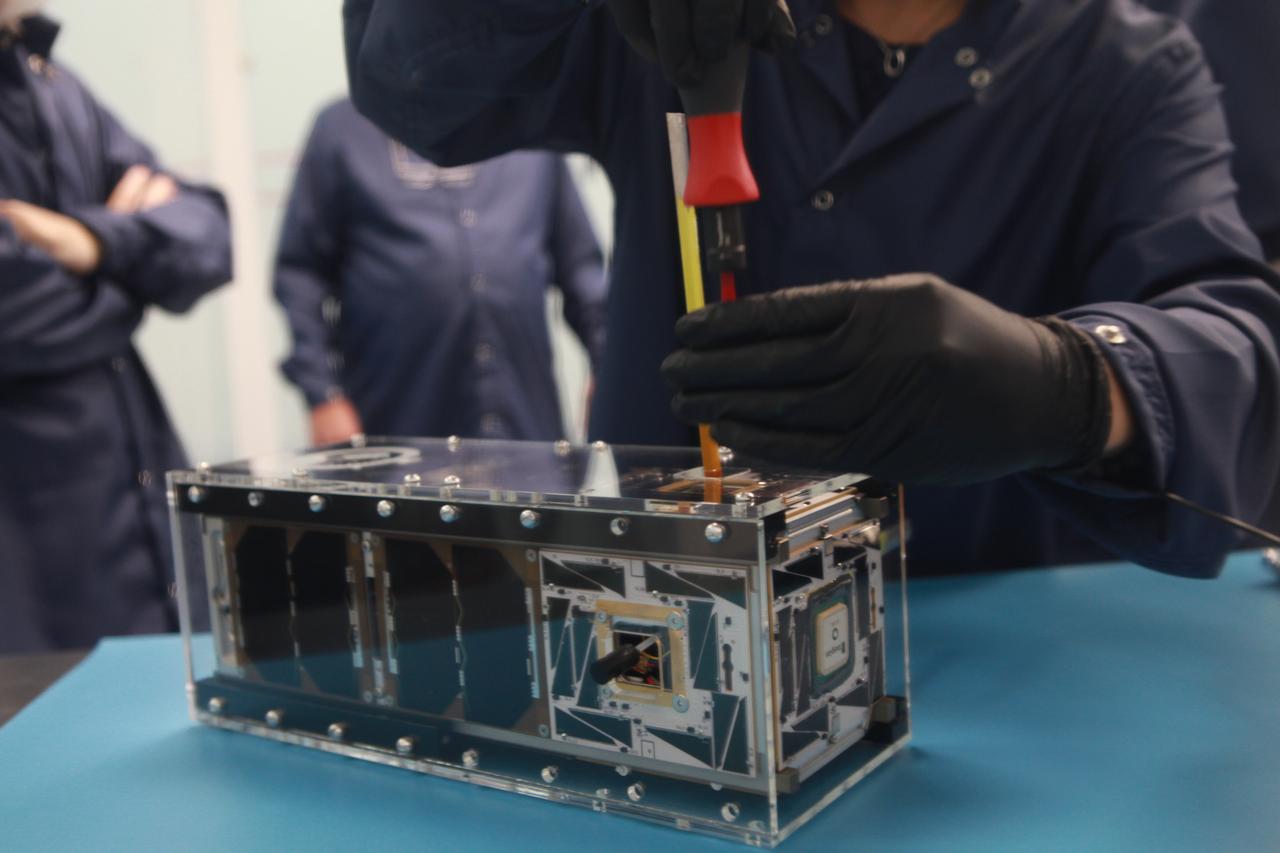
The goal of the CHOMPTT mission is to demonstrate new technologies that could be used for navigation and satellite networking in deep space. For future explorers and colonizers of the Moon or Mars, navigation systems like GPS here on Earth, will be essential. The key idea behind CHOMPTT is to use lasers to transfer time code data over long distances instead of radio waves. Because lasers can be more tightly beamed compared to radio waves, more of the transmitted energy reaches its intended target, making them more power-efficient. CHOMPTT takes advantage of this and of new miniature but very stable atomic clocks to produce a timing system with performance similar to that of GPS, but in a very compact and power efficient form factor. We will use a pulsed laser system, located at the Kennedy Space Center that will be synchronized with an atomic clock. Laser pulses will propagate from the ground to the orbiting CHOMPTT CubeSat and back. By precisely measuring the time of emission and detection of these pulses on the ground and in space we can calculate the time discrepancy between the ground atomic clock and the atomic clock on CHOMPTT. Our goal is to do this with an accuracy of 0.2 billionths of a second, or the time it takes light to travel just 6 centimeters. In the future, we envision using this technology on constellations or swarms of small satellites, for example orbiting the Moon, to equip them with precision navigation, networking, and ranging capabilities. CHOMPTT is a collaboration between the University of Florida and the NASA Ames Research Center. The CHOMPTT precision timing payload was designed and built by the Precision Space Systems Lab at the University of Florida, while the 3U CubeSat bus that has prior flight heritage, was provided by NASA Ames. The CHOMPTT mission has been funded by the Air Force Research Lab and by NASA.
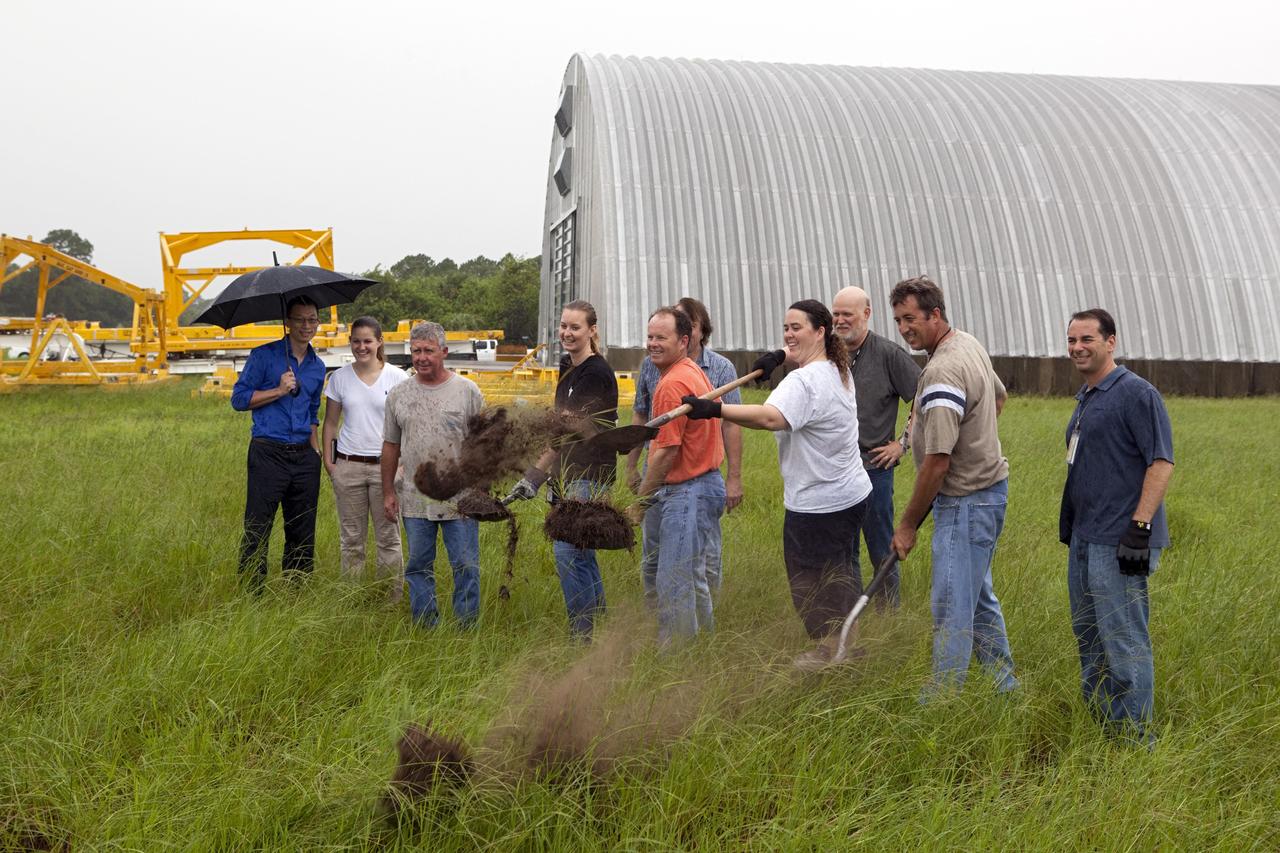
CAPE CANAVERAL, Fla. – Near the Hypergolic Maintenance Facility at NASA’s Kennedy Space Center in Florida, a groundbreaking ceremony was held to mark the location of the Ground Operations Demonstration Unit Liquid Hydrogen, or GODU LH2, test site. From left, are Johnny Nguyen, Fluids Test and Technology Development branch chief Emily Watkins, engineering intern Jeff Walls, Engineering Services Contract, or ESC, Cryogenics Test Lab engineer Kelly Currin, systems engineer Stephen Huff and Rudy Werlink partially hidden, cryogenics engineers Angela Krenn, systems engineer Doug Hammond, command and control engineer in the electrical division William Notardonato, GODU LH2 project manager and Kevin Jumper, ESC Cryogenics Test Lab manager. The GODU LH2 test site is one of the projects in NASA’s Advanced Exploration Systems Program. The site will be used to demonstrate advanced liquid hydrogen systems that are cost and energy efficient ways to store and transfer liquid hydrogen during process, loading, launch and spaceflight. The main components of the site will be a storage tank and a cryogenic refrigerator. Photo credit: NASA/Dimitri Gerondidakis
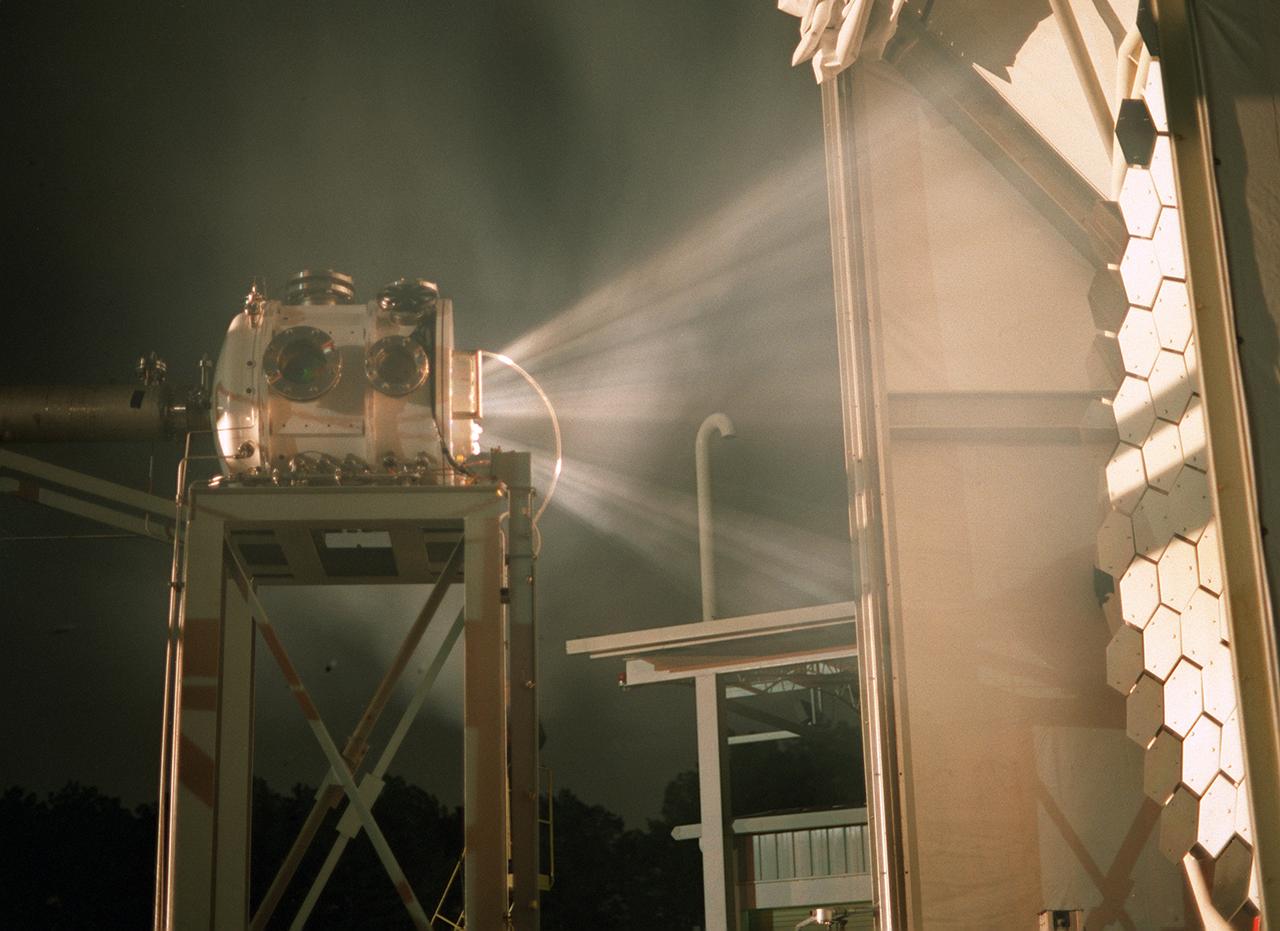
Researchers at the Marshall Space Flight Center (MSFC) have designed, fabricated, and tested the first solar thermal engine, a non-chemical rocket engine that produces lower thrust but has better thrust efficiency than a chemical combustion engine. MSFC turned to solar thermal propulsion in the early 1990s due to its simplicity, safety, low cost, and commonality with other propulsion systems. Solar thermal propulsion works by acquiring and redirecting solar energy to heat a propellant. The 20- by 24-ft heliostat mirror (not shown in this photograph) has a dual-axis control that keeps a reflection of the sunlight on the 18-ft diameter concentrator mirror, which then focuses the sunlight to a 4-in focal point inside the vacuum chamber. The focal point has 10 kilowatts of intense solar power. This image, taken during the test, depicts the light being concentrated into the focal point inside the vacuum chamber. As part of MSFC's Space Transportation Directorate, the Propulsion Research Center serves as a national resource for research of advanced, revolutionary propulsion technologies. The mission is to move the Nation's capabilities beyond the confines of conventional chemical propulsion into an era of aircraft-like access to Earth orbit, rapid travel throughout the solar system, and exploration of interstellar space.