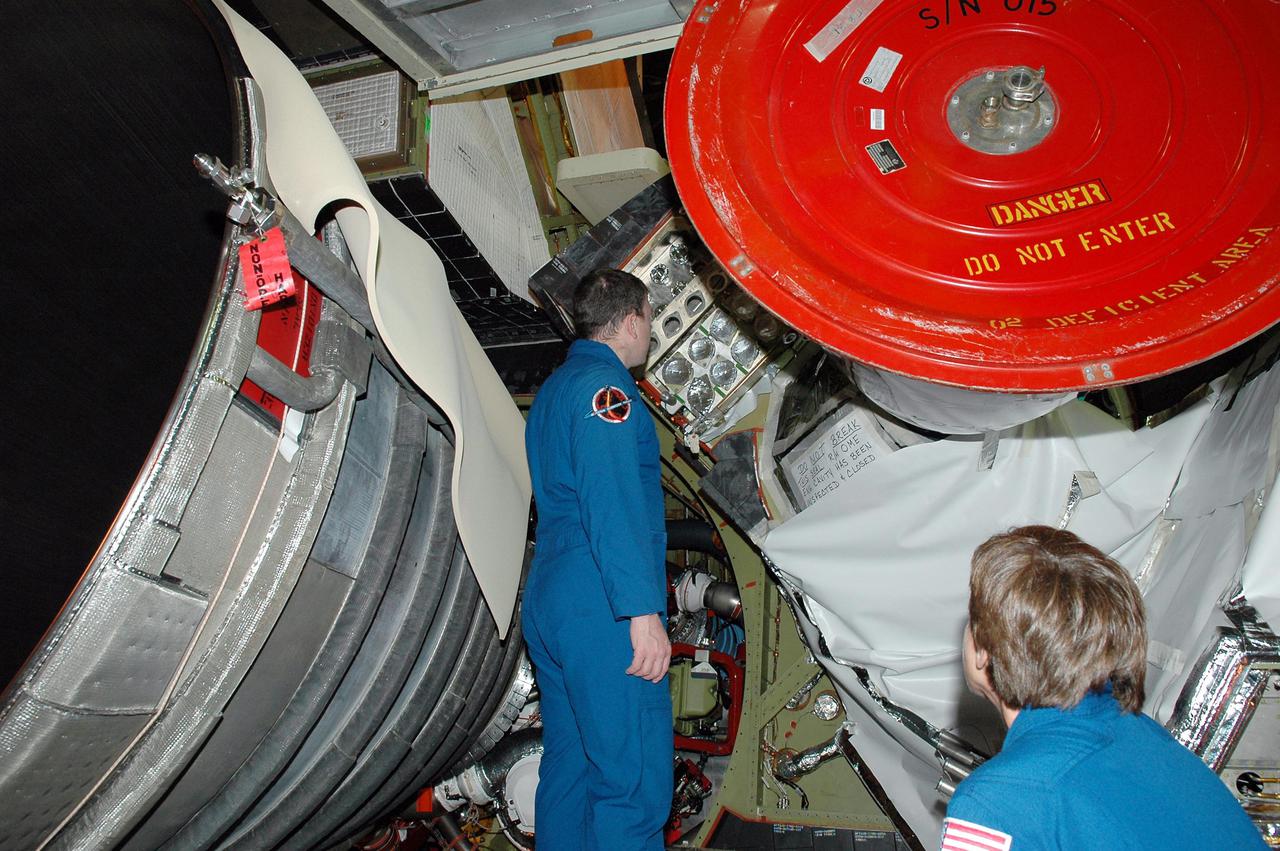
KENNEDY SPACE CENTER, FLA. - On a visit to Kennedy, STS-114 James Kelly looks closely at an area of an engine on the orbiter Discovery. The main engines were recently installed. The designated vehicle for the mission, Discovery is in the Orbiter Processing Facility for launch processing. Discovery is scheduled for a launch planning window of May 12 to June 3, 2005.
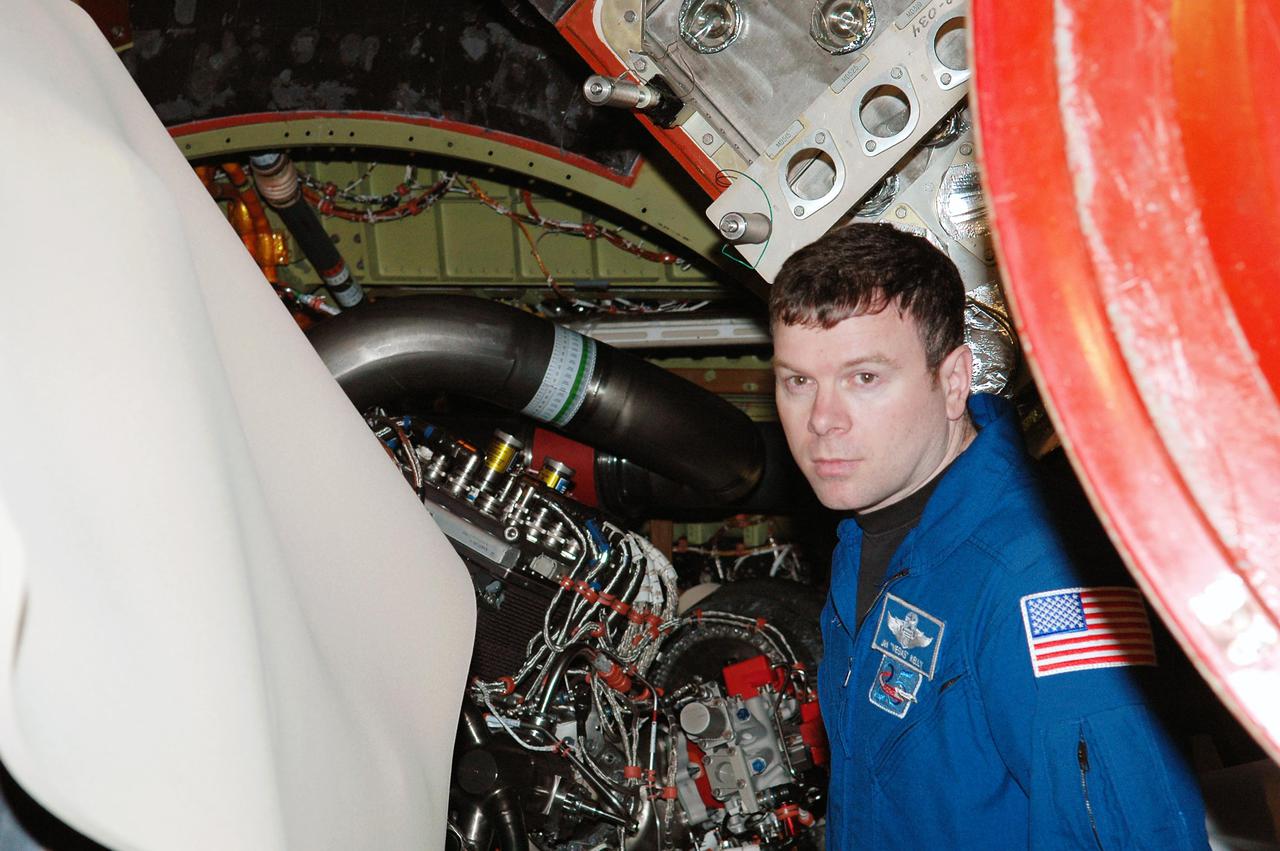
KENNEDY SPACE CENTER, FLA. - On a visit to Kennedy, STS-114 James Kelly looks closely at an area of an engine on the orbiter Discovery. The main engines were recently installed. The designated vehicle for the mission, Discovery is in the Orbiter Processing Facility for launch processing. Discovery is scheduled for a launch planning window of May 12 to June 3, 2005.
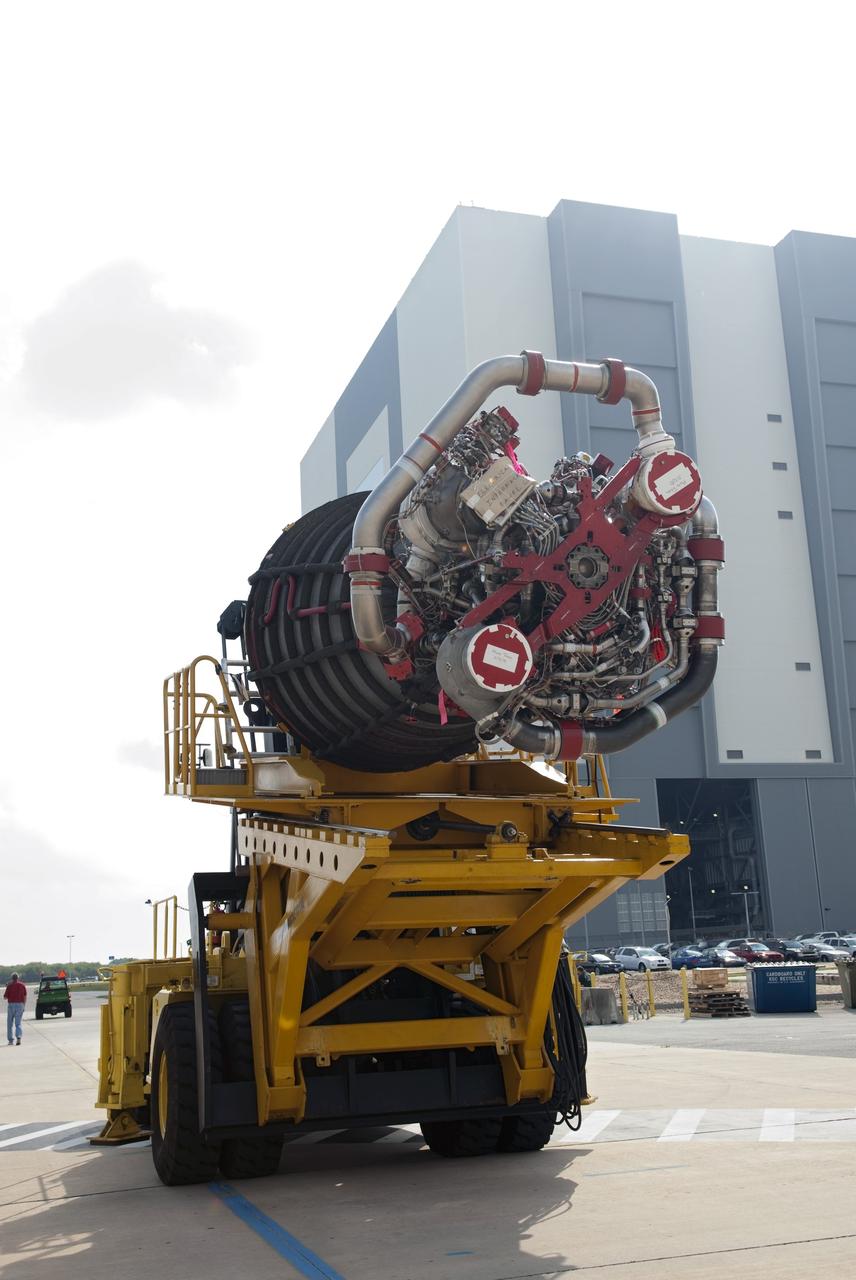
CAPE CANAVERAL, Fla. -- A heavy forklift with its specialized engine installer hold one of the main engines taken from space shuttle Discovery. The forklift is driving the engine from Orbiter Processing Facility-2 at NASA's Kennedy Space Center in Florida to the center's Space Shuttle Main Engine Processing Facility. The transition and retirement processing is expected to help rocket designers build next-generation spacecraft and prepare the shuttle for display. Photo credit: NASA/Jim Grossmann
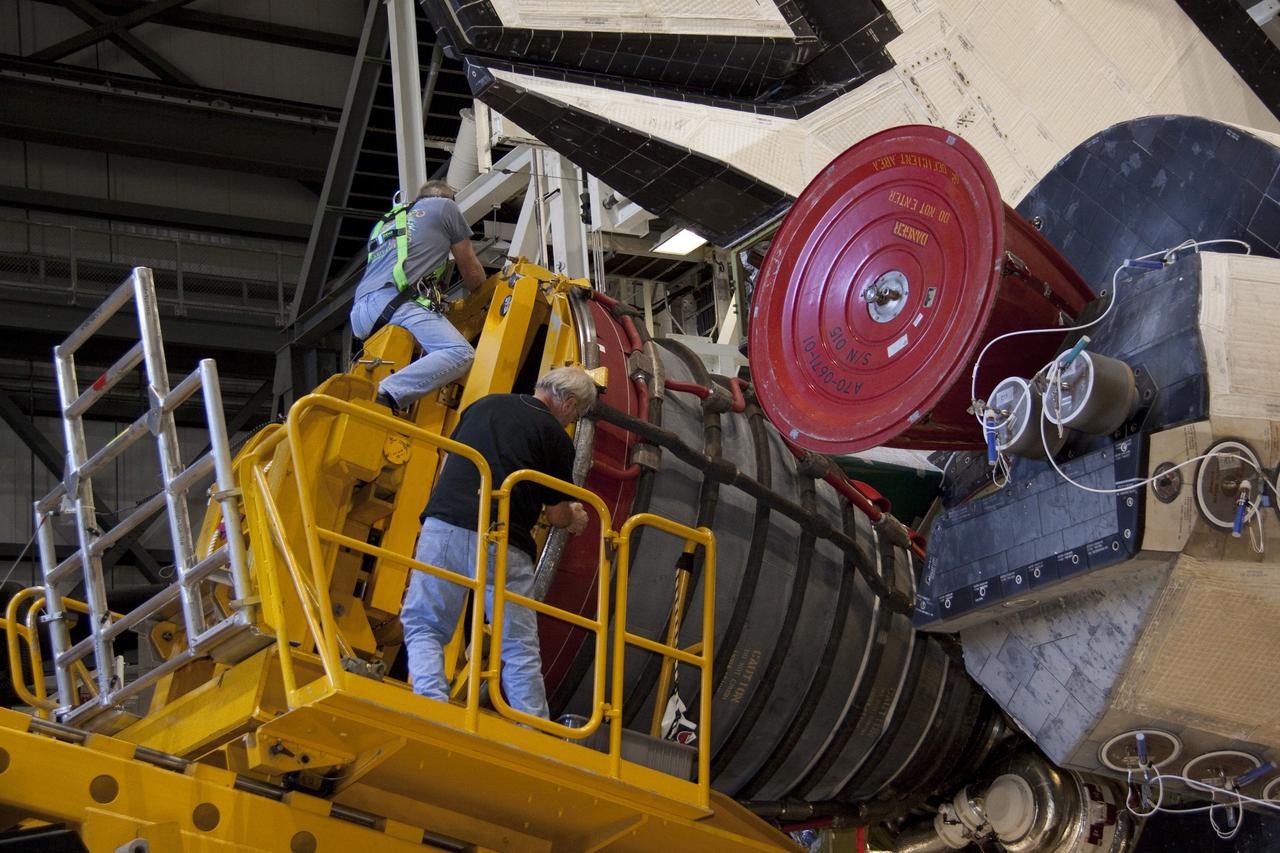
CAPE CANAVERAL, Fla. - Technicians carefully remove main engine No. 1 from space shuttle Discovery using a specially designed engine installer, called a Hyster forklift. The work is taking place in Orbiter Processing Facility-2 at NASA's Kennedy Space Center in Florida. The removal is part of Discovery's transition and retirement processing. Work performed on Discovery is expected to help rocket designers build next-generation spacecraft and prepare the shuttle for future public display. Photo credit: NASA/Jack Pfaller
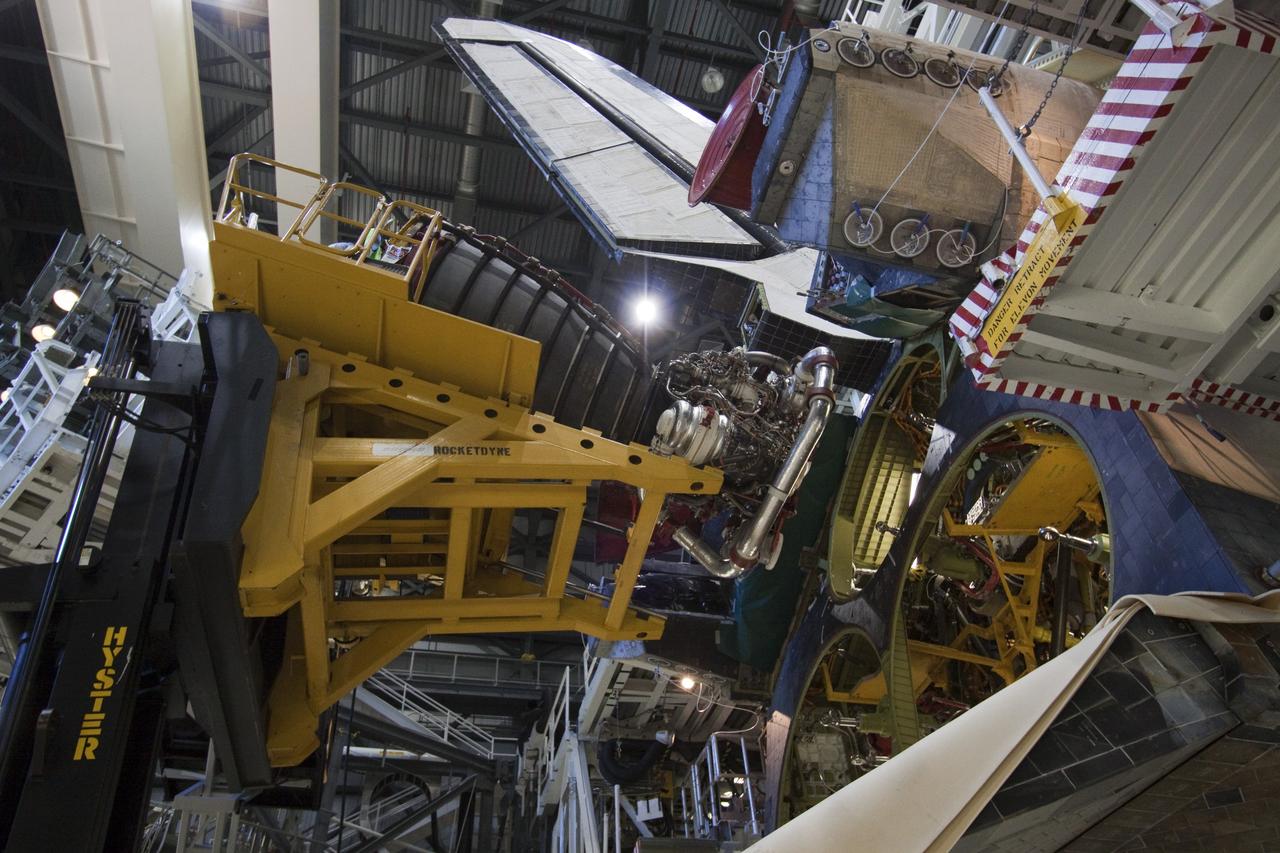
CAPE CANAVERAL, Fla. - Technicians complete the removal of main engine No. 1 from space shuttle Discovery using a specially designed engine installer, called a Hyster forklift. The work is taking place in Orbiter Processing Facility-2 at NASA's Kennedy Space Center in Florida. The removal is part of Discovery's transition and retirement processing. Work performed on Discovery is expected to help rocket designers build next-generation spacecraft and prepare the shuttle for future public display. Photo credit: NASA/Jack Pfaller
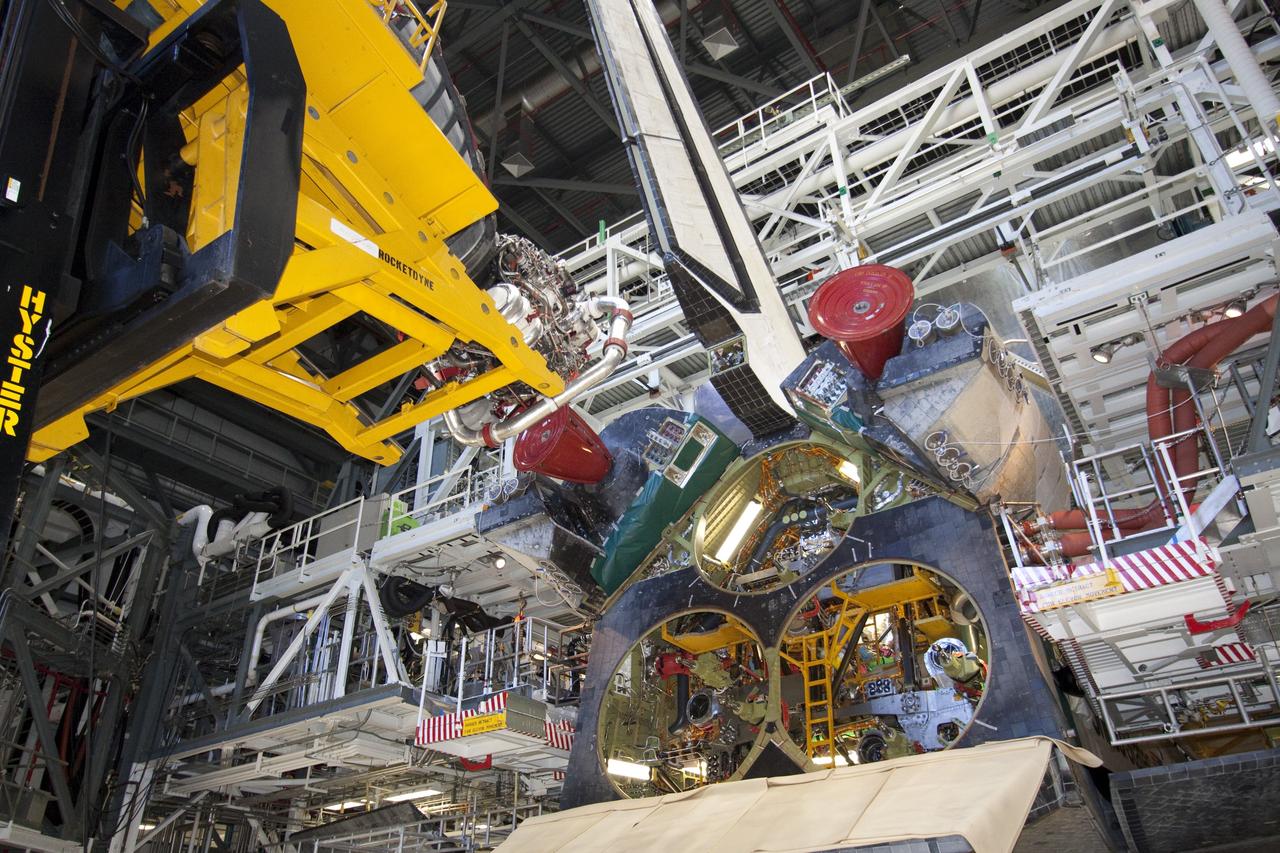
CAPE CANAVERAL, Fla. - Technicians complete the removal of main engine No. 1 from space shuttle Discovery using a specially designed engine installer, called a Hyster forklift. The work is taking place in Orbiter Processing Facility-2 at NASA's Kennedy Space Center in Florida. The removal is part of Discovery's transition and retirement processing. Work performed on Discovery is expected to help rocket designers build next-generation spacecraft and prepare the shuttle for future public display. Photo credit: NASA/Jack Pfaller
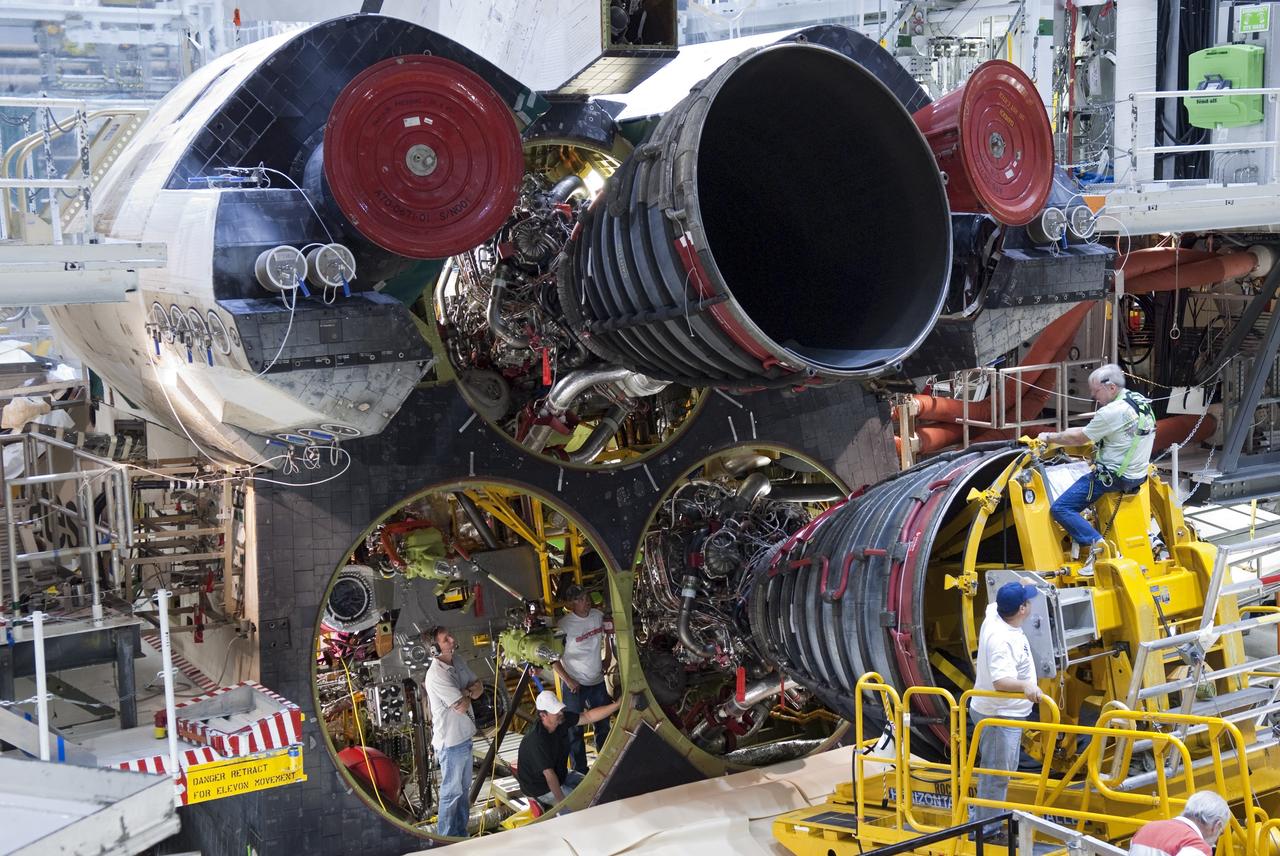
CAPE CANAVERAL, Fla. - Technicians carefully remove main engine No. 3 from space shuttle Discovery using a specially designed engine installer, called a Hyster forklift. The work is taking place in Orbiter Processing Facility-2 at NASA's Kennedy Space Center in Florida. The removal is part of Discovery's transition and retirement processing. Work performed on Discovery is expected to help rocket designers build next-generation spacecraft and prepare the shuttle for future public display. NASA/Jim Grossmann
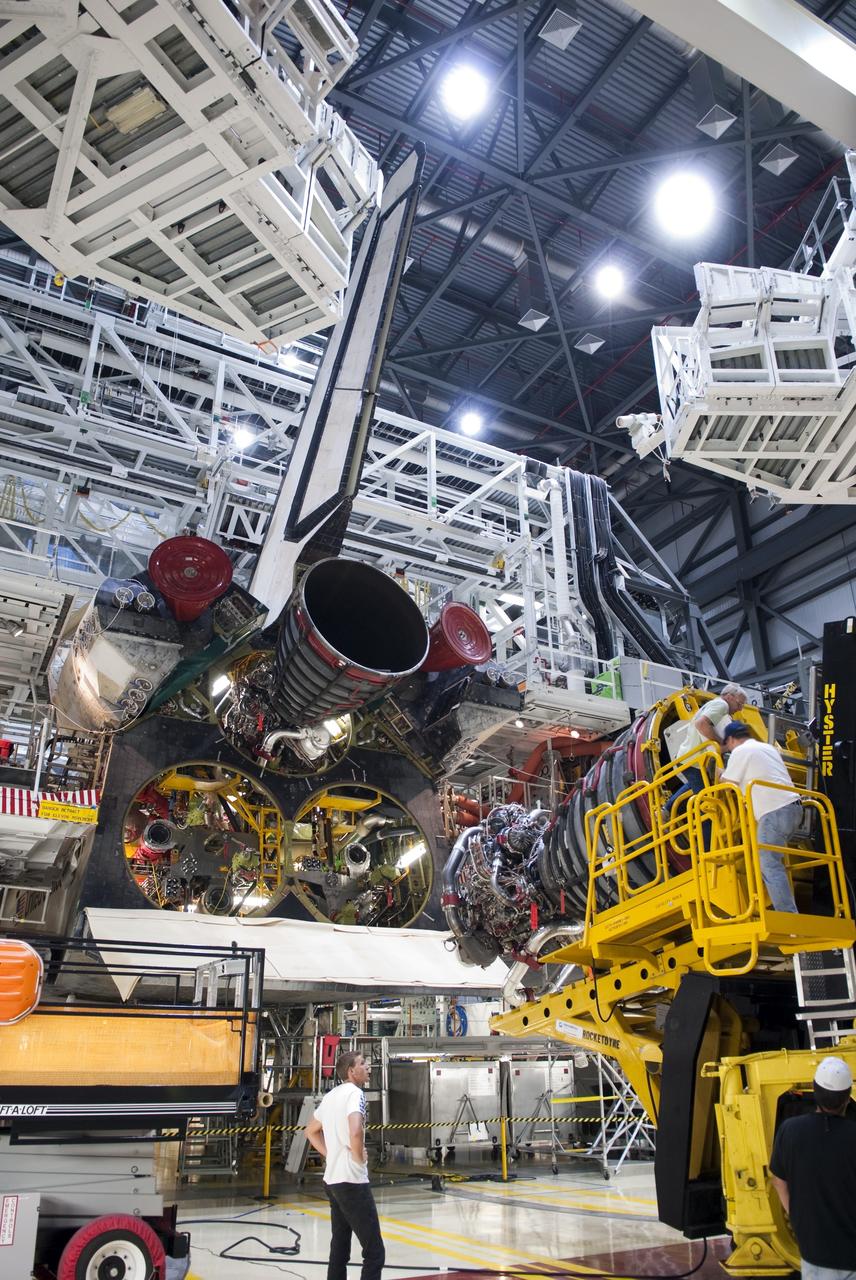
CAPE CANAVERAL, Fla. - Technicians complete the removal of main engine No. 3 from space shuttle Discovery using a specially designed engine installer, called a Hyster forklift. The work is taking place in Orbiter Processing Facility-2 at NASA's Kennedy Space Center in Florida. The removal is part of Discovery's transition and retirement processing. Work performed on Discovery is expected to help rocket designers build next-generation spacecraft and prepare the shuttle for future public display. NASA/Jim Grossmann
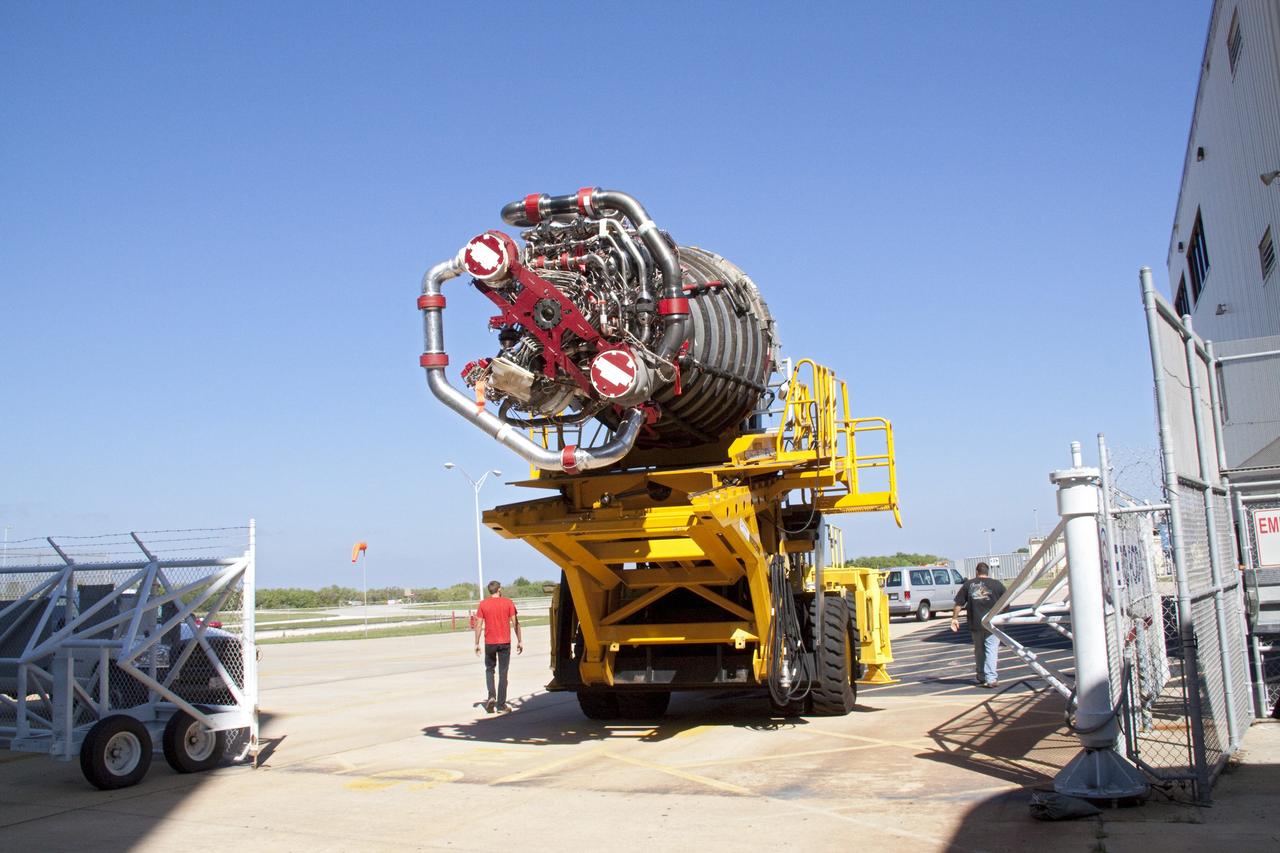
CAPE CANAVERAL, Fla. - Technicians complete the removal of main engine No. 1 from space shuttle Discovery using a specially designed engine installer, called a Hyster forklift. The work is taking place in Orbiter Processing Facility-2 at NASA's Kennedy Space Center in Florida. The removal is part of Discovery's transition and retirement processing. Work performed on Discovery is expected to help rocket designers build next-generation spacecraft and prepare the shuttle for future public display. Photo credit: NASA/Jack Pfaller
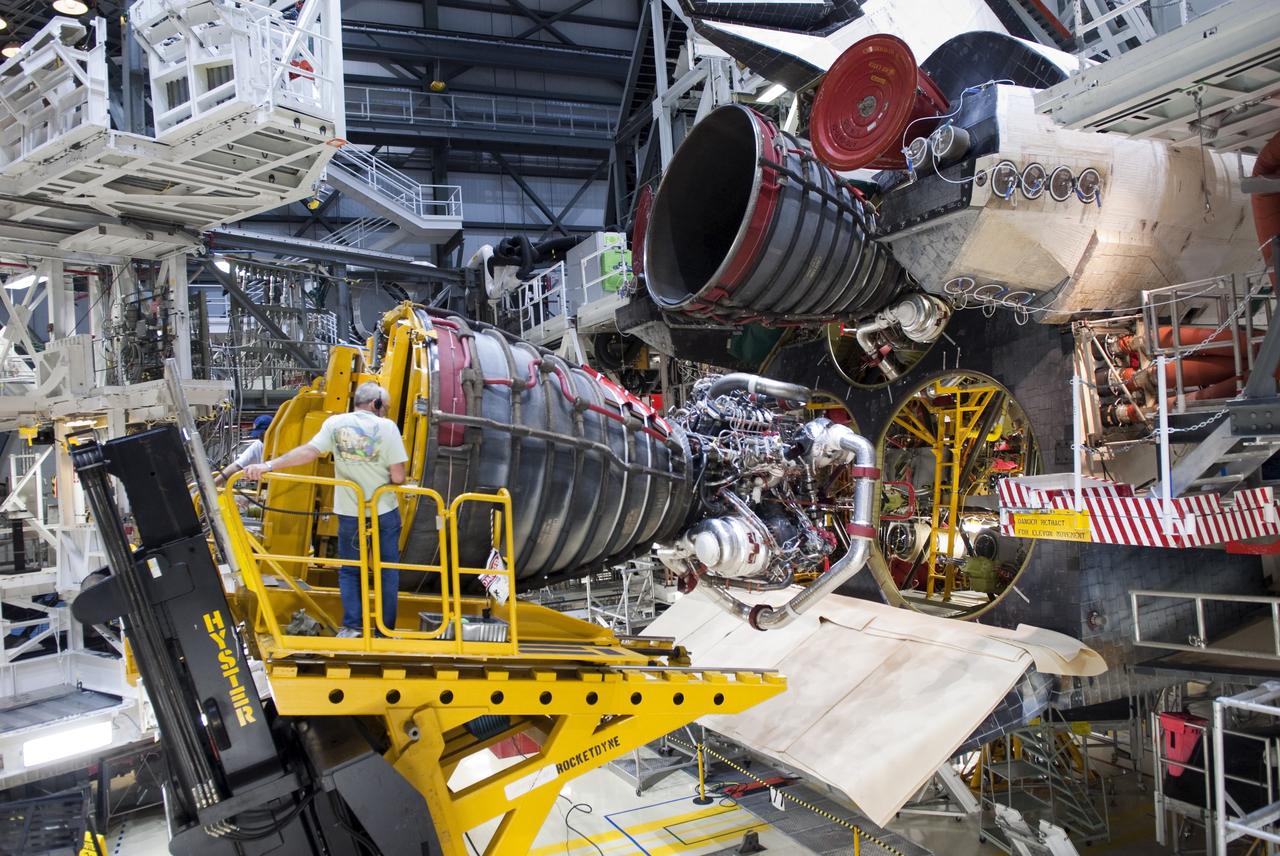
CAPE CANAVERAL, Fla. - Technicians complete the removal of main engine No. 3 from space shuttle Discovery using a specially designed engine installer, called a Hyster forklift. The work is taking place in Orbiter Processing Facility-2 at NASA's Kennedy Space Center in Florida. The removal is part of Discovery's transition and retirement processing. Work performed on Discovery is expected to help rocket designers build next-generation spacecraft and prepare the shuttle for future public display. NASA/Jim Grossmann
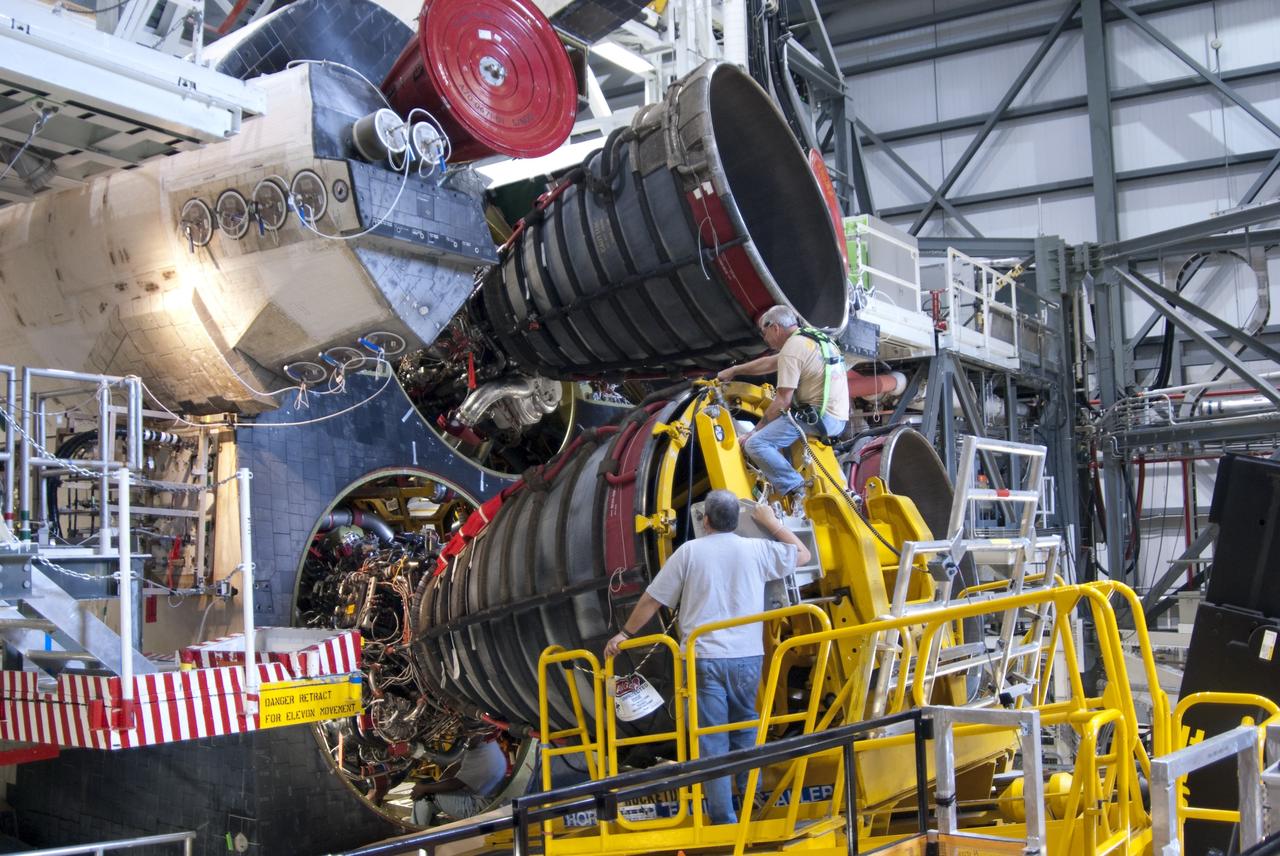
CAPE CANAVERAL, Fla. -- Technicians carefully begin removing a main engine from space shuttle Discovery using the specially designed engine installer. The work is taking place in Orbiter Processing Facility-2 at NASA's Kennedy Space Center in Florida. The transition and retirement processing is expected to help rocket designers build next-generation spacecraft and prepare the shuttle for display. Photo credit: NASA/Jim Grossmann
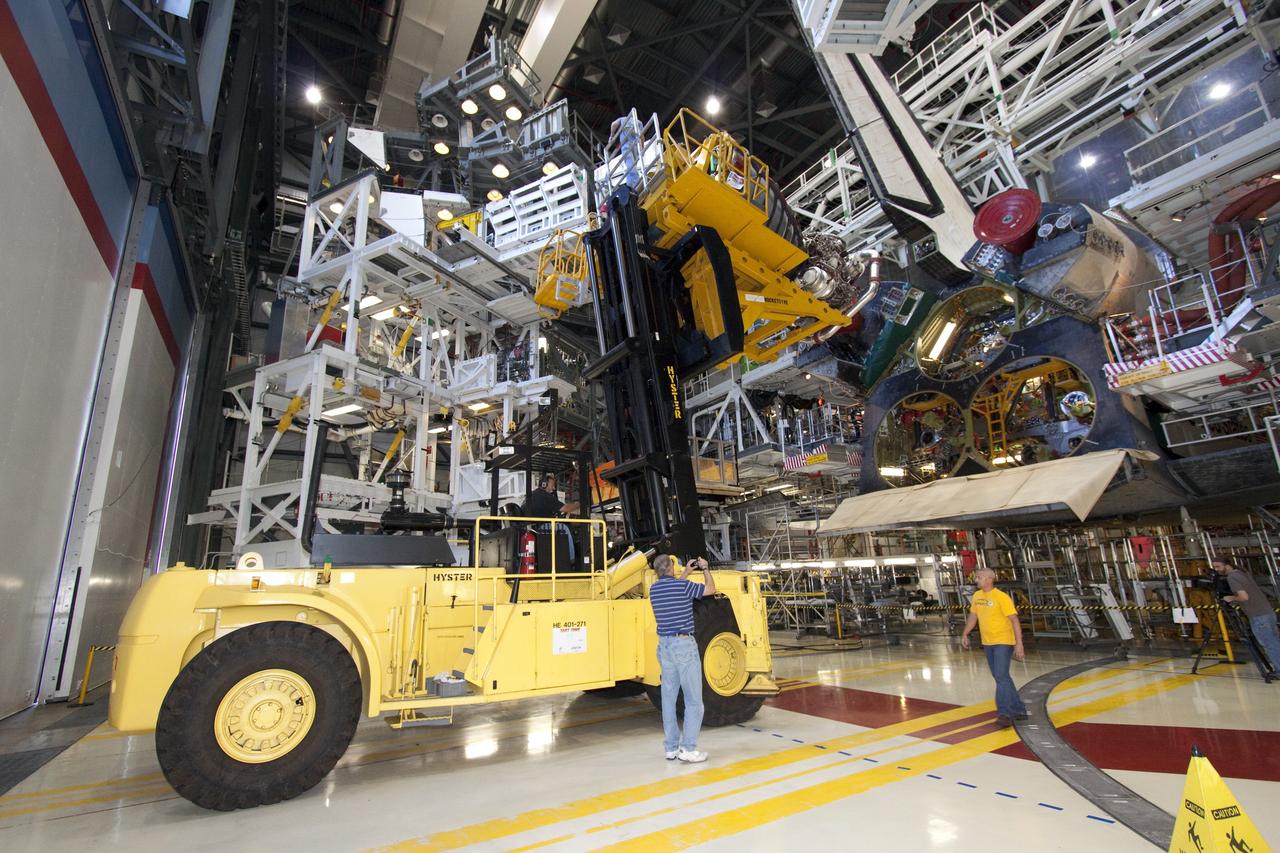
CAPE CANAVERAL, Fla. - Technicians complete the removal of main engine No. 1 from space shuttle Discovery using a specially designed engine installer, called a Hyster forklift. The work is taking place in Orbiter Processing Facility-2 at NASA's Kennedy Space Center in Florida. The removal is part of Discovery's transition and retirement processing. Work performed on Discovery is expected to help rocket designers build next-generation spacecraft and prepare the shuttle for future public display. Photo credit: NASA/Jack Pfaller
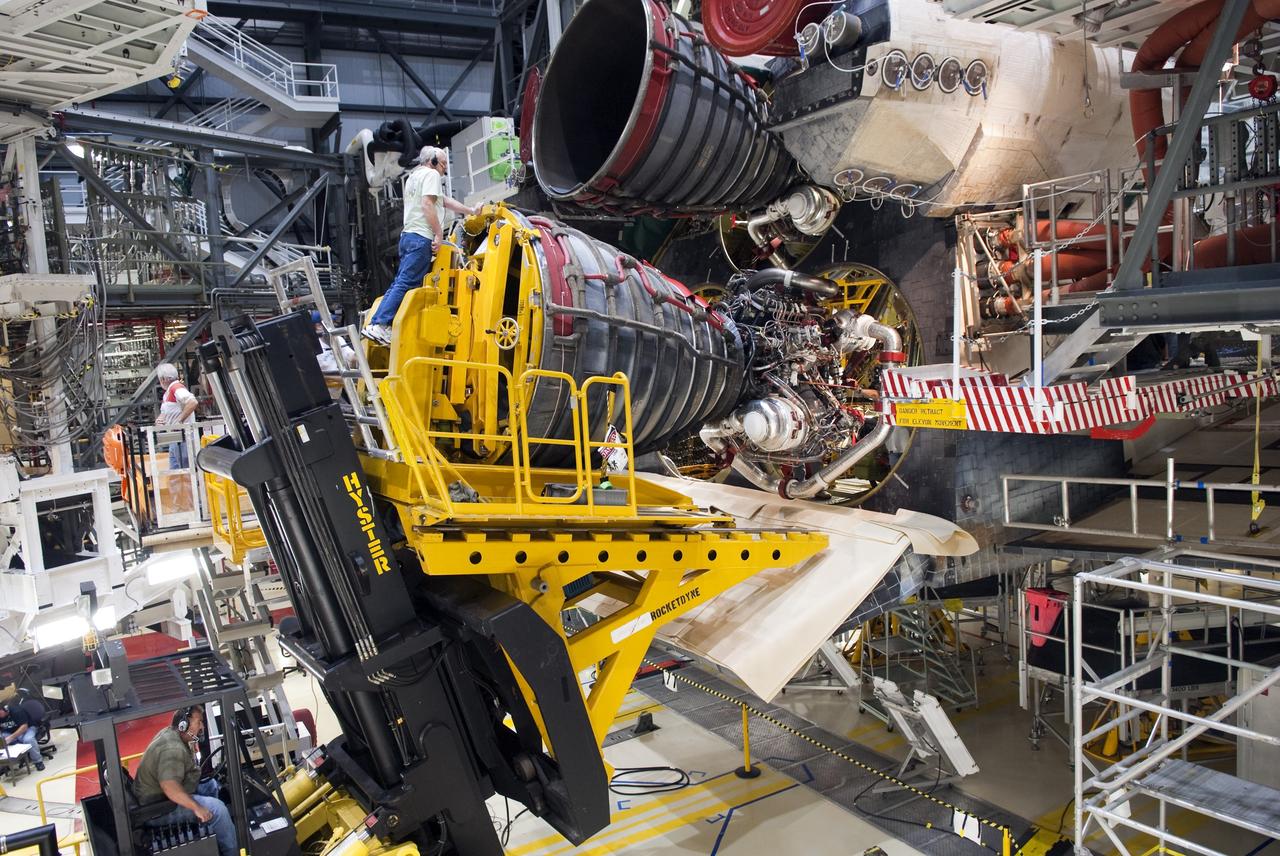
CAPE CANAVERAL, Fla. - Technicians carefully remove main engine No. 3 from space shuttle Discovery using a specially designed engine installer, called a Hyster forklift. The work is taking place in Orbiter Processing Facility-2 at NASA's Kennedy Space Center in Florida. The removal is part of Discovery's transition and retirement processing. Work performed on Discovery is expected to help rocket designers build next-generation spacecraft and prepare the shuttle for future public display. NASA/Jim Grossmann
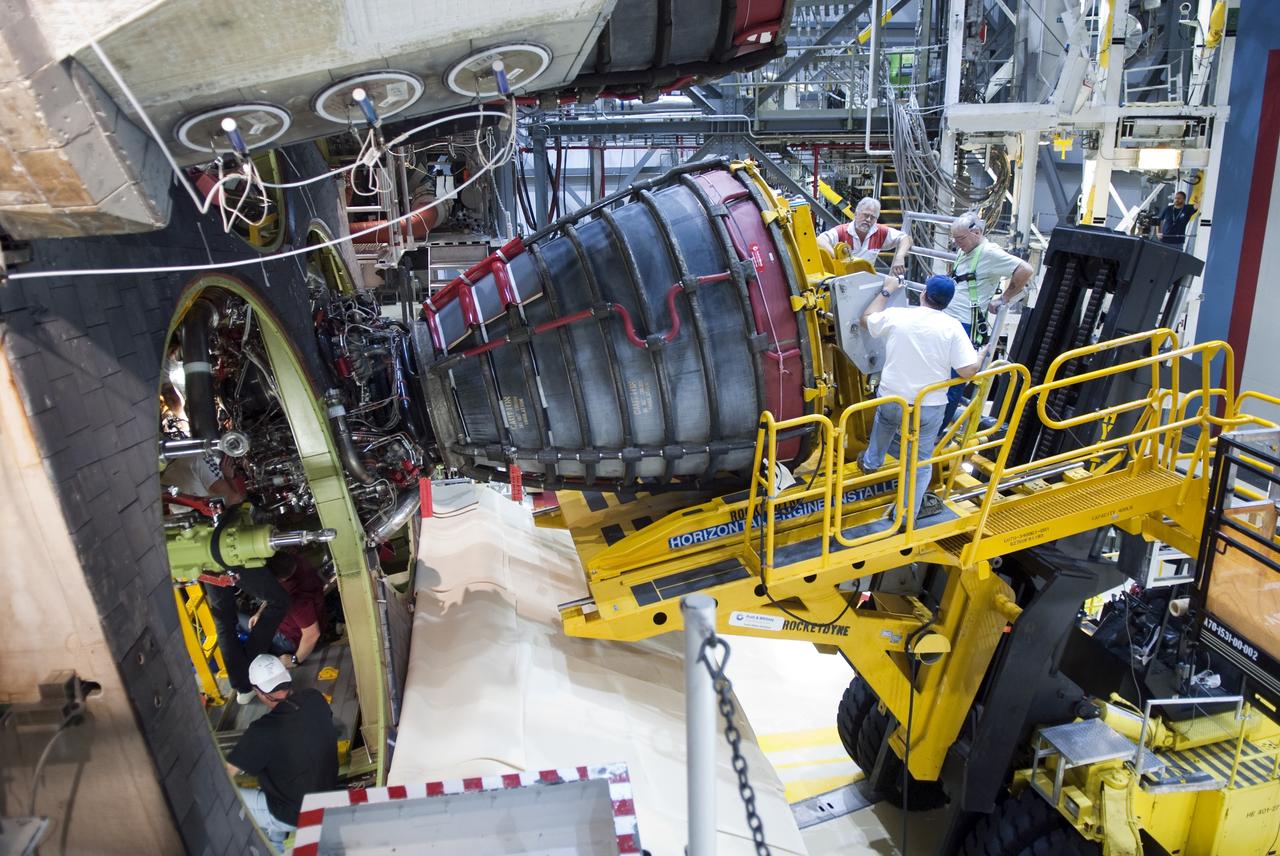
CAPE CANAVERAL, Fla. - Technicians carefully remove main engine No. 3 from space shuttle Discovery using a specially designed engine installer, called a Hyster forklift. The work is taking place in Orbiter Processing Facility-2 at NASA's Kennedy Space Center in Florida. The removal is part of Discovery's transition and retirement processing. Work performed on Discovery is expected to help rocket designers build next-generation spacecraft and prepare the shuttle for future public display. NASA/Jim Grossmann
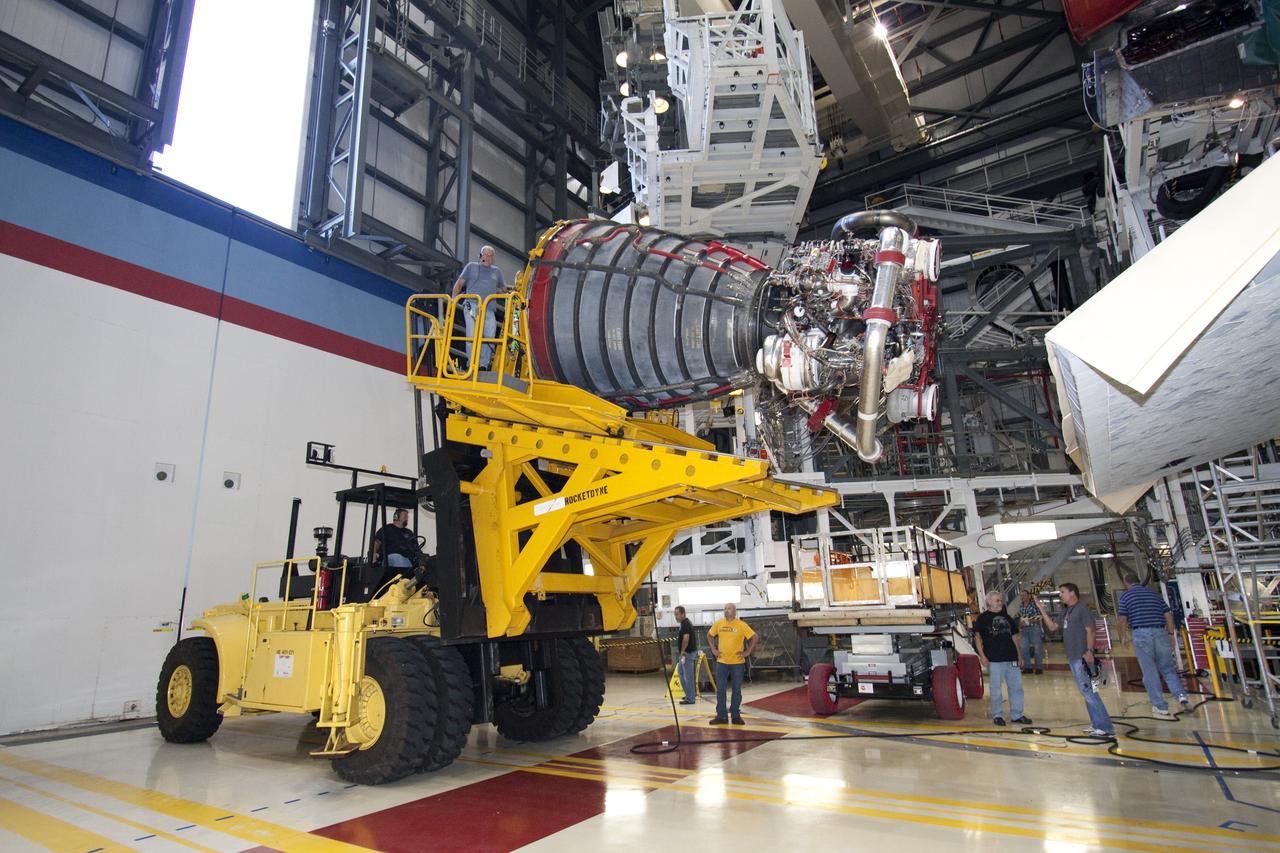
CAPE CANAVERAL, Fla. - Technicians complete the removal of main engine No. 1 from space shuttle Discovery using a specially designed engine installer, called a Hyster forklift. The work is taking place in Orbiter Processing Facility-2 at NASA's Kennedy Space Center in Florida. The removal is part of Discovery's transition and retirement processing. Work performed on Discovery is expected to help rocket designers build next-generation spacecraft and prepare the shuttle for future public display. Photo credit: NASA/Jack Pfaller
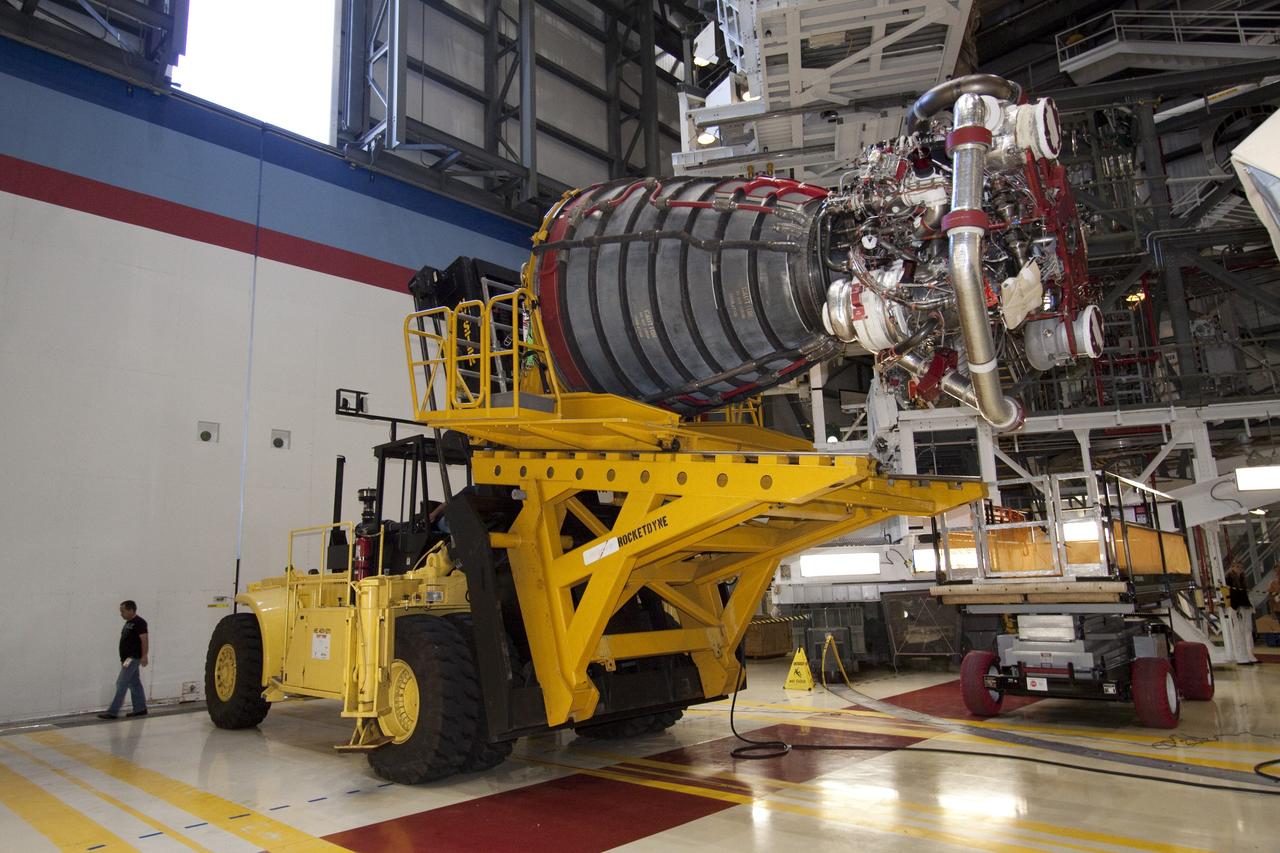
CAPE CANAVERAL, Fla. - Technicians complete the removal of main engine No. 1 from space shuttle Discovery using a specially designed engine installer, called a Hyster forklift. The work is taking place in Orbiter Processing Facility-2 at NASA's Kennedy Space Center in Florida. The removal is part of Discovery's transition and retirement processing. Work performed on Discovery is expected to help rocket designers build next-generation spacecraft and prepare the shuttle for future public display. Photo credit: NASA/Jack Pfaller
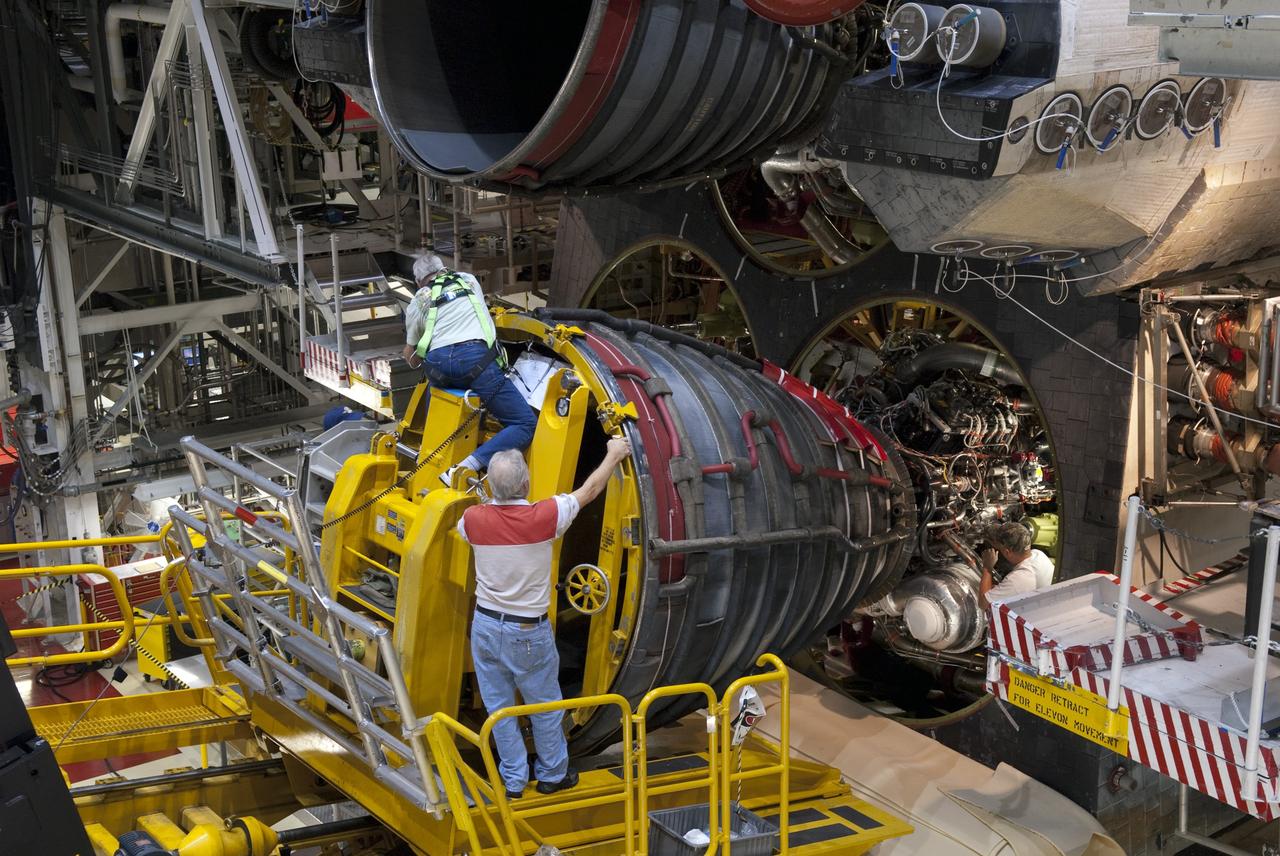
CAPE CANAVERAL, Fla. - Technicians carefully remove main engine No. 3 from space shuttle Discovery using a specially designed engine installer, called a Hyster forklift. The work is taking place in Orbiter Processing Facility-2 at NASA's Kennedy Space Center in Florida. The removal is part of Discovery's transition and retirement processing. Work performed on Discovery is expected to help rocket designers build next-generation spacecraft and prepare the shuttle for future public display. NASA/Jim Grossmann
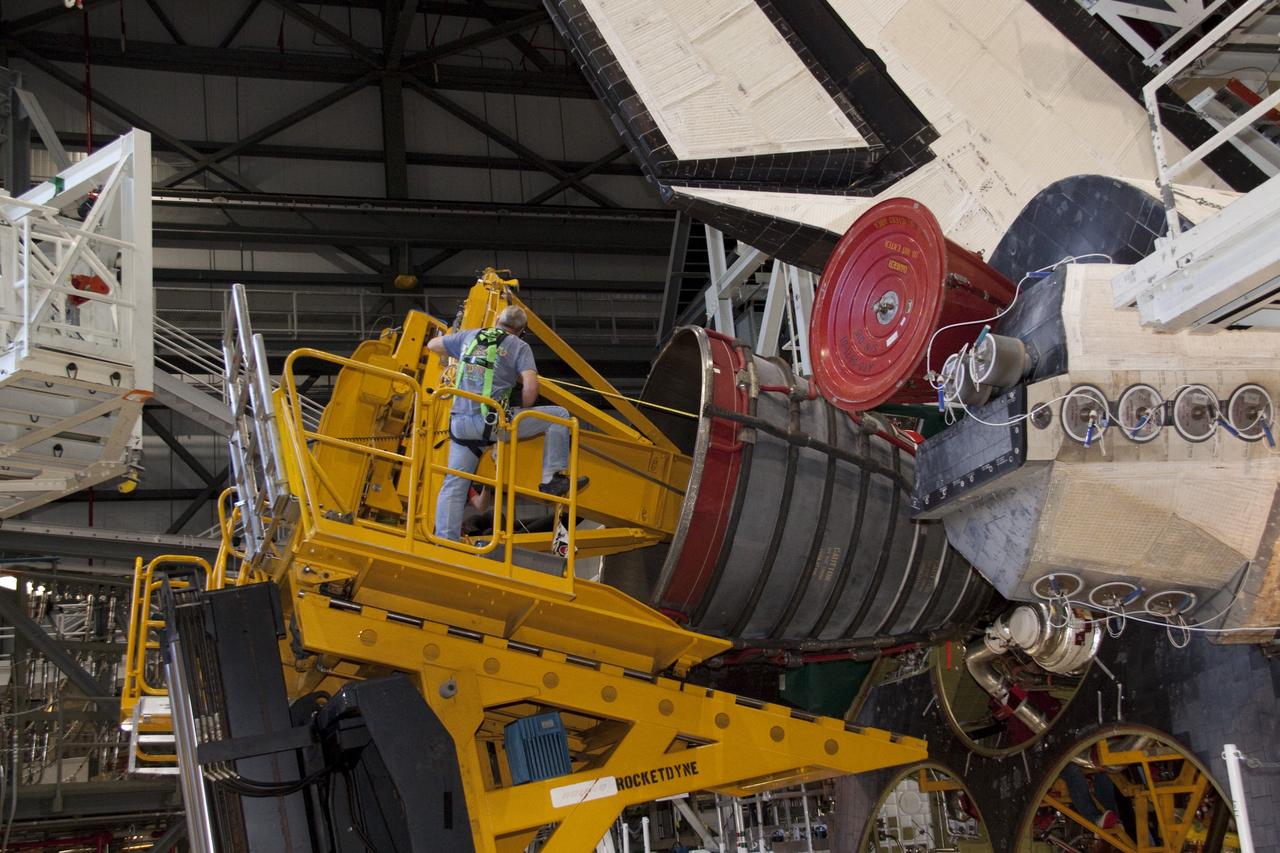
CAPE CANAVERAL, Fla. - Technicians carefully remove main engine No. 1 from space shuttle Discovery using a specially designed engine installer, called a Hyster forklift. The work is taking place in Orbiter Processing Facility-2 at NASA's Kennedy Space Center in Florida. The removal is part of Discovery's transition and retirement processing. Work performed on Discovery is expected to help rocket designers build next-generation spacecraft and prepare the shuttle for future public display. Photo credit: NASA/Jack Pfaller
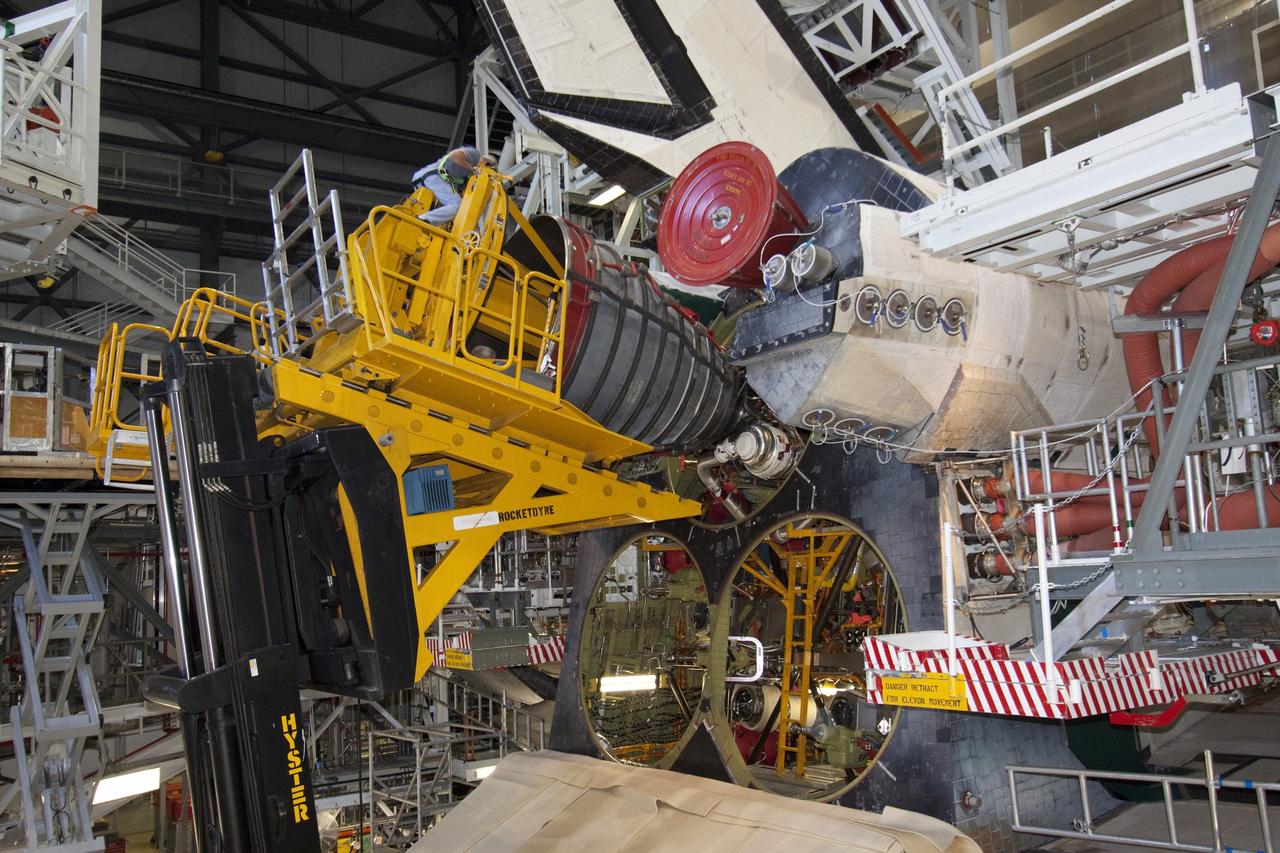
CAPE CANAVERAL, Fla. - Technicians carefully remove main engine No. 1 from space shuttle Discovery using a specially designed engine installer, called a Hyster forklift. The work is taking place in Orbiter Processing Facility-2 at NASA's Kennedy Space Center in Florida. The removal is part of Discovery's transition and retirement processing. Work performed on Discovery is expected to help rocket designers build next-generation spacecraft and prepare the shuttle for future public display. Photo credit: NASA/Jack Pfaller
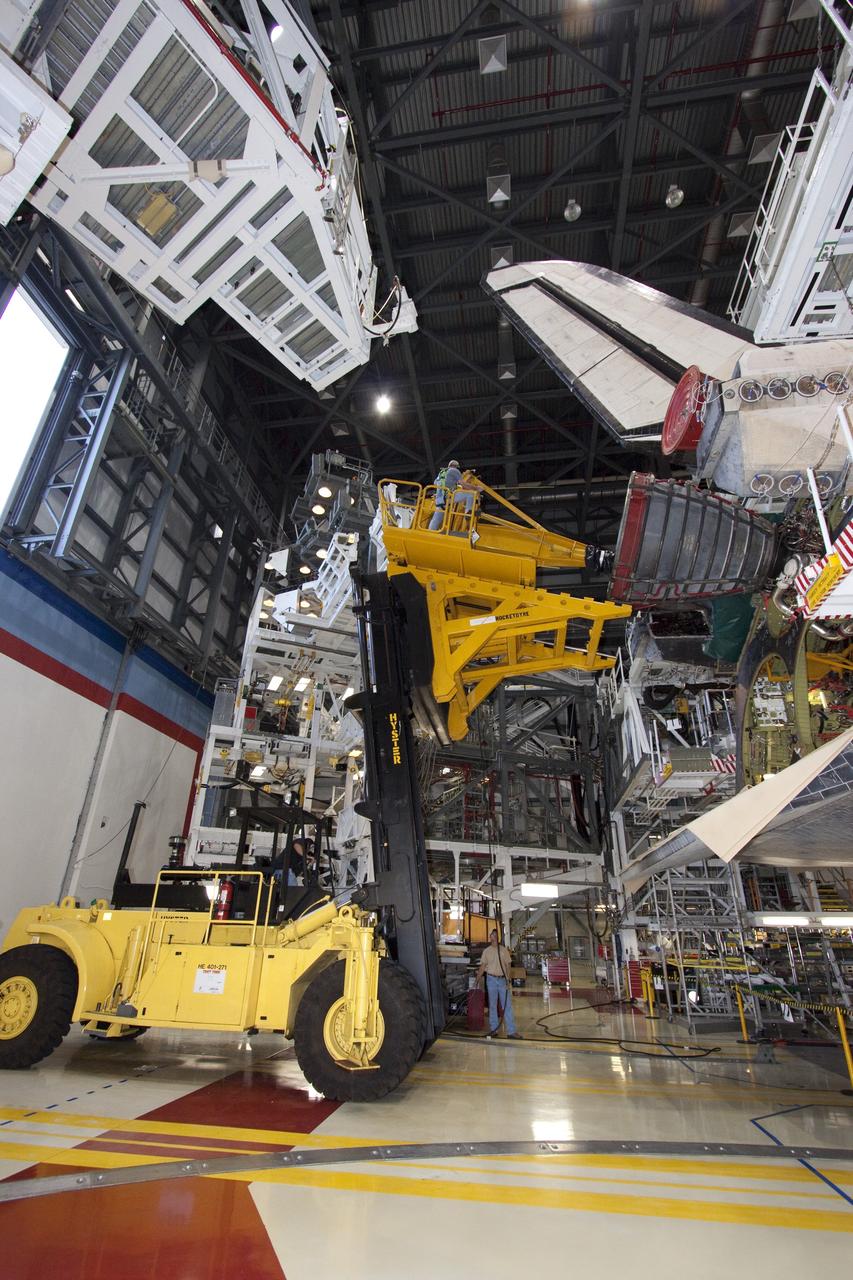
CAPE CANAVERAL, Fla. - Technicians carefully remove main engine No. 1 from space shuttle Discovery using a specially designed engine installer, called a Hyster forklift. The work is taking place in Orbiter Processing Facility-2 at NASA's Kennedy Space Center in Florida. The removal is part of Discovery's transition and retirement processing. Work performed on Discovery is expected to help rocket designers build next-generation spacecraft and prepare the shuttle for future public display. Photo credit: NASA/Jack Pfaller
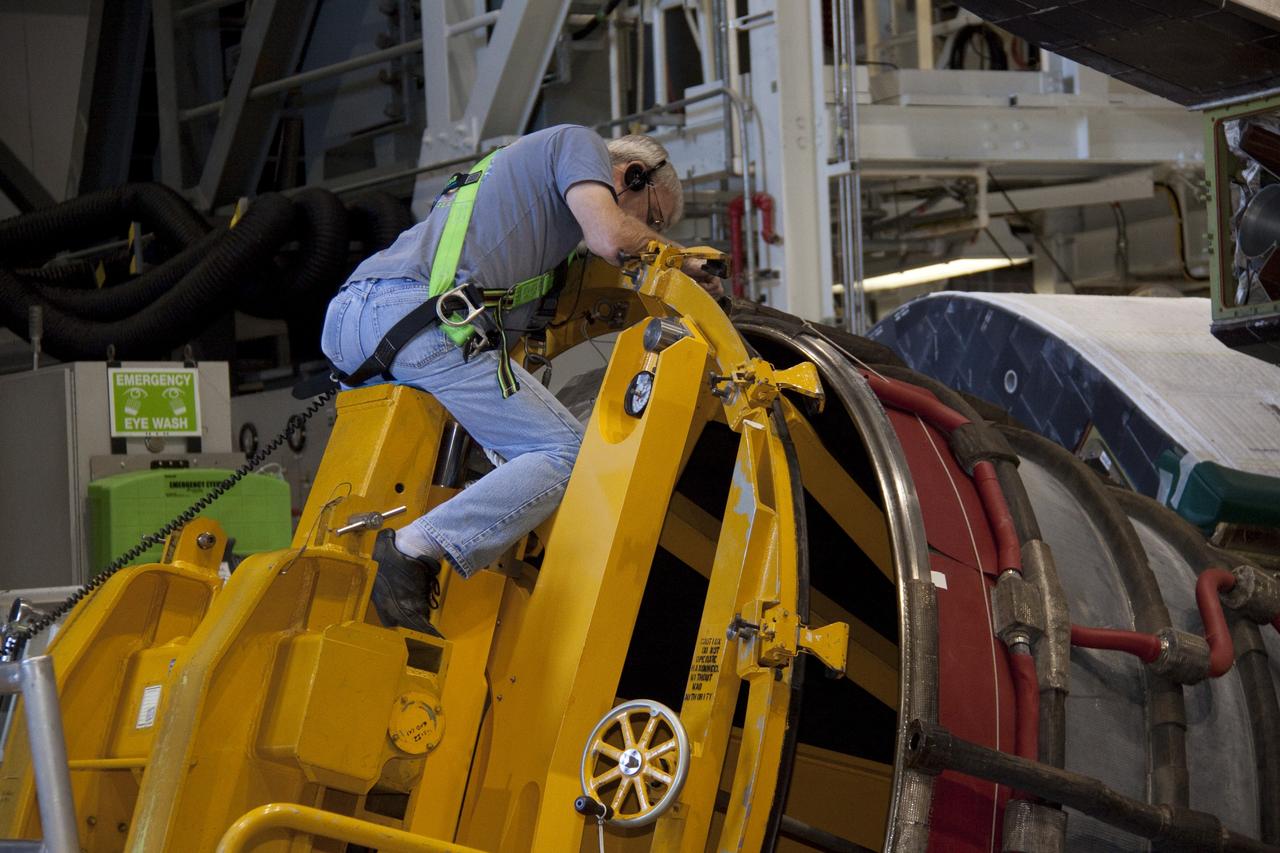
CAPE CANAVERAL, Fla. - Technicians carefully remove main engine No. 1 from space shuttle Discovery using a specially designed engine installer, called a Hyster forklift. The work is taking place in Orbiter Processing Facility-2 at NASA's Kennedy Space Center in Florida. The removal is part of Discovery's transition and retirement processing. Work performed on Discovery is expected to help rocket designers build next-generation spacecraft and prepare the shuttle for future public display. Photo credit: NASA/Jack Pfaller
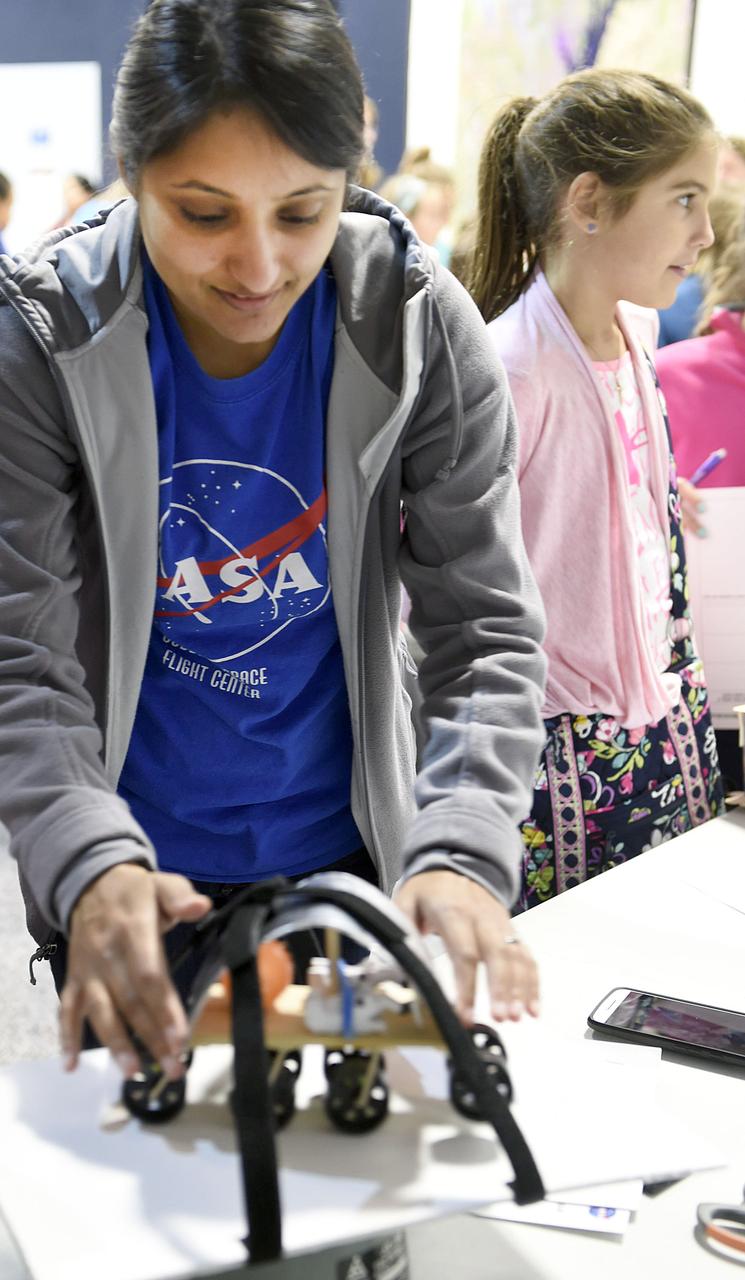
Junior Girl Scouts from two locals conceils, Girl Scouts of Central Maryland and Girl Scouts of Nations Capital, participated in She's an Engineer! Girl Scout program on November 3, 2016. They met with female NASA engineers and tested rover models in simulated I&T stations to explore the Engineering Design process.
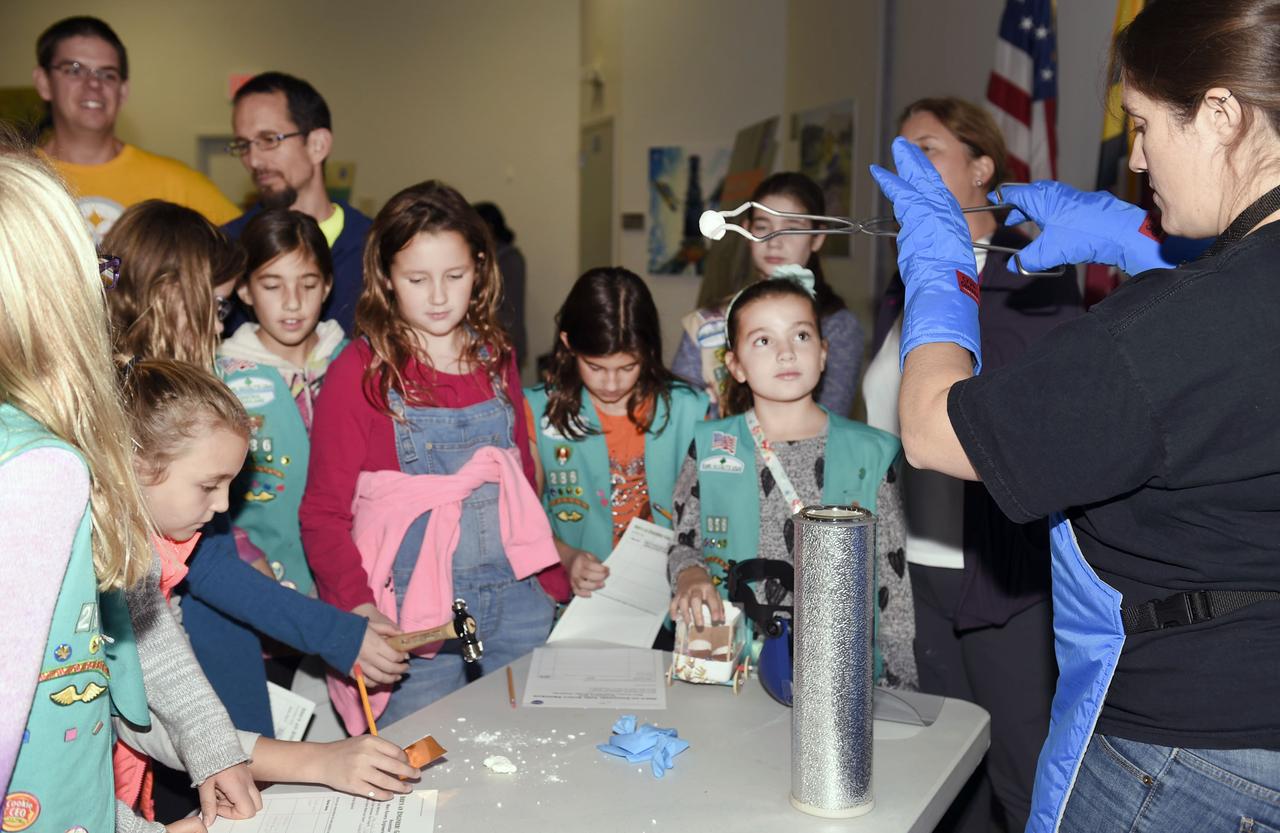
Junior Girl Scouts from two locals conceils, Girl Scouts of Central Maryland and Girl Scouts of Nations Capital, participated in She's an Engineer! Girl Scout program on November 3, 2016. They met with female NASA engineers and tested rover models in simulated I&T stations to explore the Engineering Design process.
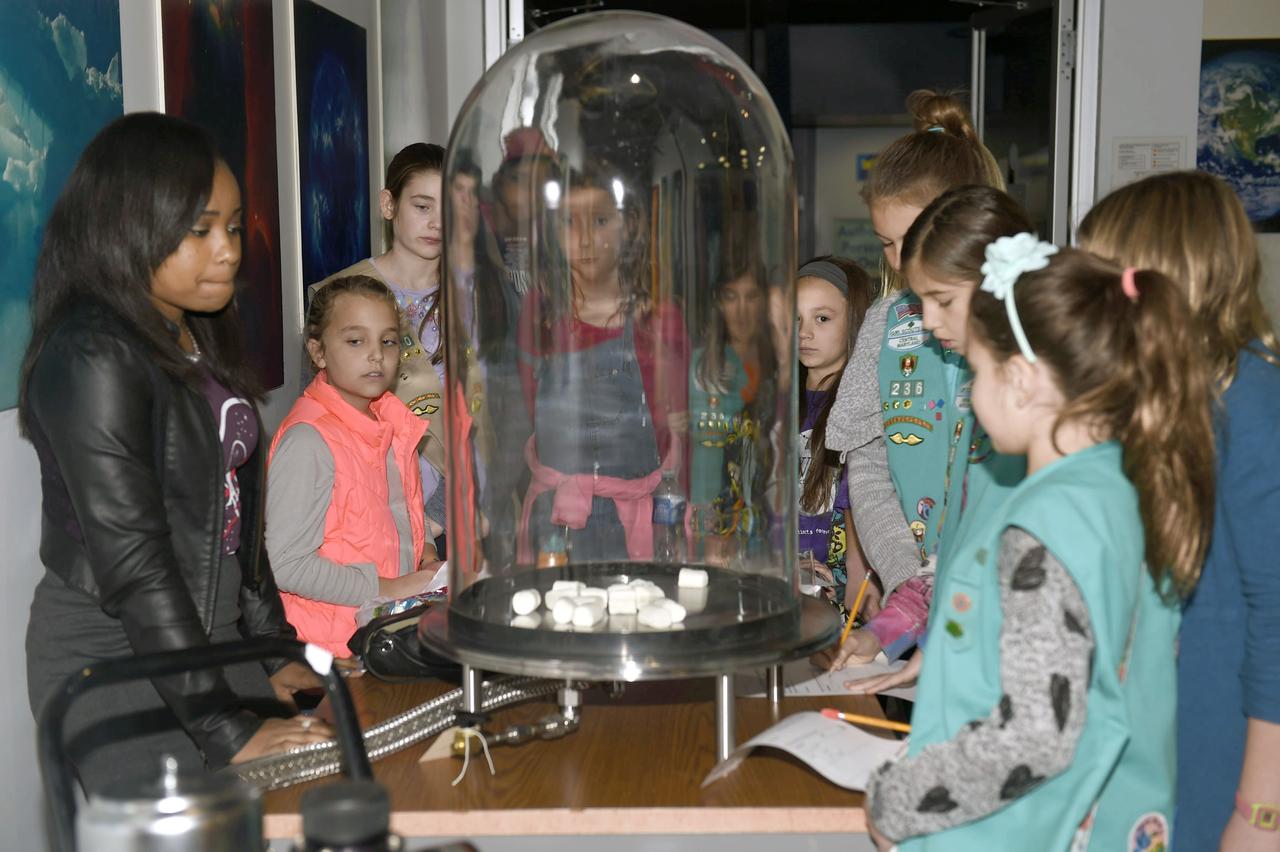
Junior Girl Scouts from two locals conceils, Girl Scouts of Central Maryland and Girl Scouts of Nations Capital, participated in She's an Engineer! Girl Scout program on November 3, 2016. They met with female NASA engineers and tested rover models in simulated I&T stations to explore the Engineering Design process.
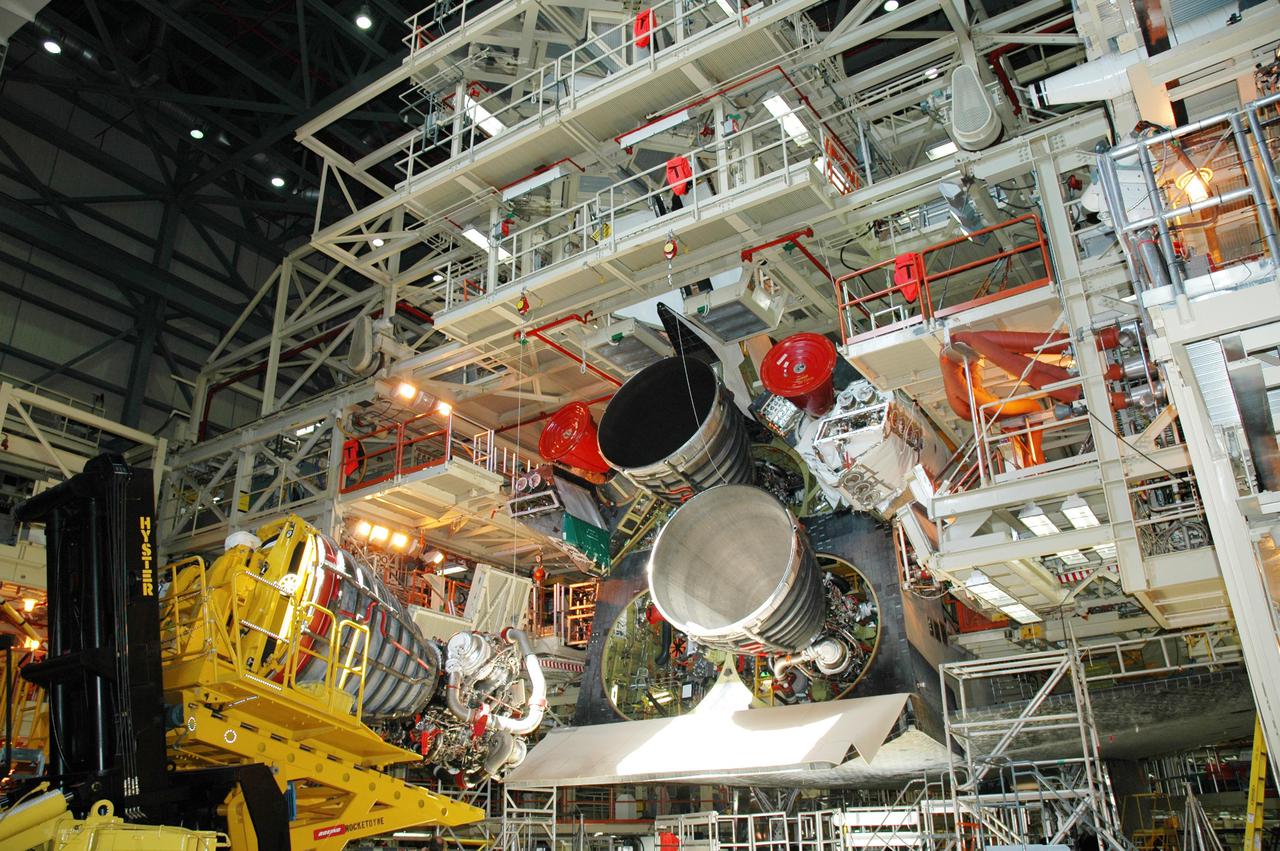
KENNEDY SPACE CENTER, FLA. - The third Space Shuttle Main Engine (SSME) arrives in the Orbiter Processing Facility for installation on Discovery. Discovery is designated as the Return to Flight vehicle for mission STS-114. Recent improvements to the SSME include the introduction of redesigned high-pressure turbopumps into the SSME fleet. The new pumps are designed and built by Pratt and Whitney at West Palm Beach, Fla. SSMEs and the Pratt and Whitney turbopumps are tested at Stennis Space Center in Mississippi. Engines and engine components are delivered to Kennedy Space Center to be prepared for flight.
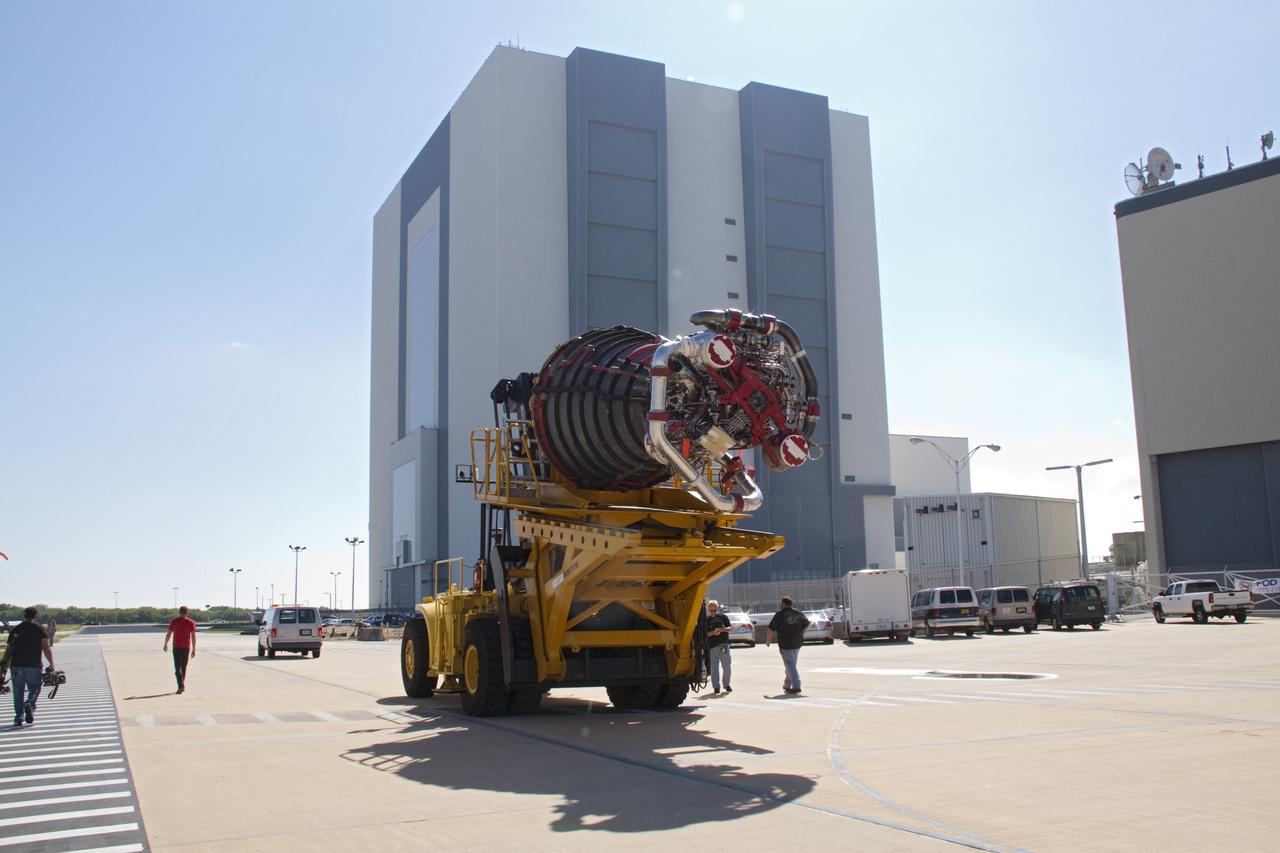
CAPE CANAVERAL, Fla. - Main engine No. 1, which was removed from space shuttle Discovery, is transported from Orbiter Processing Facility-2 to the Space Shuttle Main Engine Processing Facility at NASA's Kennedy Space Center in Florida. The removal was part of Discovery's transition and retirement processing. Work performed on Discovery is expected to help rocket designers build next-generation spacecraft and prepare the shuttle for future public display. Photo credit: NASA/Jack Pfaller
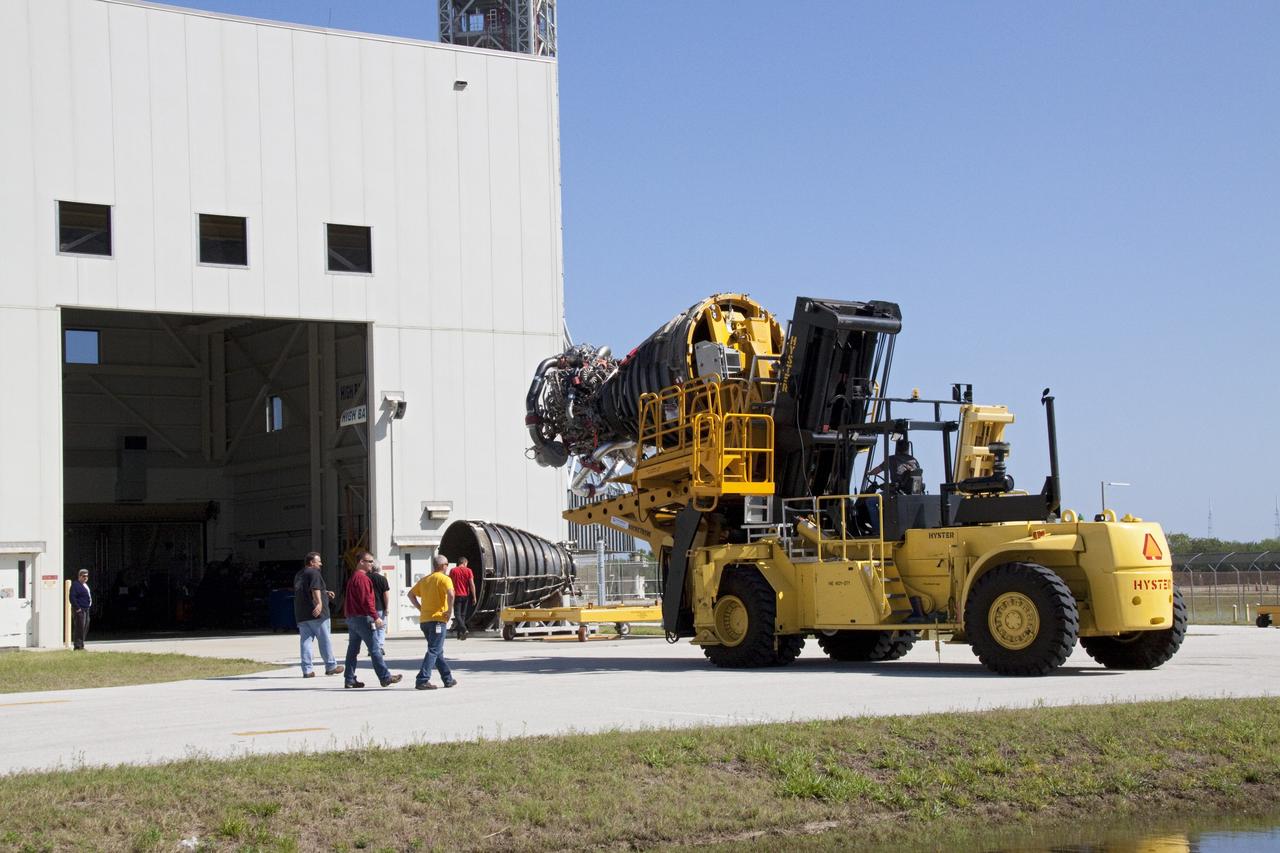
CAPE CANAVERAL, Fla. - Main engine No. 1, which was removed from space shuttle Discovery, is transported from Orbiter Processing Facility-2 to the Space Shuttle Main Engine Processing Facility at NASA's Kennedy Space Center in Florida. The removal was part of Discovery's transition and retirement processing. Work performed on Discovery is expected to help rocket designers build next-generation spacecraft and prepare the shuttle for future public display. Photo credit: NASA/Jack Pfaller
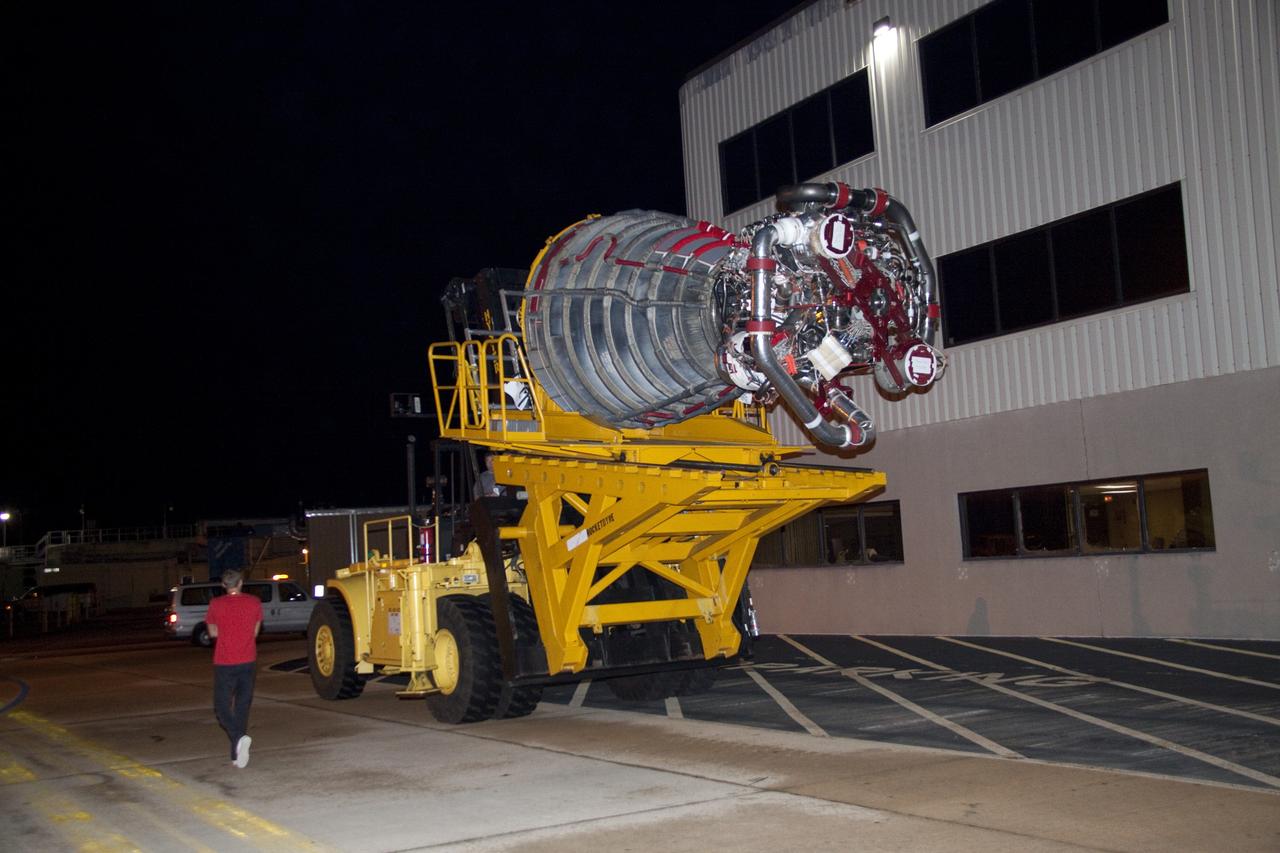
CAPE CANAVERAL, Fla. - Space shuttle main engine No. 2, which was removed from shuttle Discovery, is transported from Orbiter Processing Facility-2 to the Space Shuttle Main Engine Processing Facility at NASA's Kennedy Space Center in Florida. The removal was part of Discovery's transition and retirement processing. Work performed on Discovery is expected to help rocket designers build next-generation spacecraft and prepare the shuttle for future public display. Photo credit: NASA/Jack Pfaller
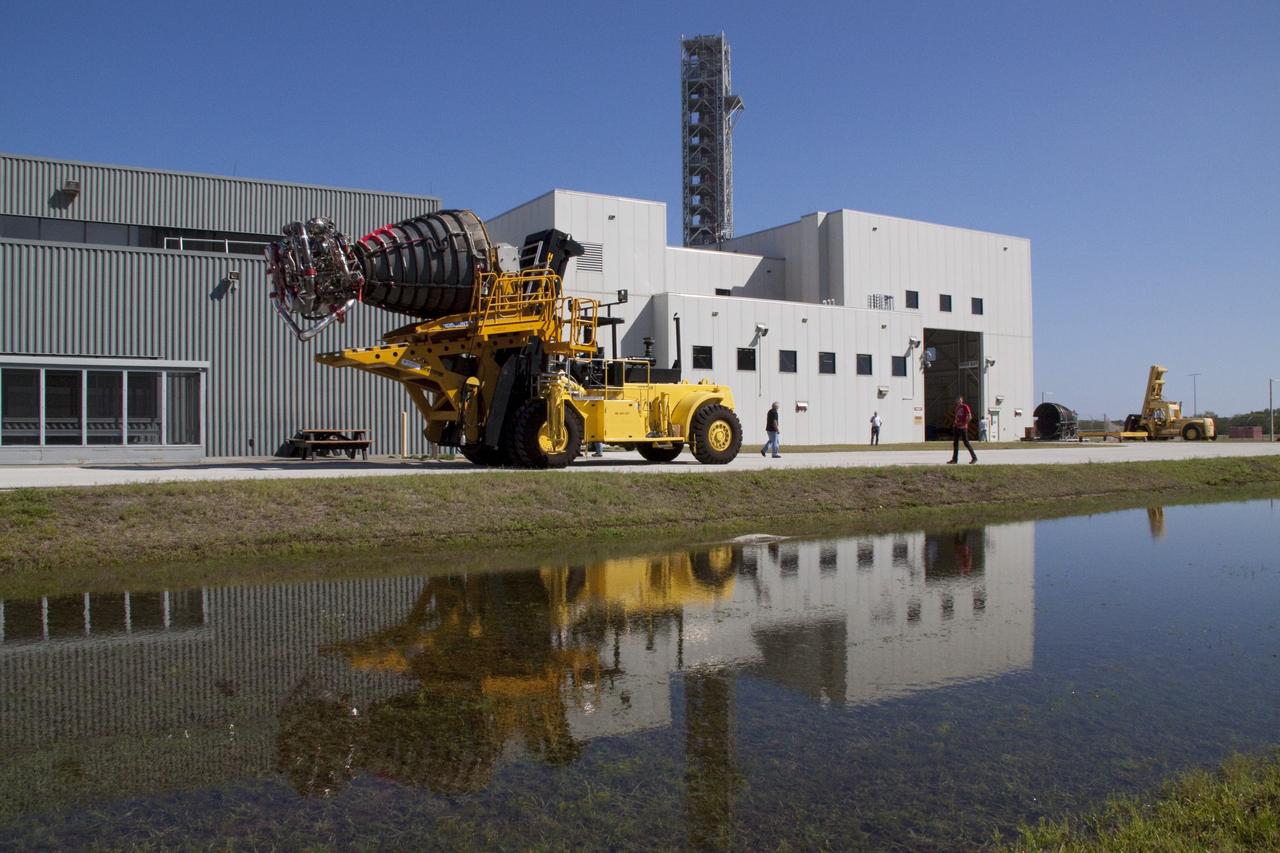
CAPE CANAVERAL, Fla. - Main engine No. 1, which was removed from space shuttle Discovery, is transported from Orbiter Processing Facility-2 to the Space Shuttle Main Engine Processing Facility at NASA's Kennedy Space Center in Florida. The removal was part of Discovery's transition and retirement processing. Work performed on Discovery is expected to help rocket designers build next-generation spacecraft and prepare the shuttle for future public display. Photo credit: NASA/Jack Pfaller
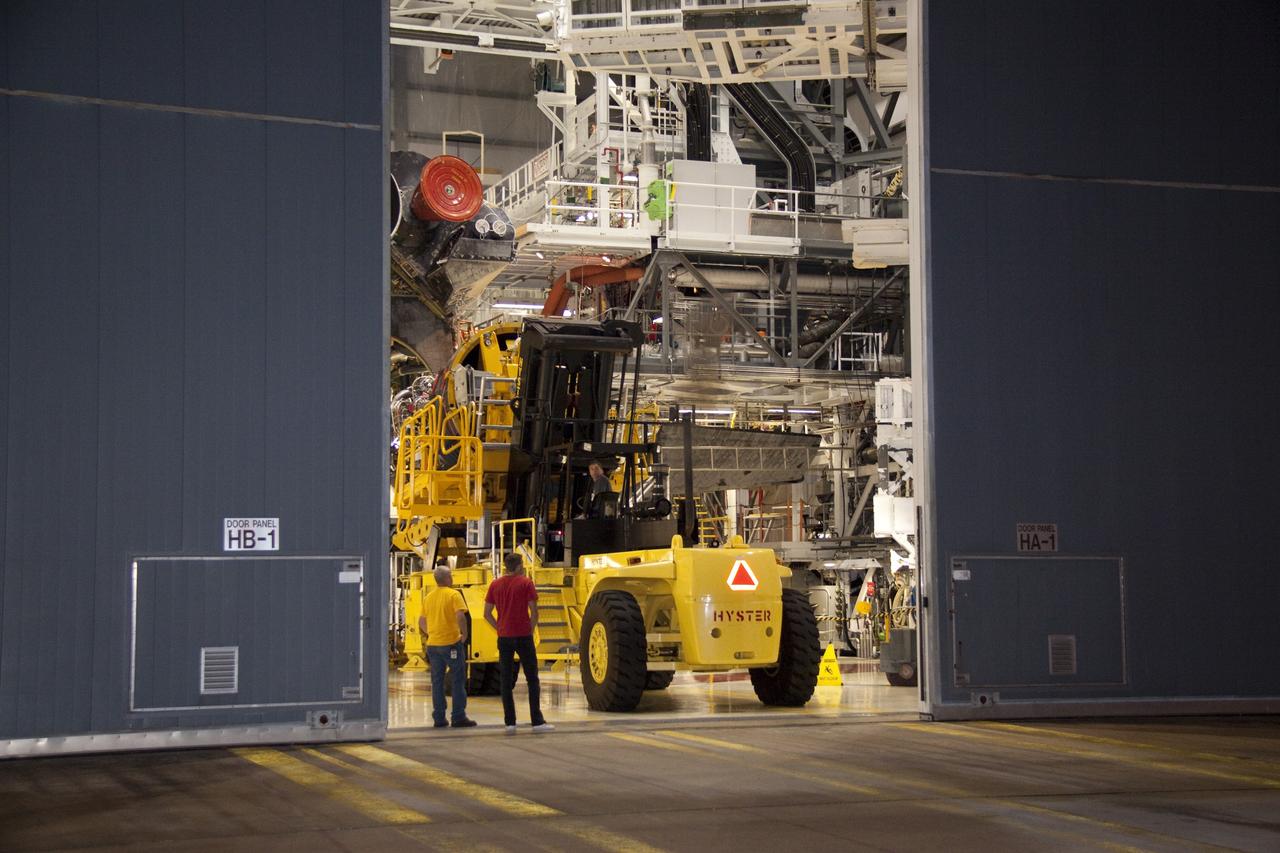
CAPE CANAVERAL, Fla. - Space shuttle main engine No. 2, which was removed from shuttle Discovery, will be transported from Orbiter Processing Facility-2 to the Space Shuttle Main Engine Processing Facility at NASA's Kennedy Space Center in Florida. The removal was part of Discovery's transition and retirement processing. Work performed on Discovery is expected to help rocket designers build next-generation spacecraft and prepare the shuttle for future public display. Photo credit: NASA/Jack Pfaller
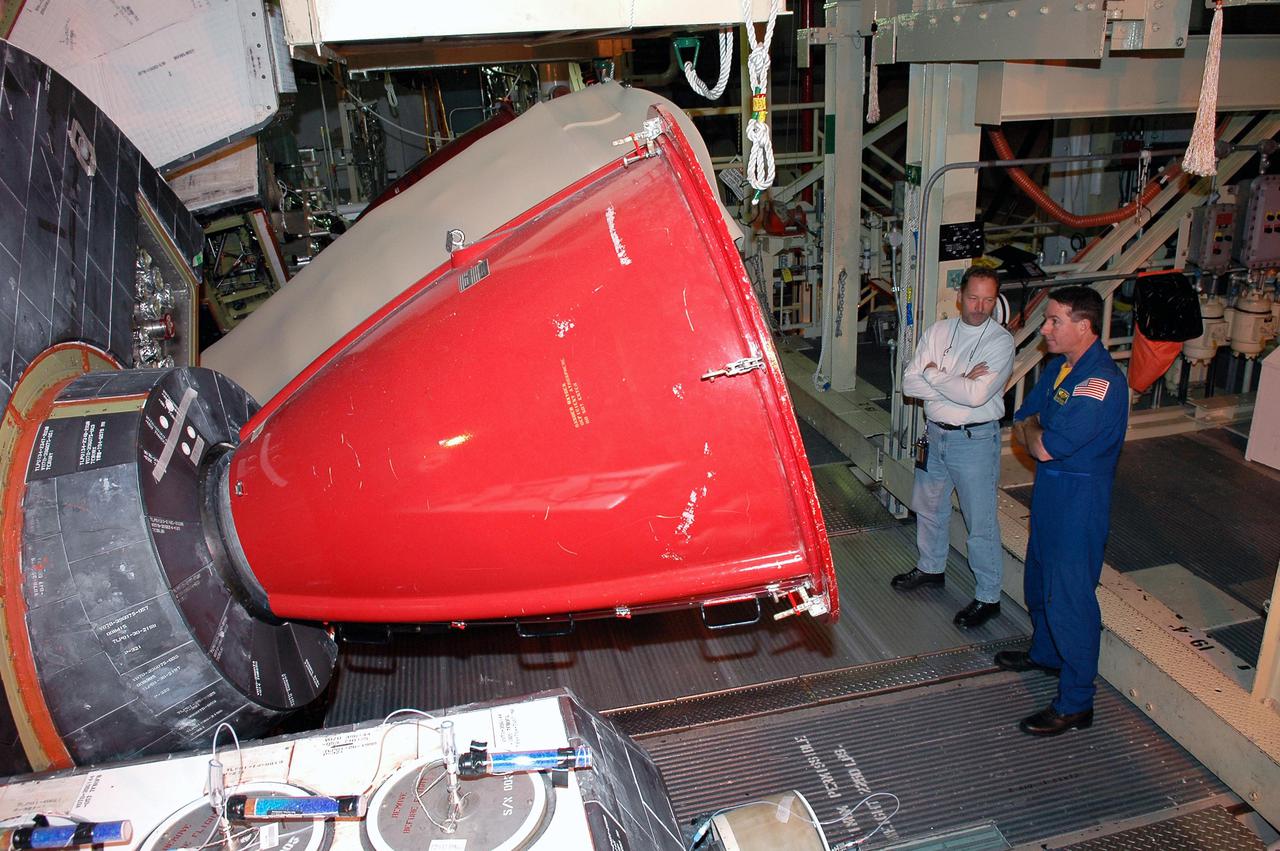
KENNEDY SPACE CENTER, FLA. - On a visit to Kennedy, STS-114 Mission Specialist Stephen Robinson takes a close look at one of the main engines recently installed on Discovery, the designated vehicle for the mission. Discovery is in the Orbiter Processing Facility for launch processing. Discovery is scheduled for a launch planning window of May 12 to June 3, 2005.
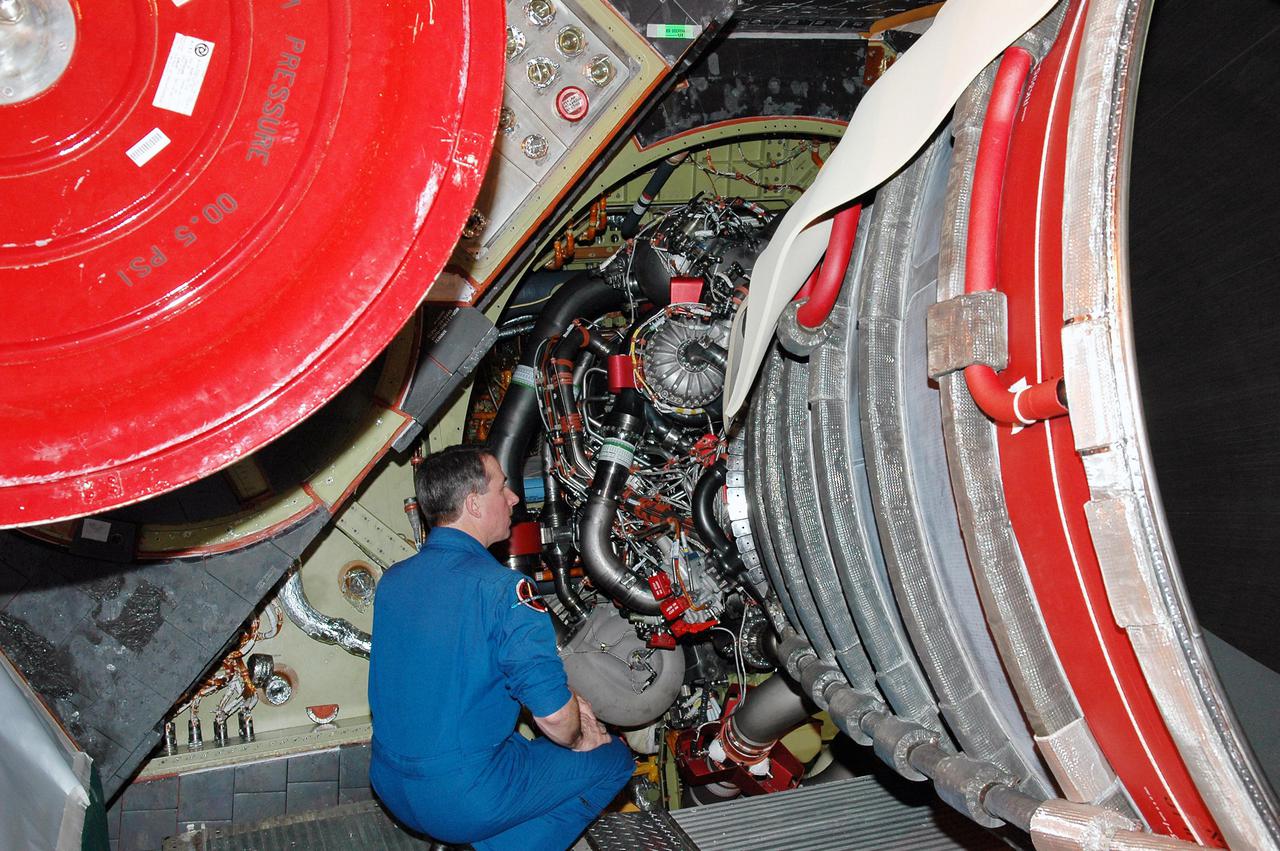
KENNEDY SPACE CENTER, FLA. - On a visit to Kennedy, STS-114 Mission Specialist Stephen Robinson views closely one of the main engines recently installed on Discovery, the designated vehicle for the mission. Discovery is in the Orbiter Processing Facility for launch processing. Discovery is scheduled for a launch planning window of May 12 to June 3, 2005.
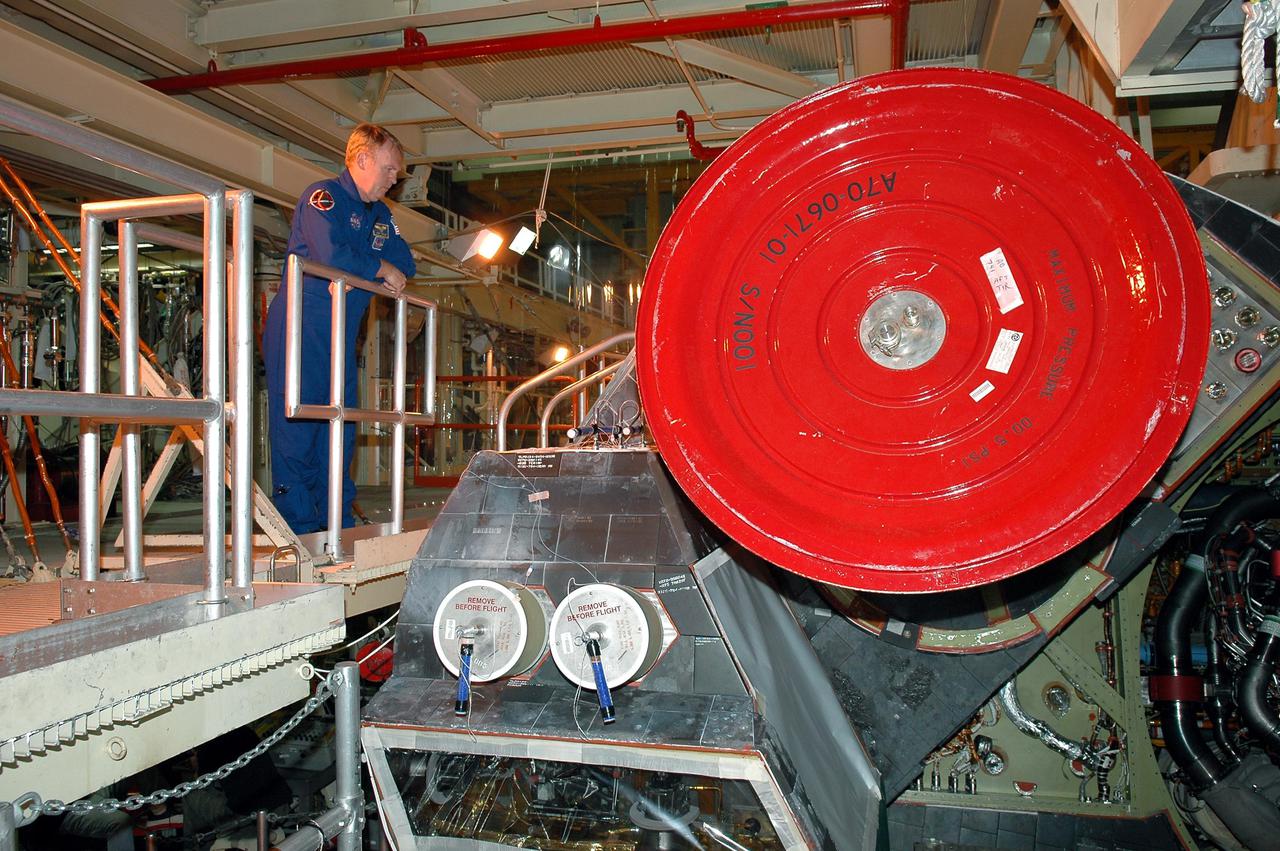
KENNEDY SPACE CENTER, FLA. - On a visit to Kennedy, STS-114 Mission Specialist Andrew Thomas views closely one of the main engines recently installed on Discovery, the designated vehicle for the mission. Discovery is in the Orbiter Processing Facility for launch processing. Discovery is scheduled for a launch planning window of May 12 to June 3, 2005.
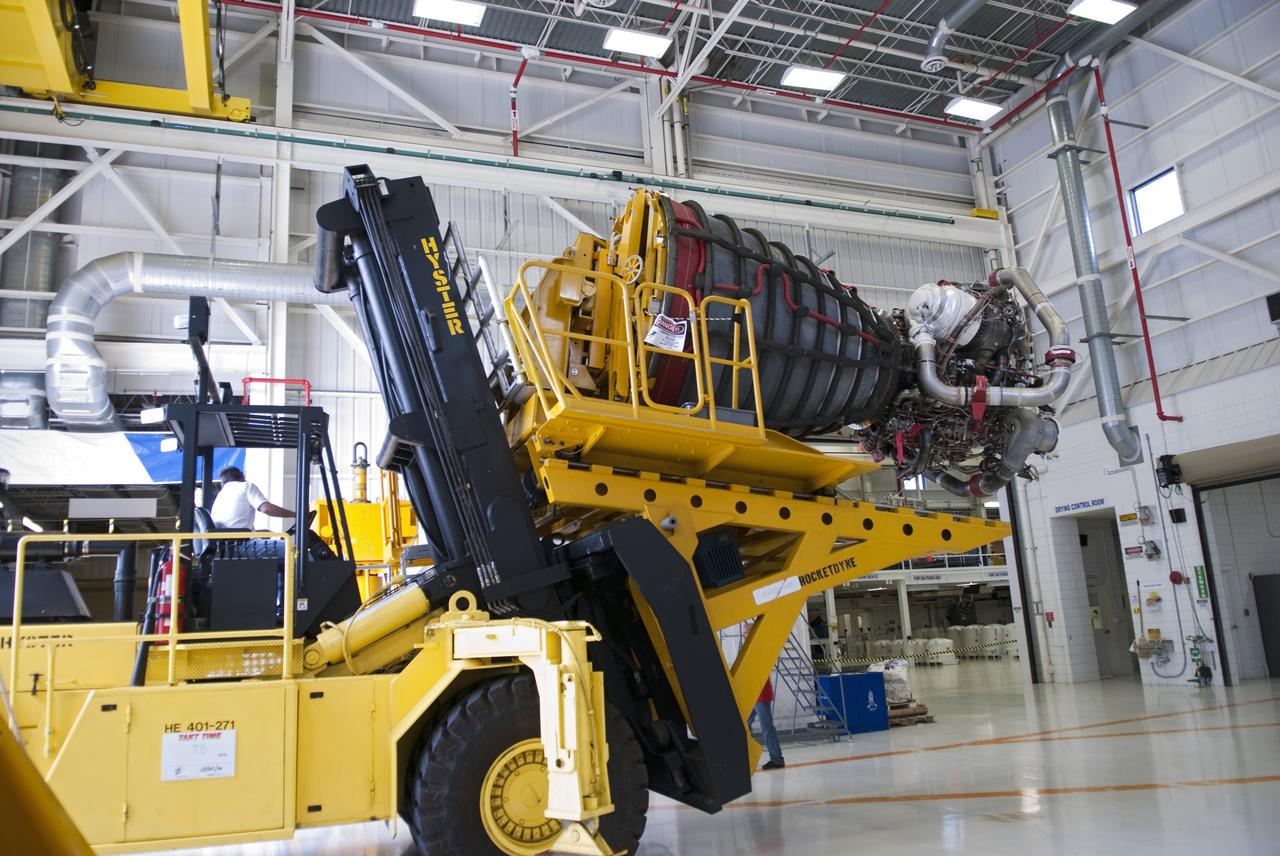
CAPE CANAVERAL, Fla. -- A heavy forklift with its specialized engine installer carries one of the main engines taken from space shuttle Discovery into the Space Shuttle Main Engine Processing Facility at NASA's Kennedy Space Center in Florida. The transition and retirement processing is expected to help rocket designers build next-generation spacecraft and prepare the shuttle for display. Photo credit: NASA/Jim Grossmann
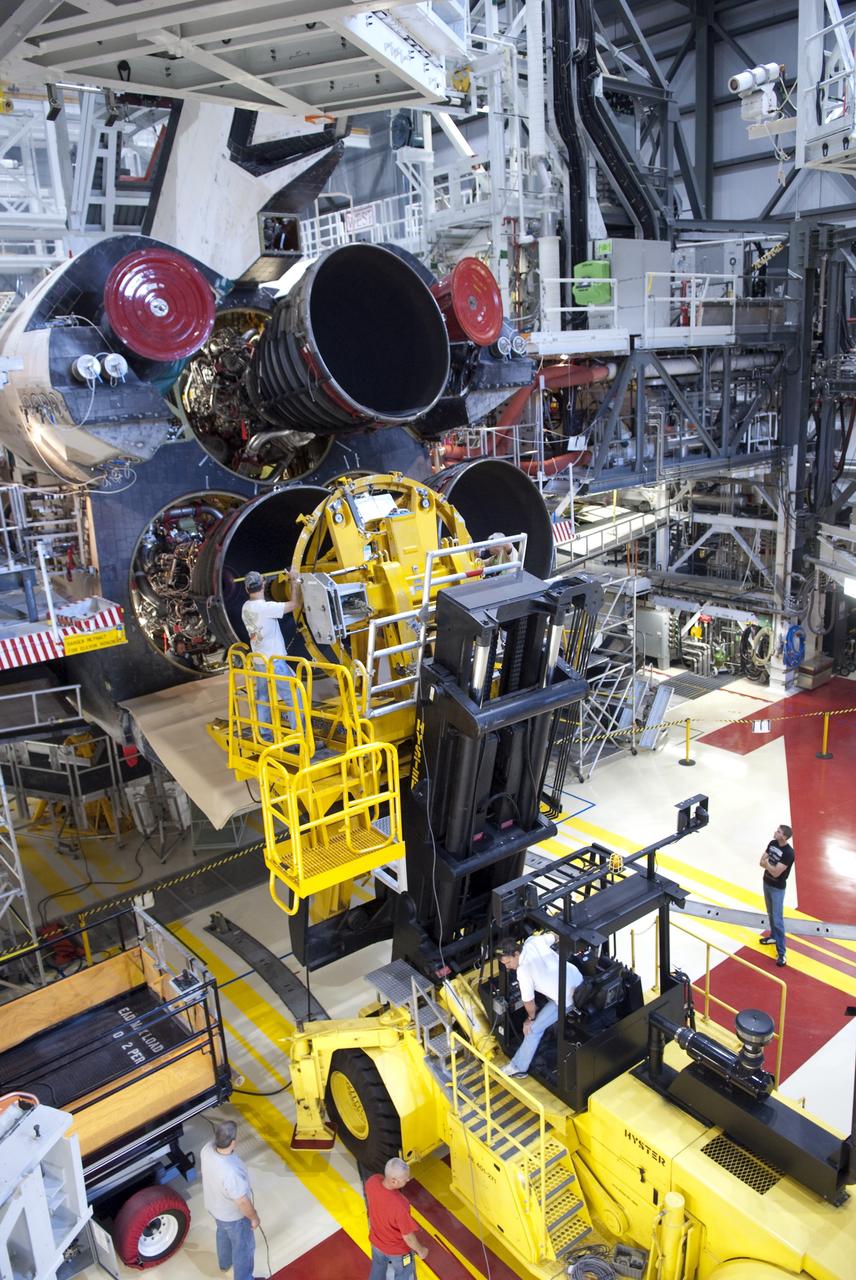
CAPE CANAVERAL, Fla. -- Technicians guide the specialized engine installer into place so it can be connected to a main engine on space shuttle Discovery and remove it safely. The work is taking place in Orbiter Processing Facility-2 at NASA's Kennedy Space Center in Florida. The transition and retirement processing is expected to help rocket designers build next-generation spacecraft and prepare the shuttle for display. Photo credit: NASA/Jim Grossmann
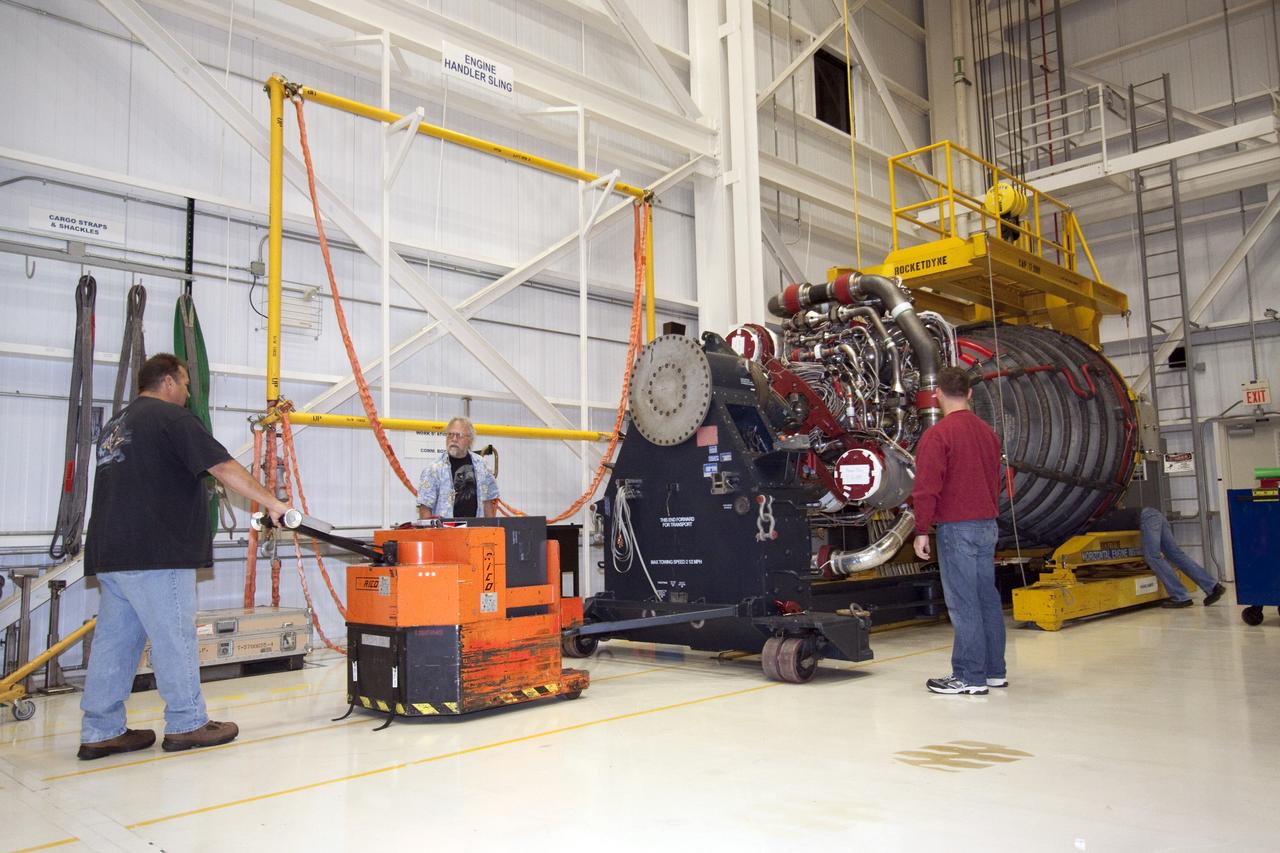
CAPE CANAVERAL, Fla. - Space shuttle main engine No. 2, which was removed from shuttle Discovery, will undergo routine inspections on a work stand in the Space Shuttle Main Engine Processing Facility at NASA's Kennedy Space Center in Florida. The removal was part of Discovery's transition and retirement processing. Work performed on Discovery is expected to help rocket designers build next-generation spacecraft and prepare the shuttle for future public display. Photo credit: NASA/Jack Pfaller
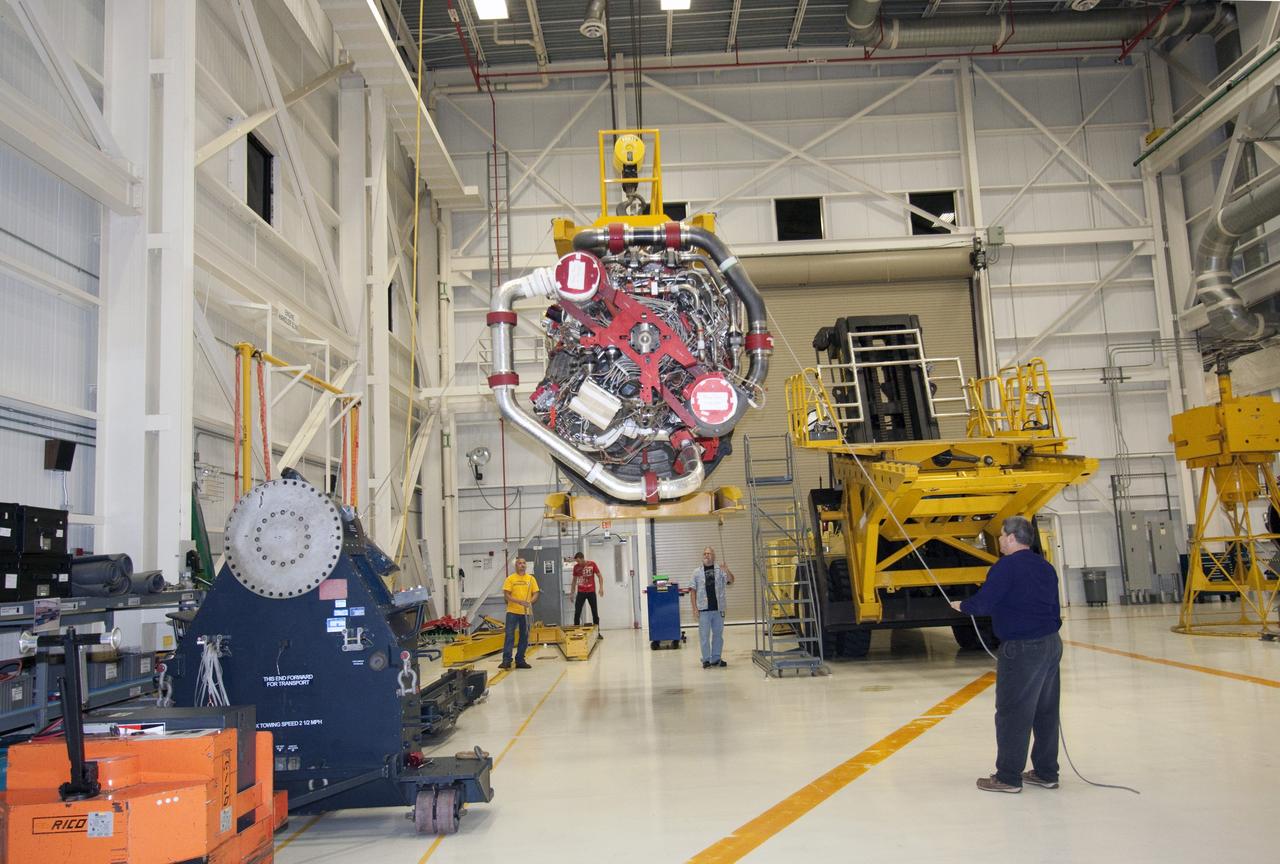
CAPE CANAVERAL, Fla. - Space shuttle main engine No. 2, which was removed from shuttle Discovery, is moved to a work stand for routine inspections in the Space Shuttle Main Engine Processing Facility at NASA's Kennedy Space Center in Florida. The removal was part of Discovery's transition and retirement processing. Work performed on Discovery is expected to help rocket designers build next-generation spacecraft and prepare the shuttle for future public display. Photo credit: NASA/Jack Pfaller
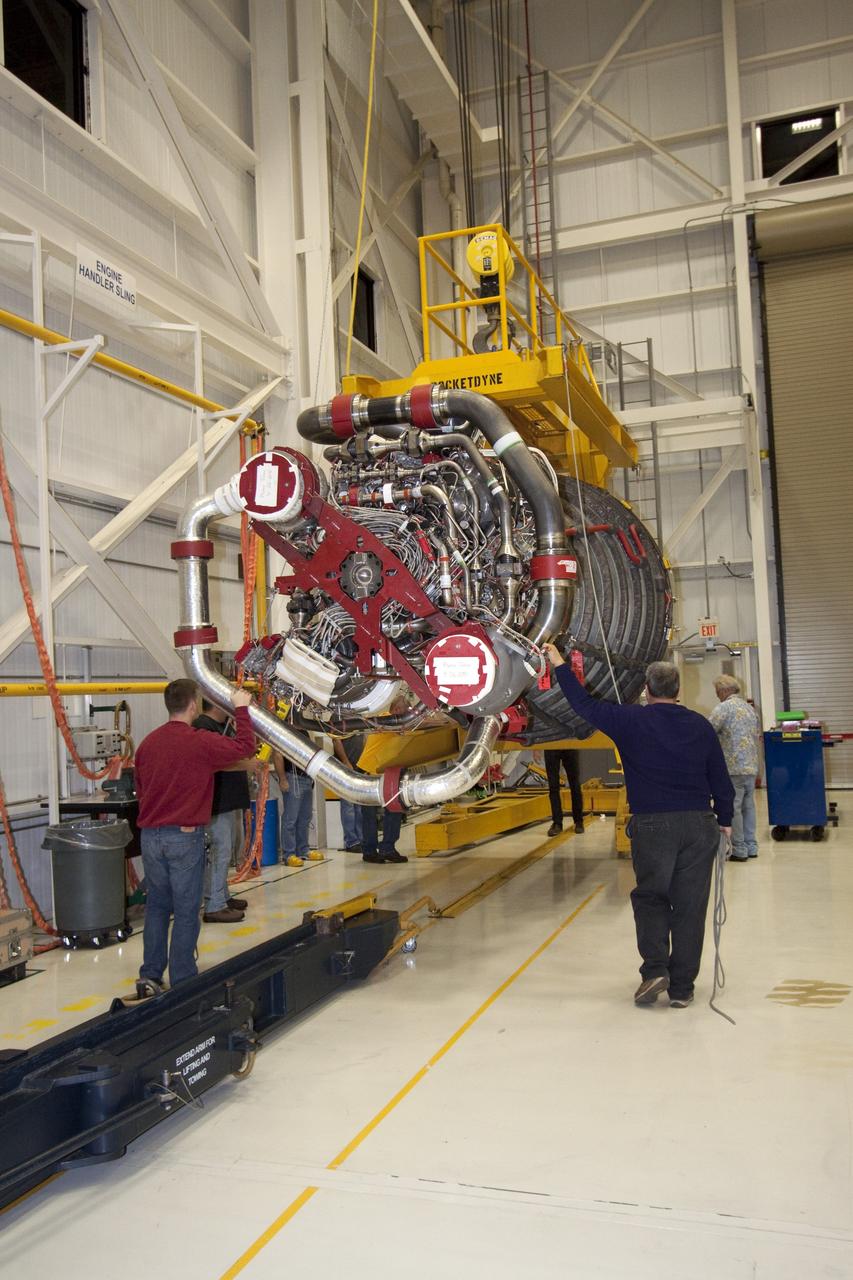
CAPE CANAVERAL, Fla. - Space shuttle main engine No. 2, which was removed from shuttle Discovery, is moved to a work stand for routine inspections in the Space Shuttle Main Engine Processing Facility at NASA's Kennedy Space Center in Florida. The removal was part of Discovery's transition and retirement processing. Work performed on Discovery is expected to help rocket designers build next-generation spacecraft and prepare the shuttle for future public display. Photo credit: NASA/Jack Pfaller
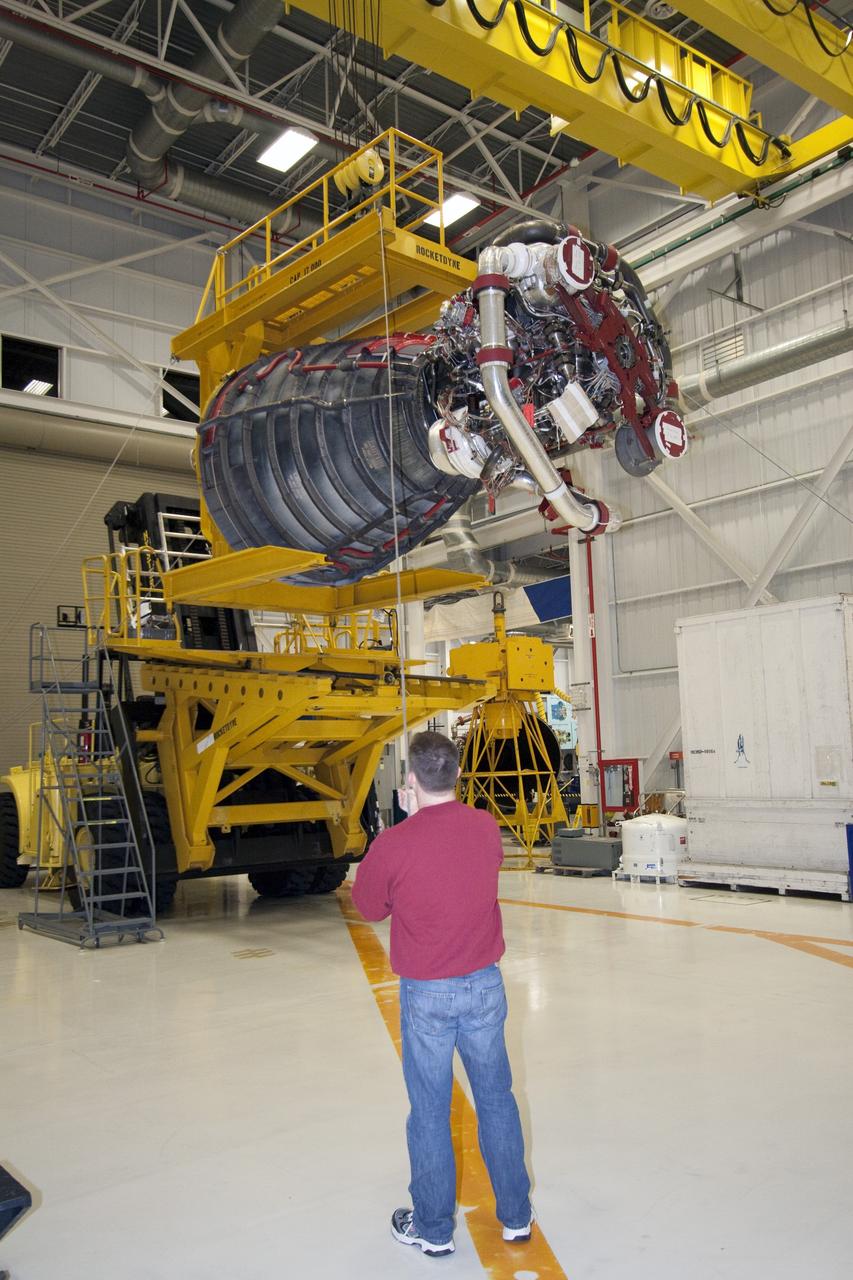
CAPE CANAVERAL, Fla. - Space shuttle main engine No. 2, which was removed from shuttle Discovery, is moved to a work stand for routine inspections in the Space Shuttle Main Engine Processing Facility at NASA's Kennedy Space Center in Florida. The removal was part of Discovery's transition and retirement processing. Work performed on Discovery is expected to help rocket designers build next-generation spacecraft and prepare the shuttle for future public display. Photo credit: NASA/Jack Pfaller
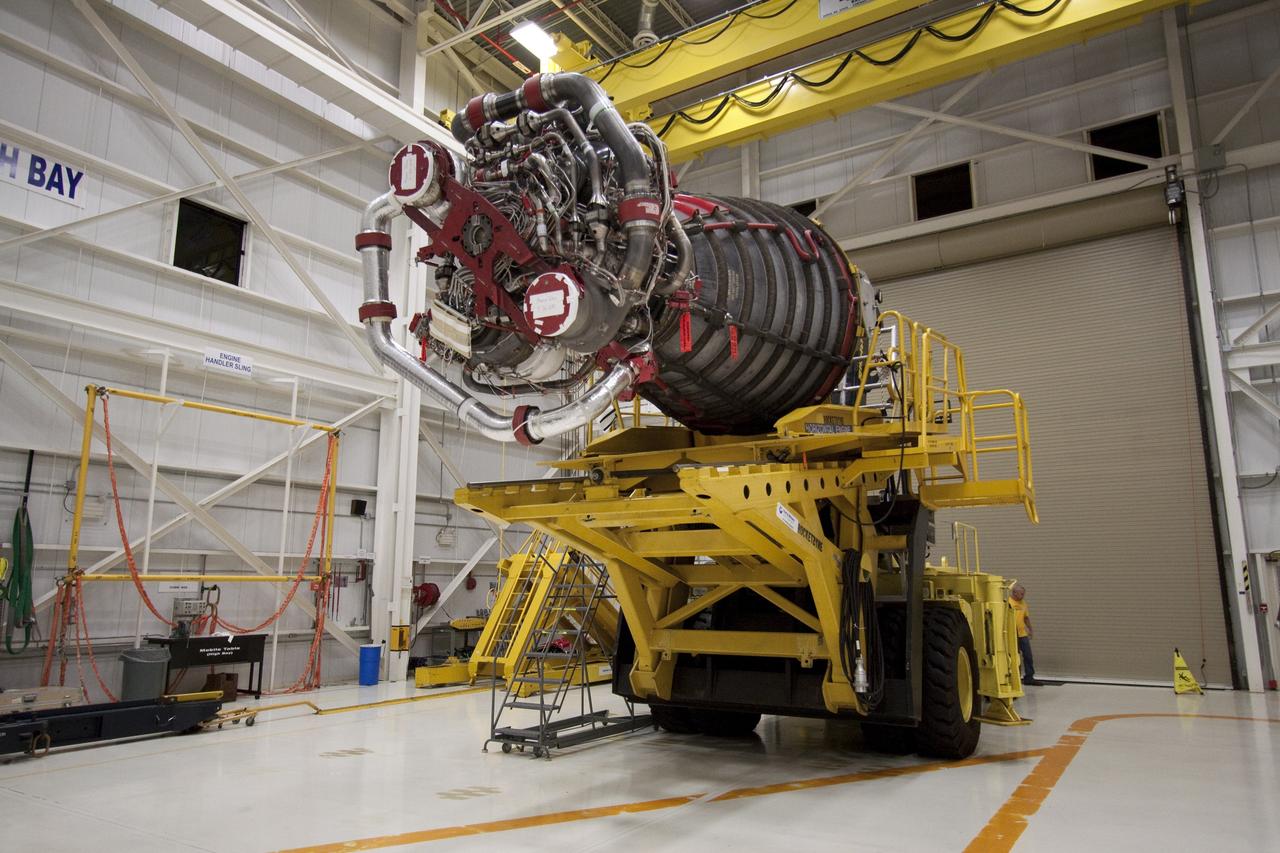
CAPE CANAVERAL, Fla. - Space shuttle main engine No. 2, which was removed from shuttle Discovery, will undergo standard inspections in the Space Shuttle Main Engine Processing Facility at NASA's Kennedy Space Center in Florida. The removal was part of Discovery's transition and retirement processing. Work performed on Discovery is expected to help rocket designers build next-generation spacecraft and prepare the shuttle for future public display. Photo credit: NASA/Jack Pfaller
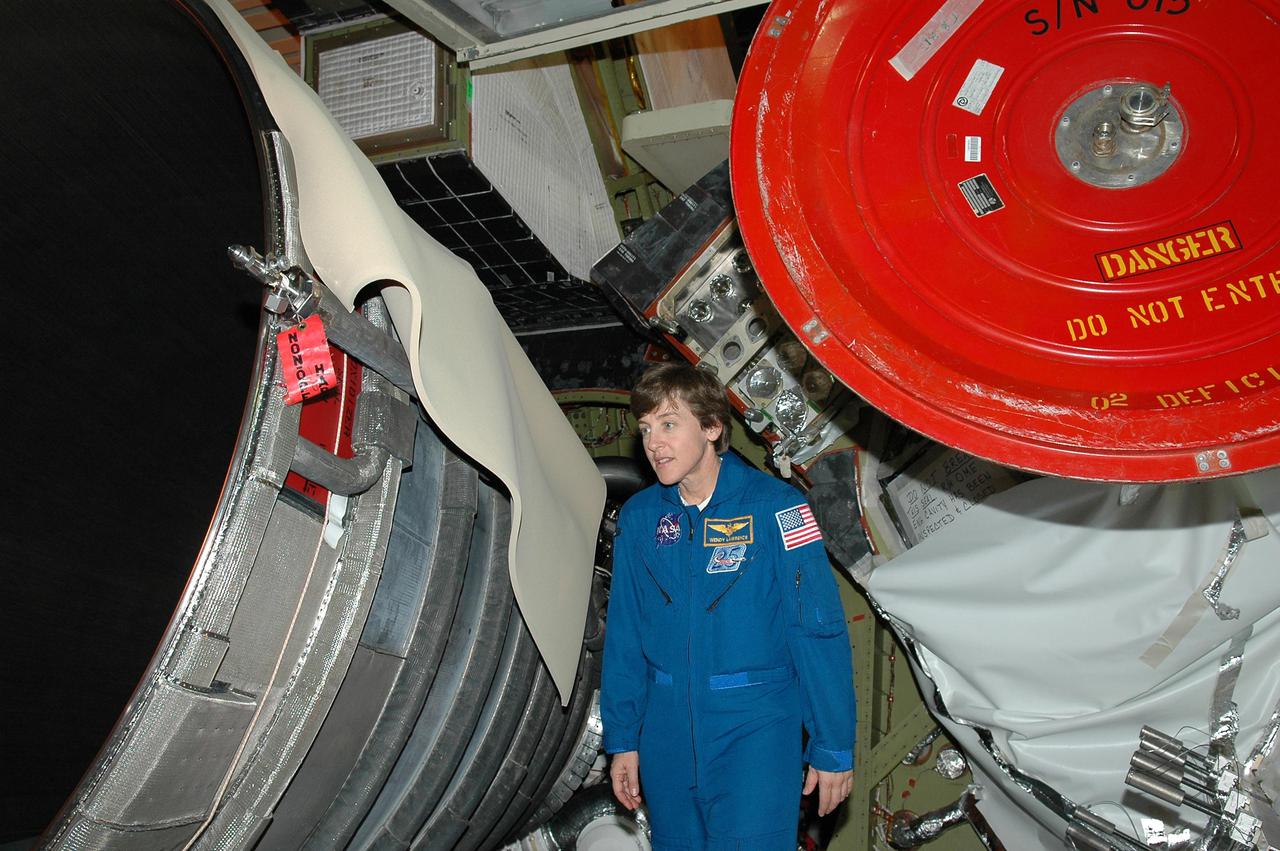
KENNEDY SPACE CENTER, FLA. - On a visit to Kennedy, STS-114 Mission Specialist Wendy Lawrence looks at an area of an engine on the orbiter Discovery. The main engines were recently installed. The designated vehicle for the mission, Discovery is in the Orbiter Processing Facility for launch processing. Discovery is scheduled for a launch planning window of May 12 to June 3, 2005.
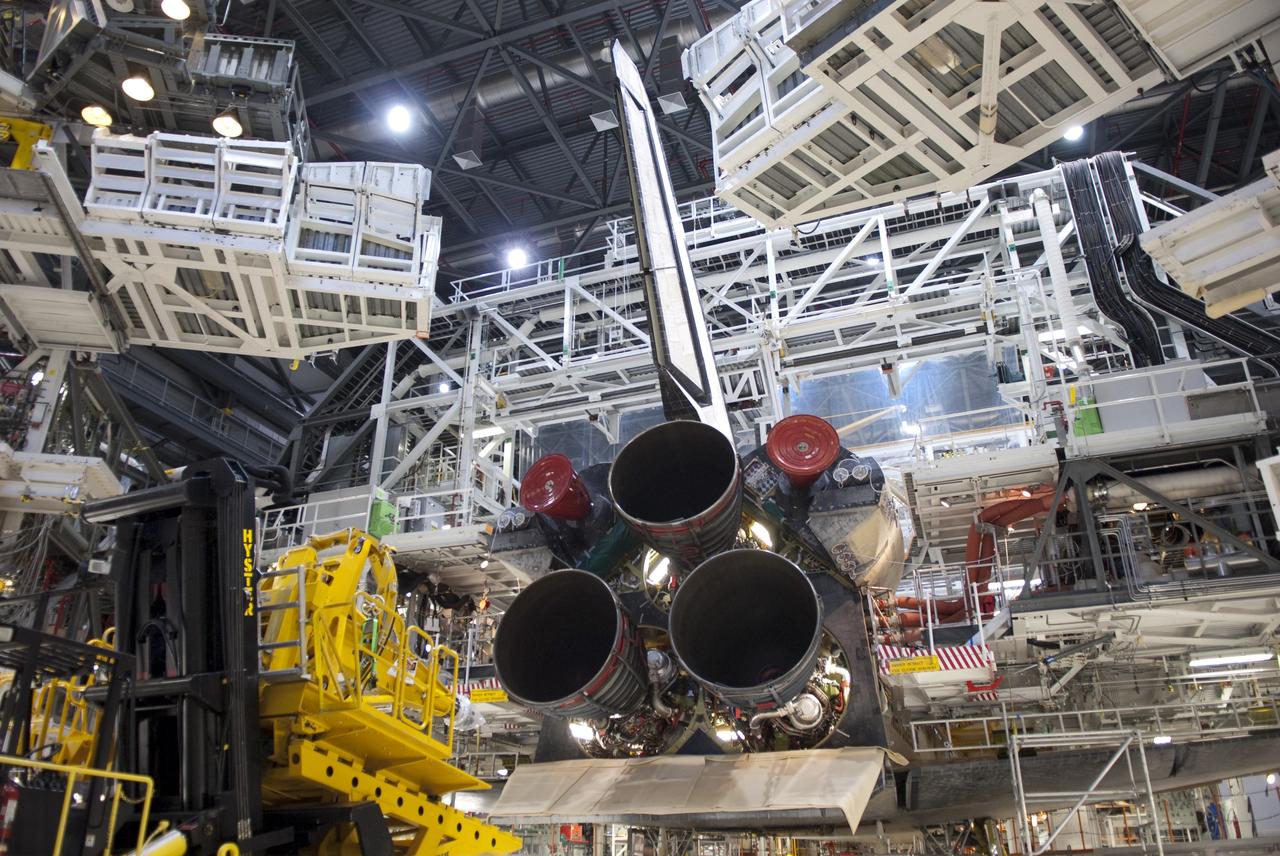
CAPE CANAVERAL, Fla. -- The specialized engine installer is moved near space shuttle Discovery as technicians prepare to remove the three main engines from the orbiter. The work is taking place in Orbiter Processing Facility-2 at NASA's Kennedy Space Center in Florida. The transition and retirement processing is expected to help rocket designers build next-generation spacecraft and prepare the shuttle for display. Photo credit: NASA/Jim Grossmann
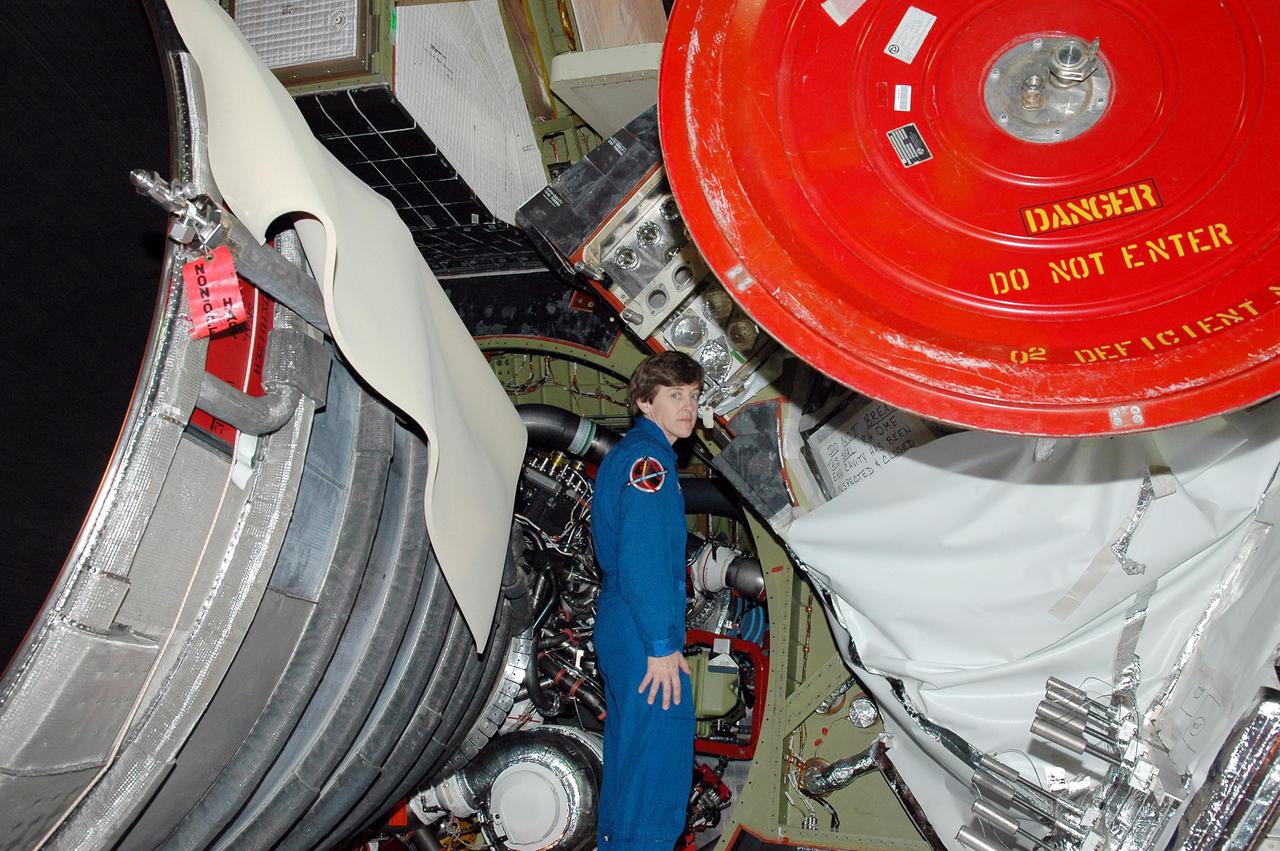
KENNEDY SPACE CENTER, FLA. - On a visit to Kennedy, STS-114 Mission Specialist Wendy Lawrence looks at an area of an engine on the orbiter Discovery. The main engines were recently installed. The designated vehicle for the mission, Discovery is in the Orbiter Processing Facility for launch processing. Discovery is scheduled for a launch planning window of May 12 to June 3, 2005.
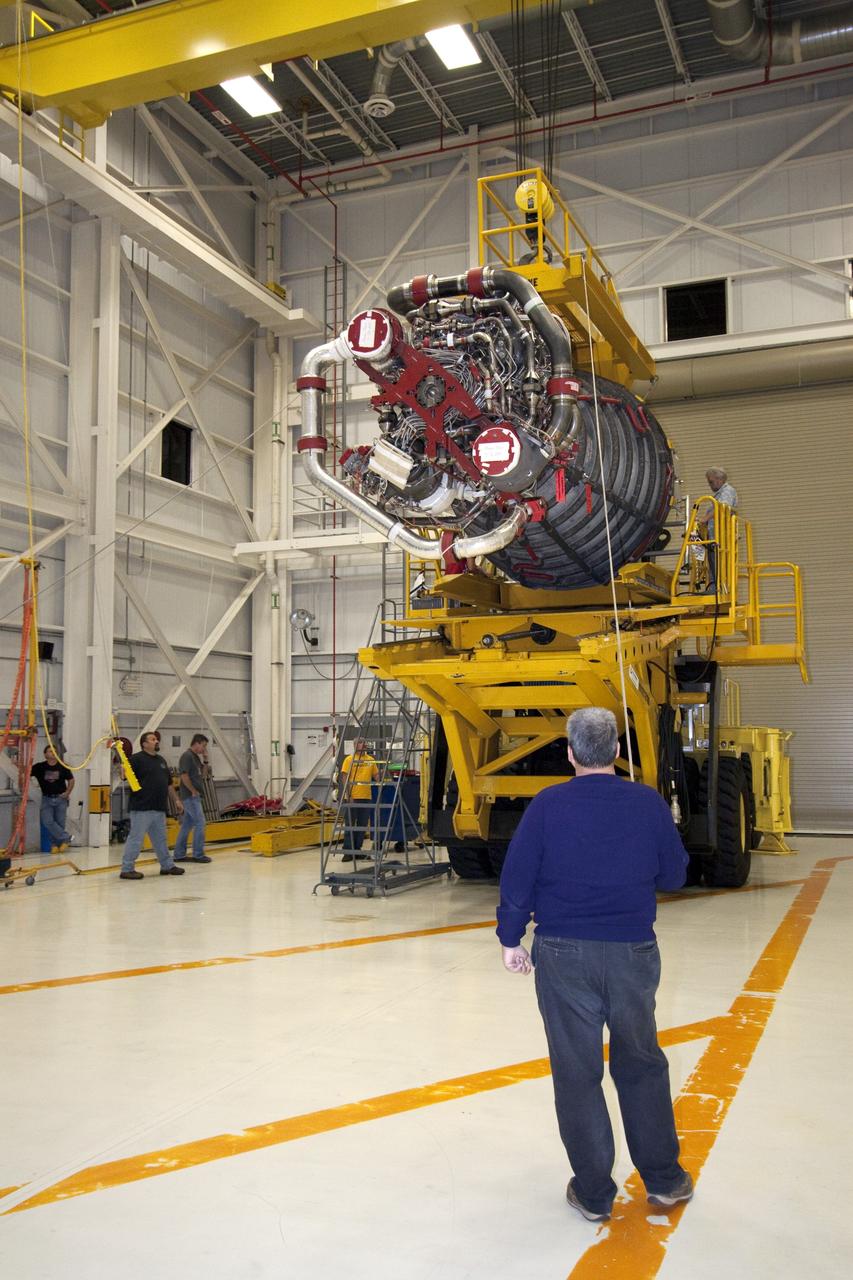
CAPE CANAVERAL, Fla. - Space shuttle main engine No. 2, which was removed from shuttle Discovery, will undergo standard inspections in the Space Shuttle Main Engine Processing Facility at NASA's Kennedy Space Center in Florida. The removal was part of Discovery's transition and retirement processing. Work performed on Discovery is expected to help rocket designers build next-generation spacecraft and prepare the shuttle for future public display. Photo credit: NASA/Jack Pfaller
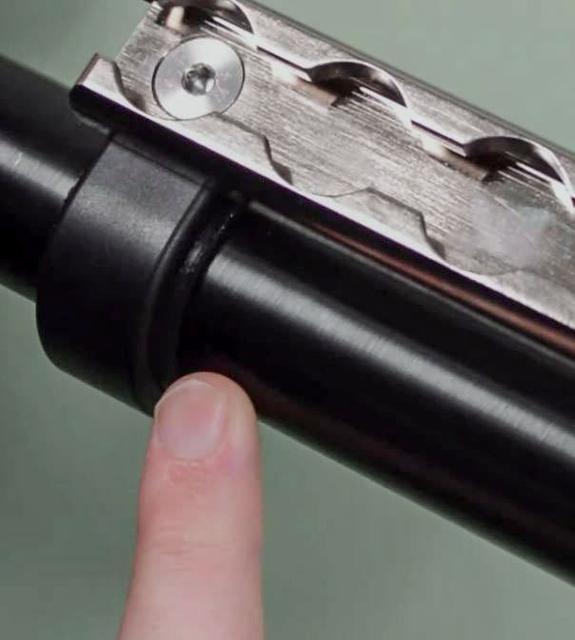
jsc2023e010183 (2/28/2023) --- The High school students United with NASA to Create Hardware (HUNCH) Ball Clamp Monopod (HUNCH Ball Clamp Monopod) investigation aims to test a temporary but stable platform for holding cameras, making camera operations easier and faster for the International Space Station crew. This hardware was designed and developed by HUNCH students using engineering design processes. They produced elements such as Computer Aided Design (CAD) drawings, CAD study models, and 3D printed engineering evaluation units on parts such as this insert that allow the seat track clamp to be positioned. Image courtesy of HUNCH.
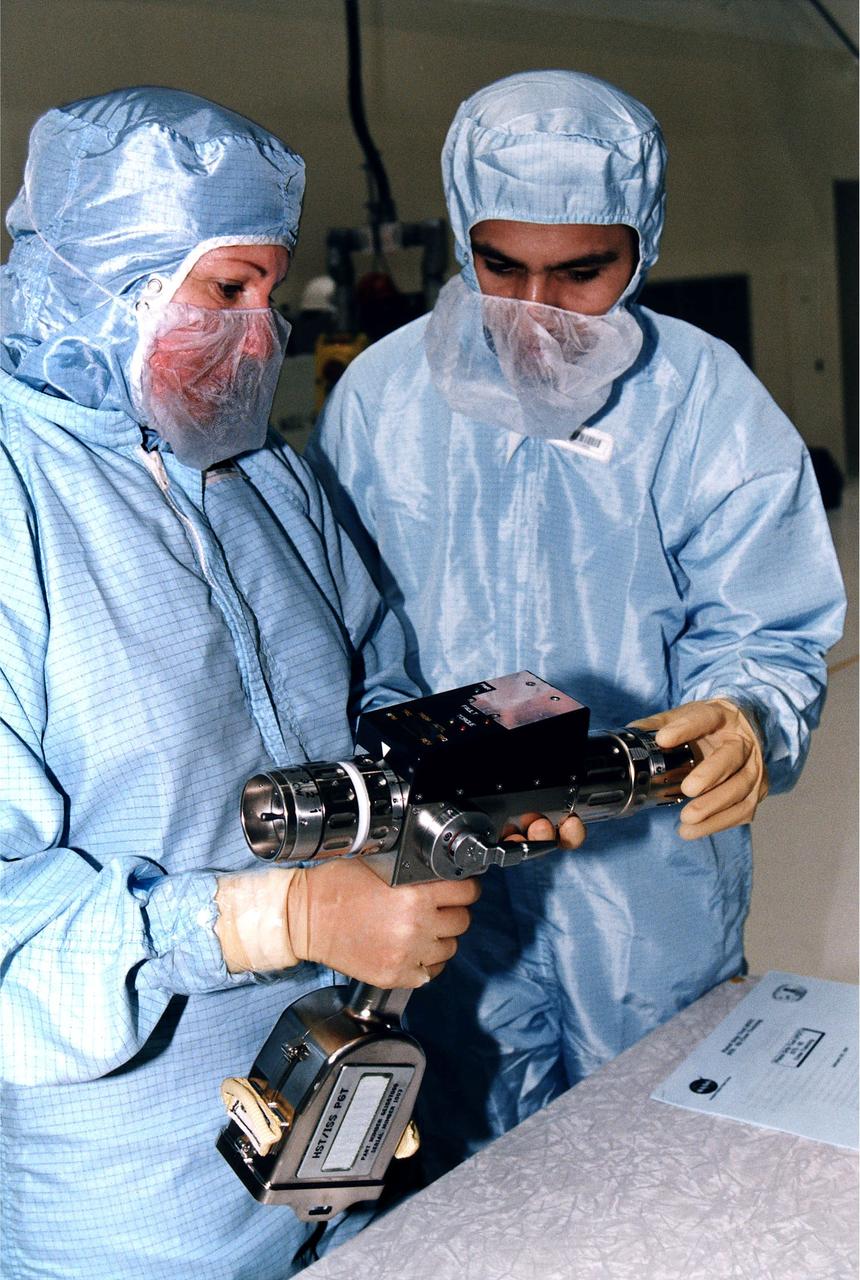
KENNEDY SPACE CENTER, FLA. - In KSC's Vertical Processing Facility, Louise Kleba of the Vehicle Integration Test Team (VITT) and engineer Devin Tailor of Goddard Space Flight Center examine the Pistol Grip Tool (PGT), which was designed for use by astronauts during spacewalks. The PGT is a self-contained, micro-processor controlled, battery-powered tool. It also can be used as a nonpowered ratchet wrench. The experiences of the astronauts on the first Hubble Space Telescope (HST) servicing mission led to recommendations for this smaller, more efficient tool for precision work during spacewalks. The PGT will be used on the second HST servicing mission, STS-82. Liftoff aboard Discovery is scheduled Feb. 11.
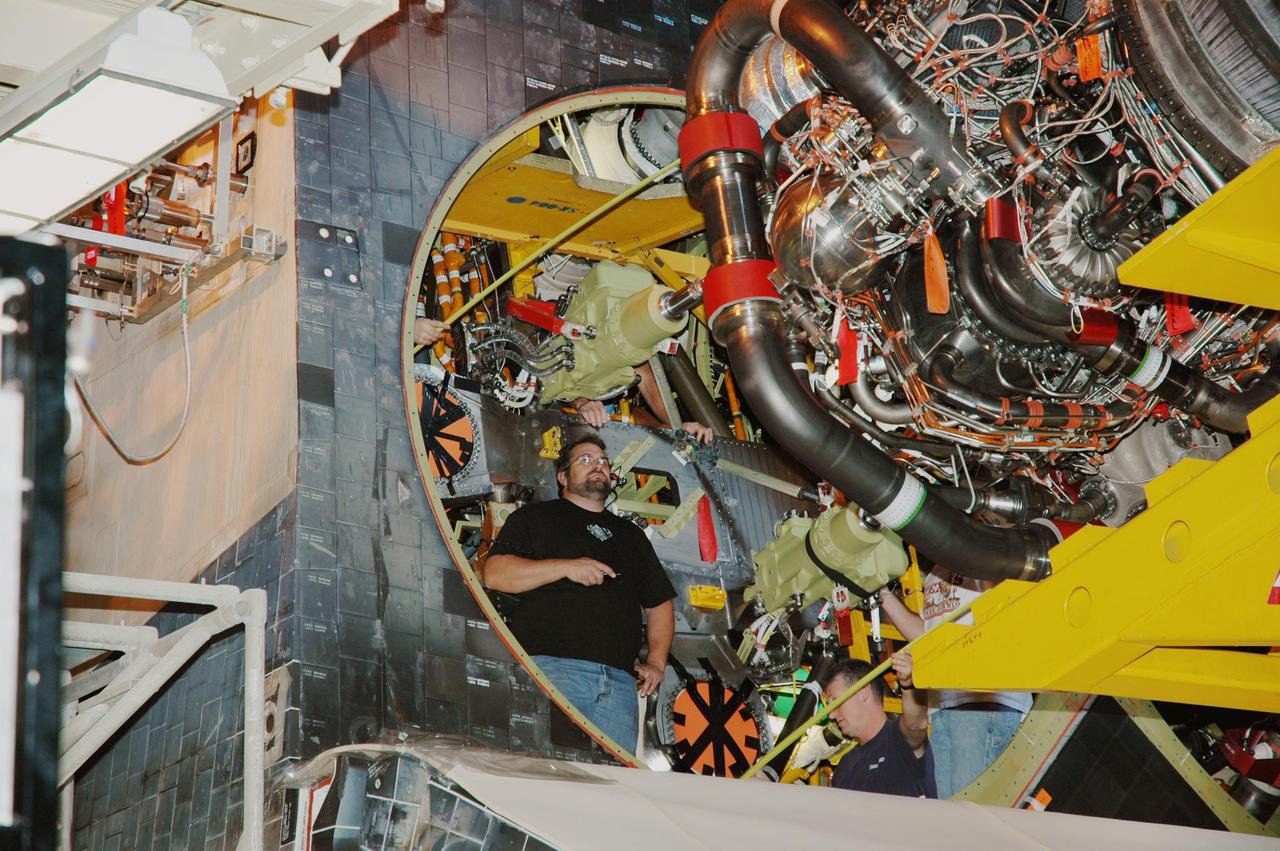
KENNEDY SPACE CENTER, FLA. - In the Orbiter Processing Facility, a technician watches closely as the third Space Shuttle Main Engine (SSME) is moved into position behind Discovery for installation. Discovery is designated as the Return to Flight vehicle for mission STS-114. Recent improvements to the SSME include the introduction of redesigned high-pressure turbopumps into the SSME fleet. The new pumps are designed and built by Pratt and Whitney at West Palm Beach, Fla. SSMEs and the Pratt and Whitney turbopumps are tested at Stennis Space Center in Mississippi. Engines and engine components are delivered to Kennedy Space Center to be prepared for flight.
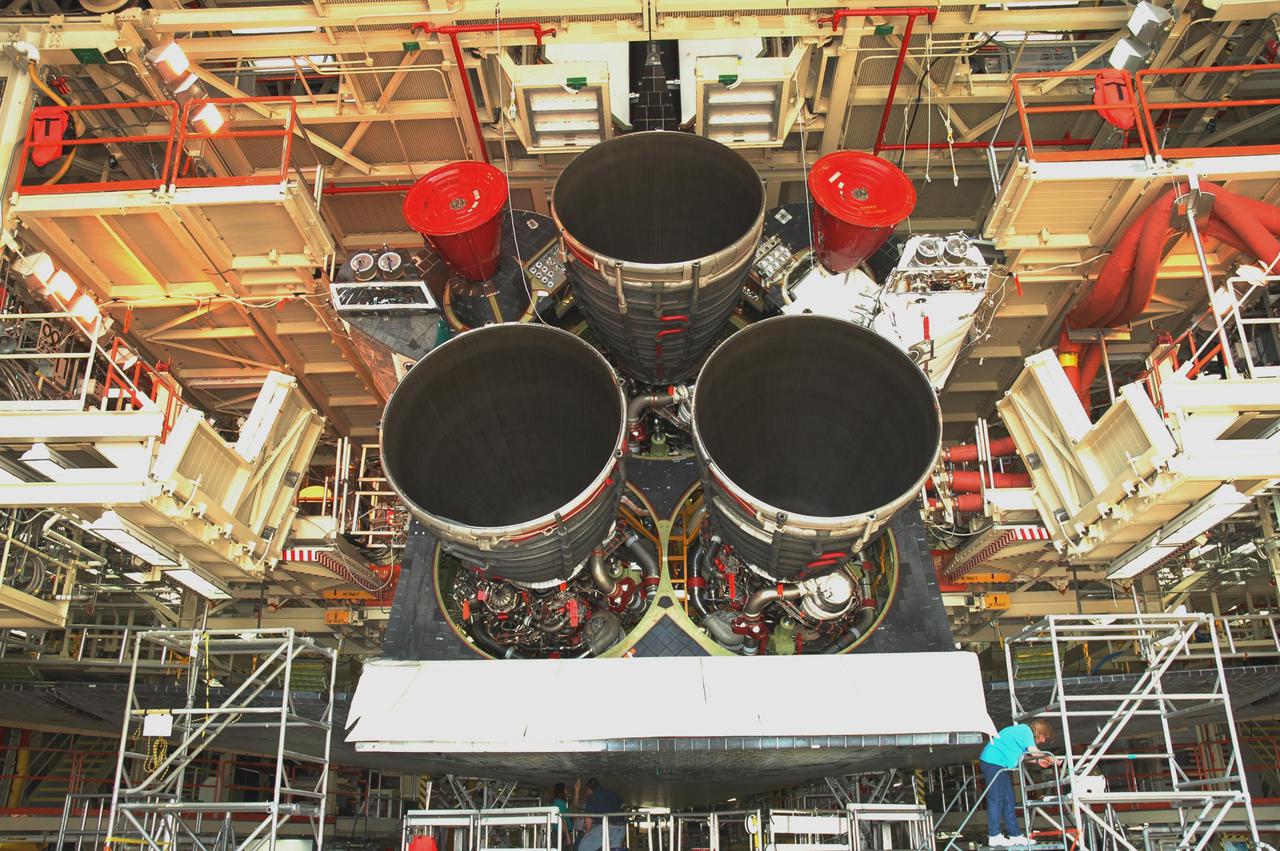
KENNEDY SPACE CENTER, FLA. - In the Orbiter Processing Facility, the aft of Discovery is shown with all three Space Shuttle Main Engines (SSMEs) installed. Discovery is designated as the Return to Flight vehicle for mission STS-114. Recent improvements to the SSME include the introduction of redesigned high-pressure turbopumps into the SSME fleet. The new pumps are designed and built by Pratt and Whitney at West Palm Beach, Fla. SSMEs and the Pratt and Whitney turbopumps are tested at Stennis Space Center in Mississippi. Engines and engine components are delivered to Kennedy Space Center to be prepared for flight.
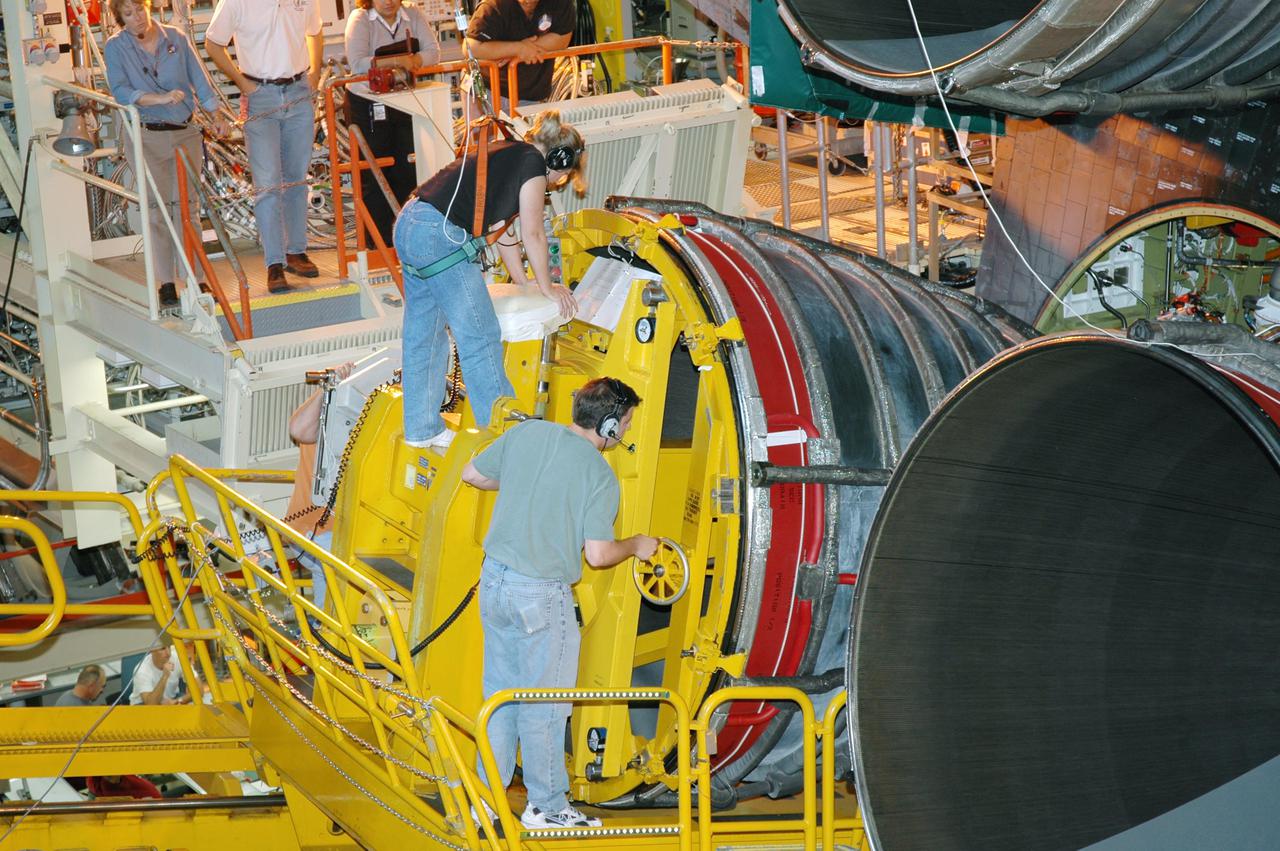
KENNEDY SPACE CENTER, FLA. - Technicians in the Orbiter Processing Facility carefully maneuver the third Space Shuttle Main Engine (SSME) into place on Discovery. Discovery is designated as the Return to Flight vehicle for mission STS-114. Recent improvements to the SSME include the introduction of redesigned high-pressure turbopumps into the SSME fleet. The new pumps are designed and built by Pratt and Whitney at West Palm Beach, Fla. SSMEs and the Pratt and Whitney turbopumps are tested at Stennis Space Center in Mississippi. Engines and engine components are delivered to Kennedy Space Center to be prepared for flight.
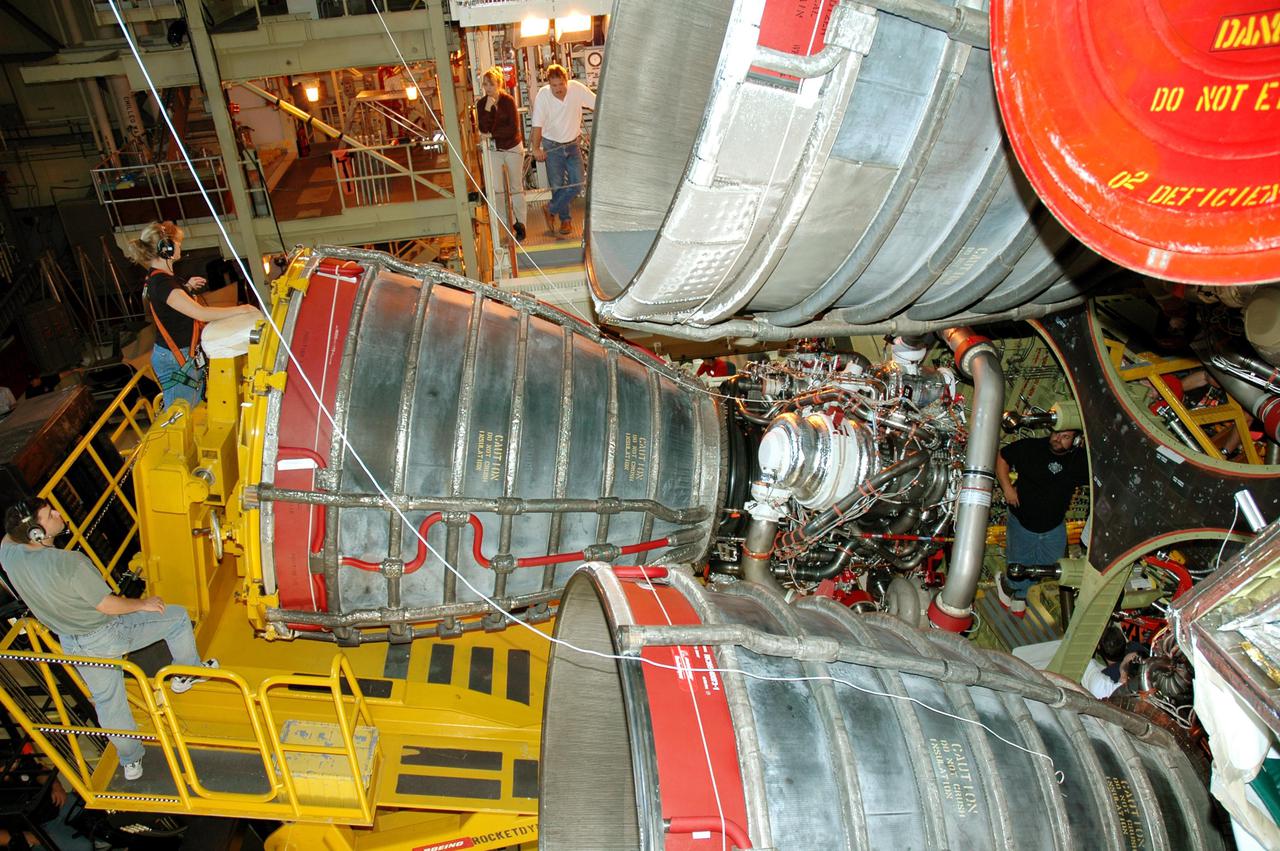
KENNEDY SPACE CENTER, FLA. - Workers in the Orbiter Processing Facility carefully guide the placement of the third Space Shuttle Main Engine (SSME) for installation on Discovery. Discovery is designated as the Return to Flight vehicle for mission STS-114. Recent improvements to the SSME include the introduction of redesigned high-pressure turbopumps into the SSME fleet. The new pumps are designed and built by Pratt and Whitney at West Palm Beach, Fla. SSMEs and the Pratt and Whitney turbopumps are tested at Stennis Space Center in Mississippi. Engines and engine components are delivered to Kennedy Space Center to be prepared for flight.
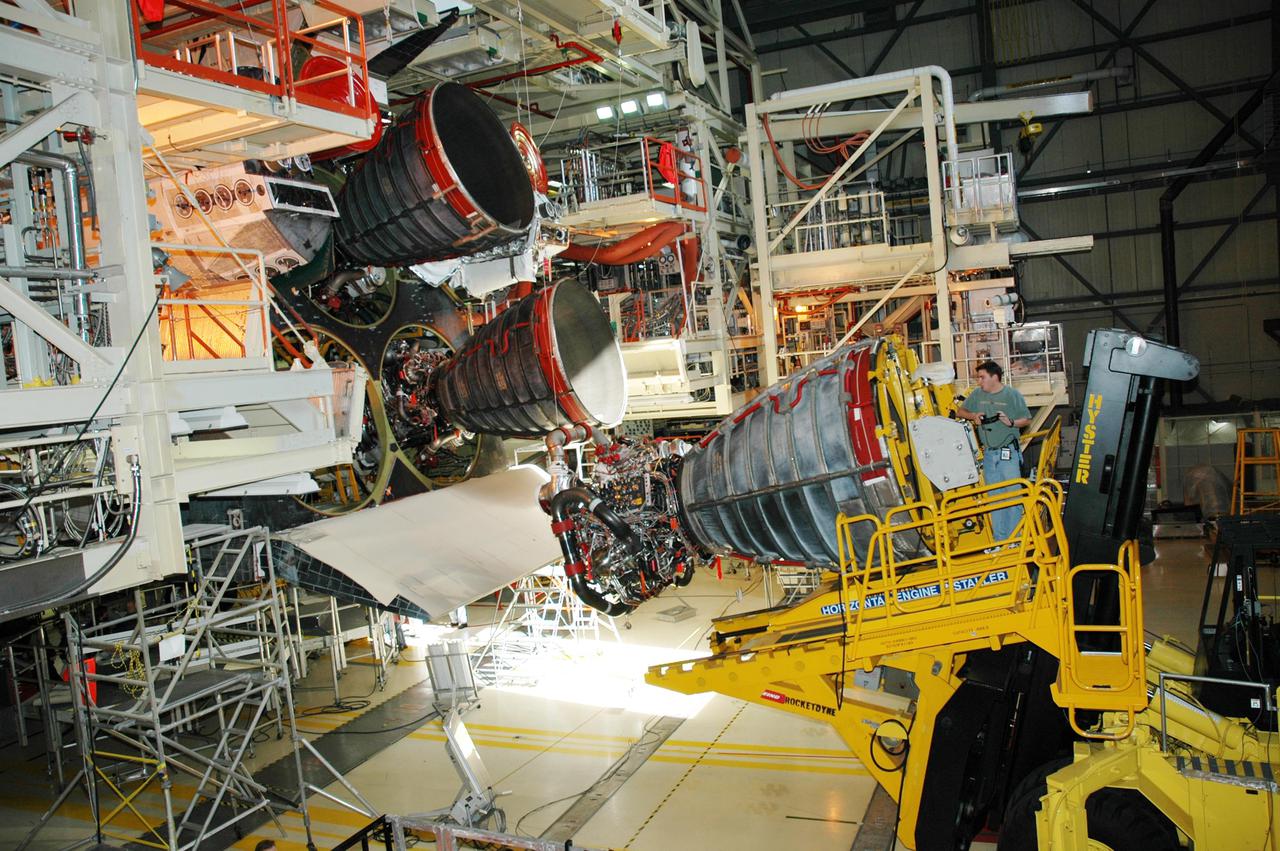
KENNEDY SPACE CENTER, FLA. - In the Orbiter Processing Facility, the Hyster lift at right moves the third Space Shuttle Main Engine (SSME) into position behind Discovery for installation. Discovery is designated as the Return to Flight vehicle for mission STS-114. Recent improvements to the SSME include the introduction of redesigned high-pressure turbopumps into the SSME fleet. The new pumps are designed and built by Pratt and Whitney at West Palm Beach, Fla. SSMEs and the Pratt and Whitney turbopumps are tested at Stennis Space Center in Mississippi. Engines and engine components are delivered to Kennedy Space Center to be prepared for flight.
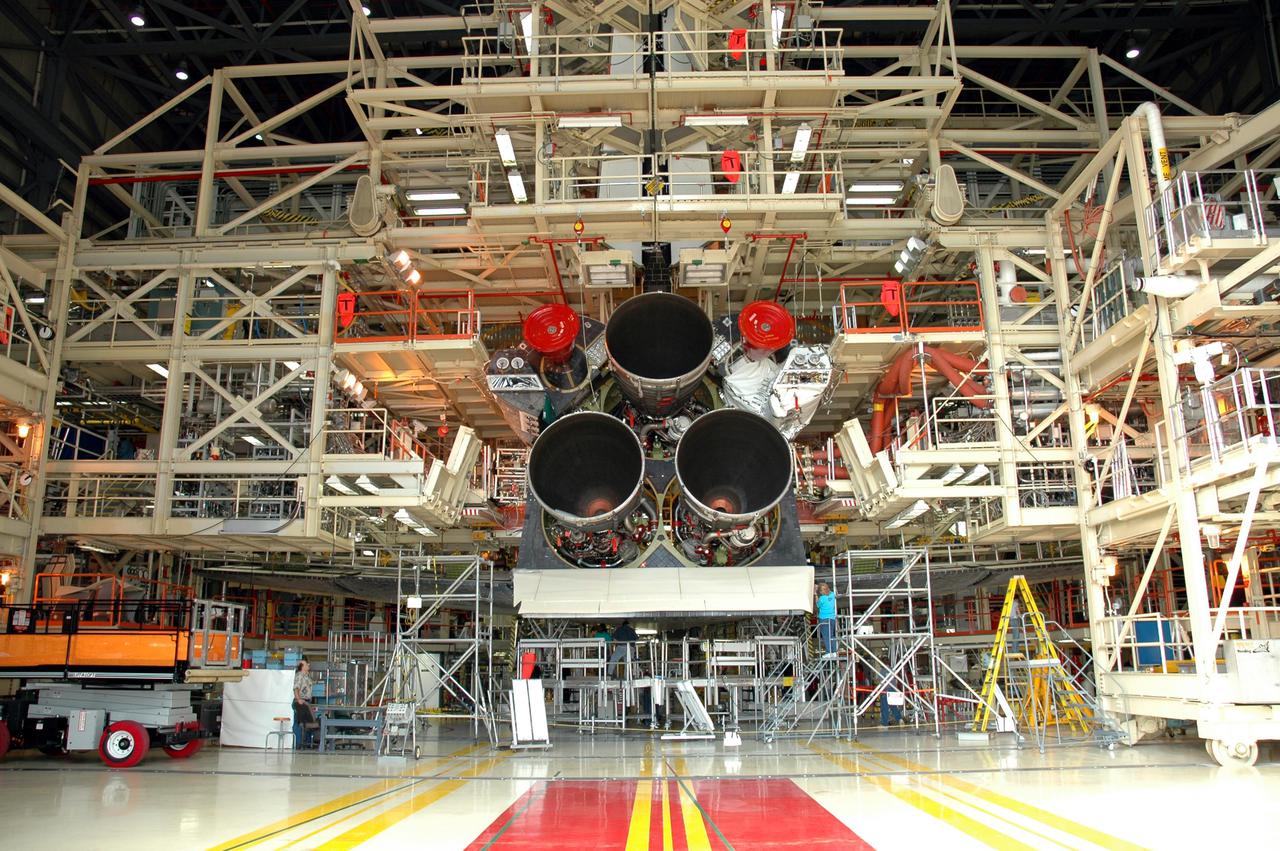
KENNEDY SPACE CENTER, FLA. - In the Orbiter Processing Facility, the aft of Discovery is shown after the third Space Shuttle Main Engine (SSME) was installed. Discovery is designated as the Return to Flight vehicle for mission STS-114. Recent improvements to the SSME include the introduction of redesigned high-pressure turbopumps into the SSME fleet. The new pumps are designed and built by Pratt and Whitney at West Palm Beach, Fla. SSMEs and the Pratt and Whitney turbopumps are tested at Stennis Space Center in Mississippi. Engines and engine components are delivered to Kennedy Space Center to be prepared for flight.
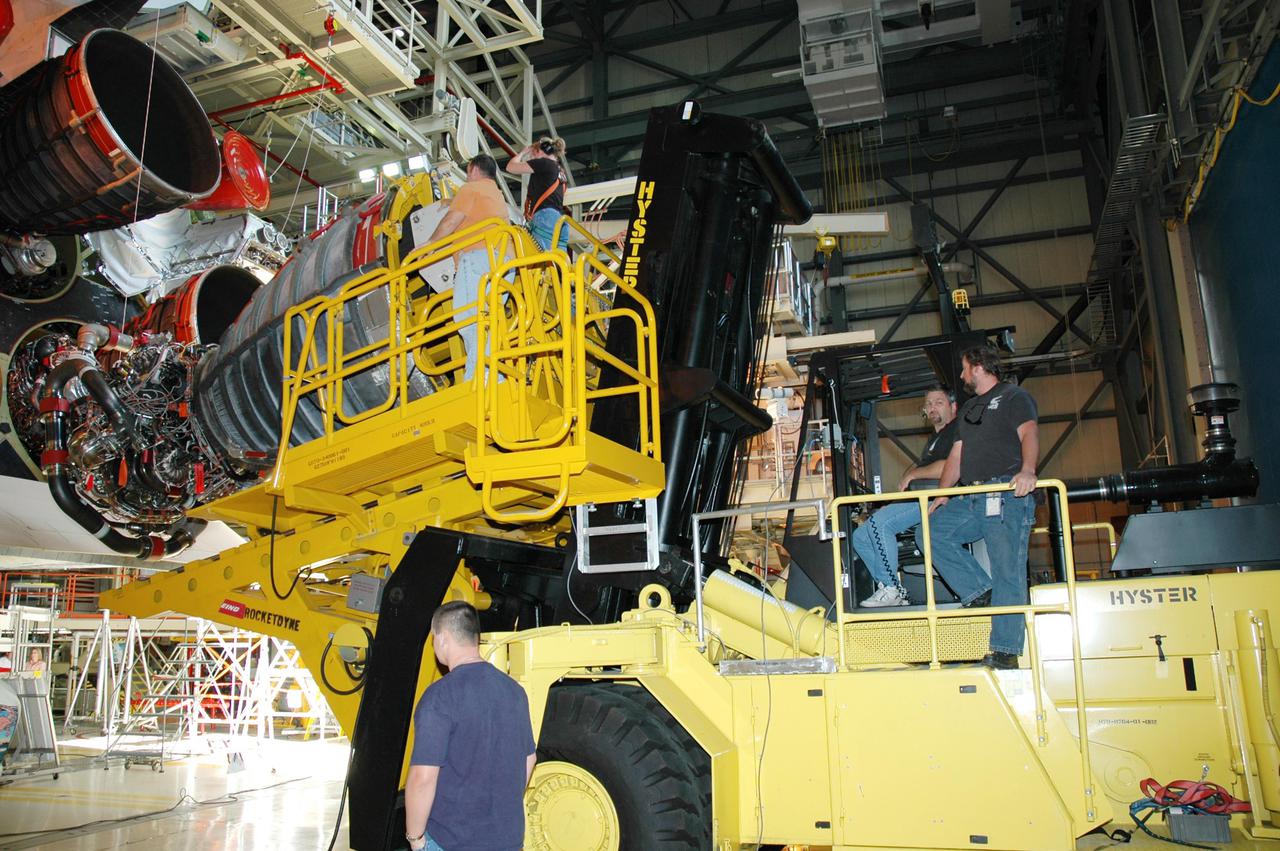
KENNEDY SPACE CENTER, FLA. - In the Orbiter Processing Facility, the Hyster lift raises the third Space Shuttle Main Engine (SSME) into position behind Discovery for installation. Discovery is designated as the Return to Flight vehicle for mission STS-114. Recent improvements to the SSME include the introduction of redesigned high-pressure turbopumps into the SSME fleet. The new pumps are designed and built by Pratt and Whitney at West Palm Beach, Fla. SSMEs and the Pratt and Whitney turbopumps are tested at Stennis Space Center in Mississippi. Engines and engine components are delivered to Kennedy Space Center to be prepared for flight.
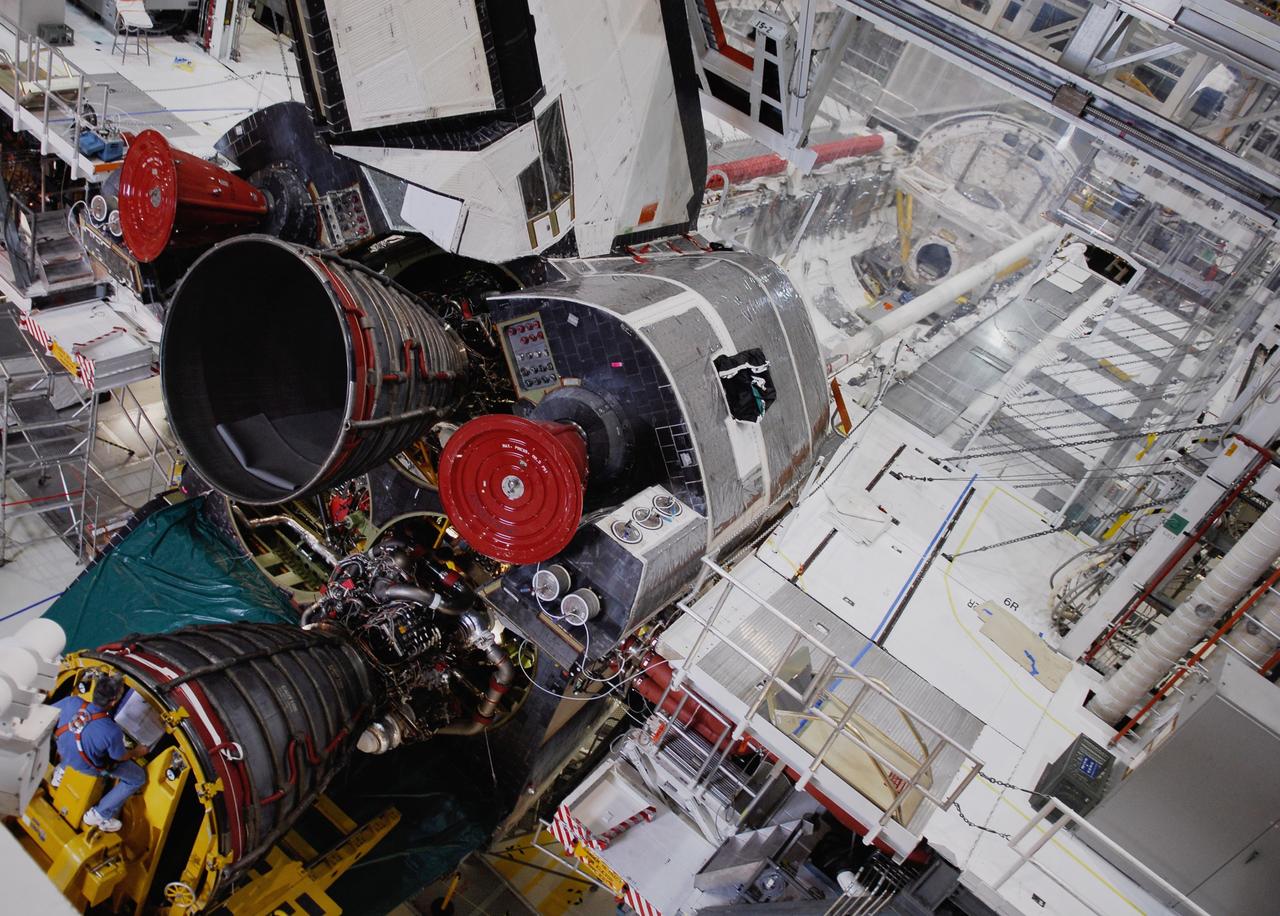
CAPE CANAVERAL, Fla. – In Orbiter Processing Facility bay No. 1, the technician on the engine installer moves a shuttle main engine toward the opening in space shuttle Atlantis. A pitch-and-yaw system helps maneuver the engine into place. Main engine No. 1 has already been installed. Atlantis is the designated vehicle for the STS-125 mission to service the Hubble Space Telescope. Launch is targeted for Oct. 8. Photo credit: NASA/Kim Shiflett
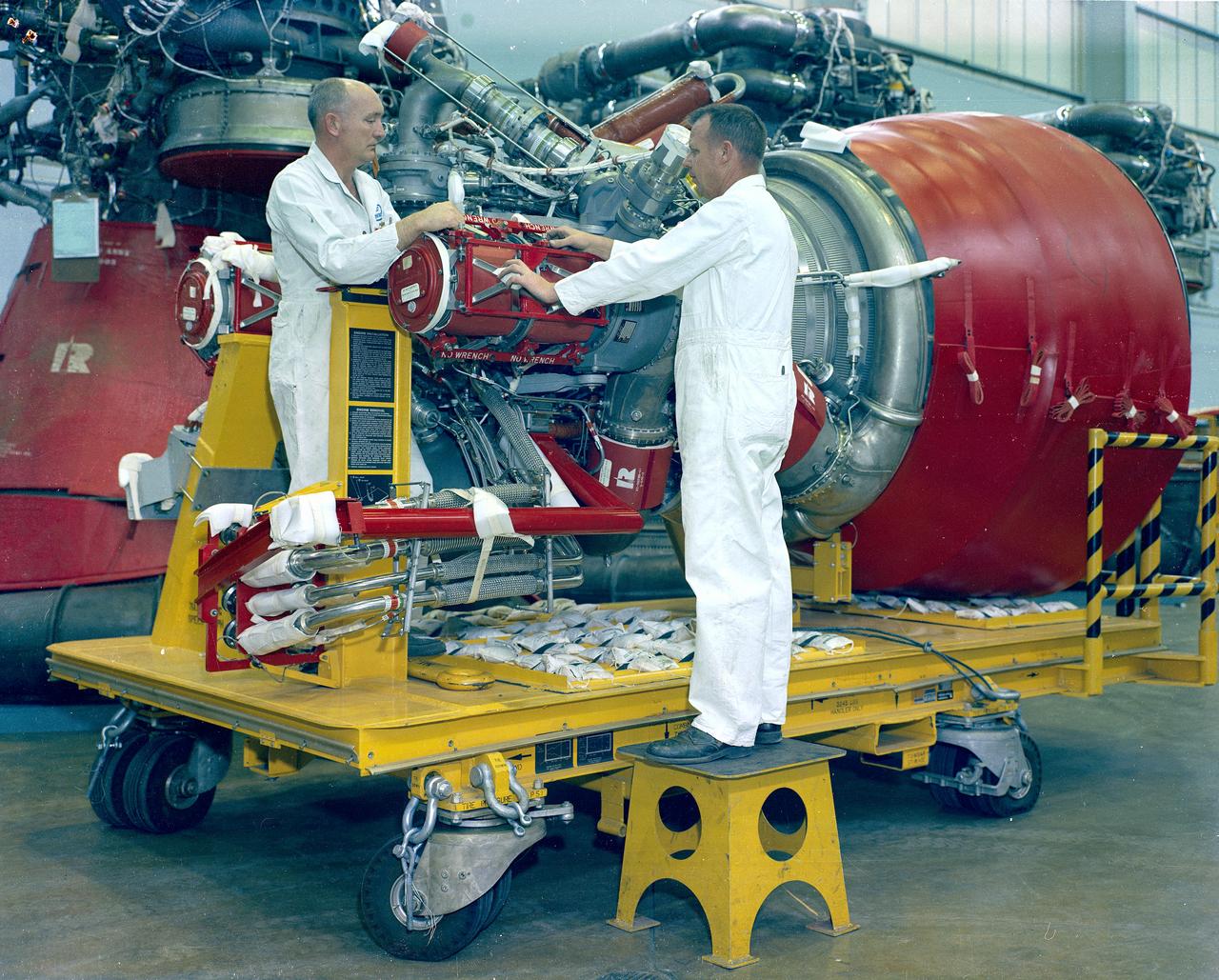
Pictured is a J-2 engine being processed at Marshall Space Flight Center (MSFC). A single J-2 engine was utilized on the S-IVB stage, the second stage of the Saturn IB and the third stage of the Saturn V vehicles, while a cluster of five J-2 engines powered the second (S-II) stage of the Saturn V launch vehicle. The Saturn V was designed, developed, and tested by engineers at MSFC.

CAPE CANAVERAL, Fla. – In Orbiter Processing Facility bay No. 1, the technician on the engine installer moves a shuttle main engine into the opening in space shuttle Atlantis. A pitch-and-yaw system helps maneuver the engine into place. Main engine No. 1 has already been installed. Atlantis is the designated vehicle for the STS-125 mission to service the Hubble Space Telescope. Launch is targeted for Oct. 8. Photo credit: NASA/Kim Shiflett
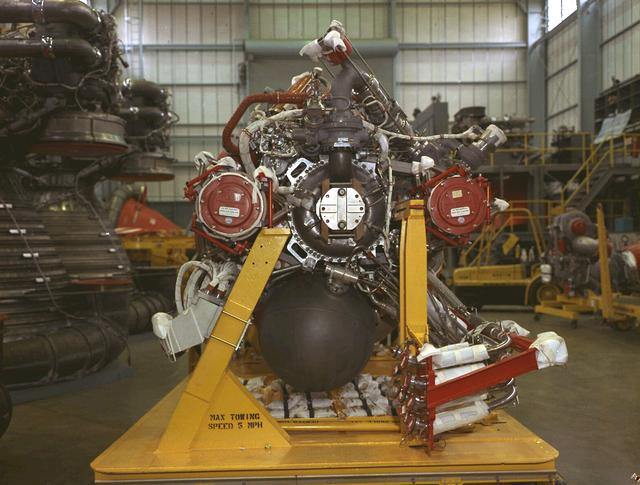
Pictured is a J-2 engine being processed at Marshall Space Flight Center (MSFC). A single J-2 engine was utilized on the S-IVB stage, the second stage of the Saturn IB and the third stage of the Saturn V vehicles, while a cluster of five J-2 engines powered the second (S-II) stage of the Saturn V launch vehicle. The Saturn V was designed, developed, and tested by engineers at MSFC.
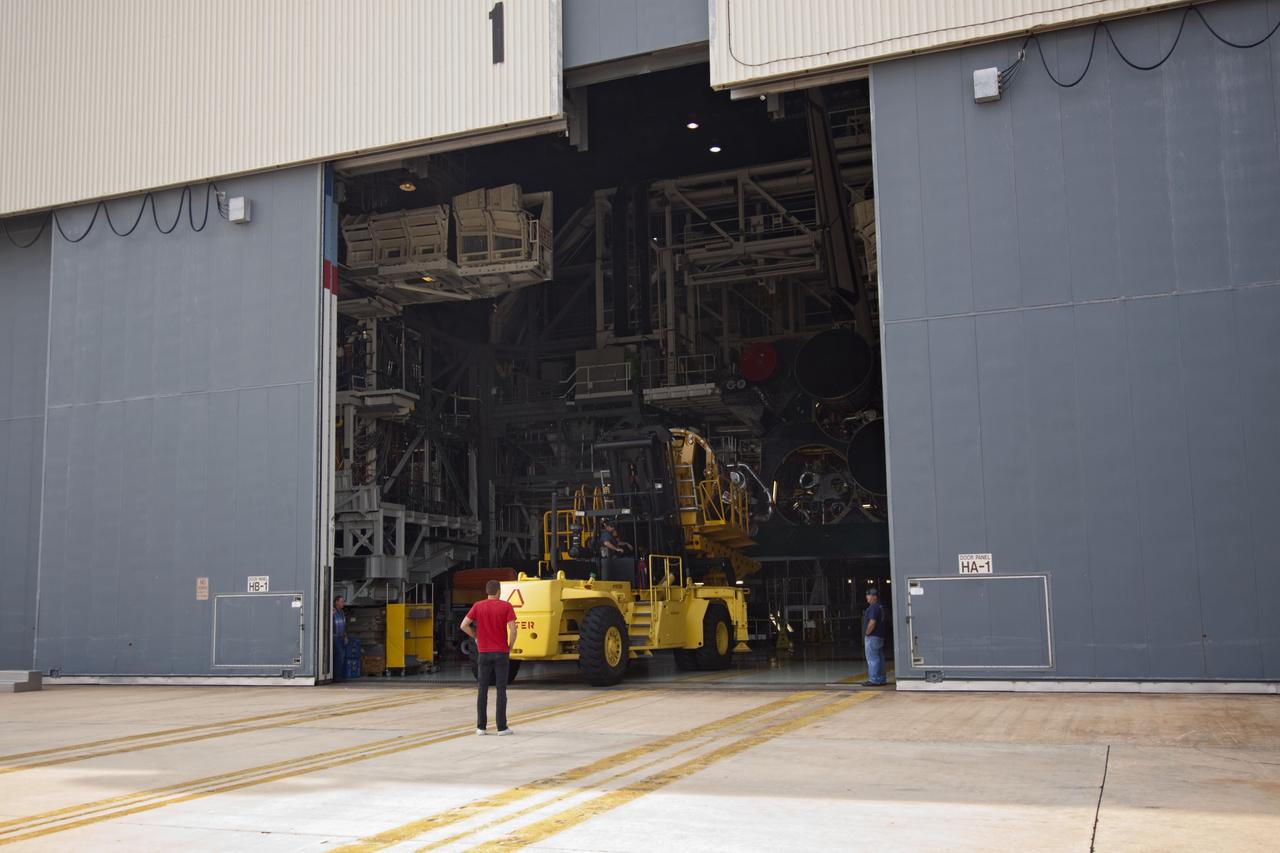
CAPE CANAVERAL, Fla. -- In Orbiter Processing Facility-1 at NASA's Kennedy Space Center in Florida, technicians have removed engine No. 2, one of three space shuttle main engines from Endeavour, using a specially designed engine installer, called a Hyster forklift. The removal is part of Endeavour's transition and retirement processing. Endeavour is being prepared for public display at the California Science Center in Los Angeles. Endeavour flew 25 missions, spent 299 days in space, orbited Earth 4,671 times and traveled 122,883,151 miles over the course of its 19-year career. Photo credit: NASA/Jim Grossmann
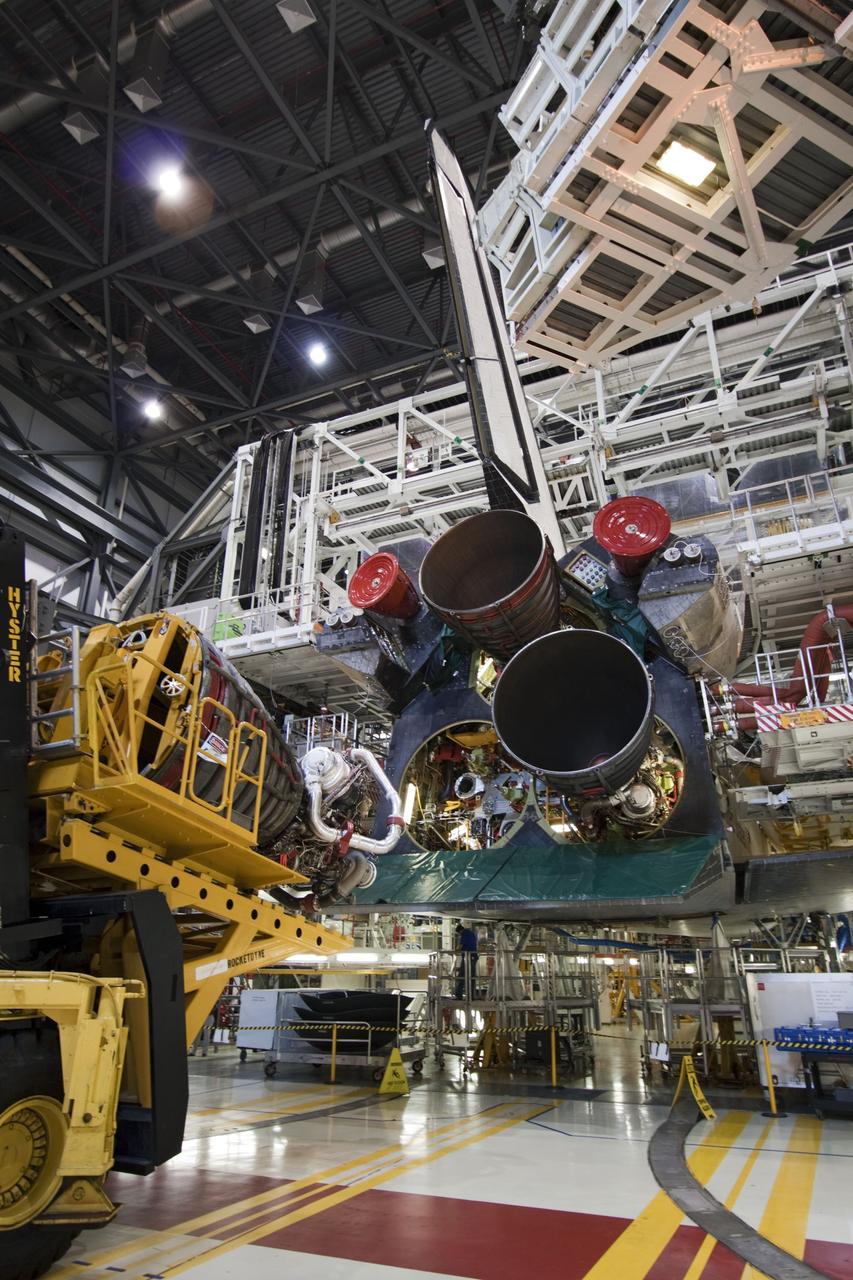
CAPE CANAVERAL, Fla. -- In Orbiter Processing Facility-1 at NASA's Kennedy Space Center in Florida, technicians carefully remove engine No. 2, one of three space shuttle main engines from Endeavour, using a specially designed engine installer, called a Hyster forklift. The removal is part of Endeavour's transition and retirement processing. Endeavour is being prepared for public display at the California Science Center in Los Angeles. Endeavour flew 25 missions, spent 299 days in space, orbited Earth 4,671 times and traveled 122,883,151 miles over the course of its 19-year career. Photo credit: NASA/Jim Grossmann
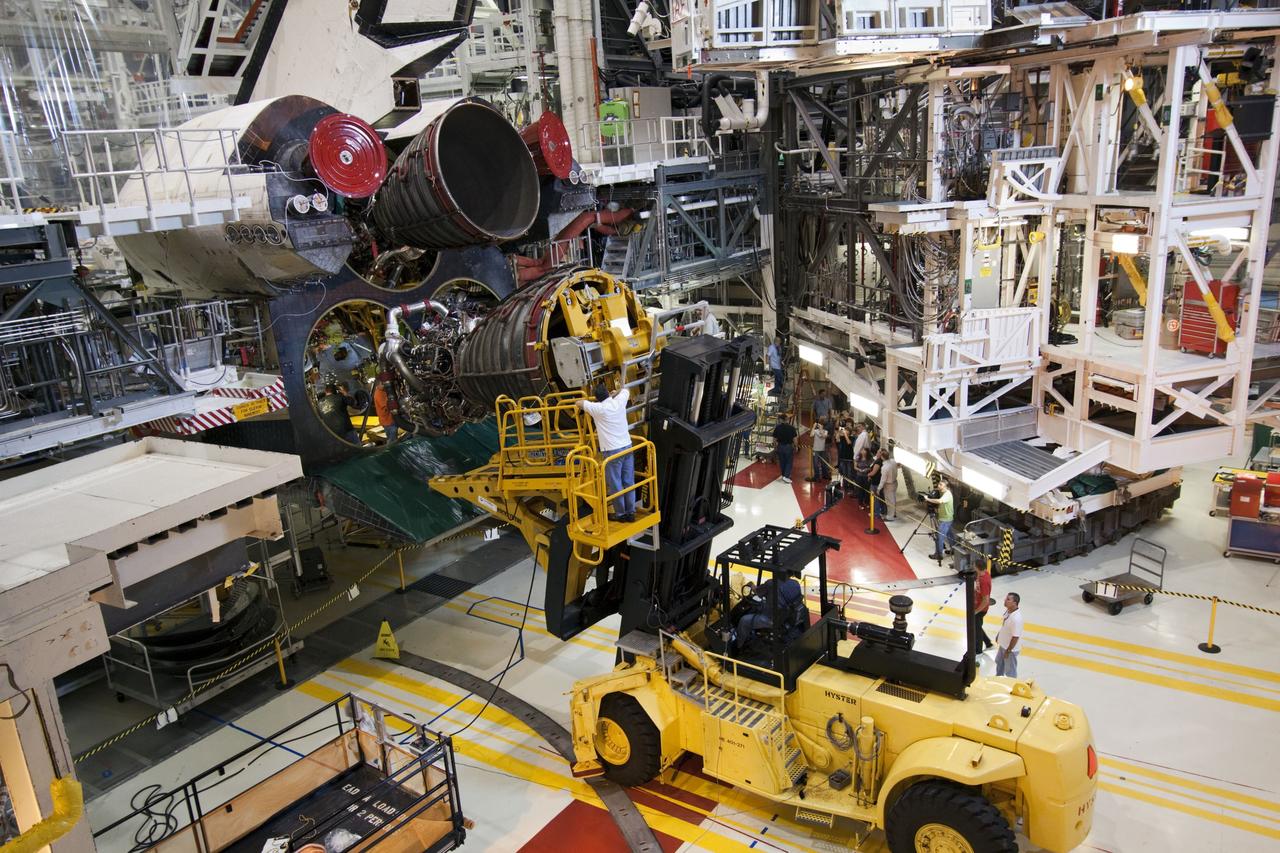
CAPE CANAVERAL, Fla. -- In Orbiter Processing Facility-1 at NASA's Kennedy Space Center in Florida, technicians carefully remove engine No. 2, one of three space shuttle main engines from Endeavour, using a specially designed engine installer, called a Hyster forklift. The removal is part of Endeavour's transition and retirement processing. Endeavour is being prepared for public display at the California Science Center in Los Angeles. Endeavour flew 25 missions, spent 299 days in space, orbited Earth 4,671 times and traveled 122,883,151 miles over the course of its 19-year career. Photo credit: NASA/Jim Grossmann
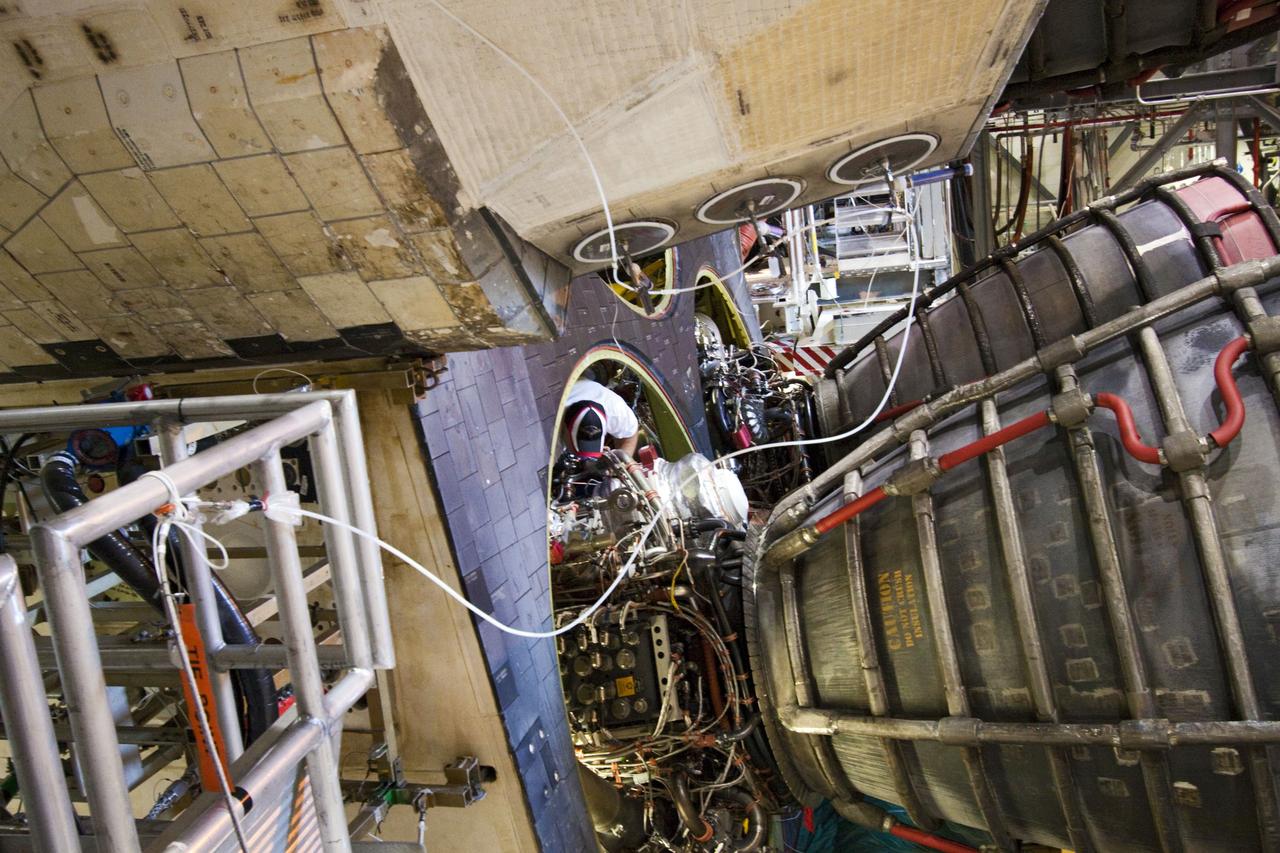
CAPE CANAVERAL, Fla. -- In Orbiter Processing Facility-1 at NASA's Kennedy Space Center in Florida, technicians carefully remove engine No. 2, one of three space shuttle main engines from Endeavour, using a specially designed engine installer, called a Hyster forklift. The removal is part of Endeavour's transition and retirement processing. Endeavour is being prepared for public display at the California Science Center in Los Angeles. Endeavour flew 25 missions, spent 299 days in space, orbited Earth 4,671 times and traveled 122,883,151 miles over the course of its 19-year career. Photo credit: NASA/Jim Grossmann
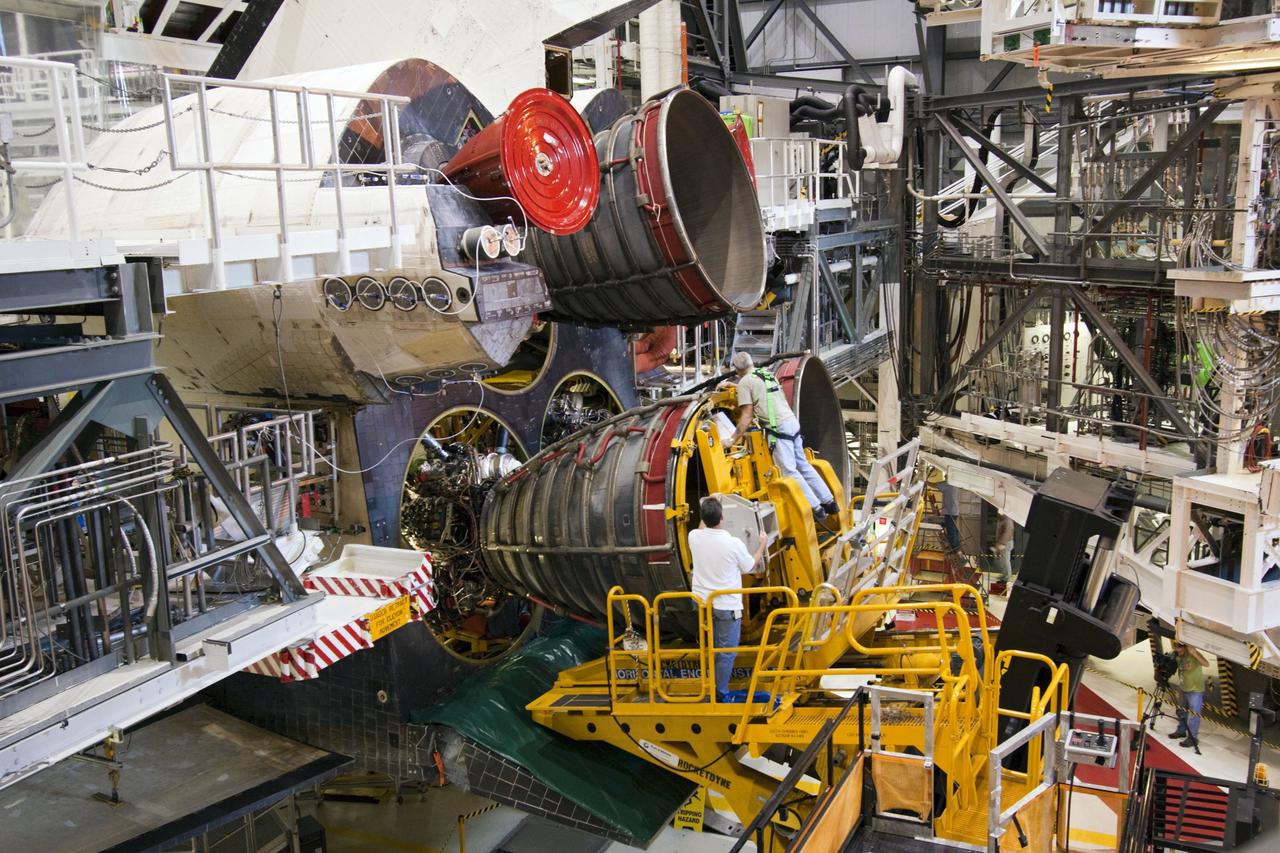
CAPE CANAVERAL, Fla. -- In Orbiter Processing Facility-1 at NASA's Kennedy Space Center in Florida, technicians carefully remove engine No. 2, one of three space shuttle main engines from Endeavour, using a specially designed engine installer, called a Hyster forklift. The removal is part of Endeavour's transition and retirement processing. Endeavour is being prepared for public display at the California Science Center in Los Angeles. Endeavour flew 25 missions, spent 299 days in space, orbited Earth 4,671 times and traveled 122,883,151 miles over the course of its 19-year career. Photo credit: NASA/Jim Grossmann
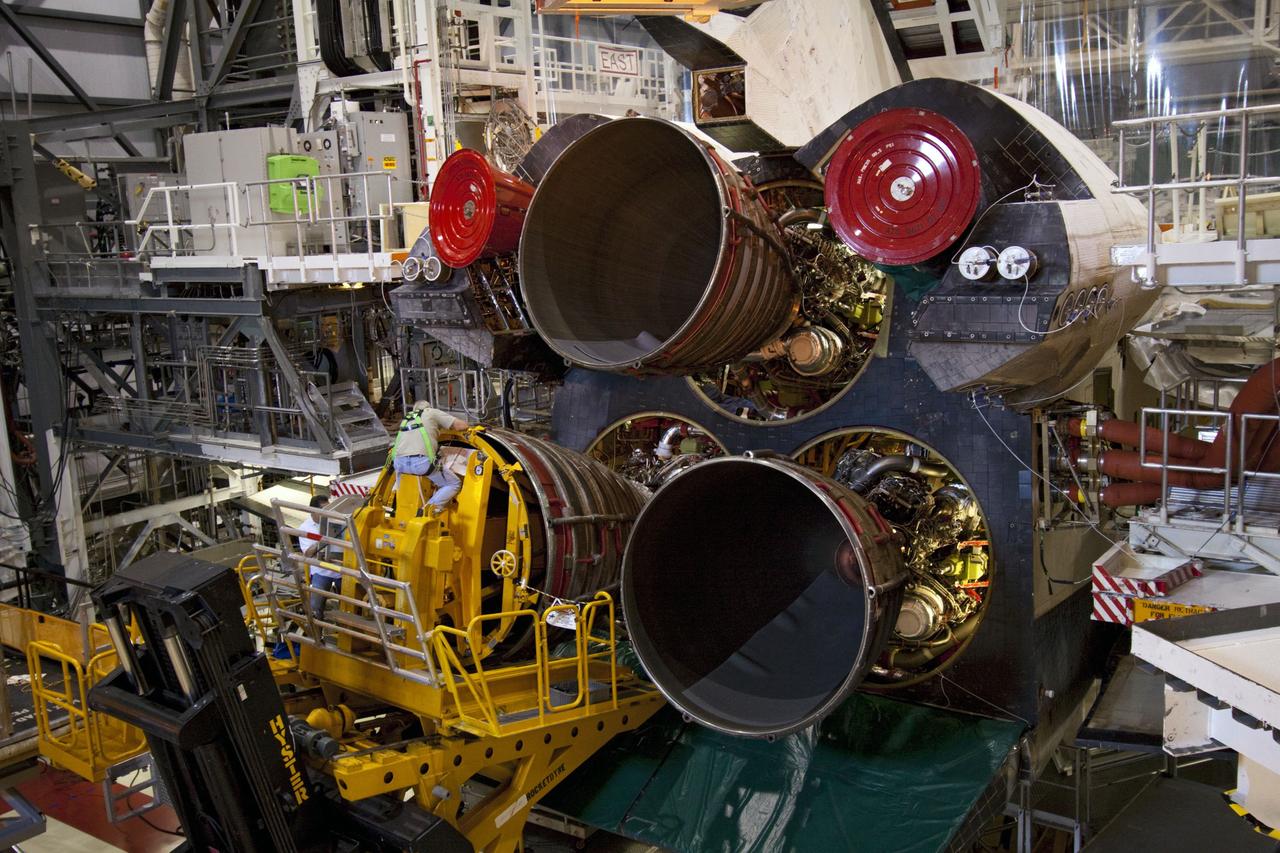
CAPE CANAVERAL, Fla. -- In Orbiter Processing Facility-1 at NASA's Kennedy Space Center in Florida, technicians carefully remove engine No. 2, one of three space shuttle main engines from Endeavour, using a specially designed engine installer, called a Hyster forklift. The removal is part of Endeavour's transition and retirement processing. Endeavour is being prepared for public display at the California Science Center in Los Angeles. Endeavour flew 25 missions, spent 299 days in space, orbited Earth 4,671 times and traveled 122,883,151 miles over the course of its 19-year career. Photo credit: NASA/Jim Grossmann
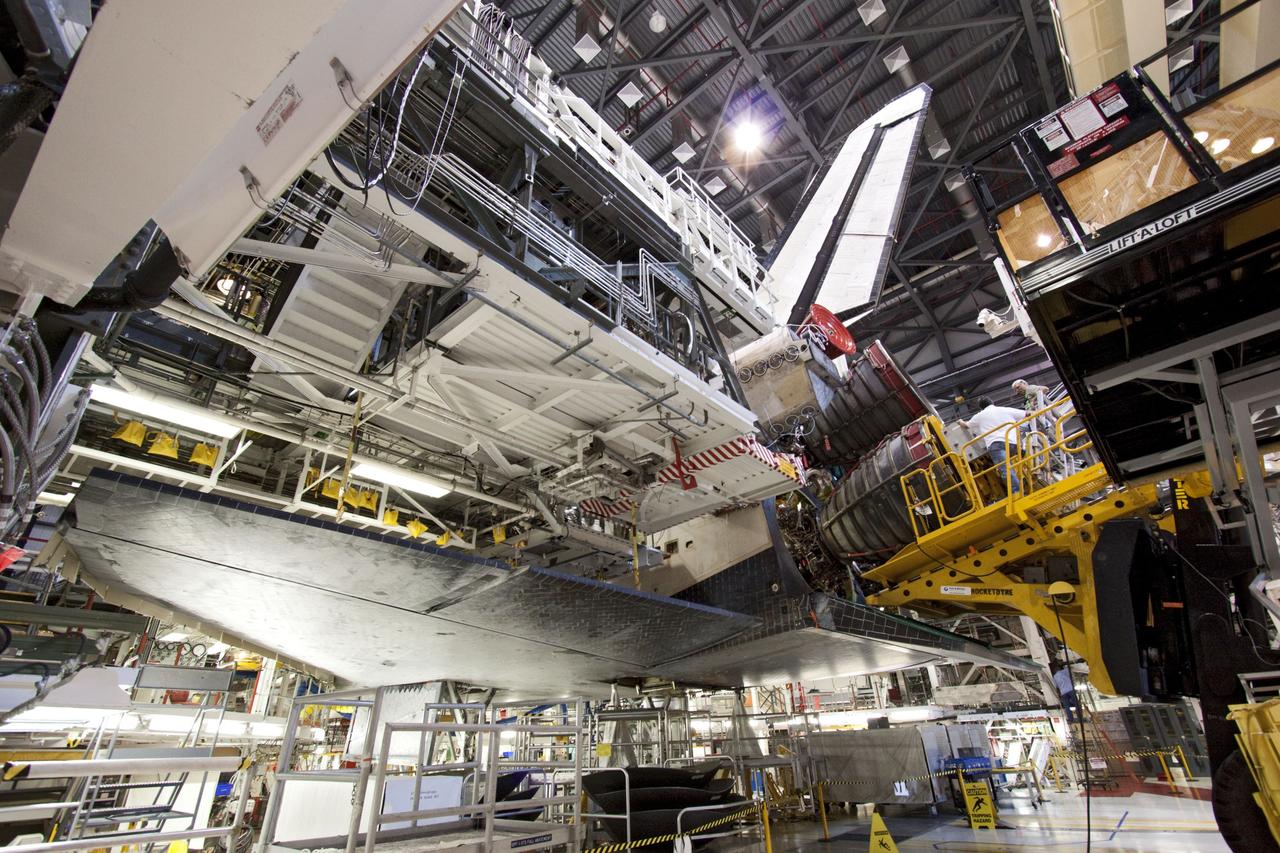
CAPE CANAVERAL, Fla. -- In Orbiter Processing Facility-1 at NASA's Kennedy Space Center in Florida, technicians carefully remove engine No. 2, one of three space shuttle main engines from Endeavour, using a specially designed engine installer, called a Hyster forklift. The removal is part of Endeavour's transition and retirement processing. Endeavour is being prepared for public display at the California Science Center in Los Angeles. Endeavour flew 25 missions, spent 299 days in space, orbited Earth 4,671 times and traveled 122,883,151 miles over the course of its 19-year career. Photo credit: NASA/Jim Grossmann
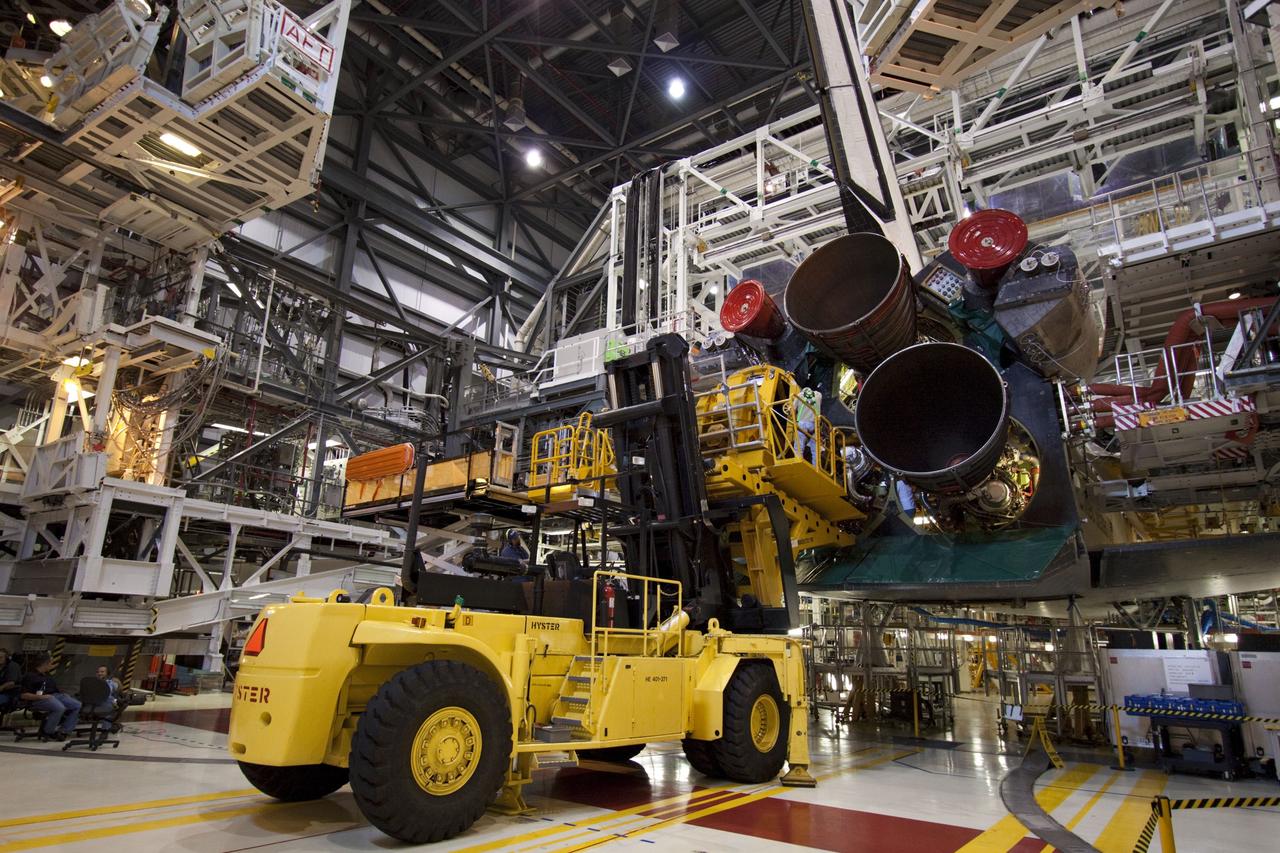
CAPE CANAVERAL, Fla. -- In Orbiter Processing Facility-1 at NASA's Kennedy Space Center in Florida, technicians carefully remove engine No. 2, one of three space shuttle main engines from Endeavour, using a specially designed engine installer, called a Hyster forklift. The removal is part of Endeavour's transition and retirement processing. Endeavour is being prepared for public display at the California Science Center in Los Angeles. Endeavour flew 25 missions, spent 299 days in space, orbited Earth 4,671 times and traveled 122,883,151 miles over the course of its 19-year career. Photo credit: NASA/Jim Grossmann
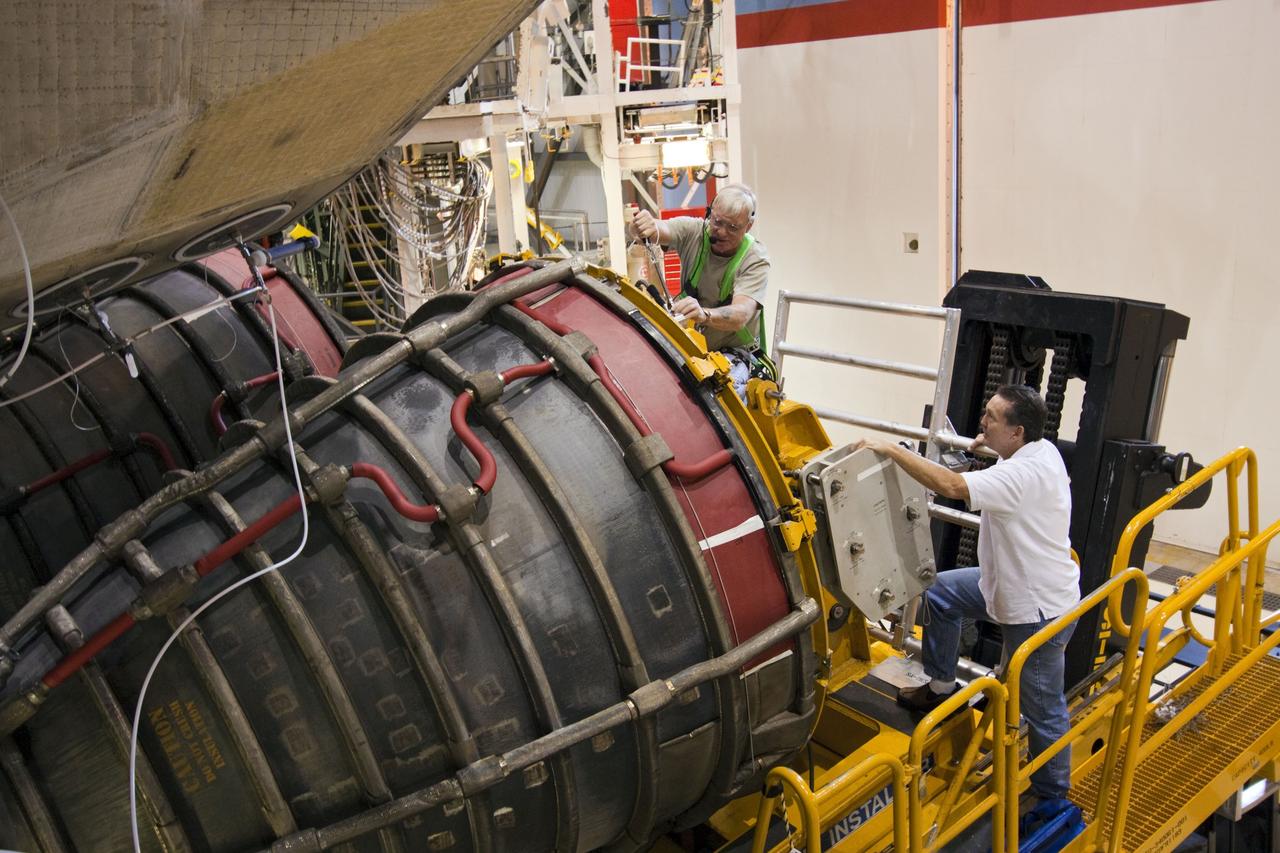
CAPE CANAVERAL, Fla. -- In Orbiter Processing Facility-1 at NASA's Kennedy Space Center in Florida, technicians carefully remove engine No. 2, one of three space shuttle main engines from Endeavour, using a specially designed engine installer, called a Hyster forklift. The removal is part of Endeavour's transition and retirement processing. Endeavour is being prepared for public display at the California Science Center in Los Angeles. Endeavour flew 25 missions, spent 299 days in space, orbited Earth 4,671 times and traveled 122,883,151 miles over the course of its 19-year career. Photo credit: NASA/Jim Grossmann

CAPE CANAVERAL, Fla. -- In Orbiter Processing Facility-1 at NASA's Kennedy Space Center in Florida, technicians carefully remove engine No. 2, one of three space shuttle main engines from Endeavour, using a specially designed engine installer, called a Hyster forklift. The removal is part of Endeavour's transition and retirement processing. Endeavour is being prepared for public display at the California Science Center in Los Angeles. Endeavour flew 25 missions, spent 299 days in space, orbited Earth 4,671 times and traveled 122,883,151 miles over the course of its 19-year career. Photo credit: NASA/Jim Grossmann
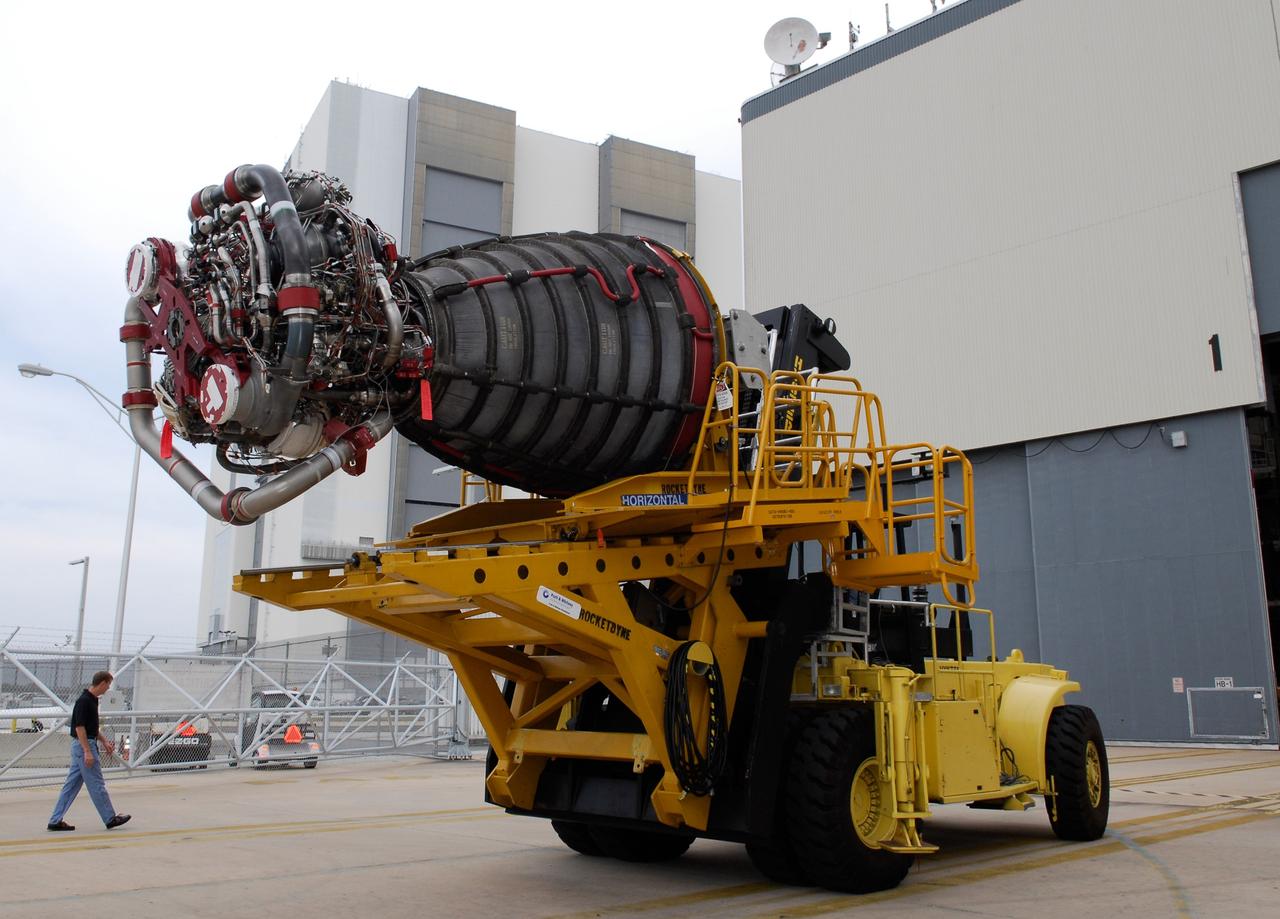
CAPE CANAVERAL, Fla. – One of the three main engines for space shuttle Atlantis is transported to Orbiter Processing Facility bay No. 1 for installation. Atlantis is the designated vehicle for the STS-125 mission to service the Hubble Space Telescope. Launch is targeted for Oct. 8. Photo credit: NASA/Kim Shiflett
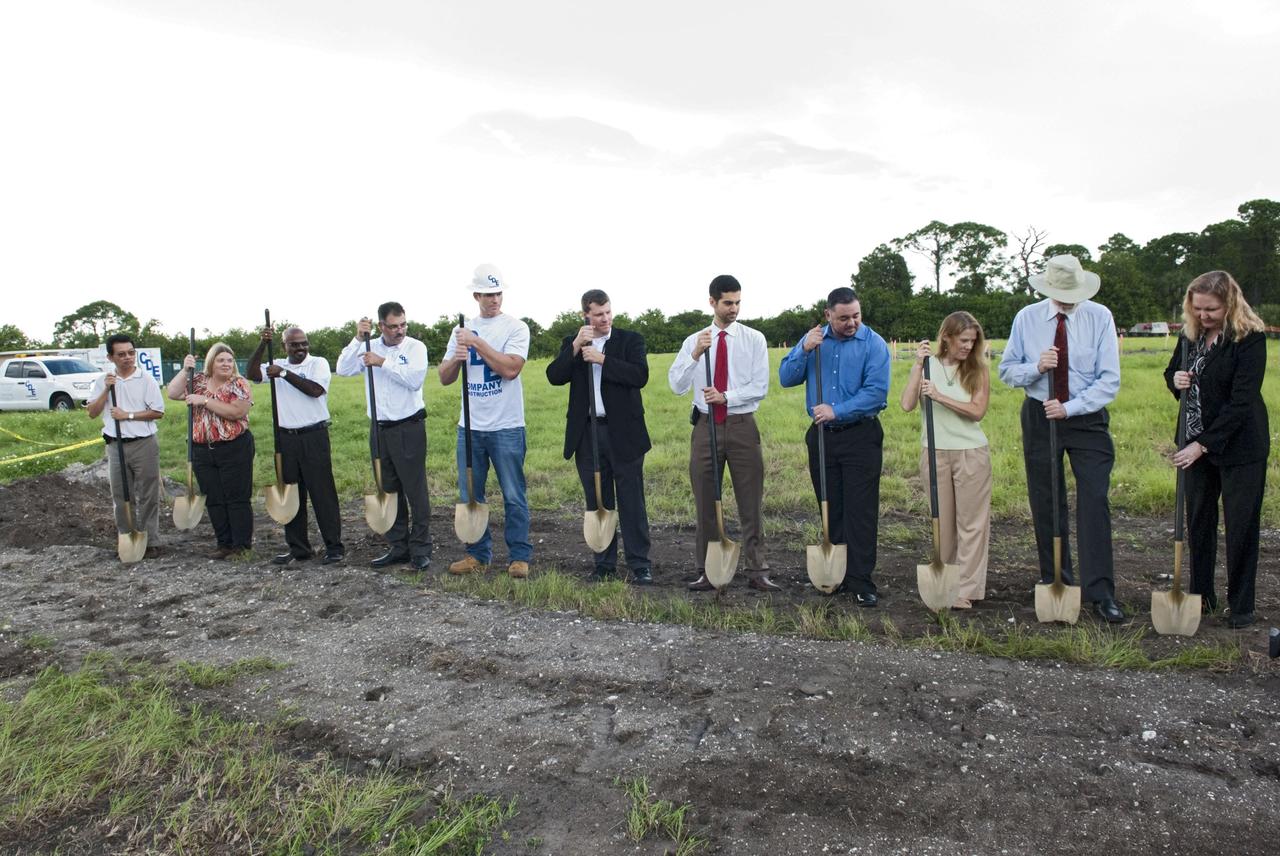
CAPE CANAVERAL, Fla. -- At NASA’s Kennedy Space Center in Florida, a groundbreaking was held to mark the start of construction on the Antenna Test Bed Array for the Ka-Band Objects Observation and Monitoring, or Ka-BOOM system. Holding ceremonial shovels, from left are Michael Le, lead design engineer and construction manager Sue Vingris, Cape Design Engineer Co. project manager Kannan Rengarajan, chief executive officer of Cape Design Engineer Co. Lutfi Mized, president of Cape Design Engineer Co. David Roelandt, construction site superintendent with Cape Design Engineer Co. Marc Seibert, NASA project manager Michael Miller, NASA project manager Peter Aragona, KSC’s Electromagnetic Lab manager Stacy Hopper, KSCs master planning supervisor Dr. Bary Geldzabler, NASA chief scientist and KSC’s Chief Technologist Karen Thompson. The construction site is near the former Vertical Processing Facility, which has been demolished. Workers will begin construction on the pile foundations for the 40-foot-diameter dish antenna arrays and their associated utilities, and prepare the site for the operations command center facility. Photo credit: NASA/Charisse Nahser
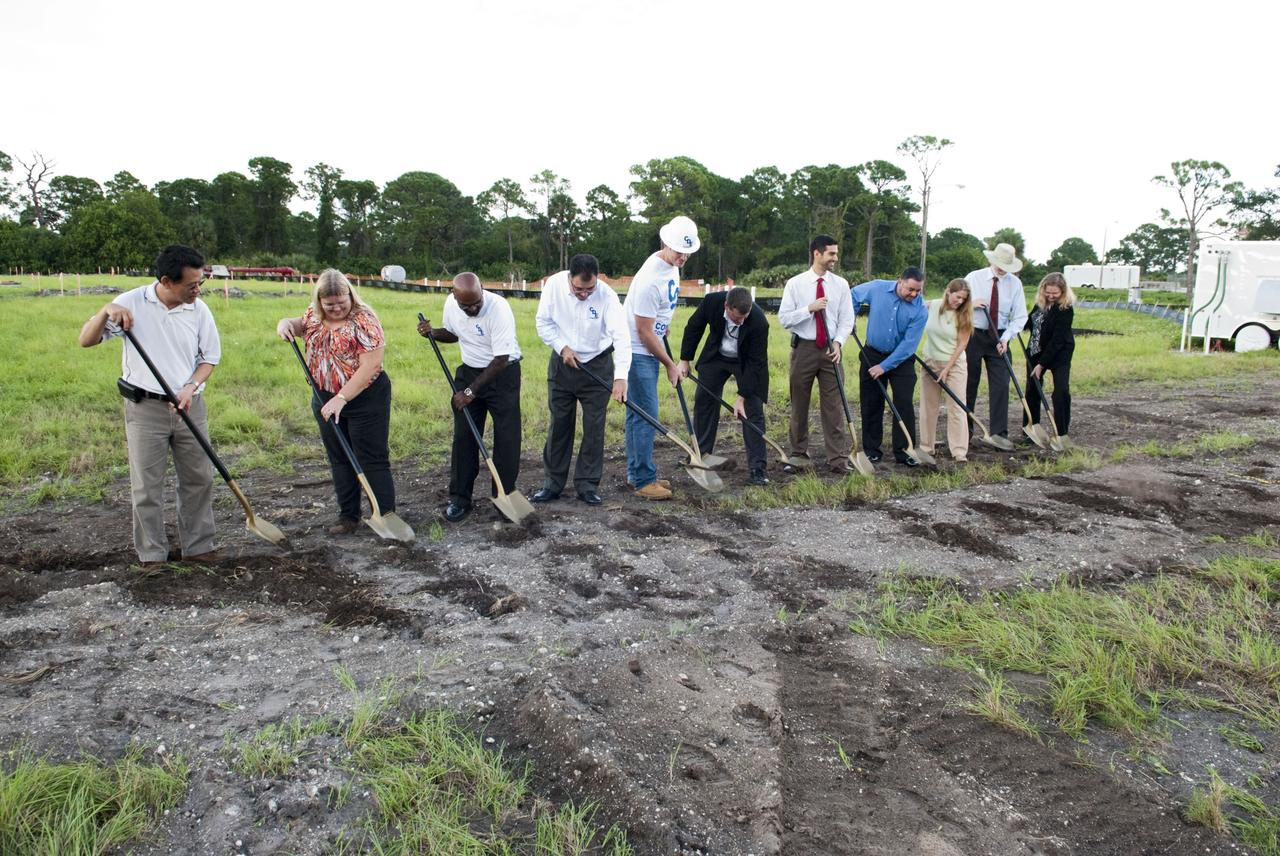
CAPE CANAVERAL, Fla. -- At NASA’s Kennedy Space Center in Florida, a groundbreaking was held to mark the start of construction on the Antenna Test Bed Array for the Ka-Band Objects Observation and Monitoring, or Ka-BOOM system. Using ceremonial shovels to mark the site, from left are Michael Le, lead design engineer and construction manager Sue Vingris, Cape Design Engineer Co. project manager Kannan Rengarajan, chief executive officer of Cape Design Engineer Co. Lutfi Mized, president of Cape Design Engineer Co. David Roelandt, construction site superintendent with Cape Design Engineer Co. Marc Seibert, NASA project manager Michael Miller, NASA project manager Peter Aragona, KSC’s Electromagnetic Lab manager Stacy Hopper, KSCs master planning supervisor Dr. Bary Geldzabler, NASA chief scientist and KSC’s Chief Technologist Karen Thompson. The construction site is near the former Vertical Processing Facility, which has been demolished. Workers will begin construction on the pile foundations for the 40-foot-diameter dish antenna arrays and their associated utilities, and prepare the site for the operations command center facility. Photo credit: NASA/Charisse Nahser
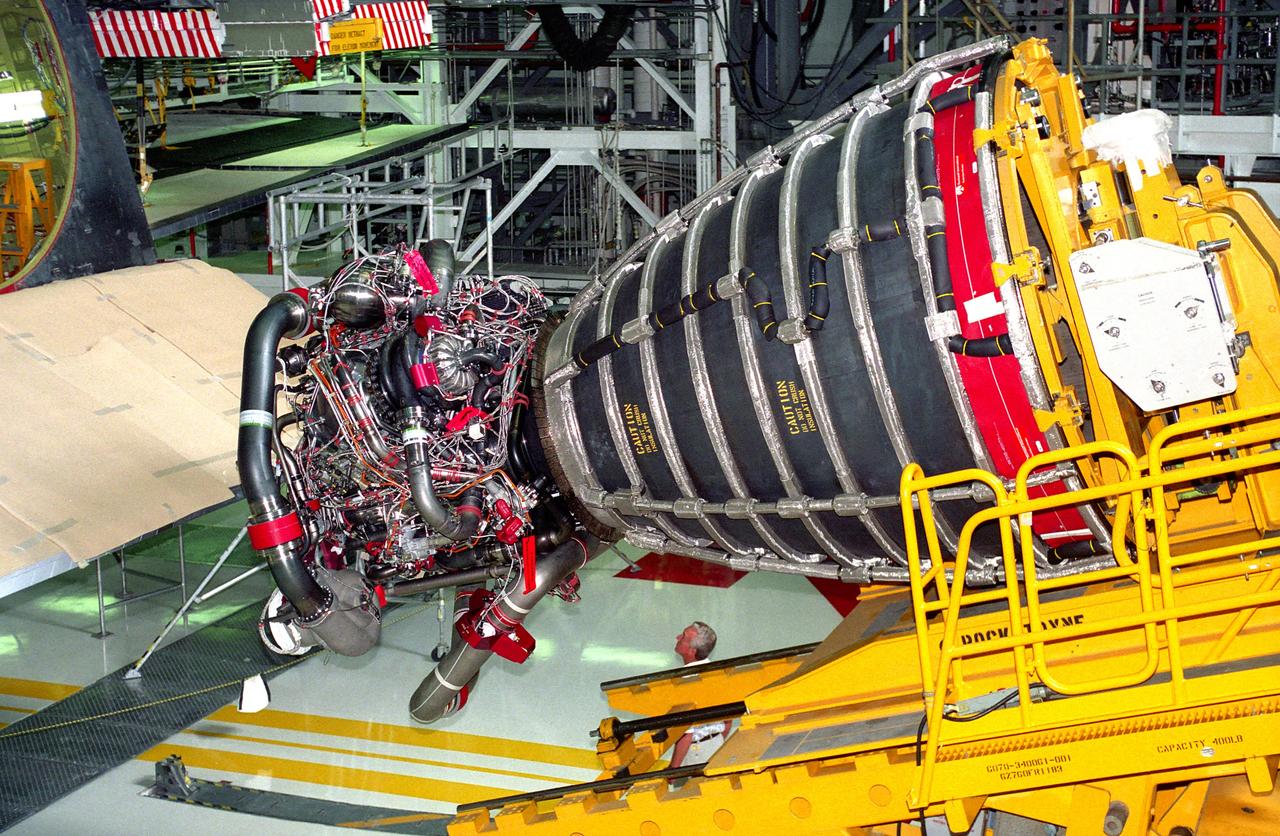
KENNEDY SPACE CENTER, FLA. - Space Shuttle Main Engine (SSME) No. 2036, the first of the new Block 1 engines to fly, awaits installation into position one of the orbiter Discovery in Orbiter Processing Facility 2 during preparation of the spaceplane for the STS-70 mission. The advanced powerplant features a new high-pressure liquid oxygen turbopump, a two-duct powerhead, a baffleless main injector, a single-coil heat exchanger and start sequence modifications. These modifications are designed to improve both engine performance and safety.
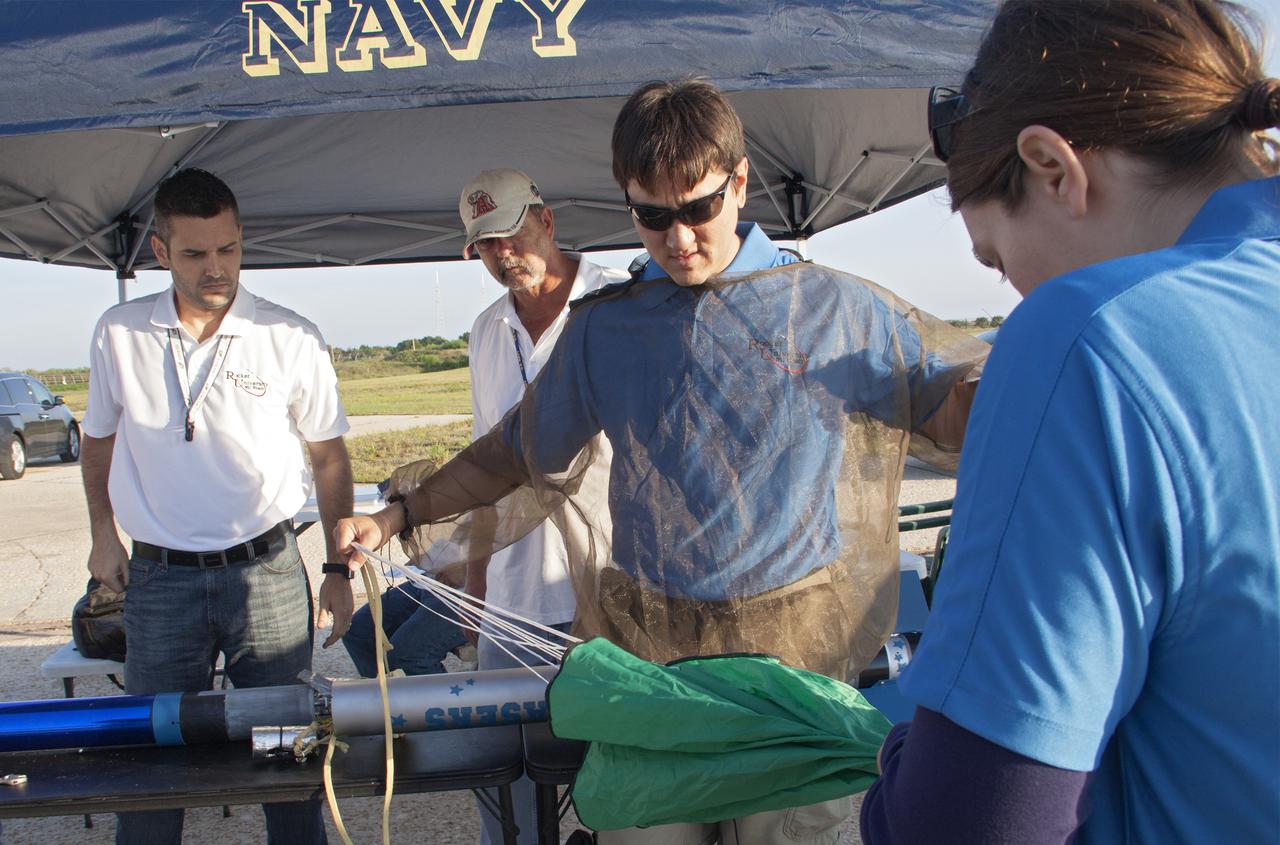
CAPE CANAVERAL, Fla. -- At NASA's Kennedy Space Center in Florida, from the left, Leandro James of Systems Hardware Engineering, George Mizell of Quality Assurance, Morgan Simpson of Flight Hardware Processing and Kim Simpson of Fluids, Mechanical and Structural Systems prepare a parachute for a small rocket prior to launch as part of Rocket University. The goal was to test its systems and to verify that it performed as designed. As part of Rocket University, the engineers are given an opportunity to work a fast-track project to develop skills in developing spacecraft systems of the future. As NASA plans for future spaceflight programs to low-Earth orbit and beyond, teams of engineers at Kennedy are gaining experience in designing and flying launch vehicle systems on a small scale. Four teams of five to eight members from Kennedy are designing rockets complete with avionics and recovery systems. Launch operations require coordination with federal agencies, just as they would with rockets launched in support of a NASA mission. Photo credit: NASA_Jim Grossmann
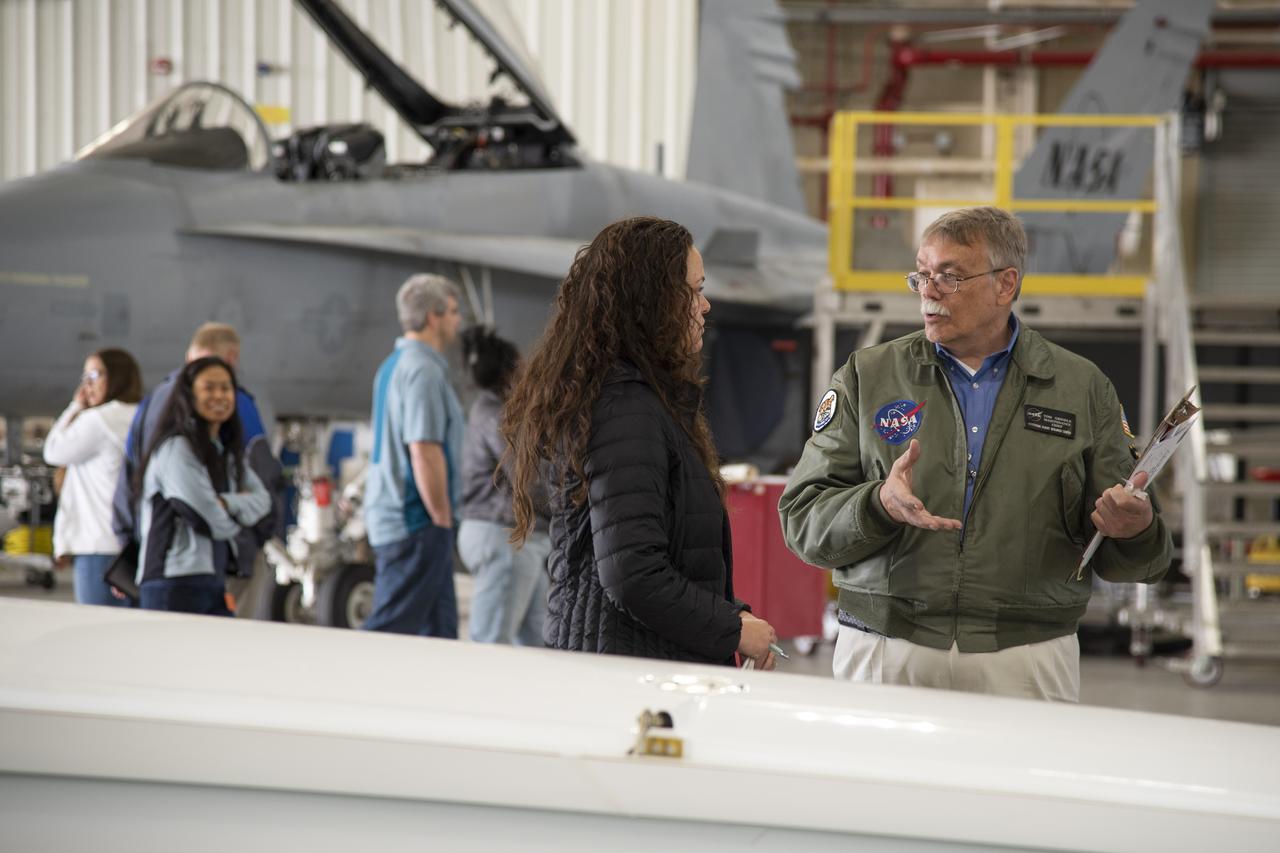
NASA Armstrong’s Chief of Maintenance, Tom Grindle, leads a tour inside the hangar with a group of teachers.
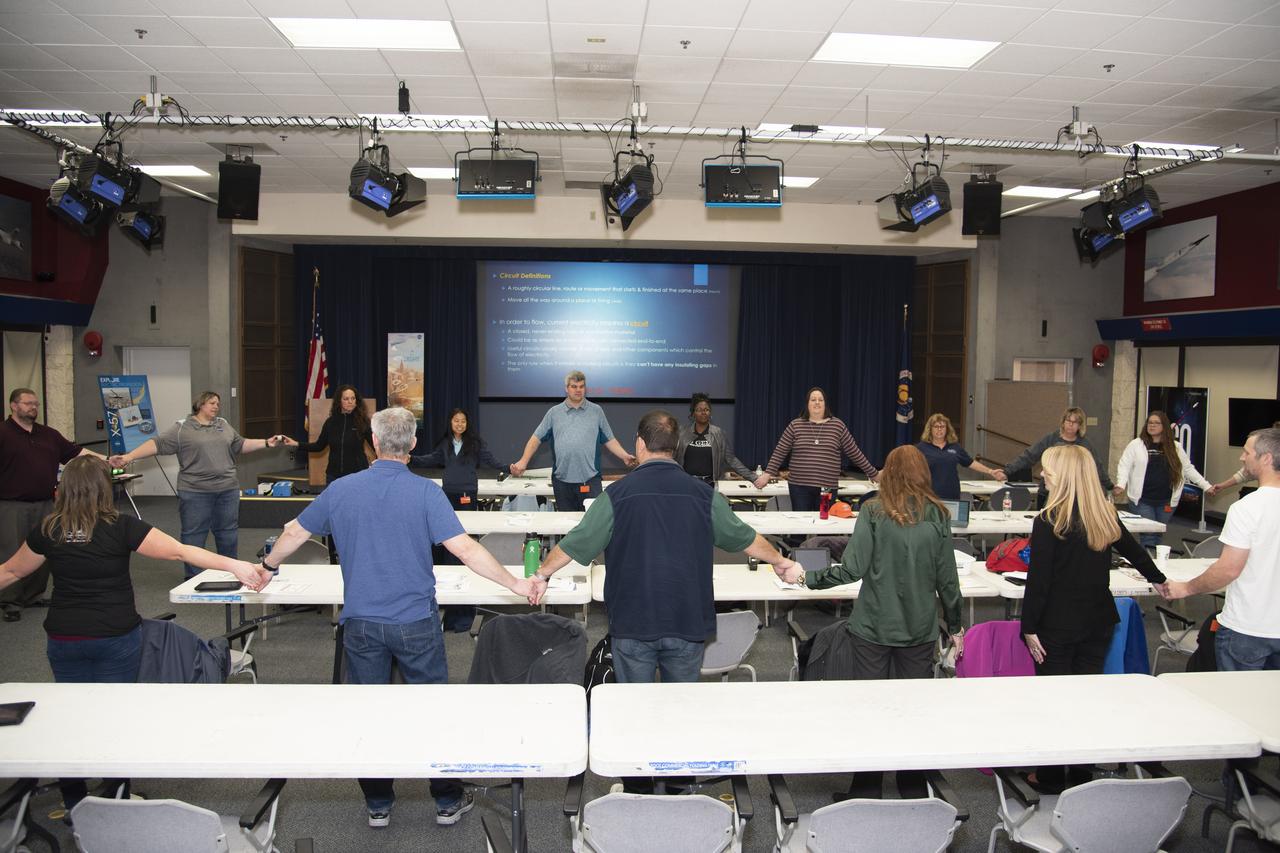
Barbara Buckner, NASA Armstrong's educator professional development specialist, leads a group exercise to form a human circuit to power an electric ball.
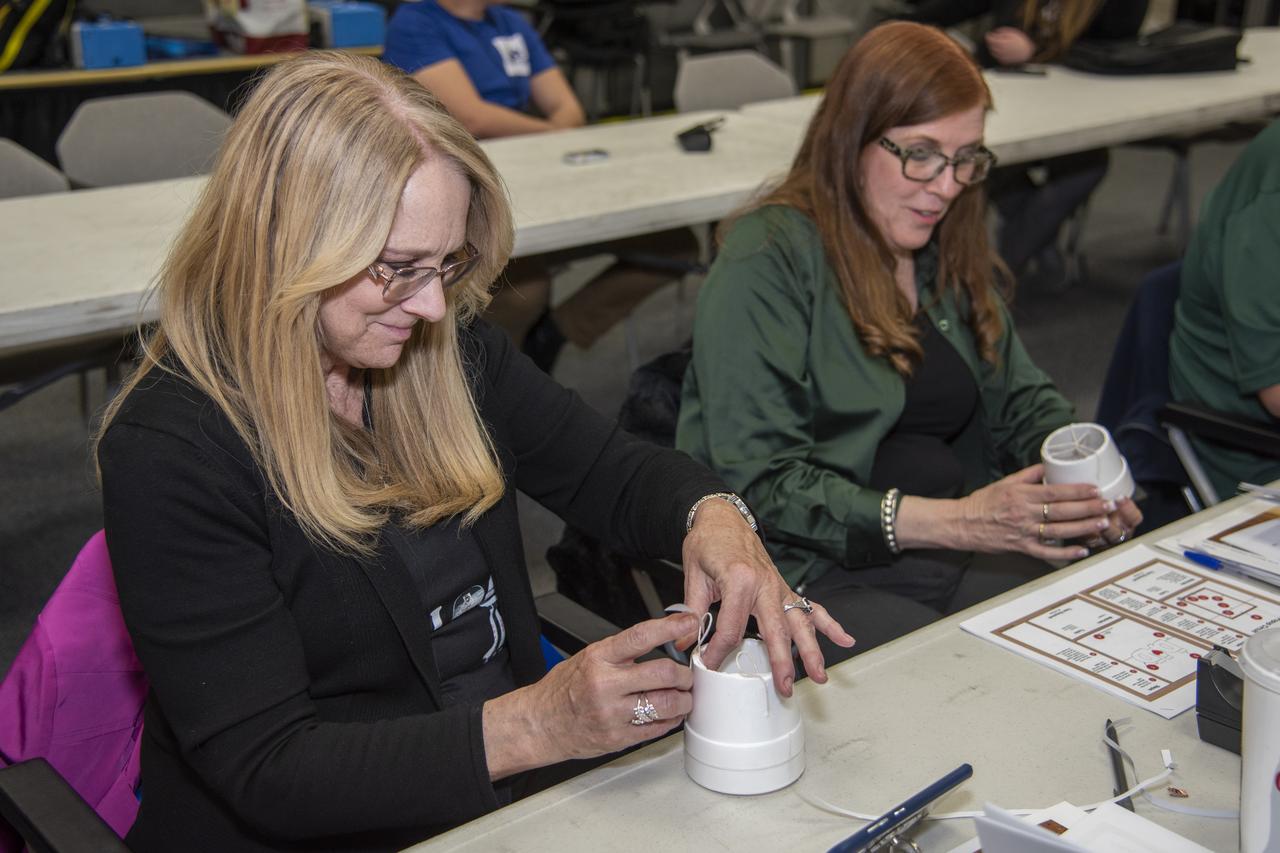
Teacher Kristen Deckner learns how to build a Remote Manipulator (Robotic) Arm during the Educational Technology Institute hosted by NASA Armstrong's Office of STEM Engagement.
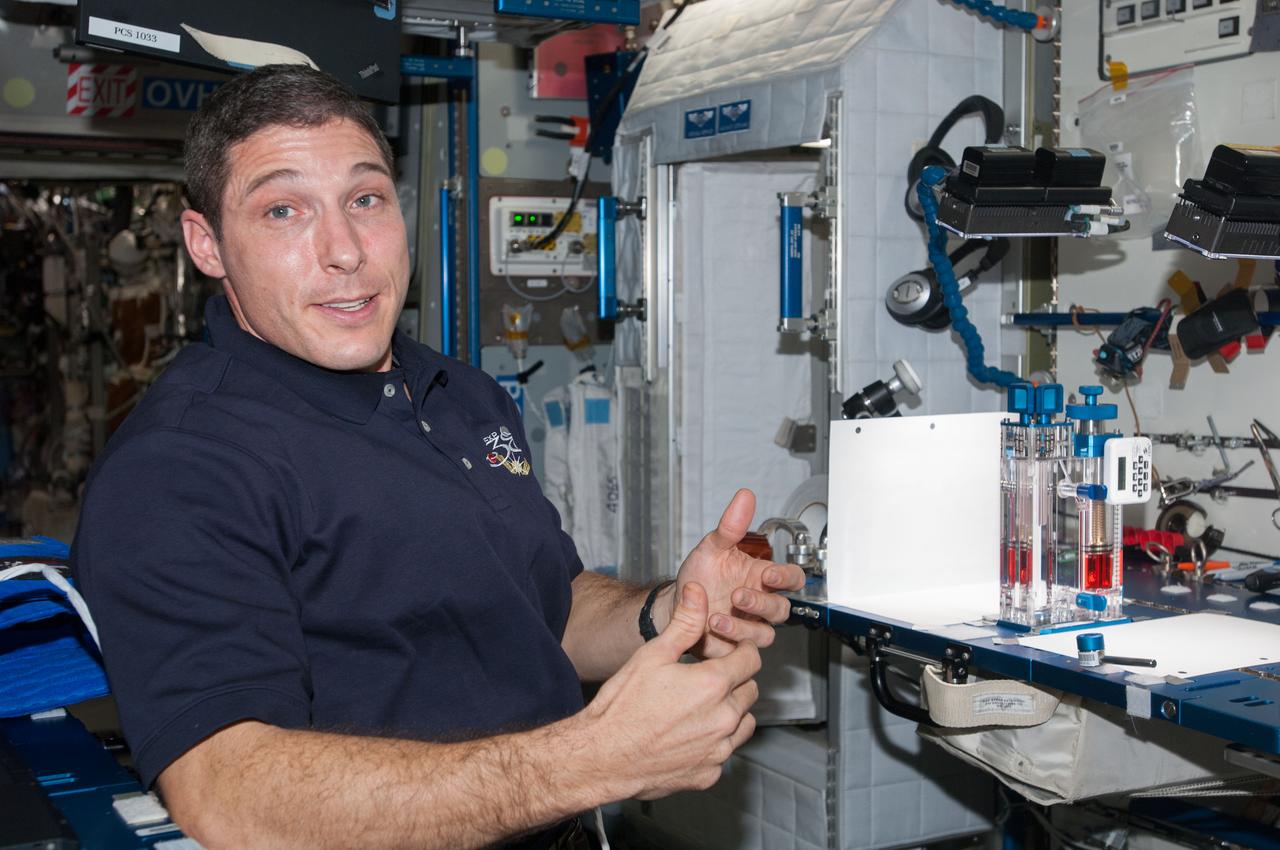
View of Flight Engineer (FE) Mike Hopkins initiating a CFE-2 (Capillary Flow Experiment - 2) Interior Corner Flow - 5 (ICF-5) test run. Liquids behave differently in space than they do on Earth, so containers that can process, hold or transport them must be designed carefully to work in microgravity. The Capillary Flow Experiment-2 furthers research on wetting, which is a liquid's ability to spread across a surface, and its impact over large length scales in strange container shapes in microgravity environments. This work will improve our capabilities to quickly and accurately predict how related processes occur, and allow us to design better systems to process liquids aboard spacecraft (i.e., liquid fuel tanks, thermals fluids, and water processing for life support). Image was released by astronaut on Twitter.
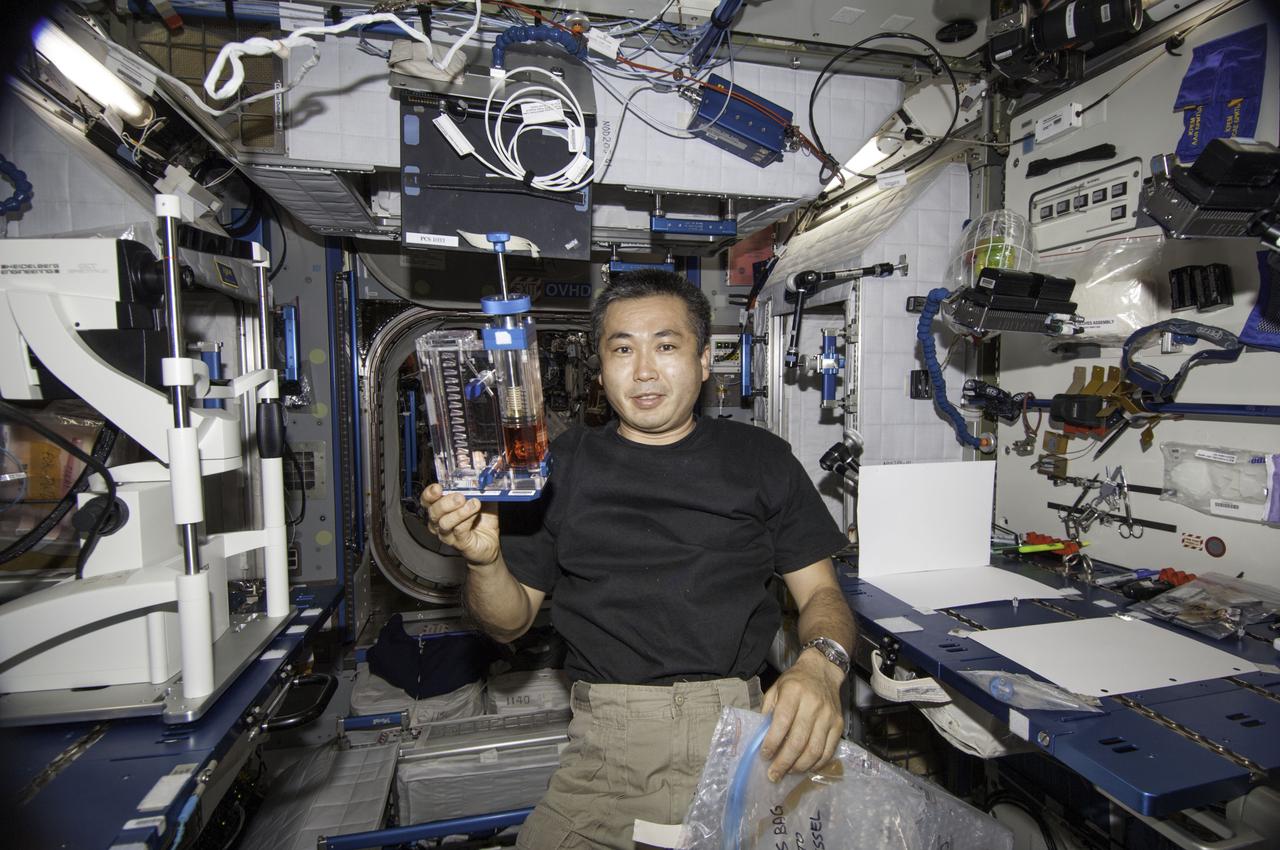
View of Flight Engineer (FE) Koichi Wakata posing for a photo during a CFE-2 (Capillary Flow Experiment - 2) Interior Corner Flow - 8 (ICF-8) test run. Liquids behave differently in space than they do on Earth, so containers that can process, hold or transport them must be designed carefully to work in microgravity. The Capillary Flow Experiment-2 furthers research on wetting, which is a liquid's ability to spread across a surface, and its impact over large length scales in strange container shapes in microgravity environments. This work will improve capabilities to quickly and accurately predict how related processes occur, and allow us to design better systems to process liquids aboard spacecraft (i.e., liquid fuel tanks, thermals fluids, and water processing for life support). Image was released by astronaut on Twitter.
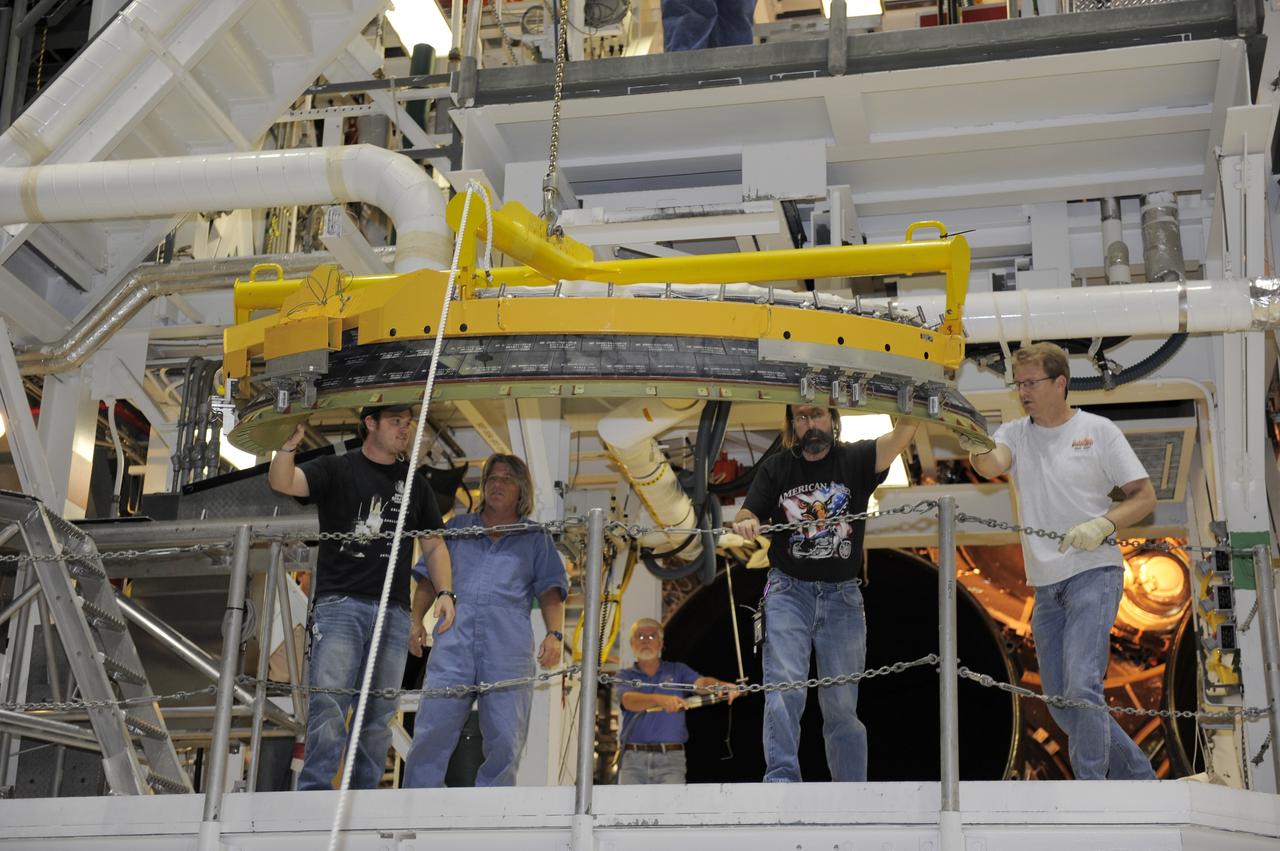
CAPE CANAVERAL, Fla. - Crews in Orbiter Processing Facility-2 at NASA's Kennedy Space Center in Florida remove space shuttle Discovery's right-hand inner heat shield from engine No. 1. The removal is part of Discovery's transition and retirement processing. Work performed on Discovery is expected to help rocket designers build next-generation spacecraft and prepare the shuttle for future public display.Photo credit: NASA/Kim Shiflett
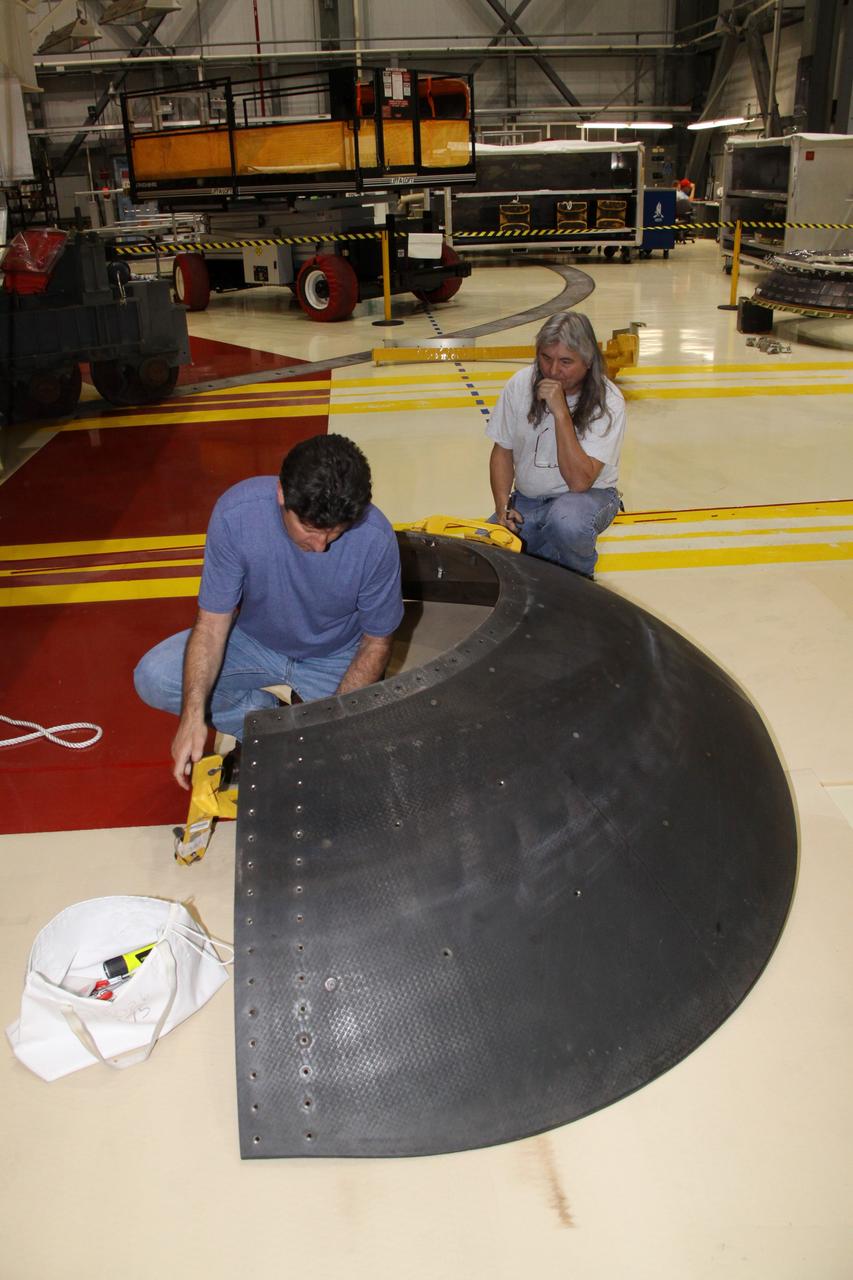
CAPE CANAVERAL, Fla. - Crews in Orbiter Processing Facility-2 at NASA's Kennedy Space Center in Florida remove space shuttle Discovery's right-hand inner heat shield from engine No. 1. The removal is part of Discovery's transition and retirement processing. Work performed on Discovery is expected to help rocket designers build next-generation spacecraft and prepare the shuttle for future public display.Photo credit: NASA/Jack Pfaller
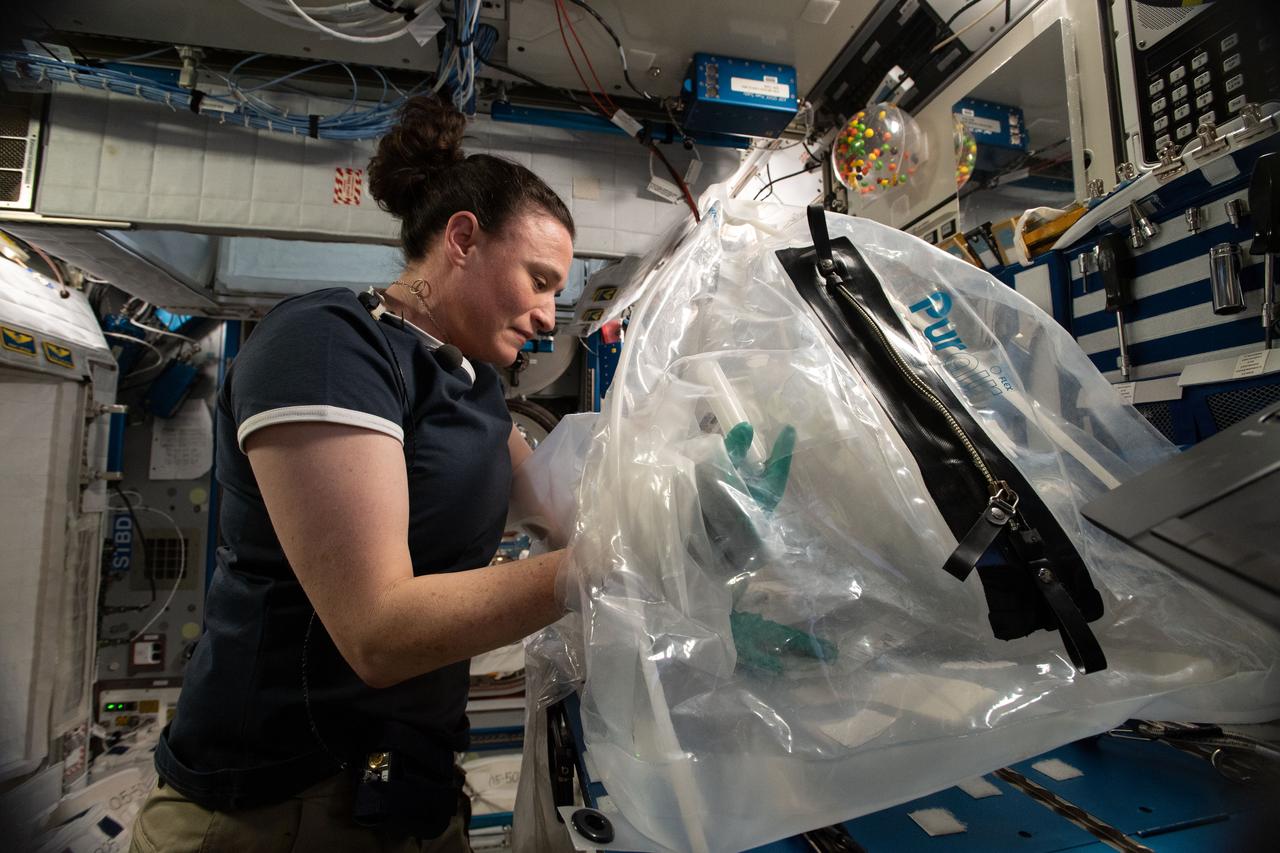
iss056e037491 (June 26, 2018) --- Astronaut Serena Auñón-Chancellor from NASA works on the Microgravity Investigation of Cement Solidification (MICS) 2 experiment aboard the International Space Station. MICS 2 is researching how cement reacts in space during the hardening process and may help engineers better understand its microstructure and material properties. Observations could improve cement processing techniques on Earth and lead to the design of safer, lightweight space habitats.
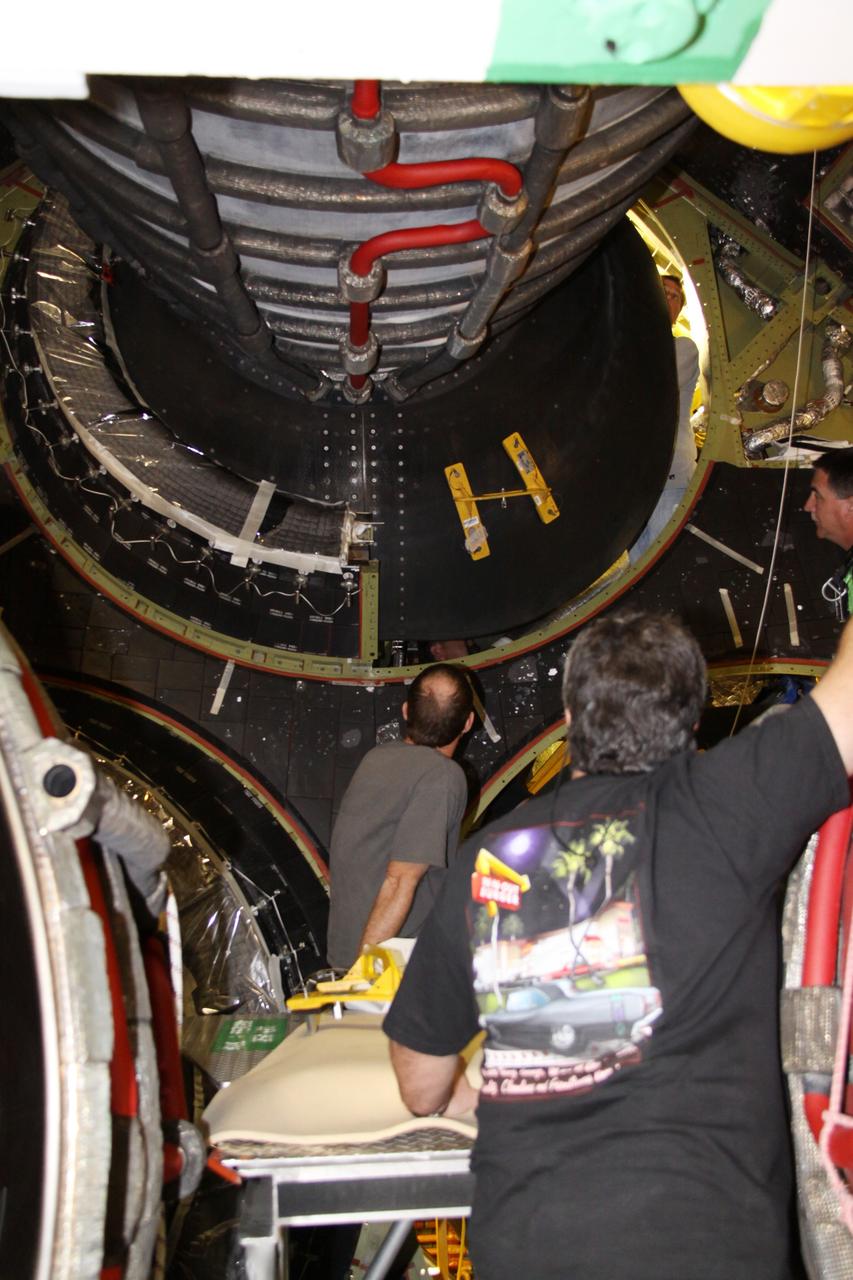
CAPE CANAVERAL, Fla. - Crews in Orbiter Processing Facility-2 at NASA's Kennedy Space Center in Florida remove space shuttle Discovery's right-hand inner heat shield from engine No. 1. The removal is part of Discovery's transition and retirement processing. Work performed on Discovery is expected to help rocket designers build next-generation spacecraft and prepare the shuttle for future public display.Photo credit: NASA/Jack Pfaller
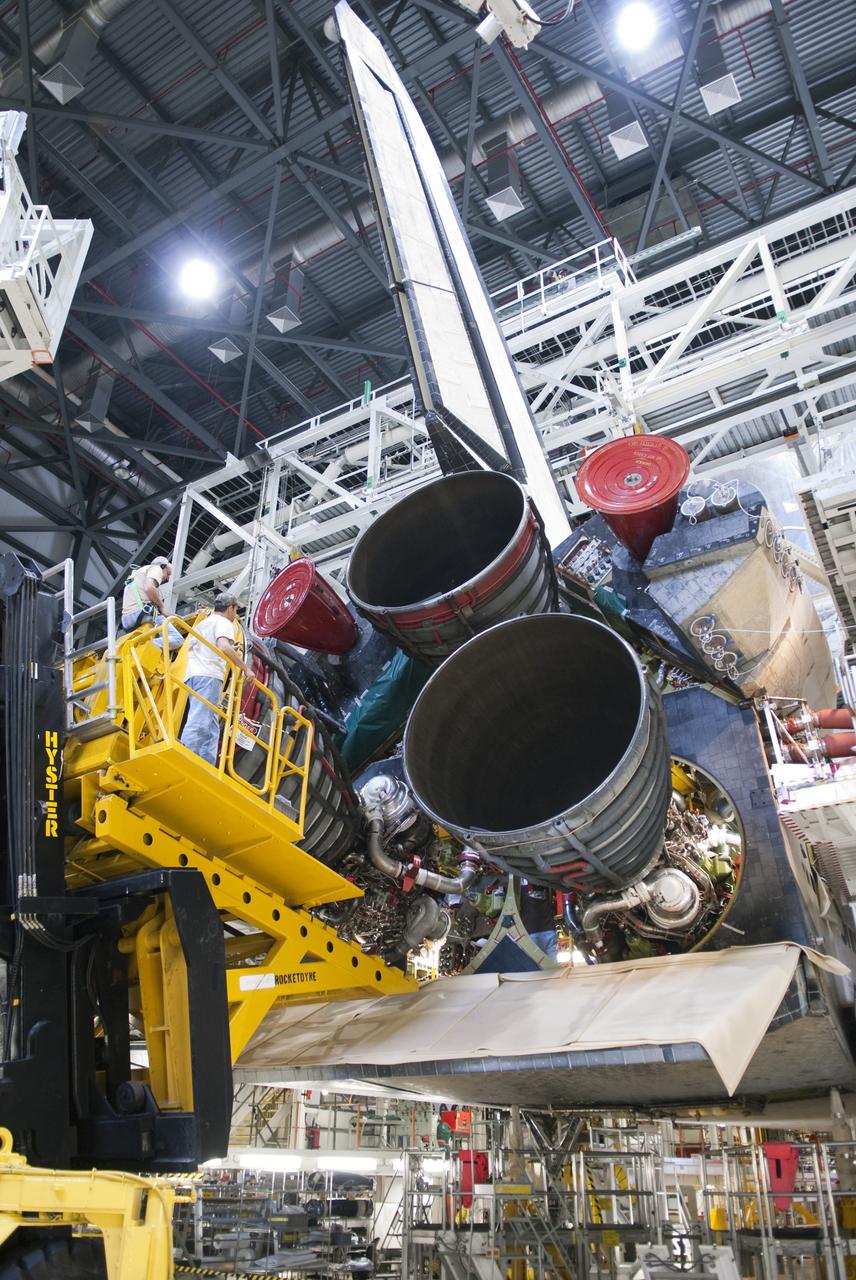
CAPE CANAVERAL, Fla. -- A main engine slowly emerges from space shuttle Discovery. The work is taking place in Orbiter Processing Facility-2 at NASA's Kennedy Space Center in Florida. The transition and retirement processing is expected to help rocket designers build next-generation spacecraft and prepare the shuttle for display. Photo credit: NASA/Jim Grossmann
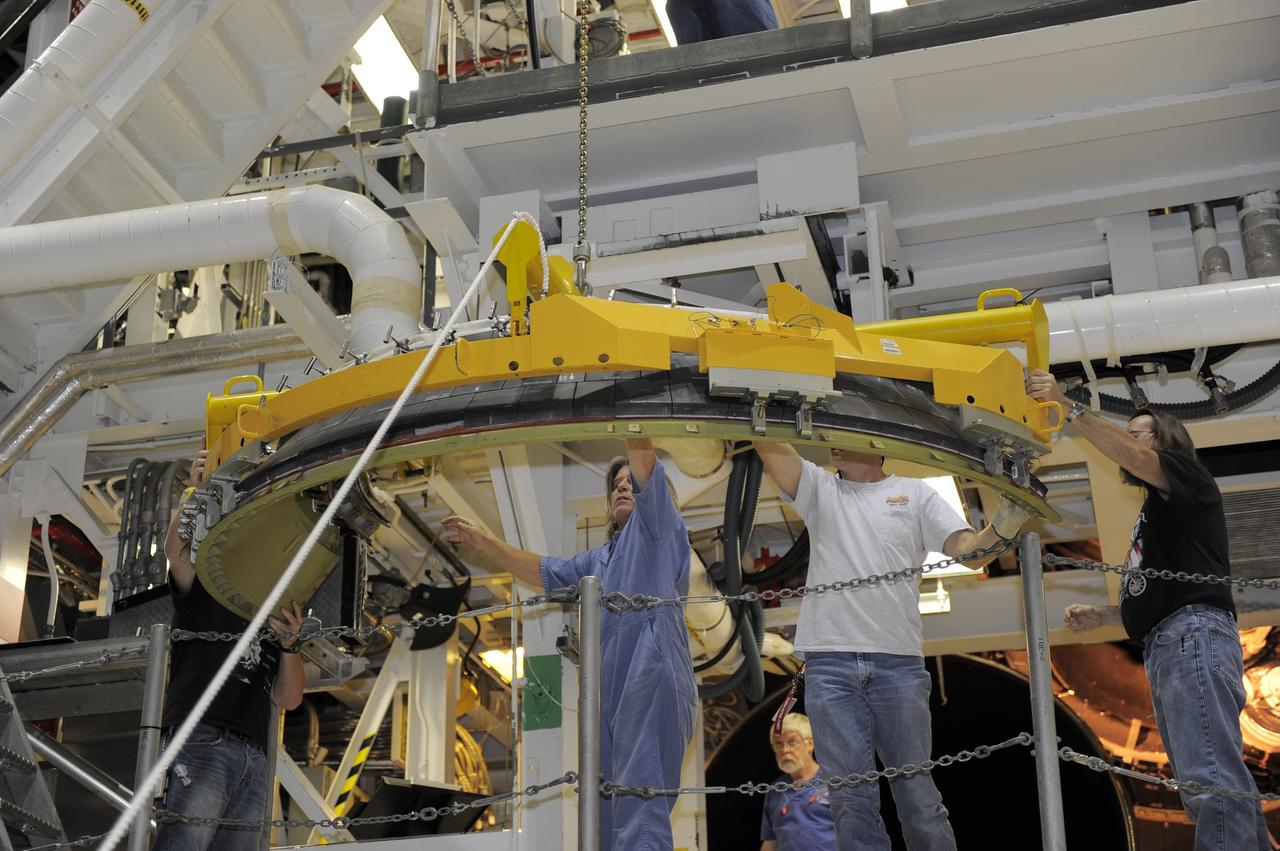
CAPE CANAVERAL, Fla. - Crews in Orbiter Processing Facility-2 at NASA's Kennedy Space Center in Florida remove space shuttle Discovery's right-hand inner heat shield from engine No. 1. The removal is part of Discovery's transition and retirement processing. Work performed on Discovery is expected to help rocket designers build next-generation spacecraft and prepare the shuttle for future public display.Photo credit: NASA/Kim Shiflett
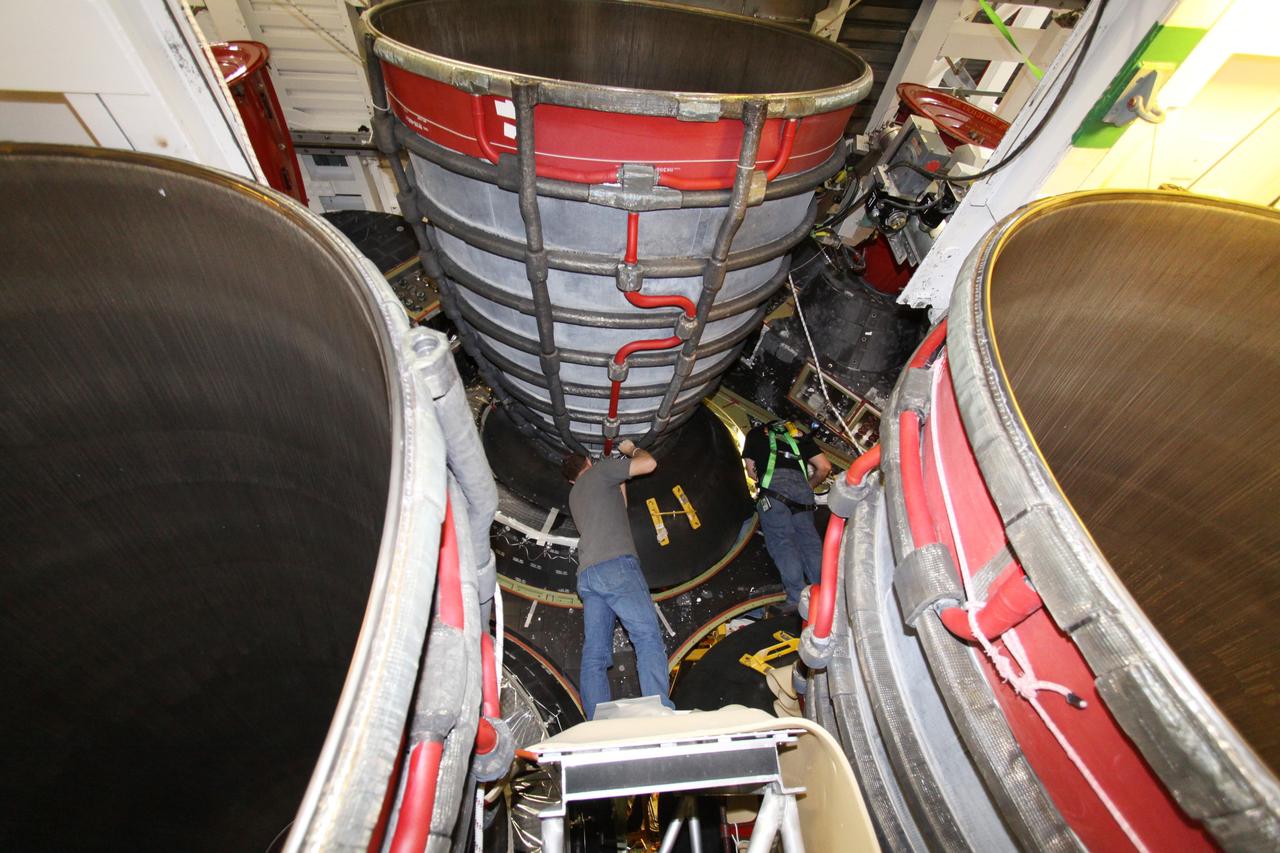
CAPE CANAVERAL, Fla. - Crews in Orbiter Processing Facility-2 at NASA's Kennedy Space Center in Florida remove space shuttle Discovery's right-hand inner heat shield from engine No. 1. The removal is part of Discovery's transition and retirement processing. Work performed on Discovery is expected to help rocket designers build next-generation spacecraft and prepare the shuttle for future public display.Photo credit: NASA/Jack Pfaller
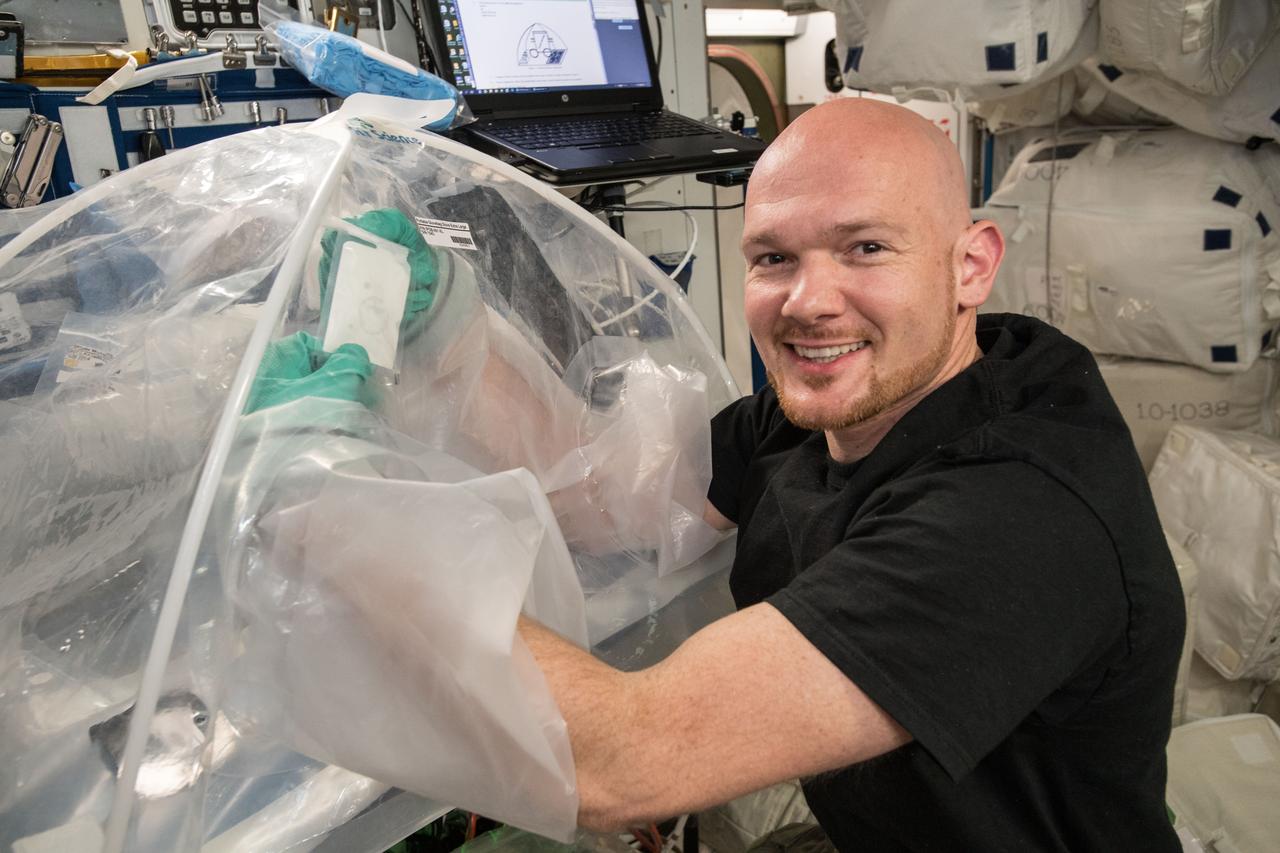
iss056e073247 (July 2, 2018) --- Astronaut Alexander Gerst of ESA (European Space Agency) works on the Microgravity Investigation of Cement Solidification (MICS) 2 experiment aboard the International Space Station. MICS 2 is researching how cement reacts in space during the hardening process and may help engineers better understand its microstructure and material properties. Observations could improve cement processing techniques on Earth and lead to the design of safer, lightweight space habitats.
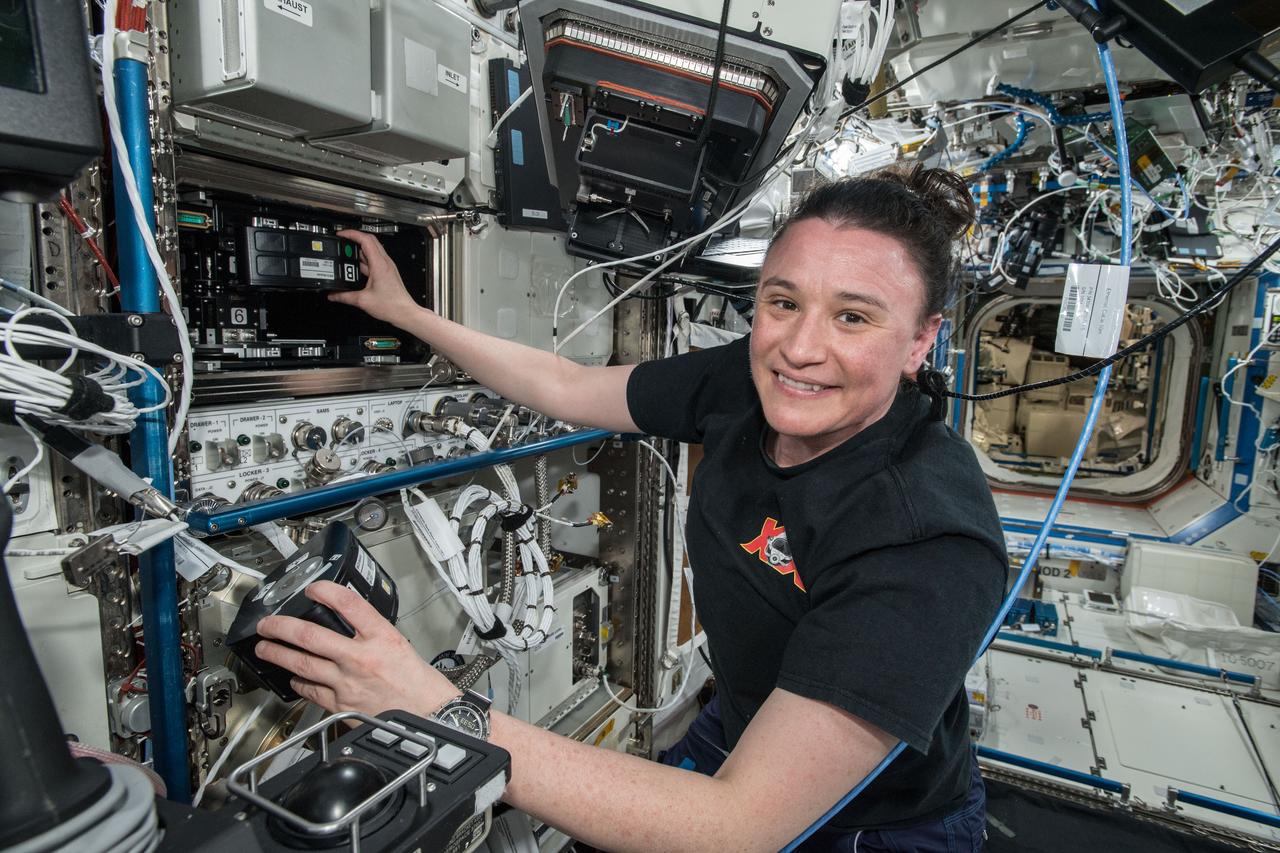
iss057e106264 (Nov. 27, 2018) --- Flight Engineer Serena Auñón-Chancellor mixes samples for the Microgravity Investigation of Cement Solidification (MICS) experiment and installs them into the Multi-use Variable-g Platform. The research utilizes the microgravity environment aboard the International Space Station to investigate the complex process of cement solidification. Results may impact possible construction processes and designs for space habitats on the surface of the Moon and Mars.
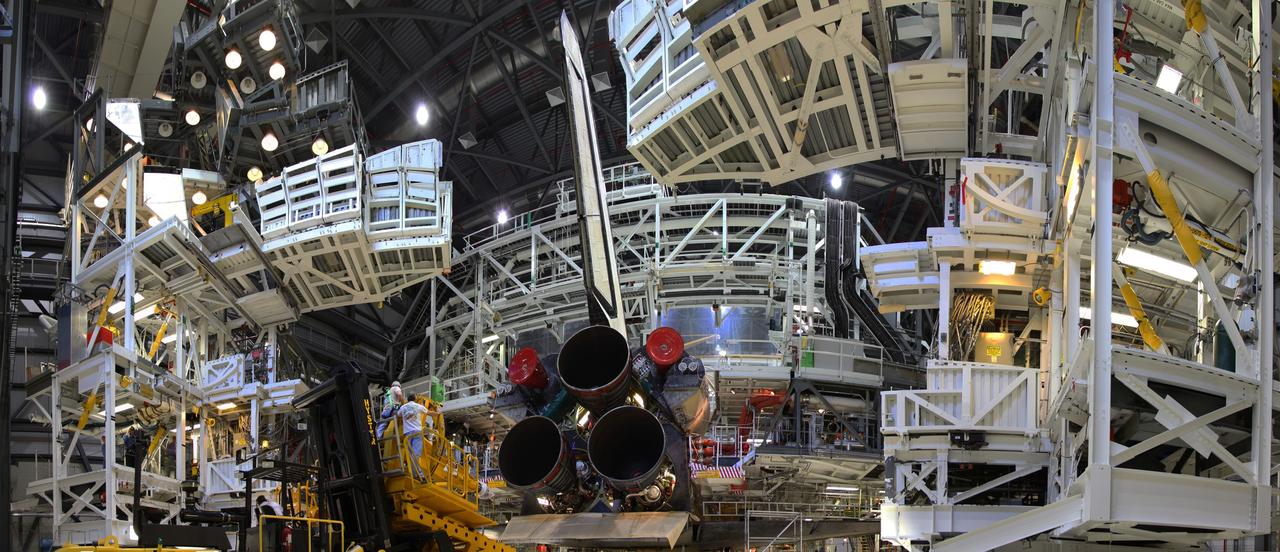
CAPE CANAVERAL, Fla. - A panoramic photo shows space shuttle Discovery during the main engine removal phase in Orbiter Processing Facility-2 at NASA's Kennedy Space Center in Florida. The removal is part of Discovery's transition and retirement processing. Work performed on Discovery is expected to help rocket designers build next-generation spacecraft and prepare the shuttle for future public display. NASA/Frankie Martin
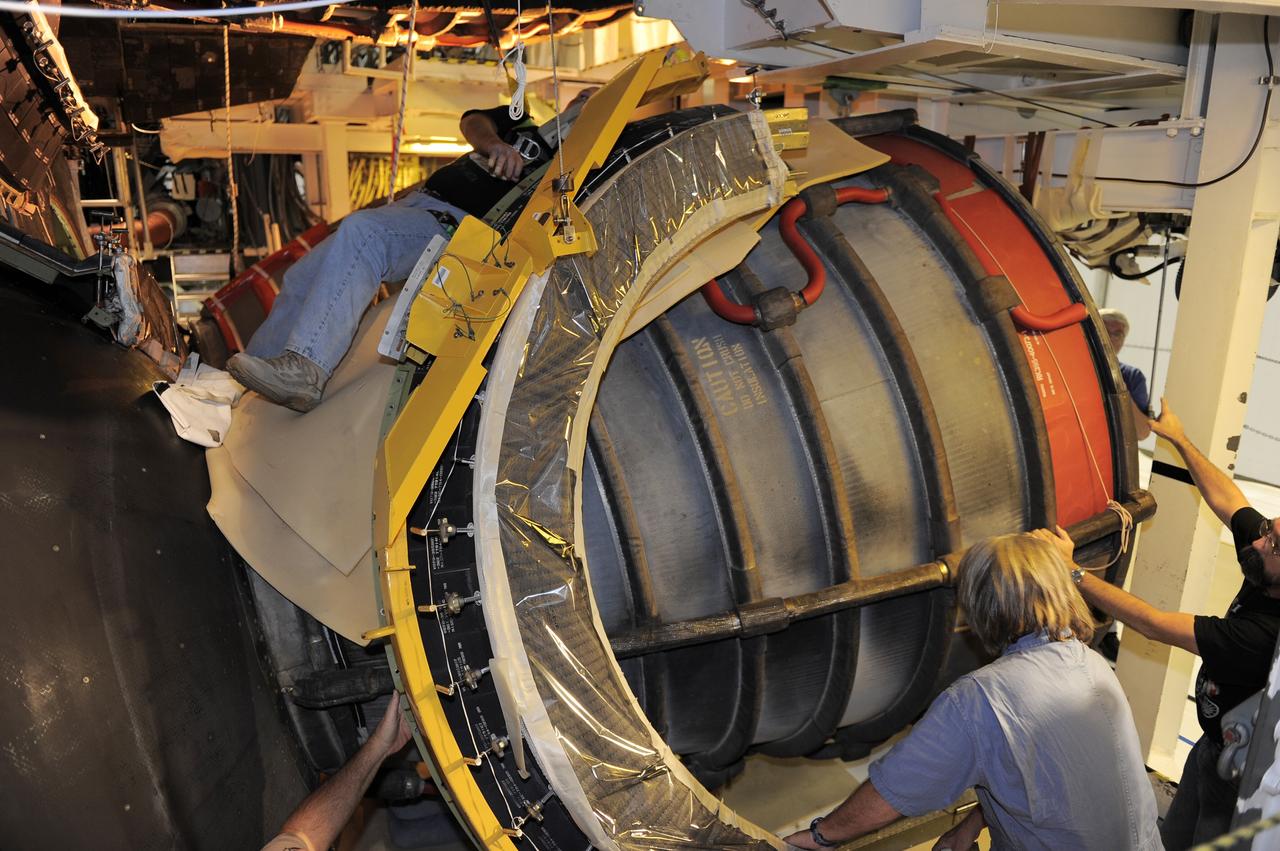
CAPE CANAVERAL, Fla. - Crews in Orbiter Processing Facility-2 at NASA's Kennedy Space Center in Florida remove space shuttle Discovery's right-hand inner heat shield from engine No. 1. The removal is part of Discovery's transition and retirement processing. Work performed on Discovery is expected to help rocket designers build next-generation spacecraft and prepare the shuttle for future public display.Photo credit: NASA/Kim Shiflett
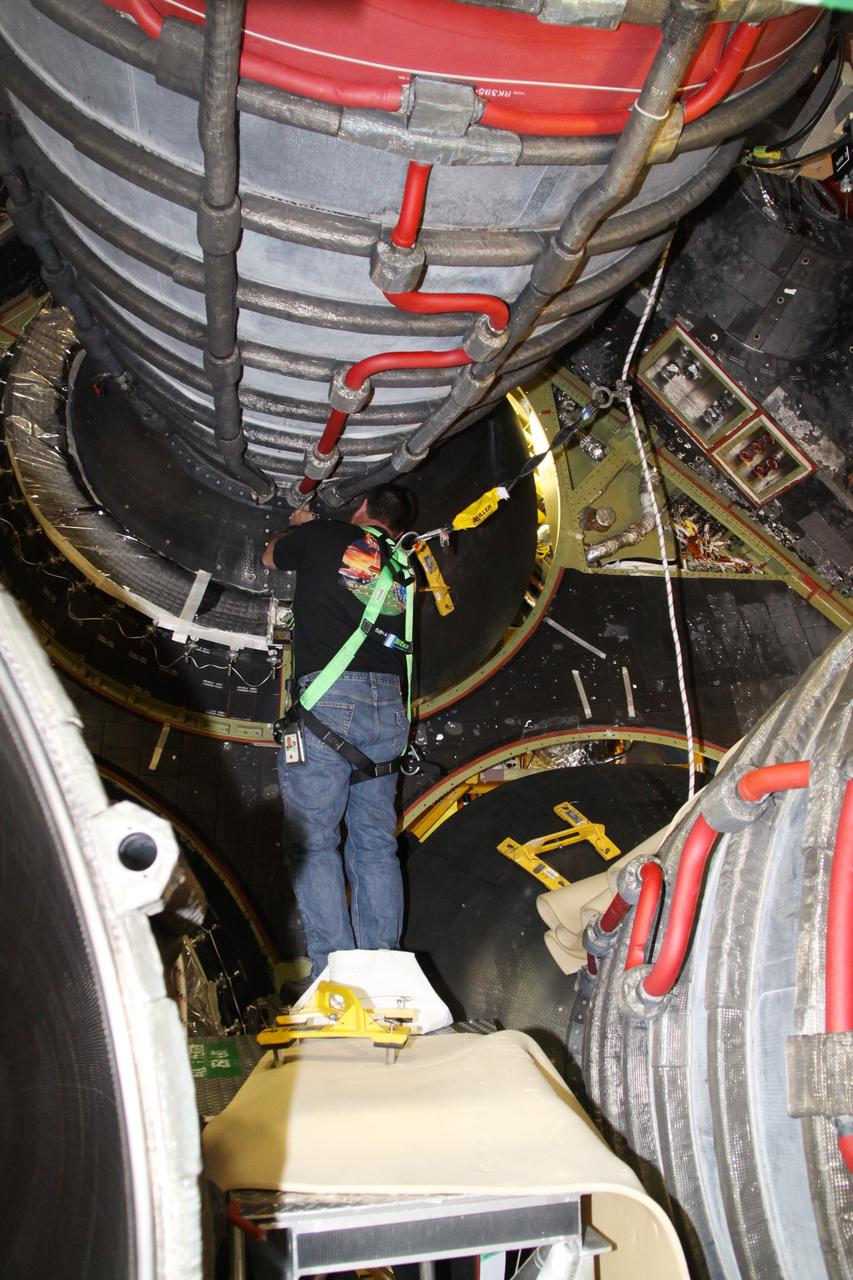
CAPE CANAVERAL, Fla. - Crews in Orbiter Processing Facility-2 at NASA's Kennedy Space Center in Florida remove space shuttle Discovery's right-hand inner heat shield from engine No. 1. The removal is part of Discovery's transition and retirement processing. Work performed on Discovery is expected to help rocket designers build next-generation spacecraft and prepare the shuttle for future public display.Photo credit: NASA/Jack Pfaller
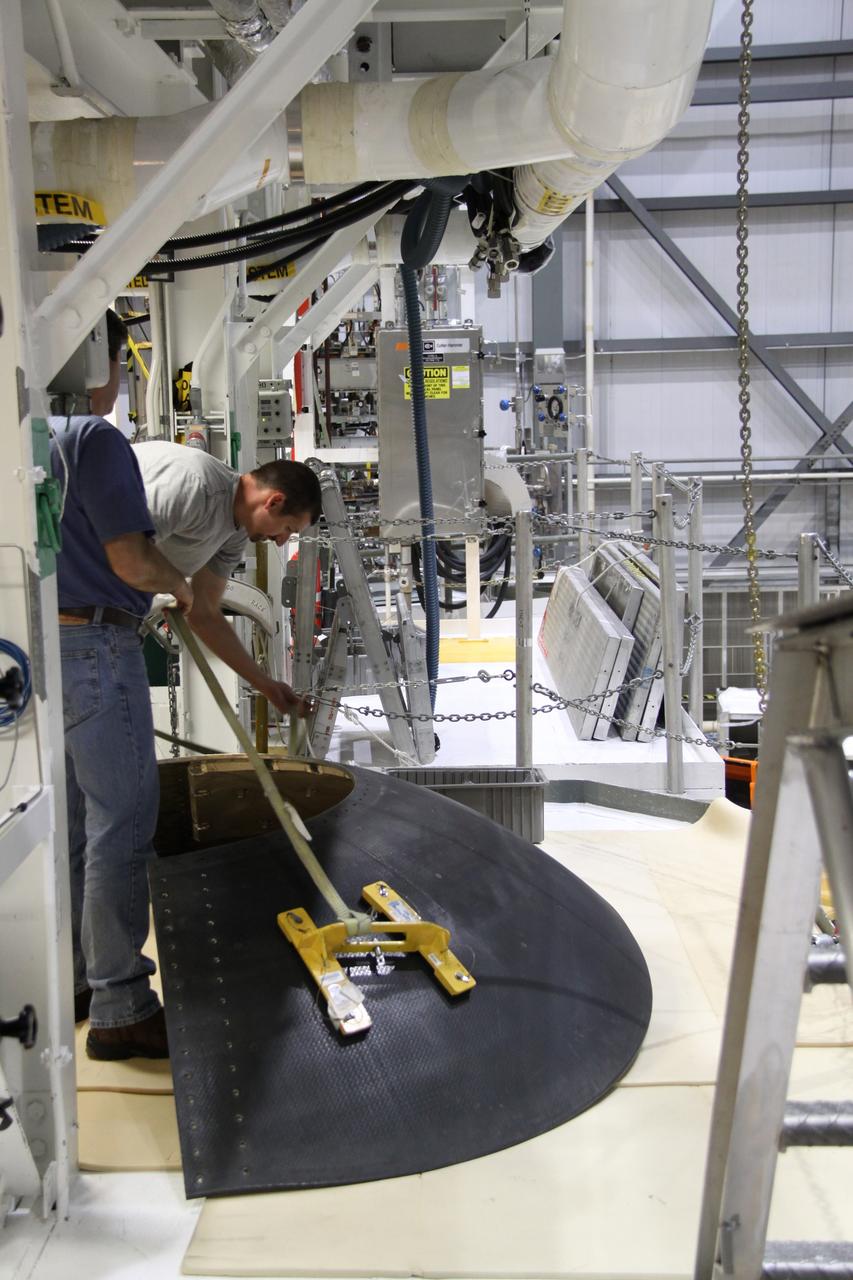
CAPE CANAVERAL, Fla. - Crews in Orbiter Processing Facility-2 at NASA's Kennedy Space Center in Florida remove space shuttle Discovery's right-hand inner heat shield from engine No. 1. The removal is part of Discovery's transition and retirement processing. Work performed on Discovery is expected to help rocket designers build next-generation spacecraft and prepare the shuttle for future public display.Photo credit: NASA/Jack Pfaller
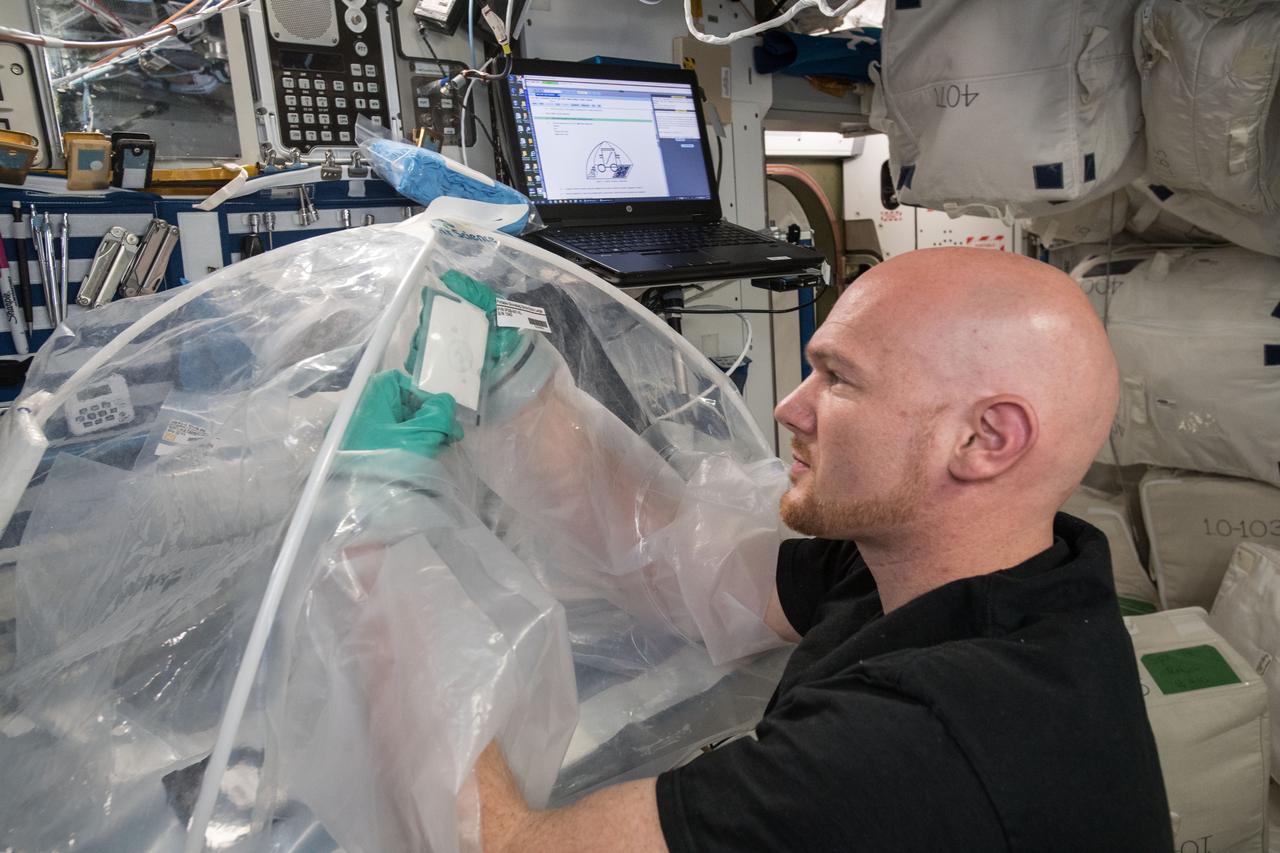
iss056e073250 (July 2, 2018) --- Astronaut Alexander Gerst of ESA (European Space Agency) works on the Microgravity Investigation of Cement Solidification (MICS) 2 experiment aboard the International Space Station. MICS 2 is researching how cement reacts in space during the hardening process and may help engineers better understand its microstructure and material properties. Observations could improve cement processing techniques on Earth and lead to the design of safer, lightweight space habitats.
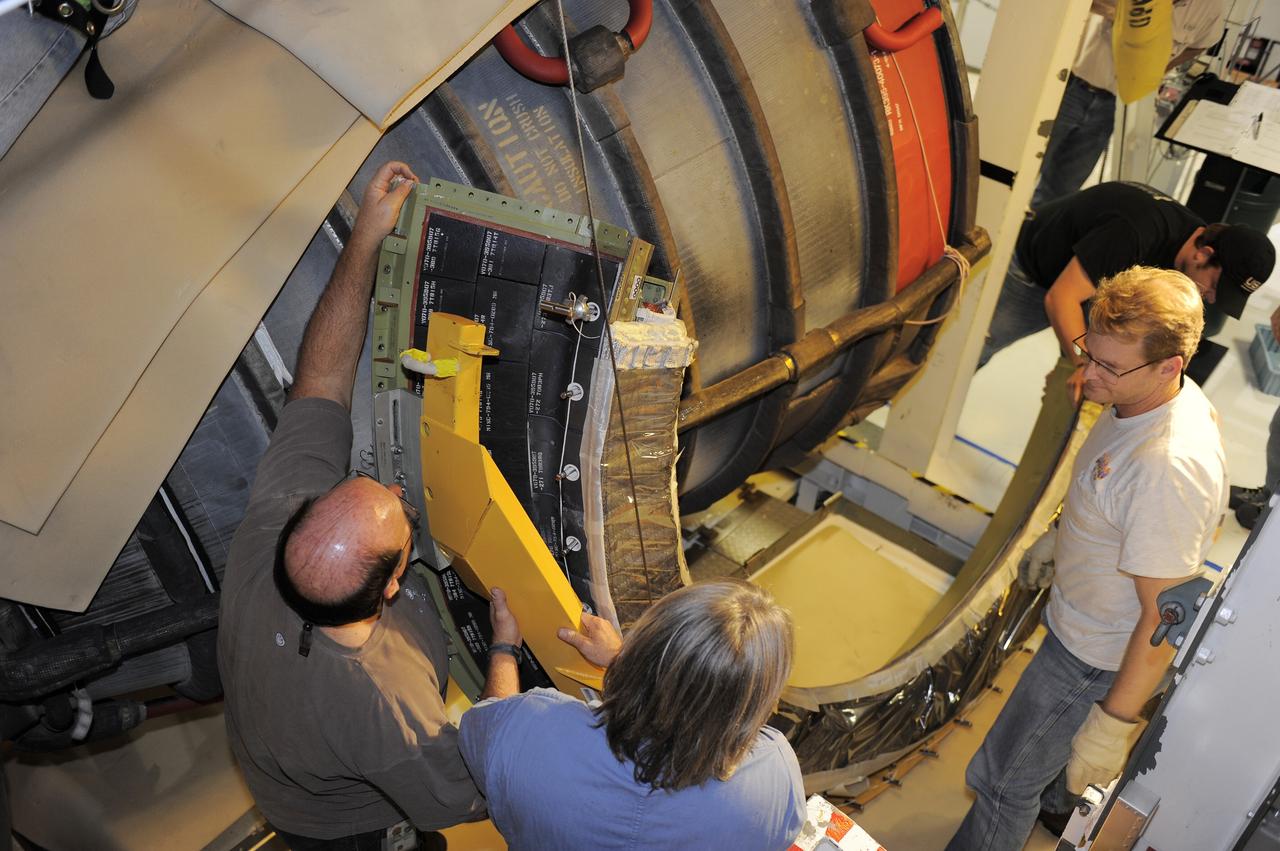
CAPE CANAVERAL, Fla. - Crews in Orbiter Processing Facility-2 at NASA's Kennedy Space Center in Florida remove space shuttle Discovery's right-hand inner heat shield from engine No. 1. The removal is part of Discovery's transition and retirement processing. Work performed on Discovery is expected to help rocket designers build next-generation spacecraft and prepare the shuttle for future public display.Photo credit: NASA/Kim Shiflett
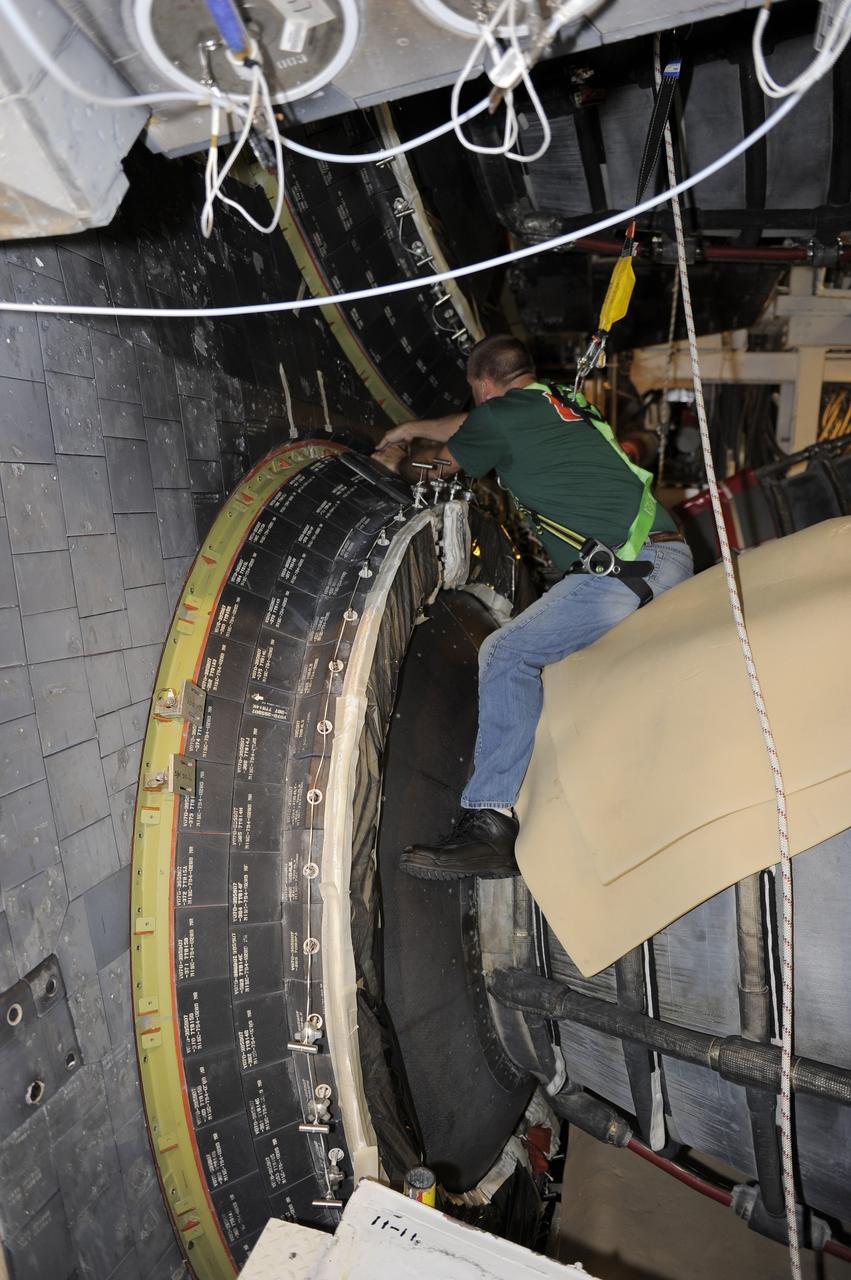
CAPE CANAVERAL, Fla. - Crews in Orbiter Processing Facility-2 at NASA's Kennedy Space Center in Florida remove space shuttle Discovery's right-hand inner heat shield from engine No. 1. The removal is part of Discovery's transition and retirement processing. Work performed on Discovery is expected to help rocket designers build next-generation spacecraft and prepare the shuttle for future public display.Photo credit: NASA/Kim Shiflett
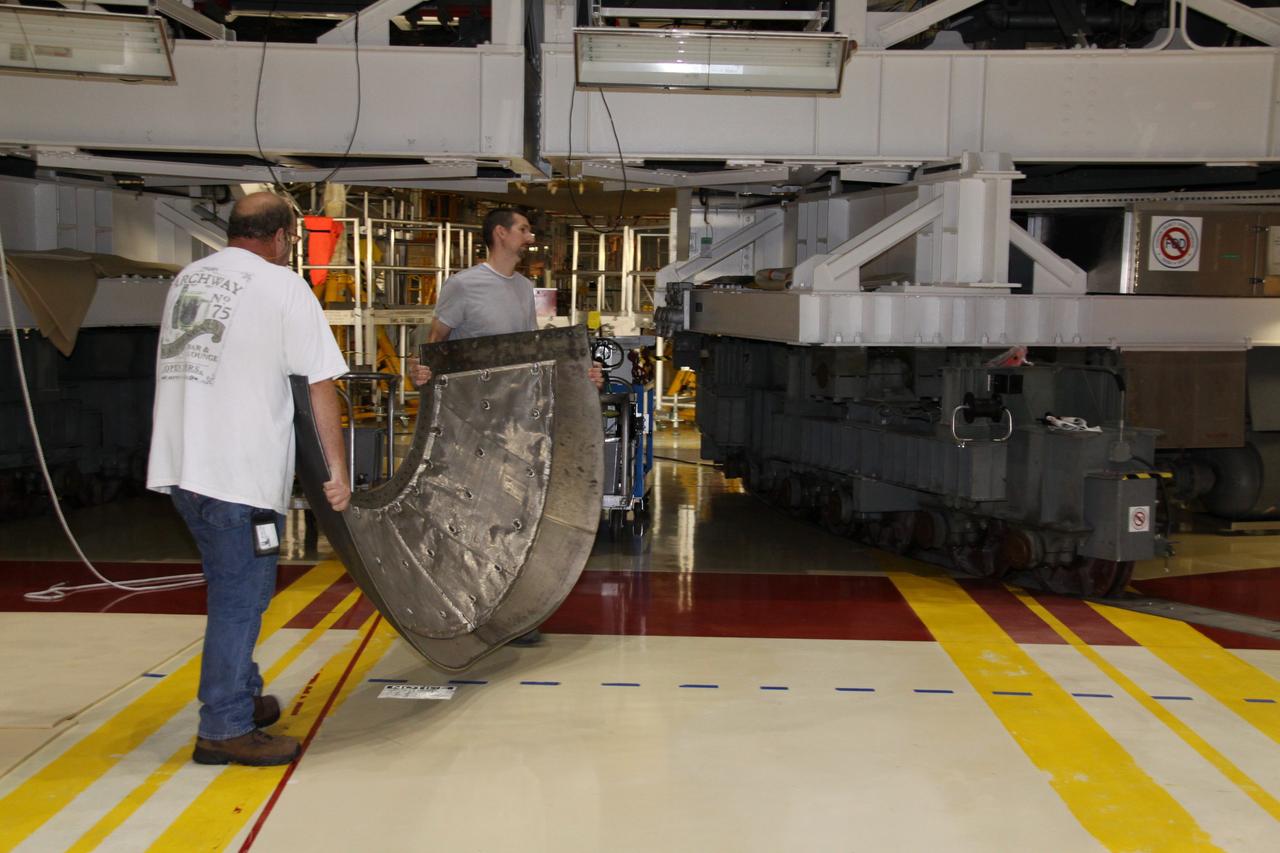
CAPE CANAVERAL, Fla. - Crews in Orbiter Processing Facility-2 at NASA's Kennedy Space Center in Florida remove space shuttle Discovery's right-hand inner heat shield from engine No. 1. The removal is part of Discovery's transition and retirement processing. Work performed on Discovery is expected to help rocket designers build next-generation spacecraft and prepare the shuttle for future public display.Photo credit: NASA/Jack Pfaller
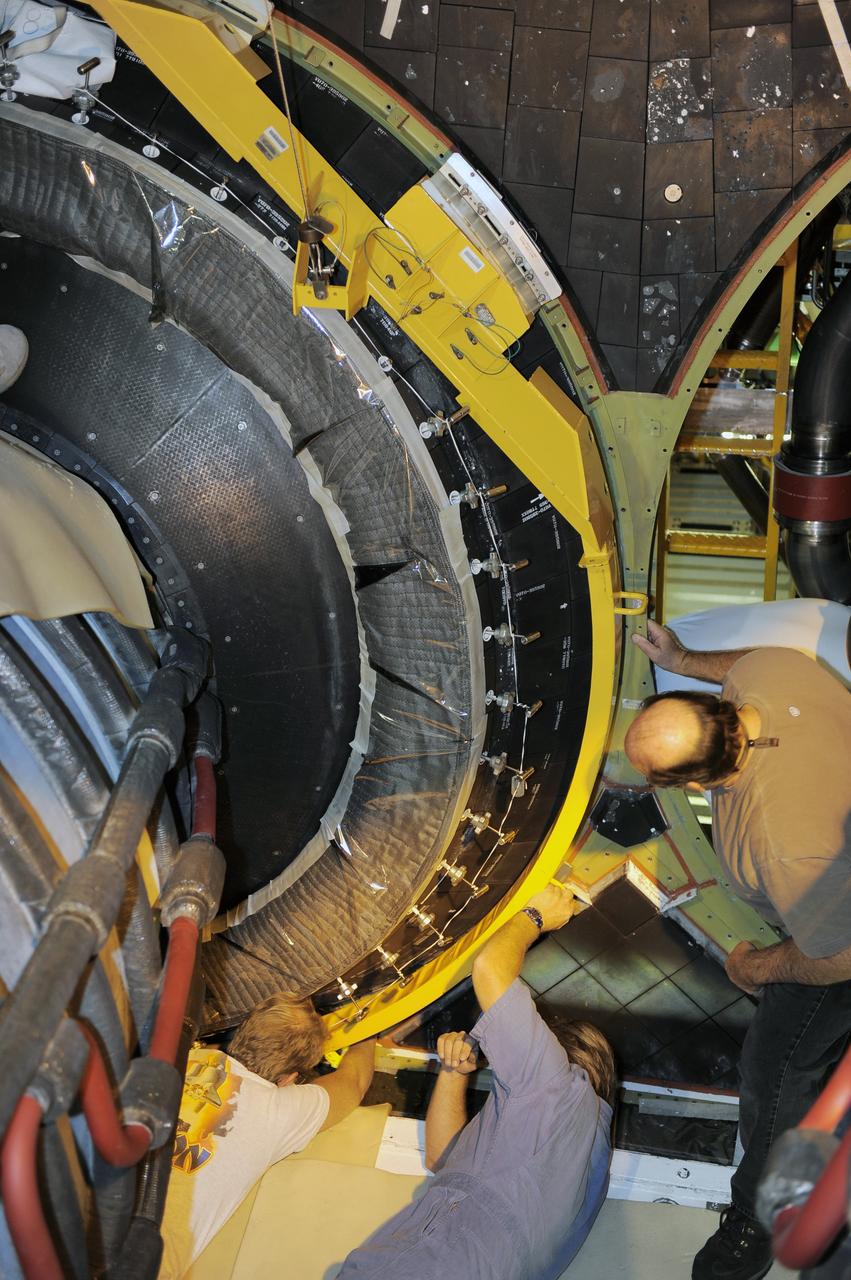
CAPE CANAVERAL, Fla. - Crews in Orbiter Processing Facility-2 at NASA's Kennedy Space Center in Florida remove space shuttle Discovery's right-hand inner heat shield from engine No. 1. The removal is part of Discovery's transition and retirement processing. Work performed on Discovery is expected to help rocket designers build next-generation spacecraft and prepare the shuttle for future public display.Photo credit: NASA/Kim Shiflett
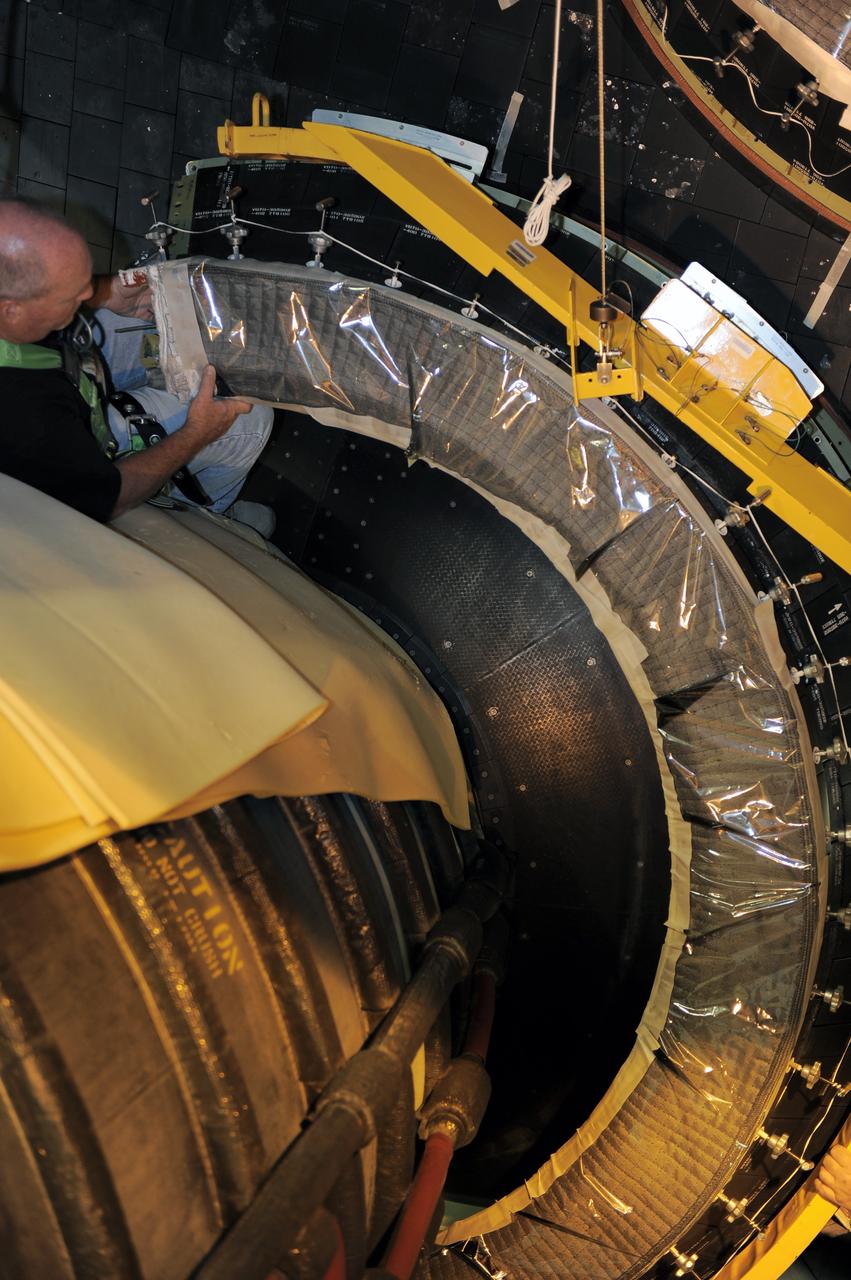
CAPE CANAVERAL, Fla. - Crews in Orbiter Processing Facility-2 at NASA's Kennedy Space Center in Florida remove space shuttle Discovery's right-hand inner heat shield from engine No. 1. The removal is part of Discovery's transition and retirement processing. Work performed on Discovery is expected to help rocket designers build next-generation spacecraft and prepare the shuttle for future public display.Photo credit: NASA/Kim Shiflett
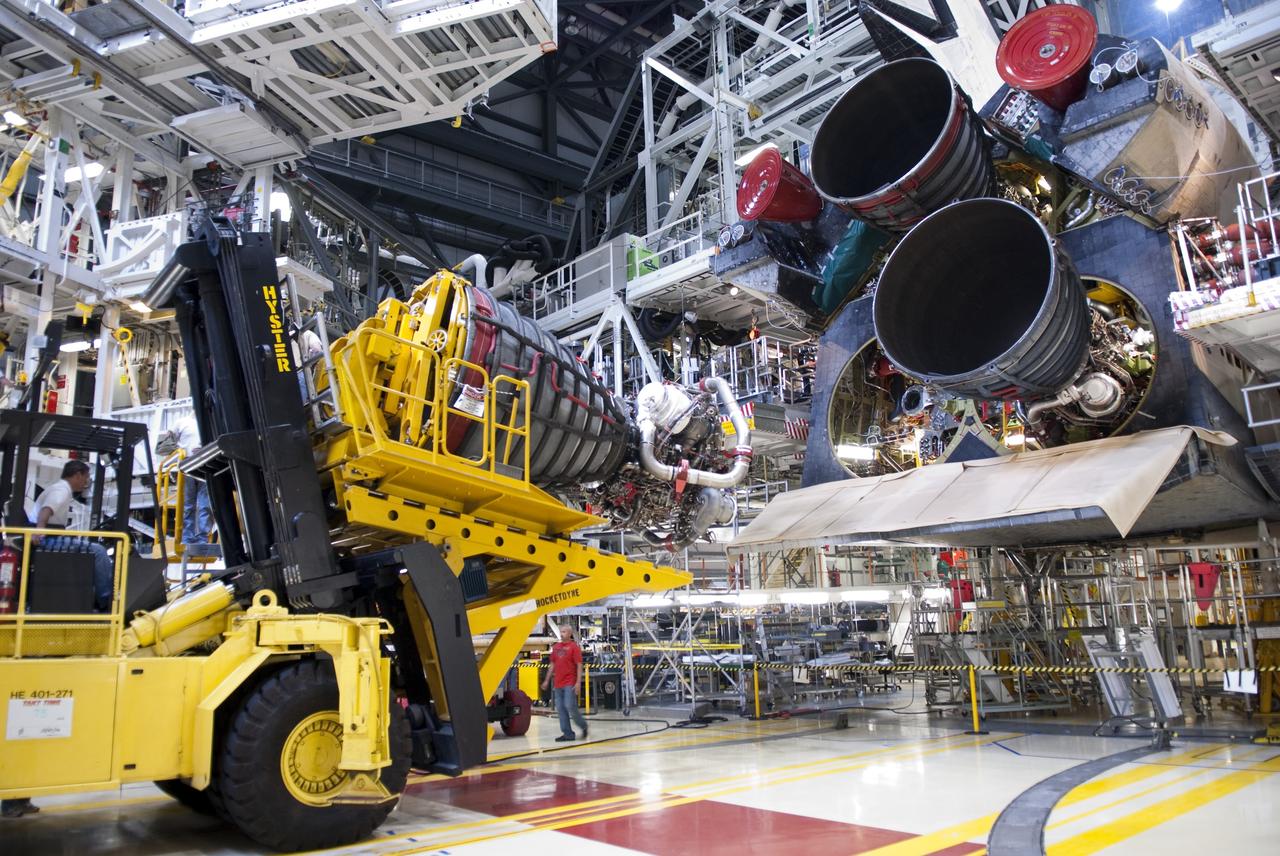
CAPE CANAVERAL, Fla. -- Technicians complete the removal of one of space shuttle Discovery's three main engines. The work is taking place in Orbiter Processing Facility-2 at NASA's Kennedy Space Center in Florida. The transition and retirement processing is expected to help rocket designers build next-generation spacecraft and prepare the shuttle for display. Photo credit: NASA/Jim Grossmann
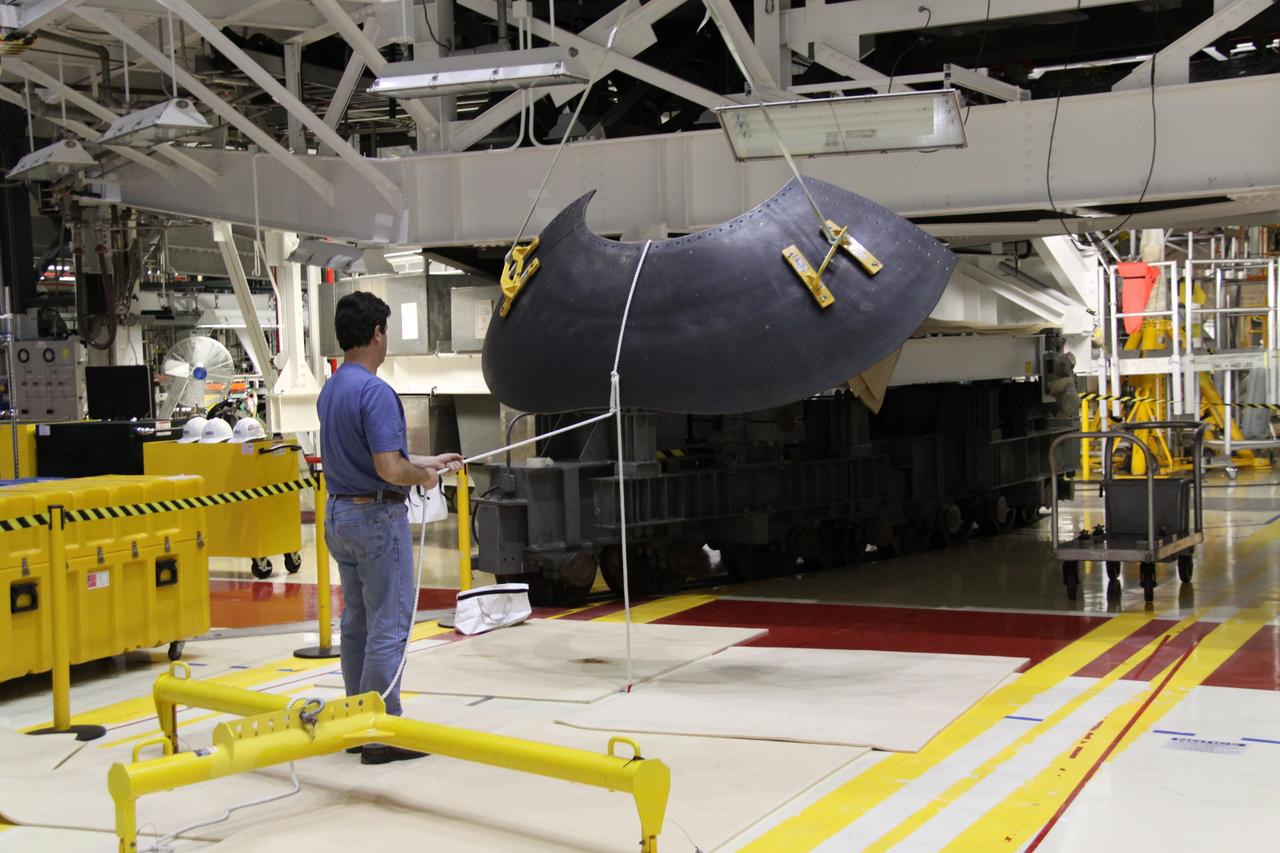
CAPE CANAVERAL, Fla. - Crews in Orbiter Processing Facility-2 at NASA's Kennedy Space Center in Florida remove space shuttle Discovery's right-hand inner heat shield from engine No. 1. The removal is part of Discovery's transition and retirement processing. Work performed on Discovery is expected to help rocket designers build next-generation spacecraft and prepare the shuttle for future public display.Photo credit: NASA/Jack Pfaller
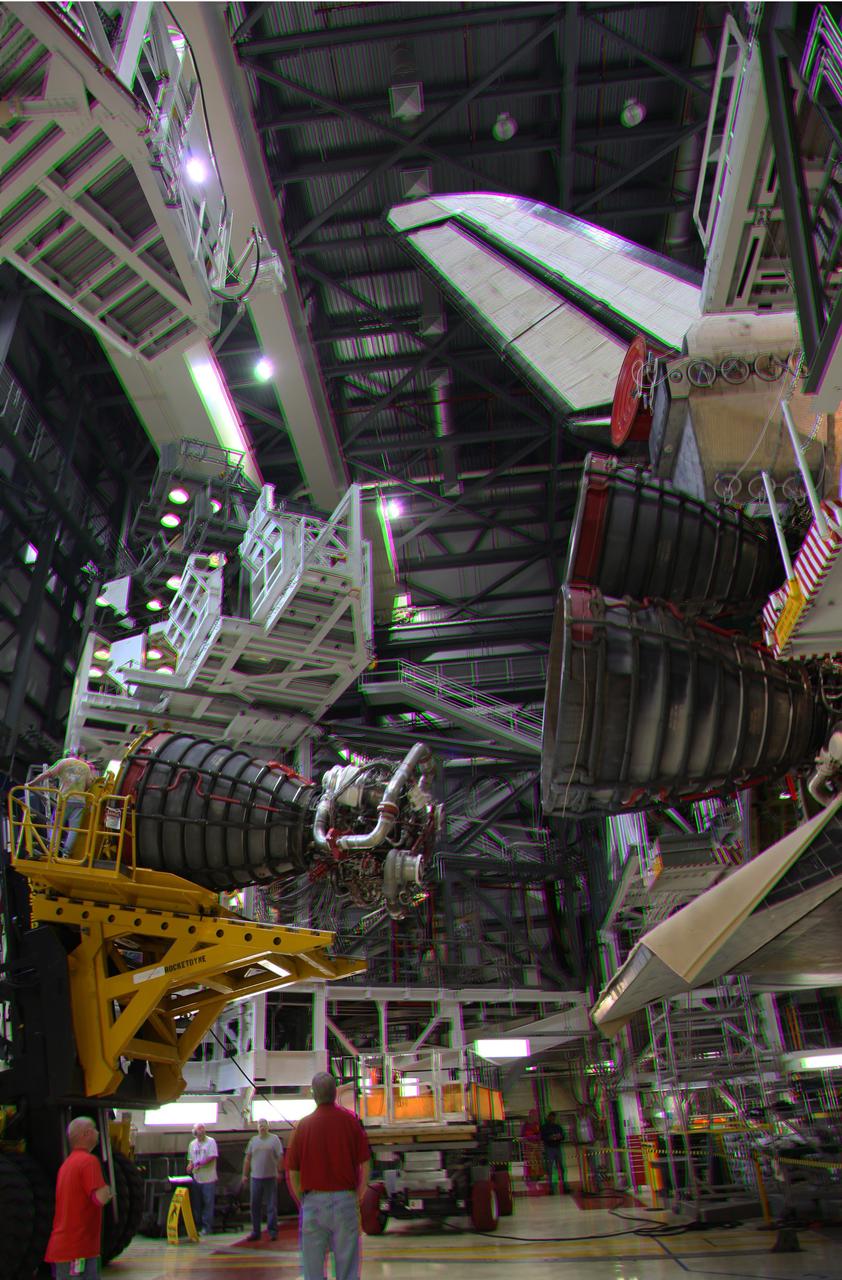
CAPE CANAVERAL, Fla. -- This is a 3-D image of crews in Orbiter Processing Facility-2 at NASA's Kennedy Space Center in Florida using a Hyster forklift to lower one of space shuttle Discovery's main engines after removal for cleaning and inspection. This is part of the spacecraft's transition and retirement processing and work performed on Discovery is expected to help rocket designers build next-generation spacecraft and prepare the shuttle for future public display. To view this image, use green and magenta 3-D glasses. Photo credit: NASA/Frankie Martin
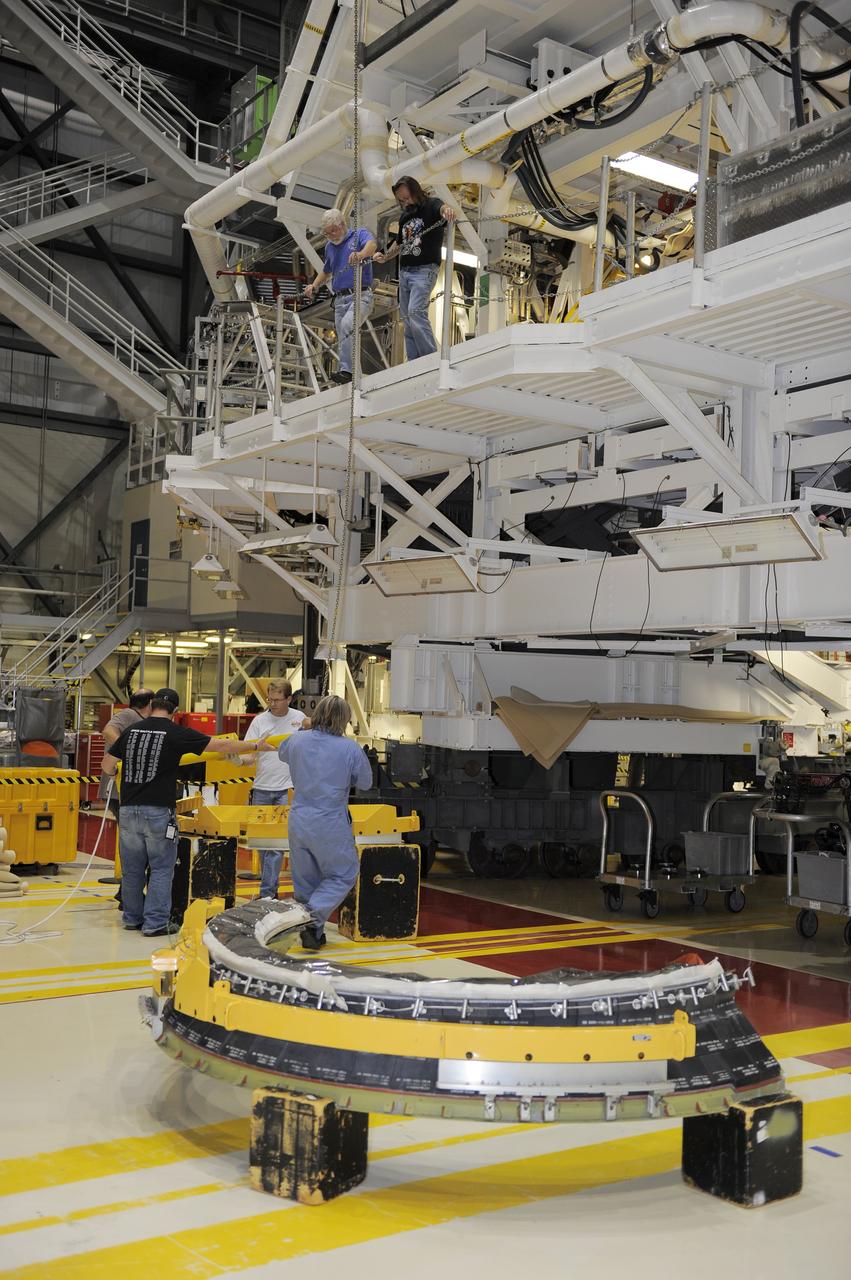
CAPE CANAVERAL, Fla. - Crews in Orbiter Processing Facility-2 at NASA's Kennedy Space Center in Florida remove space shuttle Discovery's right-hand inner heat shield from engine No. 1. The removal is part of Discovery's transition and retirement processing. Work performed on Discovery is expected to help rocket designers build next-generation spacecraft and prepare the shuttle for future public display.Photo credit: NASA/Kim Shiflett