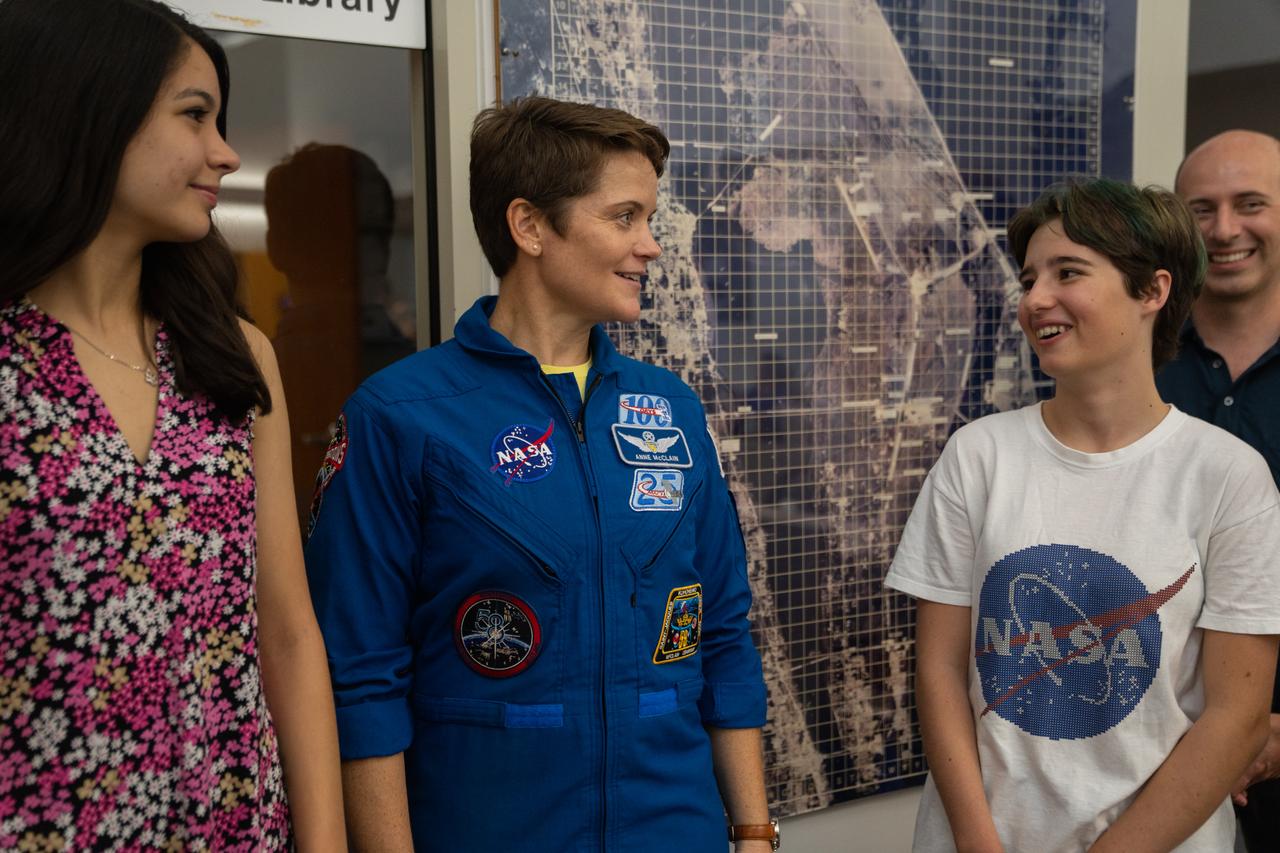
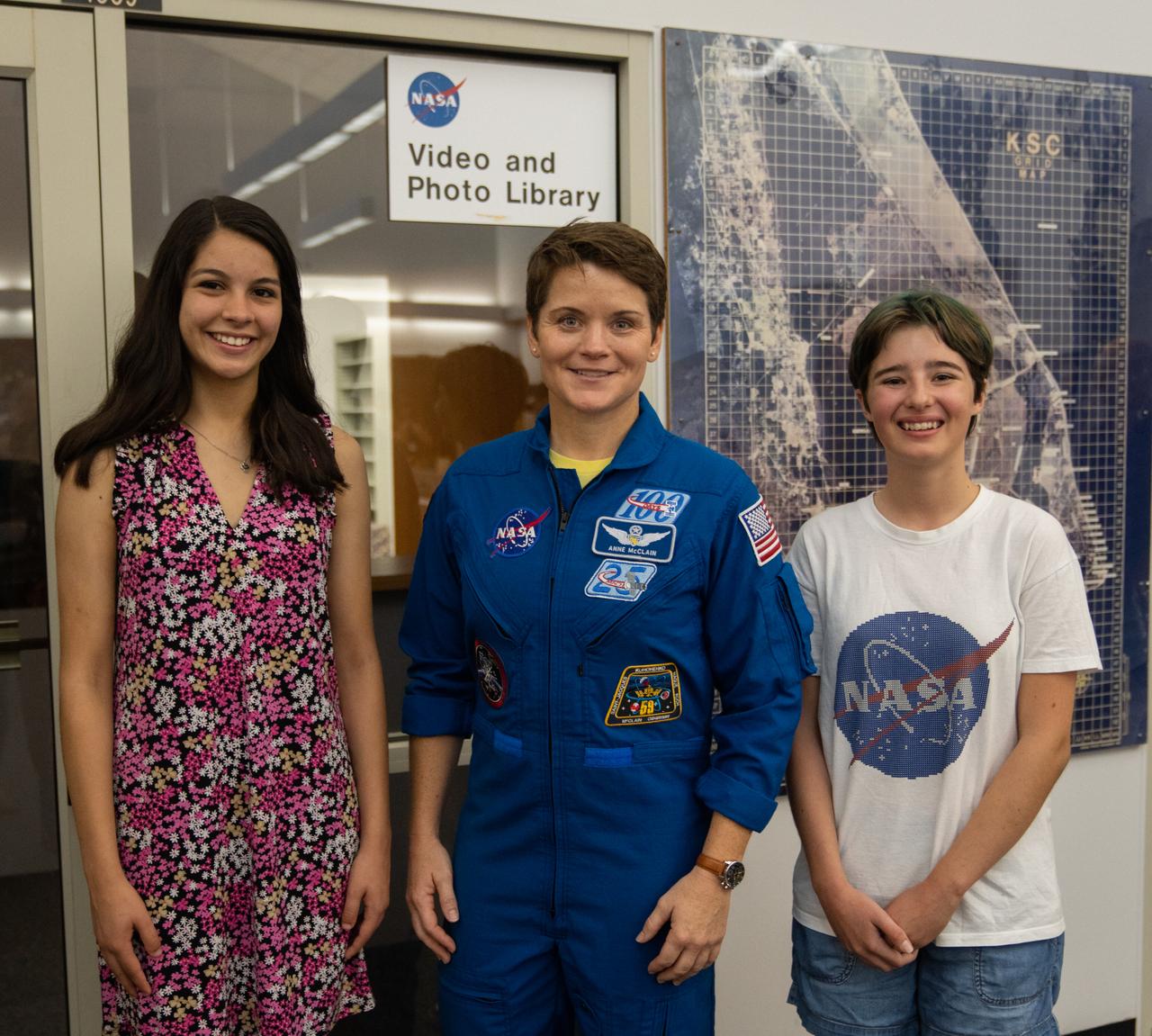
NASA astronaut Anne McClain talks with student essay winners Amanda Gutierrez, left, and Taia Saurer at the agency’s news center at Kennedy Space Center in Florida on Sept. 2, 2022. Gutierrez and Saurer won the Artemis Moon Pod Essay Contest – a nationwide event involving nearly 14,000 students – for their creative visions of a pioneering journey to the Moon. The grand prize was a trip to Kennedy to watch the launch of Artemis I. Gutierrez, 17, is an 11th-grader from Lincoln, Nebraska, while Saurer, 14, is an eighth-grader from Laguna Beach, California.
Moon Pod Essay Contest Winners
Student essay winners Amanda Gutierrez, left, and Taia Saurer pose with NASA astronaut Anne McClain at the agency’s news center at Kennedy Space Center in Florida on Sept. 2, 2022. Gutierrez and Saurer won the Artemis Moon Pod Essay Contest – a nationwide event involving nearly 14,000 students – for their creative visions of a pioneering journey to the Moon. The grand prize was a trip to Kennedy to watch the launch of Artemis I. Gutierrez, 17, is an 11th-grader from Lincoln, Nebraska, while Saurer, 14, is an eighth-grader from Laguna Beach, California.
Moon Pod Essay Contest Winners
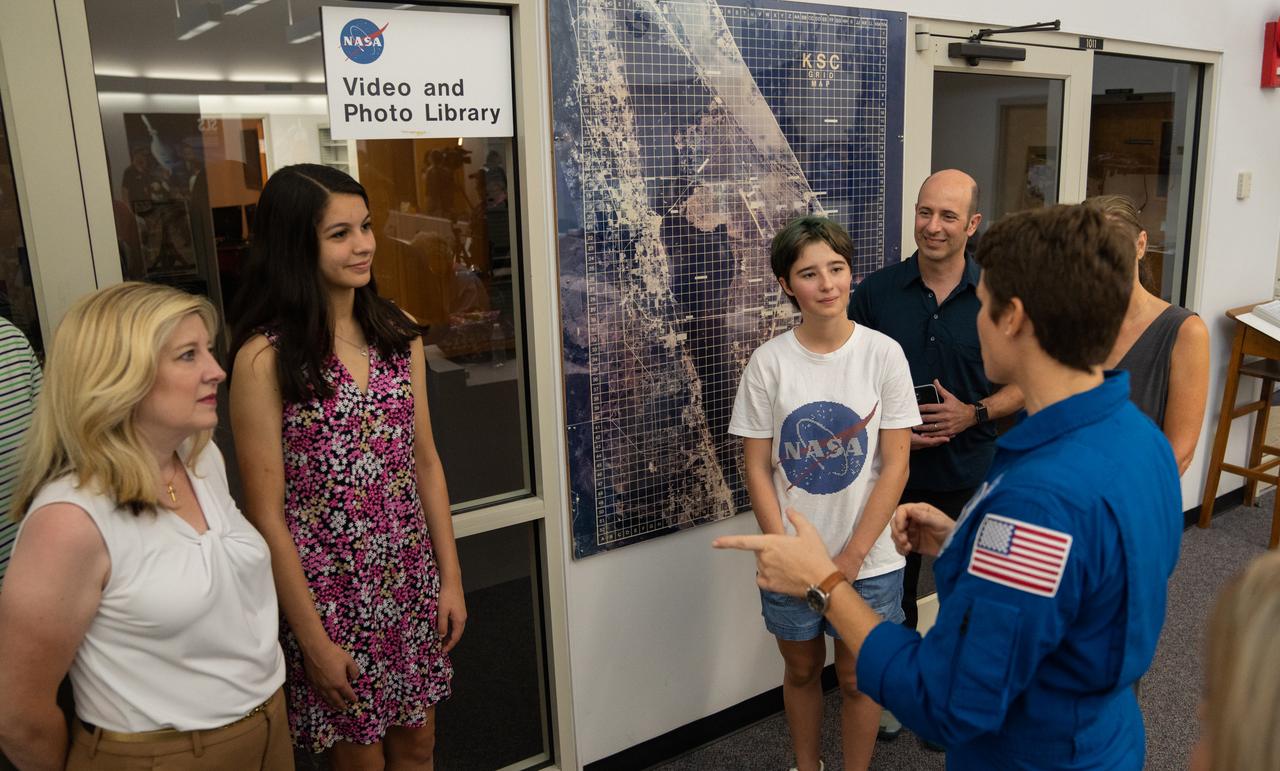
NASA astronaut Anne McClain talks with student essay winners Amanda Gutierrez, second from left, and Taia Saurer, white NASA shirt, at the agency’s news center at Kennedy Space Center in Florida on Sept. 2, 2022. Gutierrez and Saurer won the Artemis Moon Pod Essay Contest – a nationwide event involving nearly 14,000 students – for their creative visions of a pioneering journey to the Moon. The grand prize was a trip to Kennedy to watch the launch of Artemis I. Gutierrez, 17, is an 11th-grader from Lincoln, Nebraska, while Saurer, 14, is an eighth-grader from Laguna Beach, California.
Moon Pod Essay Contest Winners
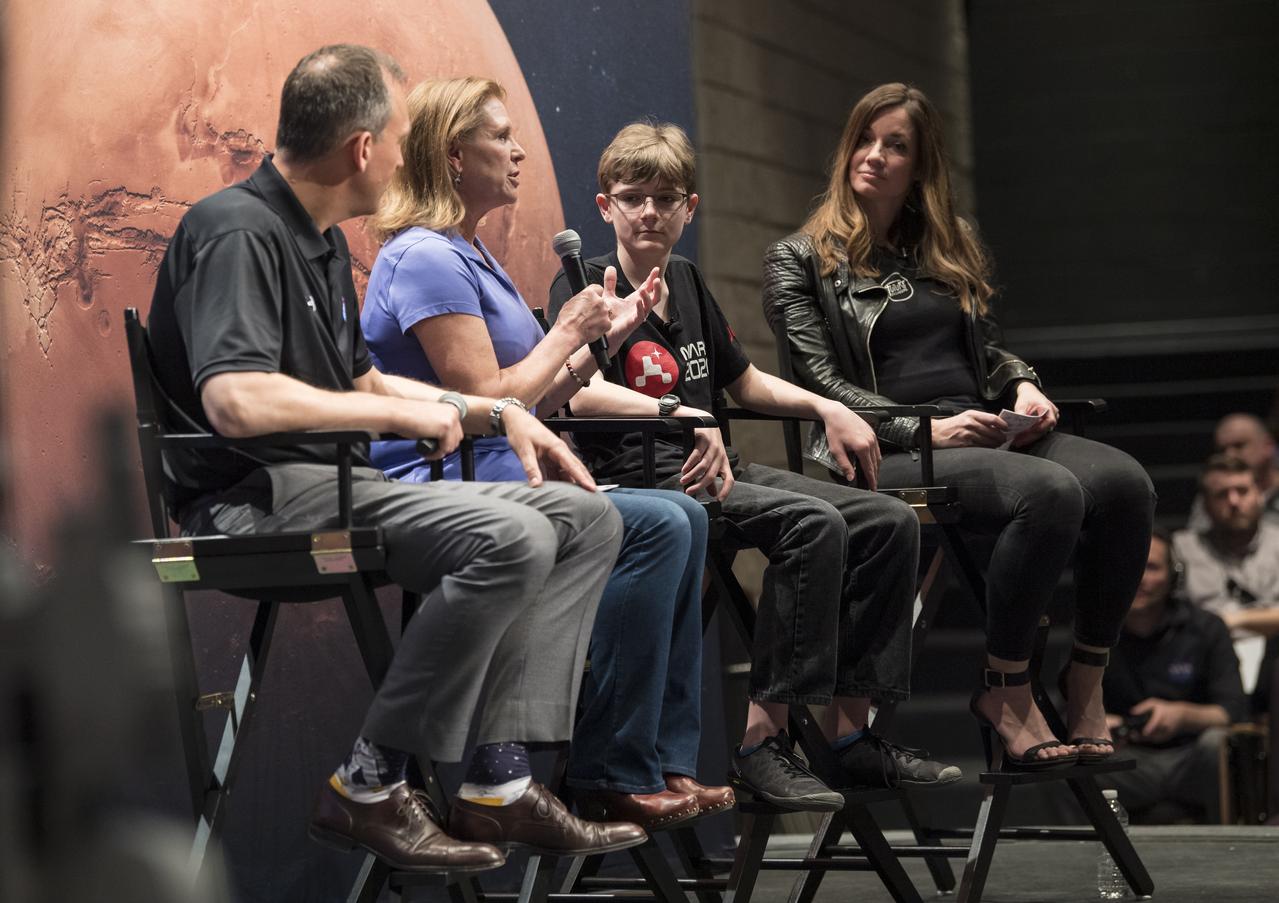
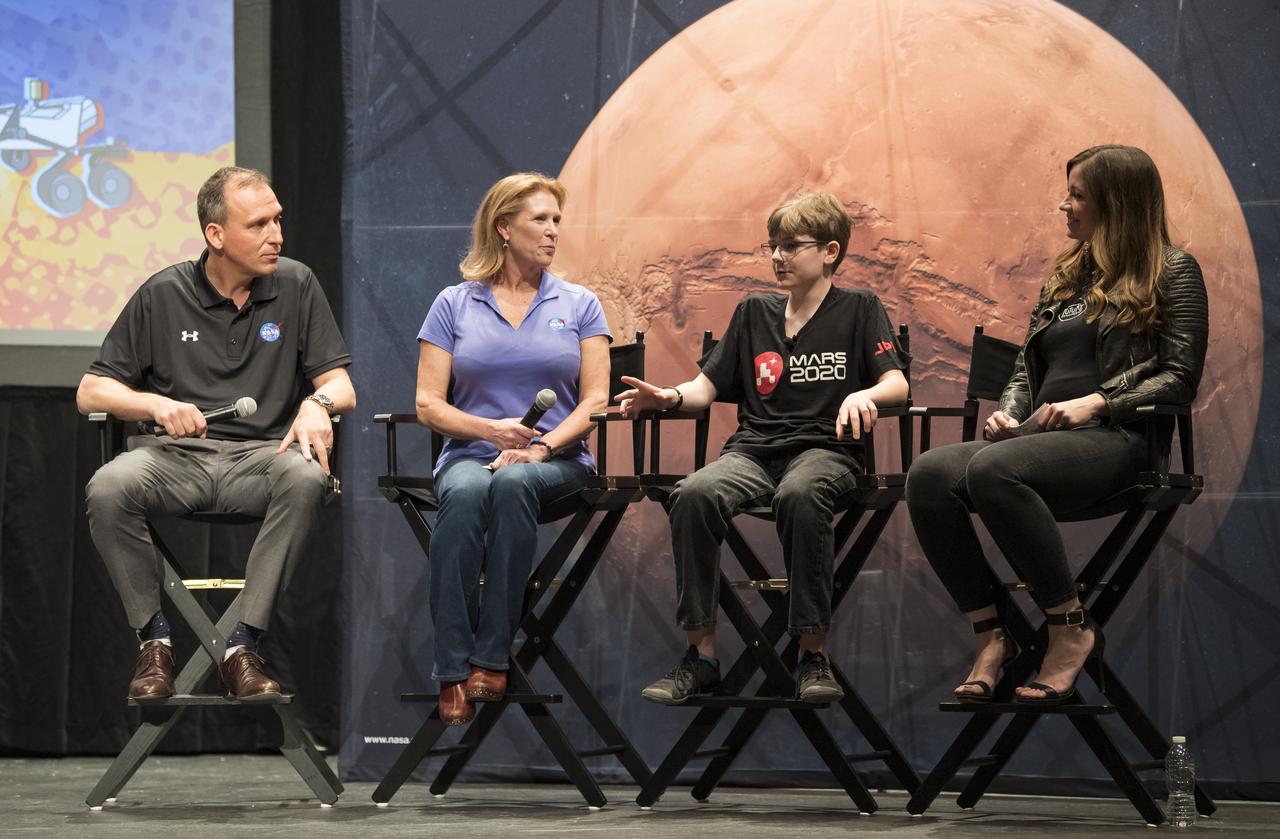
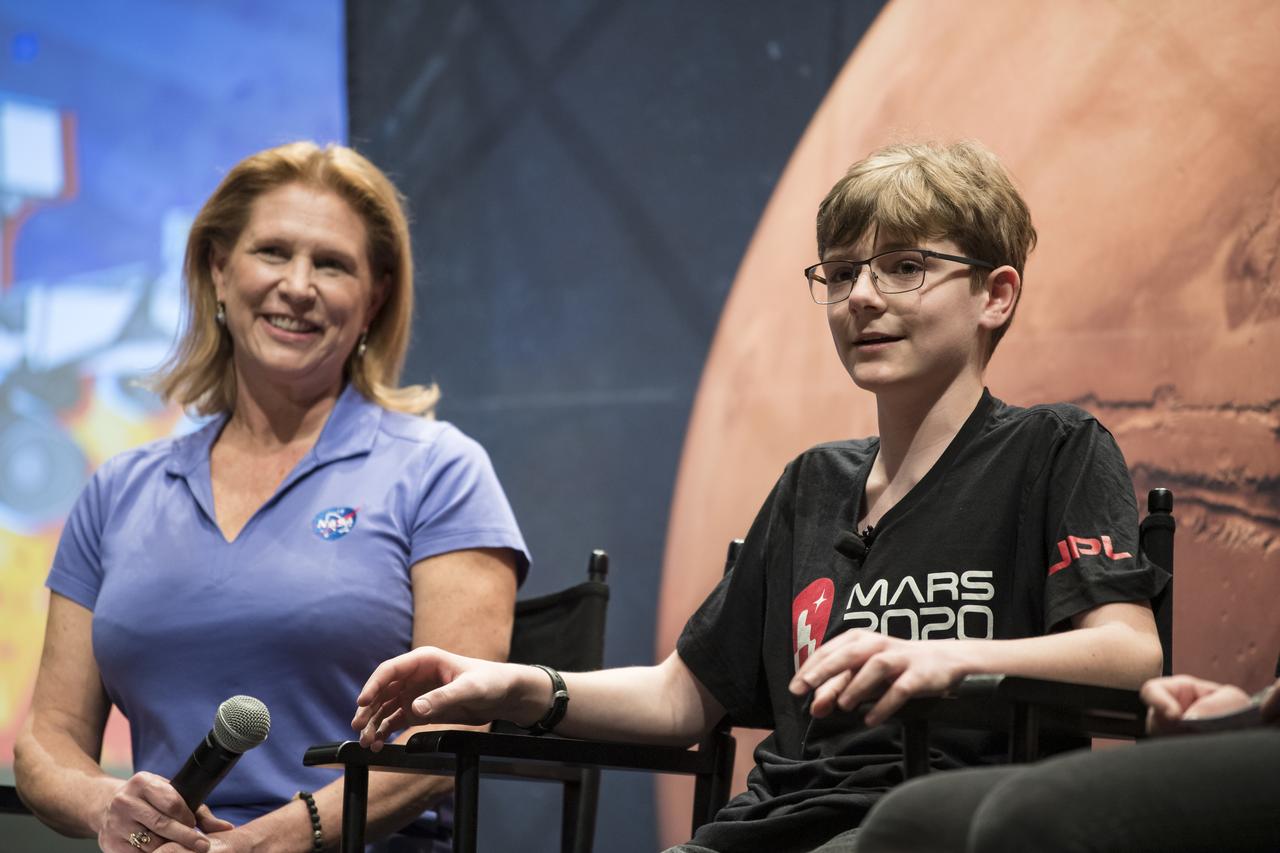
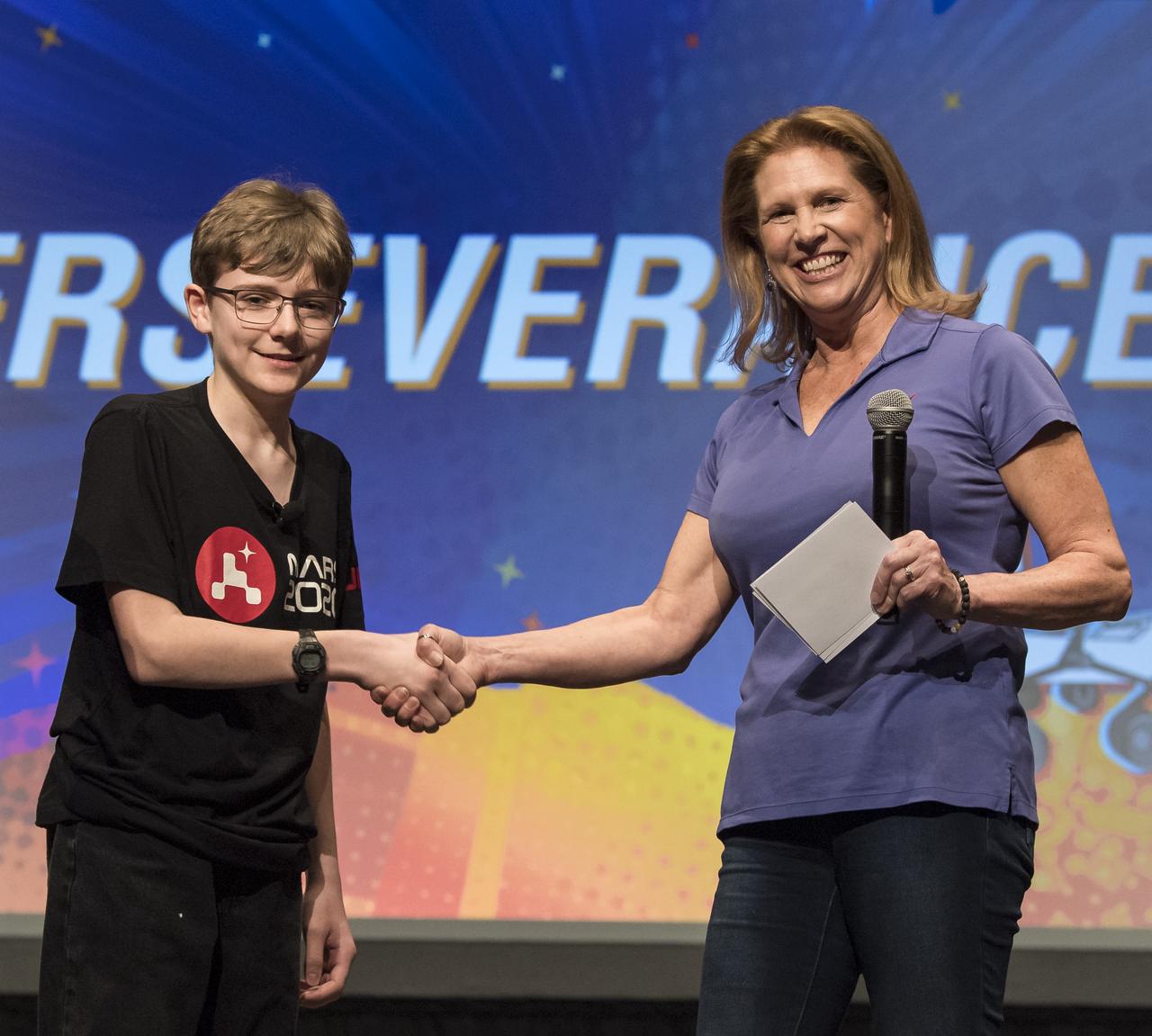
Seventh-grader Alexander Mather of Lake Braddock Secondary School in Burke, Virginia, submitted the winning entry in the agency's "Name the Rover" essay contest, making the case to name the Mars 2020 rover "Perseverance." For the contest, NASA received 28,000 essays (150 words or less) from K-12 students from every U.S. state and territory.  https://photojournal.jpl.nasa.gov/catalog/PIA23761
NASA Rover Naming Contest Winner Alexander Mather
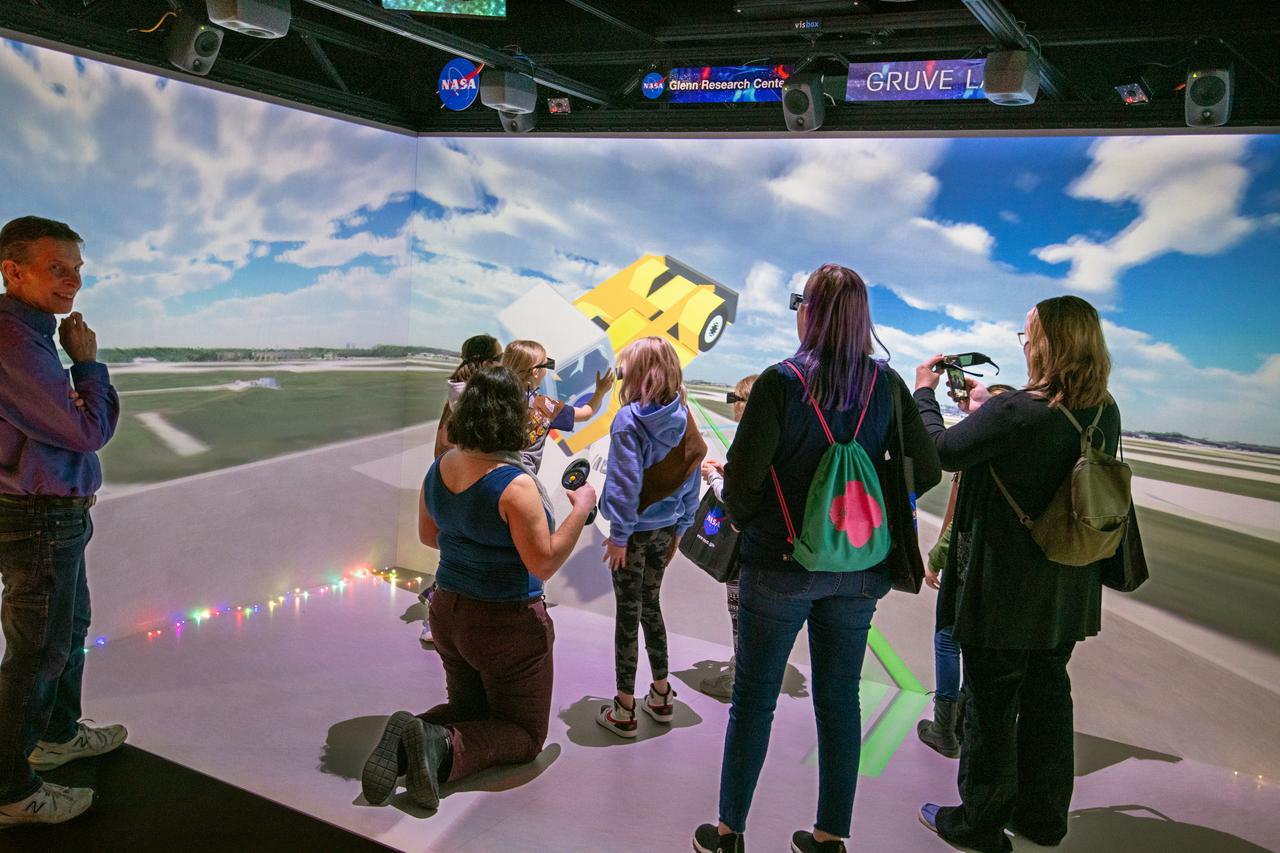
Local area girl scouts competed in a "Girl Scouts to the Moon and Back" essay contest.  The essay contest gave the girls scouts a chance to win a Space Science badge that has actually been to space on NASA's Artemis I mission.  After the award ceremony the girl scouts got to tour some of the NASA Glenn facilities.  Picture is the "cave" at the Graphics and Visualization Lab, also known as the GRUVE Lab.  Looking on is Richard Rinehart who is an engineer who works in the GRUVE LAB and creates 3D simulated experiences that demonstrate NASA's technology.
Girl Scouts to the Moon and Back Recognition Event
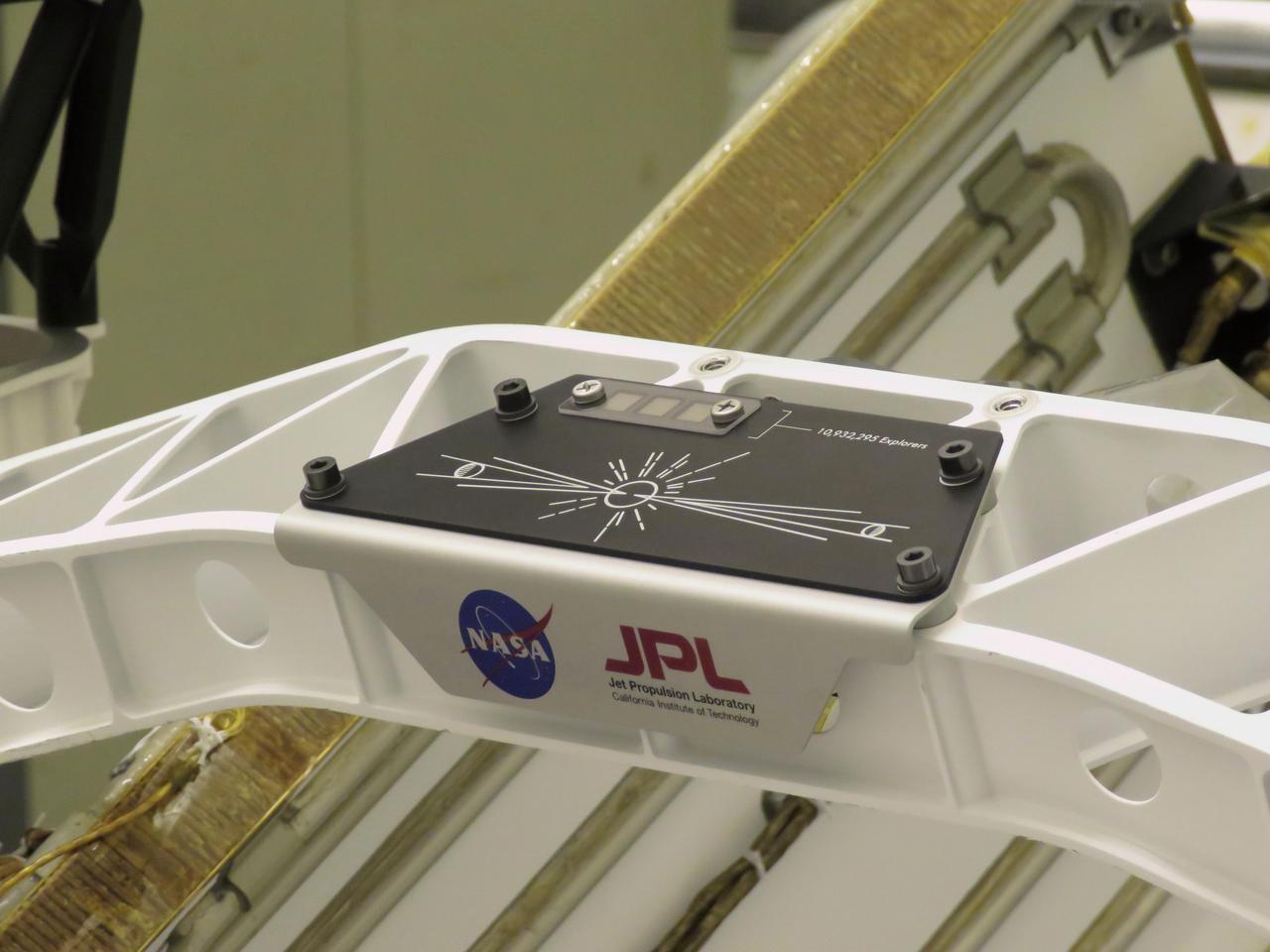
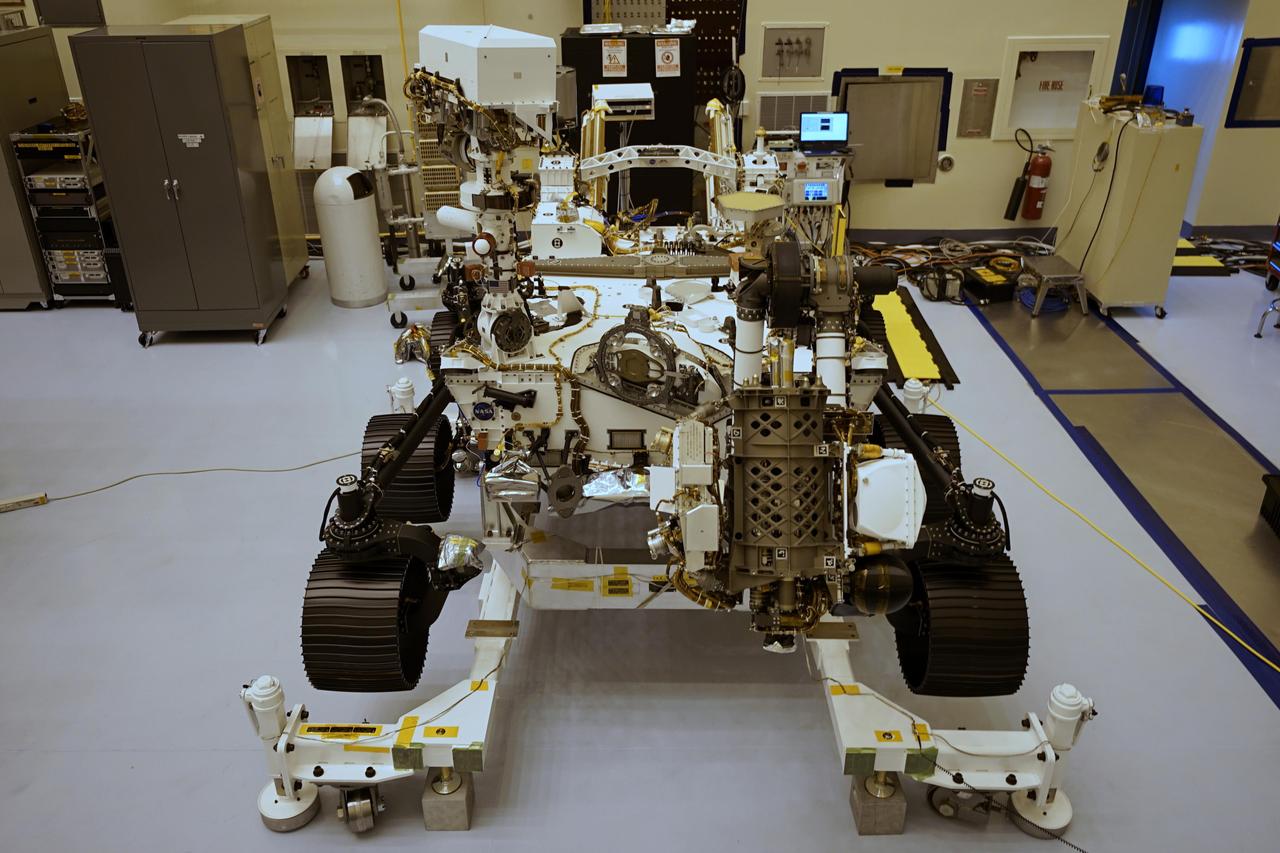
Top center: The plate affixed to the aft crossbeam of NASA's Mars Perseverance rover — seen here on March 16, 2020, at NASA's Kennedy Space Center in Florida — carries 10,932,295 names submitted by people during NASA's "Send Your Name to Mars" campaign and essays of the 155 finalists in the "Name the Rover" contest.  https://photojournal.jpl.nasa.gov/catalog/PIA23770
Perseverance Rover at Cape
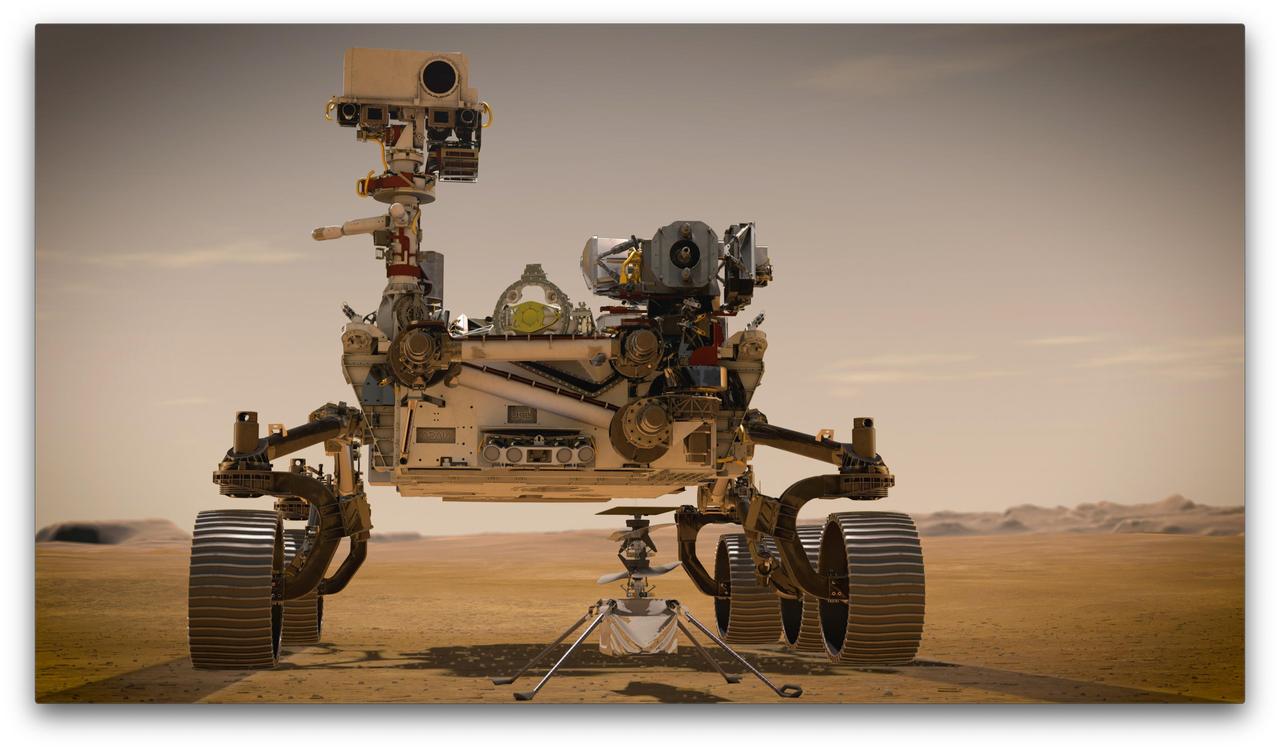
In February 2021, NASA's Mars 2020 Perseverance rover and NASA's Ingenuity Mars Helicopter (shown in an artist's concept) will be the agency's two newest explorers on Mars. Both were named by students as part of an essay contest.  Perseverance is the most sophisticated rover NASA has ever sent to Mars. Ingenuity, a technology experiment, will be the first aircraft to attempt controlled flight on another planet. Perseverance will arrive at Mars' Jezero Crater with Ingenuity attached to its belly.  https://photojournal.jpl.nasa.gov/catalog/PIA23962
Portrait of Perseverance and Ingenuity (Artist's Concept)
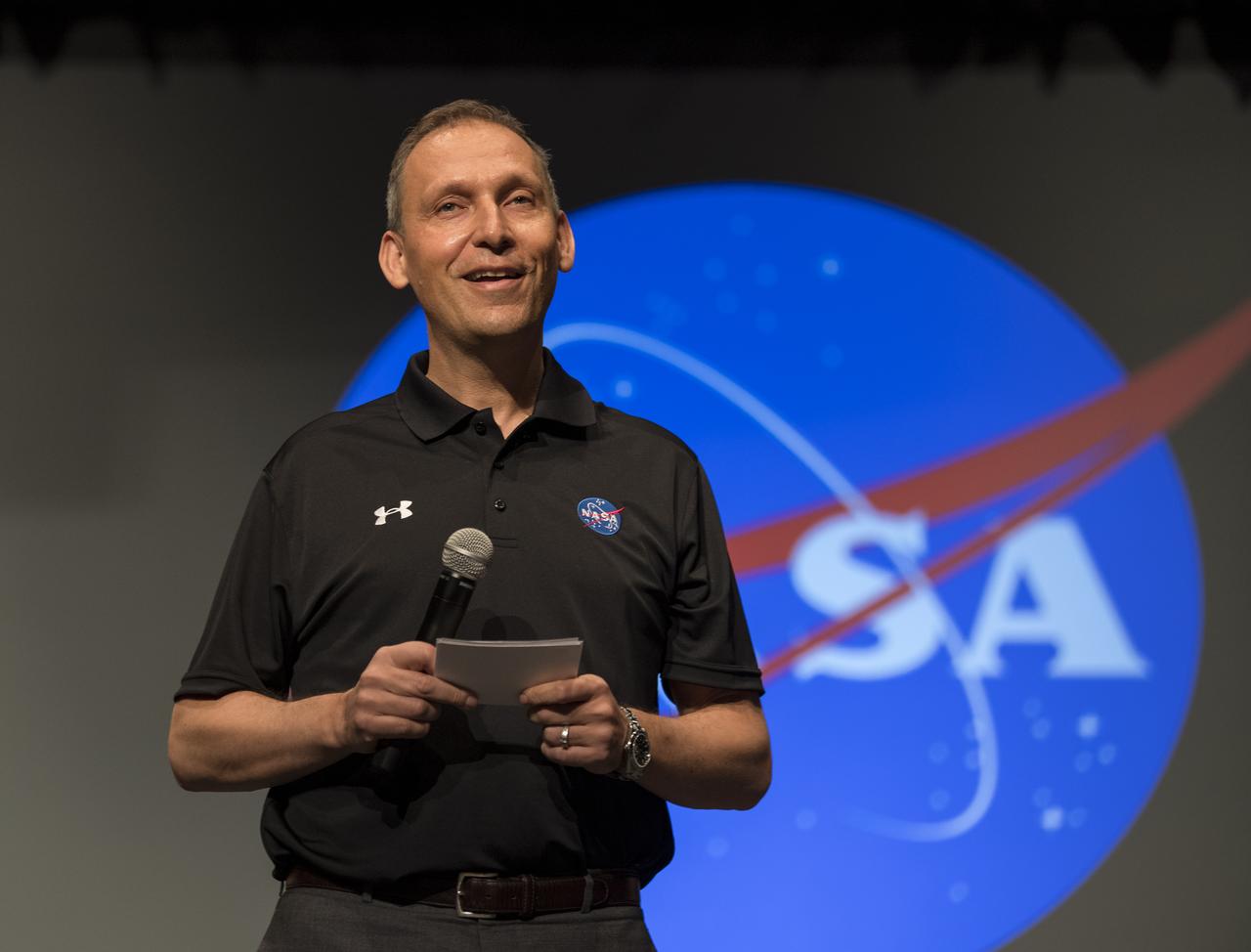
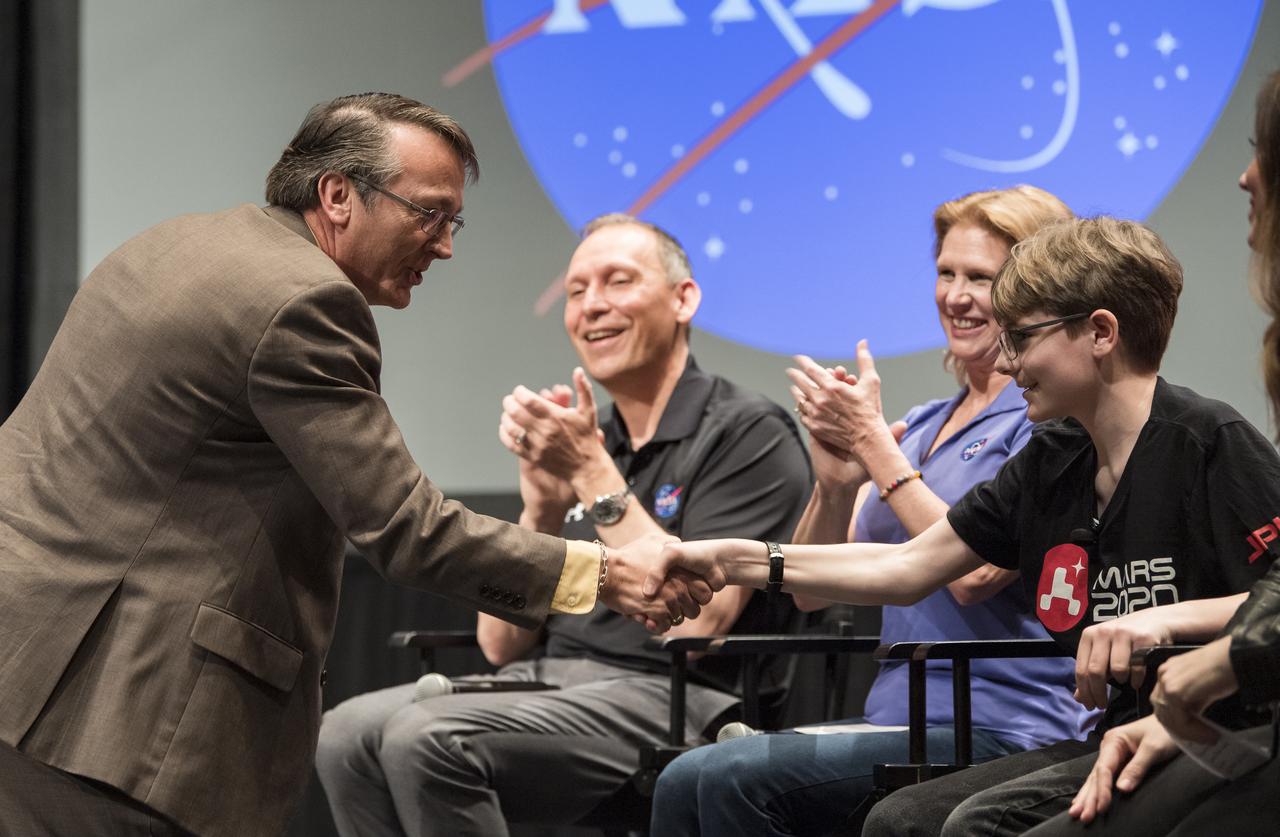
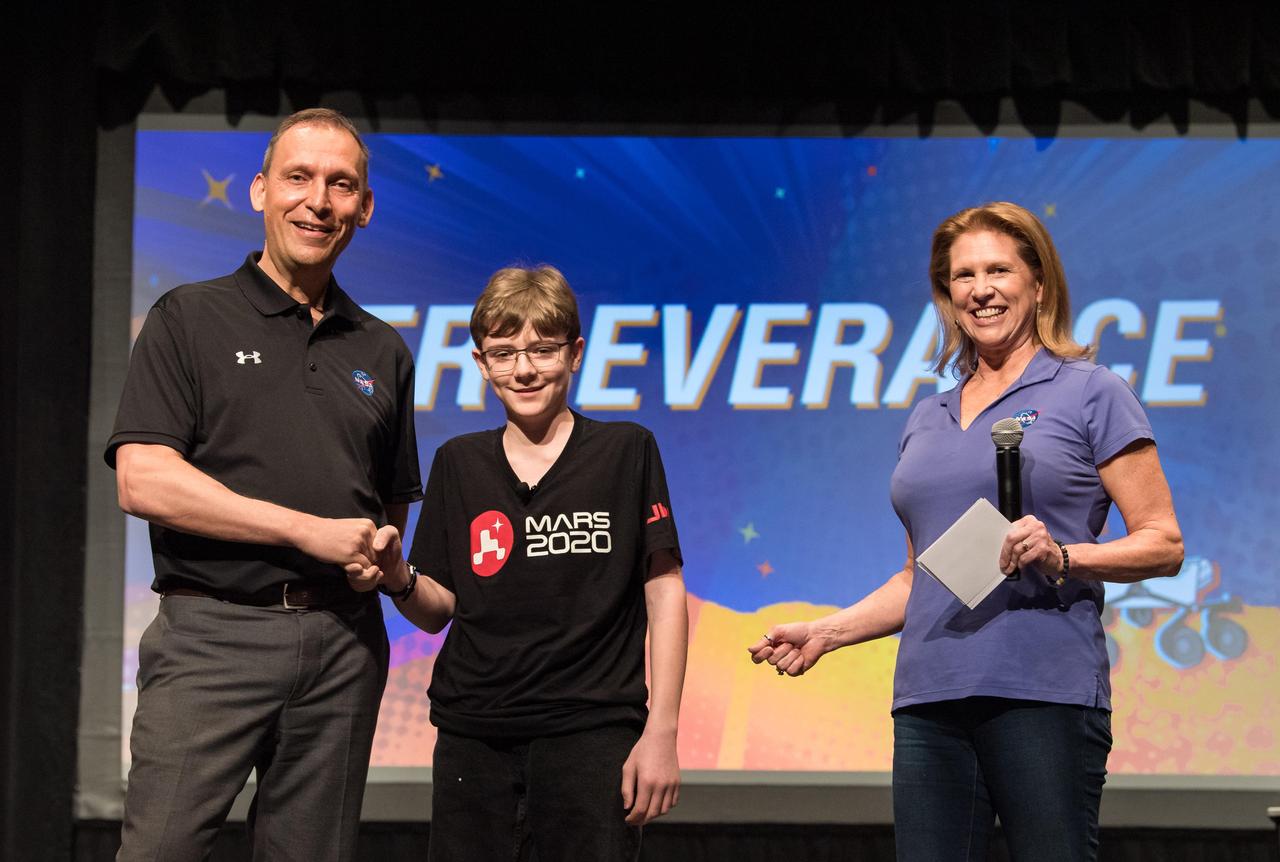
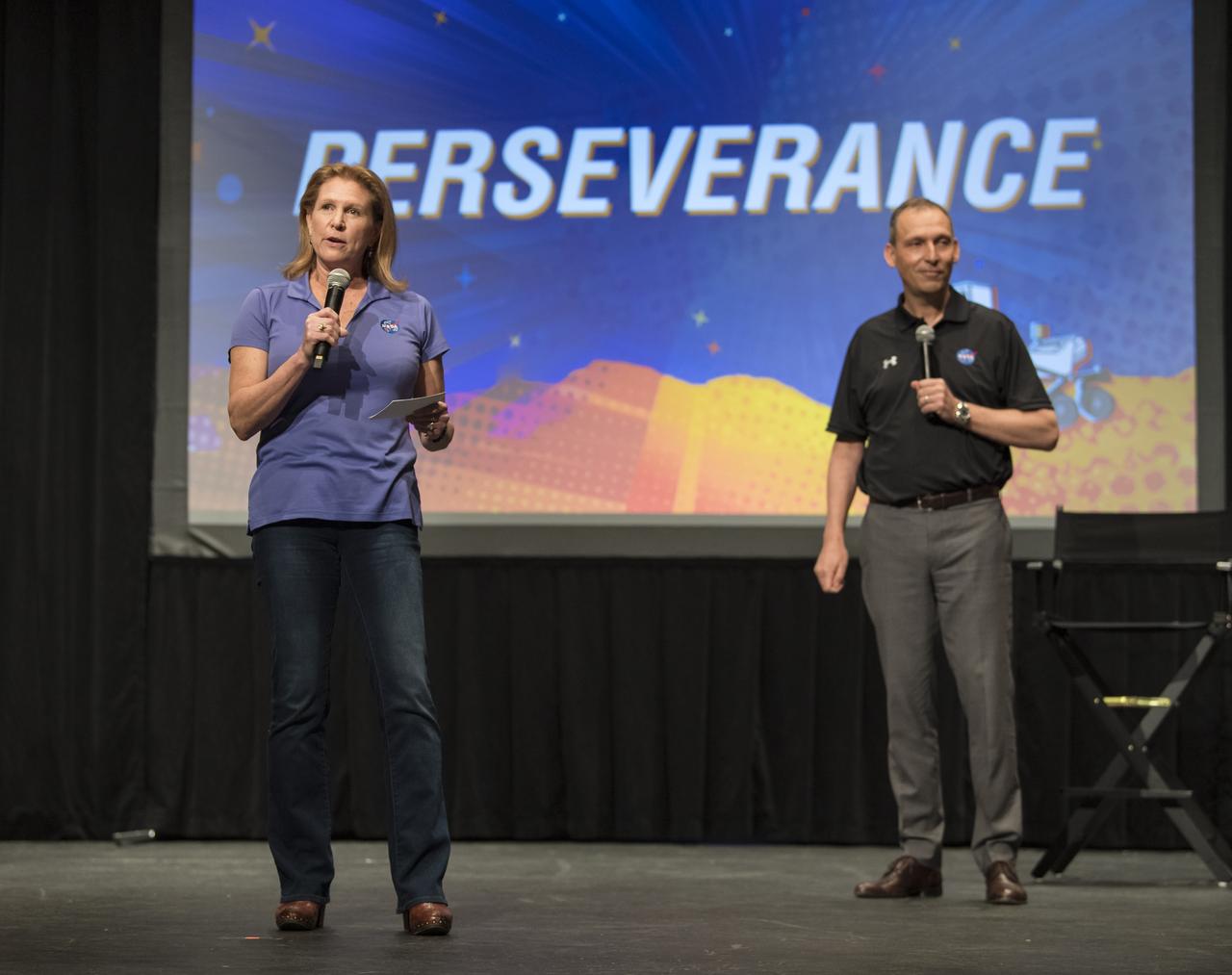
Lori Glaze, director of NASA's Planetary Science Division, looks on as Thomas Zurbuchen, associate administrator of NASA's Science Mission Directorate, congratulates Alexander Mather on March 5, 2020, during a celebration at Lake Braddock Secondary School in Burke, Virginia. The seventh grader had the honor of naming the agency's next Mars rover after submitting the winning entry to the agency's "Name the Rover" essay contest, which received 28,000 entrants from K-12 students from every U.S. state and territory.  https://photojournal.jpl.nasa.gov/catalog/PIA23762
NASA Congratulates Rover Naming Contest Winner
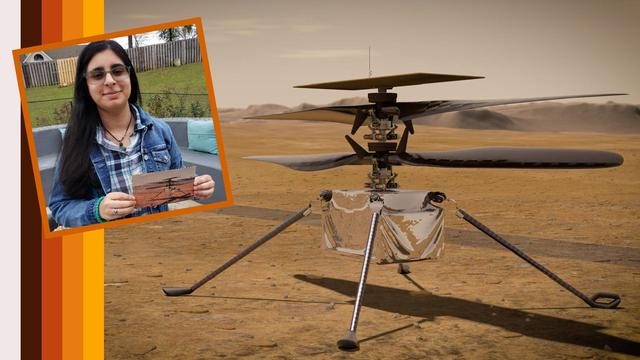
Vaneeza Rupani (inset), a junior at Tuscaloosa County High School in Northport, Alabama, came up with the name Ingenuity for NASA's Mars Helicopter (an artist's impression of which is seen here) and the motivation behind it for NASA's "Name the Rover" essay contest.  https://photojournal.jpl.nasa.gov/catalog/PIA23883
High School Junior Names NASA's Mars Helicopter
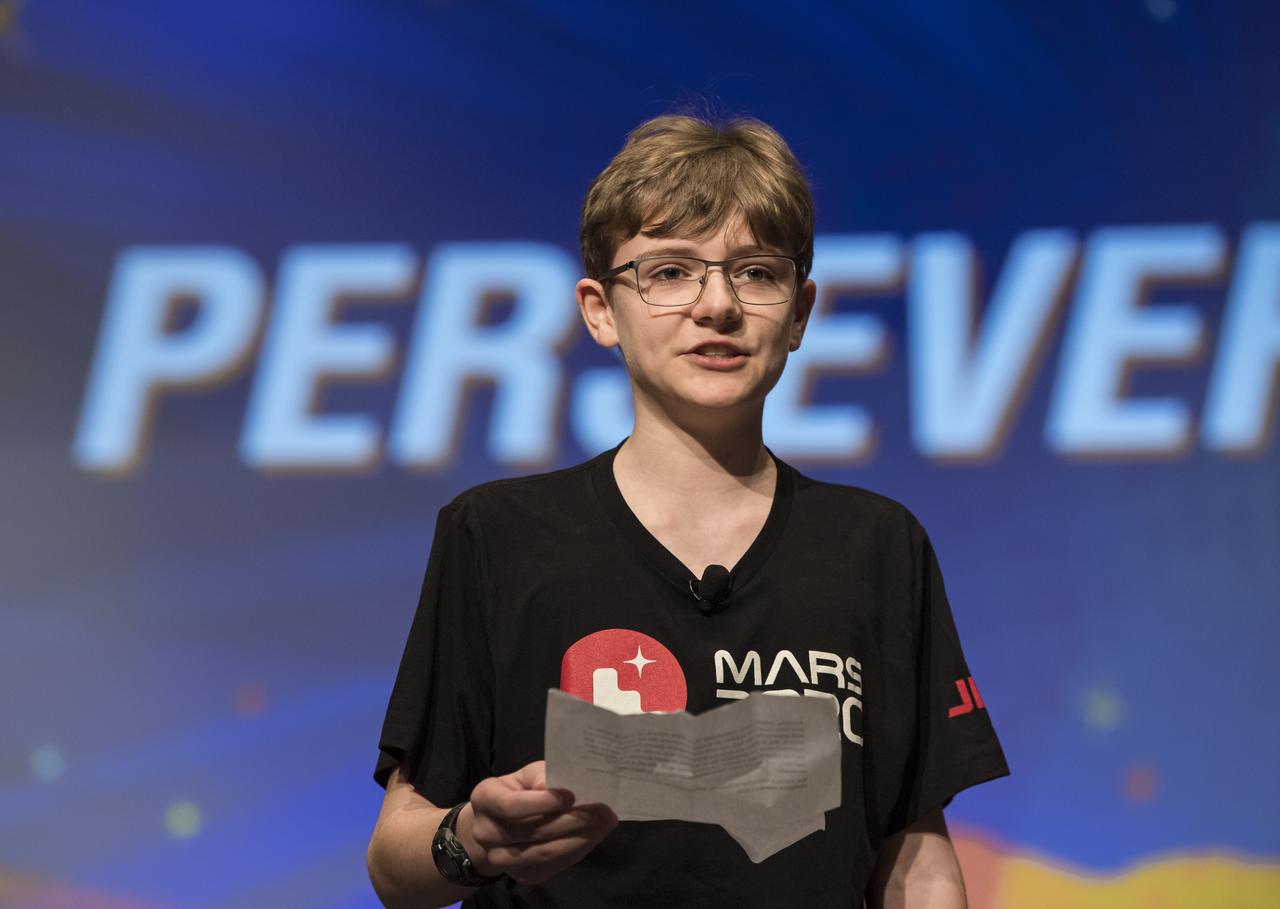
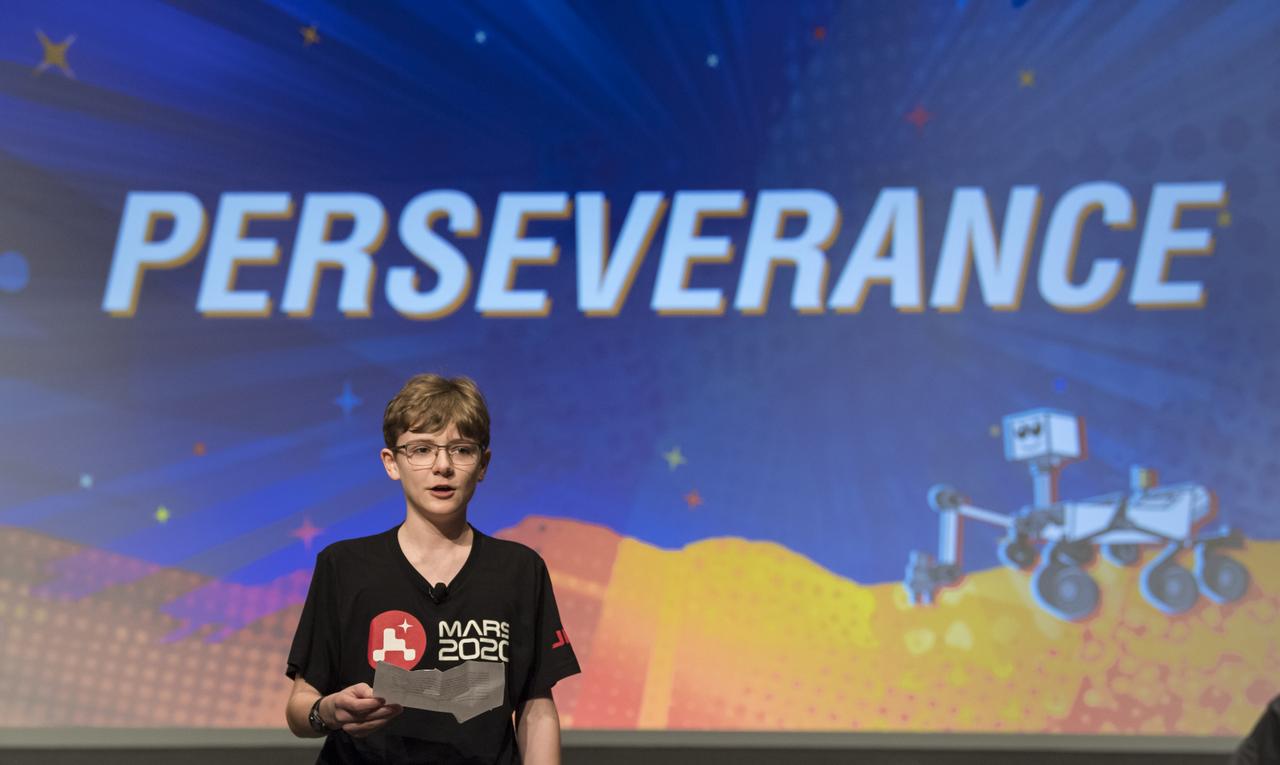
Alex Mather, the student whose submission, Perseverance, was chosen as the official name of the Mars 2020 rover, reads his essay entry, Thursday, March 5, 2020, at Lake Braddock Secondary School in Burke, Va. The final selection of the new name was made by Associate Administrator of NASA's Science Mission Directorate, Thomas Zurbuchen, following a nationwide naming contest conducted in 2019 that drew more than 28,000 essays by K-12 students from every U.S. state and territory. Perseverance is currently at NASA's Kennedy Space Center in Florida being prepared for launch this summer. Photo Credit: (NASA/Aubrey Gemignani)
Mars 2020 Rover Name Announcement
Alex Mather, the student whose submission, Perseverance, was chosen as the official name of the Mars 2020 rover, reads his essay entry, Thursday, March 5, 2020, at Lake Braddock Secondary School in Burke, Va. The final selection of the new name was made by Associate Administrator of NASA's Science Mission Directorate, Thomas Zurbuchen, following a nationwide naming contest conducted in 2019 that drew more than 28,000 essays by K-12 students from every U.S. state and territory. Perseverance is currently at NASA's Kennedy Space Center in Florida being prepared for launch this summer. Photo Credit: (NASA/Aubrey Gemignani)
Mars 2020 Rover Name Announcement
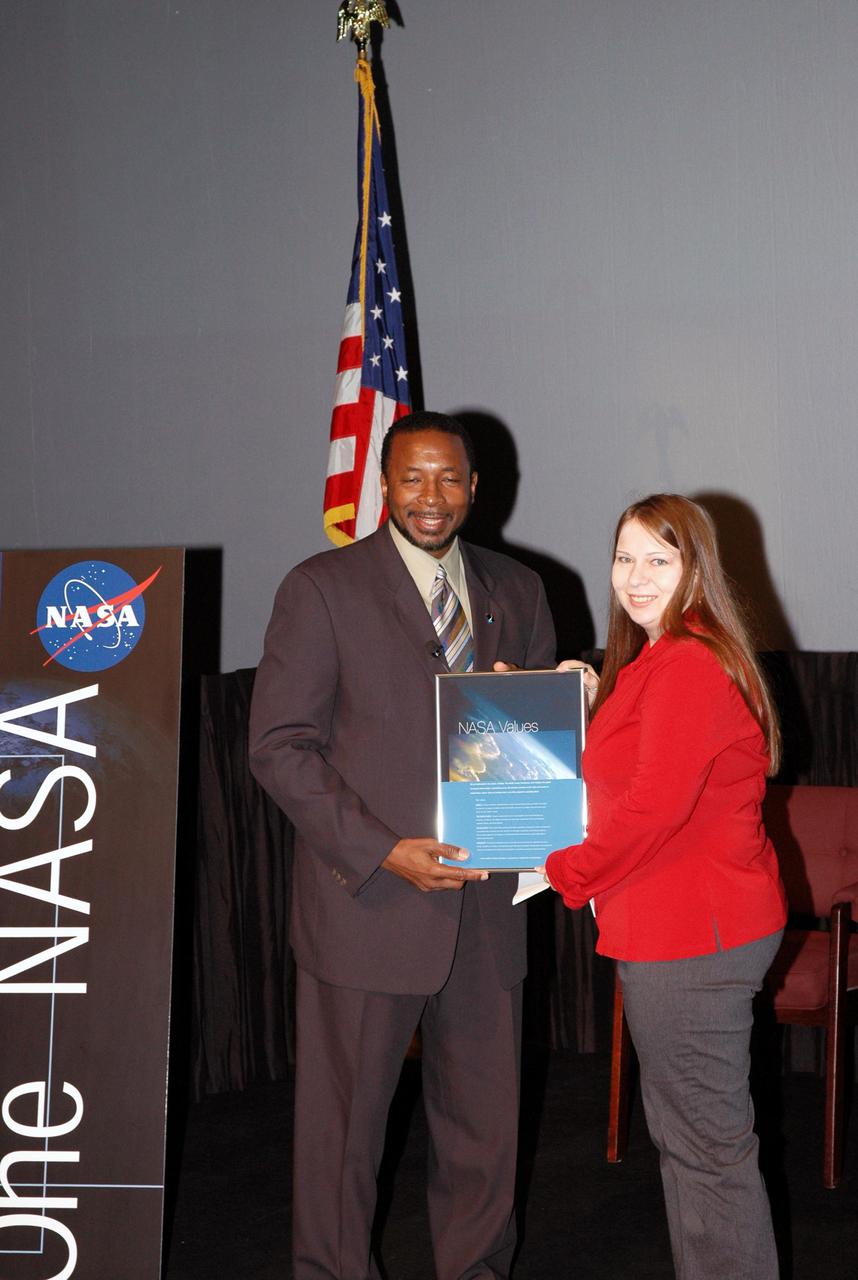
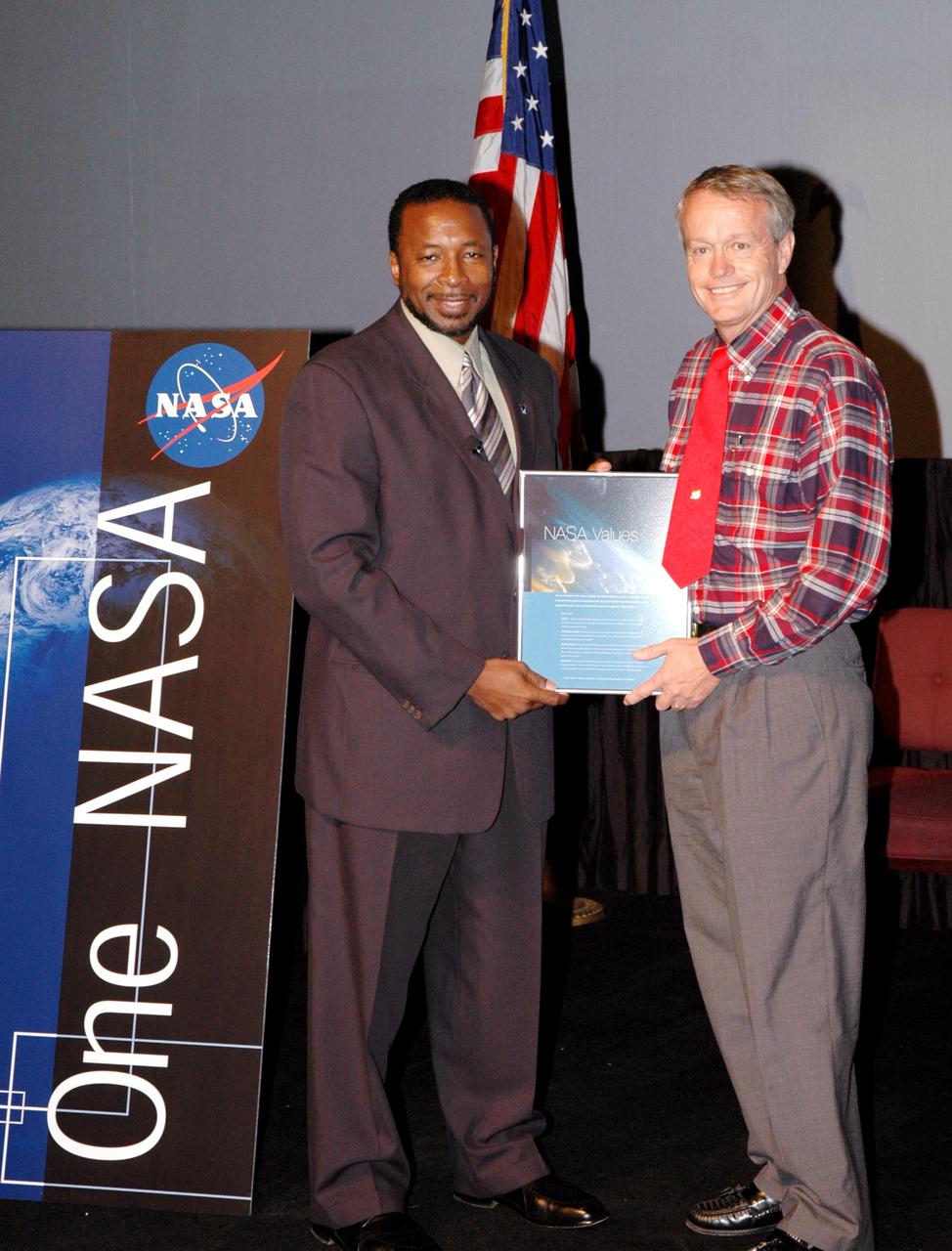
KENNEDY SPACE CENTER, FLA. -  Kennedy’s Deputy Director Woodrow Whitlow Jr. presents Pattie Lewis an award for a winning entry in the NASA Values essay contest.  The award was presented during the One NASA Leader-Led Workshop, which presented senior leadership in the Agency talking about ongoing Transformation activities and Kennedy’s role in the Vision for Space Exploration.
KSC-04pd-2636
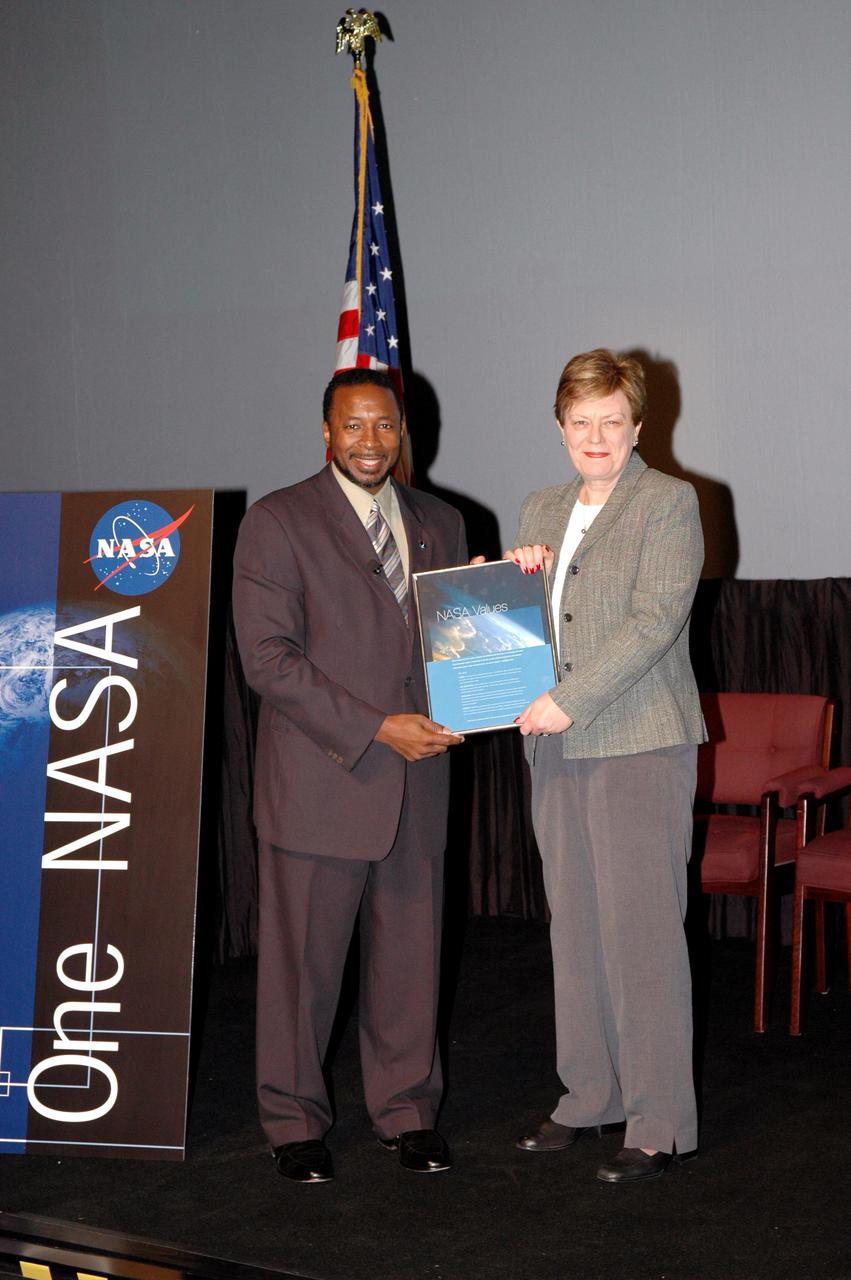
KENNEDY SPACE CENTER, FLA. -  Kennedy’s Deputy Director Woodrow Whitlow Jr. presents Mary Erdmann an award for a winning entry in the NASA Values essay contest. The award was presented during the One NASA Leader-Led Workshop, which presented senior leadership in the Agency talking about ongoing Transformation activities and Kennedy’s role in the Vision for Space Exploration.
KSC-04pd-2639
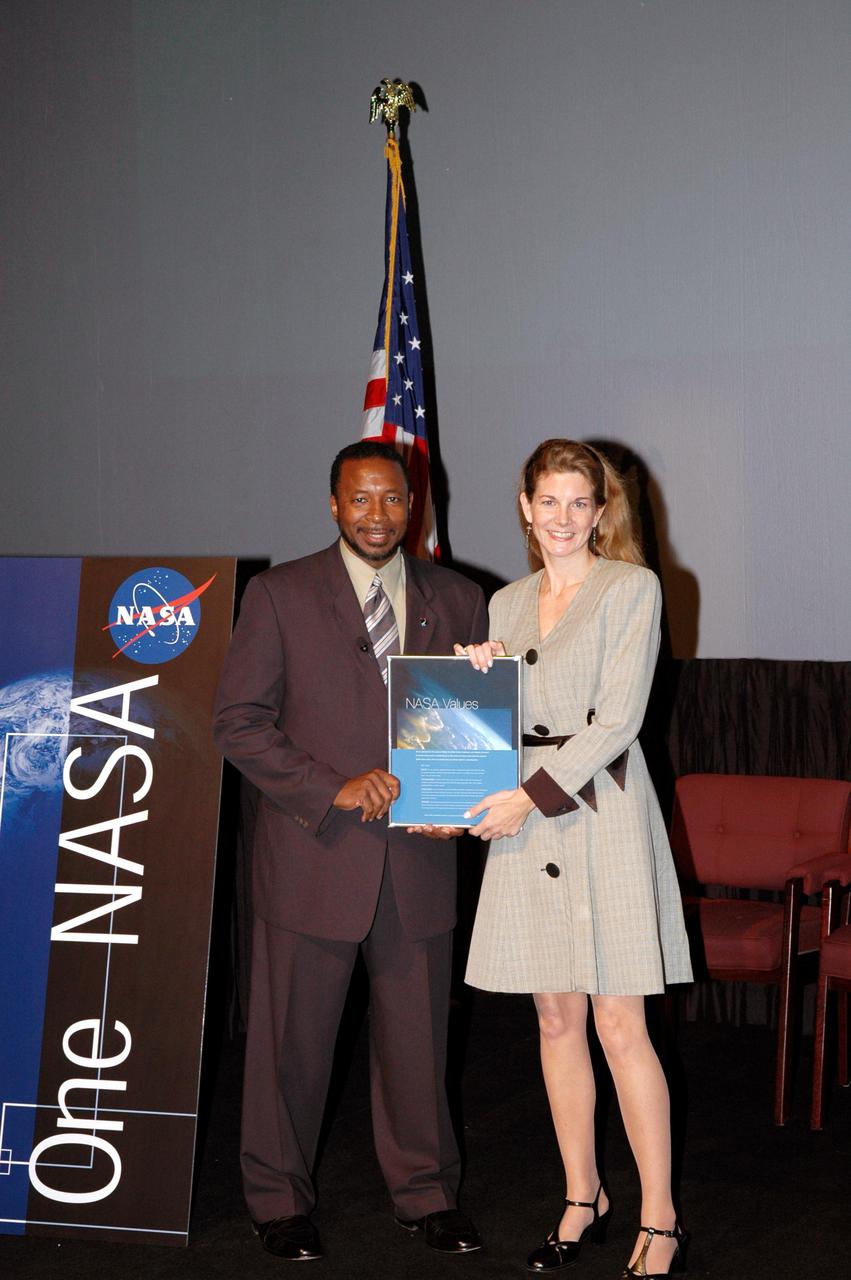
KENNEDY SPACE CENTER, FLA. -  Kennedy’s Deputy Director Woodrow Whitlow Jr. presents Carol Anne Dunn an award for a winning entry in the NASA Values essay contest. The award was presented during the One NASA Leader-Led Workshop, which presented senior leadership in the Agency talking about ongoing Transformation activities and Kennedy’s role in the Vision for Space Exploration.
KSC-04pd-2638
KENNEDY SPACE CENTER, FLA. -  Kennedy’s Deputy Director Woodrow Whitlow Jr. presents Ronny Goodin an award for a winning entry in the NASA Values essay contest. The award was presented during the One NASA Leader-Led Workshop, which presented senior leadership in the Agency talking about ongoing Transformation activities and Kennedy’s role in the Vision for Space Exploration.
KSC-04pd-2637
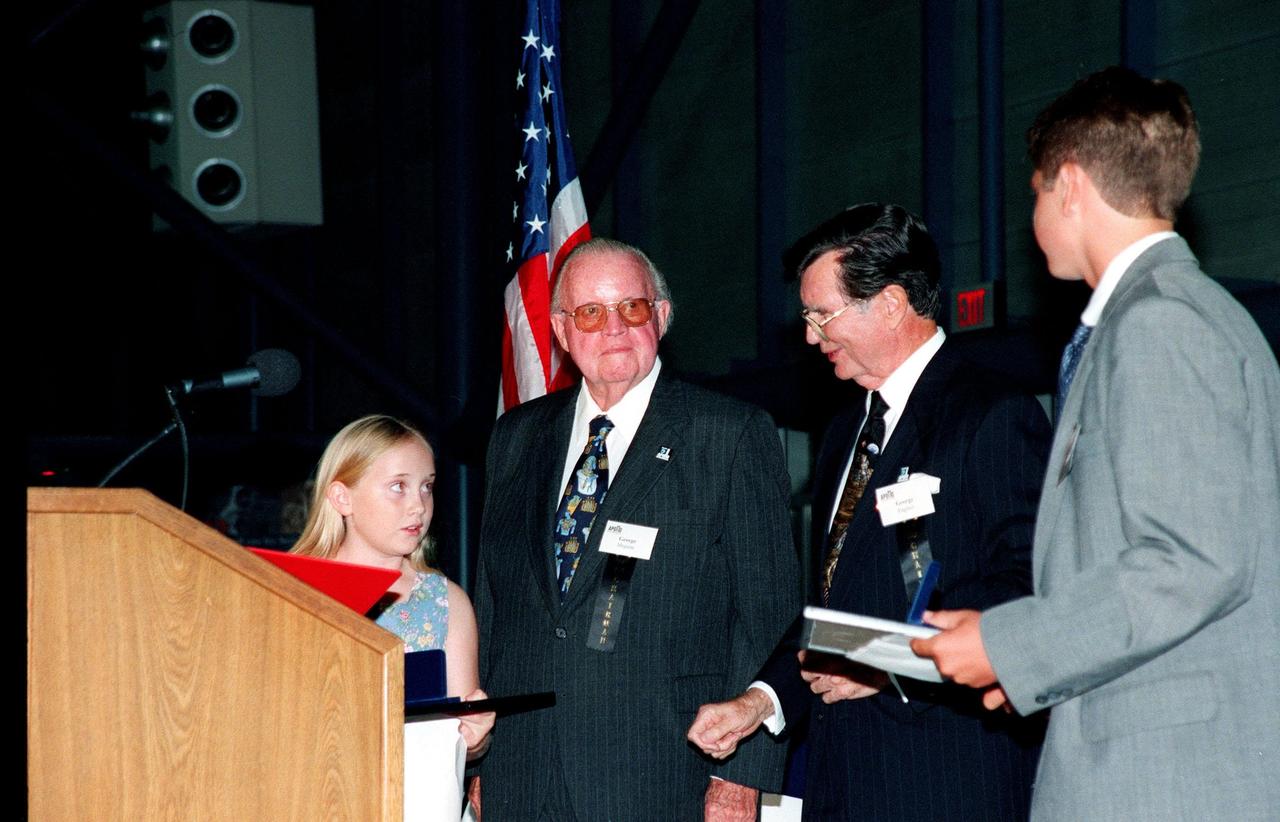
KENNEDY SPACE CENTER, FLA. -- George Meguiar (left) presents a scholarship award to Kyla Davis Horn, of Cocoa Beach, one of the winners of an essay contest related to the 30th Anniversary of Apollo 11. Meguiar and George English (second from right) head the Apollo 11 Commemoration Association who sponsored the contest in conjunction with Florida Today newspaper. The other scholarship winner is Kyle Rukaczewski, of Satellite Beach (far right). A third winner, Jason Gagnon, of Viera, was unable to attend. The presentation was made at the Apollo/Saturn V Center during an anniversary banquet that honored all the people who made the Apollo Program possible. Special guests included former Apollo astronauts Neil Armstrong, Edwin "Buzz" Aldrin, Gene Cernan and Walt Cunningham, who shared their experiences with the audience
KSC-99pp0939
KENNEDY SPACE CENTER, FLA. -- At the Apollo/Saturn V Center, George Meguiar (center left) and George English (center right) present scholarships to two students who entered an essay contest in conjunction with the 30th Anniversary of Apollo 11. The winners shown are Kyla Davis Horn, of Cocoa Beach, and Kyle Rukaczewski, of Satellite Beach. A third winner, Jason Gagnon, of Viera, was unable to attend. Meguiar and English head the Apollo 11 Commemoration Association which sponsored the contest in conjunction with Florida Today newspaper. The presentation was made at the Apollo/Saturn V Center during an anniversary banquet that honored all the people who made the Apollo Program possible. Special guests included former Apollo astronauts Neil Armstrong, Edwin "Buzz" Aldrin, Gene Cernan and Walt Cunningham, who shared their experiences with the audience
KSC-99pp0938
Associate Administrator of NASA's Science Mission Directorate, Thomas Zurbuchen, announces the official name, Perseverance, for the rover formerly known as Mars 2020, Thursday, March 5, 2020, at Lake Braddock Secondary School in Burke, Va. Zurbuchen made the final selection of the new name following a nationwide naming contest conducted in 2019 that drew more than 28,000 essays by K-12 students from every U.S. state and territory. Perseverance is currently at NASA's Kennedy Space Center in Florida being prepared for launch this summer. Photo Credit: (NASA/Aubrey Gemignani)
Mars 2020 Rover Name Announcement
Alex Mather, the student whose submission, Perseverance, was chosen as the official name of the Mars 2020 rover, is seen in the audience seated with his family, Thursday, March 5, 2020, at Lake Braddock Secondary School in Burke, Va. The final selection of the new name was made by Associate Administrator of NASA's Science Mission Directorate, Thomas Zurbuchen, following a nationwide naming contest conducted in 2019 that drew more than 28,000 essays by K-12 students from every U.S. state and territory. Perseverance is currently at NASA's Kennedy Space Center in Florida being prepared for launch this summer. Photo Credit: (NASA/Aubrey Gemignani)

Mars 2020 Rover Name Announcement
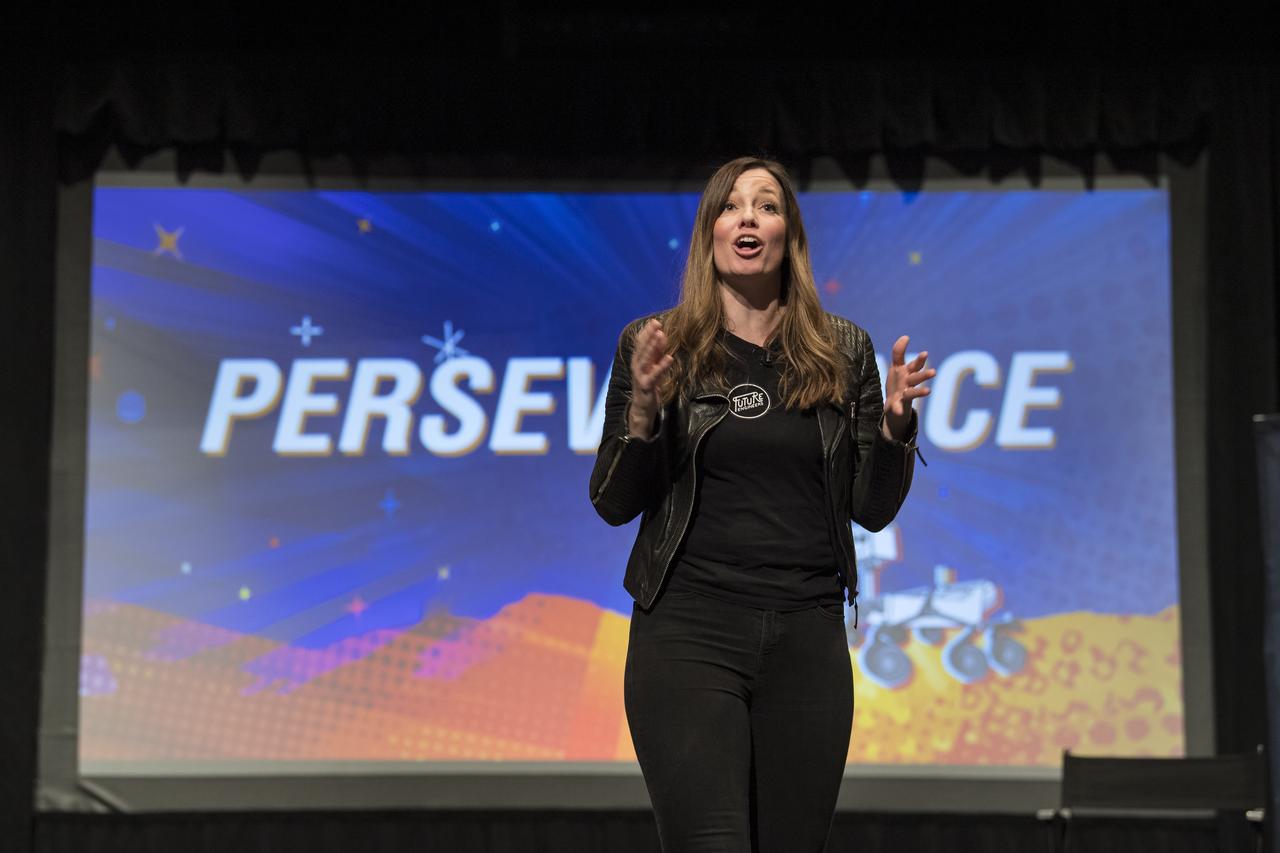
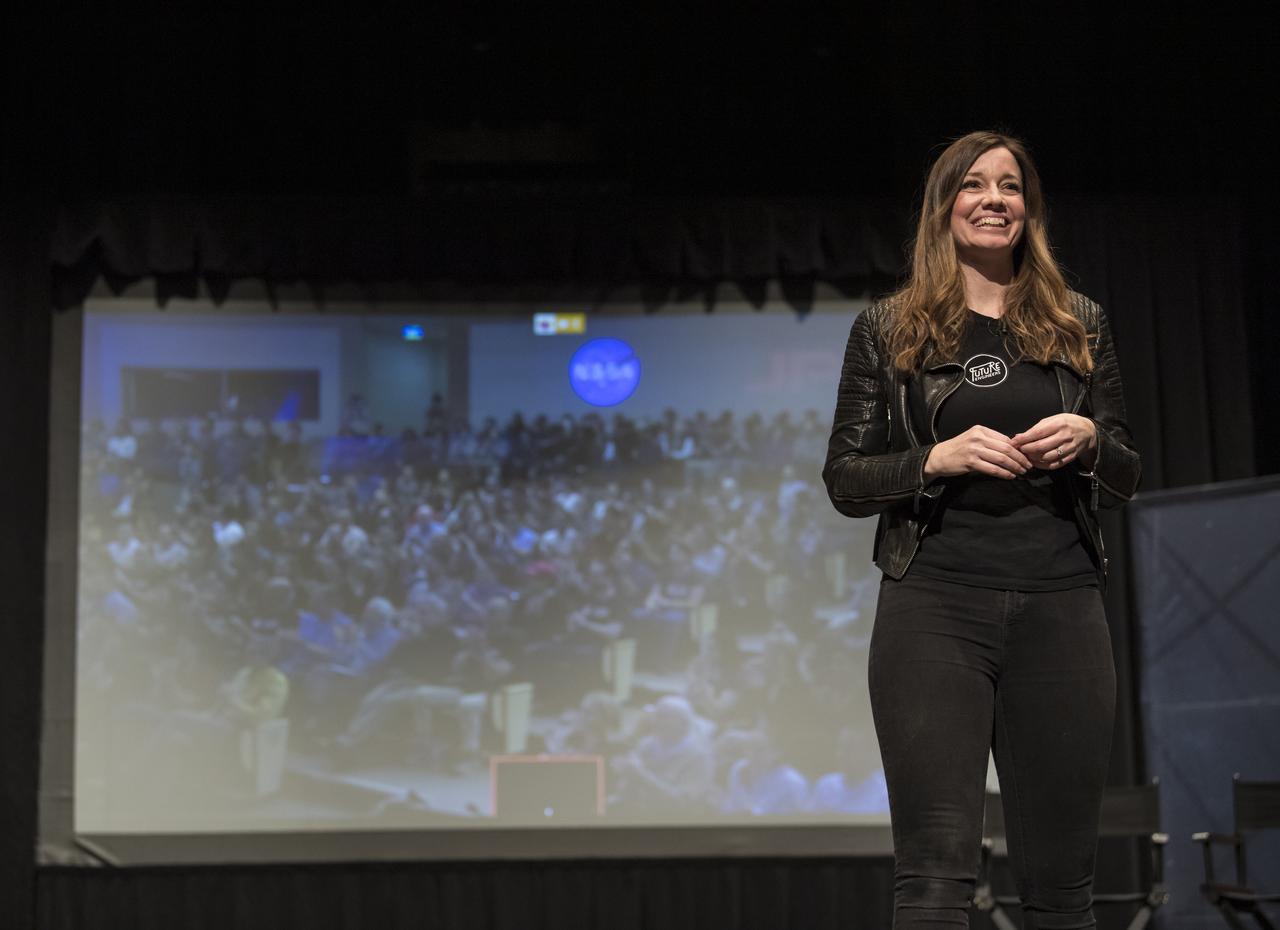
Founder and CEO of Future Engineers, Deanne Bell, speaks to the audience at an event to announce the official name of the Mars 2020 rover, Thursday, March 5, 2020, at Lake Braddock Secondary School in Burke, Va. The final selection of the new name, Perseverance, was made by NASA’s Associate Administrator of the Science Mission Directorate, Thomas Zurbuchen, following a nationwide naming contest conducted in 2019 that drew more than 28,000 essays by K-12 students from every U.S. state and territory. The rover is currently at NASA's Kennedy Space Center in Florida being prepared for launch this summer. Photo Credit: (NASA/Aubrey Gemignani)
Mars 2020 Rover Name Announcement
Founder and CEO of Future Engineers, Deanne Bell, speaks to the audience at an event to announce the official name of the Mars 2020 rover, Thursday, March 5, 2020, at Lake Braddock Secondary School in Burke, Va. The final selection of the new name, Perseverance, was made by NASA’s Associate Administrator of the Science Mission Directorate, Thomas Zurbuchen, following a nationwide naming contest conducted in 2019 that drew more than 28,000 essays by K-12 students from every U.S. state and territory. The rover is currently at NASA's Kennedy Space Center in Florida being prepared for launch this summer. Photo Credit: (NASA/Aubrey Gemignani)
Mars 2020 Rover Name Announcement
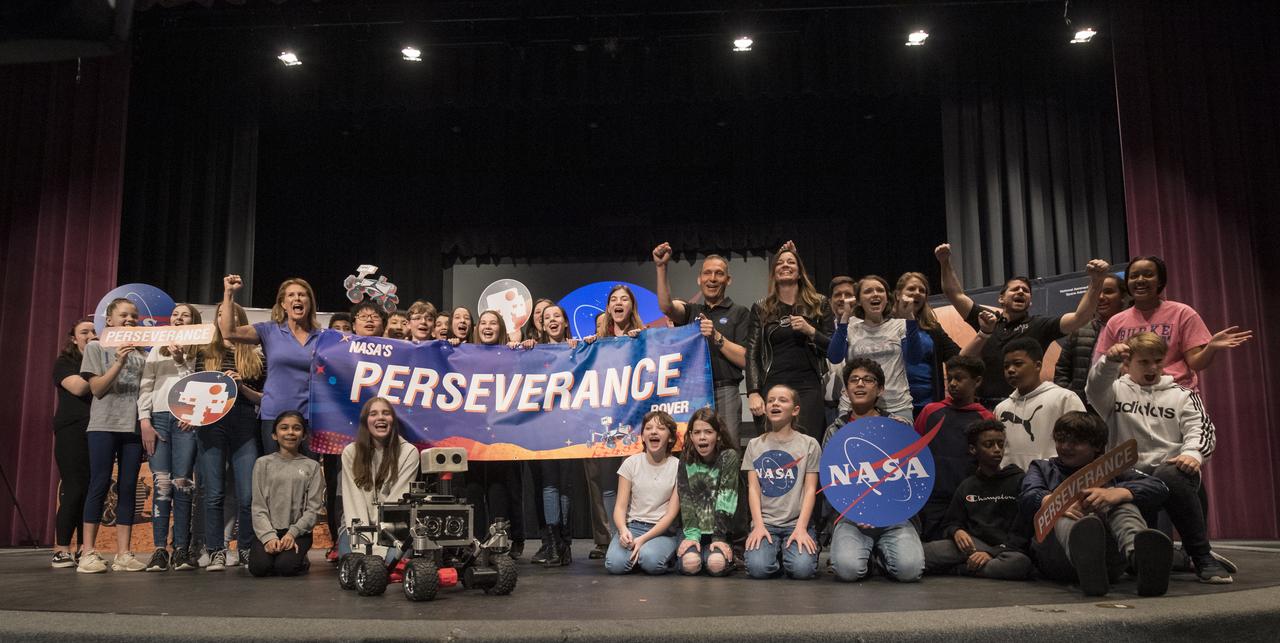
Students chant, “Go Perseverance!” during an event to announce the official name of the Mars 2020 rover, Thursday, March 5, 2020, at Lake Braddock Secondary School in Burke, Va. The final selection of the new name, Perseverance, was made by Associate Administrator of NASA's Science Mission Directorate, Thomas Zurbuchen, following a nationwide naming contest conducted in 2019 that drew more than 28,000 essays by K-12 students from every U.S. state and territory. The rover is currently at NASA's Kennedy Space Center in Florida being prepared for launch this summer. Photo Credit: (NASA/Aubrey Gemignani)
Mars 2020 Rover Name Announcement
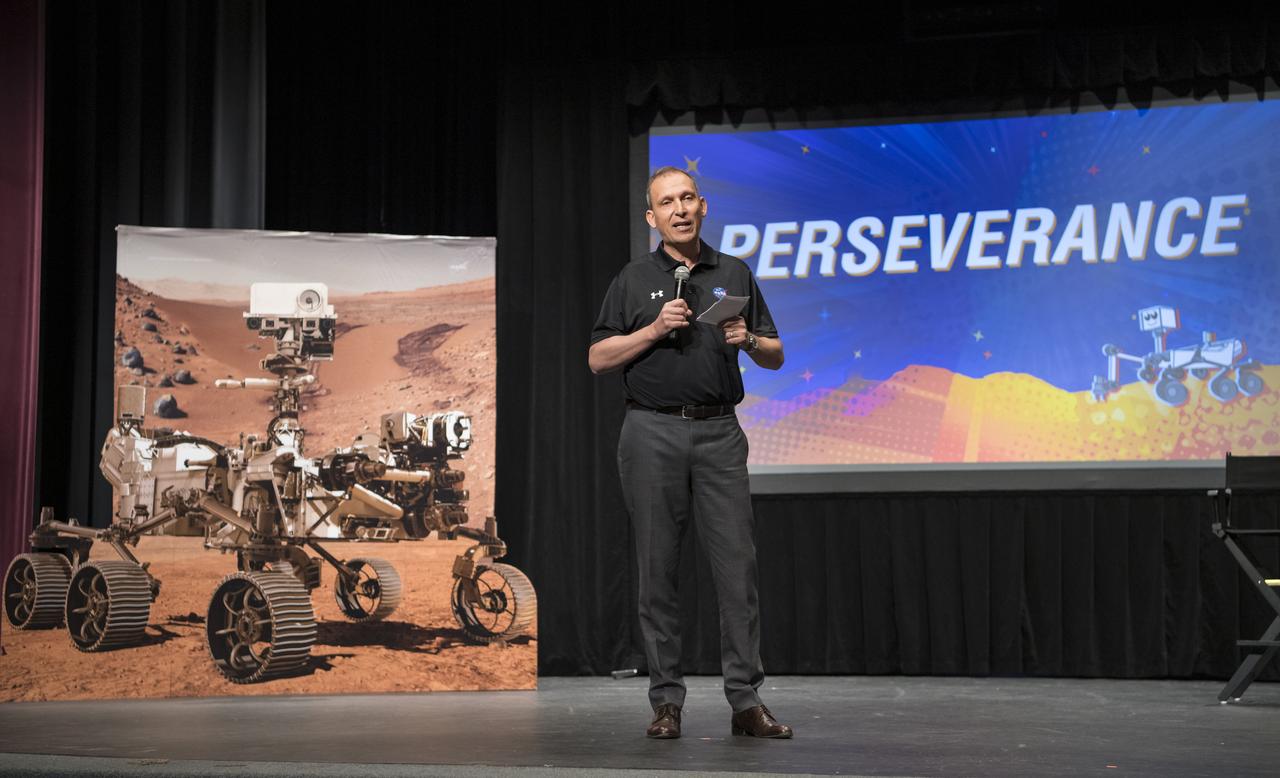
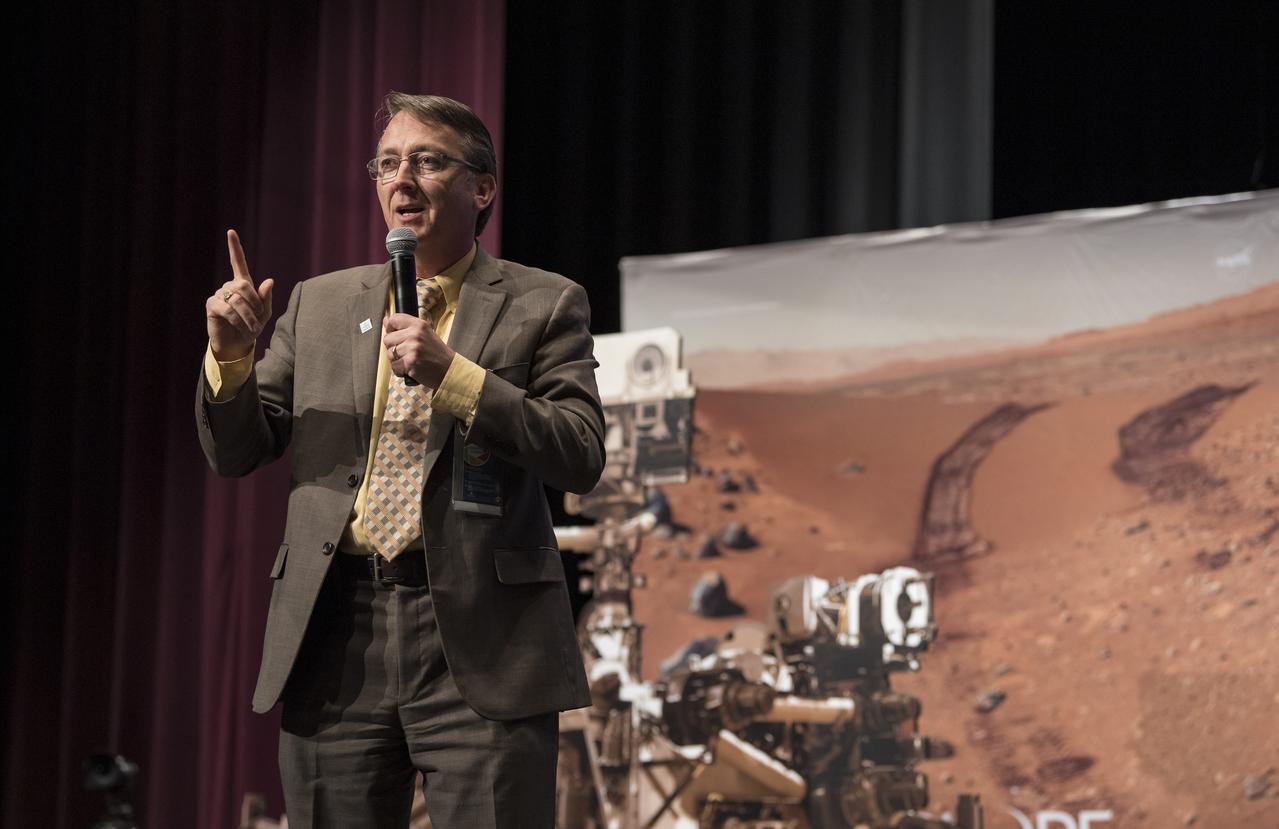
Associate Administrator of NASA's Science Mission Directorate, Thomas Zurbuchen, speaks after announcing the official name, Perseverance, for the rover formerly known as Mars 2020, Thursday, March 5, 2020, at Lake Braddock Secondary School in Burke, Va. Zurbuchen made the final selection of the new name following a nationwide naming contest conducted in 2019 that drew more than 28,000 essays by K-12 students from every U.S. state and territory. Perseverance is currently at NASA's Kennedy Space Center in Florida being prepared for launch this summer. Photo Credit: (NASA/Aubrey Gemignani)
Mars 2020 Rover Name Announcement
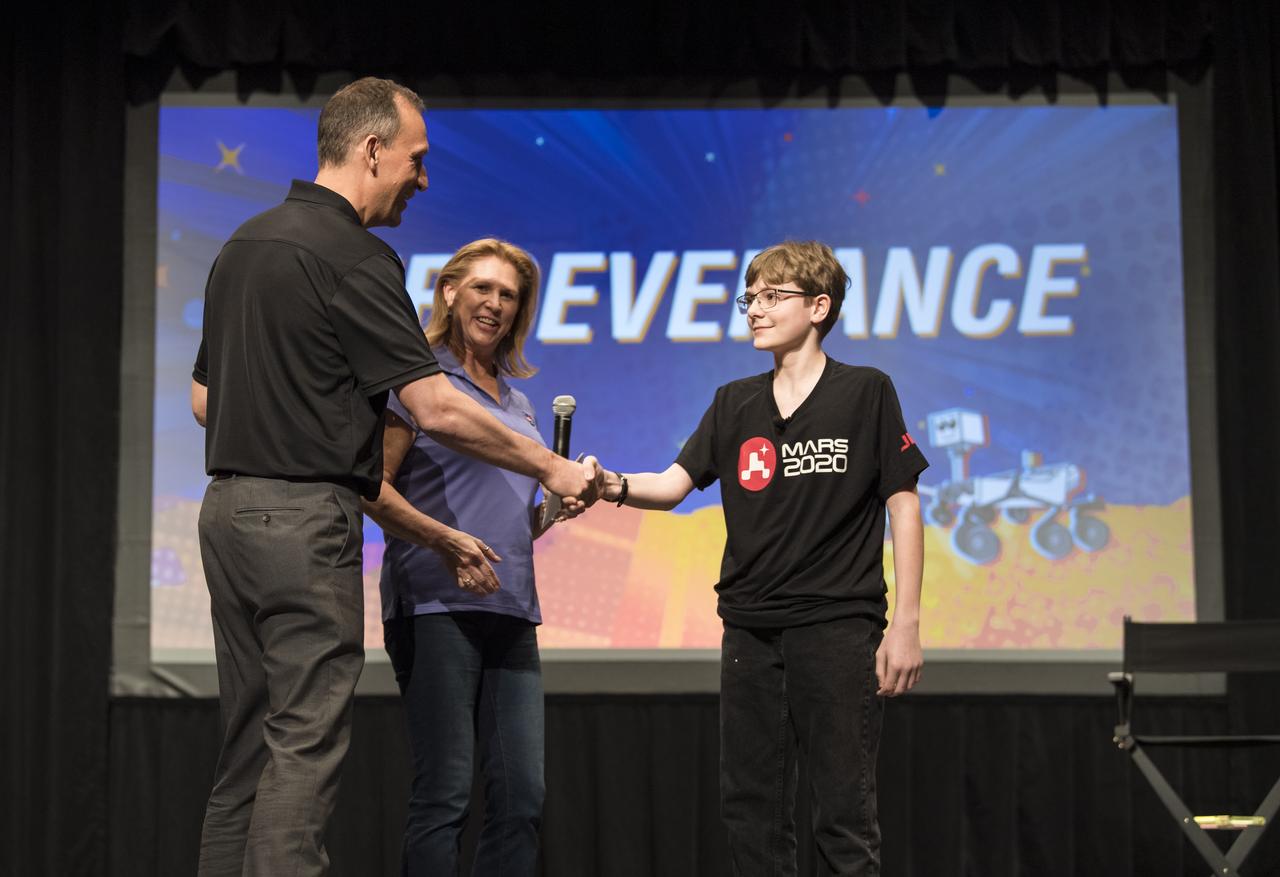
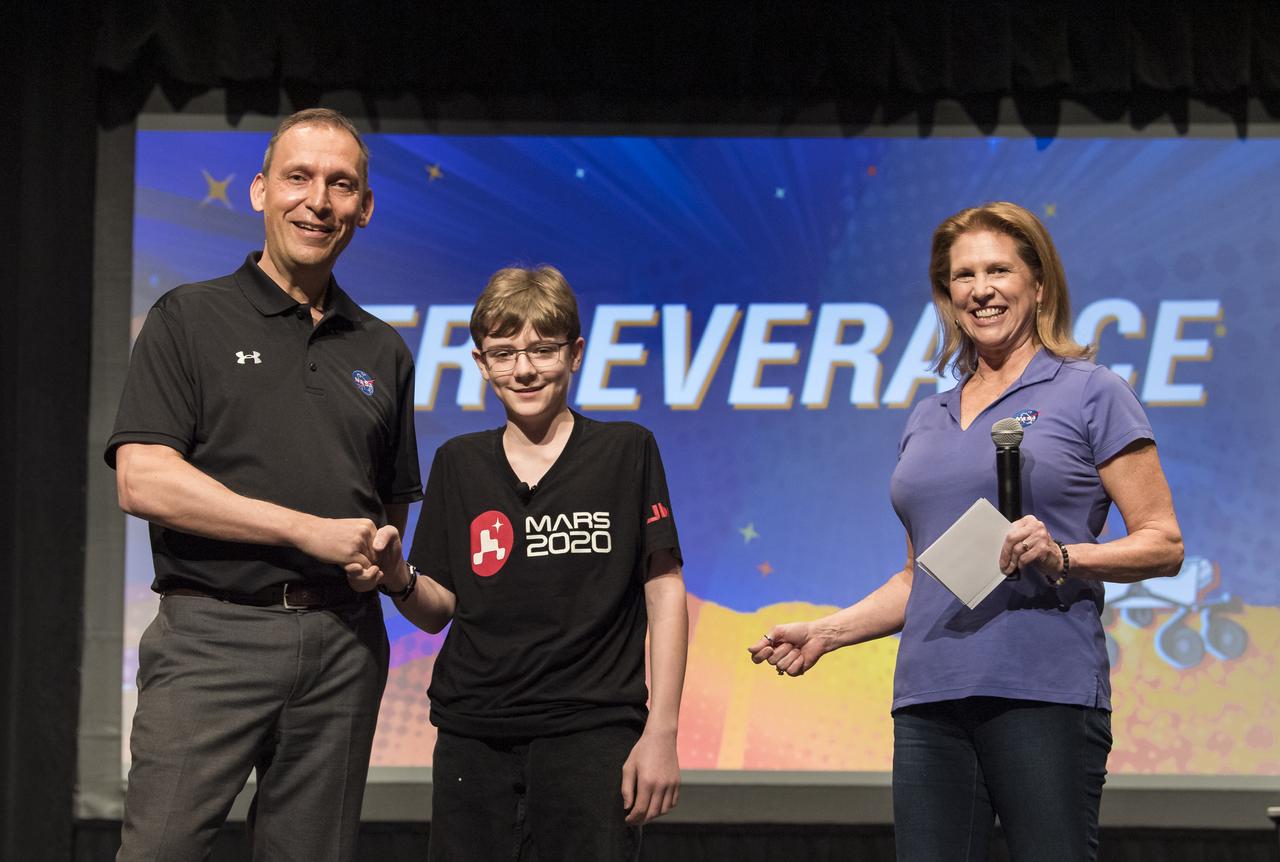
Associate Administrator of NASA's Science Mission Directorate, Thomas Zurbuchen, shakes hands with Alex Mather, the student whose submission, Perseverance, was chosen as the official name of the Mars 2020 rover, Thursday, March 5, 2020, at Lake Braddock Secondary School in Burke, Va. The final selection of the new name was made by Zurbuchen following a nationwide naming contest conducted in 2019 that drew more than 28,000 essays by K-12 students from every U.S. state and territory. Perseverance is currently at NASA's Kennedy Space Center in Florida being prepared for launch this summer. Photo Credit: (NASA/Aubrey Gemignani)
Mars 2020 Rover Name Announcement
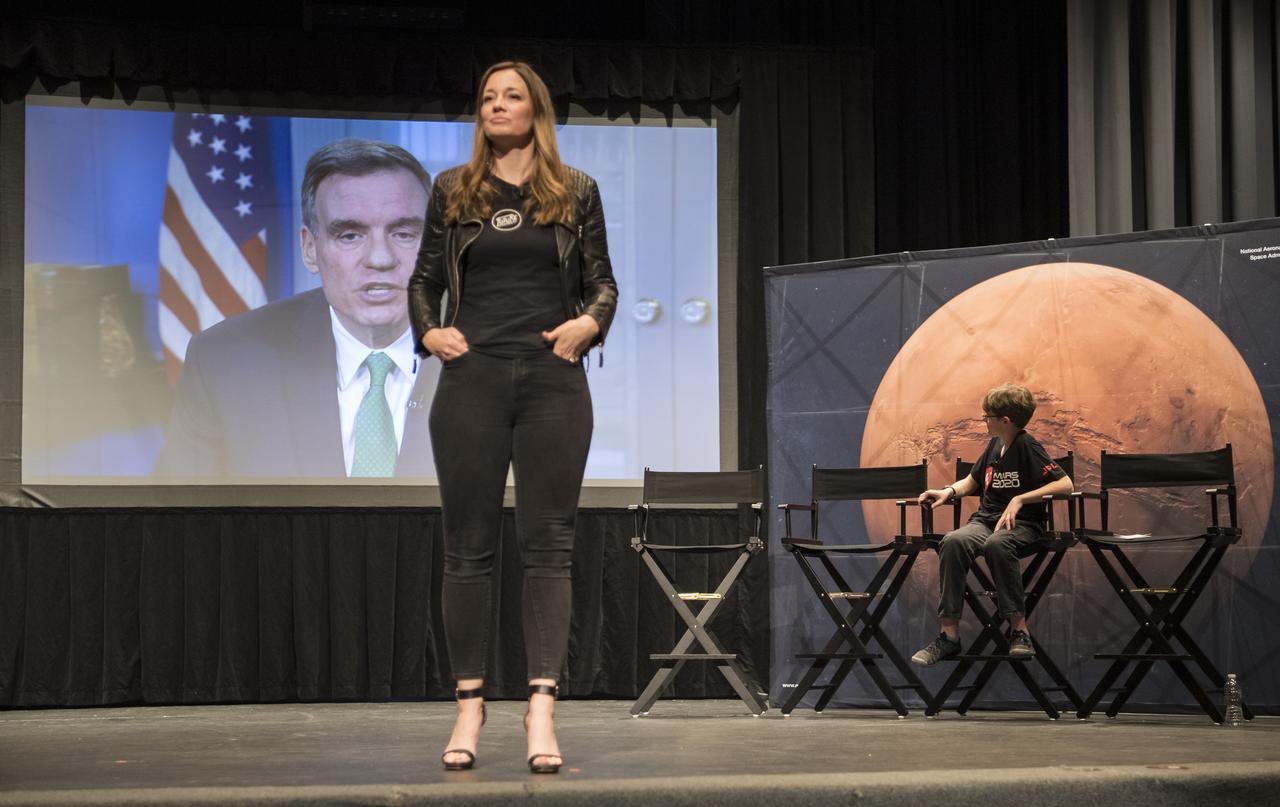
Alex Mather watches a congratulatory video from Sen. Mark Warner, D-Va, during an event to announce the official name of the Mars 2020 rover, Thursday, March 5, 2020, at Lake Braddock Secondary School in Burke, Va. The final selection of the new name, Perseverance, was made by Associate Administrator of NASA's Science Mission Directorate, Thomas Zurbuchen, following a nationwide naming contest conducted in 2019 that drew more than 28,000 essays by K-12 students from every U.S. state and territory. The rover is currently at NASA's Kennedy Space Center in Florida being prepared for launch this summer. Photo Credit: (NASA/Aubrey Gemignani)
Mars 2020 Rover Name Announcement
Students applaud during an event to announce the official name of the Mars 2020 rover, Thursday, March 5, 2020, at Lake Braddock Secondary School in Burke, Va. The final selection of the new name, Perseverance, was made by Associate Administrator of NASA's Science Mission Directorate, Thomas Zurbuchen, following a nationwide naming contest conducted in 2019 that drew more than 28,000 essays by K-12 students from every U.S. state and territory. The rover is currently at NASA's Kennedy Space Center in Florida being prepared for launch this summer. Photo Credit: (NASA/Aubrey Gemignani)
Mars 2020 Rover Name Announcement
Fairfax County Division Superintendent Scott Brabrand speaks about the importance of STEM at an event to announce the official name of the Mars 2020 rover, Thursday, March 5, 2020, at Lake Braddock Secondary School in Burke, Va. The final selection of the new name was made by Associate Administrator of NASA's Science Mission Directorate, Thomas Zurbuchen, following a nationwide naming contest conducted in 2019 that drew more than 28,000 essays by K-12 students from every U.S. state and territory. The rover is currently at NASA's Kennedy Space Center in Florida being prepared for launch this summer. Photo Credit: (NASA/Aubrey Gemignani)
Mars 2020 Rover Name Announcement
Associate Administrator of NASA's Science Mission Directorate, Thomas Zurbuchen, shakes hands with Alex Mather, the student whose submission, Perseverance, was chosen as the official name of the Mars 2020 rover, Thursday, March 5, 2020, at Lake Braddock Secondary School in Burke, Va. The final selection of the new name was made by Zurbuchen following a nationwide naming contest conducted in 2019 that drew more than 28,000 essays by K-12 students from every U.S. state and territory. Perseverance is currently at NASA's Kennedy Space Center in Florida being prepared for launch this summer. Photo Credit: (NASA/Aubrey Gemignani)
Mars 2020 Rover Name Announcement
Associate Administrator of NASA's Science Mission Directorate, Thomas Zurbuchen, announces the official name, Perseverance, for the rover formerly known as Mars 2020, Thursday, March 5, 2020, at Lake Braddock Secondary School in Burke, Va. Zurbuchen made the final selection of the new name following a nationwide naming contest conducted in 2019 that drew more than 28,000 essays by K-12 students from every U.S. state and territory. Perseverance is currently at NASA's Kennedy Space Center in Florida being prepared for launch this summer. Photo Credit: (NASA/Aubrey Gemignani)
Mars 2020 Rover Name Announcement
Director of NASA's Science Mission Directorate’s Planetary Science Division, Lori Glaze, left, speaks after the announcement of the official name, Perseverance, for the rover formerly known as Mars 2020, Thursday, March 5, 2020, at Lake Braddock Secondary School in Burke, Va. The final selection of the new name was made by Associate Administrator of NASA's Science Mission Directorate, Thomas Zurbuchen, following a nationwide naming contest conducted in 2019 that drew more than 28,000 essays by K-12 students from every U.S. state and territory. Perseverance is currently at NASA's Kennedy Space Center in Florida being prepared for launch this summer. Photo Credit: (NASA/Aubrey Gemignani)
Mars 2020 Rover Name Announcement
Associate Administrator of NASA's Science Mission Directorate, Thomas Zurbuchen, announces the official name, Perseverance, for the rover formerly known as Mars 2020, Thursday, March 5, 2020, at Lake Braddock Secondary School in Burke, Va. Zurbuchen made the final selection of the new name following a nationwide naming contest conducted in 2019 that drew more than 28,000 essays by K-12 students from every U.S. state and territory. Perseverance is currently at NASA's Kennedy Space Center in Florida being prepared for launch this summer. Photo Credit: (NASA/Aubrey Gemignani)

Mars 2020 Rover Name Announcement
Fairfax County Division Superintendent Scott Brabrand shakes hands with Alex Mather, the student whose submission, Perseverance, was chosen as the official name of the Mars 2020 rover, Thursday, March 5, 2020, at Lake Braddock Secondary School in Burke, Va. The final selection of the new name was made by Zurbuchen following a nationwide naming contest conducted in 2019 that drew more than 28,000 essays by K-12 students from every U.S. state and territory. Perseverance is currently at NASA's Kennedy Space Center in Florida being prepared for launch this summer. Photo Credit: (NASA/Aubrey Gemignani)
Mars 2020 Rover Name Announcement
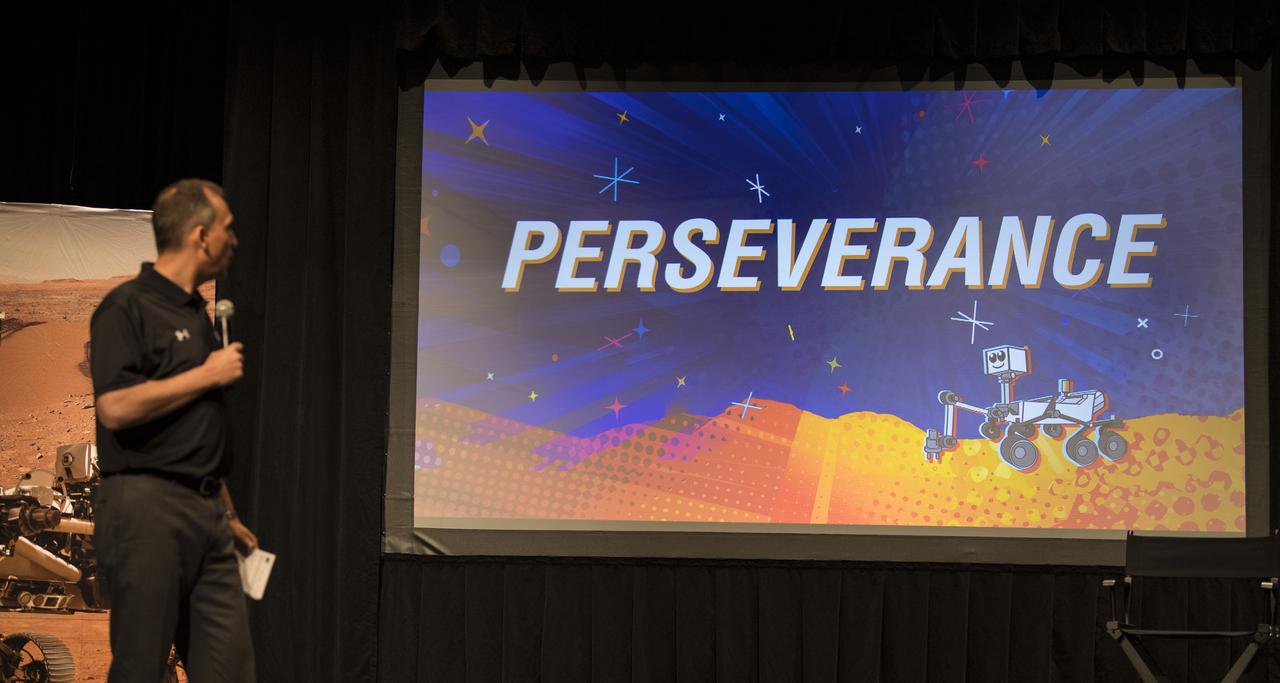
Associate Administrator of NASA's Science Mission Directorate, Thomas Zurbuchen, announces the official name, Perseverance, for the rover formerly known as Mars 2020, Thursday, March 5, 2020, at Lake Braddock Secondary School in Burke, Va. Zurbuchen made the final selection of the new name following a nationwide naming contest conducted in 2019 that drew more than 28,000 essays by K-12 students from every U.S. state and territory. Perseverance is currently at NASA's Kennedy Space Center in Florida being prepared for launch this summer. Photo Credit: (NASA/Aubrey Gemignani)
Mars 2020 Rover Name Announcement
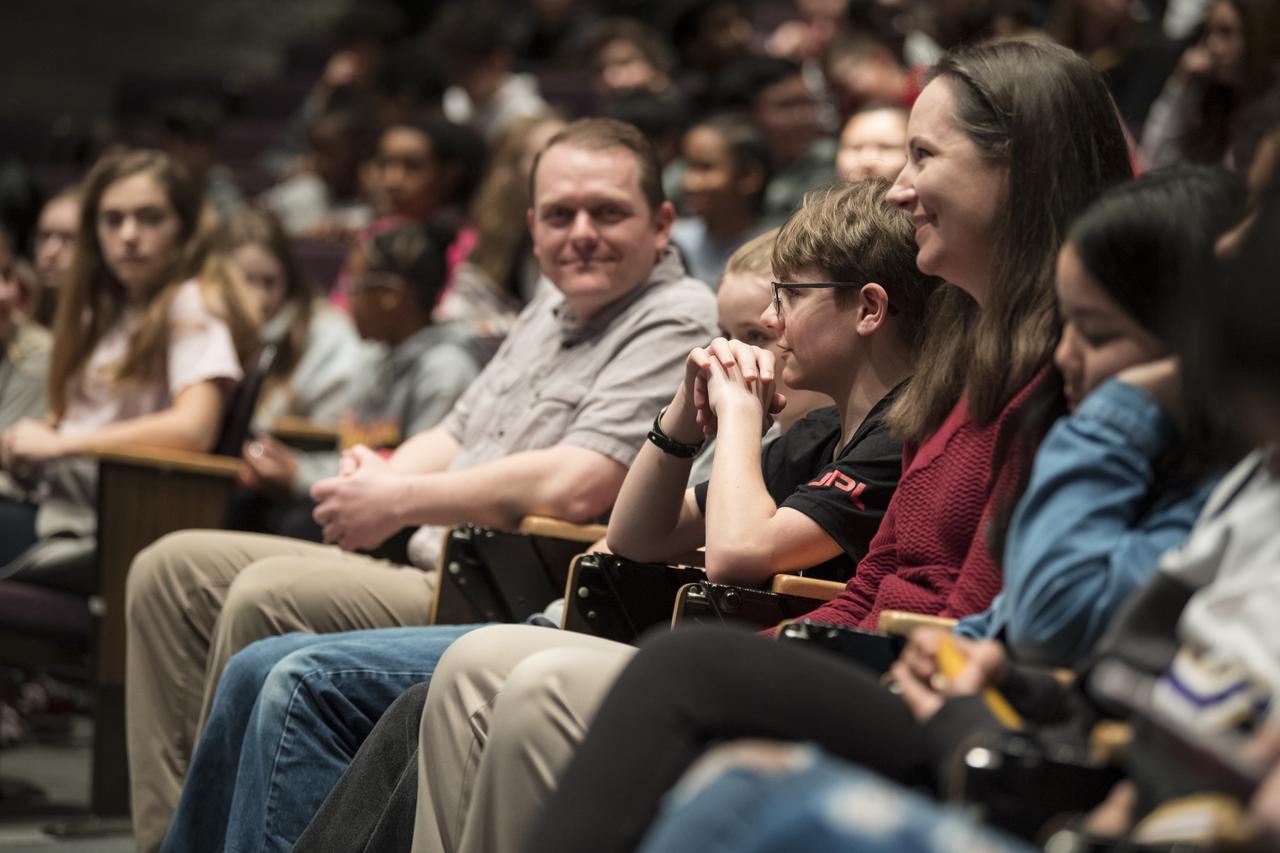
Founder and CEO of Future Engineers, Deanne Bell, speaks at an event to announce the official name of the Mars 2020 rover, Thursday, March 5, 2020, at Lake Braddock Secondary School in Burke, Va. The final selection of the new name, Perseverance, was made by NASA’s Associate Administrator of the Science Mission Directorate, Thomas Zurbuchen, following a nationwide naming contest conducted in 2019 that drew more than 28,000 essays by K-12 students from every U.S. state and territory. The rover is currently at NASA's Kennedy Space Center in Florida being prepared for launch this summer. Photo Credit: (NASA/Aubrey Gemignani)
Mars 2020 Rover Name Announcement
A placard commemorating NASA's "Send Your Name to Mars" campaign was installed on the Perseverance Mars rover on March 16, 2020, at NASA's Kennedy Space Center in Florida. Three fingernail-sized chips affixed to the upper-left corner of the placard feature the names of 10,932,295 people who participated. They were individually stenciled onto the chips by electron beam, along with the essays of the 155 finalists in NASA's "Name the Rover" contest. Liftoff aboard a United Launch Alliance Atlas V 541 rocket is targeted for mid-July of 2020 from Cape Canaveral Air Force Station. NASA's Launch Services Program, based at Kennedy, is managing the launch.  https://photojournal.jpl.nasa.gov/catalog/PIA23769
Send Your Name Placard Attached to Perseverance
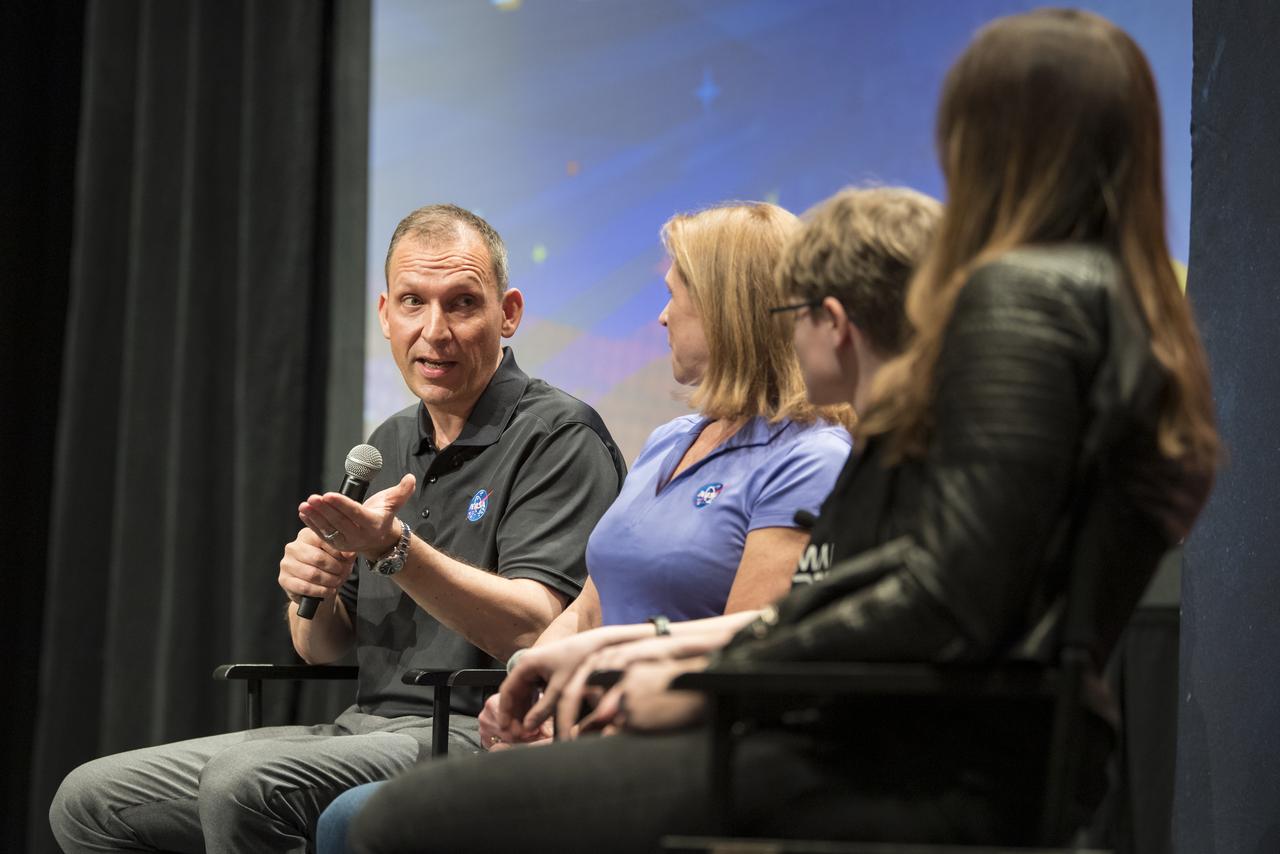
Associate Administrator of NASA's Science Mission Directorate, Thomas Zurbuchen, left, answers a question from Alex Mather, the student whose submission, Perseverance, was chosen as the official name of the Mars 2020 rover, second from right, Thursday, March 5, 2020, at Lake Braddock Secondary School in Burke, Va. The final selection of the new name was made by Zurbuchen, following a nationwide naming contest conducted in 2019 that drew more than 28,000 essays by K-12 students from every U.S. state and territory. Perseverance is currently at NASA's Kennedy Space Center in Florida being prepared for launch this summer. Photo Credit: (NASA/Aubrey Gemignani)

Mars 2020 Rover Name Announcement
Founder and CEO of Future Engineers, Deanne Bell, speaks to the audience at an event to announce the official name of the Mars 2020 rover, Thursday, March 5, 2020, at Lake Braddock Secondary School in Burke, Va. The final selection of the new name, Perseverance, was made by NASA’s Associate Administrator of the Science Mission Directorate, Thomas Zurbuchen, following a nationwide naming contest conducted in 2019 that drew more than 28,000 essays by K-12 students from every U.S. state and territory. The rover is currently at NASA's Kennedy Space Center in Florida being prepared for launch this summer. Photo Credit: (NASA/Aubrey Gemignani)
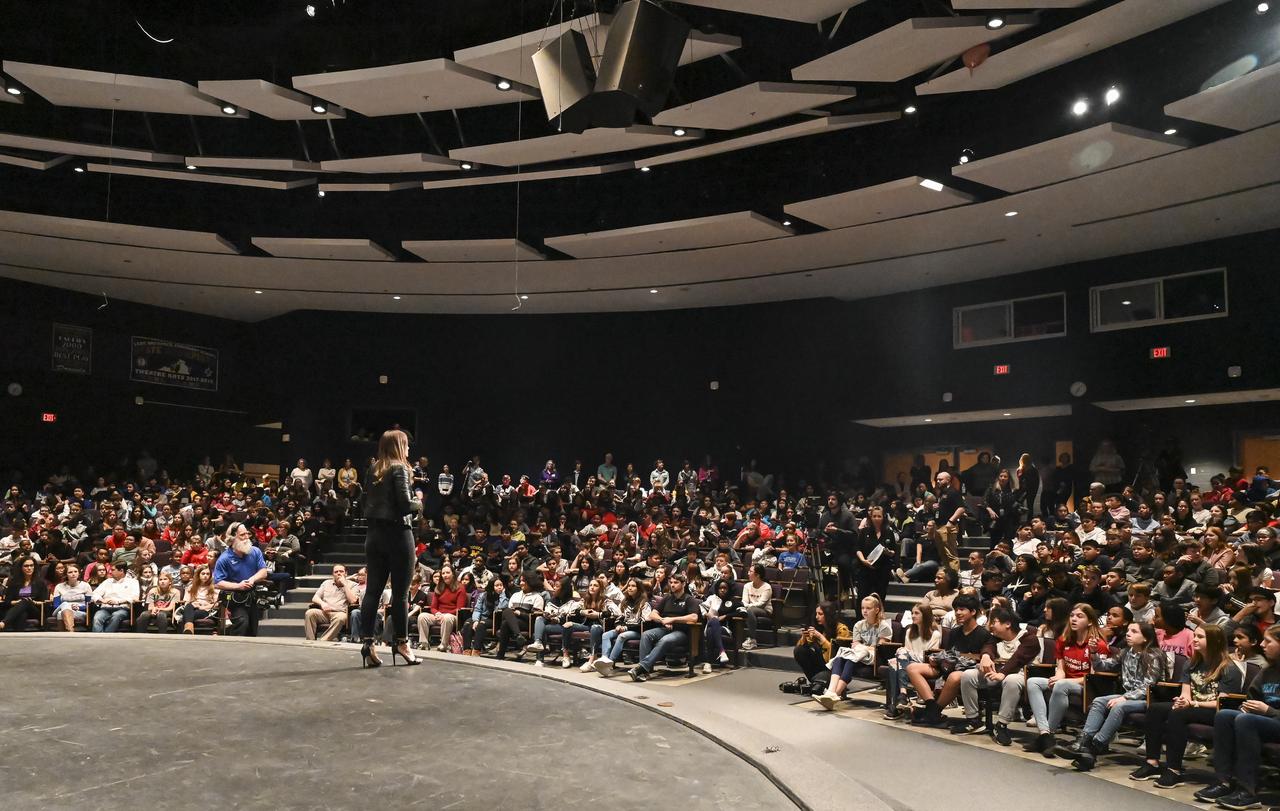
Mars 2020 Rover Name Announcement
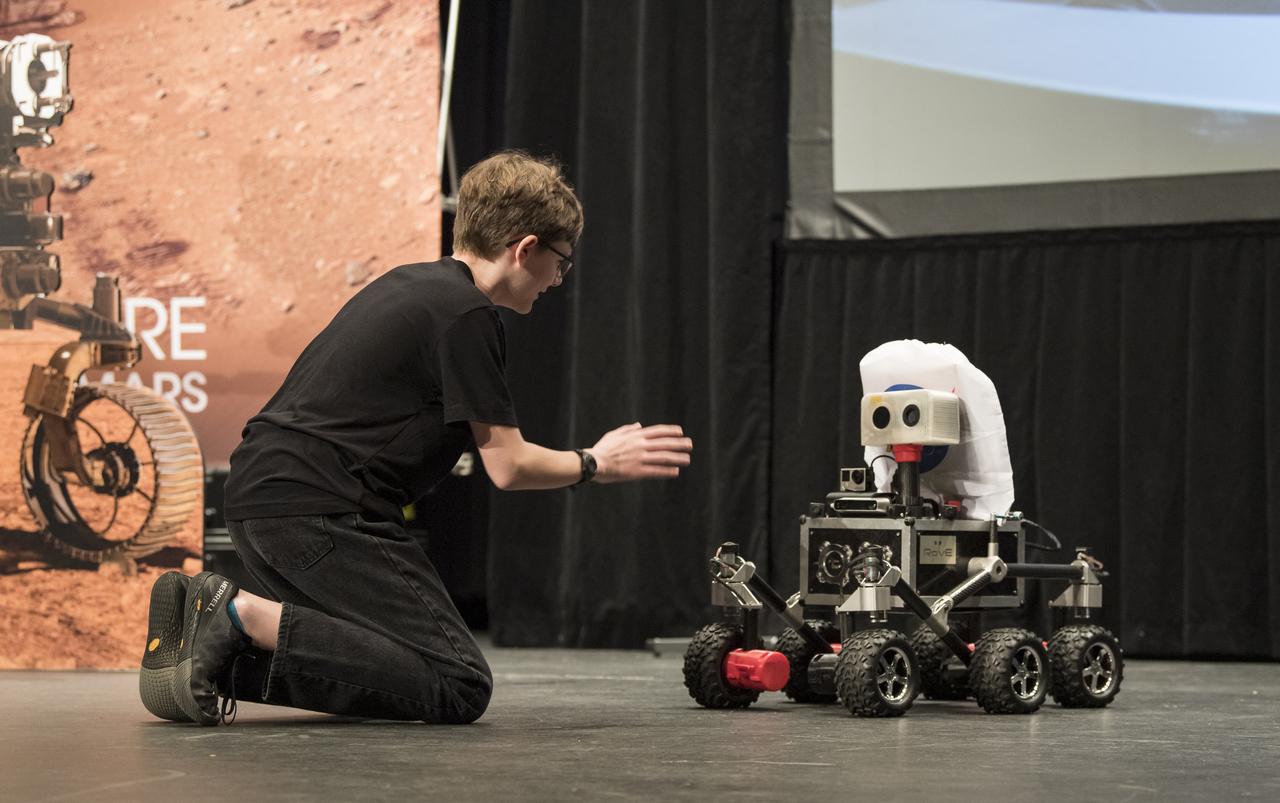
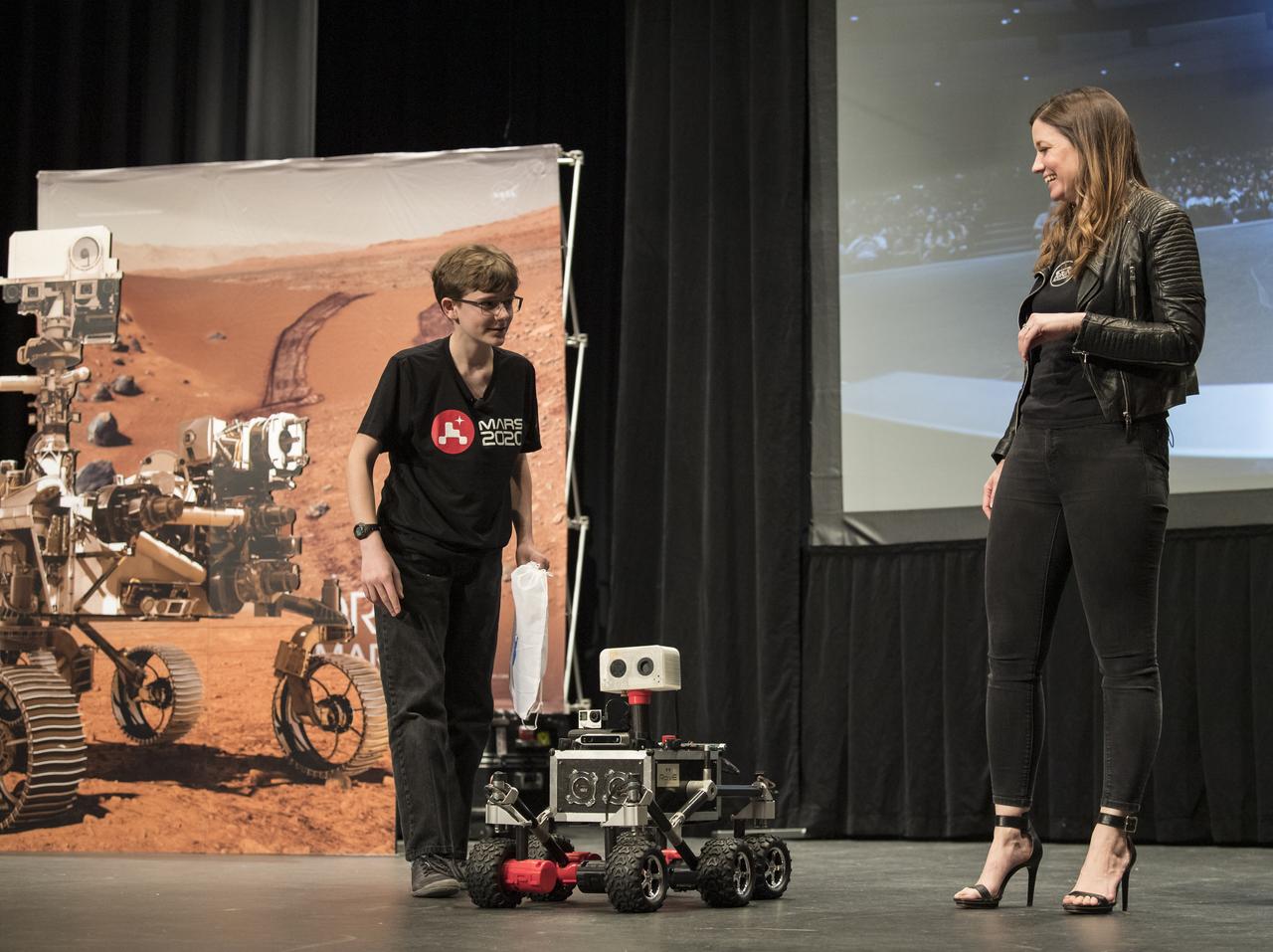
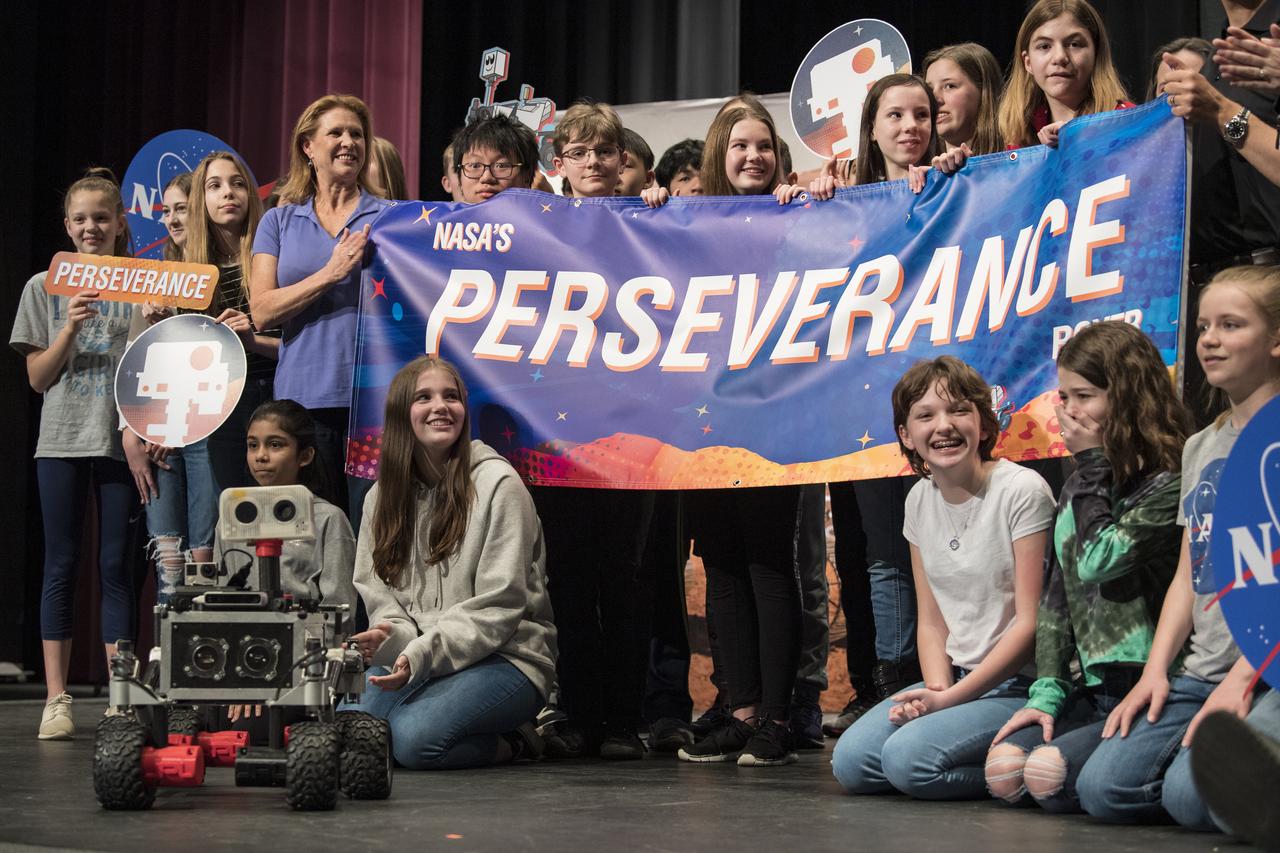
ROV-E, a new Mars outreach rover, rolls toward Alex Mather, the student whose submission, Perseverance, was chosen as the official name of the Mars 2020 rover, with NASA handouts at an event to announce the official name of the rover, Thursday, March 5, 2020, at Lake Braddock Secondary School in Burke, Va. The final selection of the new name, Perseverance, was made by Associate Administrator of NASA's Science Mission Directorate, Thomas Zurbuchen, following a nationwide naming contest conducted in 2019 that drew more than 28,000 essays by K-12 students from every U.S. state and territory. The rover is currently at NASA's Kennedy Space Center in Florida being prepared for launch this summer. Photo Credit: (NASA/Aubrey Gemignani)
Mars 2020 Rover Name Announcement
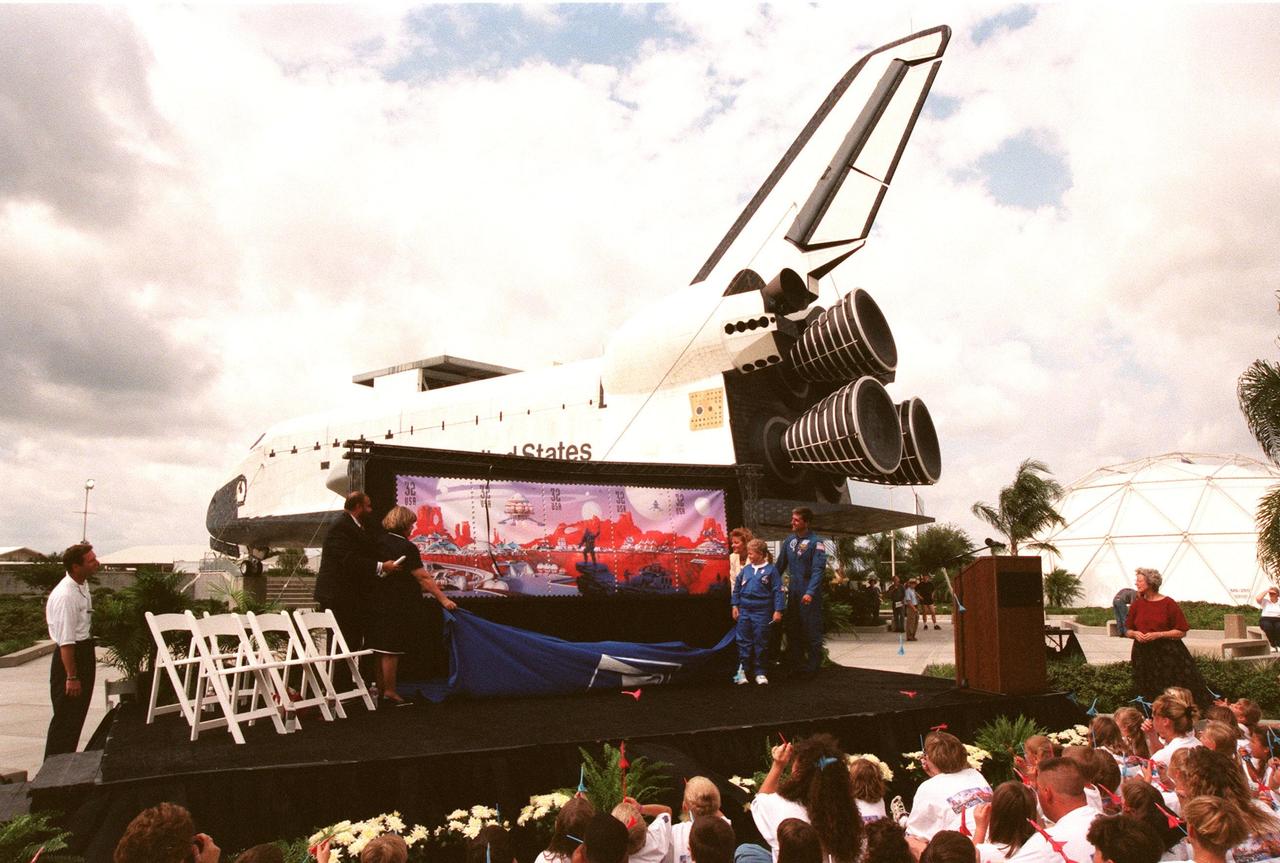
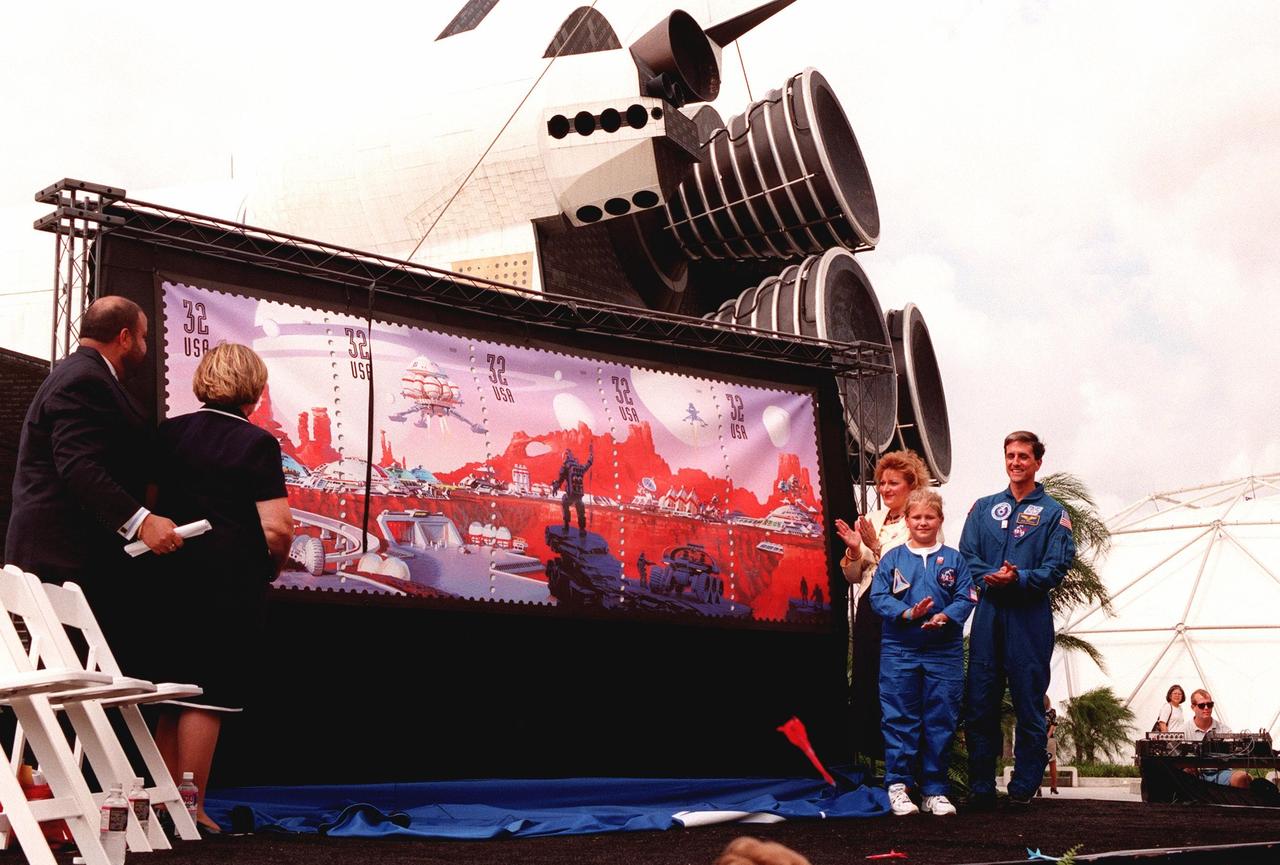
Applauding the unveiling of the U.S. Postal Service's newest series of stamps, Space Discovery, are are (left to right) Barry Ziehl, U.S. Postal Service; JoAnn Morgan, KSC associate director of advanced development and shuttle upgrades; Karla Corcoran, Postal Service inspector general; Kristene A. Graves, a student from Lewis Carroll Elementary School; and Dr. Donald Thomas, astronaut and veteran of four Shuttle missions. During the ceremony, Kristene read her essay "My Stamp Adventure" that she had written for an area-wide contest for the event. The unveiling took place at the KSC Visitor Complex and coincided with NASA's 40th anniversary on this date. Behind the large display can be seen the mockup of an orbiter. The stamps were designed by renowned aerospace artist Attila Heija. The strip of five individual stamps together make up a futuristic scene complete with space vehicles, a futuristic space city, and space explorers. The stamps are available nationwide beginning Oct. 1
KSC-98pc1199
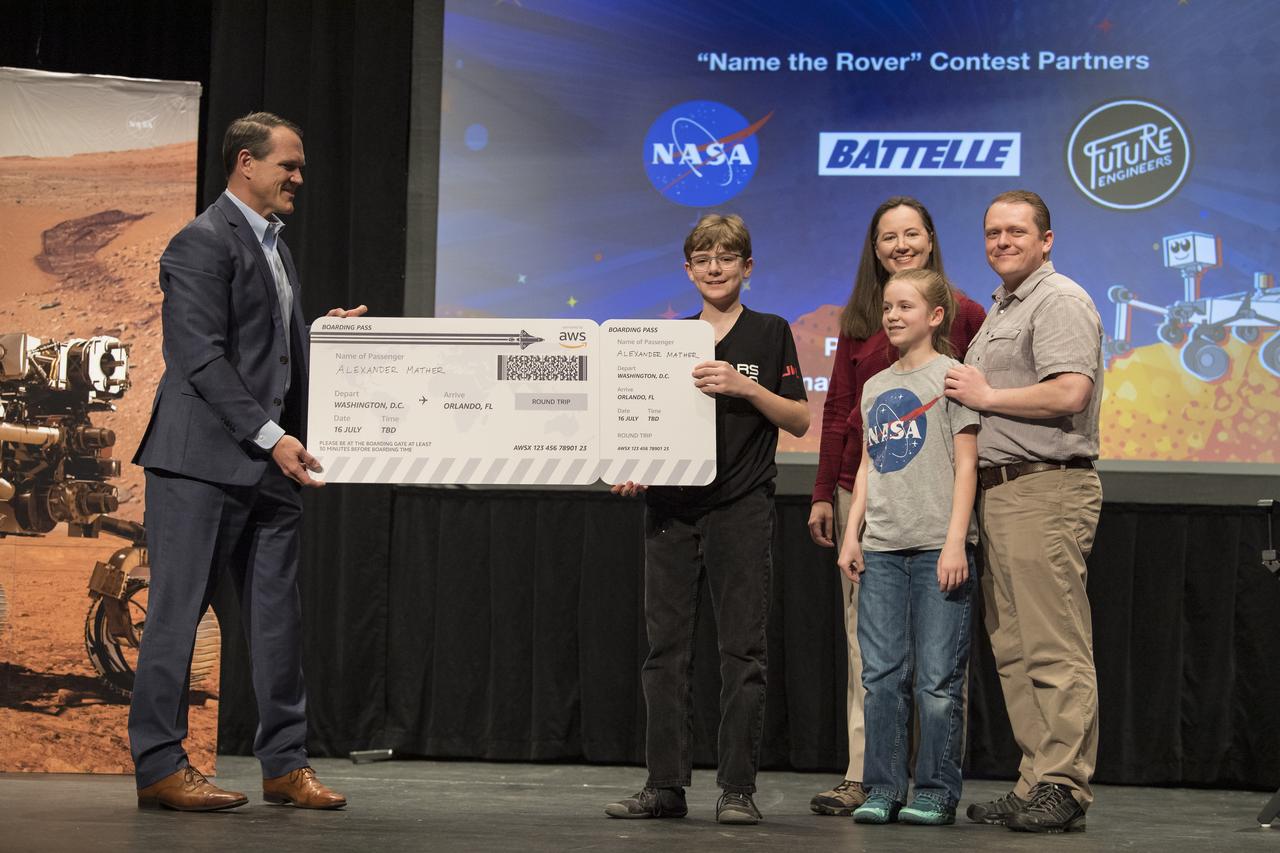
Amazon Senior Sales Manager, Jamie Baker, left, awards a large boarding pass to Alex Mather, the student whose submission, Perseverance, was chosen as the official name of the Mars 2020 rover, to get him and his family to NASA’s Kennedy Space Center to watch the launch of the rover, Thursday, March 5, 2020, at Lake Braddock Secondary School in Burke, Va. The final selection of the new name was made by Associate Administrator of NASA's Science Mission Directorate, Thomas Zurbuchen, following a nationwide naming contest conducted in 2019 that drew more than 28,000 essays by K-12 students from every U.S. state and territory. The rover is currently at NASA's Kennedy Space Center in Florida being prepared for launch this summer. Photo Credit: (NASA/Aubrey Gemignani)
Mars 2020 Rover Name Announcement
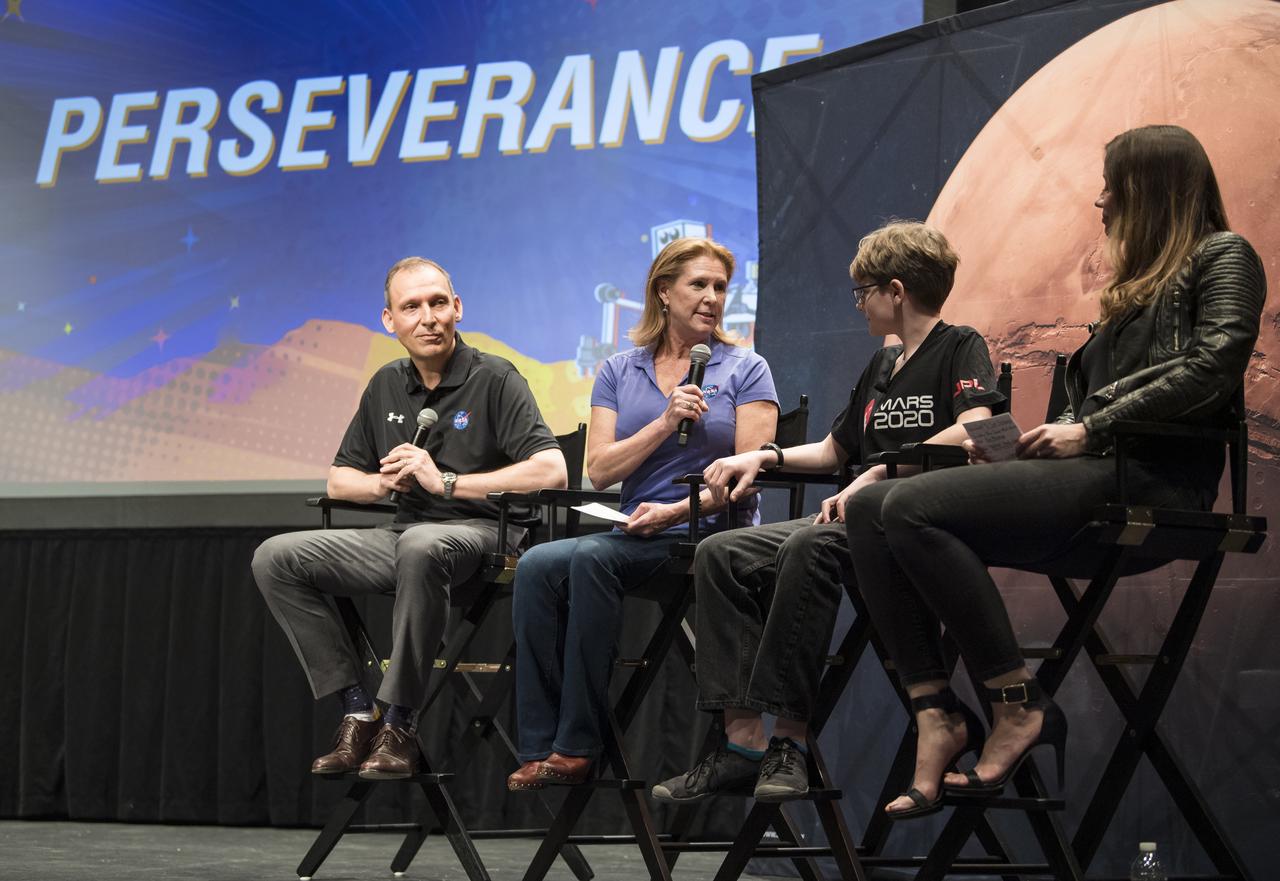
Lori Glaze, Director of the Planetary Science Division of NASA's Science Mission Directorate, second from left, asks Alex Mather, the student whose submission, Perseverance, was chosen as the official name of the Mars 2020 rover, a question, Thursday, March 5, 2020, at Lake Braddock Secondary School in Burke, Va. The final selection of the new name was made by Associate Administrator of NASA's Science Mission Directorate, Thomas Zurbuchen, following a nationwide naming contest conducted in 2019 that drew more than 28,000 essays by K-12 students from every U.S. state and territory. Perseverance is currently at NASA's Kennedy Space Center in Florida being prepared for launch this summer. Photo Credit: (NASA/Aubrey Gemignani)
Mars 2020 Rover Name Announcement
Alex Mather, the student whose submission, Perseverance, was chosen as the official name of the Mars 2020 rover, second from right, answers a question from Lori Glaze, Director of the Planetary Science Division of NASA's Science Mission Directorate, second from left, Thursday, March 5, 2020, at Lake Braddock Secondary School in Burke, Va. The final selection of the new name was made by Associate Administrator of NASA's Science Mission Directorate, Thomas Zurbuchen, left, following a nationwide naming contest conducted in 2019 that drew more than 28,000 essays by K-12 students from every U.S. state and territory. Perseverance is currently at NASA's Kennedy Space Center in Florida being prepared for launch this summer. Photo Credit: (NASA/Aubrey Gemignani)
Mars 2020 Rover Name Announcement
Alex Mather, the student whose submission, Perseverance, was chosen as the official name of the Mars 2020 rover, second from right, answers a question from Lori Glaze, Director of the Planetary Science Division of NASA's Science Mission Directorate, second from left, Thursday, March 5, 2020, at Lake Braddock Secondary School in Burke, Va. The final selection of the new name was made by Associate Administrator of NASA's Science Mission Directorate, Thomas Zurbuchen, left, following a nationwide naming contest conducted in 2019 that drew more than 28,000 essays by K-12 students from every U.S. state and territory. Perseverance is currently at NASA's Kennedy Space Center in Florida being prepared for launch this summer. Photo Credit: (NASA/Aubrey Gemignani)

Mars 2020 Rover Name Announcement
Alex Mather, the student whose submission, Perseverance, was chosen as the official name of the Mars 2020 rover, second from right, answers a question from Lori Glaze, Director of the Planetary Science Division of NASA's Science Mission Directorate, second from left, Thursday, March 5, 2020, at Lake Braddock Secondary School in Burke, Va. The final selection of the new name was made by Associate Administrator of NASA's Science Mission Directorate, Thomas Zurbuchen, left, following a nationwide naming contest conducted in 2019 that drew more than 28,000 essays by K-12 students from every U.S. state and territory. Perseverance is currently at NASA's Kennedy Space Center in Florida being prepared for launch this summer. Photo Credit: (NASA/Aubrey Gemignani)
Mars 2020 Rover Name Announcement
Lori Glaze, Director of the Planetary Science Division of NASA's Science Mission Directorate, right, shakes hands with Alex Mather, center, the student whose submission, Perseverance, was chosen as the official name of the Mars 2020 rover, Thursday, March 5, 2020, at Lake Braddock Secondary School in Burke, Va. The final selection of the new name was made by Associate Administrator of NASA's Science Mission Directorate, Thomas Zurbuchen, left, following a nationwide naming contest conducted in 2019 that drew more than 28,000 essays by K-12 students from every U.S. state and territory. Perseverance is currently at NASA's Kennedy Space Center in Florida being prepared for launch this summer. Photo Credit: (NASA/Aubrey Gemignani)
Mars 2020 Rover Name Announcement
The U.S. Postal Service unveils its newest series of stamps, Space Discovery, at the KSC Visitor Complex. The event coincided with NASA's 40th anniversary on this date. Participating in the unveiling are (left to right) Barry Ziehl, U.S. Postal Service; JoAnn Morgan, KSC associate director of advanced development and shuttle upgrades; Karla Corcoran, Postal Service inspector general; Kristene A. Graves, a student from Lewis Carroll Elementary School ; and Dr. Donald Thomas, astronaut and veteran of four Shuttle missions. Behind them is the mockup of an orbiter. During the ceremony, Kristene read her essay "My Stamp Adventure" that she had written for an area-wide contest for the event. The stamps were designed by renowned aerospace artist Attila Heija. The strip of five individual stamps together make up a futuristic scene complete with space vehicles, a futuristic space city, and space explorers. The stamps are available nationwide beginning Oct. 1
KSC-98pc1198
Lori Glaze, Director of the Planetary Science Division of NASA's Science Mission Directorate, second from left, asks Alex Mather, the student whose submission, Perseverance, was chosen as the official name of the Mars 2020 rover, a question, Thursday, March 5, 2020, at Lake Braddock Secondary School in Burke, Va. The final selection of the new name was made by Associate Administrator of NASA's Science Mission Directorate, Thomas Zurbuchen, following a nationwide naming contest conducted in 2019 that drew more than 28,000 essays by K-12 students from every U.S. state and territory. Perseverance is currently at NASA's Kennedy Space Center in Florida being prepared for launch this summer. Photo Credit: (NASA/Aubrey Gemignani)
Mars 2020 Rover Name Announcement
ROV-E, a new Mars outreach rover, delivers NASA handouts to Alex Mather, the student whose submission, Perseverance, was chosen as the official name of the Mars 2020 rover, at an event to announce the official name of the rover, Thursday, March 5, 2020, at Lake Braddock Secondary School in Burke, Va. The final selection of the new name, Perseverance, was made by Associate Administrator of NASA's Science Mission Directorate, Thomas Zurbuchen, following a nationwide naming contest conducted in 2019 that drew more than 28,000 essays by K-12 students from every U.S. state and territory. The rover is currently at NASA's Kennedy Space Center in Florida being prepared for launch this summer. Photo Credit: (NASA/Aubrey Gemignani)
Mars 2020 Rover Name Announcement
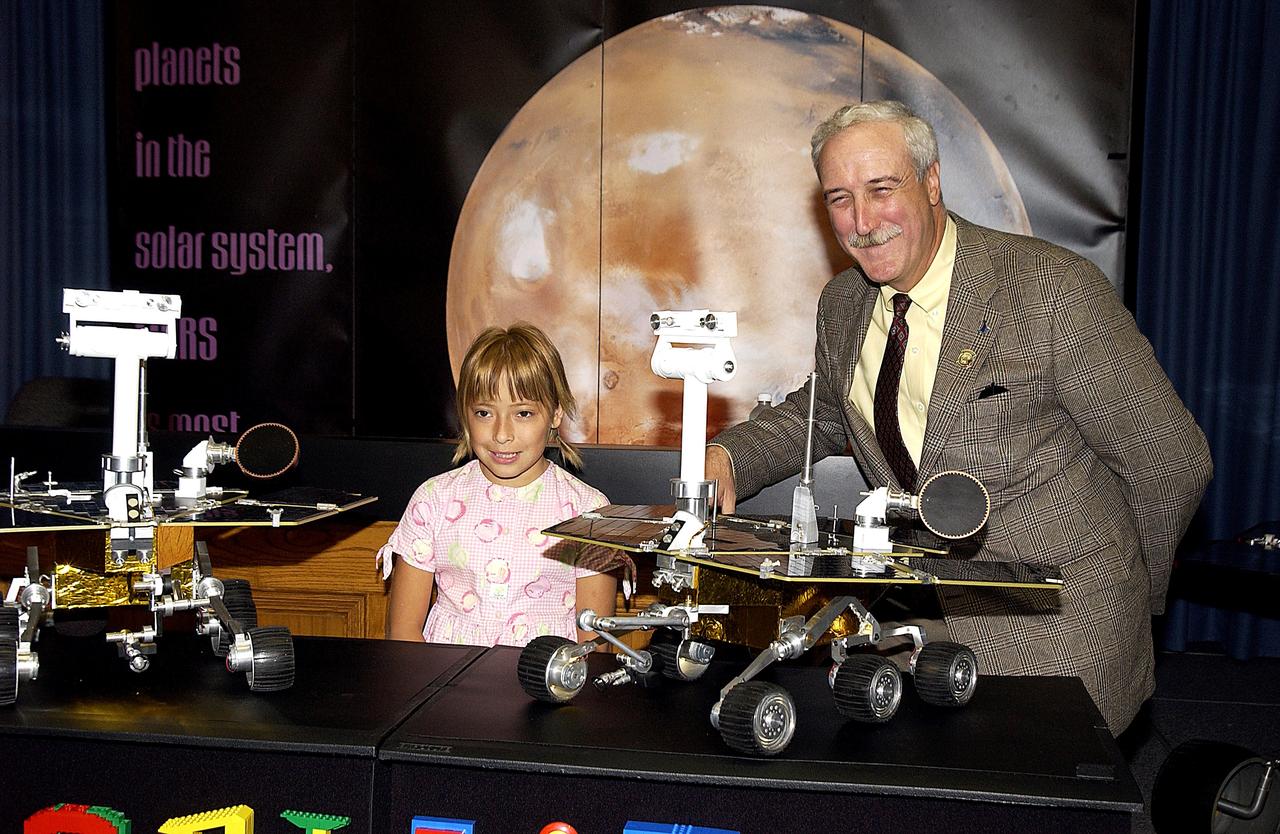
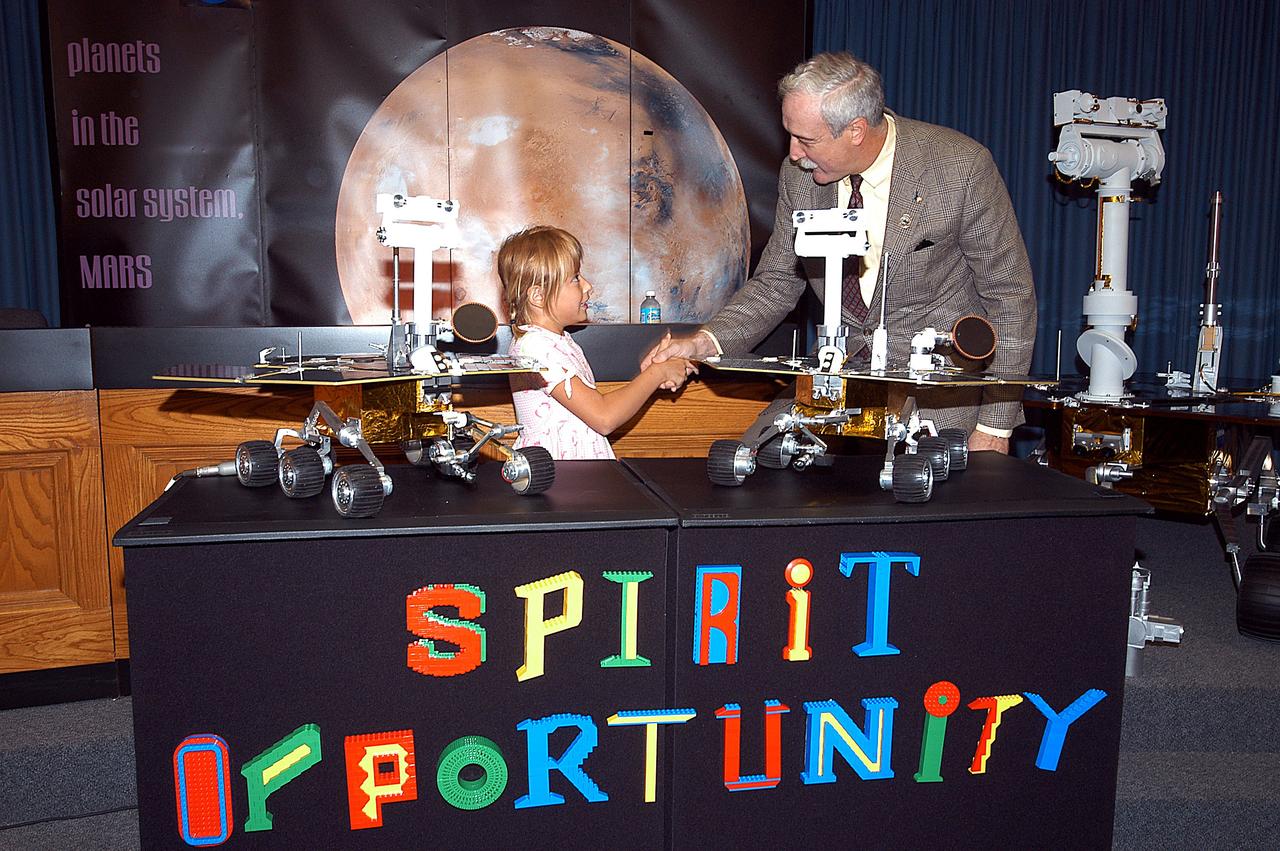
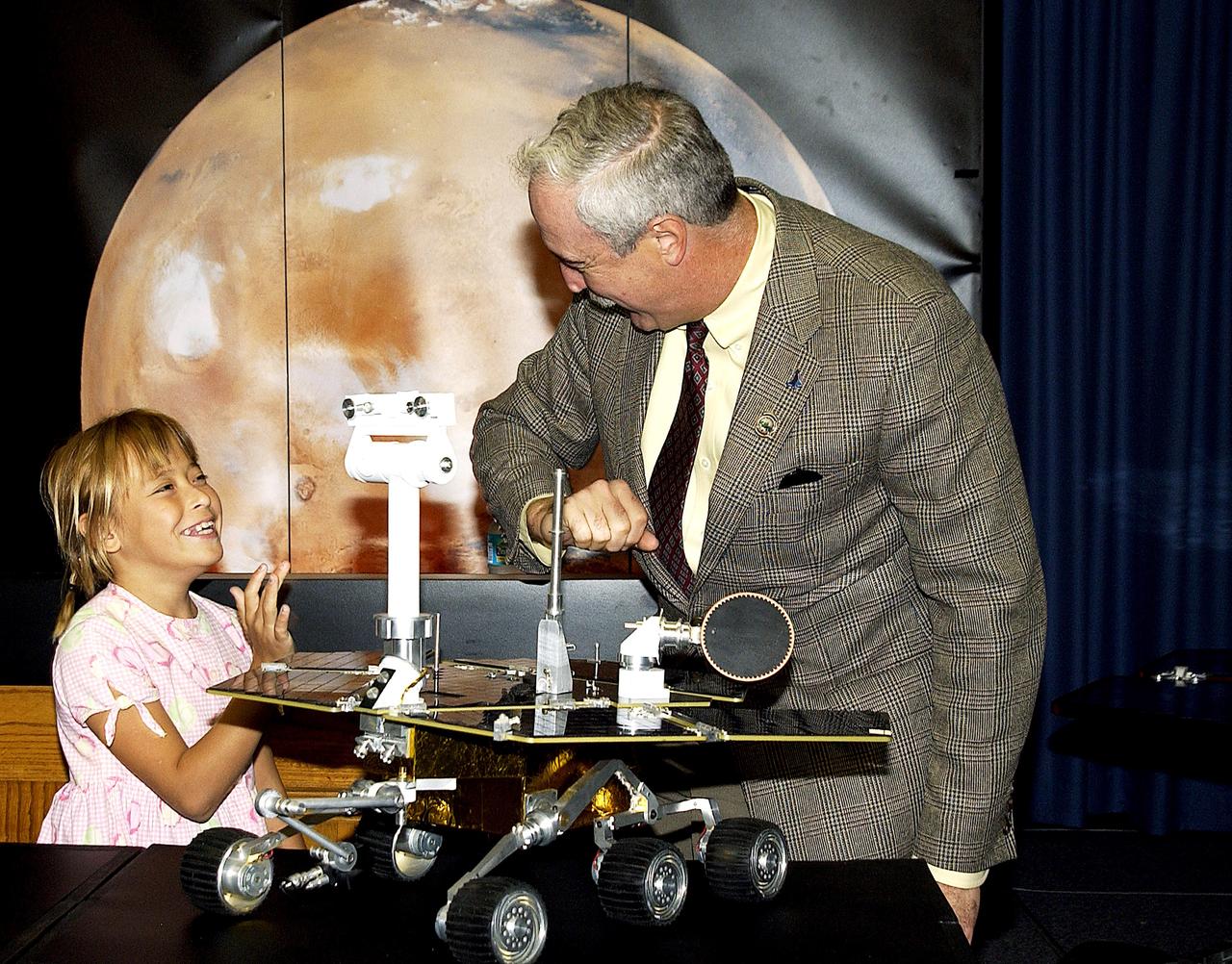
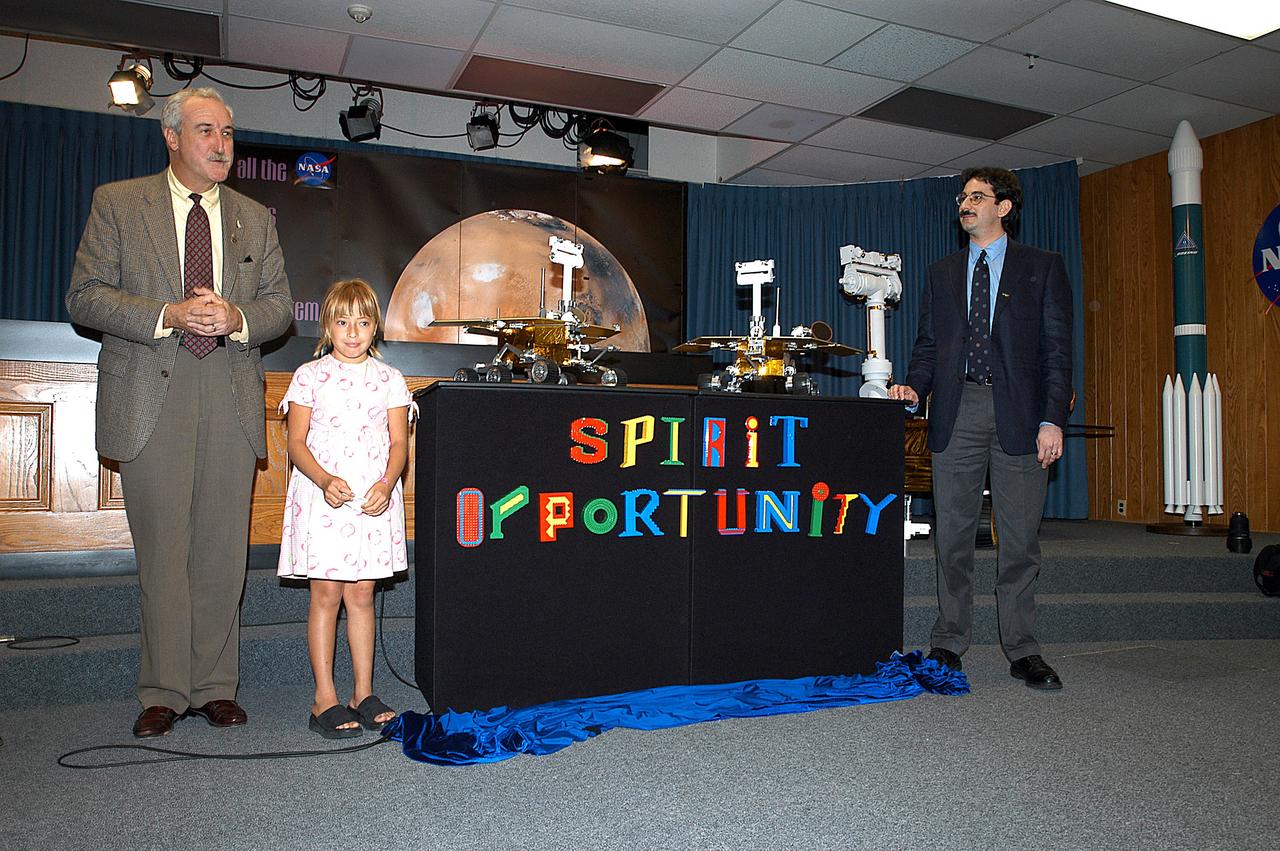
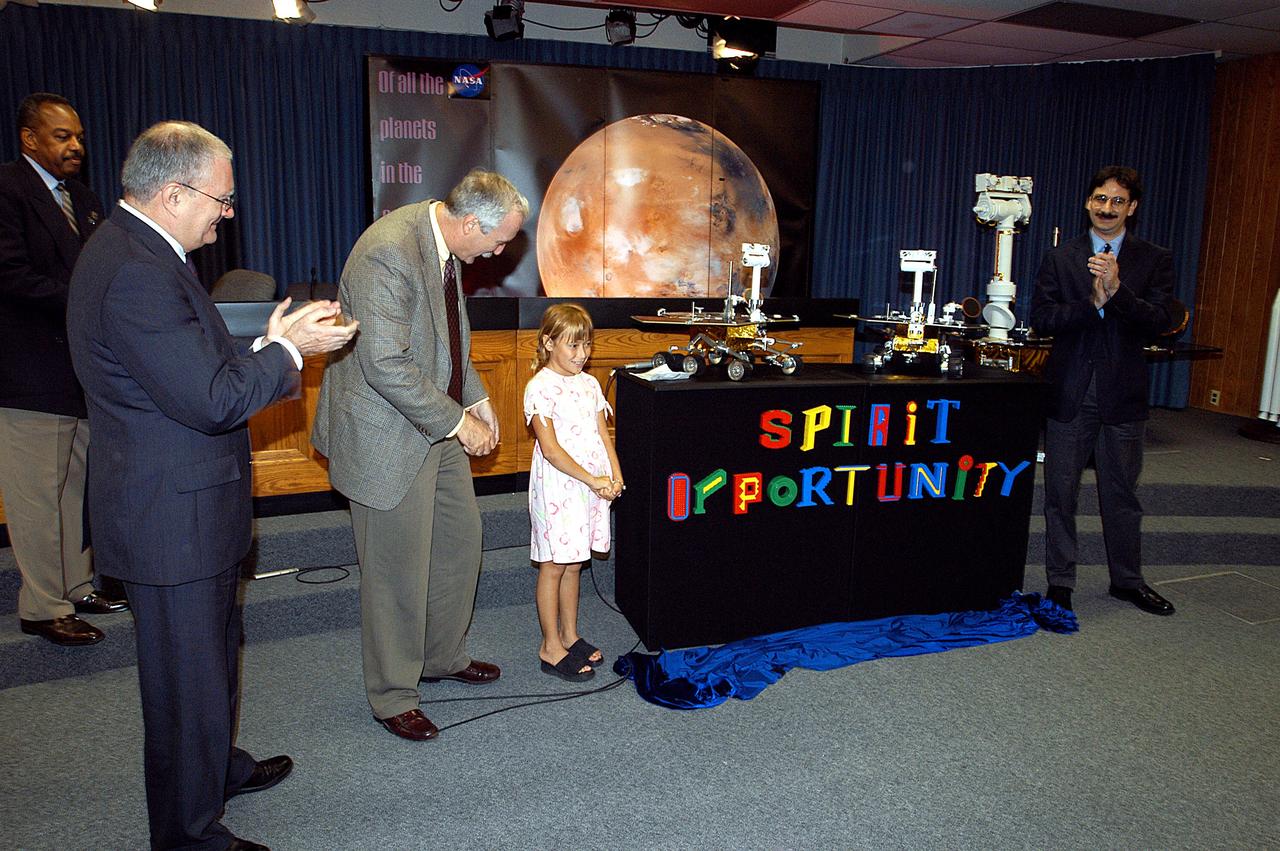
KENNEDY SPACE CENTER, FLA. -  Nine-year-old Sofi Collis (left) is introduced to the media by NASA Administrator Sean O'Keefe at a press conference.   The Siberian-born Arizona resident wrote the winning entry in the Name the Rovers Contest sponsored by NASA and the Lego Co., a Denmark-based toymaker, with collaboration from the Planetary Society, Pasadena, Calif.  The names she selected for the Mars Exploration Rovers are "Spirit" and "Opportunity." The third grader's essay was chosen from more than 10,000 American student entries.  NASA's twin Mars Exploration Rovers are designed to study the history of water on Mars. These robotic geologists are equipped with a robotic arm, a drilling tool, three spectrometers, and four pairs of cameras that allow them to have a human-like, 3D view of the terrain. Each rover could travel as far as 100 meters in one day to act as Mars scientists' eyes and hands, exploring an environment where humans are not yet able to go. MER-A, with the rover Spirit aboard, is scheduled to launch on June 8 at 2:06 p.m. EDT, with two launch opportunities each day during a launch period that closes on June 24.
KENNEDY SPACE CENTER, FLA. - Nine-year-old Sofi Collis (left) is introduced to the media by NASA Administrator Sean O'Keefe at a press conference. The Siberian-born Arizona resident wrote the winning entry in the Name the Rovers Contest sponsored by NASA and the Lego Co., a Denmark-based toymaker, with collaboration from the Planetary Society, Pasadena, Calif. The names she selected for the Mars Exploration Rovers are "Spirit" and "Opportunity." The third grader's essay was chosen from more than 10,000 American student entries. NASA's twin Mars Exploration Rovers are designed to study the history of water on Mars. These robotic geologists are equipped with a robotic arm, a drilling tool, three spectrometers, and four pairs of cameras that allow them to have a human-like, 3D view of the terrain. Each rover could travel as far as 100 meters in one day to act as Mars scientists' eyes and hands, exploring an environment where humans are not yet able to go. MER-A, with the rover Spirit aboard, is scheduled to launch on June 8 at 2:06 p.m. EDT, with two launch opportunities each day during a launch period that closes on June 24.
KENNEDY SPACE CENTER, FLA. -  Nine-year-old Sofi Collis (left) is congratulated by NASA Administrator Sean O'Keefe for selecting the names of the Mars Exploration Rovers  -- "Spirit" and "Opportunity" --  during a press conference.  The names Sofi suggested were chosen from more than 10,000 student entries in an essay contest managed for NASA by the LEGO Company.   NASA's twin Mars Exploration Rovers are designed to study the history of water on Mars. These robotic geologists are equipped with a robotic arm, a drilling tool, three spectrometers, and four pairs of cameras that allow them to have a human-like, 3D view of the terrain. Each rover could travel as far as 100 meters in one day to act as Mars scientists' eyes and hands, exploring an environment where humans are not yet able to go. MER-A, with the rover Spirit aboard, is scheduled to launch on June 8 at 2:06 p.m. EDT, with two launch opportunities each day during a launch period that closes on June 24.
KENNEDY SPACE CENTER, FLA. - Nine-year-old Sofi Collis (left) is congratulated by NASA Administrator Sean O'Keefe for selecting the names of the Mars Exploration Rovers -- "Spirit" and "Opportunity" -- during a press conference. The names Sofi suggested were chosen from more than 10,000 student entries in an essay contest managed for NASA by the LEGO Company. NASA's twin Mars Exploration Rovers are designed to study the history of water on Mars. These robotic geologists are equipped with a robotic arm, a drilling tool, three spectrometers, and four pairs of cameras that allow them to have a human-like, 3D view of the terrain. Each rover could travel as far as 100 meters in one day to act as Mars scientists' eyes and hands, exploring an environment where humans are not yet able to go. MER-A, with the rover Spirit aboard, is scheduled to launch on June 8 at 2:06 p.m. EDT, with two launch opportunities each day during a launch period that closes on June 24.
KENNEDY SPACE CENTER, FLA. -  Nine-year-old Sofi Collis is introduced to the media at a press conference.   The Siberian-born Arizona resident wrote the winning entry in the Name the Rovers Contest sponsored by NASA and the Lego Co., a Denmark-based toymaker, with collaboration from the Planetary Society, Pasadena, Calif.  The names she selected for the Mars Exploration Rovers are "Spirit" and "Opportunity." The third grader's essay was chosen from more than 10,000 American student entries.  NASA's twin Mars Exploration Rovers are designed to study the history of water on Mars. These robotic geologists are equipped with a robotic arm, a drilling tool, three spectrometers, and four pairs of cameras that allow them to have a human-like, 3D view of the terrain. Each rover could travel as far as 100 meters in one day to act as Mars scientists' eyes and hands, exploring an environment where humans are not yet able to go. MER-A, with the rover Spirit aboard, is scheduled to launch on June 8 at 2:06 p.m. EDT, with two launch opportunities each day during a launch period that closes on June 24.
KENNEDY SPACE CENTER, FLA. - Nine-year-old Sofi Collis is introduced to the media at a press conference. The Siberian-born Arizona resident wrote the winning entry in the Name the Rovers Contest sponsored by NASA and the Lego Co., a Denmark-based toymaker, with collaboration from the Planetary Society, Pasadena, Calif. The names she selected for the Mars Exploration Rovers are "Spirit" and "Opportunity." The third grader's essay was chosen from more than 10,000 American student entries. NASA's twin Mars Exploration Rovers are designed to study the history of water on Mars. These robotic geologists are equipped with a robotic arm, a drilling tool, three spectrometers, and four pairs of cameras that allow them to have a human-like, 3D view of the terrain. Each rover could travel as far as 100 meters in one day to act as Mars scientists' eyes and hands, exploring an environment where humans are not yet able to go. MER-A, with the rover Spirit aboard, is scheduled to launch on June 8 at 2:06 p.m. EDT, with two launch opportunities each day during a launch period that closes on June 24.
KENNEDY SPACE CENTER, FLA. -  Nine-year-old Sofi Collis (left) shares a light moment with NASA Administrator Sean O'Keefe at a press conference.   The Siberian-born Arizona resident wrote the winning entry in the Name the Rovers Contest sponsored by NASA and the Lego Co., a Denmark-based toymaker, with collaboration from the Planetary Society, Pasadena, Calif.  The names she selected for the Mars Exploration Rovers are "Spirit" and "Opportunity." The third grader's essay was chosen from more than 10,000 American student entries.  NASA's twin Mars Exploration Rovers are designed to study the history of water on Mars. These robotic geologists are equipped with a robotic arm, a drilling tool, three spectrometers, and four pairs of cameras that allow them to have a human-like, 3D view of the terrain. Each rover could travel as far as 100 meters in one day to act as Mars scientists' eyes and hands, exploring an environment where humans are not yet able to go. MER-A, with the rover Spirit aboard, is scheduled to launch on June 8 at 2:06 p.m. EDT, with two launch opportunities each day during a launch period that closes on June 24.
KENNEDY SPACE CENTER, FLA. - Nine-year-old Sofi Collis (left) shares a light moment with NASA Administrator Sean O'Keefe at a press conference. The Siberian-born Arizona resident wrote the winning entry in the Name the Rovers Contest sponsored by NASA and the Lego Co., a Denmark-based toymaker, with collaboration from the Planetary Society, Pasadena, Calif. The names she selected for the Mars Exploration Rovers are "Spirit" and "Opportunity." The third grader's essay was chosen from more than 10,000 American student entries. NASA's twin Mars Exploration Rovers are designed to study the history of water on Mars. These robotic geologists are equipped with a robotic arm, a drilling tool, three spectrometers, and four pairs of cameras that allow them to have a human-like, 3D view of the terrain. Each rover could travel as far as 100 meters in one day to act as Mars scientists' eyes and hands, exploring an environment where humans are not yet able to go. MER-A, with the rover Spirit aboard, is scheduled to launch on June 8 at 2:06 p.m. EDT, with two launch opportunities each day during a launch period that closes on June 24.
KENNEDY SPACE CENTER, FLA. -  Nine-year-old Sofi Collis proudly presents the names she selected for the Mars Exploration Rovers  -- "Spirit" and "Opportunity" --  during a press conference.  Also participating in the press conference are NASA Administrator Sean O'Keefe (left) and Brad Justus, LEGO Co. senior vice president (right).  The names Sofi suggested were selected from more than 10,000 student entries in an essay contest managed for NASA by the LEGO Company.   NASA's twin Mars Exploration Rovers are designed to study the history of water on Mars. These robotic geologists are equipped with a robotic arm, a drilling tool, three spectrometers, and four pairs of cameras that allow them to have a human-like, 3D view of the terrain. Each rover could travel as far as 100 meters in one day to act as Mars scientists' eyes and hands, exploring an environment where humans are not yet able to go. MER-A, with the rover Spirit aboard, is scheduled to launch on June 8 at 2:06 p.m. EDT, with two launch opportunities each day during a launch period that closes on June 24.
KENNEDY SPACE CENTER, FLA. - Nine-year-old Sofi Collis proudly presents the names she selected for the Mars Exploration Rovers -- "Spirit" and "Opportunity" -- during a press conference. Also participating in the press conference are NASA Administrator Sean O'Keefe (left) and Brad Justus, LEGO Co. senior vice president (right). The names Sofi suggested were selected from more than 10,000 student entries in an essay contest managed for NASA by the LEGO Company. NASA's twin Mars Exploration Rovers are designed to study the history of water on Mars. These robotic geologists are equipped with a robotic arm, a drilling tool, three spectrometers, and four pairs of cameras that allow them to have a human-like, 3D view of the terrain. Each rover could travel as far as 100 meters in one day to act as Mars scientists' eyes and hands, exploring an environment where humans are not yet able to go. MER-A, with the rover Spirit aboard, is scheduled to launch on June 8 at 2:06 p.m. EDT, with two launch opportunities each day during a launch period that closes on June 24.
KENNEDY SPACE CENTER, FLA. -  Nine-year-old Sofi Collis unveils the names of the Mars Exploration Rovers  -- "Spirit" and "Opportunity" --  during a press conference.  Participating in the press conference are, from left, Dr. John Marburger, science advisor to the President and director of the Office of Science and Technology Policy; NASA Administrator Sean O'Keefe; Sofi Collis, a third grade student from Arizona; and Brad Justus, LEGO Co. senior vice president.  The names Sofi suggested were selected from more than 10,000 student entries in an essay contest managed for NASA by the LEGO Company.   NASA's twin Mars Exploration Rovers are designed to study the history of water on Mars. These robotic geologists are equipped with a robotic arm, a drilling tool, three spectrometers, and four pairs of cameras that allow them to have a human-like, 3D view of the terrain. Each rover could travel as far as 100 meters in one day to act as Mars scientists' eyes and hands, exploring an environment where humans are not yet able to go. MER-A, with the rover Spirit aboard, is scheduled to launch on June 8 at 2:06 p.m. EDT, with two launch opportunities each day during a launch period that closes on June 24.
KENNEDY SPACE CENTER, FLA. - Nine-year-old Sofi Collis unveils the names of the Mars Exploration Rovers -- "Spirit" and "Opportunity" -- during a press conference. Participating in the press conference are, from left, Dr. John Marburger, science advisor to the President and director of the Office of Science and Technology Policy; NASA Administrator Sean O'Keefe; Sofi Collis, a third grade student from Arizona; and Brad Justus, LEGO Co. senior vice president. The names Sofi suggested were selected from more than 10,000 student entries in an essay contest managed for NASA by the LEGO Company. NASA's twin Mars Exploration Rovers are designed to study the history of water on Mars. These robotic geologists are equipped with a robotic arm, a drilling tool, three spectrometers, and four pairs of cameras that allow them to have a human-like, 3D view of the terrain. Each rover could travel as far as 100 meters in one day to act as Mars scientists' eyes and hands, exploring an environment where humans are not yet able to go. MER-A, with the rover Spirit aboard, is scheduled to launch on June 8 at 2:06 p.m. EDT, with two launch opportunities each day during a launch period that closes on June 24.
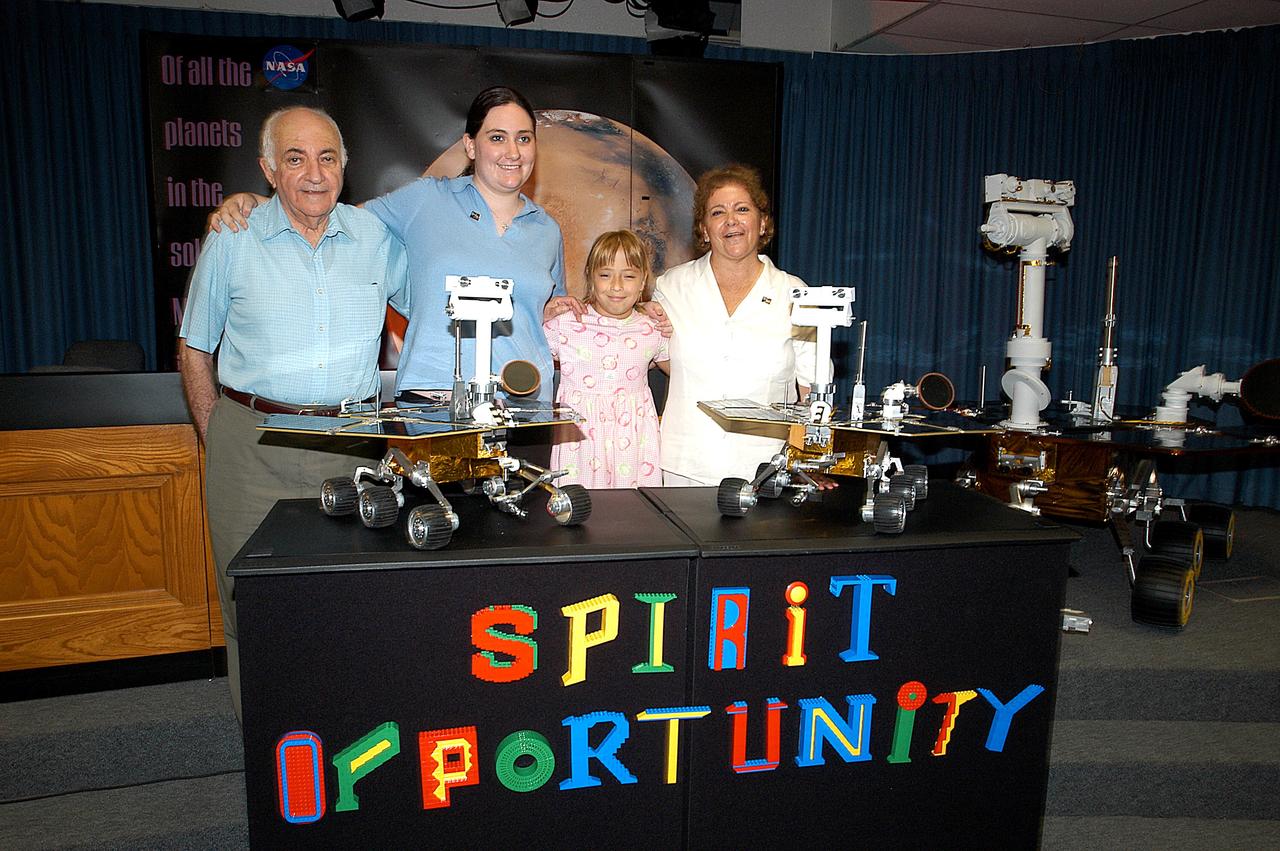
KENNEDY SPACE CENTER, FLA. -  Nine-year-old Sofi Collis (third from left) and her family pose proudly with a banner displaying the names she selected for the Mars Exploration Rovers -- "Spirit" and "Opportunity" -- following a press conference announcing the names. The names Sofi suggested were chosen from more than 10,000 student entries in an essay contest managed for NASA by the LEGO Company. NASA's twin Mars Exploration Rovers are designed to study the history of water on Mars. These robotic geologists are equipped with a robotic arm, a drilling tool, three spectrometers, and four pairs of cameras that allow them to have a human-like, 3D view of the terrain. Each rover could travel as far as 100 meters in one day to act as Mars scientists' eyes and hands, exploring an environment where humans are not yet able to go. MER-A, with the rover Spirit aboard, is scheduled to launch on June 8 at 2:06 p.m. EDT, with two launch opportunities each day during a launch period that closes on June 24.
KENNEDY SPACE CENTER, FLA. - Nine-year-old Sofi Collis (third from left) and her family pose proudly with a banner displaying the names she selected for the Mars Exploration Rovers -- "Spirit" and "Opportunity" -- following a press conference announcing the names. The names Sofi suggested were chosen from more than 10,000 student entries in an essay contest managed for NASA by the LEGO Company. NASA's twin Mars Exploration Rovers are designed to study the history of water on Mars. These robotic geologists are equipped with a robotic arm, a drilling tool, three spectrometers, and four pairs of cameras that allow them to have a human-like, 3D view of the terrain. Each rover could travel as far as 100 meters in one day to act as Mars scientists' eyes and hands, exploring an environment where humans are not yet able to go. MER-A, with the rover Spirit aboard, is scheduled to launch on June 8 at 2:06 p.m. EDT, with two launch opportunities each day during a launch period that closes on June 24.
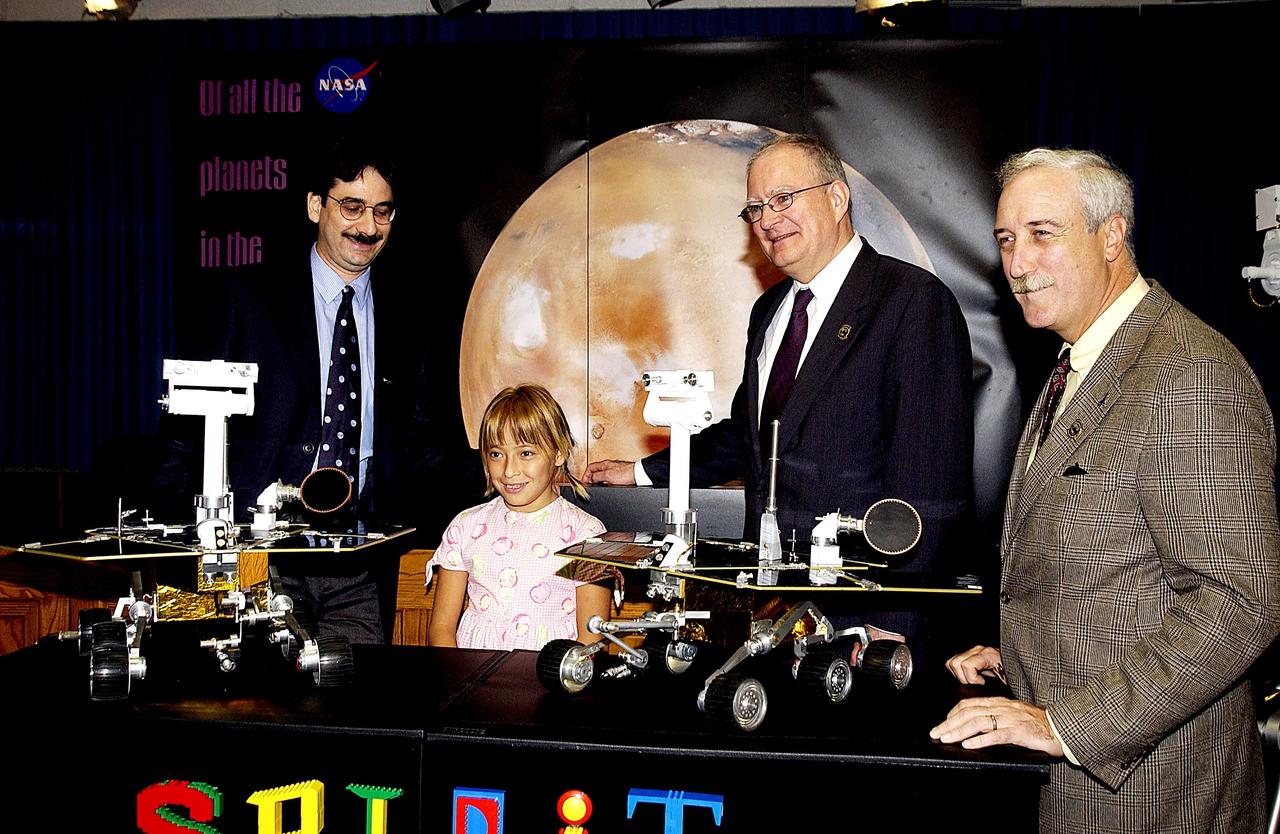
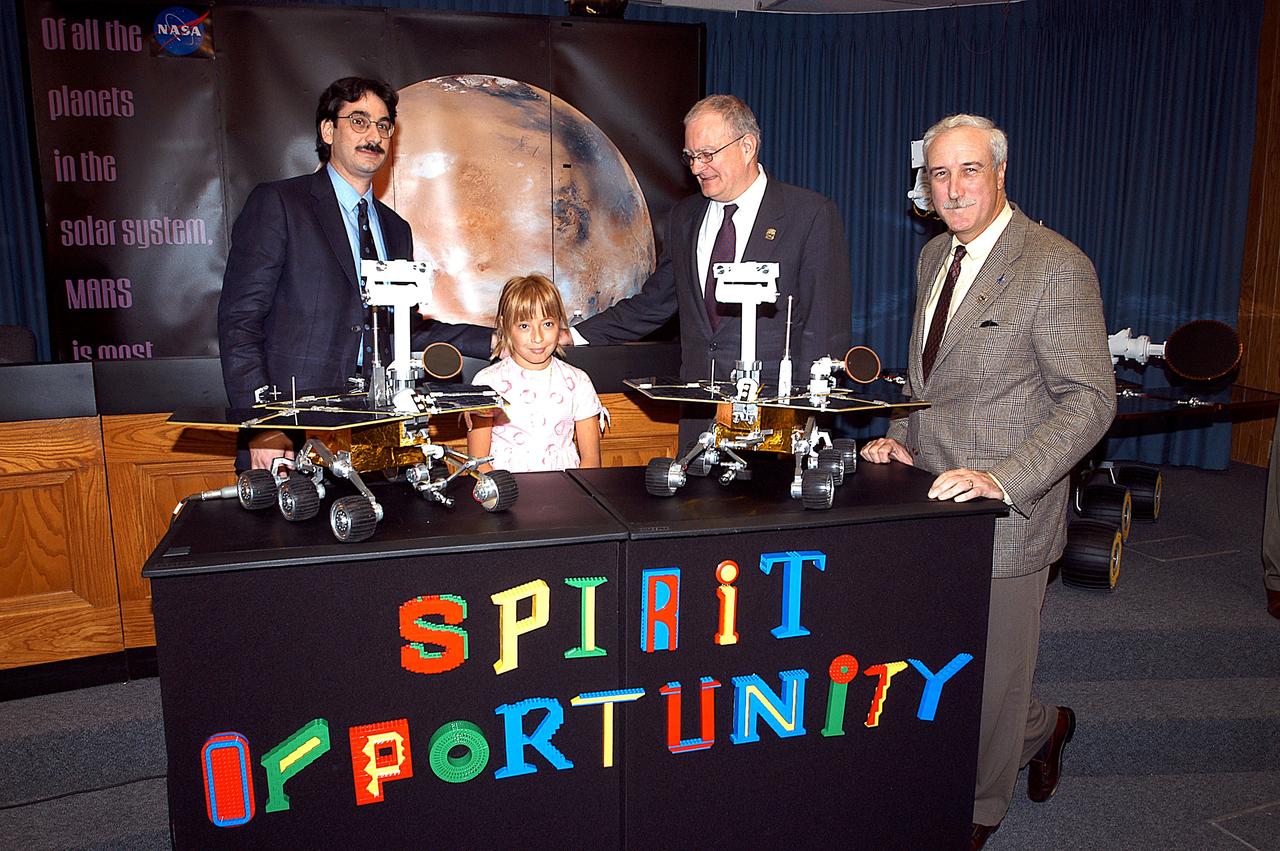
KENNEDY SPACE CENTER, FLA. -  Nine-year-old Sofi Collis poses proudly with a banner displaying the names she selected for the Mars Exploration Rovers -- "Spirit" and "Opportunity" -- during a press conference. Participating in the press conference are, from left, Brad Justus, LEGO Co. senior vice president; Sofi Collis, third grade student from Arizona; Dr. John Marburger, science advisor to the President and director of the Office of Science and Technology Policy; and NASA Administrator Sean O'Keefe. The names Sofi suggested were selected from more than 10,000 student entries in an essay contest managed for NASA by the LEGO Company. NASA's twin Mars Exploration Rovers are designed to study the history of water on Mars. These robotic geologists are equipped with a robotic arm, a drilling tool, three spectrometers, and four pairs of cameras that allow them to have a human-like, 3D view of the terrain. Each rover could travel as far as 100 meters in one day to act as Mars scientists' eyes and hands, exploring an environment where humans are not yet able to go. MER-A, with the rover Spirit aboard, is scheduled to launch on June 8 at 2:06 p.m. EDT, with two launch opportunities each day during a launch period that closes on June 24.
KENNEDY SPACE CENTER, FLA. - Nine-year-old Sofi Collis poses proudly with a banner displaying the names she selected for the Mars Exploration Rovers -- "Spirit" and "Opportunity" -- during a press conference. Participating in the press conference are, from left, Brad Justus, LEGO Co. senior vice president; Sofi Collis, third grade student from Arizona; Dr. John Marburger, science advisor to the President and director of the Office of Science and Technology Policy; and NASA Administrator Sean O'Keefe. The names Sofi suggested were selected from more than 10,000 student entries in an essay contest managed for NASA by the LEGO Company. NASA's twin Mars Exploration Rovers are designed to study the history of water on Mars. These robotic geologists are equipped with a robotic arm, a drilling tool, three spectrometers, and four pairs of cameras that allow them to have a human-like, 3D view of the terrain. Each rover could travel as far as 100 meters in one day to act as Mars scientists' eyes and hands, exploring an environment where humans are not yet able to go. MER-A, with the rover Spirit aboard, is scheduled to launch on June 8 at 2:06 p.m. EDT, with two launch opportunities each day during a launch period that closes on June 24.
KENNEDY SPACE CENTER, FLA. -  Nine-year-old Sofi Collis poses proudly with a banner displaying the names she selected for the Mars Exploration Rovers -- "Spirit" and "Opportunity" -- during a press conference. Participating in the press conference are, from left, Brad Justus, LEGO Co. senior vice president; Sofi Collis, a third grade student from Arizona; Dr. John Marburger, science advisor to the President and director of the Office of Science and Technology Policy; and NASA Administrator Sean O'Keefe. The names Sofi suggested were selected from more than 10,000 student entries in an essay contest managed for NASA by the LEGO Company. NASA's twin Mars Exploration Rovers are designed to study the history of water on Mars. These robotic geologists are equipped with a robotic arm, a drilling tool, three spectrometers, and four pairs of cameras that allow them to have a human-like, 3D view of the terrain. Each rover could travel as far as 100 meters in one day to act as Mars scientists' eyes and hands, exploring an environment where humans are not yet able to go. MER-A, with the rover Spirit aboard, is scheduled to launch on June 8 at 2:06 p.m. EDT, with two launch opportunities each day during a launch period that closes on June 24.
KENNEDY SPACE CENTER, FLA. - Nine-year-old Sofi Collis poses proudly with a banner displaying the names she selected for the Mars Exploration Rovers -- "Spirit" and "Opportunity" -- during a press conference. Participating in the press conference are, from left, Brad Justus, LEGO Co. senior vice president; Sofi Collis, a third grade student from Arizona; Dr. John Marburger, science advisor to the President and director of the Office of Science and Technology Policy; and NASA Administrator Sean O'Keefe. The names Sofi suggested were selected from more than 10,000 student entries in an essay contest managed for NASA by the LEGO Company. NASA's twin Mars Exploration Rovers are designed to study the history of water on Mars. These robotic geologists are equipped with a robotic arm, a drilling tool, three spectrometers, and four pairs of cameras that allow them to have a human-like, 3D view of the terrain. Each rover could travel as far as 100 meters in one day to act as Mars scientists' eyes and hands, exploring an environment where humans are not yet able to go. MER-A, with the rover Spirit aboard, is scheduled to launch on June 8 at 2:06 p.m. EDT, with two launch opportunities each day during a launch period that closes on June 24.
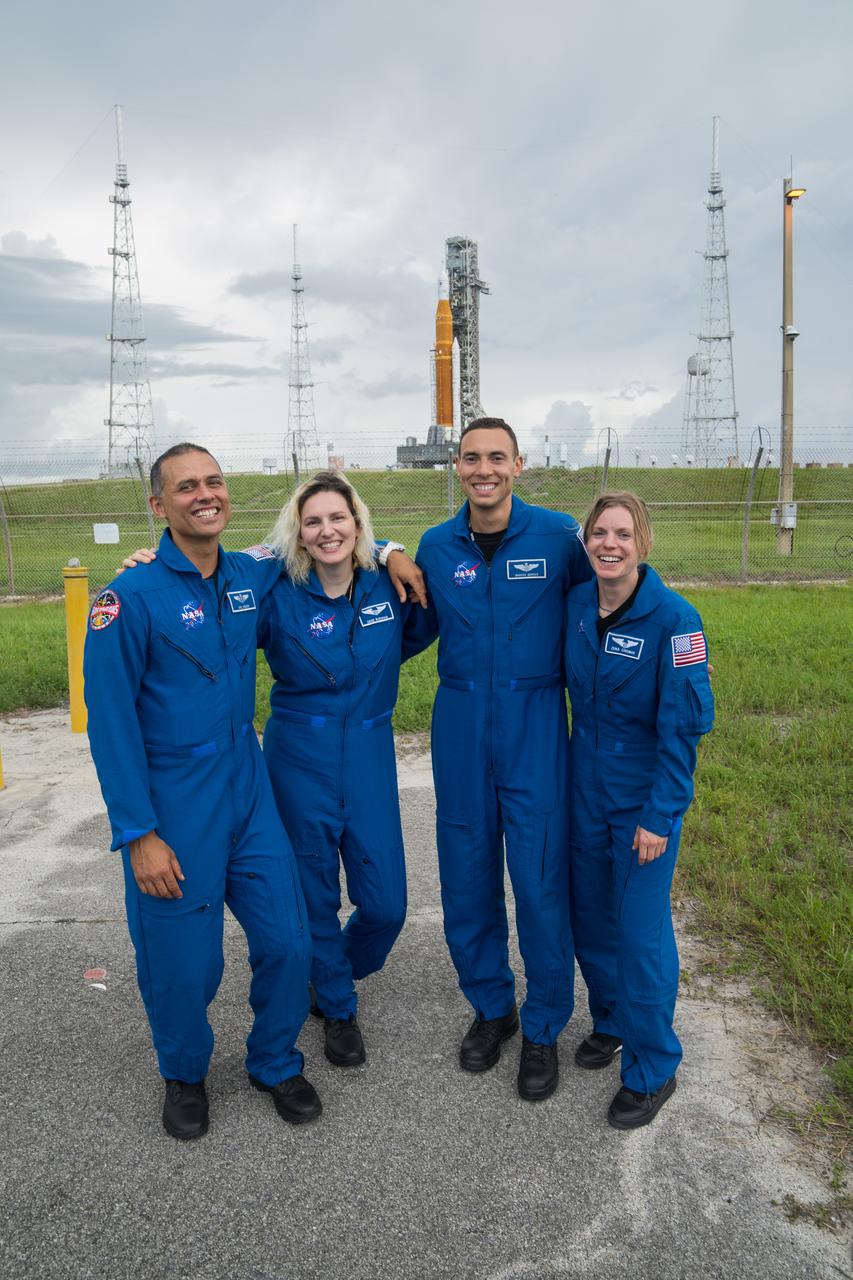
From left to right, NASA astronaut candidates Anil Menon, Deniz Burnham, and Marcos Berrios, and NASA astronaut Zena Cardman pose for a photograph in front of NASA’s Artemis I Space Launch System and Orion spacecraft atop the mobile launcher on the pad at Launch Complex 39B at the agency’s Kennedy Space Center in Florida on Sept. 2, 2022. The first in a series of increasingly complex missions, Artemis I will provide a foundation for human deep space exploration and demonstrate our commitment and capability to extend human presence to the Moon and beyond. The primary goal of Artemis I is to thoroughly test the integrated systems before crewed missions by operating the spacecraft in a deep space environment, testing Orion’s heat shield, and recovering the crew module after reentry, descent, and splashdown. In later missions, NASA will land the first woman and the first person of color on the surface of the Moon, paving the way for a long-term lunar presence and serving as a steppingstone on the way to Mars.
Astronaut Group & Moon Pod Essay Winners Visit Artemis I
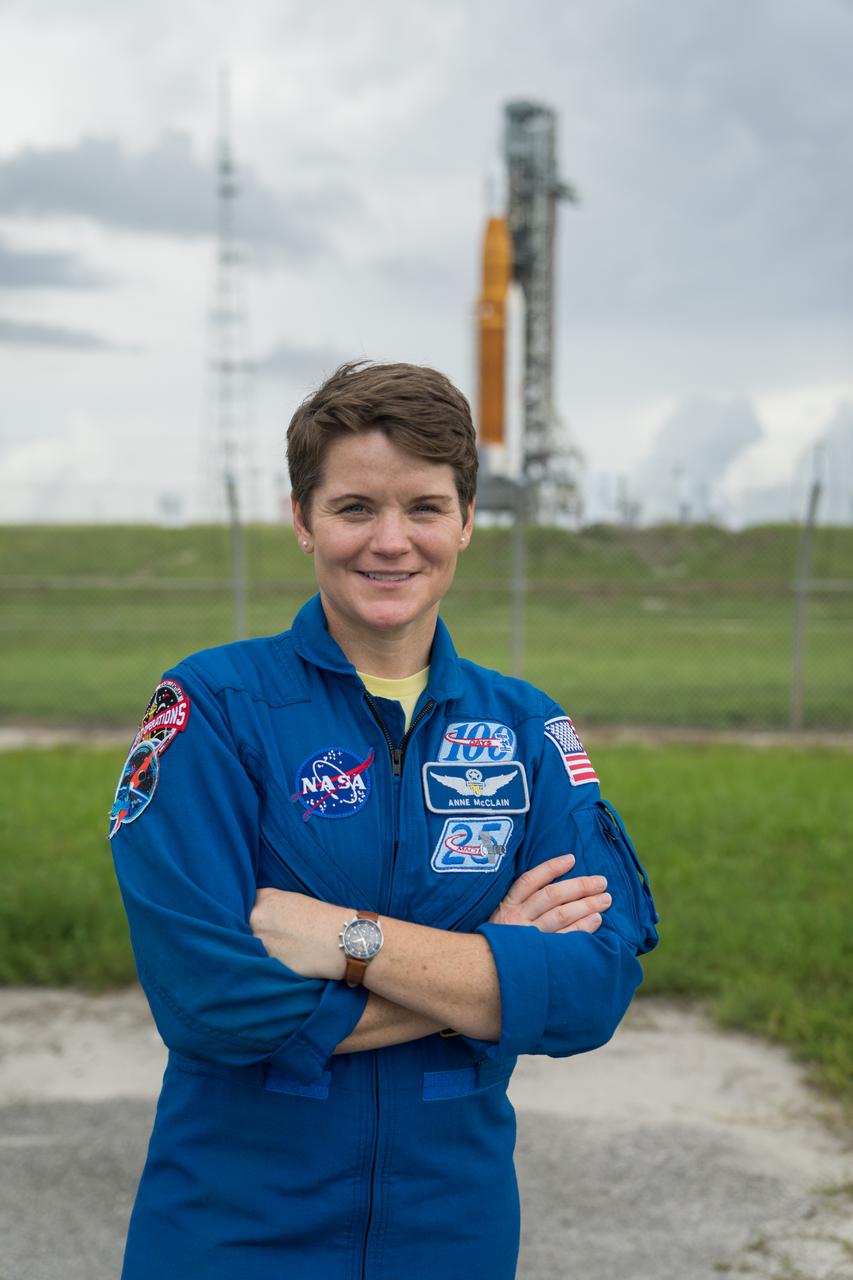
NASA astronaut Anne McClain poses for a photograph in front of NASA’s Artemis I Space Launch System and Orion spacecraft atop the mobile launcher on the pad at Launch Complex 39B at the agency’s Kennedy Space Center in Florida on Sept. 2, 2022. The first in a series of increasingly complex missions, Artemis I will provide a foundation for human deep space exploration and demonstrate our commitment and capability to extend human presence to the Moon and beyond. The primary goal of Artemis I is to thoroughly test the integrated systems before crewed missions by operating the spacecraft in a deep space environment, testing Orion’s heat shield, and recovering the crew module after reentry, descent, and splashdown. In later missions, NASA will land the first woman and the first person of color on the surface of the Moon, paving the way for a long-term lunar presence and serving as a steppingstone on the way to Mars.
Astronaut Group & Moon Pod Essay Winners Visit Artemis I
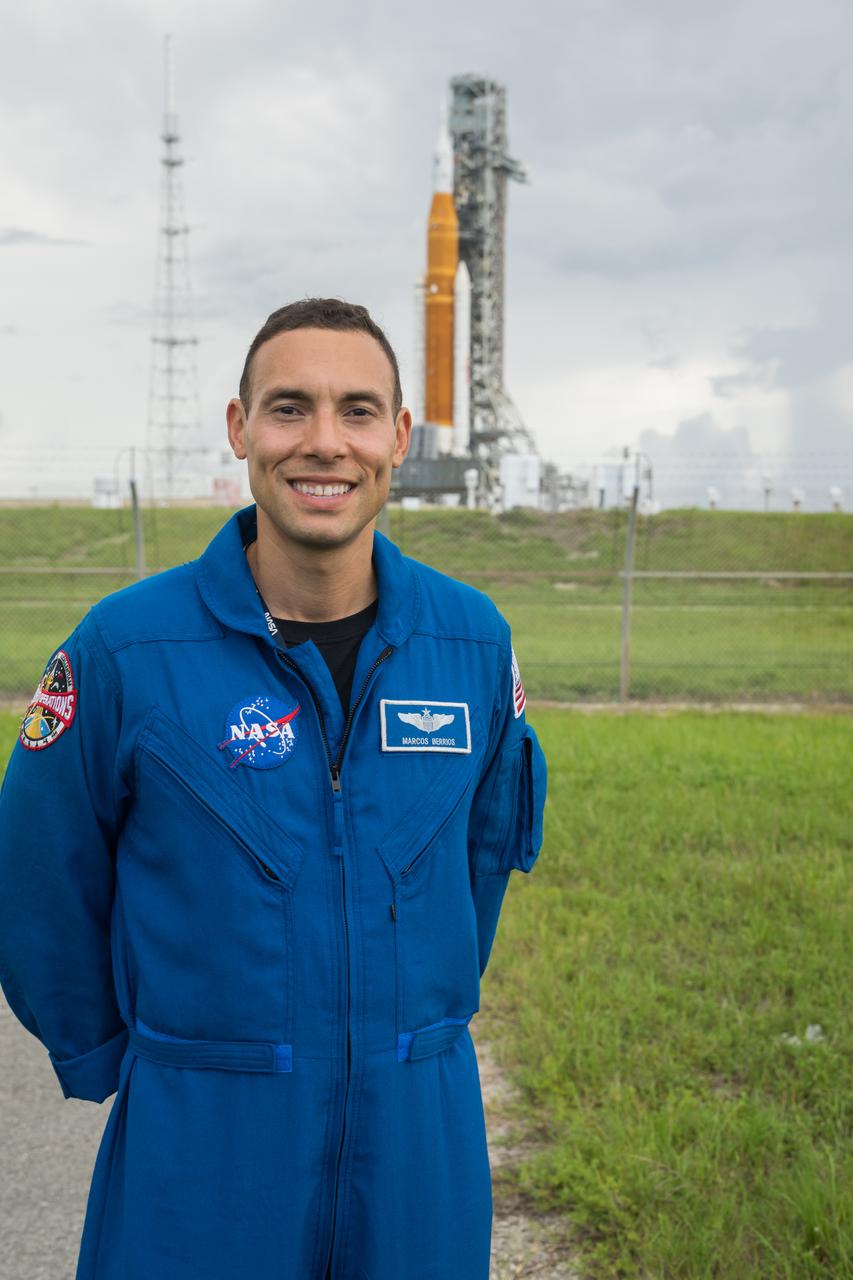
NASA astronaut candidate Marcos Berrios poses for a photograph in front of NASA’s Artemis I Space Launch System and Orion spacecraft atop the mobile launcher on the pad at Launch Complex 39B at the agency’s Kennedy Space Center in Florida on Sept. 2, 2022. The first in a series of increasingly complex missions, Artemis I will provide a foundation for human deep space exploration and demonstrate our commitment and capability to extend human presence to the Moon and beyond. The primary goal of Artemis I is to thoroughly test the integrated systems before crewed missions by operating the spacecraft in a deep space environment, testing Orion’s heat shield, and recovering the crew module after reentry, descent, and splashdown. In later missions, NASA will land the first woman and the first person of color on the surface of the Moon, paving the way for a long-term lunar presence and serving as a steppingstone on the way to Mars.
Astronaut Group & Moon Pod Essay Winners Visit Artemis I
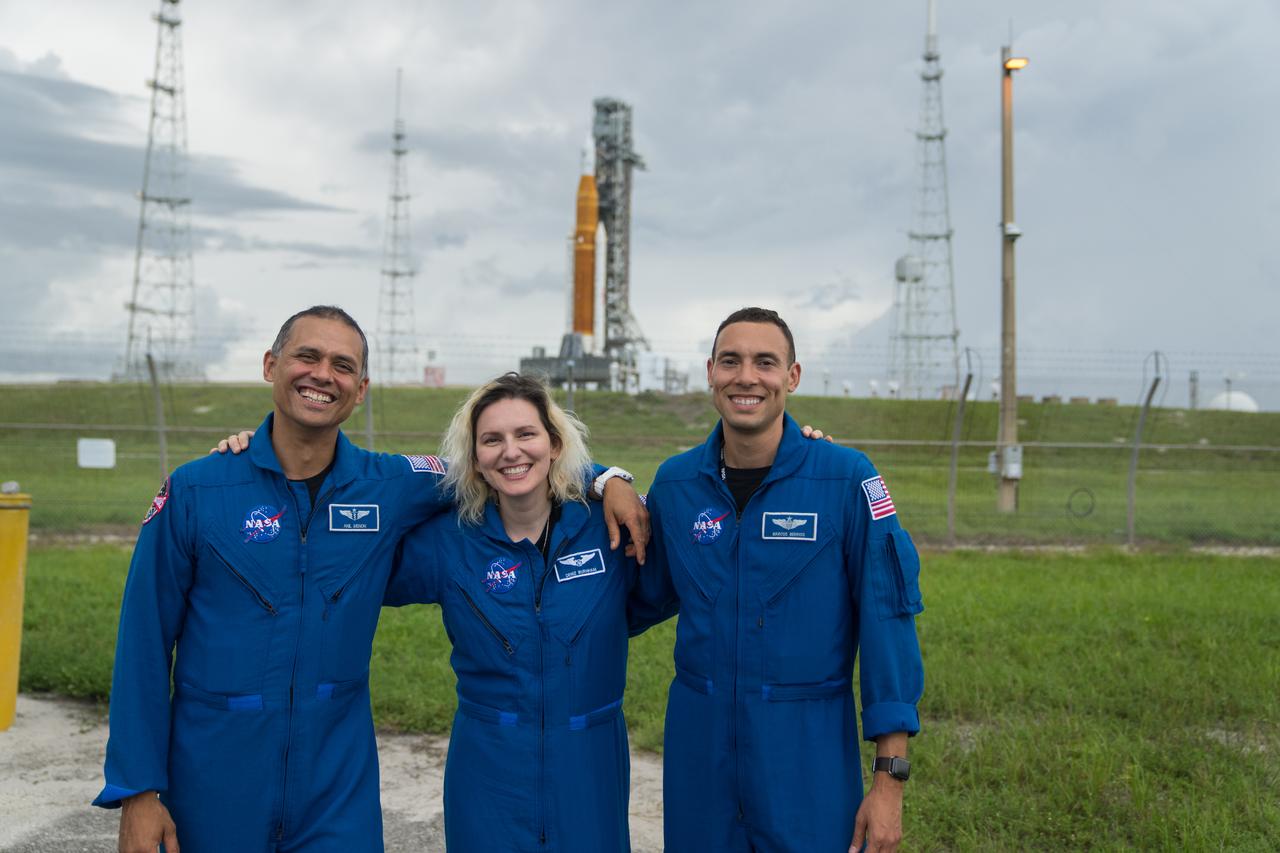
From left to right, NASA astronaut candidates Anil Menon, Deniz Burnham, and Marcos Berrios pose for a photograph in front of NASA’s Artemis I Space Launch System and Orion spacecraft atop the mobile launcher on the pad at Launch Complex 39B at the agency’s Kennedy Space Center in Florida on Sept. 2, 2022. The first in a series of increasingly complex missions, Artemis I will provide a foundation for human deep space exploration and demonstrate our commitment and capability to extend human presence to the Moon and beyond. The primary goal of Artemis I is to thoroughly test the integrated systems before crewed missions by operating the spacecraft in a deep space environment, testing Orion’s heat shield, and recovering the crew module after reentry, descent, and splashdown. In later missions, NASA will land the first woman and the first person of color on the surface of the Moon, paving the way for a long-term lunar presence and serving as a steppingstone on the way to Mars.
Astronaut Group & Moon Pod Essay Winners Visit Artemis I
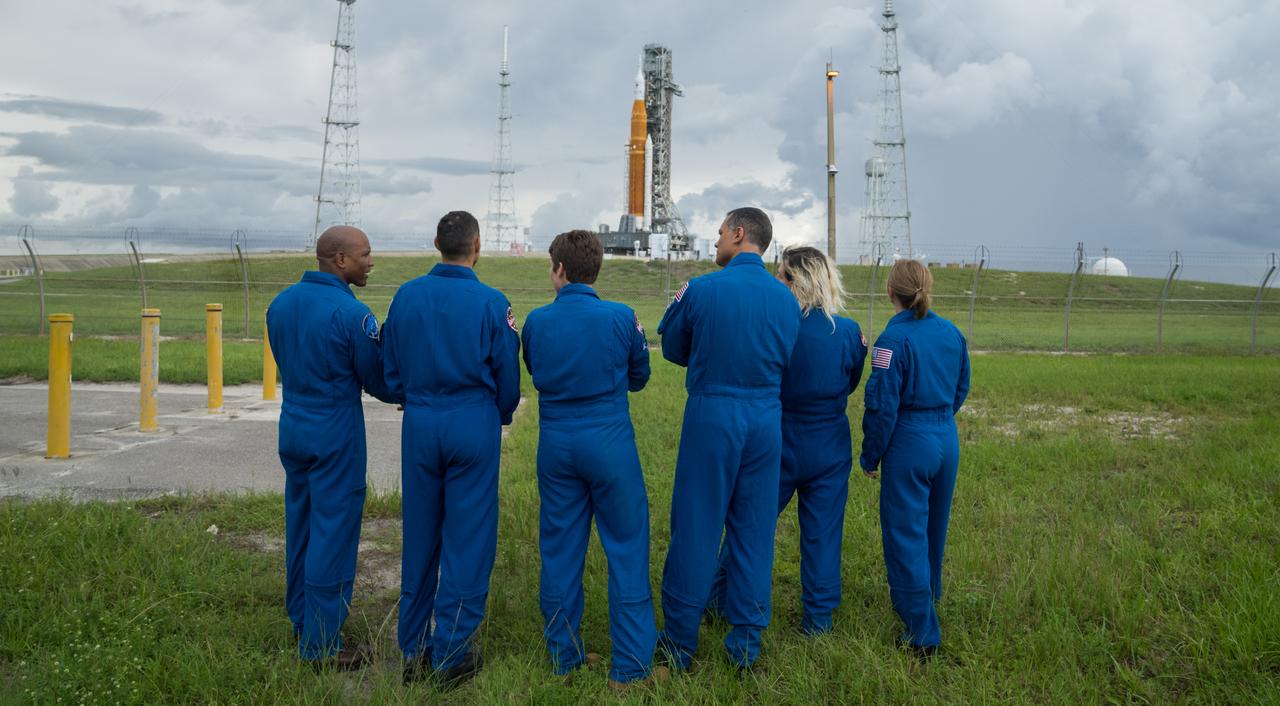
NASA astronauts and astronaut candidates view NASA’s Artemis I Space Launch System and Orion spacecraft atop the mobile launcher on the pad at Launch Complex 39B at the agency’s Kennedy Space Center in Florida on Sept. 2, 2022. The astronauts are, from left to right: Zena Cardman, NASA astronaut; Deniz Burnham and Anil Menon, NASA astronaut candidates; Anne McClain, NASA astronaut; Marcos Berrios, NASA astronaut candidate; and Victor Glover, NASA astronaut. The first in a series of increasingly complex missions, Artemis I will provide a foundation for human deep space exploration and demonstrate our commitment and capability to extend human presence to the Moon and beyond. The primary goal of Artemis I is to thoroughly test the integrated systems before crewed missions by operating the spacecraft in a deep space environment, testing Orion’s heat shield, and recovering the crew module after reentry, descent, and splashdown. In later missions, NASA will land the first woman and the first person of color on the surface of the Moon, paving the way for a long-term lunar presence and serving as a steppingstone on the way to Mars.
Astronaut Group & Moon Pod Essay Winners Visit Artemis I
NASA astronauts and astronaut candidates view NASA’s Artemis I Space Launch System and Orion spacecraft atop the mobile launcher on the pad at Launch Complex 39B at the agency’s Kennedy Space Center in Florida on Sept. 2, 2022. The astronauts are, from left to right: Zena Cardman (partially obscured), NASA astronaut; Deniz Burnham and Anil Menon, NASA astronaut candidates; Anne McClain, NASA astronaut; Marcos Berrios, NASA astronaut candidate; and Victor Glover, NASA astronaut. The first in a series of increasingly complex missions, Artemis I will provide a foundation for human deep space exploration and demonstrate our commitment and capability to extend human presence to the Moon and beyond. The primary goal of Artemis I is to thoroughly test the integrated systems before crewed missions by operating the spacecraft in a deep space environment, testing Orion’s heat shield, and recovering the crew module after reentry, descent, and splashdown. In later missions, NASA will land the first woman and the first person of color on the surface of the Moon, paving the way for a long-term lunar presence and serving as a steppingstone on the way to Mars.
Astronaut Group & Moon Pod Essay Winners Visit Artemis I
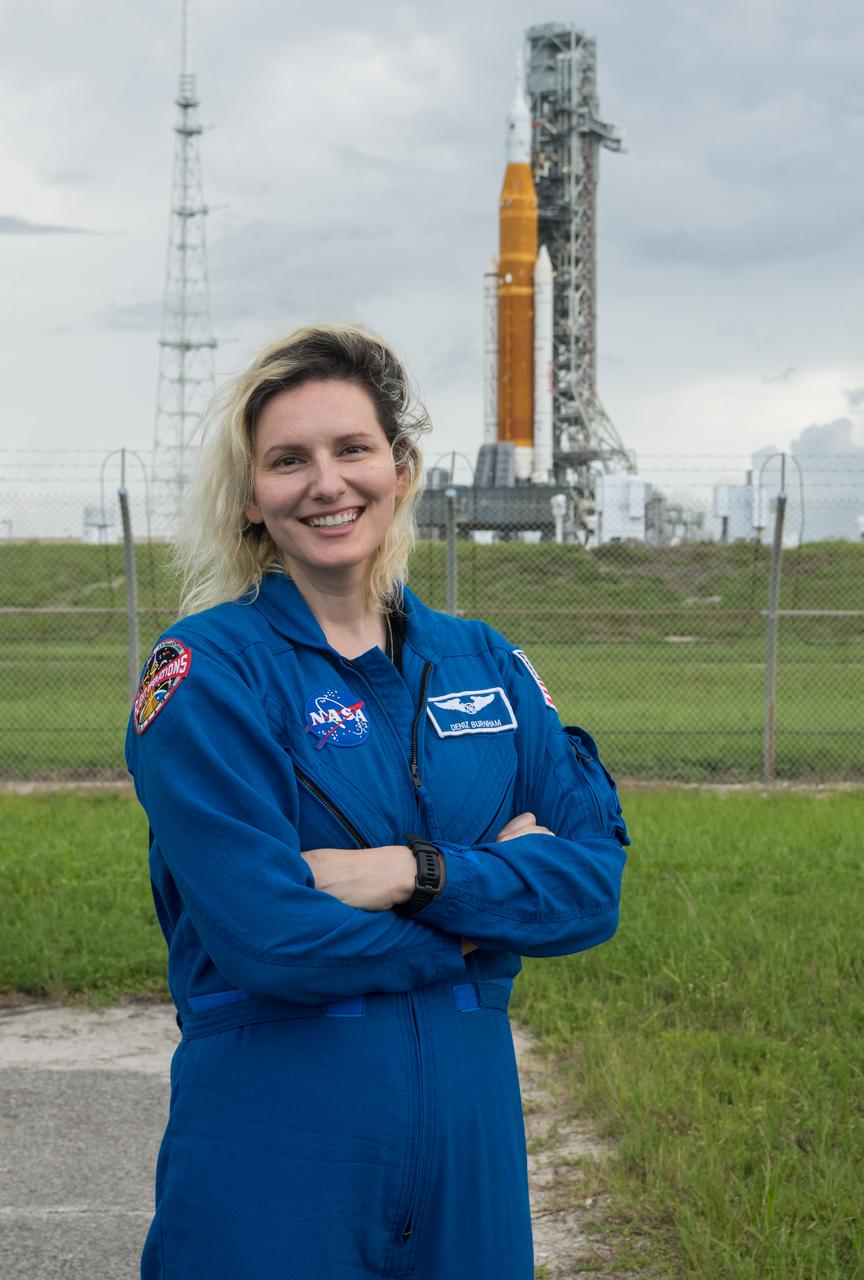
NASA astronaut candidate Deniz Burnham poses for a photograph in front of NASA’s Artemis I Space Launch System and Orion spacecraft atop the mobile launcher on the pad at Launch Complex 39B at the agency’s Kennedy Space Center in Florida on Sept. 2, 2022. The first in a series of increasingly complex missions, Artemis I will provide a foundation for human deep space exploration and demonstrate our commitment and capability to extend human presence to the Moon and beyond. The primary goal of Artemis I is to thoroughly test the integrated systems before crewed missions by operating the spacecraft in a deep space environment, testing Orion’s heat shield, and recovering the crew module after reentry, descent, and splashdown. In later missions, NASA will land the first woman and the first person of color on the surface of the Moon, paving the way for a long-term lunar presence and serving as a steppingstone on the way to Mars.
Astronaut Group & Moon Pod Essay Winners Visit Artemis I
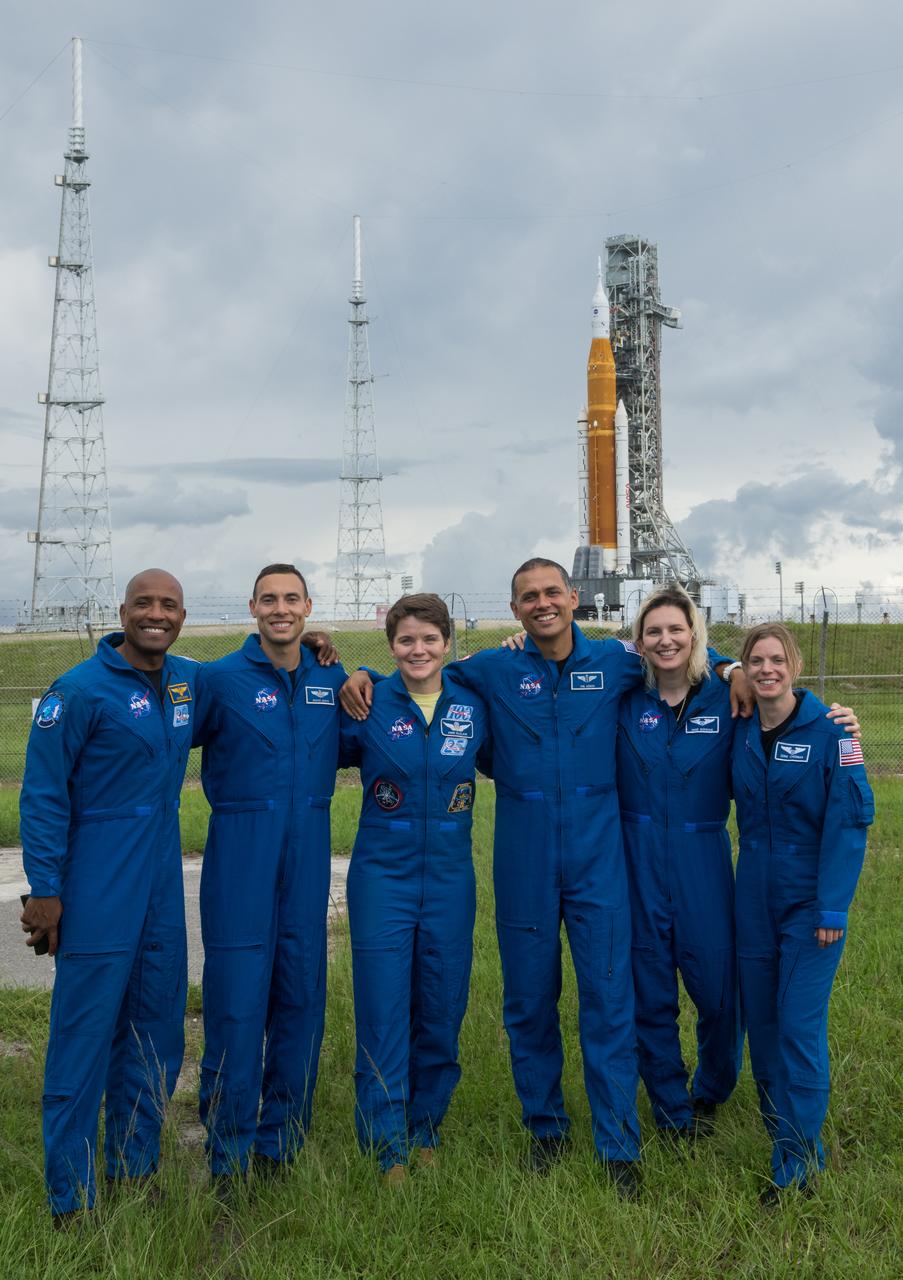
NASA astronauts and astronaut candidates view NASA’s Artemis I Space Launch System and Orion spacecraft atop the mobile launcher on the pad at Launch Complex 39B at the agency’s Kennedy Space Center in Florida on Sept. 2, 2022. The astronauts are, from left to right: Victor Glover, NASA astronaut; Marcos Berrios, NASA astronaut candidate; Anne McClain, NASA astronaut; Anil Menon and Deniz Burnham, NASA astronaut candidates; and Zena Cardman, NASA astronaut. The first in a series of increasingly complex missions, Artemis I will provide a foundation for human deep space exploration and demonstrate our commitment and capability to extend human presence to the Moon and beyond. The primary goal of Artemis I is to thoroughly test the integrated systems before crewed missions by operating the spacecraft in a deep space environment, testing Orion’s heat shield, and recovering the crew module after reentry, descent, and splashdown. In later missions, NASA will land the first woman and the first person of color on the surface of the Moon, paving the way for a long-term lunar presence and serving as a steppingstone on the way to Mars.
Astronaut Group & Moon Pod Essay Winners Visit Artemis I
NASA astronauts and astronaut candidates pose for a photograph in front of NASA’s Artemis I Space Launch System and Orion spacecraft atop the mobile launcher on the pad at Launch Complex 39B at the agency’s Kennedy Space Center in Florida on Sept. 2, 2022. The astronauts are, from left to right: Victor Glover, NASA astronaut; Marcos Berrios, NASA astronaut candidate; Anne McClain, NASA astronaut; Anil Menon and Deniz Burnham, NASA astronaut candidates; and Zena Cardman, NASA astronaut. The first in a series of increasingly complex missions, Artemis I will provide a foundation for human deep space exploration and demonstrate our commitment and capability to extend human presence to the Moon and beyond. The primary goal of Artemis I is to thoroughly test the integrated systems before crewed missions by operating the spacecraft in a deep space environment, testing Orion’s heat shield, and recovering the crew module after reentry, descent, and splashdown. In later missions, NASA will land the first woman and the first person of color on the surface of the Moon, paving the way for a long-term lunar presence and serving as a steppingstone on the way to Mars.
Astronaut Group & Moon Pod Essay Winners Visit Artemis I
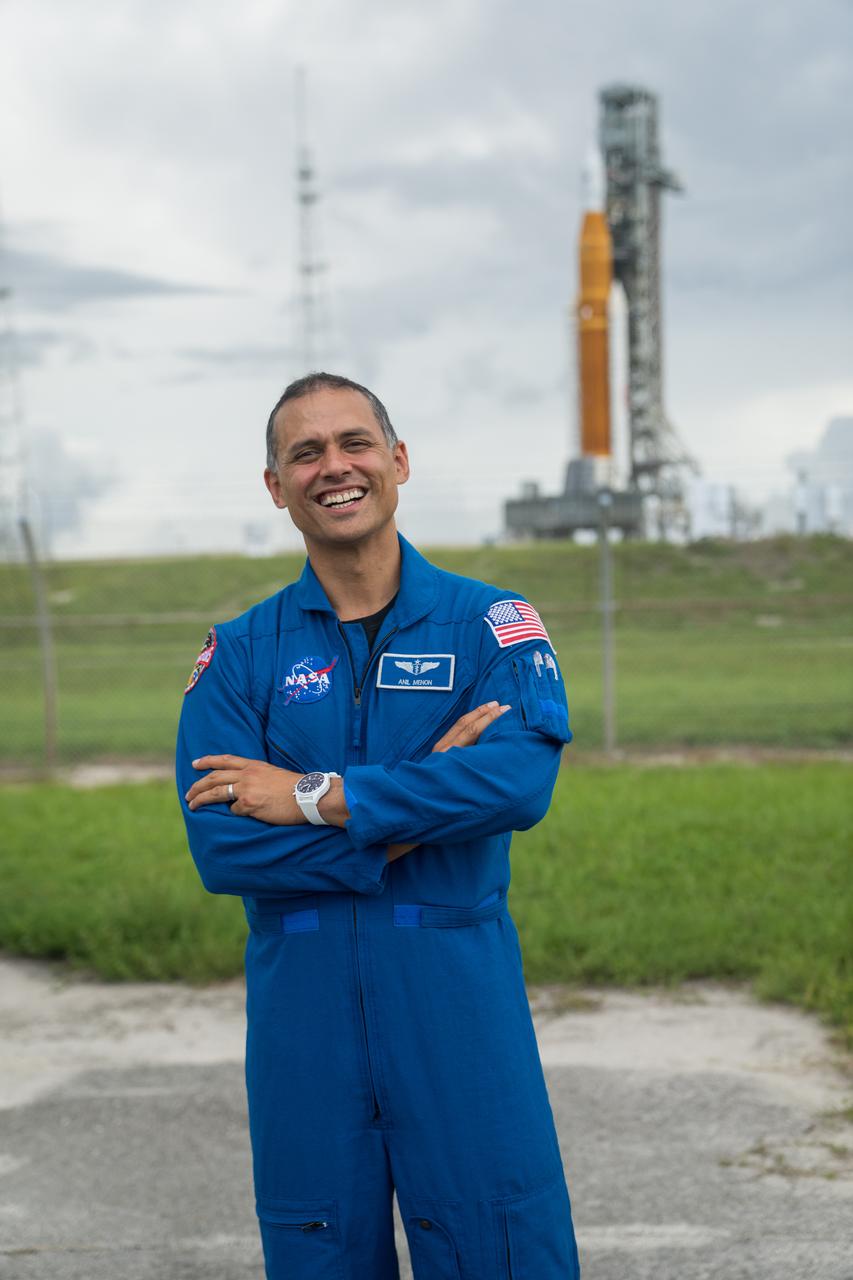
NASA astronaut candidate Anil Menon poses for a photograph in front of NASA’s Artemis I Space Launch System and Orion spacecraft atop the mobile launcher on the pad at Launch Complex 39B at the agency’s Kennedy Space Center in Florida on Sept. 2, 2022. The first in a series of increasingly complex missions, Artemis I will provide a foundation for human deep space exploration and demonstrate our commitment and capability to extend human presence to the Moon and beyond. The primary goal of Artemis I is to thoroughly test the integrated systems before crewed missions by operating the spacecraft in a deep space environment, testing Orion’s heat shield, and recovering the crew module after reentry, descent, and splashdown. In later missions, NASA will land the first woman and the first person of color on the surface of the Moon, paving the way for a long-term lunar presence and serving as a steppingstone on the way to Mars.
Astronaut Group & Moon Pod Essay Winners Visit Artemis I