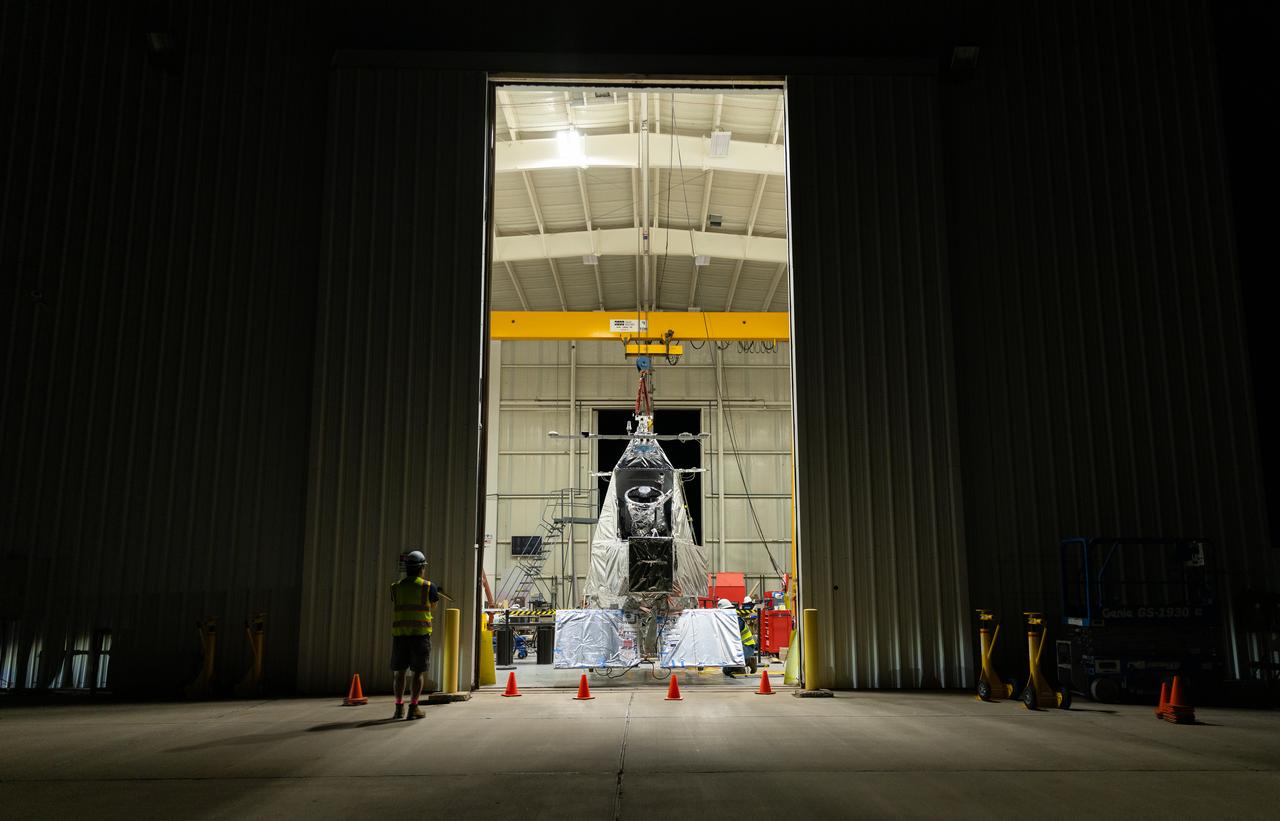
NASA Goddard astrophysicist Kyle Helson looks at EXCITE (EXoplanet Climate Infrared TElescope) as it dangles from the ceiling of a hangar at NASA’s Columbia Scientific Balloon Facility in Fort Sumner, New Mexico.
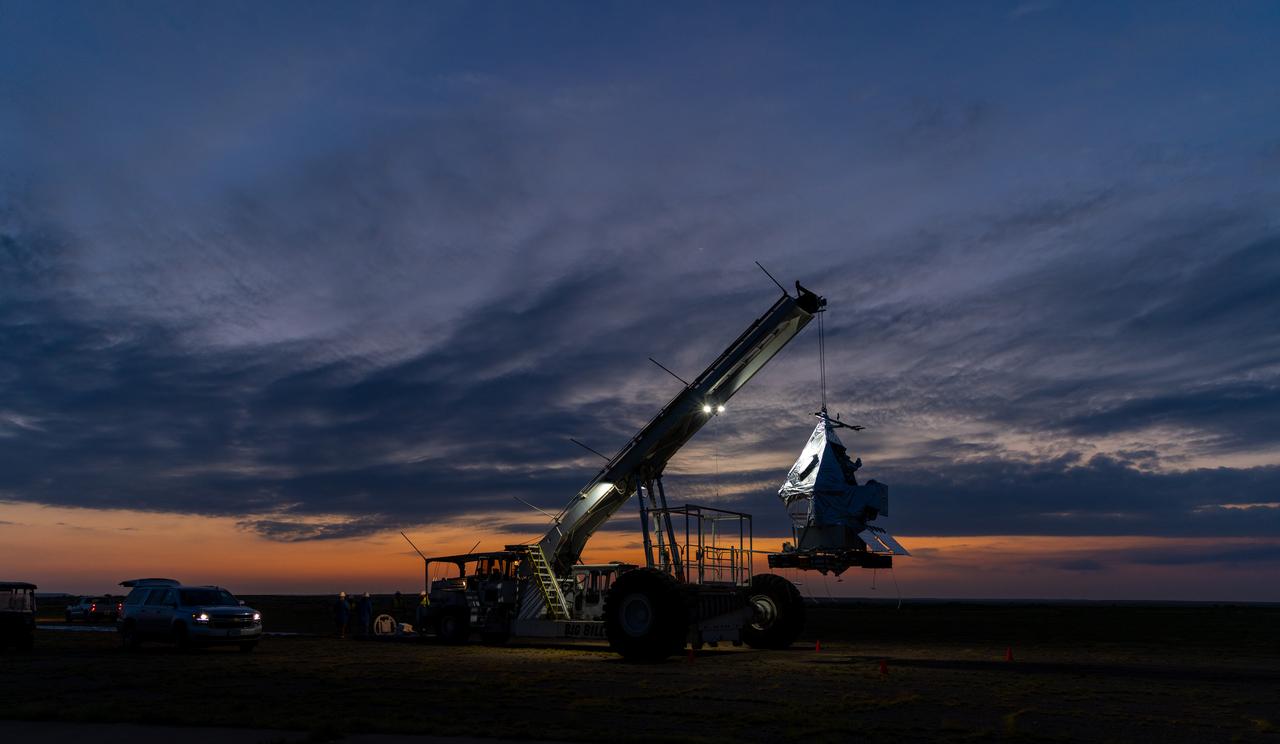
NASA Goddard astrophysicist Kyle Helson looks at EXCITE (EXoplanet Climate Infrared TElescope) as it dangles from the ceiling of a hangar at NASA’s Columbia Scientific Balloon Facility in Fort Sumner, New Mexico.

The super-Earth exoplanet 55 Cancri e, depicted with its star in this artist's concept, likely has an atmosphere thicker than Earth's, with ingredients that could be similar to those of Earth's atmosphere, according to a 2017 study using data from NASA's Spitzer Space Telescope. Scientists say the planet may be entirely covered in lava. The planet is so close to its star that one face of the planet consistently faces the star, resulting in a dayside and a nightside. https://photojournal.jpl.nasa.gov/catalog/PIA22069
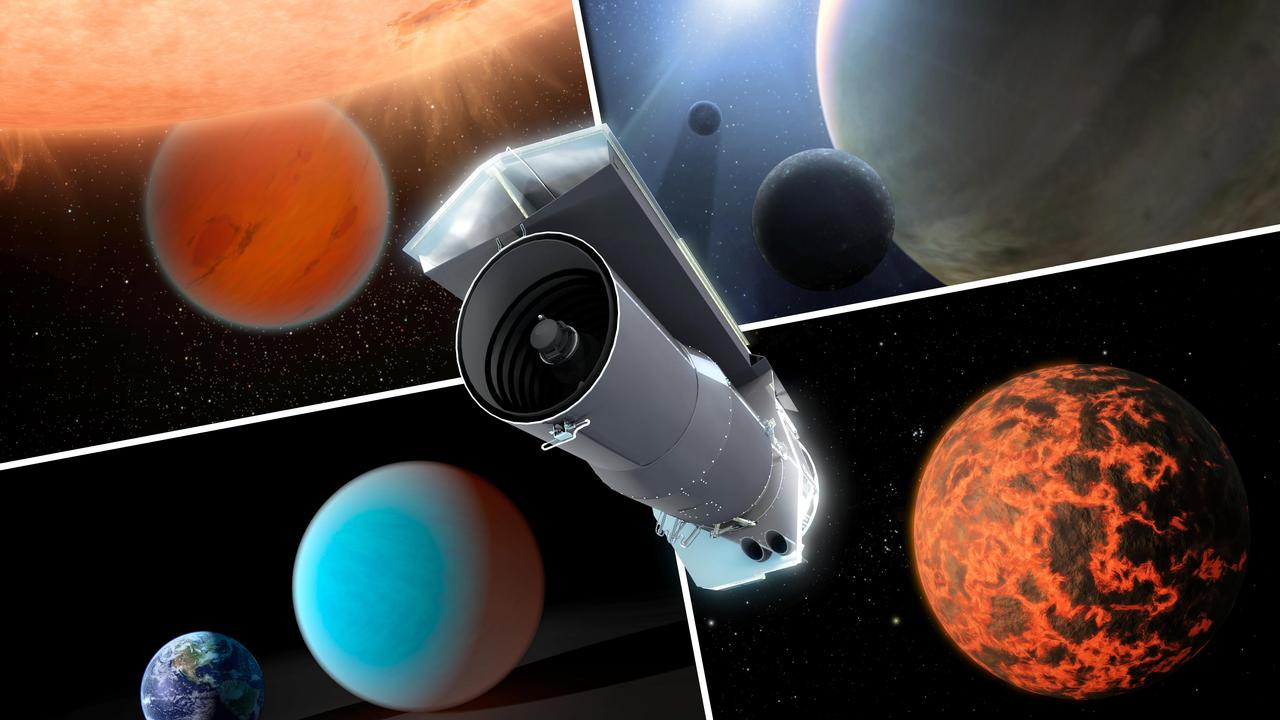
This artist concept shows NASA Spitzer Space Telescope surrounded by examples of exoplanets the telescope has examined in over its ten years in space.

The varying brightness of an exoplanet called 55 Cancri e is shown in this plot of infrared data captured by NASA Spitzer Space Telescope.
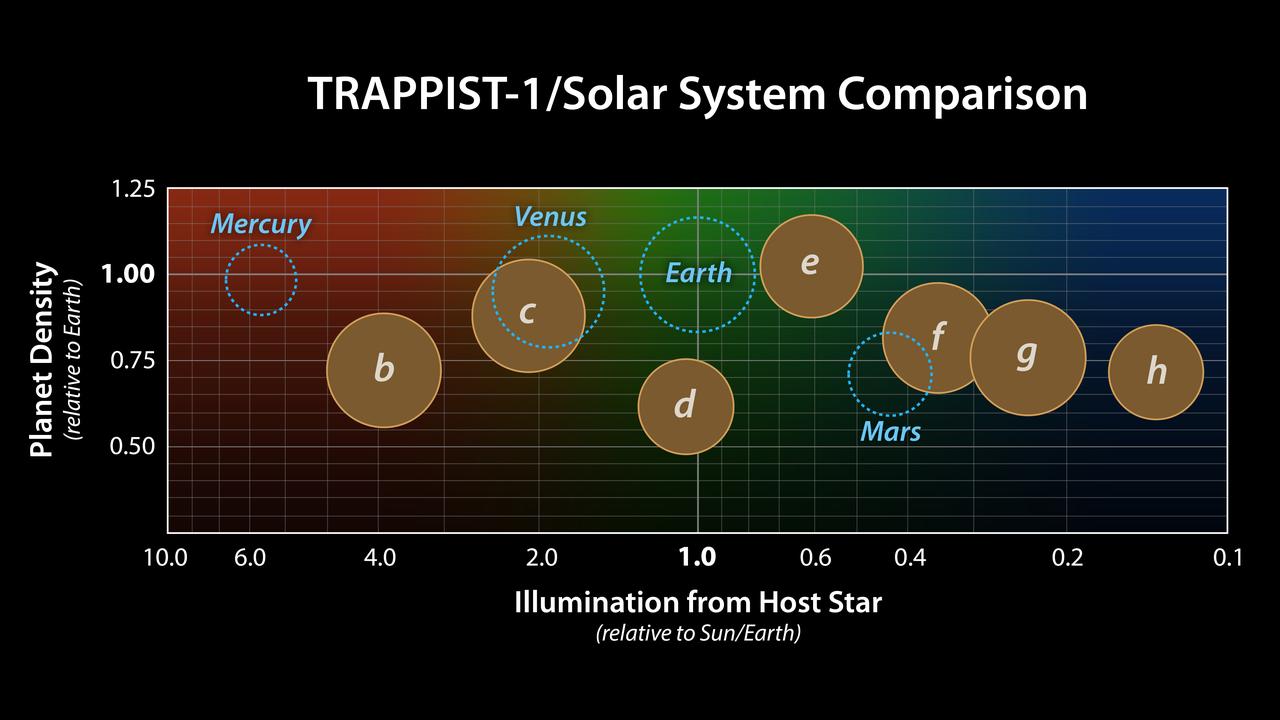
This graph presents known properties of the seven TRAPPIST-1 exoplanets (labeled b through h), showing how they stack up to the inner rocky worlds in our own solar system. The horizontal axis shows the level of illumination that each planet receives from its host star. TRAPPIST-1 is a mere 9 percent the mass of our Sun, and its temperature is much cooler. But because the TRAPPIST-1 planets orbit so closely to their star, they receive comparable levels of light and heat to Earth and its neighboring planets. The vertical axis shows the densities of the planets. Density, calculated based on a planet's mass and volume, is the first important step in understanding a planet's composition. The plot shows that the TRAPPIST-1 planet densities range from being similar to Earth and Venus at the upper end, down to values comparable to Mars at the lower end. The relative sizes of the planets are indicated by the circles. The masses and densities of the TRAPPIST-1 planets were determined by careful measurements of slight variations in the timings of their orbits using extensive observations made by NASA's Spitzer and Kepler space telescopes, in combination with data from Hubble and a number of ground-based telescopes. These measurements are the most precise to date for any system of exoplanets. By comparing these measurements with theoretical models of how planets form and evolve, researchers have determined that they are all rocky in overall composition. Estimates suggest the lower-density planets could have large quantities of water -- as much as 5 percent by mass for TRAPPIST-1d. Earth, in comparison, has only about 0.02 percent of its mass in the form of water. https://photojournal.jpl.nasa.gov/catalog/PIA22095
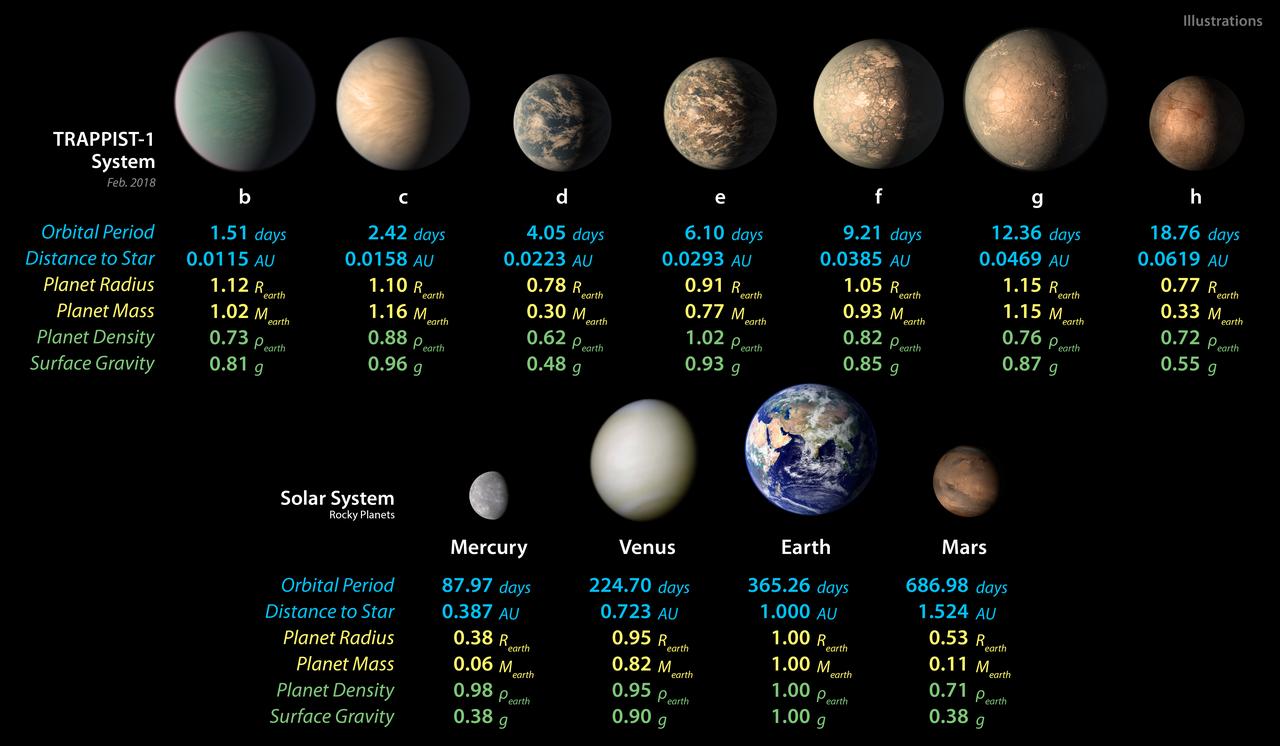
This chart shows, on the top row, artist concepts of the seven planets of TRAPPIST-1 with their orbital periods, distances from their star, radii, masses, densities and surface gravity as compared to those of Earth. These numbers are current as of February 2018. On the bottom row, the same numbers are displayed for the bodies of our inner solar system: Mercury, Venus, Earth and Mars. The TRAPPIST-1 planets orbit their star extremely closely, with periods ranging from 1.5 to only about 20 days. This is much shorter than the period of Mercury, which orbits our sun in about 88 days. The masses and densities of the TRAPPIST-1 planets were determined by careful measurements of slight variations in the timings of their orbits using extensive observations made by NASA's Spitzer and Kepler space telescopes, in combination with data from Hubble and a number of ground-based telescopes. These measurements are the most precise to date for any system of exoplanets. In this illustration, the relative sizes of the planets are all shown to scale. https://photojournal.jpl.nasa.gov/catalog/PIA22094
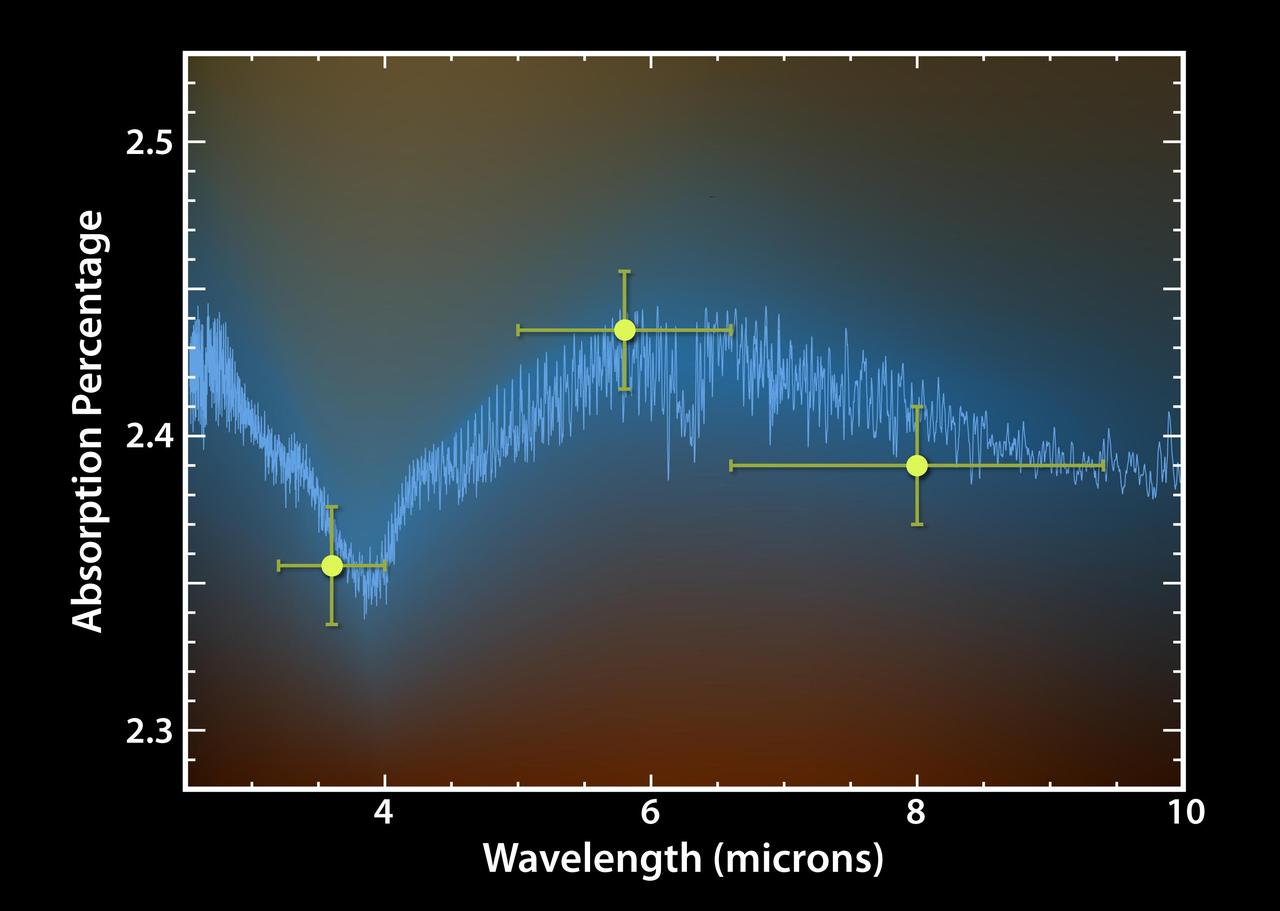
This plot of data from NASA Spitzer Space Telescope tells astronomers that a toasty gas exoplanet, or a planet beyond our solar system, contains water vapor.
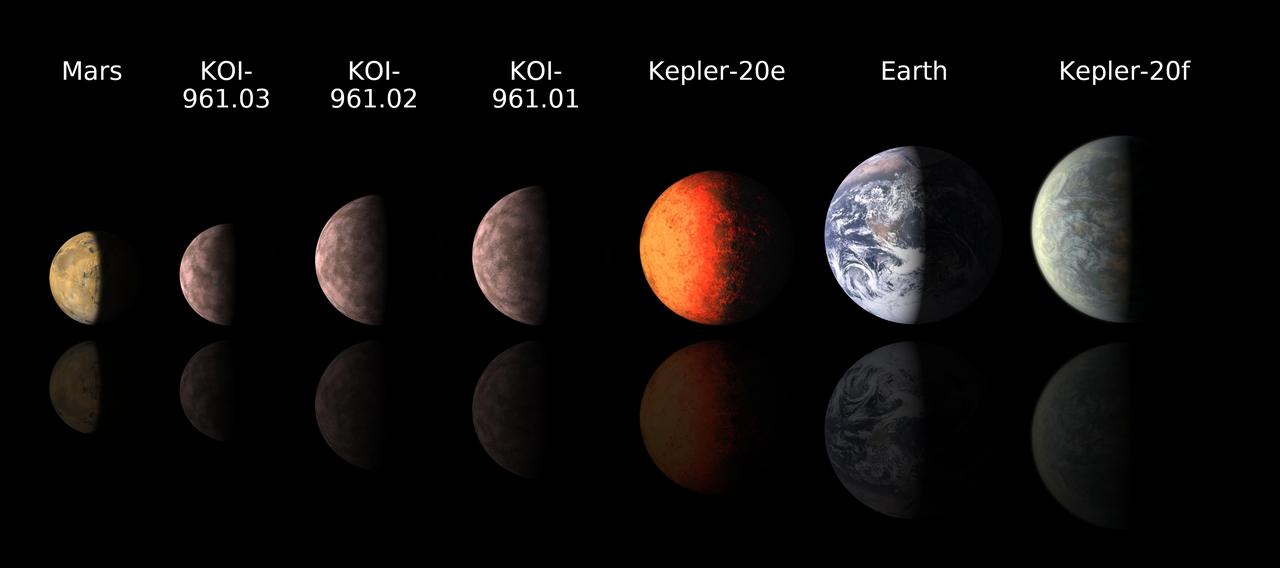
Astronomers using data from NASA Kepler mission and ground-based telescopes recently discovered the three smallest exoplanets known to circle another star, called KOI-961.01, KOI-961.02 and KOI-961.03.
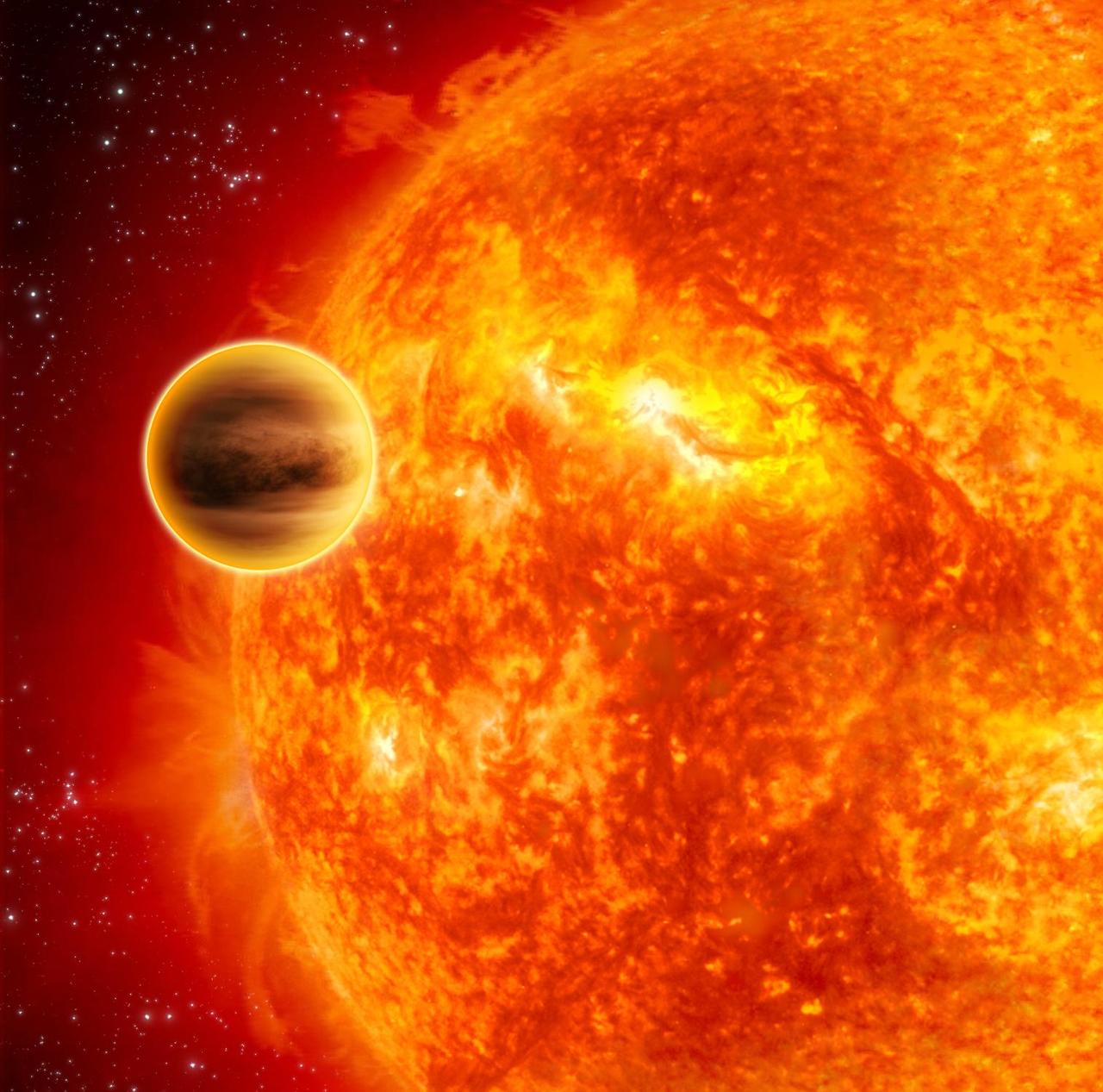
This artist impression shows a gas-giant exoplanet transiting across the face of its star. Infrared analysis by NASA Spitzer Space Telescope of this type of system provided the breakthrough.
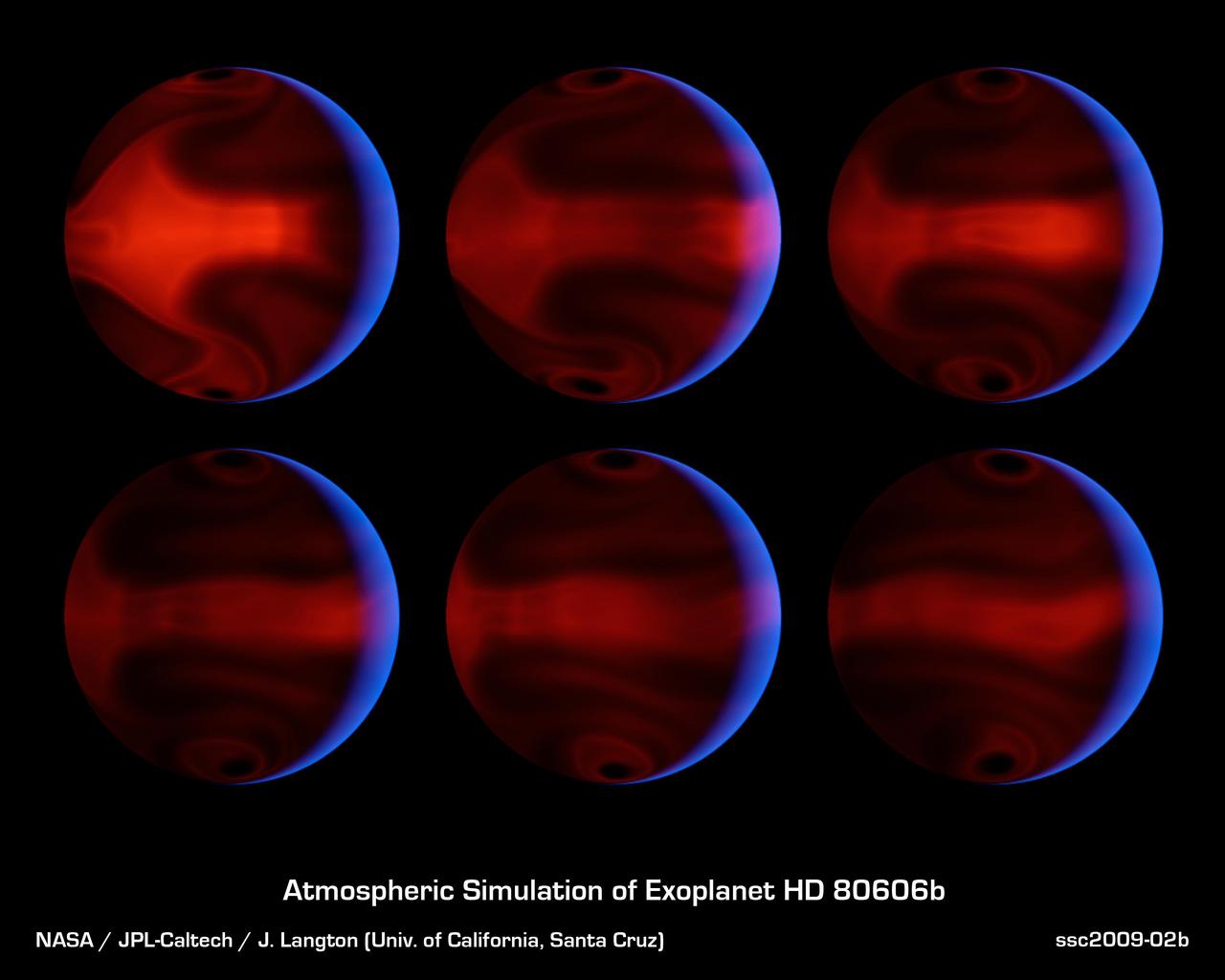
These computer-generated images from NASA Spitzer Space Telescope chart the development of severe weather patterns on the highly eccentric exoplanet HD 80606b during the days after its closest approach to its parent star.
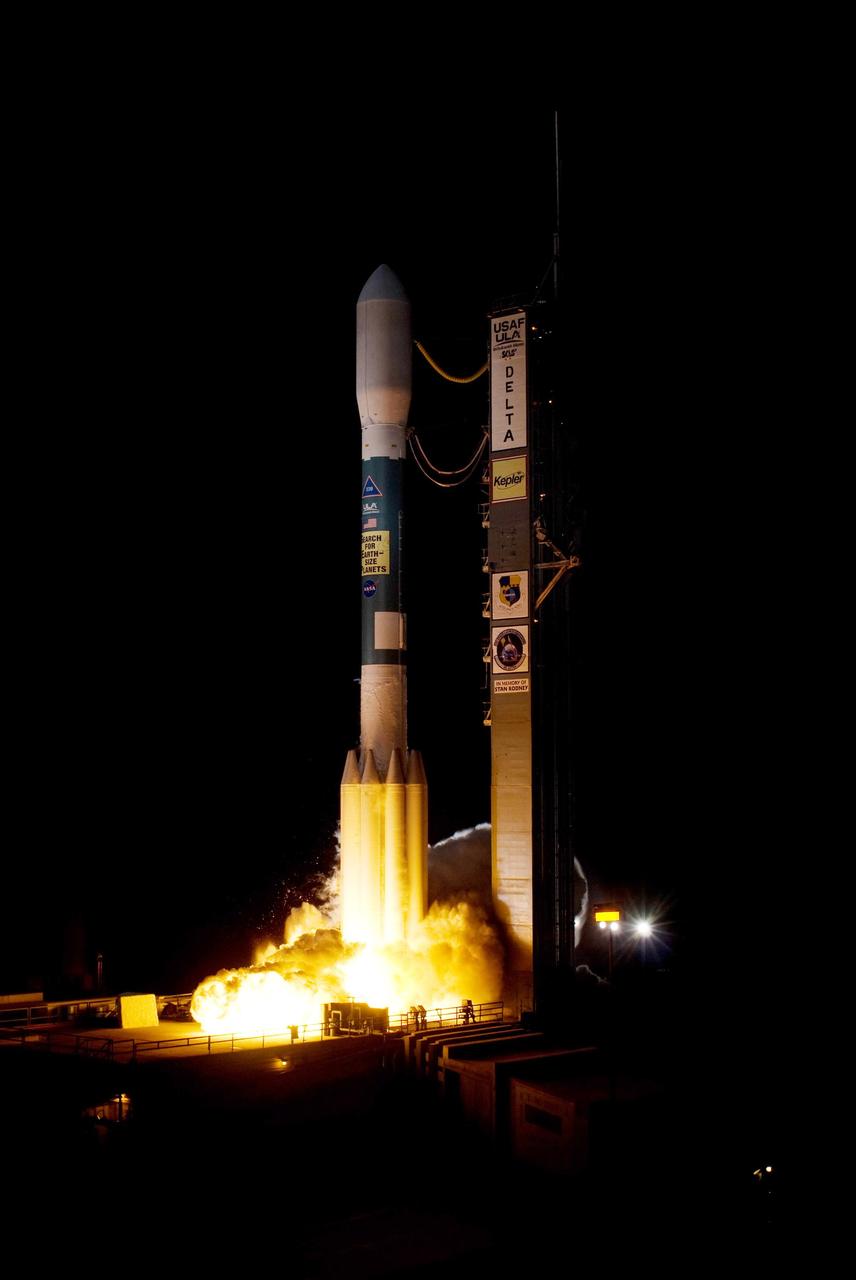
On March 6, 2009, NASA Kepler Space Telescope rocketed into the night skies above Cape Canaveral Air Force Station in Florida to find planets around other stars, called exoplanets, in search of potentially habitable worlds.
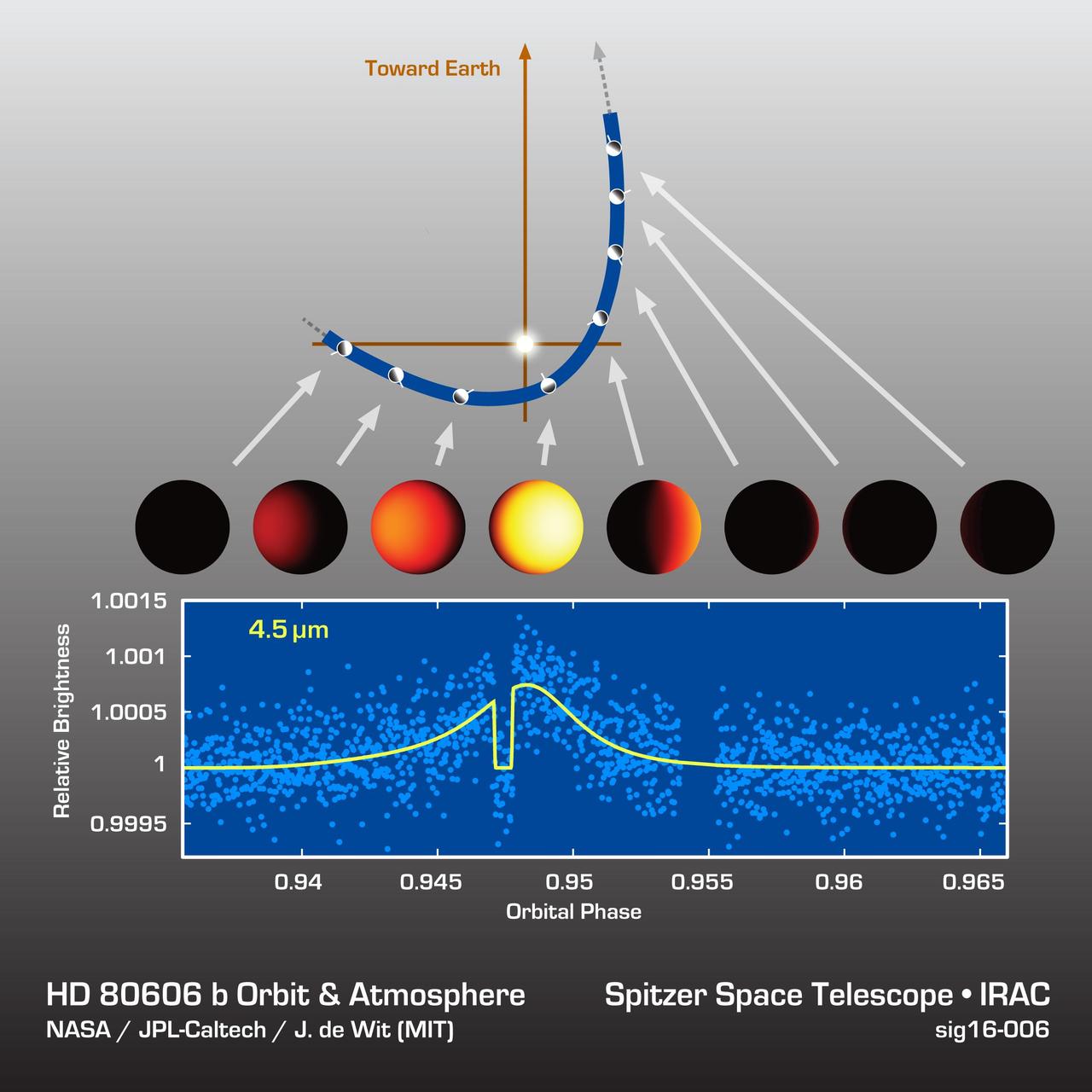
Astronomers watched an exoplanet called HD 80606b heat up and cool off during its sizzling-hot orbit around its star. The results are shown in this data plot from NASA Spitzer Space Telescope.
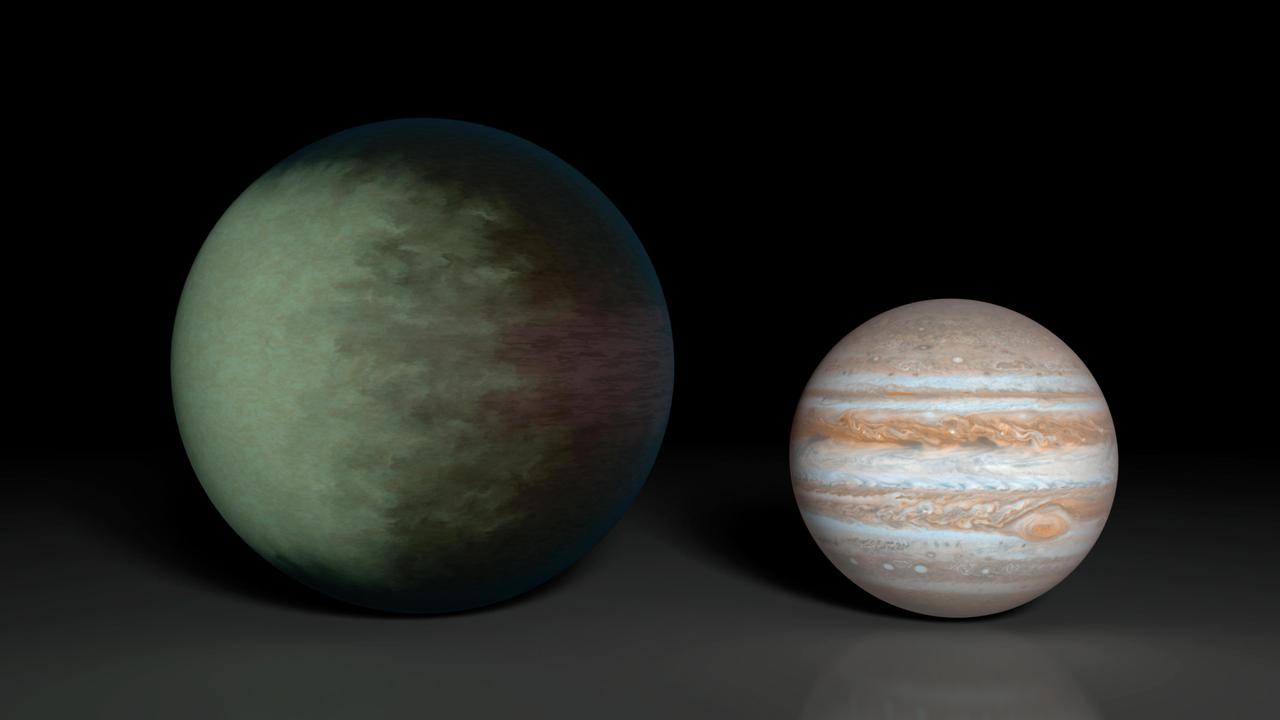
Kepler-7b right, which is 1.5 times the radius of Jupiter left, is the first exoplanet to have its clouds mapped. The cloud map was produced using data from NASA Kepler and Spitzer space telescopes.

This figure charts 30 hours of observations taken by NASA Spitzer Space Telescope of a strongly irradiated exoplanet an planet orbiting a star beyond our own. Spitzer measured changes in the planet heat, or infrared light.

Hot Jupiters, exoplanets around the same size as Jupiter that orbit very closely to their stars, often have cloud or haze layers in their atmospheres. This may prevent space telescopes from detecting atmospheric water that lies beneath the clouds, according to a study in the Astrophysical Journal. As much as half of the water in the atmospheres of these exoplanets may be blocked by these clouds or hazes, research suggests. The study, led by researchers at NASA's Jet Propulsion Laboratory, Pasadena, California, examined hot Jupiters that had been observed with the Hubble Space Telescope. http://photojournal.jpl.nasa.gov/catalog/PIA20687
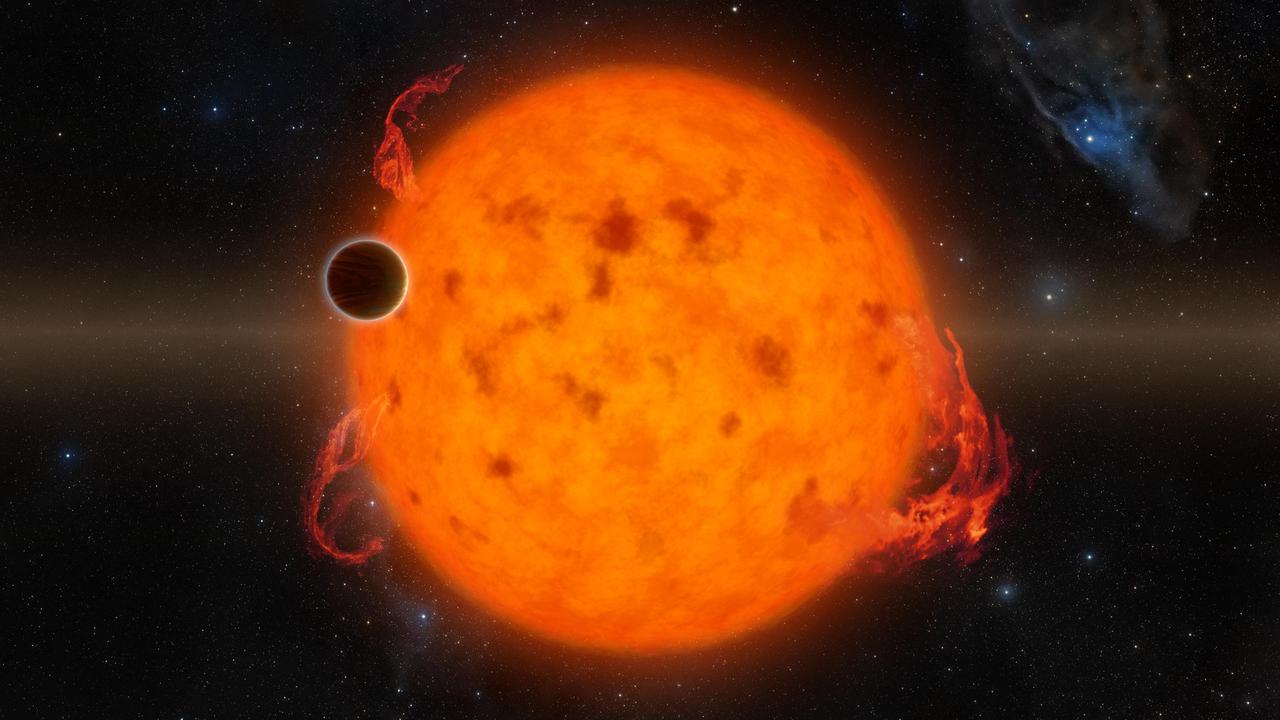
K2-33b, shown in this illustration, is one of the youngest exoplanets detected to date using NASA Kepler Space Telescope. It makes a complete orbit around its star in about five days. These two characteristics combined provide exciting new directions for planet-formation theories. K2-33b could have formed on a farther out orbit and quickly migrated inward. Alternatively, it could have formed in situ, or in place. http://photojournal.jpl.nasa.gov/catalog/PIA20690

This illustration shows one possible scenario for the hot, rocky exoplanet called 55 Cancri e, which is nearly two times as wide as Earth. New data from NASA Spitzer Space Telescope show that the planet has extreme temperature swings.
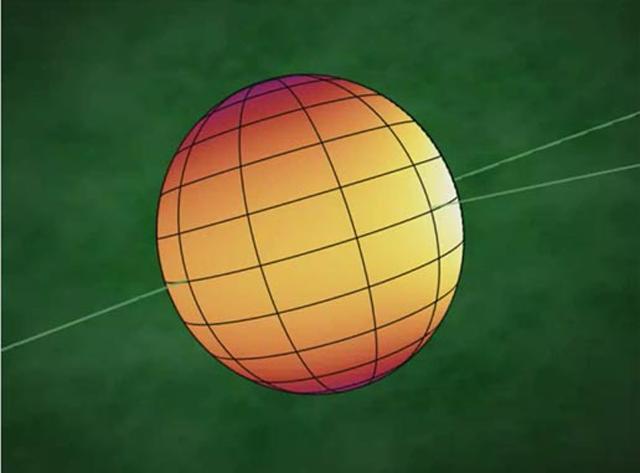
This image shows the first-ever map of the surface of an exoplanet, or a planet beyond our solar system. Showing temperature variations across the cloudy tops of a gas giant called HD 189733b, the infrared data is taken by NASA Spitzer Space Telescope.
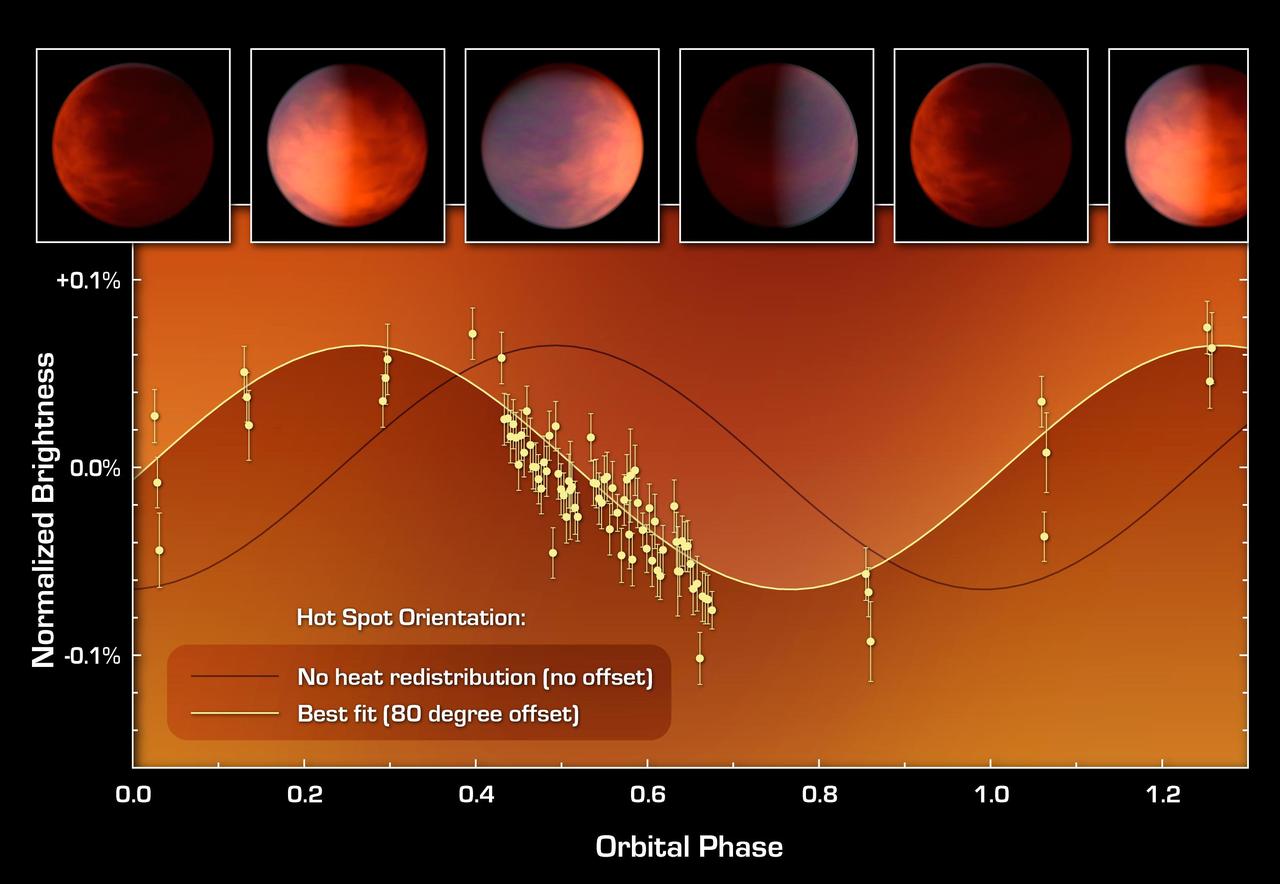
This graph of data from NASA Spitzer Space Telescope shows how astronomers located a hot spot on a distant gas planet named upsilon Andromedae b. Termed an exoplanet, it orbits a star beyond our sun, and whips around very closely to its star.
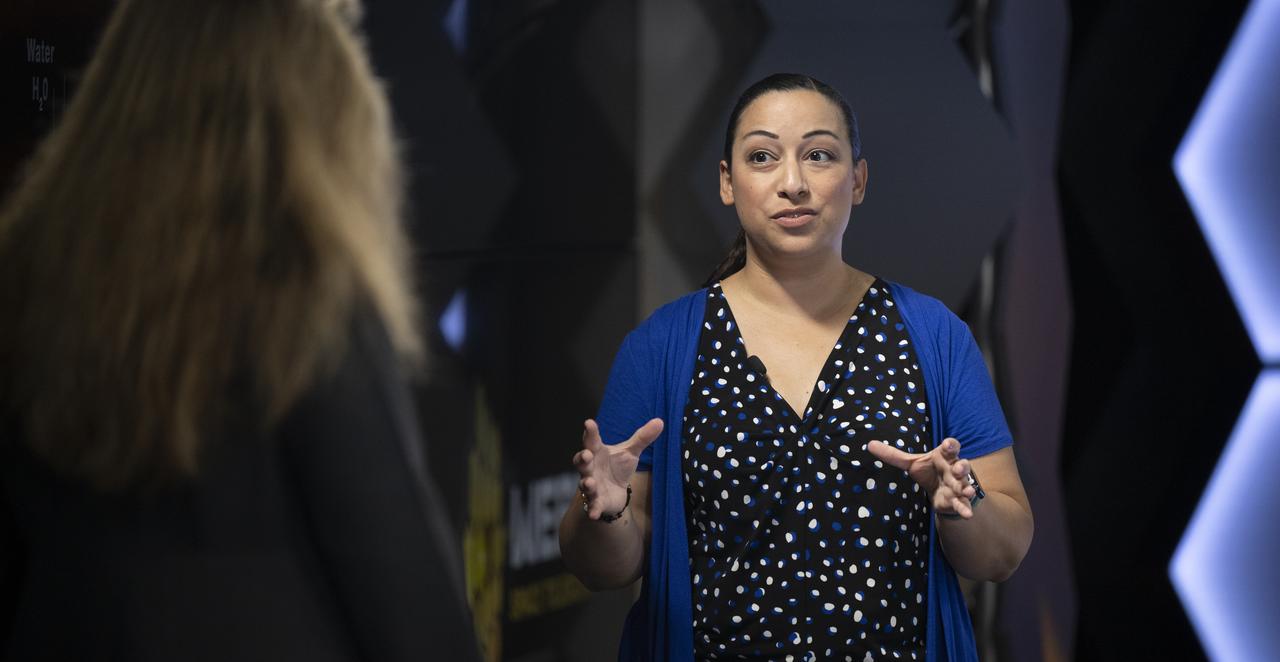
NASA James Webb Space Telescope Deputy Project Scientist for Exoplanet Science Knicole Colón speaks about the measurements of exoplanet WASP-96 b taken by the Near-Infrared Imager and Slitless Spectrograph as it is shown on screen during a broadcast releasing the telescope’s first full-color images, Tuesday, July 12, 2022, at NASA’s Goddard Space Flight Center in Greenbelt, Md. The first full-color images and spectroscopic data from the James Webb Space Telescope, a partnership with ESA (European Space Agency) and the Canadian Space Agency (CSA), are a demonstration of the power of Webb as the telescope begins its science mission to unfold the infrared universe. Photo Credit: (NASA/Bill Ingalls)
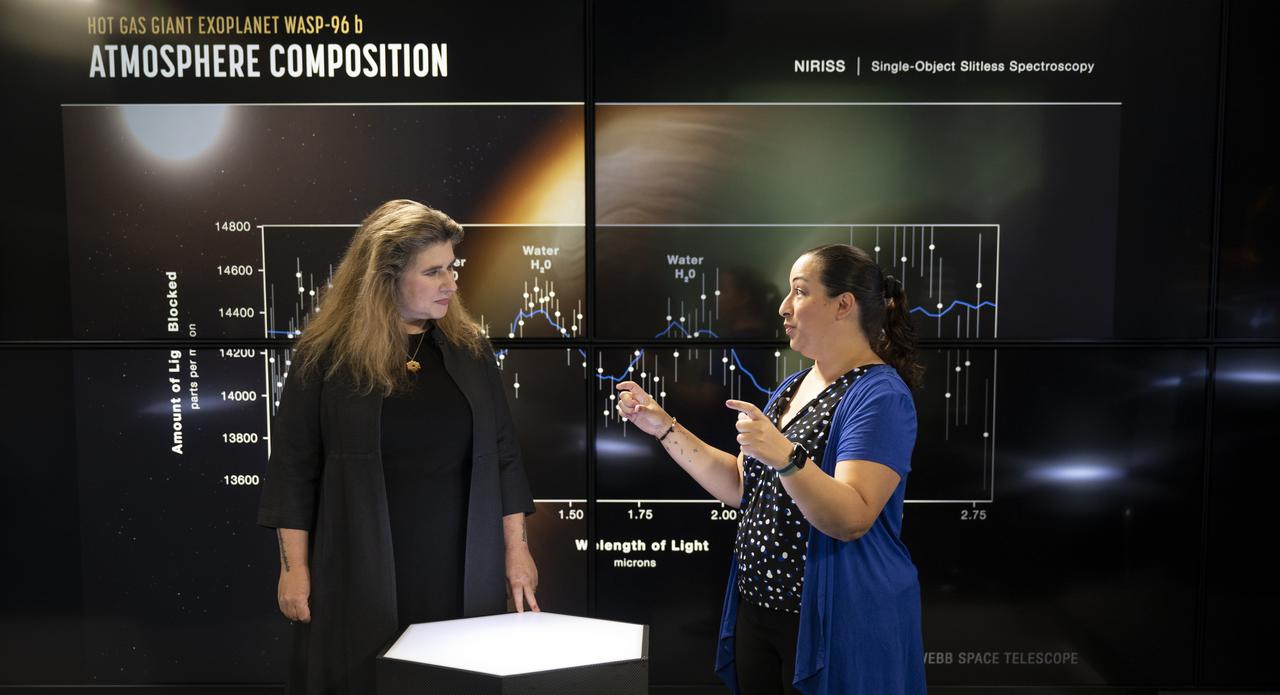
NASA James Webb Space Telescope Deputy Project Scientist for Exoplanet Science Knicole Colón speaks about the measurements of exoplanet WASP-96 b taken by the Near-Infrared Imager and Slitless Spectrograph as it is shown on screen during a broadcast releasing the telescope’s first full-color images, Tuesday, July 12, 2022, at NASA’s Goddard Space Flight Center in Greenbelt, Md. The first full-color images and spectroscopic data from the James Webb Space Telescope, a partnership with ESA (European Space Agency) and the Canadian Space Agency (CSA), are a demonstration of the power of Webb as the telescope begins its science mission to unfold the infrared universe. Photo Credit: (NASA/Bill Ingalls)

A deployed half-scale starshade with four petals at NASA's Jet Propulsion Laboratory, Pasadena, California, in 2014. The flower-like petals of the starshade are designed to diffract bright starlight away from telescopes seeking the dim light of exoplanets. The starshade was re-designed from earlier models to allow these petals to furl, or wrap around the spacecraft, for launch into space. Each petal is covered in a high-performance plastic film that resembles gold foil. On a starshade ready for launch, the thermal gold foil will only cover the side of the petals facing away from the telescope, with black on the other, so as not to reflect other light sources such as the Earth into its camera. http://photojournal.jpl.nasa.gov/catalog/PIA20904

This artist's concept shows what exoplanet Kepler-1649c could look like on its surface. The planet is the closest to Earth in size and temperature found yet in data from the Kepler space telescope. https://photojournal.jpl.nasa.gov/catalog/PIA23690
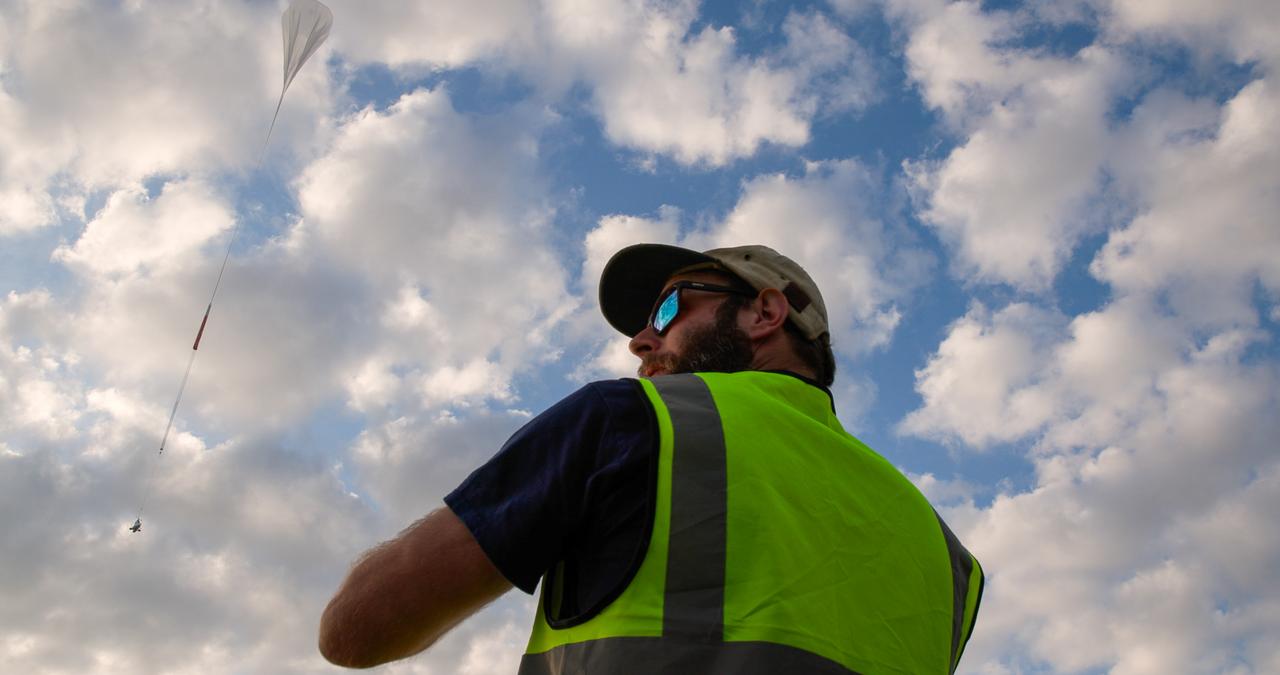
On August 31, 2024, the EXCITE (EXoplanet Climate Infrared TElescope) team conducted a test flight of their telescope from NASA’s Columbia Scientific Balloon Facility in Fort Sumner, New Mexico. Here, EXCITE’s Principal Investigator, Peter Nagler, watches his mission take flight.
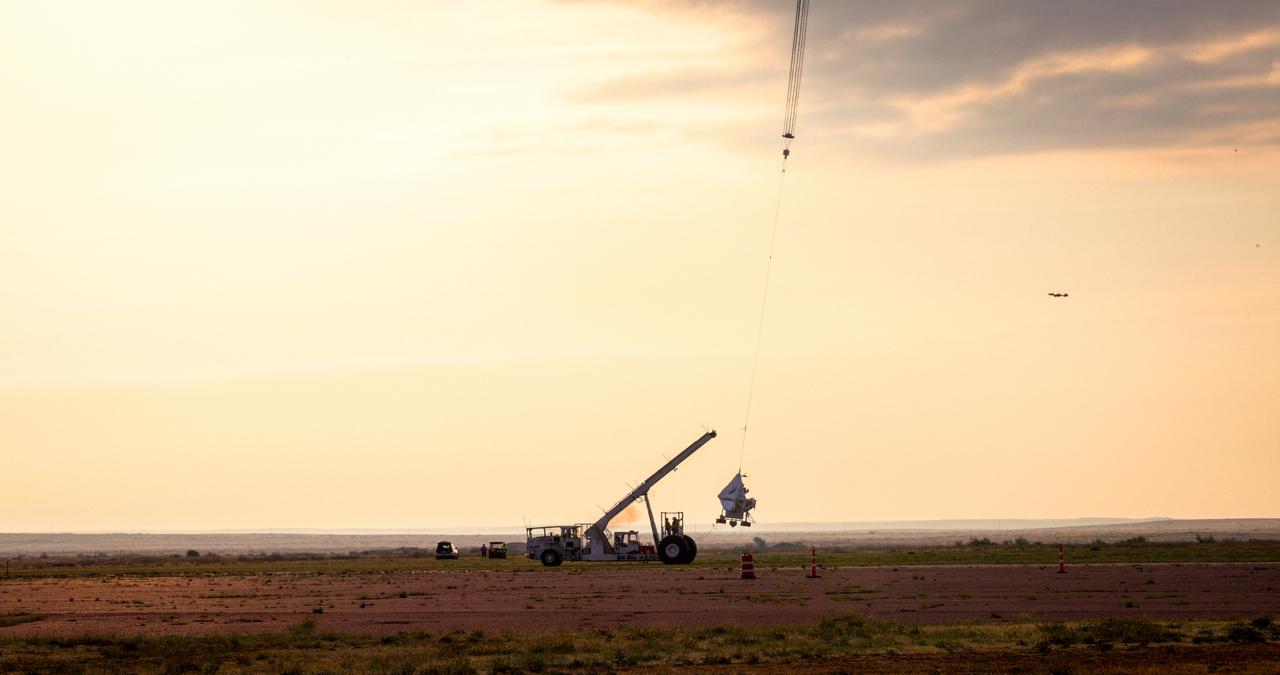
This is EXCITE’s moment of release. On August 31, 2024, the EXCITE (EXoplanet Climate Infrared TElescope) team conducted a test flight of their telescope from NASA’s Columbia Scientific Balloon Facility in Fort Sumner, New Mexico. This photo was taken moments after the telescope was released from the tractor vehicle (called Big Bill). Unseen above is the helium-filled scientific balloon that carried the telescope to the edge of space.

Astronomers have discovered one of the most distant planets known, a gas giant about 13,000 light-years from Earth, called OGLE-2014-BLG-0124L. The planet was discovered using a technique called microlensing, and the help of NASA's Spitzer Space Telescope and the Optical Gravitational Lensing Experiment, or OGLE. In this artist's illustration, planets discovered with microlensing are shown in yellow. The farthest lies in the center of our galaxy, 25,000 light-years away. Most of the known exoplanets, numbering in the thousands, have been discovered by NASA's Kepler space telescope, which uses a different strategy called the transit method. Kepler's cone-shaped field of view is shown in pink/orange. Ground-based telescopes, which use the transit and other planet-hunting methods, have discovered many exoplanets close to home, as shown by the pink/orange circle around the sun. http://photojournal.jpl.nasa.gov/catalog/PIA19333

This illustration shows the seven Earth-size planets of TRAPPIST-1, an exoplanet system about 40 light-years away, based on data current as of February 2018. The image shows the planets' relative sizes but does not represent their orbits to scale. The art highlights possibilities for how the surfaces of these intriguing worlds might look based on their newly calculated properties. The seven planets of TRAPPIST-1 are all Earth-sized and terrestrial. TRAPPIST-1 is an ultra-cool dwarf star in the constellation Aquarius, and its planets orbit very close to it. In the background, slightly distorted versions the familiar constellations of Orion and Taurus are shown as they would appear from the location of TRAPPIST-1 (courtesy of California Academy of Sciences/Dan Tell). https://photojournal.jpl.nasa.gov/catalog/PIA22097

This artist's concept shows what the TRAPPIST-1 planetary system may look like, based on available data about the planets' diameters, masses and distances from the host star, as of February 2018. This image represents an updated version of PIA21422, which was created in 2017. The planets' appearances were re-imagined based on a 2018 study using additional observations from NASA's Spitzer and Kepler space telescopes, in addition to previous data from Spitzer, the ground-based TRAPPIST (TRAnsiting Planets and PlanetesImals Small Telescope) telescope and other ground-based observatories. The system was named for the TRAPPIST telescope. The new analysis concludes that the seven planets of TRAPPIST-1 are all rocky, and some could contain significant amounts of water. TRAPPIST-1 is an ultra-cool dwarf star in the constellation Aquarius, and its planets orbit very close to it. The form that water would take on TRAPPIST-1 planets would depend on the amount of heat they receive from their star, which is a mere 9 percent as massive as our Sun. Planets closest to the star are more likely to host water in the form of atmospheric vapor, while those farther away may have water frozen on their surfaces as ice. TRAPPIST-1e is the rockiest planet of them all, but still is believed to have the potential to host some liquid water. In this illustration, the relative sizes of the planets and their host star, an ultracool dwarf, are all shown to scale. An annotated image is available at https://photojournal.jpl.nasa.gov/catalog/PIA22093

This still from a video shows illustrations of the seven Earth-size planets of TRAPPIST-1, an exoplanet system about 40 light-years away, based on data current as of February 2018. Each planet is shown in sequence, starting with the innermost TRAPPIST-1b and ending with the outermost TRAPPIST-1h. The video presents the planets' relative sizes as well as the relative scale of the central star as seen from each planet. The art highlights possibilities for how the surfaces of these intriguing worlds might look based on their newly calculated properties. The seven planets of TRAPPIST-1 are all Earth-sized and terrestrial. TRAPPIST-1 is an ultra-cool dwarf star in the constellation Aquarius, and its planets orbit very close to it. In the background, slightly distorted versions our familiar constellations, including Orion and Taurus, are shown as they would appear from the location of TRAPPIST-1 (backdrop image courtesy California Academy of Sciences/Dan Tell). An animation is available at https://photojournal.jpl.nasa.gov/catalog/PIA22098

All seven planets discovered in orbit around the red dwarf star TRAPPIST-1 could easily fit inside the orbit of Mercury, the innermost planet of our solar system. In fact, they would have room to spare. TRAPPIST-1 also is only a fraction of the size of our Sun; it isn't much larger than Jupiter. So, the TRAPPIST-1 system's proportions look more like Jupiter and its moons than those of our solar system. The seven planets of TRAPPIST-1 are all Earth-sized and terrestrial. TRAPPIST-1 is an ultra-cool dwarf star in the constellation Aquarius, and its planets orbit very close to it. https://photojournal.jpl.nasa.gov/catalog/PIA22096

NASA Spitzer Space Telescope celebrated its 12th anniversary with a new digital calendar showcasing some of the mission most notable discoveries and popular cosmic eye candy. The digital calendar is online at http://www.jpl.nasa.gov/images/spitzer/20150820/Spitzer12thAnniversaryCalendar.pdf The calendar follows the life of the mission, with each month highlighting top infrared images and discoveries from successive years -- everything from a dying star resembling the eye of a monster to a star-studded, swirling galaxy. The final month includes a brand new image of the glittery star-making factory known as the Monkey Head nebula. Spitzer, which launched into space on August 25, 2003, from Cape Canaveral, Florida, is still going strong. It continues to use its ultra-sensitive infrared vision to probe asteroids, comets, exoplanets (planets outside our solar system) and some of the farthest known galaxies. Recently, Spitzer helped discover the closest known rocky exoplanet to us, named HD219134b, at 21 light-years away. In fact, Spitzer's exoplanet studies continue to surprise the astronomy community. The telescope wasn't originally designed to study exoplanets, but as luck -- and some creative engineering -- would have it, Spitzer has turned out to be a critical tool in the field, probing the climates and compositions of these exotic worlds. This pioneering work began in 2005, when Spitzer became the first telescope to detect light from an exoplanet. http://photojournal.jpl.nasa.gov/catalog/PIA19872
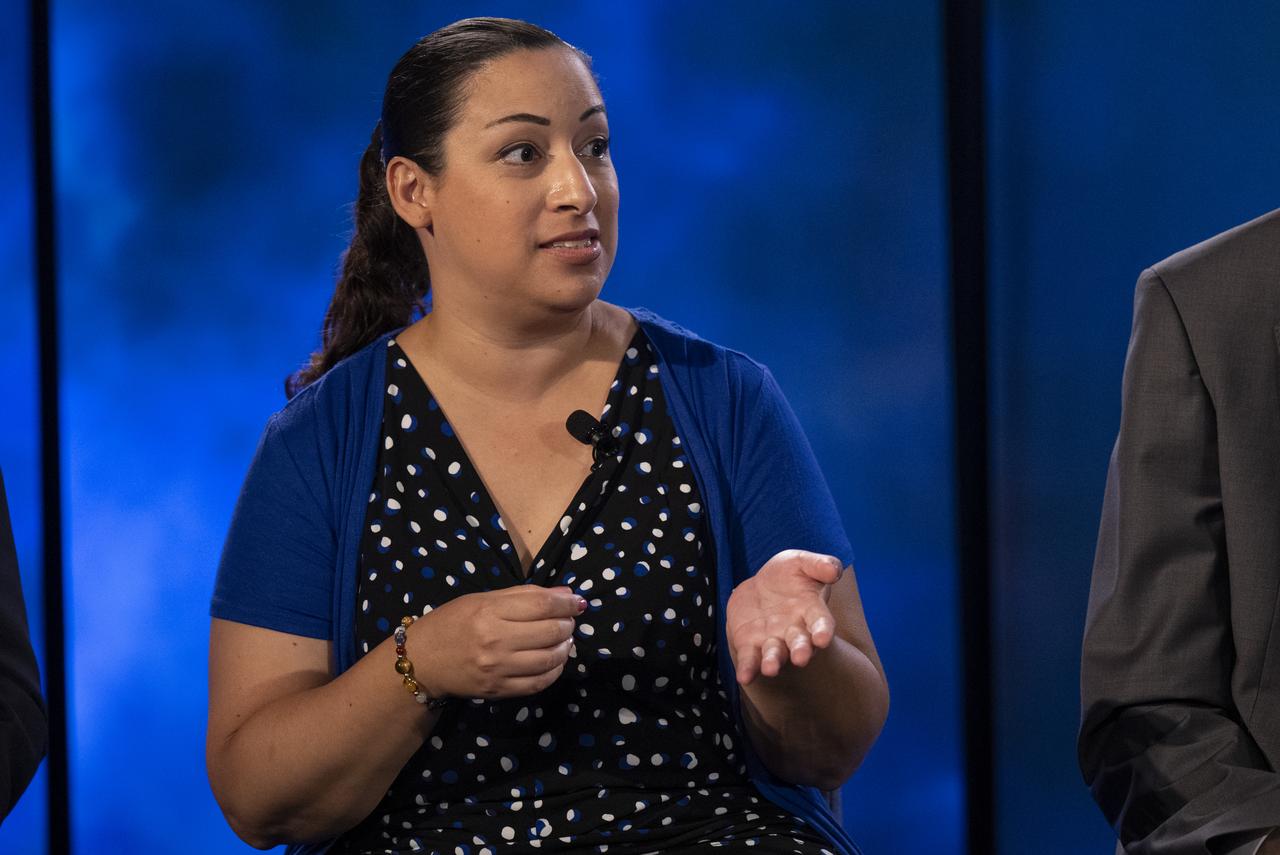
NASA James Webb Space Telescope Deputy Project Scientist for Exoplanet Science Knicole Colón answers a question from a member of the media during a briefing following the release of the first full-color images from NASA’s James Webb Space Telescope, Tuesday, July 12, 2022, at NASA’s Goddard Space Flight Center in Greenbelt, Md. The first full-color images and spectroscopic data from the James Webb Space Telescope, a partnership with ESA (European Space Agency) and the Canadian Space Agency (CSA), are a demonstration of the power of Webb as the telescope begins its science mission to unfold the infrared universe. Photo Credit: (NASA/Bill Ingalls)
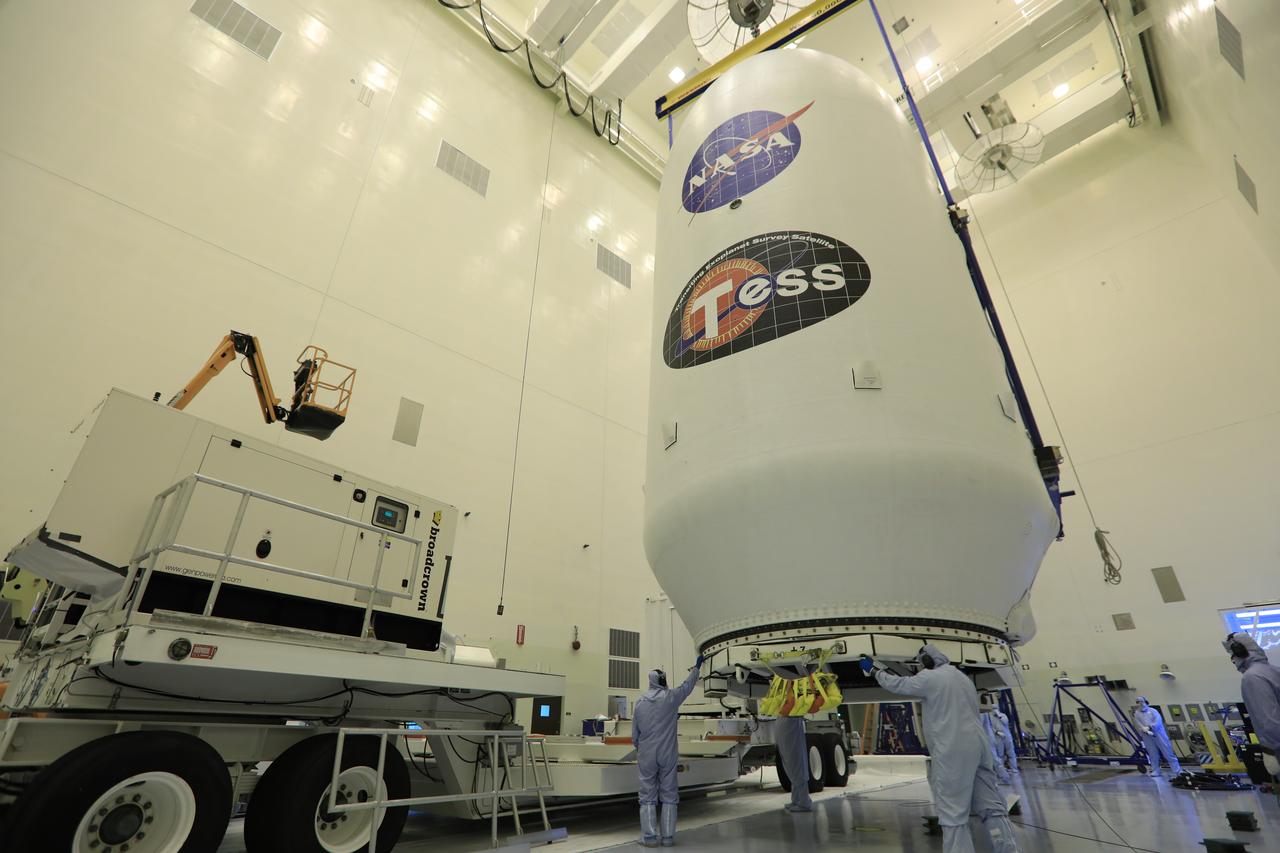
Inside the Payload Hazardous Servicing Facility at NASA's Kennedy Space Center in Florida, technicians assist as the SpaceX payload fairing containing the agency's Transiting Exoplanet Survey Satellite (TESS) is moved by crane to a transporter. The fairing will be moved to Space Launch Complex 40 at Cape Canaveral Air Force Station. TESS is scheduled to launch on the SpaceX Falcon 9 rocket at 6:32 p.m. EDT on April 16. The satellite is the next step in NASA's search for planets outside our solar system, known as exoplanets. TESS is a NASA Astrophysics Explorer mission led and operated by MIT in Cambridge, Massachusetts, and managed by NASA’s Goddard Space Flight Center in Greenbelt, Maryland. Dr. George Ricker of MIT’s Kavli Institute for Astrophysics and Space Research serves as principal investigator for the mission. Additional partners include Orbital ATK, NASA’s Ames Research Center, the Harvard-Smithsonian Center for Astrophysics and the Space Telescope Science Institute. More than a dozen universities, research institutes and observatories worldwide are participants in the mission. NASA’s Launch Services Program is responsible for launch management.
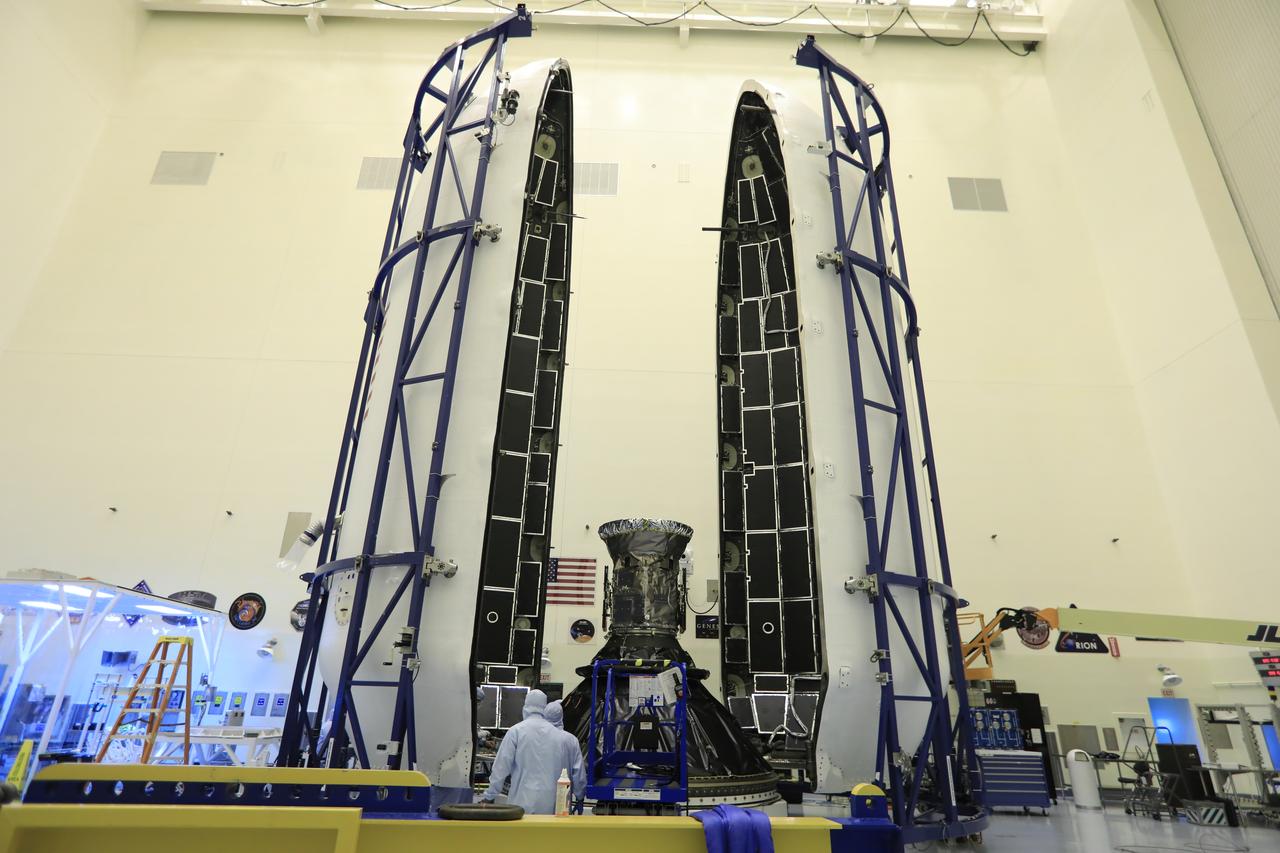
Technicians prepare NASA's Transiting Exoplanet Survey Satellite (TESS) for encapsulation in the SpaceX payload fairing inside the Payload Hazardous Servicing Facility at the agency's Kennedy Space Center in Florida. The satellite is scheduled to launch atop a SpaceX Falcon 9 rocket from Space Launch Complex 40 at Cape Canaveral Air Force Station on April 16. The satellite is the next step in NASA's search for planets outside our solar system, known as exoplanets. TESS is a NASA Astrophysics Explorer mission led and operated by MIT in Cambridge, Massachusetts, and managed by NASA’s Goddard Space Flight Center in Greenbelt, Maryland. Dr. George Ricker of MIT’s Kavli Institute for Astrophysics and Space Research serves as principal investigator for the mission. Additional partners include Orbital ATK, NASA’s Ames Research Center, the Harvard-Smithsonian Center for Astrophysics and the Space Telescope Science Institute. More than a dozen universities, research institutes and observatories worldwide are participants in the mission. NASA’s Launch Services Program is responsible for launch management.
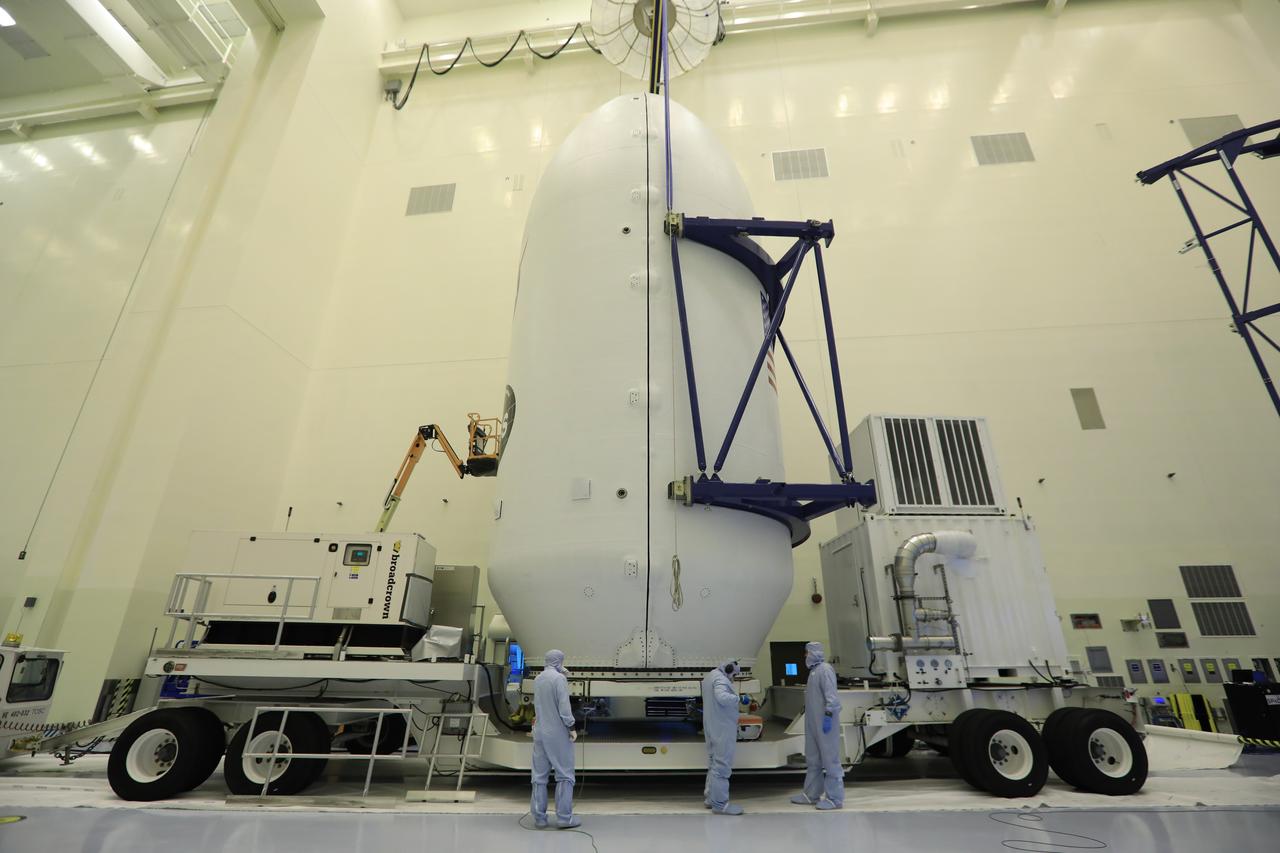
Inside the Payload Hazardous Servicing Facility at NASA's Kennedy Space Center in Florida, the SpaceX payload fairing containing the agency's Transiting Exoplanet Survey Satellite (TESS) is secured onto a transporter. The fairing will be moved to Space Launch Complex 40 at Cape Canaveral Air Force Station. TESS is scheduled to launch on the SpaceX Falcon 9 rocket at 6:32 p.m. EDT on April 16. The satellite is the next step in NASA's search for planets outside our solar system, known as exoplanets. TESS is a NASA Astrophysics Explorer mission led and operated by MIT in Cambridge, Massachusetts, and managed by NASA’s Goddard Space Flight Center in Greenbelt, Maryland. Dr. George Ricker of MIT’s Kavli Institute for Astrophysics and Space Research serves as principal investigator for the mission. Additional partners include Orbital ATK, NASA’s Ames Research Center, the Harvard-Smithsonian Center for Astrophysics and the Space Telescope Science Institute. More than a dozen universities, research institutes and observatories worldwide are participants in the mission. NASA’s Launch Services Program is responsible for launch management.
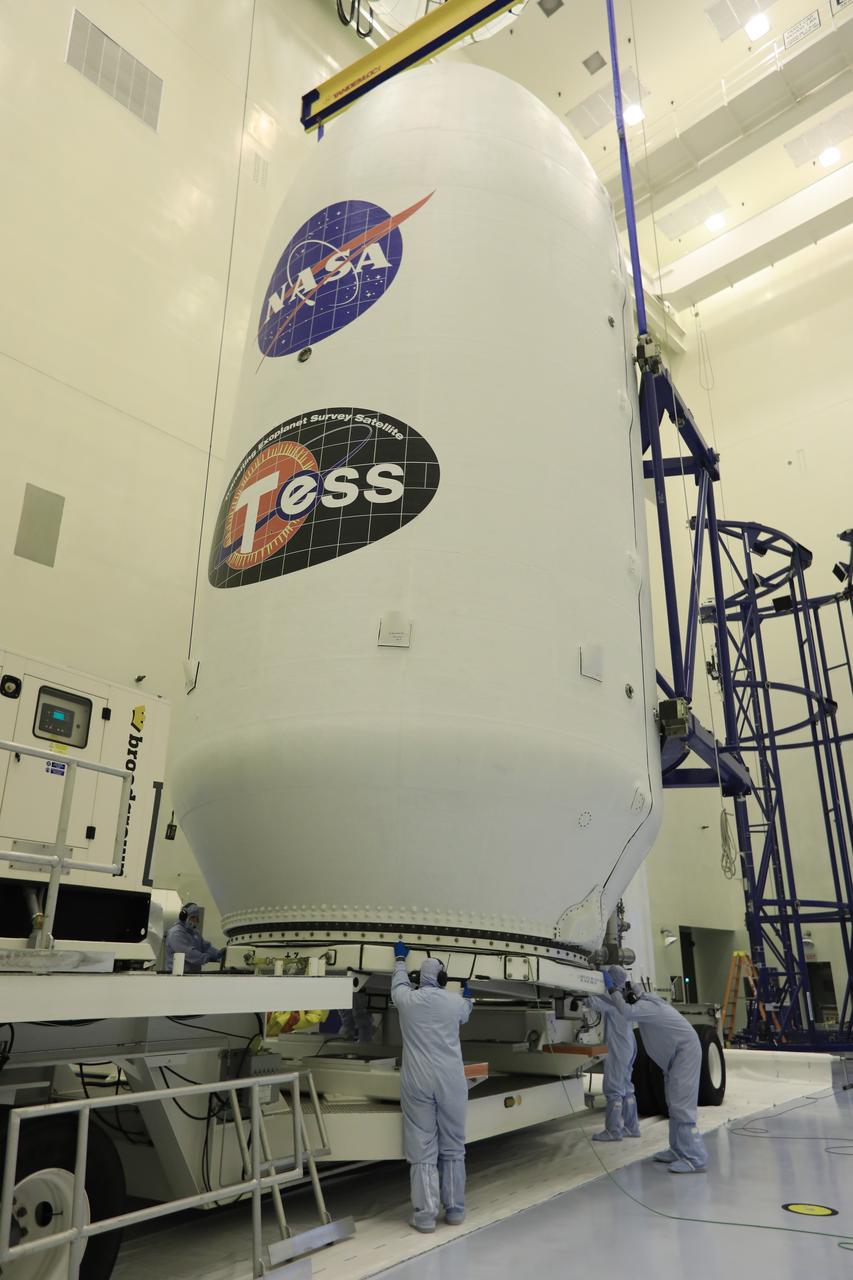
Inside the Payload Hazardous Servicing Facility at NASA's Kennedy Space Center in Florida, technicians assist as the SpaceX payload fairing containing the agency's Transiting Exoplanet Survey Satellite (TESS) is lowered by crane onto a transporter. The fairing will be moved to Space Launch Complex 40 at Cape Canaveral Air Force Station. TESS is scheduled to launch on the SpaceX Falcon 9 rocket at 6:32 p.m. EDT on April 16. The satellite is the next step in NASA's search for planets outside our solar system, known as exoplanets. TESS is a NASA Astrophysics Explorer mission led and operated by MIT in Cambridge, Massachusetts, and managed by NASA’s Goddard Space Flight Center in Greenbelt, Maryland. Dr. George Ricker of MIT’s Kavli Institute for Astrophysics and Space Research serves as principal investigator for the mission. Additional partners include Orbital ATK, NASA’s Ames Research Center, the Harvard-Smithsonian Center for Astrophysics and the Space Telescope Science Institute. More than a dozen universities, research institutes and observatories worldwide are participants in the mission. NASA’s Launch Services Program is responsible for launch management.
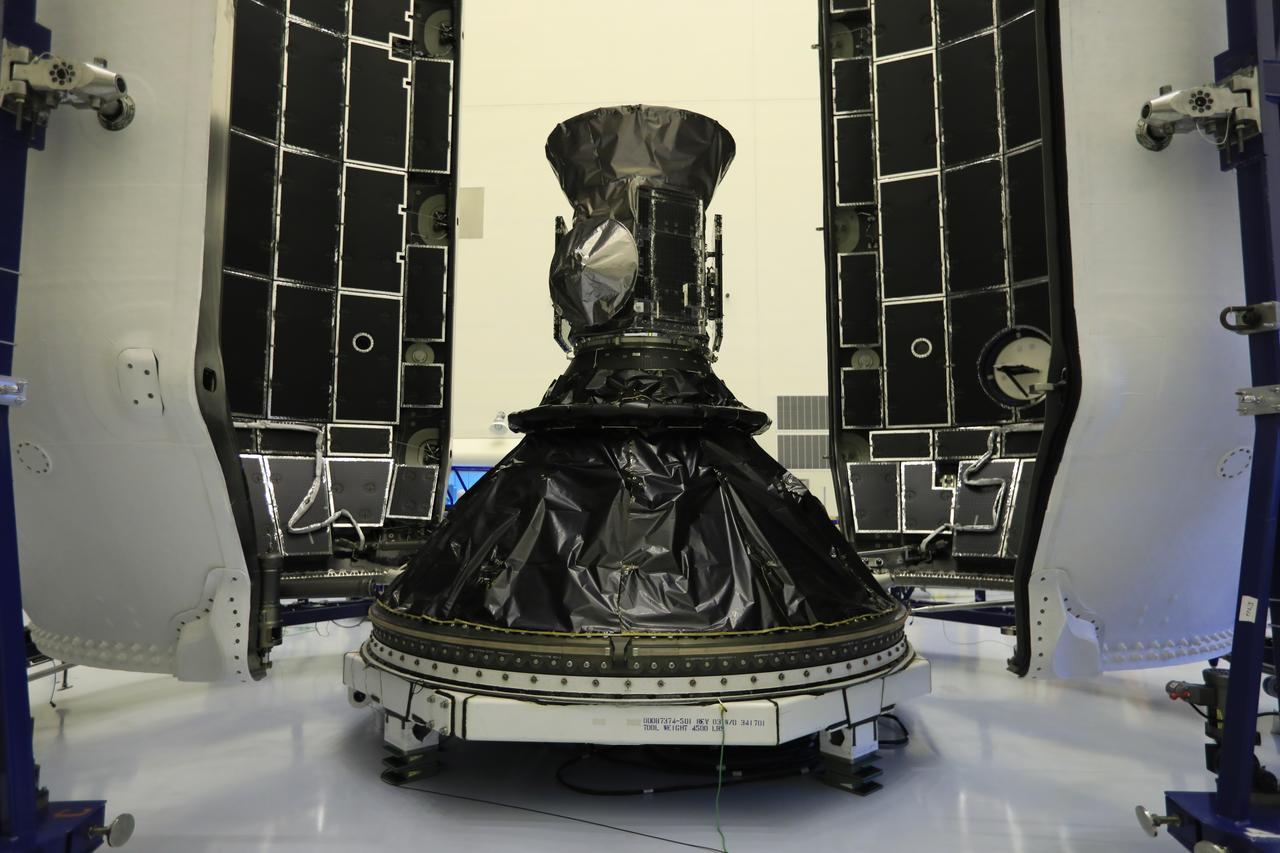
Inside the Payload Hazardous Servicing Facility at NASA's Kennedy Space Center in Florida, NASA's Transiting Exoplanet Survey Satellite (TESS) is being prepared for encapsulation in the SpaceX payload fairing. The satellite is scheduled to launch atop a SpaceX Falcon 9 rocket from Space Launch Complex 40 at Cape Canaveral Air Force Station on April 16. The satellite is the next step in NASA's search for planets outside our solar system, known as exoplanets. TESS is a NASA Astrophysics Explorer mission led and operated by MIT in Cambridge, Massachusetts, and managed by NASA’s Goddard Space Flight Center in Greenbelt, Maryland. Dr. George Ricker of MIT’s Kavli Institute for Astrophysics and Space Research serves as principal investigator for the mission. Additional partners include Orbital ATK, NASA’s Ames Research Center, the Harvard-Smithsonian Center for Astrophysics and the Space Telescope Science Institute. More than a dozen universities, research institutes and observatories worldwide are participants in the mission. NASA’s Launch Services Program is responsible for launch management.
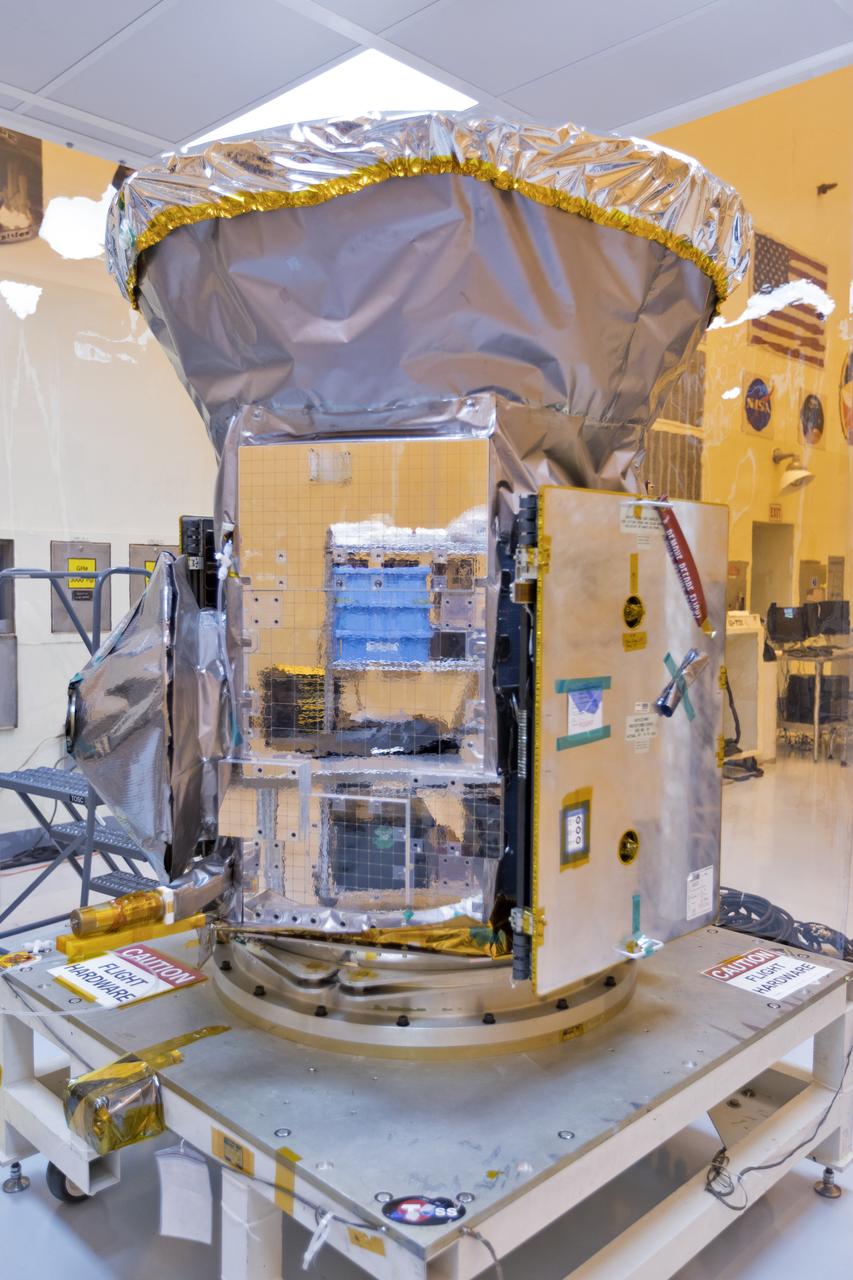
In the Payload Hazardous Servicing Facility at NASA's Kennedy Space Center in Florida, the agency's Transiting Exoplanet Survey Satellite, or TESS, has been uncreated from its shipping container for inspections and preflight processing. The satellite is NASA's next step in the search for planets outside of the solar system also known as "exoplanets." TESS is a NASA Astrophysics Explorer mission led and operated by MIT in Cambridge, Massachusetts, and managed by NASA’s Goddard Space Flight Center in Greenbelt, Maryland. Dr. George Ricker of MIT’s Kavli Institute for Astrophysics and Space Research serves as principal investigator for the mission. Additional partners include Orbital ATK, NASA’s Ames Research Center, and the Harvard-Smithsonian Center for Astrophysics and the Space Telescope Science Institute. More than a dozen universities, research institutes and observatories worldwide are participants in the mission. NASA’s Launch Services Program is responsible for launch management. SpaceX of Hawthorne, California, is the provider of the Falcon 9 launch service. TESS is scheduled to launch atop a Falcon 9 rocket no earlier than April 16, 2018 from Space Launch Complex 41 at Cape Canaveral Air Force Station.
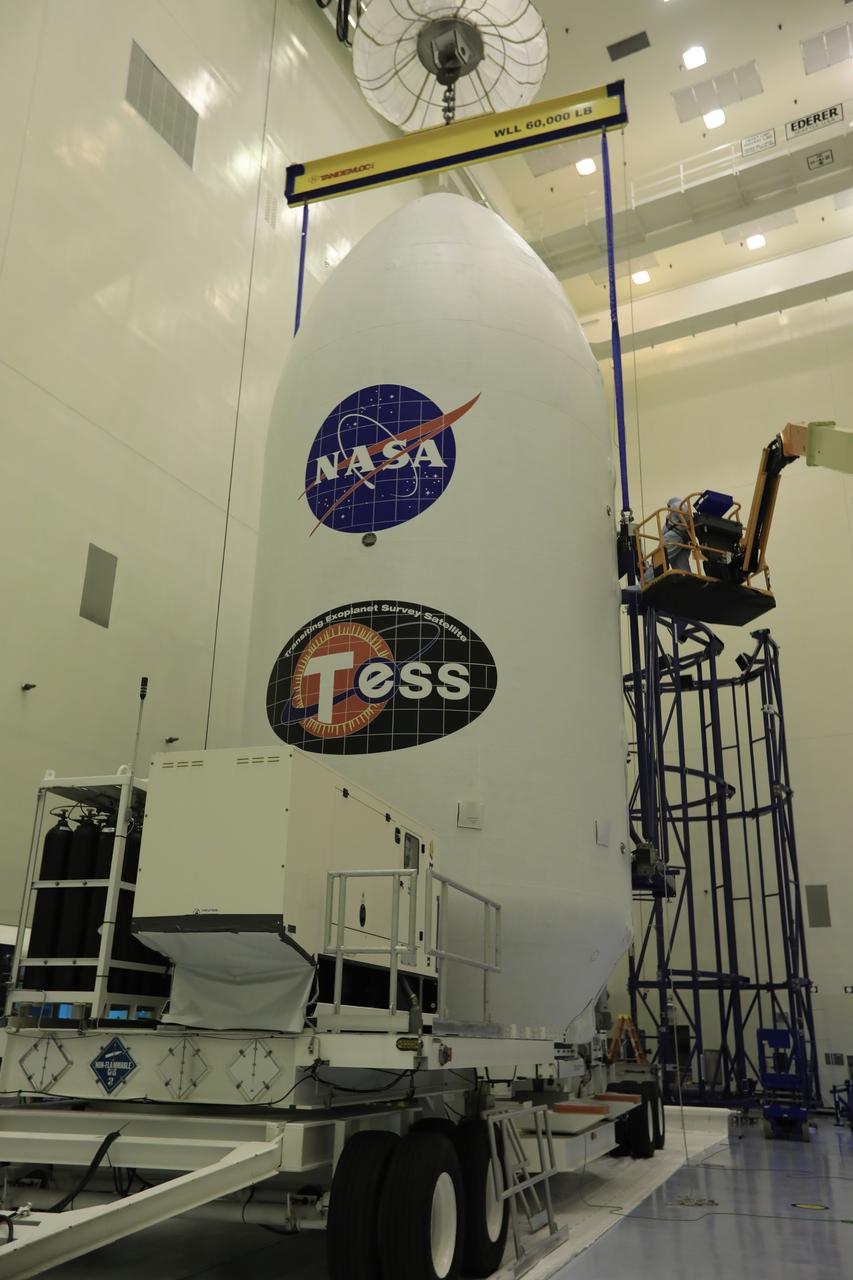
Inside the Payload Hazardous Servicing Facility at NASA's Kennedy Space Center in Florida, the SpaceX payload fairing containing the agency's Transiting Exoplanet Survey Satellite (TESS) is secured onto a transporter. The fairing will be moved to Space Launch Complex 40 at Cape Canaveral Air Force Station. TESS is scheduled to launch on the SpaceX Falcon 9 rocket at 6:32 p.m. EDT on April 16. The satellite is the next step in NASA's search for planets outside our solar system, known as exoplanets. TESS is a NASA Astrophysics Explorer mission led and operated by MIT in Cambridge, Massachusetts, and managed by NASA’s Goddard Space Flight Center in Greenbelt, Maryland. Dr. George Ricker of MIT’s Kavli Institute for Astrophysics and Space Research serves as principal investigator for the mission. Additional partners include Orbital ATK, NASA’s Ames Research Center, the Harvard-Smithsonian Center for Astrophysics and the Space Telescope Science Institute. More than a dozen universities, research institutes and observatories worldwide are participants in the mission. NASA’s Launch Services Program is responsible for launch management.
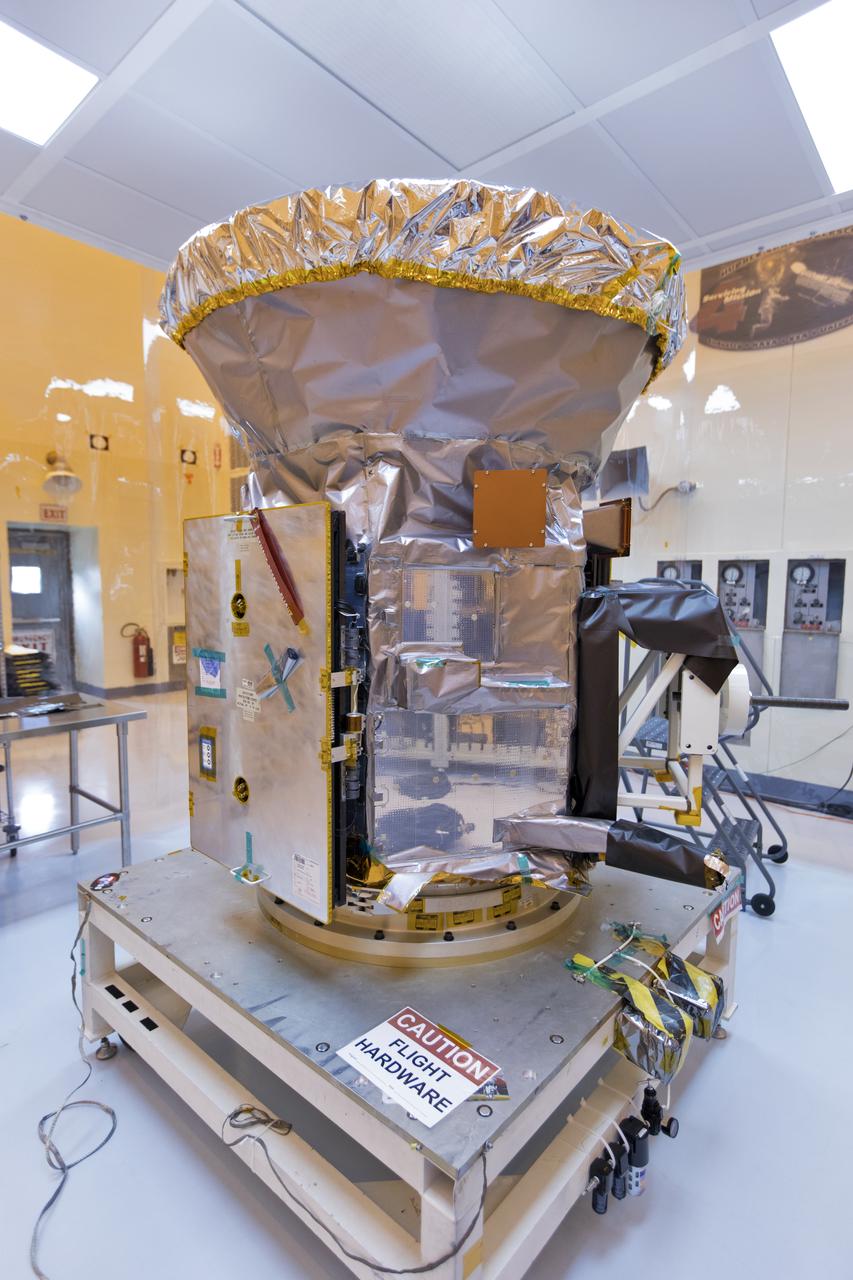
In the Payload Hazardous Servicing Facility at NASA's Kennedy Space Center in Florida, the agency's Transiting Exoplanet Survey Satellite, or TESS, has been uncreated from its shipping container for inspections and preflight processing. The satellite is NASA's next step in the search for planets outside of the solar system also known as "exoplanets." TESS is a NASA Astrophysics Explorer mission led and operated by MIT in Cambridge, Massachusetts, and managed by NASA’s Goddard Space Flight Center in Greenbelt, Maryland. Dr. George Ricker of MIT’s Kavli Institute for Astrophysics and Space Research serves as principal investigator for the mission. Additional partners include Orbital ATK, NASA’s Ames Research Center, and the Harvard-Smithsonian Center for Astrophysics and the Space Telescope Science Institute. More than a dozen universities, research institutes and observatories worldwide are participants in the mission. NASA’s Launch Services Program is responsible for launch management. SpaceX of Hawthorne, California, is the provider of the Falcon 9 launch service. TESS is scheduled to launch atop a Falcon 9 rocket no earlier than April 16, 2018 from Space Launch Complex 41 at Cape Canaveral Air Force Station.
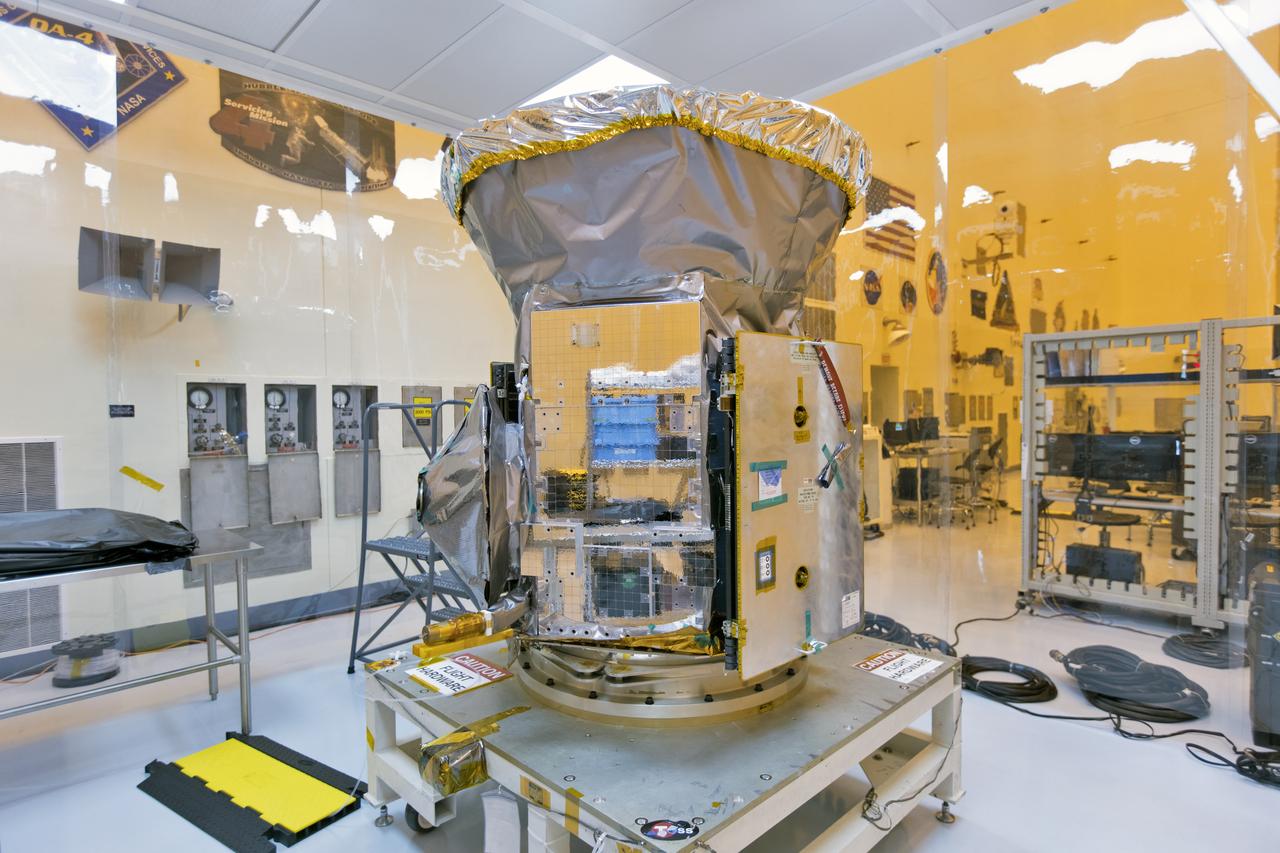
In the Payload Hazardous Servicing Facility at NASA's Kennedy Space Center in Florida, the agency's Transiting Exoplanet Survey Satellite, or TESS, has been uncreated from its shipping container for inspections and preflight processing. The satellite is NASA's next step in the search for planets outside of the solar system also known as "exoplanets." TESS is a NASA Astrophysics Explorer mission led and operated by MIT in Cambridge, Massachusetts, and managed by NASA’s Goddard Space Flight Center in Greenbelt, Maryland. Dr. George Ricker of MIT’s Kavli Institute for Astrophysics and Space Research serves as principal investigator for the mission. Additional partners include Orbital ATK, NASA’s Ames Research Center, and the Harvard-Smithsonian Center for Astrophysics and the Space Telescope Science Institute. More than a dozen universities, research institutes and observatories worldwide are participants in the mission. NASA’s Launch Services Program is responsible for launch management. SpaceX of Hawthorne, California, is the provider of the Falcon 9 launch service. TESS is scheduled to launch atop a Falcon 9 rocket no earlier than April 16, 2018 from Space Launch Complex 41 at Cape Canaveral Air Force Station.
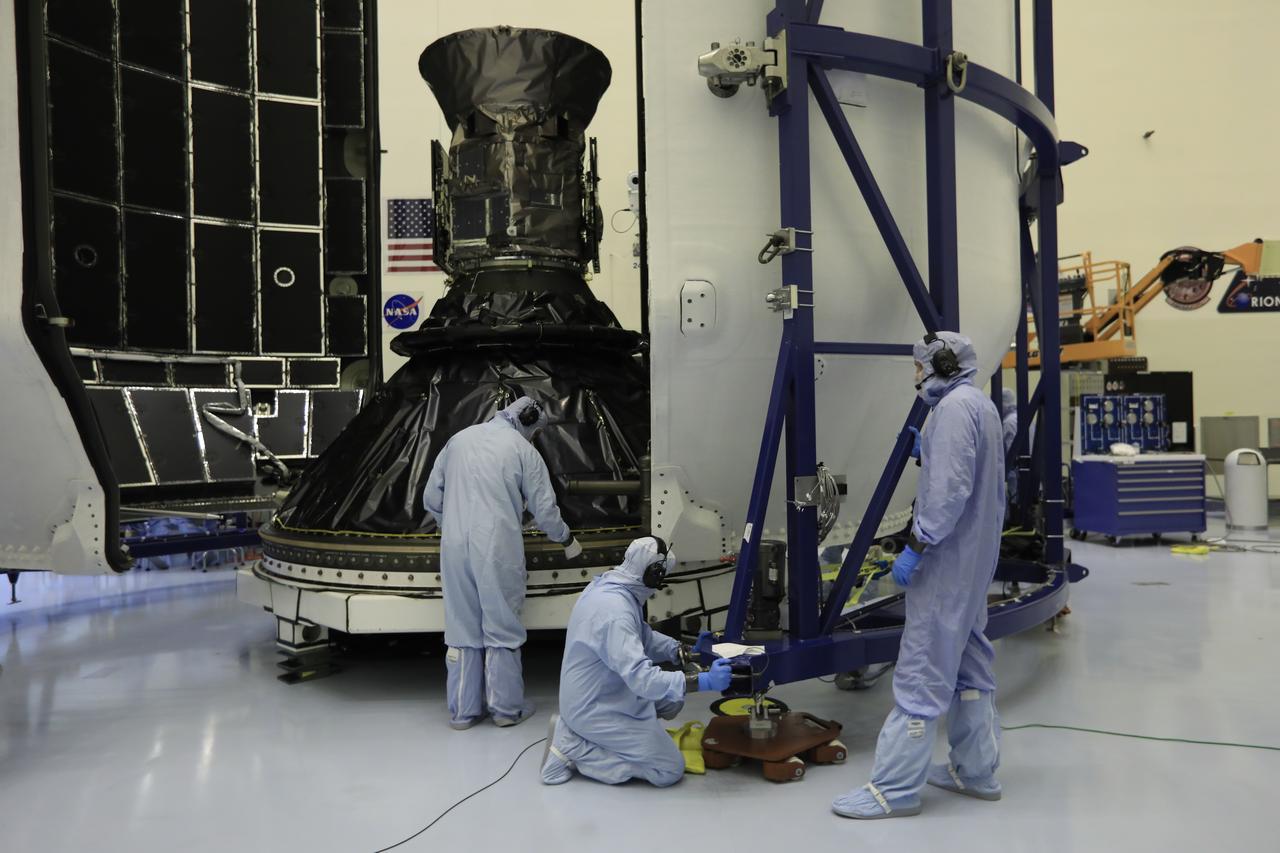
Technicians prepare NASA's Transiting Exoplanet Survey Satellite (TESS) for encapsulation in the SpaceX payload fairing inside the Payload Hazardous Servicing Facility at the agency's Kennedy Space Center in Florida. The satellite is scheduled to launch atop a SpaceX Falcon 9 rocket from Space Launch Complex 40 at Cape Canaveral Air Force Station on April 16. The satellite is the next step in NASA's search for planets outside our solar system, known as exoplanets. TESS is a NASA Astrophysics Explorer mission led and operated by MIT in Cambridge, Massachusetts, and managed by NASA’s Goddard Space Flight Center in Greenbelt, Maryland. Dr. George Ricker of MIT’s Kavli Institute for Astrophysics and Space Research serves as principal investigator for the mission. Additional partners include Orbital ATK, NASA’s Ames Research Center, the Harvard-Smithsonian Center for Astrophysics and the Space Telescope Science Institute. More than a dozen universities, research institutes and observatories worldwide are participants in the mission. NASA’s Launch Services Program is responsible for launch management.
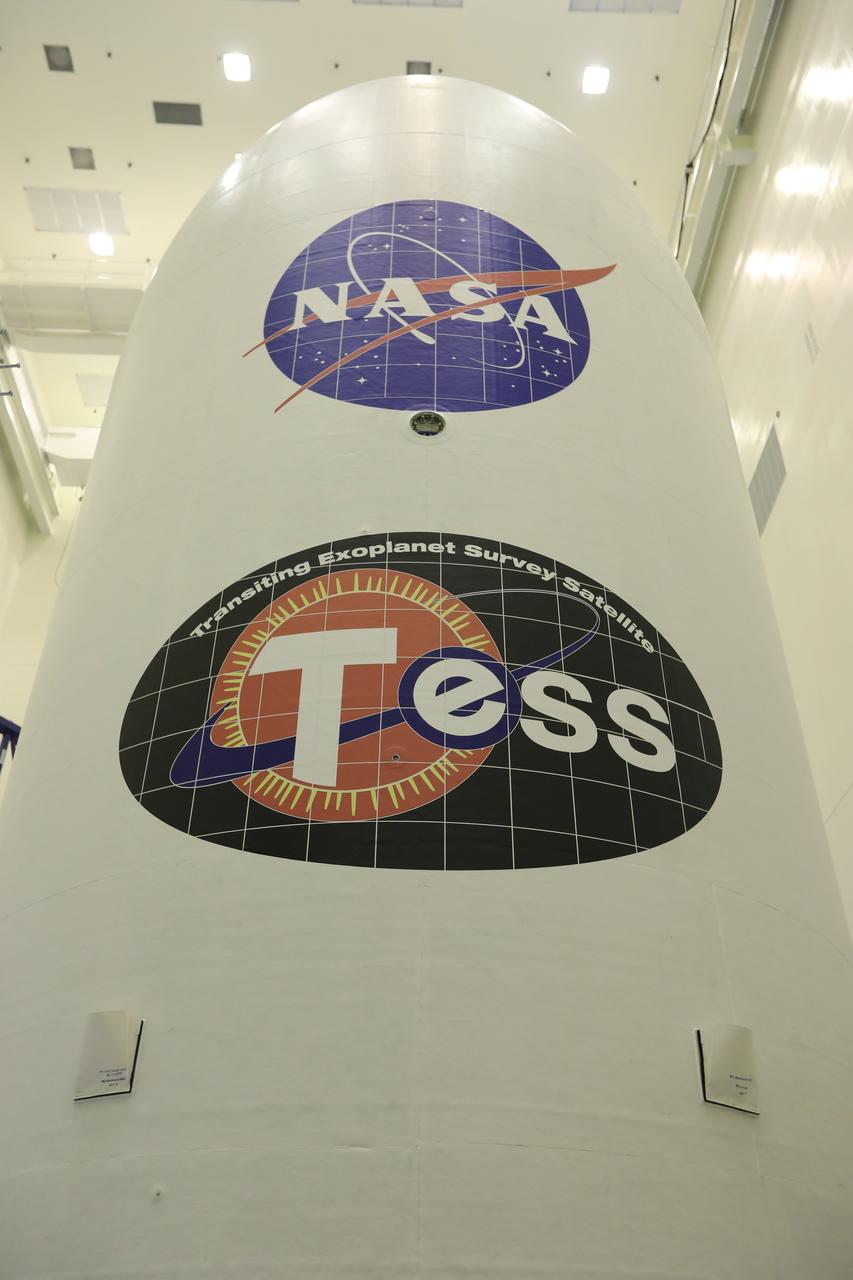
The SpaceX payload fairing containing NASA's Transiting Exoplanet Survey Satellite (TESS) is prepared for the move from the Payload Hazardous Servicing Facility at the agency's Kennedy Space Center in Florida to Space Launch Complex 40 at Cape Canaveral Air Force Station. The satellite is scheduled to launch atop the SpaceX Falcon 9 rocket at 6:32 p.m. EDT on April 16. TESS is the next step in NASA's search for planets outside our solar system, known as exoplanets. TESS is a NASA Astrophysics Explorer mission led and operated by MIT in Cambridge, Massachusetts, and managed by NASA’s Goddard Space Flight Center in Greenbelt, Maryland. Dr. George Ricker of MIT’s Kavli Institute for Astrophysics and Space Research serves as principal investigator for the mission. Additional partners include Orbital ATK, NASA’s Ames Research Center, the Harvard-Smithsonian Center for Astrophysics and the Space Telescope Science Institute. More than a dozen universities, research institutes and observatories worldwide are participants in the mission. NASA’s Launch Services Program is responsible for launch management.
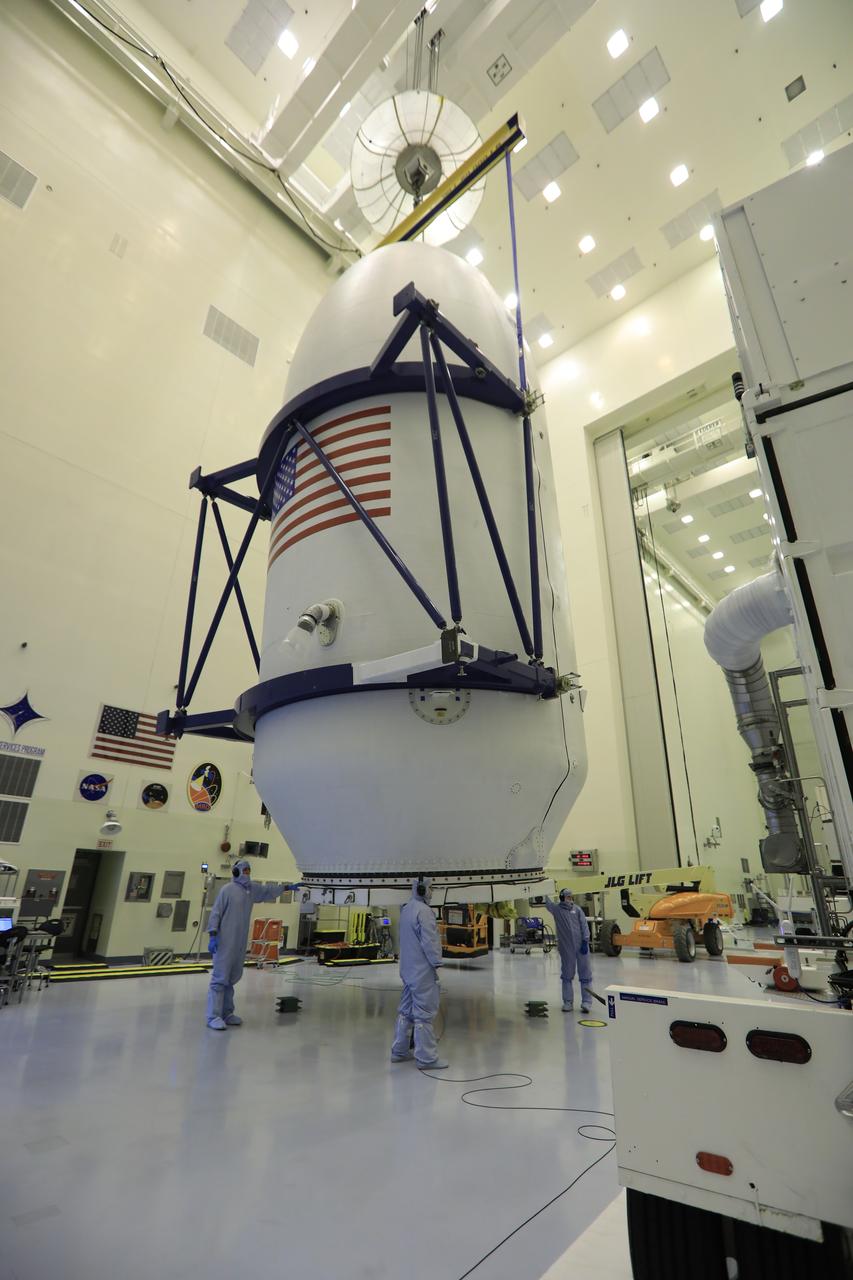
Inside the Payload Hazardous Servicing Facility at NASA's Kennedy Space Center in Florida, technicians assist as the SpaceX payload fairing containing the agency's Transiting Exoplanet Survey Satellite (TESS) is lifted for the move to a transporter. The fairing will be moved to Space Launch Complex 40 at Cape Canaveral Air Force Station. The satellite is scheduled to launch atop the SpaceX Falcon 9 rocket at 6:32 p.m. EDT on April 16. TESS is the next step in NASA's search for planets outside our solar system, known as exoplanets. TESS is a NASA Astrophysics Explorer mission led and operated by MIT in Cambridge, Massachusetts, and managed by NASA’s Goddard Space Flight Center in Greenbelt, Maryland. Dr. George Ricker of MIT’s Kavli Institute for Astrophysics and Space Research serves as principal investigator for the mission. Additional partners include Orbital ATK, NASA’s Ames Research Center, the Harvard-Smithsonian Center for Astrophysics and the Space Telescope Science Institute. More than a dozen universities, research institutes and observatories worldwide are participants in the mission. NASA’s Launch Services Program is responsible for launch management.
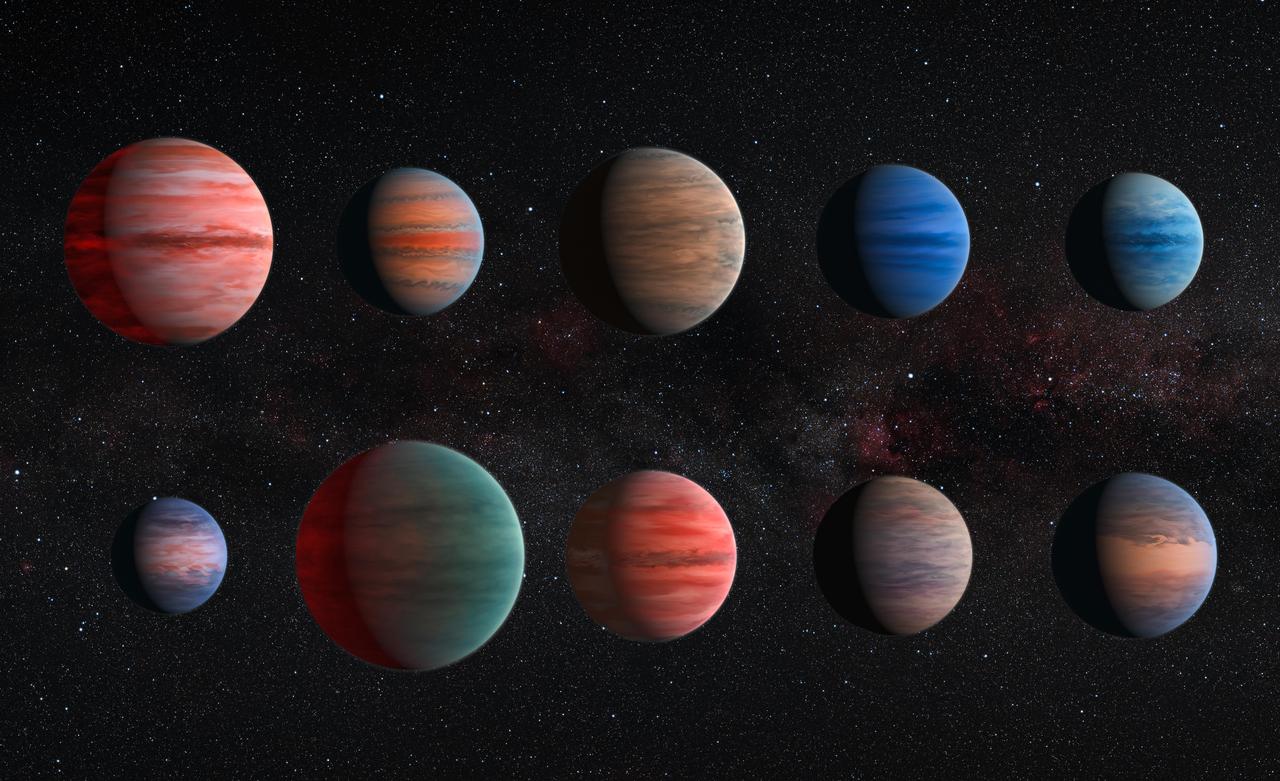
This image shows an artist's impression of the 10 hot Jupiter exoplanets studied using the Hubble and Spitzer space telescopes. From top left to lower left, these planets are WASP-12b, WASP-6b, WASP-31b, WASP-39b, HD 189733b, HAT-P-12b, WASP-17b, WASP-19b, HAT-P-1b and HD 209458b. The colors of the planets are for illustration purposes only. There is little scientific data on color with the exception of HD 189733b, which became known as the "blue planet." The planets are also depicted with a variety of different cloud properties. The wind patterns shown on these 10 planets, which resemble the visible structures on Jupiter, are based on theoretical models. The illustrations are to scale with each other. HAT-P-12b, the smallest of these planets, is approximately the size of Jupiter, while WASP-17b, the largest one in the sample, is almost twice the size. The hottest planets within the sample are portrayed with a glowing night side. This effect is strongest on WASP-12b, the hottest exoplanet in the sample, but also visible on WASP-19b and WASP-17b. It is also known that several of the planets exhibit strong Rayleigh scattering. This effect causes the blue hue of the daytime sky and the reddening of the sun at sunset on Earth. It is also visible as a blue edge on the planets WASP-6b, HD 189733b, HAT-P-12b and HD 209458b. http://photojournal.jpl.nasa.gov/catalog/PIA20056
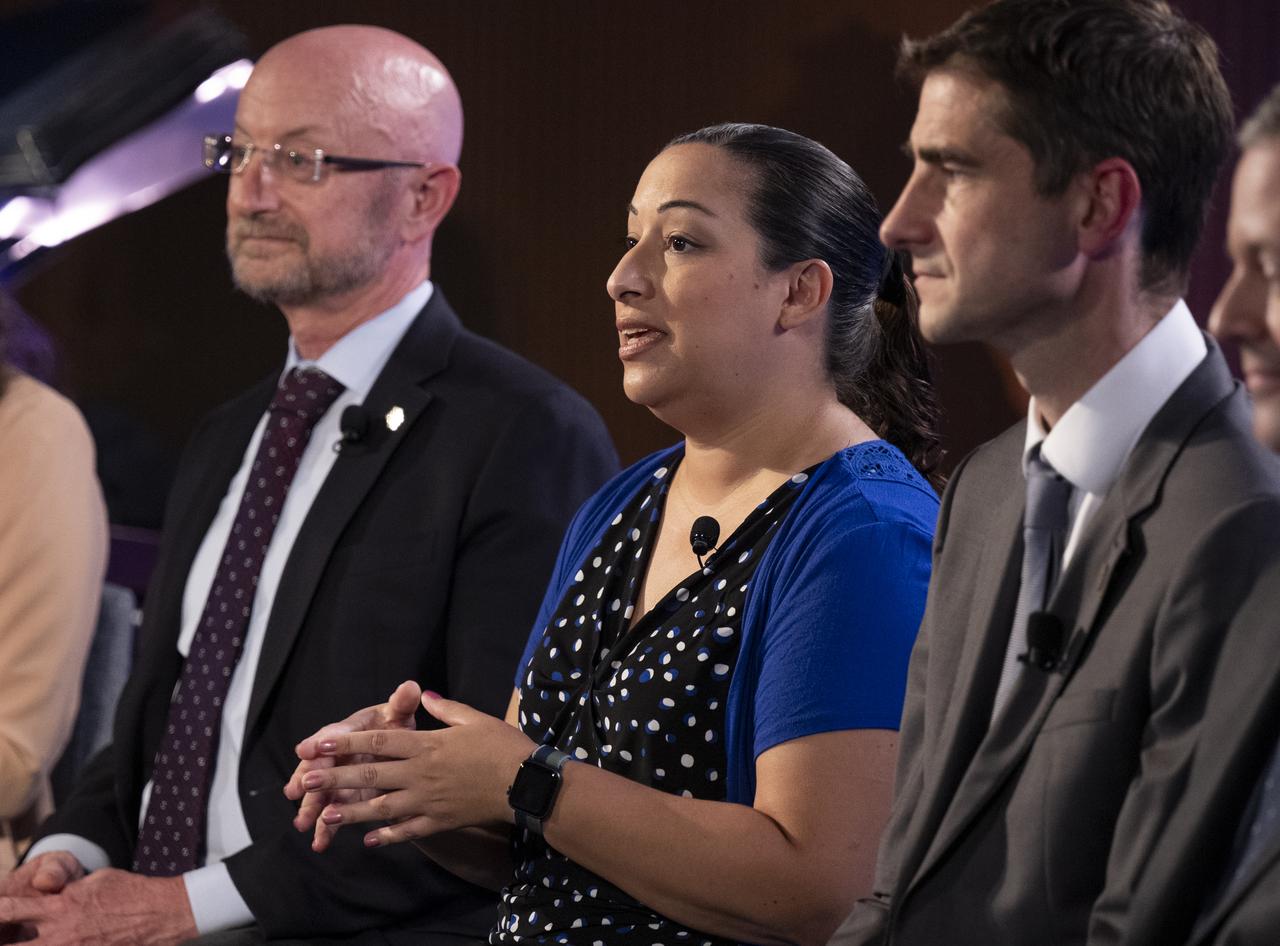
NASA James Webb Space Telescope Deputy Project Scientist for Exoplanet Science Knicole Colón, center, answers a question from a member of the media alongside NASA James Webb Space Telescope Program Scientist and Astrophysics Division Chief Scientist Eric Smith, left, and NASA James Webb Space Telescope Project Scientist at ESA (European Space Agency) Christopher Evans, during a briefing following the release of the first full-color images from NASA’s James Webb Space Telescope, Tuesday, July 12, 2022, at NASA’s Goddard Space Flight Center in Greenbelt, Md. The first full-color images and spectroscopic data from the James Webb Space Telescope, a partnership with ESA (European Space Agency) and the Canadian Space Agency (CSA), are a demonstration of the power of Webb as the telescope begins its science mission to unfold the infrared universe. Photo Credit: (NASA/Bill Ingalls)

This image shows the curvature of the Earth from 130,000 feet. It was taken remotely by a camera on EXCITE. The red blob at the top of the frame is the parachute.

WFIRST, the Wide Field Infrared Survey Telescope, is shown here in an artist's rendering. It will carry a Wide Field Instrument to provide astronomers with Hubble-quality images covering large swaths of the sky, and enabling several studies of cosmic evolution. Its Coronagraph Instrument will directly image exoplanets similar to those in our own solar system and make detailed measurements of the chemical makeup of their atmospheres. http://photojournal.jpl.nasa.gov/catalog/PIA20060
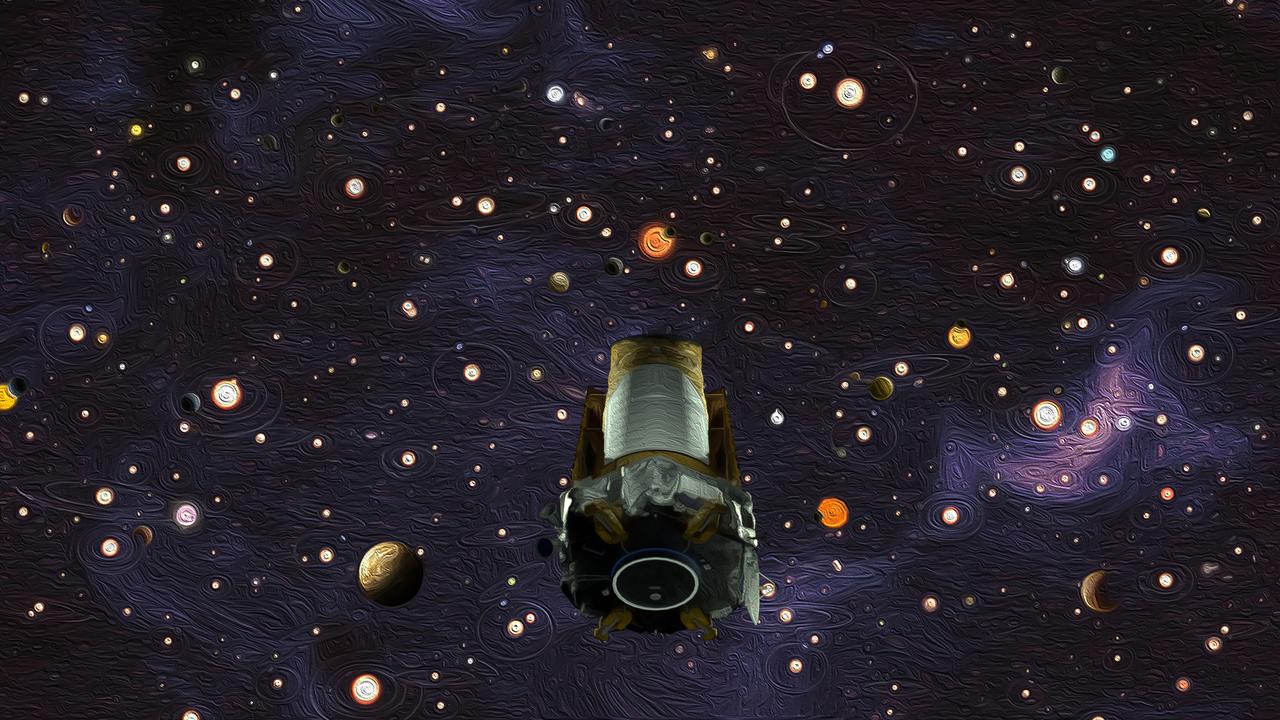
After nine years in deep space collecting data that revealed our night sky to be filled with billions of hidden planets, more planets even than stars, NASA’s Kepler space telescope has run out of fuel needed for further science operations. Illustration depicting the Kepler spacecraft in a sky filled with exoplanets and planetary systems.
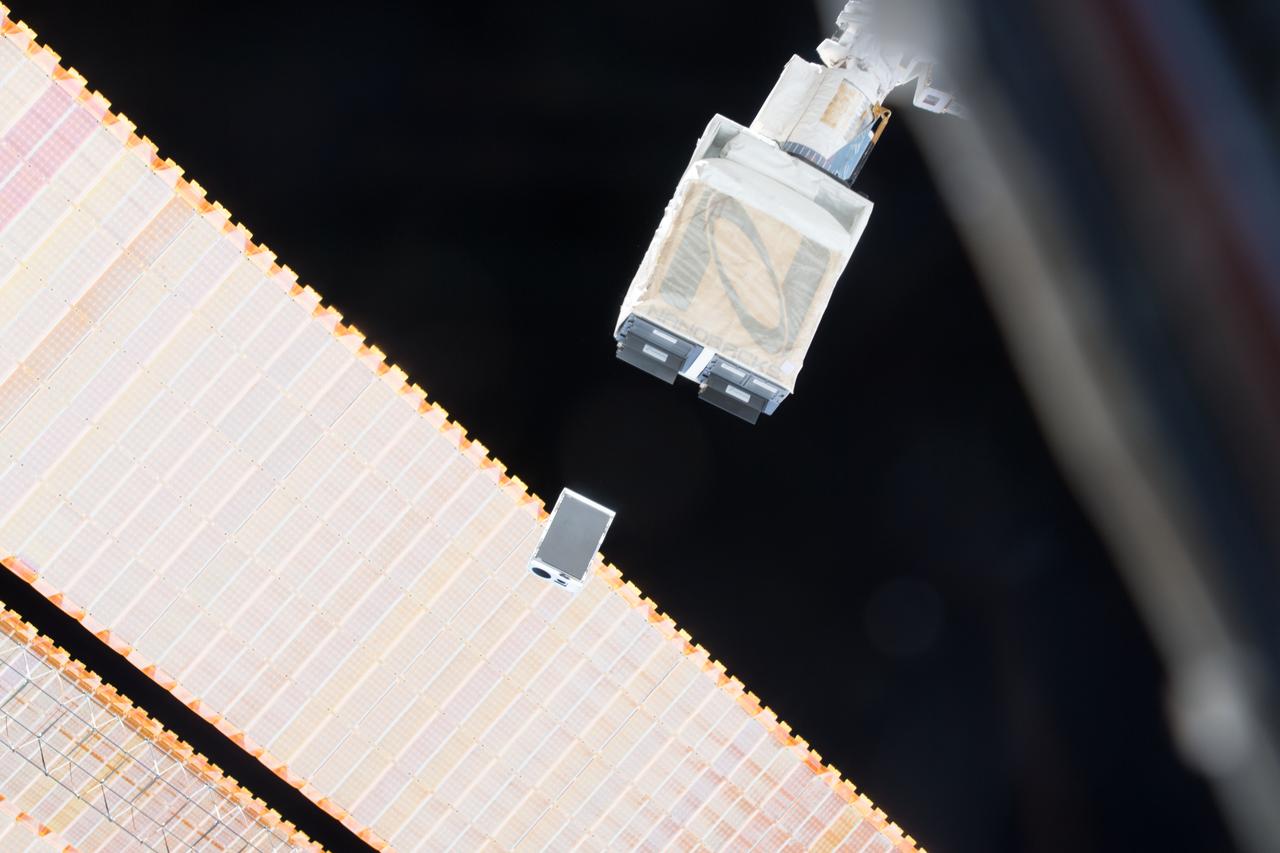
iss053e225369 (11/20/2017) --- A view of the Asteria Satellite moments after deployment from the International Space Station (ISS). The Arcsecond Space Telescope Enabling Research in Astrophysics (ASTERIA) is a six-unit (6U) CubeSat deployed from the ISS that tests new technologies for astronomical observation, such as the detection of planets outside our solar system (a.k.a., exoplanets).
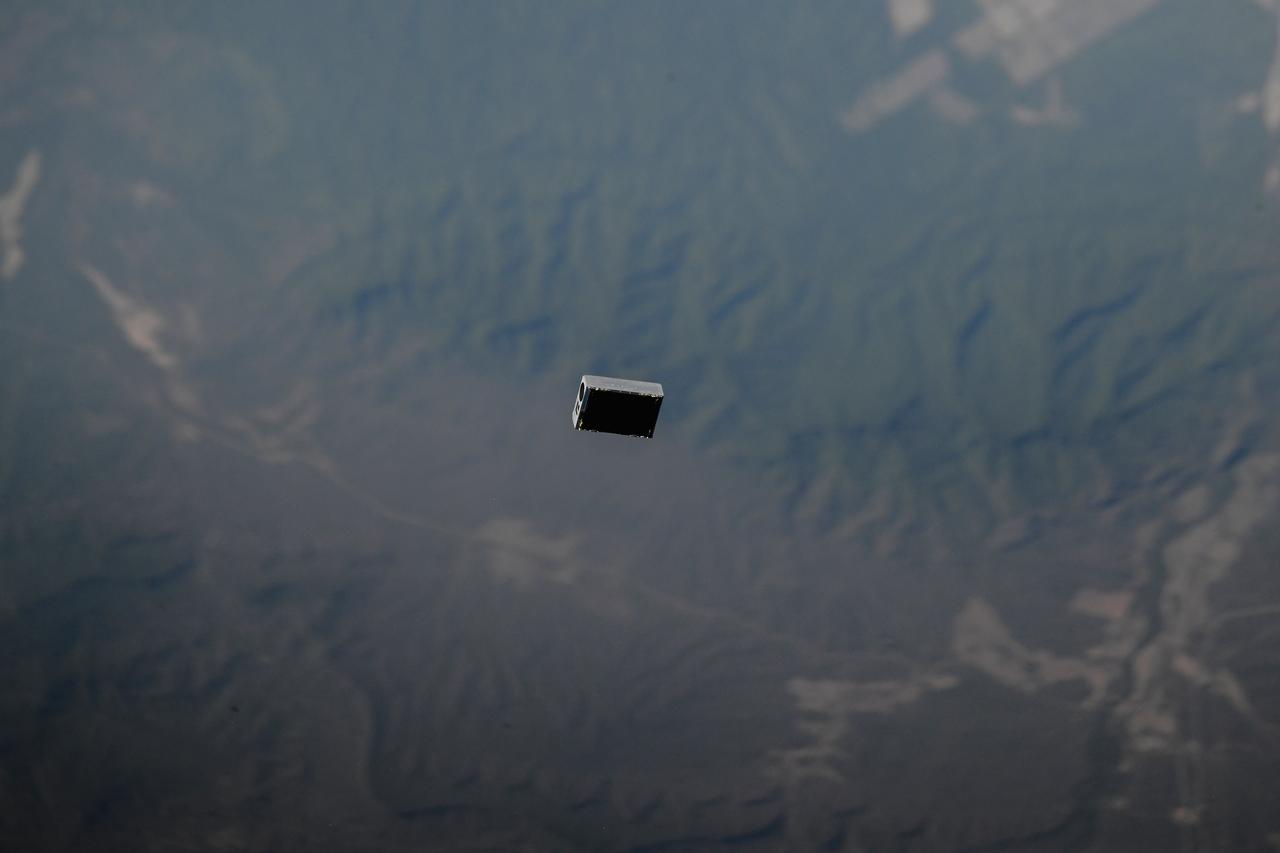
iss053e470644 (11/20/2017) --- A view of the Asteria Satellite moments after deployment from the International Space Station (ISS). The Arcsecond Space Telescope Enabling Research in Astrophysics (ASTERIA) is a six-unit (6U) CubeSat deployed from the ISS that tests new technologies for astronomical observation, such as the detection of planets outside our solar system (a.k.a., exoplanets).
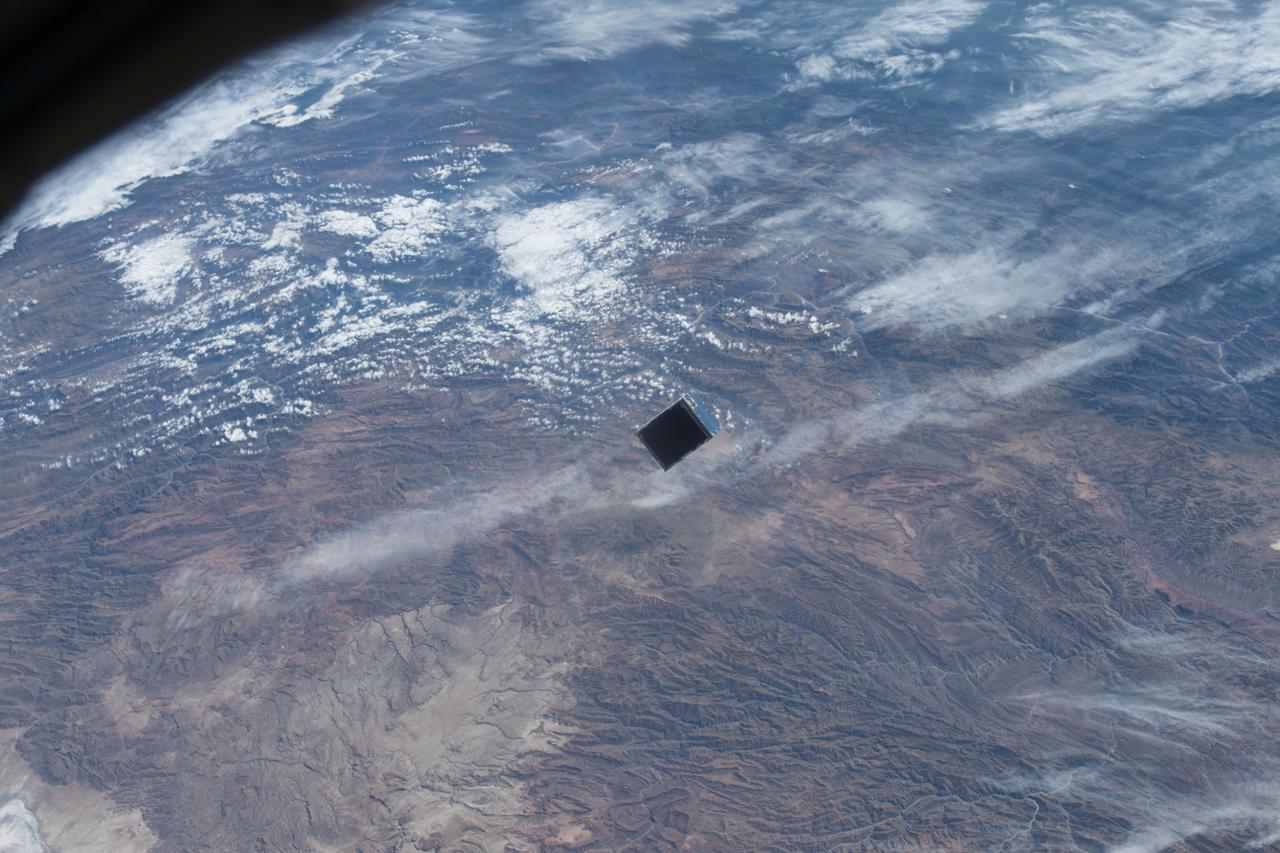
iss053e225398 (11/20/2017) --- A view of the Asteria Satellite moments after deployment from the International Space Station (ISS). The Arcsecond Space Telescope Enabling Research in Astrophysics (ASTERIA) is a six-unit (6U) CubeSat deployed from the ISS that tests new technologies for astronomical observation, such as the detection of planets outside our solar system (a.k.a., exoplanets).

WASP-18b is an exoplanet located 325 light-years from Earth. The planet's mass is 10 times that of Jupiter, and it orbits its star once every 23 hours. A 2017 study found that this planet has a stratosphere that's loaded with carbon dioxide, but has no signs of water. A stratosphere is a layer of atmosphere in which temperature increases with higher altitudes. The study used NASA's Spitzer and Hubble space telescopes. https://photojournal.jpl.nasa.gov/catalog/PIA22087

The Kepler space telescope examined twenty-one patches of the sky during it’s nine and a half years of operation. Within these regions, Kepler gathered high precision brightness measurements of over half a million stars facilitating the discovery of thousands of exoplanets and yielding insight into a multitude of other astrophysical phenomena. Illustration by Wendy Stenzel, Ames Science content: Jeff Coughlin, Kenneth Mighell, Doug Caldwell, all of NASA Ames.

NASA Public Affairs Officer Alise Fisher, left, moderates a briefing with NASA James Webb Space Telescope Program Scientist and Astrophysics Division Chief Scientist Eric Smith, NASA James Webb Space Telescope Deputy Project Scientist for Exoplanet Science Knicole Colón, NASA James Webb Space Telescope Project Scientist at ESA (European Space Agency) Christopher Evans, NASA James Webb Space Telescope project scietntist, Space Telescope Science Institute, Klaus Pontoppidan, Principal Investigator for the Canadian Near-Infrared Imager and Slitless Spectrograph at the University of Montreal René Doyon, NASA James Webb Space Telescope Deputy Project Scientist for Communications Amber Straughn, and NASA James Webb Space Telescope Operations Project Scientist Jane Rigby following the release of the first full-color images from NASA’s James Webb Space Telescope, Tuesday, July 12, 2022, at NASA’s Goddard Space Flight Center in Greenbelt, Md. The first full-color images and spectroscopic data from the James Webb Space Telescope, a partnership with ESA (European Space Agency) and the Canadian Space Agency (CSA), are a demonstration of the power of Webb as the telescope begins its science mission to unfold the infrared universe. Photo Credit: (NASA/Bill Ingalls)
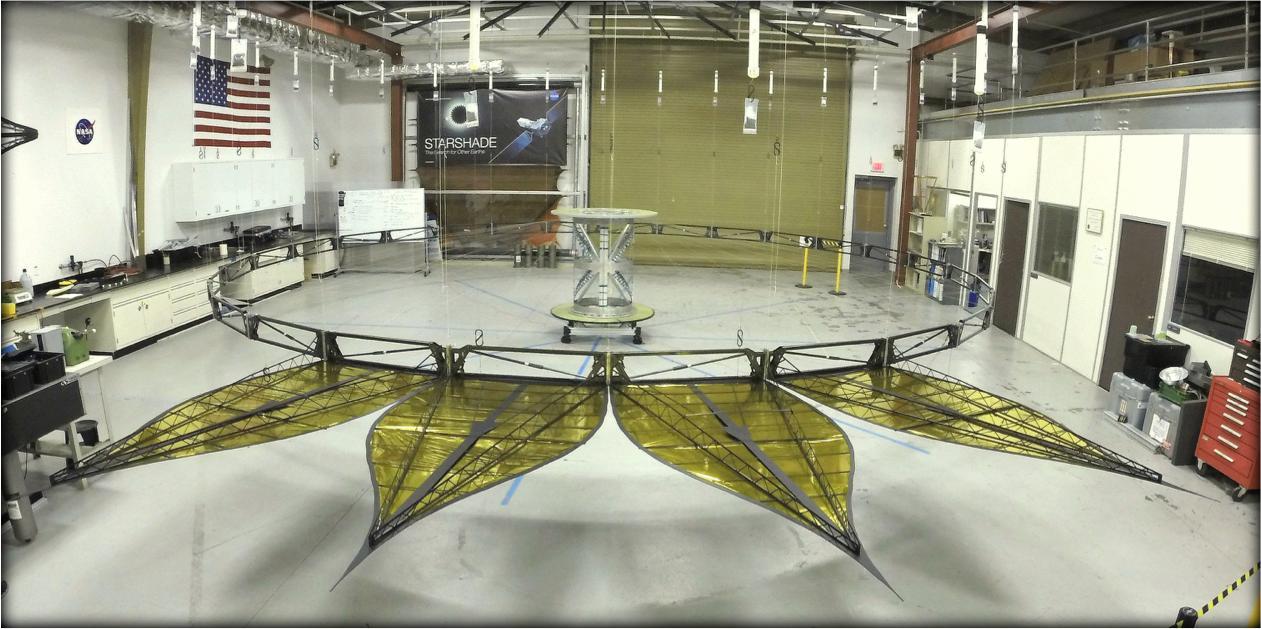
is image shows a deployed half-scale starshade with four petals at NASA's Jet Propulsion Laboratory, Pasadena, California in 2014. The full-scale of this starshade (not shown) will measure at 111 feet (34 meters). The flower-like petals of the starshade are designed to diffract bright starlight away from telescopes seeking the dim light of exoplanets. The starshade was re-designed from earlier models to allow these petals to furl, or wrap around the spacecraft, for launch into space. Each petal is covered in a high-performance plastic film that resembles gold foil. On a starshade ready for launch, the thermal gold foil will only cover the side of the petals facing away from the telescope, with black on the other, so as not to reflect other light sources such as the Earth into its lens. The starshade is light enough for space and cannot support its own weight on Earth. Is it shown offloaded with counterweights, much like an elevator. Starlight-blocking technologies such as the starshade are being developed to help image exoplanets, with a focus on Earth-sized, habitable worlds. http://photojournal.jpl.nasa.gov/catalog/PIA20909

This image shows the deployment of a half-scale starshade with four petals at NASA's Jet Propulsion Laboratory in Pasadena, California, in 2014. The full scale of this starshade (not shown) will measure at 34 meters, or approximately 111 feet. The flower-like petals of the starshade are designed to diffract bright starlight away from telescopes seeking the dim light of exoplanets. The starshade was re-designed from earlier models to allow these petals to furl, or wrap around the spacecraft, for launch into space. Once in space, the starshade will need to expand from its tightly-packed launch shape to become large and umbrella-like, ideal for blocking starlight. Each petal is covered in a high-performance plastic film that resembles gold foil. On a starshade ready for launch, the thermal gold foil will only cover the side of the petals facing away from the telescope, with black on the other, so as not to reflect other light sources such as the Earth into its lens. Starlight-blocking technologies such as the starshade are being developed to help image exoplanets, with a focus on Earth-sized, habitable worlds. http://photojournal.jpl.nasa.gov/catalog/PIA20907
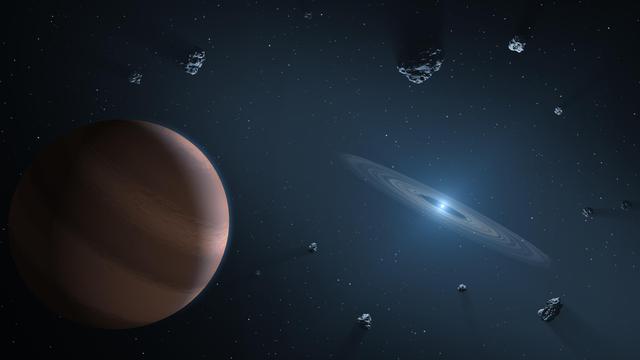
This artist's concept shows an exoplanet and debris disk orbiting a polluted white dwarf. White dwarfs are dim, dense remnants of stars similar to the Sun that have exhausted their nuclear fuel and blown off their outer layers. By "pollution," astronomers mean heavy elements invading the photospheres -- the outer atmospheres -- of these stars. The leading explanation is that exoplanets could push small rocky bodies toward the star, whose powerful gravity would pulverize them into dust. That dust, containing heavy elements from the torn-apart body, would then fall on the star. NASA's Spitzer Space Telescope has been instrumental in expanding the field of polluted white dwarfs orbited by hot, dusty disks. Since launch in 2004, Spitzer has confirmed about 40 of these special stars. Another space telescope, NASA's Wide-field Infrared Survey Explorer (WISE), also detected a handful, bringing the total up to about four dozen known today. Because these objects are so faint, infrared light is crucial to identifying them. https://photojournal.jpl.nasa.gov/catalog/PIA22084

This artist's illustration depicts the exoplanet LHS 3844b, which is 1.3 times the mass of Earth and orbits an M dwarf star. The planet has no apparent atmosphere, and its surface may be covered mostly in dark lava rock, according to observations by NASA's Spitzer Space Telescope. Discovered in 2018 by NASA's Transiting Exoplanet Satellite Survey (TESS), planet LHS 3844b is located 48.6 light-years from Earth and makes one full revolution around its parent star in just 11 hours. Because it has such a tight orbit, LHS 3844b is most likely tidally locked, meaning one side of the planet always faces the star while another side always faces away. Spitzer was able to detect light directly emitted by LHS 3844b in part because the planet is extremely hot, so it radiates a relatively high amount of infrared light. The star-facing side is heated to about 1,410 degrees Fahrenheit (770 degrees Celsius). In addition, the planet's parent star is relatively dim as far as stars go. By measuring the temperature difference between the planet's star-facing dayside and its space-facing nightside, the new study found that a negligible amount of heat is being transferred from one side to the other. If an atmosphere were present, hot air on the dayside would naturally expand and generate winds that would transfer heat around the planet. On a rock with little to no atmosphere, like the Moon, there is no air present to transfer heat. The planet has a low infrared albedo, or reflectivity, leading scientists to conclude that its surface may be covered with basalt, which also composes the dark mare on the Moon. Movie available at https://photojournal.jpl.nasa.gov/catalog/PIA23130

The Kepler space telescope examined twenty-one patches of the sky during it’s nine and a half years of operation. Within these regions, Kepler gathered high precision brightness measurements of over half a million stars facilitating the discovery of thousands of exoplanets and yielding insight into a multitude of other astrophysical phenomena. Illustration by Wendy Stenzel. Science content: Jeff Coughlin, Kenneth Mighell, Doug Caldwell, all of NASA Ames. Key words: Kepler, K2, Missions, nasa, Ames research center, spacecraft, FFI, Full Frame Image, fields of view, science.
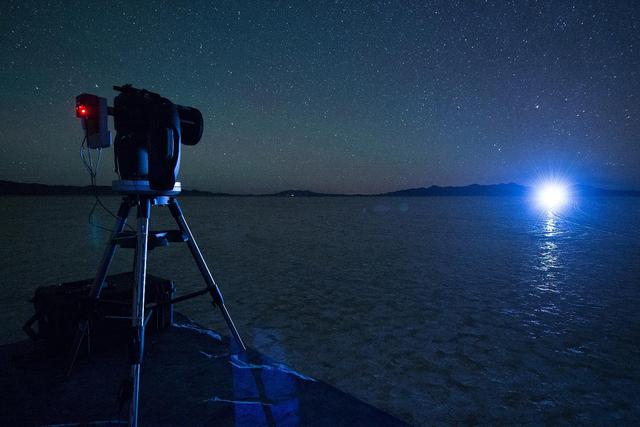
A night test of a small-scale starshade model, in a dry lake bed in central Nevada's Smith Creek by Northrup Grumman, took place in May to June 2014. A telescope points toward a bright light, which in the darkness of the desert mimics the conditions of starlight in space. Other lights, which are up to 10 million times fainter than the light source standing in for the star, represent the reflected light of planets. Telescopes searching for the relatively dim light of an exoplanet next to its much brighter star are faced with a challenge as difficult as searching from Los Angeles for a firefly in New York -- if the firefly is next to the brightness of a lighthouse. The tests by Northrup Grumman determined that a starshade, or external occulter, is capable of blocking starlight to a degree that can indeed reveal the light of a planet. http://photojournal.jpl.nasa.gov/catalog/PIA20901
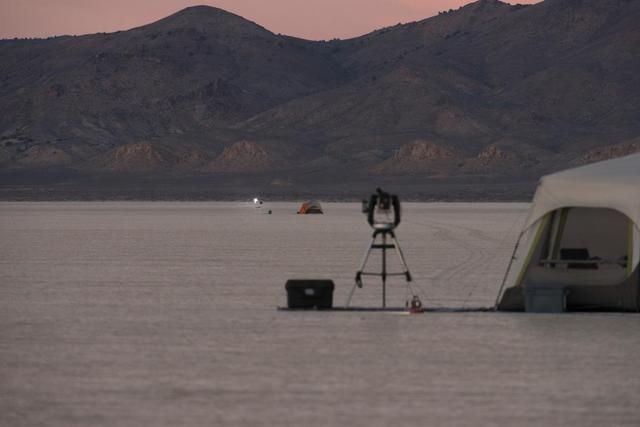
A test of a small-scale starshade model in a dry lake bed in central Nevada's Smith Creek by Northrup Grumman in May-June 2014. A telescope points toward a bright light, which mimics the conditions of starlight in space. Other lights, which are up to 10 million times fainter than the light source standing in for the star, represent the reflected light of planets. Telescopes searching for the relatively dim light of an exoplanet next to its much bright star are faced with a challenge as difficult as searching from Los Angeles for a firefly in New York– if the firefly is also beside a lighthouse. These tests determined that a starshade, or external occulter, is indeed capable of blocking starlight to a degree that reveals the light of a planet. http://photojournal.jpl.nasa.gov/catalog/PIA20908

Our solar system now is tied for most number of planets around a single star, with the recent discovery of an eighth planet circling Kepler-90, a Sun-like star 2,545 light years from Earth. The planet was discovered in data from NASA's Kepler Space Telescope. The newly-discovered Kepler-90i -- a sizzling hot, rocky planet that orbits its star once every 14.4 days -- was found using machine learning from Google. Machine learning is an approach to artificial intelligence in which computers "learn." In this case, computers learned to identify planets by finding in Kepler data instances where the telescope recorded changes in starlight caused by planets beyond our solar system, known as exoplanets. https://photojournal.jpl.nasa.gov/catalog/PIA22192
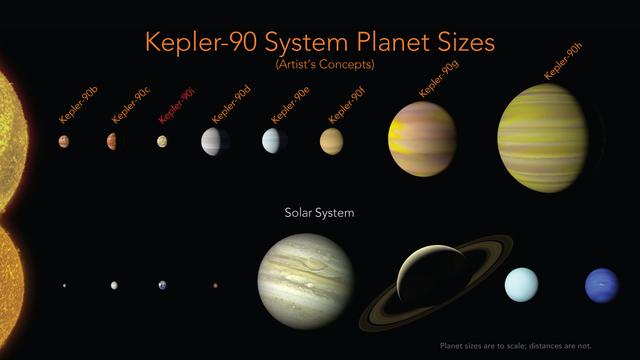
Our solar system now is tied for most number of planets around a single star, with the recent discovery of an eighth planet circling Kepler-90, a Sun-like star 2,545 light years from Earth. The planet was discovered in data from NASA's Kepler Space Telescope. This artist's concept depicts the Kepler-90 system compared with our own solar system. The newly-discovered Kepler-90i -- a sizzling hot, rocky planet that orbits its star once every 14.4 days -- was found using machine learning from Google. Machine learning is an approach to artificial intelligence in which computers "learn." In this case, computers learned to identify planets by finding in Kepler data instances where the telescope recorded changes in starlight caused by planets beyond our solar system, known as exoplanets. https://photojournal.jpl.nasa.gov/catalog/PIA22193

This artist's concept allows us to imagine what it would be like to stand on the surface of the exoplanet TRAPPIST-1f, located in the TRAPPIST-1 system in the constellation Aquarius. Because this planet is thought to be tidally locked to its star, meaning the same face of the planet is always pointed at the star, there would be a region called the terminator that perpetually divides day and night. If the night side is icy, the day side might give way to liquid water in the area where sufficient starlight hits the surface. One of the unusual features of TRAPPIST-1 planets is how close they are to each other -- so close that other planets could be visible in the sky from the surface of each one. In this view, the planets in the sky correspond to TRAPPIST1e (top left crescent), d (middle crescent) and c (bright dot to the lower right of the crescents). TRAPPIST-1e would appear about the same size as the moon and TRAPPIST1-c is on the far side of the star. The star itself, an ultra-cool dwarf, would appear about three times larger than our own sun does in Earth's skies. The TRAPPIST-1 system has been revealed through observations from NASA's Spitzer Space Telescope and the ground-based TRAPPIST (TRAnsiting Planets and PlanetesImals Small Telescope) telescope, as well as other ground-based observatories. The system was named for the TRAPPIST telescope. http://photojournal.jpl.nasa.gov/catalog/PIA21423
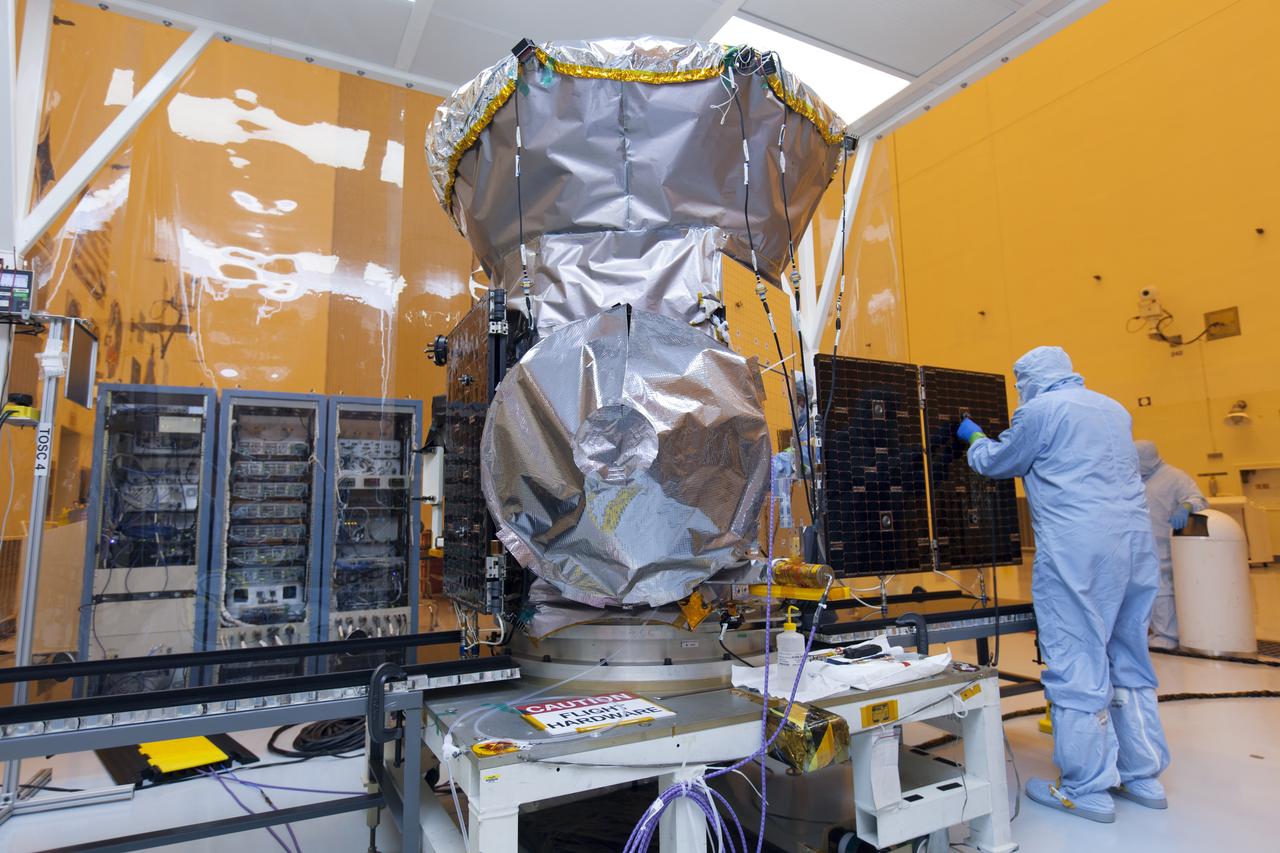
Inside the Payload Hazardous Servicing Facility at the NASA's Kennedy Space Center in Florida, the first of two solar panels is being deployed on the agency's Transiting Exoplanet Survey Satellite (TESS). The satellite is scheduled to launch atop a SpaceX Falcon 9 rocket from Space Launch Complex 40 at Cape Canaveral Air Force Station. TESS is the next step in NASA's search for planets outside our solar system, known as exoplanets. TESS is a NASA Astrophysics Explorer mission led and operated by MIT in Cambridge, Massachusetts, and managed by NASA’s Goddard Space Flight Center in Greenbelt, Maryland. Dr. George Ricker of MIT’s Kavli Institute for Astrophysics and Space Research serves as principal investigator for the mission. Additional partners include Orbital ATK, NASA’s Ames Research Center, the Harvard-Smithsonian Center for Astrophysics and the Space Telescope Science Institute. More than a dozen universities, research institutes and observatories worldwide are participants in the mission. NASA’s Launch Services Program is responsible for launch management.
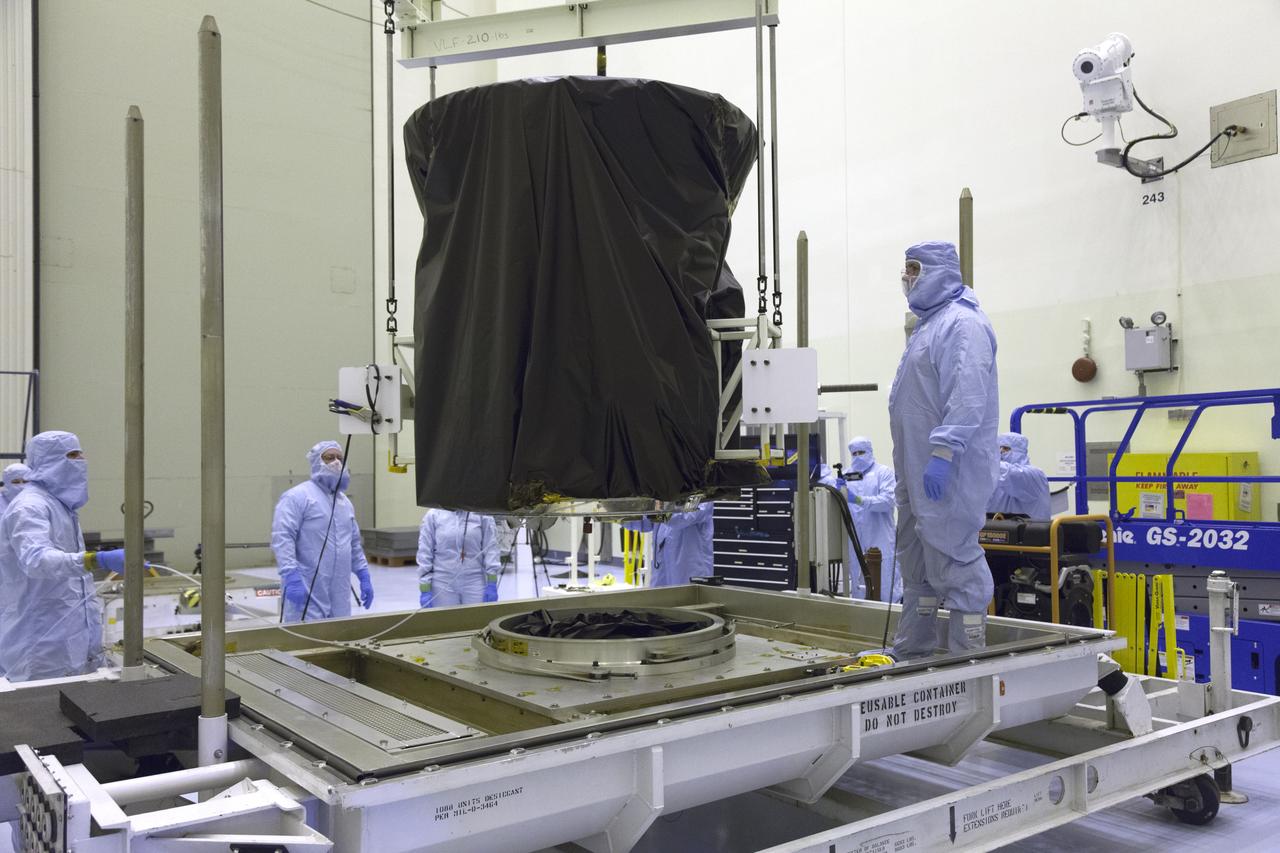
NASA's Transiting Exoplanet Survey Satellite (TESS) is lifted up from the base of its shipping container and will be lowered onto a test stand for processing inside the Payload Hazardous Servicing Facility (PHSF) at the agency's Kennedy Space Center in Florida. Inside the PHSF, the satellite will be processed and prepared for its flight. TESS is scheduled to launch atop a SpaceX Falcon 9 rocket from Space Launch Complex 40 at Cape Canaveral Air Force Station. TESS is the next step in NASA's search for planets outside our solar system, known as exoplanets. TESS is a NASA Astrophysics Explorer mission led and operated by MIT in Cambridge, Massachusetts, and managed by NASA’s Goddard Space Flight Center in Greenbelt, Maryland. Dr. George Ricker of MIT’s Kavli Institute for Astrophysics and Space Research serves as principal investigator for the mission. Additional partners include Orbital ATK, NASA’s Ames Research Center, the Harvard-Smithsonian Center for Astrophysics and the Space Telescope Science Institute. More than a dozen universities, research institutes and observatories worldwide are participants in the mission. NASA’s Launch Services Program is responsible for launch management.

Technicians dressed in clean room suits monitor the progress as both solar panels are deployed on NASA's Transiting Exoplanet Survey Satellite (TESS) inside the Payload Hazardous Servicing Facility (PHSF) at the agency's Kennedy Space Center in Florida. Inside the PHSF, the satellite is being processed and prepared for its flight. TESS is scheduled to launch atop a SpaceX Falcon 9 rocket from Space Launch Complex 40 at Cape Canaveral Air Force Station. The satellite is the next step in NASA's search for planets outside our solar system, known as exoplanets. TESS is a NASA Astrophysics Explorer mission led and operated by MIT in Cambridge, Massachusetts, and managed by NASA’s Goddard Space Flight Center in Greenbelt, Maryland. Dr. George Ricker of MIT’s Kavli Institute for Astrophysics and Space Research serves as principal investigator for the mission. Additional partners include Orbital ATK, NASA’s Ames Research Center, the Harvard-Smithsonian Center for Astrophysics and the Space Telescope Science Institute. More than a dozen universities, research institutes and observatories worldwide are participants in the mission. NASA’s Launch Services Program is responsible for launch management.
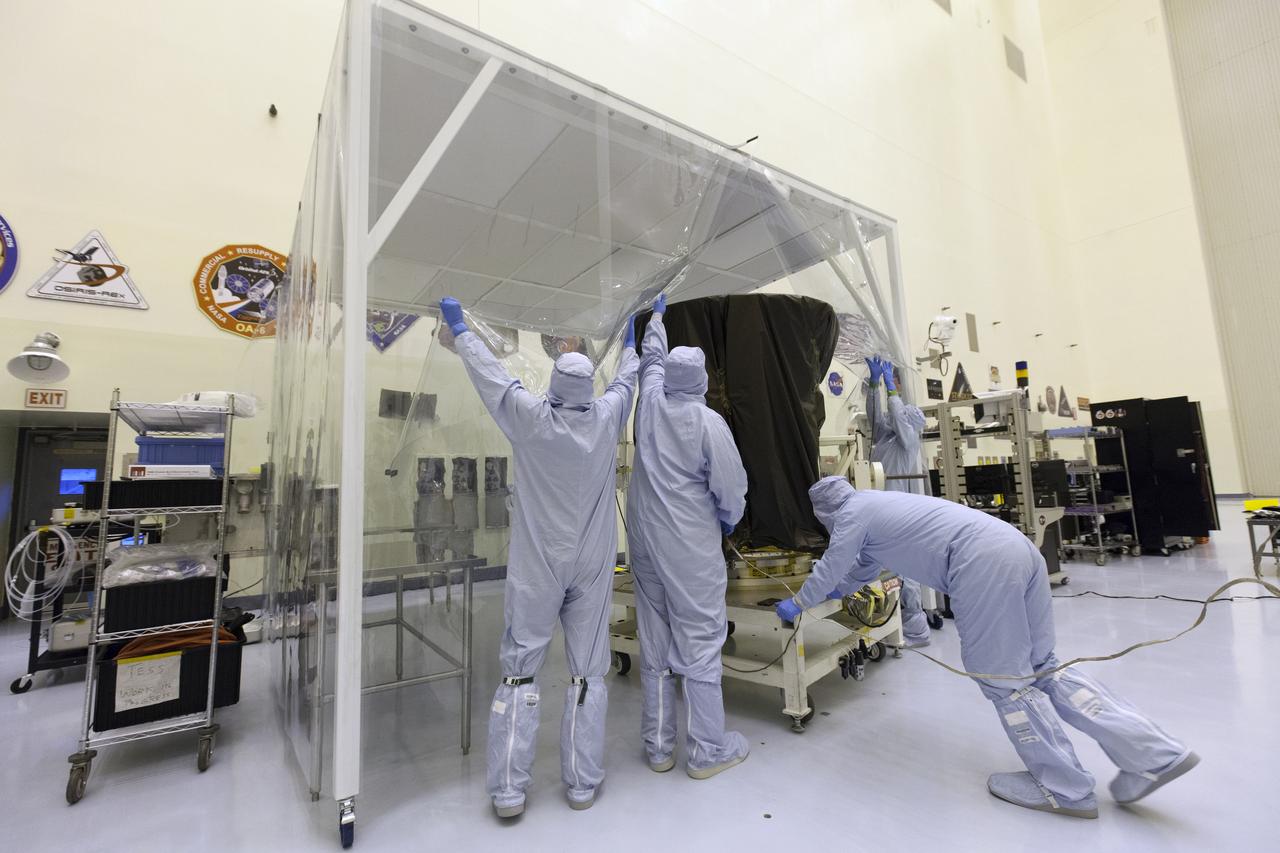
Technician dressed in clean room suits move NASA's Transiting Exoplanet Survey Satellite (TESS) on a test stand into a clean room tent inside the Payload Hazardous Servicing Facility (PHSF) at the agency's Kennedy Space Center in Florida. Inside the PHSF, the satellite will be processed and prepared for its flight. TESS is scheduled to launch atop a SpaceX Falcon 9 rocket from Space Launch Complex 40 at Cape Canaveral Air Force Station. TESS is the next step in NASA's search for planets outside our solar system, known as exoplanets. TESS is a NASA Astrophysics Explorer mission led and operated by MIT in Cambridge, Massachusetts, and managed by NASA’s Goddard Space Flight Center in Greenbelt, Maryland. Dr. George Ricker of MIT’s Kavli Institute for Astrophysics and Space Research serves as principal investigator for the mission. Additional partners include Orbital ATK, NASA’s Ames Research Center, the Harvard-Smithsonian Center for Astrophysics and the Space Telescope Science Institute. More than a dozen universities, research institutes and observatories worldwide are participants in the mission. NASA’s Launch Services Program is responsible for launch management.
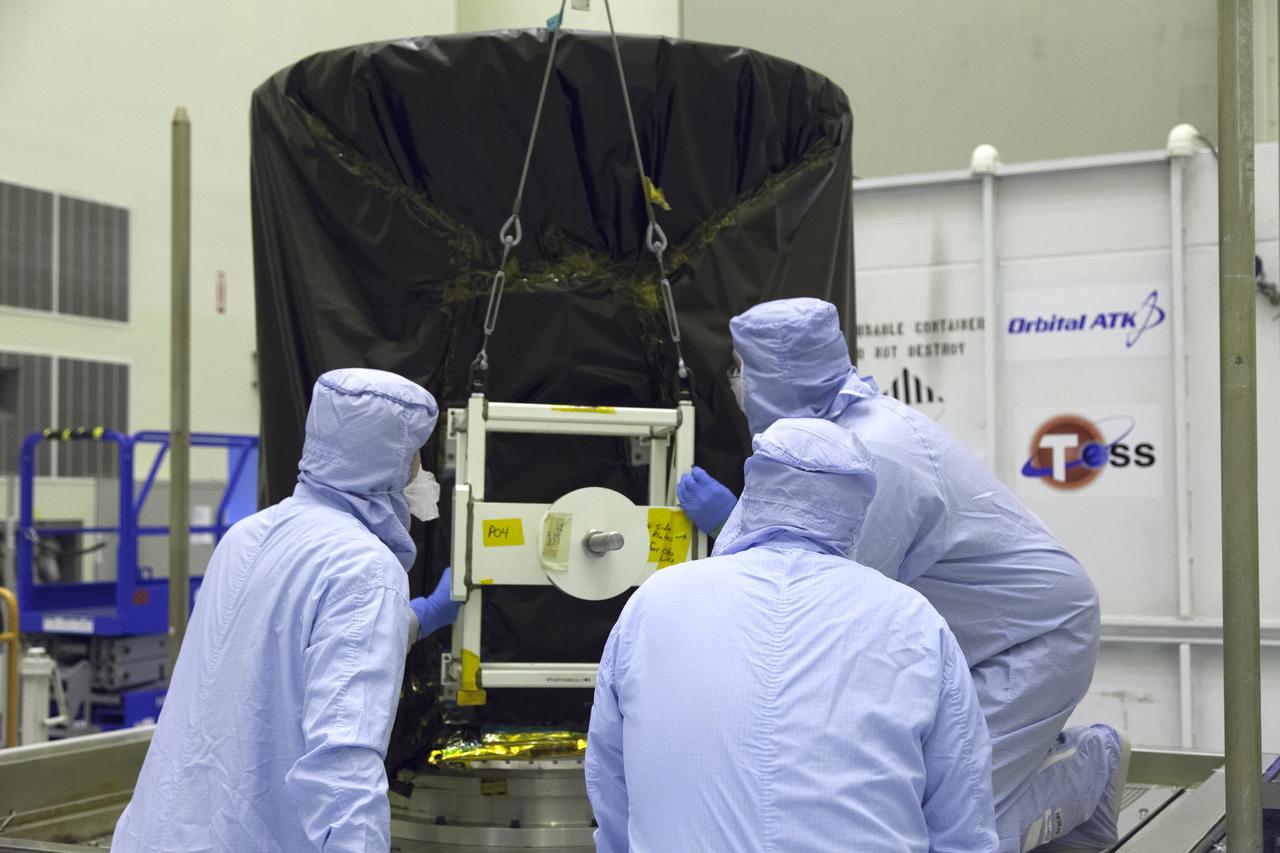
NASA's Transiting Exoplanet Survey Satellite (TESS) is lifted up from the base of its shipping container and will be lowered onto a test stand for processing inside the Payload Hazardous Servicing Facility (PHSF) at the agency's Kennedy Space Center in Florida. Inside the PHSF, the satellite will be processed and prepared for its flight. TESS is scheduled to launch atop a SpaceX Falcon 9 rocket from Space Launch Complex 40 at Cape Canaveral Air Force Station. TESS is the next step in NASA's search for planets outside our solar system, known as exoplanets. TESS is a NASA Astrophysics Explorer mission led and operated by MIT in Cambridge, Massachusetts, and managed by NASA’s Goddard Space Flight Center in Greenbelt, Maryland. Dr. George Ricker of MIT’s Kavli Institute for Astrophysics and Space Research serves as principal investigator for the mission. Additional partners include Orbital ATK, NASA’s Ames Research Center, the Harvard-Smithsonian Center for Astrophysics and the Space Telescope Science Institute. More than a dozen universities, research institutes and observatories worldwide are participants in the mission. NASA’s Launch Services Program is responsible for launch management.
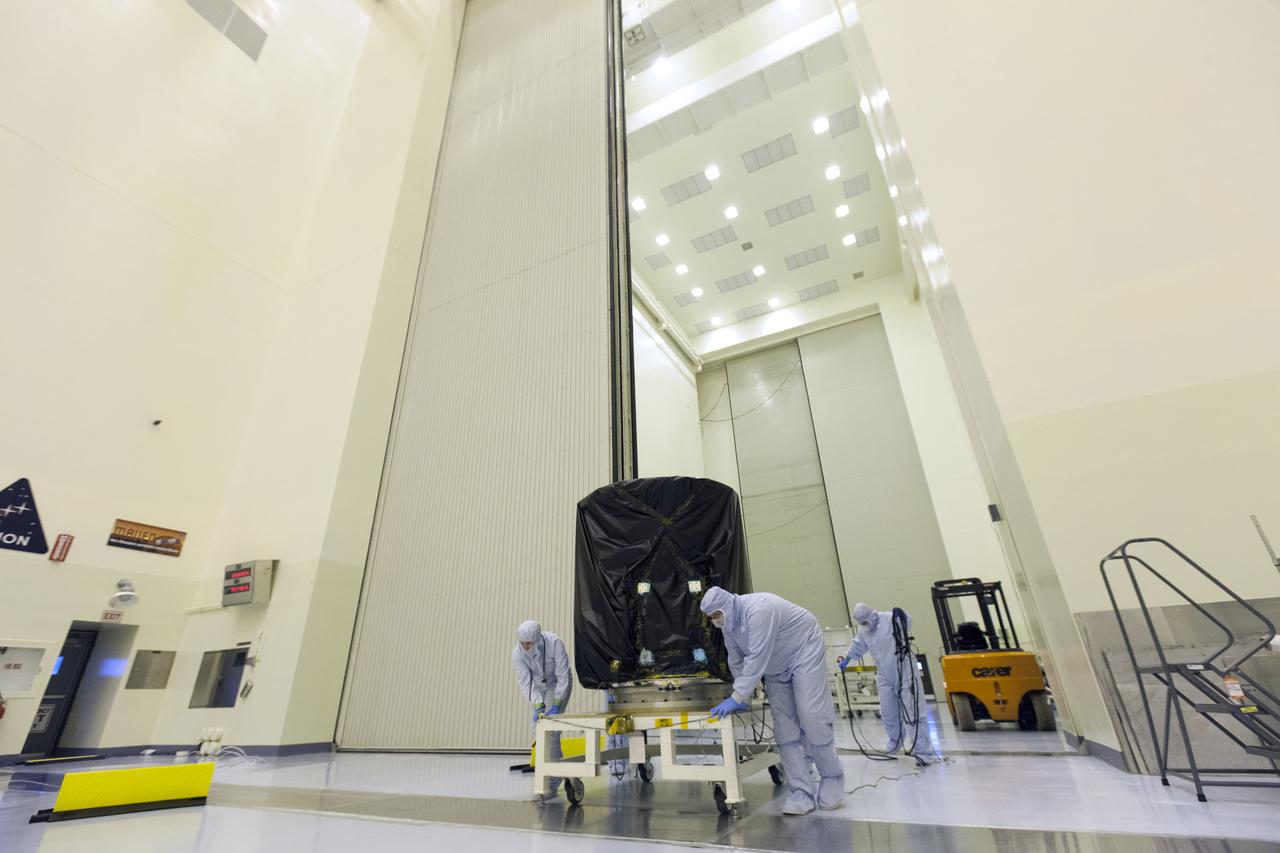
Technicians dressed in clean room suits move NASA's Transiting Exoplanet Survey Satellite (TESS) on a test stand inside the Payload Hazardous Servicing Facility (PHSF) at the agency's Kennedy Space Center in Florida. Inside the PHSF, the satellite will be processed and prepared for its flight. TESS is scheduled to launch atop a SpaceX Falcon 9 rocket from Space Launch Complex 40 at Cape Canaveral Air Force Station. TESS is the next step in NASA's search for planets outside our solar system, known as exoplanets. TESS is a NASA Astrophysics Explorer mission led and operated by MIT in Cambridge, Massachusetts, and managed by NASA’s Goddard Space Flight Center in Greenbelt, Maryland. Dr. George Ricker of MIT’s Kavli Institute for Astrophysics and Space Research serves as principal investigator for the mission. Additional partners include Orbital ATK, NASA’s Ames Research Center, the Harvard-Smithsonian Center for Astrophysics and the Space Telescope Science Institute. More than a dozen universities, research institutes and observatories worldwide are participants in the mission. NASA’s Launch Services Program is responsible for launch management.
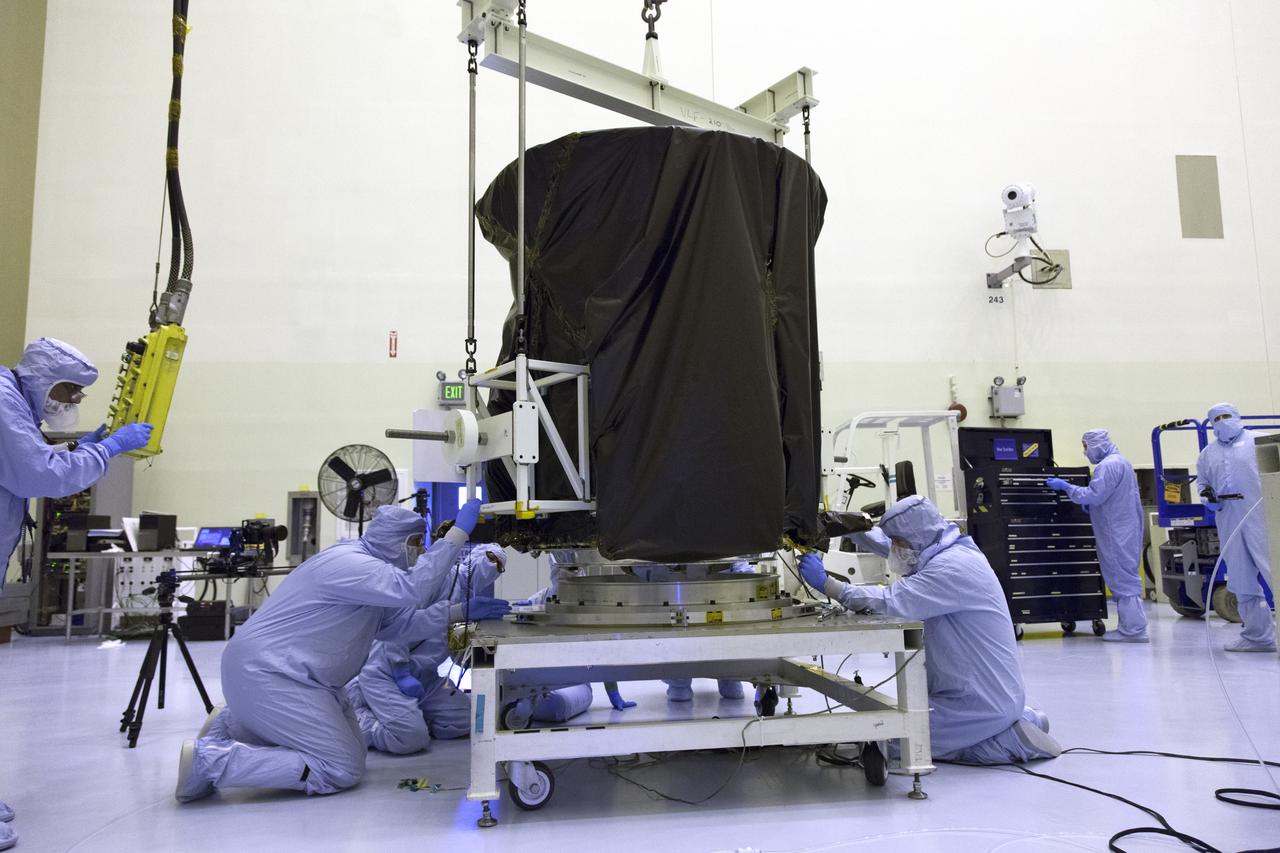
Technicians dressed in clean room suits monitor the progress as a crane lowers NASA's Transiting Exoplanet Survey Satellite (TESS) onto a test stand inside the Payload Hazardous Servicing Facility (PHSF) at the agency's Kennedy Space Center in Florida. Inside the PHSF, the satellite will be processed and prepared for its flight. TESS is scheduled to launch atop a SpaceX Falcon 9 rocket from Space Launch Complex 40 at Cape Canaveral Air Force Station. TESS is the next step in NASA's search for planets outside our solar system, known as exoplanets. TESS is a NASA Astrophysics Explorer mission led and operated by MIT in Cambridge, Massachusetts, and managed by NASA’s Goddard Space Flight Center in Greenbelt, Maryland. Dr. George Ricker of MIT’s Kavli Institute for Astrophysics and Space Research serves as principal investigator for the mission. Additional partners include Orbital ATK, NASA’s Ames Research Center, the Harvard-Smithsonian Center for Astrophysics and the Space Telescope Science Institute. More than a dozen universities, research institutes and observatories worldwide are participants in the mission. NASA’s Launch Services Program is responsible for launch management.
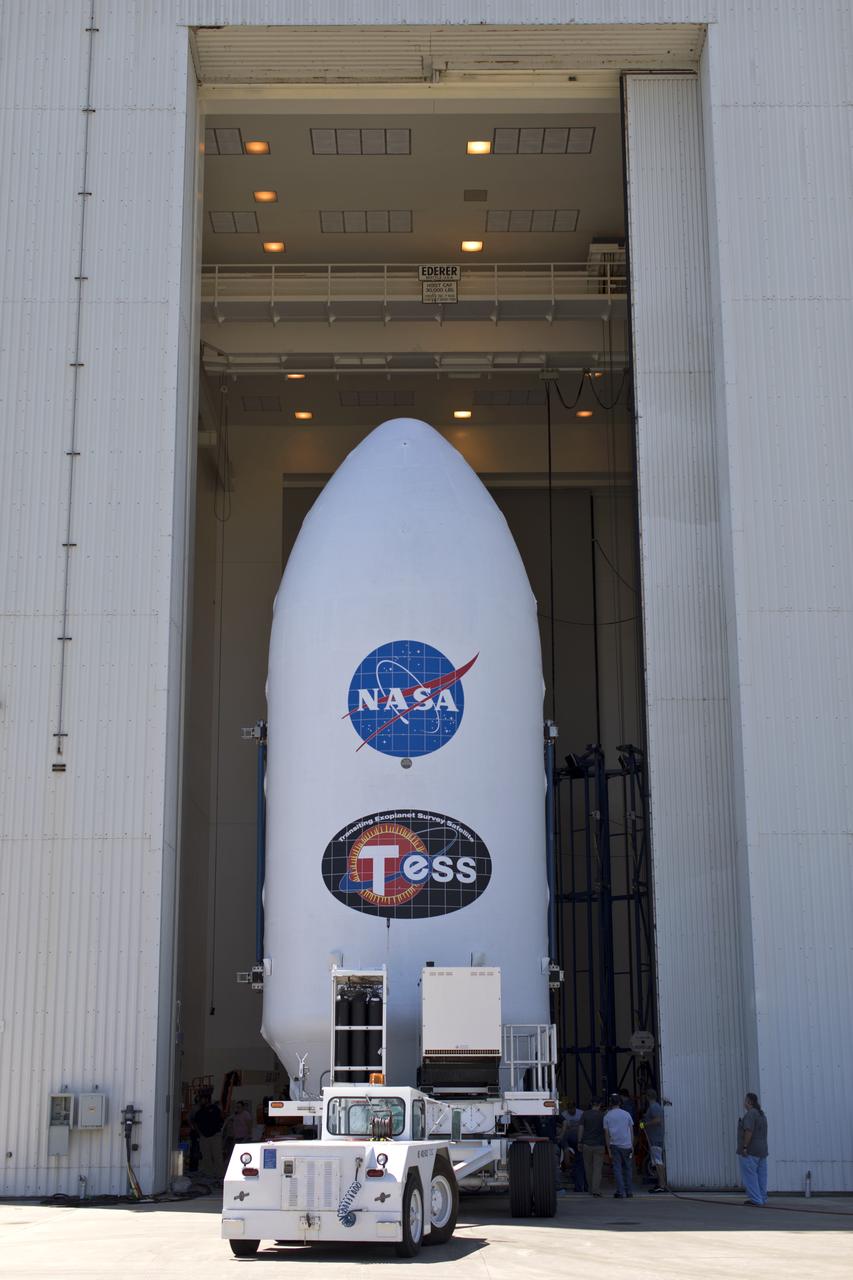
The payload fairing for NASA's Transiting Exoplanet Survey Satellite (TESS) is moved inside the Payload Hazardous Servicing Facility at the agency's Kennedy Space Center in Florida. Inside the facility, TESS will be encapsulated in the payload fairing. The satellite is scheduled to launch atop a SpaceX Falcon 9 rocket from Space Launch Complex 40 at Cape Canaveral Air Force Station on April 16. The satellite is the next step in NASA's search for planets outside our solar system, known as exoplanets. TESS is a NASA Astrophysics Explorer mission led and operated by MIT in Cambridge, Massachusetts, and managed by NASA’s Goddard Space Flight Center in Greenbelt, Maryland. Dr. George Ricker of MIT’s Kavli Institute for Astrophysics and Space Research serves as principal investigator for the mission. Additional partners include Orbital ATK, NASA’s Ames Research Center, the Harvard-Smithsonian Center for Astrophysics and the Space Telescope Science Institute. More than a dozen universities, research institutes and observatories worldwide are participants in the mission. NASA’s Launch Services Program is responsible for launch management.
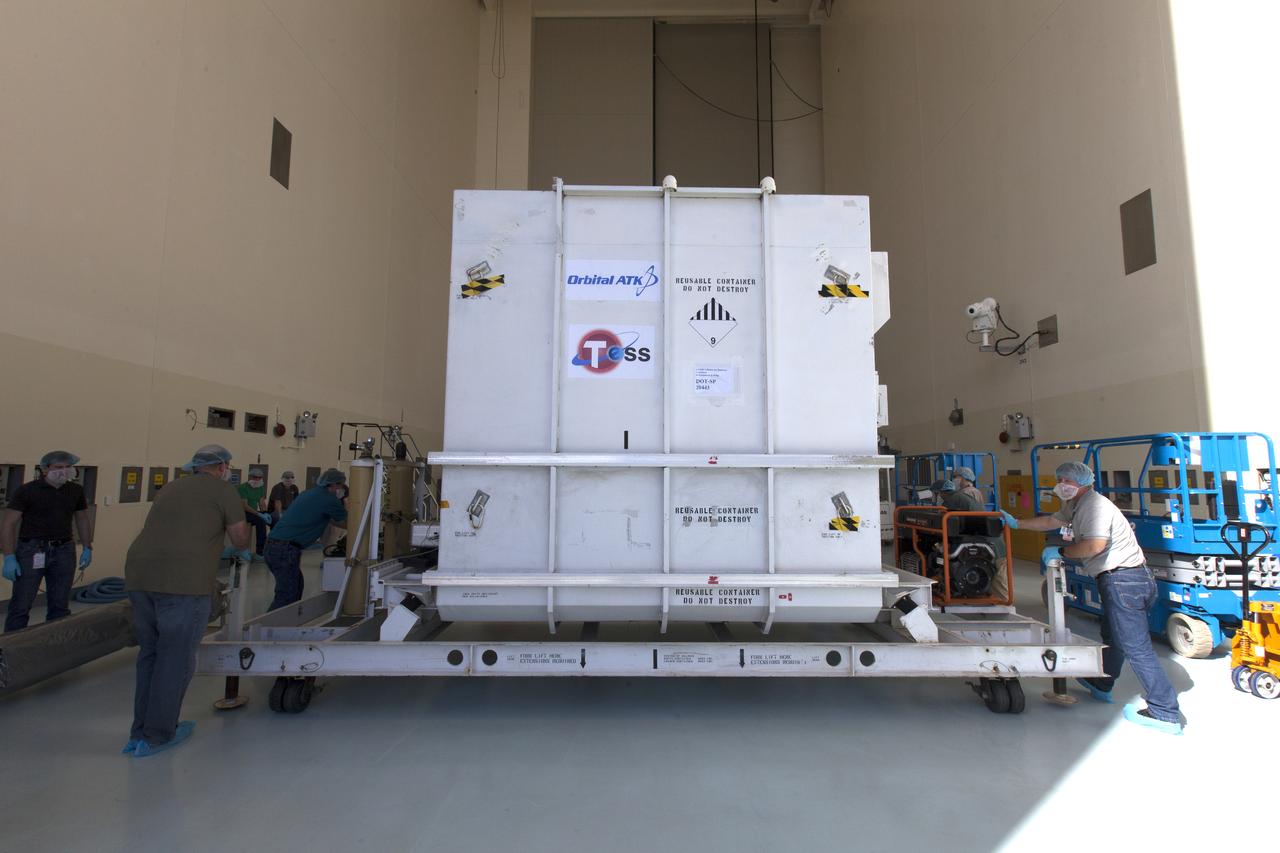
NASA's Transiting Exoplanet Survey Satellite (TESS), inside its shipping container, is moved into Payload Hazardous Servicing Facility (PHSF) at the agency's Kennedy Space Center in Florida. Inside the PHSF, the satellite will be processed and prepared for its flight. TESS is scheduled to launch atop a SpaceX Falcon 9 rocket from Space Launch Complex 40 at Cape Canaveral Air Force Station. TESS is the next step in NASA's search for planets outside our solar system, known as exoplanets. TESS is a NASA Astrophysics Explorer mission led and operated by MIT in Cambridge, Massachusetts, and managed by NASA’s Goddard Space Flight Center in Greenbelt, Maryland. Dr. George Ricker of MIT’s Kavli Institute for Astrophysics and Space Research serves as principal investigator for the mission. Additional partners include Orbital ATK, NASA’s Ames Research Center, the Harvard-Smithsonian Center for Astrophysics and the Space Telescope Science Institute. More than a dozen universities, research institutes and observatories worldwide are participants in the mission. NASA’s Launch Services Program is responsible for launch management.
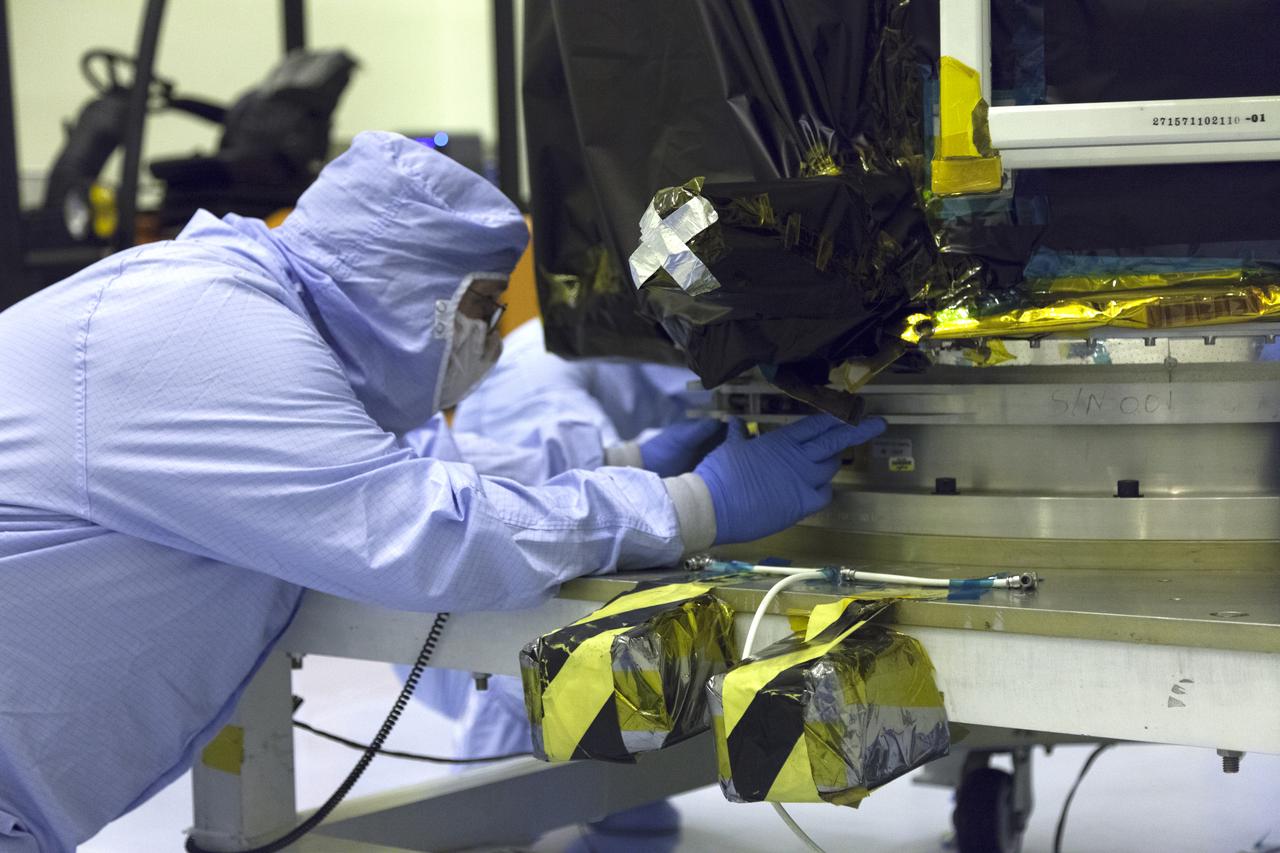
A technician dressed in a clean room suit closely monitors the progress as a crane lowers NASA's Transiting Exoplanet Survey Satellite (TESS) onto a test stand inside the Payload Hazardous Servicing Facility (PHSF) at the agency's Kennedy Space Center in Florida. Inside the PHSF, the satellite will be processed and prepared for its flight. TESS is scheduled to launch atop a SpaceX Falcon 9 rocket from Space Launch Complex 40 at Cape Canaveral Air Force Station. TESS is the next step in NASA's search for planets outside our solar system, known as exoplanets. TESS is a NASA Astrophysics Explorer mission led and operated by MIT in Cambridge, Massachusetts, and managed by NASA’s Goddard Space Flight Center in Greenbelt, Maryland. Dr. George Ricker of MIT’s Kavli Institute for Astrophysics and Space Research serves as principal investigator for the mission. Additional partners include Orbital ATK, NASA’s Ames Research Center, the Harvard-Smithsonian Center for Astrophysics and the Space Telescope Science Institute. More than a dozen universities, research institutes and observatories worldwide are participants in the mission. NASA’s Launch Services Program is responsible for launch management.
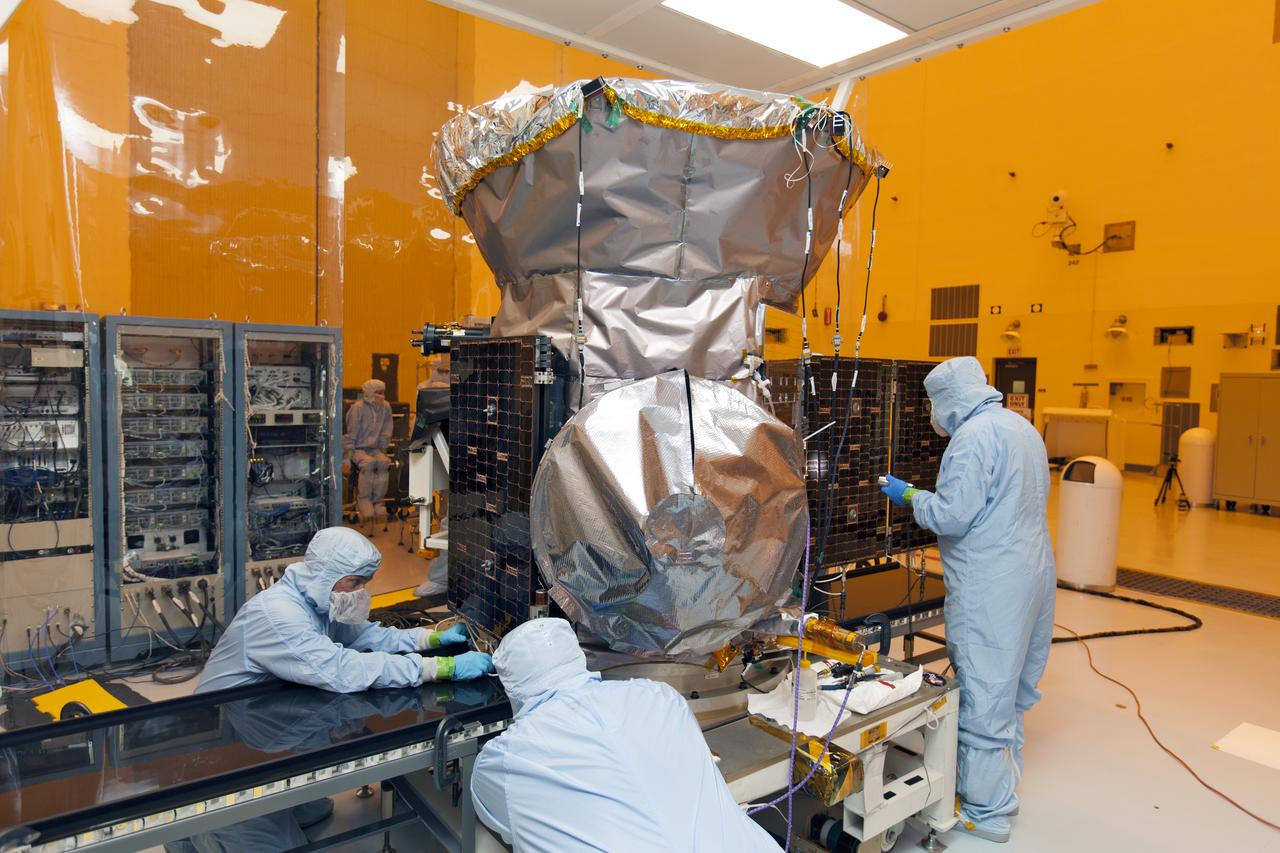
Inside the Payload Hazardous Servicing Facility at the NASA's Kennedy Space Center in Florida, one of the solar panels is being deployed on the agency's Transiting Exoplanet Survey Satellite (TESS). Technicians are preparing to deploy the second solar array. The satellite is scheduled to launch atop a SpaceX Falcon 9 rocket from Space Launch Complex 40 at Cape Canaveral Air Force Station. TESS is the next step in NASA's search for planets outside our solar system, known as exoplanets. TESS is a NASA Astrophysics Explorer mission led and operated by MIT in Cambridge, Massachusetts, and managed by NASA’s Goddard Space Flight Center in Greenbelt, Maryland. Dr. George Ricker of MIT’s Kavli Institute for Astrophysics and Space Research serves as principal investigator for the mission. Additional partners include Orbital ATK, NASA’s Ames Research Center, the Harvard-Smithsonian Center for Astrophysics and the Space Telescope Science Institute. More than a dozen universities, research institutes and observatories worldwide are participants in the mission. NASA’s Launch Services Program is responsible for launch management.
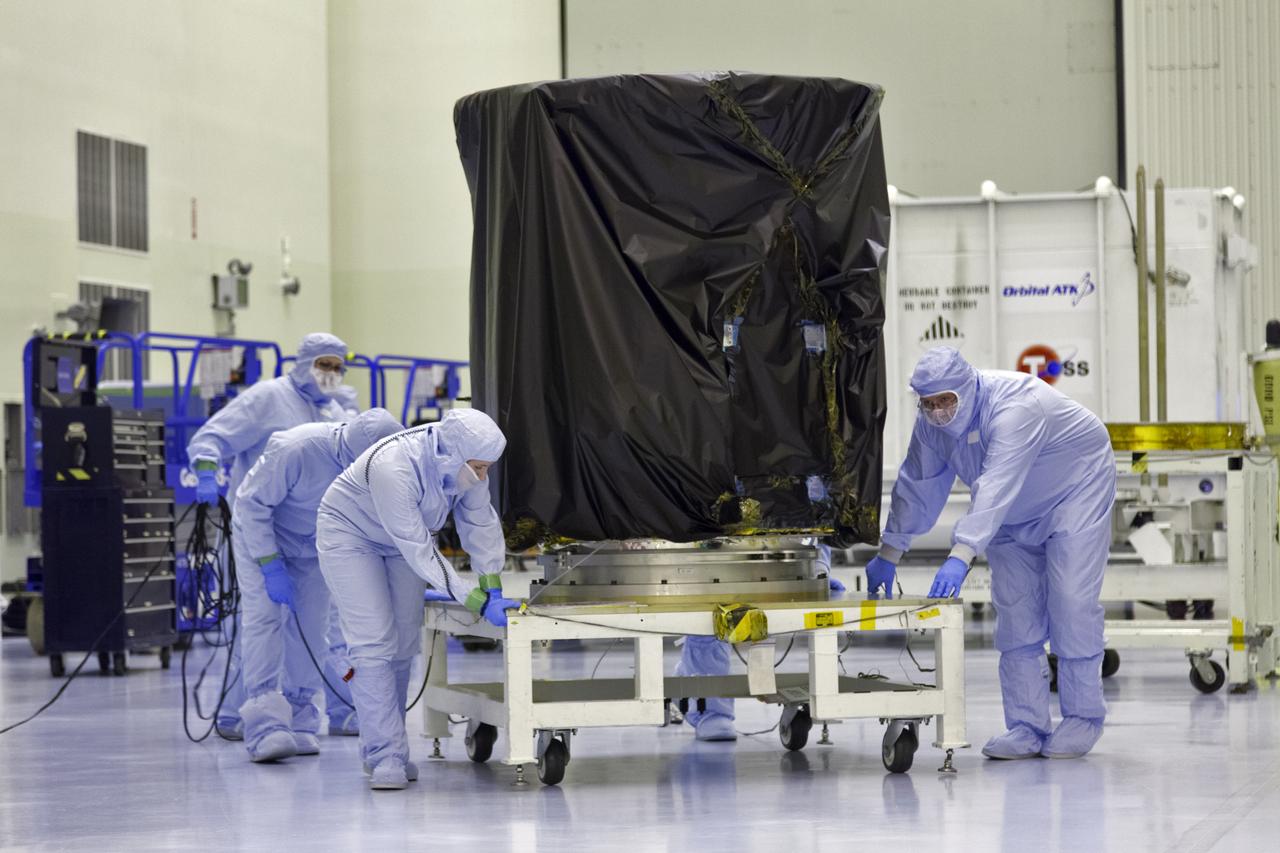
Technicians dressed in clean room suits move NASA's Transiting Exoplanet Survey Satellite (TESS) secured on a test stand inside the Payload Hazardous Servicing Facility (PHSF) at the agency's Kennedy Space Center in Florida. Inside the PHSF, the satellite will be processed and prepared for its flight. TESS is scheduled to launch atop a SpaceX Falcon 9 rocket from Space Launch Complex 40 at Cape Canaveral Air Force Station. TESS is the next step in NASA's search for planets outside our solar system, known as exoplanets. TESS is a NASA Astrophysics Explorer mission led and operated by MIT in Cambridge, Massachusetts, and managed by NASA’s Goddard Space Flight Center in Greenbelt, Maryland. Dr. George Ricker of MIT’s Kavli Institute for Astrophysics and Space Research serves as principal investigator for the mission. Additional partners include Orbital ATK, NASA’s Ames Research Center, the Harvard-Smithsonian Center for Astrophysics and the Space Telescope Science Institute. More than a dozen universities, research institutes and observatories worldwide are participants in the mission. NASA’s Launch Services Program is responsible for launch management.
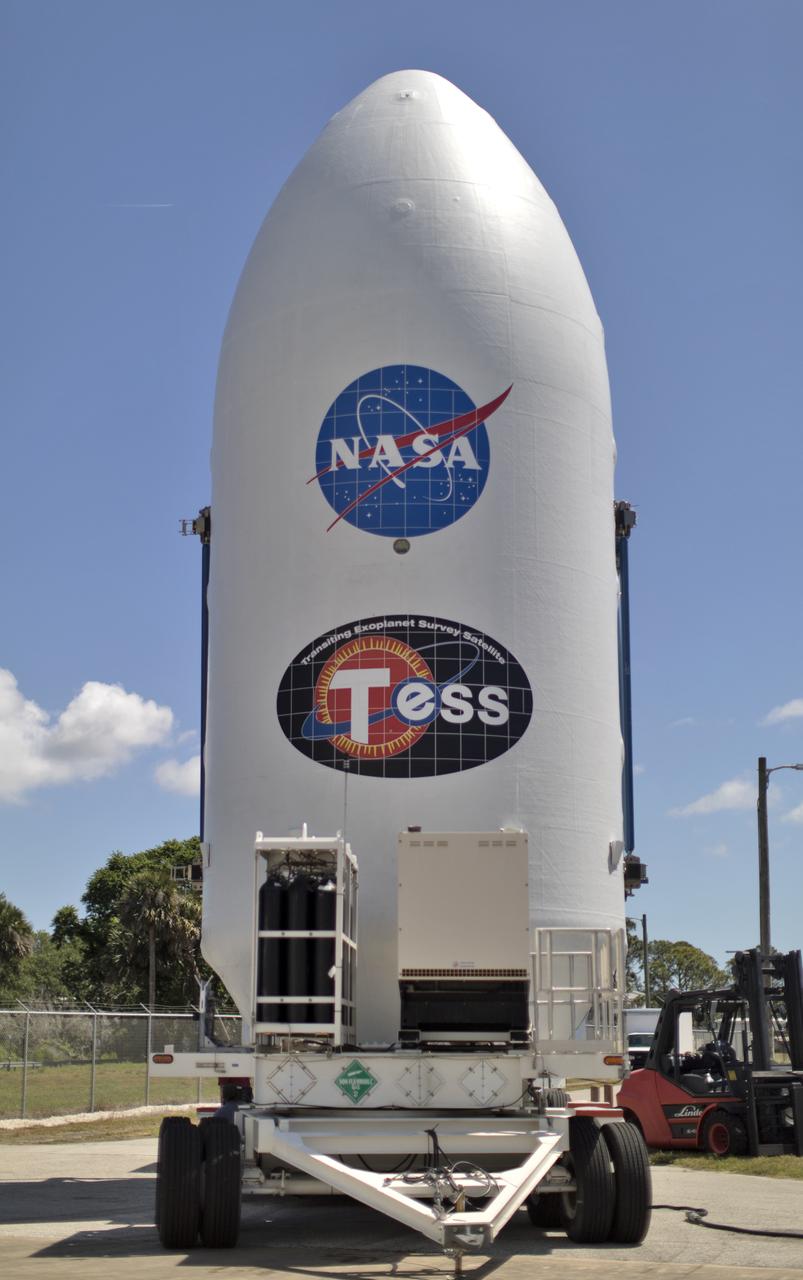
The payload fairing for NASA's Transiting Exoplanet Survey Satellite (TESS) is being prepared for the move to the Payload Hazardous Servicing Facility at the agency's Kennedy Space Center in Florida. Inside the facility, TESS will be encapsulated in the payload fairing. The satellite is scheduled to launch atop a SpaceX Falcon 9 rocket from Space Launch Complex 40 at Cape Canaveral Air Force Station on April 16. The satellite is the next step in NASA's search for planets outside our solar system, known as exoplanets. TESS is a NASA Astrophysics Explorer mission led and operated by MIT in Cambridge, Massachusetts, and managed by NASA’s Goddard Space Flight Center in Greenbelt, Maryland. Dr. George Ricker of MIT’s Kavli Institute for Astrophysics and Space Research serves as principal investigator for the mission. Additional partners include Orbital ATK, NASA’s Ames Research Center, the Harvard-Smithsonian Center for Astrophysics and the Space Telescope Science Institute. More than a dozen universities, research institutes and observatories worldwide are participants in the mission. NASA’s Launch Services Program is responsible for launch management.
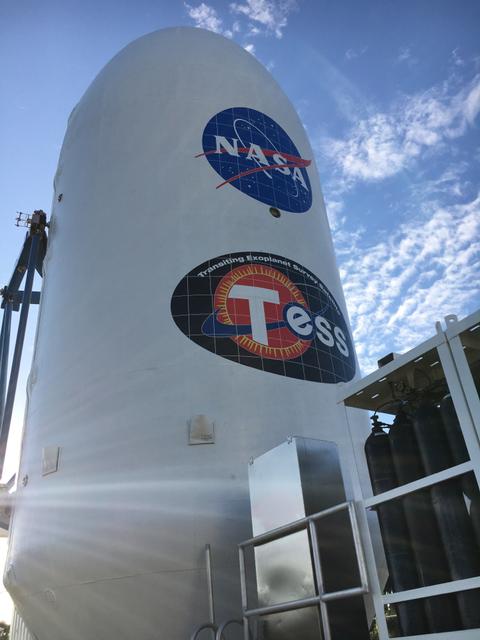
The payload fairing for NASA's Transiting Exoplanet Survey Satellite (TESS) is being moved to the Payload Hazardous Servicing Facility at the agency's Kennedy Space Center in Florida. Inside the facility, TESS will be encapsulated in the payload fairing. The satellite is scheduled to launch atop a SpaceX Falcon 9 rocket from Space Launch Complex 40 at Cape Canaveral Air Force Station on April 16. The satellite is the next step in NASA's search for planets outside our solar system, known as exoplanets. TESS is a NASA Astrophysics Explorer mission led and operated by MIT in Cambridge, Massachusetts, and managed by NASA’s Goddard Space Flight Center in Greenbelt, Maryland. Dr. George Ricker of MIT’s Kavli Institute for Astrophysics and Space Research serves as principal investigator for the mission. Additional partners include Orbital ATK, NASA’s Ames Research Center, the Harvard-Smithsonian Center for Astrophysics and the Space Telescope Science Institute. More than a dozen universities, research institutes and observatories worldwide are participants in the mission. NASA’s Launch Services Program is responsible for launch management.
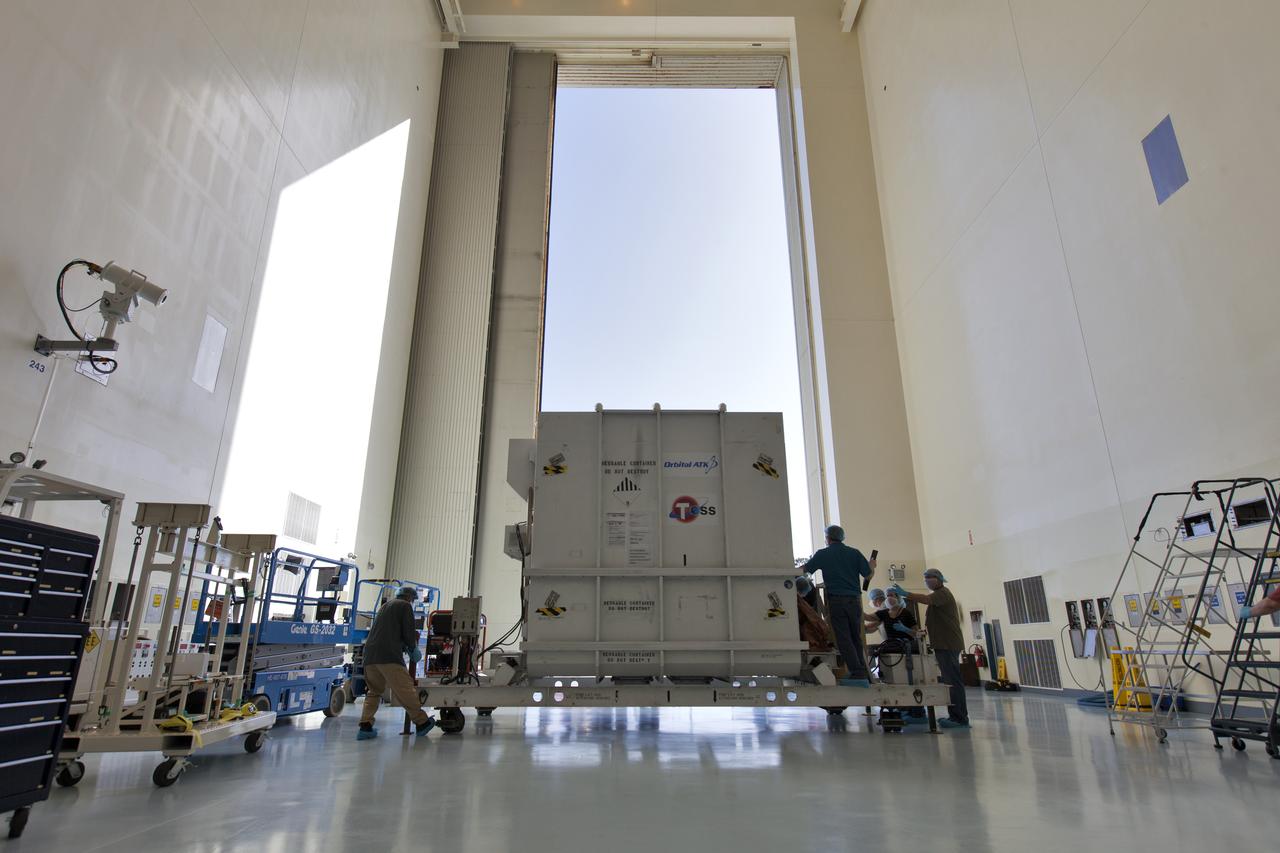
The shipping container with NASA's Transiting Exoplanet Survey Satellite (TESS) inside, is moved into the Payload Hazardous Servicing Facility (PHSF) at the agency's Kennedy Space Center in Florida. Inside the PHSF, the satellite will be processed and prepared for its flight. TESS is scheduled to launch atop a SpaceX Falcon 9 rocket from Space Launch Complex 40 at Cape Canaveral Air Force Station. TESS is the next step in NASA's search for planets outside our solar system, known as exoplanets. TESS is a NASA Astrophysics Explorer mission led and operated by MIT in Cambridge, Massachusetts, and managed by NASA’s Goddard Space Flight Center in Greenbelt, Maryland. Dr. George Ricker of MIT’s Kavli Institute for Astrophysics and Space Research serves as principal investigator for the mission. Additional partners include Orbital ATK, NASA’s Ames Research Center, the Harvard-Smithsonian Center for Astrophysics and the Space Telescope Science Institute. More than a dozen universities, research institutes and observatories worldwide are participants in the mission. NASA’s Launch Services Program is responsible for launch management.
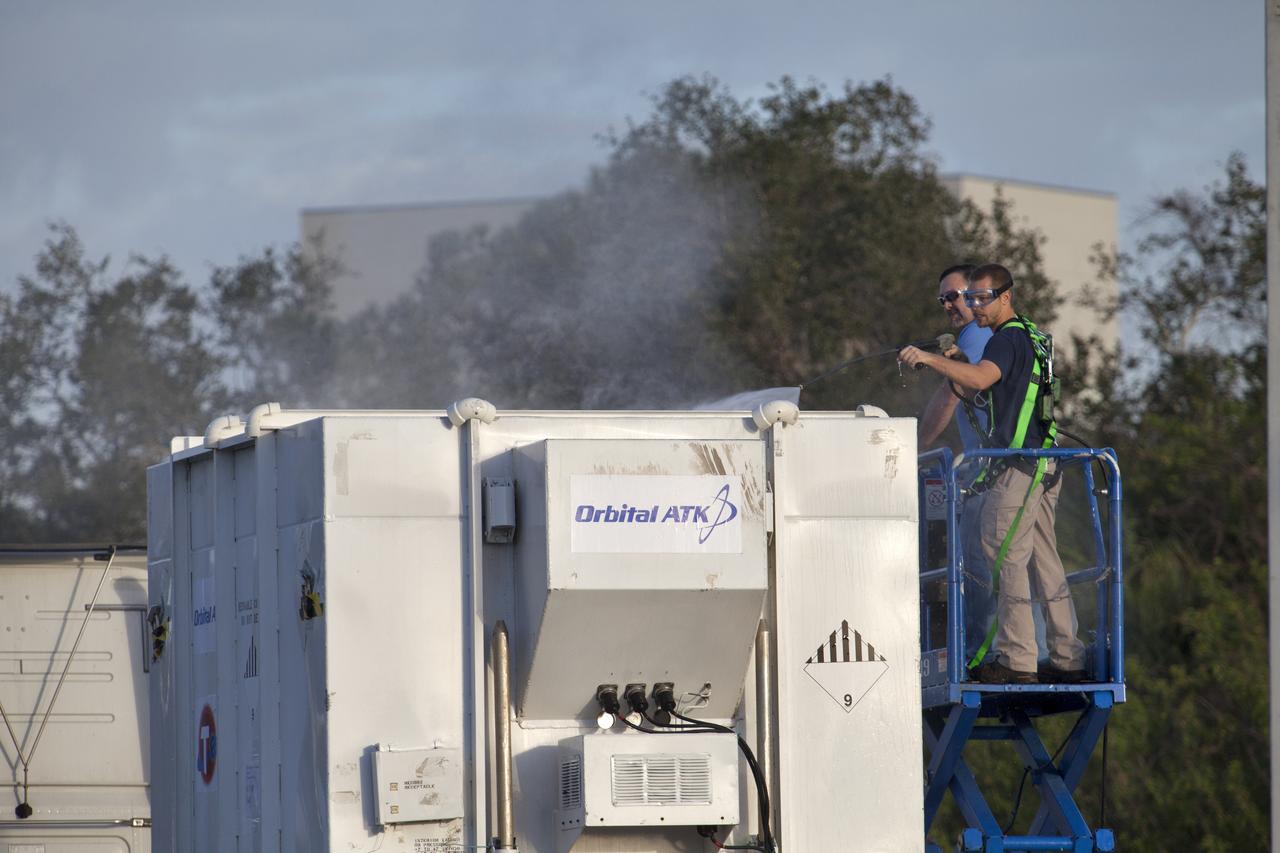
NASA's Transiting Exoplanet Survey Satellite (TESS) container is pressure washed at the Multi-Payload Processing Facility at the agency's Kennedy Space Center in Florida. Tess will be moved to the Payload Hazardous Servicing Facility to be processed and prepared for flight. TESS is scheduled to launch atop a SpaceX Falcon 9 rocket from Space Launch Complex 40 at Cape Canaveral Air Force Station. TESS is the next step in NASA's search for planets outside our solar system, known as exoplanets. TESS is a NASA Astrophysics Explorer mission led and operated by MIT in Cambridge, Massachusetts, and managed by NASA’s Goddard Space Flight Center in Greenbelt, Maryland. Dr. George Ricker of MIT’s Kavli Institute for Astrophysics and Space Research serves as principal investigator for the mission. Additional partners include Orbital ATK, NASA’s Ames Research Center, the Harvard-Smithsonian Center for Astrophysics and the Space Telescope Science Institute. More than a dozen universities, research institutes and observatories worldwide are participants in the mission. NASA’s Launch Services Program is responsible for launch management.
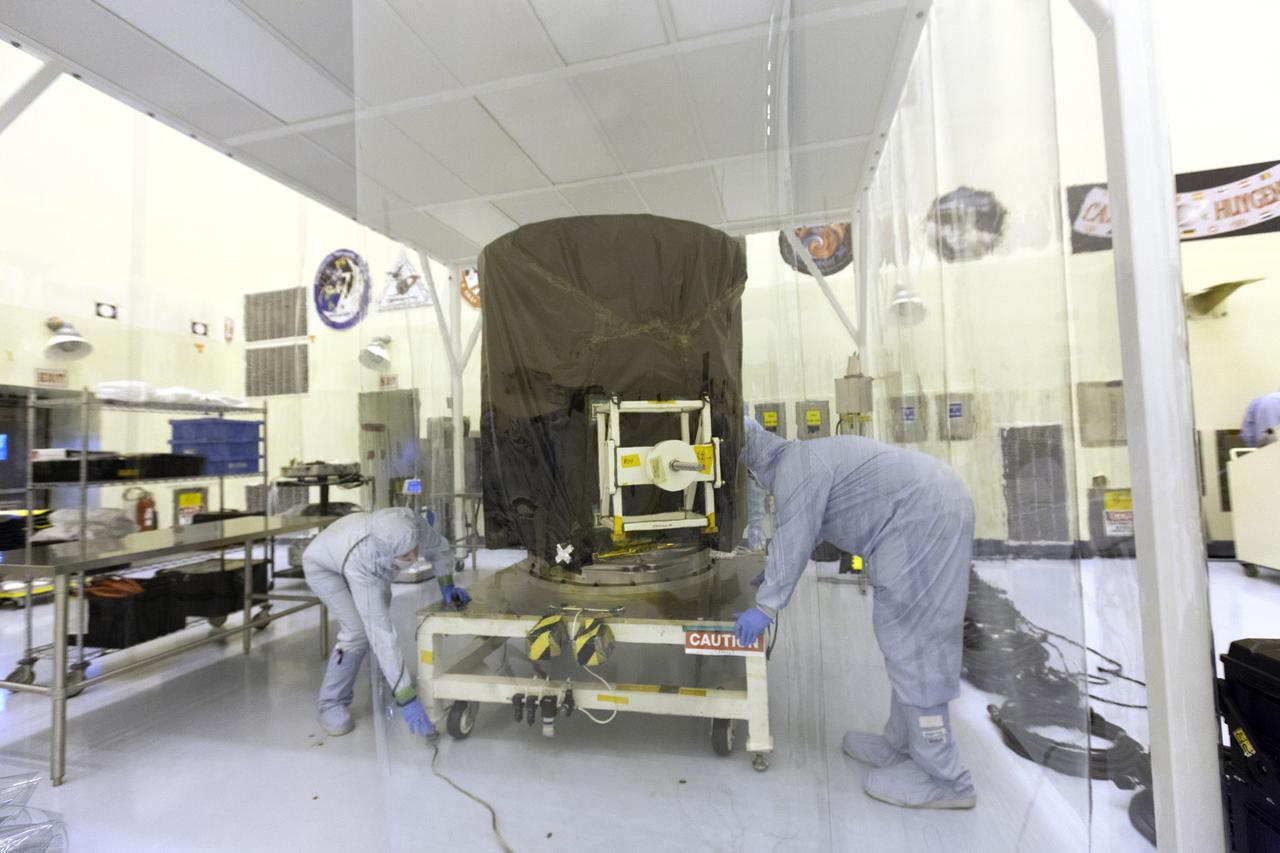
NASA's Transiting Exoplanet Survey Satellite (TESS), secured on a test stand, is moved into a clean room tent inside the Payload Hazardous Servicing Facility (PHSF) at the agency's Kennedy Space Center in Florida. Inside the PHSF, the satellite will be processed and prepared for its flight. TESS is scheduled to launch atop a SpaceX Falcon 9 rocket from Space Launch Complex 40 at Cape Canaveral Air Force Station. TESS is the next step in NASA's search for planets outside our solar system, known as exoplanets. TESS is a NASA Astrophysics Explorer mission led and operated by MIT in Cambridge, Massachusetts, and managed by NASA’s Goddard Space Flight Center in Greenbelt, Maryland. Dr. George Ricker of MIT’s Kavli Institute for Astrophysics and Space Research serves as principal investigator for the mission. Additional partners include Orbital ATK, NASA’s Ames Research Center, the Harvard-Smithsonian Center for Astrophysics and the Space Telescope Science Institute. More than a dozen universities, research institutes and observatories worldwide are participants in the mission. NASA’s Launch Services Program is responsible for launch management.
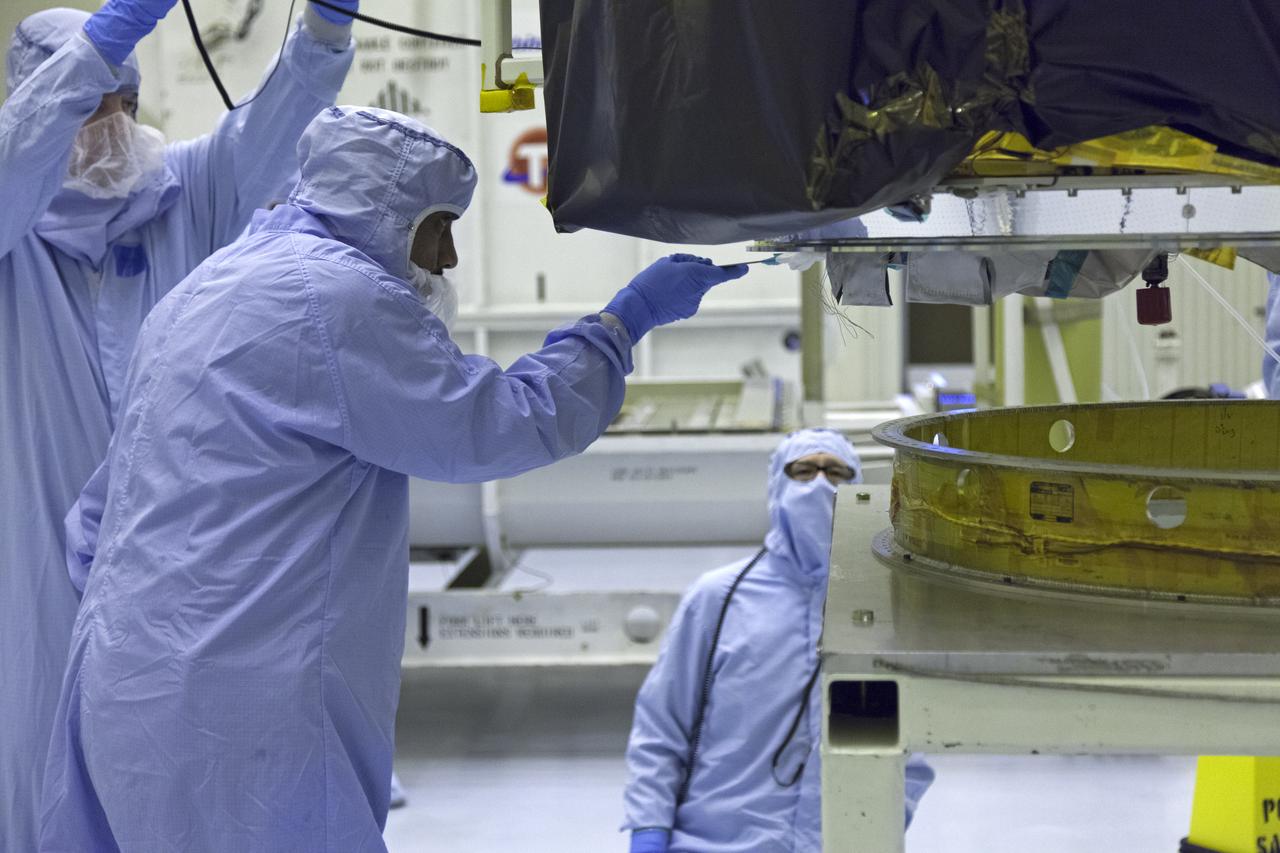
Technicians dressed in clean room suits monitor the progress as a crane lowers NASA's Transiting Exoplanet Survey Satellite (TESS) onto a test stand inside the Payload Hazardous Servicing Facility (PHSF) at the agency's Kennedy Space Center in Florida. Inside the PHSF, the satellite will be processed and prepared for its flight. TESS is scheduled to launch atop a SpaceX Falcon 9 rocket from Space Launch Complex 40 at Cape Canaveral Air Force Station. TESS is the next step in NASA's search for planets outside our solar system, known as exoplanets. TESS is a NASA Astrophysics Explorer mission led and operated by MIT in Cambridge, Massachusetts, and managed by NASA’s Goddard Space Flight Center in Greenbelt, Maryland. Dr. George Ricker of MIT’s Kavli Institute for Astrophysics and Space Research serves as principal investigator for the mission. Additional partners include Orbital ATK, NASA’s Ames Research Center, the Harvard-Smithsonian Center for Astrophysics and the Space Telescope Science Institute. More than a dozen universities, research institutes and observatories worldwide are participants in the mission. NASA’s Launch Services Program is responsible for launch management.
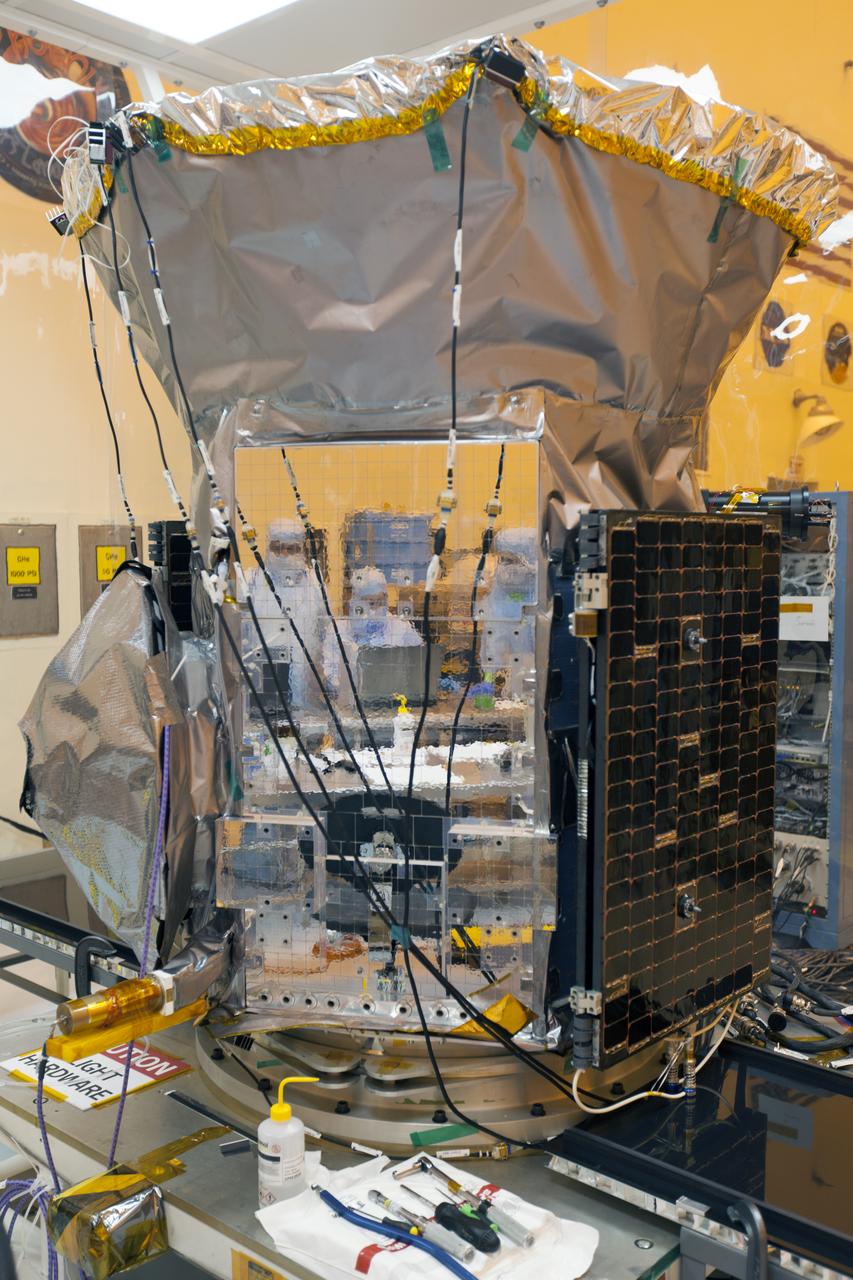
Preparations are underway for solar panel deployment on NASA's Transiting Exoplanet Survey Satellite (TESS) inside the Payload Hazardous Servicing Facility at the agency's Kennedy Space Center in Florida. TESS is scheduled to launch atop a SpaceX Falcon 9 rocket from Space Launch Complex 40 at Cape Canaveral Air Force Station. The satellite is the next step in NASA's search for planets outside our solar system, known as exoplanets. TESS is a NASA Astrophysics Explorer mission led and operated by MIT in Cambridge, Massachusetts, and managed by NASA’s Goddard Space Flight Center in Greenbelt, Maryland. Dr. George Ricker of MIT’s Kavli Institute for Astrophysics and Space Research serves as principal investigator for the mission. Additional partners include Orbital ATK, NASA’s Ames Research Center, the Harvard-Smithsonian Center for Astrophysics and the Space Telescope Science Institute. More than a dozen universities, research institutes and observatories worldwide are participants in the mission. NASA’s Launch Services Program is responsible for launch management.
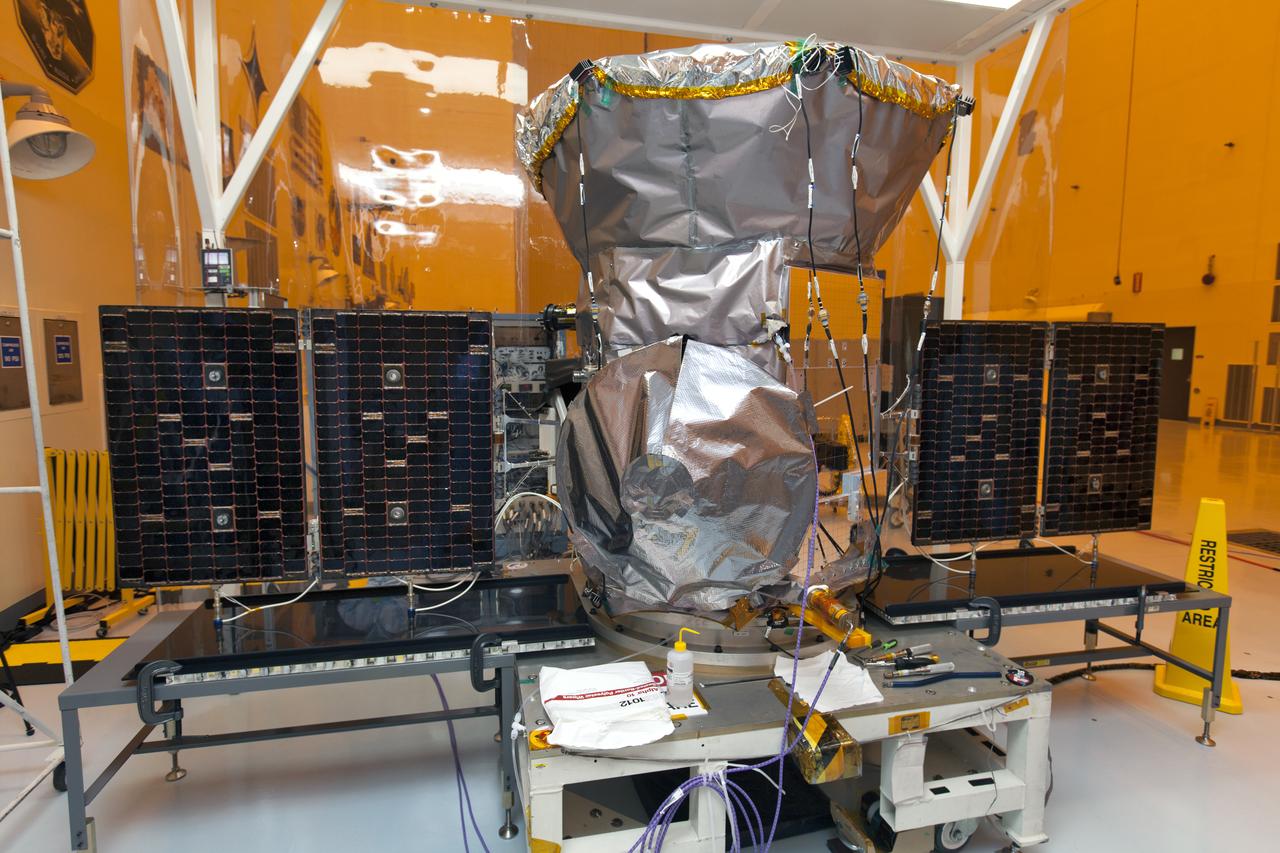
Inside the Payload Hazardous Servicing Facility at the NASA's Kennedy Space Center in Florida, both solar panels are deployed on the agency's Transiting Exoplanet Survey Satellite (TESS). The satellite is scheduled to launch atop a SpaceX Falcon 9 rocket from Space Launch Complex 40 at Cape Canaveral Air Force Station. TESS is the next step in NASA's search for planets outside our solar system, known as exoplanets. TESS is a NASA Astrophysics Explorer mission led and operated by MIT in Cambridge, Massachusetts, and managed by NASA’s Goddard Space Flight Center in Greenbelt, Maryland. Dr. George Ricker of MIT’s Kavli Institute for Astrophysics and Space Research serves as principal investigator for the mission. Additional partners include Orbital ATK, NASA’s Ames Research Center, the Harvard-Smithsonian Center for Astrophysics and the Space Telescope Science Institute. More than a dozen universities, research institutes and observatories worldwide are participants in the mission. NASA’s Launch Services Program is responsible for launch management.
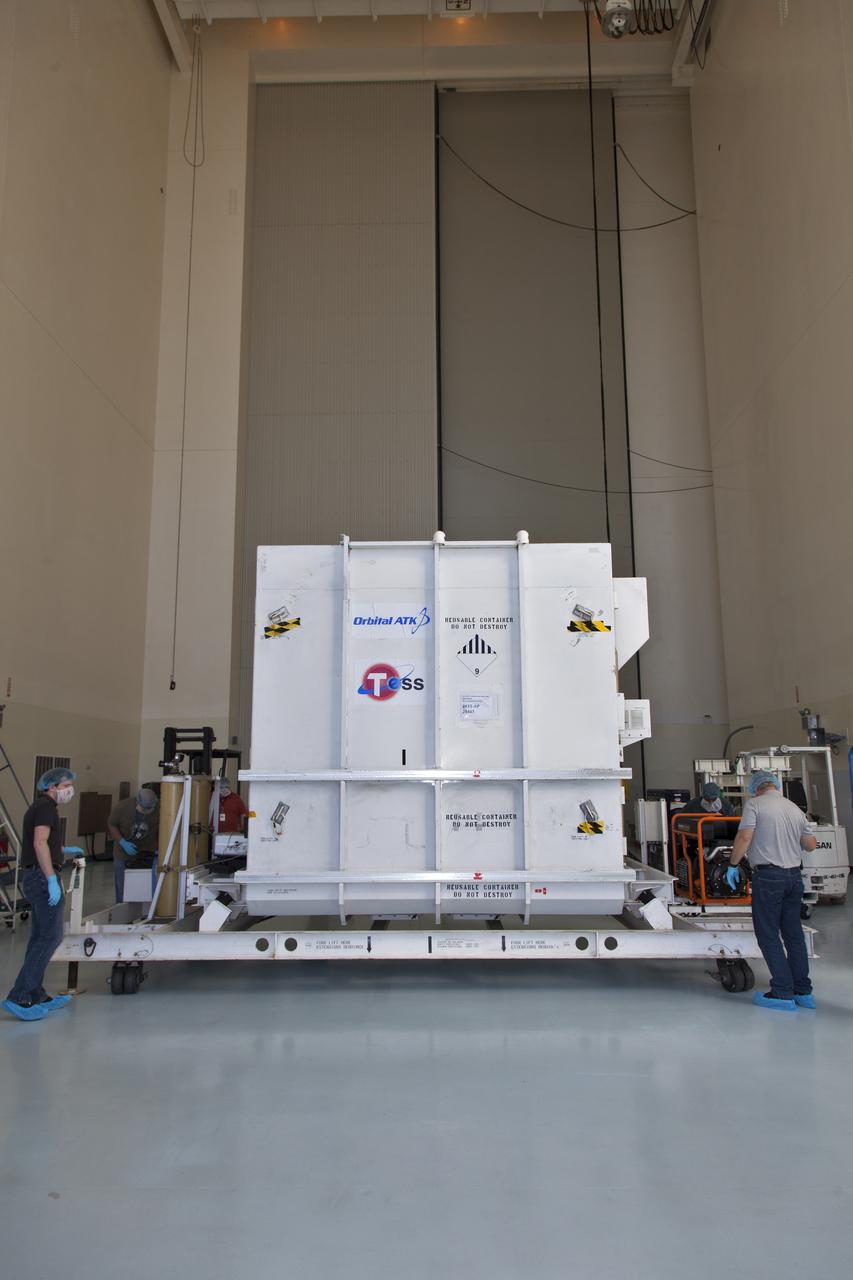
The shipping container with NASA's Transiting Exoplanet Survey Satellite (TESS) inside, is moved into the Payload Hazardous Servicing Facility (PHSF) at the agency's Kennedy Space Center in Florida. Inside the PHSF, the satellite will be processed and prepared for its flight. TESS is scheduled to launch atop a SpaceX Falcon 9 rocket from Space Launch Complex 40 at Cape Canaveral Air Force Station. TESS is the next step in NASA's search for planets outside our solar system, known as exoplanets. TESS is a NASA Astrophysics Explorer mission led and operated by MIT in Cambridge, Massachusetts, and managed by NASA’s Goddard Space Flight Center in Greenbelt, Maryland. Dr. George Ricker of MIT’s Kavli Institute for Astrophysics and Space Research serves as principal investigator for the mission. Additional partners include Orbital ATK, NASA’s Ames Research Center, the Harvard-Smithsonian Center for Astrophysics and the Space Telescope Science Institute. More than a dozen universities, research institutes and observatories worldwide are participants in the mission. NASA’s Launch Services Program is responsible for launch management.
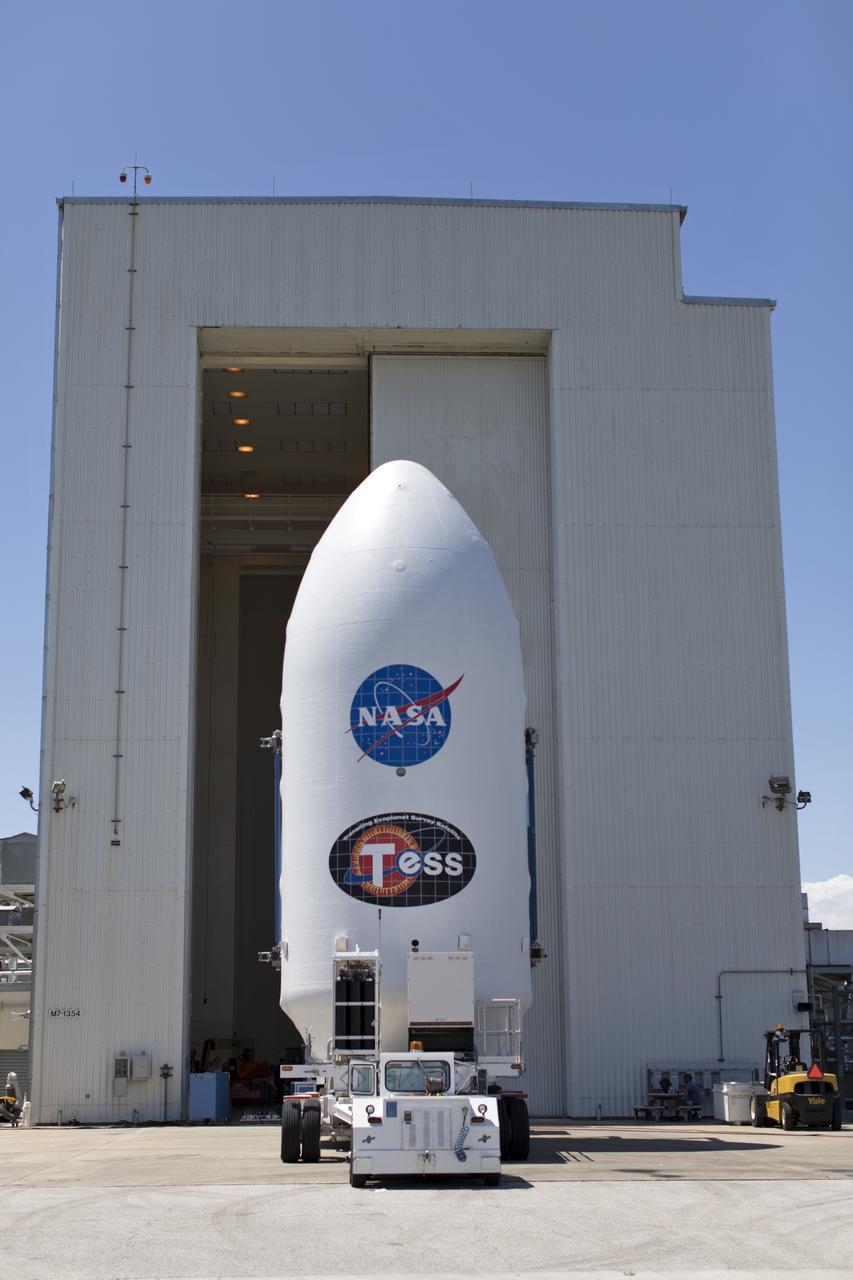
The payload fairing for NASA's Transiting Exoplanet Survey Satellite (TESS) is moved to the entrance of the Payload Hazardous Servicing Facility at the agency's Kennedy Space Center in Florida. Inside the facility, TESS will be encapsulated in the payload fairing. The satellite is scheduled to launch atop a SpaceX Falcon 9 rocket from Space Launch Complex 40 at Cape Canaveral Air Force Station on April 16. The satellite is the next step in NASA's search for planets outside our solar system, known as exoplanets. TESS is a NASA Astrophysics Explorer mission led and operated by MIT in Cambridge, Massachusetts, and managed by NASA’s Goddard Space Flight Center in Greenbelt, Maryland. Dr. George Ricker of MIT’s Kavli Institute for Astrophysics and Space Research serves as principal investigator for the mission. Additional partners include Orbital ATK, NASA’s Ames Research Center, the Harvard-Smithsonian Center for Astrophysics and the Space Telescope Science Institute. More than a dozen universities, research institutes and observatories worldwide are participants in the mission. NASA’s Launch Services Program is responsible for launch management.
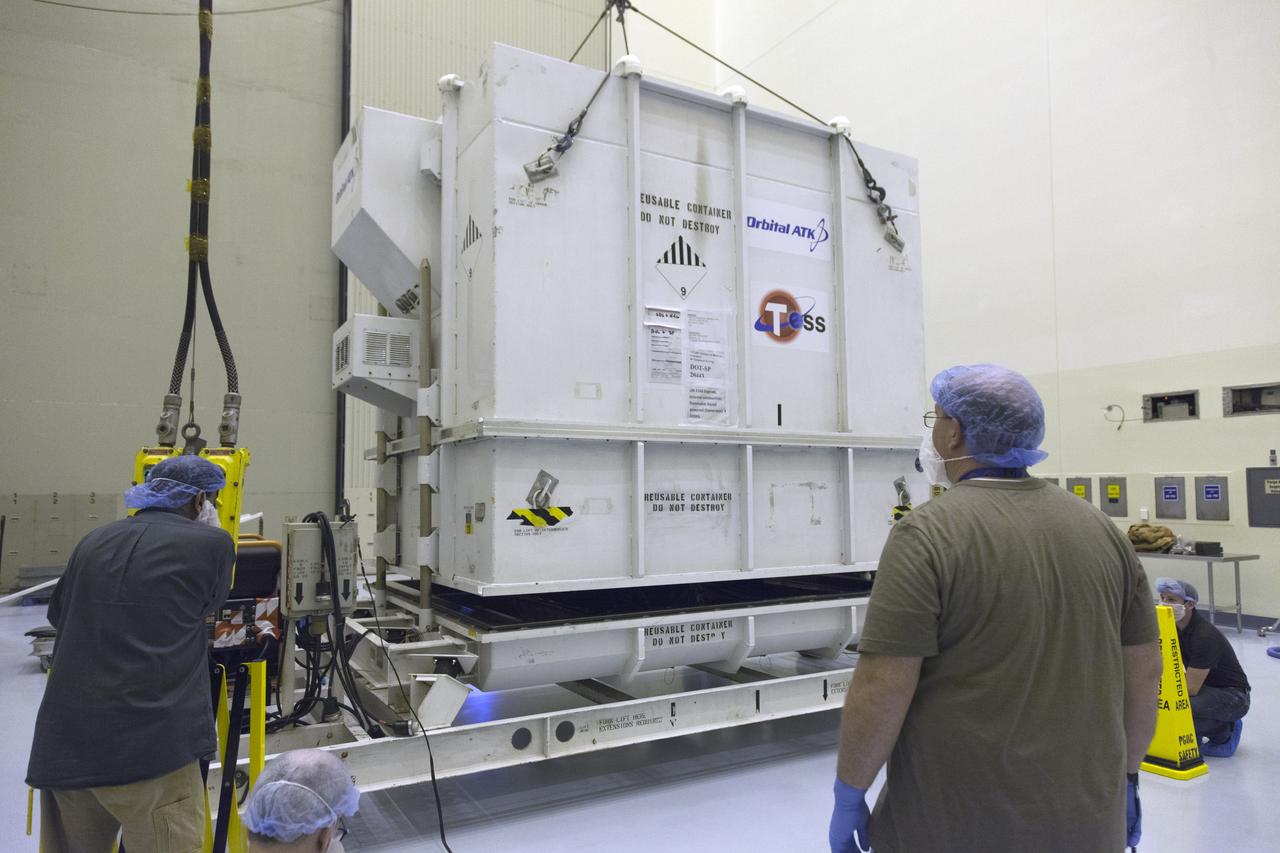
The shipping container with NASA's Transiting Exoplanet Survey Satellite (TESS) arrives inside the Payload Hazardous Servicing Facility at the agency's Kennedy Space Center in Florida. Inside the PHSF, TESS will be unpacked, lifted up and moved to a test stand for processing. TESS is scheduled to launch atop a SpaceX Falcon 9 rocket from Space Launch Complex 40 at Cape Canaveral Air Force Station. TESS is the next step in NASA's search for planets outside our solar system, known as exoplanets. TESS is a NASA Astrophysics Explorer mission led and operated by MIT in Cambridge, Massachusetts, and managed by NASA’s Goddard Space Flight Center in Greenbelt, Maryland. Dr. George Ricker of MIT’s Kavli Institute for Astrophysics and Space Research serves as principal investigator for the mission. Additional partners include Orbital ATK, NASA’s Ames Research Center, the Harvard-Smithsonian Center for Astrophysics and the Space Telescope Science Institute. More than a dozen universities, research institutes and observatories worldwide are participants in the mission. NASA’s Launch Services Program is responsible for launch management.
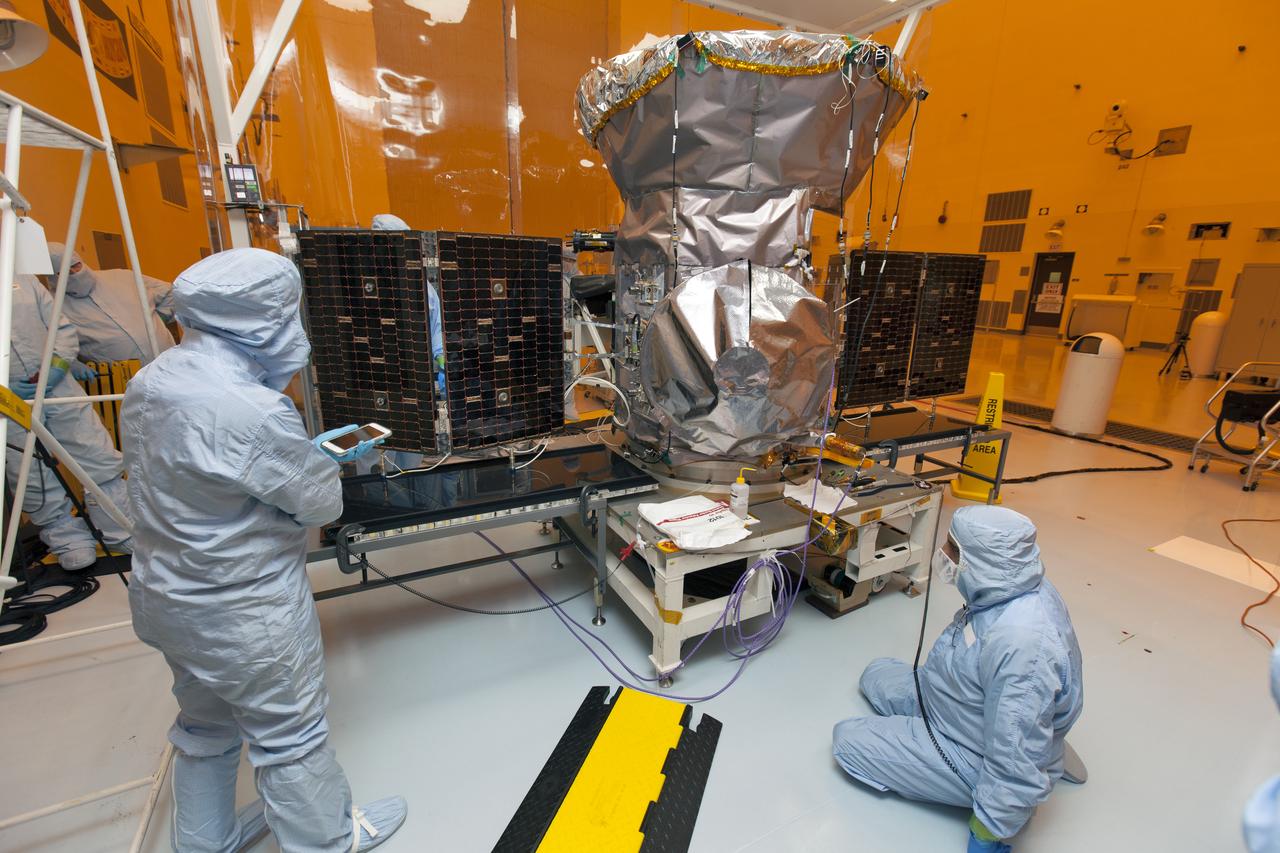
Technicians dressed in clean room suits monitor the progress as both solar panels are deployed on NASA's Transiting Exoplanet Survey Satellite (TESS) inside the Payload Hazardous Servicing Facility (PHSF) at the agency's Kennedy Space Center in Florida. Inside the PHSF, the satellite is being processed and prepared for its flight. TESS is scheduled to launch atop a SpaceX Falcon 9 rocket from Space Launch Complex 40 at Cape Canaveral Air Force Station. The satellite is the next step in NASA's search for planets outside our solar system, known as exoplanets. TESS is a NASA Astrophysics Explorer mission led and operated by MIT in Cambridge, Massachusetts, and managed by NASA’s Goddard Space Flight Center in Greenbelt, Maryland. Dr. George Ricker of MIT’s Kavli Institute for Astrophysics and Space Research serves as principal investigator for the mission. Additional partners include Orbital ATK, NASA’s Ames Research Center, the Harvard-Smithsonian Center for Astrophysics and the Space Telescope Science Institute. More than a dozen universities, research institutes and observatories worldwide are participants in the mission. NASA’s Launch Services Program is responsible for launch management.
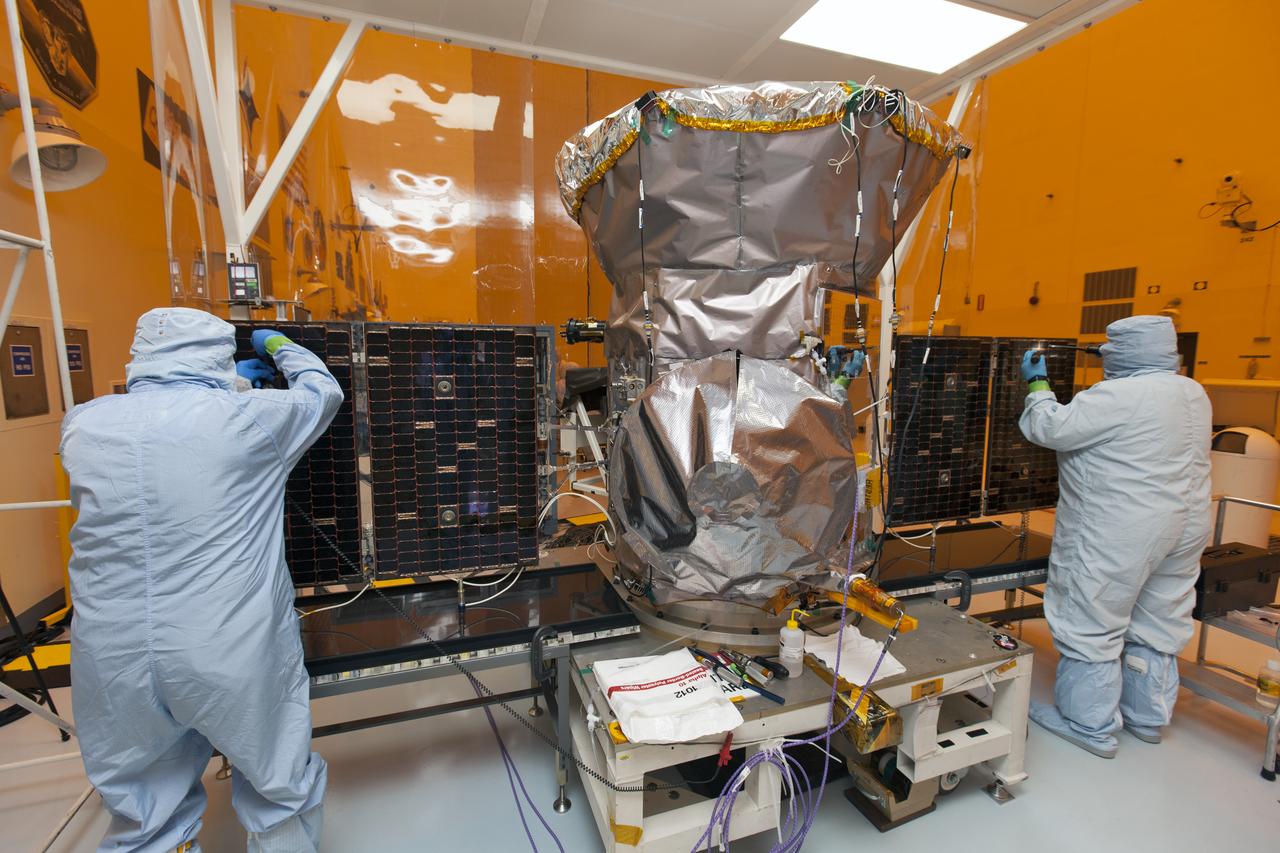
Technicians dressed in clean room suits check the solar panels, which have been deployed, on NASA's Transiting Exoplanet Survey Satellite (TESS) inside the Payload Hazardous Servicing Facility (PHSF) at the agency's Kennedy Space Center in Florida. Inside the PHSF, the satellite is being processed and prepared for its flight. TESS is scheduled to launch atop a SpaceX Falcon 9 rocket from Space Launch Complex 40 at Cape Canaveral Air Force Station. The satellite is the next step in NASA's search for planets outside our solar system, known as exoplanets. TESS is a NASA Astrophysics Explorer mission led and operated by MIT in Cambridge, Massachusetts, and managed by NASA’s Goddard Space Flight Center in Greenbelt, Maryland. Dr. George Ricker of MIT’s Kavli Institute for Astrophysics and Space Research serves as principal investigator for the mission. Additional partners include Orbital ATK, NASA’s Ames Research Center, the Harvard-Smithsonian Center for Astrophysics and the Space Telescope Science Institute. More than a dozen universities, research institutes and observatories worldwide are participants in the mission. NASA’s Launch Services Program is responsible for launch management.
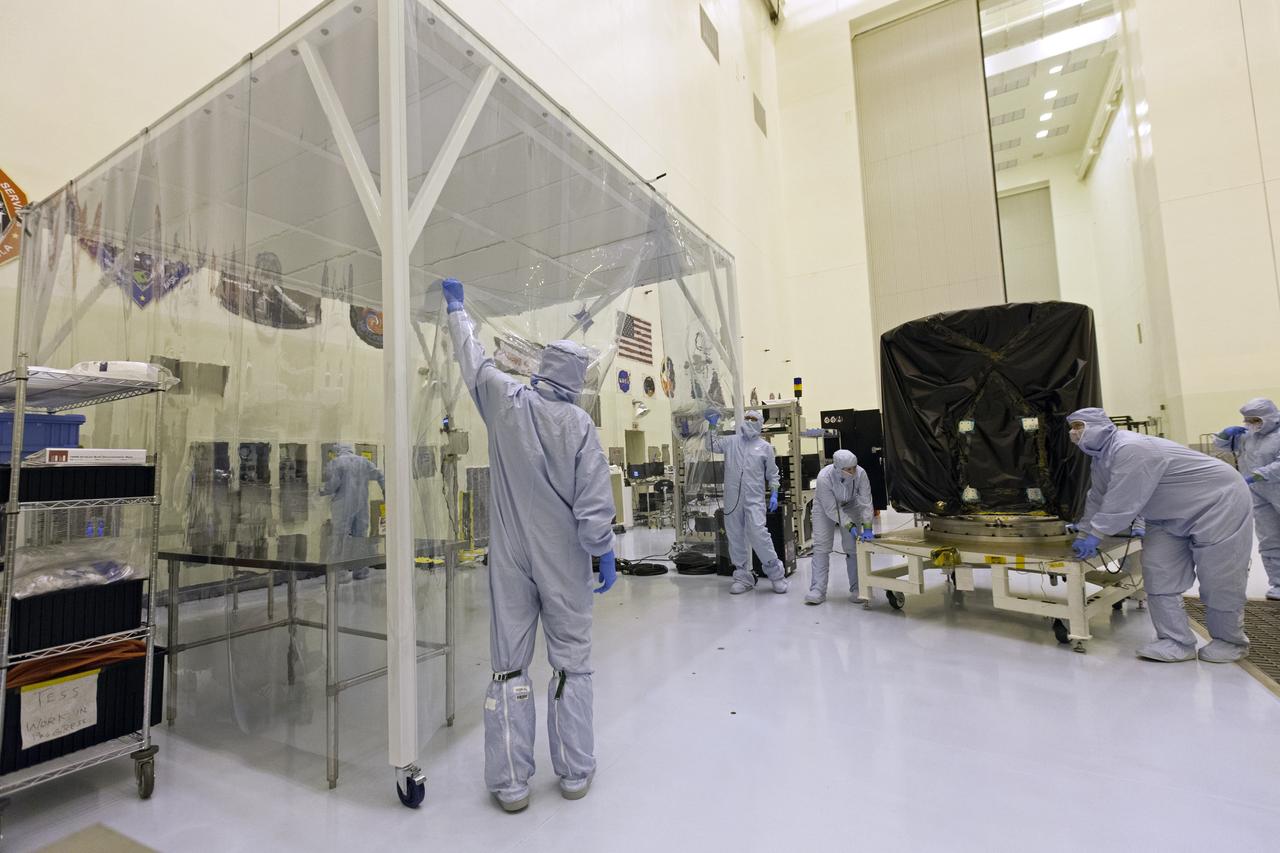
Technician dressed in clean room suits move NASA's Transiting Exoplanet Survey Satellite (TESS) on a test stand to a clean room tent inside the Payload Hazardous Servicing Facility (PHSF) at the agency's Kennedy Space Center in Florida. Inside the PHSF, the satellite will be processed and prepared for its flight. TESS is scheduled to launch atop a SpaceX Falcon 9 rocket from Space Launch Complex 40 at Cape Canaveral Air Force Station. TESS is the next step in NASA's search for planets outside our solar system, known as exoplanets. TESS is a NASA Astrophysics Explorer mission led and operated by MIT in Cambridge, Massachusetts, and managed by NASA’s Goddard Space Flight Center in Greenbelt, Maryland. Dr. George Ricker of MIT’s Kavli Institute for Astrophysics and Space Research serves as principal investigator for the mission. Additional partners include Orbital ATK, NASA’s Ames Research Center, the Harvard-Smithsonian Center for Astrophysics and the Space Telescope Science Institute. More than a dozen universities, research institutes and observatories worldwide are participants in the mission. NASA’s Launch Services Program is responsible for launch management.
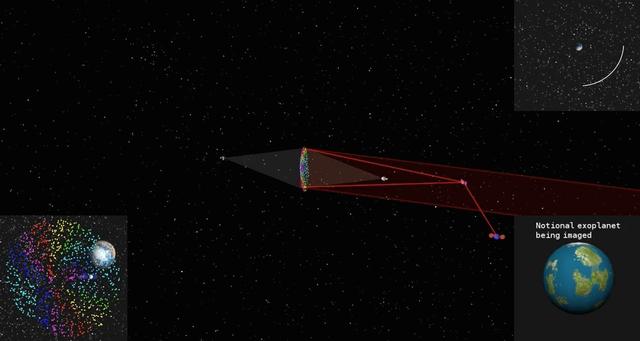
This simulated image shows how a cloud of glitter in geostationary orbit would be illuminated and controlled by two laser beams. As the cloud orbits Earth, grains scatter the sun's light at different angles like many tiny prisms, similar to how rainbows are produced from light being dispersed by water droplets. That is why the project concept is called "Orbiting Rainbows." The cloud functions like a reflective surface, allowing the exoplanet (displayed in the bottom right) to be imaged. The orbit path is shown in the top right. On the bottom left, Earth's image is seen behind the cloud. To image an exoplanet, the cloud would need to have a diameter of nearly 98 feet (30 meters). This simulation confines the cloud to a 3.3 x 3.3 x 3.3 foot volume (1 x 1 x 1 meter volume) to simplify the computations. The elements of the orbiting telescope are not to scale. Orbiting Rainbows is currently in Phase II development through the NASA Innovative Advanced Concepts (NIAC) Program. It was one of five technology proposals chosen for continued study in 2014. In the current phase, Orbiting Rainbows researchers are conducting small-scale ground experiments to demonstrate how granular materials can be manipulated using lasers and simulations of how the imaging system would behave in orbit. http://photojournal.jpl.nasa.gov/catalog/PIA19318
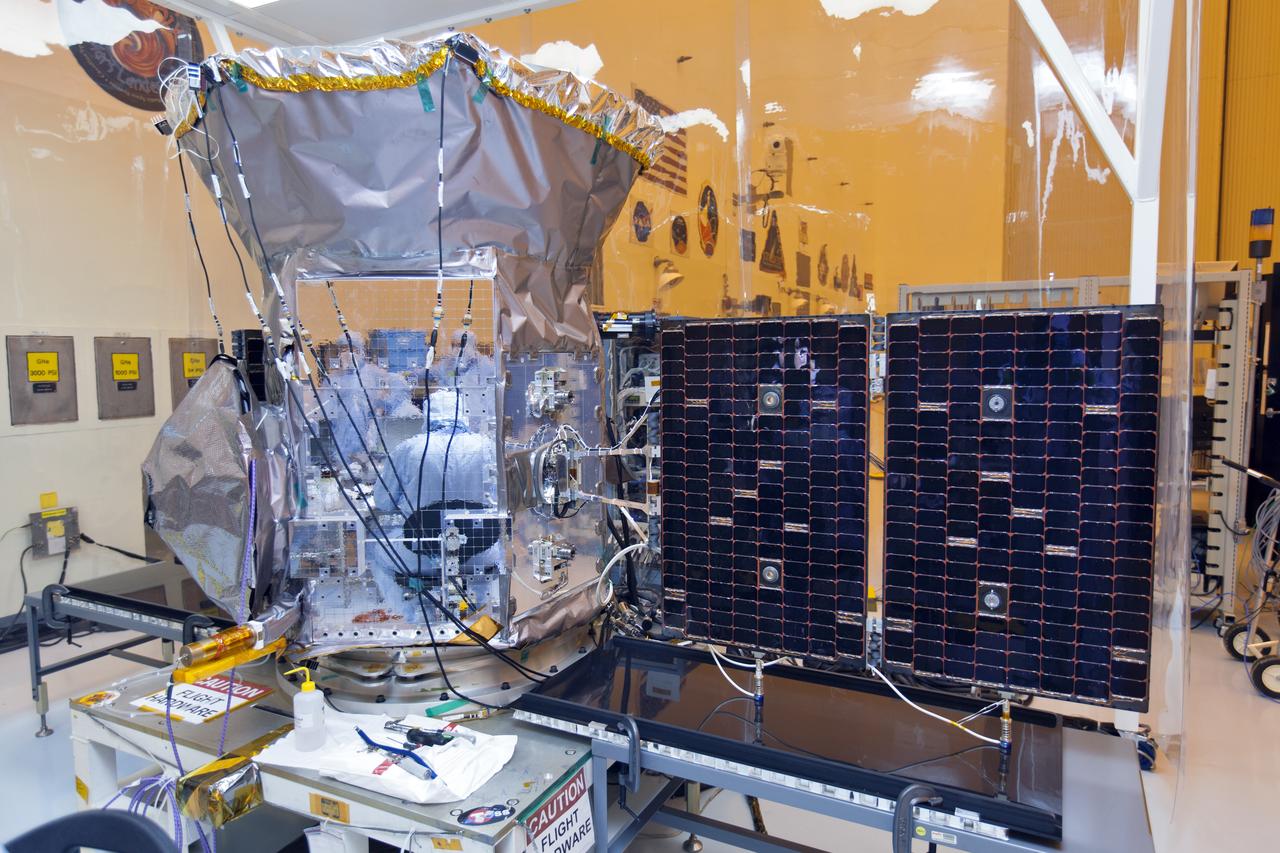
Inside the Payload Hazardous Servicing Facility at the NASA's Kennedy Space Center in Florida, the first of two solar panels is being deployed on the agency's Transiting Exoplanet Survey Satellite (TESS). The satellite is scheduled to launch atop a SpaceX Falcon 9 rocket from Space Launch Complex 40 at Cape Canaveral Air Force Station. TESS is the next step in NASA's search for planets outside our solar system, known as exoplanets. TESS is a NASA Astrophysics Explorer mission led and operated by MIT in Cambridge, Massachusetts, and managed by NASA’s Goddard Space Flight Center in Greenbelt, Maryland. Dr. George Ricker of MIT’s Kavli Institute for Astrophysics and Space Research serves as principal investigator for the mission. Additional partners include Orbital ATK, NASA’s Ames Research Center, the Harvard-Smithsonian Center for Astrophysics and the Space Telescope Science Institute. More than a dozen universities, research institutes and observatories worldwide are participants in the mission. NASA’s Launch Services Program is responsible for launch management.
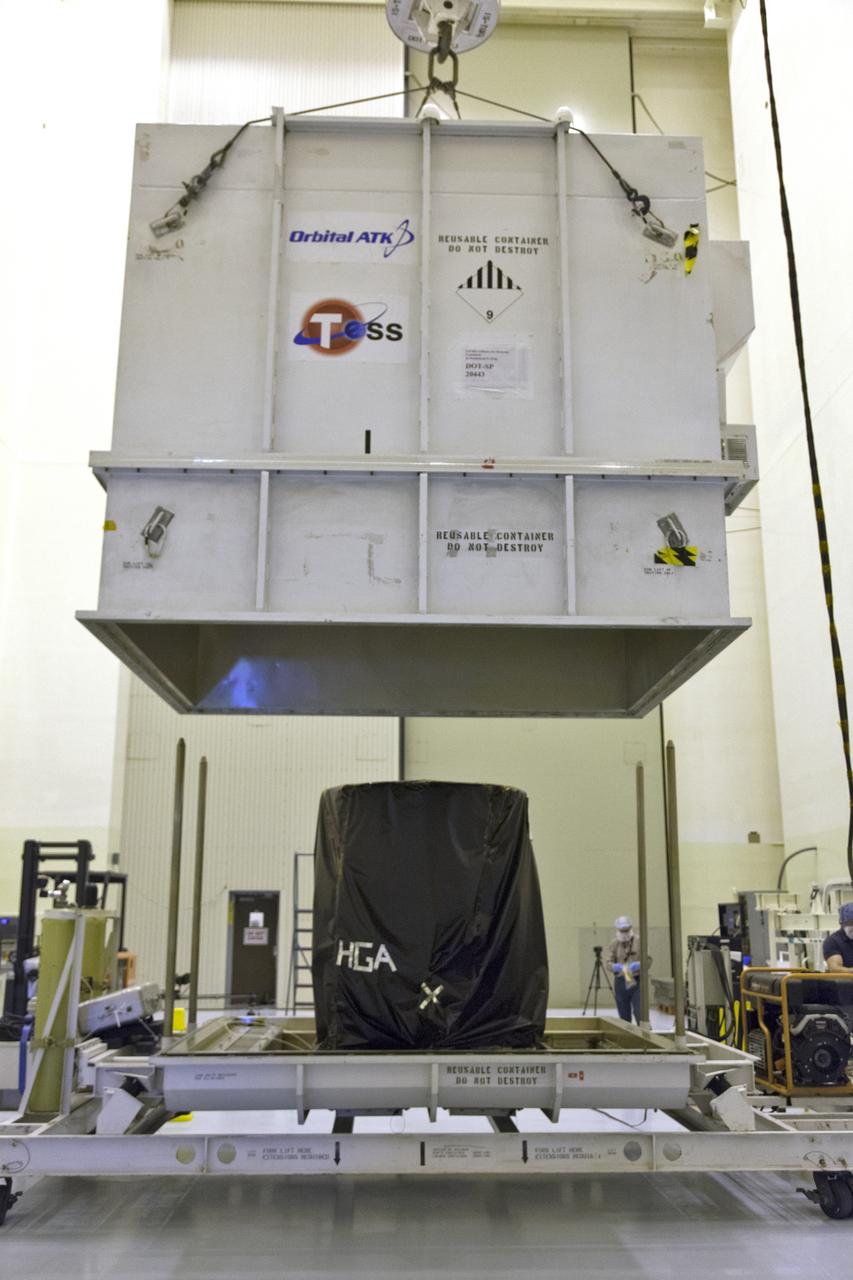
The top of the shipping container is lifted up by crane from NASA's Transiting Exoplanet Survey Satellite (TESS) inside the Payload Hazardous Servicing Facility at the agency's Kennedy Space Center in Florida. TESS will be unpacked, lifted up by crane and moved to a test stand for processing. TESS is scheduled to launch atop a SpaceX Falcon 9 rocket from Space Launch Complex 40 at Cape Canaveral Air Force Station. TESS is the next step in NASA's search for planets outside our solar system, known as exoplanets. TESS is a NASA Astrophysics Explorer mission led and operated by MIT in Cambridge, Massachusetts, and managed by NASA’s Goddard Space Flight Center in Greenbelt, Maryland. Dr. George Ricker of MIT’s Kavli Institute for Astrophysics and Space Research serves as principal investigator for the mission. Additional partners include Orbital ATK, NASA’s Ames Research Center, the Harvard-Smithsonian Center for Astrophysics and the Space Telescope Science Institute. More than a dozen universities, research institutes and observatories worldwide are participants in the mission. NASA’s Launch Services Program is responsible for launch management.
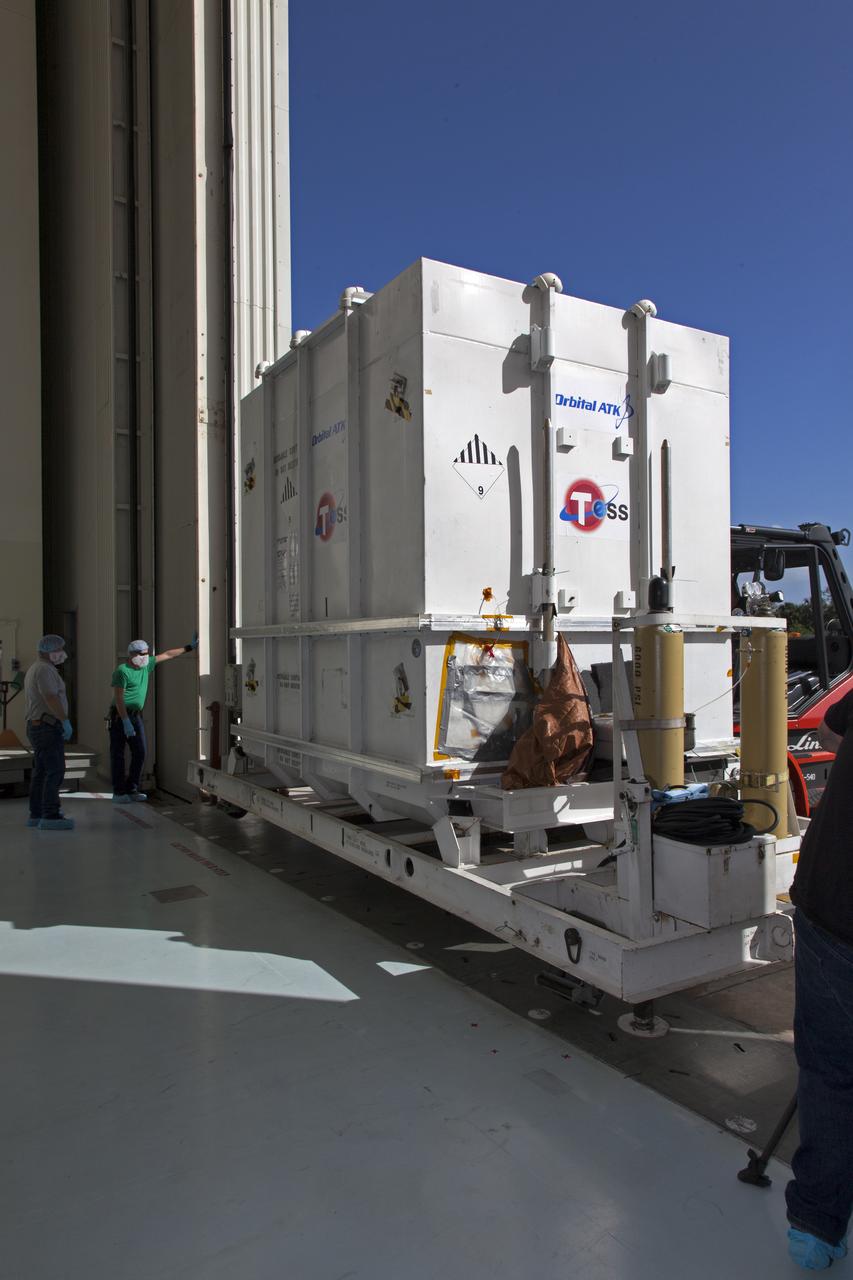
The shipping container with NASA's Transiting Exoplanet Survey Satellite (TESS) inside, is moved into the Payload Hazardous Servicing Facility (PHSF) at the agency's Kennedy Space Center in Florida. Inside the PHSF, the satellite will be processed and prepared for its flight. TESS is scheduled to launch atop a SpaceX Falcon 9 rocket from Space Launch Complex 40 at Cape Canaveral Air Force Station. TESS is the next step in NASA's search for planets outside our solar system, known as exoplanets. TESS is a NASA Astrophysics Explorer mission led and operated by MIT in Cambridge, Massachusetts, and managed by NASA’s Goddard Space Flight Center in Greenbelt, Maryland. Dr. George Ricker of MIT’s Kavli Institute for Astrophysics and Space Research serves as principal investigator for the mission. Additional partners include Orbital ATK, NASA’s Ames Research Center, the Harvard-Smithsonian Center for Astrophysics and the Space Telescope Science Institute. More than a dozen universities, research institutes and observatories worldwide are participants in the mission. NASA’s Launch Services Program is responsible for launch management.

The payload fairing for NASA's Transiting Exoplanet Survey Satellite (TESS) is moved inside the Payload Hazardous Servicing Facility at the agency's Kennedy Space Center in Florida. Inside the facility, TESS will be encapsulated in the payload fairing. The satellite is scheduled to launch atop a SpaceX Falcon 9 rocket from Space Launch Complex 40 at Cape Canaveral Air Force Station on April 16. The satellite is the next step in NASA's search for planets outside our solar system, known as exoplanets. TESS is a NASA Astrophysics Explorer mission led and operated by MIT in Cambridge, Massachusetts, and managed by NASA’s Goddard Space Flight Center in Greenbelt, Maryland. Dr. George Ricker of MIT’s Kavli Institute for Astrophysics and Space Research serves as principal investigator for the mission. Additional partners include Orbital ATK, NASA’s Ames Research Center, the Harvard-Smithsonian Center for Astrophysics and the Space Telescope Science Institute. More than a dozen universities, research institutes and observatories worldwide are participants in the mission. NASA’s Launch Services Program is responsible for launch management.
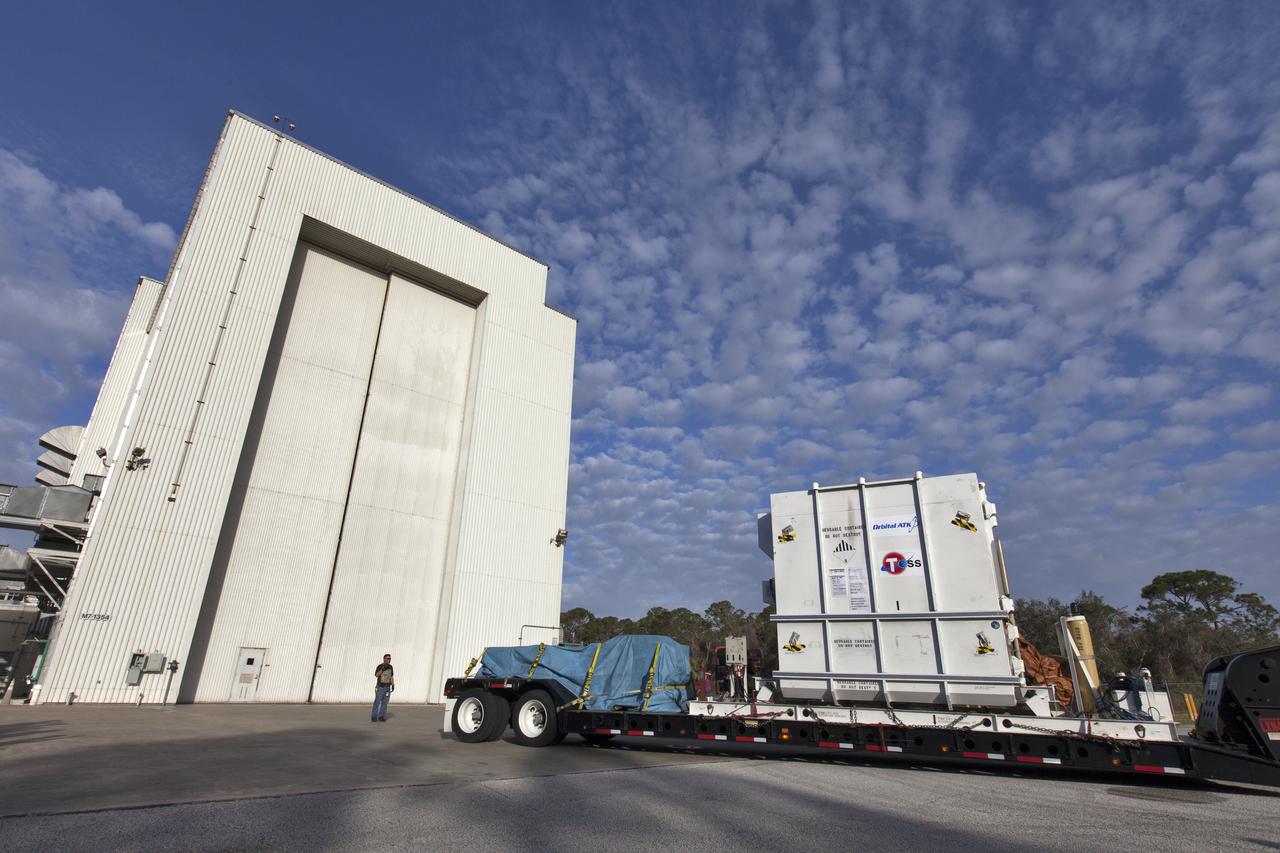
NASA's Transiting Exoplanet Survey Satellite (TESS), inside its shipping container, is backed in on flatbed truck to the Payload Hazardous Servicing Facility (PHSF) at the agency's Kennedy Space Center in Florida. Inside the PHSF, the satellite will be processed and prepared for its flight. TESS is scheduled to launch atop a SpaceX Falcon 9 rocket from Space Launch Complex 40 at Cape Canaveral Air Force Station. TESS is the next step in NASA's search for planets outside our solar system, known as exoplanets. TESS is a NASA Astrophysics Explorer mission led and operated by MIT in Cambridge, Massachusetts, and managed by NASA’s Goddard Space Flight Center in Greenbelt, Maryland. Dr. George Ricker of MIT’s Kavli Institute for Astrophysics and Space Research serves as principal investigator for the mission. Additional partners include Orbital ATK, NASA’s Ames Research Center, the Harvard-Smithsonian Center for Astrophysics and the Space Telescope Science Institute. More than a dozen universities, research institutes and observatories worldwide are participants in the mission. NASA’s Launch Services Program is responsible for launch management.
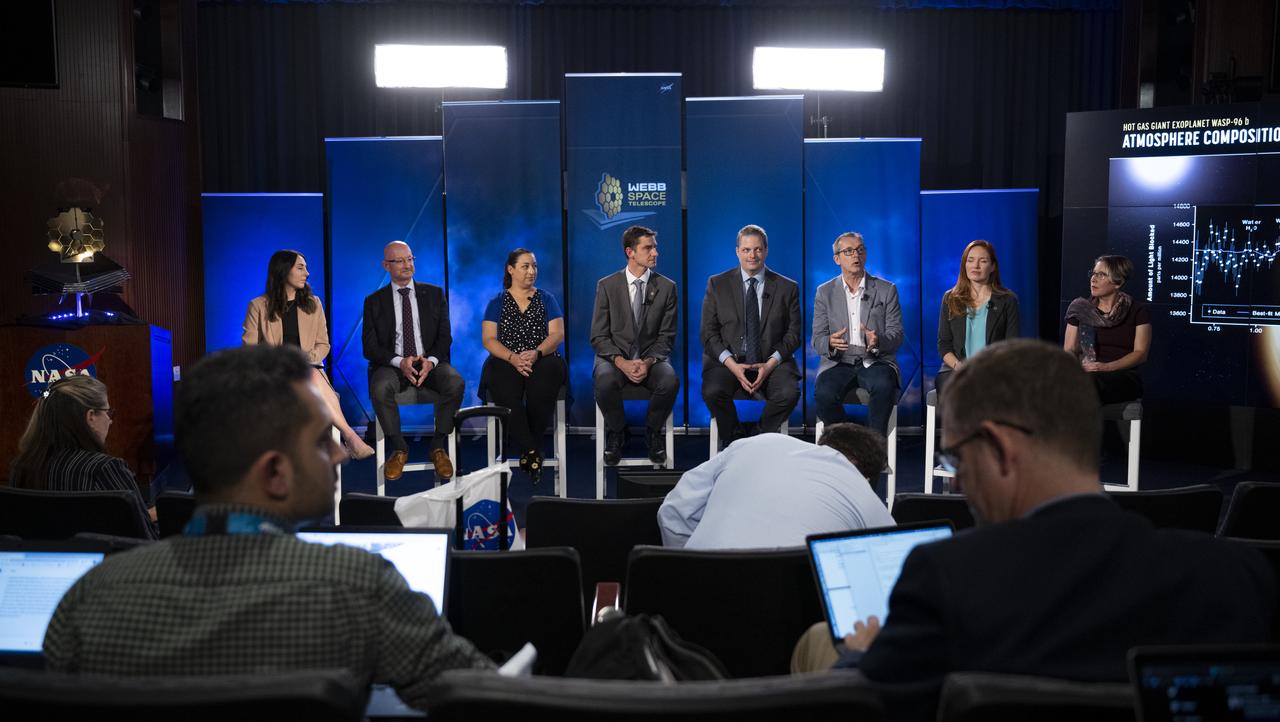
NASA Public Affairs Officer Alise Fisher, left, NASA James Webb Space Telescope Program Scientist and Astrophysics Division Chief Scientist Eric Smith, second from left, NASA James Webb Space Telescope Deputy Project Scientist for Exoplanet Science Knicole Colón, third from left, NASA James Webb Space Telescope Project Scientist at ESA (European Space Agency) Christopher Evans, fourth from left, NASA James Webb Space Telescope Project Scientist, Space Telescope Science Institute, Klaus Pontoppidan, fourth from right, Principal Investigator for the Canadian Near-Infrared Imager and Slitless Spectrograph at the University of Montreal René Doyon, third from right, NASA James Webb Space Telescope Deputy Project Scientist for Communications Amber Straughn, second from right, and NASA James Webb Space Telescope Operations Project Scientist Jane Rigby, right, during a briefing following the release of the first full-color images from NASA’s James Webb Space Telescope, Tuesday, July 12, 2022, at NASA’s Goddard Space Flight Center in Greenbelt, Md. The first full-color images and spectroscopic data from the James Webb Space Telescope, a partnership with ESA (European Space Agency) and the Canadian Space Agency (CSA), are a demonstration of the power of Webb as the telescope begins its science mission to unfold the infrared universe. Photo Credit: (NASA/Bill Ingalls)

A NASA Social attendee is seen wearing a headband featuring Webb mirrors during a briefing with NASA Public Affairs Officer Alise Fisher, left, NASA James Webb Space Telescope Program Scientist and Astrophysics Division Chief Scientist Eric Smith, second from left, NASA James Webb Space Telescope Deputy Project Scientist for Exoplanet Science Knicole Colón, third from left, NASA James Webb Space Telescope Project Scientist at ESA (European Space Agency) Christopher Evans, fourth from left, NASA James Webb Space Telescope project scietntist, Space Telescope Science Institute, Klaus Pontoppidan, fourth from right, Principal Investigator for the Canadian Near-Infrared Imager and Slitless Spectrograph at the University of Montreal René Doyon, third from right, NASA James Webb Space Telescope Deputy Project Scientist for Communications Amber Straughn, second from right, and NASA James Webb Space Telescope Operations Project Scientist Jane Rigby, right, following the release of the first full-color images from NASA’s James Webb Space Telescope, Tuesday, July 12, 2022, at NASA’s Goddard Space Flight Center in Greenbelt, Md. The first full-color images and spectroscopic data from the James Webb Space Telescope, a partnership with ESA (European Space Agency) and the Canadian Space Agency (CSA), are a demonstration of the power of Webb as the telescope begins its science mission to unfold the infrared universe. Photo Credit: (NASA/Bill Ingalls)