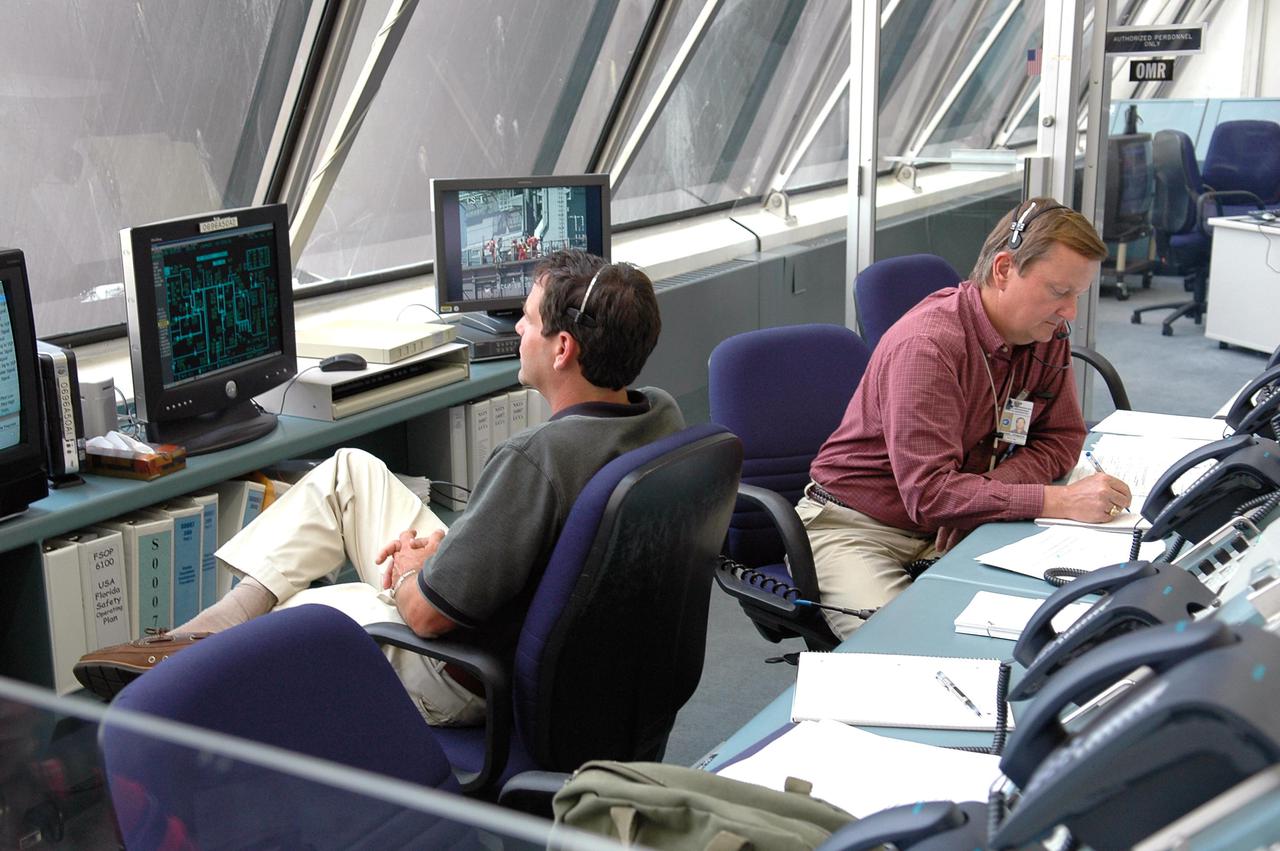
KENNEDY SPACE CENTER, FLA. - Space Shuttle launch director Michael Leinbach (right) and assistant launch director Doug Lyons support an External Tank (ET) tanking test at Launch Pad 39B from the Launch Control Center. The tanking test is designed to evaluate how the tank, orbiter, solid rocket boosters and ground systems perform under 'cryo-load,' when the tank is filled with the two ultra-low-temperature propellants. The tank filling and draining portion of the test takes about 11 hours. The test also includes a simulated countdown through the hold at T-31 seconds. The test is being conducted to troubleshoot two issues identified by a tanking test held on April 14. Data is being collected to analyze the liquid hydrogen sensors that gave intermittent readings and the liquid hydrogen pressurization relief valve that cycled more times than standard. The tanking tests are part of preparations for Space Shuttle Discovery's Return to Flight mission, STS-114, to the International Space Station. The launch window extends from July 13 through July 31.
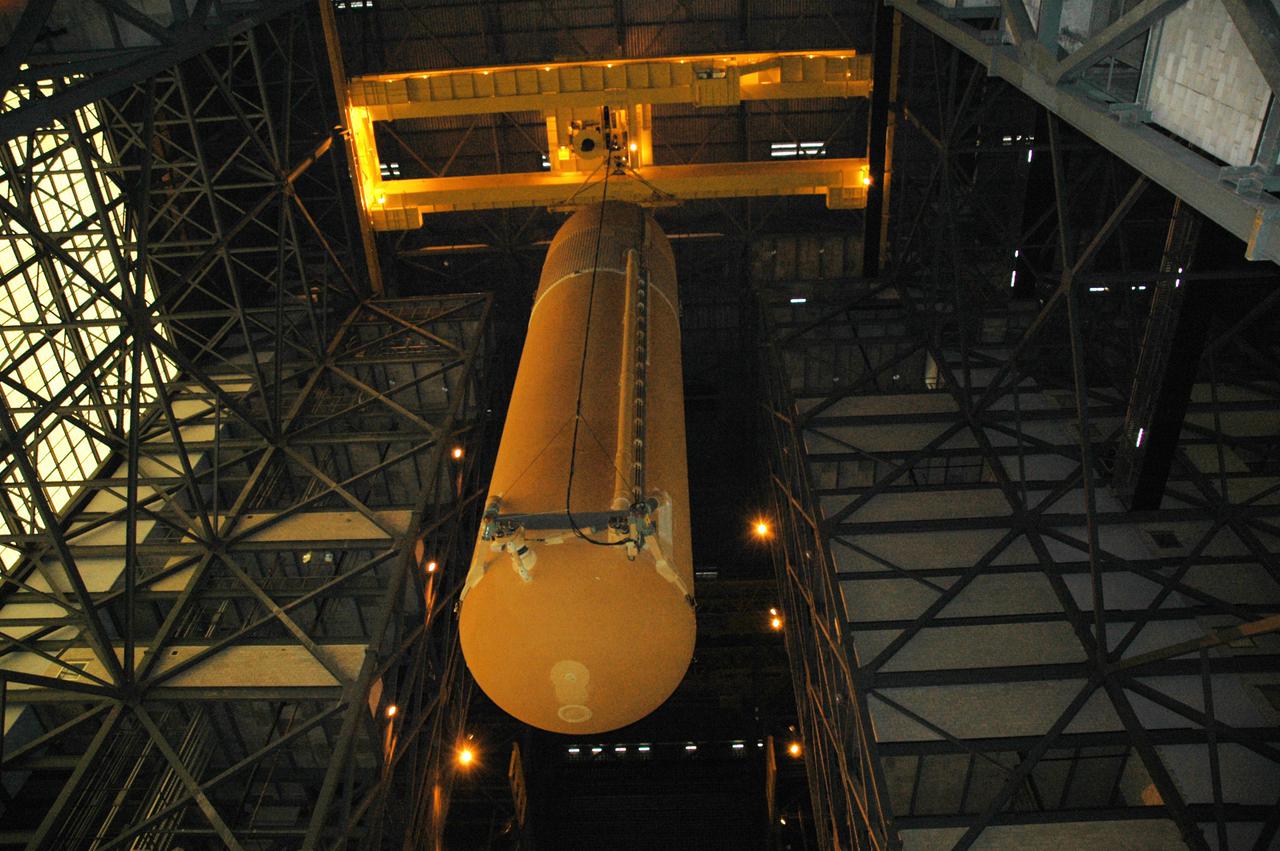
KENNEDY SPACE CENTER, FLA. - An overhead crane lowers the External Tank that will be used to return the Space Shuttle program to flight into high bay 3 in the Vehicle Assembly Building. The tank, ET-121, and the Solid Rocket Boosters were originally scheduled to fly with orbiter Atlantis on mission STS-121 but will now be used to launch Discovery on mission STS-114. Once secure in the high bay, a new heater will be added to the feedline bellows to minimize the potential for ice and frost buildup. STS-114 is the first Return to Flight mission to the International Space Station. The launch window extends from July 13 through July 31.
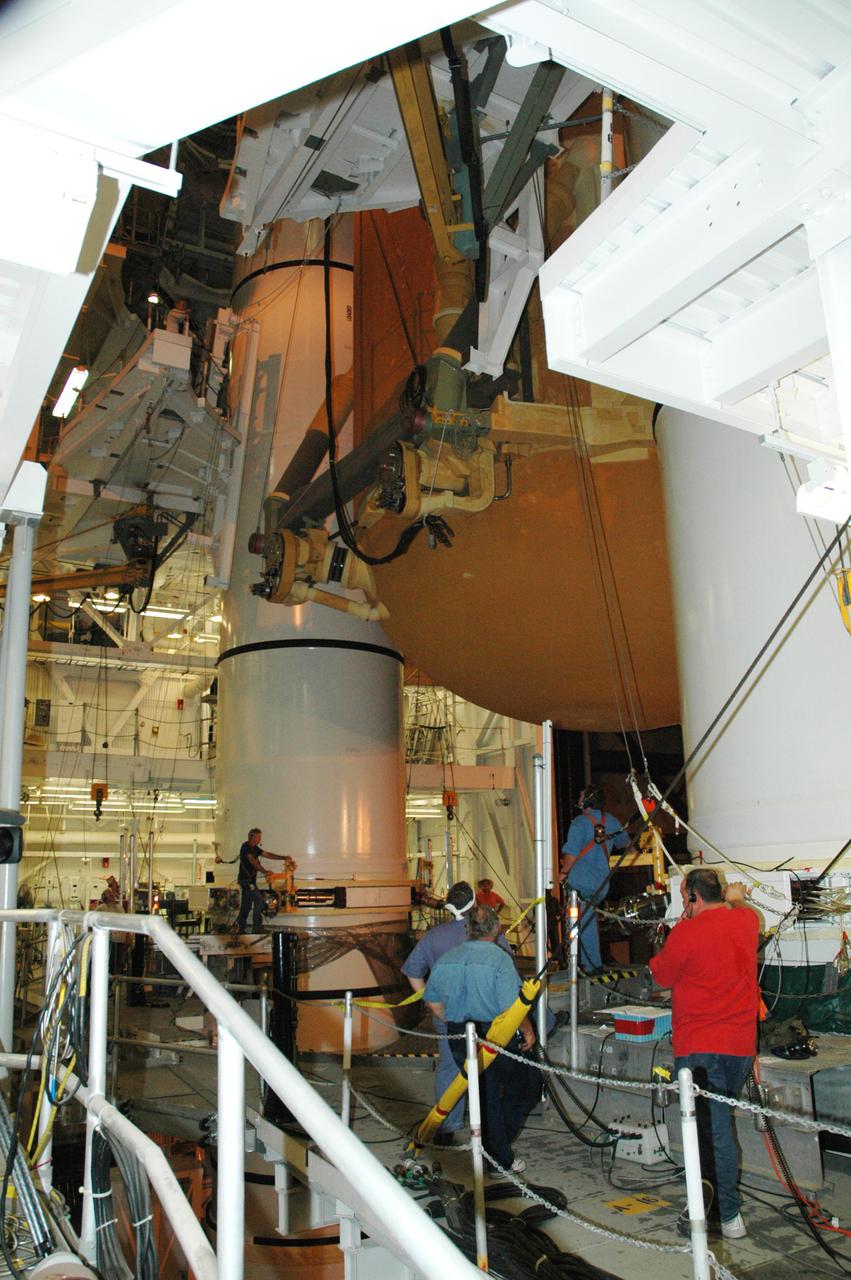
KENNEDY SPACE CENTER, FLA. - Technicians attach the External Tank that will be used to return the Space Shuttle program to flight to a pair of Solid Rocket Boosters in high bay 3 in the Vehicle Assembly Building. The tank, ET-121, and the Solid Rocket Boosters were originally scheduled to fly with orbiter Atlantis on mission STS-121 but will now be used to launch Discovery on mission STS-114. Once secure in the high bay, a new heater will be added to the feedline bellows to minimize the potential for ice and frost buildup. STS-114 is the first Return to Flight mission to the International Space Station. The launch window extends from July 13 through July 31.
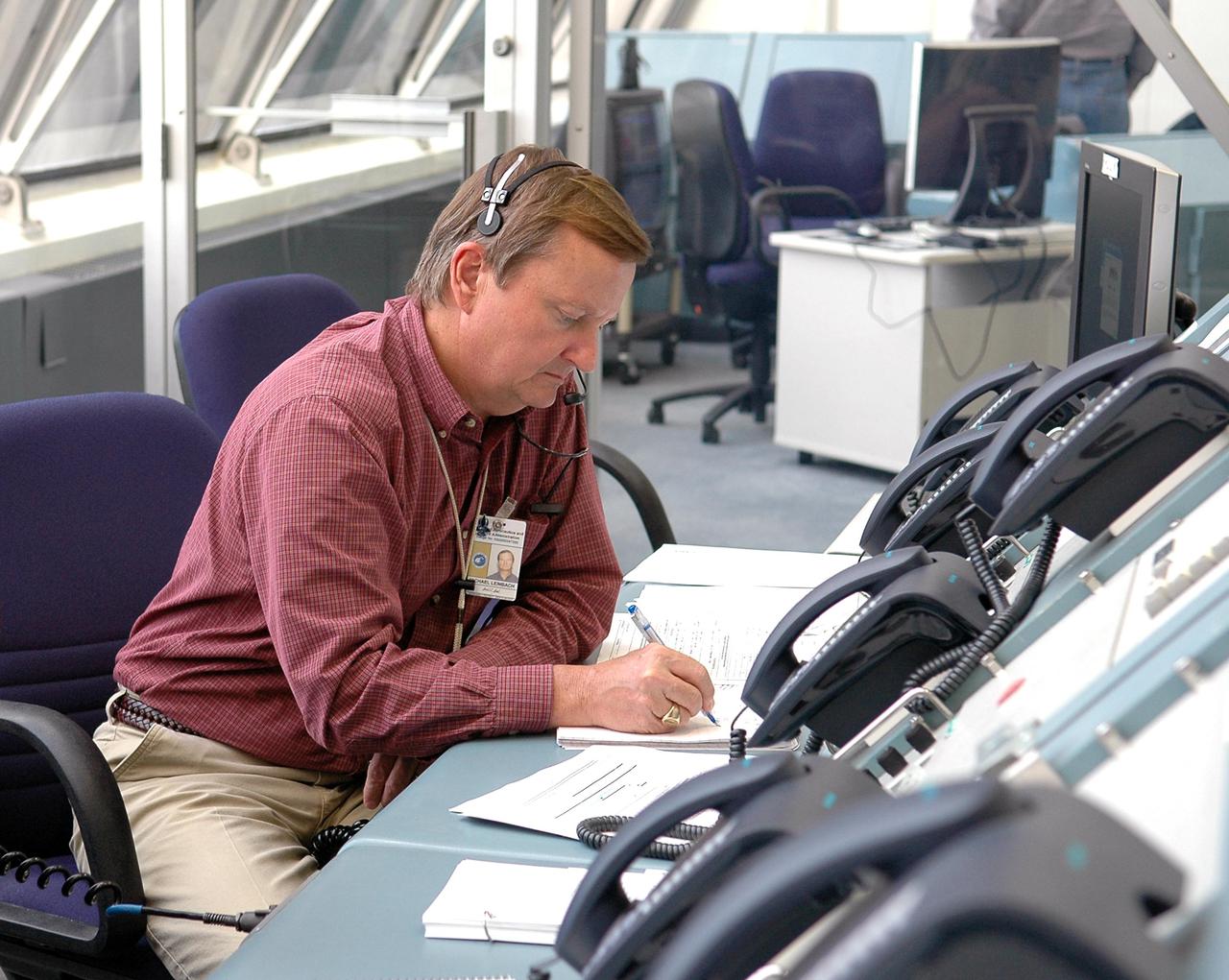
KENNEDY SPACE CENTER, FLA. - Space Shuttle launch director Michael Leinbach supports an External Tank (ET) tanking test at Launch Pad 39B from the Launch Control Center. The tanking test is designed to evaluate how the tank, orbiter, solid rocket boosters and ground systems perform under 'cryo-load,' when the tank is filled with the two ultra-low-temperature propellants. The tank filling and draining portion of the test takes about 11 hours. The test also includes a simulated countdown through the hold at T-31 seconds. The test is being conducted to troubleshoot two issues identified by a tanking test held on April 14. Data is being collected to analyze the liquid hydrogen sensors that gave intermittent readings and the liquid hydrogen pressurization relief valve that cycled more times than standard. The tanking tests are part of preparations for Space Shuttle Discovery's Return to Flight mission, STS-114, to the International Space Station. The launch window extends from July 13 through July 31.
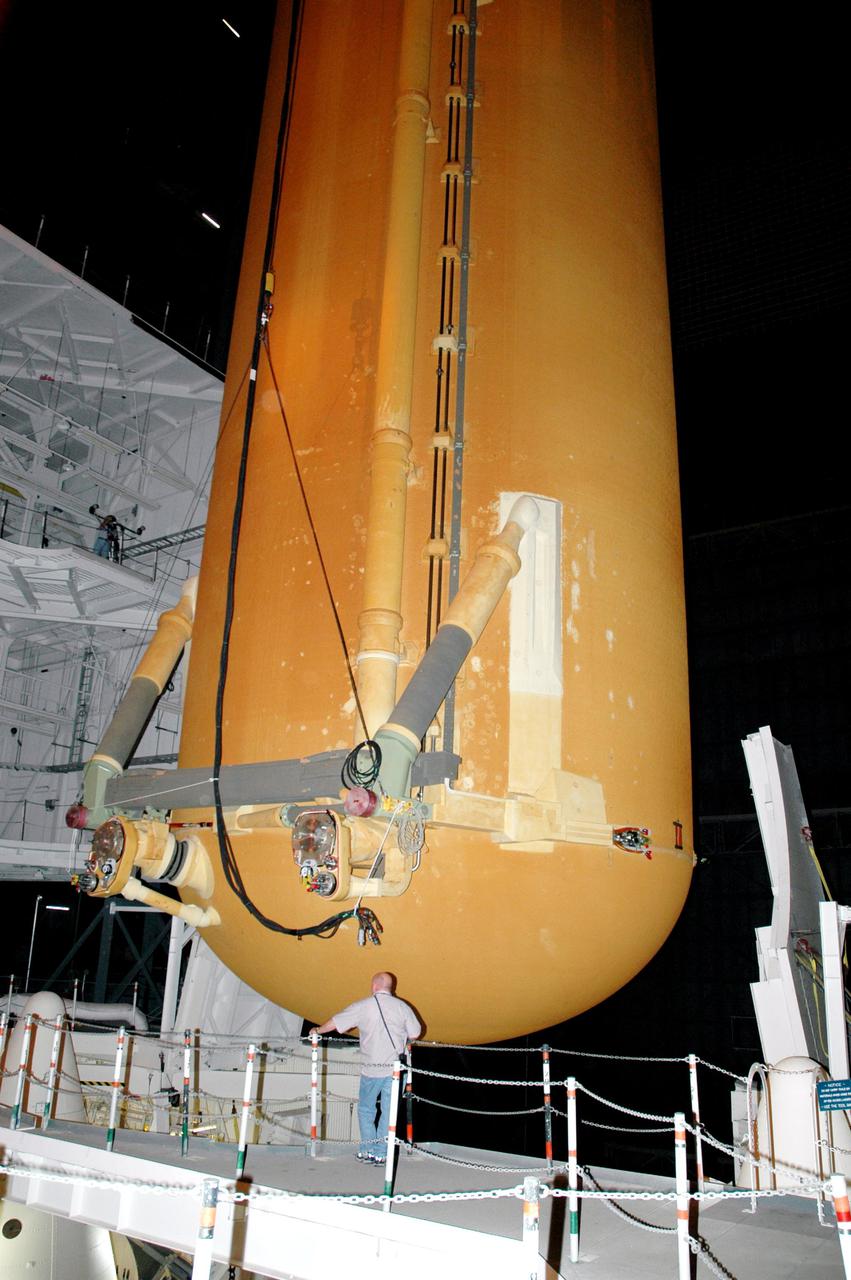
KENNEDY SPACE CENTER, FLA. - A technician monitors the External Tank that will be used to return the Space Shuttle program to flight as it is positioned into high bay 3 in the Vehicle Assembly Building. The tank, ET-121, and the Solid Rocket Boosters were originally scheduled to fly with orbiter Atlantis on mission STS-121 but will now be used to launch Discovery on mission STS-114. Once secure in the high bay, a new heater will be added to the feedline bellows to minimize the potential for ice and frost buildup. STS-114 is the first Return to Flight mission to the International Space Station. The launch window extends from July 13 through July 31.
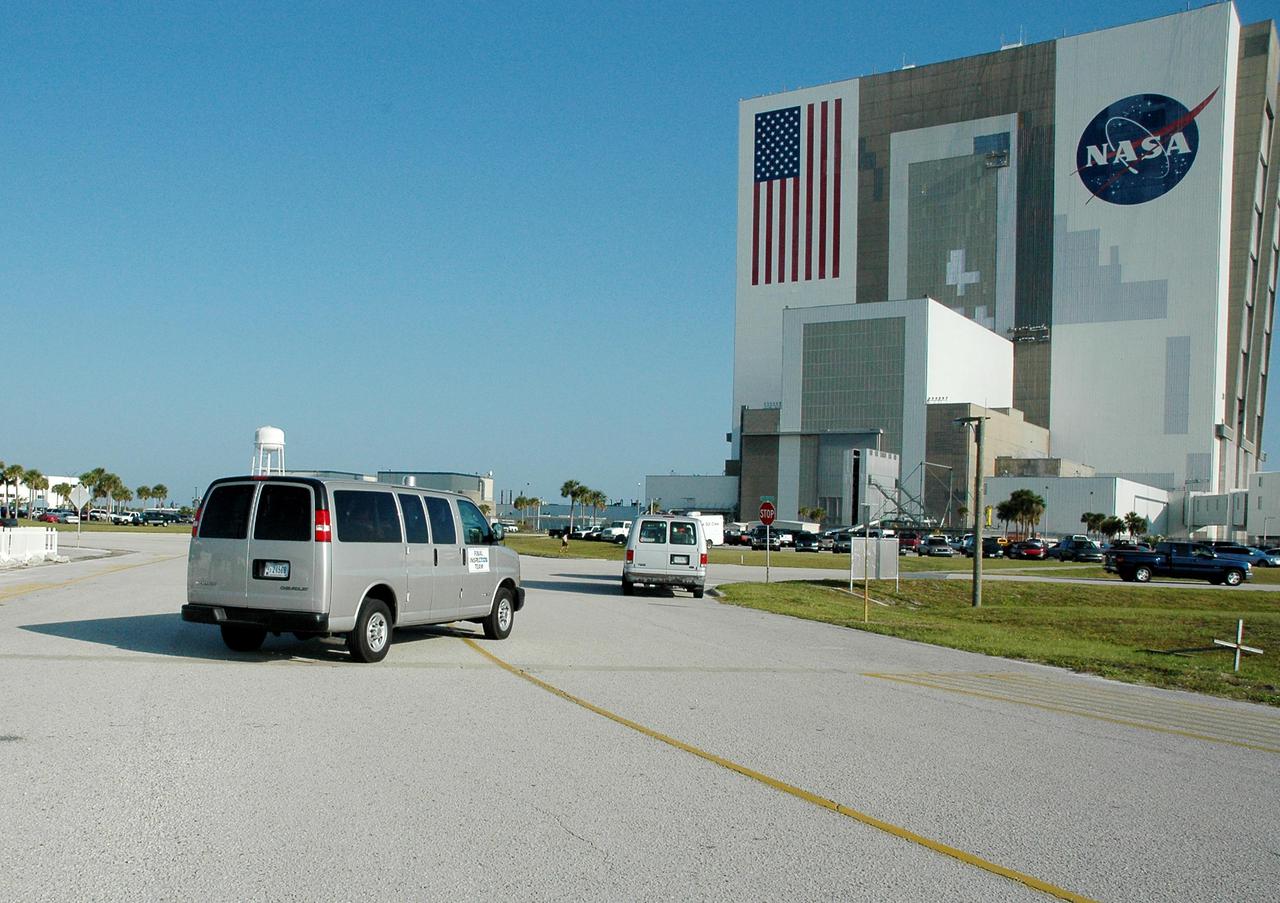
KENNEDY SPACE CENTER, FLA. - Members of the Final Inspection Team convoy to Launch Pad 39B to support an External Tank (ET) tanking test. This team conducts a preflight walkdown of the vehicle and pad during the hold at T-3 hours on launch day. The tanking test is designed to evaluate how the tank, orbiter, solid rocket boosters and ground systems perform under 'cryo-load,' when the tank is filled with the two ultra-low-temperature propellants. The tank filling and draining portion of the test takes about 11 hours. The test also includes a simulated countdown through the hold at T-31 seconds. The test is being conducted to troubleshoot two issues identified by a tanking test held on April 14. Data is being collected to analyze the liquid hydrogen sensors that gave intermittent readings and the liquid hydrogen pressurization relief valve that cycled more times than standard. The tanking tests are part of preparations for Space Shuttle Discovery's Return to Flight mission, STS-114, to the International Space Station. The launch window extends from July 13 through July 31.
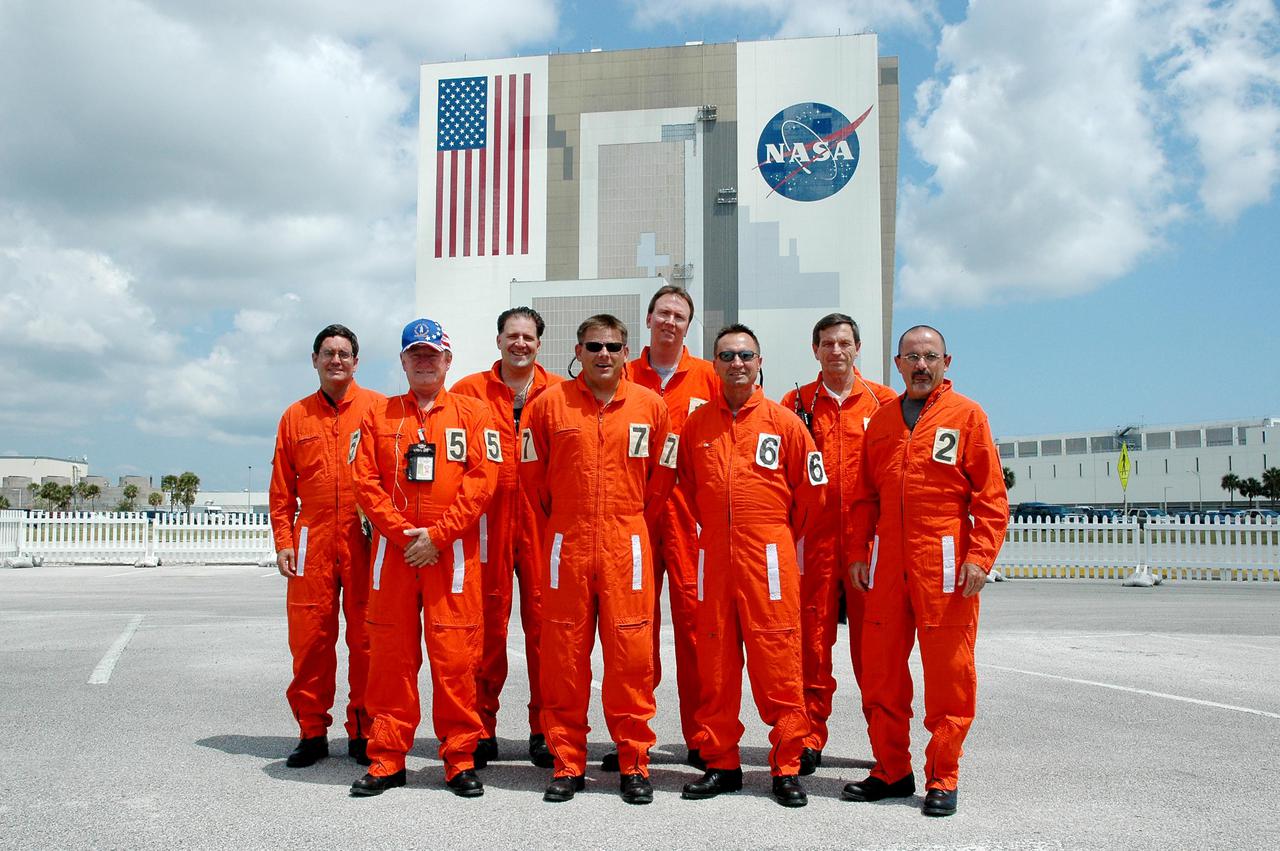
KENNEDY SPACE CENTER, FLA. - Members of the Final Inspection Team pose for a group portrait following their return from Launch Pad 39B where they were supporting an External Tank (ET) tanking test. From left are Robert Speece, NASA; Ray Brewer; United Space Alliance; Mike Payne, NASA; Scott Otto, Lockheed Martin; John Blue, NASA; Doug Powell, Lockheed Martin; William Duckworth, United Space Alliance; and Jorge Rivera, NASA. This team conducts a preflight walkdown of the vehicle and pad during the hold at T-3 hours on launch day. The tanking test is designed to evaluate how the tank, orbiter, solid rocket boosters and ground systems perform under 'cryo-load,' when the tank is filled with the two ultra-low-temperature propellants. The tank filling and draining portion of the test takes about 11 hours. The test also includes a simulated countdown through the hold at T-31 seconds. The test is being conducted to troubleshoot two issues identified by a tanking test held on April 14. Data is being collected to analyze the liquid hydrogen sensors that gave intermittent readings and the liquid hydrogen pressurization relief valve that cycled more times than standard. The tanking tests are part of preparations for Space Shuttle Discovery's Return to Flight mission, STS-114, to the International Space Station. The launch window extends from July 13 through July 31.
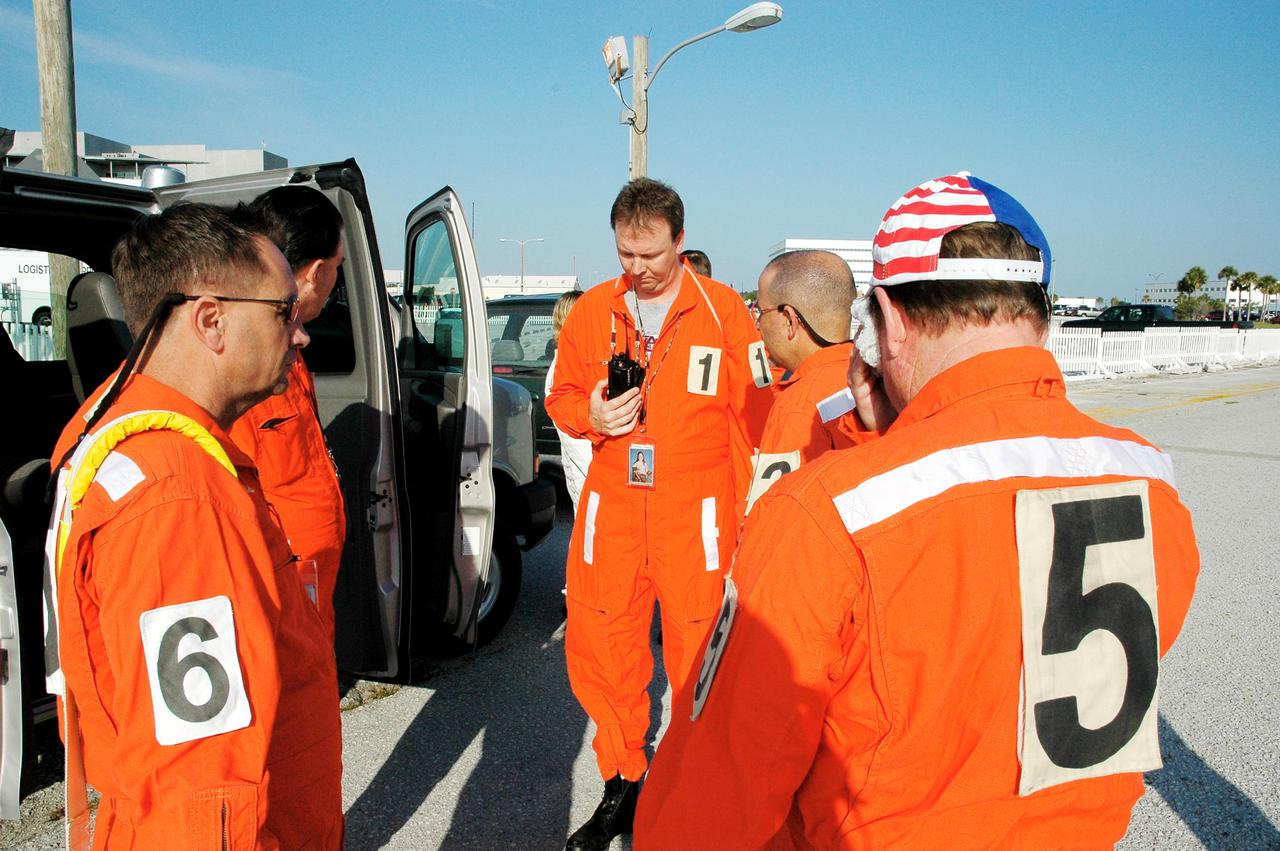
KENNEDY SPACE CENTER, FLA. - Members of the Final Inspection Team check their radios and Emergency Life Support Apparatus (ELSA) equipment before moving to Launch Pad 39B to support an External Tank (ET) tanking test. This team conducts a preflight walkdown of the vehicle and pad during the hold at T-3 hours on launch day. The tanking test is designed to evaluate how the tank, orbiter, solid rocket boosters and ground systems perform under 'cryo-load,' when the tank is filled with the two ultra-low-temperature propellants. The tank filling and draining portion of the test takes about 11 hours. The test also includes a simulated countdown through the hold at T-31 seconds. The test is being conducted to troubleshoot two issues identified by a tanking test held on April 14. Data is being collected to analyze the liquid hydrogen sensors that gave intermittent readings and the liquid hydrogen pressurization relief valve that cycled more times than standard. The tanking tests are part of preparations for Space Shuttle Discovery's Return to Flight mission, STS-114, to the International Space Station. The launch window extends from July 13 through July 31.
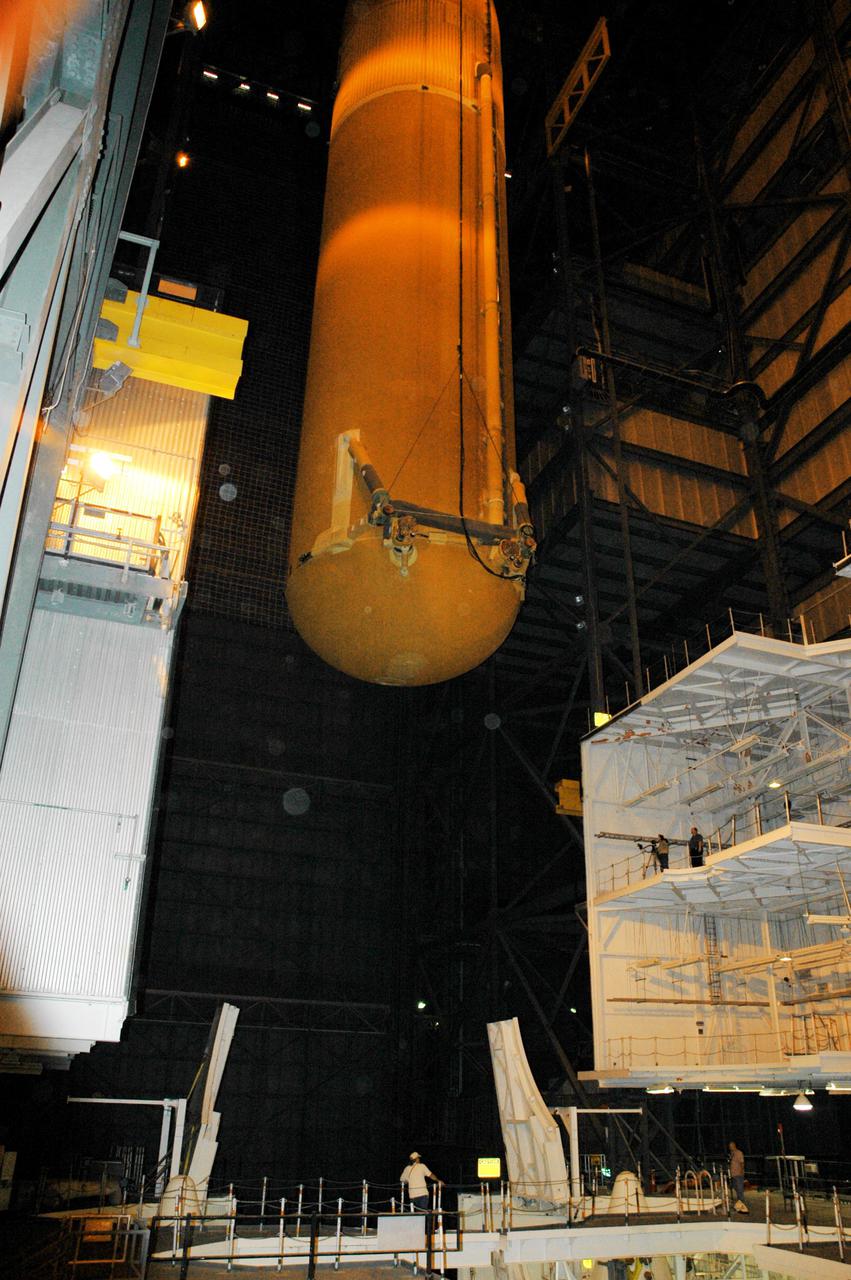
KENNEDY SPACE CENTER, FLA. - The External Tank that will be used to return the Space Shuttle program to flight is lowered into high bay 3 in the Vehicle Assembly Building. The tank, ET-121, and the Solid Rocket Boosters were originally scheduled to fly with orbiter Atlantis on mission STS-121 but will now be used to launch Discovery on mission STS-114. Once secure in the high bay, a new heater will be added to the feedline bellows to minimize the potential for ice and frost buildup. STS-114 is the first Return to Flight mission to the International Space Station. The launch window extends from July 13 through July 31.
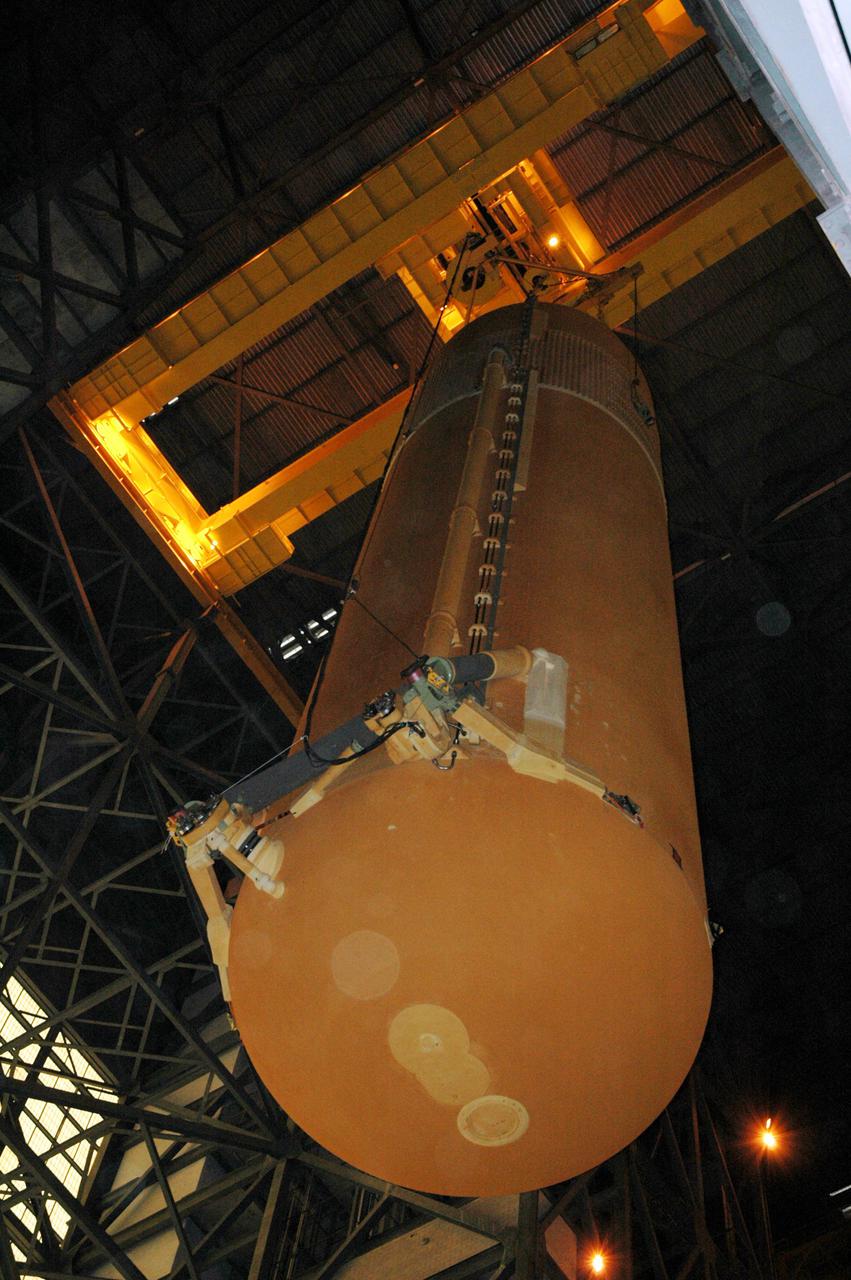
KENNEDY SPACE CENTER, FLA. - The External Tank that will be used to return the Space Shuttle program to flight is lifted into high bay 3 in the Vehicle Assembly Building. The tank, ET-121, and the Solid Rocket Boosters were originally scheduled to fly with orbiter Atlantis on mission STS-121 but will now be used to launch Discovery on mission STS-114. Once secure in the high bay, a new heater will be added to the feedline bellows to minimize the potential for ice and frost buildup. STS-114 is the first Return to Flight mission to the International Space Station. The launch window extends from July 13 through July 31.
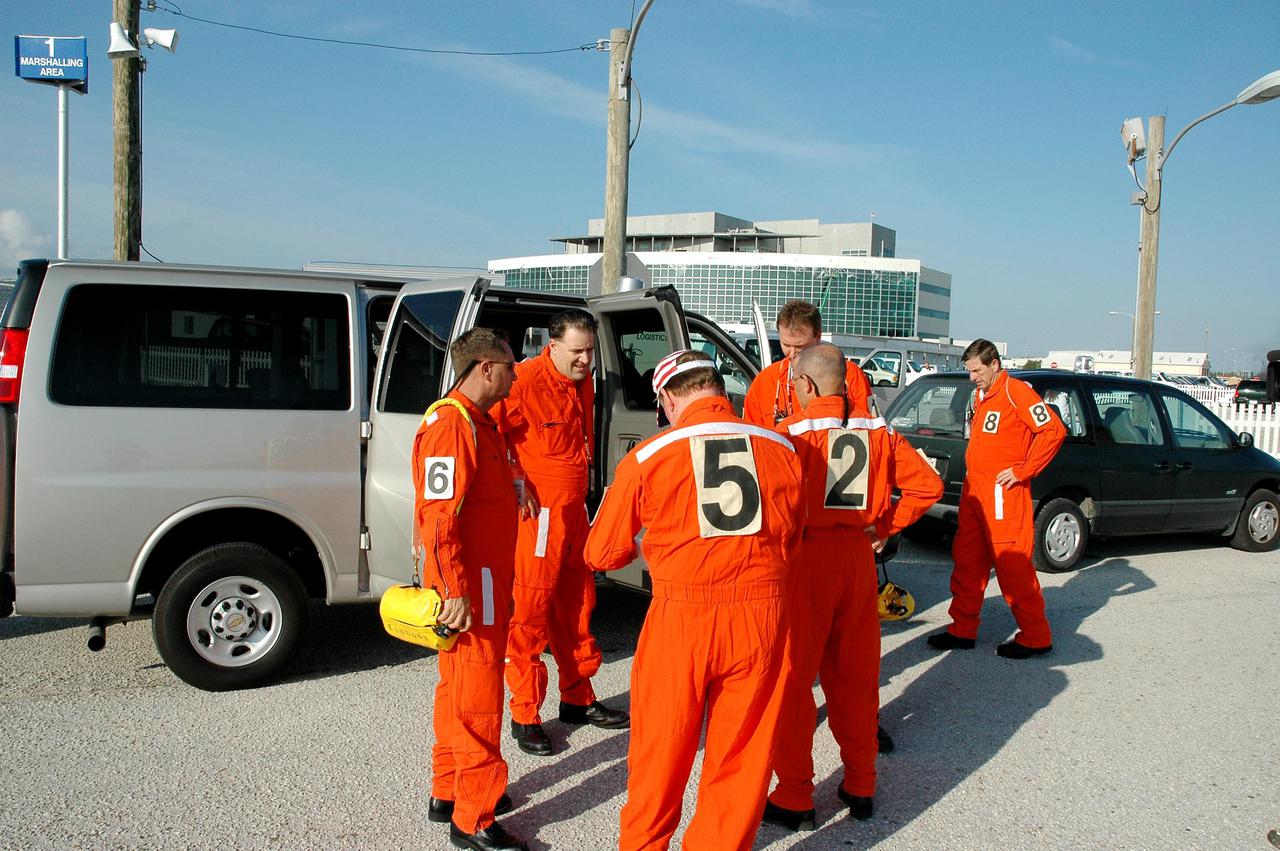
KENNEDY SPACE CENTER, FLA. - Members of the Final Inspection Team check their radios and Emergency Life Support Apparatus (ELSA) equipment before moving to Launch Pad 39B to support an External Tank (ET) tanking test. This team conducts a preflight walkdown of the vehicle and pad during the hold at T-3 hours on launch day. The tanking test is designed to evaluate how the tank, orbiter, solid rocket boosters and ground systems perform under 'cryo-load,' when the tank is filled with the two ultra-low-temperature propellants. The tank filling and draining portion of the test takes about 11 hours. The test also includes a simulated countdown through the hold at T-31 seconds. The test is being conducted to troubleshoot two issues identified by a tanking test held on April 14. Data is being collected to analyze the liquid hydrogen sensors that gave intermittent readings and the liquid hydrogen pressurization relief valve that cycled more times than standard. The tanking tests are part of preparations for Space Shuttle Discovery's Return to Flight mission, STS-114, to the International Space Station. The launch window extends from July 13 through July 31.
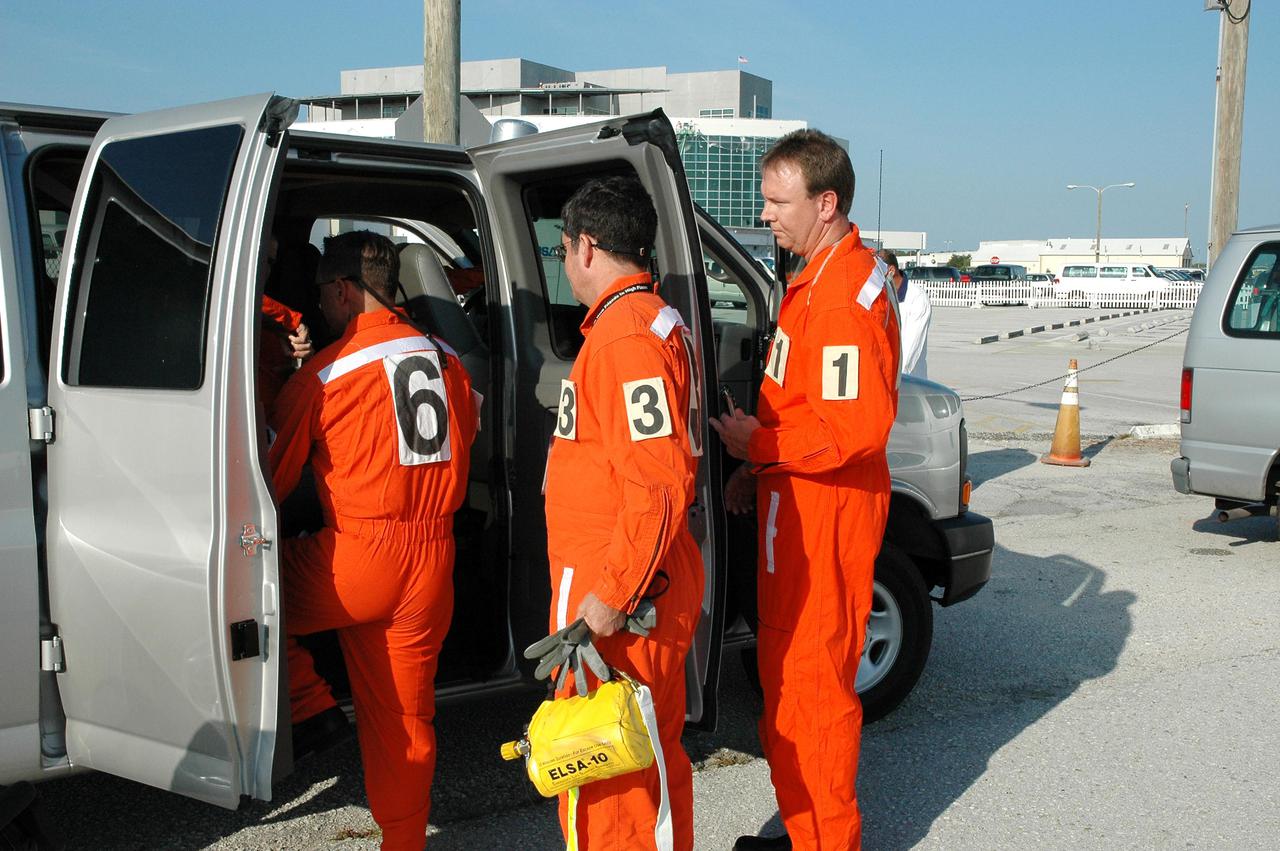
KENNEDY SPACE CENTER, FLA. - Members of the Final Inspection Team depart for Launch Pad 39B to support an External Tank (ET) tanking test. This team conducts a preflight walkdown of the vehicle and pad during the hold at T-3 hours on launch day. The tanking test is designed to evaluate how the tank, orbiter, solid rocket boosters and ground systems perform under 'cryo-load,' when the tank is filled with the two ultra-low-temperature propellants. The tank filling and draining portion of the test takes about 11 hours. The test also includes a simulated countdown through the hold at T-31 seconds. The test is being conducted to troubleshoot two issues identified by a tanking test held on April 14. Data is being collected to analyze the liquid hydrogen sensors that gave intermittent readings and the liquid hydrogen pressurization relief valve that cycled more times than standard. The tanking tests are part of preparations for Space Shuttle Discovery's Return to Flight mission, STS-114, to the International Space Station. The launch window extends from July 13 through July 31.
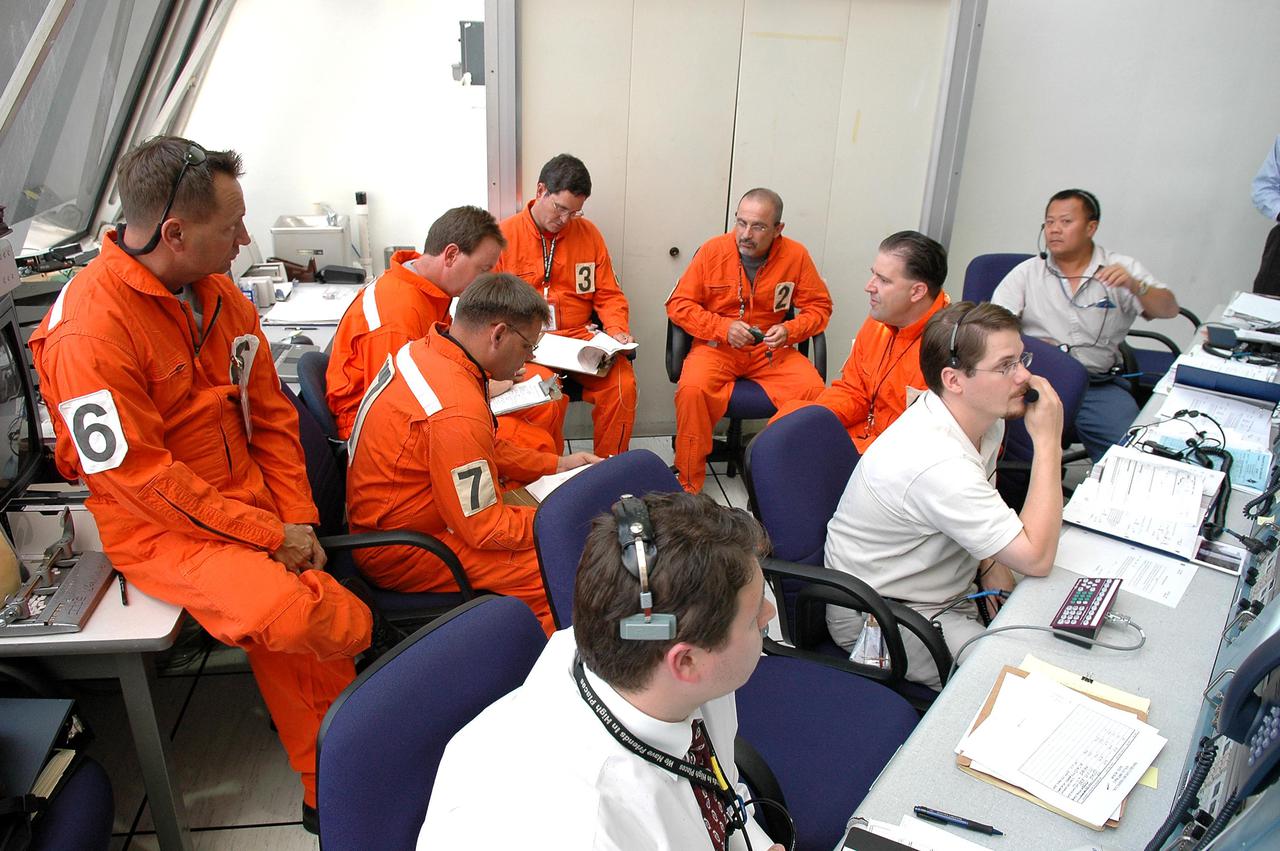
KENNEDY SPACE CENTER, FLA. - Members of the Final Inspection Team (orange suits) support an External Tank (ET) tanking test from the Launch Control Center. Launch Pad 39B, where the test is taking place, can be seen through the window. The tanking test is designed to evaluate how the tank, orbiter, solid rocket boosters and ground systems perform under 'cryo-load,' when the tank is filled with the two ultra-low-temperature propellants. The tank filling and draining portion of the test takes about 11 hours. The test also includes a simulated countdown through the hold at T-31 seconds. The test is being conducted to troubleshoot two issues identified by a tanking test held on April 14. Data is being collected to analyze the liquid hydrogen sensors that gave intermittent readings and the liquid hydrogen pressurization relief valve that cycled more times than standard. The tanking tests are part of preparations for Space Shuttle Discovery's Return to Flight mission, STS-114, to the International Space Station. The launch window extends from July 13 through July 31.
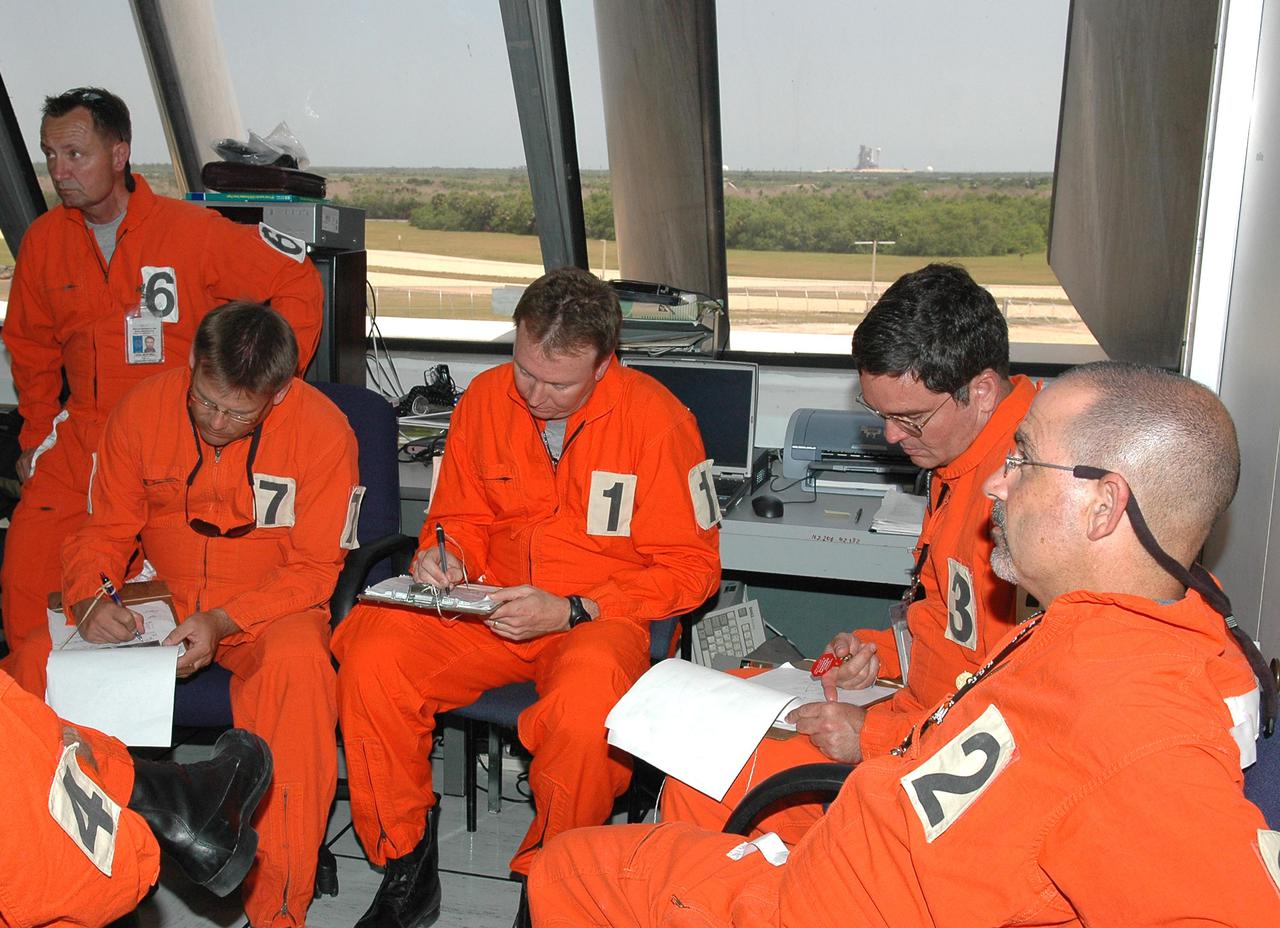
KENNEDY SPACE CENTER, FLA. - Members of the Final Inspection Team support an External Tank (ET) tanking test from the Launch Control Center. Launch Pad 39B, where the test is being conducted, can be seen through the window. From left are Doug Powell, Lockheed Martin; Scott Otto, Lockheed Martin; John Blue, NASA; Robert Speece, NASA; and Jorge Rivera, NASA. The tanking test is designed to evaluate how the tank, orbiter, solid rocket boosters and ground systems perform under 'cryo-load,' when the tank is filled with the two ultra-low-temperature propellants. The tank filling and draining portion of the test takes about 11 hours. The test also includes a simulated countdown through the hold at T-31 seconds. The test is being conducted to troubleshoot two issues identified by a tanking test held on April 14. Data is being collected to analyze the liquid hydrogen sensors that gave intermittent readings and the liquid hydrogen pressurization relief valve that cycled more times than standard. The tanking tests are part of preparations for Space Shuttle Discovery's Return to Flight mission, STS-114, to the International Space Station. The launch window extends from July 13 through July 31.
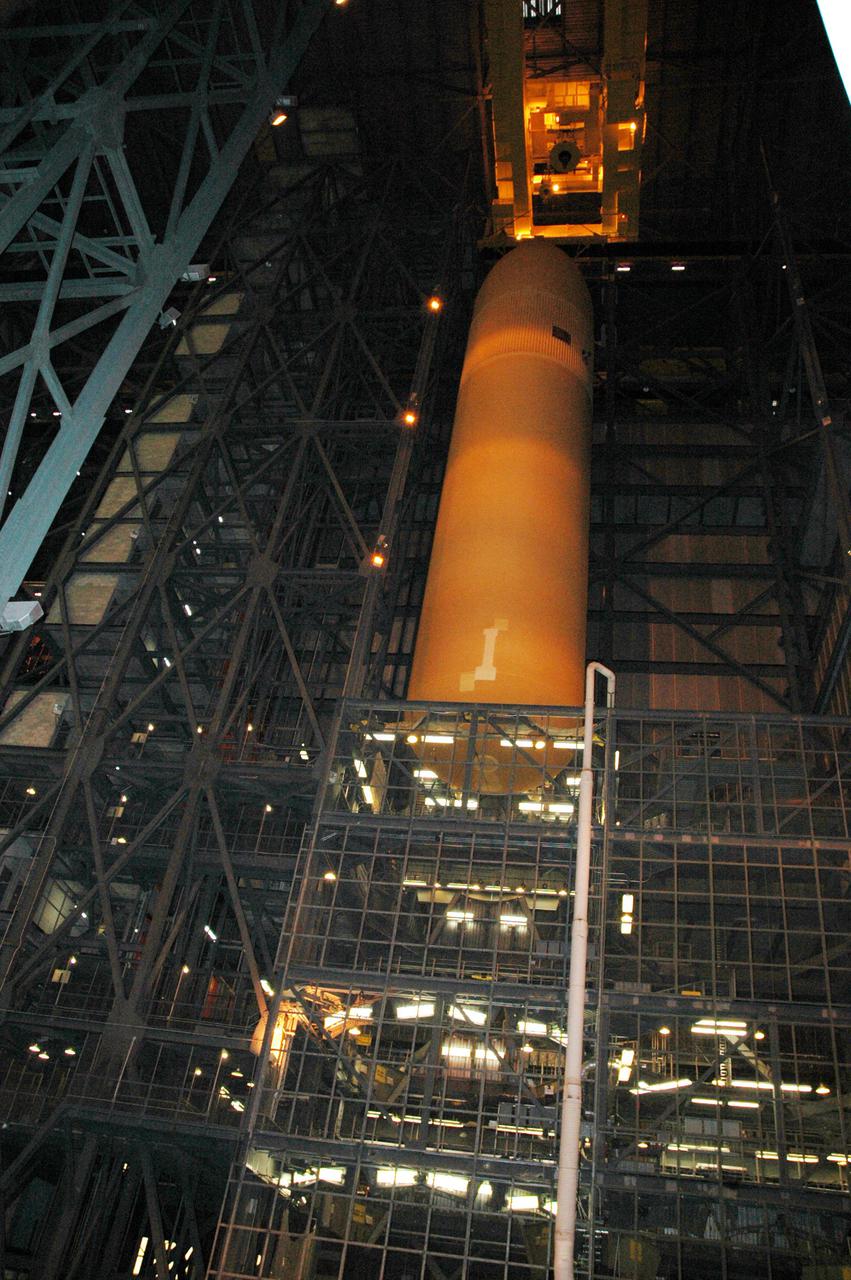
KENNEDY SPACE CENTER, FLA. - The External Tank that will be used to return the Space Shuttle program to flight is lifted into high bay 3 in the Vehicle Assembly Building. The tank, ET-121, and the Solid Rocket Boosters were originally scheduled to fly with orbiter Atlantis on mission STS-121 but will now be used to launch Discovery on mission STS-114. Once secure in the high bay, a new heater will be added to the feedline bellows to minimize the potential for ice and frost buildup. STS-114 is the first Return to Flight mission to the International Space Station. The launch window extends from July 13 through July 31.
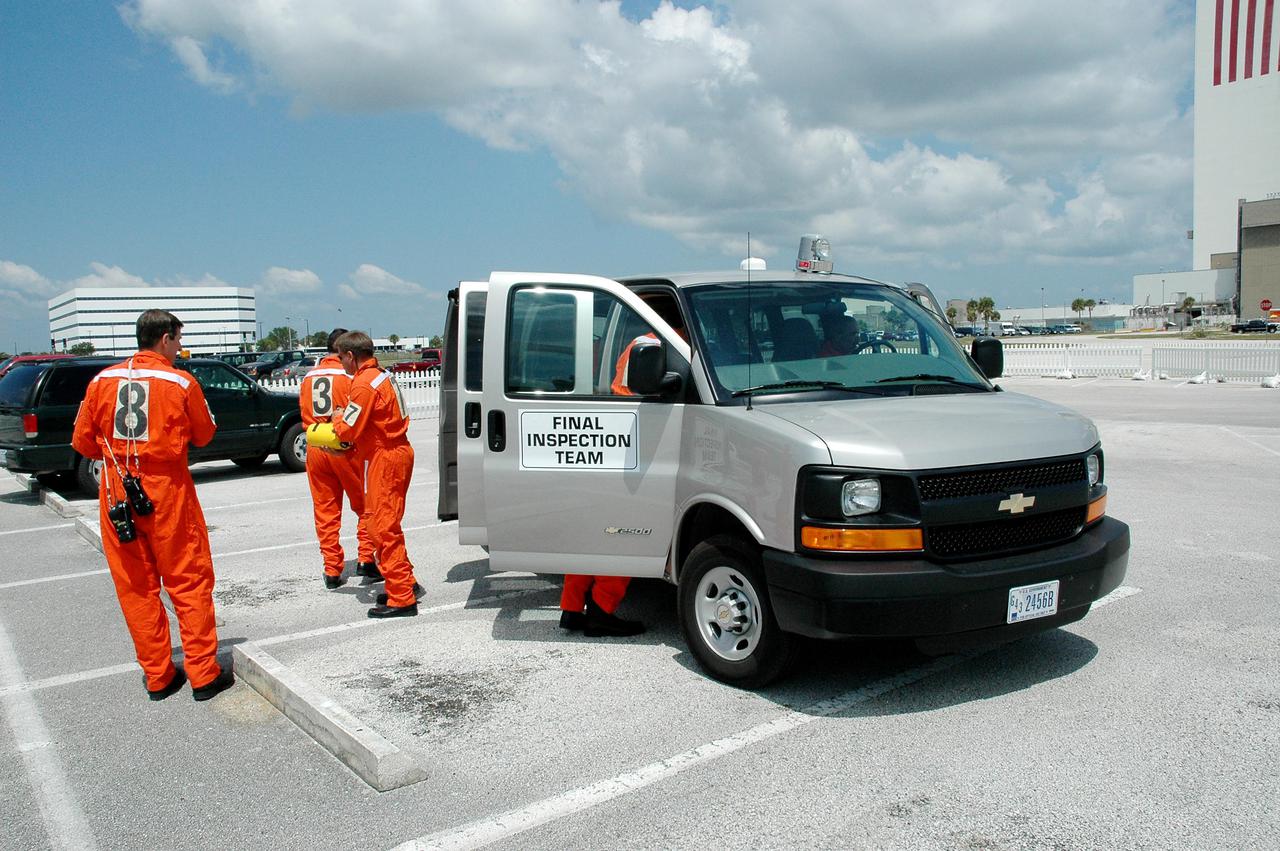
KENNEDY SPACE CENTER, FLA. - Members of the Final Inspection Team return from Launch Pad 39B where they supported an External Tank (ET) tanking test. This team conducts a preflight walkdown of the vehicle and pad during the hold at T-3 hours on launch day. The tanking test is designed to evaluate how the tank, orbiter, solid rocket boosters and ground systems perform under 'cryo-load,' when the tank is filled with the two ultra-low-temperature propellants. The tank filling and draining portion of the test takes about 11 hours. The test also includes a simulated countdown through the hold at T-31 seconds. The test is being conducted to troubleshoot two issues identified by a tanking test held on April 14. Data is being collected to analyze the liquid hydrogen sensors that gave intermittent readings and the liquid hydrogen pressurization relief valve that cycled more times than standard. The tanking tests are part of preparations for Space Shuttle Discovery's Return to Flight mission, STS-114, to the International Space Station. The launch window extends from July 13 through July 31.
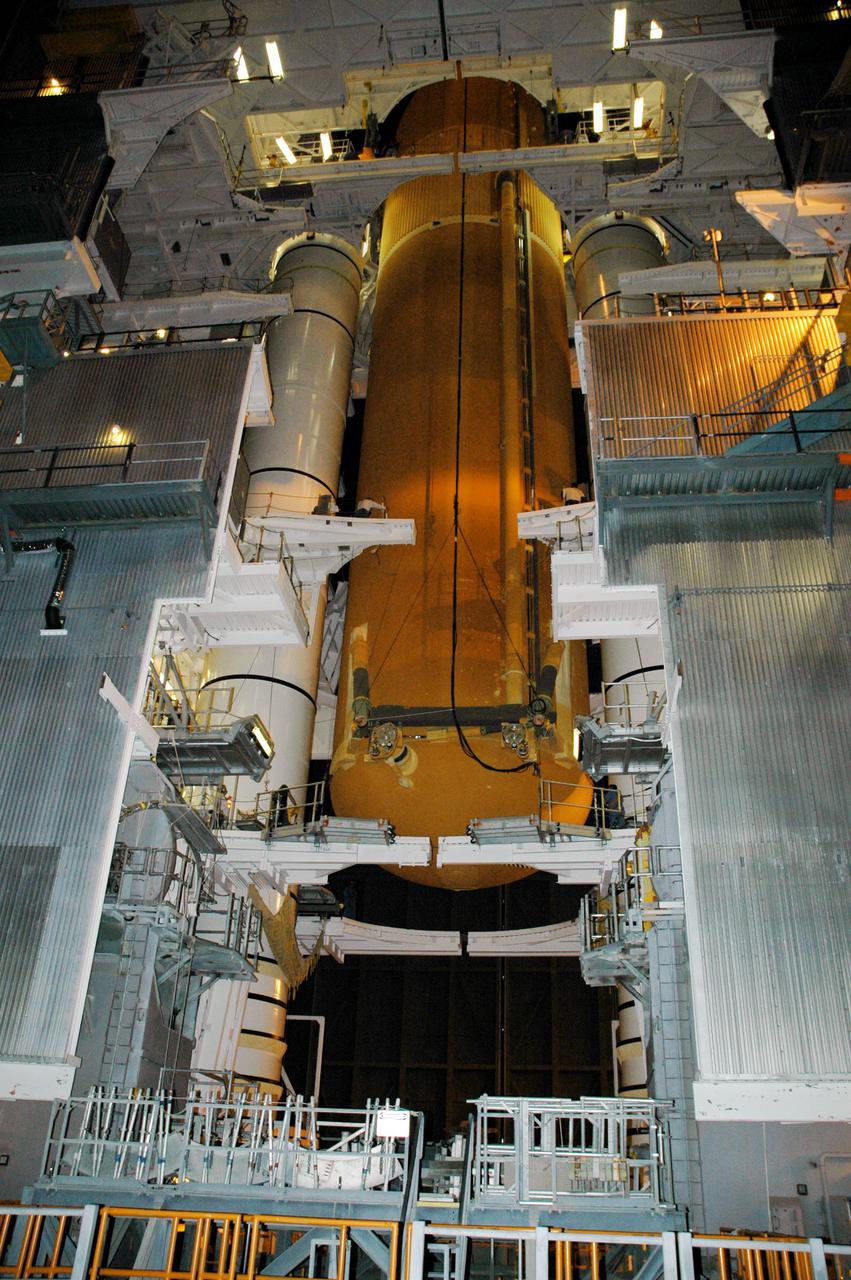
KENNEDY SPACE CENTER, FLA. - The External Tank that will be used to return the Space Shuttle program to flight is attached to a pair of Solid Rocket Boosters in high bay 3 in the Vehicle Assembly Building. The tank, ET-121, and the Solid Rocket Boosters were originally scheduled to fly with orbiter Atlantis on mission STS-121 but will now be used to launch Discovery on mission STS-114. Once secure in the high bay, a new heater will be added to the feedline bellows to minimize the potential for ice and frost buildup. STS-114 is the first Return to Flight mission to the International Space Station. The launch window extends from July 13 through July 31.
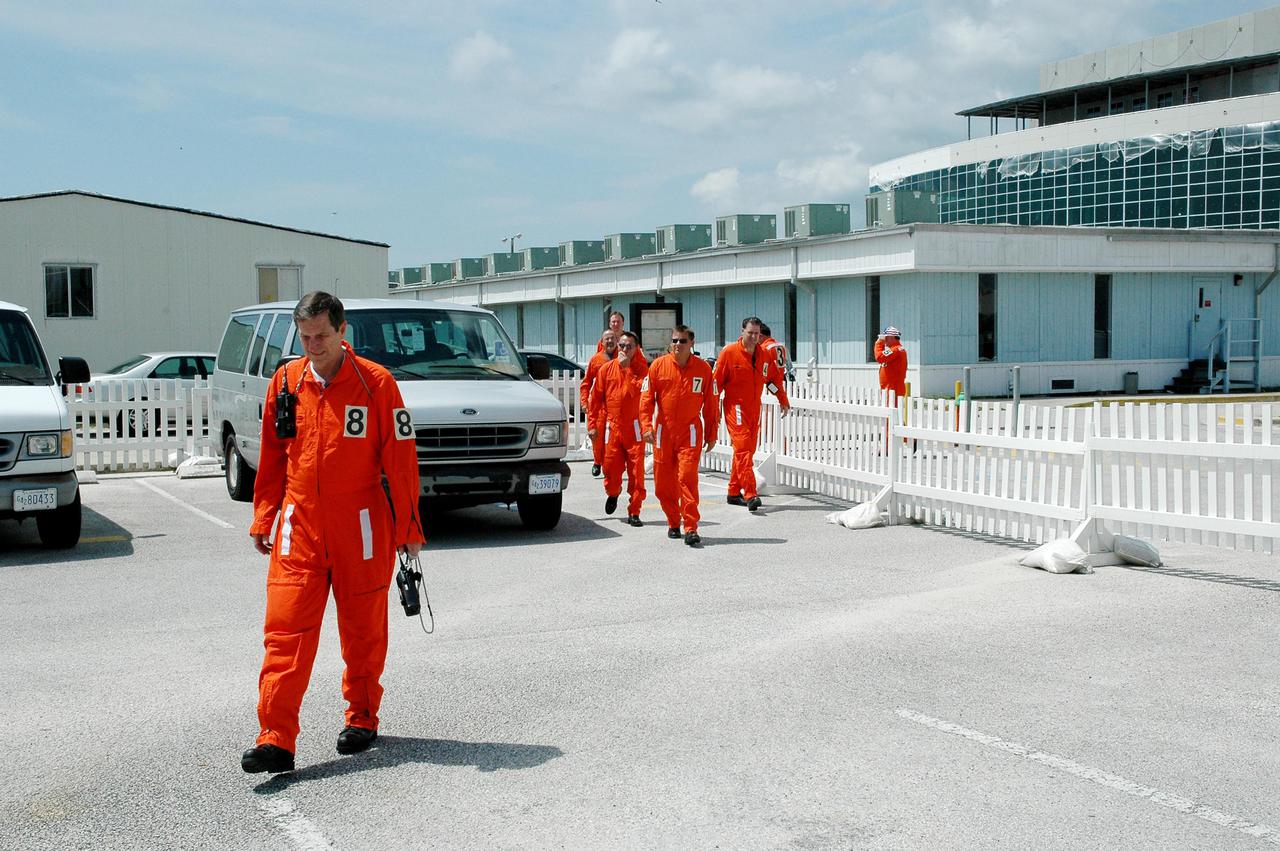
KENNEDY SPACE CENTER, FLA. - Members of the Final Inspection Team return from Launch Pad 39B where they supported an External Tank (ET) tanking test. This team conducts a preflight walkdown of the vehicle and pad during the hold at T-3 hours on launch day. The tanking test is designed to evaluate how the tank, orbiter, solid rocket boosters and ground systems perform under 'cryo-load,' when the tank is filled with the two ultra-low-temperature propellants. The tank filling and draining portion of the test takes about 11 hours. The test also includes a simulated countdown through the hold at T-31 seconds. The test is being conducted to troubleshoot two issues identified by a tanking test held on April 14. Data is being collected to analyze the liquid hydrogen sensors that gave intermittent readings and the liquid hydrogen pressurization relief valve that cycled more times than standard. The tanking tests are part of preparations for Space Shuttle Discovery's Return to Flight mission, STS-114, to the International Space Station. The launch window extends from July 13 through July 31.
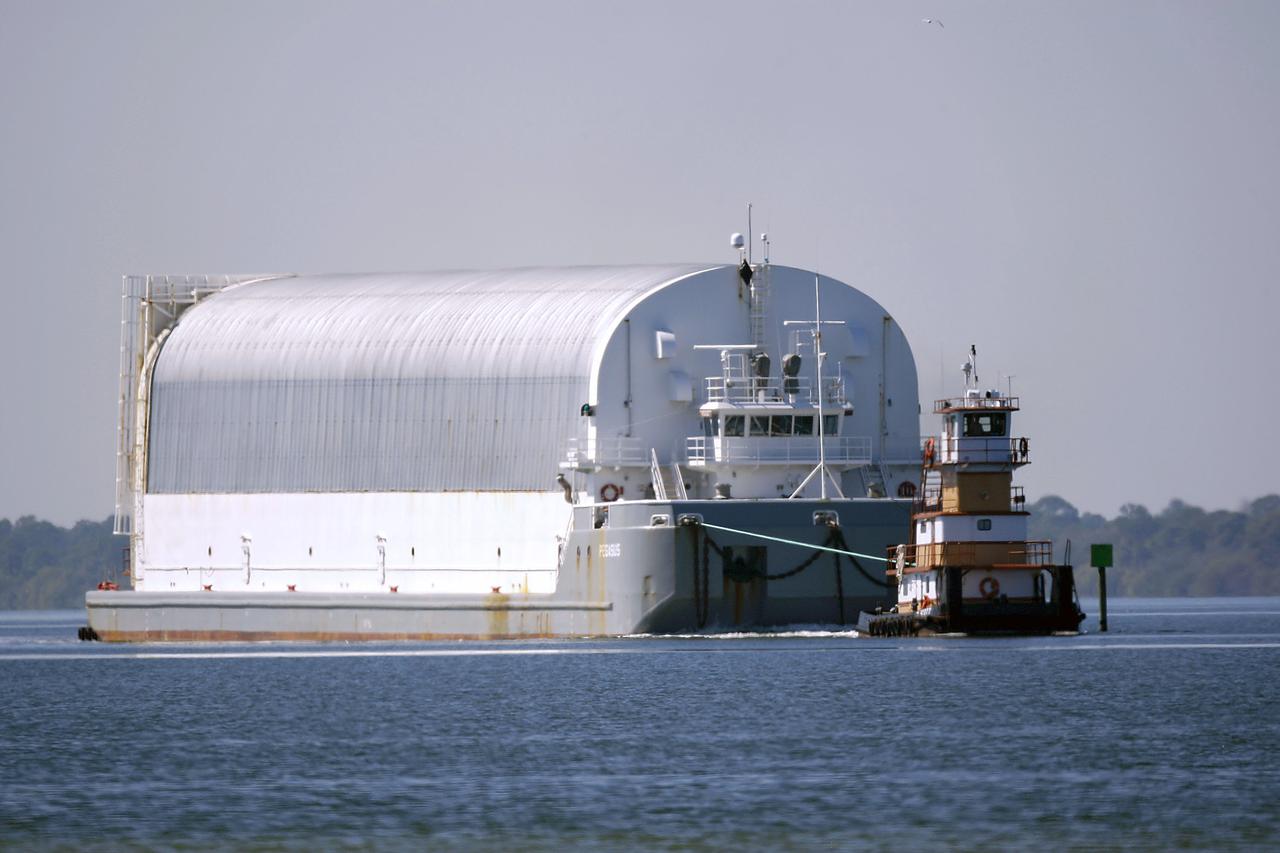
CAPE CANAVERAL, Fla. – The Pegasus barge carrying External Tank-136 arrives near the turn basin at Kennedy Space Center in Florida, from NASA’s Michoud Assembly Facility near New Orleans. ET-136 will be used to launch space shuttle Atlantis on the STS-132 mission to the International Space Station. Launch is targeted for May 14. For more information on the components of the space shuttle and the STS-132 mission, visit http:__www.nasa.gov_mission_pages_shuttle_shuttlemissions_sts132_index.html. Photo credit: NASA_Rusty Backer.
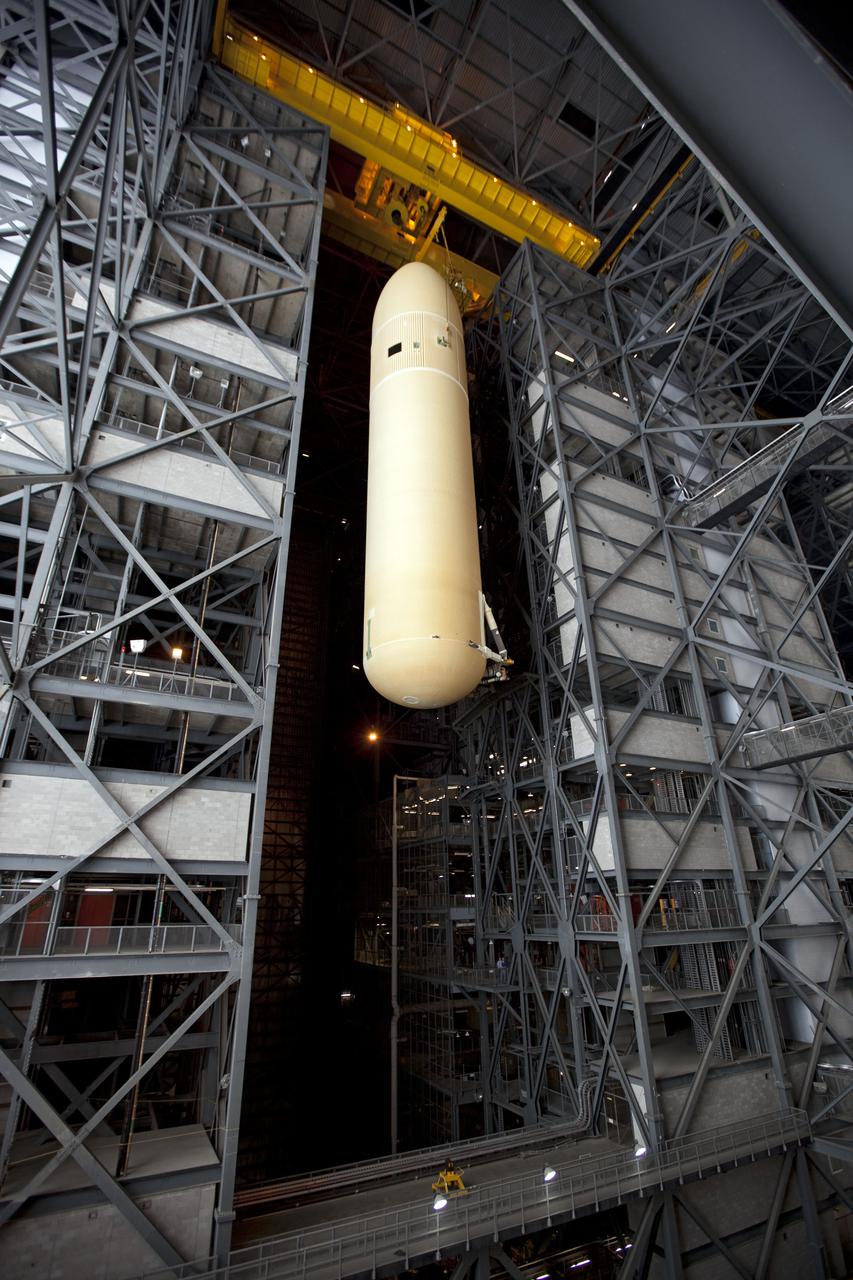
CAPE CANAVERAL, Fla. -- External Tank-138 is lifted high above the transfer aisle in the Vehicle Assembly Building at NASA's Kennedy Space Center in Florida, prior to its move to a test cell where it will be checked before launch. ET-138, the last newly manufactured tank, was originally designated to fly on Endeavour's STS-134 mission to the International Space Station, but later reassigned to fly on space shuttle Atlantis' final mission, STS-135. For information, visit www.nasa.gov_shuttle. Photo credit: NASA_Dimitri Gerondidakis
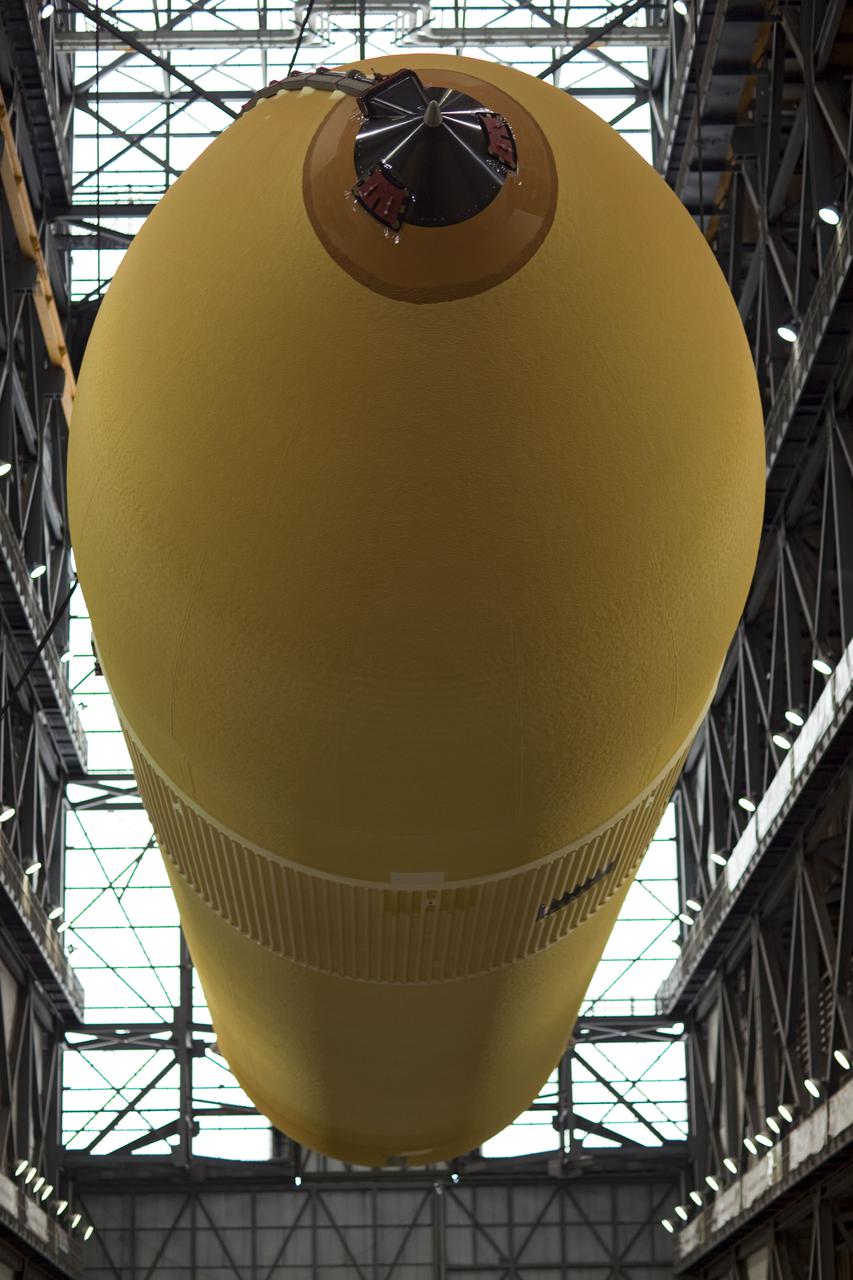
CAPE CANAVERAL, Fla. -- A close-up view of External Tank-138 being lifted above the transfer aisle in the Vehicle Assembly Building at NASA's Kennedy Space Center in Florida. The external fuel tank is being moved into a test cell where it will be checked out before launch. ET-138, the last newly manufactured tank, was originally designated to fly on Endeavour's STS-134 mission to the International Space Station, but later reassigned to fly on space shuttle Atlantis' final mission, STS-135. For information, visit www.nasa.gov_shuttle. Photo credit: NASA_Dimitri Gerondidakis
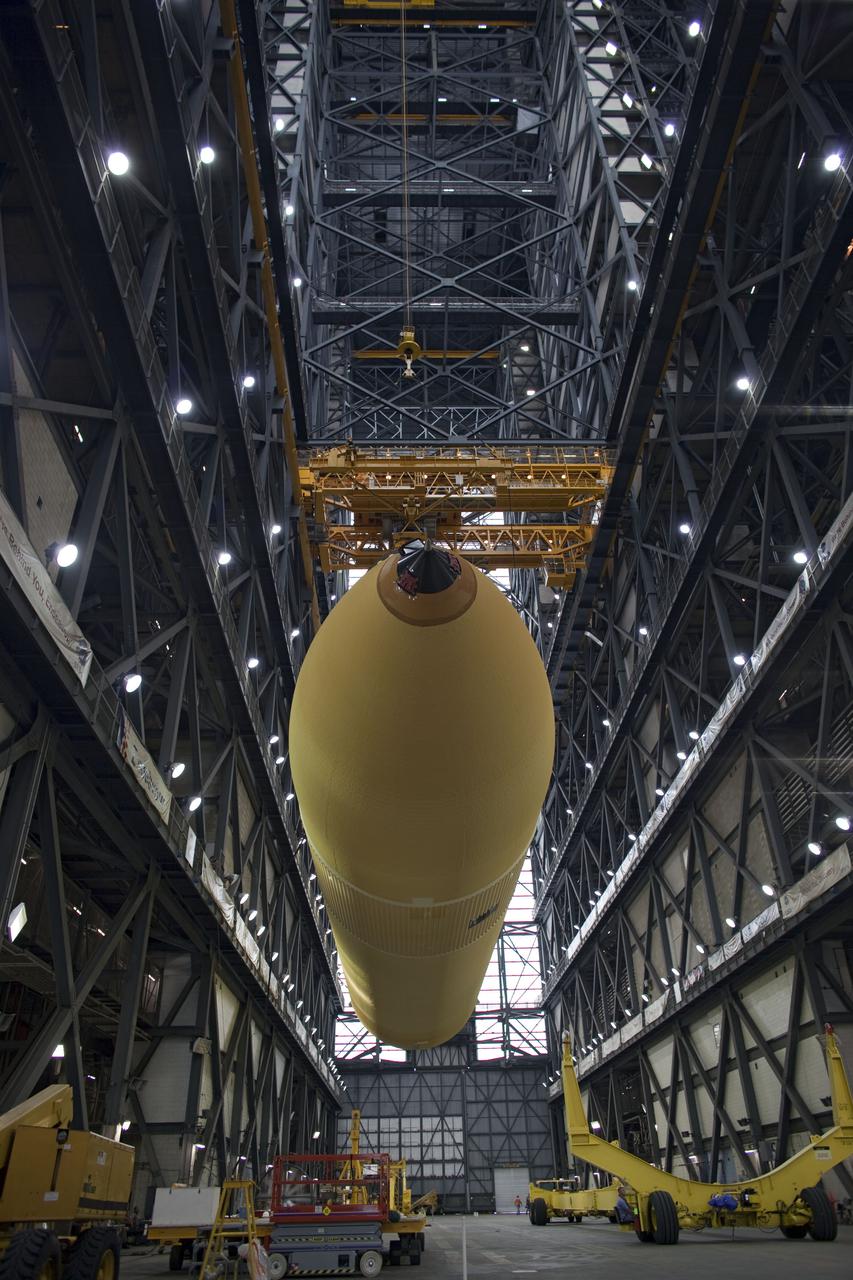
CAPE CANAVERAL, Fla. -- In the Vehicle Assembly Building at NASA's Kennedy Space Center in Florida, External Tank-138 is lifted above the transfer aisle. The external fuel tank is being moved into a test cell where it will be checked out before launch. ET-138, the last newly manufactured tank, was originally designated to fly on Endeavour's STS-134 mission to the International Space Station, but later reassigned to fly on space shuttle Atlantis' final mission, STS-135. For information, visit www.nasa.gov_shuttle. Photo credit: NASA_Dimitri Gerondidakis
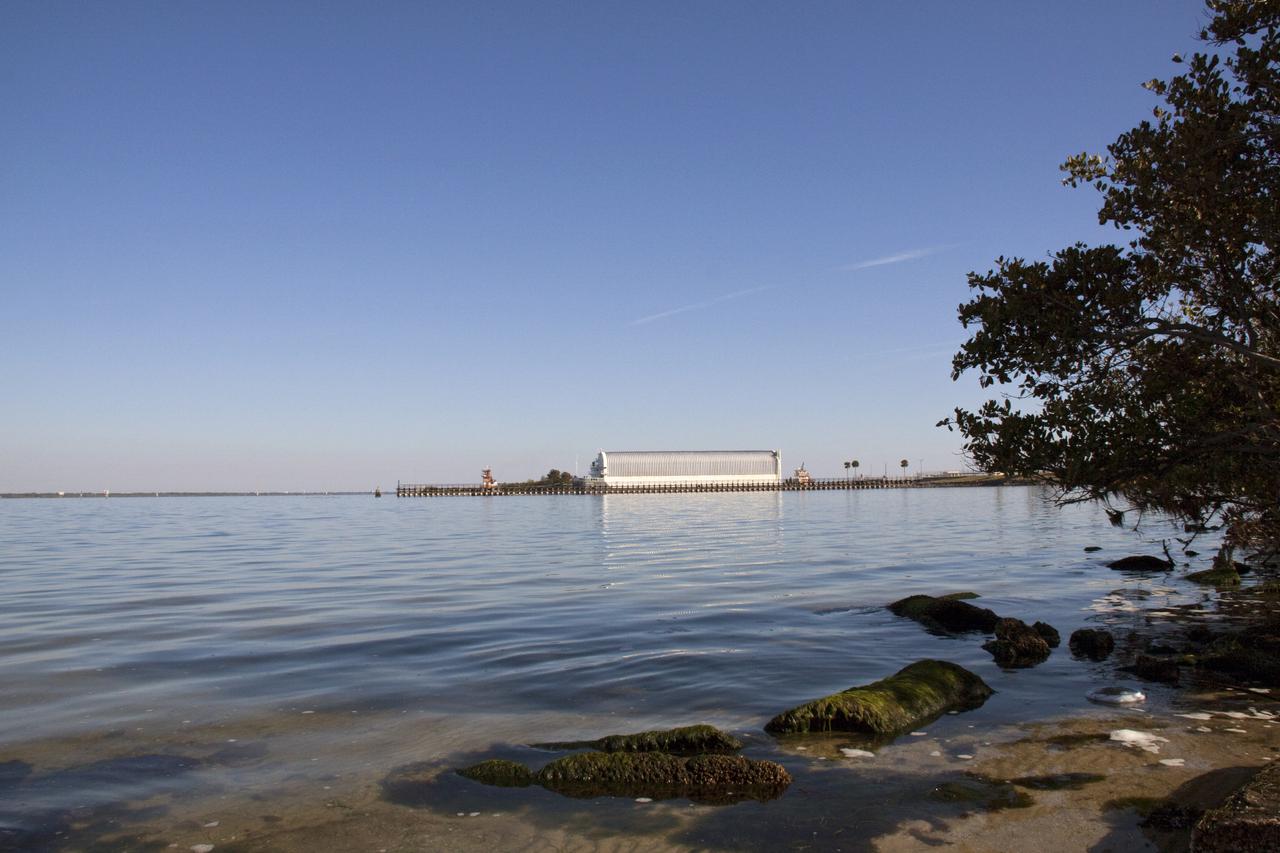
CAPE CANAVERAL, Fla. – The Pegasus barge carrying External Tank-136 arrives near the turn basin at Kennedy Space Center in Florida, from NASA’s Michoud Assembly Facility near New Orleans. ET-136 will be used to launch space shuttle Atlantis on the STS-132 mission to the International Space Station. Launch is targeted for May 14. For more information on the components of the space shuttle and the STS-132 mission, visit http:__www.nasa.gov_mission_pages_shuttle_shuttlemissions_sts132_index.html. Photo credit: NASA_Troy Cryder
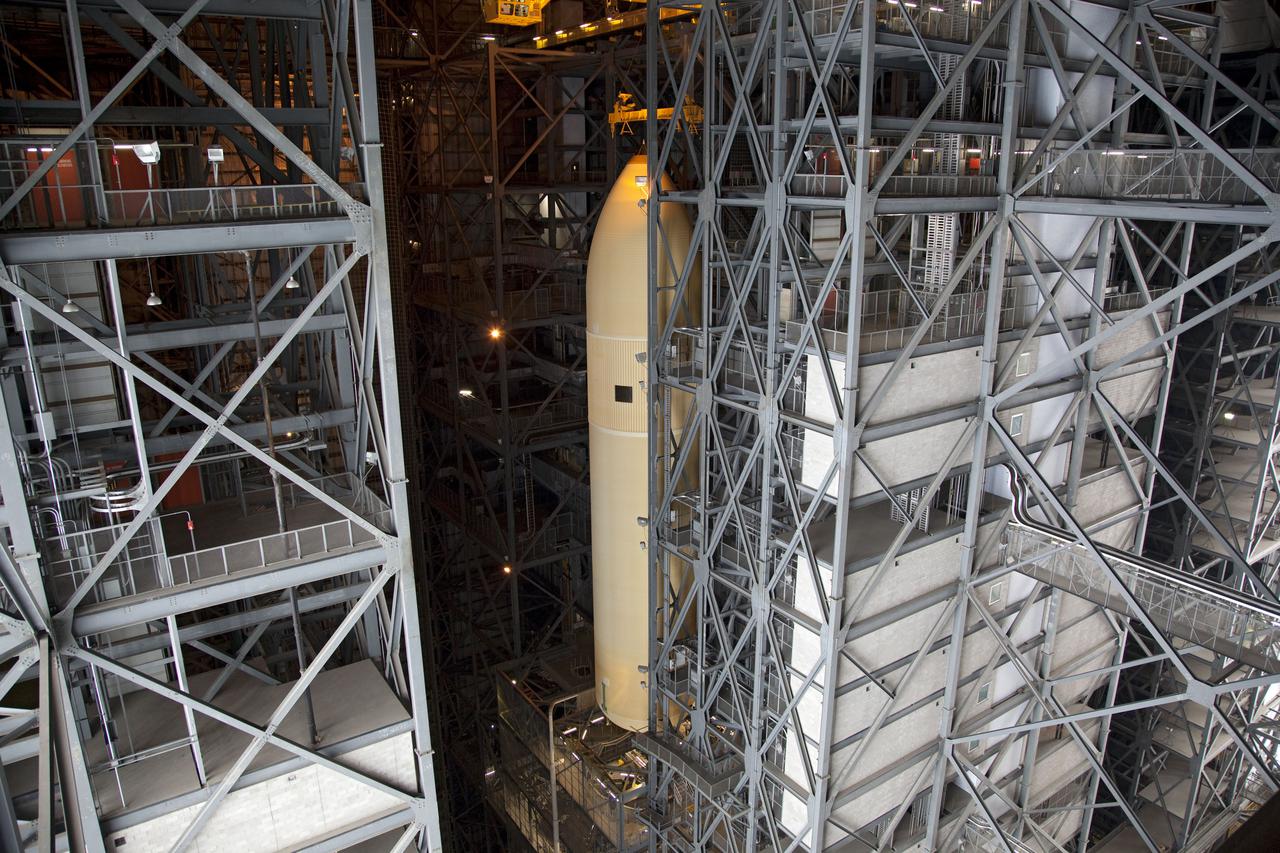
CAPE CANAVERAL, Fla. -- At NASA's Kennedy Space Center in Florida, External Tank-138 has been lifted into the upper levels of a high bay in the Vehicle Assembly Building. It will then be lowered onto a test stand and checked before launch. ET-138, the last newly manufactured tank, was originally designated to fly on Endeavour's STS-134 mission to the International Space Station, but later reassigned to fly on space shuttle Atlantis' final mission, STS-135. For information, visit www.nasa.gov_shuttle. Photo credit: NASA_Dimitri Gerondidakis
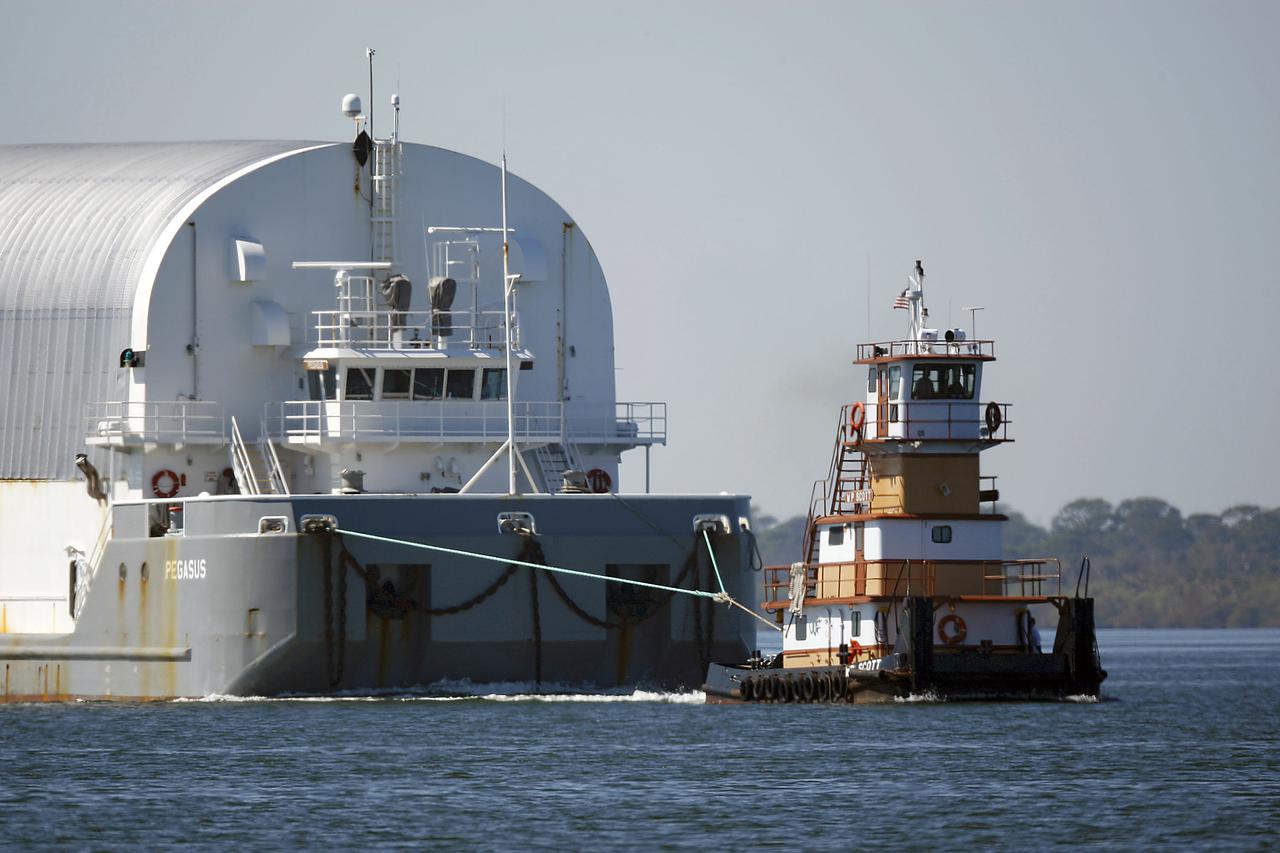
CAPE CANAVERAL, Fla. – The Pegasus barge carrying External Tank-136 arrives near the turn basin at Kennedy Space Center in Florida, from NASA’s Michoud Assembly Facility near New Orleans. ET-136 will be used to launch space shuttle Atlantis on the STS-132 mission to the International Space Station. Launch is targeted for May 14. For more information on the components of the space shuttle and the STS-132 mission, visit http:__www.nasa.gov_mission_pages_shuttle_shuttlemissions_sts132_index.html. Photo credit: NASA_Rusty Backer.
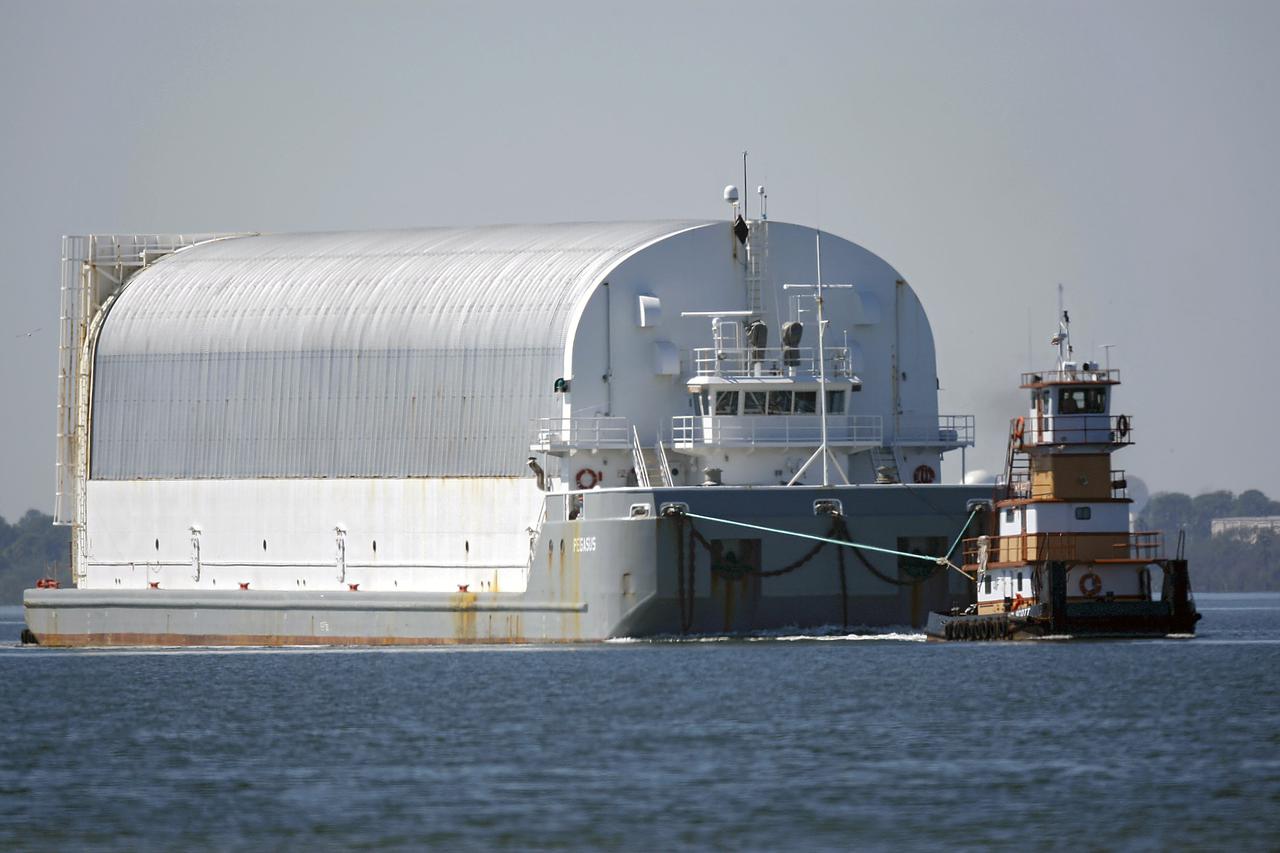
CAPE CANAVERAL, Fla. – The Pegasus barge carrying External Tank-136 arrives near the turn basin at Kennedy Space Center in Florida, from NASA’s Michoud Assembly Facility near New Orleans. ET-136 will be used to launch space shuttle Atlantis on the STS-132 mission to the International Space Station. Launch is targeted for May 14. For more information on the components of the space shuttle and the STS-132 mission, visit http:__www.nasa.gov_mission_pages_shuttle_shuttlemissions_sts132_index.html. Photo credit: NASA_Rusty Backer.
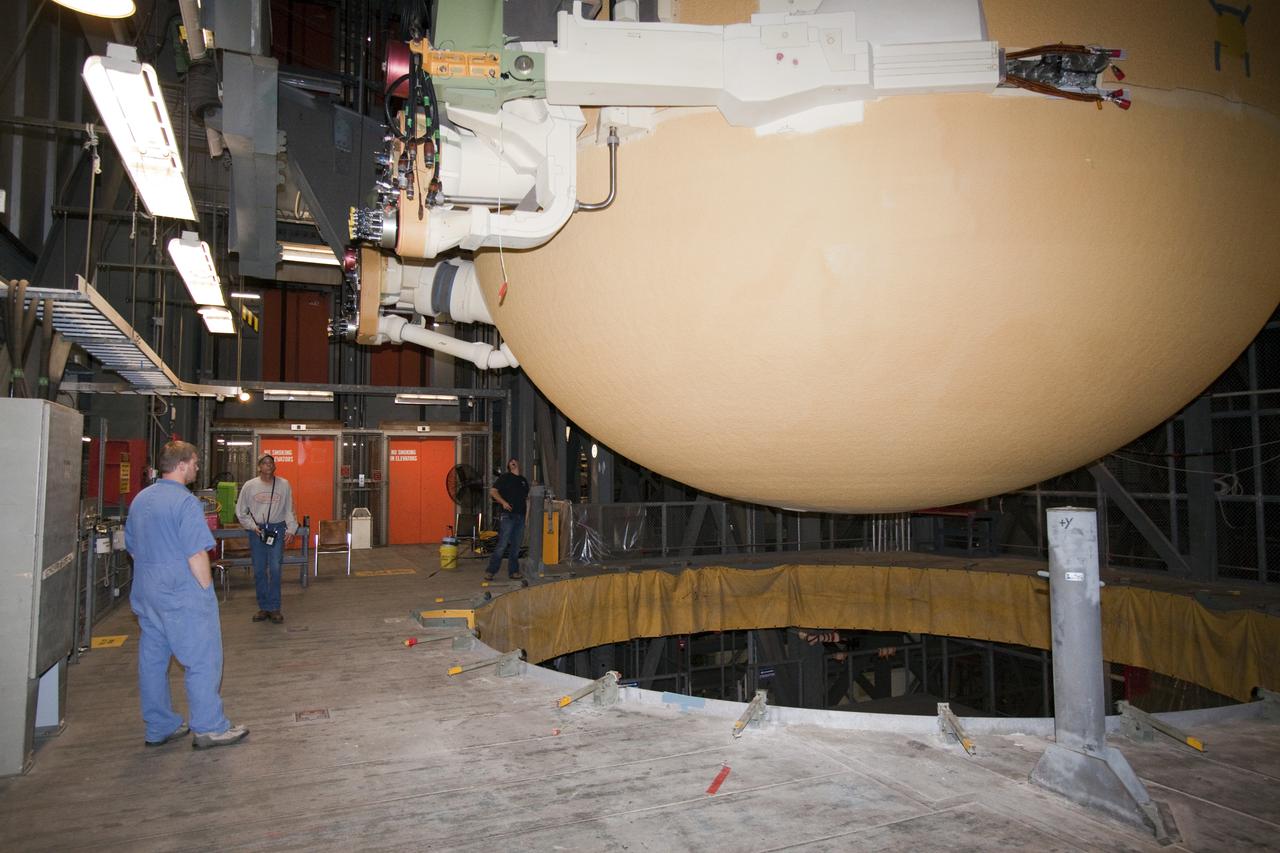
CAPE CANAVERAL, Fla. - In the Vehicle Assembly Building at NASA's Kennedy Space Center in Florida, workers observe the external fuel tank, ET-136, for space shuttle Atlantis' STS-132 mission, as it is lifted from its test cell. The external tank arrived at Kennedy from NASA's Michoud Assembly Facility on March 1 aboard the Pegasus barge. The six-member STS-132 crew will deliver an Integrated Cargo Carrier and a Russian-built Mini-Research Module, or MRM-1, to the International Space Station. Launch is targeted for May 14. For information on the STS-132 mission, visit http:__www.nasa.gov_mission_pages_shuttle_shuttlemissions_sts132_index.html. Photo credit: NASA_Jack Pfaller
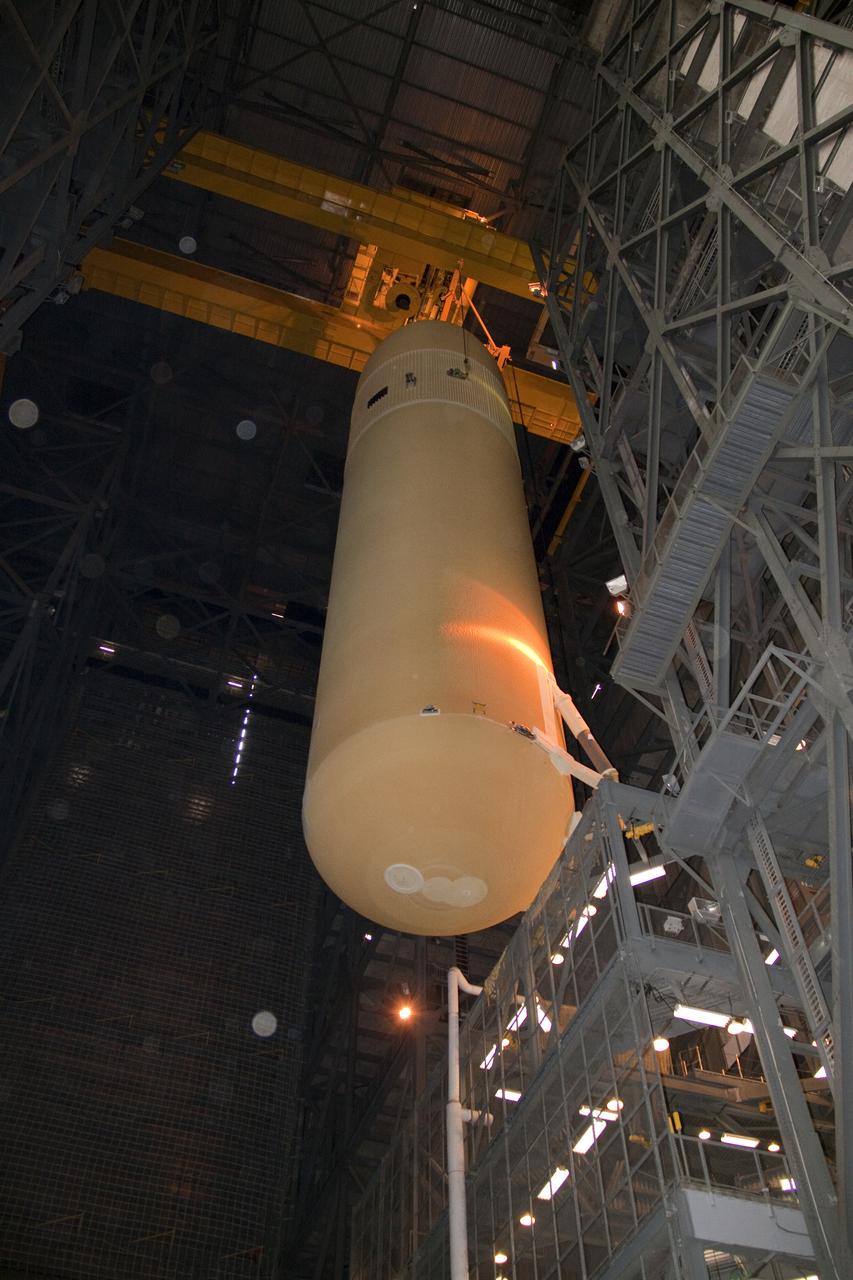
CAPE CANAVERAL, Fla. - In the Vehicle Assembly Building at NASA's Kennedy Space Center in Florida, the external fuel tank for space shuttle Atlantis' STS-132 mission, ET-136, is suspended over the transfer aisle. The external tank arrived at Kennedy from NASA's Michoud Assembly Facility on March 1 aboard the Pegasus barge. The six-member STS-132 crew will deliver an Integrated Cargo Carrier and a Russian-built Mini-Research Module, or MRM-1, to the International Space Station. Launch is targeted for May 14. For information on the STS-132 mission, visit http:__www.nasa.gov_mission_pages_shuttle_shuttlemissions_sts132_index.html. Photo credit: NASA_Jack Pfaller

CAPE CANAVERAL, Fla. - In the Vehicle Assembly Building at NASA's Kennedy Space Center in Florida, a worker observes the external fuel tank, ET-136, for space shuttle Atlantis' STS-132 mission, being lowered toward the twin solid rocket boosters. The external tank arrived at Kennedy from NASA's Michoud Assembly Facility on March 1 aboard the Pegasus barge. The six-member STS-132 crew will deliver an Integrated Cargo Carrier and a Russian-built Mini-Research Module, or MRM-1, to the International Space Station. Launch is targeted for May 14. For information on the STS-132 mission, visit http:__www.nasa.gov_mission_pages_shuttle_shuttlemissions_sts132_index.html. Photo credit: NASA_Jack Pfaller
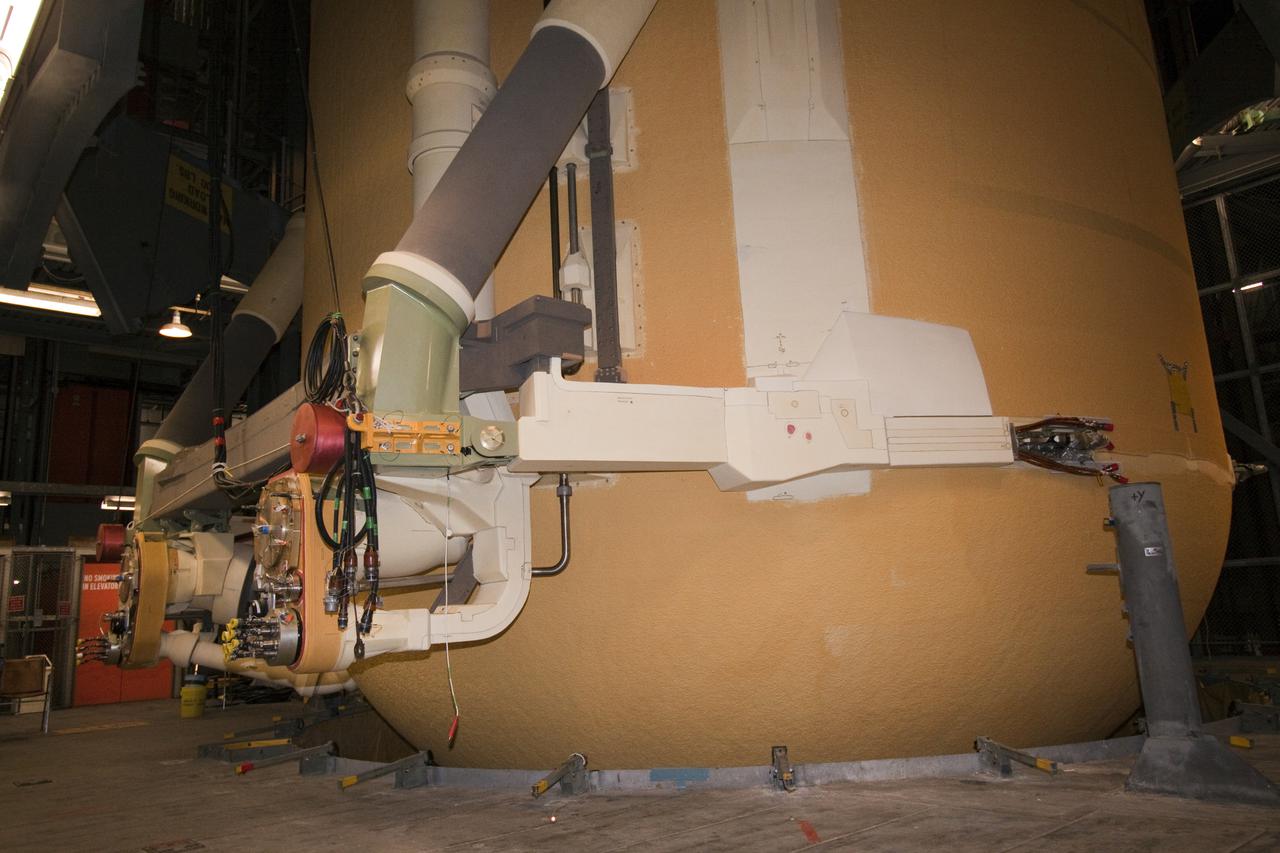
CAPE CANAVERAL, Fla. - In the Vehicle Assembly Building at NASA's Kennedy Space Center in Florida, external fuel tank, ET-136, for space shuttle Atlantis' STS-132 mission, is ready to be lifted from its test cell. The external tank arrived at Kennedy from NASA's Michoud Assembly Facility on March 1 aboard the Pegasus barge. The six-member STS-132 crew will deliver an Integrated Cargo Carrier and a Russian-built Mini-Research Module, or MRM-1, to the International Space Station. Launch is targeted for May 14. For information on the STS-132 mission, visit http:__www.nasa.gov_mission_pages_shuttle_shuttlemissions_sts132_index.html. Photo credit: NASA_Jack Pfaller
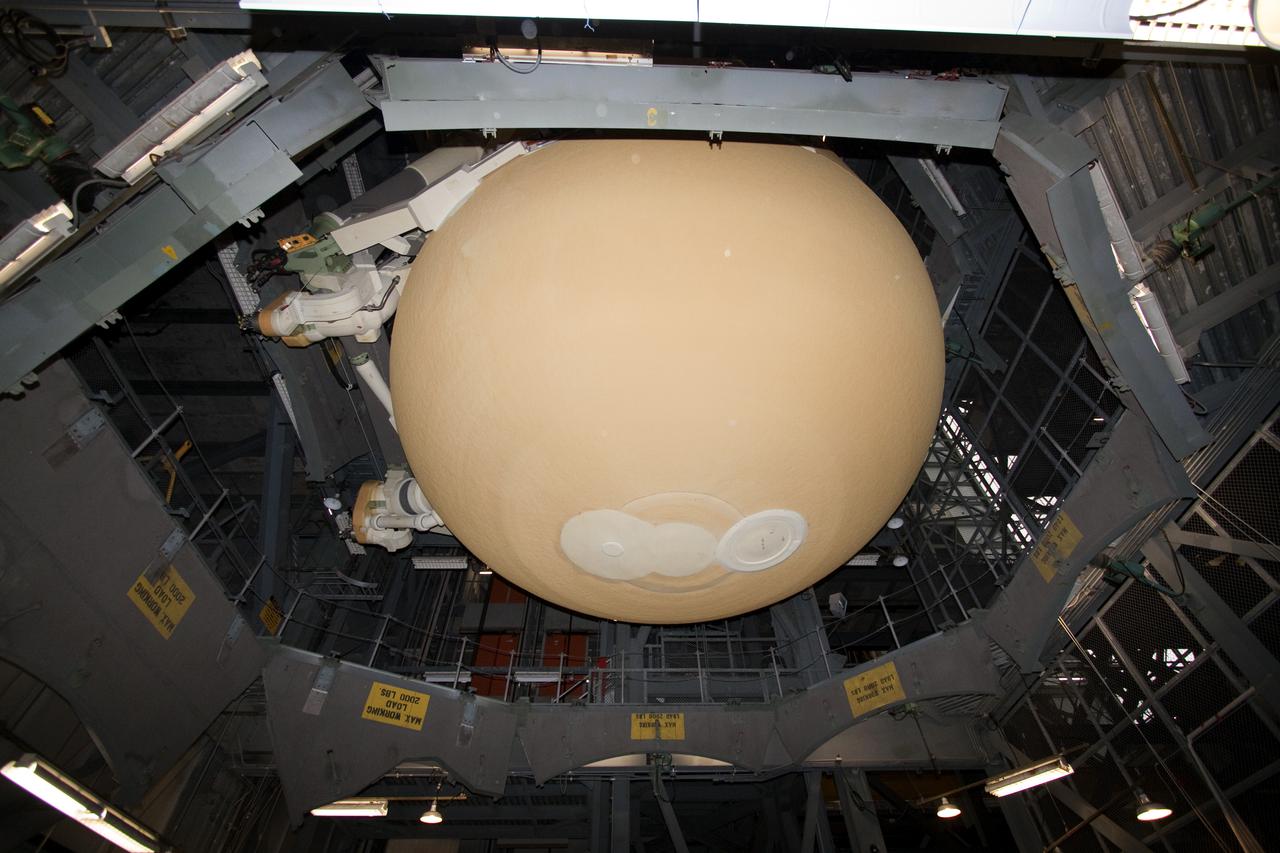
CAPE CANAVERAL, Fla. - In the Vehicle Assembly Building at NASA's Kennedy Space Center in Florida, the external fuel tank for space shuttle Atlantis' STS-132 mission, ET-136, is lifted from its test cell. The external tank arrived at Kennedy from NASA's Michoud Assembly Facility on March 1 aboard the Pegasus barge. The six-member STS-132 crew will deliver an Integrated Cargo Carrier and a Russian-built Mini-Research Module, or MRM-1, to the International Space Station. Launch is targeted for May 14. For information on the STS-132 mission, visit http:__www.nasa.gov_mission_pages_shuttle_shuttlemissions_sts132_index.html. Photo credit: NASA_Jack Pfaller
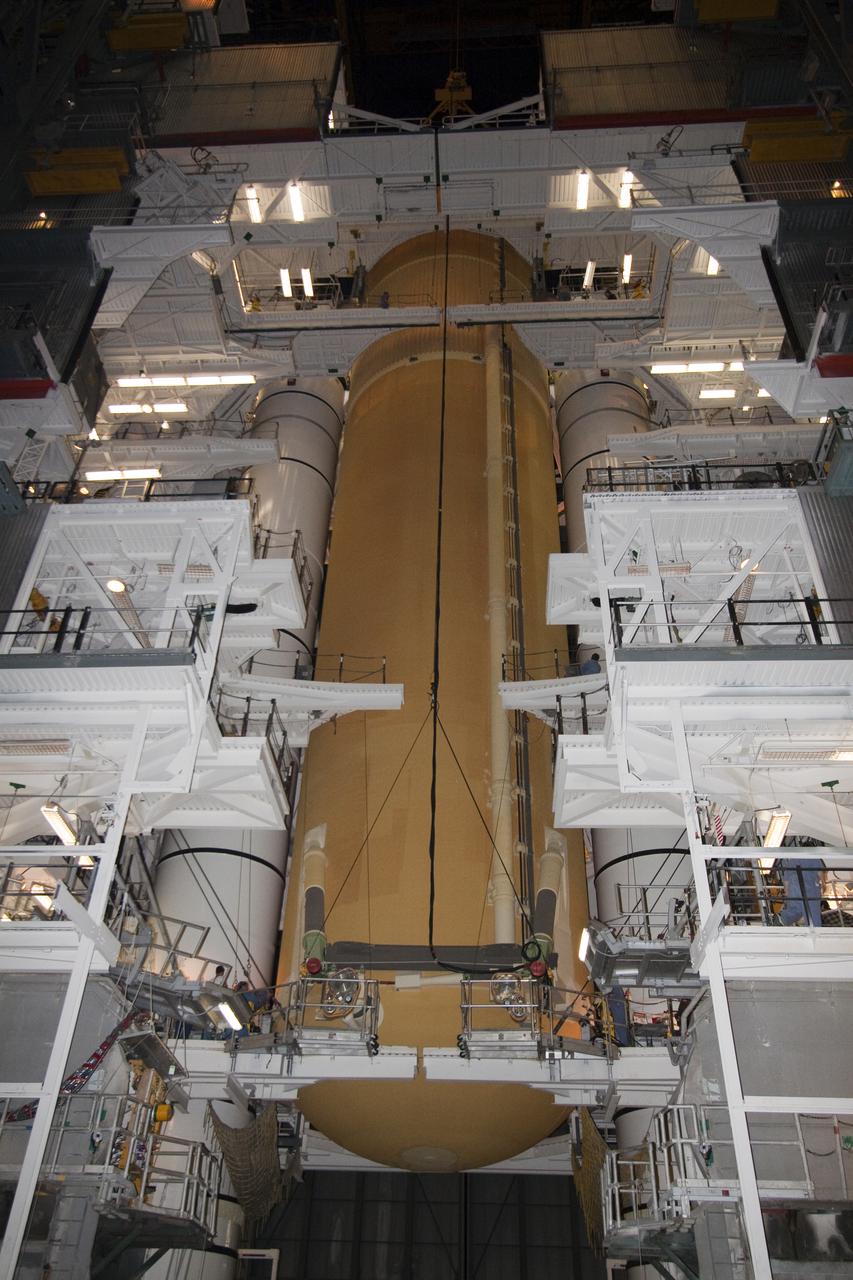
CAPE CANAVERAL, Fla. - In the Vehicle Assembly Building at NASA's Kennedy Space Center in Florida, the external tank for space shuttle Atlantis' STS-132 mission, ET-136, is lowered beside the twin solid rocket boosters already stacked on a mobile launcher platform. The external tank arrived at Kennedy from NASA's Michoud Assembly Facility on March 1 aboard the Pegasus barge. The six-member STS-132 crew will deliver an Integrated Cargo Carrier and a Russian-built Mini-Research Module, or MRM-1, to the International Space Station. Launch is targeted for May 14. For information on the STS-132 mission, visit http:__www.nasa.gov_mission_pages_shuttle_shuttlemissions_sts132_index.html. Photo credit: NASA_Jack Pfaller
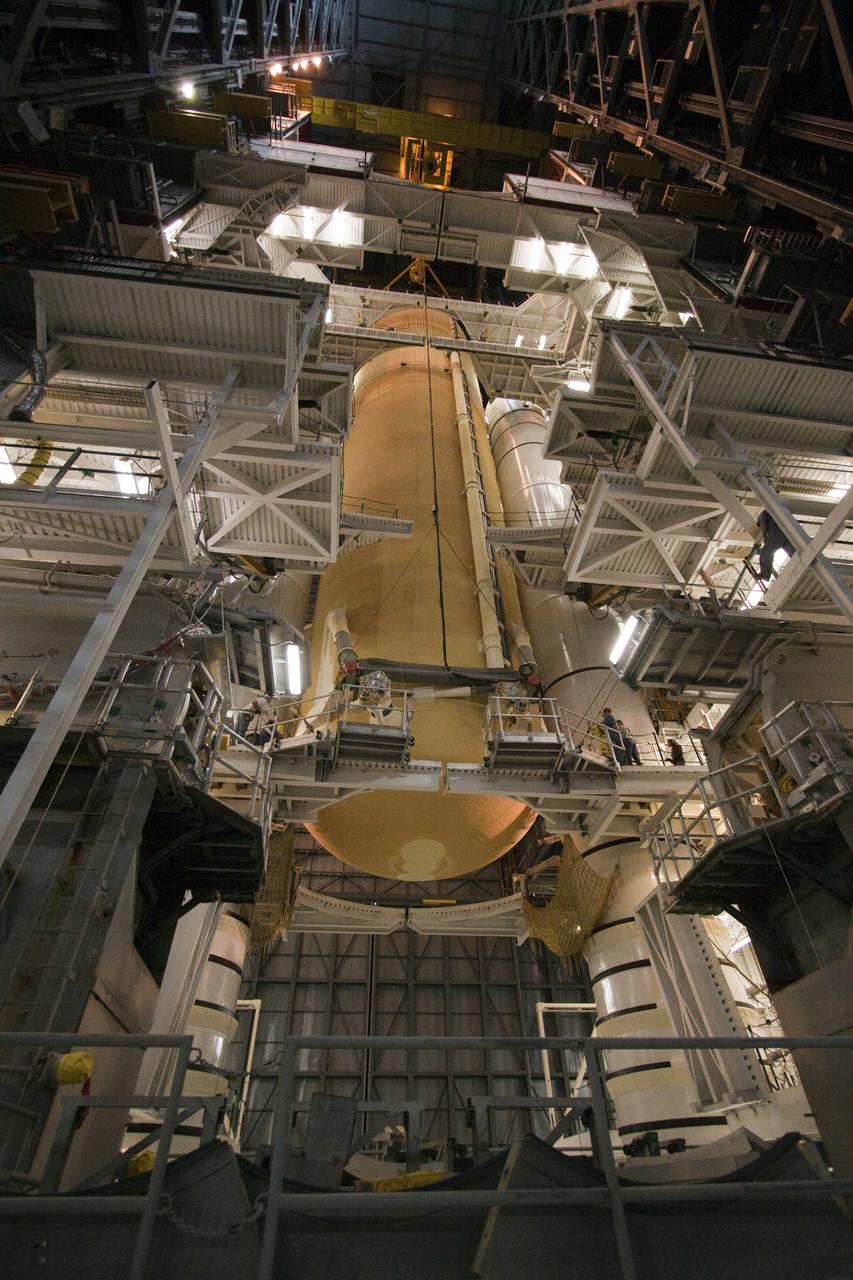
CAPE CANAVERAL, Fla. - In the Vehicle Assembly Building at NASA's Kennedy Space Center in Florida, the external tank for space shuttle Atlantis' STS-132 mission, ET-136, is lowered beside the twin solid rocket boosters already stacked on a mobile launcher platform. The external tank arrived at Kennedy from NASA's Michoud Assembly Facility on March 1 aboard the Pegasus barge. The six-member STS-132 crew will deliver an Integrated Cargo Carrier and a Russian-built Mini-Research Module, or MRM-1, to the International Space Station. Launch is targeted for May 14. For information on the STS-132 mission, visit http:__www.nasa.gov_mission_pages_shuttle_shuttlemissions_sts132_index.html. Photo credit: NASA_Jack Pfaller
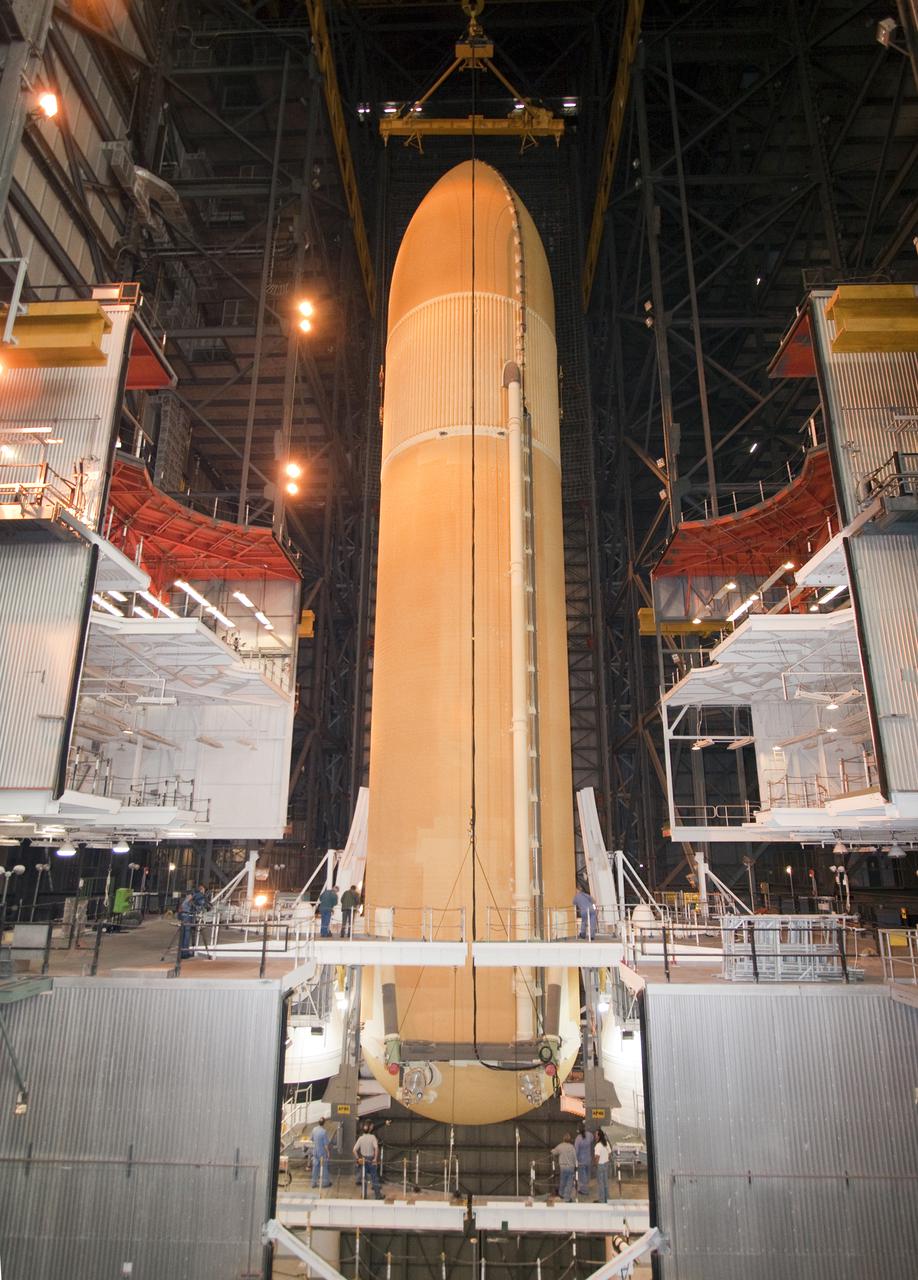
CAPE CANAVERAL, Fla. - In the Vehicle Assembly Building at NASA's Kennedy Space Center in Florida, technicians watch as the external fuel tank for space shuttle Atlantis' STS-132 mission, ET-136, is lowered between the twin solid rocket boosters. The external tank arrived at Kennedy from NASA's Michoud Assembly Facility on March 1 aboard the Pegasus barge. The six-member STS-132 crew will deliver an Integrated Cargo Carrier and a Russian-built Mini-Research Module, or MRM-1, to the International Space Station. Launch is targeted for May 14. For information on the STS-132 mission, visit http:__www.nasa.gov_mission_pages_shuttle_shuttlemissions_sts132_index.html. Photo credit: NASA_Jack Pfaller
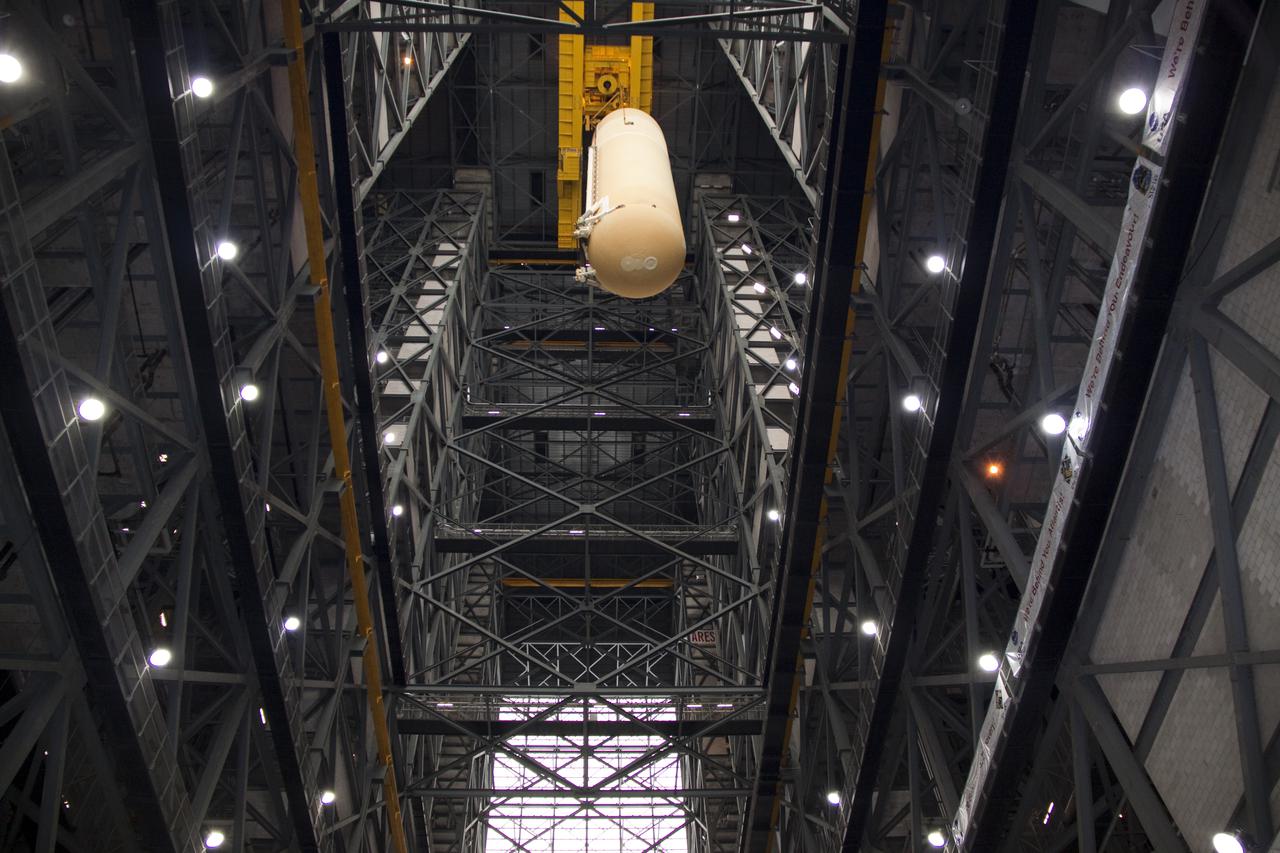
CAPE CANAVERAL, Fla. - In the Vehicle Assembly Building at NASA's Kennedy Space Center in Florida, an overhead crane lifts the external fuel tank for space shuttle Atlantis' STS-132 mission, ET-136, from its test cell. The external tank arrived at Kennedy from NASA's Michoud Assembly Facility on March 1 aboard the Pegasus barge. The six-member STS-132 crew will deliver an Integrated Cargo Carrier and a Russian-built Mini-Research Module, or MRM-1, to the International Space Station. Launch is targeted for May 14. For information on the STS-132 mission, visit http:__www.nasa.gov_mission_pages_shuttle_shuttlemissions_sts132_index.html. Photo credit: NASA_Jack Pfaller
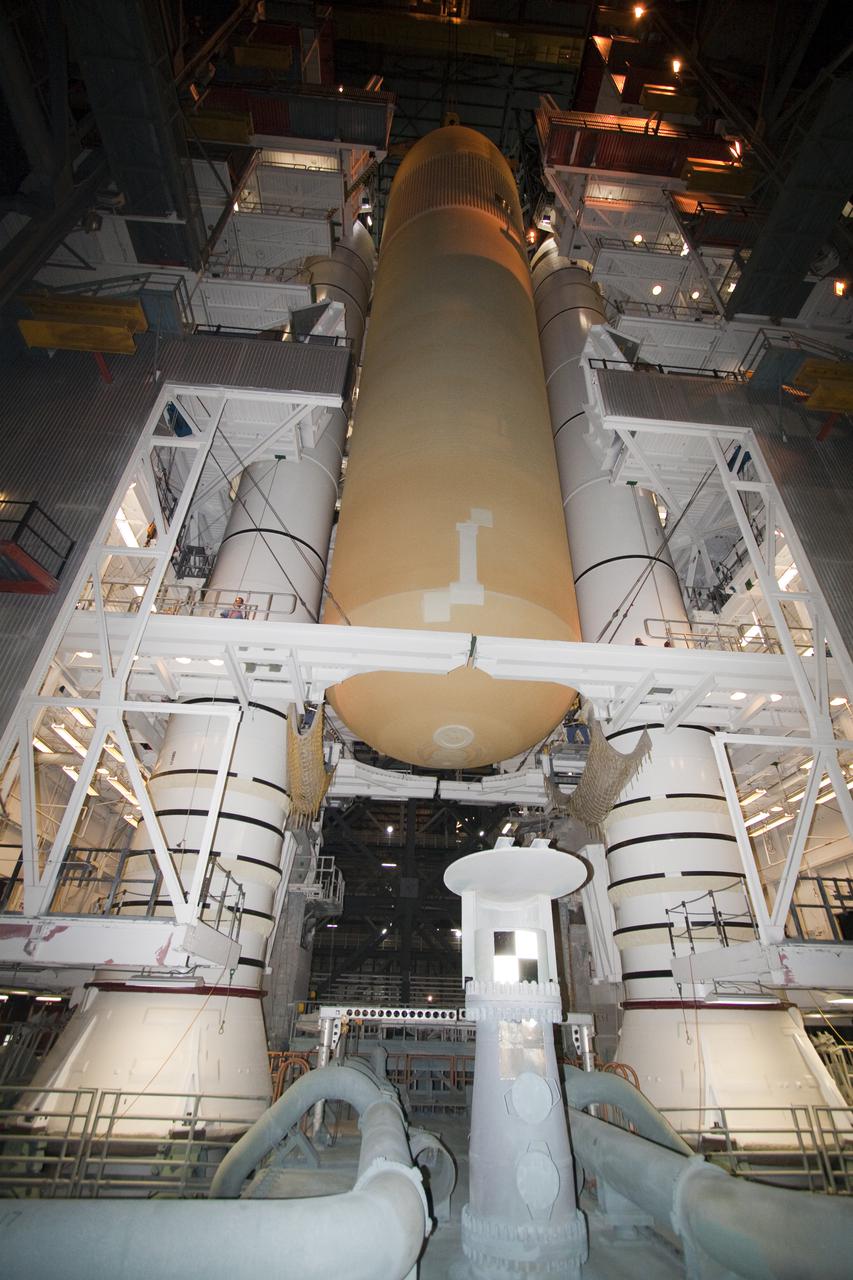
CAPE CANAVERAL, Fla. - In the Vehicle Assembly Building at NASA's Kennedy Space Center in Florida, the external fuel tank for space shuttle Atlantis' STS-132 mission, ET-136, is lowered for mating to the twin solid rocket boosters. The external tank arrived at Kennedy from NASA's Michoud Assembly Facility on March 1 aboard the Pegasus barge. The six-member STS-132 crew will deliver an Integrated Cargo Carrier and a Russian-built Mini-Research Module, or MRM-1, to the International Space Station. Launch is targeted for May 14. For information on the STS-132 mission, visit http:__www.nasa.gov_mission_pages_shuttle_shuttlemissions_sts132_index.html. Photo credit: NASA_Jack Pfaller
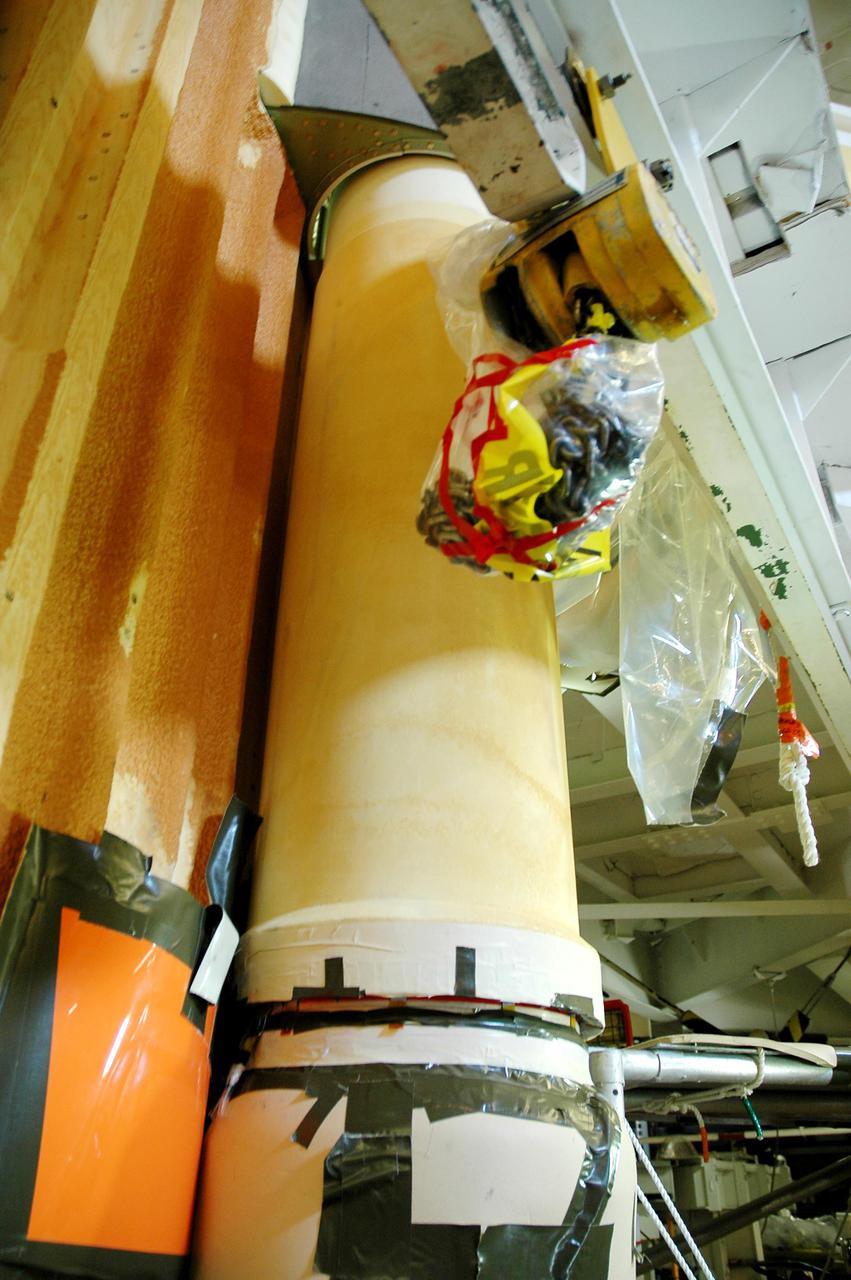
KENNEDY SPACE CENTER, FLA. - In the Vehicle Assembly Building at NASA’s Kennedy Space Center, a new heater has been added to the feedline bellows to minimize the potential for ice and frost buildup. The tank has been designated to fly on Discovery for Return to Flight mission STS-114, which has a launch window extending from July 13 to July 31.
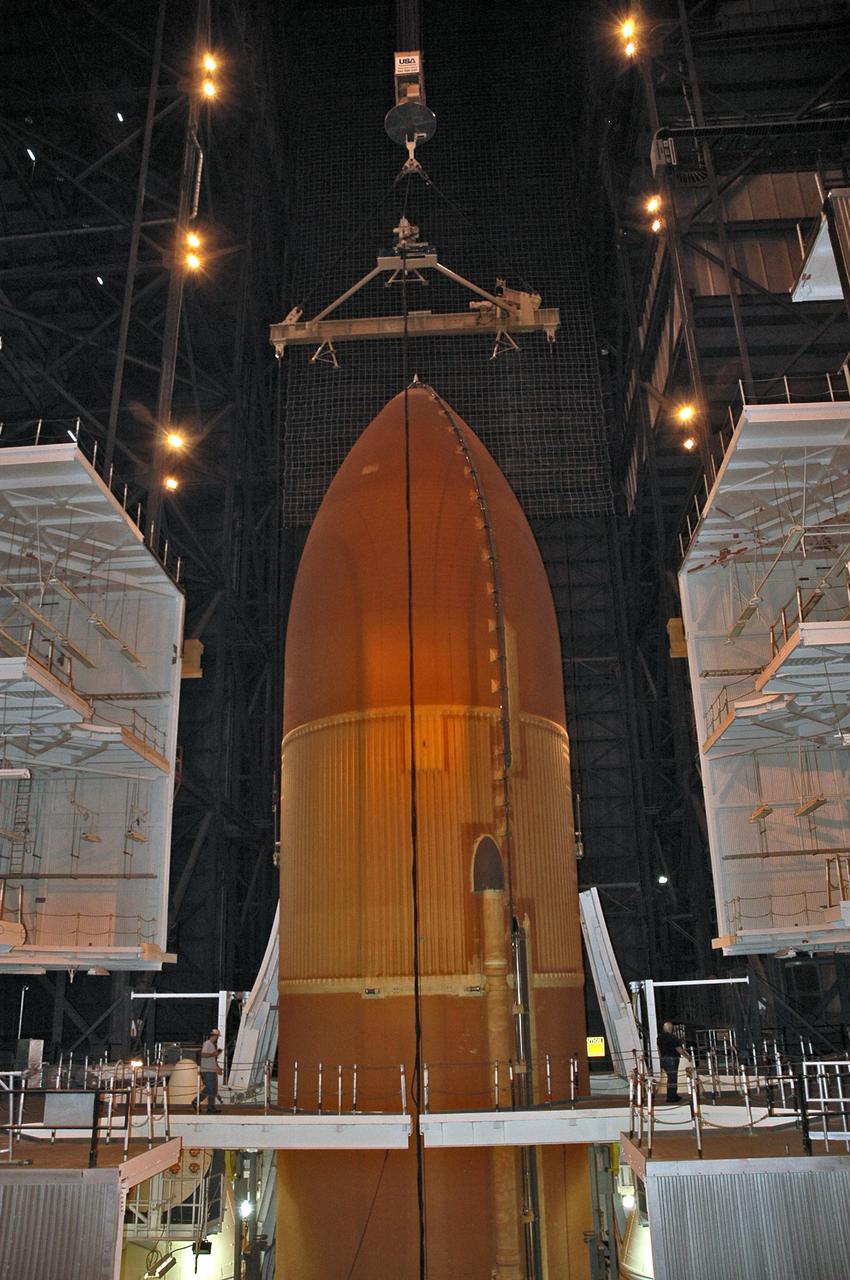
KENNEDY SPACE CENTER, FLA. - In NASA Kennedy Space Center’s Vehicle Assembly Building, a crane is fitted over an external tank. The tank is being demated from the solid rocket boosters originally scheduled to fly on mission STS-121 with Space Shuttle Atlantis. It will temporarily be stored in a checkout cell in the VAB and await assignment to a future mission.
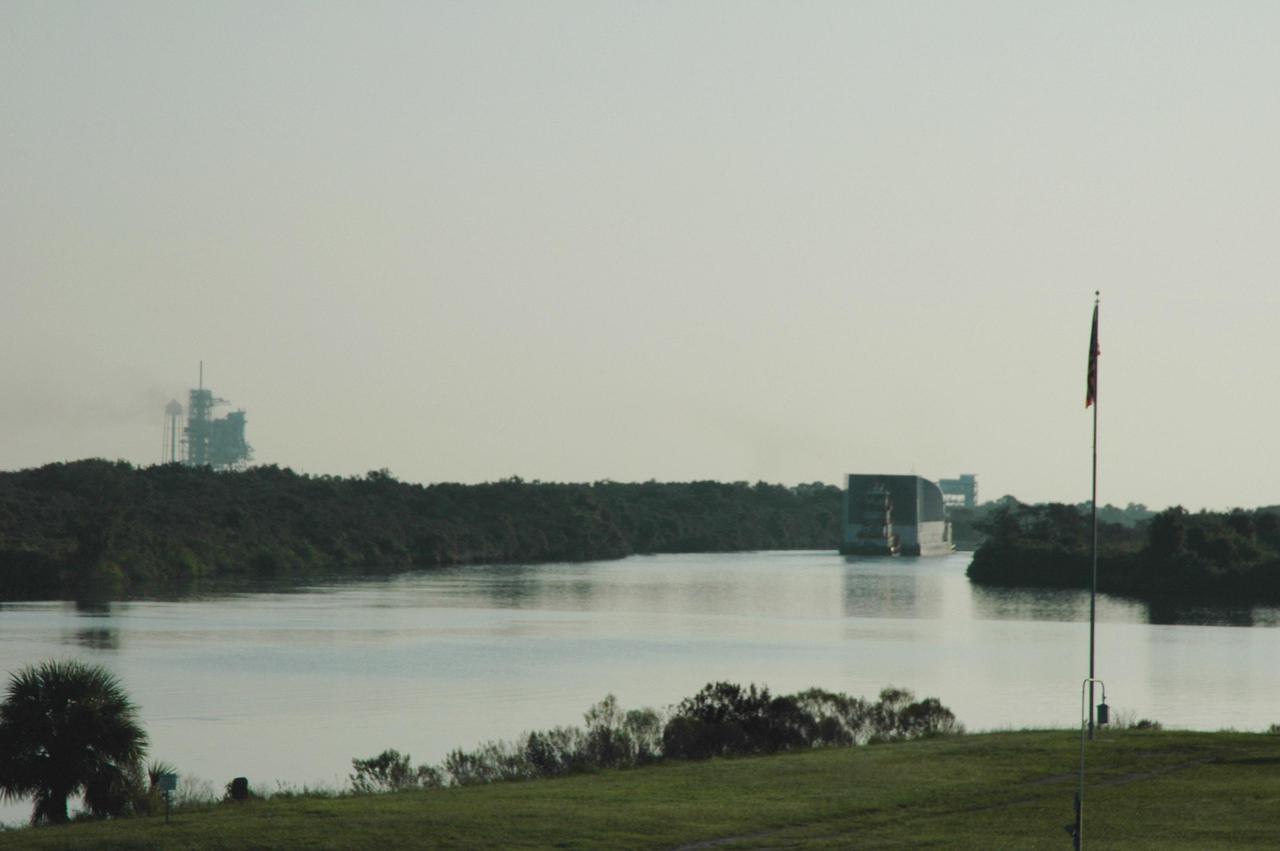
KENNEDY SPACE CENTER, FLA. - Just after dawn, the Pegasus barge is towed away from the Turn Basin in the Launch Complex 39 area. The barge is carrying external tank 119 (ET-119) and will be towed by the solid rocket booster retrieval ship Freedom Star to NASA’s Michoud Assembly Facility near New Orleans. Delivered to Kennedy in June, ET-119 is the third newly redesigned tank and is the only tank that contains the liquid oxygen heater. The tank is being returned to Michoud for testing and further modifications. ET-119 will be the tank used on return to flight mission STS-121.
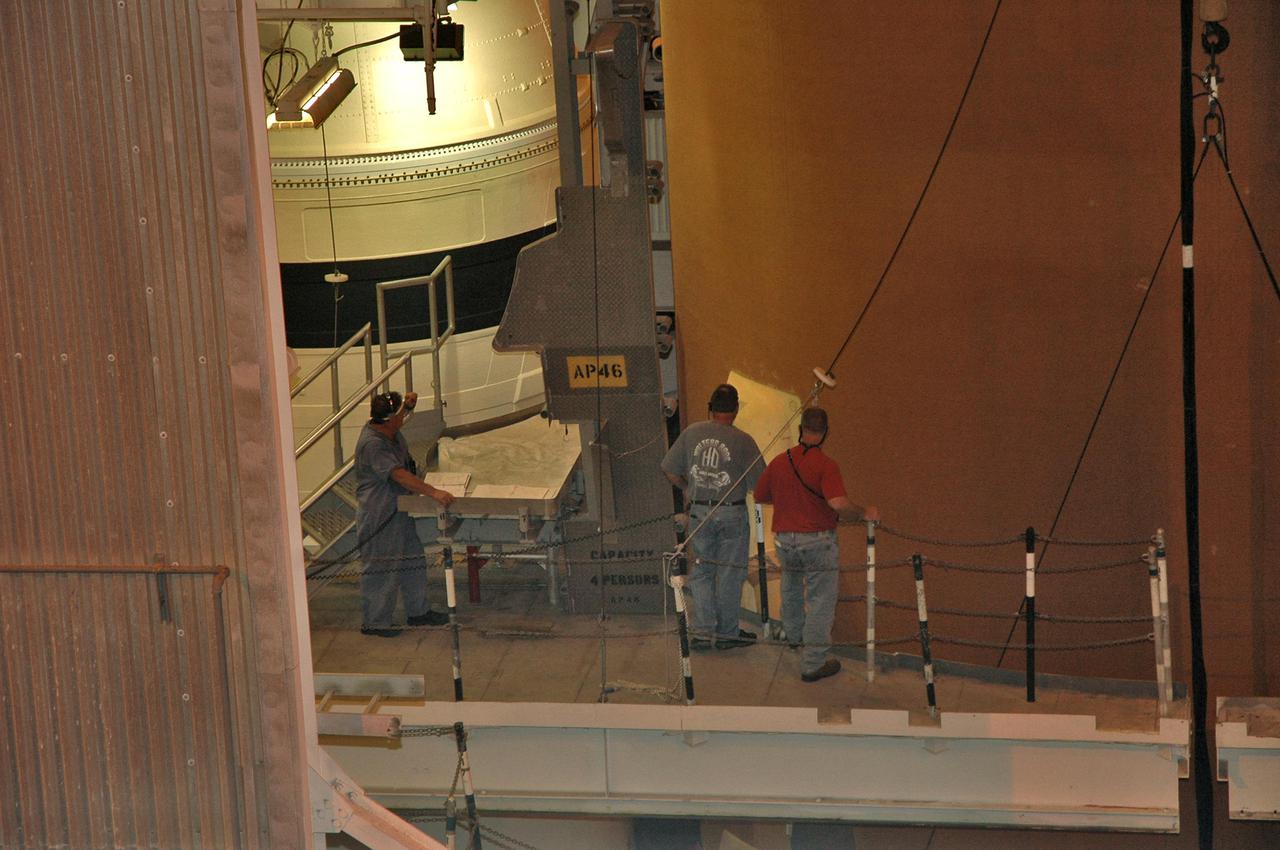
KENNEDY SPACE CENTER, FLA. - In NASA Kennedy Space Center’s Vehicle Assembly Building, workers secure the guidelines of an overhead crane on an external tank. The tank is being demated from the solid rocket boosters originally scheduled to fly on mission STS-121 with Space Shuttle Atlantis. It will temporarily be stored in a checkout cell in the VAB and await assignment to a future mission.
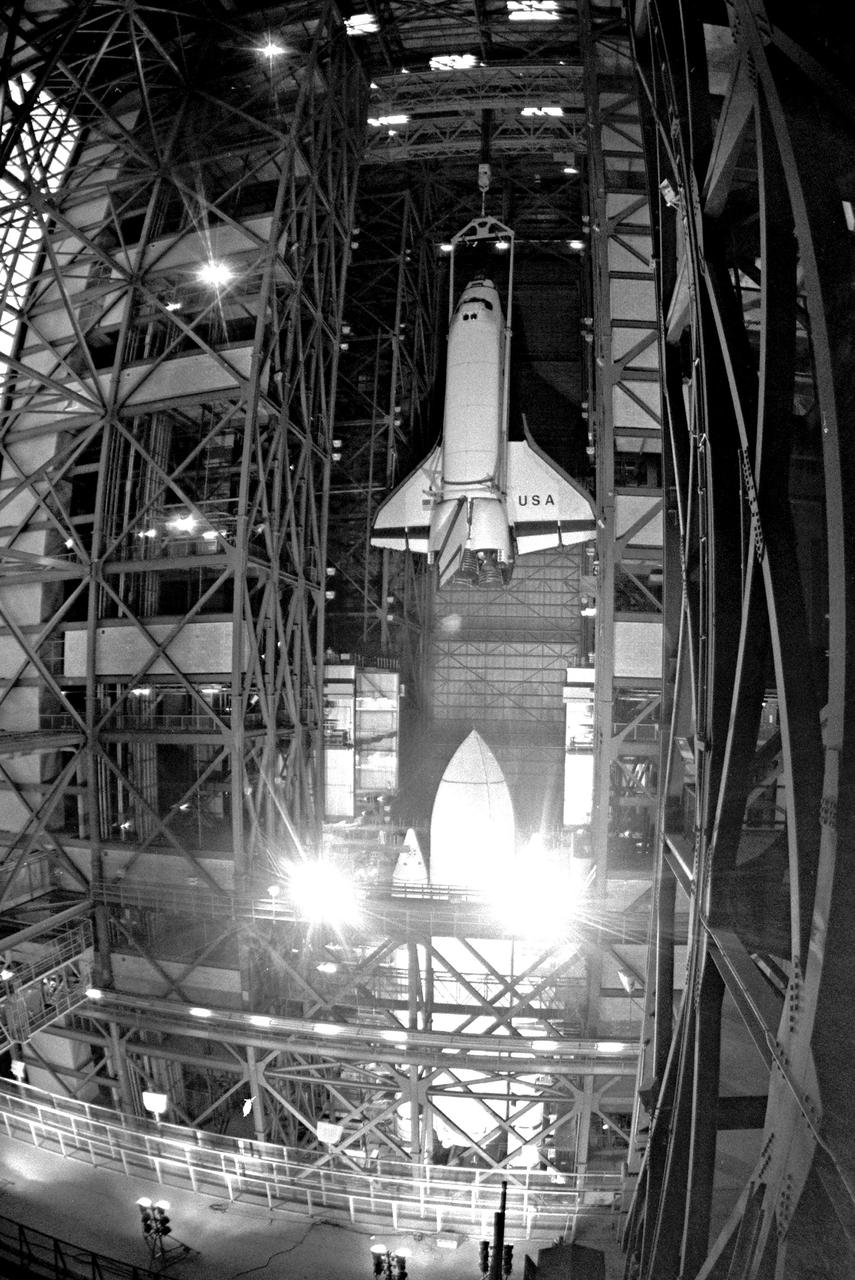
KENNEDY SPACE CENTER, FLA. - Shuttle Orbiter Columbia lift and mate to external tank in the Vehicle Assembly Building (VAB).
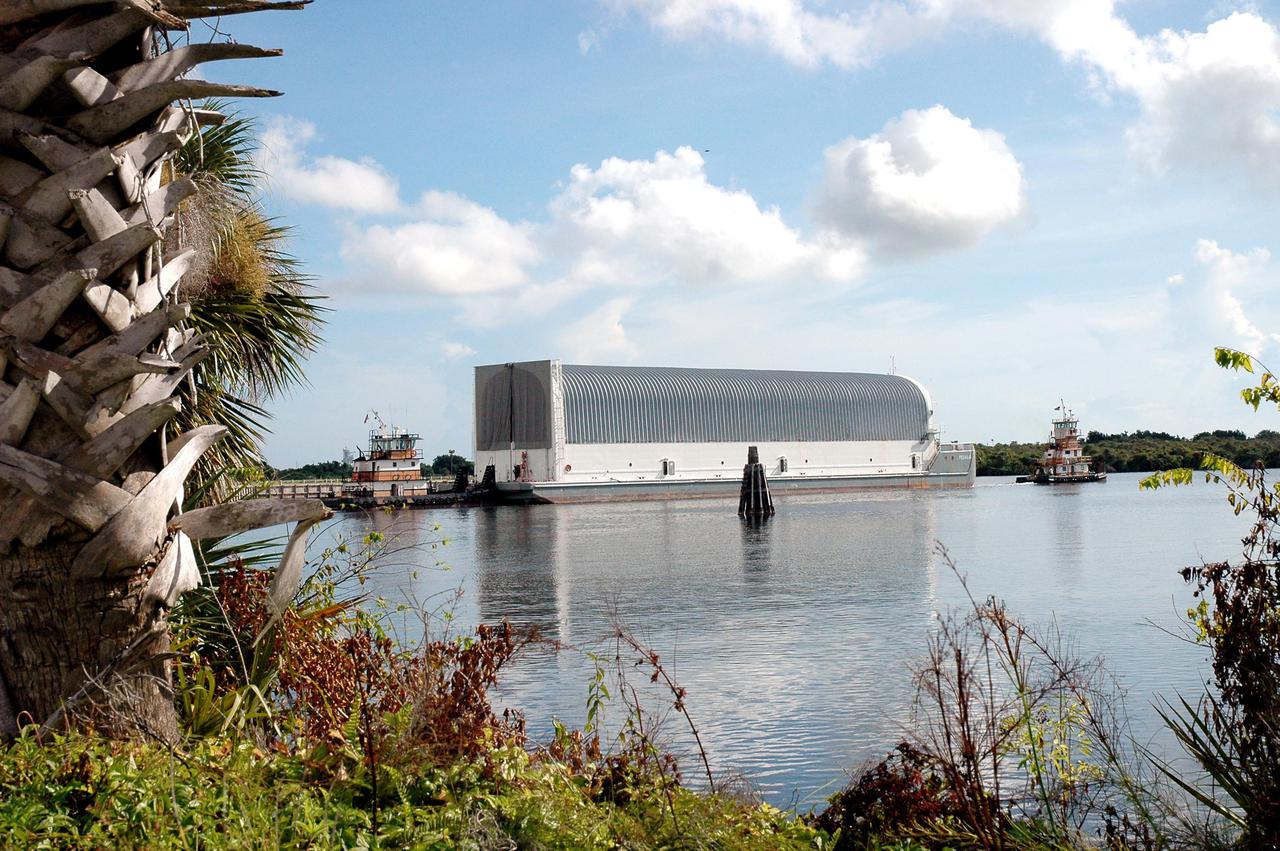
KENNEDY SPACE CENTER, FLA. - Viewed across the Turn Basin at NASA Kennedy Space Center, the barge Pegasus is towed away from the dock on the other side. It is being towed to Port Canaveral where it will join one of the Solid Rocket Booster Recovery Ships and begin its journey around the Florida peninsula to Michoud Assembly Facility in New Orleans. The barge’s cargo is External Tank 119. Delivered to KSC in June, ET-119 is the third newly redesigned tank.
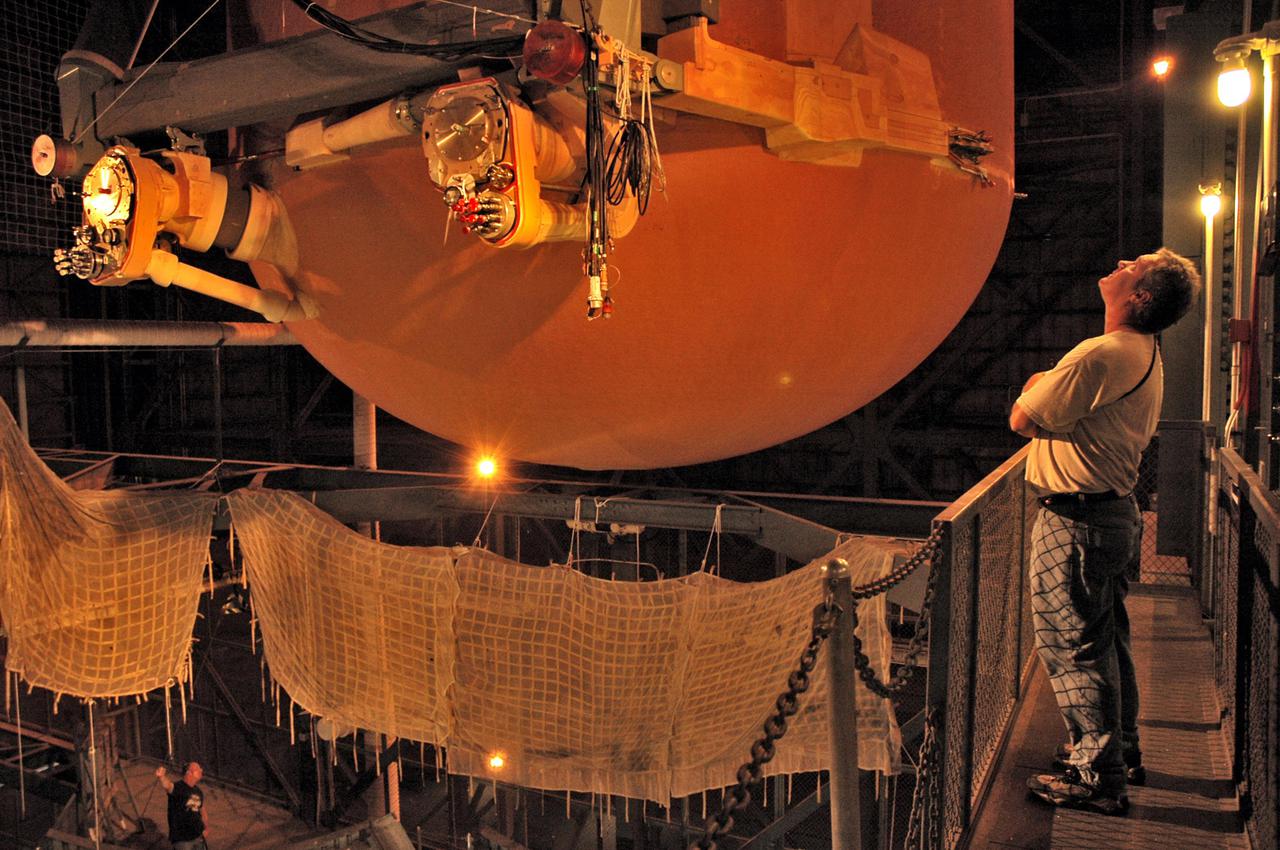
KENNEDY SPACE CENTER, FLA. - In NASA Kennedy Space Center’s Vehicle Assembly Building, an external tank is lifted into the upper levels of the high bay after being demated from the solid rocket boosters originally scheduled to fly on mission STS-121 with Space Shuttle Atlantis. It will temporarily be stored in a checkout cell in the VAB and await assignment to a future mission.
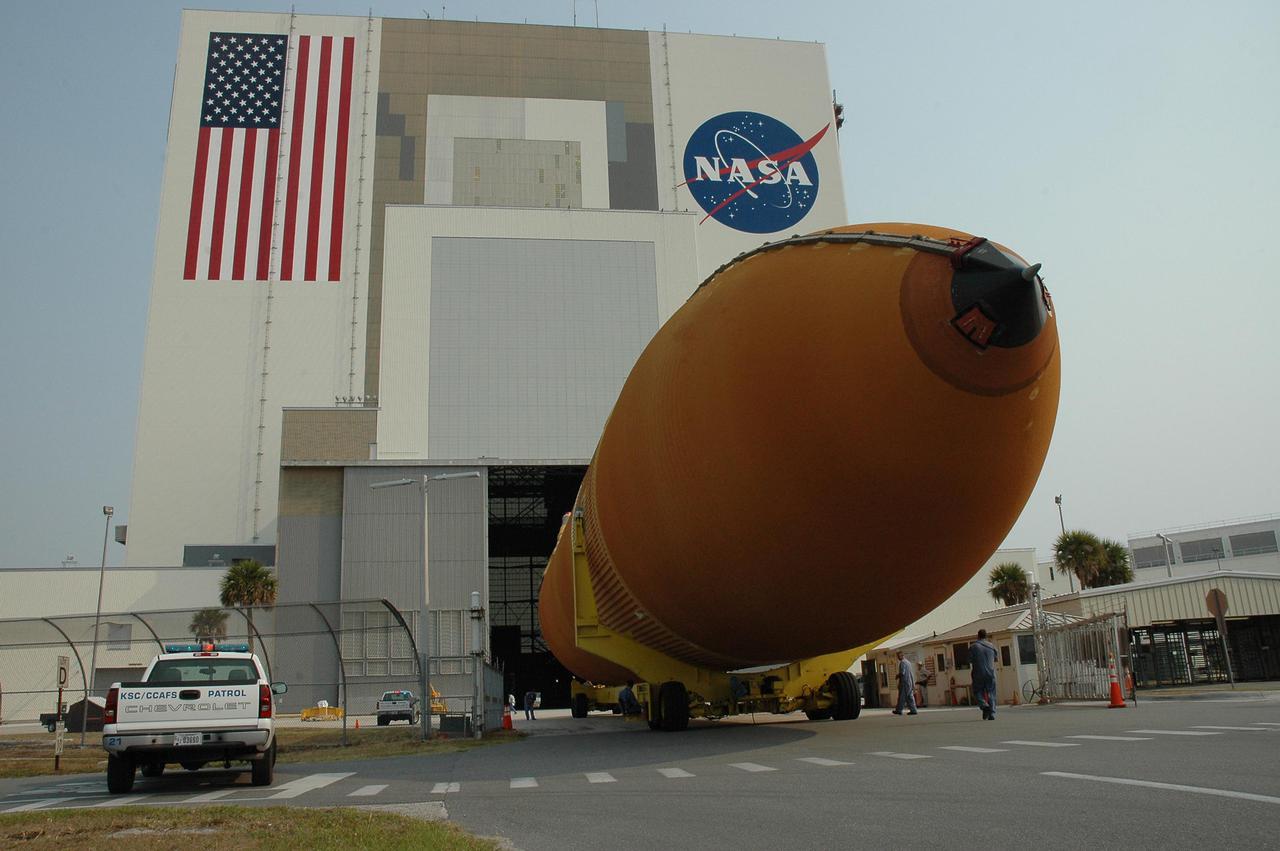
KENNEDY SPACE CENTER, FLA. -- Aboard its transporter, external tank No. 117 moves toward the open doors of the Vehicle Assembly Building. The tank was offloaded from the Pegasus barge in the nearby turn basin.ET-117 arrived aboard the barge after its voyage around the Florida Peninsula from the Michoud Assembly Facility near New Orleans. The tank is slated for mission STS-118, which is targeted for launch in early August. ET-117 will be moved into a checkout cell in high bay 2 of the VAB for processing. Photo credit: NASA_Jack Pfaller
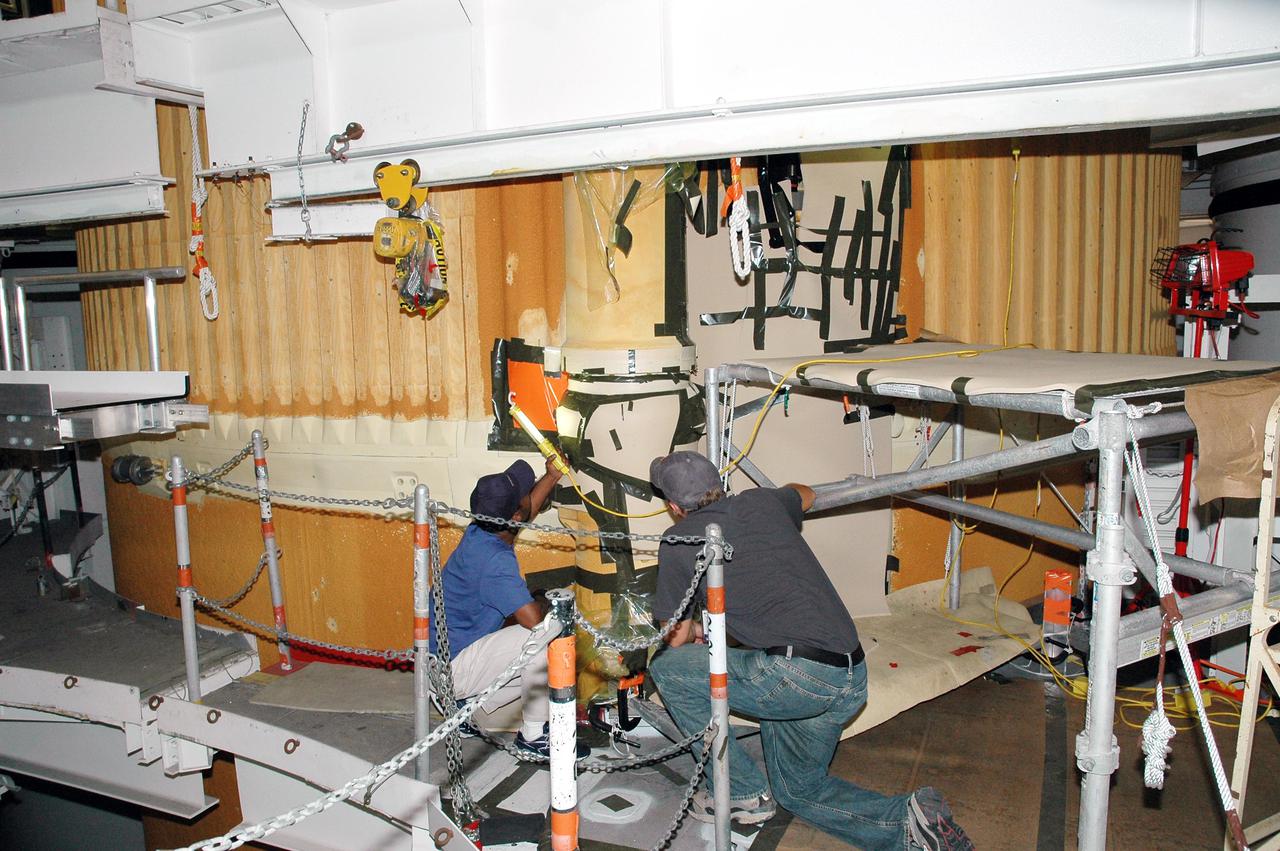
KENNEDY SPACE CENTER, FLA. - In the Vehicle Assembly Building at NASA’s Kennedy Space Center, workers inspect the newly installed liquid hydrogen bellows heater on External Tank 121. The new heater has been added to the feedline bellows to minimize the potential for ice and frost buildup. The tank has been designated to fly on Discovery for Return to Flight mission STS-114, which has a launch window extending from July 13 to July 31.
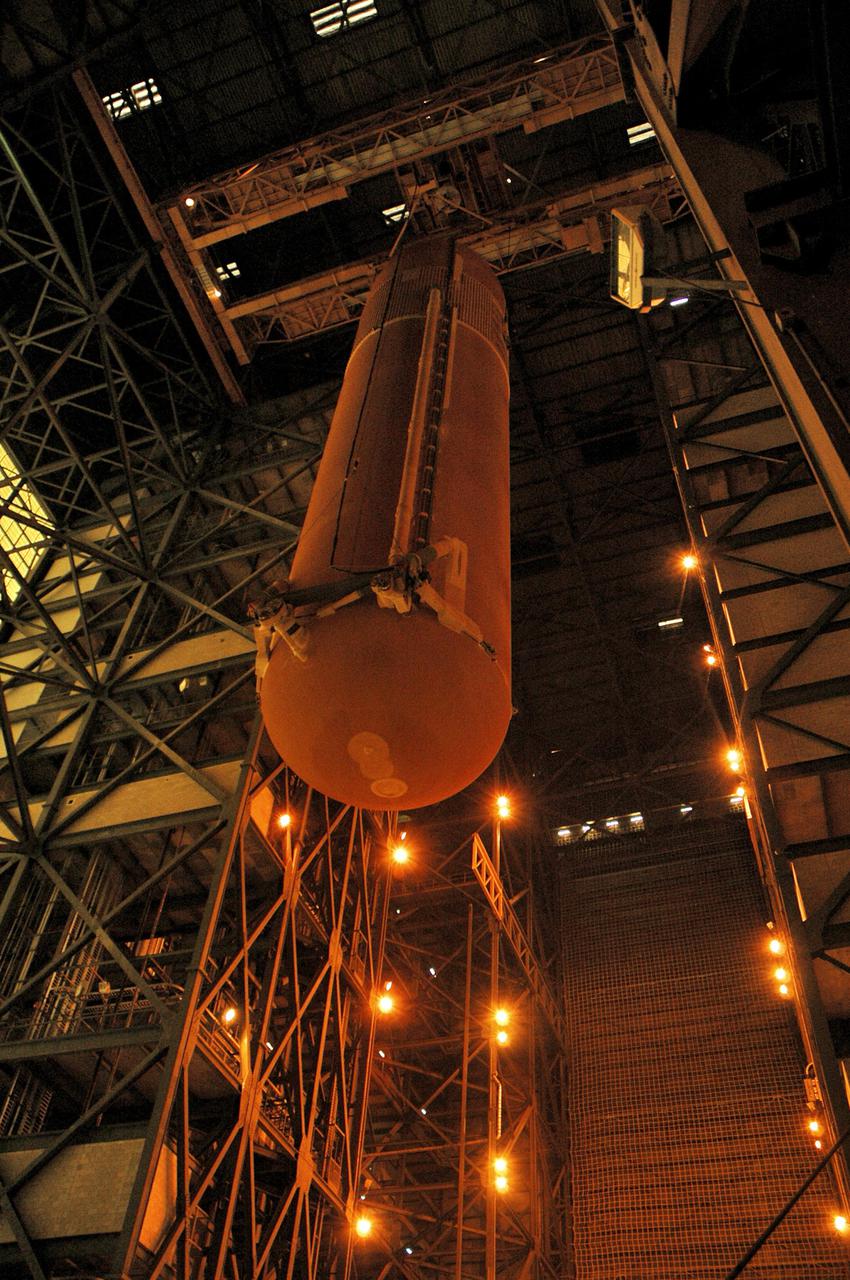
KENNEDY SPACE CENTER, FLA. - In NASA Kennedy Space Center’s Vehicle Assembly Building, an external tank is lifted into the upper levels of the high bay after being demated from the solid rocket boosters originally scheduled to fly on mission STS-121 with Space Shuttle Atlantis. It will temporarily be stored in a checkout cell in the VAB and await assignment to a future mission.
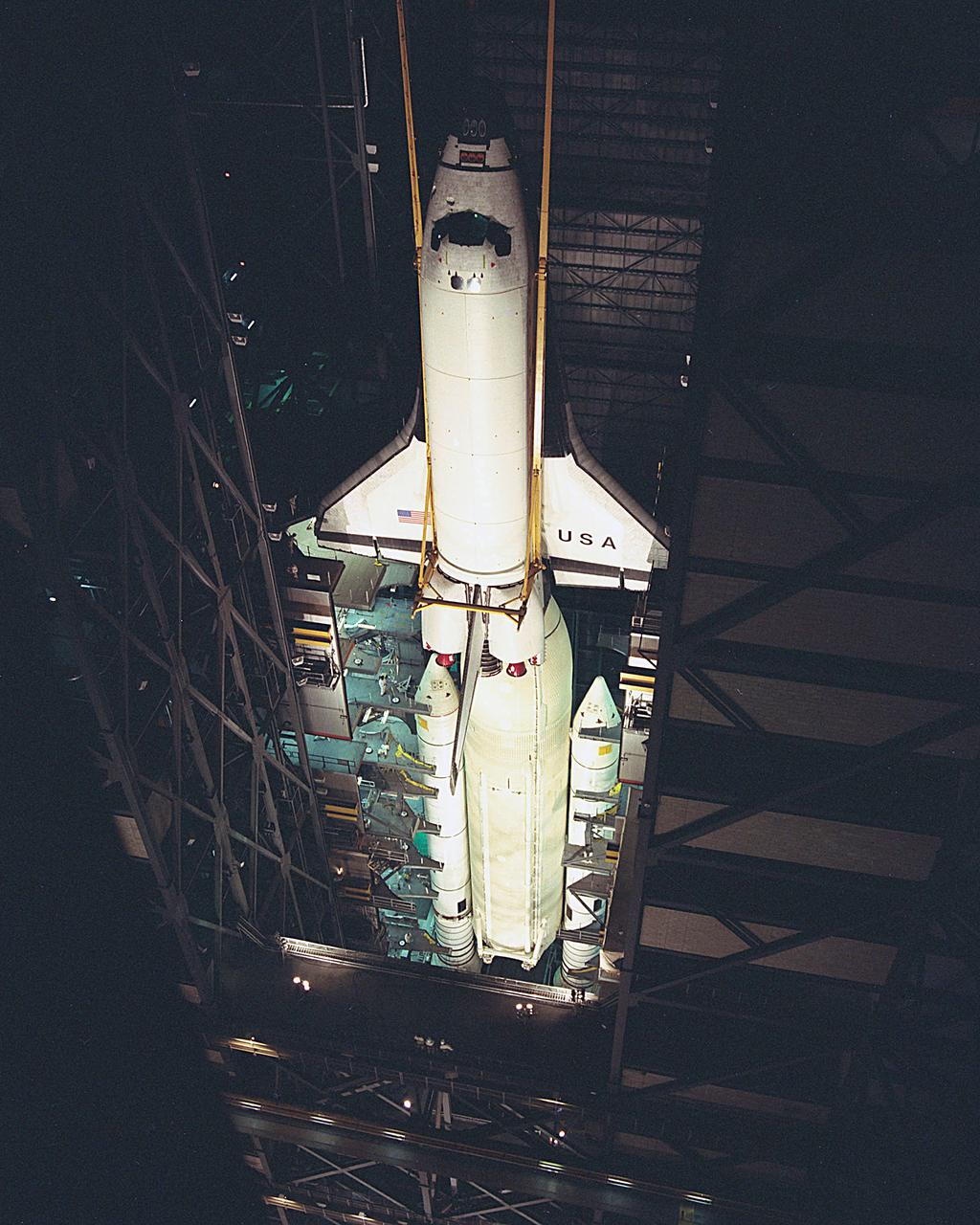
KENNEDY SPACE CENTER, FLA. - Shuttle Orbiter Columbia move from OPF and mate to external tank in VAB.
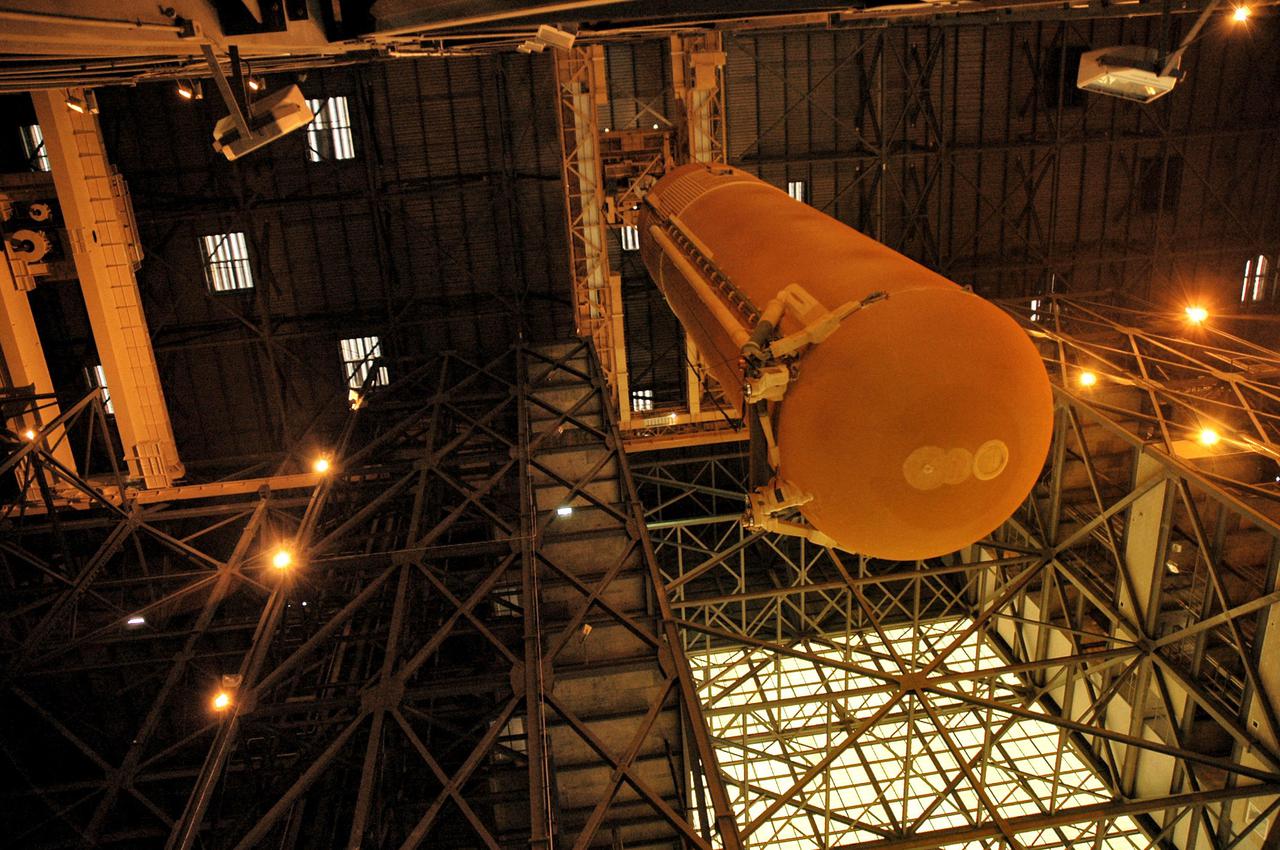
KENNEDY SPACE CENTER, FLA. - In In NASA Kennedy Space Center’s Vehicle Assembly Building, an external tank is lifted into the upper levels of the high bay after being demated from the solid rocket boosters originally scheduled to fly on mission STS-121 with Space Shuttle Atlantis. It will temporarily be stored in a checkout cell in the VAB and await assignment to a future mission.
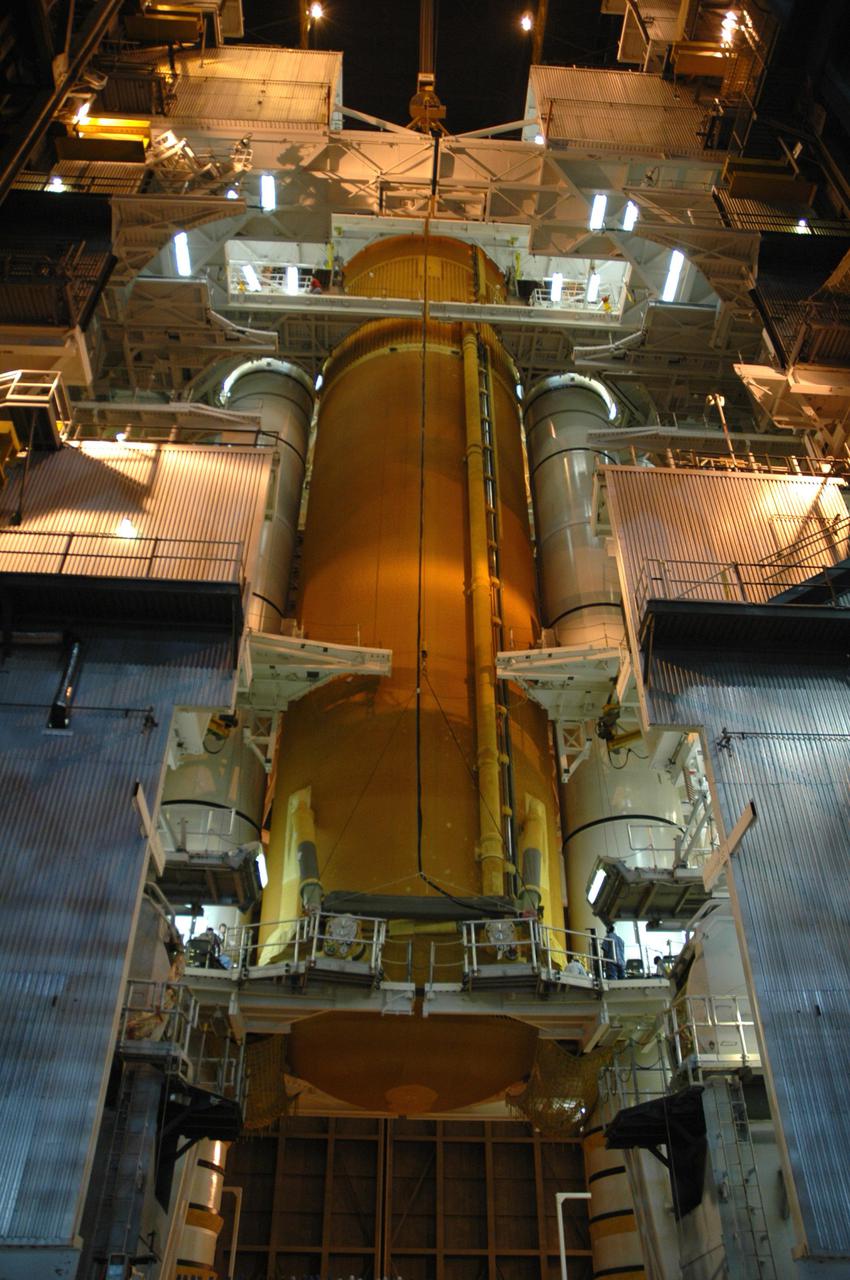
KENNEDY SPACE CENTER, FLA. - In NASA Kennedy Space Center’s Vehicle Assembly Building, an external tank is demated from the solid rocket boosters originally scheduled to fly on mission STS-121 with Space Shuttle Atlantis. It will temporarily be stored in a checkout cell in the VAB and await assignment to a future mission.
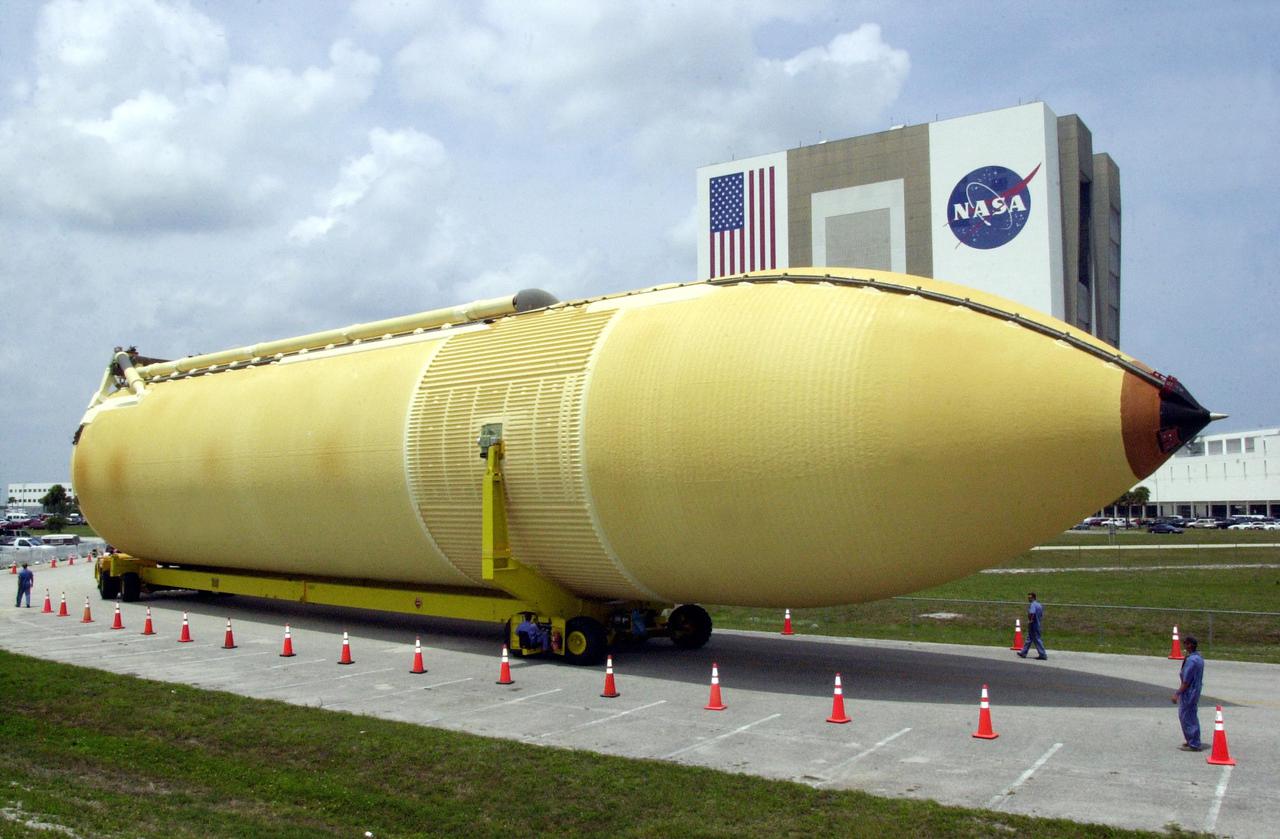
KENNEDY SPACE CENTER, FLA. -- The newly arrived external tank moves slowly on its way the Vehicle Assembly Building (background) where the tank will await stacking for a future Shuttle mission. External tanks are built by the NASA Michoud Assembly Facility in New Orleans and transported by barge to Cape Canaveral and then to the turn basin in the Launch Complex 39 Area
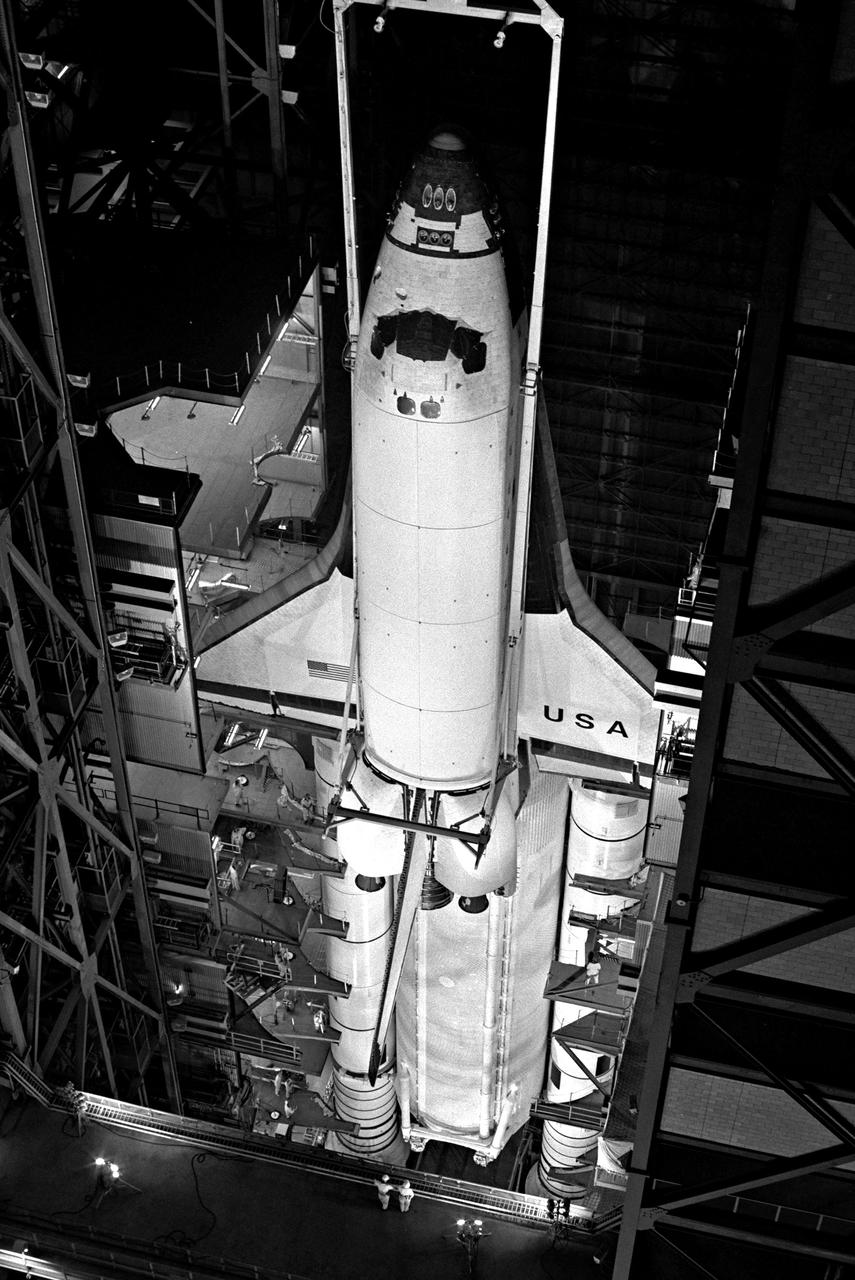
KENNEDY SPACE CENTER, FLA. - Shuttle Orbiter Columbia erection and mate in the Vehicle Assembly Building (VAB).
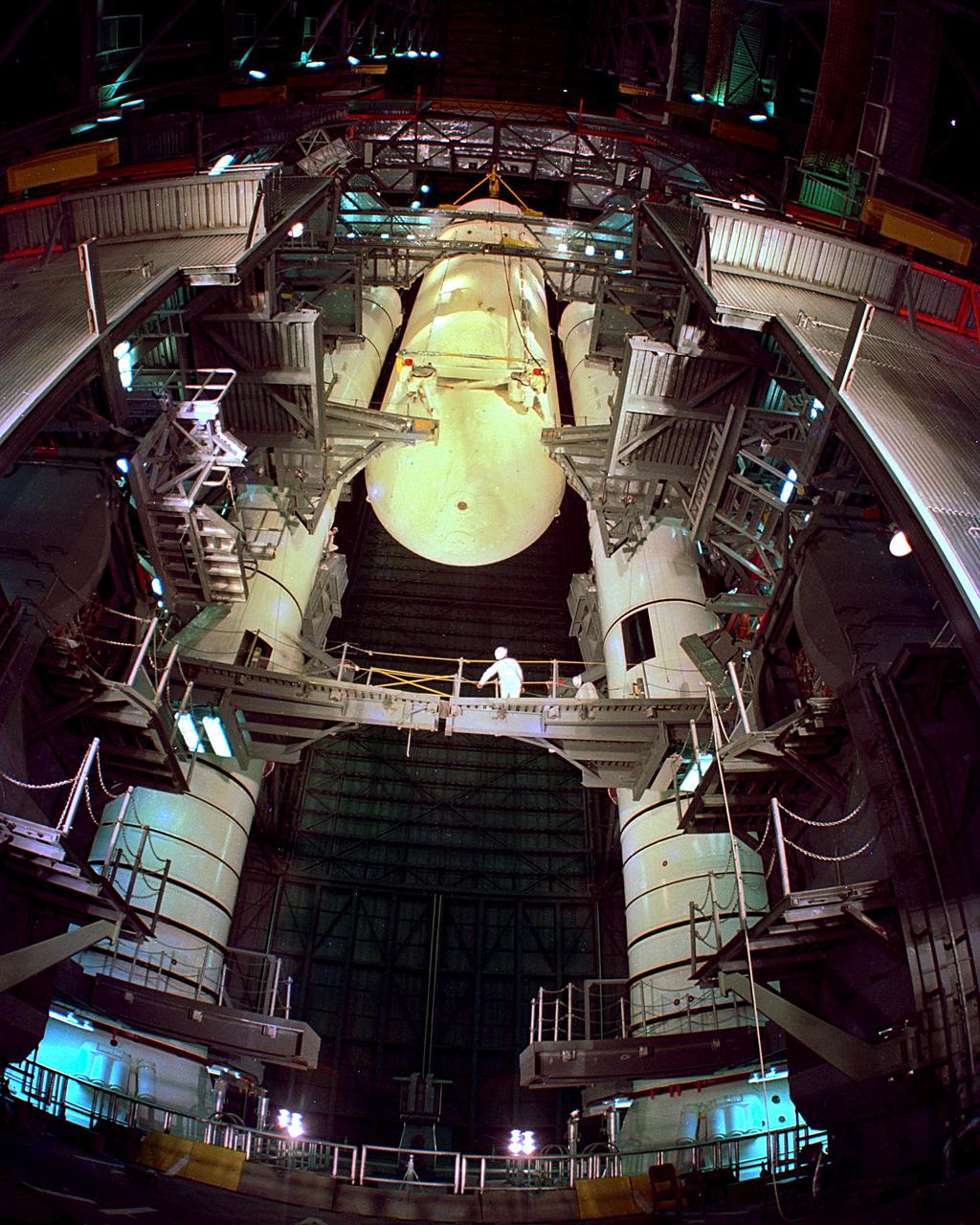
KENNEDY SPACE CENTER, FLA. - Shuttle external tank (ET) move and mate.
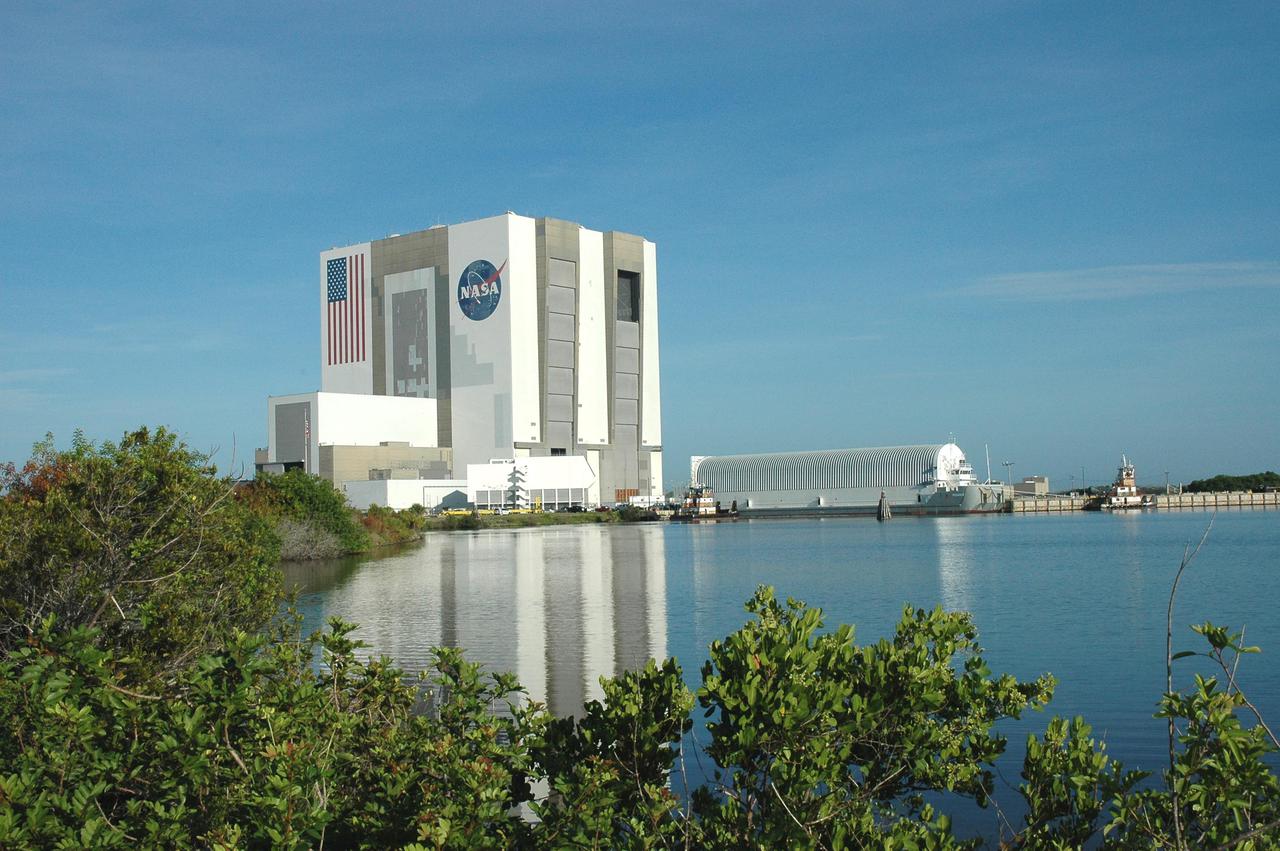
KENNEDY SPACE CENTER, FLA. - Viewed across the Turn Basin at NASA Kennedy Space Center, the barge Pegasus is ready for towing to Port Canaveral where it will join one of the Solid Rocket Booster Recovery Ships and begin its journey around the Florida peninsula to Michoud Assembly Facility in New Orleans. The barge’s cargo is External Tank 119. Delivered to KSC in June, ET-119 is the third newly redesigned tank.
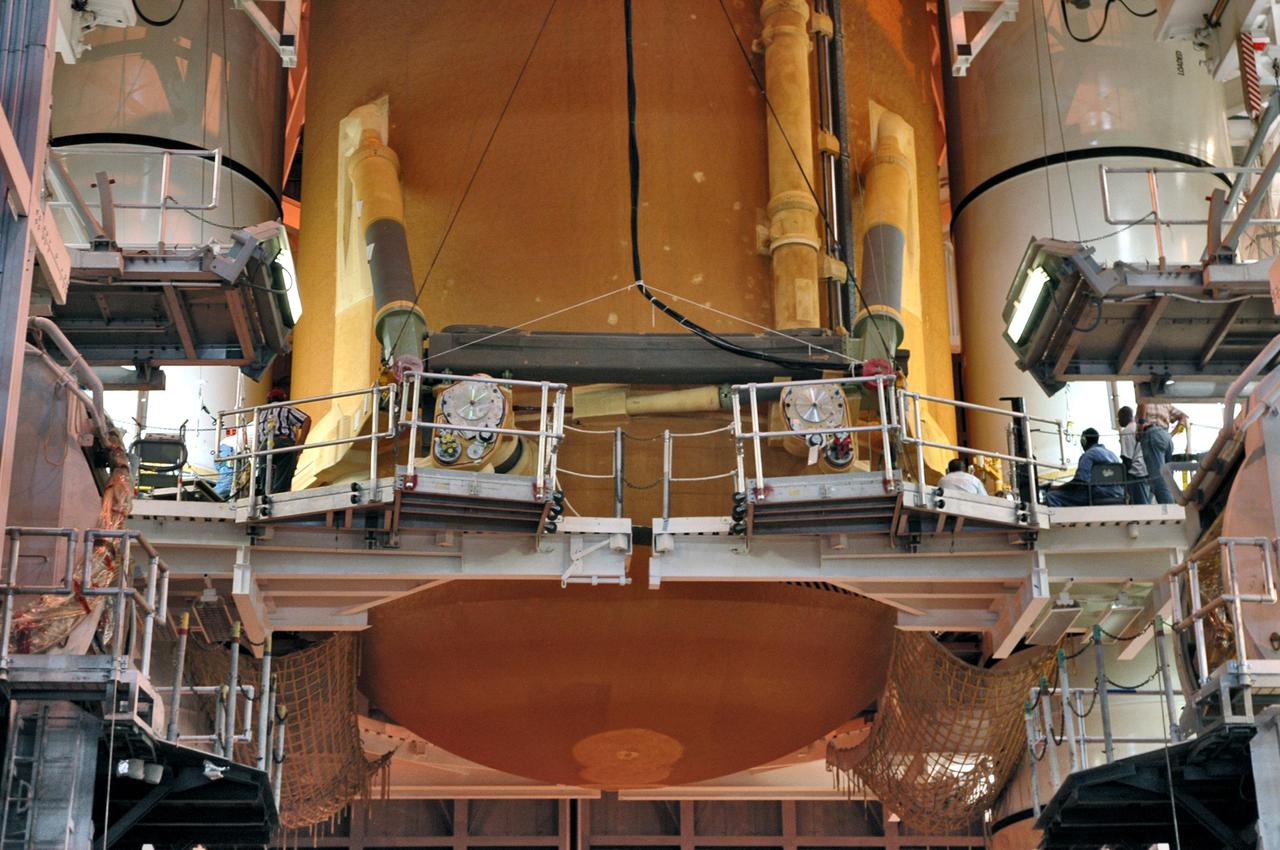
KENNEDY SPACE CENTER, FLA. - In NASA Kennedy Space Center’s Vehicle Assembly Building, an external tank is demated from the solid rocket boosters originally scheduled to fly on mission STS-121 with Space Shuttle Atlantis. It will temporarily be stored in a checkout cell in the VAB and await assignment to a future mission.
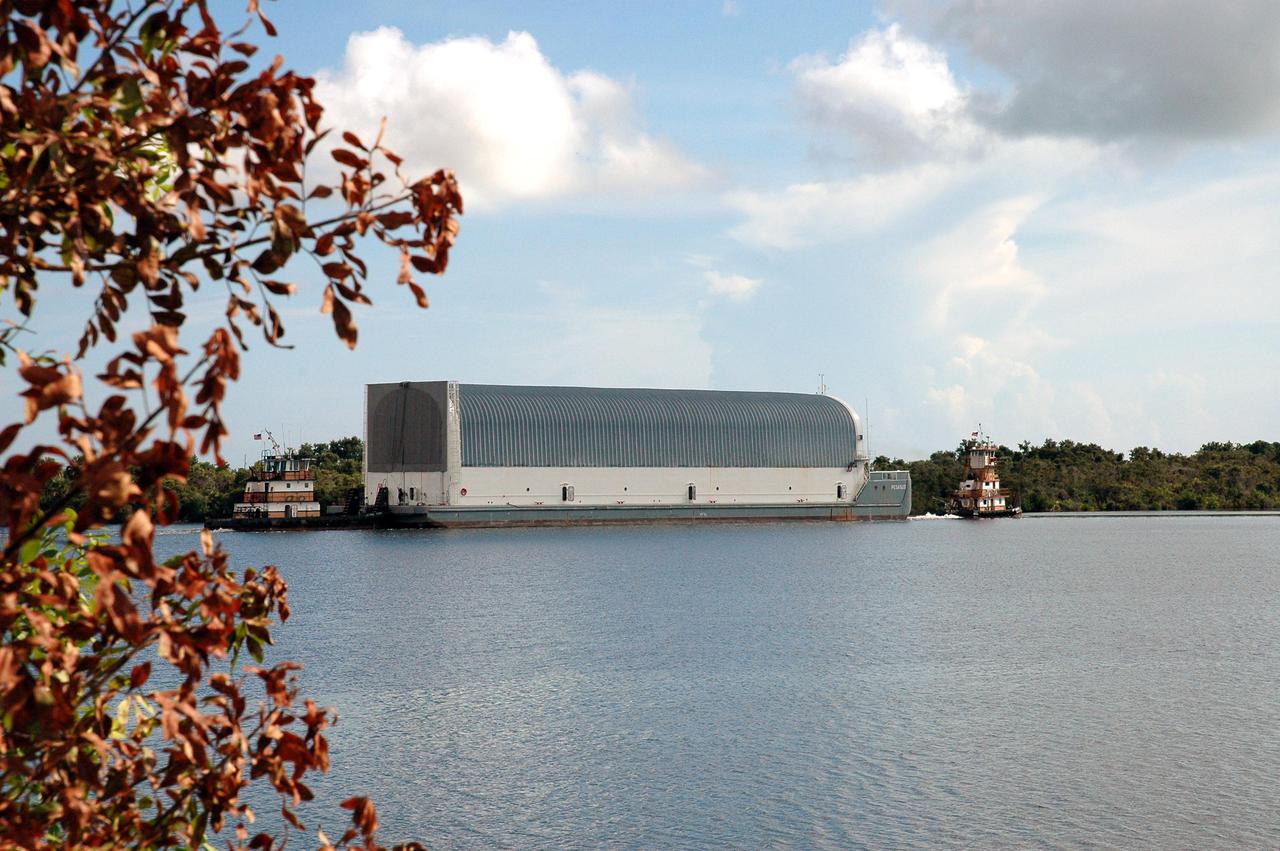
KENNEDY SPACE CENTER, FLA. - Viewed across the Turn Basin at NASA Kennedy Space Center, the barge Pegasus is towed away from the dock on the other side. It is being towed to Port Canaveral where it will join one of the Solid Rocket Booster Recovery Ships and begin its journey around the Florida peninsula to Michoud Assembly Facility in New Orleans. The barge’s cargo is External Tank 119. Delivered to KSC in June, ET-119 is the third newly redesigned tank.
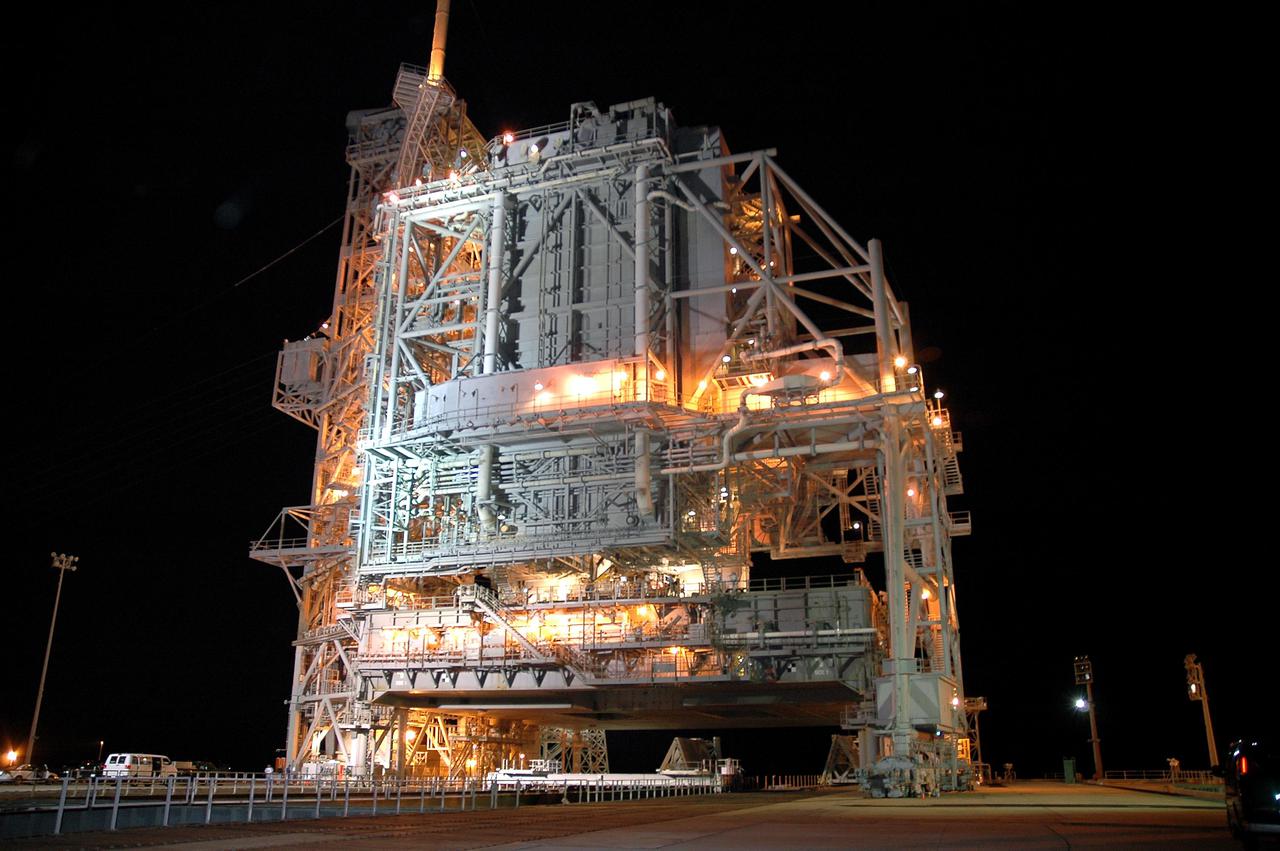
KENNEDY SPACE CENTER, FLA. -- Preparations are made to roll back the Rotating Service Structure from around Space Shuttle Discovery at Launch Pad 39B for a propellant-loading test of Discovery's External Tank (ET) on April 14. During the test, the tank will be filled to launch levels with ultra-cold hydrogen and oxygen propellants, known as 'cryogenics.' The test is designed to evaluate how the tank, orbiter, Solid Rocket Boosters and ground systems are performing under full 'cryo-load.' Throughout testing, engineers will observe the effectiveness of key safety modifications made to the External Tank. NASA’s Return to Flight mission, STS-114 on Space Shuttle Discovery, is targeted for launch on May 15 with a launch window that extends to June 3.
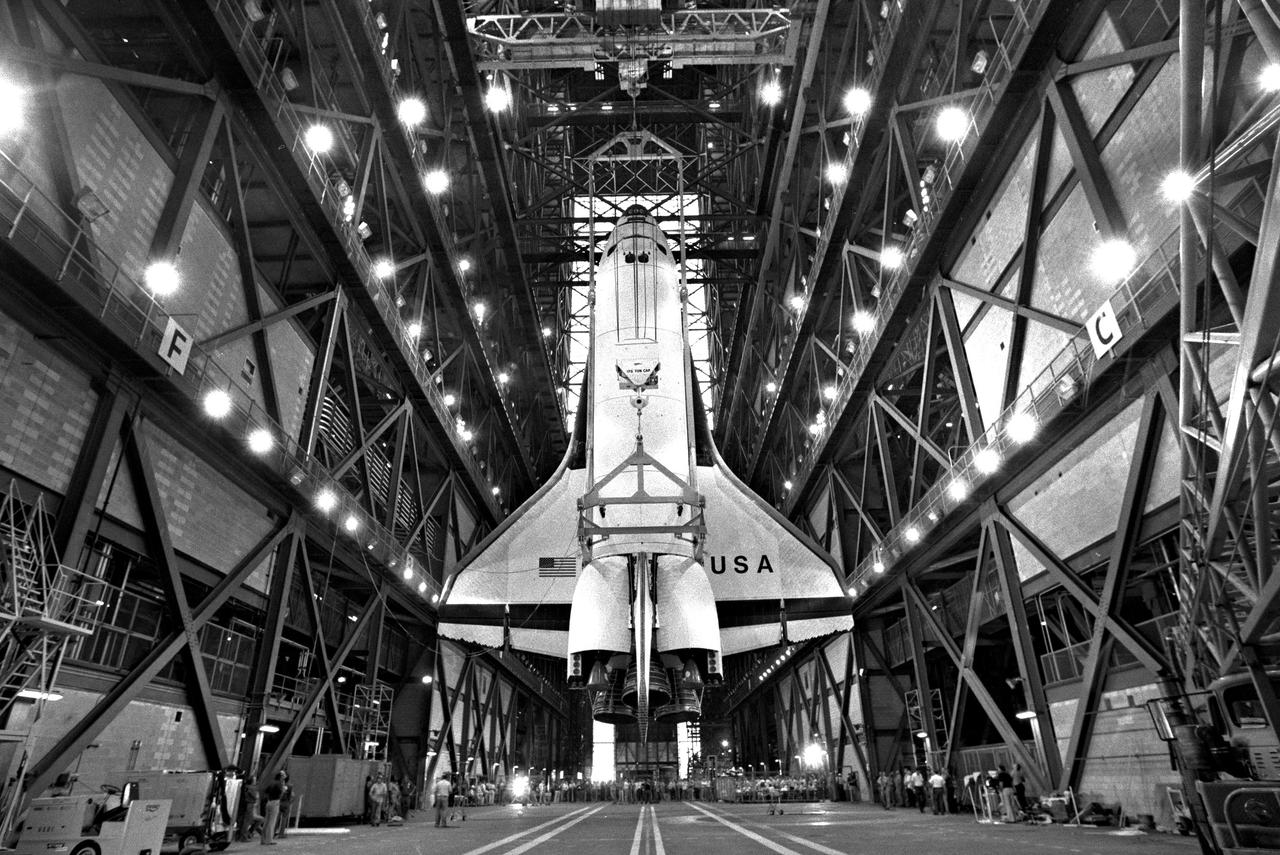
KENNEDY SPACE CENTER, FLA. - Shuttle Orbiter Columbia lift and mate to external tank in the Vehicle Assembly Building (VAB).
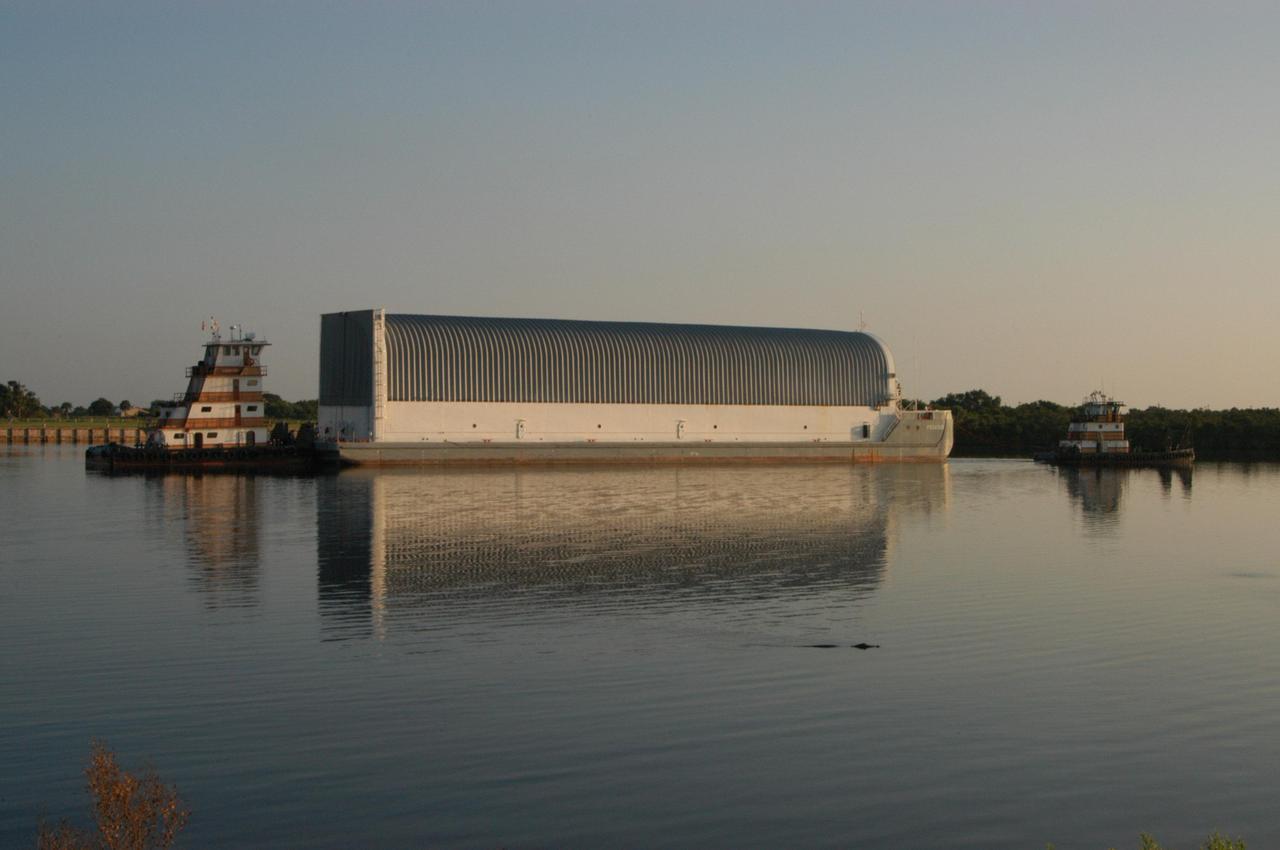
KENNEDY SPACE CENTER, FLA. - Just after dawn, an alligator (in the foreground) watches as a tugboat pushes the Pegasus barge away from the dock at the Turn Basin in the Launch Complex 39 area. The barge is carrying external tank 119 (ET-119) and will be towed by the solid rocket booster retrieval ship Freedom Star to NASA’s Michoud Assembly Facility near New Orleans. Delivered to Kennedy in June, ET-119 is the third newly redesigned tank and is the only tank that contains the liquid oxygen heater. The tank is being returned to Michoud for testing and further modifications. ET-119 will be the tank used on return to flight mission STS-121.
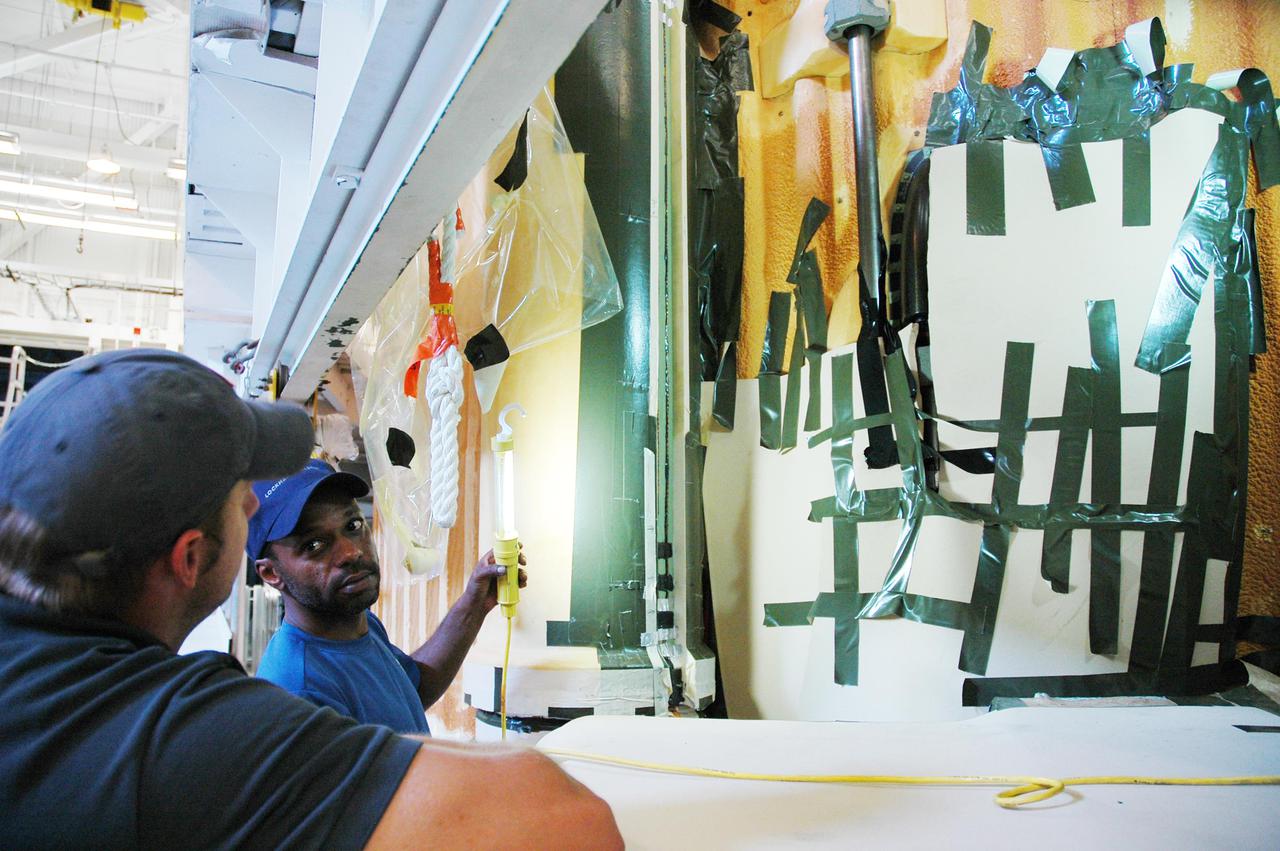
KENNEDY SPACE CENTER, FLA. - In the Vehicle Assembly Building at NASA’s Kennedy Space Center, workers take a close look at the newly installed liquid hydrogen bellows heater on External Tank 121. The new heater has been added to the feedline bellows to minimize the potential for ice and frost buildup. The tank has been designated to fly on Discovery for Return to Flight mission STS-114, which has a launch window extending from July 13 to July 31.