
The F-8 Digital Fly-By-Wire aircraft had its hydro-mechanical control systems replaced by an Apollo Guidance Computer for the first such control system to fly.
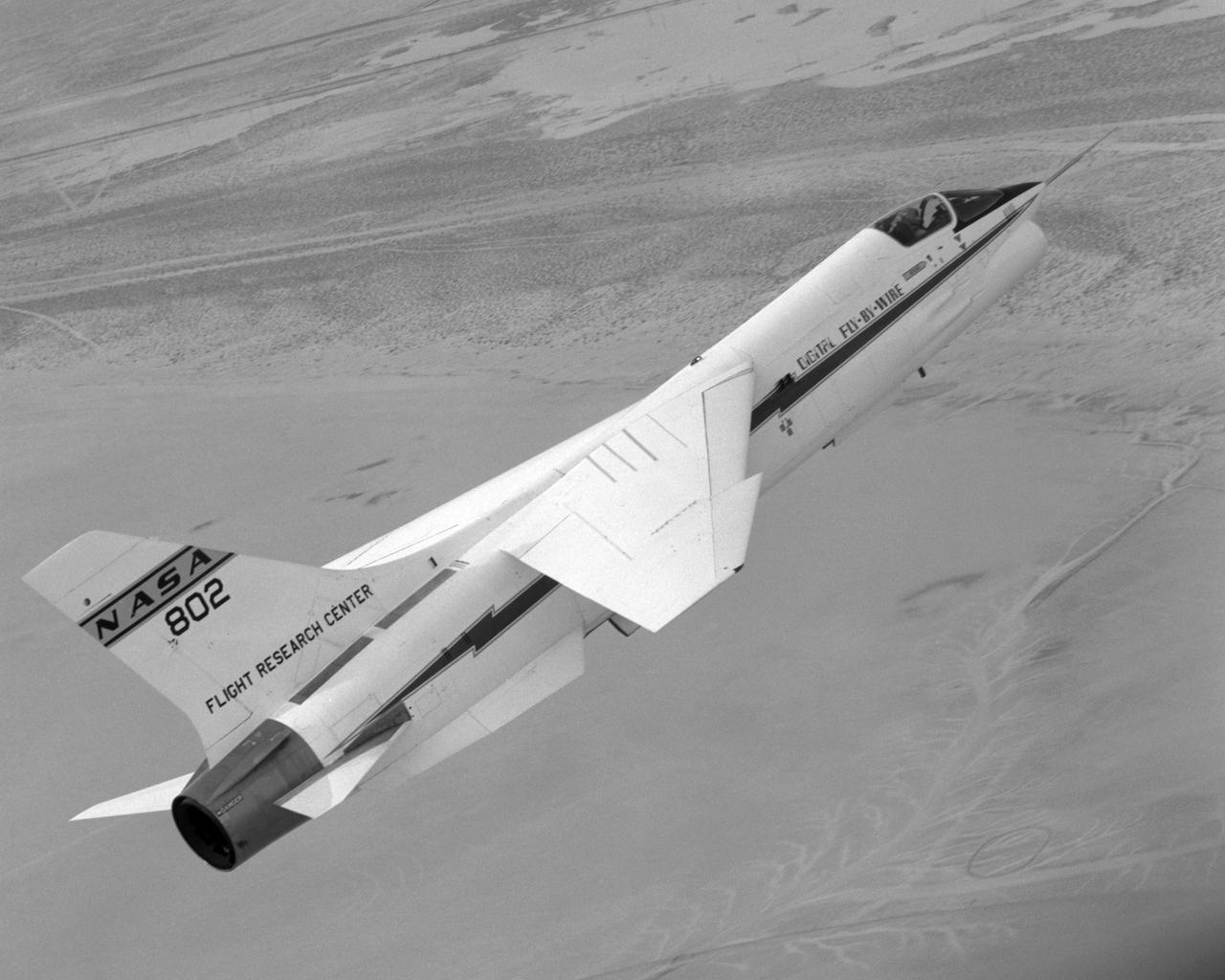
F-8 DFBW in flight
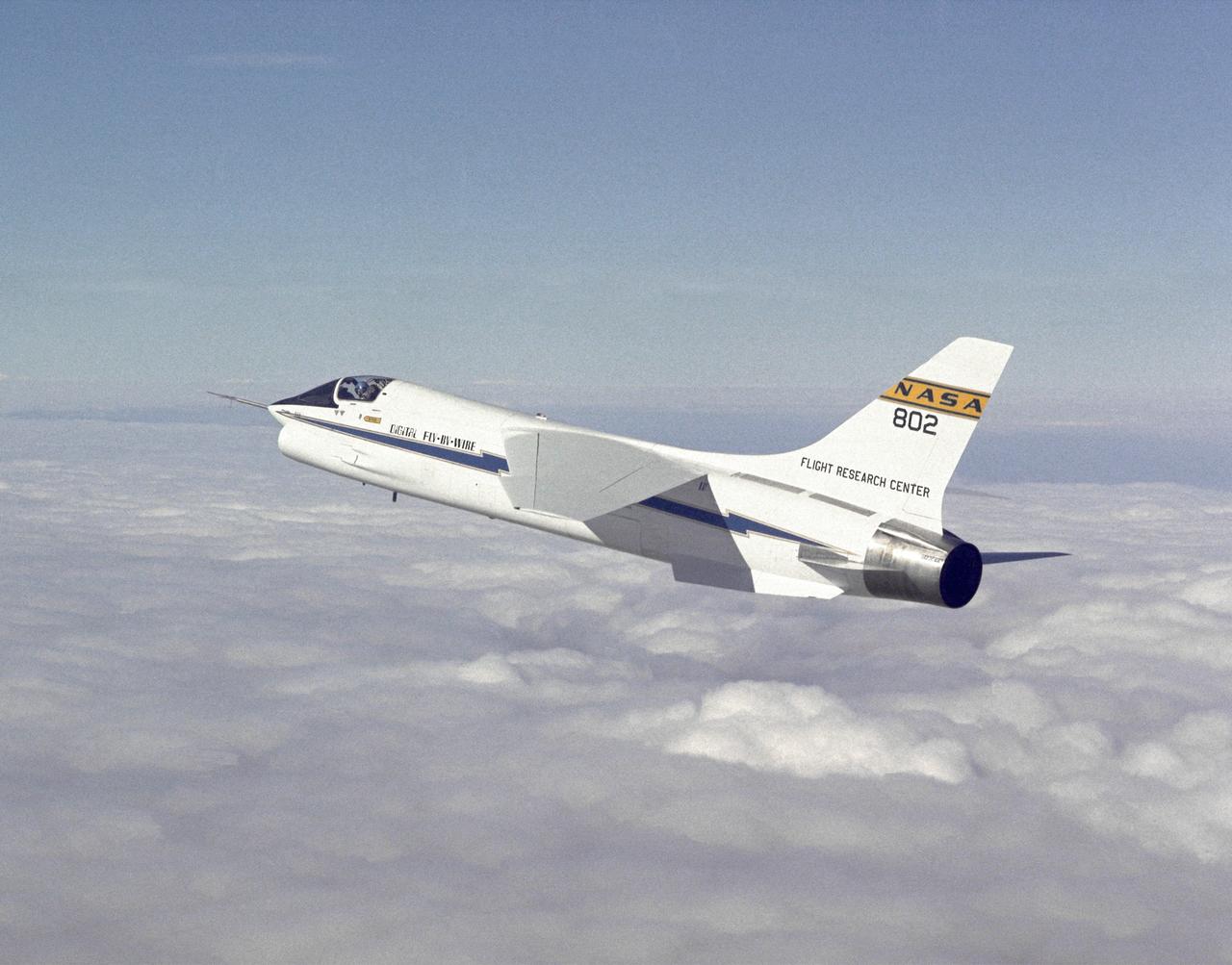
F-8 Digital Fly-By-Wire aircraft in flight. The computer-controlled flight systems pioneered by the F-8 DFBW created a revolution in aircraft design. The F-117A, X-29, X-31, and many other aircraft have relied on computers to make them flyable. Built with inherent instabilities to make them more maneuverable, they would be impossible for human pilots to fly if the computers failed or received incorrect data.
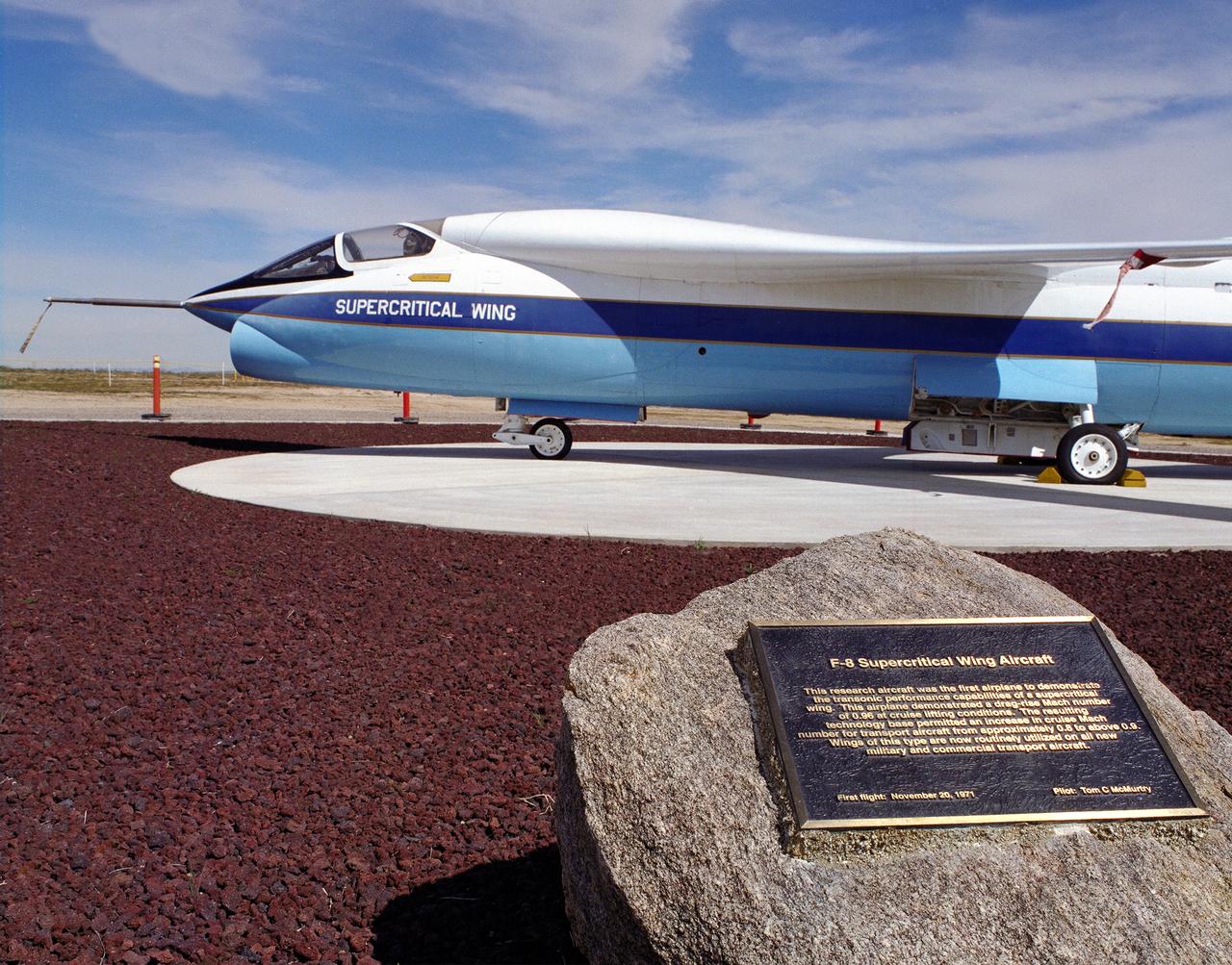
A Vought F-8A Crusader was selected by NASA as the testbed aircraft (designated TF-8A) to install an experimental Supercritical Wing (SCW) in place of the conventional wing. The unique design of the Supercritical Wing reduces the effect of shock waves on the upper surface near Mach 1, which in turn reduces drag. In the photograph the TF-8A Crusader with the Supercritical Wing is shown on static display in front of the NASA Dryden Flight Research Center, Edwards, California. The F-8 SCW aircraft, along with the F-8 Digital Fly-By-Wire aircraft were placed on display on May 27, 1992, at a conference marking the 20th anniversary of the start of the two programs.
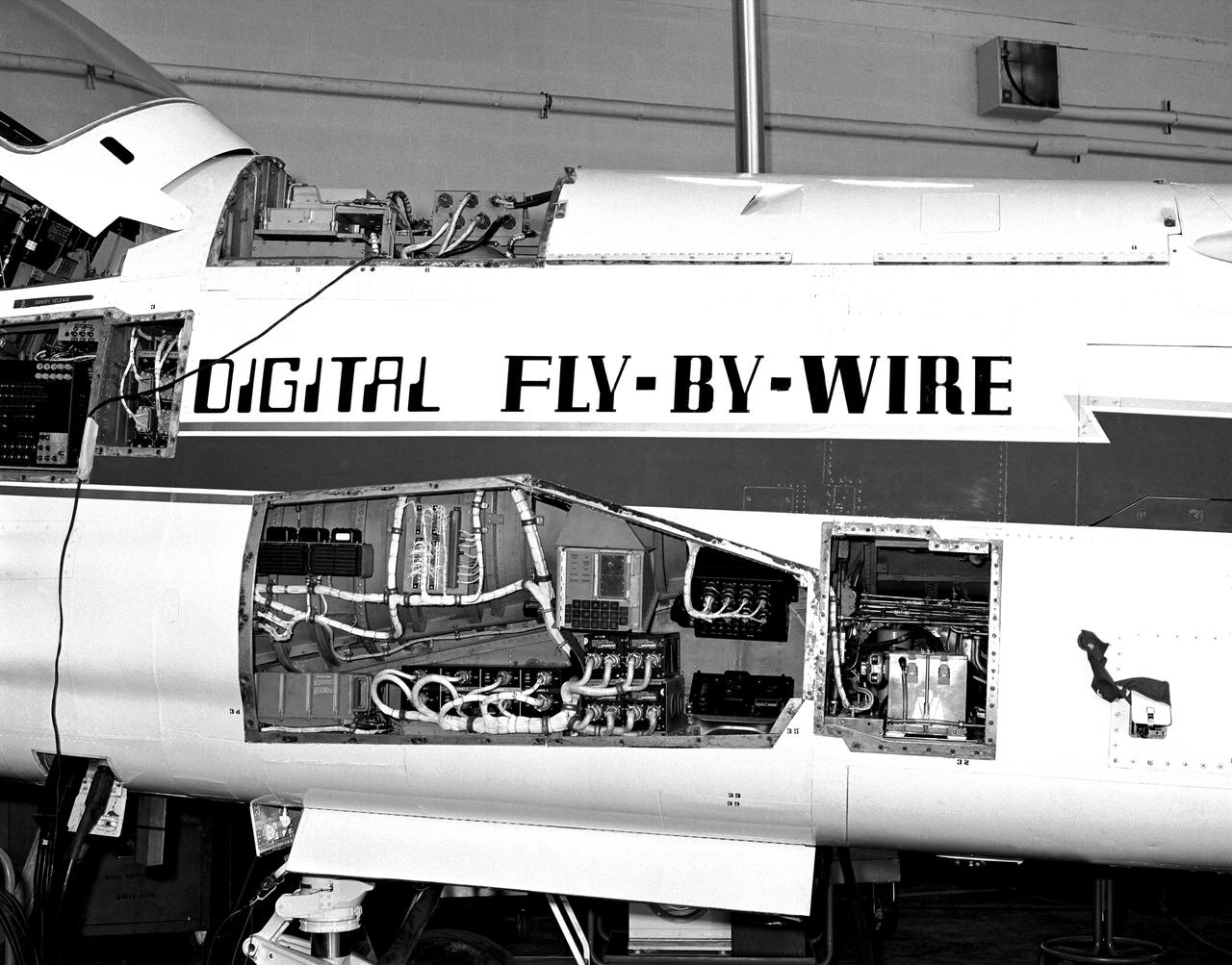
The Apollo hardware jammed into the F-8C. The computer is partially visible in the avionics bay at the top of the fuselage behind the cockpit. Note the display and keyboard unit in the gun bay. To carry the computers and other equipment, the F-8 DFBW team removed the aircraft's guns and ammunition boxes.
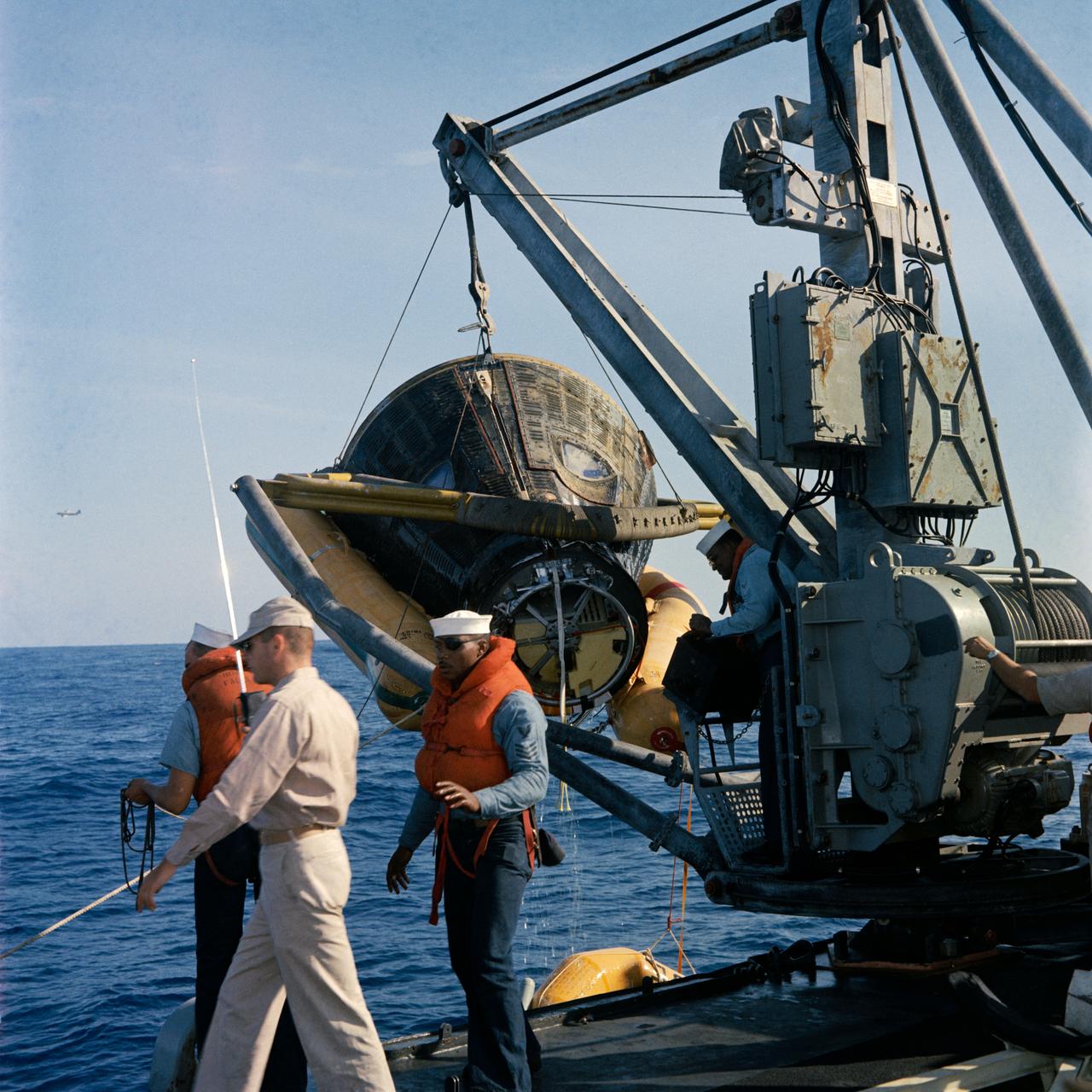
S66-26037 (16 March 1966) --- The Gemini-8 spacecraft, with astronauts Neil A. Armstrong and David R. Scott still aboard, is hoisted aboard the destroyer USS Leonard F. Mason. Trouble with the Gemini-8 Orbit Attitude and Maneuvering System (OAMS) forced an early termination of the mission. Photo credit: NASA
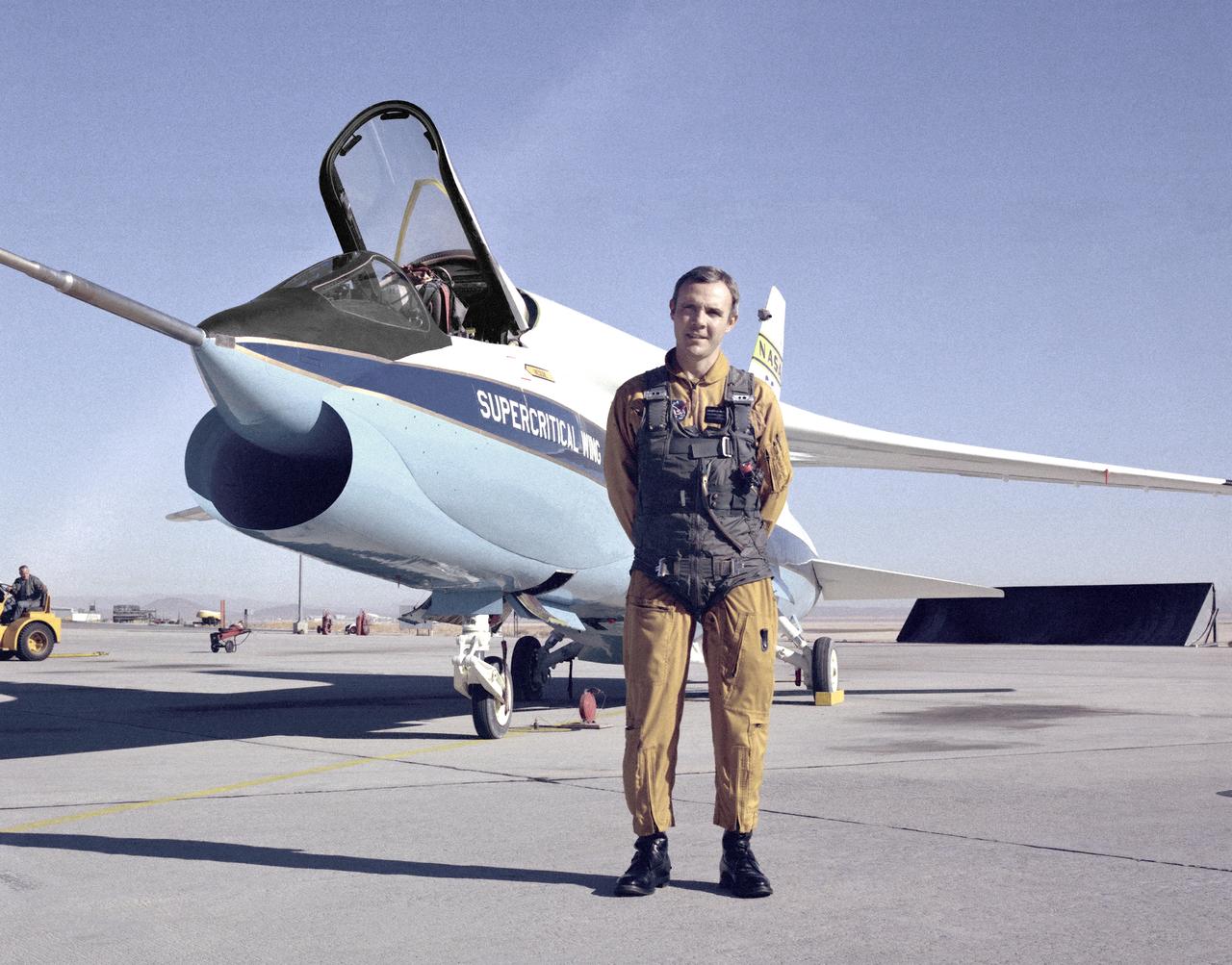
A Vought F-8A Crusader was selected by NASA as the testbed aircraft (designated TF-8A) to install an experimental Supercritical Wing (SCW) in place of the conventional wing. The unique design of the Supercritical Wing reduces the effect of shock waves on the upper surface near Mach 1, which in turn reduces drag. In this photograph the TF-8A Crusader with Supercritical Wing is shown on the ramp with project pilot Tom McMurtry standing beside it. McMurtry received NASA's Exceptional Service Medal for his work on the F-8 SCW aircraft. He also flew the AD-1, F-15 Digital Electronic Engine Control, the KC-130 winglets, the F-8 Digital Fly-By-Wire and other flight research aircraft including the remotely piloted 720 Controlled Impact Demonstration and sub-scale F-15 research projects. In addition, McMurtry was the 747 co-pilot for the Shuttle Approach and Landing Tests and made the last glide flight in the X-24B. McMurtry was Dryden’s Director for Flight Operations from 1986 to 1998, when he became Associate Director for Operations at NASA Dryden. In 1982, McMurtry received the Iven C. Kincheloe Award from the Society of Experimental Test Pilots for his contributions as project pilot on the AD-1 Oblique Wing program. In 1998 he was named as one of the honorees at the Lancaster, Calif., ninth Aerospace Walk of Honor ceremonies. In 1999 he was awarded the NASA Distinguished Service Medal. He retired in 1999 after a distinguished career as pilot and manager at Dryden that began in 1967.
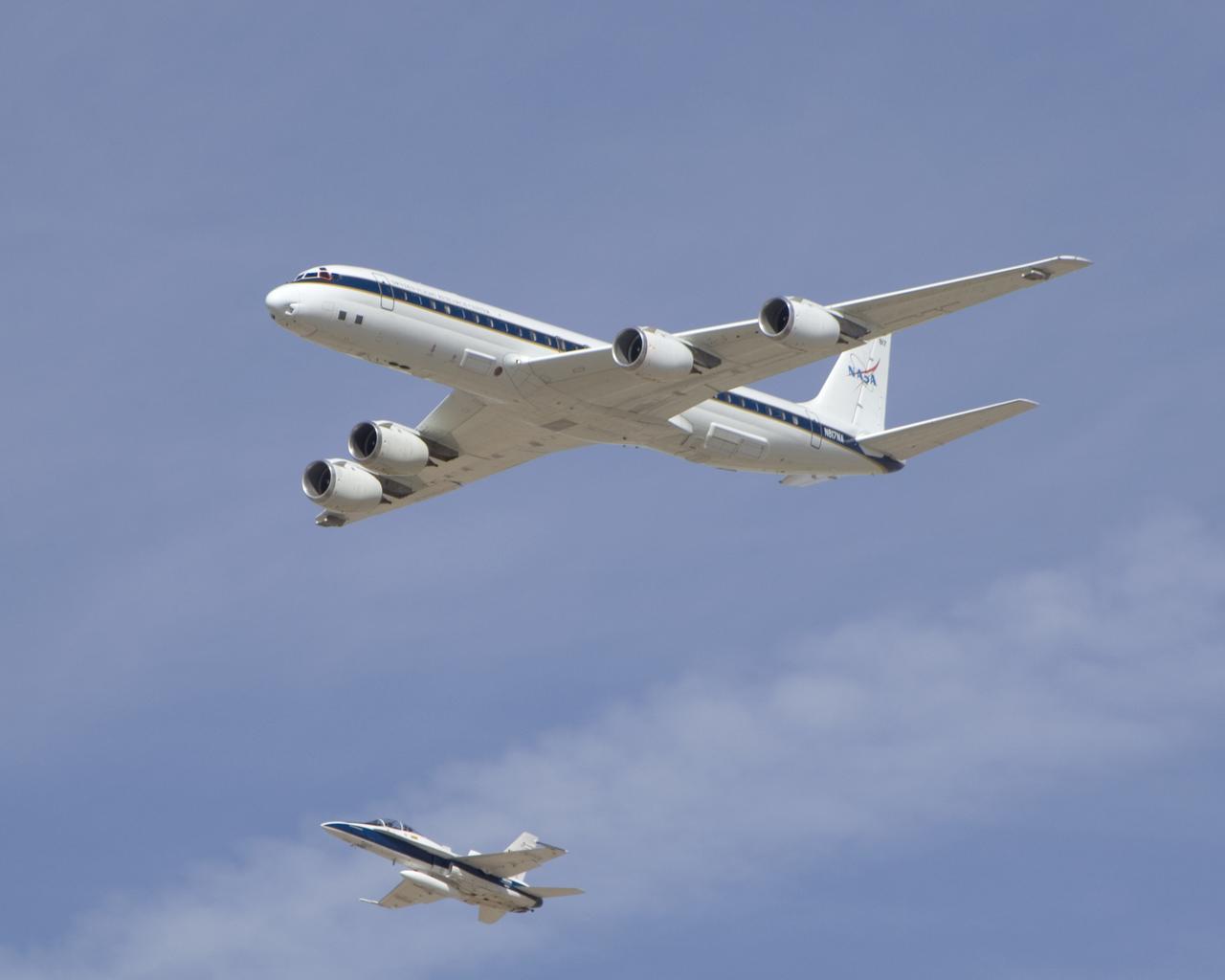
NASA's DC-8 airborne science laboratory is shadowed by a NASA F/A-18 chase plane during a flyover of the Dryden Aircraft Operations Facility in Palmdale, Calif.
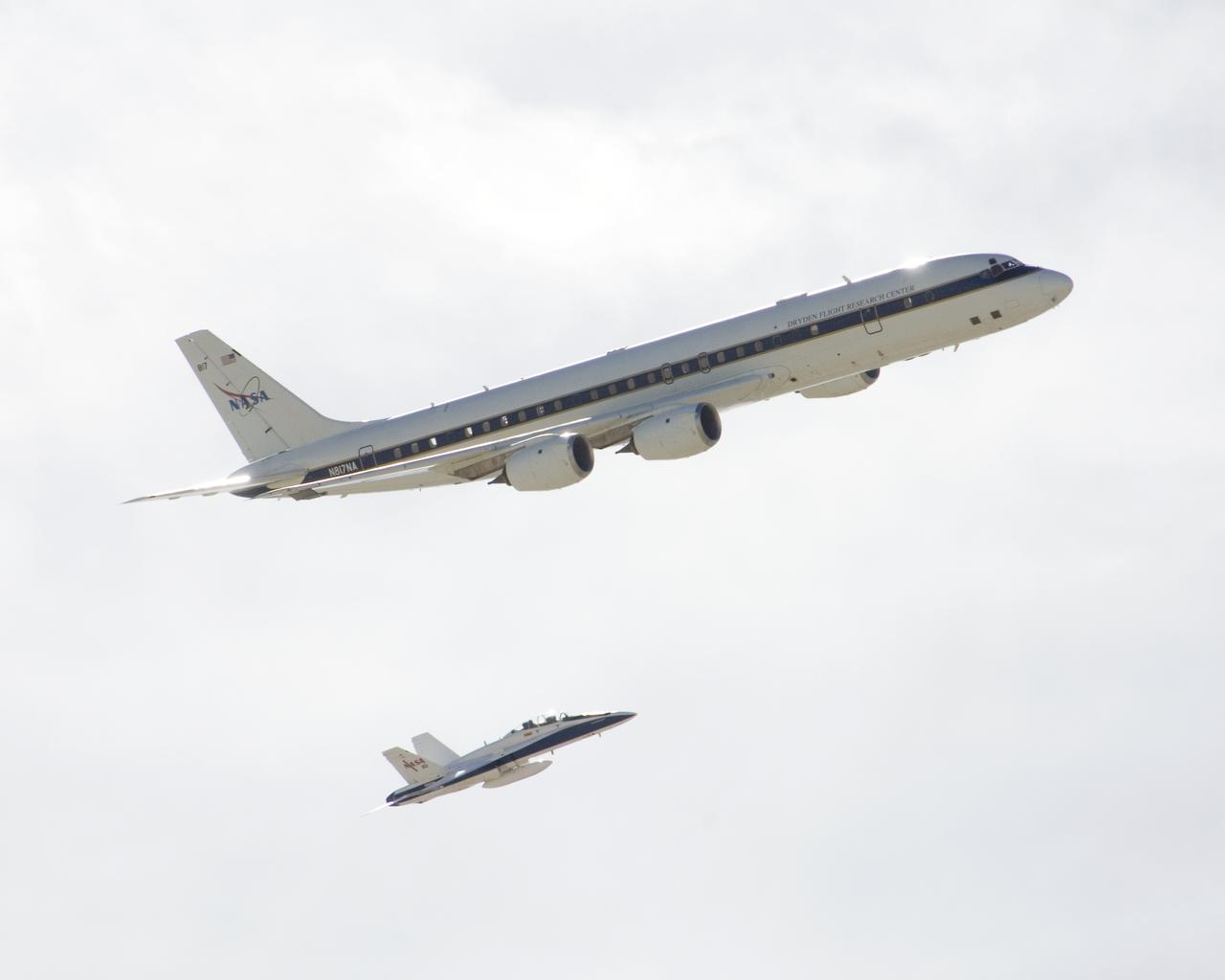
NASA's DC-8 airborne science laboratory is shadowed by a NASA F/A-18 chase plane during a flyover of the Dryden Aircraft Operations Facility in Palmdale, Calif.
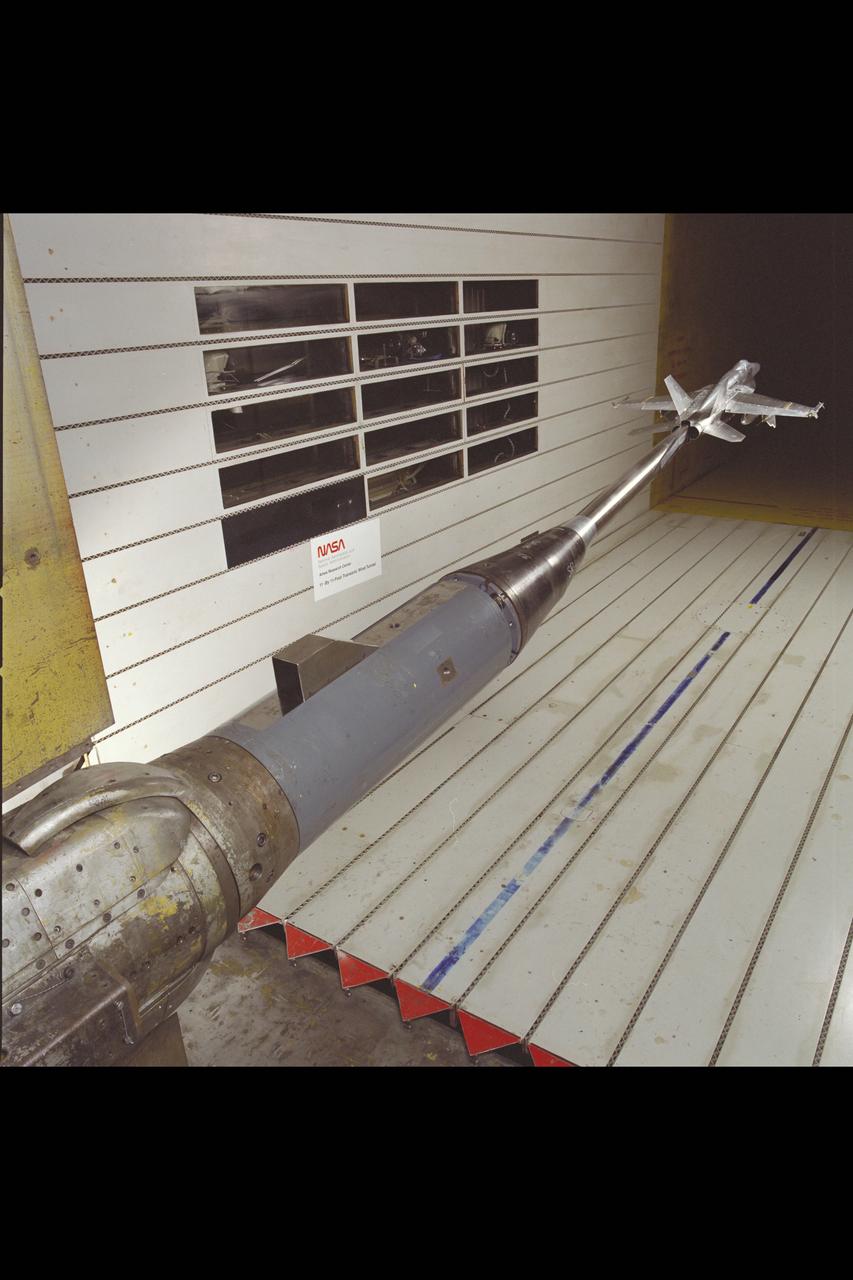
F/A-18 E/F Model: 11ft. W.T. Test #207-1-11, 8% Model
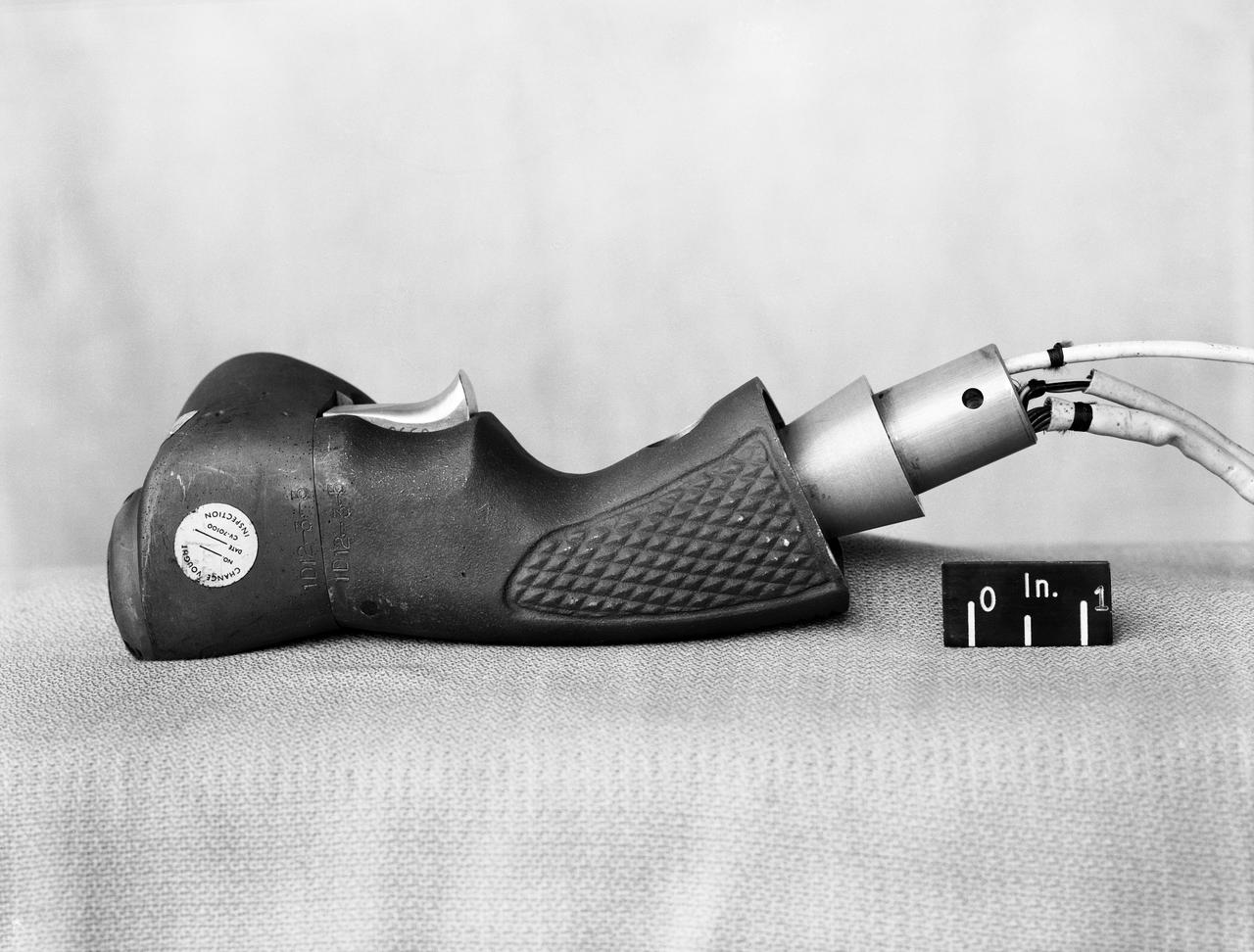
F8U-3 stick modifications - Stick controls in studio.
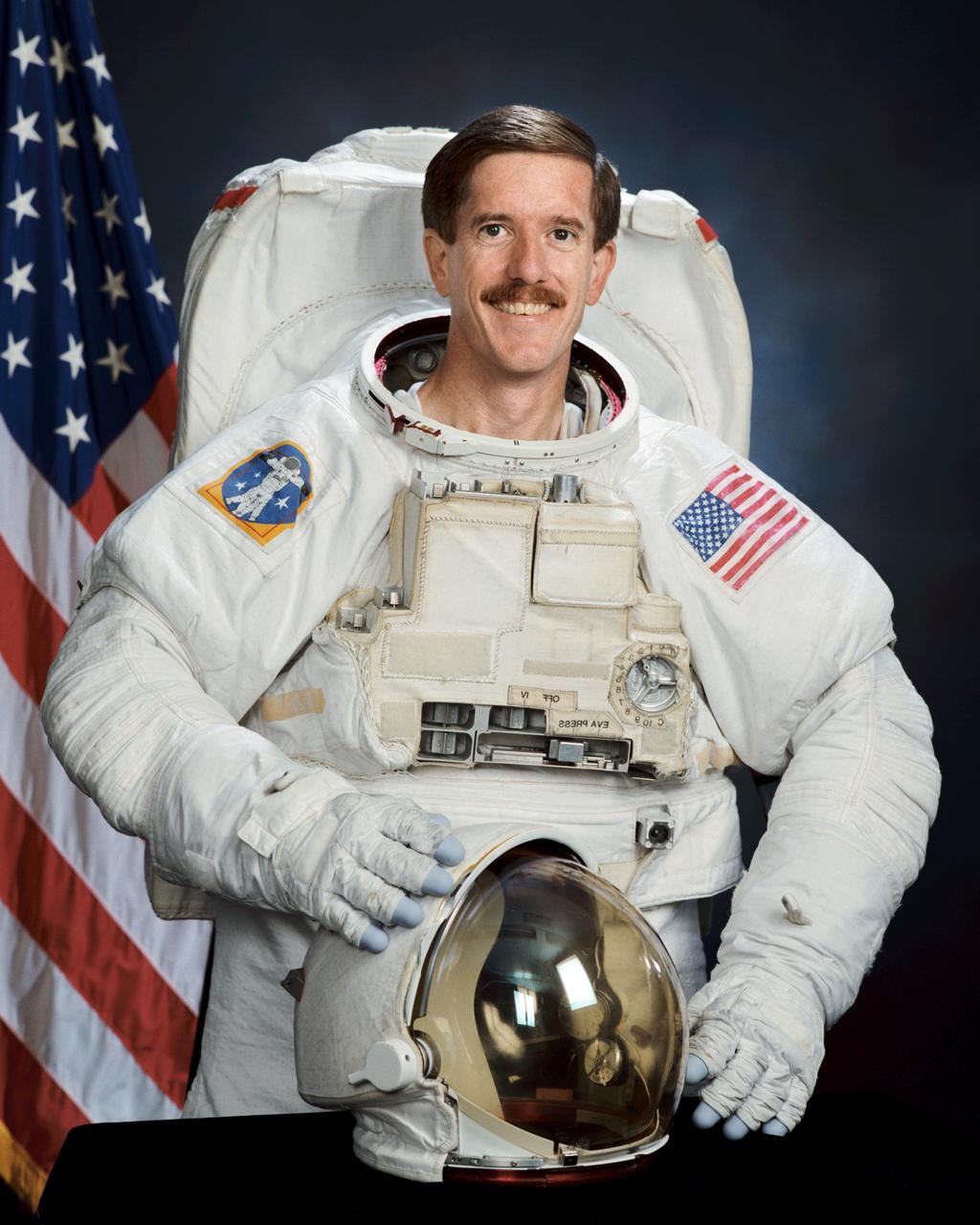
S98-00122 (8 Oct 1997) --- Astroanut James F. Reilly II, mission specialist.
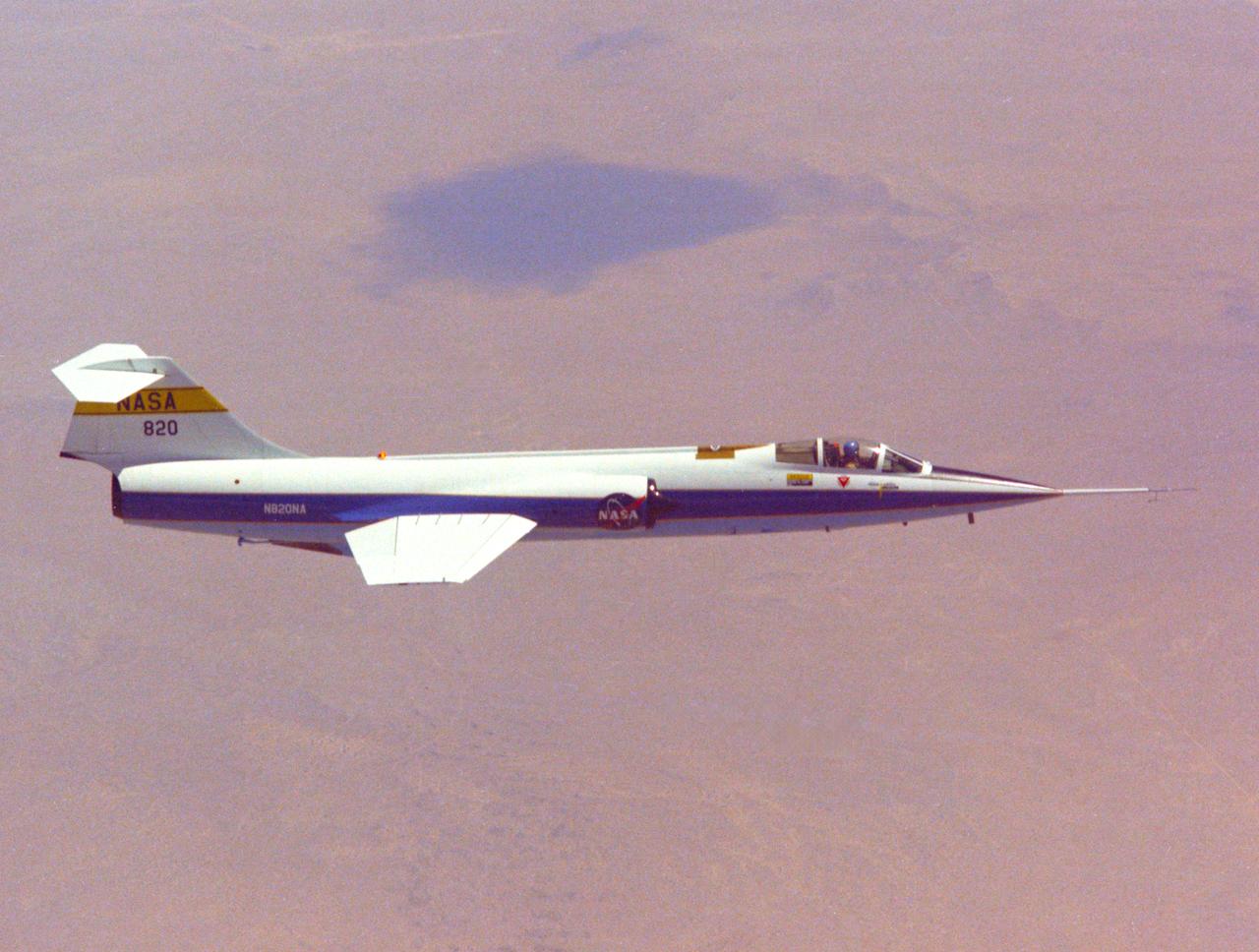
F-104A #820 in flight 8/23/71 NASA DFRC EC71-2811
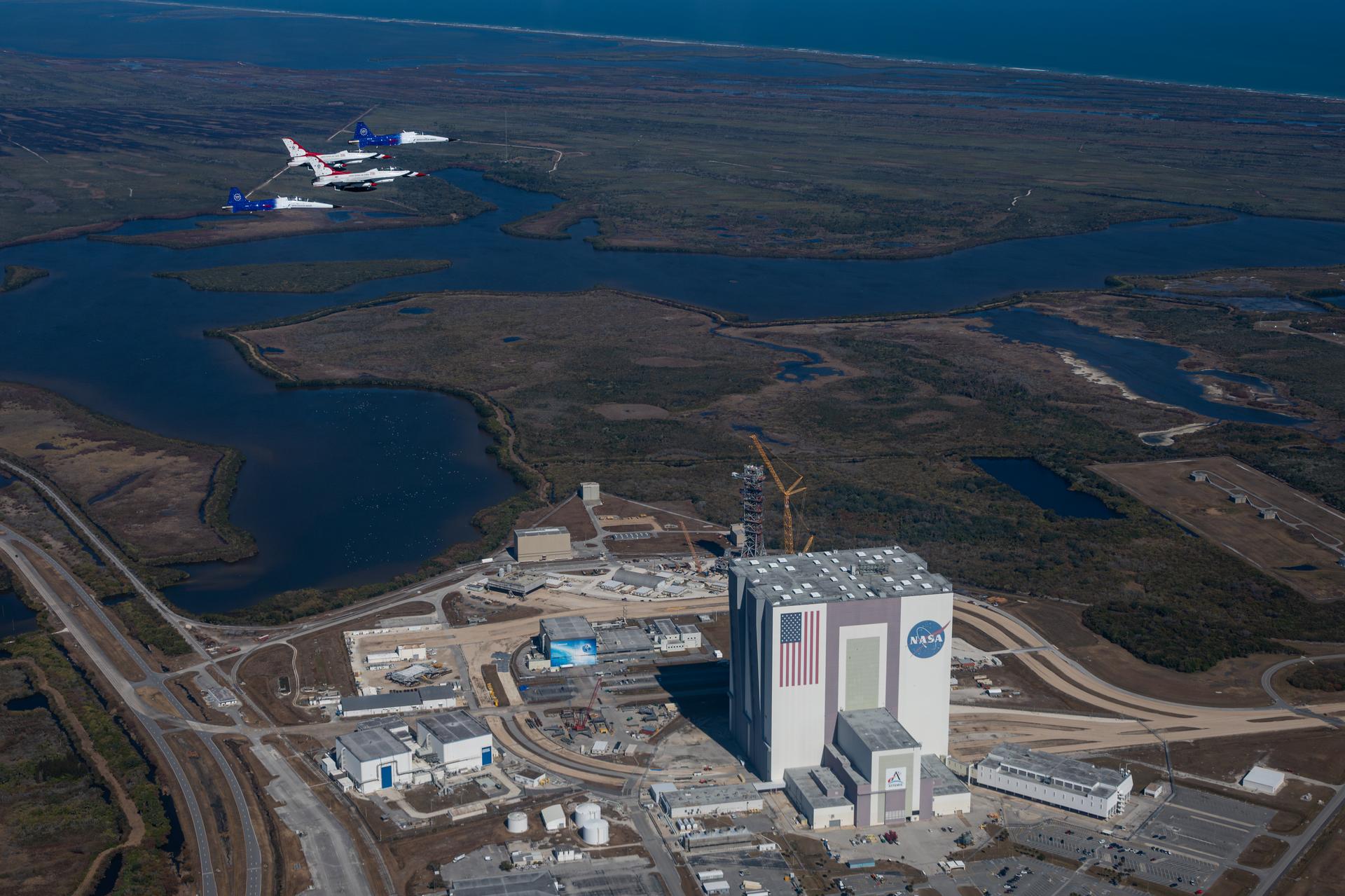
NASA Administrator Jared Isaacman conducts a formation flight with two of his personal F-5 aircraft, piloted by Isaacman and Sean Gustafson, senior advisor to the administrator, and two U.S. Air Force Thunderbirds F-16s, piloted by Thunderbird 7 Lt. Col. Tyler Keener and Thunderbird 8 Maj. Samuel Larson, Sunday, Feb. 8, 2026, at NASA’s Kennedy Space Center in Florida. The formation flew near the Vehicle Assembly Building and the surrounding area at Kennedy. Photo Credit: (NASA/John Kraus)
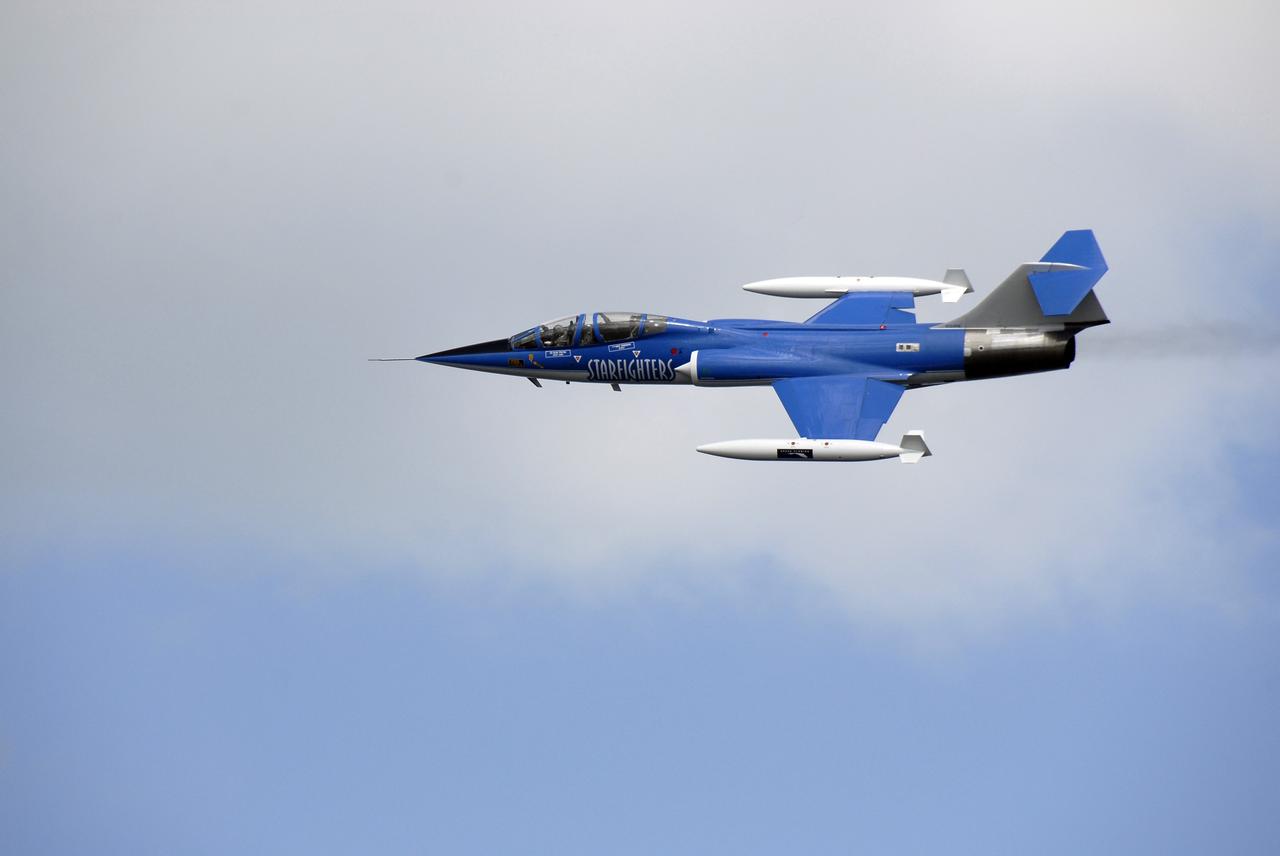
CAPE CANAVERAL, Fla. – An F-104G Starfighter races through the sky over NASA's Kennedy Space Center in Florida during the Kennedy Space Center Visitor Complex Space and Air Show Nov. 8-9. This year’s show brought together the best in military aircraft, such as the F/A-18 Super Hornet and F-16 Fighting Falcon, coupled with precision pilots and veteran astronauts to celebrate spaceflight and aviation. The event included a water rescue demonstration by the 920th Rescue Wing. Photo credit: NASA/Kim Shiflett
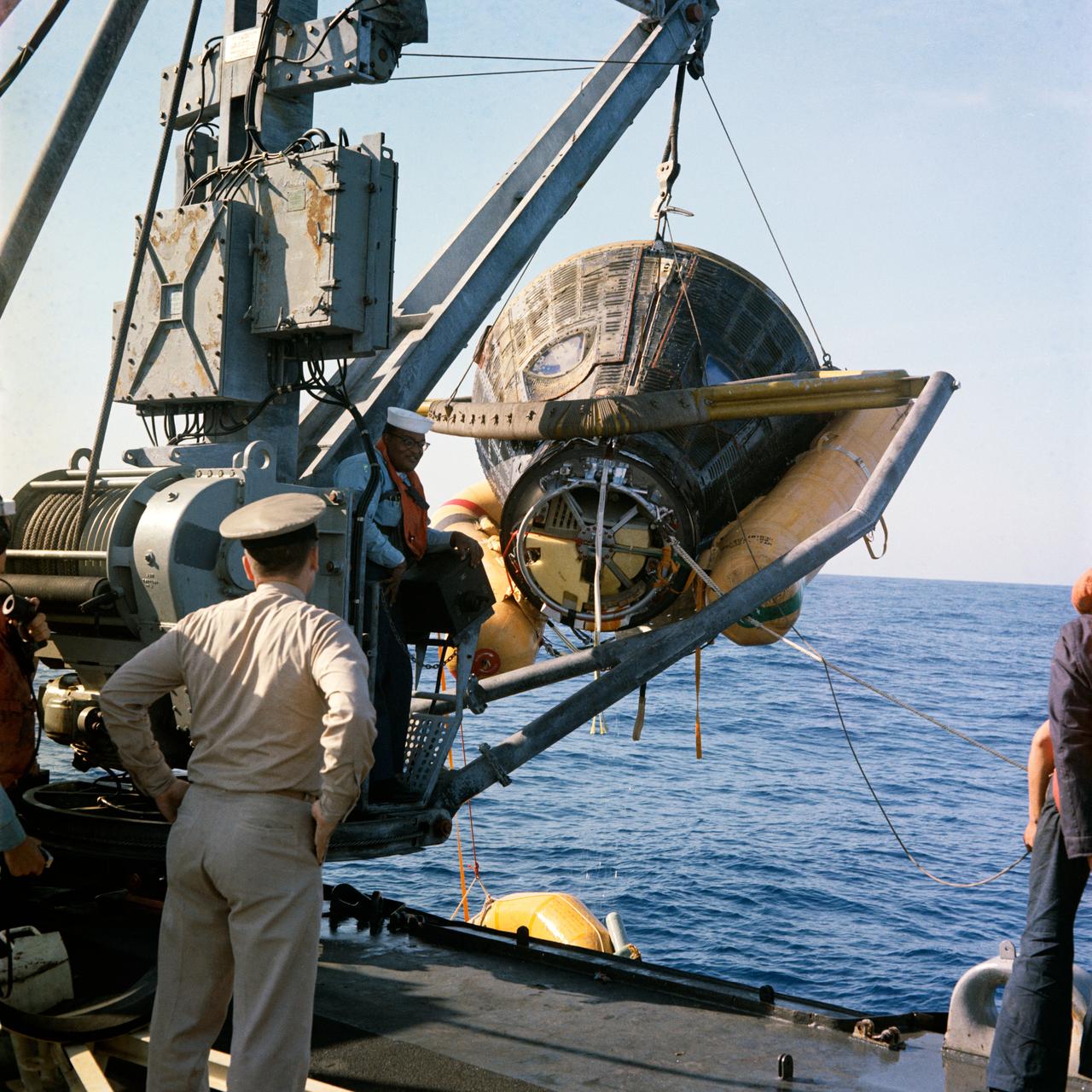
S66-18613 (16 March 1966) --- The Gemini-8 spacecraft, with astronauts Neil A. Armstrong and David R. Scott still aboard, is hoisted aboard the destroyer USS Leonard F. Mason. Trouble with the Gemini-8 Orbit Attitude and Maneuvering System (OAMS) forced an early termination of the mission. Photo credit: NASA
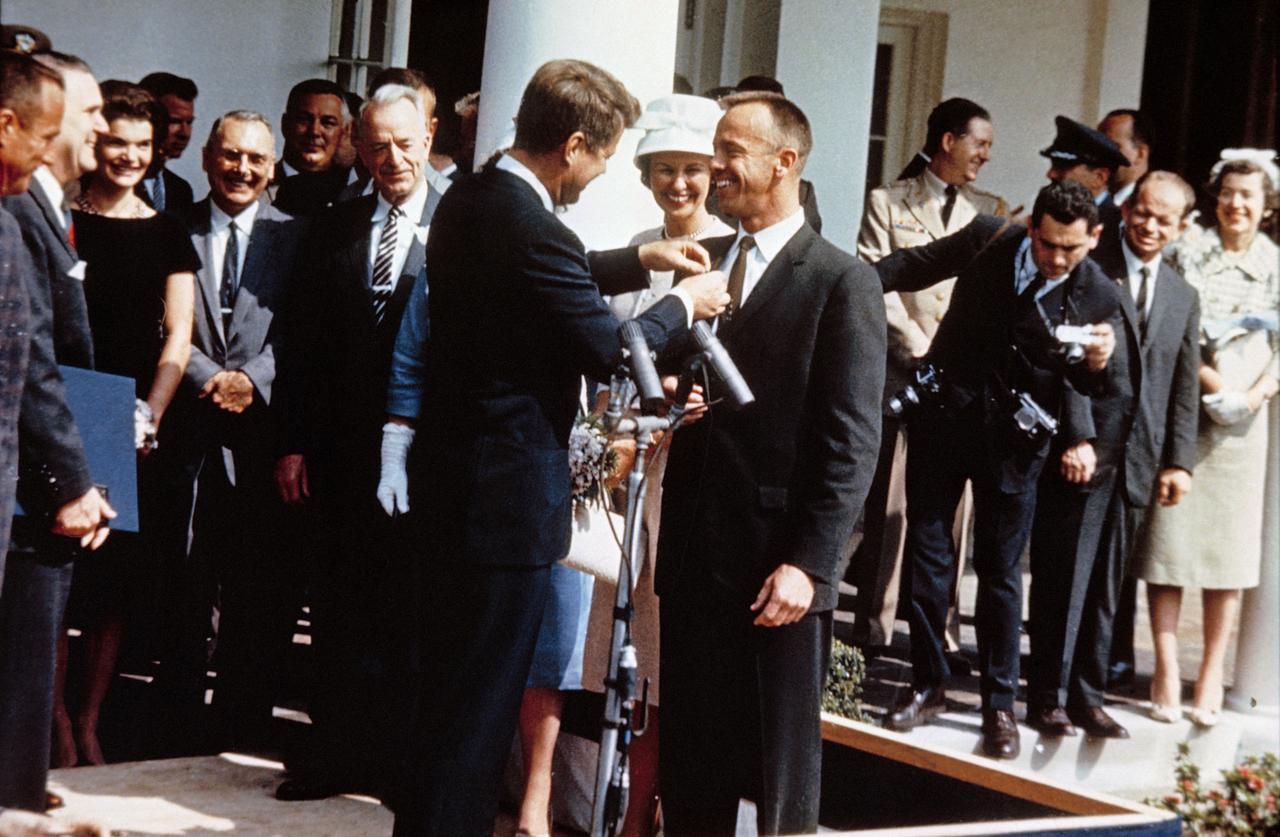
S63-06268 (8 May 1963) --- Astronaut Alan B. Shepard, Jr., receives his NASA's Distinguished Service Medal from President John F. Kennedy, after his Mercury-Redstone 3 (MR-3) flight, in a Rose Garden ceremony on May 8, 1961 at the White House.
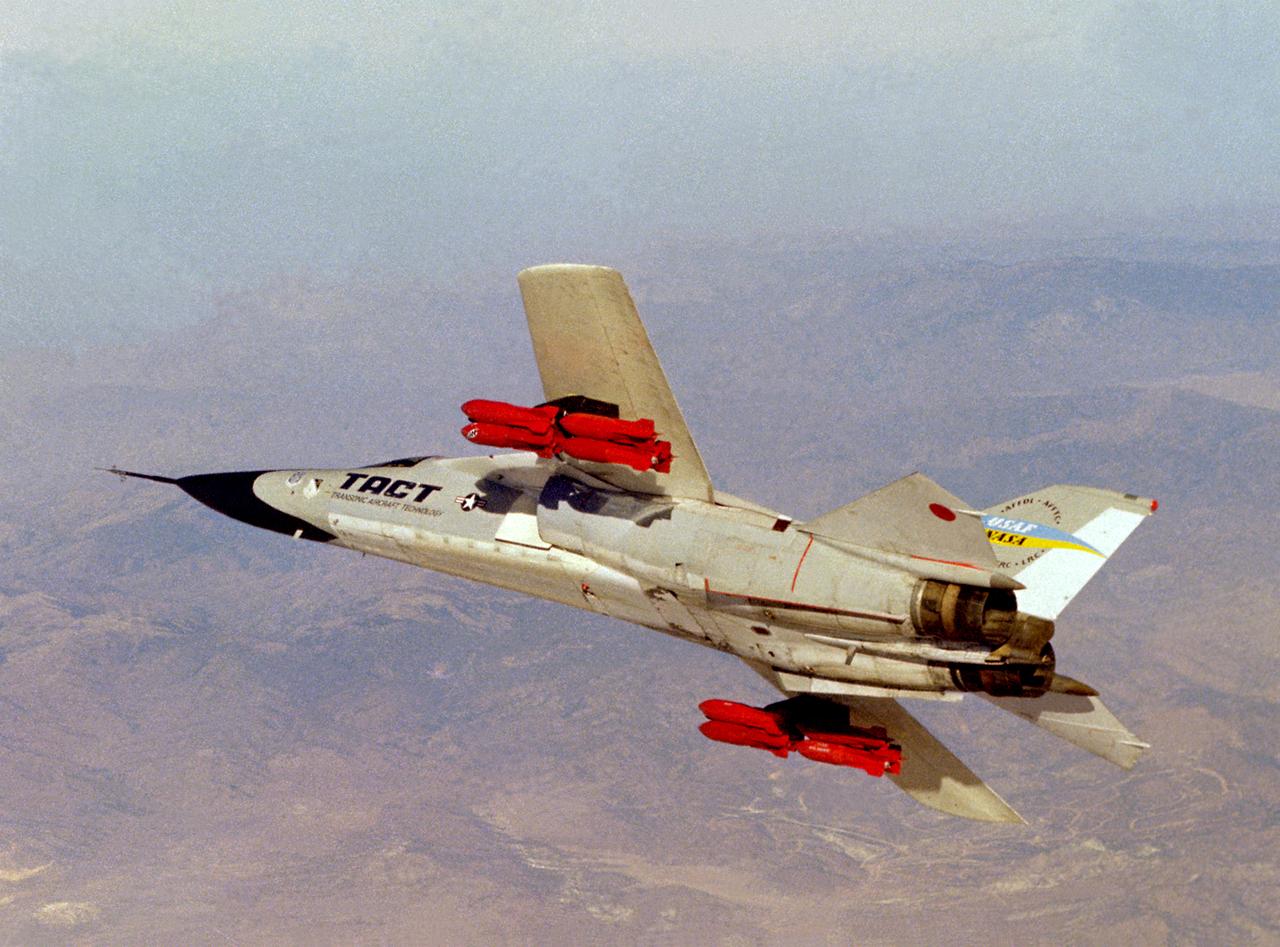
The General Dynamics TACT/F-111A (Serial #63-9778) banks over the Mojave Desert. Note the fully loaded racks of inert pratice bombs which were carried for weapon loads evaluations on the supercritical wing (SCW) that was the main feature of the Transonic Aircraft Technology F-111 research program. Intense interest in the results of the earlier F-8 SCW program spurred NASA and the U.S. Air Force to modify the number 13 F-111A for the TACT program. This aircraft participated in a major research and flight testing program that spanned nearly 20 years, beginning in 1971 at the NASA Flight Research Center at Edwards AFB, California.
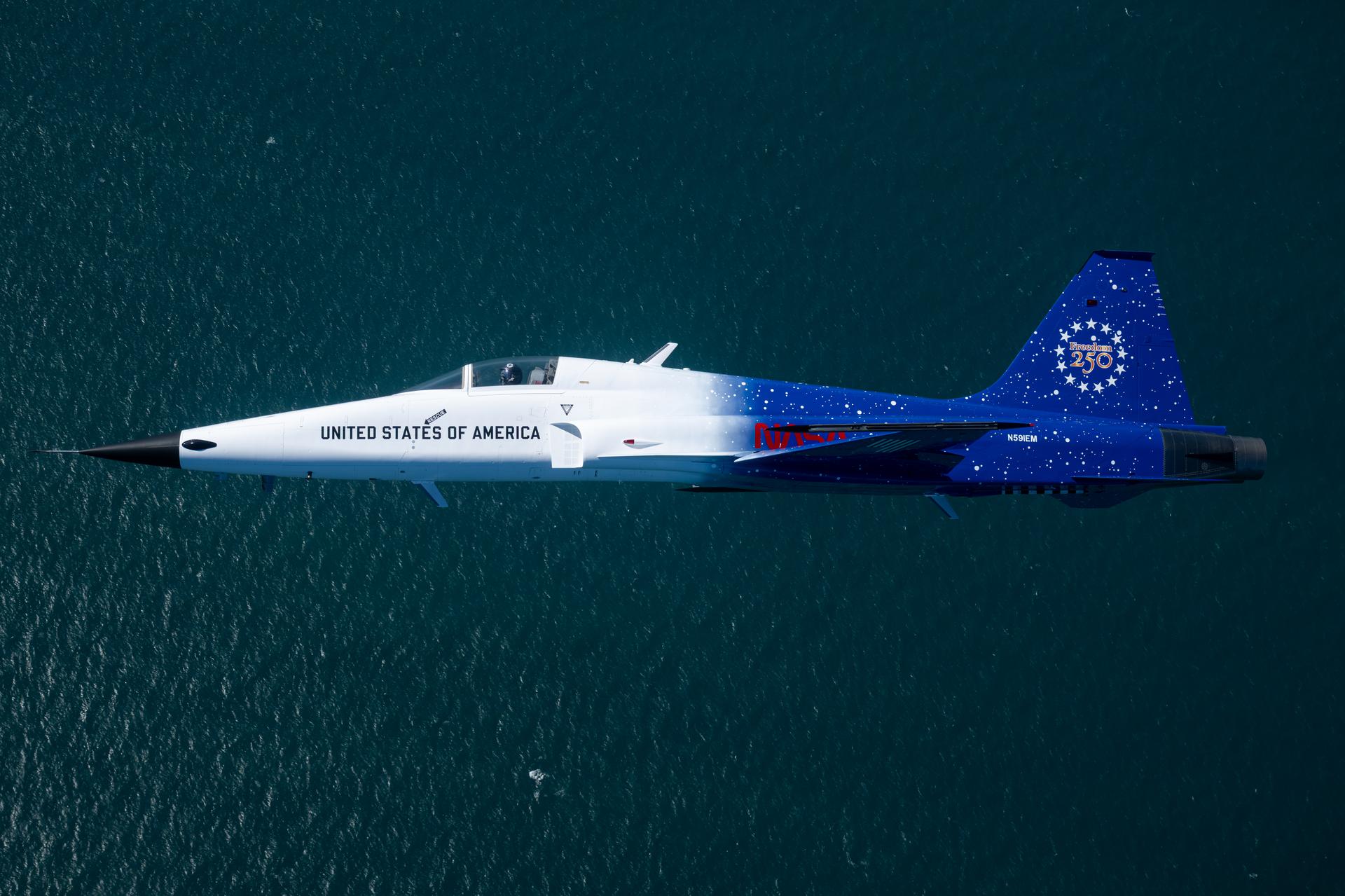
NASA Administrator Jared Isaacman is seen flying his personal F-5 aircraft, Sunday, Feb. 8, 2026, at NASA’s Kennedy Space Center in Florida. Photo Credit: (NASA/John Kraus)
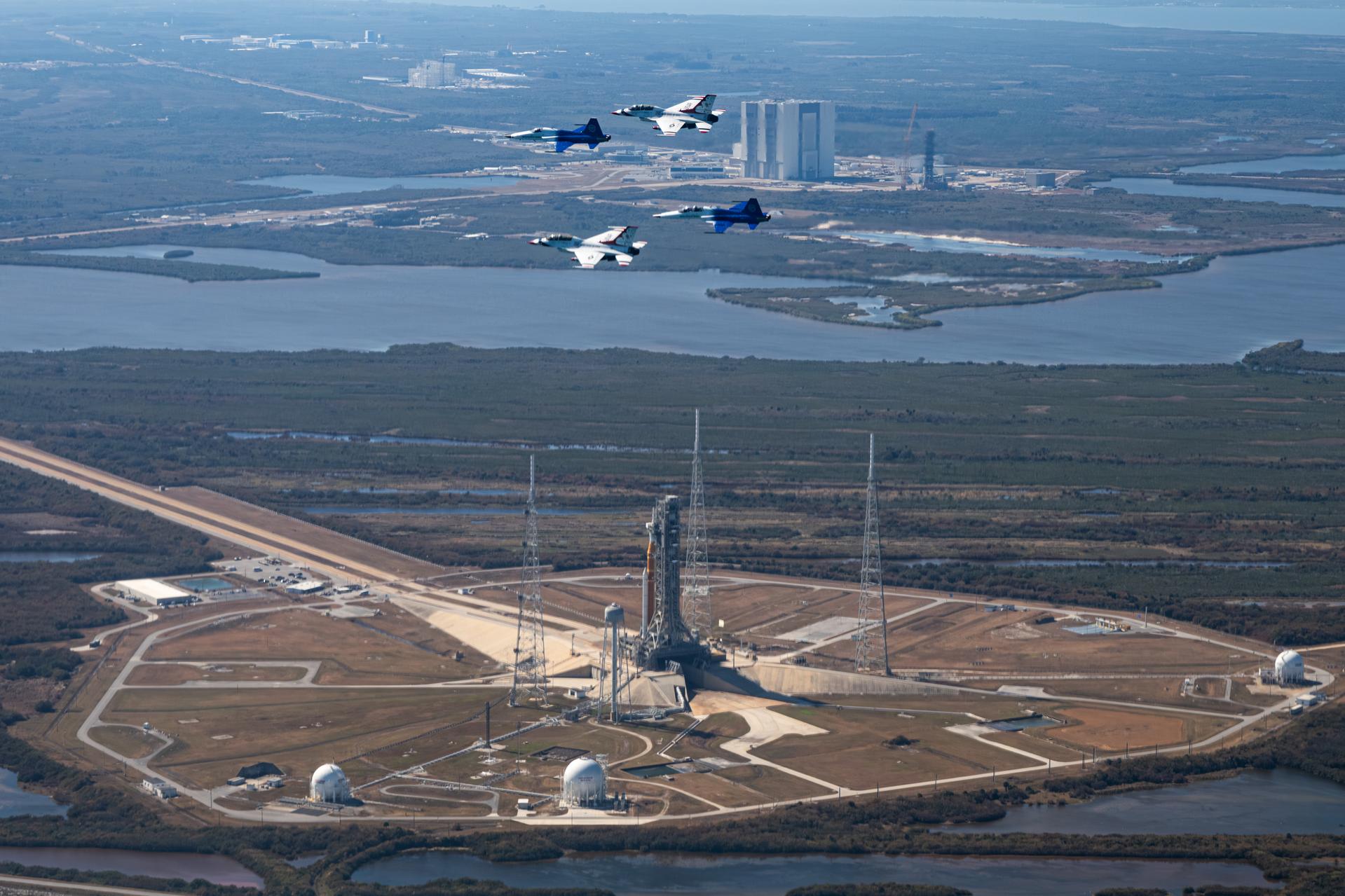
NASA Administrator Jared Isaacman conducts a formation flight with two of his personal F-5 aircraft, piloted by Isaacman and Sean Gustafson, senior advisor to the administrator, and two U.S. Air Force Thunderbirds F-16s, piloted by Thunderbird 7 Lt. Col. Tyler Keener and Thunderbird 8 Maj. Samuel Larson, Sunday, Feb. 8, 2026, at NASA’s Kennedy Space Center in Florida. The formation flew near the Artemis II SLS (Space Launch System) rocket and Orion spacecraft at Launch Complex 39B and the surrounding area at Kennedy. Photo Credit: (NASA/John Kraus)
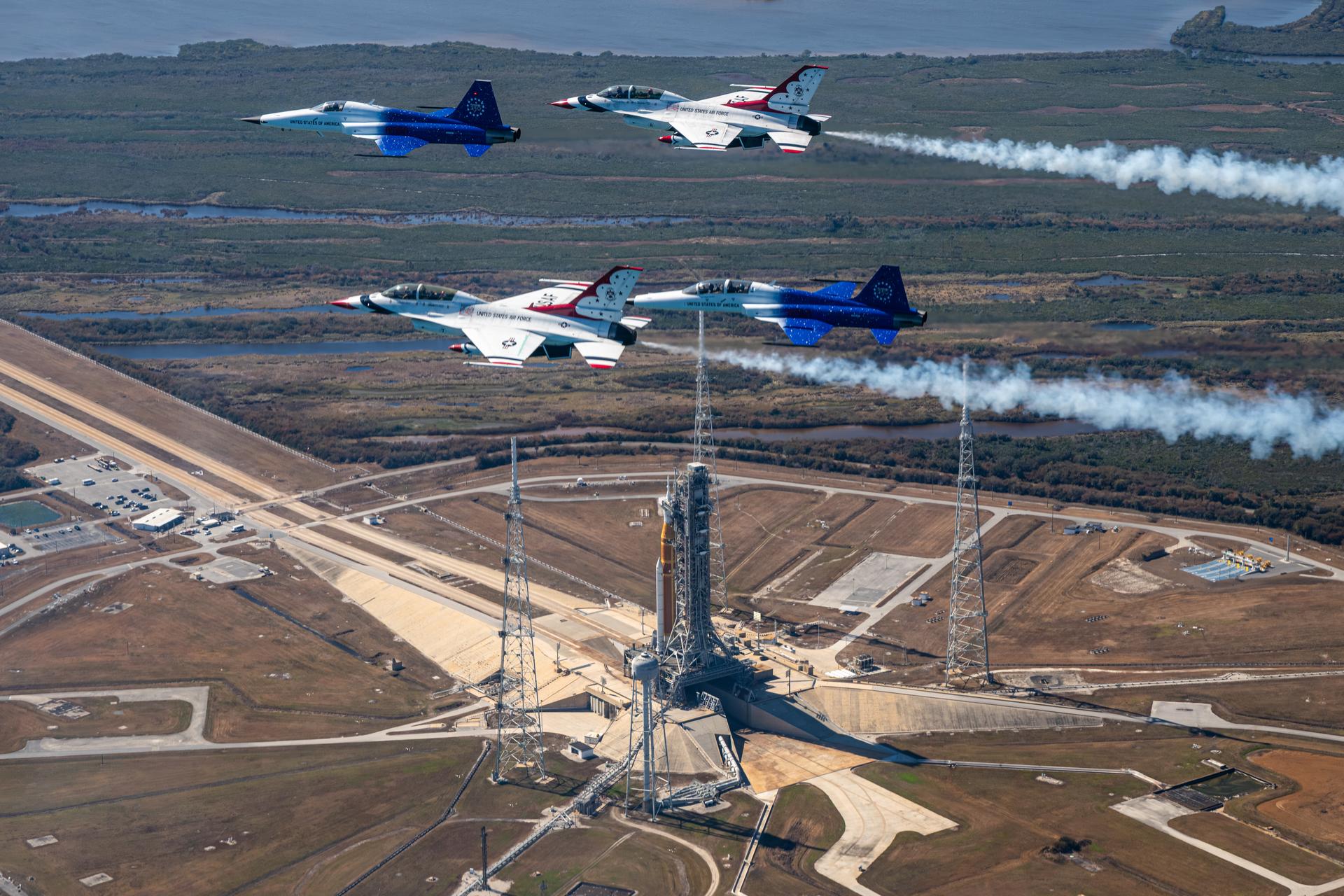
NASA Administrator Jared Isaacman conducts a formation flight with two of his personal F-5 aircraft, piloted by Isaacman and Sean Gustafson, senior advisor to the administrator, and two U.S. Air Force Thunderbirds F-16s, piloted by Thunderbird 7 Lt. Col. Tyler Keener and Thunderbird 8 Maj. Samuel Larson, Sunday, Feb. 8, 2026, at NASA’s Kennedy Space Center in Florida. The formation flew near the Artemis II SLS (Space Launch System) rocket and Orion spacecraft at Launch Complex 39B and the surrounding area at Kennedy. Photo Credit: (NASA/John Kraus)
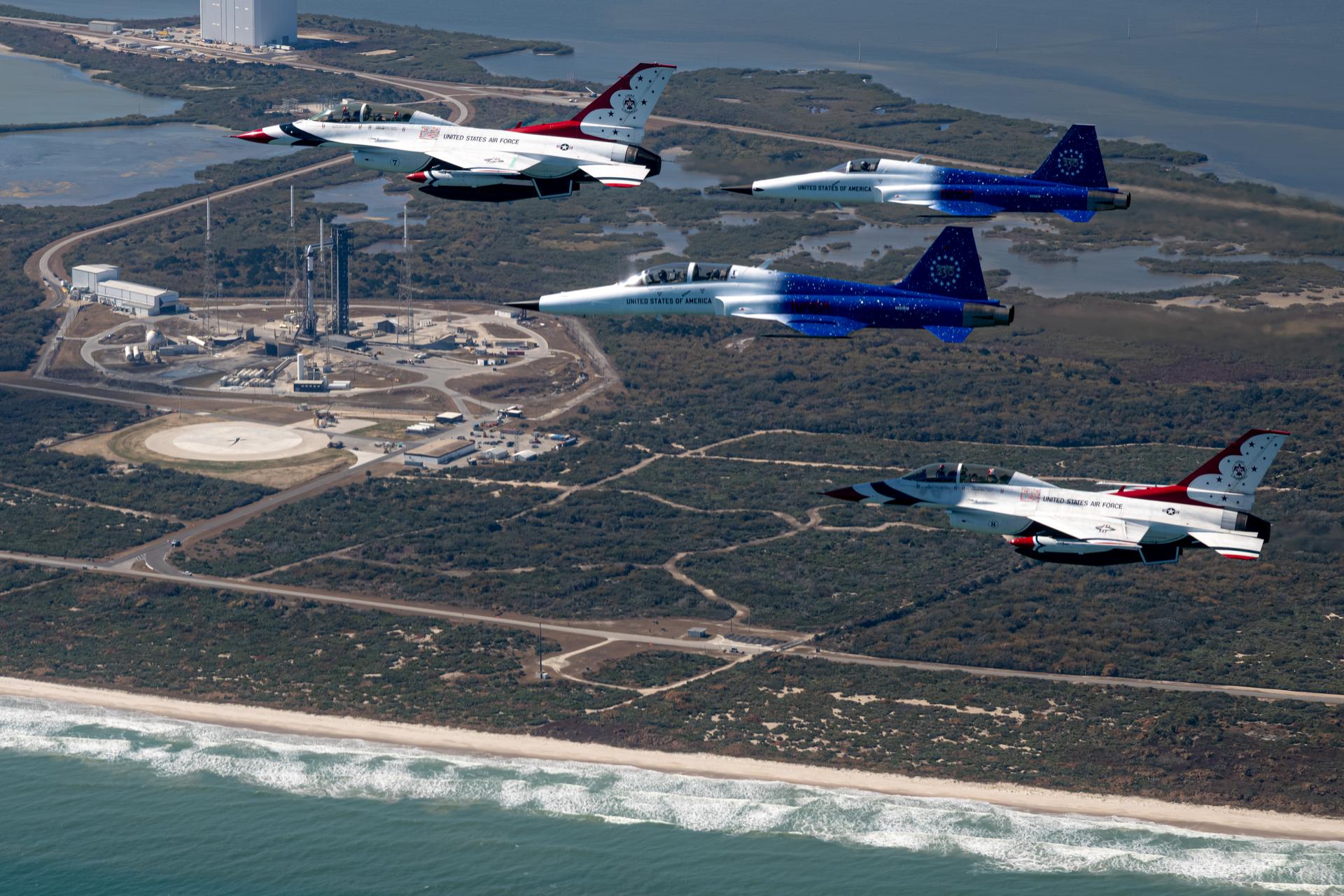
NASA Administrator Jared Isaacman conducts a formation flight with two of his personal F-5 aircraft, piloted by Isaacman and Sean Gustafson, senior advisor to the administrator, and two U.S. Air Force Thunderbirds F-16s, piloted by Thunderbird 7 Lt. Col. Tyler Keener and Thunderbird 8 Maj. Samuel Larson, Sunday, Feb. 8, 2026, at NASA’s Kennedy Space Center in Florida. The formation flew near Space Launch Complex 40 at Cape Canaveral Space Force Station and the surrounding area at Kennedy ahead of Crew-12’s mission to the International Space Station. Photo Credit: (NASA/John Kraus)
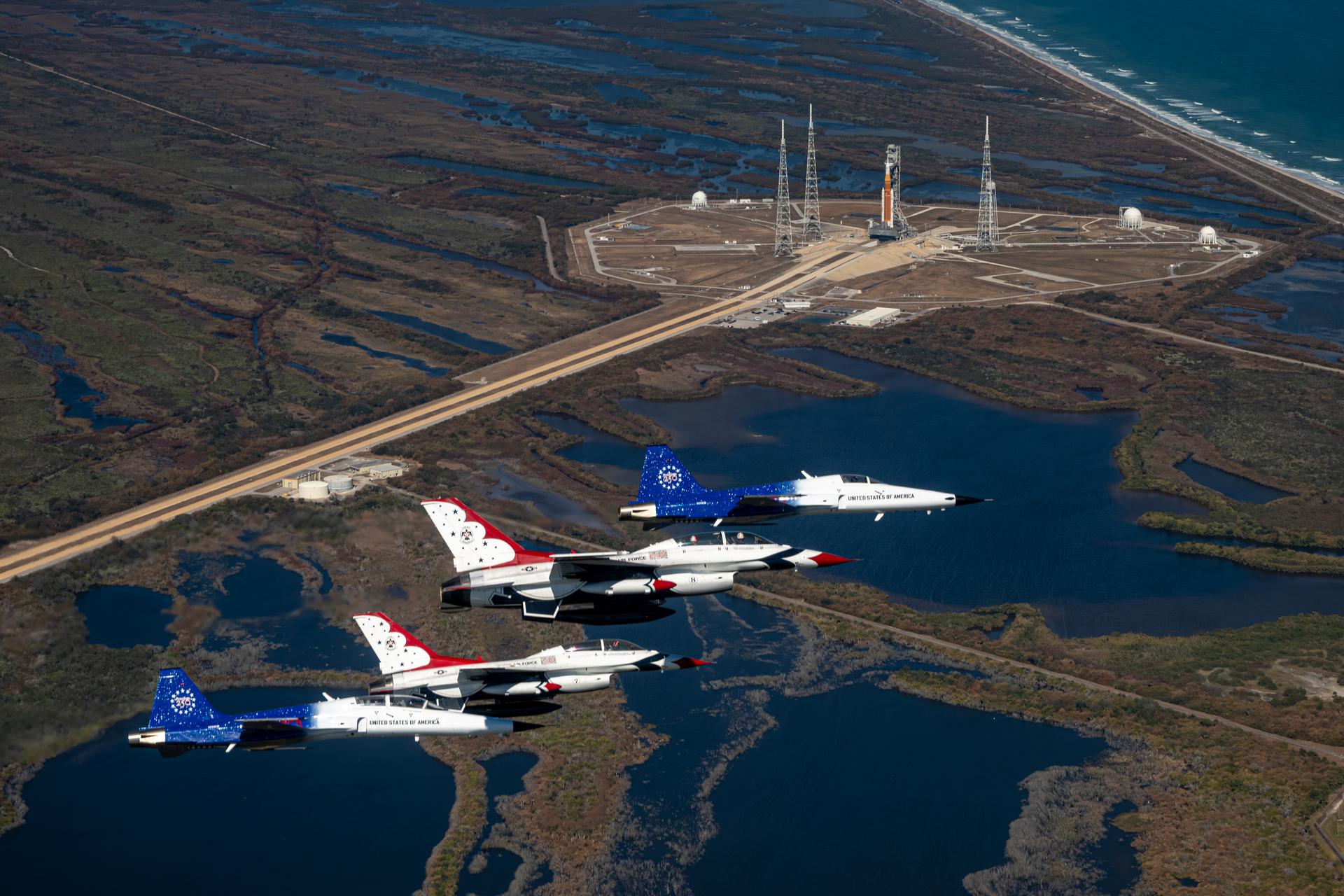
NASA Administrator Jared Isaacman conducts a formation flight with two of his personal F-5 aircraft, piloted by Isaacman and Sean Gustafson, senior advisor to the administrator, and two U.S. Air Force Thunderbirds F-16s, piloted by Thunderbird 7 Lt. Col. Tyler Keener and Thunderbird 8 Maj. Samuel Larson, Sunday, Feb. 8, 2026, at NASA’s Kennedy Space Center in Florida. The formation flew near the Artemis II SLS (Space Launch System) rocket and Orion spacecraft at Launch Complex 39B and the surrounding area at Kennedy. Photo Credit: (NASA/John Kraus)
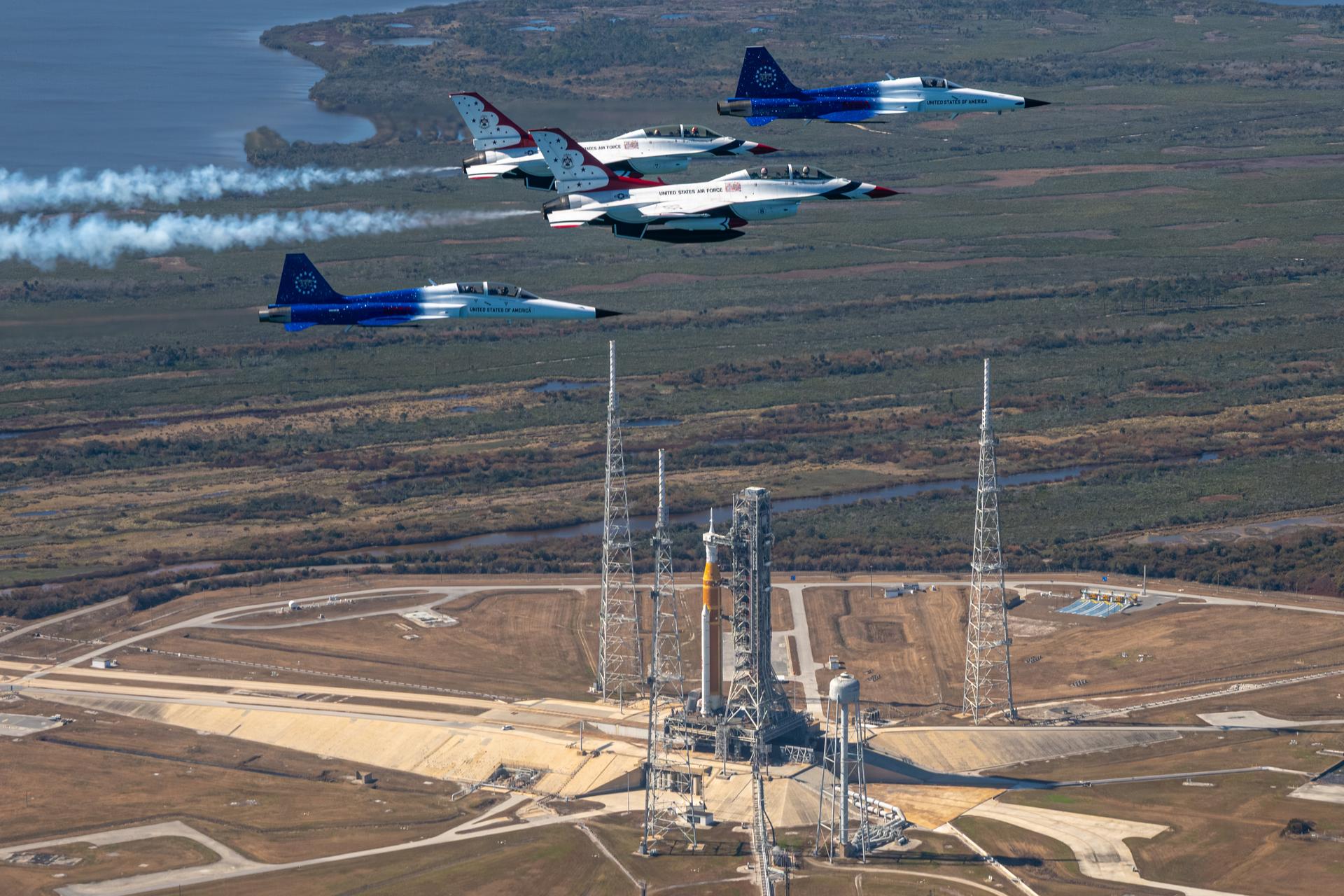
NASA Administrator Jared Isaacman conducts a formation flight with two of his personal F-5 aircraft, piloted by Isaacman and Sean Gustafson, senior advisor to the administrator, and two U.S. Air Force Thunderbirds F-16s, piloted by Thunderbird 7 Lt. Col. Tyler Keener and Thunderbird 8 Maj. Samuel Larson, Sunday, Feb. 8, 2026, at NASA’s Kennedy Space Center in Florida. The formation flew near the Artemis II SLS (Space Launch System) rocket and Orion spacecraft at Launch Complex 39B and the surrounding area at Kennedy. Photo Credit: (NASA/John Kraus)
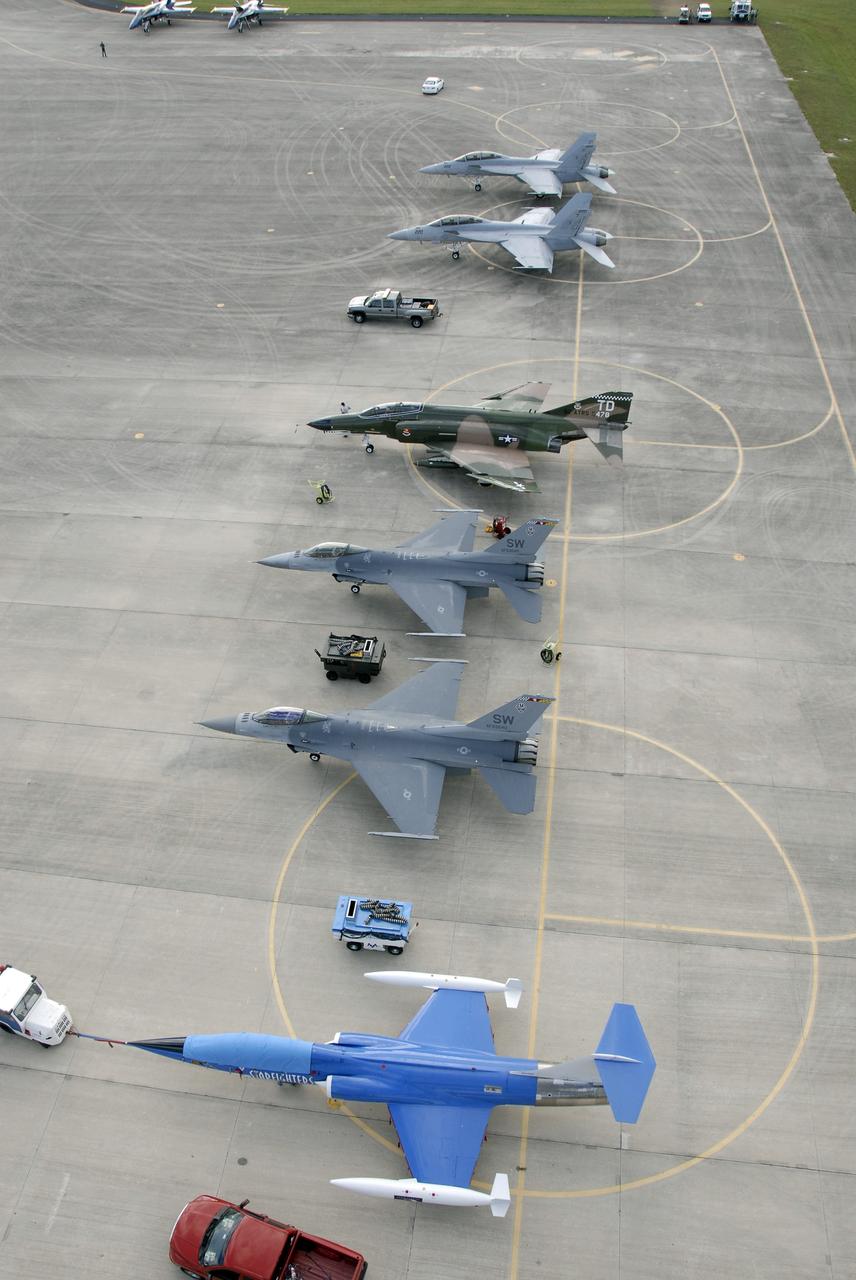
CAPE CANAVERAL, Fla. – Military aircraft are lined up on the Shuttle Landing Facility at NASA's Kennedy Space Center in Florida. The F/A-18s, F-4, F-16 and F-104G Starfighter will take part in demonstrations at the Kennedy Space Center Visitor Complex Space and Air Show Nov. 8-9. The Navy's elite flight demonstration squadron, the Blue Angels, will take to the skies in military aircraft demonstrations for the second annual Space & Air Show at Kennedy. This year’s show brings together the best in military aircraft, coupled with precision pilots and veteran astronauts to celebrate spaceflight and aviation. The event also includes demonstrations by the F-16 Fighting Falcon and a water rescue demonstration by the 920th Rescue Wing. Photo credit: NASA/Kim Shiflett
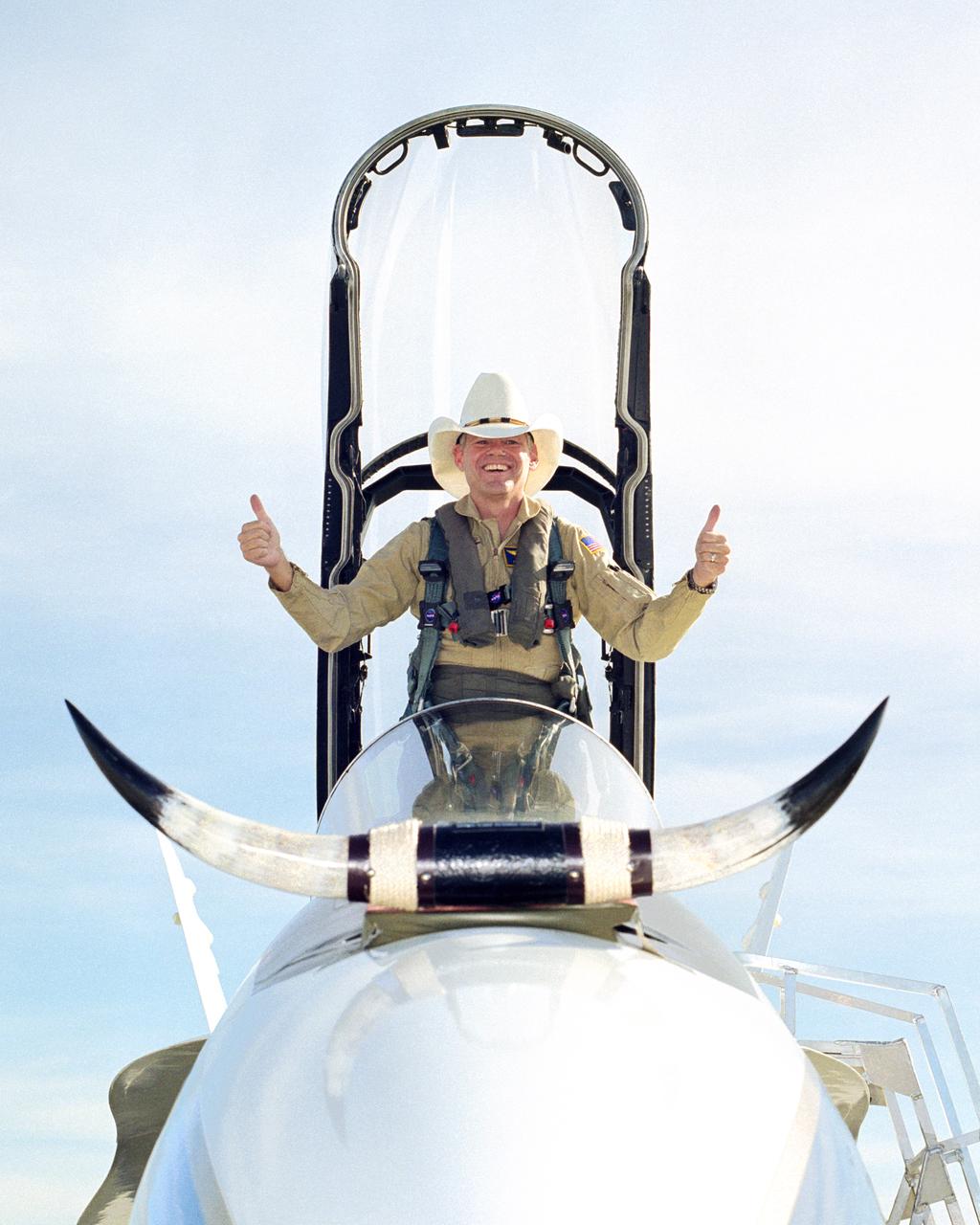
In a lighter mood, Ed Schneider gives a "thumbs-up" after his last flight at the Dryden Flight Research Center on September 19, 2000. Schneider arrived at the NASA Ames-Dryden Flight Research Facility on July 5, 1982, as a Navy Liaison Officer, becoming a NASA research pilot one year later. He has been project pilot for the F-18 High Angle-of-Attack program (HARV), the F-15 aeronautical research aircraft, the NASA B-52 launch aircraft, and the SR-71 "Blackbird" aircraft. He also participated in such programs as the F-8 Digital Fly-By-Wire, the FAA/NASA 720 Controlled Impact Demonstration, the F-14 Automatic Rudder Interconnect and Laminar Flow, and the F-104 Aeronautical Research and Microgravity projects.
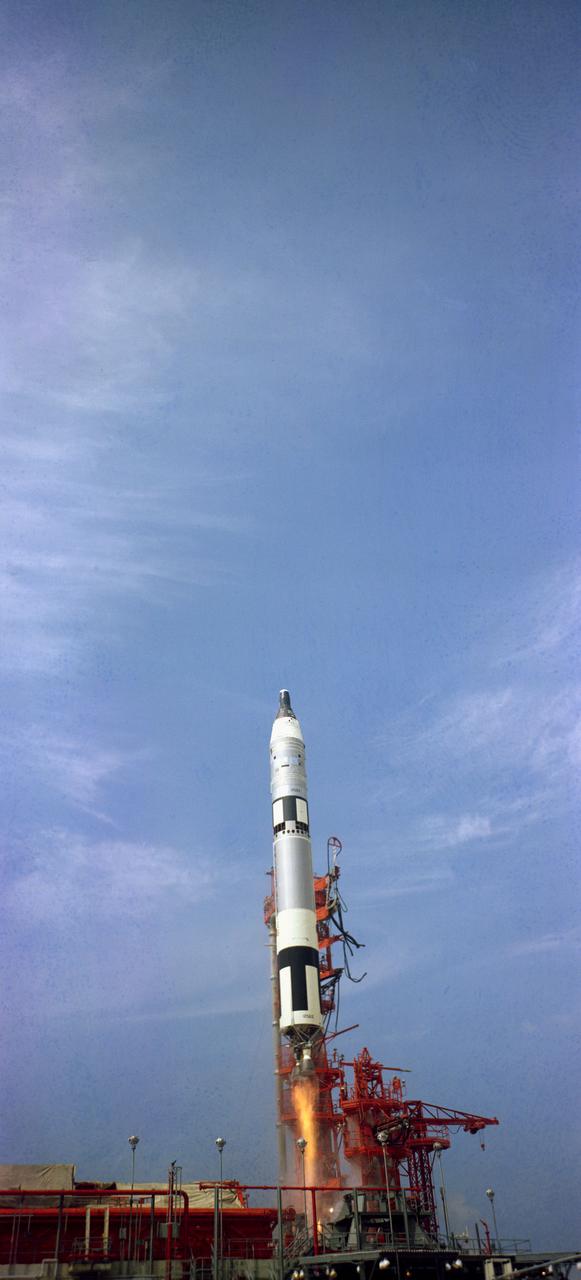
S66-24465 (16 March 1966) --- The Gemini-Titan 8 (GT-8), carrying astronauts Neil A. Armstrong, command pilot, and David R. Scott, pilot, was successfully launched by the National Aeronautics and Space Administration's (NASA) John F. Kennedy Space Center (KSC) at 11:41 a.m. (EST), March 16, 1966. An attempt will be made to rendezvous and dock the Gemini-8 spacecraft with Agena Docking Target Vehicle. Photo credit: NASA
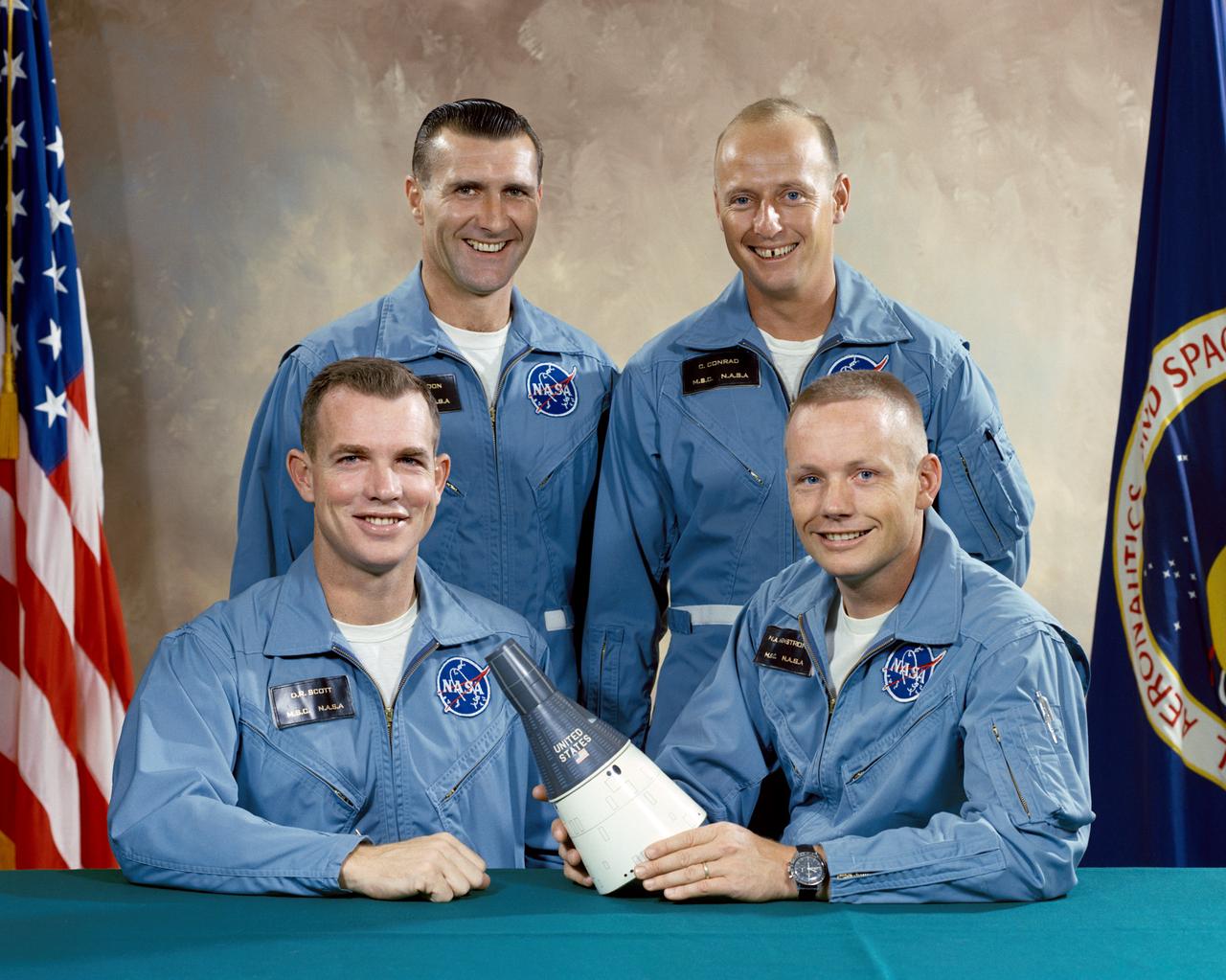
S65-58502 (4 Nov. 1965) --- This is the portrait of the prime and backup crew members of the Gemini-Titan 8 (GT-8) mission. Astronauts David R. Scott (left), pilot; and astronaut Neil A. Armstrong, command pilot, are the prime crew of the Gemini-8 mission. Backup crew (left to right, standing) are astronauts Richard F. Gordon Jr., pilot; and Charles Conrad Jr., command pilot. Photo credit: NASA
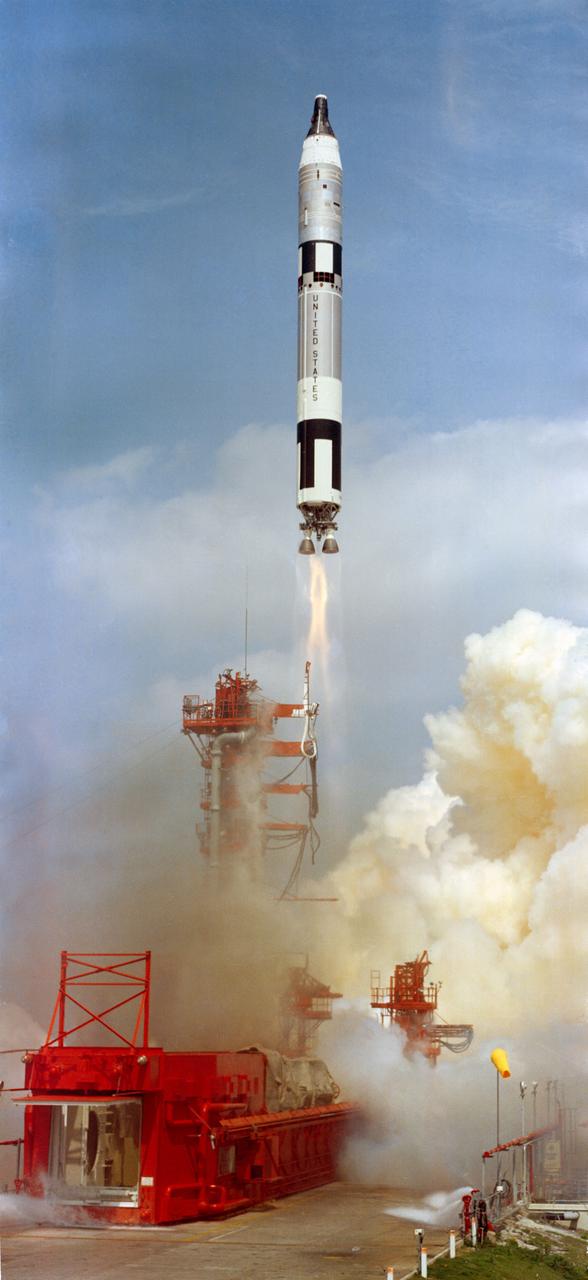
S66-18616 (16 March 1966) --- Gemini-Titan 8 (GT-8) spacecraft, carrying astronauts Neil A. Armstrong, command pilot, and David R. Scott, pilot, was successfully launched by the National Aeronautics and Space Administration's (NASA) John F. Kennedy Space Center (KSC) at 11:41 a.m. (EST), March 16, 1966. An attempt will be made to rendezvous and dock the GT-8 spacecraft with Agena Docking Target Vehicle. Photo credit: NASA
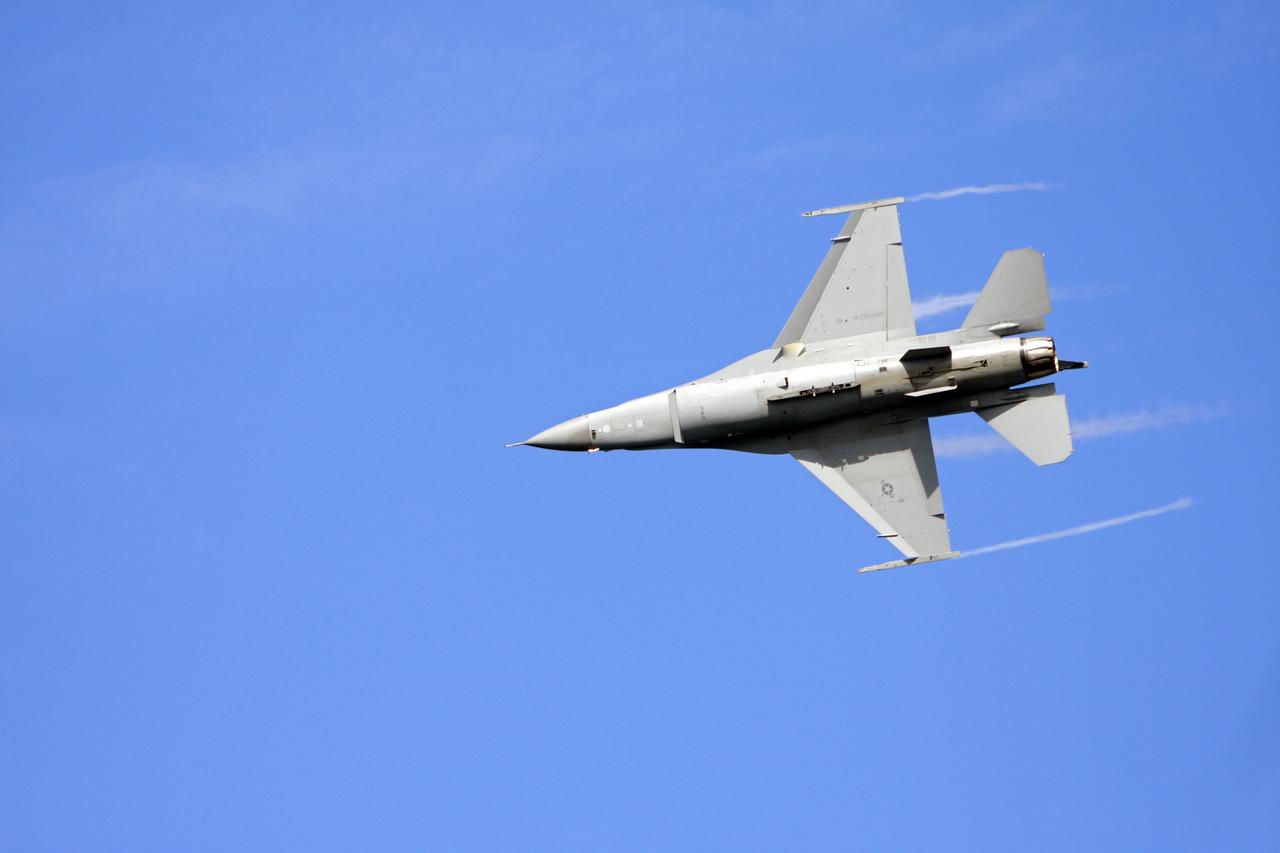
CAPE CANAVERAL, Fla. – During the Kennedy Space Center Visitor Complex Space and Air Show held Nov. 8-9 at NASA's Kennedy Space Center in Florida, this F/A-18 Super Hornet demonstrates its flying capabilities. This year’s show brought together the best in military aircraft, such as the F/A-18 Super Hornet and F-16 Fighting Falcon, coupled with precision pilots and veteran astronauts to celebrate spaceflight and aviation. The event included a water rescue demonstration by the 920th Rescue Wing. Photo credit: NASA/Troy Cryder
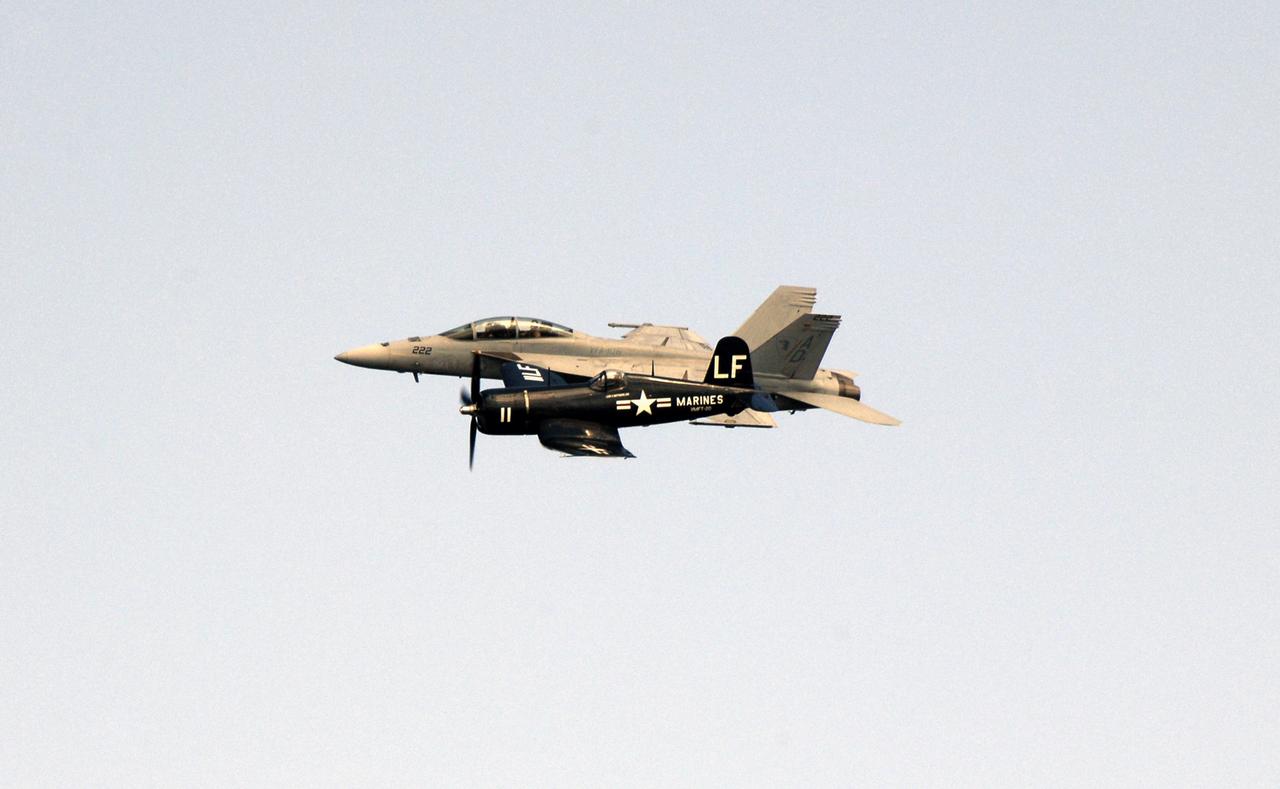
CAPE CANAVERAL, Fla. – A contrast in speed and design, the F/A-18 Super Hornet jet (behind) flies alongside a World War II Vought F4U Corsair during the Kennedy Space Center Visitor Complex Space and Air Show Nov. 8-9 at NASA's Kennedy Space Center in Florida. This year’s show brought together the best in military aircraft, such as the F/A-18 Super Hornet and F-16 Fighting Falcon, coupled with precision pilots and veteran astronauts to celebrate spaceflight and aviation. The event included a water rescue demonstration by the 920th Rescue Wing. Photo credit: NASA/Kim Shiflett
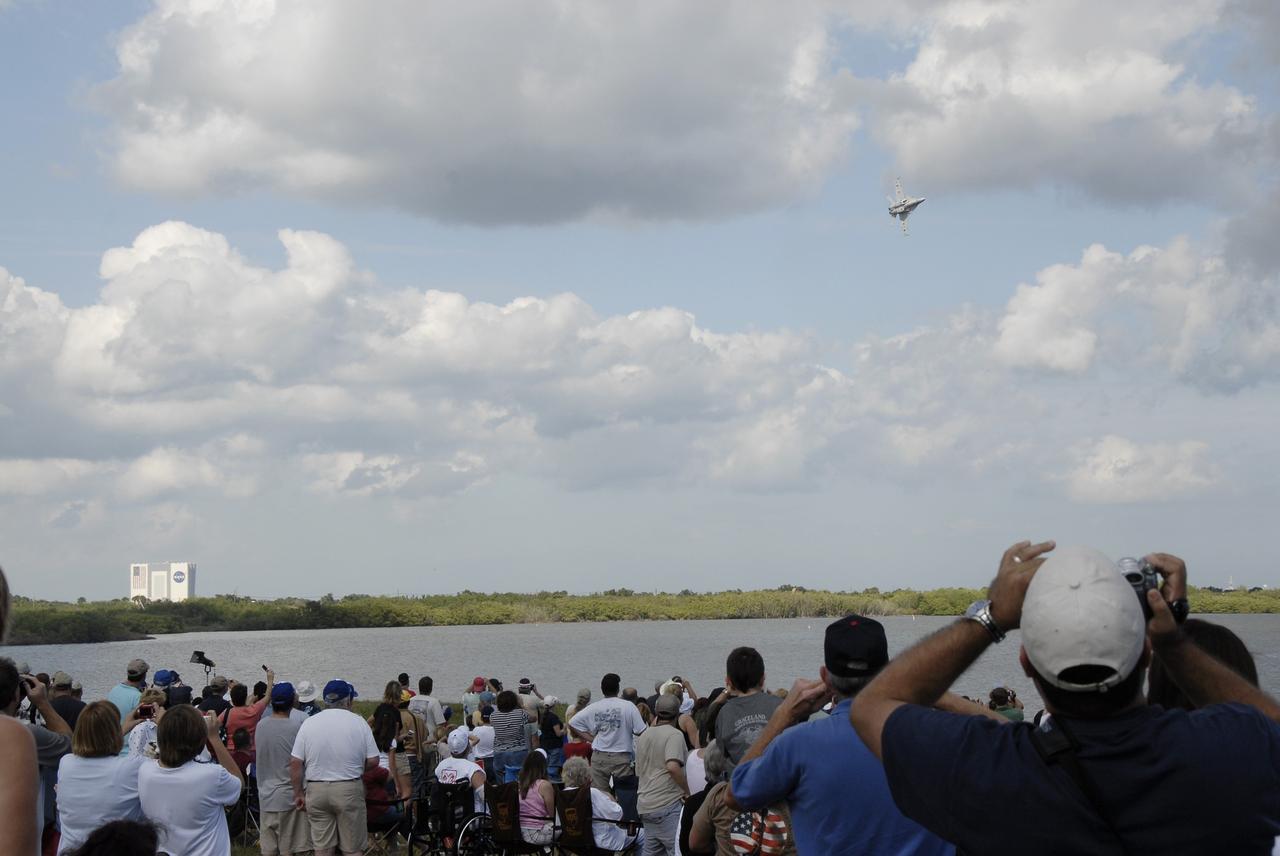
CAPE CANAVERAL, Fla. – Crowds on the banks of the Banana River at NASA's Kennedy Space Center in Florida watch as an F/A-18 Super Hornet jet shows its maneuvers. The Super Hornet was part of the Kennedy Space Center Visitor Complex Space and Air Show Nov. 8-9. This year’s show brought together the best in military aircraft, such as the F/A-18 Super Hornet and F-16 Fighting Falcon, coupled with precision pilots and veteran astronauts to celebrate spaceflight and aviation. The event included a water rescue demonstration by the 920th Rescue Wing. Photo credit: NASA/Kim Shiflett
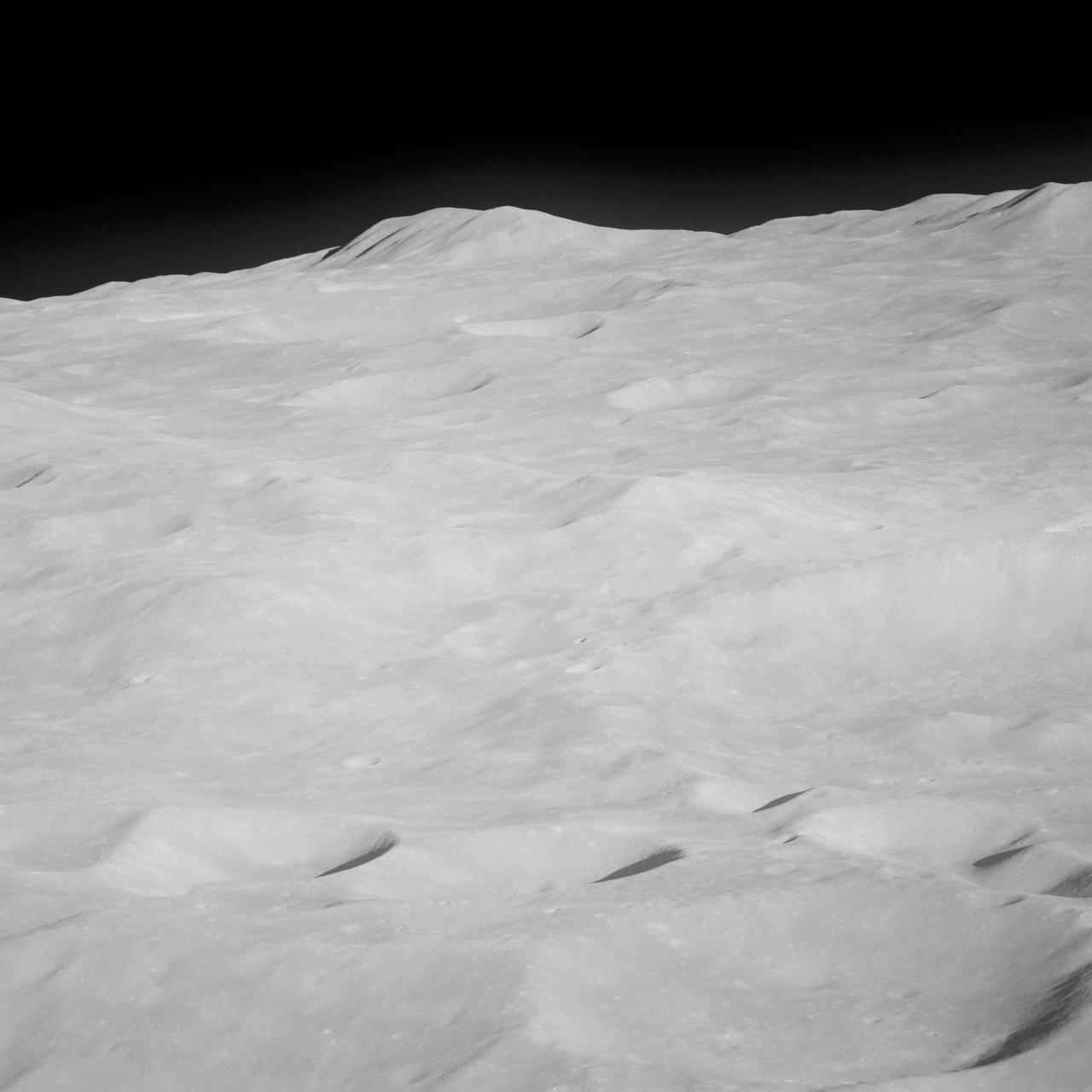
Apollo 8,Moon, Latitude 15 degrees South,Longitude 170 degrees West. Camera Tilt Mode: High Oblique. Direction: Southeast. Sun Angle 17 degrees. Original Film Magazine was labeled E. Camera Data: 70mm Hasselblad; F-Stop: F-5.6; Shutter Speed: 1/250 second. Film Type: Kodak SO-3400 Black and White,ASA 40. Other Photographic Coverage: Lunar Orbiter 1 (LO I) S-3. Flight Date: December 21-27,1968.
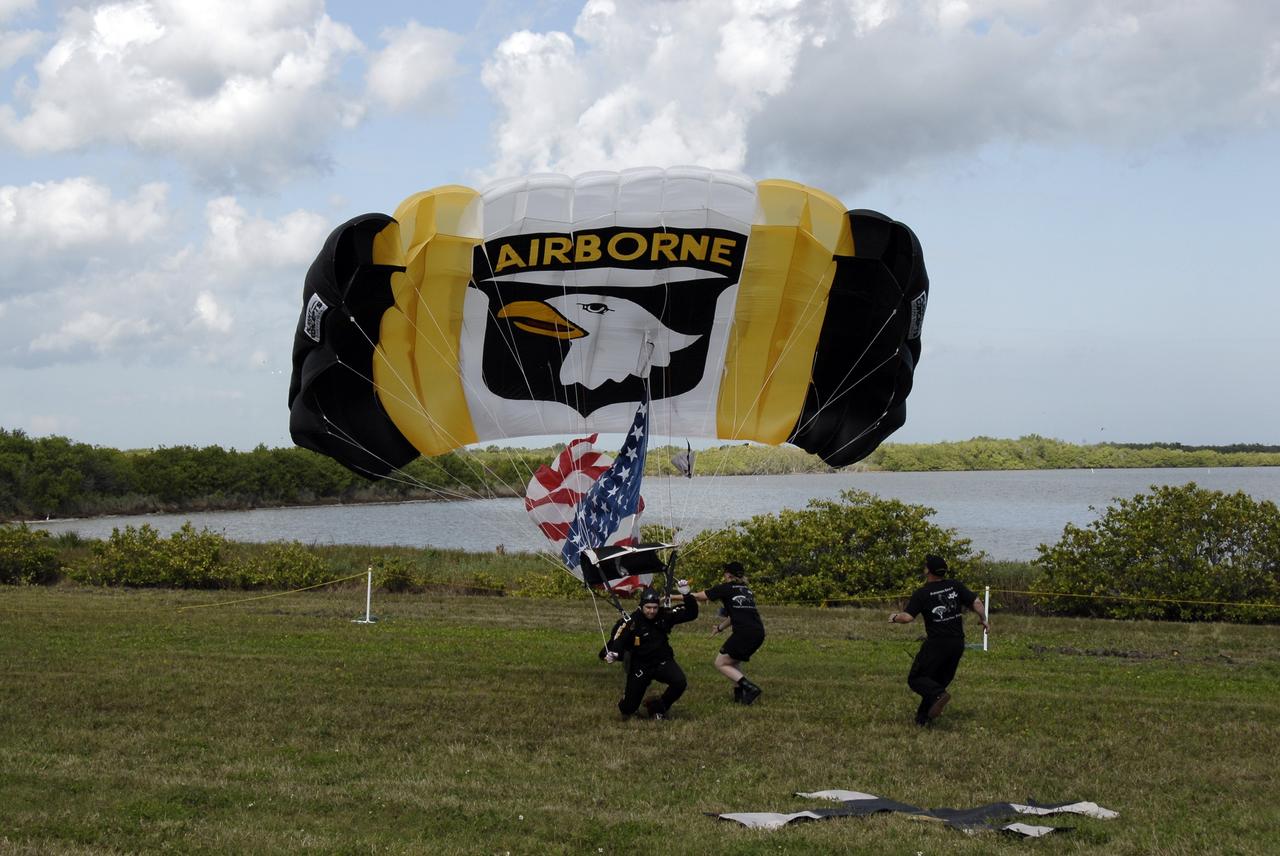
CAPE CANAVERAL, Fla. – A member of the 101st Airborne parachute demonstration team lands at NASA's Kennedy Space Center in Florida. The team performed at the Kennedy Space Center Visitor Complex Space and Air Show Nov. 8-9. This year’s show brought together the best in military aircraft, such as the F/A-18 Super Hornet and F-16 Fighting Falcon, coupled with precision pilots and veteran astronauts to celebrate spaceflight and aviation. The event included a water rescue demonstration by the 920th Rescue Wing. Photo credit: NASA/Kim Shiflett
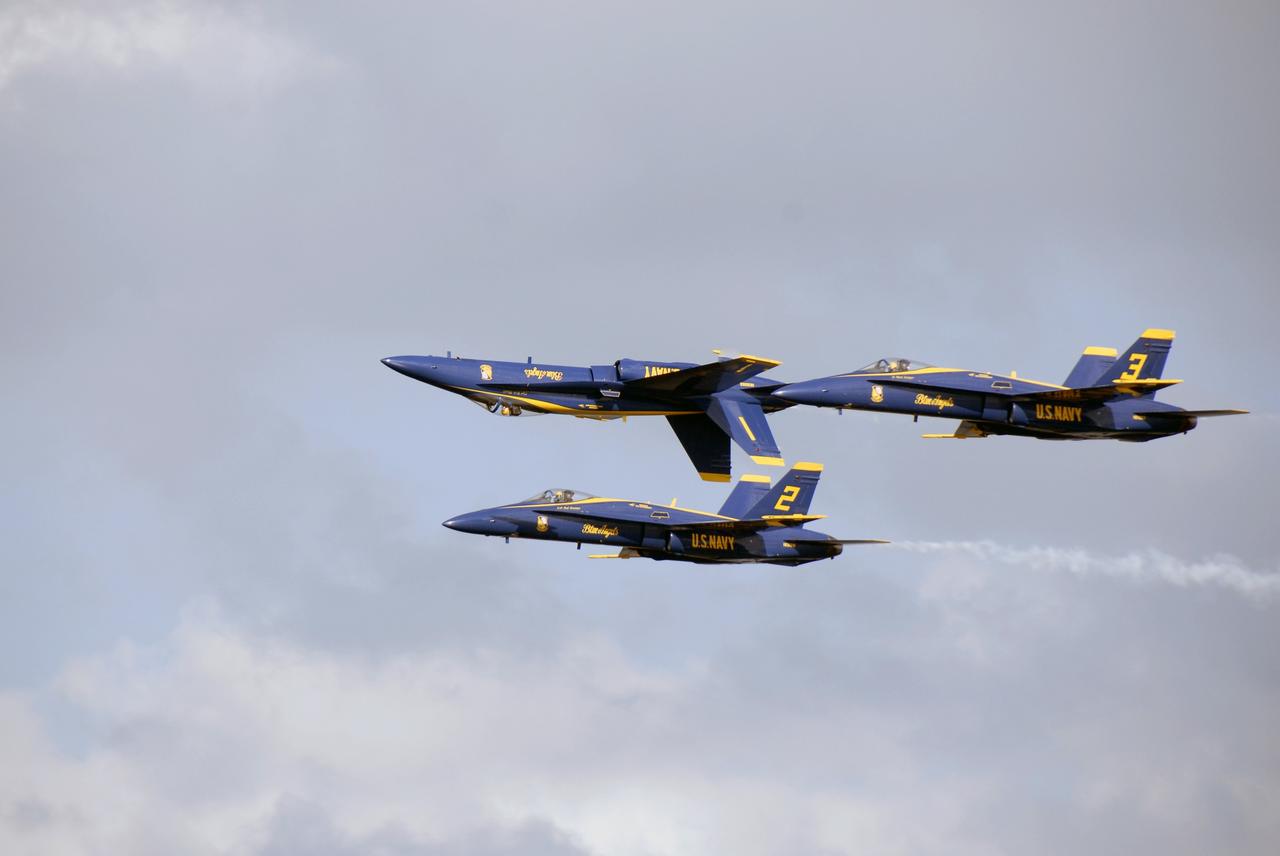
CAPE CANAVERAL, Fla. – The U.S. Navy's Blue Angels perform their tight maneuvers over NASA's Kennedy Space Center in Florida during the Kennedy Space Center Visitor Complex Space and Air Show Nov. 8-9. This year’s show brought together the best in military aircraft, such as the F/A-18 Super Hornet and F-16 Fighting Falcon, coupled with precision pilots and veteran astronauts to celebrate spaceflight and aviation. The event included a water rescue demonstration by the 920th Rescue Wing. Photo credit: NASA/Kim Shiflett
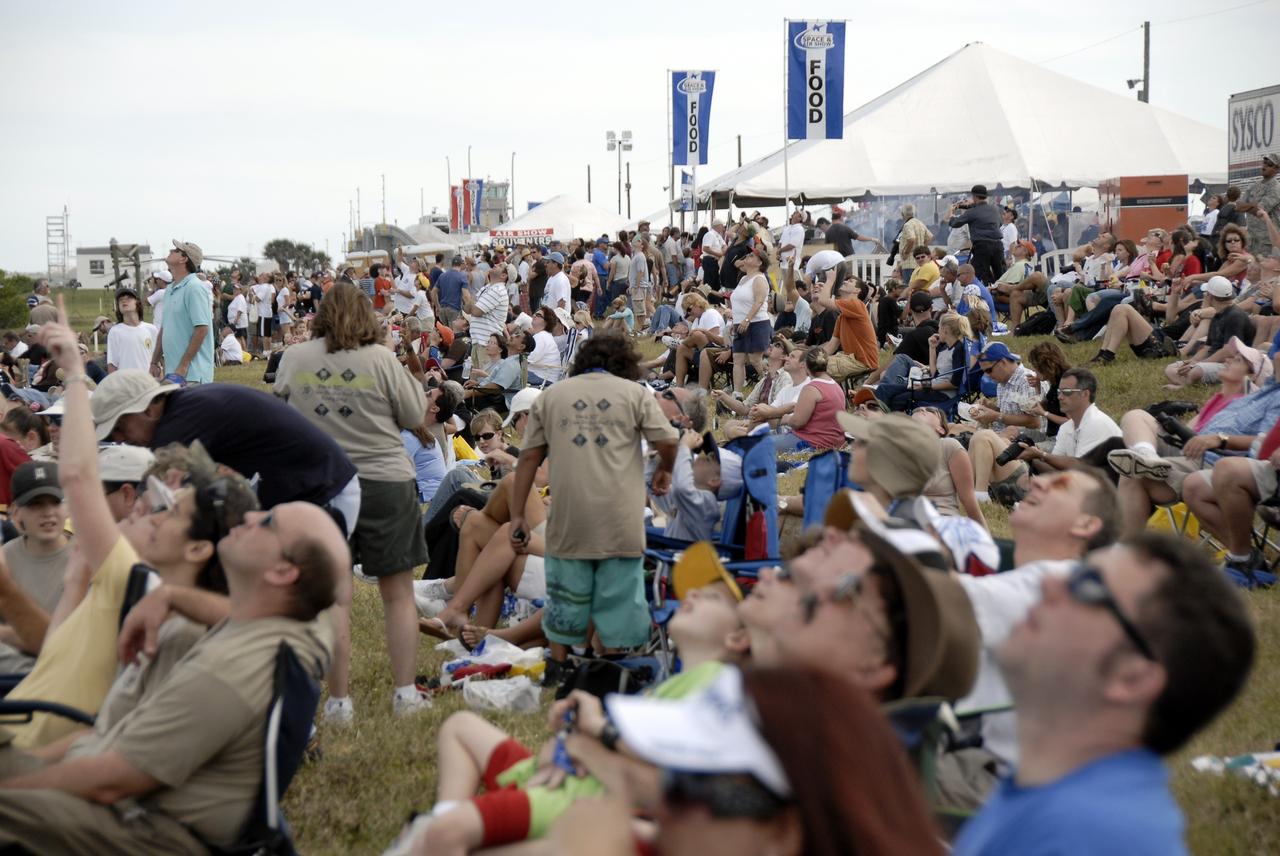
CAPE CANAVERAL, Fla. – Eyes and hands of the crowd of visitors are pointed toward the sky at NASA's Kennedy Space Center in Florida during the Kennedy Space Center Visitor Complex Space and Air Show Nov. 8-9. This year’s show brought together the best in military aircraft, such as the F/A-18 Super Hornet and F-16 Fighting Falcon, coupled with precision pilots and veteran astronauts to celebrate spaceflight and aviation. The event included a water rescue demonstration by the 920th Rescue Wing. Photo credit: NASA/Kim Shiflett
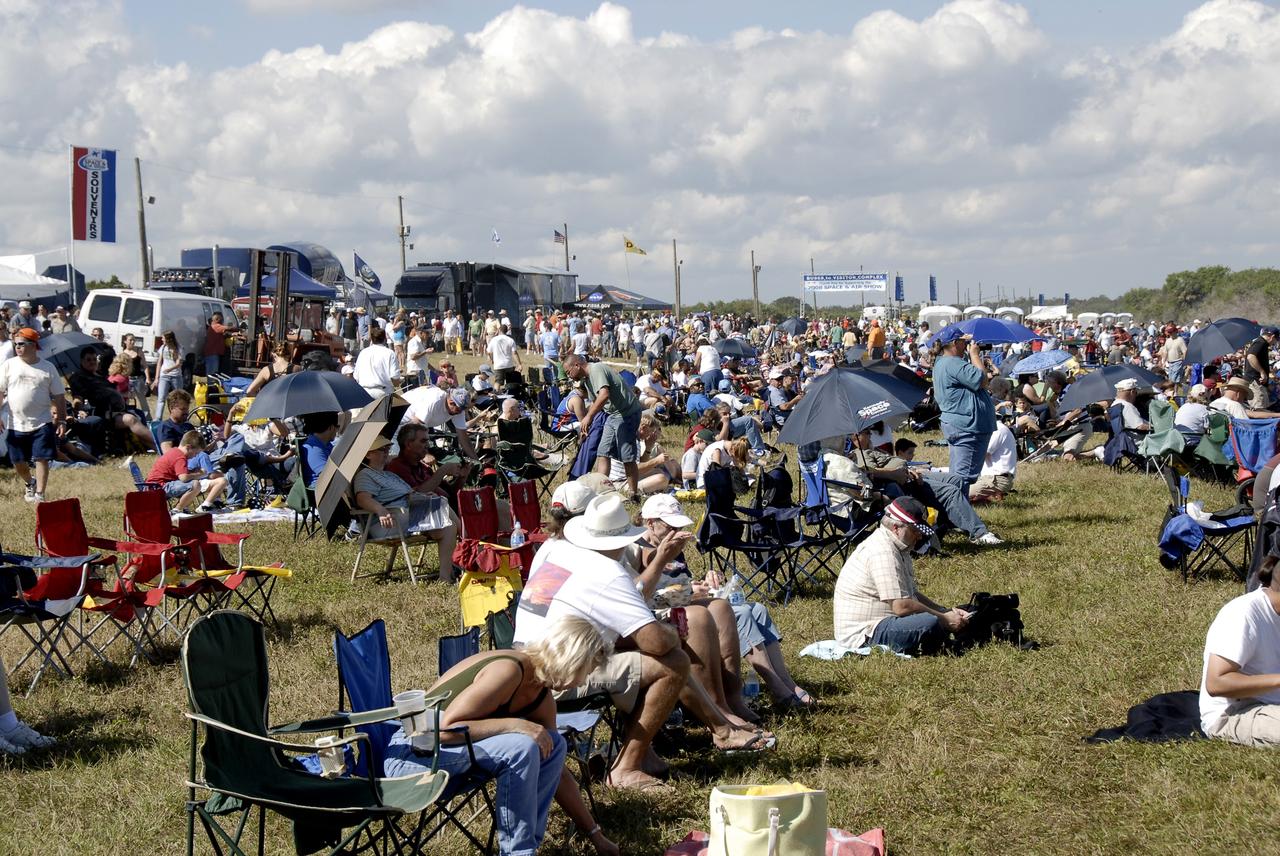
CAPE CANAVERAL, Fla. – Crowds are gathered at NASA's Kennedy Space Center in Florida to watch the U.S. Navy's Blue Angels perform at the Kennedy Space Center Visitor Complex Space and Air Show Nov. 8-9. This year’s show brought together the best in military aircraft, such as the F/A-18 Super Hornet and F-16 Fighting Falcon, coupled with precision pilots and veteran astronauts to celebrate spaceflight and aviation. The event included a water rescue demonstration by the 920th Rescue Wing. Photo credit: NASA/Kim Shiflett
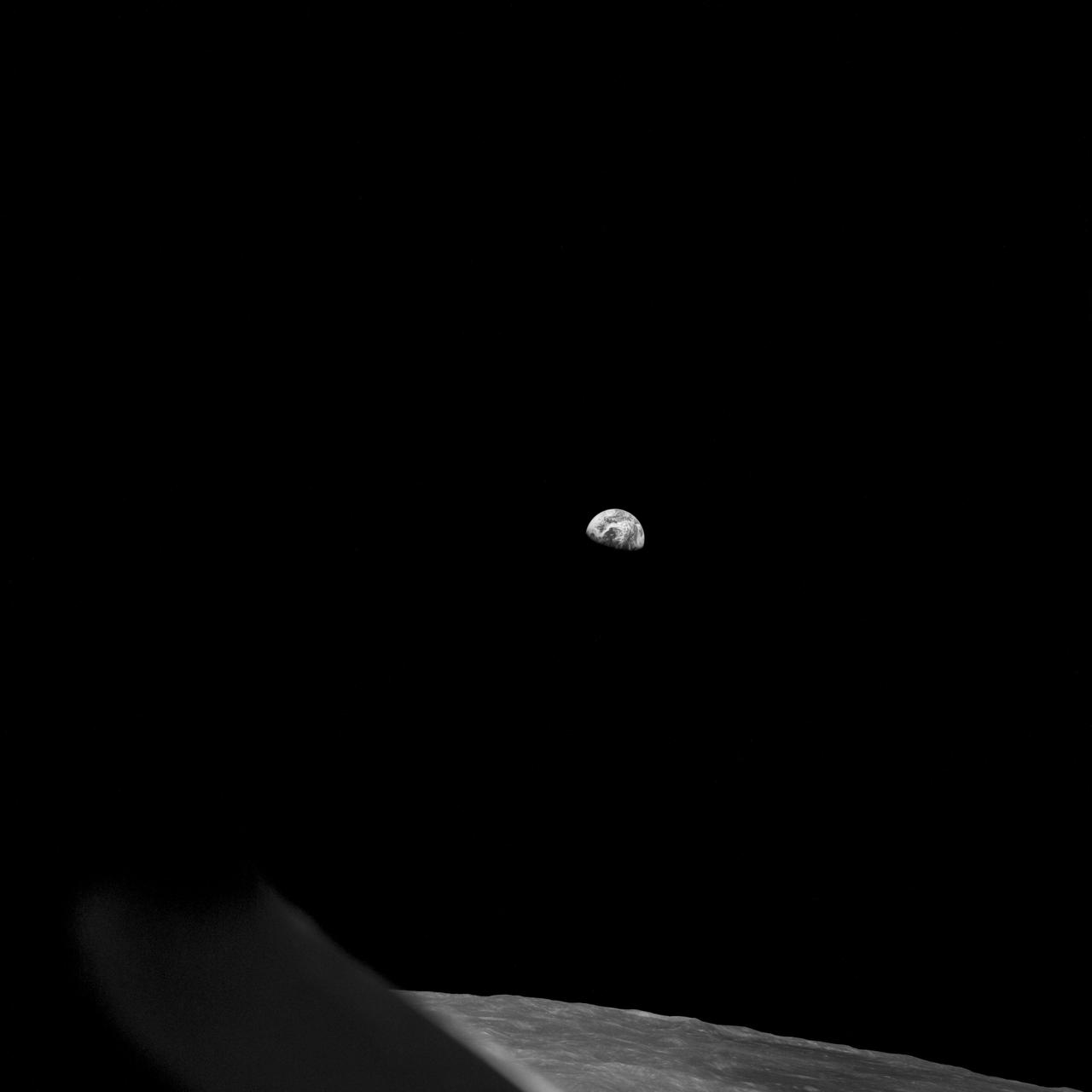
Apollo 8,Earth and Lunar Horizon. Image taken on Revolution 10 during Transearth Injection (TEI). Original Film Magazine was labeled D. Camera Data: 70mm Hasselblad. Lens: 80mm; F-Stop: F/11; Shutter Speed: 1/250 second. Film Type: Kodak SO-3400 Black and White,ASA 40. Flight Date: December 21-27,1968.
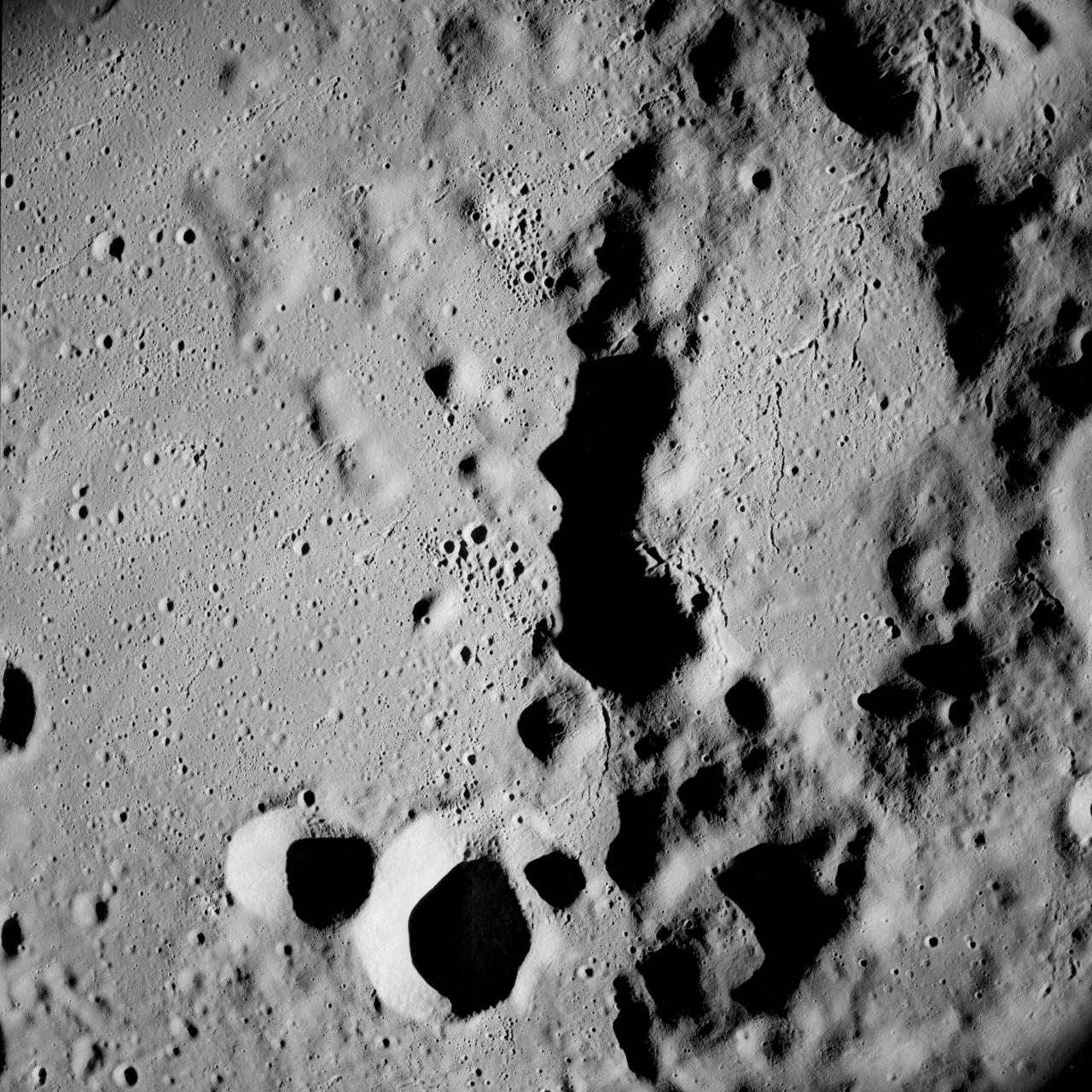
Apollo 8,Farside of Moon. Image taken on Revolution 4. Camera Tilt Mode: Vertical Stereo. Sun Angle: 13. Original Film Magazine was labeled D. Camera Data: 70mm Hasselblad. Lens: 80mm; F-Stop: F/2.8; Shutter Speed: 1/250 second. Film Type: Kodak SO-3400 Black and White,ASA 40. Flight Date: December 21-27,1968.
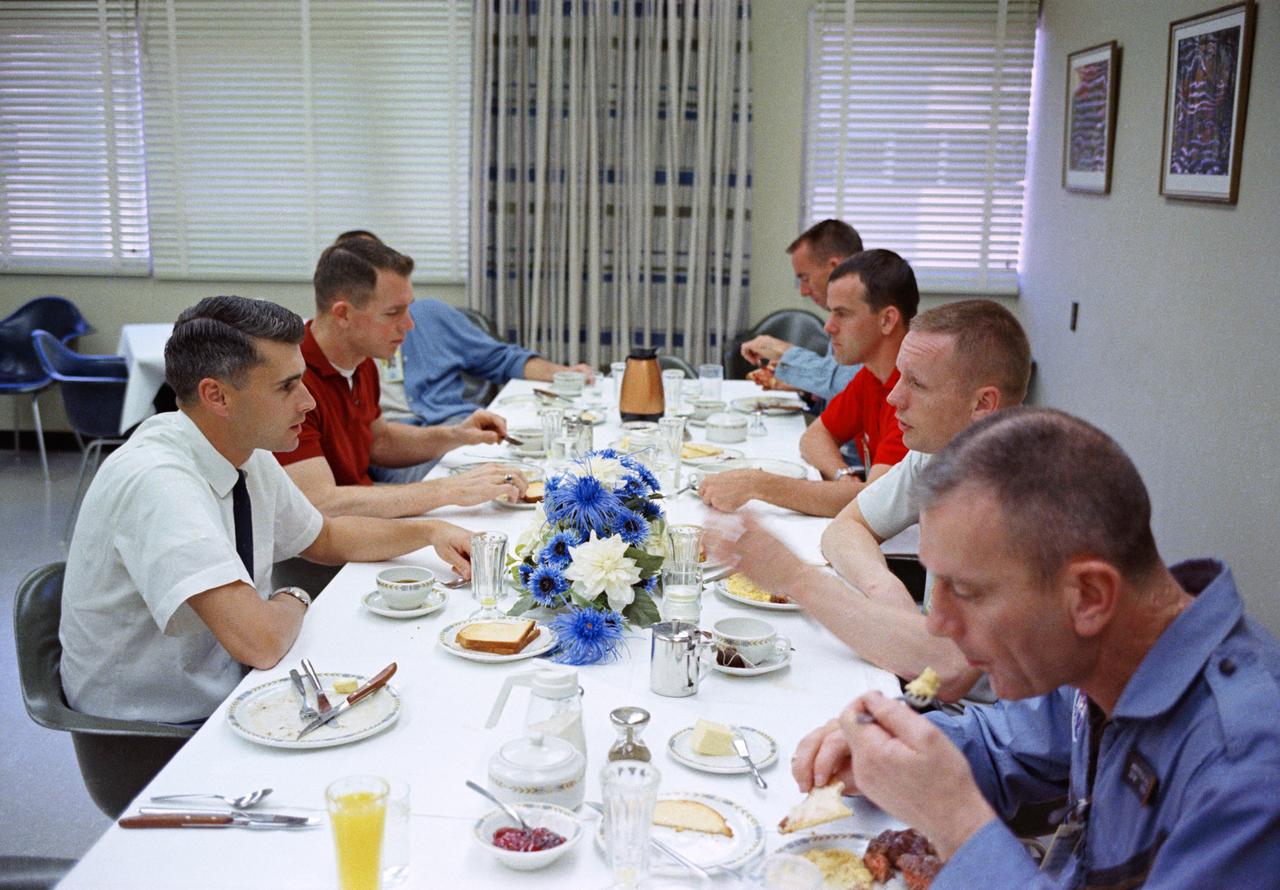
S66-24439 (16 March 1966) --- The Gemini-8 prime crew, along with several fellow astronauts, have a hearty breakfast of steak and eggs on the morning of the Gemini-8 launch. Seated clockwise around the table, starting at lower left, are Donald K. Slayton, Manned Spaceflight Center (MSC) Assistant Director for Flight Crew Operations; astronaut Neil A. Armstrong, Gemini-8 command pilot; scientist-astronaut F. Curtis Michel; astronaut R. Walter Cunningham; astronaut Alan B. Shepard Jr. (face obscured), Chief, MSC Astronaut Office; astronaut David R. Scott, Gemini-8 pilot; and astronaut Roger B. Chaffee. Photo credit: NASA
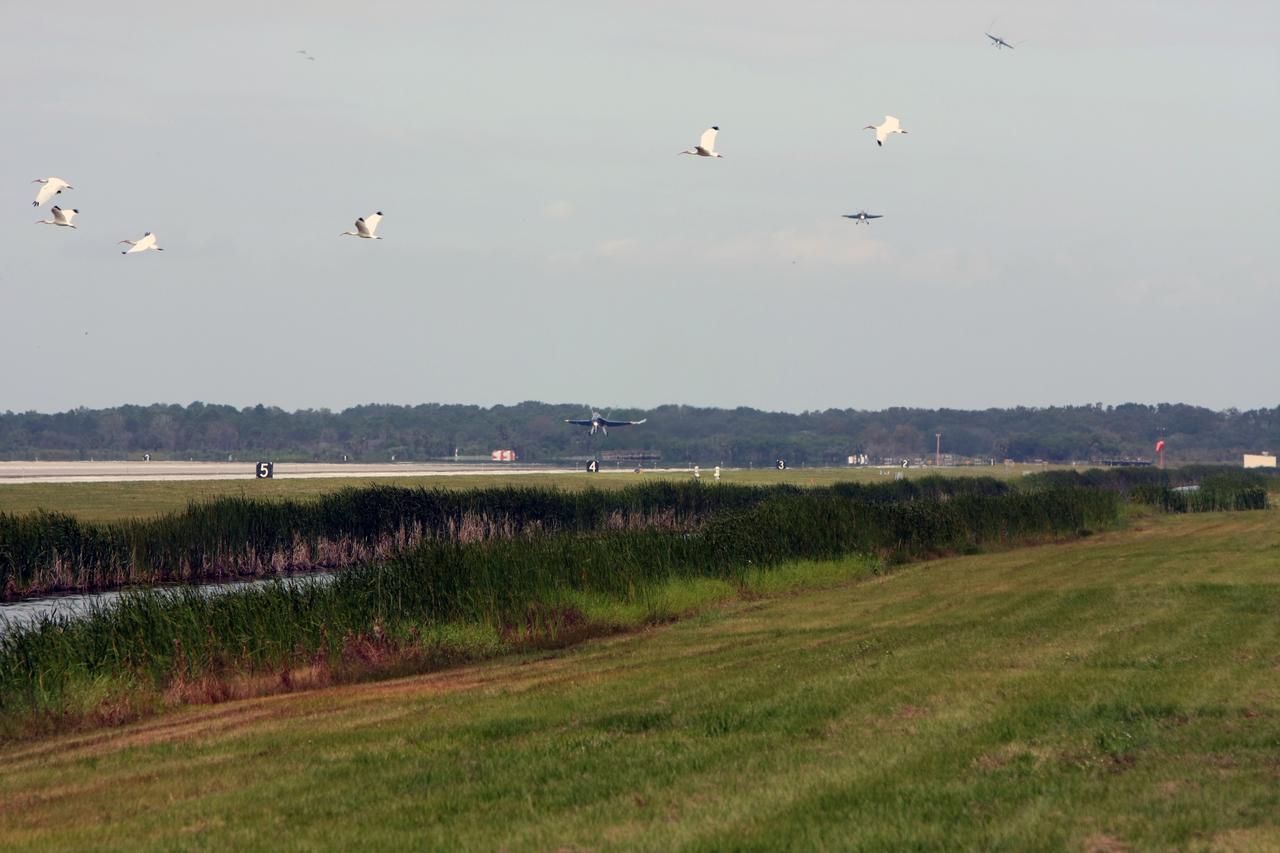
CAPE CANAVERAL, Fla. – Storks seem to join the formation as the U.S. Navy's Blue Angels F/A-18 jets land on the runway at NASA's Kennedy Space Center in Florida. The Blue Angels are at Kennedy to perform in the Kennedy Space Center Visitor Complex Space and Air Show Nov. 8-9. The Navy's elite flight demonstration squadron will take to the skies in military aircraft demonstrations by the F-16 Fighting Falcon and F/A-18 Super Hornet jets for the second annual Space & Air Show at Kennedy. This year’s show brings together the best in military aircraft, coupled with precision pilots and veteran astronauts to celebrate spaceflight and aviation. The event includes military aircraft demonstrations by the F-16 Fighting Falcon and a water rescue demonstration by the 920th Rescue Wing. Photo credit: NASA/Kim Shiflett
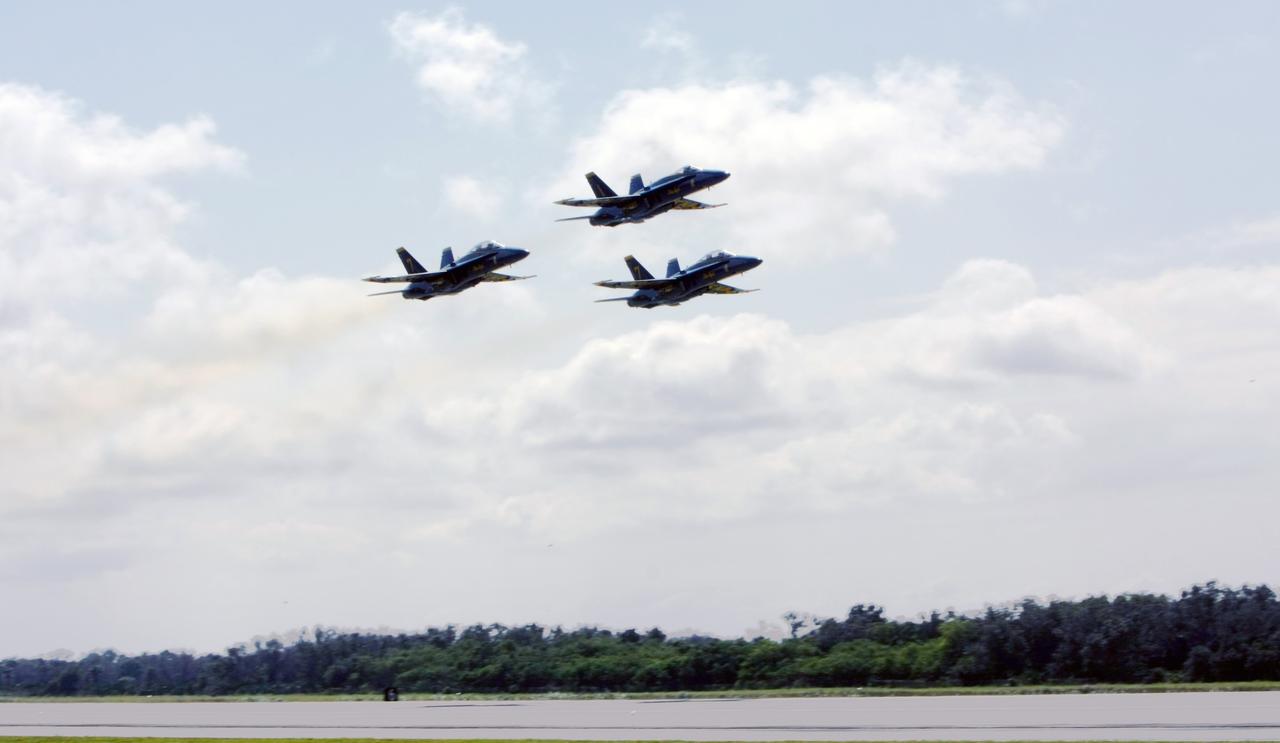
CAPE CANAVERAL, Fla. – Three of the U.S. Navy's Blue Angels F/A-18 jets fly over the runway at NASA's Kennedy Space Center in Florida. The Blue Angels are at Kennedy to perform in the Kennedy Space Center Visitor Complex Space and Air Show Nov. 8-9. The Navy's elite flight demonstration squadron will take to the skies in military aircraft demonstrations by the F-16 Fighting Falcon and F/A-18 Super Hornet jets for the second annual Space & Air Show at Kennedy. This year’s show brings together the best in military aircraft, coupled with precision pilots and veteran astronauts to celebrate spaceflight and aviation. The event includes military aircraft demonstrations by the F-16 Fighting Falcon and a water rescue demonstration by the 920th Rescue Wing. Photo credit: NASA/Kim Shiflett
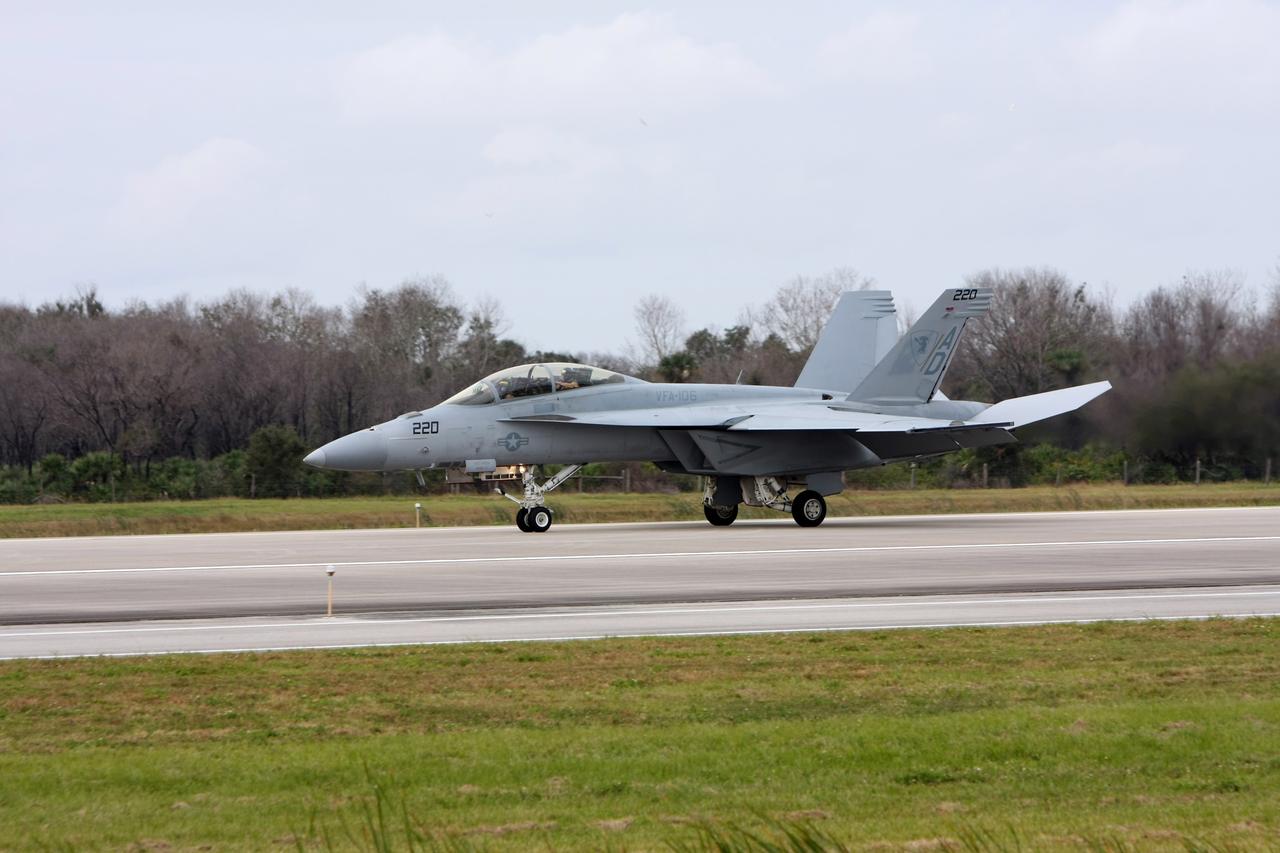
CAPE CANAVERAL, Fla. – An F/A-18 jet lands at NASA's Kennedy Space Center in Florida. It will join the U.S. Navy's Blue Angels and other aircraft for demonstrations at the Kennedy Space Center Visitor Complex Space and Air Show Nov. 8-9. The Navy's elite flight demonstration squadron will take to the skies in military aircraft demonstrations by the F-16 Fighting Falcon and F/A-18 Super Hornet jets for the second annual Space & Air Show at Kennedy. This year’s show brings together the best in military aircraft, coupled with precision pilots and veteran astronauts to celebrate spaceflight and aviation. The event includes military aircraft demonstrations by the F-16 Fighting Falcon and a water rescue demonstration by the 920th Rescue Wing. Photo credit: NASA/Kim Shiflett
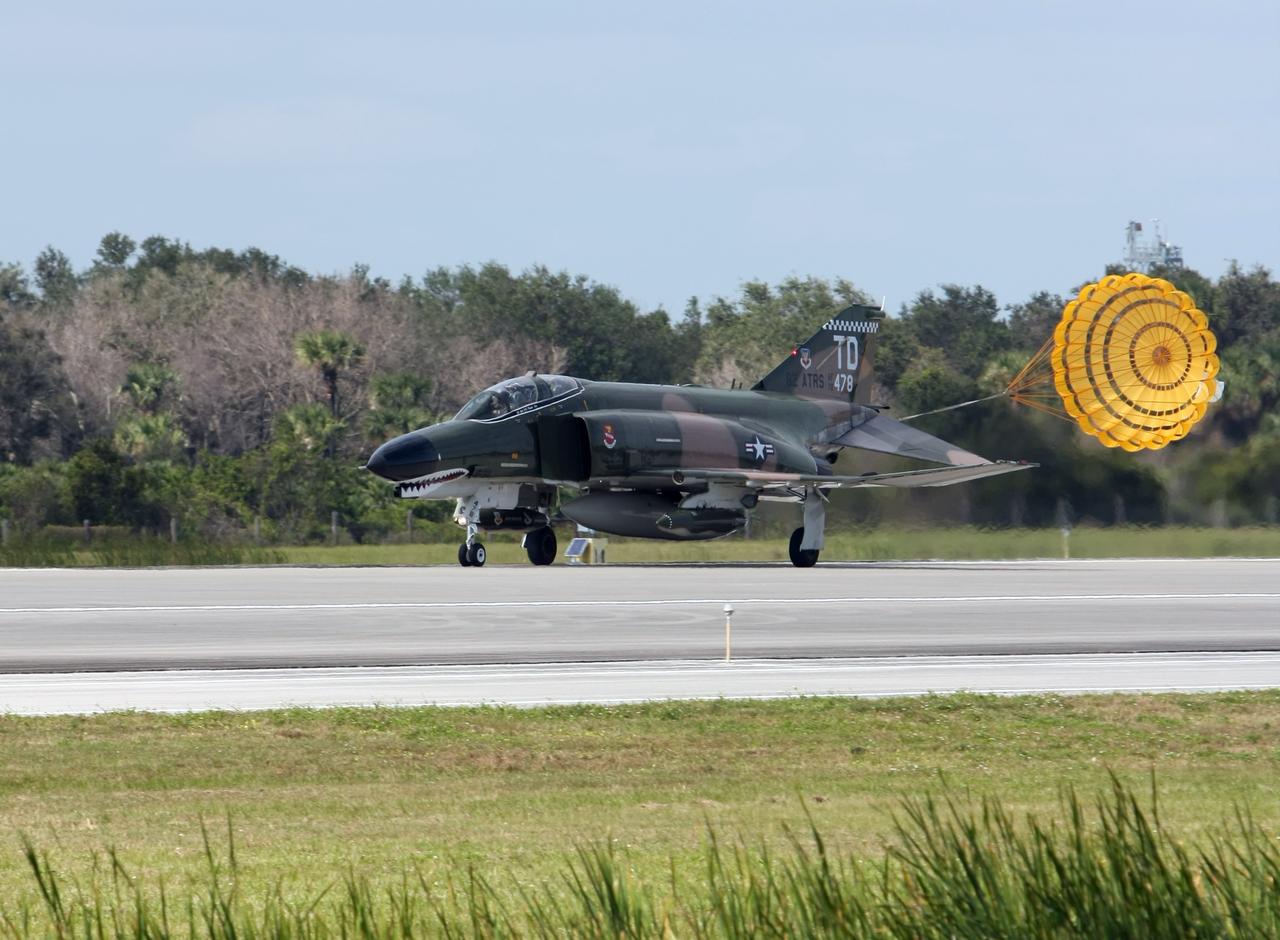
CAPE CANAVERAL, Fla. – An F-4 jet aircraft lands at NASA's Kennedy Space Center in Florida. It will join the U.S. Navy's Blue Angels and other aircraft for demonstrations at the Kennedy Space Center Visitor Complex Space and Air Show Nov. 8-9. The Navy's elite flight demonstration squadron will take to the skies in military aircraft demonstrations by the F-16 Fighting Falcon and F/A-18 Super Hornet jets for the second annual Space & Air Show at Kennedy. This year’s show brings together the best in military aircraft, coupled with precision pilots and veteran astronauts to celebrate spaceflight and aviation. The event includes military aircraft demonstrations by the F-16 Fighting Falcon and a water rescue demonstration by the 920th Rescue Wing. Photo credit: NASA/Kim Shiflett
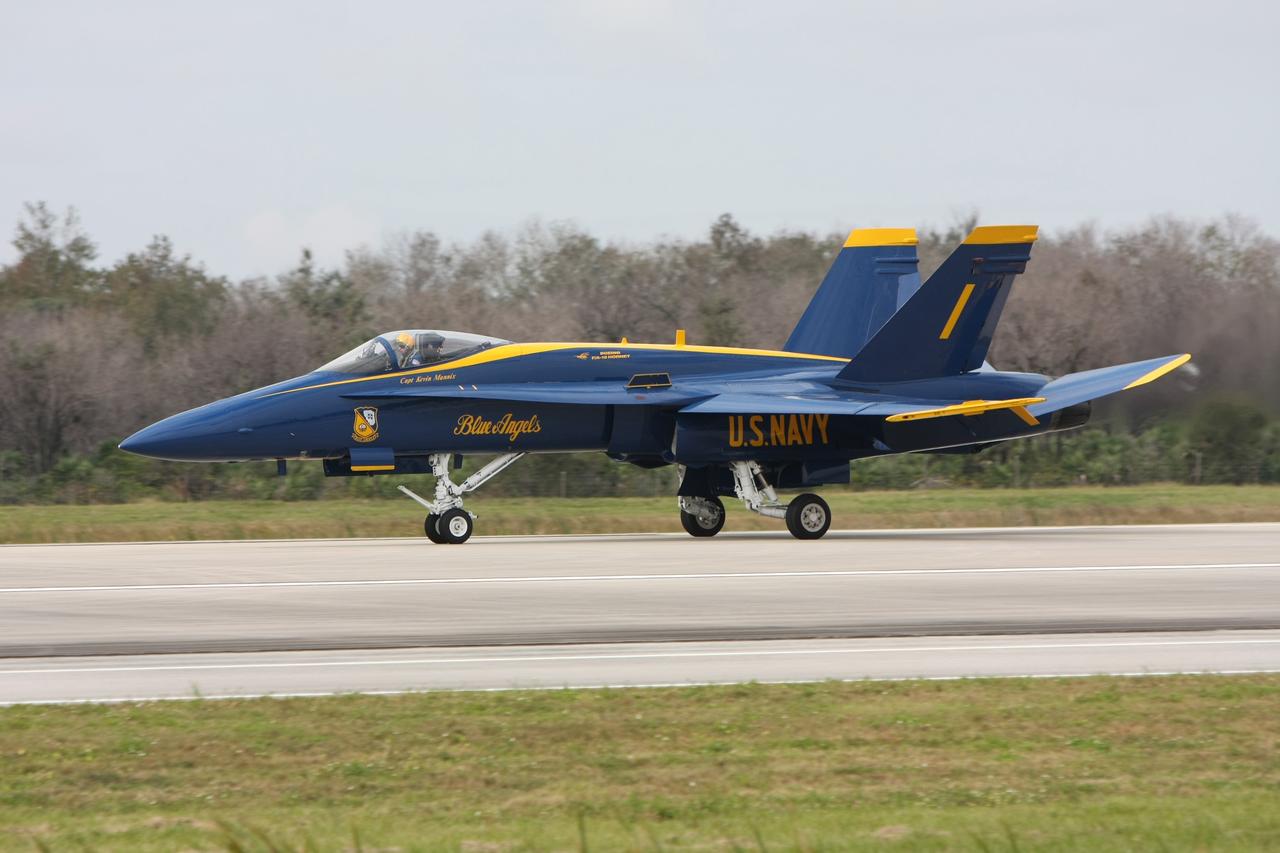
CAPE CANAVERAL, Fla. – The U.S. Navy's Blue Angels F/A-18 jet No. 1 lands on the runway at NASA's Kennedy Space Center in Florida. The Blue Angels are at Kennedy to perform in the Kennedy Space Center Visitor Complex Space and Air Show Nov. 8-9. The Navy's elite flight demonstration squadron will take to the skies in military aircraft demonstrations by the F-16 Fighting Falcon and F/A-18 Super Hornet jets for the second annual Space & Air Show at Kennedy. This year’s show brings together the best in military aircraft, coupled with precision pilots and veteran astronauts to celebrate spaceflight and aviation. The event includes military aircraft demonstrations by the F-16 Fighting Falcon and a water rescue demonstration by the 920th Rescue Wing. Photo credit: NASA/Kim Shiflett
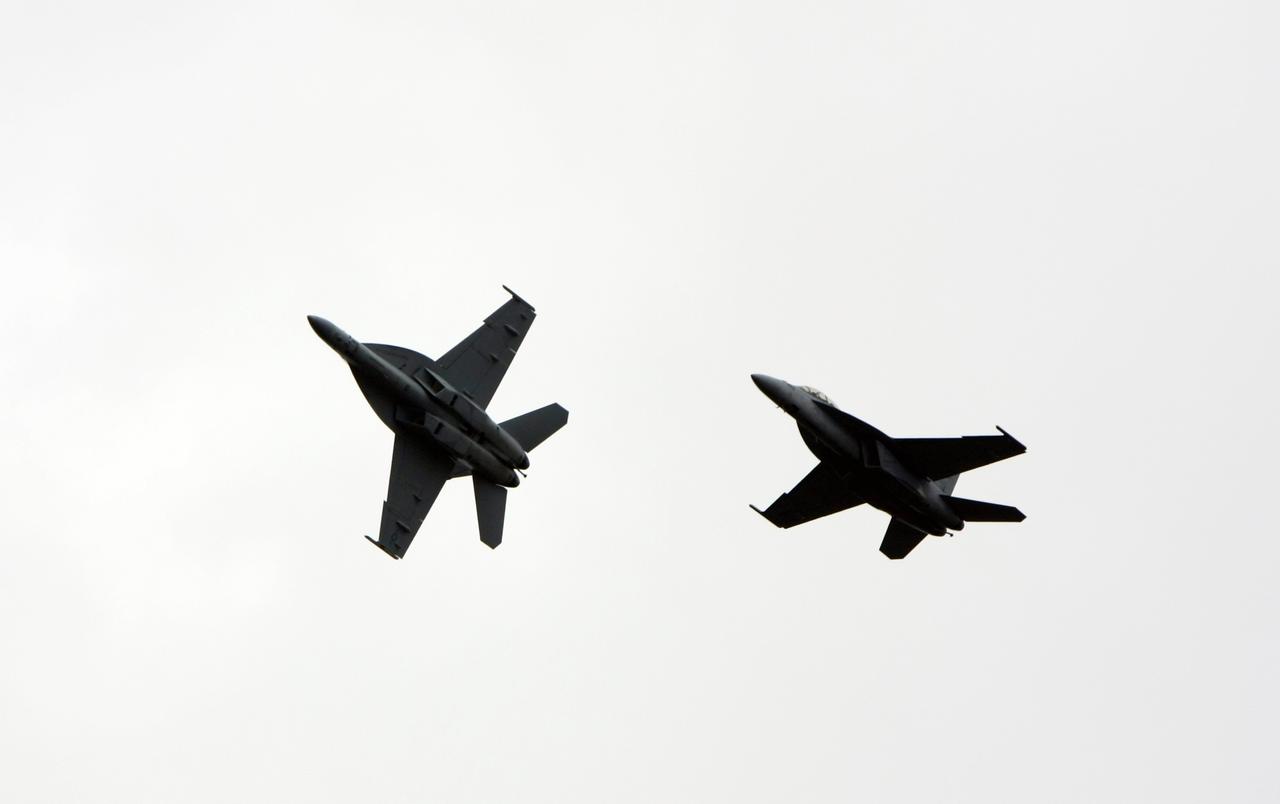
CAPE CANAVERAL, Fla. – Two F/A-18 jets fly over the Shuttle Landing Facility at NASA's Kennedy Space Center in Florida. They will join the U.S. Navy's Blue Angels and other aircraft for demonstrations at the Kennedy Space Center Visitor Complex Space and Air Show Nov. 8-9. The Navy's elite flight demonstration squadron will take to the skies in military aircraft demonstrations by the F-16 Fighting Falcon and F/A-18 Super Hornet jets for the second annual Space & Air Show at Kennedy. This year’s show brings together the best in military aircraft, coupled with precision pilots and veteran astronauts to celebrate spaceflight and aviation. The event includes military aircraft demonstrations by the F-16 Fighting Falcon and a water rescue demonstration by the 920th Rescue Wing. Photo credit: NASA/Kim Shiflett
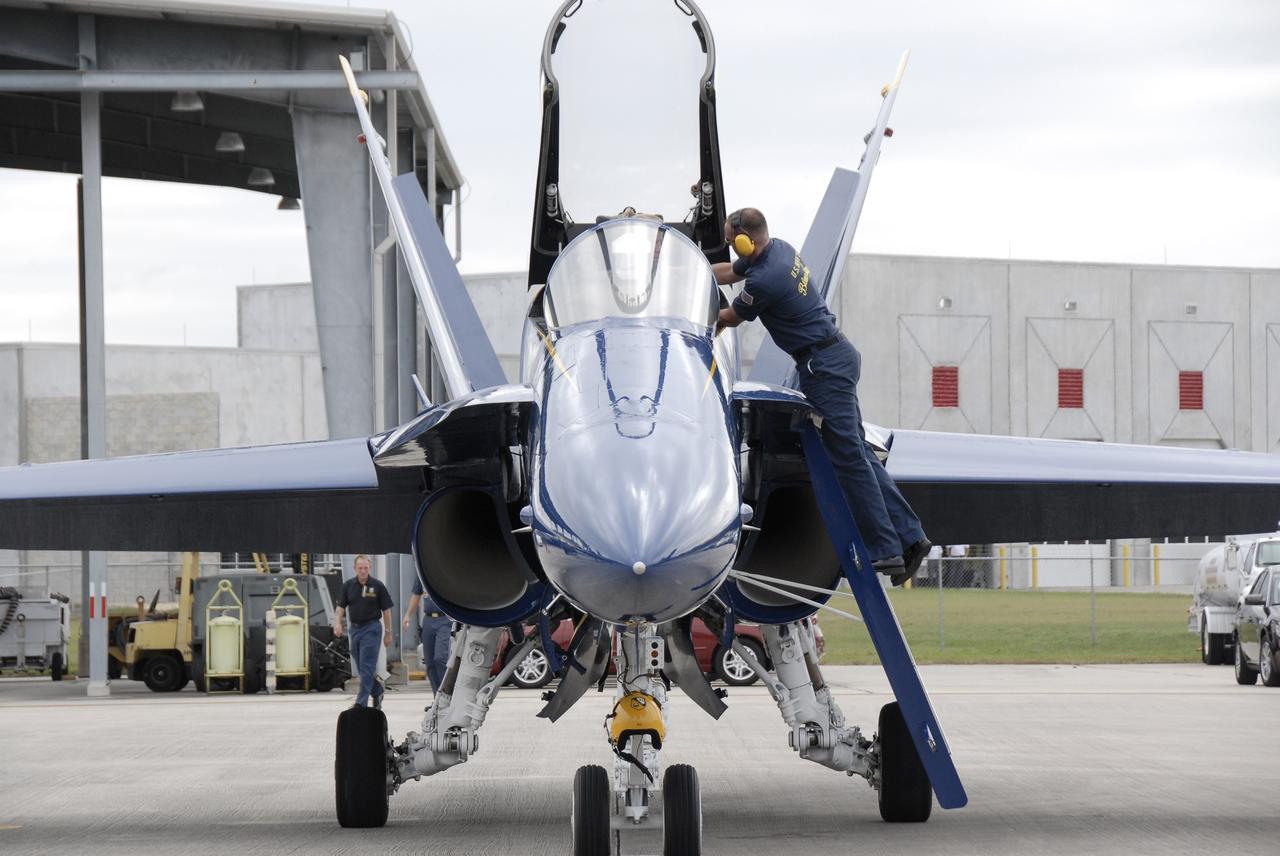
CAPE CANAVERAL, Fla. – At the Shuttle Landing Facility at NASA's Kennedy Space Center in Florida, ground support personnel work on an F/A-18, one of the U.S. Navy's Blue Angels aircraft. The demonstration squadron will perform at the Kennedy Space Center Visitor Complex Space and Air Show Nov. 8-9. The Navy's elite flight demonstration squadron will take to the skies in military aircraft demonstrations by the F-16 Fighting Falcon and F/A-18 Super Hornet jets for the second annual Space & Air Show at Kennedy. This year’s show brings together the best in military aircraft, coupled with precision pilots and veteran astronauts to celebrate spaceflight and aviation. The event includes military aircraft demonstrations by the F-16 Fighting Falcon and a water rescue demonstration by the 920th Rescue Wing. Photo credit: NASA/Kim Shiflett
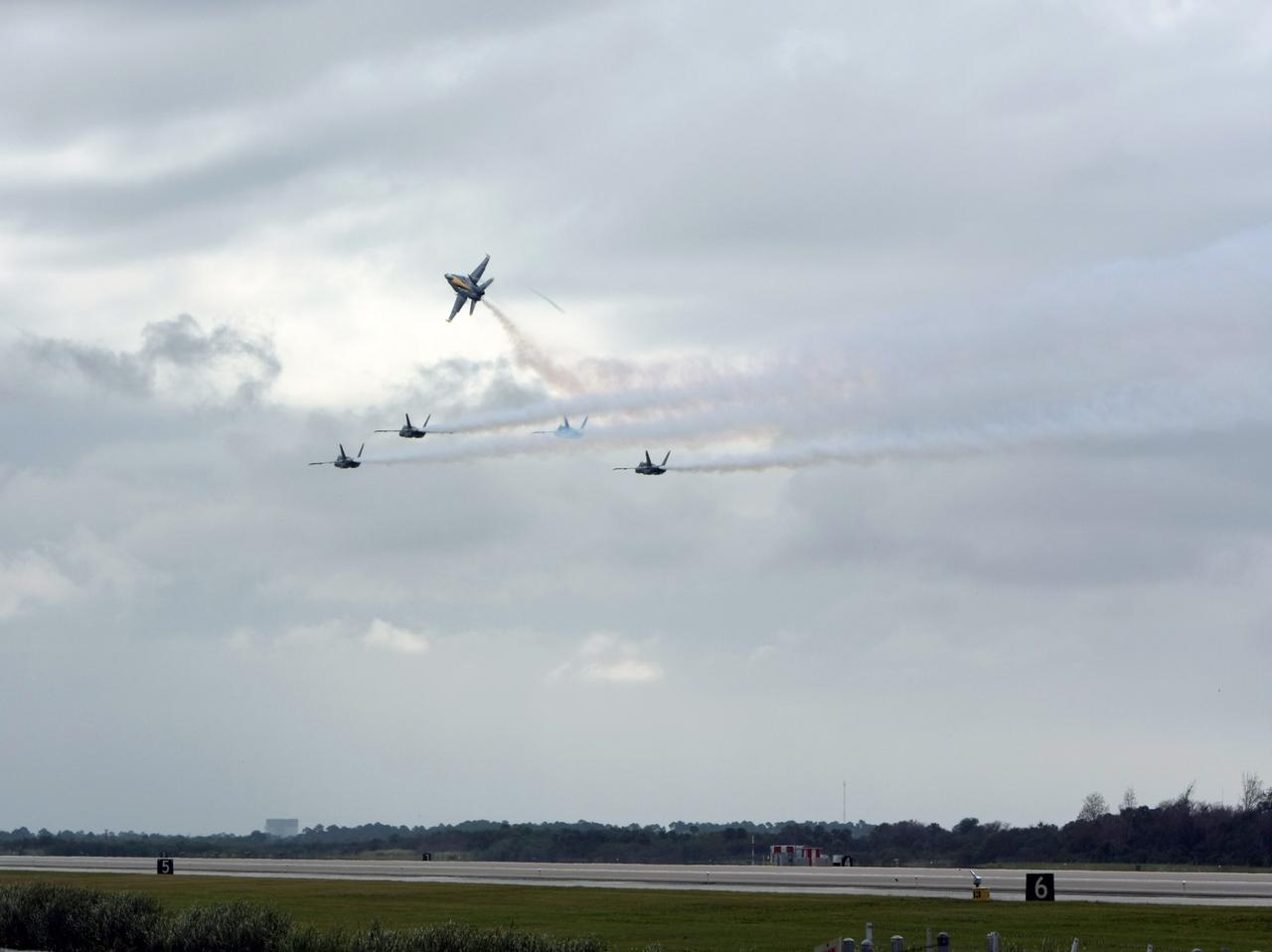
CAPE CANAVERAL, Fla. – The U.S. Navy's Blue Angels F/A-18 jets fly in formation over the runway at NASA's Kennedy Space Center in Florida before landing. They are at Kennedy to perform in the Kennedy Space Center Visitor Complex Space and Air Show Nov. 8-9. The Navy's elite flight demonstration squadron will take to the skies in military aircraft demonstrations by the F-16 Fighting Falcon and F/A-18 Super Hornet jets for the second annual Space & Air Show at Kennedy. This year’s show brings together the best in military aircraft, coupled with precision pilots and veteran astronauts to celebrate spaceflight and aviation. The event includes military aircraft demonstrations by the F-16 Fighting Falcon and a water rescue demonstration by the 920th Rescue Wing. Photo credit: NASA/Kim Shiflett
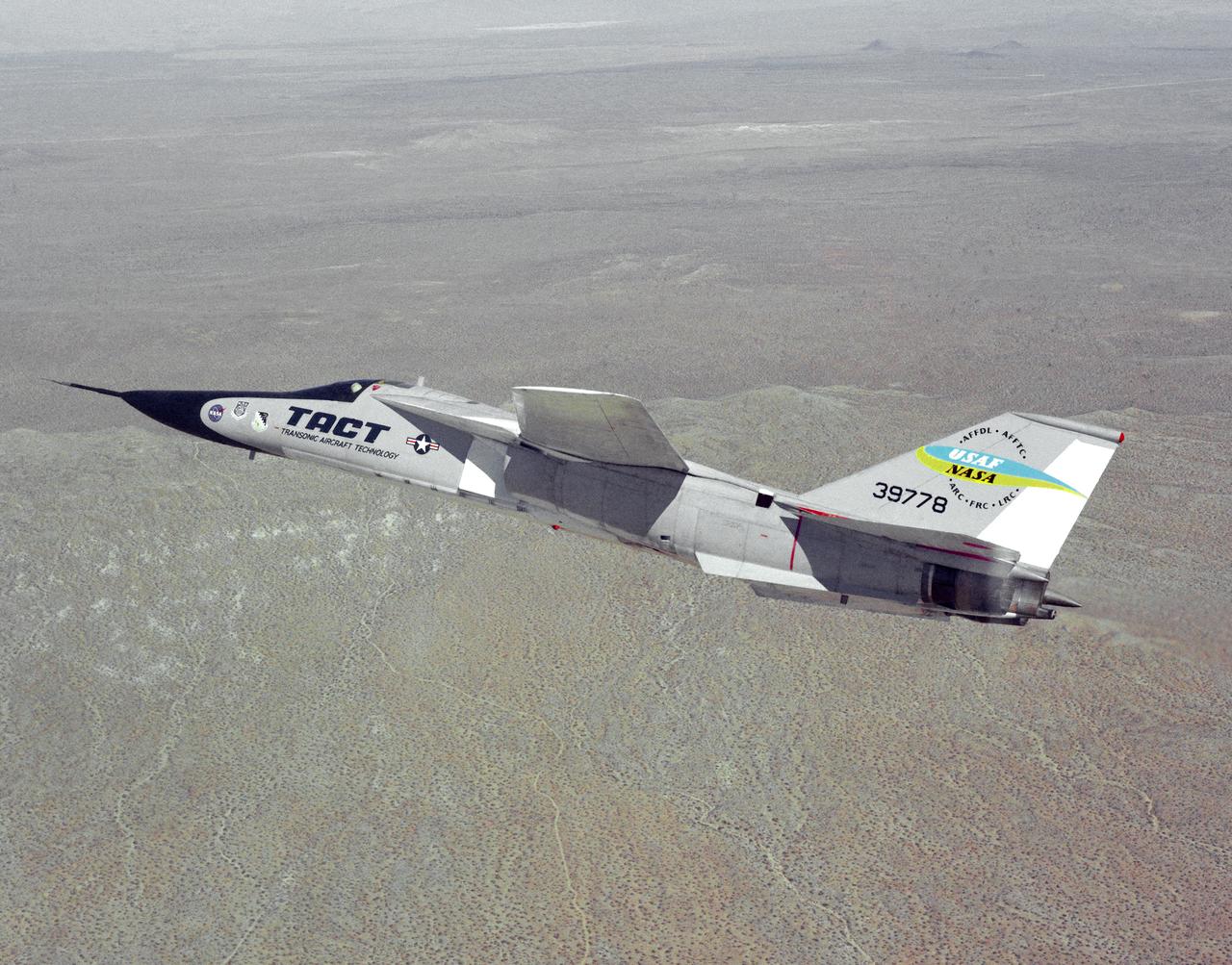
The General Dynamics TACT/F-111A Aardvark is seen In a banking-turn over the California Mojave desert. This photograph affords a good view of the supercritical wing airfoil shape. Starting in 1971 the NASA Flight Research Center and the Air Force undertook a major research and flight testing program, using F-111A (#63-9778), which would span almost 20 years before completion. Intense interest over the results coming from the NASA F-8 supercritical wing program spurred NASA and the Air Force to modify the General Dynamics F-111A to explore the application of supercritical wing technology to maneuverable military aircraft. This flight program was called Transonic Aircraft Technology (TACT).
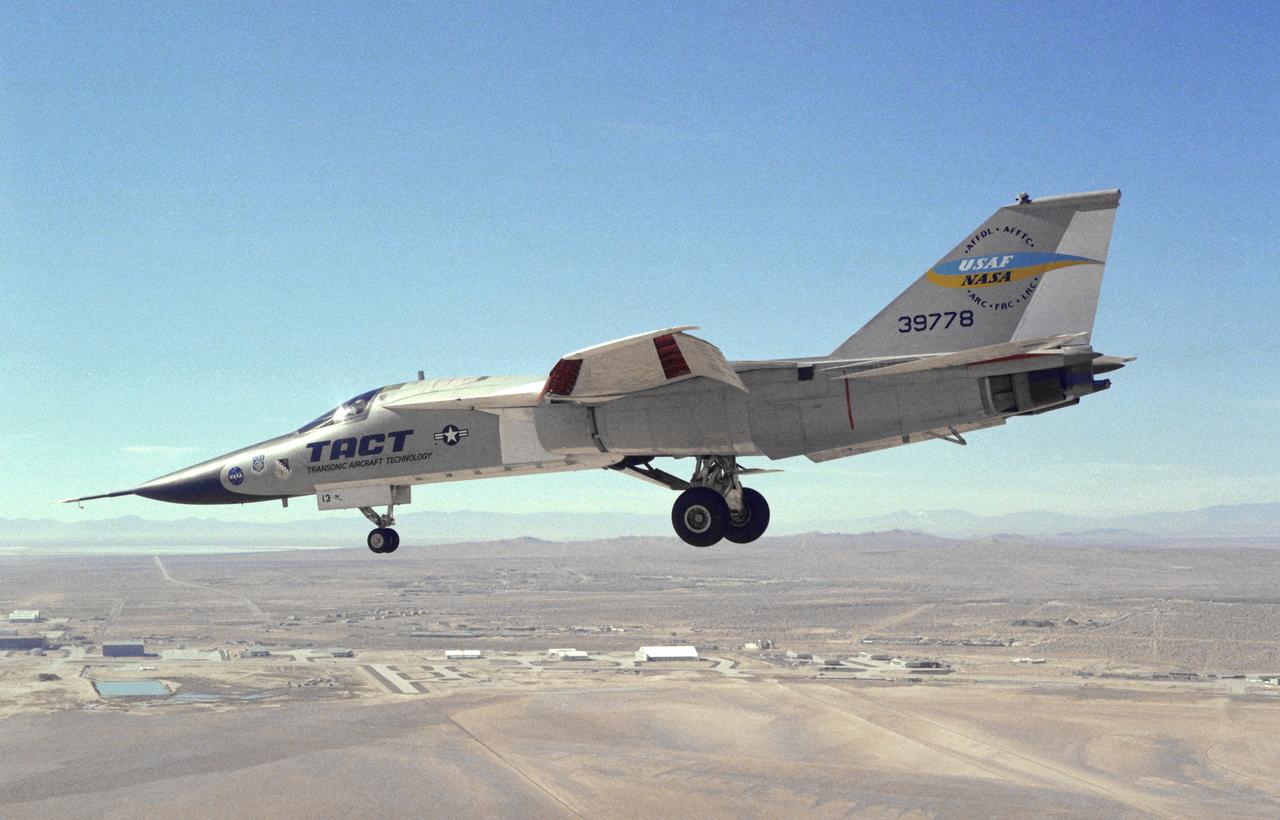
This photograph shows a modified General Dynamics TACT/F-111A Aardvaark with supercritical wings installed. The aircraft, with flaps and landing gear down, is in a decending turn over Rogers Dry Lakebed at Edwards Air Force Base. Starting in 1971 the NASA Flight Research Center and the Air Force undertook a major research and flight testing program, using F-111A (#63-9778), which would span almost 20 years before completion. Intense interest over the results coming from the NASA F-8 supercritical wing program spurred NASA and the Air Force to modify the General Dynamics-Convair F-111A to explore the application of supercritical wing technology to maneuverable military aircraft. This flight program was called Transonic Aircraft Technology (TACT).

CAPE CANAVERAL, Fla. – Three of the U.S. Navy's Blue Angels F/A-18 jets fly in formation over the runway before landing at NASA's Kennedy Space Center in Florida. The Blue Angels are at Kennedy to perform in the Kennedy Space Center Visitor Complex Space and Air Show Nov. 8-9. The Navy's elite flight demonstration squadron will take to the skies in military aircraft demonstrations by the F-16 Fighting Falcon and F/A-18 Super Hornet jets for the second annual Space & Air Show at Kennedy. This year’s show brings together the best in military aircraft, coupled with precision pilots and veteran astronauts to celebrate spaceflight and aviation. The event includes military aircraft demonstrations by the F-16 Fighting Falcon and a water rescue demonstration by the 920th Rescue Wing. Photo credit: NASA/Kim Shiflett
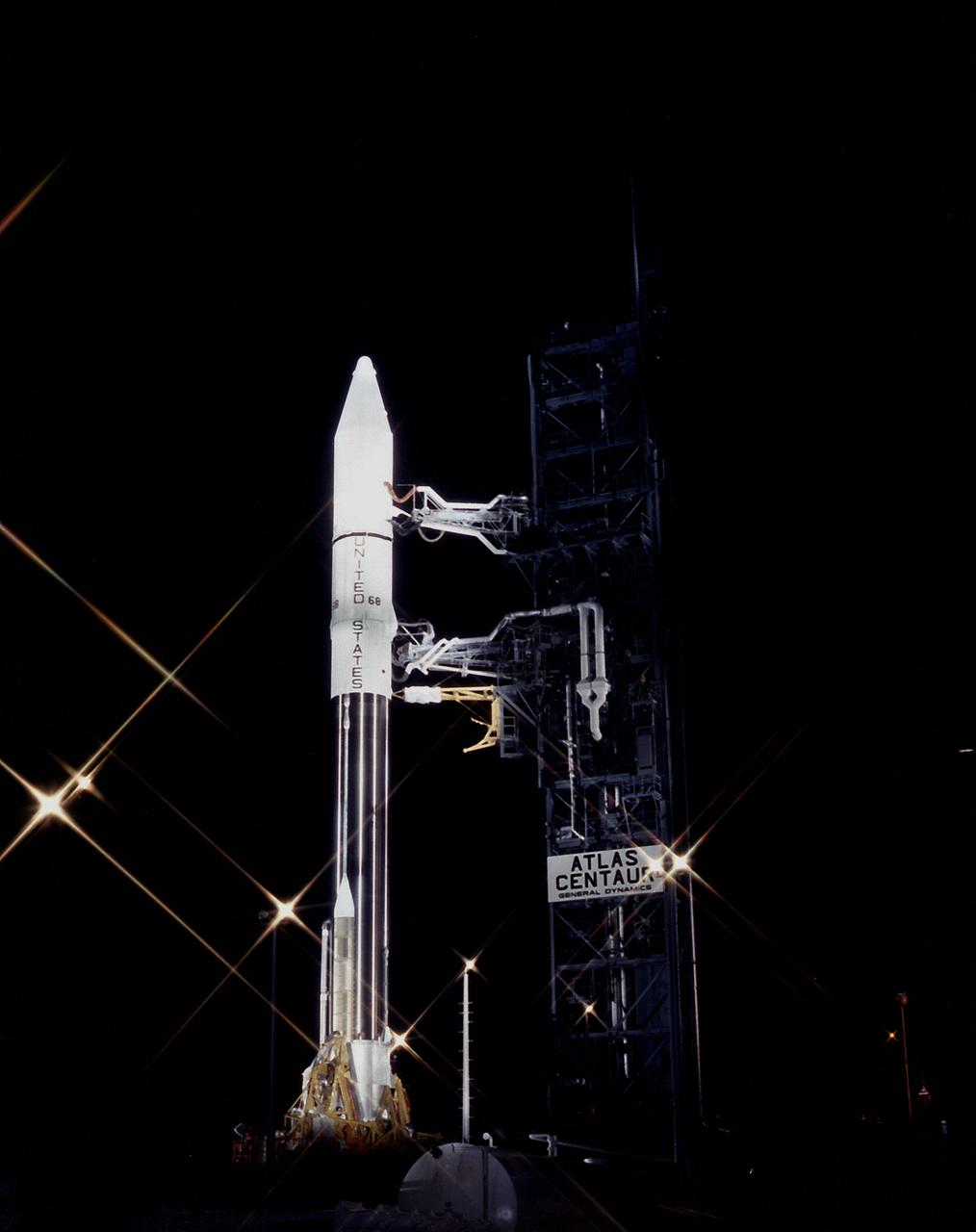
The Atlas-Centaur, AC-68 vehicle, with the FLTSATCOM (F-8 Communication Satellite) aboard, on the Complex 36 at the Cape Canaveral Air Force Station. The FLTSATCOM will provide communications for ships and submarines at sea, planes in the air and military ground units throughout the world. It will also provide instant communications between the President and the Commanding Officers.
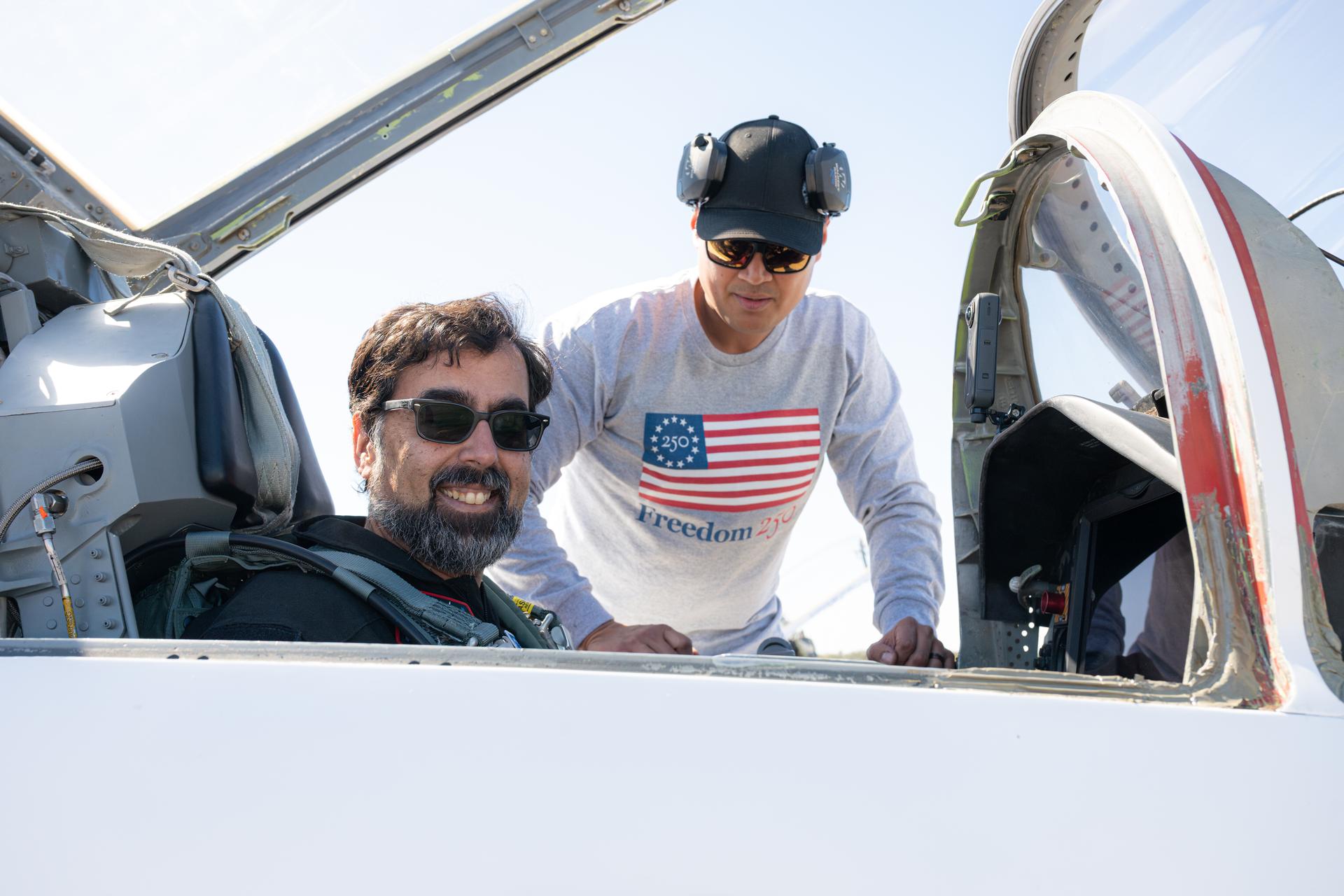
Amit Kshatriya, NASA associate administrator, poses for a photograph in NASA Administrator Jared Isaacman’s personal F-5 aircraft, Sunday, Feb. 8, 2026, ahead of a formation flight at NASA’s Kennedy Space Center in Florida. Photo Credit: (NASA/John Kraus)
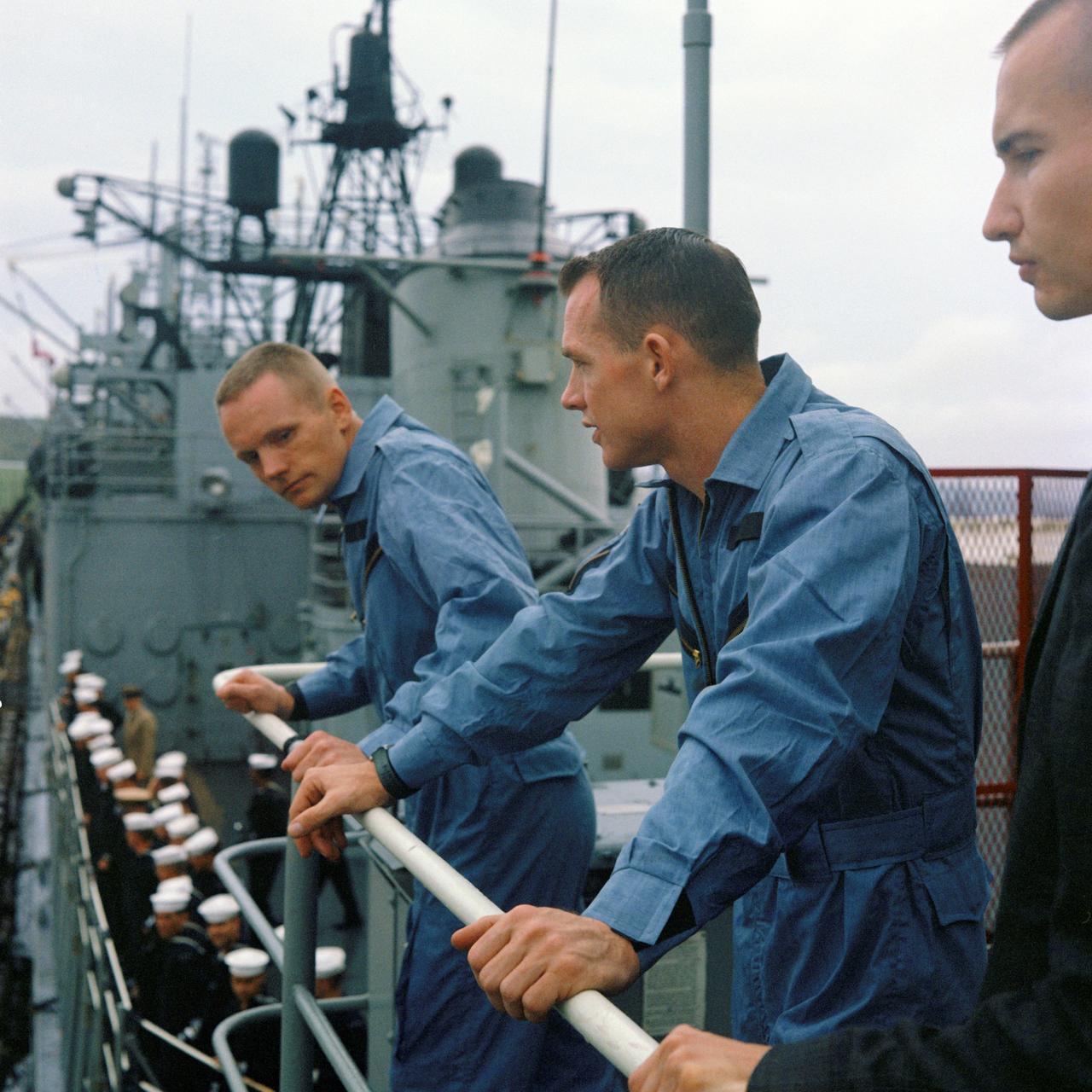
S66-18609 (17 March 1966) --- Astronauts David R. Scott (left), Gemini-8 pilot, and Neil A. Armstrong, command pilot, stand on the deck of the destroyer USS Leonard F. Mason upon its arrival at Nahs, Okinawa. Photo credit: NASA
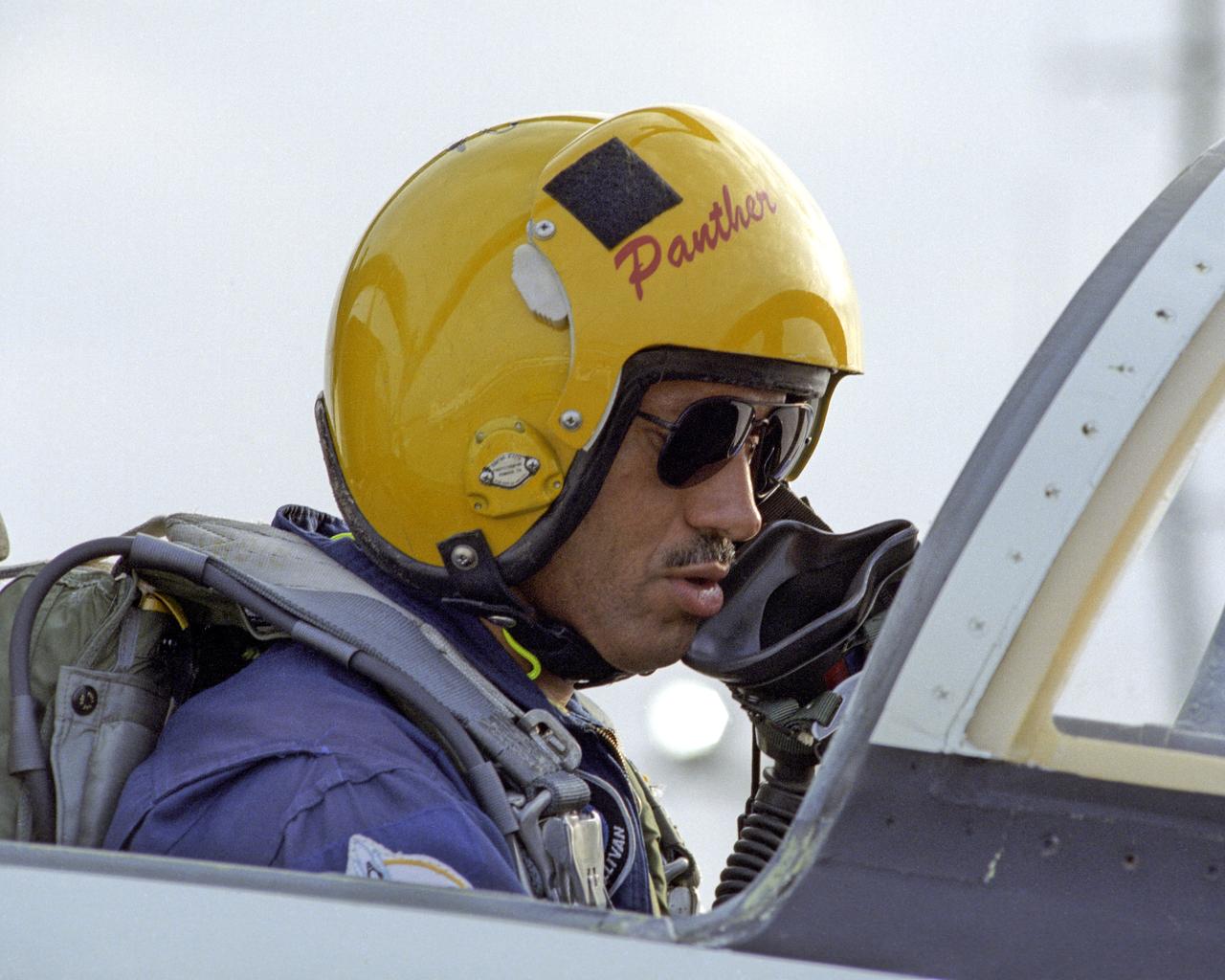
Charles F. Bolden, Jr., Pilot of Space Shuttle Mission STS-31, prepares for rehearsing shuttle contingency landings in the T-38S are among the final pre-launch activities. STS-31, carrying five crew members and the HST is set to liftoff at 8:47 a.m. April 10.
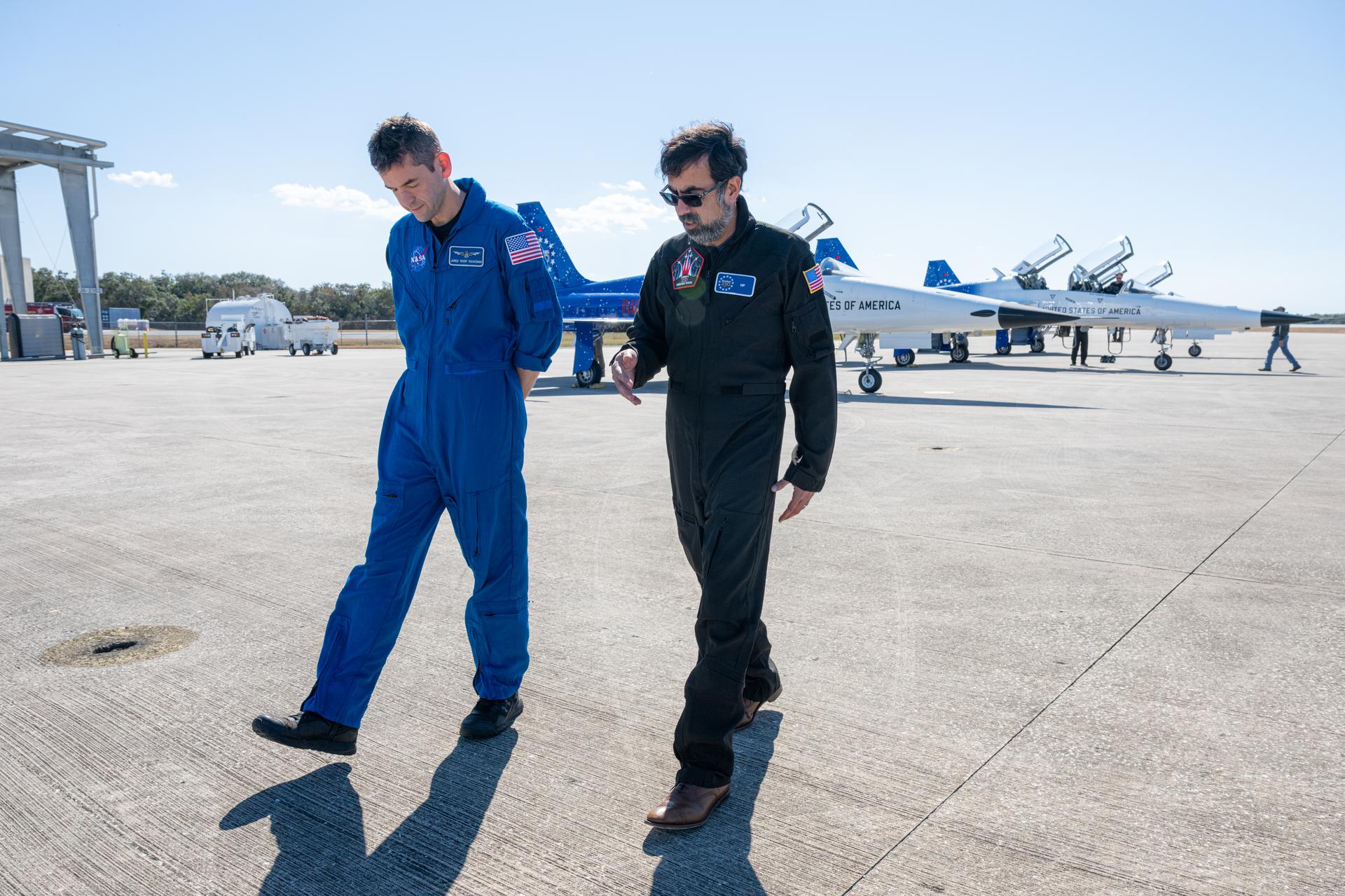
NASA Administrator Jared Isaacman and Amit Kshatriya, NASA associate administrator, are seen following a formation flight in Isaacman’s personal F-5 aircraft, Sunday, Feb. 8, 2026, at NASA’s Kennedy Space Center in Florida. Photo Credit: (NASA/John Kraus)
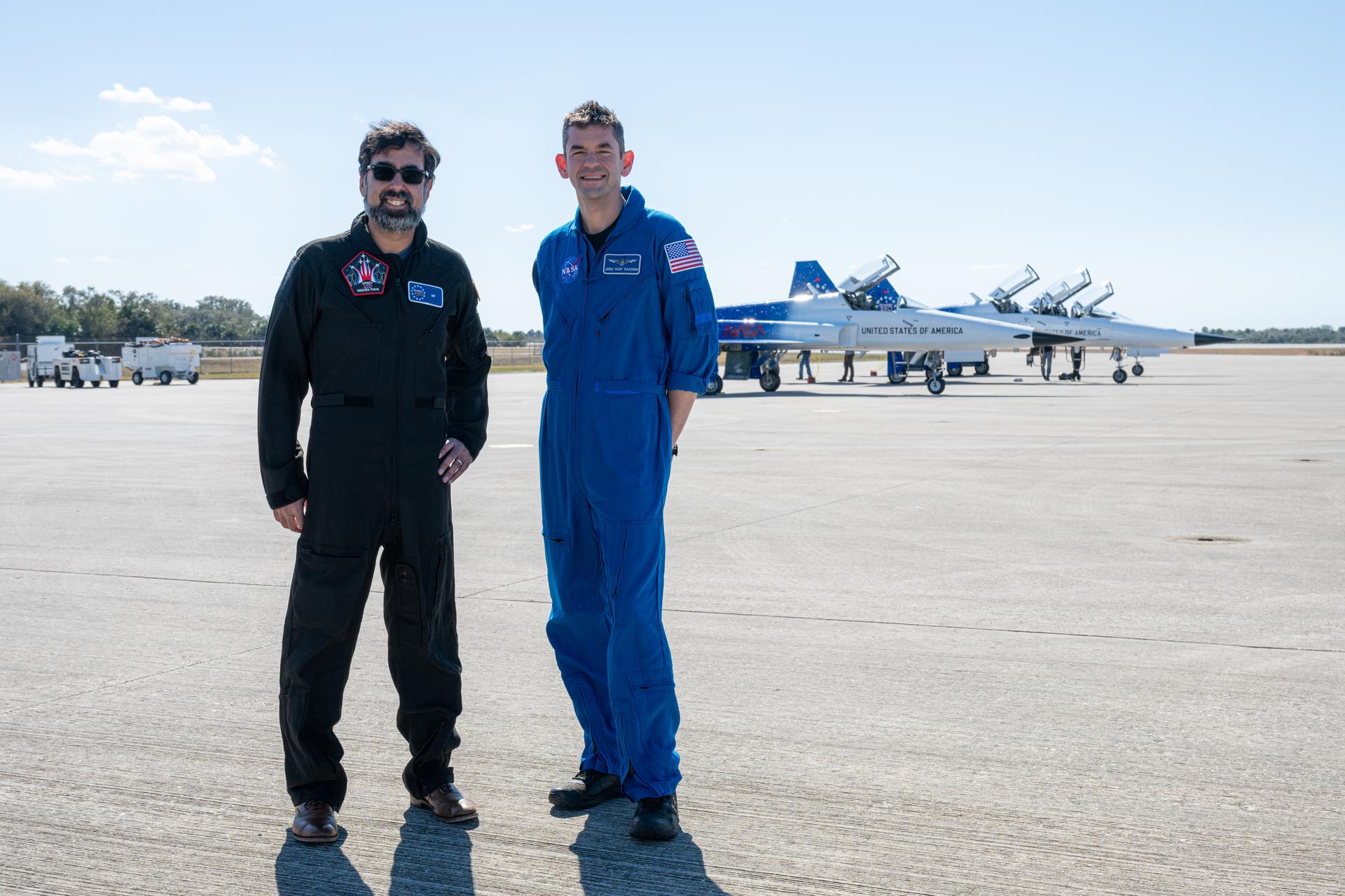
NASA Administrator Jared Isaacman and Amit Kshatriya, NASA associate administrator, pose for a photograph following a formation flight in Isaacman’s personal F-5 aircraft, Sunday, Feb. 8, 2026, at NASA’s Kennedy Space Center in Florida. Photo Credit: (NASA/John Kraus)

S66-18602 (16 March 1966) --- Astronauts Neil A. Armstrong and David R. Scott sit with their spacecraft hatches open while awaiting the arrival of the recovery ship, the USS Leonard F. Mason after the successful completion of their Gemini-8 mission. They are assisted by U.S. Navy divers. The overhead view shows the Gemini-8 spacecraft with the yellow flotation collar attached to stabilize the spacecraft in choppy seas. The green marker dye is highly visible from the air and is used as a locating aid. Photo credit: NASA
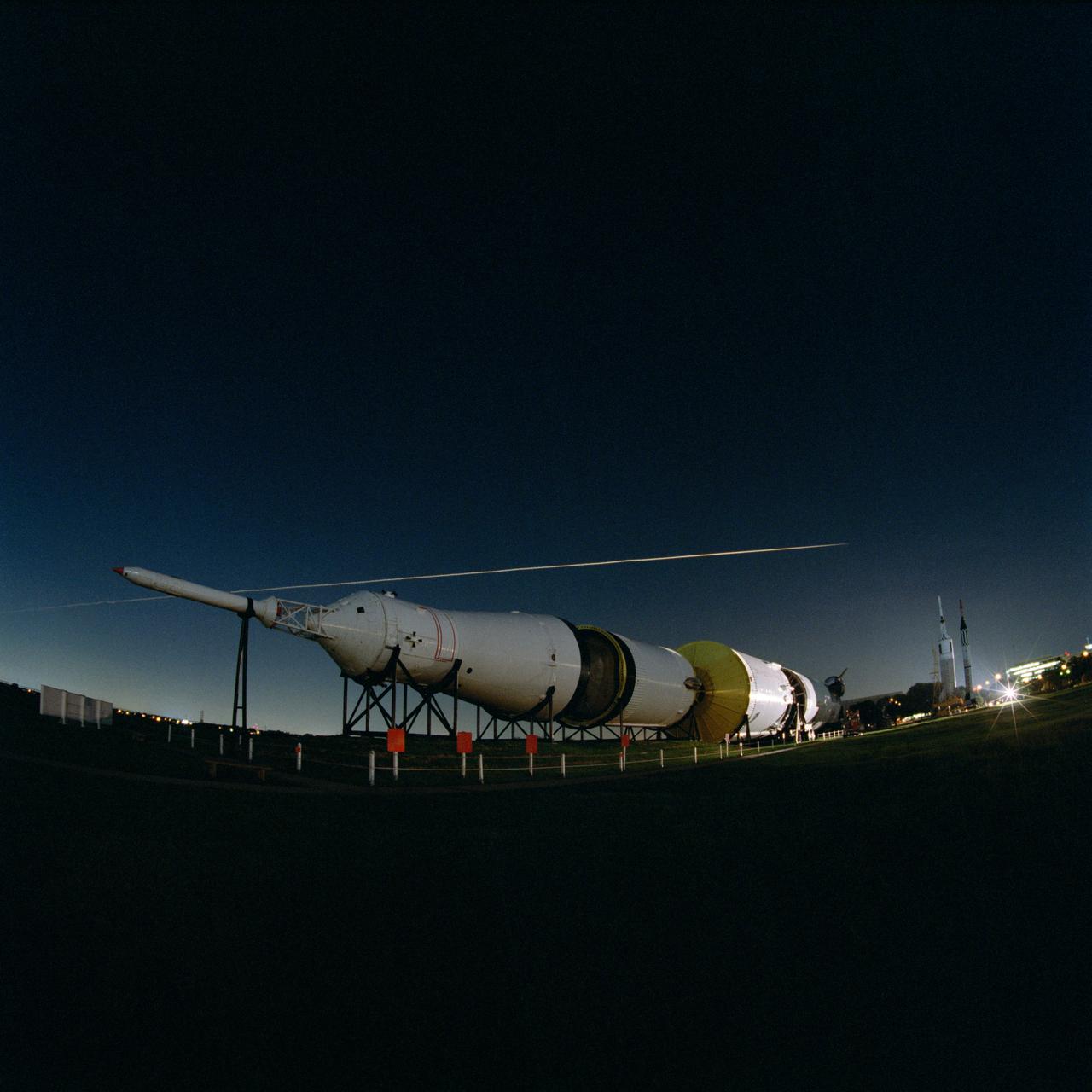
S99-08357 (27 July 1999) --- The fly-over of Space Shuttle Columbia's STS-93 re-entry is seen above the Johnson Space Center's Rocket Park. The Saturn V is below the streak that was left by Columbia re-entering the atmosphere. The image was captured with a Hasselblad 503cx medium format camera with a 30mm Hasselblad lens using an 8-second exposure and an aperture setting of f/8. The film was Kodak PMZ 1000 color negative film. The photographer was Mark Sowa of the NASA Johnson Space Center's photography group.
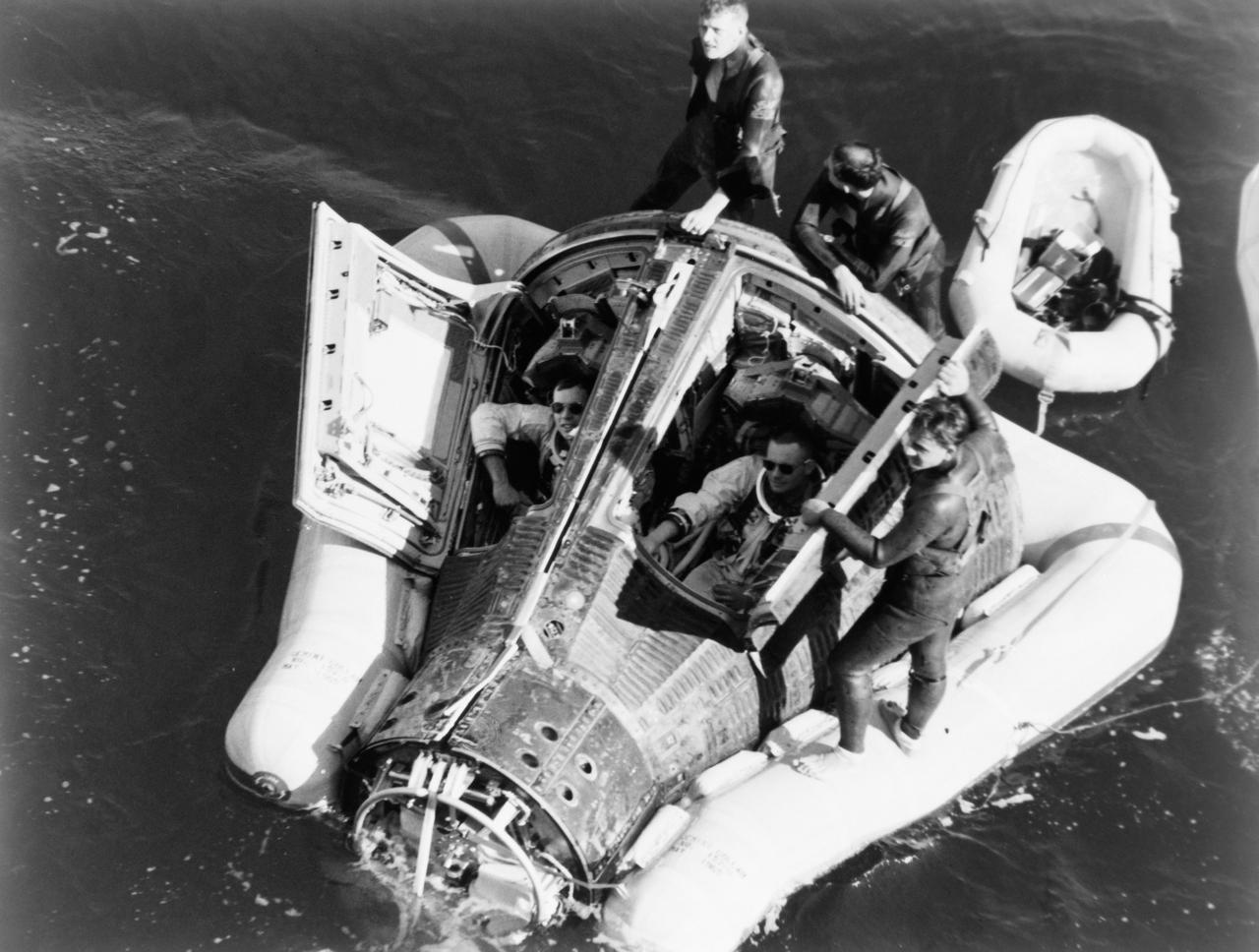
S66-18602_alt (16 March 1966) --- Astronauts Neil A. Armstrong and David R. Scott sit with their spacecraft hatches open while awaiting the arrival of the recovery ship, the USS Leonard F. Mason after the successful completion of their Gemini-8 mission. They are assisted by U.S. Navy divers. The overhead view shows the Gemini-8 spacecraft with the yellow flotation collar attached to stabilize the spacecraft in choppy seas. The green marker dye is highly visible from the air and is used as a locating aid. Photo credit: NASA
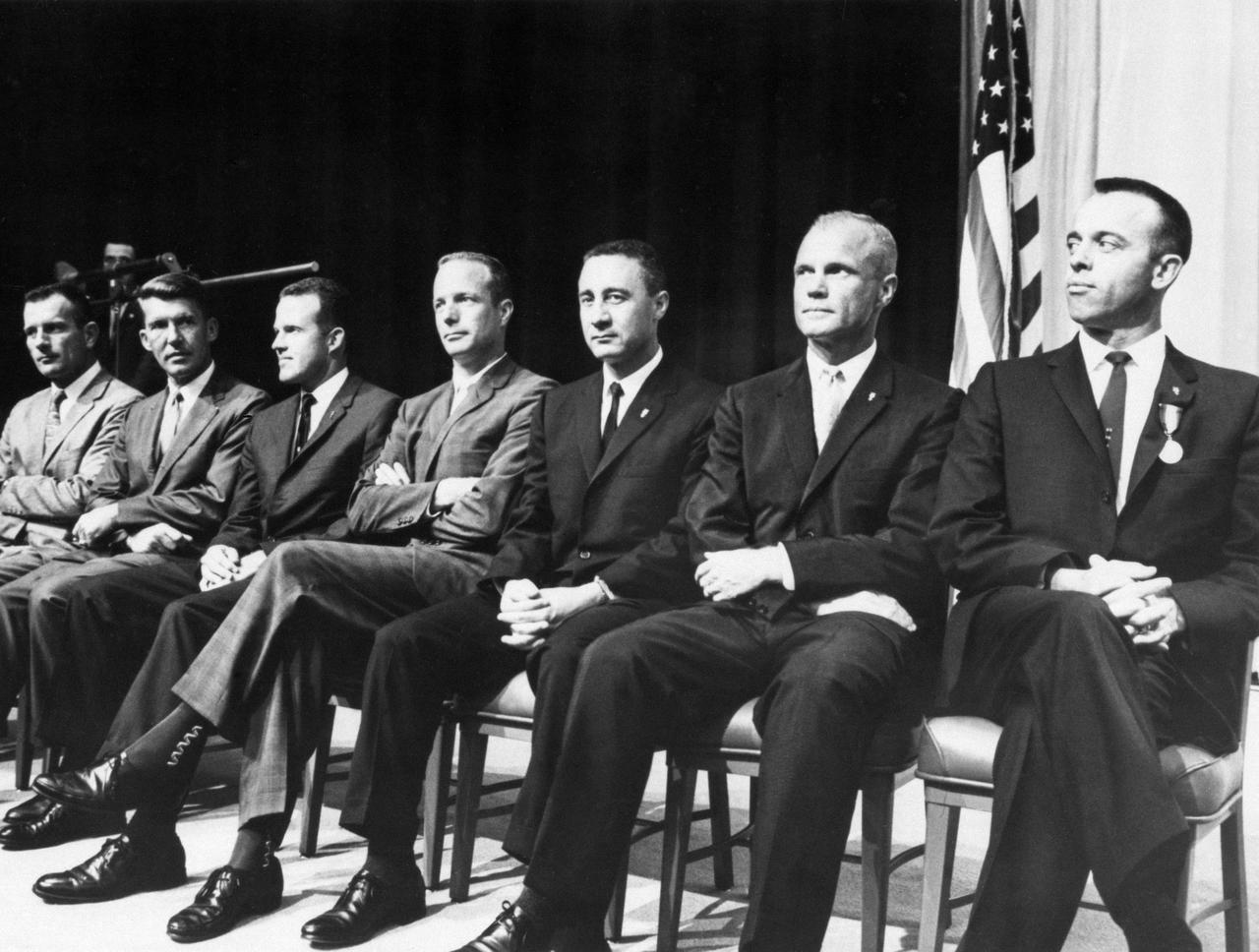
S61-02357 (8 May 1961) --- The original seven Mercury astronauts at the State Department Auditorium on May 8, 1961. The astronauts are (left to right) Donald K. Slayton, Walter M. Schirra, Jr., L. Gordon Cooper, Jr., M. Scott Carpenter, Virgil I. Grissom, John H. Glenn, Jr. and Alan B. Shepard, Jr. Earlier President John F. Kennedy had presented astronaut Shepard with the NASA Distinguished Service Medal (note it on his lapel) in the White House Rose Garden.
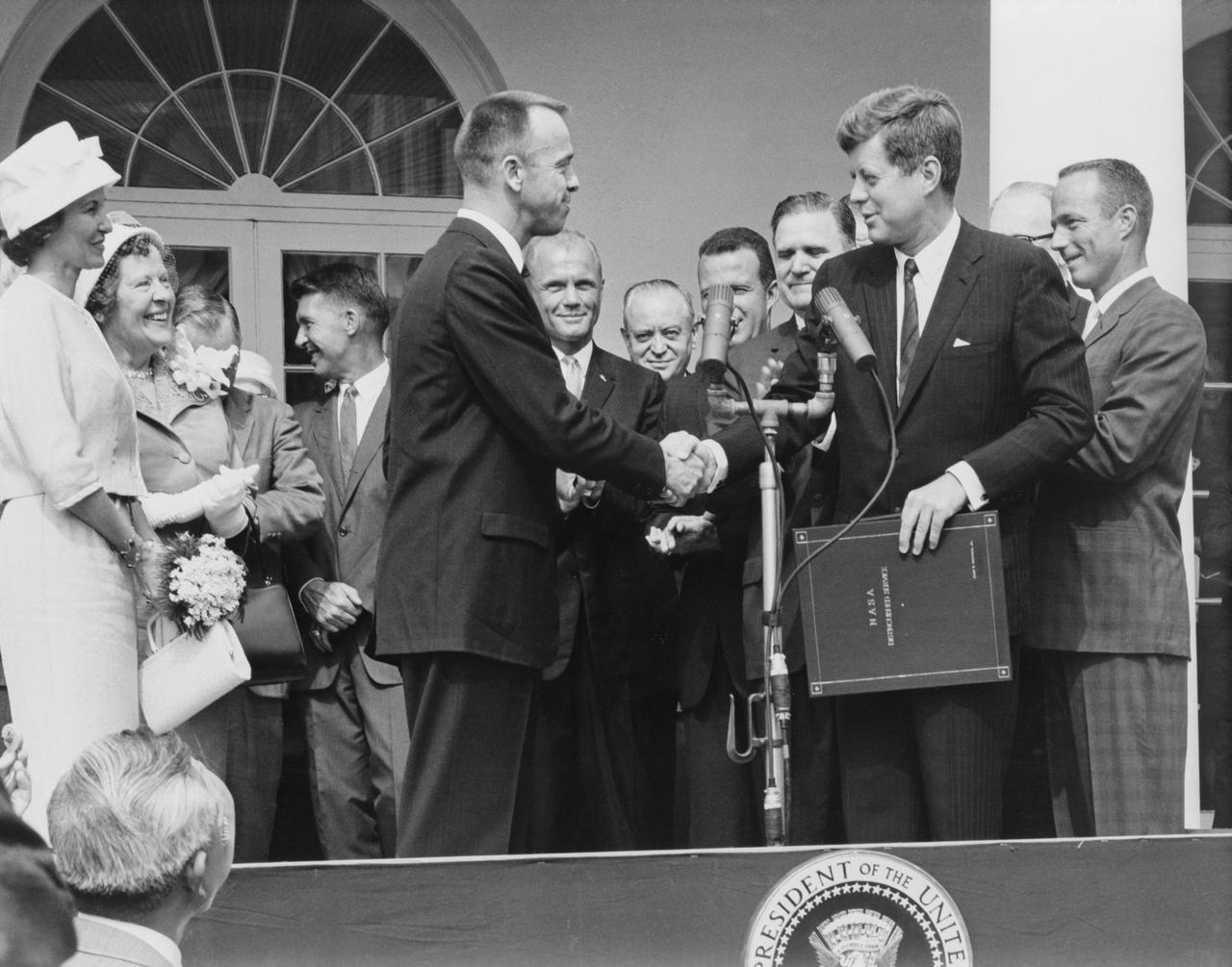
S67-19572 (8 May 1961) --- Astronaut Alan B. Shepard Jr. receives the NASA Distinguished Service Award from United States President John F. Kennedy May 8, 1961, days after his history making MR-3 flight. Shepard's wife and mother on left and the other six Mercury astronauts are in background. Photo credit: NASA or National Aeronautics and Space Administration
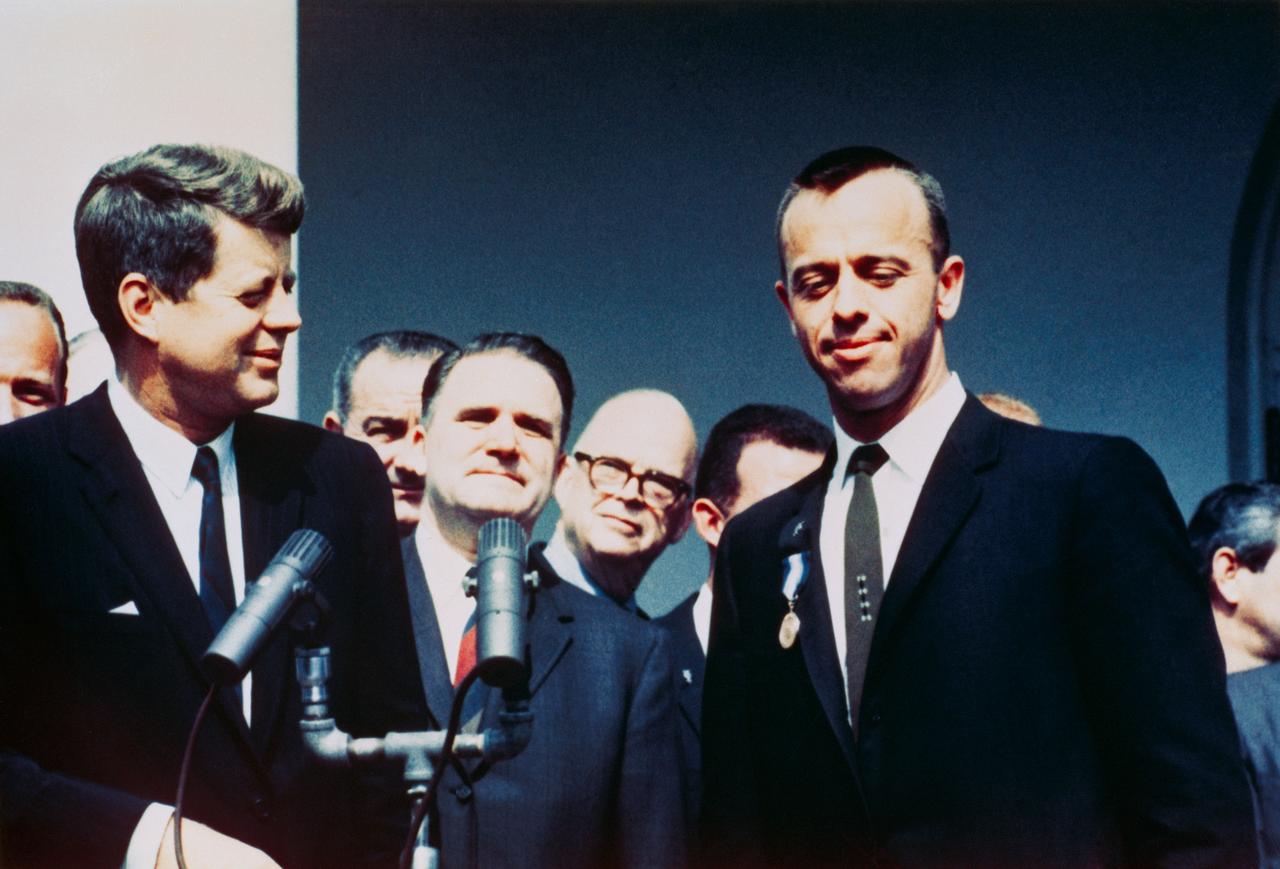
S88-31387 (8 May 1961) --- President John F. Kennedy (left) congratulates NASA's Distinguished Service Medal Award recipient astronaut Alan B. Shepard Jr. in a Rose Garden ceremony on May 8, 1961, at the White House. Vice-President Lyndon B. Johnson, NASA Administrator James E. Webb and several NASA astronauts are in the background. Three days earlier, Shepard made history with a 15-minute suborbital space mission in the Freedom 7, Mercury-Redstone 3 spacecraft. Photo credit: NASA
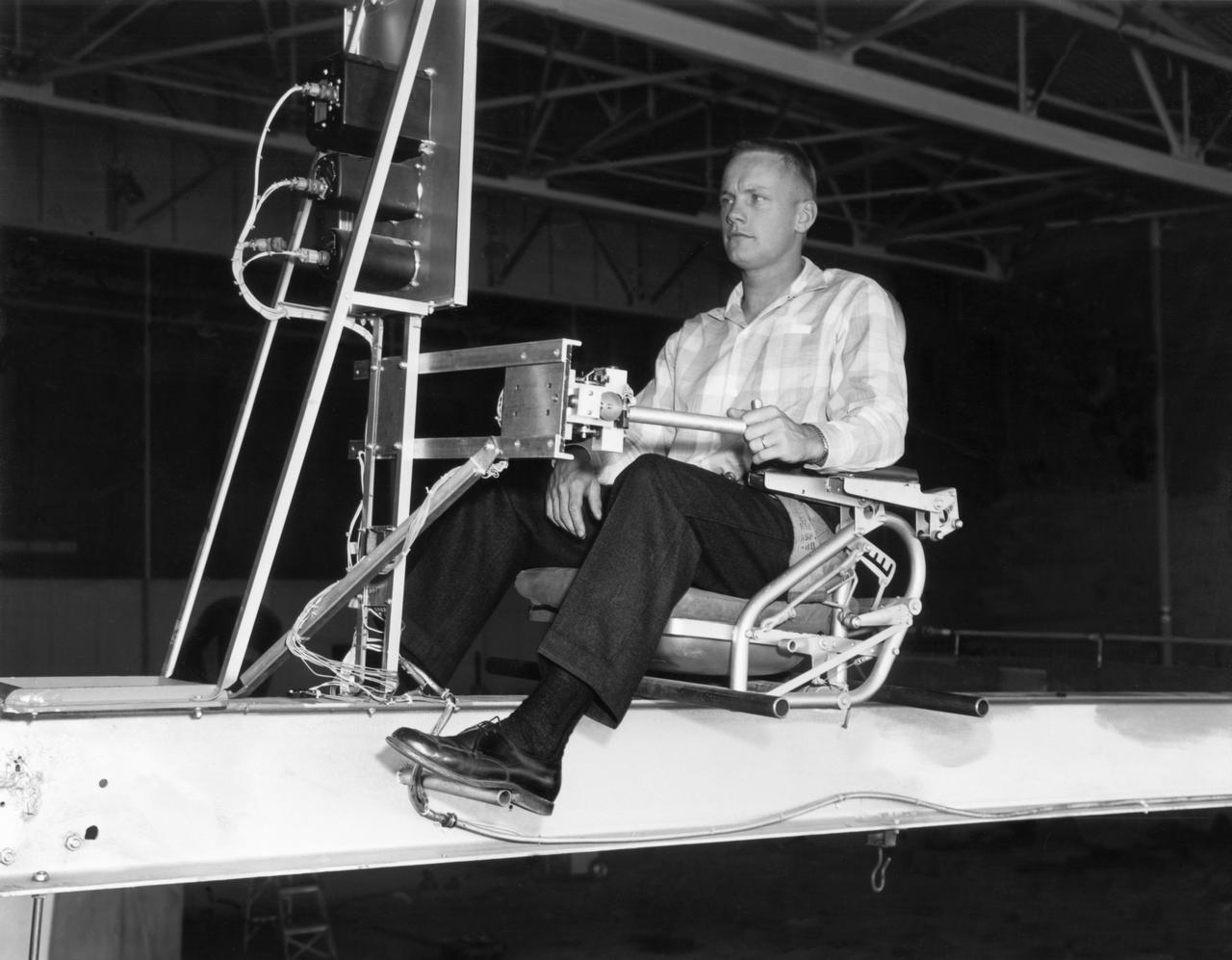
Famed astronaut Neil A. Armstrong, the first man to set foot on the moon during the historic Apollo 11 space mission in July 1969, served for seven years as a research pilot at the NACA-NASA High-Speed Flight Station, now the Dryden Flight Research Center, at Edwards, California, before he entered the space program. Armstrong joined the National Advisory Committee for Aeronautics (NACA) at the Lewis Flight Propulsion Laboratory (later NASA's Lewis Research Center, Cleveland, Ohio, and today the Glenn Research Center) in 1955. Later that year, he transferred to the High-Speed Flight Station at Edwards as an aeronautical research scientist and then as a pilot, a position he held until becoming an astronaut in 1962. He was one of nine NASA astronauts in the second class to be chosen. As a research pilot Armstrong served as project pilot on the F-100A and F-100C aircraft, F-101, and the F-104A. He also flew the X-1B, X-5, F-105, F-106, B-47, KC-135, and Paresev. He left Dryden with a total of over 2450 flying hours. He was a member of the USAF-NASA Dyna-Soar Pilot Consultant Group before the Dyna-Soar project was cancelled, and studied X-20 Dyna-Soar approaches and abort maneuvers through use of the F-102A and F5D jet aircraft. Armstrong was actively engaged in both piloting and engineering aspects of the X-15 program from its inception. He completed the first flight in the aircraft equipped with a new flow-direction sensor (ball nose) and the initial flight in an X-15 equipped with a self-adaptive flight control system. He worked closely with designers and engineers in development of the adaptive system, and made seven flights in the rocket plane from December 1960 until July 1962. During those fights he reached a peak altitude of 207,500 feet in the X-15-3, and a speed of 3,989 mph (Mach 5.74) in the X-15-1. Armstrong has a total of 8 days and 14 hours in space, including 2 hours and 48 minutes walking on the Moon. In March 1966 he was commander of the Gemini 8 or
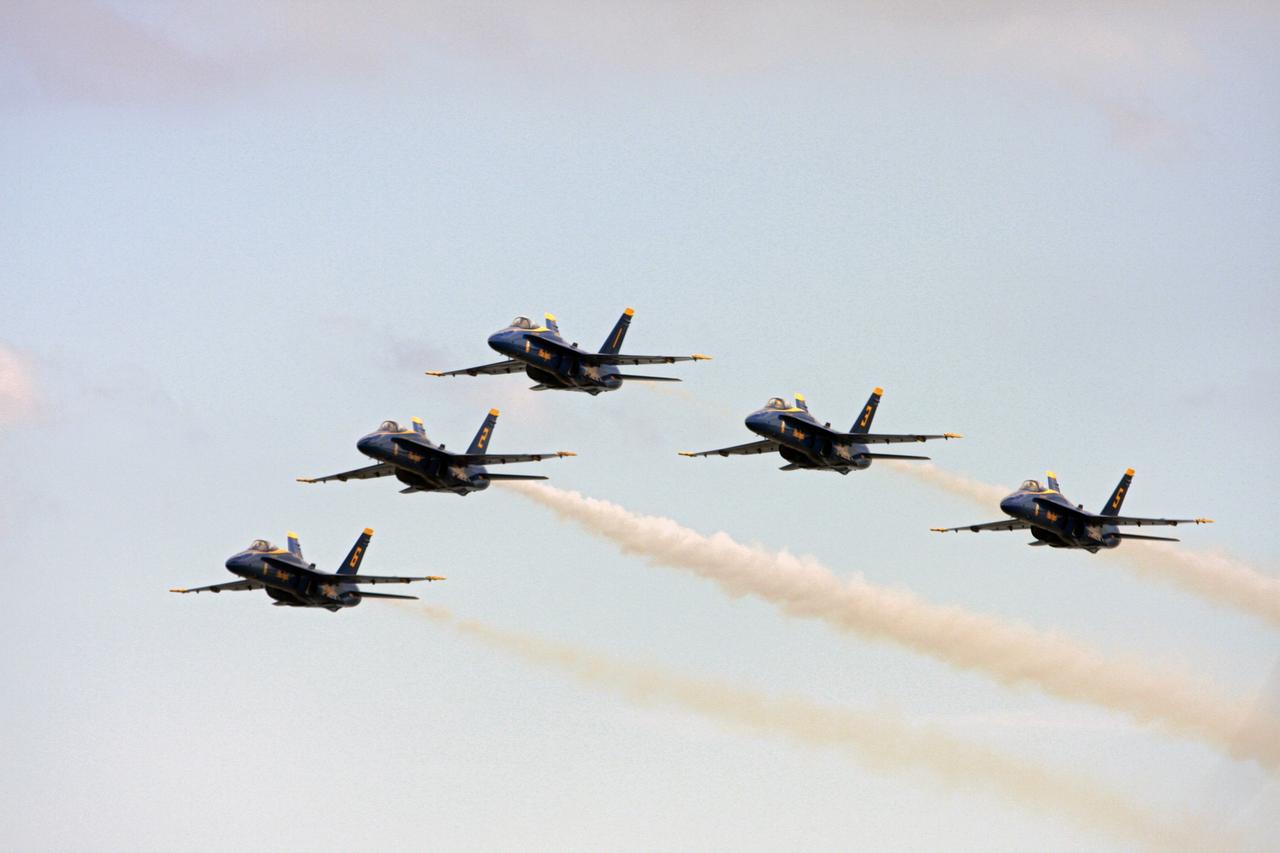
CAPE CANAVERAL, Fla. – The U.S. Navy's Blue Angels perform their tight maneuvers over NASA's Kennedy Space Center in Florida during the Kennedy Space Center Visitor Complex Space and Air Show held Nov. 8-9. This year’s show brought together the best in military aircraft, such as the F/A-18 Super Hornet and F-16 Fighting Falcon, coupled with precision pilots and veteran astronauts to celebrate spaceflight and aviation. The event included a water rescue demonstration by the 920th Rescue Wing. Photo credit: NASA/Troy Cryder
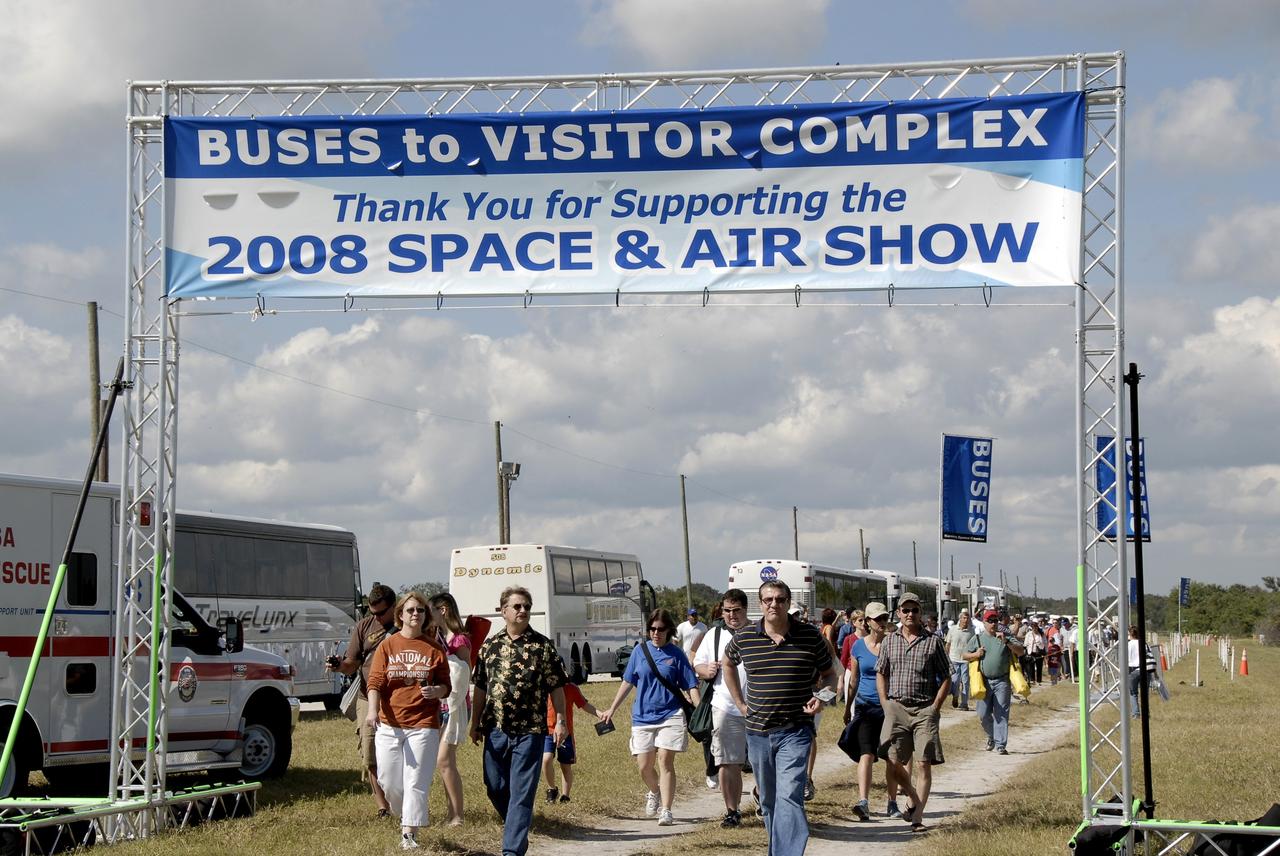
CAPE CANAVERAL, Fla. – Crowds head for the best viewing sites they can find at NASA's Kennedy Space Center in Florida to watch the U.S. Navy's Blue Angels perform at the Kennedy Space Center Visitor Complex Space and Air Show Nov. 8-9. This year’s show brought together the best in military aircraft, such as the F/A-18 Super Hornet and F-16 Fighting Falcon, coupled with precision pilots and veteran astronauts to celebrate spaceflight and aviation. The event included a water rescue demonstration by the 920th Rescue Wing. Photo credit: NASA/Kim Shiflett
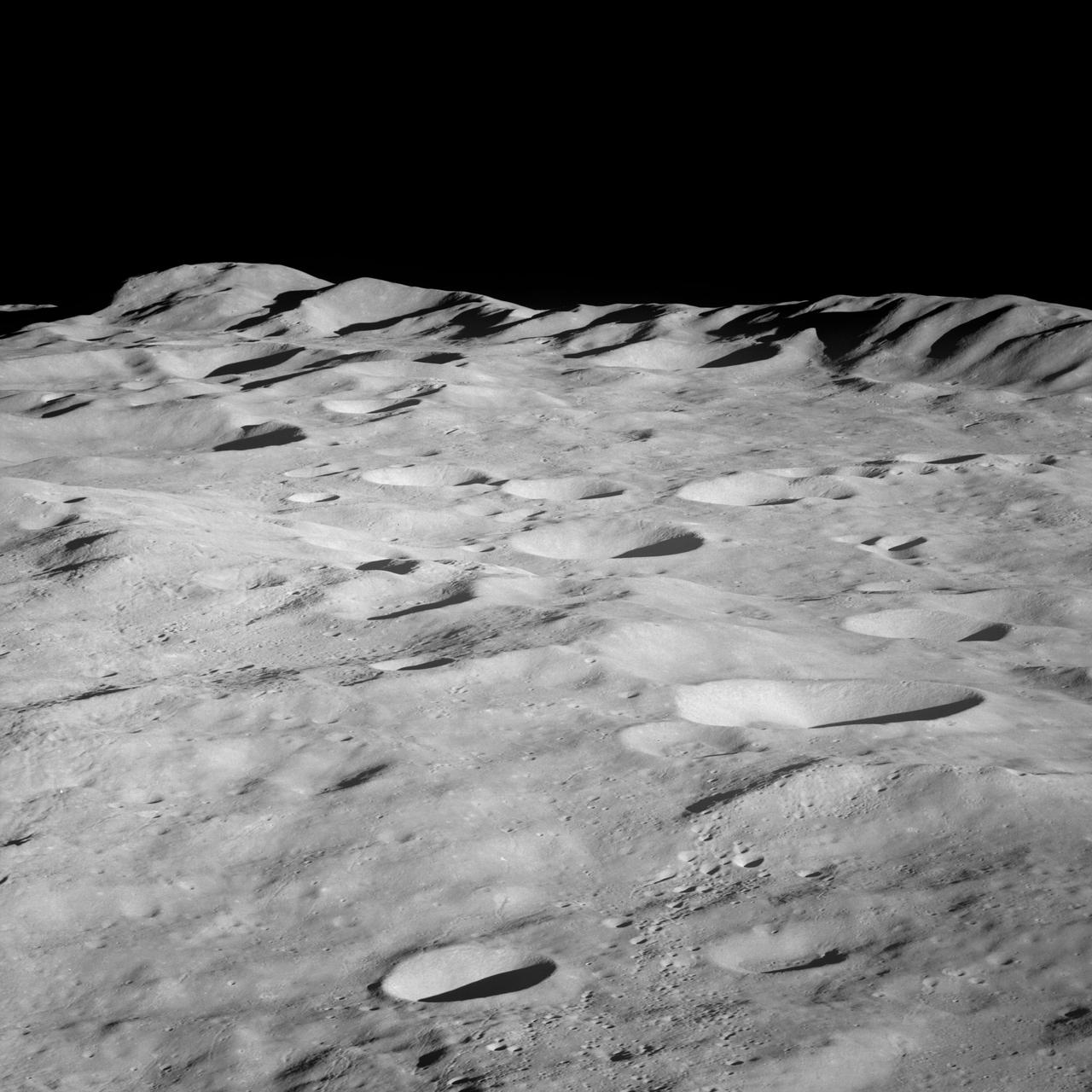
Apollo 8,Moon,Target of Opportunity (T/O) 10, Various targets. Latitude 18 degrees South,Longitude 163.50 degrees West. Camera Tilt Mode: High Oblique. Direction: South. Sun Angle 12 degrees. Original Film Magazine was labeled E. Camera Data: 70mm Hasselblad; F-Stop: F-5.6; Shutter Speed: 1/250 second. Film Type: Kodak SO-3400 Black and White,ASA 40. Other Photographic Coverage: Lunar Orbiter 1 (LO I) S-3. Flight Date: December 21-27,1968.
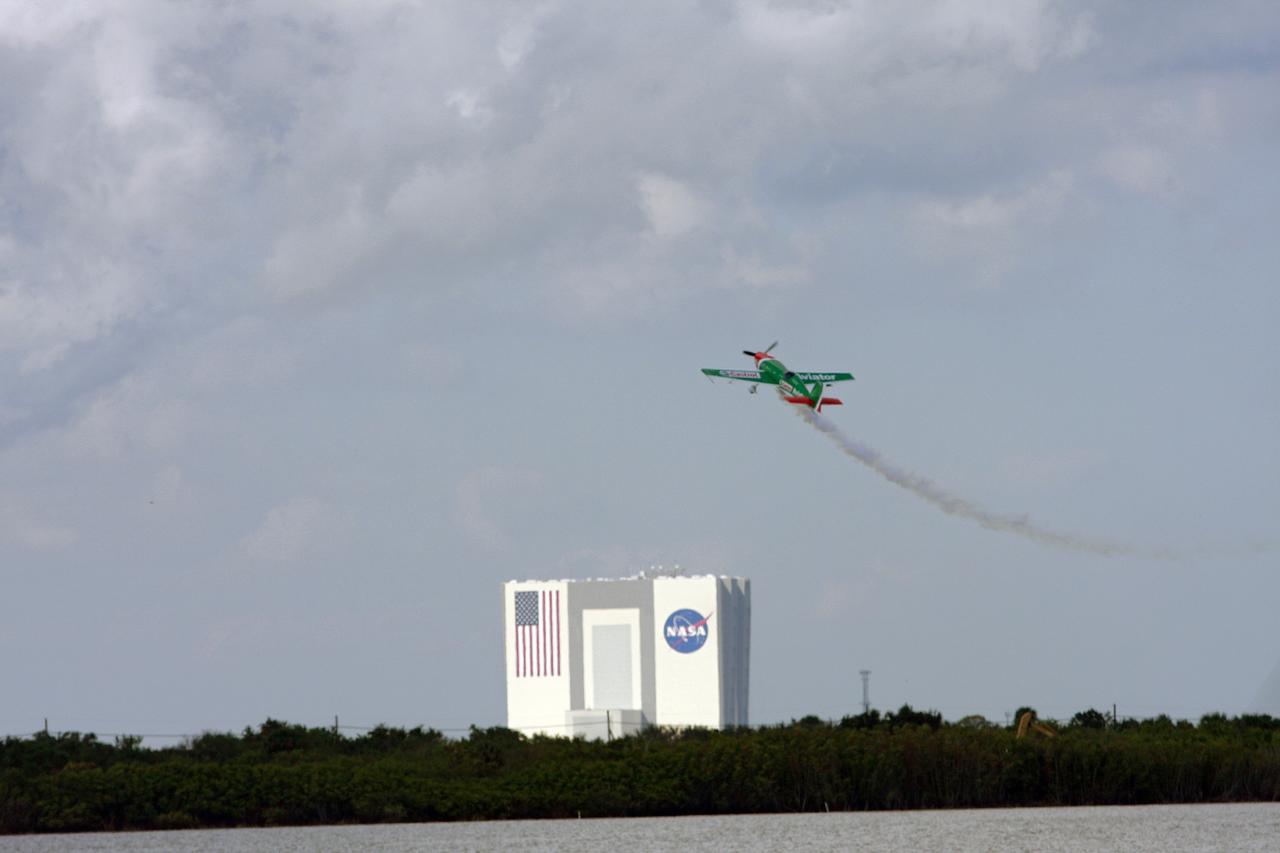
CAPE CANAVERAL, Fla. – With the Vehicle Assembly Building at NASA's Kennedy Space Center in Florida as a backdrop, this Castrol Aviator EXTRA 300SHP stunt plane, an unlimited-level aerobatic two-seat monoplane, performs aerobatic maneuvers during the Kennedy Space Center Visitor Complex Space and Air Show held Nov. 8-9. This year’s show brought together the best in military aircraft, such as the F/A-18 Super Hornet and F-16 Fighting Falcon, coupled with precision pilots and veteran astronauts to celebrate spaceflight and aviation. The event included a water rescue demonstration by the 920th Rescue Wing. Photo credit: NASA/Troy Cryder
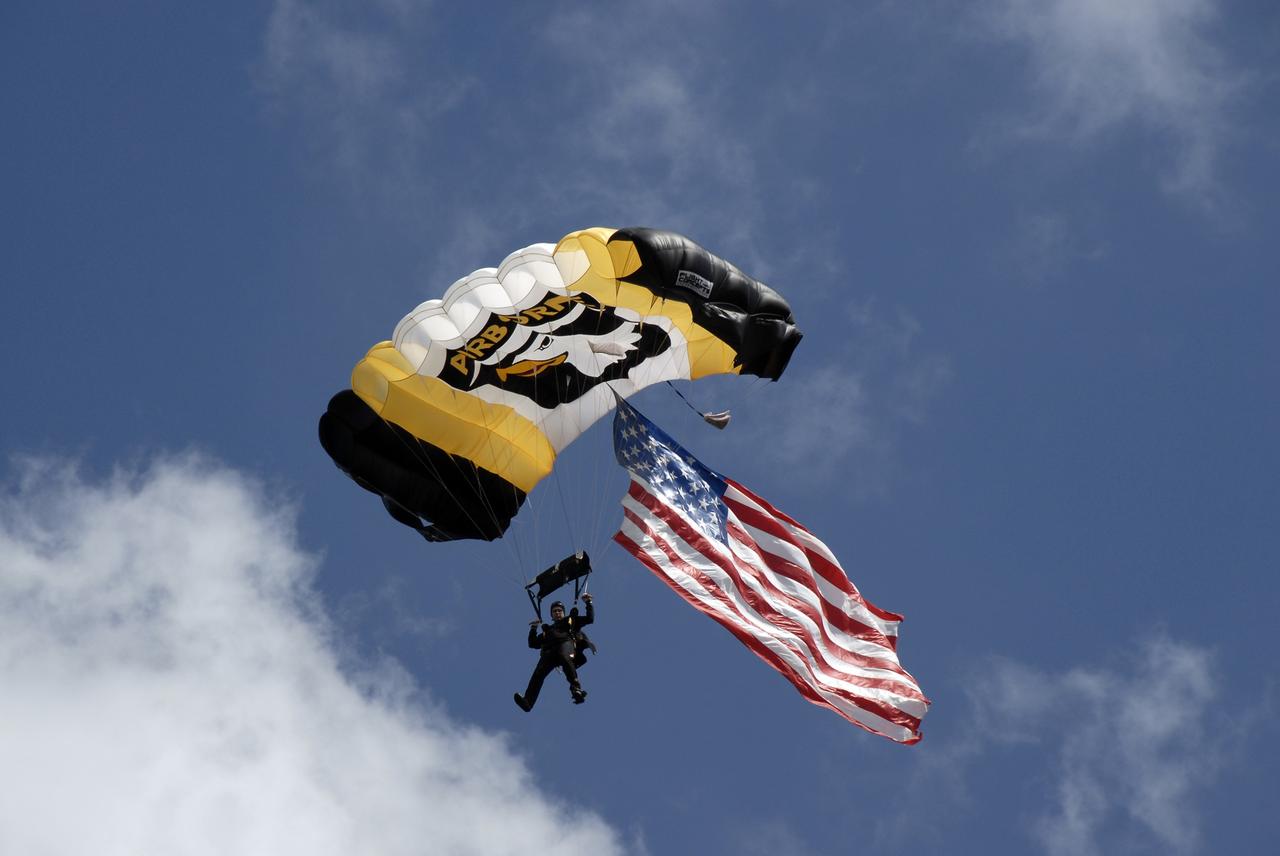
CAPE CANAVERAL, Fla. – A member of the 101st Airborne parachute demonstration team heads for landing at NASA's Kennedy Space Center in Florida. The team performed at the Kennedy Space Center Visitor Complex Space and Air Show Nov. 8-9. This year’s show brought together the best in military aircraft, such as the F/A-18 Super Hornet and F-16 Fighting Falcon, coupled with precision pilots and veteran astronauts to celebrate spaceflight and aviation. The event included a water rescue demonstration by the 920th Rescue Wing. Photo credit: NASA/Kim Shiflett
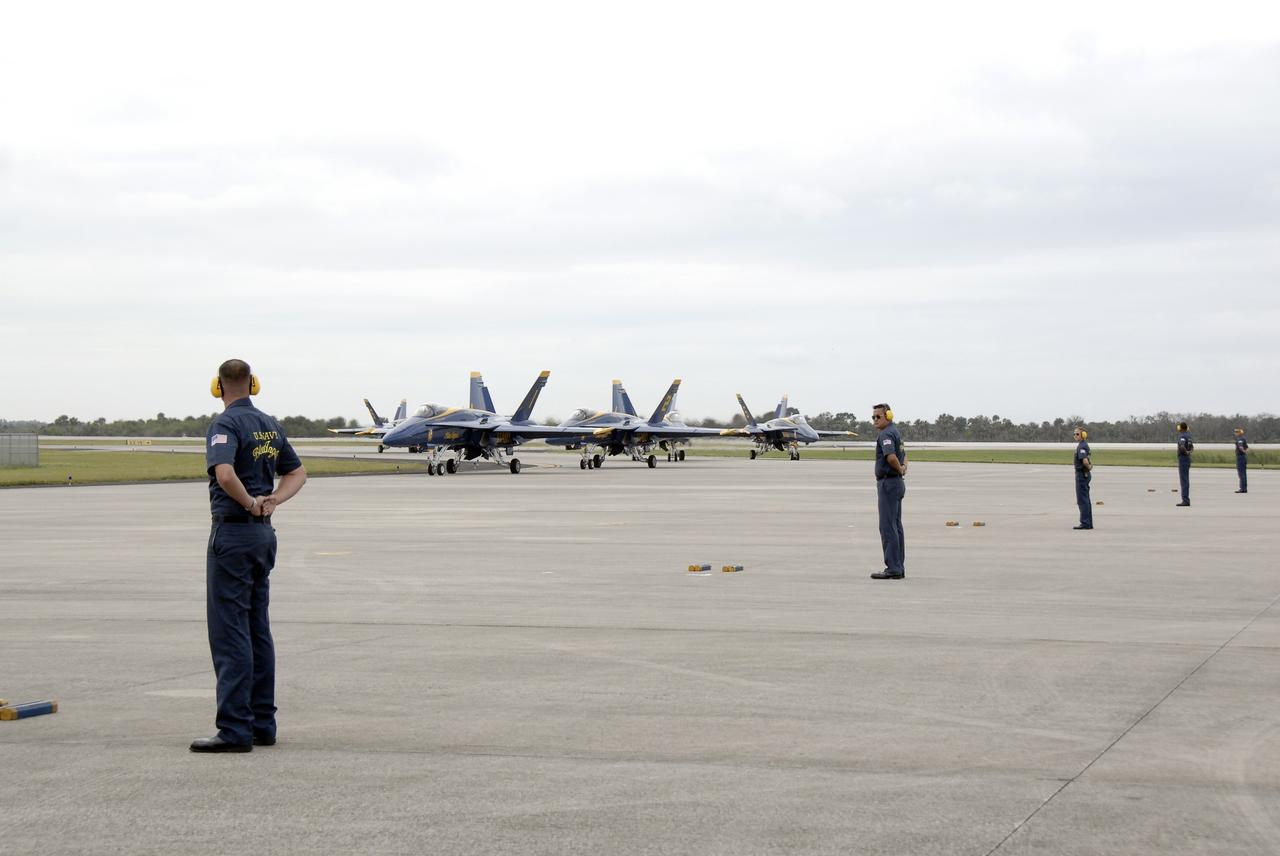
CAPE CANAVERAL, Fla. – The U.S. Navy's Blue Angels demonstration squadron lands at the Shuttle Landing Facility at NASA's Kennedy Space Center in Florida. They will perform at the Kennedy Space Center Visitor Complex Space and Air Show Nov. 8-9. The Navy's elite flight demonstration squadron will take to the skies in military aircraft demonstrations by the F-16 Fighting Falcon and F/A-18 Super Hornet jets for the second annual Space & Air Show at Kennedy. This year’s show brings together the best in military aircraft, coupled with precision pilots and veteran astronauts to celebrate spaceflight and aviation. The event includes military aircraft demonstrations by the F-16 Fighting Falcon and a water rescue demonstration by the 920th Rescue Wing. Photo credit: NASA/Kim Shiflett
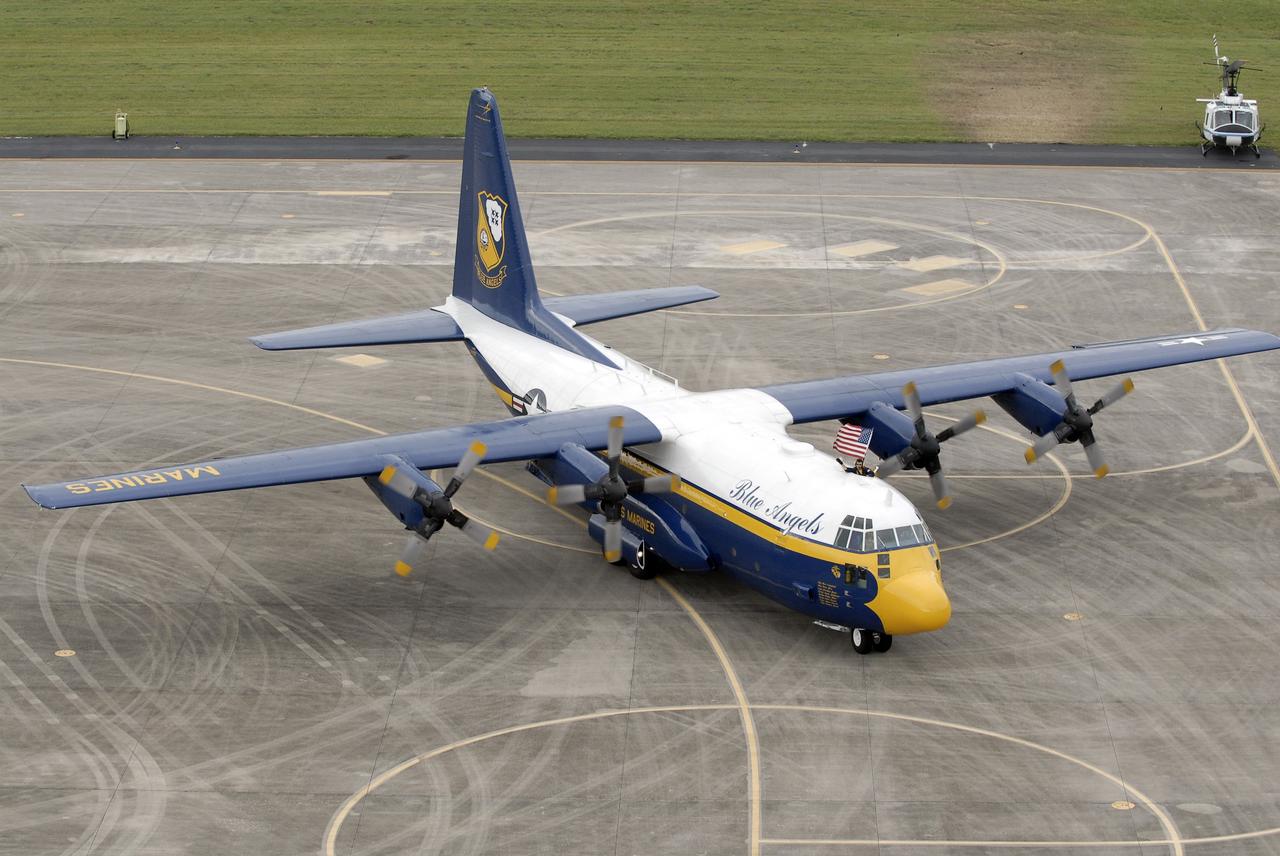
CAPE CANAVERAL, Fla. – A C-130 airplane flown by U.S. Marines lands at the Shuttle Landing Facility at NASA's Kennedy Space Center in Florida. The plane carries the support team for the U.S. Navy's Blue Angels, who are going to perform at the Kennedy Space Center Visitor Complex Space and Air Show Nov. 8-9. The Navy's elite flight demonstration squadron will take to the skies in military aircraft demonstrations by the F-16 Fighting Falcon and F/A-18 Super Hornet jets for the second annual Space & Air Show at Kennedy. This year’s show brings together the best in military aircraft, coupled with precision pilots and veteran astronauts to celebrate spaceflight and aviation. The event includes military aircraft demonstrations by the F-16 Fighting Falcon and a water rescue demonstration by the 920th Rescue Wing. Photo credit: NASA/Kim Shiflett
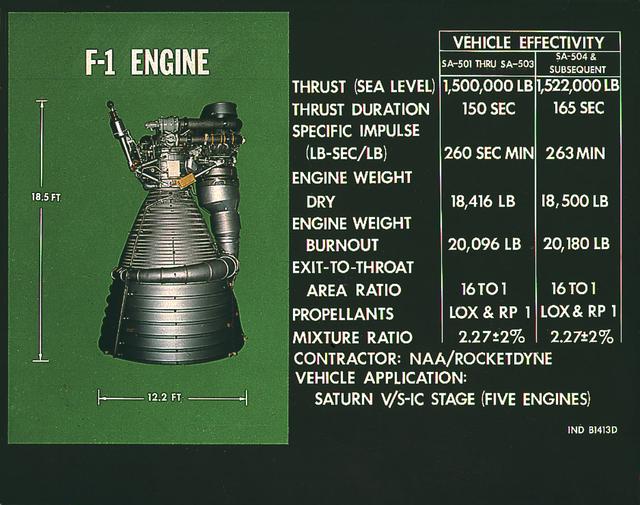
This chart provides the vital statistics for the F-1 rocket engine. Developed by Rocketdyne, under the direction of the Marshall Space Flight Center, the F-1 engine was utilized in a cluster of five engines to propel the Saturn V's first stage, the S-IC. Liquid oxygen and kerosene were used as its propellant. Initially rated at 1,500,000 pounds of thrust, the engine was later uprated to 1,522,000 pounds of thrust after the third Saturn V launch (Apollo 8, the first marned Saturn V mission) in December 1968. The cluster of five F-1 engines burned over 15 tons of propellant per second, during its two and one-half minutes of operation, to take the vehicle to a height of about 36 miles and to a speed of about 6,000 miles per hour.
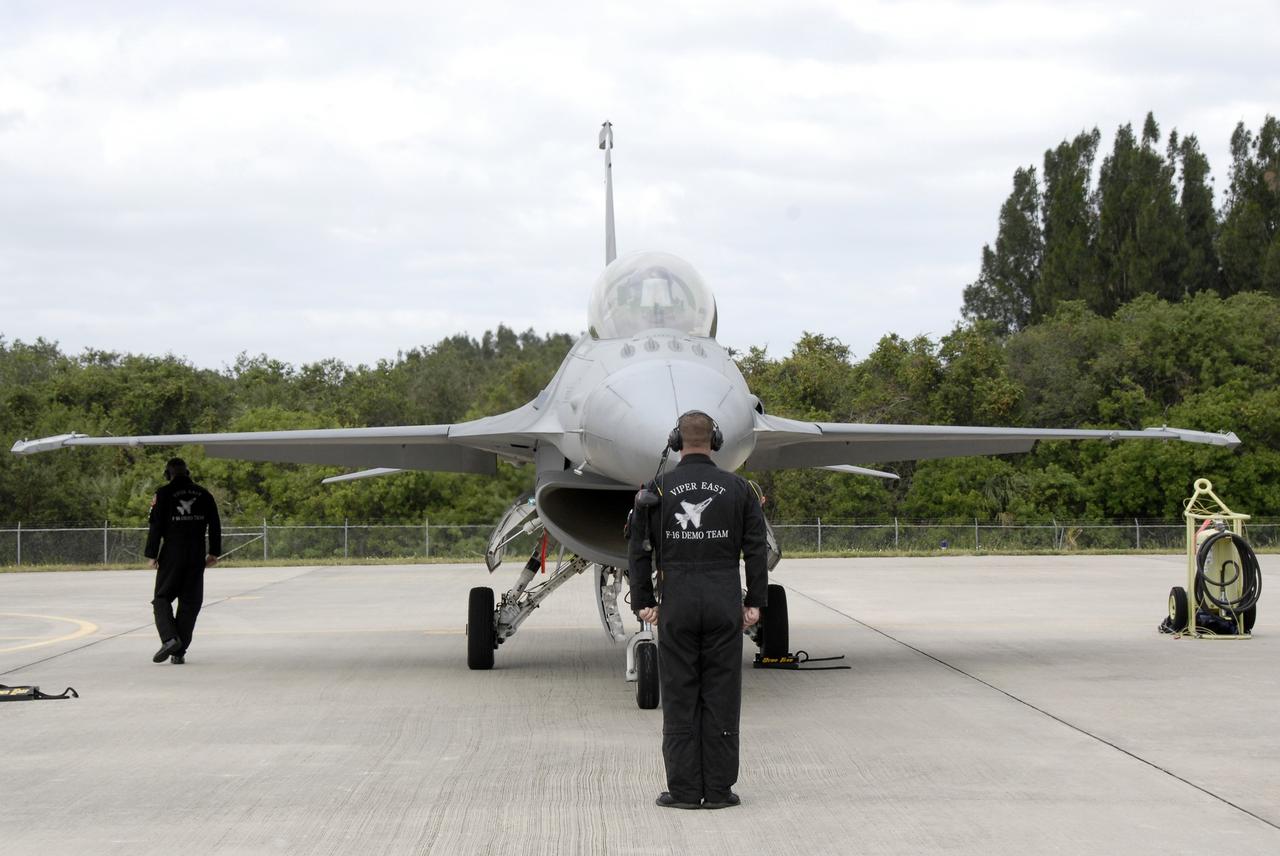
CAPE CANAVERAL, Fla. – Aircraft of the 920th Rescue Wing are lined up at the Shuttle Landing Facility at NASA's Kennedy Space Center in Florida to take part in the Kennedy Space Center Visitor Complex Space and Air Show Nov. 8-9. They will join the U.S. Navy's Blue Angels for the show. The Navy's elite flight demonstration squadron will take to the skies in military aircraft demonstrations by the F-16 Fighting Falcon and F/A-18 Super Hornet jets for the second annual Space & Air Show at Kennedy. This year’s show brings together the best in military aircraft, coupled with precision pilots and veteran astronauts to celebrate spaceflight and aviation. The event includes military aircraft demonstrations by the F-16 Fighting Falcon and a water rescue demonstration by the 920th Rescue Wing. Photo credit: NASA/Kim Shiflett
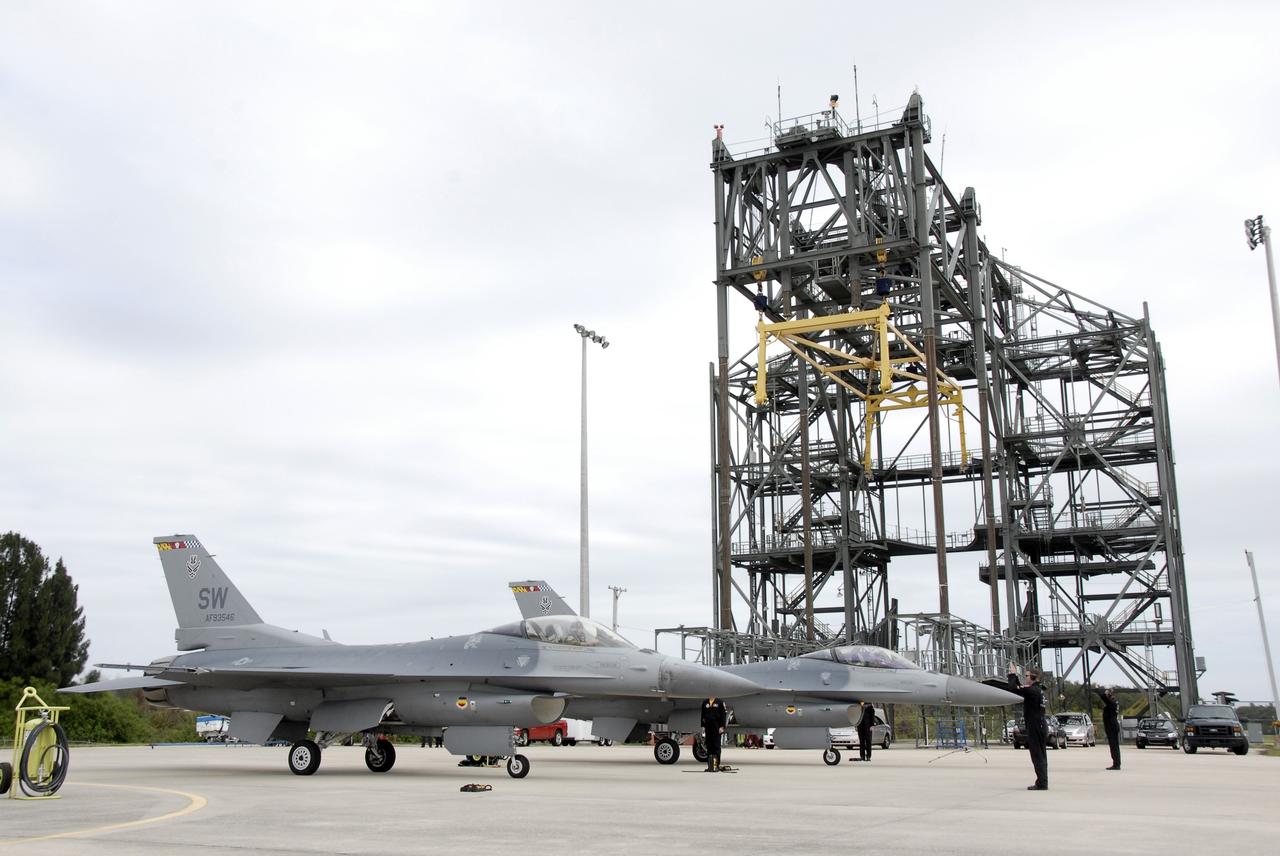
CAPE CANAVERAL, Fla. – Aircraft of the 920th Rescue Wing are lined up at the Shuttle landing Facility at NASA's Kennedy Space Center in Florida to take part in the Kennedy Space Center Visitor Complex Space and Air Show Nov. 8-9. They will join the U.S. Navy's Blue Angels for the show. The Navy's elite flight demonstration squadron will take to the skies in military aircraft demonstrations by the F-16 Fighting Falcon and F/A-18 Super Hornet jets for the second annual Space & Air Show at Kennedy. This year’s show brings together the best in military aircraft, coupled with precision pilots and veteran astronauts to celebrate spaceflight and aviation. The event includes military aircraft demonstrations by the F-16 Fighting Falcon and a water rescue demonstration by the 920th Rescue Wing. Photo credit: NASA/Kim Shiflett
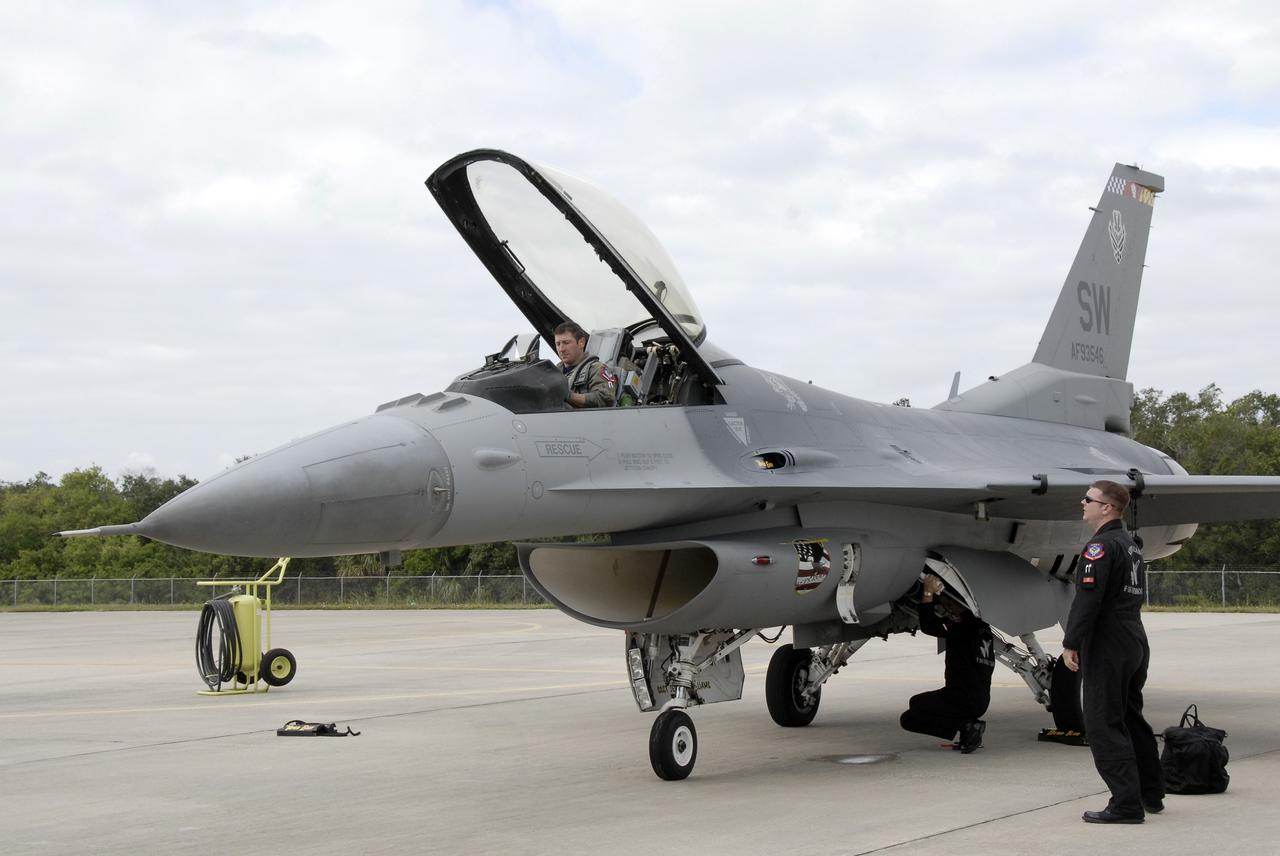
CAPE CANAVERAL, Fla. – A pilot with the 920th Rescue Wing gets ready to disembark his plane after landing at NASA's Kennedy Space Center in Florida. The Rescue Wing will join the U.S. Navy's Blue Angels for the Space and Air Show Nov. 8-9 at the Kennedy Space Center Visitor Complex. The Navy's elite flight demonstration squadron will take to the skies in military aircraft demonstrations by the F-16 Fighting Falcon and F/A-18 Super Hornet jets for the second annual Space & Air Show at Kennedy. This year’s show brings together the best in military aircraft, coupled with precision pilots and veteran astronauts to celebrate spaceflight and aviation. The event includes military aircraft demonstrations by the F-16 Fighting Falcon and a water rescue demonstration by the 920th Rescue Wing. Photo credit: NASA/Kim Shiflett
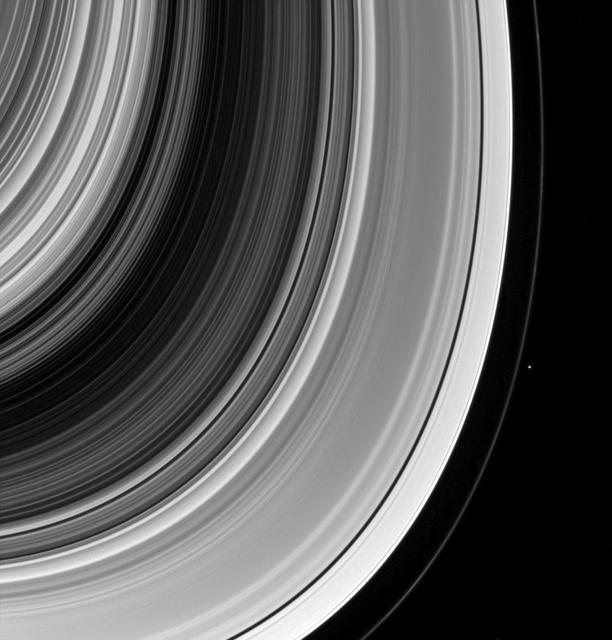
The F ring shepherd Pandora is captured here by NASA Cassini spacecraft along with other well-known examples of Saturn moons shaping the rings. From the narrow F ring, to the gaps in the A ring, to the Cassini Division, Saturn's rings are a masterpiece of gravitational sculpting by the moons. Pandora (50 miles, or 81 kilometers across), along with its fellow shepherd Prometheus (53 miles, or 86 kilometers across), helps confine the F ring and keep it from spreading. This view looks toward the unilluminated side of the rings from about 31 degrees below the ringplane. The image was taken in visible light with the Cassini spacecraft wide-angle camera on March 8, 2014. The view was obtained at a distance of approximately 533,000 miles (858,000 kilometers) from Saturn and at a Sun-Saturn-spacecraft, or phase, angle of 63 degrees. Image scale is 32 miles (51 kilometers) per pixel. http://photojournal.jpl.nasa.gov/catalog/PIA18271
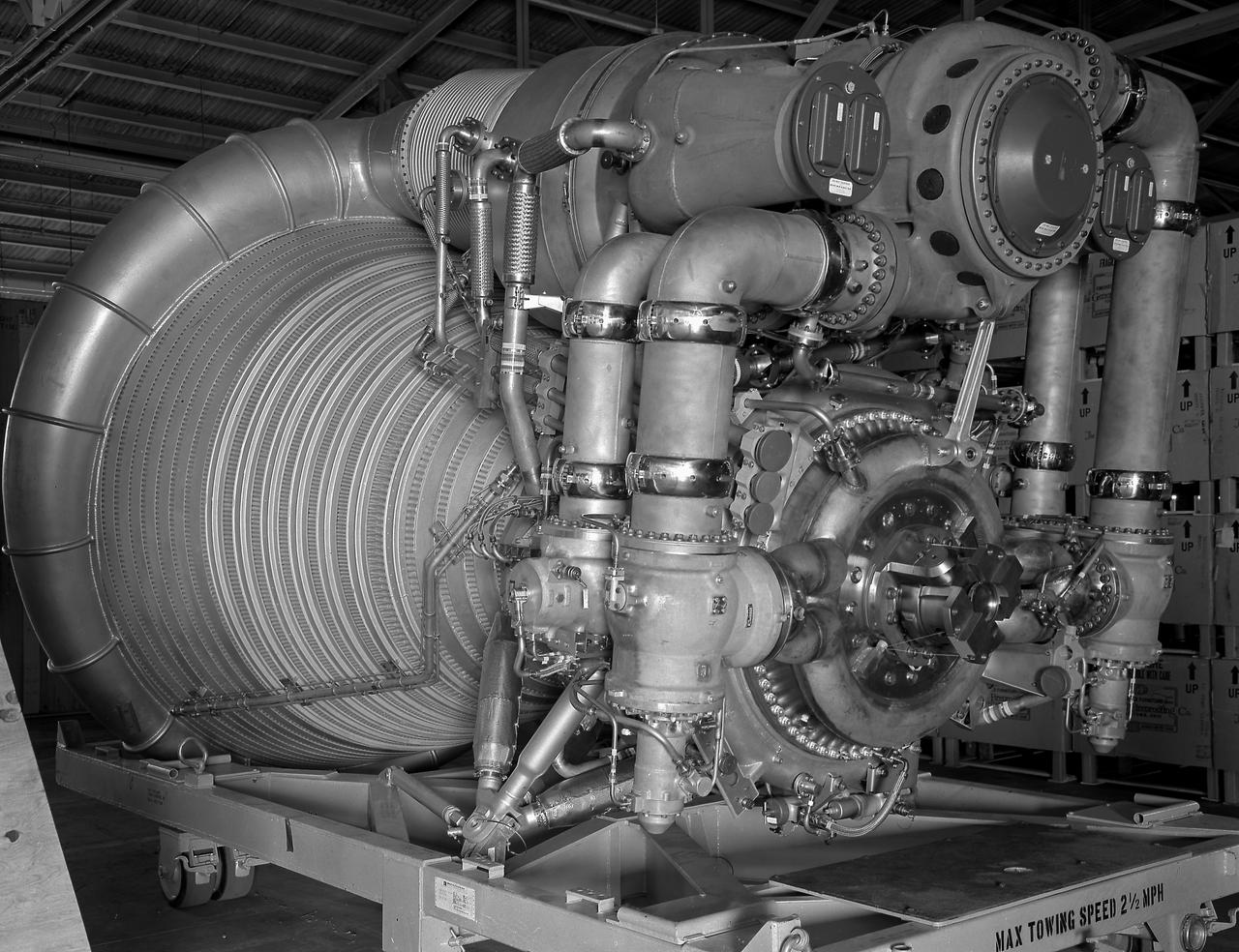
A close-up view of the F-1 Engine for the Saturn V S-IC (first) stage depicts the complexity of the engine. Developed by Rocketdyne under the direction of the Marshall Space Flight Center, the F-1 engine was utilized in a cluster of five engines to propel the Saturn V's first stage, the S-IC. Liquid oxygen and kerosene were used as its propellant. Initially rated at 1,500,000 pounds of thrust, the engine was later uprated to 1,522,000 pounds of thrust after the third Saturn V launch (Apollo 8, the first marned Saturn V mission) in December 1968. The cluster of five F-1 engines burned over 15 tons of propellant per second, during its two and one-half minutes of operation, to take the vehicle to a height of about 36 miles and to a speed of about 6,000 miles per hour.
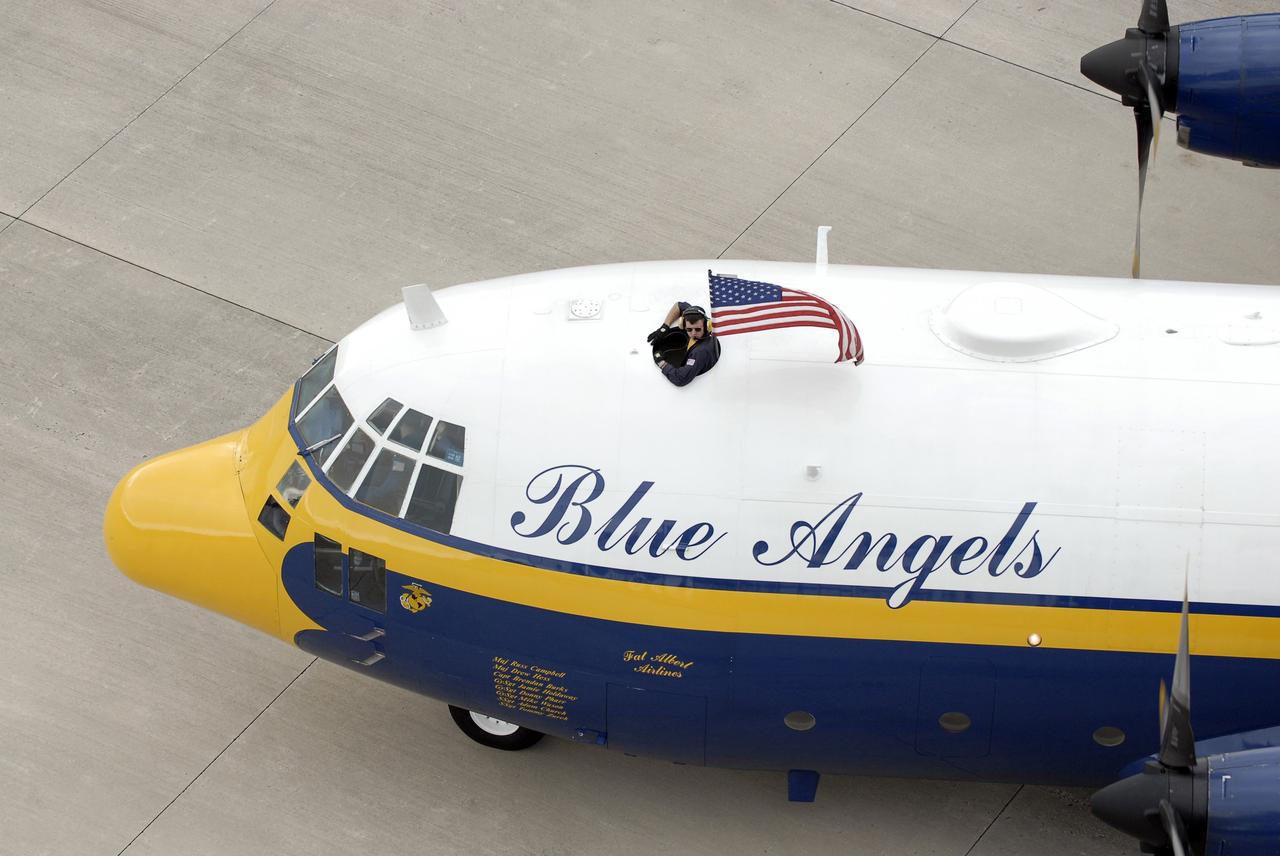
CAPE CANAVERAL, Fla. – A C-130 airplane flown by U.S. Marines stops at the Shuttle Landing Facility at NASA's Kennedy Space Center in Florida. The plane carries the support team for the U.S. Navy's Blue Angels, who are going to perform at the Kennedy Space Center Visitor Complex Space and Air Show Nov. 8-9. The Navy's elite flight demonstration squadron will take to the skies in military aircraft demonstrations by the F-16 Fighting Falcon and F/A-18 Super Hornet jets for the second annual Space & Air Show at Kennedy. This year’s show brings together the best in military aircraft, coupled with precision pilots and veteran astronauts to celebrate spaceflight and aviation. The event includes military aircraft demonstrations by the F-16 Fighting Falcon and a water rescue demonstration by the 920th Rescue Wing. Photo credit: NASA/Kim Shiflett
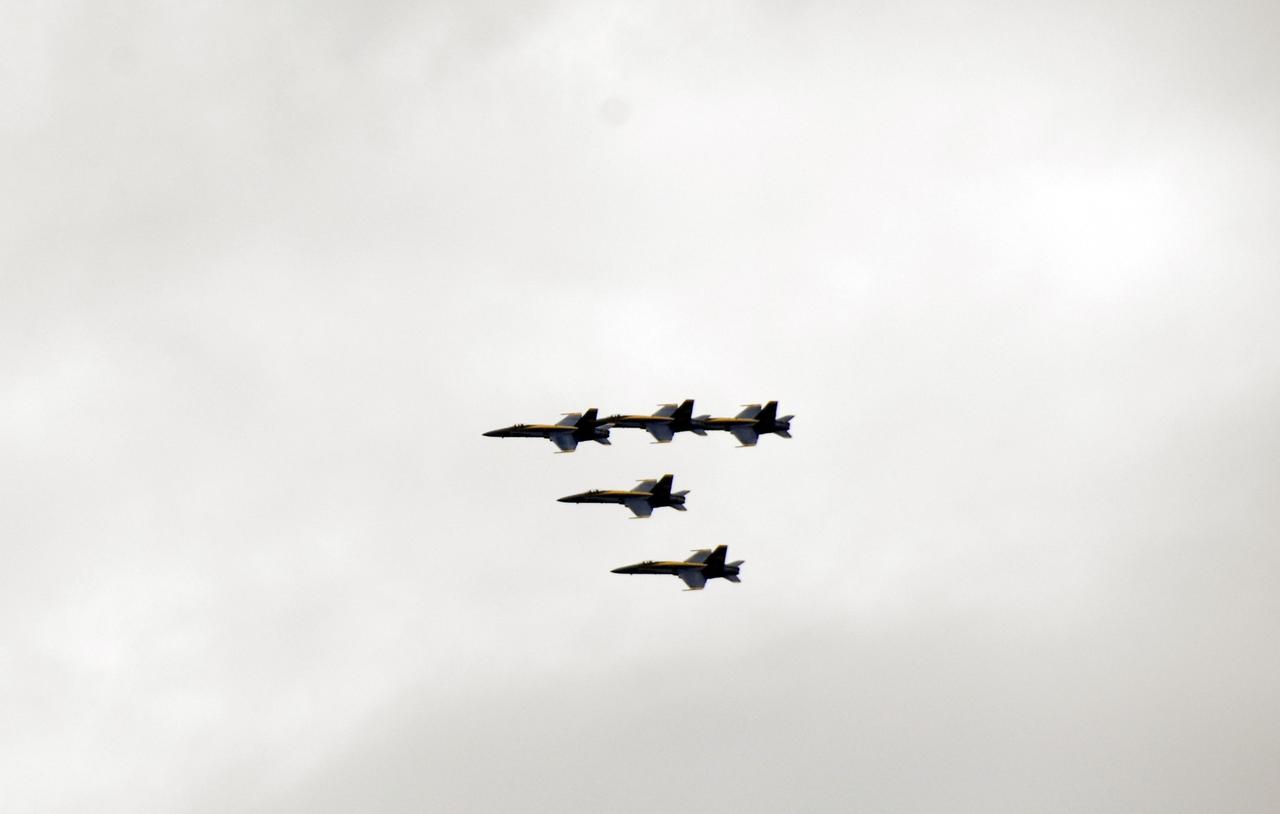
CAPE CANAVERAL, Fla. – The U.S. Navy's Blue Angels approach the Shuttle Landing Facility for a landing at NASA's Kennedy Space Center in Florida. They will perform at the Kennedy Space Center Visitor Complex Space and Air Show Nov. 8-9. The Navy's elite flight demonstration squadron will take to the skies in military aircraft demonstrations by the F-16 Fighting Falcon and F/A-18 Super Hornet jets for the second annual Space & Air Show at Kennedy. This year’s show brings together the best in military aircraft, coupled with precision pilots and veteran astronauts to celebrate spaceflight and aviation. The event includes military aircraft demonstrations by the F-16 Fighting Falcon and a water rescue demonstration by the 920th Rescue Wing. Photo credit: NASA/Kim Shiflett
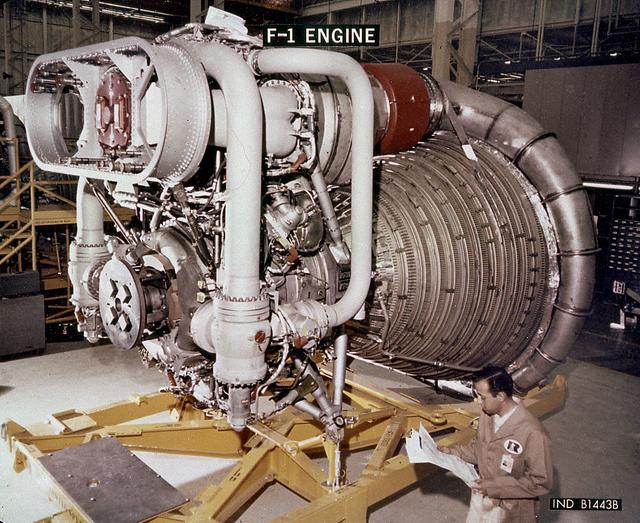
This close-up view of the F-1 engine for the Saturn V S-IC (first) stage shows the engine's complexity, and also its large size as it dwarfs the technician. Developed by Rocketdyne, under the direction of the Marshall Space Flight Center, the F-1 engine was utilized in a cluster of five engines to propel the Saturn V's first stage, the S-IC. Liquid oxygen and kerosene were used as its propellant. Initially rated at 1,500,000 pounds of thrust, the engine was later uprated to 1,522,000 pounds of thrust after the third Saturn V launch (Apollo 8, the first marned Saturn V mission) in December 1968. The cluster of five F-1 engines burned over 15 tons of propellant per second, during its two and one-half minutes of operation, to take the vehicle to a height of about 36 miles and to a speed of about 6,000 miles per hour.
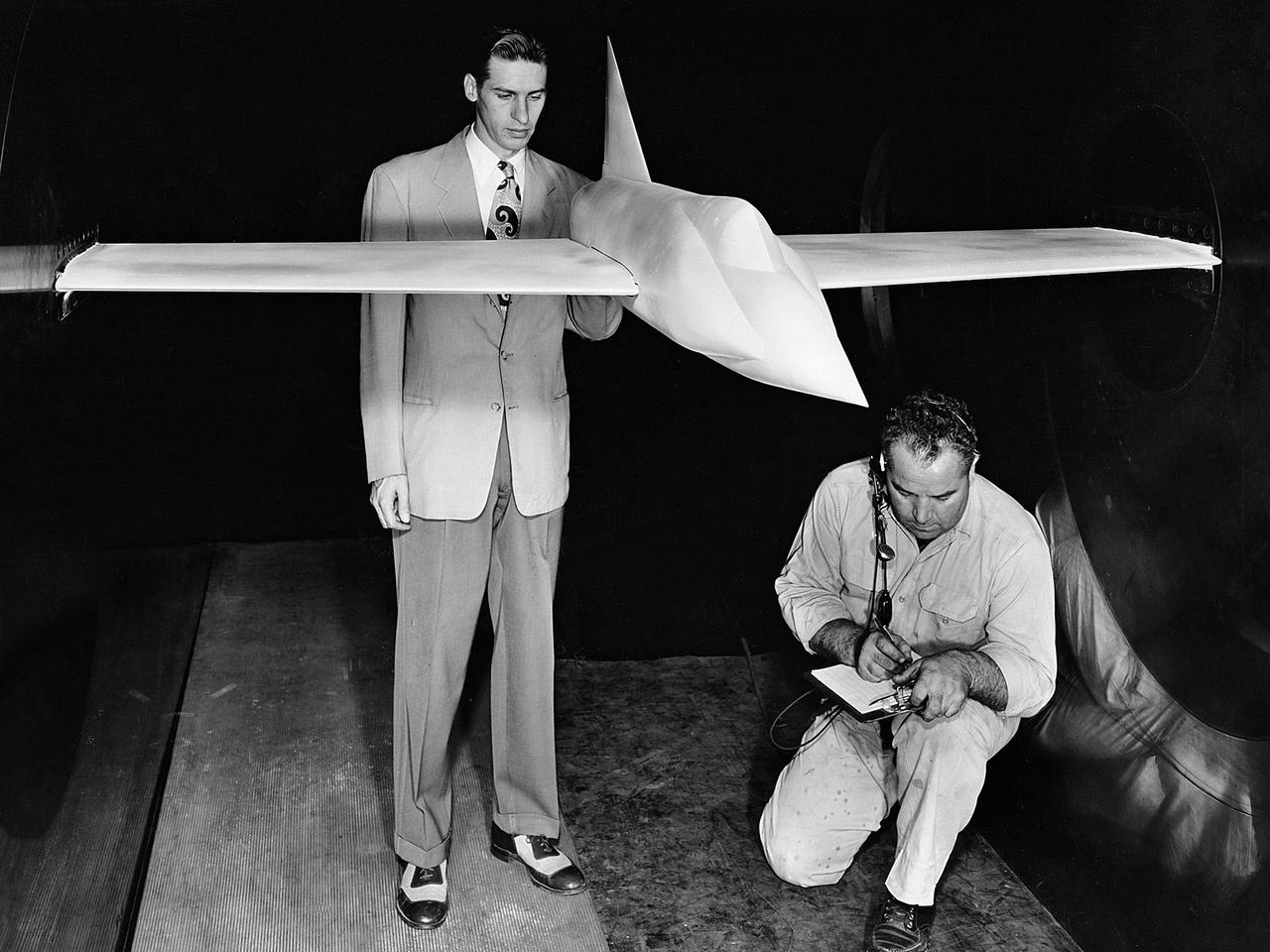
A .10-scale model of Convair’s XF-102 in the 8- by 6-Foot Supersonic Wind Tunnel at the National Advisory Committee for Aeronautics (NACA) Lewis Flight Propulsion Laboratory for jet exit studies. The XF-102 was a prototype of the F-102 Delta Dagger. The F-102 served as an interceptor against long range bombers from the Soviet Union. The aircraft was powered by a Pratt and Whitney J57 turbojet. The first prototype crashed two weeks after is first flight on October 24, 1953, just months after this photograph. Engineers then incorporated the fixed-wing design to reduce drag at supersonic speeds. The production model F-102 became the first delta-wing supersonic aircraft in operation. The 8- by 6-Foot Supersonic Wind Tunnel is used to study propulsion systems, including inlets and exit nozzles, combustion fuel injectors, flame holders, exit nozzles, and controls on ramjet and turbojet engines. Flexible sidewalls alter the tunnel’s nozzle shape to vary the Mach number during operation. A seven-stage axial compressor, driven by three electric motors that yield a total of 87,000 horsepower, generates air speeds from Mach 0.36 to 2.0.
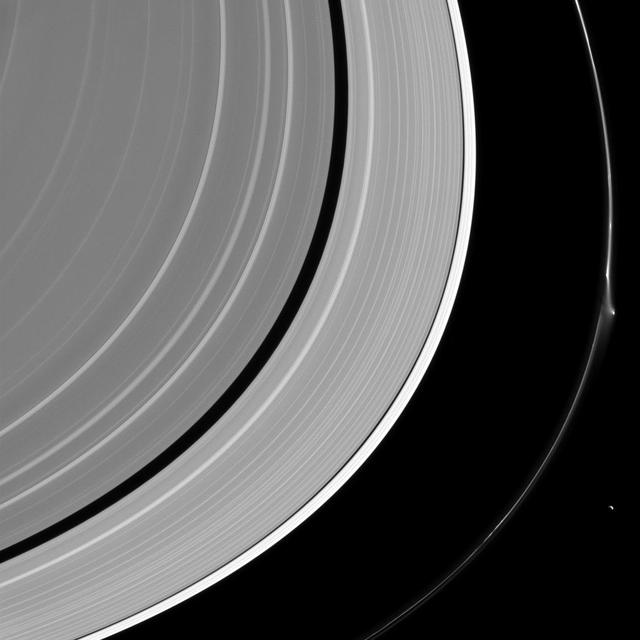
A bright disruption in Saturn's narrow F ring suggests it may have been disturbed recently. This feature was mostly likely not caused by Pandora (50 miles or 81 kilometers across) which lurks nearby, at lower right. More likely, it was created by the interaction of a small object embedded in the ring itself and material in the core of the ring. Scientists sometimes refer to these features as "jets." Because these bodies are small and embedded in the F ring itself, they are difficult to spot at the resolution available to NASA's Cassini spacecraft. Instead, their handiwork reveals their presence, and scientists use the Cassini spacecraft to study these stealthy sculptors of the F ring. This view looks toward the sunlit side of the rings from about 15 degrees above the ring plane. The image was taken in visible light with the Cassini spacecraft narrow-angle camera on April 8, 2016. The view was acquired at a distance of approximately 1.4 million miles (2.2 million kilometers) from Saturn and at a Sun-Saturn-spacecraft, or phase, angle of 105 degrees. Image scale is 8 miles (13 kilometers) per pixel. http://photojournal.jpl.nasa.gov/catalog/PIA20485
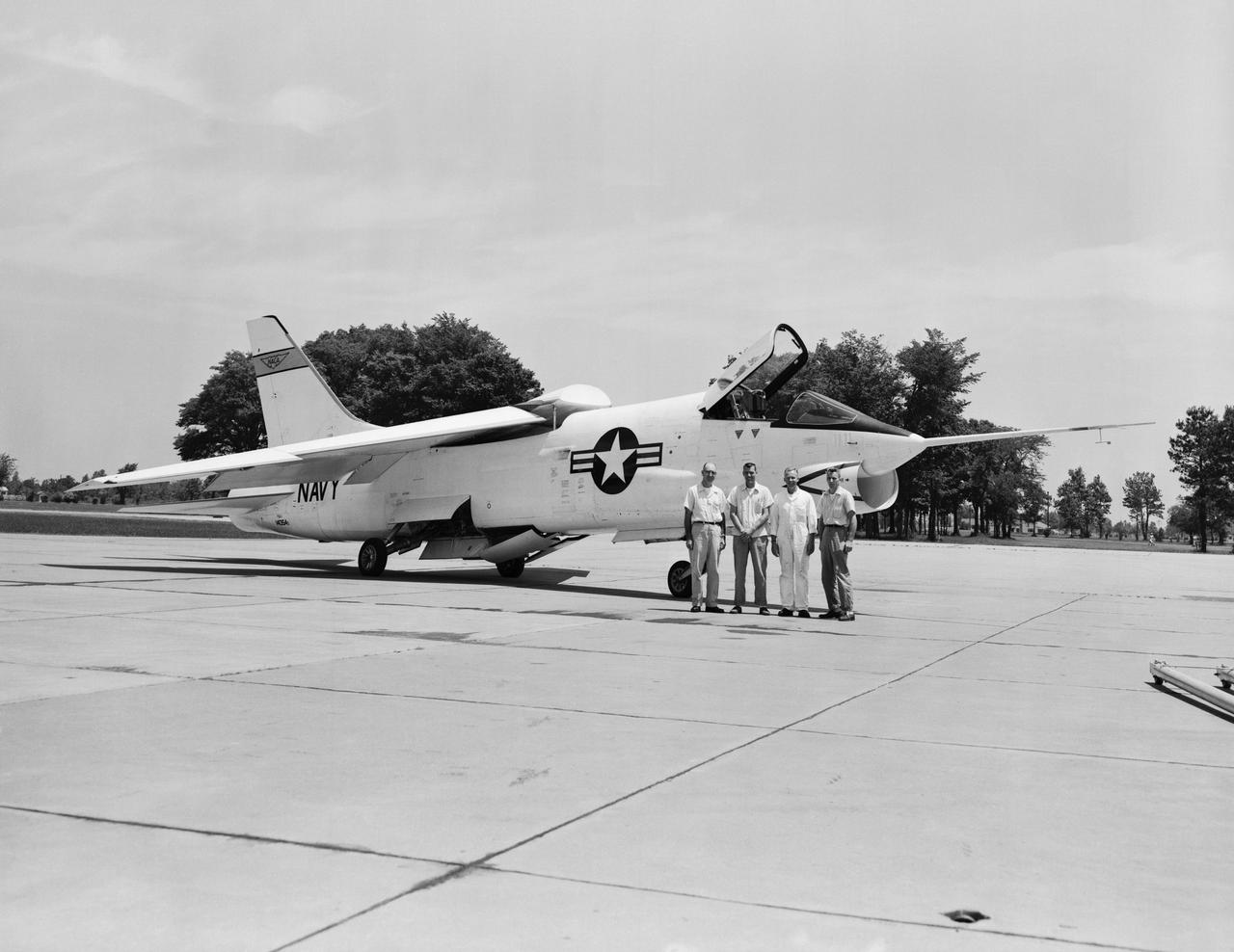
Views of F-8U Crusader Aircraft at NASA Langley
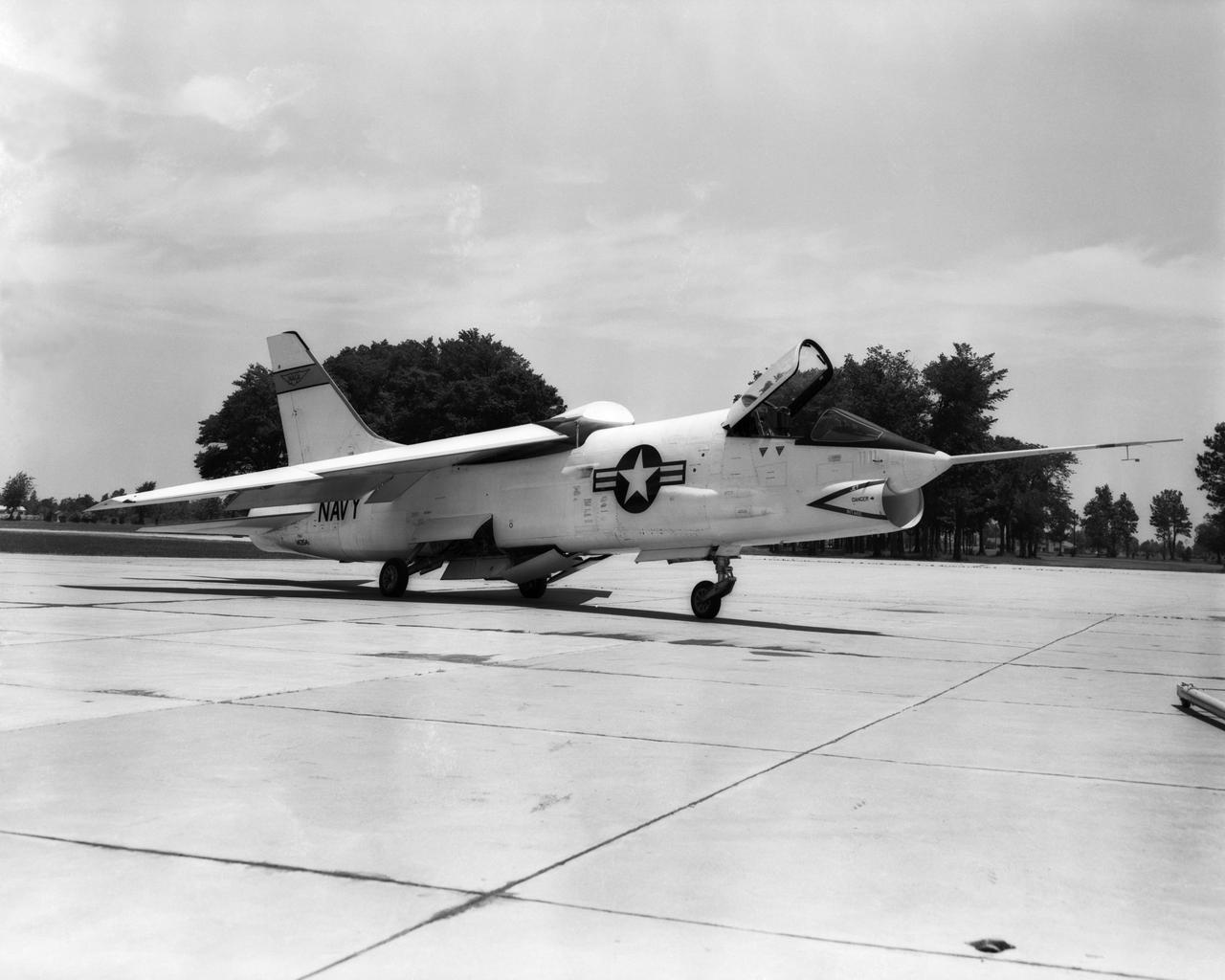
Views of F-8U Crusader Aircraft at NASA Langley
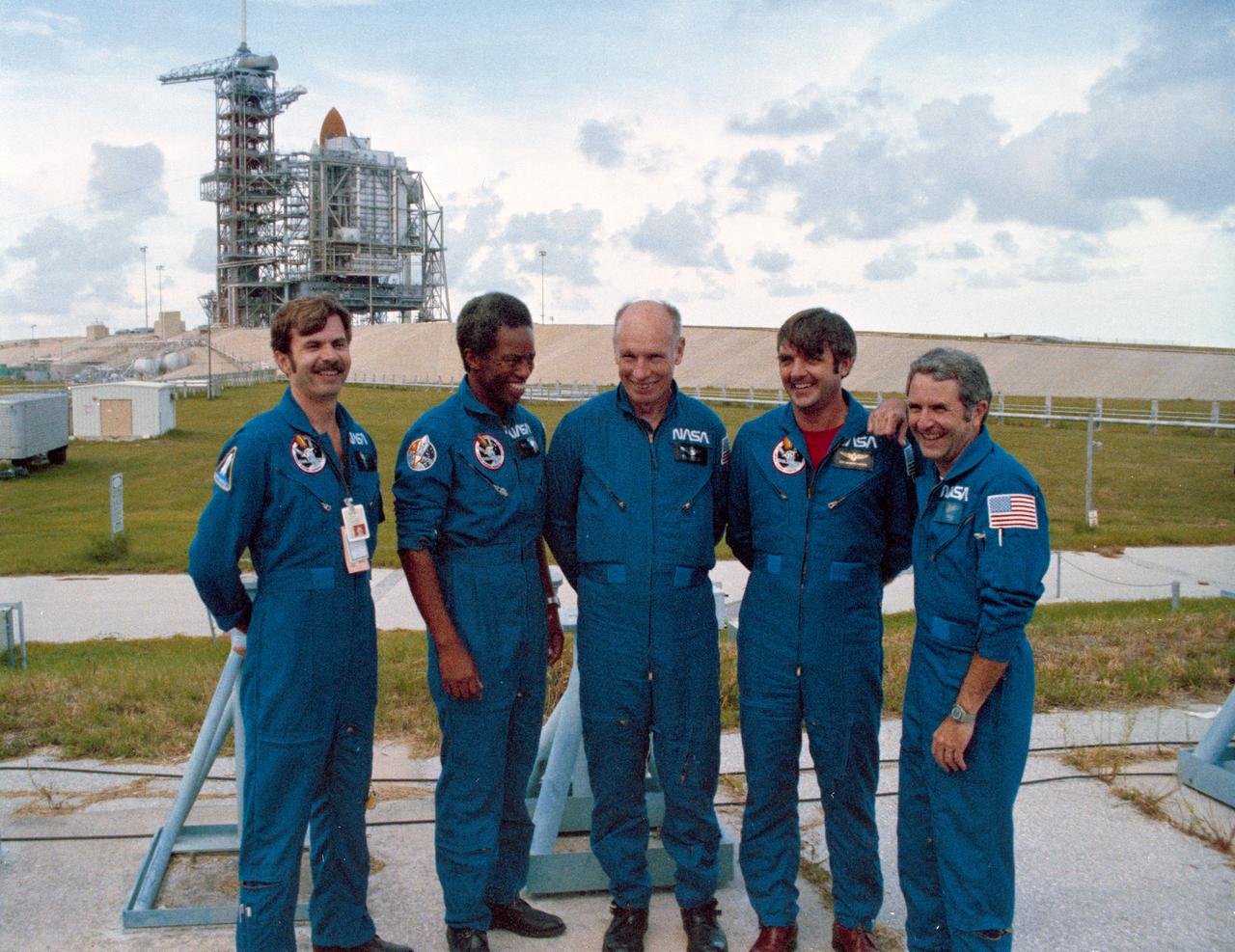
S83-38389 (6 Aug. 1983) --- The STS-8 crew members pause for a crew photo at Pad 39A after a question and answer session with the press. They were about to participate in the STS-8 countdown demonstration test. They will repeat many of their measures on Aug. 30 when they are scheduled to lift off aboard the space shuttle Challenger. From left to right are astronauts Dale A. Gardner, Guion S. Bluford, Dr. William E. Thornton, all mission specialists; Daniel C. Brandenstein, pilot; and Richard F. Truly, commander. The Challenger is in the background at complex 39.
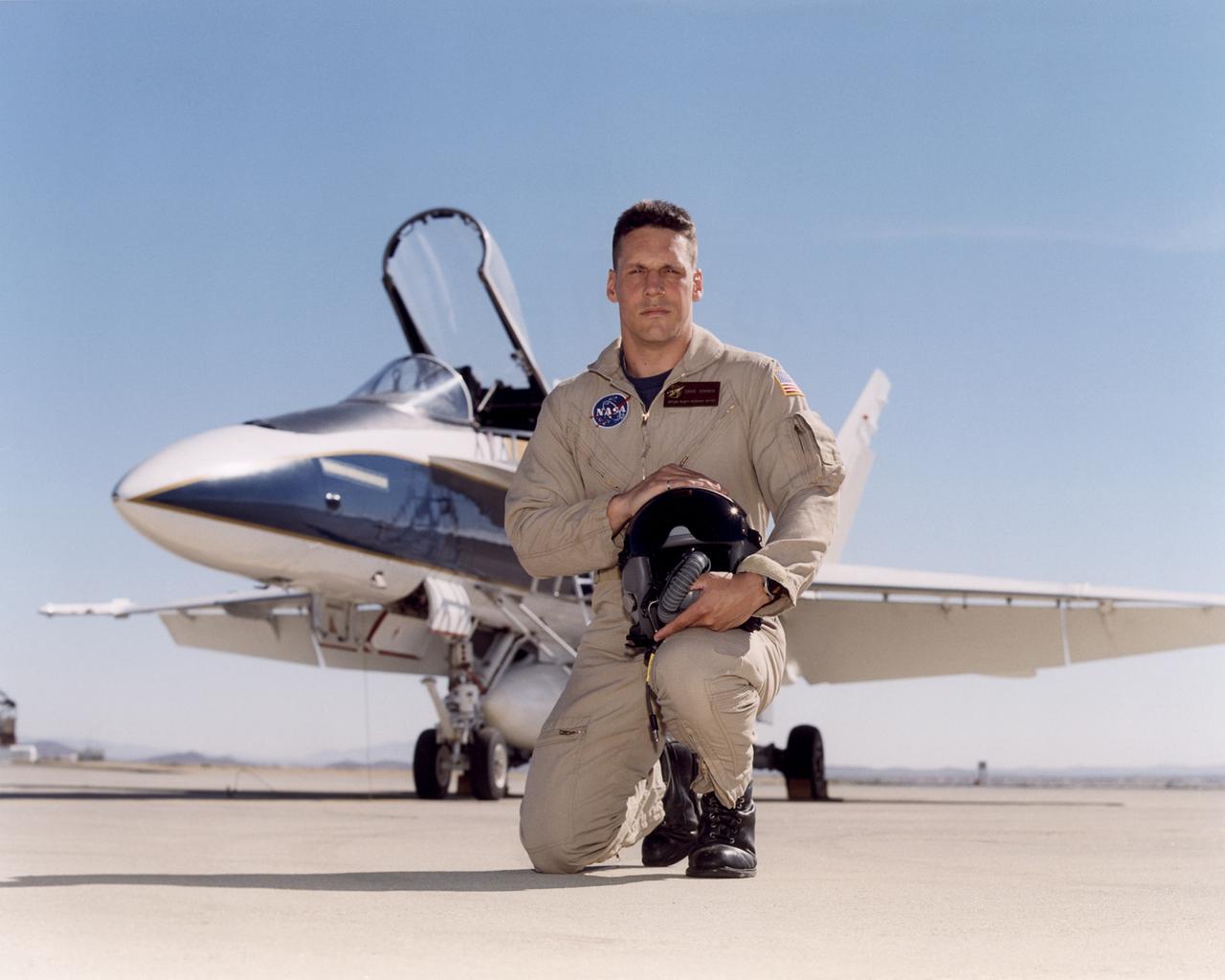
Craig R. Bomben became a pilot in the Flight Crew Branch of NASA's Dryden Flight Research Center, Edwards, Calif., in June 2001. His flying duties include a variety of research and support activities while piloting the F/A-18, DC-8, T-34C and King Air aircraft. He has more than 17 years and 3,800 hours of military and civilian flight experience in over 50 different aircraft types. Bomben came to NASA Dryden from a U.S. Navy assignment to the Personnel Exchange Program, Canada. He served as a test pilot in the Canadian Armed Forces located in Cold Lake, Alberta. He participated in numerous developmental programs to include CT-133 airborne ejection seat testing, F/A-18 weapons flutter testing and F/A-18 night vision goggles integration. Bomben performed U.S. Navy fleet service in 1995 as a strike-fighter department head. He completed two overseas deployments onboard the USS George Washington and USS Stennis. As a combat strike leader, he headed numerous multi-national missions over Iraq in support of Operation Southern Watch. Bomben graduated from the U.S. Naval Test Pilot School in 1992 and was subsequently assigned to the Naval Weapons Test Squadron at Pt. Mugu, Calif. During this tour he developed the F-14D bombsight and worked on various other F-14D and F/A-18 weapon systems developmental programs. Bomben is a 1985 graduate of Washington State University with a bachelor of science degree in electrical engineering. He graduated from naval flight training in 1987 and was recognized as a Commodore List graduate. His first assignment was to Naval Air Station Pensacola, Fla., where he was an instructor in the T-2B Buckeye. When selected to fly the F/A-18 in 1989, he joined a fleet squadron and deployed aboard the USS Forrestal. Bomben is married to the former Aissa Asuncion. They live in Lancaster, Calif., with their 3 children.
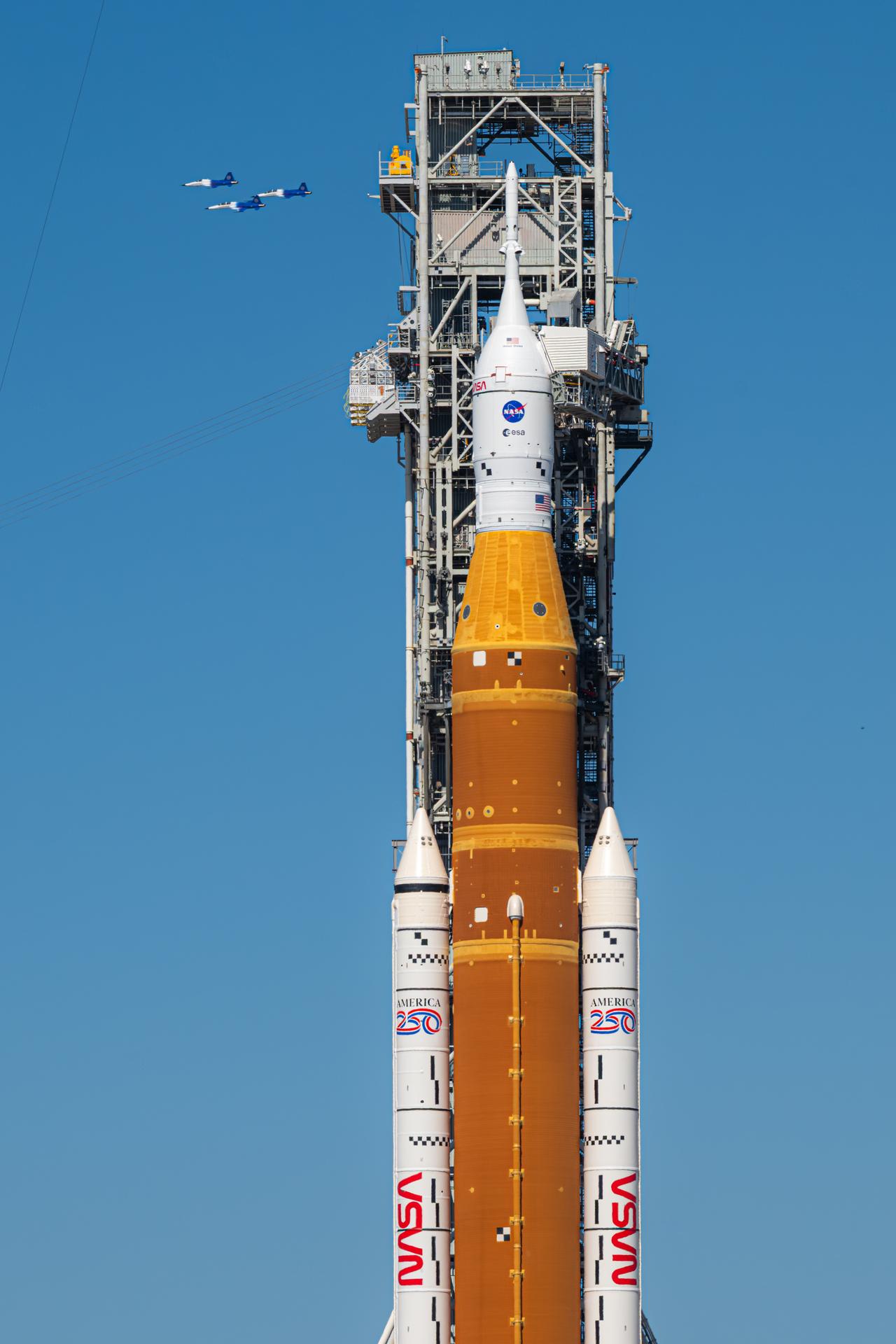
NASA Administrator Jared Isaacman conducts a formation flight with three of his personal F-5 aircraft, Sunday, Feb. 8, 2026, at NASA’s Kennedy Space Center in Florida. The formation flew near the Artemis II SLS (Space Launch System) rocket and Orion spacecraft at Launch Complex 39B and the surrounding area at Kennedy. Photo Credit: (NASA/John Kraus)
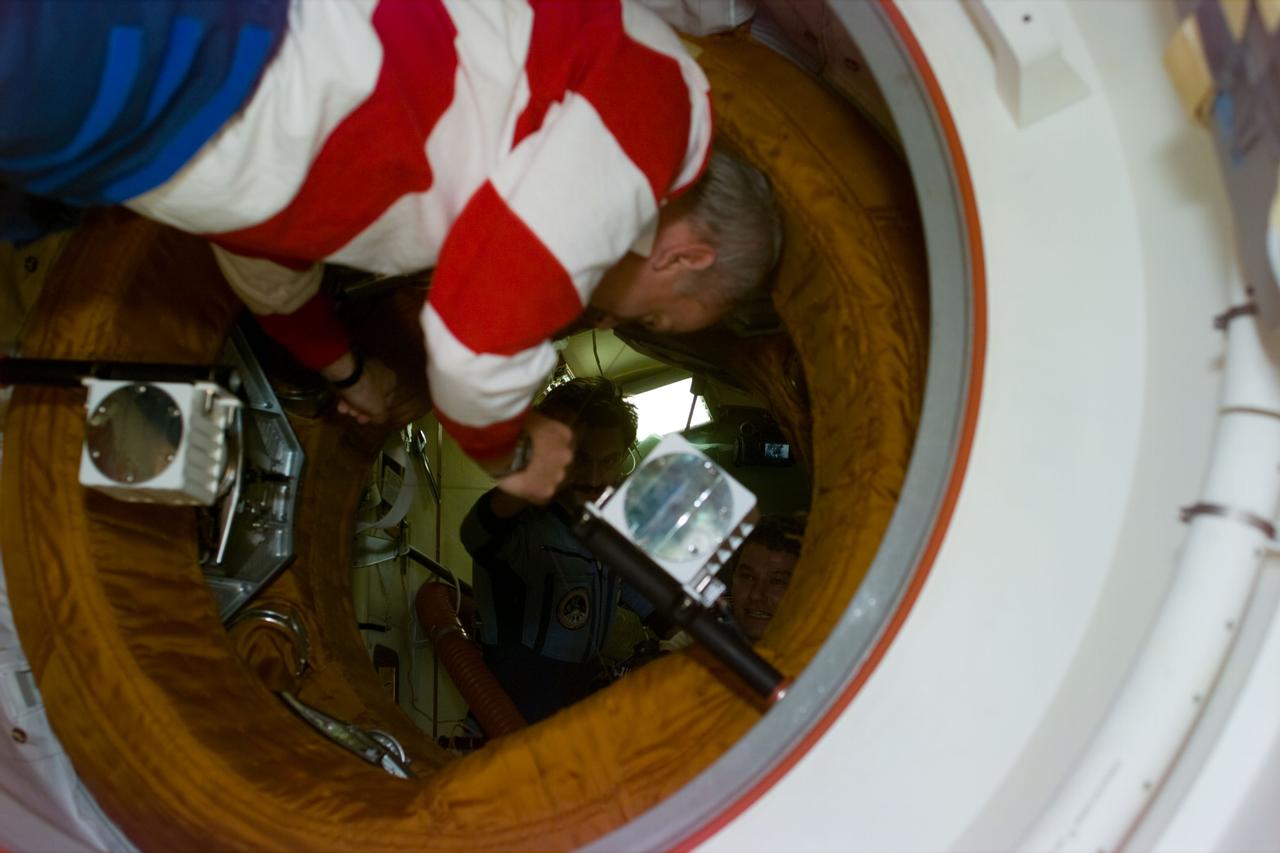
STS79-E-5300 (23 September 1996) --- Astronaut William F. Readdy (foreground), STS-79 commander, bids farewell to Russian cosmonauts Aleksandr Y. Kaleri (left in background), Mir-22 flight engineer, and Valeri G. Korzun, Mir-22 commander, just prior to hatch closing, during Flight Day 8. The Americans and Russians will undock the Space Shuttle Atlantis and the Russia's Mir Space Station later today.
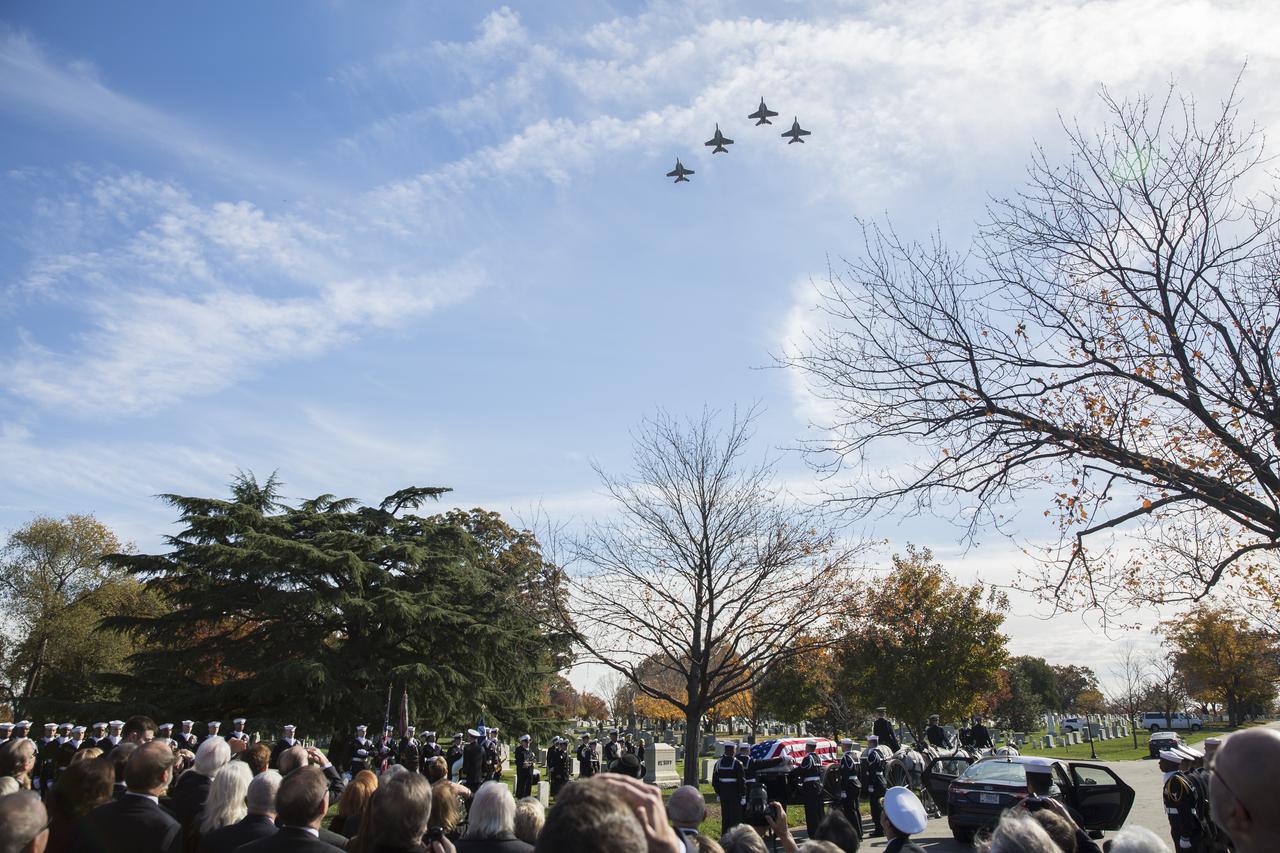
U.S. Navy F/A-18 Super Hornets conduct a flyover during interment services for former astronaut Alan Bean, Thursday, Nov. 8, 2018 at Arlington National Cemetery in Virginia. Selected as an astronaut in 1963, Bean flew in space twice, becoming the fourth human to walk on the Moon on Nov. 19, 1969 and spent 59 days in space as commander of the second Skylab mission in 1973. Photo Credit: (NASA/Joel Kowsky)
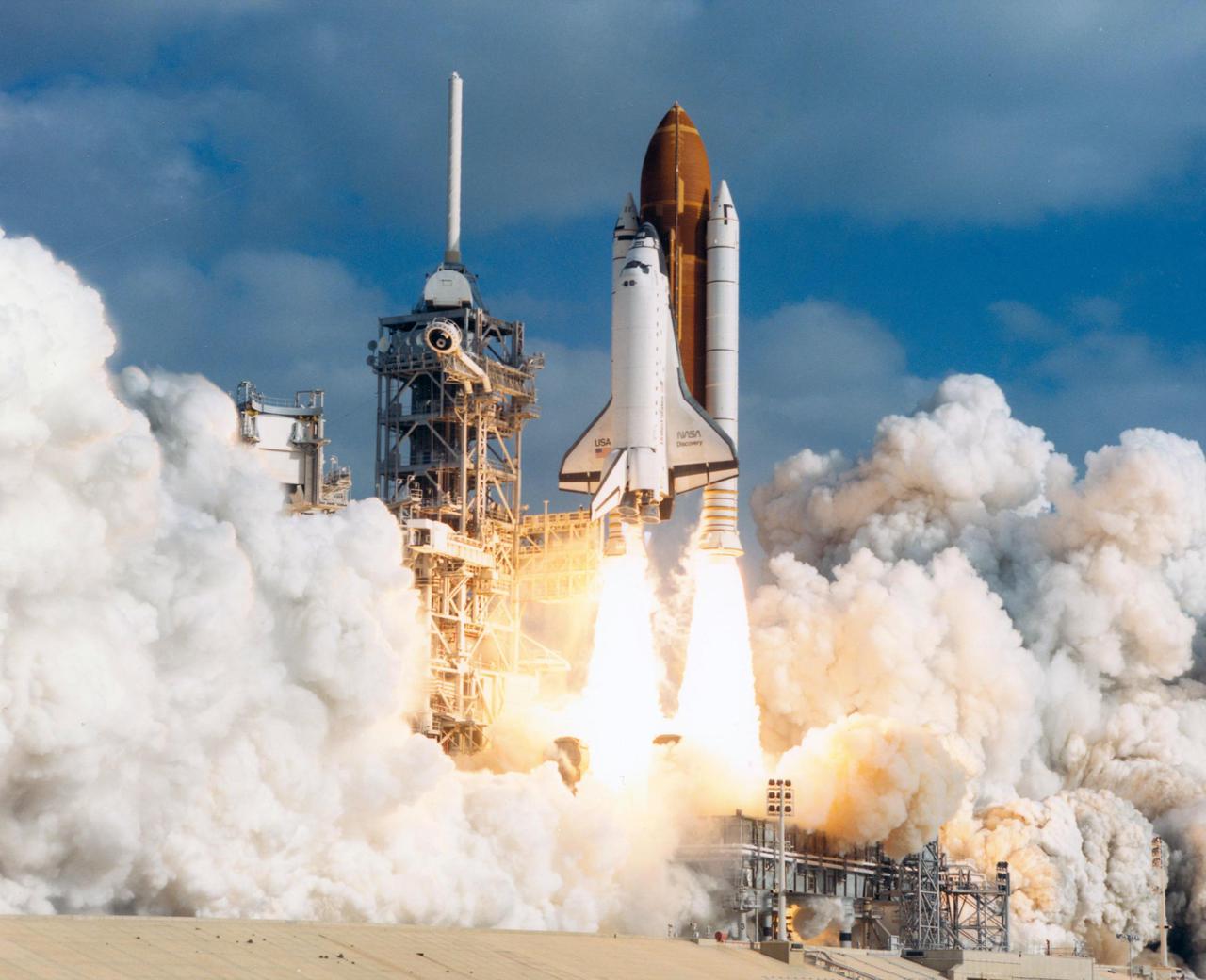
KENNEDY SPACE CENTER, FLA. -- The Space Shuttle Discovery soars into the morning skies above Florida, carying a crew of five and the Hubble Space Telescope. Launch of Space Shuttle Mission STS-31from Pad 39B occurred at 8:33:51 a.m. EDT, April 24. Crew members are Commander Loren J. Shriver; Pilot Charles F. Bolden Jr.; and Mission Specialists Kathryn D. Sullivan, Steven A. Hawley, and Bruce McCandless II.
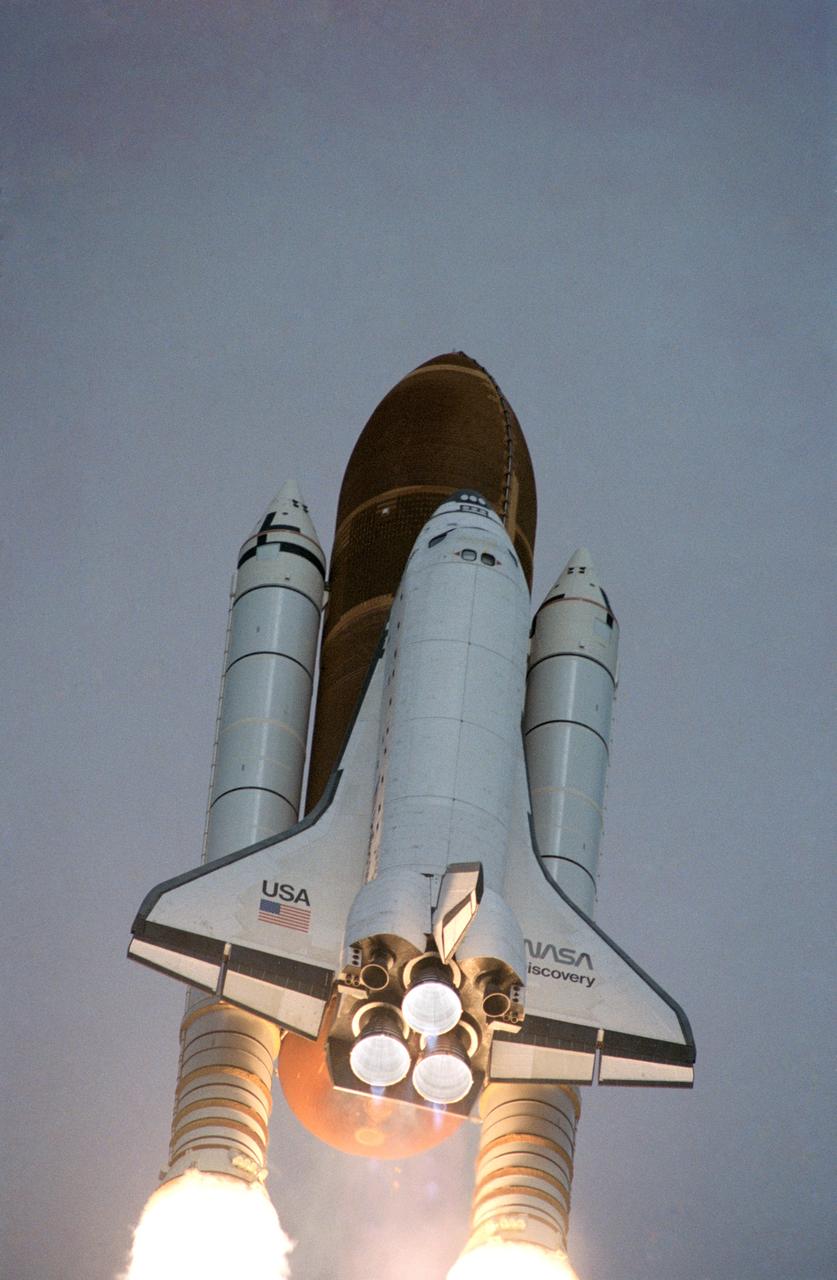
STS031-S-074 (24 April 1990) --- A low-angle view of the launch of the STS-31 mission. Onboard Discovery are a crew of five veteran astronauts and the Hubble Space Telescope (HST). Official launch time was 8:33:51.0492 a.m. (EDT). Headed for approximately five days in space are astronauts Loren J. Shriver, Charles F. Bolden Jr., Bruce McCandless II, Kathryn D. Sullivan and Steven S. Hawley.
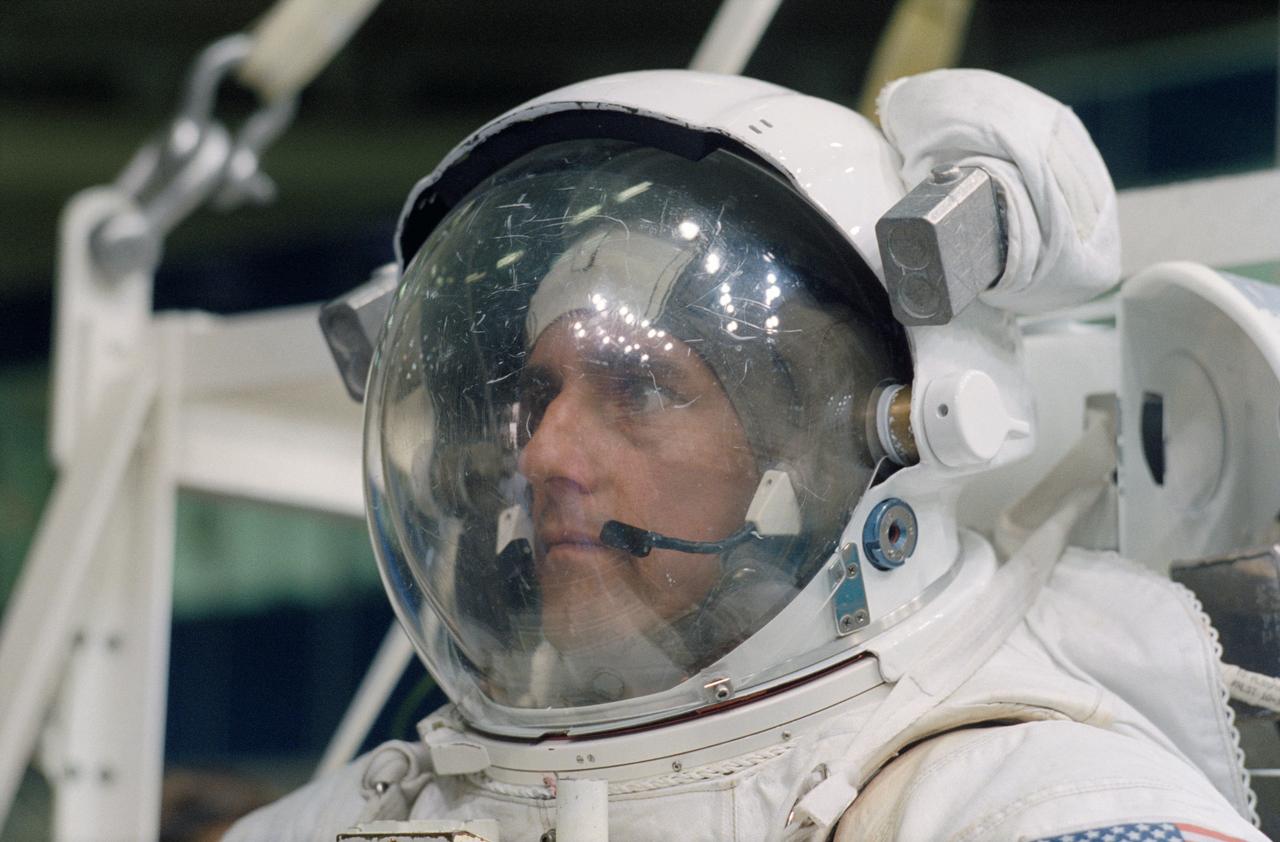
S94-29978 (8 March 1994) --- Astronaut Donald A. Thomas, mission specialist, prepares to be lowered into a 25-feet deep pool at the Johnson Space Center's (JSC) Weightless Environment Training Facility (WET-F). Astronauts Thomas and Leroy Chiao were about to be submerged and made to be neutrally buoyant in order to rehearse several contingency tasks that would require a spacewalk. No spacewalks are scheduled for the International Microgravity Laboratory (IML-2).
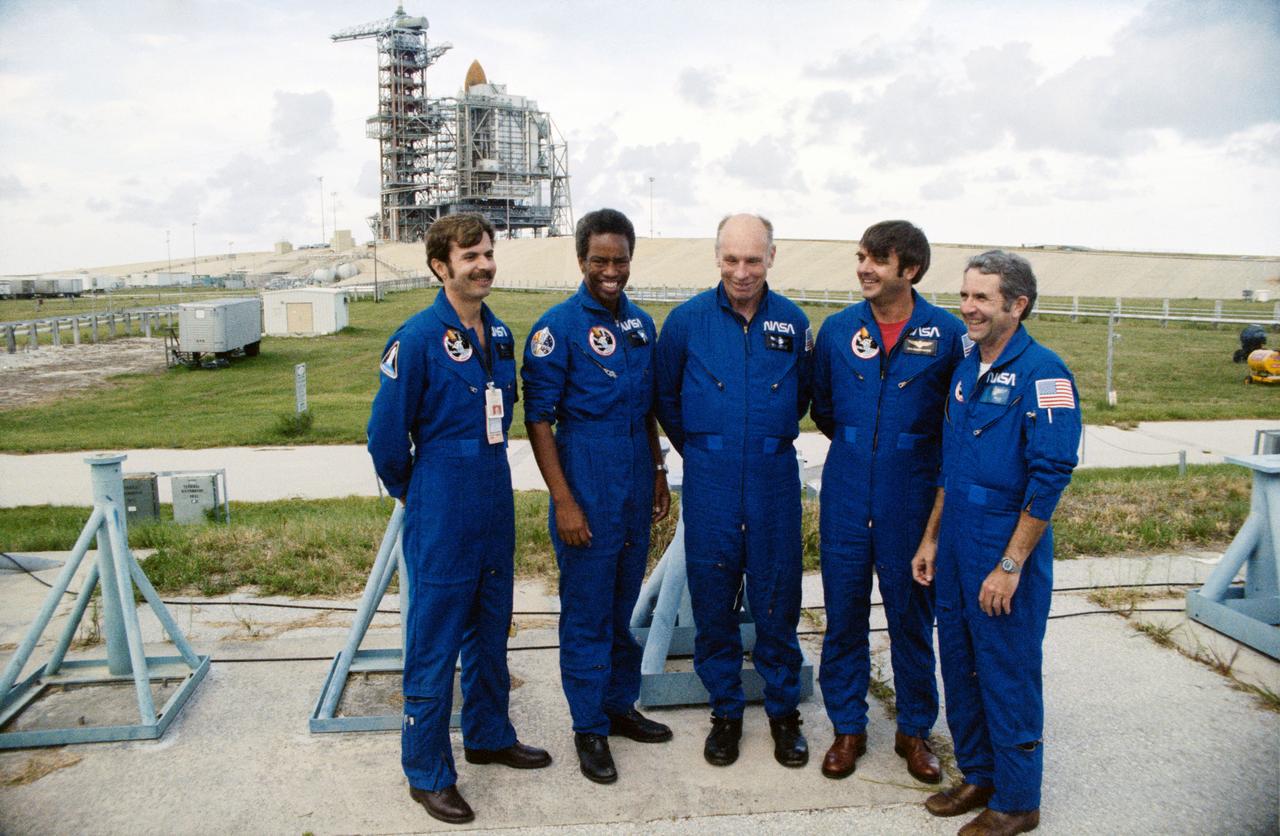
S83-38479 (16 Aug 1983) --- STS-8 crew poses at pad 39A at Kennedy Space Center (KSC) during a session with the news media. From left to right are Astronauts Dale A. Gardner, Guion S. Bluford, and Dr. William E. Thornton, all mission specialists; Daniel C. Brandenstein, pilot; and Richard F. Truly, crew commander.
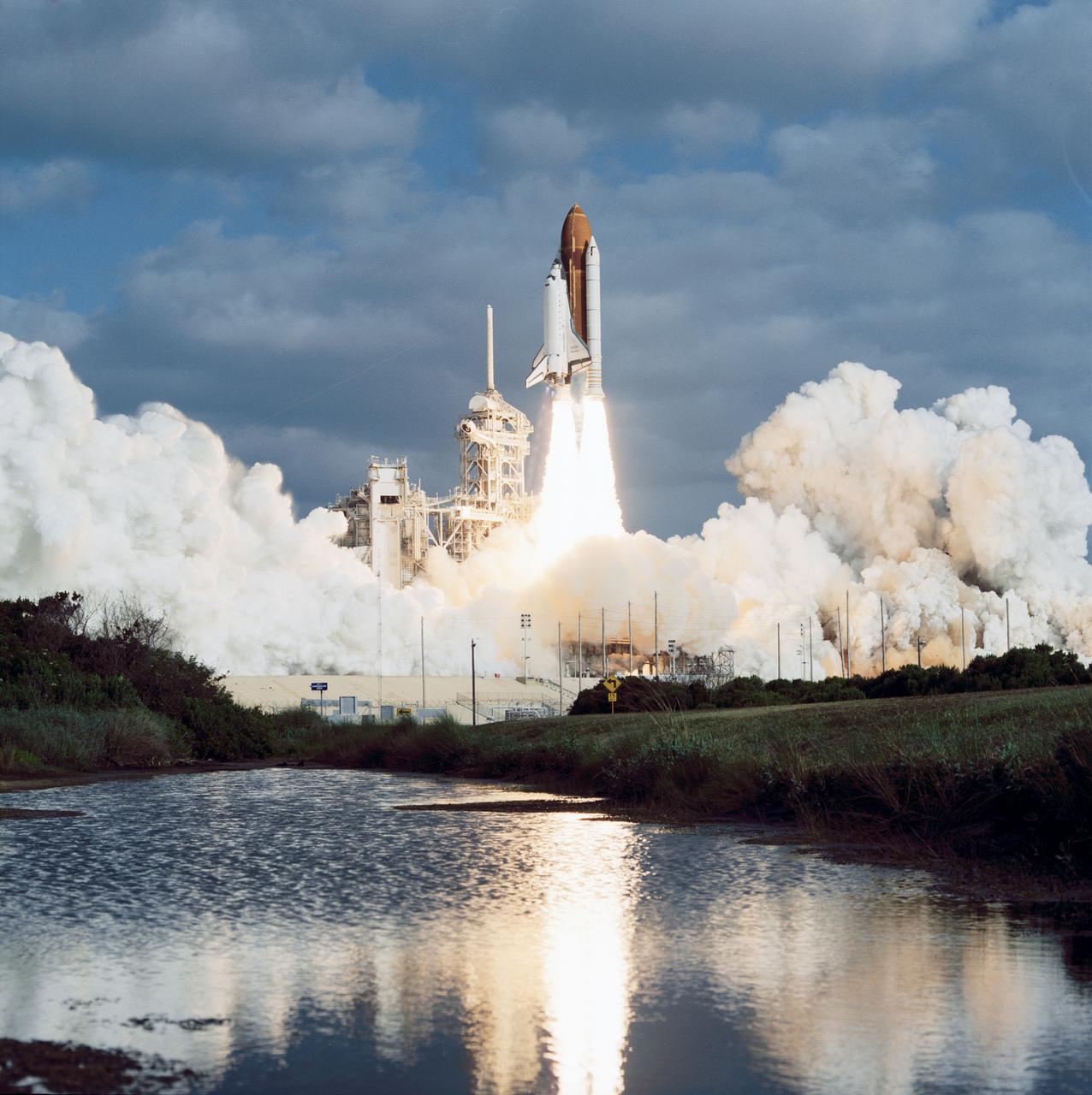
STS031-S-064 (24 April 1990) --- A horizontal view of the launch of the STS-31 mission. Onboard Space Shuttle Discovery are the crew of five veteran astronauts and the Hubble Space Telescope (HST). Official launch time was 8:33:51.0492 a.m. (EDT). Headed for approximately five days in space are astronauts Loren J. Shriver, Charles F. Bolden, Jr., Bruce McCandless, II, Kathryn D. Sullivan, and Steven A. Hawley.
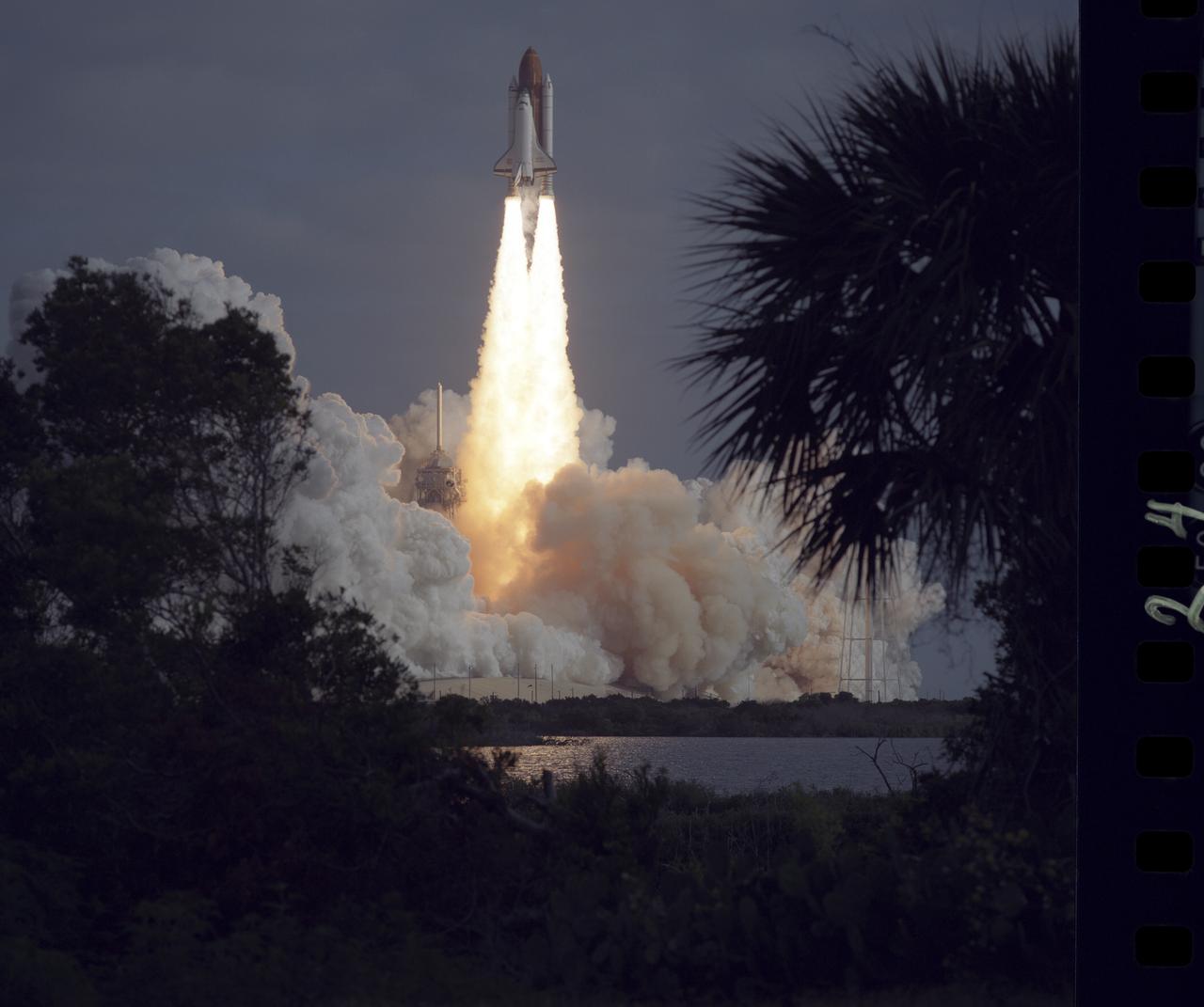
The STS-31 crew launched aboard the Space Shuttle Discovery on April 24, 1990 at 8:33:51am (EDT). Included in the crew of five were Loren J. Shriver, commander; Charles F. Bolden, pilot; and Steven A. Hawley, Bruce McCandless, and Kathryn D. Sullivan, all mission specialists. The primary goal of the mission was the deployment of the Hubble Space Telescope (HST) which was a Marshall Space Flight Center (MSFC) managed program.
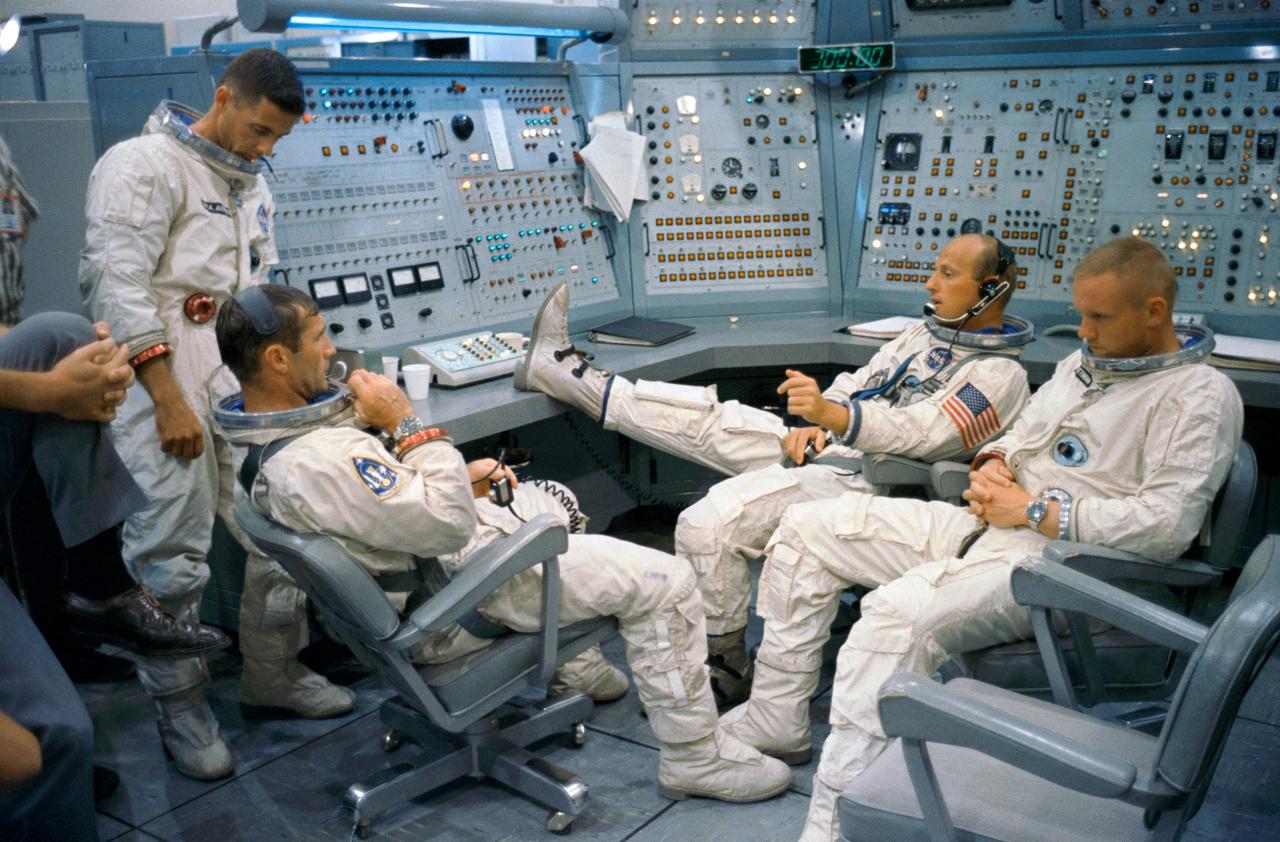
S66-50769 (8 Sept. 1966) --- Gemini-11 prime and backup crews are pictured at the Gemini Mission Simulator at Cape Kennedy, Florida. Left to right are astronauts William A. Anders, backup crew pilot; Richard F. Gordon Jr., prime crew pilot; Charles Conrad Jr. (foot on desk), prime crew command pilot; and Neil A. Armstrong, backup crew command pilot. Photo credit: NASA
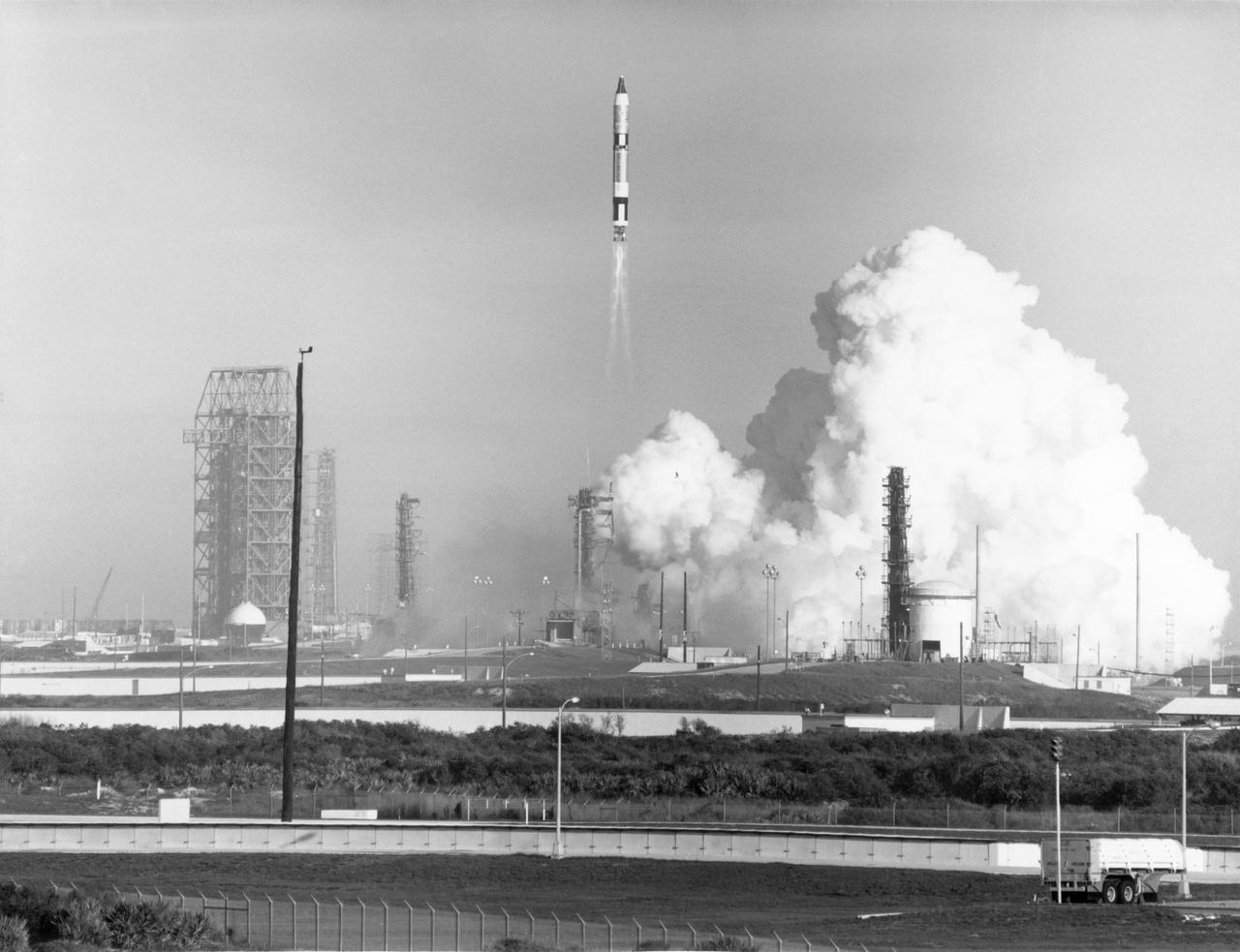
S65-44293 (15 Dec. 1965) --- Gemini-6, carrying astronauts Walter M. Schirra Jr., command pilot, and Thomas P. Stafford, pilot, was launched by the National Aeronautics and Space Administration?s John F. Kennedy Space Center at 8:37 a.m. (EST), Dec. 15, 1965. Gemini-6 completed a highly successful rendezvous mission with Gemini-7.
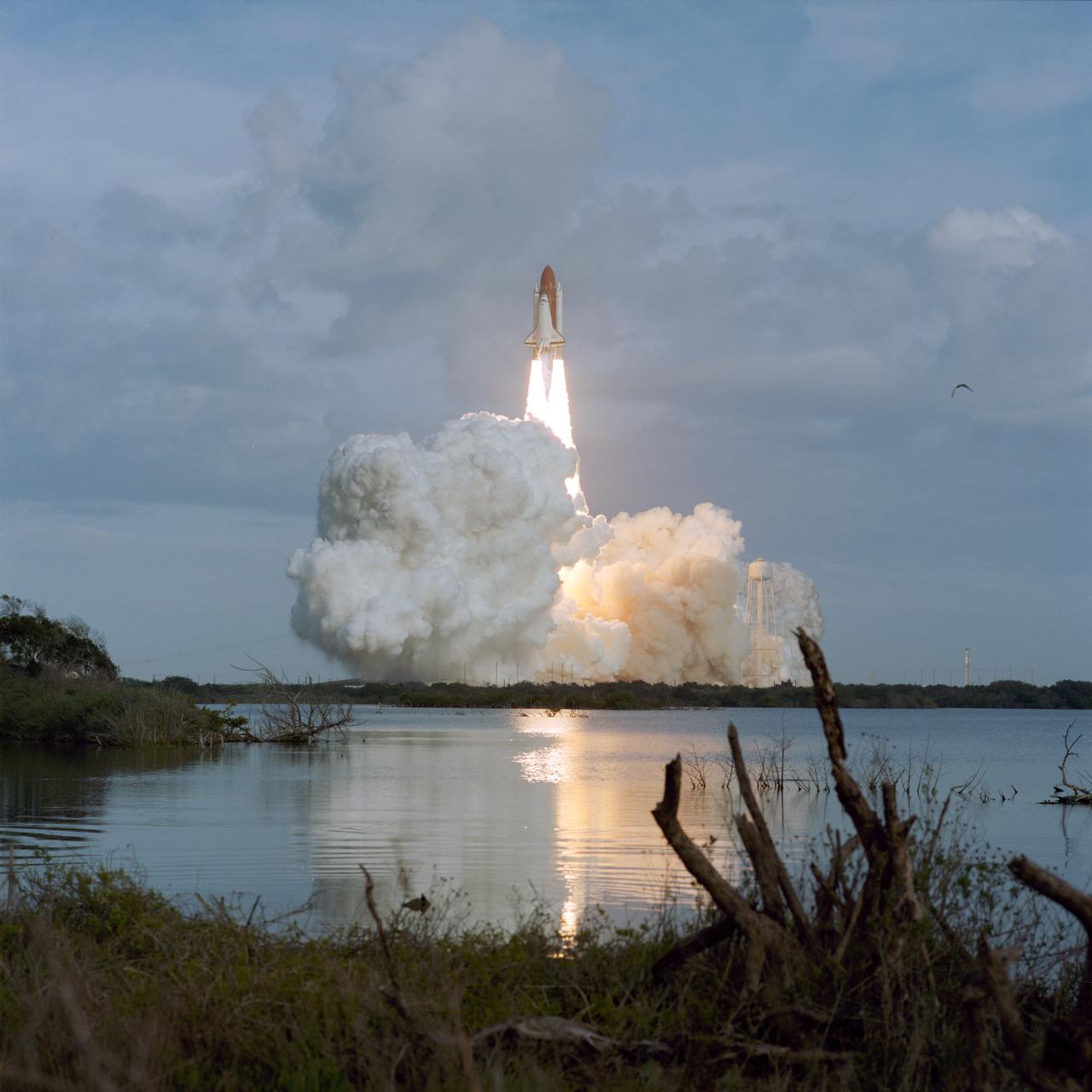
STS054-S-061 (13 Jan 1993) --- The Space Shuttle Endeavour creates a mountain of exhaust clouds as is soars off the launch pad and heads toward Earth orbit with a crew of five and the Tracking and Data Relay Satellite (TDRS-F) aboard. Launch occurred at 8:59:30 a.m. (EST), January 13, 1993. Onboard were John H. Casper, mission commander, Donald R. McMonagle, pilot, Gregory J. Harbaugh, Mario Runco Jr., and Susan J. Helms, mission specialists.
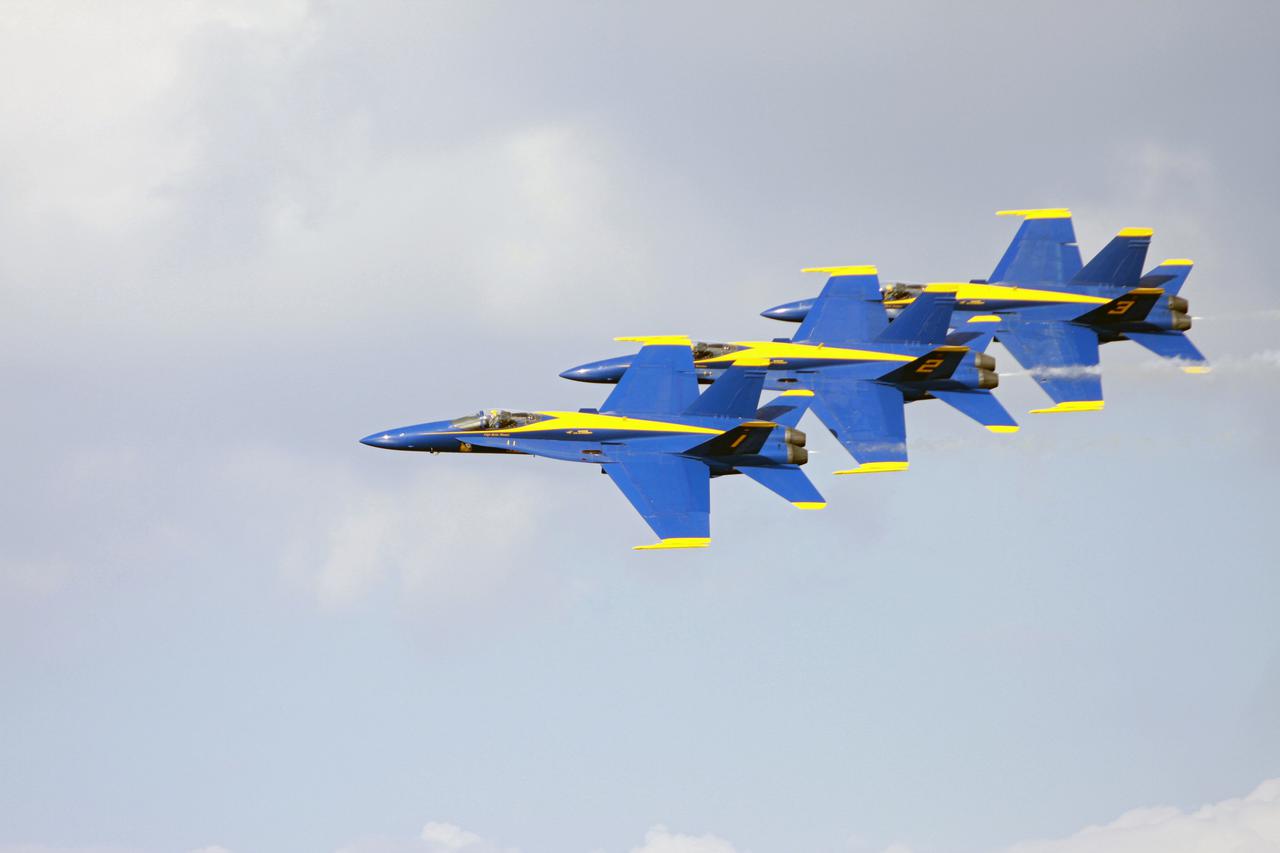
CAPE CANAVERAL, Fla. – The U.S. Navy's Blue Angels perform their tight maneuvers over NASA's Kennedy Space Center in Florida during the Kennedy Space Center Visitor Complex Space and Air Show held Nov. 8-9. This year’s show brought together the best in military aircraft, such as the F_A-18 Super Hornet and F-16 Fighting Falcon, coupled with precision pilots and veteran astronauts to celebrate spaceflight and aviation. The event included a water rescue demonstration by the 920th Rescue Wing. Photo credit: NASA_Troy Cryder
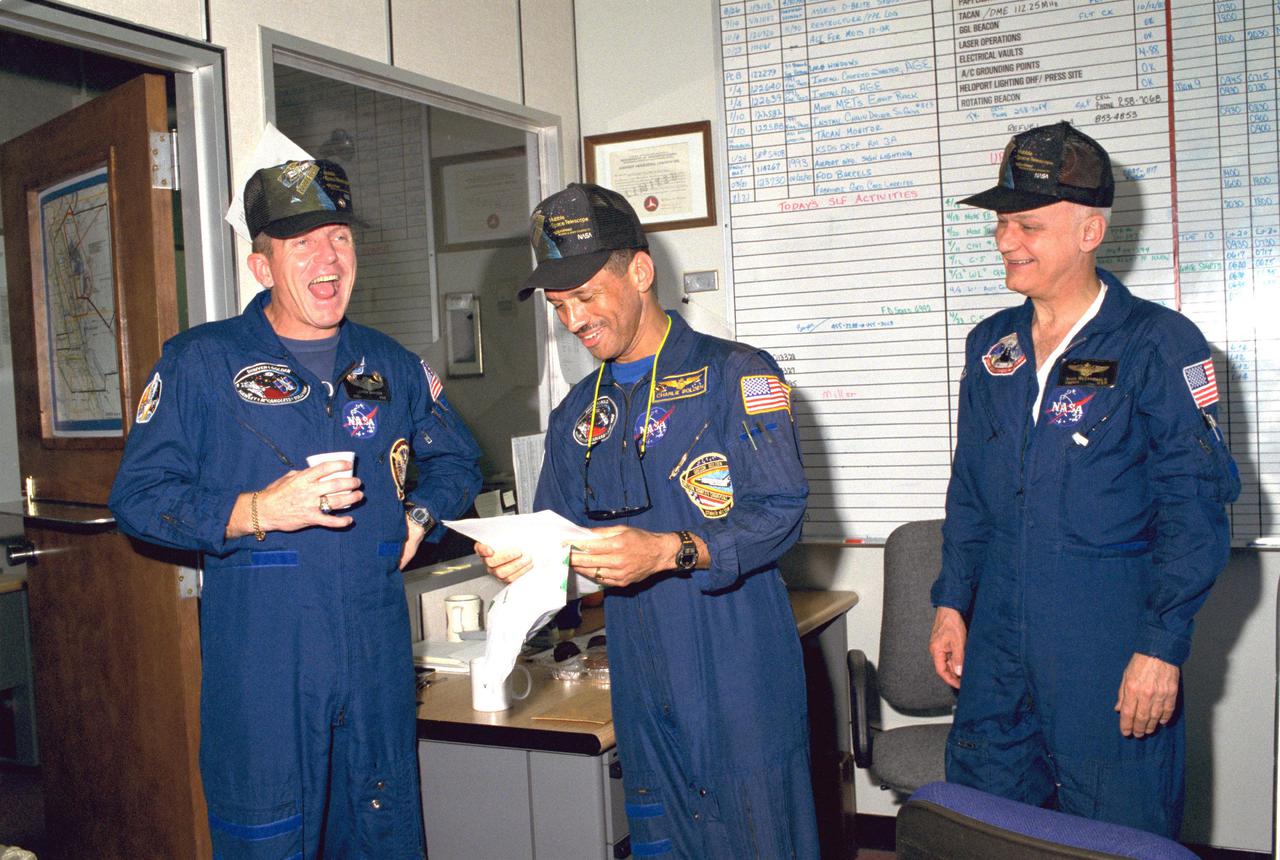
KENNEDY SPACE CENTER, FLA. -- Loren J. Shriver (left), commander of Space Shuttle Mission STS-31, enjoys a laugh with fellow crew members Pilot Charles F. Bolden Jr. and Mission Specialist Bruce McCandless II after practice runs in the Shuttle Training Aircraft. STS-31 is set to lift off April 10 at 8:47 a.m. EDT.