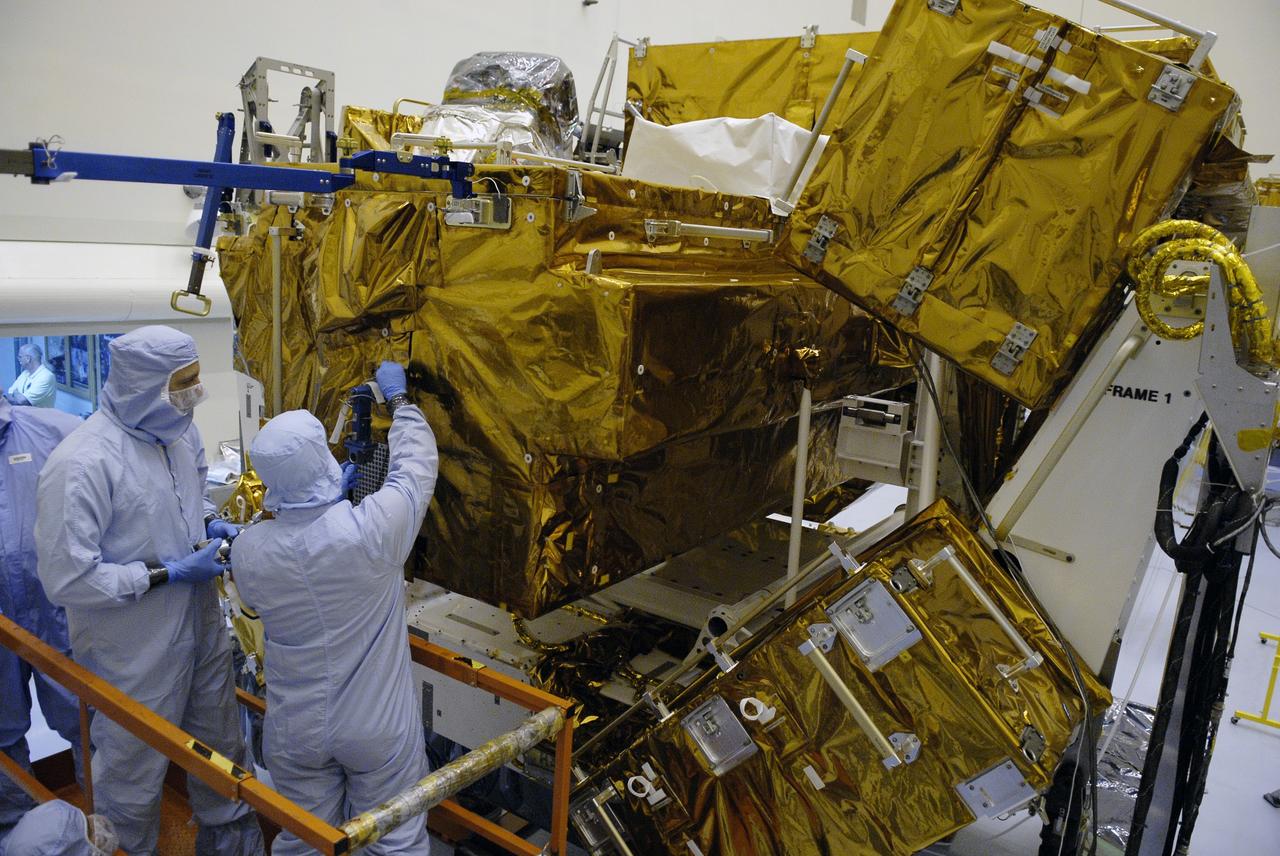
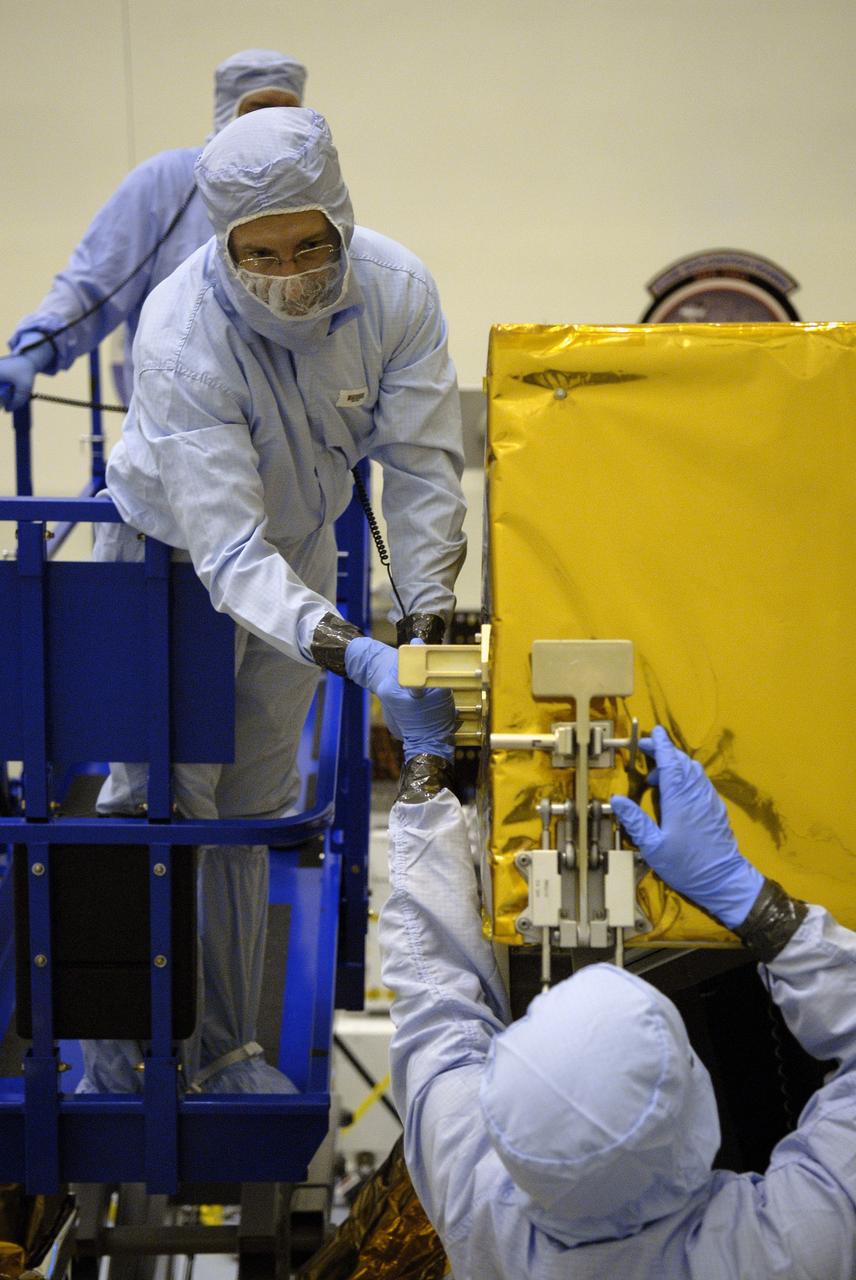
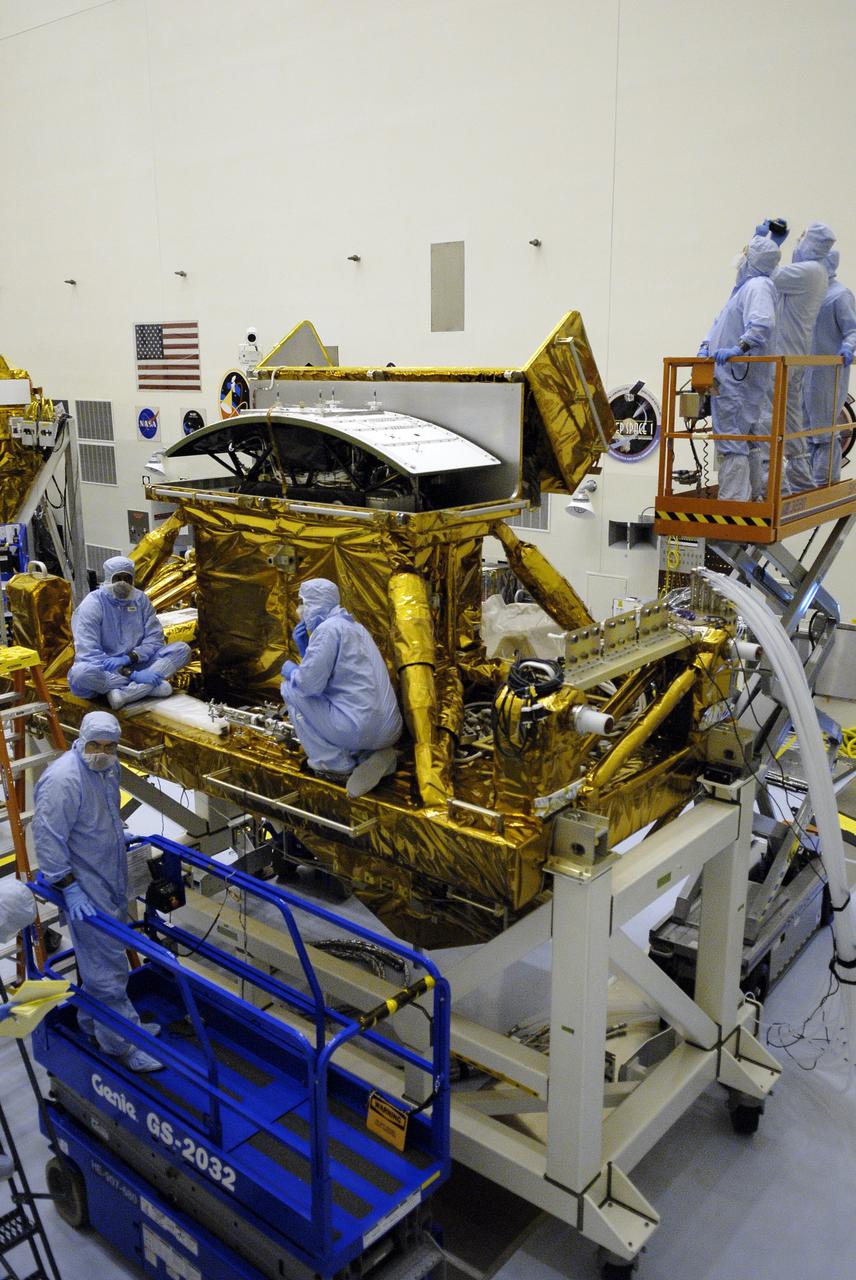
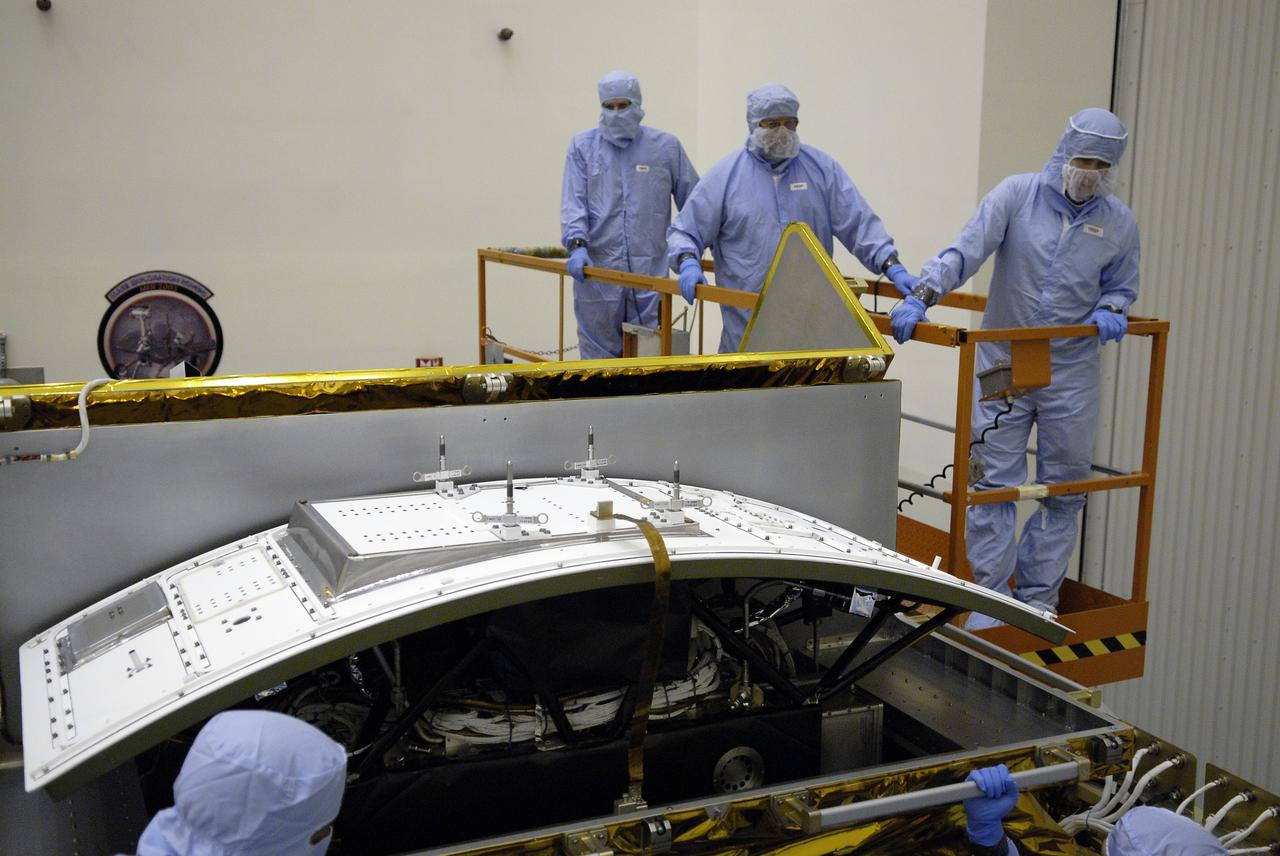
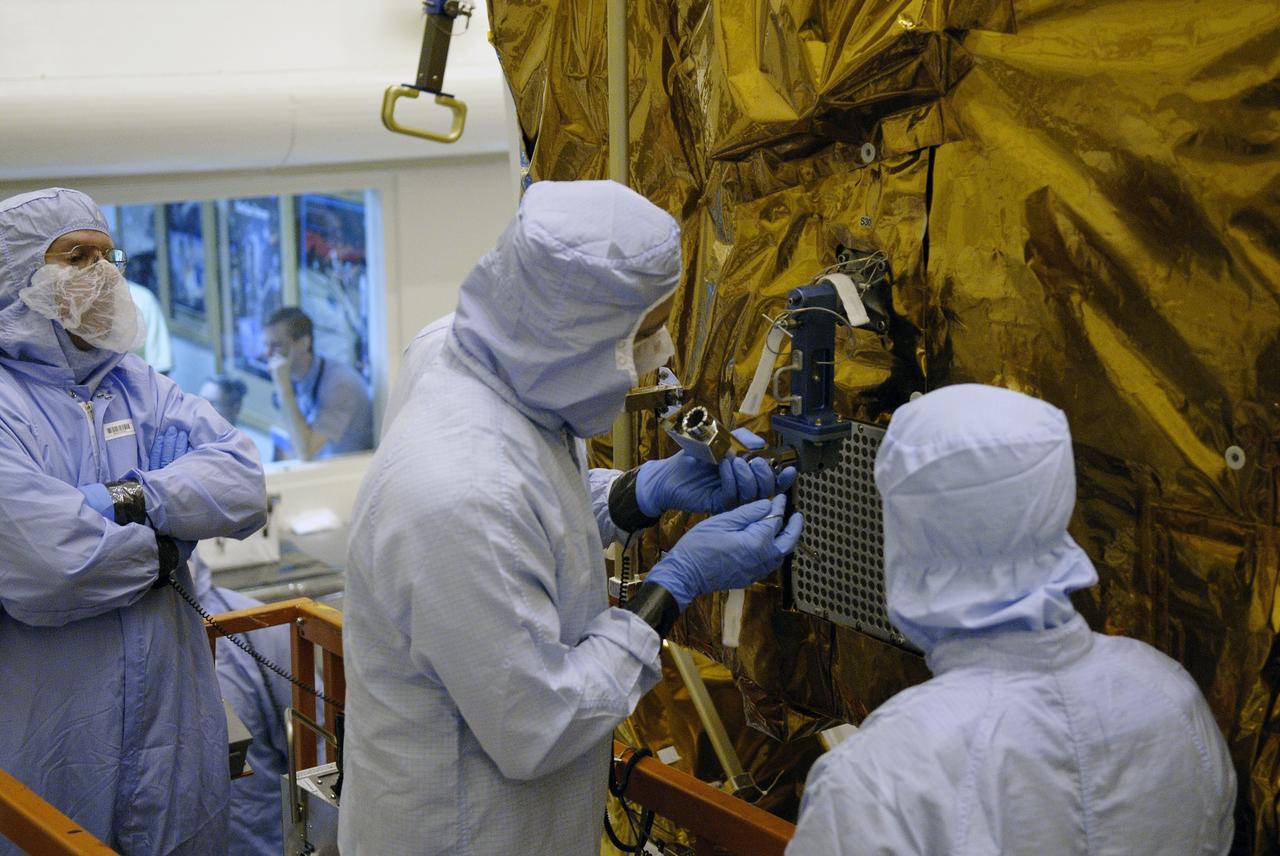
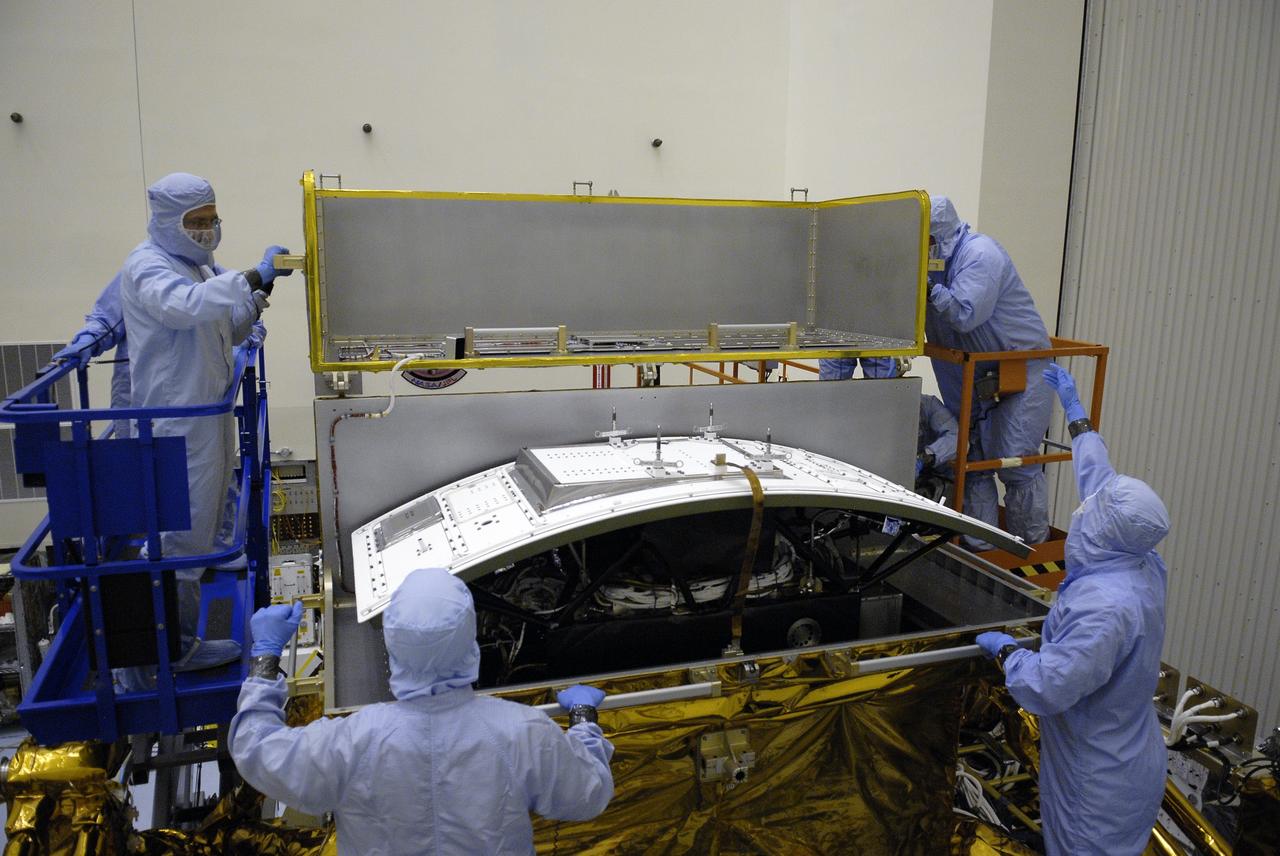
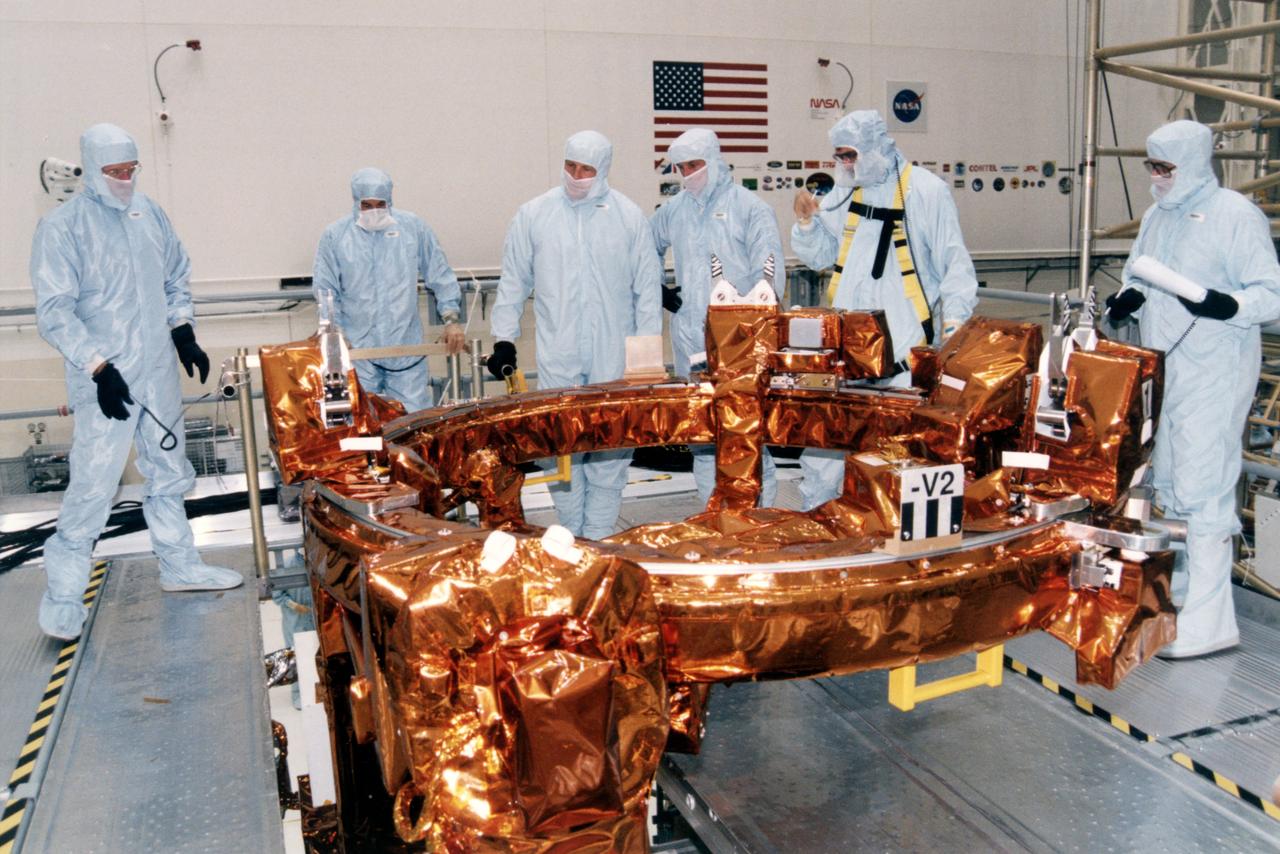
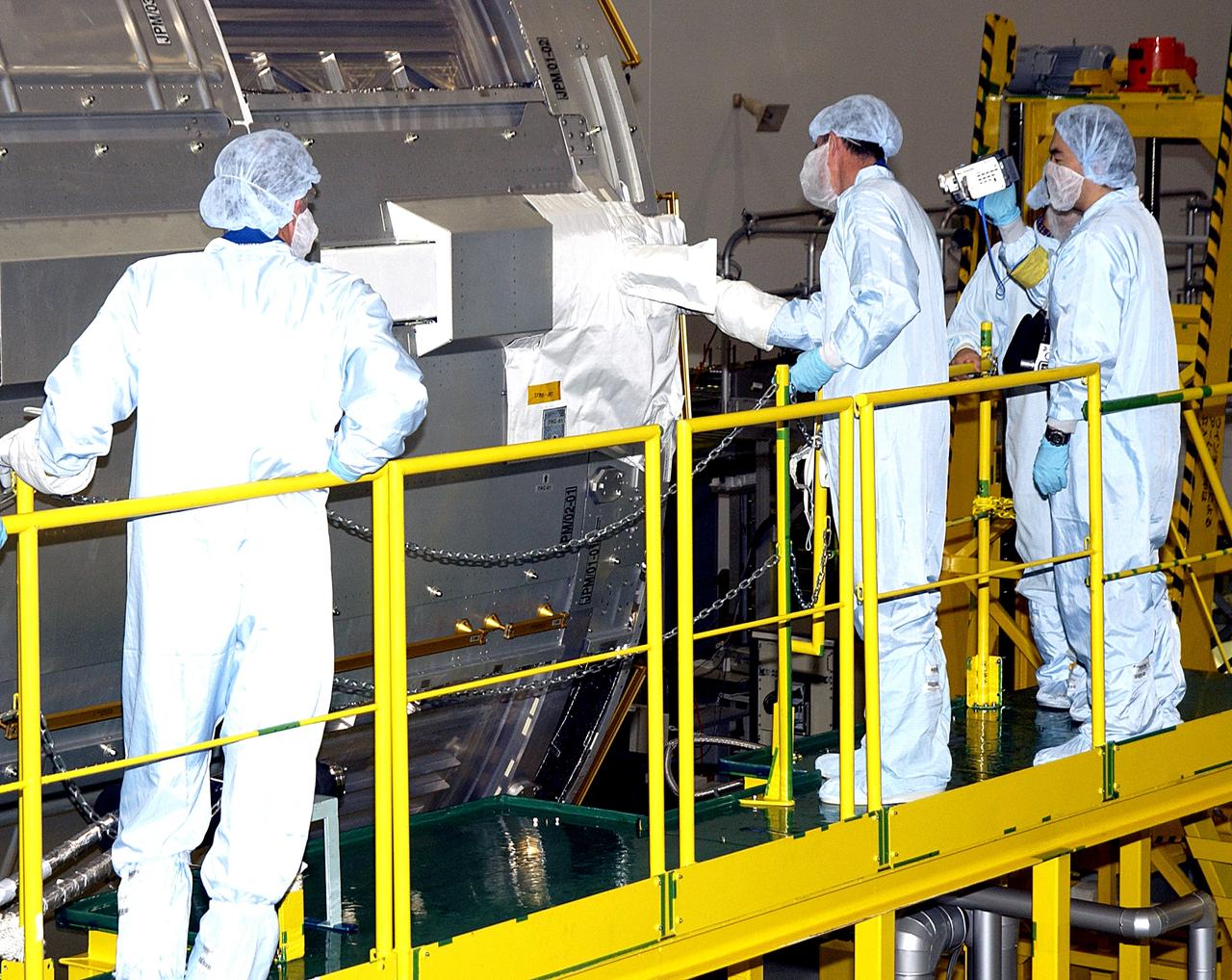
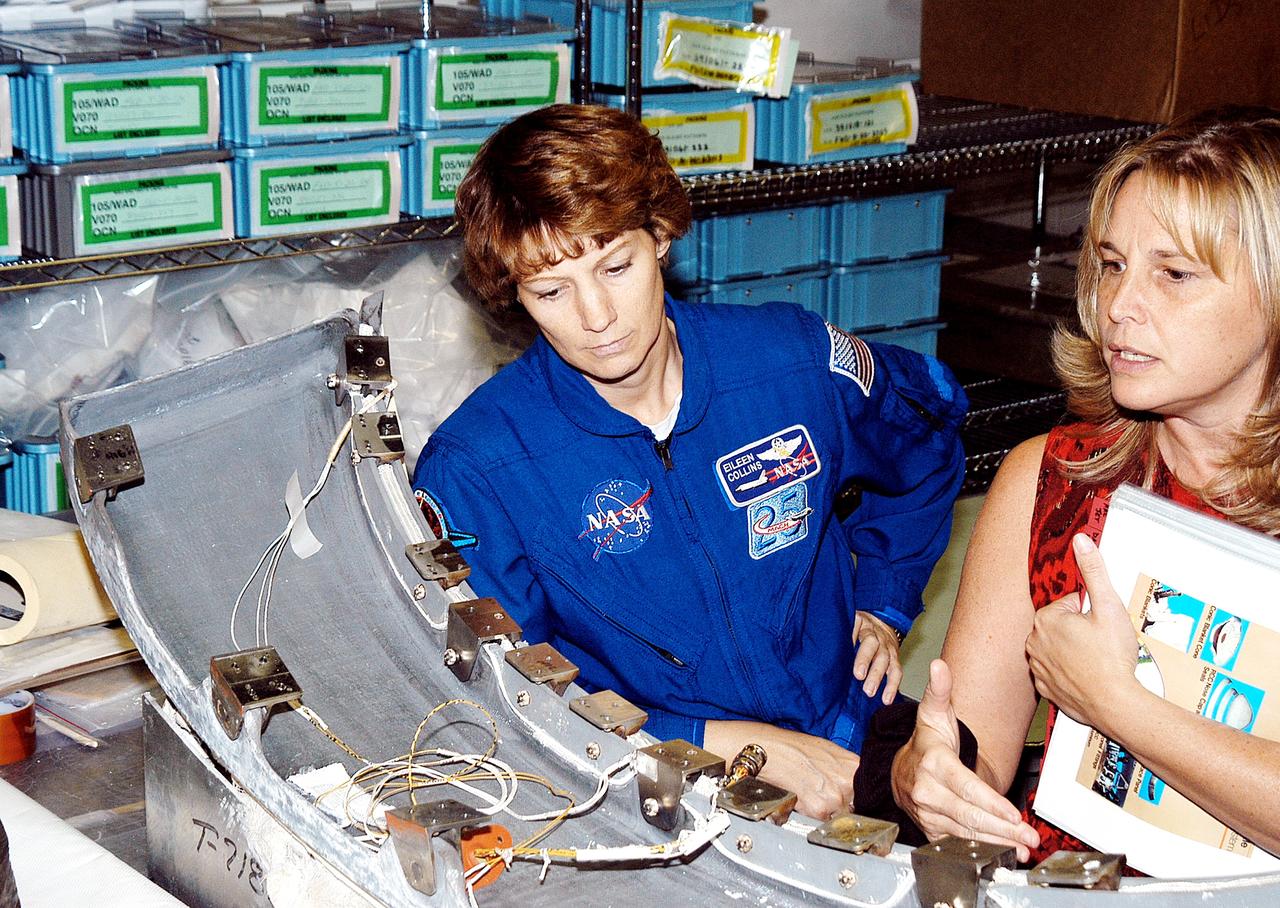
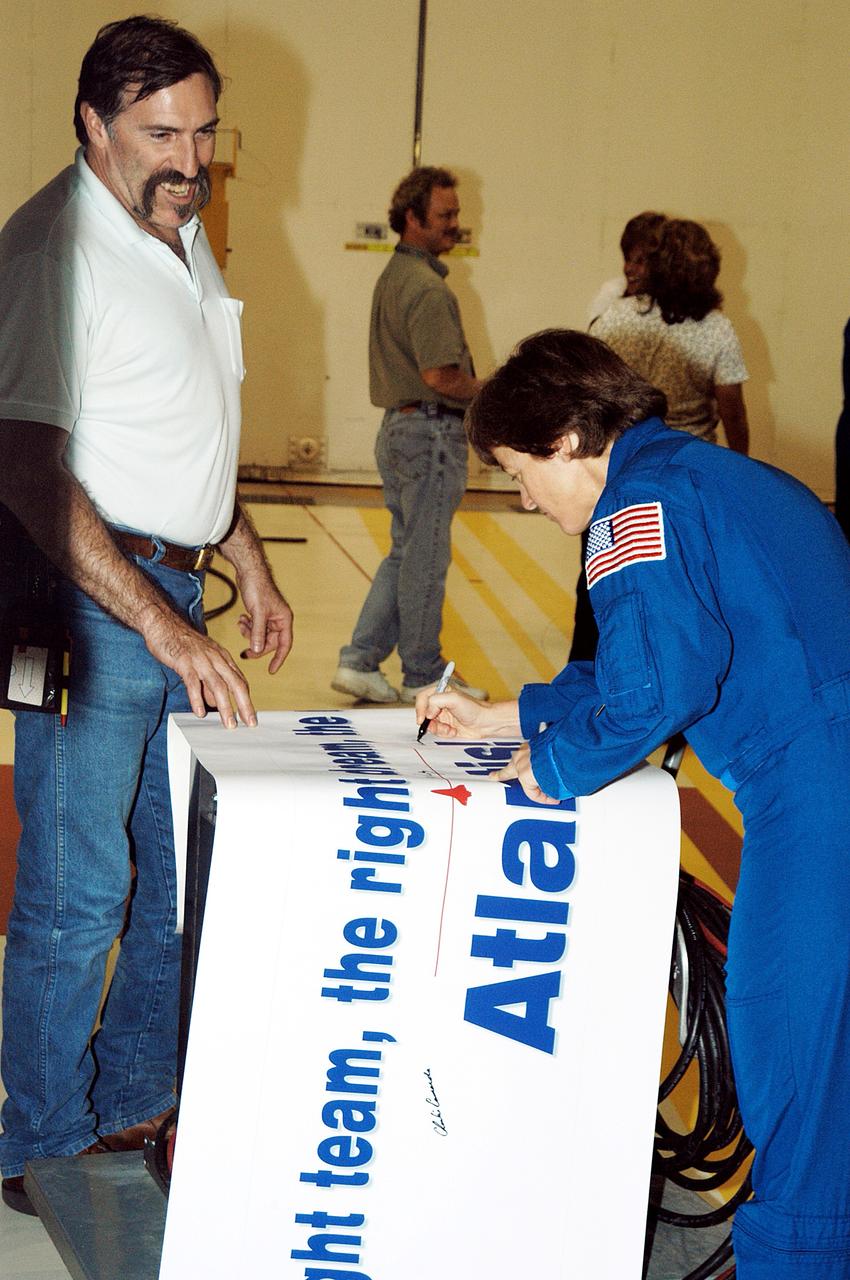
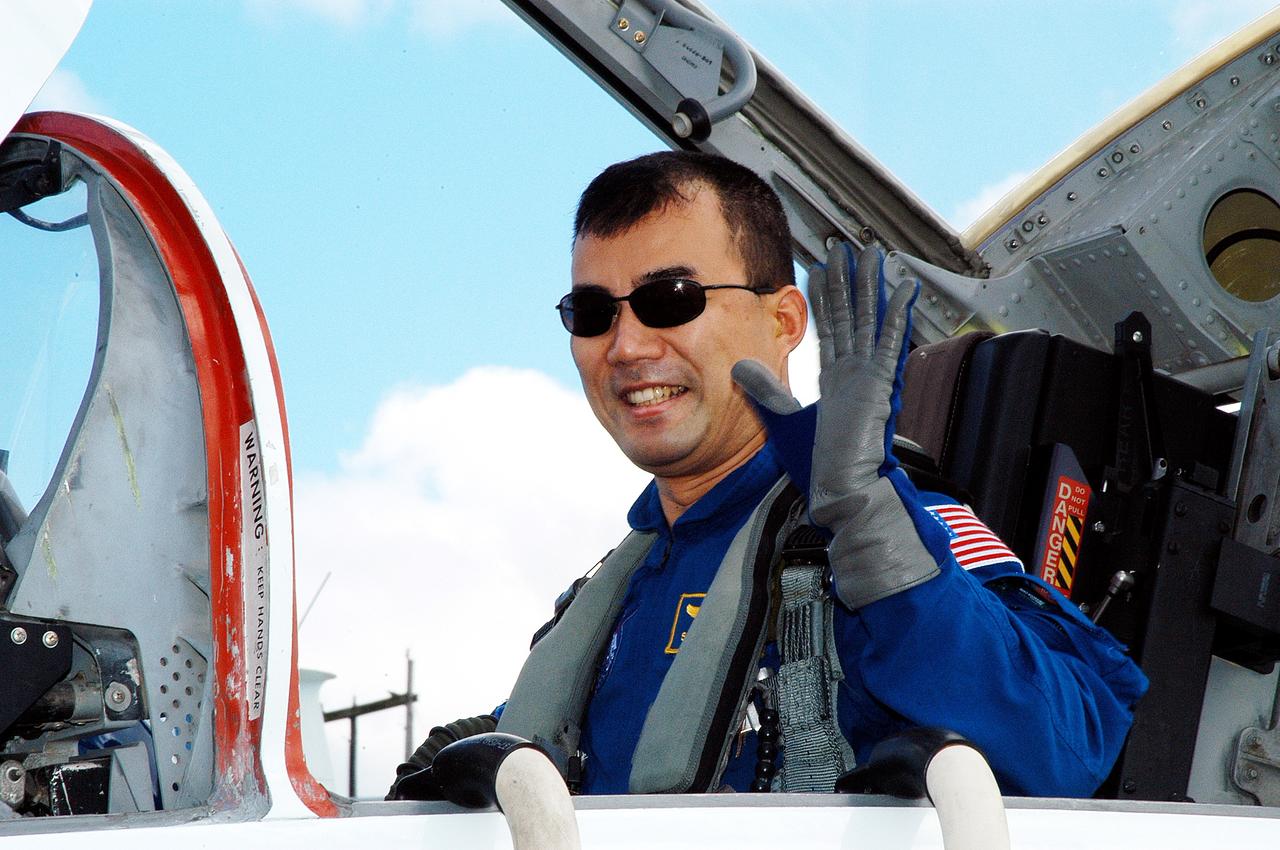
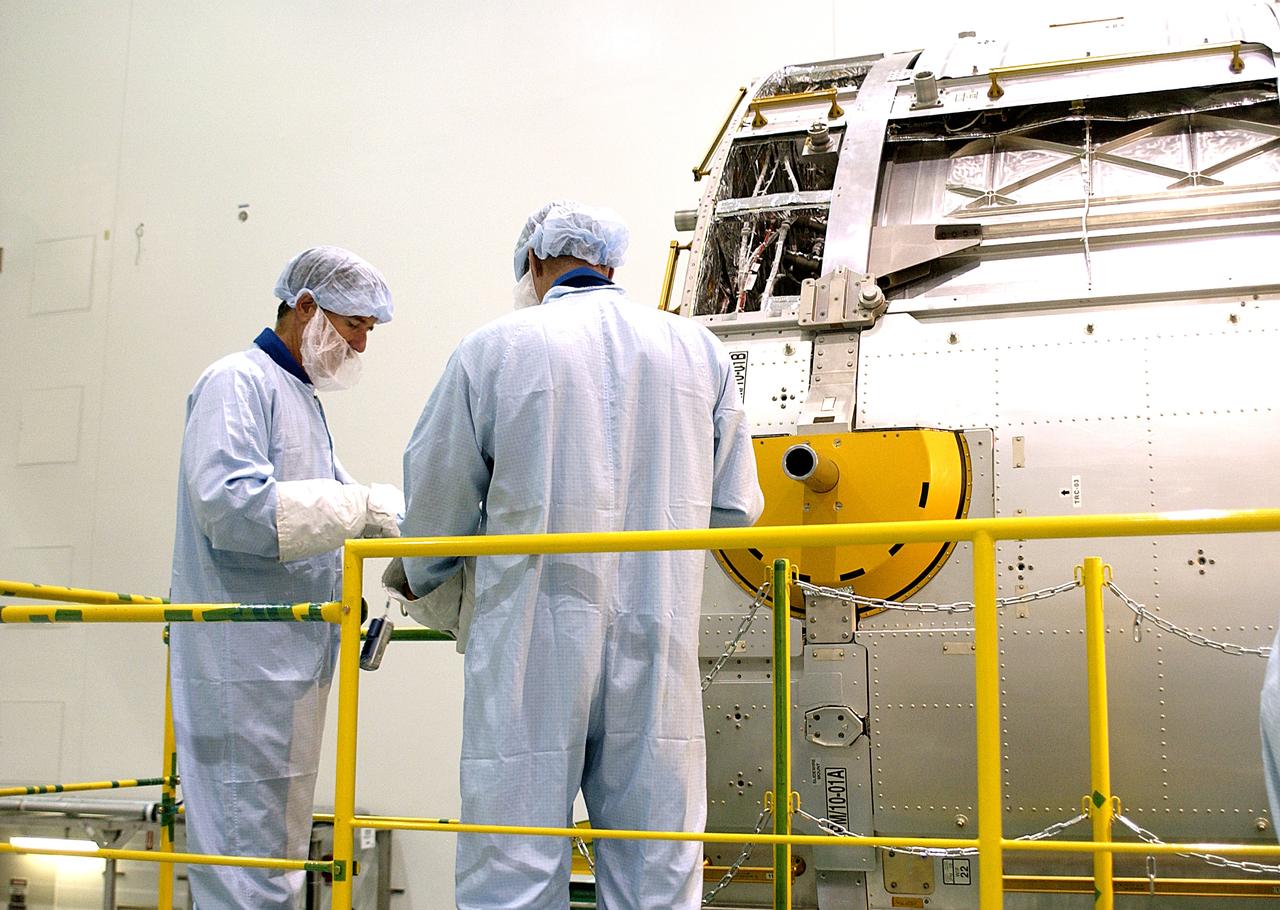
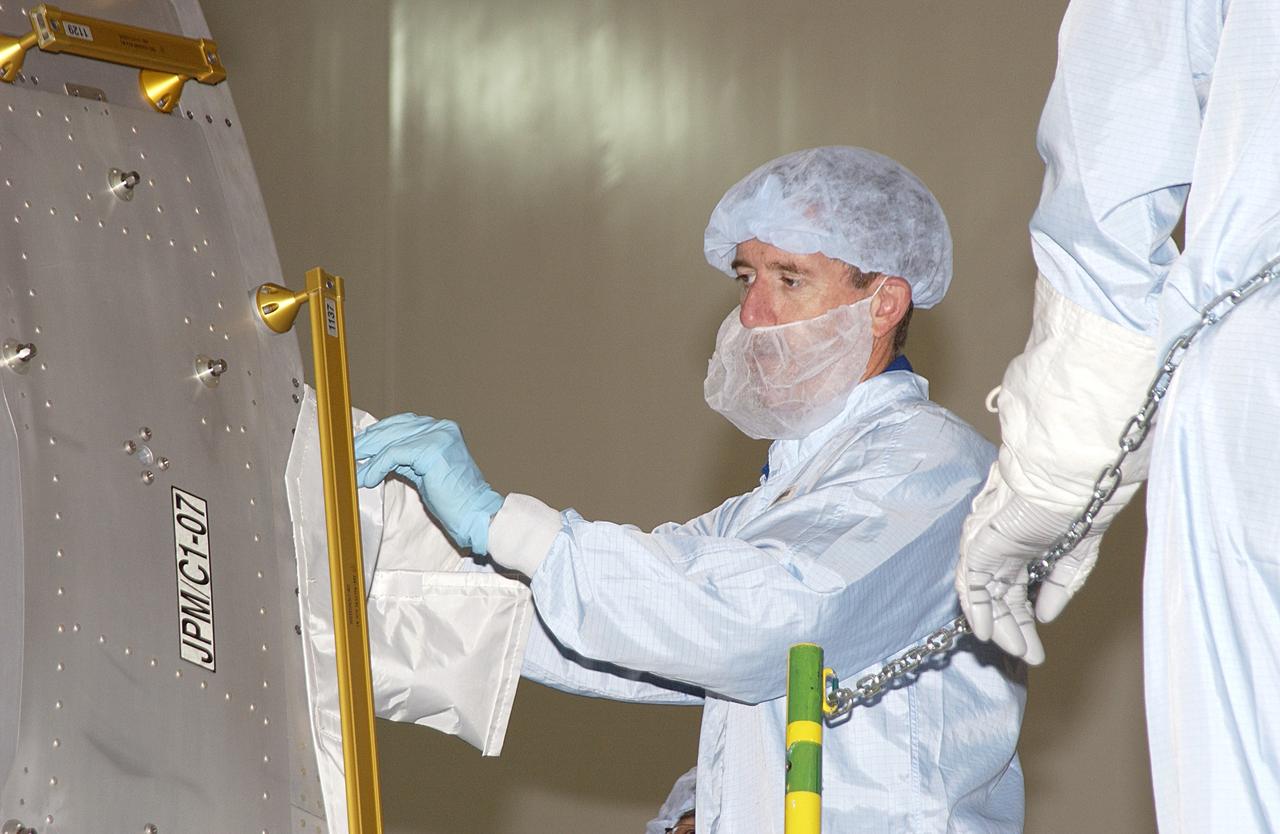
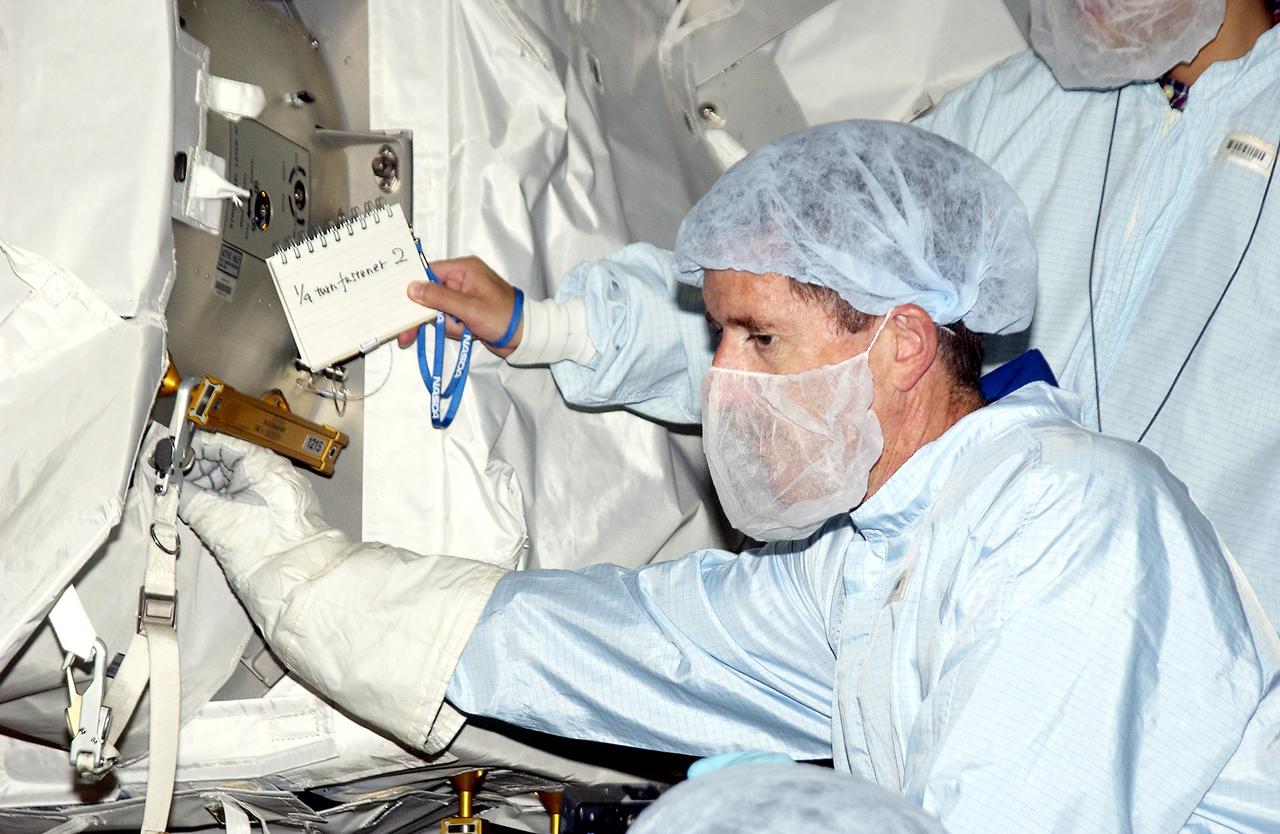
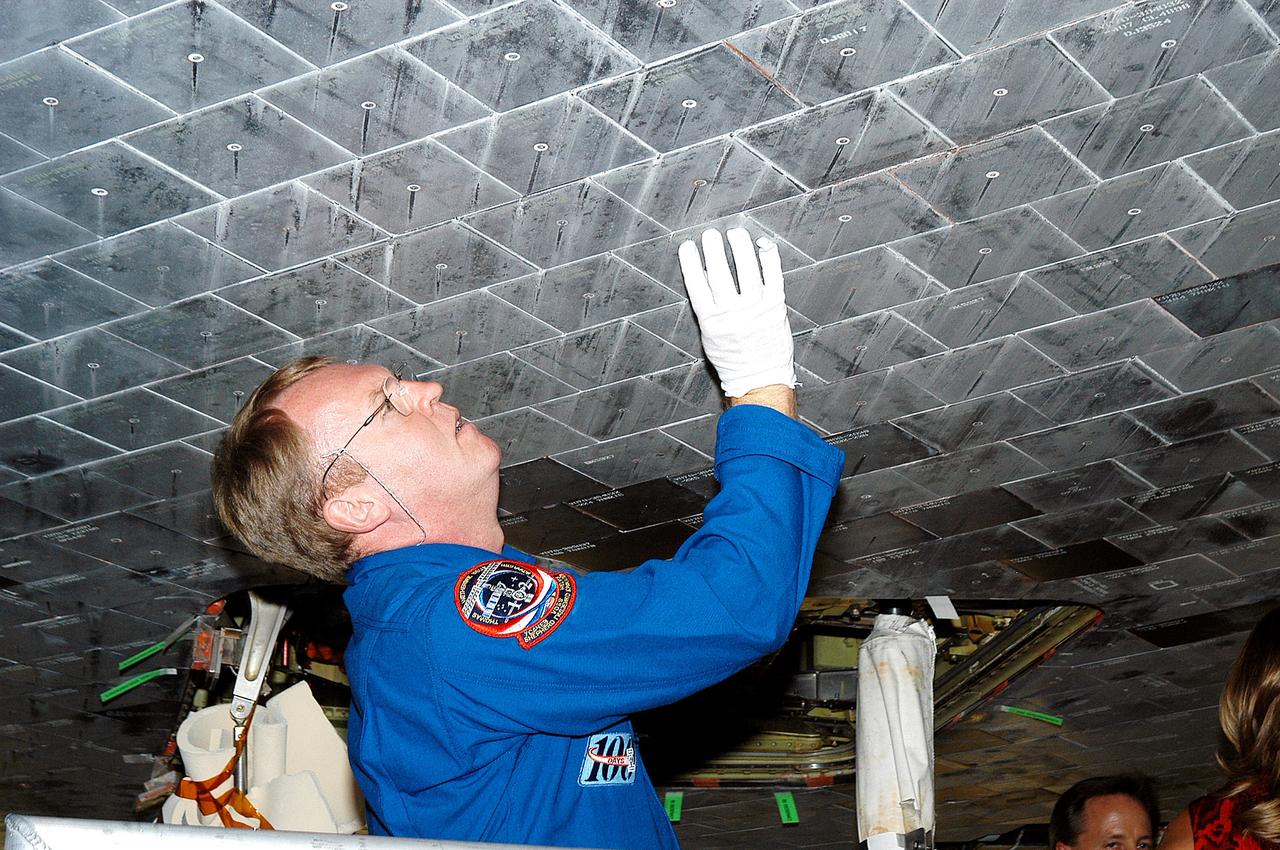
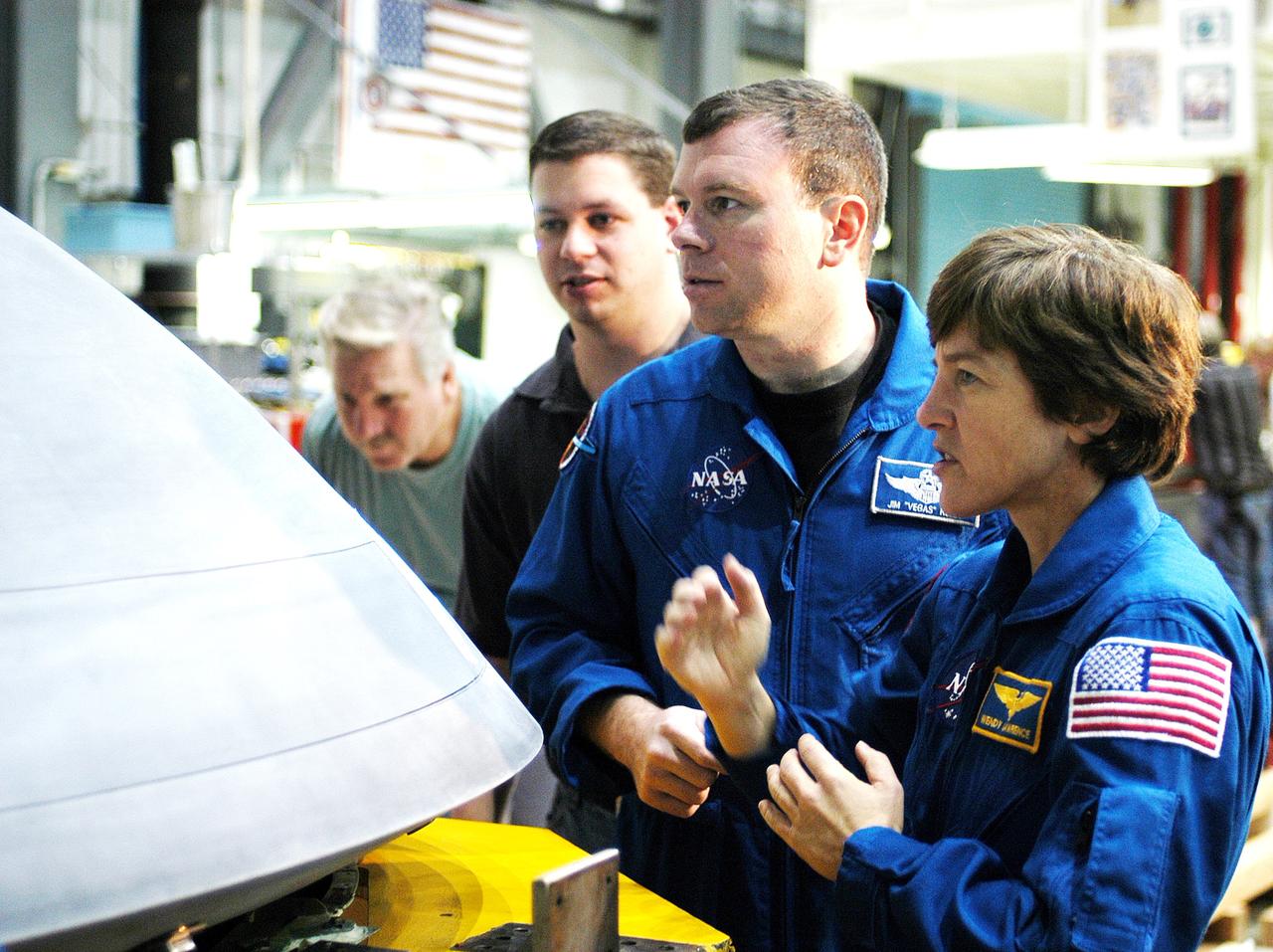
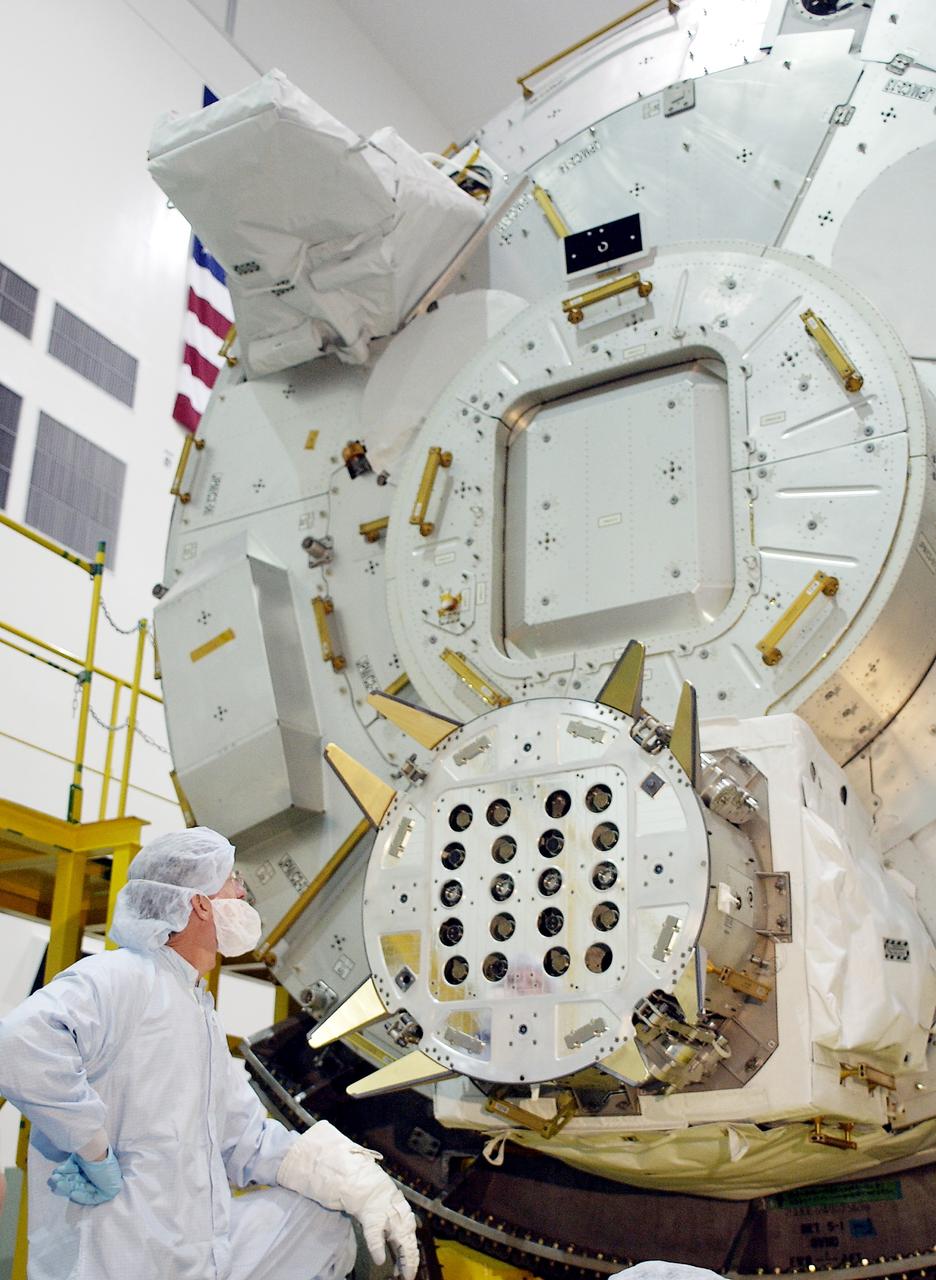
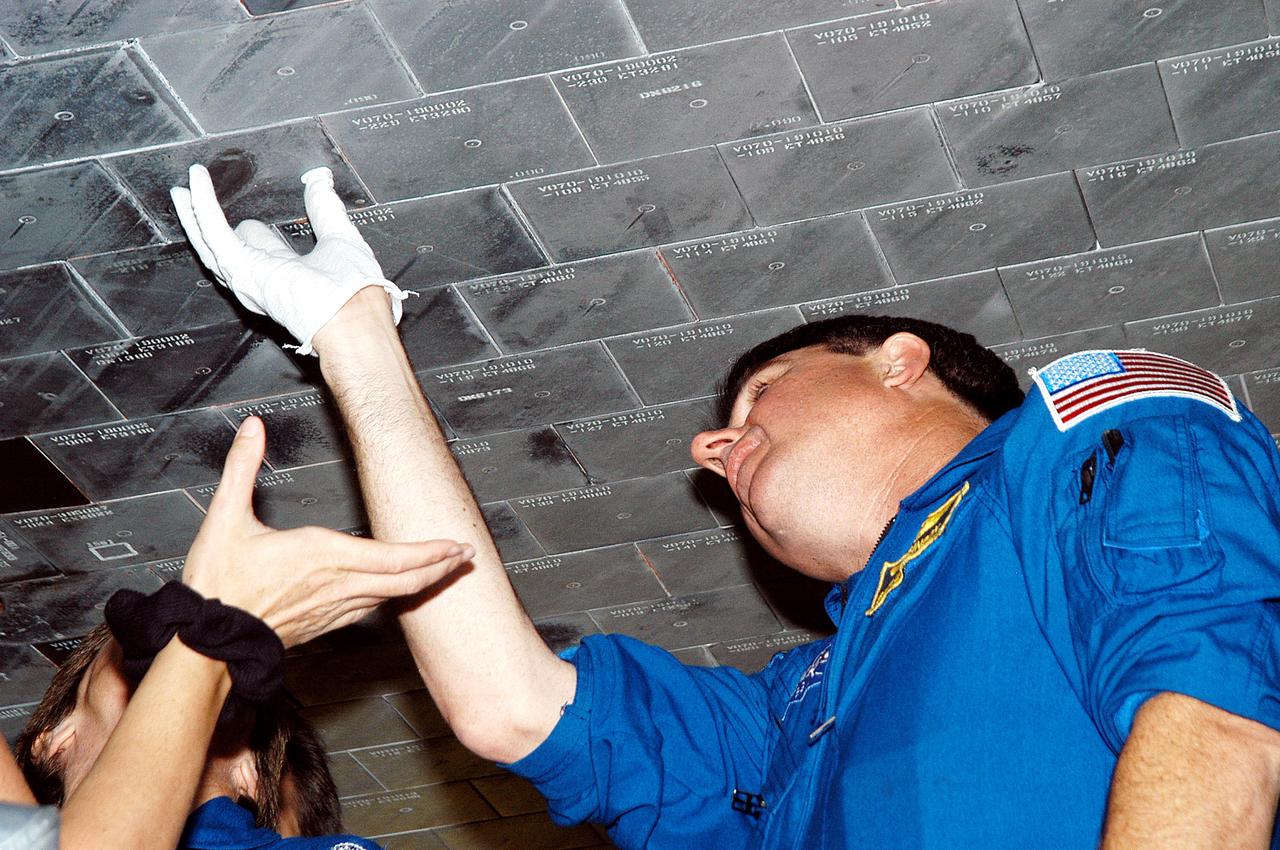
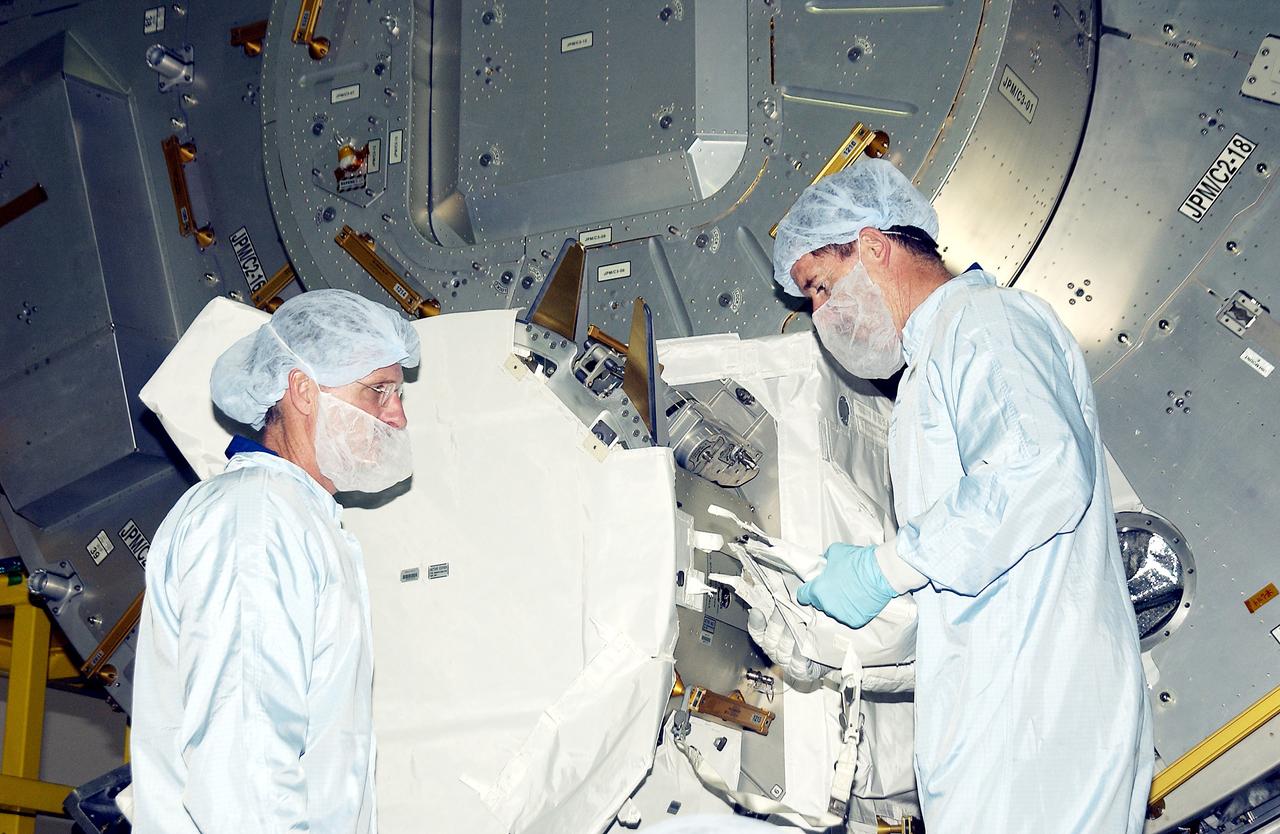
CAPE CANAVERAL, Fla. –  STS-125 crew members conduct equipment and procedure familiarization on parts of the payload in the Payload Hazardous Servicing Facility at NASA's Kennedy Space Center in Florida in preparation for their mission to service NASA's Hubble Space Telescope.  Space shuttle Atlantis' 11-day flight is targeted for launch May 12 and will include five spacewalks to refurbish and upgrade the telescope with state-of-the-art science instruments. The payload includes a Wide Field Camera 3, fine guidance sensor and the Cosmic Origins Spectrograph. As a result, Hubble's capabilities will be expanded and its operational lifespan extended through at least 2014.   Photo credit: NASA/Kim Shiflett
KSC-2009-2508
CAPE CANAVERAL, Fla. –  STS-125 crew members conduct equipment and procedure familiarization on parts of the payload in the Payload Hazardous Servicing Facility at NASA's Kennedy Space Center in Florida in preparation for their mission to service NASA's Hubble Space Telescope.  Space shuttle Atlantis' 11-day flight is targeted for launch May 12 and will include five spacewalks to refurbish and upgrade the telescope with state-of-the-art science instruments. The payload includes a Wide Field Camera 3, fine guidance sensor and the Cosmic Origins Spectrograph. As a result, Hubble's capabilities will be expanded and its operational lifespan extended through at least 2014.   Photo credit: NASA/Kim Shiflett
KSC-2009-2513
CAPE CANAVERAL, Fla. –  STS-125 crew members conduct equipment and procedure familiarization, including sharp edge inspection, in the Payload Hazardous Servicing Facility at NASA's Kennedy Space Center in Florida in preparation for their mission to service NASA's Hubble Space Telescope. Space shuttle Atlantis' 11-day flight is targeted for launch May 12 and will include five spacewalks to refurbish and upgrade the telescope with state-of-the-art science instruments. The payload includes a Wide Field Camera 3, fine guidance sensor and the Cosmic Origins Spectrograph. As a result, Hubble's capabilities will be expanded and its operational lifespan extended through at least 2014.   Photo credit: NASA/Kim Shiflett
KSC-2009-2511
CAPE CANAVERAL, Fla. –  STS-125 crew members conduct equipment and procedure familiarization on parts of the payload in the Payload Hazardous Servicing Facility at NASA's Kennedy Space Center in Florida in preparation for their mission to service NASA's Hubble Space Telescope.  Space shuttle Atlantis' 11-day flight is targeted for launch May 12 and will include five spacewalks to refurbish and upgrade the telescope with state-of-the-art science instruments. The payload includes a Wide Field Camera 3, fine guidance sensor and the Cosmic Origins Spectrograph. As a result, Hubble's capabilities will be expanded and its operational lifespan extended through at least 2014.   Photo credit: NASA/Kim Shiflett
KSC-2009-2514
CAPE CANAVERAL, Fla. –  STS-125 crew members conduct equipment and procedure familiarization on parts of the payload in the Payload Hazardous Servicing Facility at NASA's Kennedy Space Center in Florida in preparation for their mission to service NASA's Hubble Space Telescope. Space shuttle Atlantis' 11-day flight is targeted for launch May 12 and will include five spacewalks to refurbish and upgrade the telescope with state-of-the-art science instruments. The payload includes a Wide Field Camera 3, fine guidance sensor and the Cosmic Origins Spectrograph. As a result, Hubble's capabilities will be expanded and its operational lifespan extended through at least 2014.   Photo credit: NASA/Kim Shiflett
KSC-2009-2509
CAPE CANAVERAL, Fla. –  STS-125 crew members conduct equipment and procedure familiarization on parts of the payload in the Payload Hazardous Servicing Facility at NASA's Kennedy Space Center in Florida in preparation for their mission to service NASA's Hubble Space Telescope.  Space shuttle Atlantis' 11-day flight is targeted for launch May 12 and will include five spacewalks to refurbish and upgrade the telescope with state-of-the-art science instruments. The payload includes a Wide Field Camera 3, fine guidance sensor and the Cosmic Origins Spectrograph. As a result, Hubble's capabilities will be expanded and its operational lifespan extended through at least 2014.   Photo credit: NASA/Kim Shiflett
KSC-2009-2510
CAPE CANAVERAL, Fla. –  STS-125 crew members conduct equipment and procedure familiarization on parts of the payload in the Payload Hazardous Servicing Facility at NASA's Kennedy Space Center in Florida in preparation for their mission to service NASA's Hubble Space Telescope.  Space shuttle Atlantis' 11-day flight is targeted for launch May 12 and will include five spacewalks to refurbish and upgrade the telescope with state-of-the-art science instruments. The payload includes a Wide Field Camera 3, fine guidance sensor and the Cosmic Origins Spectrograph. As a result, Hubble's capabilities will be expanded and its operational lifespan extended through at least 2014.   Photo credit: NASA/Kim Shiflett
KSC-2009-2515
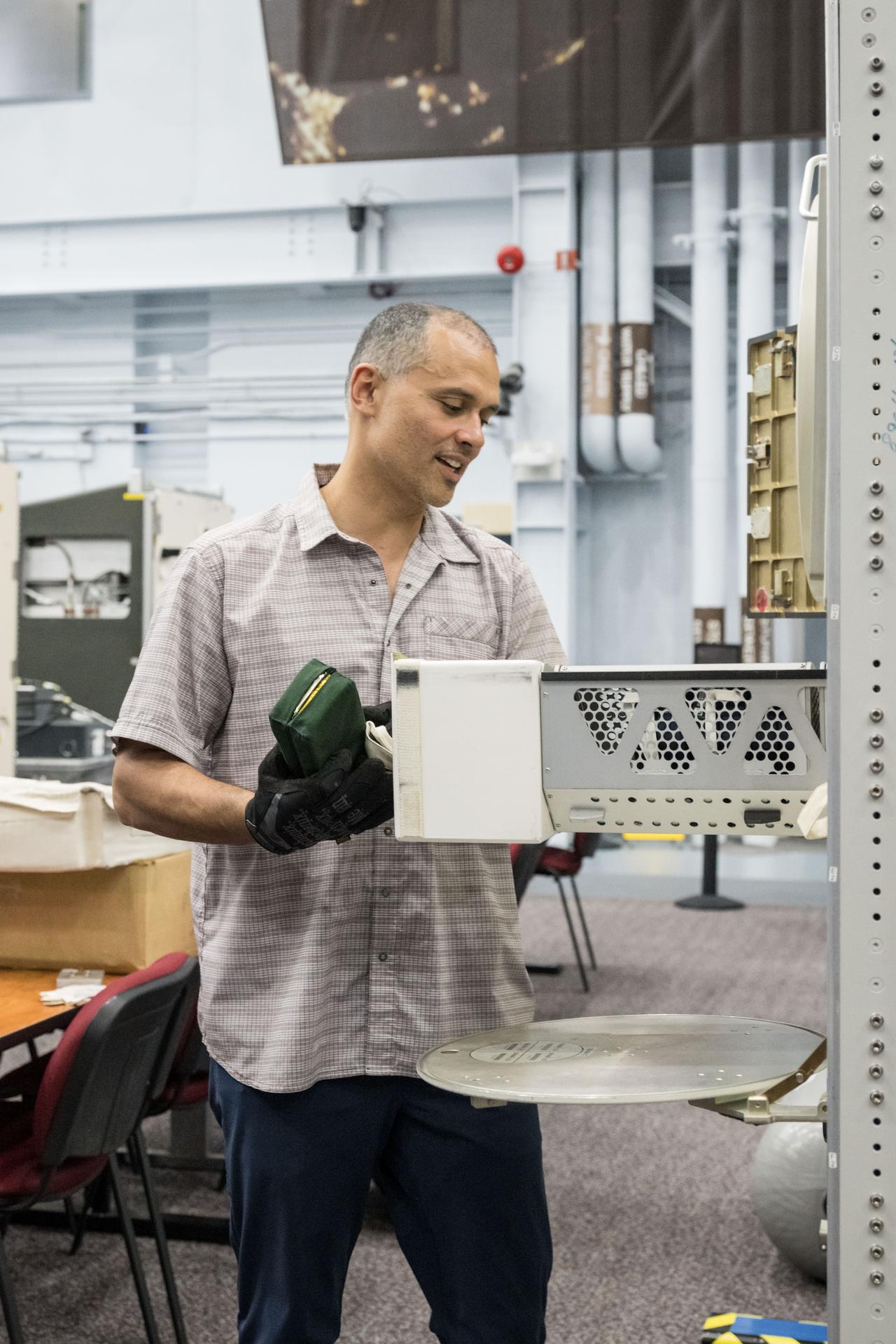
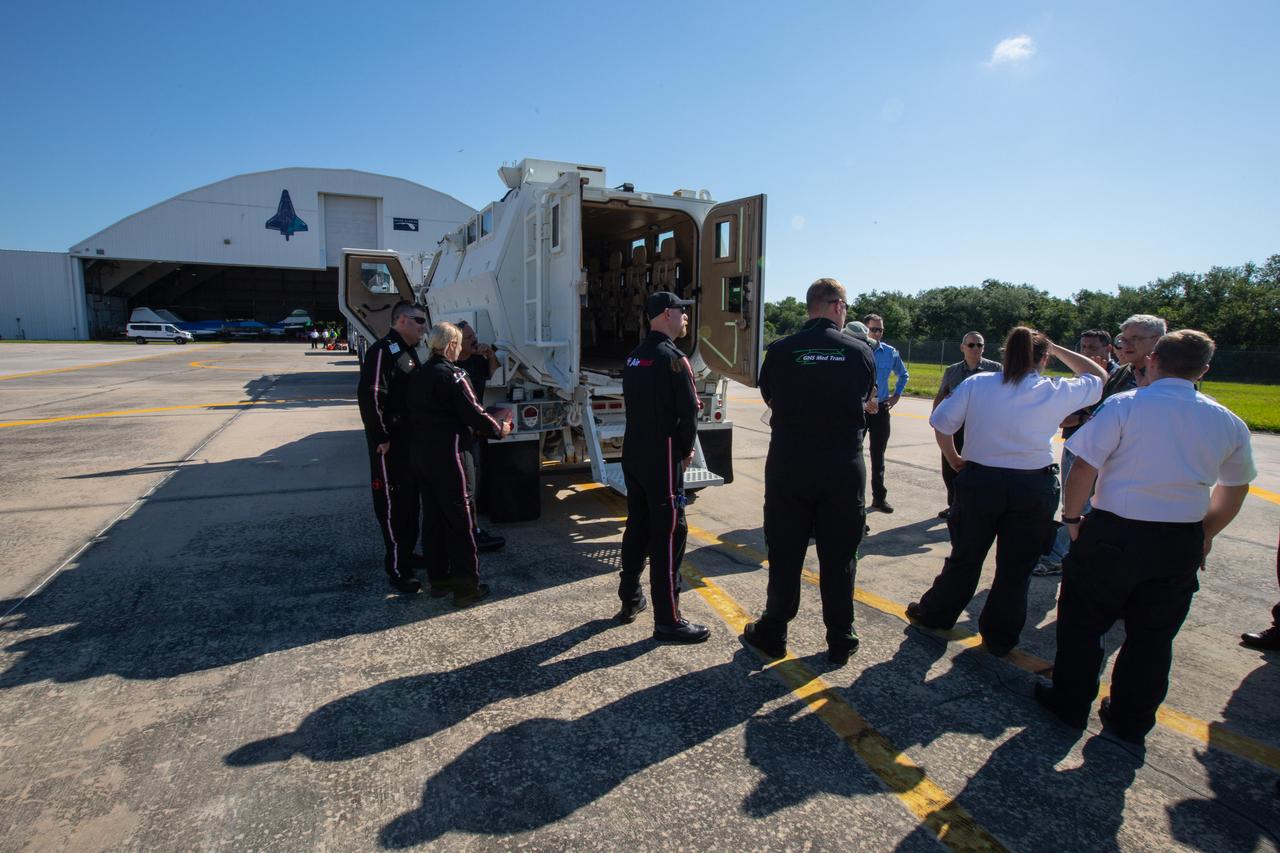
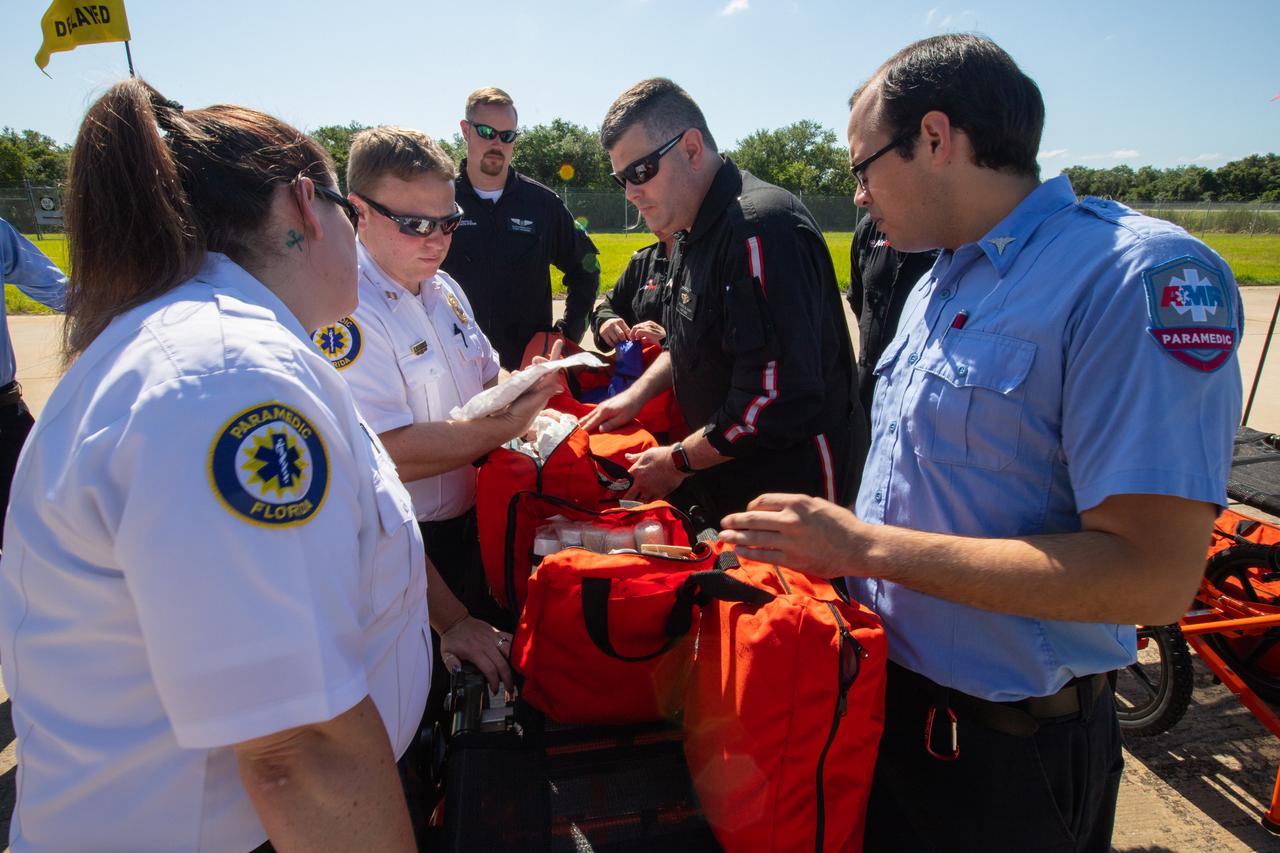
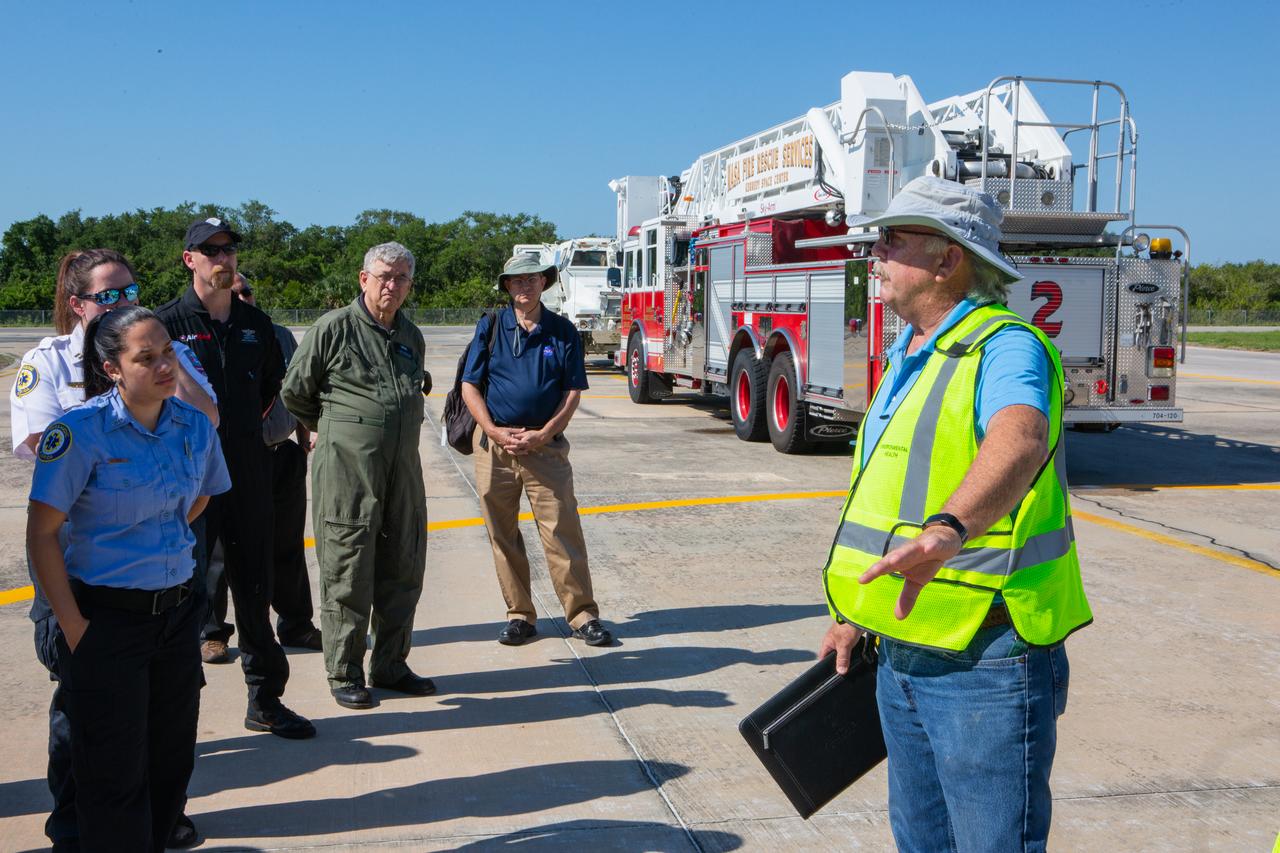
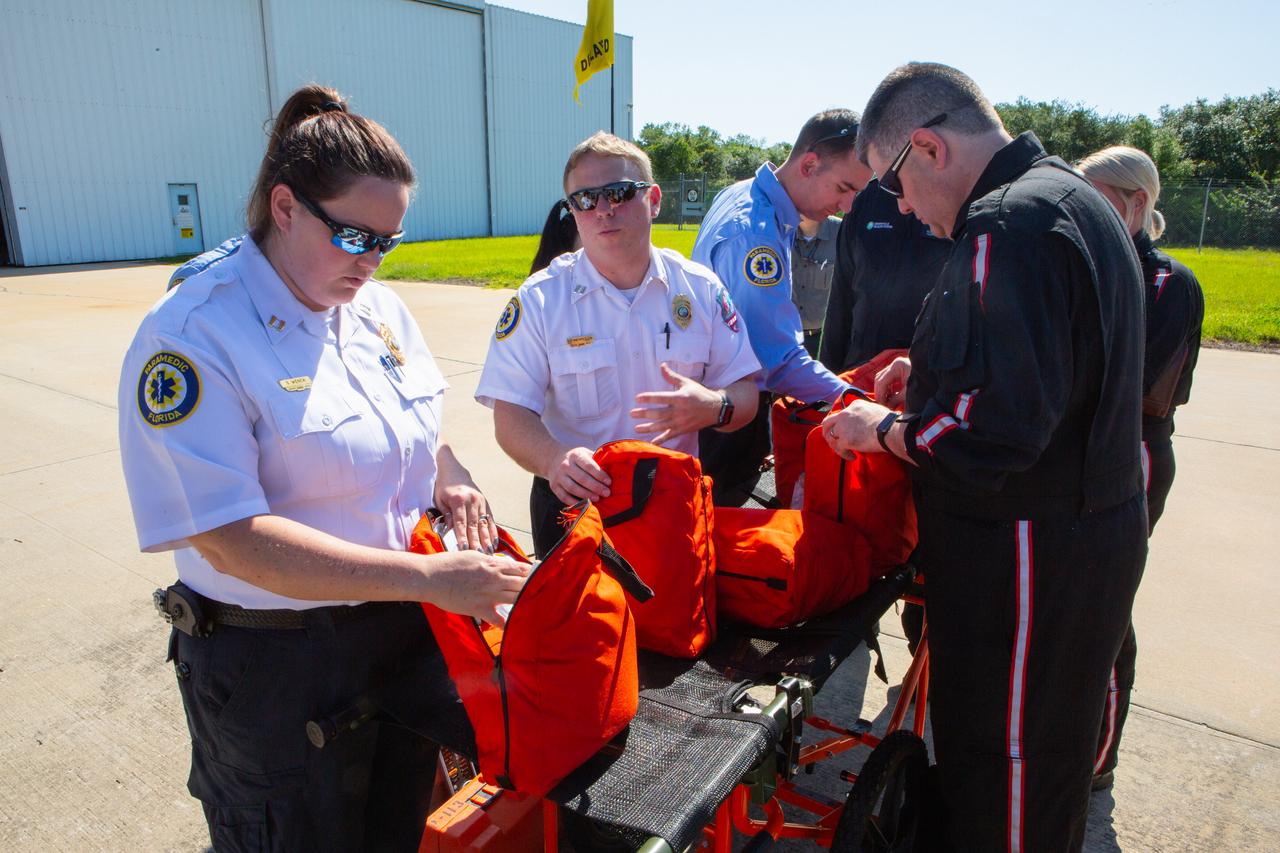
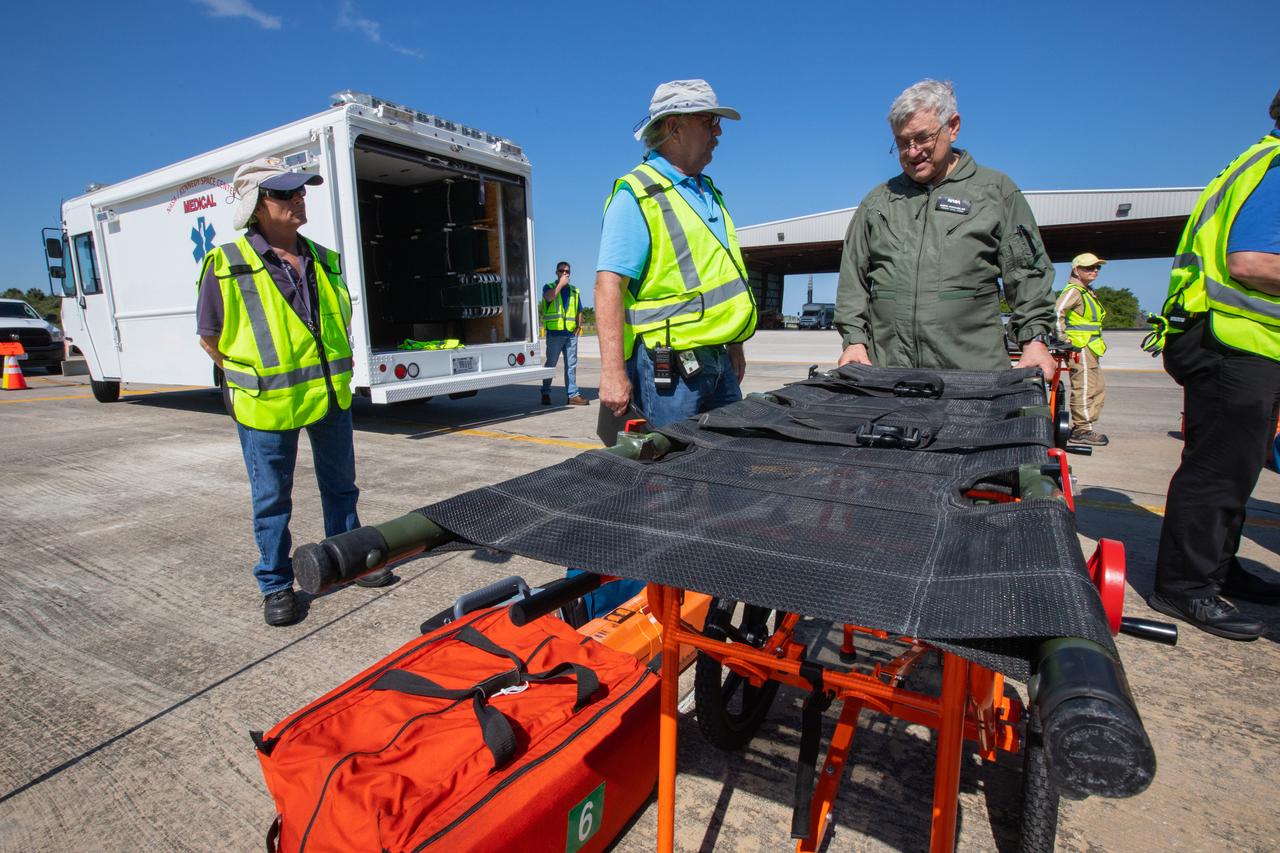
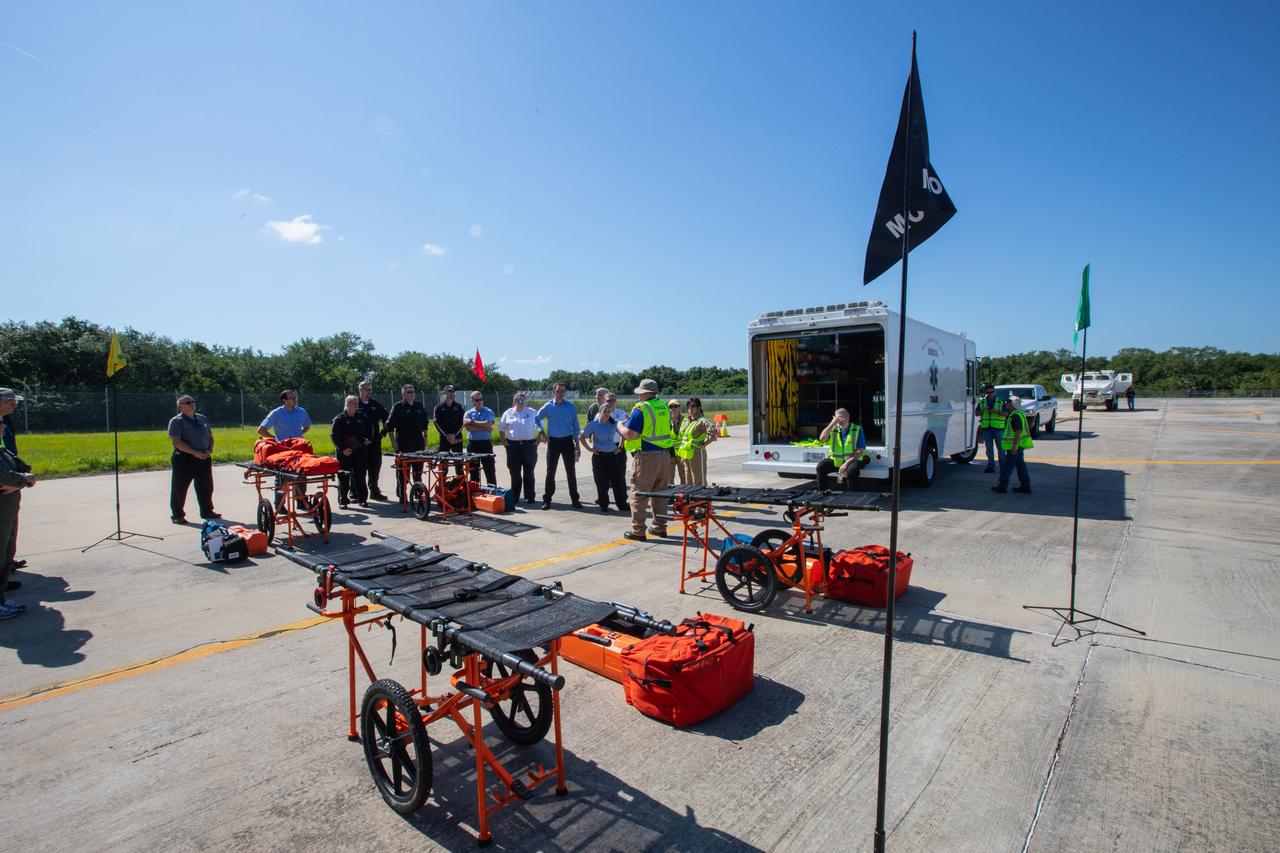
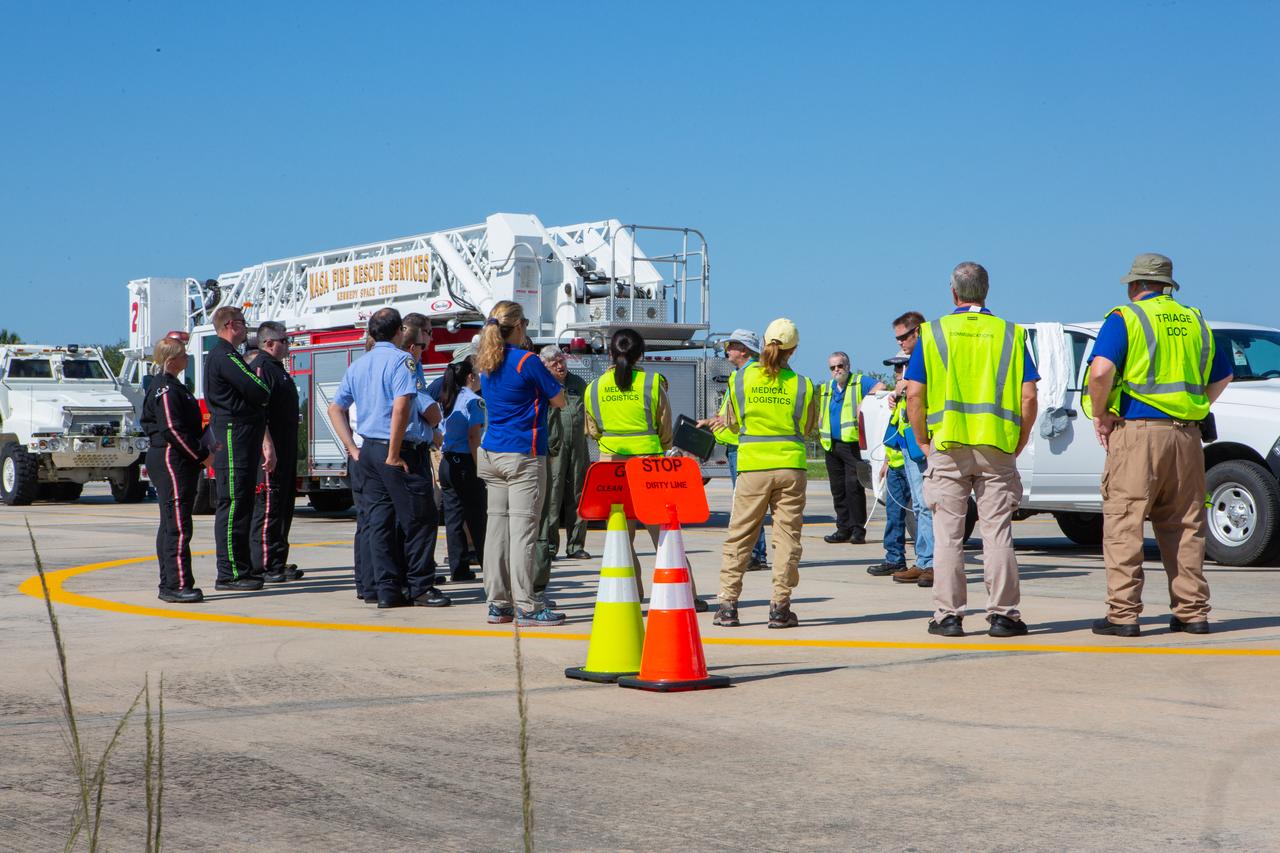
Kennedy Space Center personnel and American Medical Response (AMR) contractor paramedics gather at the Florida spaceport’s Shuttle Landing Facility on May 17, 2019, for a medical support training course. The course was designed to familiarize the AMR paramedics with the center’s Triage Forces deployment, which included medical team members, fire/rescue personnel, environmental health specialists and flight operations crew members, as well as a helicopter, Mine Resistant Ambush Protected (MRAP) tactical vehicle, fire pumper truck and triage vehicles. The AMR paramedics will assist the agency in contingency planning for the return of human spaceflight from Kennedy.
KSC Triage Site Familiarization and Briefing
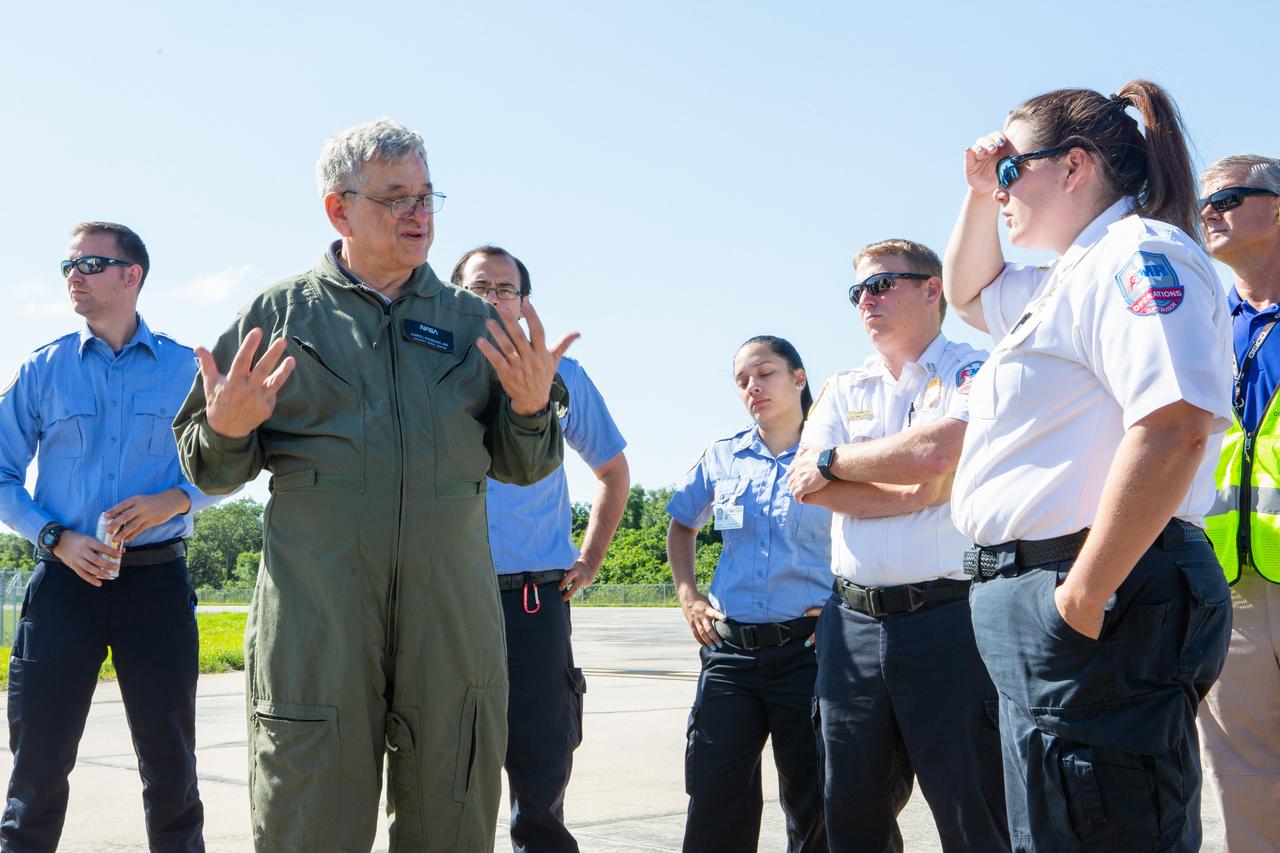
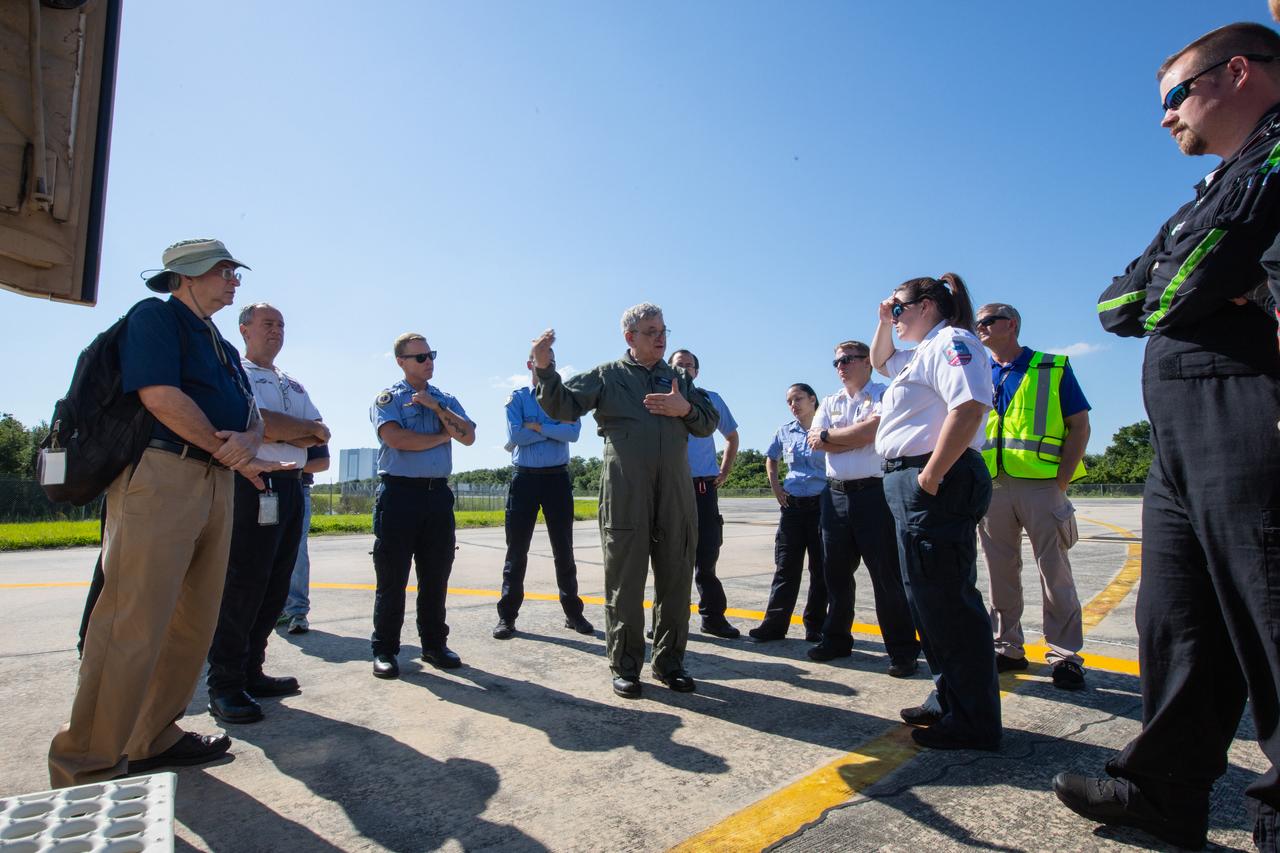
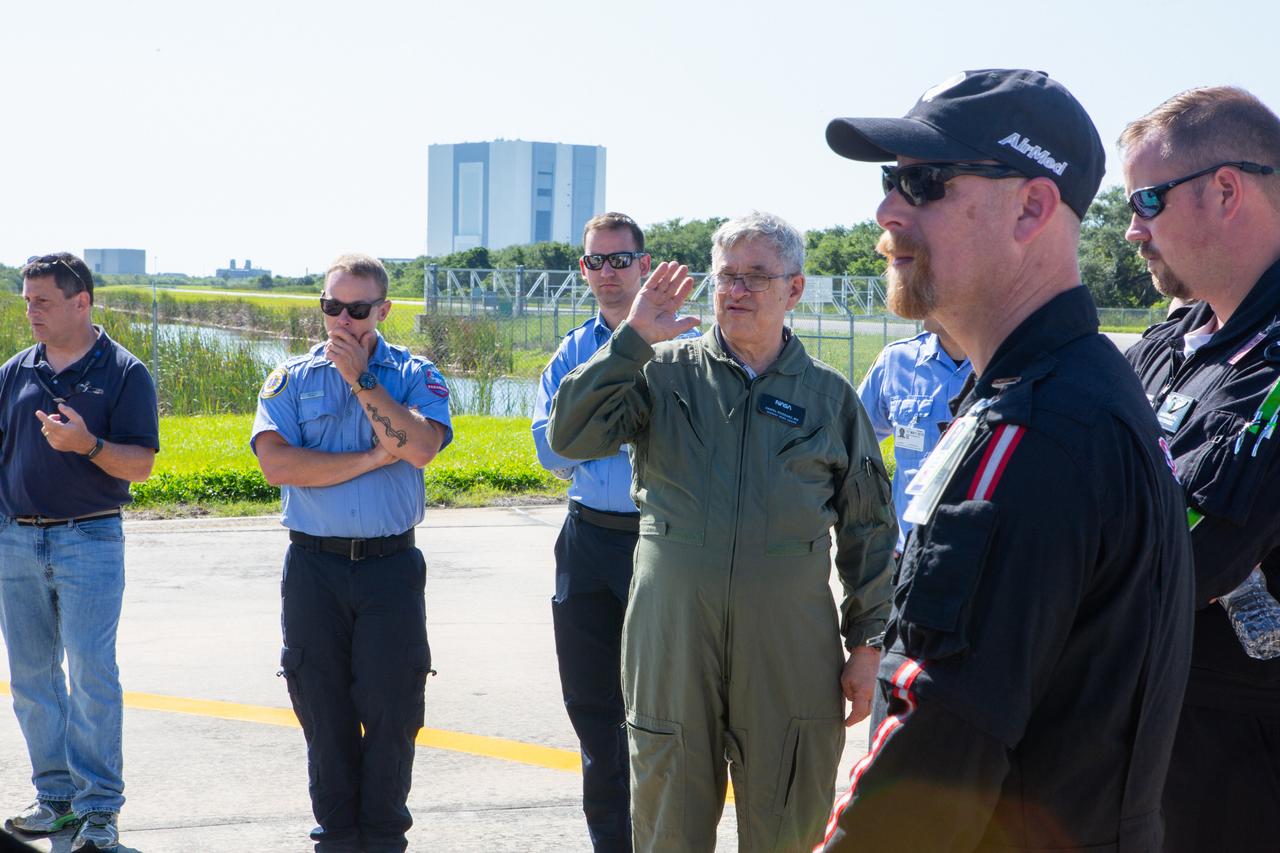
KEMCON physician Dr. Dan Woodard speaks to Kennedy Space Center personnel and American Medical Response (AMR) contractor paramedics gathered at the Florida spaceport’s Shuttle Landing Facility on May 17, 2019, for a medical support training course. The course was designed to familiarize the AMR paramedics with the center’s Triage Forces deployment, which included medical team members, fire/rescue personnel, environmental health specialists and flight operations crew members, as well as a helicopter, Mine Resistant Ambush Protected (MRAP) tactical vehicle, fire pumper truck and triage vehicles. The AMR paramedics will assist the agency in contingency planning for the return of human spaceflight from Kennedy.
KSC Triage Site Familiarization and Briefing
KEMCON physician Dr. Dan Woodard speaks to Kennedy Space Center personnel and American Medical Response (AMR) contractor paramedics gathered at the Florida spaceport’s Shuttle Landing Facility on May 17, 2019, for a medical support training course. The course was designed to familiarize the AMR paramedics with the center’s Triage Forces deployment, which included medical team members, fire/rescue personnel, environmental health specialists and flight operations crew members, as well as a helicopter, Mine Resistant Ambush Protected (MRAP) tactical vehicle, fire pumper truck and triage vehicles. The AMR paramedics will assist the agency in contingency planning for the return of human spaceflight from Kennedy.
KSC Triage Site Familiarization and Briefing
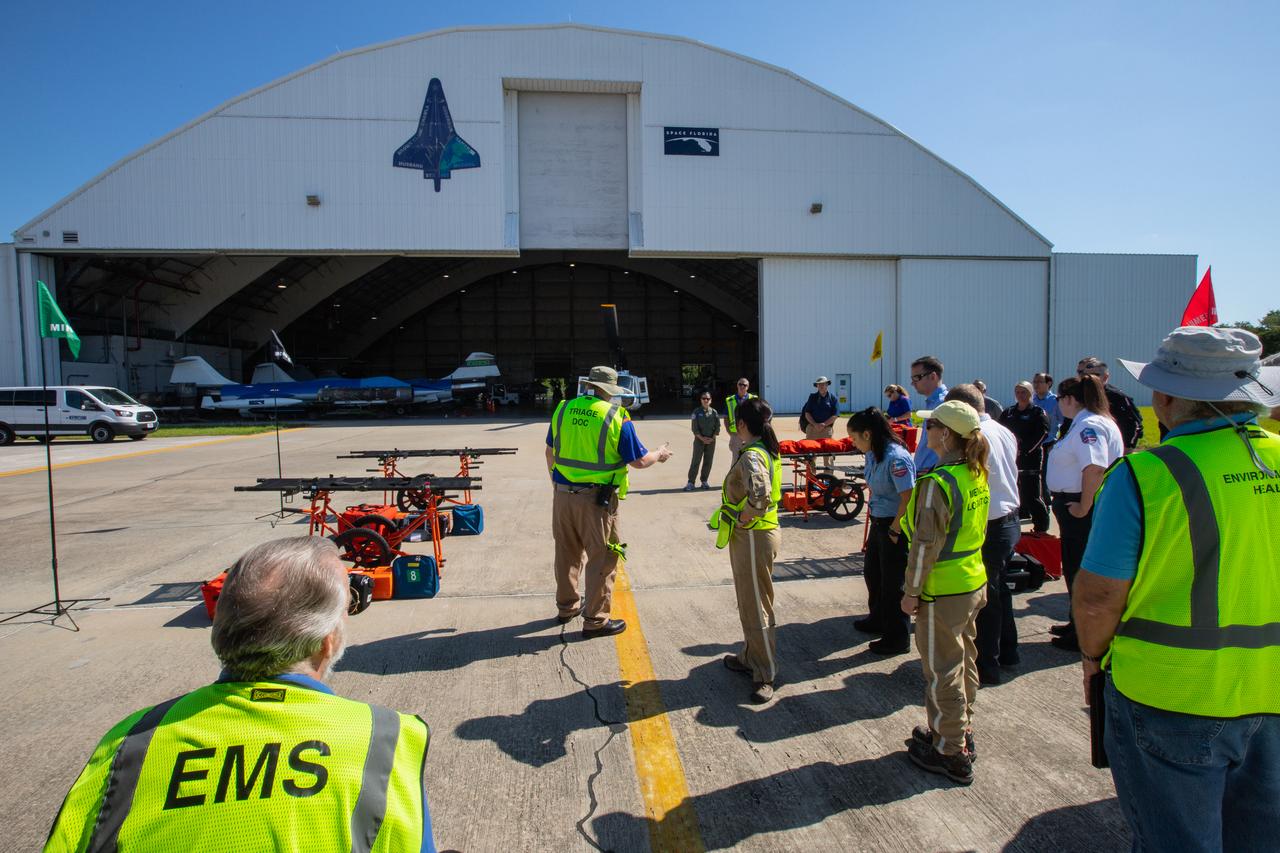
Kennedy Space Center personnel and American Medical Response (AMR) contractor paramedics gather near the Space Florida hangar at the spaceport’s Shuttle Landing Facility on May 17, 2019, for a medical support training course. The course was designed to familiarize the AMR paramedics with the center’s Triage Forces deployment, which included medical team members, fire/rescue personnel, environmental health specialists and flight operations crew members, as well as a helicopter, Mine Resistant Ambush Protected (MRAP) tactical vehicle, fire pumper truck and triage vehicles. The AMR paramedics will assist the agency in contingency planning for the return of human spaceflight from Kennedy.
KSC Triage Site Familiarization and Briefing
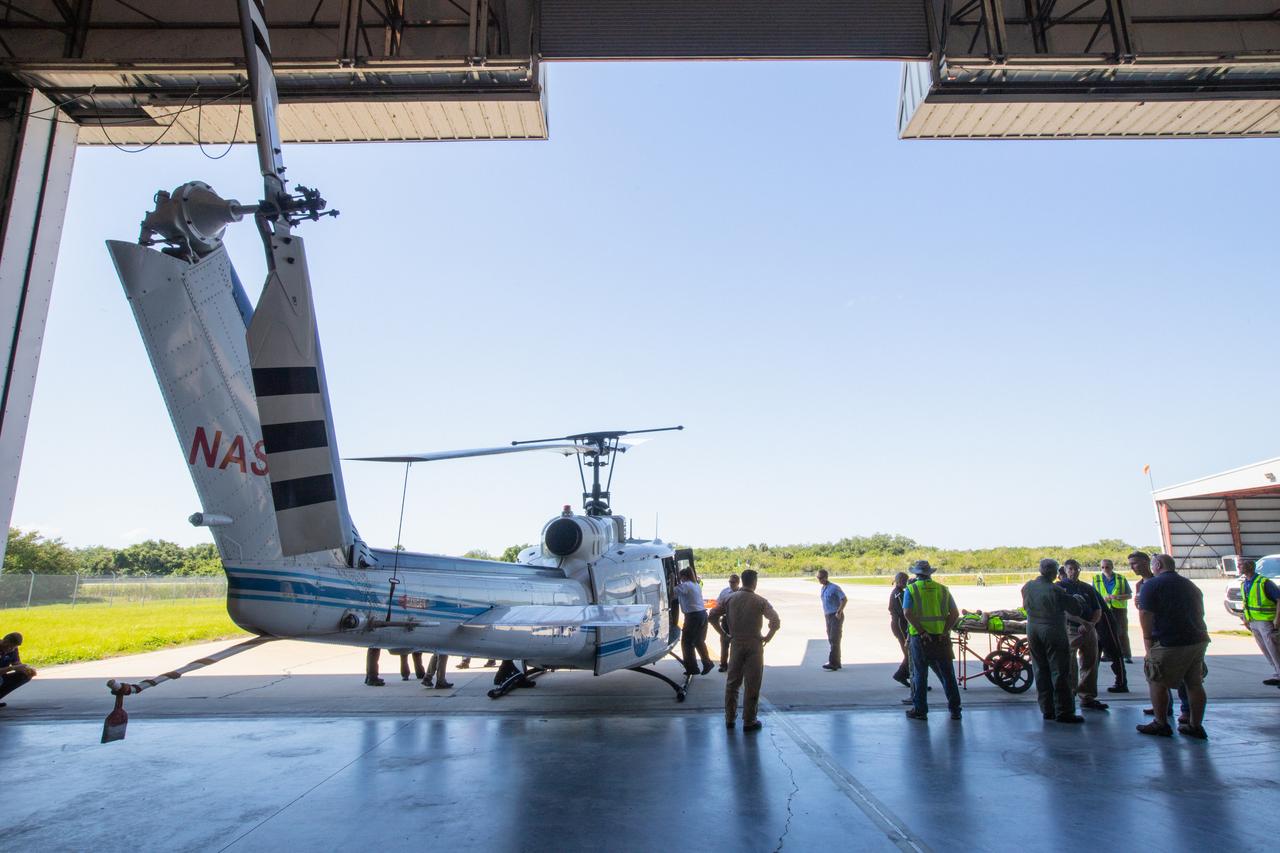
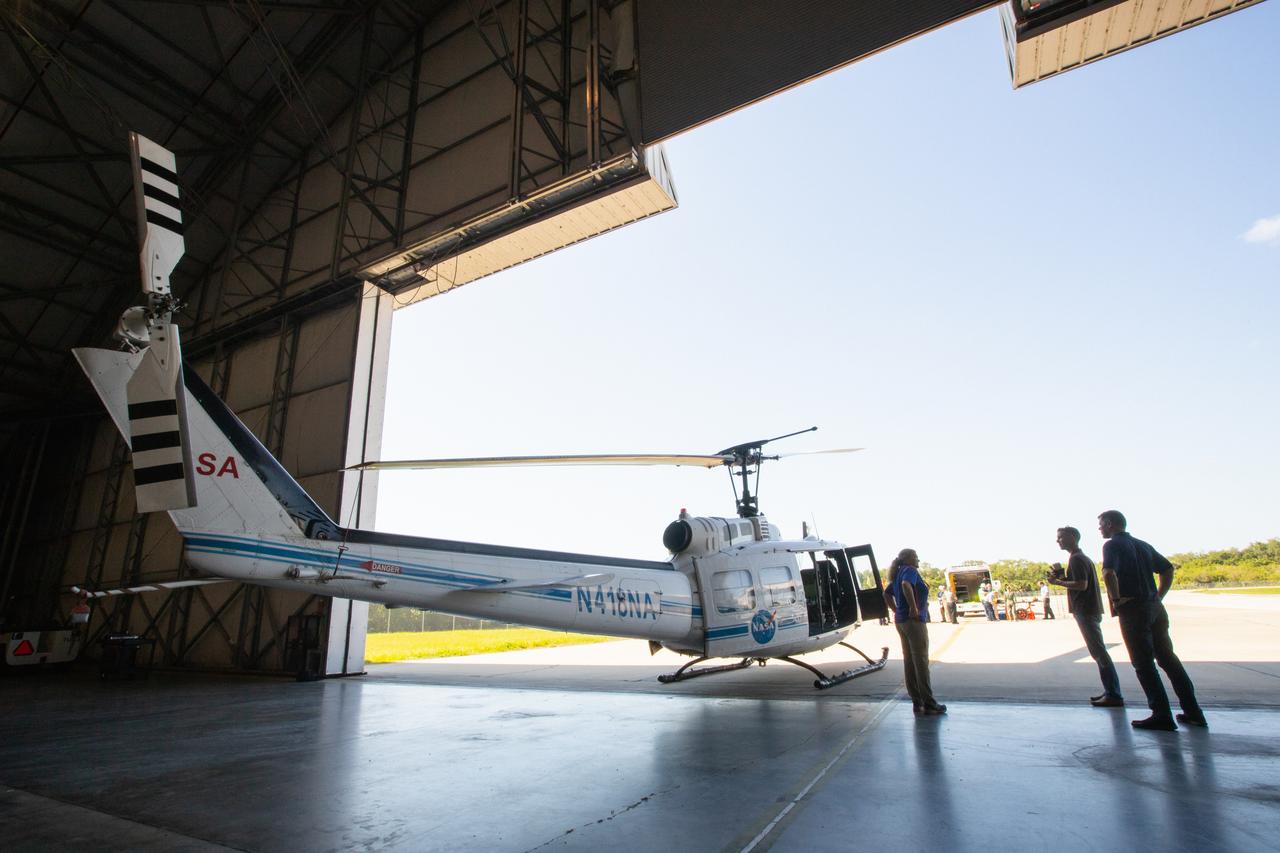
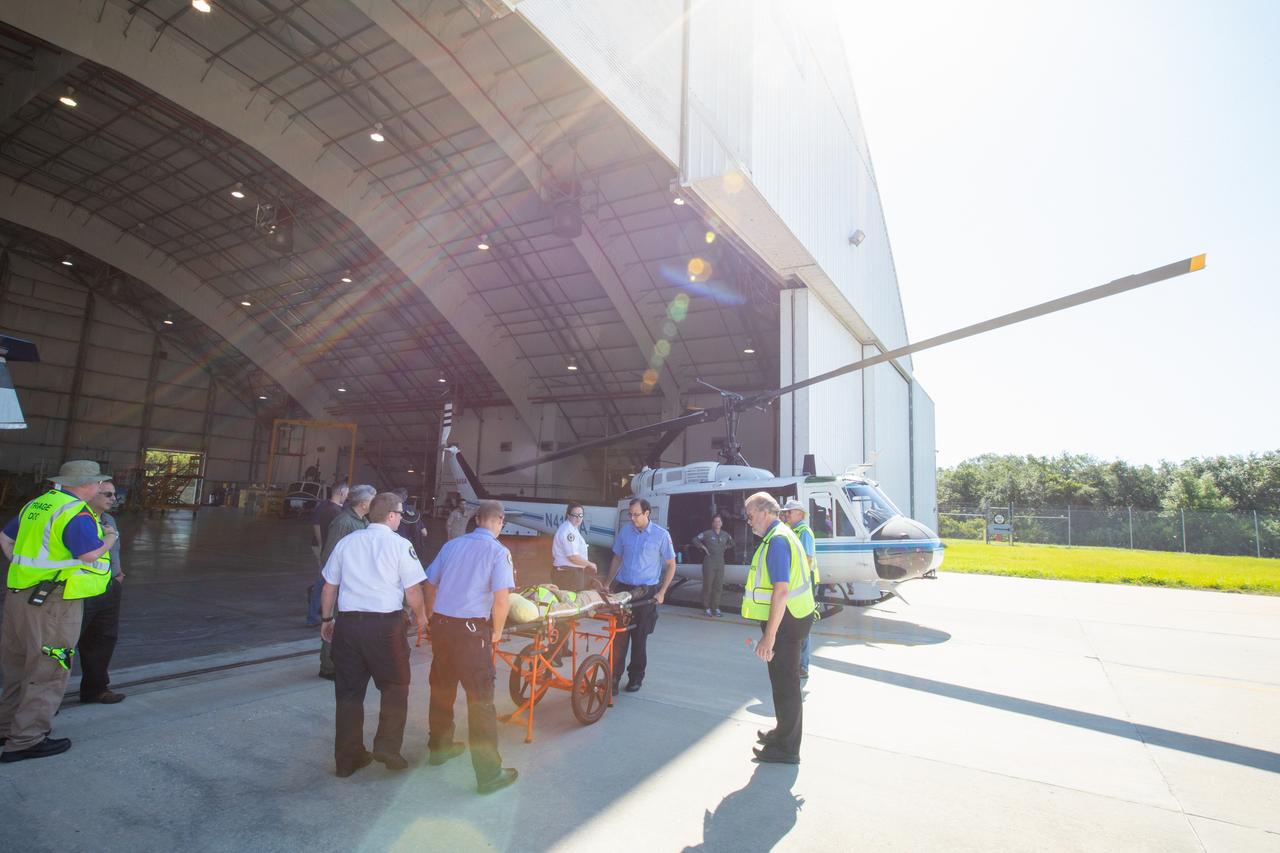
Kennedy Space Center personnel and American Medical Response (AMR) contractor paramedics gather near a NASA helicopter during a medical support training course in the Space Florida hangar at the spaceport’s Shuttle Landing Facility on May 17, 2019. The course was designed to familiarize the AMR paramedics with the center’s Triage Forces deployment, which included medical team members, fire/rescue personnel, environmental health specialists and flight operations crew members, as well as a helicopter, Mine Resistant Ambush Protected (MRAP) tactical vehicle, fire pumper truck and triage vehicles. The AMR paramedics will assist the agency in contingency planning for the return of human spaceflight from Kennedy.
KSC Triage Site Familiarization and Briefing
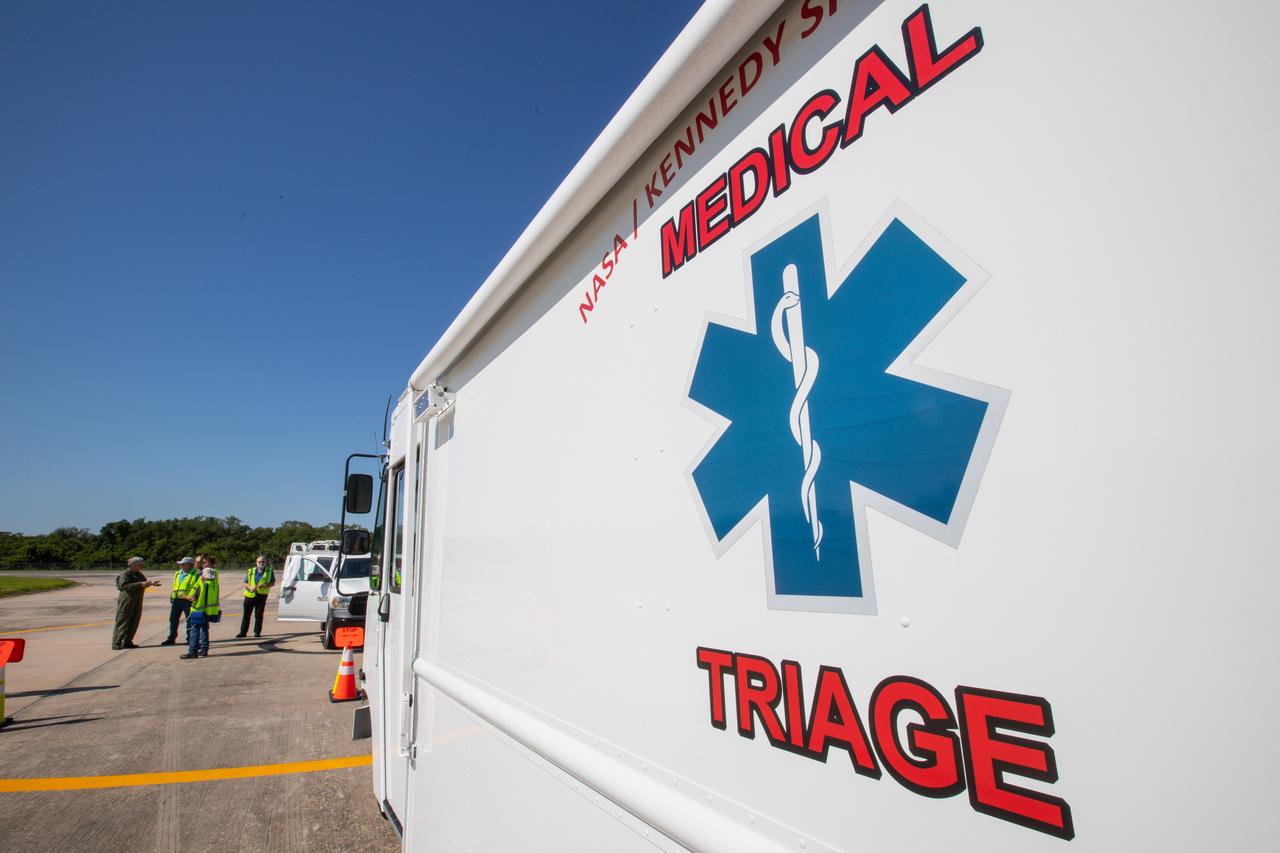
One of Kennedy Space Center’s medical triage vehicles stands at the ready during a medical support training course at the Florida spaceport’s Shuttle Landing Facility on May 17, 2019. Kennedy personnel and American Medical Response (AMR) contractor paramedics participated in the course, which was designed to familiarize the AMR paramedics with the center’s Triage Forces deployment, including medical team members, fire/rescue personnel, environmental health specialists and flight operations crew members, as well as a helicopter, Mine Resistant Ambush Protected (MRAP) tactical vehicle, fire pumper truck and triage vehicles. The AMR paramedics will assist the agency in contingency planning for the return of human spaceflight from Kennedy.
KSC Triage Site Familiarization and Briefing
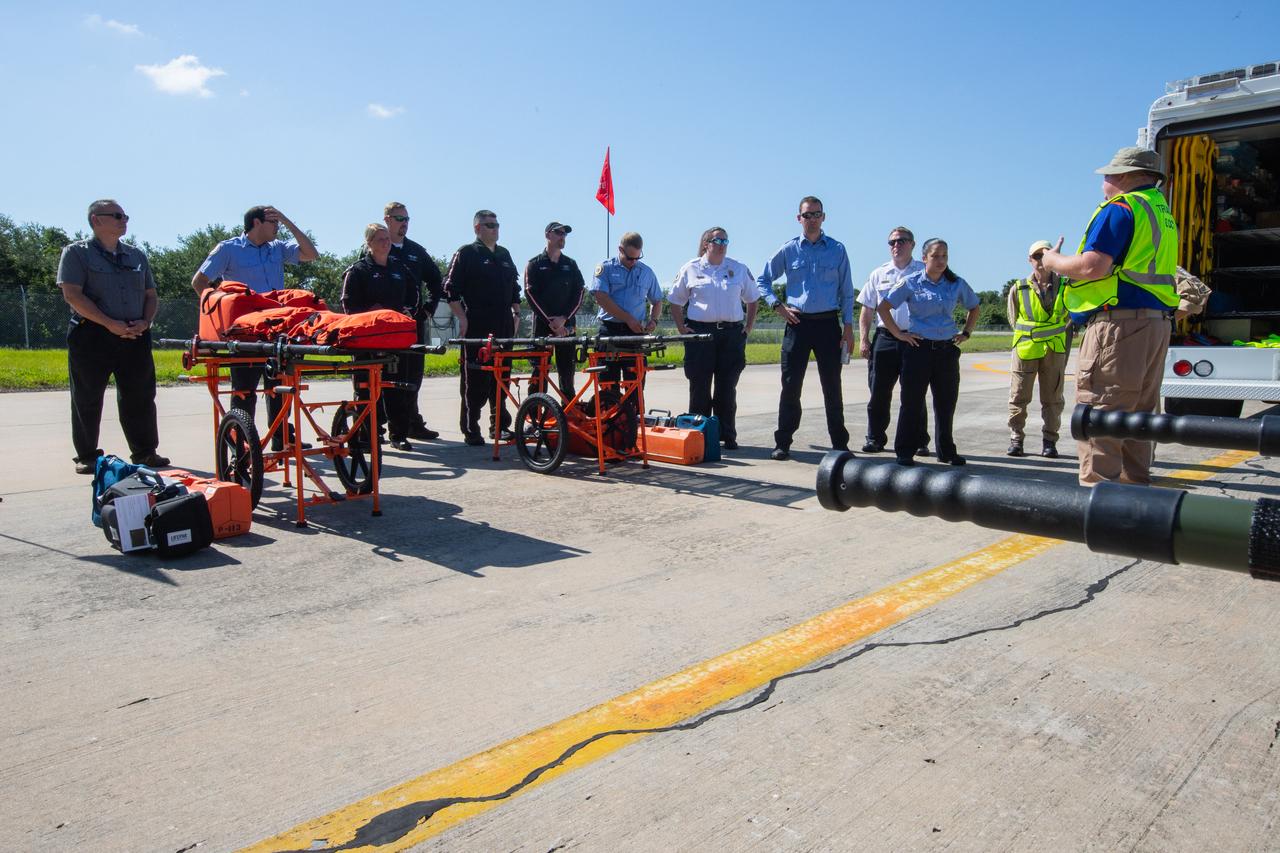
Kennedy Space Center personnel and American Medical Response (AMR) contractor paramedics gather at the Florida spaceport’s Shuttle Landing Facility on May 17, 2019, for a medical support training course. The course was designed to familiarize the AMR paramedics with the center’s Triage Forces deployment, which included medical team members, fire/rescue personnel, environmental health specialists and flight operations crew members, as well as a helicopter, Mine Resistant Ambush Protected (MRAP) tactical vehicle, fire pumper truck and triage vehicles. The AMR paramedics will assist the agency in contingency planning for the return of human spaceflight from Kennedy.
KSC Triage Site Familiarization and Briefing
A Kennedy Space Center Mine Resistant Ambush Protected (MRAP) tactical vehicle stands at the ready during a medical support training course at the Florida spaceport’s Shuttle Landing Facility on May 17, 2019. Kennedy personnel and American Medical Response (AMR) contractor paramedics participated in the course, which was designed to familiarize the AMR paramedics with the center’s Triage Forces deployment, including medical team members, fire/rescue personnel, environmental health specialists and flight operations crew members, as well as a helicopter, MRAP, fire pumper truck and triage vehicles. The AMR paramedics will assist the agency in contingency planning for the return of human spaceflight from Kennedy.
KSC Triage Site Familiarization and Briefing
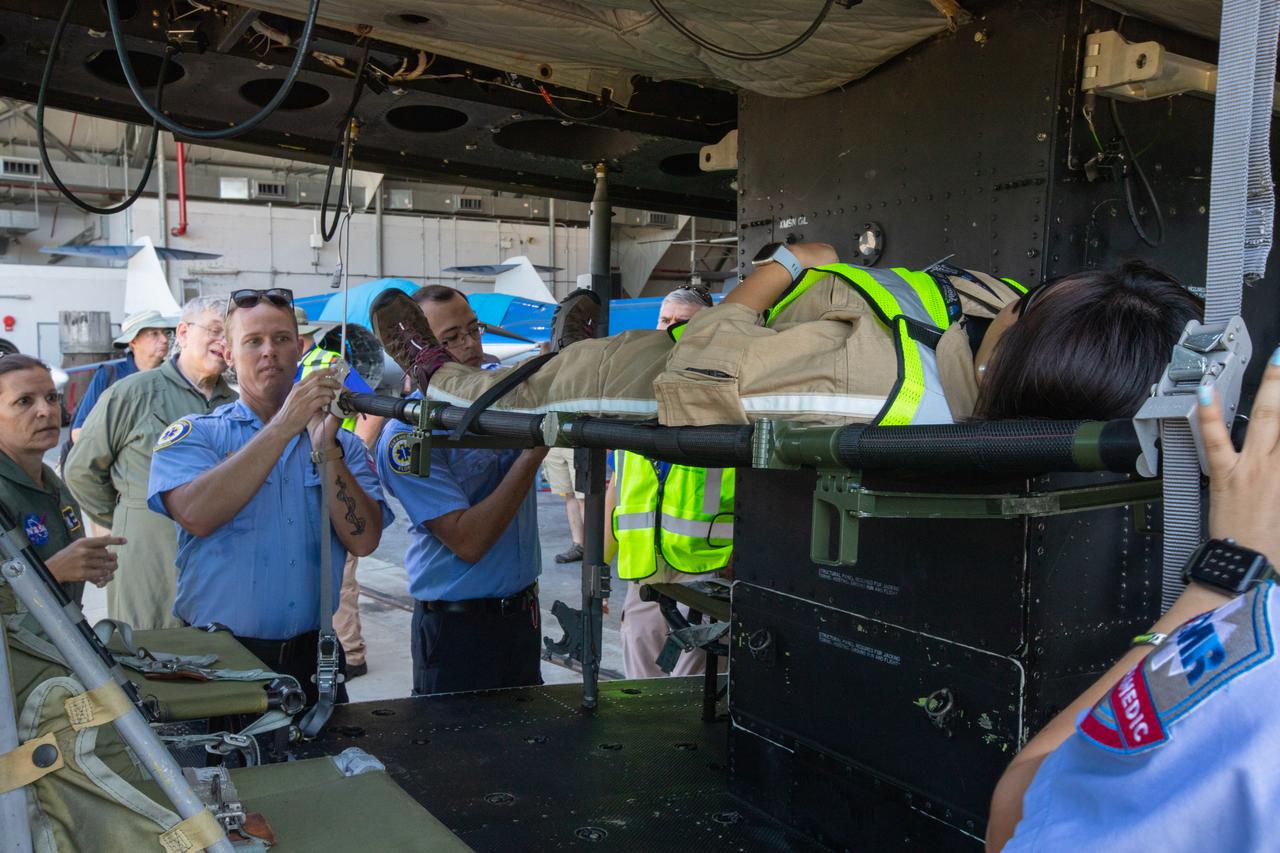
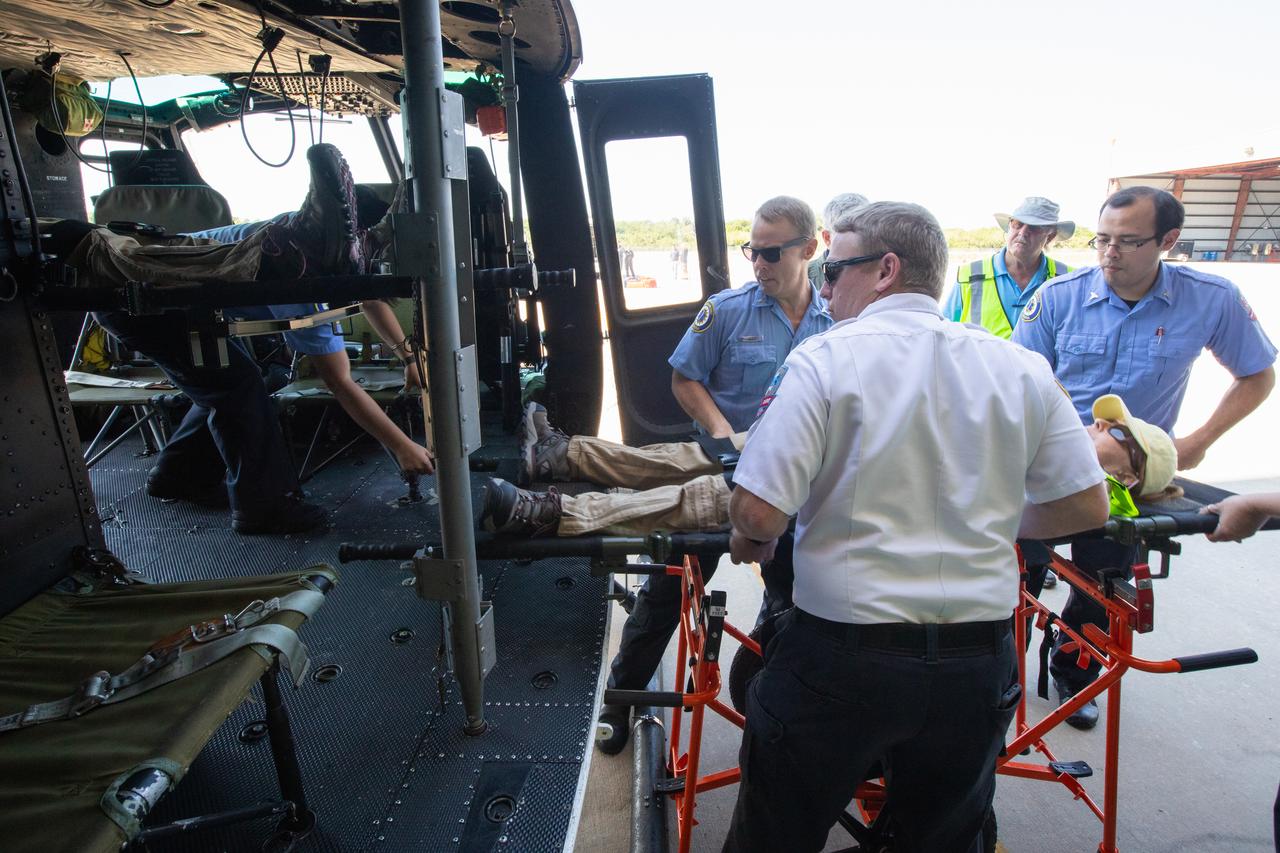
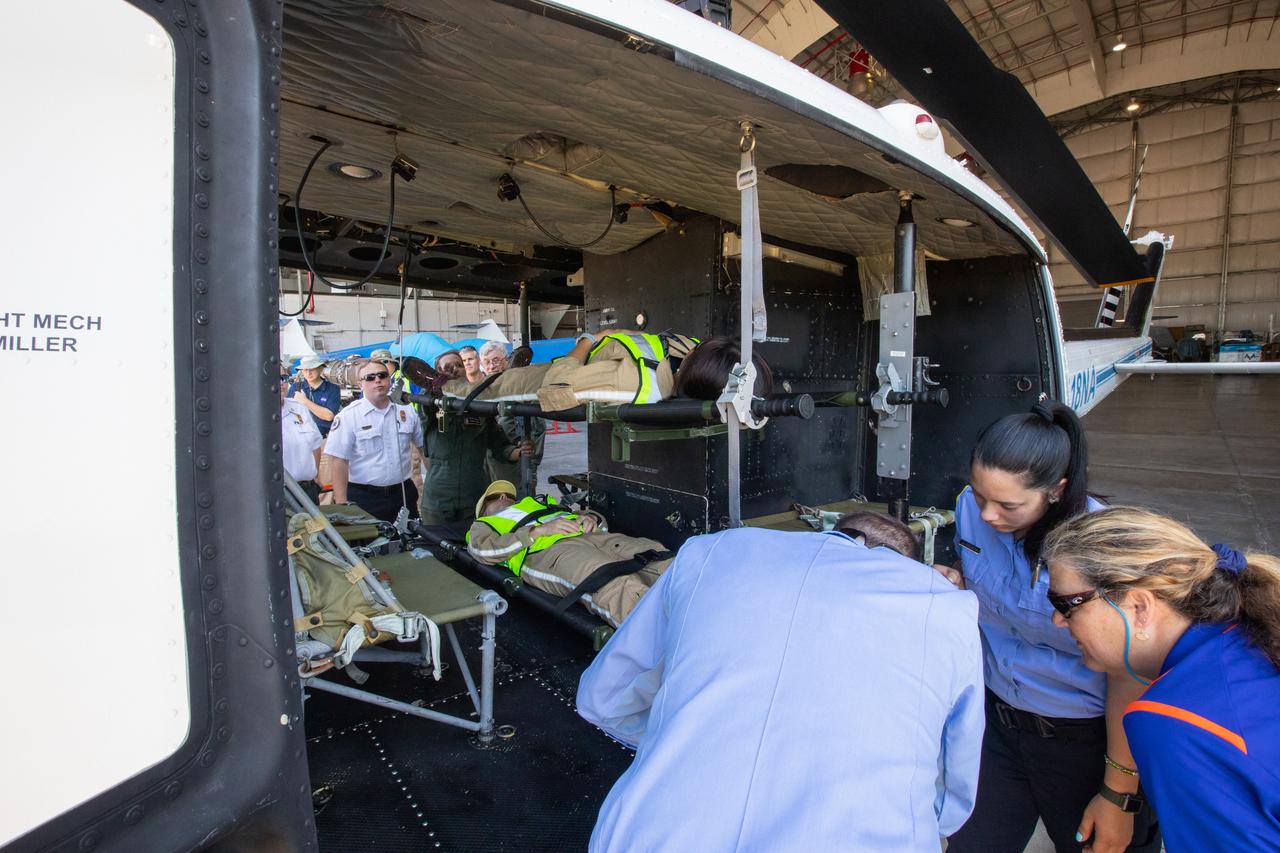
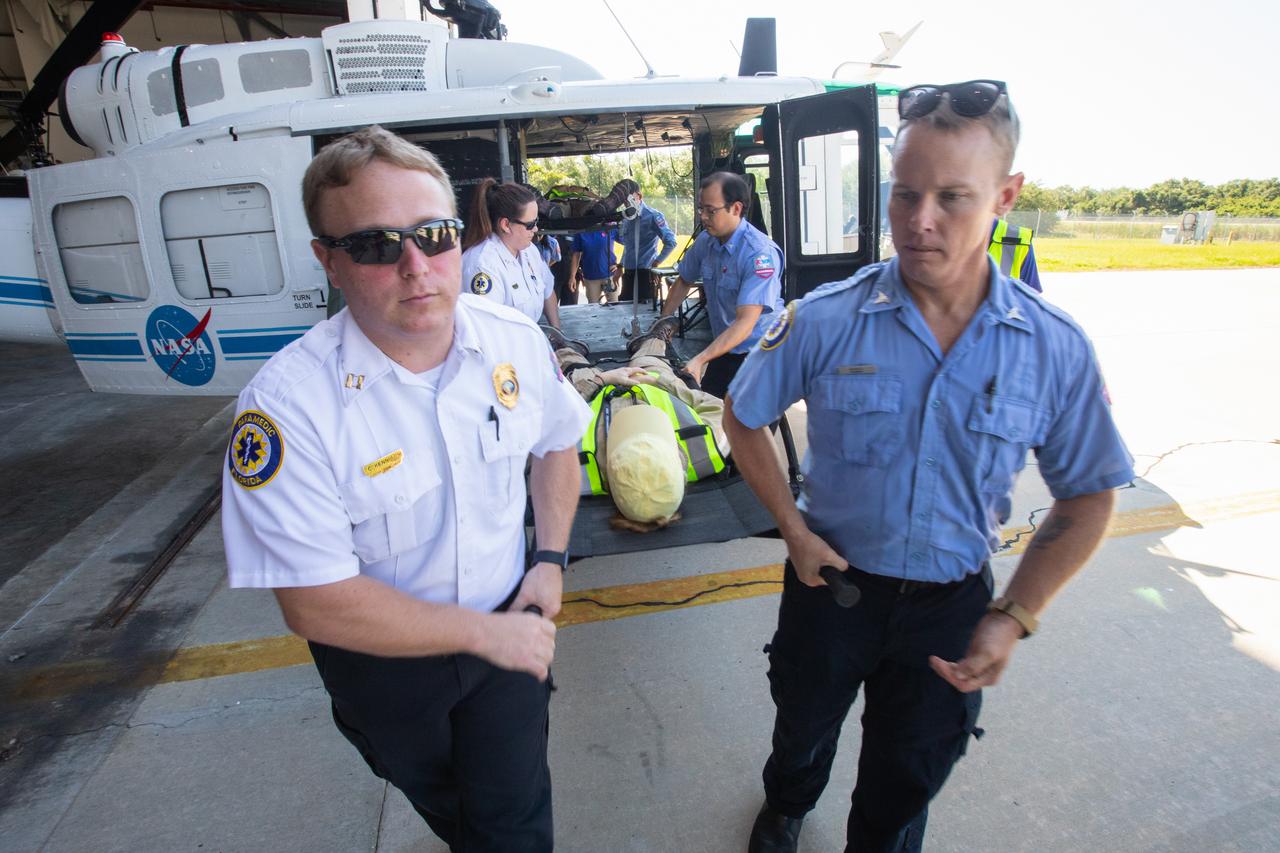
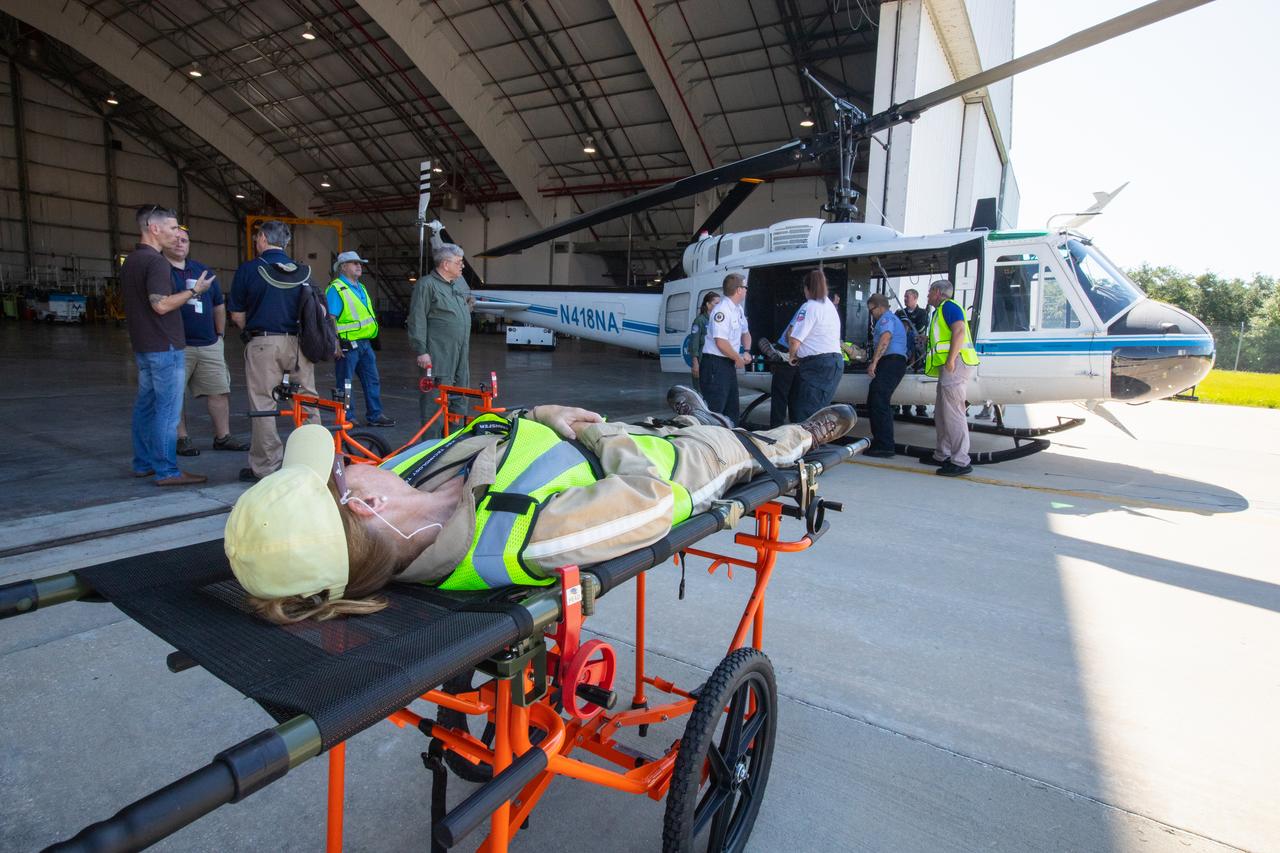
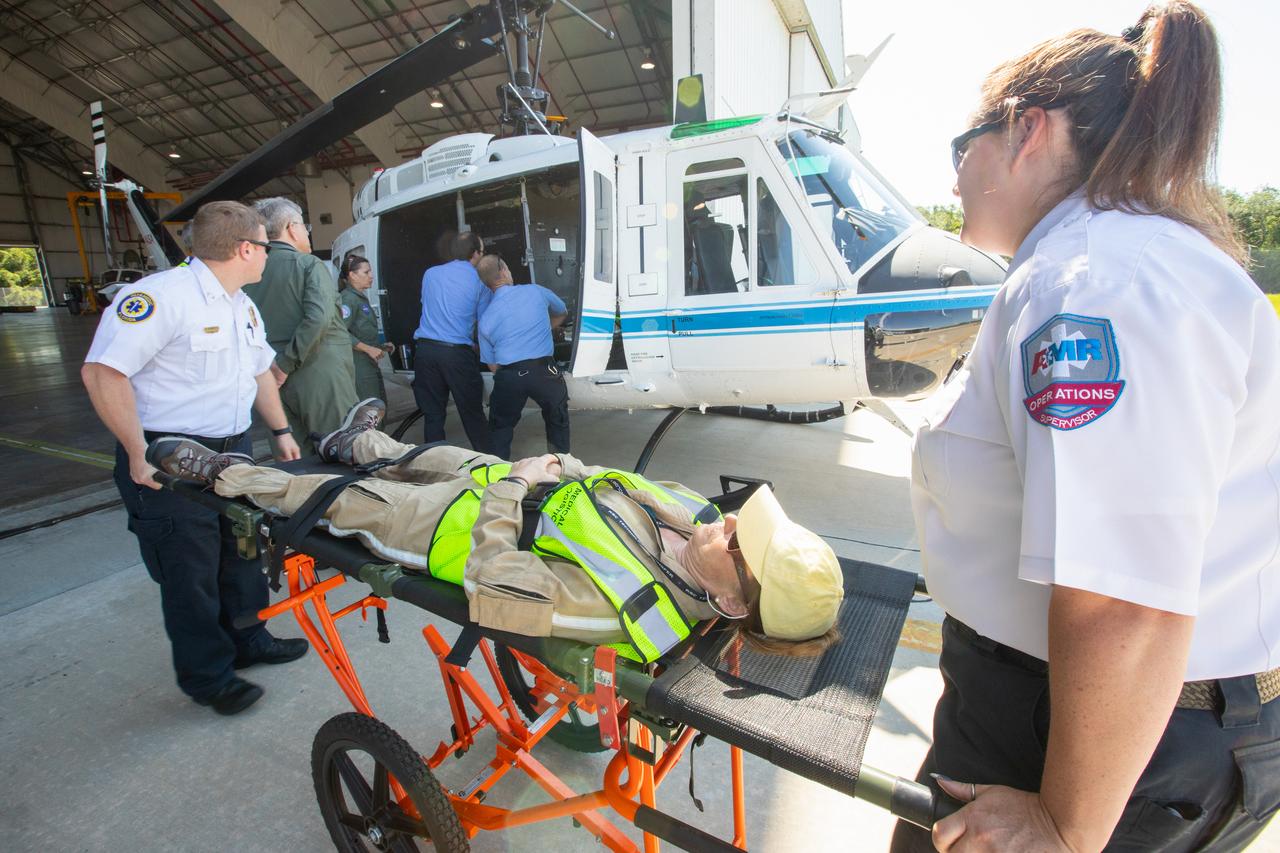
Kennedy Space Center personnel and American Medical Response (AMR) contractor paramedics load a “patient,” a KEMCON Fitness Center staff member, into a NASA helicopter during a medical support training course in the Space Florida hangar at the spaceport’s Shuttle Landing Facility on May 17, 2019. The course was designed to familiarize the AMR paramedics with the center’s Triage Forces deployment, which included medical team members, fire/rescue personnel, environmental health specialists and flight operations crew members, as well as a helicopter, Mine Resistant Ambush Protected (MRAP) tactical vehicle, fire pumper truck and triage vehicles. The AMR paramedics will assist the agency in contingency planning for the return of human spaceflight from Kennedy.
KSC Triage Site Familiarization and Briefing
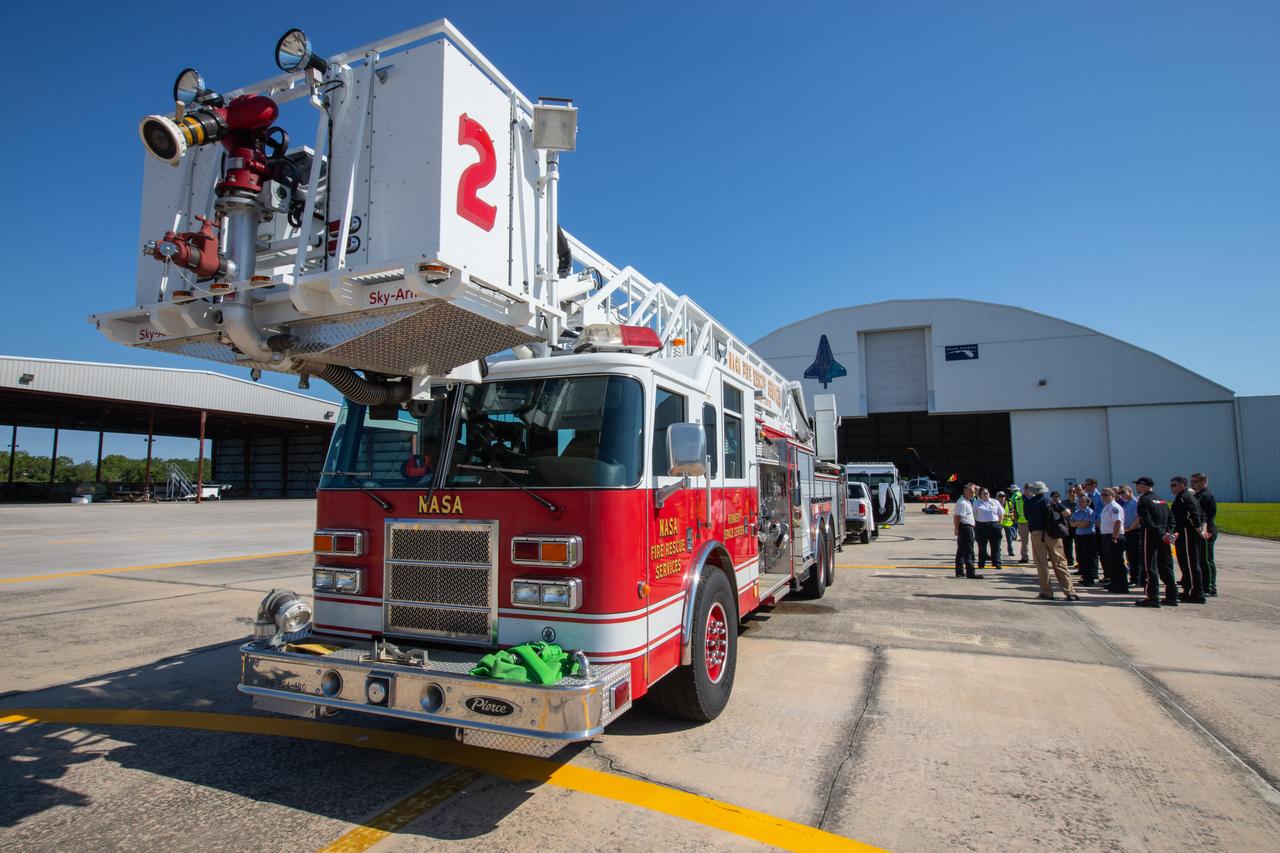
A Kennedy Space Center fire pumper truck stands at the ready during a medical support training course at the Florida spaceport’s Shuttle Landing Facility on May 17, 2019. Kennedy personnel and American Medical Response (AMR) contractor paramedics participated in the course, which was designed to familiarize the AMR paramedics with the center’s Triage Forces deployment, including medical team members, fire/rescue personnel, environmental health specialists and flight operations crew members, as well as a helicopter, Mine Resistant Ambush Protected (MRAP) tactical vehicle, fire pumper truck and triage vehicles. The AMR paramedics will assist the agency in contingency planning for the return of human spaceflight from Kennedy.
KSC Triage Site Familiarization and Briefing
Kennedy Space Center personnel and American Medical Response (AMR) contractor paramedics gather around a “patient,” a KEMCON Fitness Center staff member, during a medical support training course in the Space Florida hangar at the spaceport’s Shuttle Landing Facility on May 17, 2019. The course was designed to familiarize the AMR paramedics with the center’s Triage Forces deployment, which included medical team members, fire/rescue personnel, environmental health specialists and flight operations crew members, as well as a helicopter, Mine Resistant Ambush Protected (MRAP) tactical vehicle, fire pumper truck and triage vehicles. The AMR paramedics will assist the agency in contingency planning for the return of human spaceflight from Kennedy.
KSC Triage Site Familiarization and Briefing
Kennedy Space Center personnel and American Medical Response (AMR) contractor paramedics load a “patient,” a KEMCON Fitness Center staff member, into a NASA helicopter during a medical support training course in the Space Florida hangar at the spaceport’s Shuttle Landing Facility on May 17, 2019. The course was designed to familiarize the AMR paramedics with the center’s Triage Forces deployment, which included medical team members, fire/rescue personnel, environmental health specialists and flight operations crew members, as well as a helicopter, Mine Resistant Ambush Protected (MRAP) tactical vehicle, fire pumper truck and triage vehicles. The AMR paramedics will assist the agency in contingency planning for the return of human spaceflight from Kennedy.
KSC Triage Site Familiarization and Briefing
Kennedy Space Center personnel and American Medical Response (AMR) contractor paramedics participate in a medical support training course at the Florida spaceport’s Shuttle Landing Facility on May 17, 2019. The course was designed to familiarize the AMR paramedics with the center’s Triage Forces deployment, which included medical team members, fire/rescue personnel, environmental health specialists and flight operations crew members, as well as a helicopter, Mine Resistant Ambush Protected (MRAP) tactical vehicle, fire pumper truck and triage vehicles. The AMR paramedics will assist the agency in contingency planning for the return of human spaceflight from Kennedy.
KSC Triage Site Familiarization and Briefing
KEMCON physician Dr. Dan Woodard speaks to Kennedy Space Center personnel and American Medical Response (AMR) contractor paramedics gathered at the Florida spaceport’s Shuttle Landing Facility on May 17, 2019, for a medical support training course. The course was designed to familiarize the AMR paramedics with the center’s Triage Forces deployment, which included medical team members, fire/rescue personnel, environmental health specialists and flight operations crew members, as well as a helicopter, Mine Resistant Ambush Protected (MRAP) tactical vehicle, fire pumper truck and triage vehicles. The AMR paramedics will assist the agency in contingency planning for the return of human spaceflight from Kennedy.
KSC Triage Site Familiarization and Briefing
Kennedy Space Center personnel and American Medical Response (AMR) contractor paramedics gather around a “patient,” a KEMCON Fitness Center staff member, during a medical support training course in the Space Florida hangar at the spaceport’s Shuttle Landing Facility on May 17, 2019. The course was designed to familiarize the AMR paramedics with the center’s Triage Forces deployment, which included medical team members, fire/rescue personnel, environmental health specialists and flight operations crew members, as well as a helicopter, Mine Resistant Ambush Protected (MRAP) tactical vehicle, fire pumper truck and triage vehicles. The AMR paramedics will assist the agency in contingency planning for the return of human spaceflight from Kennedy.
KSC Triage Site Familiarization and Briefing
A Kennedy Space Center staff member serves as a “patient” during a medical support training course held May 17, 2019, in the Space Florida hangar at the spaceport’s Shuttle Landing Facility. The course was designed to familiarize the AMR paramedics with the center’s Triage Forces deployment, which included medical team members, fire/rescue personnel, environmental health specialists and flight operations crew members, as well as a helicopter, Mine Resistant Ambush Protected (MRAP) tactical vehicle, fire pumper truck and triage vehicles. The AMR paramedics will assist the agency in contingency planning for the return of human spaceflight from Kennedy.
KSC Triage Site Familiarization and Briefing
Kennedy Space Center personnel and American Medical Response (AMR) contractor paramedics gather at the Florida spaceport’s Shuttle Landing Facility on May 17, 2019, for a medical support training course. The course was designed to familiarize the AMR paramedics with the center’s Triage Forces deployment, which included medical team members, fire/rescue personnel, environmental health specialists and flight operations crew members, as well as a helicopter, Mine Resistant Ambush Protected (MRAP) tactical vehicle, fire pumper truck and triage vehicles. The AMR paramedics will assist the agency in contingency planning for the return of human spaceflight from Kennedy.
KSC Triage Site Familiarization and Briefing
Kennedy Space Center personnel and American Medical Response (AMR) contractor paramedics gather near a NASA helicopter in the Space Florida hangar at the spaceport’s Shuttle Landing Facility on May 17, 2019, for a medical support training course. The course was designed to familiarize the AMR paramedics with the center’s Triage Forces deployment, which included medical team members, fire/rescue personnel, environmental health specialists and flight operations crew members, as well as the helicopter, Mine Resistant Ambush Protected (MRAP) tactical vehicle, fire pumper truck and triage vehicles. The AMR paramedics will assist the agency in contingency planning for the return of human spaceflight from Kennedy.
KSC Triage Site Familiarization and Briefing
Kennedy Space Center personnel and American Medical Response (AMR) contractor paramedics gather around a “patient,” a KEMCON Fitness Center staff member, during a medical support training course in the Space Florida hangar at the spaceport’s Shuttle Landing Facility on May 17, 2019. The course was designed to familiarize the AMR paramedics with the center’s Triage Forces deployment, which included medical team members, fire/rescue personnel, environmental health specialists and flight operations crew members, as well as a helicopter, Mine Resistant Ambush Protected (MRAP) tactical vehicle, fire pumper truck and triage vehicles. The AMR paramedics will assist the agency in contingency planning for the return of human spaceflight from Kennedy.
KSC Triage Site Familiarization and Briefing
Kennedy Space Center personnel and American Medical Response (AMR) contractor paramedics participate in a medical support training course at the Florida spaceport’s Shuttle Landing Facility on May 17, 2019. The course was designed to familiarize the AMR paramedics with the center’s Triage Forces deployment, which included medical team members, fire/rescue personnel, environmental health specialists and flight operations crew members, as well as a helicopter, Mine Resistant Ambush Protected (MRAP) tactical vehicle, fire pumper truck and triage vehicles. The AMR paramedics will assist the agency in contingency planning for the return of human spaceflight from Kennedy.
KSC Triage Site Familiarization and Briefing
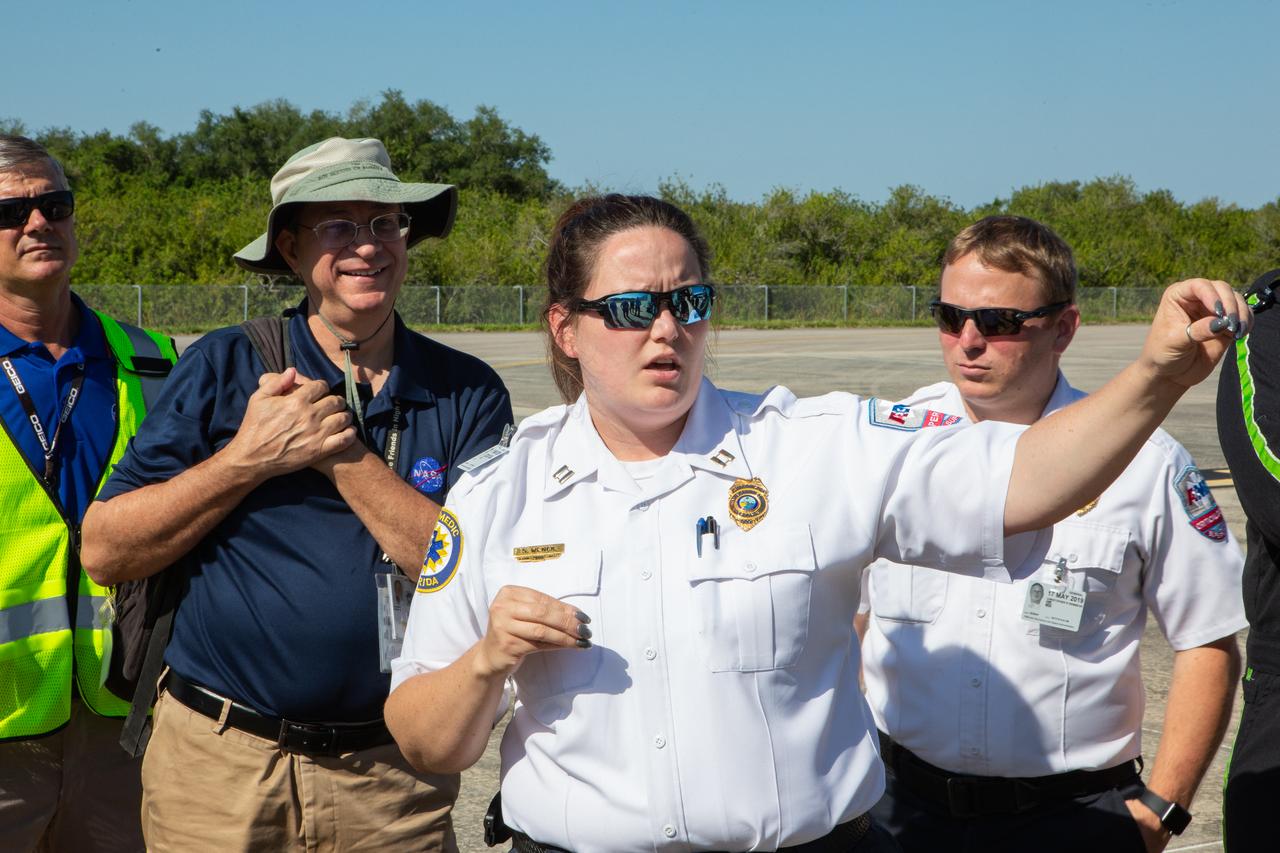
An American Medical Response (AMR) contractor paramedic speaks to Kennedy Space Center and AMR personnel gathered at the Florida spaceport’s Shuttle Landing Facility on May 17, 2019, for a medical support training course. The course was designed to familiarize the AMR paramedics with the center’s Triage Forces deployment, which included medical team members, fire/rescue personnel, environmental health specialists and flight operations crew members, as well as a helicopter, Mine Resistant Ambush Protected (MRAP) tactical vehicle, fire pumper truck and triage vehicles. The AMR paramedics will assist the agency in contingency planning for the return of human spaceflight from Kennedy.
KSC Triage Site Familiarization and Briefing
Kennedy Space Center personnel and American Medical Response (AMR) contractor paramedics gather at the Florida spaceport’s Shuttle Landing Facility on May 17, 2019, for a medical support training course. The course was designed to familiarize the AMR paramedics with the center’s Triage Forces deployment, which included medical team members, fire/rescue personnel, environmental health specialists and flight operations crew members, as well as a helicopter, Mine Resistant Ambush Protected (MRAP) tactical vehicle, fire pumper truck and triage vehicles. The AMR paramedics will assist the agency in contingency planning for the return of human spaceflight from Kennedy.
KSC Triage Site Familiarization and Briefing
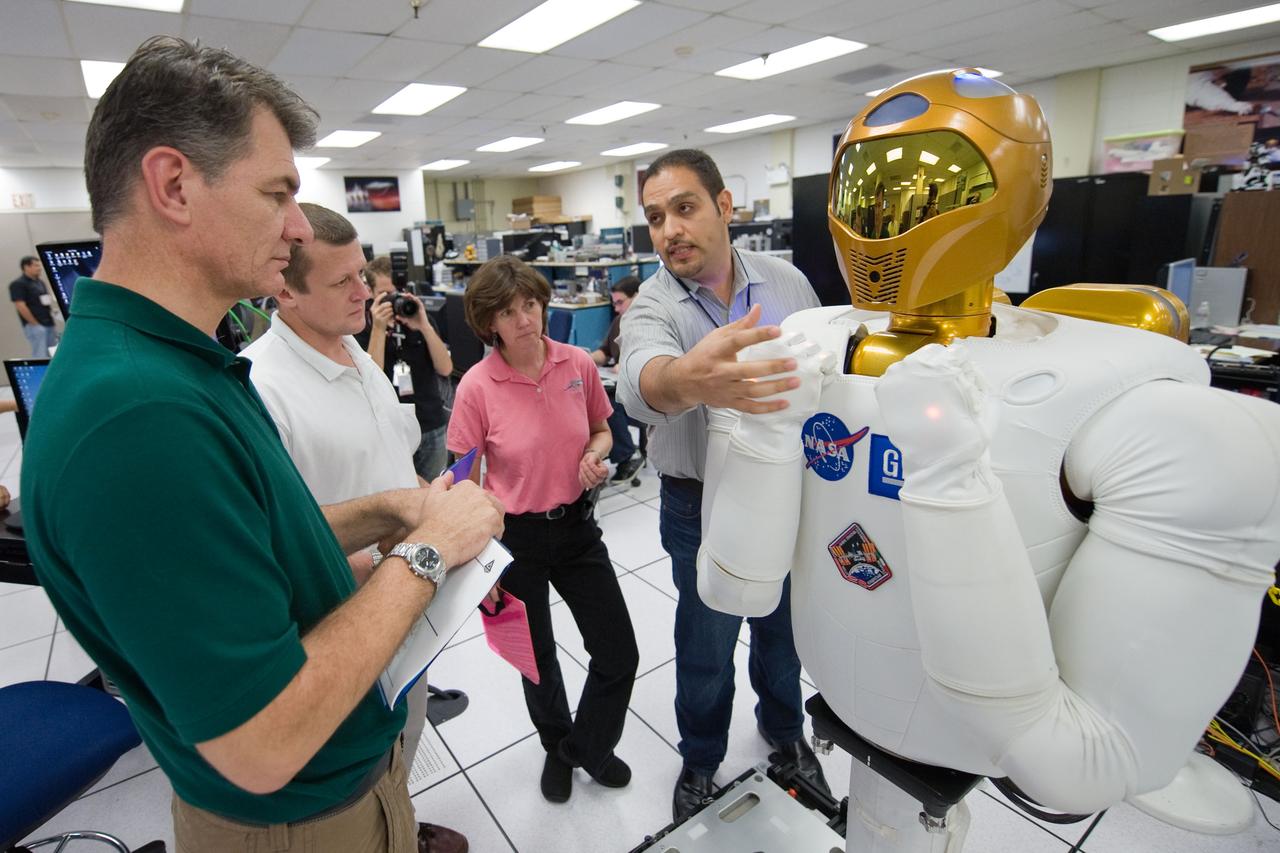
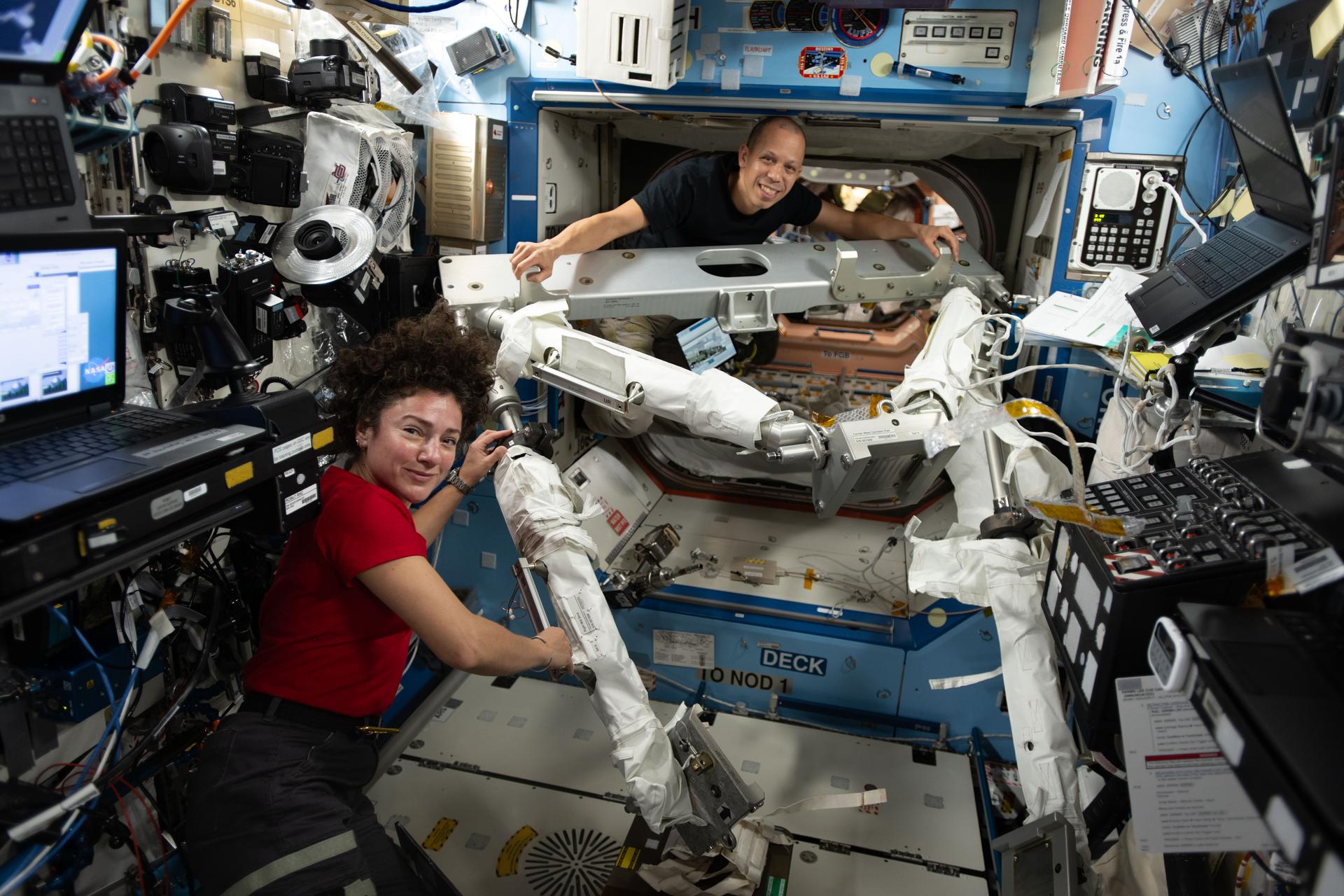
PHOTO DATE: 09-16-10 LOCATION: Bldg 32A,  rm 2009 SUBJECT:  Expedition 26-27 crew members during Robonaut Familiarization training PHOTOGRAPHER:  James Blair
Expedition 26/27 crew members during Robonaut Familiarization training
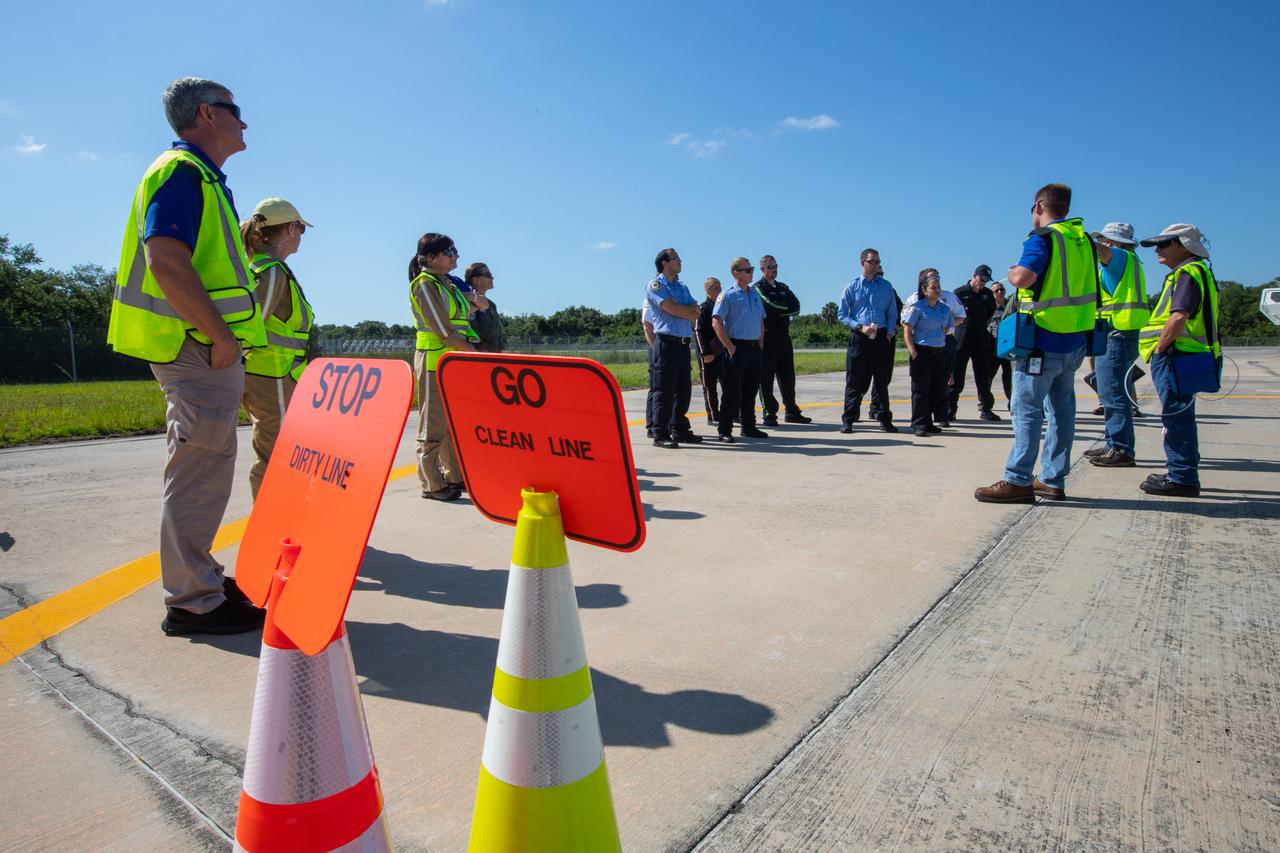
Kennedy Space Center personnel and American Medical Response (AMR) contractor paramedics gather at the Florida spaceport’s Shuttle Landing Facility on May 17, 2019, for a medical support training course. Signs in the foreground indicate the “dirty side,” where patient off-loading and decontamination would take place, and the “clean side,” used for patient evaluation and medevac. The course was designed to familiarize the AMR paramedics with the center’s Triage Forces deployment, which included medical team members, fire/rescue personnel, environmental health specialists and flight operations crew members, as well as a helicopter, Mine Resistant Ambush Protected (MRAP) tactical vehicle, fire pumper truck and triage vehicles. The AMR paramedics will assist the agency in contingency planning for the return of human spaceflight from Kennedy.
KSC Triage Site Familiarization and Briefing
Kennedy Space Center personnel and American Medical Response (AMR) contractor paramedics prepare to load a “patient,” a KEMCON Fitness Center staff member, into a NASA helicopter during a medical support training course in the Space Florida hangar at the spaceport’s Shuttle Landing Facility on May 17, 2019. The course was designed to familiarize the AMR paramedics with the center’s Triage Forces deployment, which included medical team members, fire/rescue personnel, environmental health specialists and flight operations crew members, as well as a helicopter, Mine Resistant Ambush Protected (MRAP) tactical vehicle, fire pumper truck and triage vehicles. The AMR paramedics will assist the agency in contingency planning for the return of human spaceflight from Kennedy.
KSC Triage Site Familiarization and Briefing
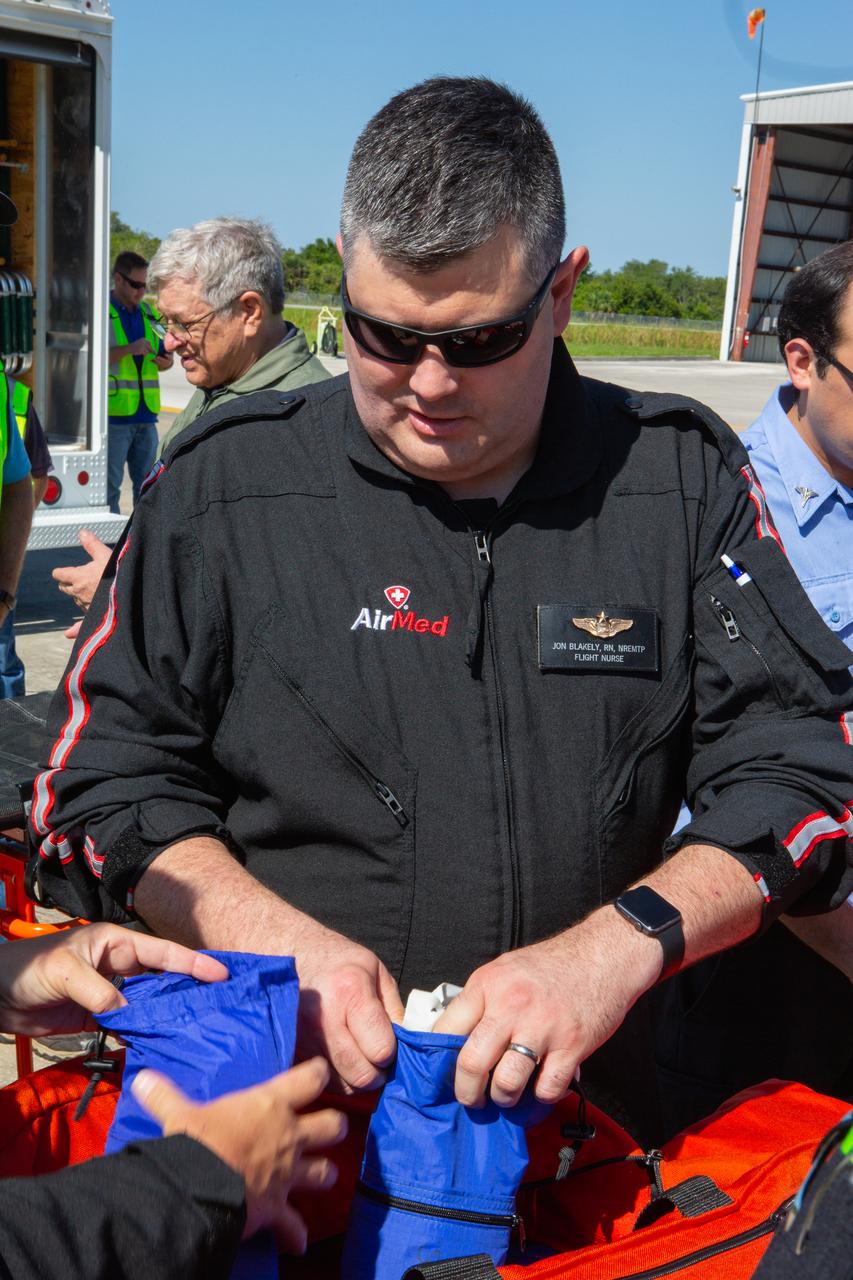
Jon Blakely, an AirMed flight nurse, joins Kennedy Space Center personnel and American Medical Response (AMR) contractor paramedics at the Florida spaceport’s Shuttle Landing Facility on May 17, 2019, for a medical support training course. Signs in the foreground indicate the “dirty side,” where patient off-loading and decontamination would take place, and the “clean side,” used for patient evaluation and medevac. The course was designed to familiarize the AMR paramedics with the center’s Triage Forces deployment, which included medical team members, fire/rescue personnel, environmental health specialists and flight operations crew members, as well as a helicopter, Mine Resistant Ambush Protected (MRAP) tactical vehicle, fire pumper truck and triage vehicles. The AMR paramedics will assist the agency in contingency planning for the return of human spaceflight from Kennedy.
KSC Triage Site Familiarization and Briefing
Kennedy Space Center personnel and American Medical Response (AMR) contractor paramedics gather at the Florida spaceport’s Shuttle Landing Facility on May 17, 2019, for a medical support training course. Signs in the foreground indicate the “dirty side,” where patient off-loading and decontamination would take place, and the “clean side,” used for patient evaluation and medevac. The course was designed to familiarize the AMR paramedics with the center’s Triage Forces deployment, which included medical team members, fire/rescue personnel, environmental health specialists and flight operations crew members, as well as a helicopter, Mine Resistant Ambush Protected (MRAP) tactical vehicle, fire pumper truck and triage vehicles. The AMR paramedics will assist the agency in contingency planning for the return of human spaceflight from Kennedy.
KSC Triage Site Familiarization and Briefing
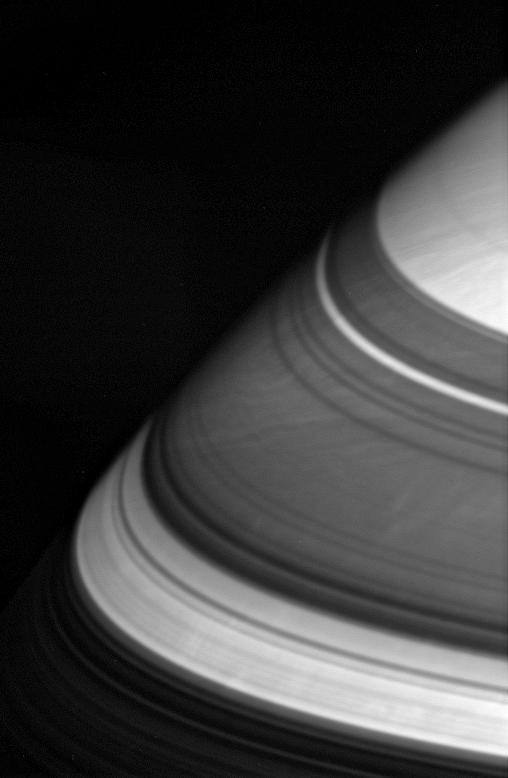
The dark shadows that drape Saturn northern latitudes are split by three  familiar bright gaps
Sun Through the Shadows
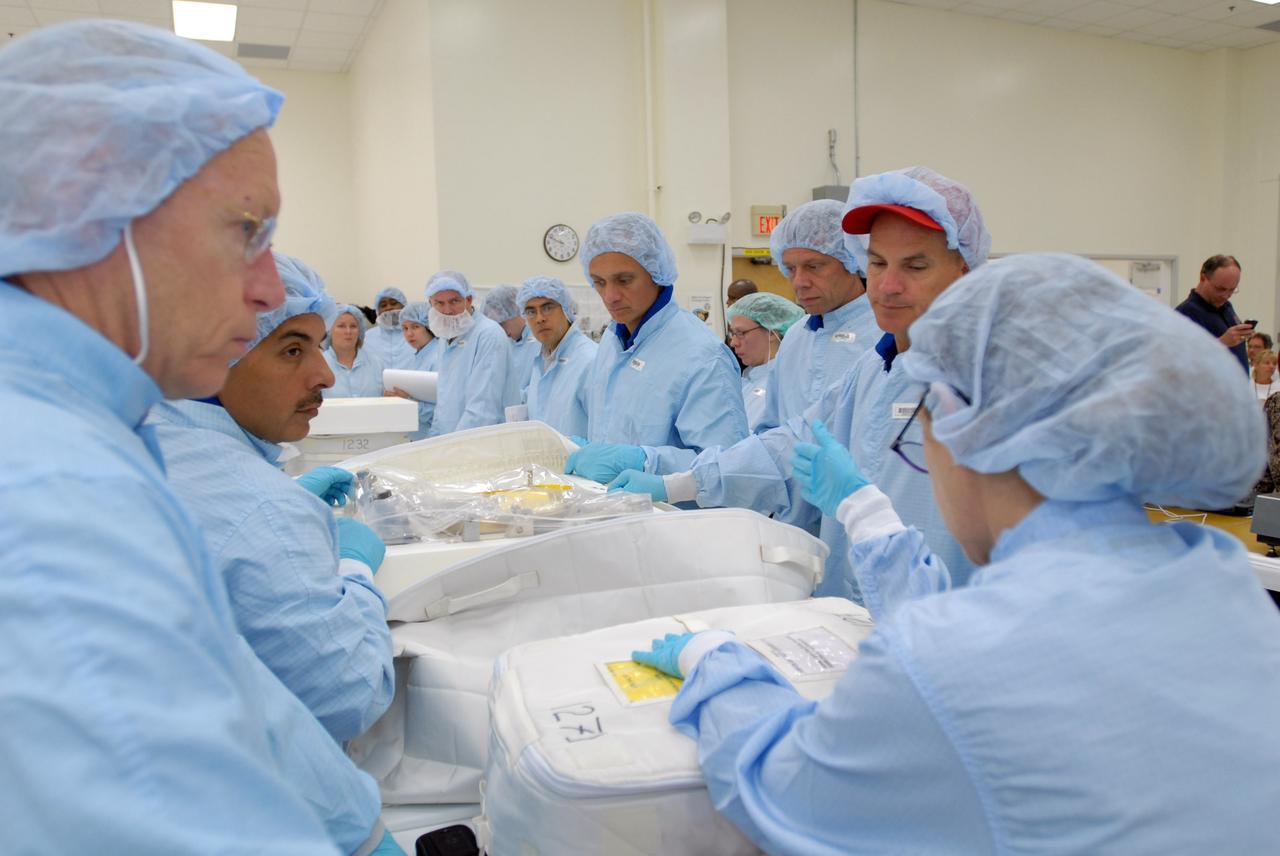
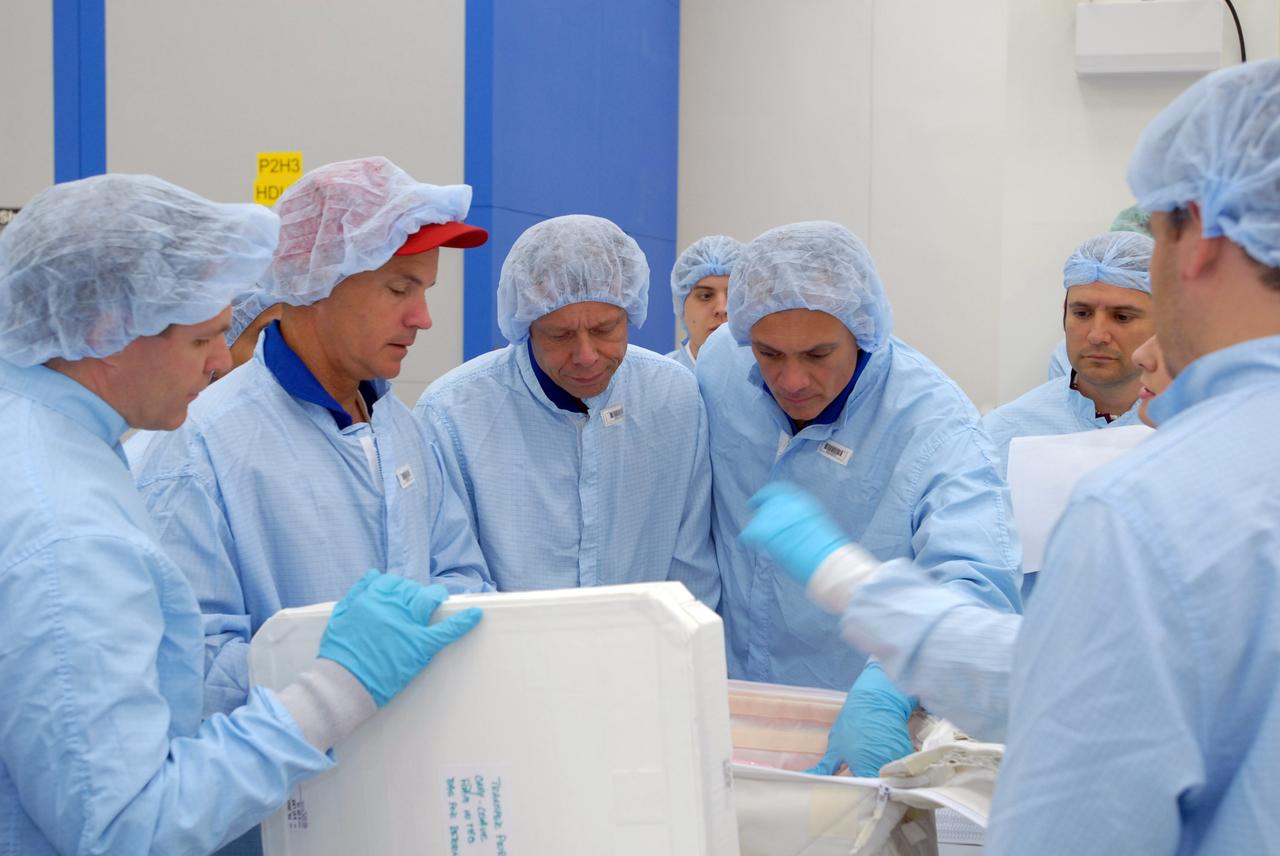
CAPE CANAVERAL, Fla. – In the Space Station Processing Facility, STS-128 crew members look over packages of equipment that will accompany the mission.   At left are Mission Specialists Patrick Forrester and Jose Hernandez.  At right are Commander Rick Sturckow (with the red cap) and on his left Mission Specialists Christer Fuglesang and John "Danny" Olivas.  The STS-128 flight will carry science and storage racks to the International Space Station on space shuttle Discovery. Launch of Discovery is targeted for Aug. 6.  Photo credit: NASA/Jim Grossmann
KSC-2009-2300
CAPE CANAVERAL, Fla. – In the Space Station Processing Facility, STS-128 crew members look over packages of equipment that will accompany the mission.  From left are Pilot Kevin Ford, Commander Rick Sturckow and Mission Specialists Christer Fuglesang and John "Danny" Olivas. The STS-128 flight will carry science and storage racks to the International Space Station on space shuttle Discovery. Launch of Discovery is targeted for Aug. 6.  Photo credit: NASA/Jim Grossmann
KSC-2009-2298
CAPE CANAVERAL, Fla. – In the Space Station Processing Facility, STS-128 crew members look over packages of equipment that will accompany the mission.  At center (with the red cap) is Commander Rick Sturckow; to his left is Mission Specialist José Hernandez.  The STS-128 flight will carry science and storage racks to the International Space Station on space shuttle Discovery. Launch of Discovery is targeted for Aug. 6.  Photo credit: NASA/Jim Grossmann
KSC-2009-2299
CAPE CANAVERAL, Fla. – In the Space Station Processing Facility, STS-128 crew members look over packages of equipment that will accompany the mission.  At left are Pilot Kevin Ford, and Mission Specialists Christer Fuglesang and John "Danny" Olivas.  At right is Commander Rick Sturckow (with the red cap).  The STS-128 flight will carry science and storage racks to the International Space Station on space shuttle Discovery. Launch of Discovery is targeted for Aug. 6.  Photo credit: NASA/Jim Grossmann
KSC-2009-2297
The Cassini Division appears to emerge out of Saturn shadow in this Cassini spacecraft image
The Familiar Division
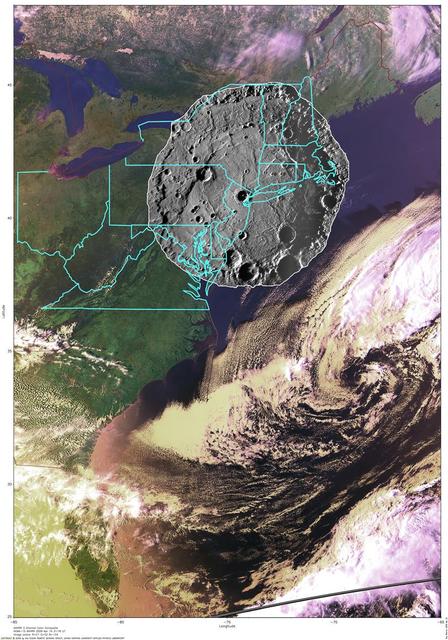
To put the size of Mercury Rembrandt basin into a familiar context, a NAC mosaic of the basin is overlaid on an AVHRR image of the east coast of the United States
Comparing the Size of Mercury Rembrandt Basin with the East Coast of the USA
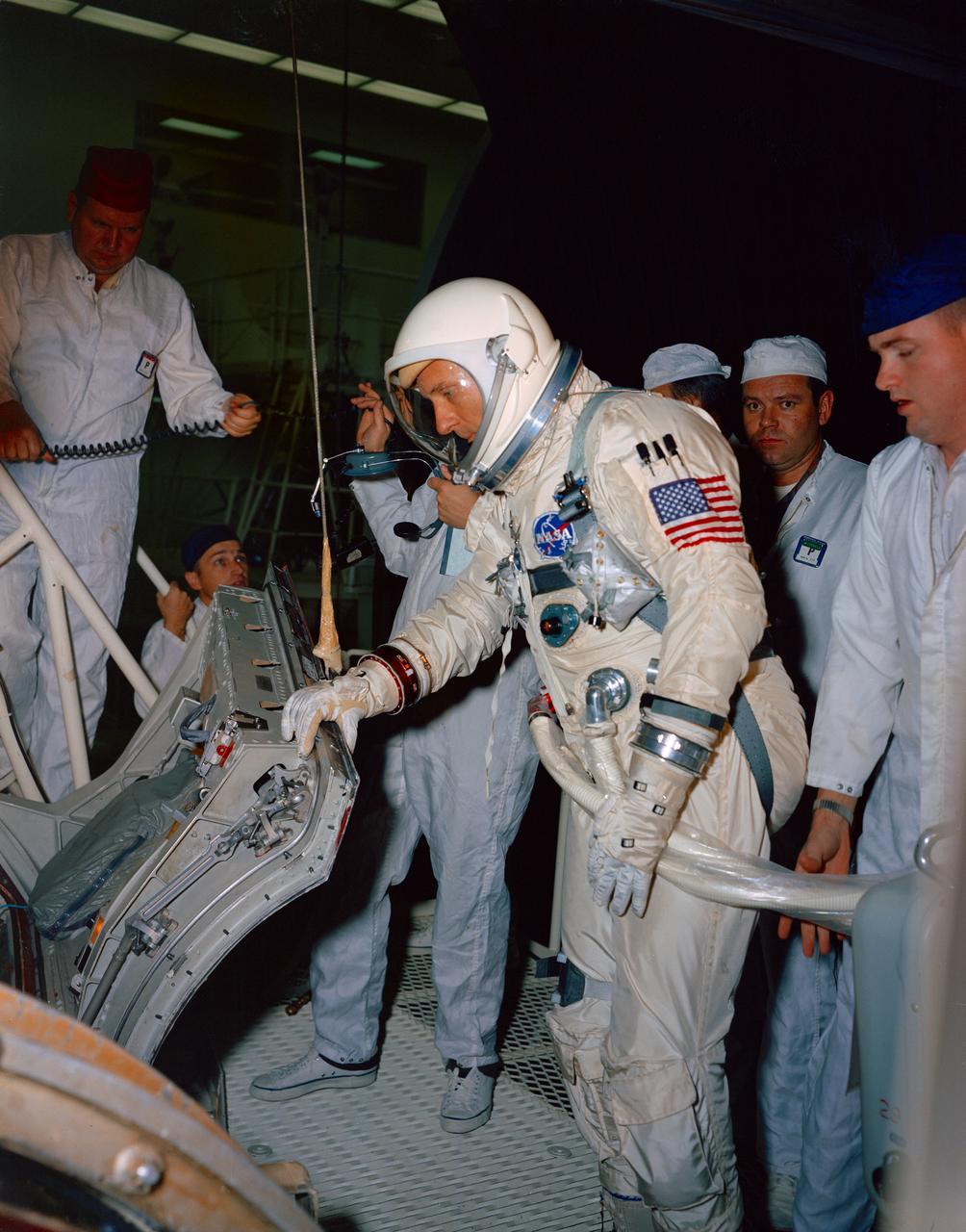
S66-23592 (8 Feb. 1966) --- Astronaut Thomas P. Stafford, command pilot of the Gemini-9 prime crew, undergoes familiarization training with the Gemini-9 spacecraft at the McDonnell plant in St. Louis. Photo credit: NASA
GEMINI-TITAN (GT)-9 COMMAND PILOT (FAMILIARIZATION) - ASTRONAUT THOMAS P. STAFFORD - TRAINING - MCDONNELL AIRCRAFT CORP. (MDAC), MO
KENNEDY SPACE CENTER, FLORIDA  STS-82 PREPARATIONS VIEW --- In the Kennedy Space Center (KSC) Vertical Processing Facility (VPF), the STS-82 crew members familiarize themselves with some of the hardware they will be handling on the second servicing mission to the Hubble Space Telescope (HST).  Looking over the Flight Support System (FSS) Berthing and Positioning System (BAPS) ring are astronauts Joseph R. Tanner (far left), Mark C. Lee (third left) and Gregory J. Harbaugh (fourth left); along with several HST processing team members.  Tanner, Lee and Harbaugh, along with Steven L. Smith, will perform spacewalks required for servicing of the HST.  The telescope was deployed nearly seven years ago and was initially serviced in 1993.
STS-82 Discovery crew familiarize themselves with hardware for flight
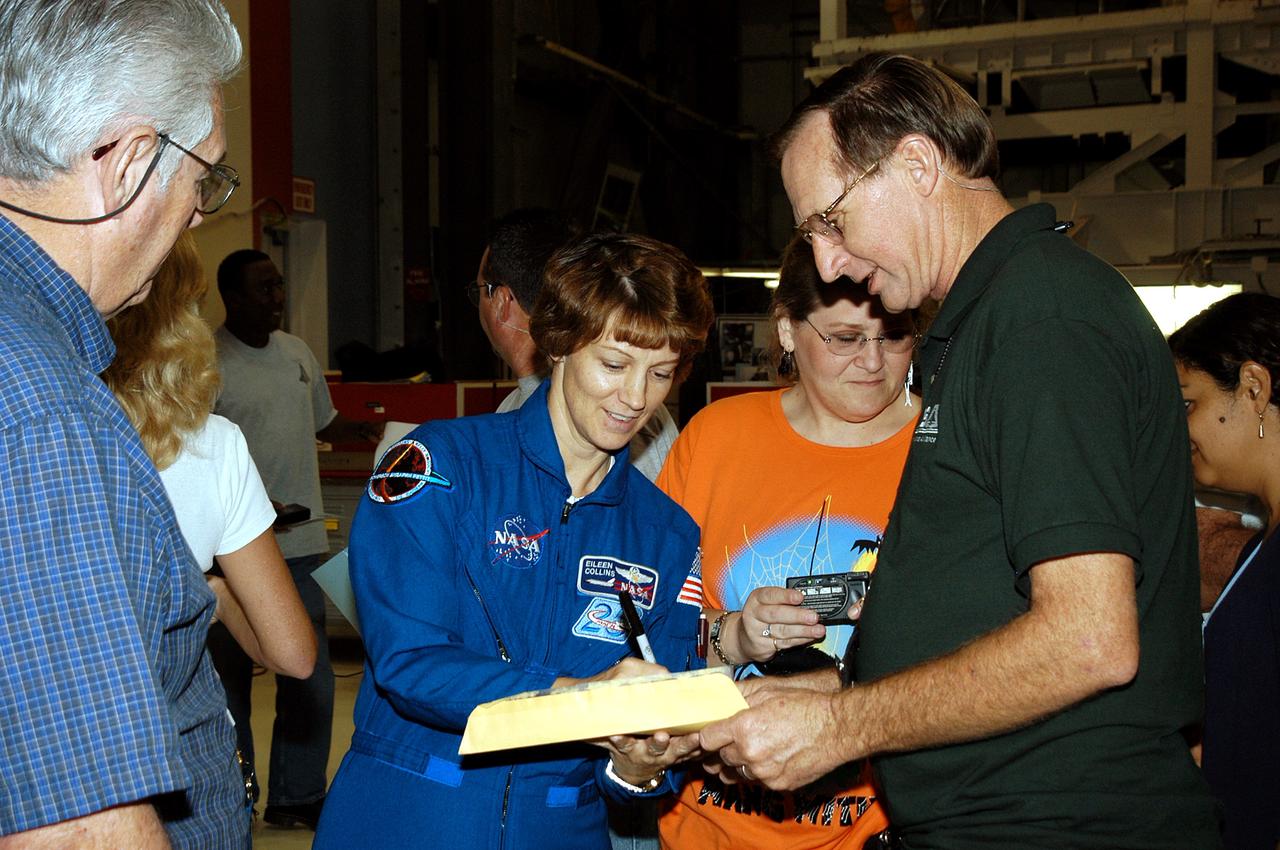
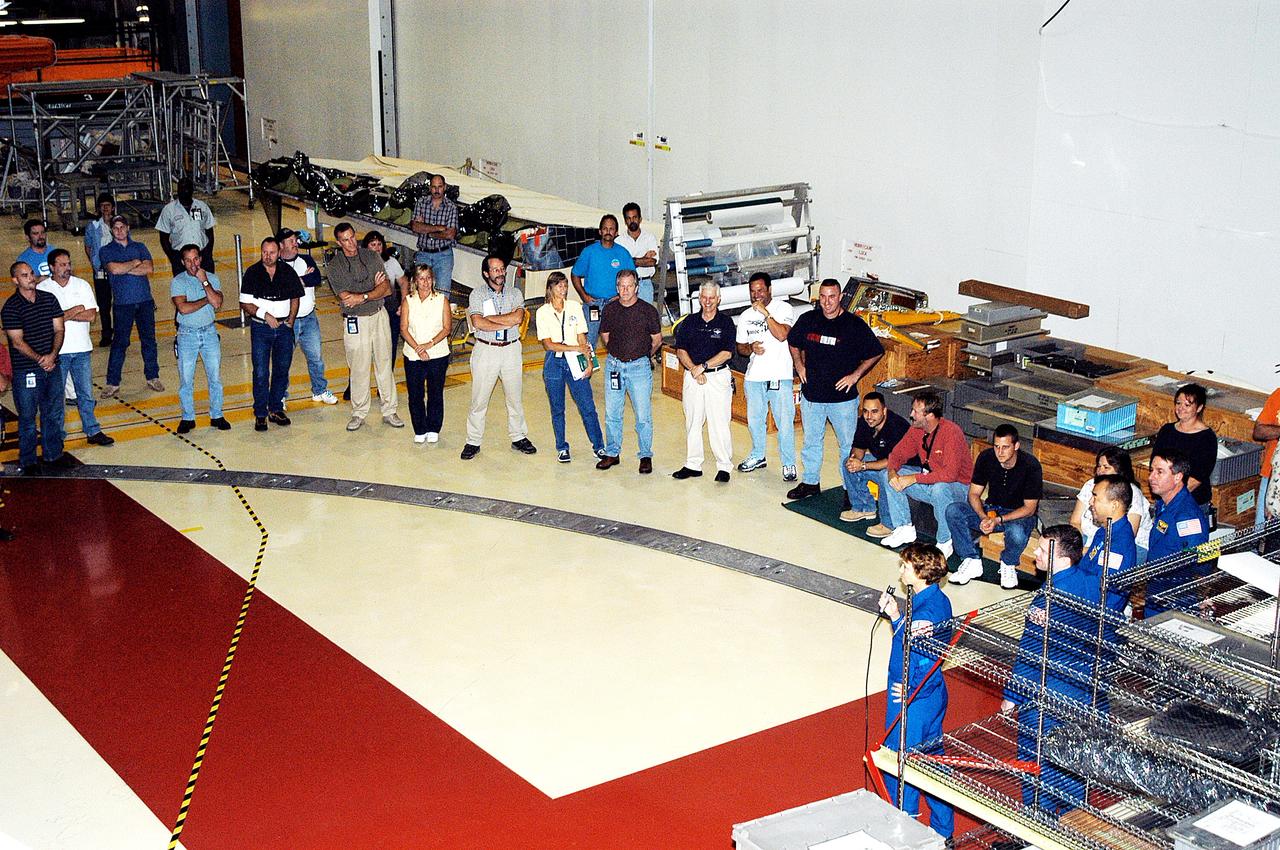
KENNEDY SPACE CENTER, FLA. - STS-114 Mission Commander Eileen Collins signs autorgraphs for workers in the Orbiter Processing Facility.   The STS-114 crew is at KSC to take part in crew equipment and orbiter familiarization.
KENNEDY SPACE CENTER, FLA. - STS-114 Mission Commander Eileen Collins signs autorgraphs for workers in the Orbiter Processing Facility. The STS-114 crew is at KSC to take part in crew equipment and orbiter familiarization.
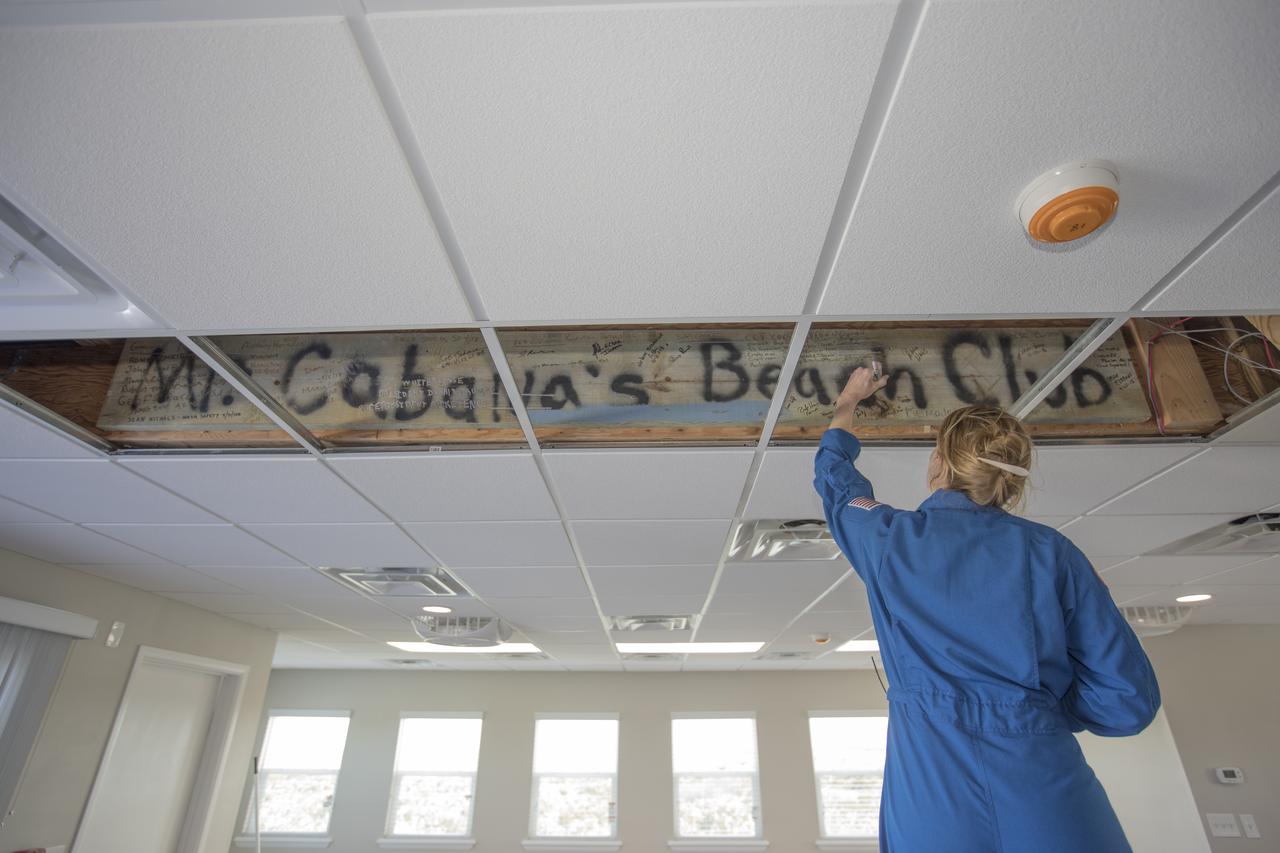
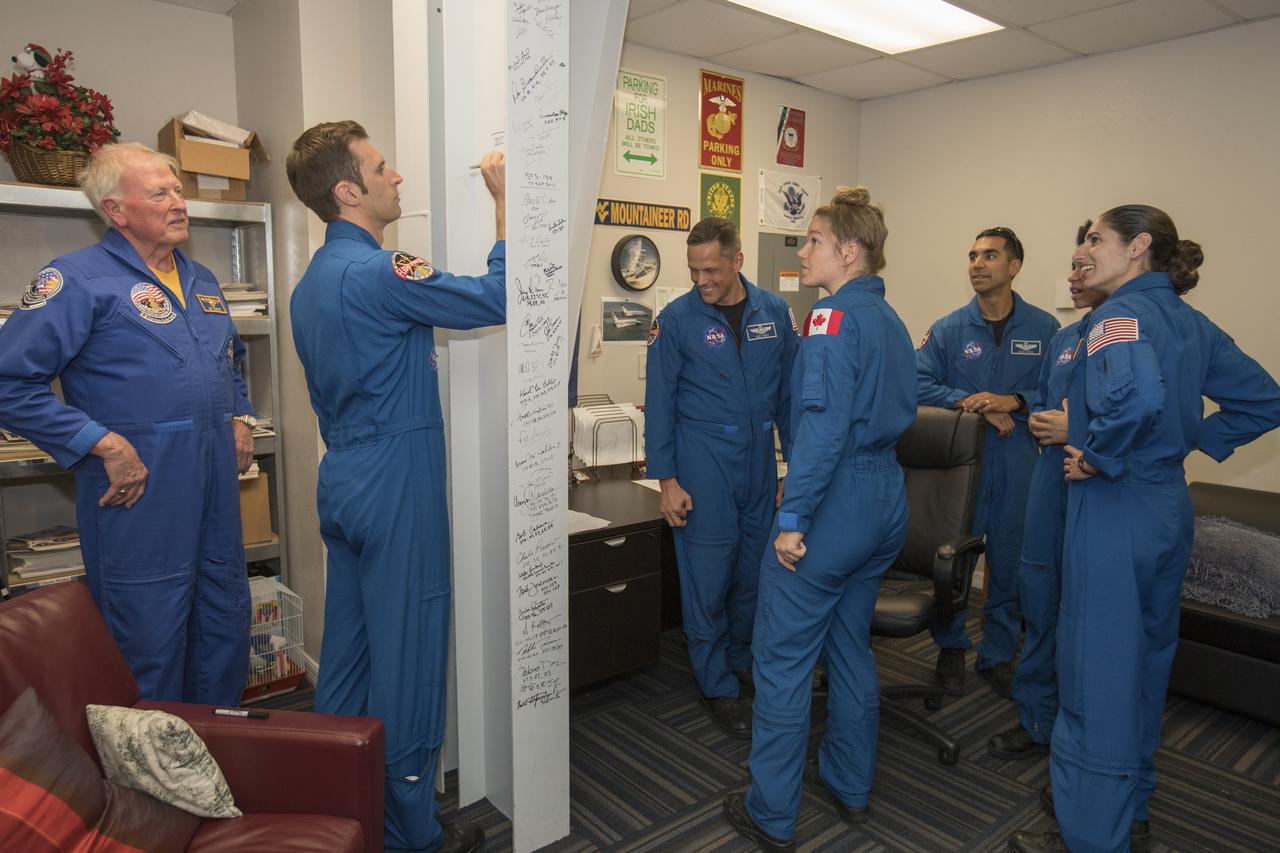
A members of the 2017 class of astronaut candidates signs her name to a wooden sign inside the Beach House during a familiarization tour at NASA's Kennedy Space Center in Florida. The candidates toured center facilities, including the Vehicle Assembly Building, Launch Control Center, Neil Armstrong Operations and Checkout Building high bay, Launch Pad 39B and the Space Station Processing Facility. They also toured Boeing's Commercial Crew and Cargo Facility, United Launch Alliance's Space Launch Complex 41 at Cape Canaveral Air Force Station, and SpaceX's Launch Pad 39A at Kennedy. The candidates will spend about two years getting to know the space station systems and learning how to spacewalk, speak Russian, control the International Space Station's robotic arm and fly T-38s, before they're eligible to be assigned to a mission.
2017 ASCAN Tour of KSC
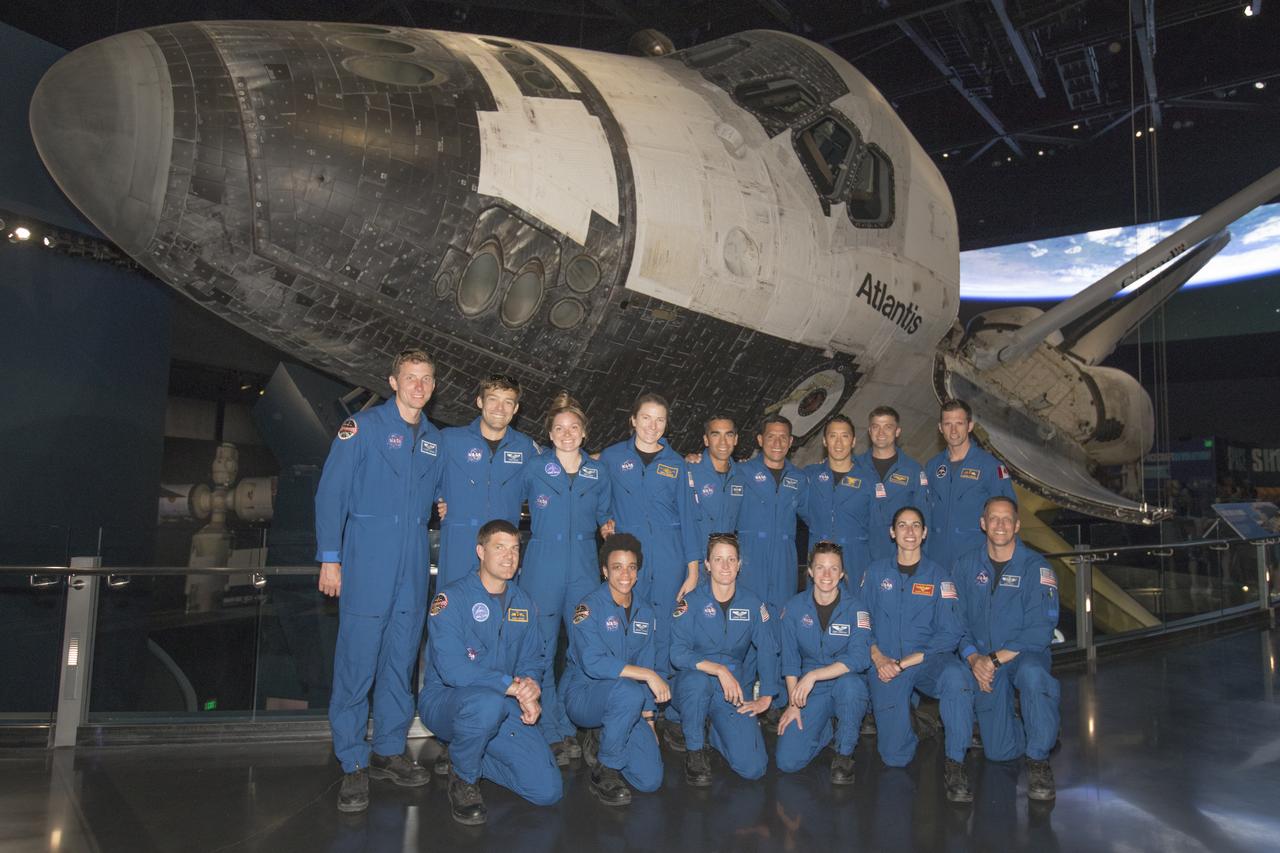
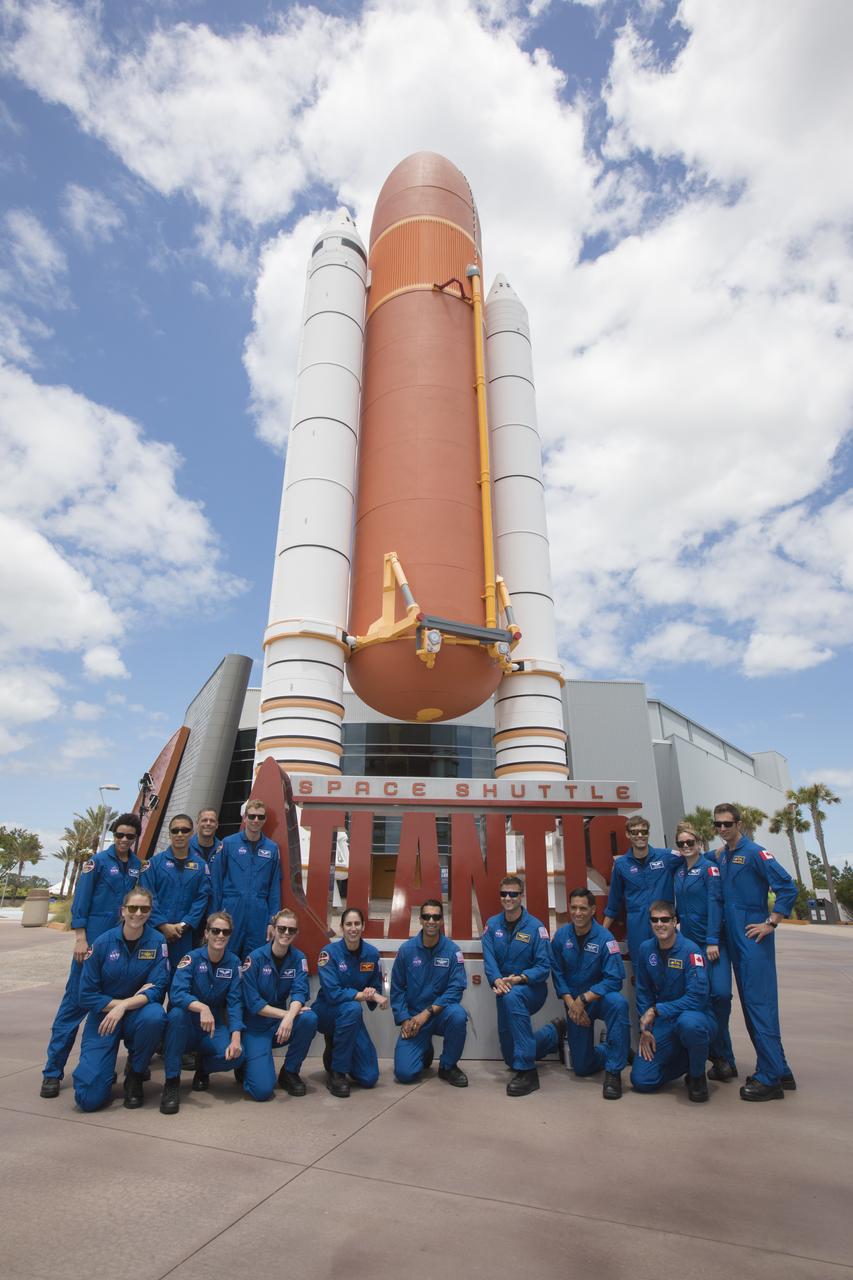
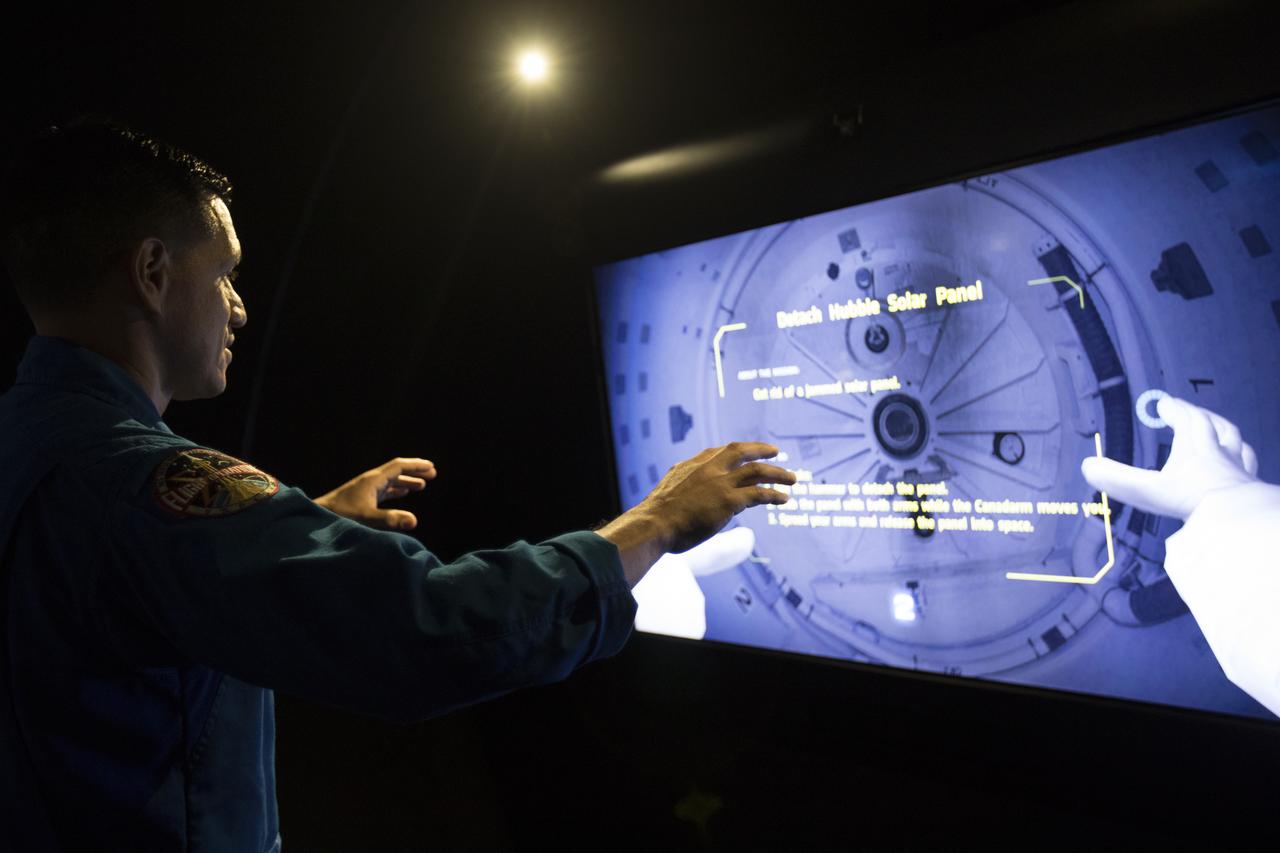
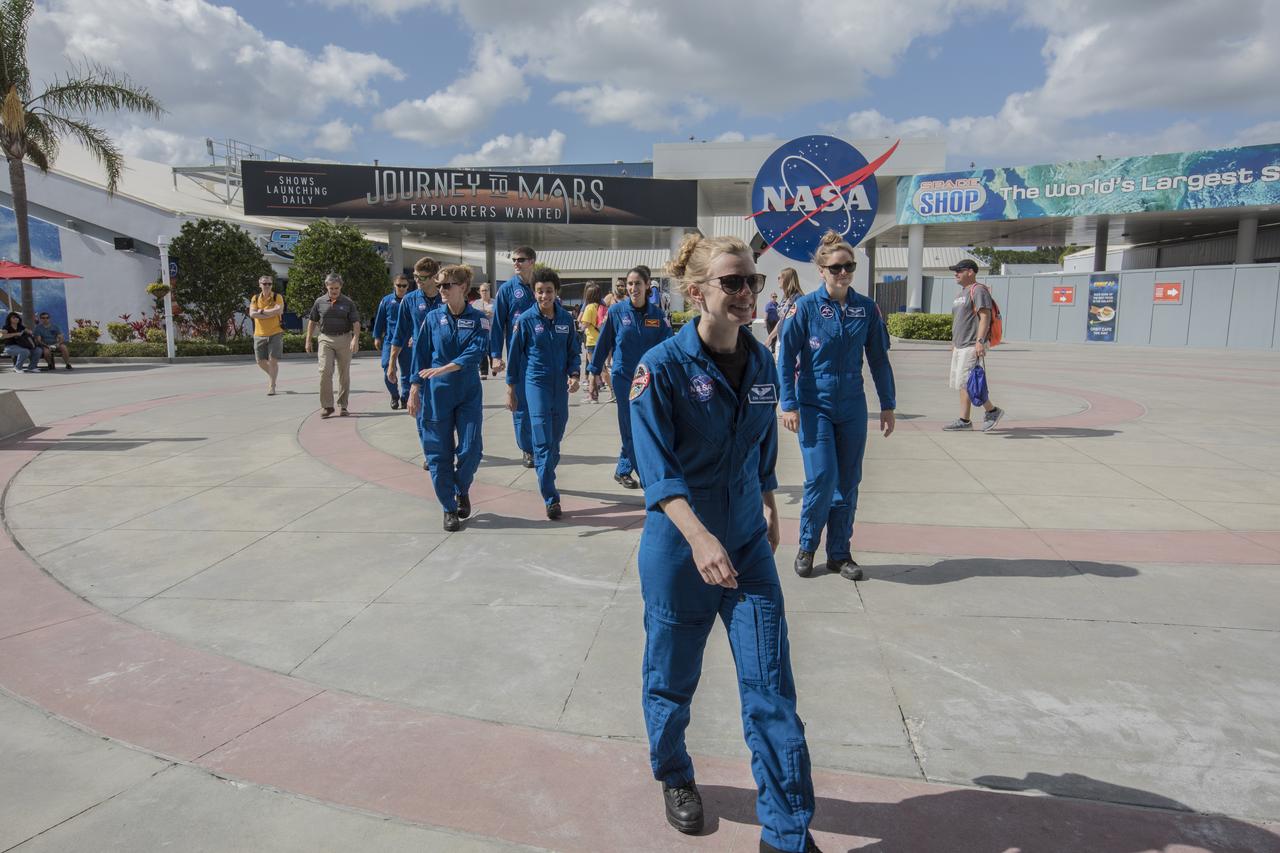
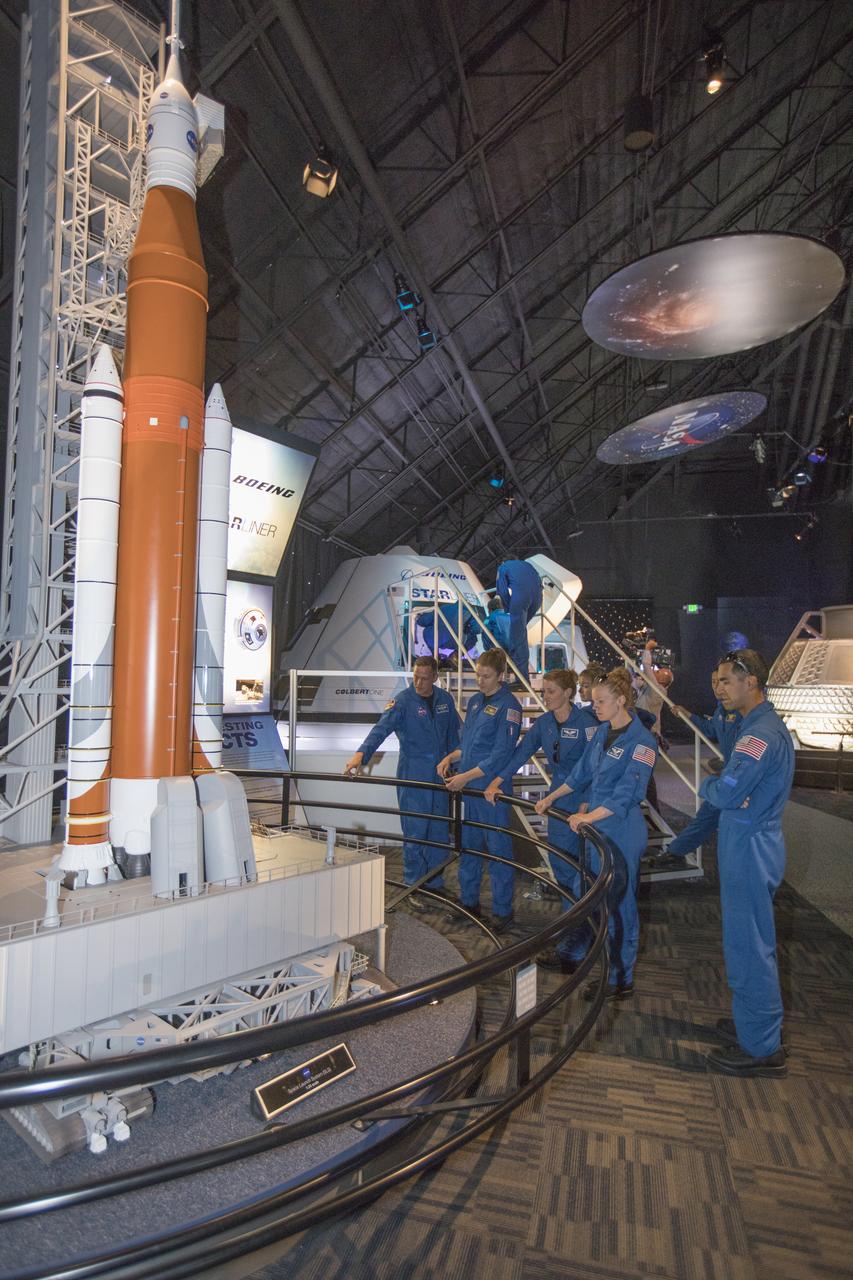
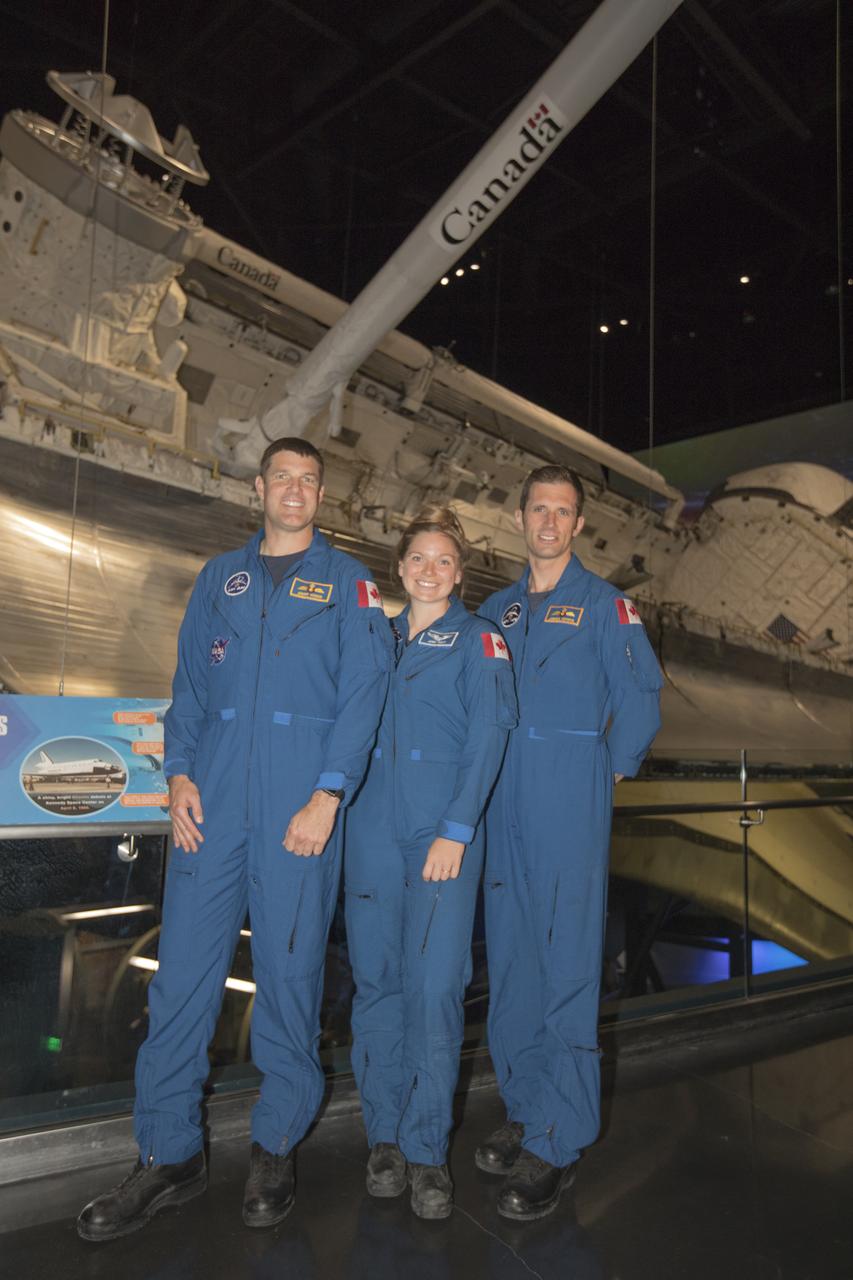
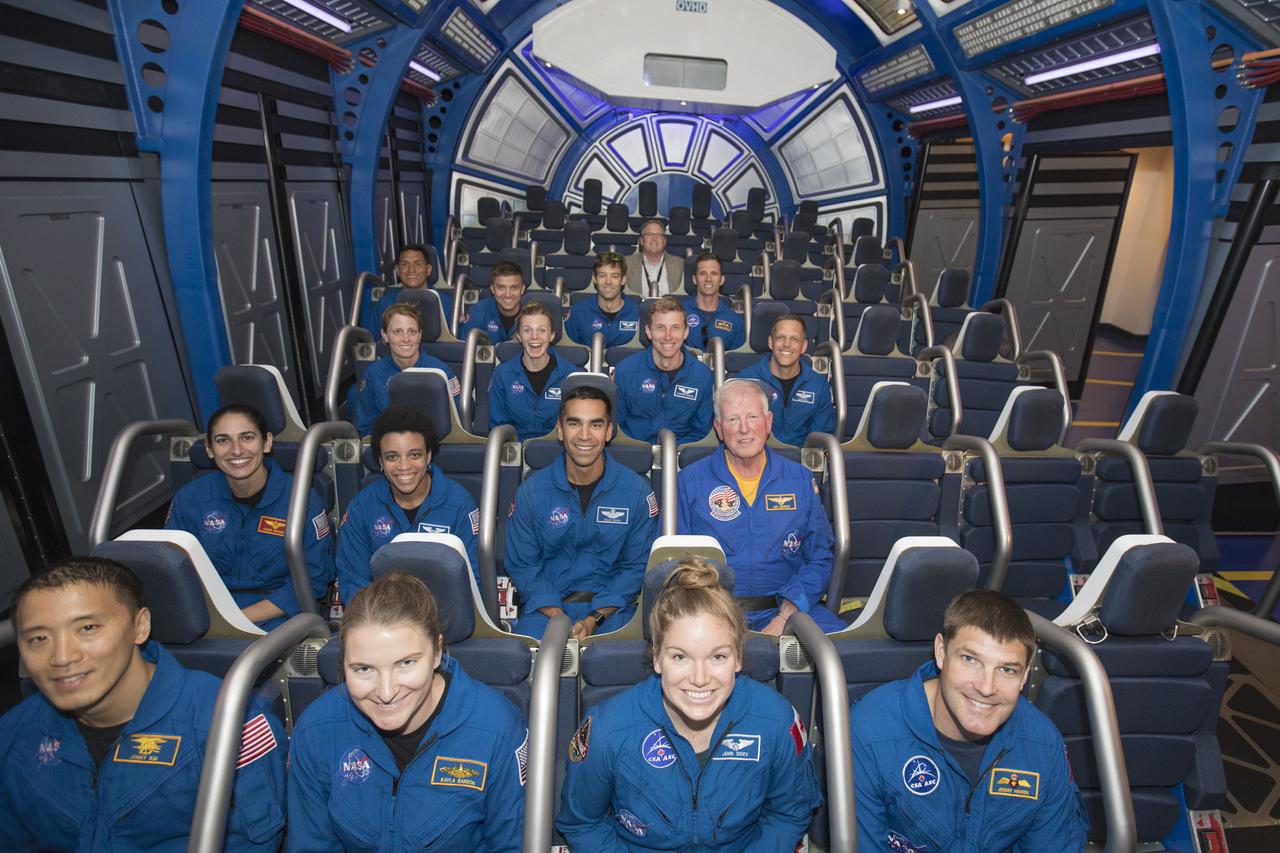
The 2017 class of astronaut candidates toured the Kennedy Space Center Visitor Complex and viewed exhibits, including Space Shuttle Atlantis, during a familiarization tour of facilities at NASA's Kennedy Space Center in Florida. The candidates toured center facilities, including the Neil Armstrong Operations and Checkout Building high bay; Launch Control Center, Launch Pad 39B and the Space Station Processing Facility. They also toured Boeing's Commercial Crew and Cargo Facility, United Launch Alliance's Space Launch Complex 41 at Cape Canaveral Air Force Station, and SpaceX's Launch Pad 39A at Kennedy. The candidates will spend about two years getting to know the space station systems and learning how to spacewalk, speak Russian, control the International Space Station's robotic arm and fly T-38s, before they're eligible to be assigned to a mission.
2017 ASCAN Tour of KSC
The 2017 class of astronaut candidates toured the Kennedy Space Center Visitor Complex and viewed exhibits, including Space Shuttle Atlantis, during a familiarization tour of facilities at NASA's Kennedy Space Center in Florida. The candidates toured center facilities, including the Neil Armstrong Operations and Checkout Building high bay; Launch Control Center, Launch Pad 39B and the Space Station Processing Facility. They also toured Boeing's Commercial Crew and Cargo Facility, United Launch Alliance's Space Launch Complex 41 at Cape Canaveral Air Force Station, and SpaceX's Launch Pad 39A at Kennedy. The candidates will spend about two years getting to know the space station systems and learning how to spacewalk, speak Russian, control the International Space Station's robotic arm and fly T-38s, before they're eligible to be assigned to a mission.
2017 ASCAN Tour of KSC
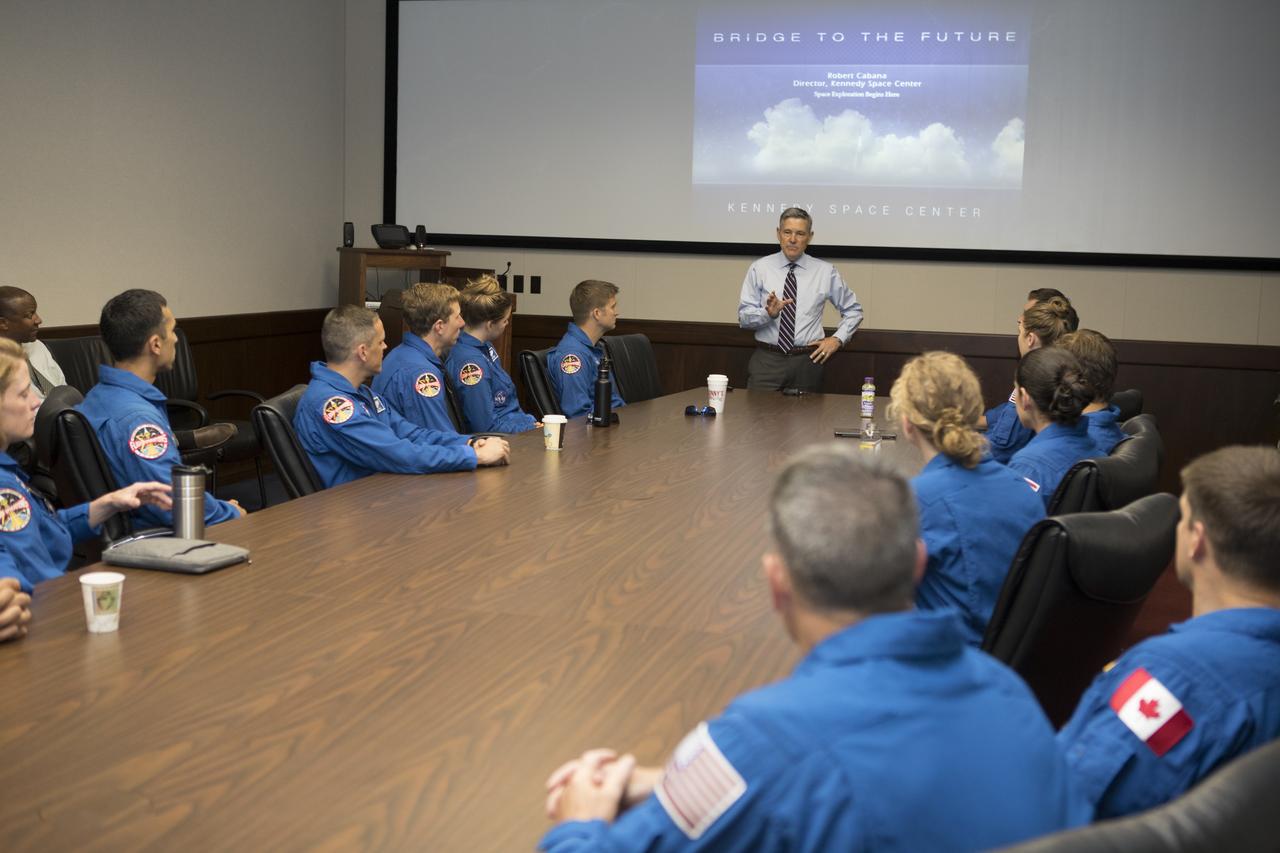
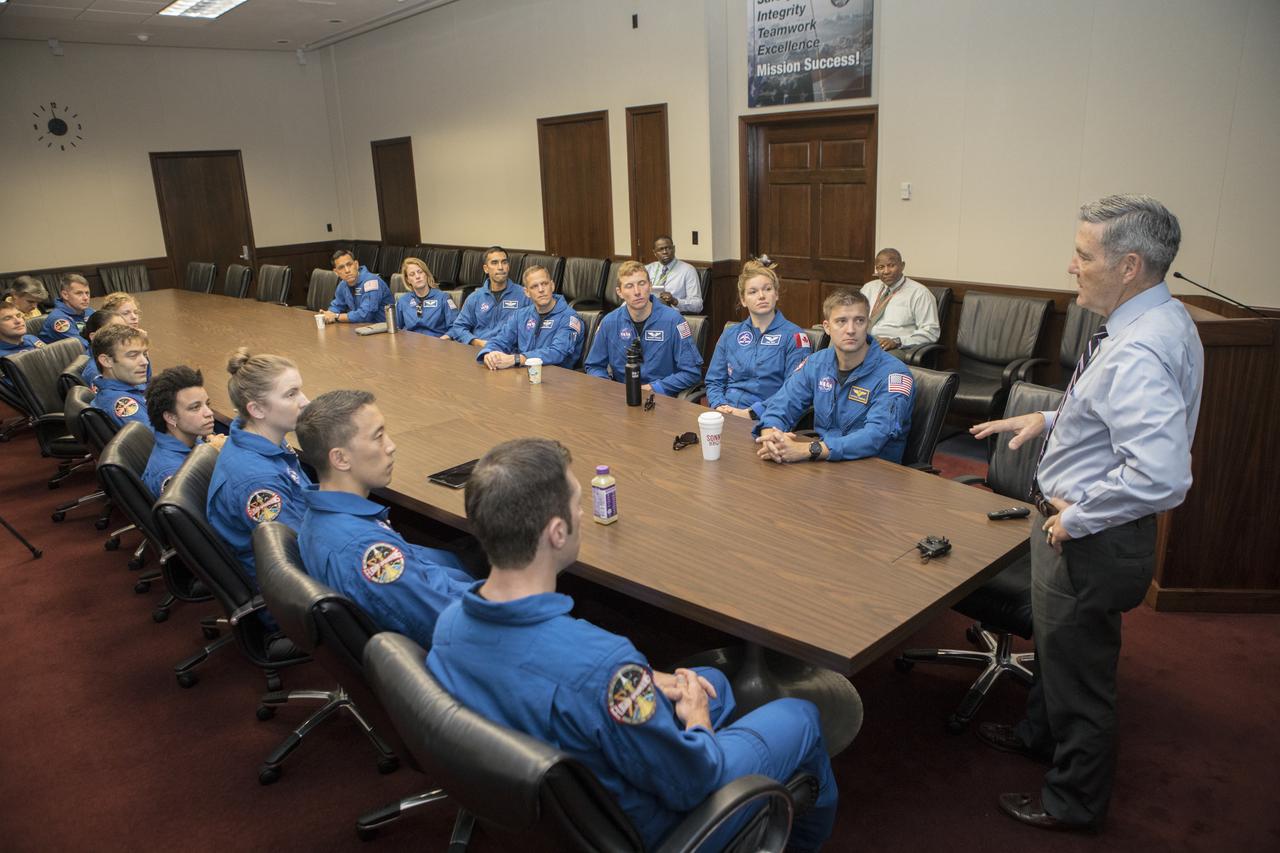
The 2017 class of astronaut candidates listen to NASA Kennedy Space Center Director Bob Cabana, far right, during their tour and familiarization with the center. Sitting behind the candidates, at right is Kelvin Manning, Kennedy associate director. The candidates toured center facilities, including the Vehicle Assembly Building, Launch Control Center, Neil Armstrong Operations and Checkout Building, Launch Pad 39B, and the Space Station Processing Facility. They also toured Boeing's Commercial Crew and Cargo Facility, United Launch Alliance's Space Launch Complex 41 at Cape Canaveral Air Force Station, and SpaceX's Launch Pad 39A at Kennedy. The candidates will spend about two years getting to know the space station systems and learning how to spacewalk, speak Russian, control the International Space Station's robotic arm and fly T-38s, before they're eligible to be assigned to a mission.
2017 ASCAN Tour of KSC
The 2017 class of astronaut candidates listen to NASA Kennedy Space Center Director Bob Cabana, standing, during their tour and familiarization with the center. The candidates toured center facilities, including the Vehicle Assembly Building, Launch Control Center, Neil Armstrong Operations and Checkout Building, Launch Pad 39B, and the Space Station Processing Facility. They also toured Boeing's Commercial Crew and Cargo Facility, United Launch Alliance's Space Launch Complex 41 at Cape Canaveral Air Force Station, and SpaceX's Launch Pad 39A at Kennedy. The candidates will spend about two years getting to know the space station systems and learning how to spacewalk, speak Russian, control the International Space Station's robotic arm and fly T-38s, before they're eligible to be assigned to a mission.
2017 ASCAN Tour of KSC
The 2017 class of astronaut candidates toured the Kennedy Space Center Visitor Complex and viewed exhibits, including Space Shuttle Atlantis, during a familiarization tour of facilities at NASA's Kennedy Space Center in Florida. The candidates toured center facilities, including the Neil Armstrong Operations and Checkout Building high bay; Launch Control Center, Launch Pad 39B and the Space Station Processing Facility. They also toured Boeing's Commercial Crew and Cargo Facility, United Launch Alliance's Space Launch Complex 41 at Cape Canaveral Air Force Station, and SpaceX's Launch Pad 39A at Kennedy. The candidates will spend about two years getting to know the space station systems and learning how to spacewalk, speak Russian, control the International Space Station's robotic arm and fly T-38s, before they're eligible to be assigned to a mission.
2017 ASCAN Tour of KSC
The 2017 class of astronaut candidates toured the Kennedy Space Center Visitor Complex and viewed exhibits, including Space Shuttle Atlantis, during a familiarization tour of facilities at NASA's Kennedy Space Center in Florida. The candidates toured center facilities, including the Neil Armstrong Operations and Checkout Building high bay; Launch Control Center, Launch Pad 39B and the Space Station Processing Facility. They also toured Boeing's Commercial Crew and Cargo Facility, United Launch Alliance's Space Launch Complex 41 at Cape Canaveral Air Force Station, and SpaceX's Launch Pad 39A at Kennedy. The candidates will spend about two years getting to know the space station systems and learning how to spacewalk, speak Russian, control the International Space Station's robotic arm and fly T-38s, before they're eligible to be assigned to a mission.
2017 ASCAN Tour of KSC
The 2017 class of astronaut candidates toured the Kennedy Space Center Visitor Complex and viewed exhibits, including Space Shuttle Atlantis, during a familiarization tour of facilities at NASA's Kennedy Space Center in Florida. The candidates toured center facilities, including the Neil Armstrong Operations and Checkout Building high bay; Launch Control Center, Launch Pad 39B and the Space Station Processing Facility. They also toured Boeing's Commercial Crew and Cargo Facility, United Launch Alliance's Space Launch Complex 41 at Cape Canaveral Air Force Station, and SpaceX's Launch Pad 39A at Kennedy. The candidates will spend about two years getting to know the space station systems and learning how to spacewalk, speak Russian, control the International Space Station's robotic arm and fly T-38s, before they're eligible to be assigned to a mission.
2017 ASCAN Tour of KSC
The 2017 class of astronaut candidates toured the Kennedy Space Center Visitor Complex and viewed exhibits, including Space Shuttle Atlantis, during a familiarization tour of facilities at NASA's Kennedy Space Center in Florida. The candidates toured center facilities, including the Neil Armstrong Operations and Checkout Building high bay; Launch Control Center, Launch Pad 39B and the Space Station Processing Facility. They also toured Boeing's Commercial Crew and Cargo Facility, United Launch Alliance's Space Launch Complex 41 at Cape Canaveral Air Force Station, and SpaceX's Launch Pad 39A at Kennedy. The candidates will spend about two years getting to know the space station systems and learning how to spacewalk, speak Russian, control the International Space Station's robotic arm and fly T-38s, before they're eligible to be assigned to a mission.
2017 ASCAN Tour of KSC
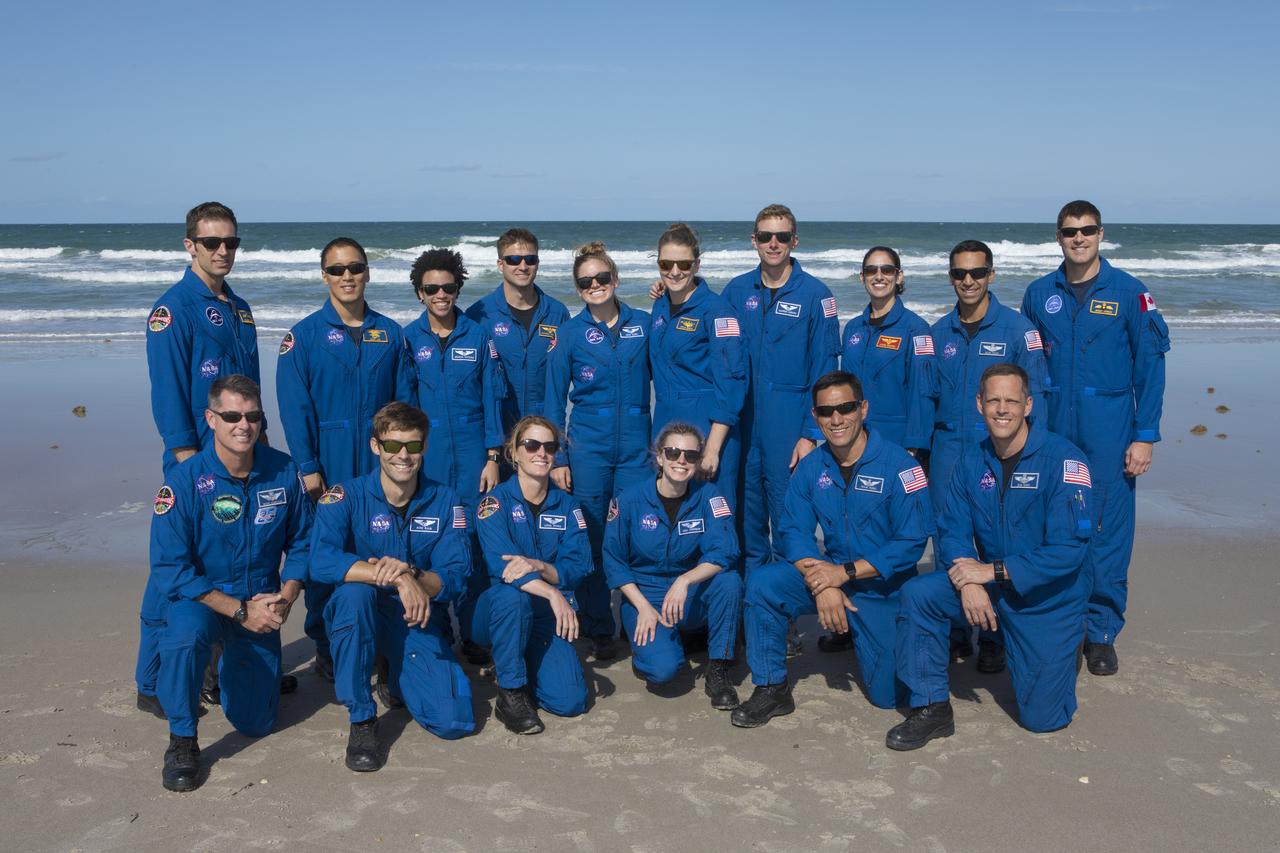
Members of the 2017 class of astronaut candidates pause for a group photo on the beach after a familiarization tour of the Beach House at NASA's Kennedy Space Center in Florida. The candidates toured center facilities, including the Vehicle Assembly Building, Launch Control Center, Neil Armstrong Operations and Checkout Building high bay, Launch Pad 39B and the Space Station Processing Facility. They also toured Boeing's Commercial Crew and Cargo Facility, United Launch Alliance's Space Launch Complex 41 at Cape Canaveral Air Force Station, and SpaceX's Launch Pad 39A at Kennedy. The candidates will spend about two years getting to know the space station systems and learning how to spacewalk, speak Russian, control the International Space Station's robotic arm and fly T-38s, before they're eligible to be assigned to a mission.
2017 ASCAN Tour of KSC
The 2017 class of astronaut candidates toured the Kennedy Space Center Visitor Complex and viewed exhibits, including Space Shuttle Atlantis, during a familiarization tour of facilities at NASA's Kennedy Space Center in Florida. The candidates toured center facilities, including the Neil Armstrong Operations and Checkout Building high bay; Launch Control Center, Launch Pad 39B and the Space Station Processing Facility. They also toured Boeing's Commercial Crew and Cargo Facility, United Launch Alliance's Space Launch Complex 41 at Cape Canaveral Air Force Station, and SpaceX's Launch Pad 39A at Kennedy. The candidates will spend about two years getting to know the space station systems and learning how to spacewalk, speak Russian, control the International Space Station's robotic arm and fly T-38s, before they're eligible to be assigned to a mission.
2017 ASCAN Tour of KSC
The 2017 class of astronaut candidates toured the Kennedy Space Center Visitor Complex and viewed exhibits, including Space Shuttle Atlantis, during a familiarization tour of facilities at NASA's Kennedy Space Center in Florida. The candidates toured center facilities, including the Neil Armstrong Operations and Checkout Building high bay; Launch Control Center, Launch Pad 39B and the Space Station Processing Facility. They also toured Boeing's Commercial Crew and Cargo Facility, United Launch Alliance's Space Launch Complex 41 at Cape Canaveral Air Force Station, and SpaceX's Launch Pad 39A at Kennedy. The candidates will spend about two years getting to know the space station systems and learning how to spacewalk, speak Russian, control the International Space Station's robotic arm and fly T-38s, before they're eligible to be assigned to a mission.
2017 ASCAN Tour of KSC
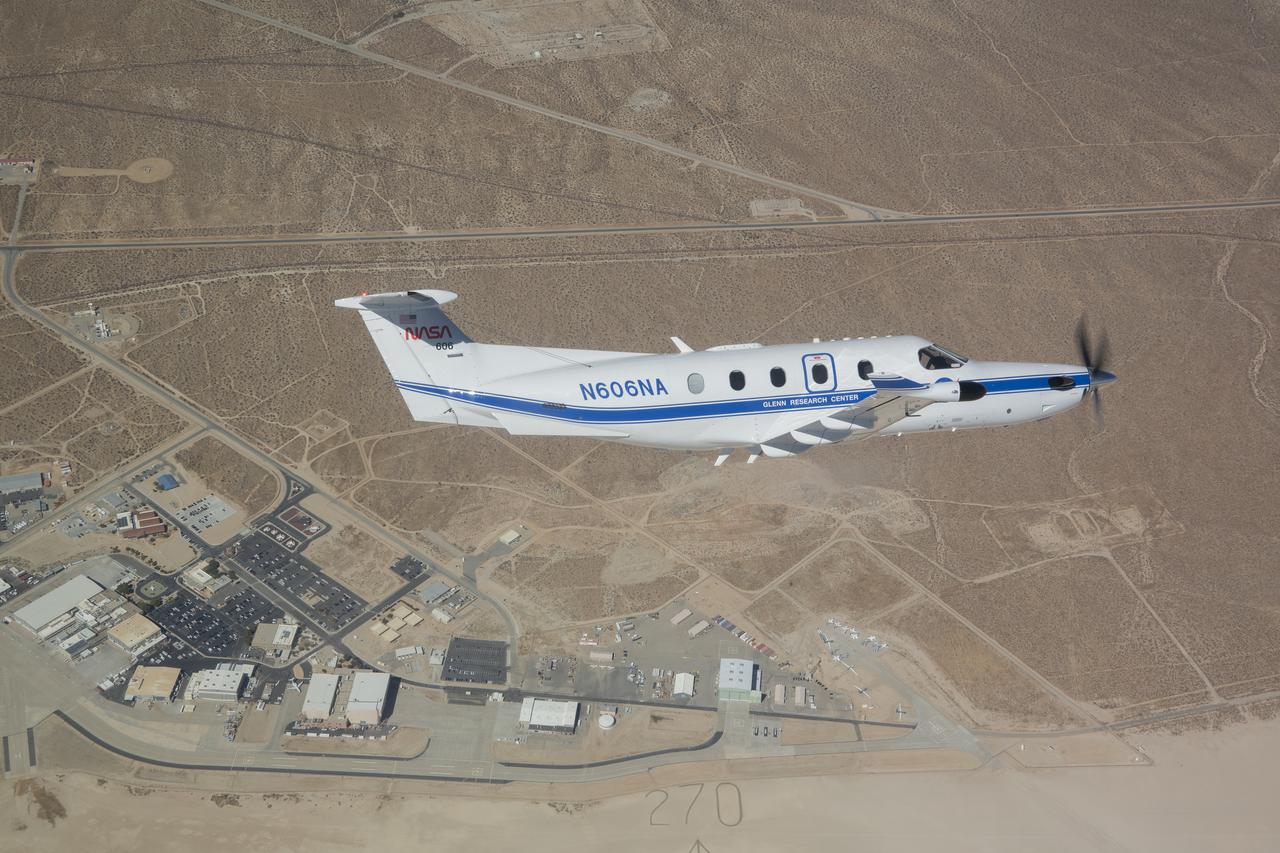
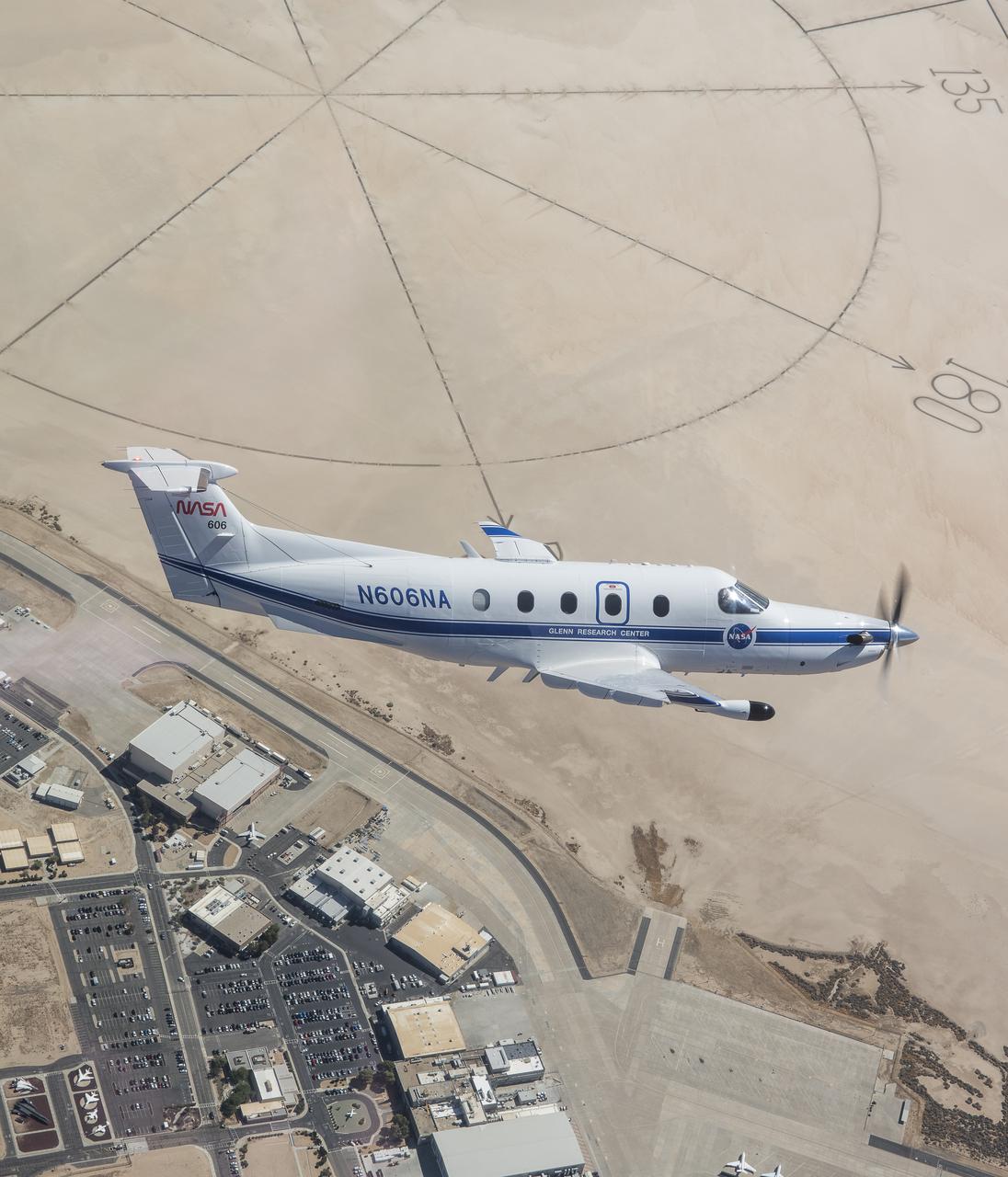
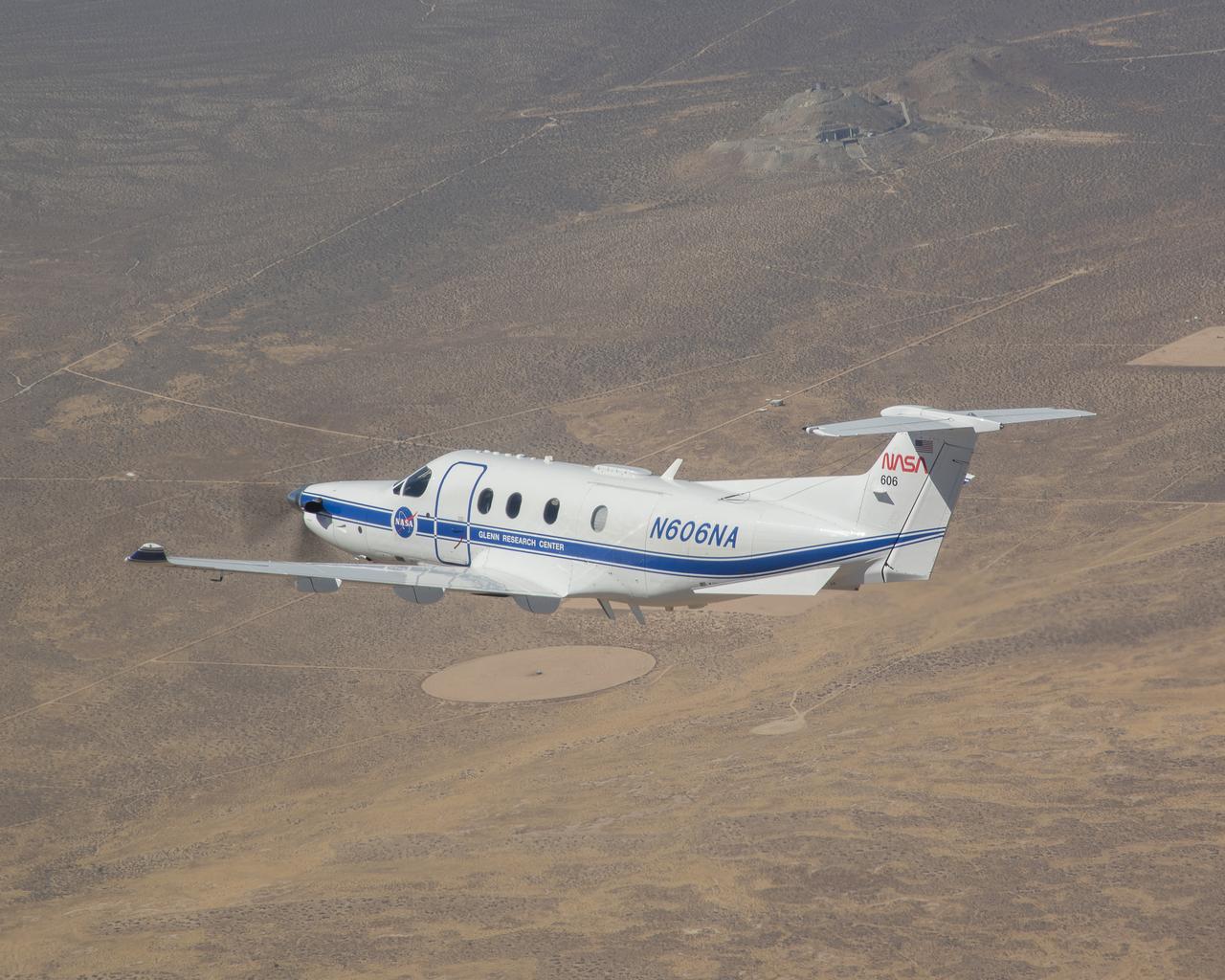
NASA’s Pilatus PC-12, based out of NASA’s Glenn Research Center in Cleveland, is seen flying over NASA’s Armstrong Flight Research Center in Edwards, California. On Sept. 18, 2024, NASA pilots and crew from both centers flew the PC-12 over the Mojave Desert in a series of familiarization flights. Familiarization flights involve egress training, preflight walkaround, interior preflight, engine start, taxi, and takeoff.  
NASA Pilatus PC-12 soars over NASA’s Armstrong Flight Research Center in Edwards, California on Sept. 18, 2024.
Used as a directional indicator the compass rose guides pilots flying test and experimental aircraft like the Pilatus PC-12 in the vast airspace over NASA’s Armstrong Flight Research Center in Edwards, California. This Pilatus PC-12 based out of NASA’s Glenn Research Center in Cleveland is being flown for a series of familiarization flights for NASA’s Armstrong pilots and crew. These familiarization flights supported communication, navigation and surveillance evaluations for Advanced Air Mobility research.
NASA Pilatus PC-12 cuts through the desert skies over NASA’s Armstrong Flight Research Center in Edwards, California with the compass rose in the background on Sept. 18, 2024.
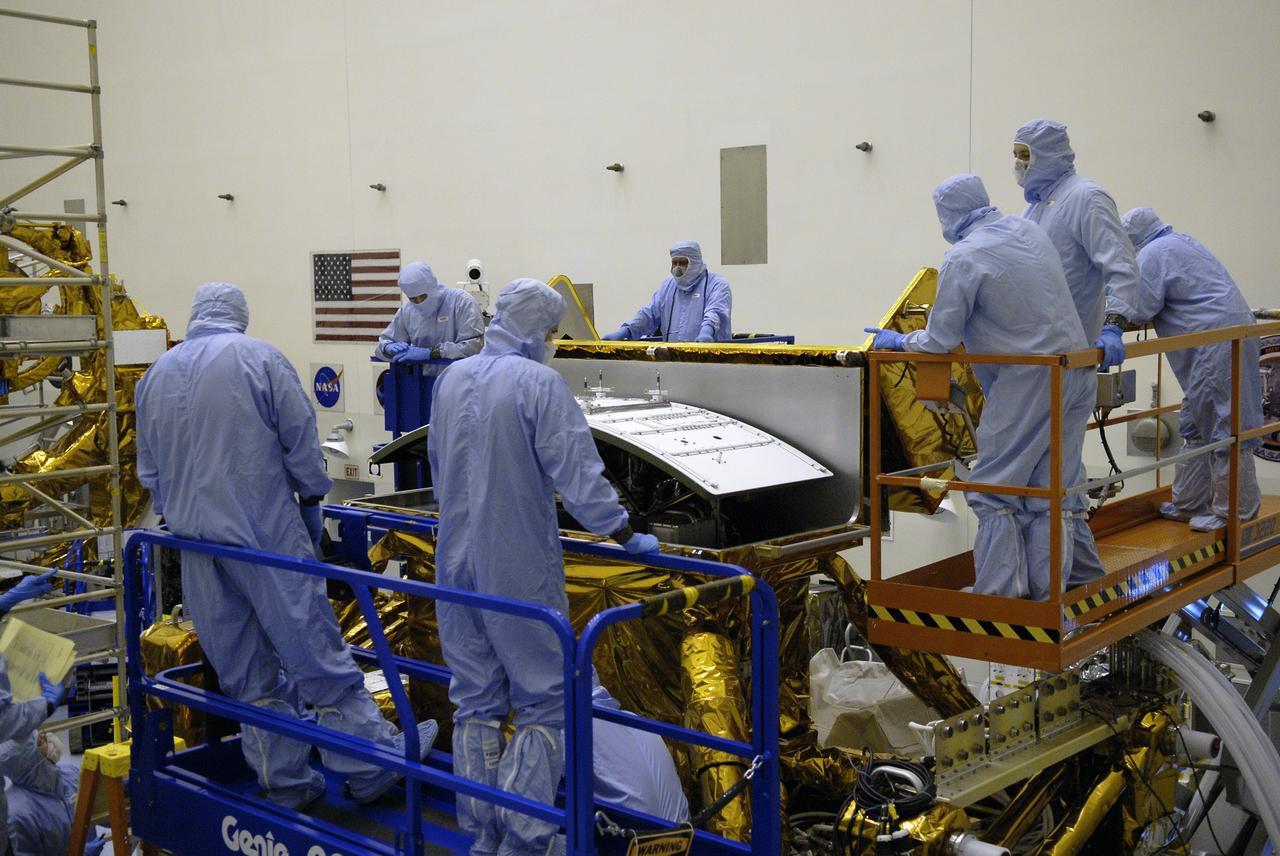
This close-up image from NASA's Mars Reconnaissance Orbiter gives the impression of looking like bacterial cells and their internal structures which travel and split in the process of life. These features are fractal in nature: the same image is preserved through different scales, with the pattern repeating eternally.  The reality is, we are looking at one of Mars' polar regions; the South Polar residual cap to be precise, and, as with many things in Martian planetary science, there is a precise reasoning behind the name. With the coming and going of the seasons, this is an area on Mars where ice remains even after the peak of summer arrives.  The texture is very alien, bearing more of a resemblance to the universe of the very small, rather than the universe far, far away. But if this is a polar cap, then why does it not look like the polar caps on Earth? Indeed, there is no equivalent terrain observed here on Earth.  The so-called "Swiss cheese terrain, referencing the numerous holes of the region, is a product of seasonal exchange between the surface and the Martian atmosphere. With a predominantly carbon dioxide content at 98 percent, the colder temperatures condense the gas out of the atmosphere to produce dry ice. The prevalence of water is more concentrated in the north, leaving the South polar region more carbon dioxide rich, and it's this difference in composition that generates the unusual texture of the Swiss cheese terrain.  The Red Planet is one of the chief candidates in the search for life elsewhere in the Solar System; however, a quick glance at this image virtually gives the impression we have already found it.  NB: The cutout image has been rotated so that north is approximately up.  https://photojournal.jpl.nasa.gov/catalog/PIA21880
Patterns Unique, Yet Familiar
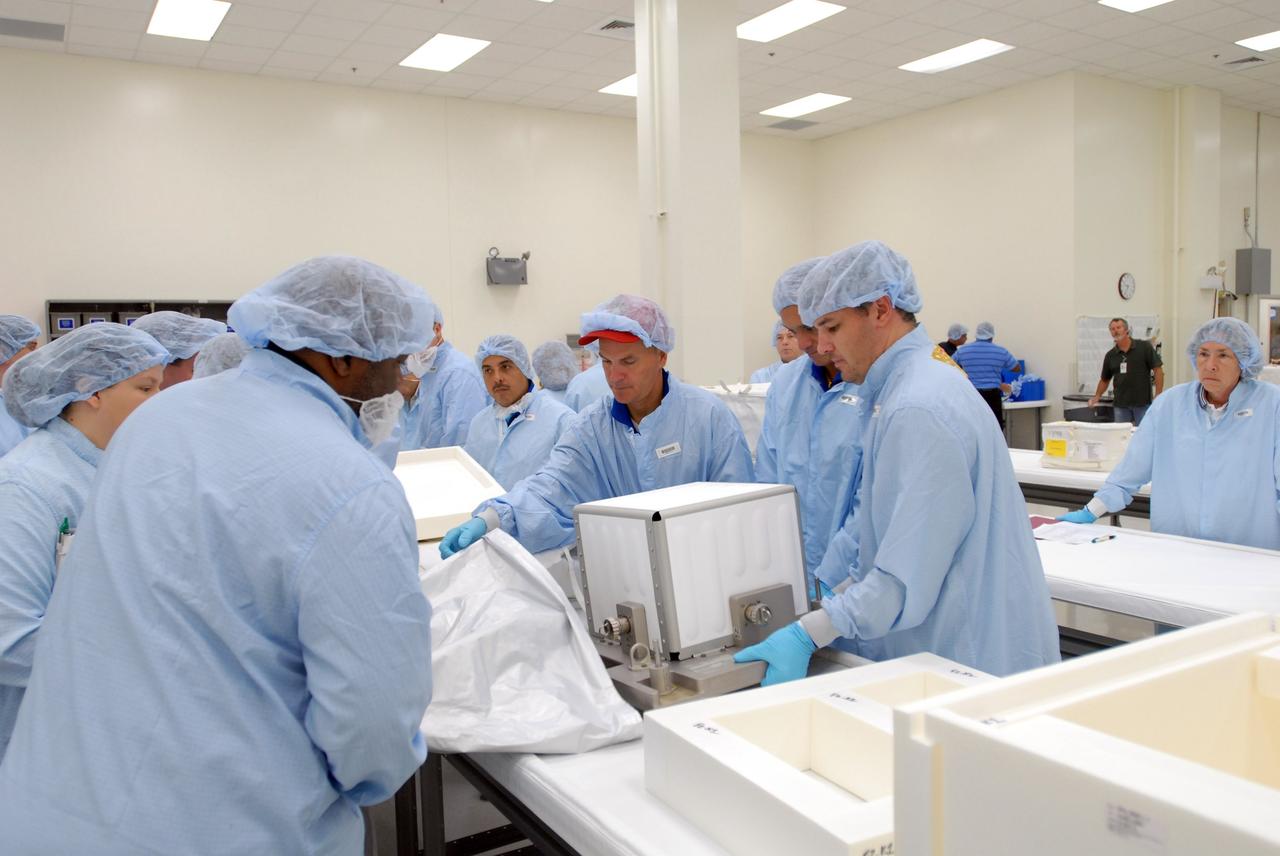
This image composite compares the well-known visible-light picture of the glowing Trifid Nebula (left panel) with infrared views from NASA's Spitzer Space Telescope (remaining three panels). The Trifid Nebula is a giant star-forming cloud of gas and dust located 5,400 light-years away in the constellation Sagittarius.  The false-color Spitzer images reveal a different side of the Trifid Nebula. Where dark lanes of dust are visible trisecting the nebula in the visible-light picture, bright regions of star-forming activity are seen in the Spitzer pictures. All together, Spitzer uncovered 30 massive embryonic stars and 120 smaller newborn stars throughout the Trifid Nebula, in both its dark lanes and luminous clouds. These stars are visible in all the Spitzer images, mainly as yellow or red spots. Embryonic stars are developing stars about to burst into existence. Ten of the 30 massive embryos discovered by Spitzer were found in four dark cores, or stellar "incubators," where stars are born. Astronomers using data from the Institute of Radioastronomy millimeter telescope in Spain had previously identified these cores but thought they were not quite ripe for stars. Spitzer's highly sensitive infrared eyes were able to penetrate all four cores to reveal rapidly growing embryos.  http://photojournal.jpl.nasa.gov/catalog/PIA07225
New Views of a Familiar Beauty
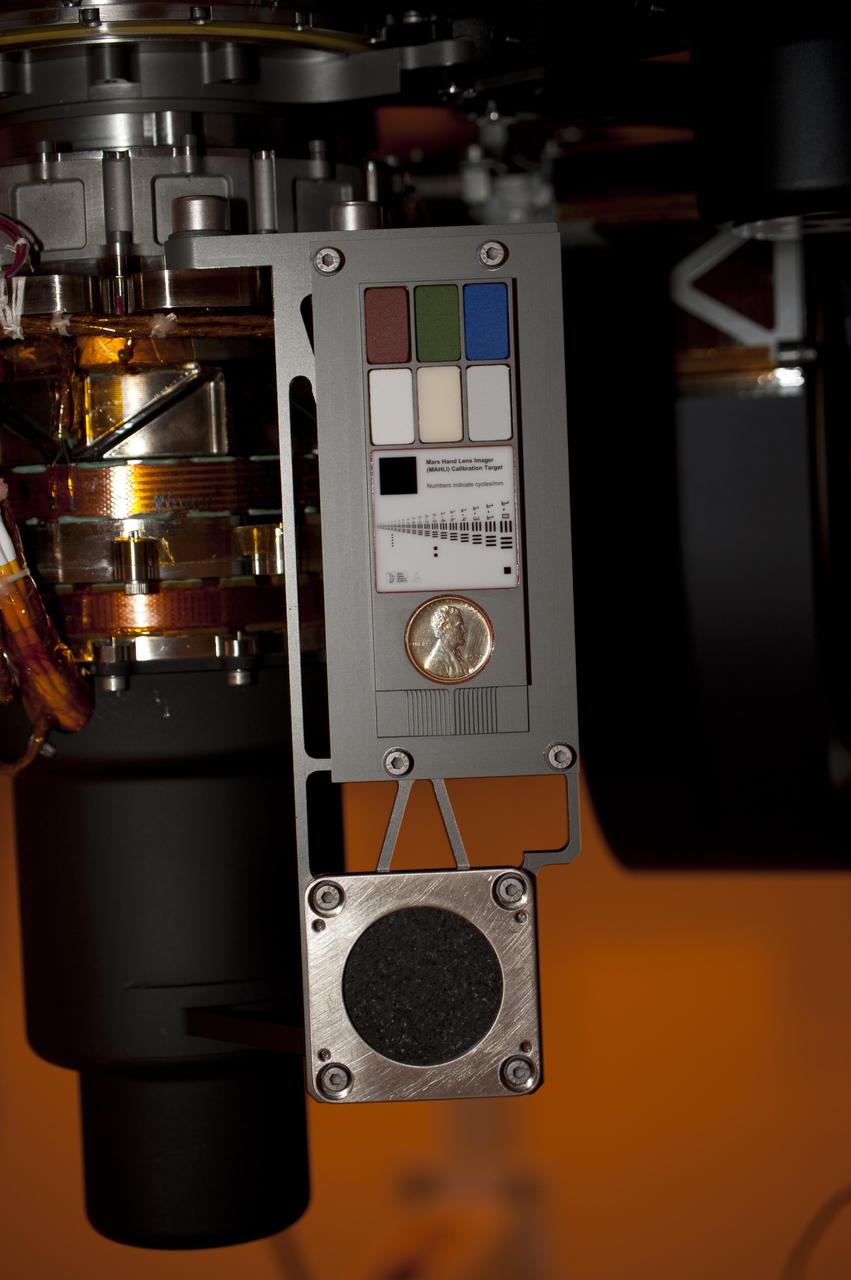
Two instruments at the end of the robotic arm on NASA Mars rover Curiosity will use calibration targets attached to a shoulder joint of the arm. The penny is a size reference giving the public a familiar object for perceiving size on Mars easily.
Contact Instrument Calibration Targets on Mars Rover Curiosity
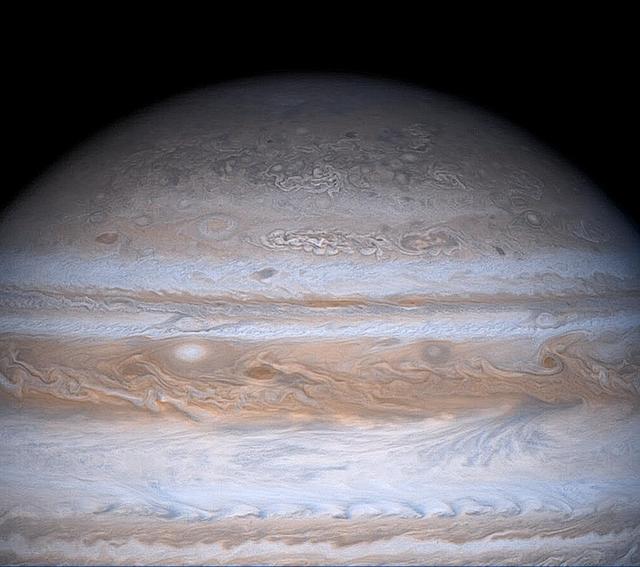
The familiar banded appearance of Jupiter at low and middle latitudes gradually gives way to a more mottled appearance at high latitudes in this striking true color image taken Dec. 13, 2000, by NASA Cassini spacecraft.
High Latitude Mottling on Jupiter
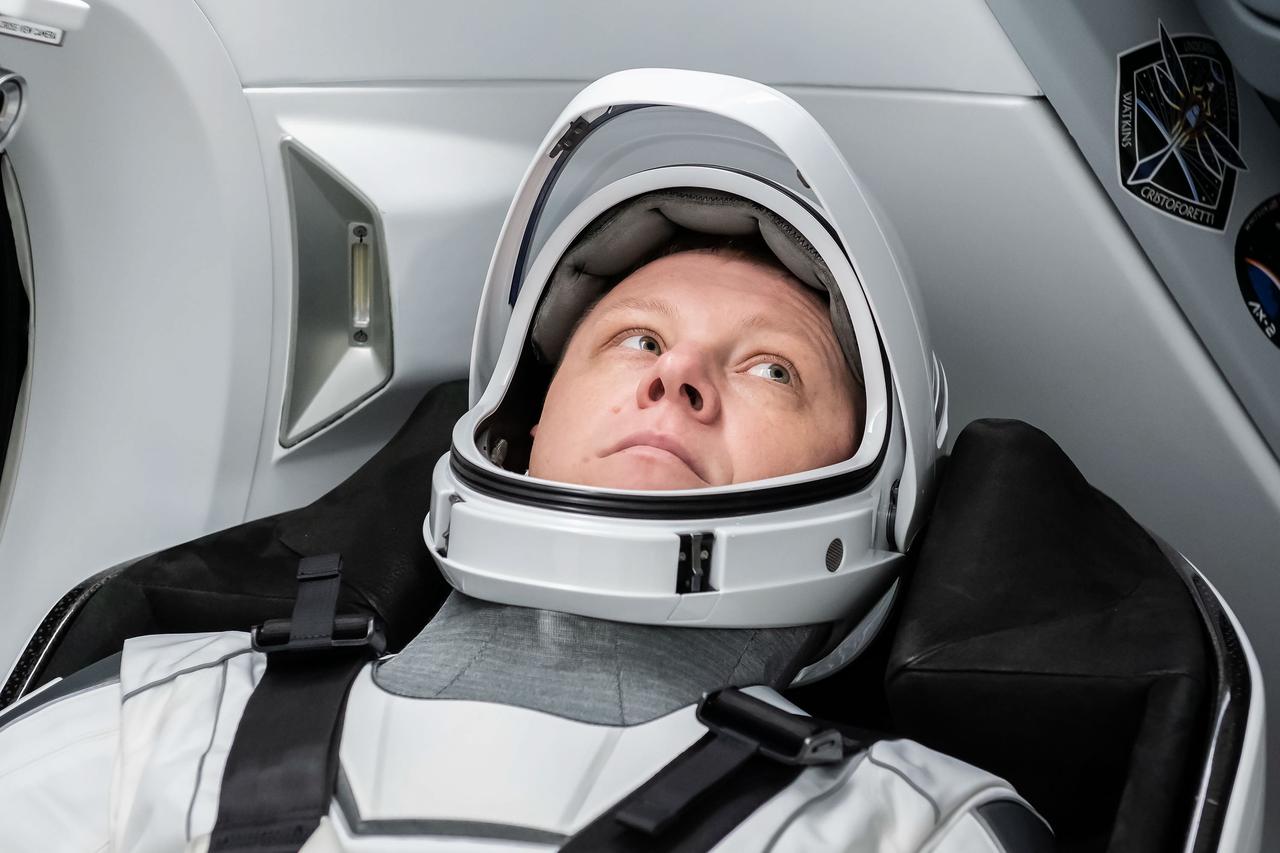
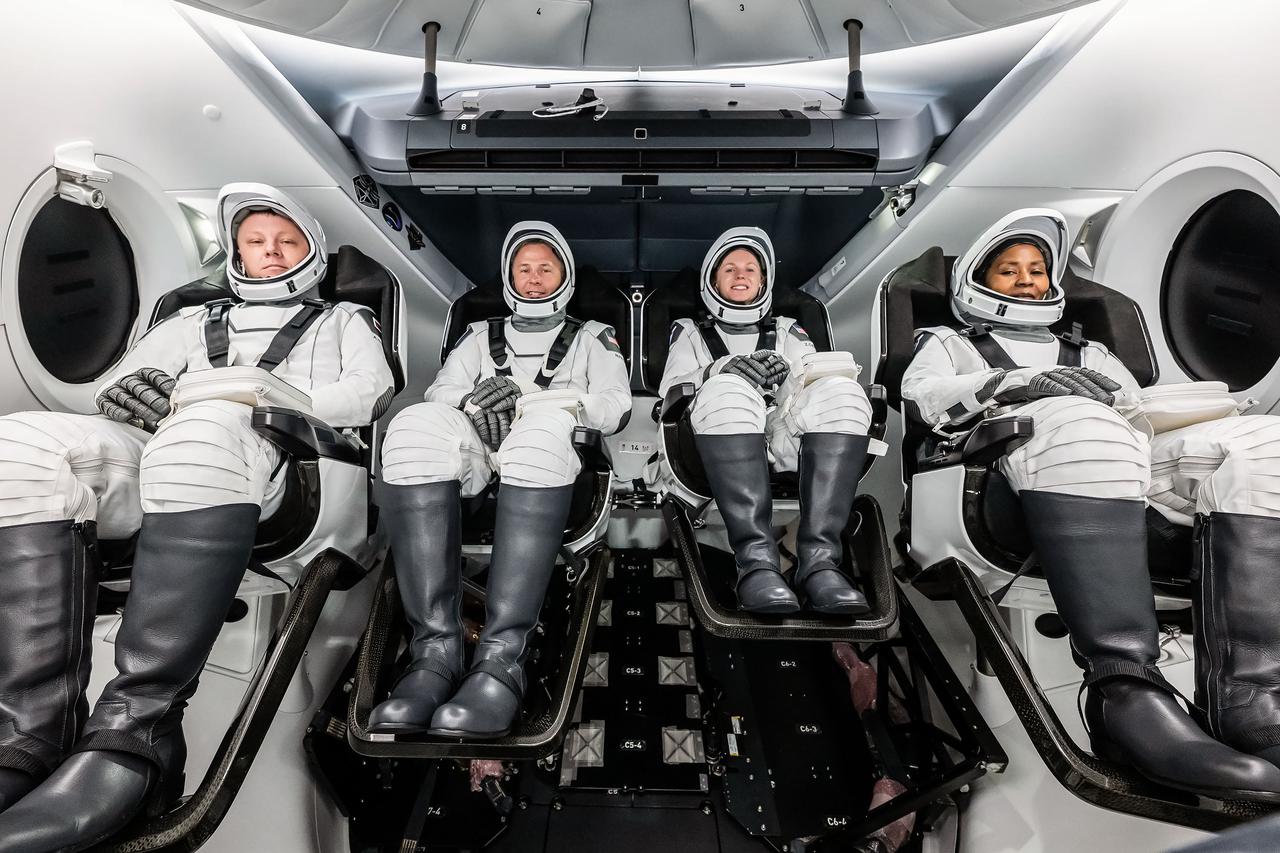
jsc2024e052330 (July 22, 2024) --- NASA’s SpaceX Crew-9 Mission Specialist Aleksandr Gorbunov is pictured familiarizing himself with the interior of the Dragon spacecraft, which will take him and the rest of the crew to the International Space Station no earlier than mid-August. Credit: SpaceX
SpaceX Crew-9 Mission Specialist Aleksandr Gorbunov
jsc2024e052322 (July 22, 2024) --- The crew of NASA’s SpaceX Crew-9 mission to the International Space Station poses for a photo during a crew equipment interface test (CEIT), which plays an important role in familiarizing crew members with the interior of the Dragon
The crew of NASA’s SpaceX Crew-9 mission
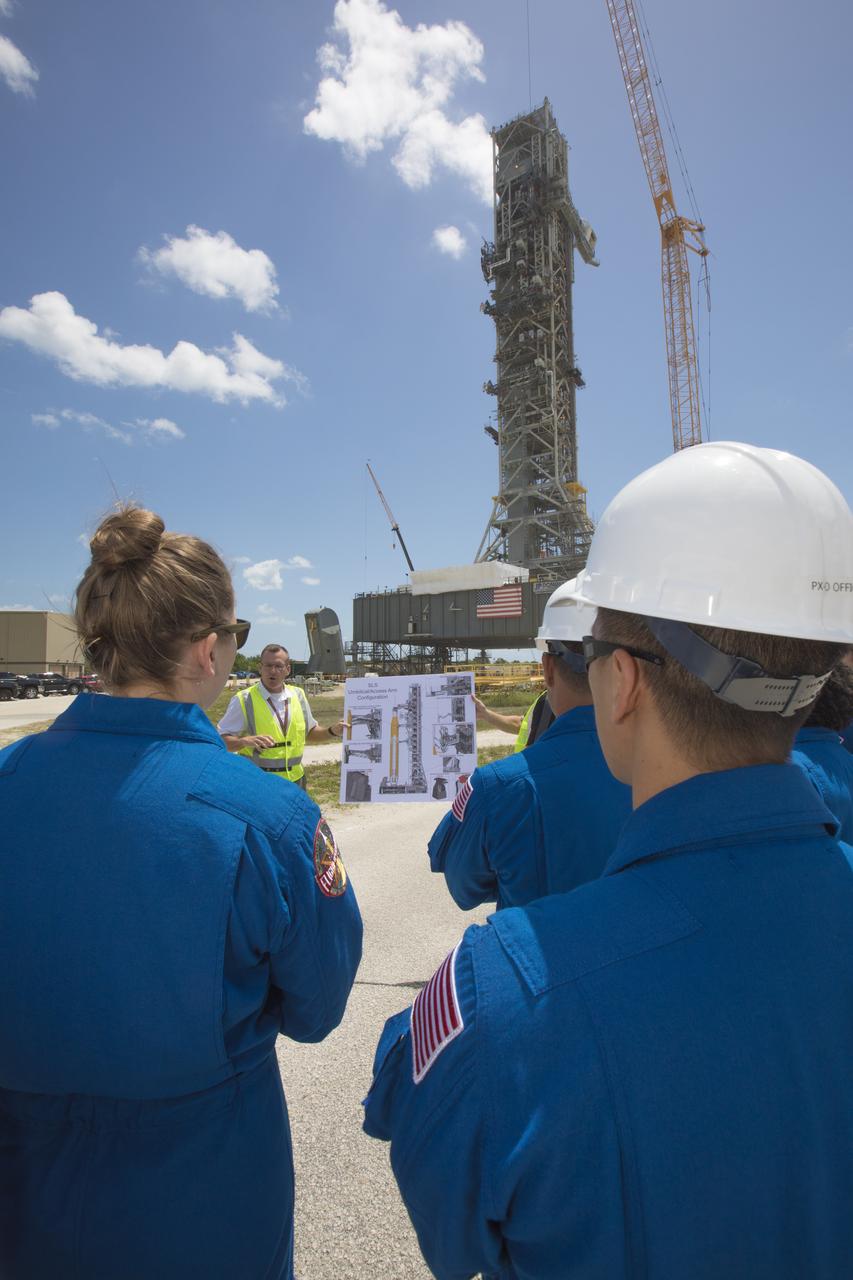
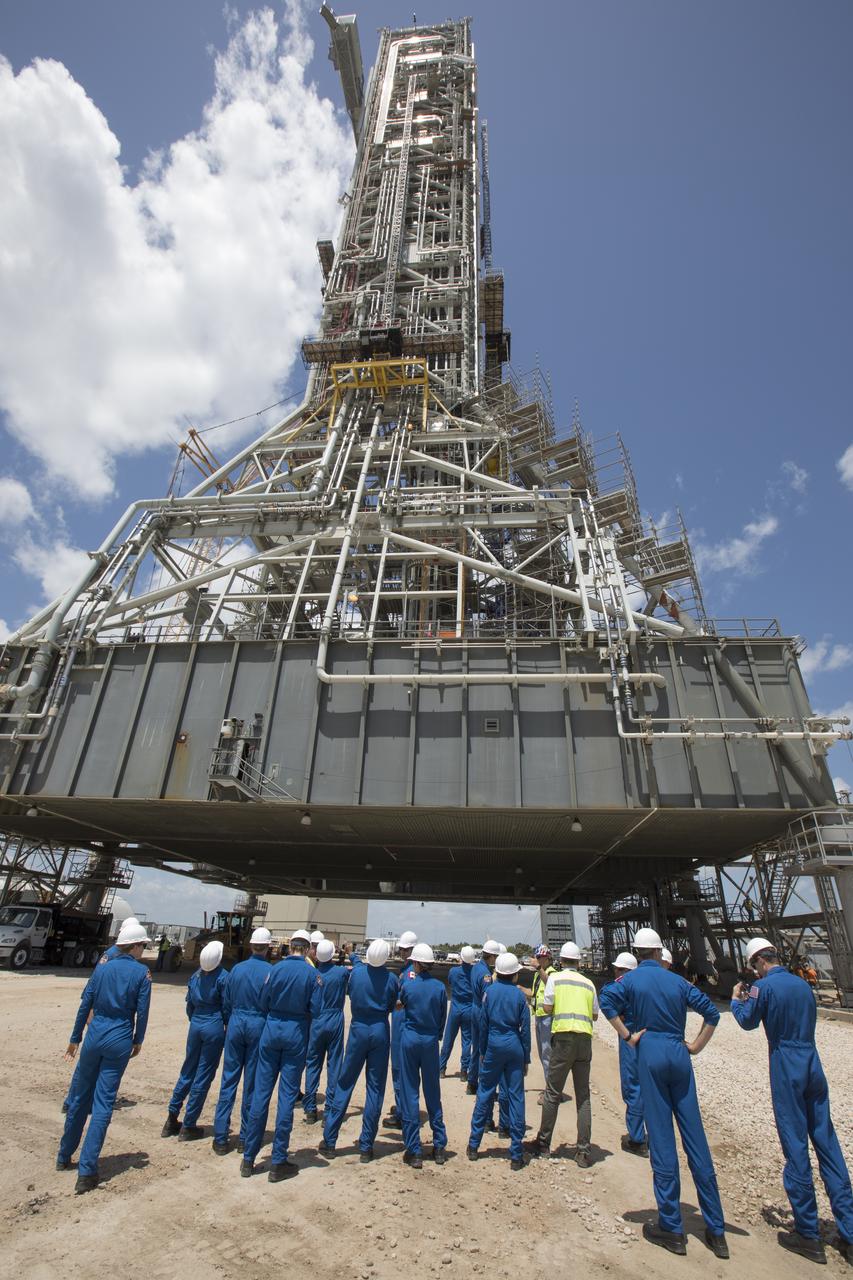
The 2017 class of astronaut candidates view the mobile launcher during a familiarization tour at NASA's Kennedy Space Center in Florida. The candidates toured center facilities, including the Neil Armstrong Operations and Checkout Building high bay; the Launch Control Center, Launch Pad 39B, and the Vehicle Assembly Building. They also toured Boeing's Commercial Crew and Cargo Facility, United Launch Alliance's Space Launch Complex 41 at Cape Canaveral Air Force Station, and SpaceX's Launch Pad 39A at Kennedy. The candidates will spend about two years getting to know the space station systems and learning how to spacewalk, speak Russian, control the International Space Station's robotic arm and fly T-38s, before they're eligible to be assigned to a mission.
2017 ASCAN Tour of KSC
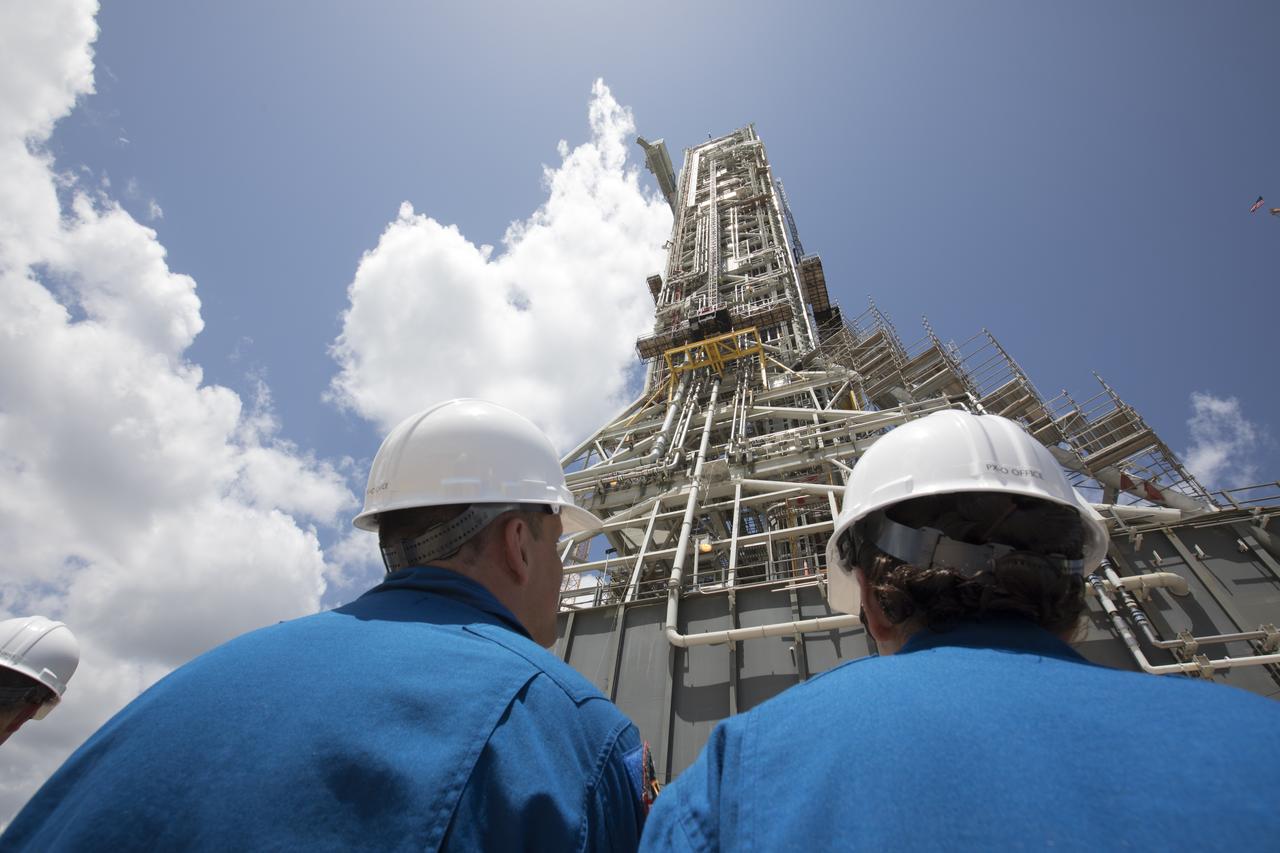
The 2017 class of astronaut candidates get a close-up view of the mobile launcher during a familiarization tour at NASA's Kennedy Space Center in Florida. The candidates toured center facilities, including the Neil Armstrong Operations and Checkout Building high bay; the Launch Control Center, Launch Pad 39B, and the Vehicle Assembly Building. They also toured Boeing's Commercial Crew and Cargo Facility, United Launch Alliance's Space Launch Complex 41 at Cape Canaveral Air Force Station, and SpaceX's Launch Pad 39A at Kennedy. The candidates will spend about two years getting to know the space station systems and learning how to spacewalk, speak Russian, control the International Space Station's robotic arm and fly T-38s, before they're eligible to be assigned to a mission.
2017 ASCAN Tour of KSC
The 2017 class of astronaut candidates get a close-up view of the mobile launcher during a familiarization tour at NASA's Kennedy Space Center in Florida. The candidates toured center facilities, including the Neil Armstrong Operations and Checkout Building high bay; the Launch Control Center, Launch Pad 39B, and the Vehicle Assembly Building. They also toured Boeing's Commercial Crew and Cargo Facility, United Launch Alliance's Space Launch Complex 41 at Cape Canaveral Air Force Station, and SpaceX's Launch Pad 39A at Kennedy. The candidates will spend about two years getting to know the space station systems and learning how to spacewalk, speak Russian, control the International Space Station's robotic arm and fly T-38s, before they're eligible to be assigned to a mission.
2017 ASCAN Tour of KSC
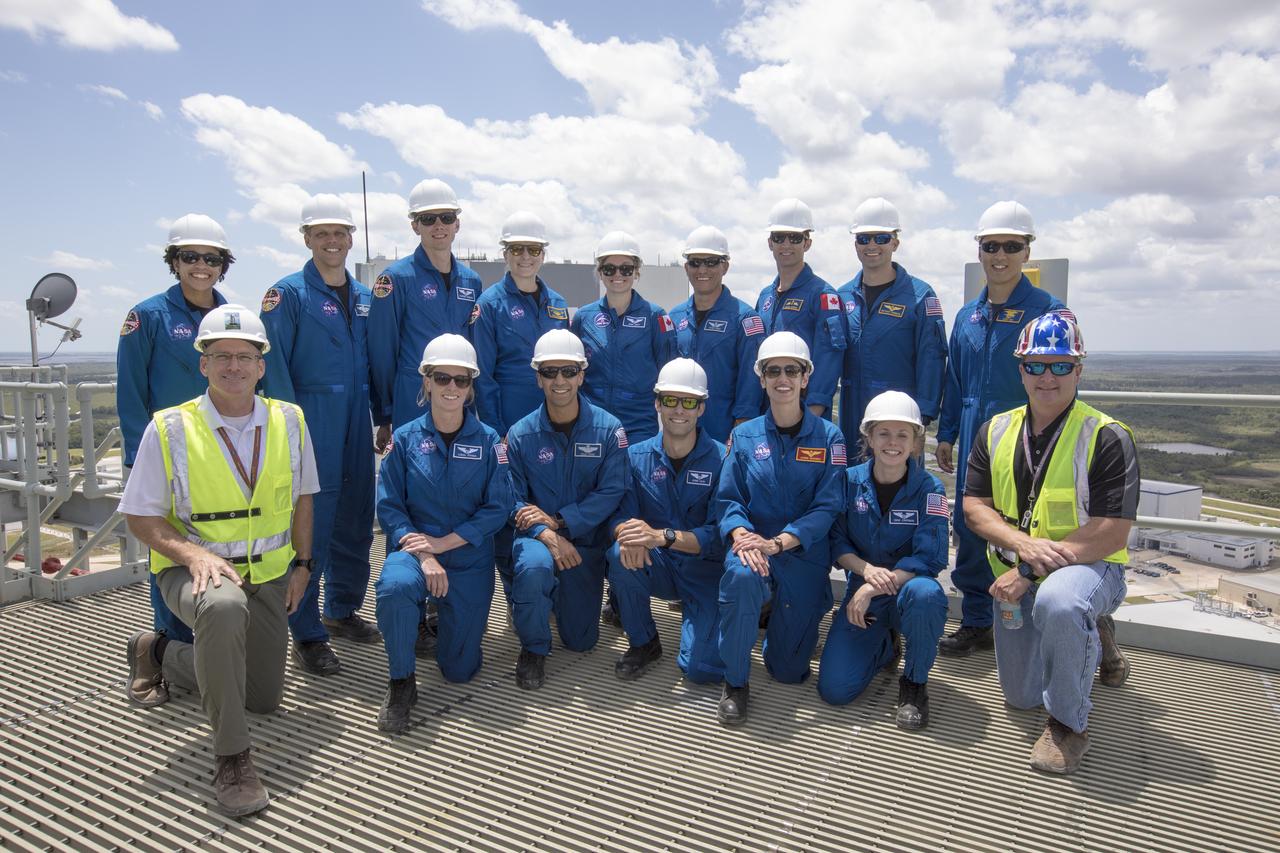
The 2017 class of astronaut candidates pause for a group photograph on the deck of the mobile launcher during a familiarization tour at NASA's Kennedy Space Center in Florida. The candidates toured center facilities, including the Neil Armstrong Operations and Checkout Building high bay; the Launch Control Center, Launch Pad 39B, and the Vehicle Assembly Building. They also toured Boeing's Commercial Crew and Cargo Facility, United Launch Alliance's Space Launch Complex 41 at Cape Canaveral Air Force Station, and SpaceX's Launch Pad 39A at Kennedy. The candidates will spend about two years getting to know the space station systems and learning how to spacewalk, speak Russian, control the International Space Station's robotic arm and fly T-38s, before they're eligible to be assigned to a mission.
2017 ASCAN Tour of KSC
The 2017 class of astronaut candidates pause for a group photograph on the deck of the mobile launcher during a familiarization tour at NASA's Kennedy Space Center in Florida. The candidates toured center facilities, including the Neil Armstrong Operations and Checkout Building high bay; the Launch Control Center, Launch Pad 39B and the Vehicle Assembly Building. They also toured Boeing's Commercial Crew and Cargo Facility, United Launch Alliance's Space Launch Complex 41 at Cape Canaveral Air Force Station, and SpaceX's Launch Pad 39A at Kennedy. The candidates will spend about two years getting to know the space station systems and learning how to spacewalk, speak Russian, control the International Space Station's robotic arm and fly T-38s, before they're eligible to be assigned to a mission.
2017 ASCAN Tour of KSC
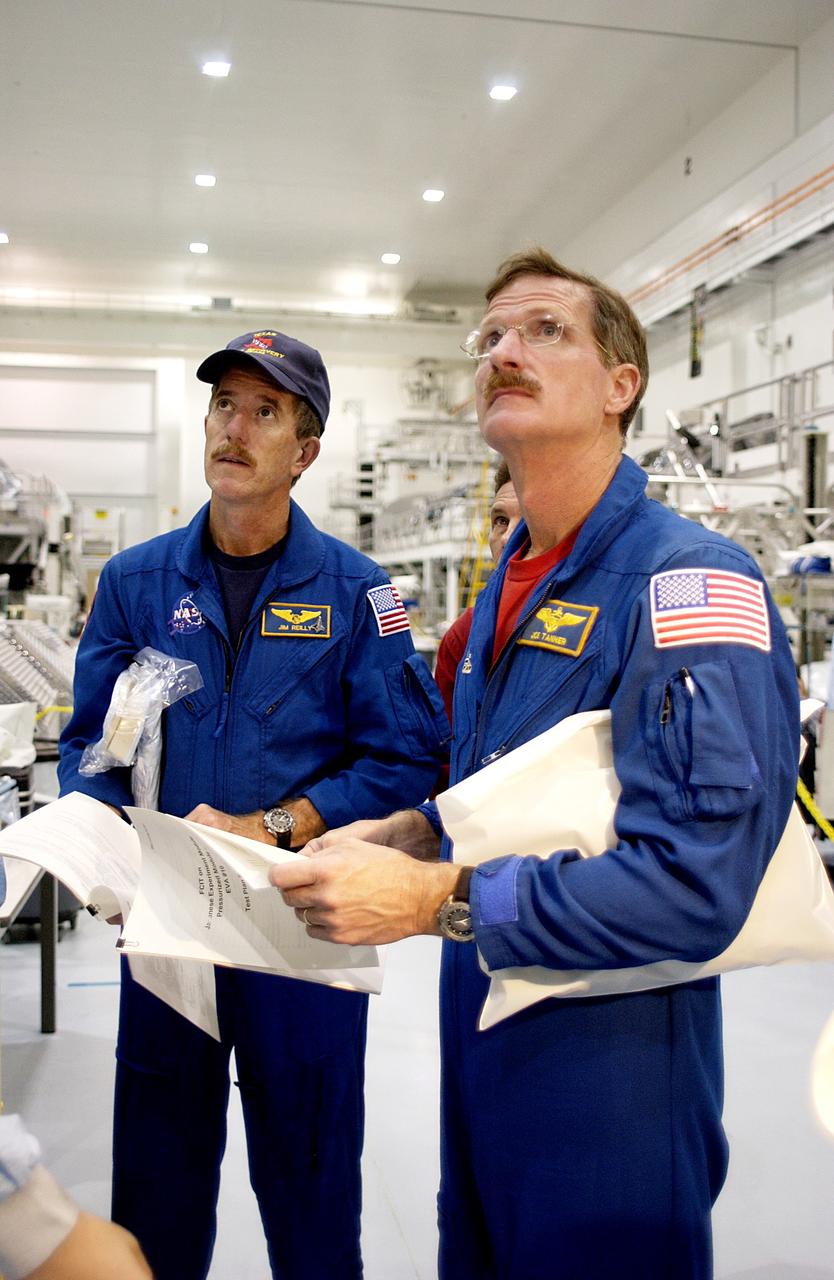
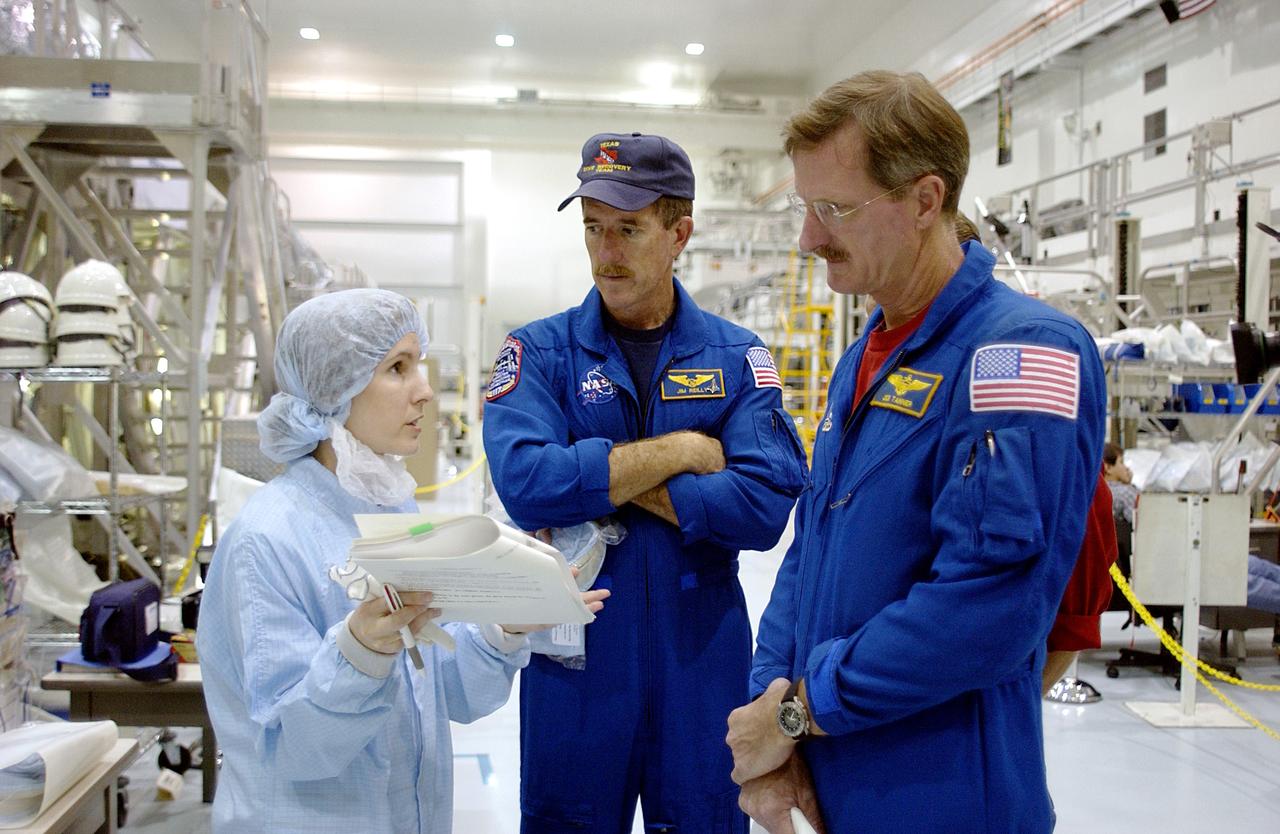
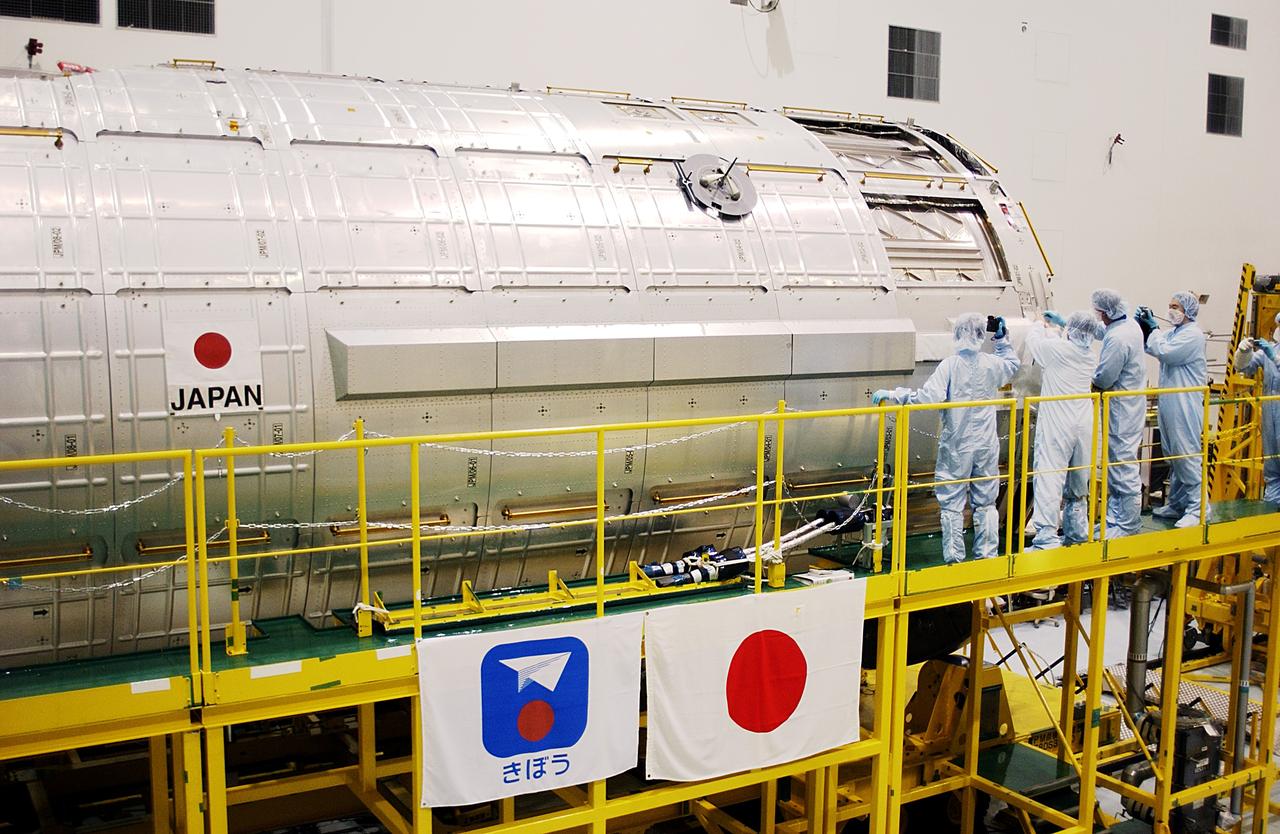
KENNEDY SPACE CENTER, FLA. - In the Space Station Processing Facility, STS-117 Mission Specialist James Reilly (left) and STS-115 Mission Specialist Joseph Tanner (right) look over the Japanese Experiment Module (JEM).  Equipment familiarization is a routine part of astronaut training and launch preparations.
KENNEDY SPACE CENTER, FLA. - In the Space Station Processing Facility, STS-117 Mission Specialist James Reilly (left) and STS-115 Mission Specialist Joseph Tanner (right) look over the Japanese Experiment Module (JEM). Equipment familiarization is a routine part of astronaut training and launch preparations.
KENNEDY SPACE CENTER, FLA. -  In the Space Station Processing Facility, STS-115 Mission Specialist Joseph Tanner gets hands-on experience with the Japanese Experiment Module (JEM).  Tanner and STS-117 Mission Specialist James Reilly  are at KSC for equipment familiarization, a routine part of astronaut training and launch preparations.
KENNEDY SPACE CENTER, FLA. - In the Space Station Processing Facility, STS-115 Mission Specialist Joseph Tanner gets hands-on experience with the Japanese Experiment Module (JEM). Tanner and STS-117 Mission Specialist James Reilly are at KSC for equipment familiarization, a routine part of astronaut training and launch preparations.
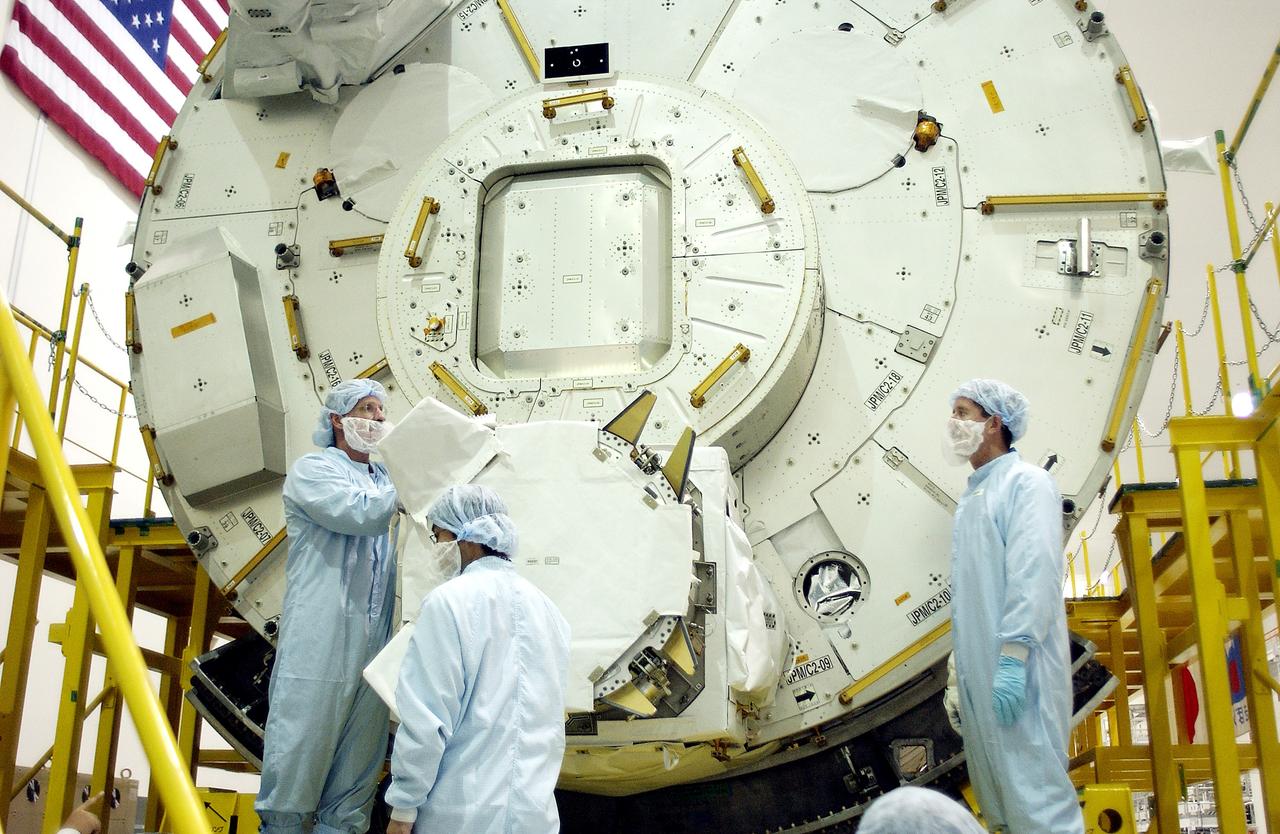
KENNEDY SPACE CENTER, FLA. - In the Space Station Processing Facility, STS-115 Mission Specialist Joseph Tanner (left) and STS-117 Mission Specialist James Reilly (right) are donning protective clothing to interface with the Japanese Experiment Module (JEM), in the background.  Equipment familiarization is a routine part of astronaut training and launch preparations.
KENNEDY SPACE CENTER, FLA. - In the Space Station Processing Facility, STS-115 Mission Specialist Joseph Tanner (left) and STS-117 Mission Specialist James Reilly (right) are donning protective clothing to interface with the Japanese Experiment Module (JEM), in the background. Equipment familiarization is a routine part of astronaut training and launch preparations.
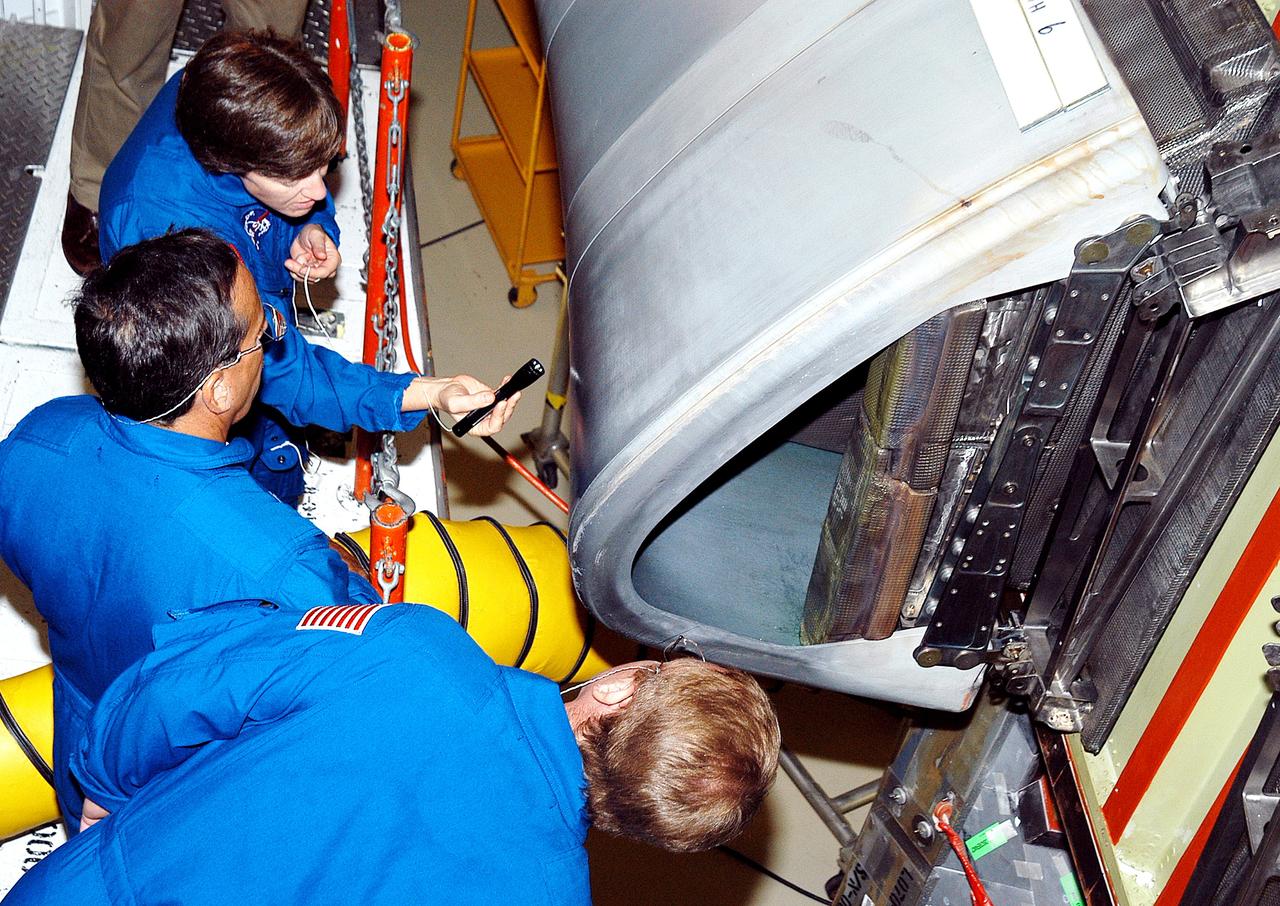
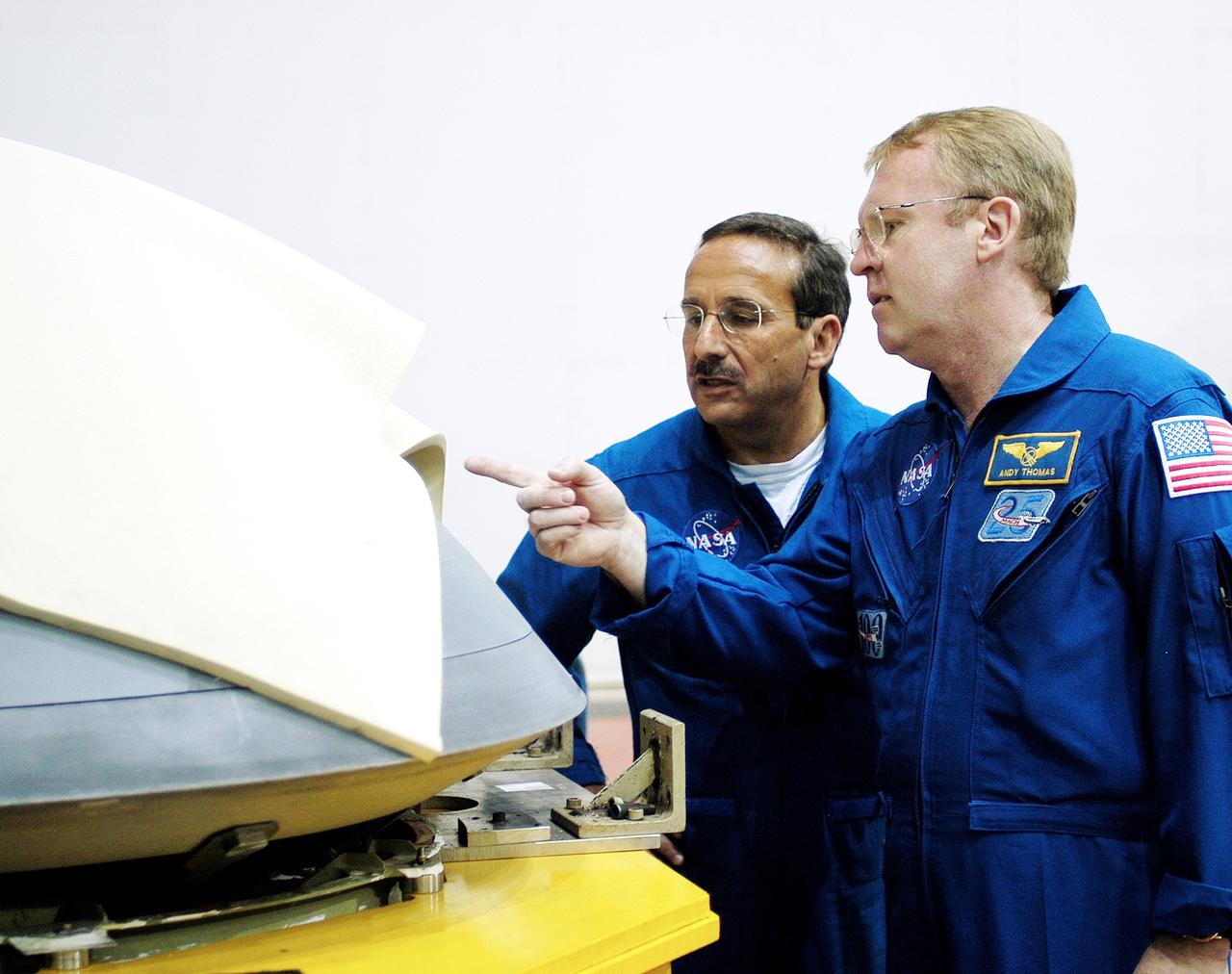
KENNEDY SPACE CENTER, FLA. -  In the Orbiter Processing Facility, STS-114 Mission Specialists Charles Camarda and Andy Thomas, who were recently added to the crew, look at the nose cap recently removed from Atlantis.  The STS-114 crew is at KSC to take part in crew equipment and orbiter familiarization.
KENNEDY SPACE CENTER, FLA. - In the Orbiter Processing Facility, STS-114 Mission Specialists Charles Camarda and Andy Thomas, who were recently added to the crew, look at the nose cap recently removed from Atlantis. The STS-114 crew is at KSC to take part in crew equipment and orbiter familiarization.
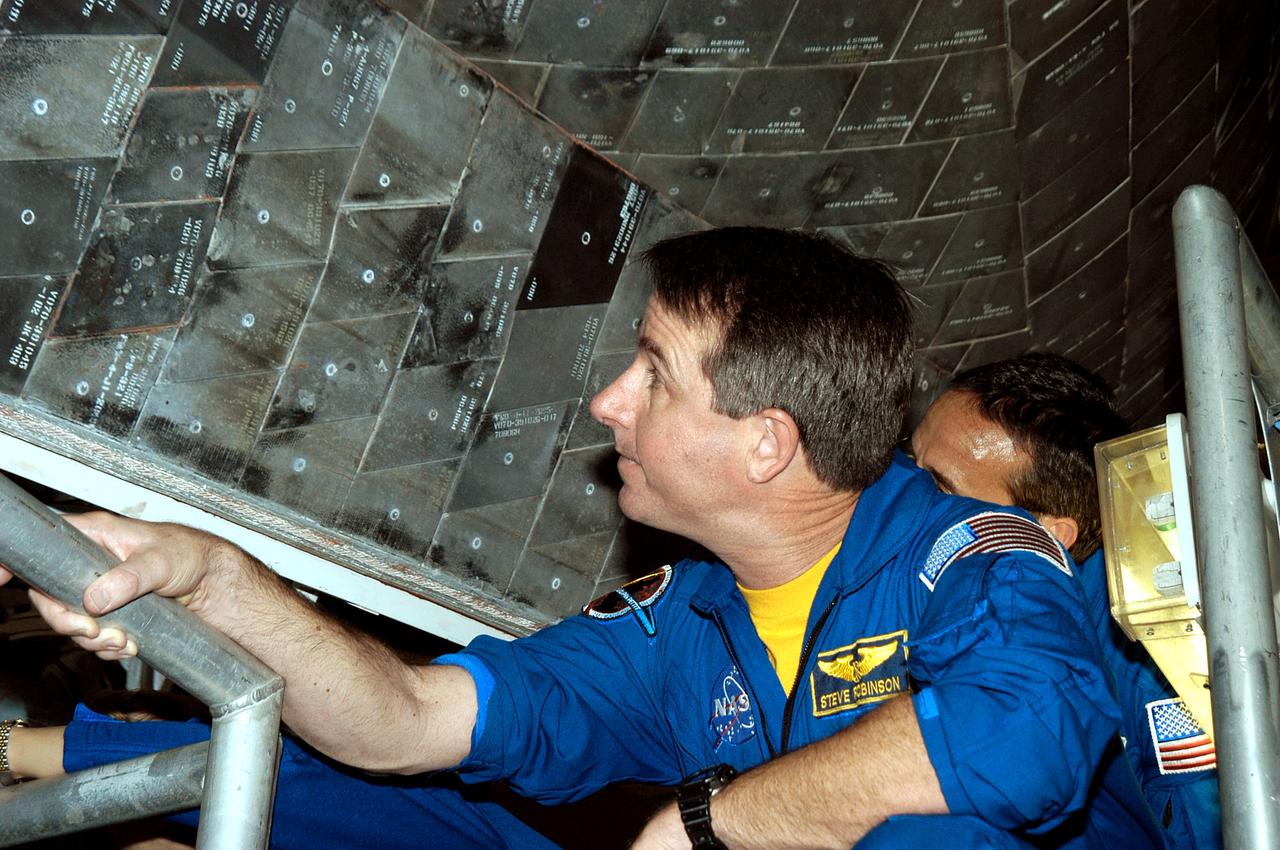
KENNEDY SPACE CENTER, FLA. -  In the Orbiter Processing Facility, STS-114 Mission Specialist Stephen Robinson takes a close look at the some of the tiles underneath Atlantis.  The STS-114 crew is at KSC to take part in crew equipment and orbiter familiarization.
KENNEDY SPACE CENTER, FLA. - In the Orbiter Processing Facility, STS-114 Mission Specialist Stephen Robinson takes a close look at the some of the tiles underneath Atlantis. The STS-114 crew is at KSC to take part in crew equipment and orbiter familiarization.
KENNEDY SPACE CENTER, FLA. -  In the Space Station Processing Facility, STS-117 Mission Specialist James Reilly (left) and STS-115 Mission Specialist Joseph Tanner get hands-on experience with the Japanese Experiment Module (JEM).  Reilly and Tanner are at KSC for equipment familiarization, a routine part of astronaut training and launch preparations.
KENNEDY SPACE CENTER, FLA. - In the Space Station Processing Facility, STS-117 Mission Specialist James Reilly (left) and STS-115 Mission Specialist Joseph Tanner get hands-on experience with the Japanese Experiment Module (JEM). Reilly and Tanner are at KSC for equipment familiarization, a routine part of astronaut training and launch preparations.
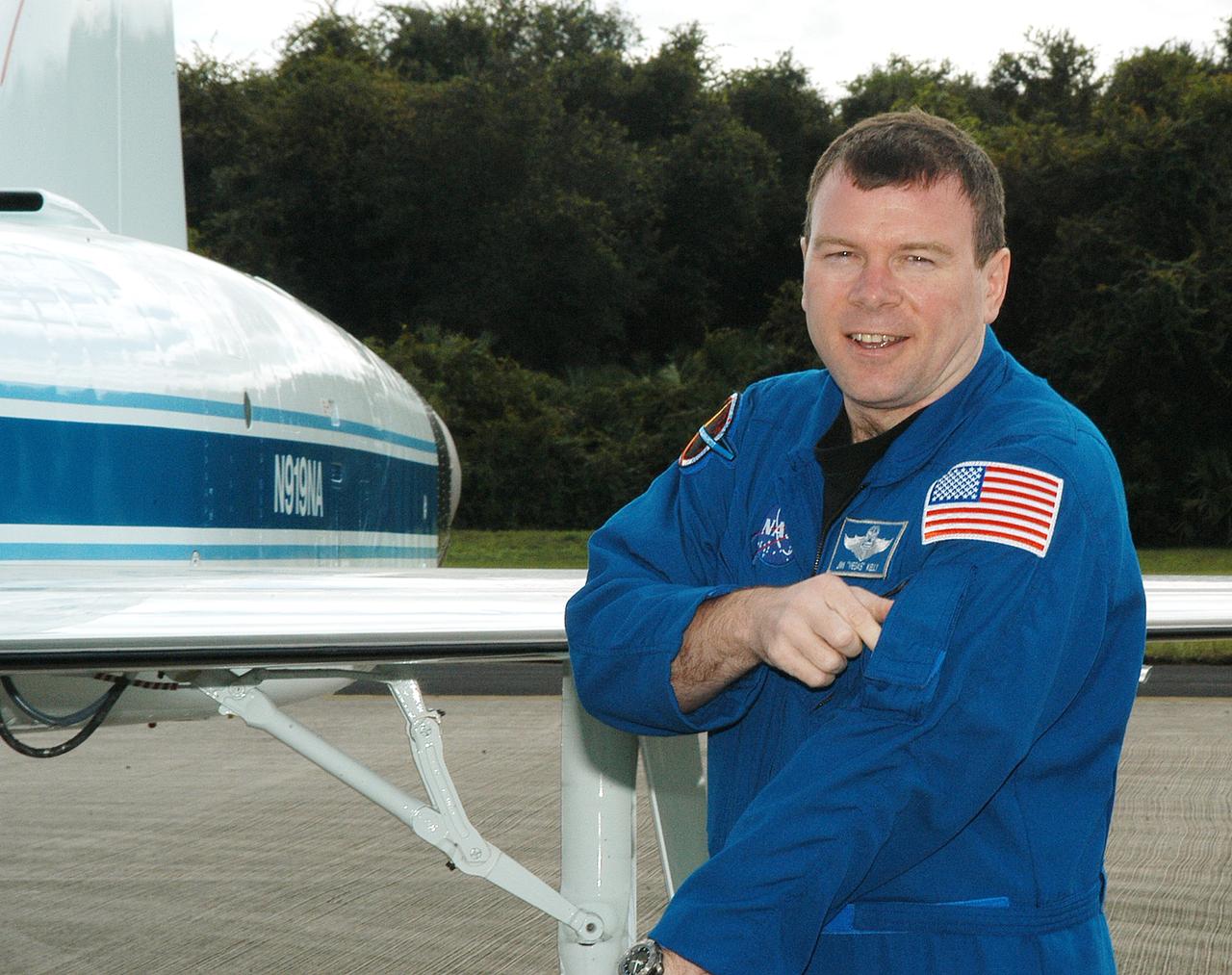
KENNEDY SPACE CENTER, FLA. - STS-114 Mission Specialist Soichi Noguchi arrives at the KSC Shuttle Landing Facility in a T-38 jet aircraft.  Noguchi, who is with the Japan Aerospace Exploration Agency (JAXA), is taking part in crew equipment and orbiter  familiarization along with other mission crew members.
KENNEDY SPACE CENTER, FLA. - STS-114 Mission Specialist Soichi Noguchi arrives at the KSC Shuttle Landing Facility in a T-38 jet aircraft. Noguchi, who is with the Japan Aerospace Exploration Agency (JAXA), is taking part in crew equipment and orbiter familiarization along with other mission crew members.
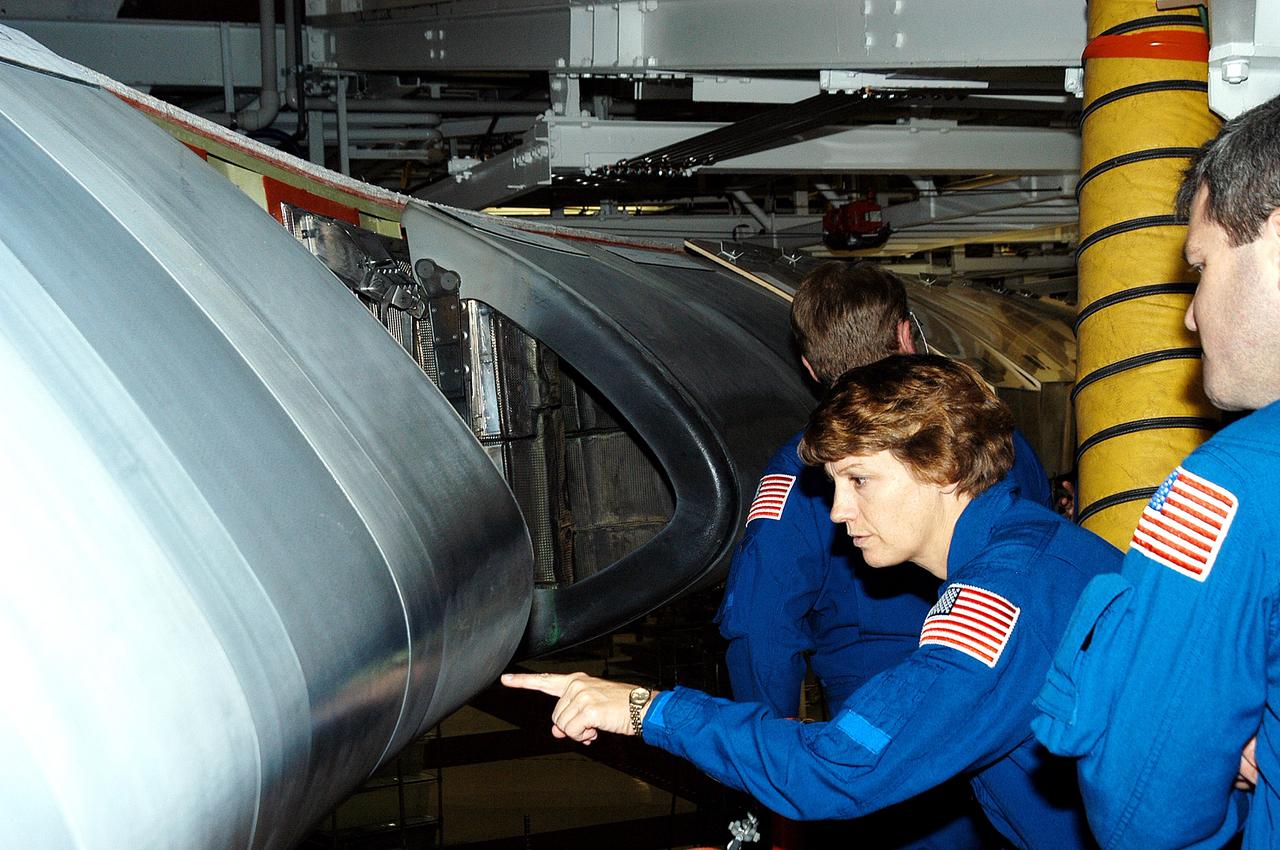
KENNEDY SPACE CENTER, FLA. -  In the Orbiter Processing Facility, STS-114 Mission Commander Eileen Collins looks closely at a reinforced carbon-carbon panel on the wing of Atlantis.  She and other crew members are at KSC to take part in crew equipment and orbiter familiarization.
KENNEDY SPACE CENTER, FLA. - In the Orbiter Processing Facility, STS-114 Mission Commander Eileen Collins looks closely at a reinforced carbon-carbon panel on the wing of Atlantis. She and other crew members are at KSC to take part in crew equipment and orbiter familiarization.
KENNEDY SPACE CENTER, FLA. -   In the Orbiter Processing Facility, STS-114 Mission Specialist Wendy Lawrence looks at an reinforced carbon-carbon panel ready to be installed on Atlantis.  Lawrence is a new addition to the mission crew, who are at KSC to take part in crew equipment and orbiter familiarization.
KENNEDY SPACE CENTER, FLA. - In the Orbiter Processing Facility, STS-114 Mission Specialist Wendy Lawrence looks at an reinforced carbon-carbon panel ready to be installed on Atlantis. Lawrence is a new addition to the mission crew, who are at KSC to take part in crew equipment and orbiter familiarization.
KENNEDY SPACE CENTER, FLA. - In the Space Station Processing Facility, STS-115 Mission Specialist Joseph Tanner (left) and STS-117 Mission Specialist James Reilly (right) look over the Japanese Experiment Module (JEM) behind them. Equipment familiarization is a routine part of astronaut training and launch preparations.
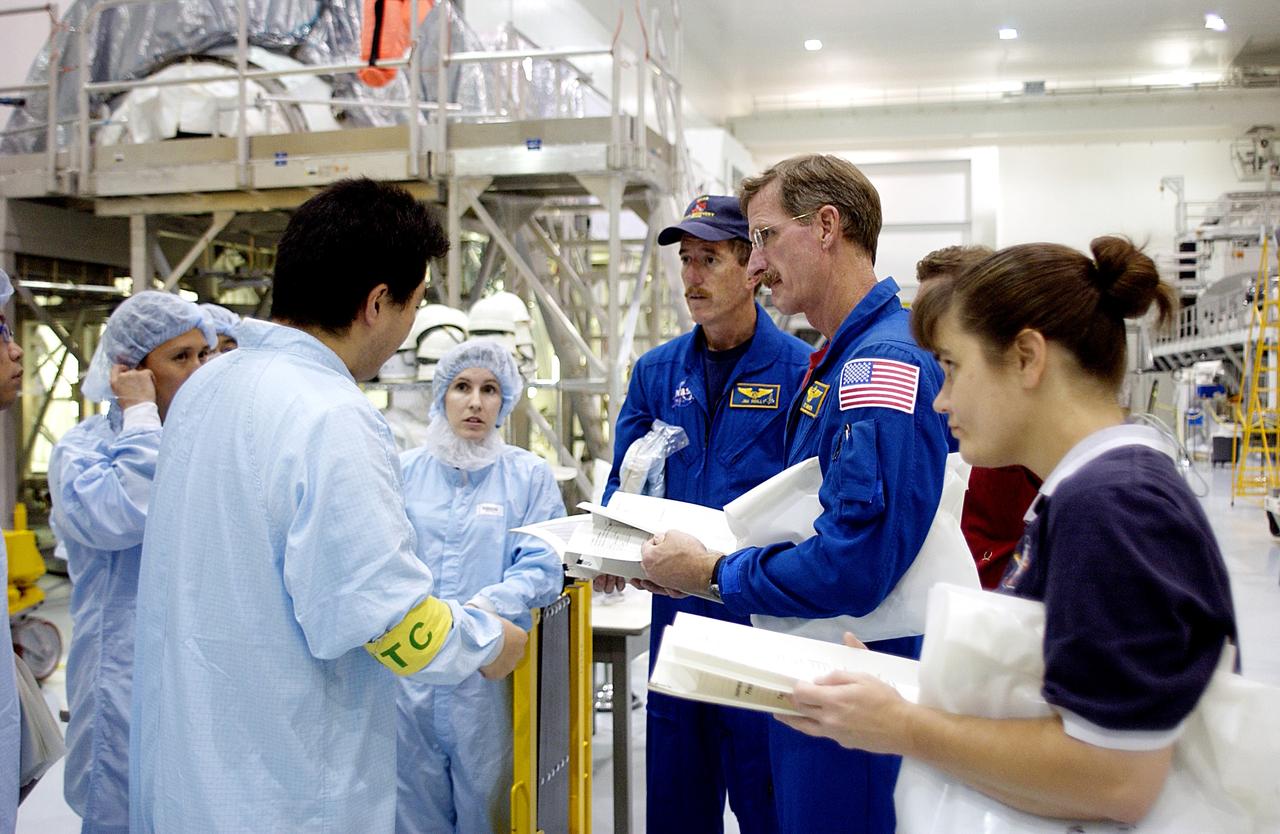
KENNEDY SPACE CENTER, FLA. - At right, STS-114 Commander Eileen Collins, Pilot James Kelly, and Mission Specialists Soichi Noguchi and Stephen Robinson talk to workers in the Orbiter Processing Facility. Noguchi is with the Japan Aerospace Exploration Agency, JAXA. The STS-114 crew is at KSC to take part in crew equipment and orbiter familiarization.
KENNEDY SPACE CENTER, FLA. -  In the Orbiter Processing Facility, STS-114 Mission Specialists Soichi Noguchi and Stephen Robinson take a close look at the some of the tiles underneath Atlantis.  Noguchi is with the Japan Aerospace Exploration Agency, JAXA.  The STS-114 crew is at KSC to take part in crew equipment and orbiter familiarization.
KENNEDY SPACE CENTER, FLA. - In the Orbiter Processing Facility, STS-114 Mission Specialists Soichi Noguchi and Stephen Robinson take a close look at the some of the tiles underneath Atlantis. Noguchi is with the Japan Aerospace Exploration Agency, JAXA. The STS-114 crew is at KSC to take part in crew equipment and orbiter familiarization.
KENNEDY SPACE CENTER, FLA. - In the Space Station Processing Facility, STS-117 Mission Specialist James Reilly (center) and STS-115 Mission Specialist Joseph Tanner (right) talk with a worker about the Japanese Experiment Module (JEM).  Equipment familiarization is a routine part of astronaut training and launch preparations.
KENNEDY SPACE CENTER, FLA. - In the Space Station Processing Facility, STS-117 Mission Specialist James Reilly (center) and STS-115 Mission Specialist Joseph Tanner (right) talk with a worker about the Japanese Experiment Module (JEM). Equipment familiarization is a routine part of astronaut training and launch preparations.
KENNEDY SPACE CENTER, FLA. - In the Space Station Processing Facility, STS-115 Mission Specialist Joseph Tanner looks at the Exposed Facility Berthing Mechanism (EFBM)  on the Japanese Experiment Module (JEM), after removing its cover.  Equipment familiarization is a routine part of astronaut training and launch preparations.
KENNEDY SPACE CENTER, FLA. - In the Space Station Processing Facility, STS-115 Mission Specialist Joseph Tanner looks at the Exposed Facility Berthing Mechanism (EFBM) on the Japanese Experiment Module (JEM), after removing its cover. Equipment familiarization is a routine part of astronaut training and launch preparations.
KENNEDY SPACE CENTER, FLA. - In the Space Station Processing Facility, STS-117 Mission Specialist James Reilly  works with equipment in the Japanese Experiment Module (JEM) as part of training for ExtraVehicular Activity (EVA).  Equipment familiarization is a routine part of astronaut training and launch preparations.
KENNEDY SPACE CENTER, FLA. - In the Space Station Processing Facility, STS-117 Mission Specialist James Reilly works with equipment in the Japanese Experiment Module (JEM) as part of training for ExtraVehicular Activity (EVA). Equipment familiarization is a routine part of astronaut training and launch preparations.
KENNEDY SPACE CENTER, FLA. -    In the Orbiter Processing Facility, STS-114 crew members look at the reinforced carbon-carbon panels on the wing of Atlantis. From top to bottom are Commander Eileen Collins and Mission Specialists Charles Camarda and Andrew Thomas.  The STS-114 crew is at KSC to take part in crew equipment and orbiter familiarization.
KENNEDY SPACE CENTER, FLA. - In the Orbiter Processing Facility, STS-114 crew members look at the reinforced carbon-carbon panels on the wing of Atlantis. From top to bottom are Commander Eileen Collins and Mission Specialists Charles Camarda and Andrew Thomas. The STS-114 crew is at KSC to take part in crew equipment and orbiter familiarization.
KENNEDY SPACE CENTER, FLA. -  In the Orbiter Processing Facility, STS-114 Commander Eileen Collins examines part of the Atlantis nose cap with Randall Carter, who is with The  Boeing Company.  The nose cap was  recently removed from Atlantis.  The STS-114 crew is at KSC to take part in crew equipment and orbiter familiarization.
KENNEDY SPACE CENTER, FLA. - In the Orbiter Processing Facility, STS-114 Commander Eileen Collins examines part of the Atlantis nose cap with Randall Carter, who is with The Boeing Company. The nose cap was recently removed from Atlantis. The STS-114 crew is at KSC to take part in crew equipment and orbiter familiarization.
KENNEDY SPACE CENTER, FLA. - In the Space Station Processing Facility, STS-114 Mission Specialist Wendy Lawrence manipulates part of a Multi-Purpose Logistics Module.  Lawrence is a new addition to the mission crew.  The STS-114 crew is at KSC to take part in crew equipment and orbiter familiarization.
KENNEDY SPACE CENTER, FLA. - In the Space Station Processing Facility, STS-114 Mission Specialist Wendy Lawrence manipulates part of a Multi-Purpose Logistics Module. Lawrence is a new addition to the mission crew. The STS-114 crew is at KSC to take part in crew equipment and orbiter familiarization.
KENNEDY SPACE CENTER, FLA. - In the Space Station Processing Facility, workers (in protective clothing) brief STS-117 Mission Specialist James Reilly (center) and STS-115 Mission Specialist Joseph Tanner (right) about the Japanese Experiment Module (JEM).  Equipment familiarization is a routine part of astronaut training and launch preparations.
KENNEDY SPACE CENTER, FLA. - In the Space Station Processing Facility, workers (in protective clothing) brief STS-117 Mission Specialist James Reilly (center) and STS-115 Mission Specialist Joseph Tanner (right) about the Japanese Experiment Module (JEM). Equipment familiarization is a routine part of astronaut training and launch preparations.
KENNEDY SPACE CENTER, FLA. -  In the Space Station Processing Facility, STS-115 Mission Specialist Joseph Tanner and STS-117 Mission Specialist James Reilly get a close look at the Japanese Experiment Module (JEM).  Reilly and Tanner are at KSC for equipment familiarization, a routine part of astronaut training and launch preparations.
KENNEDY SPACE CENTER, FLA. - In the Space Station Processing Facility, STS-115 Mission Specialist Joseph Tanner and STS-117 Mission Specialist James Reilly get a close look at the Japanese Experiment Module (JEM). Reilly and Tanner are at KSC for equipment familiarization, a routine part of astronaut training and launch preparations.
KENNEDY SPACE CENTER, FLA. -  In the Space Station Processing Facility, STS-117 Mission Specialist James Reilly (left) and STS-115 Mission Specialist Joseph Tanner (right) look over components in the Japanese Experiment Module (JEM).  Equipment familiarization is a routine part of astronaut training and launch preparations.
KENNEDY SPACE CENTER, FLA. - In the Space Station Processing Facility, STS-117 Mission Specialist James Reilly (left) and STS-115 Mission Specialist Joseph Tanner (right) look over components in the Japanese Experiment Module (JEM). Equipment familiarization is a routine part of astronaut training and launch preparations.
KENNEDY SPACE CENTER, FLA. -  In the Orbiter Processing Facility, STS-114 Mission Specialist Andy Thomas takes a close look at the some of the tiles underneath Atlantis.  Thomas is a new addition to the mission crew.  The STS-114 crew is at KSC to take part in crew equipment and orbiter familiarization.
KENNEDY SPACE CENTER, FLA. - In the Orbiter Processing Facility, STS-114 Mission Specialist Andy Thomas takes a close look at the some of the tiles underneath Atlantis. Thomas is a new addition to the mission crew. The STS-114 crew is at KSC to take part in crew equipment and orbiter familiarization.
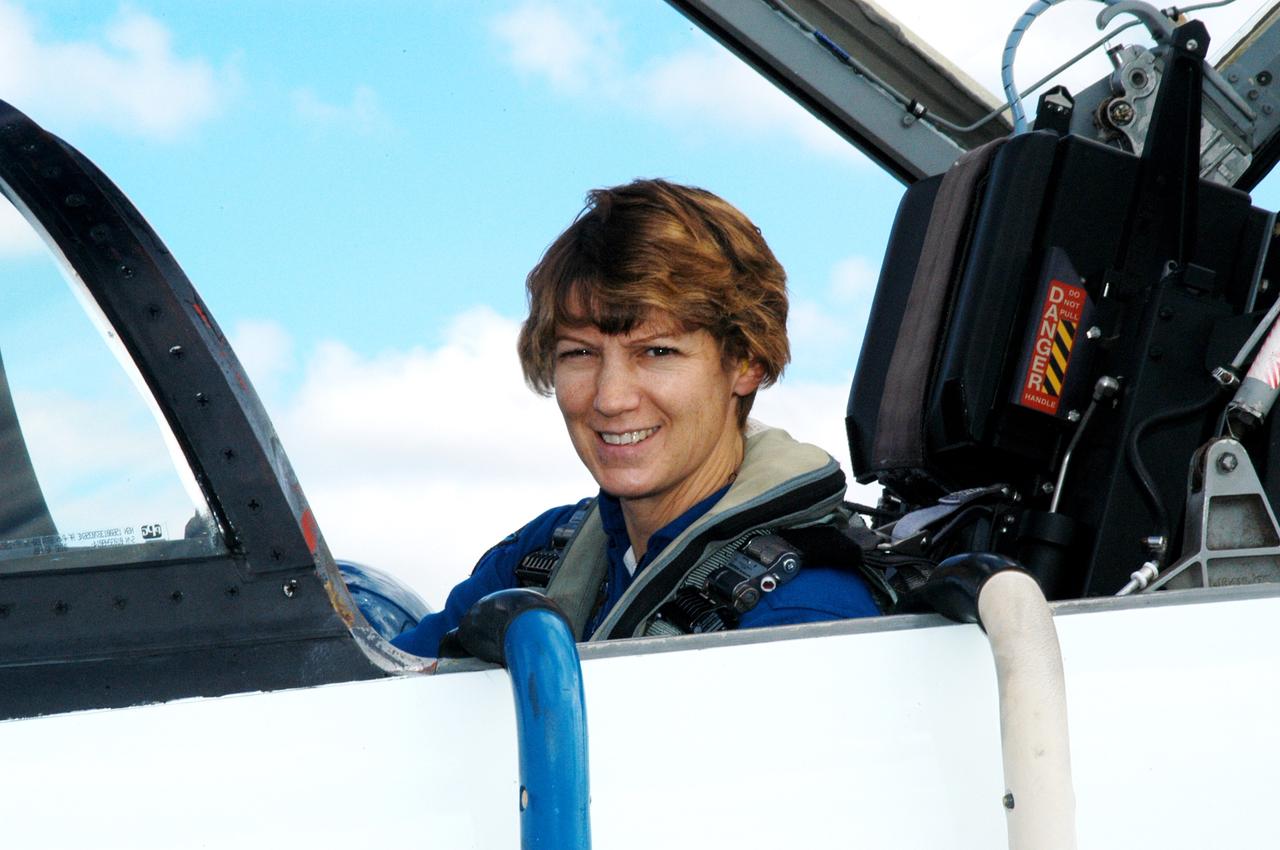
KENNEDY SPACE CENTER, FLA. - STS-114 Commander Eileen Collins arrives at the KSC Shuttle Landing Facility in a T-38 jet aircraft.  She and other crew members are at KSC to take part in crew equipment and orbiter familiarization.
KENNEDY SPACE CENTER, FLA. - STS-114 Commander Eileen Collins arrives at the KSC Shuttle Landing Facility in a T-38 jet aircraft. She and other crew members are at KSC to take part in crew equipment and orbiter familiarization.
KENNEDY SPACE CENTER, FLA. -  In the Space Station Processing Facility, STS-117 Mission Specialist James Reilly stands in front of the Japanese Experiment Module (JEM).  Reilly and STS-115 Mission Specialist Joseph Tanner are at KSC for equipment familiarization, a routine part of astronaut training and launch preparations.
KENNEDY SPACE CENTER, FLA. - In the Space Station Processing Facility, STS-117 Mission Specialist James Reilly stands in front of the Japanese Experiment Module (JEM). Reilly and STS-115 Mission Specialist Joseph Tanner are at KSC for equipment familiarization, a routine part of astronaut training and launch preparations.
KENNEDY SPACE CENTER, FLA. -  In the Space Station Processing Facility, STS-117 Mission Specialist James Reilly (center) works with the Japanese Experiment Module (JEM).  Reilly and STS-115 Mission Specialist Joseph Tanner are at KSC for equipment familiarization, a routine part of astronaut training and launch preparations.
KENNEDY SPACE CENTER, FLA. - In the Space Station Processing Facility, STS-117 Mission Specialist James Reilly (center) works with the Japanese Experiment Module (JEM). Reilly and STS-115 Mission Specialist Joseph Tanner are at KSC for equipment familiarization, a routine part of astronaut training and launch preparations.
KENNEDY SPACE CENTER, FLA. - In the Space Station Processing Facility, STS-114 Pilot James Kelly (left) and Commander Eileen Collins look at various equipment housed there.  The STS-114 crew is at KSC to take part in crew equipment and orbiter familiarization.
KENNEDY SPACE CENTER, FLA. - In the Space Station Processing Facility, STS-114 Pilot James Kelly (left) and Commander Eileen Collins look at various equipment housed there. The STS-114 crew is at KSC to take part in crew equipment and orbiter familiarization.
KENNEDY SPACE CENTER, FLA. -  In the Space Station Processing Facility, STS-117 Mission Specialist James Reilly works with the Japanese Experiment Module (JEM).  Reilly and STS-115 Mission Specialist Joseph Tanner are at KSC for equipment familiarization, a routine part of astronaut training and launch preparations.
KENNEDY SPACE CENTER, FLA. - In the Space Station Processing Facility, STS-117 Mission Specialist James Reilly works with the Japanese Experiment Module (JEM). Reilly and STS-115 Mission Specialist Joseph Tanner are at KSC for equipment familiarization, a routine part of astronaut training and launch preparations.
KENNEDY SPACE CENTER, FLA. -  In the Orbiter Processing Facility, STS-114 Mission Specialist Andy Thomas takes a close look at the some of the tiles underneath Atlantis.  Thomas is a new addition to the mission crew.  The STS-114 crew is at KSC to take part in crew equipment and orbiter familiarization.
KENNEDY SPACE CENTER, FLA. - In the Orbiter Processing Facility, STS-114 Mission Specialist Andy Thomas takes a close look at the some of the tiles underneath Atlantis. Thomas is a new addition to the mission crew. The STS-114 crew is at KSC to take part in crew equipment and orbiter familiarization.
KENNEDY SPACE CENTER, FLA. -  In the Space Station Processing Facility, STS-117 Mission Specialist James Reilly works with the Japanese Experiment Module (JEM).  Reilly and STS-115 Mission Specialist Joseph Tanner are at KSC for equipment familiarization, a routine part of astronaut training and launch preparations.
KENNEDY SPACE CENTER, FLA. - In the Space Station Processing Facility, STS-117 Mission Specialist James Reilly works with the Japanese Experiment Module (JEM). Reilly and STS-115 Mission Specialist Joseph Tanner are at KSC for equipment familiarization, a routine part of astronaut training and launch preparations.
KENNEDY SPACE CENTER, FLA. - STS-114 Mission Commander Eileen Collins looks over flight equipment in the Orbiter Processing Facility, along with Glenda Laws, EVA Task Leader, with United Space Alliance at Johnson Space Center. The STS-114 crew is at KSC to take part in crew equipment and orbiter familiarization.
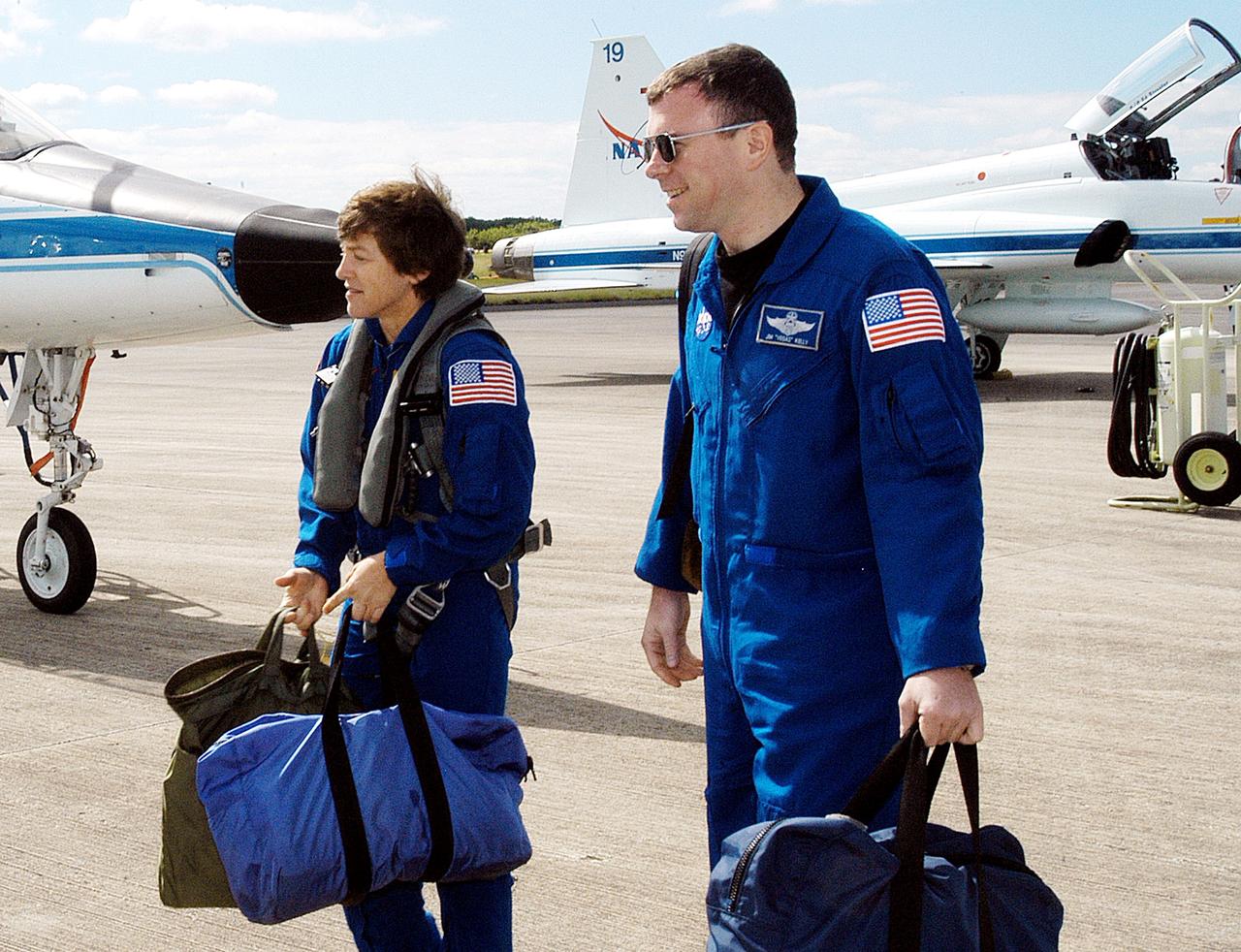
KENNEDY SPACE CENTER, FLA. - Walking away from the T-38 jet aircraft that brought them to KSC are STS-114 Mission Specialist Wendy Lawrence and Pilot James Kelly.  Lawrence is a new addition to the crew.  They and other crew members are at KSC to take part in crew equipment and orbiter familiarization.
KENNEDY SPACE CENTER, FLA. - Walking away from the T-38 jet aircraft that brought them to KSC are STS-114 Mission Specialist Wendy Lawrence and Pilot James Kelly. Lawrence is a new addition to the crew. They and other crew members are at KSC to take part in crew equipment and orbiter familiarization.