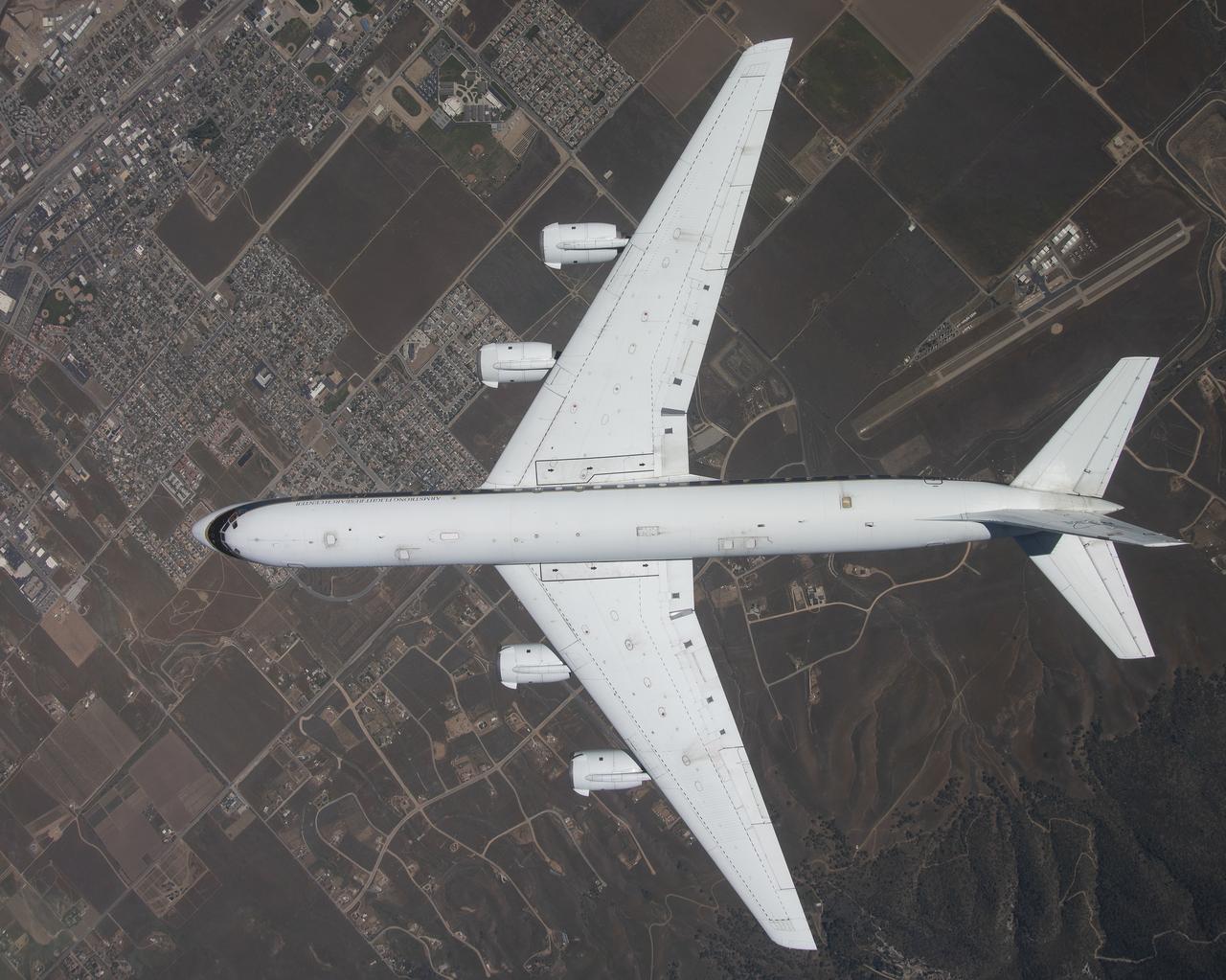
The DC-8 is shown overhead during its final flight from NASA’s Armstrong Flight Research Center Building 703 in Palmdale, California, before it retires to Idaho State University in Pocatello, Idaho. The DC-8 will provide real-world experience to train future aircraft technicians at the college’s Aircraft Maintenance Technology Program.
NASA’s DC-8 Conducts Final Flight
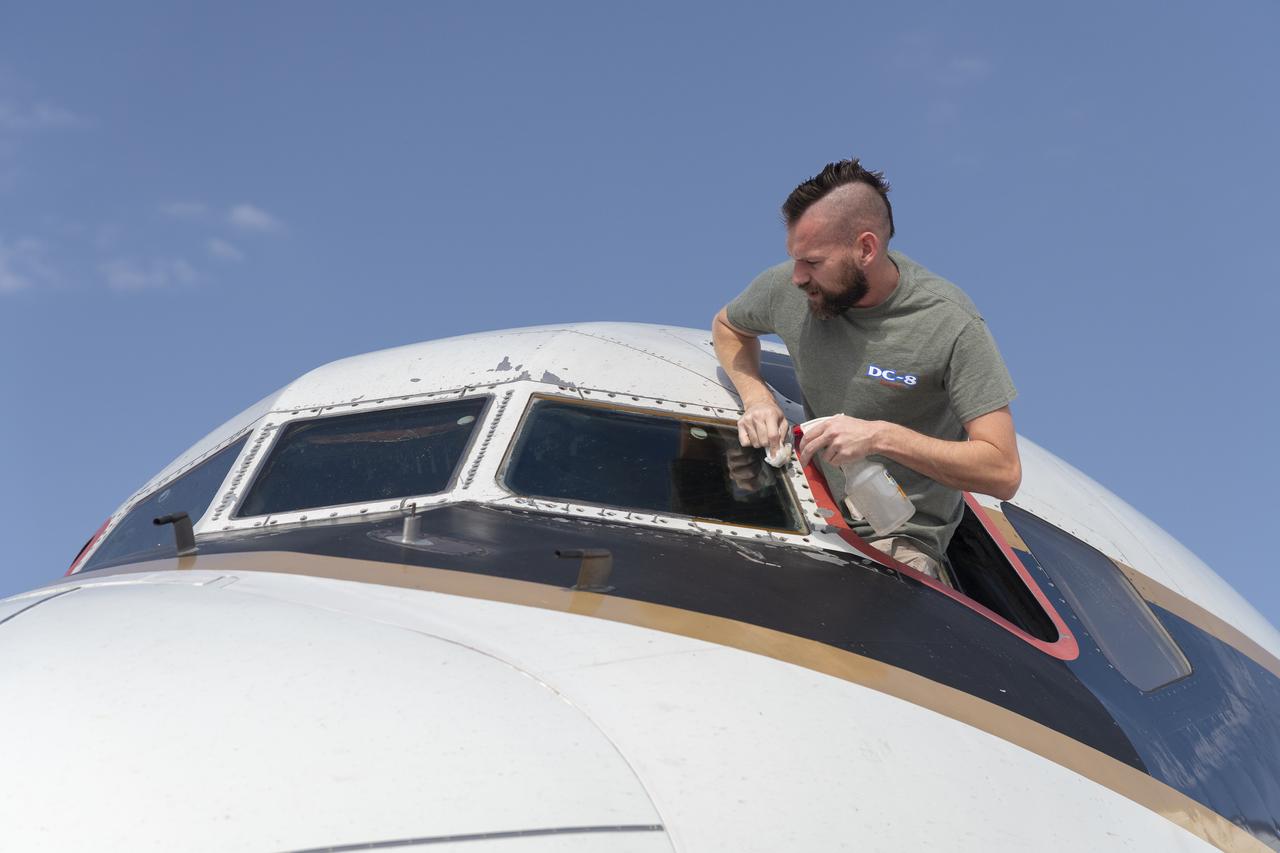
Avionics lead Kelly Jellison wipes the windshield of the DC-8 aircraft prior to its final flight before it is retired from NASA’s Armstrong Flight Research Center Building 703 in Palmdale, California, to Idaho State University in Pocatello, Idaho. The DC-8 will provide real-world experience to train future aircraft technicians at the college’s Aircraft Maintenance Technology Program.
NASA’s DC-8 Aircraft Prepares for Final Flight
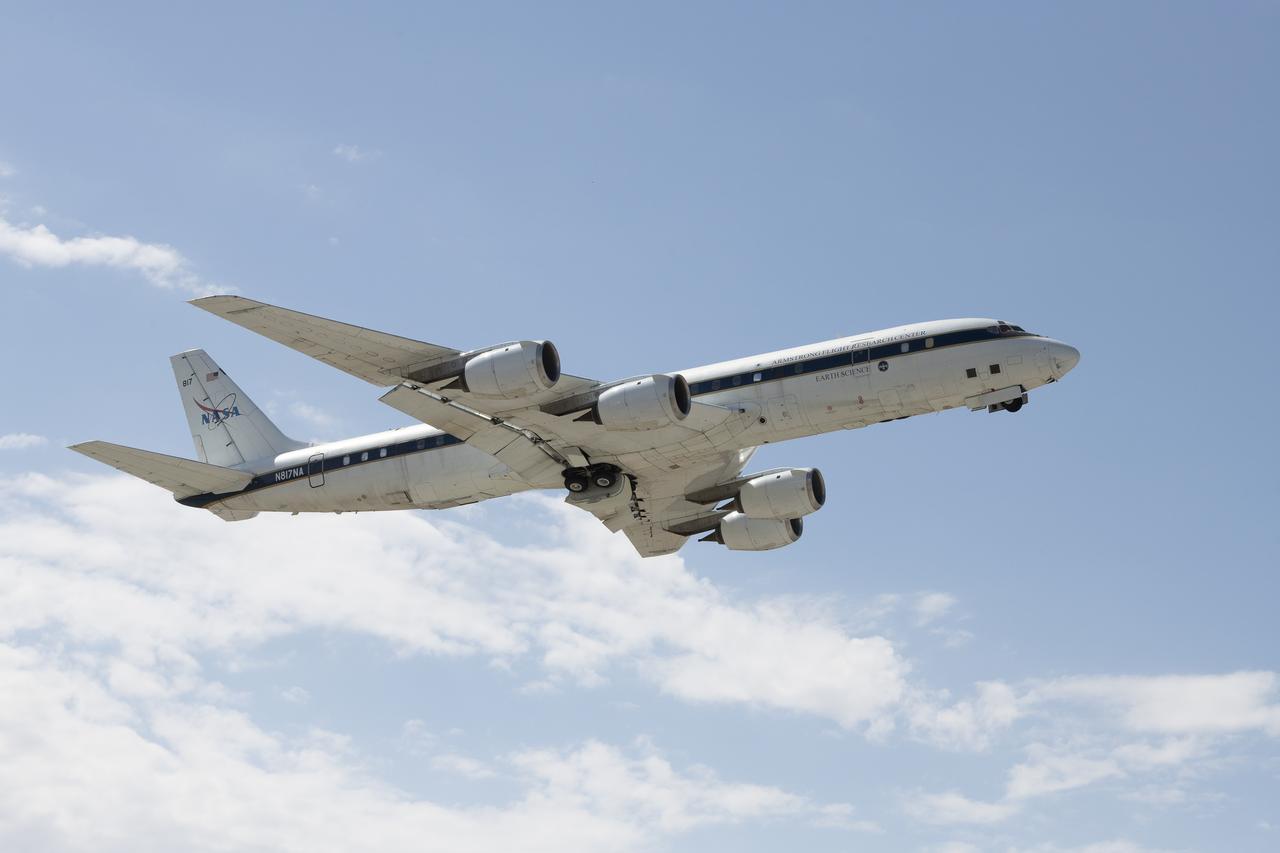
The DC-8 ascents during its final flight before it is retired from NASA’s Armstrong Flight Research Center Building 703 in Palmdale, California, to Idaho State University in Pocatello, Idaho. The DC-8 will provide real-world experience to train future aircraft technicians at the college’s Aircraft Maintenance Technology Program.
NASA’s DC-8 Flies Under Clear Skies During Final Flight
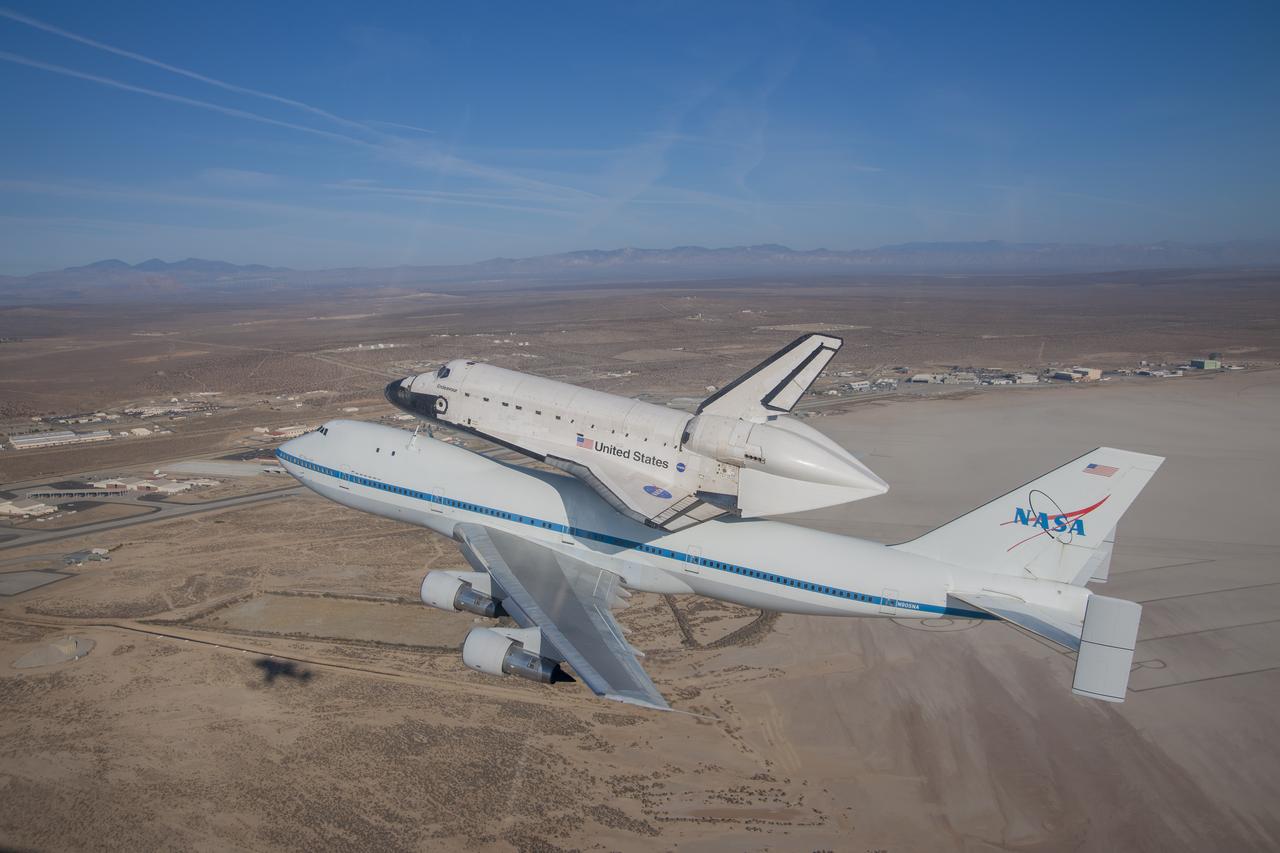
Space shuttle Endeavour and its host NASA 747 Shuttle Carrier Aircraft make a final flight over Edwards Air Force Base on Sept. 21, 2012. NASA’s Armstrong Flight Research Center in Edwards, California, is visible on the upper right of the frame.
Space Shuttle Endeavour Toured California in 2012
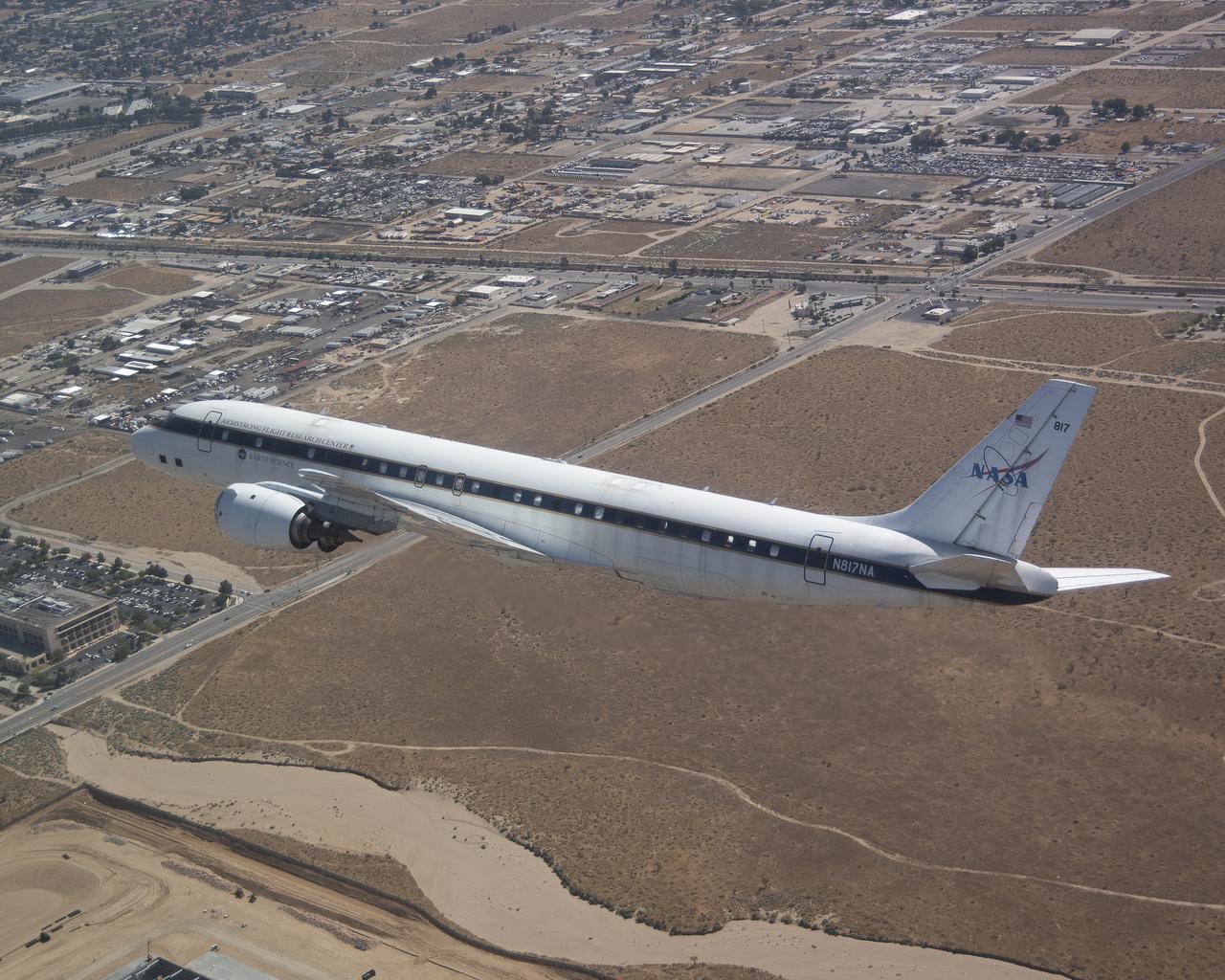
The DC-8 flies low over the Antelope Valley during its final flight before it is retired from NASA’s Armstrong Flight Research Center Building 703 in Palmdale, California, to Idaho State University in Pocatello, Idaho. The DC-8 will provide real-world experience to train future aircraft technicians at the college’s Aircraft Maintenance Technology Program.
NASA’s DC-8 Conducts Final Flight Over Antelope Valley
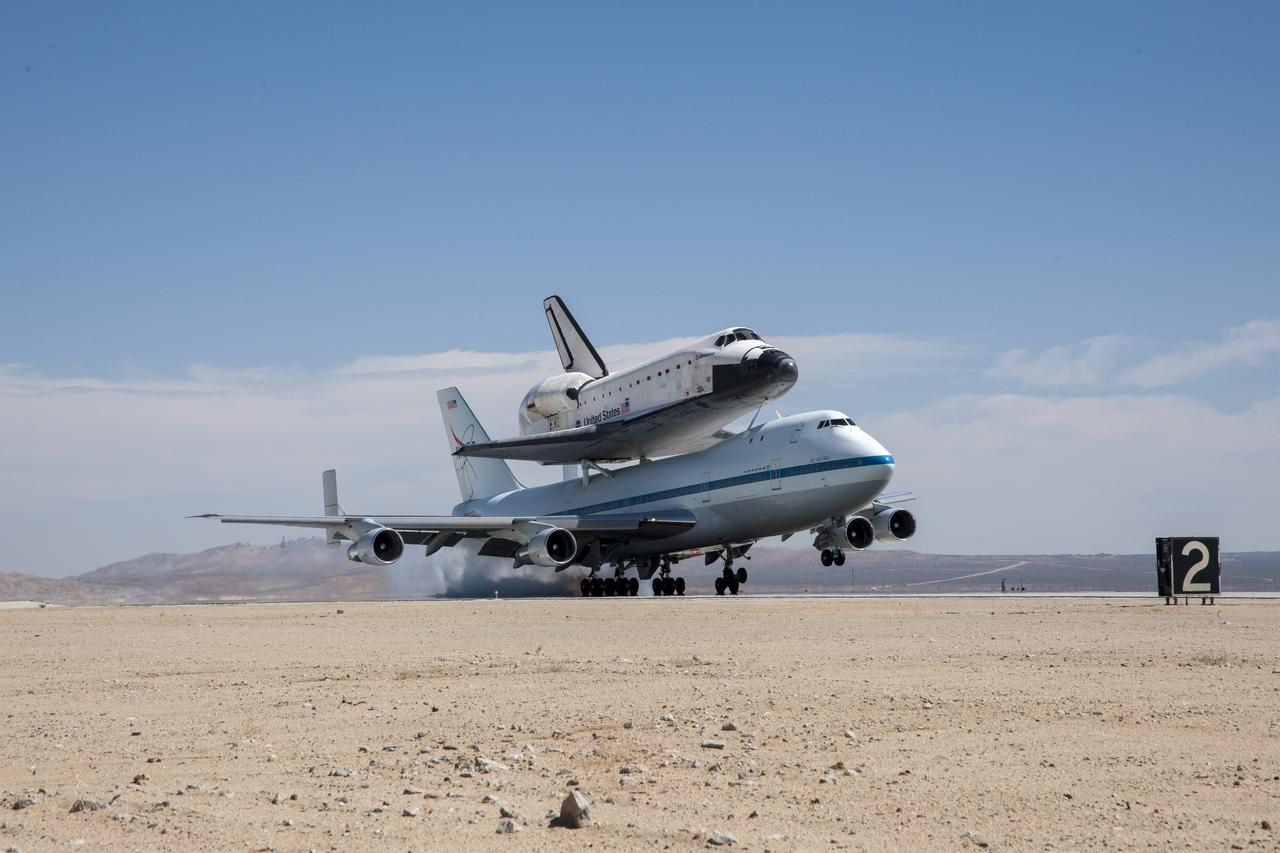
Space shuttle Endeavour and its host NASA 747 Shuttle Carrier Aircraft land at Edwards Air Force Base in California. It completed its third leg of a four-segment final ferry flight from NASA’s Kennedy Space Center in Florida to Los Angeles International Airport on Sept. 20, 2012. The landing was preceded by NASA’s Armstrong (then Dryden) Flight Research Center pilot Bill Brockett’s low-level flyby of the center and the Edwards flight line.
Space Shuttle Endeavour Toured California in 2012
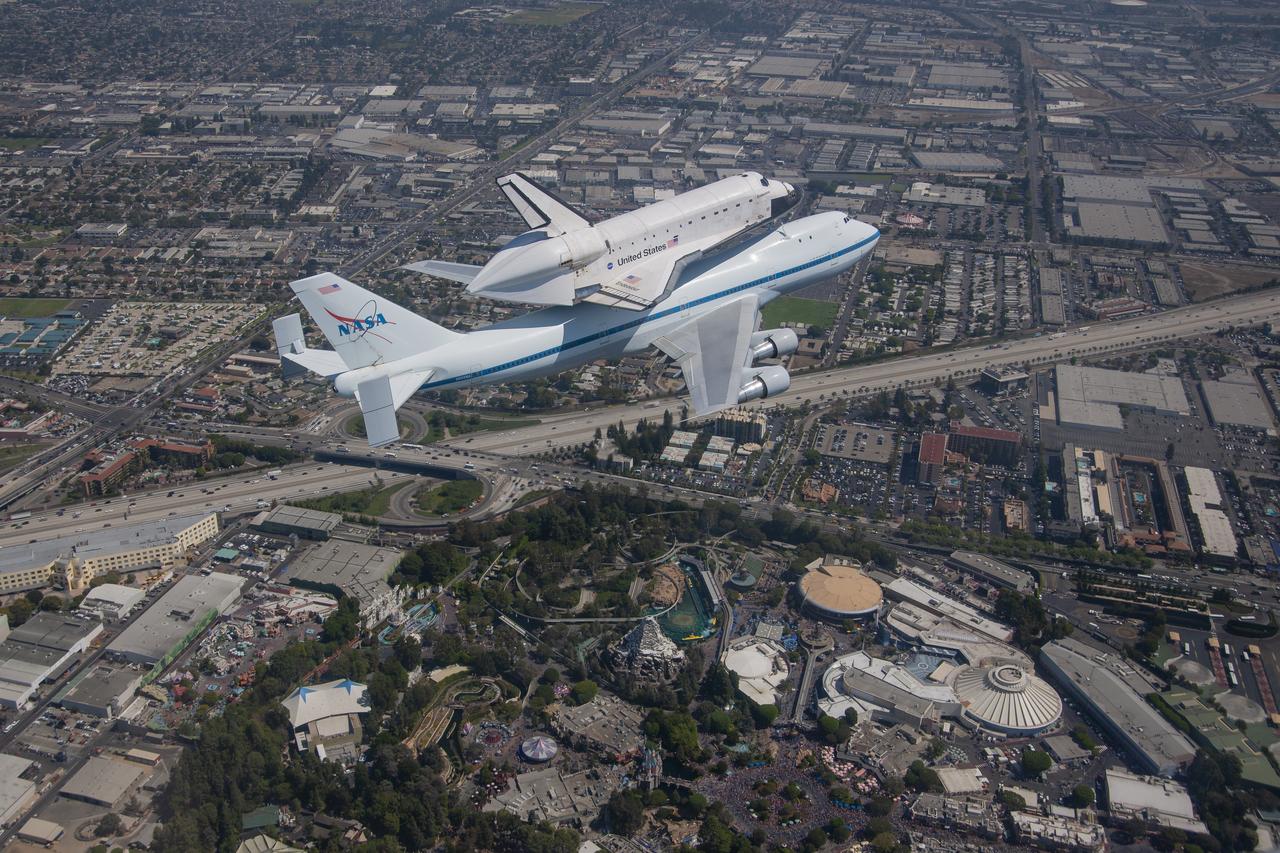
Space shuttle Endeavour and its host NASA 747 Shuttle Carrier Aircraft fly over Disneyland in 2012 on its way to the Los Angeles International Airport, and an overland journey to the California Science Center. Californians gazed at the morning sky Sept. 21 looking to see Endeavour over their community. The final leg of Endeavour’s flight from NASA’s Kennedy Space Center, Florida, offered many people an opportunity to witness the historic flight.
Space Shuttle Endeavour Toured California in 2012
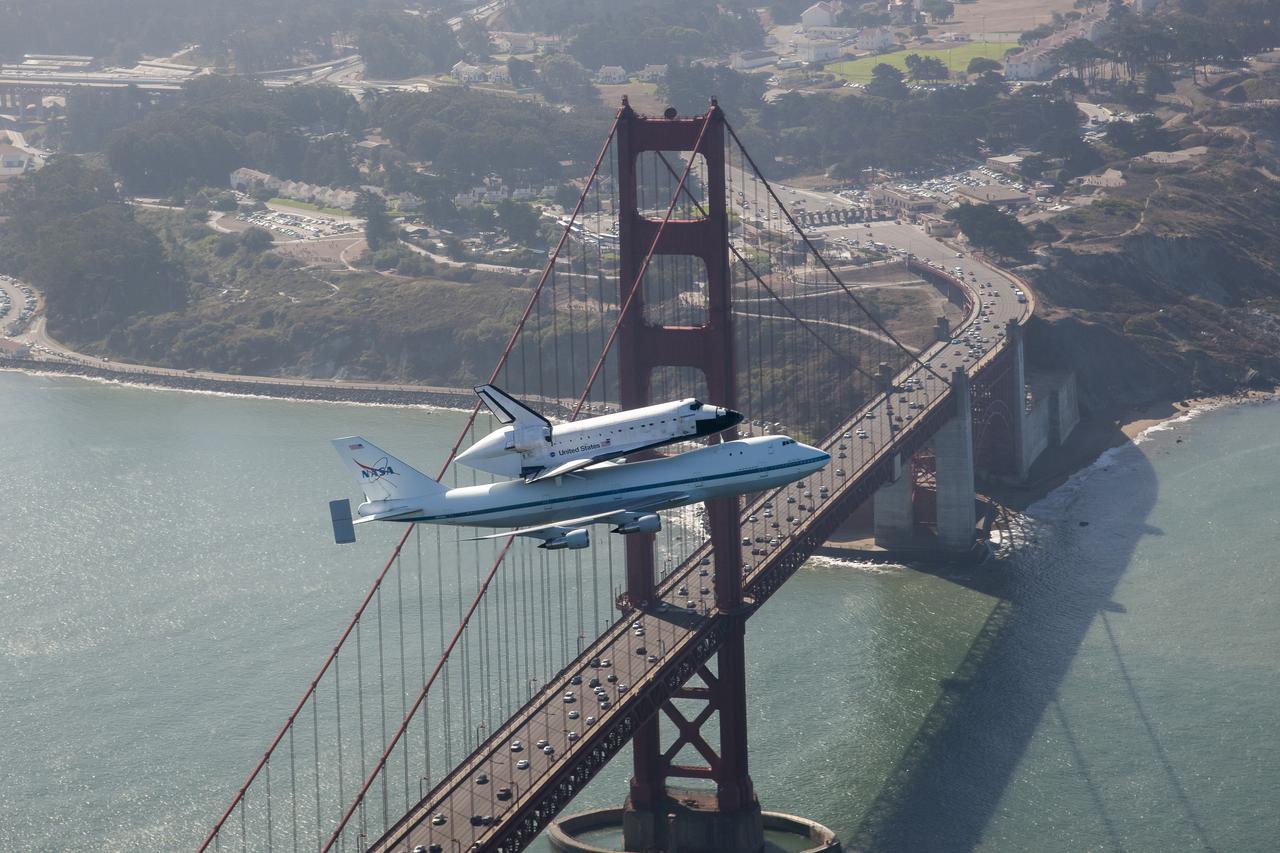
Space shuttle Endeavour and its host NASA 747 Shuttle Carrier Aircraft fly by the Golden Gate Bridge in 2012 on its way to the Los Angeles International Airport and an overland journey to the California Science Center. Californians looked up at the morning sky Sept. 21 to catch a glimpse of Endeavour. The final leg of Endeavour’s flight from NASA’s Kennedy Space Center, Florida, offered many people an opportunity to witness the historic flight. Space shuttle Endeavour and its host NASA 747 Shuttle Carrier Aircraft fly by the Golden Gate Bridge in 2012 on its way to the Los Angeles International Airport and an overland journey to the California Science Center. Californians looked up at the morning sky Sept. 21 to catch a glimpse of Endeavour. The final leg of Endeavour’s flight from NASA’s Kennedy Space Center, Florida, offered many people an opportunity to witness the historic flight.
Space Shuttle Endeavour Toured California in 2012
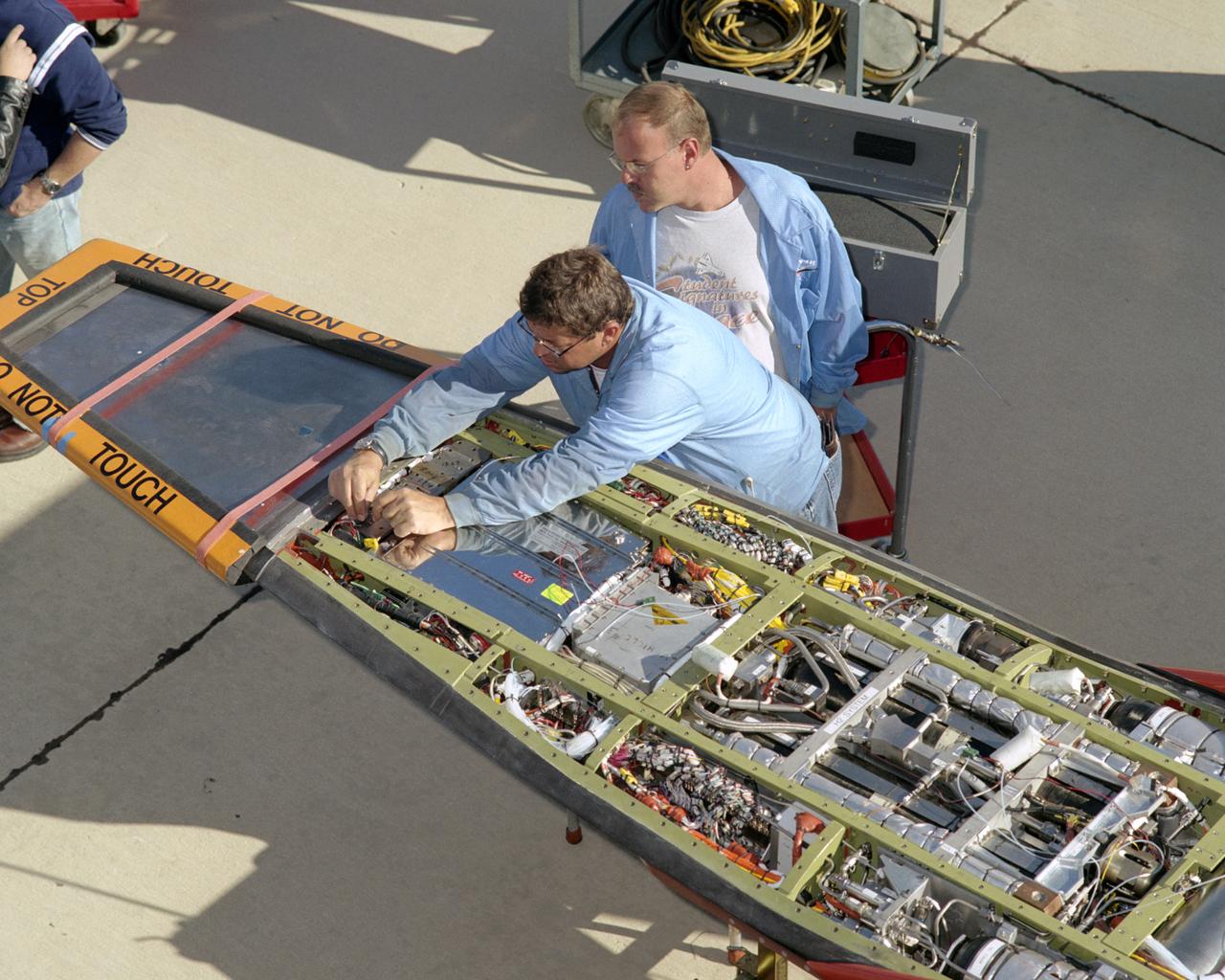
NASA avionics technicians Randy Wagner and Terry Bishop make final adjustments on the scramjet-powered X-43A before its record Mach 9.6 flight.
NASA avionics technicians Randy Wagner and Terry Bishop make final adjustments on the scramjet-powered X-43A before its record Mach 9.6 flight
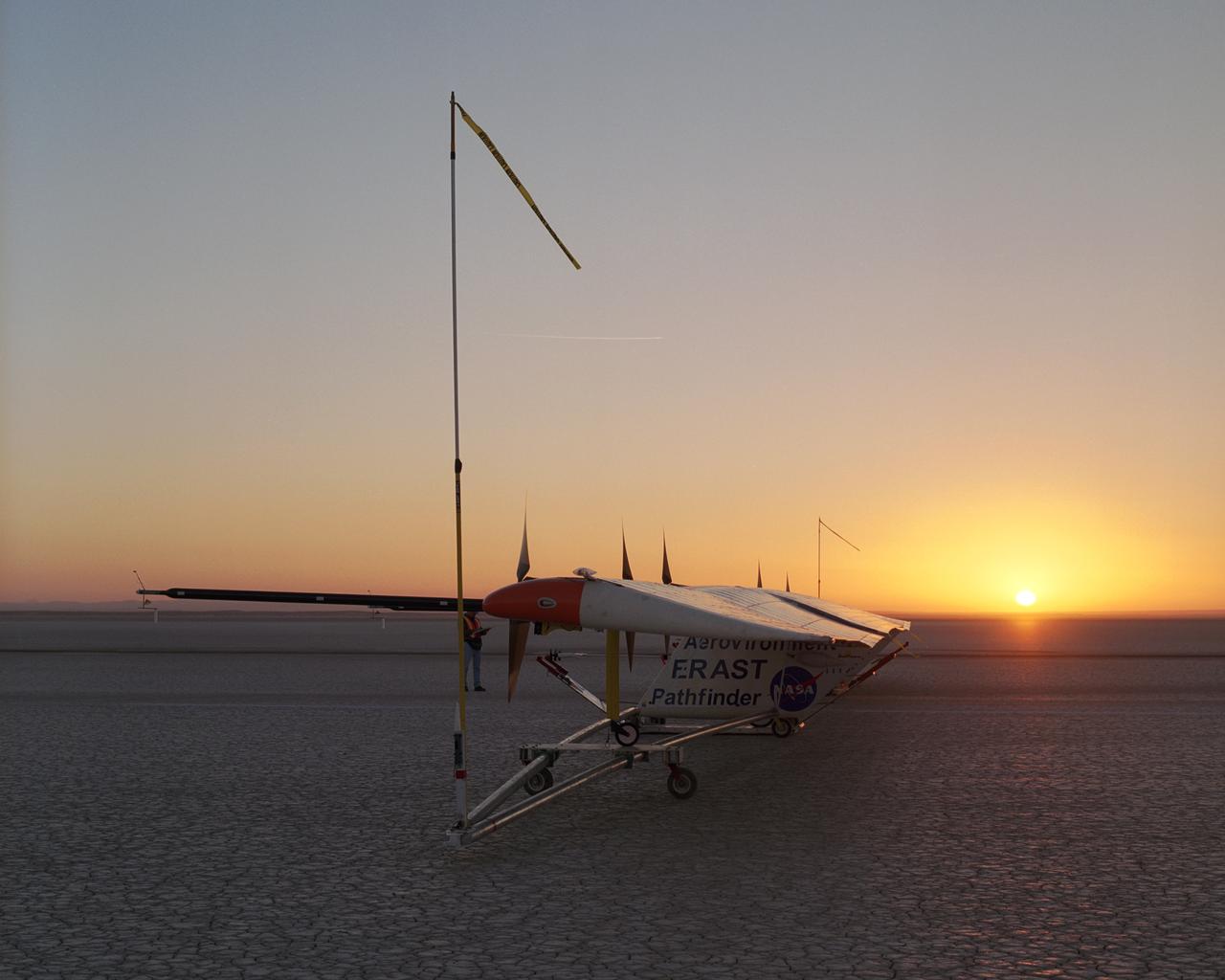
As the rising sun dawns over the parched bed of Rogers Dry Lake, AeroVironment's solar-electric Pathfinder-Plus awaits takeoff on its final research flight.
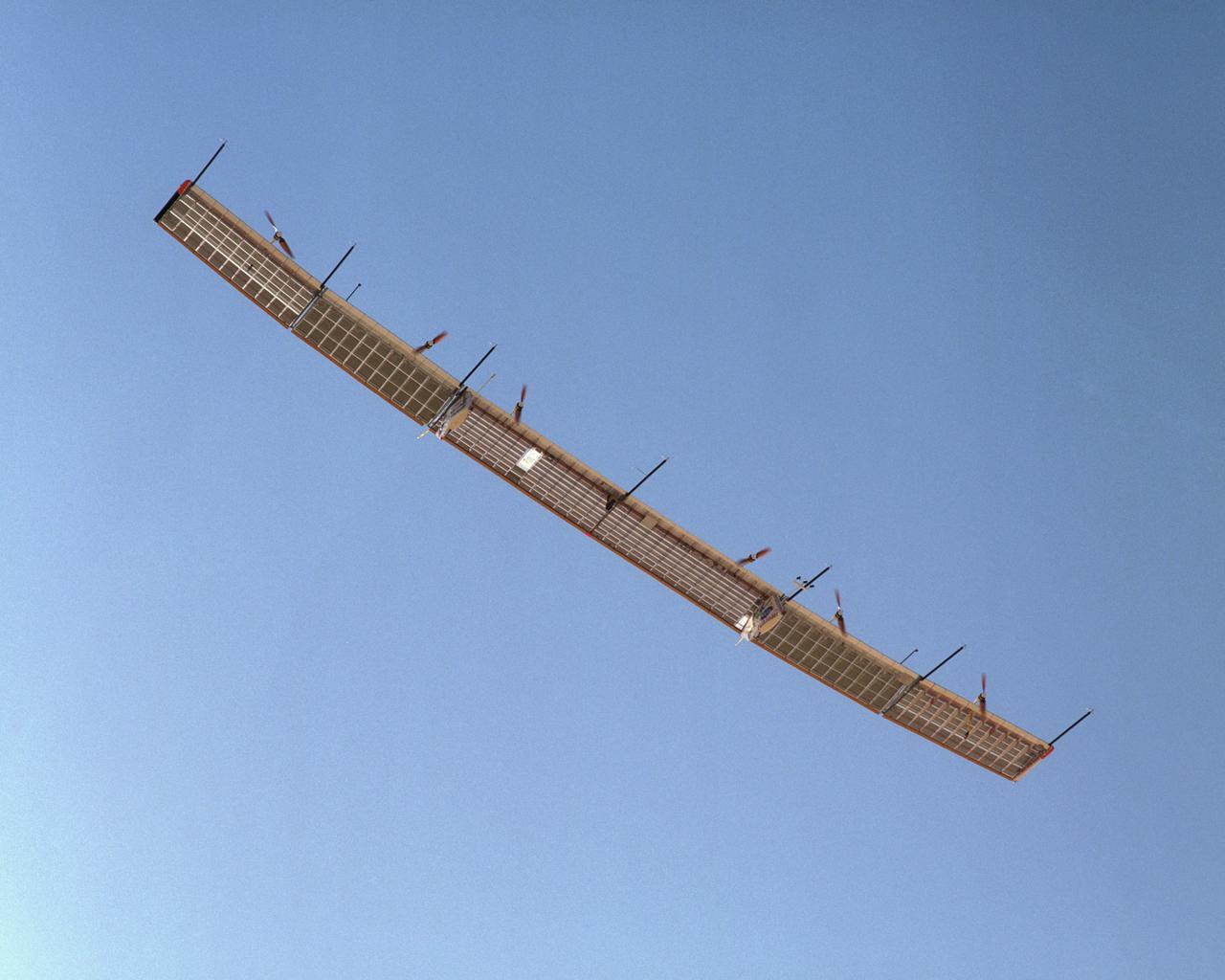
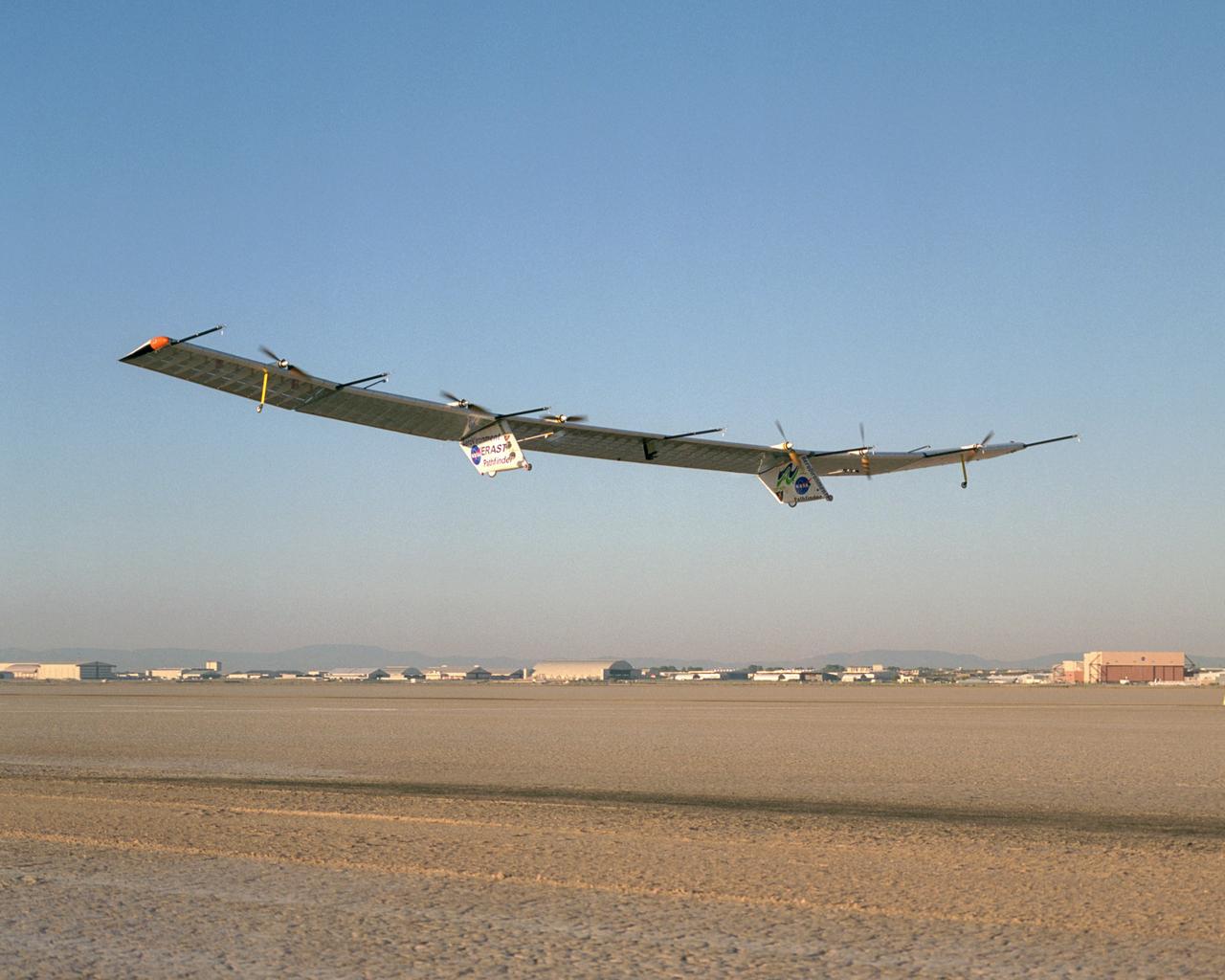
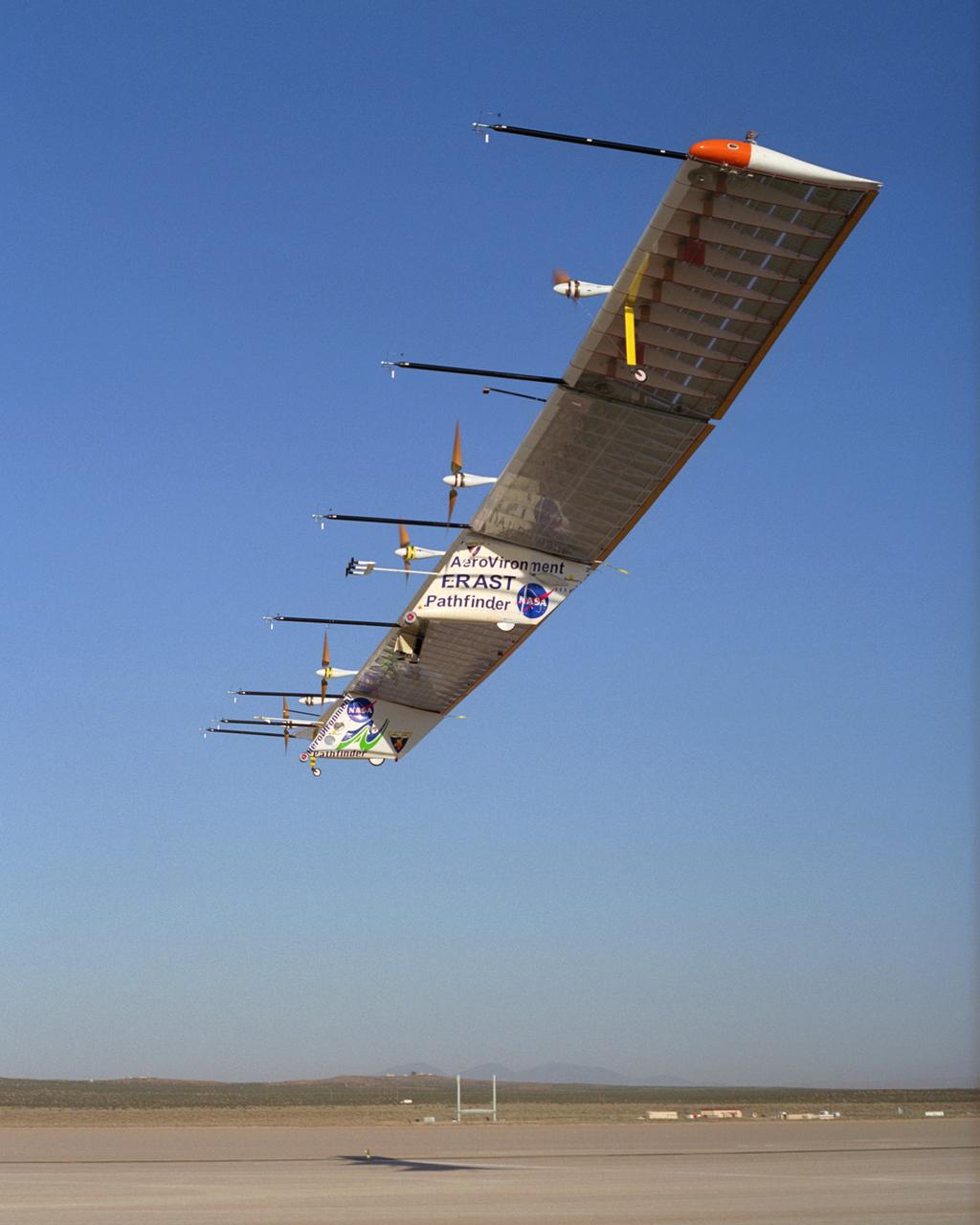
With its sensor booms projecting ahead of the wing, the Pathfinder-Plus solar wing soars under a blue sky on its final turbulence measurement research flight.
With sensor booms projecting ahead of the wing, the Pathfinder-Plus soars under a blue sky on its final turbulence measurement research flight.
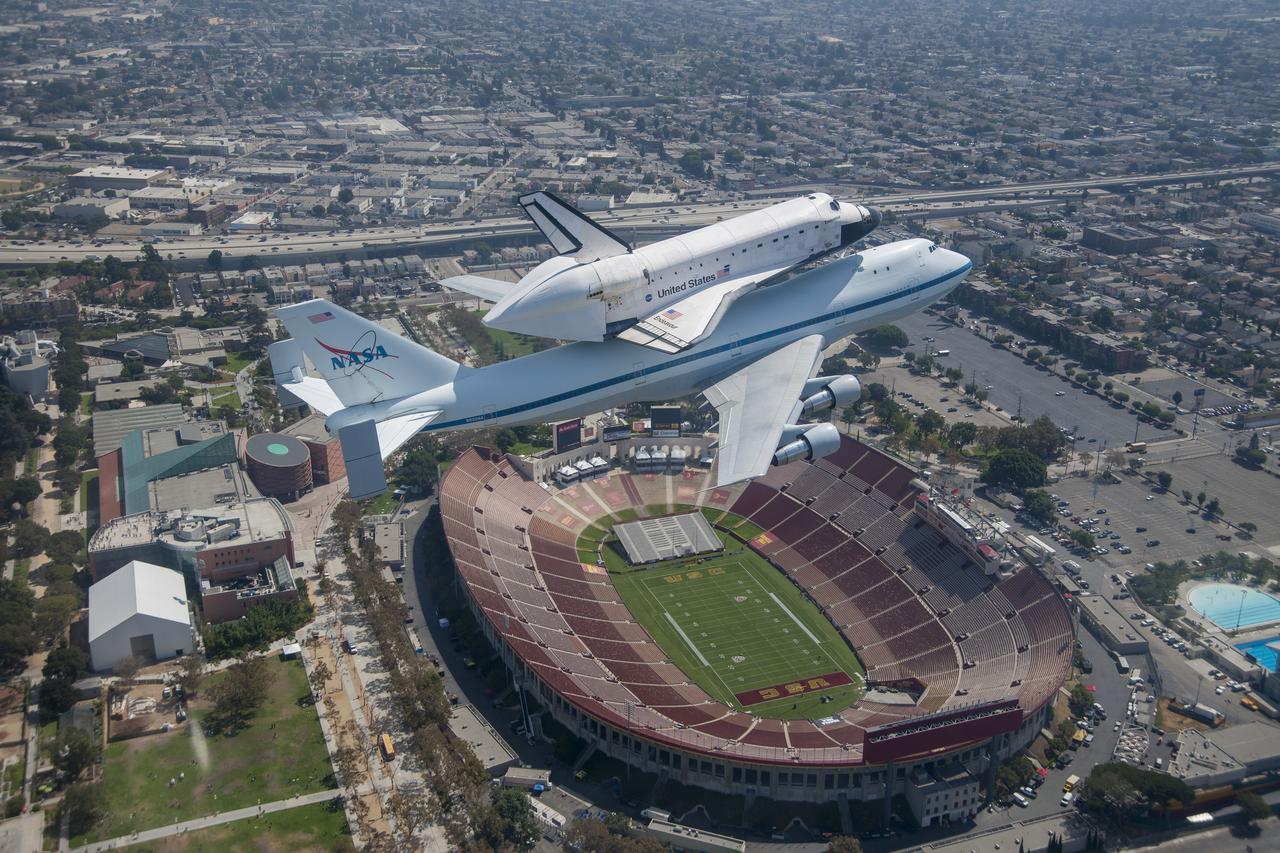
Space shuttle Endeavour and its host NASA 747 Shuttle Carrier Aircraft fly over the Los Angeles Coliseum in 2012 on its way to the Los Angeles International Airport, and an overland journey to the California Science Center. Californians looked up at the morning sky Sept. 21 looking for Endeavour over their community. The final leg of Endeavour’s flight from NASA’s Kennedy Space Center, Florida, offered many people an opportunity to witness the historic flight.
Space Shuttle Endeavour Toured California in 2012
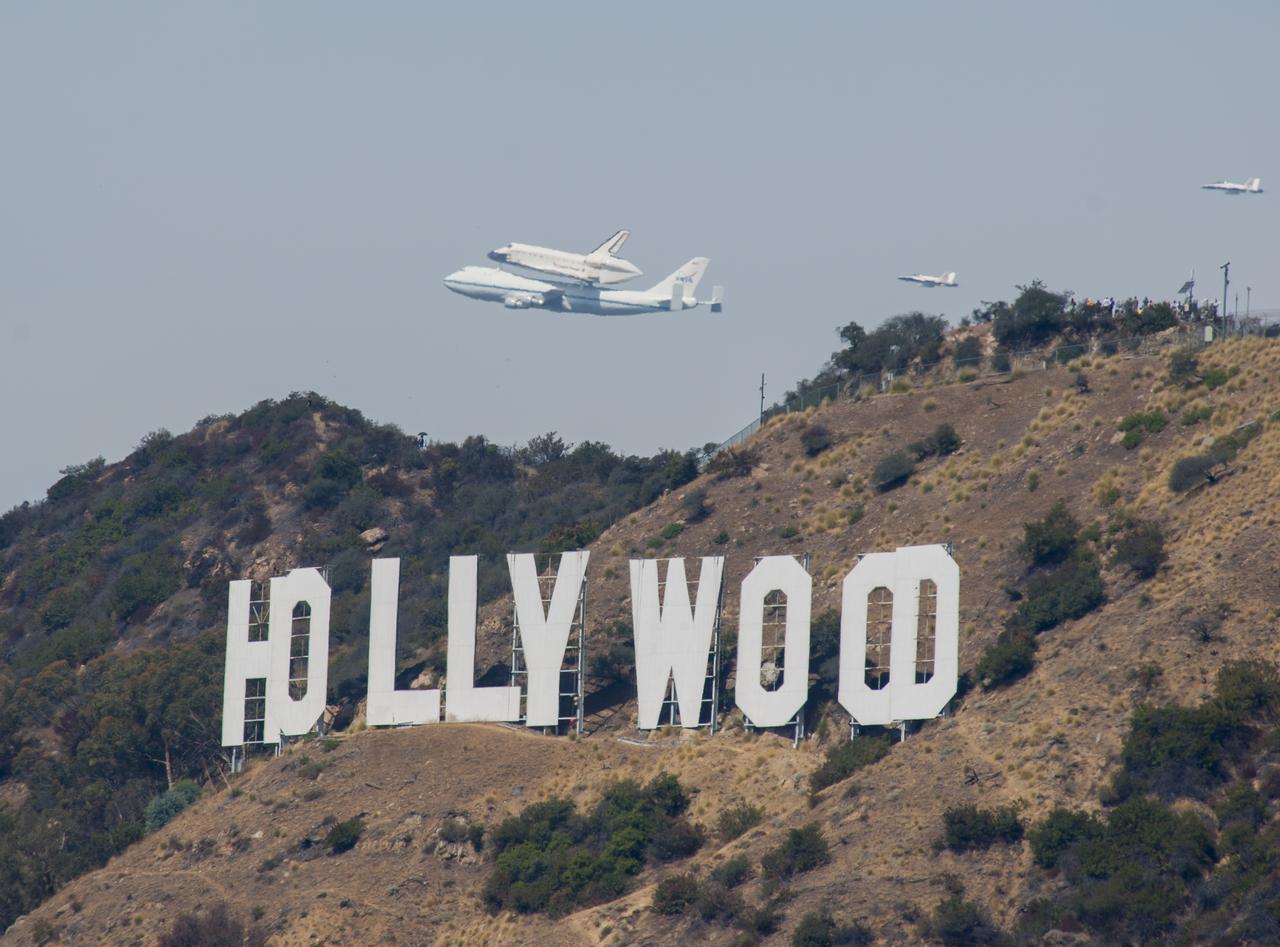
Space shuttle Endeavour and its host NASA 747 Shuttle Carrier Aircraft fly over the Hollywood sign in 2012 on its way to the Los Angeles International Airport, and an overland journey to the California Science Center. Californians looked up at the morning sky Sept. 21 looking to see Endeavour fly over their community. The final leg of Endeavour’s flight from NASA’s Kennedy Space Center, Florida, offered many people an opportunity to witness the historic flight.
Space Shuttle Endeavour Toured California in 2012
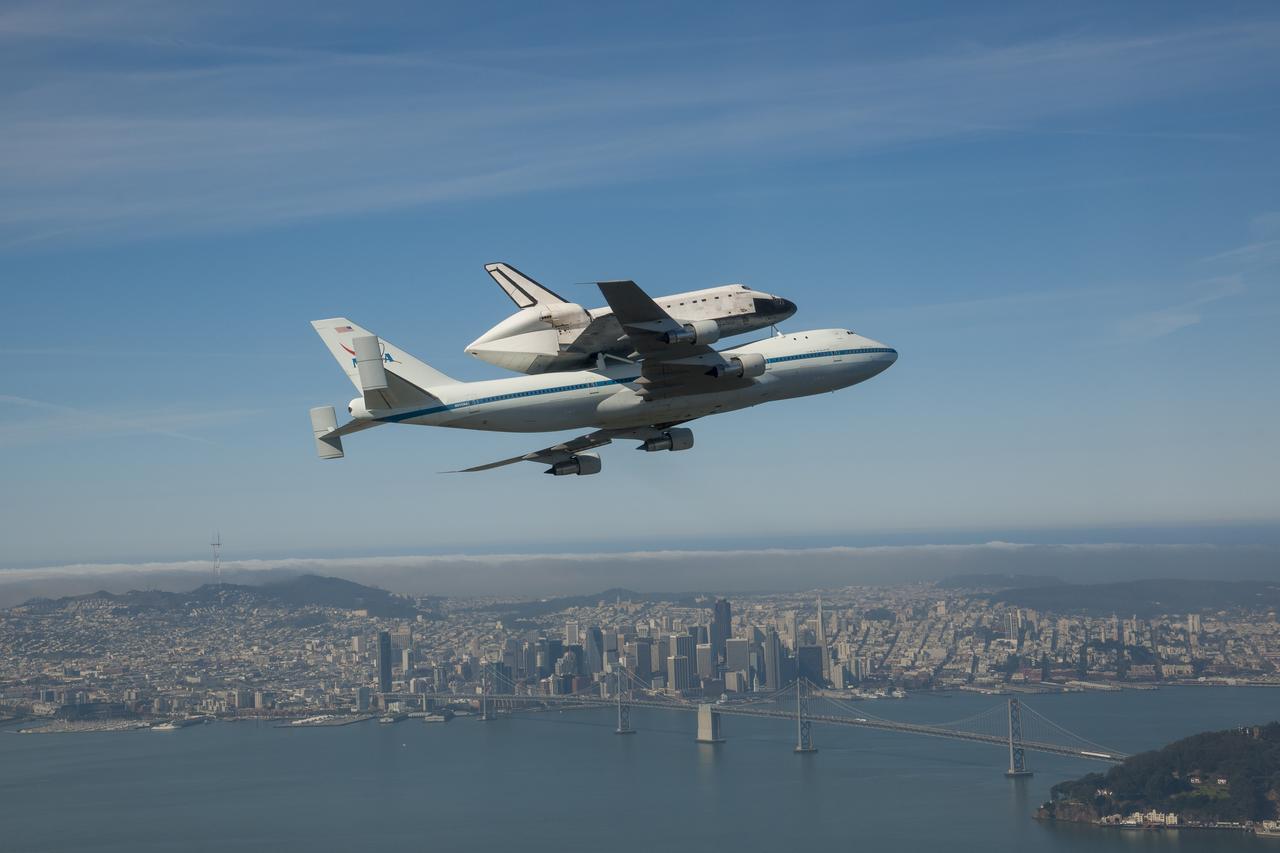
Space shuttle Endeavour and its host NASA 747 Shuttle Carrier Aircraft fly by the Bay Bridge in 2012 on its way to the Los Angeles International Airport and an overland journey to the California Science Center. The final leg of Endeavour’s flight from NASA’s Kennedy Space Center, Florida, offered many people an opportunity to witness the historic flight.
Space Shuttle Endeavour Toured California in 2012
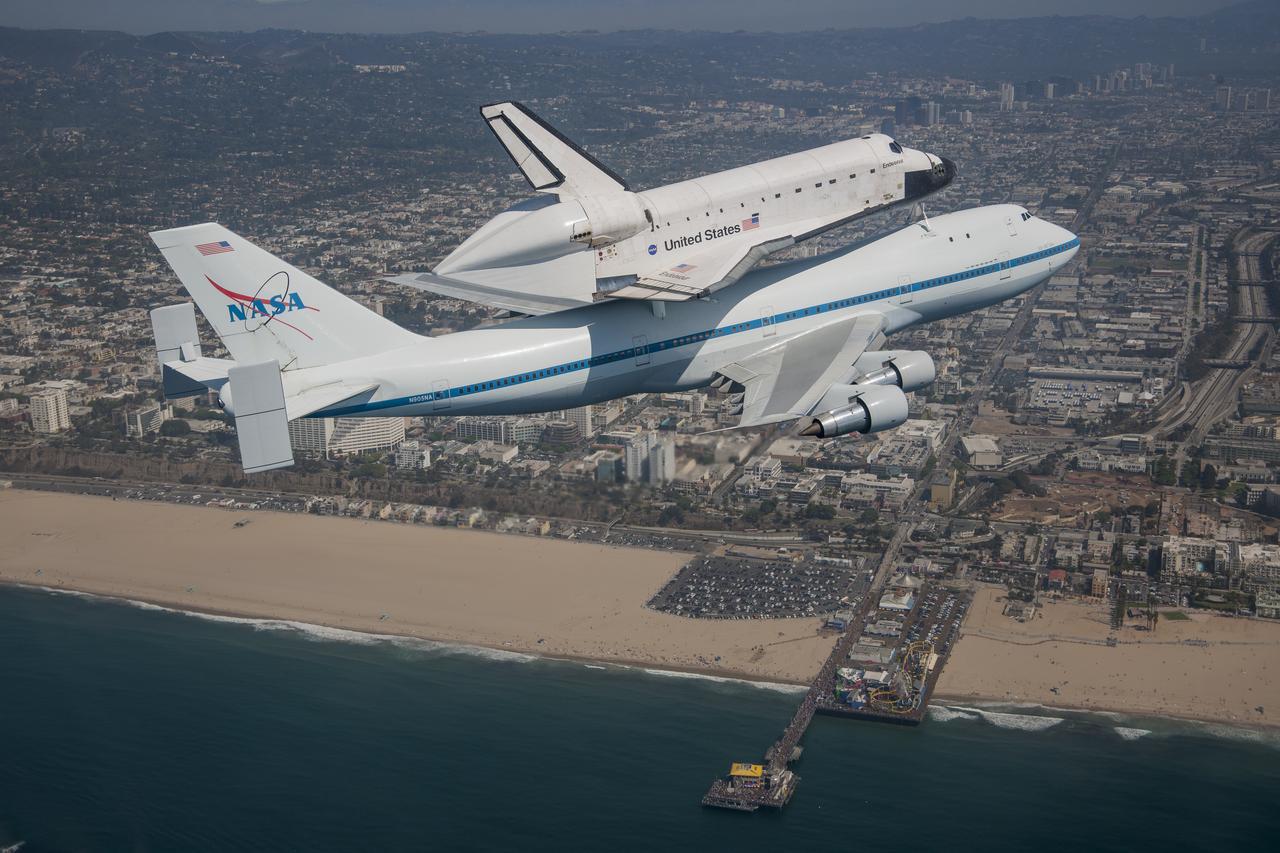
Space shuttle Endeavour and its host NASA 747 Shuttle Carrier Aircraft fly over the Santa Monica Pier in 2012 on its way to the Los Angeles International Airport, and an overland journey to the California Science Center. Californians gazed at the morning sky Sept. 21 looking for Endeavour over their community. The final leg of Endeavour’s flight from NASA’s Kennedy Space Center, Florida, offered many people an opportunity to witness the historic flight.
Space Shuttle Endeavour Toured California in 2012
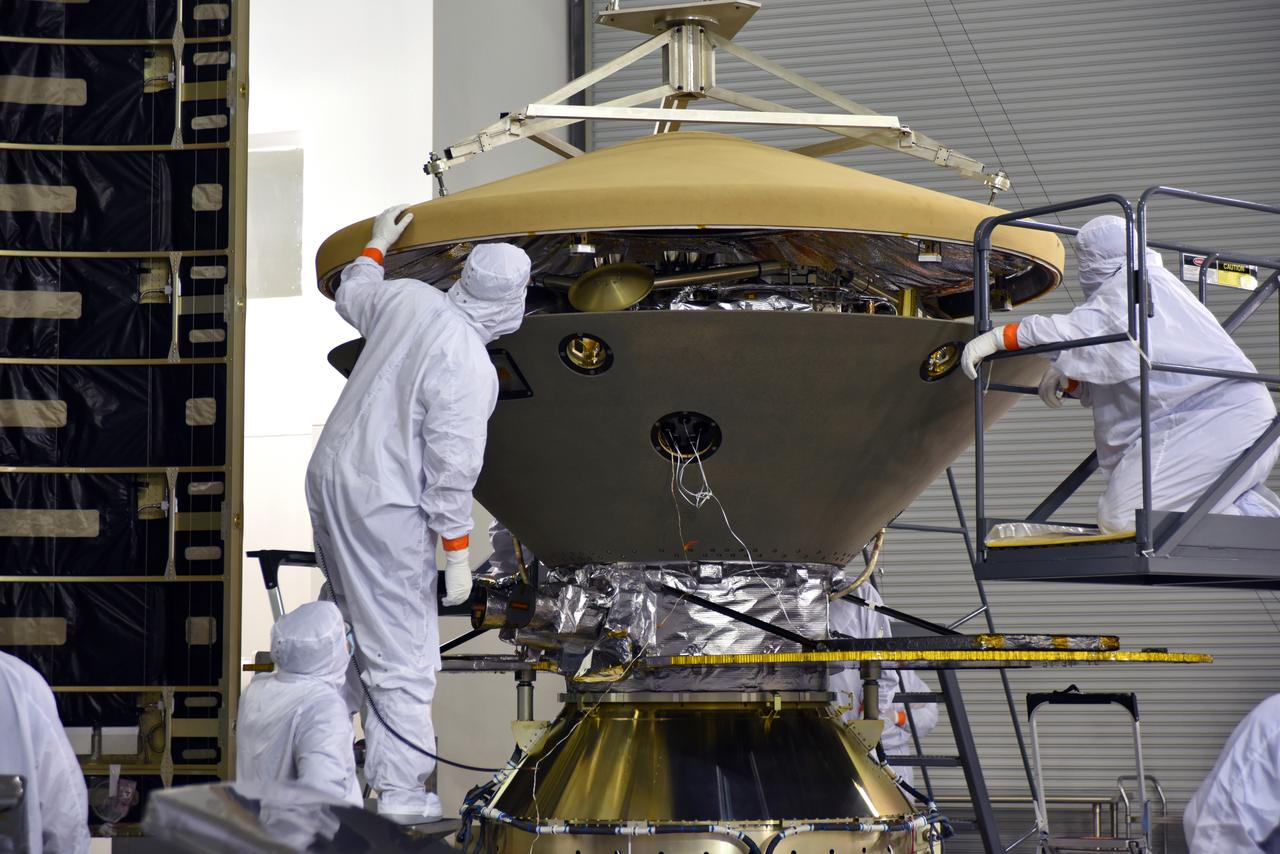
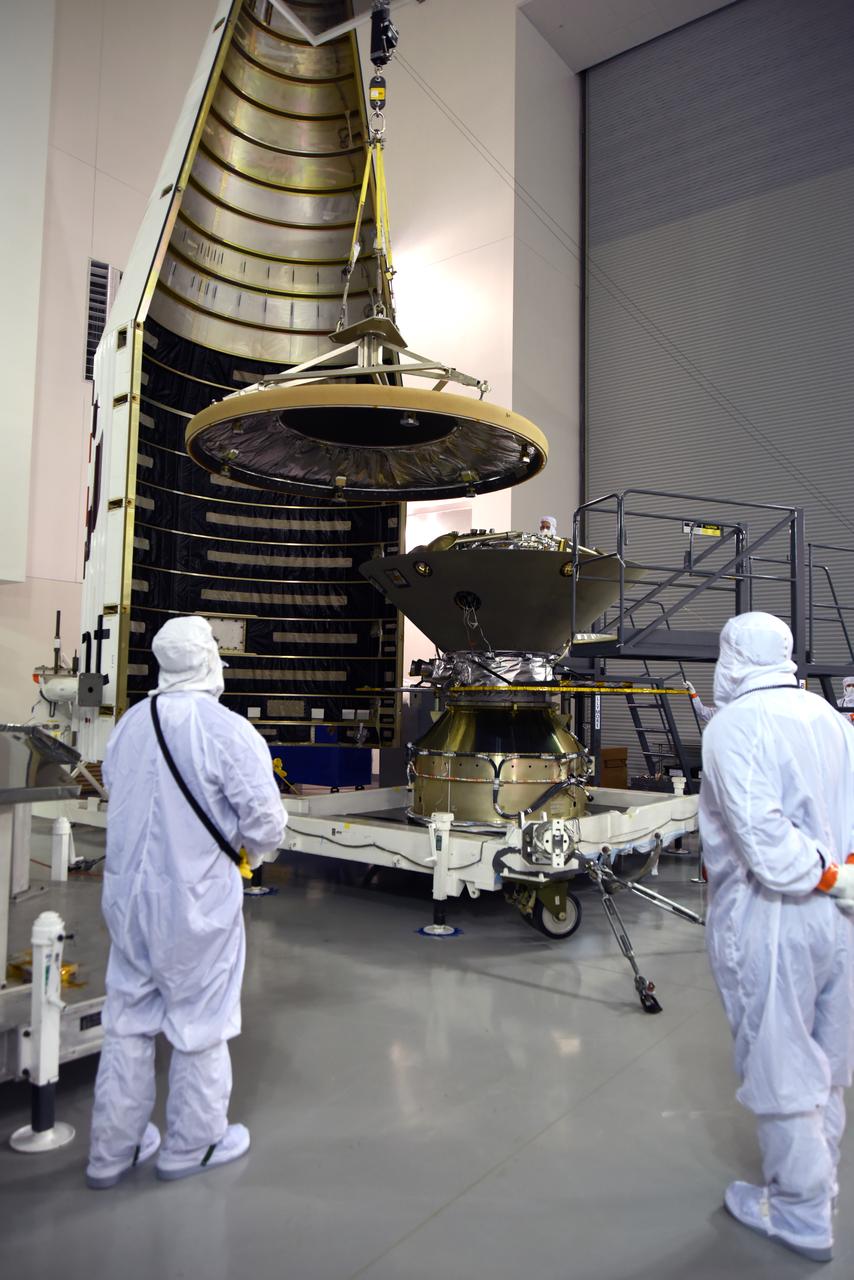
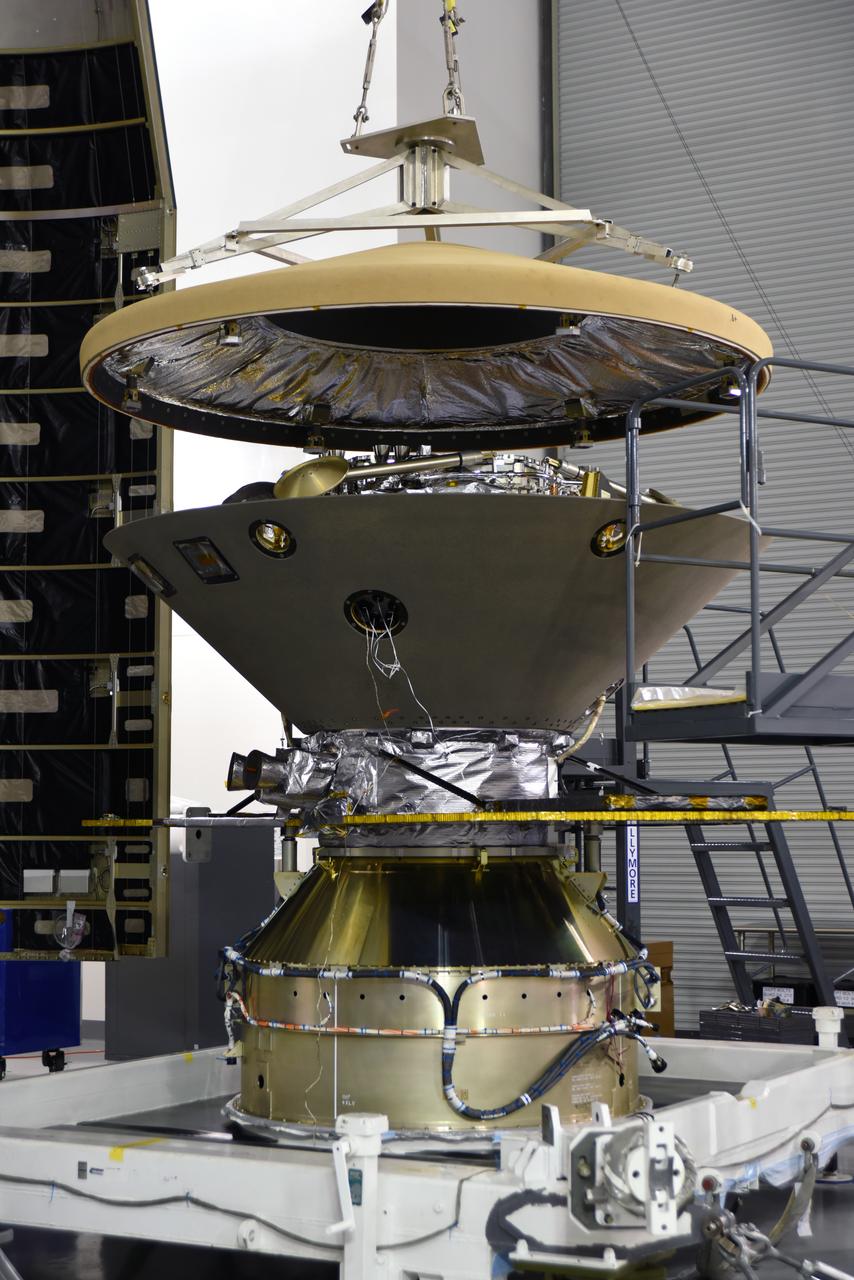
In the Astrotech facility at Vandenberg Air Force Base in California, the heatshield is placed on NASA's Interior Exploration using Seismic Investigations, Geodesy and Heat Transport, or InSight, Mars lander prior to encapsulation in its payload fairing. InSight will be the first mission to look deep beneath the Martian surface. It will study the planet's interior by measuring its heat output and listen for marsquakes. The spacecraft will use the seismic waves generated by marsquakes to develop a map of the planet’s deep interior. The resulting insight into Mars’ formation will provide a better understanding of how other rocky planets, including Earth, were created. InSight is scheduled for liftoff May 5, 2018.
InSight Final Flight Installation of Heatshield
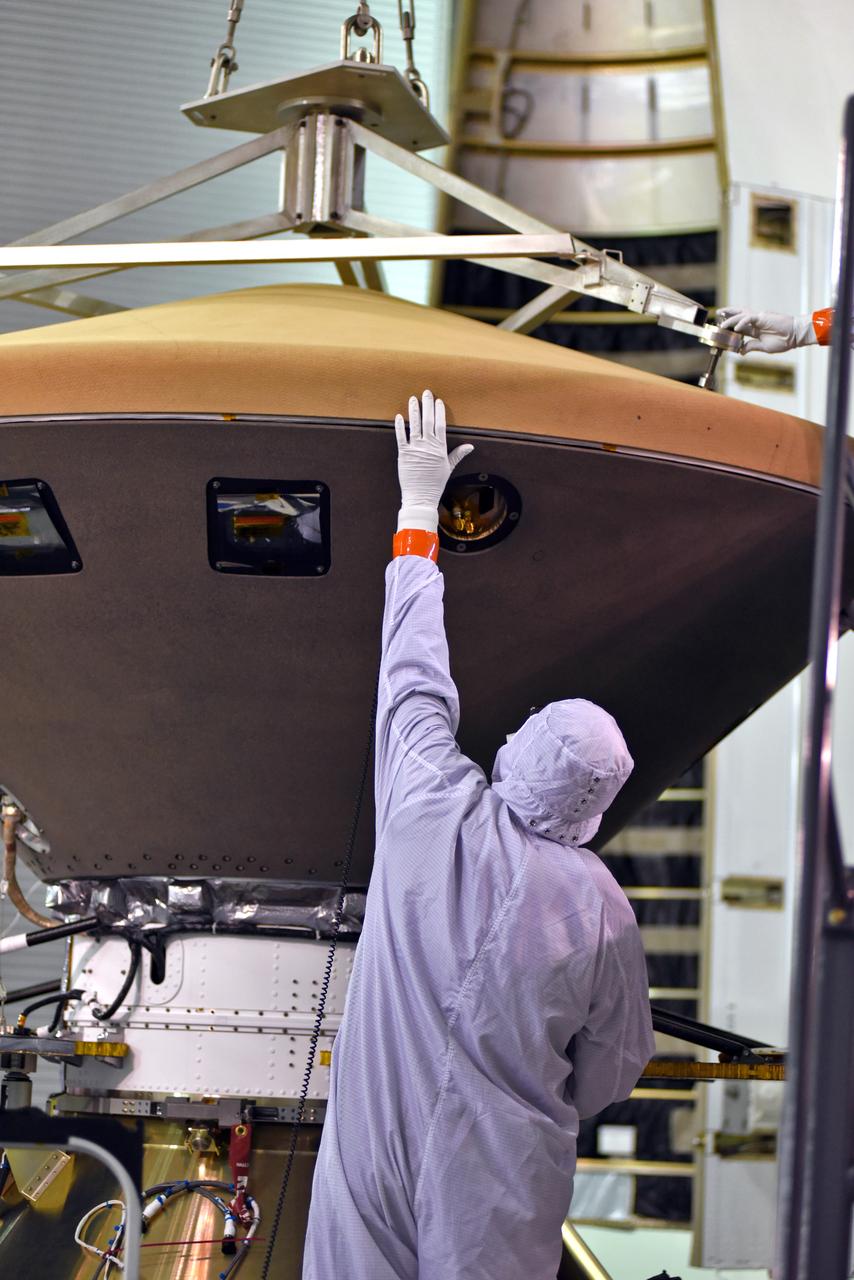
In the Astrotech facility at Vandenberg Air Force Base in California, a technician monitors progress as the heatshield is placed on NASA's Interior Exploration using Seismic Investigations, Geodesy and Heat Transport, or InSight, Mars. InSight will be the first mission to look deep beneath the Martian surface. It will study the planet's interior by measuring its heat output and listen for marsquakes. The spacecraft will use the seismic waves generated by marsquakes to develop a map of the planet’s deep interior. The resulting insight into Mars’ formation will provide a better understanding of how other rocky planets, including Earth, were created. InSight is scheduled for liftoff May 5, 2018.
InSight Final Flight Installation of Heatshield
In the Astrotech facility at Vandenberg Air Force Base in California, technicians and engineers place the heatshield on NASA's Interior Exploration using Seismic Investigations, Geodesy and Heat Transport, or InSight, Mars lander prior to encapsulation in its payload fairing. InSight will be the first mission to look deep beneath the Martian surface. It will study the planet's interior by measuring its heat output and listen for marsquakes. The spacecraft will use the seismic waves generated by marsquakes to develop a map of the planet’s deep interior. The resulting insight into Mars’ formation will provide a better understanding of how other rocky planets, including Earth, were created. InSight is scheduled for liftoff May 5, 2018.
InSight Final Flight Installation of Heatshield
In the Astrotech facility at Vandenberg Air Force Base in California, the heatshield is placed on NASA's Interior Exploration using Seismic Investigations, Geodesy and Heat Transport, or InSight, Mars lander prior to encapsulation in its payload fairing. InSight will be the first mission to look deep beneath the Martian surface. It will study the planet's interior by measuring its heat output and listen for marsquakes. The spacecraft will use the seismic waves generated by marsquakes to develop a map of the planet’s deep interior. The resulting insight into Mars’ formation will provide a better understanding of how other rocky planets, including Earth, were created. InSight is scheduled for liftoff May 5, 2018.
InSight Final Flight Installation of Heatshield
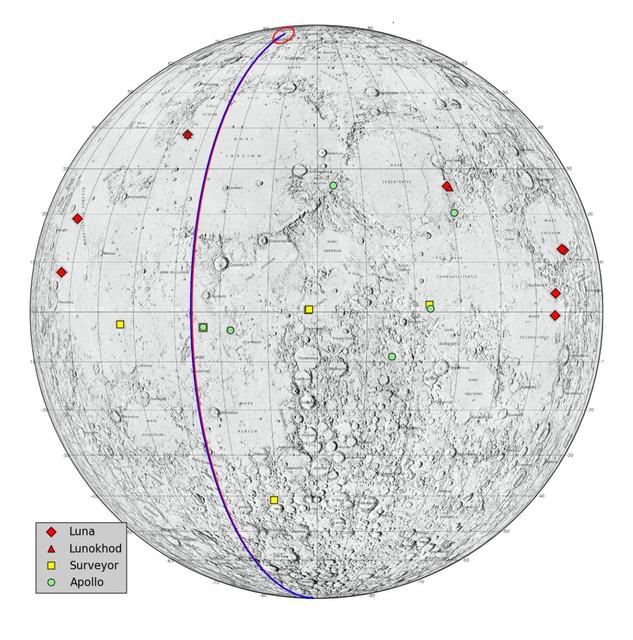
This graphic highlights locations on the moon NASA considers lunar heritage sites and the path NASA Gravity Recovery and Interior Laboratory spacecraft will take on their final flight.
Lunar Heritage Sites and GRAIL Final Mile
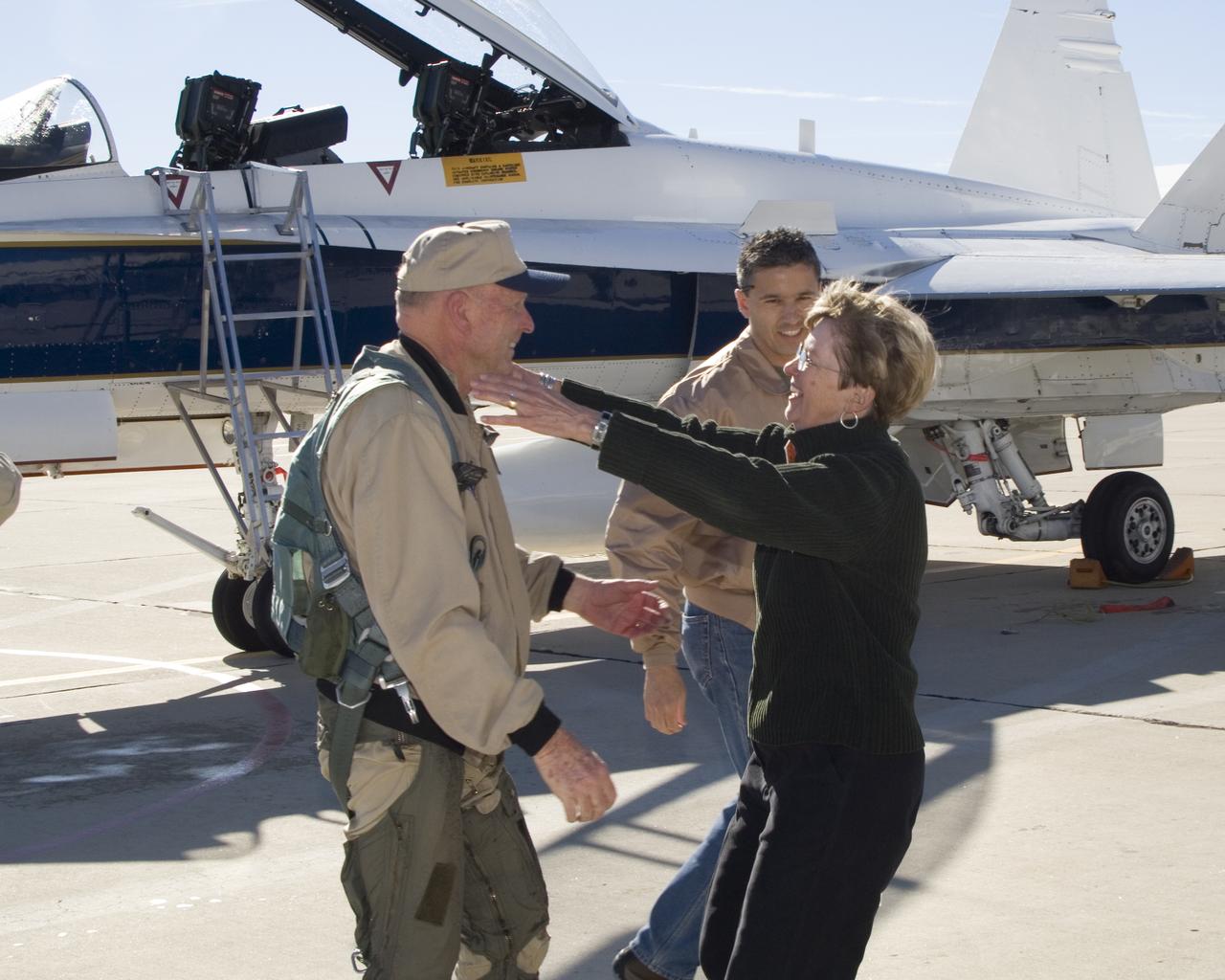
NASA Dryden research pilot Gordon Fullerton is greeted by his wife Marie on the Dryden ramp after his final flight in a NASA F/A-18 on Dec. 21, 2007.
With turbulence-measurement booms projecting ahead of the wing, Pathfinder-Plus soars aloft over Rogers Dry Lake on its final research flight from NASA Dryden.
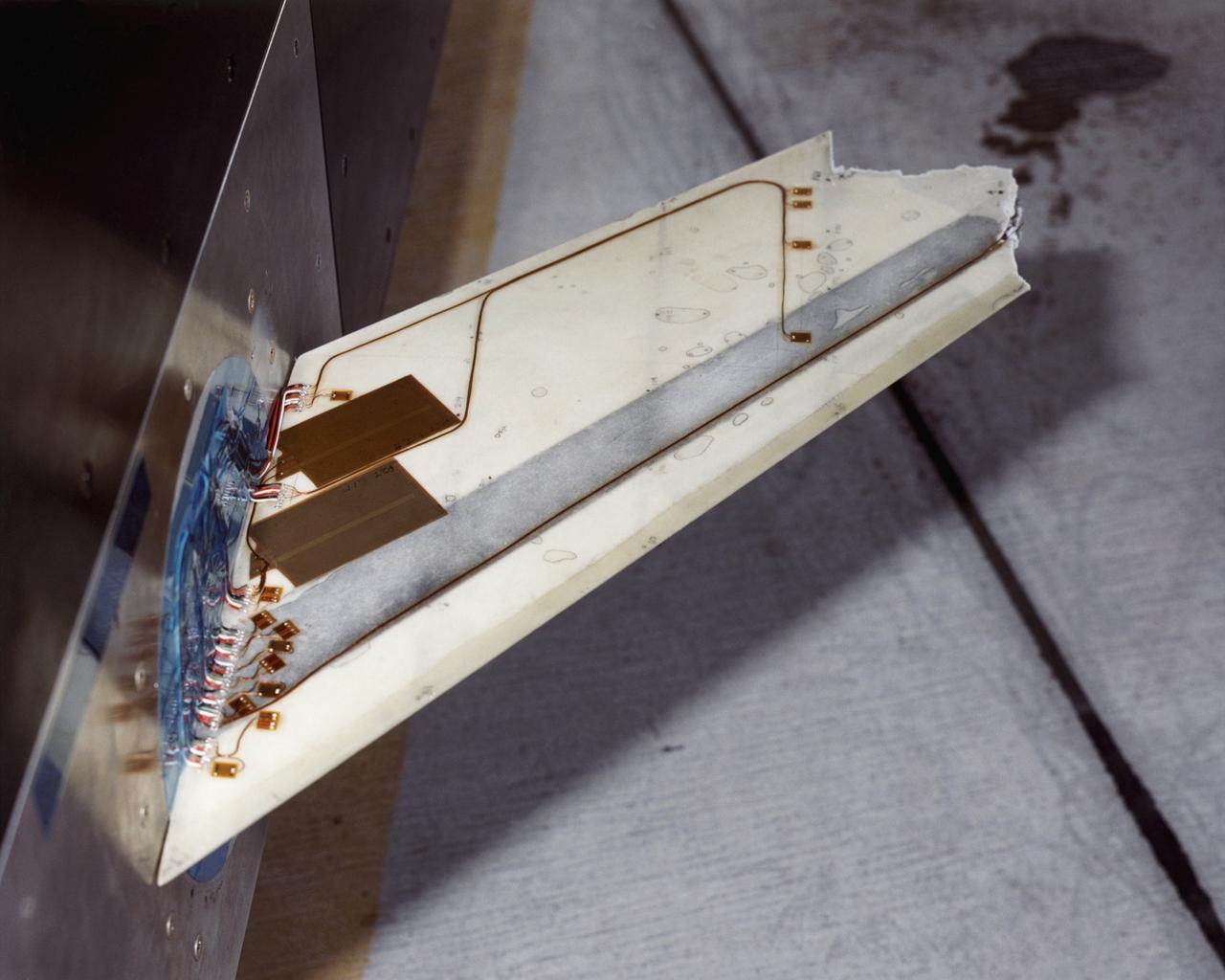
The Aerostructures Test Wing (ATW), which consisted of an 18-inch carbon fiber test wing with surface-mounted piezoelectric strain actuators, following intentional failure on its final flight
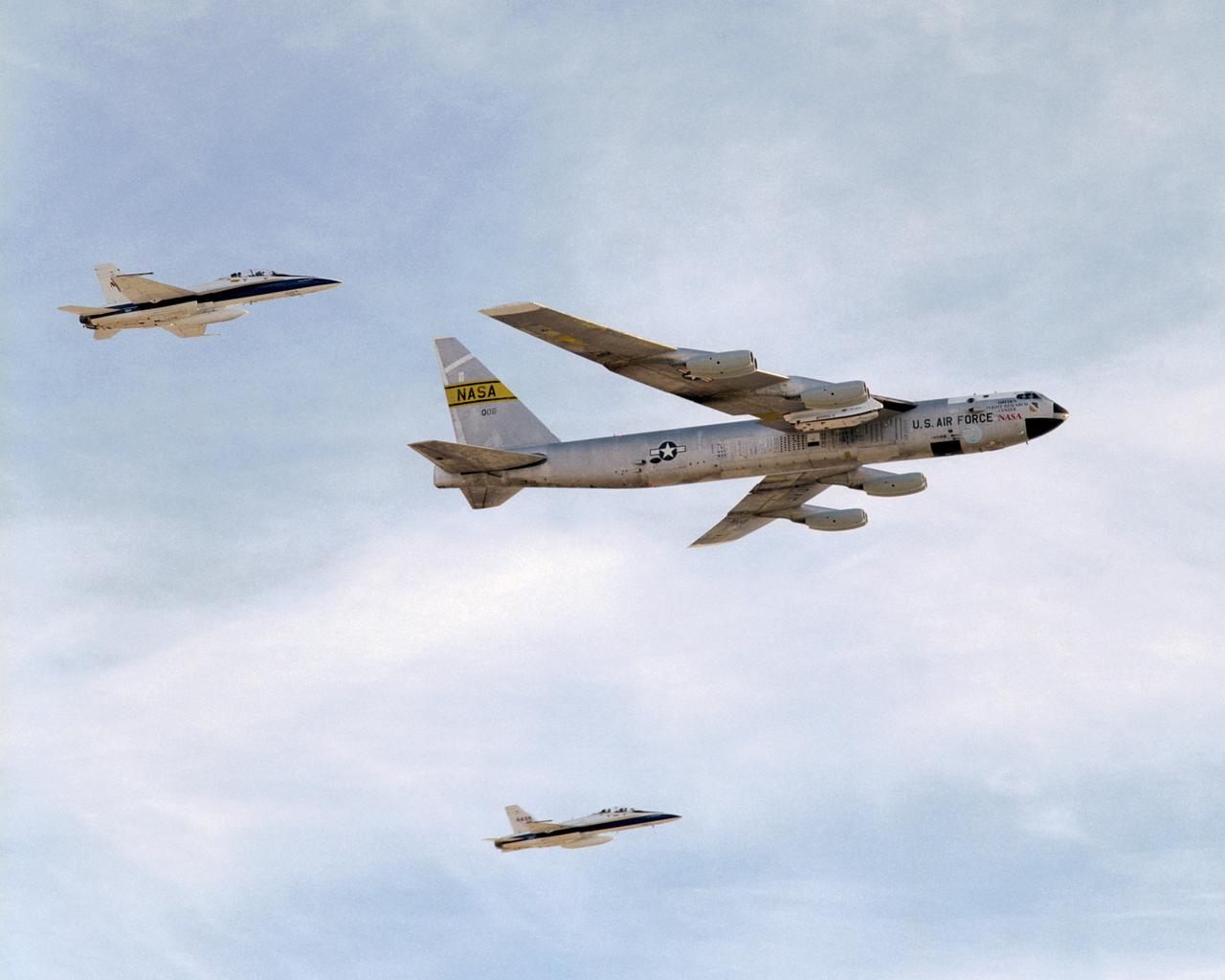
NASA's B-52B mothership, escorted by two F-18s, makes a final flyover after its last research mission that launched the X-43A on its record Mach 9.6 flight.
NASA's B-52B mothership, escorted by two F-18s, makes a final flyover after its last research mission that launched the X-43A on its record Mach 9.6 flight
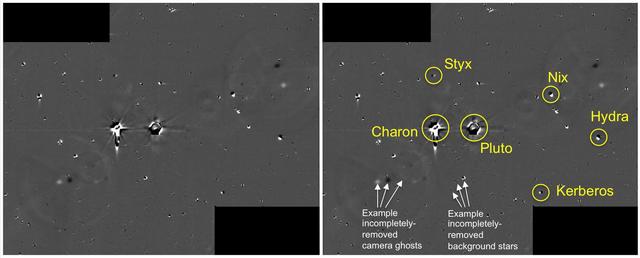
This illustration shows some of the final images used to determine that the coast was clear for New Horizons' flight through the Pluto system. These images show the difference between two sets of 48 combined 10-second exposures with the Long Range Reconnaissance Imager (LORRI), taken June 26, 2015, from a range of 21.5 million kilometers (approximately 13 million miles) to Pluto. http://photojournal.jpl.nasa.gov/catalog/PIA20293
Deep Field Image
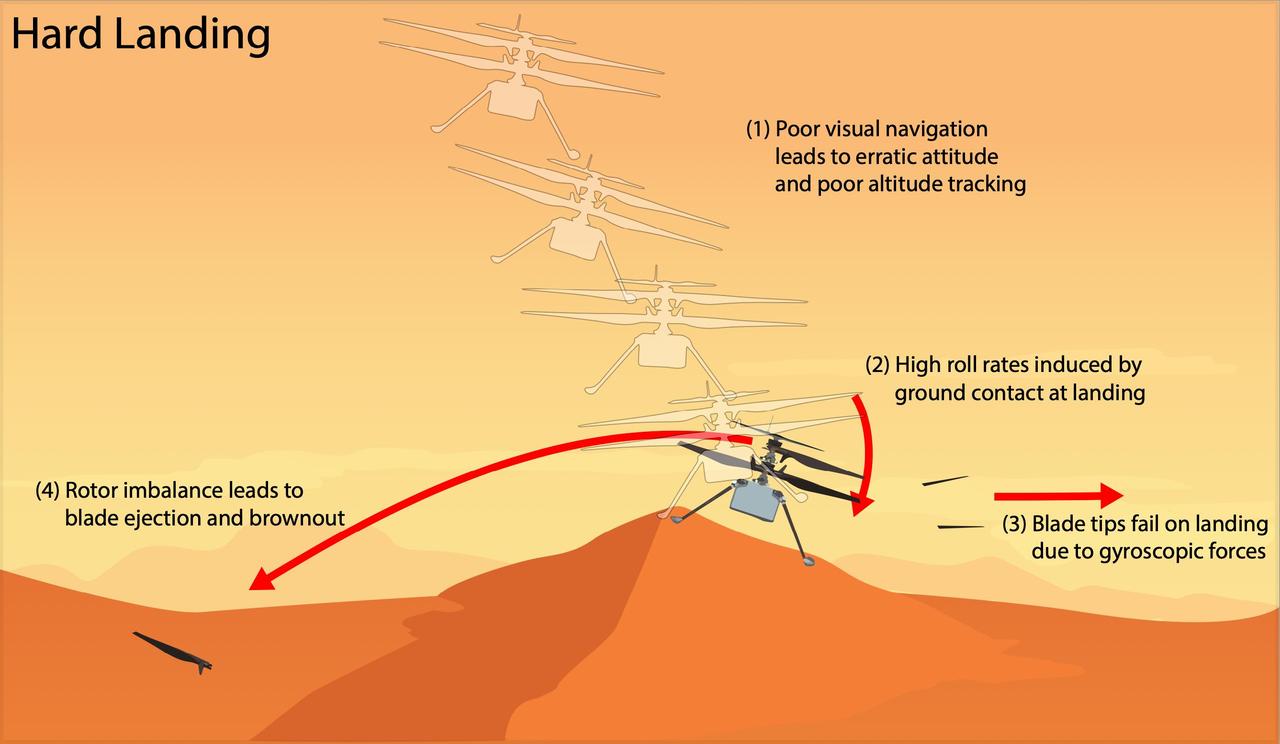
This graphic depicts the most likely scenario for the hard landing NASA's Ingenuity Mars Helicopter took during its 72nd and final flight on Jan. 18, 2024. Engineers at JPL and AeroVironment, which collaborated with NASA on the helicopter's design and development, are completing a detailed assessment of the final flight that will be published as an agency technical report.  Flight 72 was planned as a brief vertical hop to assess Ingenuity's flight systems and photograph the surrounding area. Data from the flight shows Ingenuity climbing to 40 feet (12 meters), hovering, and capturing images. It initiated its descent at 19 seconds, and by 32 seconds the helicopter was back on the surface and had halted communications.  The assessment describes the mostly likely scenario for Flight 72, as follows. Lack of suitable features on the planet's surface for the helicopter's navigation system to track resulted in high horizontal velocities at the time the helicopter touched down. This caused a hard impact on a sloping sand ripple, making Ingenuity pitch and roll. The rapid attitude change resulted in loads on the fast-rotating rotor blades beyond their design limits, snapping all four of them off at their weakest point – about a third of the way from the tip. The damaged blades caused excessive vibration in the rotor system, ripping the remainder of one blade from its root and generating an excessive power demand that resulted in loss of communications.  https://photojournal.jpl.nasa.gov/catalog/PIA26482
Ingenuity's Hard Landing
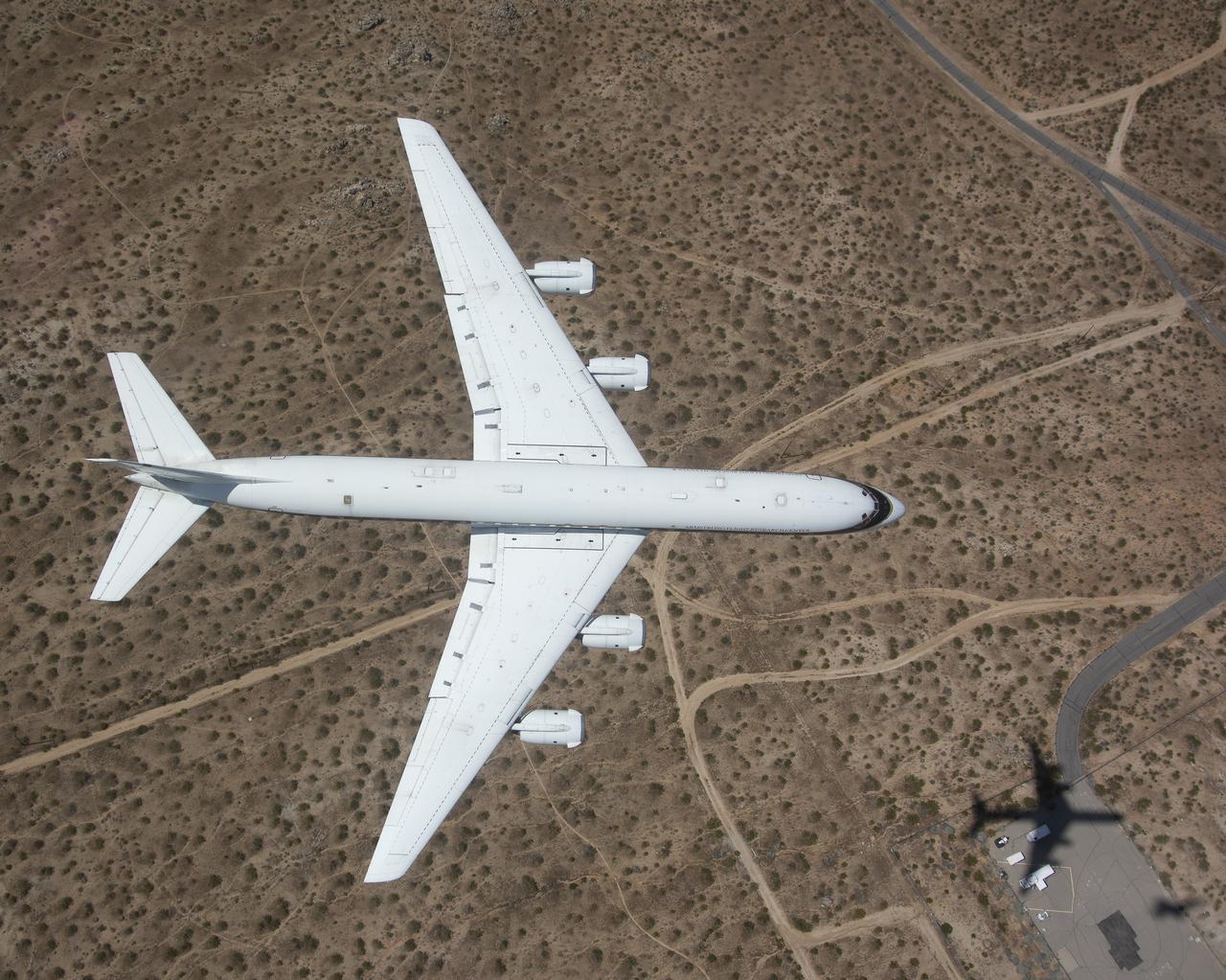
The DC-8 flies for the last time from NASA’s Armstrong Flight Research Center Building 703 in Palmdale, California, to Idaho State University in Pocatello, Idaho. The DC-8 will provide real-world experience to train future aircraft technicians at the college’s Aircraft Maintenance Technology Program.
NASA’s DC-8 Conducts Final Flight
The DC-8 flies for the last time from NASA’s Armstrong Flight Research Center Building 703 in Palmdale, California, before it retires to Idaho State University in Pocatello, Idaho. The DC-8 will provide real-world experience to train future aircraft technicians at the college’s Aircraft Maintenance Technology Program.
NASA’s DC-8 Conducts Final Flight
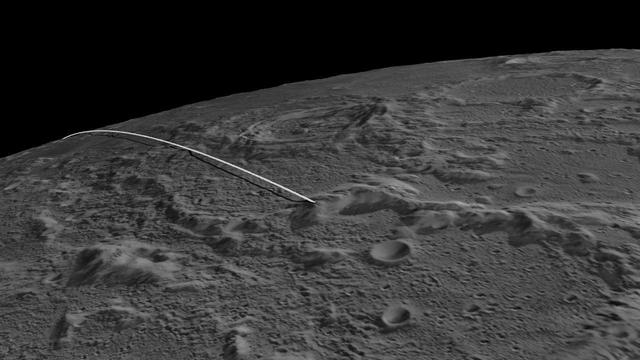
This image shows the final flight path for NASA twin Gravity Recovery and Interior Laboratory GRAIL mission spacecraft, which will impact the moon on Dec. 17, 2012, around 2:28 p.m. PST.
Last Flight for GRAIL Twin Spacecraft
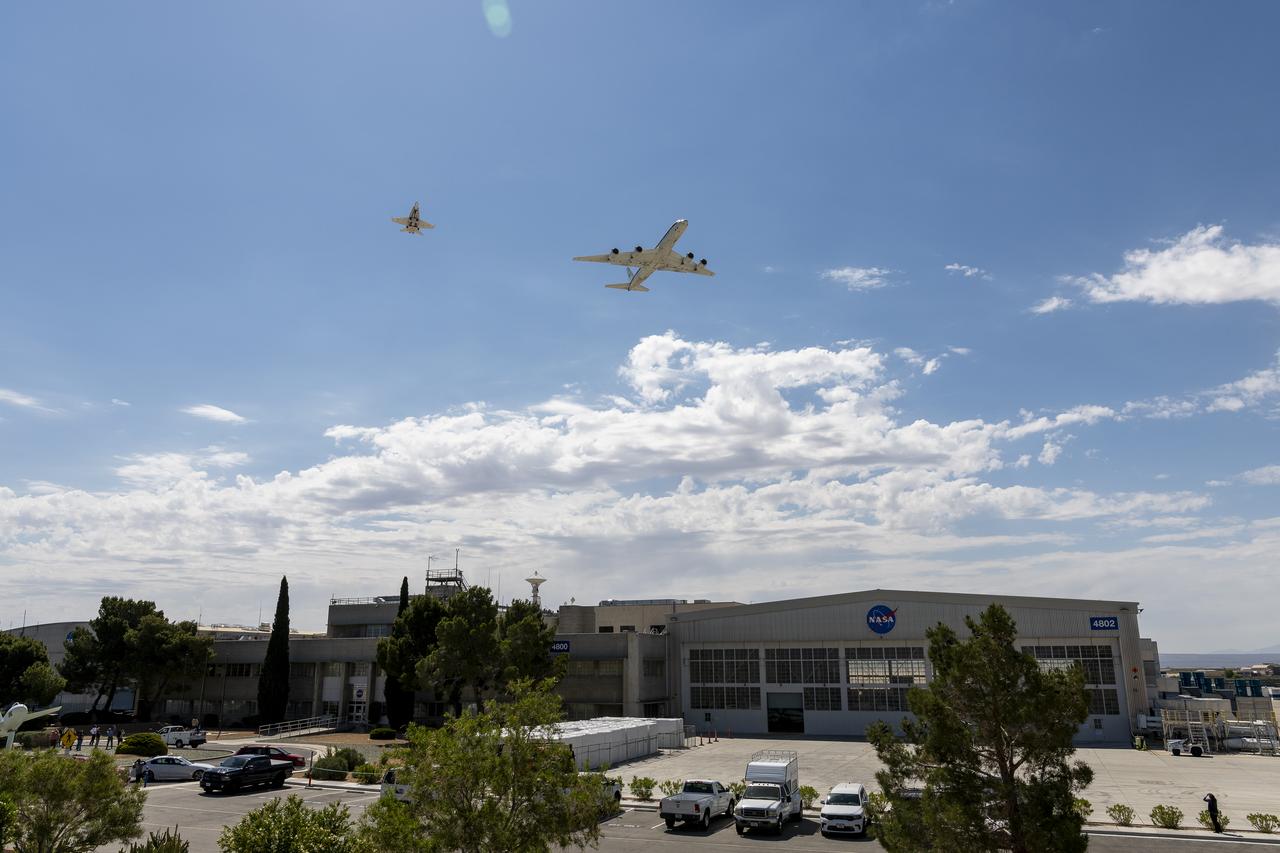
Space Shuttle Endeavour is affixed atop NASA’s 747 Shuttle Carrier Aircraft as it prepares for a landing at Los Angeles International Airport to conclude a final flight on Sept. 21, 2012.
NASA Armstrong Celebrates 70 Years of Flight Research
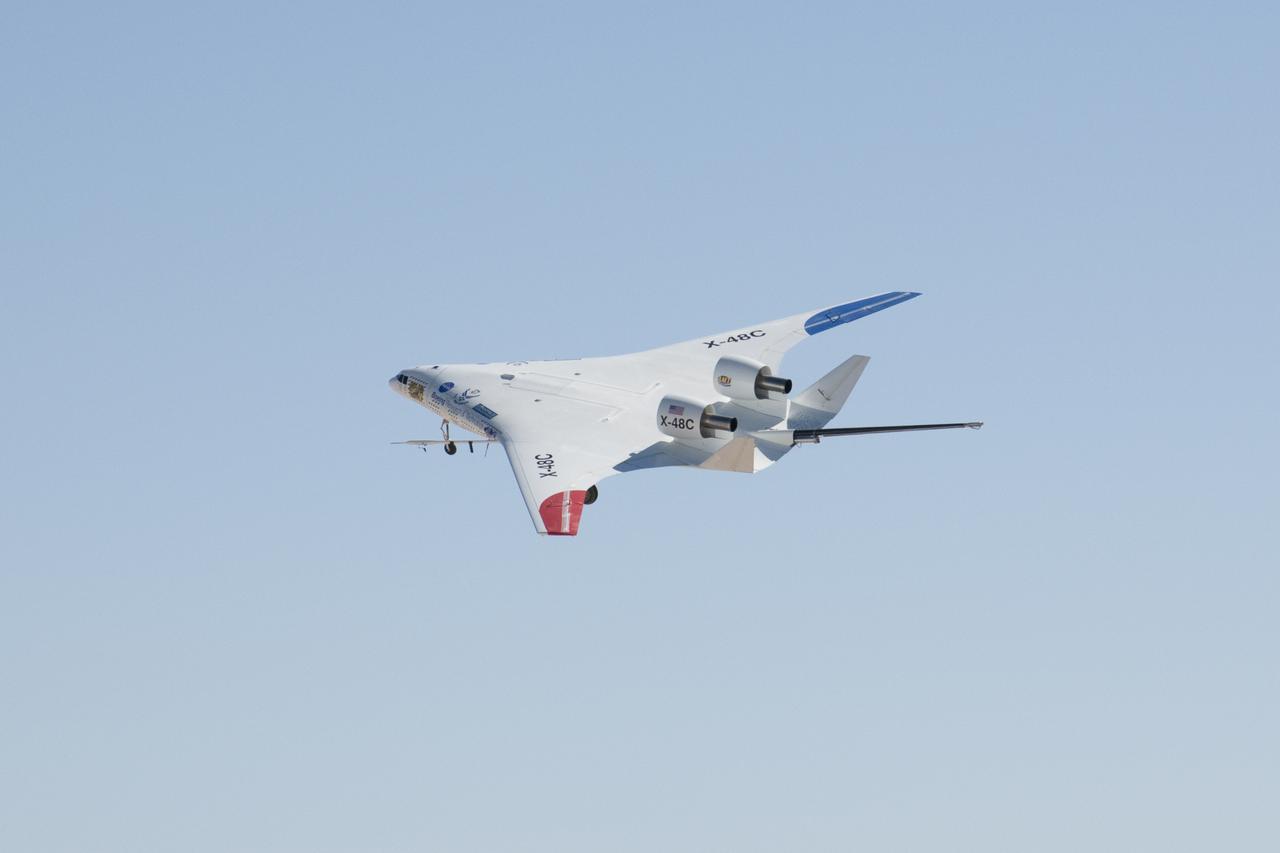
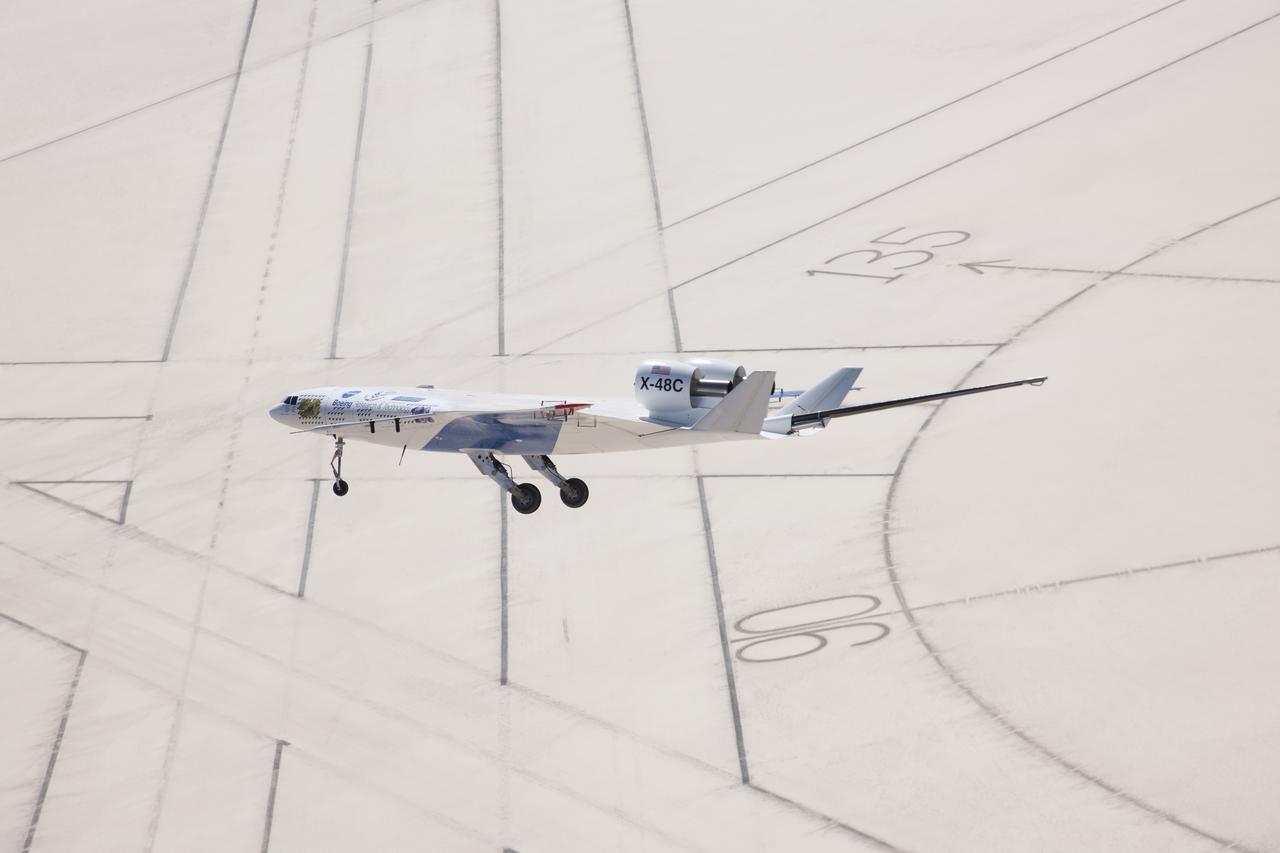
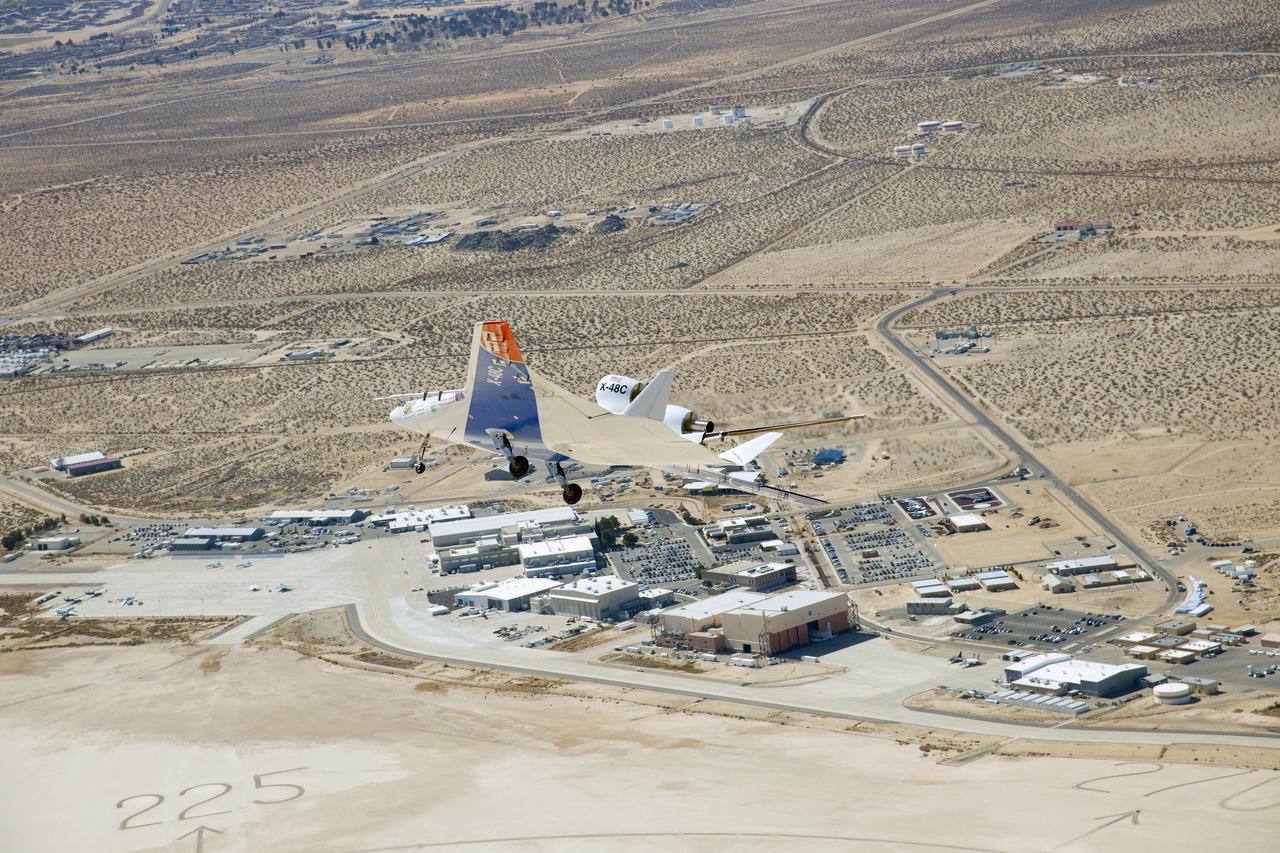
The NASA-Boeing X-48C Hybrid/Blended Wing Body research aircraft banked left during one of its final test flights over Edwards Air Force Base from NASA's Dryden Flight Research Center on Feb. 28, 2013.
X-48C Hybrid - Blended Wing Body Demonstrator
Long-time NASA Dryden research pilot and former astronaut C. Gordon Fullerton capped an almost 50-year flying career, including more than 38 years with NASA, with a final flight in a NASA F/A-18 on Dec. 21, 2007. Fullerton and Dryden research pilot Jim Smolka flew a 90-minute pilot proficiency formation aerobatics flight with another Dryden F/A-18 and a Dryden T-38 before concluding with two low-level formation flyovers of Dryden before landing. Fullerton was honored with a water-cannon spray arch provided by two fire trucks from the Edwards Air Force Base fire department as he taxied the F/A-18 up to the Dryden ramp, and was then greeted by his wife Marie and several hundred Dryden staff after his final flight.  Fullerton began his flying career with the U.S. Air Force in 1958 after earning bachelor's and master's degrees in mechanical engineering from the California Institute of Technology. Initially trained as a fighter pilot, he later transitioned to multi-engine bombers and became a bomber operations test pilot after attending the Air Force Aerospace Research Pilot School at Edwards Air Force Base, Calif. He then was assigned to the flight crew for the planned Air Force Manned Orbital Laboratory in 1966.  Upon cancellation of that program, the Air Force assigned Fullerton to NASA's astronaut corps in 1969. He served on the support crews for the Apollo 14, 15, 16 and 17 lunar missions, and was later assigned to one of the two flight crews that piloted the space shuttle prototype Enterprise during the Approach and Landing Test program at Dryden. He then logged some 382 hours in space when he flew on two early space shuttle missions, STS-3 on Columbia in 1982 and STS-51F on Challenger in 1985. He joined the flight crew branch at NASA Dryden after leaving the astronaut corps in 1986.  During his 21 years at Dryden, Fullerton was project pilot on a number of high-profile research efforts, including the Propulsion Controlled Aircraft, the high-speed landing tests of
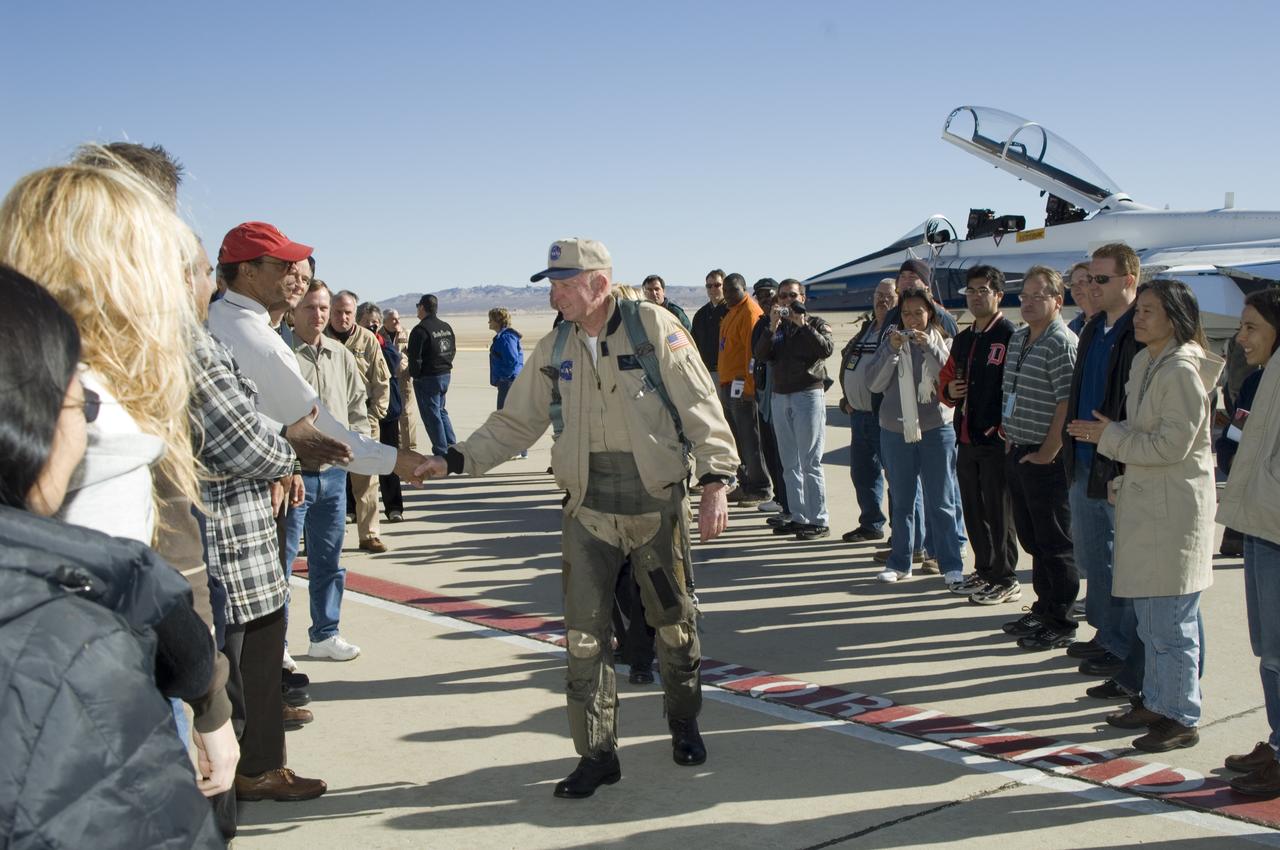
Retired NASA research pilot and former astronaut Gordon Fullerton was greeted by scores of NASA Dryden staff who bid him farewell after his final NASA flight.
Long-time NASA Dryden research pilot and former astronaut C. Gordon Fullerton capped an almost 50-year flying career, including more than 38 years with NASA, with a final flight in a NASA F/A-18 on Dec. 21, 2007. Fullerton and Dryden research pilot Jim Smolka flew a 90-minute pilot proficiency formation aerobatics flight with another Dryden F/A-18 and a Dryden T-38 before concluding with two low-level formation flyovers of Dryden before landing. Fullerton was honored with a water-cannon spray arch provided by two fire trucks from the Edwards Air Force Base fire department as he taxied the F/A-18 up to the Dryden ramp, and was then greeted by his wife Marie and several hundred Dryden staff after his final flight.  Fullerton began his flying career with the U.S. Air Force in 1958 after earning bachelor's and master's degrees in mechanical engineering from the California Institute of Technology. Initially trained as a fighter pilot, he later transitioned to multi-engine bombers and became a bomber operations test pilot after attending the Air Force Aerospace Research Pilot School at Edwards Air Force Base, Calif. He then was assigned to the flight crew for the planned Air Force Manned Orbital Laboratory in 1966.  Upon cancellation of that program, the Air Force assigned Fullerton to NASA's astronaut corps in 1969. He served on the support crews for the Apollo 14, 15, 16 and 17 lunar missions, and was later assigned to one of the two flight crews that piloted the space shuttle prototype Enterprise during the Approach and Landing Test program at Dryden. He then logged some 382 hours in space when he flew on two early space shuttle missions, STS-3 on Columbia in 1982 and STS-51F on Challenger in 1985. He joined the flight crew branch at NASA Dryden after leaving the astronaut corps in 1986.  During his 21 years at Dryden, Fullerton was project pilot on a number of high-profile research efforts, including the Propulsion Controlled Aircraft, the high-speed landing tests of
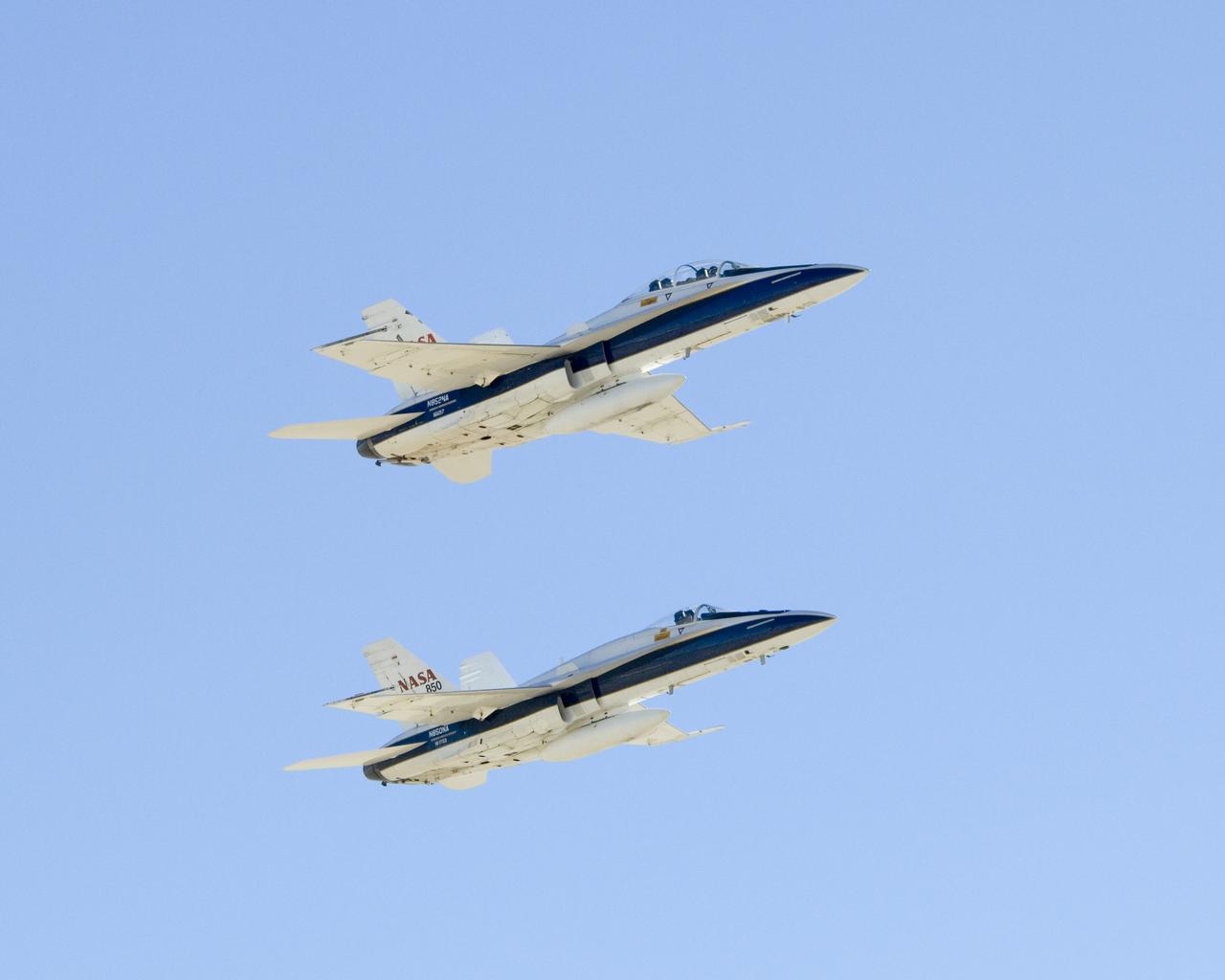
Two NASA Dryden F/A-18s flown by Gordon Fullerton and Nils Larson fly in tight formation Dec. 21, 2007 during Fullerton's final flight before his retirement.
Long-time NASA Dryden research pilot and former astronaut C. Gordon Fullerton capped an almost 50-year flying career, including more than 38 years with NASA, with a final flight in a NASA F/A-18 on Dec. 21, 2007. Fullerton and Dryden research pilot Jim Smolka flew a 90-minute pilot proficiency formation aerobatics flight with another Dryden F/A-18 and a Dryden T-38 before concluding with two low-level formation flyovers of Dryden before landing. Fullerton was honored with a water-cannon spray arch provided by two fire trucks from the Edwards Air Force Base fire department as he taxied the F/A-18 up to the Dryden ramp, and was then greeted by his wife Marie and several hundred Dryden staff after his final flight.  Fullerton began his flying career with the U.S. Air Force in 1958 after earning bachelor's and master's degrees in mechanical engineering from the California Institute of Technology. Initially trained as a fighter pilot, he later transitioned to multi-engine bombers and became a bomber operations test pilot after attending the Air Force Aerospace Research Pilot School at Edwards Air Force Base, Calif. He then was assigned to the flight crew for the planned Air Force Manned Orbital Laboratory in 1966. Upon cancellation of that program, the Air Force assigned Fullerton to NASA's astronaut corps in 1969.  He served on the support crews for the Apollo 14, 15, 16 and 17 lunar missions, and was later assigned to one of the two flight crews that piloted the space shuttle prototype Enterprise during the Approach and Landing Test program at Dryden. He then logged some 382 hours in space when he flew on two early space shuttle missions, STS-3 on Columbia in 1982 and STS-51F on Challenger in 1985. He joined the flight crew branch at NASA Dryden after leaving the astronaut corps in 1986.  During his 21 years at Dryden, Fullerton was project pilot on a number of high-profile research efforts, including the Propulsion Controlled Aircraft, the high-speed landing tests of
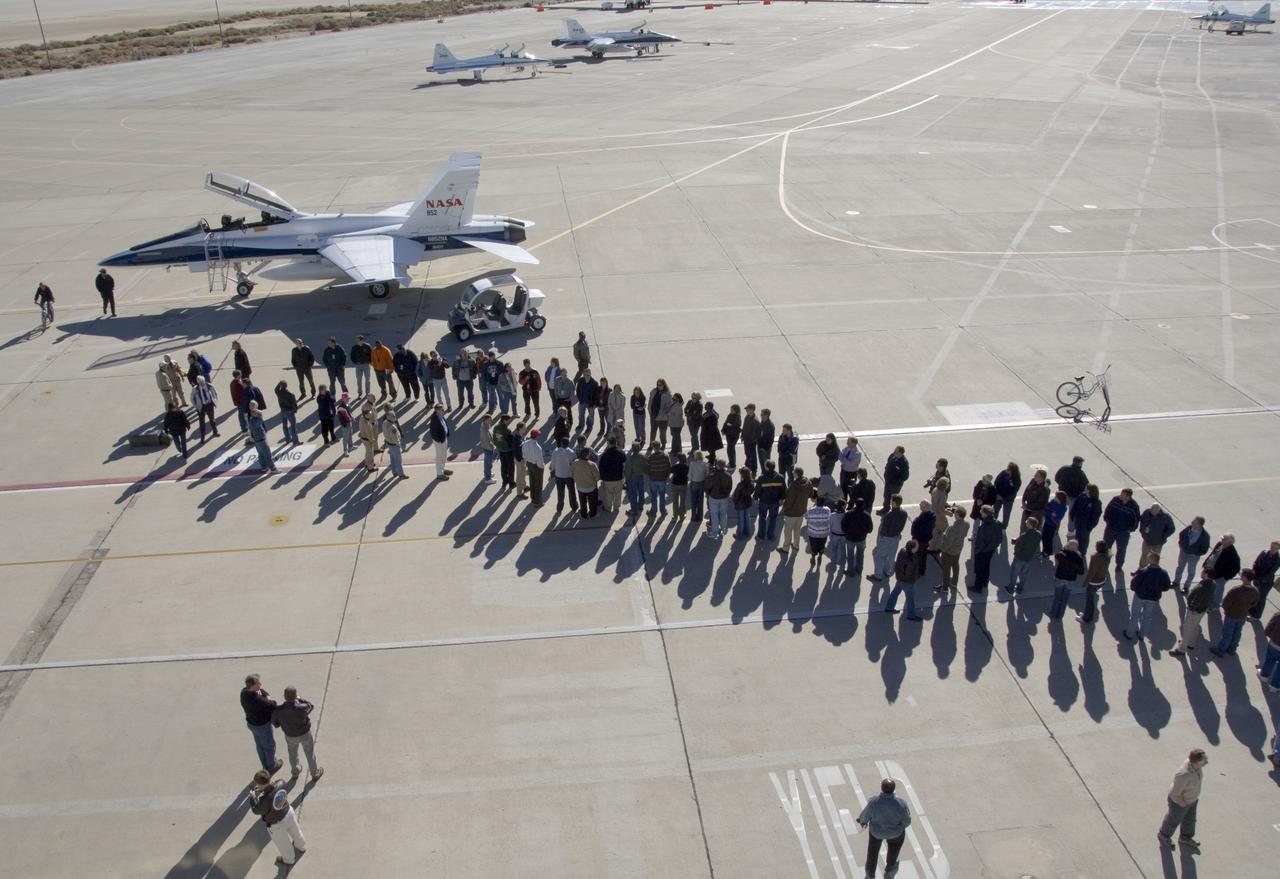
More than 200 Dryden staff formed two long lines on the Dryden ramp to greet retired research pilot Gordon Fullerton after his final flight in a NASA F/A-18.
KENNEDY SPACE CENTER, FLA. -  Workers in KSC's Vertical Processing Facility make final adjustments to the Flight Support System (FSS) for STS-82, the second Hubble Space Telescope servicing mission.  The FSS is reusable flight hardware that provides the mechanical, structural and electrical interfaces between HST, the space support equipment and the orbiter for payload retrieval and on-orbit servicing.  Liftoff aboard Discovery is targeted Feb. 11 with a crew of seven.
KENNEDY SPACE CENTER, FLA. - Workers in KSC's Vertical Processing Facility make final adjustments to the Flight Support System (FSS) for STS-82, the second Hubble Space Telescope servicing mission. The FSS is reusable flight hardware that provides the mechanical, structural and electrical interfaces between HST, the space support equipment and the orbiter for payload retrieval and on-orbit servicing. Liftoff aboard Discovery is targeted Feb. 11 with a crew of seven.
The X-48C Hybrid Wing Body research aircraft flew over the intersection of several runways adjacent to the compass rose on Rogers Dry Lake at Edwards Air Force Base during one of the sub-scale aircraft's final test flights on Feb. 28, 2013.
X-48C Flies Over Intersecting Runways
Optical PAyload for Lasercomm Science OPALS flight terminal undergoes final testing at NASA Jet Propulsion Laboratory. OPALS was launched to the International Space Station from Cape Canaveral Air Force Station in Florida on April 18, 2014.
OPALS Final Testing
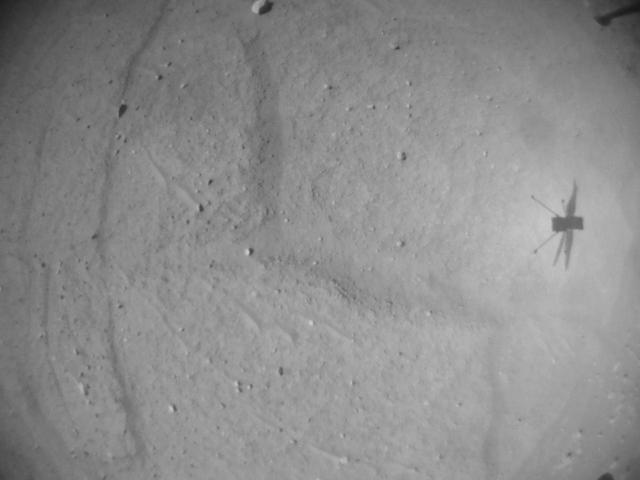
NASA's Ingenuity Mars Helicopter's navigation camera captured the rotorcraft in shadow during its 52nd flight on April 26, 2023. This image was finally received after Perseverance and Ingenuity were out of communication for 63 days.  https://photojournal.jpl.nasa.gov/catalog/PIA25918
Ingenuity Before Flight 52's Landing
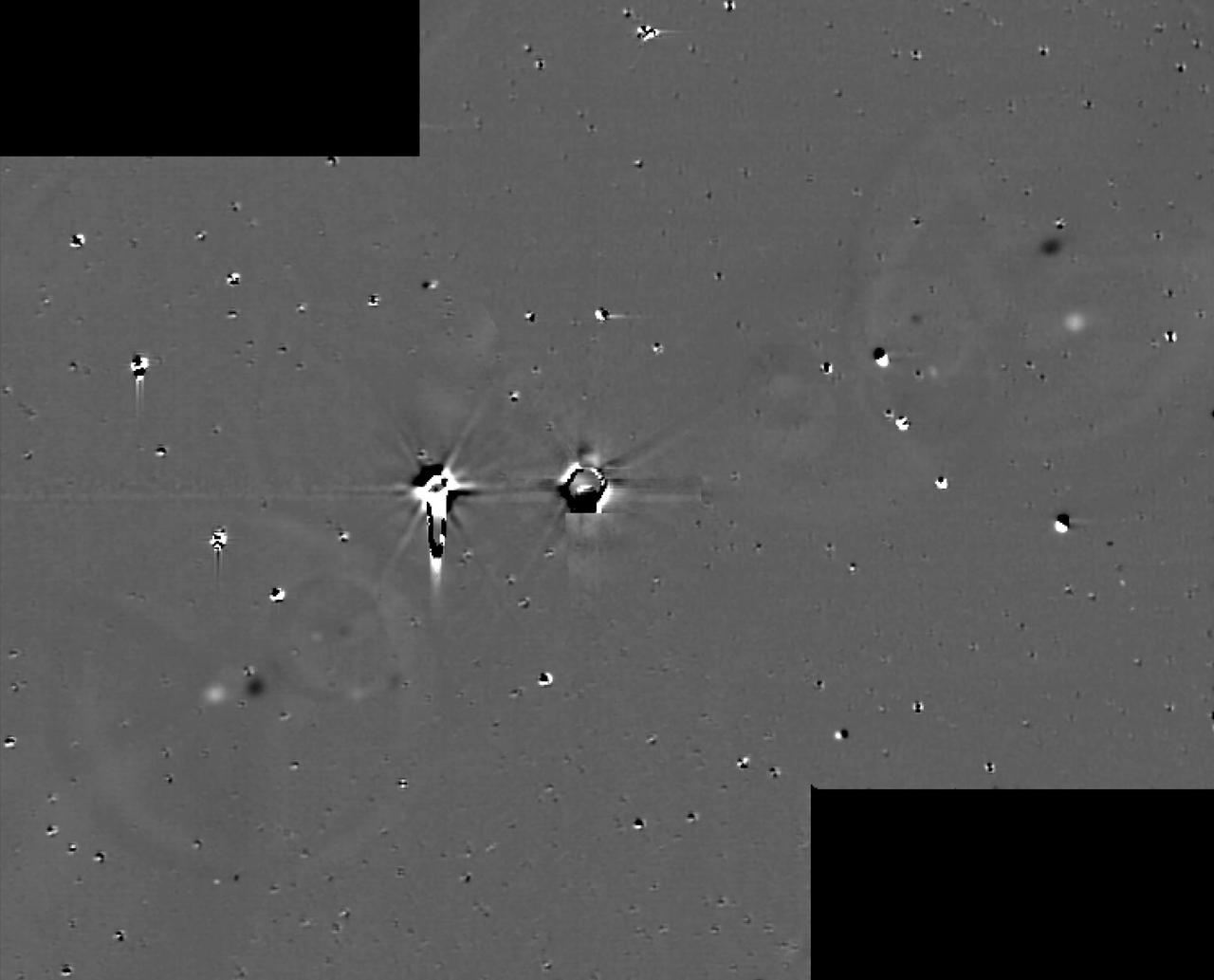
This illustration shows some of the final images used to determine that the coast is clear for New Horizons' flight through the Pluto system. These images show the difference between two sets of 48 combined 10-second exposures with New Horizons Long Range Reconnaissance Imager (LORRI) camera, taken at 8:40 UTC and 10:25 UTC on June 26, 2015, from a range of 21.5 million kilometers (approximately 13 million miles) to Pluto. The known small moons, Nix, Hydra, Kerberos and Styx, are visible as adjacent bright and dark pairs of dots, due to their motion in the 105 minutes between the two image sets. The images have been extensively processed to remove the glare and "ghosts" (i.e., lens flare) from Pluto and Charon, and also to remove background stars, though many of the brighter stars are imperfectly removed and appear as irregular bright and dark blobs. These and other similar sets of images demonstrate that there are no previously unknown moons brighter than 15 times fainter than Styx (the faintest known moon) in the region outside of Charon's orbit, or brighter than five times fainter than Styx in the region between Charon's orbit and a few thousand kilometers above Pluto's surface.   http://photojournal.jpl.nasa.gov/catalog/PIA19695
All Clear for New Horizons
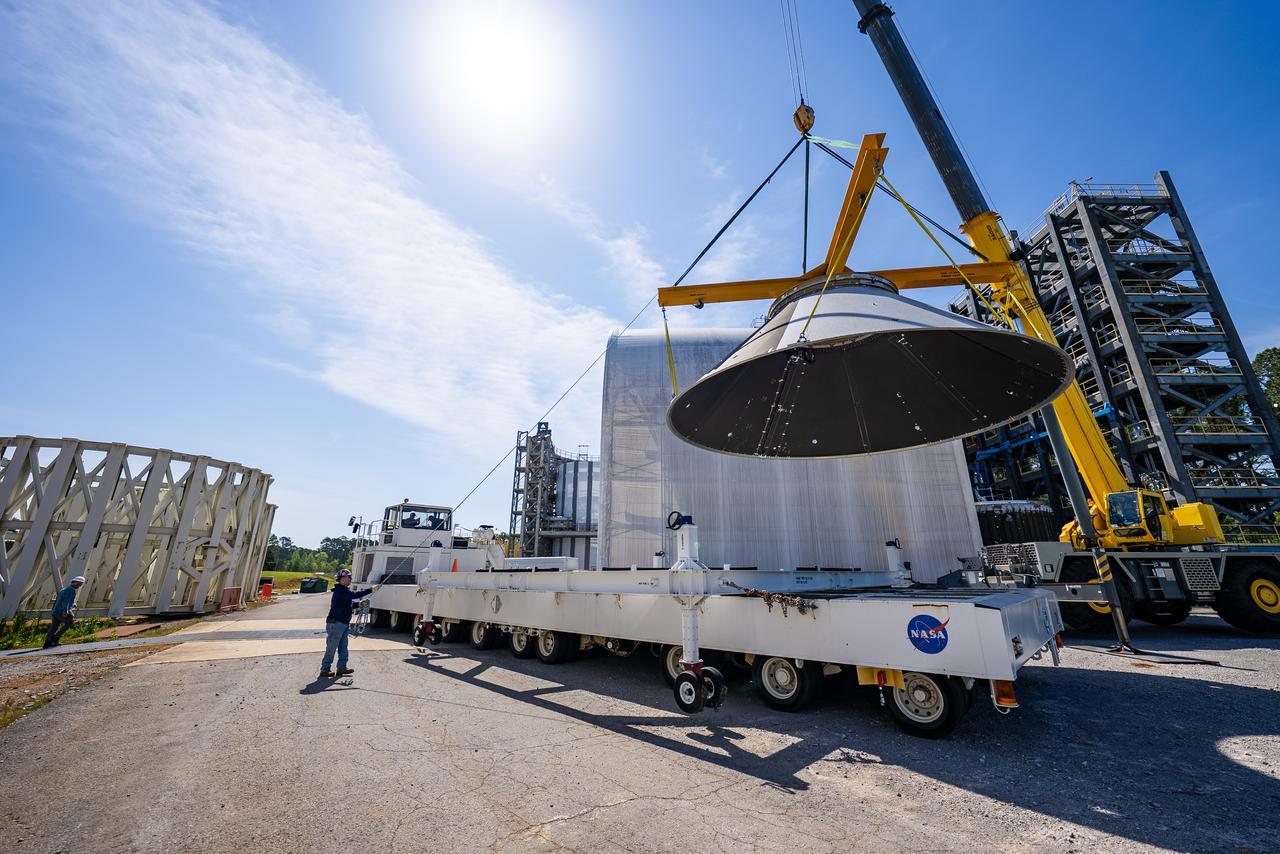
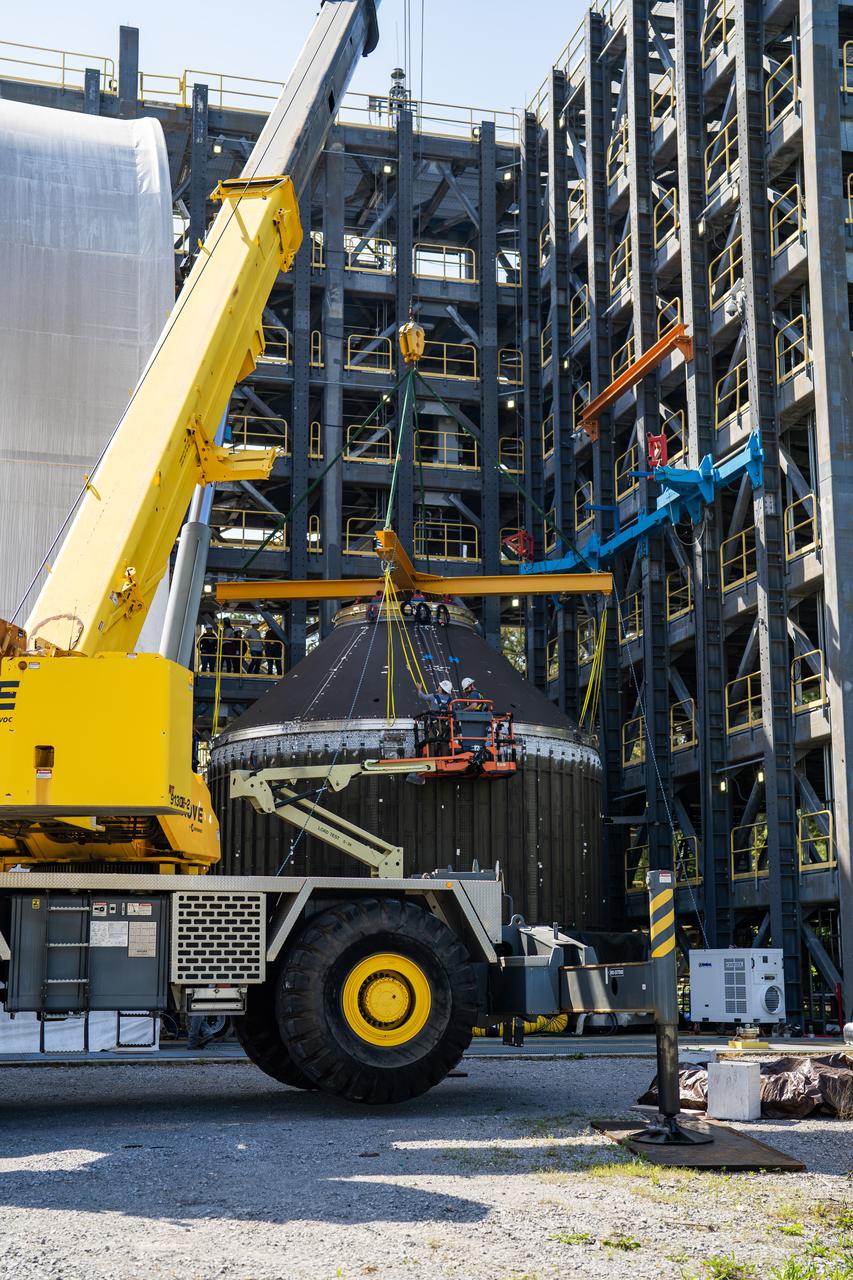
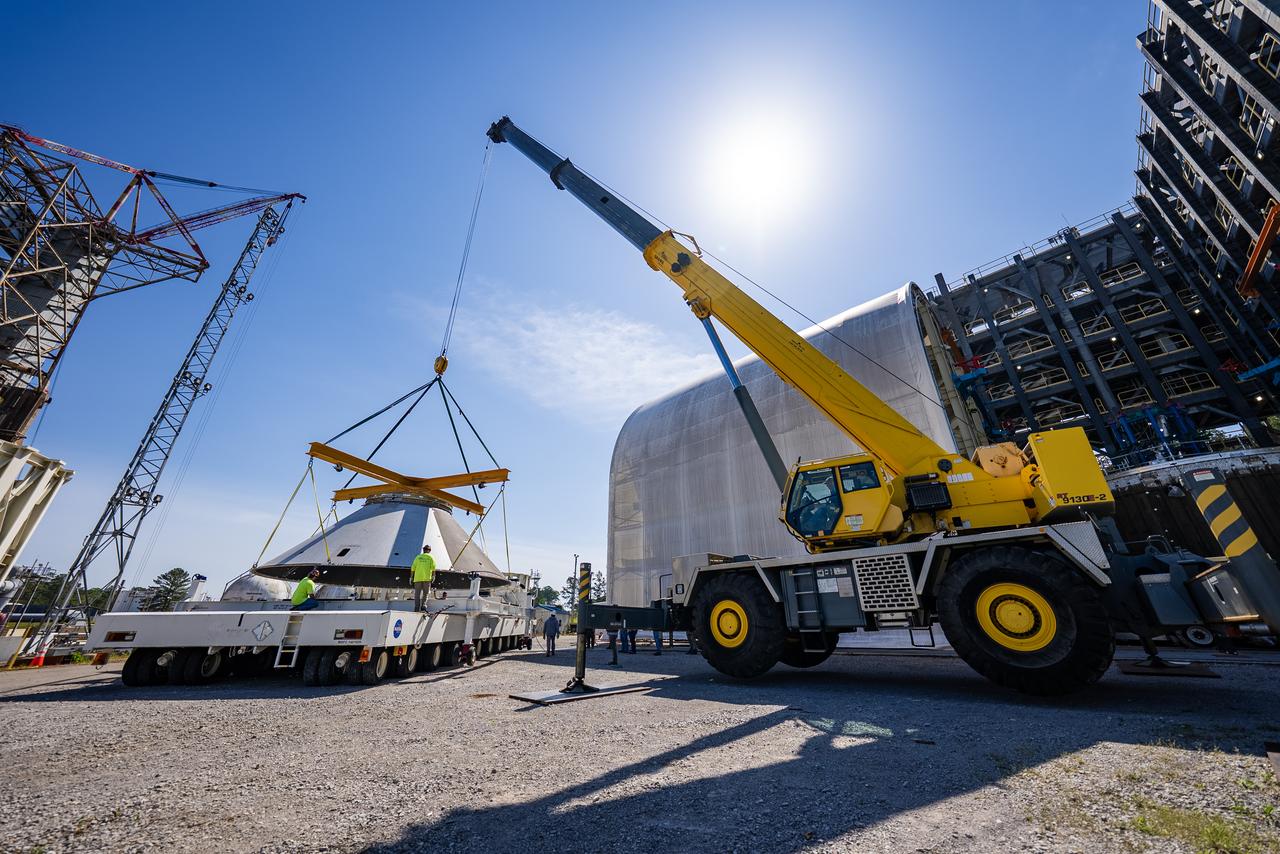
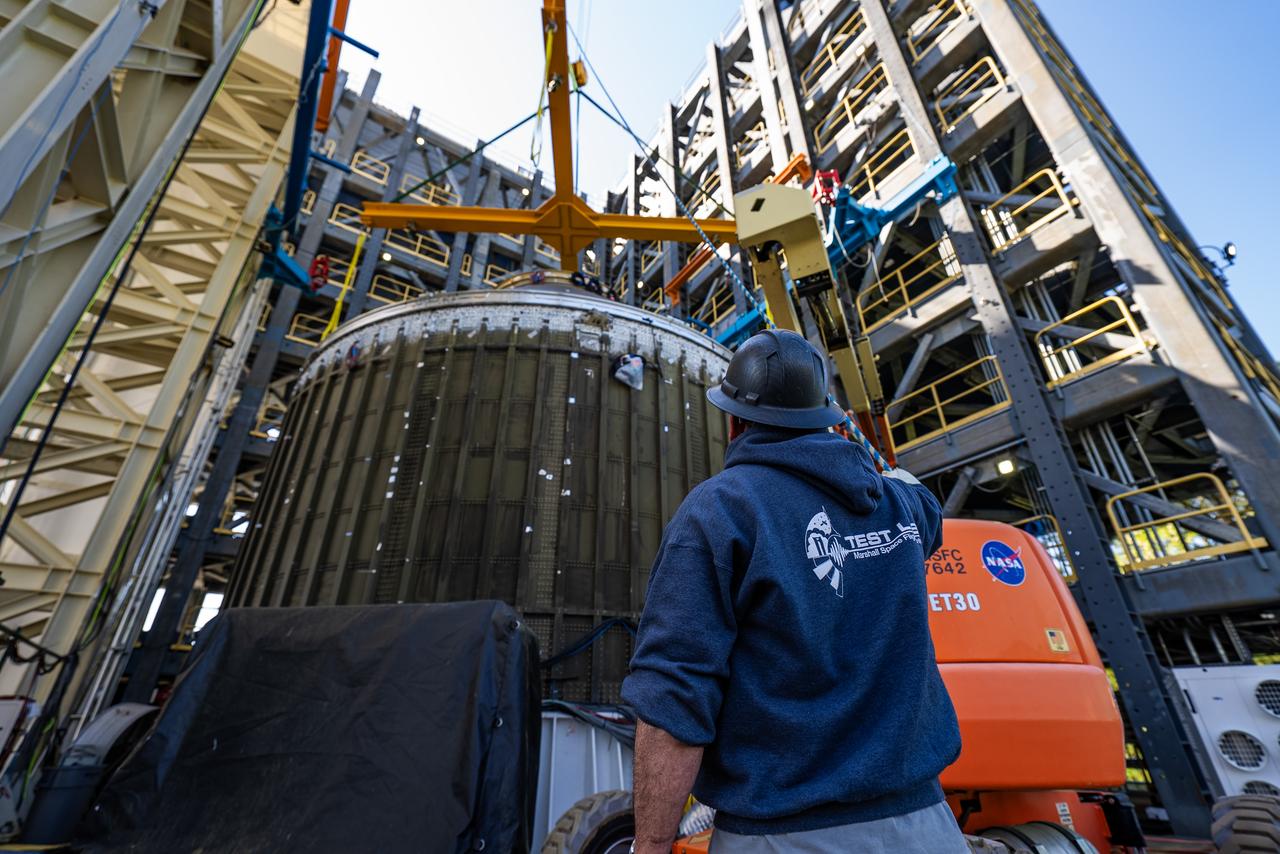
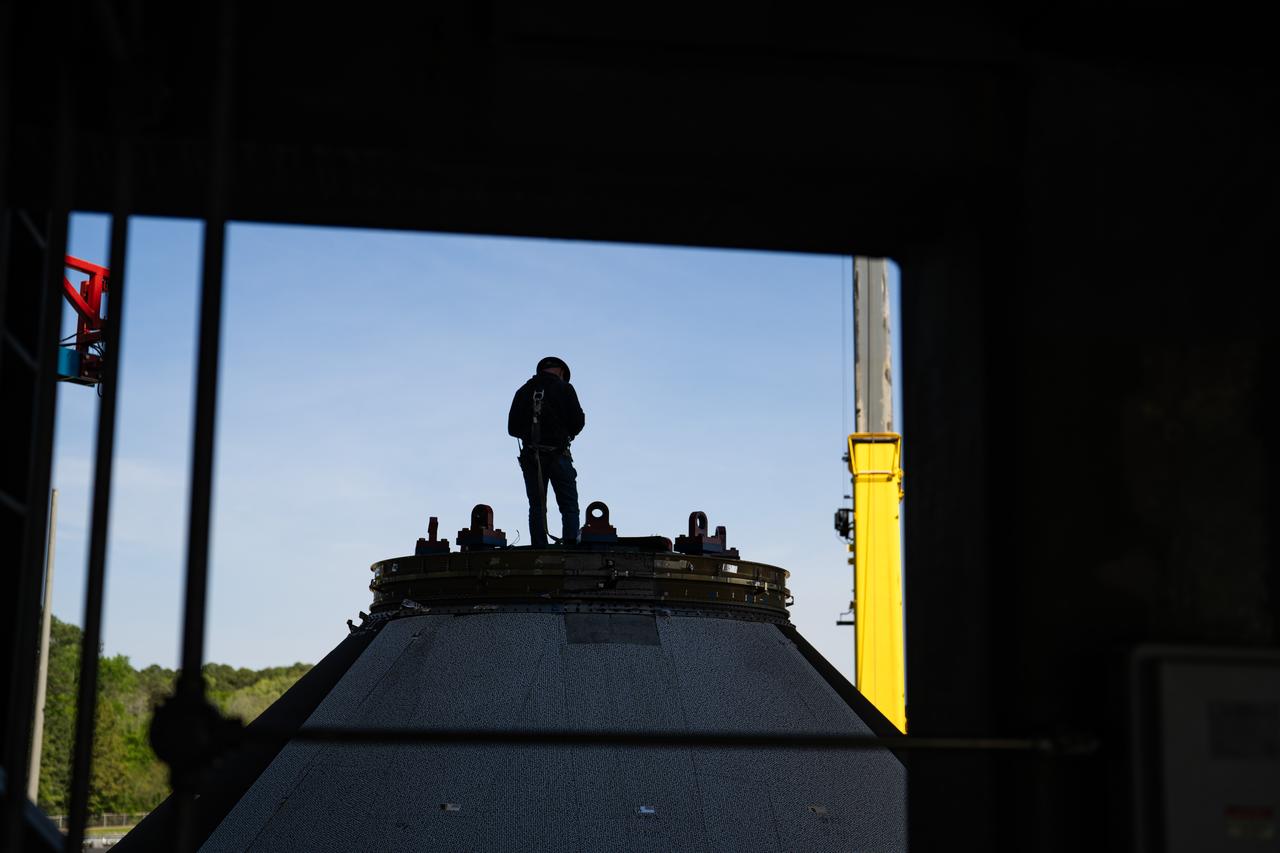
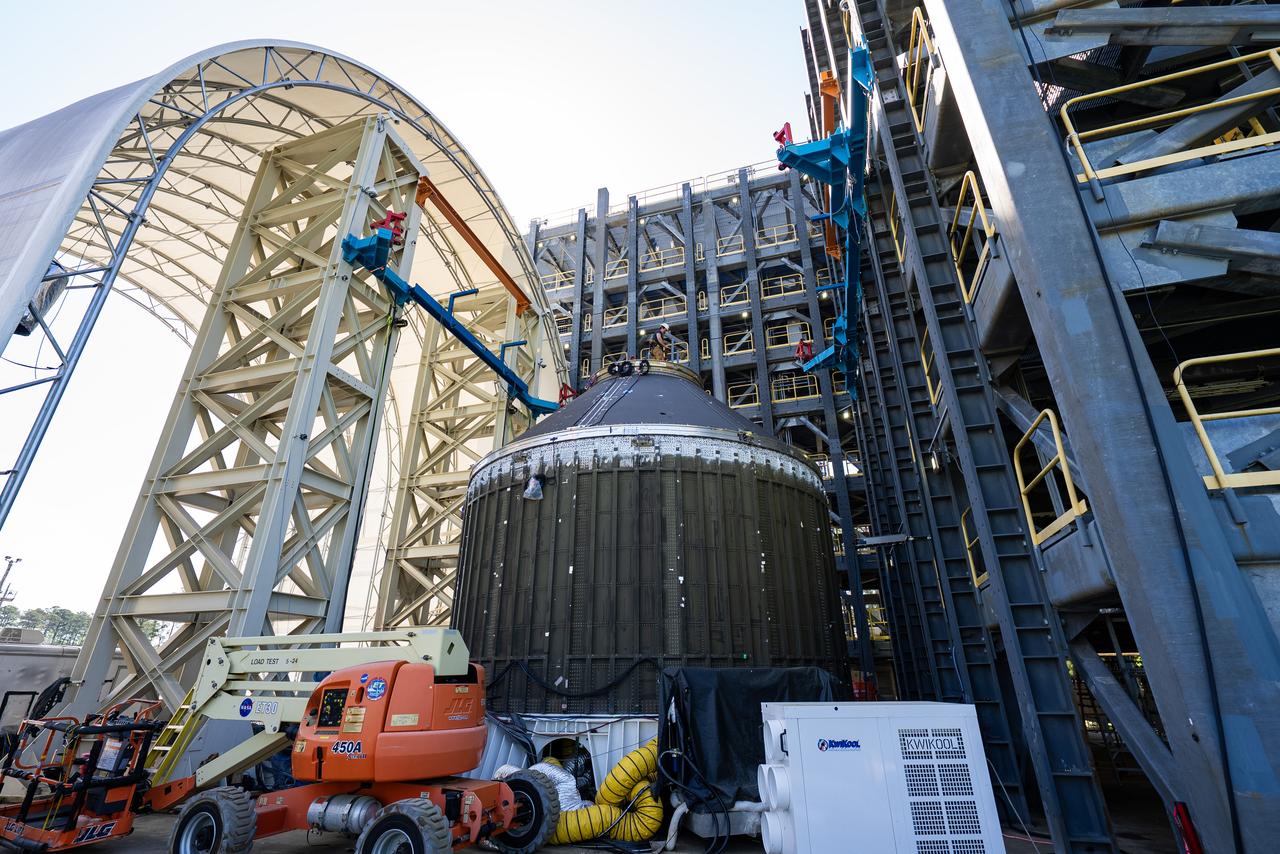
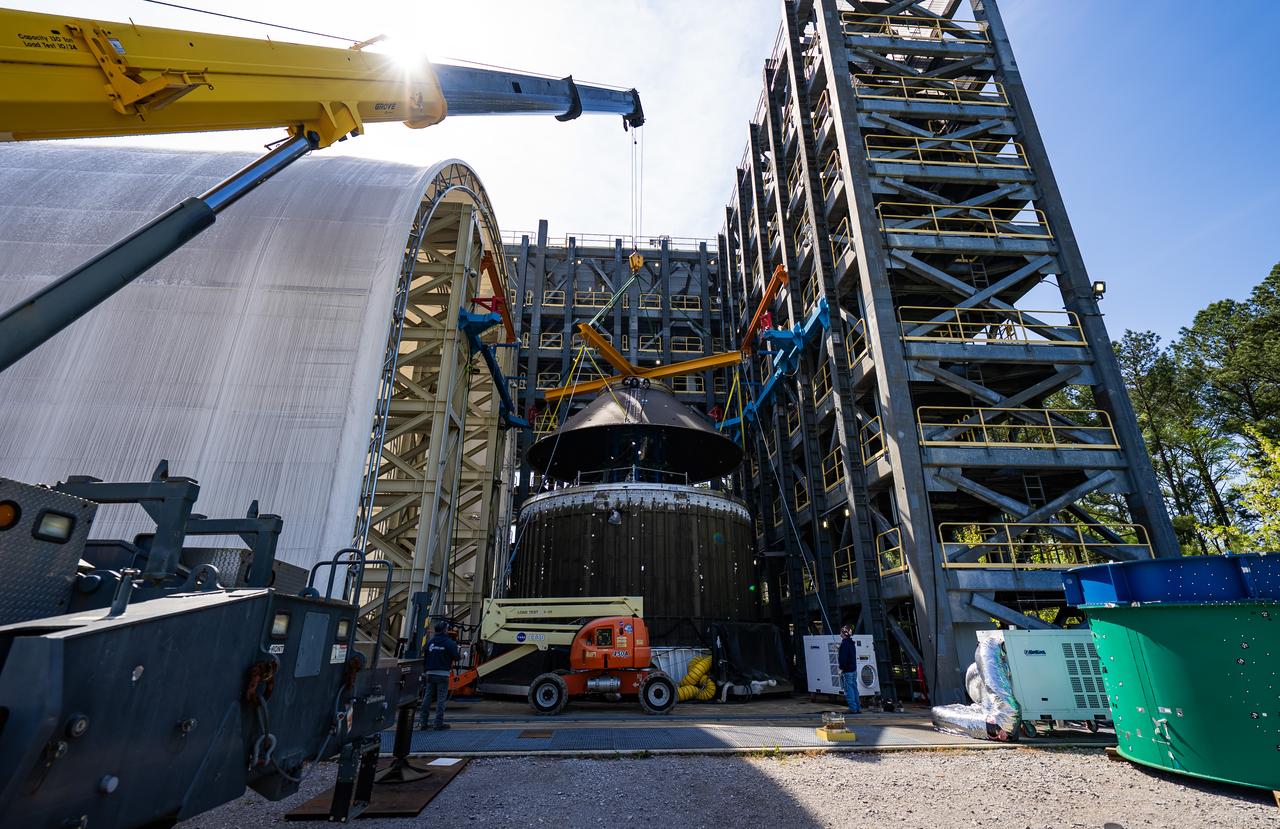
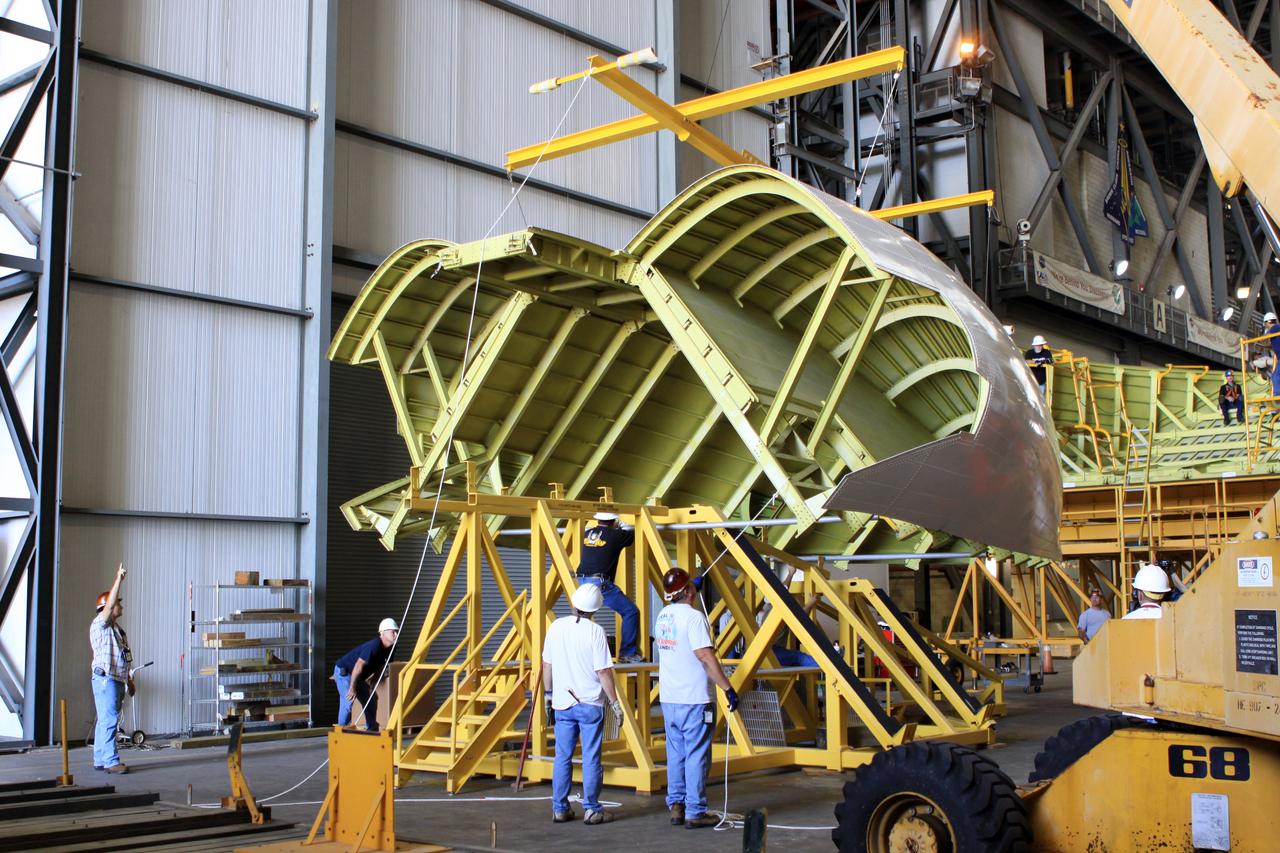
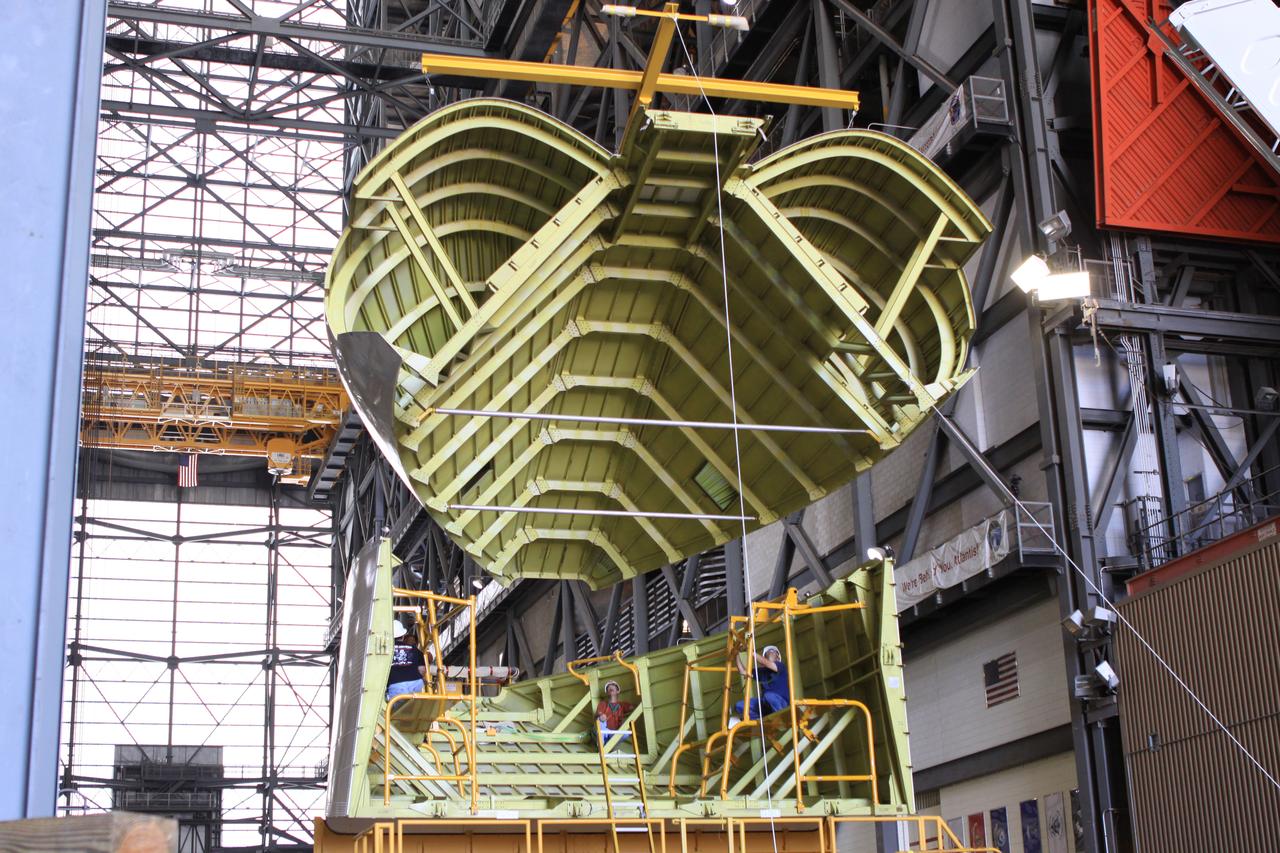
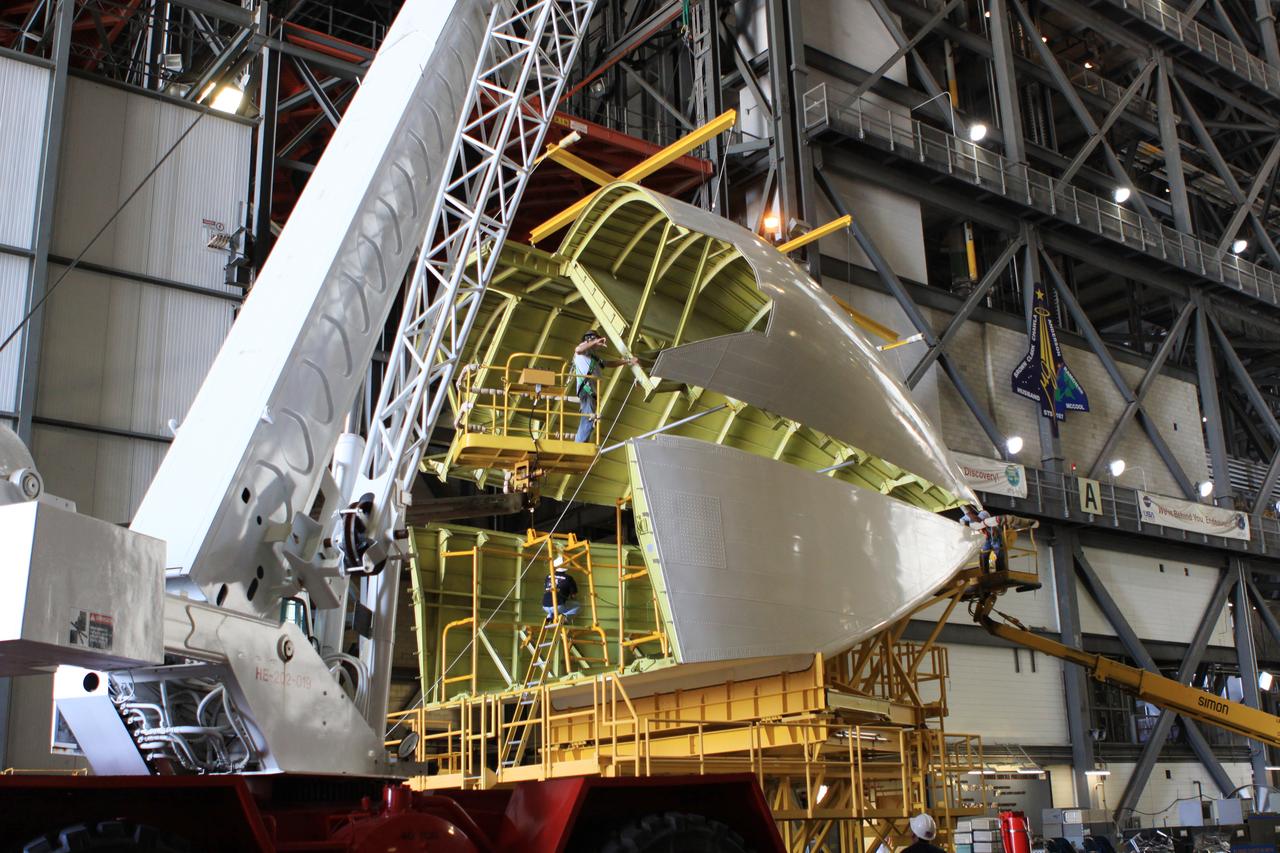
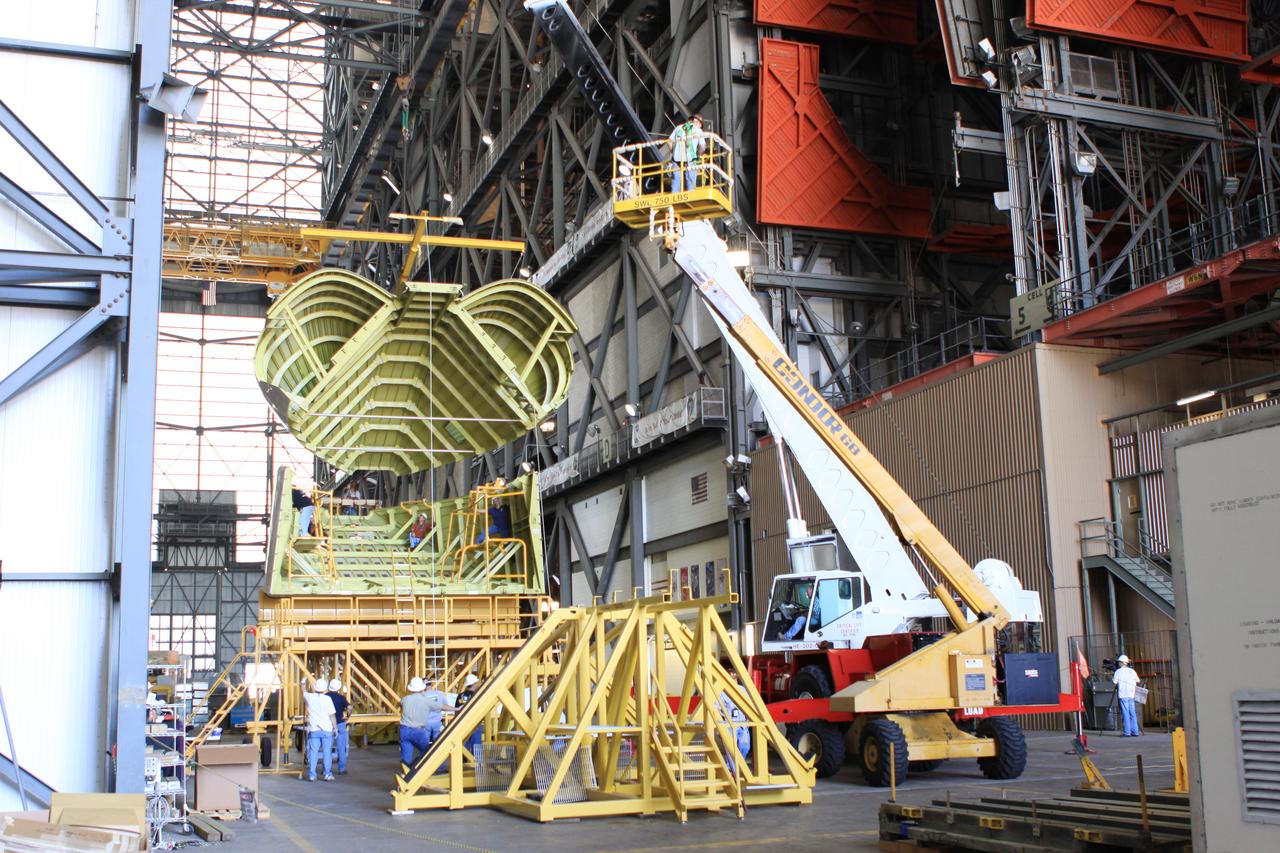
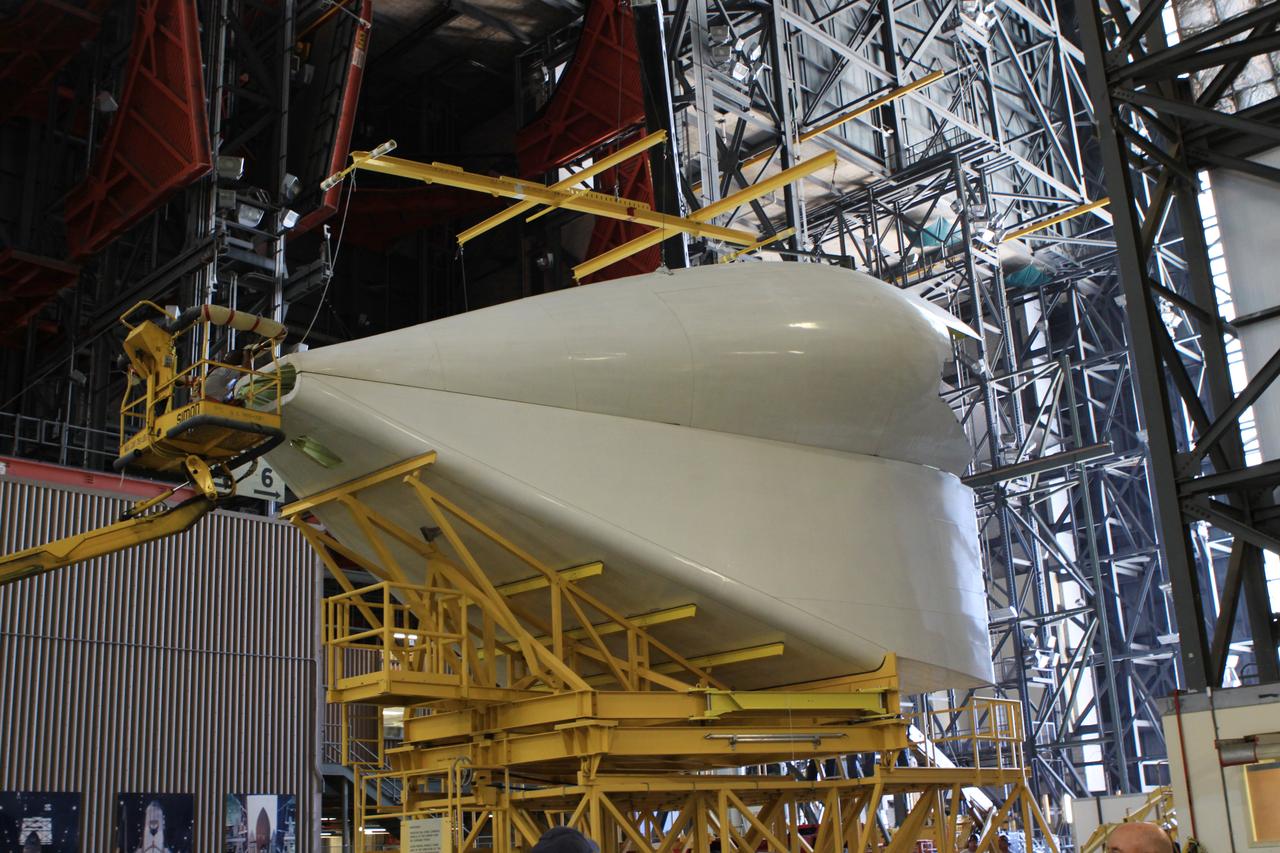
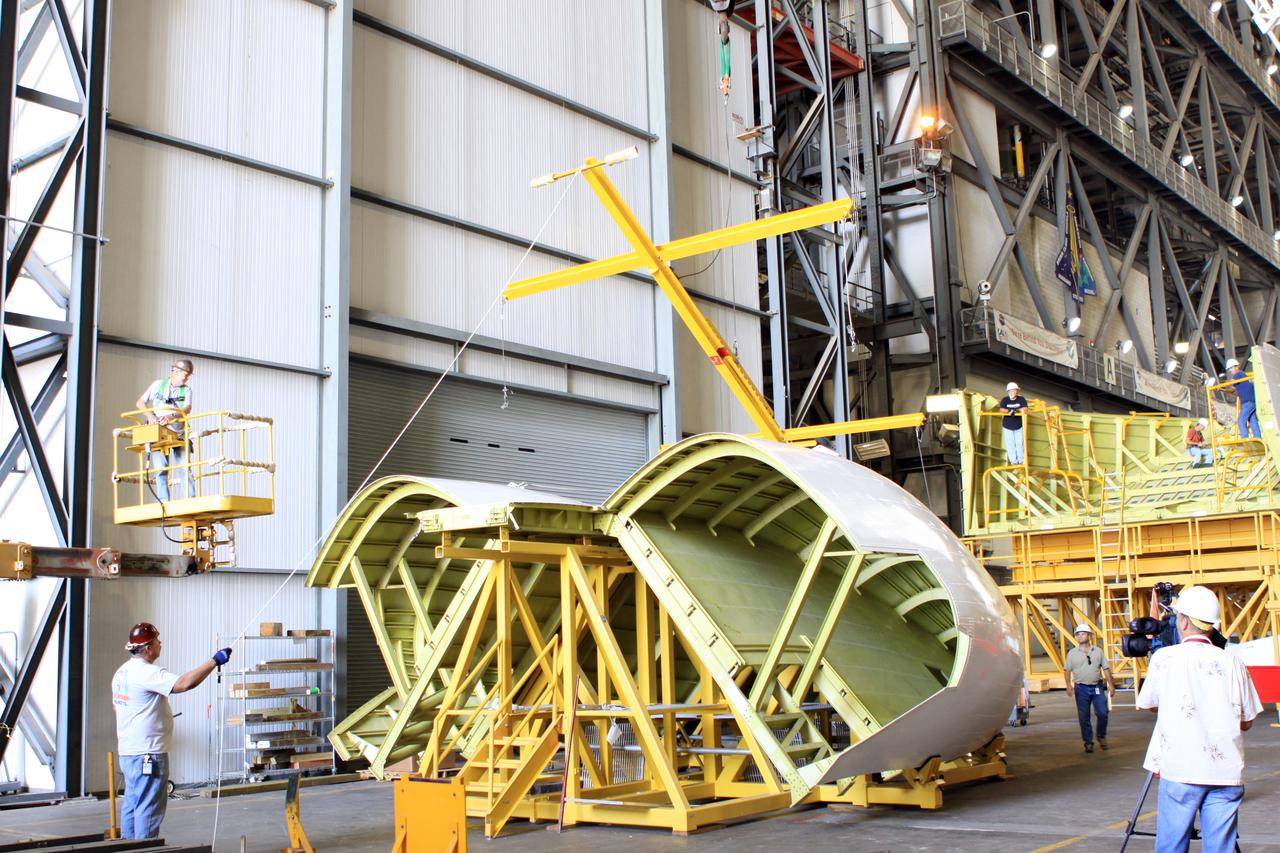
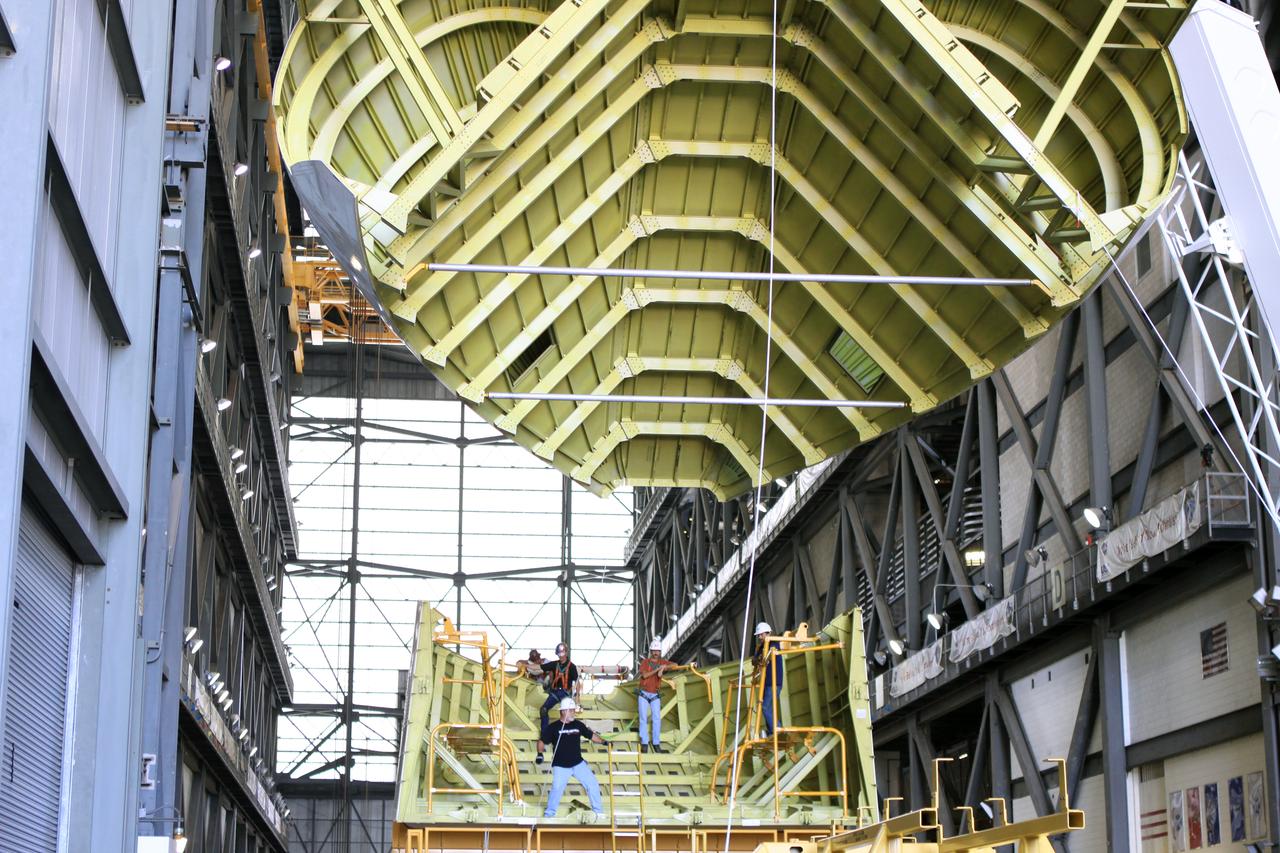
Technicians at NASA’s Marshall Space Flight Center in Huntsville, Alabama, are seen in these images taken April 17, 2025, moving the payload adapter test article from Building 4697 to Building 4705 for storage. This move marks the end of structural testing for the test article. Next, engineers will complete the qualification article and conduct additional for further testing before building the final flight hardware.   Manufactured at Marshall, the test article underwent extensive and rigorous testing to validate the design before engineers finalized the configuration for the flight article. The newly completed composite payload adapter is an evolution from the Orion stage adapter to be used in the upgraded Block 1B configuration of the SLS (Space Launch System) rocket, debuting with Artemis IV.
Teams Move SLS Payload Adapter After Successful Structural Testing
Technicians at NASA’s Marshall Space Flight Center in Huntsville, Alabama, are seen in these images taken April 17, 2025, moving the payload adapter test article from Building 4697 to Building 4705 for storage. This move marks the end of structural testing for the test article. Next, engineers will complete the qualification article and conduct additional for further testing before building the final flight hardware.   Manufactured at Marshall, the test article underwent extensive and rigorous testing to validate the design before engineers finalized the configuration for the flight article. The newly completed composite payload adapter is an evolution from the Orion stage adapter to be used in the upgraded Block 1B configuration of the SLS (Space Launch System) rocket, debuting with Artemis IV.
Teams Move SLS Payload Adapter After Successful Structural Testing_7
Technicians at NASA’s Marshall Space Flight Center in Huntsville, Alabama, are seen in these images taken April 17, 2025, moving the payload adapter test article from Building 4697 to Building 4705 for storage. This move marks the end of structural testing for the test article. Next, engineers will complete the qualification article and conduct additional for further testing before building the final flight hardware.   Manufactured at Marshall, the test article underwent extensive and rigorous testing to validate the design before engineers finalized the configuration for the flight article. The newly completed composite payload adapter is an evolution from the Orion stage adapter to be used in the upgraded Block 1B configuration of the SLS (Space Launch System) rocket, debuting with Artemis IV.
Teams Move SLS Payload Adapter After Successful Structural Testing_2
Technicians at NASA’s Marshall Space Flight Center in Huntsville, Alabama, are seen in these images taken April 17, 2025, moving the payload adapter test article from Building 4697 to Building 4705 for storage. This move marks the end of structural testing for the test article. Next, engineers will complete the qualification article and conduct additional for further testing before building the final flight hardware.   Manufactured at Marshall, the test article underwent extensive and rigorous testing to validate the design before engineers finalized the configuration for the flight article. The newly completed composite payload adapter is an evolution from the Orion stage adapter to be used in the upgraded Block 1B configuration of the SLS (Space Launch System) rocket, debuting with Artemis IV.
Teams Move SLS Payload Adapter After Successful Structural Testing_4
Technicians at NASA’s Marshall Space Flight Center in Huntsville, Alabama, are seen in these images taken April 17, 2025, moving the payload adapter test article from Building 4697 to Building 4705 for storage. This move marks the end of structural testing for the test article. Next, engineers will complete the qualification article and conduct additional for further testing before building the final flight hardware.   Manufactured at Marshall, the test article underwent extensive and rigorous testing to validate the design before engineers finalized the configuration for the flight article. The newly completed composite payload adapter is an evolution from the Orion stage adapter to be used in the upgraded Block 1B configuration of the SLS (Space Launch System) rocket, debuting with Artemis IV.
Teams Move SLS Payload Adapter After Successful Structural Testing_6
Technicians at NASA’s Marshall Space Flight Center in Huntsville, Alabama, are seen in these images taken April 17, 2025, moving the payload adapter test article from Building 4697 to Building 4705 for storage. This move marks the end of structural testing for the test article. Next, engineers will complete the qualification article and conduct additional for further testing before building the final flight hardware.   Manufactured at Marshall, the test article underwent extensive and rigorous testing to validate the design before engineers finalized the configuration for the flight article. The newly completed composite payload adapter is an evolution from the Orion stage adapter to be used in the upgraded Block 1B configuration of the SLS (Space Launch System) rocket, debuting with Artemis IV.
Teams Move SLS Payload Adapter After Successful Structural Testing_5
Technicians at NASA’s Marshall Space Flight Center in Huntsville, Alabama, are seen in these images taken April 17, 2025, moving the payload adapter test article from Building 4697 to Building 4705 for storage. This move marks the end of structural testing for the test article. Next, engineers will complete the qualification article and conduct additional for further testing before building the final flight hardware.   Manufactured at Marshall, the test article underwent extensive and rigorous testing to validate the design before engineers finalized the configuration for the flight article. The newly completed composite payload adapter is an evolution from the Orion stage adapter to be used in the upgraded Block 1B configuration of the SLS (Space Launch System) rocket, debuting with Artemis IV.
Teams Move SLS Payload Adapter After Successful Structural Testing_3
Technicians at NASA’s Marshall Space Flight Center in Huntsville, Alabama, are seen in these images taken April 17, 2025, moving the payload adapter test article from Building 4697 to Building 4705 for storage. This move marks the end of structural testing for the test article. Next, engineers will complete the qualification article and conduct additional for further testing before building the final flight hardware.   Manufactured at Marshall, the test article underwent extensive and rigorous testing to validate the design before engineers finalized the configuration for the flight article. The newly completed composite payload adapter is an evolution from the Orion stage adapter to be used in the upgraded Block 1B configuration of the SLS (Space Launch System) rocket, debuting with Artemis IV.
Teams Move SLS Payload Adapter After Successful Structural Testing
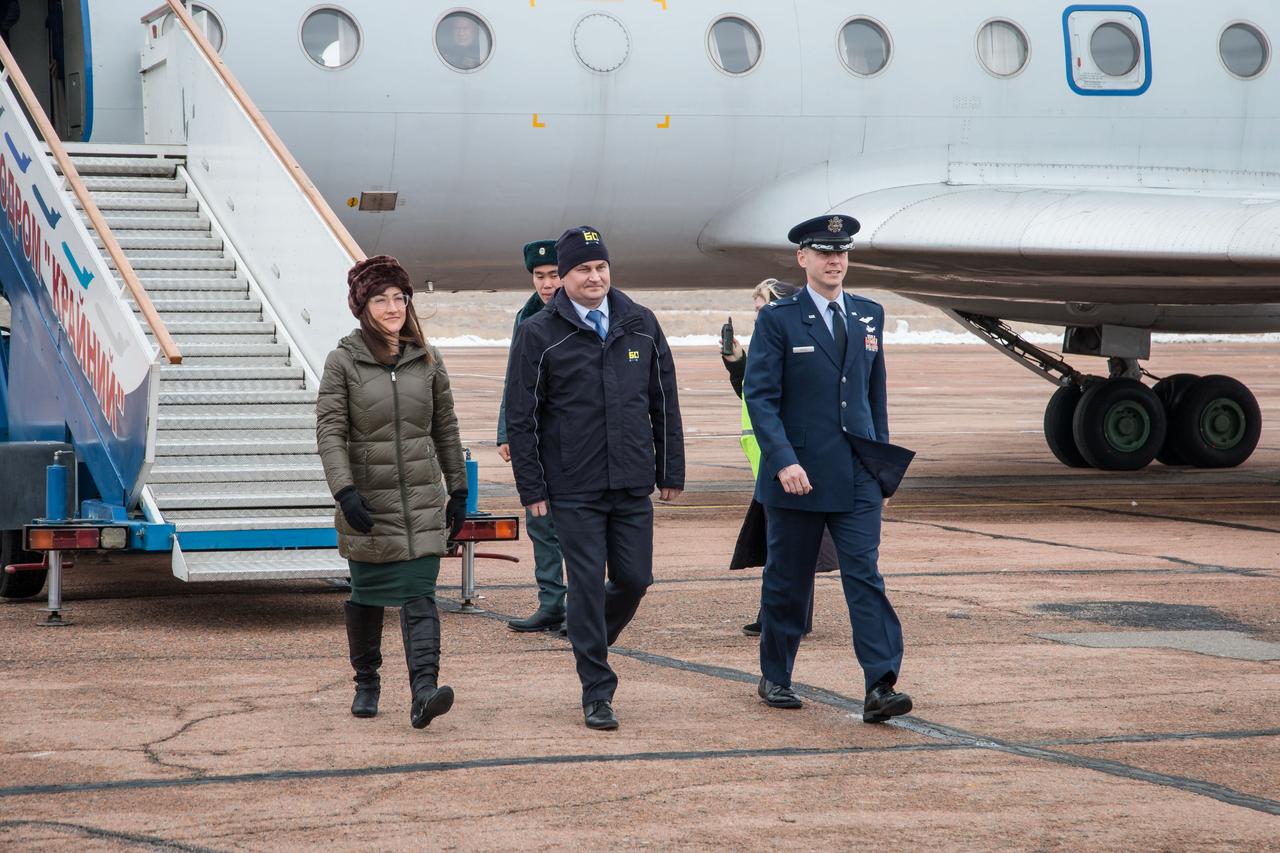
Expedition 59 crewmembers Christina Koch of NASA (left), Alexey Ovchinin of Roscosmos (center) and Nick Hague of NASA (right) arrive at the Baikonur Cosmodrome in Kazakhstan Feb. 26 for final pre-launch training following a flight from their training base at the Gagarin Cosmonaut Training Center in Star City, Russia. They will launch March 14, U.S. time, on the Soyuz MS-12 spacecraft from the Baikonur Cosmodrome in Kazakhstan for a six-and-a-half month mission on the International Space Station.  NASA/Victor Zelentsov
jsc2019e007200 - Expedition 59 crewmembers Christina Koch of NASA (left), Alexey Ovchinin of Roscosmos (center) and Nick Hague of NASA (right) arrive at the Baikonur Cosmodrome in Kazakhstan Feb. 26 for final pre-launch training following a flight from th
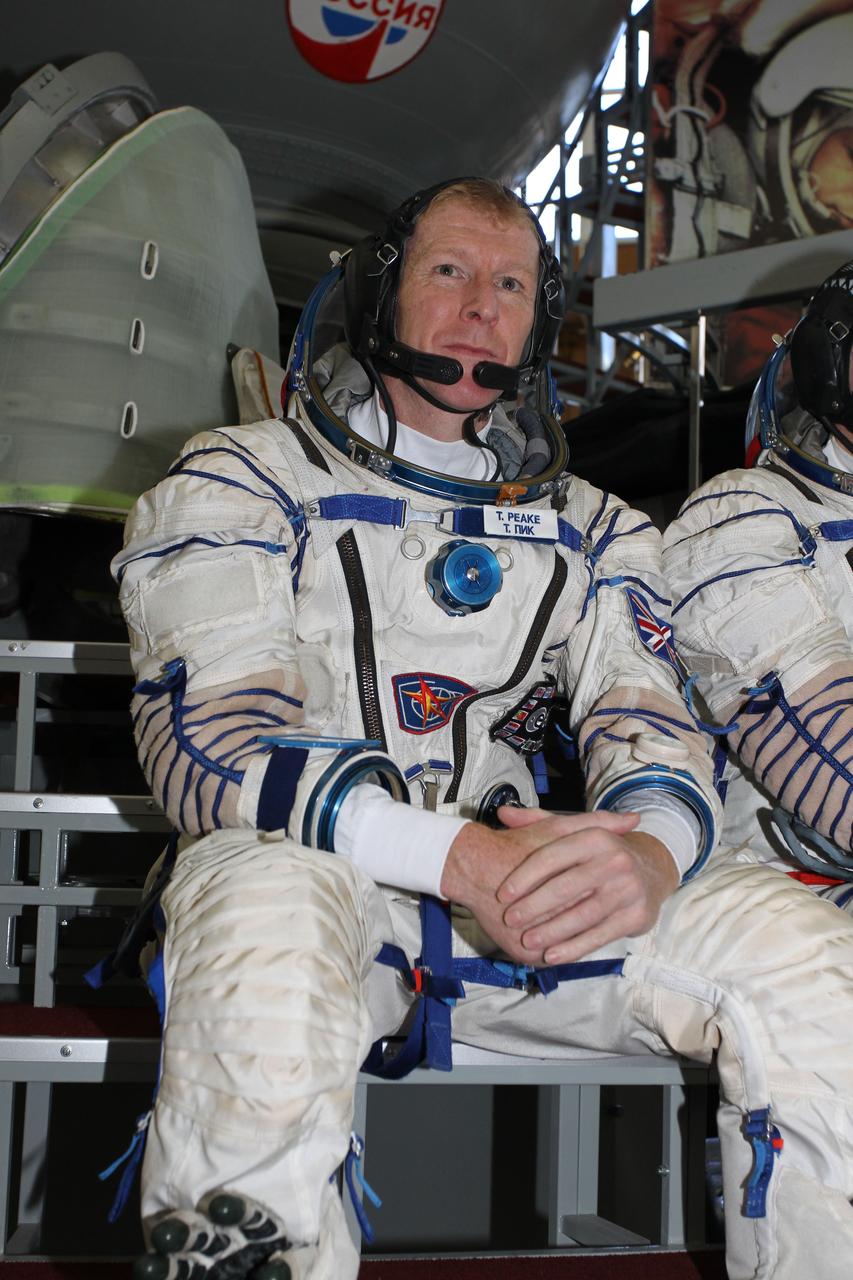
CG4G8784 --- (6 May 2015) --- At the Gagarin Cosmonaut Training Center in Star City, Russia, Expedition 44/45 backup Flight Engineer Timothy Peake of the European Space Agency answers questions from reporters in front of a Soyuz spacecraft simulator May 6 as part of his final qualification exams for flight. He along with Yuri Malenchenko of the Russian Federal Space Agency (Roscosmos) and Timothy Kopra of NASA (not pictured) are the backups to the prime crew --- Kjell Lindgren of NASA, Oleg Kononenko of Roscosmos and Kimya Yui of the Japan Aerospace Exploration Agency --- who are in the final stages of training for launch May 27, Kazakh time, in the Soyuz TMA-17M spacecraft to begin a five and a half month mission to the International Space Station. Photo credit: NASA/Seth Marcantel
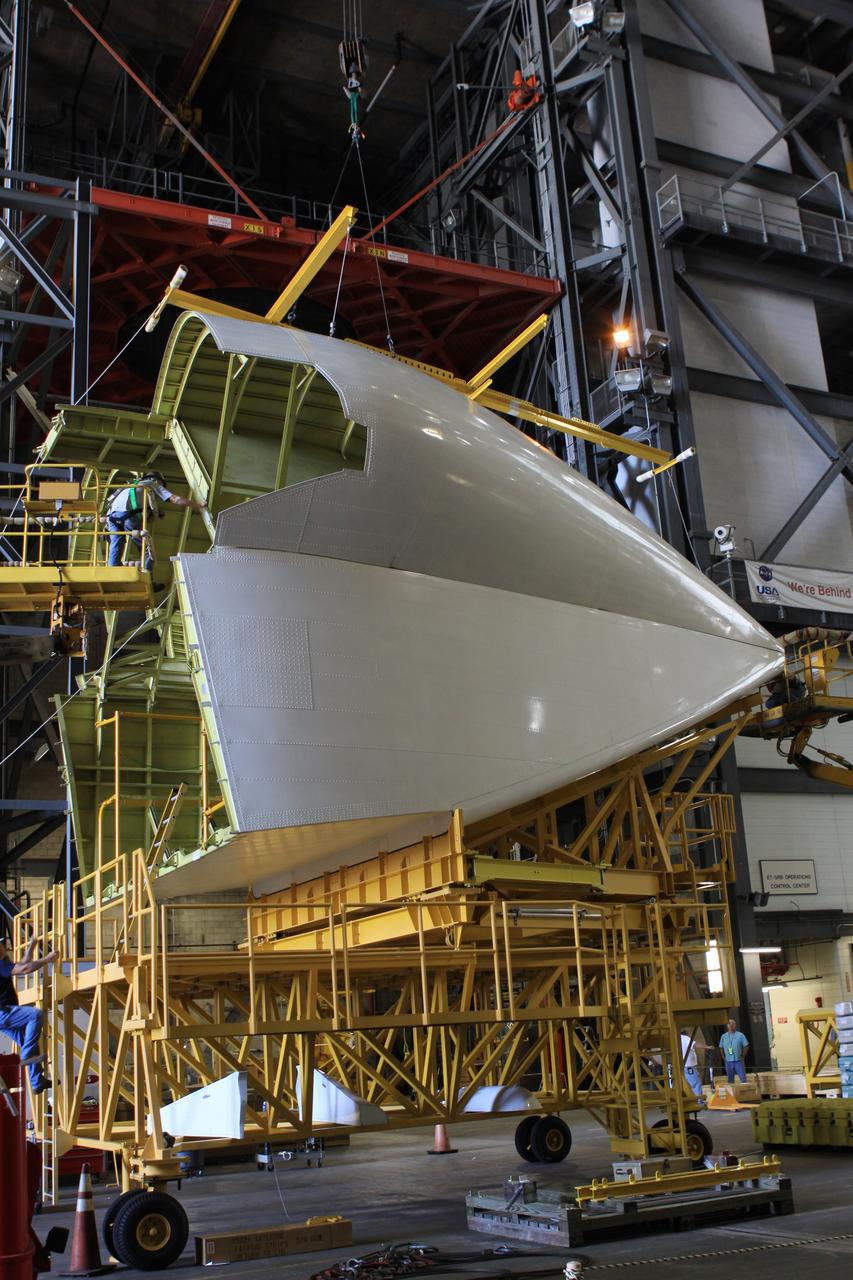
T&R Endeavour, Final Buildup of Tail Cover for Ferry Flight
2012-2954
T&R Endeavour, Final Buildup of Tail Cover for Ferry Flight
2012-2956
T&R Endeavour, Final Buildup of Tail Cover for Ferry Flight
2012-2952
T&R Endeavour, Final Buildup of Tail Cover for Ferry Flight
2012-2958
T&R Endeavour, Final Buildup of Tail Cover for Ferry Flight
2012-2953
T&R Endeavour, Final Buildup of Tail Cover for Ferry Flight
2012-2957
T&R Endeavour, Final Buildup of Tail Cover for Ferry Flight
2012-2951
T&R Endeavour, Final Buildup of Tail Cover for Ferry Flight
2012-2955
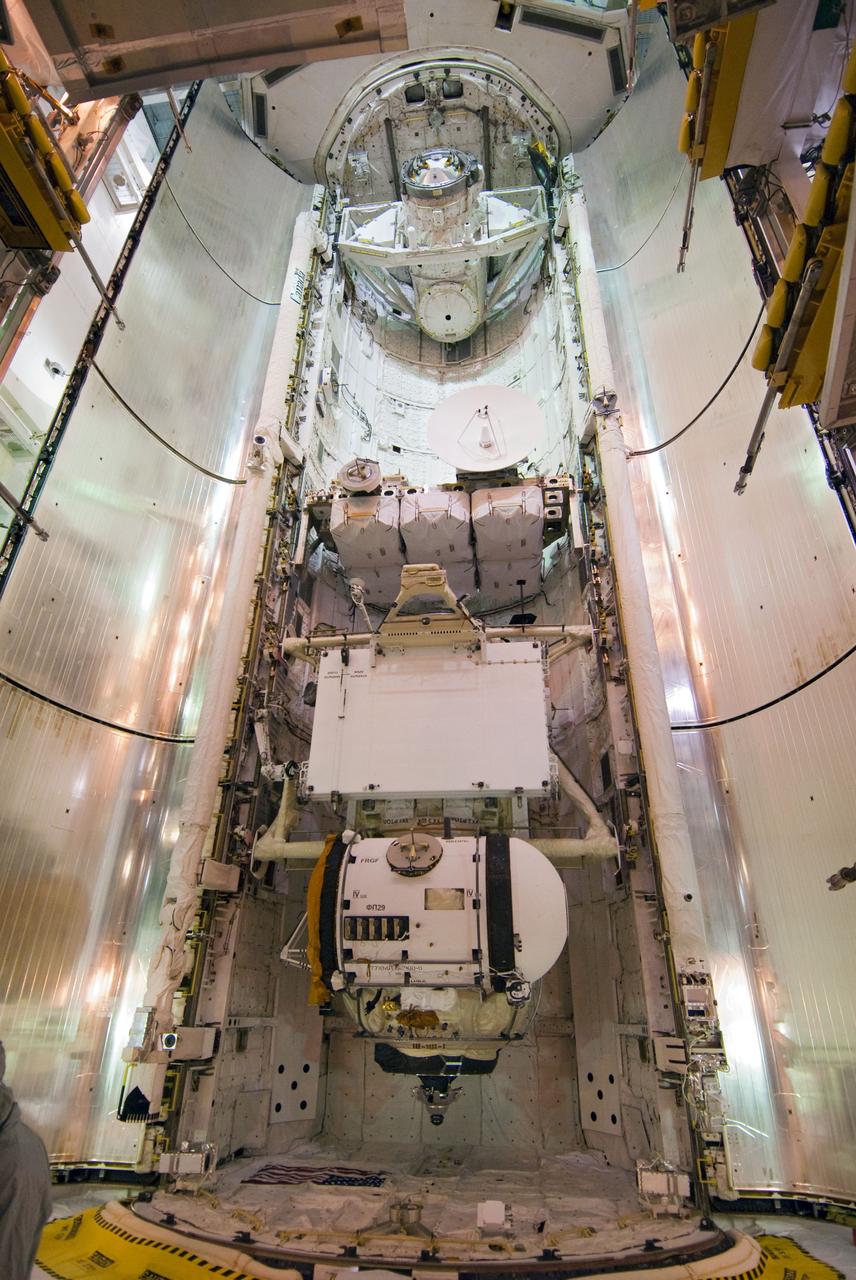
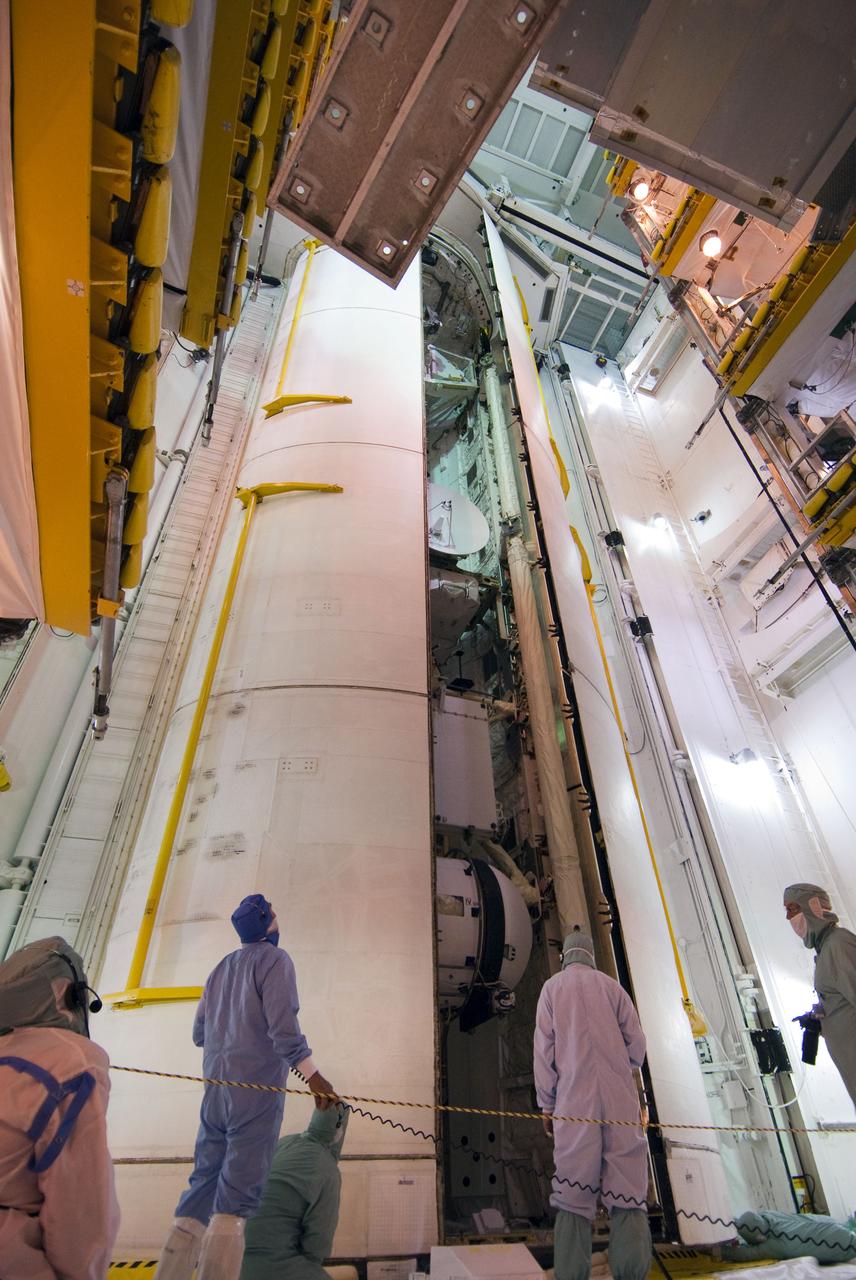
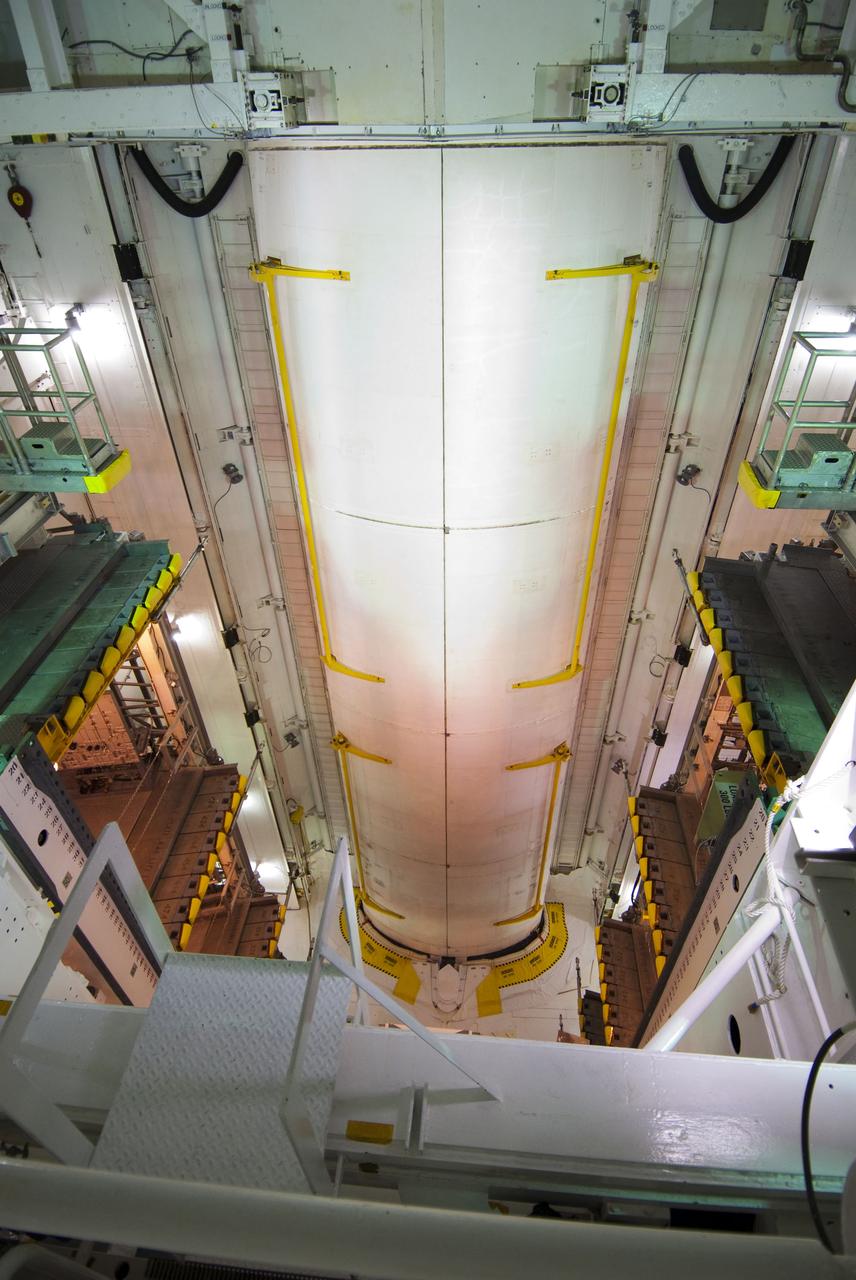
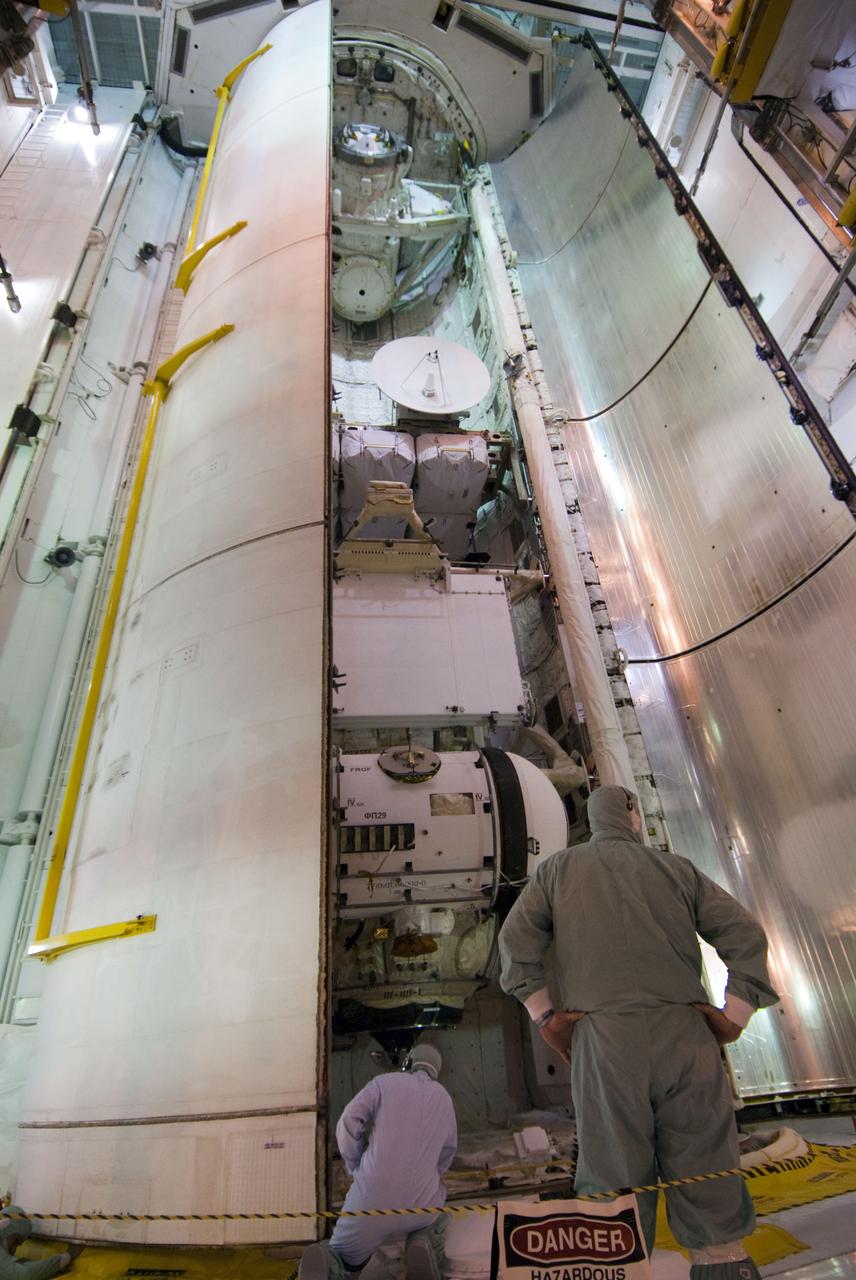
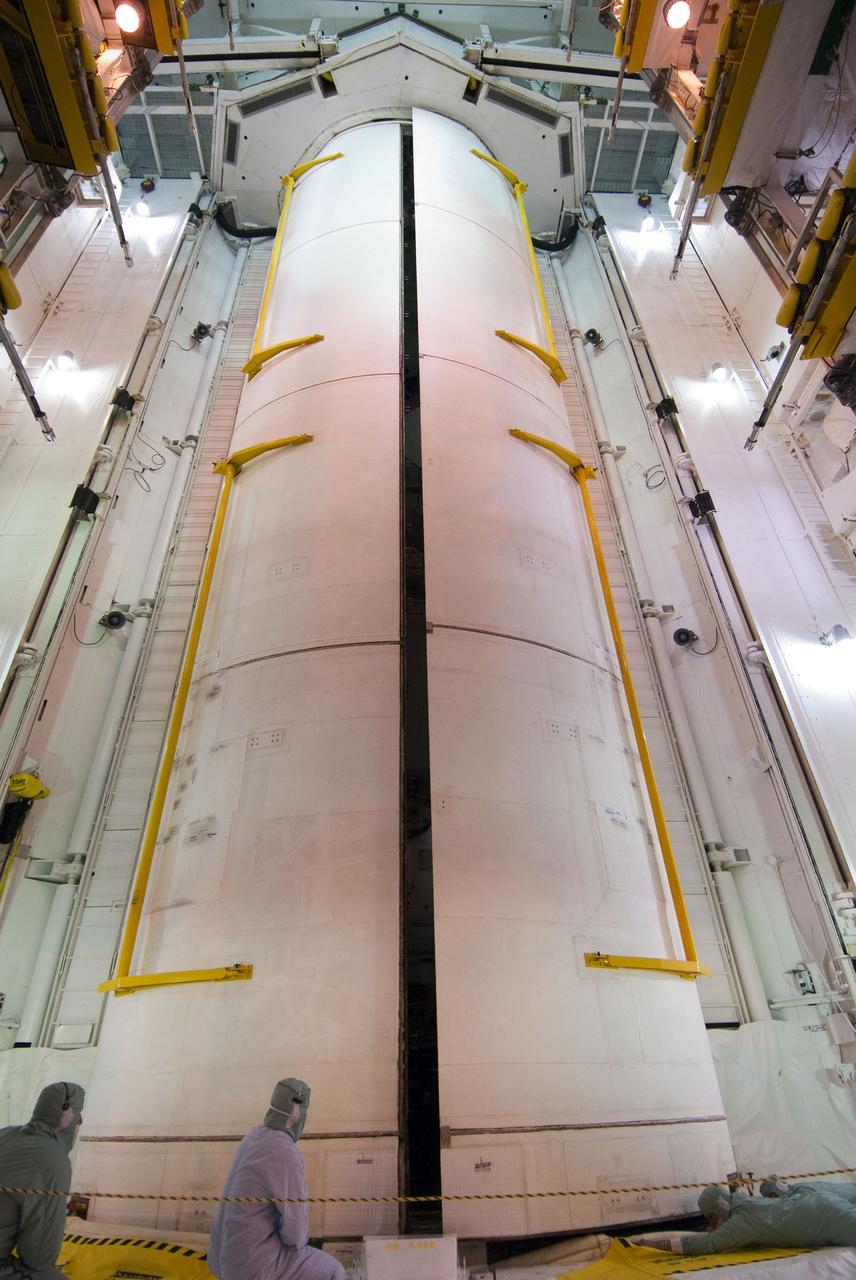
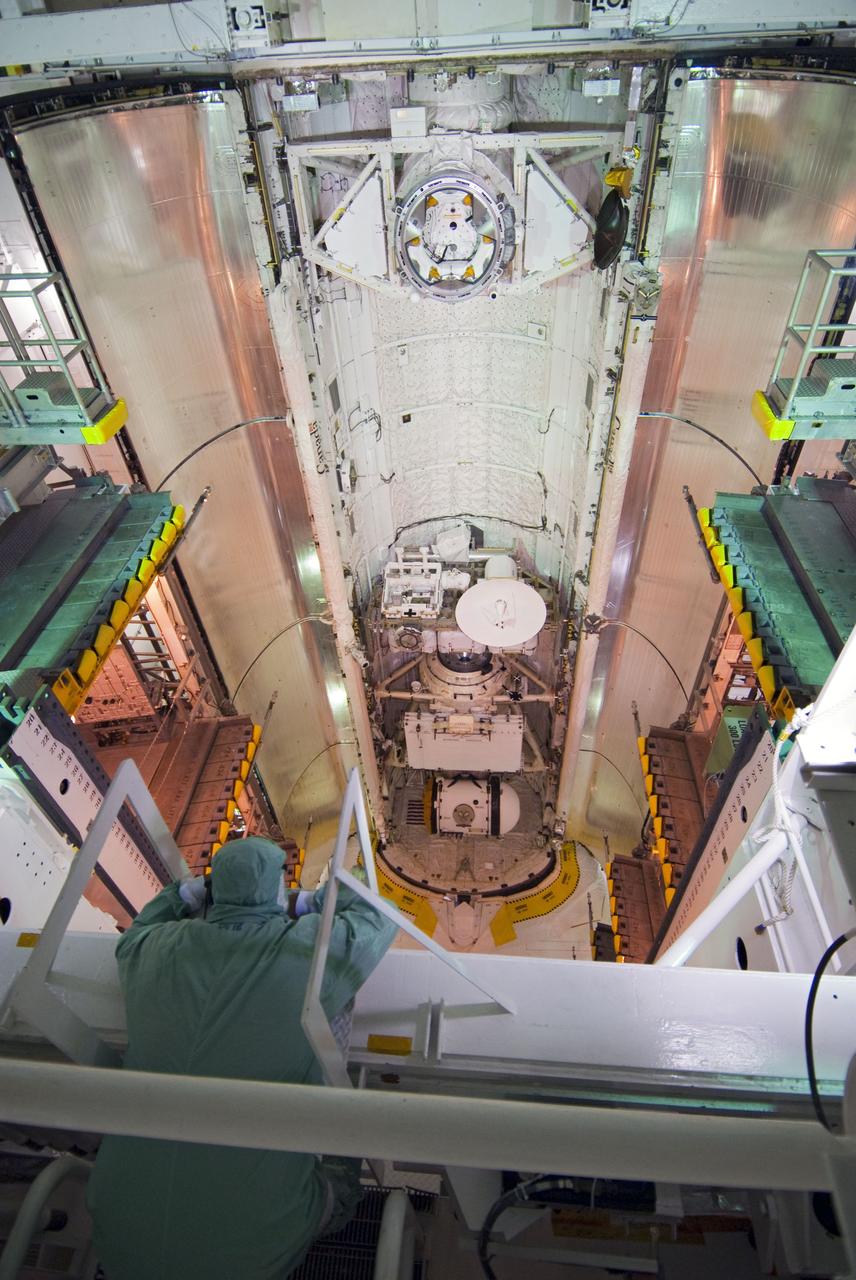
STS-132 LAUNCH L-3 FINAL PAYLOAD BAY DOOR CLOSURE FOR FLIGHT
2010-3245
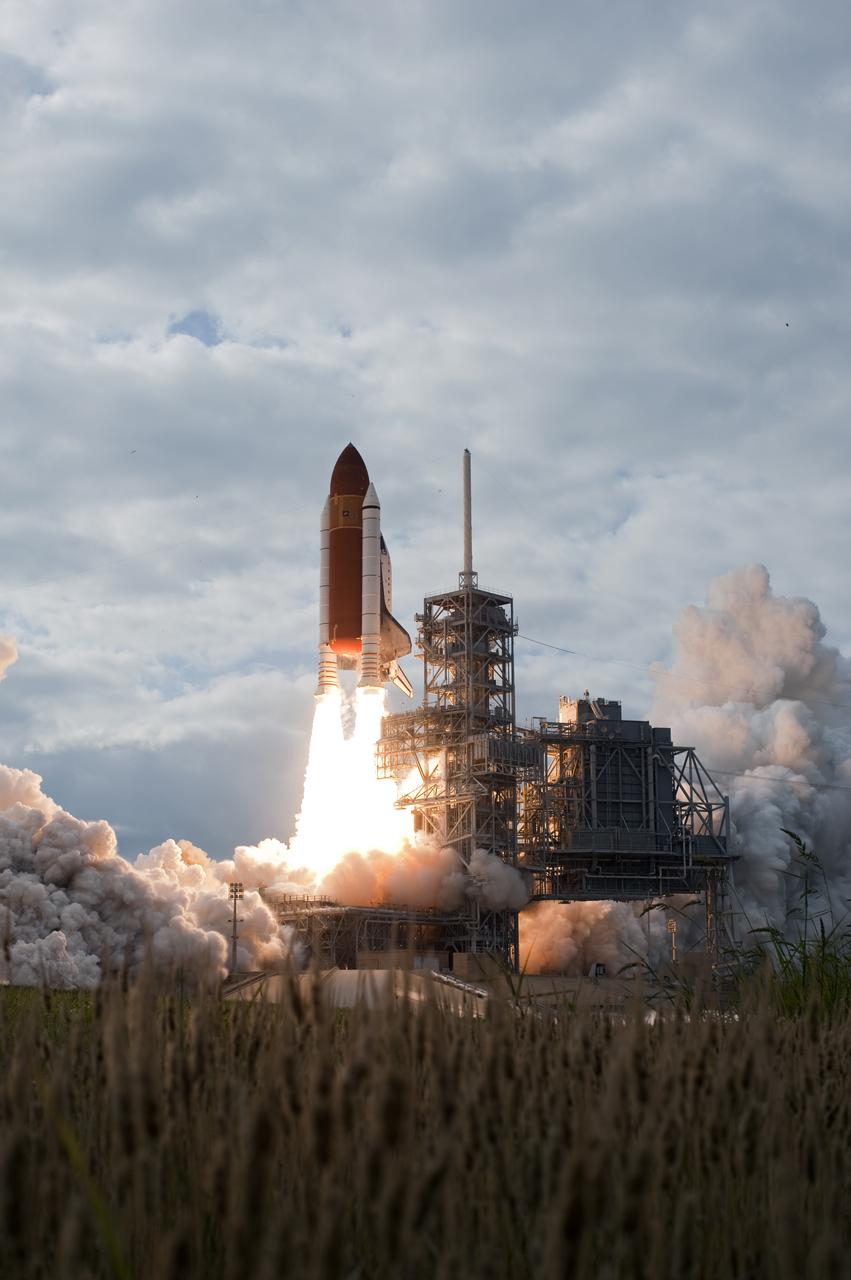
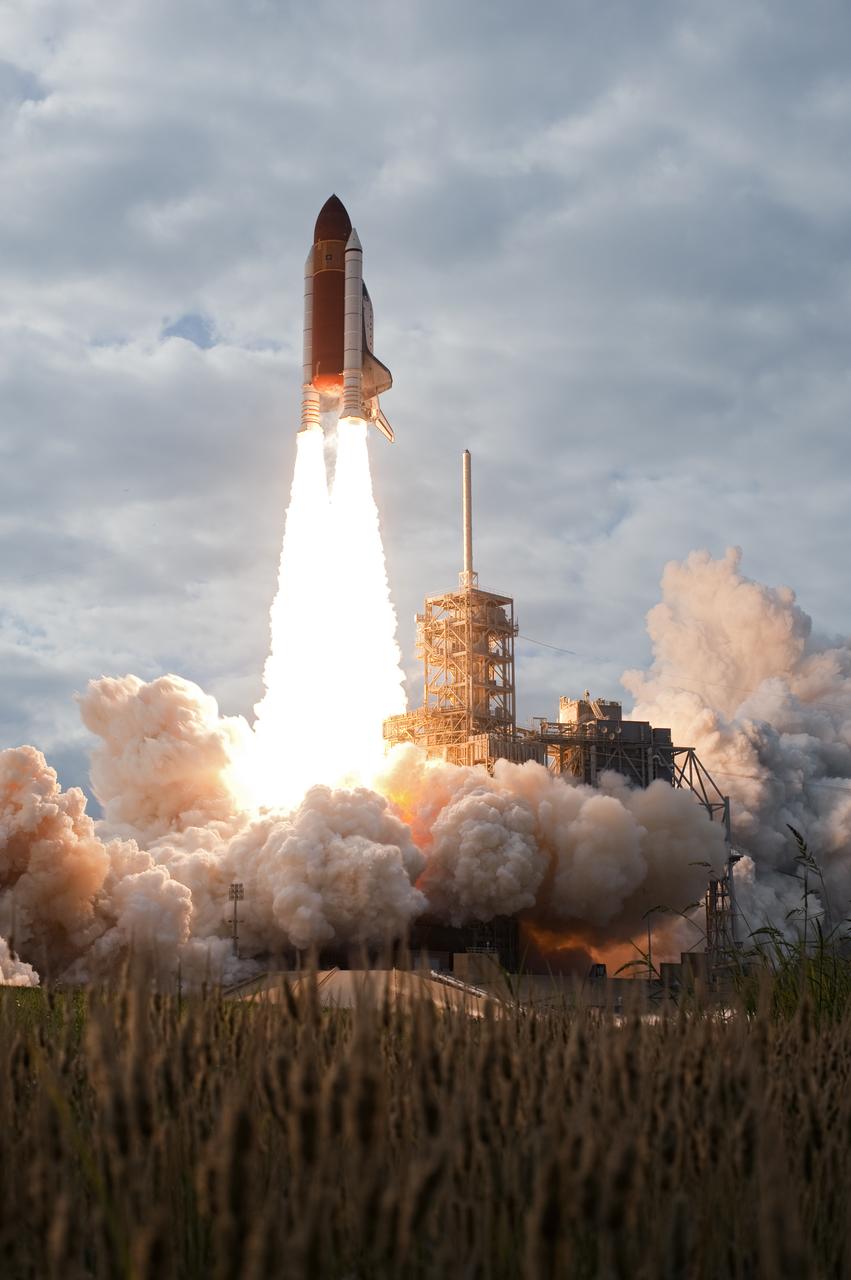
The Space Shuttle Endeavour blasts off from pad 39A at 8:56 am EDT.  This is the final flight for Endeavour.
Launch of STS-134 Space Shuttle Endeavour.
STS-132 LAUNCH L-3 FINAL PAYLOAD BAY DOOR CLOSURE FOR FLIGHT
2010-3240
STS-132 LAUNCH L-3 FINAL PAYLOAD BAY DOOR CLOSURE FOR FLIGHT
2010-3244
STS-132 LAUNCH L-3 FINAL PAYLOAD BAY DOOR CLOSURE FOR FLIGHT
2010-3246
STS-132 LAUNCH L-3 FINAL PAYLOAD BAY DOOR CLOSURE FOR FLIGHT
2010-3243
The Space Shuttle Endeavour blasts off from pad 39A at 8:56 am EDT.  This is the final flight for Endeavour.
Launch of STS-134 Space Shuttle Endeavour.
STS-132 LAUNCH L-3 FINAL PAYLOAD BAY DOOR CLOSURE FOR FLIGHT
2010-3239
STS-132 LAUNCH L-3 FINAL PAYLOAD BAY DOOR CLOSURE FOR FLIGHT
2010-3241
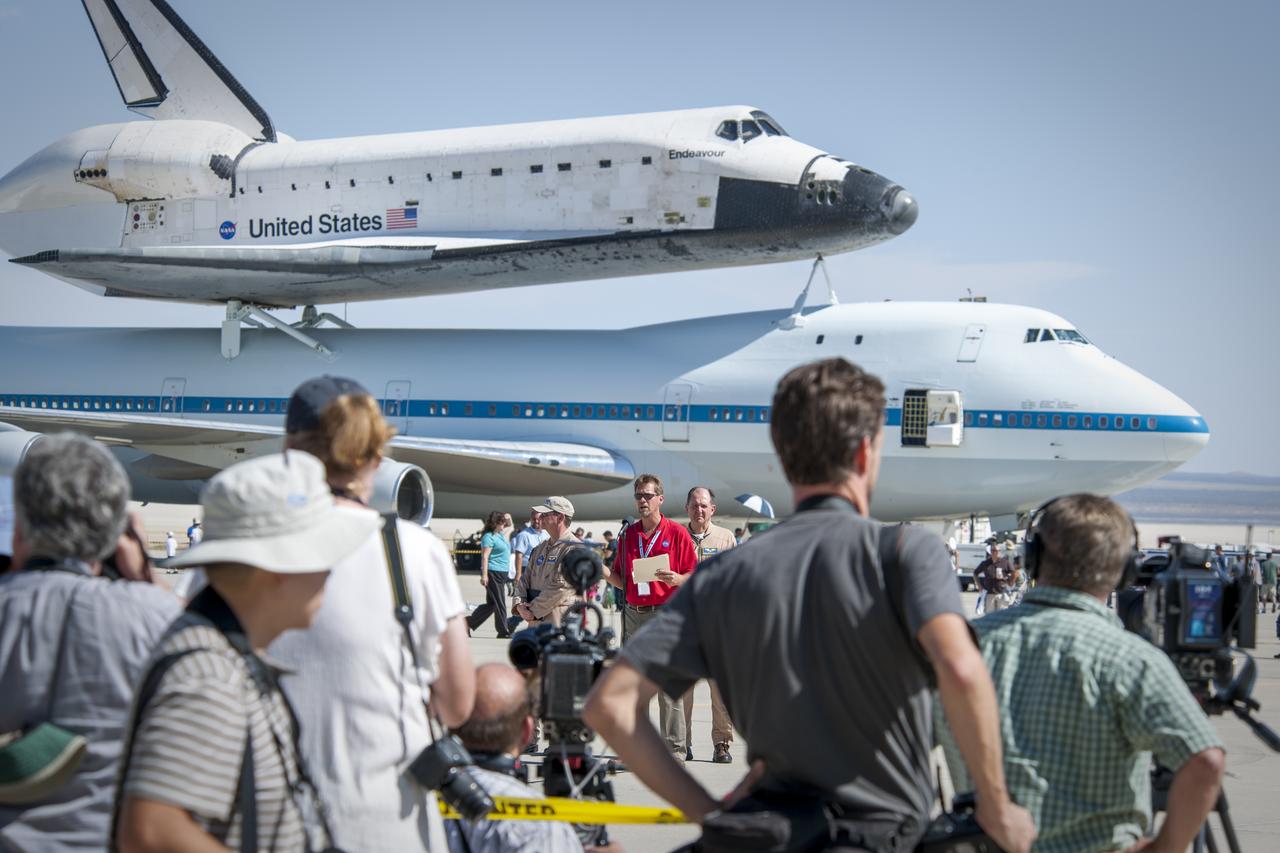
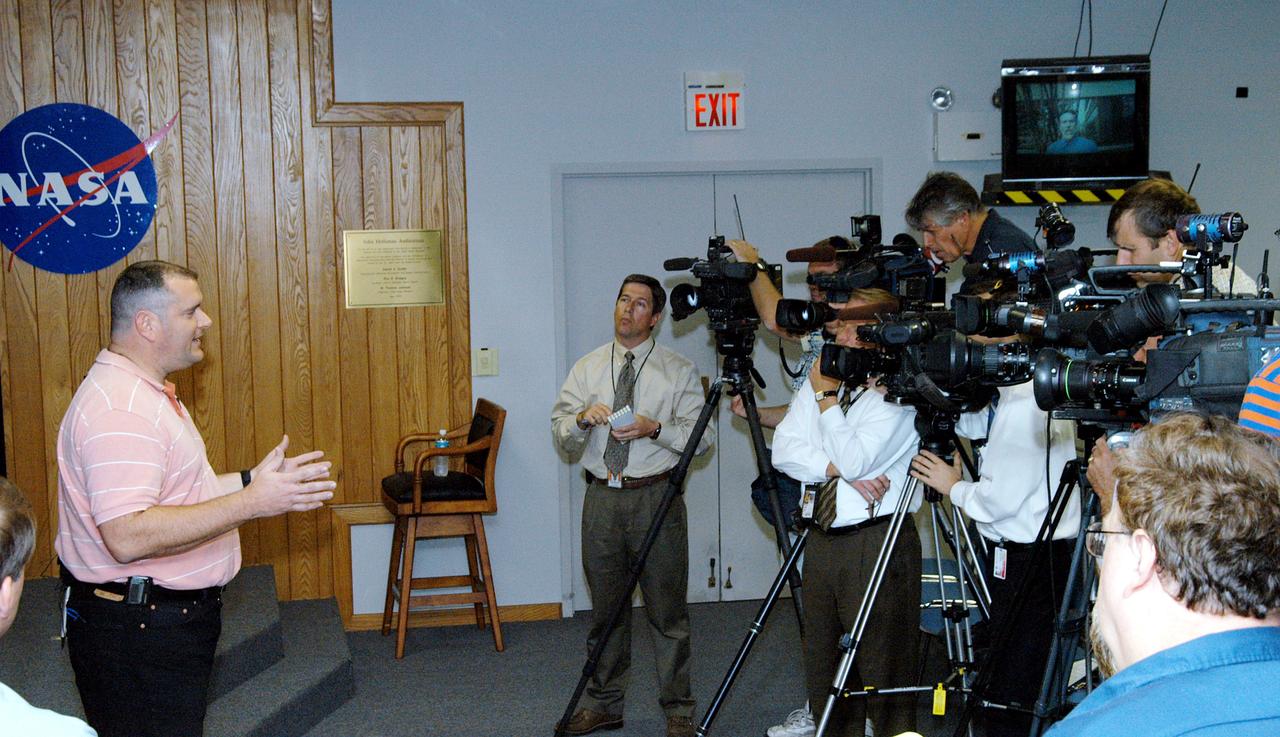
Media, social media, and NASA Armstrong (then Dryden) Flight Research Center employees and family wait for a press conference on the center’s back ramp on Sept. 20, 2012, in Edwards, California.
Space Shuttle Endeavour Toured California in 2012
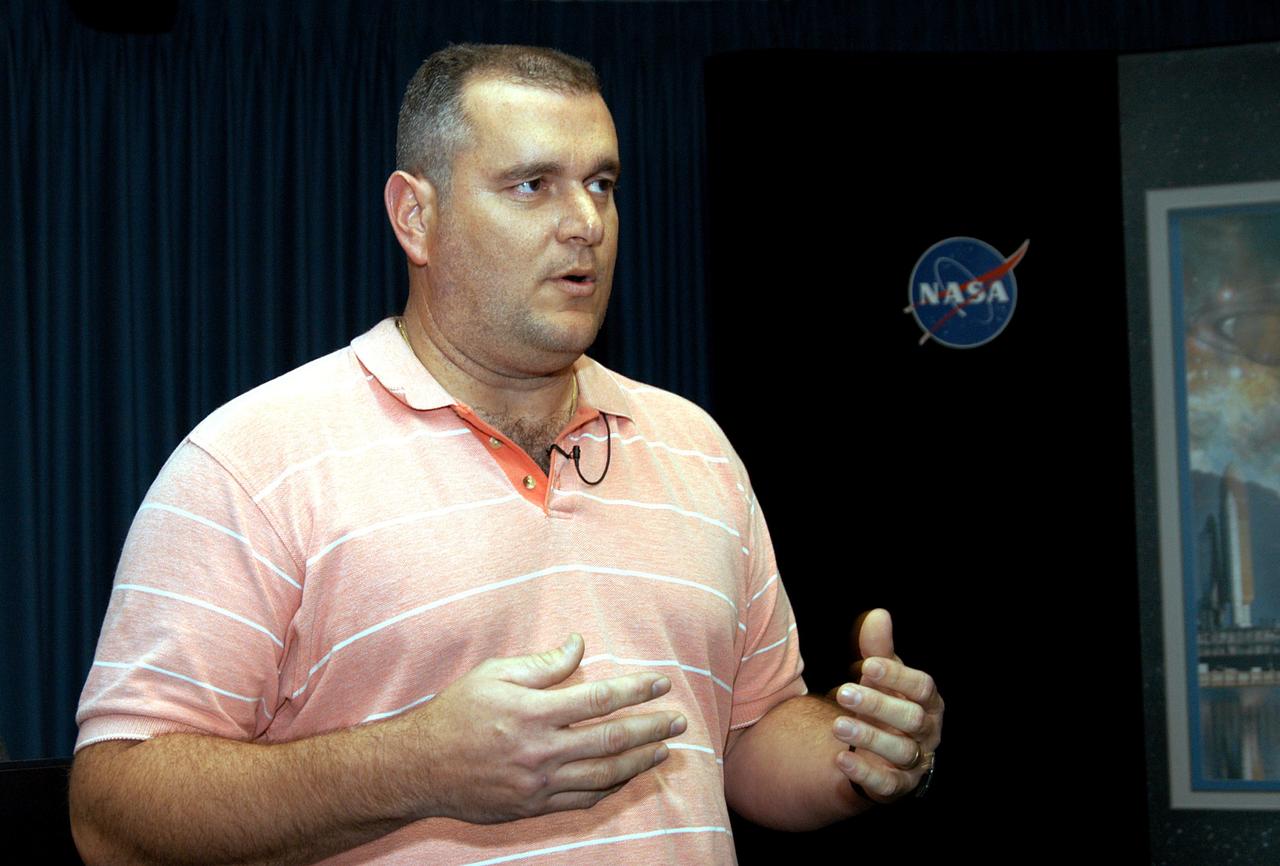
KENNEDY SPACE CENTER, FLA. - Armando Oliu, Final Inspection Team lead for the Shuttle program, speaks to reporters about the aid the Image Analysis Lab is giving the FBI in a kidnapping case.  Oliu oversees the image lab that is using an advanced SGI® TP9500 data management system to review the tape of the kidnapping in progress in Sarasota, Fla.  KSC installed the new $3.2 million system in preparation for Return to Flight of the Space Shuttle fleet.  The lab is studying the Sarasota kidnapping video to provide any new information possible to law enforcement officers.  KSC is joining NASA’s Marshall Space Flight Center in Alabama in reviewing the tape.
KENNEDY SPACE CENTER, FLA. - Armando Oliu, Final Inspection Team lead for the Shuttle program, speaks to reporters about the aid the Image Analysis Lab is giving the FBI in a kidnapping case. Oliu oversees the image lab that is using an advanced SGI® TP9500 data management system to review the tape of the kidnapping in progress in Sarasota, Fla. KSC installed the new $3.2 million system in preparation for Return to Flight of the Space Shuttle fleet. The lab is studying the Sarasota kidnapping video to provide any new information possible to law enforcement officers. KSC is joining NASA’s Marshall Space Flight Center in Alabama in reviewing the tape.
KENNEDY SPACE CENTER, FLA. - Armando Oliu, Final Inspection Team lead for the Shuttle program, speaks to reporters about the aid the Image Analysis Lab is giving the FBI in a kidnapping case.  Oliu oversees the image lab that is using an advanced SGI® TP9500 data management system to review the tape of the kidnapping in progress in Sarasota, Fla.  KSC installed the new $3.2 million system in preparation for Return to Flight of the Space Shuttle fleet.  The lab is studying the Sarasota kidnapping video to provide any new information possible to law enforcement officers.  KSC is joining NASA’s Marshall Space Flight Center in Alabama in reviewing the tape.
KENNEDY SPACE CENTER, FLA. - Armando Oliu, Final Inspection Team lead for the Shuttle program, speaks to reporters about the aid the Image Analysis Lab is giving the FBI in a kidnapping case. Oliu oversees the image lab that is using an advanced SGI® TP9500 data management system to review the tape of the kidnapping in progress in Sarasota, Fla. KSC installed the new $3.2 million system in preparation for Return to Flight of the Space Shuttle fleet. The lab is studying the Sarasota kidnapping video to provide any new information possible to law enforcement officers. KSC is joining NASA’s Marshall Space Flight Center in Alabama in reviewing the tape.
KENNEDY SPACE CENTER, FLA.  -  Members of the  Stafford-Covey Return to Flight Task Group (SCTG) look over equipment in the Orbiter Processing Facility.  At left (back to camera), Fernando Santos, with NASA, and Paul Ogletree (at monitor), with United Space Alliance, describe how flash thermography is used to inspect the structure of Reinforced Carbon Carbon panels and establish a baseline on panels before flight.  Chairing the task group are Richard O. Covey (far right), former Space Shuttle commander, and Thomas P. Stafford, Apollo commander.  Chartered by NASA Administrator Sean O’Keefe, the task group will perform an independent assessment of NASA’s implementation of the final recommendations by the Columbia Accident Investigation Board.
KENNEDY SPACE CENTER, FLA. - Members of the Stafford-Covey Return to Flight Task Group (SCTG) look over equipment in the Orbiter Processing Facility. At left (back to camera), Fernando Santos, with NASA, and Paul Ogletree (at monitor), with United Space Alliance, describe how flash thermography is used to inspect the structure of Reinforced Carbon Carbon panels and establish a baseline on panels before flight. Chairing the task group are Richard O. Covey (far right), former Space Shuttle commander, and Thomas P. Stafford, Apollo commander. Chartered by NASA Administrator Sean O’Keefe, the task group will perform an independent assessment of NASA’s implementation of the final recommendations by the Columbia Accident Investigation Board.
KENNEDY SPACE CENTER, FLA. - Reporters are eager to hear from Armando Oliu about the aid the Image Analysis Lab is giving the FBI in a kidnapping case.  Oliu, Final Inspection Team lead for the Shuttle program, oversees the lab that is using an advanced SGI® TP9500 data management system to review the tape of the kidnapping in progress in Sarasota, Fla.  KSC installed the new $3.2 million system in preparation for Return to Flight of the Space Shuttle fleet.  The lab is studying the Sarasota kidnapping video to provide any new information possible to law enforcement officers.  KSC is joining NASA’s Marshall Space Flight Center in Alabama in reviewing the tape.
KENNEDY SPACE CENTER, FLA. - Reporters are eager to hear from Armando Oliu about the aid the Image Analysis Lab is giving the FBI in a kidnapping case. Oliu, Final Inspection Team lead for the Shuttle program, oversees the lab that is using an advanced SGI® TP9500 data management system to review the tape of the kidnapping in progress in Sarasota, Fla. KSC installed the new $3.2 million system in preparation for Return to Flight of the Space Shuttle fleet. The lab is studying the Sarasota kidnapping video to provide any new information possible to law enforcement officers. KSC is joining NASA’s Marshall Space Flight Center in Alabama in reviewing the tape.
The X-48C Hybrid Wing Body research aircraft banked right over NASA's Dryden Flight Research Center at Edwards, CA during one of the sub-scale aircraft's final test flights on Feb. 28, 2013.
X-48C Banks over Dryden Flight Research Center
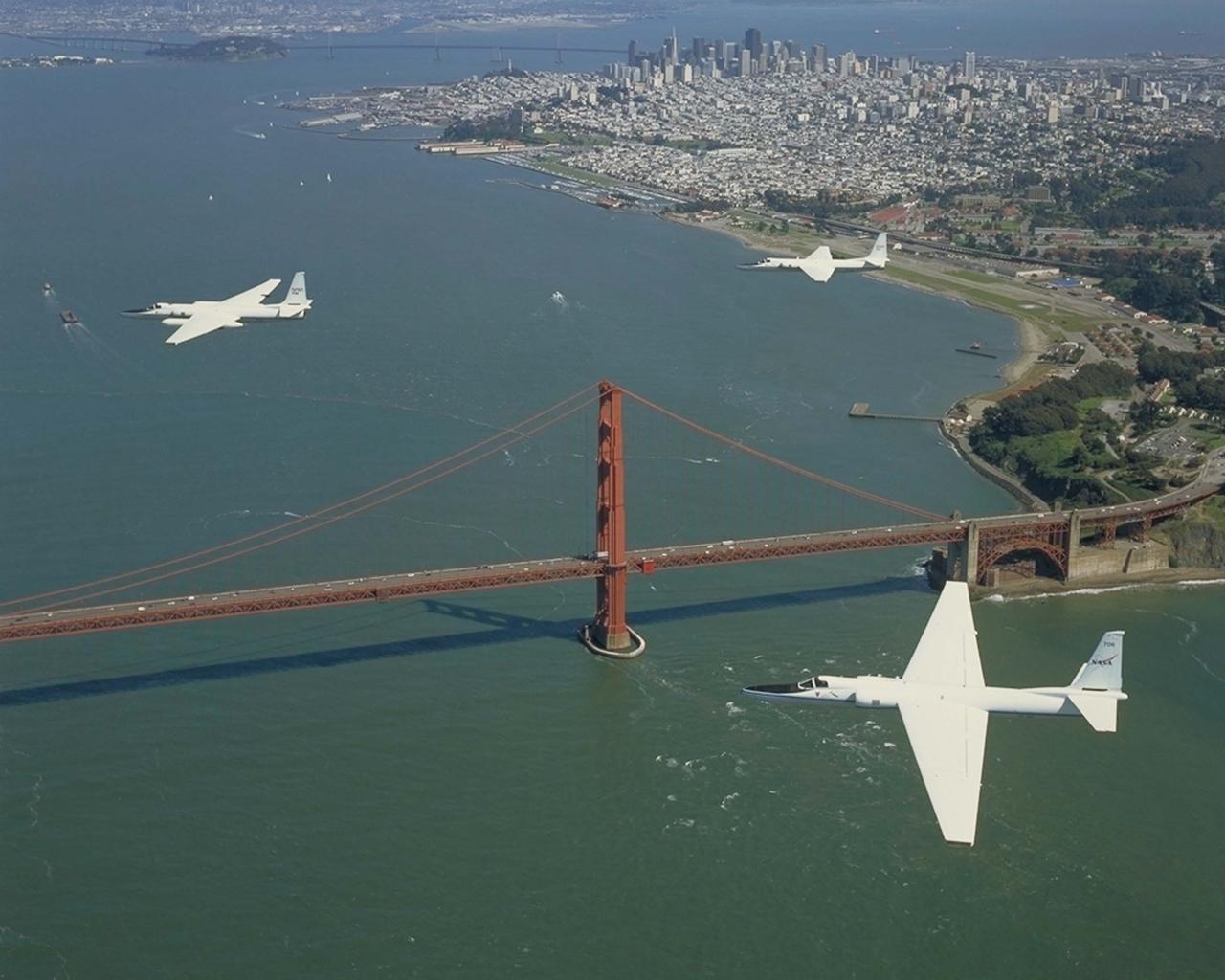
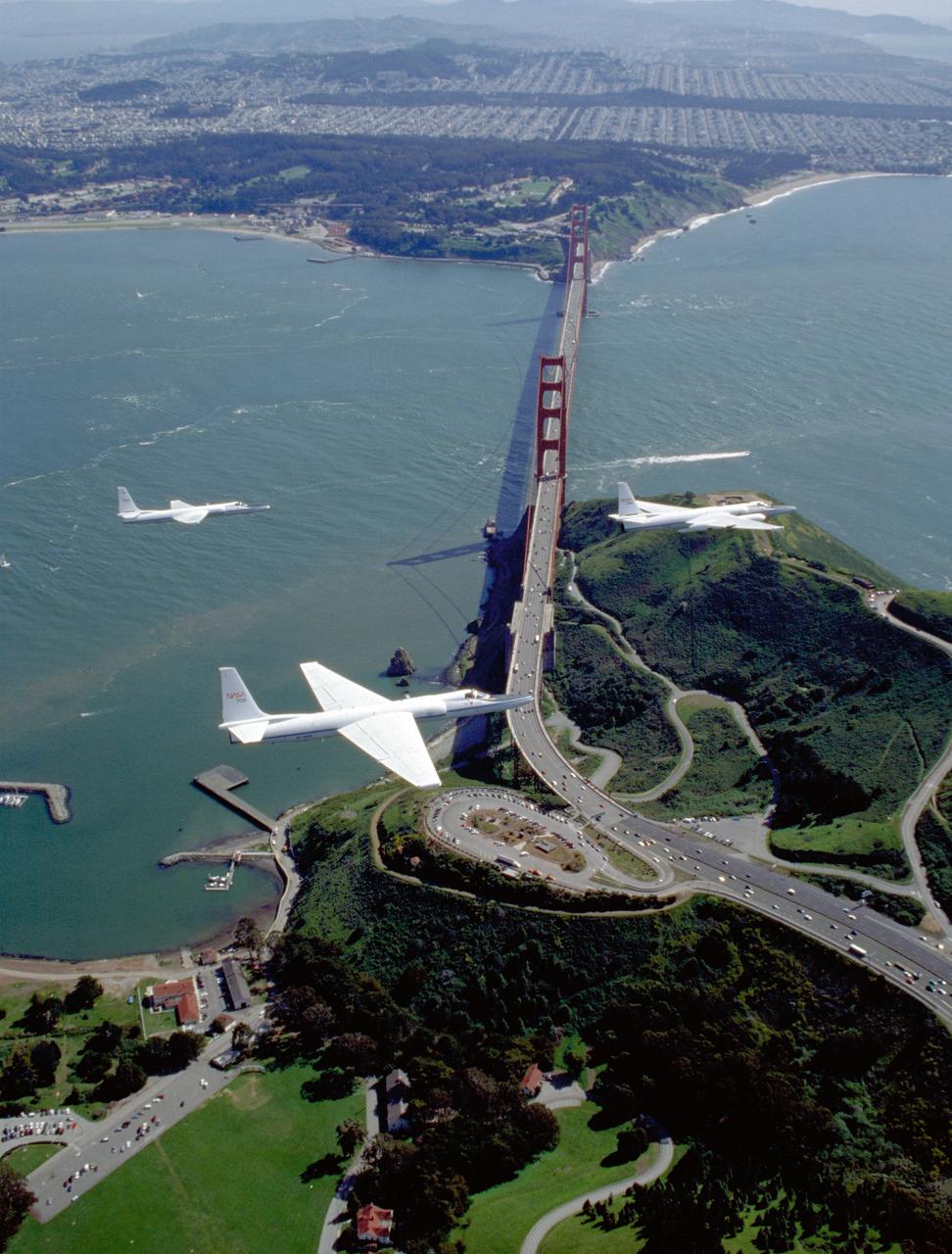
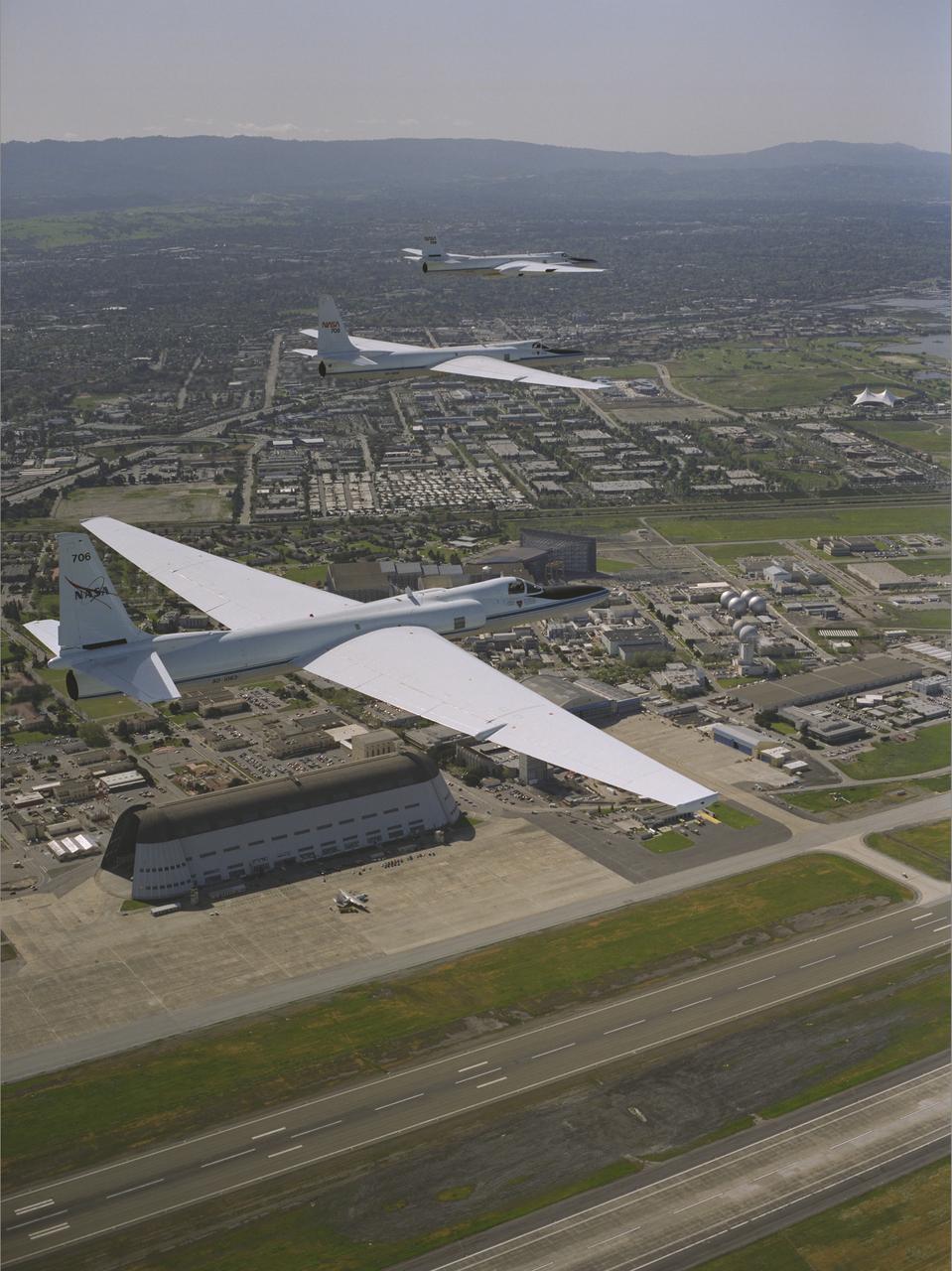
Three ER-2 Aircraft in formation over Golden Gate Bridge, San Francisco, CA on their final flight out of NASA Ames Research Center before redeployment to NASA's Dryden Flight Research Center, CA
ARC-1996-AC96-0106-83
Three ER-2 Aircraft in formation over Golden Gate Bridge, San Francisco, CA on their final flight out of NASA Ames Research Center before redeployment to NASA's Dryden Flight Research Center, CA
ARC-1996-AC96-0106-109
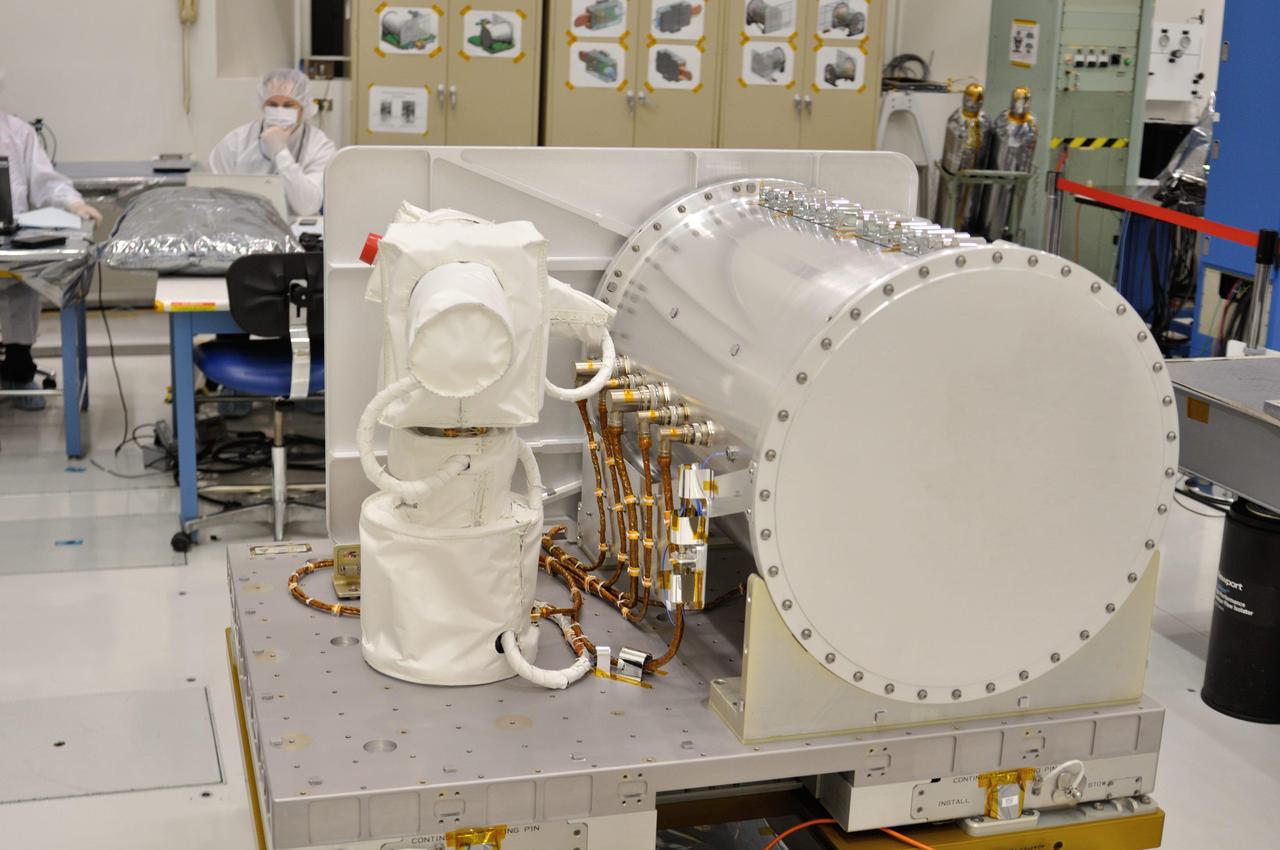
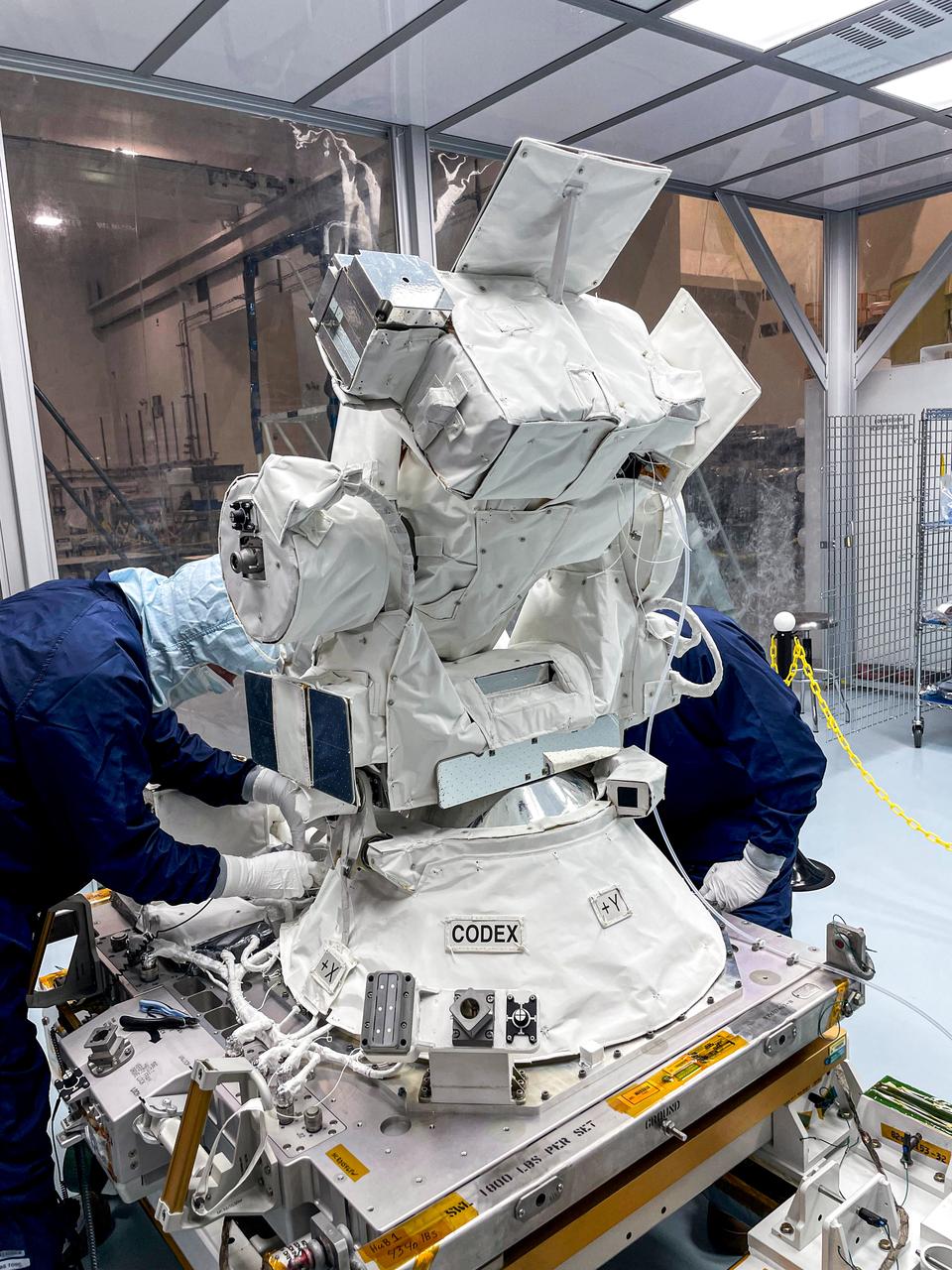
jsc2024e061952 (8/6/2024) --- The COronal Diagnostic EXperiment (CODEX) instrument undergoing final flight preparation at the Kennedy Space Flight Center Space Station Processing Facility. Credit: CODEX team / NASA
jsc2024e061952
jsc2024e061940 (9/12/2024) --- The COronal Diagnostic EXperiment (CODEX) instrument undergoing final flight preparation at the Kennedy Space Flight Center Space Station Processing Facility. Credit: CODEX team / NASA
jsc2024e061940
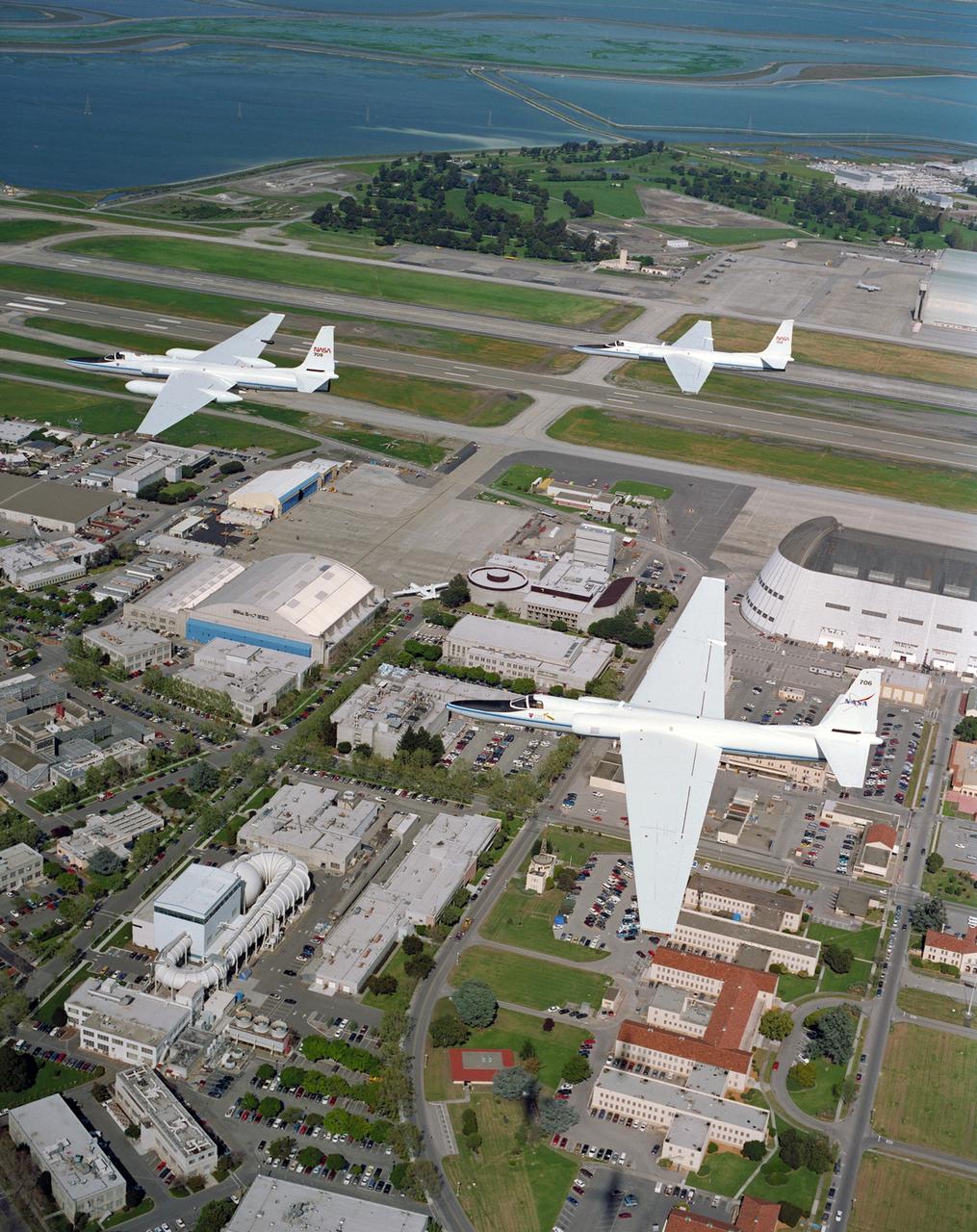
Three ER-2 Aircraft in formation over Ames Research Center, Moffett Federal Airfield , CA on their final flight before redeployment to NASA's Dryden Flight Research Center, CA
ARC-1996-AC96-0106-5
Three ER-2 Aircraft in formation over Ames Research Center, Moffett Federal Airfield , CA on their final flight before redeployment to NASA's Dryden Flight Research Center, CA
ARC-1996-AC96-0106-1
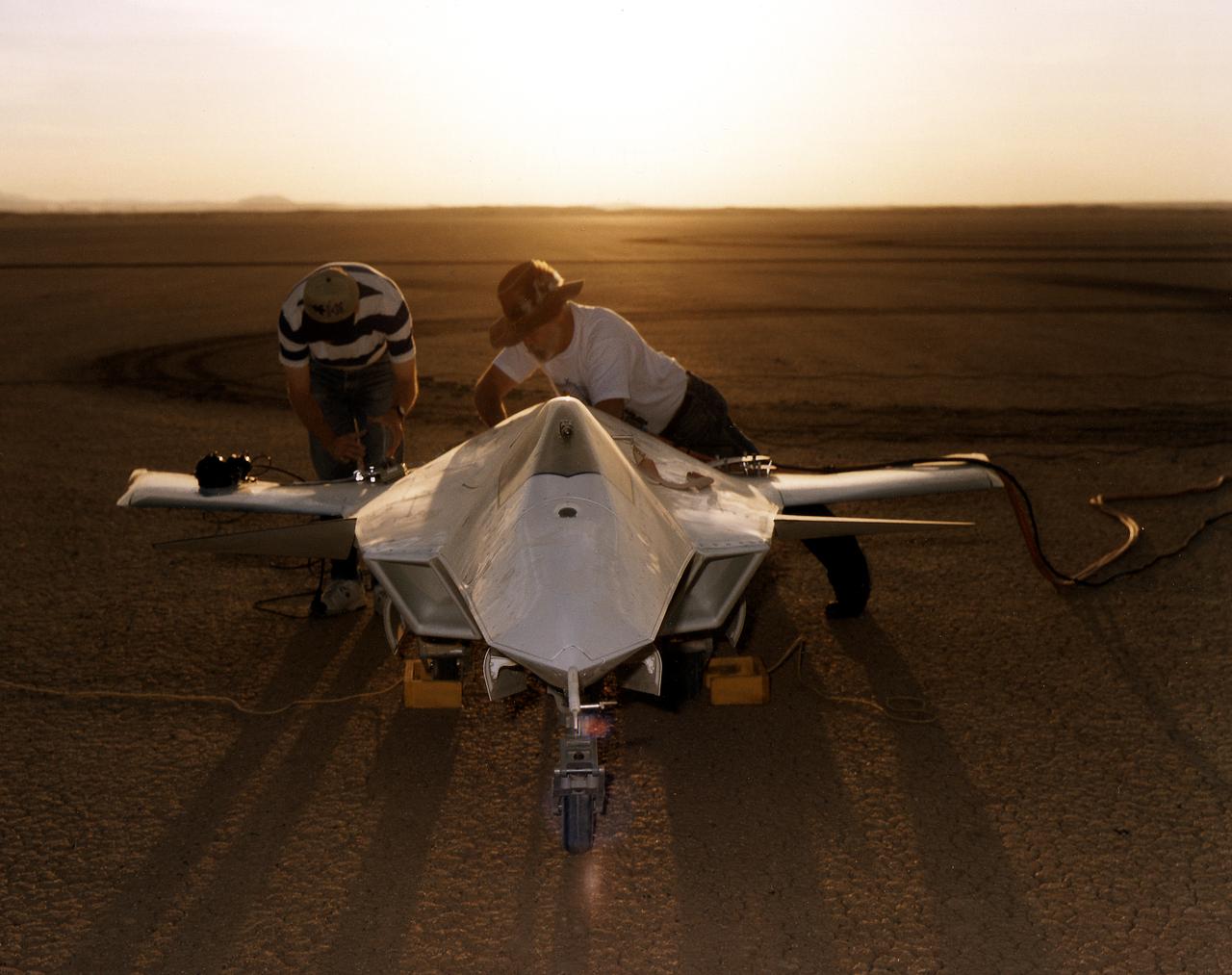
As the sun creeps above the horizon of Rogers Dry Lake at NASA's Dryden Flight Research Center, Edwards, California, technicians make final preparations for the first flight of the X-36 Tailless Fighter Agility Research Aircraft.
X-36 Being Prepared on Lakebed for First Flight
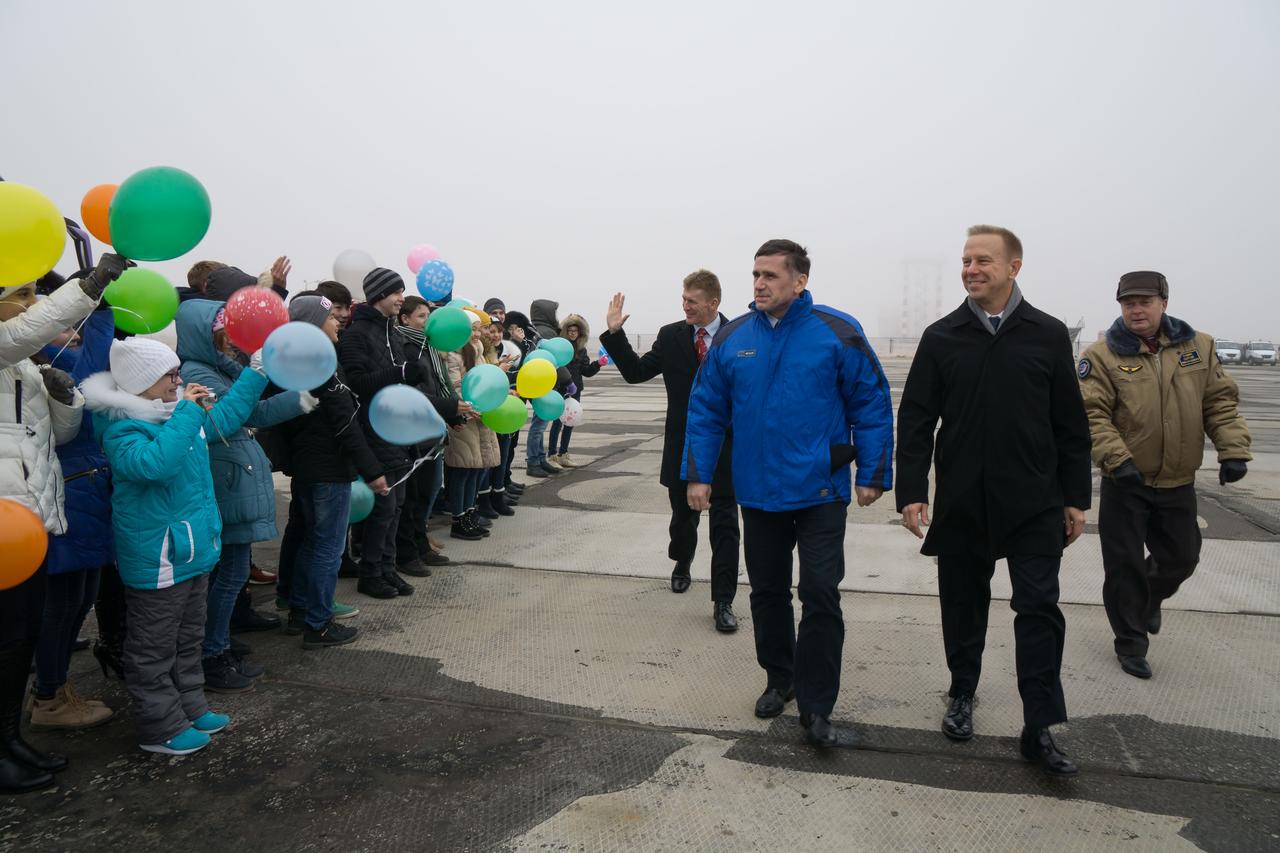
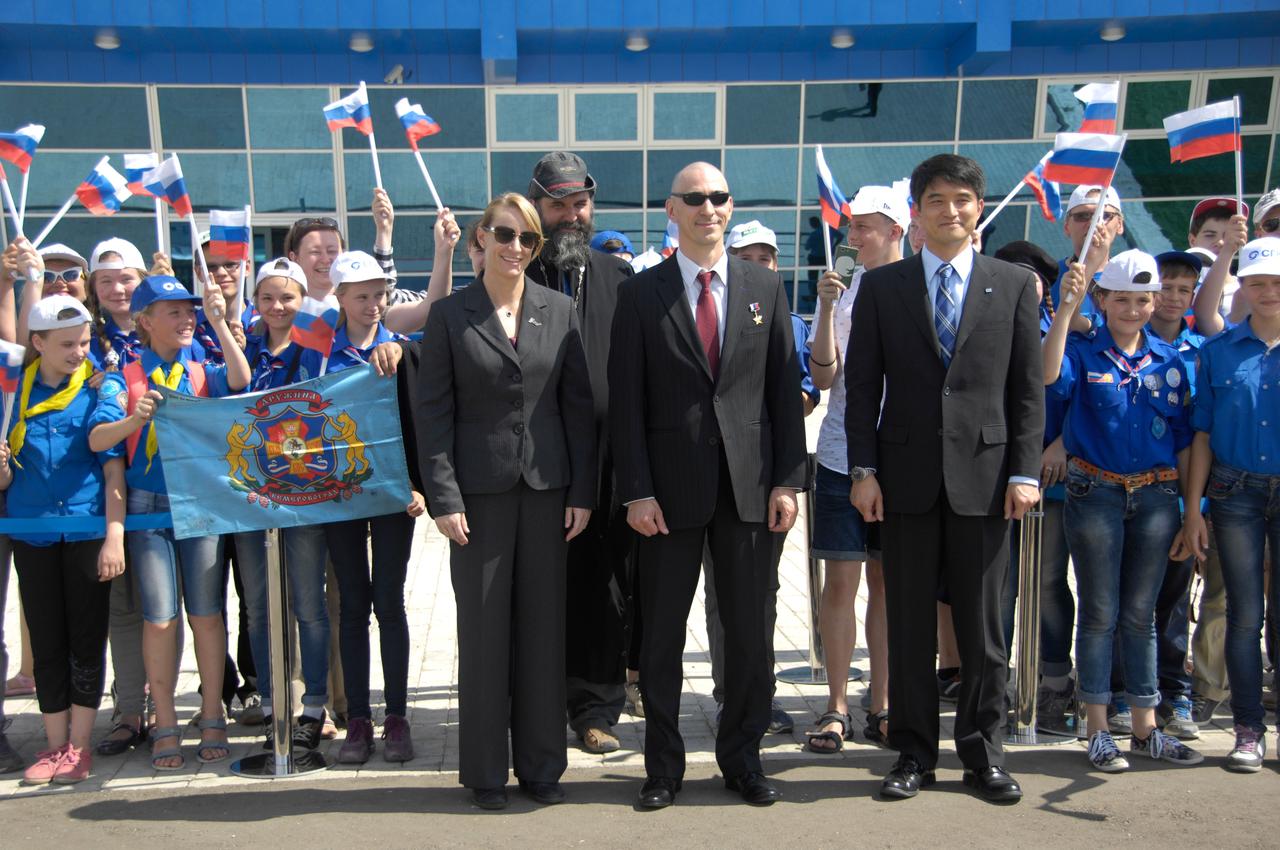
The Expedition 46-47 crewmembers arrive in Baikonur, Kazakhstan Nov. 30 for final pre-launch training following a flight from their training base at the Gagarin Cosmonaut Training Center in Star City, Russia and are greeted by school children. Tim Peake of the European Space Agency (left), Yuri Malenchenko of the Russian Federal Space Agency (Roscosmos, center) and Tim Kopra of NASA (right), will launch Dec. 15 on the Soyuz TMA-19M spacecraft for a six-month mission on the International Space Station.  NASA / Victor Zelentsov
The Expedition 46-47 crewmembers arrive in Baikonur, Kazakhstan Nov. 30 for final pre-launch training following a flight from their training base at the Gagarin Cosmonaut Training Center in Star City, Russia and are greeted by school children. Tim Peake of the European Space Agency (left), Yuri Malenchenko of the Russian Federal Space Agency (Roscosmos, center) and Tim Kopra of NASA (right), will launch Dec. 15 on the Soyuz TMA-19M spacecraft for a six-month mission on the International Space Station...NASA / Victor Zelentsov .
KENNEDY SPACE CENTER, FLA.  - As the Stafford-Covey Return to Flight Task Group (SCTG) tours the Orbiter Processing Facility, Richard O. Covey (second from left), former Space Shuttle commander, points to equipment.  Covey is co-chair of the SCTG along with Thomas P. Stafford, Apollo commander. Others in the photo are William Wegner, James Adamson and Joe Engle.  Chartered by NASA Administrator Sean O’Keefe, the task group will perform an independent assessment of NASA’s implementation of the final recommendations by the Columbia Accident Investigation Board.
KENNEDY SPACE CENTER, FLA. - As the Stafford-Covey Return to Flight Task Group (SCTG) tours the Orbiter Processing Facility, Richard O. Covey (second from left), former Space Shuttle commander, points to equipment. Covey is co-chair of the SCTG along with Thomas P. Stafford, Apollo commander. Others in the photo are William Wegner, James Adamson and Joe Engle. Chartered by NASA Administrator Sean O’Keefe, the task group will perform an independent assessment of NASA’s implementation of the final recommendations by the Columbia Accident Investigation Board.
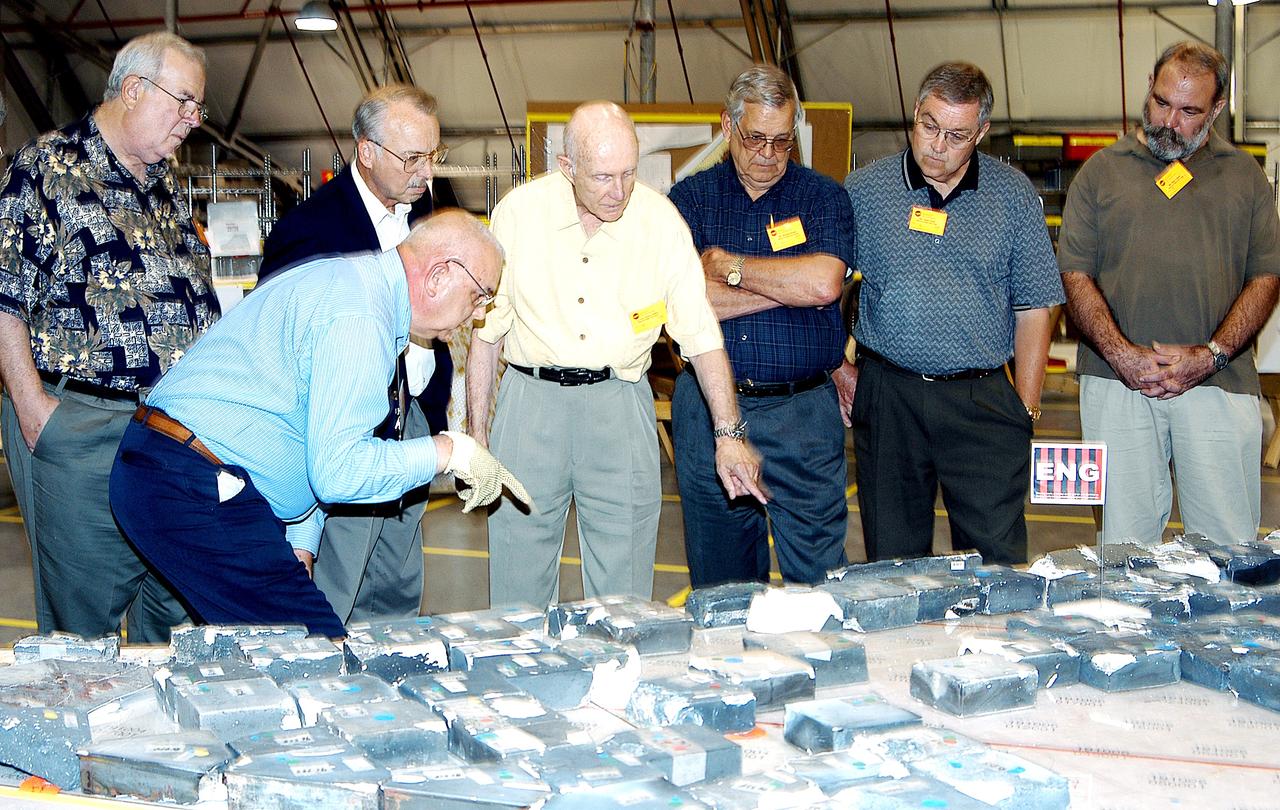
KENNEDY SPACE CENTER, FLA.  -  In the Columbia Debris Hangar, members of the  Stafford-Covey Return to Flight Task Group (SCTG) look at tiles recovered.  Chairing the task group are Richard O. Covey, former Space Shuttle commander, and Thomas P. Stafford (center), Apollo commander.  Chartered by NASA Administrator Sean O’Keefe, the task group will perform an independent assessment of NASA’s implementation of the final recommendations by the Columbia Accident Investigation Board.
KENNEDY SPACE CENTER, FLA. - In the Columbia Debris Hangar, members of the Stafford-Covey Return to Flight Task Group (SCTG) look at tiles recovered. Chairing the task group are Richard O. Covey, former Space Shuttle commander, and Thomas P. Stafford (center), Apollo commander. Chartered by NASA Administrator Sean O’Keefe, the task group will perform an independent assessment of NASA’s implementation of the final recommendations by the Columbia Accident Investigation Board.
KENNEDY SPACE CENTER, FLA.  -  The Stafford-Covey Return to Flight Task Group (SCTG) inspects debris in the Columbia Debris Hangar.   At right is the model of the left wing that has been used during recovery operations.  Chairing the task group are Richard O. Covey, former Space Shuttle commander, and Thomas P. Stafford (third from right, foreground), Apollo commander.  Chartered by NASA Administrator Sean O’Keefe, the task group will perform an independent assessment of NASA’s implementation of the final recommendations by the Columbia Accident Investigation Board.
KENNEDY SPACE CENTER, FLA. - The Stafford-Covey Return to Flight Task Group (SCTG) inspects debris in the Columbia Debris Hangar. At right is the model of the left wing that has been used during recovery operations. Chairing the task group are Richard O. Covey, former Space Shuttle commander, and Thomas P. Stafford (third from right, foreground), Apollo commander. Chartered by NASA Administrator Sean O’Keefe, the task group will perform an independent assessment of NASA’s implementation of the final recommendations by the Columbia Accident Investigation Board.
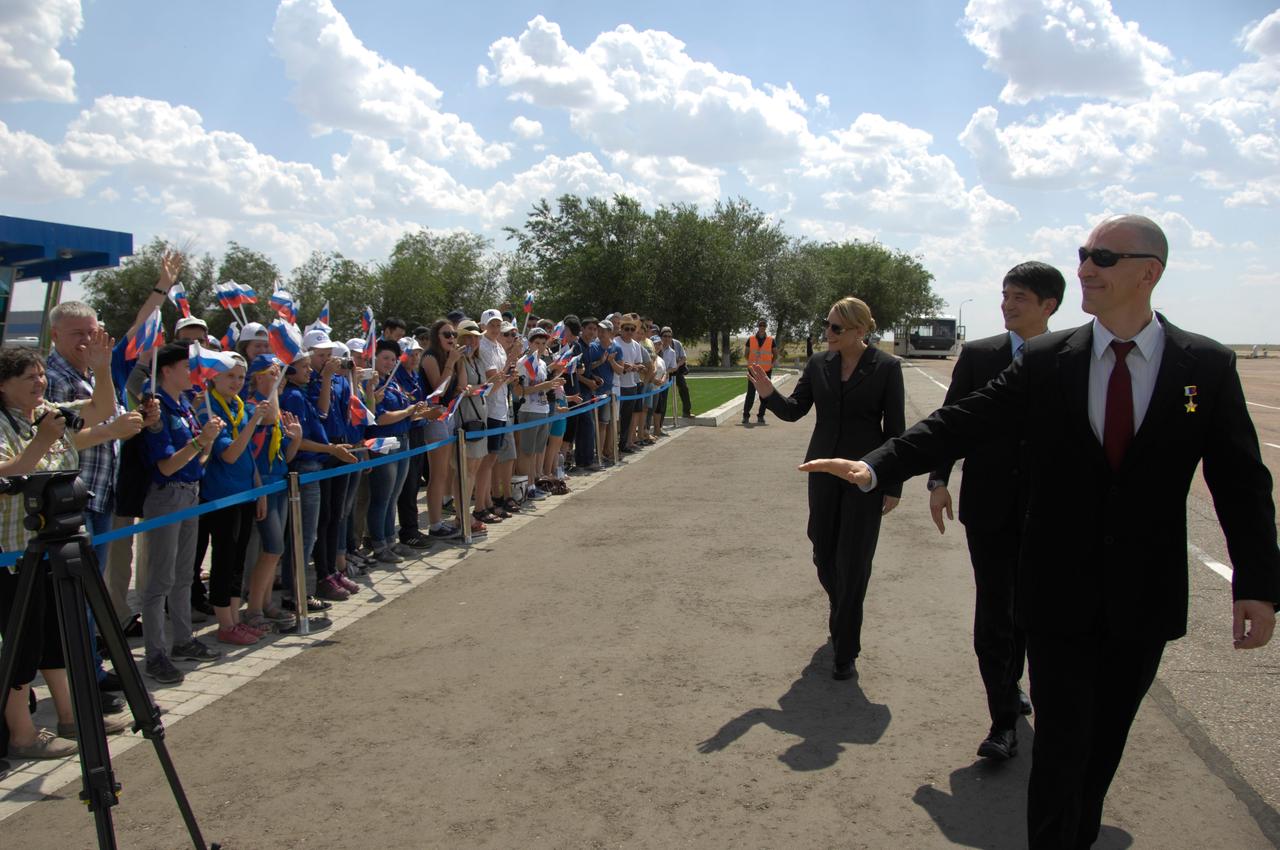
ISS Expedition 48-49 prime crewmembers Kate Rubins of NASA (left), Takuya Onishi of the Japan Aerospace Exploration Agency (center) and Anatoly Ivanishin of Roscosmos (right) wave to schoolchildren after arriving in Baikonur, Kazakhstan June 24 for final pre-launch training following a flight from Star City, Russia. The trio will launch July 7 from the Baikonur Cosmodrome in Kazakhstan on the Soyuz MS-01 spacecraft for a planned four-month mission on the International Space Station.  NASA/Alexander Vysotsky
ISS Expedition 48-49 prime crewmembers Kate Rubins of NASA (left), Takuya Onishi of the Japan Aerospace Exploration Agency (center) and Anatoly Ivanishin of Roscosmos (right) wave to schoolchildren after arriving in Baikonur, Kazakhstan June 24 for final pre-launch training following a flight from Star City, Russia. The trio will launch July 7 from the Baikonur Cosmodrome in Kazakhstan on the Soyuz MS-01 spacecraft for a planned four-month mission on the International Space Station...NASA/Alexander Vysotsky.
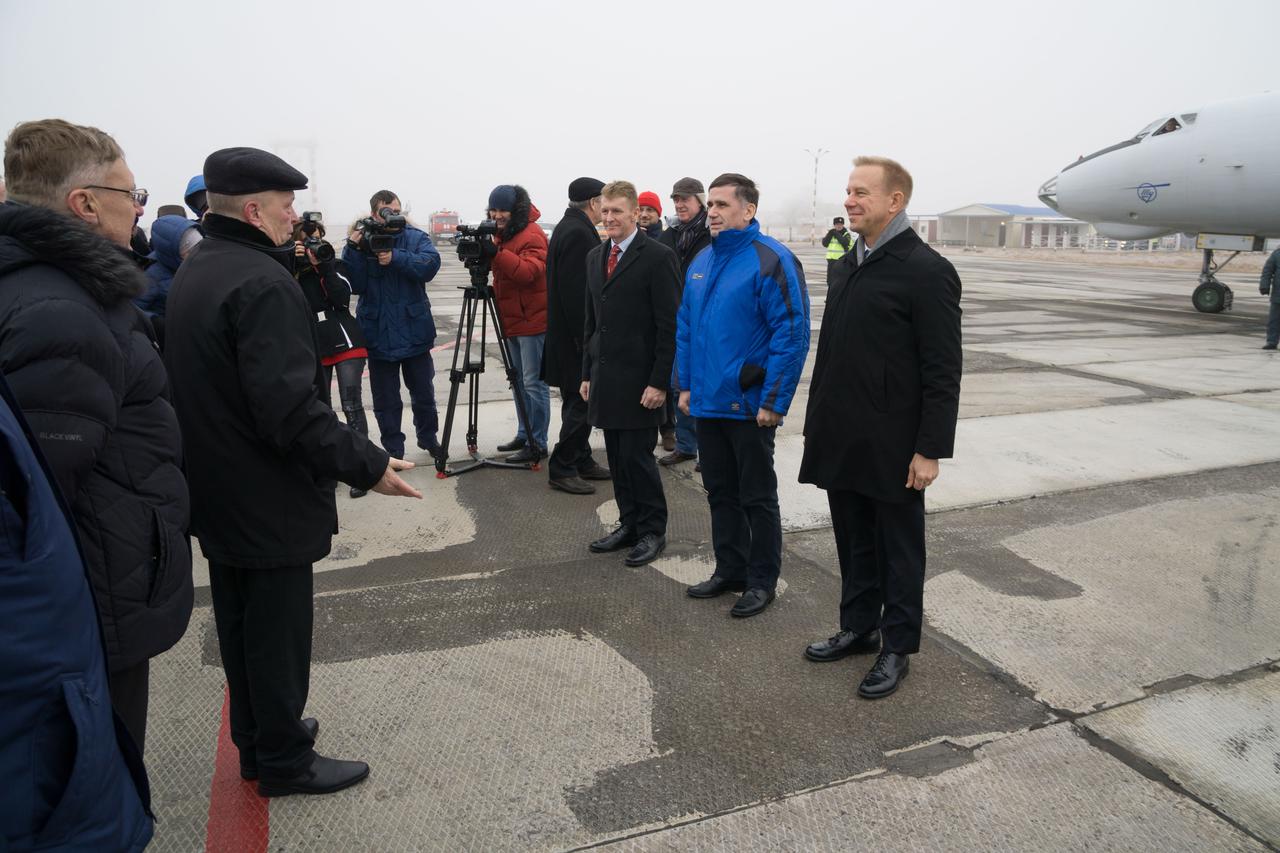
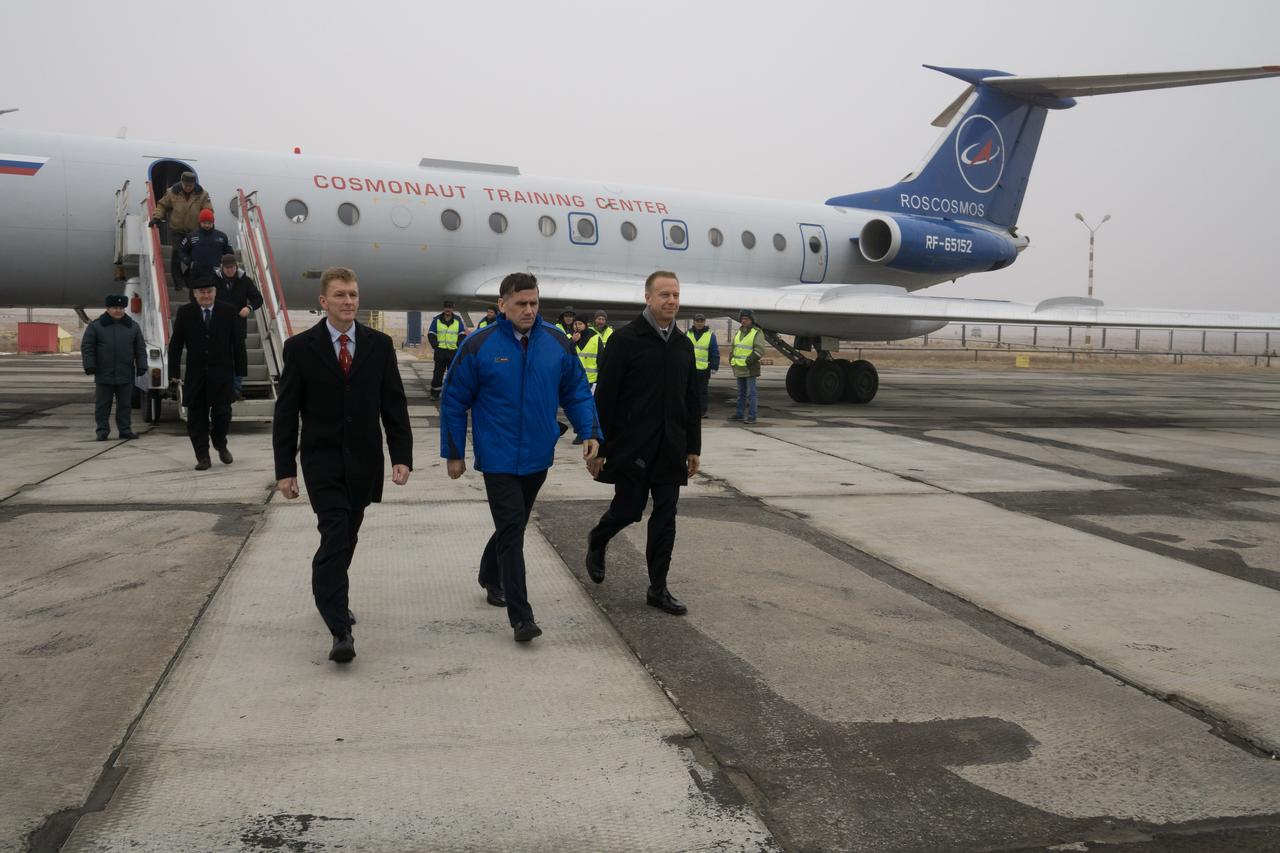
The Expedition 46-47 crewmembers arrive in Baikonur, Kazakhstan Nov. 30 for final pre-launch training following a flight from their training base at the Gagarin Cosmonaut Training Center in Star City, Russia. Tim Peake of the European Space Agency (left), Yuri Malenchenko of the Russian Federal Space Agency (Roscosmos, center) and Tim Kopra of NASA (right) will launch Dec. 15 on the Soyuz TMA-19M spacecraft for a six-month mission on the International Space Station.  NASA / Victor Zelentsov
The Expedition 46-47 crewmembers arrive in Baikonur, Kazakhstan Nov. 30 for final pre-launch training following a flight from their training base at the Gagarin Cosmonaut Training Center in Star City, Russia. Tim Peake of the European Space Agency (left), Yuri Malenchenko of the Russian Federal Space Agency (Roscosmos, center) and Tim Kopra of NASA (right) will launch Dec. 15 on the Soyuz TMA-19M spacecraft for a six-month mission on the International Space Station...NASA / Victor Zelentsov.
KENNEDY SPACE CENTER, FLA.  -   The Stafford-Covey Return to Flight Task Group (SCTG) visits the Columbia Debris Hangar .  Chairing the task group are Richard O. Covey (third from right), former Space Shuttle commander, and Thomas P. Stafford (fourth from right), Apollo commander.  Chartered by NASA Administrator Sean O’Keefe, the task group will perform an independent assessment of NASA’s implementation of the final recommendations by the Columbia Accident Investigation Board.
KENNEDY SPACE CENTER, FLA. - The Stafford-Covey Return to Flight Task Group (SCTG) visits the Columbia Debris Hangar . Chairing the task group are Richard O. Covey (third from right), former Space Shuttle commander, and Thomas P. Stafford (fourth from right), Apollo commander. Chartered by NASA Administrator Sean O’Keefe, the task group will perform an independent assessment of NASA’s implementation of the final recommendations by the Columbia Accident Investigation Board.
KENNEDY SPACE CENTER, FLA.  -  In the Columbia Debris Hangar, members of the  Stafford-Covey Return to Flight Task Group (SCTG) inspect some of the debris.   Chairing the task group are Richard O. Covey, former Space Shuttle commander, and Thomas P. Stafford (fourth from left), Apollo commander.  Chartered by NASA Administrator Sean O’Keefe, the task group will perform an independent assessment of NASA’s implementation of the final recommendations by the Columbia Accident Investigation Board.
KENNEDY SPACE CENTER, FLA. - In the Columbia Debris Hangar, members of the Stafford-Covey Return to Flight Task Group (SCTG) inspect some of the debris. Chairing the task group are Richard O. Covey, former Space Shuttle commander, and Thomas P. Stafford (fourth from left), Apollo commander. Chartered by NASA Administrator Sean O’Keefe, the task group will perform an independent assessment of NASA’s implementation of the final recommendations by the Columbia Accident Investigation Board.
KENNEDY SPACE CENTER, FLA.  -  In the Columbia Debris Hangar, Shuttle Launch Director Mike Leinbach (left) talks to members of the  Stafford-Covey Return to Flight Task Group (SCTG) about reconstruction efforts.   Chairing the task group are Richard O. Covey (second from right), former Space Shuttle commander, and Thomas P. Stafford, Apollo commander.  Chartered by NASA Administrator Sean O’Keefe, the task group will perform an independent assessment of NASA’s implementation of the final recommendations by the Columbia Accident Investigation Board.
KENNEDY SPACE CENTER, FLA. - In the Columbia Debris Hangar, Shuttle Launch Director Mike Leinbach (left) talks to members of the Stafford-Covey Return to Flight Task Group (SCTG) about reconstruction efforts. Chairing the task group are Richard O. Covey (second from right), former Space Shuttle commander, and Thomas P. Stafford, Apollo commander. Chartered by NASA Administrator Sean O’Keefe, the task group will perform an independent assessment of NASA’s implementation of the final recommendations by the Columbia Accident Investigation Board.
ISS Expedition 48-49 prime crewmembers Kate Rubins of NASA (left), Anatoly Ivanishin of Roscosmos (center) and Takuya Onishi of the Japan Aerospace Exploration Agency (right) pose for pictures with schoolchildren after arriving in Baikonur, Kazakhstan June 24 for final pre-launch training following a flight from Star City, Russia. The trio will launch July 7 from the Baikonur Cosmodrome in Kazakhstan on the Soyuz MS-01 spacecraft for a planned four-month mission on the International Space Station.  NASA/Alexander Vysotsky
ISS Expedition 48-49 prime crewmembers Kate Rubins of NASA (left), Anatoly Ivanishin of Roscosmos (center) and Takuya Onishi of the Japan Aerospace Exploration Agency (right) pose for pictures with schoolchildren after arriving in Baikonur, Kazakhstan June 24 for final pre-launch training following a flight from Star City, Russia. The trio will launch July 7 from the Baikonur Cosmodrome in Kazakhstan on the Soyuz MS-01 spacecraft for a planned four-month mission on the International Space Station...NASA/Alexander Vysotsky.
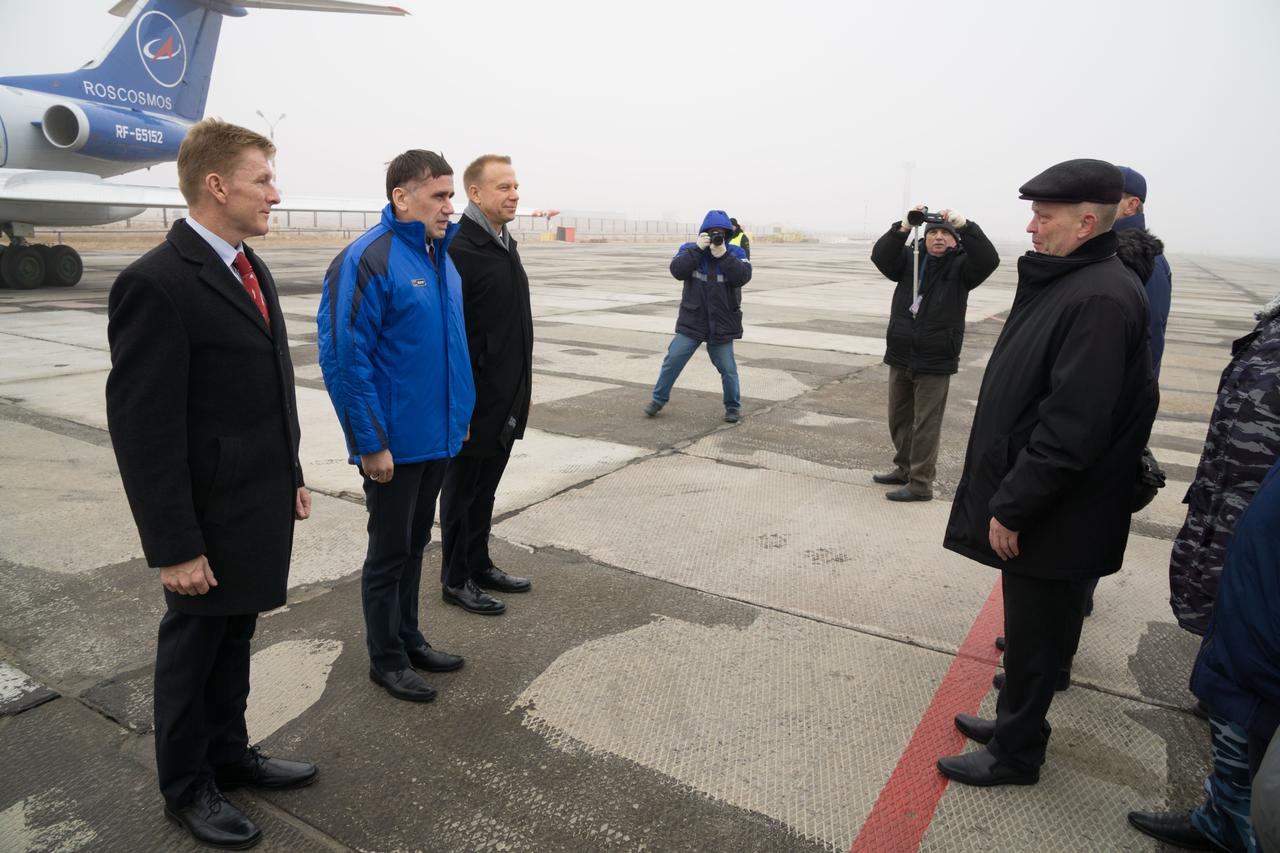
The Expedition 46-47 crewmembers arrive in Baikonur, Kazakhstan Nov. 30 for final pre-launch training following a flight from their training base at the Gagarin Cosmonaut Training Center in Star City, Russia. On the right of the frame are Tim Peake of the European Space Agency (left), Yuri Malenchenko of the Russian Federal Space Agency (Roscosmos, center) and Tim Kopra of NASA (right), who will launch Dec. 15 on the Soyuz TMA-19M spacecraft for a six-month mission on the International Space Station.  NASA / Victor Zelentsov
The Expedition 46-47 crewmembers arrive in Baikonur, Kazakhstan Nov. 30 for final pre-launch training following a flight from their training base at the Gagarin Cosmonaut Training Center in Star City, Russia. On the right of the frame are Tim Peake of the European Space Agency (left), Yuri Malenchenko of the Russian Federal Space Agency (Roscosmos, center) and Tim Kopra of NASA (right), who will launch Dec. 15 on the Soyuz TMA-19M spacecraft for a six-month mission on the International Space Station...NASA / Victor Zelentsov.
KENNEDY SPACE CENTER, FLA.  - In the Columbia Debris Hangar, Shuttle Launch Director Mike Leinbach answers questions from the Stafford-Covey Return to Flight Task Group (SCTG).  Chairing the task group are Richard O. Covey (fifth from left), former Space Shuttle commander, and Thomas P. Stafford, Apollo commander.  Chartered by NASA Administrator Sean O’Keefe, the task group will perform an independent assessment of NASA’s implementation of the final recommendations by the Columbia Accident Investigation Board.
KENNEDY SPACE CENTER, FLA. - In the Columbia Debris Hangar, Shuttle Launch Director Mike Leinbach answers questions from the Stafford-Covey Return to Flight Task Group (SCTG). Chairing the task group are Richard O. Covey (fifth from left), former Space Shuttle commander, and Thomas P. Stafford, Apollo commander. Chartered by NASA Administrator Sean O’Keefe, the task group will perform an independent assessment of NASA’s implementation of the final recommendations by the Columbia Accident Investigation Board.
The Expedition 46-47 crewmembers arrive in Baikonur, Kazakhstan Nov. 30 for final pre-launch training following a flight from their training base at the Gagarin Cosmonaut Training Center in Star City, Russia. Tim Peake of the European Space Agency (left), Yuri Malenchenko of the Russian Federal Space Agency (Roscosmos, center) and Tim Kopra of NASA (right) will launch Dec. 15 on the Soyuz TMA-19M spacecraft for a six-month mission on the International Space Station.  NASA / Victor Zelentsov
The Expedition 46-47 crewmembers arrive in Baikonur, Kazakhstan Nov. 30 for final pre-launch training following a flight from their training base at the Gagarin Cosmonaut Training Center in Star City, Russia. Tim Peake of the European Space Agency (left), Yuri Malenchenko of the Russian Federal Space Agency (Roscosmos, center) and Tim Kopra of NASA (right) will launch Dec. 15 on the Soyuz TMA-19M spacecraft for a six-month mission on the International Space Station...NASA / Victor Zelentsov .
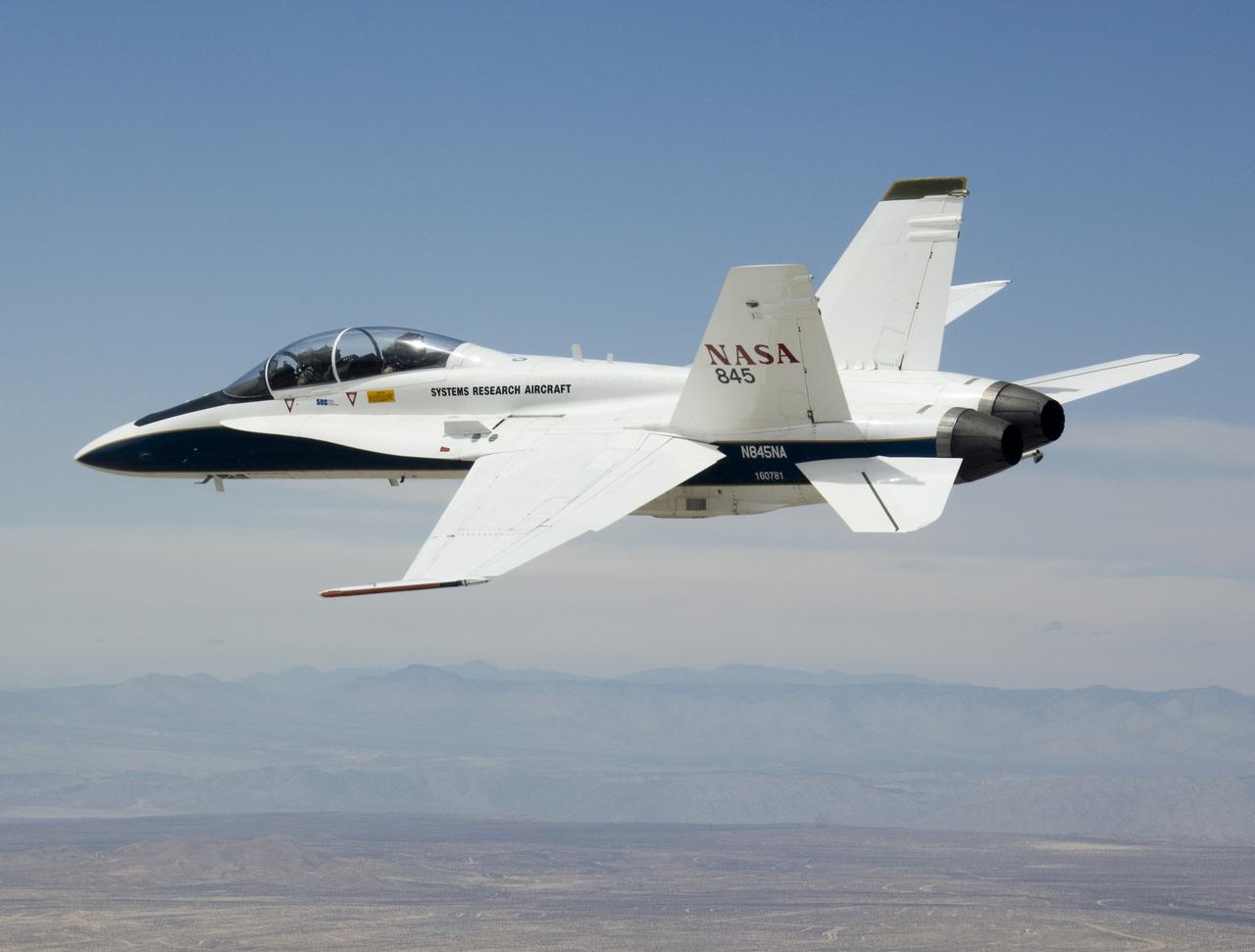
NASA's F/A-18B #845 was captured by the photographer as it returned from its final flight in the Autonomous Airborne Refueling Demonstration research project.
ED07-0090-05
The Atmospheric Turbulence Measurement System booms extend forward from the Pathfinder-Plus solar wing as it soars over Rogers Dry Lake on its final flight.
The Atmospheric Turbulence Measurement System booms extend forward from the Pathfinder-Plus solar wing as it soars over Rogers Dry Lake.
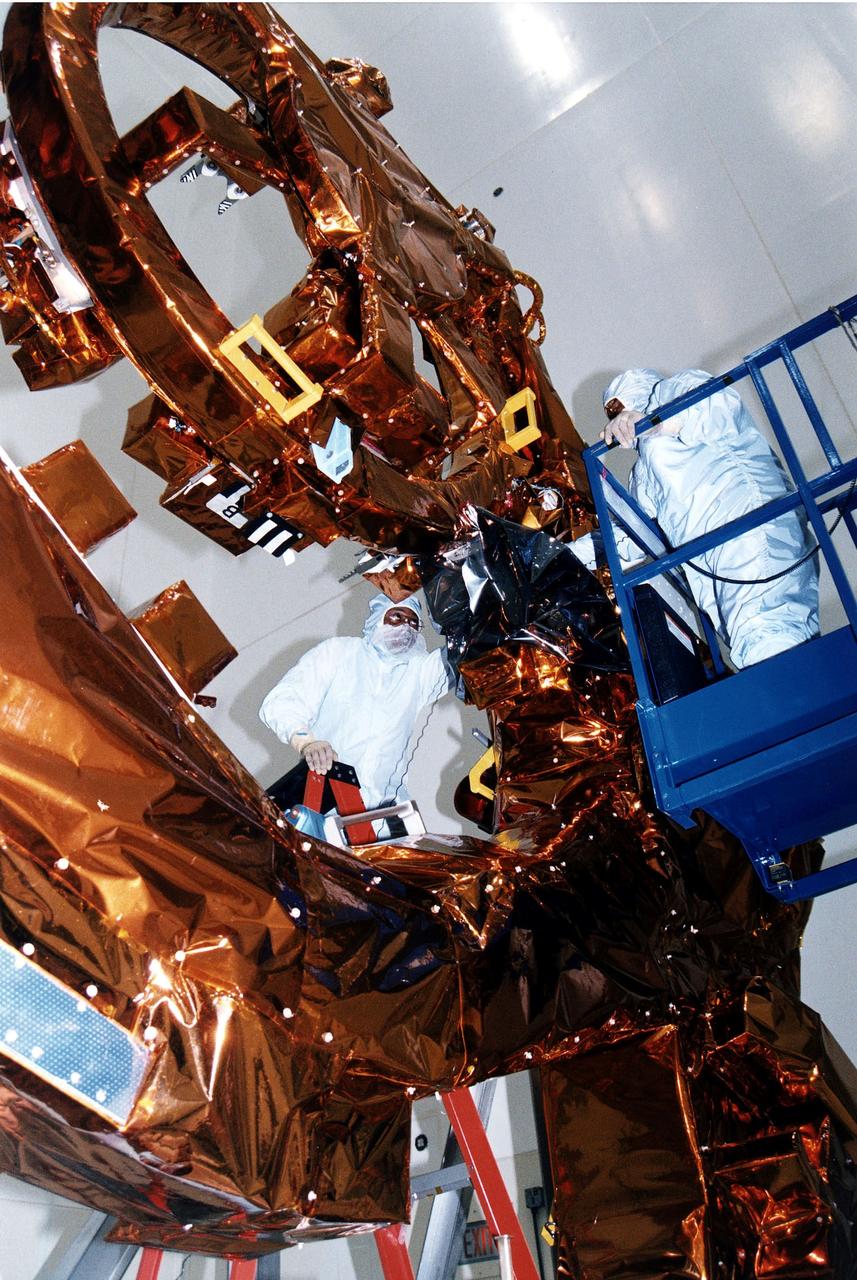
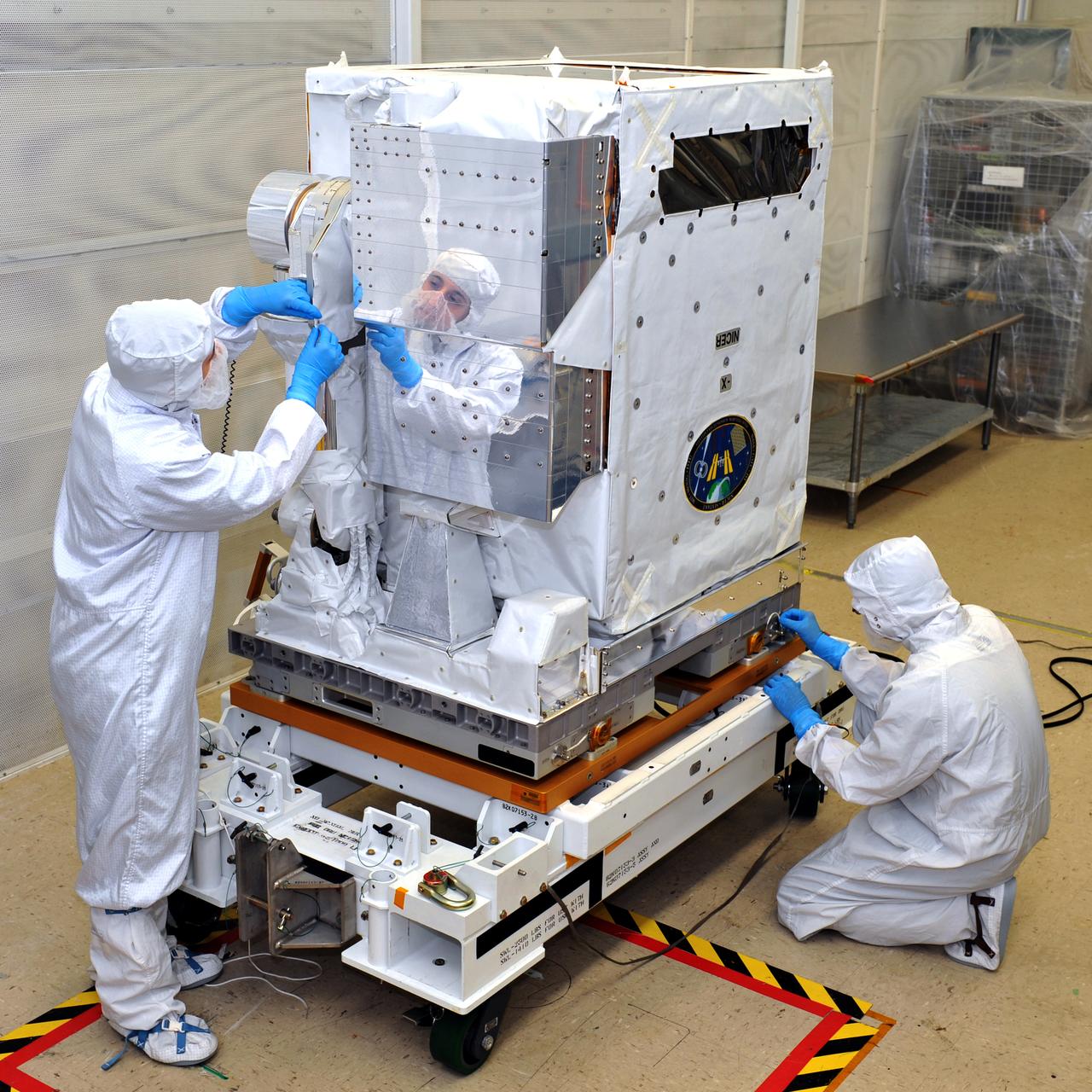
Neutron star Interior Composition Explorer (NICER) engineers prepare the instrument for a final pre-ship walkdown at Goddard Space Flight Center (GSFC)
NICER Prepped for Shipment to KSC
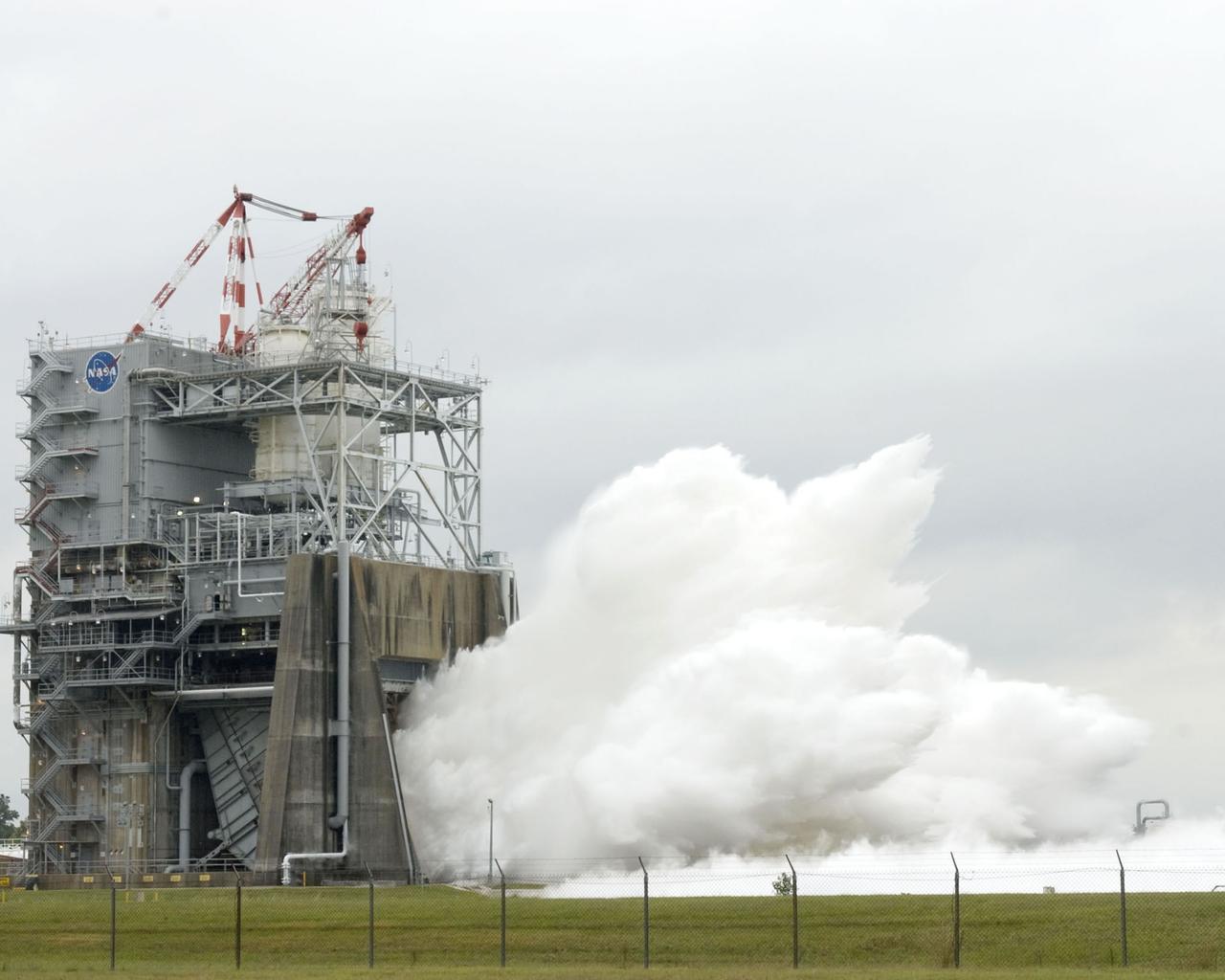
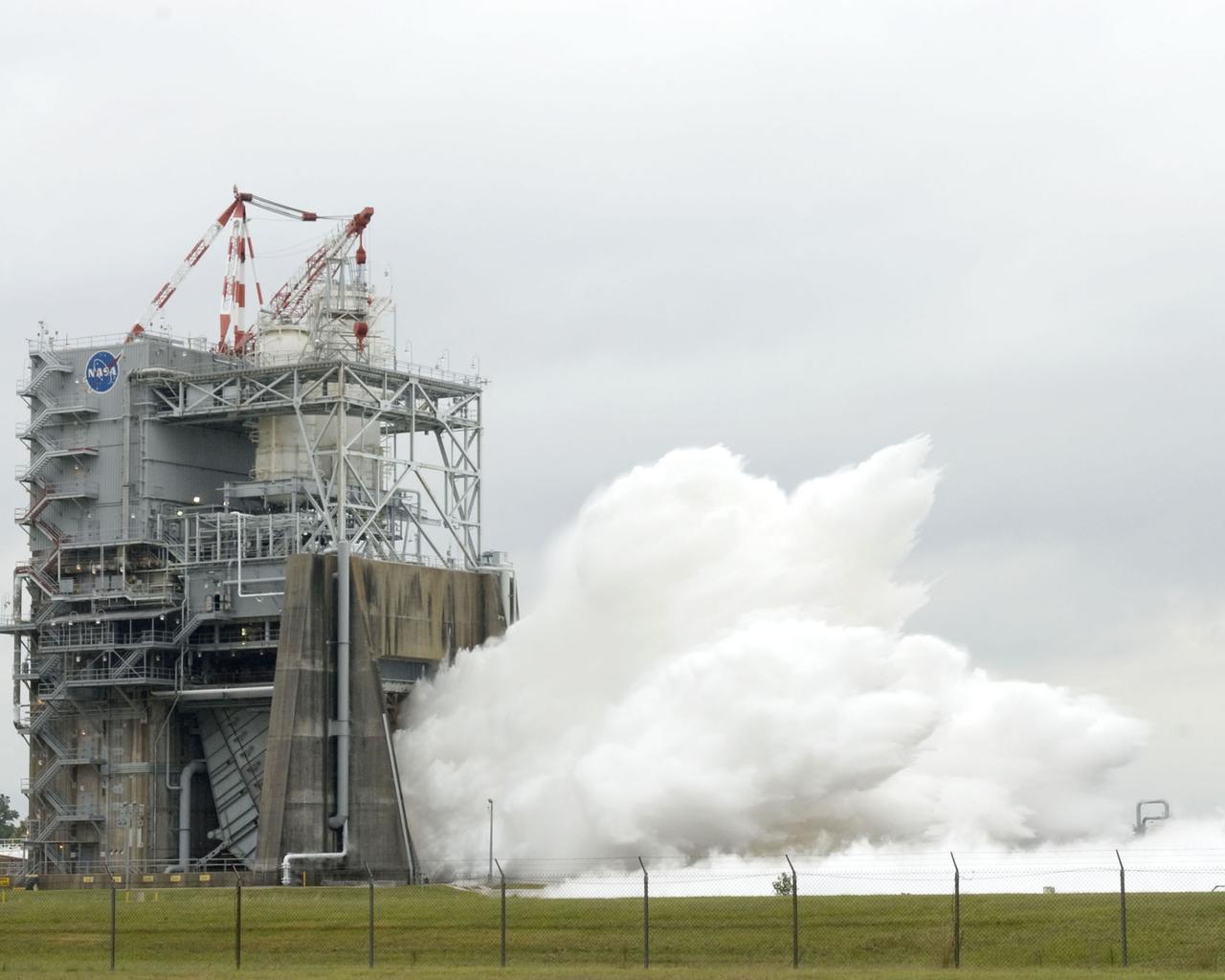
Steam blasts out of the A-2 Test Stand at Stennis Space Center on Oct. 22 as engineers begin a certification test on engine 2061, the last space shuttle main flight engine scheduled to be built. Since 1975, Stennis has tested every space shuttle main engine used in the program - about 50 engines in all. Those engines have powered more than 120 shuttle missions - and no mission has failed as a result of engine malfunction. For the remainder of 2008 and throughout 2009, Stennis will continue testing of various space shuttle main engine components.
Stennis certifies final shuttle engine
Steam blasts out of the A-2 Test Stand at Stennis Space Center on Oct. 22 as engineers begin a certification test on engine 2061, the last space shuttle main flight engine scheduled to be built. Since 1975, Stennis has tested every space shuttle main engine used in the program - about 50 engines in all. Those engines have powered more than 120 shuttle missions - and no mission has failed as a result of engine malfunction. For the remainder of 2008 and throughout 2009, Stennis will continue testing of various space shuttle main engine components.
Stennis certifies final shuttle engine
The Soyuz MS-02 spacecraft, encapsulated in its fairing, is seen undergoing final checks during final assembly of the Soyuz rocket on Friday, Oct. 14, 2016 at the Baikonur Cosmodrome in Kazakhstan.  Expedition 49 flight engineer Shane Kimbrough of NASA, Soyuz commander Sergey Ryzhikov of Roscosmos, and flight engineer Andrey Borisenko of Roscosmos are scheduled to launch from the Baikonur Cosmodrome in Kazakhstan on Oct. 19. Photo Credit: (NASA/Victor Zelentsov)
Expedition 49 Soyuz Assembly
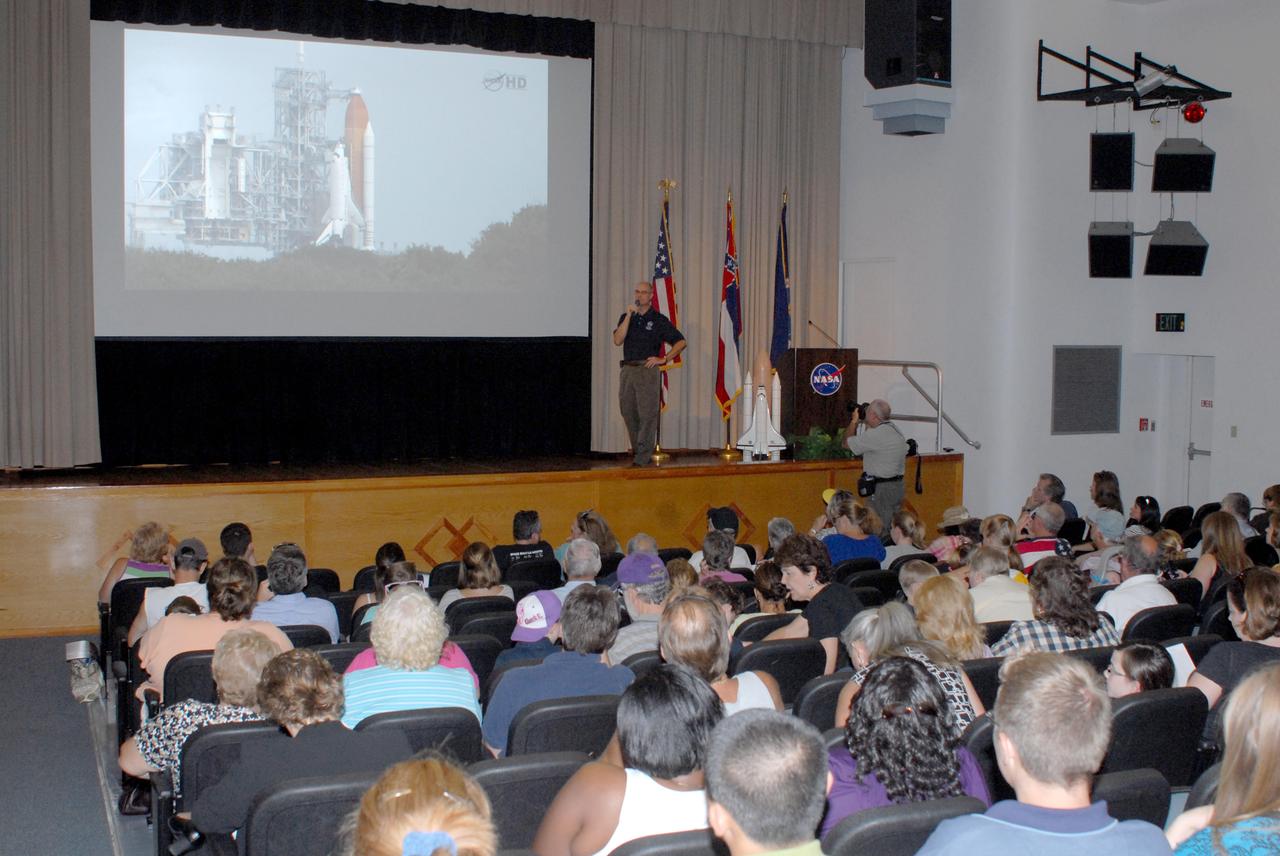
NASA engineer Don Beckmeyer speaks to an audience gathered at StenniSphere auditorium at Stennis Space Center to view the launch of the STS-135 space shuttle mission July 8. The mission marked the final flight for Atlantis and the final flight for the Space Shuttle Program. Viewers applauded and cheered as Atlantis headed to space, powered by a trio of main engines tested at Stennis Space Center.
STS-135 launch viewing
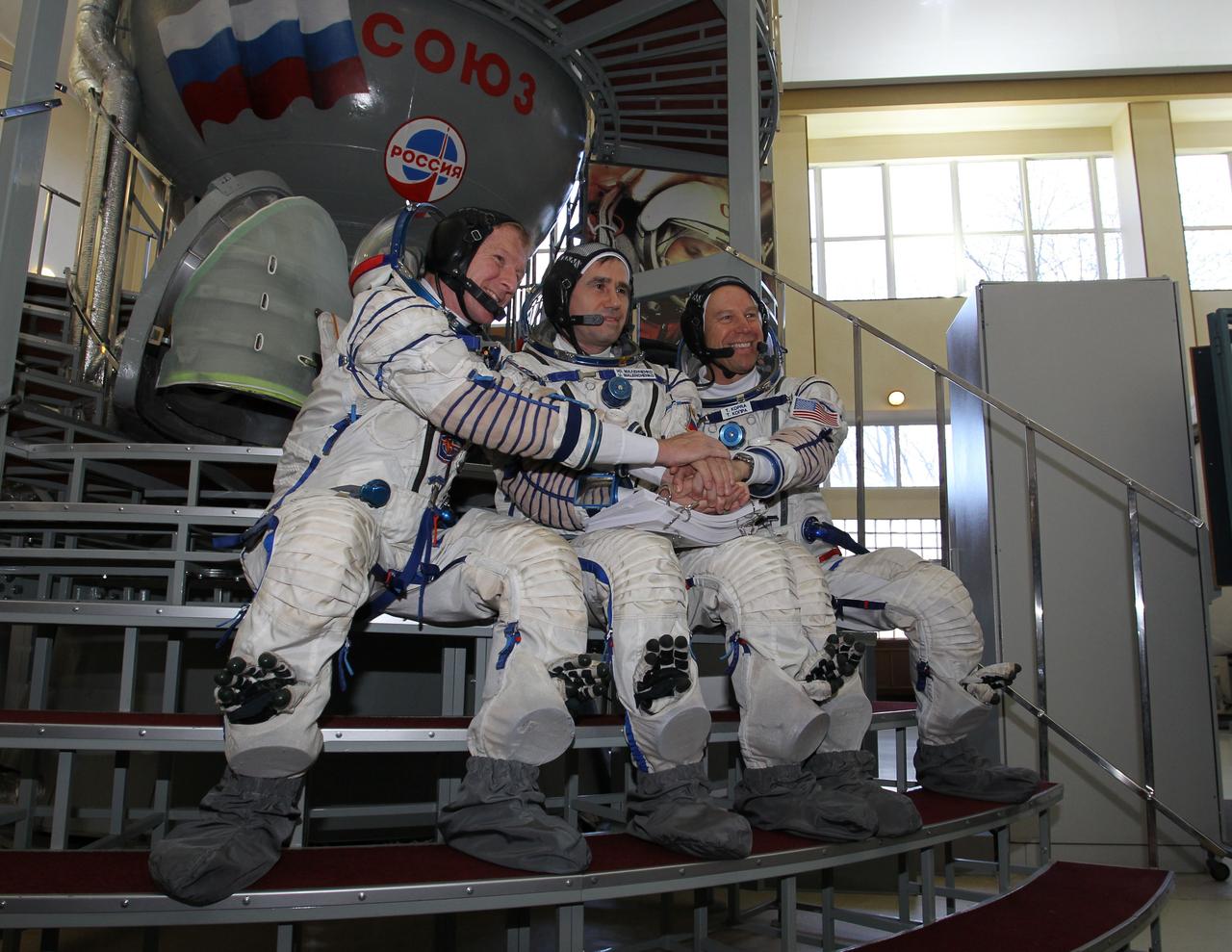
CG4G8846_1 --- (6 May 2015) --- At the Gagarin Cosmonaut Training Center in Star City, Russia, Expedition 44/45 backup crewmembers Timothy Peake of the European Space Agency (left), Yuri Malenchenko of the Russian Federal Space Agency (Roscosmos, center) and Timothy Kopra of NASA (right) pose for pictures in front of a Soyuz spacecraft simulator May 6 as part of their final qualification exams for flight. They are the backups to the prime crew --- Kjell Lindgren of NASA, Oleg Kononenko of Roscosmos and Kimya Yui of the Japan Aerospace Exploration Agency --- who are in the final stages of training for launch May 27, Kazakh time, in the Soyuz TMA-17M spacecraft to begin a five and a half month mission to the International Space Station. Photo credit: NASA/Seth Marcantel