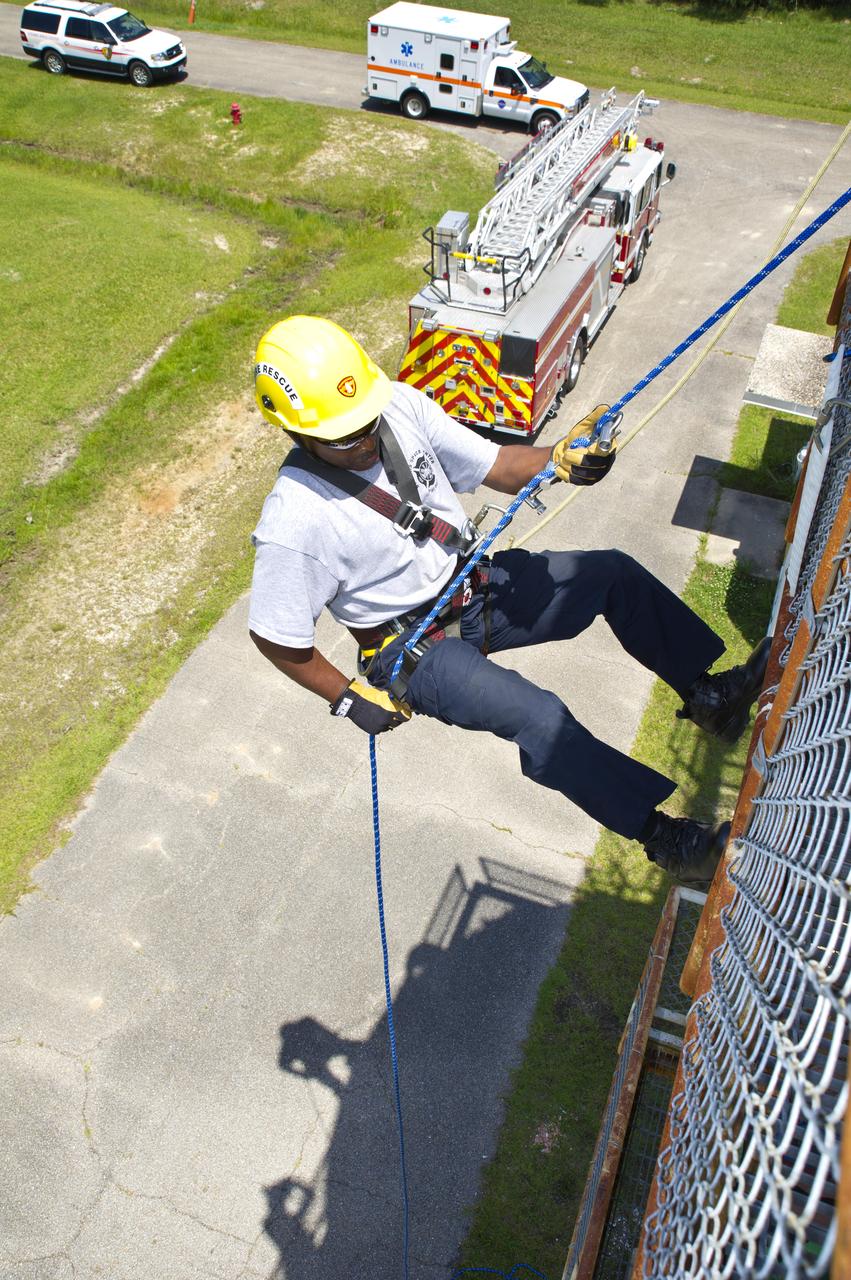
Stennis Space Center firefighter Rodney Boone rappels a tower structure during an onsite training exercise May 11, 2012. The training focused on high-angle rope rescues, which could be needed on the new 300-foot-tall A-3 Test Stand at Stennis.
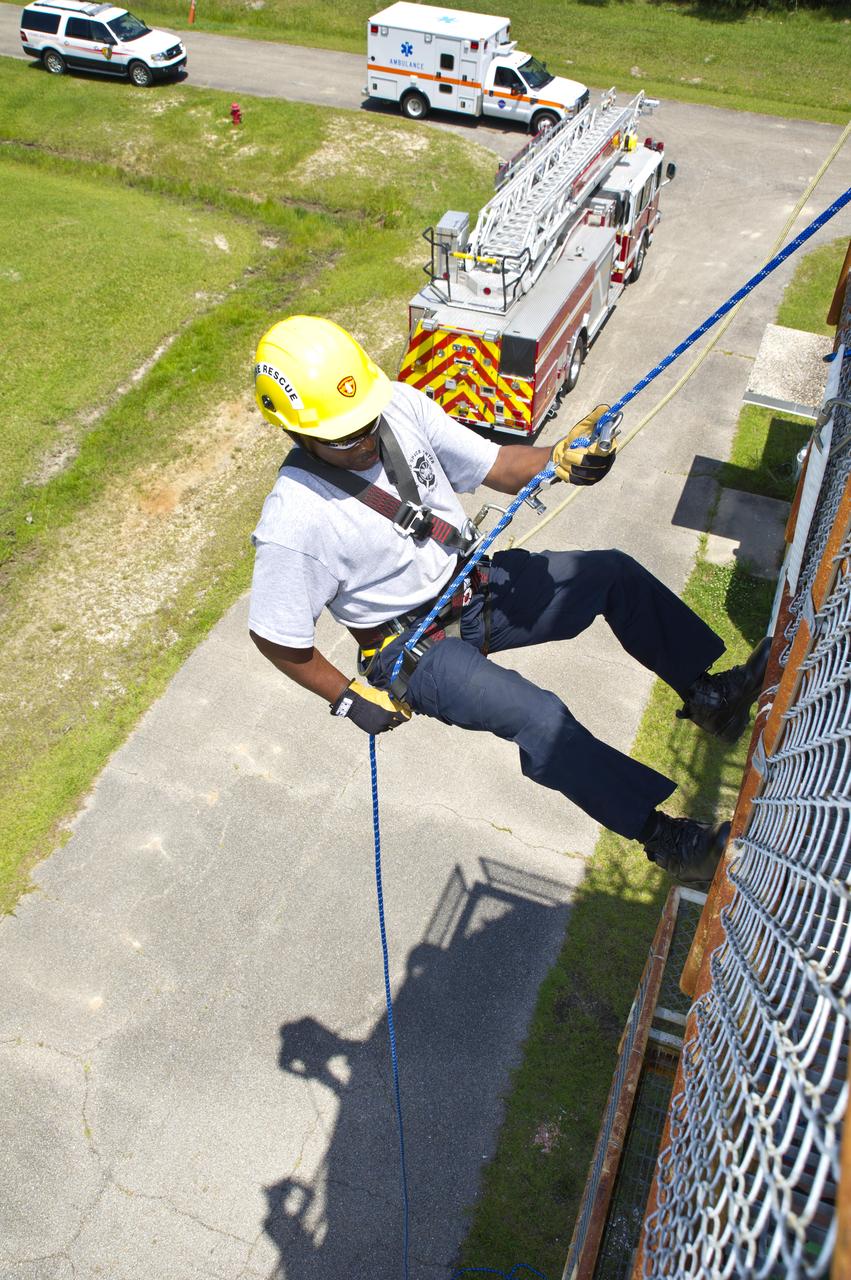
Stennis Space Center firefighter Rodney Boone rappels a tower structure during an onsite training exercise May 11, 2012. The training focused on high-angle rope rescues, which could be needed on the new 300-foot-tall A-3 Test Stand at Stennis.
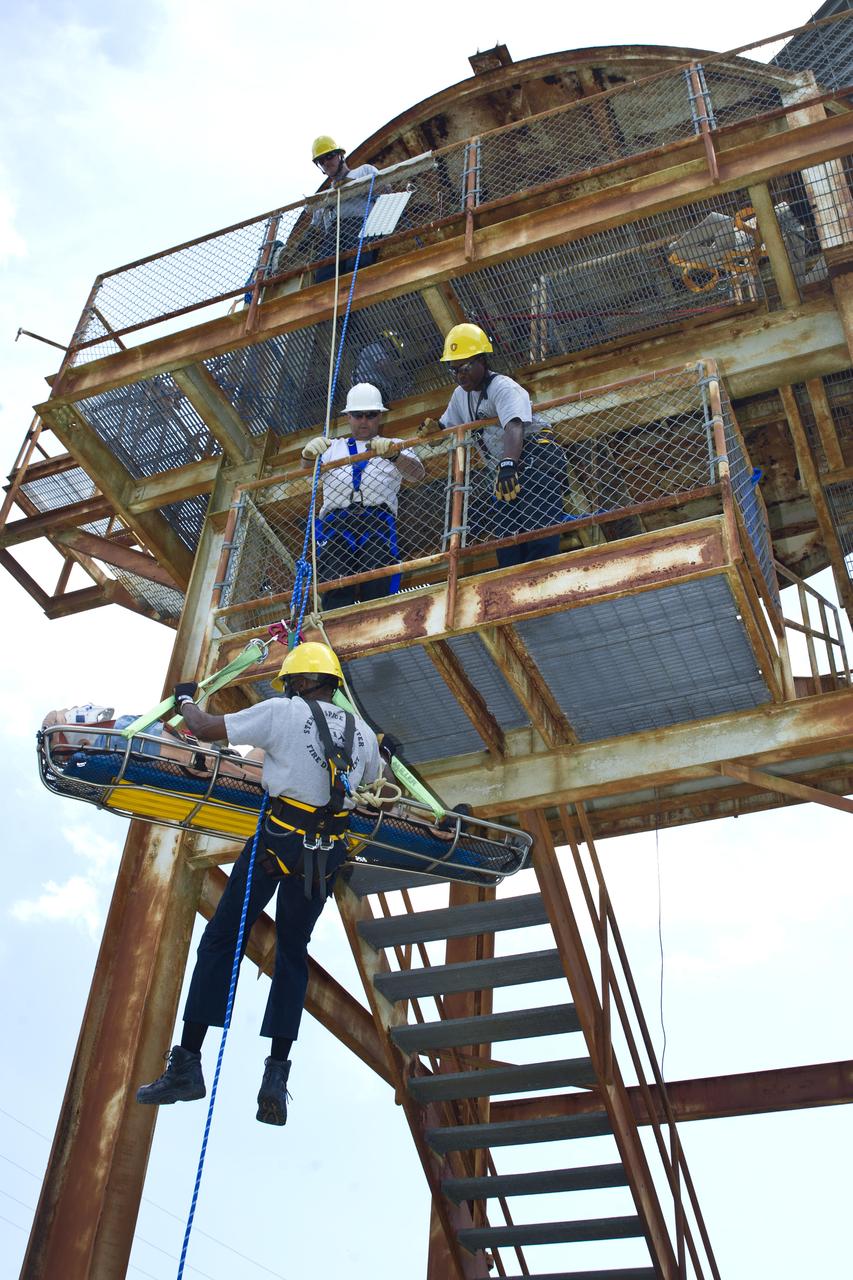
Instructor Rob Mortin watches as Stennis Space Center firefighters Lt. Greg Lampley, Rodney Boone, Vance Forrest and Billy Scarborough practice high-angle rope rescue techniques during a May 11, 2012, training exercise. The exercise specifically focused on scenarios applicable to the 300-foot-tall, open-steel-structure A-3 Test Stand under construction at the rocket engine test facility.
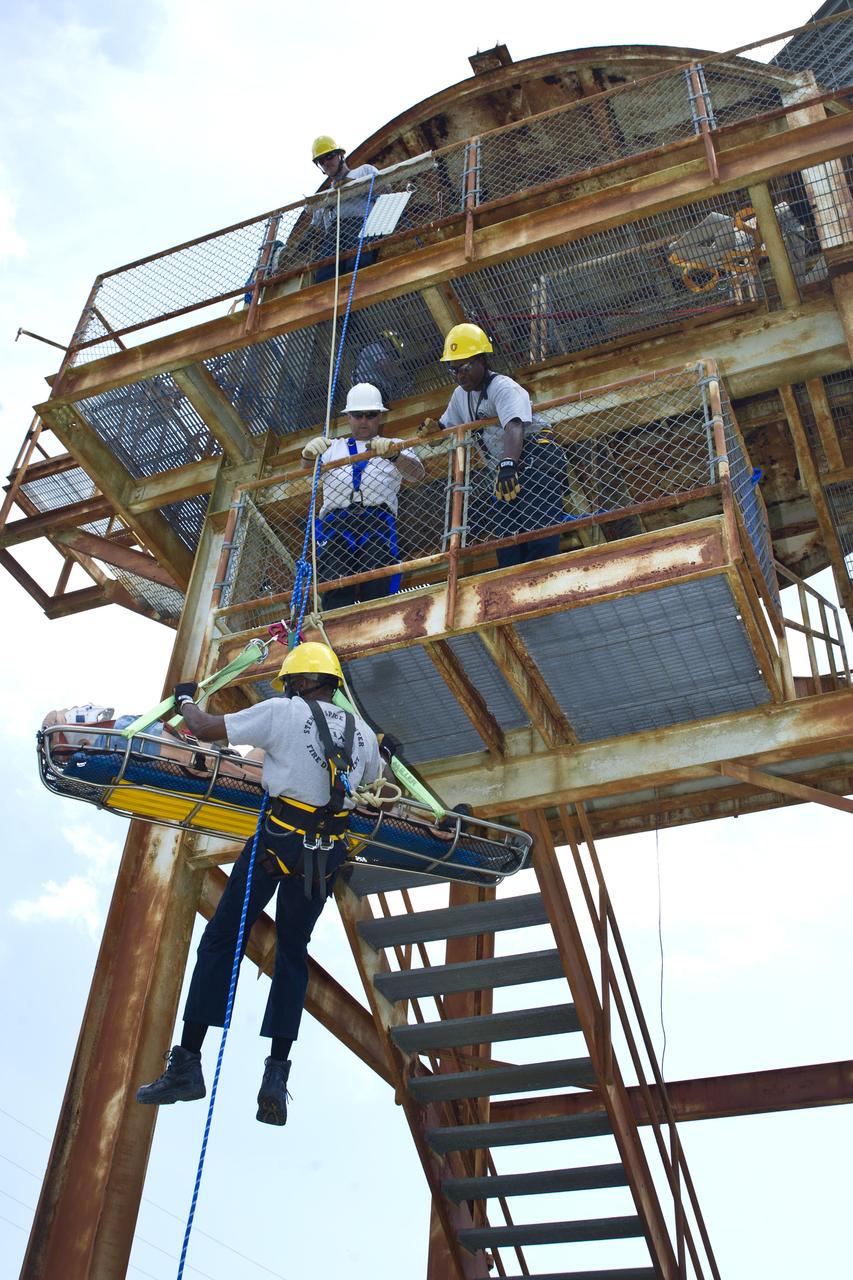
Instructor Rob Mortin watches as Stennis Space Center firefighters Lt. Greg Lampley, Rodney Boone, Vance Forrest and Billy Scarborough practice high-angle rope rescue techniques during a May 11, 2012, training exercise. The exercise specifically focused on scenarios applicable to the 300-foot-tall, open-steel-structure A-3 Test Stand under construction at the rocket engine test facility.
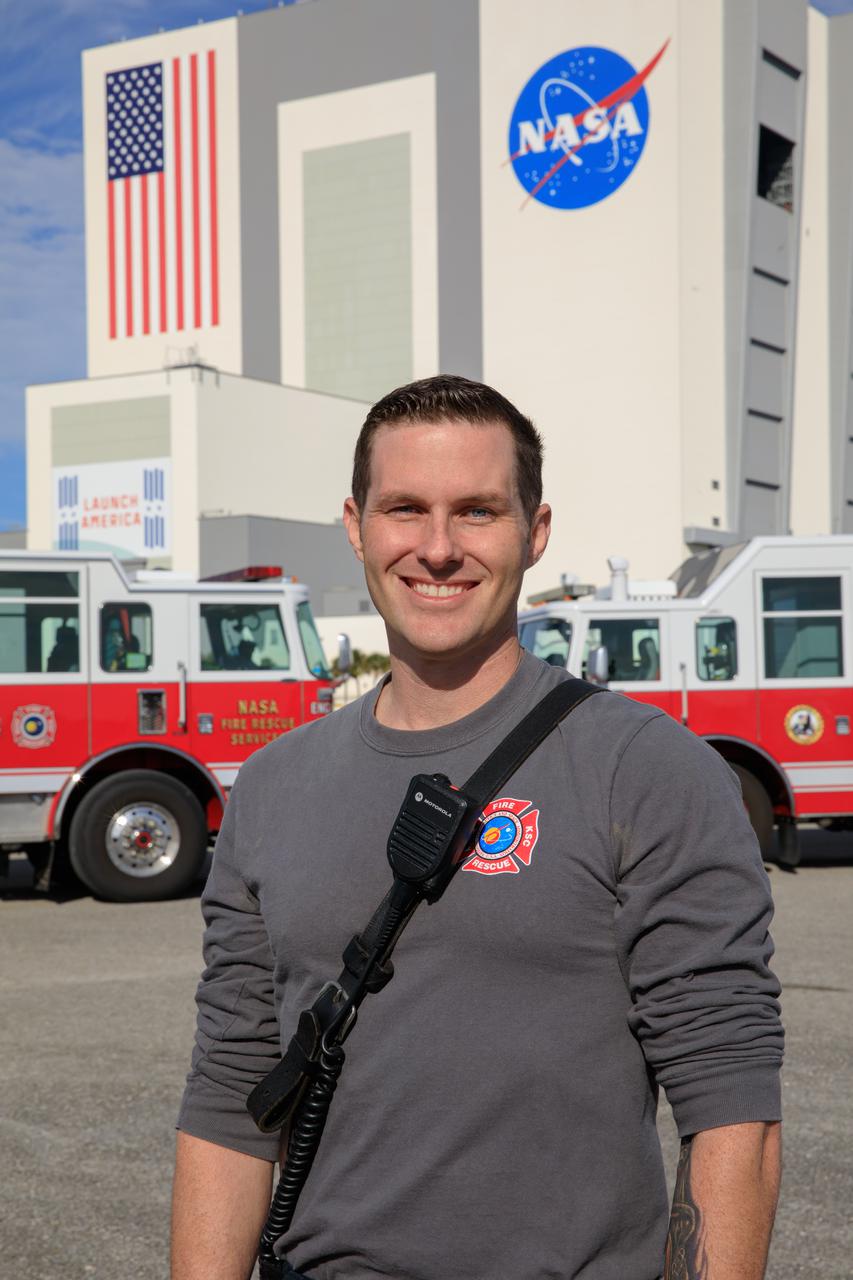
NASA Kennedy Space Center firefighter Andrew Morgan is selected as the Space Coast Fire Chiefs Association’s 2020 Firefighter of the Year. A member of the Technical Rescue Team, Morgan scaled down the side of the Florida spaceport’s Vehicle Assembly Building to rescue a team of painters when their scaffolding motor broke in October 2020, leaving them stranded 375 feet off the ground.
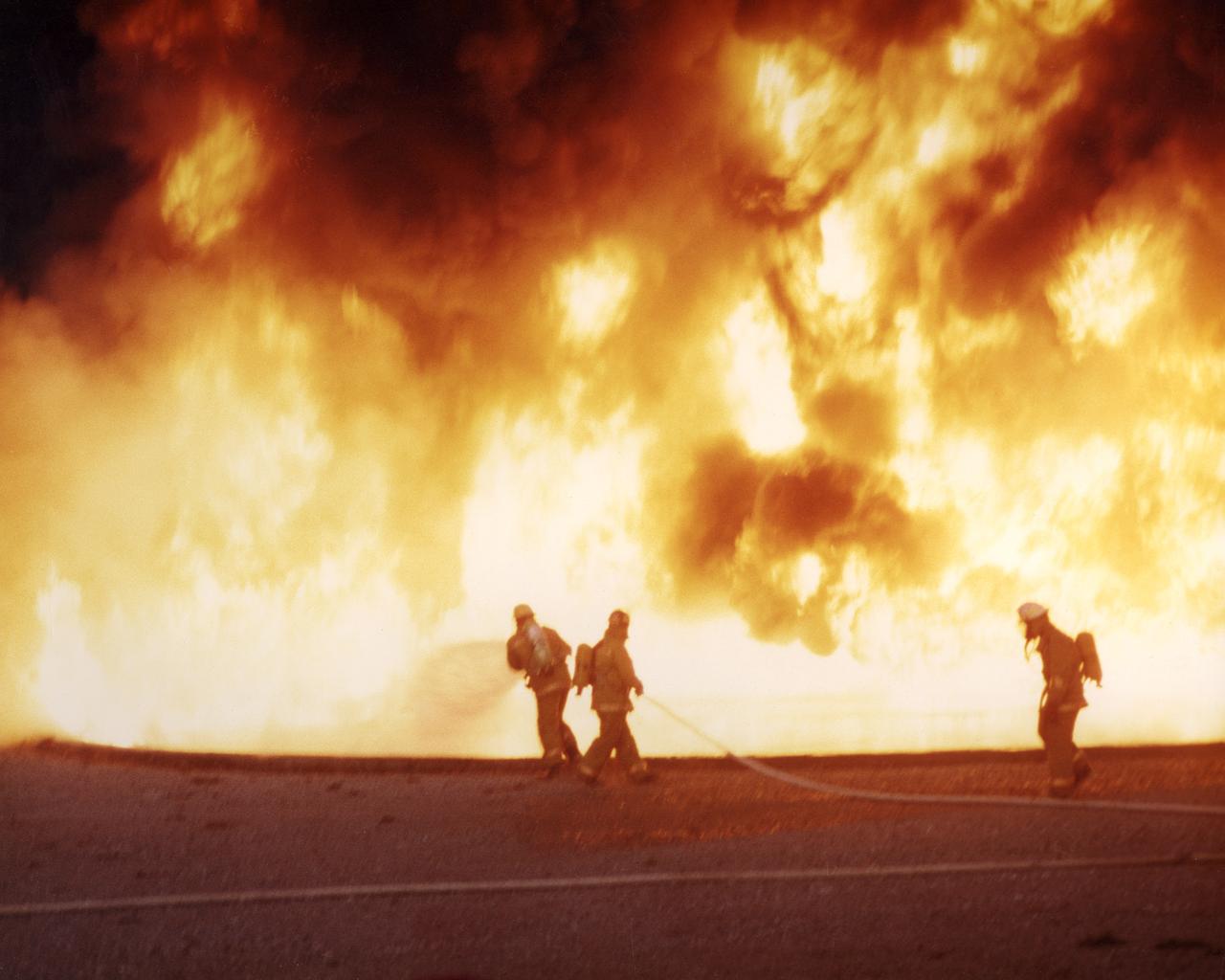
Firefighters are like astronauts. They both face dangerous, even hostile environments such as a building full of fire and the vacuum of space. They are both get breathing air from tanks on their backs. Early in the 1970's, NASA began working to improve firefighter breathing systems, which had hardly changed since the 1940s. NASA's Johnson Space Center conducted a 4-year program that applied technology from the portable life support systems used by Apollo astronauts on the moon. The new breathing system is made up of an air bottle, a frame and harness, a face mask, and a warning device. The new system weighs less than 20 pounds, one-third less than the old gear. The new air bottle provides 30 minutes of breathing air, as much as the old system. Like a good hiker's backpack, the new system puts the weight on the firefighter's hips rather than the shoulders. The face mask provides better visibility and the warning device lets the firefighter know when air in the bottle is low. Though they have made many design modifications and refinements, manufacturers of breathing apparatus still incorporate the original NASA technology.
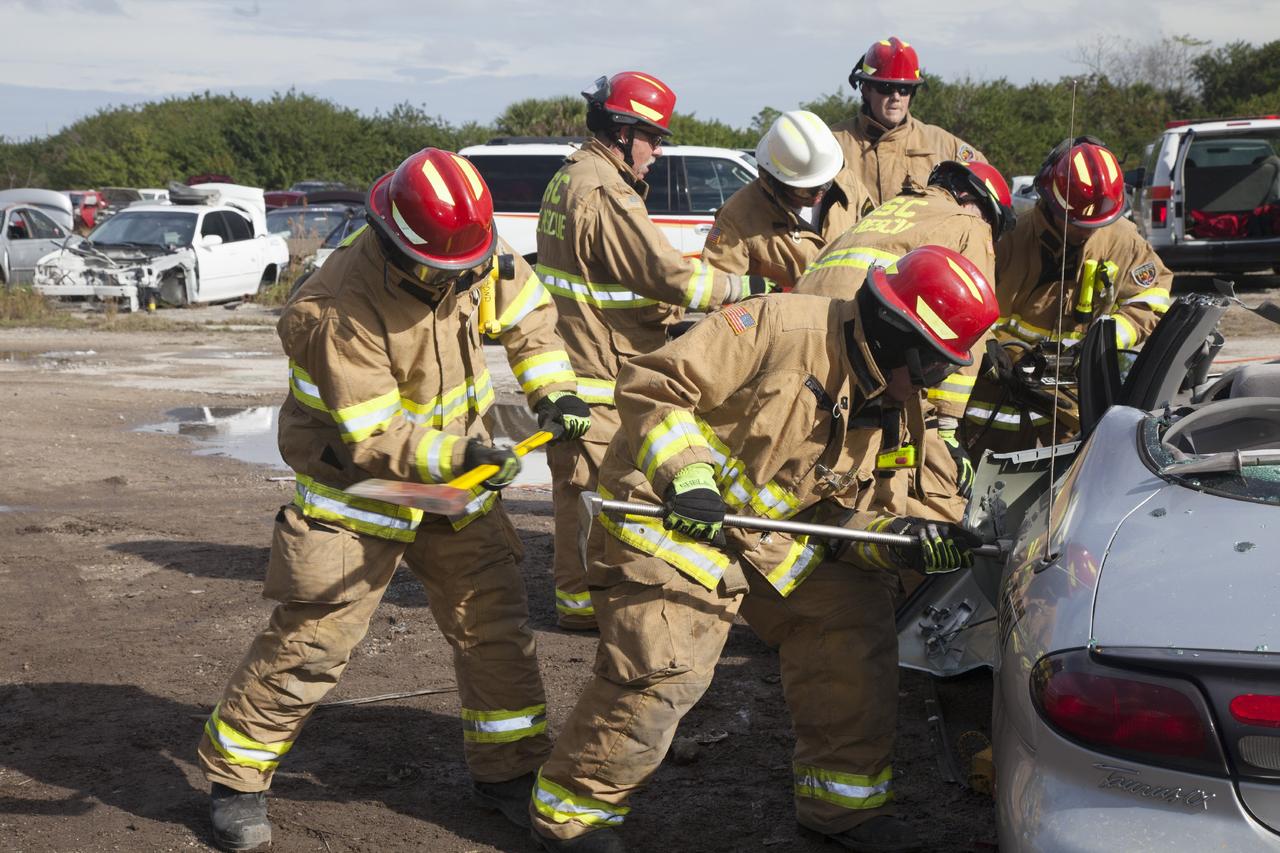
CAPE CANAVERAL, Fla. – Special Rescue Operations firefighters with NASA Fire Rescue Services in the Protective Services Office at NASA’s Kennedy Space Center in Florida practice vehicle extrication training at an auto salvage yard near the center. In the foreground, a firefighter with an axe assists as another firefighter uses a special tool to punch through the door of the vehicle. A special hydraulic cutting tool and reciprocating saw were used to cut through and remove the roof. In the background, other firefighters are practicing with the Jaws of Life to simulate the rescue of a trapped and injured person. Kennedy’s firefighters recently achieved Pro Board Certification in aerial fire truck operations. With the completion of vehicle extrication and Jaws of Life training, the Protective Services Office is one step closer to achieving certification in vehicle machinery extrication. Kennedy’s firefighters are with G4S Government Solutions Inc., on the Kennedy Protective Services Contract. Photo credit: NASA/Daniel Casper
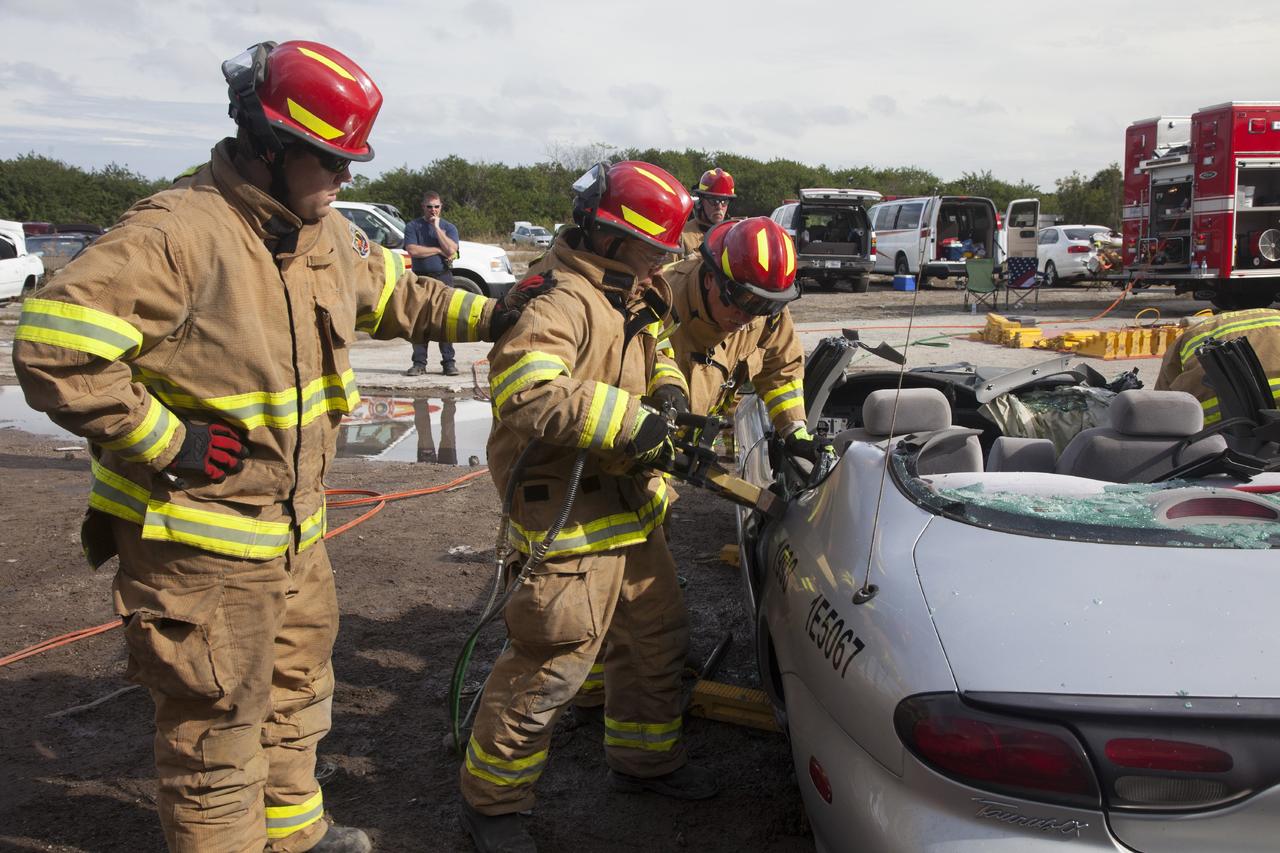
CAPE CANAVERAL, Fla. – Special Rescue Operations firefighters with NASA Fire Rescue Services in the Protective Services Office at NASA’s Kennedy Space Center in Florida practice vehicle extrication training at an auto salvage yard near the center. Two firefighters assist as another firefighter uses the Jaws of Life on the car to simulate the rescue of a trapped and injured person. A special hydraulic cutting tool and reciprocating saw were used to remove the roof of the vehicle. Other firefighters used axes and special tools to punch through and clear away the windshield and the windows. Kennedy’s firefighters recently achieved Pro Board Certification in aerial fire truck operations. With the completion of vehicle extrication and Jaws of Life training, the Protective Services Office is one step closer to achieving certification in vehicle machinery extrication. Kennedy’s firefighters are with G4S Government Solutions Inc., on the Kennedy Protective Services Contract. Photo credit: NASA/Daniel Casper
CAPE CANAVERAL, Fla. – Special Rescue Operations firefighters with NASA Fire Rescue Services in the Protective Services Office at NASA’s Kennedy Space Center in Florida practice vehicle extrication training at an auto salvage yard near the center. Firefighters have removed the roof of the car using a special hydraulic cutting tool and reciprocating saw. Other firefighters have used axes and special tools to punch through and clear away the windshield and windows. Another firefighter uses the Jaws of Life on the car to simulate the rescue of a trapped and injured person. Kennedy’s firefighters recently achieved Pro Board Certification in aerial fire truck operations. With the completion of vehicle extrication and Jaws of Life training, the Protective Services Office is one step closer to achieving certification in vehicle machinery extrication. Kennedy’s firefighters are with G4S Government Solutions Inc., on the Kennedy Protective Services Contract. Photo credit: NASA/Daniel Casper
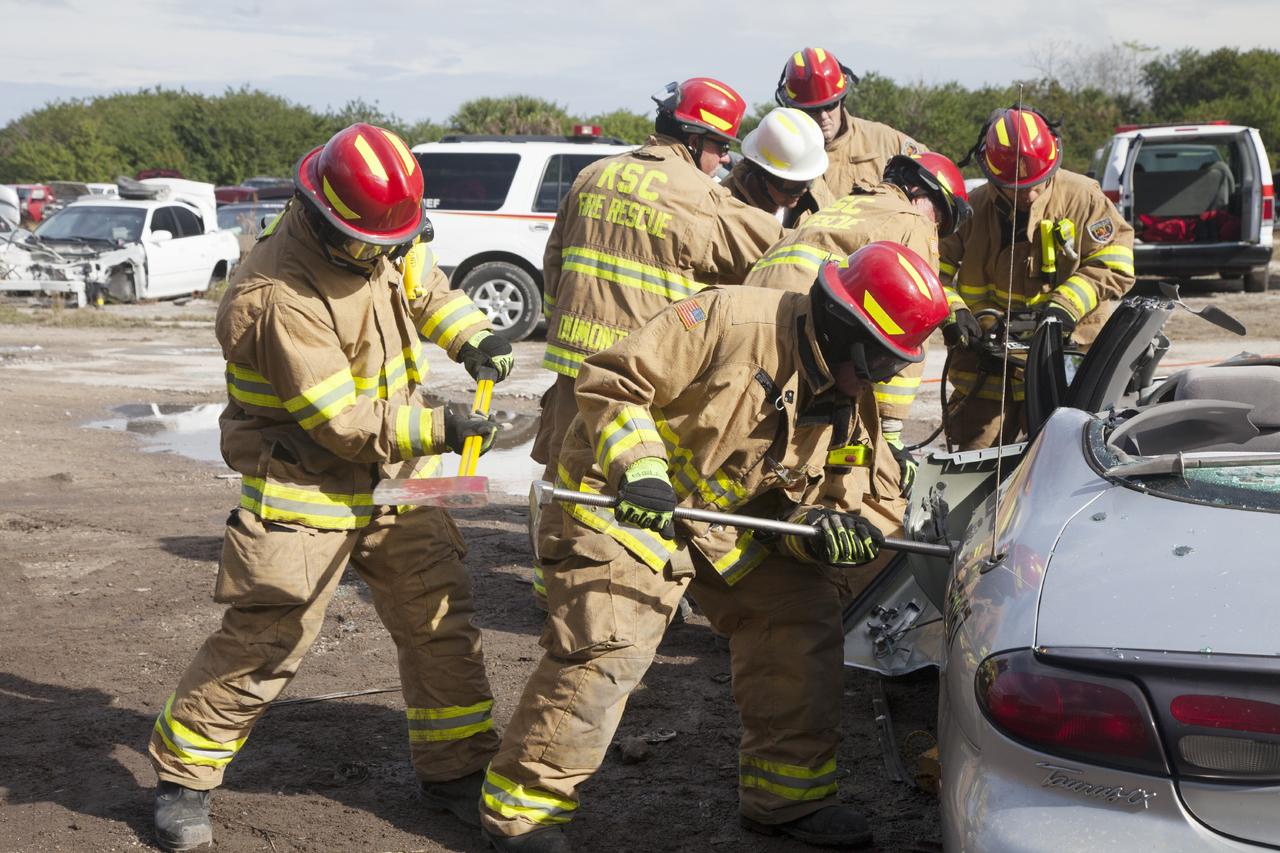
CAPE CANAVERAL, Fla. – Special Rescue Operations firefighters with NASA Fire Rescue Services in the Protective Services Office at NASA’s Kennedy Space Center in Florida practice vehicle extrication training at an auto salvage yard near the center. In the foreground, a firefighter with an axe assists as another firefighter uses a special tool to punch through the door of the vehicle. A special hydraulic cutting tool and reciprocating saw were used to cut through and remove the roof. In the background, other firefighters are practicing with the Jaws of Life to simulate the rescue of a trapped and injured person. Kennedy’s firefighters recently achieved Pro Board Certification in aerial fire truck operations. With the completion of vehicle extrication and Jaws of Life training, the Protective Services Office is one step closer to achieving certification in vehicle machinery extrication. Kennedy’s firefighters are with G4S Government Solutions Inc., on the Kennedy Protective Services Contract. Photo credit: NASA/Daniel Casper
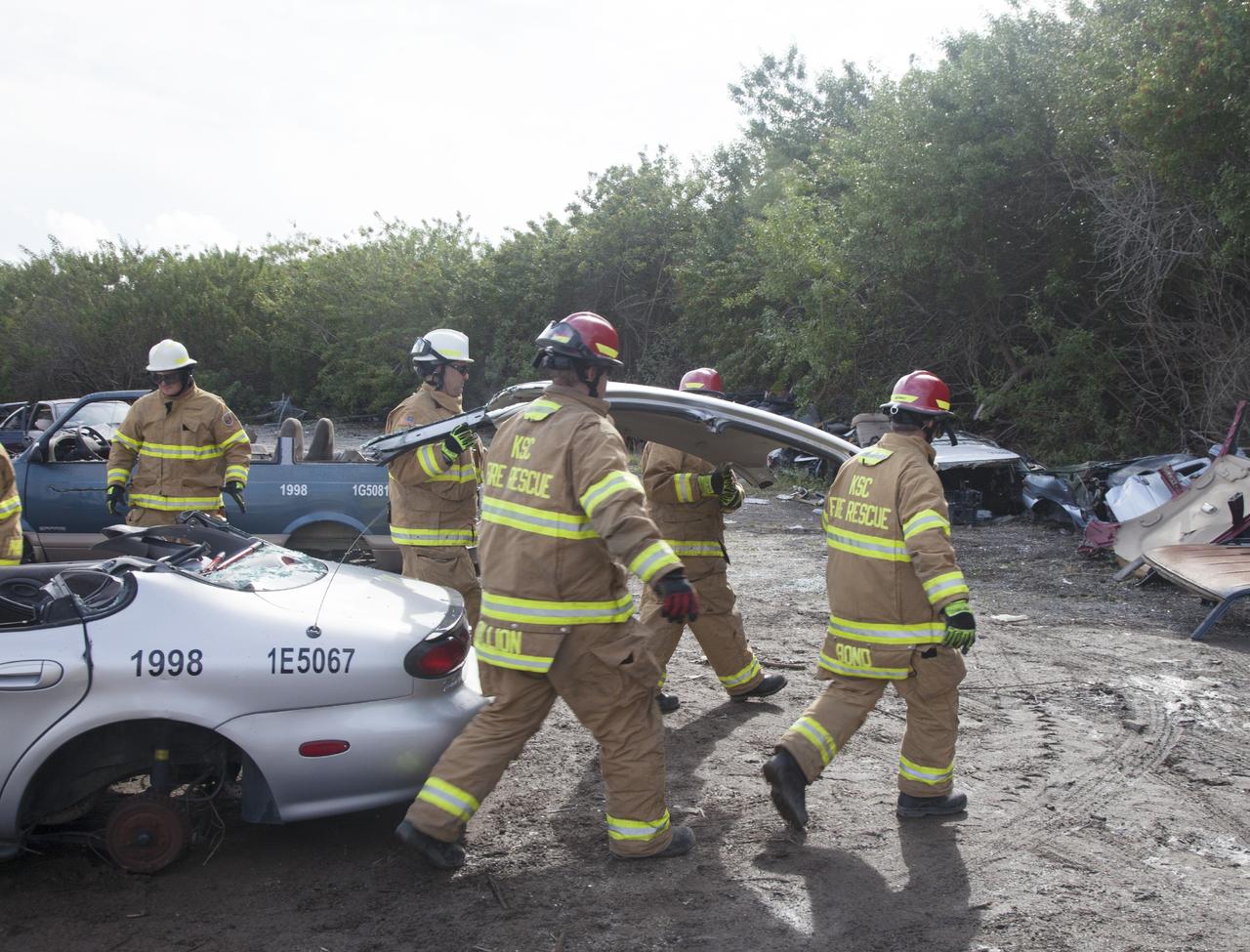
CAPE CANAVERAL, Fla. – Special Rescue Operations firefighters with NASA Fire Rescue Services in the Protective Services Office at NASA’s Kennedy Space Center in Florida practice vehicle extrication training at an auto salvage yard near the center. Firefighters carry away the roof of the car that was removed using a special hydraulic cutting tool and reciprocating saw. Other firefighters used axes and special tools to punch through and clear away the windshield and windows. They will use the Jaws of Life to simulate the rescue of a trapped and injured person. Kennedy’s firefighters recently achieved Pro Board Certification in aerial fire truck operations. With the completion of vehicle extrication and Jaws of Life training, the Protective Services Office is one step closer to achieving certification in vehicle machinery extrication. Kennedy’s firefighters are with G4S Government Solutions Inc., on the Kennedy Protective Services Contract. Photo credit: NASA/Daniel Casper
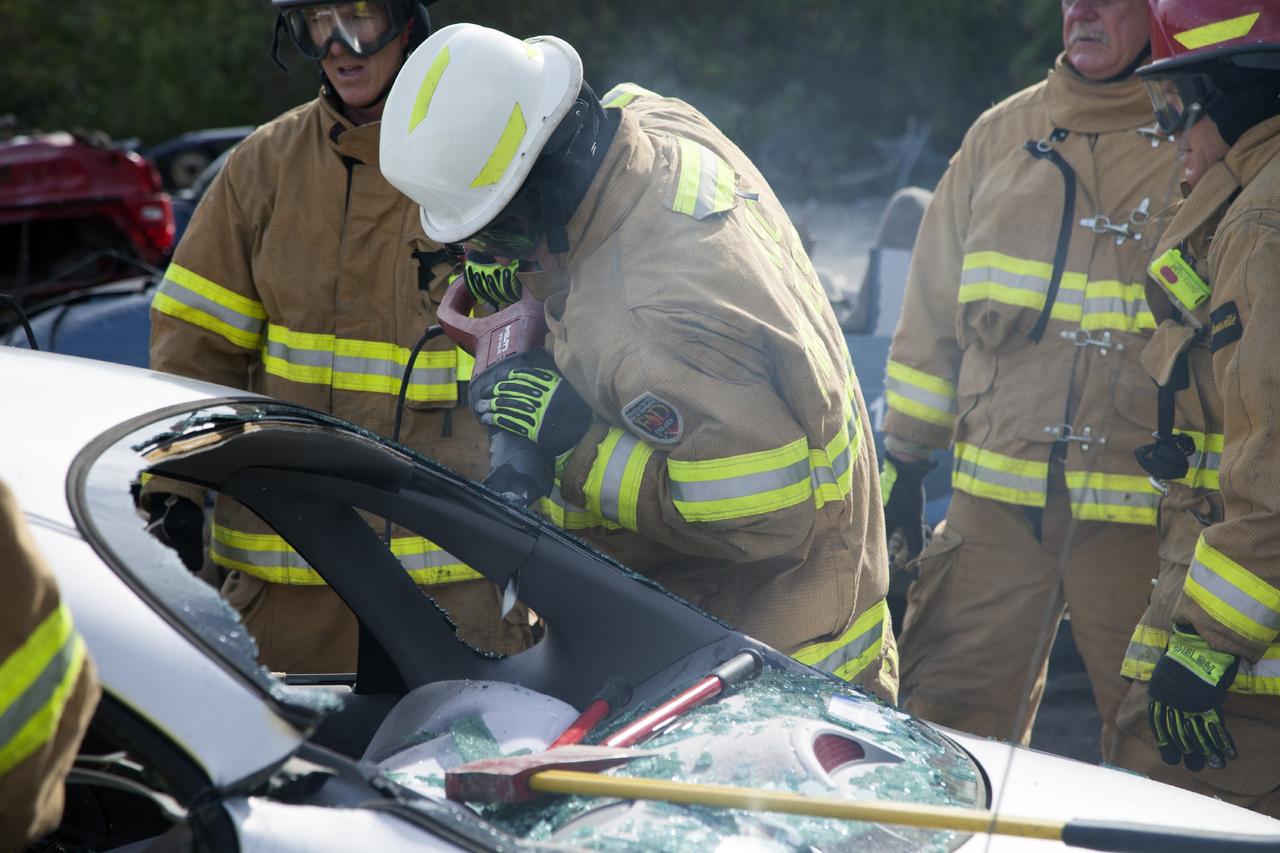
CAPE CANAVERAL, Fla. – Special Rescue Operations firefighters with NASA Fire Rescue Services in the Protective Services Office at NASA’s Kennedy Space Center in Florida practice vehicle extrication training at an auto salvage yard near the center. A firefighter uses a reciprocating saw to cut through a section of the car to remove the roof. Other firefighters used axes and special tools to punch through and clear away the windshield and windows. They will use the Jaws of Life to simulate the rescue of a trapped and injured person. Kennedy’s firefighters recently achieved Pro Board Certification in aerial fire truck operations. With the completion of vehicle extrication and Jaws of Life training, the Protective Services Office is one step closer to achieving certification in vehicle machinery extrication. Kennedy’s firefighters are with G4S Government Solutions Inc., on the Kennedy Protective Services Contract. Photo credit: NASA/Daniel Casper
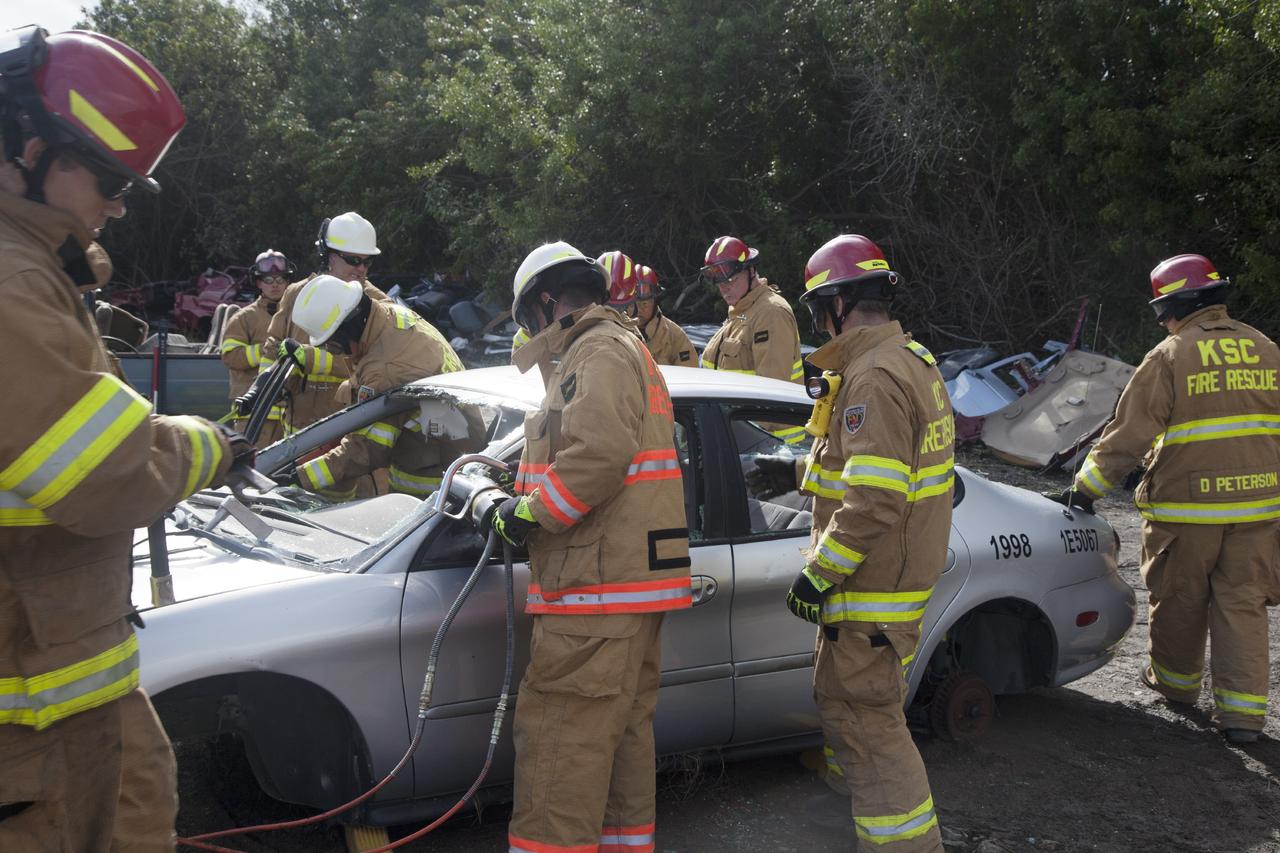
CAPE CANAVERAL, Fla. – Special Rescue Operations firefighters with NASA Fire Rescue Services in the Protective Services Office at NASA’s Kennedy Space Center in Florida practice vehicle extrication training at an auto salvage yard near the center. A firefighter uses a special hydraulic tool to cut through a section of the car to remove the roof, while other firefighters clear the windows and prepare to use the Jaws of Life to simulate the rescue of a trapped and injured person. Other rescue equipment being used includes axes and tools to punch through and clear away windshields and windows. Kennedy’s firefighters recently achieved Pro Board Certification in aerial fire truck operations. With the completion of vehicle extrication and Jaws of Life training, the Protective Services Office is one step closer to achieving certification in vehicle machinery extrication. Kennedy’s firefighters are with G4S Government Solutions Inc., on the Kennedy Protective Services Contract. Photo credit: NASA/Daniel Casper
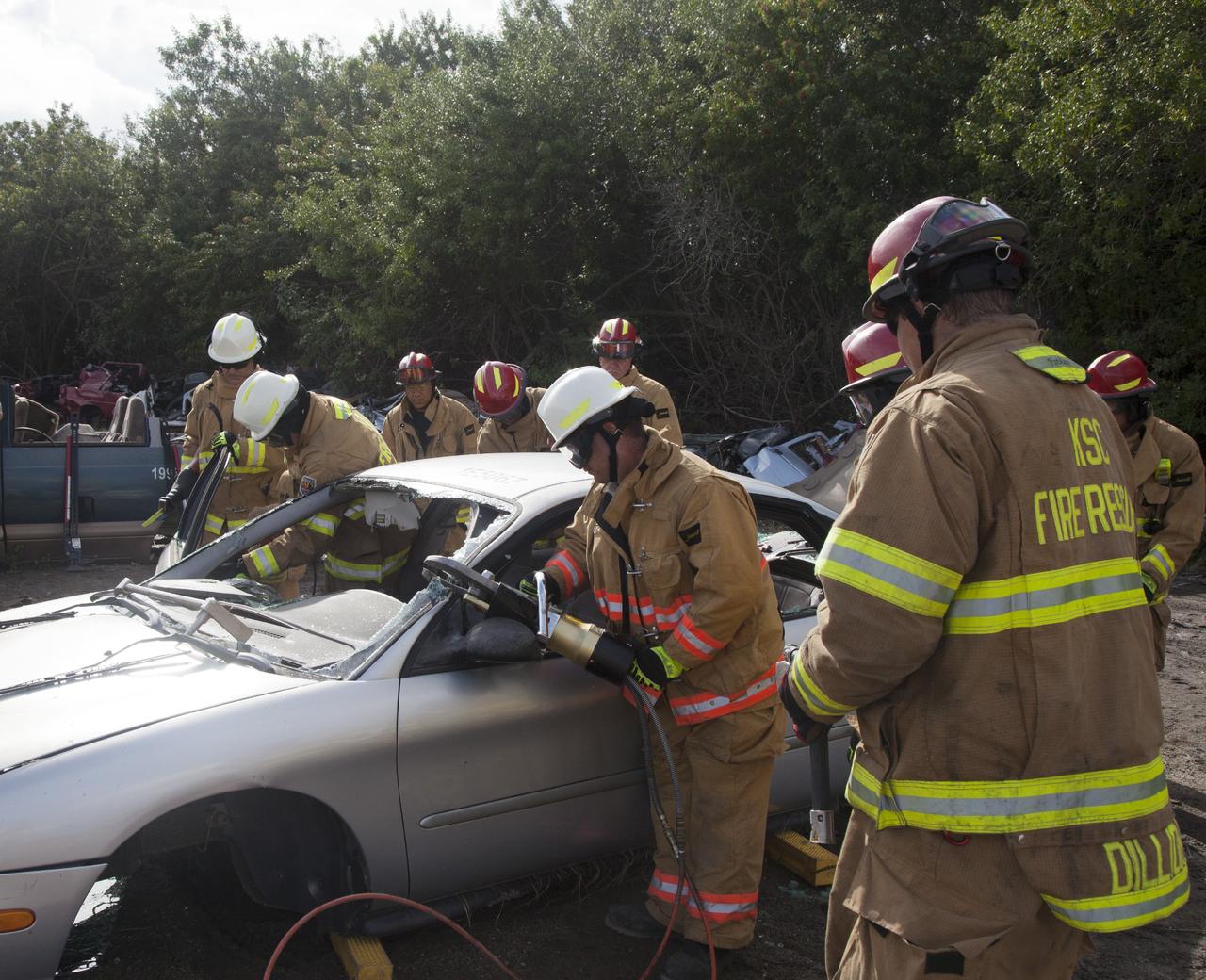
CAPE CANAVERAL, Fla. – Special Rescue Operations firefighters with NASA Fire Rescue Services in the Protective Services Office at NASA’s Kennedy Space Center in Florida practice vehicle extrication training at an auto salvage yard near the center. A firefighter uses a special hydraulic tool to cut through a section of the car to remove the roof, while other firefighters clear the windows and prepare to use the Jaws of Life to simulate the rescue of a trapped and injured person. Other rescue equipment being used includes axes and tools to punch through and clear away windshields and windows. Kennedy’s firefighters recently achieved Pro Board Certification in aerial fire truck operations. With the completion of vehicle extrication and Jaws of Life training, the Protective Services Office is one step closer to achieving certification in vehicle machinery extrication. Kennedy’s firefighters are with G4S Government Solutions Inc., on the Kennedy Protective Services Contract. Photo credit: NASA/Daniel Casper
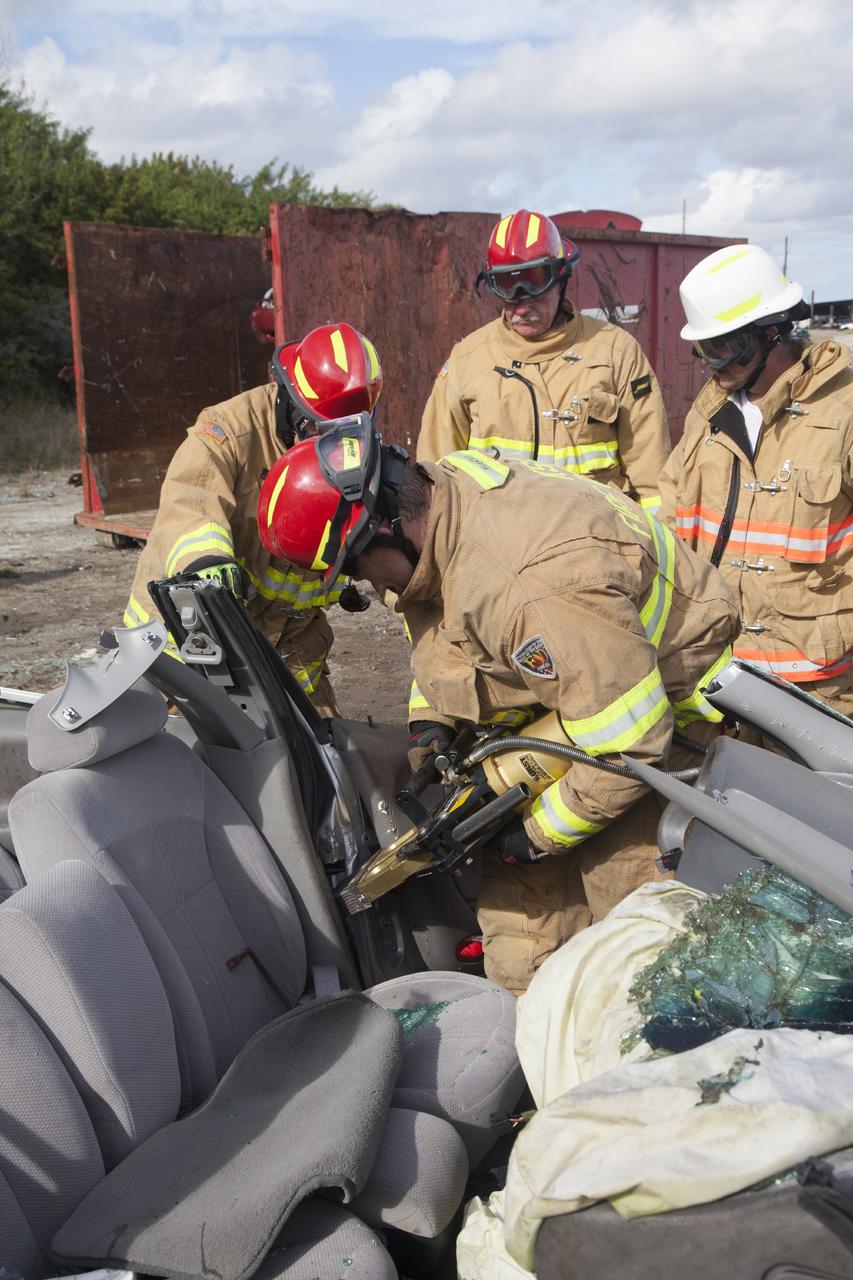
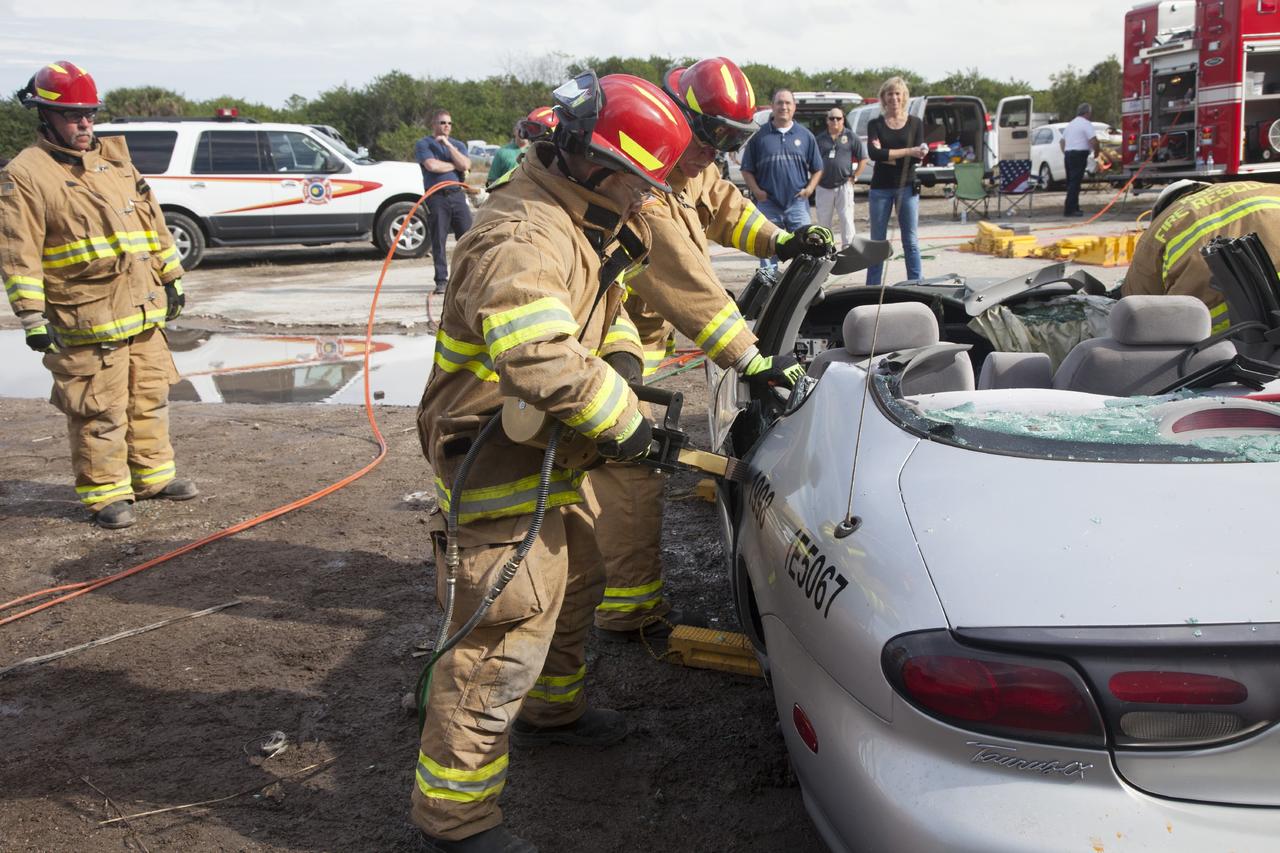
CAPE CANAVERAL, Fla. – Special Rescue Operations firefighters with NASA Fire Rescue Services in the Protective Services Office at NASA’s Kennedy Space Center in Florida practice vehicle extrication training at an auto salvage yard near the center. A firefighter uses the Jaws of Life to finish removing the door from the vehicle and simulate the rescue of a trapped and injured person. A special hydraulic cutting tool and reciprocating saw were used to cut through and remove the roof. An axe and other special tools were used to punch through and clear away the windshield and windows. Kennedy’s firefighters recently achieved Pro Board Certification in aerial fire truck operations. With the completion of vehicle extrication and Jaws of Life training, the Protective Services Office is one step closer to achieving certification in vehicle machinery extrication. Kennedy’s firefighters are with G4S Government Solutions Inc., on the Kennedy Protective Services Contract. Photo credit: NASA/Daniel Casper
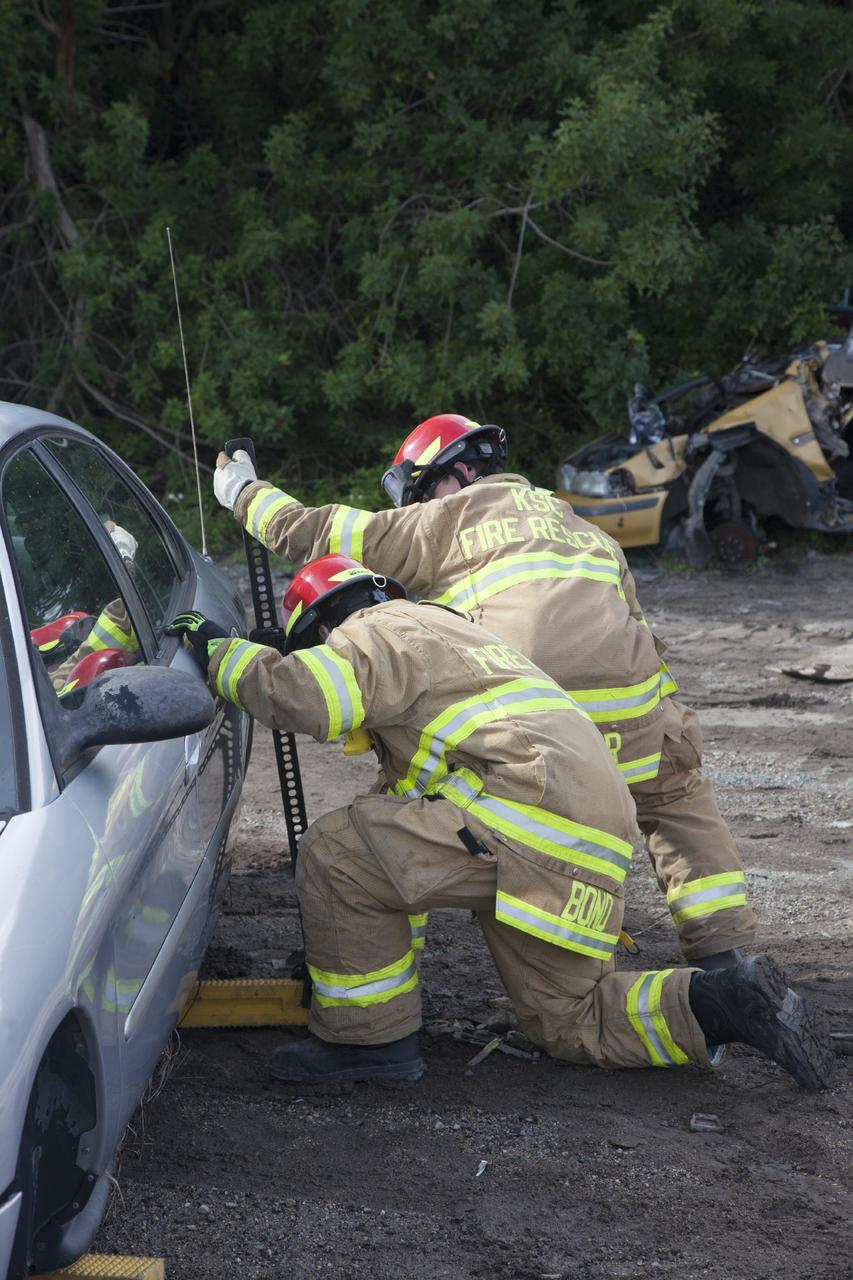
CAPE CANAVERAL, Fla. – Special Rescue Operations firefighters with NASA Fire Rescue Services in the Protective Services Office at NASA’s Kennedy Space Center in Florida practice vehicle extrication training at an auto salvage yard near the center. Two firefighters insert blocks under the vehicle to stabilize it. They will use the Jaws of Life on the vehicle to simulate the rescue of a trapped and injured person. Other rescue equipment includes axes, tools to punch through and clear away the windshield and windows and a hydraulic cutting tool that is used to remove the roof of a car. Kennedy’s firefighters recently achieved Pro Board Certification in aerial fire truck operations. With the completion of vehicle extrication and Jaws of Life training, the Protective Services Office is one step closer to achieving certification in vehicle machinery extrication. Kennedy’s firefighters are with G4S Government Solutions Inc., on the Kennedy Protective Services Contract. Photo credit: NASA/Daniel Casper
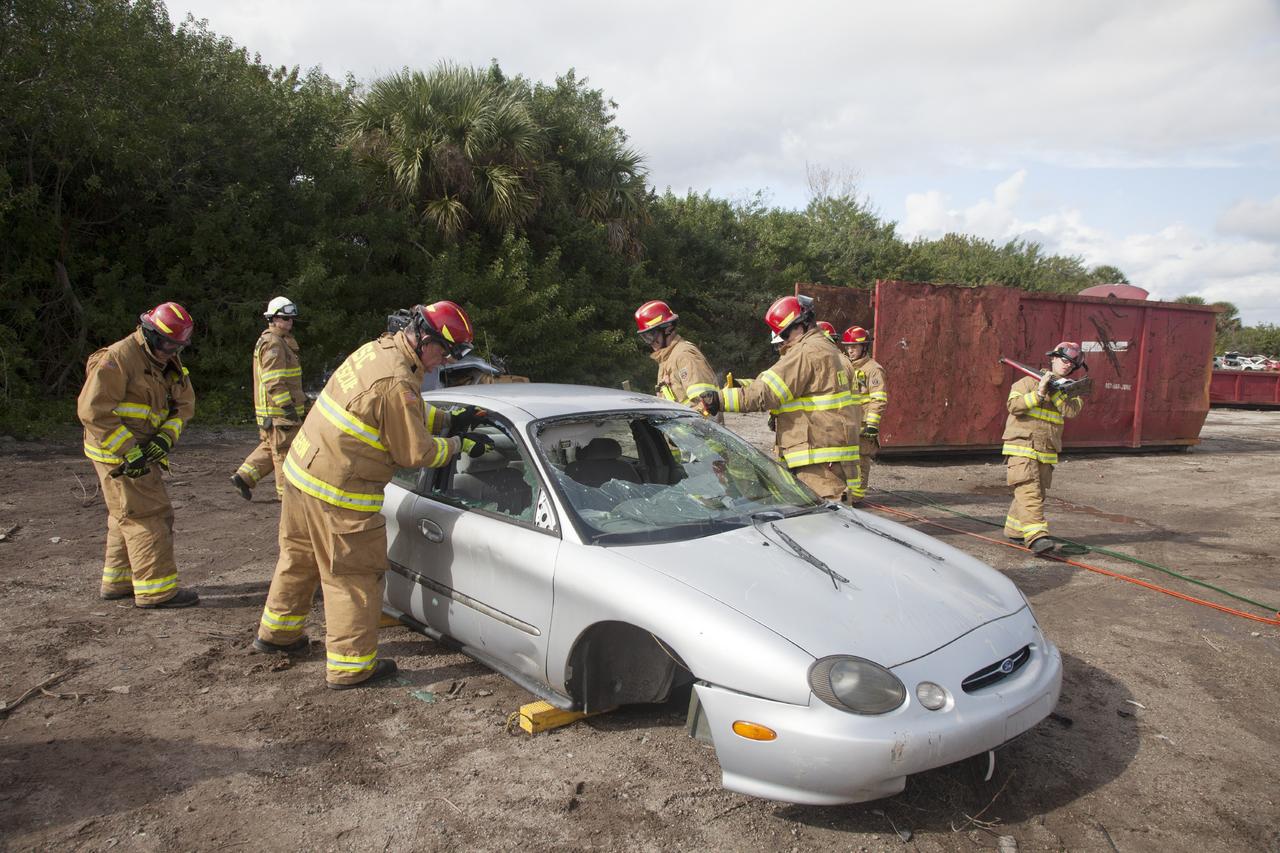
CAPE CANAVERAL, Fla. – Special Rescue Operations firefighters with NASA Fire Rescue Services in the Protective Services Office at NASA’s Kennedy Space Center in Florida practice vehicle extrication training at an auto salvage yard near the center. Stabilizing blocks have been placed underneath the car. Firefighters practiced knocking out the windshield and windows with axes and other tools. They will use the Jaws of Life on the vehicle to simulate the rescue of a trapped and injured person. Other rescue equipment includes a hydraulic cutting tool that is used to remove the roof of a car. Kennedy’s firefighters recently achieved Pro Board Certification in aerial fire truck operations. With the completion of vehicle extrication and Jaws of Life training, the Protective Services Office is one step closer to achieving certification in vehicle machinery extrication. Kennedy’s firefighters are with G4S Government Solutions Inc., on the Kennedy Protective Services Contract. Photo credit: NASA/Daniel Casper
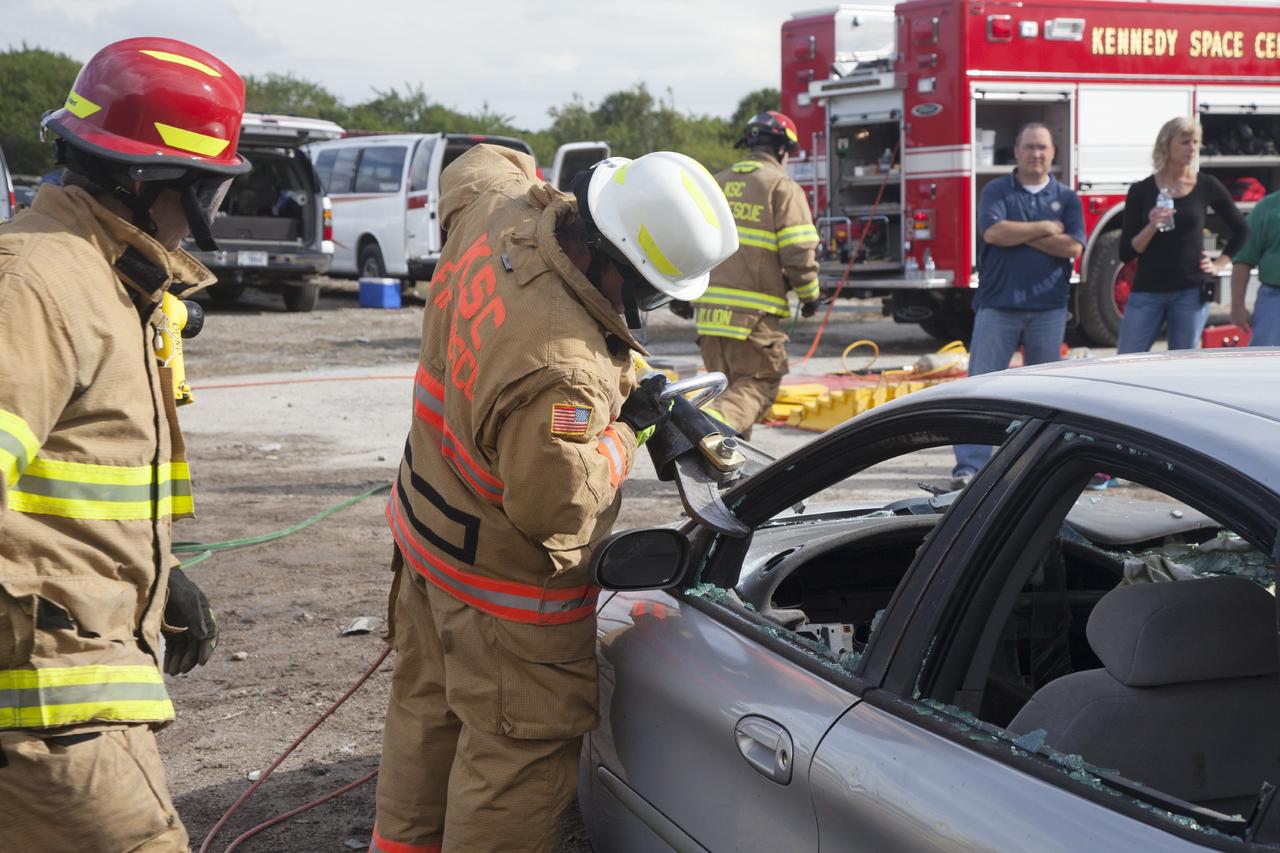
CAPE CANAVERAL, Fla. – Special Rescue Operations firefighters with NASA Fire Rescue Services in the Protective Services Office at NASA’s Kennedy Space Center in Florida practice vehicle extrication training at an auto salvage yard near the center. A firefighter uses a special hydraulic tool to cut through the vehicle in order to remove the roof. They will use the Jaws of Life on the vehicle to simulate the rescue of a trapped and injured person. Other rescue equipment includes axes and tools to punch through and clear away windshields and windows. Kennedy’s firefighters recently achieved Pro Board Certification in aerial fire truck operations. With the completion of vehicle extrication and Jaws of Life training, the Protective Services Office is one step closer to achieving certification in vehicle machinery extrication. Kennedy’s firefighters are with G4S Government Solutions Inc., on the Kennedy Protective Services Contract. Photo credit: NASA/Daniel Casper
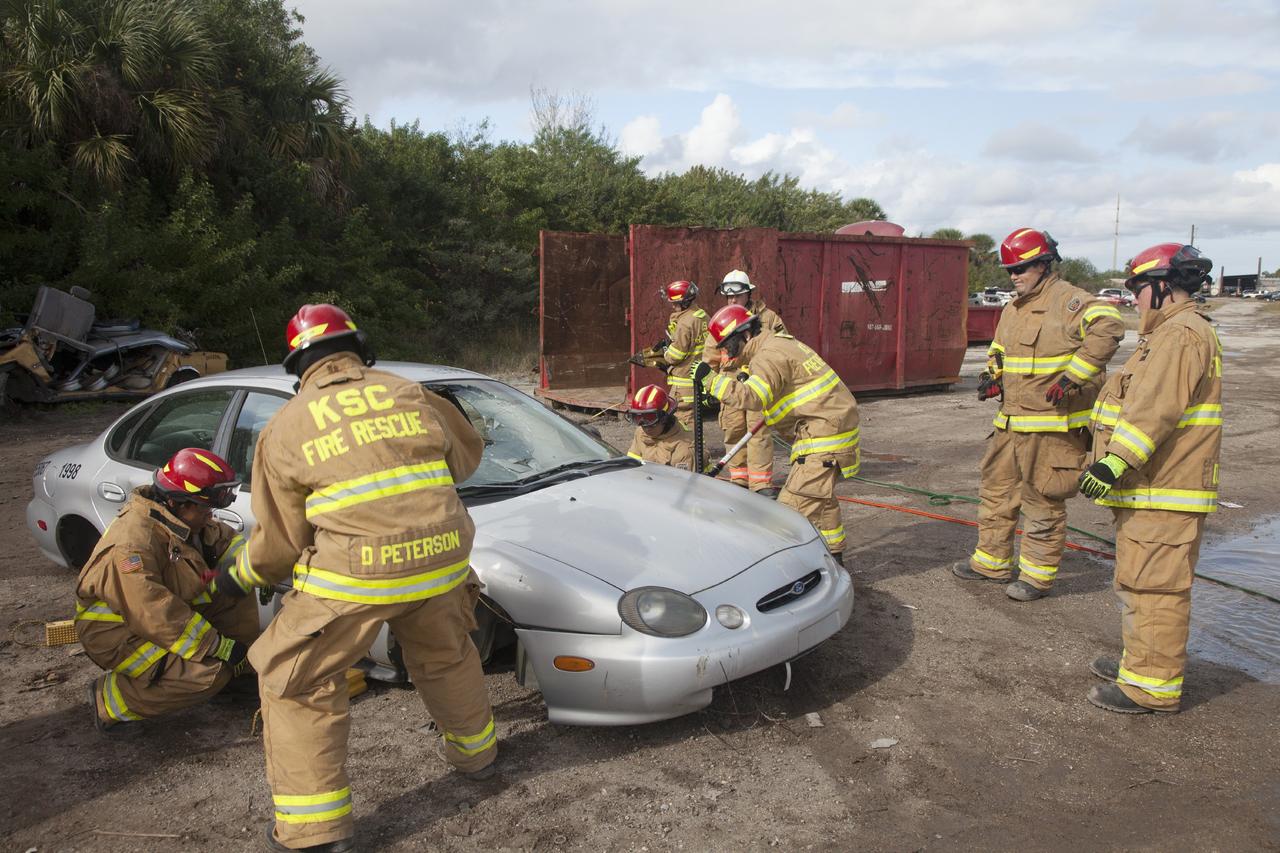
CAPE CANAVERAL, Fla. – Special Rescue Operations firefighters with NASA Fire Rescue Services in the Protective Services Office at NASA’s Kennedy Space Center in Florida practice vehicle extrication training at an auto salvage yard near the center. The firefighters used the Jaws of Life on the vehicle to simulate the rescue of a trapped and injured person. Other equipment used includes axes, tools to punch through and clear away the windshield and windows and a hydraulic cutting tool that is used to remove the roof of a car. Kennedy’s firefighters recently achieved Pro Board Certification in aerial fire truck operations. With the completion of vehicle extrication and Jaws of Life training, the Protective Services Office is one step closer to achieving certification in vehicle machinery extrication. Kennedy’s firefighters are with G4S Government Solutions Inc., on the Kennedy Protective Services Contract. Photo credit: NASA/Daniel Casper
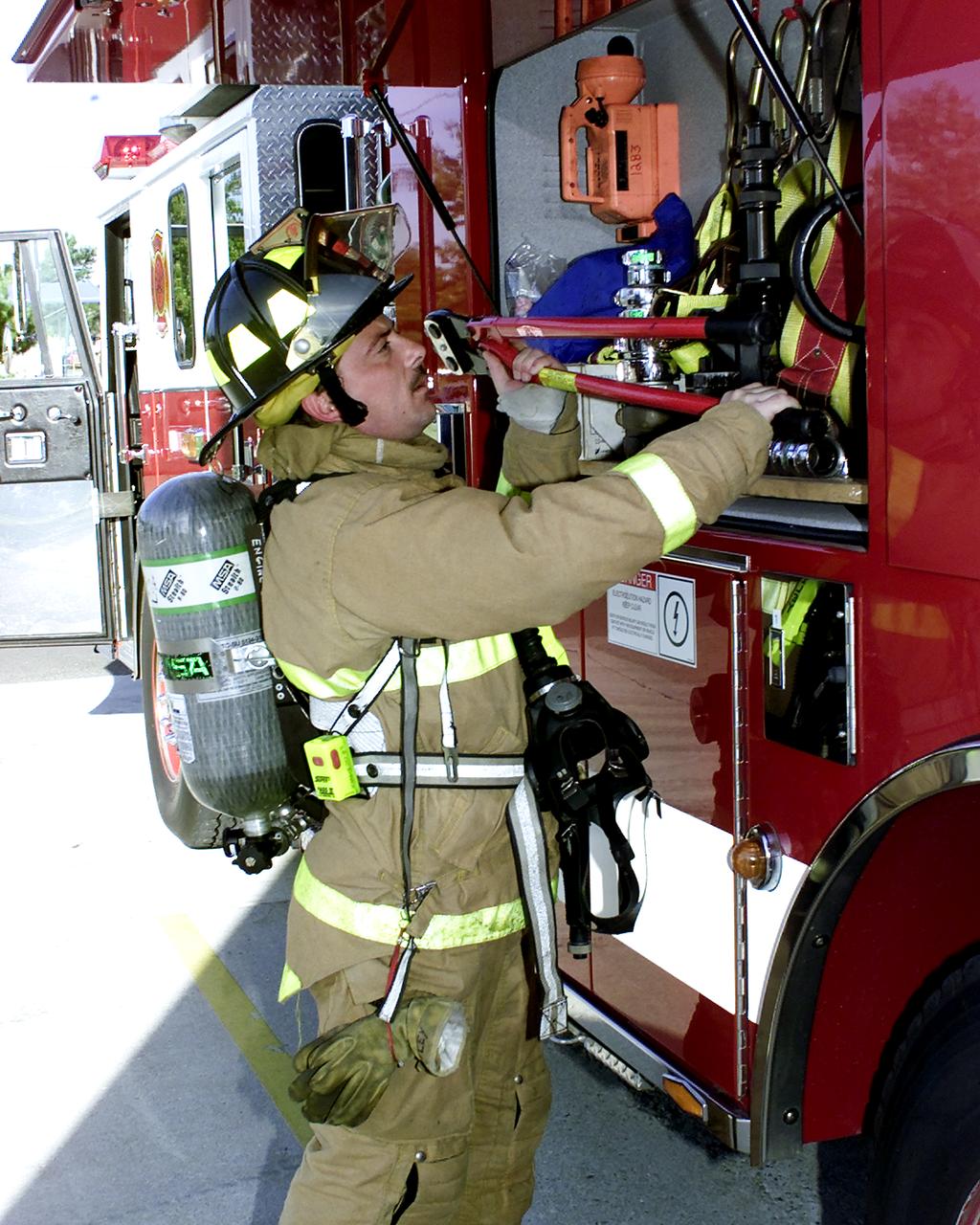
Technology used to provide thermal protection for Apollo astronauts and spacecraft components provides firefighters with better protective clothing and equipment. Spinoffs include a portable firefighting module, protective clothing for workers in hazardous environments, fire-retardant paints and forms, fireblocking coating for outdoor structures, and flame-resistant fabric. Perhaps the farthest reaching is the breathing apparatus worn by firefighters throughout the U.S. for protection against smoke inhalation injury. The breathing system weighs approximately 20 pounds, one-third less than past systems, and it enables the wearer to have improved mobility. It consists of a face mask, frame and harness, a warning device, and an air bottle. The basic air cylinder offers the same 30-minutes of operation time as its predecessor. The result is a drastic reduction in the number of inhalation injuries to firefighters. Though they have made many design modifications and refinements, manufacturers of breathing apparatus still incorporate the original NASA technology.
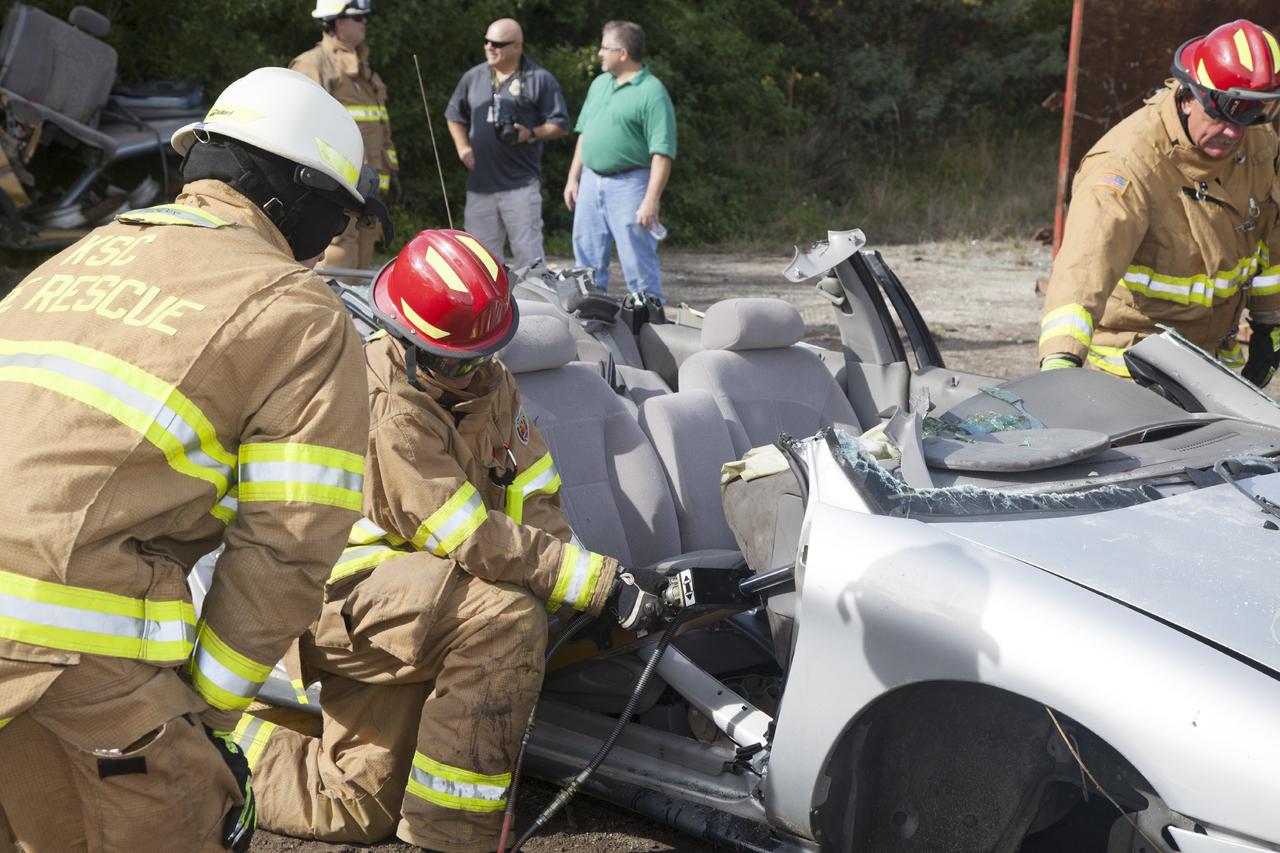
CAPE CANAVERAL, Fla. – Special Rescue Operations firefighters with NASA Fire Rescue Services in the Protective Services Office at NASA’s Kennedy Space Center in Florida practice vehicle extrication training at an auto salvage yard near the center. A firefighter uses a spreader to push the dashboard away from the seat. They used the Jaws of Life to remove the door from the vehicle and simulate the rescue of a trapped and injured person. A special hydraulic cutting tool and reciprocating saw were used to cut through and remove the roof. An axe and other special tools were used to punch through and clear away the windshield and windows. Kennedy’s firefighters recently achieved Pro Board Certification in aerial fire truck operations. With the completion of vehicle extrication and Jaws of Life training, the Protective Services Office is one step closer to achieving certification in vehicle machinery extrication. Kennedy’s firefighters are with G4S Government Solutions Inc., on the Kennedy Protective Services Contract. Photo credit: NASA/Daniel Casper
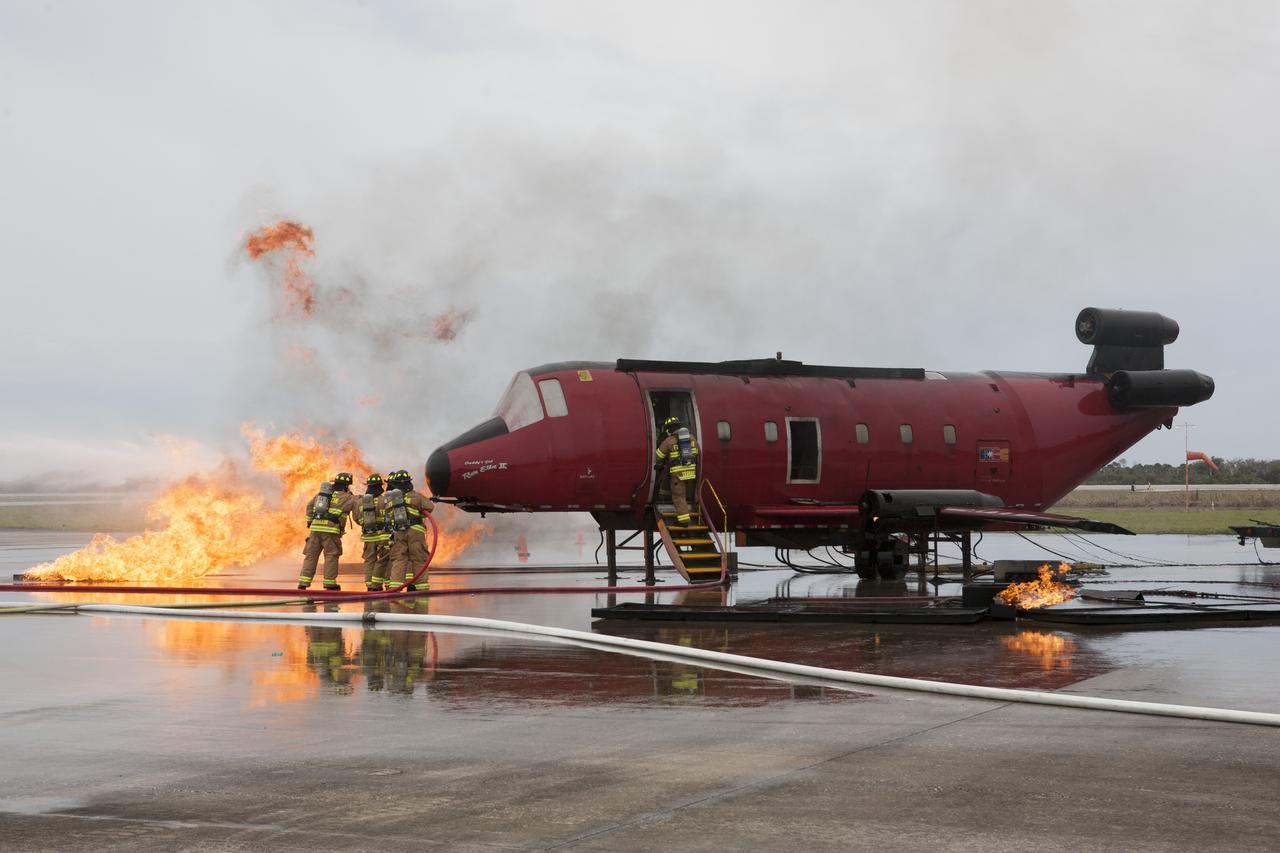
CAPE CANAVERAL, Fla. - Special Rescue Operations firefighters with NASA Fire Rescue Services in the Protective Services Office at NASA’s Kennedy Space Center in Florida participate in a training exercise at the Shuttle Landing Facility. Firefighters, wearing protective gear, use hoses to put out a fire burning near the mock-up of a small plane as another firefighter checks inside the plane. Kennedy’s firefighters recently achieved Pro Board Certification in aerial fire truck operations and completed vehicle extrication training using the Jaws of Life. The Protective Services Office is one step closer to achieving certification in vehicle machinery extrication and other rescue skills. Kennedy’s firefighters are with G4S Government Solutions Inc., on the Kennedy Protective Services Contract. Photo credit: NASA/Kim Shiflett
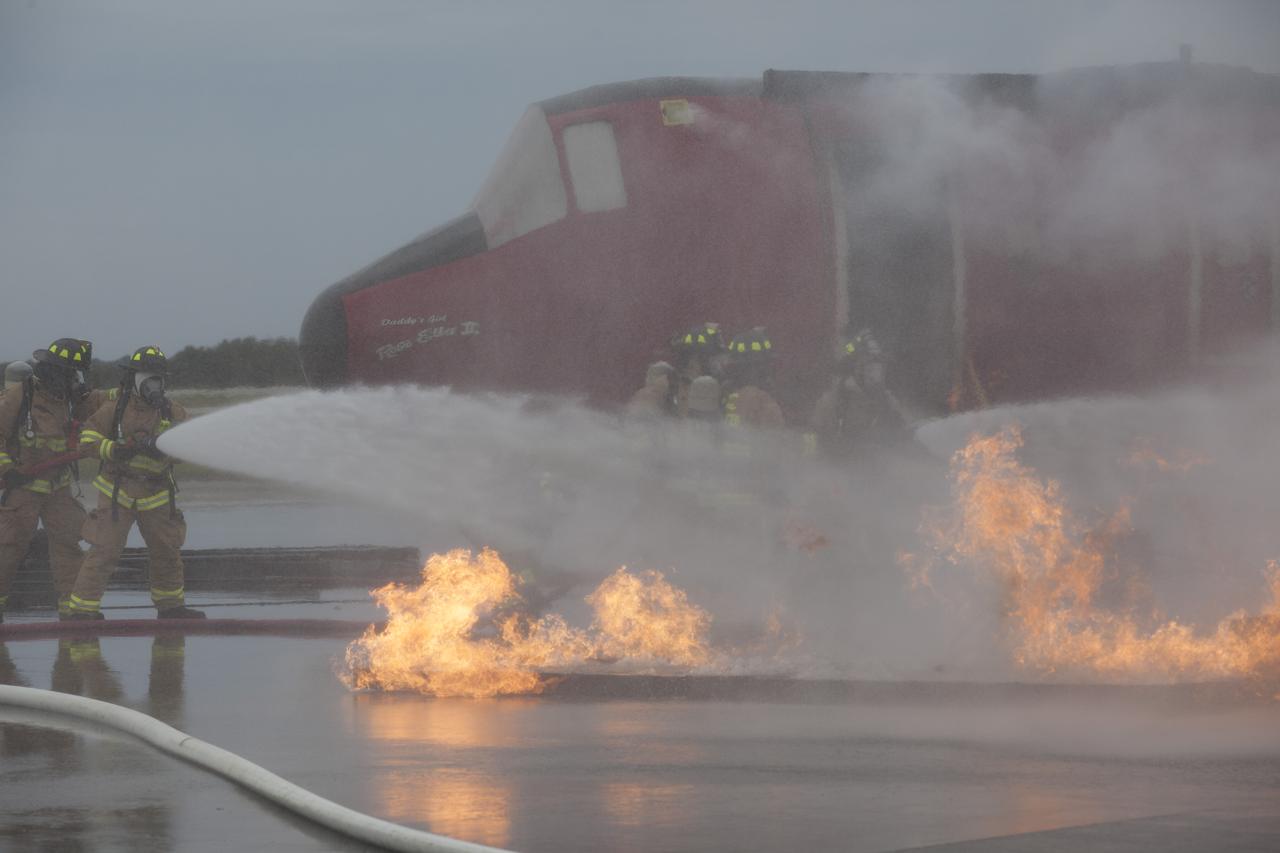
CAPE CANAVERAL, Fla. - Special Rescue Operations firefighters with NASA Fire Rescue Services in the Protective Services Office at NASA’s Kennedy Space Center in Florida participate in a training exercise at the Shuttle Landing Facility. Firefighters, wearing protective gear, use hoses to put out a fire burning close to a mock-up of a small plane. Kennedy’s firefighters recently achieved Pro Board Certification in aerial fire truck operations and completed vehicle extrication training using the Jaws of Life. The Protective Services Office is one step closer to achieving certification in vehicle machinery extrication and other rescue skills. Kennedy’s firefighters are with G4S Government Solutions Inc., on the Kennedy Protective Services Contract. Photo credit: NASA/Kim Shiflett
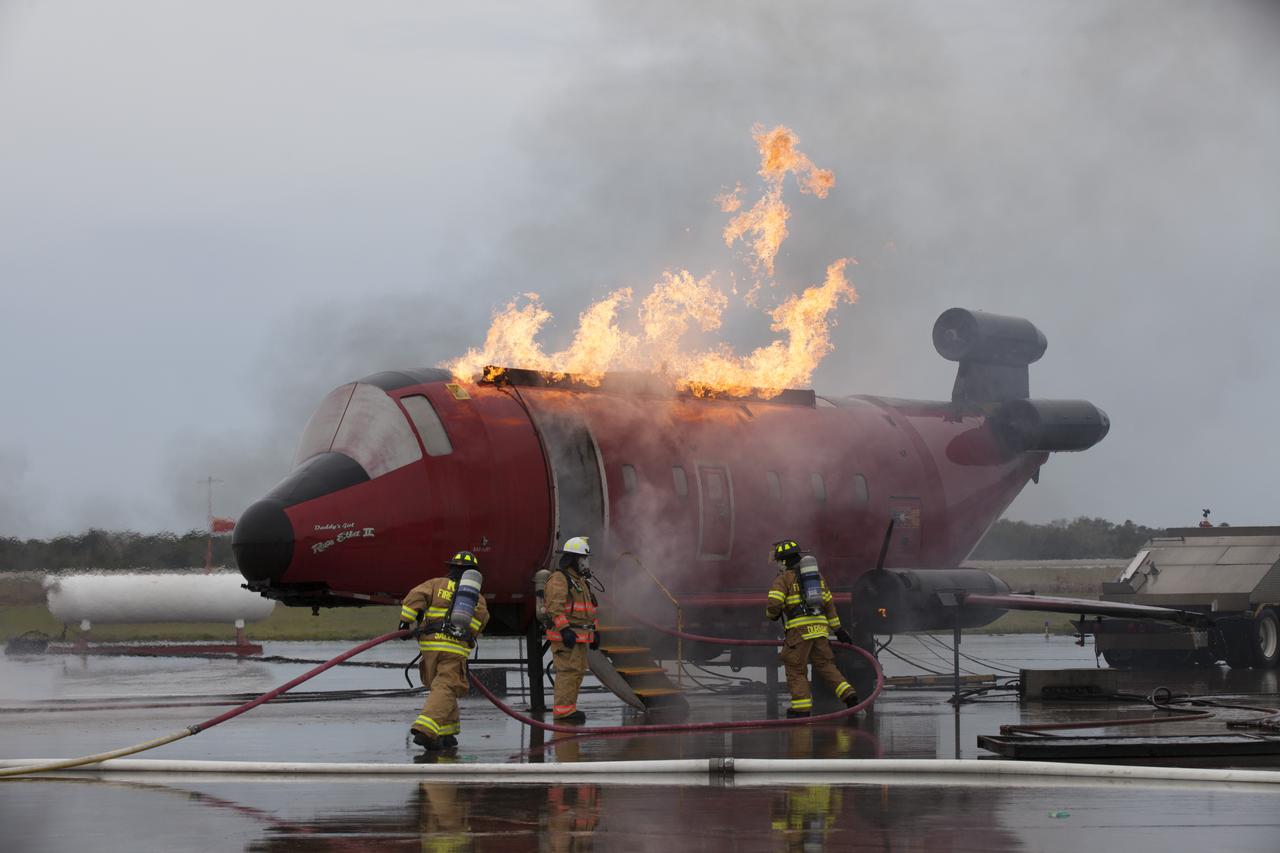
CAPE CANAVERAL, Fla. - Special Rescue Operations firefighters with NASA Fire Rescue Services in the Protective Services Office at NASA’s Kennedy Space Center in Florida participate in a training exercise at the Shuttle Landing Facility. Firefighters, wearing protective gear, use hoses to put out a fire burning on a mock-up of a small plane. Kennedy’s firefighters recently achieved Pro Board Certification in aerial fire truck operations and completed vehicle extrication training using the Jaws of Life. The Protective Services Office is one step closer to achieving certification in vehicle machinery extrication and other rescue skills. Kennedy’s firefighters are with G4S Government Solutions Inc., on the Kennedy Protective Services Contract. Photo credit: NASA/Kim Shiflett
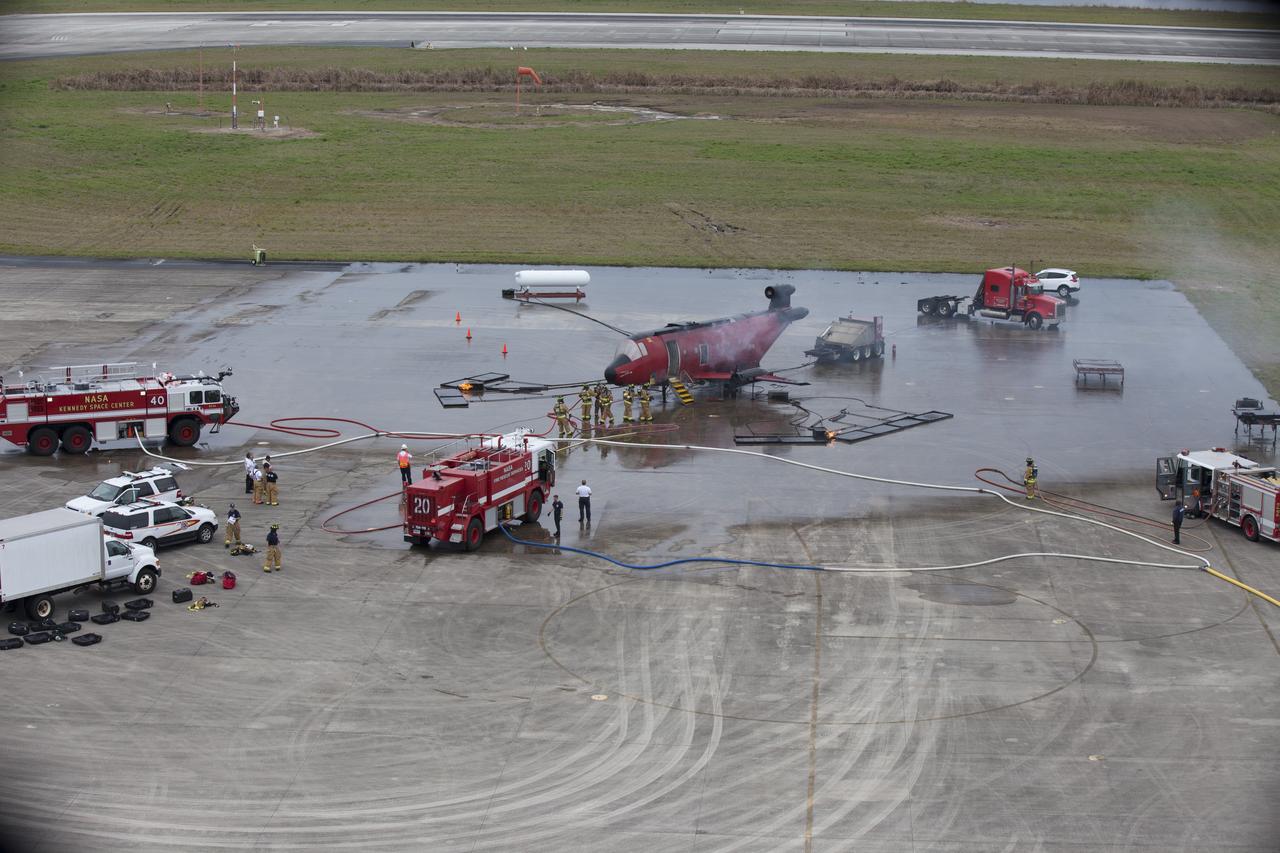
CAPE CANAVERAL, Fla. - Special Rescue Operations firefighters with NASA Fire Rescue Services in the Protective Services Office at NASA’s Kennedy Space Center in Florida participate in a training exercise at the Shuttle Landing Facility. Firefighters use fire trucks and hoses to extinguish flames burning on and around a mock-up of a small plane. Kennedy’s firefighters recently achieved Pro Board Certification in aerial fire truck operations and completed vehicle extrication training using the Jaws of Life. The Protective Services Office is one step closer to achieving certification in vehicle machinery extrication and other rescue skills. Kennedy’s firefighters are with G4S Government Solutions Inc., on the Kennedy Protective Services Contract. Photo credit: NASA/Kim Shiflett
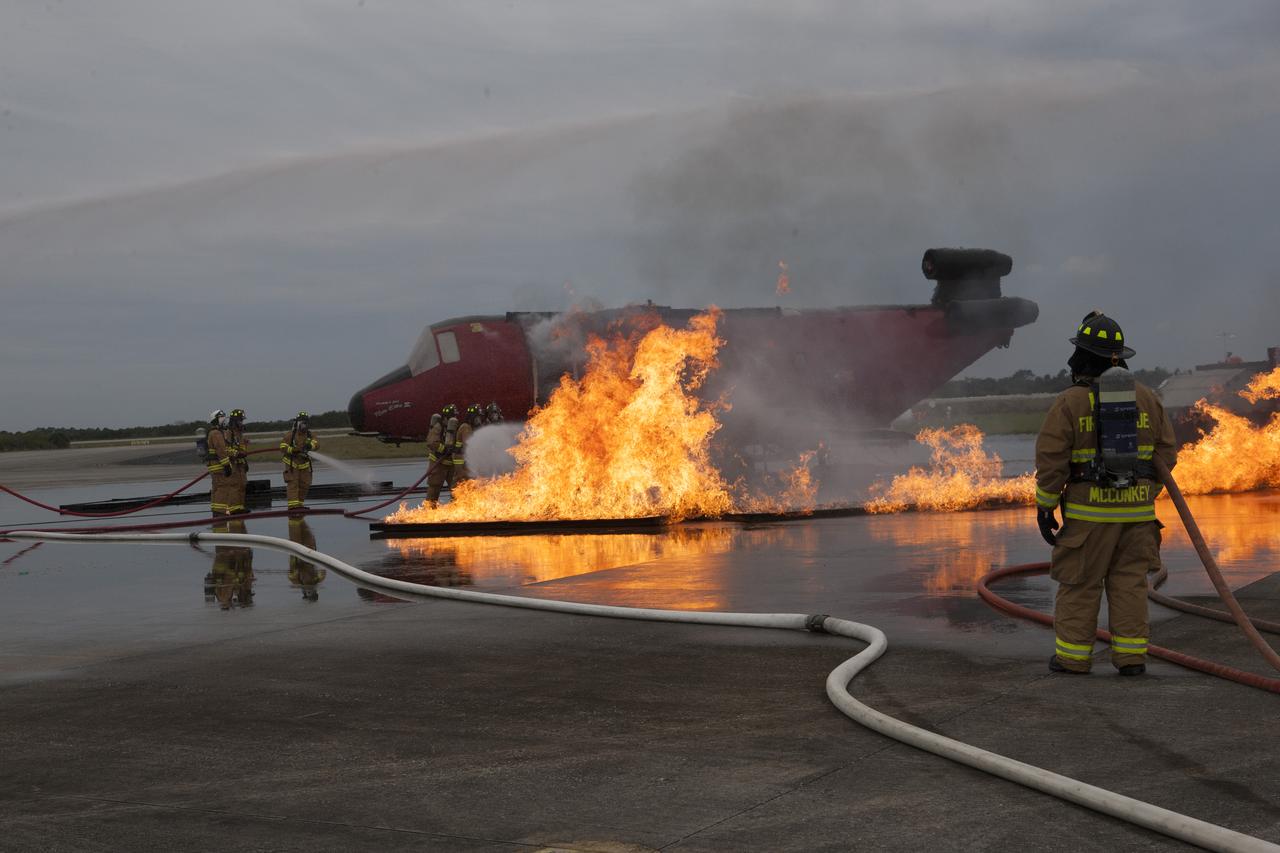
CAPE CANAVERAL, Fla. - Special Rescue Operations firefighters with NASA Fire Rescue Services in the Protective Services Office at NASA’s Kennedy Space Center in Florida participate in a training exercise at the Shuttle Landing Facility. Firefighters, wearing protective gear, use hoses to put out a fire burning near the mock-up of a small plane. Kennedy’s firefighters recently achieved Pro Board Certification in aerial fire truck operations and completed vehicle extrication training using the Jaws of Life. The Protective Services Office is one step closer to achieving certification in vehicle machinery extrication and other rescue skills. Kennedy’s firefighters are with G4S Government Solutions Inc., on the Kennedy Protective Services Contract. Photo credit: NASA/Kim Shiflett
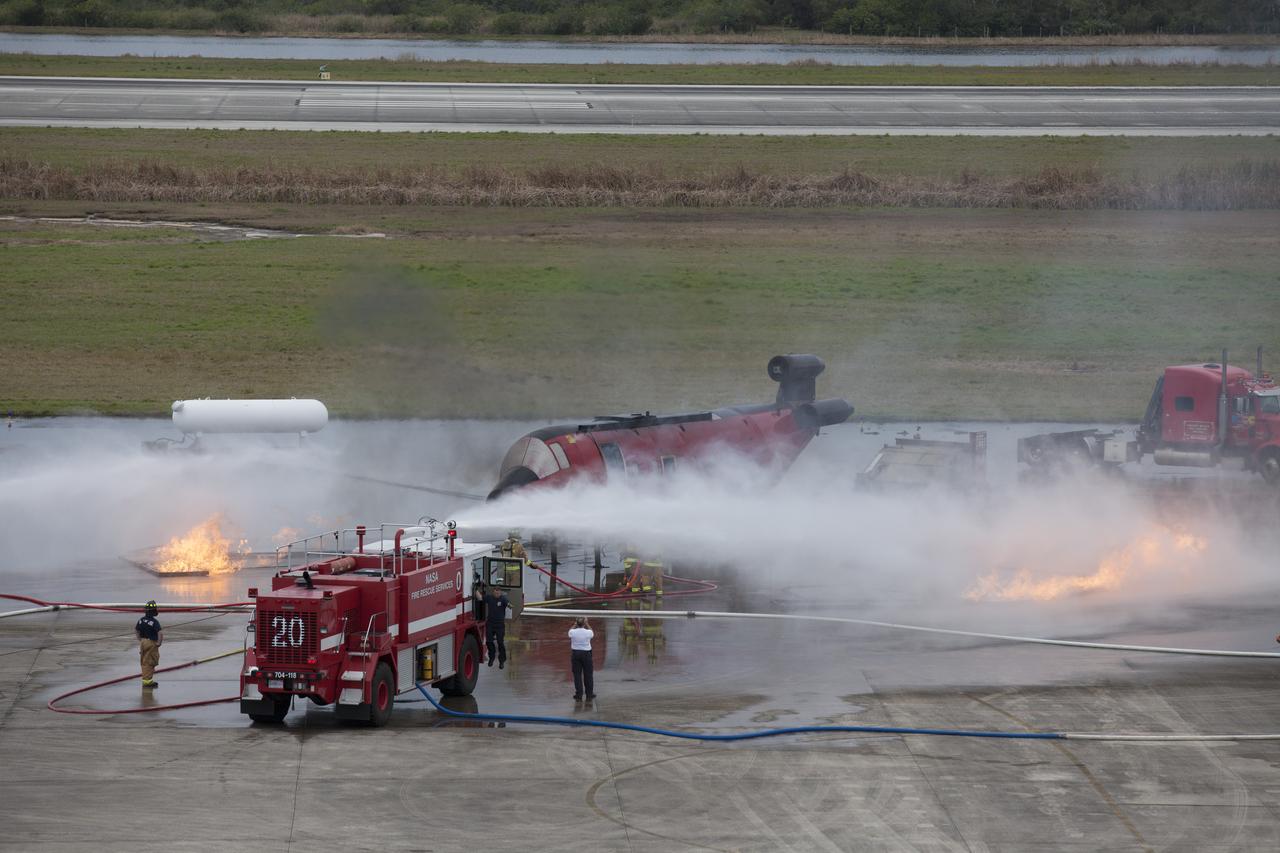
CAPE CANAVERAL, Fla. - Special Rescue Operations firefighters with NASA Fire Rescue Services in the Protective Services Office at NASA’s Kennedy Space Center in Florida participate in a training exercise at the Shuttle Landing Facility. Firefighters use a fire truck to put out a fire burning close to a mock-up of a small plane and a truck. Kennedy’s firefighters recently achieved Pro Board Certification in aerial fire truck operations and completed vehicle extrication training using the Jaws of Life. The Protective Services Office is one step closer to achieving certification in vehicle machinery extrication and other rescue skills. Kennedy’s firefighters are with G4S Government Solutions Inc., on the Kennedy Protective Services Contract. Photo credit: NASA/Kim Shiflett
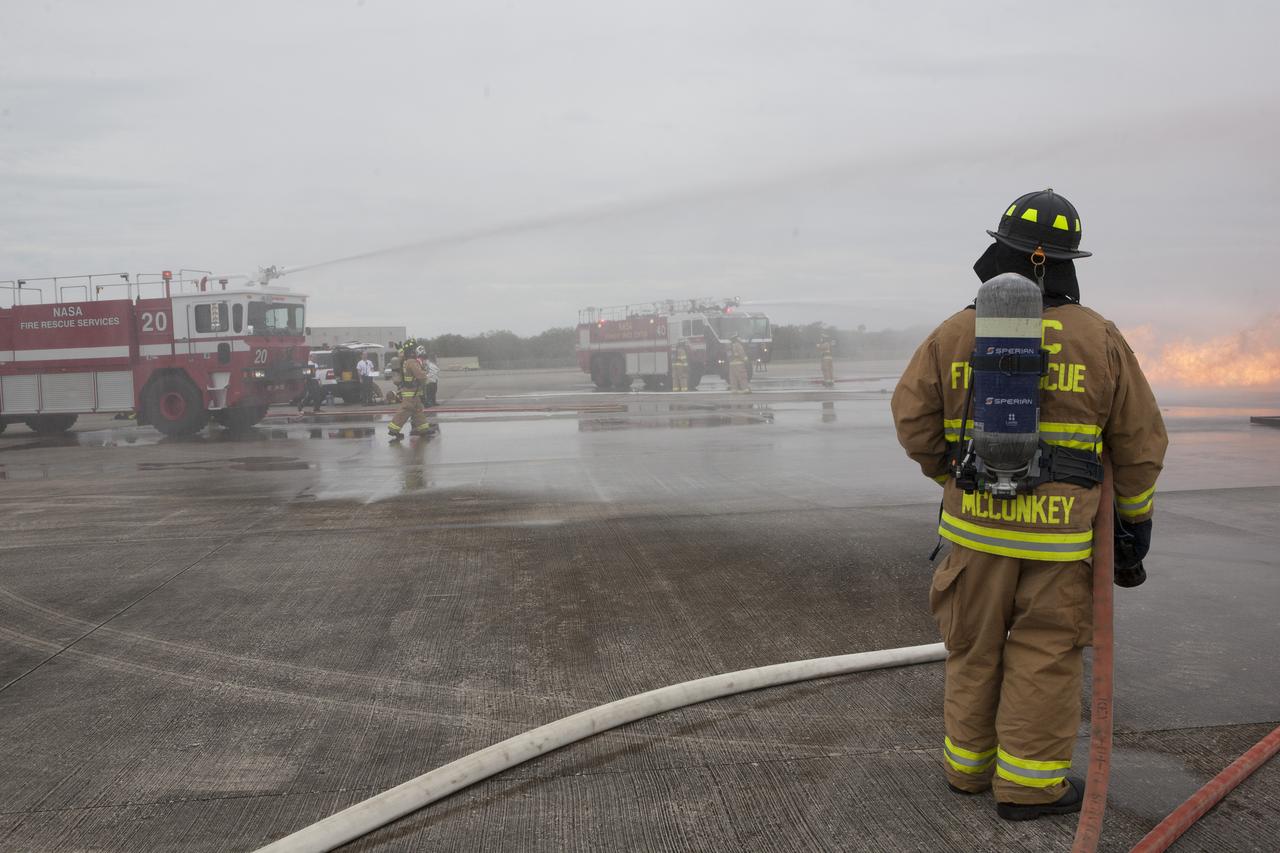
CAPE CANAVERAL, Fla. - Special Rescue Operations firefighters with NASA Fire Rescue Services in the Protective Services Office at NASA’s Kennedy Space Center in Florida prepare to participate in a training exercise at the Shuttle Landing Facility. A small fire is burning near a mock-up of a plane during the training exercise. Kennedy’s firefighters recently achieved Pro Board Certification in aerial fire truck operations and completed vehicle extrication training using the Jaws of Life. The Protective Services Office is one step closer to achieving certification in vehicle machinery extrication and other rescue skills. Kennedy’s firefighters are with G4S Government Solutions Inc., on the Kennedy Protective Services Contract. Photo credit: NASA/Kim Shiflett
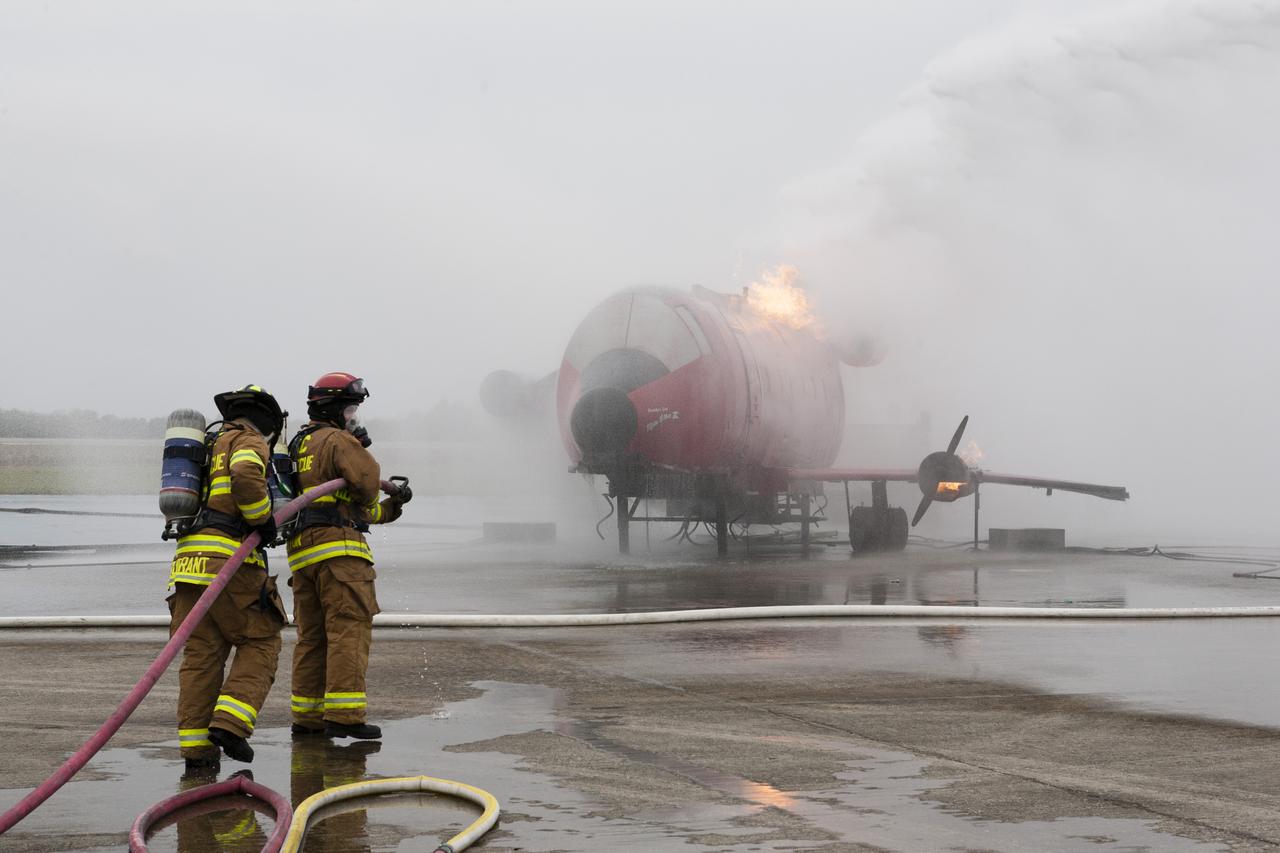
CAPE CANAVERAL, Fla. - During a training exercise, Special Rescue Operations firefighters with NASA Fire Rescue Services in the Protective Services Office at NASA’s Kennedy Space Center in Florida use hoses to put out a fire burning on a mock-up of a small plane at the Shuttle Landing Facility. They are wearing protective gear for the training exercise. Kennedy’s firefighters recently achieved Pro Board Certification in aerial fire truck operations and completed vehicle extrication training using the Jaws of Life. The Protective Services Office is one step closer to achieving certification in vehicle machinery extrication and other rescue skills. Kennedy’s firefighters are with G4S Government Solutions Inc., on the Kennedy Protective Services Contract. Photo credit: NASA/Kim Shiflett
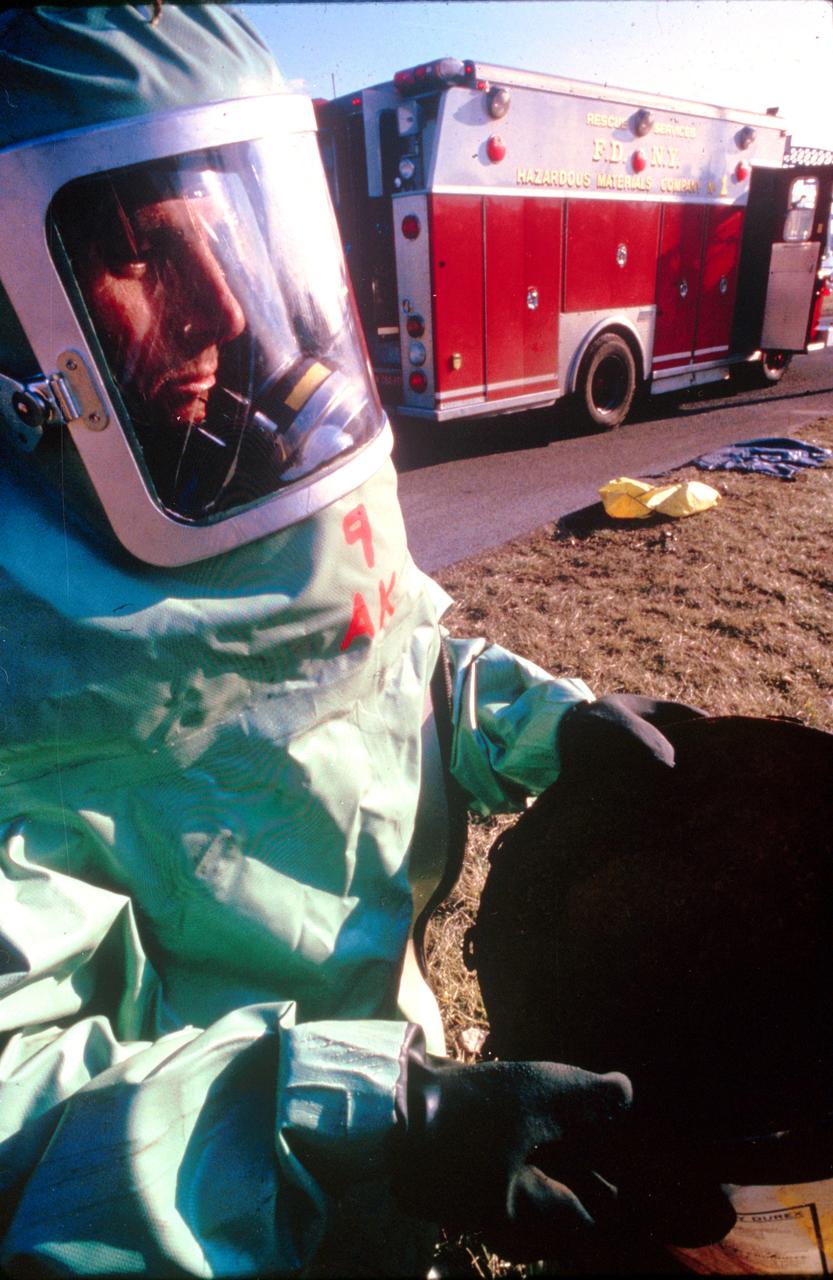
Marshall Space Flight Center used technology from astronauts' space suits to improve the safety of firefighter's attire. The new fire attire is lightweight, fire-resistant, and heat-protective.
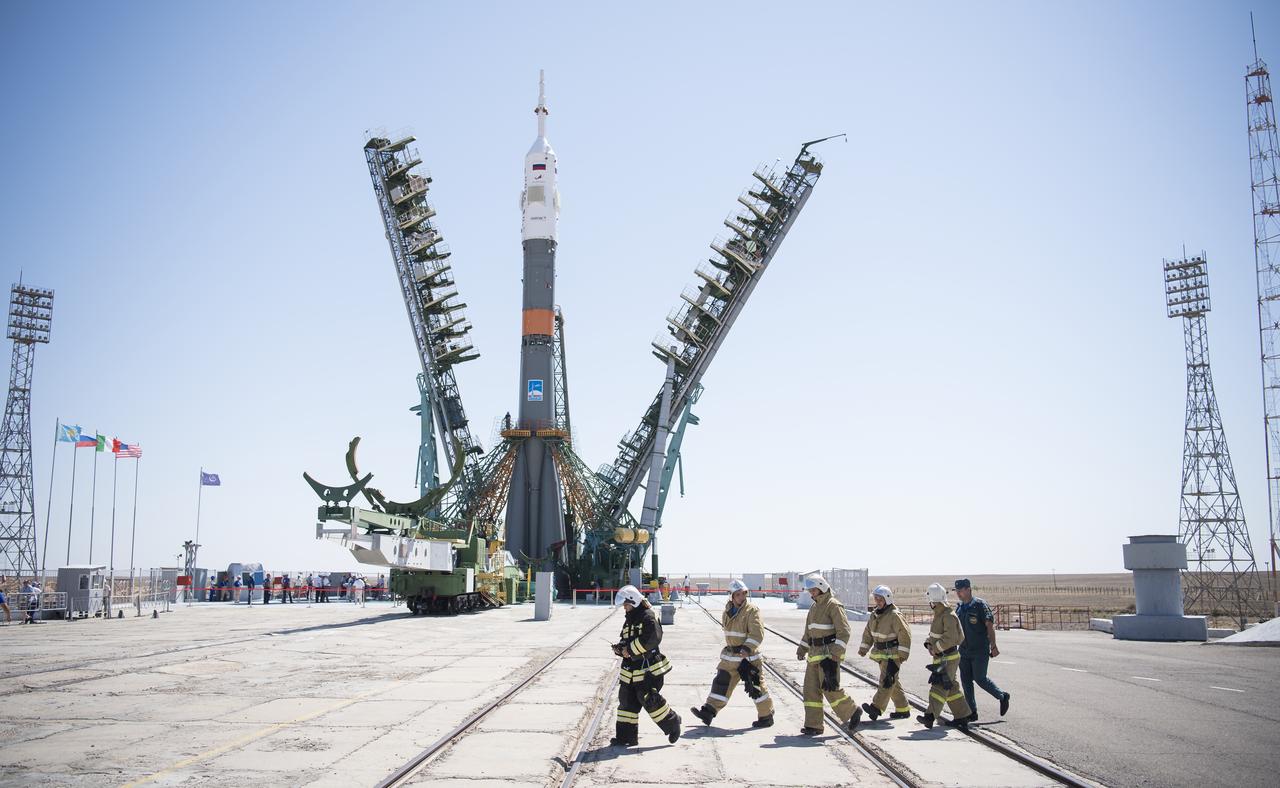
Firefighters walk past the Soyuz rocket as the service structure arms are closed around it, Thursday, July 18, 2019 at the Baikonur Cosmodrome in Kazakhstan. Expedition 60 Soyuz Commander Alexander Skvortsov of Roscosmos, flight engineer Andrew Morgan of NASA, and flight engineer Luca Parmitano of ESA (European Space Agency) are scheduled to launch aboard their Soyuz MS-13 spacecraft at 12:28 p.m. Eastern time (9:28 p.m. Baikonur time) , on Saturday, July 20. Photo Credit: (NASA/Joel Kowsky)
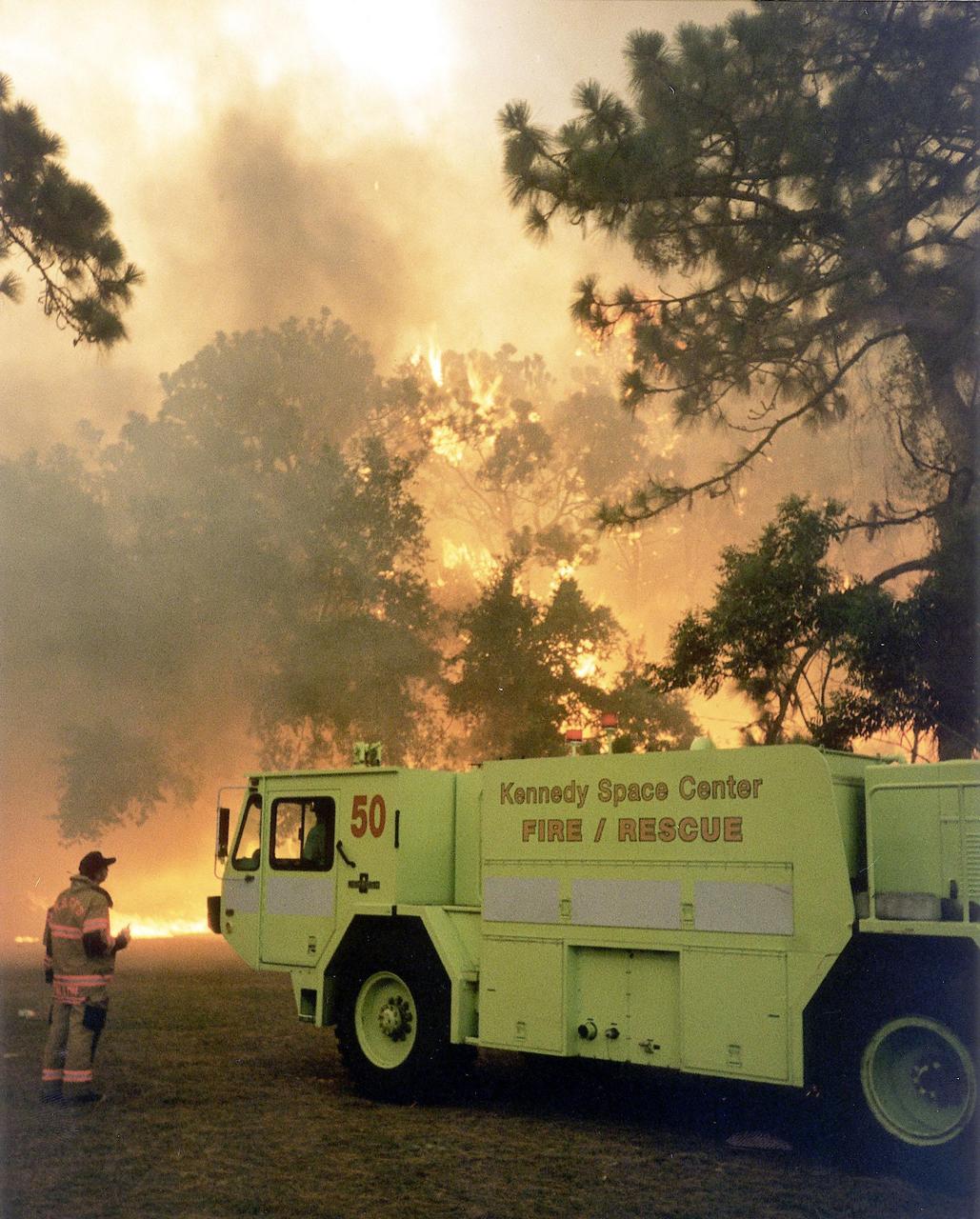
KENNEDY SPACE CENTER, FLA. -- Kennedy Space Center firefighters support firefighting efforts in north Brevard County with an aircraft rescue firefighting vehicle capable of holding 1,000 gallons of water.
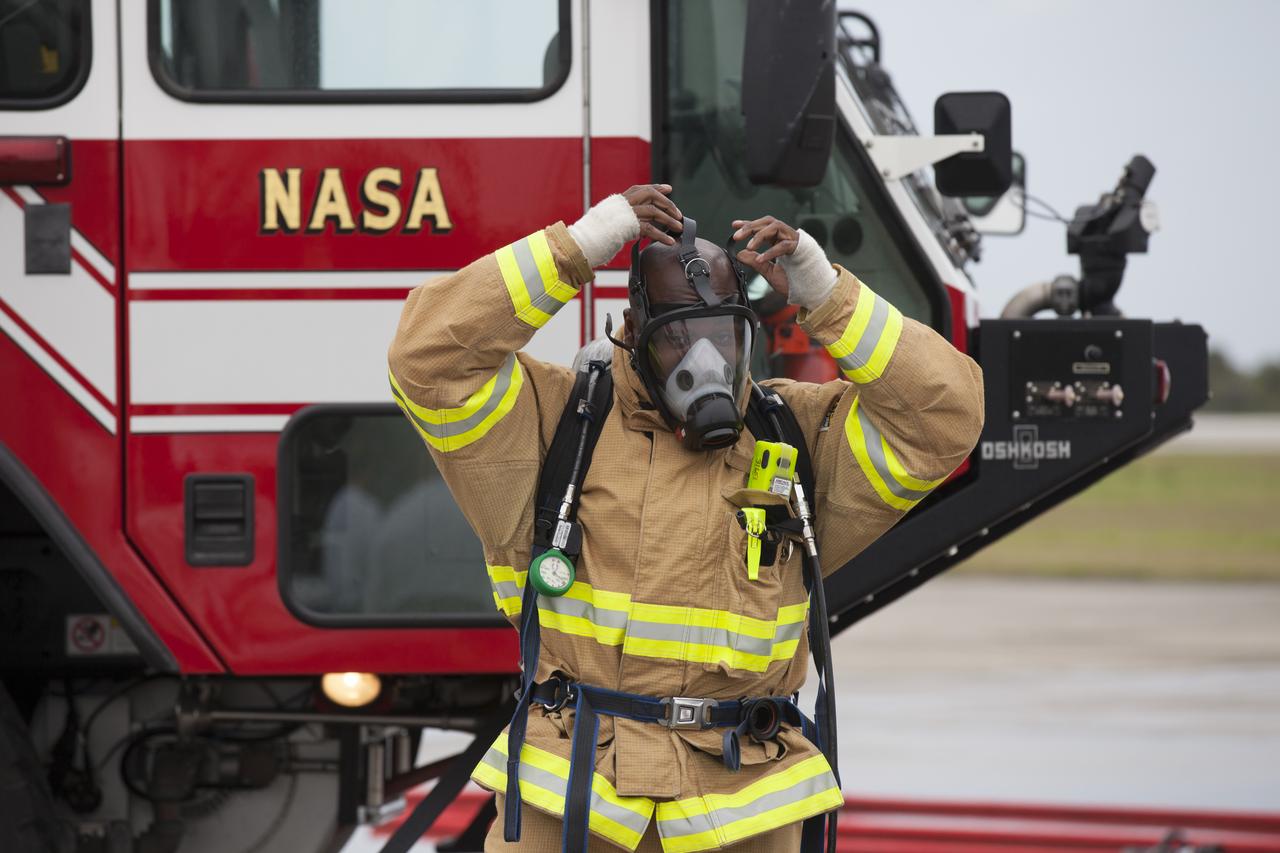
CAPE CANAVERAL, Fla. - Special Rescue Operations firefighters with NASA Fire Rescue Services in the Protective Services Office at NASA’s Kennedy Space Center in Florida practice firefighting skills at the Shuttle Landing Facility. A firefighter dons protective gear to prepare for the training simulation. Kennedy’s firefighters recently achieved Pro Board Certification in aerial fire truck operations and completed vehicle extrication training using the Jaws of Life. The Protective Services Office is one step closer to achieving certification in vehicle machinery extrication and other rescue skills. Kennedy’s firefighters are with G4S Government Solutions Inc., on the Kennedy Protective Services Contract. Photo credit: NASA/Kim Shiflett
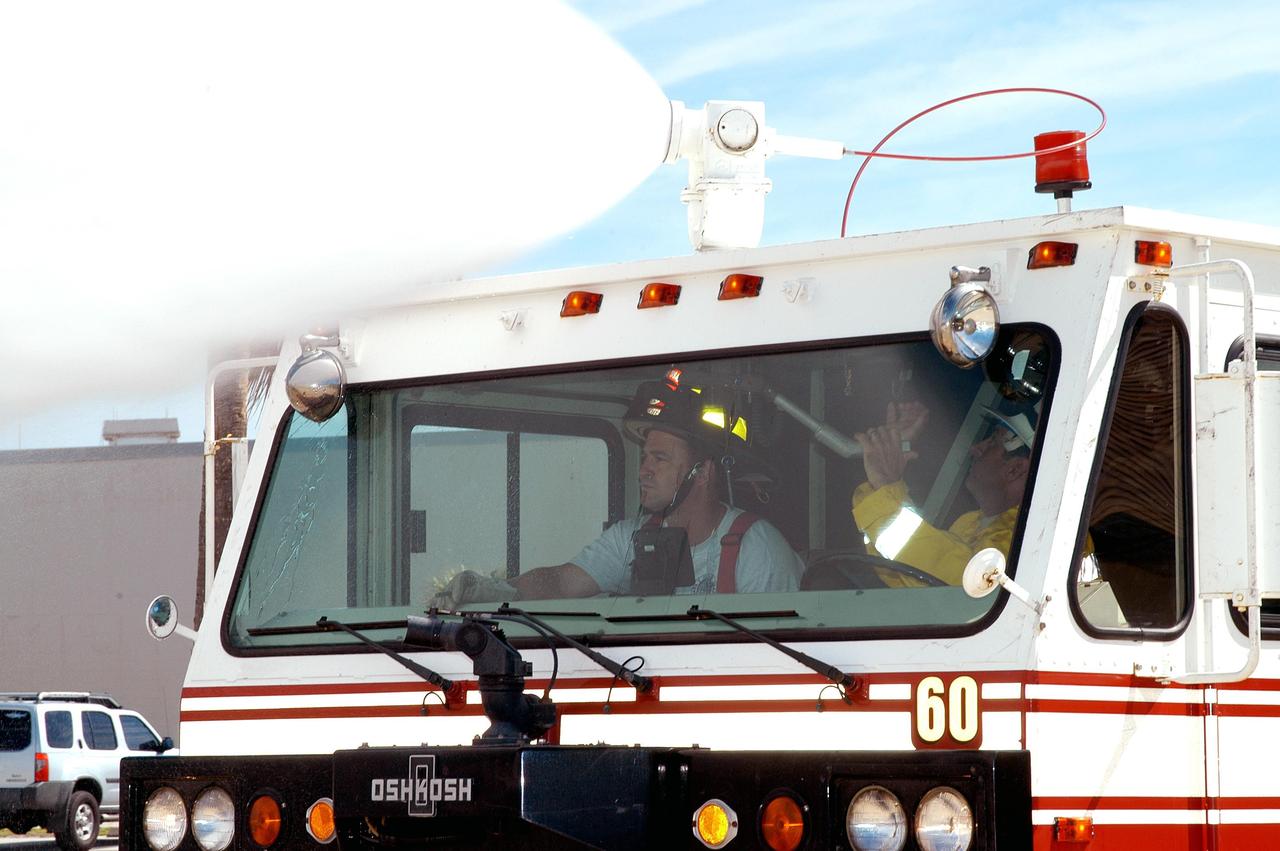
KENNEDY SPACE CENTER, FLA. - At Cape Canaveral Air Force Station, Firefighter Chris Maupin (left) and Lt. Keith Abell demonstrate how the special aircraft firefighting vehicle (known as ARF) was used at the site of a recent fire in Brevard County, Fla. The firefighters sit inside the vehicle with a "driver" in the middle. They are able to direct the hoses to attack fires from above and below. The firefighters teamed up with task forces from Satellite Beach, Malabar, Melbourne, Palm Bay, Patrick Air Force Base and Brevard County to help fight wildfires in the Palm Bay and Malabar areas that threatened homes and property during the Memorial Day holiday weekend.
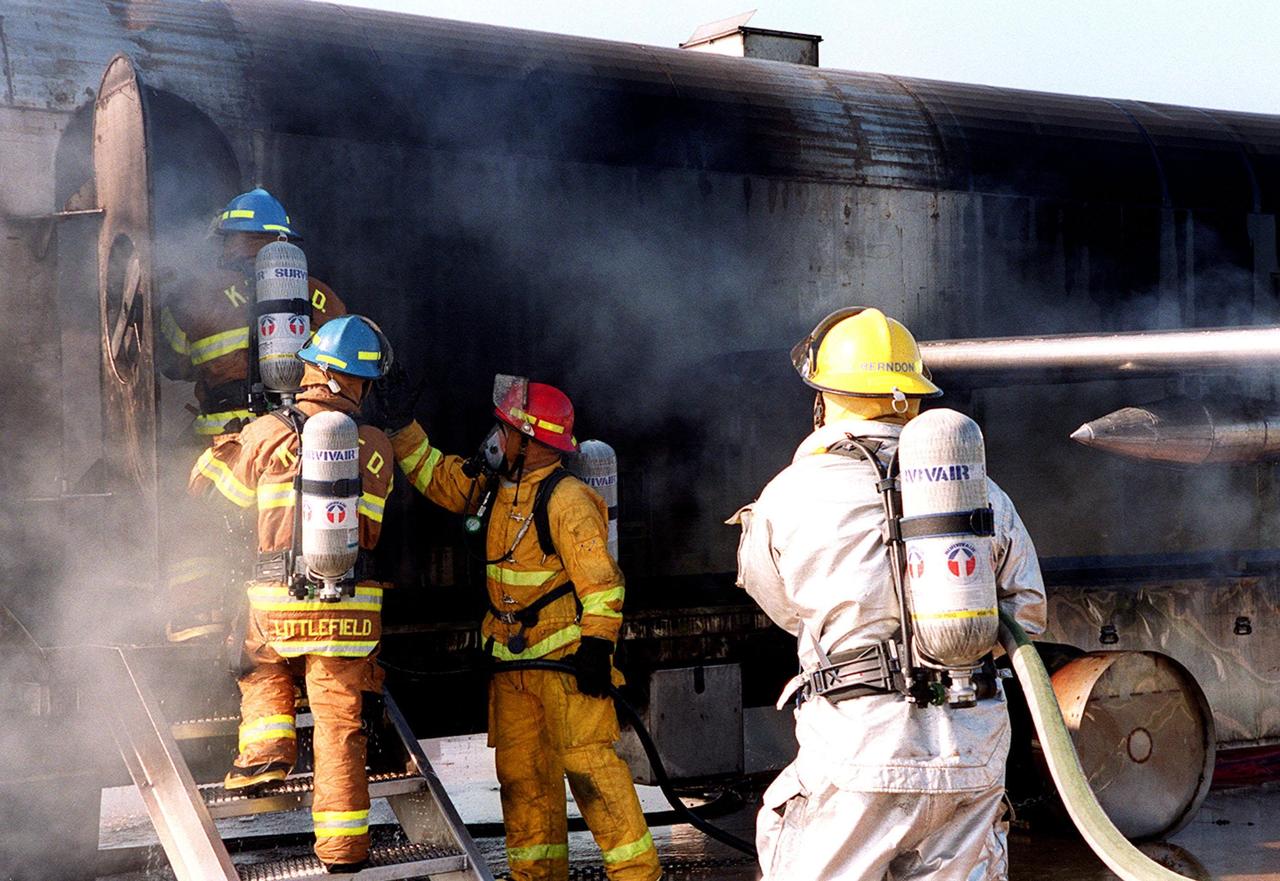
KENNEDY SPACE CENTER, FLA. -- A firefighter (right) holds a water hose in readiness as others enter a smoke-filled simulated aircraft. The activities are part of fire training exercises at Cape Canaveral Air Force Station Pad 30 for firefighters with Fire and Emergency Services at the Naval Station Mayport, Fla. The firefighters have already extinguished flames from the aircraft
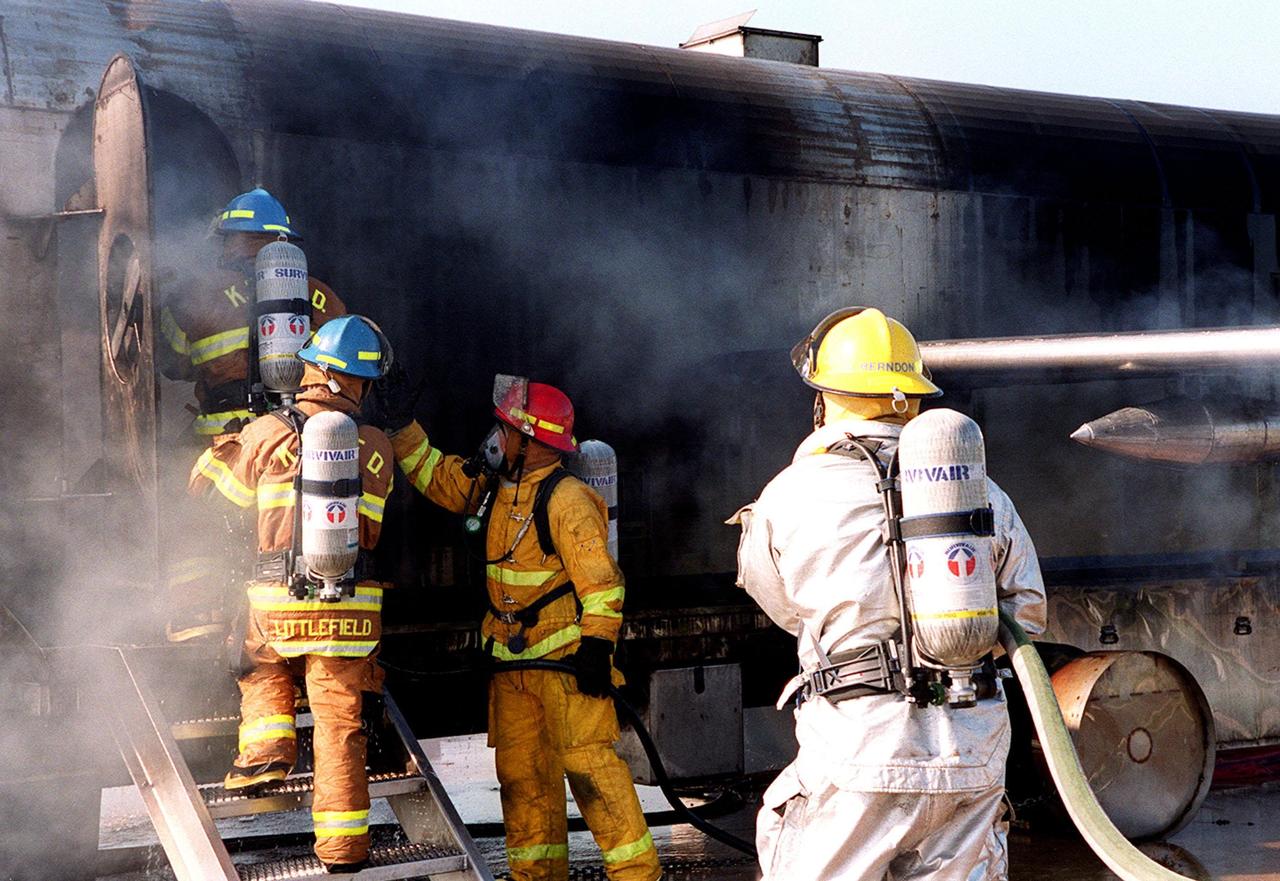
KENNEDY SPACE CENTER, FLA. -- A firefighter (right) holds a water hose in readiness as others enter a smoke-filled simulated aircraft. The activities are part of fire training exercises at Cape Canaveral Air Force Station Pad 30 for firefighters with Fire and Emergency Services at the Naval Station Mayport, Fla. The firefighters have already extinguished flames from the aircraft
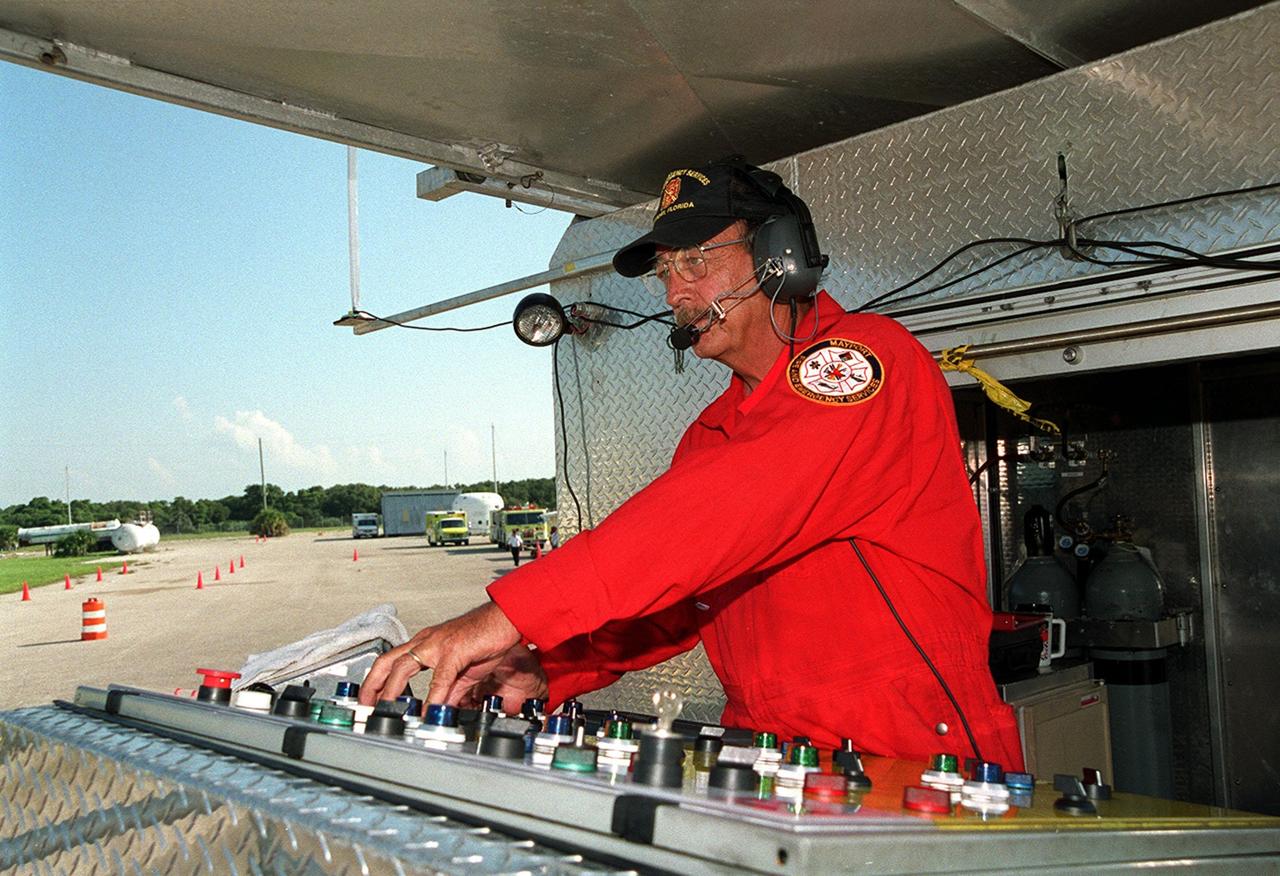
KENNEDY SPACE CENTER, FLA. -- A training officer controls elements of a fire training exercise at Cape Canaveral Air Force Station Pad 30 for firefighters with Fire and Emergency Services at the Naval Station Mayport, Fla. The firefighters tackled flames from a burning simulated aircraft.
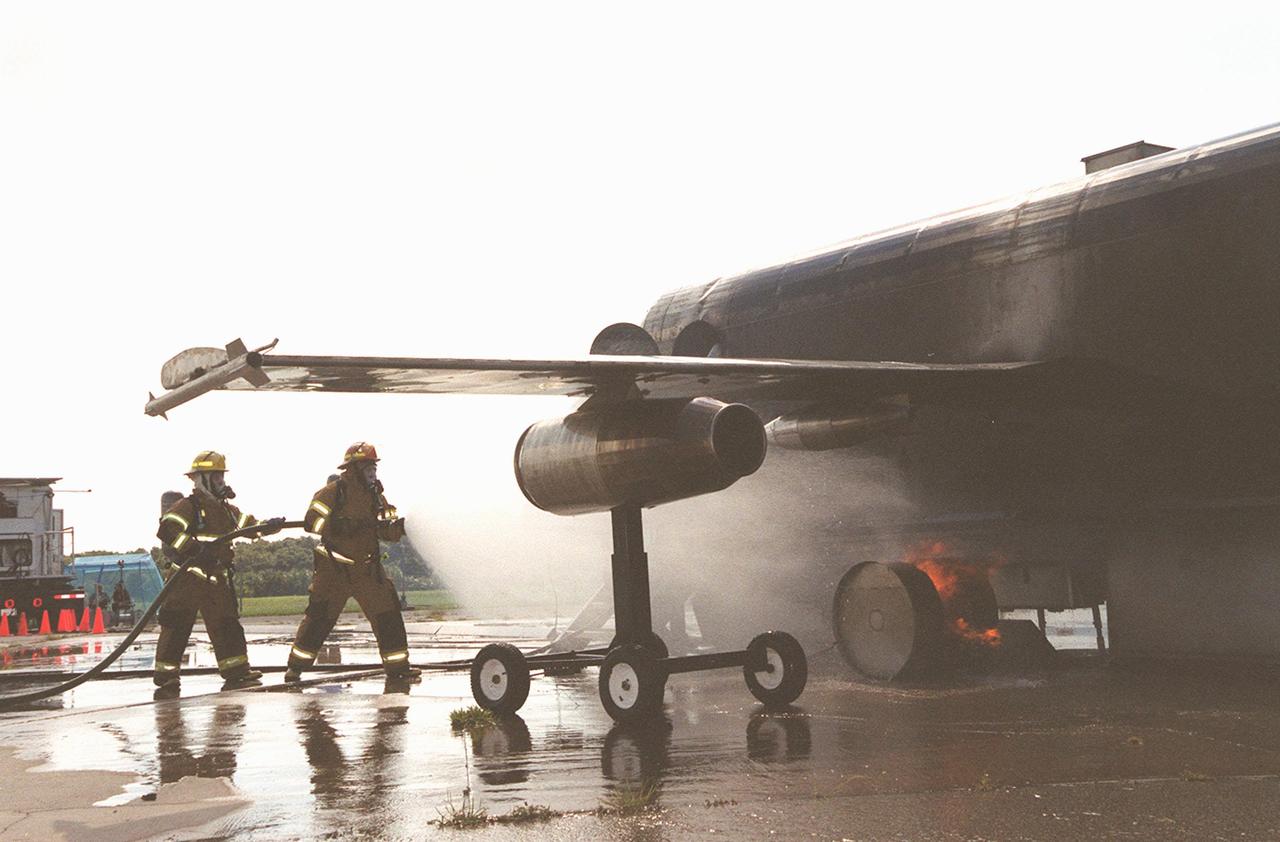
KENNEDY SPACE CENTER, FLA. -- Firefighters in full gear douse a fire on a simulated aircraft. The firefighters, who are with Fire and Emergency Services at the Naval Station Mayport, Fla., are taking part in fire training exercises at Cape Canaveral Air Force Station Pad 30.
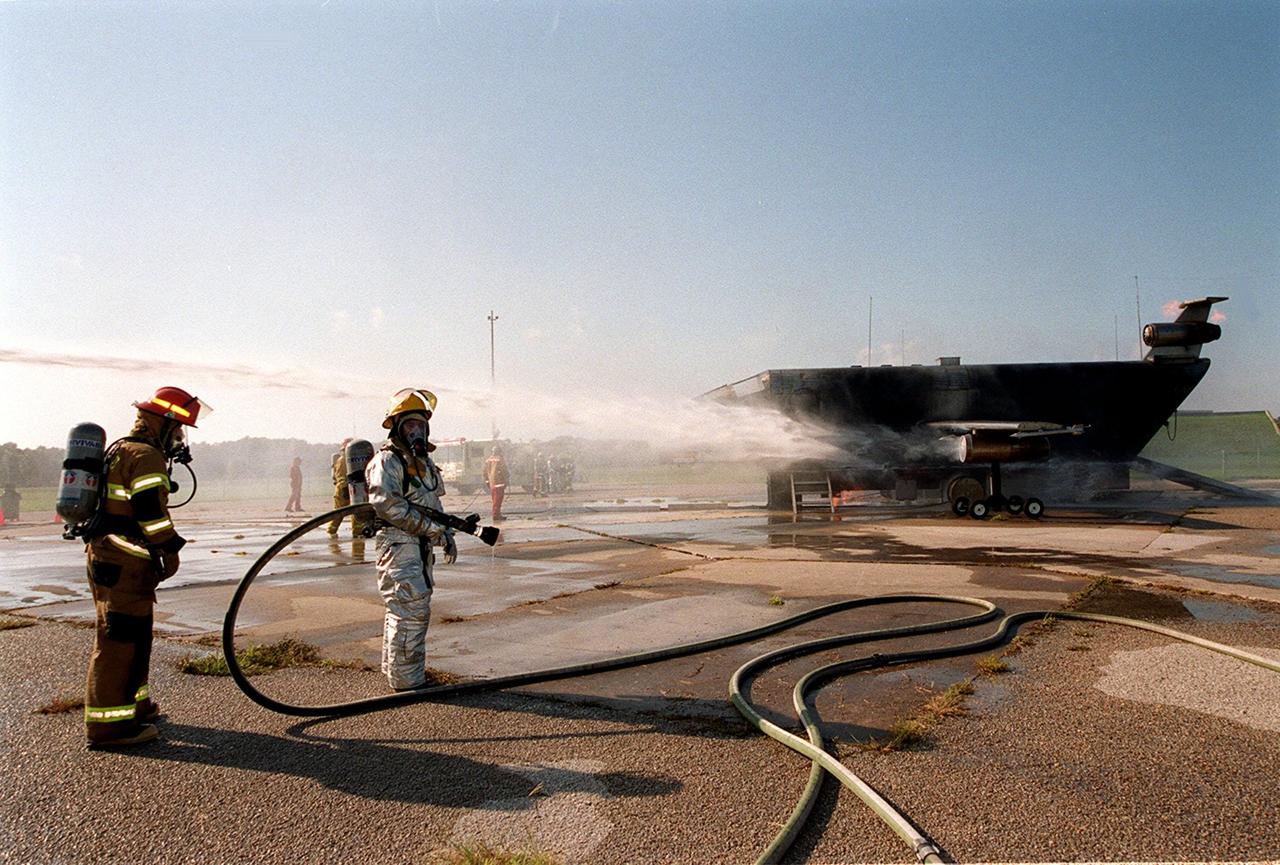
KENNEDY SPACE CENTER, FLA. -- Firefighters in full gear wait to approach a burning simulated aircraft during training exercises at Cape Canaveral Air Force Station Pad 30. The firefighters are with the Fire and Emergency Services at the Naval Station Mayport, Fla.
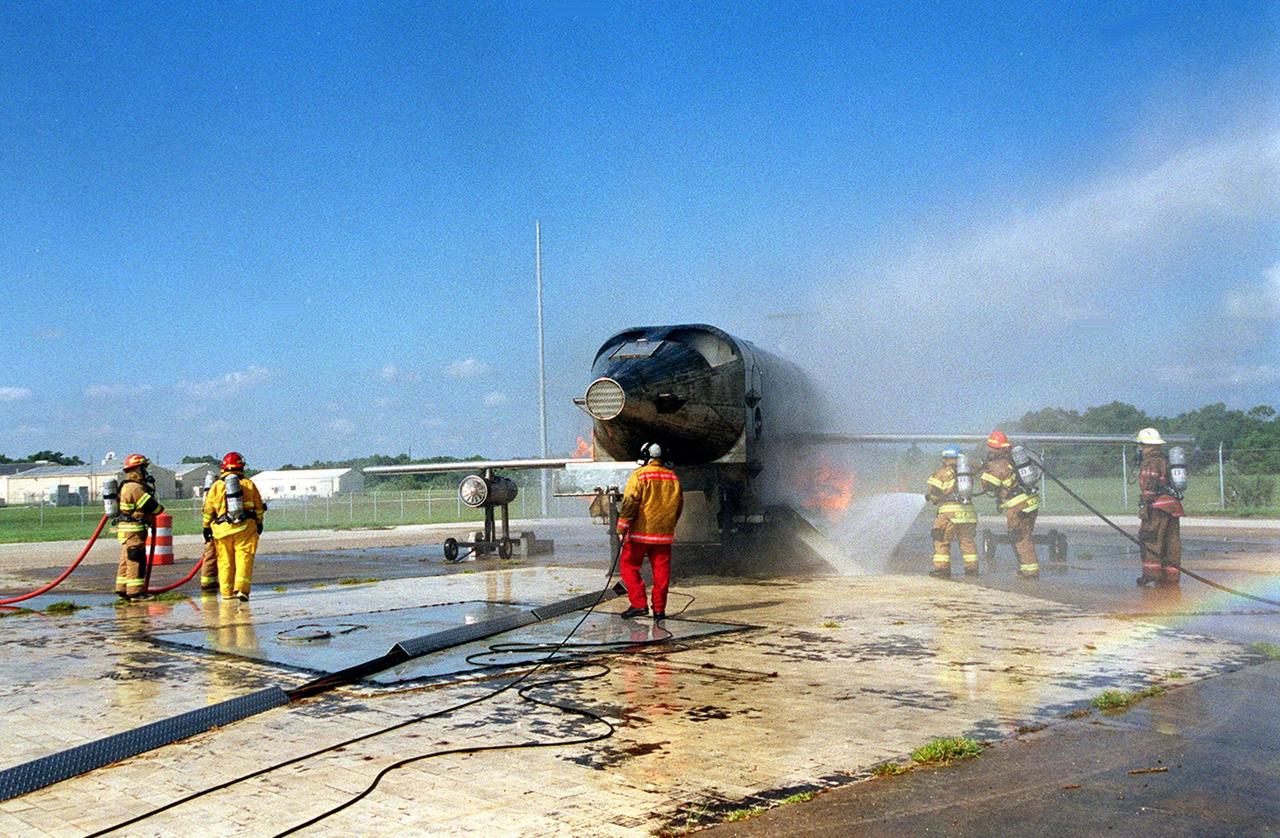
KENNEDY SPACE CENTER, FLA. -- Firefighters surround a burning simulated aircraft during training exercises Cape Canaveral Air Force Station Pad 30. Those at left wait their turn as the crew on the right turn their hoses toward the fire. The firefighters are with Fire and Emergency Services at the Naval Station Mayport, Fla
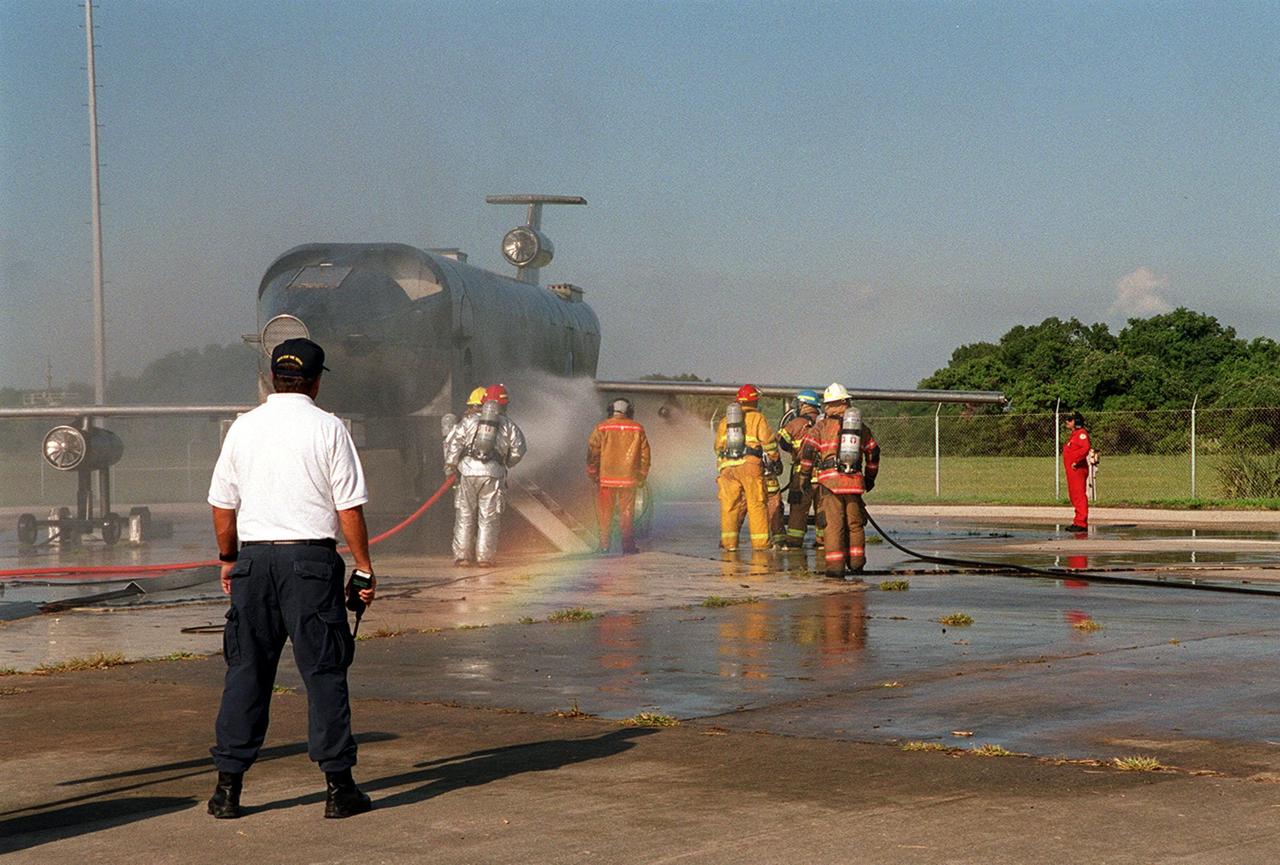
KENNEDY SPACE CENTER, FLA. -- Firefighters hold their hoses on a burning simulated aircraft, creating a rainbow. Watching at right (red uniform) and in the foreground are trainers. The training exercises for firefighters with Fire and Emergency Services at Naval Station Mayport, Fla., are being held at Cape Canaveral Air Force Station Pad 30.
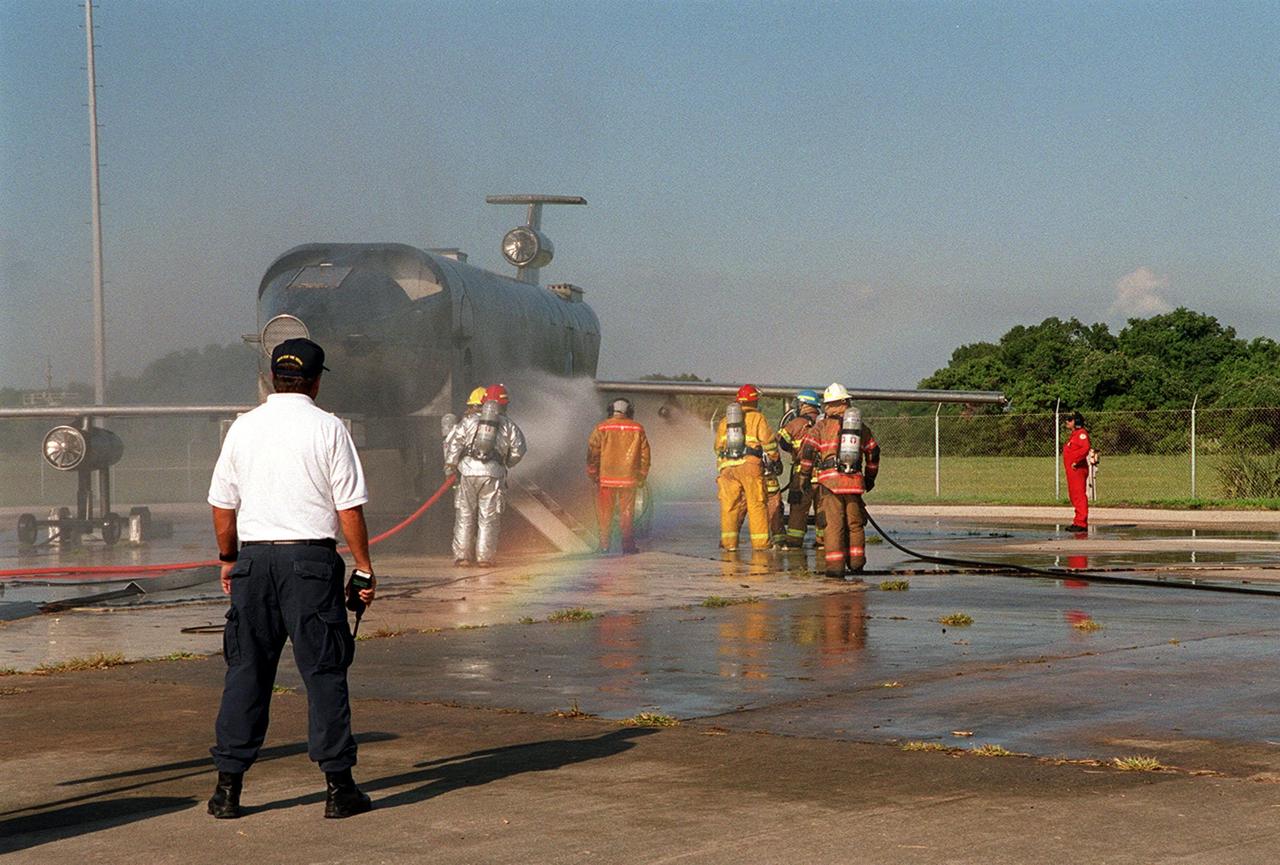
KENNEDY SPACE CENTER, FLA. -- Firefighters hold their hoses on a burning simulated aircraft, creating a rainbow. Watching at right (red uniform) and in the foreground are trainers. The training exercises for firefighters with Fire and Emergency Services at Naval Station Mayport, Fla., are being held at Cape Canaveral Air Force Station Pad 30.

KENNEDY SPACE CENTER, FLA. -- A firefighter waits for his companions before tackling the flames on a simulated aircraft. Firefighters with Fire and Emergency Services at the Naval Station Mayport, Fla., are taking part in training exercises at Cape Canaveral Air Force Station Pad 30.
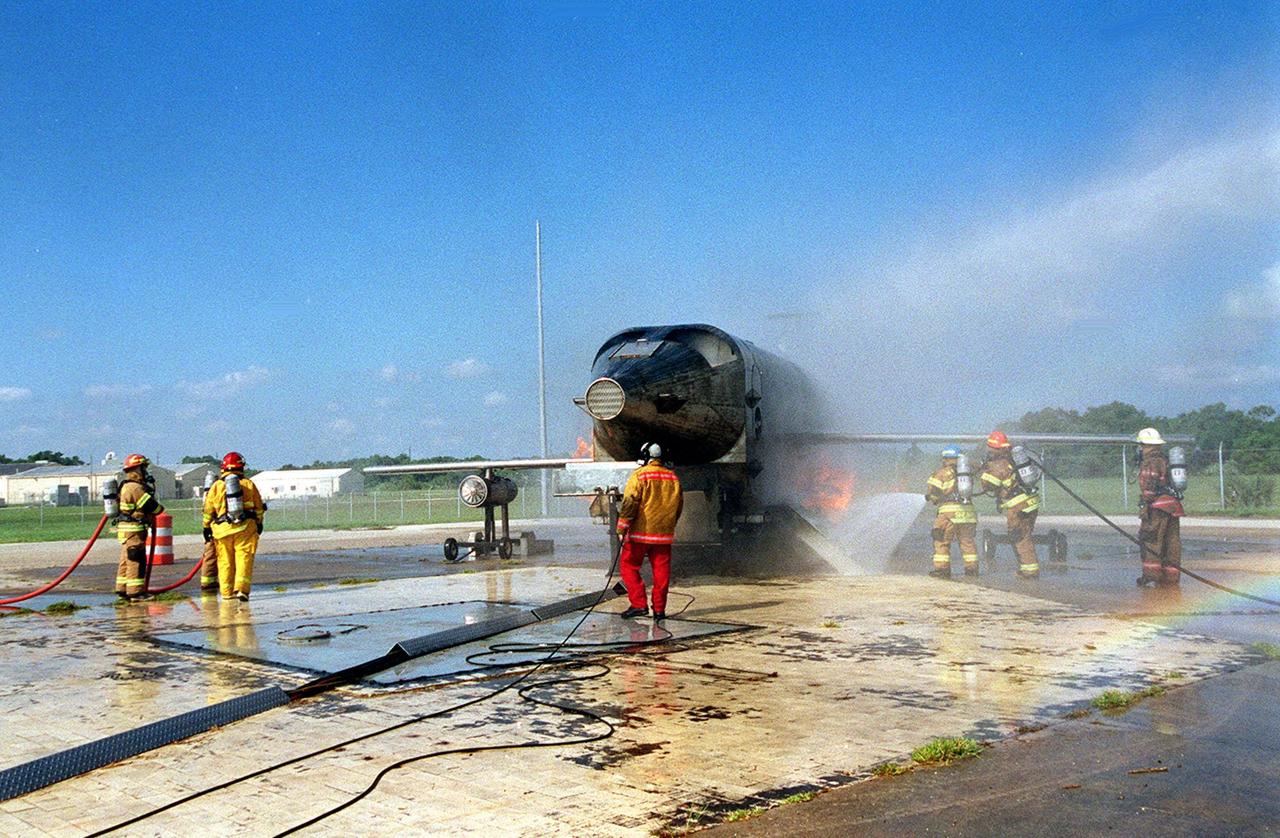
KENNEDY SPACE CENTER, FLA. -- Firefighters surround a burning simulated aircraft during training exercises Cape Canaveral Air Force Station Pad 30. Those at left wait their turn as the crew on the right turn their hoses toward the fire. The firefighters are with Fire and Emergency Services at the Naval Station Mayport, Fla
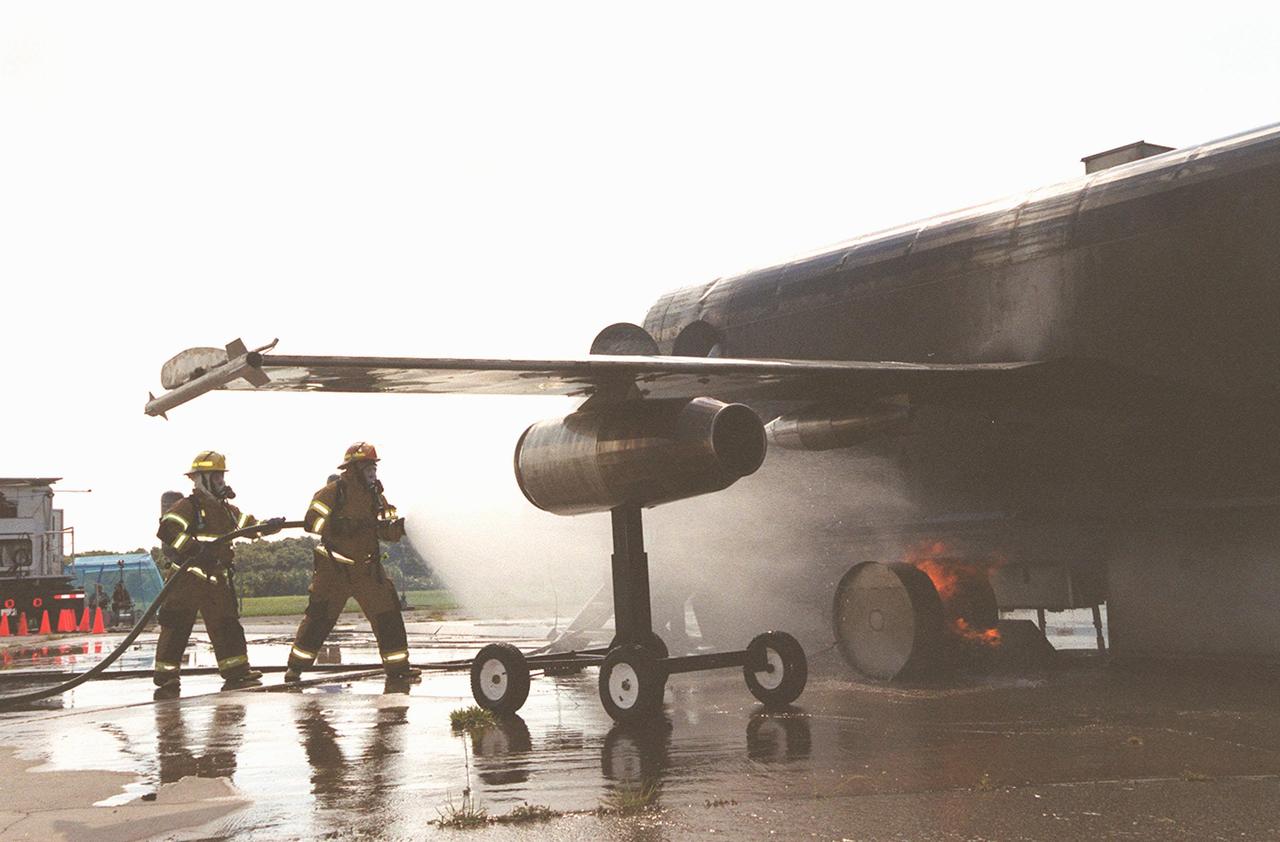
KENNEDY SPACE CENTER, FLA. -- Firefighters in full gear douse a fire on a simulated aircraft. The firefighters, who are with Fire and Emergency Services at the Naval Station Mayport, Fla., are taking part in fire training exercises at Cape Canaveral Air Force Station Pad 30.
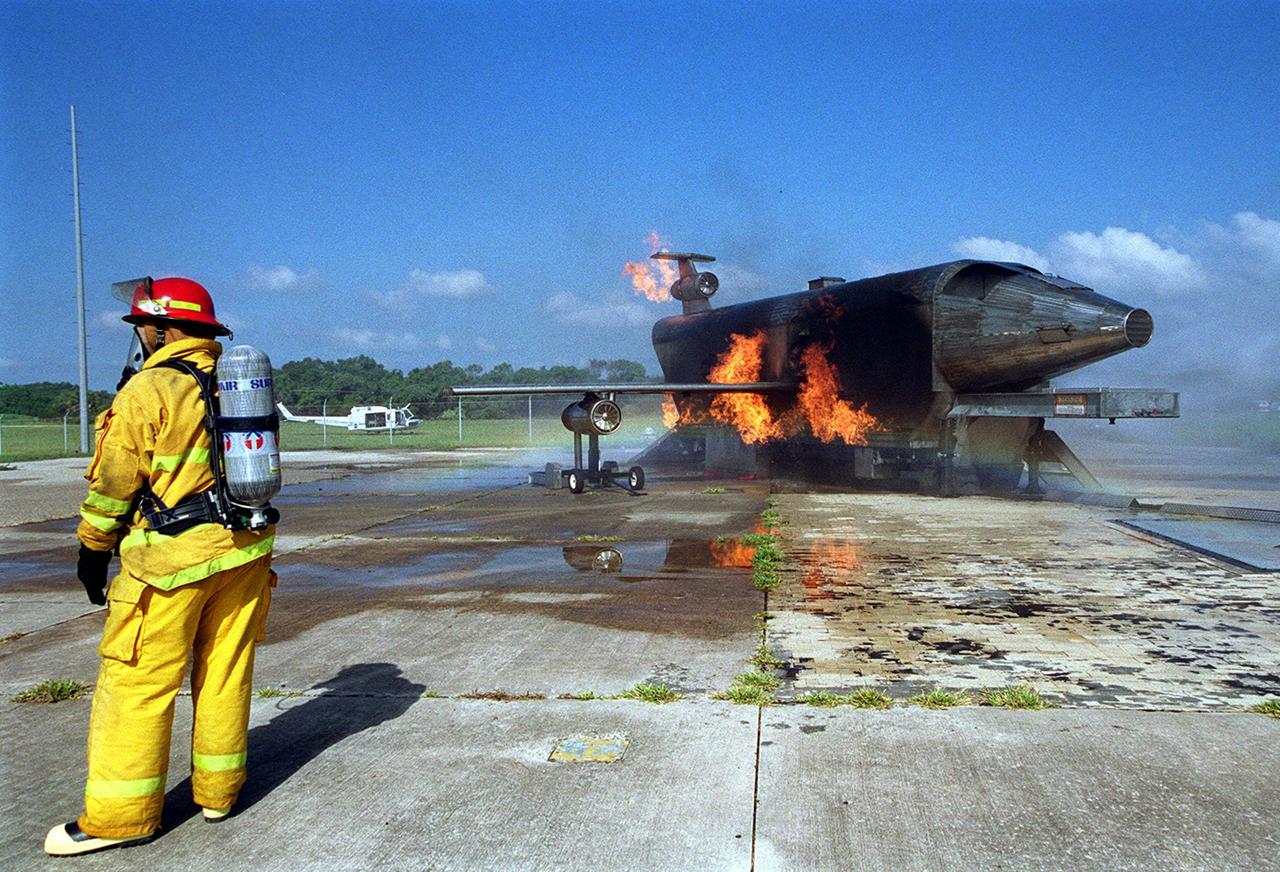
KENNEDY SPACE CENTER, FLA. -- A firefighter waits for his companions before tackling the flames on a simulated aircraft. Firefighters with Fire and Emergency Services at the Naval Station Mayport, Fla., are taking part in training exercises at Cape Canaveral Air Force Station Pad 30.
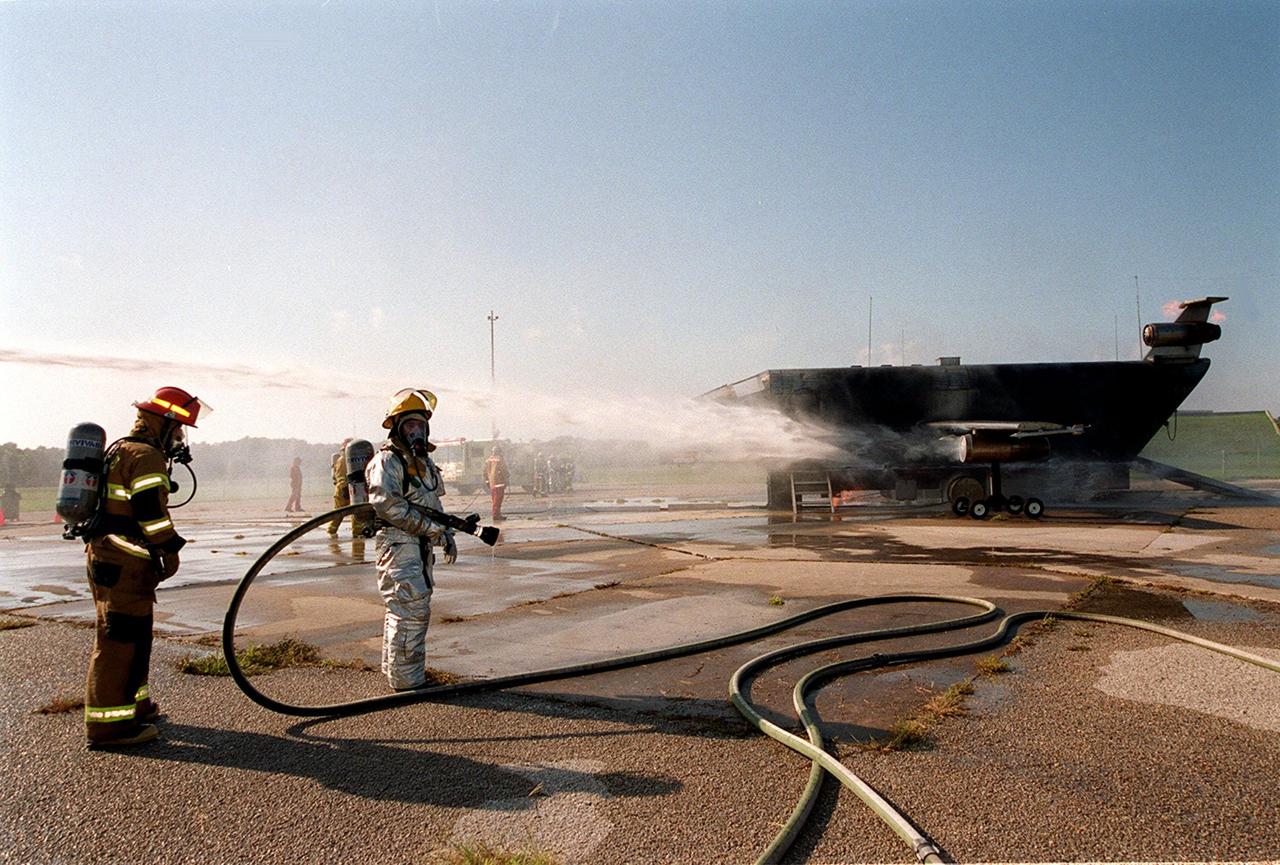
KENNEDY SPACE CENTER, FLA. -- Firefighters in full gear wait to approach a burning simulated aircraft during training exercises at Cape Canaveral Air Force Station Pad 30. The firefighters are with the Fire and Emergency Services at the Naval Station Mayport, Fla.
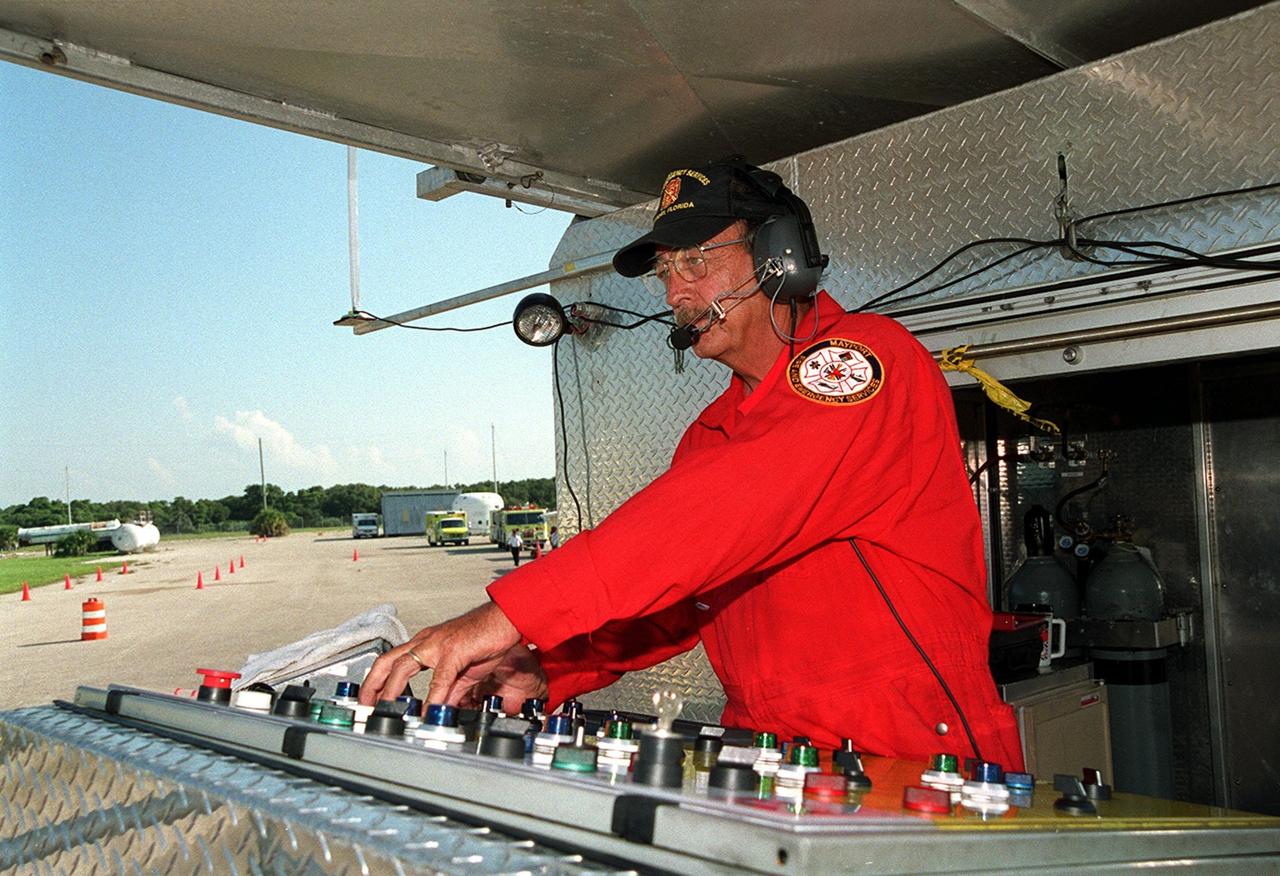
KENNEDY SPACE CENTER, FLA. -- A training officer controls elements of a fire training exercise at Cape Canaveral Air Force Station Pad 30 for firefighters with Fire and Emergency Services at the Naval Station Mayport, Fla. The firefighters tackled flames from a burning simulated aircraft.
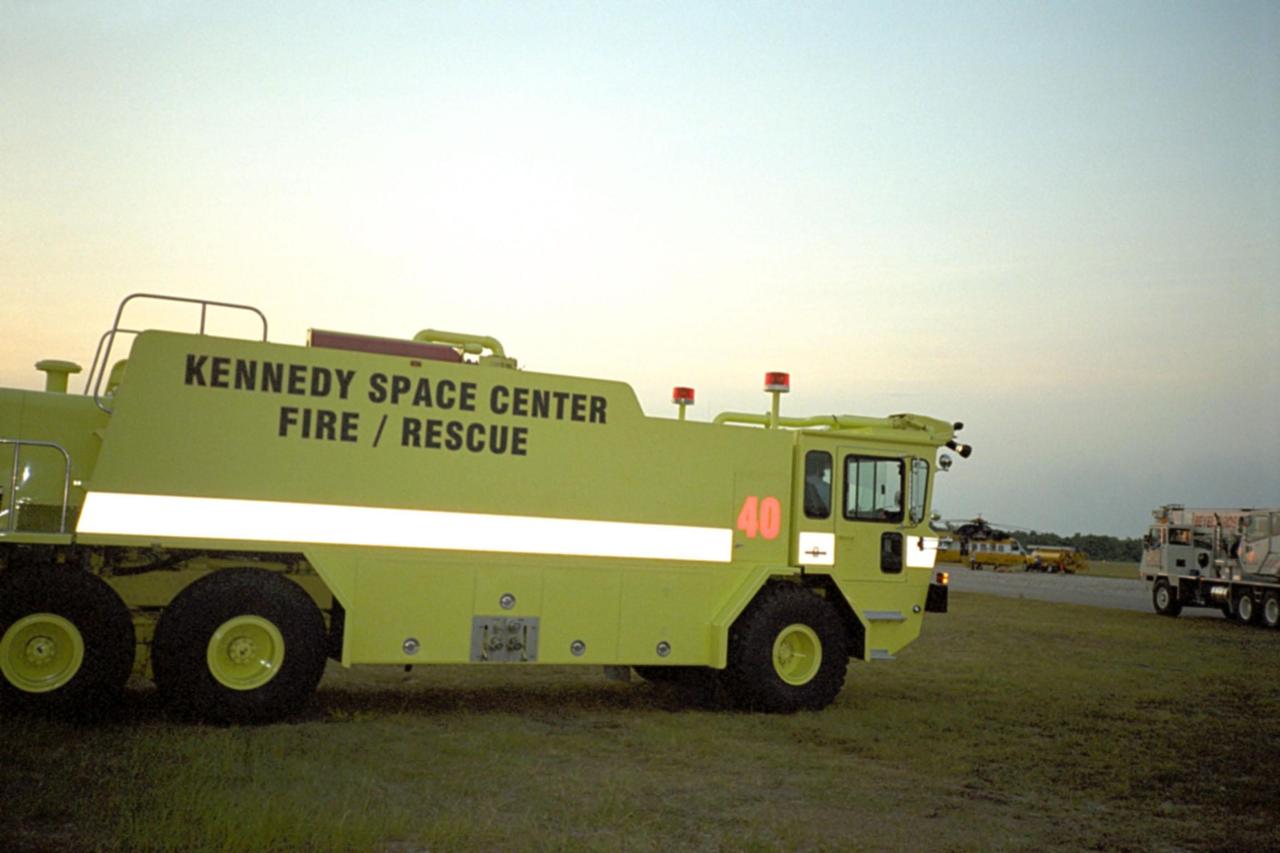
A Kennedy Space Center aircraft rescue firefighting vehicle supports heavy traffic at the Space Coast Regional Airport in Titusville, Florida, where aircraft capable of carrying water were staged during the recent brushfires throughout Florida. Aircraft were supporting firefighting efforts in Brevard, Volusia, and Flagler counties
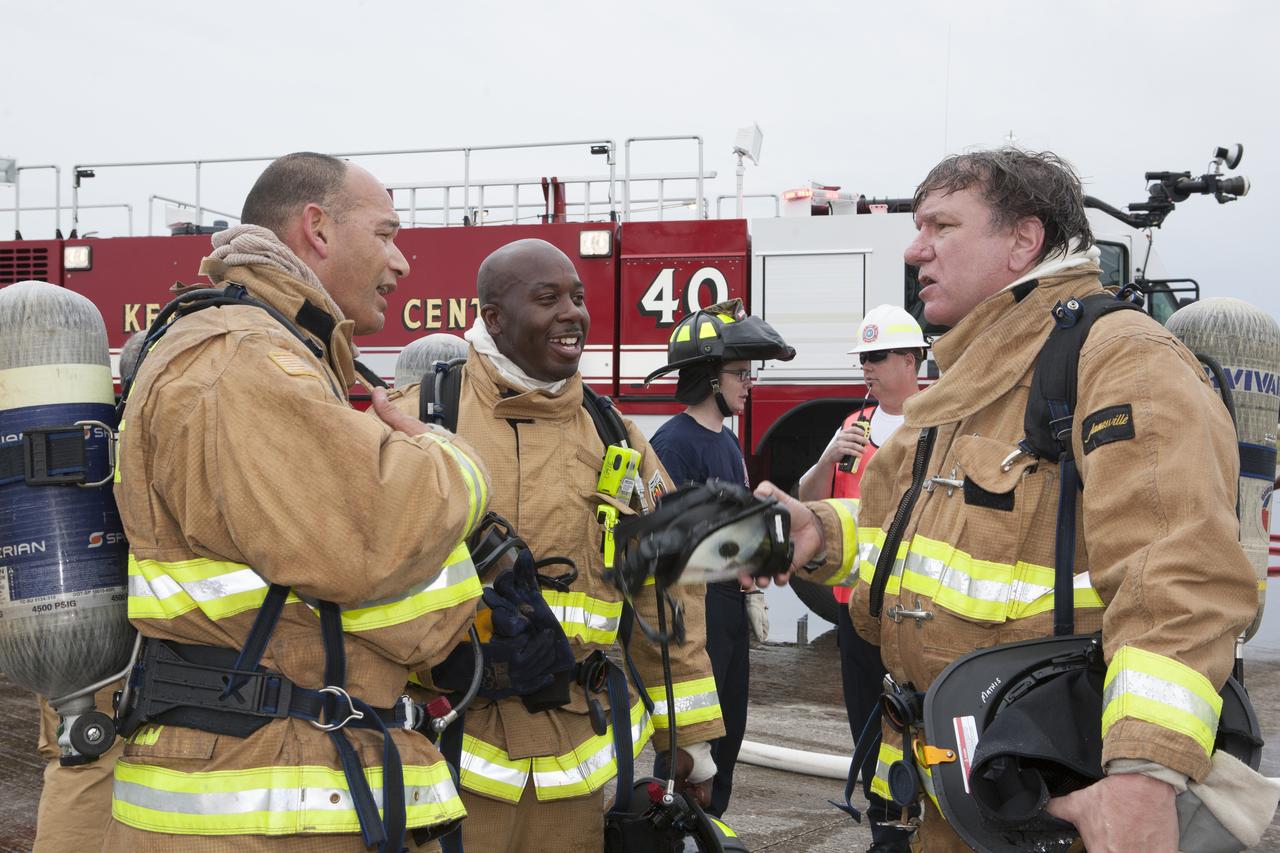
CAPE CANAVERAL, Fla. - Special Rescue Operations firefighters with NASA Fire Rescue Services in the Protective Services Office at NASA’s Kennedy Space Center in Florida review procedures after participating in a training exercise at the Shuttle Landing Facility. During the training simulation, firefighters used fire trucks and hoses to extinguish flames burning on and around a mock-up of a small plane. Kennedy’s firefighters recently achieved Pro Board Certification in aerial fire truck operations and completed vehicle extrication training using the Jaws of Life. The Protective Services Office is one step closer to achieving certification in vehicle machinery extrication and other rescue skills. Kennedy’s firefighters are with G4S Government Solutions Inc., on the Kennedy Protective Services Contract. Photo credit: NASA/Kim Shiflett
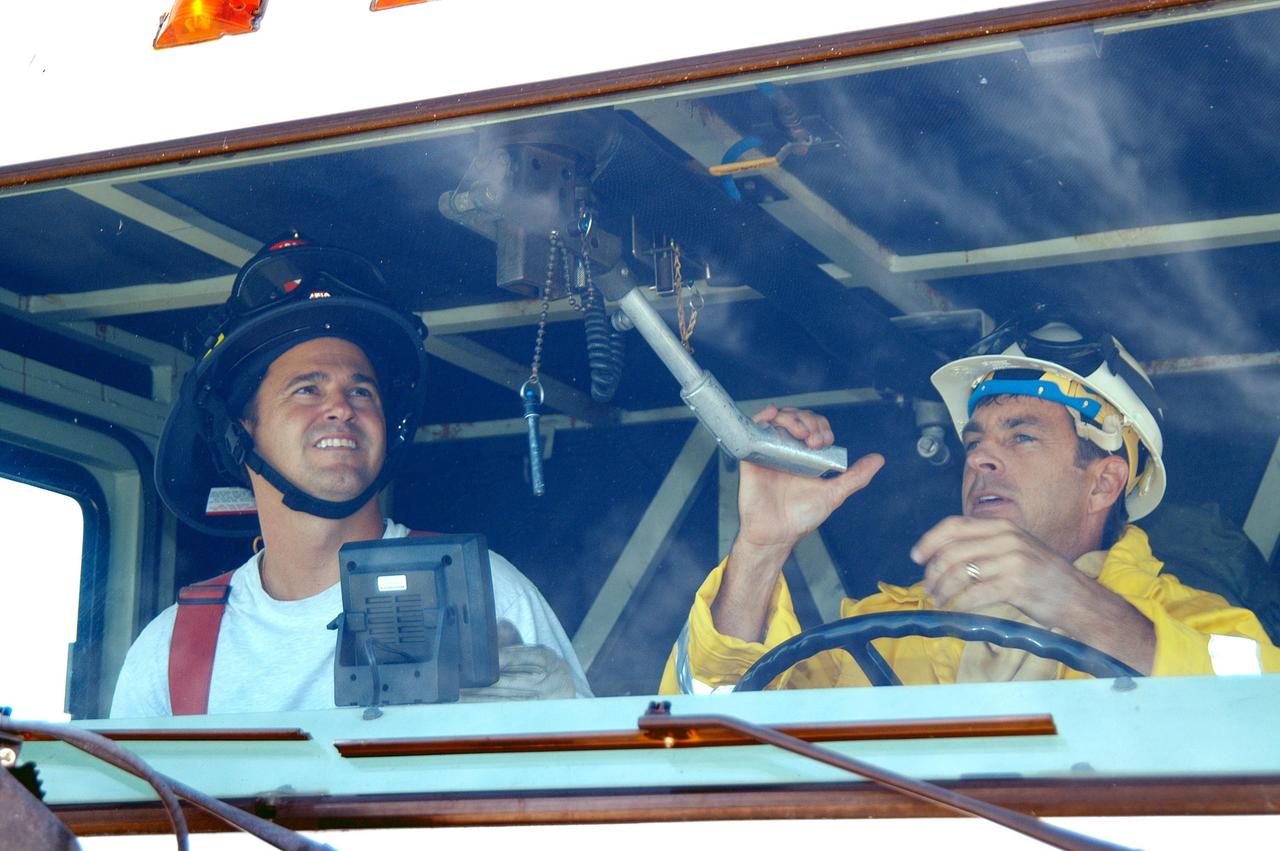
KENNEDY SPACE CENTER, FLA. - At Cape Canaveral Air Force Station, KSC Firefighter Chris Maupin (left) watches as Lt. Keith Abell practices maneuvering apparatus on top of the firefighting vehicle with which they are able to direct the hoses to attack fires from above and below. The firefighters teamed up with task forces from Satellite Beach, Malabar, Melbourne, Palm Bay, Patrick Air Force Base and Brevard County to help fight wildfires in the Palm Bay and Malabar areas that threatened homes and property during the Memorial Day holiday weekend.
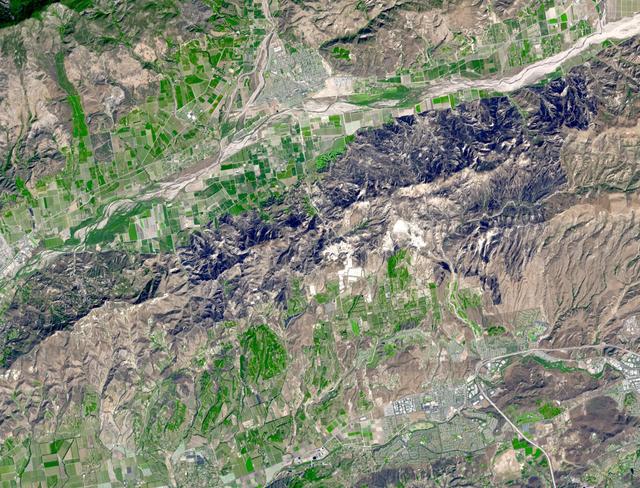
The Guiberson Fire in Ventura County, west of Los Angeles, burned more than 16,000 acres 25 square miles before firefighters were able to contain the blaze on Sept. 28, 2009. This image was acquired by NASA Terra spacecraft.
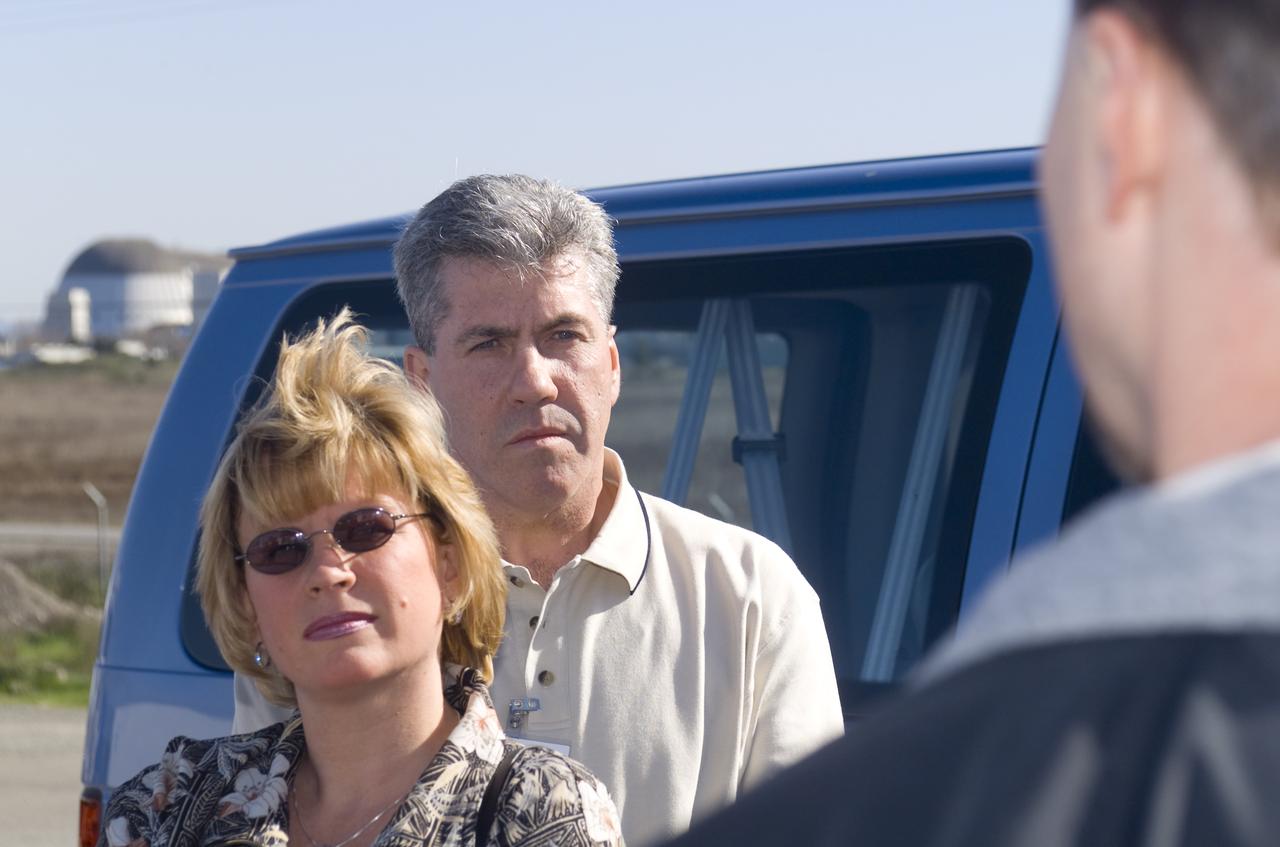
New York Firefighter Robert Schneider and his wife Lynn visit Ames Research Center as guest of City of Sunnyvale & Vice Mayor Julia Miller
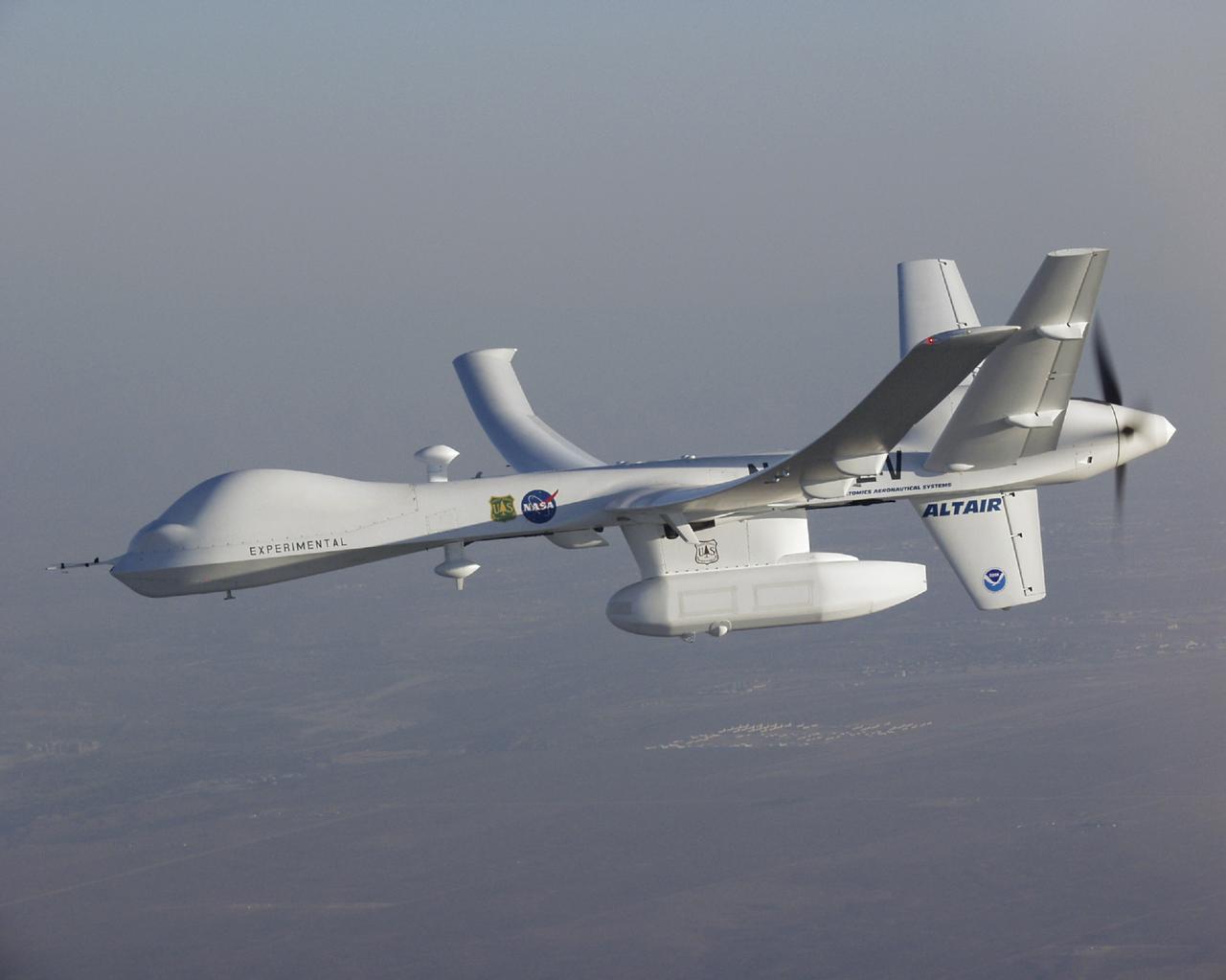
A high-tech infrared imaging sensor in its underbelly pod, the Altair UAS flew repeated passes over the Esperanza fire to aid firefighting efforts.
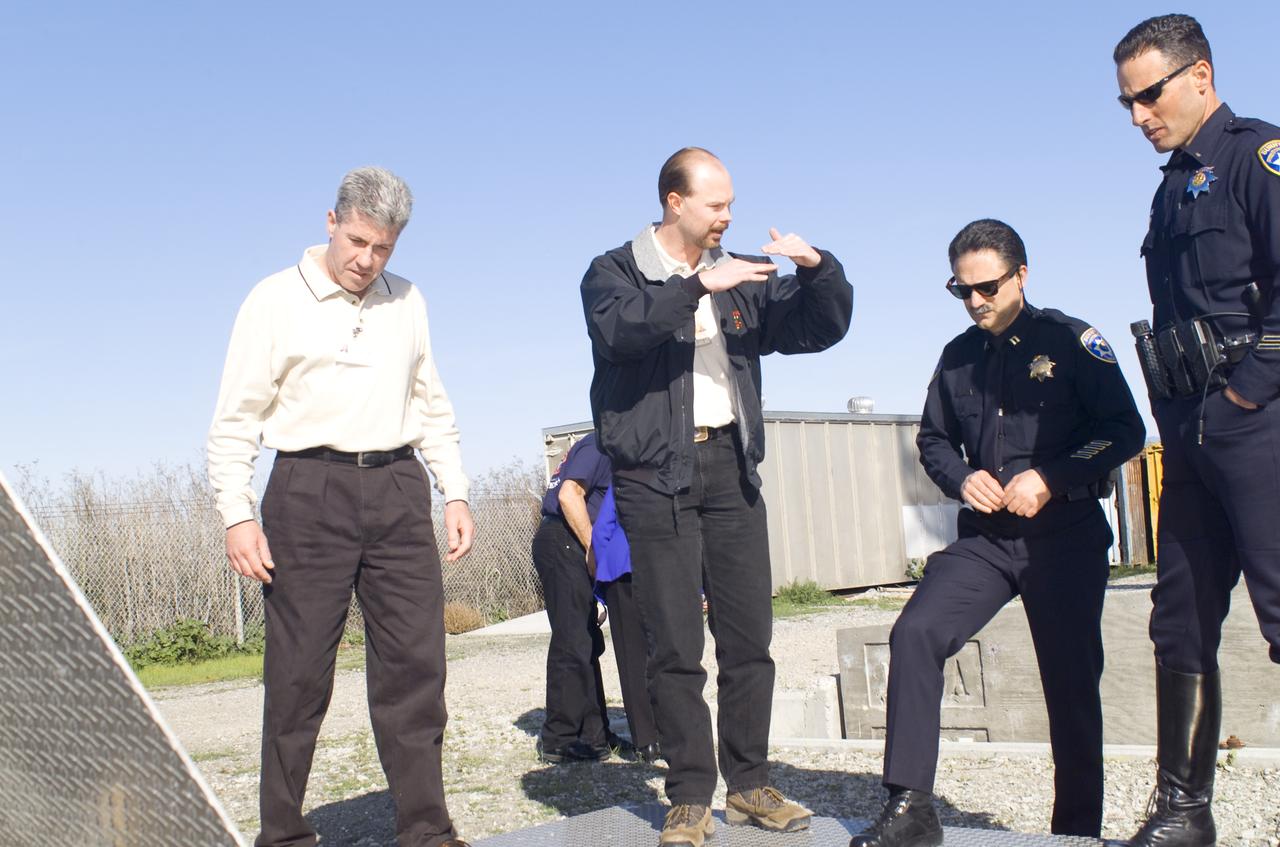
New York Firefighter Robert Schneider and his wife Lynn visit Ames Research Center as guest of City of Sunnyvale & Vice Mayor Julia Miller
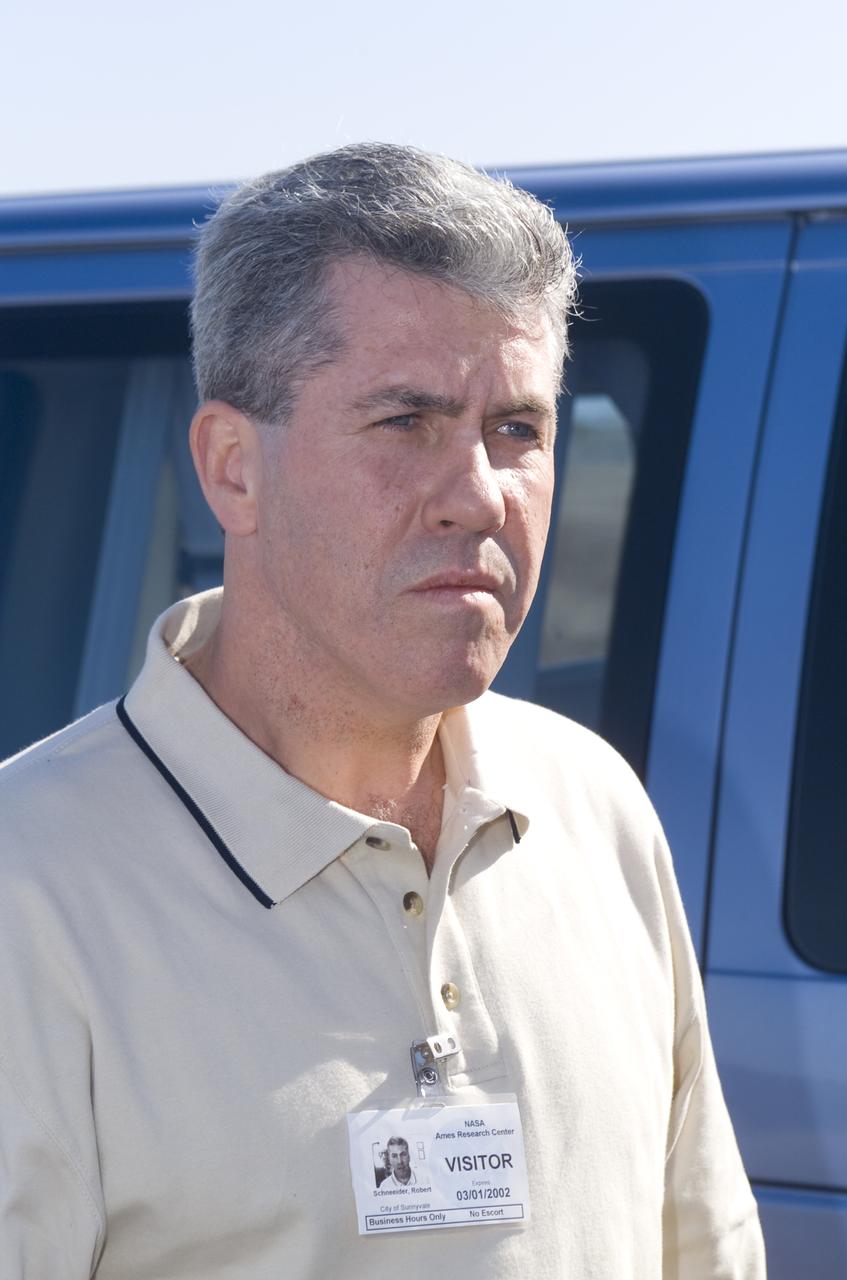
New York Firefighter Robert Schneider and his wife Lynn visit Ames Research Center as guest of City of Sunnyvale & Vice Mayor Julia Miller
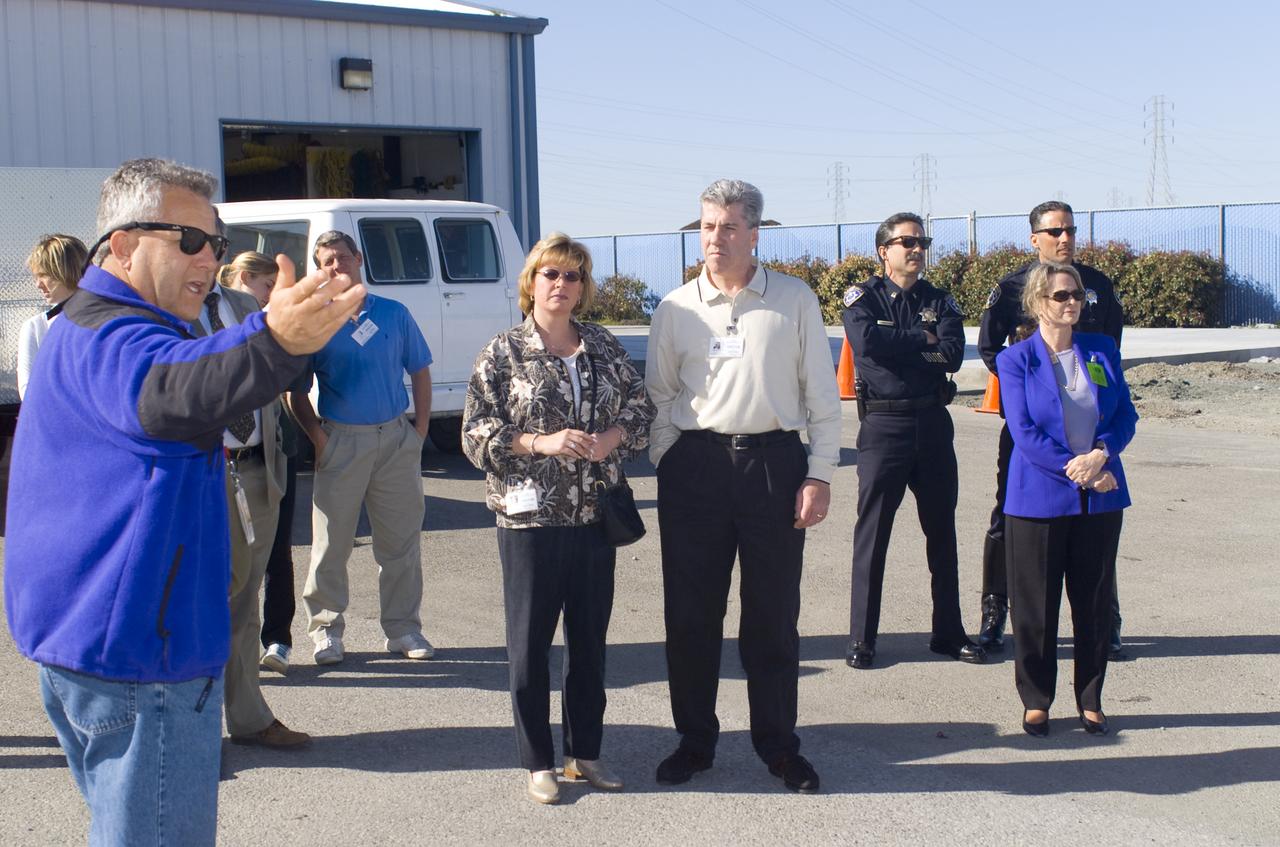
New York Firefighter Robert Schneider and his wife Lynn visit Ames Research Center as guest of City of Sunnyvale & Vice Mayor Julia Miller
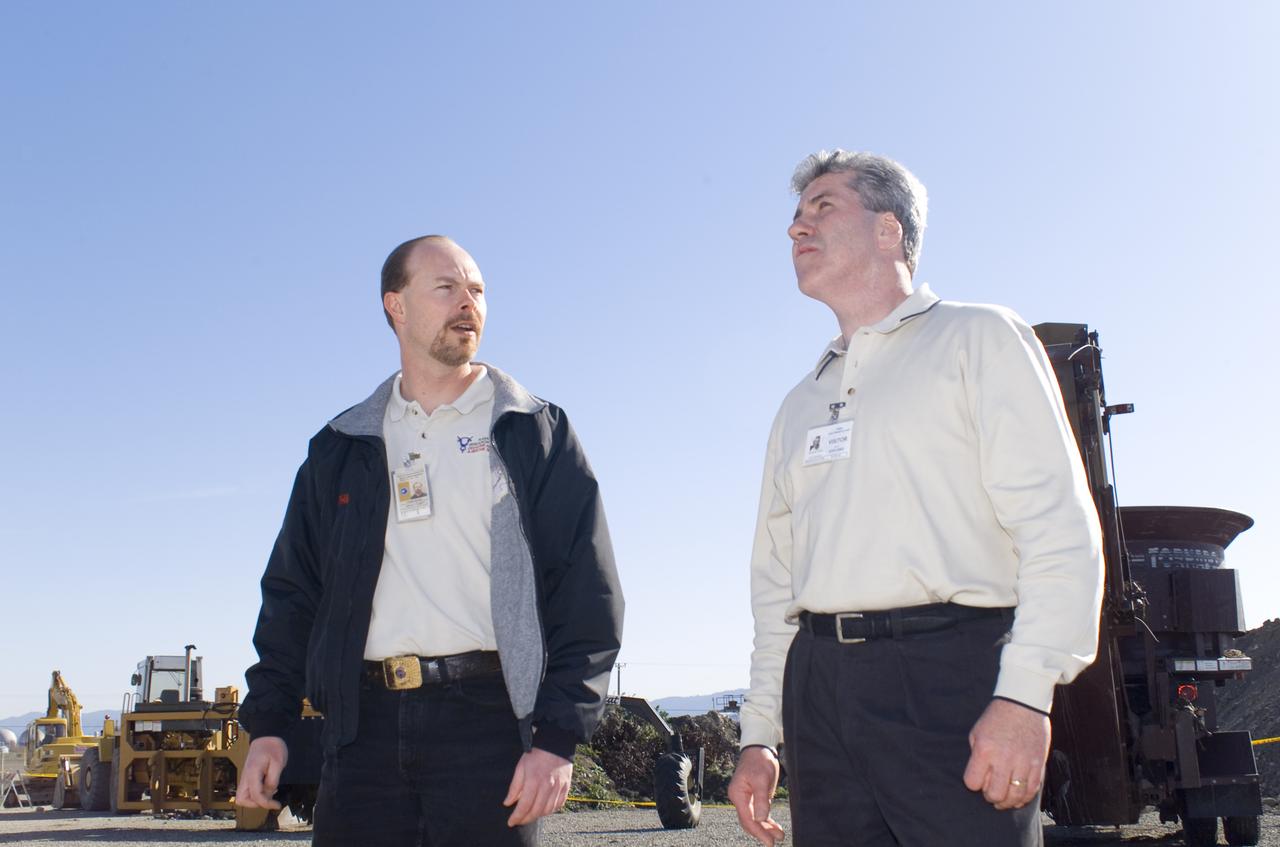
New York Firefighter Robert Schneider and his wife Lynn visit Ames Research Center as guest of City of Sunnyvale & Vice Mayor Julia Miller
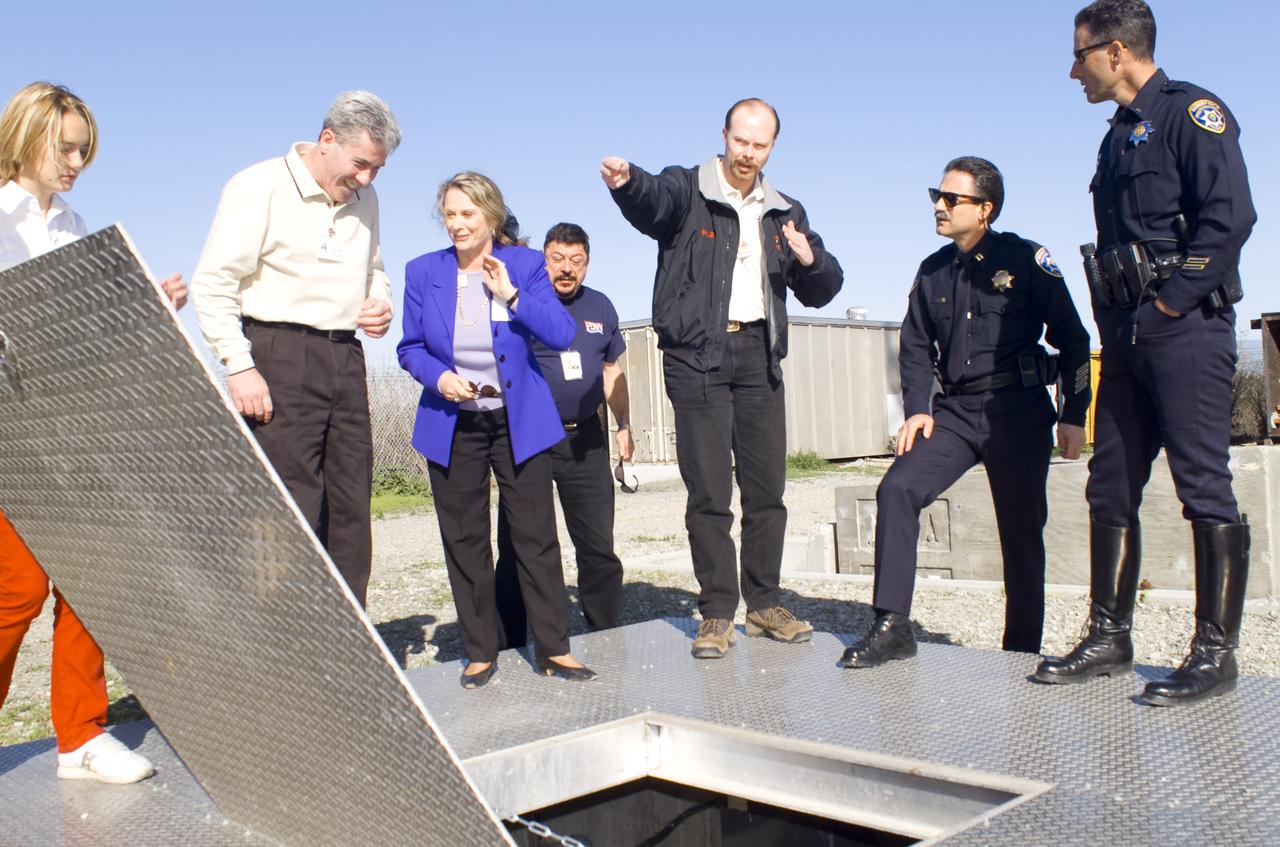
New York Firefighter Robert Schneider and his wife Lynn visit Ames Research Center as guest of City of Sunnyvale & Vice Mayor Julia Miller
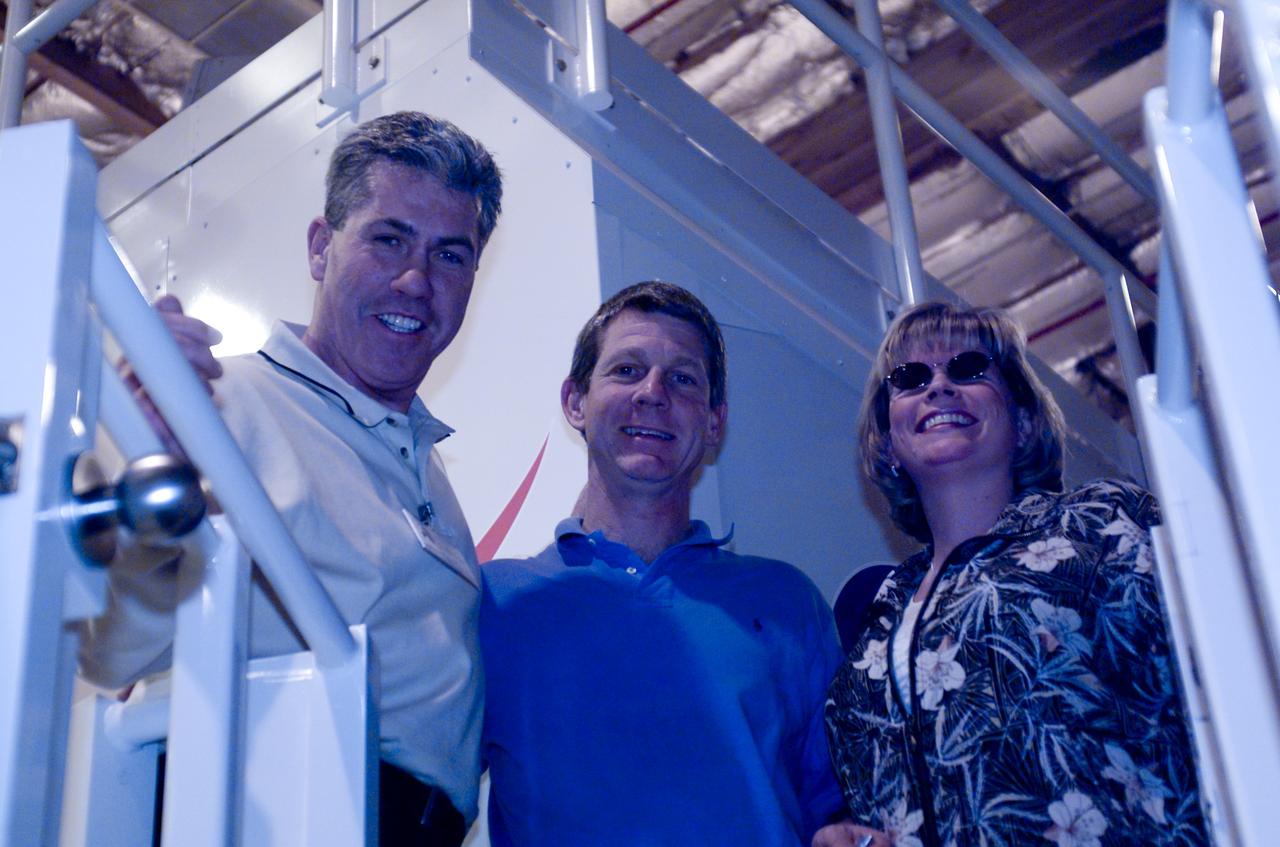
New York Firefighter Robert Schneider and his wife Lynn visit Ames Research Center as guest of City of Sunnyvale & Vice Mayor Julia Miller
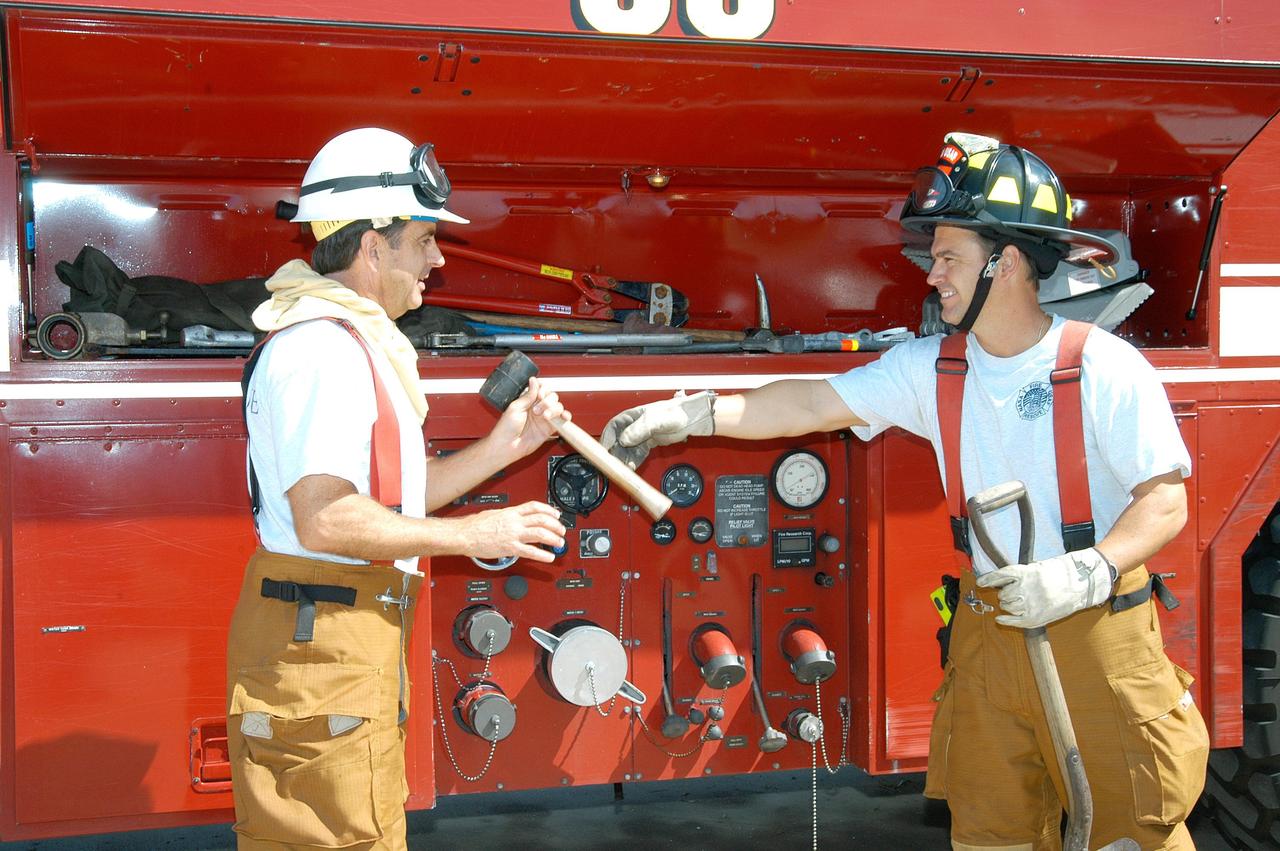
KENNEDY SPACE CENTER, FLA. - At Cape Canaveral Air Force Station, Lt. Keith Abell (left) hands equipment to KSC Firefighter Chris Maupin for storage. They and other KSC firefighters teamed up with task forces from Satellite Beach, Malabar, Melbourne, Palm Bay, Patrick Air Force Base and Brevard County to help fight wildfires in the Palm Bay and Malabar areas that threatened homes and property during the Memorial Day holiday weekend.
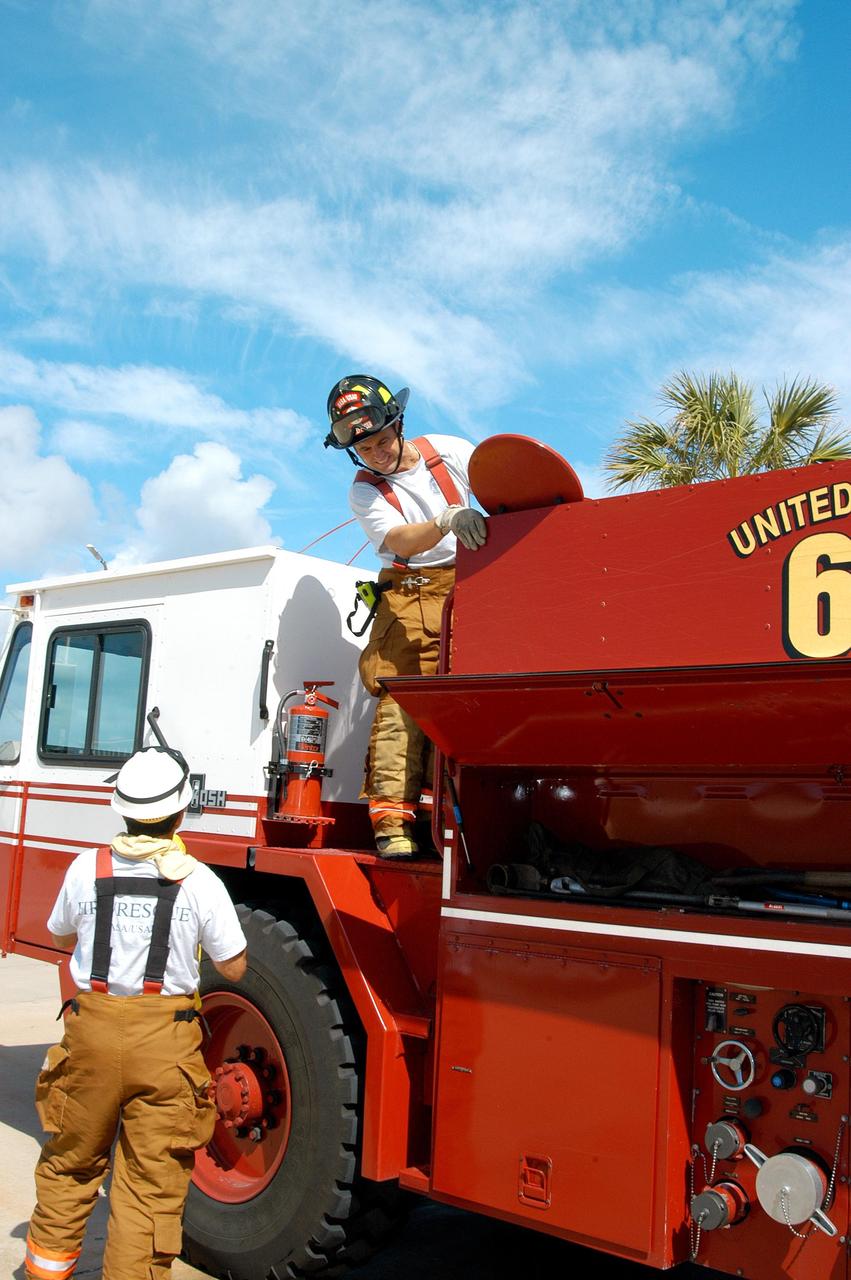
KENNEDY SPACE CENTER, FLA. - At Cape Canaveral Air Force Station, Lt. Keith Abell (left) and KSC Firefighter Chris Maupin store equipment on the fire truck. They and other KSC firefighters teamed up with task forces from Satellite Beach, Malabar, Melbourne, Palm Bay, Patrick Air Force Base and Brevard County to help fight wildfires in the Palm Bay and Malabar areas that threatened homes and property during the Memorial Day holiday weekend.
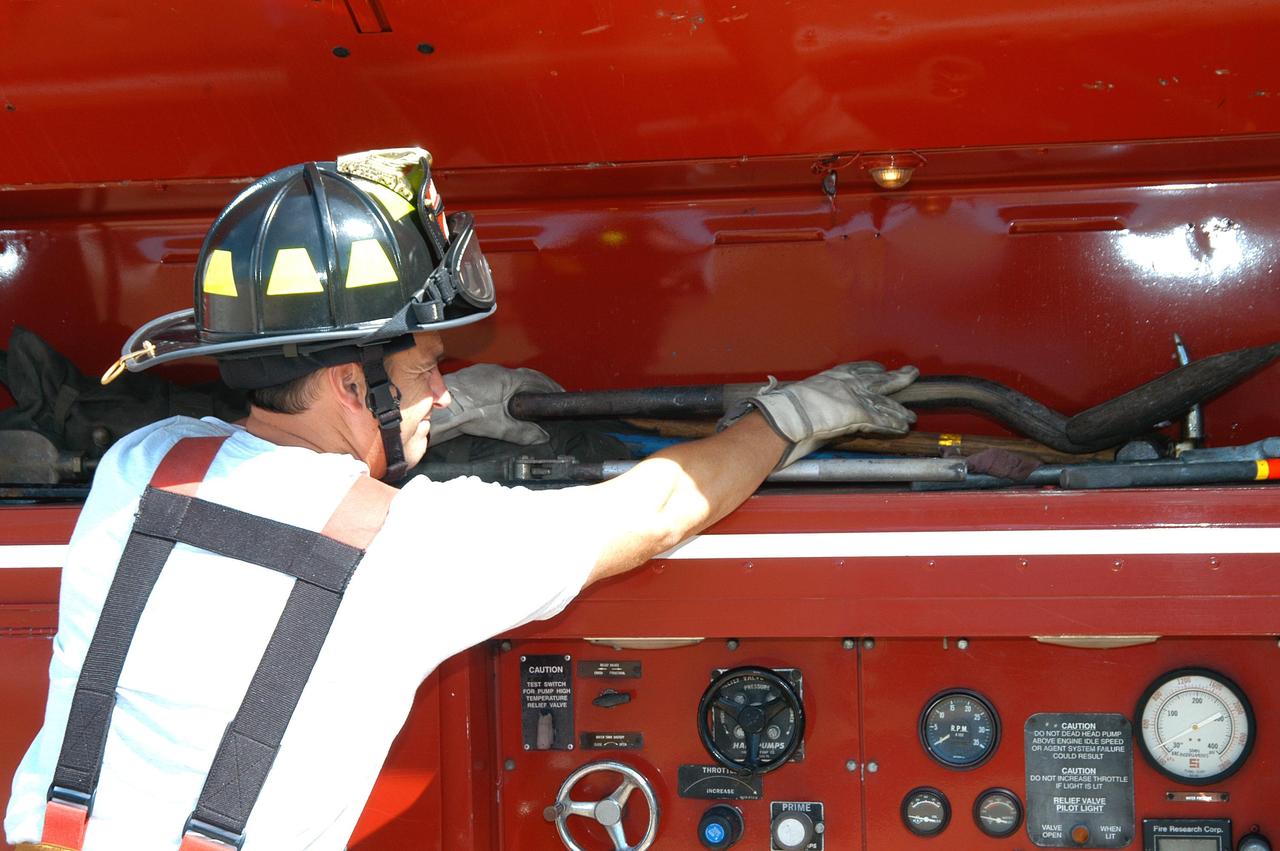
KENNEDY SPACE CENTER, FLA. - At Cape Canaveral Air Force Station, KSC Firefighter Chris Maupin puts away a piece of equipment. He and other KSC firefighters teamed up with task forces from Satellite Beach, Malabar, Melbourne, Palm Bay, Patrick Air Force Base and Brevard County to help fight wildfires in the Palm Bay and Malabar areas that threatened homes and property during the Memorial Day holiday weekend.
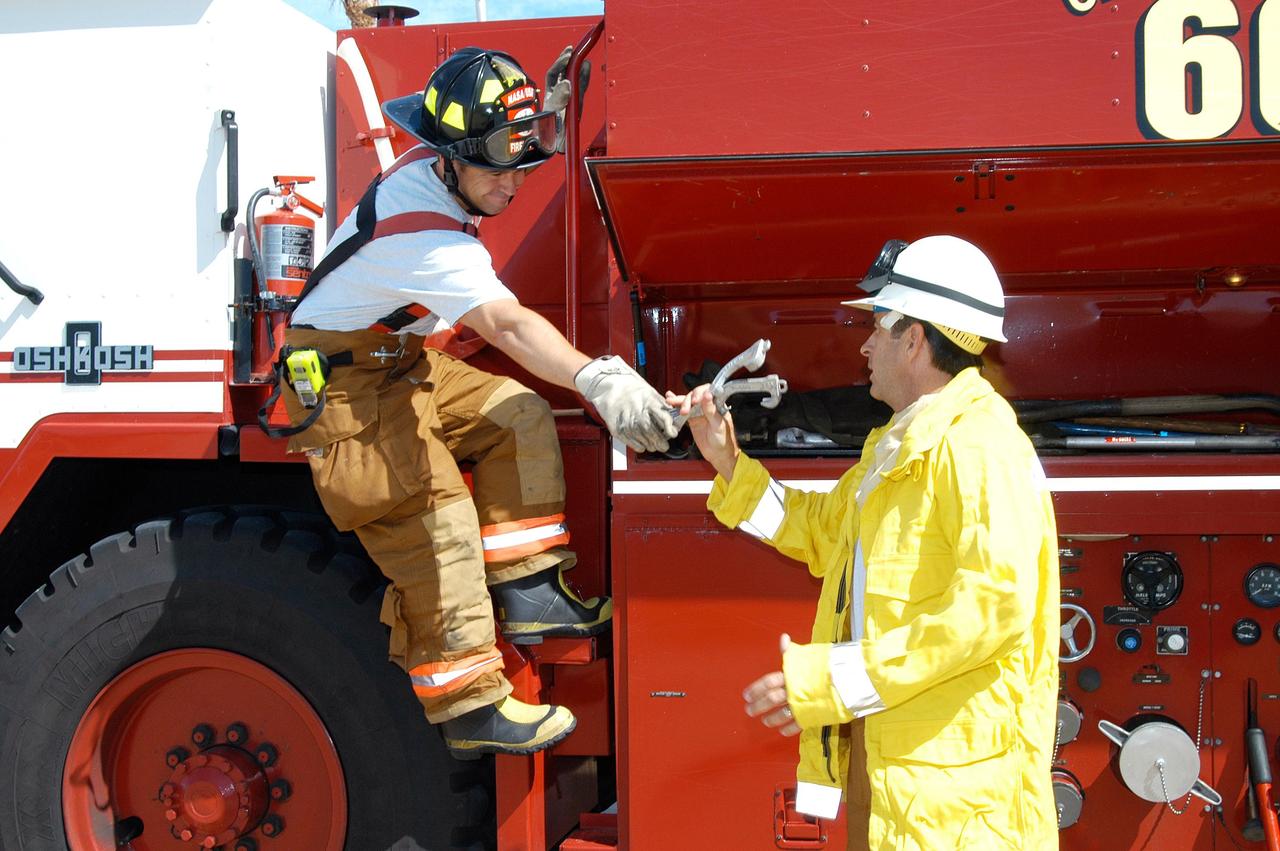
KENNEDY SPACE CENTER, FLA. - At Cape Canaveral Air Force Station, KSC Firefighter Chris Maupin (left) takes equipment from Lt. Keith Abell. They and other KSC firefighters teamed up with task forces from Satellite Beach, Malabar, Melbourne, Palm Bay, Patrick Air Force Base and Brevard County to help fight wildfires in the Palm Bay and Malabar areas that threatened homes and property during the Memorial Day holiday weekend.
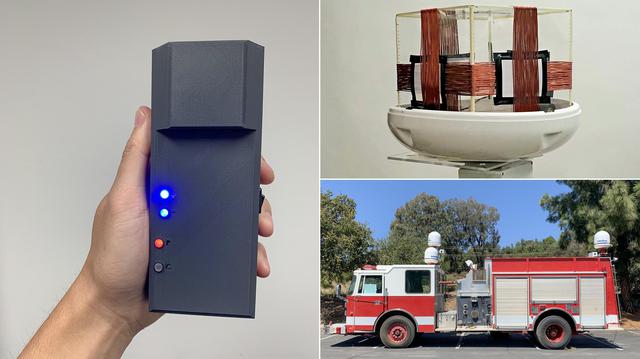
To help locate and track firefighters inside buildings, where other positioning technologies fail, NASA's Jet Propulsion Laboratory and the Department of Homeland Security Science and Technology Directorate (S&T) are developing POINTER. Short for Precision Outdoor and Indoor Navigation and Tracking for Emergency Responders, the system began taking shape in 2014 and is being matured for use by fire departments nationwide. The POINTER system is composed of three parts: a receiver, transmitter, and base station. The receiver (left) has been shrunk from the size of a backpack to the size of a large smartphone, and further development will miniaturize it so it can be easily clipped to a belt buckle. The transmitter (top right) is a system of coils that generate the magnetoquasistatic fields, which — unlike the radio waves used by GPS and radio-frequency identification — are able to pass through construction materials to interact with the receiver, enabling fire crews to track the location and orientation of firefighters. To test the system, transmitters have been attached to an out-of-service firetruck (lower right). Through 2021, POINTER will undergo field tests and a commercial version of POINTER will be made available to fire departments in 2022. https://photojournal.jpl.nasa.gov/catalog/PIA24562
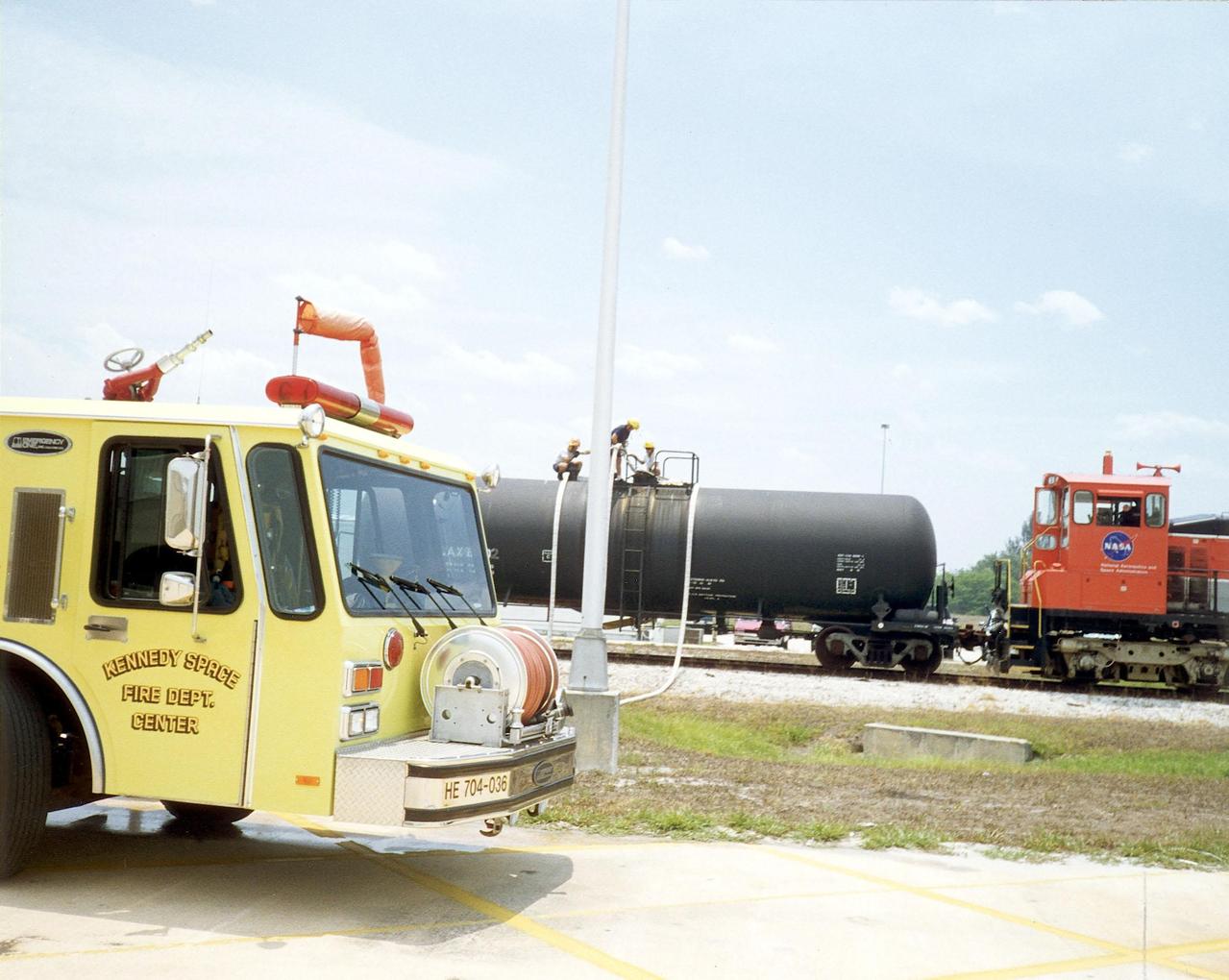
A Kennedy Space Center railroad tanker car loaded with 20,000 gallons of water and retrofitted with a special attachment for directly filling fire trucks was transported to the scene of a fire in north Brevard County to assist with firefighting efforts
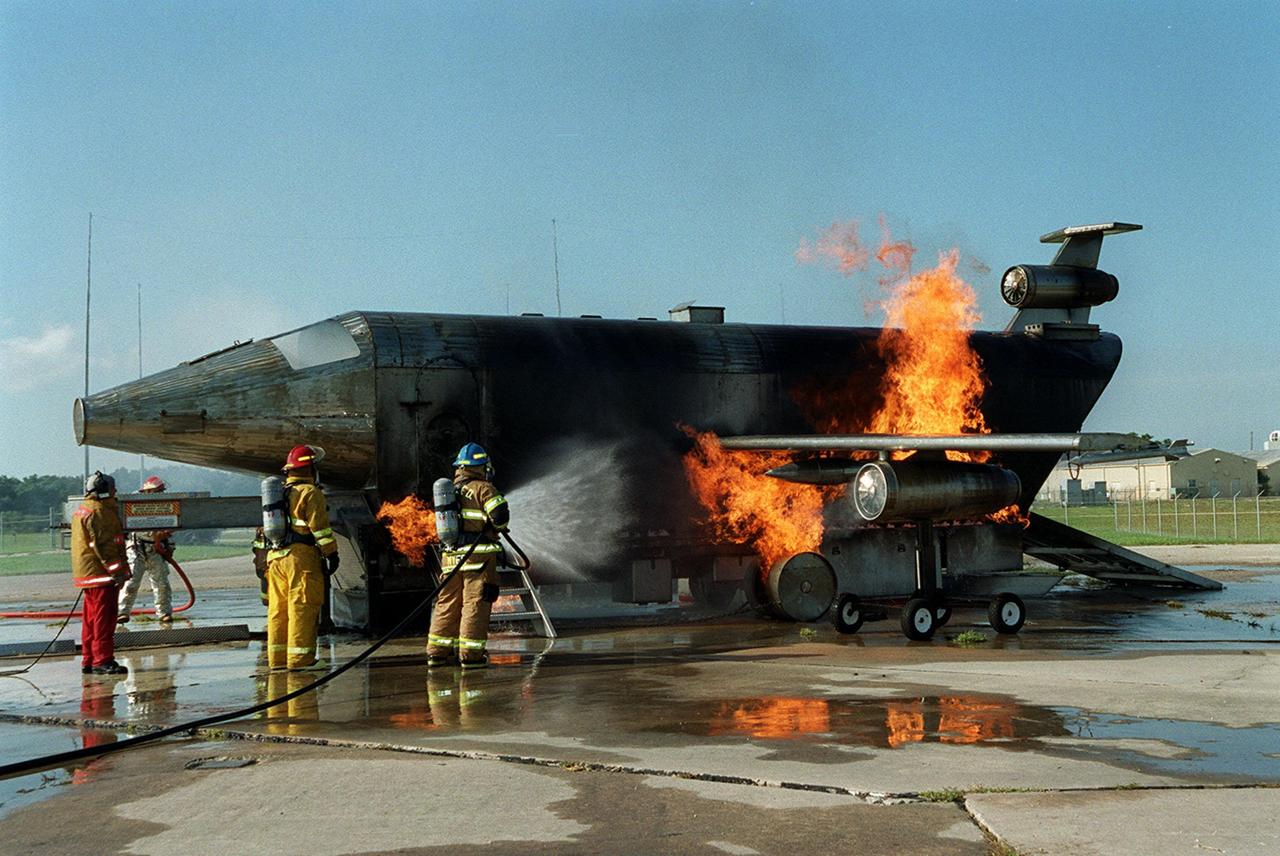
KENNEDY SPACE CENTER, FLA. -- During training exercises at Cape Canaveral Air Force Station Pad 30, firefighters with the Fire and Emergency Services at the Naval Station Mayport, Fla., turn their hoses toward the fire on the simulated aircraft.
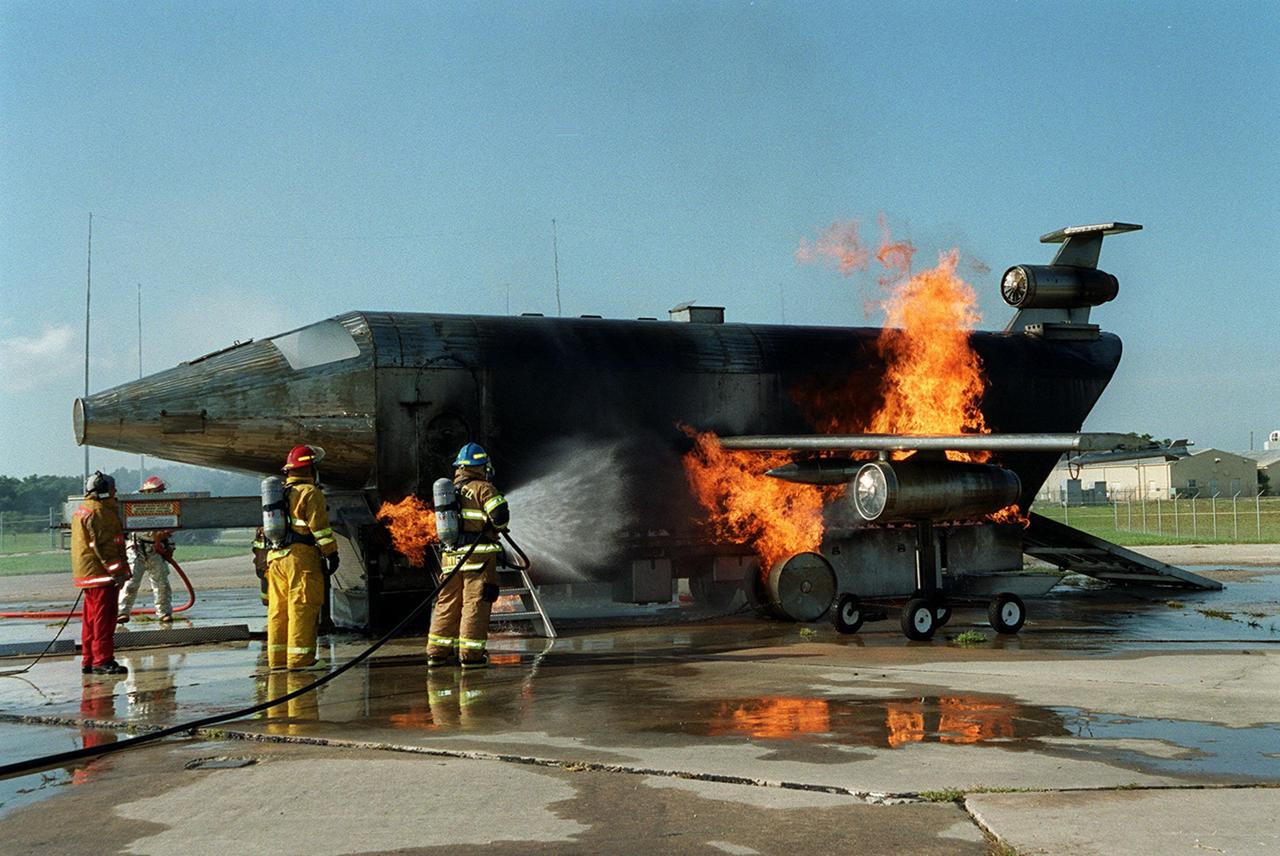
KENNEDY SPACE CENTER, FLA. -- During training exercises at Cape Canaveral Air Force Station Pad 30, firefighters with the Fire and Emergency Services at the Naval Station Mayport, Fla., turn their hoses toward the fire on the simulated aircraft.

As firefighters continue to work toward full containment of the rash of wildfires burning in Northern California, a new image from the Advanced Spaceborne Thermal Emission and Reflection Radiometer (ASTER) instrument on NASA's Terra satellite shows the growing fire scar on the landscape. In this ASTER image, acquired Oct. 21, 2017, vegetation is red, while burned areas appear dark gray. The image covers an area of 38 by 39 miles (60.5 by 63 kilometers) and is located near 38.5 degrees north, 122.4 degrees west. https://photojournal.jpl.nasa.gov/catalog/PIA22049
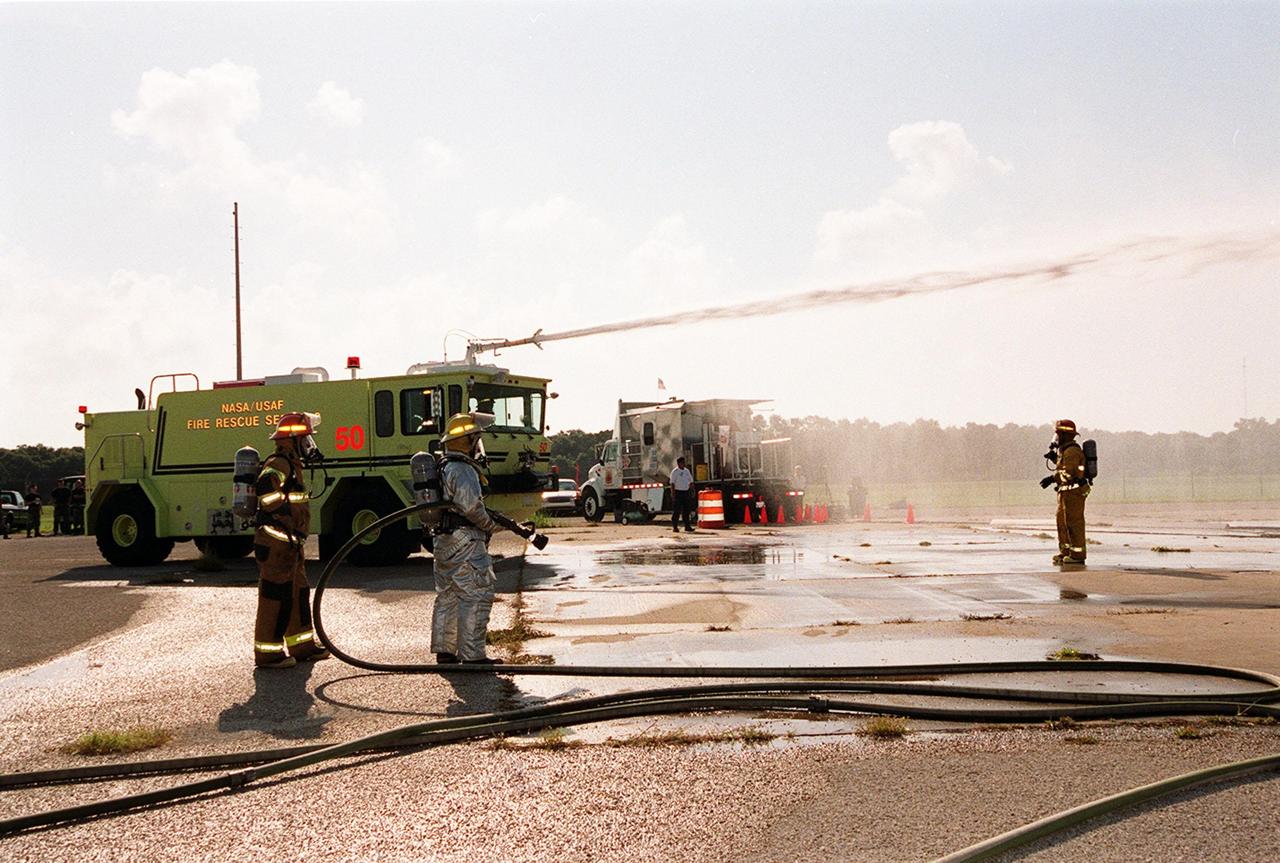
KENNEDY SPACE CENTER, FLA. -- During training exercises at Cape Canaveral Air Force Station Pad 30, firefighters with the Fire and Emergency Services at the Naval Station Mayport, Fla., wait while the NASA/USAF water carrier truck directs its water cannon toward a burning simulated aircraft (out of view).
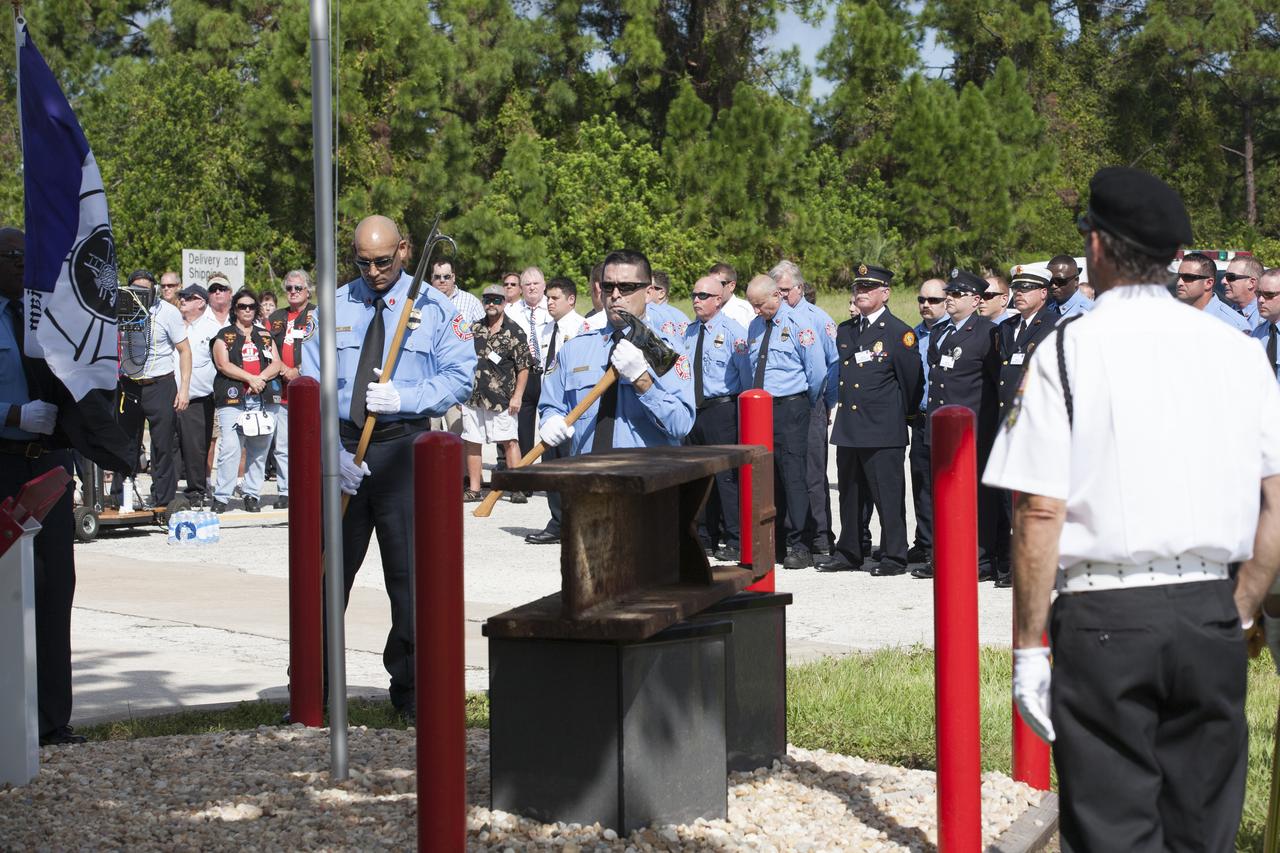
Firefighters stand at attention as a memorial to the 343 first responder victims of the Sept. 11, 2001, terror attacks is dedicated at Fire Station 1 at NASA's Kennedy Space Center on Sept. 11, 2015. A section of steel I-beam from the World Trade Center in New York forms the centerpiece of the monument.
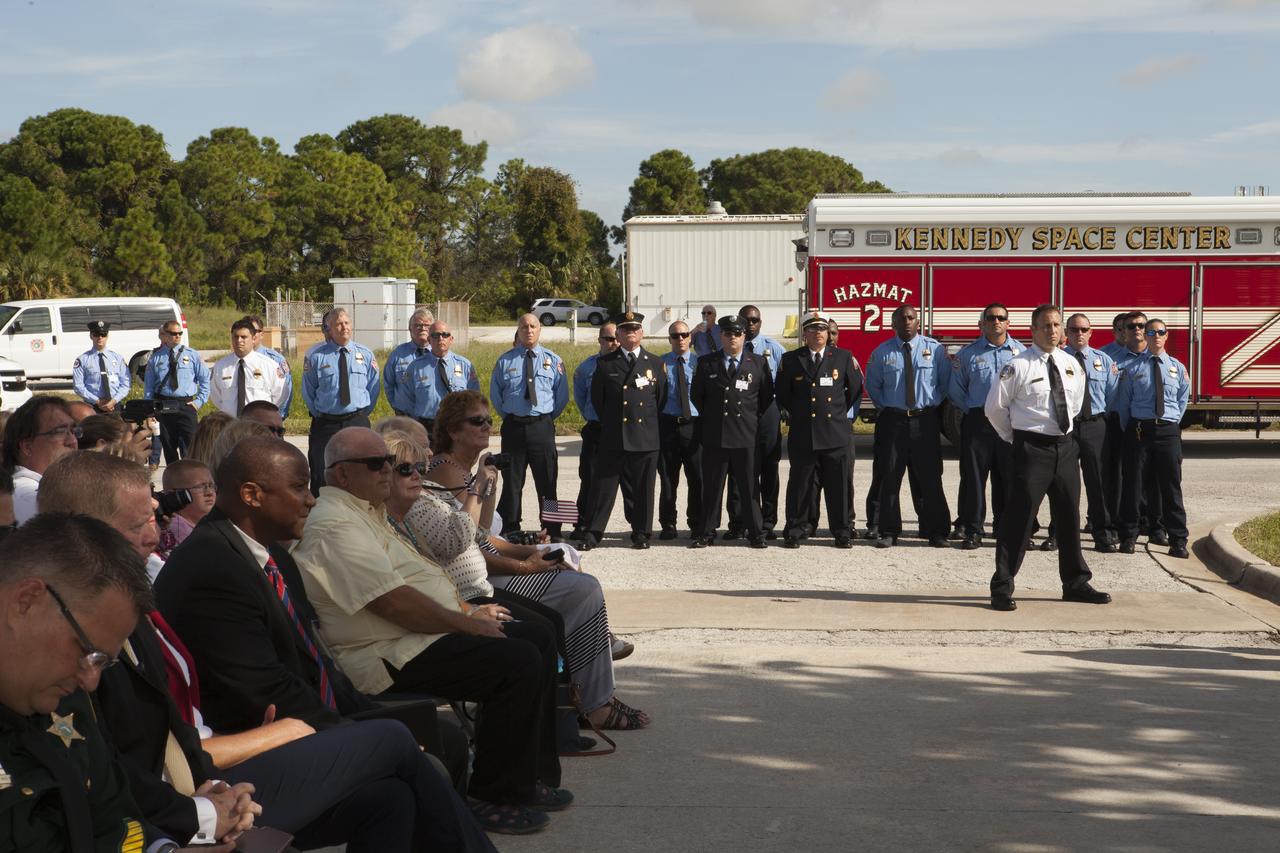
Officials and firefighters at NASA's Kennedy Space Center observe the dedication service for a memorial to the 343 first responder victims of the Sept. 11, 2001, terror attacks at Fire Station 1 at Kennedy on Sept. 11, 2015. The ceremony dedicated a monument that includes a section of steel I-beam from the World Trade Center in New York.
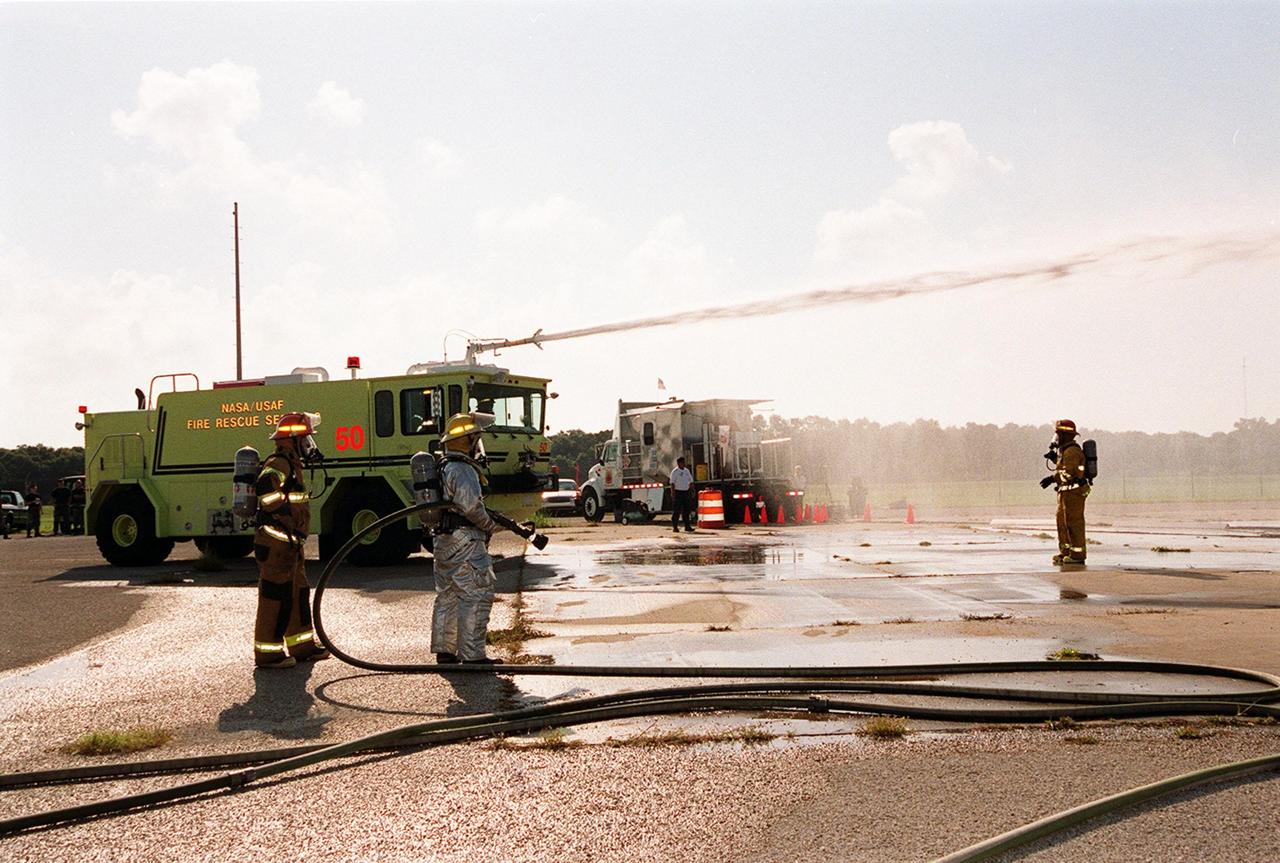
KENNEDY SPACE CENTER, FLA. -- During training exercises at Cape Canaveral Air Force Station Pad 30, firefighters with the Fire and Emergency Services at the Naval Station Mayport, Fla., wait while the NASA/USAF water carrier truck directs its water cannon toward a burning simulated aircraft (out of view).
Firefighters stand at attention as a memorial to the 343 first responder victims of the Sept. 11, 2001, terror attacks is dedicated at Fire Station 1 at NASA's Kennedy Space Center on Sept. 11, 2015. A section of steel I-beam from the World Trade Center in New York forms the centerpiece of the monument.
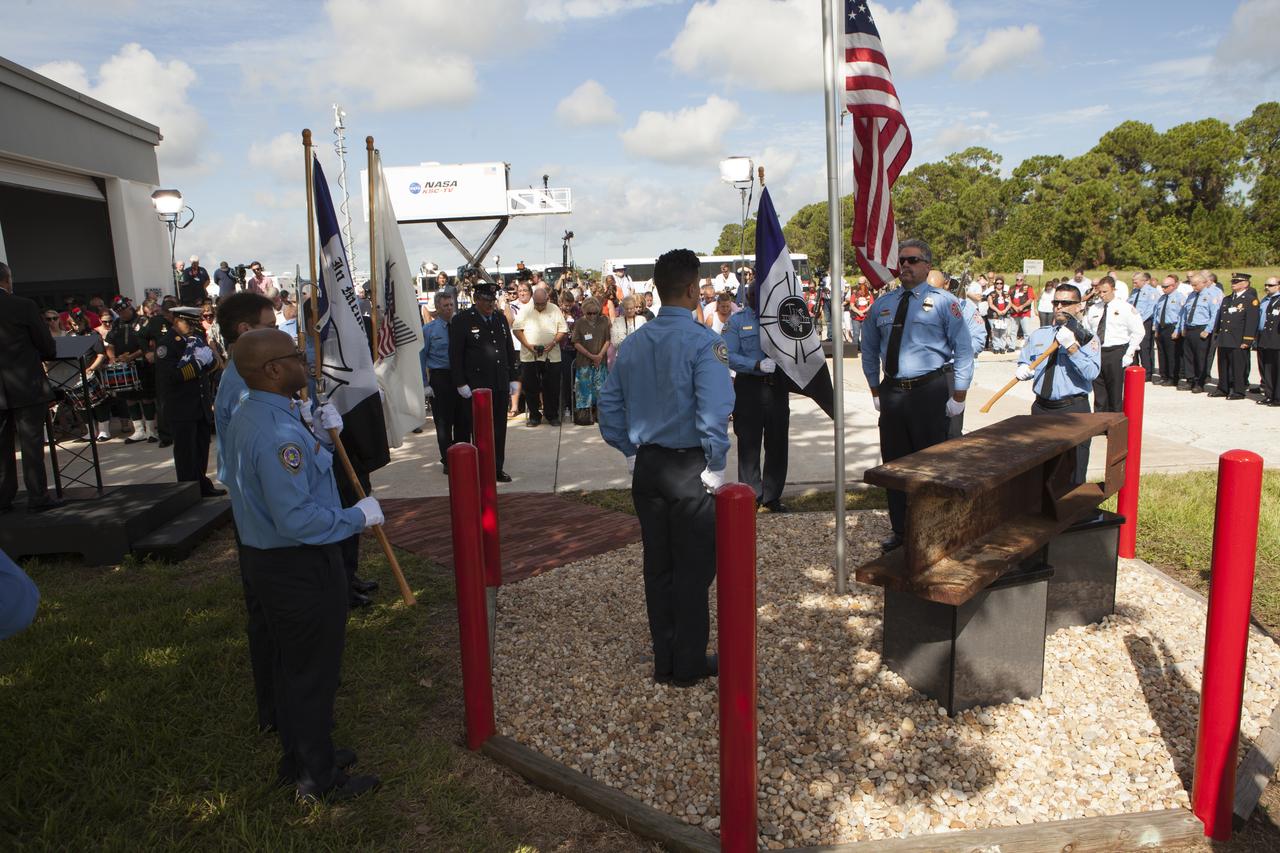
Firefighters stand at attention as a memorial to the 343 first responder victims of the Sept. 11, 2001, terror attacks is dedicated at Fire Station 1 at NASA's Kennedy Space Center on Sept. 11, 2015. A section of steel I-beam from the World Trade Center in New York forms the centerpiece of the monument.
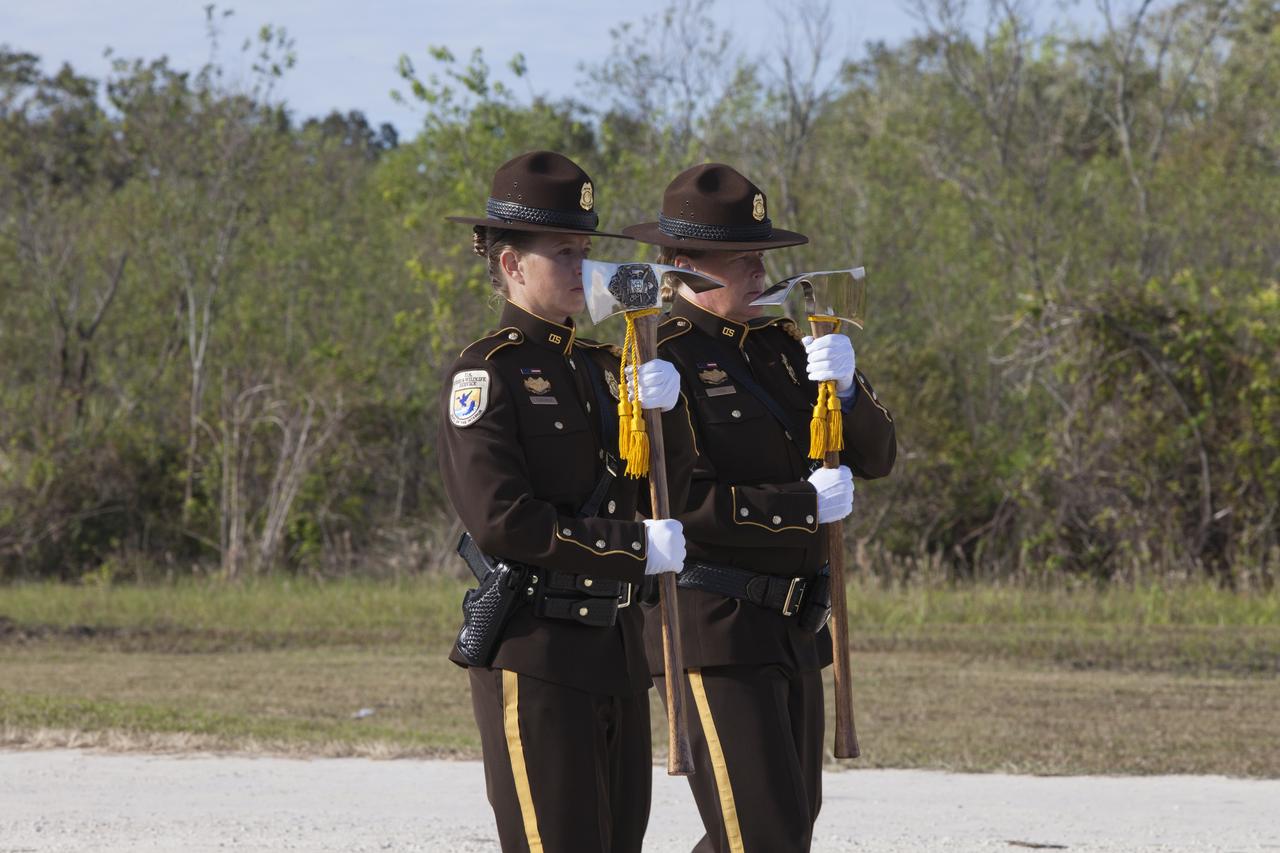
Firefighters prepare to place ceremonial Pulaski tools by a new memorial marker Nov. 1 on the Merritt Island National Wildlife Refuge in Florida. During a joint ceremony, the Spaceport Integration Team and its partners were presented with the prestigious 2017 Pulaski Award and the new memorial marker was dedicated. The multi-agency team includes representatives from NASA's Kennedy Space Center, Cape Canaveral Air Force Station's 45th Space Wing, the Merritt Island National Wildlife Refuge, as well as the Florida Forest Service and Brevard County Fire Rescue. The memorial marker honors two fallen firefighters, Scott Maness and Beau Sauselein, who died fighting a wildfire on space center property in 1981. Held outdoors, the ceremony was attended by 140 guests.
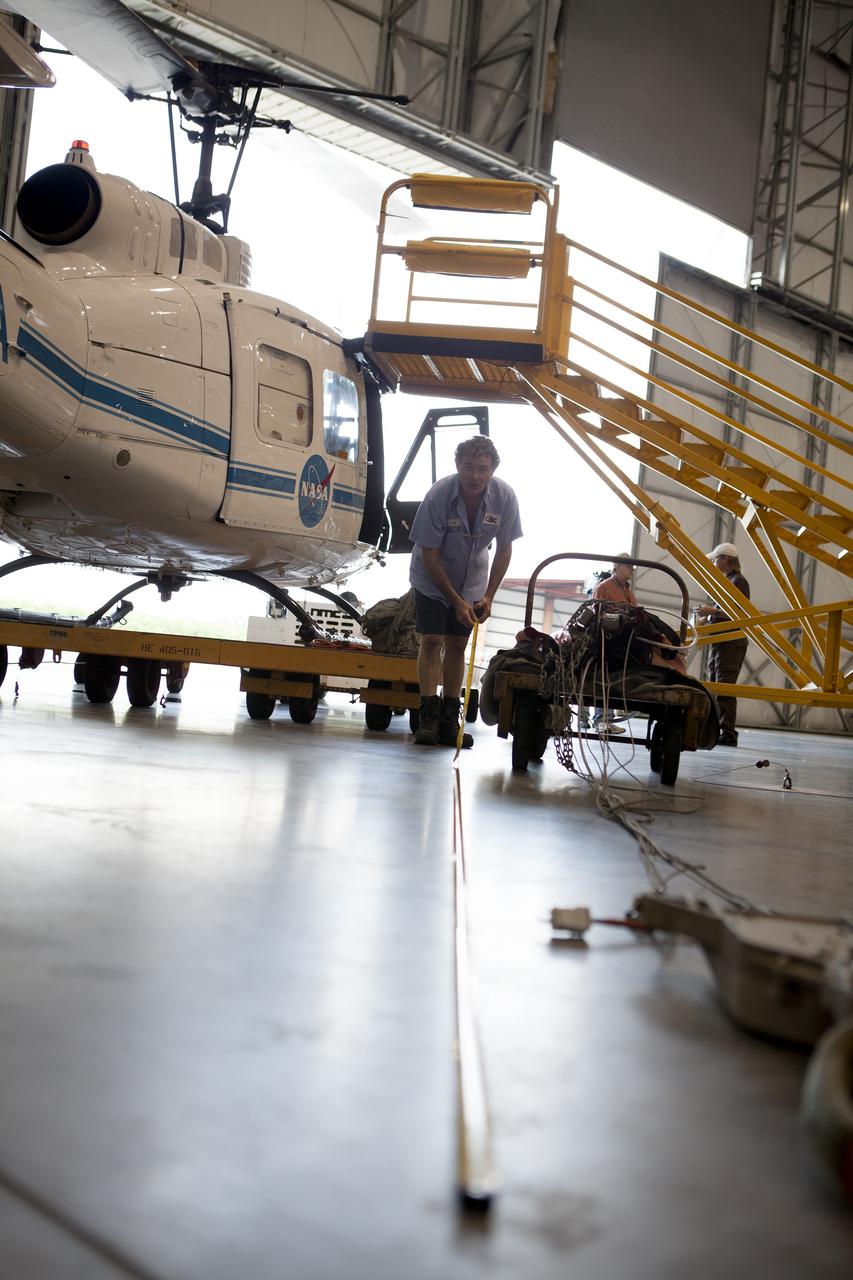
CAPE CANAVERAL, Fla. -- At NASA's Kennedy Space Center in Florida, 23-foot cables used to hold a Bambi Bucket are checked out prior to a training exercise to practice firefighting techniques. A three-person helicopter crew recently practiced using a Bambi Bucket to pick up water from a nearby waterway and dropping it on simulated targets at the center’s Shuttle Landing Facility. Firefighters respond to wildfires with teams on the ground and in the air. The most up-to-date tools include helicopters that use Bambi Buckets large quantities of water. NASA Flight Operations teams are training to perfect the skills needed to ensure they are ready to use tools, such as the Bambi Bucket, in the event of an out-of-control blaze at the spaceport. Photo credit: NASA/Frankie Martin
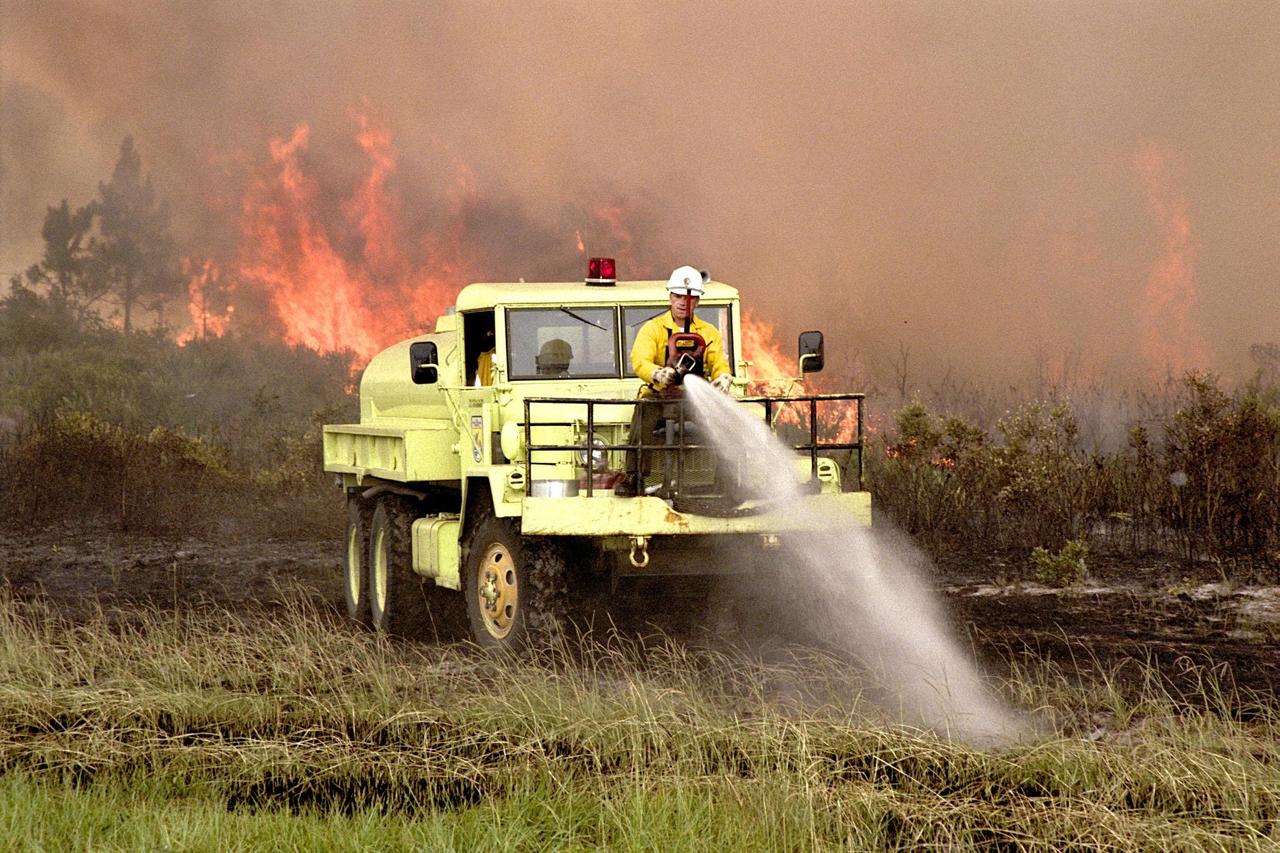
KENNEDY SPACE CENTER, FLA. -- A fire burns in the background as members of the U.S Fish and Wildlife Service operate firefighting equipment soaking the grass and underbrush in an attempt to keep the fire away from Kennedy Parkway and the wooded area on the other side of the road. Lightning touched off three different fires Sunday evening in and around Kennedy Space Center at Tel IV, Ransom Road and Pine Island Road. This area is part of the Merritt Island National Wildlife Refuge operated by the service. The fires were a short distance from operational facilities at the space center and forced the closing of Florida State Route 3. The fires are being contained by firefighters from Kennedy Space Center and the U.S. Fish and Wildlife Service

CAPE CANAVERAL, Fla. -- At NASA's Kennedy Space Center in Florida, Mike Tillema, chief of Flight Operations in the Operations Support Division of NASA Center Operations, center, discusses plans for a training session to practice use of a Bambi Bucket in honing firefighting techniques. Bill Martin, a URS Federal Technical Services pilot in NASA Flight Operations, is on the left, with crew chief Mark Smith, also of URS. Firefighters respond to wildfires with teams on the ground and in the air. The most up-to-date tools include helicopters that use Bambi Buckets large quantities of water. NASA Flight Operations teams are training to perfect the skills needed to ensure they are ready to use tools, such as the Bambi Bucket, in the event of an out-of-control blaze at the spaceport. Photo credit: NASA/Frankie Martin
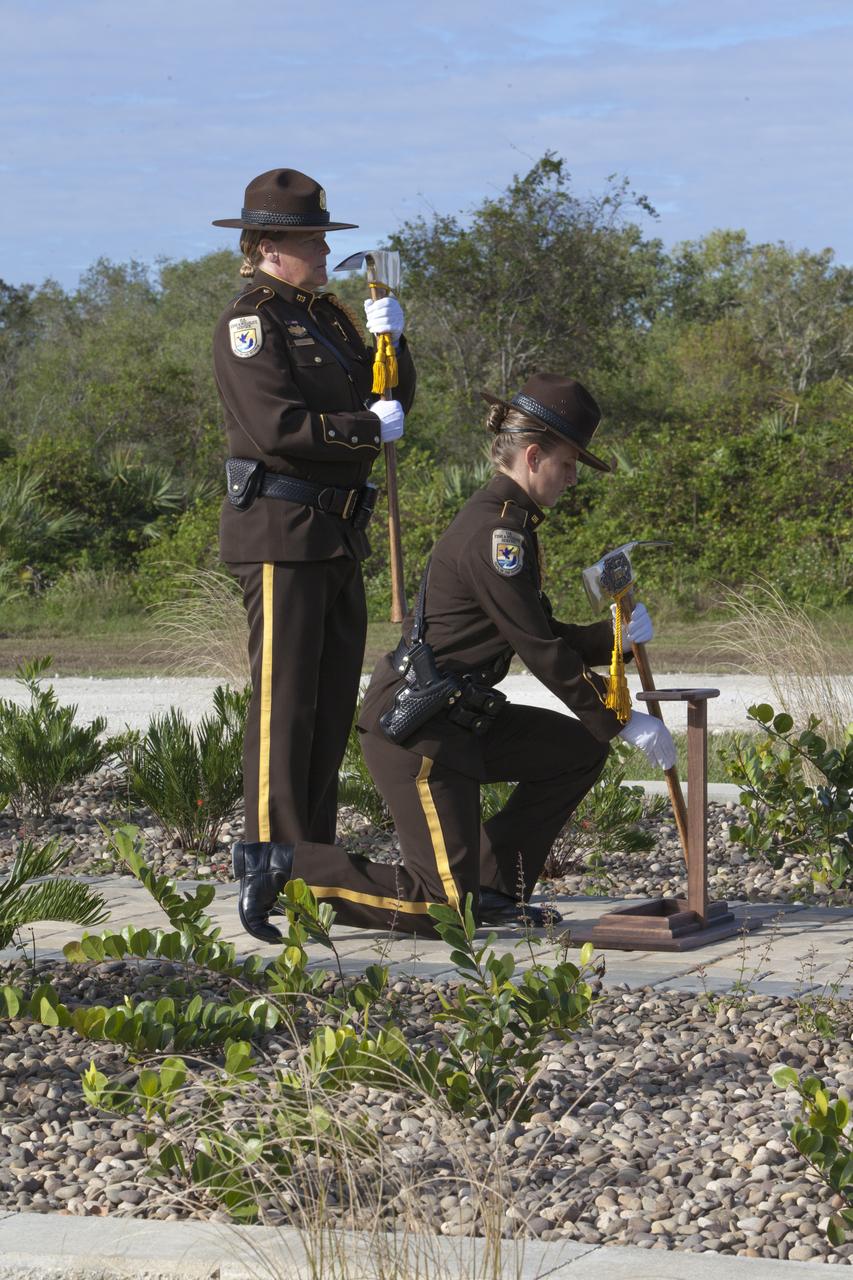
Firefighters place ceremonial Pulaski tools by a new memorial marker Nov. 1 on the Merritt Island National Wildlife Refuge in Florida. During a joint ceremony, the Spaceport Integration Team and its partners were presented with the prestigious 2017 Pulaski Award and the new memorial marker was dedicated. The multi-agency team includes representatives from NASA's Kennedy Space Center, Cape Canaveral Air Force Station's 45th Space Wing, the Merritt Island National Wildlife Refuge, as well as the Florida Forest Service and Brevard County Fire Rescue. The memorial marker honors two fallen firefighters, Scott Maness and Beau Sauselein, who died fighting a wildfire on space center property in 1981. Held outdoors, the ceremony was attended by 140 guests.
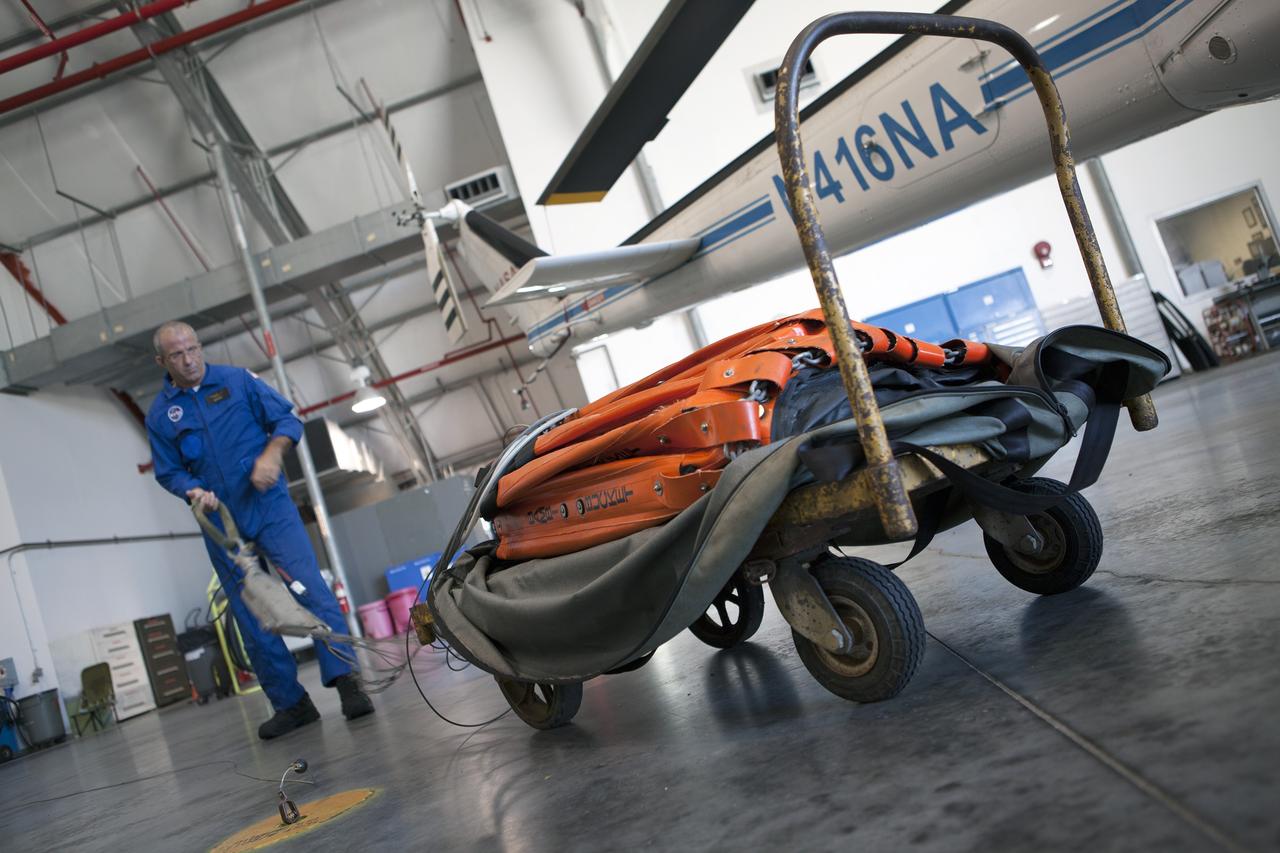
CAPE CANAVERAL, Fla. -- At NASA's Kennedy Space Center in Florida, helicopter crew chief Mark Smith, of URS Federal Technical Services Inc., checks out a Bambi Bucket prior to a training exercise to practice firefighting techniques. A three-person helicopter crew recently practiced using a Bambi Bucket to pick up water from a nearby waterway and dropping it on simulated targets at the center’s Shuttle Landing Facility. Firefighters respond to wildfires with teams on the ground and in the air. The most up-to-date tools include helicopters that use Bambi Buckets large quantities of water. NASA Flight Operations teams are training to perfect the skills needed to ensure they are ready to use tools, such as the Bambi Bucket, in the event of an out-of-control blaze at the spaceport. Photo credit: NASA/Frankie Martin
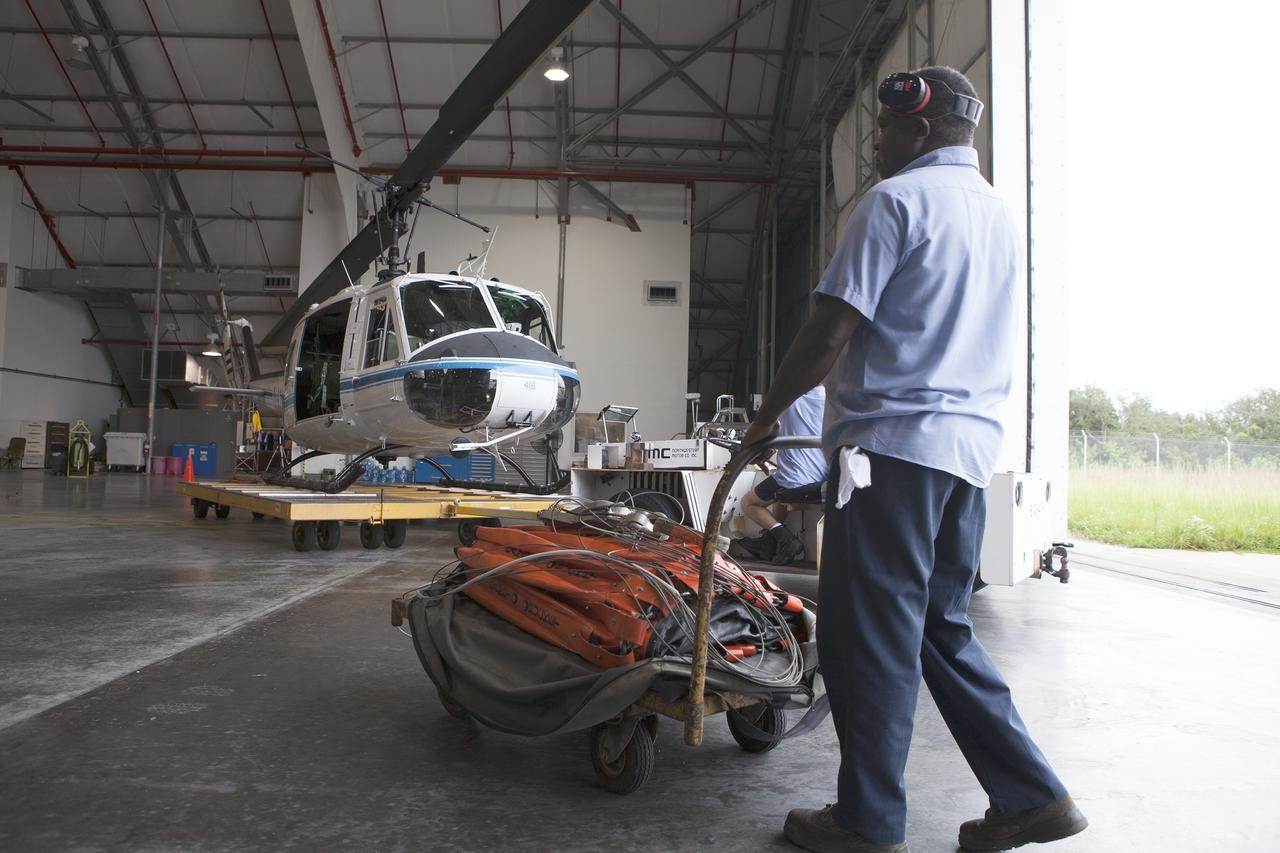
CAPE CANAVERAL, Fla. -- At NASA's Kennedy Space Center in Florida, John Miller of URS Federal Technical Services moves a Bambi Bucket and its associated cables are moved outside the Shuttle Landing Facility hangar prior to a training exercise to practice firefighting techniques. A three-person helicopter crew recently practiced using a Bambi Bucket to pick up water from a nearby waterway and dropping it on simulated targets at the center’s Shuttle Landing Facility. Firefighters respond to wildfires with teams on the ground and in the air. The most up-to-date tools include helicopters that use Bambi Buckets large quantities of water. NASA Flight Operations teams are training to perfect the skills needed to ensure they are ready to use tools, such as the Bambi Bucket, in the event of an out-of-control blaze at the spaceport. Photo credit: NASA/Frankie Martin
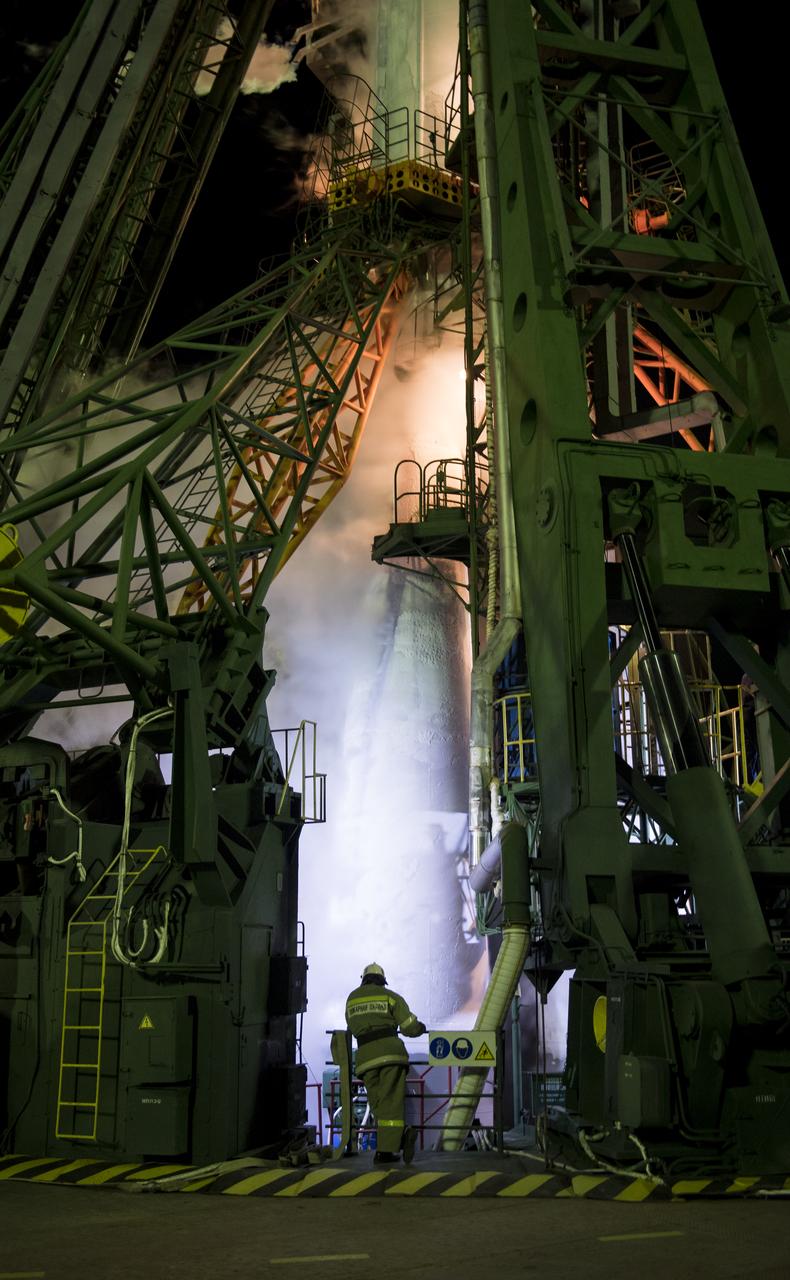
A firefighter is seen in front of the Soyuz rocket as teams await the arrival of Expedition 55 crew members Oleg Artemyev of Roscosmos, Ricky Arnold of NASA, and Drew Feustel of NASA, Wednesday, March 21, 2018 at the Baikonur Cosmodrome in Kazakhstan. Arnold, Artemyev, and Feustel launched aboard the Soyuz MS-08 spacecraft at 1:44 p.m. Eastern time (11:44 p.m. Baikonur time) on March 21 to begin their journey to the International Space Station. Photo Credit: (NASA/Joel Kowsky)
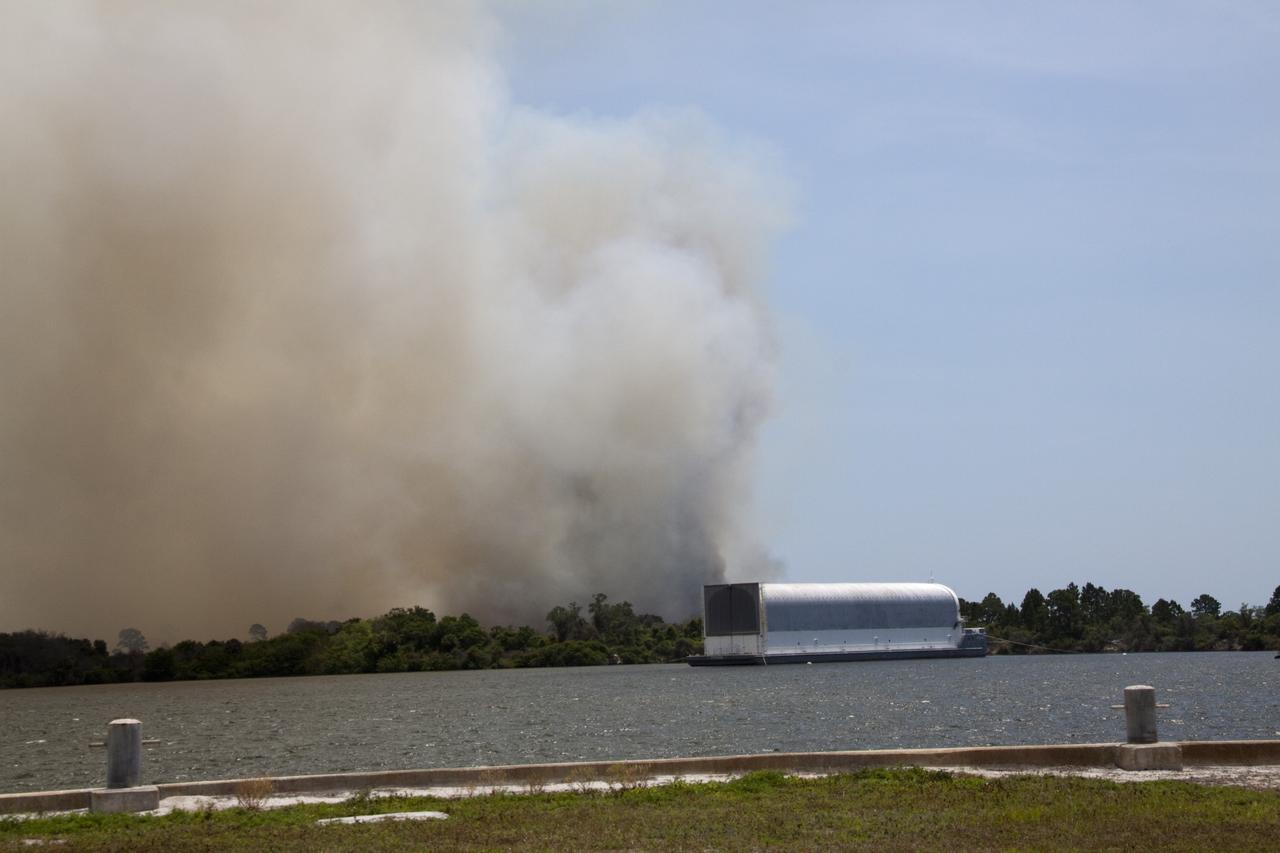
CAPE CANAVERAL, Fla. -- At NASA's Kennedy Space Center in Florida, smoke rises from a smoldering brush fire southeast of the Turn Basin. The fire was spotted near Kennedy’s Press Site approximately three miles away from Launch Pad 39A. The fires are being contained by firefighters from Kennedy Space Center and the U.S. Fish and Wildlife Service. No personnel are in danger and currently there is no to impact any operations related to space shuttle Endeavour’s launch countdown. Photo credit: NASA/Jack Pfaller
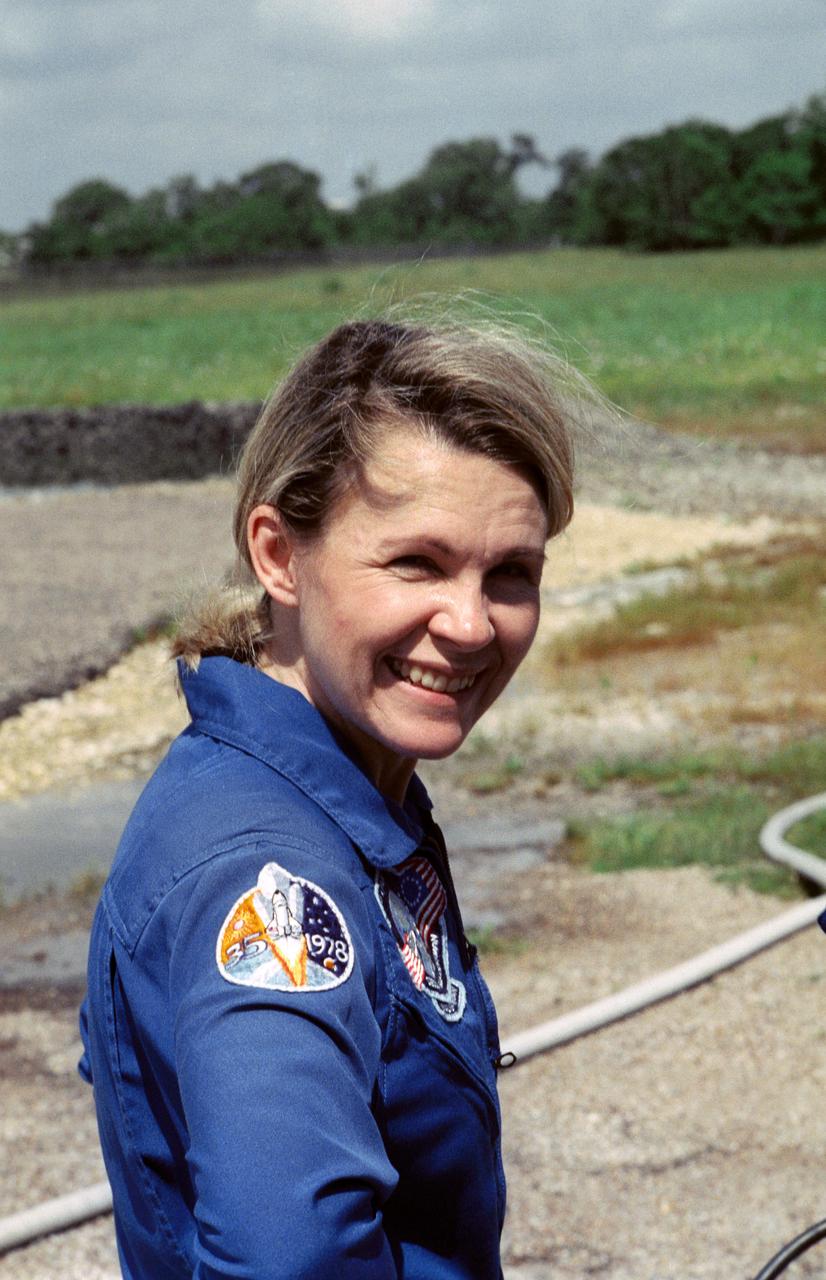
S90-46497 (18 Aug 1990) --- Astronaut Rhea Seddon, STS-40 mission specialist, takes a break from firefighting training at the Johnson Space Center (JSC). In less than a year Dr. Seddon will be joined by four NASA astronauts and two payload specialists for the Spacelab Life Sciences (SLS-1) mission aboard Columbia.
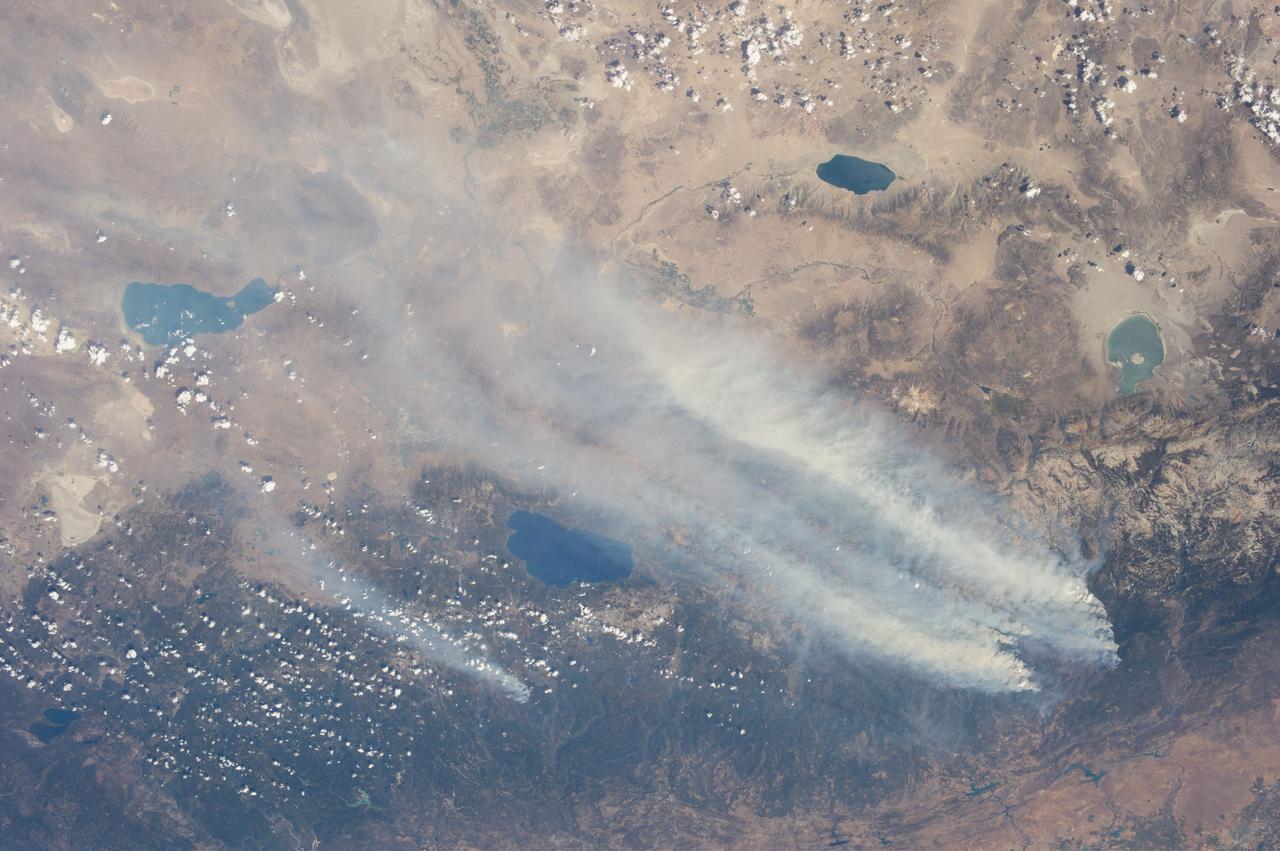
ISS036-E-037185 (26 Aug. 2013) --- One of the Expedition 36 crew members aboard the International Space Station used a 50mm lens to record this view of the massive drought-aided Rim Fire in and around California's Yosemite National Park and the Stanislaus National Forest on Aug. 26. The fire began on Aug. 17 and, at the time of this photo on Aug. 26, it still continues to burn, as some 3,700 firefighters battle it. More than 224 square miles have been affected.
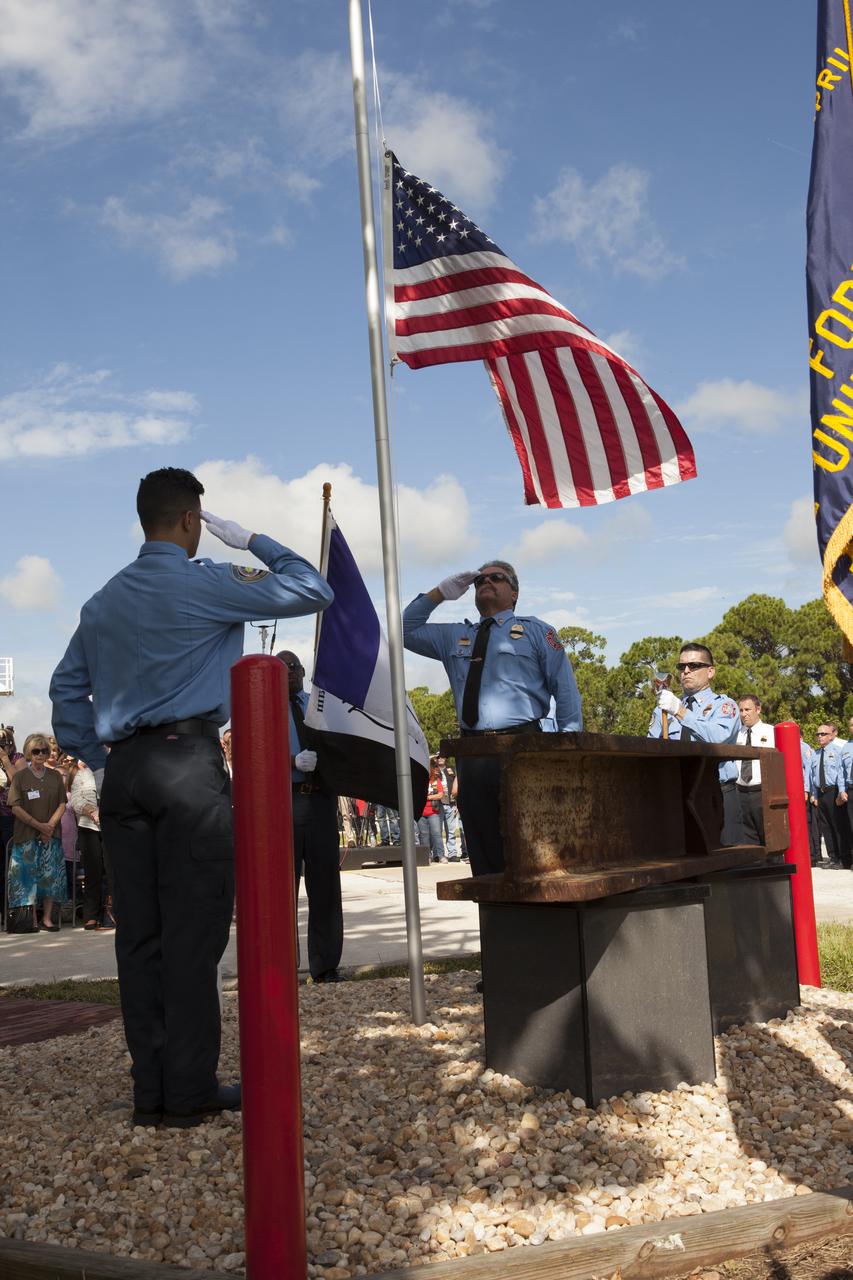
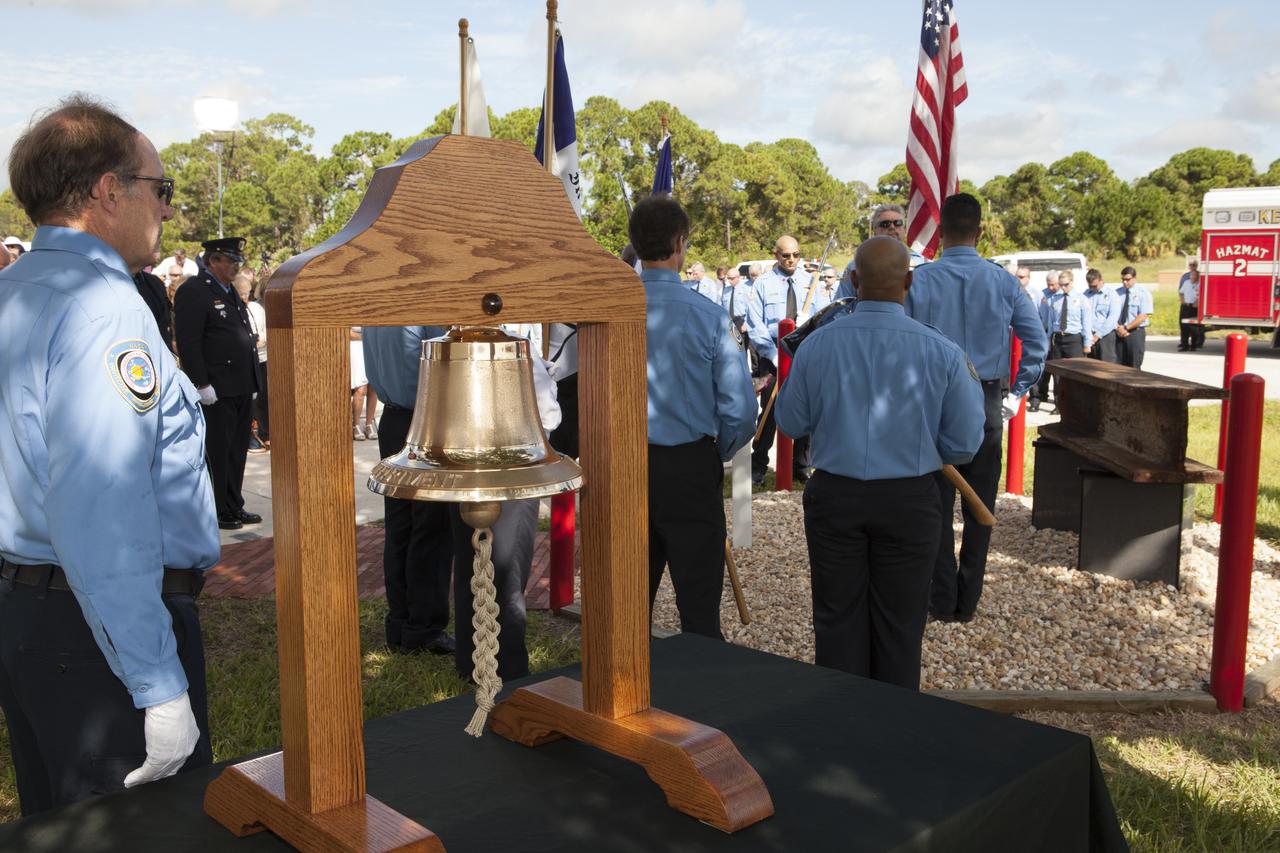
Firefighters place the American flag at half-staff during dedication services for a memorial to the 343 first responder victims of the Sept. 11, 2001, terror attacks at Fire Station 1 at NASA's Kennedy Space Center on Sept. 11, 2015. A section of steel I-beam from the World Trade Center in New York forms the centerpiece of the monument.
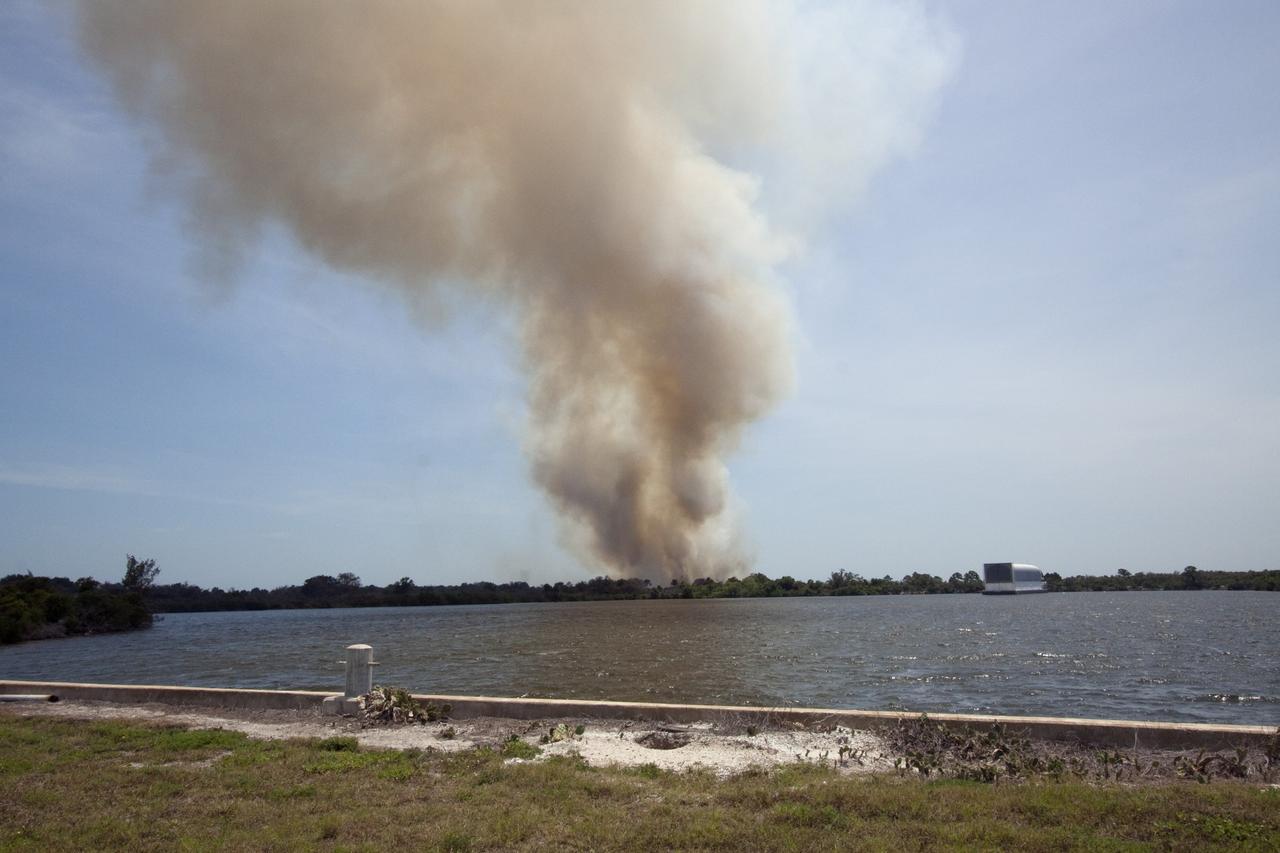
CAPE CANAVERAL, Fla. -- At NASA's Kennedy Space Center in Florida, smoke rises from a smoldering brush fire southeast of the Turn Basin. The fire was spotted near Kennedy’s Press Site approximately three miles away from Launch Pad 39A. The fires are being contained by firefighters from Kennedy Space Center and the U.S. Fish and Wildlife Service. No personnel are in danger and currently there is no to impact any operations related to space shuttle Endeavour’s launch countdown. Photo credit: NASA/Jack Pfaller
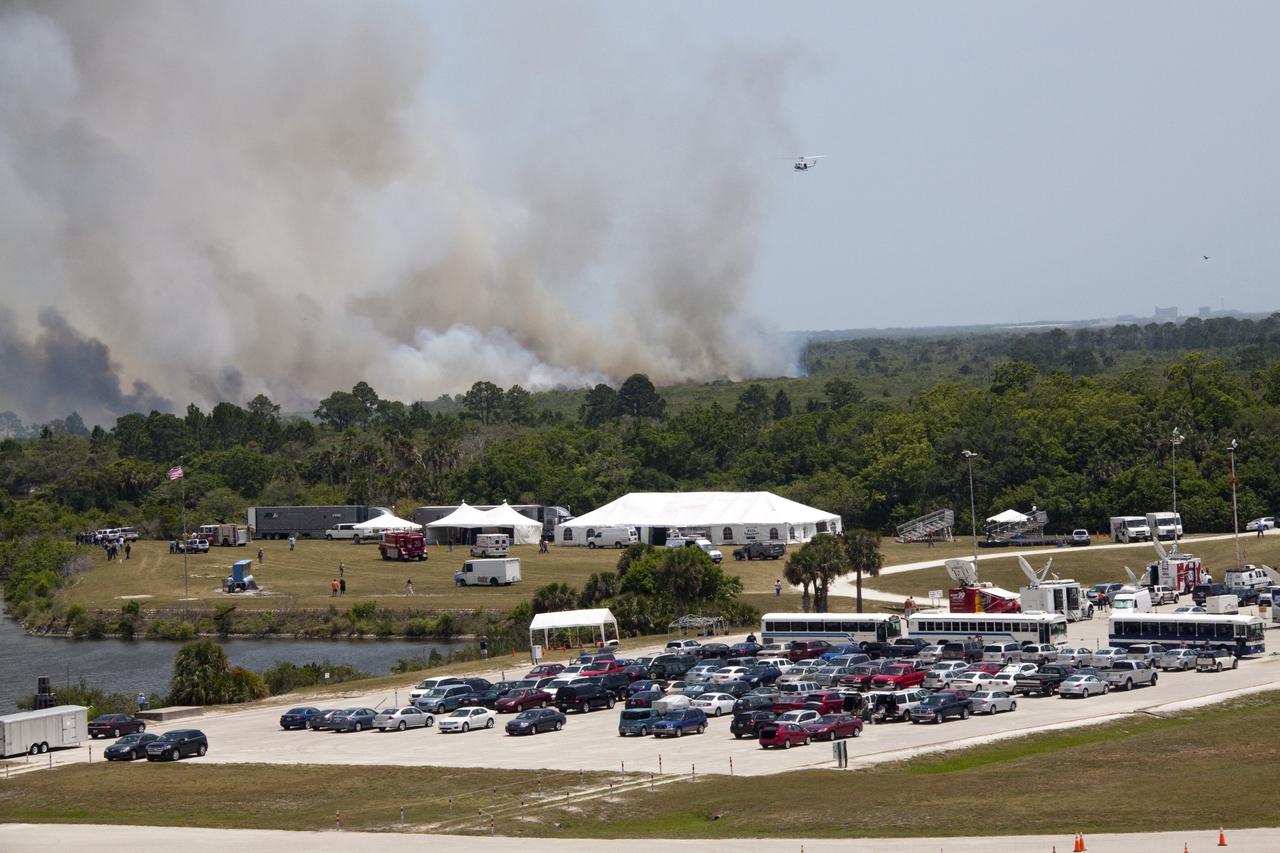
CAPE CANAVERAL, Fla. -- At NASA's Kennedy Space Center in Florida, smoke rises from a smoldering brush fire southeast of the Turn Basin. The fire was spotted near Kennedy’s Press Site approximately three miles away from Launch Pad 39A. The fires are being contained by firefighters from Kennedy Space Center and the U.S. Fish and Wildlife Service. No personnel are in danger and currently there is no to impact any operations related to space shuttle Endeavour’s launch countdown. Photo credit: NASA/Jack Pfaller
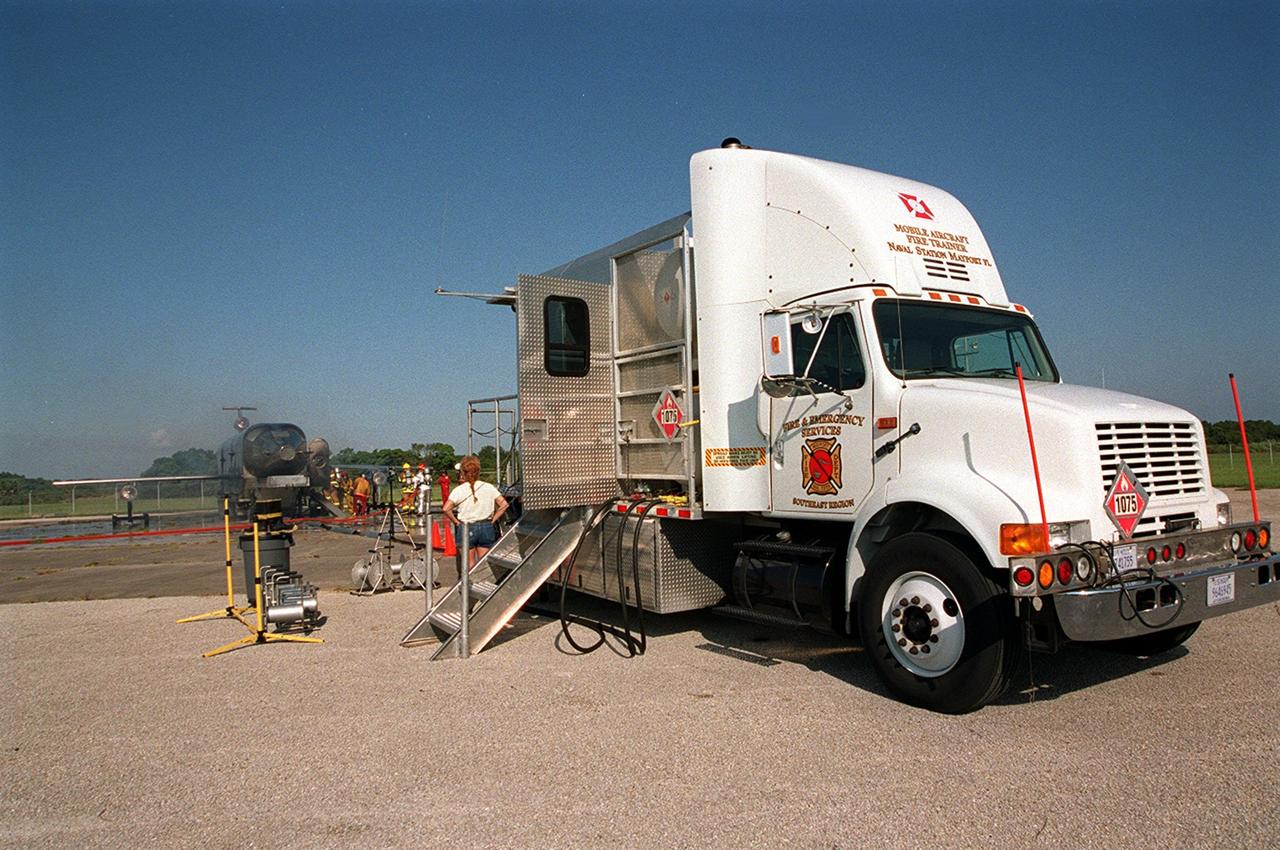
KENNEDY SPACE CENTER, FLA. -- A Mobile Aircraft Fire Trainer vehicle from Naval Station Mayport, Fla., stands by during fire training exercises at Cape Canaveral Air Force Station Pad 30. In the background is the simulated aircraft that was set on fire for the exercise. Firefighters with the Fire and Emergency Services at the Naval Station (in the background) gather around the site of the extinguished flames.
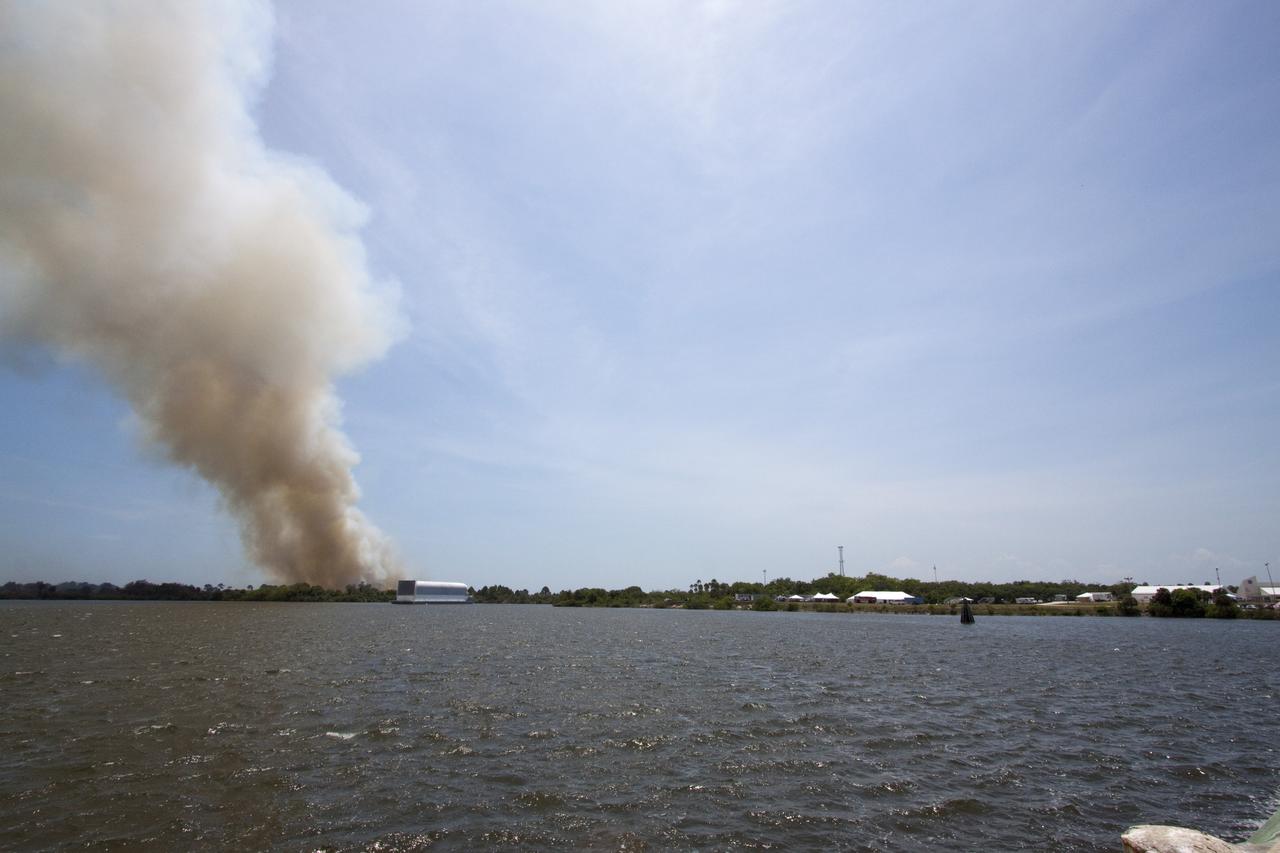
CAPE CANAVERAL, Fla. -- At NASA's Kennedy Space Center in Florida, smoke rises from a smoldering brush fire southeast of the Turn Basin. The fire was spotted near Kennedy’s Press Site approximately three miles away from Launch Pad 39A. The fires are being contained by firefighters from Kennedy Space Center and the U.S. Fish and Wildlife Service. No personnel are in danger and currently there is no to impact any operations related to space shuttle Endeavour’s launch countdown. Photo credit: NASA/Jack Pfaller
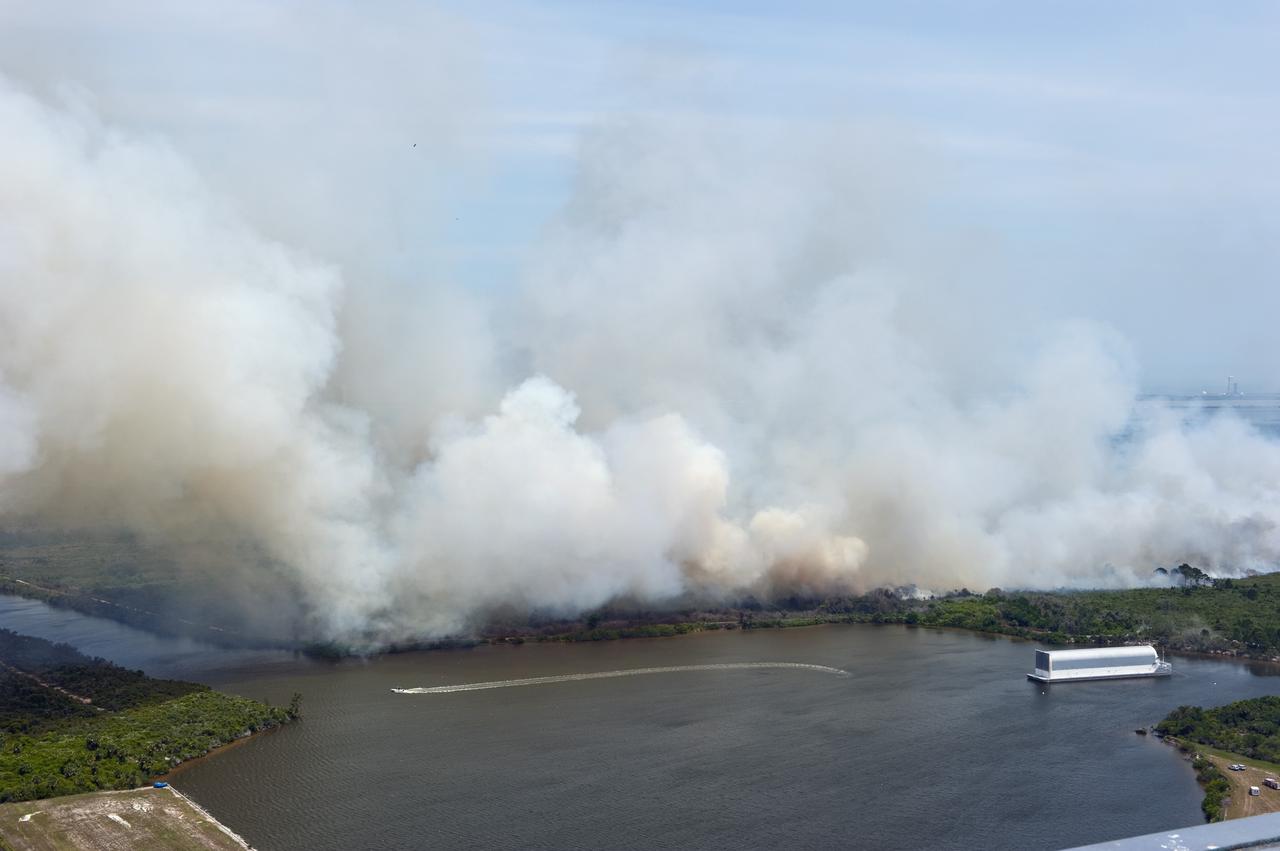
CAPE CANAVERAL, Fla. -- At NASA's Kennedy Space Center in Florida, smoke rises from a smoldering brush fire southeast of the Turn Basin. The fire was spotted near Kennedy’s Press Site approximately three miles away from Launch Pad 39A. The fires are being contained by firefighters from Kennedy Space Center and the U.S. Fish and Wildlife Service. No personnel are in danger and currently there is no to impact any operations related to space shuttle Endeavour’s launch countdown. Photo credit: NASA/Kim Shiflett
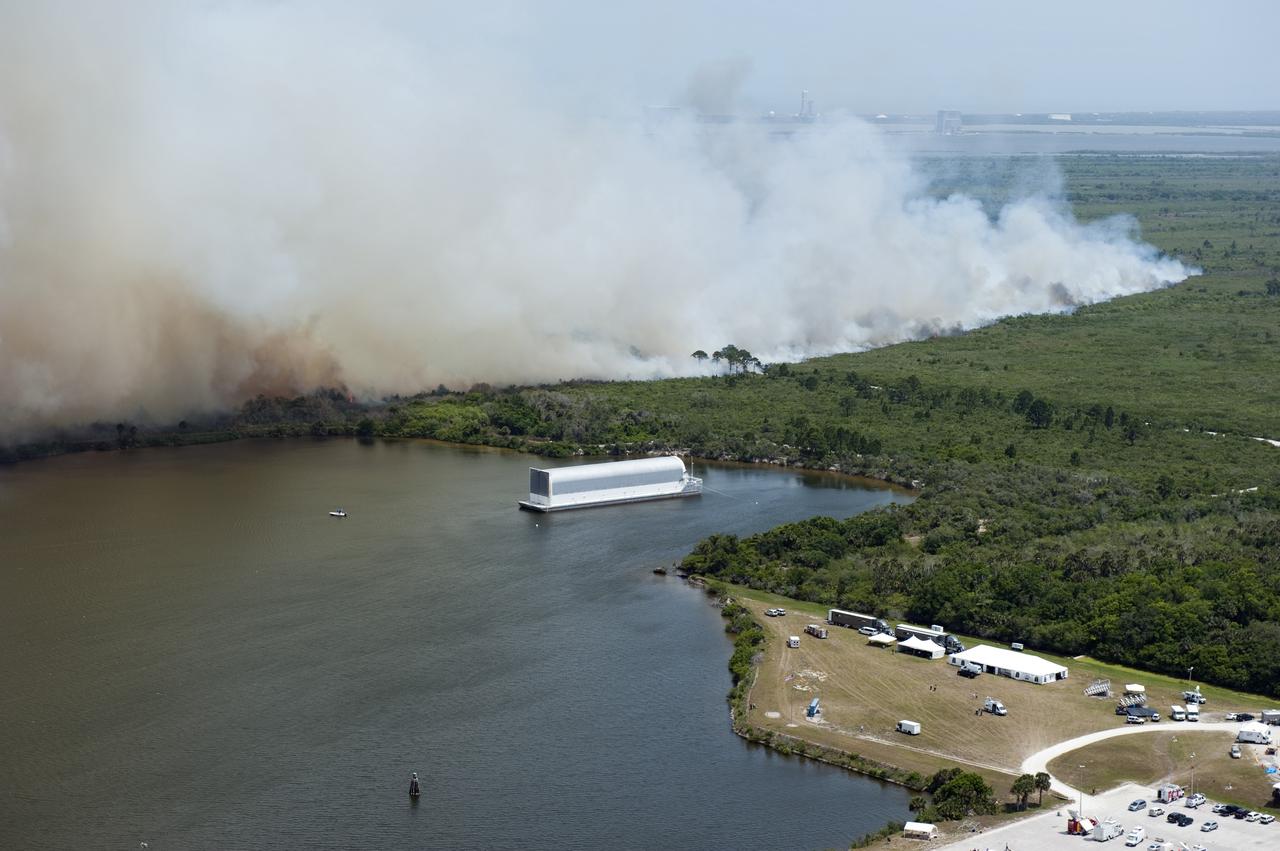
CAPE CANAVERAL, Fla. -- At NASA's Kennedy Space Center in Florida, smoke rises from a smoldering brush fire southeast of the Turn Basin. The fire was spotted near Kennedy’s Press Site approximately three miles away from Launch Pad 39A. The fires are being contained by firefighters from Kennedy Space Center and the U.S. Fish and Wildlife Service. No personnel are in danger and currently there is no to impact any operations related to space shuttle Endeavour’s launch countdown. Photo credit: NASA/Kim Shiflett
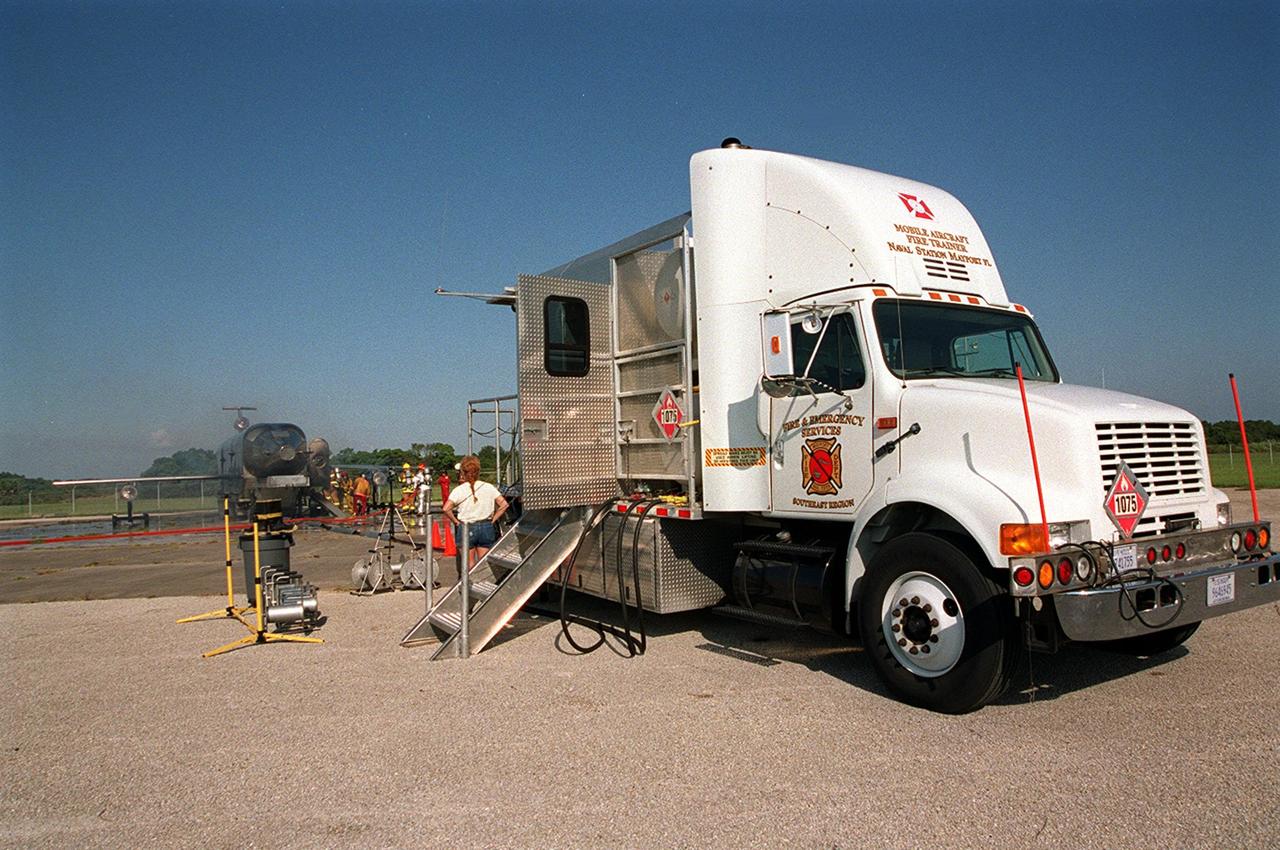
KENNEDY SPACE CENTER, FLA. -- A Mobile Aircraft Fire Trainer vehicle from Naval Station Mayport, Fla., stands by during fire training exercises at Cape Canaveral Air Force Station Pad 30. In the background is the simulated aircraft that was set on fire for the exercise. Firefighters with the Fire and Emergency Services at the Naval Station (in the background) gather around the site of the extinguished flames.
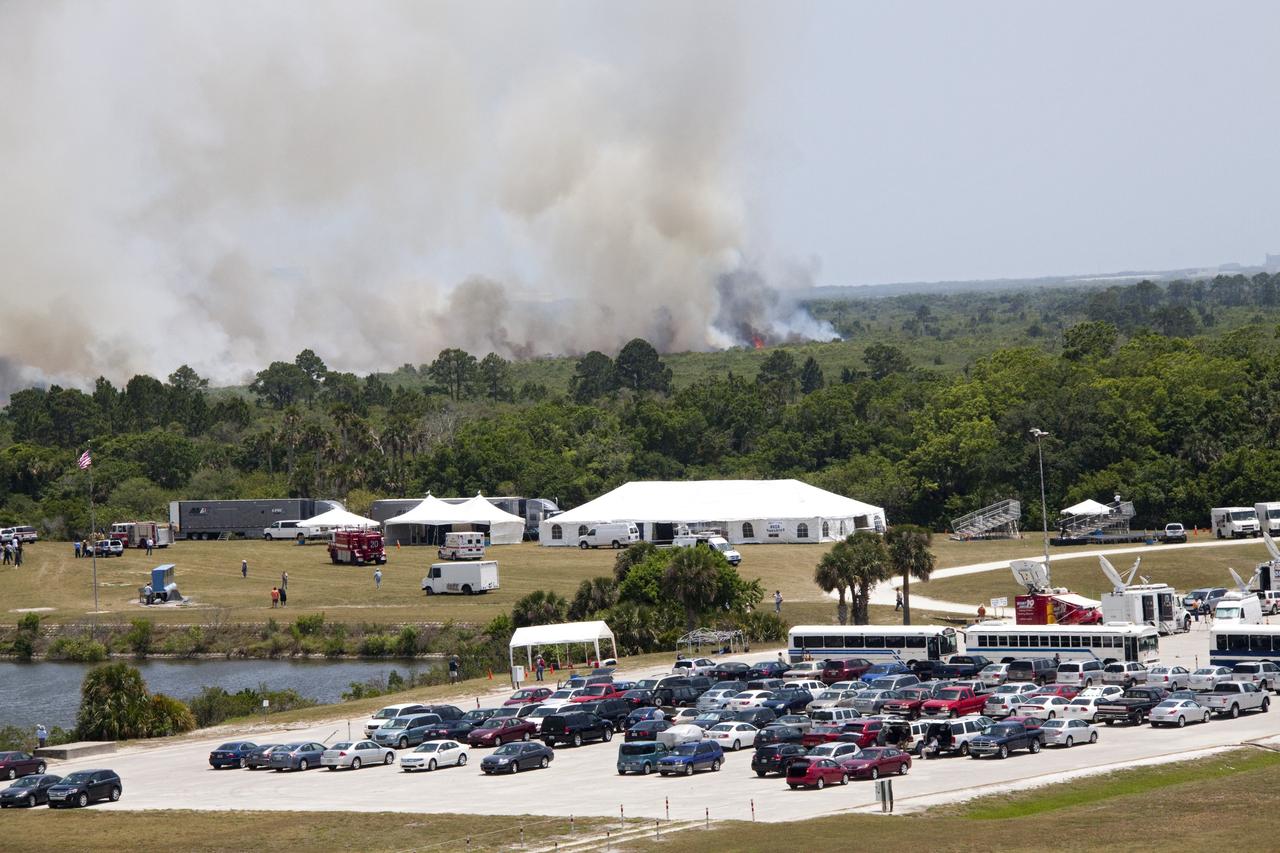
CAPE CANAVERAL, Fla. -- At NASA's Kennedy Space Center in Florida, smoke rises from a smoldering brush fire southeast of the Turn Basin. The fire was spotted near Kennedy’s Press Site approximately three miles away from Launch Pad 39A. The fires are being contained by firefighters from Kennedy Space Center and the U.S. Fish and Wildlife Service. No personnel are in danger and currently there is no to impact any operations related to space shuttle Endeavour’s launch countdown. Photo credit: NASA/Jack Pfaller
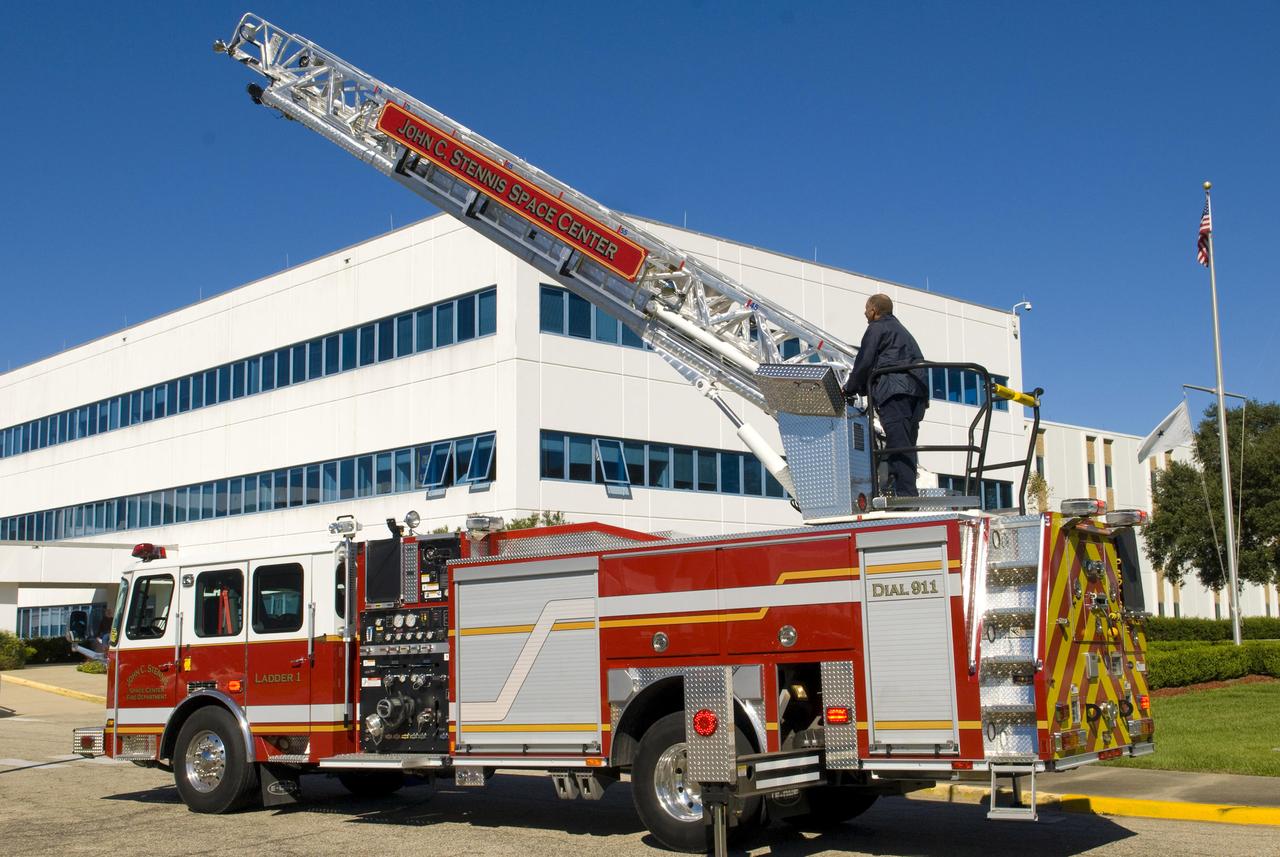
The Stennis Space Center Fire Department added to its fire-fighting capabilities with acquisition of a new emergency response vehicle, Ladder-1, for use on-site. The E-One HP78 Aerial Truck is a combination aerial ladder and fire suppression unit and is designed with the latest safety technology. Featuring a 78-foot ladder and a pumping capability of 1,500 gallons per minute, the new truck provides firefighters with a tremendous rescue and fire suppression tool, Stennis Fire Chief Clark Smith said.
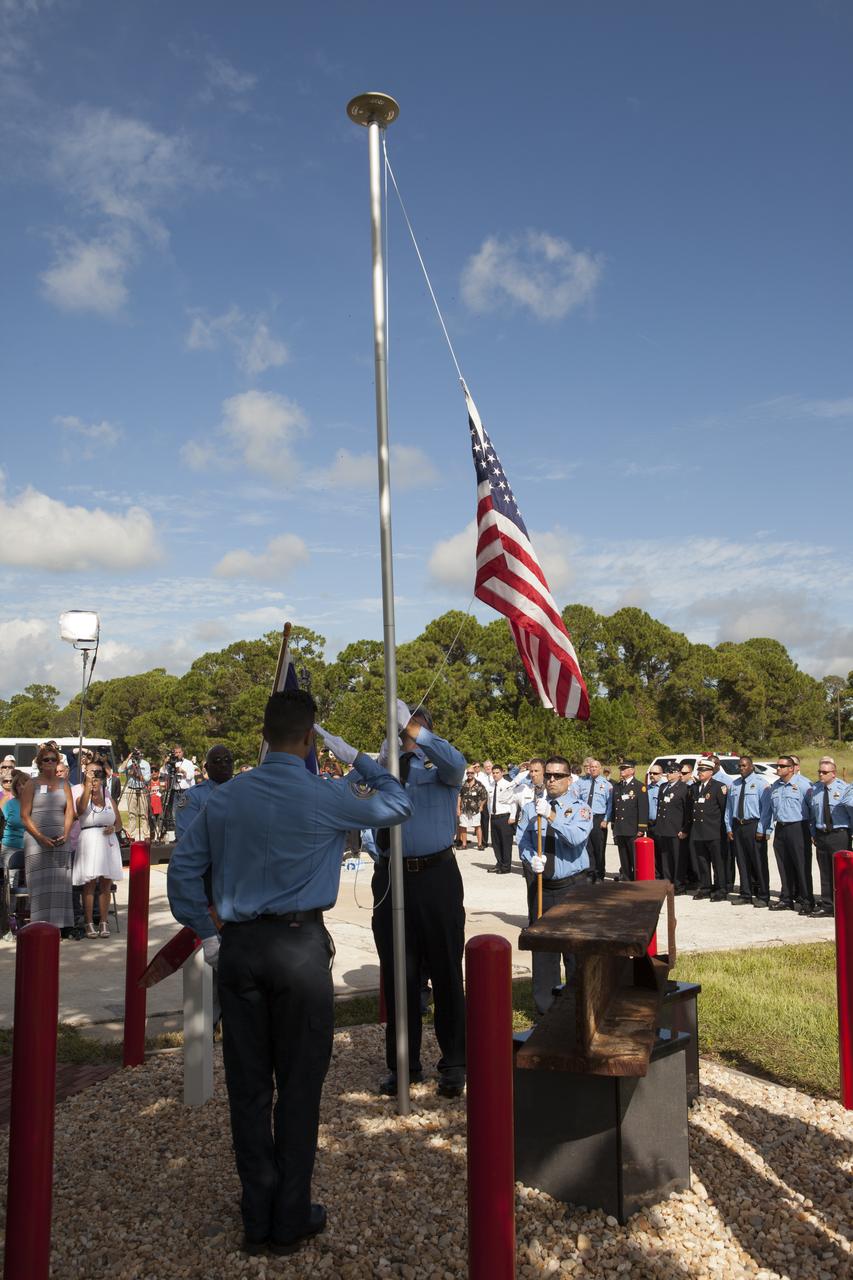
Firefighters place the American flag at half-staff during dedication services for a memorial to the 343 first responder victims of the Sept. 11, 2001, terror attacks at Fire Station 1 at NASA's Kennedy Space Center on Sept. 11, 2015. A section of steel I-beam from the World Trade Center in New York forms the centerpiece of the monument.
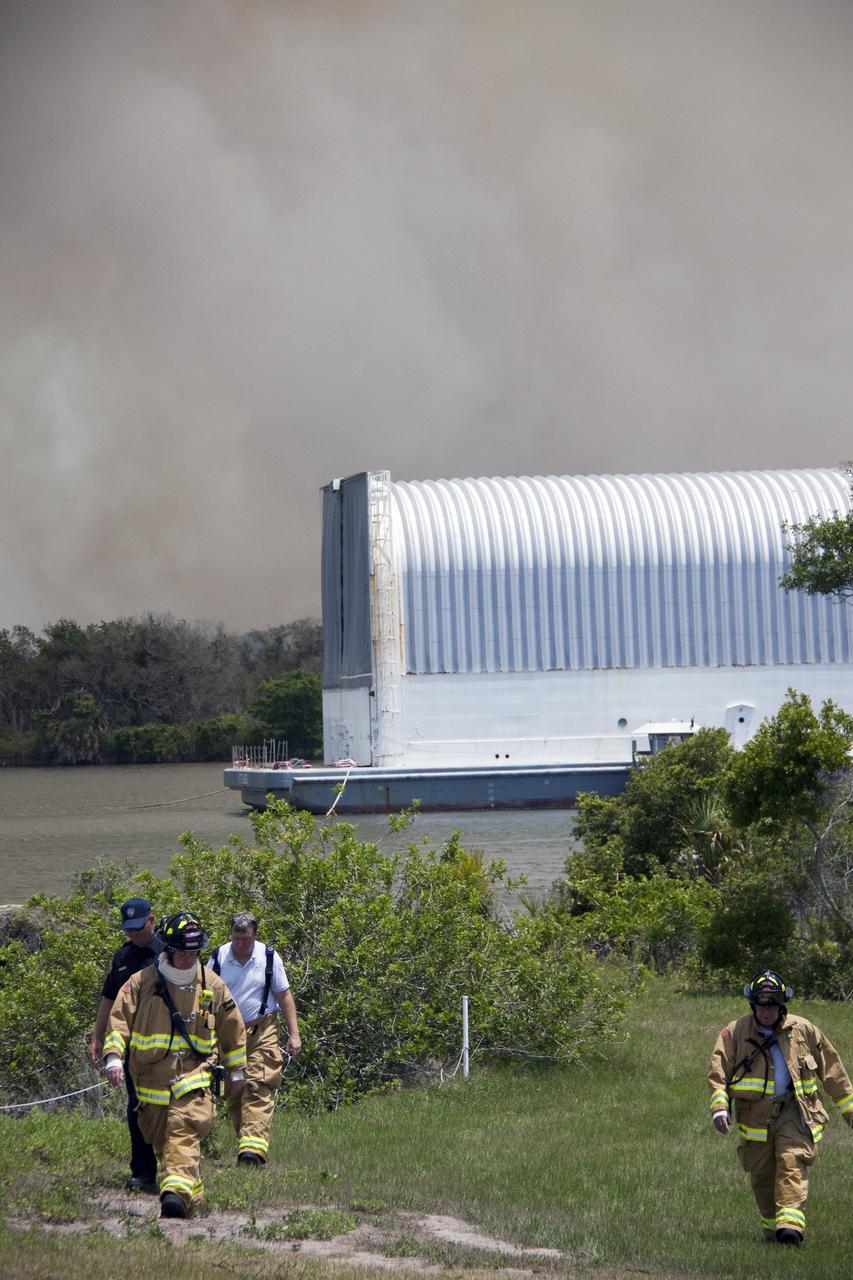
CAPE CANAVERAL, Fla. -- At NASA's Kennedy Space Center in Florida, smoke rises from a smoldering brush fire southeast of the Turn Basin. The fire was spotted near Kennedy’s Press Site approximately three miles away from Launch Pad 39A. The fires are being contained by firefighters from Kennedy Space Center and the U.S. Fish and Wildlife Service. No personnel are in danger and currently there is no to impact any operations related to space shuttle Endeavour’s launch countdown. Photo credit: NASA/Troy Cryder
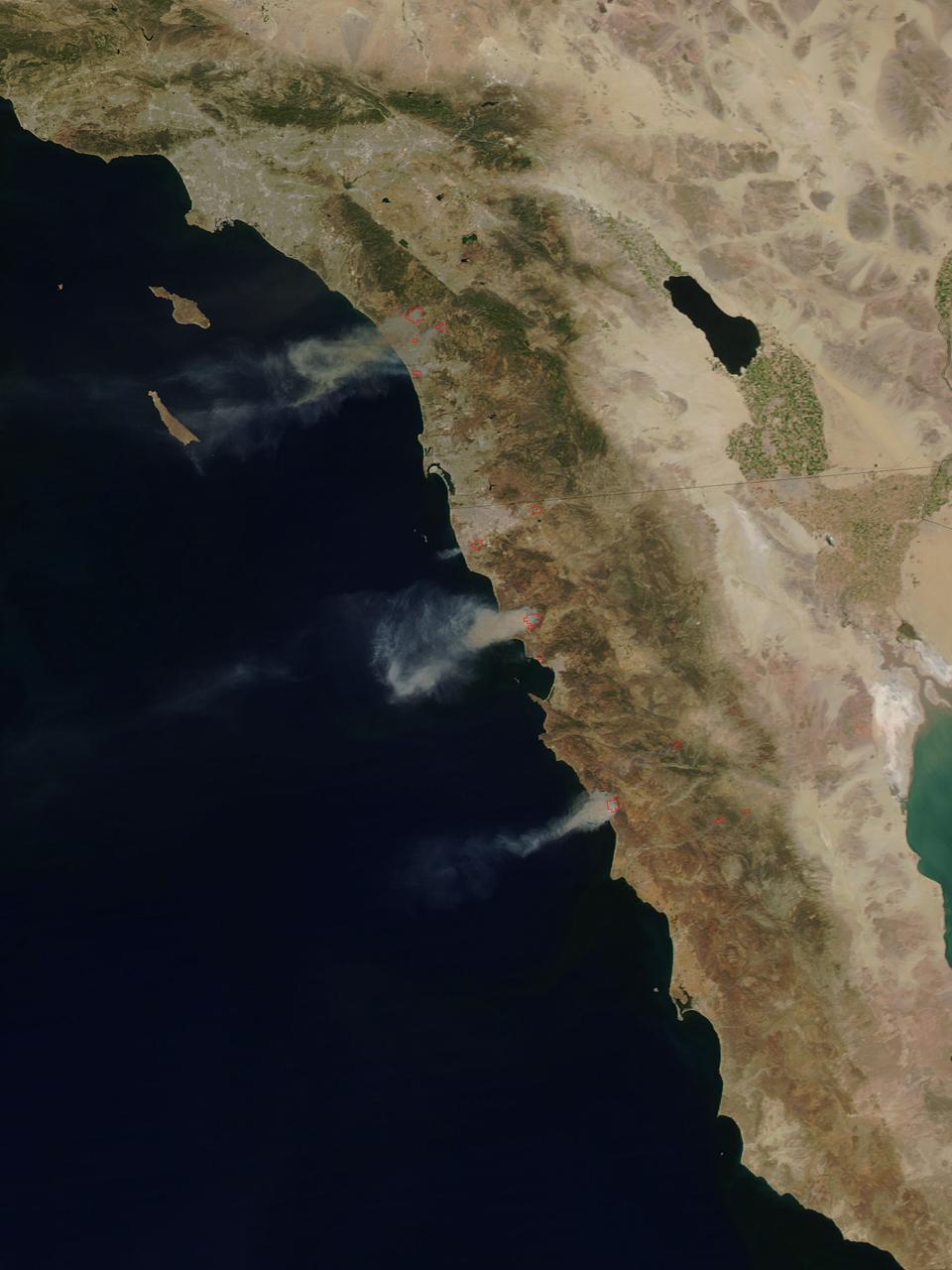
The single fire that ignited and split into nine separate fires still blazes in Southern California today. Firefighters are hoping for a break today (Thursday, May 15, 2014) but it doesn't look like luck may be on their side. Conditions continue to be bone dry with unseasonal heat (98-106 degrees) and the Santa Ana winds are kicking up and allowing these fires to easy jump fire lines. This particular fire started on Wednesday as a single fire and within a day is now nine separate fires which have burned close to 10,000 acres. These fires are threatening more than just landscape in San Diego county, they are also threatening homes, universities, a military base and a nuclear power plant. Day Two of the fires have seen them already destroying dozens of homes and forcing tens of thousands to evacuate. Camp Pendleton has also been partially evacuated due to the blazes as has the popular amusement park, Legoland. The Governor of California has declared a state of emergency. Thousands of firefighters are battling the flames both on the ground and in the air. Seven tankers and 20 military aircraft are also assisting the firefighters with their mission. Temperatures soaring over 100 degrees coupled with 30 mph wind gusts have severely hampered the efforts, however, and fire tornadoes have broken out. Fire tornadoes are caused by crosswinds that create a vortex and produce winds that twist and swirl just like a tornado but with flames that coil upwards in the center of the twister creating a terrifying specter. Although there is no chance of rain in the area for the next several days, the temperatures will start to subside on Friday and into the weekend. Winds are also expected to start to subside, giving firefighters that break that they so desperately need. This natural-color satellite image was collected by the Moderate Resolution Imaging Spectroradiometer (MODIS) aboard the Aqua satellite on May 14, 2014. Actively burning areas, detected by MODIS’s thermal bands, are outlined in red. Credit: NASA/GSFC/Jeff Schmaltz/MODIS Land Rapid Response Team <b><a href="http://www.nasa.gov/audience/formedia/features/MP_Photo_Guidelines.html" rel="nofollow">NASA image use policy.</a></b> <b><a href="http://www.nasa.gov/centers/goddard/home/index.html" rel="nofollow">NASA Goddard Space Flight Center</a></b> enables NASA’s mission through four scientific endeavors: Earth Science, Heliophysics, Solar System Exploration, and Astrophysics. Goddard plays a leading role in NASA’s accomplishments by contributing compelling scientific knowledge to advance the Agency’s mission. <b>Follow us on <a href="http://twitter.com/NASAGoddardPix" rel="nofollow">Twitter</a></b> <b>Like us on <a href="http://www.facebook.com/pages/Greenbelt-MD/NASA-Goddard/395013845897?ref=tsd" rel="nofollow">Facebook</a></b> <b>Find us on <a href="http://instagram.com/nasagoddard?vm=grid" rel="nofollow">Instagram</a></b>
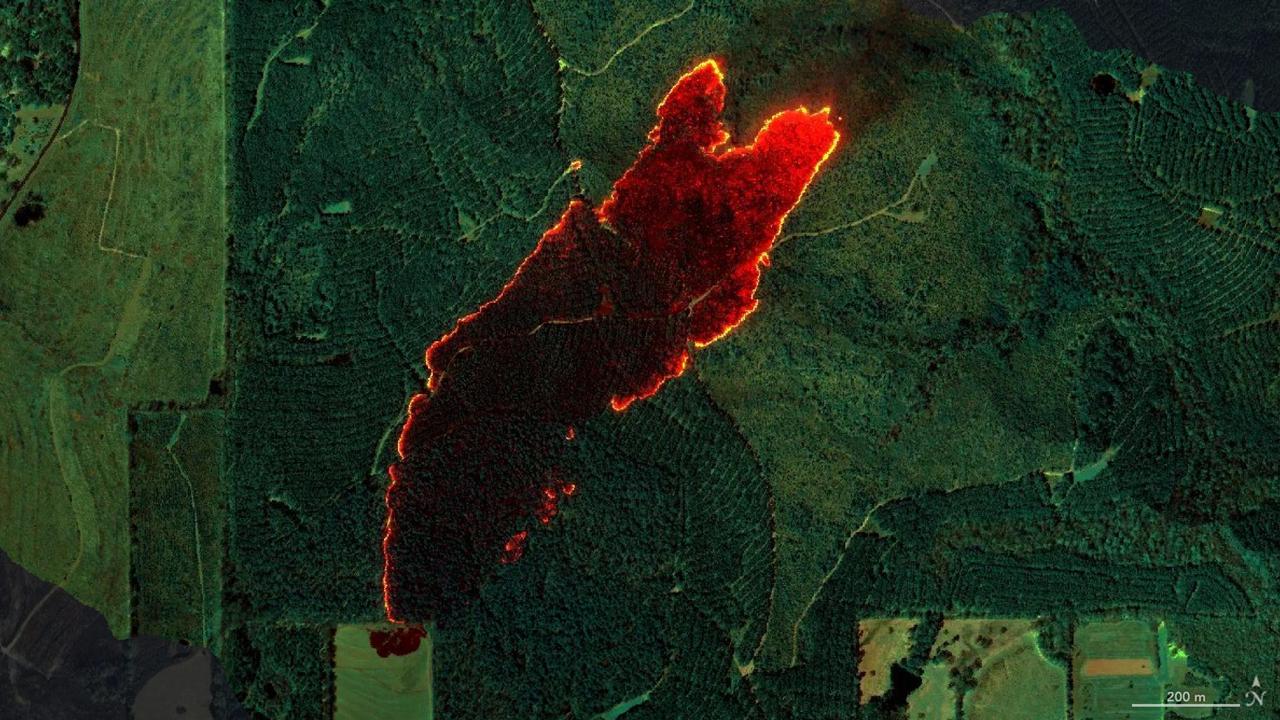
NASA's AVIRIS-3 sensor, an airborne imaging spectrometer built and operated by the agency's Jet Propulsion Laboratory in Southern California, captured infrared data of a roughly 120-acre wildfire about 3 miles (5 kilometers) east of the town of Castleberry, Alabama, on March 19, 2025. Within minutes of flying over the Castleberry Fire, which had not previously been reported to authorities, real-time maps of where burning was most intense were sent via satellite internet to firefighters with the Alabama Forestry Commission, who used it to decide how to deploy their personnel and firefighting equipment. The image combines reflection data from AVIRIS-3 (Airborne Visible Infrared Imaging Spectrometer 3) at three infrared wavelengths that are invisible to the human eye: 2,350 nanometers, 1,200 nanometers, and 1,000 nanometers. In the resulting composite image, the colors indicate where the fire was burning most intensely. Orange and red areas show cooler-burning areas, while yellow indicates the most intense flames. Burned areas show up as dark red or brown. The AVIRIS-3 sensor belongs to a line of imaging spectrometers built at JPL since 1986. The instruments have been used to study a wide range of phenomena – including fire – by measuring sunlight reflecting from the planet's surface. Data from imaging spectrometers like AVIRIS-3 typically takes days or weeks to be processed into highly detailed, multilayer image products used for research. By simplifying the calibration algorithms, researchers were able to process data on a computer aboard the plane in a sliver of the time it otherwise would have taken, and airborne satellite internet connectivity enabled the images to be distributed almost immediately, while the plane was still in flight, rather than after it landed. Flying about 9,000 feet (3,000 meters) in altitude aboard a NASA King Air B200 research plane, AVIRIS-3 collected data on the Castleberry Fire while preparing for prescribed burn experiments that took place in the Geneva State Forest in Alabama on March 28 and at Fort Stewart-Hunter Army Airfield in Georgia from April 14 to 20. The burns were part of a NASA 2025 FireSense Airborne Campaign. https://photojournal.jpl.nasa.gov/catalog/PIA26497