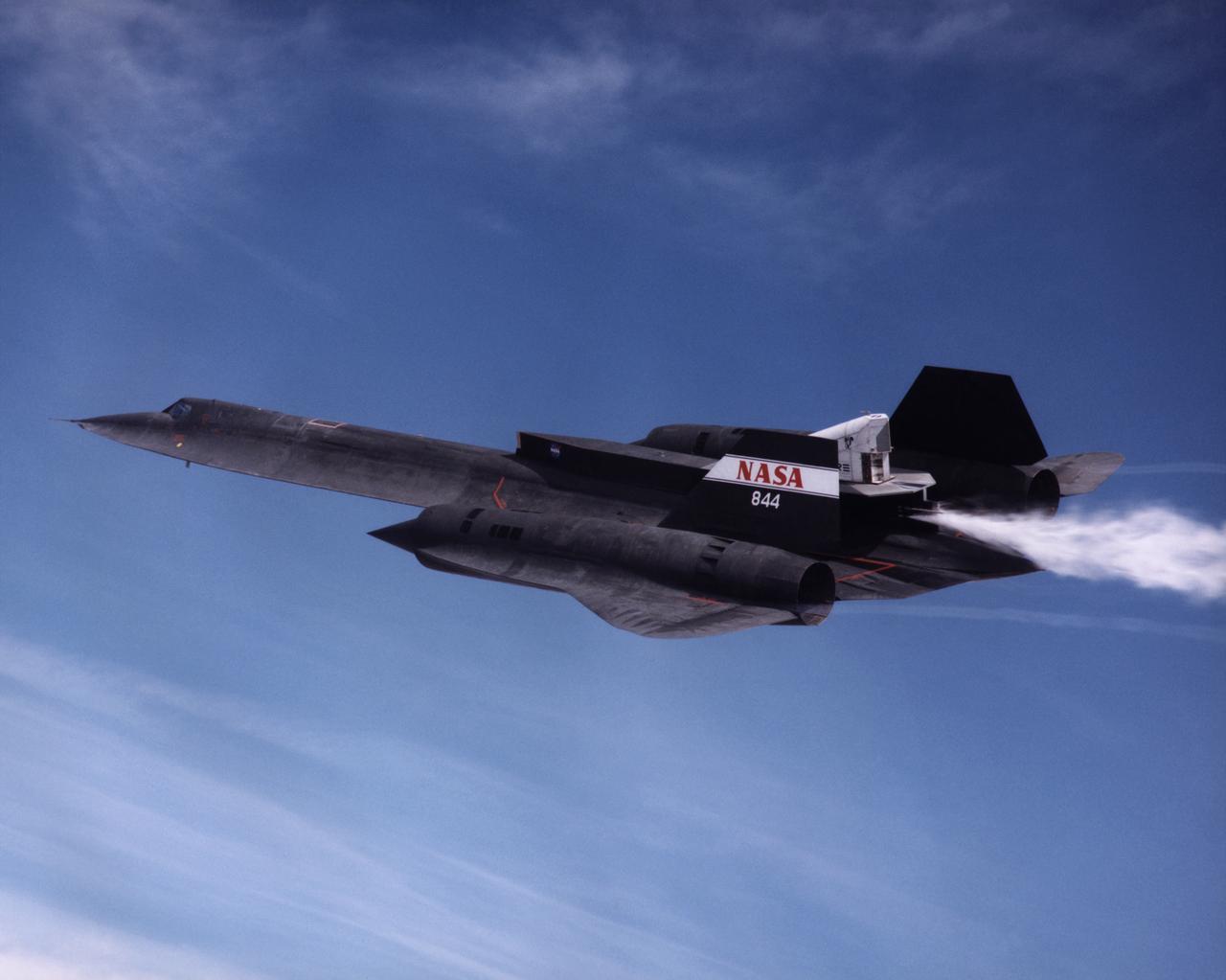
The NASA SR-71A successfully completed its first cold flow flight as part of the NASA/Rocketdyne/Lockheed Martin Linear Aerospike SR-71 Experiment (LASRE) at NASA's Dryden Flight Research Center, Edwards, California on March 4, 1998. During a cold flow flight, gaseous helium and liquid nitrogen are cycled through the linear aerospike engine to check the engine's plumbing system for leaks and to check the engine operating characterisitics. Cold-flow tests must be accomplished successfully before firing the rocket engine experiment in flight. The SR-71 took off at 10:16 a.m. PST. The aircraft flew for one hour and fifty-seven minutes, reaching a maximum speed of Mach 1.58 before landing at Edwards at 12:13 p.m. PST. "I think all in all we had a good mission today," Dryden LASRE Project Manager Dave Lux said. Flight crew member Bob Meyer agreed, saying the crew "thought it was a really good flight." Dryden Research Pilot Ed Schneider piloted the SR-71 during the mission. Lockheed Martin LASRE Project Manager Carl Meade added, "We are extremely pleased with today's results. This will help pave the way for the first in-flight engine data-collection flight of the LASRE."
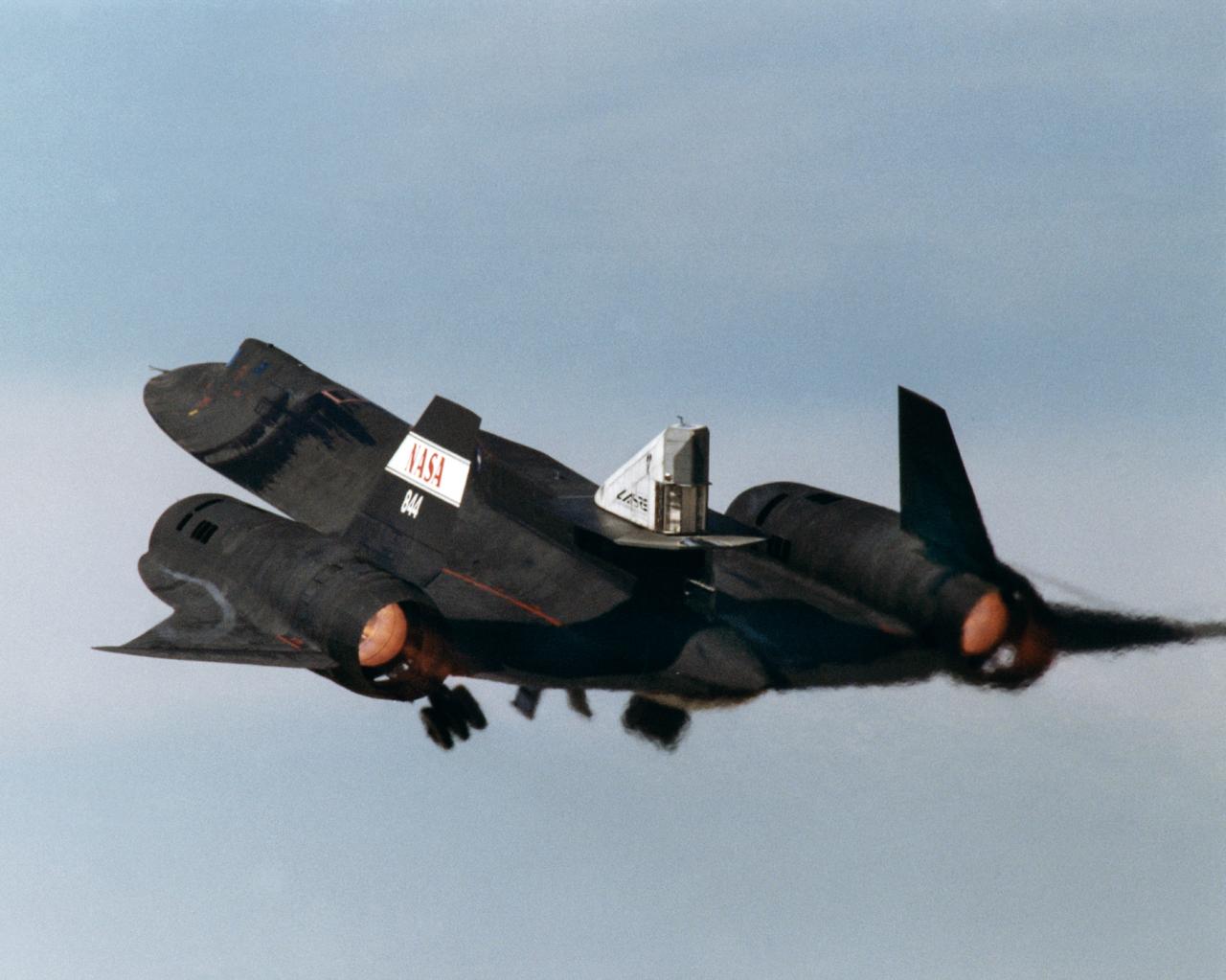
This photograph shows the LASRE pod on the upper rear fuselage of an SR-71 aircraft during take-off of the first flight to experience an in-flight cold flow test. The flight occurred on 4 March 1998.
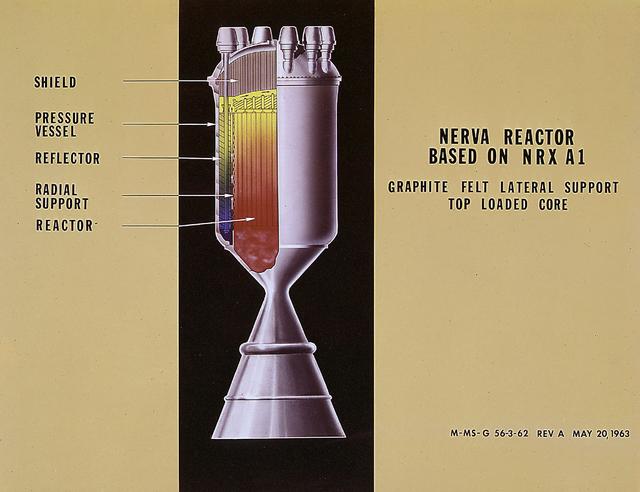
This artist's concept from 1963 shows a proposed NERVA (Nuclear Engine for Rocket Vehicle Application) incorporating the NRX-A1, the first NERVA-type cold flow reactor. The NERVA engine, based on Kiwi nuclear reactor technology, was intended to power a RIFT (Reactor-In-Flight-Test) nuclear stage, for which Marshall Space Flight Center had development responsibility.
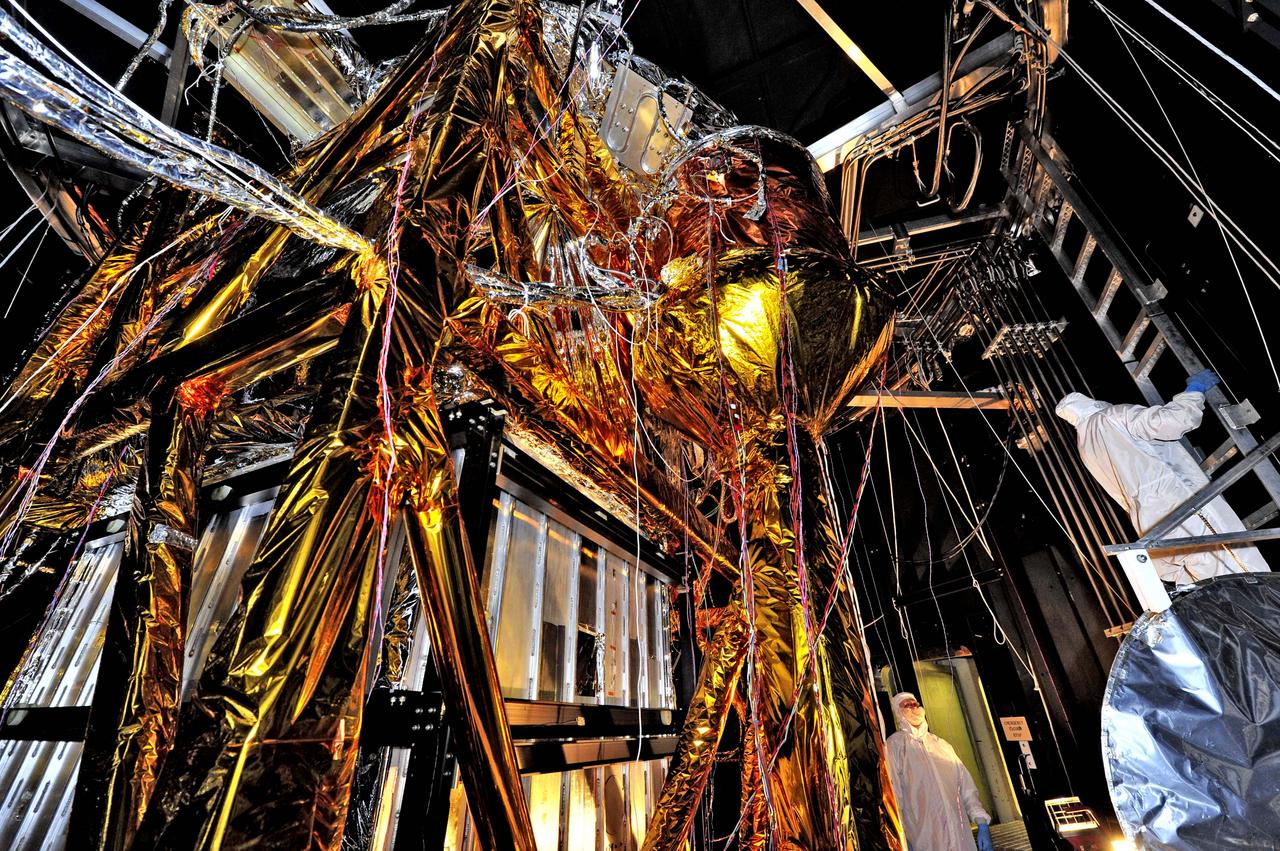
NASA image release August 23, 2012 What looks like a giant golden spider weaving a web of cables and cords, is actually ground support equipment, including the Optical Telescope Simulator (OSIM), for the James Webb Space Telescope. OSIM's job is to generate a beam of light just like the one that the real telescope optics will feed into the actual flight instruments. Because the real flight instruments will be used to test the real flight telescope, their alignment and performance first have to be verified by using the OSIM. Engineers are thoroughly checking out OSIM now in preparation for using it to test the flight science instruments later. This photo was taken from inside a large thermal-vacuum chamber called the Space Environment Simulator (SES), at NASA's Goddard Space Flight Center in Greenbelt, Md. Engineers have blanketed the structure of the OSIM with special insulating material to help control its temperature while it goes into the deep freeze testing that mimics the chill of space that Webb will ultimately experience in its operational orbit over 1 million miles from Earth. The golden-colored thermal blankets are made of aluminized kapton, a polymer film that remains stable over a wide range of temperatures. The structure that looks like a silver and black cube underneath the "spider" is a set of cold panels that surround OSIM's optics. During testing, OSIM's temperature will drop to 100 Kelvin (-280 F or -173 C) as liquid nitrogen flows through tubes welded to the chamber walls and through tubes along the silver panels surrounding OSIM's optics. These cold panels will keep the OSIM optics very cold, but the parts covered by the aluminized kapton blankets will stay warm. "Some blankets have silver facing out and gold facing in, or inverted, or silver on both sides, etc.," says Erin Wilson, a Goddard engineer. "Depending on which side of the blanket your hardware is looking at, the blankets can help it get colder or stay warmer, in an environmental test." Another reason for thermal blankets is to shield the cold OSIM optics from unwanted stray infrared light. When the OSIM is pointing its calibrated light beam at Webb's science instruments, engineers don't want any stray infrared light, such as "warm photons" from warm structures, leaking into the instruments' field of view. Too much of this stray light would raise the background too much for the instruments to "see" light from the OSIM—it would be like trying to photograph a lightning bug flying in front of car headlights. To get OSIM's optics cold, the inside of the chamber has to get cold, and to do that, all the air has to be pumped out to create a vacuum. Then liquid nitrogen has to be run though the plumbing along the inner walls of the chamber. Wilson notes that's why the blankets have to have vents in them: "That way, the air between all the layers can be evacuated as the chamber pressure drops, otherwise the blankets could pop," says Wilson. The most powerful space telescope ever built, Webb is the successor to NASA's Hubble Space Telescope. Webb's four instruments will reveal how the universe evolved from the Big Bang to the formation of our solar system. Webb is a joint project of NASA, the European Space Agency and the Canadian Space Agency. Credit: NASA/GSFC/Chris Gunn <b><a href="http://www.nasa.gov/audience/formedia/features/MP_Photo_Guidelines.html" rel="nofollow">NASA image use policy.</a></b> <b><a href="http://www.nasa.gov/centers/goddard/home/index.html" rel="nofollow">NASA Goddard Space Flight Center</a></b> enables NASA’s mission through four scientific endeavors: Earth Science, Heliophysics, Solar System Exploration, and Astrophysics. Goddard plays a leading role in NASA’s accomplishments by contributing compelling scientific knowledge to advance the Agency’s mission. <b>Follow us on <a href="http://twitter.com/NASA_GoddardPix" rel="nofollow">Twitter</a></b> <b>Like us on <a href="http://www.facebook.com/pages/Greenbelt-MD/NASA-Goddard/395013845897?ref=tsd" rel="nofollow">Facebook</a></b> <b>Find us on <a href="http://instagrid.me/nasagoddard/?vm=grid" rel="nofollow">Instagram</a></b>
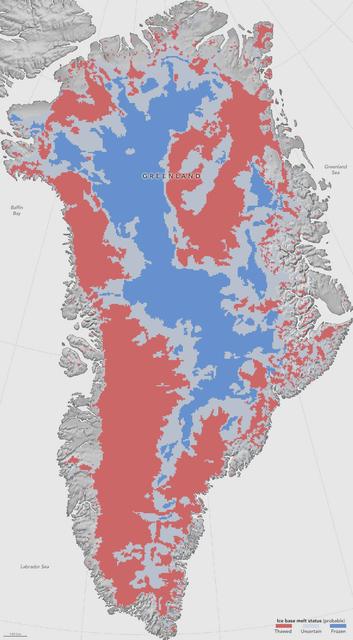
NASA researchers have helped produce the first map showing what parts of the bottom of the massive Greenland Ice Sheet are thawed – key information in better predicting how the ice sheet will react to a warming climate. Greenland’s thick ice sheet insulates the bedrock below from the cold temperatures at the surface, so the bottom of the ice is often tens of degrees warmer than at the top, because the ice bottom is slowly warmed by heat coming from the Earth’s depths. Knowing whether Greenland’s ice lies on wet, slippery ground or is anchored to dry, frozen bedrock is essential for predicting how this ice will flow in the future, But scientists have very few direct observations of the thermal conditions beneath the ice sheet, obtained through fewer than two dozen boreholes that have reached the bottom. Now, a new study synthesizes several methods to infer the Greenland Ice Sheet’s basal thermal state –whether the bottom of the ice is melted or not– leading to the first map that identifies frozen and thawed areas across the whole ice sheet. Map caption: This first-of-a-kind map, showing which parts of the bottom of the Greenland Ice Sheet are likely thawed (red), frozen (blue) or still uncertain (gray), will help scientists better predict how the ice will flow in a warming climate. Credit: NASA Earth Observatory/Jesse Allen Read more: <a href="http://go.nasa.gov/2avKgl2" rel="nofollow">go.nasa.gov/2avKgl2</a> <b><a href="http://www.nasa.gov/audience/formedia/features/MP_Photo_Guidelines.html" rel="nofollow">NASA image use policy.</a></b> <b><a href="http://www.nasa.gov/centers/goddard/home/index.html" rel="nofollow">NASA Goddard Space Flight Center</a></b> enables NASA’s mission through four scientific endeavors: Earth Science, Heliophysics, Solar System Exploration, and Astrophysics. Goddard plays a leading role in NASA’s accomplishments by contributing compelling scientific knowledge to advance the Agency’s mission. <b>Follow us on <a href="http://twitter.com/NASAGoddardPix" rel="nofollow">Twitter</a></b> <b>Like us on <a href="http://www.facebook.com/pages/Greenbelt-MD/NASA-Goddard/395013845897?ref=tsd" rel="nofollow">Facebook</a></b> <b>Find us on <a href="http://instagrid.me/nasagoddard/?vm=grid" rel="nofollow">Instagram</a></b>