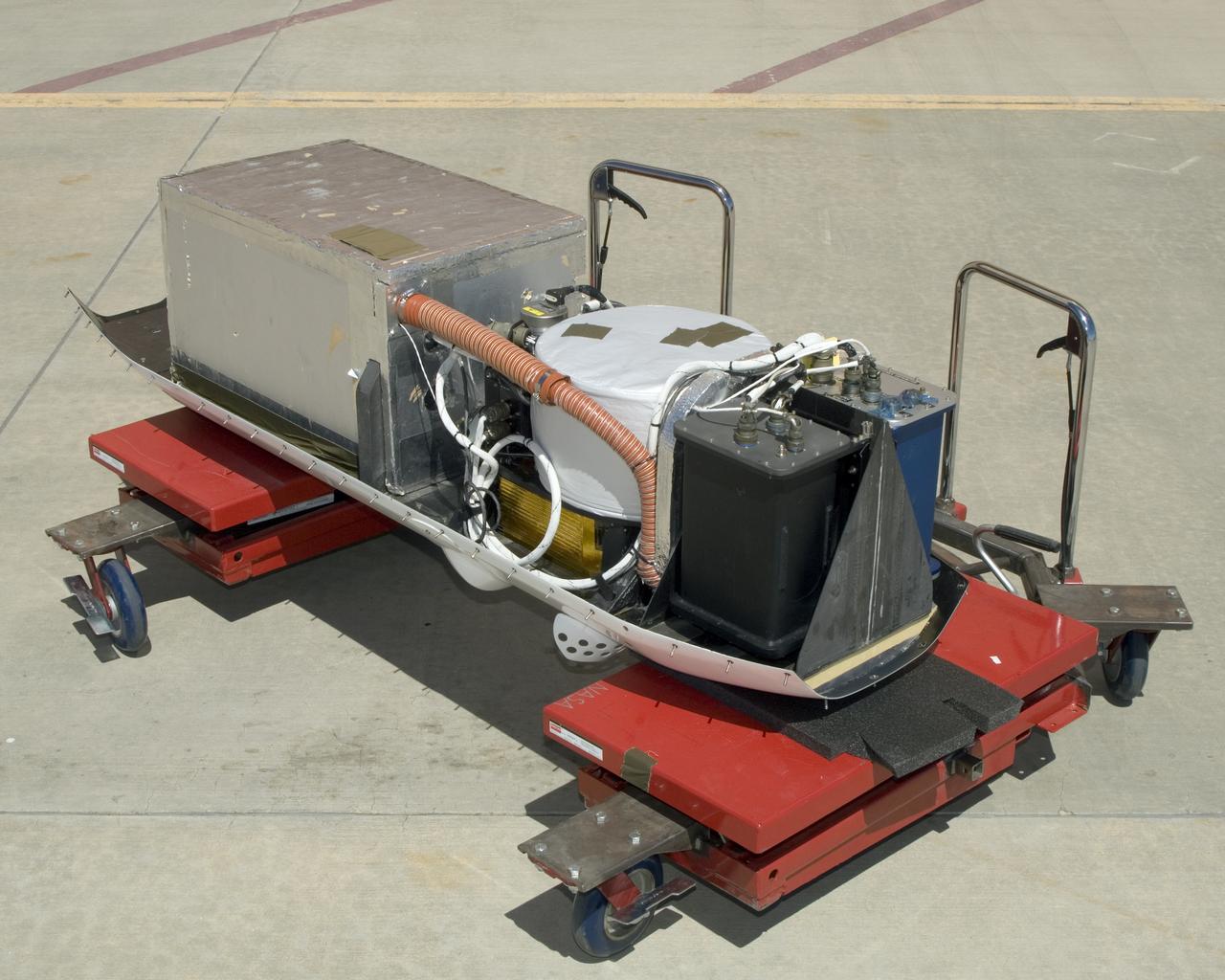
The instruments that make up the Ames Autonomous Module Scanner (AMS) that provided precise thermal-infrared imaging during the Western States Fire Mission in 2007 are detailed in this photo of the AMS as mounted on Ikhana's pod tray. The large foil-covered foam-insulated box at left covers the pressure vessel containing the data system computers and other electronics. The round white-topped assembly is the scan head, including the scan mirror, folded telescope, blackbody references, spectrometer and detectors. Two pressure boxes visible at the forward end of the tray contain the Applanix POS/AV precision navigation subsystem (black) and the power distributor including circuit breakers and ancillary wiring, scan motor controller and the blackbody reference temperature controller (blue).
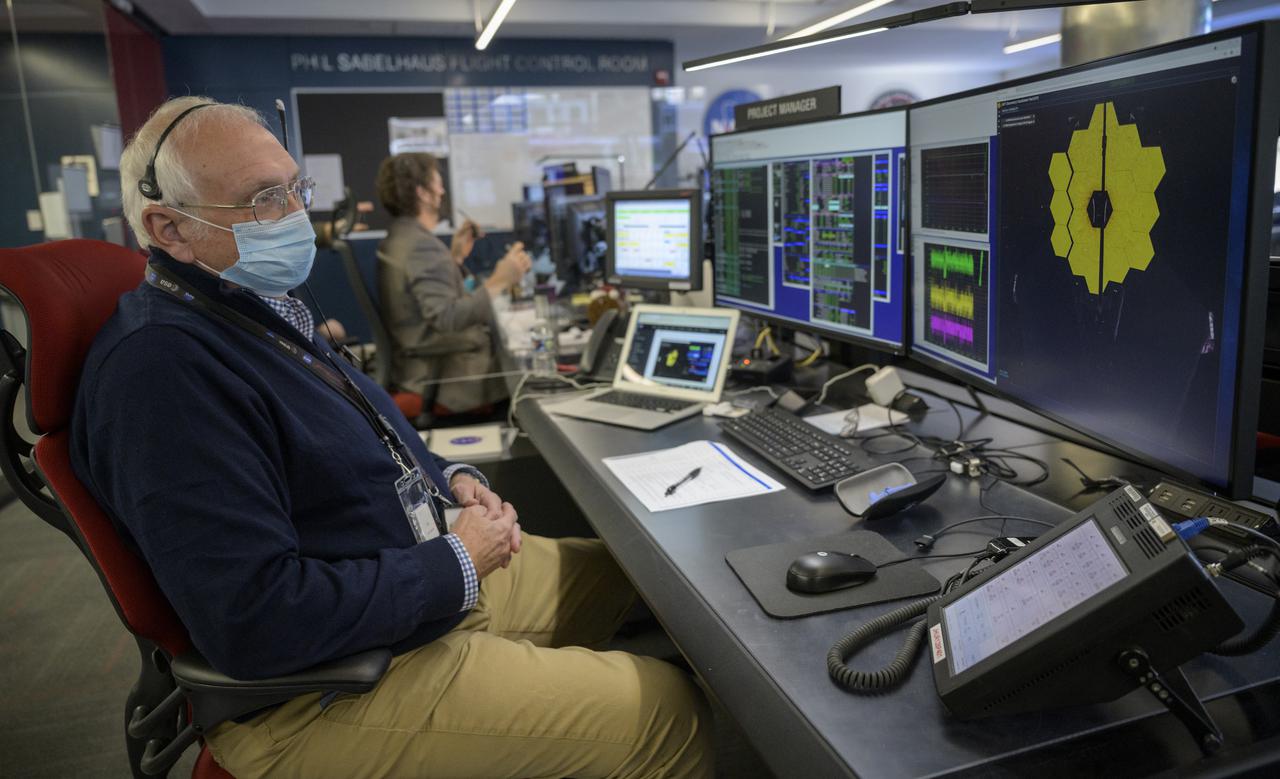
NASA James Webb Space Telescope Project Manager Bill Ochs monitors the progress of the observatory’s second primary mirror wing as it rotates into position, Saturday, Jan. 8, 2022, from NASA’s James Webb Space Telescope Mission Operations Center at the Space Telescope Science Institute in Baltimore. Webb, an infrared telescope with a 21.3-foot (6.5-meter) primary mirror, was folded up for launch and underwent an unprecedented deployment process to unfold in space. As NASA's next flagship observatory, Webb will study every phase of cosmic history—from within our solar system to the most distant observable galaxies in the early universe. Photo Credit: (NASA/Bill Ingalls)

NASA James Webb Space Telescope Commissioning Manager John Durning monitors the progress of the Webb observatory as it’s second primary mirror wing is rotated into position, Saturday, Jan. 8, 2022, from NASA’s James Webb Space Telescope Mission Operations Center at the Space Telescope Science Institute in Baltimore. Webb, an infrared telescope with a 21.3-foot (6.5-meter) primary mirror, was folded up for launch and underwent an unprecedented deployment process to unfold in space. As NASA's next flagship observatory, Webb will study every phase of cosmic history—from within our solar system to the most distant observable galaxies in the early universe. Photo Credit: (NASA/Bill Ingalls)
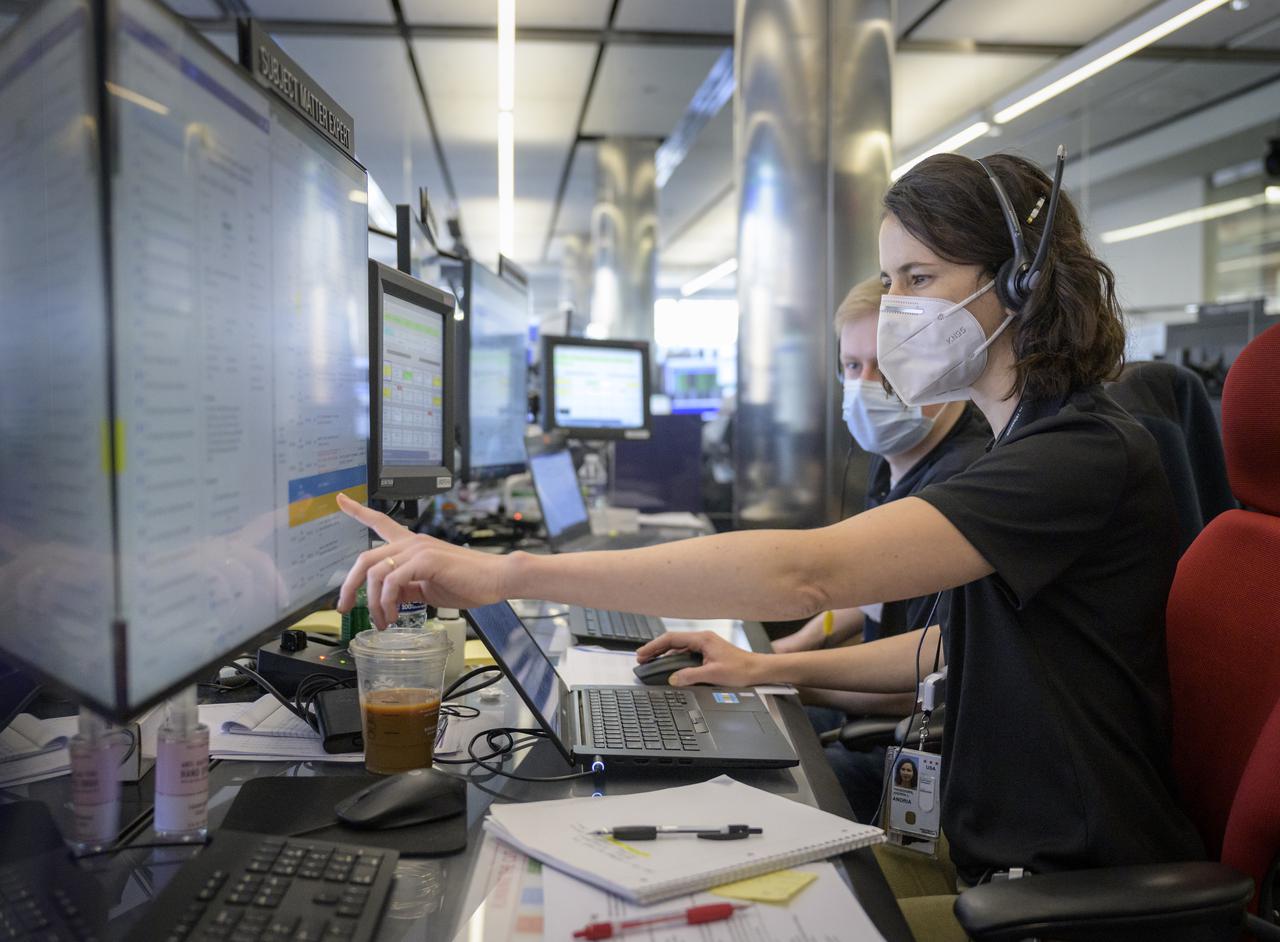
NASA James Webb Space Telescope Timeline Coordinator Andria Hagedorn monitors the progress of the Webb observatory’s second primary mirror wing as it rotates into position, Saturday, Jan. 8, 2022, from NASA’s James Webb Space Telescope Mission Operations Center at the Space Telescope Science Institute in Baltimore. Webb, an infrared telescope with a 21.3-foot (6.5-meter) primary mirror, was folded up for launch and underwent an unprecedented deployment process to unfold in space. As NASA's next flagship observatory, Webb will study every phase of cosmic history—from within our solar system to the most distant observable galaxies in the early universe. Photo Credit: (NASA/Bill Ingalls)
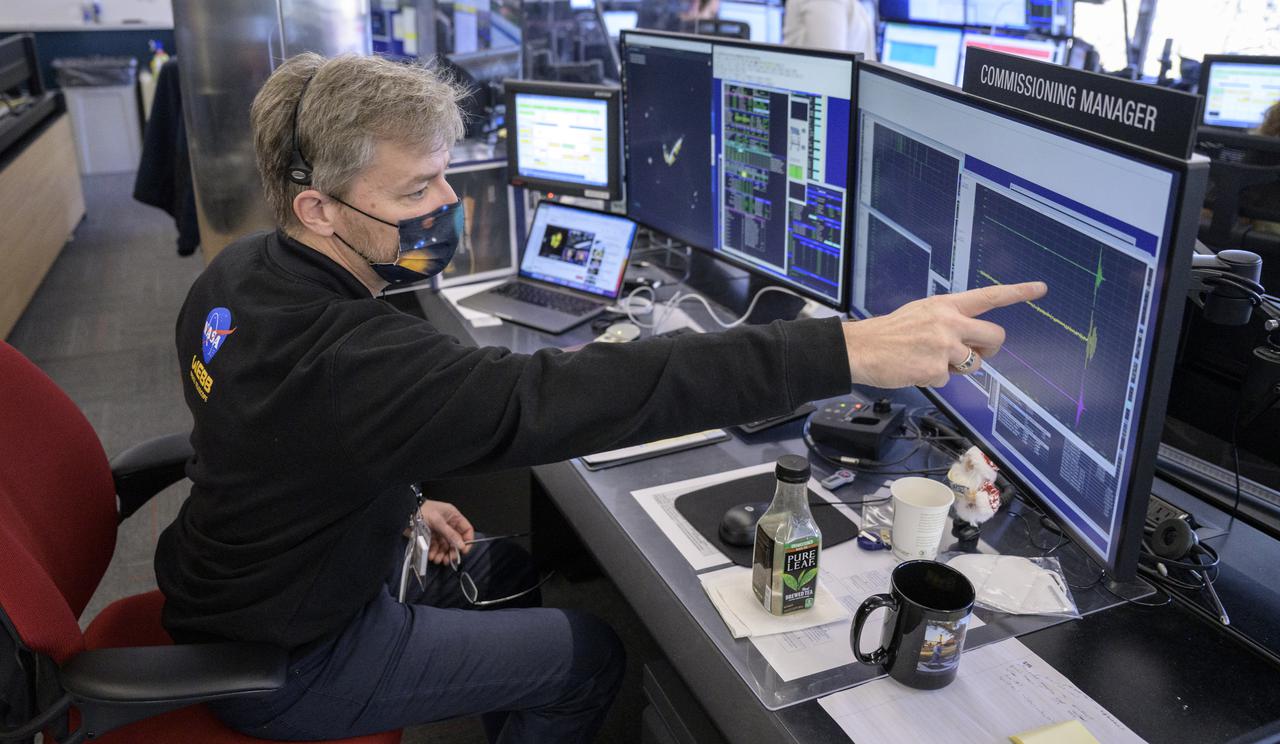
NASA James Webb Space Telescope Commissioning Manager John Durning monitors the progress of the Webb observatory as it’s second primary mirror wing is prepared to rotate into position, Saturday, Jan. 8, 2022, from NASA’s James Webb Space Telescope Mission Operations Center at the Space Telescope Science Institute in Baltimore. Webb, an infrared telescope with a 21.3-foot (6.5-meter) primary mirror, was folded up for launch and underwent an unprecedented deployment process to unfold in space. As NASA's next flagship observatory, Webb will study every phase of cosmic history—from within our solar system to the most distant observable galaxies in the early universe. Photo Credit: (NASA/Bill Ingalls)
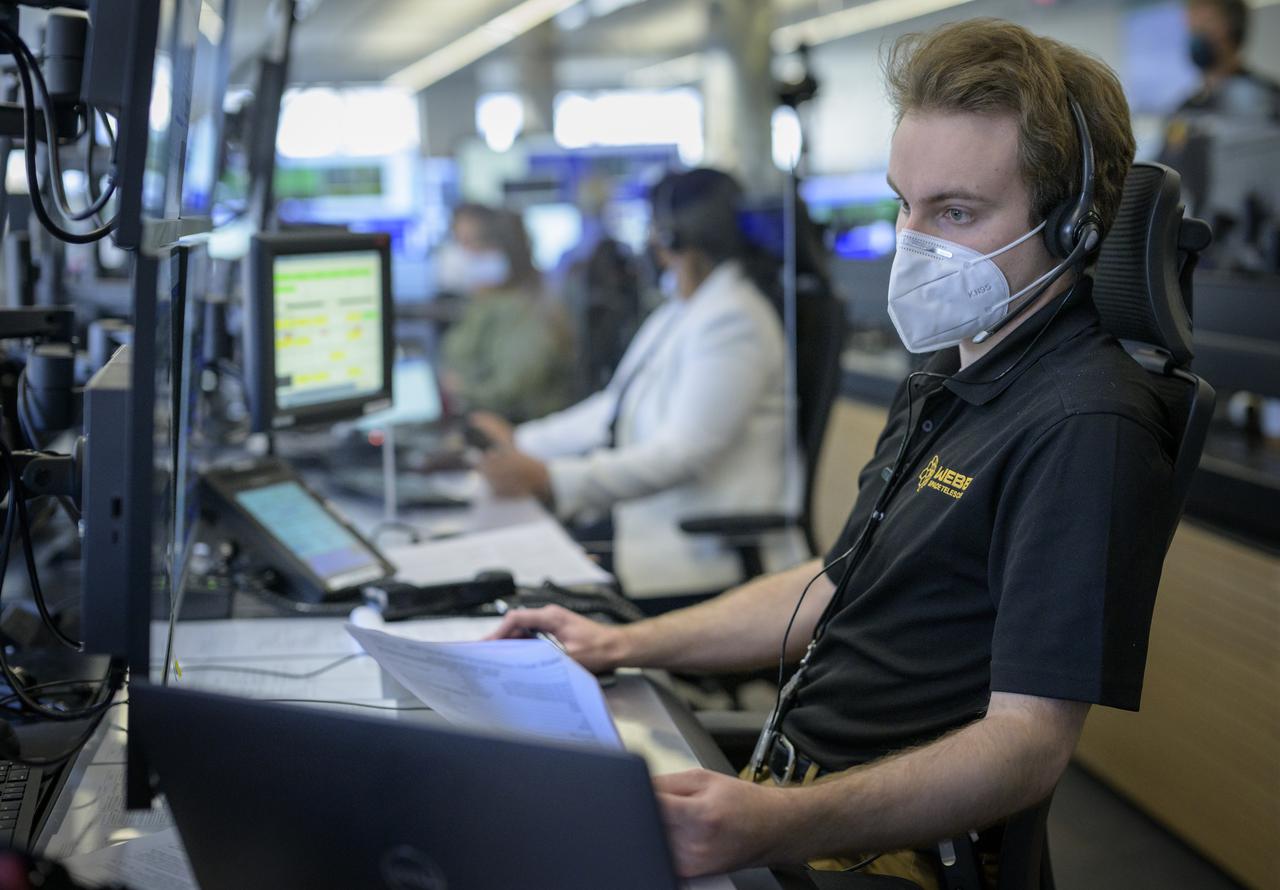
NASA James Webb Space Telescope Ground Engineer Evan Adams monitors the progress of the Webb observatory as it’s second primary mirror wing is prepared to rotate into position, Saturday, Jan. 8, 2022, from NASA’s James Webb Space Telescope Mission Operations Center at the Space Telescope Science Institute in Baltimore. Webb, an infrared telescope with a 21.3-foot (6.5-meter) primary mirror, was folded up for launch and underwent an unprecedented deployment process to unfold in space. As NASA's next flagship observatory, Webb will study every phase of cosmic history—from within our solar system to the most distant observable galaxies in the early universe. Photo Credit: (NASA/Bill Ingalls)
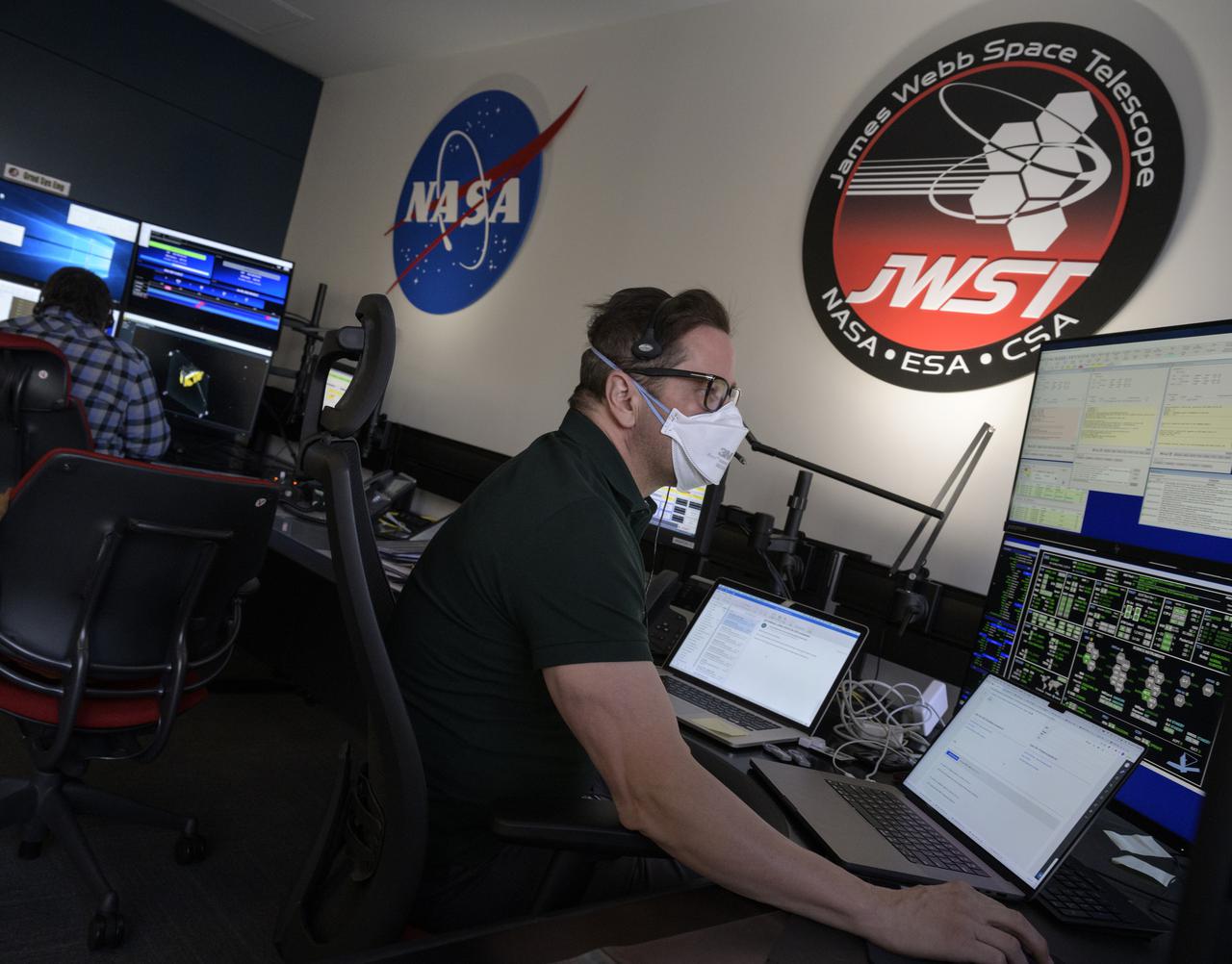
NASA James Webb Space Telescope Ground Systems Engineer Carl Reis at NASA’s James Webb Space Telescope Mission Operations Center at the Space Telescope Science Institute in Baltimore monitors the progress as the observatory’s second primary mirror wing rotates into position, Saturday, Jan. 8, 2022. Webb, an infrared telescope with a 21.3-foot (6.5-meter) primary mirror, was folded up for launch and underwent an unprecedented deployment process to unfold in space. As NASA's next flagship observatory, Webb will study every phase of cosmic history—from within our solar system to the most distant observable galaxies in the early universe. Photo Credit: (NASA/Bill Ingalls)
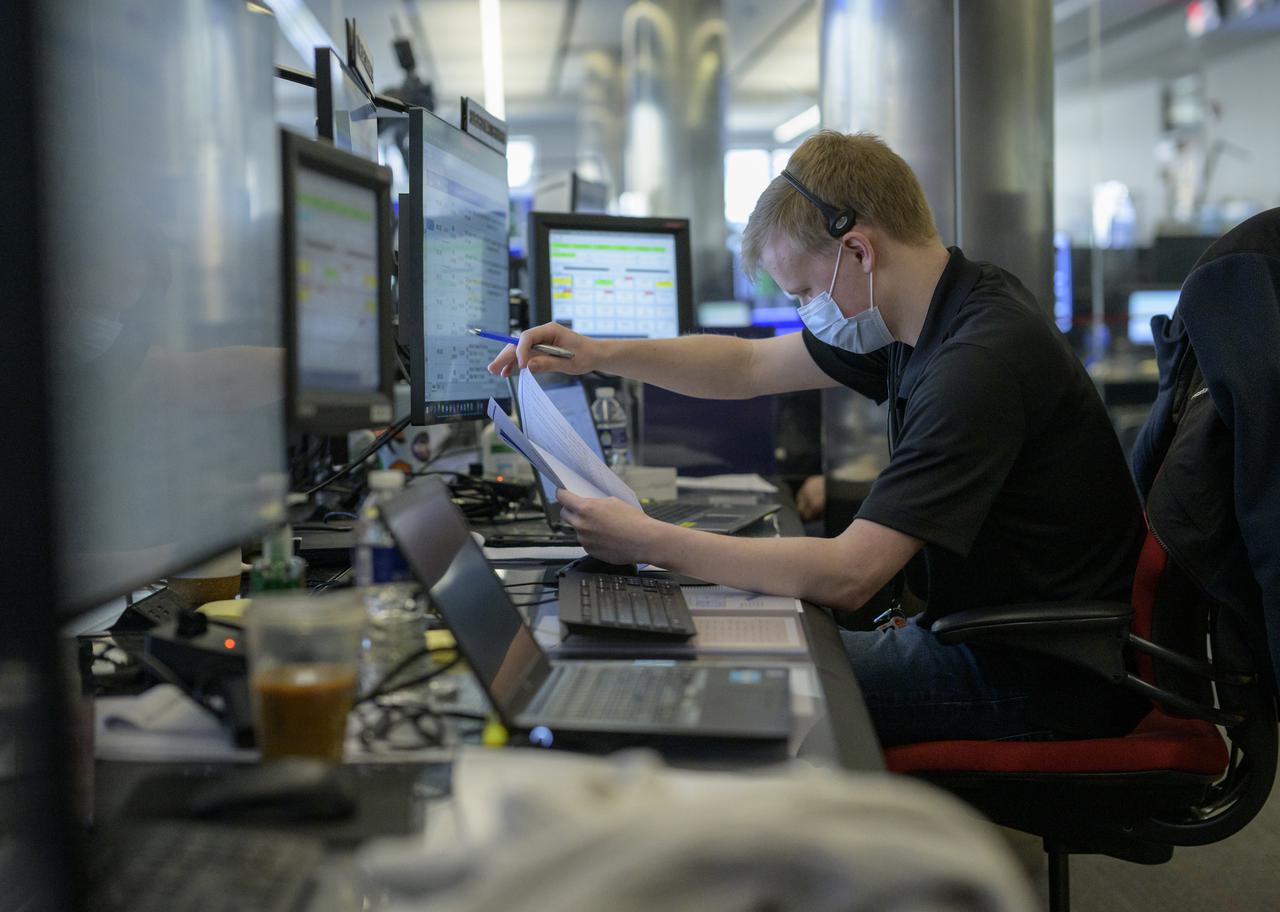
NASA James Webb Space Telescope Timeline Coordinator Matt Wasiak monitors the progress of the Webb observatory as it’s second primary mirror wing is prepared to rotate into position, Saturday, Jan. 8, 2022, from NASA’s James Webb Space Telescope Mission Operations Center at the Space Telescope Science Institute in Baltimore. Webb, an infrared telescope with a 21.3-foot (6.5-meter) primary mirror, was folded up for launch and underwent an unprecedented deployment process to unfold in space. As NASA's next flagship observatory, Webb will study every phase of cosmic history—from within our solar system to the most distant observable galaxies in the early universe. Photo Credit: (NASA/Bill Ingalls)
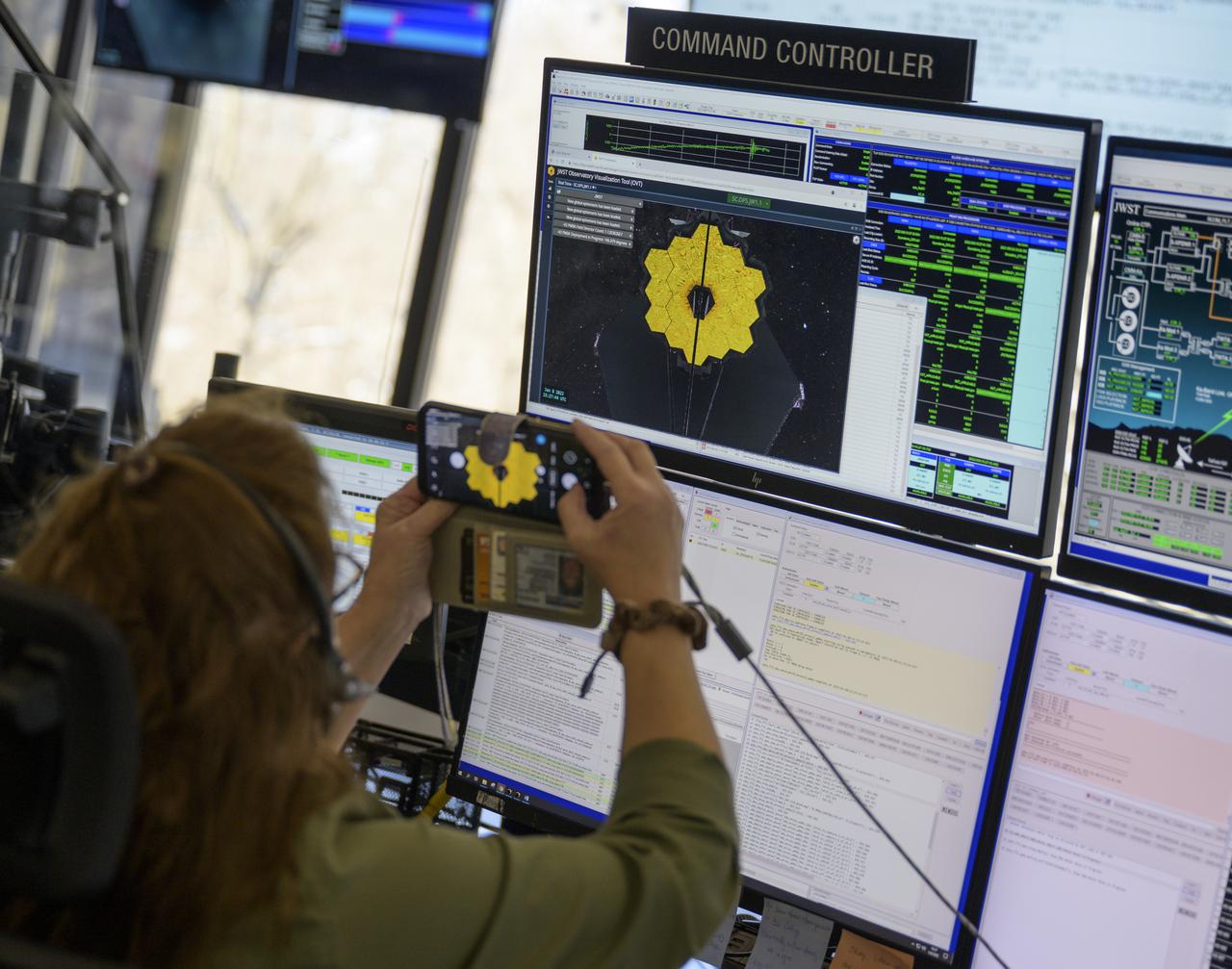
Engineering teams at NASA’s James Webb Space Telescope Mission Operations Center at the Space Telescope Science Institute in Baltimore monitor progress as the observatory’s second primary mirror wing rotates into position, Saturday, Jan. 8, 2022. Webb, an infrared telescope with a 21.3-foot (6.5-meter) primary mirror, was folded up for launch and underwent an unprecedented deployment process to unfold in space. As NASA's next flagship observatory, Webb will study every phase of cosmic history—from within our solar system to the most distant observable galaxies in the early universe. Photo Credit: (NASA/Bill Ingalls)
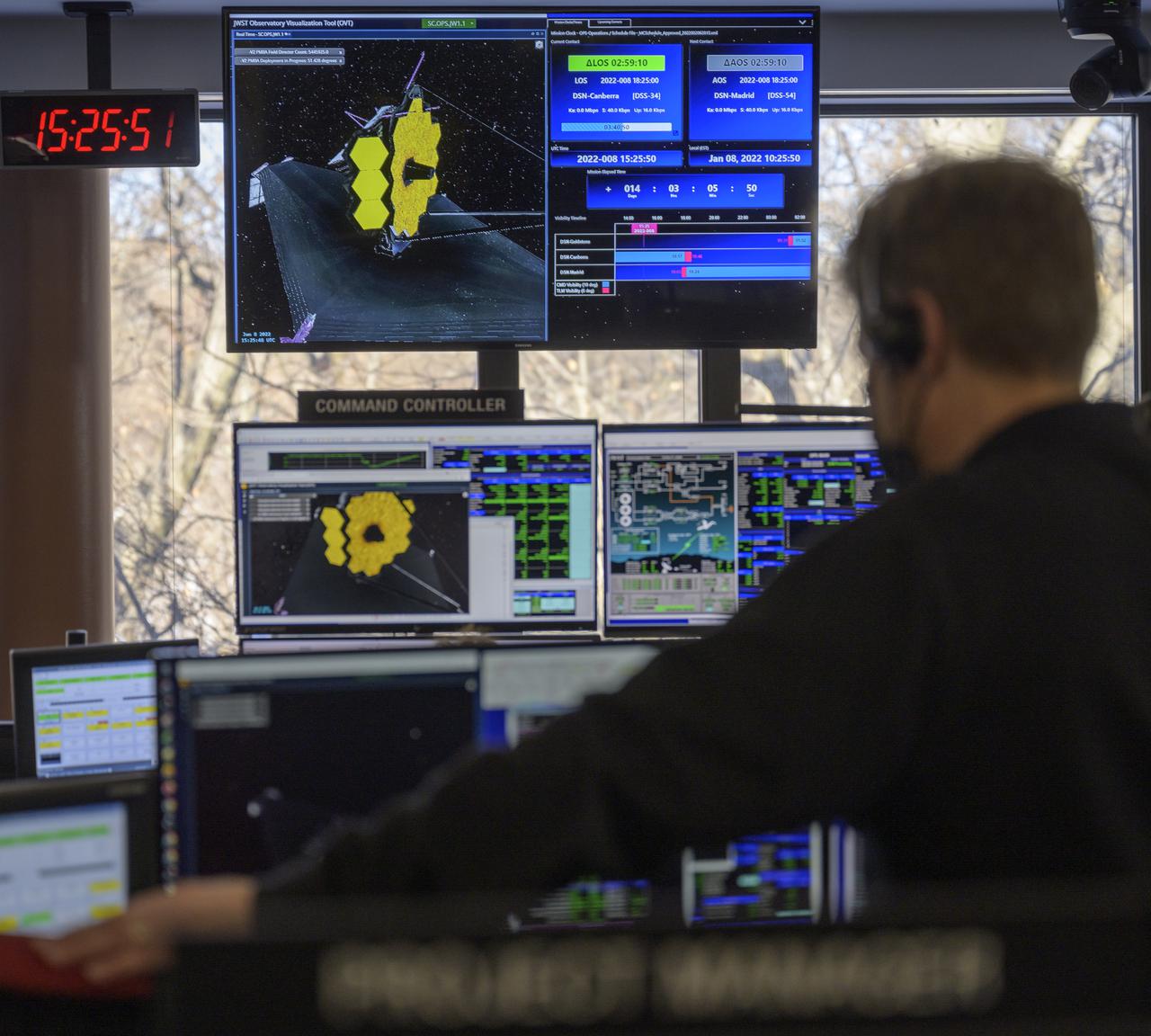
Engineering teams at NASA’s James Webb Space Telescope Mission Operations Center at the Space Telescope Science Institute in Baltimore monitor progress as the observatory’s second primary mirror wing rotates into position, Saturday, Jan. 8, 2022. Webb, an infrared telescope with a 21.3-foot (6.5-meter) primary mirror, was folded up for launch and underwent an unprecedented deployment process to unfold in space. As NASA's next flagship observatory, Webb will study every phase of cosmic history—from within our solar system to the most distant observable galaxies in the early universe. Photo Credit: (NASA/Bill Ingalls)
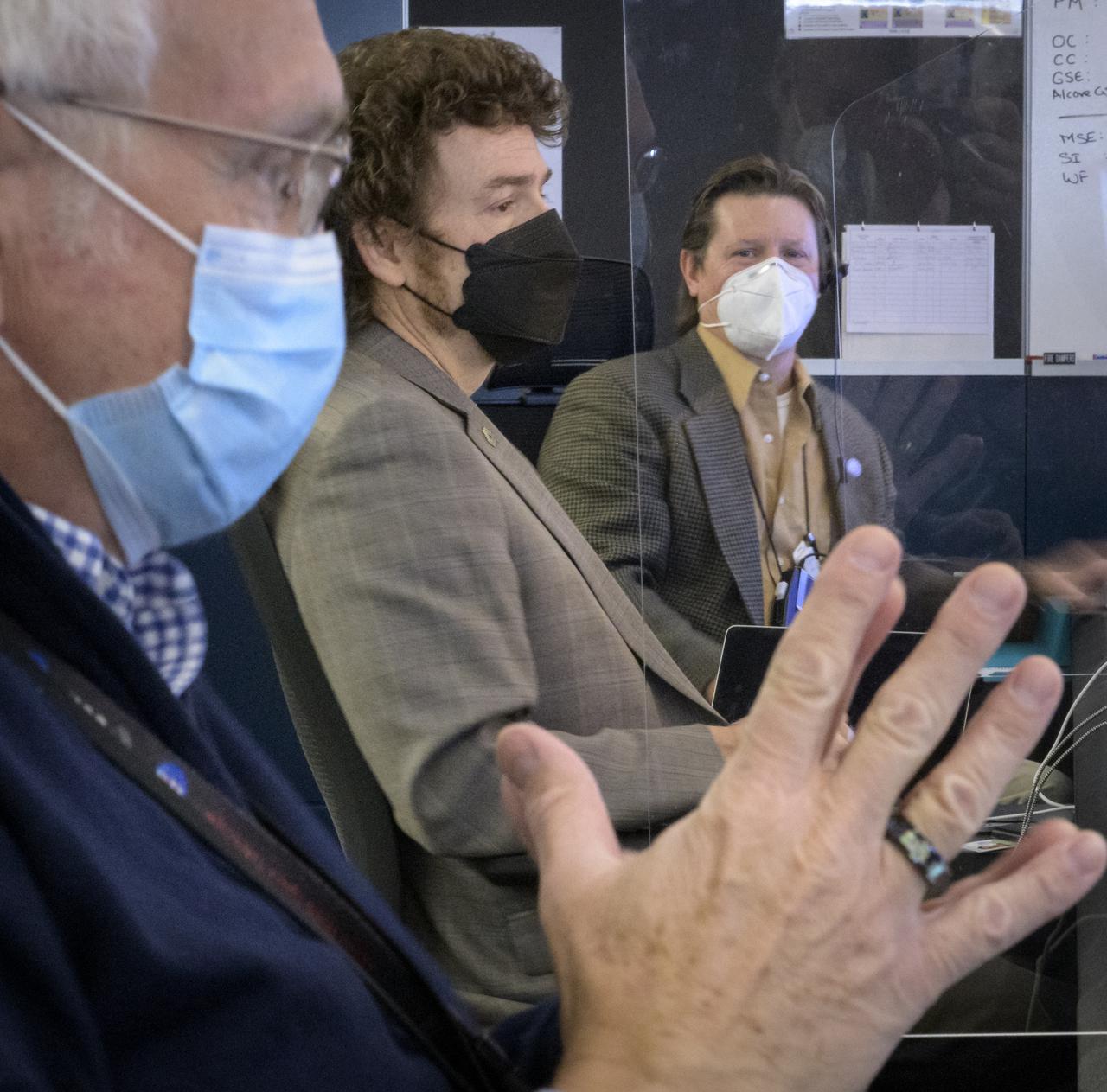
NASA James Webb Space Telescope Mission Operations Engineer Kenny McKenzie, background, NASA James Webb Space Telescope Mission Operations Manager Carl Starr, middle, and NASA James Webb Space Telescope Project Manager Bill Ochs, monitor the progress of the Webb observatory as it’s second primary mirror wing is prepared to rotate into position, Saturday, Jan. 8, 2022, from NASA’s James Webb Space Telescope Mission Operations Center at the Space Telescope Science Institute in Baltimore. Webb, an infrared telescope with a 21.3-foot (6.5-meter) primary mirror, was folded up for launch and underwent an unprecedented deployment process to unfold in space. As NASA's next flagship observatory, Webb will study every phase of cosmic history—from within our solar system to the most distant observable galaxies in the early universe. Photo Credit: (NASA/Bill Ingalls)
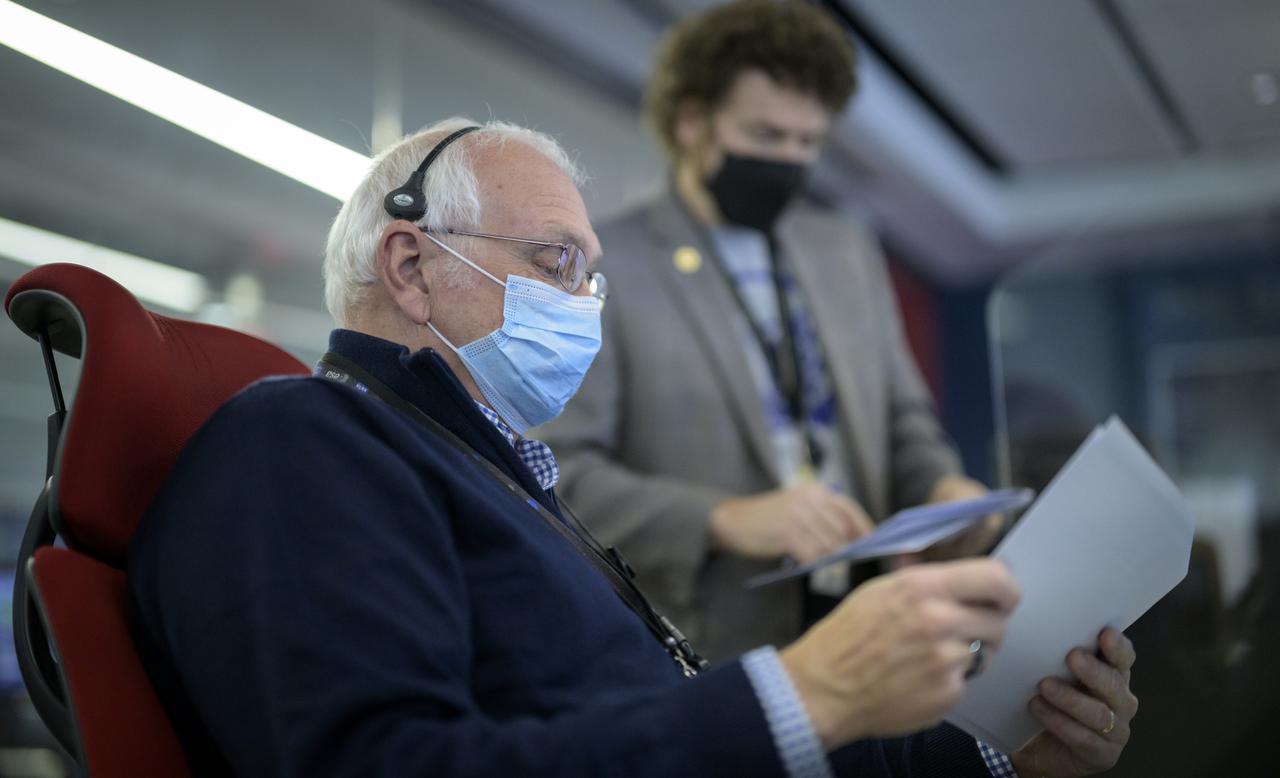
NASA James Webb Space Telescope Project Manager Bill Ochs, left, and NASA James Webb Space Telescope Mission Operations Manager Carl Starr, monitor the progress of the Webb observatory as it’s second primary mirror wing is prepared to rotate into position, Saturday, Jan. 8, 2022, from NASA’s James Webb Space Telescope Mission Operations Center at the Space Telescope Science Institute in Baltimore. Webb, an infrared telescope with a 21.3-foot (6.5-meter) primary mirror, was folded up for launch and underwent an unprecedented deployment process to unfold in space. As NASA's next flagship observatory, Webb will study every phase of cosmic history—from within our solar system to the most distant observable galaxies in the early universe. Photo Credit: (NASA/Bill Ingalls)
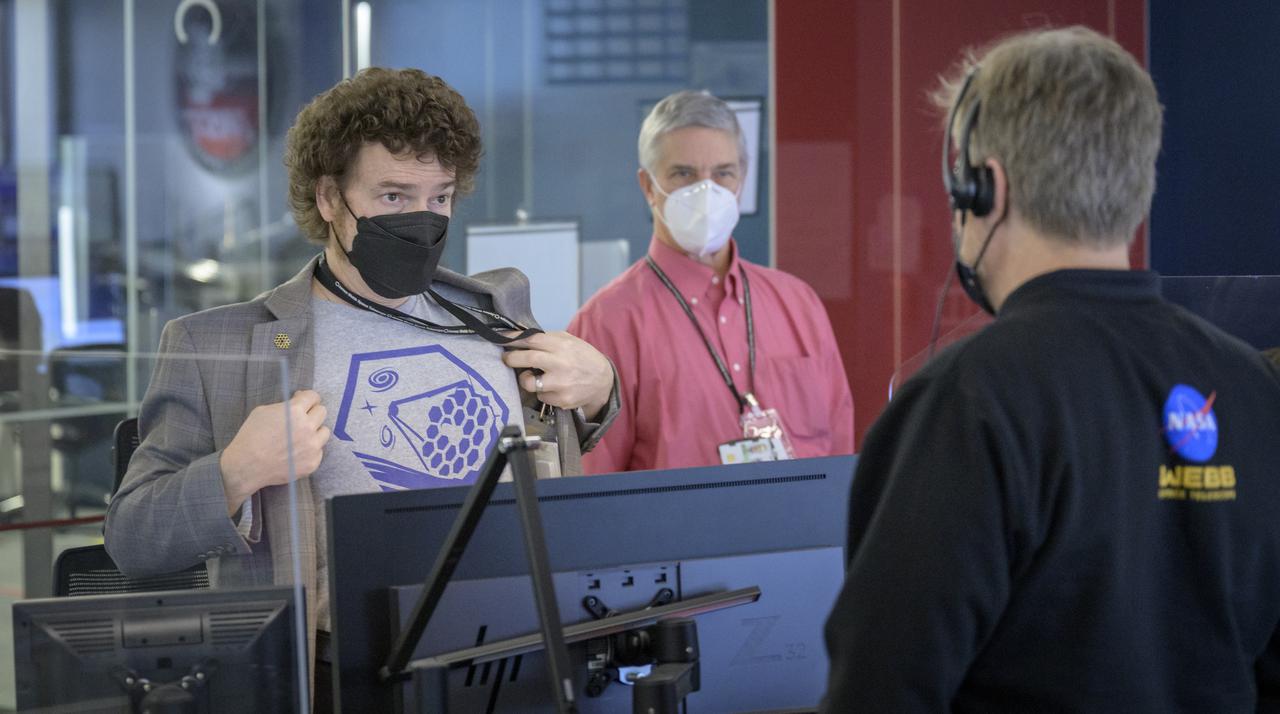
NASA James Webb Space Telescope Mission Operations Manager Carl Starr, left, shows his Webb shirt to NASA James Webb Space Telescope Commissioning Manager John Durning, right, as they prepare to monitor the progress of the observatory’s second primary mirror wing rotating into position, Saturday, Jan. 8, 2022, at NASA’s James Webb Space Telescope Mission Operations Center at the Space Telescope Science Institute in Baltimore. Webb, an infrared telescope with a 21.3-foot (6.5-meter) primary mirror, was folded up for launch and underwent an unprecedented deployment process to unfold in space. As NASA's next flagship observatory, Webb will study every phase of cosmic history—from within our solar system to the most distant observable galaxies in the early universe. Photo Credit: (NASA/Bill Ingalls)

NASA James Webb Space Telescope Mission Operations Manager Carl Starr monitors the progress of the Webb observatory as it’s second primary mirror wing is prepared to rotate into position, Saturday, Jan. 8, 2022, from NASA’s James Webb Space Telescope Mission Operations Center at the Space Telescope Science Institute in Baltimore. Webb, an infrared telescope with a 21.3-foot (6.5-meter) primary mirror, was folded up for launch and underwent an unprecedented deployment process to unfold in space. As NASA's next flagship observatory, Webb will study every phase of cosmic history—from within our solar system to the most distant observable galaxies in the early universe. Photo Credit: (NASA/Bill Ingalls)
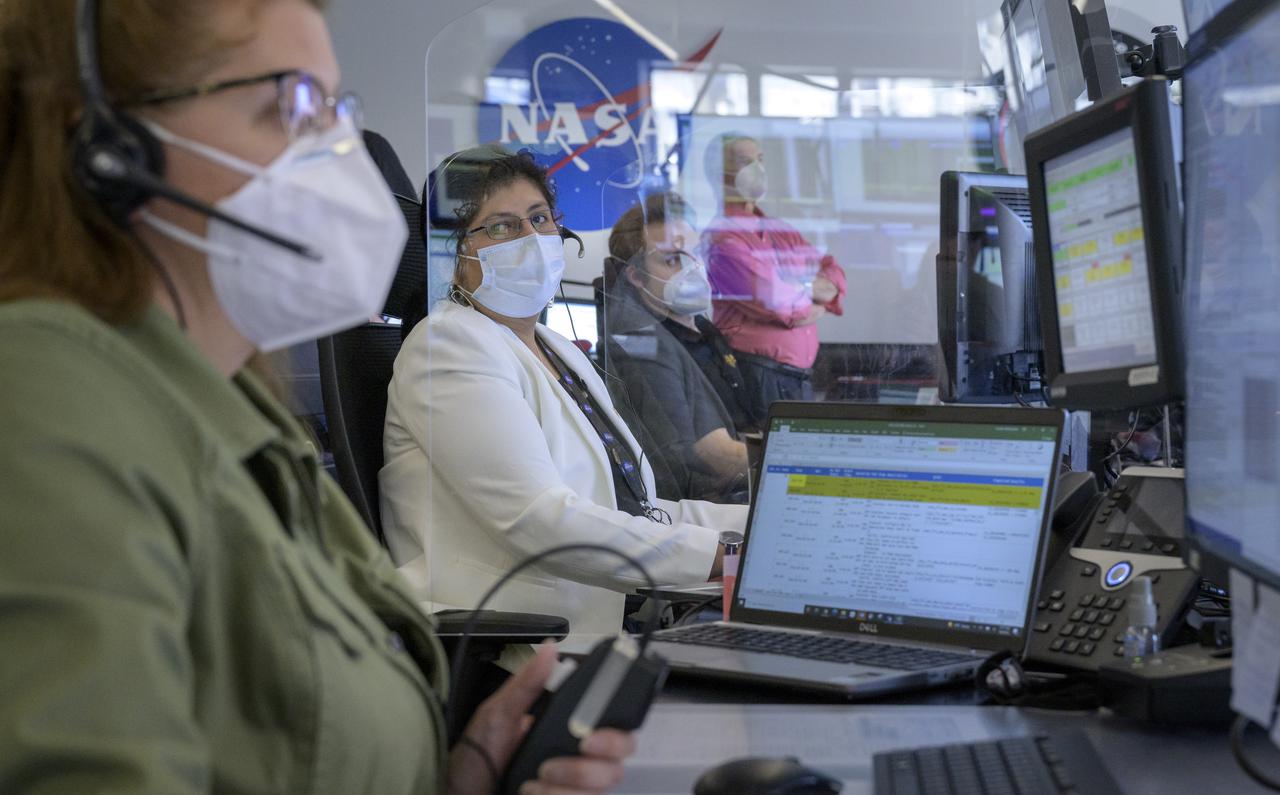
NASA James Webb Space Telescope Operations Controller Irma Quispe, 2nd from left, and other mission team members, monitor the progress of the Webb observatory as it’s second primary mirror wing is rotated into position, Saturday, Jan. 8, 2022, from NASA’s James Webb Space Telescope Mission Operations Center at the Space Telescope Science Institute in Baltimore. Webb, an infrared telescope with a 21.3-foot (6.5-meter) primary mirror, was folded up for launch and underwent an unprecedented deployment process to unfold in space. As NASA's next flagship observatory, Webb will study every phase of cosmic history—from within our solar system to the most distant observable galaxies in the early universe. Photo Credit: (NASA/Bill Ingalls)
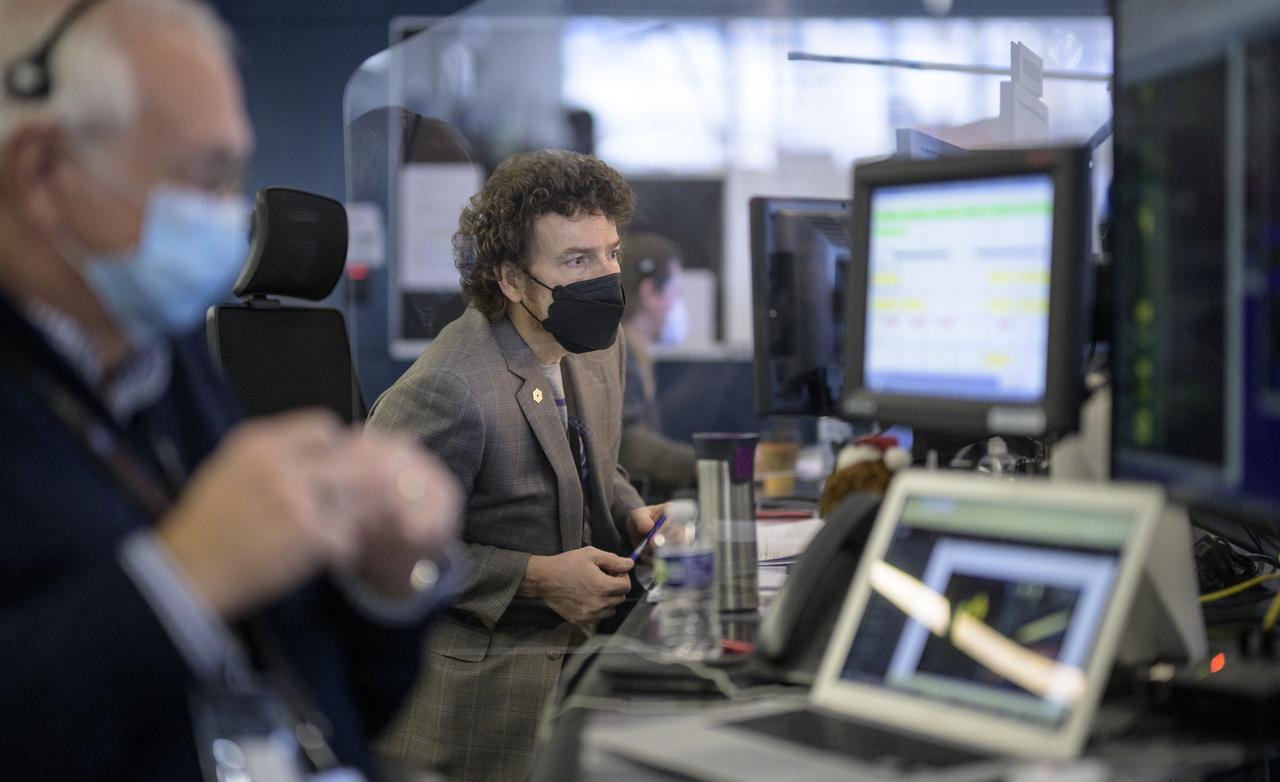
NASA James Webb Space Telescope Mission Operations Manager Carl Starr monitors the progress of the Webb observatory as it’s second primary mirror wing is prepared to rotate into position, Saturday, Jan. 8, 2022, from NASA’s James Webb Space Telescope Mission Operations Center at the Space Telescope Science Institute in Baltimore. Webb, an infrared telescope with a 21.3-foot (6.5-meter) primary mirror, was folded up for launch and underwent an unprecedented deployment process to unfold in space. As NASA's next flagship observatory, Webb will study every phase of cosmic history—from within our solar system to the most distant observable galaxies in the early universe. Photo Credit: (NASA/Bill Ingalls)
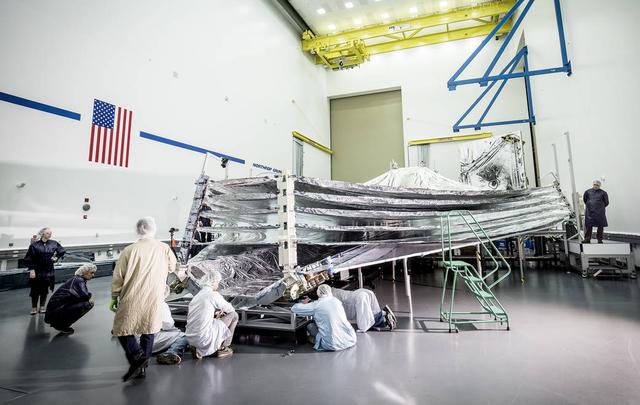
NASA's James Webb Space Telescope has a giant custom-built, kite-shaped sunshield driven by mechanics that will fold and unfold with a harmonious synchronicity 1 million miles from Earth. Like a car, many mechanical pieces in the Webb telescope's sunshield will work together to open it from its stored folded position in the rocket that will carry it into space. According to car manufacturers, a single car can have about 30,000 parts, counting every part down to the smallest screws. Like getting all of the parts in a car to operate together, the mechanical parts of the sunshield have to work in the same way. The sunshield support structure contains well over 7,000 flight parts, including springs, bearings, pulleys, magnets, etc. In addition, the sunshield has hundreds of custom fabricated pieces. Most mechanical pieces were developed exclusively for the sunshield, with a few from existing designs. Read more: <a href="http://go.nasa.gov/2cXcQMT" rel="nofollow">go.nasa.gov/2cXcQMT</a>
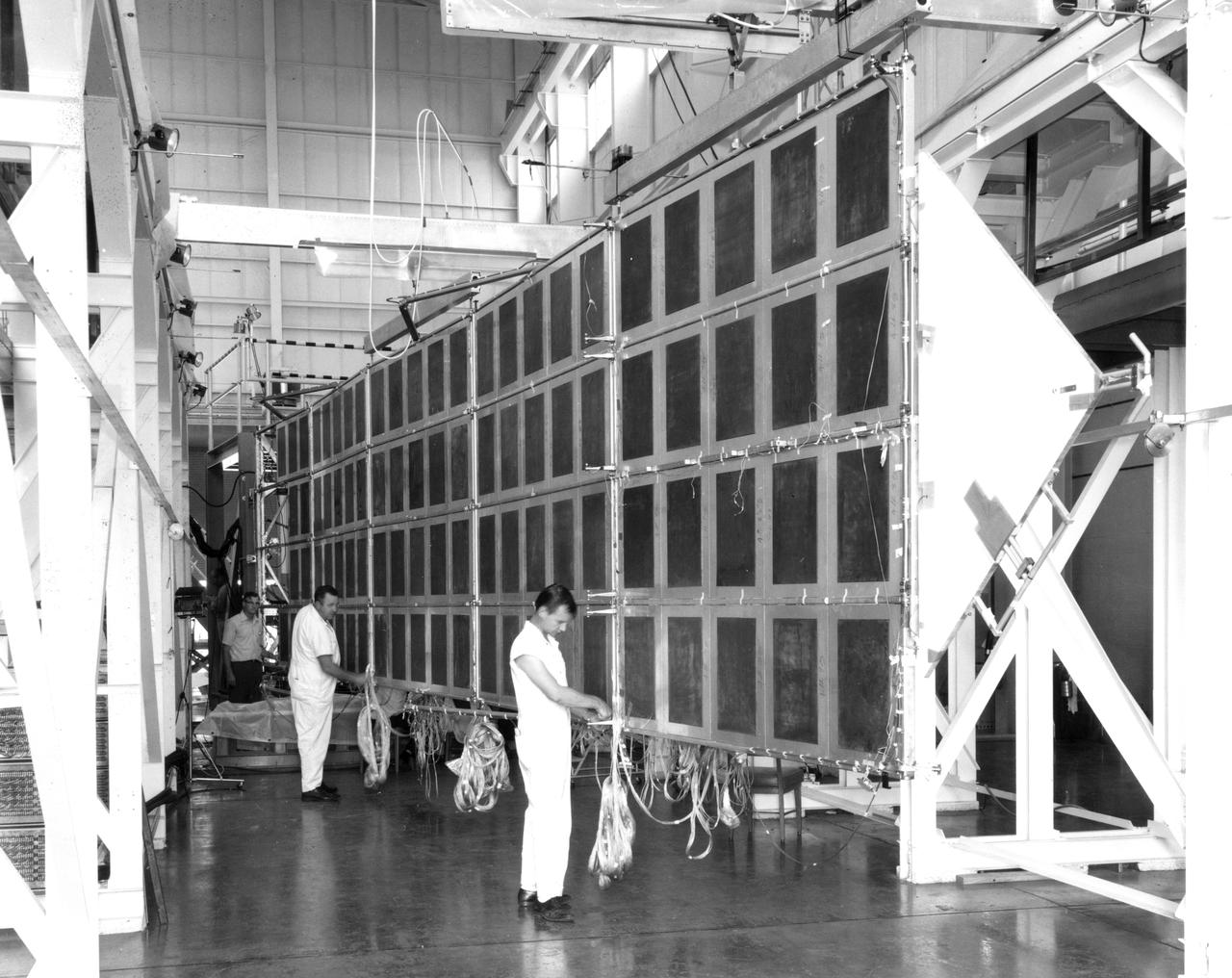
Technicians at NASA’s Marshall Space Flight Center check the wiring on a mechanical test article of the Apollo Telescope Mount (ATM) solar array. Four such arrays were joined in a cross to provide electric power for the ATM in Earth orbit. The deployment mechanism for extending the wing to the fully open position had just been tested when this photograph was taken. The array was suspended from beams riding on air bearings to closely simulate the weightless conditions under which it would be deployed in space. The wings are folded against the sides of the ATM for launch and are deployed by a scissors mechanism in Earth’s orbit.
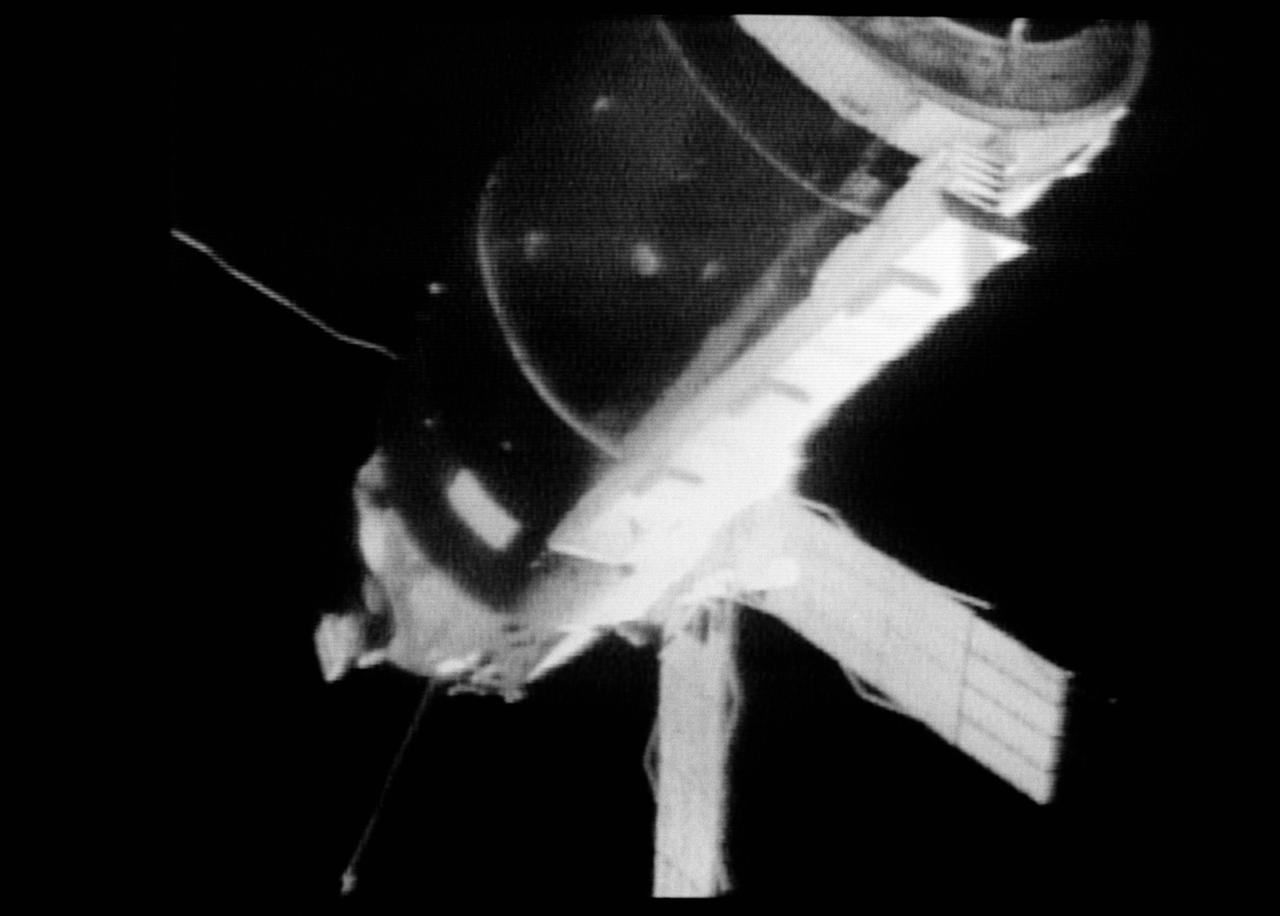
S73-27182 (25 May 1973) --- A close-up view of the Skylab 1 space station cluster can be seen in this reproduction taken from a color television transmission made by a TV camera aboard the Skylab 2 Command Module during its "fly around" inspection of the cluster. This view has been enhanced. At left center the damaged solar array system wing on the Orbital Workshop (OWS) appears to be partly folded. In their preliminary inspection the crewmen noted that portions of the micrometeoroid shield had slid back underneath the OWS solar wing. Solar panels on the Apollo Telescope Mount extend out at the top center. Photo credit: NASA
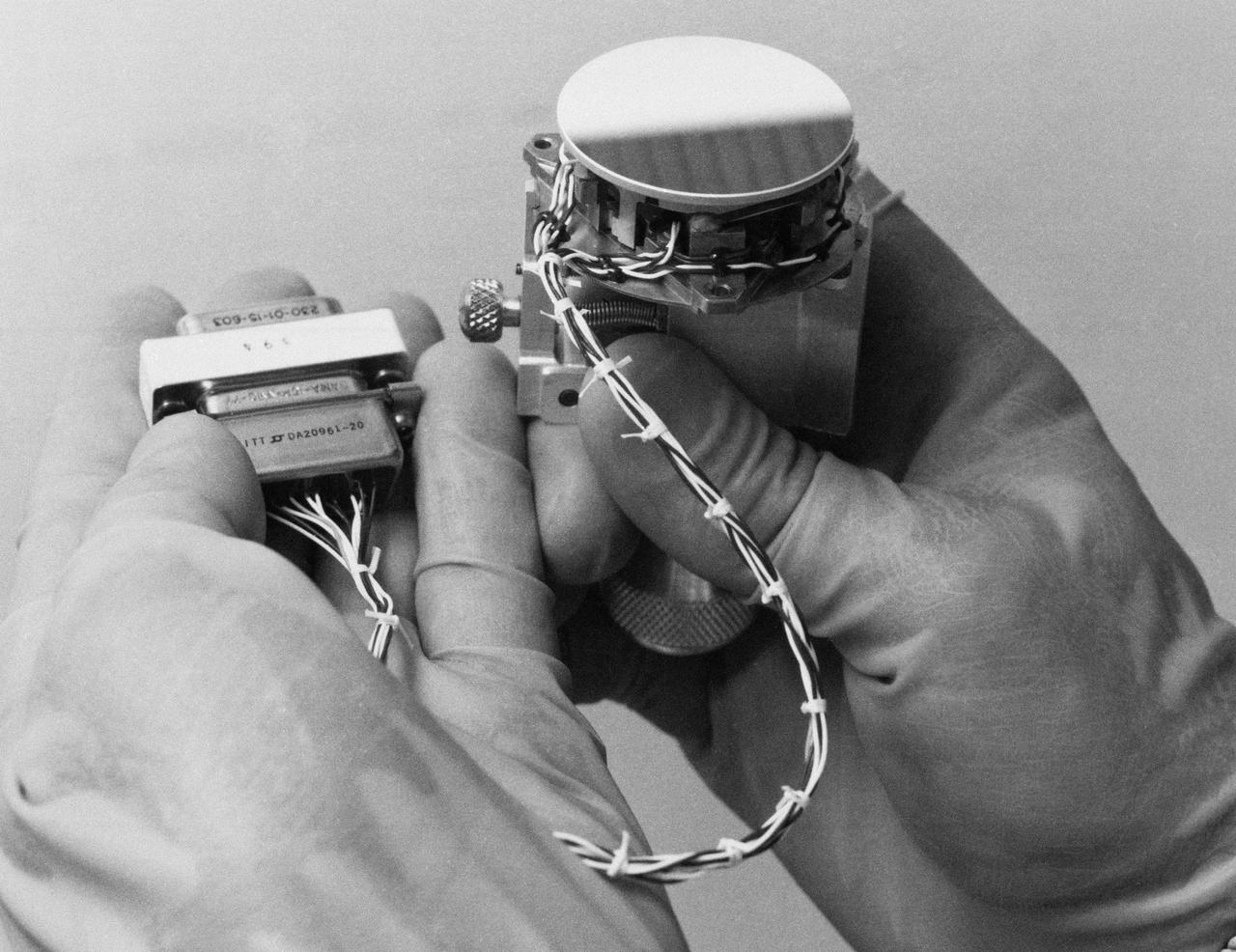
S93-33257 (15 Mar 1993) --- This close-up view features tiny articulating fold mirrors that will go into a replacement camera for the Wide Field\Planetary Camera (WF\PC-1) currently on the Hubble Space Telescope (HST). A team of NASA astronauts will pay a visit to the HST later this year, carrying with them the new WF/PC-2 to replace the one currently on the HST. The Jet Propulsion Laboratory (JPL) in Pasadena, California has been working on the replacement system for several months. See NASA photo S93-33258 for an optical schematic diagram of one of the four channels of the WF\PC-2 showing the path taken by beams from the HST before an image is formed at the camera's charge-coupled devices.
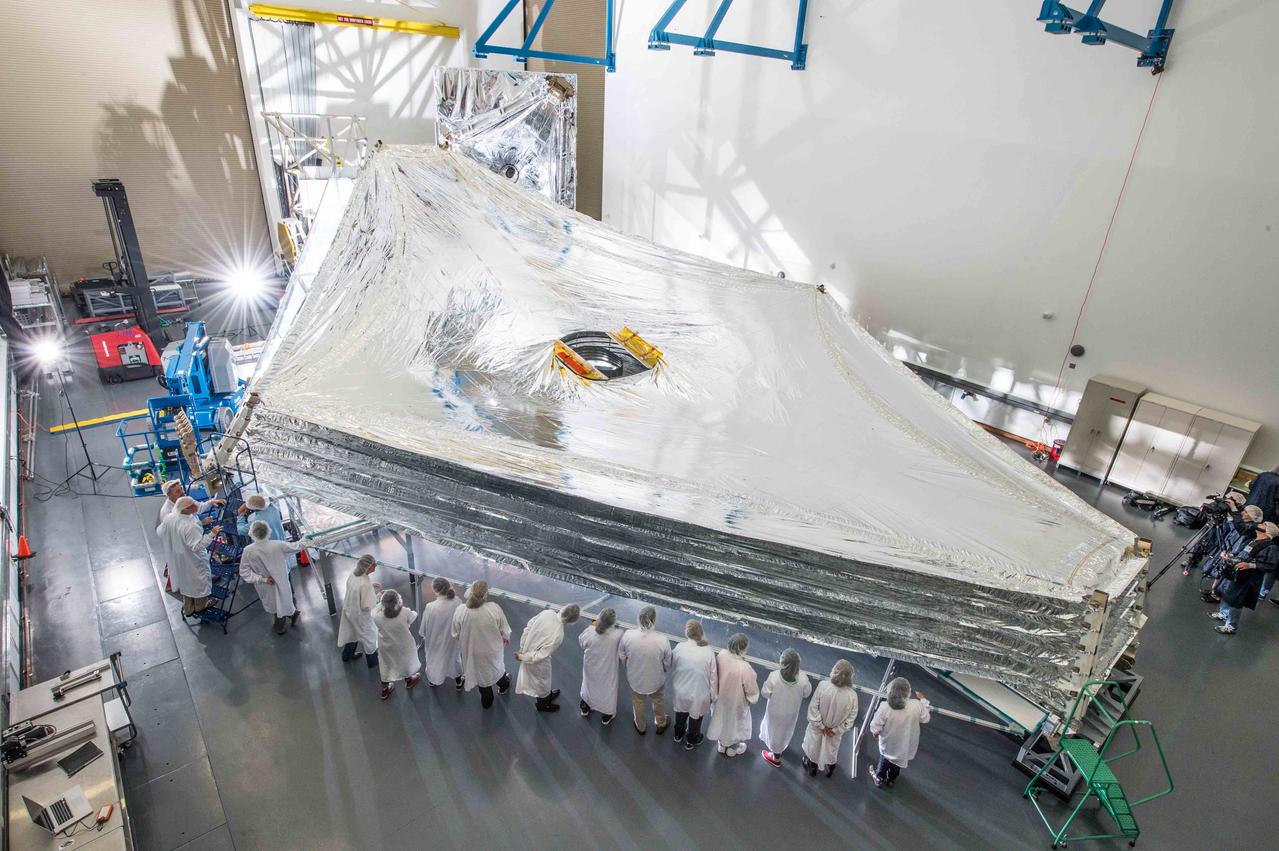
The Sunshield on NASA's James Webb Space Telescope is the largest part of the observatory—five layers of thin membrane that must unfurl reliably in space to precise tolerances. Last week, for the first time, engineers stacked and unfurled a full-sized test unit of the Sunshield and it worked perfectly. The Sunshield is about the length of a tennis court, and will be folded up like an umbrella around the Webb telescope’s mirrors and instruments during launch. Once it reaches its orbit, the Webb telescope will receive a command from Earth to unfold, and separate the Sunshield's five layers into their precisely stacked arrangement with its kite-like shape. The Sunshield test unit was stacked and expanded at a cleanroom in the Northrop Grumman facility in Redondo Beach, California. The Sunshield separates the observatory into a warm sun-facing side and a cold side where the sunshine is blocked from interfering with the sensitive infrared instruments. The infrared instruments need to be kept very cold (under 50 K or -370 degrees F) to operate. The Sunshield protects these sensitive instruments with an effective sun protection factor or SPF of 1,000,000 (suntan lotion generally has an SPF of 8-50). In addition to providing a cold environment, the Sunshield provides a thermally stable environment. This stability is essential to maintaining proper alignment of the primary mirror segments as the telescope changes its orientation to the sun. The James Webb Space Telescope is the successor to NASA's Hubble Space Telescope. It will be the most powerful space telescope ever built. Webb is an international project led by NASA with its partners, the European Space Agency and the Canadian Space Agency. For more information about the Webb telescope, visit: <a href="http://www.jwst.nasa.gov" rel="nofollow">www.jwst.nasa.gov</a> or <a href="http://www.nasa.gov/webb" rel="nofollow">www.nasa.gov/webb</a> For more information on the Webb Sunshield, visit: <a href="http://jwst.nasa.gov/sunshield.html" rel="nofollow">jwst.nasa.gov/sunshield.html</a> Credit: NASA/Goddard/Chris Gunn <b><a href="http://www.nasa.gov/audience/formedia/features/MP_Photo_Guidelines.html" rel="nofollow">NASA image use policy.</a></b> <b><a href="http://www.nasa.gov/centers/goddard/home/index.html" rel="nofollow">NASA Goddard Space Flight Center</a></b> enables NASA’s mission through four scientific endeavors: Earth Science, Heliophysics, Solar System Exploration, and Astrophysics. Goddard plays a leading role in NASA’s accomplishments by contributing compelling scientific knowledge to advance the Agency’s mission. <b>Follow us on <a href="http://twitter.com/NASAGoddardPix" rel="nofollow">Twitter</a></b> <b>Like us on <a href="http://www.facebook.com/pages/Greenbelt-MD/NASA-Goddard/395013845897?ref=tsd" rel="nofollow">Facebook</a></b> <b>Find us on <a href="http://instagram.com/nasagoddard?vm=grid" rel="nofollow">Instagram</a></b>
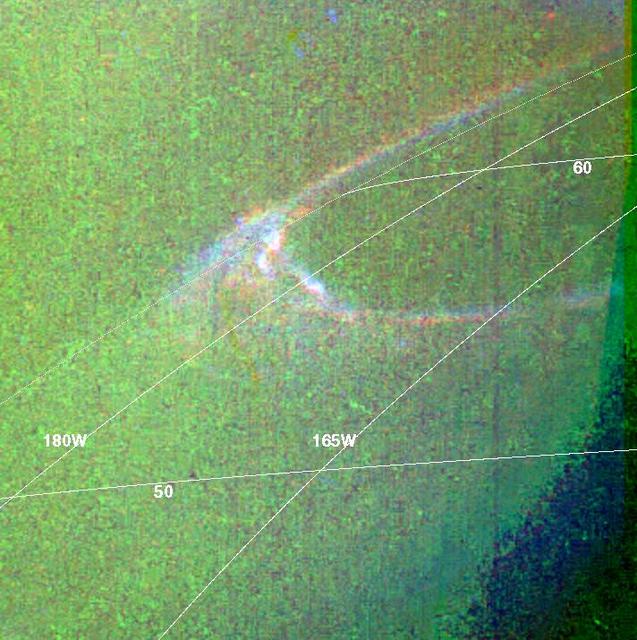
Data from NASA's Galileo spacecraft were used to produce this false-color composite of Jupiter's northern aurora on the night side of the planet. The height of the aurora, the thickness of the auroral arc, and the small-scale structure are revealed for the first time. Images in Galileo's red, green, and clear filters are displayed in red, green, and blue respectively. The smallest resolved features are tens of kilometers in size, which is a ten-fold improvement over Hubble Space Telescope images and a hundred-fold improvement over ground-based images. The glow is caused by electrically charged particles impinging on the atmosphere from above. The particles travel along Jupiter's magnetic field lines, which are nearly vertical at this latitude. The auroral arc marks the boundary between the "closed" field lines that are attached to the planet at both ends and the "open" field lines that extend out into interplanetary space. At the boundary the particles have been accelerated over the greatest distances, and the glow is especially intense. The latitude-longitude lines refer to altitudes where the pressure is 1 bar. The image shows that the auroral emissions originate about 500 kilometers (about 310 miles) above this surface. The colored background is light scattered from Jupiter's bright crescent, which is out of view to the right. North is at the top. The images are centered at 57 degrees north and 184 degrees west and were taken on April 2, 1997 at a range of 1.7 million kilometers (1.05 million miles) by Galileo's Solid State Imaging (SSI) system. http://photojournal.jpl.nasa.gov/catalog/PIA00603
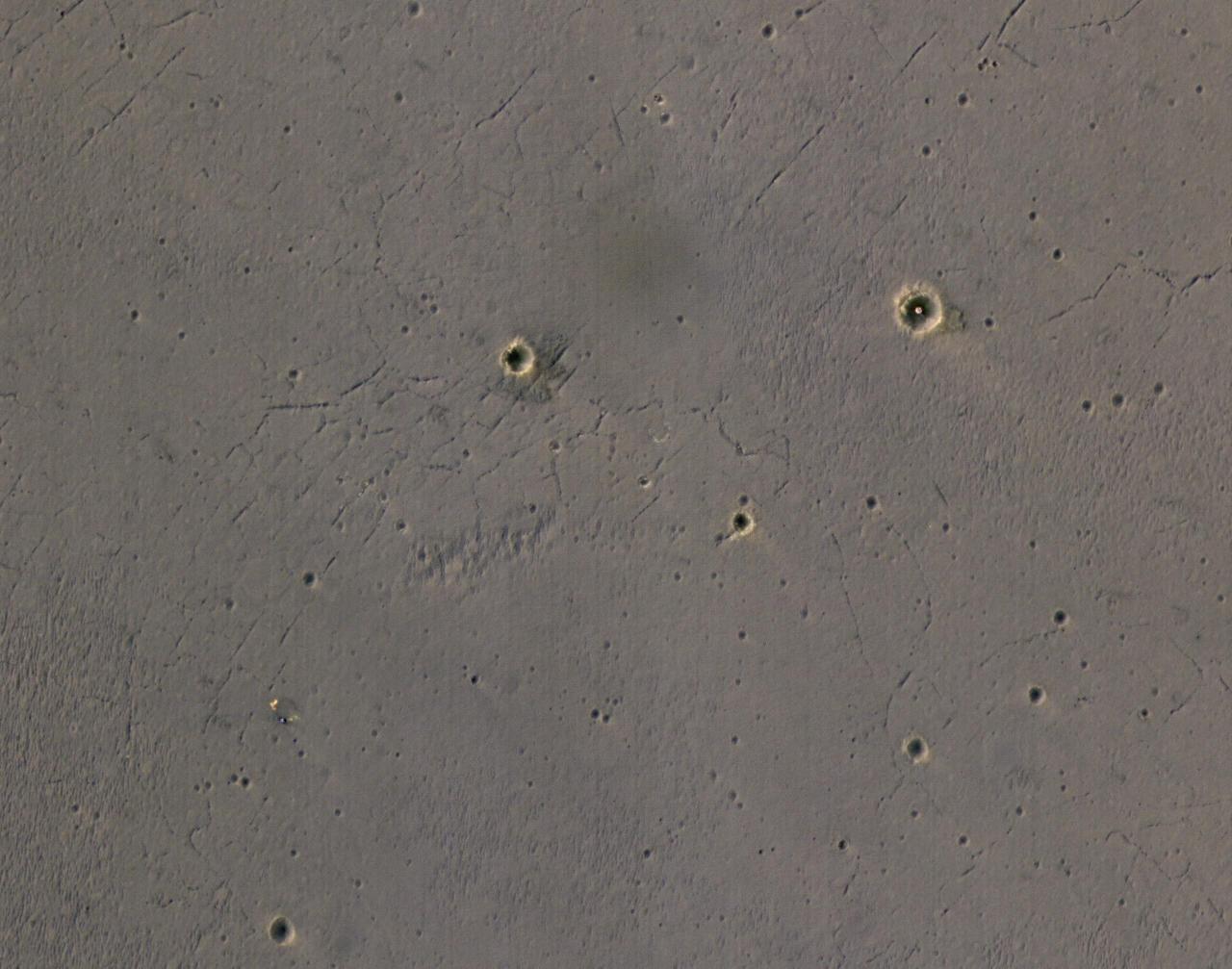
The bright landing platform left behind by NASA's Mars Exploration Rover Opportunity in 2004 is visible inside Eagle Crater, at upper right in this April 8, 2017, observation by NASA's Mars Reconnaissance Orbiter. Mars Reconnaissance Orbiter arrived at Mars in March 2006, more than two years after Opportunity's landing on Jan. 25, 2004, Universal Time (Jan. 24, PDT). This is the first image of Eagle Crater from the orbiter's High Resolution Imaging Science Experiment (HiRISE) camera, which has optics that include the most powerful telescope ever sent to Mars. Eagle Crater is about 72 feet (22 meters) in diameter, at 1.95 degrees south latitude, 354.47 degrees east longitude, in the Meridiani Planum region of Mars. The airbag-cushioned lander, with Opportunity folded-up inside, first hit Martian ground near the crater, then bounced and rolled right into the crater. The lander structure was four triangles, folded into a tetrahedron until after the airbags deflated. The triangular petals then opened, exposing the rover. A week later, the rover drove off (see PIA05214), and the landing platform's job was done. The spacecraft's backshell and parachute, jettisoned during final descent, are visible near the lower left corner of this scene. The blue tint of the backshell is an effect of exaggerated color, because HiRISE combines color information from red, blue-green and infrared portions of the spectrum, rather than three different visible-light colors, so its color images are not true color. Opportunity examined Eagle Crater for more than half of the rover's originally planned three-month mission, before driving east and south to larger craters. At Eagle, it found headline-making evidence that water once flowed over the surface and soaked the subsurface of the area. By the time this orbital image of the landing site was taken, about 13 years after the rover departed Eagle, Opportunity had driven more than 27 miles (44 kilometers) and was actively exploring the rim of Endeavour Crater, which is about 1,000 times as wide as Eagle. https://photojournal.jpl.nasa.gov/catalog/PIA21494
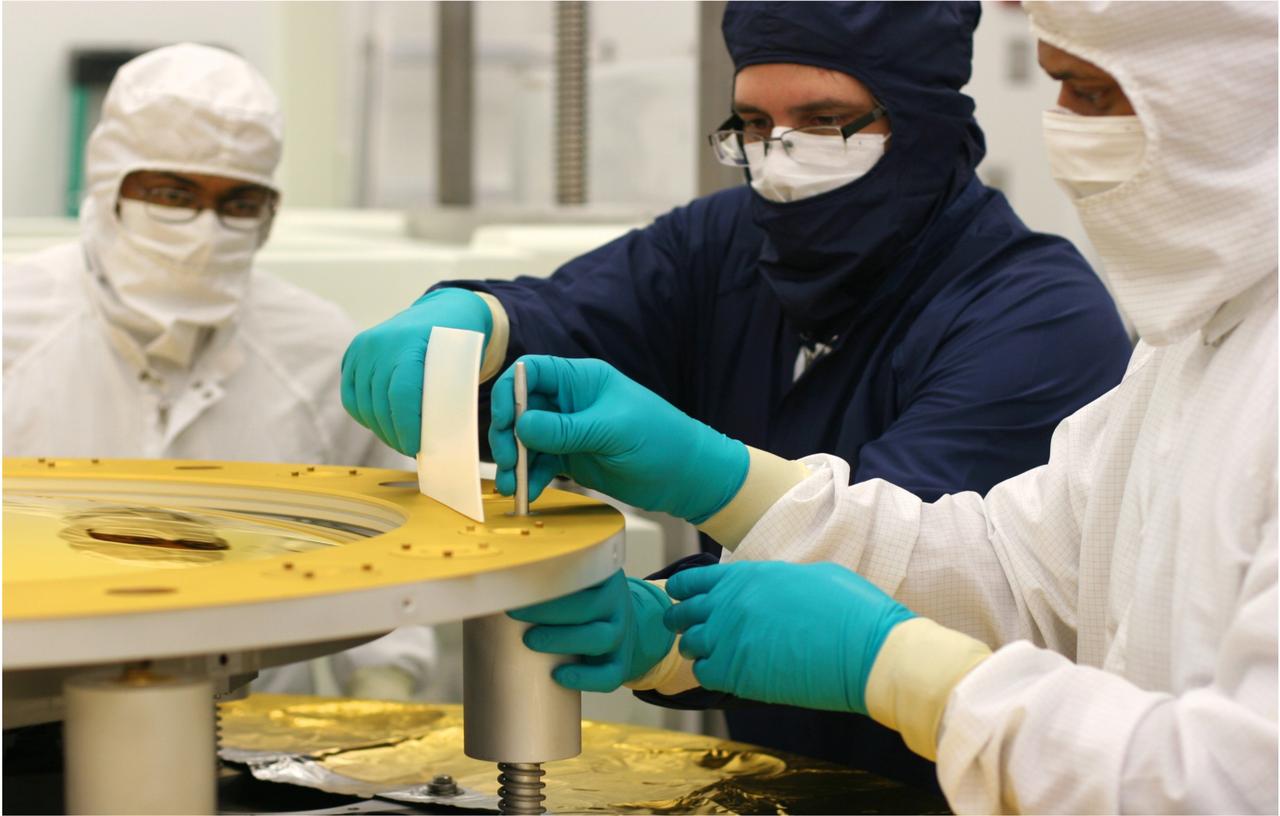
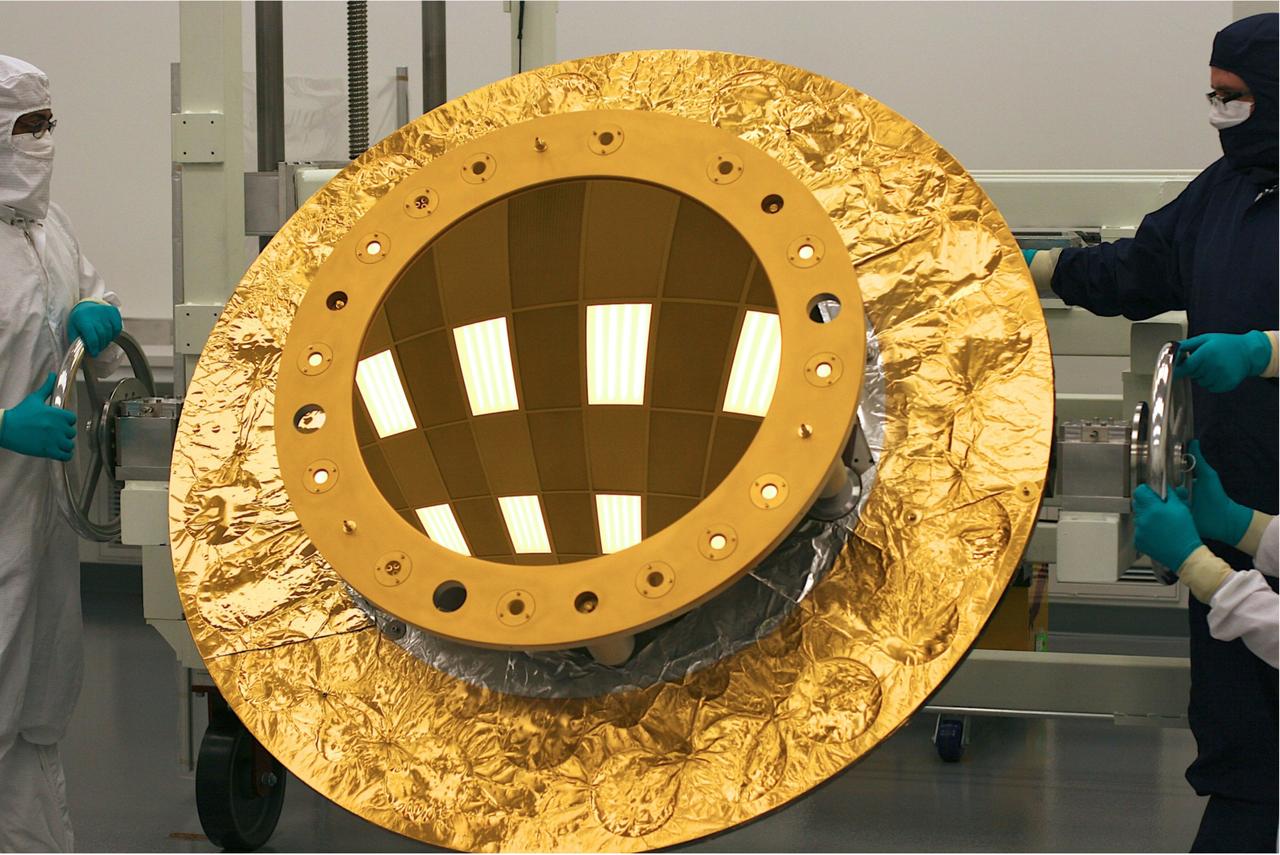
NASA release July 19, 2011 <b>Click here to learn about the <a href="http://www.jwst.nasa.gov/" rel="nofollow"> James Webb Space Telescope</a></b> The secondary mirror (shown here) was polished at the L3 Integrated Optical Systems - Tinsley in Richmond, Calif. to accuracies of less than one millionth of an inch. That accuracy is important for forming the sharpest images when the mirrors cool to -400°F (-240°C) in the cold of space. The Webb's secondary mirror was recently completed, following polishing and gold-coating. "Secondary" may not sound as important as "primary" but when it comes to the next-generation James Webb Space Telescope a secondary mirror plays a critical role in ensuring the telescope gathers information from the cosmos. The Webb's secondary mirror was recently completed, following polishing and gold-coating. There are four different types of mirrors that will fly on the James Webb Space Telescope, and all are made of a light metal called beryllium. It is very strong for its weight and holds its shape across a range of temperatures. There are primary mirror segments (18 total that combined make the large primary mirror providing a collecting area of 25 meters squared/269.1 square feet), the secondary mirror, tertiary mirror and the fine steering mirror. Unlike the primary mirror, which is molded into the shape of a hexagon, the secondary mirror is perfectly rounded. The mirror is also convex, so the reflective surface bulges toward a light source. It looks much like a curved mirror that you'll see on the wall near the exit of a parking garage that lets motorists see around a corner. This mirror is coated with a microscopic layer of gold to enable it to efficiently reflect infrared light (which is what the Webb telescope's cameras see). The quality of the secondary mirror surface is so good that the final convex surface at cold temperatures does not deviate from the design by more than a few millionths of a millimeter - or about one ten thousandth the diameter of a human hair. "As the only convex mirror on the Webb telescope, the secondary mirror has always been recognized to be the hardest of all of the mirrors to polish and test, so we are delighted that its performance meets all specifications," said Lee Feinberg, Webb Optical Telescope manager at NASA's Goddard Space Flight Center in Greenbelt, Md. Convex mirrors are particularly hard to test because light that strikes them diverges away from the mirror. Feinberg noted, "The Webb telescope convex secondary mirror is approximately the size of the Spitzer Space Telescope's primary mirror and is by far the largest convex cryogenic mirror ever built for a NASA program." It was data from the Spitzer's mirrors that helped make the decision to use beryllium for the Webb telescope mirrors. Spitzer's mirrors were also made of beryllium. So why is this mirror so critical? Because the secondary mirror captures light from the 18 primary mirror segments and relays those distant images of the cosmos to the telescope's science cameras. The secondary mirror is mounted on folding "arms" that position it in front of the 18 primary mirror segments. The secondary mirror will soon come to NASA's Goddard Space Flight Center in Greenbelt, Md. where it will be installed on the telescope structure. Then, as a complete unit, the telescope structure and mirrors will undergo acoustic and vibration testing. The secondary mirror was developed at Ball Aerospace & Technology Corp. of Boulder, Colo. and the mirror recently completed polishing at the L3–IOS-Tinsley facility in Richmond, Calif. Northrop Grumman space Systems is the prime contractor on the Webb telescope program. The James Webb Space Telescope is the world’s next-generation space observatory and successor to the Hubble Space Telescope. The most powerful space telescope ever built, Webb will observe the most distant objects in the universe, provide images of the very first galaxies ever formed and see unexplored planets around distant stars. The Webb Telescope is a joint project of NASA, the European Space Agency and the Canadian Space Agency. Credit:NASA/Ball Aerospace/Tinsley <b><a href="http://www.nasa.gov/centers/goddard/home/index.html" rel="nofollow">NASA Goddard Space Flight Center</a></b> enables NASA’s mission through four scientific endeavors: Earth Science, Heliophysics, Solar System Exploration, and Astrophysics. Goddard plays a leading role in NASA’s accomplishments by contributing compelling scientific knowledge to advance the Agency’s mission. <b>Follow us on <a href="http://twitter.com/NASA_GoddardPix" rel="nofollow">Twitter</a></b> <b>Like us on <a href="http://www.facebook.com/pages/Greenbelt-MD/NASA-Goddard/395013845897?ref=tsd" rel="nofollow">Facebook</a></b> <b>Find us on <a href="http://web.stagram.com/n/nasagoddard/?vm=grid" rel="nofollow">Instagram</a></b>
NASA release July 19, 2011 <b>Click here to learn about the <a href="http://www.jwst.nasa.gov/" rel="nofollow"> James Webb Space Telescope</a></b> The secondary mirror (shown here) was polished at the L3 Integrated Optical Systems - Tinsley in Richmond, Calif. to accuracies of less than one millionth of an inch. That accuracy is important for forming the sharpest images when the mirrors cool to -400°F (-240°C) in the cold of space. The Webb's secondary mirror was recently completed, following polishing and gold-coating. "Secondary" may not sound as important as "primary" but when it comes to the next-generation James Webb Space Telescope a secondary mirror plays a critical role in ensuring the telescope gathers information from the cosmos. The Webb's secondary mirror was recently completed, following polishing and gold-coating. There are four different types of mirrors that will fly on the James Webb Space Telescope, and all are made of a light metal called beryllium. It is very strong for its weight and holds its shape across a range of temperatures. There are primary mirror segments (18 total that combined make the large primary mirror providing a collecting area of 25 meters squared/269.1 square feet), the secondary mirror, tertiary mirror and the fine steering mirror. Unlike the primary mirror, which is molded into the shape of a hexagon, the secondary mirror is perfectly rounded. The mirror is also convex, so the reflective surface bulges toward a light source. It looks much like a curved mirror that you'll see on the wall near the exit of a parking garage that lets motorists see around a corner. This mirror is coated with a microscopic layer of gold to enable it to efficiently reflect infrared light (which is what the Webb telescope's cameras see). The quality of the secondary mirror surface is so good that the final convex surface at cold temperatures does not deviate from the design by more than a few millionths of a millimeter - or about one ten thousandth the diameter of a human hair. "As the only convex mirror on the Webb telescope, the secondary mirror has always been recognized to be the hardest of all of the mirrors to polish and test, so we are delighted that its performance meets all specifications," said Lee Feinberg, Webb Optical Telescope manager at NASA's Goddard Space Flight Center in Greenbelt, Md. Convex mirrors are particularly hard to test because light that strikes them diverges away from the mirror. Feinberg noted, "The Webb telescope convex secondary mirror is approximately the size of the Spitzer Space Telescope's primary mirror and is by far the largest convex cryogenic mirror ever built for a NASA program." It was data from the Spitzer's mirrors that helped make the decision to use beryllium for the Webb telescope mirrors. Spitzer's mirrors were also made of beryllium. So why is this mirror so critical? Because the secondary mirror captures light from the 18 primary mirror segments and relays those distant images of the cosmos to the telescope's science cameras. The secondary mirror is mounted on folding "arms" that position it in front of the 18 primary mirror segments. The secondary mirror will soon come to NASA's Goddard Space Flight Center in Greenbelt, Md. where it will be installed on the telescope structure. Then, as a complete unit, the telescope structure and mirrors will undergo acoustic and vibration testing. The secondary mirror was developed at Ball Aerospace & Technology Corp. of Boulder, Colo. and the mirror recently completed polishing at the L3–IOS-Tinsley facility in Richmond, Calif. Northrop Grumman space Systems is the prime contractor on the Webb telescope program. The James Webb Space Telescope is the world’s next-generation space observatory and successor to the Hubble Space Telescope. The most powerful space telescope ever built, Webb will observe the most distant objects in the universe, provide images of the very first galaxies ever formed and see unexplored planets around distant stars. The Webb Telescope is a joint project of NASA, the European Space Agency and the Canadian Space Agency. Credit:NASA/Ball Aerospace/Tinsley <b><a href="http://www.nasa.gov/centers/goddard/home/index.html" rel="nofollow">NASA Goddard Space Flight Center</a></b> enables NASA’s mission through four scientific endeavors: Earth Science, Heliophysics, Solar System Exploration, and Astrophysics. Goddard plays a leading role in NASA’s accomplishments by contributing compelling scientific knowledge to advance the Agency’s mission. <b>Follow us on <a href="http://twitter.com/NASA_GoddardPix" rel="nofollow">Twitter</a></b> <b>Like us on <a href="http://www.facebook.com/pages/Greenbelt-MD/NASA-Goddard/395013845897?ref=tsd" rel="nofollow">Facebook</a></b> <b>Find us on <a href="http://web.stagram.com/n/nasagoddard/?vm=grid" rel="nofollow">Instagram</a></b>
![For me, I picked up an interest for engineering through drawing. When I was young, I was really big into art. Like most science-drawn younger kids, I would draw Pokémon, I would draw Dragon Ball Z, things like that. I guess my passion for art and drawing helped me to get into CAD (Computer Aided Design) modeling — things like 3D modeling and 3D printing. And with CAD modeling, you need to learn how to figure out the dimensions of things, what material they’re made out of, xyz. So that got me deeper into engineering. There’s definitely an artistic component to science. You can just look at James Webb [Space Telescope]. It looks artistic. If you look at the beveled mirrors, or how the bat wings on the side fold out, I would argue that that is artistic in a sense. But it also matches perfectly with its scientific functions. So not only does it need to fit into the rocket, but it also needs these beveled mirrors to reflect light at a specific angle. So, I think art and science blend pretty well. Kenneth Harris II, lead database engineer for the Joint Polar Satellite System (JPSS) J2 Satellite Mission at NASA’s Goddard Space Flight Center, Friday, Feb. 21, 2020, Greenbelt, Md. Photo Credit: (NASA/Joel Kowsky)](https://images-assets.nasa.gov/image/NHQ202002210002/NHQ202002210002~medium.jpg)
For me, I picked up an interest for engineering through drawing. When I was young, I was really big into art. Like most science-drawn younger kids, I would draw Pokémon, I would draw Dragon Ball Z, things like that. I guess my passion for art and drawing helped me to get into CAD (Computer Aided Design) modeling — things like 3D modeling and 3D printing. And with CAD modeling, you need to learn how to figure out the dimensions of things, what material they’re made out of, xyz. So that got me deeper into engineering. There’s definitely an artistic component to science. You can just look at James Webb [Space Telescope]. It looks artistic. If you look at the beveled mirrors, or how the bat wings on the side fold out, I would argue that that is artistic in a sense. But it also matches perfectly with its scientific functions. So not only does it need to fit into the rocket, but it also needs these beveled mirrors to reflect light at a specific angle. So, I think art and science blend pretty well. Kenneth Harris II, lead database engineer for the Joint Polar Satellite System (JPSS) J2 Satellite Mission at NASA’s Goddard Space Flight Center, Friday, Feb. 21, 2020, Greenbelt, Md. Photo Credit: (NASA/Joel Kowsky)
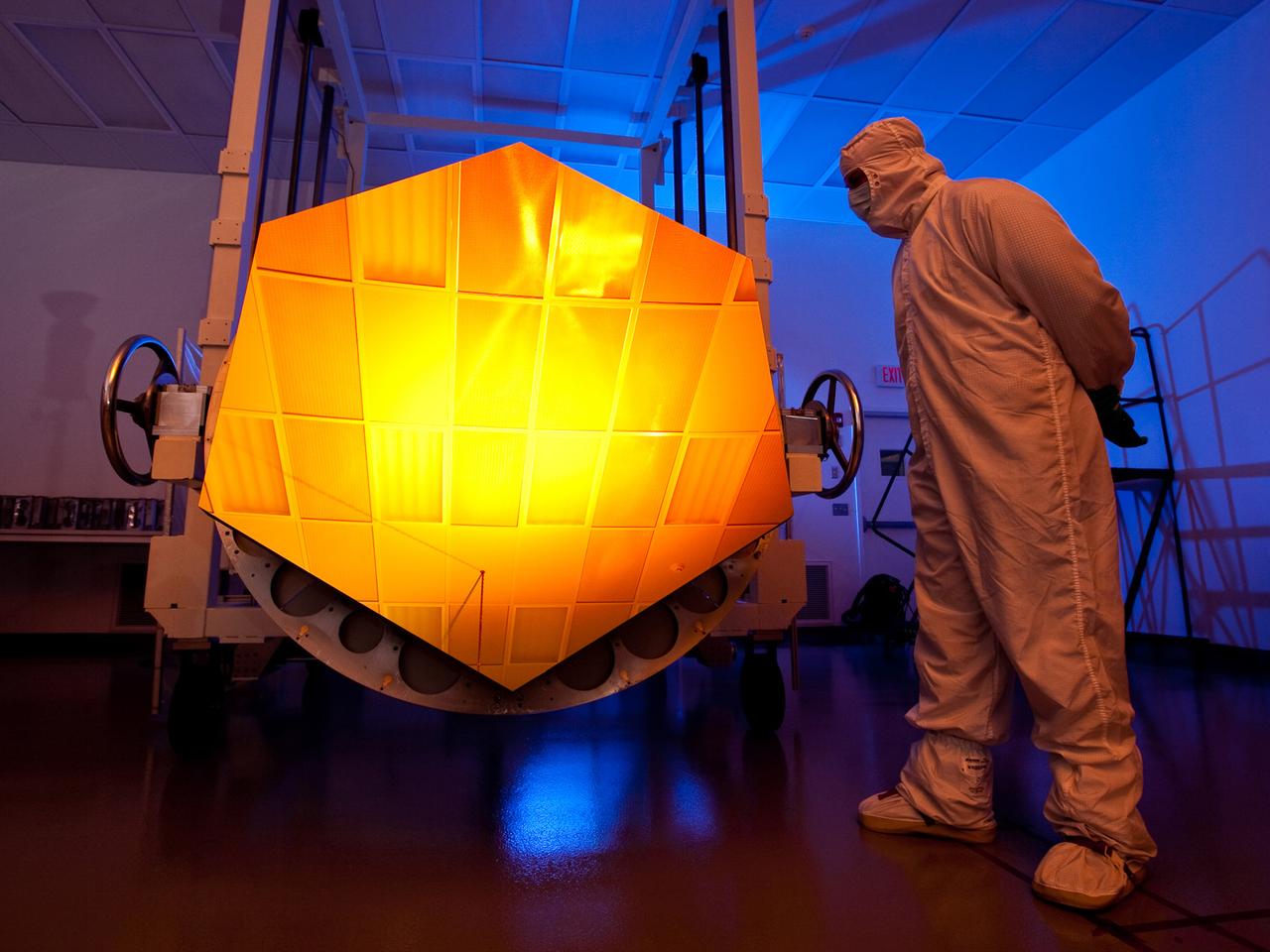
NASA image release December 9, 2010 Caption: The James Webb Space Telescope's Engineering Design Unit (EDU) primary mirror segment, coated with gold by Quantum Coating Incorporated. The actuator is located behind the mirror. Credit: Photo by Drew Noel NASA's James Webb Space Telescope is a wonder of modern engineering. As the planned successor to the Hubble Space telescope, even the smallest of parts on this giant observatory will play a critical role in its performance. A new video takes viewers behind the Webb's mirrors to investigate "actuators," one component that will help Webb focus on some of the earliest objects in the universe. The video called "Got Your Back" is part of an on-going video series about the Webb telescope called "Behind the Webb." It was produced at the Space Telescope Science Institute (STScI) in Baltimore, Md. and takes viewers behind the scenes with scientists and engineers who are creating the Webb telescope's components. During the 3 minute and 12 second video, STScI host Mary Estacion interviewed people involved in the project at Ball Aerospace in Boulder, Colo. and showed the actuators in action. The Webb telescope will study every phase in the history of our universe, ranging from the first luminous glows after the big bang, to the formation of solar systems capable of supporting life on planets like Earth, to the evolution of our own solar system. Measuring the light this distant light requires a primary mirror 6.5 meters (21 feet 4 inches) across – six times larger than the Hubble Space telescope’s mirror! Launching a mirror this large into space isn’t feasible. Instead, Webb engineers and scientists innovated a unique solution – building 18 mirrors that will act in unison as one large mirror. These mirrors are packaged together into three sections that fold up - much easier to fit inside a rocket. Each mirror is made from beryllium and weighs approximately 20 kilograms (46 pounds). Once in space, getting these mirrors to focus correctly on faraway galaxies is another challenge entirely. Actuators, or tiny mechanical motors, provide the answer to achieving a single perfect focus. The primary and secondary mirror segments are both moved by six actuators that are attached to the back of the mirrors. The primary segment has an additional actuator at the center of the mirror that adjusts its curvature. The third mirror segment remains stationary. Lee Feinberg, Webb Optical Telescope Element Manager at NASA's Goddard Space Flight Center in Greenbelt, Md. explained "Aligning the primary mirror segments as though they are a single large mirror means each mirror is aligned to 1/10,000th the thickness of a human hair. This alignment has to be done at 50 degrees above absolute zero! What's even more amazing is that the engineers and scientists working on the Webb telescope literally had to invent how to do this." With the actuators in place, Brad Shogrin, Webb Telescope Manager at Ball Aerospace, Boulder, Colo, details the next step: attaching the hexapod (meaning six-footed) assembly and radius of curvature subsystem (ROC). "Radius of curvature" refers to the distance to the center point of the curvature of the mirror. Feinberg added "To understand the concept in a more basic sense, if you change that radius of curvature, you change the mirror's focus." The "Behind the Webb" video series is available in HQ, large and small Quicktime formats, HD, Large and Small WMV formats, and HD, Large and Small Xvid formats. To see the actuators being attached to the back of a telescope mirror in this new "Behind the Webb" video, visit: <a href="http://webbtelescope.org/webb_telescope/behind_the_webb/7" rel="nofollow">webbtelescope.org/webb_telescope/behind_the_webb/7</a> For more information about Webb's mirrors, visit: <a href="http://www.jwst.nasa.gov/mirrors.html" rel="nofollow">www.jwst.nasa.gov/mirrors.html</a> For more information on the James Webb Space Telescope, visit: <a href="http://jwst.nasa.gov" rel="nofollow">jwst.nasa.gov</a> Rob Gutro NASA's Goddard Space Flight Center, Greenbelt, Md. <b><a href="http://www.nasa.gov/centers/goddard/home/index.html" rel="nofollow">NASA Goddard Space Flight Center</a></b> enables NASA’s mission through four scientific endeavors: Earth Science, Heliophysics, Solar System Exploration, and Astrophysics. Goddard plays a leading role in NASA’s accomplishments by contributing compelling scientific knowledge to advance the Agency’s mission. <b>Follow us on <a href="http://twitter.com/NASA_GoddardPix" rel="nofollow">Twitter</a></b> <b>Join us on <a href="http://www.facebook.com/pages/Greenbelt-MD/NASA-Goddard/395013845897?ref=tsd" rel="nofollow">Facebook</a></b>
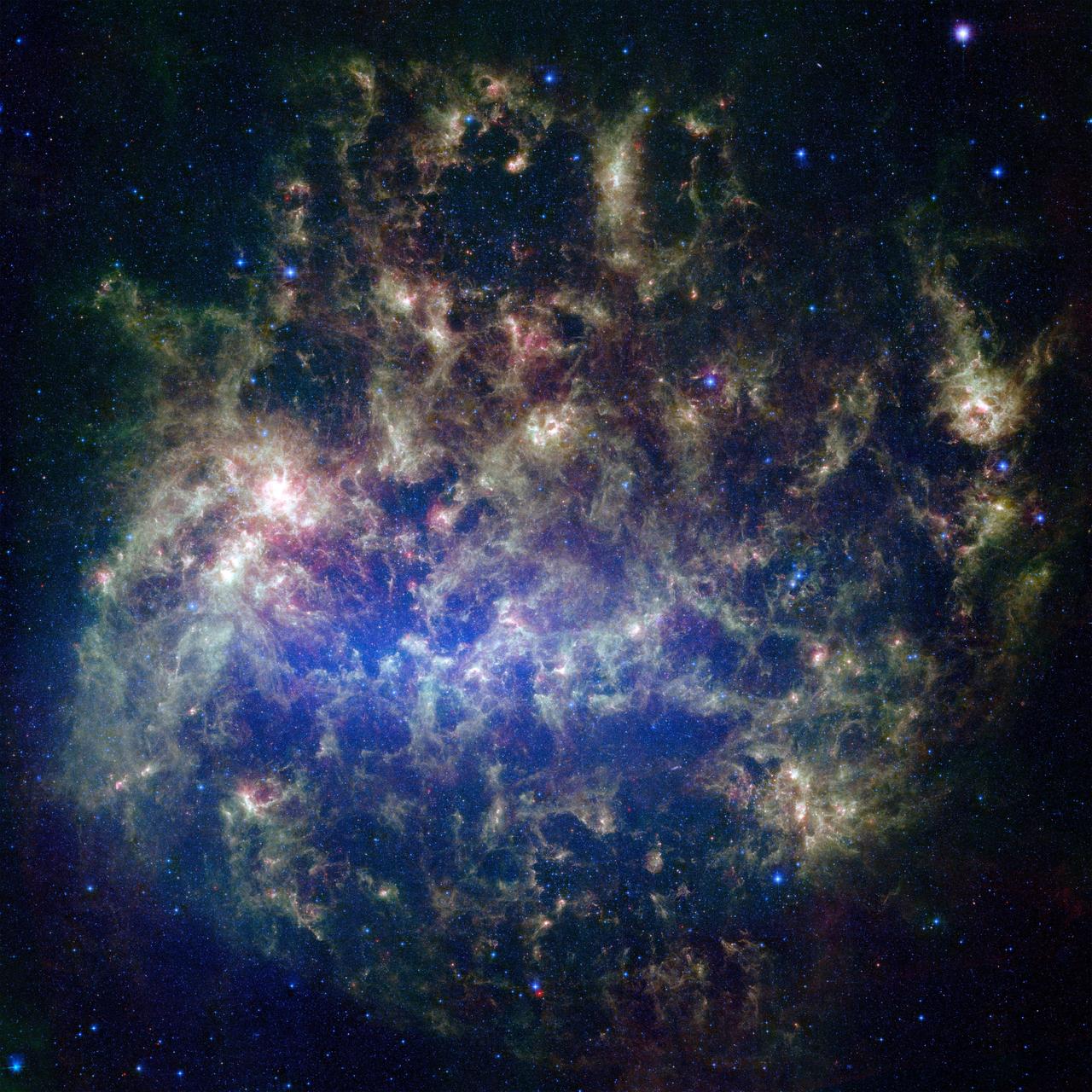
This vibrant image from NASA's Spitzer Space Telescope shows the Large Magellanic Cloud, a satellite galaxy to our own Milky Way galaxy. The infrared image, a mosaic of 300,000 individual tiles, offers astronomers a unique chance to study the lifecycle of stars and dust in a single galaxy. Nearly one million objects are revealed for the first time in this Spitzer view, which represents about a 1,000-fold improvement in sensitivity over previous space-based missions. Most of the new objects are dusty stars of various ages populating the Large Magellanic Cloud; the rest are thought to be background galaxies. The blue color in the picture, seen most prominently in the central bar, represents starlight from older stars. The chaotic, bright regions outside this bar are filled with hot, massive stars buried in thick blankets of dust. The red color around these bright regions is from dust heated by stars, while the red dots scattered throughout the picture are either dusty, old stars or more distant galaxies. The greenish clouds contain cooler interstellar gas and molecular-sized dust grains illuminated by ambient starlight. Astronomers say this image allows them to quantify the process by which space dust -- the same stuff that makes up planets and even people -- is recycled in a galaxy. The picture shows dust at its three main cosmic hangouts: around the young stars, where it is being consumed (red-tinted, bright clouds); scattered about in the space between stars (greenish clouds); and in expelled shells of material from old stars (randomly-spaced red dots). The Large Magellanic Cloud, located 160,000 light-years from Earth, is one of a handful of dwarf galaxies that orbit our own Milky Way. It is approximately one-third as wide as the Milky Way, and, if it could be seen in its entirety, would cover the same amount of sky as a grid of about 480 full moons. About one-third of the entire galaxy can be seen in the Spitzer image. This picture is a composite of infrared light captured by Spitzer. Light with wavelengths of 3.6 (blue) and 8 (green) microns was captured by the telescope's infrared array camera; 24-micron light (red) was detected by the multiband imaging photometer. http://photojournal.jpl.nasa.gov/catalog/PIA07137
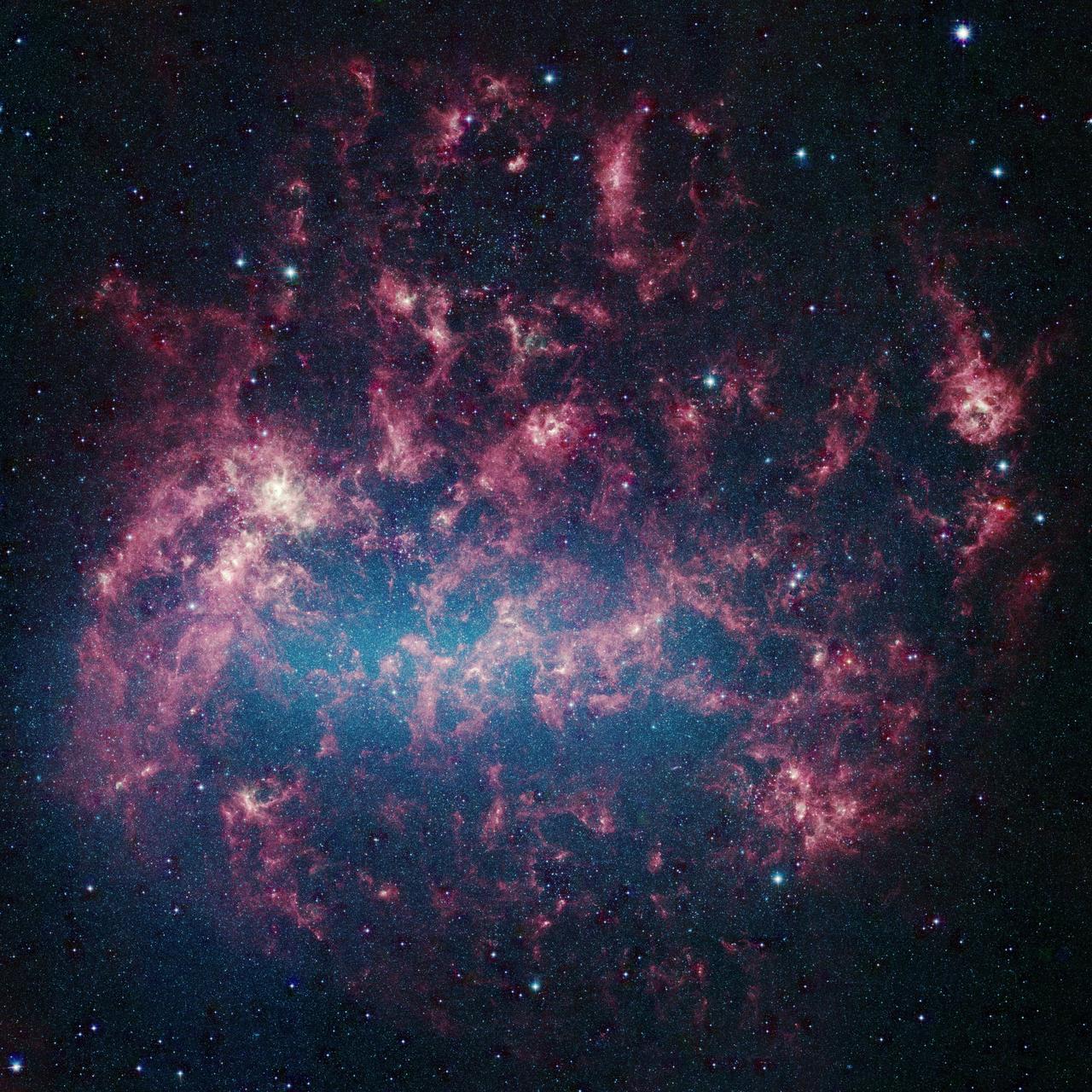
This vibrant image from NASA's Spitzer Space Telescope shows the Large Magellanic Cloud, a satellite galaxy to our own Milky Way galaxy. The infrared image, a mosaic of more than 100,000 individual tiles, offers astronomers a unique chance to study the lifecycle of stars and dust in a single galaxy. Nearly one million objects are revealed for the first time in this Spitzer view, which represents about a 1,000-fold improvement in sensitivity over previous space-based missions. Most of the new objects are dusty stars of various ages populating the Large Magellanic Cloud; the rest are thought to be background galaxies. The blue color in the picture, seen most prominently in the central bar, represents starlight from older stars. The chaotic, bright regions outside this bar are filled with hot, massive stars buried in thick blankets of dust. The red clouds contain cooler interstellar gas and molecular-sized dust grains illuminated by ambient starlight. The Large Magellanic Cloud, located 160,000 light-years from Earth, is one of a handful of dwarf galaxies that orbit our own Milky Way. It is approximately one-third as wide as the Milky Way, and, if it could be seen in its entirety, would cover the same amount of sky as a grid of about 480 full moons. About one-third of the whole galaxy can be seen in the Spitzer image. This picture is a composite of infrared light captured by Spitzer's infrared array camera. Light with wavelengths of 8 and 5.8 microns is red and orange: 4.5-micron light is green; and 3.6-micron light is blue. http://photojournal.jpl.nasa.gov/catalog/PIA07136
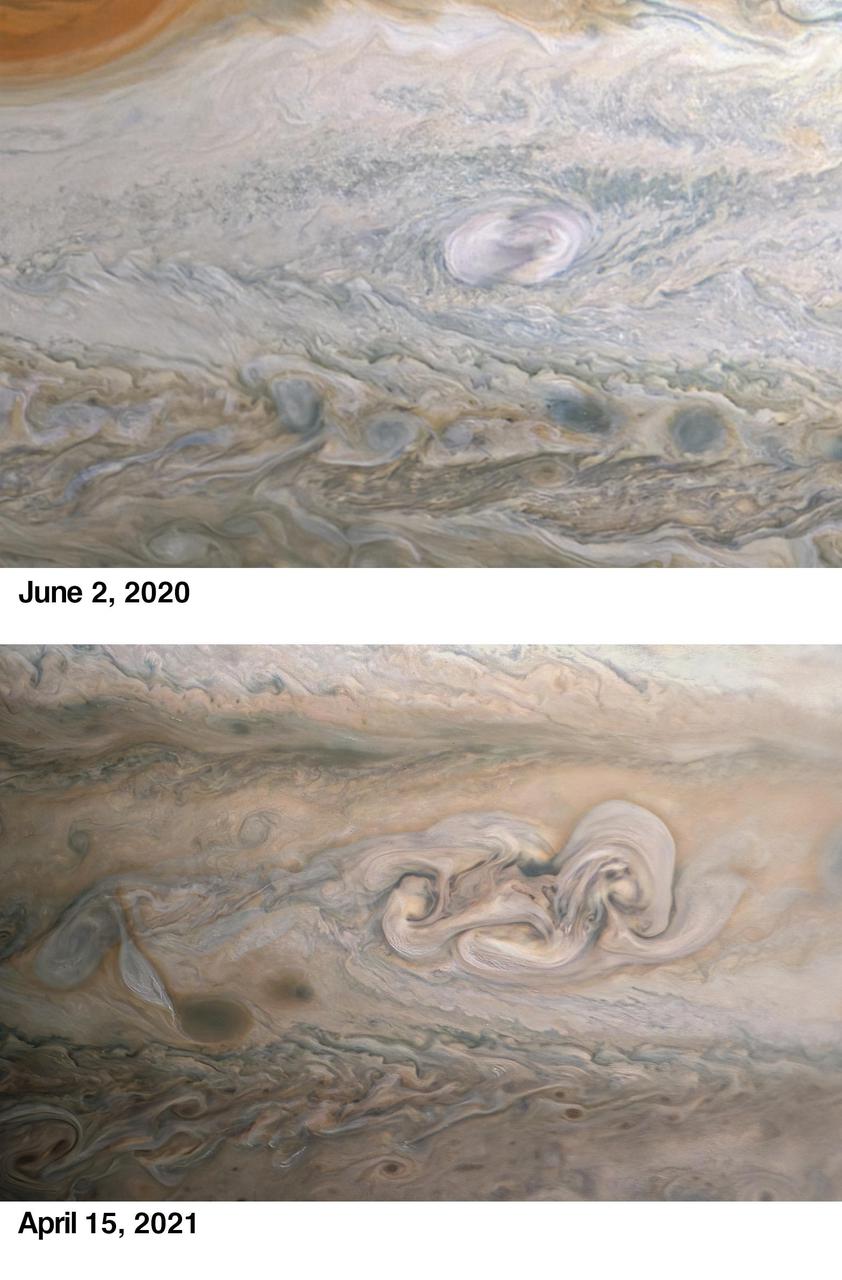
During its 33rd low pass over the cloud tops of Jupiter on April 15, 2021, NASA's Juno spacecraft captured the intriguing evolution of a feature in the giant planet's atmosphere known as "Clyde's Spot." The feature is informally named for amateur astronomer Clyde Foster of Centurion, South Africa, who discovered it in 2020 using his own 14-inch telescope. On June 2, 2020, just two days after Foster's initial discovery, Juno provided detailed observations of Clyde's Spot (upper image), which scientists determined was a plume of cloud material erupting above the top layers of the Jovian atmosphere just southeast of Jupiter's Great Red Spot, which is currently about 1.3 times as wide as Earth. These powerful convective outbreaks occasionally occur in this latitude band, known as the South Temperate Belt. The initial plume subsided quickly, and within a few weeks it was seen as a dark spot. Many features in Jupiter's highly dynamic atmosphere are short lived, but the April 2021 observation from the JunoCam instrument (lower image) revealed that nearly one year after its discovery, the remnant of Clyde's Spot had not only drifted away from the Great Red Spot but had also developed into a complex structure that scientists call a folded filamentary region. This region is twice as big in latitude and three times as big in longitude as the original spot, and has the potential to persist for an extended period of time. The upper image was taken on June 2, 2020, around 3:56 a.m. when the spacecraft was about 28,000 miles (45,000 kilometers) from Jupiter's cloud tops. The lower image was taken on April 15, 2021, at 4:58 p.m. PDT (7:58 p.m. EDT). At the time, the spacecraft was about 16,800 miles (27,000 kilometers) from Jupiter's cloud tops, at a latitude of about 30 degrees South. Another citizen scientist, Kevin M. Gill, processed both images from raw JunoCam data. https://photojournal.jpl.nasa.gov/catalog/PIA23609