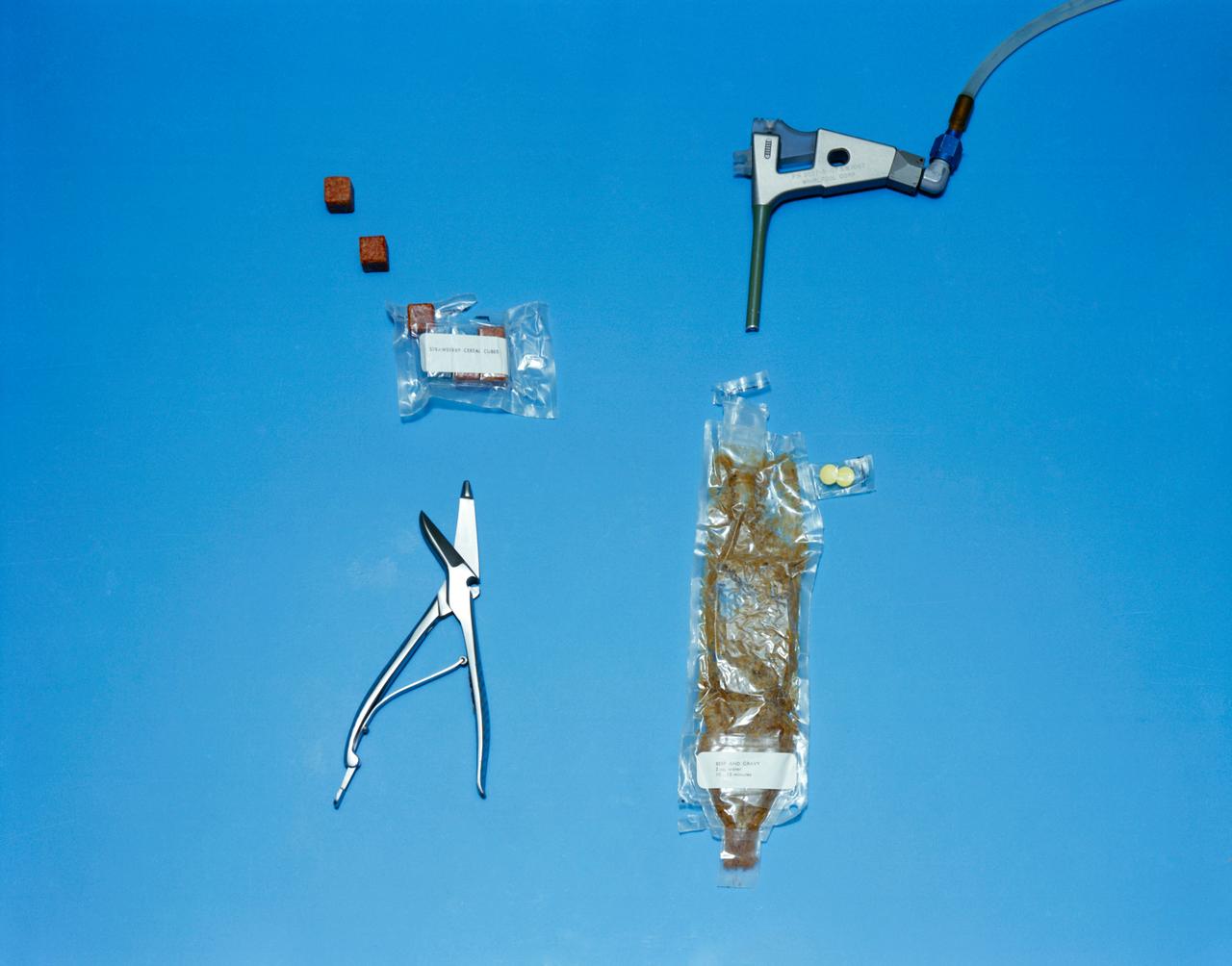
Food packages of beef and gravy fully reconstituted and ready to eat. An astronaut would squeeze food through opening at right side of package. Water gun is used to reconstitute dehydrated food. Scissors are used to open packages. This is the type of space food which will be used on the Gemini-Titan 4 spaceflight. MSC, Houston, TX *S65-24895 thru S65-24899
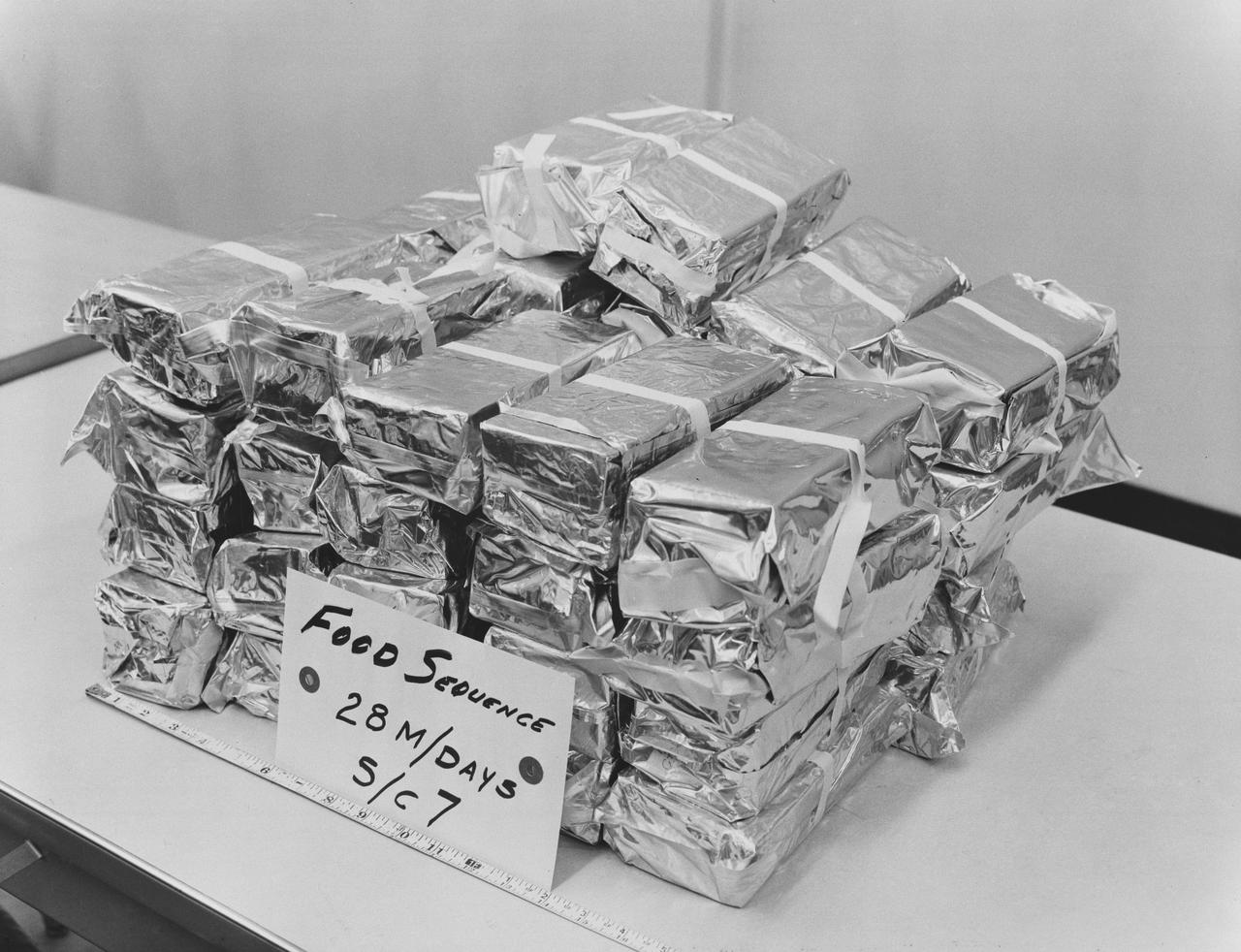
S65-61653 (1 Dec. 1965) --- Complete food supply for the two-man crew of the National Aeronautics and Space Administration's Gemini-7 spaceflight as it appears prior to stowage in the spacecraft. The food packages are tied in sequence for 28-manned days or a complete supply for two men for a 14-day mission. Photo credit: NASA
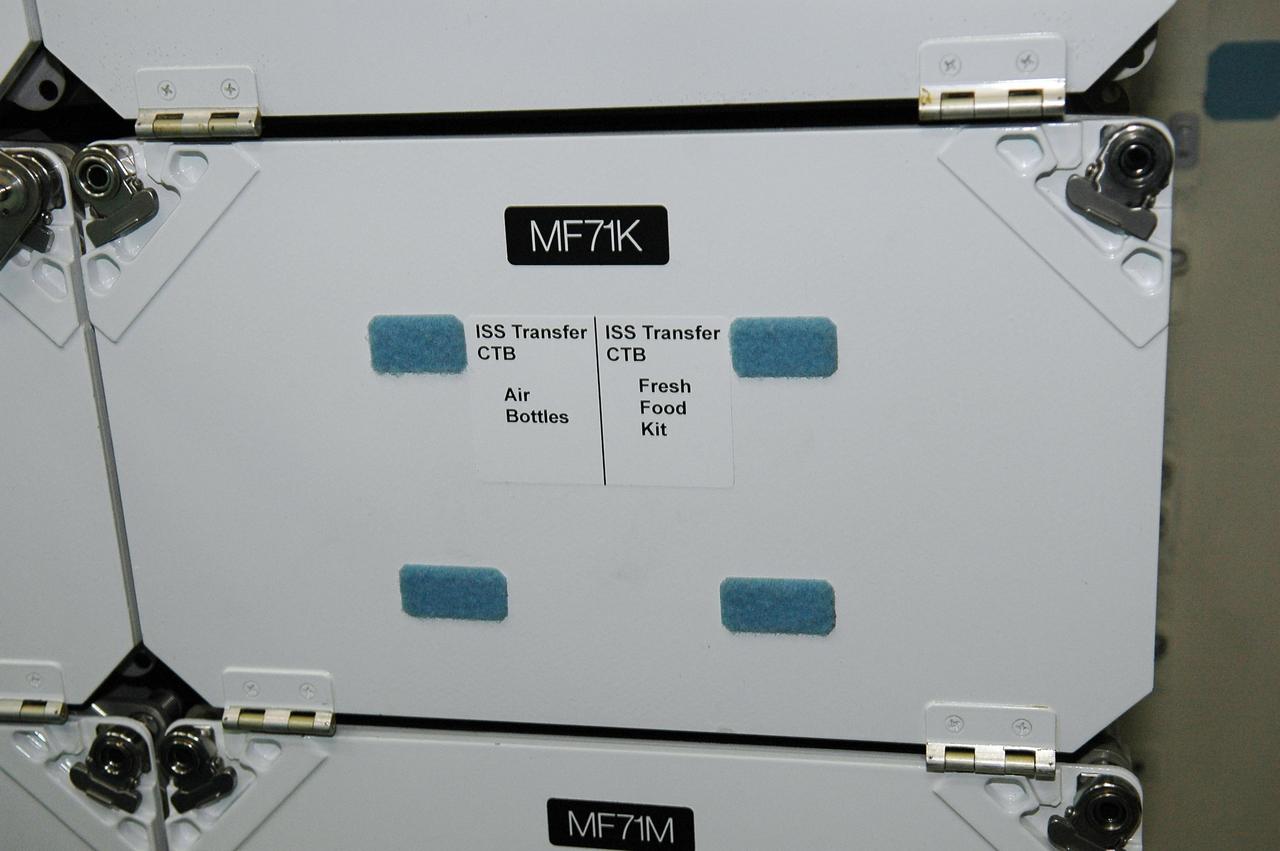
KENNEDY SPACE CENTER, FLA. - Inside Space Shuttle Discovery, these lockers store food containers for use on mission STS-121. Astronauts are supplied with three balanced meals, plus snacks. Foods flown on space missions are researched and developed at the Space Food Systems Laboratory at the Johnson Space Center (JSC) in Houston, which is staffed by food scientists, dietitians and engineers. Each astronaut’s food stored aboard the space shuttle is identified by a colored dot affixed to each package. Launch of Space Shuttle Discovery on mission STS-121 is scheduled for July 1. Photo credit: NASA/Kim Shiflett

KENNEDY SPACE CENTER, FLA. - In the White Room on Launch Pad 39B, workers unload food containers to be stored in Space Shuttle Discovery for mission STS-121. The White Room, which extends from the fixed service structure, provides access into the orbiter on the pad. Astronauts are supplied with three balanced meals, plus snacks. Foods flown on space missions are researched and developed at the Space Food Systems Laboratory at the Johnson Space Center (JSC) in Houston, which is staffed by food scientists, dietitians and engineers. Each astronaut’s food stored aboard the space shuttle is identified by a colored dot affixed to each package. Launch of Space Shuttle Discovery on mission STS-121 is scheduled for July 1. Photo credit: NASA/Kim Shiflett
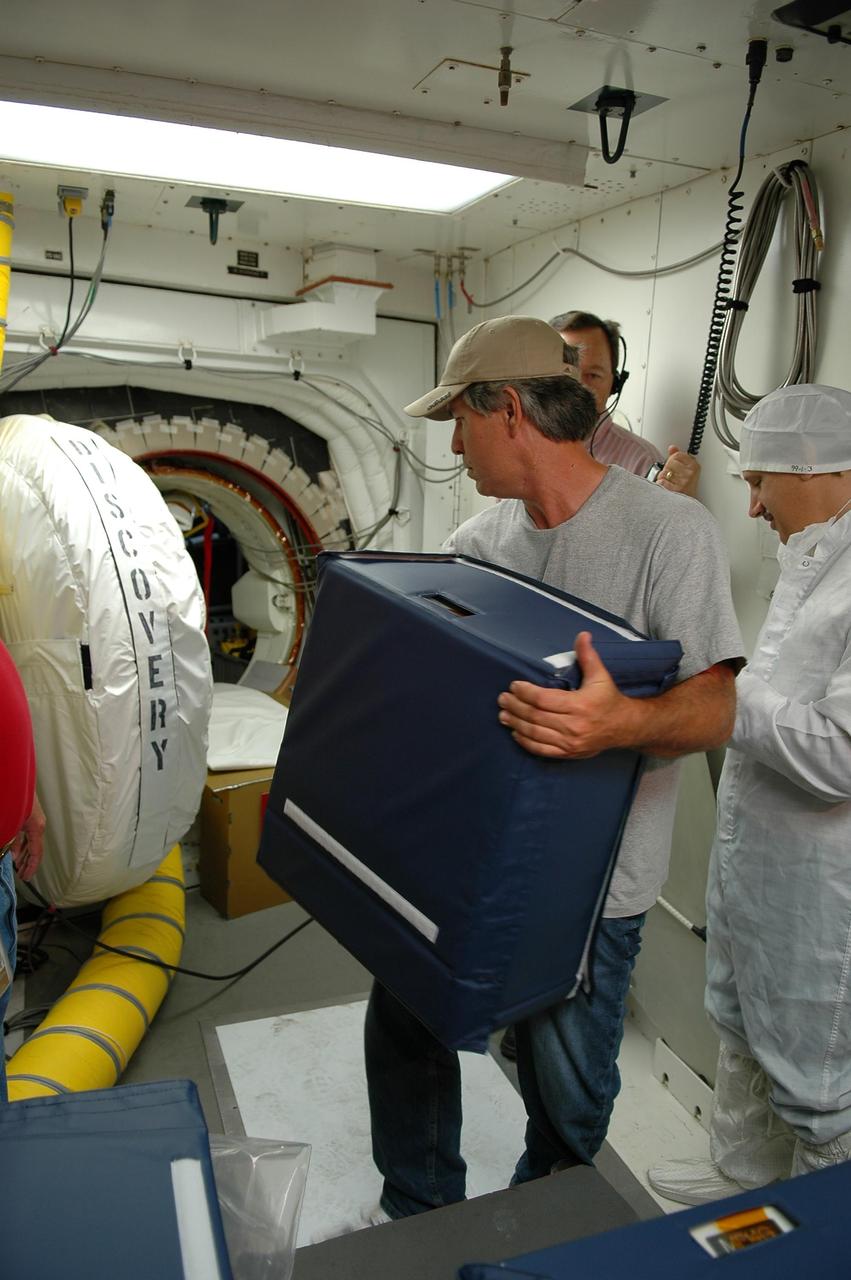
KENNEDY SPACE CENTER, FLA. - In the White Room on Launch Pad 39B, a worker carries a food container toward the hatch of Space Shuttle Discovery to be stored for mission STS-121. The White Room, which extends from the fixed service structure, provides access into the orbiter on the pad. Astronauts are supplied with three balanced meals, plus snacks. Foods flown on space missions are researched and developed at the Space Food Systems Laboratory at the Johnson Space Center (JSC) in Houston, which is staffed by food scientists, dietitians and engineers. Each astronaut’s food stored aboard the space shuttle is identified by a colored dot affixed to each package. Launch of Space Shuttle Discovery on mission STS-121 is scheduled for July 1. Photo credit: NASA/Kim Shiflett
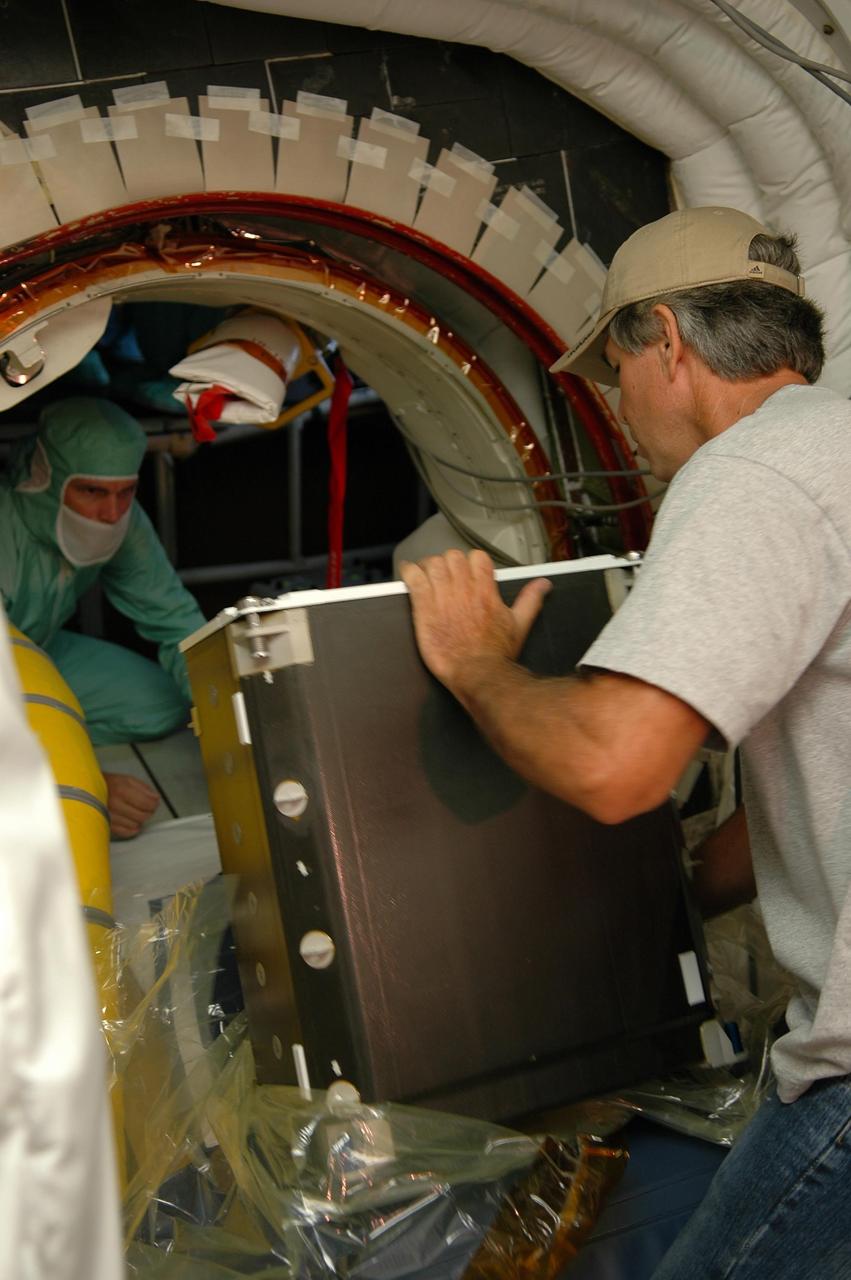
KENNEDY SPACE CENTER, FLA. - In the White Room on Launch Pad 39B, a worker hands off a food container to someone inside Space Shuttle Discovery to store it for mission STS-121. The White Room, which extends from the fixed service structure, provides access into the orbiter on the pad. Astronauts are supplied with three balanced meals, plus snacks. Foods flown on space missions are researched and developed at the Space Food Systems Laboratory at the Johnson Space Center (JSC) in Houston, which is staffed by food scientists, dietitians and engineers. Each astronaut’s food stored aboard the space shuttle is identified by a colored dot affixed to each package. Launch of Space Shuttle Discovery on mission STS-121 is scheduled for July 1. Photo credit: NASA/Kim Shiflett
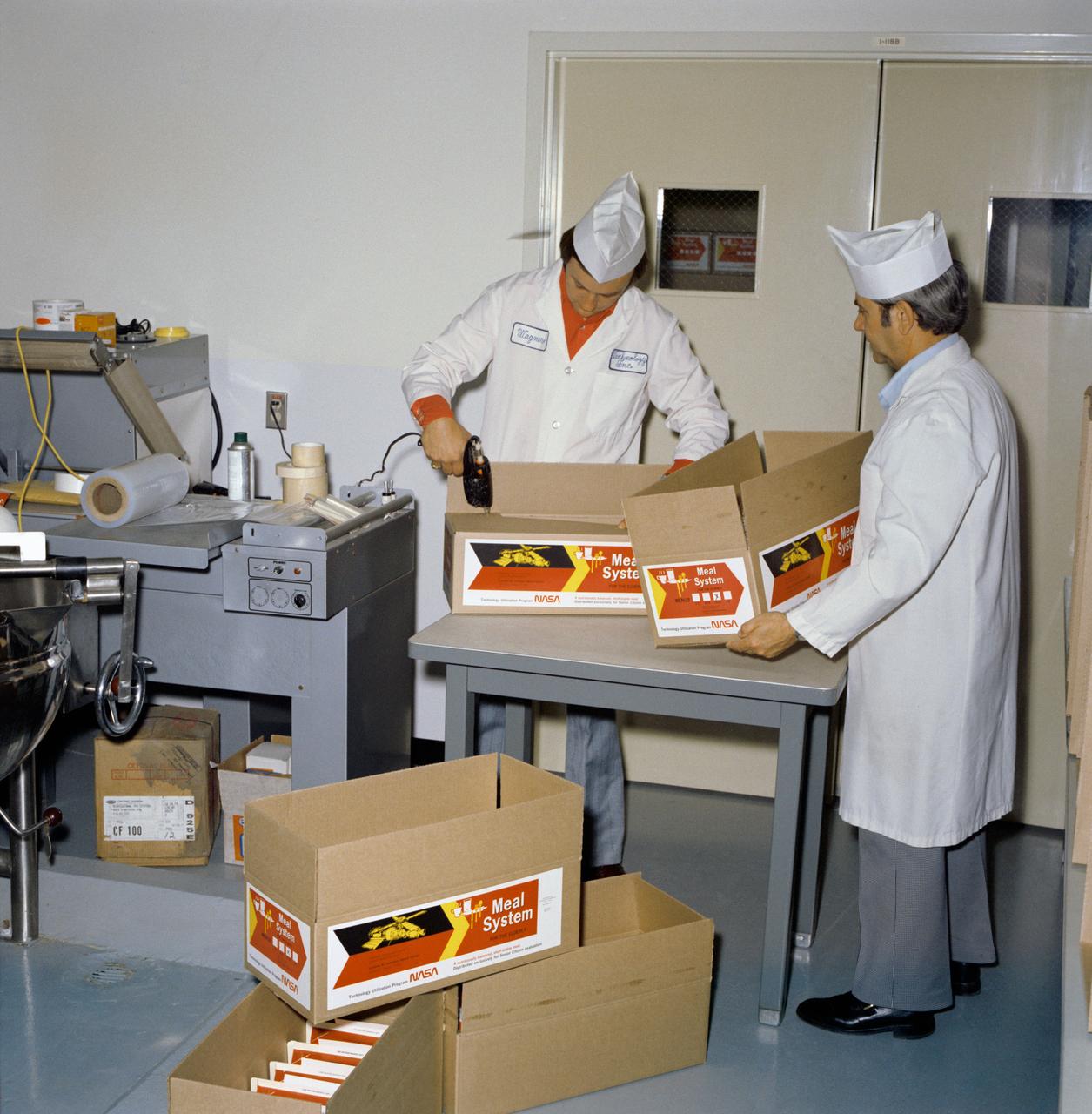
View of men packaging special food for the elderly, a spinoff program from the space program under auspices of Technology Utilization Program. Men and food are in the Bldg.37, where food has been stowed.
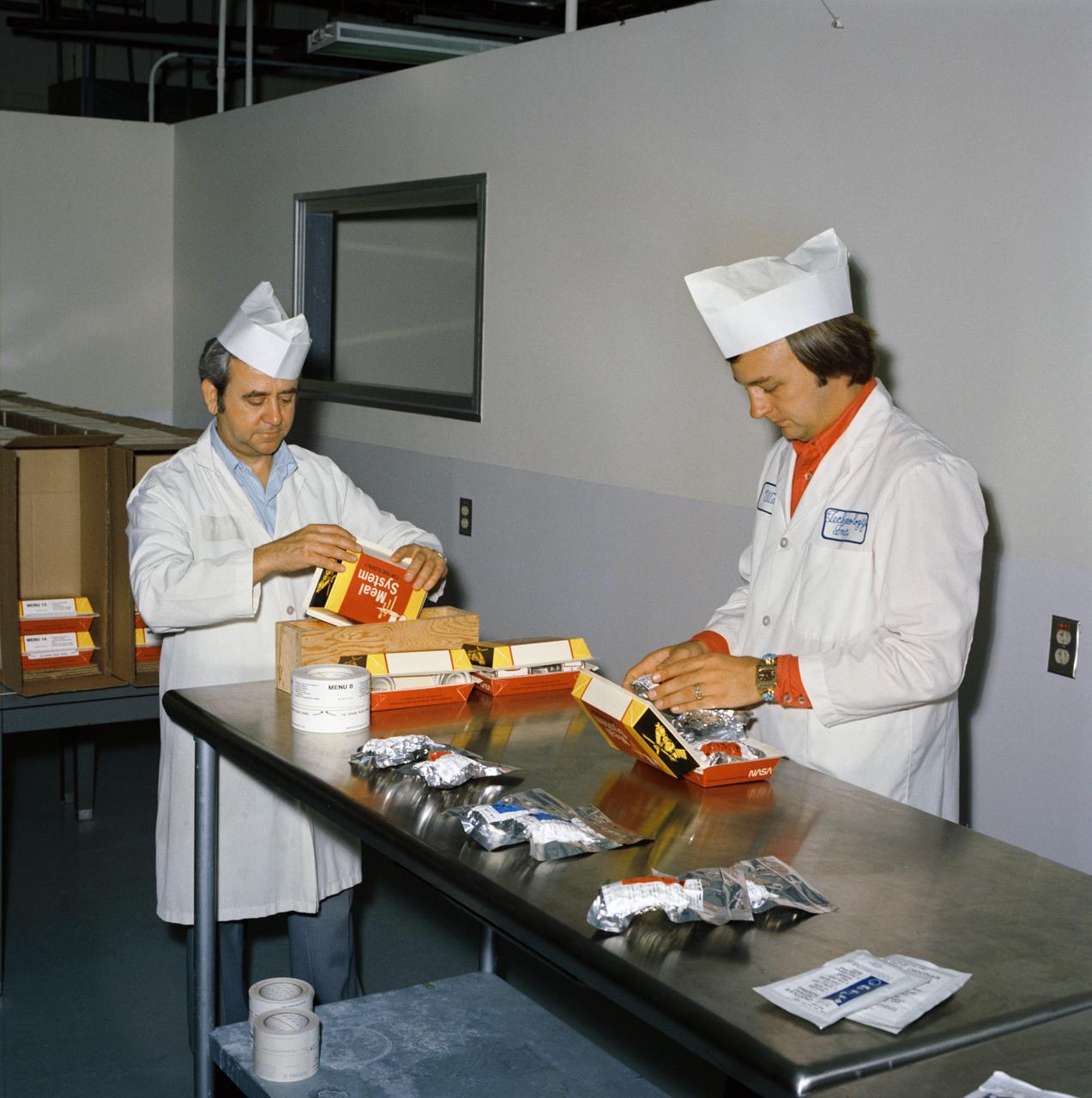
View of men packaging special food for the elderly, a spinoff program from the space program under auspices of Technology Utilization Program. Men and food are in the Bldg.37, where food has been stowed
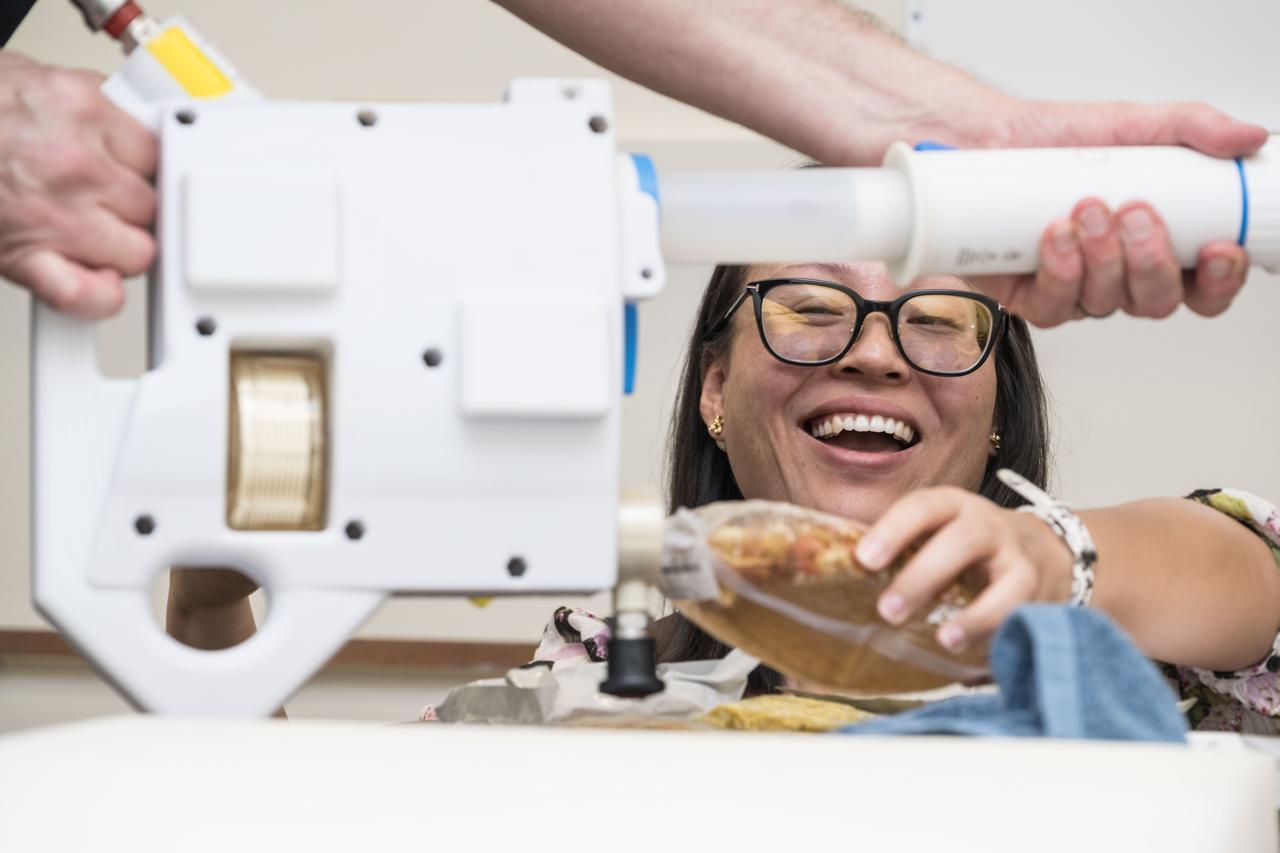
jsc2024e040737 -- NASA food scientists rehydrate a food pouch during a test of the Mini Potable Water Dispenser at Johnson Space Center on June 6, 2024. Photo Credit: NASA/David DeHoyos
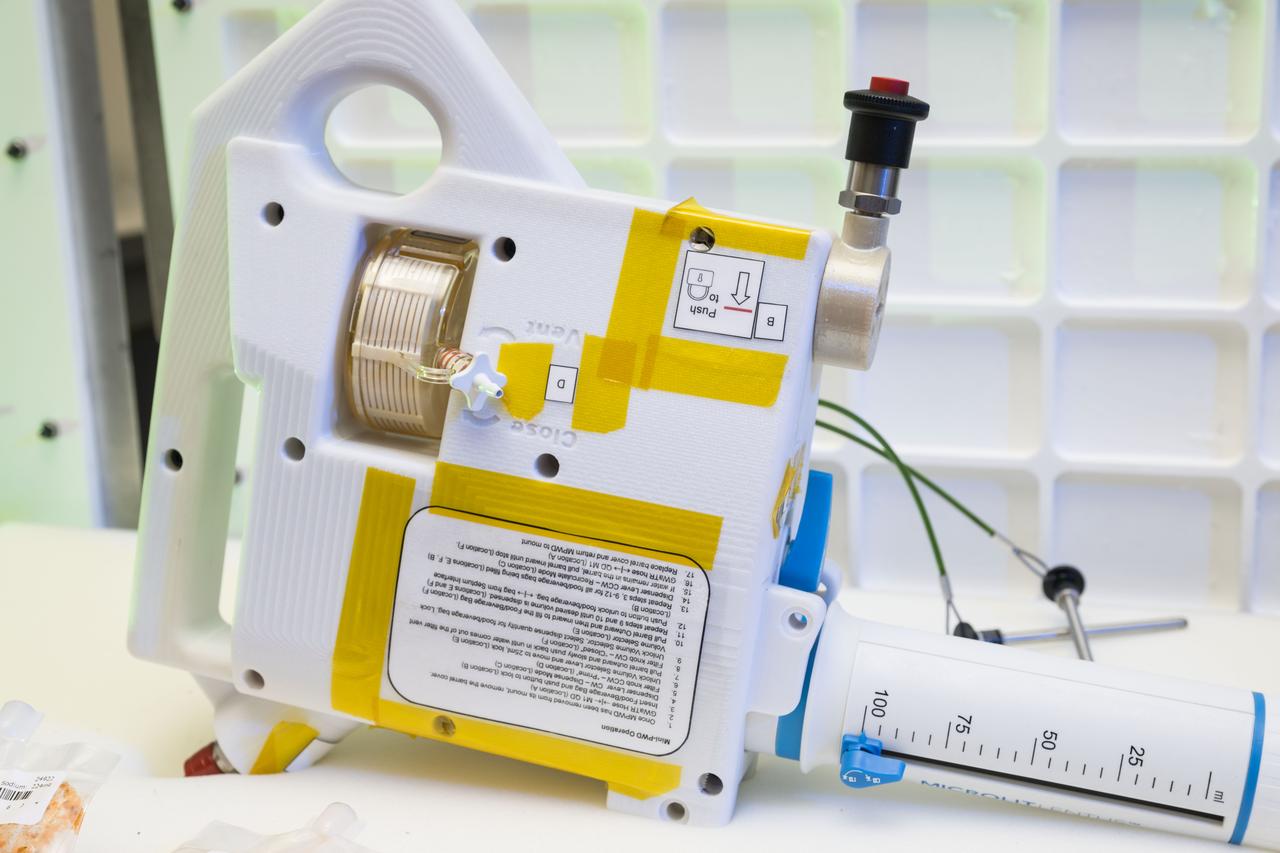
jsc2024e040691 -- A prototype of the Mini Potable Water Dispenser, currently in development at NASA’s Marshall Space Flight Center, is displayed alongside various food pouches during a demonstration at NASA’s Johnson Space Center. Photo Credit: NASA/David DeHoyos

STS009-05-0153 (28 Nov. - 8 Dec. 1983) --- Though STS-9 was the space shuttle Columbia's sixth spaceflight, it was the first opportunity for an onboard galley, some of the results of which are shown in this 35mm scene on the flight deck. The metal tray makes for easy preparation and serving of in-space meals for crew members. This crewman is seated at the pilot's station on the flight deck. The actual galley is located in the middeck. Photo credit: NASA
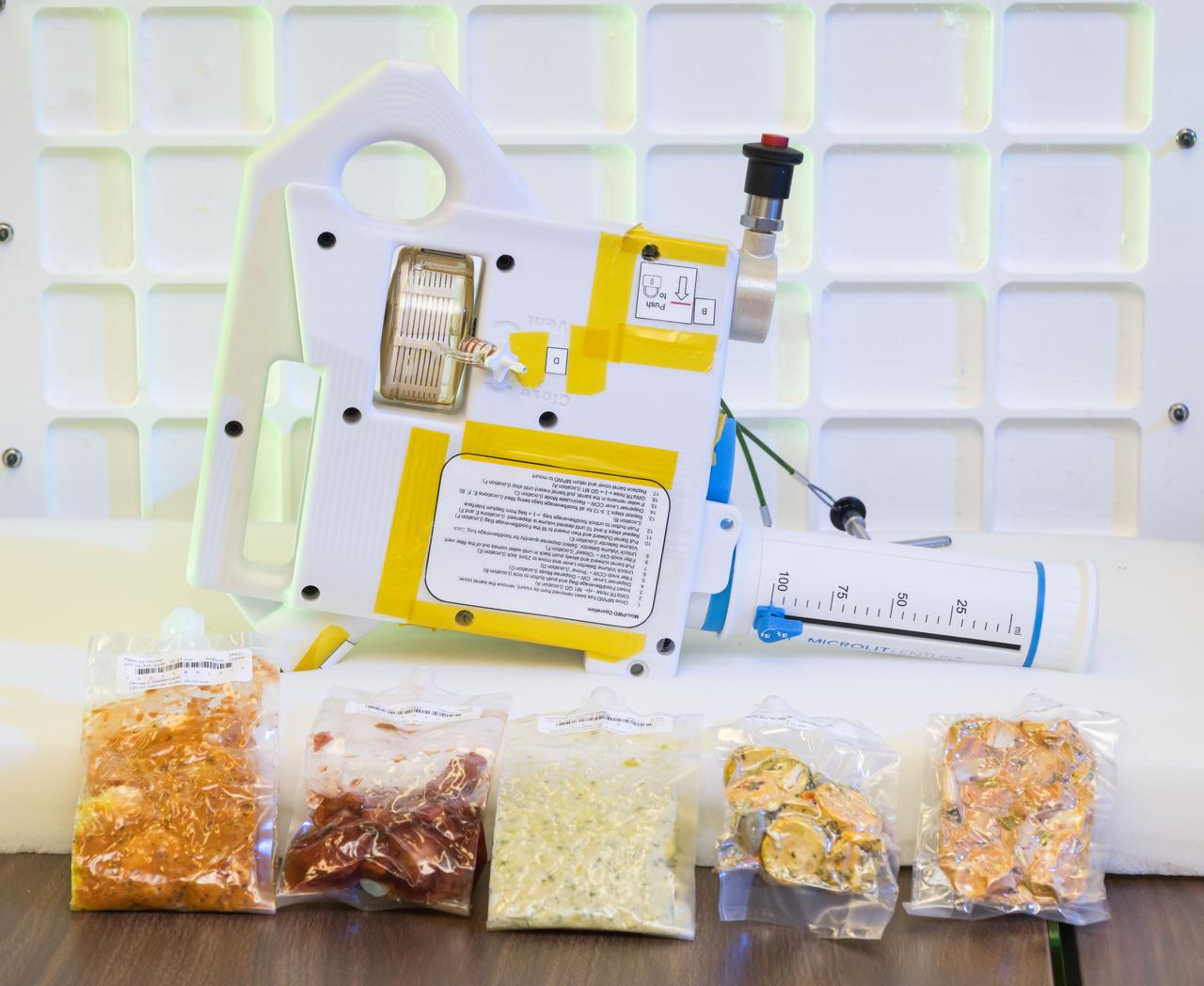
jsc2024e040685 -- A prototype of the Mini Potable Water Dispenser, currently in development at NASA’s Marshall Space Flight Center, is displayed alongside various food pouches during a demonstration at NASA’s Johnson Space Center. Photo Credit: NASA/David DeHoyos
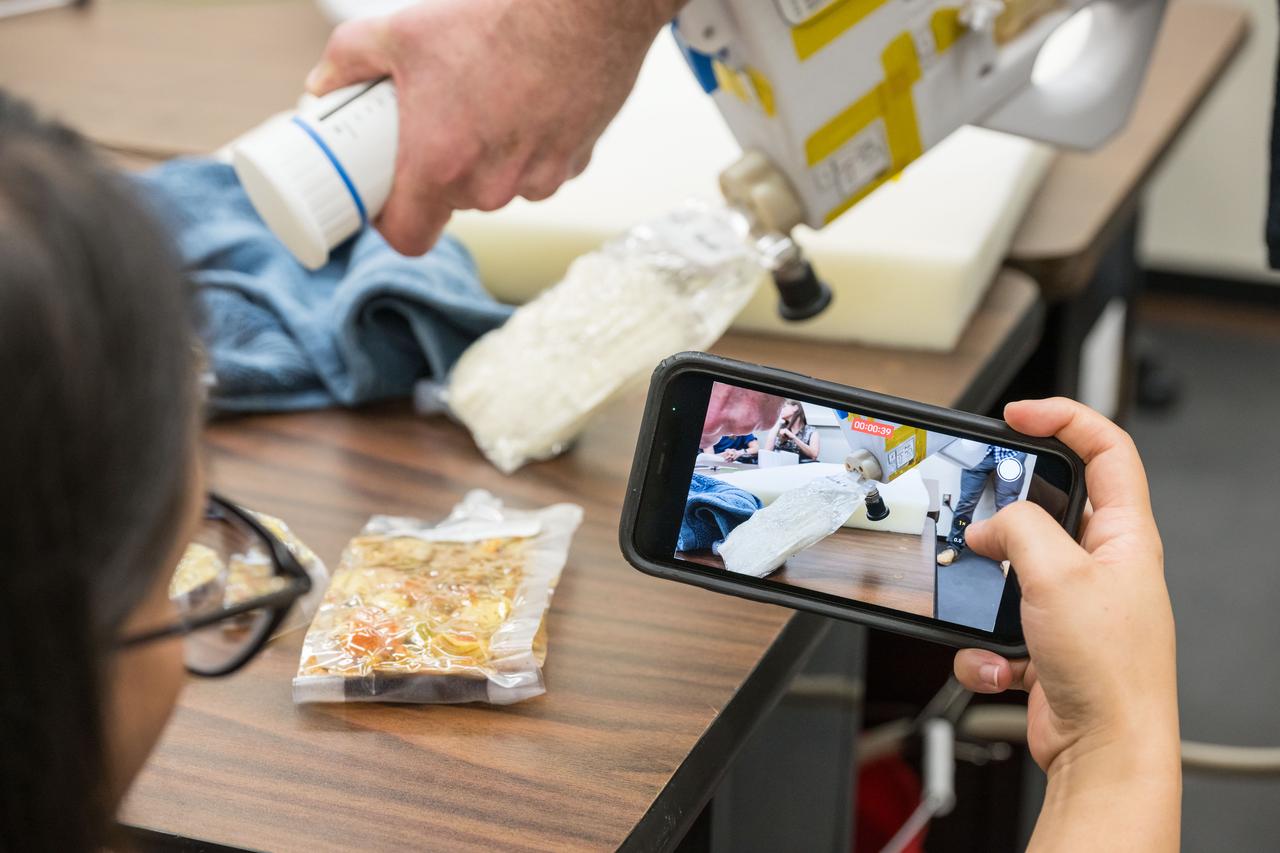
jsc2024e040743 -- A NASA food scientist captures video of the Mini Potable Water Dispenser during testing at Johnson Space Center. Photo Credit: NASA/David DeHoyos
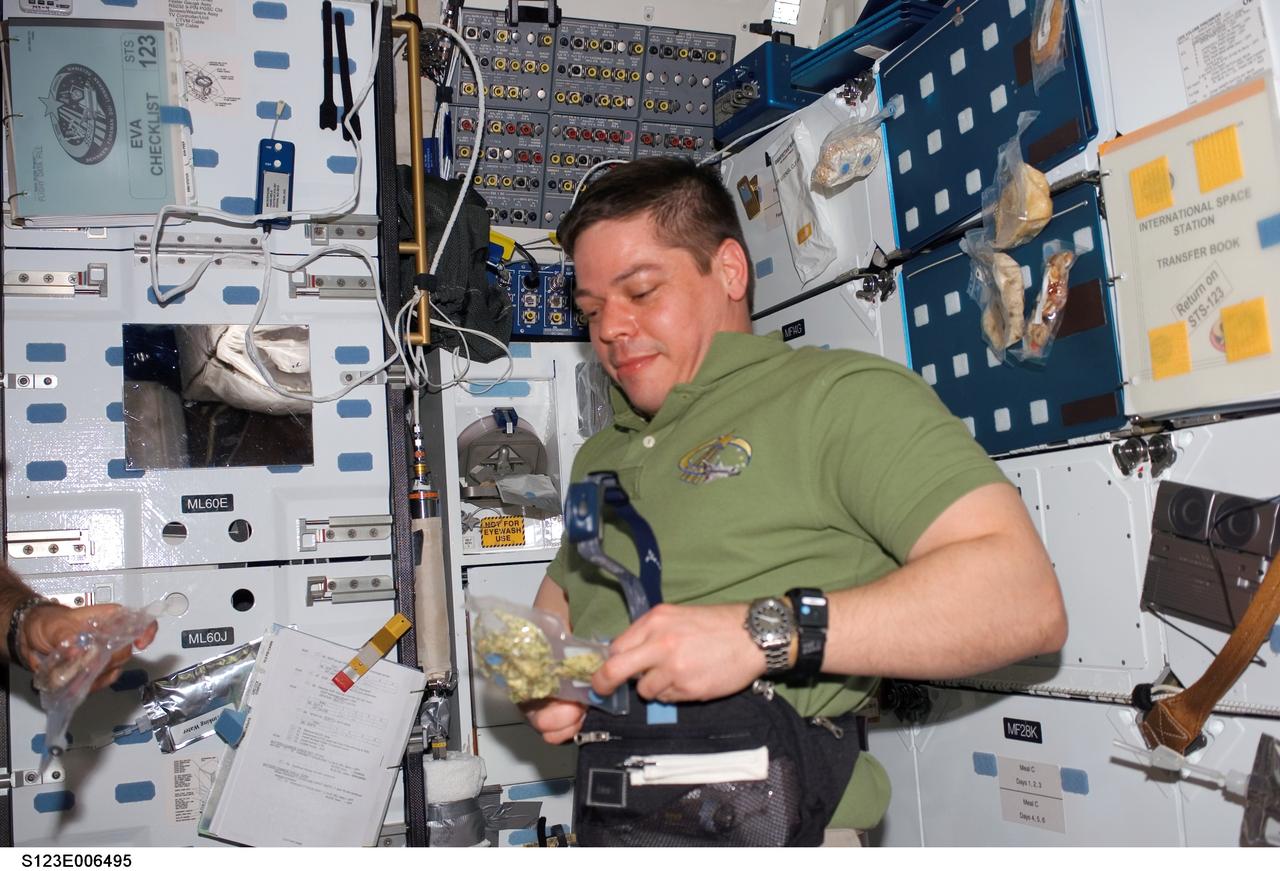
S123-E-006495 (12 March 2008) --- Astronaut Robert L. Behnken, STS-123 mission specialist, opens a food package near the galley on the middeck of Space Shuttle Endeavour while docked with the International Space Station.
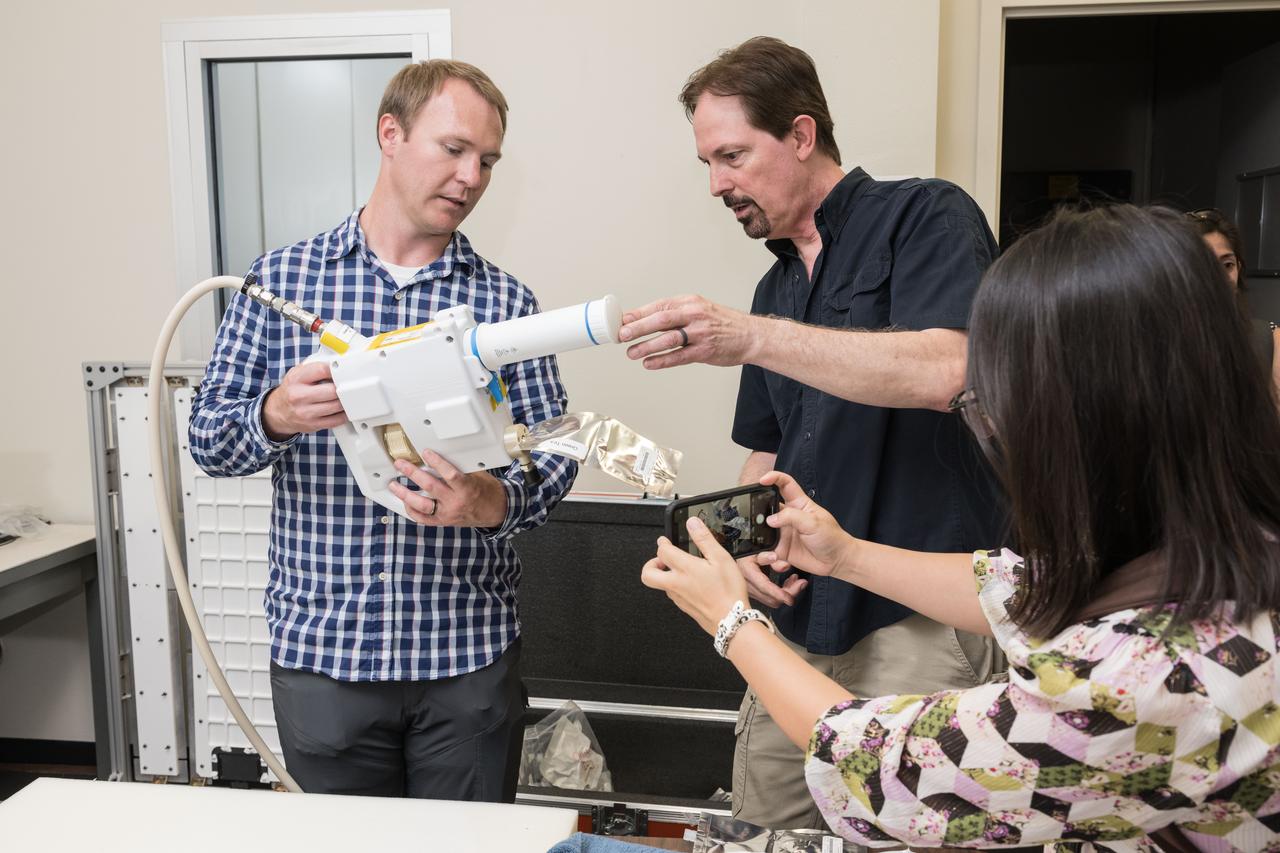
jsc2024e040728 -- Matt Rowell, an engineer from the Marshall Space Flight Center demonstrates the Mini Potable Water Dispenser to NASA food scientists during a testing session. Photo Credit: NASA/David DeHoyos
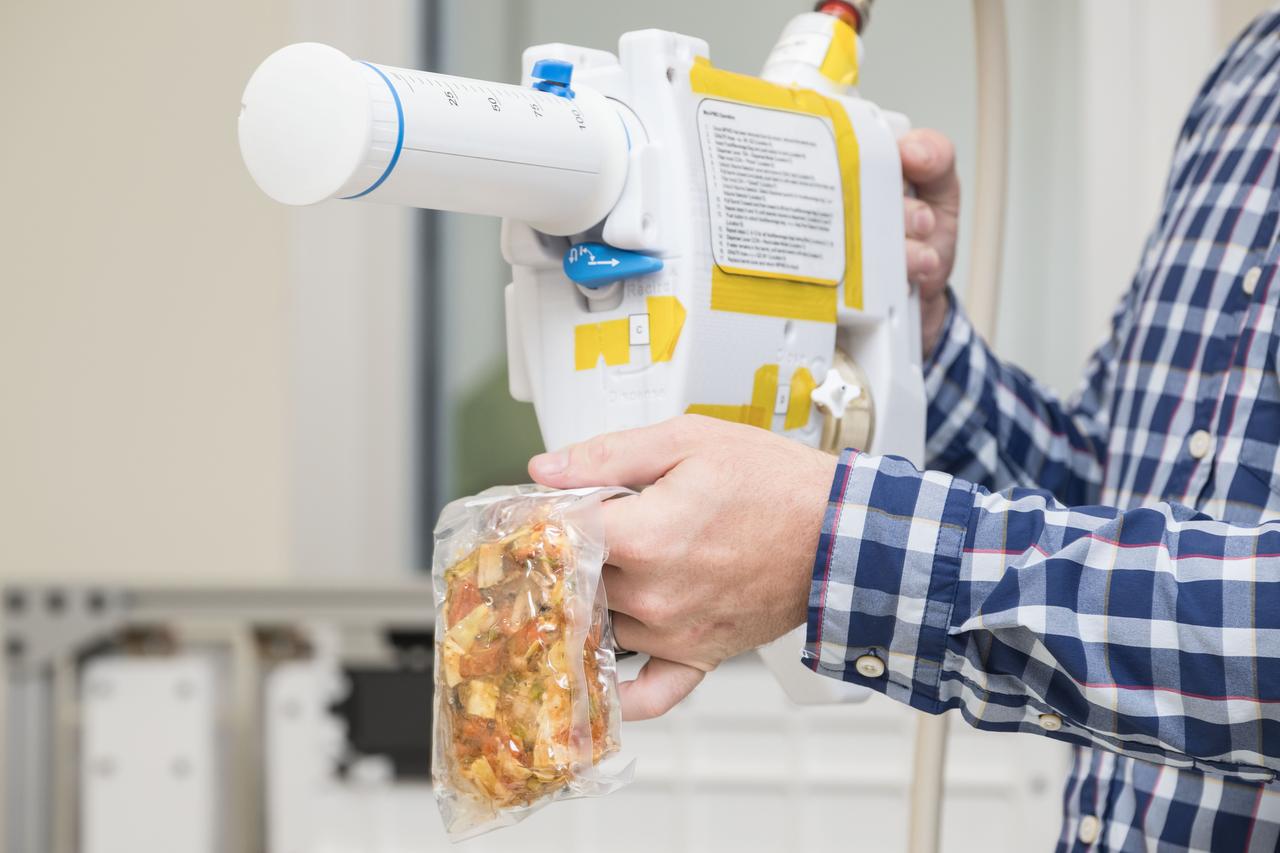
jsc2024e040708 -- An engineer demonstrates the use of the Mini Potable Water Dispenser by rehydrating a food pouch during a testing session at Johnson Space Center on June 6, 2024. This compact, lightweight dispenser is designed to help astronauts prepare meals in deep space. Photo Credit: NASA/David DeHoyos

World Food Prize President, Barbara Stinson gives remarks during an event at the U.S Department of State where it was announced that Cynthia Rosenzweig, a senior research scientist and head of the Climate Impacts Group at NASA’s Goddard Institute for Space Studies (GISS) in New York City, was awarded the 2022 World Food Prize from the World Food Prize Foundation, Thursday, May 5, 2022, at the Harry S. Truman Building in Washington. Photo Credit: (NASA/Bill Ingalls)
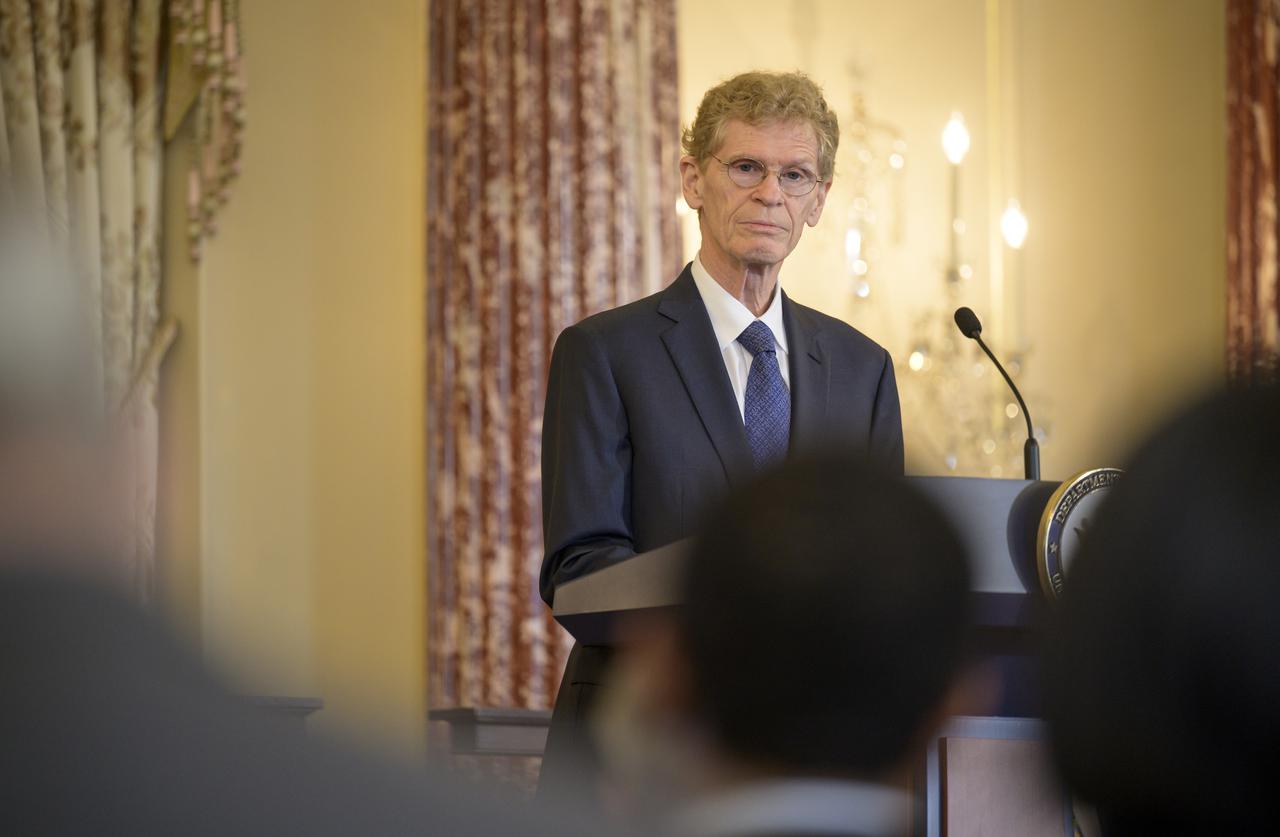
U.S. Special Envoy for Global Food Security, Dr. Cary Fowler gives remarks during an event at the U.S Department of State where it was announced that Cynthia Rosenzweig, a senior research scientist and head of the Climate Impacts Group at NASA’s Goddard Institute for Space Studies (GISS) in New York City, was awarded the 2022 World Food Prize from the World Food Prize Foundation, Thursday, May 5, 2022, at the Harry S. Truman Building in Washington. Photo Credit: (NASA/Bill Ingalls)
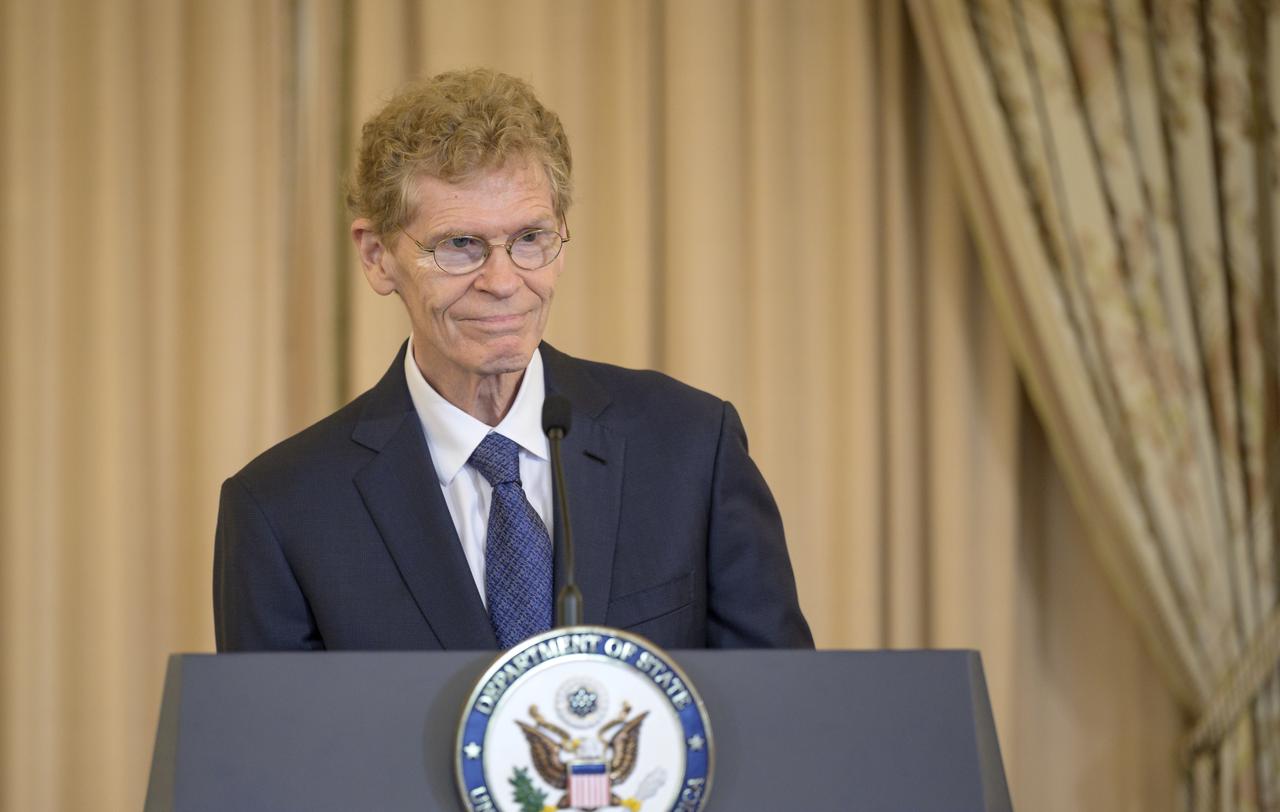
U.S. Special Envoy for Global Food Security, Dr. Cary Fowler gives remarks during an event at the U.S Department of State where it was announced that Cynthia Rosenzweig, a senior research scientist and head of the Climate Impacts Group at NASA’s Goddard Institute for Space Studies (GISS) in New York City, was awarded the 2022 World Food Prize from the World Food Prize Foundation, Thursday, May 5, 2022, at the Harry S. Truman Building in Washington. Photo Credit: (NASA/Bill Ingalls)
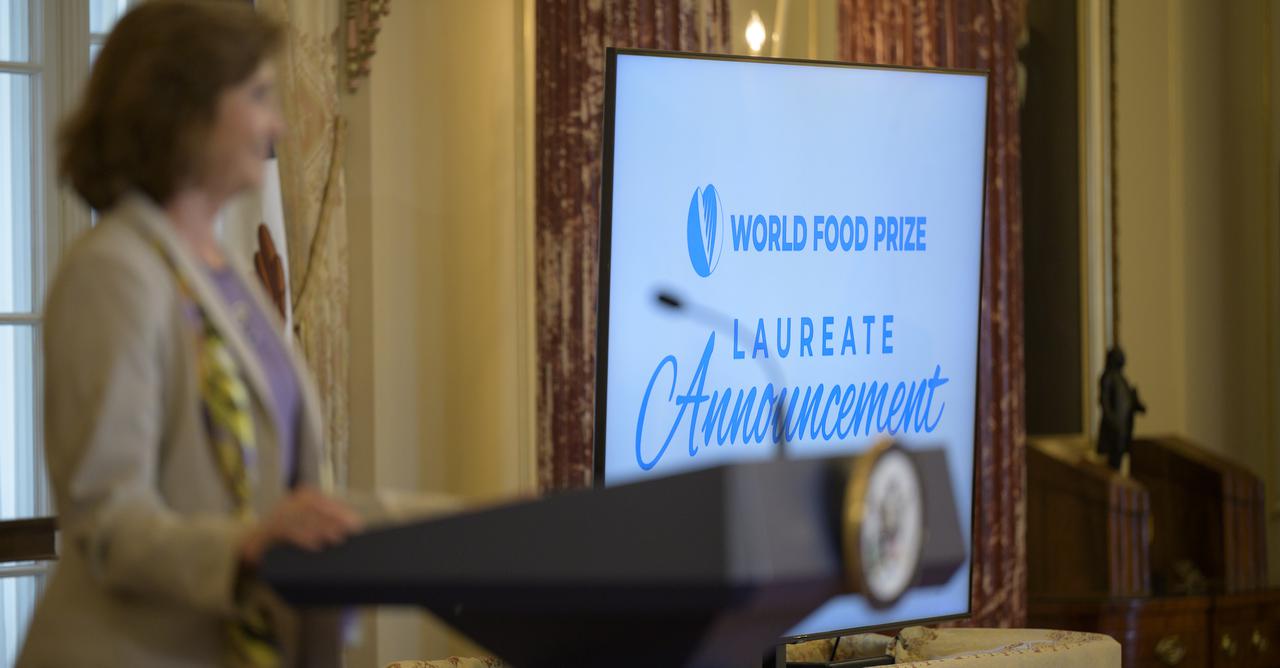
World Food Prize President, Barbara Stinson gives remarks during an event at the U.S Department of State where it was announced that Cynthia Rosenzweig, a senior research scientist and head of the Climate Impacts Group at NASA’s Goddard Institute for Space Studies (GISS) in New York City, was awarded the 2022 World Food Prize from the World Food Prize Foundation, Thursday, May 5, 2022, at the Harry S. Truman Building in Washington. Photo Credit: (NASA/Bill Ingalls)
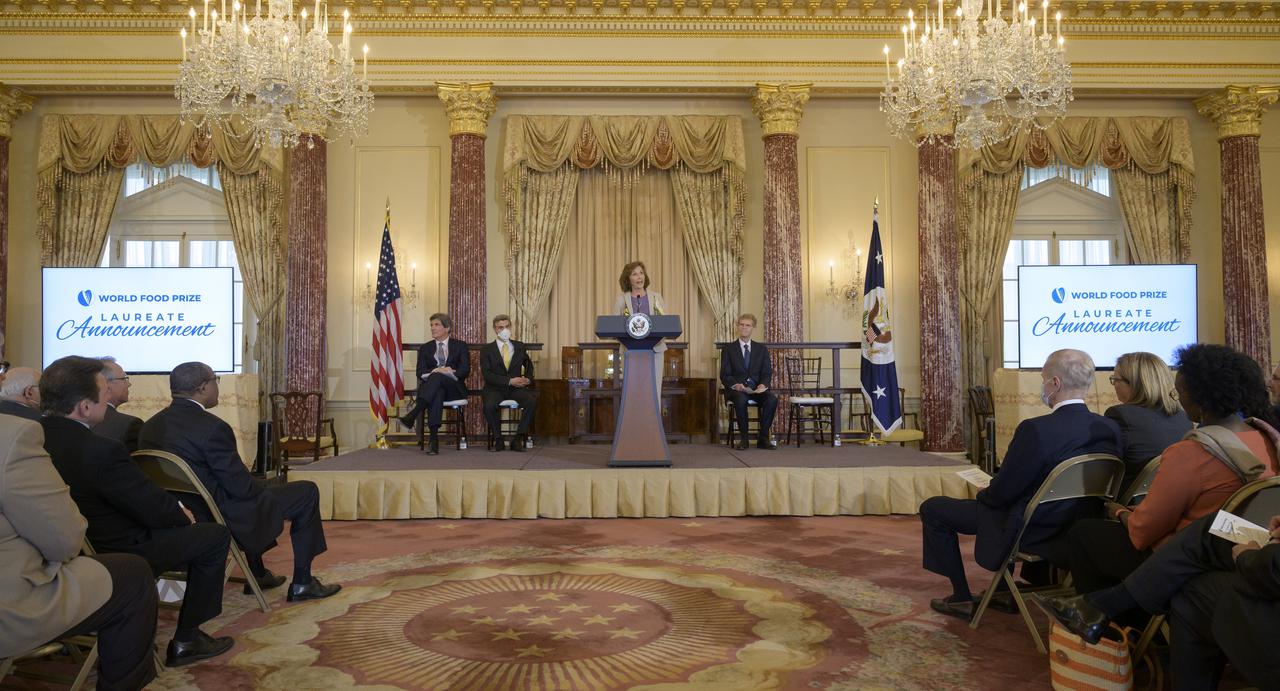
World Food Prize President, Barbara Stinson gives remarks during an event at the U.S Department of State where it was announced that Cynthia Rosenzweig, a senior research scientist and head of the Climate Impacts Group at NASA’s Goddard Institute for Space Studies (GISS) in New York City, was awarded the 2022 World Food Prize from the World Food Prize Foundation, Thursday, May 5, 2022, at the Harry S. Truman Building in Washington. Photo Credit: (NASA/Bill Ingalls)
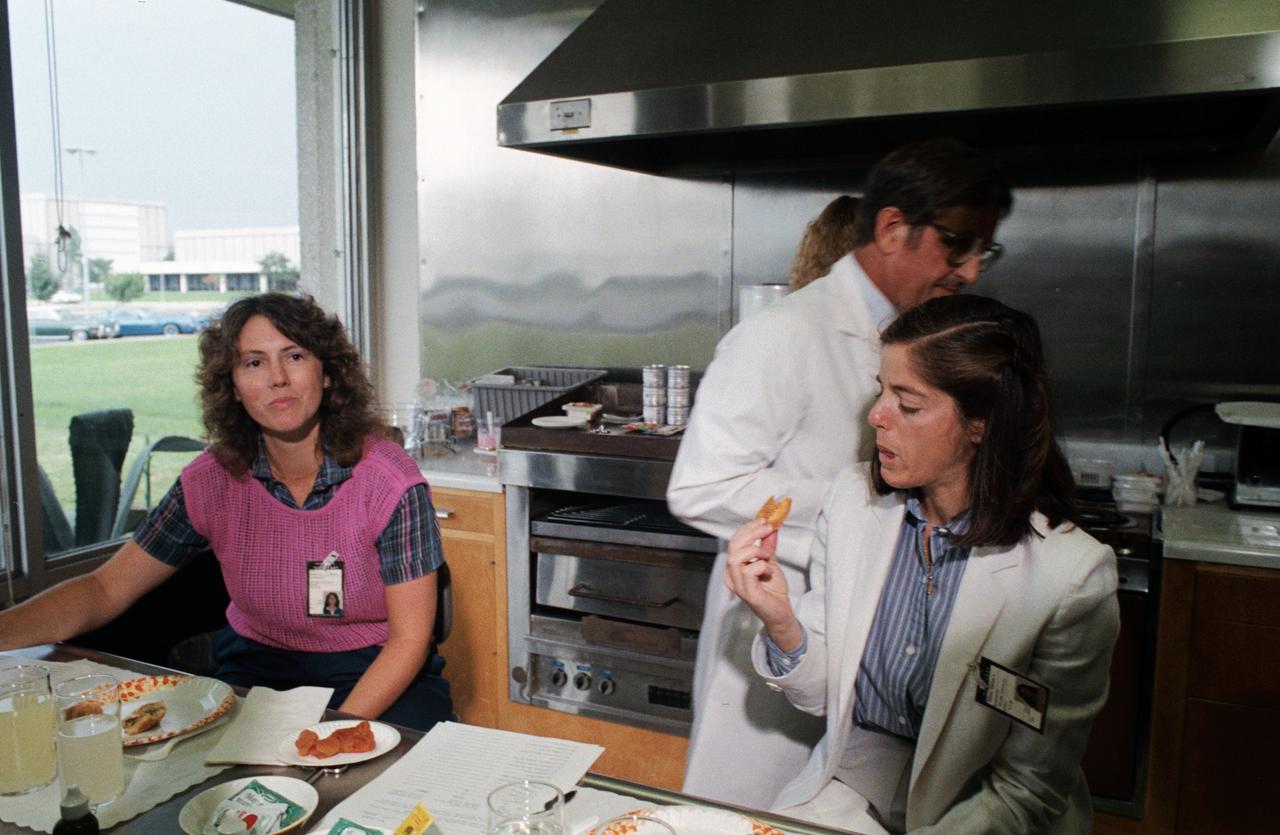
S85-39978 (10 Sept. 1985) --- Sharon Christa McAuliffe, left, appears to be deciding what she thinks of a piece of space food she tastes during a session of interfacing with space shuttle life sciences. Barbara R. Morgan samples an apricot. The two are in early training at the Johnson Space Center (JSC) in preparation for the STS-51L spaceflight early next year. McAuliffe is prime payload specialist representing the Teacher in Space Project, and Morgan is her backup. Dr. C.T. Bourland, a dietitian specialist, assists the two. Photo credit: NASA
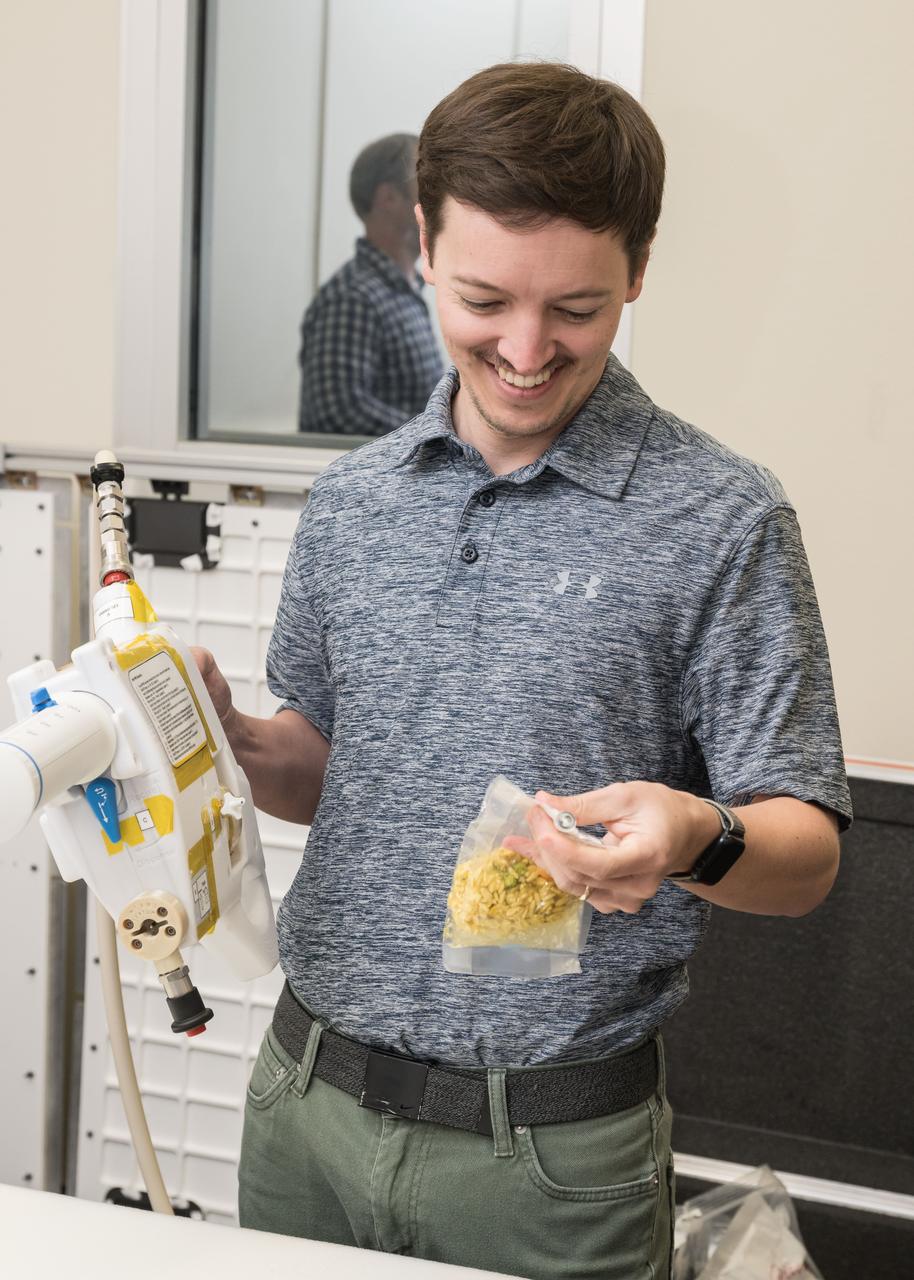
jsc2024e040722 -- Brett Montoya, a lead space architect in the Center for Design and Space Architecture at Johnson Space Center, rehydrates a package of food using the Mini Potable Water Dispenser during a protype testing session at Johnson's Space Center. Photo Credit: NASA/David DeHoyos
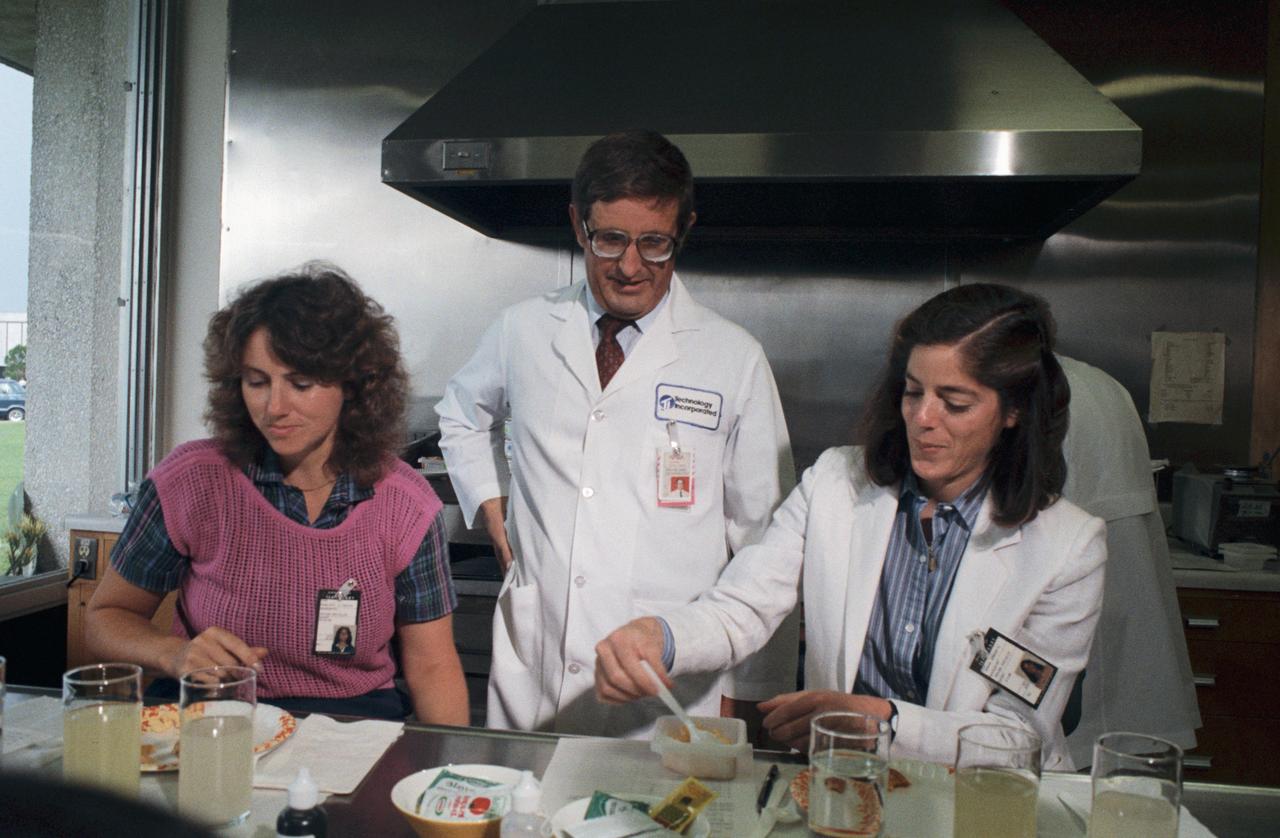
S85-39979 (10 Sept. 1985) --- Two teachers training for participation in the STS-51L flight get their first introduction to space food during an orientation session in the life sciences building at the Johnson Space Center (JSC). Sharon Christa McAuliffe (left) chews on a morsel while Barbara R. Morgan reaches for a bite. Dr. C.T. Bourland of Technology, Incorporated, looks on. McAuliffe was chosen from among ten finalists as prime citizen observer payload specialist and Morgan was named as backup for the STS-51L flight. Photo credit: NASA
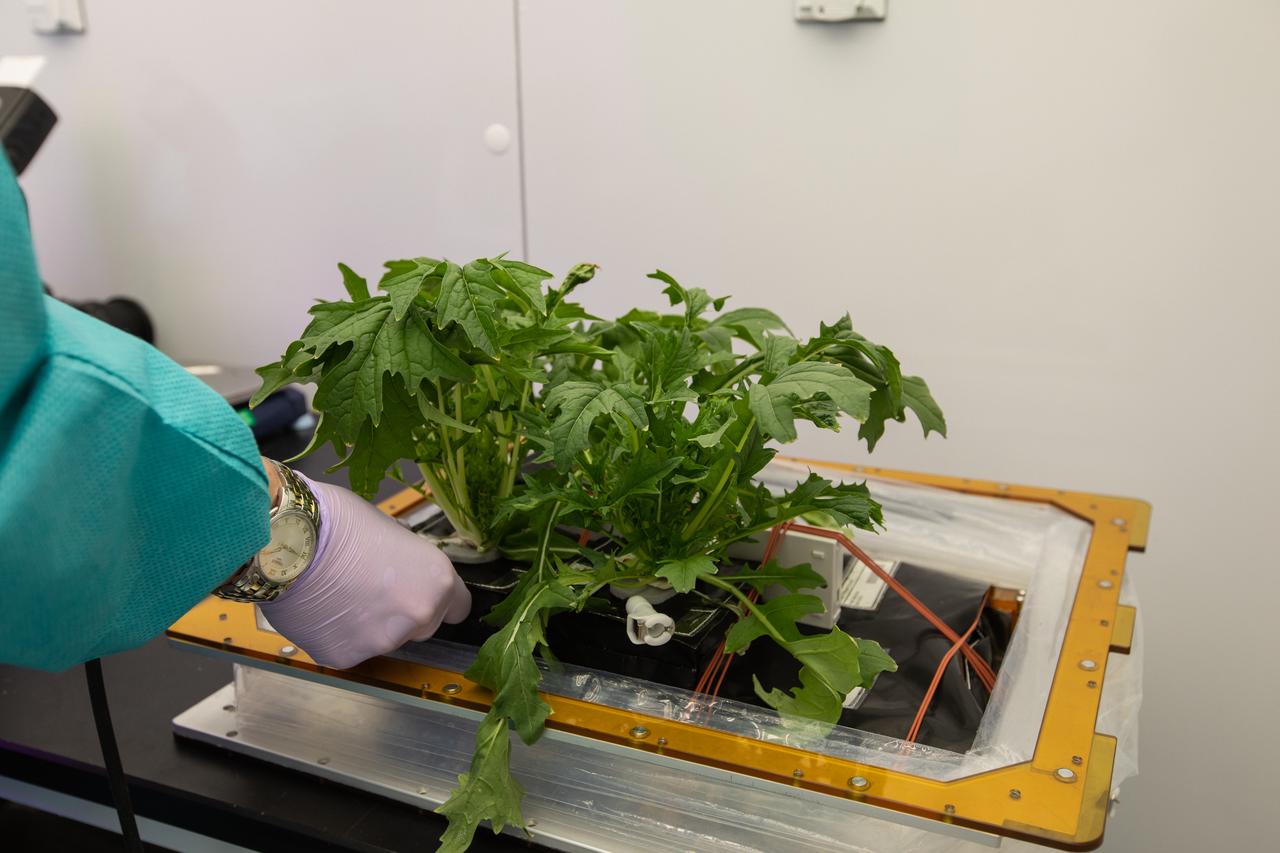
Jess Bunchek, a veggie plant scientist and pseudonaut, harvests mizuna mustard inside the Veggie harvest chamber in the Space Station Processing Facility at NASA’s Kennedy Space Center in Florida on Feb. 19, 2019, as part of the Experiment Verification Test for the VEG-04B mission that will launch to the International Space Station later this year. VEG-04B examines the interactions between light and spaceflight by growing plants under two different LED lighting conditions. A similar harvest will be conducted on the space station after a grow-out duration of 56 days. The VEG-04B mission is expected to provide fresh food, sensory stimulation and help mark the passage of time in the confined and isolated environment of the space station. Ultimately, fresh vegetables grown in space will be an essential supplement to the crew’s pre-packaged diet, prepping them for long-duration space exploration.
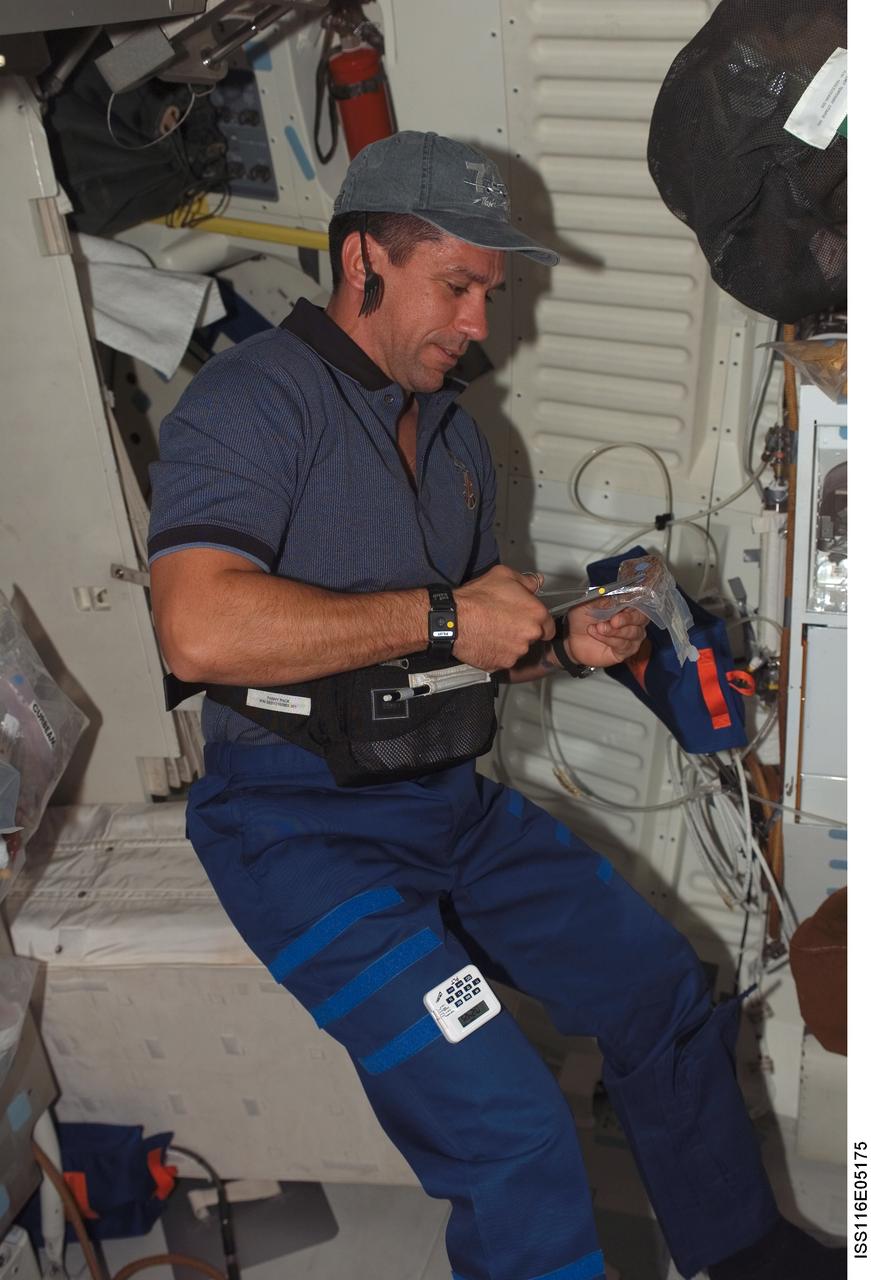
S116-E-05175 (10 Dec. 2006) --- Astronaut William A. (Bill) Oefelein, STS-116 pilot, opens a package of food on the middeck of Space Shuttle Discovery.
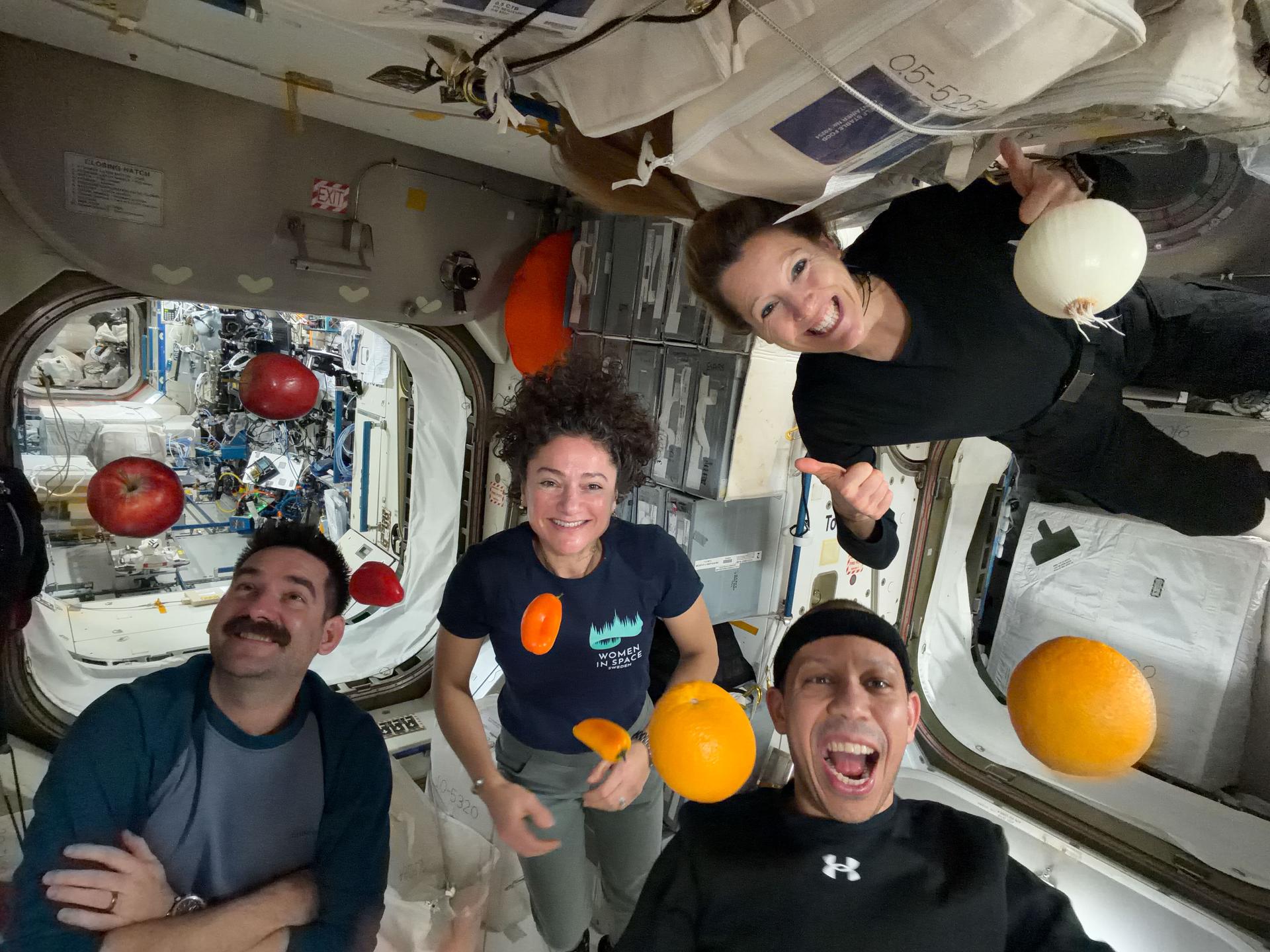
iss074e0503702 (April 19, 2026) --- You are on the International Space Station! You can play with your food! Clockwise from left: NASA astronauts Jack Hathaway and Jessica Meir, ESA (European Space Agency) astronaut Sophie Adenot, and NASA astronaut Chris Williams— all Expedition 74 flight engineers—celebrate a shipment of fresh food, including oranges, apples, onions, and peppers, delivered aboard Northrop Grumman’s Cygnus XL cargo spacecraft. Credit: NASA/Chris Williams
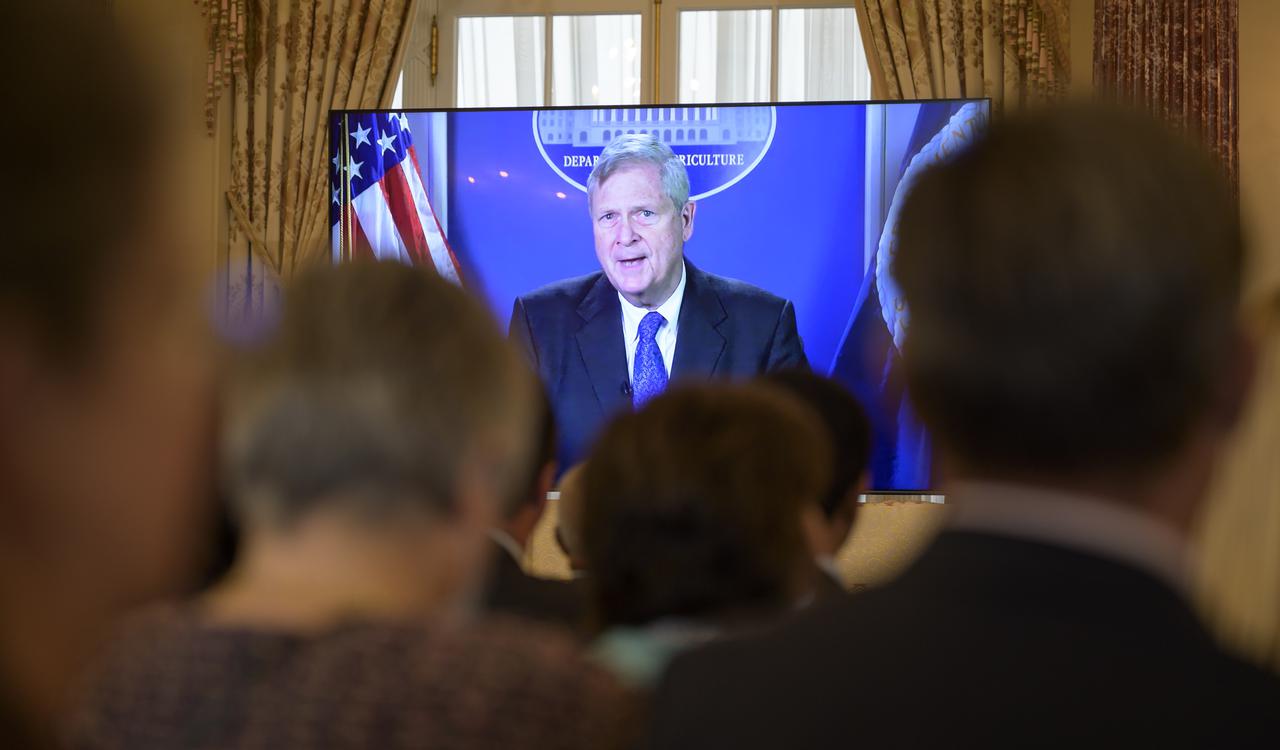
U.S. Secretary of Agriculture Tom Vilsack gives remarks via a previously recorded message, during an event at the U.S Department of State where it was announced that Cynthia Rosenzweig, a senior research scientist and head of the Climate Impacts Group at NASA’s Goddard Institute for Space Studies (GISS) in New York City, was awarded the 2022 World Food Prize from the World Food Prize Foundation, Thursday, May 5, 2022, at the Harry S. Truman Building in Washington. Photo Credit: (NASA/Bill Ingalls)

Assistant Secretary for Economic and Business Affairs, Ramin Toloui gives introductory remarks during an event at the U.S Department of State where it was announced that Cynthia Rosenzweig, a senior research scientist and head of the Climate Impacts Group at NASA’s Goddard Institute for Space Studies (GISS) in New York City, was awarded the 2022 World Food Prize from the World Food Prize Foundation, Thursday, May 5, 2022, at the Harry S. Truman Building in Washington. Photo Credit: (NASA/Bill Ingalls)
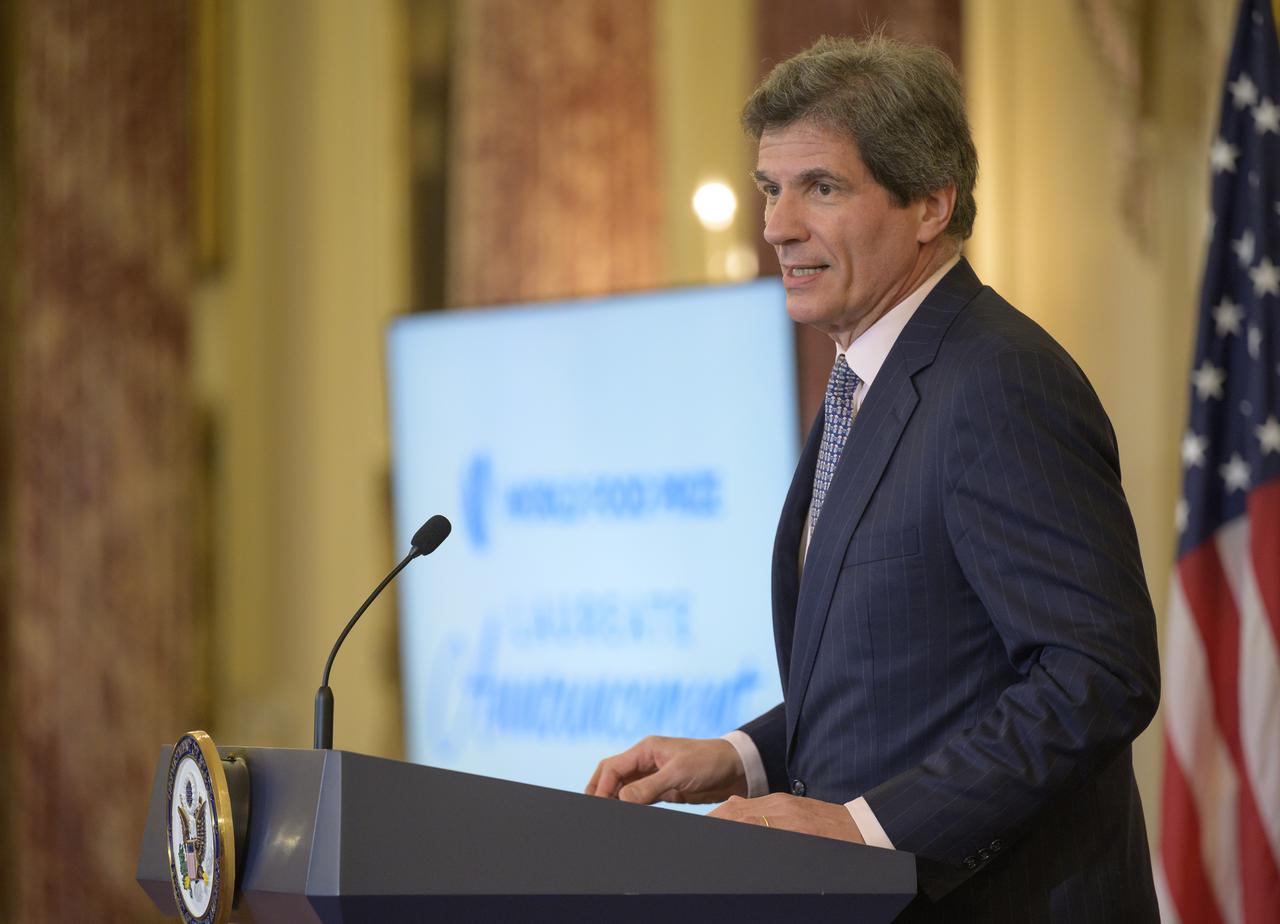
Under Secretary For Economic Growth, Energy, and the Environment, Jose W. Fernandez gives remarks during an event at the U.S Department of State where it was announced that Cynthia Rosenzweig, a senior research scientist and head of the Climate Impacts Group at NASA’s Goddard Institute for Space Studies (GISS) in New York City, was awarded the 2022 World Food Prize from the World Food Prize Foundation, Thursday, May 5, 2022, at the Harry S. Truman Building in Washington. Photo Credit: (NASA/Bill Ingalls)
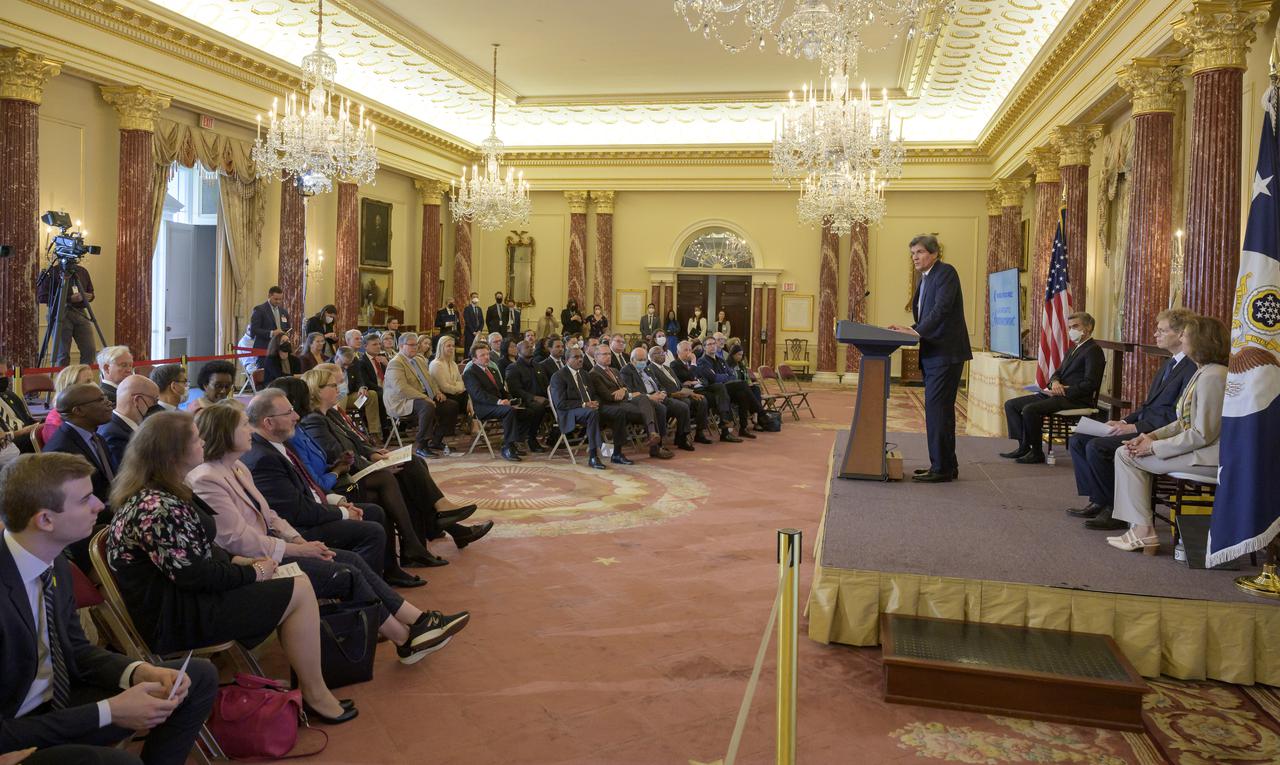
Under Secretary For Economic Growth, Energy, and the Environment, Jose W. Fernandez gives remarks during an event at the U.S Department of State where it was announced that Cynthia Rosenzweig, a senior research scientist and head of the Climate Impacts Group at NASA’s Goddard Institute for Space Studies (GISS) in New York City, was awarded the 2022 World Food Prize from the World Food Prize Foundation, Thursday, May 5, 2022, at the Harry S. Truman Building in Washington. Photo Credit: (NASA/Bill Ingalls)
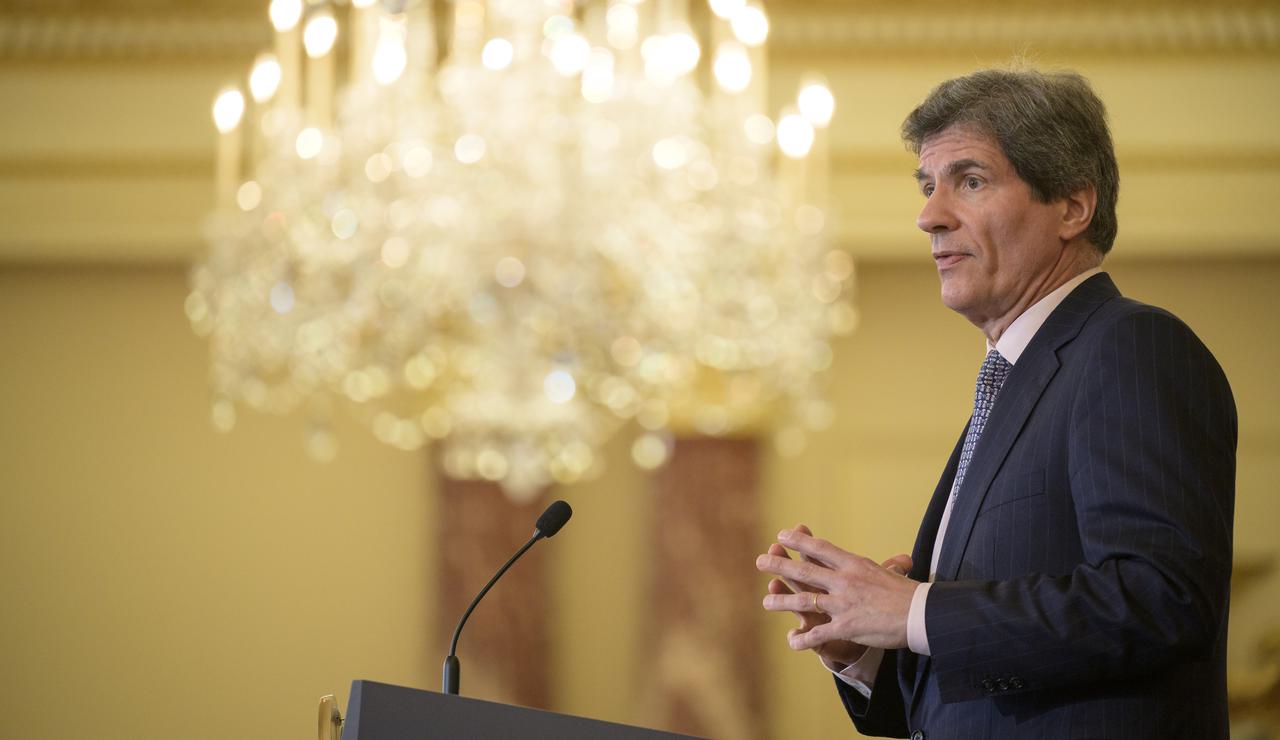
Under Secretary For Economic Growth, Energy, and the Environment, Jose W. Fernandez gives remarks during an event at the U.S Department of State where it was announced that Cynthia Rosenzweig, a senior research scientist and head of the Climate Impacts Group at NASA’s Goddard Institute for Space Studies (GISS) in New York City, was awarded the 2022 World Food Prize from the World Food Prize Foundation, Thursday, May 5, 2022, at the Harry S. Truman Building in Washington. Photo Credit: (NASA/Bill Ingalls)

Under Secretary For Economic Growth, Energy, and the Environment, Jose W. Fernandez gives remarks during an event at the U.S Department of State where it was announced that Cynthia Rosenzweig, a senior research scientist and head of the Climate Impacts Group at NASA’s Goddard Institute for Space Studies (GISS) in New York City, was awarded the 2022 World Food Prize from the World Food Prize Foundation, Thursday, May 5, 2022, at the Harry S. Truman Building in Washington. Photo Credit: (NASA/Bill Ingalls)
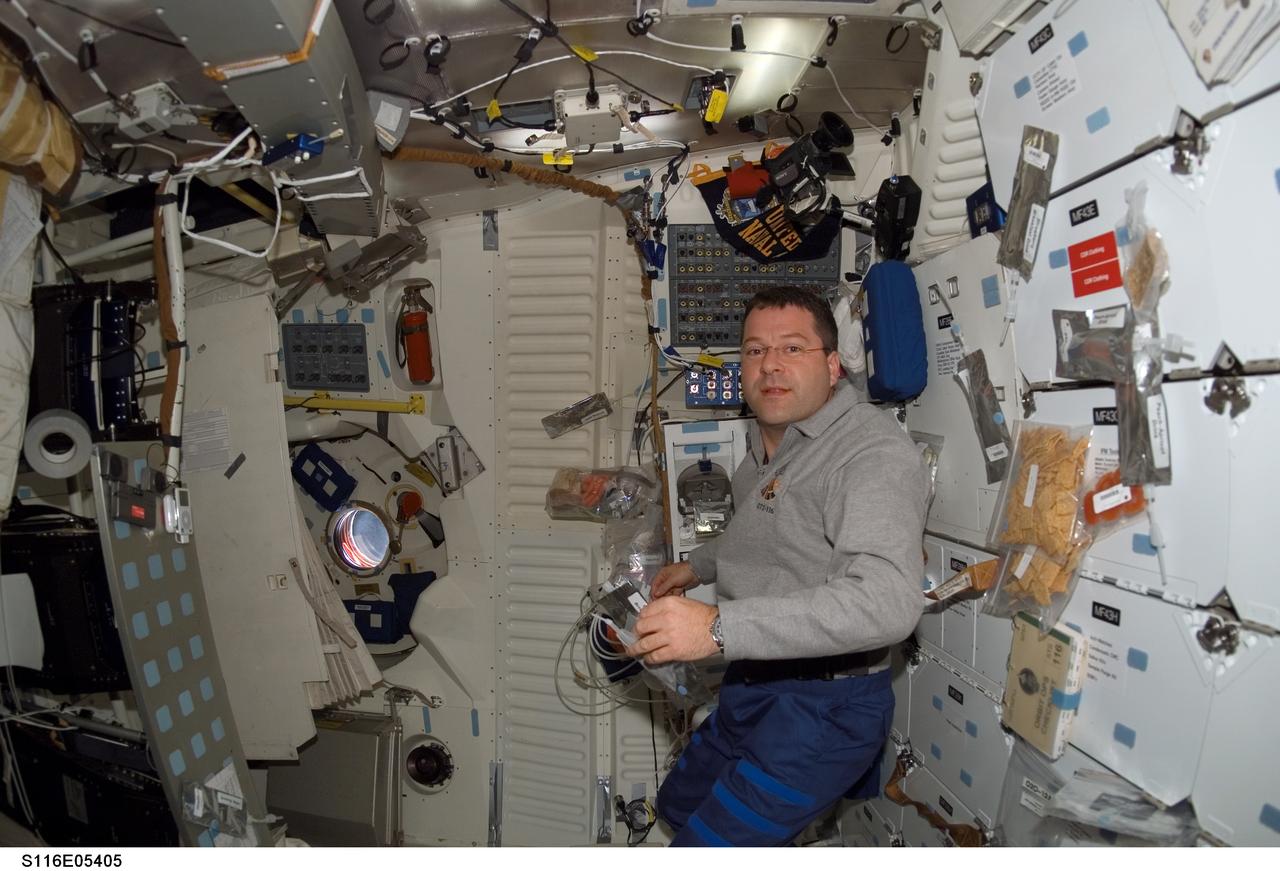
S116-E-05405 (11 Dec. 2006) --- Astronaut Nicholas J. M. Patrick, STS-116 mission specialist, holds food packages near the galley on the middeck of Space Shuttle Discovery.
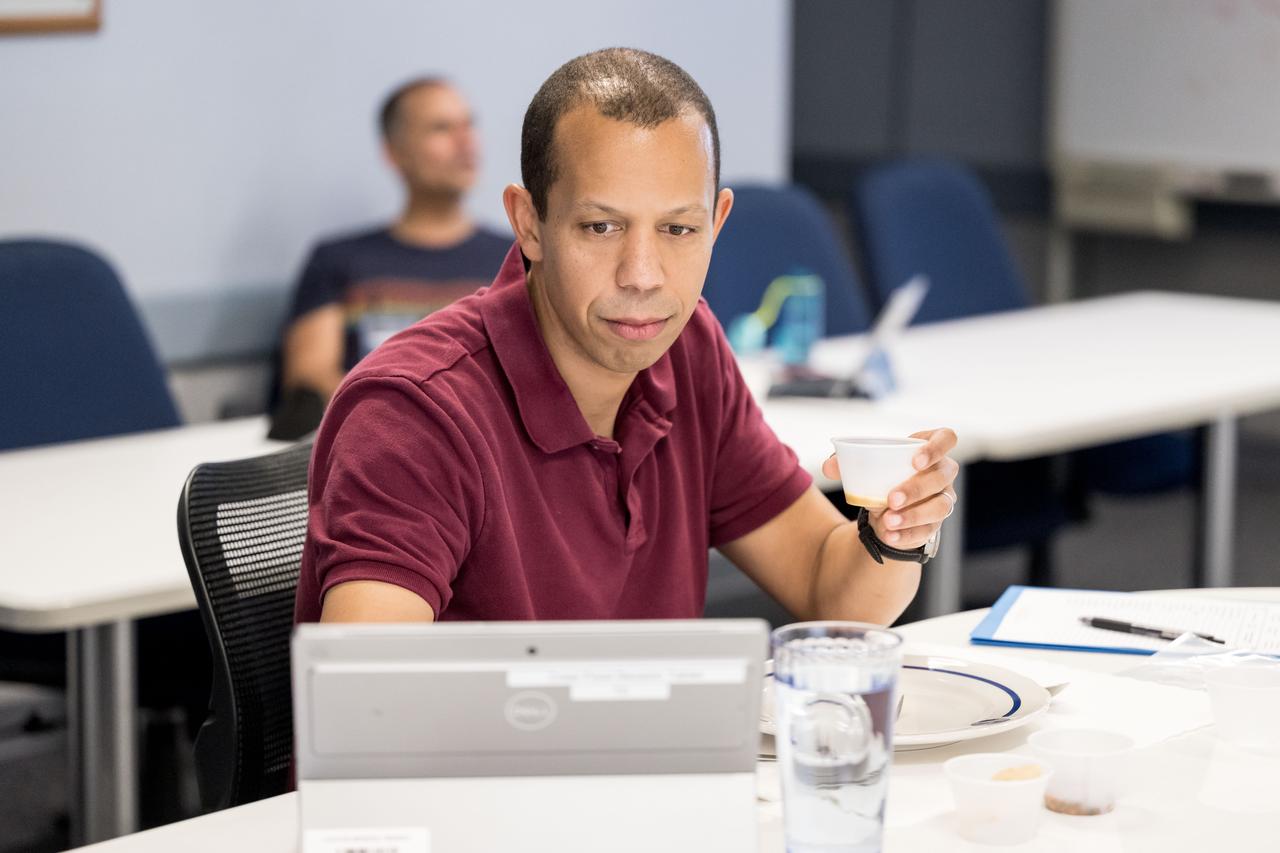
jsc2024e055706 (Aug. 16, 2024) --- NASA astronaut Chris Williams participates in a training at the Food Lab at NASA’s Johnson Space Center in Houston, Texas, in preparation for his mission to the International Space Station.
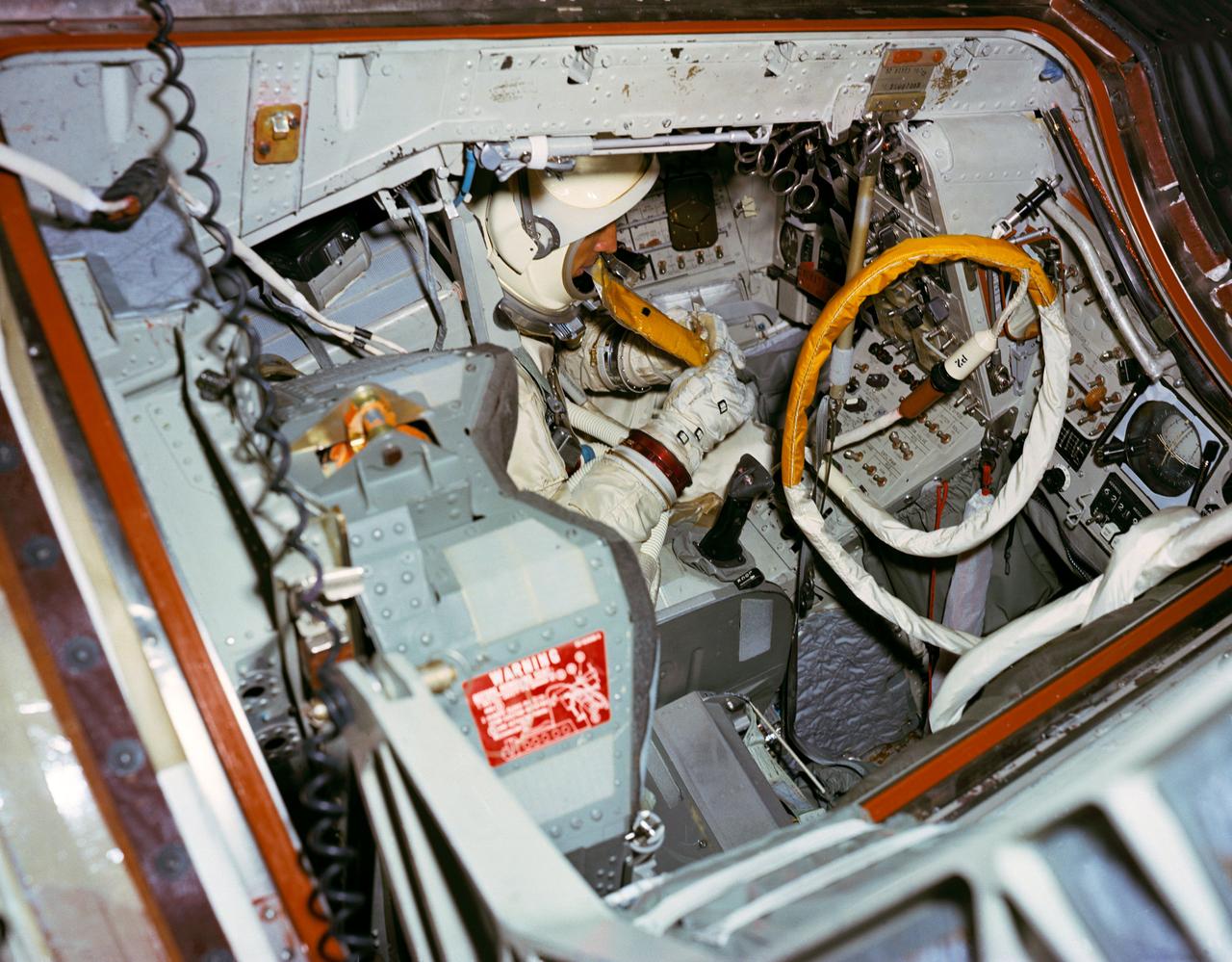
S66-51054 (15 Aug. 1966) --- Astronaut James A. Lovell Jr., prime crew command pilot of the Gemini-12 space mission, simulates using space food packet while seated in the Gemini-12 spacecraft in the 30-feet Altitude Chamber at McDonnell Aircraft Corporation, St. Louis, Missouri. Photo credit: NASA
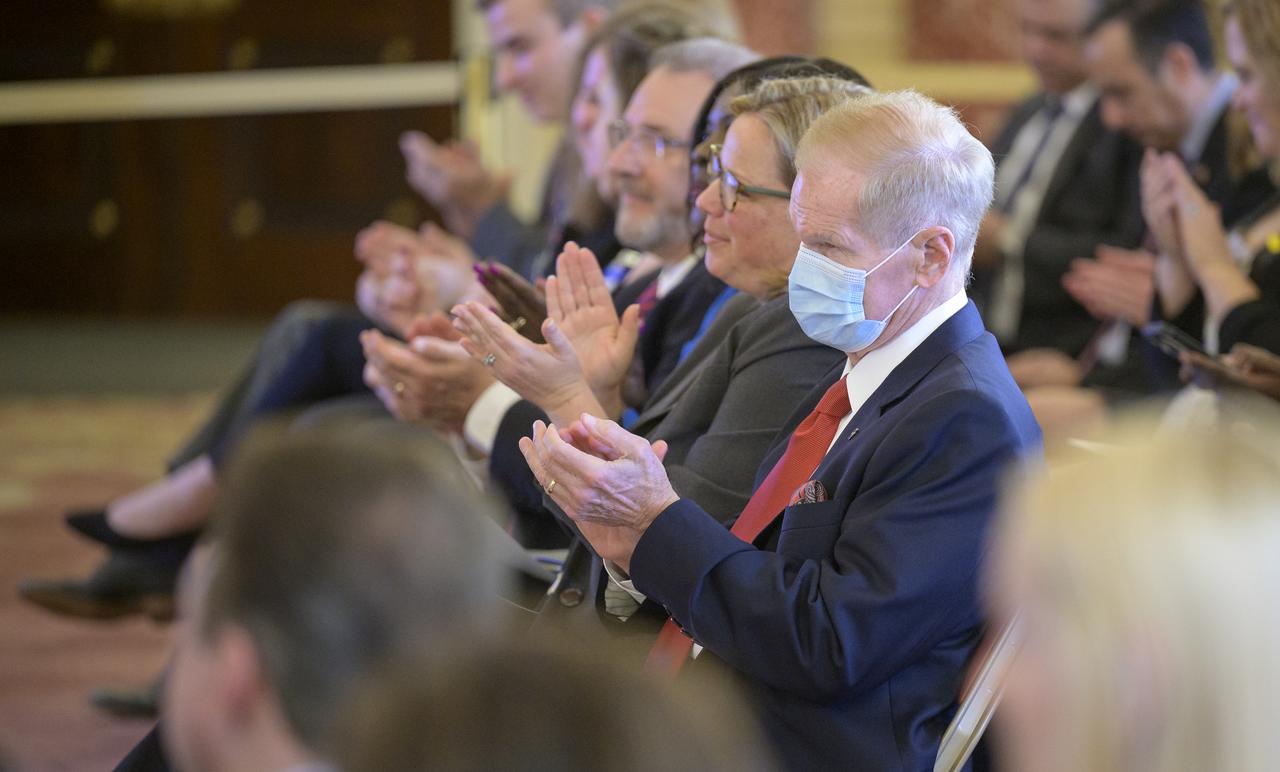
NASA Administrator Bill Nelson, and other attendees, applaud during an event at the U.S Department of State where it was announced that Cynthia Rosenzweig, a senior research scientist and head of the Climate Impacts Group at NASA’s Goddard Institute for Space Studies (GISS) in New York City, was awarded the 2022 World Food Prize from the World Food Prize Foundation, Thursday, May 5, 2022, at the Harry S. Truman Building in Washington. Photo Credit: (NASA/Bill Ingalls)
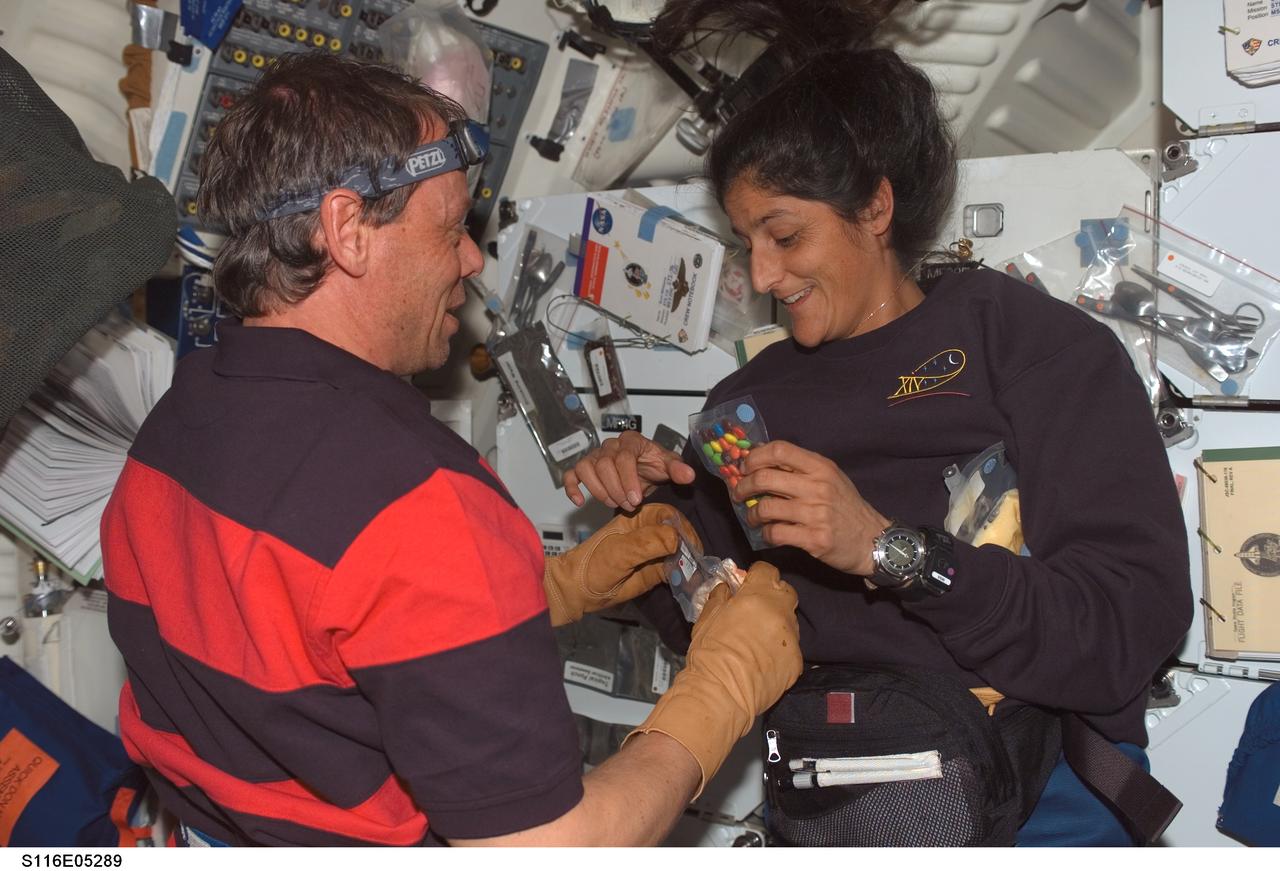
S116-E-05289 (10 Dec. 2006) --- Astronaut Sunita L. Williams (right) and European Space Agency (ESA) astronaut Christer Fuglesang, both STS-116 mission specialists, enjoy a light moment as they prepare to open food packages on the middeck of Space Shuttle Discovery. Williams will join the Expedition 14 crew as flight engineer after she enters the International Space Station. Docking of the two spacecraft will occur on Dec. 11.
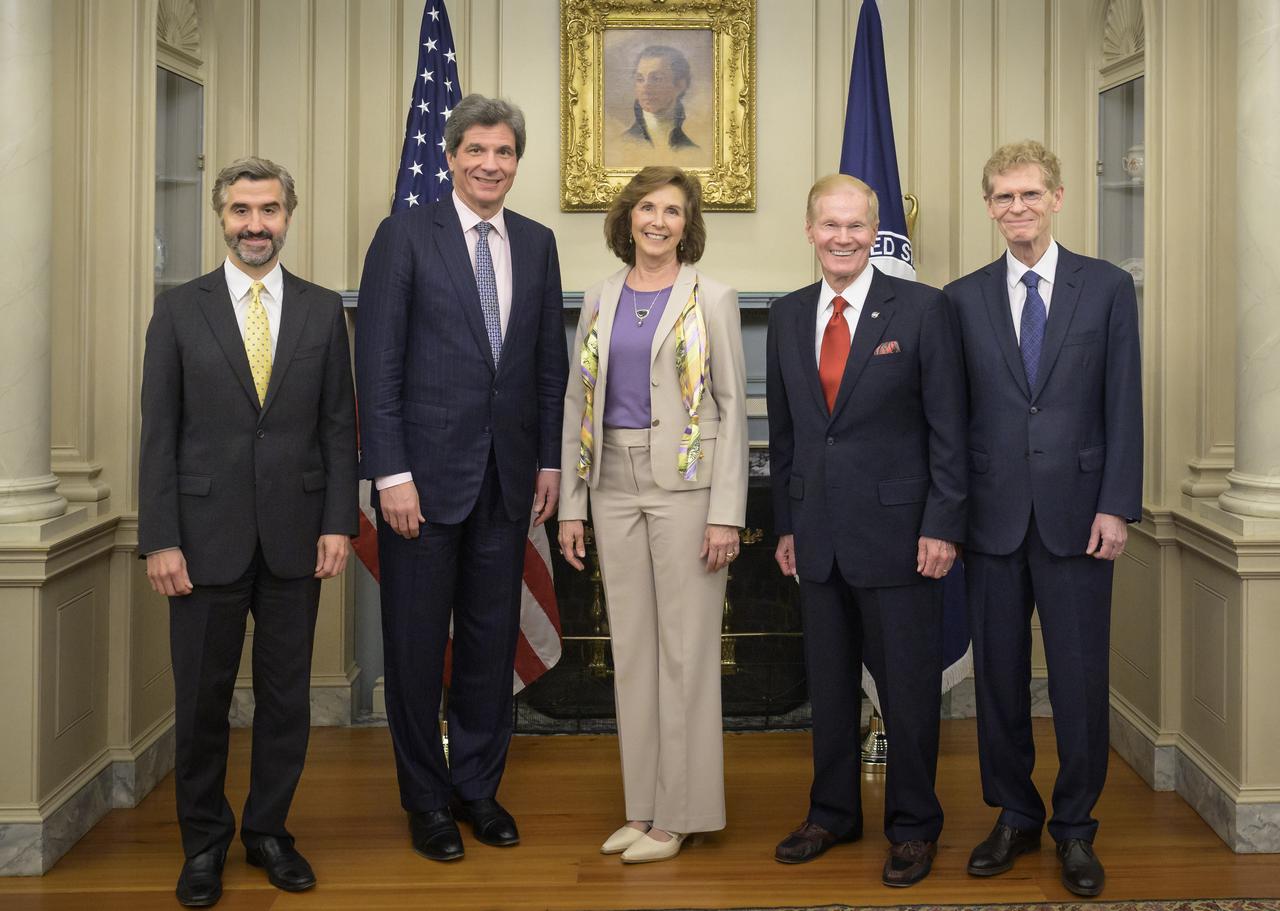
Assistant Secretary for Economic and Business Affairs Ramin Toloui, left, Under Secretary For Economic Growth, Energy, and the Environment Jose W. Fernandez, World Food Prize President Barbara Stinson, NASA Administrator Bill Nelson, and U.S. Special Envoy for Global Food Security, Dr. Cary Fowler, right, pose for a group photograph during an event at the U.S Department of State where it was announced that Cynthia Rosenzweig, a senior research scientist and head of the Climate Impacts Group at NASA’s Goddard Institute for Space Studies (GISS) in New York City, will be awarded the 2022 World Food Prize from the World Food Prize Foundation, Thursday, May 5, 2022, at the Harry S. Truman Building in Washington. Photo Credit: (NASA/Bill Ingalls)
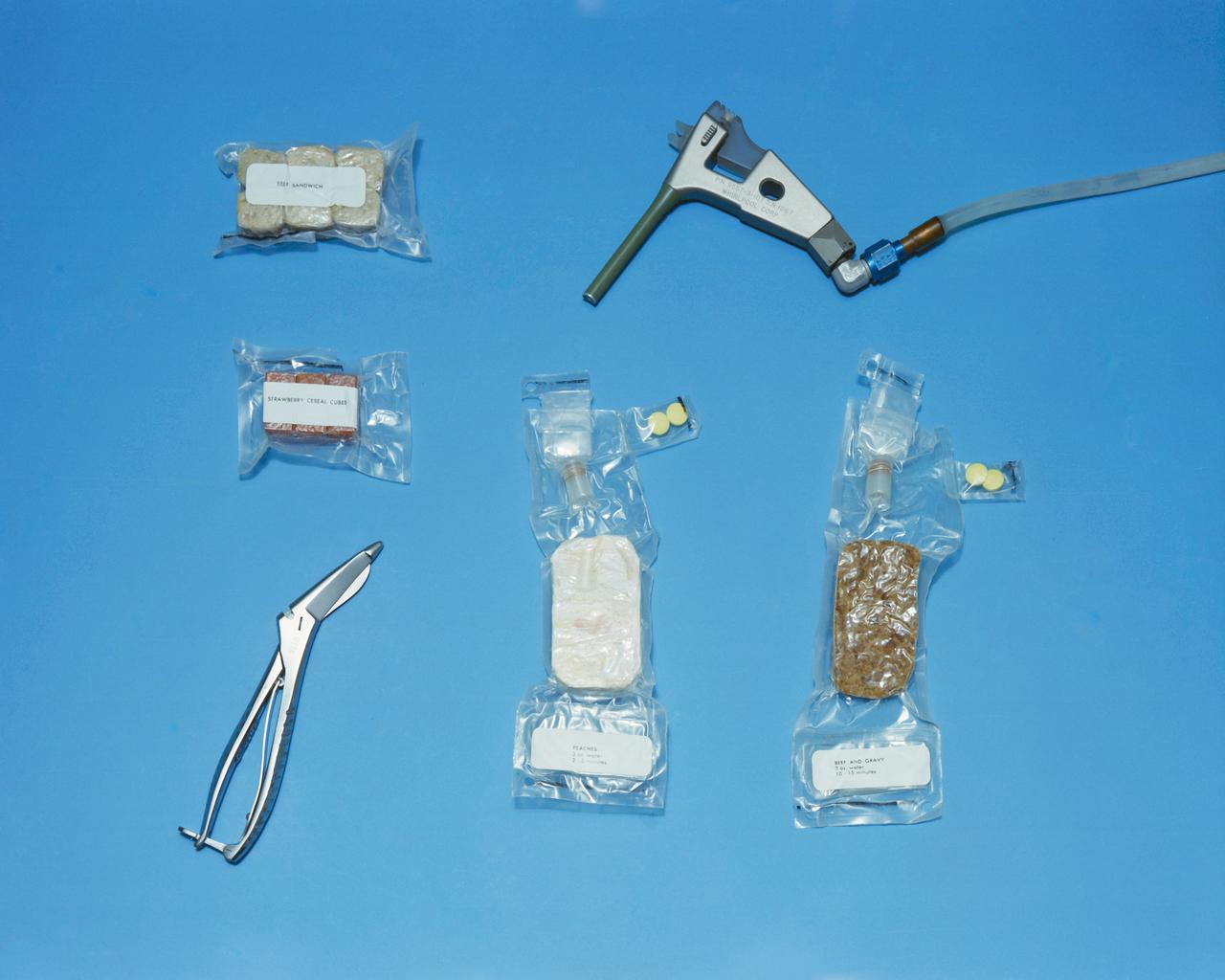
Food packages for use on the Gemini-Titan 4 (GT-4) flight. Packages include beef and gravy, peaches, strawberry cereal cubes and beef sandwiches. A water gun is used to reconstitute the dehydrated food. MSC, HOUSTON, TX CN
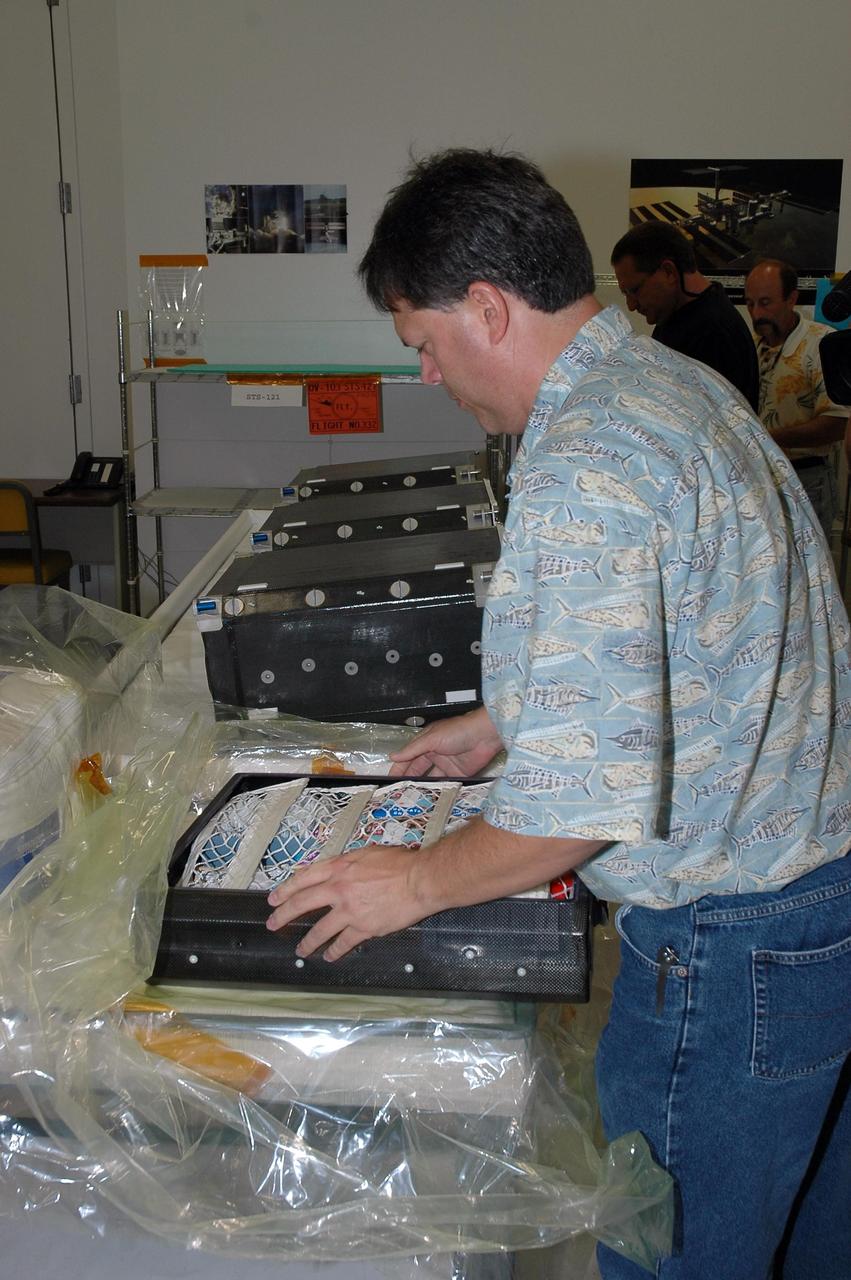
KENNEDY SPACE CENTER, FLA. - In the Space Station Processing Facility at NASA's Kennedy Space Center, John Hoog packs up food containers with the meals prepared for the crew of mission STS-121. Hoog is a USA-FCE/EVA representative from Johnson Space Center. Astronauts select their own menus from a large array of food items. Astronauts are supplied with three balanced meals, plus snacks. Foods flown on space missions are researched and developed at the Space Food Systems Laboratory at the Johnson Space Center (JSC) in Houston, which is staffed by food scientists, dietitians and engineers. Foods are analyzed through nutritional analysis, sensory evaluation, storage studies, packaging evaluations and many other methods. Each astronaut’s food is stored aboard the space shuttle and is identified by a colored dot affixed to each package. Launch of Space Shuttle Discovery on mission STS-121 is scheduled for July 1. Photo credit: NASA/Jack Pfaller
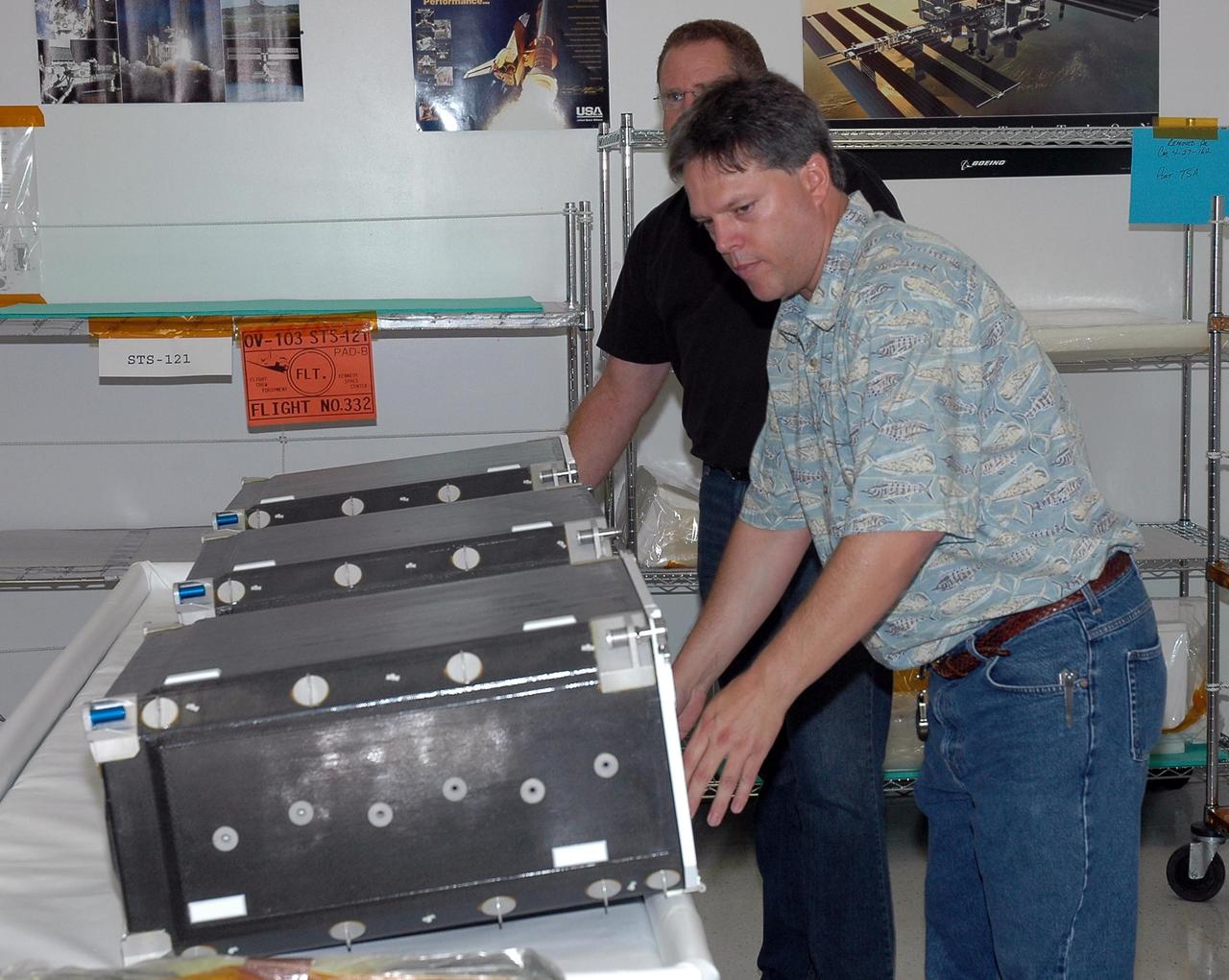
KENNEDY SPACE CENTER, FLA. - In the Space Station Processing Facility at NASA's Kennedy Space Center, John Hoog gets ready to pack the food containers with the meals prepared for the crew of mission STS-121. Hoog is a USA-FCE/EVA representative from Johnson Space Center.Astronauts select their own menus from a large array of food items. Astronauts are supplied with three balanced meals, plus snacks. Foods flown on space missions are researched and developed at the Space Food Systems Laboratory at the Johnson Space Center (JSC) in Houston, which is staffed by food scientists, dietitians and engineers. Foods are analyzed through nutritional analysis, sensory evaluation, storage studies, packaging evaluations and many other methods. Each astronaut’s food is stored aboard the space shuttle and is identified by a colored dot affixed to each package. Launch of Space Shuttle Discovery on mission STS-121 is scheduled for July 1. Photo credit: NASA/Jack Pfaller
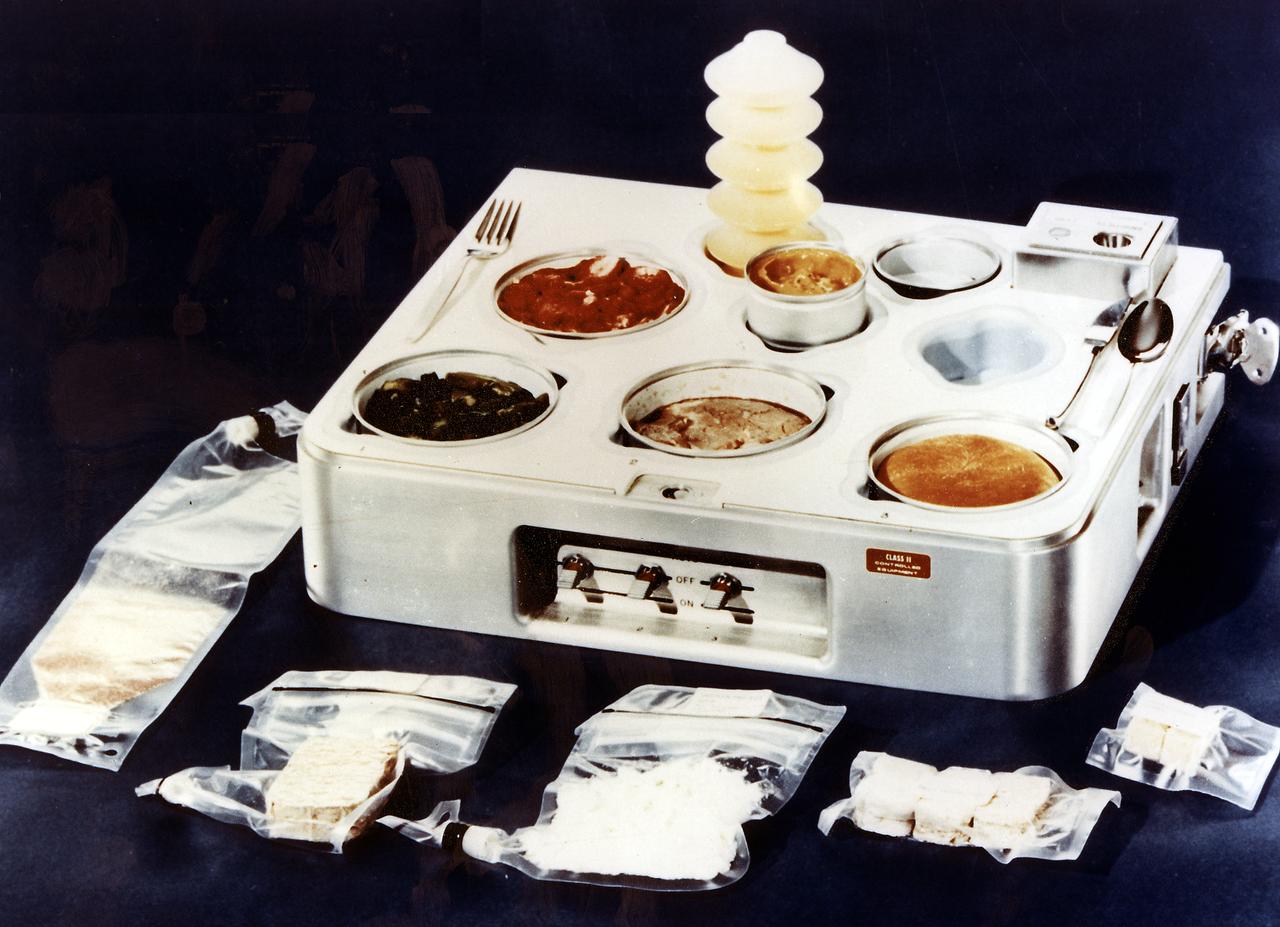
Shown here is the Skylab food heating and serving tray with food, drink, and utensils. The tray contained heating elements for preparing the individual food packets. The food on Skylab was a great improvement over that on earlier spaceflights. It was no longer necessary to squeeze liquified food from plastic tubes. Skylab's kitchen in the Orbital Workshop wardroom was so equipped that each crewman could select his own menu and prepare it to his own taste. The Marshall Space Flight Center had program management responsibility for the development of Skylab hardware and experiments.
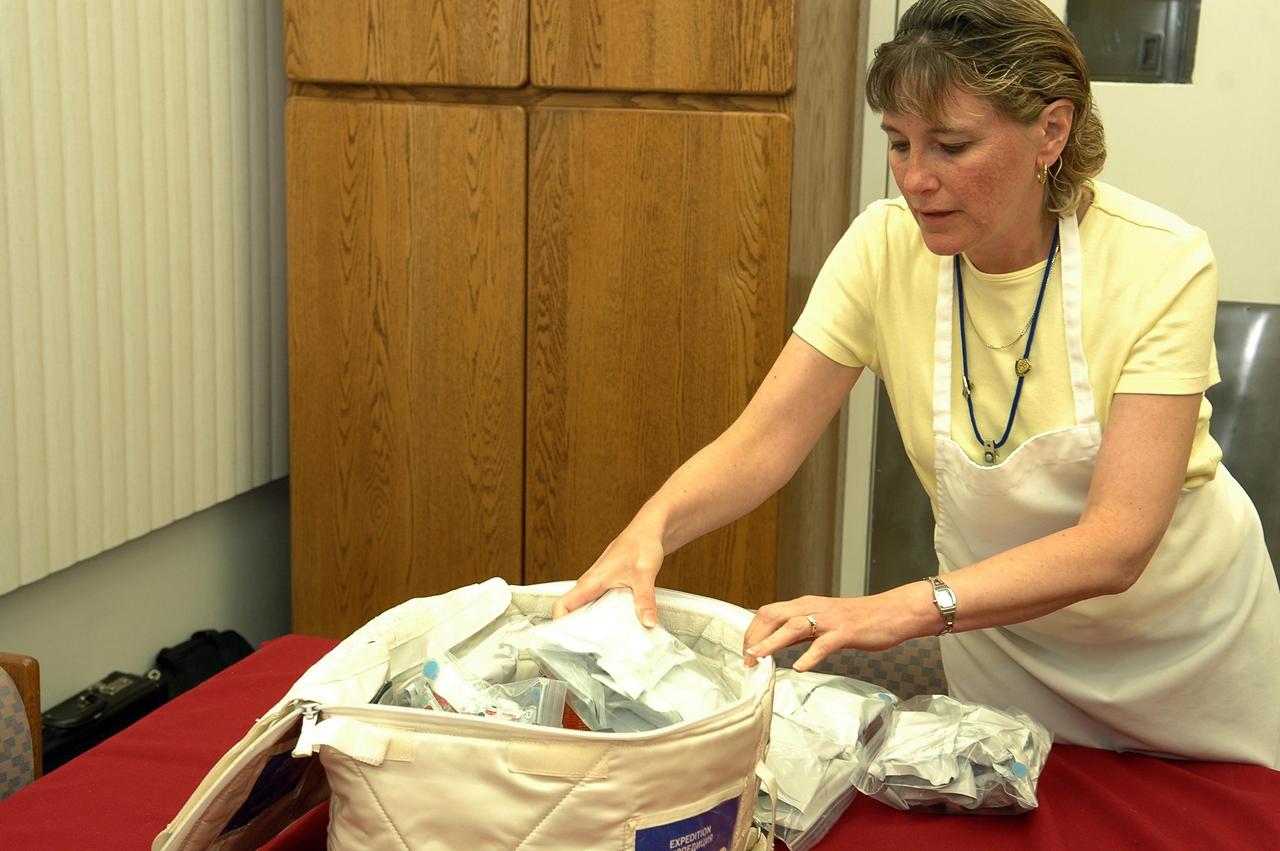
KENNEDY SPACE CENTER, FLA. - In the Operations and Checkout Building, Michele Perchonok stows packages of food that the STS-121 crew will eat on the 12-day mission. Perchonok is a NASA Subsystem manager for Shuttle Food Systems from Johnson Space Center. Astronauts select their own menus from a large array of food items. Astronauts are supplied with three balanced meals, plus snacks. Diets are designed to supply each astronaut with 100 percent of the daily value of vitamins and minerals necessary for the environment of space. Foods flown on space missions are researched and developed at the Space Food Systems Laboratory at the Johnson Space Center (JSC) in Houston, which is staffed by food scientists, dietitians and engineers. Foods are analyzed through nutritional analysis, sensory evaluation, storage studies, packaging evaluations and many other methods. Each astronaut’s food is stored aboard the space shuttle and is identified by a colored dot affixed to each package. A supplementary food supply (pantry) consisting of two extra days per person is stowed aboard the space shuttle for each flight. Pantry items are flown in addition to the menu in case the flight is unexpectedly extended because of bad weather at the landing site or for some other unforeseen reason. Photo credit: NASA/Kim Shiflett
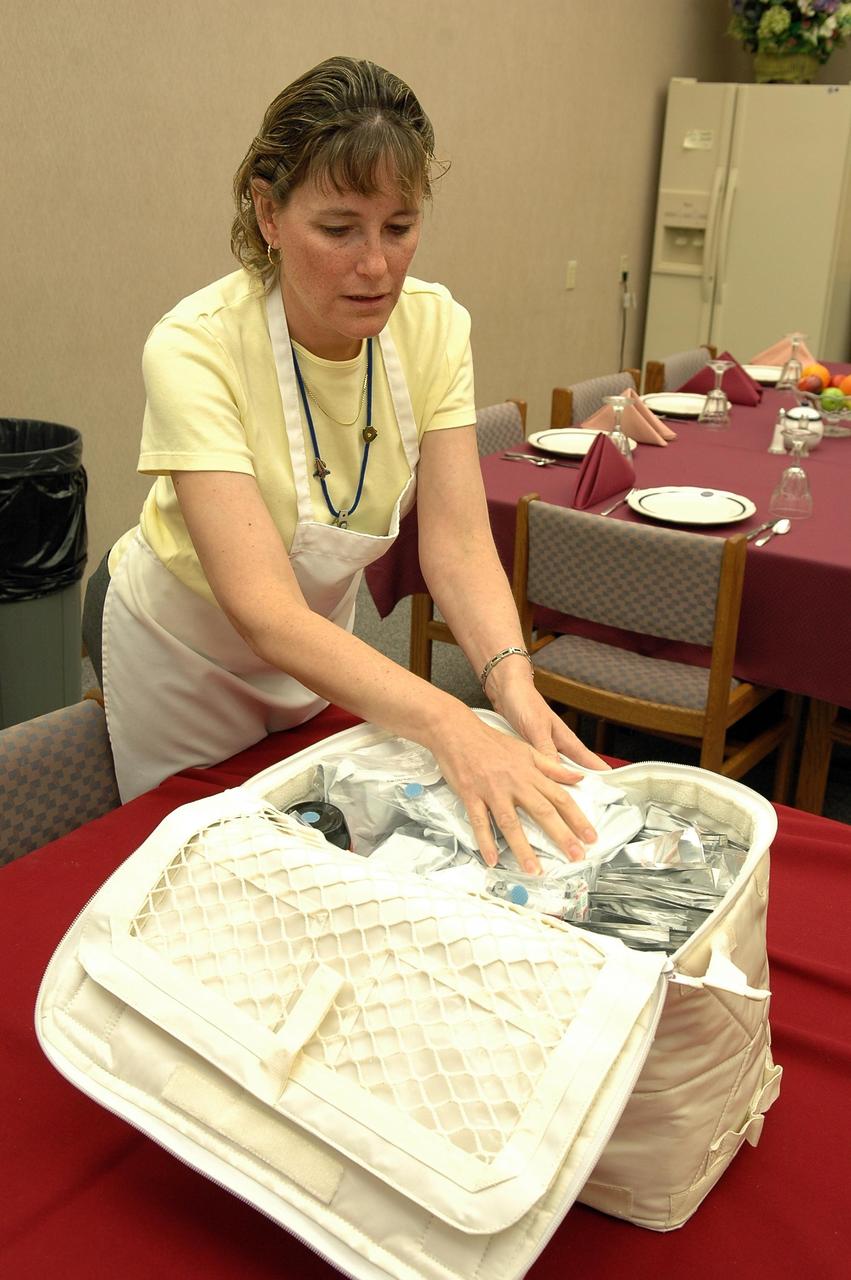
KENNEDY SPACE CENTER, FLA. - In the Operations and Checkout Building, Michele Perchonok stows packages of food that the STS-121 crew will eat on the 12-day mission. Perchonok is a NASA Subsystem manager for Shuttle Food Systems from Johnson Space Center. Astronauts select their own menus from a large array of food items. Astronauts are supplied with three balanced meals, plus snacks. Diets are designed to supply each astronaut with 100 percent of the daily value of vitamins and minerals necessary for the environment of space. Foods flown on space missions are researched and developed at the Space Food Systems Laboratory at the Johnson Space Center (JSC) in Houston, which is staffed by food scientists, dietitians and engineers. Foods are analyzed through nutritional analysis, sensory evaluation, storage studies, packaging evaluations and many other methods. Each astronaut’s food is stored aboard the space shuttle and is identified by a colored dot affixed to each package. A supplementary food supply (pantry) consisting of two extra days per person is stowed aboard the space shuttle for each flight. Pantry items are flown in addition to the menu in case the flight is unexpectedly extended because of bad weather at the landing site or for some other unforeseen reason. Photo credit: NASA/Kim Shiflett
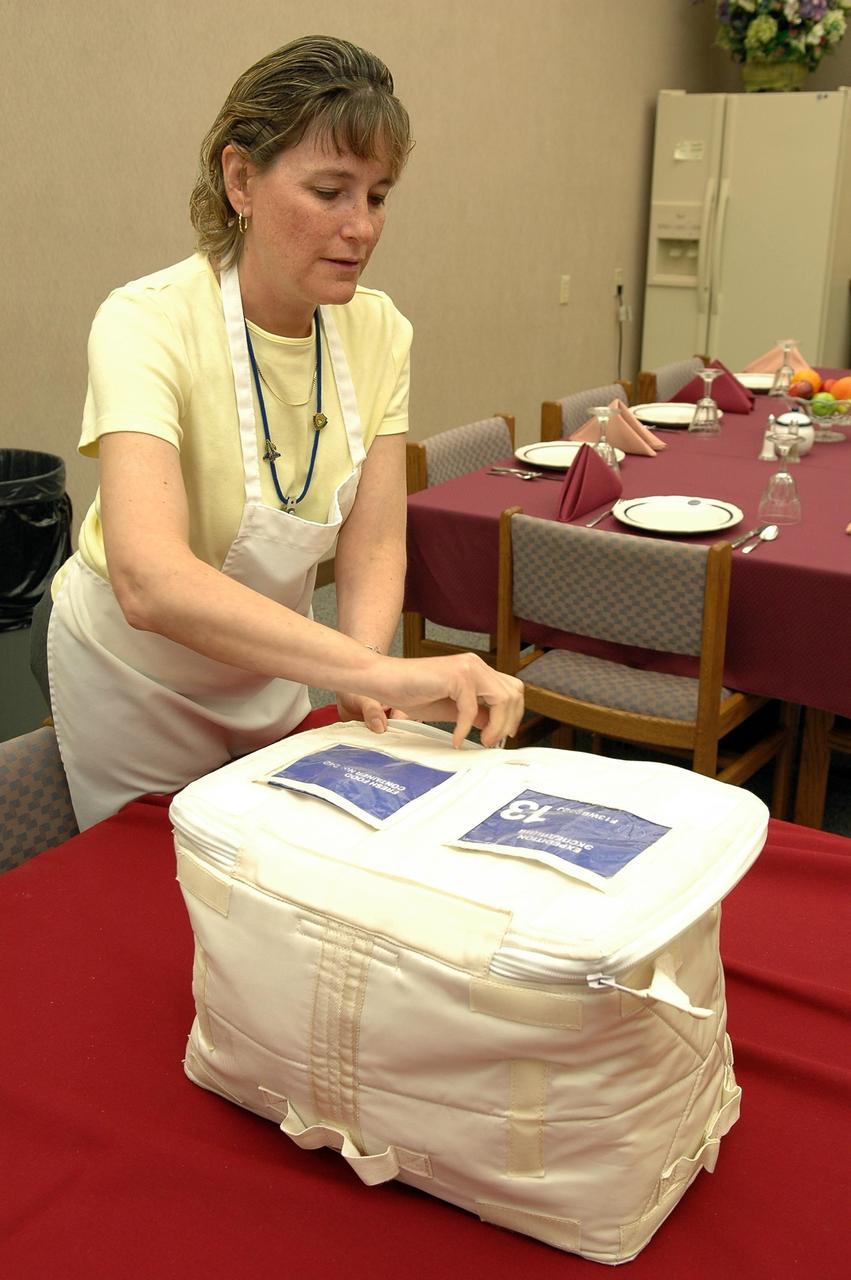
KENNEDY SPACE CENTER, FLA. - In the Operations and Checkout Building, Michele Perchonok closes a container of food packages that the STS-121 crew will eat on the 12-day mission. Perchonok is a NASA Subsystem manager for Shuttle Food Systems from Johnson Space Center. Astronauts select their own menus from a large array of food items. Astronauts are supplied with three balanced meals, plus snacks. Diets are designed to supply each astronaut with 100 percent of the daily value of vitamins and minerals necessary for the environment of space. Foods flown on space missions are researched and developed at the Space Food Systems Laboratory at the Johnson Space Center (JSC) in Houston, which is staffed by food scientists, dietitians and engineers. Foods are analyzed through nutritional analysis, sensory evaluation, storage studies, packaging evaluations and many other methods. Each astronaut’s food is stored aboard the space shuttle and is identified by a colored dot affixed to each package. A supplementary food supply (pantry) consisting of two extra days per person is stowed aboard the space shuttle for each flight. Pantry items are flown in addition to the menu in case the flight is unexpectedly extended because of bad weather at the landing site or for some other unforeseen reason. Photo credit: NASA/Kim Shiflett
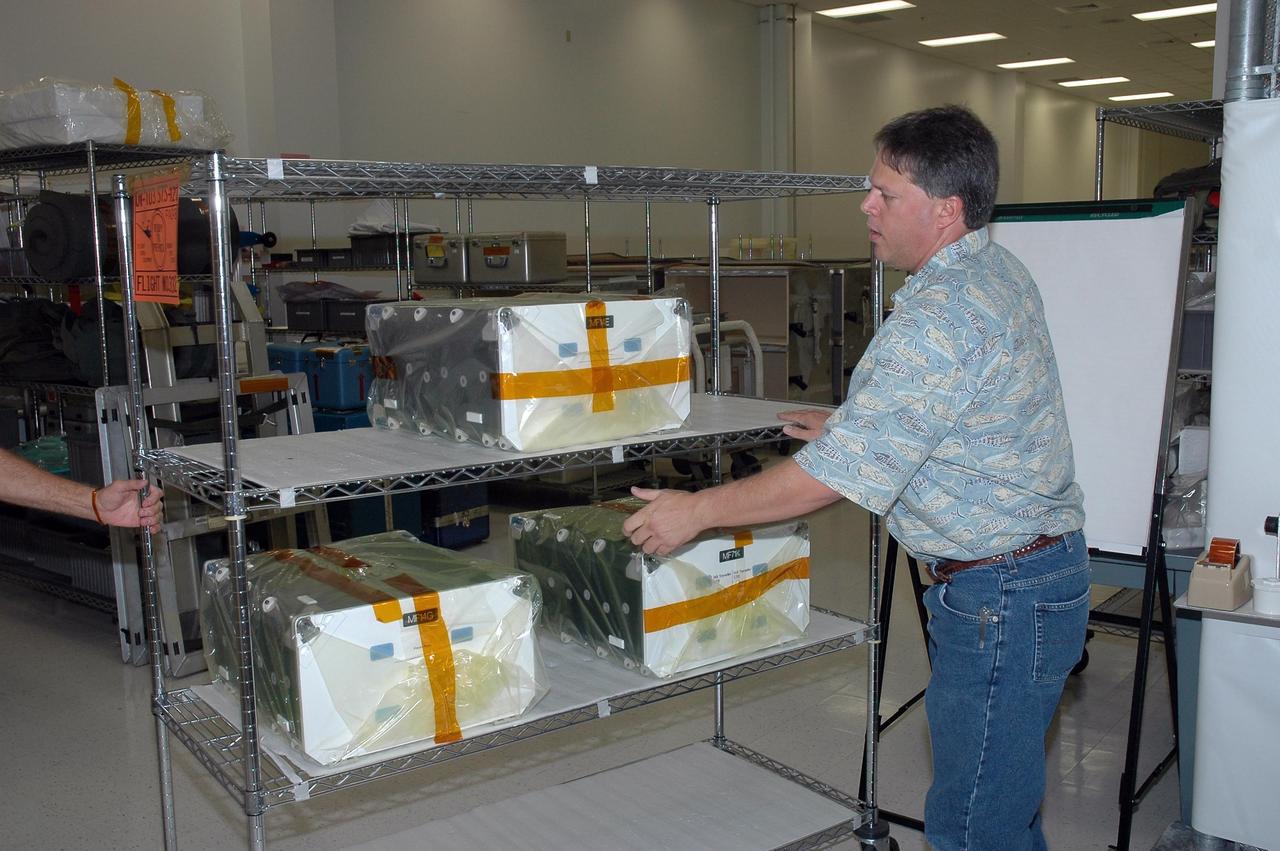
KENNEDY SPACE CENTER, FLA. - In the Space Station Processing Facility at NASA's Kennedy Space Center, John Hoog reaches for a container filled with prepared meals for the crew of mission STS-121 to secure it for flight. Hoog is a USA-FCE/EVA representative from Johnson Space Center. Astronauts select their own menus from a large array of food items. Astronauts are supplied with three balanced meals, plus snacks. Foods flown on space missions are researched and developed at the Space Food Systems Laboratory at the Johnson Space Center (JSC) in Houston, which is staffed by food scientists, dietitians and engineers. Foods are analyzed through nutritional analysis, sensory evaluation, storage studies, packaging evaluations and many other methods. Each astronaut’s food is stored aboard the space shuttle and is identified by a colored dot affixed to each package. Launch of Space Shuttle Discovery on mission STS-121 is scheduled for July 1. Photo credit: NASA/Jack Pfaller
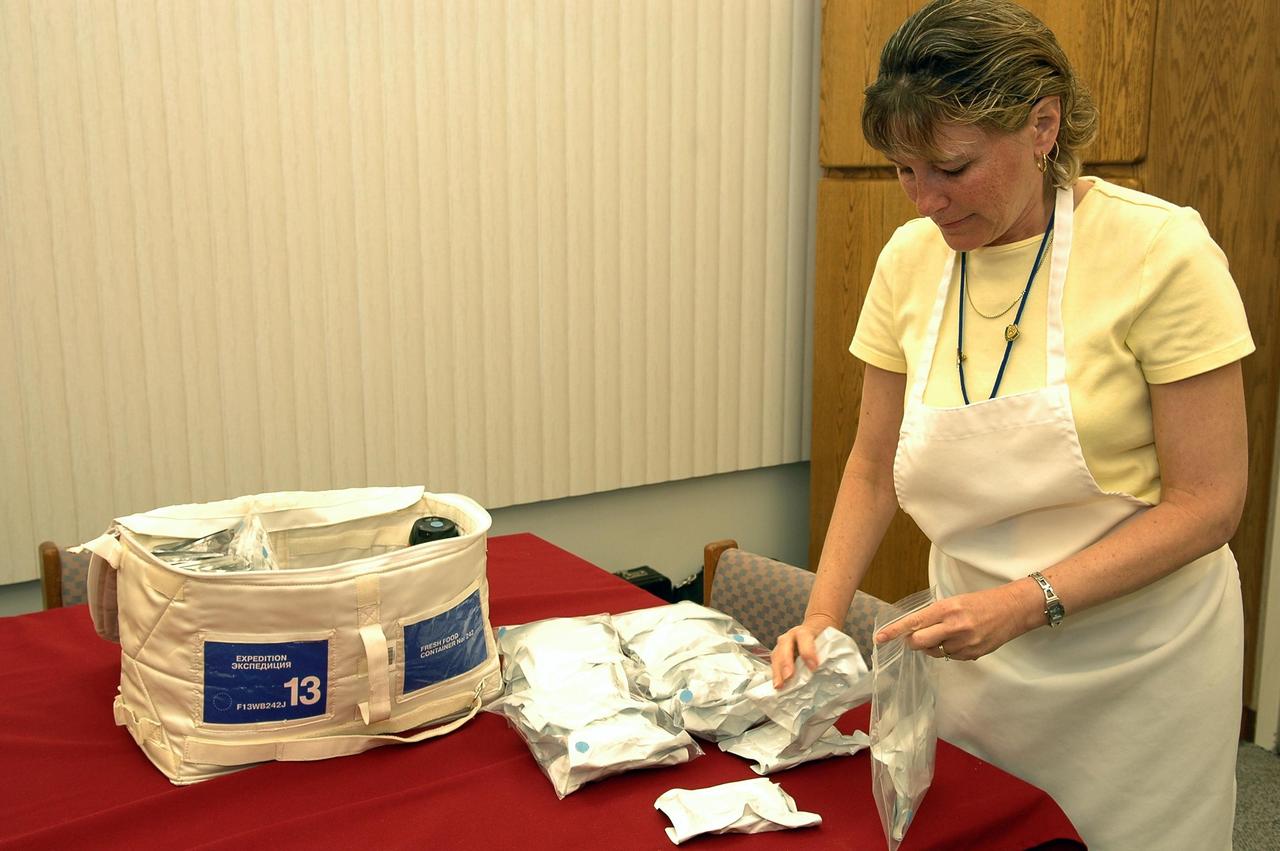
KENNEDY SPACE CENTER, FLA. - In the Operations and Checkout Building, Michele Perchonok packs the meals that the STS-121 crew will eat on the 12-day mission. Perchonok is a NASA Subsystem manager for Shuttle Food Systems from Johnson Space Center. Astronauts select their own menus from a large array of food items. Astronauts are supplied with three balanced meals, plus snacks. Diets are designed to supply each astronaut with 100 percent of the daily value of vitamins and minerals necessary for the environment of space. Foods flown on space missions are researched and developed at the Space Food Systems Laboratory at the Johnson Space Center (JSC) in Houston, which is staffed by food scientists, dietitians and engineers. Foods are analyzed through nutritional analysis, sensory evaluation, storage studies, packaging evaluations and many other methods. Each astronaut’s food is stored aboard the space shuttle and is identified by a colored dot affixed to each package. A supplementary food supply (pantry) consisting of two extra days per person is stowed aboard the space shuttle for each flight. Pantry items are flown in addition to the menu in case the flight is unexpectedly extended because of bad weather at the landing site or for some other unforeseen reason. Photo credit: NASA/Kim Shiflett
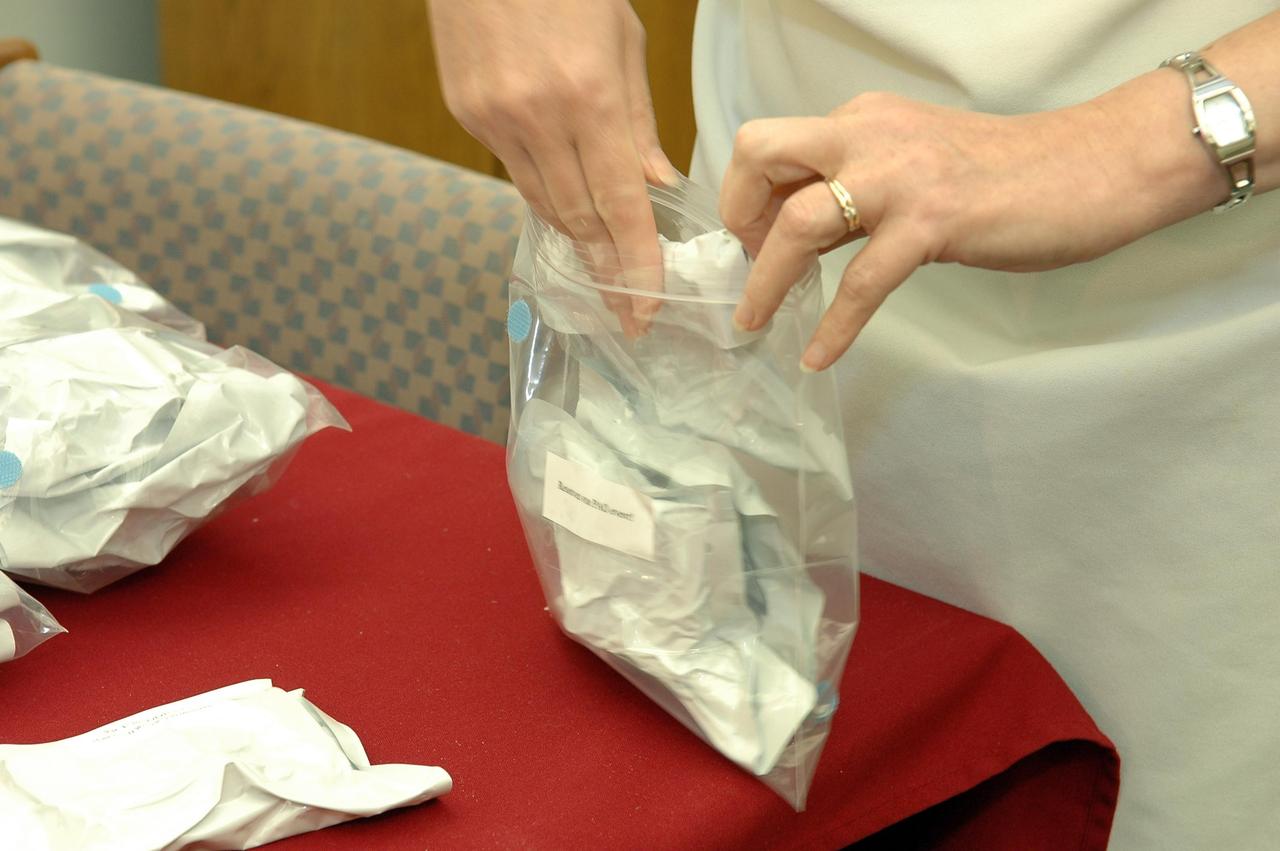
KENNEDY SPACE CENTER, FLA. - In the Operations and Checkout Building, Michele Perchonok packs the meals that the STS-121 crew will eat on the 12-day mission. Perchonok is a NASA Subsystem manager for Shuttle Food Systems from Johnson Space Center. Astronauts select their own menus from a large array of food items. Astronauts are supplied with three balanced meals, plus snacks. Diets are designed to supply each astronaut with 100 percent of the daily value of vitamins and minerals necessary for the environment of space. Foods flown on space missions are researched and developed at the Space Food Systems Laboratory at the Johnson Space Center (JSC) in Houston, which is staffed by food scientists, dietitians and engineers. Foods are analyzed through nutritional analysis, sensory evaluation, storage studies, packaging evaluations and many other methods. Each astronaut’s food is stored aboard the space shuttle and is identified by a colored dot affixed to each package. A supplementary food supply (pantry) consisting of two extra days per person is stowed aboard the space shuttle for each flight. Pantry items are flown in addition to the menu in case the flight is unexpectedly extended because of bad weather at the landing site or for some other unforeseen reason. Photo credit: NASA/Kim Shiflett
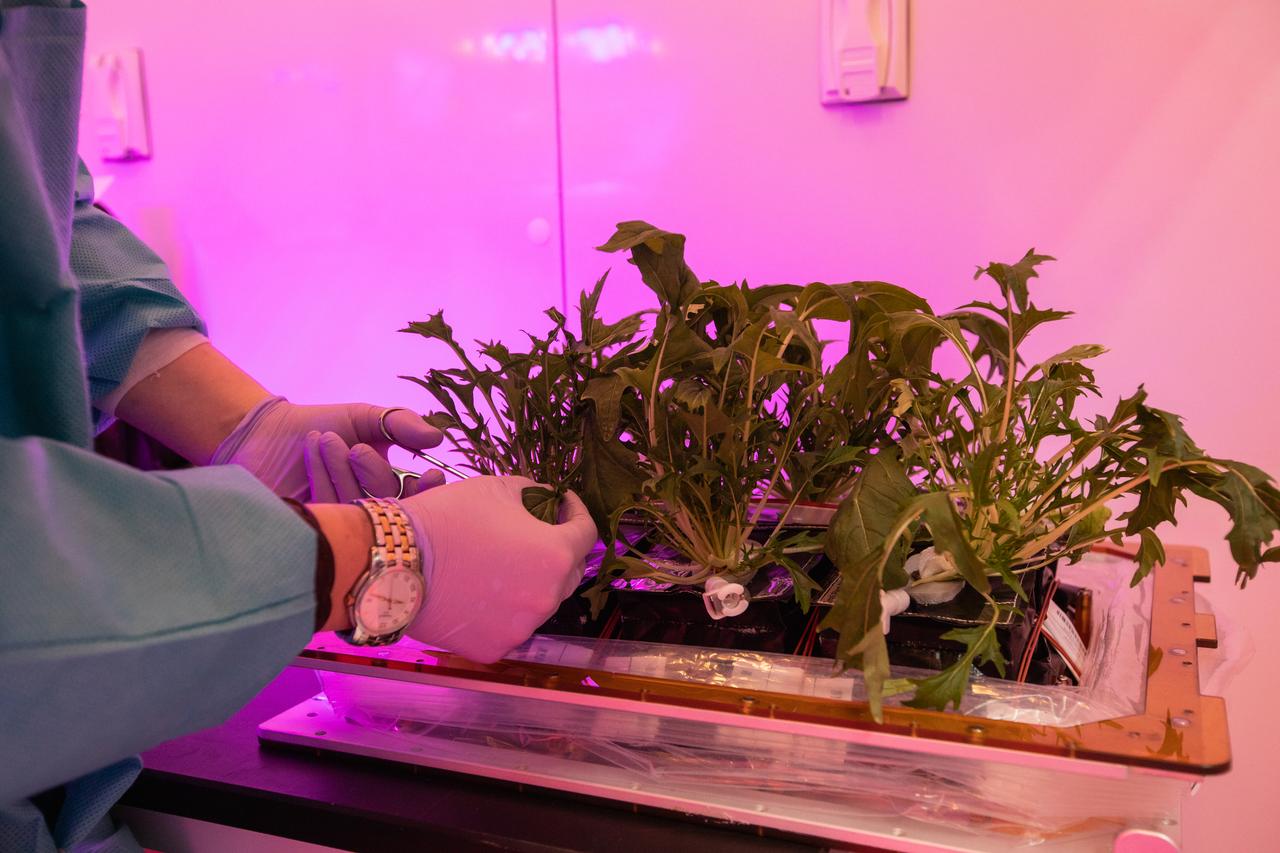
Mizuna mustard is harvested inside the Veggie harvest chamber in the Space Station Processing Facility at NASA’s Kennedy Space Center in Florida on Feb. 19, 2019, as part of the Experiment Verification Test for the VEG-04B mission that will launch to the International Space Station later this year. VEG-04B examines the interactions between light and spaceflight by growing plants under two different LED lighting conditions. A similar harvest will be conducted on the space station after a grow-out duration of 56 days. The VEG-04B mission is expected to provide sensory stimulation and help mark the passage of time in the confined and isolated environment of the space station. Ultimately, fresh vegetables grown in space will be an essential supplement to the crew’s pre-packaged diet, prepping them for long-duration space exploration.
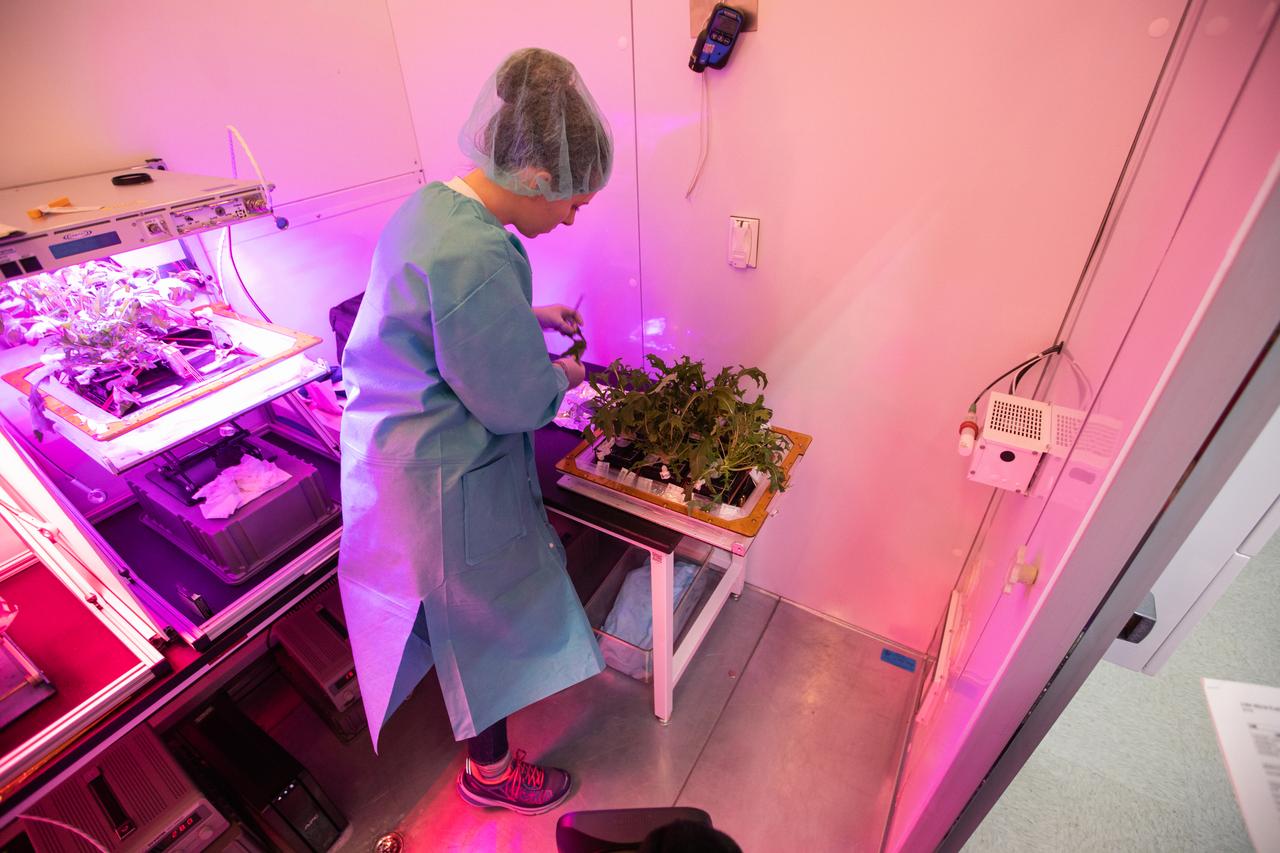
Jess Bunchek, a veggie plant scientist and pseudonaut, harvests mizuna mustard inside the Veggie harvest chamber in the Space Station Processing Facility at NASA’s Kennedy Space Center in Florida on Feb. 19, 2019, as part of the Experiment Verification Test for the VEG-04B mission that will launch to the International Space Station later this year. VEG-04B examines the interactions between light and spaceflight by growing plants under two different LED lighting conditions. A similar harvest will be conducted on the space station after a grow-out duration of 56 days. Ultimately, fresh vegetables grown in space will be an essential supplement to the crew’s pre-packaged diet, prepping them for long-duration space exploration.
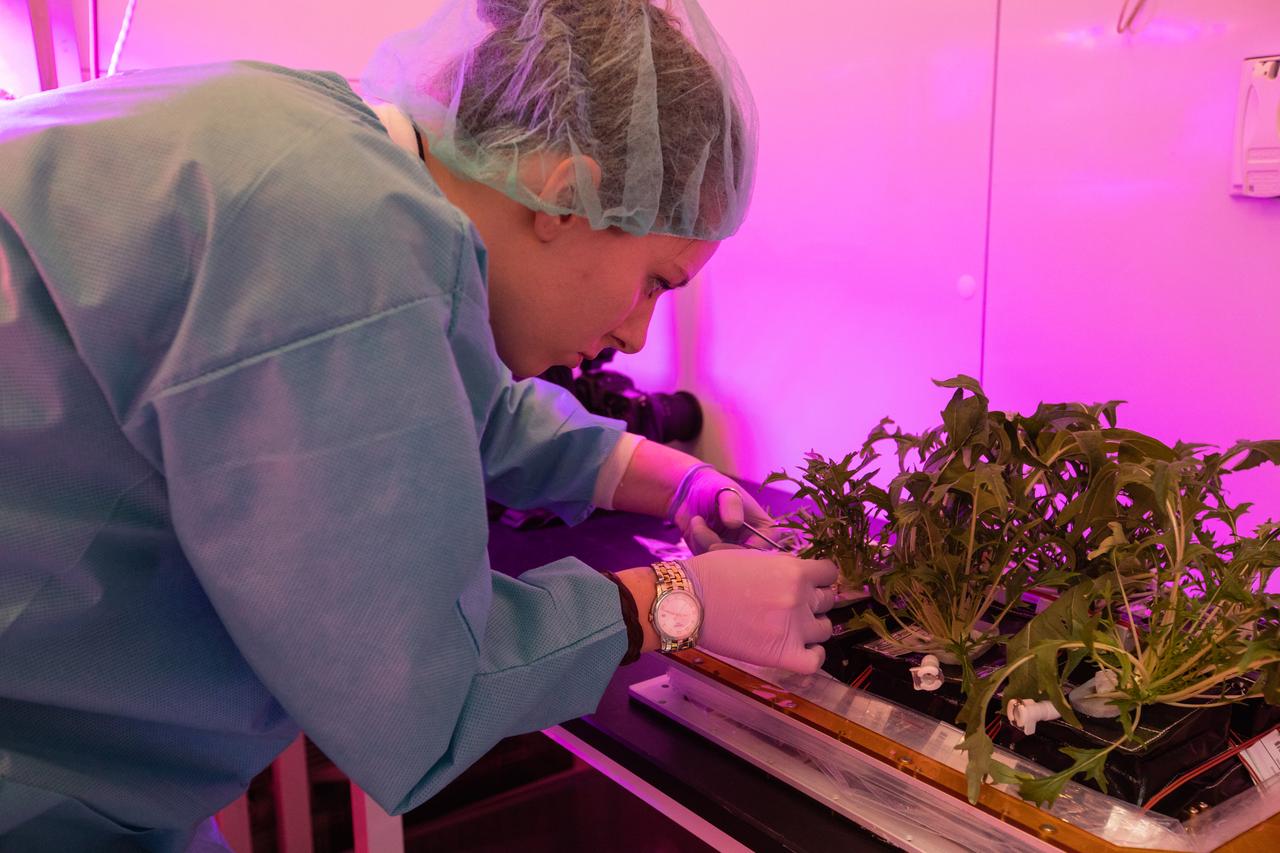
Jess Bunchek, a veggie plant scientist and pseudonaut, harvests mizuna mustard inside the Veggie harvest chamber in the Space Station Processing Facility at NASA’s Kennedy Space Center in Florida on Feb. 19, 2019, as part of the Experiment Verification Test for the VEG-04B mission that will launch to the International Space Station later this year. VEG-04B examines the interactions between light and spaceflight by growing plants under two different LED lighting conditions. A similar harvest will be conducted on the space station after a grow-out duration of 56 days. Ultimately, fresh vegetables grown in space will be an essential supplement to the crew’s pre-packaged diet, prepping them for long-duration space exploration.
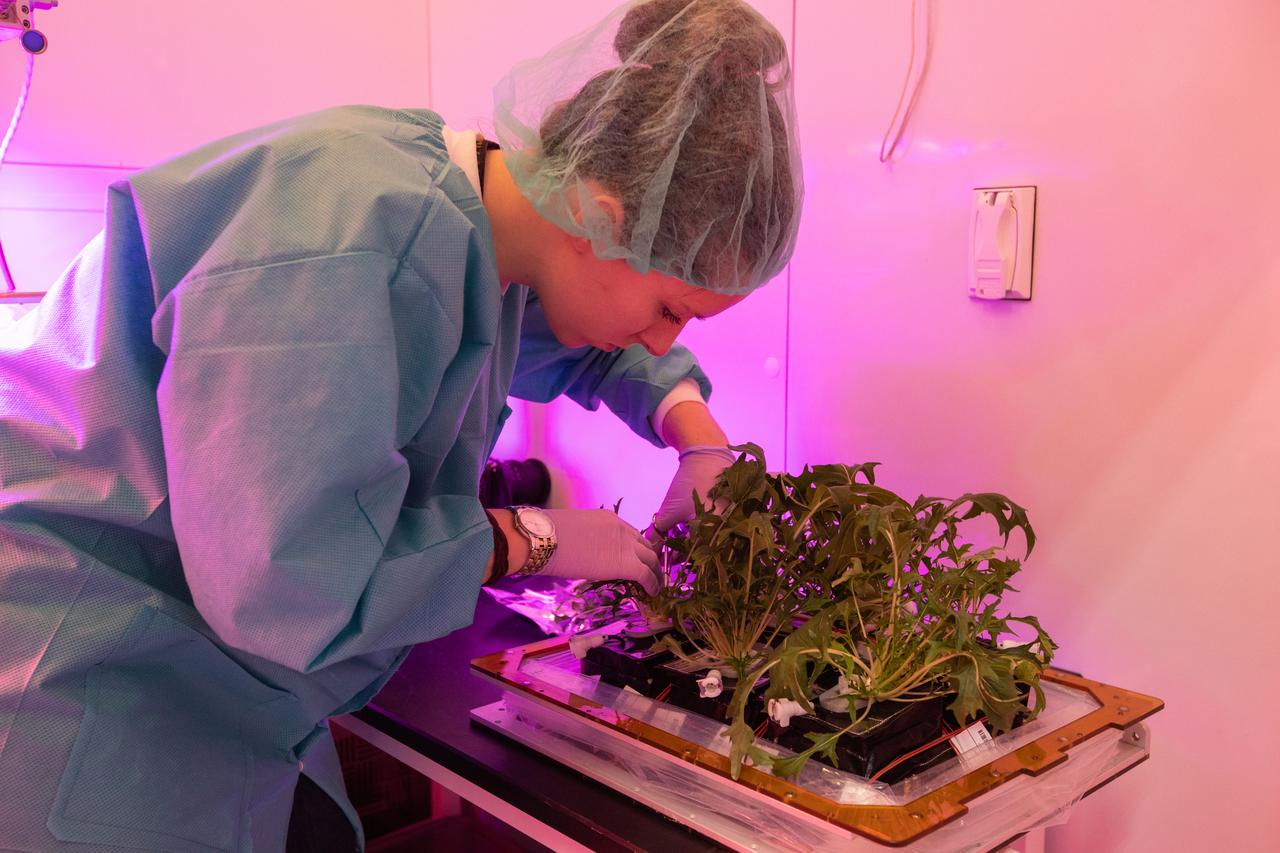
Jess Bunchek, a veggie plant scientist and pseudonaut, harvests mizuna mustard inside the Veggie harvest chamber in the Space Station Processing Facility at NASA’s Kennedy Space Center in Florida on Feb. 19, 2019, as part of the Experiment Verification Test for the VEG-04B mission that will launch to the International Space Station later this year. VEG-04B examines the interactions between light and spaceflight by growing plants under two different LED lighting conditions. A similar harvest will be conducted on the space station after a grow-out duration of 56 days. Ultimately, fresh vegetables grown in space will be an essential supplement to the crew’s pre-packaged diet, prepping them for long-duration space exploration.
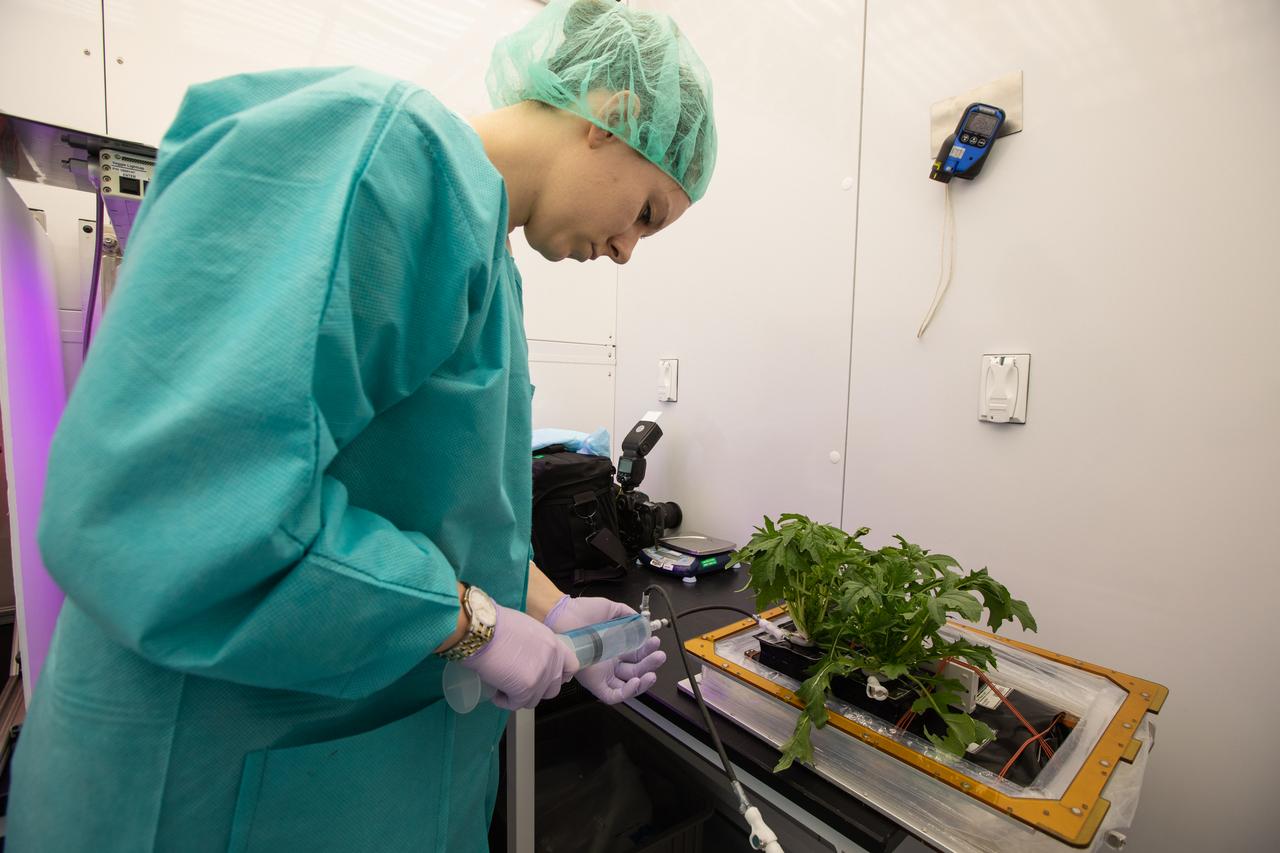
Jess Bunchek, a veggie plant scientist and pseudonaut, harvests mizuna mustard inside the Veggie harvest chamber in the Space Station Processing Facility at NASA’s Kennedy Space Center in Florida on Feb. 19, 2019, as part of the Experiment Verification Test for the VEG-04B mission that will launch to the International Space Station later this year. VEG-04B examines the interactions between light and spaceflight by growing plants under two different LED lighting conditions. A similar harvest will be conducted on the space station after a grow-out duration of 56 days. Ultimately, fresh vegetables grown in space will be an essential supplement to the crew’s pre-packaged diet, prepping them for long-duration space exploration.
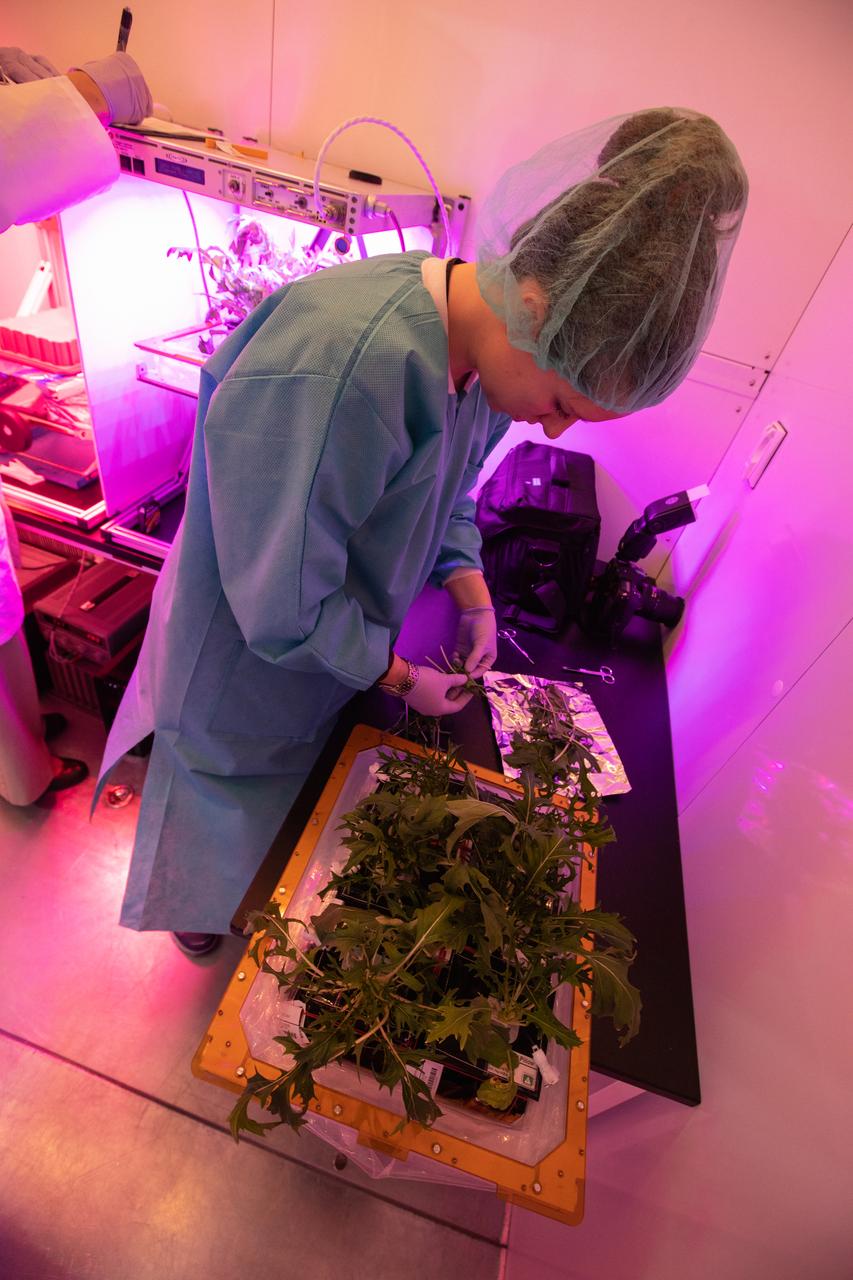
Jess Bunchek, a veggie plant scientist and pseudonaut, harvests mizuna mustard inside the Veggie harvest chamber in the Space Station Processing Facility at NASA’s Kennedy Space Center in Florida on Feb. 19, 2019, as part of the Experiment Verification Test for the VEG-04B mission that will launch to the International Space Station later this year. VEG-04B examines the interactions between light and spaceflight by growing plants under two different LED lighting conditions. A similar harvest will be conducted on the space station after a grow-out duration of 56 days. Ultimately, fresh vegetables grown in space will be an essential supplement to the crew’s pre-packaged diet, prepping them for long-duration space exploration.
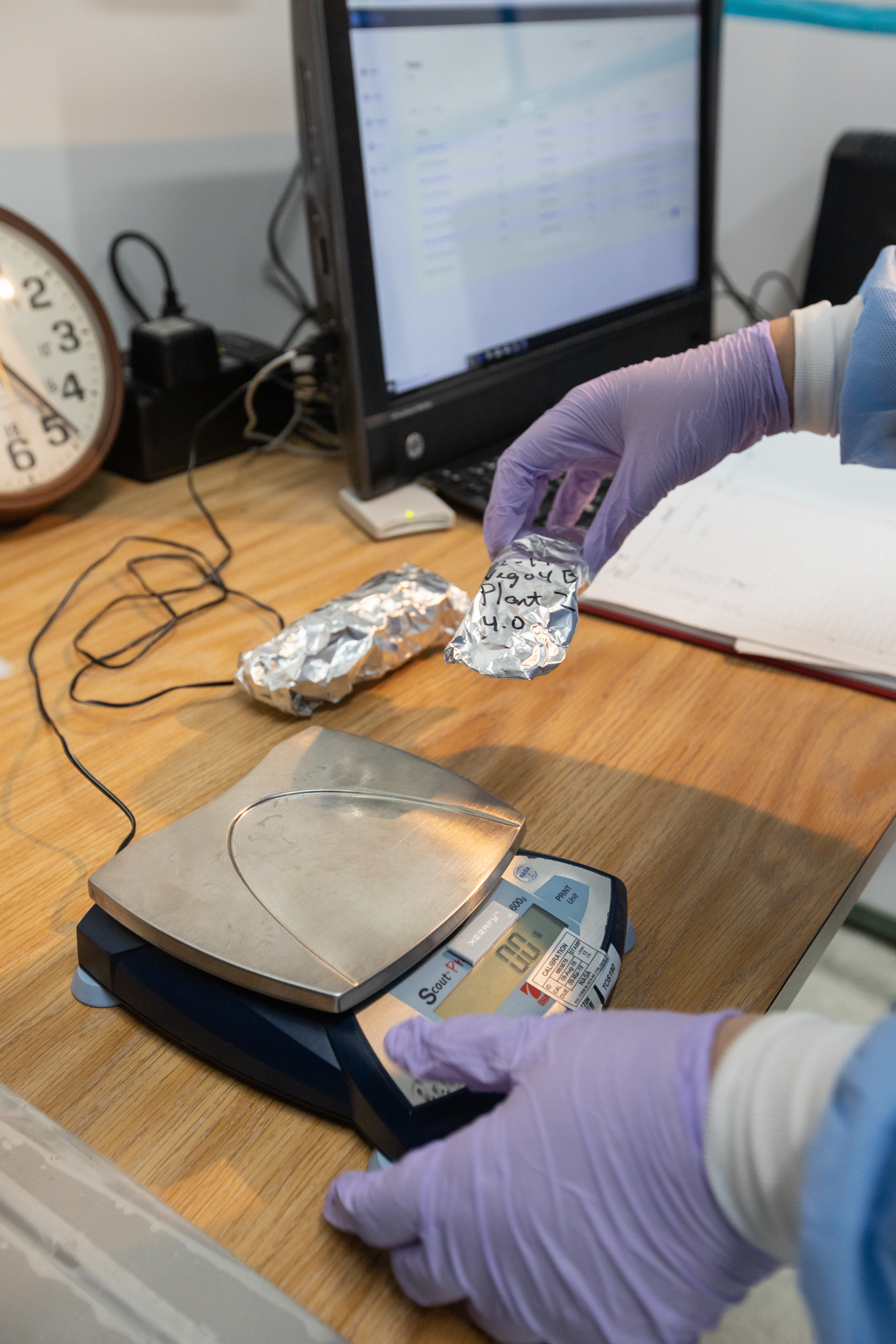
Gretchen Maldonado Vazquez, a microbiologist, weighs the harvest of mizuna mustard inside the Veggie harvest chamber in the Space Station Processing Facility at NASA’s Kennedy Space Center in Florida on Feb. 19, 2019, from the Experiment Verification Test for the VEG-04B mission that will launch to the International Space Station later this year. VEG-04B examines the interactions between light and spaceflight by growing plants under two different LED lighting conditions, and a similar harvest will be conducted on the space station after a grow-out duration of 56 days. Ultimately, fresh vegetables grown in space will be an essential supplement to the crew’s pre-packaged diet, prepping them for long-duration space exploration.
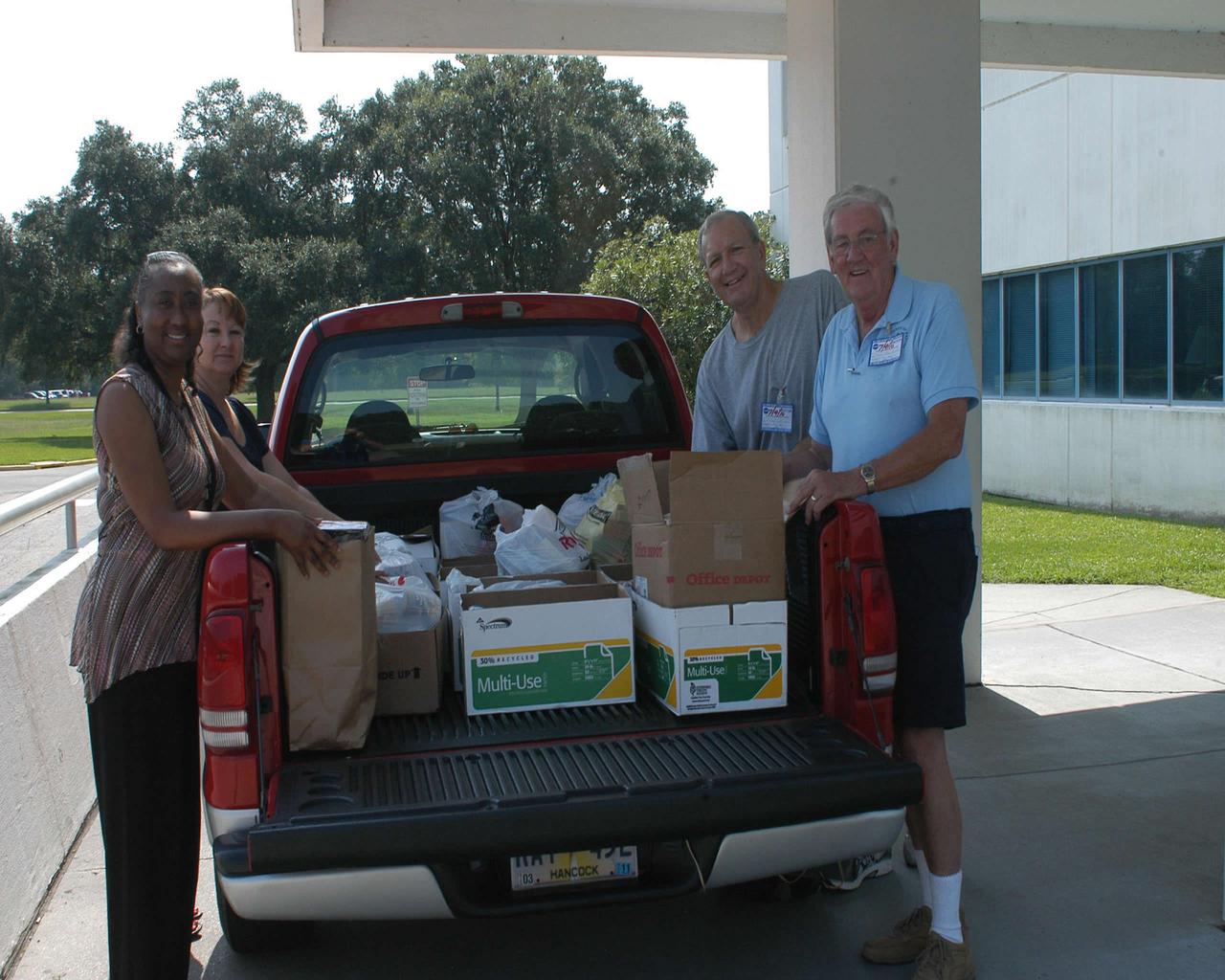
Cabrina Bell (l to r) and Jeanie Frederick with the Stennis Space Center Office of Human Capital help Hancock County Food Pantry representatives Edward Catone and Frank Manchester load collected food items July 9 as part of the 2010 Feds Feed Families campaign. The second annual national food drive was launched last month and involves federal agencies and employees across the country. Organizers hope to collect 1.2 million pounds of food items throughout the summer.
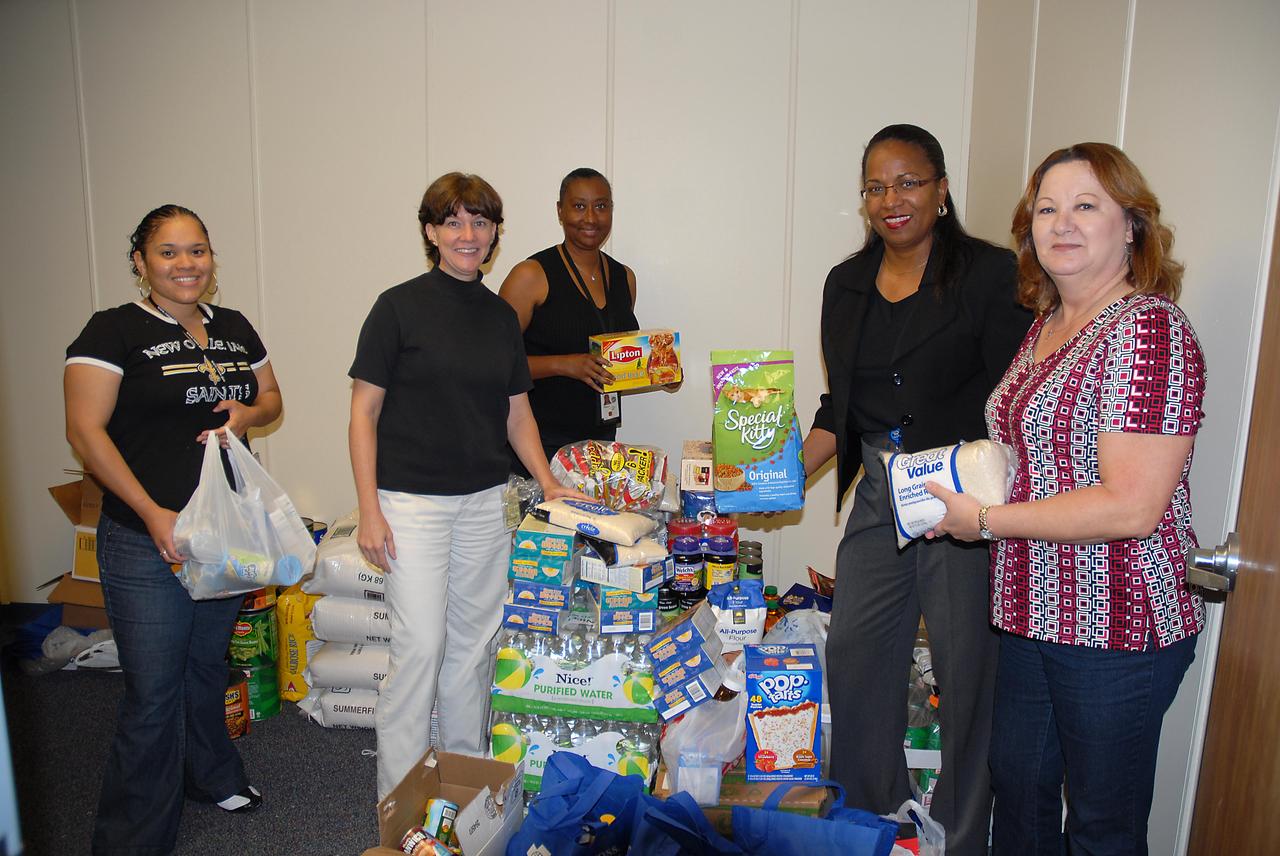
Stennis Space Center employees concluded their 2012 Feds Feed Families effort at the end of August with collection of 6,701 pounds of nonperishable food items. NASA Office of Human Capital Manager Dorsie Jones (second from right) joined office employees (l to r) Apolonia Acker, Cecile Saltzman, Cabrina Bell and Jeanie Frederick during pickup of the final food items. Stennis food items are contributed to the Hancock County Food Pantry in Bay St. Louis and the Mt. Olive Soup Kitchen in Slidell, La.
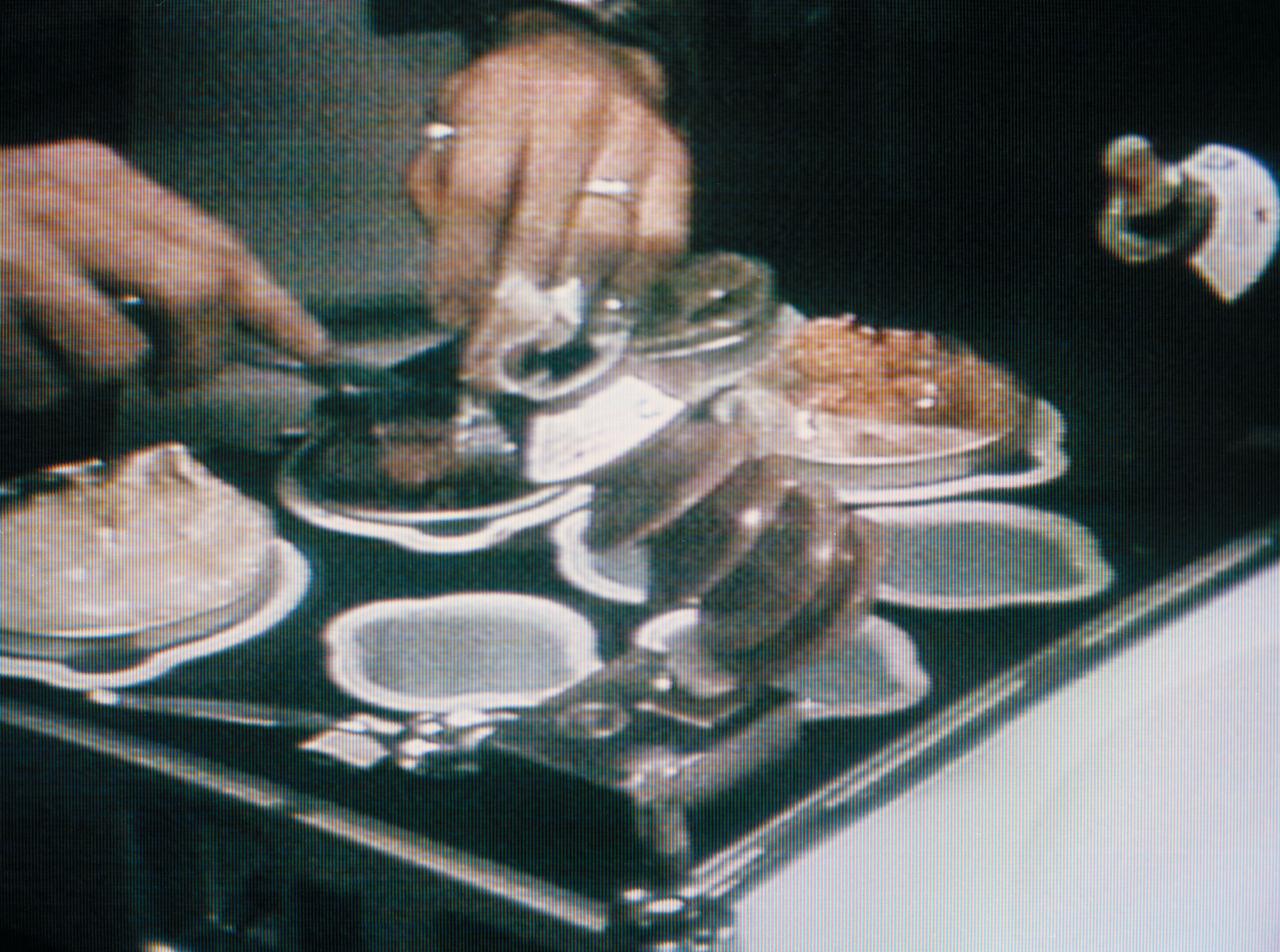
S73-34198 (1 Aug. 1973) --- A close-up view of the hands of astronaut Jack R. Lousma, Skylab 3 pilot, using a silverware utensil to gather food at the food station, in this photographic reproduction taken from a television transmission made by a color TV camera aboard the Skylab space station in Earth orbit. Astronaut Alan L. Bean, commander, had just zoomed the TV camera in for this close-up of the food tray following a series of wide shots of Lousma at the food station. Photo credit: NASA
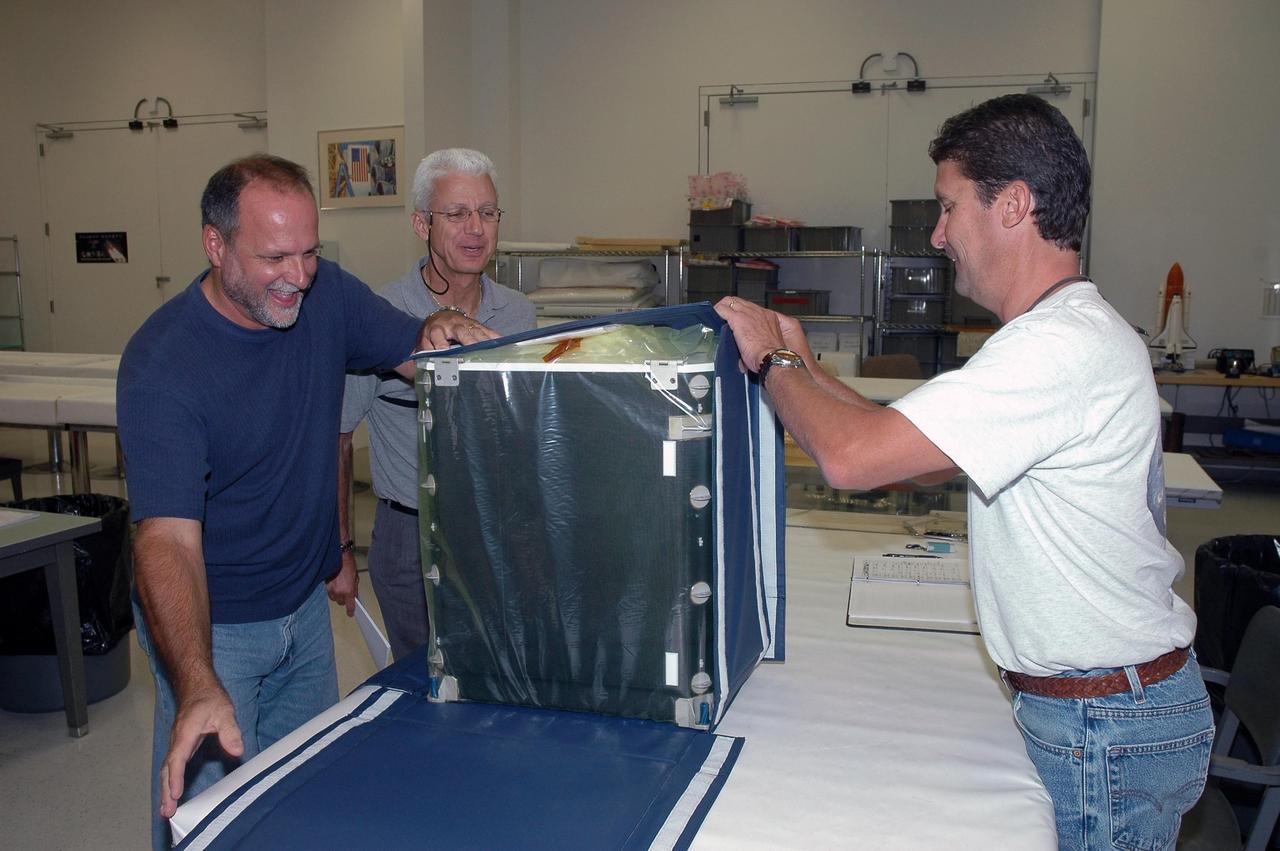
KENNEDY SPACE CENTER, FLA. - In the Space Station Processing Facility at NASA's Kennedy Space Center, Jim Blake, Dennis Huefner and Troy Mann wrap food containers that will be stowed on Space Shuttle Discovery for the flight of mission STS-121. The containers hold meals prepared for the mission crew. The men are with United Space Alliance ground operations. Astronauts select their own menus from a large array of food items. Astronauts are supplied with three balanced meals, plus snacks. Foods flown on space missions are researched and developed at the Space Food Systems Laboratory at the Johnson Space Center (JSC) in Houston, which is staffed by food scientists, dietitians and engineers. Foods are analyzed through nutritional analysis, sensory evaluation, storage studies, packaging evaluations and many other methods. Each astronaut’s food is stored aboard the space shuttle and is identified by a colored dot affixed to each package. Launch of Space Shuttle Discovery on mission STS-121 is scheduled for July 1. Photo credit: NASA/Jack Pfaller

KENNEDY SPACE CENTER, FLA. - In the Space Station Processing Facility at NASA's Kennedy Space Center, flight crew systems technician Troy Mann and flight crew systems manager Jim Blake store the food containers that will be stowed on Space Shuttle Discovery for the flight of mission STS-121. The containers hold meals prepared for the mission crew. Mann and Blake are with United Space Alliance ground operations. Astronauts select their own menus from a large array of food items. Astronauts are supplied with three balanced meals, plus snacks. Foods flown on space missions are researched and developed at the Space Food Systems Laboratory at the Johnson Space Center (JSC) in Houston, which is staffed by food scientists, dietitians and engineers. Foods are analyzed through nutritional analysis, sensory evaluation, storage studies, packaging evaluations and many other methods. Each astronaut’s food is stored aboard the space shuttle and is identified by a colored dot affixed to each package. Launch of Space Shuttle Discovery on mission STS-121 is scheduled for July 1. Photo credit: NASA/Jack Pfaller
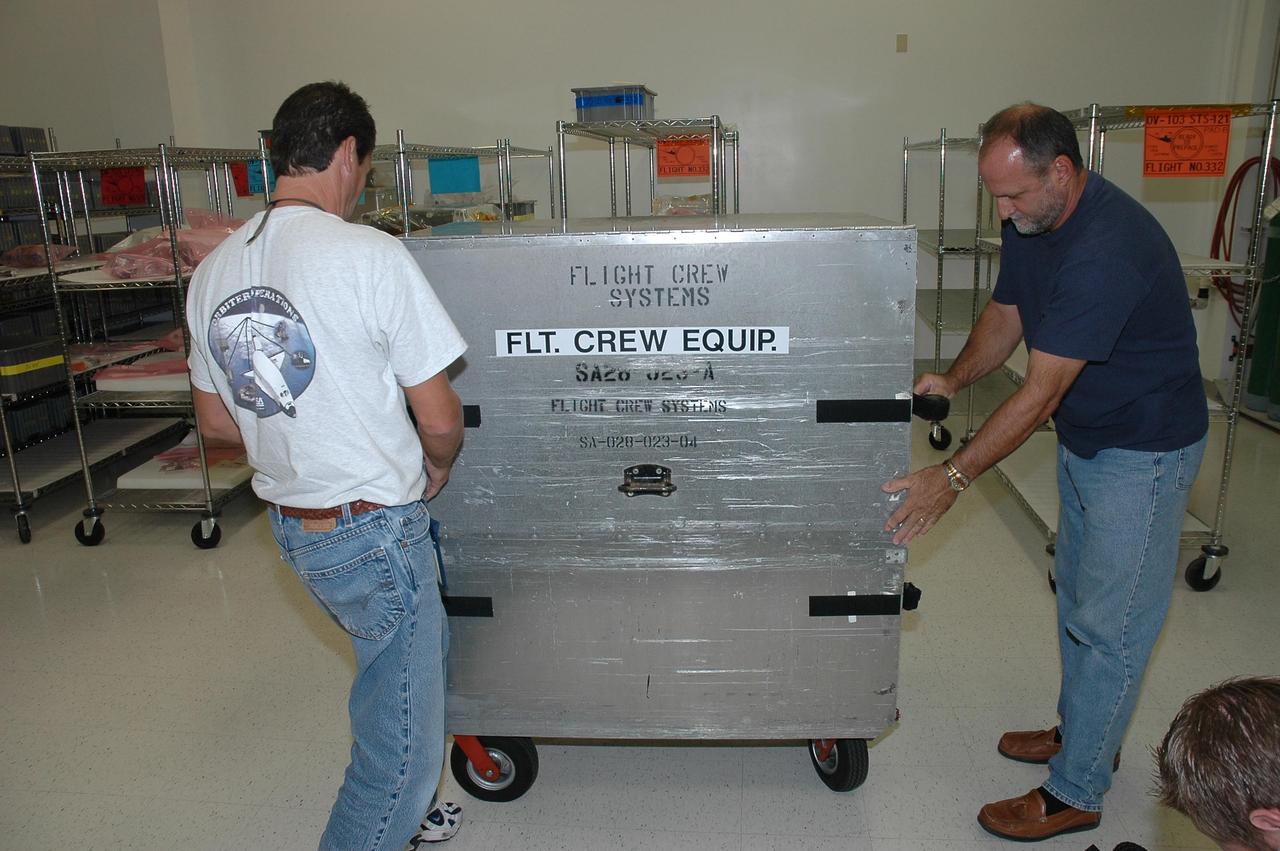
KENNEDY SPACE CENTER, FLA. - In the Space Station Processing Facility at NASA's Kennedy Space Center, flight crew systems technician Troy Mann and flight crew systems manager Jim Blake secure the storage boxes holding the food containers that will be stowed on Space Shuttle Discovery for the flight of mission STS-121. The containers hold meals prepared for the mission crew. Astronauts select their own menus from a large array of food items. Astronauts are supplied with three balanced meals, plus snacks. Foods flown on space missions are researched and developed at the Space Food Systems Laboratory at the Johnson Space Center (JSC) in Houston, which is staffed by food scientists, dietitians and engineers. Foods are analyzed through nutritional analysis, sensory evaluation, storage studies, packaging evaluations and many other methods. Each astronaut’s food is stored aboard the space shuttle and is identified by a colored dot affixed to each package. Launch of Space Shuttle Discovery on mission STS-121 is scheduled for July 1. Photo credit: NASA/Jack Pfaller
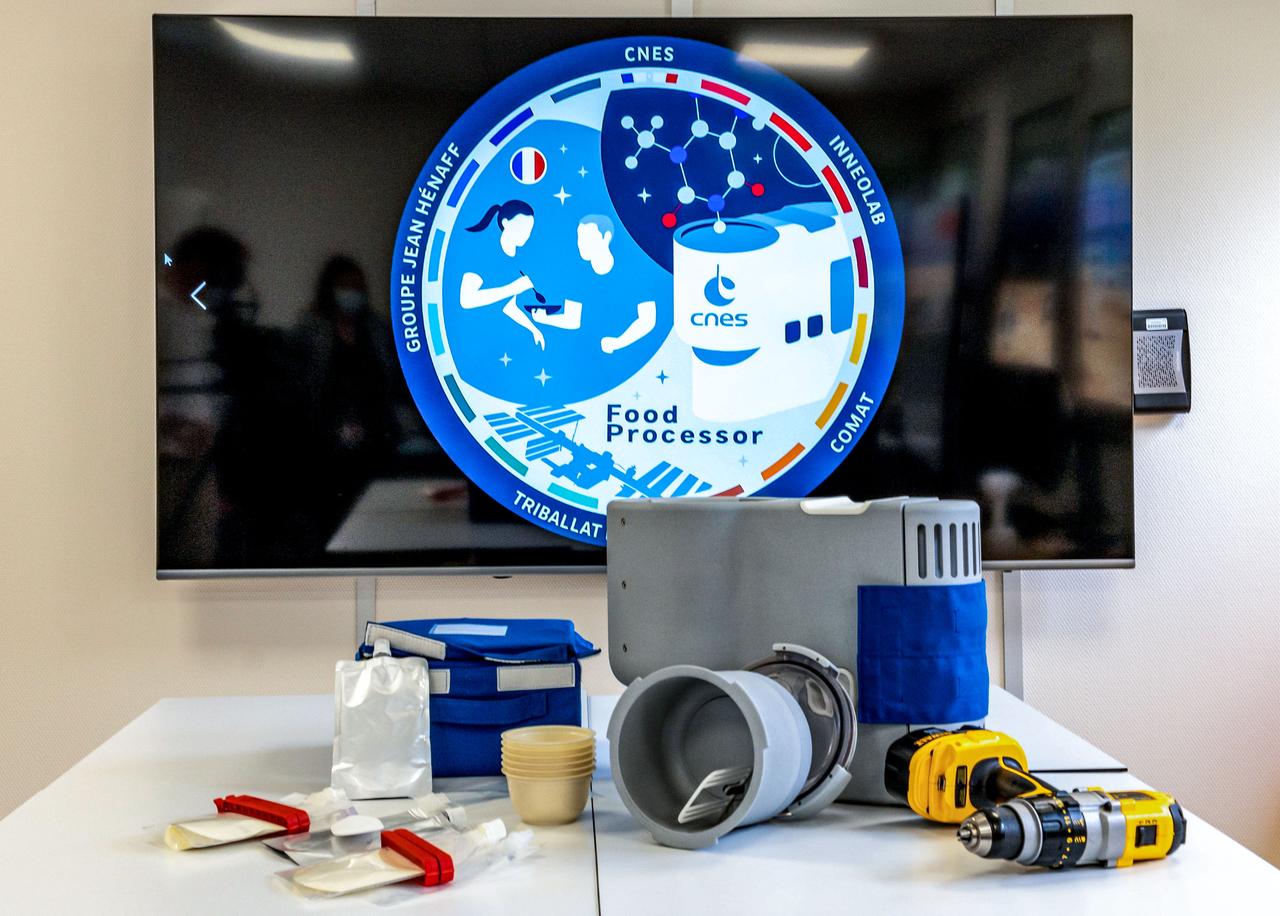
jsc2023e054754 (6/23/2021) --- A preflight view of the Food Processor Instrument and consumables including the drill it will need to use on board the International Space Station (ISS). The objective of the Advanced System for Space Food (Food Processor) investigation on board the International Space Station is to test a prototype equipment demonstrator with one specific recipe that uses basic cooking functions (beating egg whites, mixing products). © CNES/DE PRADA Thierry, 2021.
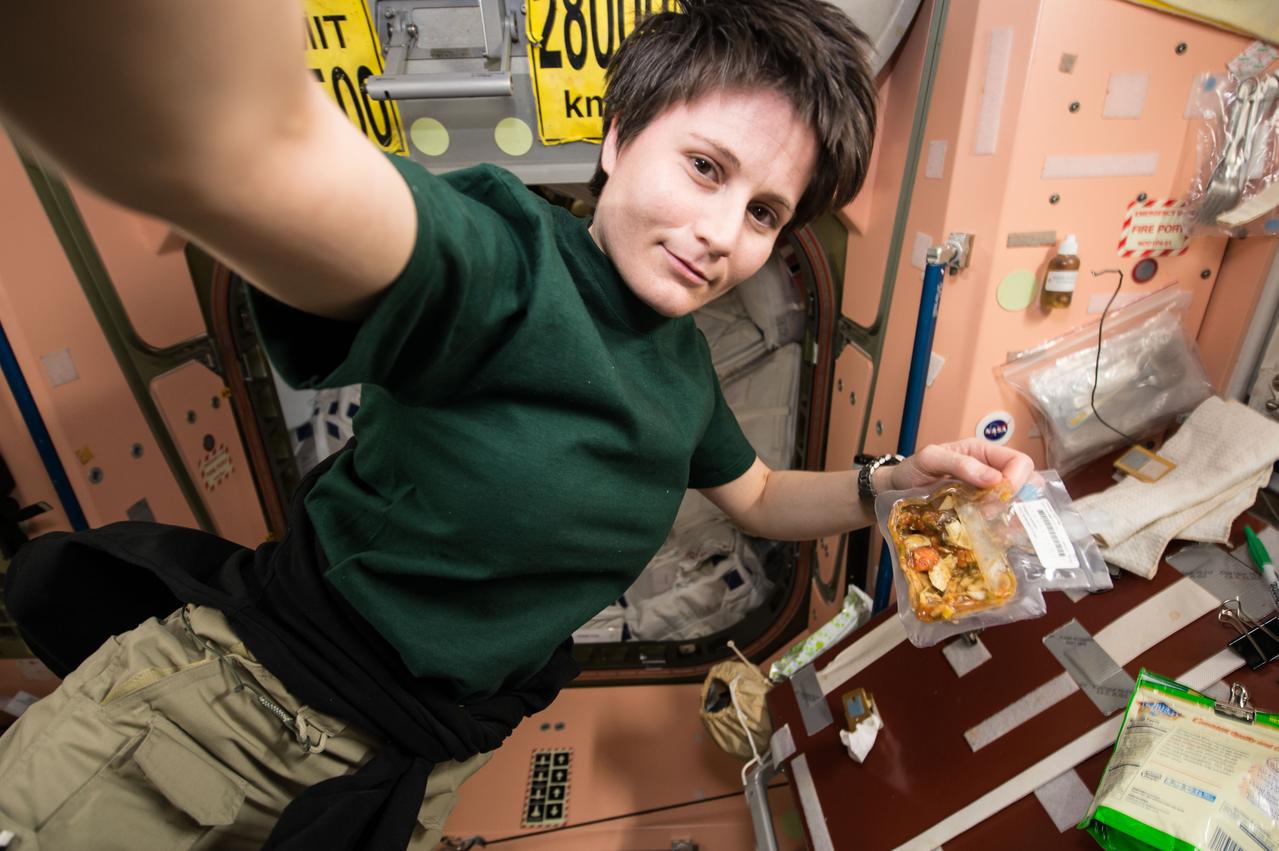
iss042e034821 (12/08/2014) --- Its dinner time on board the International Space Station (ISS) for Expedition 42 Flight Engineer Samantha Cristoforetti of the European Space Agency (ESA) on 8 December 2014. She is in the process of preparing a tasty specially designed food packet. The food on board the ISS is developed by food scientists at the Johnson Space Center in Houston Texas.
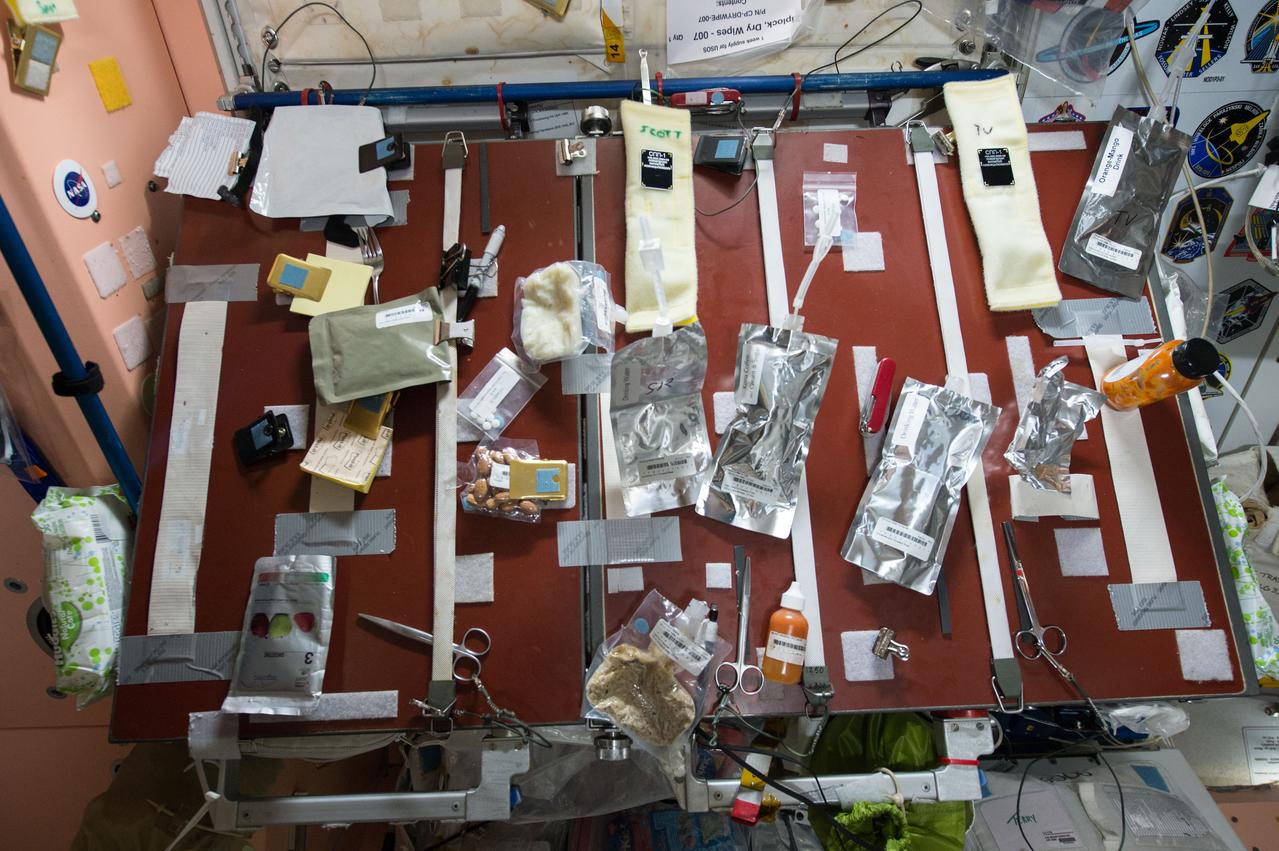
ISS043E091650 (04/08/2015) --- A view of the food table located in the Russian Zvezda service module on the International Space Station taken by Expedition 43 Flight Engineer Scott Kelly. Assorted food, drink and condiment packets are visible. Kelly tweeted this image along with the comment: ""Looks messy, but it's functional. Our #food table on the @space station. What's for breakfast? #YearInSpace".
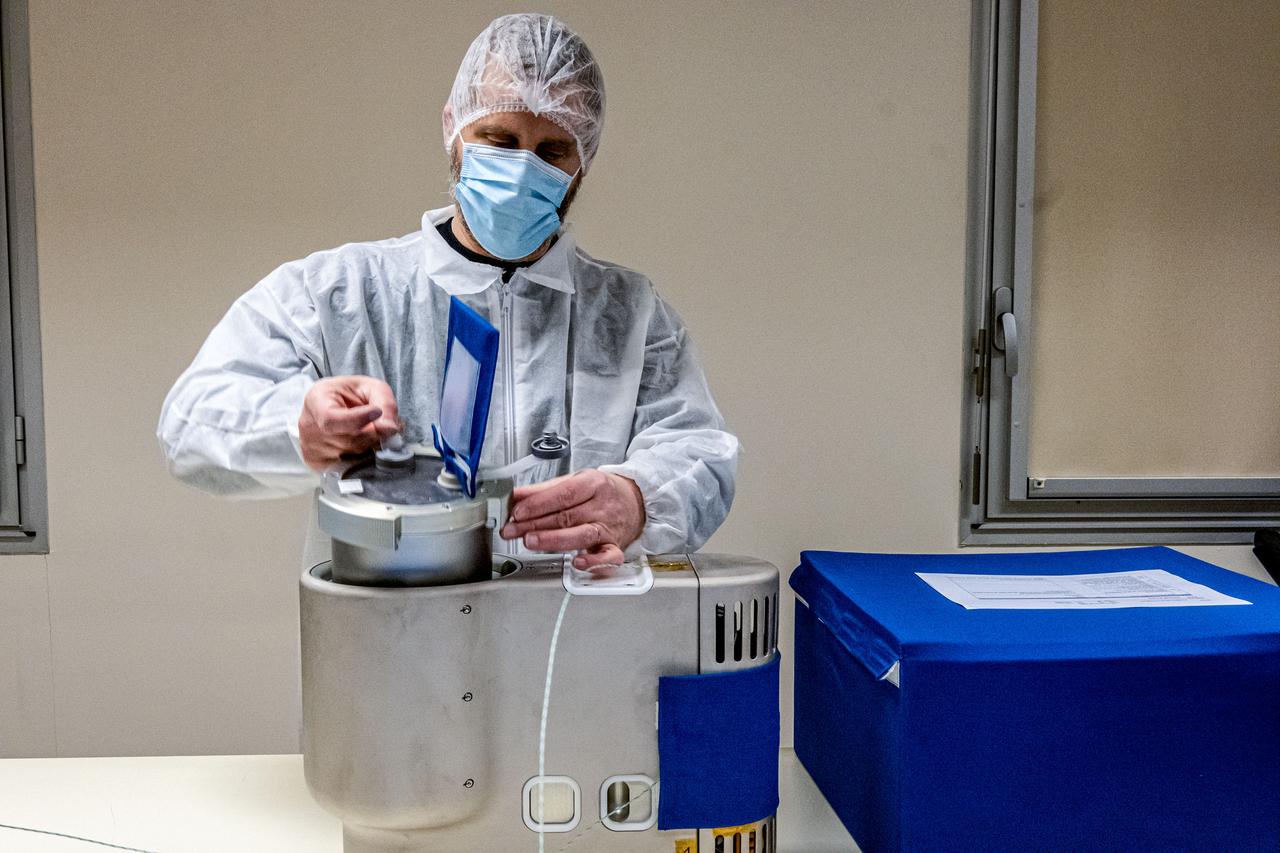
jsc2023e054755 (2/11/2021) --- A preflight view of David Moreeuw (Inneloab) testing the Food Processor assembly. The objective of the Advanced System for Space Food (Food Processor) investigation on board the International Space Station is to test a prototype equipment demonstrator with one specific recipe that uses basic cooking functions (beating egg whites, mixing products). © CNES/DE PRADA Thierry, 2021

KENNEDY SPACE CENTER, FLA. - In the Space Station Processing Facility at NASA's Kennedy Space Center, John Hoog secures a bag filled with prepared meals for the crew of mission STS-121 before packing into containers for the flight. At left is Dennis Huefner, with United Space Alliance (USA) ground operations. Hoog is a USA-FCE/EVA representative from Johnson Space Center. Astronauts select their own menus from a large array of food items. Astronauts are supplied with three balanced meals, plus snacks. Foods flown on space missions are researched and developed at the Space Food Systems Laboratory at the Johnson Space Center (JSC) in Houston, which is staffed by food scientists, dietitians and engineers. Foods are analyzed through nutritional analysis, sensory evaluation, storage studies, packaging evaluations and many other methods. Each astronaut’s food is stored aboard the space shuttle and is identified by a colored dot affixed to each package. Launch of Space Shuttle Discovery on mission STS-121 is scheduled for July 1. Photo credit: NASA/Jack Pfaller
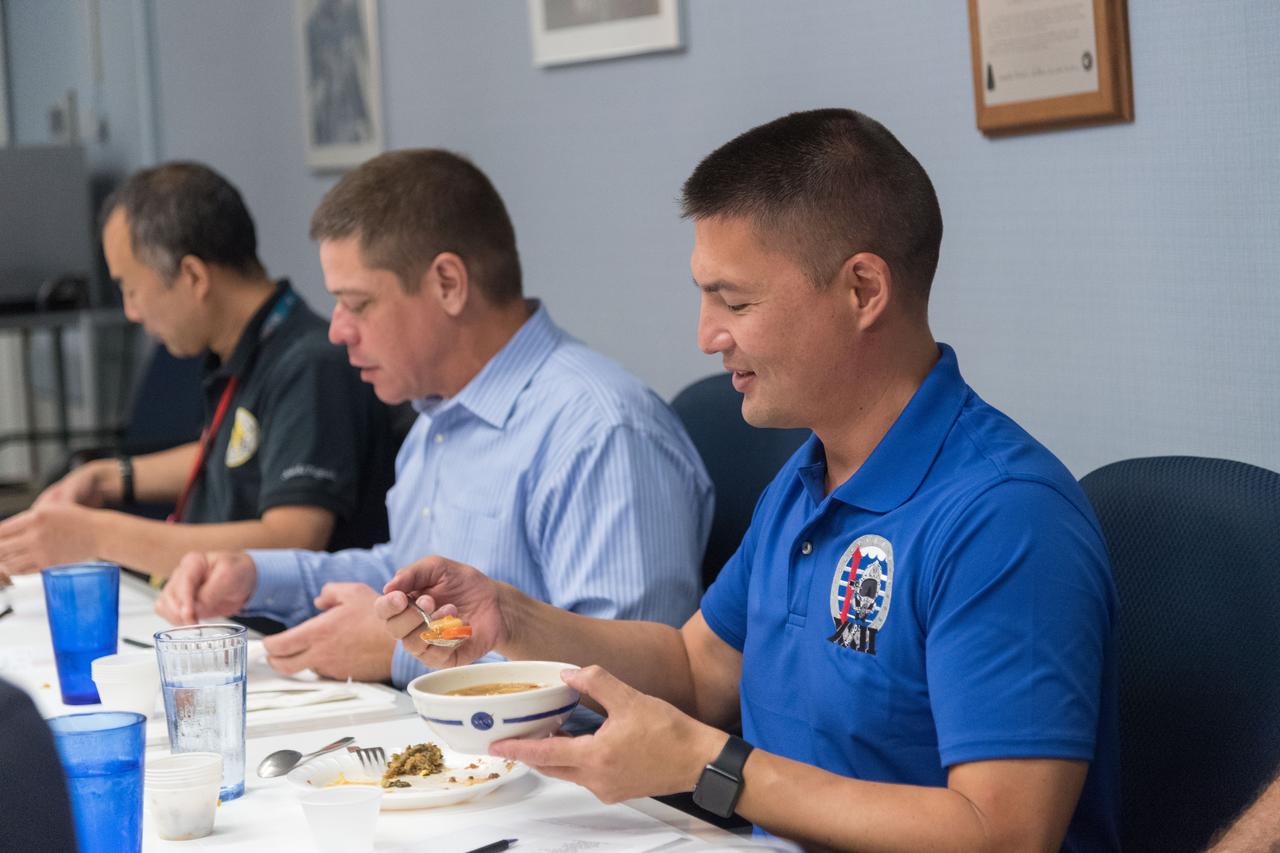
NASA commercial crew astronaut Kjell Lindgren tries out some of the food he'll enjoy onboard the International Space Station at the Space Food Systems Laboratory at Johnson Space Center. Lindgren is assigned as a backup for SpaceX Crew Dragon’s first and second crewed flights.
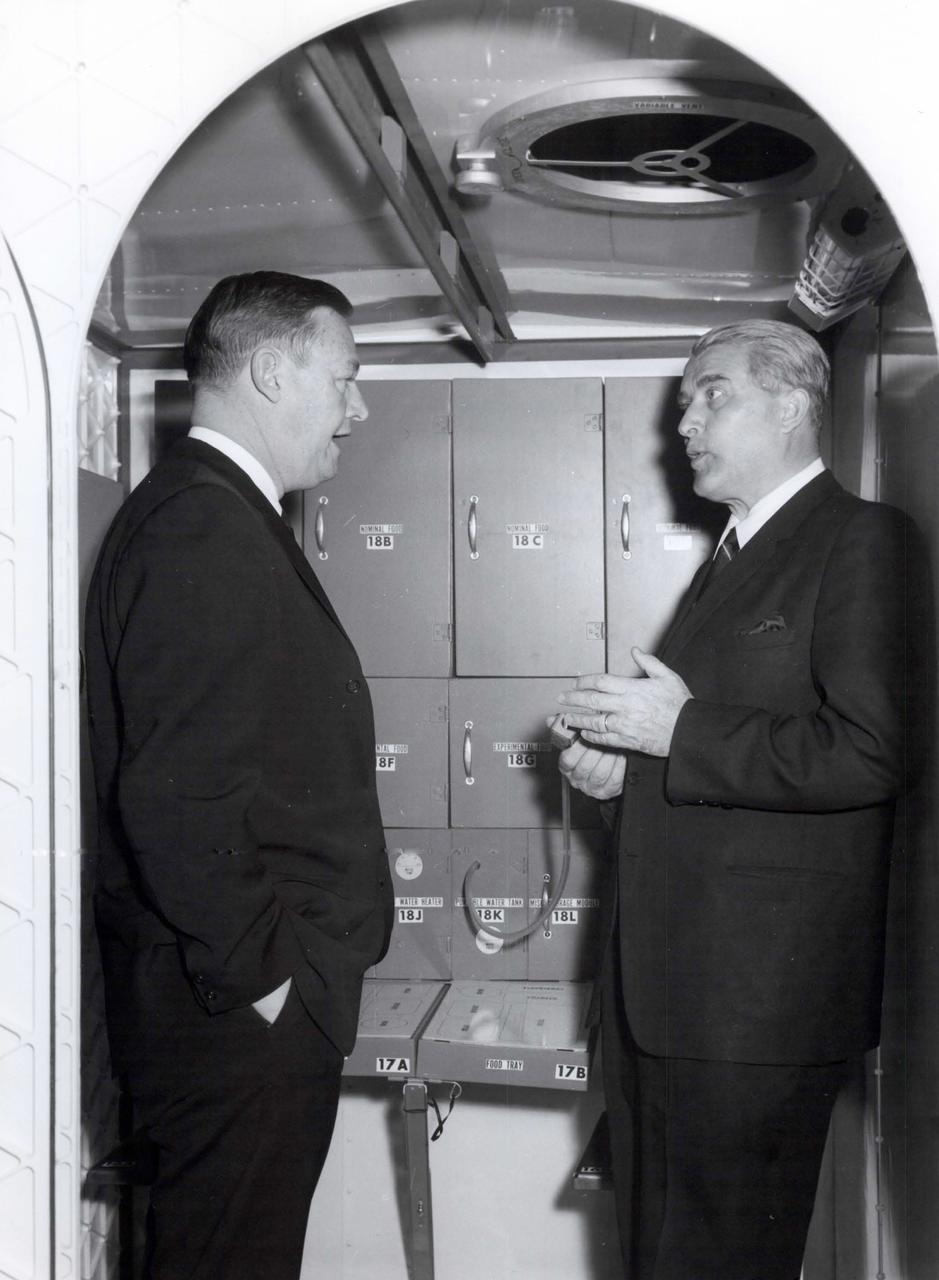
U.S. Representative Armistead Seldon (D.-Al) inspects the food preparation area of the Saturn I workshop mockup during a visit to the Marshall Space Flight Center. Explaining the operation of the food preparation area to the congressman is Dr. Wernher Von Braun, Marshall Space Flight Center director.
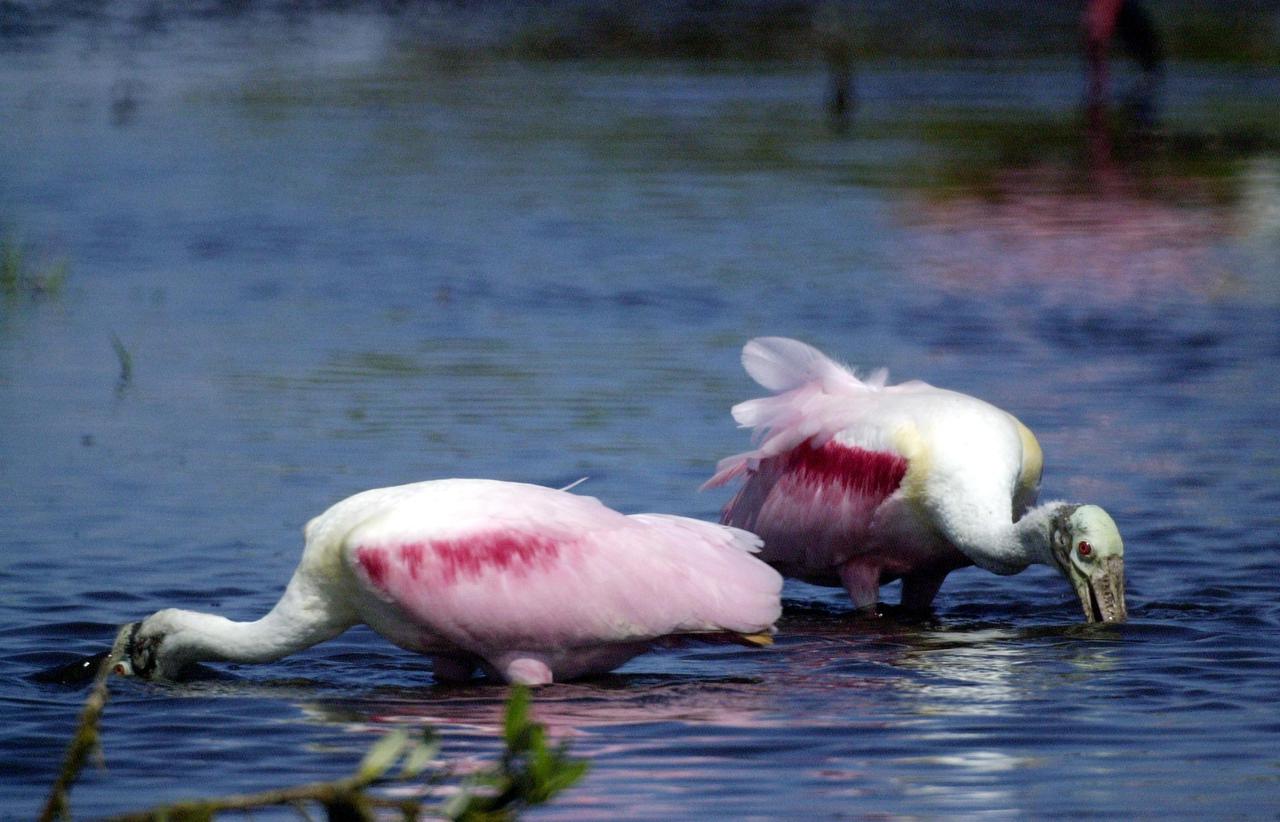
KENNEDY SPACE CENTER, FLA. -- In a lake near Kennedy Space Center, a pair of Roseate Spoonbills search the water for food. They obtain food by sweeping their broad bills from side to side. This species inhabits mangroves, ranging from the coasts of southern Florida and Texas (sometimes Louisiana), the West Indies, Mexico and Central and South America.
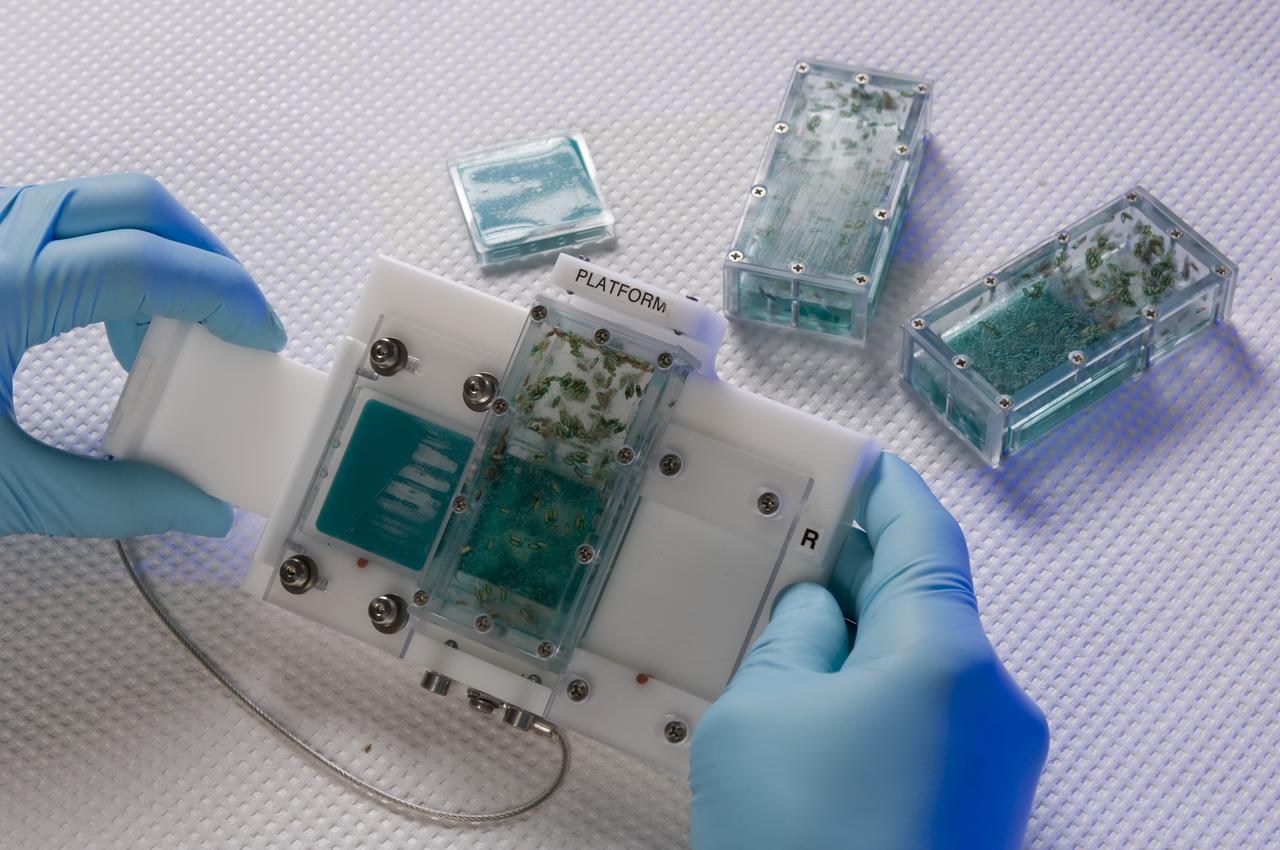
Space shuttle STS-121 FIT (Fly Immunity and Tumors) payload. Using Drosophila (fruit fly) to complete the experiments. Platform used by astronauts to change out old food trays with new food trays in space to facilitate culturing new flies.
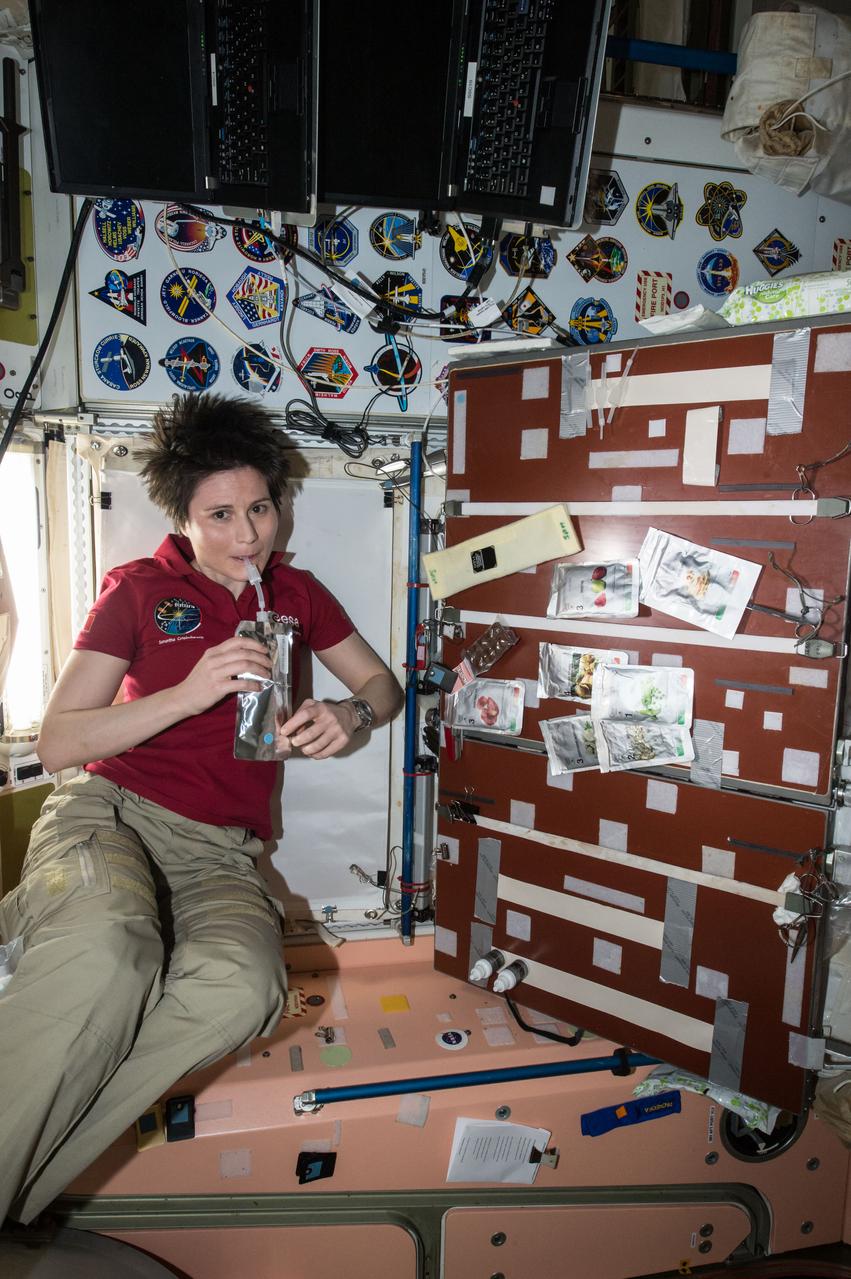
ISS043E162881 (04/27/2015) --- ESA (European Space Agency) astronaut Samantha Cristoforetti seen taking a drink in the Unity module aboard the International Space Station Apr. 27. 2015. The crew’s food galley is located in Unity and there are several food packets visible to the right.
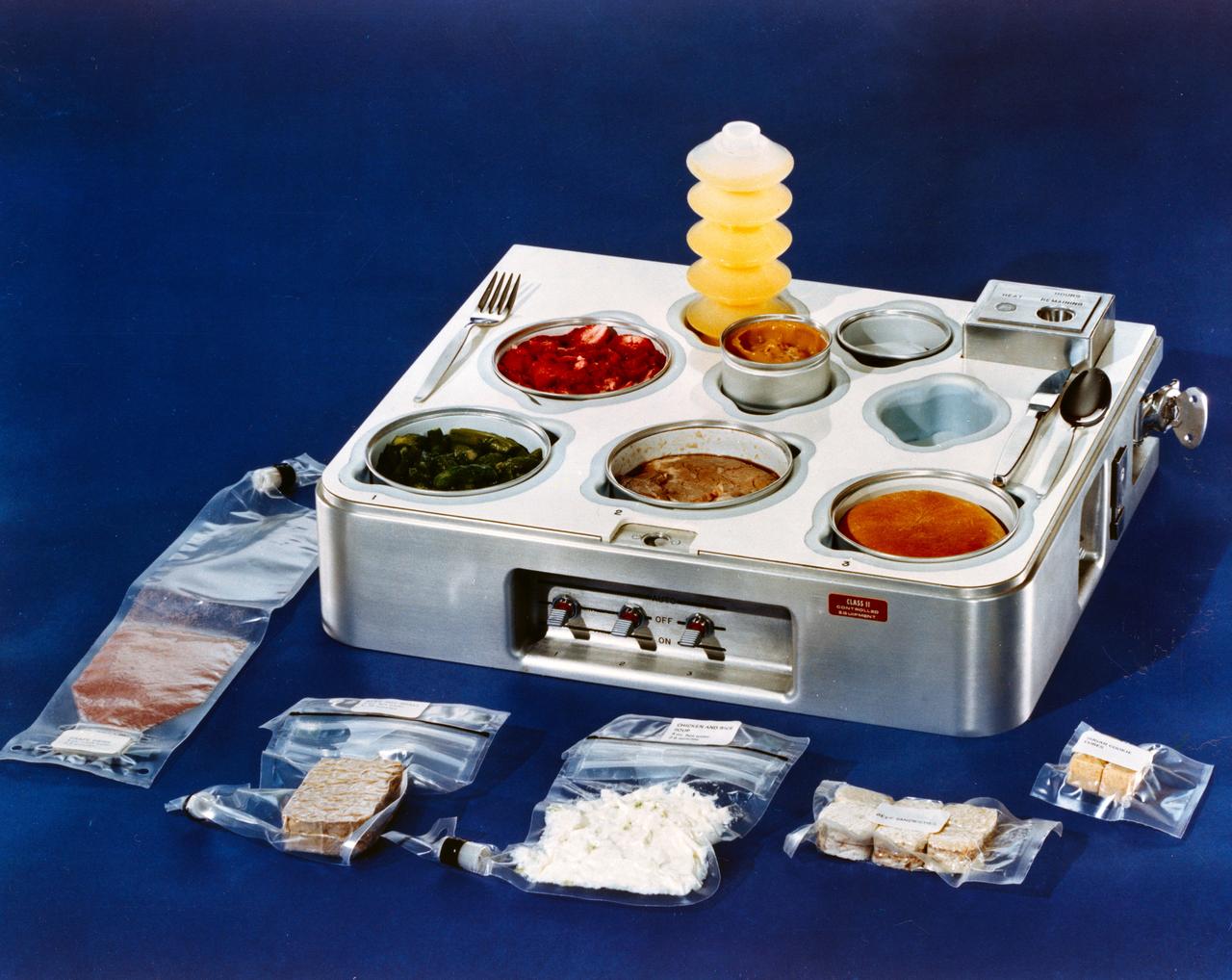
S72-15409 (1972) --- A close-up view of a food tray which is scheduled to be used in the Skylab program. Several packages of space food lie beside the tray. The food in the tray is ready to eat. Out of tray, starting from bottom left: grape drink, beef pot roast, chicken and rice, beef sandwiches and sugar cookie cubes. In tray, from back left: orange drink, strawberries, asparagus, prime rib, dinner roll and butterscotch pudding in the center. Photo credit: NASA

NASA employees Anita Douglas (l to r), Amy Grose, Aaron Brooks and Cabrina Bell sort through early contributions to the 2011 Feds Feed Families Food Drive at Stennis Space Center. Each summer for three years, federal agencies across the nation have worked together to collect nonperishable food for local food banks across the country.
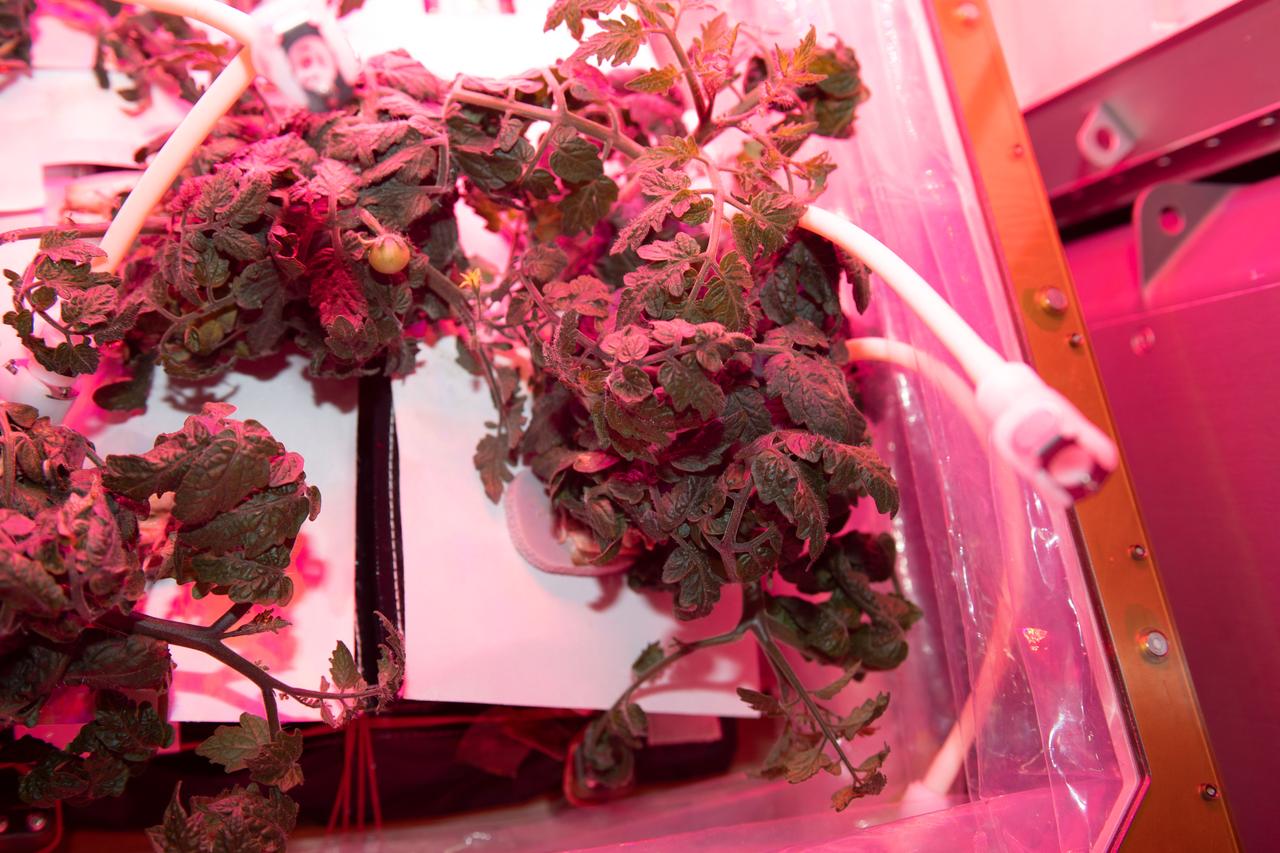
iss068e045298 (Feb. 5, 2023) --- A view of red dwarf tomato plants growing in the Veggie plant growth facility aboard the International Space Station as part of the Pick-and-Eat Salad-Crop Productivity, Nutritional Value, and Acceptability to Supplement the ISS Food System (Veg-05) investigation. Veg-05 is the next step in efforts to address the need for a continuous fresh-food production system in space. This experiment focuses on studying the impact of light quality and fertilizer on fruit production, microbial safety, nutritional value, taste acceptability by the astronauts, and the overall behavioral health benefits of having plants and fresh food in space.
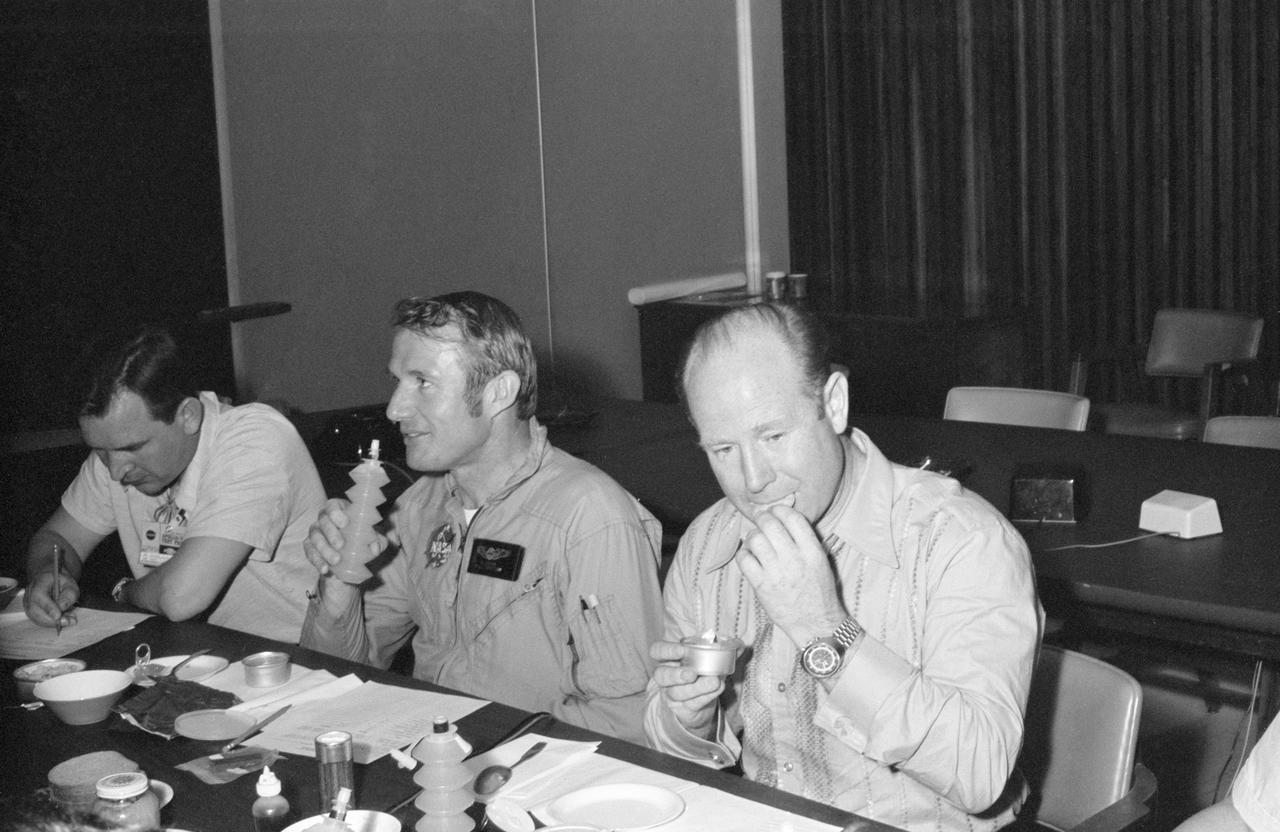
S74-20797 (23 April 1974) --- Candidate food items being considered for the joint U.S.-USSR Apollo-Soyuz Test Project mission are sampled by three ASTP crewmen in Building 4 at the Johnson Space Center. They are, left to right, cosmonaut Valeriy N. Kubasov, engineer on the Soviet ASTP crew; astronaut Vance D. Brand, command module pilot of the American ASTP crew; and cosmonaut Aleksey A. Leonov, commander of the Soviet ASTP crew. Kubasov is marking a food rating chart on which the crewmen mark their choices, likes and dislikes of the food being sampled. Brand is drinking orange juice from an accordion-like dispenser. Leonov is eating butter cookies. The two Soviet crewmen will have an opportunity to eat with the three American crewmen while the Apollo and Soyuz spacecraft are docked in Earth orbit. Leonov and Kubasov will dine on food being chosen individually by them now.
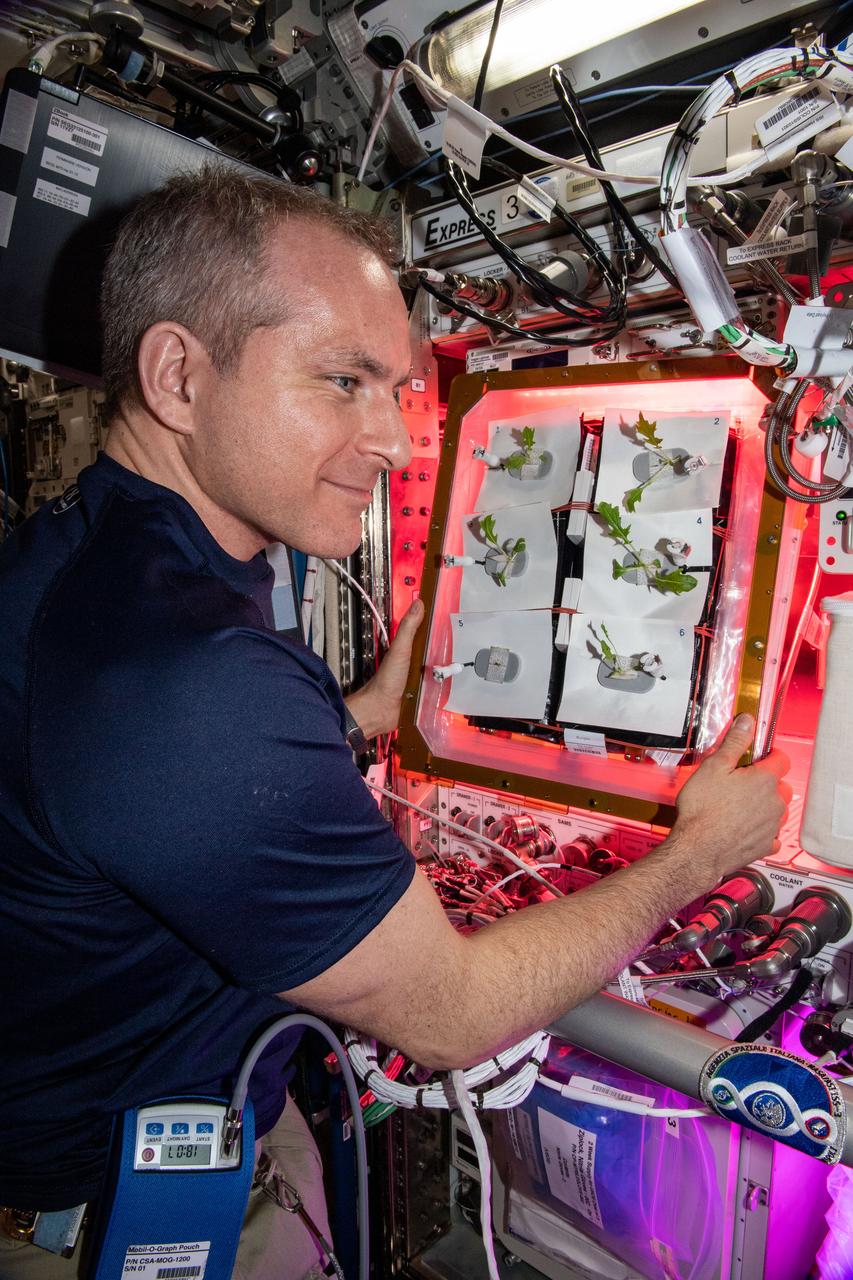
iss059e113779 (June 18, 2019) --- Canadian Space Agency astronaut David Saint-Jacques checks plants being grown for the Veg-04A space botany experiment taking place inside the International Space Station's Columbus laboratory module from the European Space Agency. The study focuses on the impact of light quality and fertilizer on leafy crop growth for a 28-day grow-out, microbial food safety, nutritional value, taste acceptability by the crew, and the overall behavioral health benefits of having plants and fresh food in space.
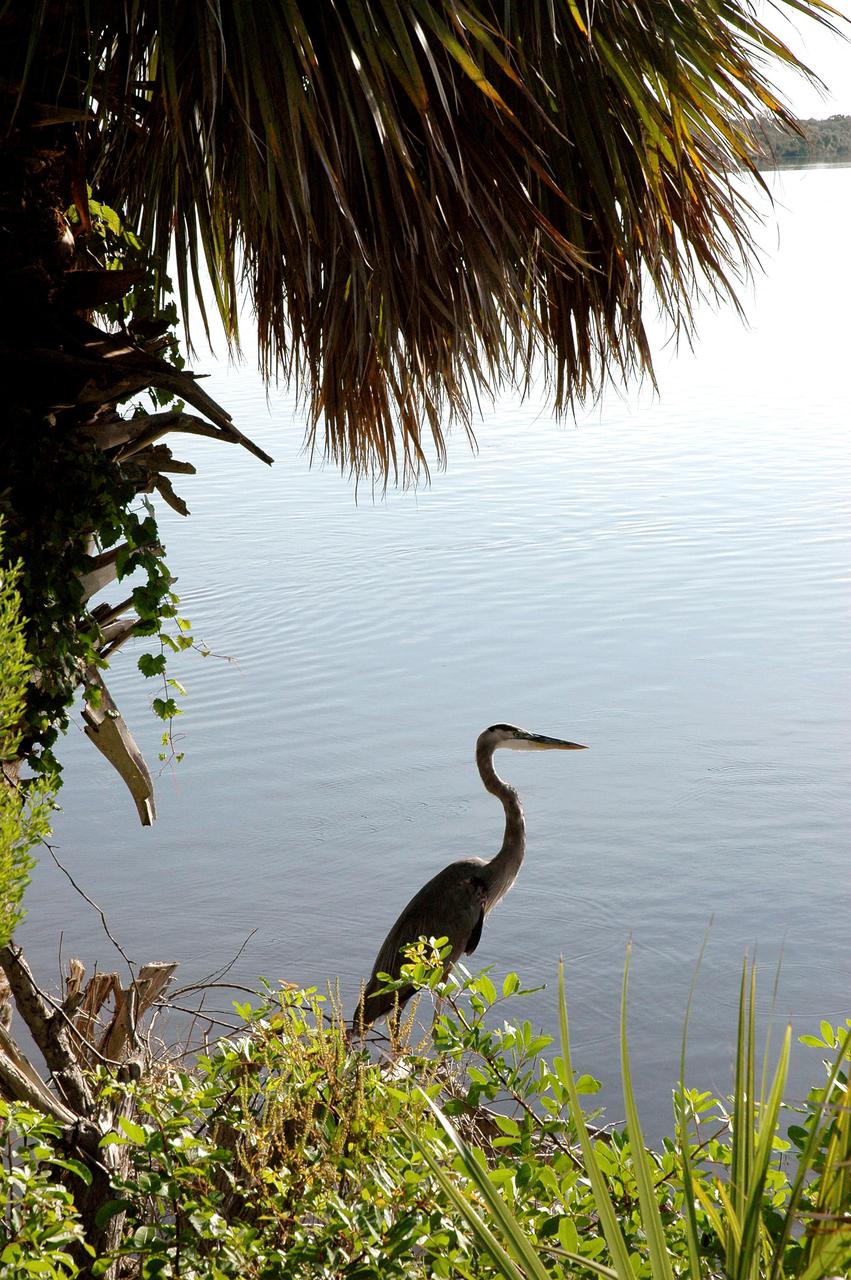
KENNEDY SPACE CENTER, FLA. - A great blue heron is captured in a typical pose as it scans the nearby water in NASA Kennedy Space Center’s Turn Basin for food.
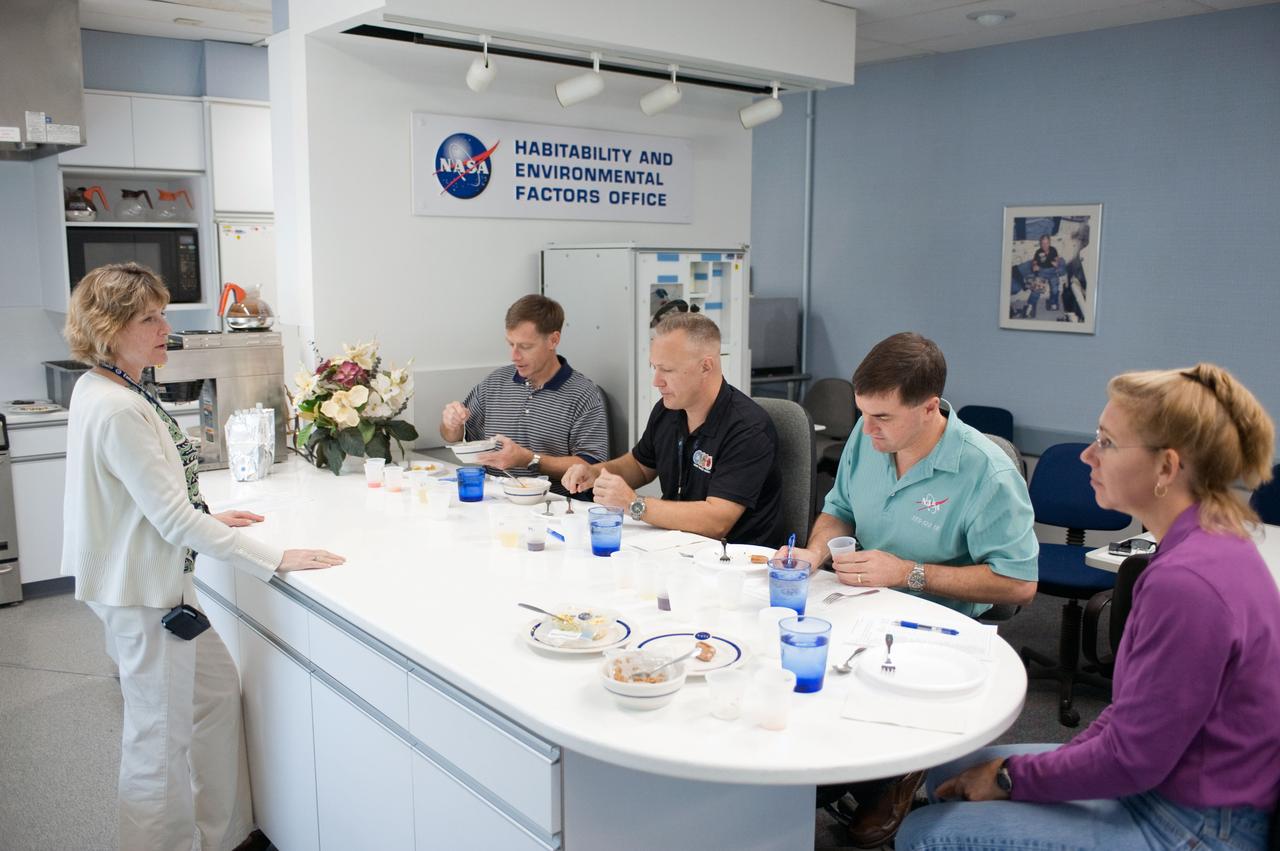
JSC2010-E-185482 (10 Nov. 2010) --- STS-135 crew members participate in a food tasting session in the Habitability and Environmental Factors Office at NASA's Johnson Space Center. Pictured from the left are NASA astronauts Chris Ferguson, commander; Doug Hurley, pilot; Rex Walheim and Sandy Magnus, both mission specialists. Michele Perchonok, manager, Shuttle Food System, assisted the crew members. STS-135 is planned to be the final mission of the space shuttle program. Photo credit: NASA or National Aeronautics and Space Administration
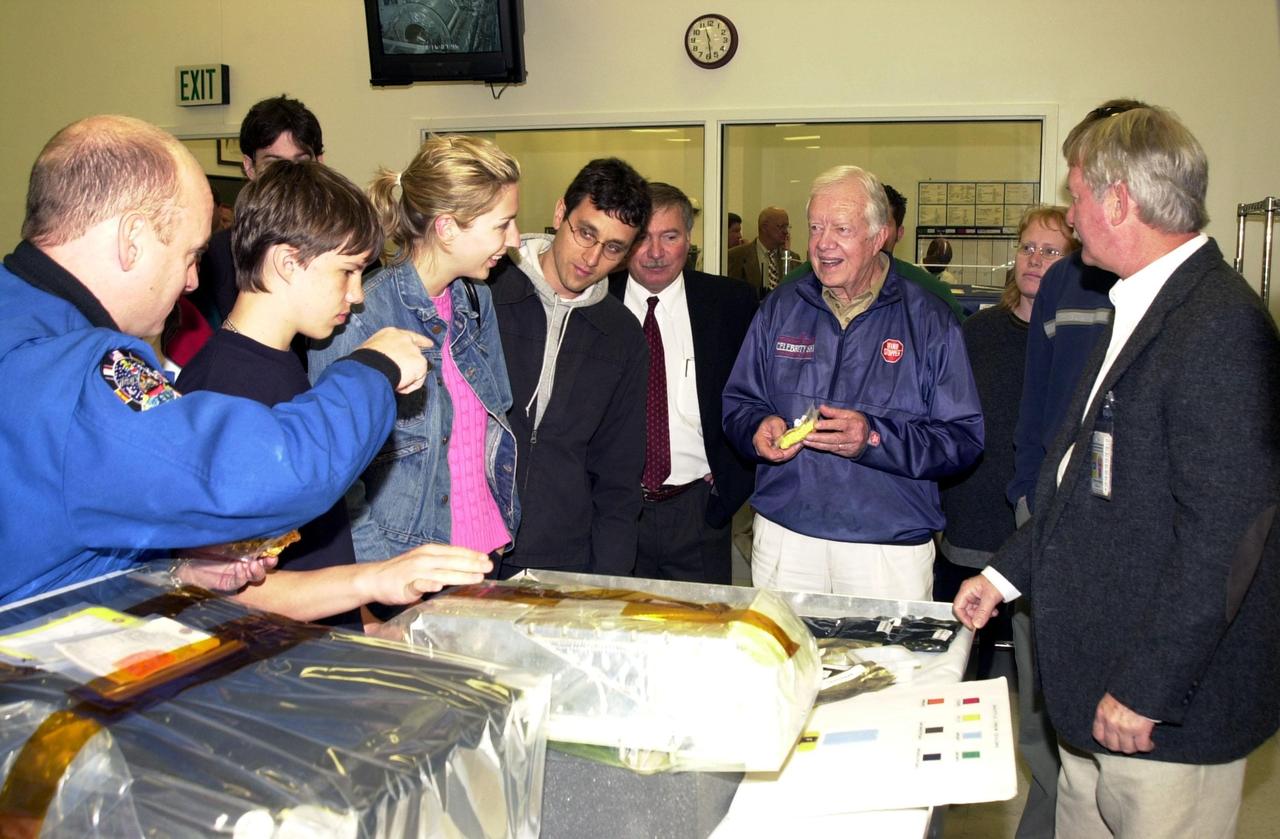
KENNEDY SPACE CENTER, FLA. -- During a tour of KSC, former President Jimmy Carter is shown packages of food that are used on the International Space Station. Astronaut Scott Kelly (far left) relates how the food is prepared and how it tastes. Behind and to the left of Carter is Tip Talone, director of Payload Processing, International Space Station. At the far right is Ron Woods, a technician in the Flight Crew Equipment Facility
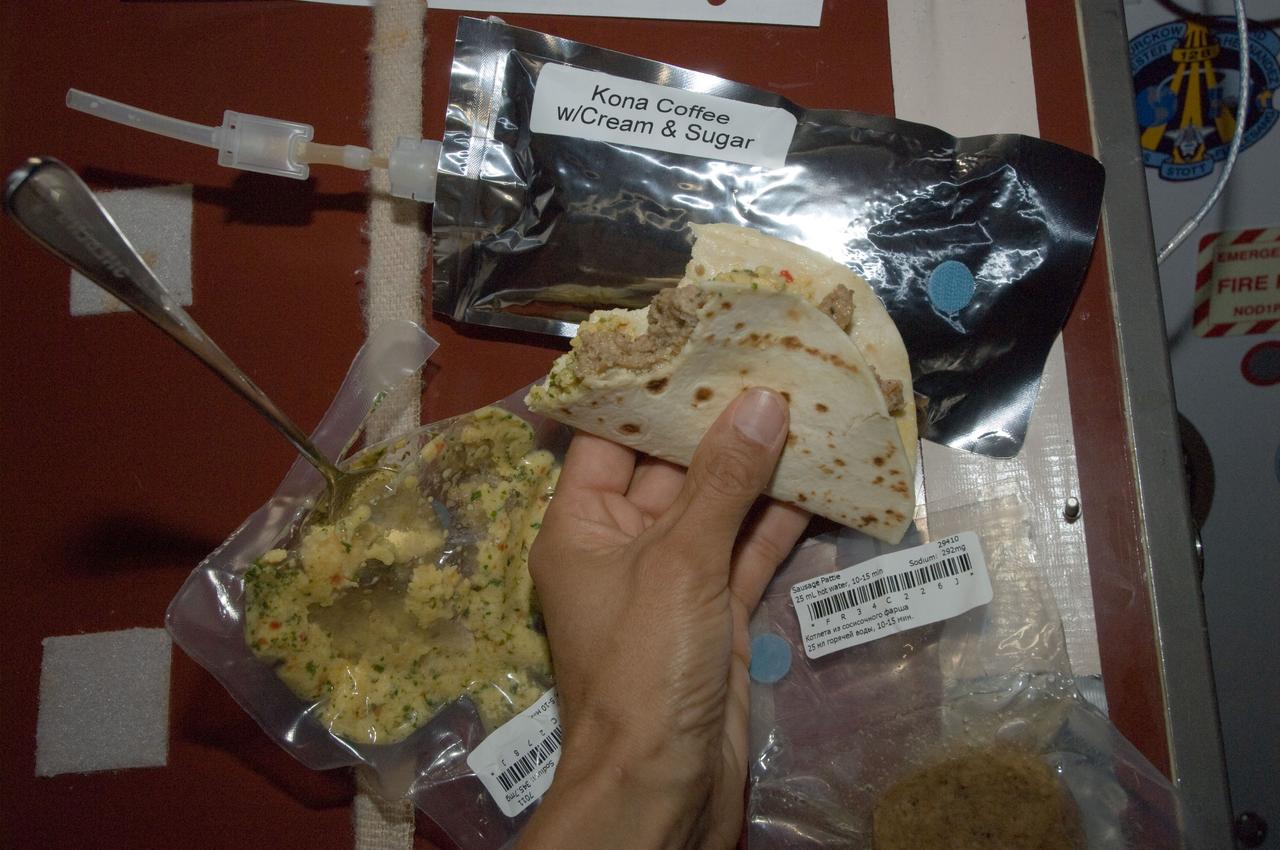
ISS032-E-010671 (29 July 2012) --- Various food and beverage items are featured in this image photographed by an Expedition 32 crew member on the International Space Station.
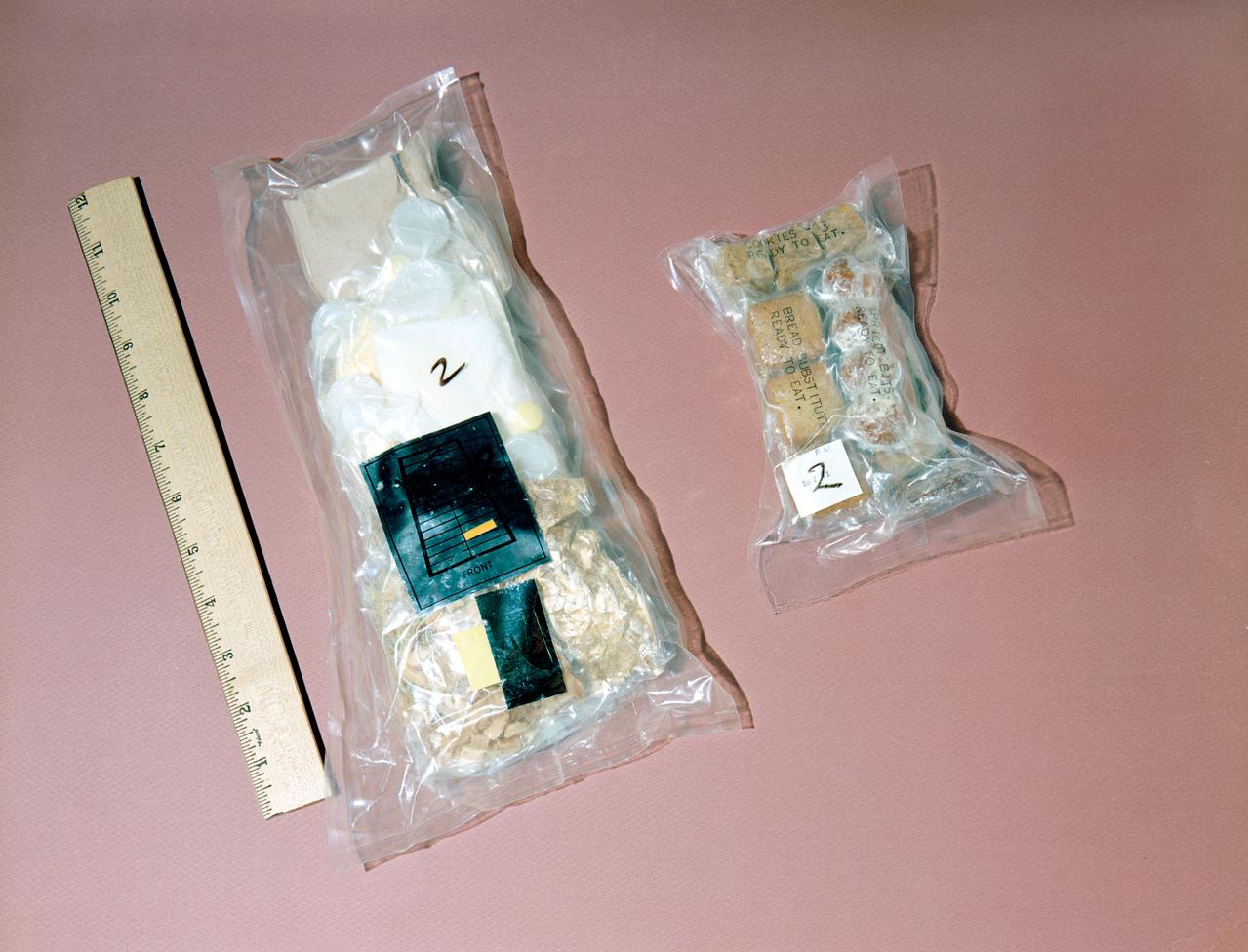
S62-08745 (1962) --- Group packets of ready to eat space food, with size being measured by a ruler, used by Mercury astronauts. Photo credit: NASA
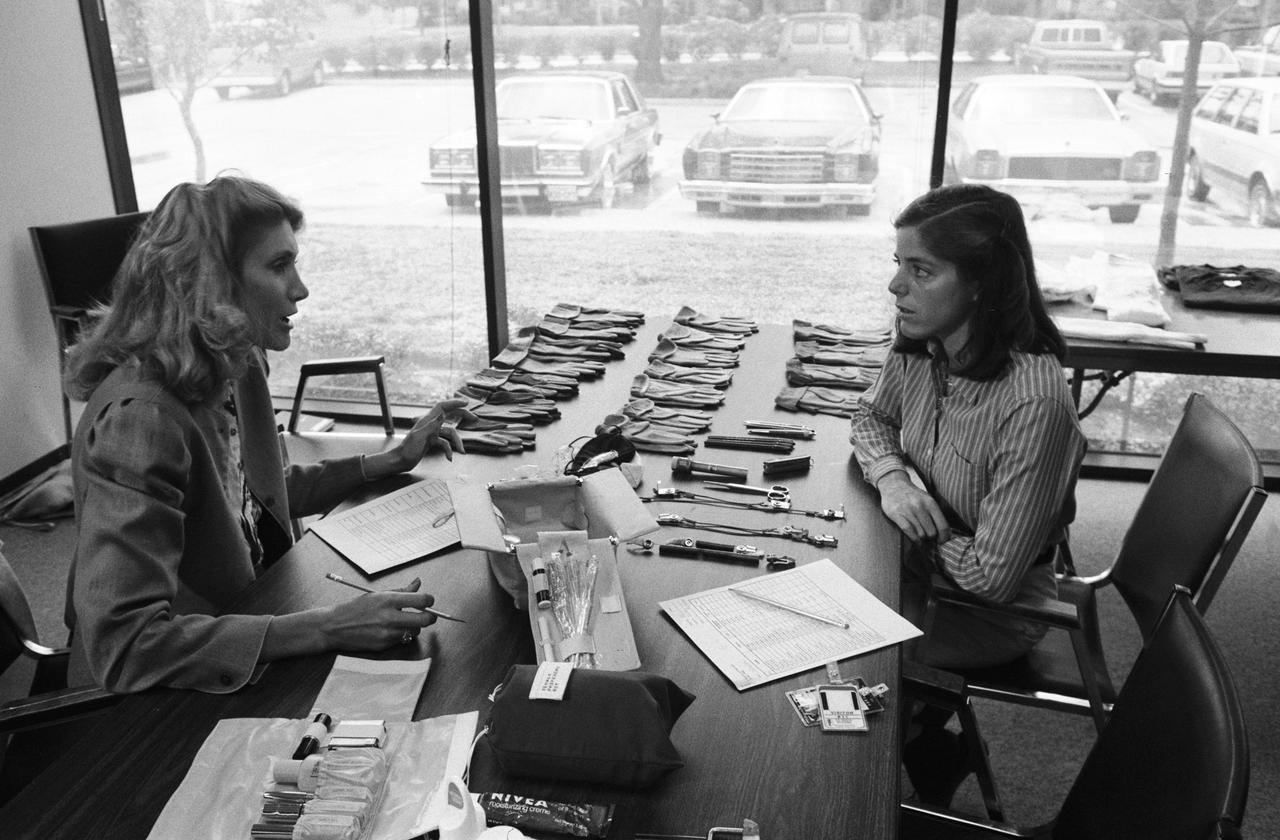
Views of STS-33/51L crew personnel Prime McAuliffe and Backup Morgan at the ILC Facility during clothing selection and Building #37 during food sampling, and with the rest of the STS-33/51L crew. 40074: "Teacher-in-Space" Participant Barbara Morgan (right) is briefed on her suit and on personal hygiene equipment to be used on the STS-51L Mission. 1. JSC - Education Program (Teacher in Space) 2. Barbara Morgan 3. Christa McAuliffe 4. STS-33/51L - Crew Training (Uniforms/Food/Crew)
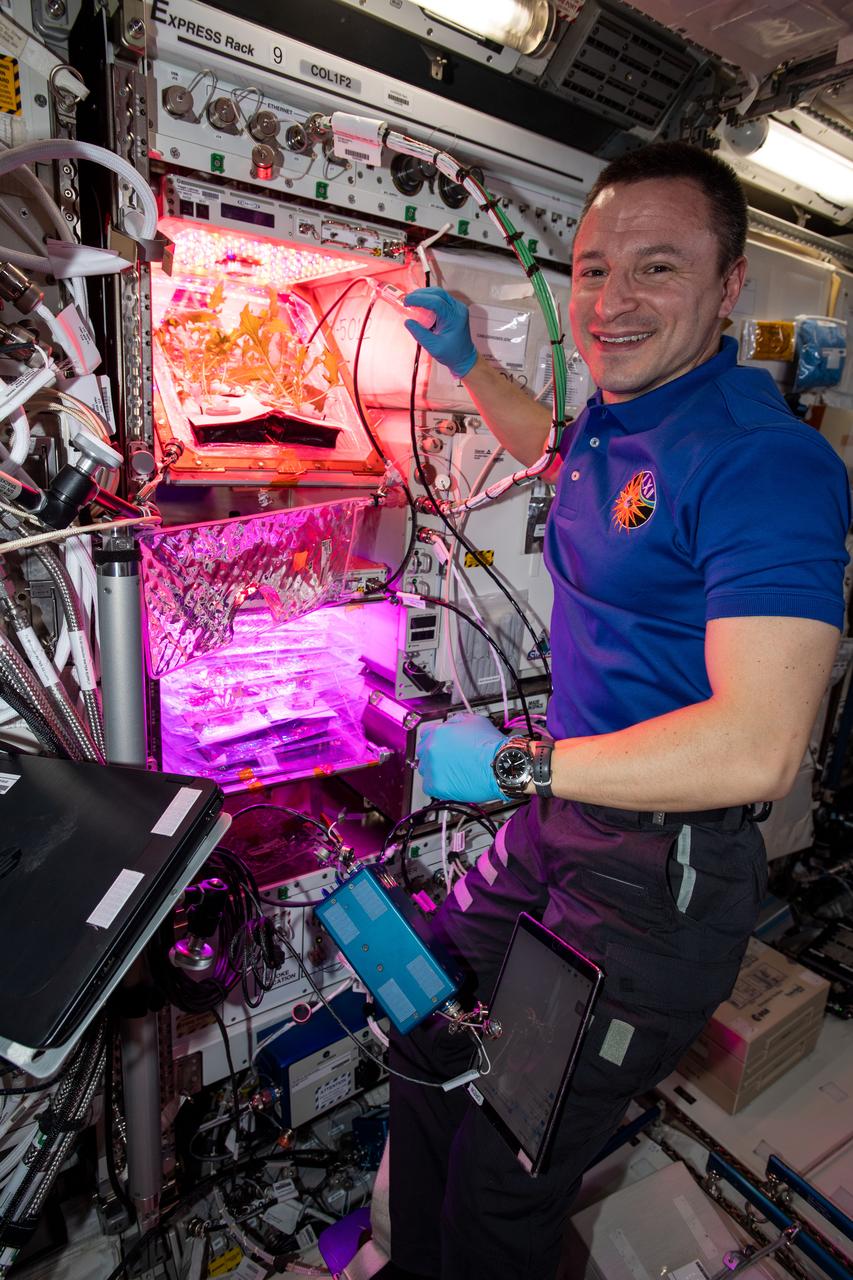
iss061e012956 (Oct. 23, 2019) --- This past week NASA astronaut Andrew Morgan watered the plant pillows in which Mizuna mustard greens are growing for the Veg-04B experiment. Veg-04B focuses on the effects of light quality and fertilizer on the leafy Mizuna crop, microbial food safety, nutritional value and the taste acceptability by the crew. The space botany research is also informing NASA how to provide fresh food for crews on long-term space missions.
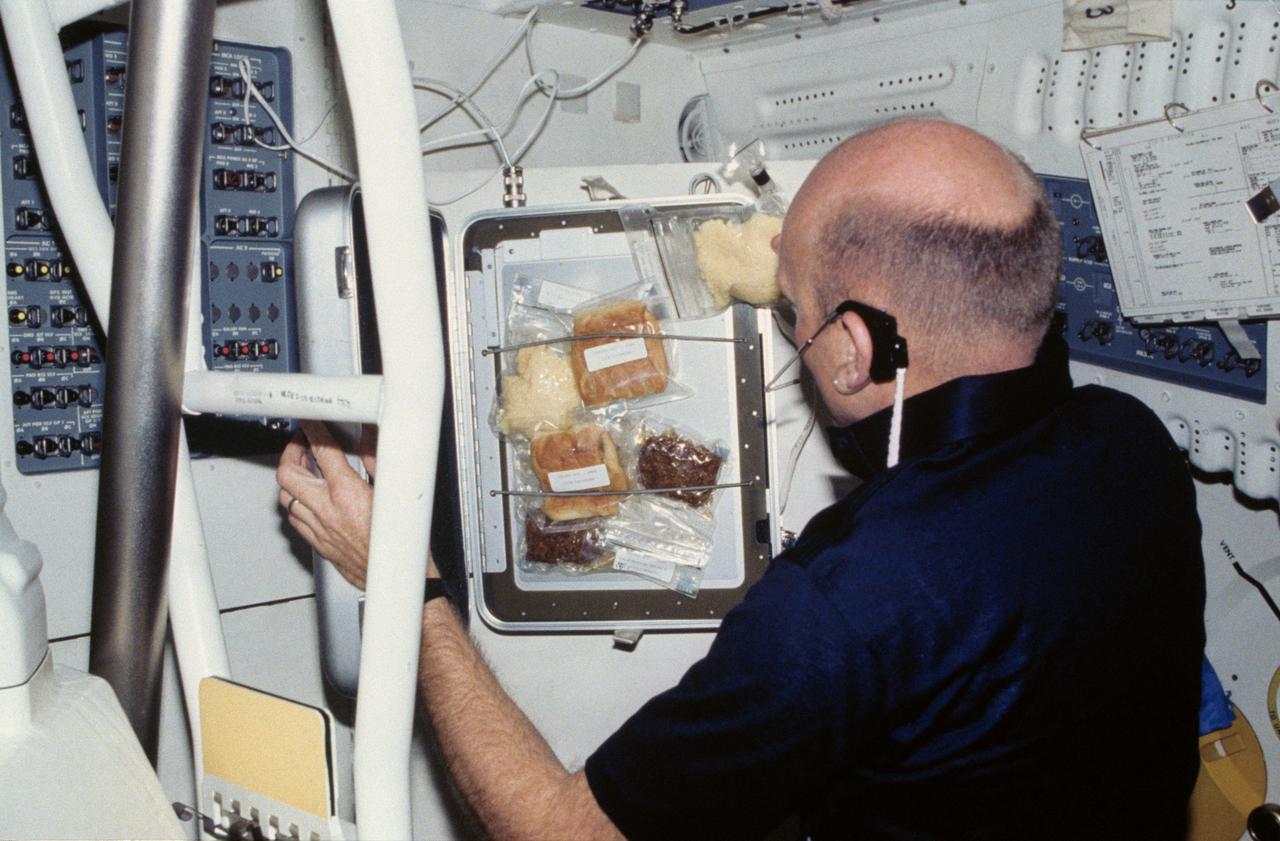
S82-28923 (March 1982) --- Astronaut C. Gordon Fullerton, STS-3 pilot, uses both hands to retrieve part of a meal from an orbital flight test food warmer in the middeck area of the Earth-orbiting space shuttle Columbia. The food warmer is a versatile briefcase-like device developed by life sciences personnel at the Johnson Space Center (JSC). Astronaut Jack R. Lousma, STS-3 commander, took this photograph with a 35mm camera. Photo credit: NASA
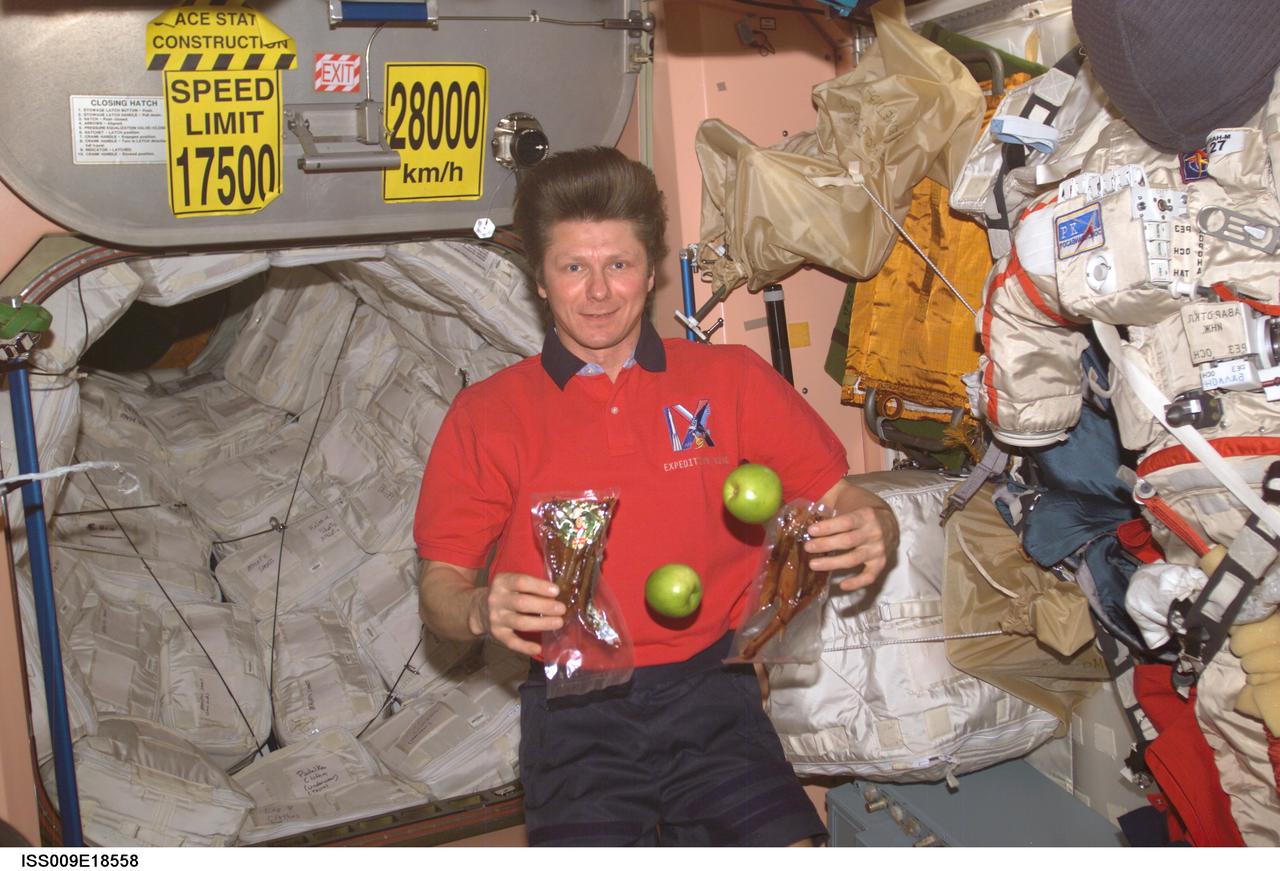
ISS009-E-18558 (15 August 2004) --- Cosmonaut Gennady I. Padalka, Expedition 9 commander representing Russia's Federal Space Agency, holds packages of food, as two apples float freely near him, in the Unity node of the International Space Station (ISS). The food was recently unloaded from the Progress 15 supply vehicle docked to the Station. The functional cargo block (FGB) or Zarya hatchway is visible in the background.
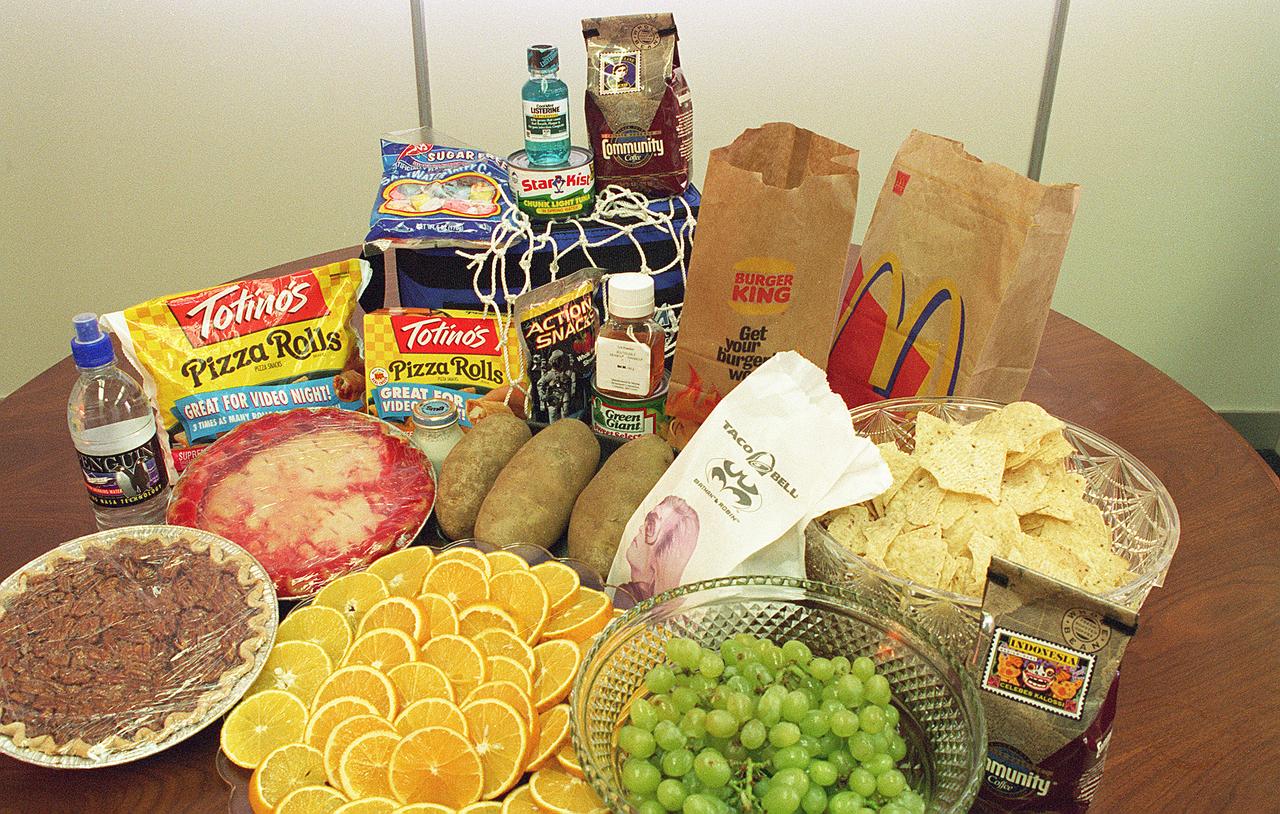
When NASA started plarning for manned space travel in 1959, the myriad challenges of sustaining life in space included a seemingly mundane but vitally important problem: How and what do you feed an astronaut? There were two main concerns: preventing food crumbs from contaminating the spacecraft's atmosphere or floating into sensitive instruments, and ensuring complete freedom from potentially catastrophic disease-producing bacteria, viruses, and toxins. To solve these concerns, NASA enlisted the help of the Pillsbury Company. Pillsbury quickly solved the first problem by coating bite-size foods to prevent crumbling. They developed the hazard analysis and critical control point (HACCP) concept to ensure against bacterial contamination. Hazard analysis is a systematic study of product, its ingredients, processing conditions, handling, storage, packing, distribution, and directions for consumer use to identify sensitive areas that might prove hazardous. Hazard analysis provides a basis for blueprinting the Critical Control Points (CCPs) to be monitored. CCPs are points in the chain from raw materials to the finished product where loss of control could result in unacceptable food safety risks. In early 1970, Pillsbury plants were following HACCP in production of food for Earthbound consumers. Pillsbury's subsequent training courses for Food and Drug Administration (FDA) personnel led to the incorporation of HACCP in the FDA's Low Acid Canned Foods Regulations, set down in the mid-1970s to ensure the safety of all canned food products in the U.S.
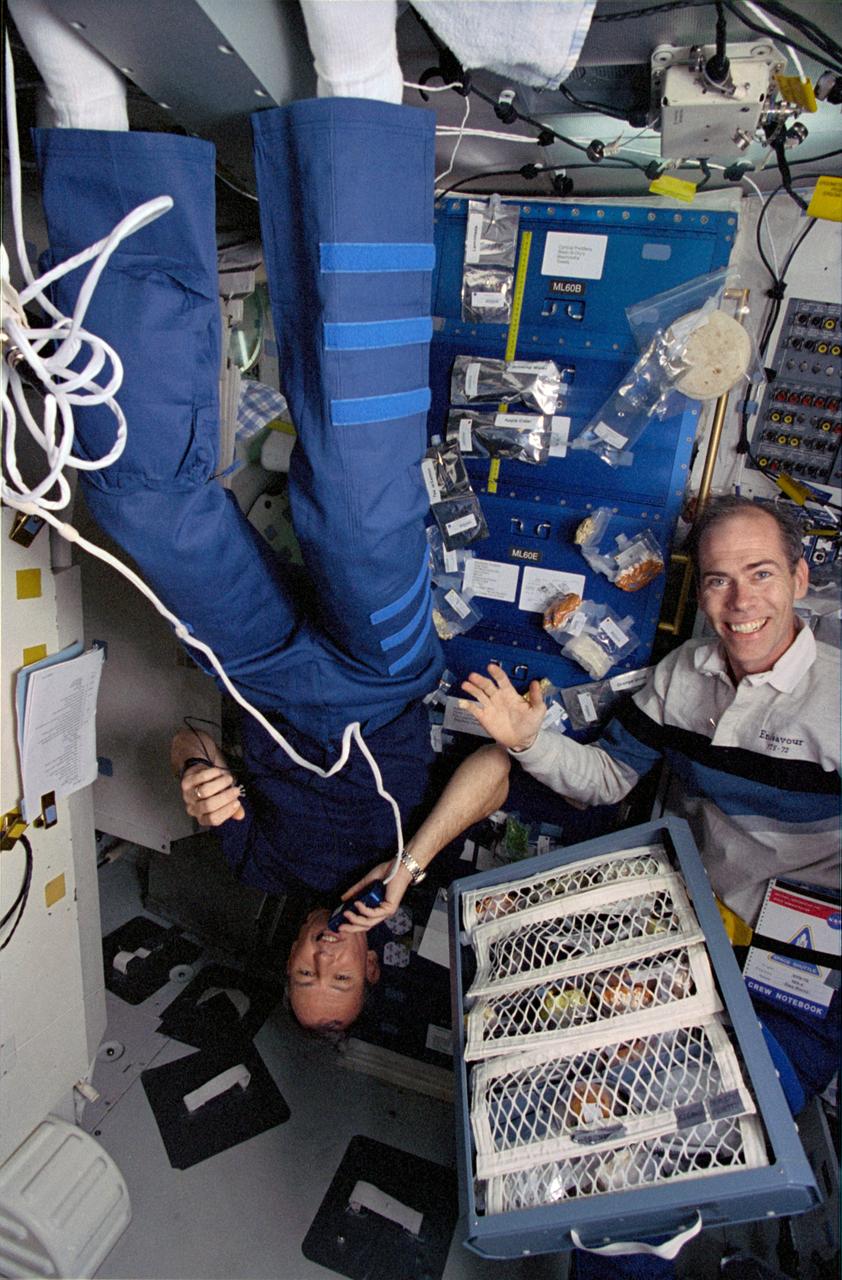
STS072-306-004 (11-20 Jan. 1996) --- Astronauts Brian Duffy (left), mission commander, and Daniel T. Barry, mission specialist, team up to prepare a meal on the Space Shuttle Endeavour’s middeck. Duffy is also talking to ground controllers during a television tour of the spacecraft. A locker drawer, complete with pre-packaged food is in the foreground, while various smaller packets of food items are attached to nearby locker doors. Orient photo with socked feet at bottom.
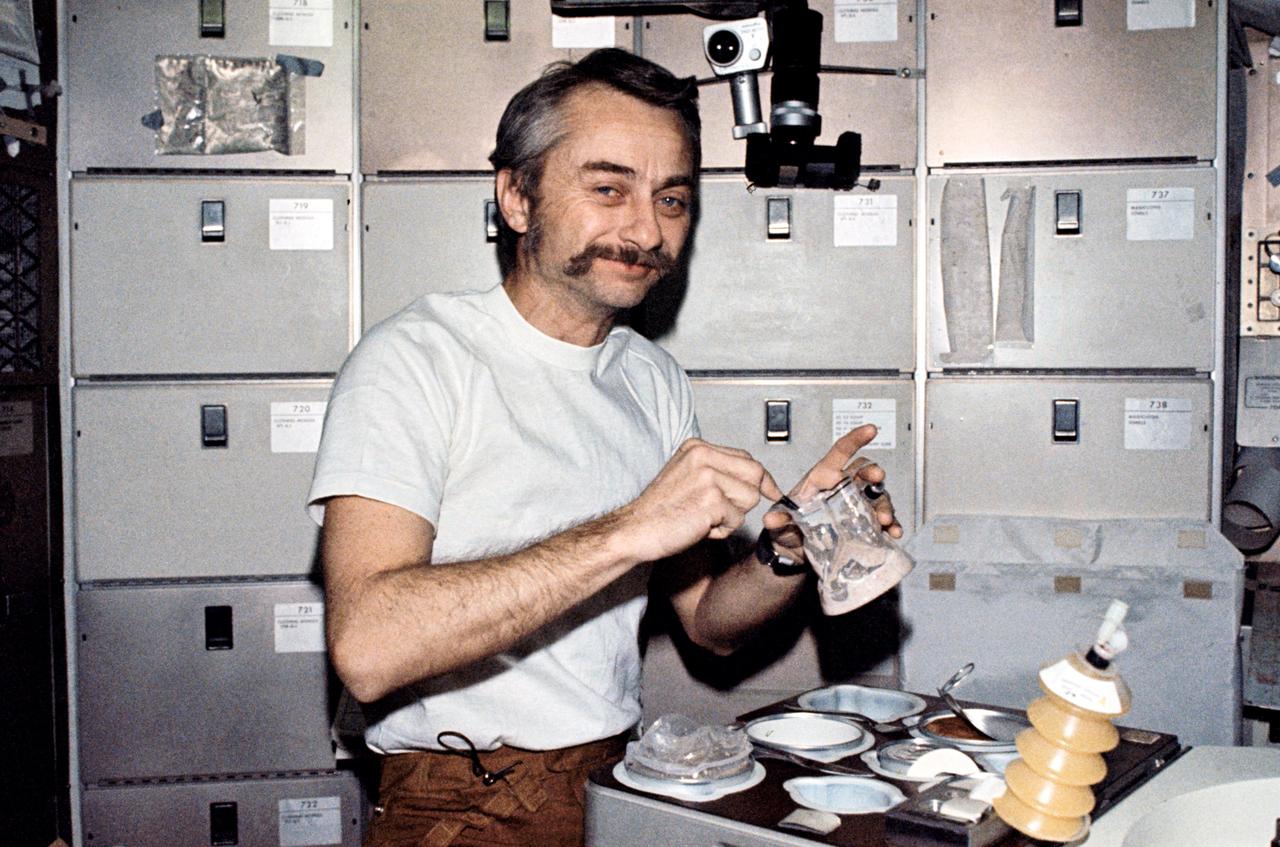
SL3-111-1519 (6 Aug. 1973) --- Scientist-astronaut Owen K. Garriott, Skylab 3 science pilot, reconstitutes a pre-packaged container of food at the crew quarters ward room table of the Orbital Workshop (OWS) of the Skylab Space Station cluster. This picture was taken with a hand-held 35mm Nikon camera. Astronauts Garriott, Alan L. Bean and Jack R. Lousma remained with the Skylab Space Station in Earth orbit for a total of 59 days conducting numerous medical, scientific and technological experiments. Note the knife and fork on the food tray and the utensil with which Garriott stirs the food mixed with water. Skylab is the first manned space program by NASA which affords the crew men an opportunity to eat with the same type utensils used on Earth. Photo credit: NASA
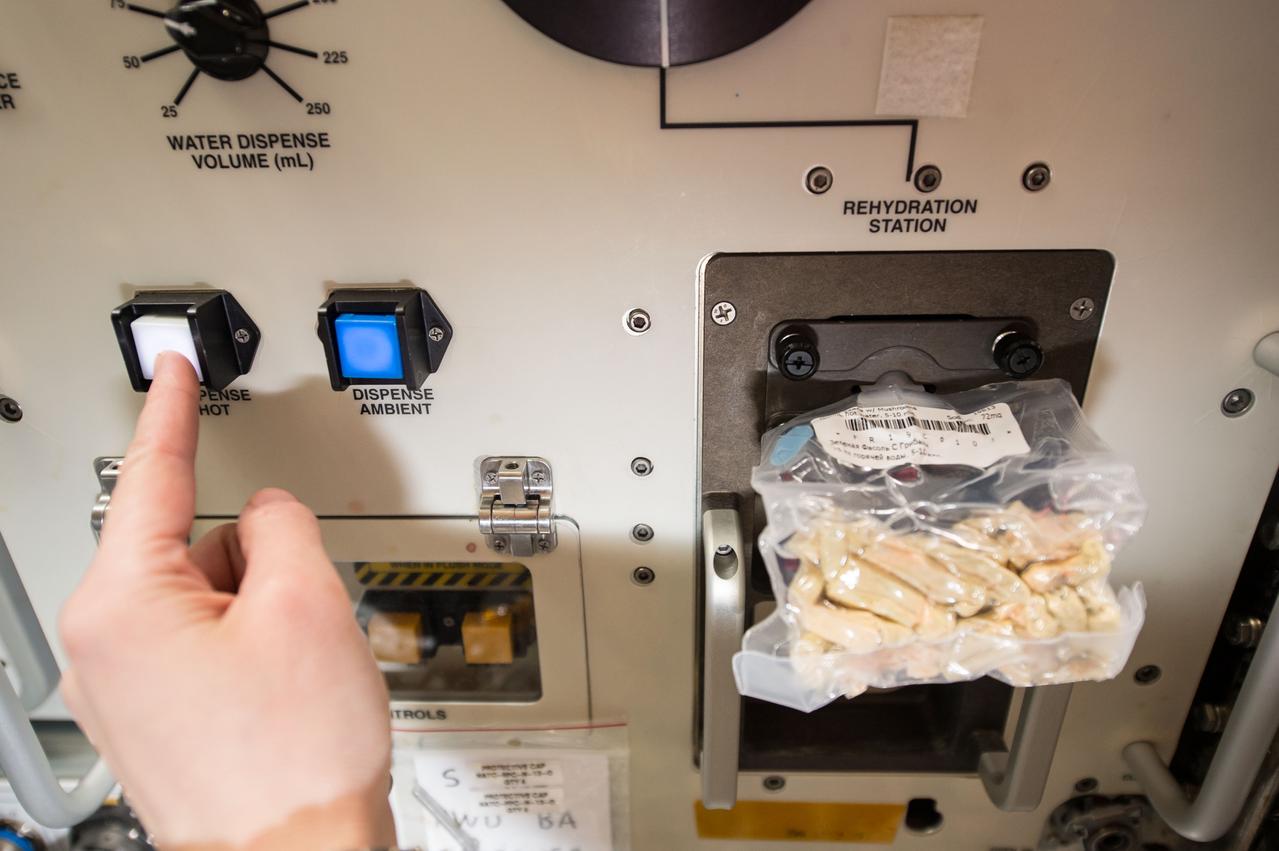
iss042e017210(12/01/2014) --- European Space Agency Astronaut Samantha Cristoforetti prepares her lunch using the space food rehydrator aboard the International Space Station.
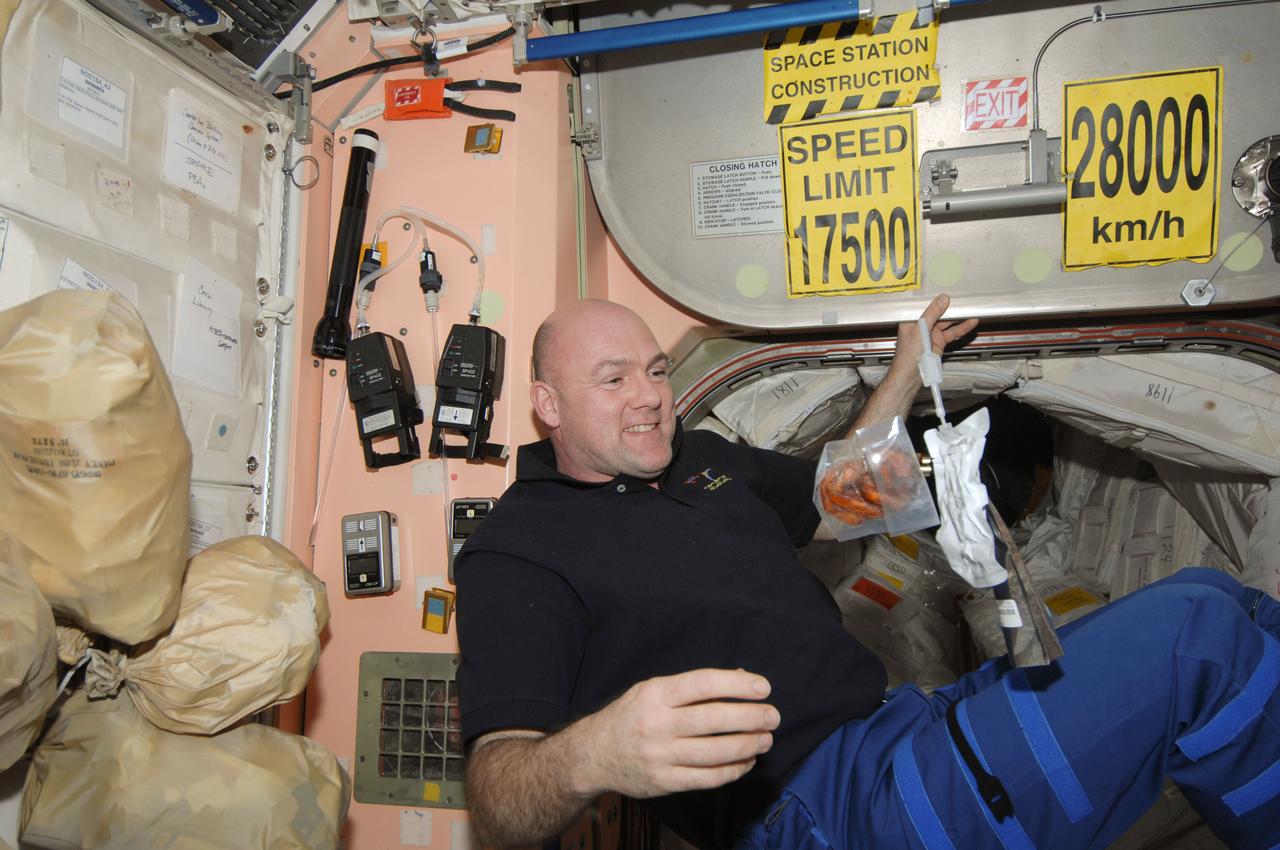
ISS030-E-166649 (30 Jan. 2012) --- European Space Agency astronaut Andre Kuipers, Expedition 30 flight engineer, is pictured near food and beverage packages floating freely in the Unity node of the International Space Station.
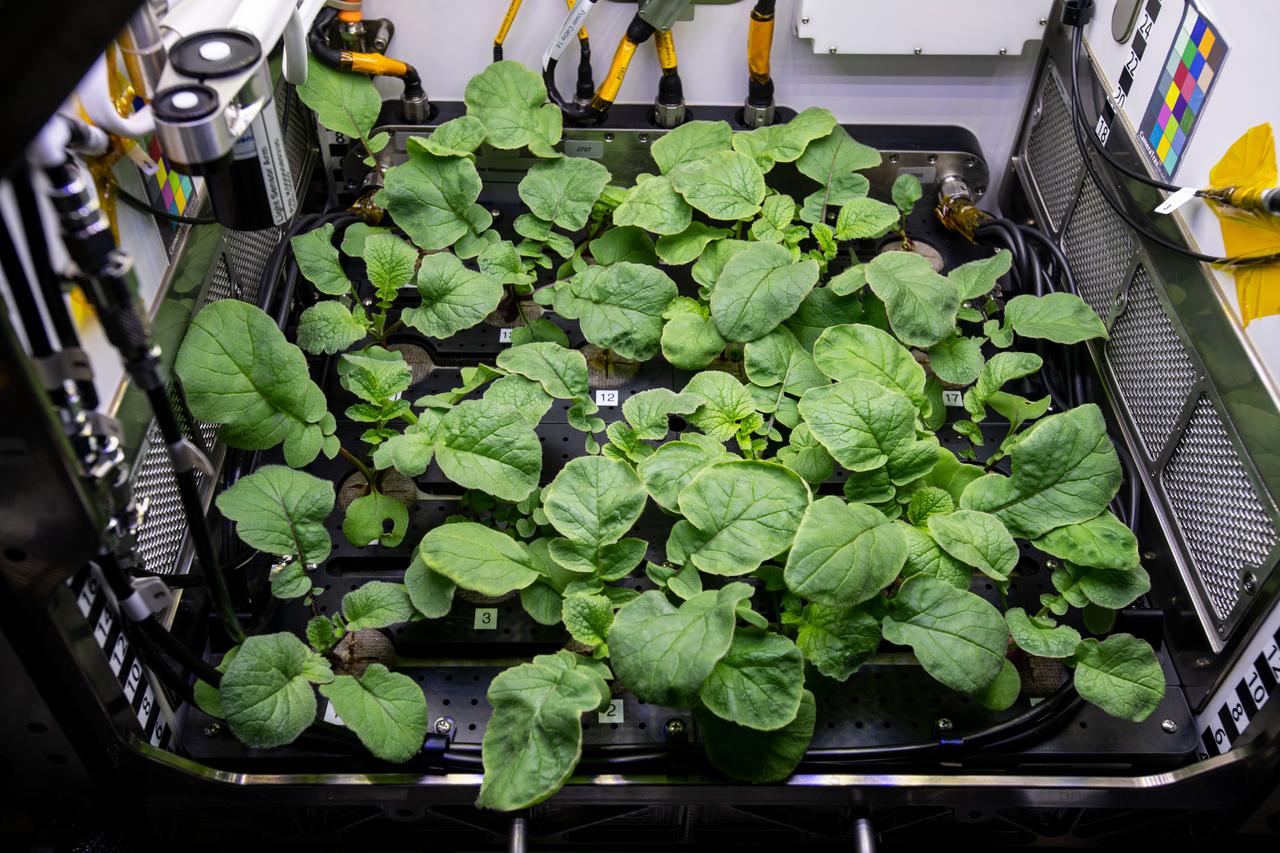
iss064e013129 (Dec. 20, 2020) --- Radish plants are pictured growing inside the International Space Station's Advanced Plant Habitat to help botanists learn about managing food production in space and evaluate nutrition and taste in microgravity.
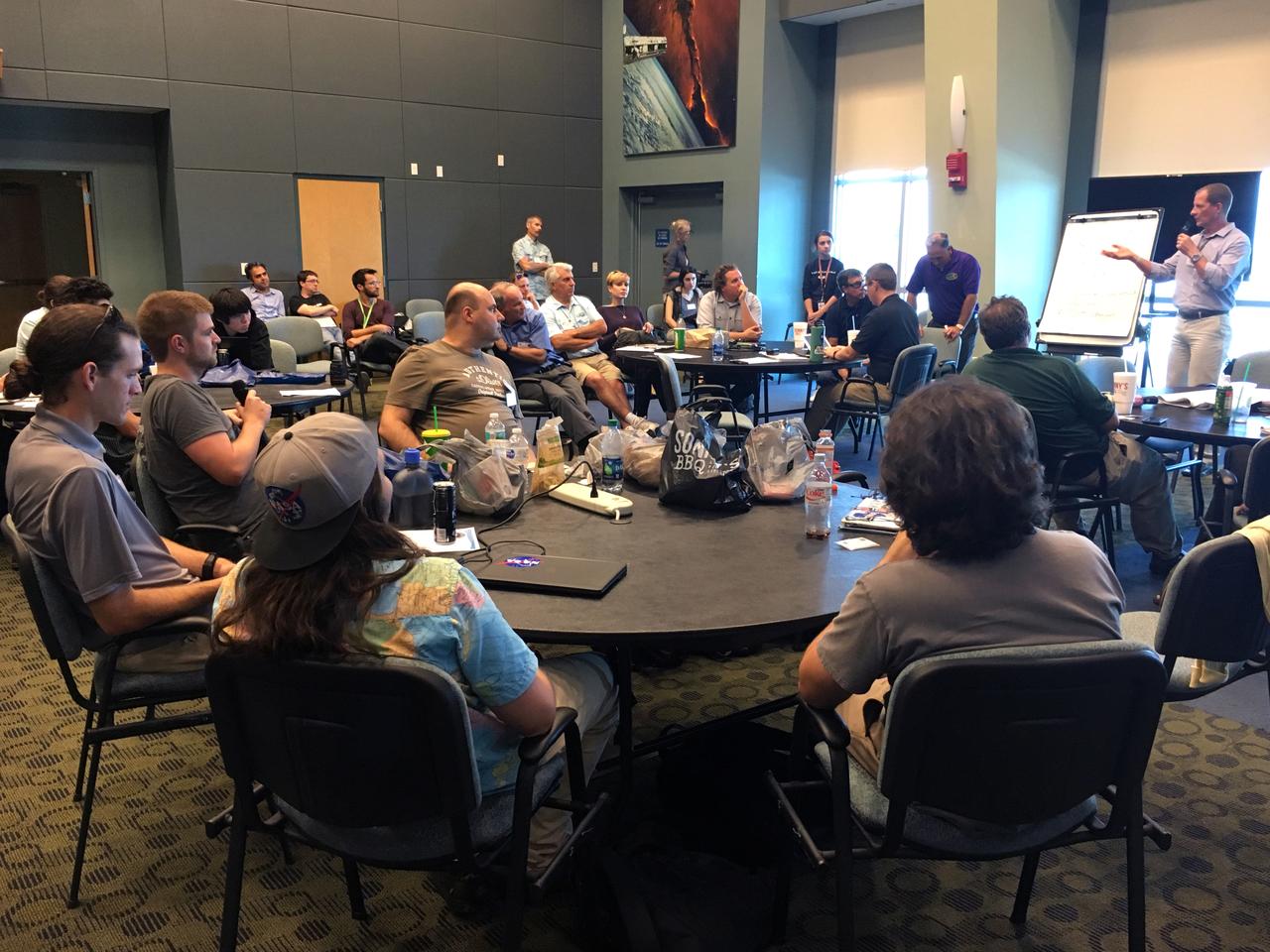
Scientists in the Exploration Research and Technology Directorate brainstorm innovative approaches to food production with industry representatives at the Space Station Processing Facility at NASA's Kennedy Space Center in Florida.
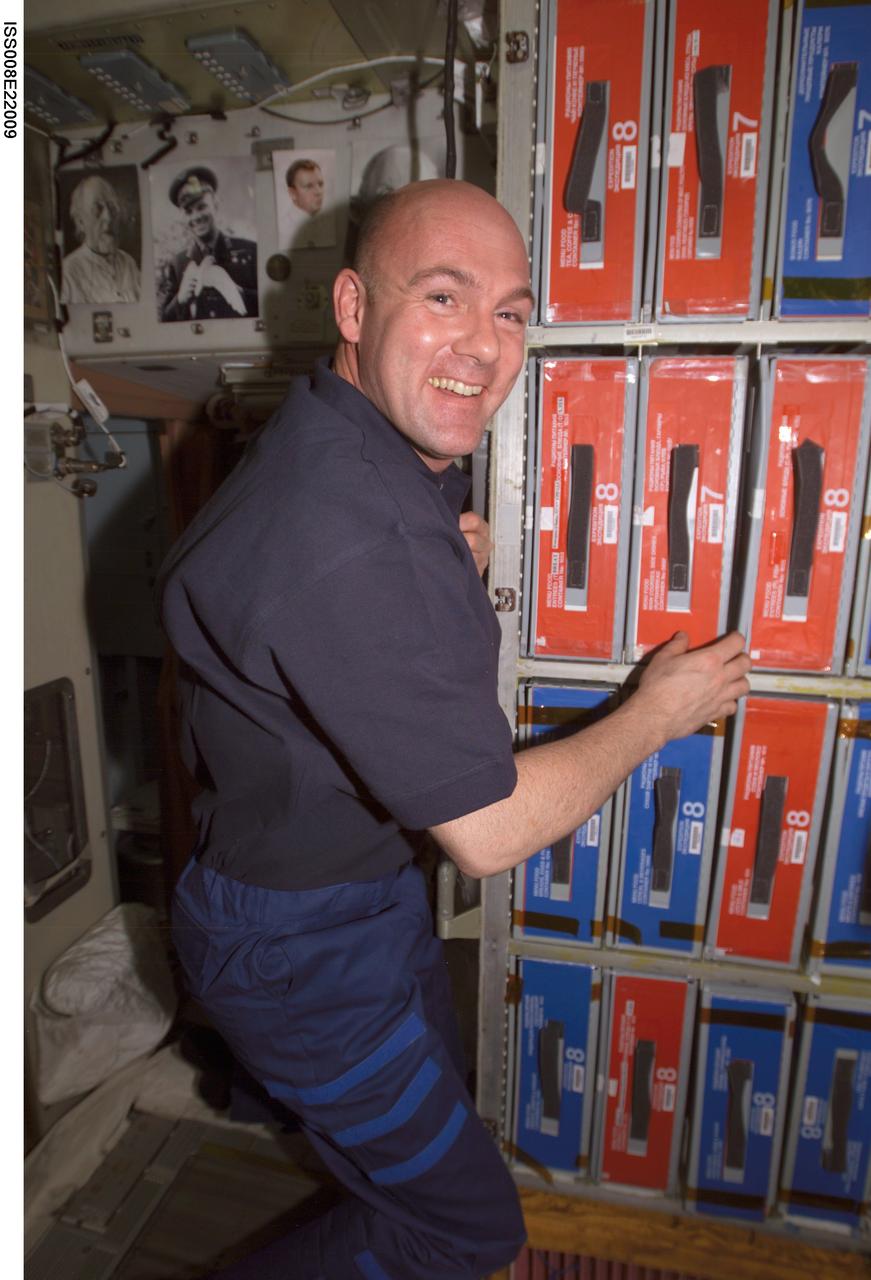
ISS008-E-22009 (22 April 2004) --- European Space Agency (ESA) astronaut Andre Kuipers of the Netherlands is pictured near food storage containers in the Zvezda Service Module of the International Space Station (ISS).
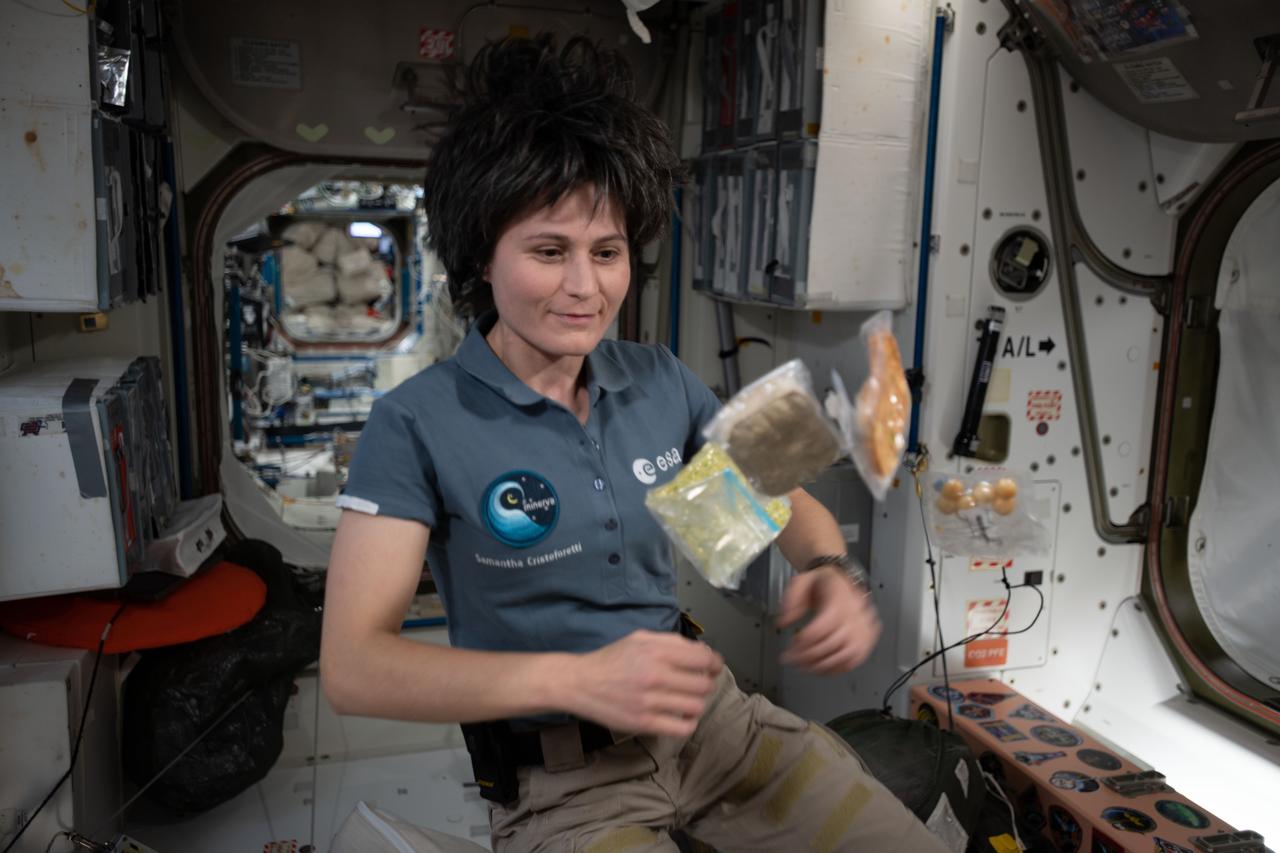
iss067e170528 (July 2, 2022) --- Expedition 67 Flight Engineer and ESA astronaut (European Space Agency) Samantha Cristoforetti poses with food packets flying weightlessly inside the International Space Station's Unity module.
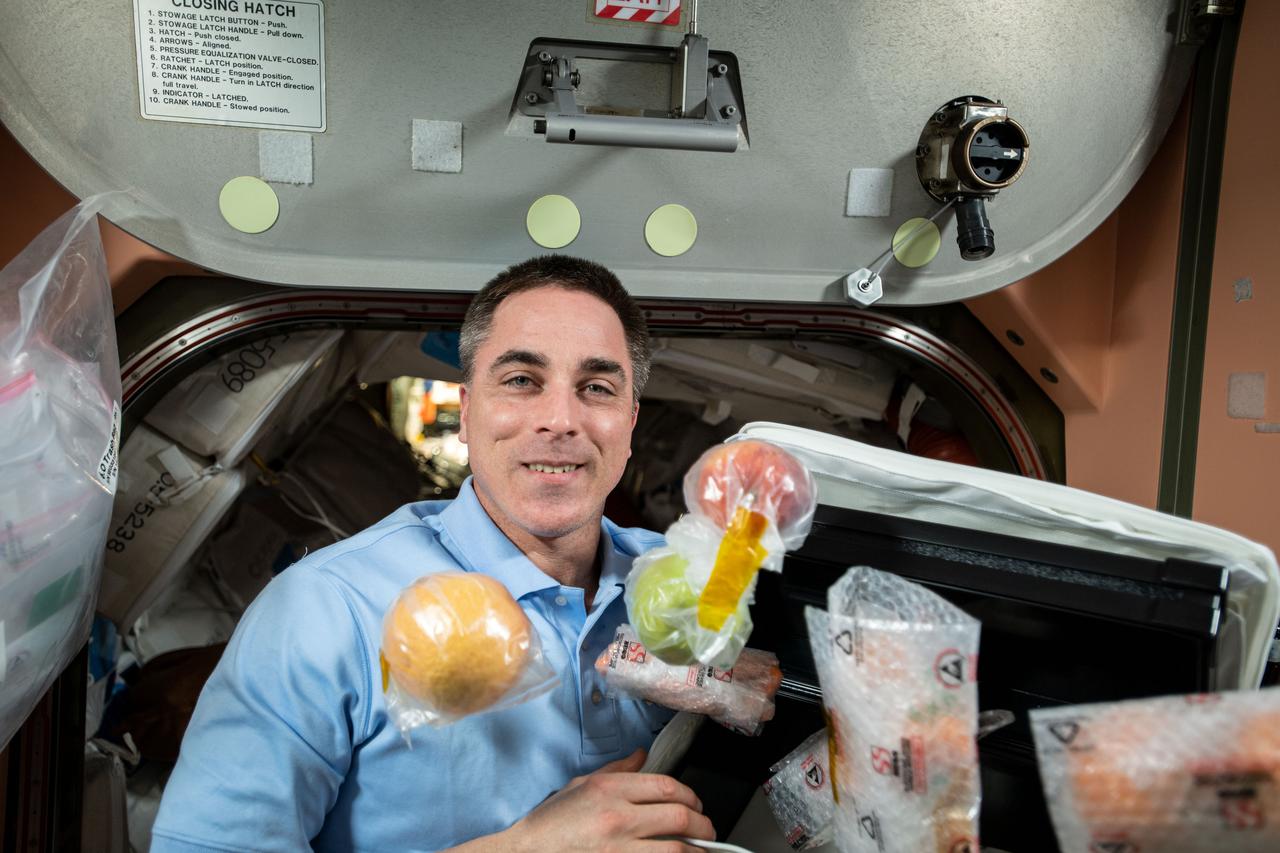
iss063e103926 (Oct. 5, 2020) --- NASA astronaut and Expedition 63 Commander Chris Cassidy unpacks fresh fruit and other food items shipped aboard the Northrop Grumman Cygnus space freighter to the International Space Station.
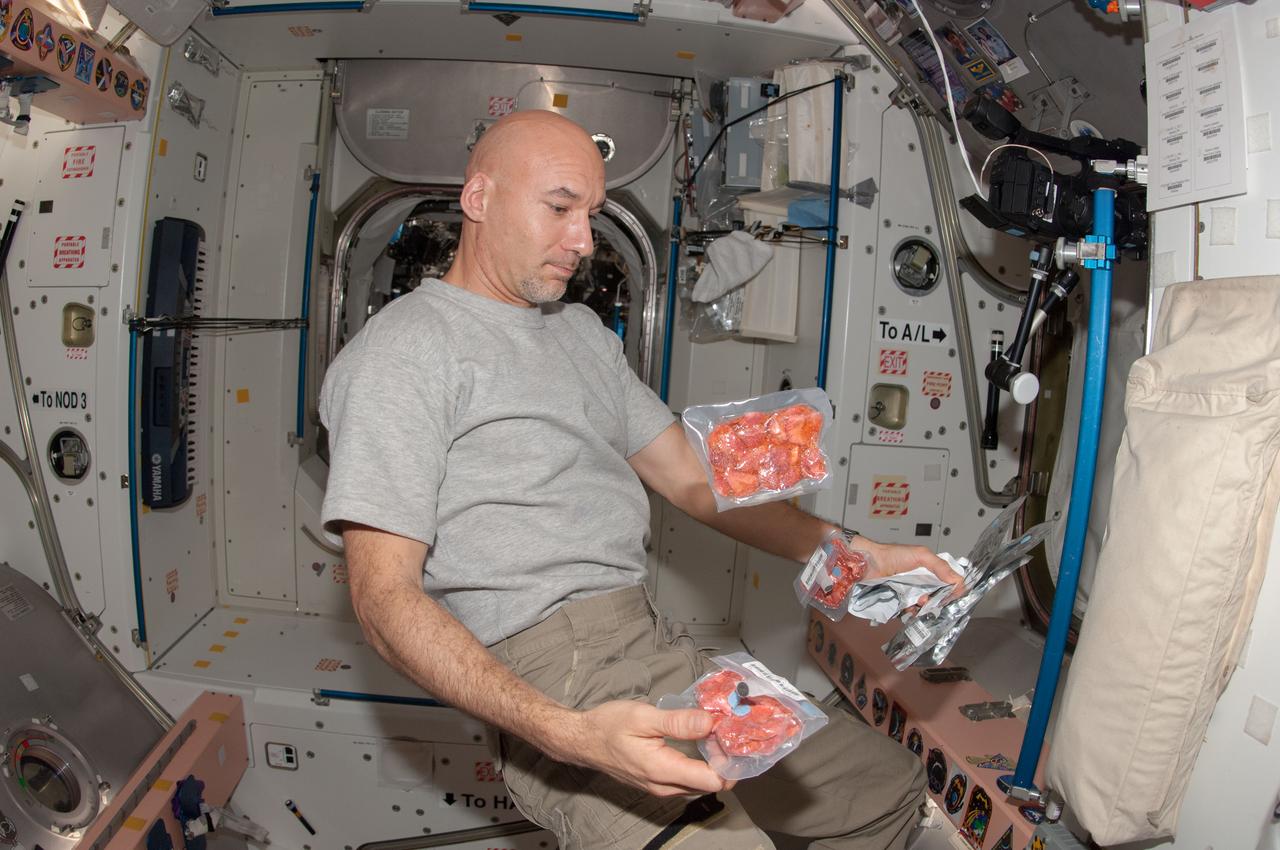
ISS036-E-019772 (24 June 2013) --- European Space Agency astronaut Luca Parmitano, Expedition 36 flight engineer, is pictured near food packages floating freely in the Unity node of the International Space Station.
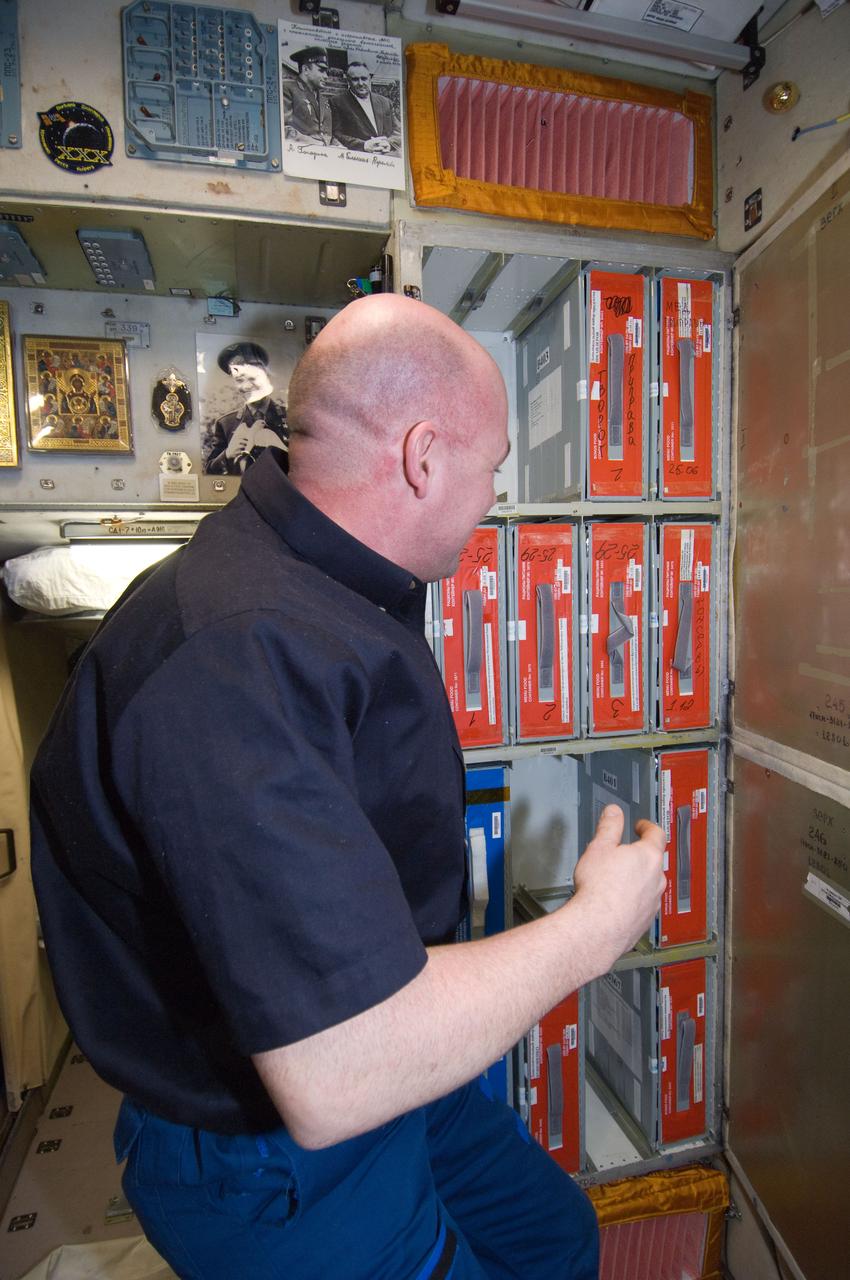
ISS030-E-178069 (28 March 2012) --- European Space Agency astronaut Andre Kuipers, Expedition 30 flight engineer, is pictured near food storage containers in the Zvezda Service Module of the International Space Station.
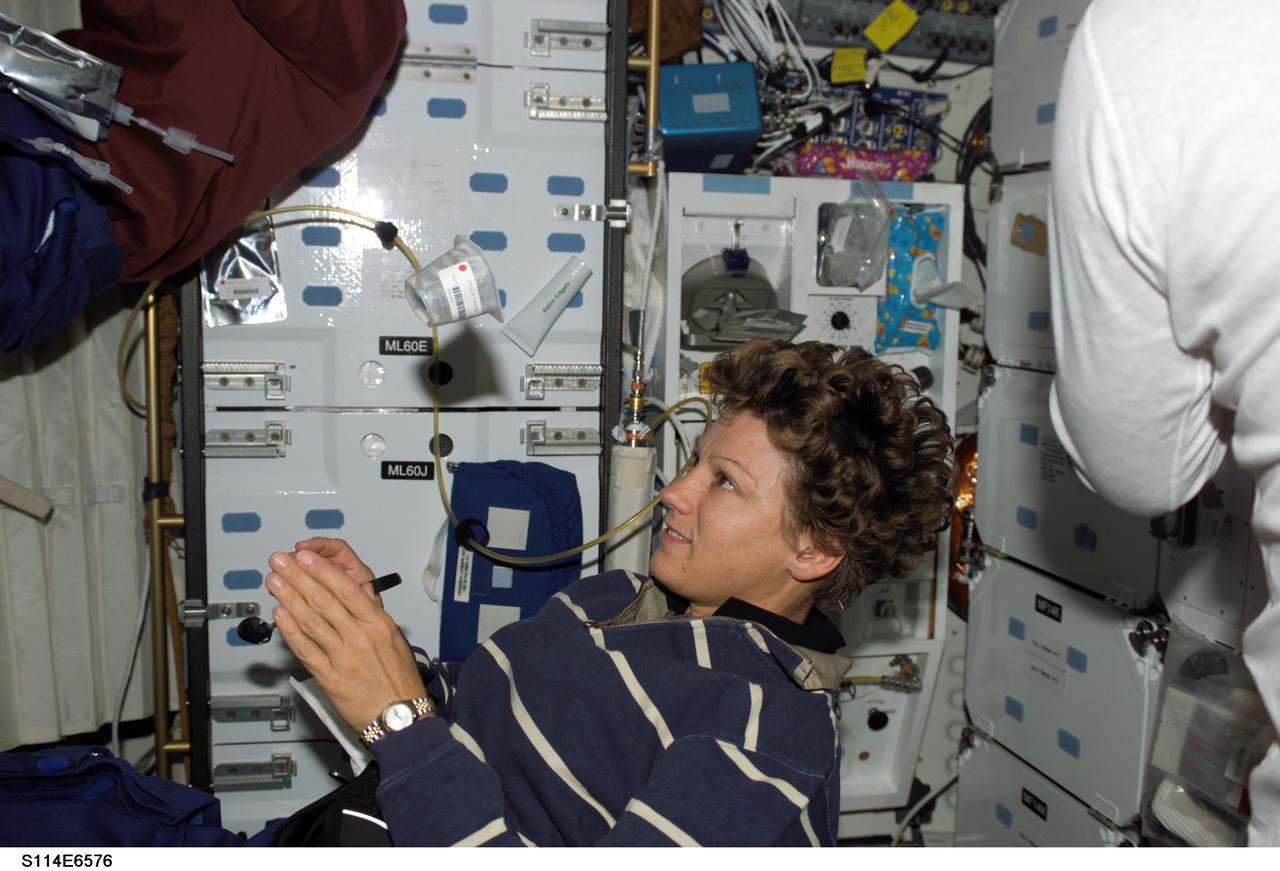
S114-E-6576 (3 August 2005) --- Astronaut Eileen M. Collins, STS-114 commander, watches a container of food floating freely on the middeck of the Space Shuttle Discovery while docked to the International Space Station.
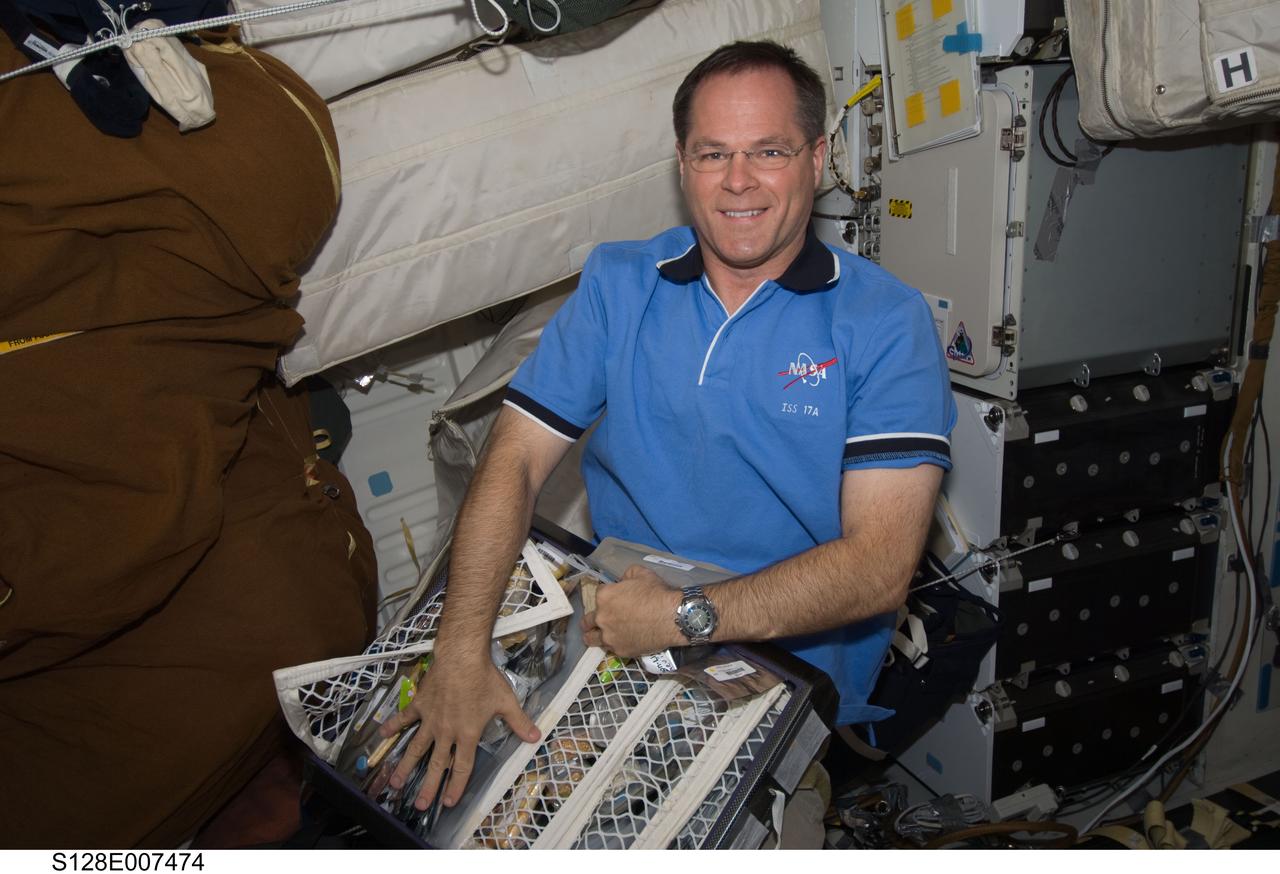
S128-E-007474 (3 Sept. 2009) --- NASA astronaut Kevin Ford, STS-128 pilot, holds a storage bag containing food items on the middeck of Space Shuttle Discovery while docked with the International Space Station.