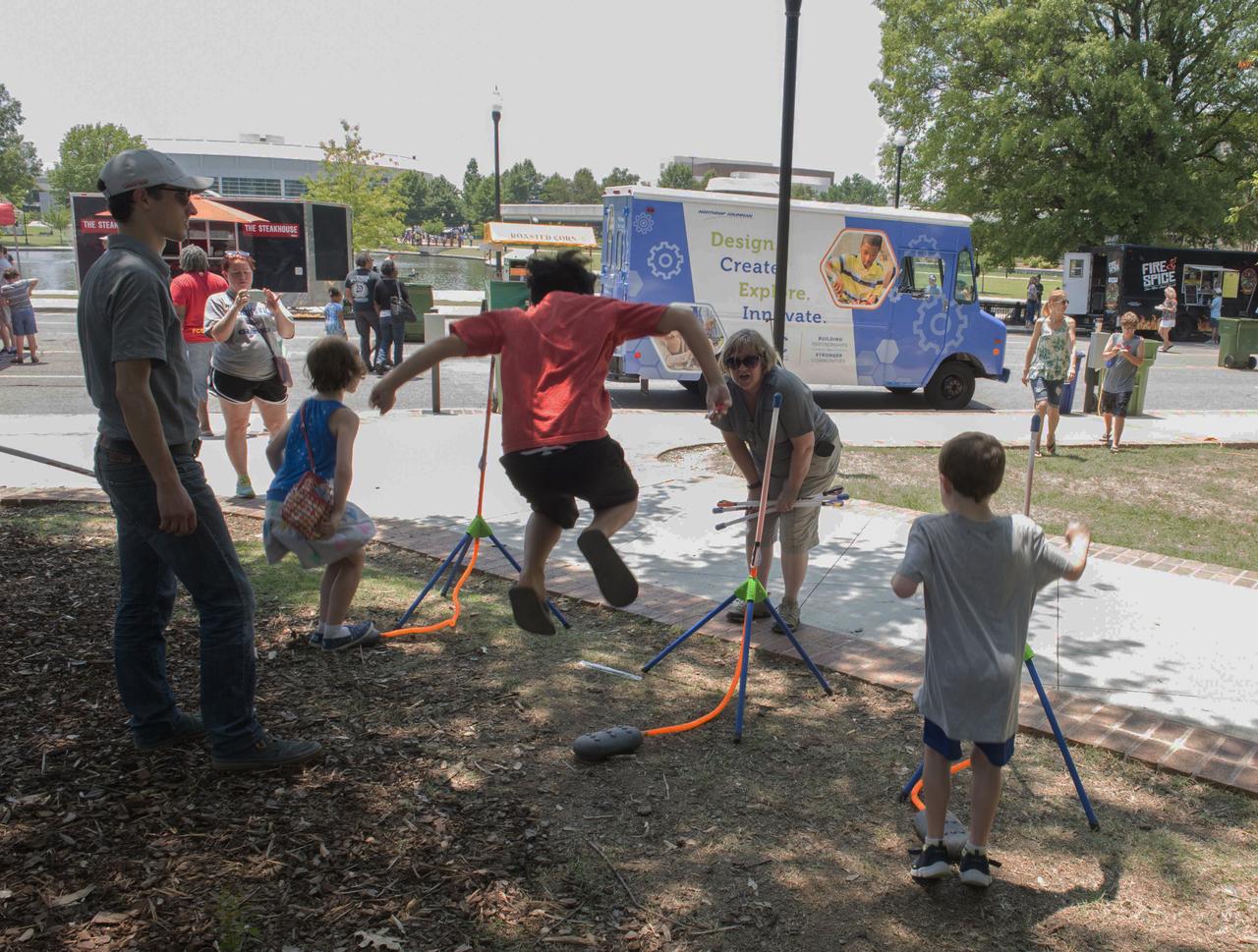
NASA in the Park on June 16 in Huntsville featured more than 60 exhibits and demonstrations by NASA experts, as well as performances by Marshall musicians, educational opportunities, games and hands-on activities for all ages. Youthful energy is exhibited in the foot rocket demonstration.
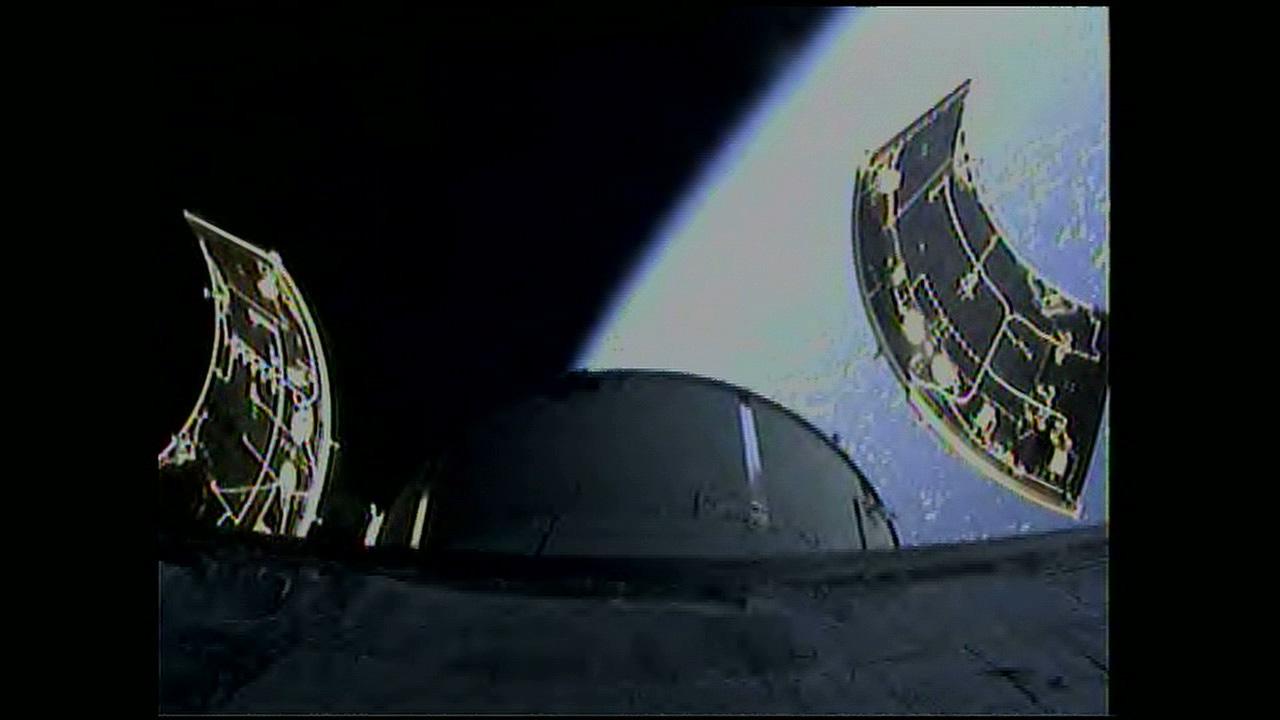
An onboard camera captures separation of the three 13 by 14-foot Orion service module fairings following lift off the Delta IV Heavy rocket from Space Launch Complex 37 at Cape Canaveral Air Force Station in Florida on Dec. 5, 2014. Exploration Flight Test-1 (EFT-1) also will validate systems such as Orion’s parachutes, avionics and attitude control, and demonstrate major separation events such as the launch abort system jettison and the service module fairing separation. Part of Batch image transfer from Flickr.
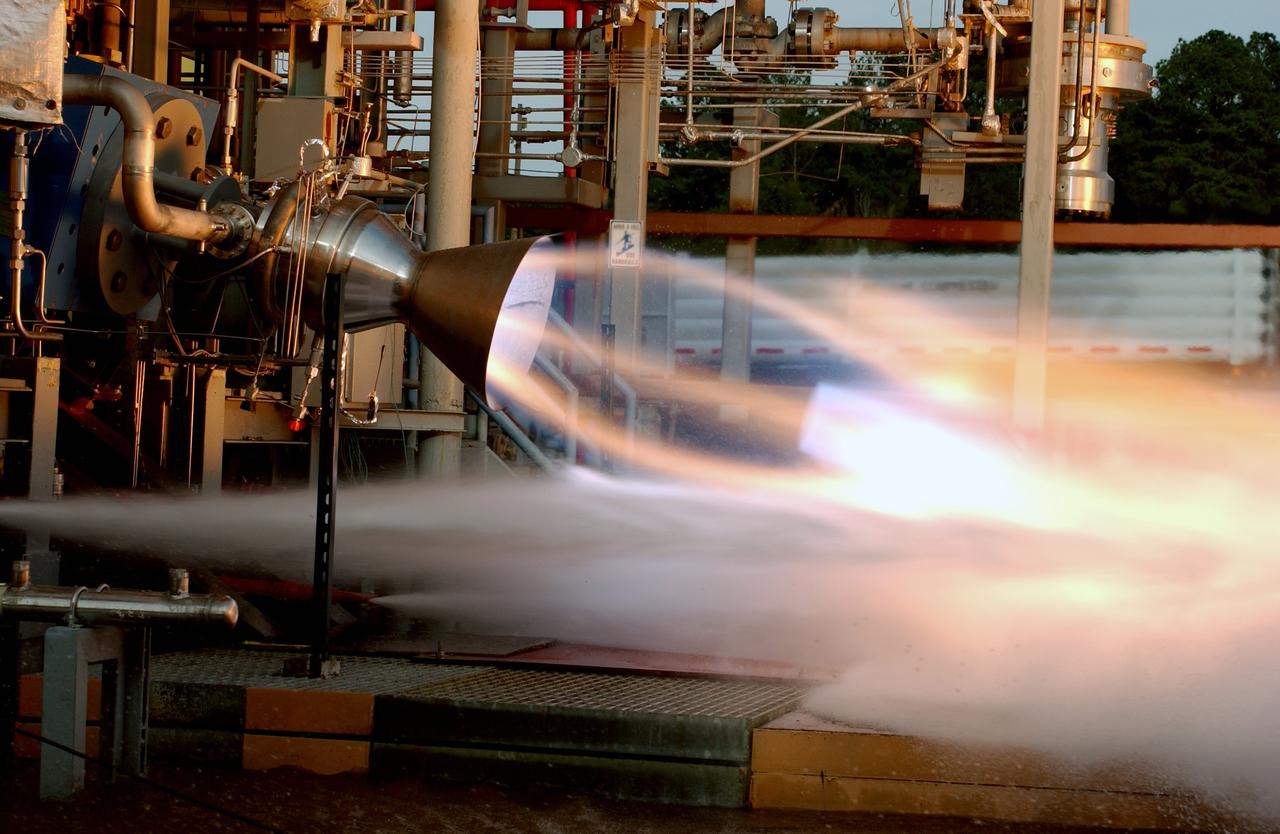
In this photo, an RS-88 development rocket engine is being test fired at NASA's Marshall Space Flight Center in Huntsville, Alabama, in support of the Pad Abort Demonstration (PAD) test flights for NASA's Orbital Space Plane (OSP). The tests could be instrumental in developing the first crew launch escape system in almost 30 years. Paving the way for a series of integrated PAD test flights, the engine tests support development of a system that could pull a crew safely away from danger during liftoff. A series of 16 hot fire tests of a 50,000-pound thrust RS-88 rocket engine were conducted, resulting in a total of 55 seconds of successful engine operation. The engine is being developed by the Rocketdyne Propulsion and Power unit of the Boeing Company. Integrated launch abort demonstration tests in 2005 will use four RS-88 engines to separate a test vehicle from a test platform, simulating pulling a crewed vehicle away from an aborted launch. Four 156-foot parachutes will deploy and carry the vehicle to landing. Lockheed Martin is building the vehicles for the PAD tests. Seven integrated tests are plarned for 2005 and 2006.
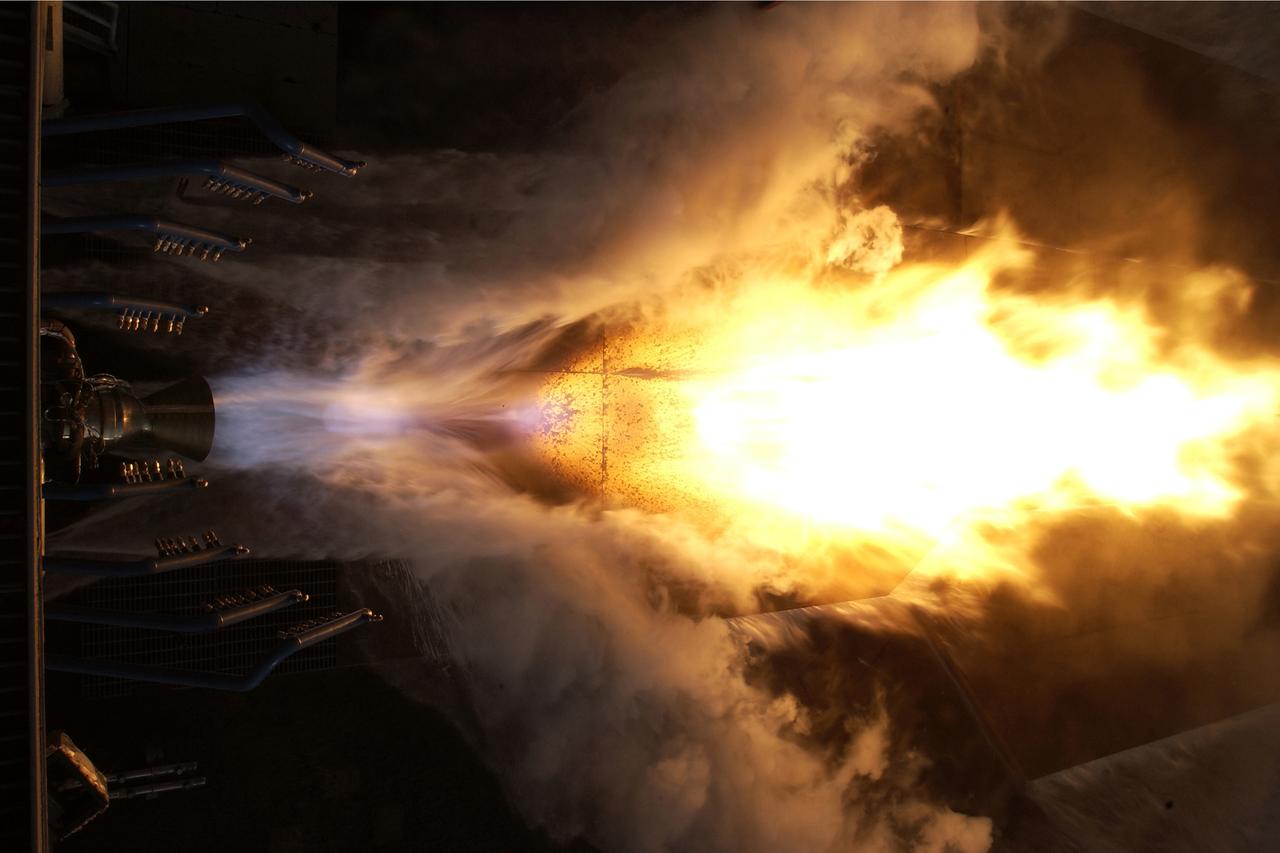
This photo gives an overhead look at an RS-88 development rocket engine being test fired at NASA's Marshall Space Flight Center in Huntsville, Alabama, in support of the Pad Abort Demonstration (PAD) test flights for NASA's Orbital Space Plane (OSP). The tests could be instrumental in developing the first crew launch escape system in almost 30 years. Paving the way for a series of integrated PAD test flights, the engine tests support development of a system that could pull a crew safely away from danger during liftoff. A series of 16 hot fire tests of a 50,000-pound thrust RS-88 rocket engine were conducted, resulting in a total of 55 seconds of successful engine operation. The engine is being developed by the Rocketdyne Propulsion and Power unit of the Boeing Company. Integrated launch abort demonstration tests in 2005 will use four RS-88 engines to separate a test vehicle from a test platform, simulating pulling a crewed vehicle away from an aborted launch. Four 156-foot parachutes will deploy and carry the vehicle to landing. Lockheed Martin is building the vehicles for the PAD tests. Seven integrated tests are plarned for 2005 and 2006.
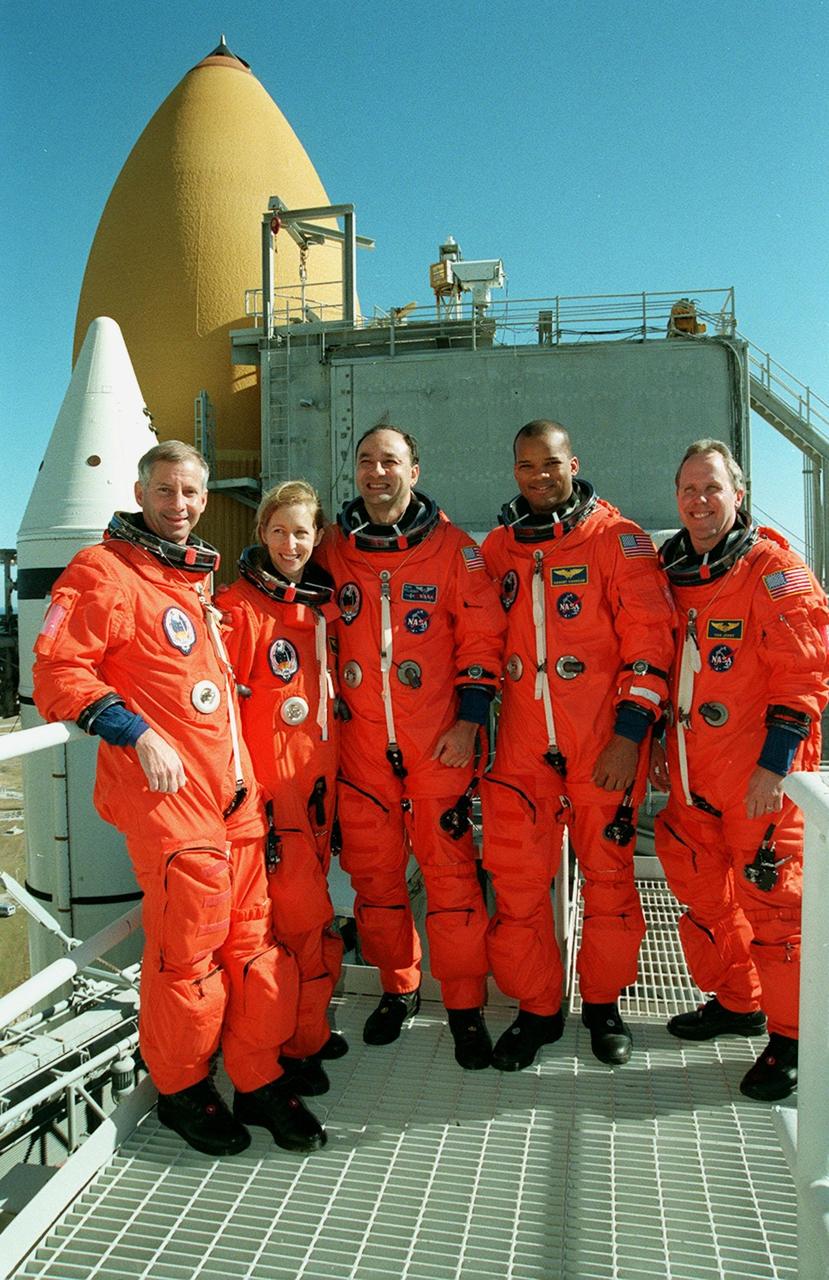
KENNEDY SPACE CENTER, FLA. -- The STS-98 crew poses for a group photo on the 215-foot level of the Fixed Service Structure at Launch Pad 39A. Dressed in their orange launch and entry suits are (left to right) Commander Ken Cockrell, Mission Specialist Marsha Ivins, Pilot Mark Polansky and Mission Specialists Robert Curbeam and Thomas Jones. Behind them can be seen the white nose cone of a solid rocket booster and the orange external tank on Space Shuttle Atlantis. The crew is taking part in emergency egress training and a simulated launch countdown as part of Terminal Countdown Demonstration Test activities. STS-98 is the seventh construction flight to the International Space Station, carrying as payload the U.S. Lab Destiny, a key element in the construction of the ISS. Launch of STS-98 is scheduled for Jan. 19 at 2:11 a.m. EST
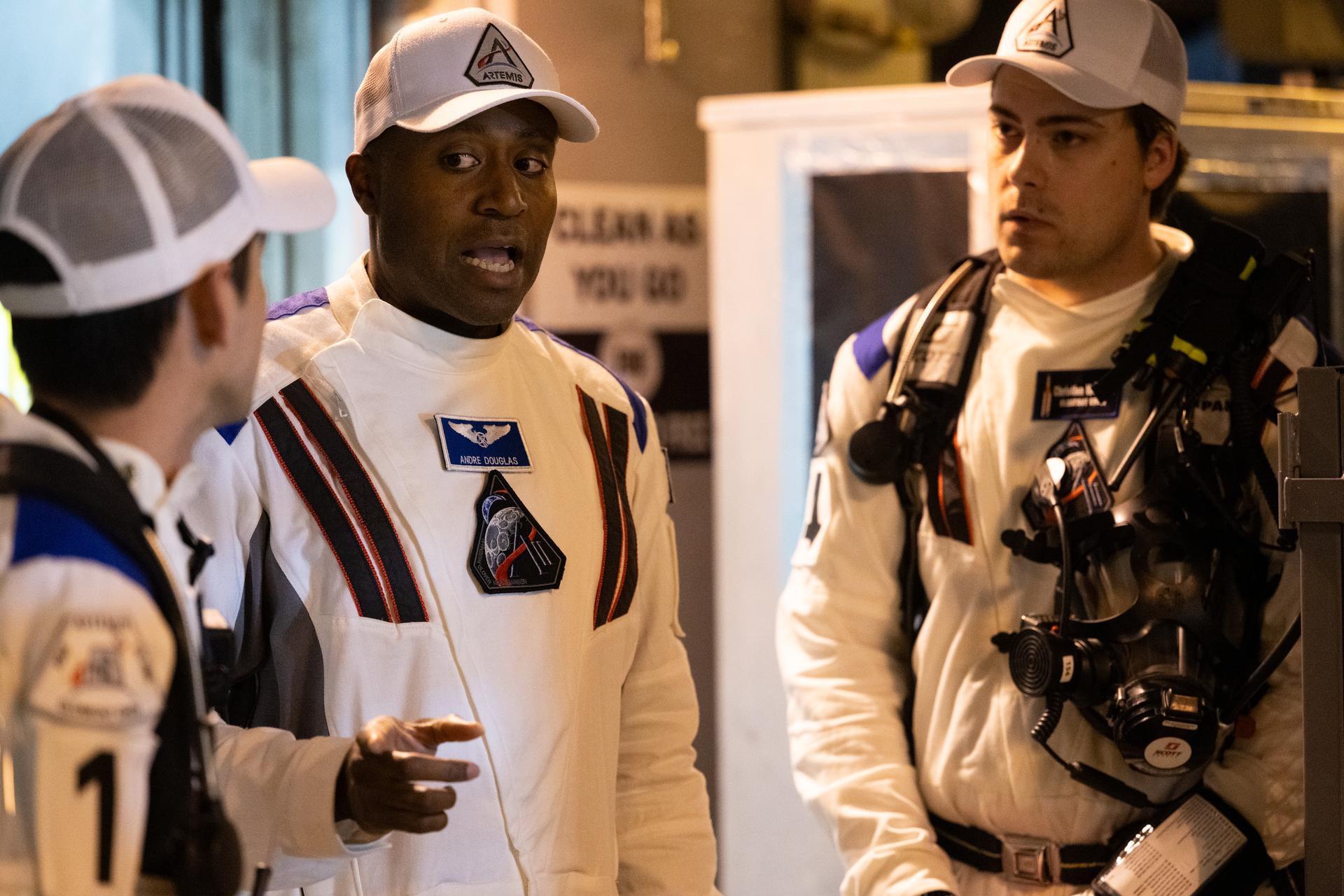
NASA astronaut Andre Douglas talks with Taylor Hose, left, Christian Warriner of the Closeout Crew as they prepare for the arrival of Artemis II crewmembers NASA astronauts Reid Wiseman, commander; Victor Glover, pilot; Christina Koch, mission specialist; and CSA (Canadian Space Agency) astronaut Jeremy Hansen, at the 275-foot level of the mobile launcher as they prepare to board their Orion spacecraft atop NASA’s Space Launch System rocket during the Artemis II countdown demonstration test, Saturday, Dec. 20, 2025, inside the Vehicle Assembly Building at NASA’s Kennedy Space Center in Florida. For this operation, the Artemis II crew and launch teams are simulating the launch day timeline including suit-up, walkout, and spacecraft ingress and egress. Through the Artemis campaign, NASA will send astronauts to explore the Moon for scientific discovery, economic benefits, and to build the foundation for the first crewed missions to Mars, for the benefit of all. Photo Credit: (NASA/Joel Kowsky)
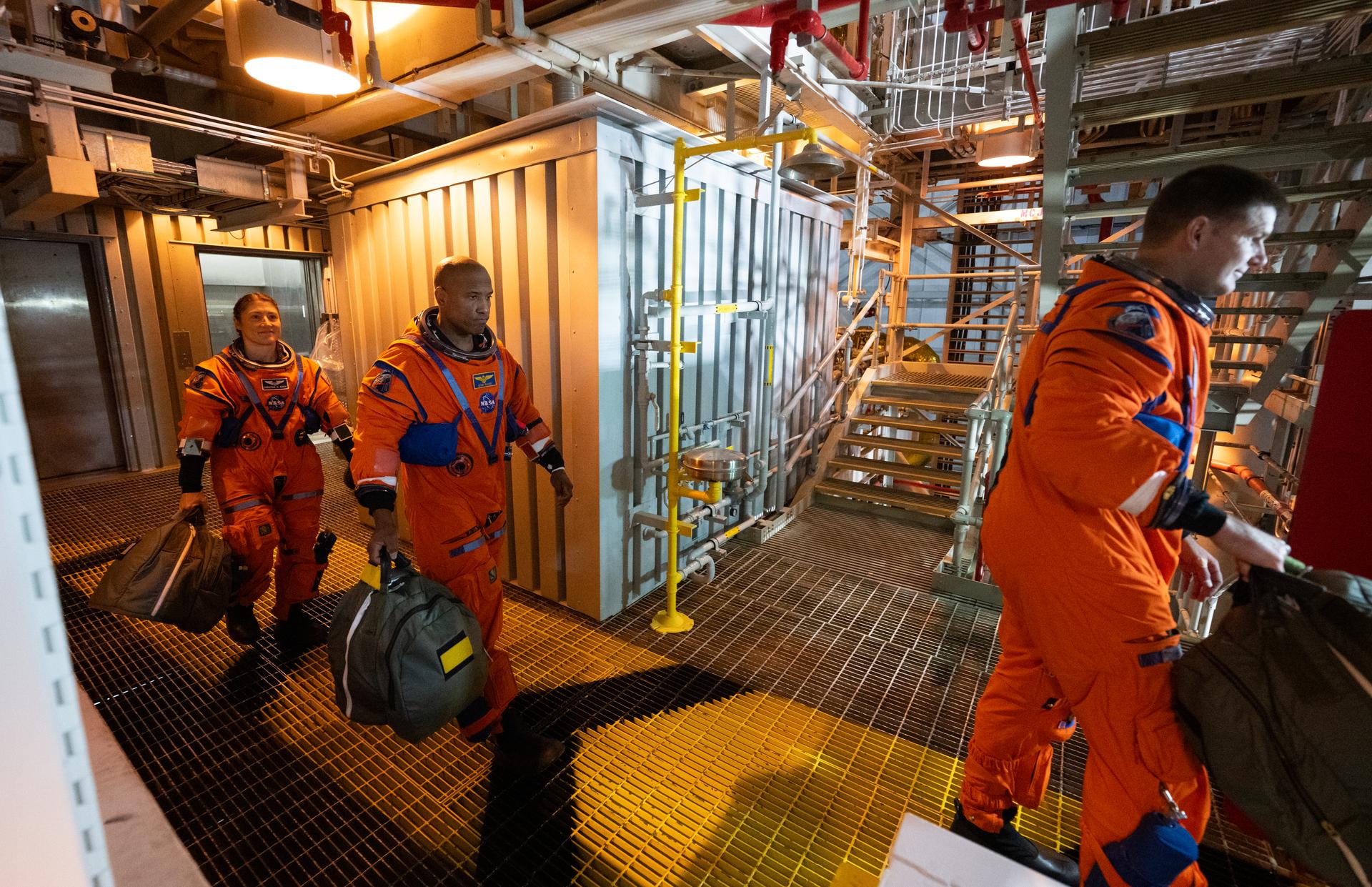
Artemis II crewmembers CSA (Canadian Space Agency) astronaut Jeremy Hansen, mission specialist, right, and NASA astronauts Victor Glover, pilot; Christina Koch, mission specialist; after exiting the elevator at the 275-foot level of the mobile launcher as they walk towards the crew access arm prepare to board their Orion spacecraft atop NASA’s Space Launch System rocket during the Artemis II countdown demonstration test, Saturday, Dec. 20, 2025, inside the Vehicle Assembly Building at NASA’s Kennedy Space Center in Florida. For this operation, the Artemis II crew and launch teams are simulating the launch day timeline including suit-up, walkout, and spacecraft ingress and egress. Through the Artemis campaign, NASA will send astronauts to explore the Moon for scientific discovery, economic benefits, and to build the foundation for the first crewed missions to Mars, for the benefit of all. Photo Credit: (NASA/Joel Kowsky)
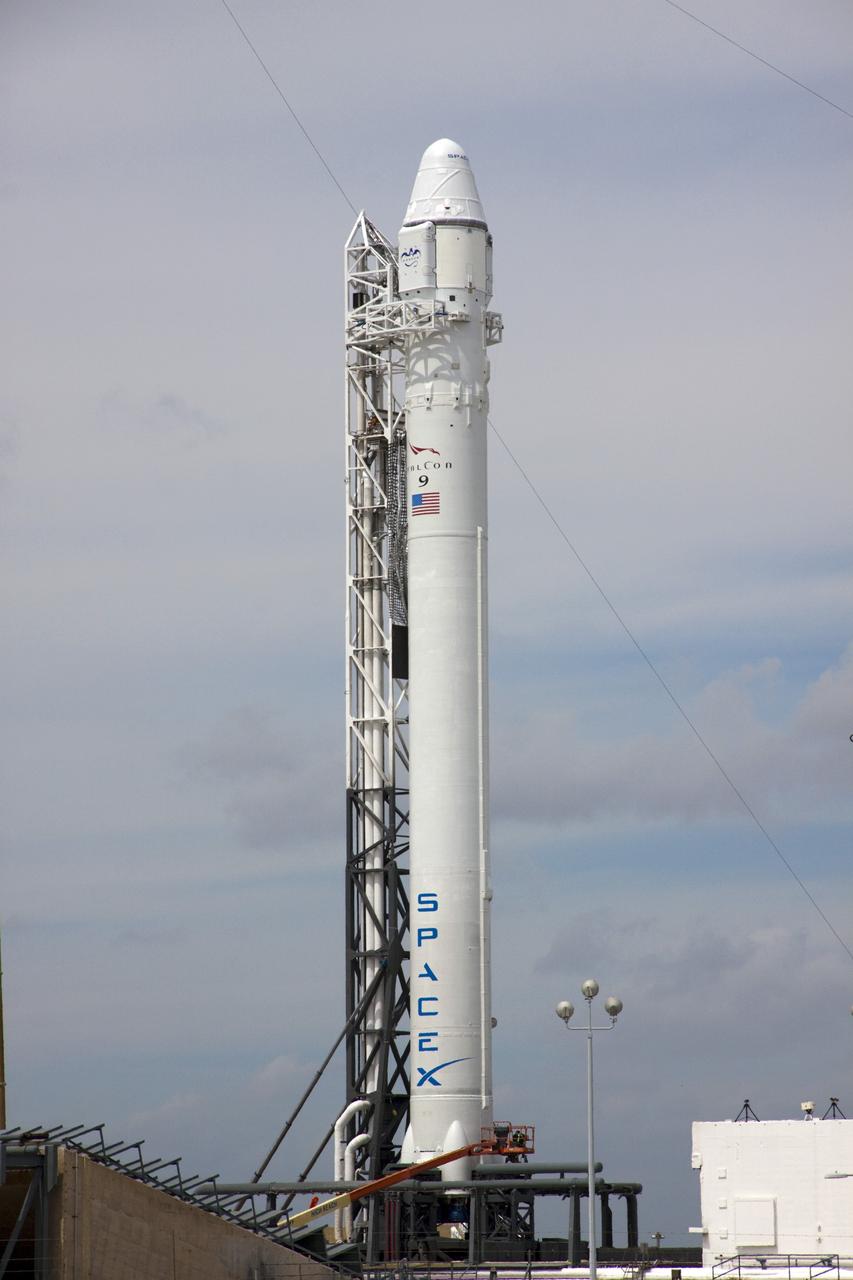
CAPE CANAVERAL, Fla. – The 227-foot-tall 69.2 meter) SpaceX Falcon 9 rocket stands at Space Launch Complex-40 on Cape Canaveral Air Force Station in Florida. Liftoff with the SpaceX Dragon capsule aboard is set for 4:55 a.m. EDT on May 19. The launch will be the company's second demonstration test flight for NASA's Commercial Orbital Transportation Services Program, or COTS. During the flight, the capsule will conduct a series of check-out procedures to test and prove its systems, including rendezvous and berthing with the International Space Station. If the capsule performs as planned, the cargo and experiments it is carrying will be transferred to the station. The cargo includes food, water and provisions for the station’s Expedition crews, such as clothing, batteries and computer equipment. Under COTS, NASA has partnered with two aerospace companies to deliver cargo to the station. For more information, visit http://www.nasa.gov/spacex Photo credit: NASA/Jim Grossmann
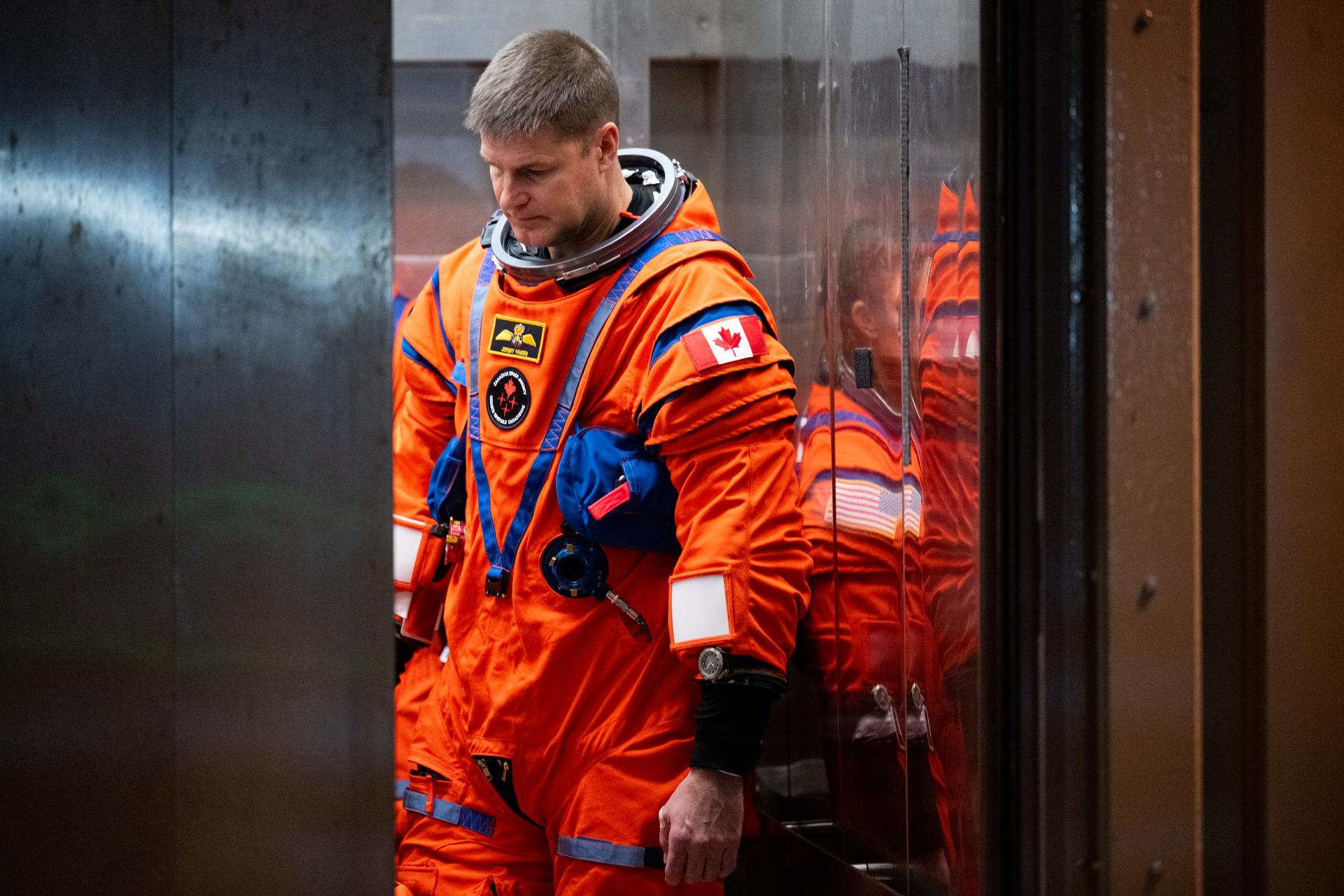
Artemis II crewmember CSA (Canadian Space Agency) astronaut Jeremy Hansen, mission specialist; is seen in the elevator as he arrives with fellow crewmates NASA astronauts Reid Wiseman, commander; Victor Glover, pilot; and Christina Koch, mission specialist; at the 275-foot level of the mobile launcher as they prepare to board their Orion spacecraft atop NASA’s Space Launch System rocket during the Artemis II countdown demonstration test, Saturday, Dec. 20, 2025, inside the Vehicle Assembly Building at NASA’s Kennedy Space Center in Florida. For this operation, the Artemis II crew and launch teams are simulating the launch day timeline including suit-up, walkout, and spacecraft ingress and egress. Through the Artemis campaign, NASA will send astronauts to explore the Moon for scientific discovery, economic benefits, and to build the foundation for the first crewed missions to Mars, for the benefit of all. Photo Credit: (NASA/Joel Kowsky)
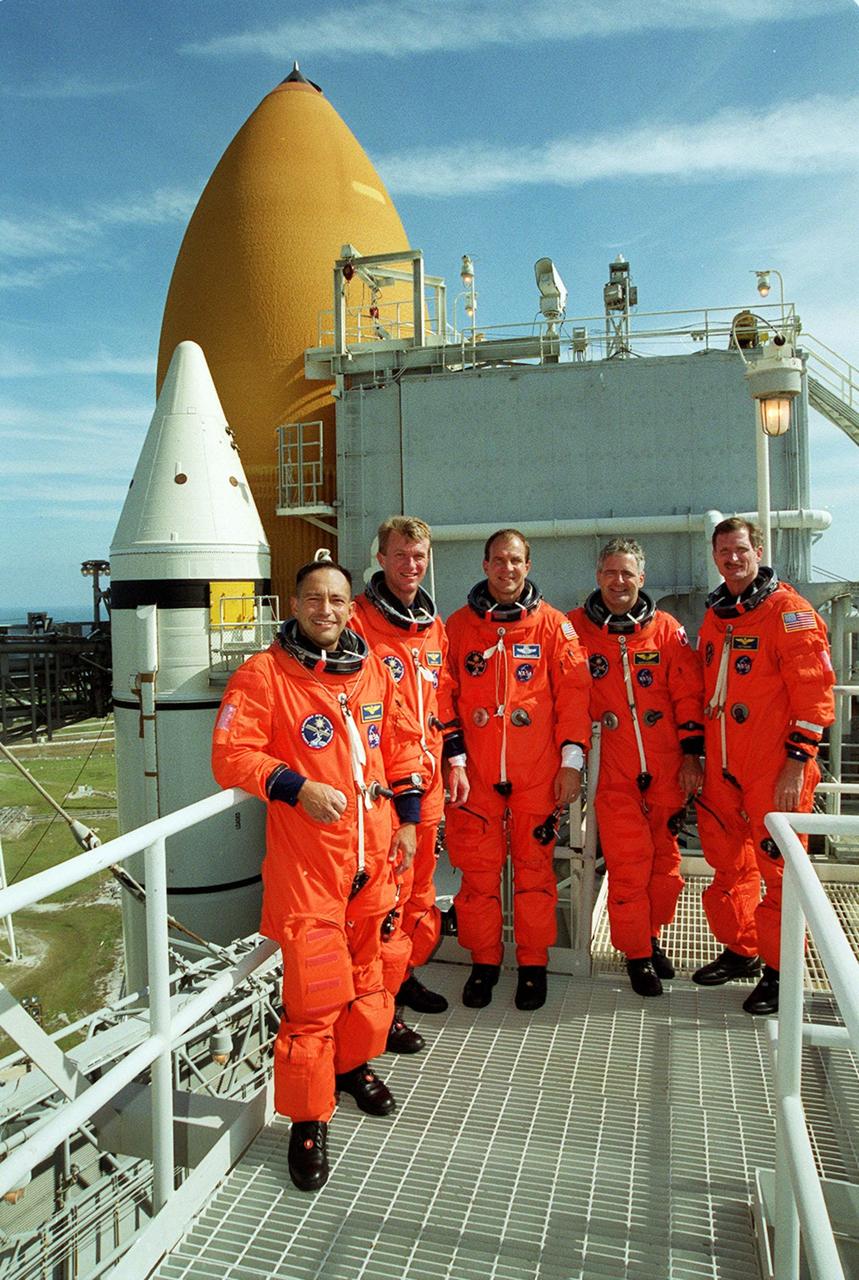
During Terminal Countdown Demonstration Test (TCDT) activities at Launch Pad 39B, the STS-97 crew poses for a photo at the 215-foot level. From left, they are Mission Specialist Carlos Noriega, Commander Brent Jett, Pilot Mike Bloomfield and Mission Specialists Marc Garneau and Joe Tanner. Behind them at left can be seen the top of the solid rocket booster and external tank on Space Shuttle Endeavour. The TCDT includes emergency egress training, opportunities to inspect the mission payloads in the orbiter’s payload bay and a simulated launch countdown. Mission STS-97is the sixth construction flight to the International Space Station. Its payload includes the P6 Integrated Truss Structure and a photovoltaic (PV) module, with giant solar arrays that will provide power to the Station. The mission includes two spacewalks to complete the solar array connections. STS-97 is scheduled to launch Nov. 30 at 10:05 p.m. EST
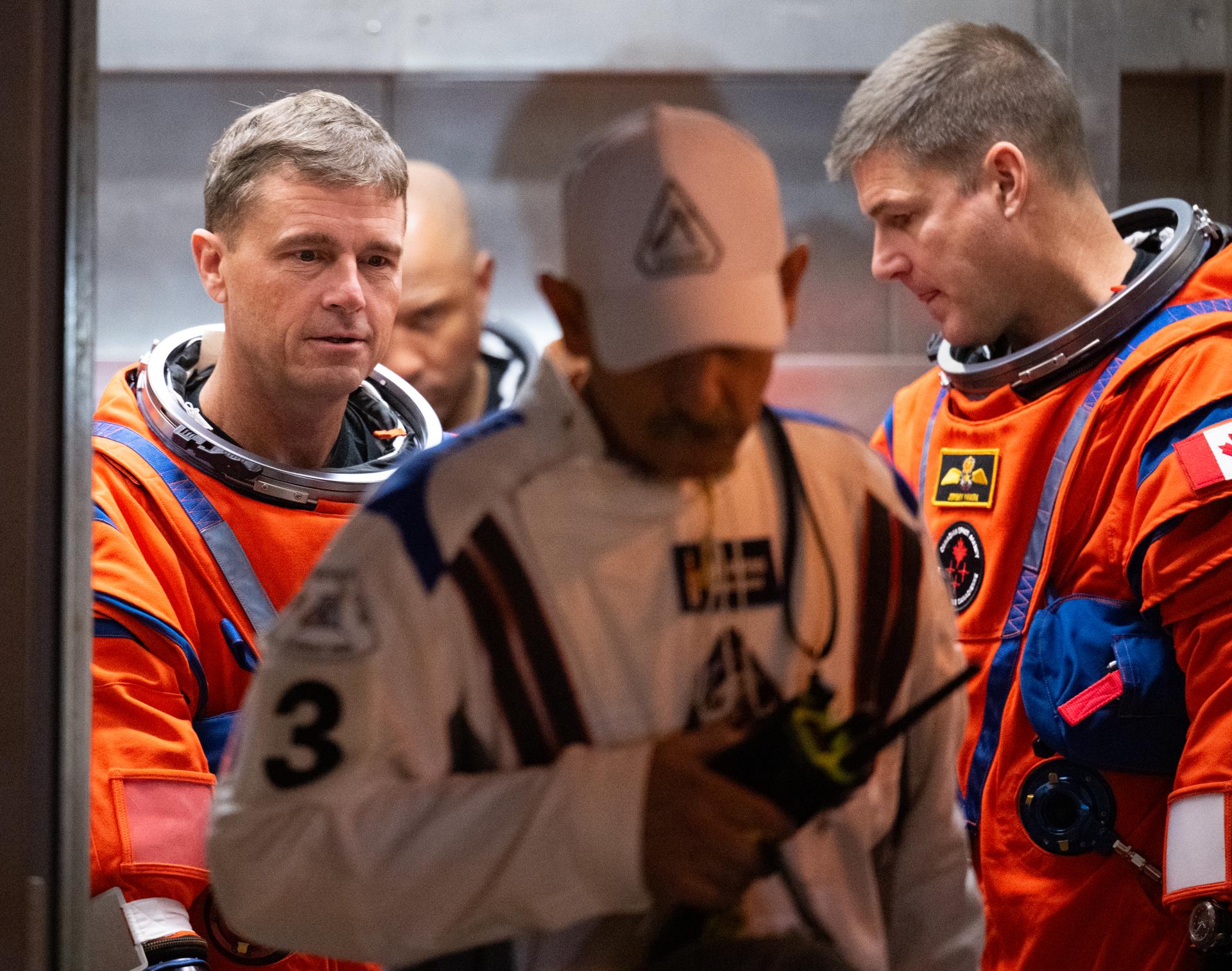
Artemis II crewmembers NASA astronauts Reid Wiseman, commander; and CSA (Canadian Space Agency) astronaut Jeremy Hansen, mission specialist are seen exit the elevator at the 275-foot level of the mobile launcher along with fellow crewmates NASA astronauts Victor Glover, pilot; and Christina Koch, mission specialist, as they prepare to board their Orion spacecraft atop NASA’s Space Launch System rocket during the Artemis II countdown demonstration test, Saturday, Dec. 20, 2025, inside the Vehicle Assembly Building at NASA’s Kennedy Space Center in Florida. For this operation, the Artemis II crew and launch teams are simulating the launch day timeline including suit-up, walkout, and spacecraft ingress and egress. Through the Artemis campaign, NASA will send astronauts to explore the Moon for scientific discovery, economic benefits, and to build the foundation for the first crewed missions to Mars, for the benefit of all. Photo Credit: (NASA/Joel Kowsky)
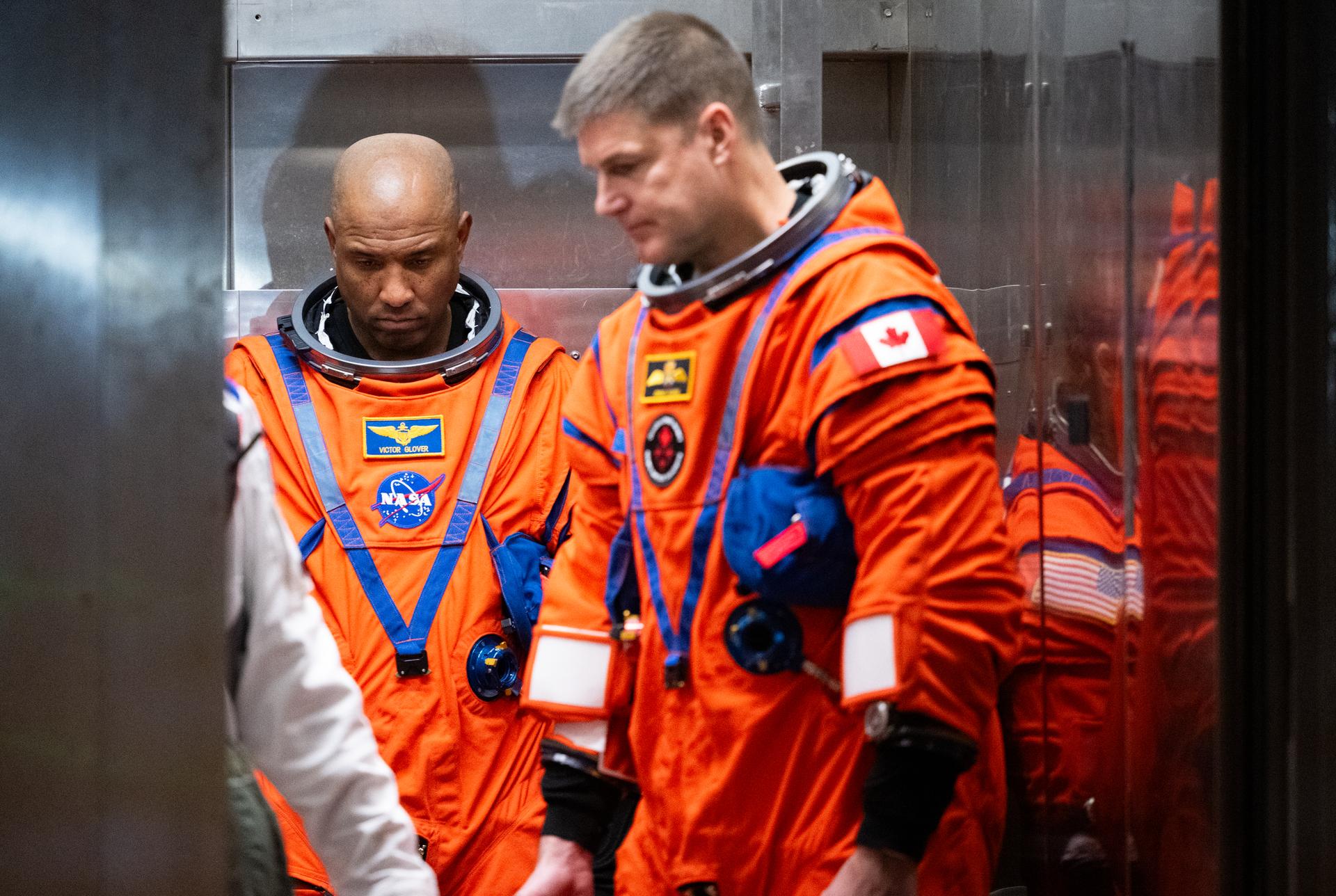
Artemis II crewmember NASA astronaut Victor Glover, pilot; left, and CSA (Canadian Space Agency) astronaut Jeremy Hansen, mission specialist; are seen in the elevator as they arrives with fellow crewmates NASA astronauts Reid Wiseman, commander; and Christina Koch, mission specialist; at the 275-foot level of the mobile launcher as they prepare to board their Orion spacecraft atop NASA’s Space Launch System rocket during the Artemis II countdown demonstration test, Saturday, Dec. 20, 2025, inside the Vehicle Assembly Building at NASA’s Kennedy Space Center in Florida. For this operation, the Artemis II crew and launch teams are simulating the launch day timeline including suit-up, walkout, and spacecraft ingress and egress. Through the Artemis campaign, NASA will send astronauts to explore the Moon for scientific discovery, economic benefits, and to build the foundation for the first crewed missions to Mars, for the benefit of all. Photo Credit: (NASA/Joel Kowsky)

After emergency escape training on the 195-foot level of the Fixed Service Structure, Launch Pad 39B, STS-102 Mission Specialists Susan Helms, Yury Usachev and James Voss pose for the camera. The three are also the Expedition Two crew who will be replacing Expedition One on the International Space Station. Behind them, at left, can be seen the tops of the solid rocket booster and external tank on Space Shuttle Discovery. The STS-102 crew is at KSC for Terminal Countdown Demonstration Test activities, which include the emergency training and a simulated launch countdown. STS-102 is the eighth construction flight to the Space Station, with Discovery carrying the Multi-Purpose Logistics Module Leonardo. Expedition One will return to Earth with Discovery. Launch on mission STS-102 is scheduled for March 8
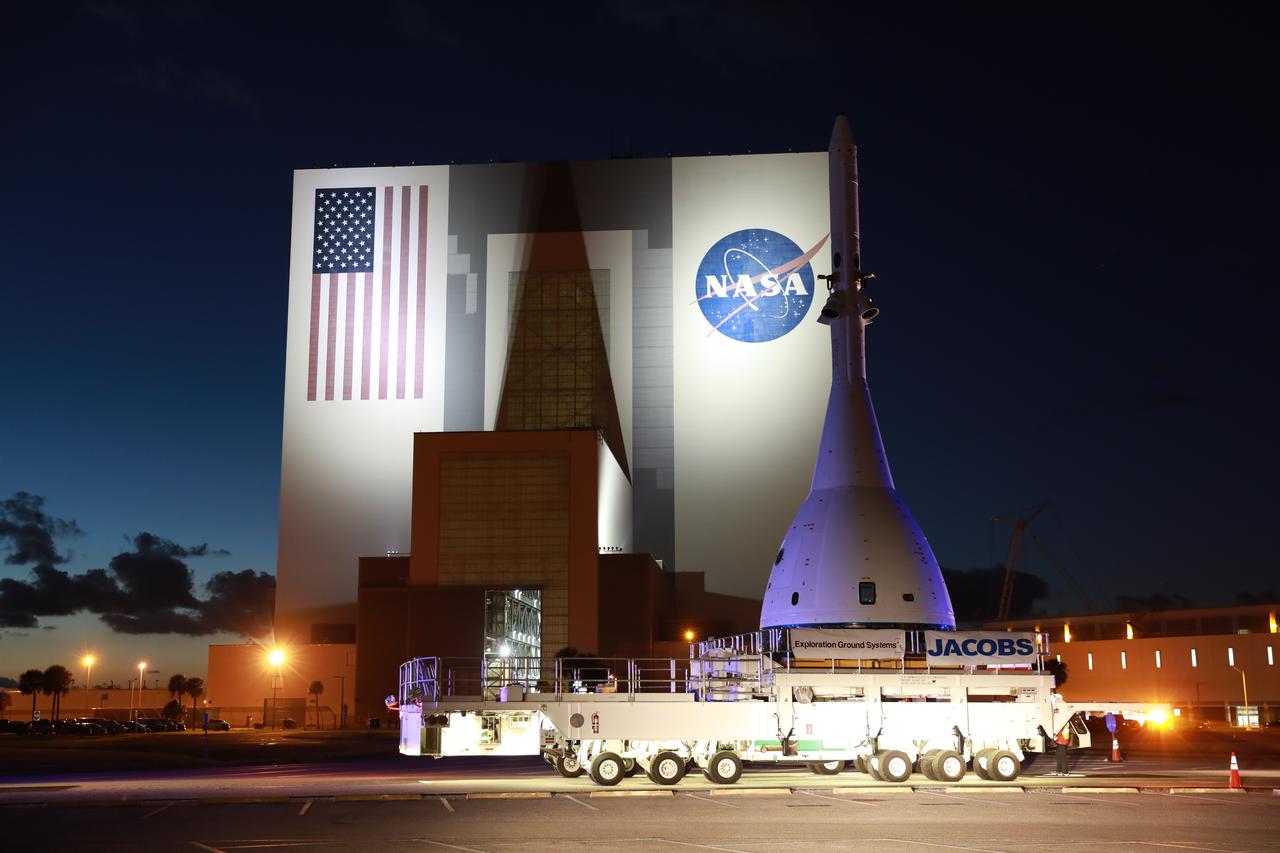
The vehicle for Orion’s Ascent Abort-2 (AA-2) fight test passes by the Vehicle Assembly Building at NASA’s Kennedy Space Center in Florida on its 21.5-mile-trek to Space Launch Complex 46 at Cape Canaveral Air Force Station on May 22, 2019. During AA-2, a test version of Orion will launch on a booster to more than six miles in altitude, where Orion’s launch abort system will pull the capsule away to demonstrate it can keep a future crew inside safe if an emergency occurs during ascent on the Space Launch System rocket. The AA-2 elements will be stacked together at the launch pad over the next several weeks. The launch is planned for July 2 and is a critical safety test that helps pave the way for Artemis missions near the Moon, and will enable astronauts to set foot on the lunar surface by 2024.
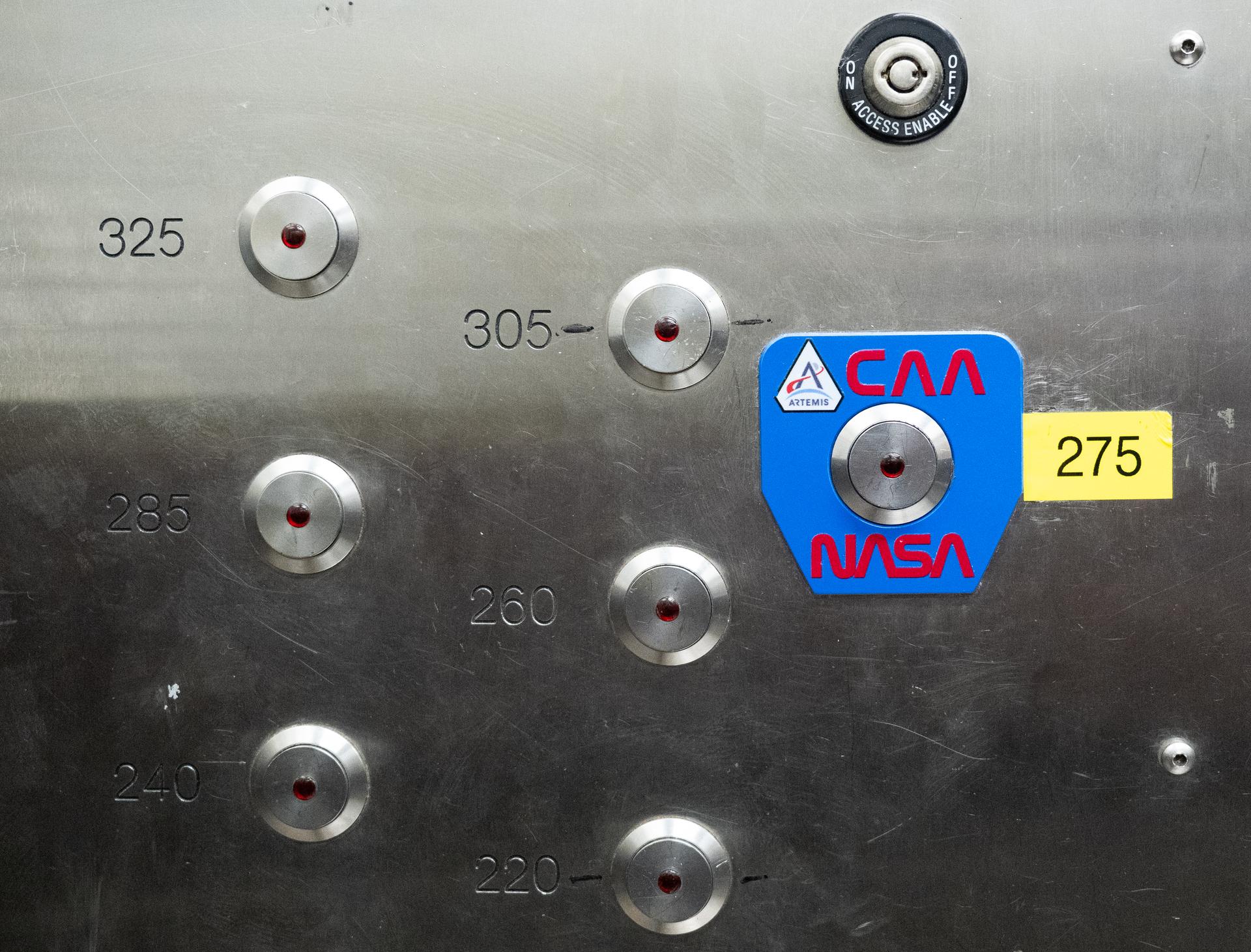
The elevator button for the 275-foot level of the mobile launcher is seen teams prepare for Artemis II crewmembers NASA astronauts Reid Wiseman, commander; Victor Glover, pilot; Christina Koch, mission specialist; and CSA (Canadian Space Agency) astronaut Jeremy Hansen, mission specialist; to arrive and board their Orion spacecraft atop NASA’s Space Launch System rocket during the Artemis II countdown demonstration test, Saturday, Dec. 20, 2025, inside the Vehicle Assembly Building at NASA’s Kennedy Space Center in Florida. For this operation, the Artemis II crew and launch teams are simulating the launch day timeline including suit-up, walkout, and spacecraft ingress and egress. Through the Artemis campaign, NASA will send astronauts to explore the Moon for scientific discovery, economic benefits, and to build the foundation for the first crewed missions to Mars, for the benefit of all. Photo Credit: (NASA/Joel Kowsky)
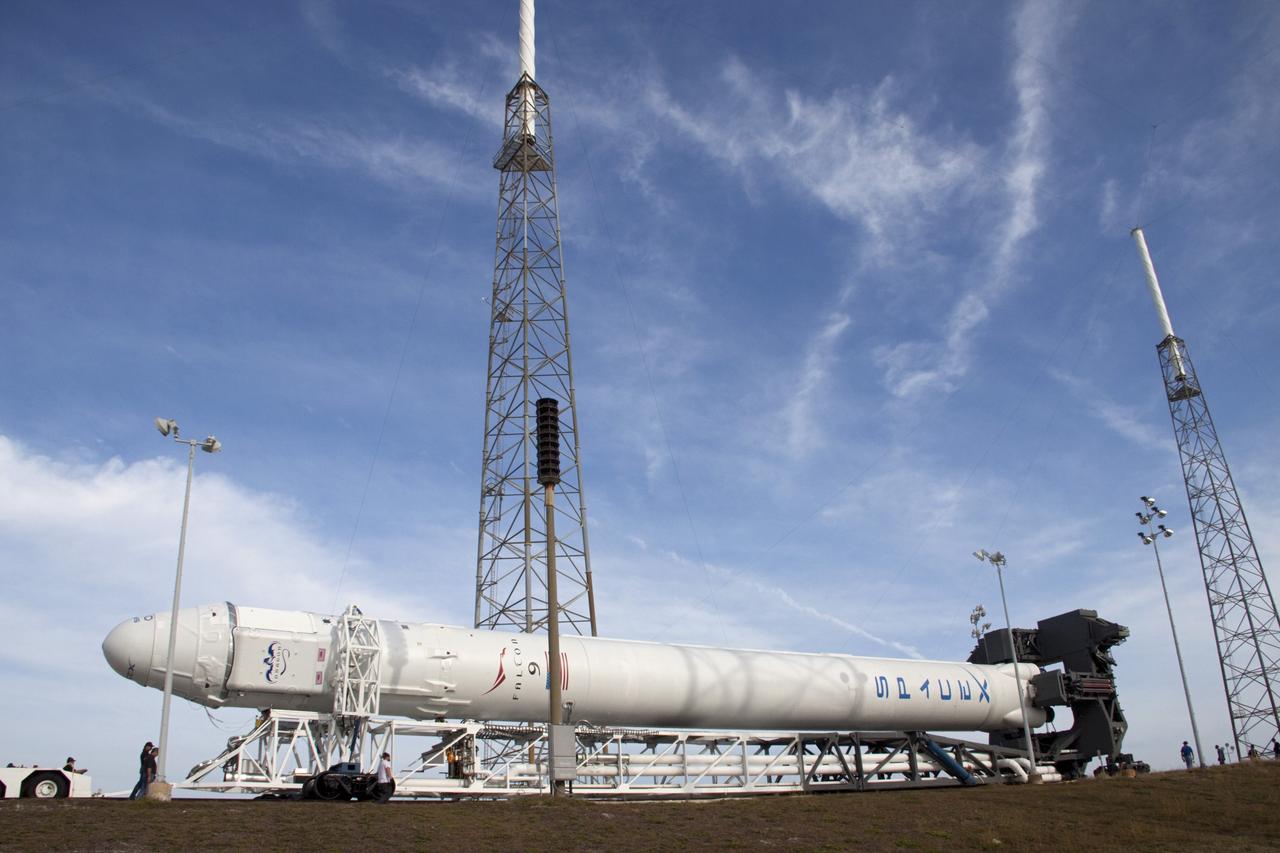
CAPE CANAVERAL, Fla. – The 227-foot-tall 69.2 meter) SpaceX Falcon 9 rocket arrives at Space Launch Complex-40 on Cape Canaveral Air Force Station in Florida. Liftoff with the SpaceX Dragon capsule aboard is set for 4:55 a.m. EDT on May 19. The launch will be the company's second demonstration test flight for NASA's Commercial Orbital Transportation Services Program, or COTS. During the flight, the capsule will conduct a series of check-out procedures to test and prove its systems, including rendezvous and berthing with the International Space Station. If the capsule performs as planned, the cargo and experiments it is carrying will be transferred to the station. The cargo includes food, water and provisions for the station’s Expedition crews, such as clothing, batteries and computer equipment. Under COTS, NASA has partnered with two aerospace companies to deliver cargo to the station. For more information, visit http://www.nasa.gov/spacex Photo credit: NASA/Jim Grossmann
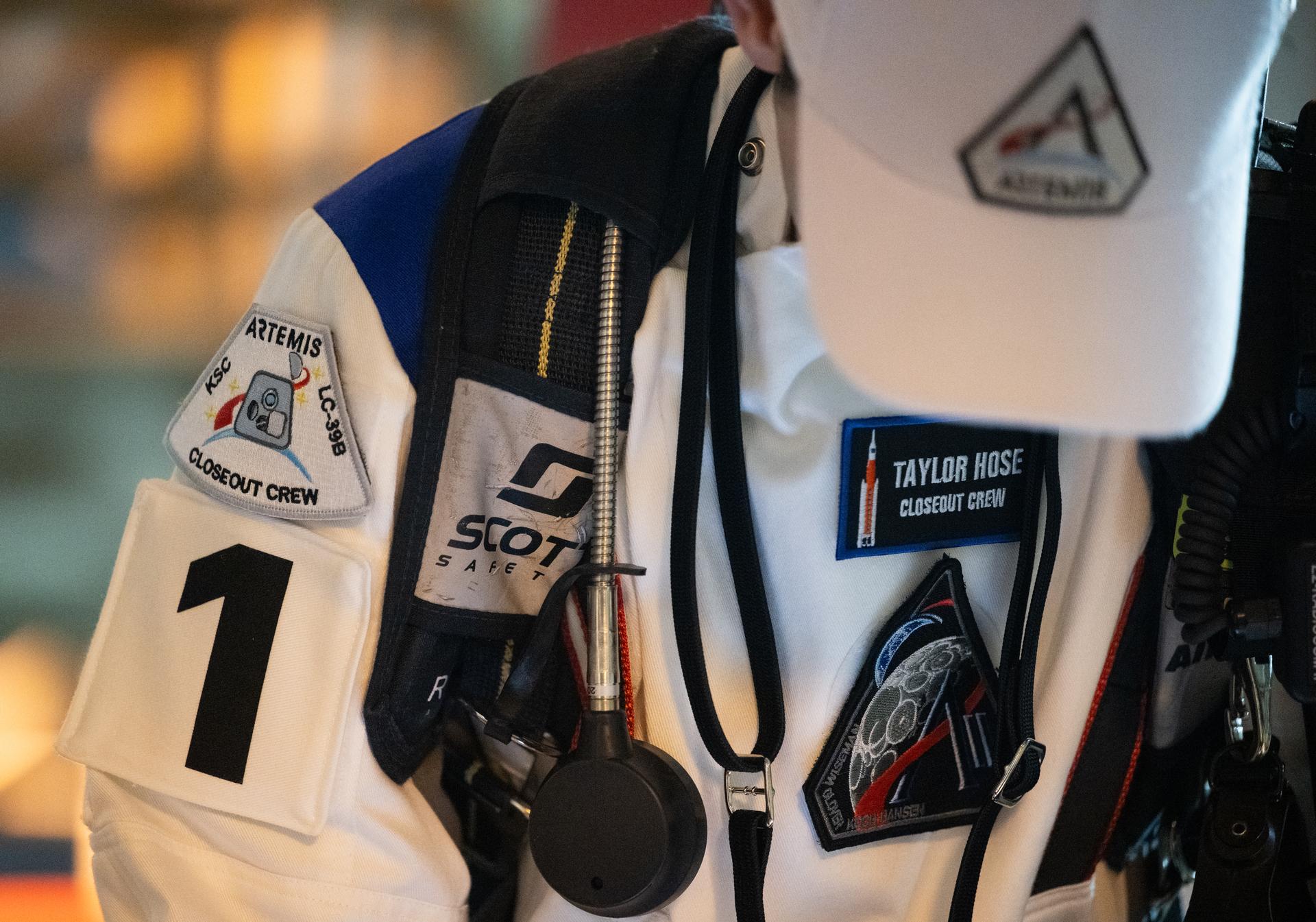
Taylor Hose, Closeout Crew lead, is seen as he prepares for the arrival of Artemis II crewmembers NASA astronauts Reid Wiseman, commander; Victor Glover, pilot; Christina Koch, mission specialist; and CSA (Canadian Space Agency) astronaut Jeremy Hansen, mission specialist; at the 275-foot level of the mobile launcher to board their Orion spacecraft atop NASA’s Space Launch System rocket during the Artemis II countdown demonstration test, Saturday, Dec. 20, 2025, inside the Vehicle Assembly Building at NASA’s Kennedy Space Center in Florida. For this operation, the Artemis II crew and launch teams are simulating the launch day timeline including suit-up, walkout, and spacecraft ingress and egress. Through the Artemis campaign, NASA will send astronauts to explore the Moon for scientific discovery, economic benefits, and to build the foundation for the first crewed missions to Mars, for the benefit of all. Photo Credit: (NASA/Joel Kowsky)

After emergency escape training on the 195-foot level of the Fixed Service Structure, Launch Pad 39B, STS-102 Mission Specialists Susan Helms, Yury Usachev and James Voss pose for the camera. The three are also the Expedition Two crew who will be replacing Expedition One on the International Space Station. Behind them, at left, can be seen the tops of the solid rocket booster and external tank on Space Shuttle Discovery. The STS-102 crew is at KSC for Terminal Countdown Demonstration Test activities, which include the emergency training and a simulated launch countdown. STS-102 is the eighth construction flight to the Space Station, with Discovery carrying the Multi-Purpose Logistics Module Leonardo. Expedition One will return to Earth with Discovery. Launch on mission STS-102 is scheduled for March 8
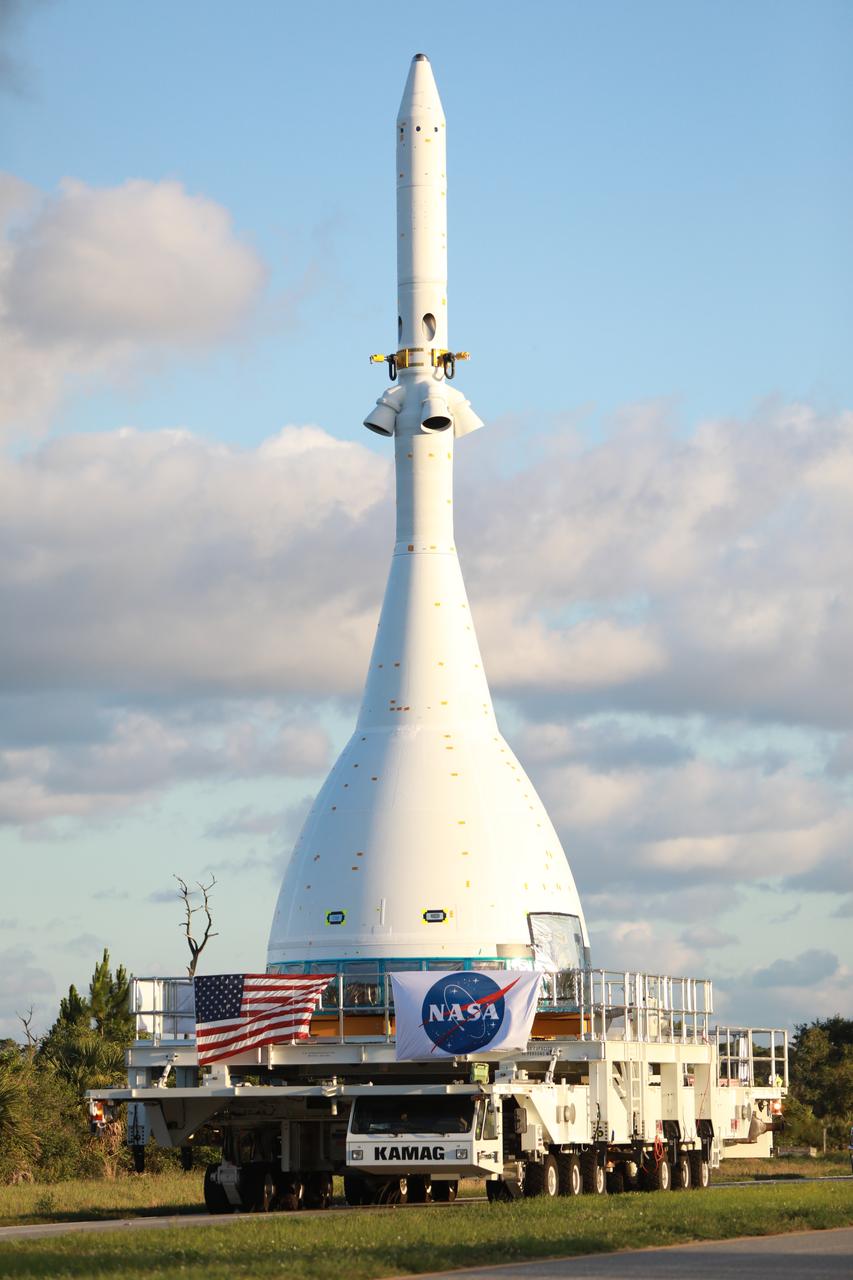
The vehicle for Orion’s Ascent Abort-2 (AA-2) flight test is moved along a route from NASA’s Kennedy Space Center in Florida, to Space Launch Complex 46 at Cape Canaveral Air Force Station on May 22, 2019, in preparation for its launch this summer. During AA-2, a test version of Orion will launch on a booster to more than six miles in altitude, where Orion’s launch abort system will pull the capsule away to demonstrate it can keep a future crew inside safe if an emergency occurs during ascent on the Space Launch System rocket. The AA-2 elements will be stacked together at the launch pad over the next several weeks. The launch is planned for July 2 and is a critical safety test that helps pave the way for Artemis missions near the Moon, and will enable astronauts to set foot on the lunar surface by 2024.
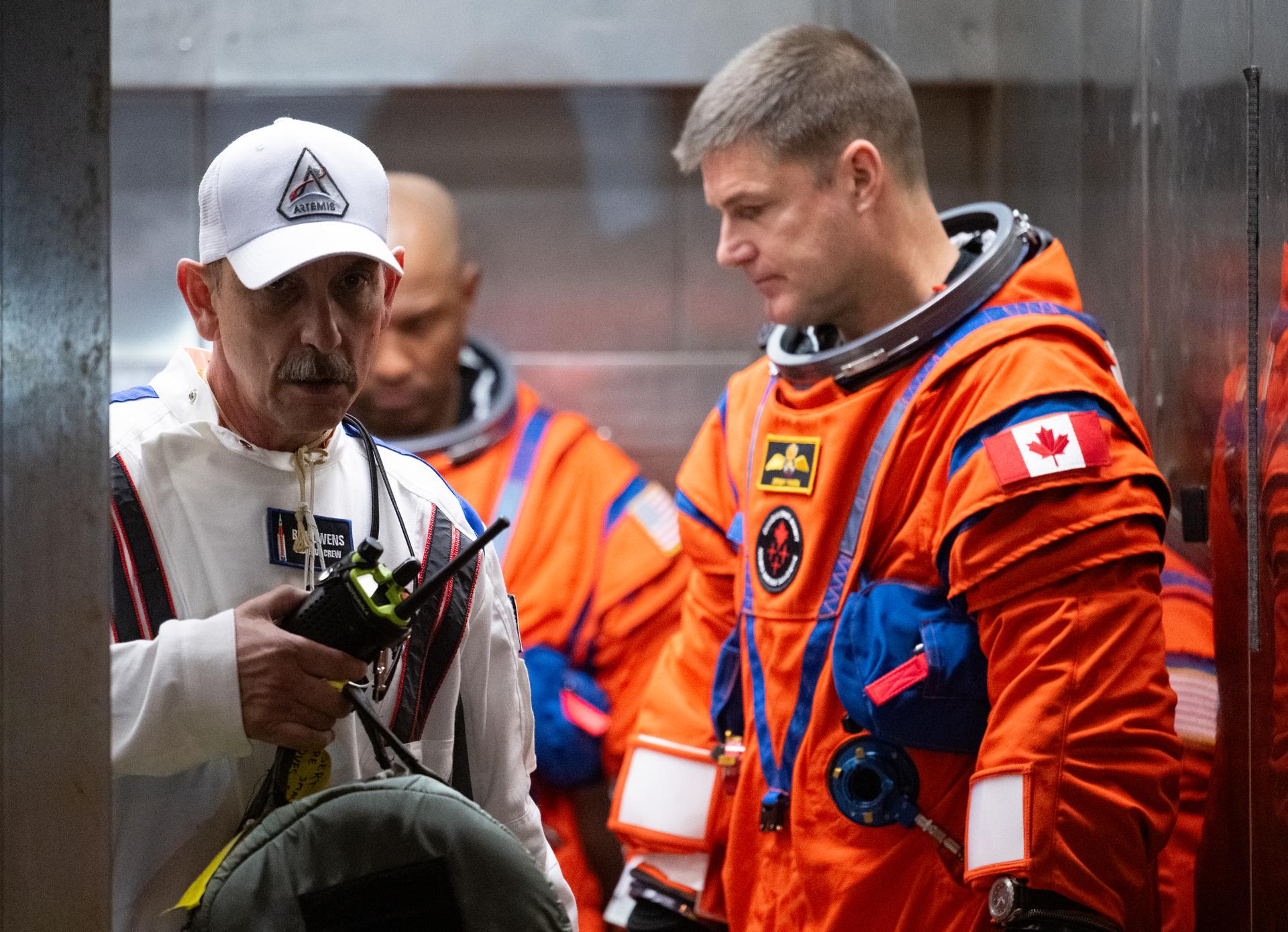
Bill Owens of the Closeout Crew is seen as he leads Artemis II crewmembers CSA (Canadian Space Agency) astronaut Jeremy Hansen, mission specialist; and NASA astronauts Reid Wiseman, commander; Victor Glover, pilot; and Christina Koch, mission specialist; out of at the elevator towards the crew access arm at the 275-foot level of the mobile launcher as they prepare to board their Orion spacecraft atop NASA’s Space Launch System rocket during the Artemis II countdown demonstration test, Saturday, Dec. 20, 2025, inside the Vehicle Assembly Building at NASA’s Kennedy Space Center in Florida. For this operation, the Artemis II crew and launch teams are simulating the launch day timeline including suit-up, walkout, and spacecraft ingress and egress. Through the Artemis campaign, NASA will send astronauts to explore the Moon for scientific discovery, economic benefits, and to build the foundation for the first crewed missions to Mars, for the benefit of all. Photo Credit: (NASA/Joel Kowsky)
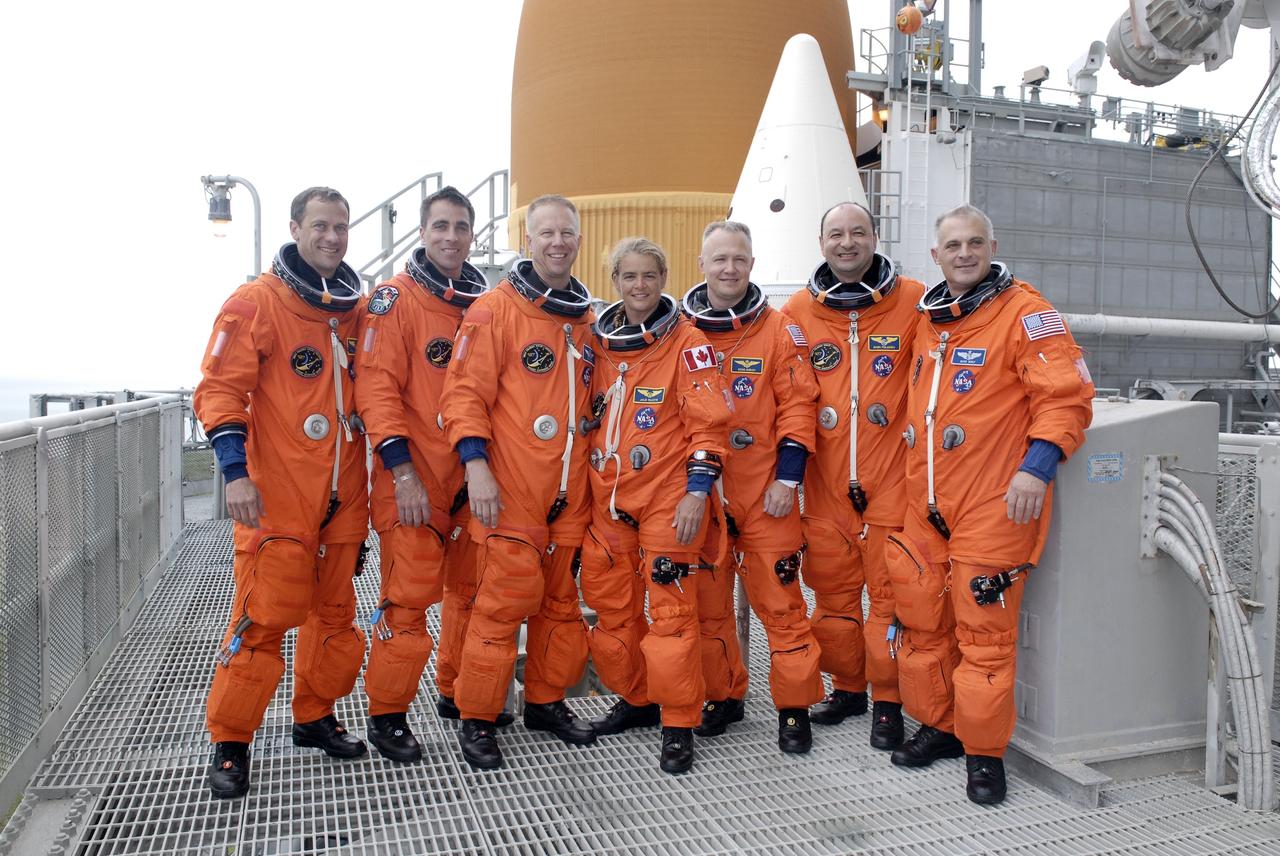
CAPE CANAVERAL, Fla. – The STS-127 crew members gather at the 225-foot level of the fixed service structure for a photo to commemorate the conclusion of the terminal countdown demonstration test, which ended with a simulated launch countdown. From left are Mission Specialists Tom Marshburn, Christopher Cassidy, Tim Kopra and Julie Payette, Pilot Doug Hurley, Commander Mark Polansky and Mission Specialist Dave Wolf. Behind them are the tops of the orange external fuel tank and one of the two solid rocket boosters. Endeavour's STS-127 mission is the final of three flights dedicated to the assembly of the Japanese Kibo laboratory complex on the International Space Station. Endeavour's launch is scheduled for June 13 at 7:17 a.m. EDT. Photo credit: NASA/Kim Shiflett
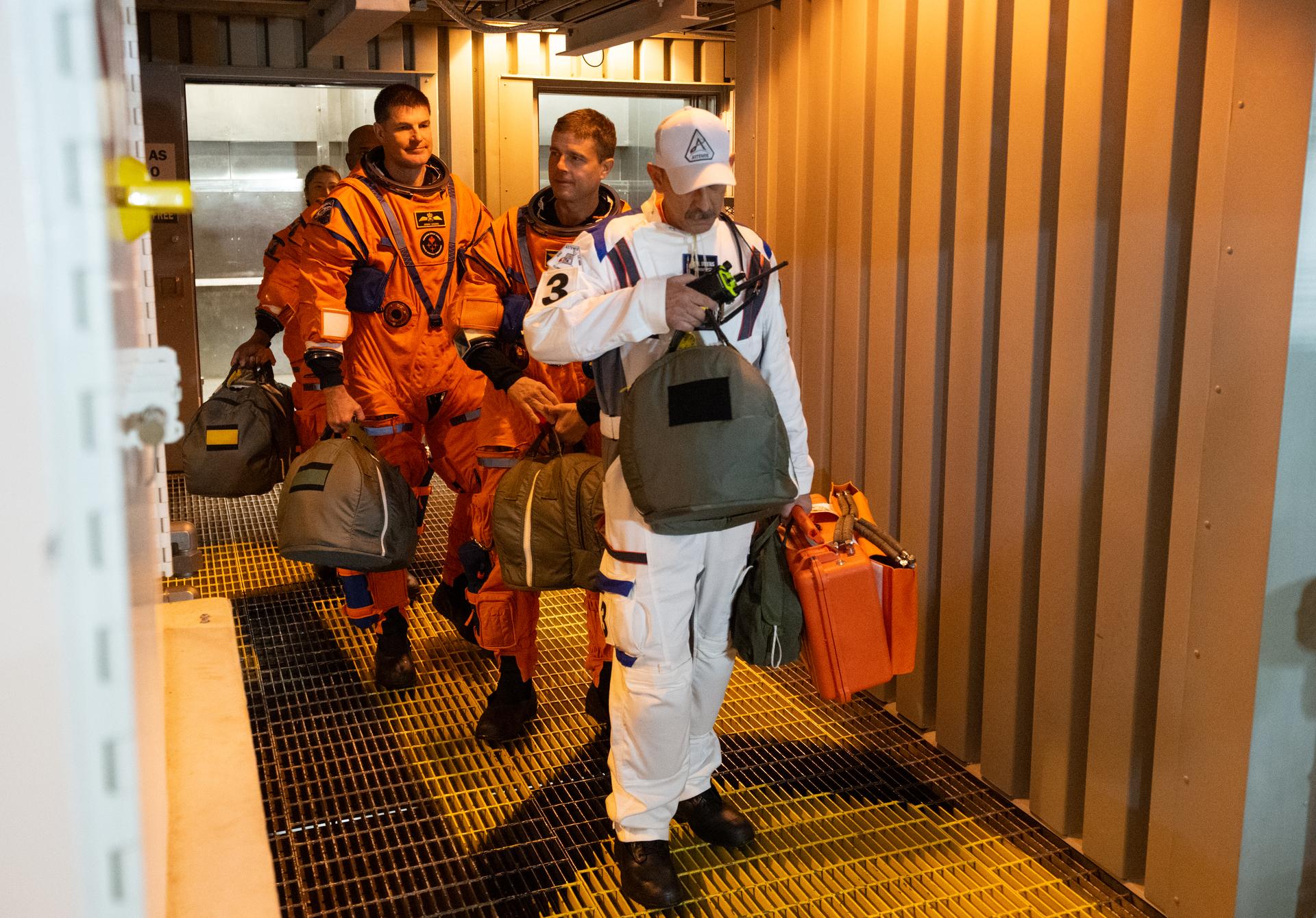
Bill Owens of the Closeout Crew leads the Artemis II crewmembers NASA astronauts Reid Wiseman, commander; Victor Glover, pilot; Christina Koch, mission specialist; and CSA (Canadian Space Agency) astronaut Jeremy Hansen, mission specialist; from the elevator at the 275-foot level of the mobile launcher to the crew access arm as they prepare to board their Orion spacecraft atop NASA’s Space Launch System rocket during the Artemis II countdown demonstration test, Saturday, Dec. 20, 2025, inside the Vehicle Assembly Building at NASA’s Kennedy Space Center in Florida. For this operation, the Artemis II crew and launch teams are simulating the launch day timeline including suit-up, walkout, and spacecraft ingress and egress. Through the Artemis campaign, NASA will send astronauts to explore the Moon for scientific discovery, economic benefits, and to build the foundation for the first crewed missions to Mars, for the benefit of all. Photo Credit: (NASA/Joel Kowsky)
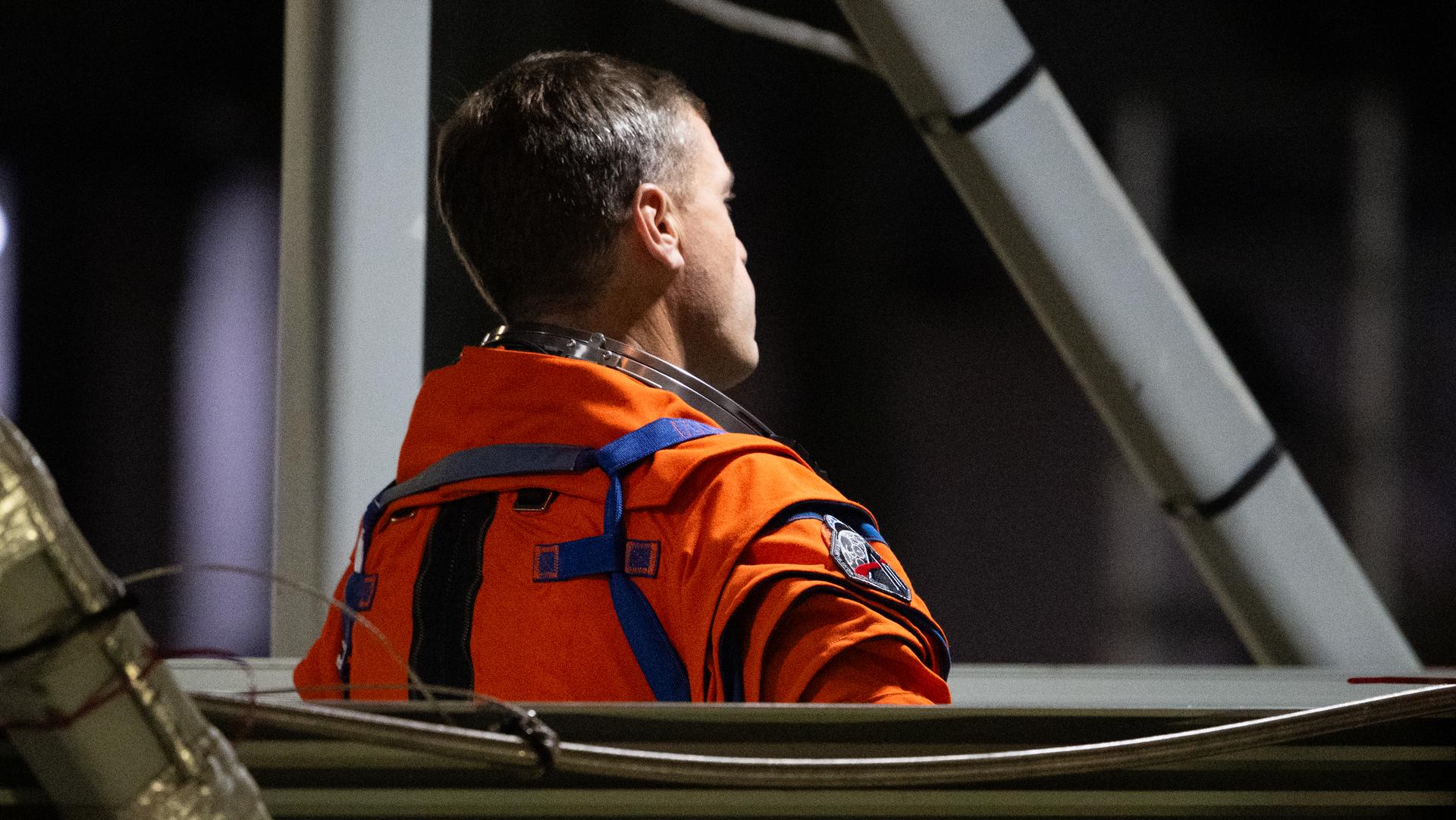
Artemis II crewmember NASA astronaut Reid Wiseman, commander; is seen on the crew access arm at the 275-foot level of the mobile launcher as he and fellow crewmates NASA astronauts Victor Glover, pilot; Christina Koch, mission specialist; and CSA (Canadian Space Agency) astronaut Jeremy Hansen, mission specialist; prepare to board their Orion spacecraft atop NASA’s Space Launch System rocket during the Artemis II countdown demonstration test, Saturday, Dec. 20, 2025, inside the Vehicle Assembly Building at NASA’s Kennedy Space Center in Florida. For this operation, the Artemis II crew and launch teams are simulating the launch day timeline including suit-up, walkout, and spacecraft ingress and egress. Through the Artemis campaign, NASA will send astronauts to explore the Moon for scientific discovery, economic benefits, and to build the foundation for the first crewed missions to Mars, for the benefit of all. Photo Credit: (NASA/Joel Kowsky)
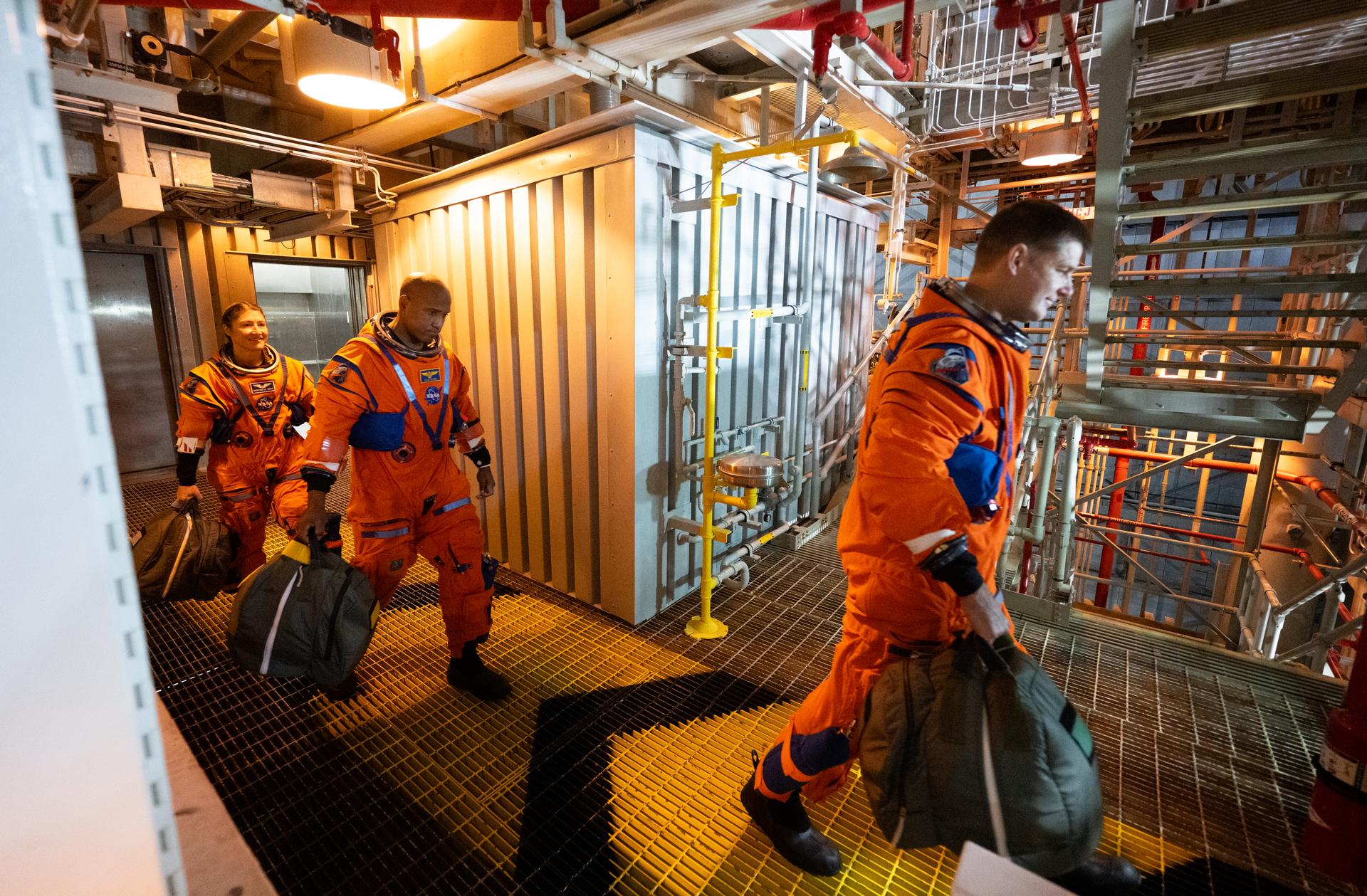
Artemis II crewmembers CSA (Canadian Space Agency) astronaut Jeremy Hansen, mission specialist, right, and NASA astronauts Victor Glover, pilot; Christina Koch, mission specialist; after exiting the elevator at the 275-foot level of the mobile launcher as they walk towards the crew access arm prepare to board their Orion spacecraft atop NASA’s Space Launch System rocket during the Artemis II countdown demonstration test, Saturday, Dec. 20, 2025, inside the Vehicle Assembly Building at NASA’s Kennedy Space Center in Florida. For this operation, the Artemis II crew and launch teams are simulating the launch day timeline including suit-up, walkout, and spacecraft ingress and egress. Through the Artemis campaign, NASA will send astronauts to explore the Moon for scientific discovery, economic benefits, and to build the foundation for the first crewed missions to Mars, for the benefit of all. Photo Credit: (NASA/Joel Kowsky)
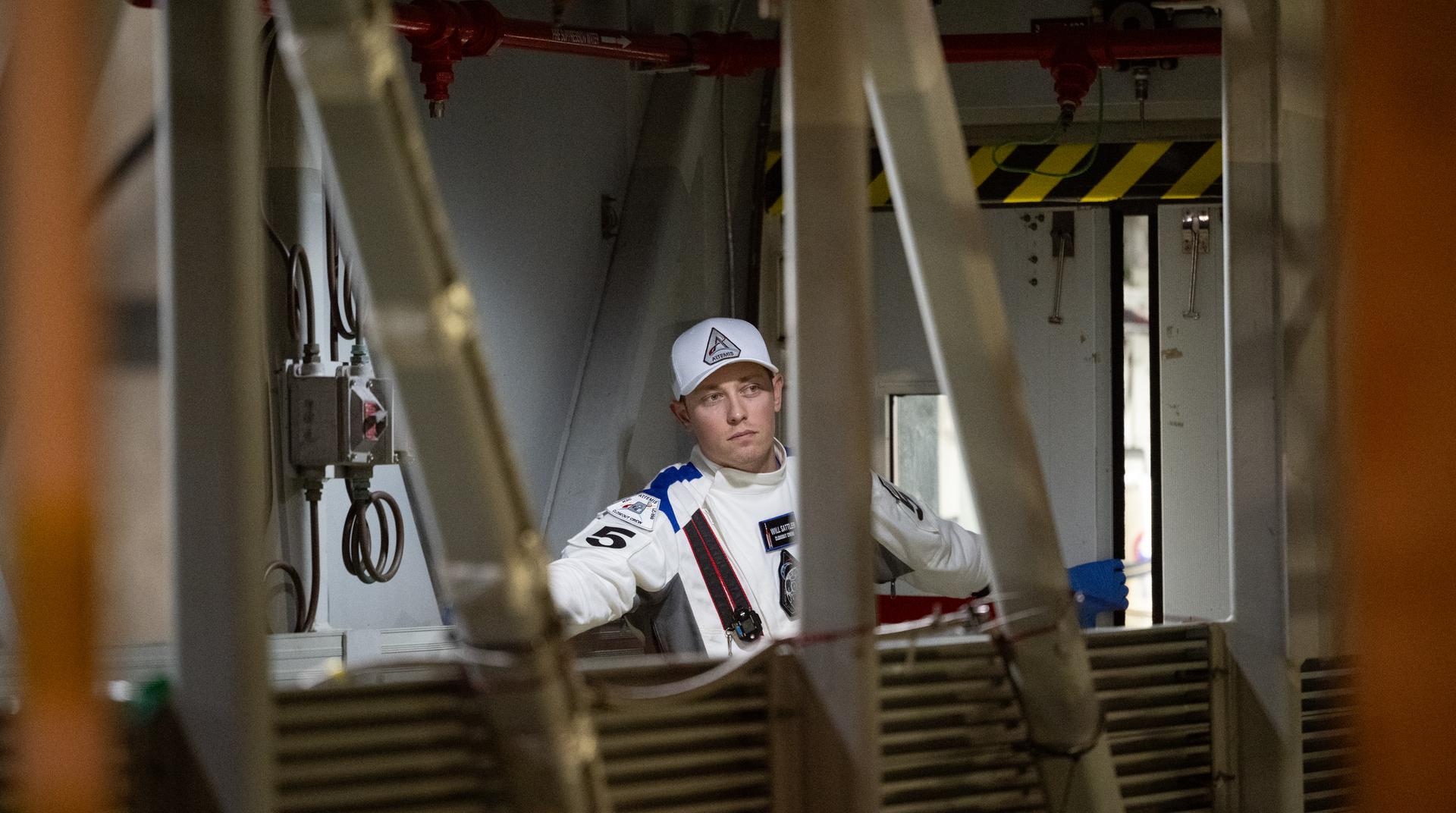
Will Sattler of the Closeout Crew is seen on the crew access arm just outside of the white room awaiting the arrival of Artemis II crewmembers NASA astronauts Reid Wiseman, commander; Victor Glover, pilot; Christina Koch, mission specialist; and CSA (Canadian Space Agency) astronaut Jeremy Hansen, mission specialist; at the 275-foot level of the mobile launcher as they prepare to board their Orion spacecraft atop NASA’s Space Launch System rocket during the Artemis II countdown demonstration test, Saturday, Dec. 20, 2025, inside the Vehicle Assembly Building at NASA’s Kennedy Space Center in Florida. For this operation, the Artemis II crew and launch teams are simulating the launch day timeline including suit-up, walkout, and spacecraft ingress and egress. Through the Artemis campaign, NASA will send astronauts to explore the Moon for scientific discovery, economic benefits, and to build the foundation for the first crewed missions to Mars, for the benefit of all. Photo Credit: (NASA/Joel Kowsky)
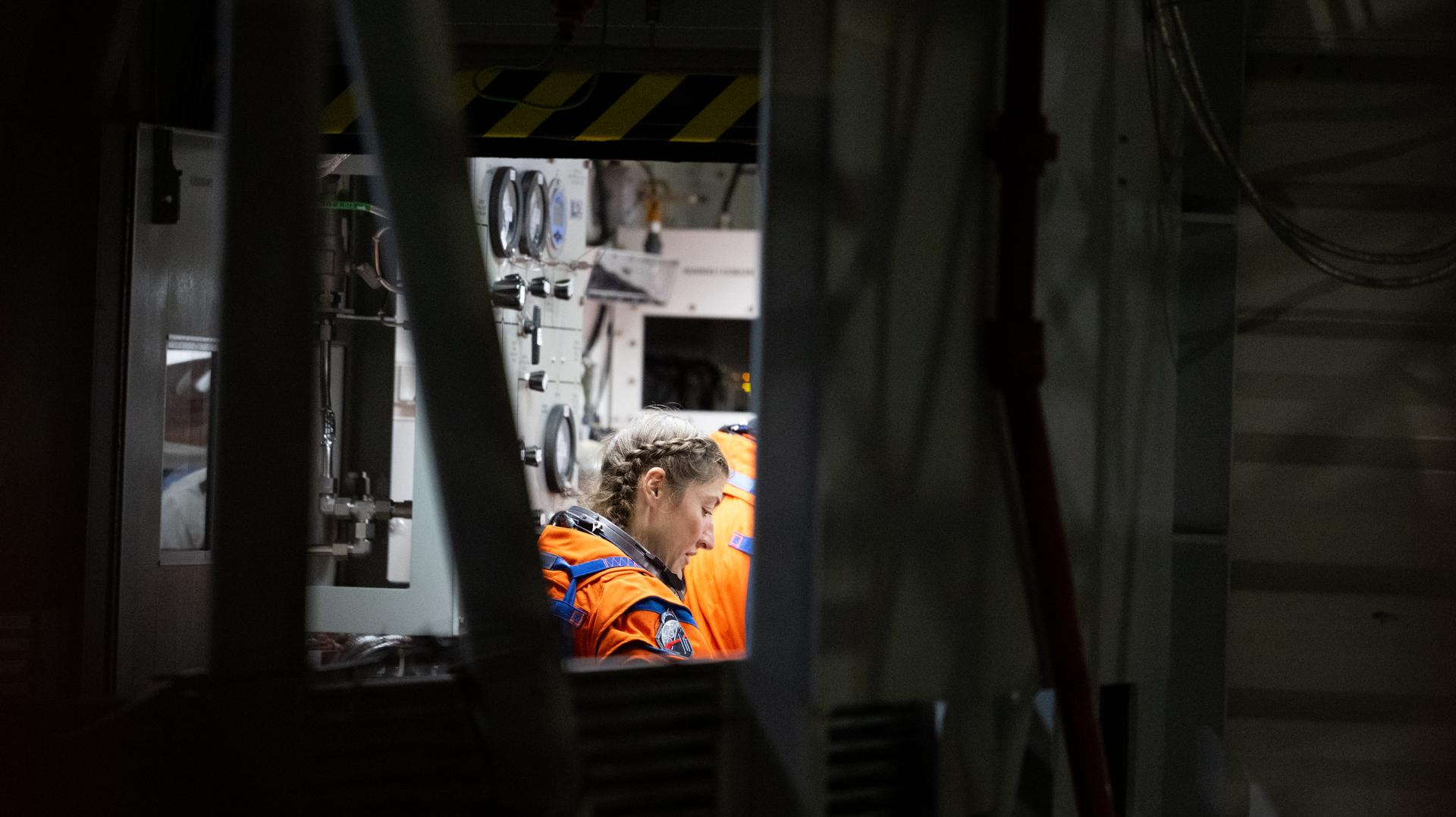
Artemis II crewmember NASA astronaut Christina Koch, mission specialist, is seen inside the white room at the 275-foot level of the mobile launcher she and fellow crewmates NASA astronauts Reid Wiseman, commander; Victor Glover, pilot; and CSA (Canadian Space Agency) astronaut Jeremy Hansen, mission specialist, prepare to board their Orion spacecraft atop NASA’s Space Launch System rocket during the Artemis II countdown demonstration test, Saturday, Dec. 20, 2025, inside the Vehicle Assembly Building at NASA’s Kennedy Space Center in Florida. For this operation, the Artemis II crew and launch teams are simulating the launch day timeline including suit-up, walkout, and spacecraft ingress and egress. Through the Artemis campaign, NASA will send astronauts to explore the Moon for scientific discovery, economic benefits, and to build the foundation for the first crewed missions to Mars, for the benefit of all. Photo Credit: (NASA/Joel Kowsky)
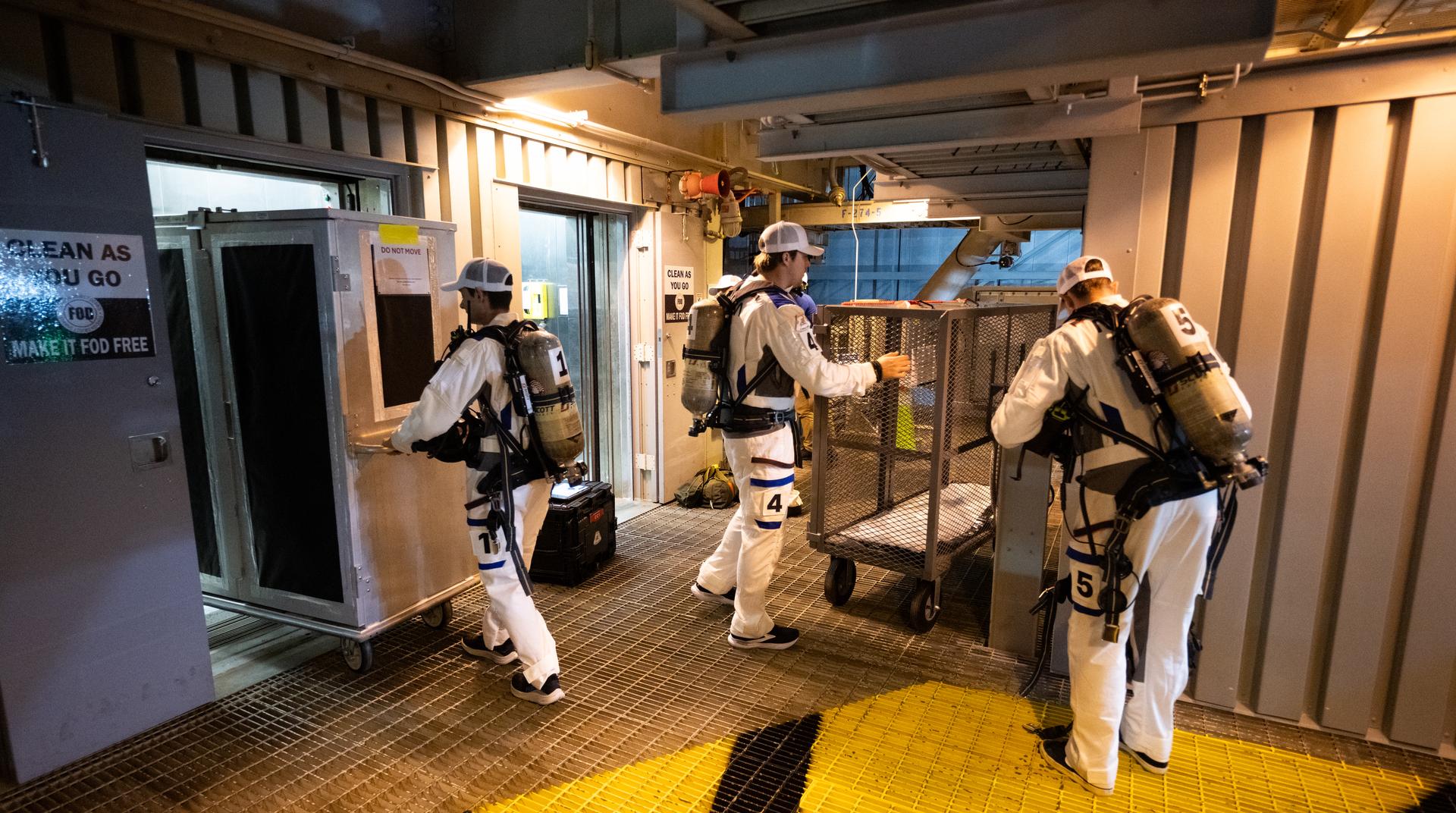
Taylor Hose, left, Christian Warriner, center, and Will Sattler of the Closeout Crew are seen as they prepare for the arrival of Artemis II crewmembers NASA astronauts Reid Wiseman, commander; Victor Glover, pilot; Christina Koch, mission specialist; and CSA (Canadian Space Agency) astronaut Jeremy Hansen, mission specialist; at the 275-foot level of the mobile launcher to board their Orion spacecraft atop NASA’s Space Launch System rocket during the Artemis II countdown demonstration test, Saturday, Dec. 20, 2025, inside the Vehicle Assembly Building at NASA’s Kennedy Space Center in Florida. For this operation, the Artemis II crew and launch teams are simulating the launch day timeline including suit-up, walkout, and spacecraft ingress and egress. Through the Artemis campaign, NASA will send astronauts to explore the Moon for scientific discovery, economic benefits, and to build the foundation for the first crewed missions to Mars, for the benefit of all. Photo Credit: (NASA/Joel Kowsky)
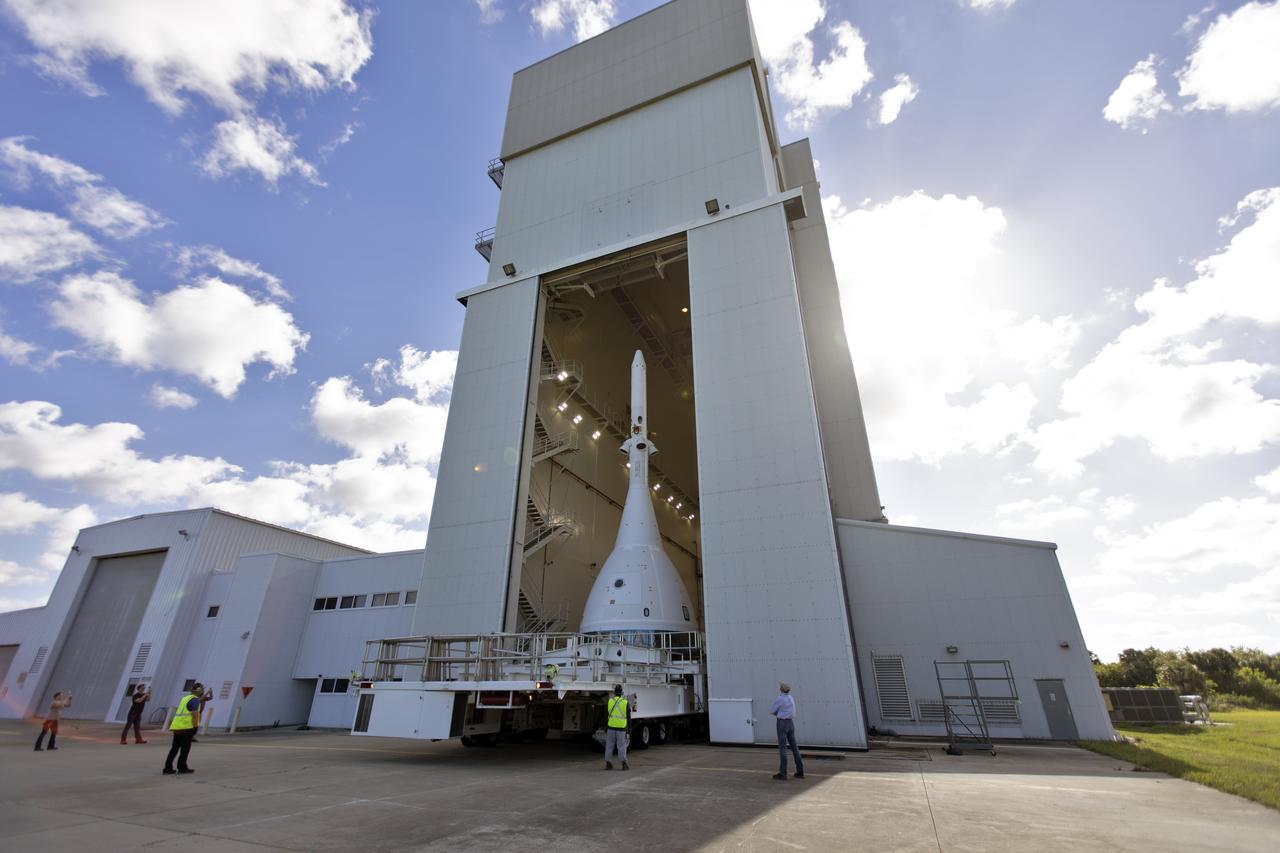
The vehicle for Orion’s Ascent Abort-2 (AA-2) flight test exits the Launch Abort System Facility at NASA’s Kennedy Space Center in Florida on May 22, 2019. The flight test article will make the 21.5 mile trek to Space Launch Complex 46 at Cape Canaveral Air Force Station in preparation for its launch this summer. During AA-2, a test version of Orion will launch on a booster to more than six miles in altitude, where Orion’s launch abort system will pull the capsule away to demonstrate it can keep a future crew inside safe if an emergency occurs during ascent on the Space Launch System rocket. The AA-2 elements will be stacked together at the launch pad over the next several weeks. The launch is planned for July 2 and is a critical safety test that helps pave the way for Artemis missions near the Moon, and will enable astronauts to set foot on the lunar surface by 2024.
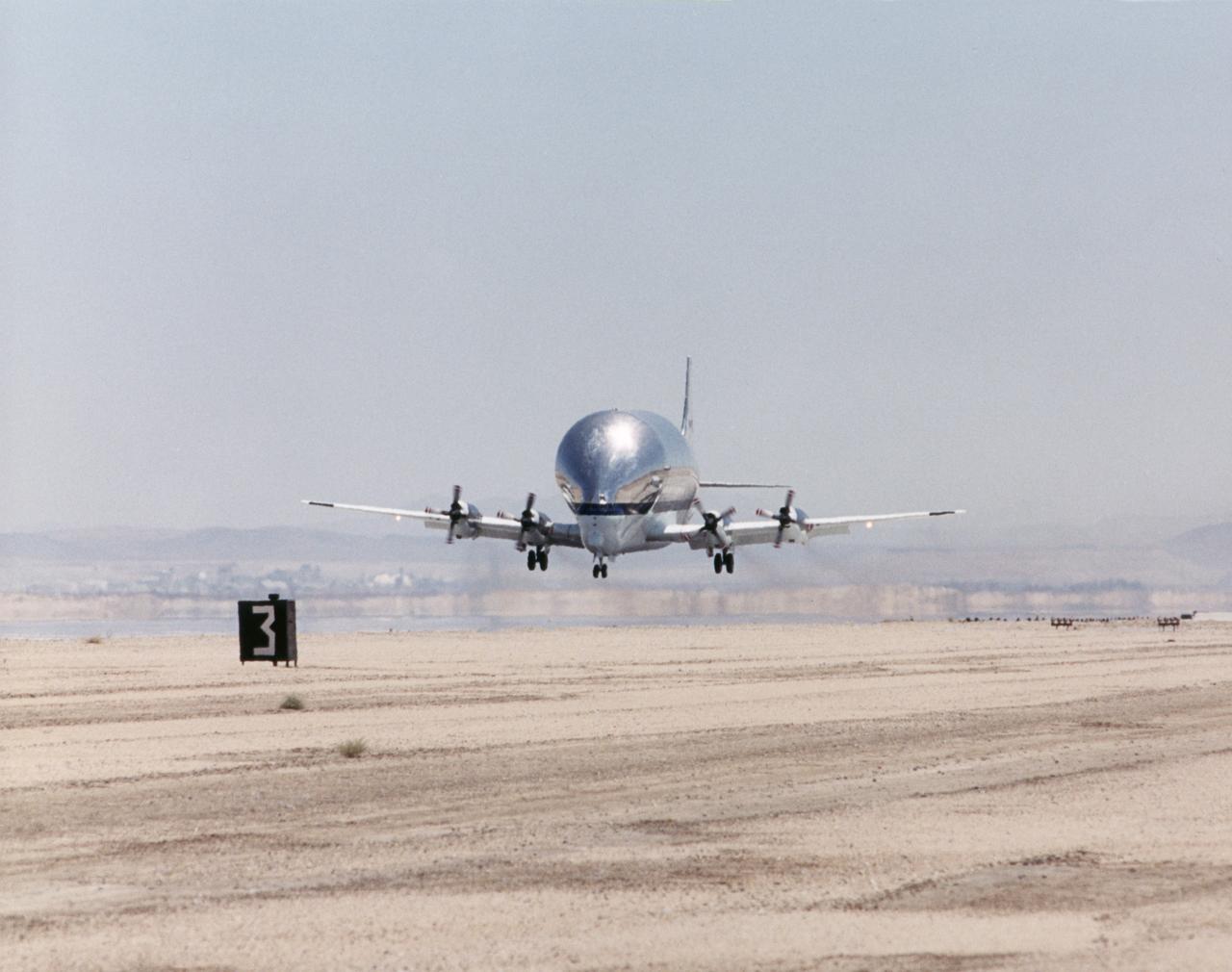
NASA's Super Guppy transport aircraft landed at Edwards Air Force Base, Calif. on July 11, 2000, to deliver the latest version of the X-38 drop vehicle to Dryden. The X-38s are intended as prototypes for a possible "crew lifeboat" for the International Space Station. The X-38 vehicle 131R will demonstrate a huge 7,500 square-foot parafoil that will that will enable the potential crew return vehicle to land on the length of a football field after returning from space. The crew return vehicle is intended to serve as a possible emergency transport to carry a crew to safety in the event of problems with the International Space Station. The Super Guppy evolved from the 1960s-vintage Pregnant Guppy, used for transporting outsized sections of the Apollo moon rocket. The Super Guppy was modified from 1950s-vintage Boeing C-97. NASA acquired its Super Guppy from the European Space Agency in 1997.
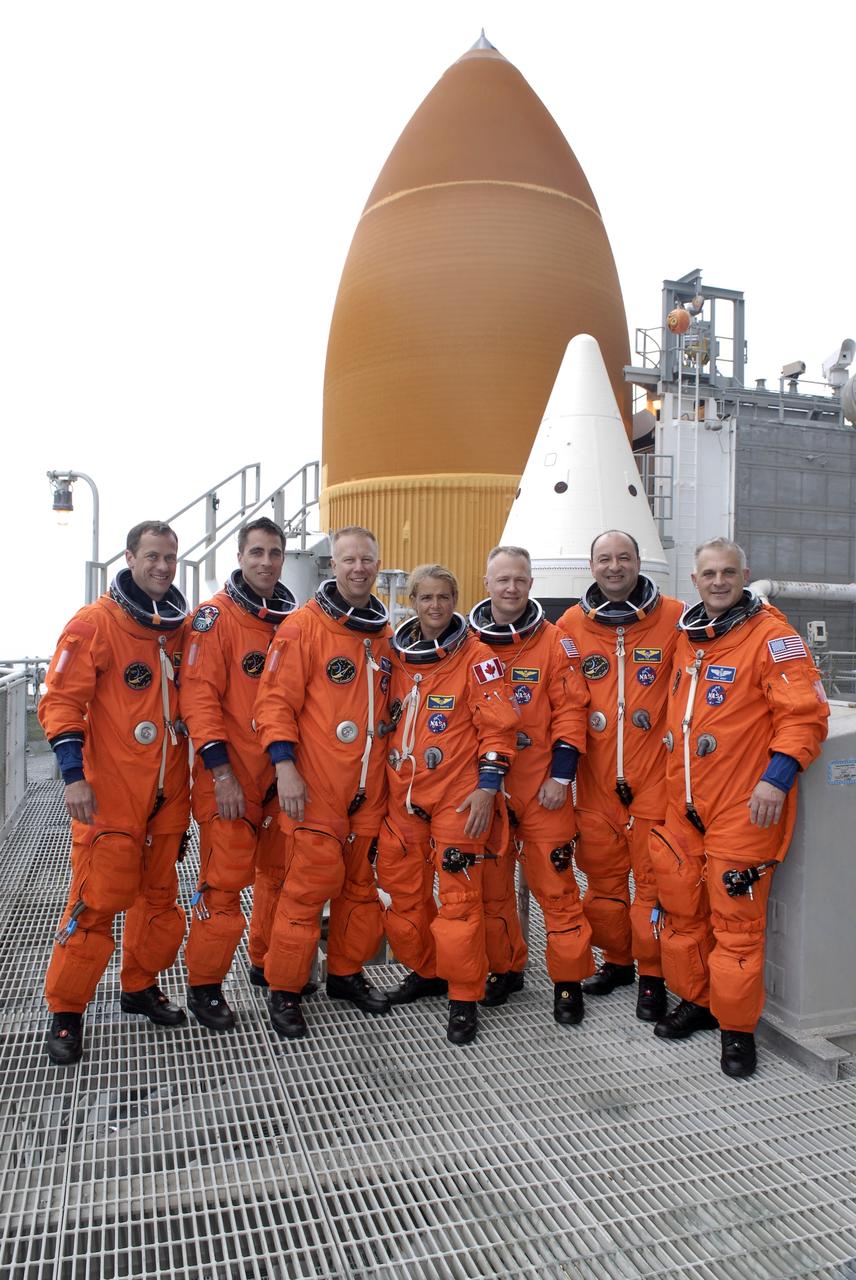
CAPE CANAVERAL, Fla. – The STS-127 crew members gather at the 225-foot level of the fixed service structure for a photo to commemorate the conclusion of the terminal countdown demonstration test, which ended with a simulated launch countdown. From left are Mission Specialists Tom Marshburn, Christopher Cassidy, Tim Kopra and Julie Payette, Pilot Doug Hurley, Commander Mark Polansky and Mission Specialist Dave Wolf. Behind them are the tops of the orange external fuel tank and one of the two solid rocket boosters. Endeavour's STS-127 mission is the final of three flights dedicated to the assembly of the Japanese Kibo laboratory complex on the International Space Station. Endeavour's launch is scheduled for June 13 at 7:17 a.m. EDT. Photo credit: NASA/Kim Shiflett
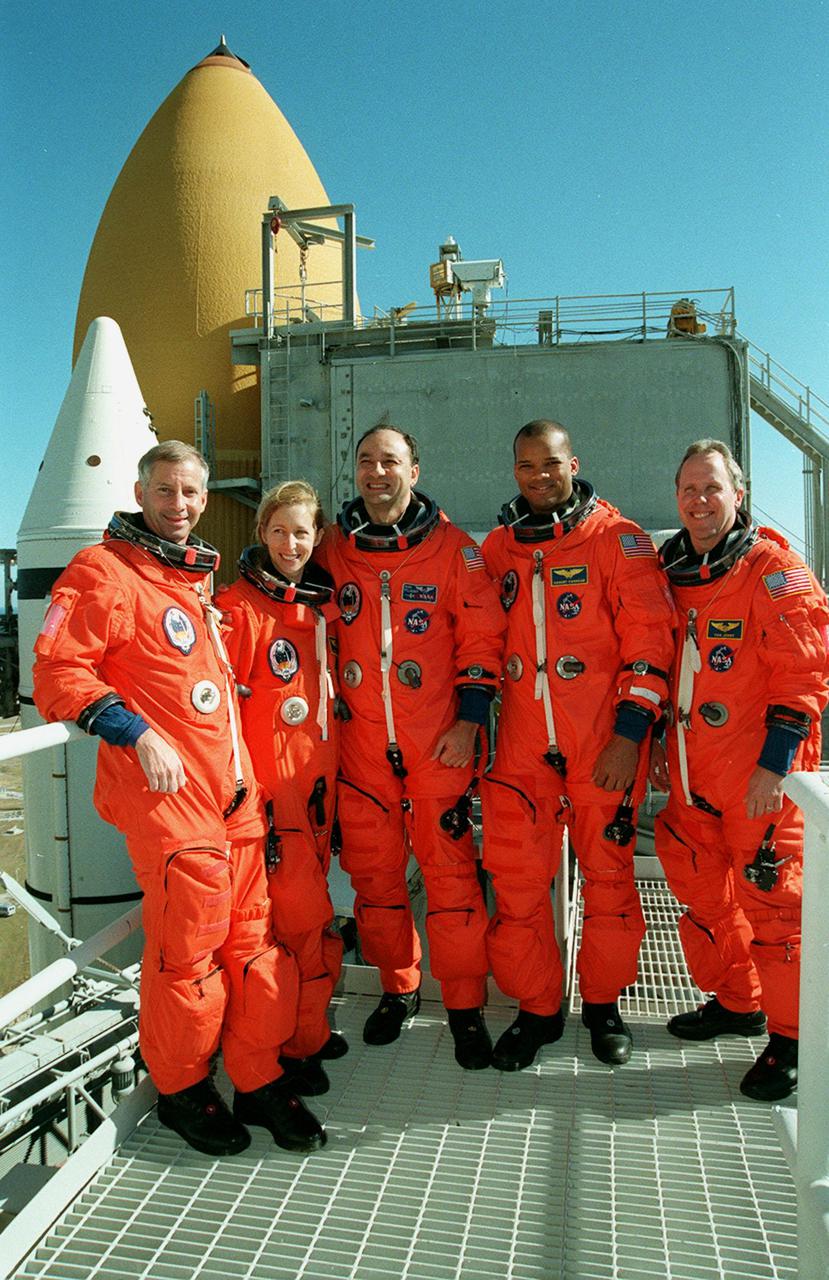
KENNEDY SPACE CENTER, FLA. -- The STS-98 crew poses for a group photo on the 215-foot level of the Fixed Service Structure at Launch Pad 39A. Dressed in their orange launch and entry suits are (left to right) Commander Ken Cockrell, Mission Specialist Marsha Ivins, Pilot Mark Polansky and Mission Specialists Robert Curbeam and Thomas Jones. Behind them can be seen the white nose cone of a solid rocket booster and the orange external tank on Space Shuttle Atlantis. The crew is taking part in emergency egress training and a simulated launch countdown as part of Terminal Countdown Demonstration Test activities. STS-98 is the seventh construction flight to the International Space Station, carrying as payload the U.S. Lab Destiny, a key element in the construction of the ISS. Launch of STS-98 is scheduled for Jan. 19 at 2:11 a.m. EST
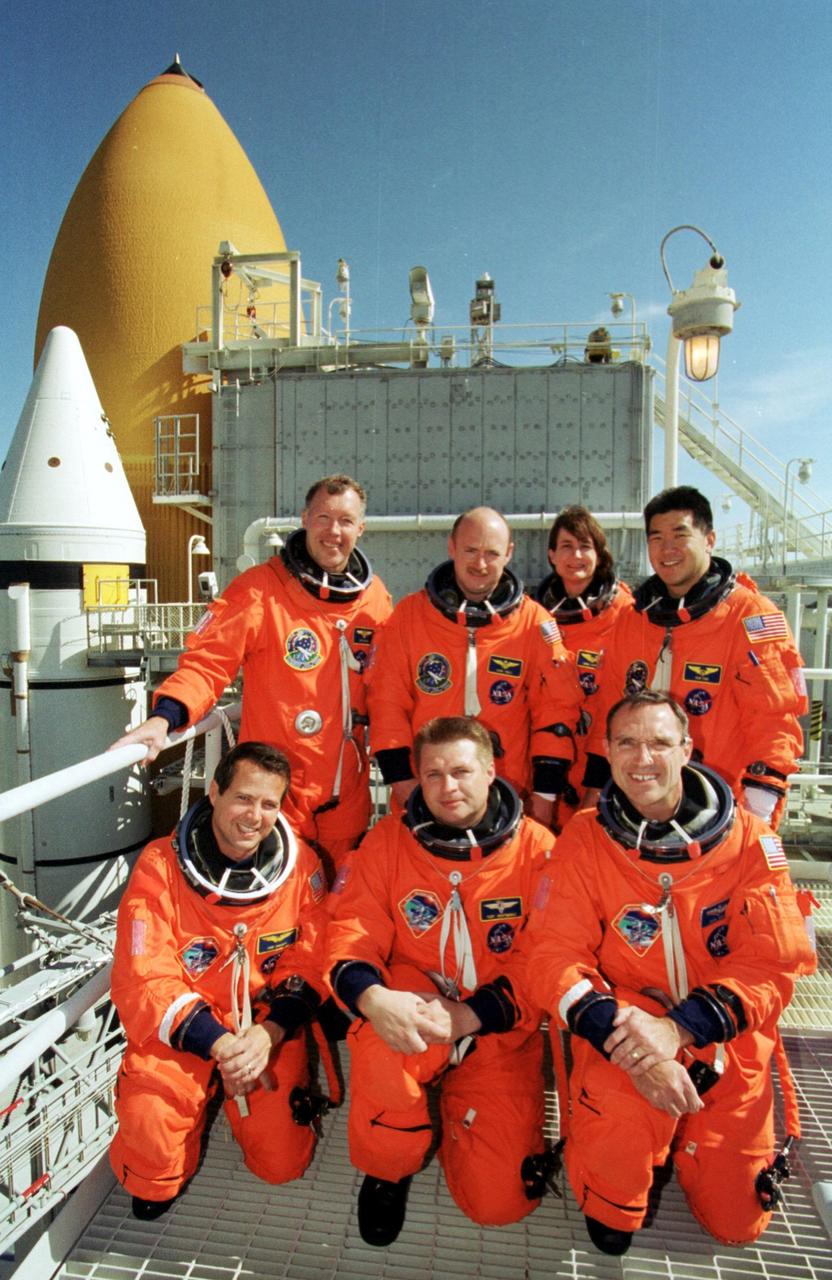
KENNEDY SPACE CENTER, Fla. -- The crews who will be aboard Space Shuttle Endeavour on mission STS-108 pose for a group photo on the 215-foot level of the Fixed Service Structure. In front is the Expedition 4 crew, astronaut Daniel W. Bursch, Commander Yuri Onufrienko and astronaut Carl E. Walz. Standing behind them are Mission STS-108 Commander Dominic L. Gorie, Pilot Mark E. Kelly and Mission Specialists Linda A. Godwin and Daniel M. Tani. Both crews have been taking part in Terminal Countdown Demonstration Test activities that include a simulated launch countdown and emergency egress training. Behind them can be seen one of the twin solid rocket boosters and the larger external tank. Launch of Space Shuttle Endeavour on mission STS-108 is scheduled for Nov. 29 at 7:44 p.m. EST
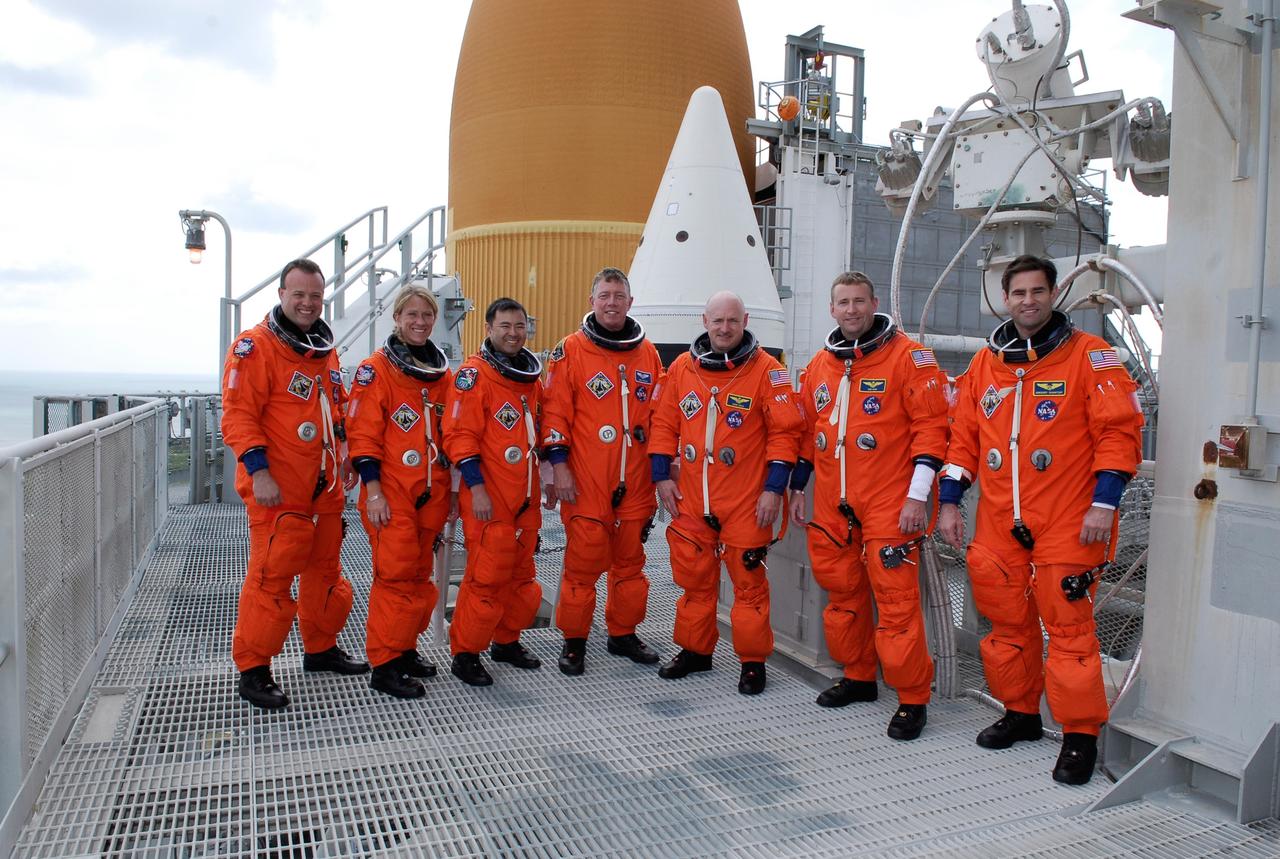
CAPE CANAVERAL, Fla. -- On Launch Pad 39A at NASA's Kennedy Space Center, the STS-124 crew stands for a phot on the 205-foot level of the fixed service structure. From left are Mission Specialists Ron Garan, Karen Nyberg, Akihiko Hoshide and Mike Fossum, Commander Mark Kelly, Pilot Ken Ham and Mission Specialist Greg Chamitoff. Behind them can be seen the orange external tank and top of a solid rocket booster. The crew is completing the launch dress rehearsal known as the terminal countdown demonstration test. TCDT provides astronauts and ground crews with an opportunity to participate in various simulated countdown activities, including a simulated launch countdown, equipment familiarization and emergency egress training. On the STS-124 mission, the crew will deliver and install the Japanese Experiment Module – Pressurized Module and Japanese Remote Manipulator System. Discovery's launch is targeted for May 31. Photo credit: NASA/Kim Shiflett
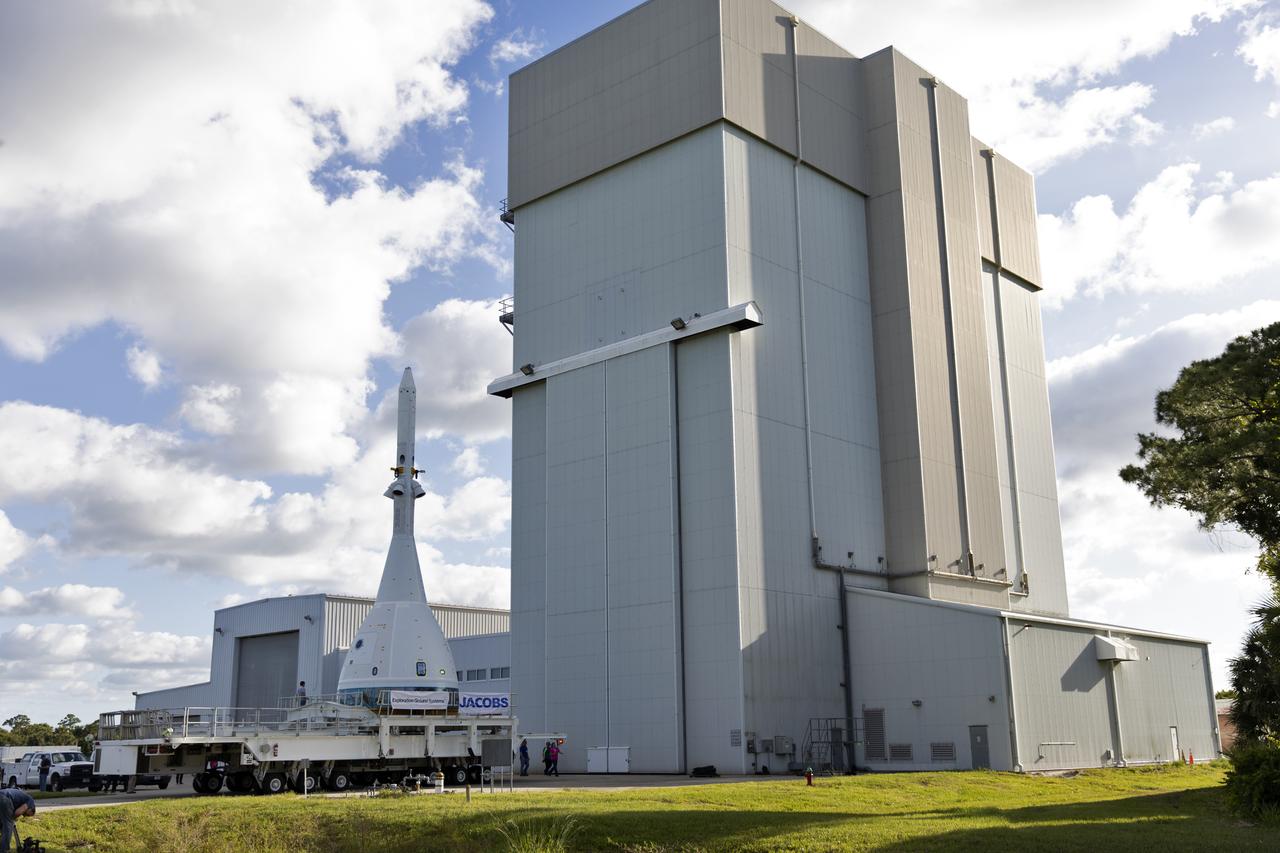
The vehicle for Orion’s Ascent Abort-2 (AA-2) flight test exits the Launch Abort System Facility at NASA’s Kennedy Space Center in Florida on May 22, 2019. The flight test article will make the 21.5 mile trek to Space Launch Complex 46 at Cape Canaveral Air Force Station in preparation for its launch this summer. During AA-2, a test version of Orion will launch on a booster to more than six miles in altitude, where Orion’s launch abort system will pull the capsule away to demonstrate it can keep a future crew inside safe if an emergency occurs during ascent on the Space Launch System rocket. The AA-2 elements will be stacked together at the launch pad over the next several weeks. The launch is planned for July 2 and is a critical safety test that helps pave the way for Artemis missions near the Moon, and will enable astronauts to set foot on the lunar surface by 2024.
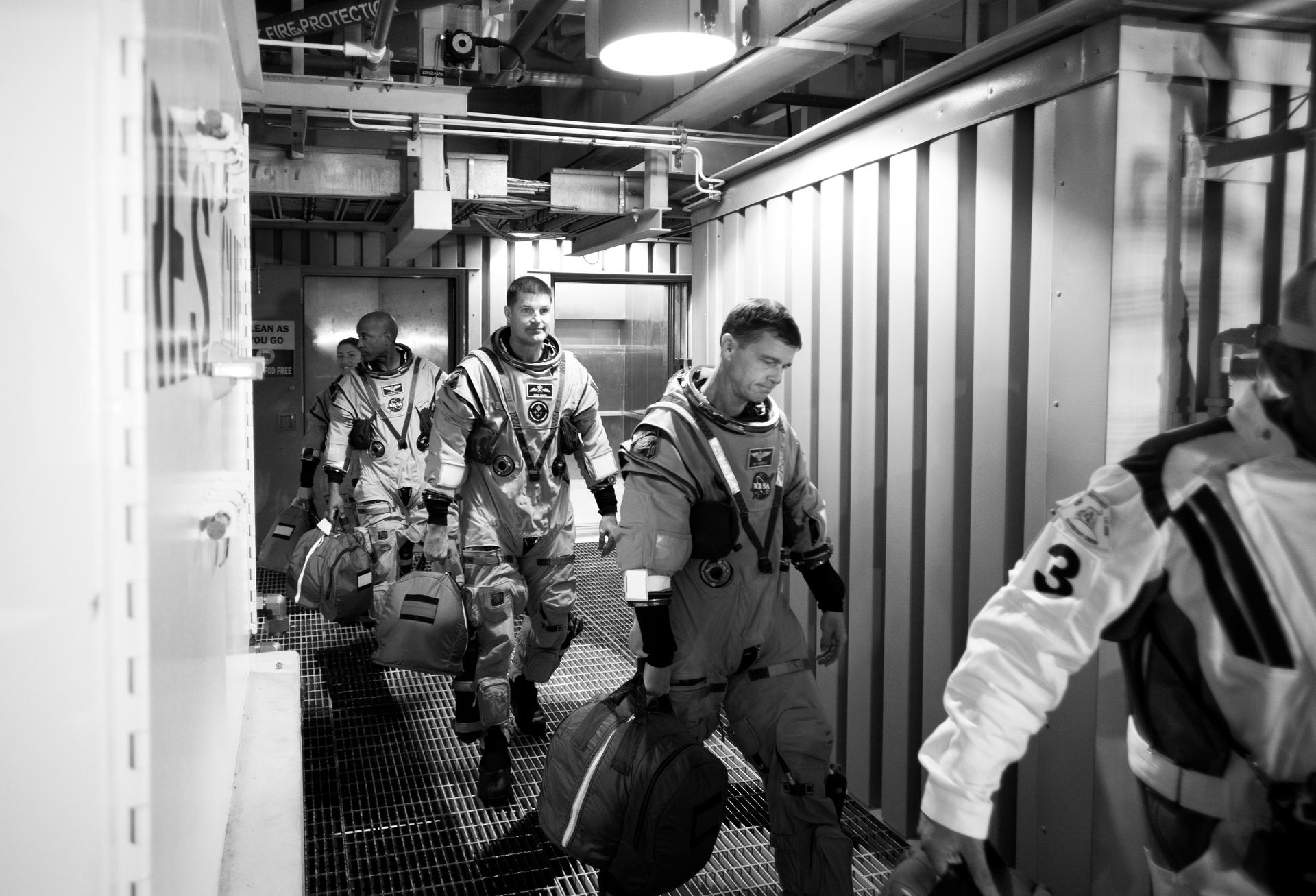
Artemis II crewmembers NASA astronauts Reid Wiseman, commander; Victor Glover, pilot; Christina Koch, mission specialist; and CSA (Canadian Space Agency) astronaut Jeremy Hansen, mission specialist; are led by Bill Owens of the Closeout Crew from the elevator at the 275-foot level of the mobile launcher to the crew access arm as they prepare to board their Orion spacecraft atop NASA’s Space Launch System rocket during the Artemis II countdown demonstration test, Saturday, Dec. 20, 2025, inside the Vehicle Assembly Building at NASA’s Kennedy Space Center in Florida. For this operation, the Artemis II crew and launch teams are simulating the launch day timeline including suit-up, walkout, and spacecraft ingress and egress. Through the Artemis campaign, NASA will send astronauts to explore the Moon for scientific discovery, economic benefits, and to build the foundation for the first crewed missions to Mars, for the benefit of all. Photo Credit: (NASA/Joel Kowsky)
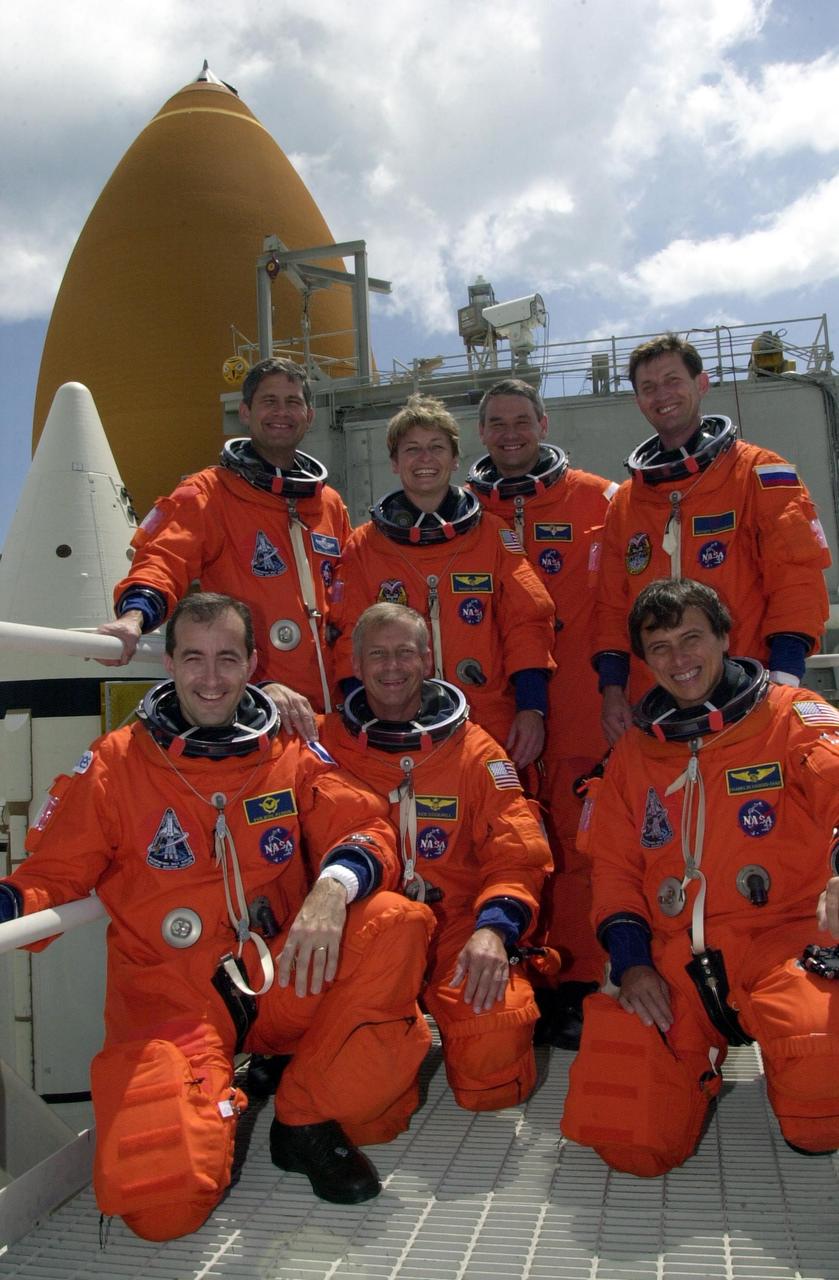
KENNEDY SPACE CENTER, FLA. -- During Terminal Countdown Demonstration Test activities at Launch Pad 39A, the Expedition 5 and STS-111 crews pose on the 295-foot level. Standing, left to right, are Pilot Paul Lockhart, and the Expedition 5 crew Peggy Whitson, Commander Valeri Korzun and Sergei Treschev. Kneeling in front are Mission Specialist Philippe Perrin, Commander Kenneth Cockrell and Mission Specialist Franklin Chang-Diaz. Korzun and Treschev are with the Russian Space Agency, and Perrin is with the French Space Agency. Seen behind the crews are the top of the orange external tank and one of the white solid rocket boosters. The TCDT includes emergency egress training at the pad and a simulated launch countdown. Mission STS-111 is known as Utilization Flight 2, carrying supplies and equipment in the Multi-Purpose Logistics Module Leonardo to the International Space Station. The payload also includes the Mobile Base System, which will be installed on the Mobile Transporter to complete the Canadian Mobile Servicing System, or MSS, and a replacement wrist/roll joint for Canadarm 2. The mechanical arm will then have the capability to "inchworm" from the U.S. Lab Destiny to the MSS and travel along the truss to work sites. Expedition 5 will travel to the Station on Endeavour as the replacement crew for Expedition 4, who will return to Earth aboard the orbiter. Launch is scheduled for May 30, 2002
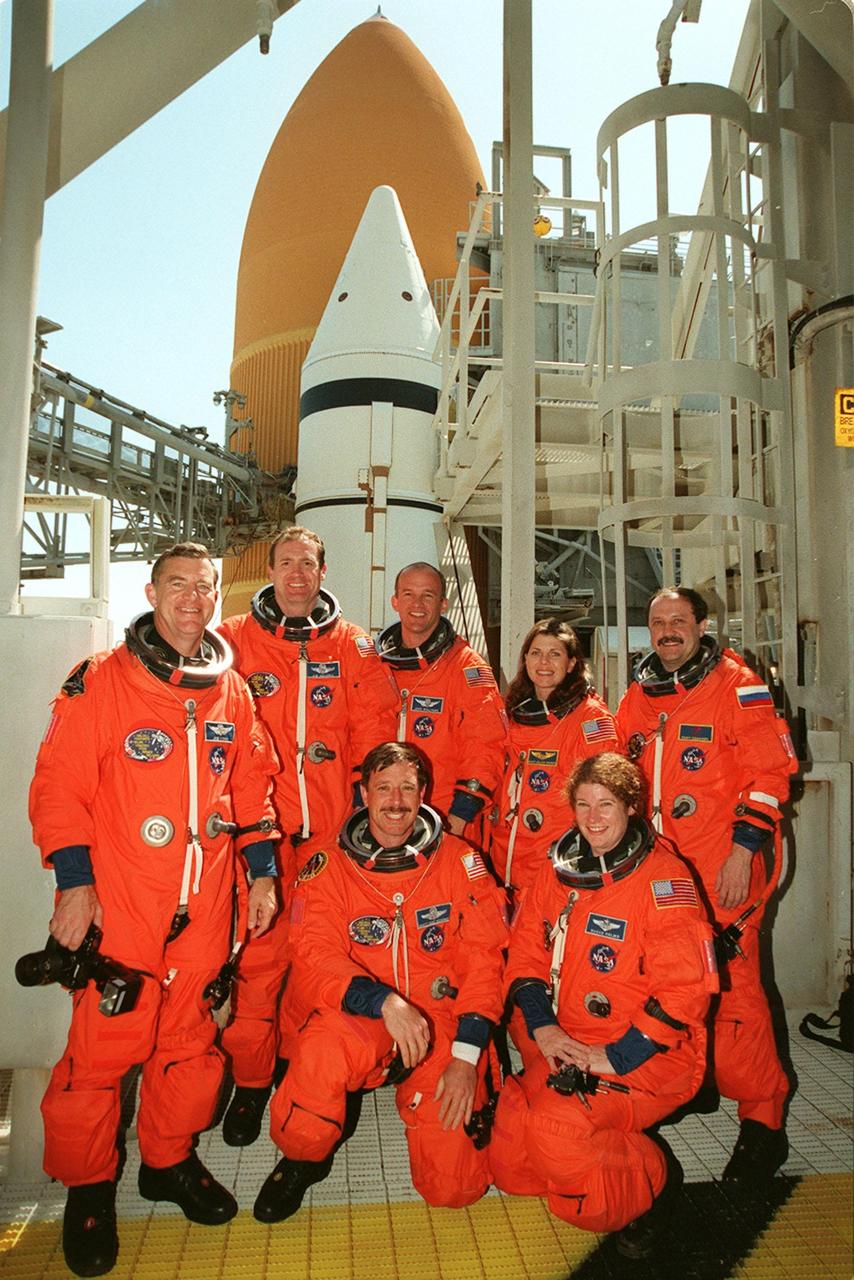
KENNEDY SPACE CENTER, FLA. -- During a break in Terminal Countdown Demonstration (TCDT) activities, the STS-101 crew poses for a photo at Launch Pad 39A. They are at the 195-foot level of the Fixed Service Structure for emergency egress training. Standing, from left to right, are Mission Specialist James Voss, Commander James D. Halsell Jr., and Mission Specialists Jeffrey N. Williams, Mary Ellen Weber and Yury Usachev of Russia. Kneeling in front are Pilot Scott J. "Doc" Horowitz and Mission Specialist Susan J. Helms. Behind them are the white solid rocket booster and orange external tank attached to Space Shuttle Atlantis. The TCDT also includes a simulated launch countdown and familiarization with the payload. During their mission to the International Space Station, the STS-101 crew will be delivering logistics and supplies, plus preparing the Station for the arrival of the Zvezda Service Module, expected to be launched by Russia in July 2000. Also, the crew will conduct one space walk to perform maintenance on the Space Station. This will be the third assembly flight for the Space Station. STS-101 is scheduled to launch April 24 at 4:15 p.m. from Launch Pad 39A
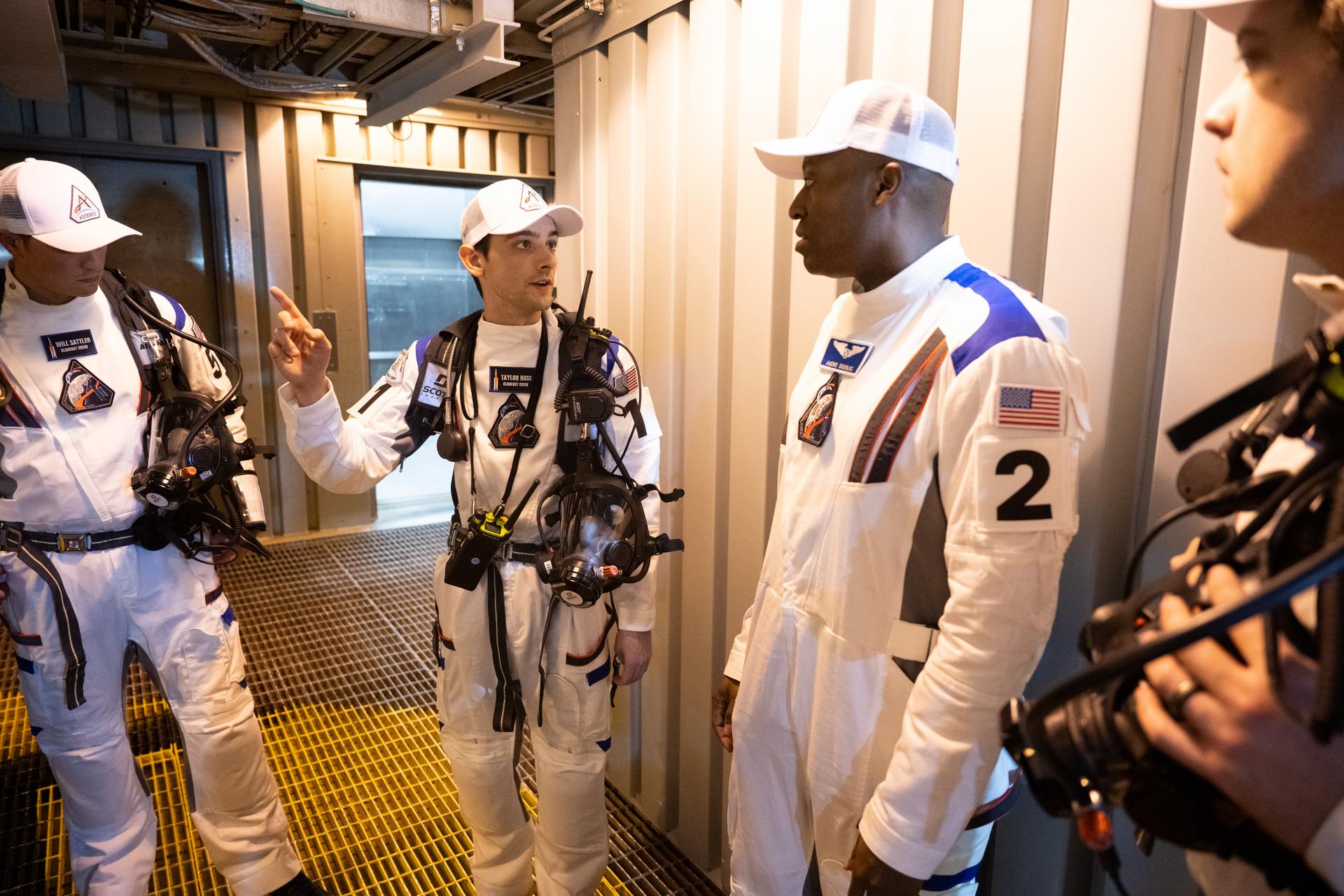
Closeout Crew lead Taylor Hose, second from left, talks with NASA astronaut Andre Douglas, second from right as he and closeout crewmembers Will Sattler, left, and Christian Warriner prepare for the arrival of Artemis II crewmembers NASA astronauts Reid Wiseman, commander; Victor Glover, pilot; Christina Koch, mission specialist; and CSA (Canadian Space Agency) astronaut Jeremy Hansen, mission specialist; at the 275-foot level of the mobile launcher as they prepare to board their Orion spacecraft atop NASA’s Space Launch System rocket during the Artemis II countdown demonstration test, Saturday, Dec. 20, 2025, inside the Vehicle Assembly Building at NASA’s Kennedy Space Center in Florida. For this operation, the Artemis II crew and launch teams are simulating the launch day timeline including suit-up, walkout, and spacecraft ingress and egress. Through the Artemis campaign, NASA will send astronauts to explore the Moon for scientific discovery, economic benefits, and to build the foundation for the first crewed missions to Mars, for the benefit of all. Photo Credit: (NASA/Joel Kowsky)

CAPE CANAVERAL, Fla. - After taking part in a simulated launch countdown aboard space shuttle Atlantis and practicing emergency escape procedures, the STS-125 crew pauses for a photo on the 225-foot level of the fixed service structure at Launch Pad 39A at NASA's Kennedy Space Center in Florida. From left are Mission Specialists John Grunsfeld and Michael Good, Pilot Gregory C. Johnson, Commander Scott Altman, and Mission Specialists Mike Massimino, Andrew Feustel and Megan McArthur. Behind them are space shuttle Atlantis’ external fuel tank and one of the twin solid rocket boosters. The countdown is the culmination of terminal countdown demonstration test, or TCDT, activities as preparation before launch. TCDT provides astronauts and ground crews with an opportunity to participate in various launch activities, including equipment familiarization, emergency training and the countdown. Atlantis’ STS-125 mission to service NASA’s Hubble Space Telescope is targeted for launch Oct. 14. Photo credit: NASA/Kim Shiflett
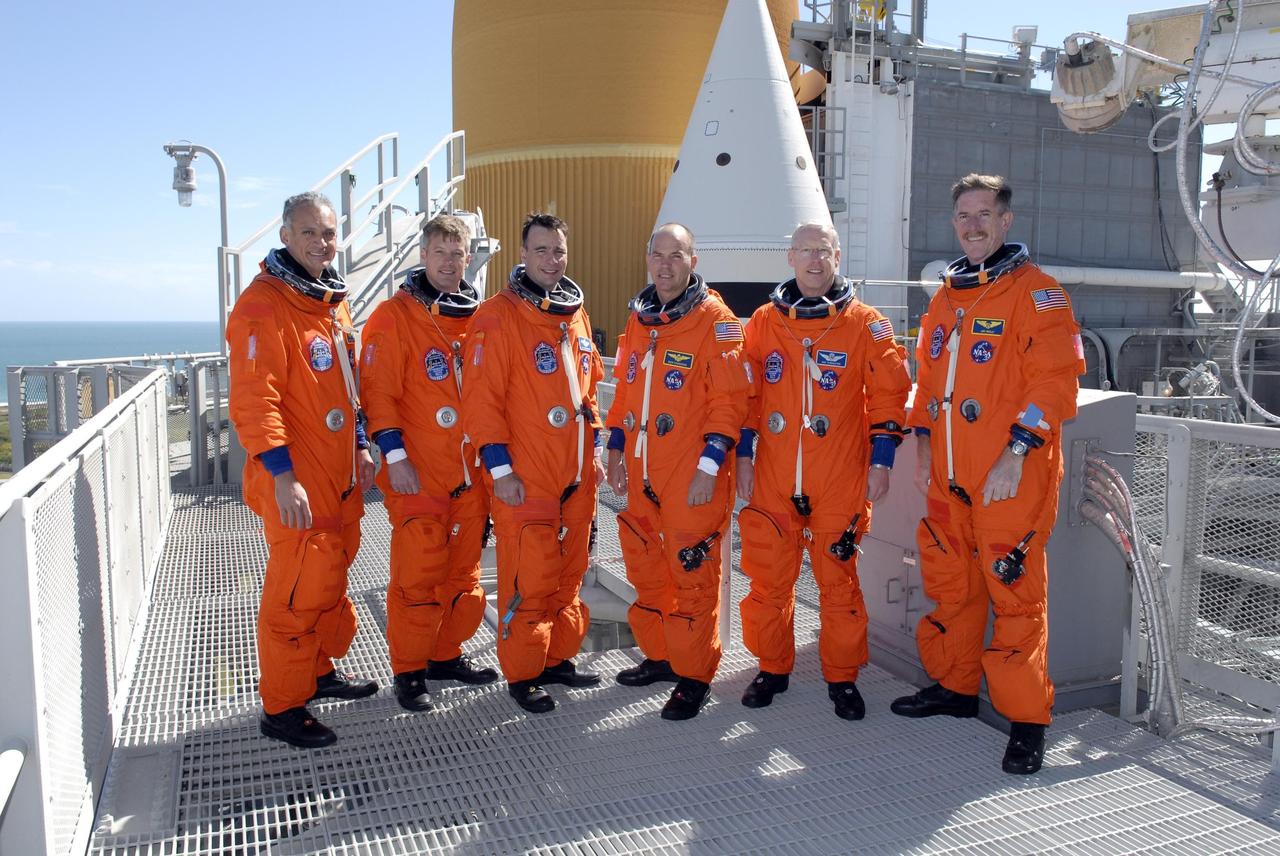
KENNEDY SPACE CENTER, FLA. -- On the 215-foot level of the fixed service structure on Launch Pad 39A, Mission STS-117 crew members gather for a photo near the solid rocket boosters and external tank of Space Shuttle Atlantis. They have just completed a simulated launch countdown and emergency egress from the orbiter, part of the terminal countdown demonstration test (TCDT). From left are Mission Specialists Danny Olivas and Steven Swanson, Pilot Lee Archambault, Commander Rick Sturckow, and Mission Specialists Patrick Forrester and James Reilly. The TCDT also includes M-113 armored personnel carrier training and payload familiarization. The STS-117 mission is No. 21 to the International Space Station. Mission payloads aboard Atlantis include the S3/S4 integrated truss structure, a third set of solar arrays and batteries. The crew of six astronauts will install the truss to continue assembly of the station. Launch is scheduled for no earlier than March 15. Photo credit: NASA/Kim Shiflett.
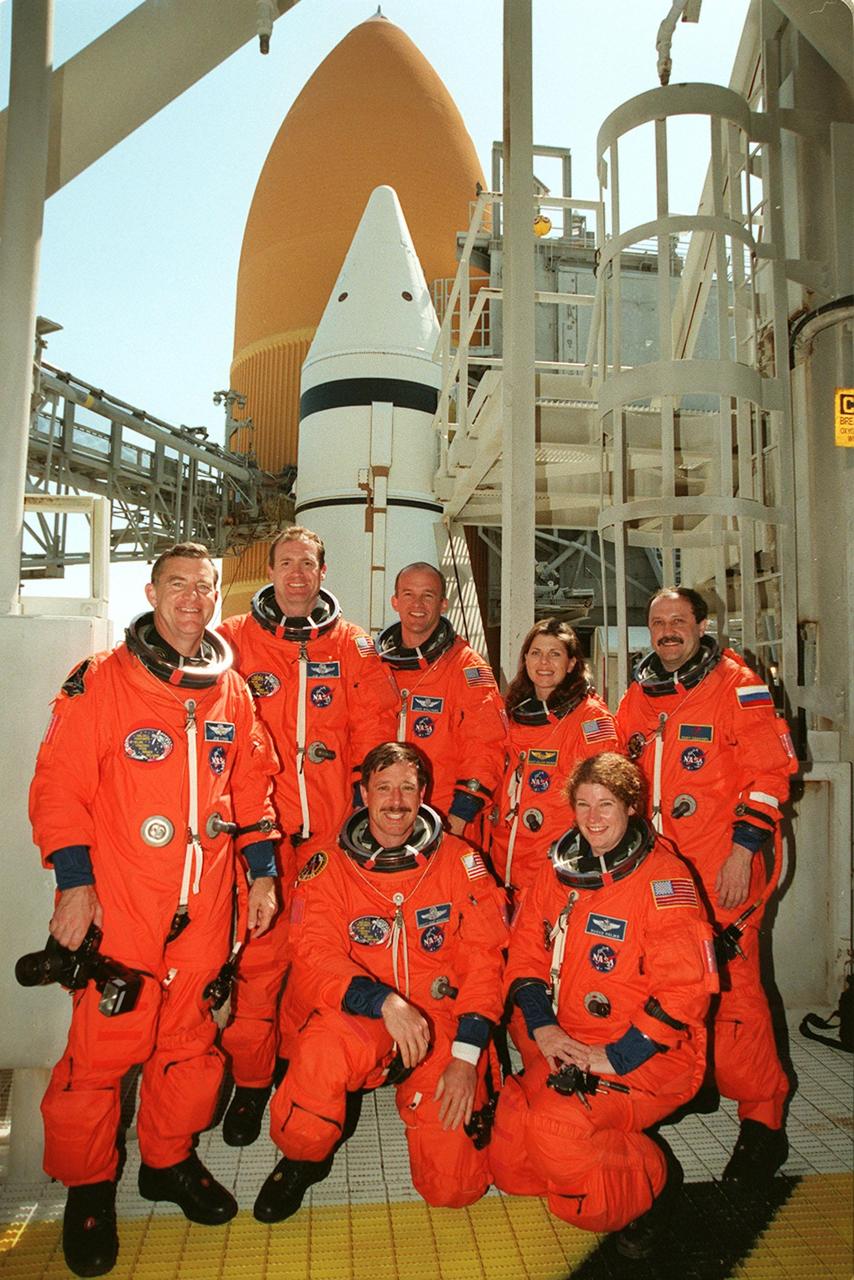
KENNEDY SPACE CENTER, FLA. -- During a break in Terminal Countdown Demonstration (TCDT) activities, the STS-101 crew poses for a photo at Launch Pad 39A. They are at the 195-foot level of the Fixed Service Structure for emergency egress training. Standing, from left to right, are Mission Specialist James Voss, Commander James D. Halsell Jr., and Mission Specialists Jeffrey N. Williams, Mary Ellen Weber and Yury Usachev of Russia. Kneeling in front are Pilot Scott J. "Doc" Horowitz and Mission Specialist Susan J. Helms. Behind them are the white solid rocket booster and orange external tank attached to Space Shuttle Atlantis. The TCDT also includes a simulated launch countdown and familiarization with the payload. During their mission to the International Space Station, the STS-101 crew will be delivering logistics and supplies, plus preparing the Station for the arrival of the Zvezda Service Module, expected to be launched by Russia in July 2000. Also, the crew will conduct one space walk to perform maintenance on the Space Station. This will be the third assembly flight for the Space Station. STS-101 is scheduled to launch April 24 at 4:15 p.m. from Launch Pad 39A
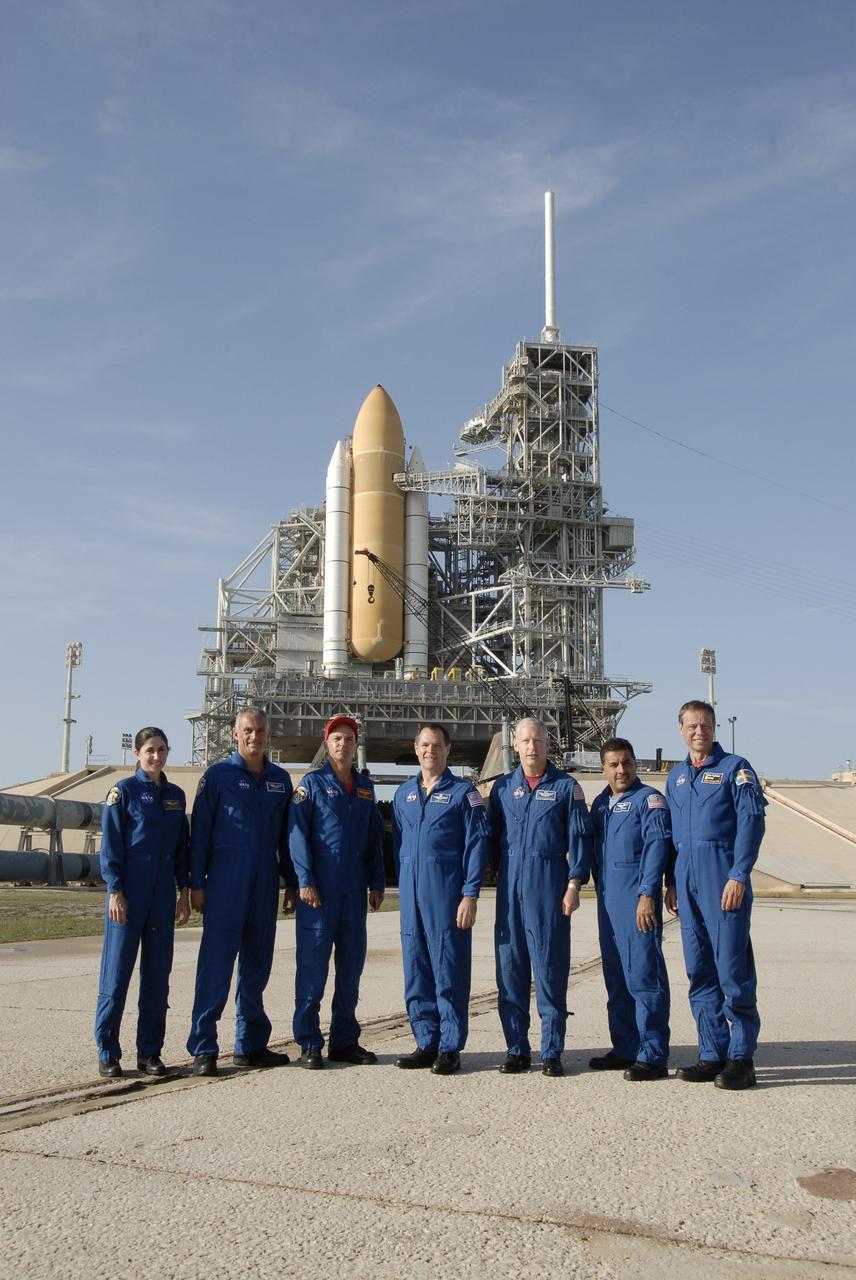
CAPE CANAVERAL, Fla. – At NASA's Kennedy Space Center in Florida, STS-128 crew members gather near Launch Pad 39A to answer questions from the media. From left are Mission Specialists Nicole Stott and John "Danny" Olivas, Commander Rick Sturckow, Pilot Kevin Ford and Mission Specialists Patrick Forrester, Jose Hernandez and Christer Fuglesang, who represents the European Space Agency. On the pad behind them is seen the solid rocket boosters and external fuel tank of space shuttle Discovery. On top of the fixed service structure at right is the 80-foot-tall lightning mast. The crew is at Kennedy for a launch dress rehearsal called the terminal countdown demonstration test, or TCDT, which includes emergency exit training and equipment familiarization, as well as a simulated launch countdown. Discovery will deliver 33,000 pounds of equipment to the station, including science and storage racks, a freezer to store research samples, a new sleeping compartment and the COLBERT treadmill. Photo credit: NASA/Kim Shiflett
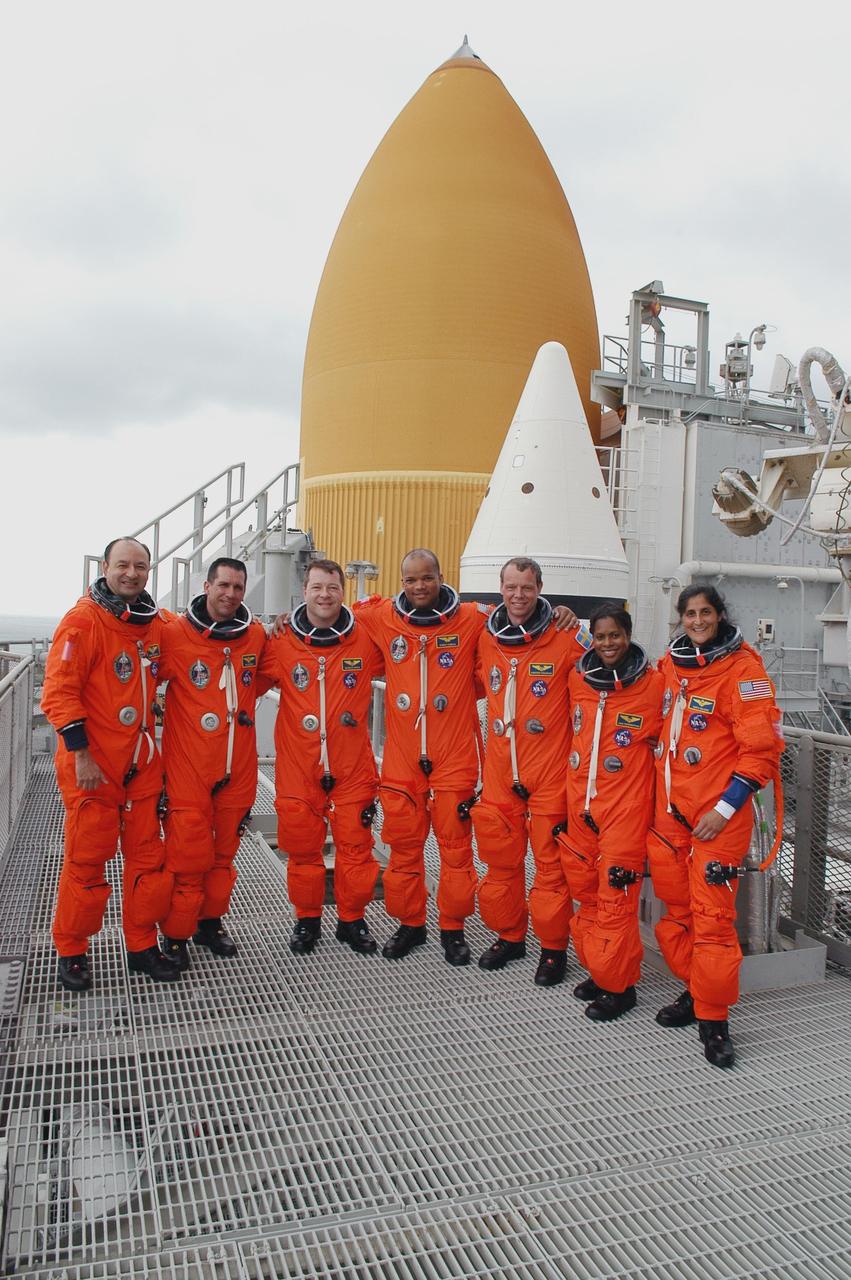
KENNEDY SPACE CENTER, FLA. -- On the 195-foot level of the fixed service structure on Launch Pad 39B, STS-116 crew members gather for a photo in front of the white solid rocket boosters and external tank of Space Shuttle Discovery. They have just completed a simulated launch countdown and emergency egress from the orbiter, part of the terminal countdown demonstration test. From left are Commander Mark Polansky, Pilot William Oefelein and Mission Specialists Nicholas Patrick, Robert Curbeam, Christer Fuglesang, Joan Higginbotham and Sunita Williams. Fuglesang represents the European Space Agency. Williams is traveling to the International Space Station on Discovery and will remain behind as a flight engineer with the Expedition 14 crew. The STS-116 mission is No. 20 to the International Space Station and construction flight 12A.1. The mission payload is the SPACEHAB module, the P5 integrated truss structure and other key components. Launch is scheduled for no earlier than Dec. 7. Photo credit: NASA/Kim Shiflett
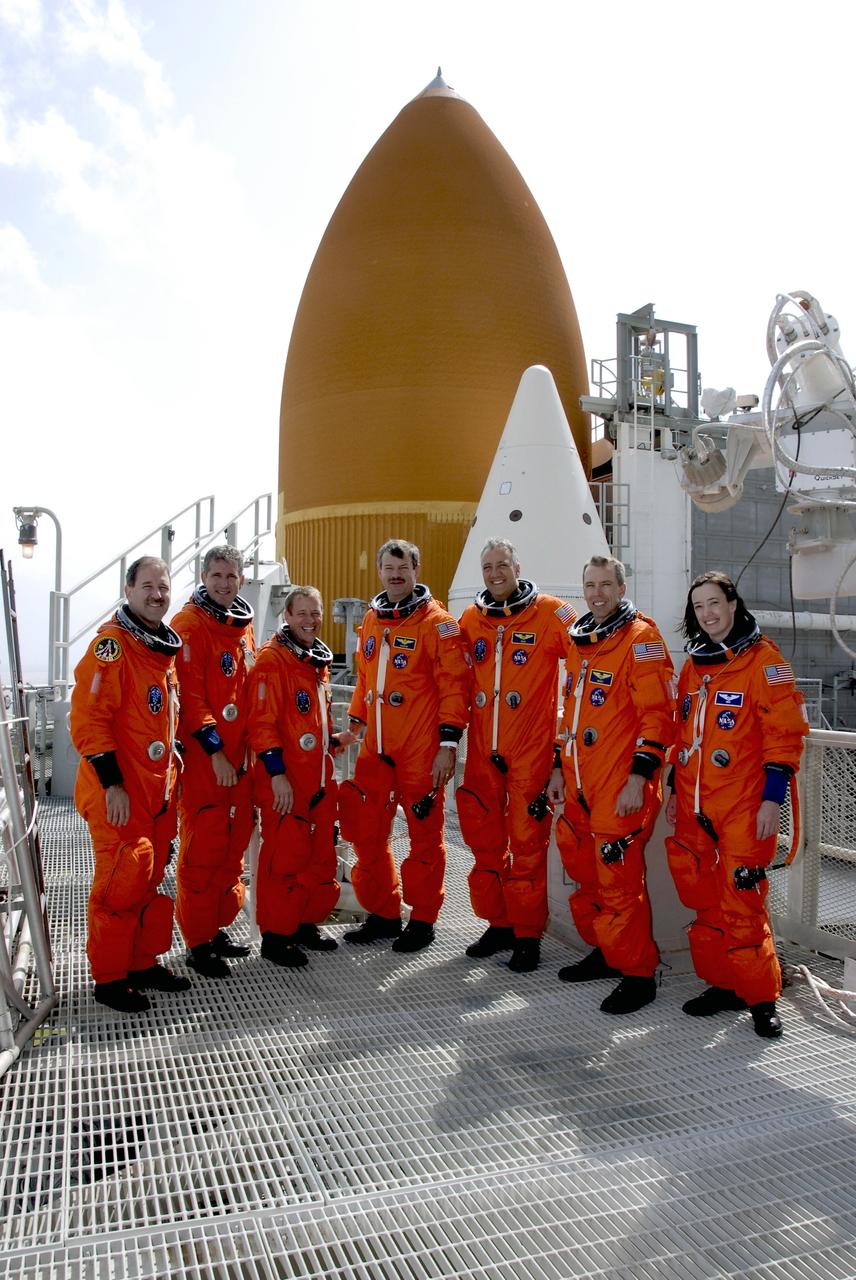
CAPE CANAVERAL, Fla. - After taking part in a simulated launch countdown aboard space shuttle Atlantis and practicing emergency escape procedures, the STS-125 crew pauses for a photo on the 225-foot level of the fixed service structure at Launch Pad 39A at NASA's Kennedy Space Center in Florida. From left are Mission Specialists John Grunsfeld and Michael Good, Pilot Gregory C. Johnson, Commander Scott Altman, and Mission Specialists Mike Massimino, Andrew Feustel and Megan McArthur. Behind them are space shuttle Atlantis’ external fuel tank and one of the twin solid rocket boosters. The countdown is the culmination of terminal countdown demonstration test, or TCDT, activities as preparation before launch. TCDT provides astronauts and ground crews with an opportunity to participate in various launch activities, including equipment familiarization, emergency training and the countdown. Atlantis’ STS-125 mission to service NASA’s Hubble Space Telescope is targeted for launch Oct. 14. Photo credit: NASA/Kim Shiflett
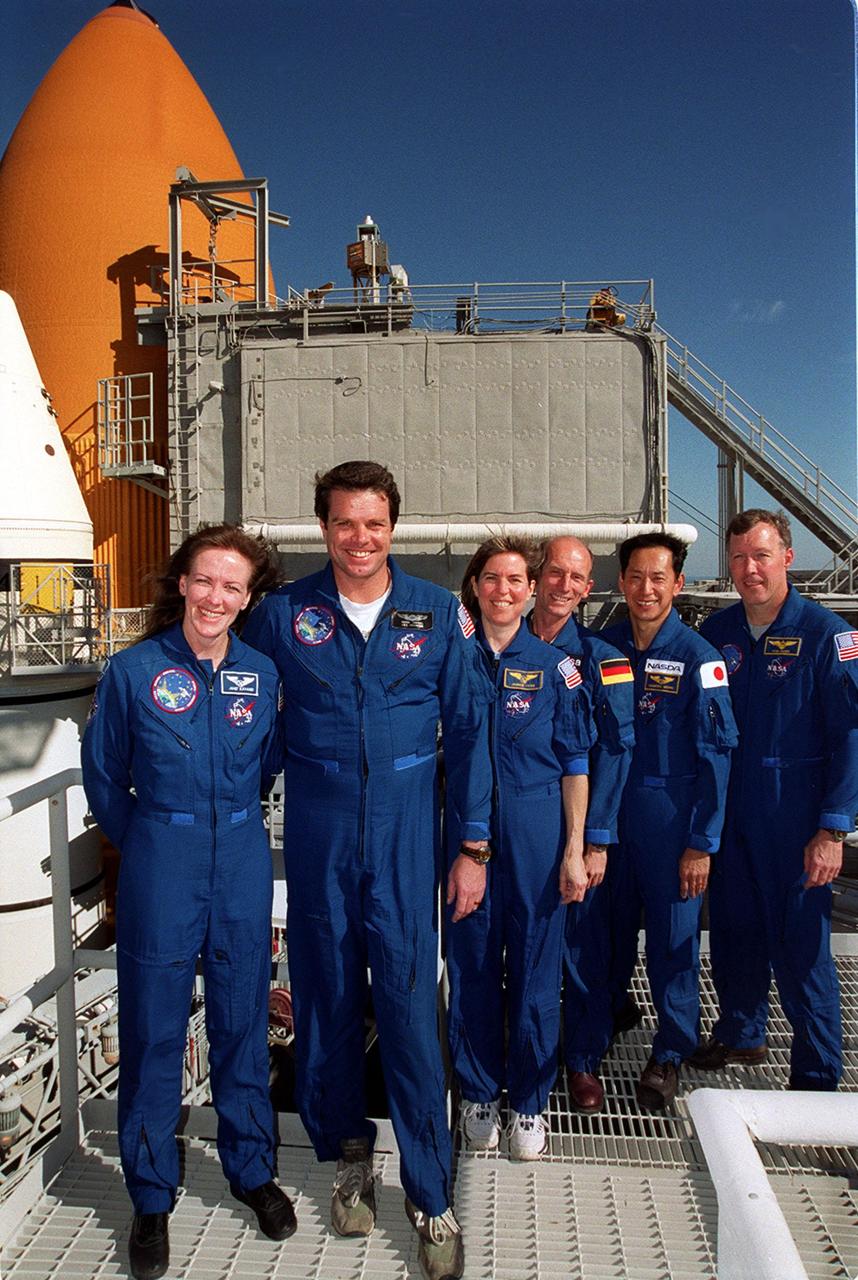
KENNEDY SPACE CENTER, Fla. -- At the 167-foot level of the Fixed Service Structure on Launch Pad 39A, the STS-99 crew pose for a photograph during Terminal Countdown Demonstration Test (TCDT) activities. Standing left to right are Mission Specialist Janet Lynn Kavandi (Ph.D.), Commander Kevin Kregel, Mission Specialists Janice Voss (Ph.D.), Gerhard Thiele and Mamoru Mohri, and Pilot Dominic Gorie. Thiele is with the European Space Agency and Mohri is with the National Space Development Agency (NASDA) of Japan. Behind them (left) are visible the top of a solid rocket booster (white) and external tank (orange). The TCDT provides the crew with simulated countdown exercises, emergency egress training, and opportunities to inspect the mission payloads in the orbiter's payload bay. STS-99 is the Shuttle Radar Topography Mission, which will chart a new course, using two antennae and a 200-foot-long section of space station-derived mast protruding from the payload bay to produce unrivaled 3-D images of the Earth's surface. The result of the Shuttle Radar Topography Mission could be close to 1 trillion measurements of the Earth's topography. Besides contributing to the production of better maps, these measurements could lead to improved water drainage modeling, more realistic flight simulators, better locations for cell phone towers, and enhanced navigation safety. Launch of Endeavour on the 11-day mission is scheduled for Jan. 31 at 12:47 p.m. EST

KENNEDY SPACE CENTER, Fla. -- At the 167-foot level of the Fixed Service Structure on Launch Pad 39A, the STS-99 crew pose for a photograph during Terminal Countdown Demonstration Test (TCDT) activities. Standing left to right are Mission Specialist Janet Lynn Kavandi (Ph.D.), Commander Kevin Kregel, Mission Specialists Janice Voss (Ph.D.), Gerhard Thiele and Mamoru Mohri, and Pilot Dominic Gorie. Thiele is with the European Space Agency and Mohri is with the National Space Development Agency (NASDA) of Japan. Behind them are visible the top of a solid rocket booster (white) and external tank (orange). The TCDT provides the crew with simulated countdown exercises, emergency egress training, and opportunities to inspect the mission payloads in the orbiter's payload bay. STS-99 is the Shuttle Radar Topography Mission, which will chart a new course, using two antennae and a 200-foot-long section of space station-derived mast protruding from the payload bay to produce unrivaled 3-D images of the Earth's surface. The result of the Shuttle Radar Topography Mission could be close to 1 trillion measurements of the Earth's topography. Besides contributing to the production of better maps, these measurements could lead to improved water drainage modeling, more realistic flight simulators, better locations for cell phone towers, and enhanced navigation safety. Launch of Endeavour on the 11-day mission is scheduled for Jan. 31 at 12:47 p.m. EST
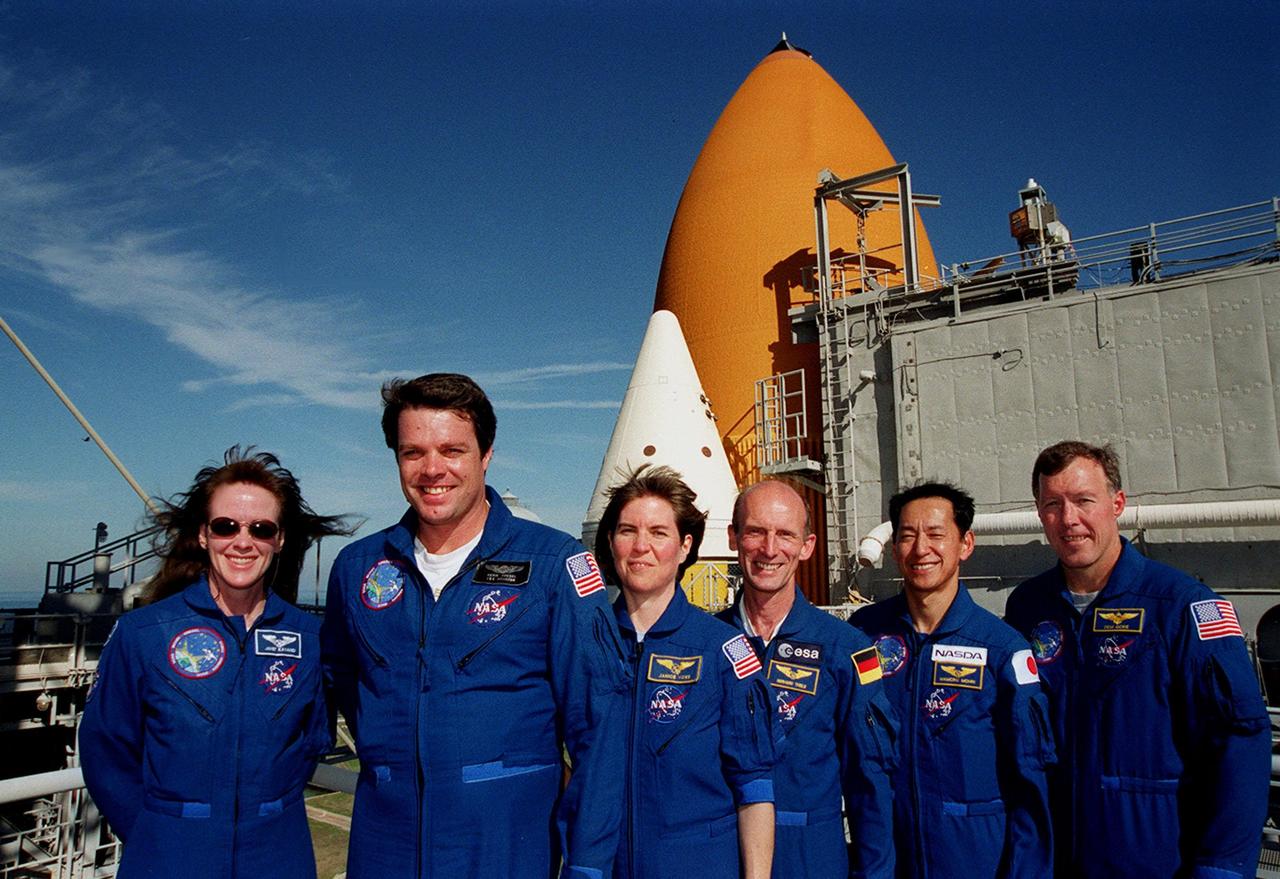
KENNEDY SPACE CENTER, Fla. -- At the 167-foot level of the Fixed Service Structure on Launch Pad 39A, the STS-99 crew pose for a photograph during Terminal Countdown Demonstration Test (TCDT) activities. Standing left to right are Mission Specialist Janet Lynn Kavandi (Ph.D.), Commander Kevin Kregel, Mission Specialists Janice Voss (Ph.D.), Gerhard Thiele and Mamoru Mohri, and Pilot Dominic Gorie. Thiele is with the European Space Agency and Mohri is with the National Space Development Agency (NASDA) of Japan. Behind them are visible the top of a solid rocket booster (white) and external tank (orange). The TCDT provides the crew with simulated countdown exercises, emergency egress training, and opportunities to inspect the mission payloads in the orbiter's payload bay. STS-99 is the Shuttle Radar Topography Mission, which will chart a new course, using two antennae and a 200-foot-long section of space station-derived mast protruding from the payload bay to produce unrivaled 3-D images of the Earth's surface. The result of the Shuttle Radar Topography Mission could be close to 1 trillion measurements of the Earth's topography. Besides contributing to the production of better maps, these measurements could lead to improved water drainage modeling, more realistic flight simulators, better locations for cell phone towers, and enhanced navigation safety. Launch of Endeavour on the 11-day mission is scheduled for Jan. 31 at 12:47 p.m. EST
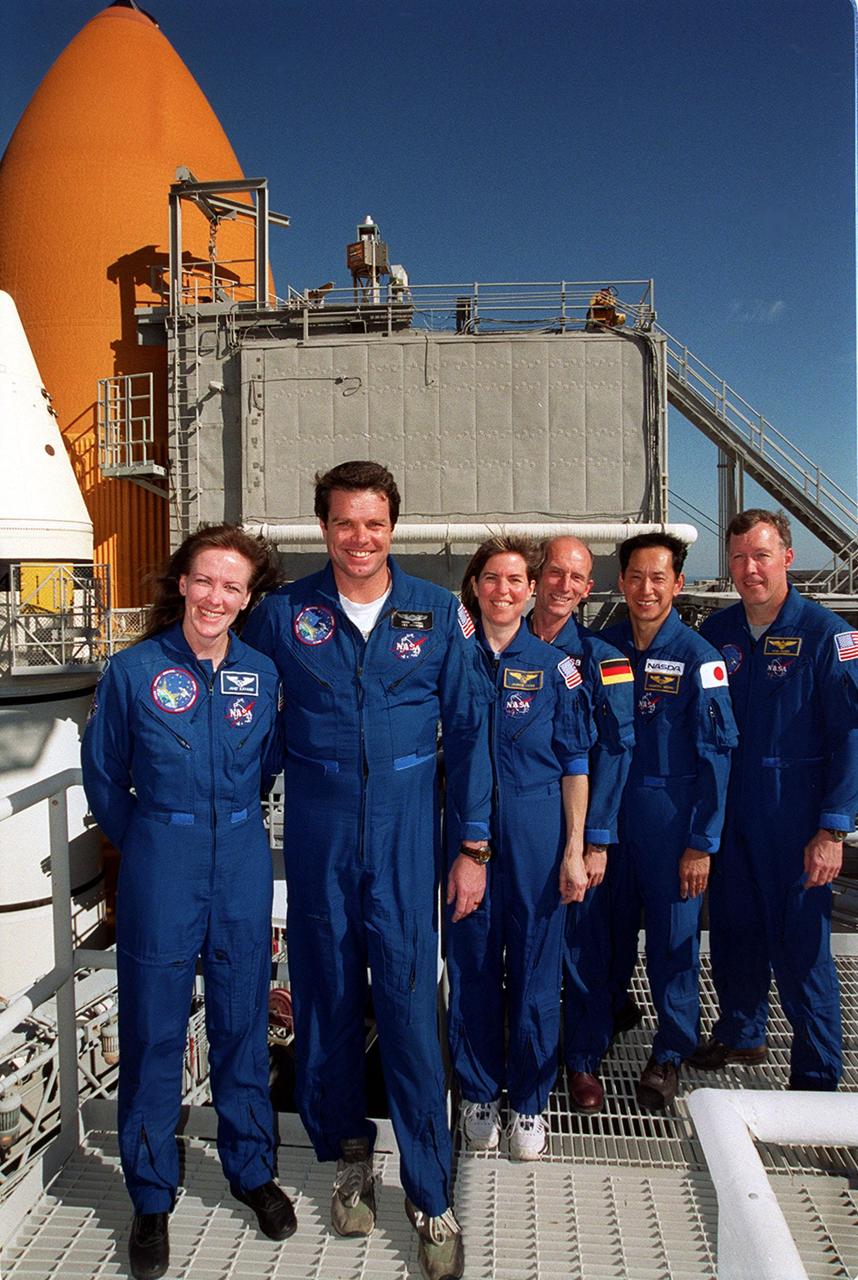
KENNEDY SPACE CENTER, Fla. -- At the 167-foot level of the Fixed Service Structure on Launch Pad 39A, the STS-99 crew pose for a photograph during Terminal Countdown Demonstration Test (TCDT) activities. Standing left to right are Mission Specialist Janet Lynn Kavandi (Ph.D.), Commander Kevin Kregel, Mission Specialists Janice Voss (Ph.D.), Gerhard Thiele and Mamoru Mohri, and Pilot Dominic Gorie. Thiele is with the European Space Agency and Mohri is with the National Space Development Agency (NASDA) of Japan. Behind them (left) are visible the top of a solid rocket booster (white) and external tank (orange). The TCDT provides the crew with simulated countdown exercises, emergency egress training, and opportunities to inspect the mission payloads in the orbiter's payload bay. STS-99 is the Shuttle Radar Topography Mission, which will chart a new course, using two antennae and a 200-foot-long section of space station-derived mast protruding from the payload bay to produce unrivaled 3-D images of the Earth's surface. The result of the Shuttle Radar Topography Mission could be close to 1 trillion measurements of the Earth's topography. Besides contributing to the production of better maps, these measurements could lead to improved water drainage modeling, more realistic flight simulators, better locations for cell phone towers, and enhanced navigation safety. Launch of Endeavour on the 11-day mission is scheduled for Jan. 31 at 12:47 p.m. EST