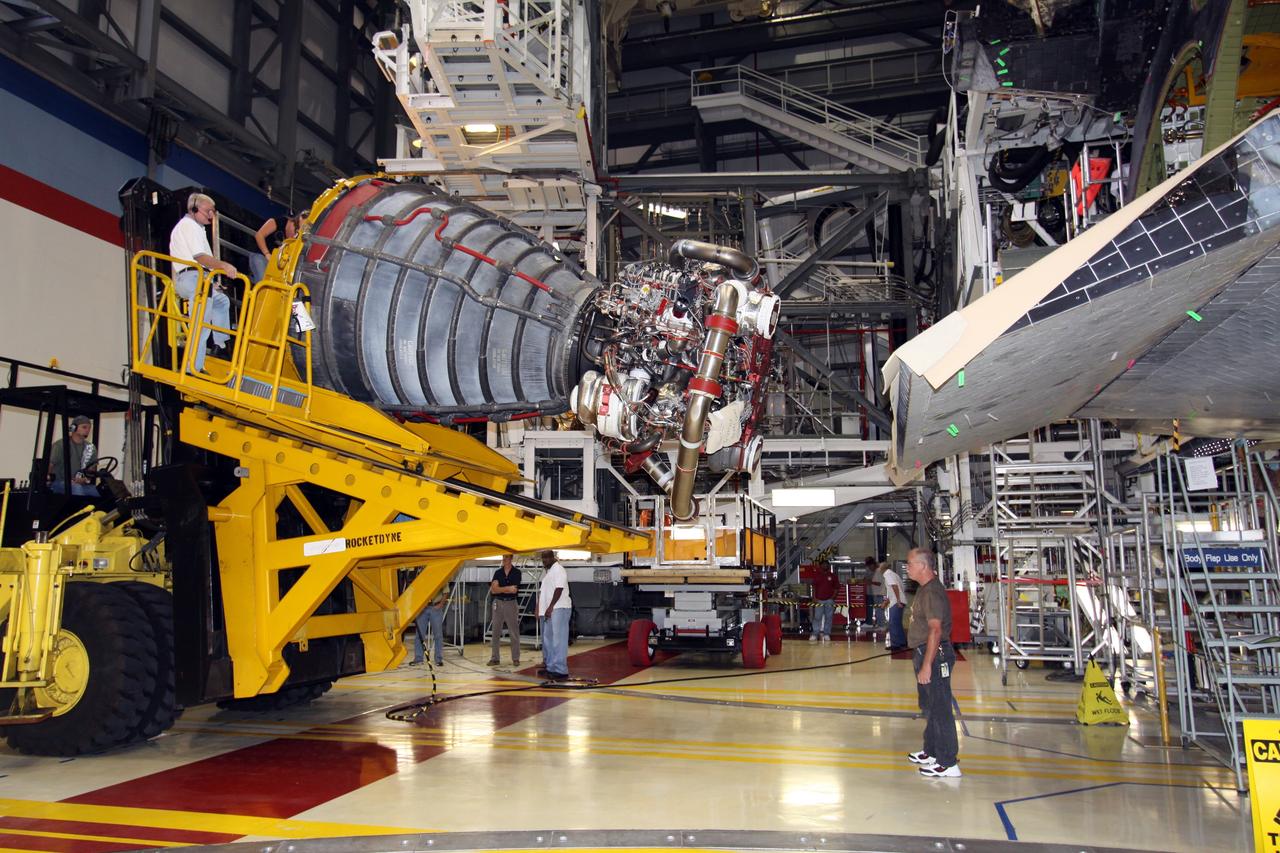
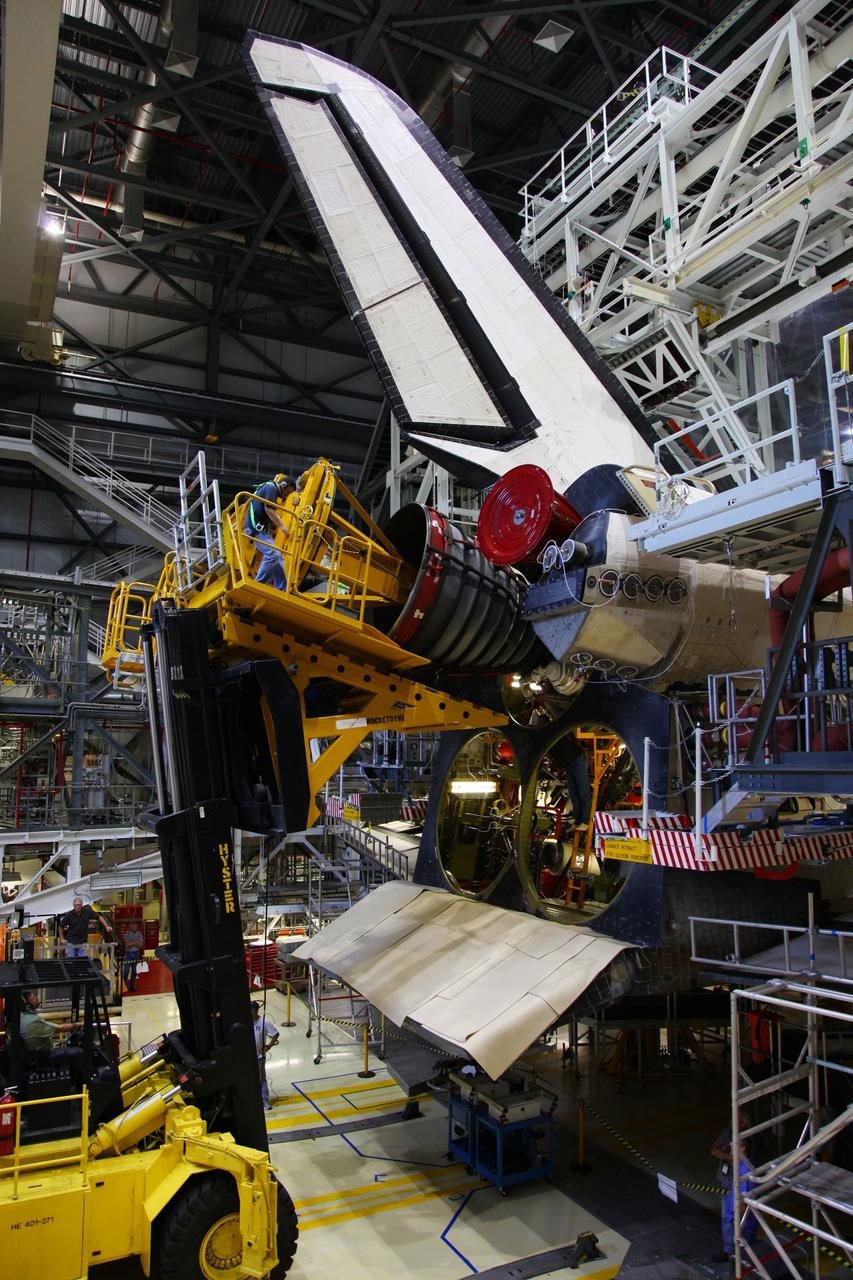
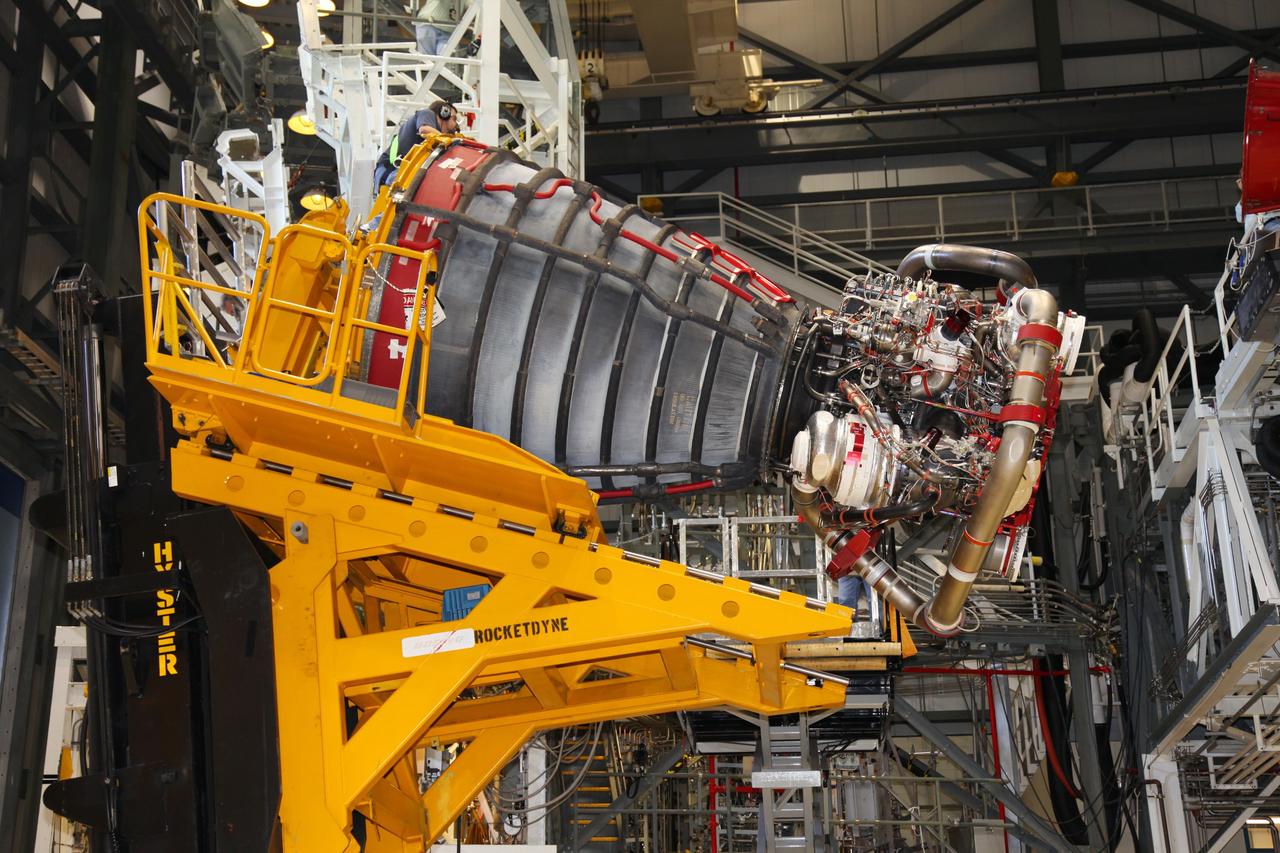
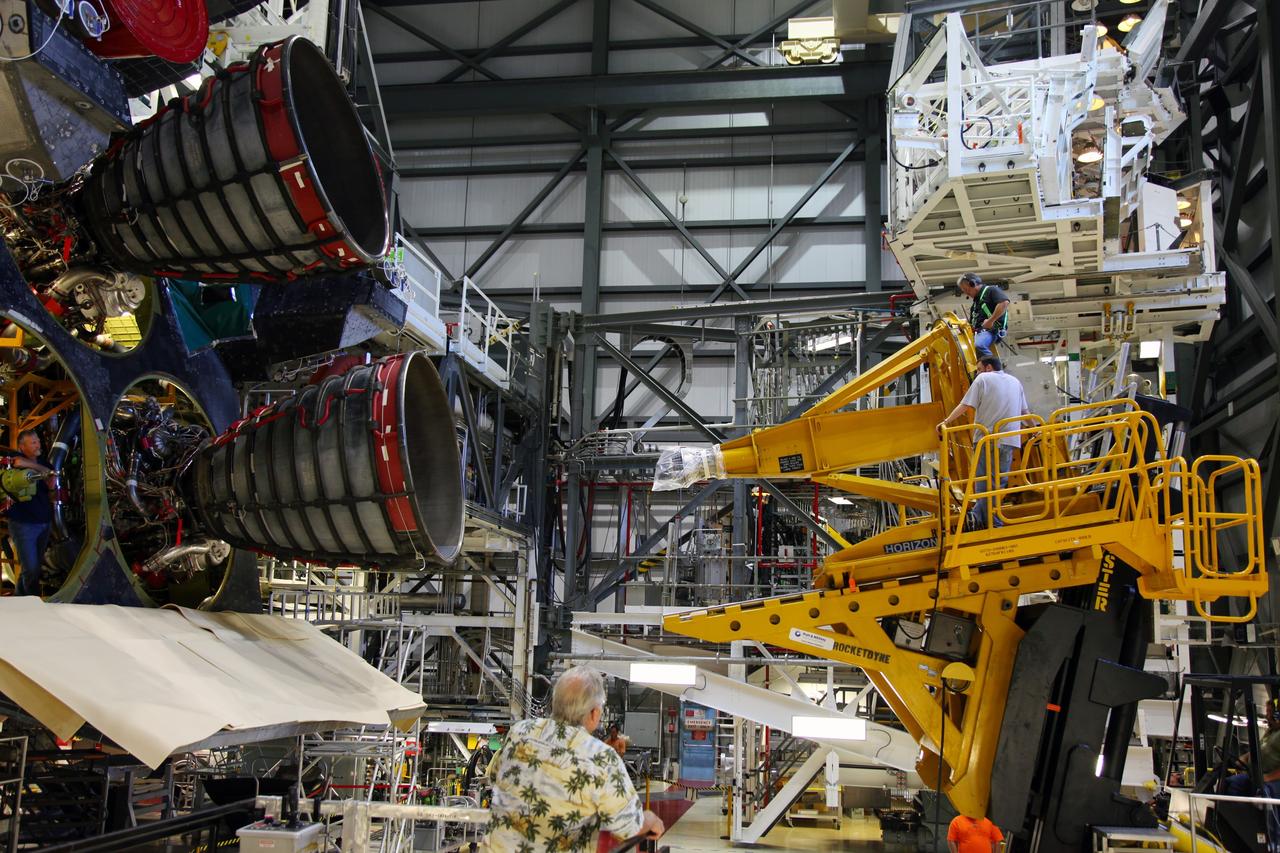
CAPE CANAVERAL, Fla. – In Orbiter Processing Bay 2 at NASA's Kennedy Space Center in Florida, the Hyster forklift holds main engine no. 1 removed from space shuttle Endeavour. Engine removal is part of the post-landing processing; engine no. 2 was removed Aug. 17. Endeavour returned from the STS-127 mission July 31. Endeavour's next mission is STS-130 targeted for February 2010. Endeavour will deliver to the International Space Station the Tranquility pressurized module that will provide room for many of the station's life support systems. Photo credit: NASA/Jack Pfaller
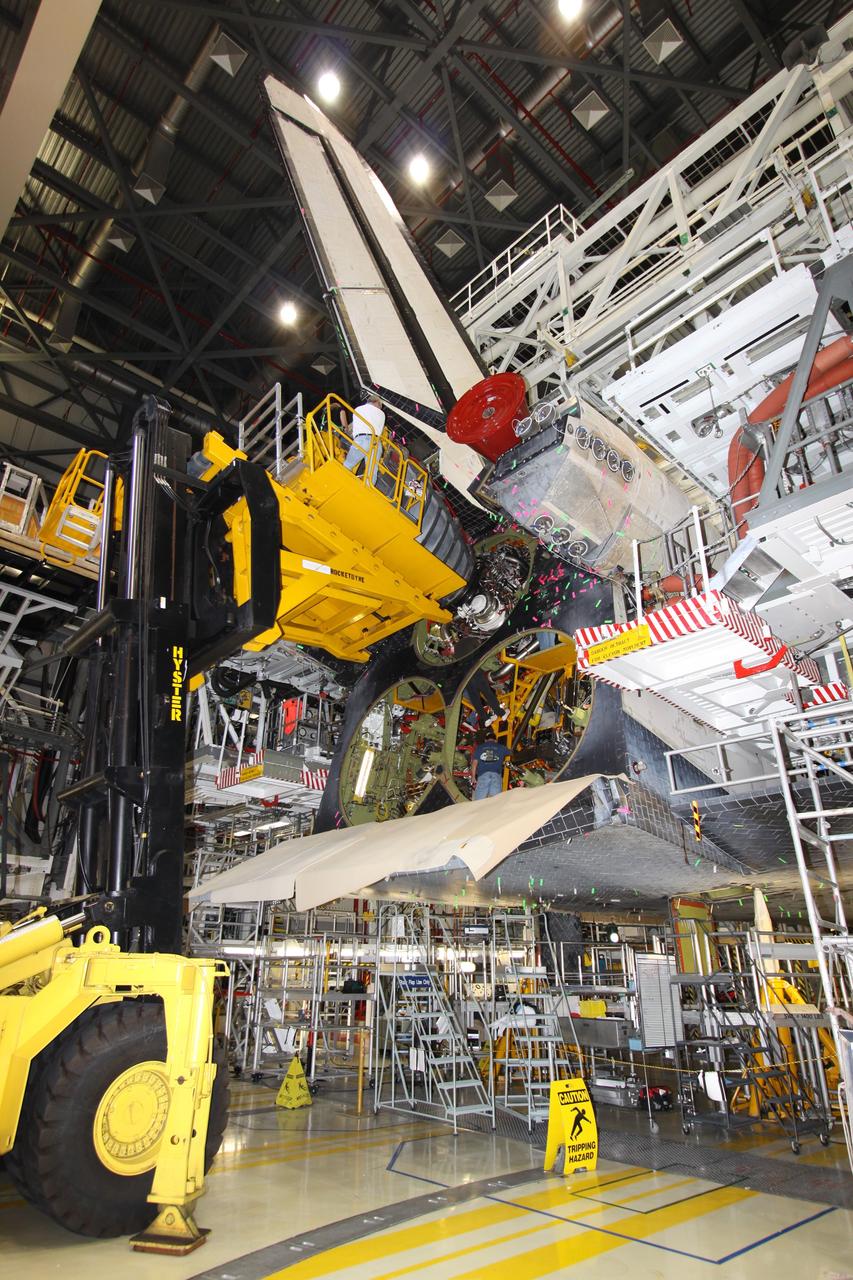
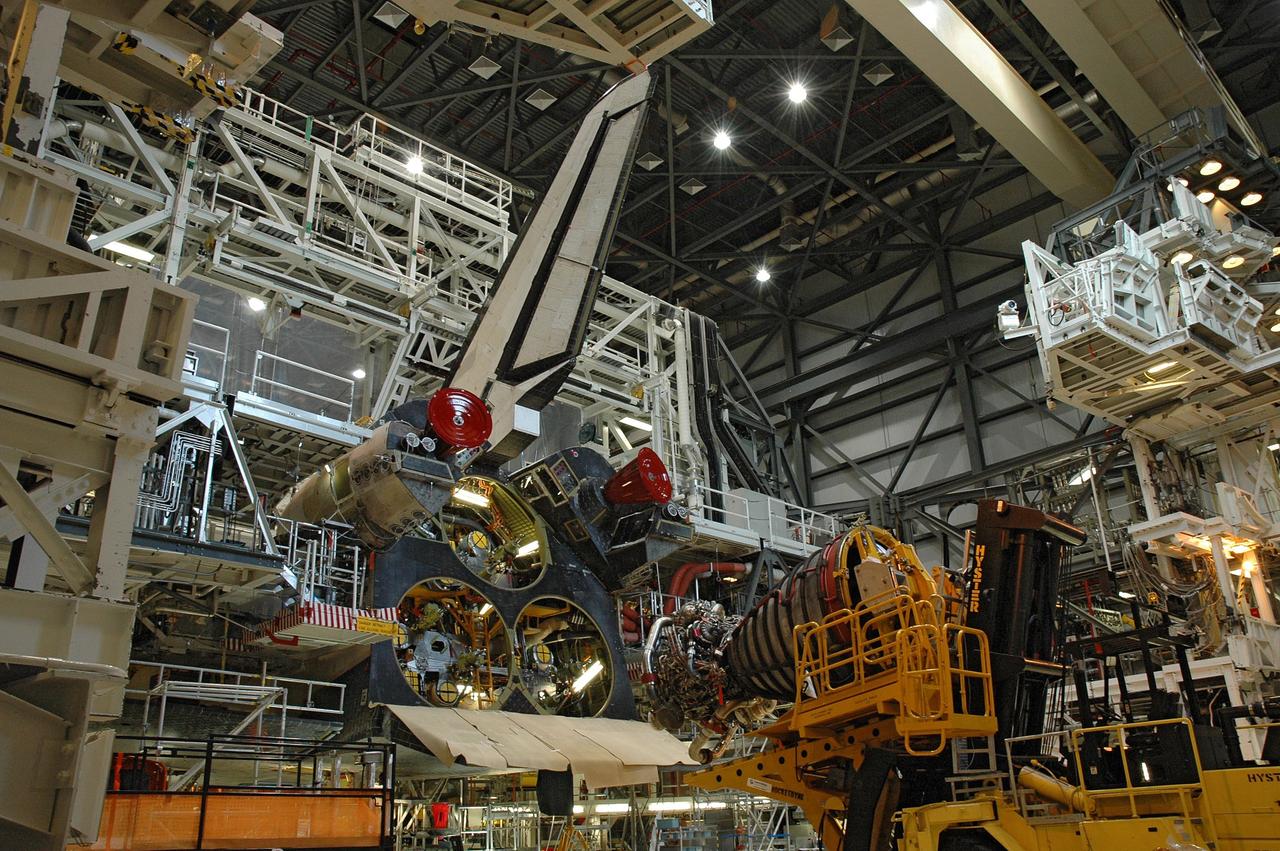
CAPE CANAVERAL, Fla. – In Orbiter Processing Bay 2 at NASA's Kennedy Space Center in Florida, a Hyster forklift is moved into position to remove main engine no. 1 from space shuttle Endeavour. Engine removal is part of the post-landing processing; engine no. 2 was removed Aug. 17. Endeavour returned from the STS-127 mission July 31. Endeavour's next mission is STS-130 targeted for February 2010. Endeavour will deliver to the International Space Station the Tranquility pressurized module that will provide room for many of the station's life support systems. Photo credit: NASA/Jack Pfaller
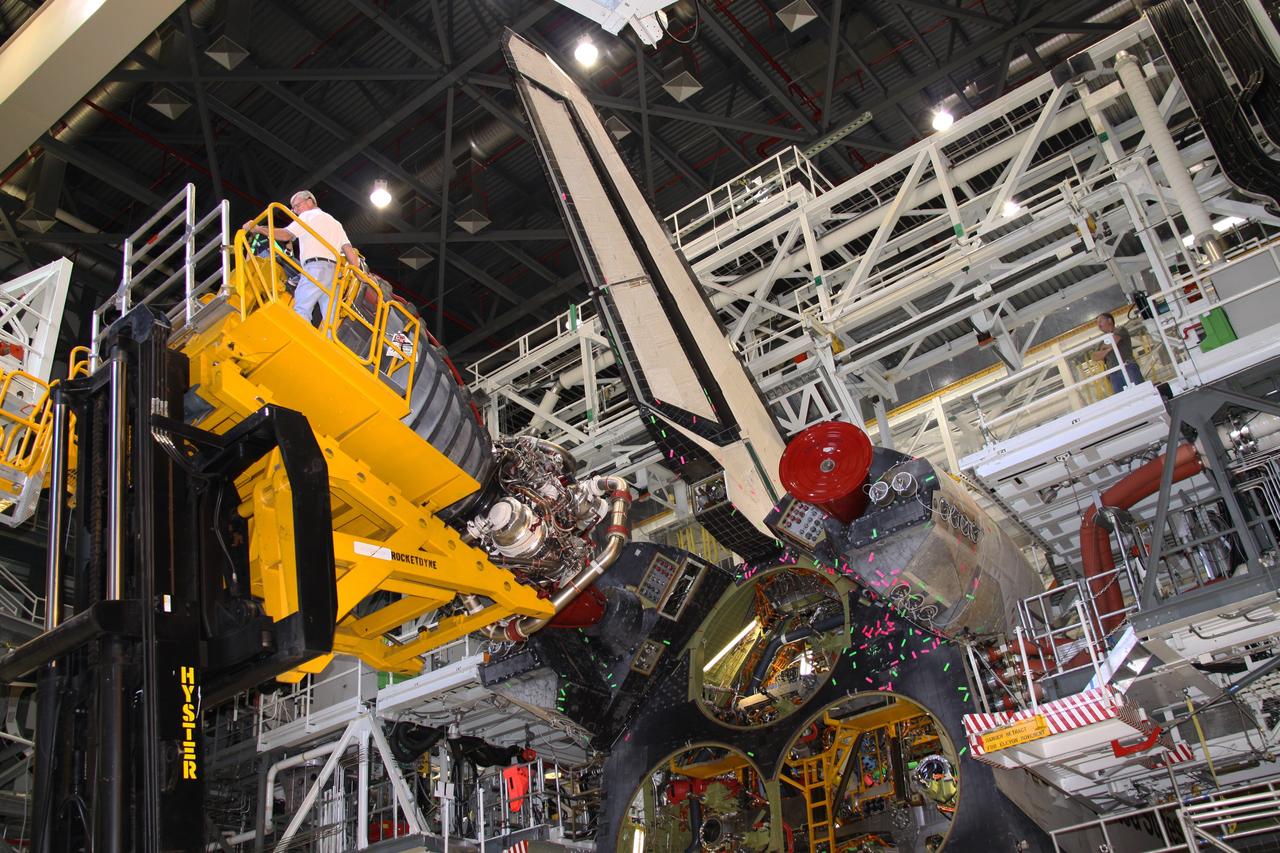
CAPE CANAVERAL, Fla. – In Orbiter Processing Bay 2 at NASA's Kennedy Space Center in Florida, technicians back away from space shuttle Endeavour after removing main engine no. 1 with the Hyster forklift. Engine removal is part of the post-landing processing; engine no. 2 was removed Aug. 17. Endeavour returned from the STS-127 mission July 31. Endeavour's next mission is STS-130 targeted for February 2010. Endeavour will deliver to the International Space Station the Tranquility pressurized module that will provide room for many of the station's life support systems. Photo credit: NASA/Jack Pfaller
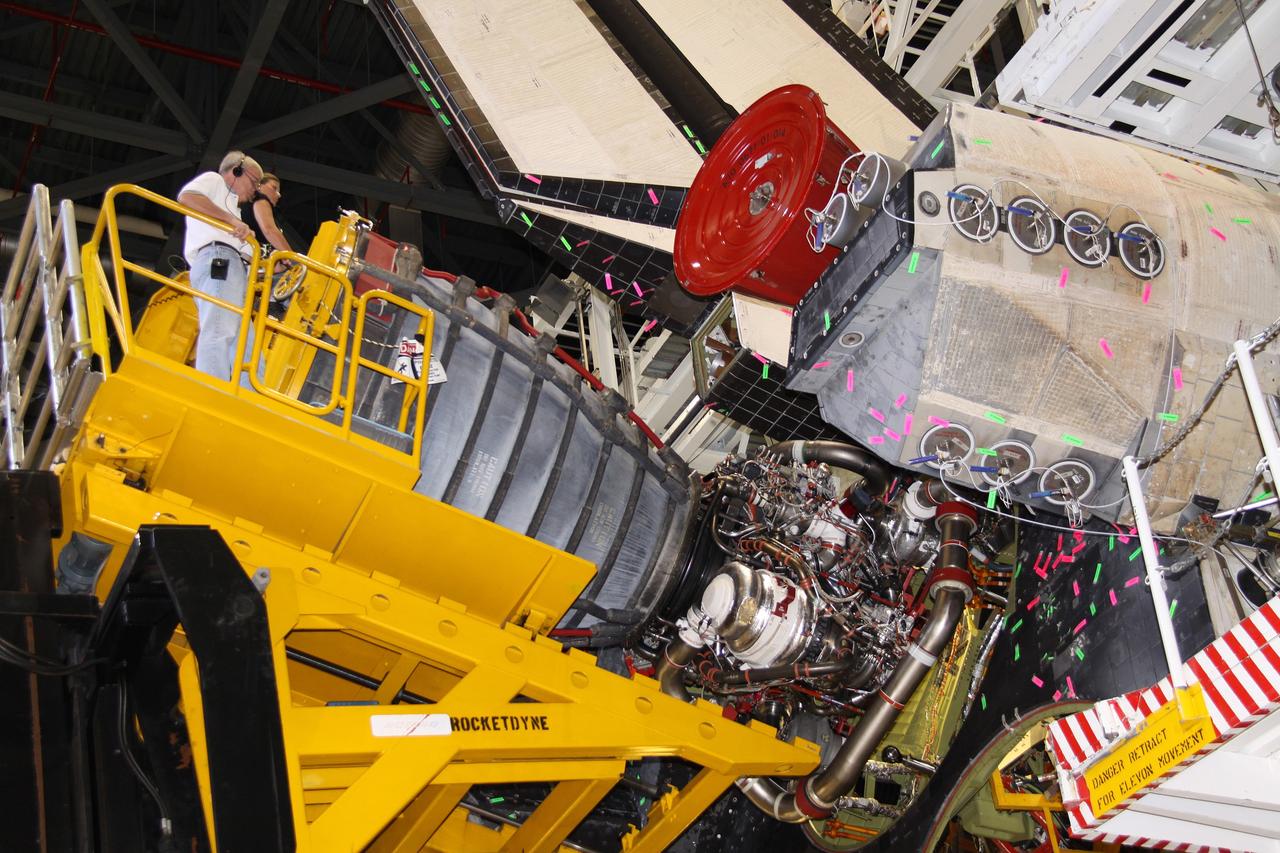
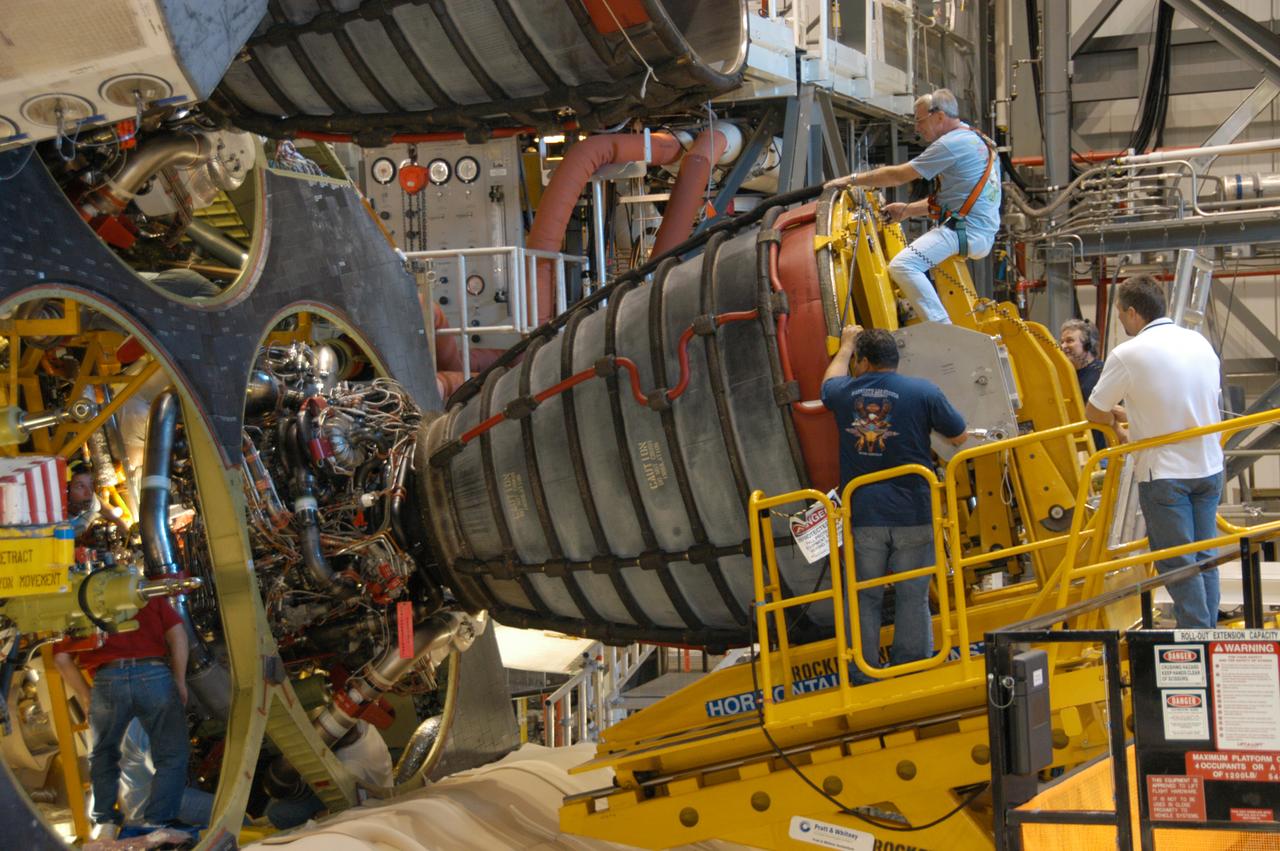
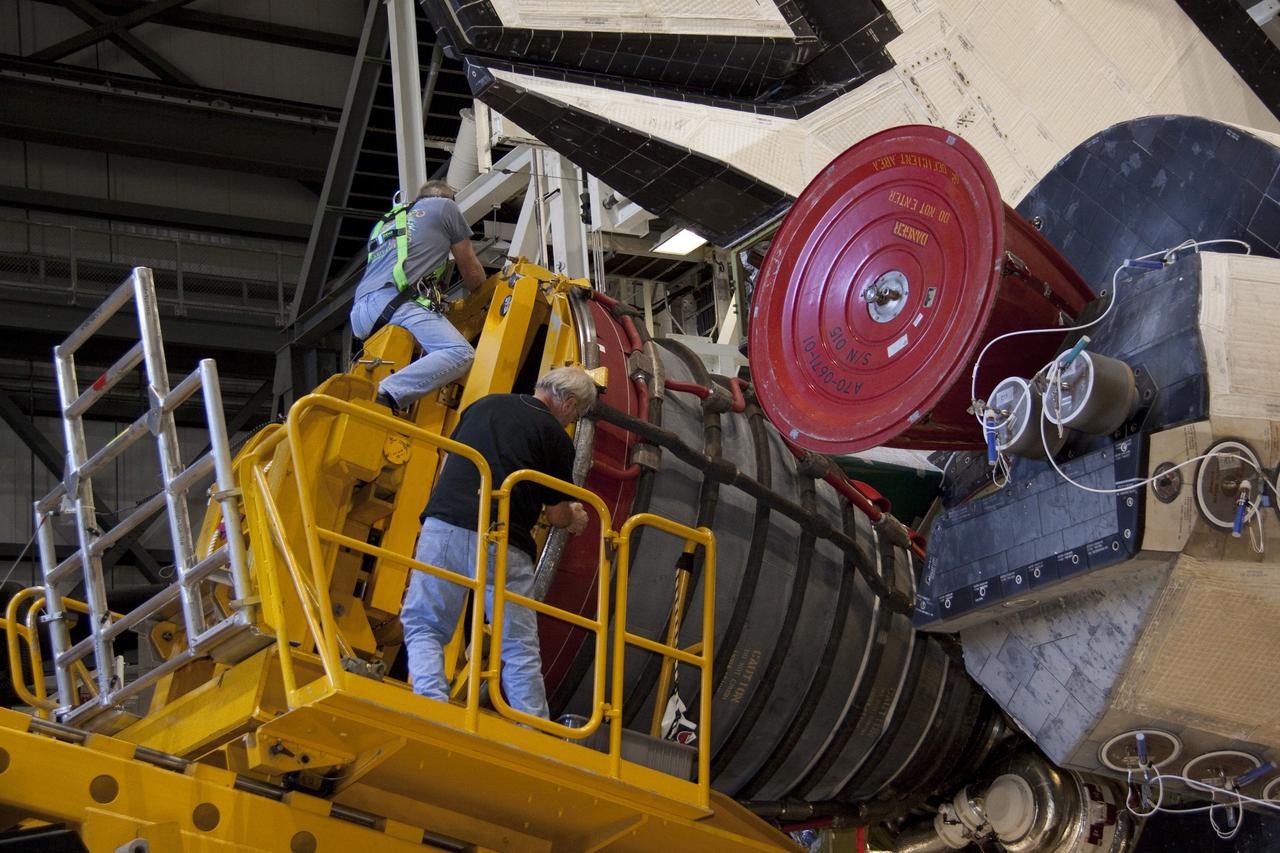
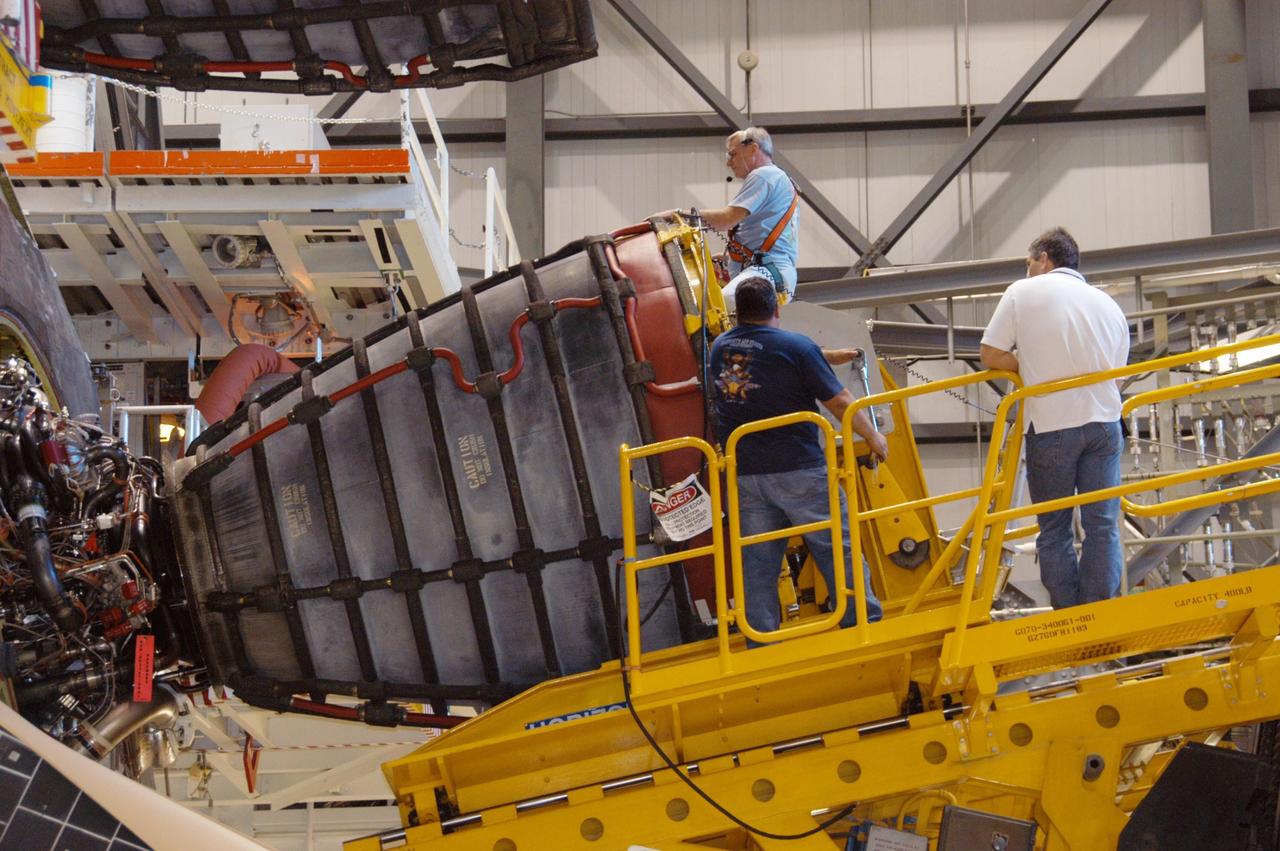
CAPE CANAVERAL, Fla. – In Orbiter Processing Bay 2 at NASA's Kennedy Space Center in Florida, technicians begin removing main engine no. 1 from space shuttle Endeavour with the Hyster forklift. Engine removal is part of the post-landing processing; engine no. 2 was removed Aug. 17. Endeavour returned from the STS-127 mission July 31. Endeavour's next mission is STS-130 targeted for February 2010. Endeavour will deliver to the International Space Station the Tranquility pressurized module that will provide room for many of the station's life support systems. Photo credit: NASA/Jack Pfaller
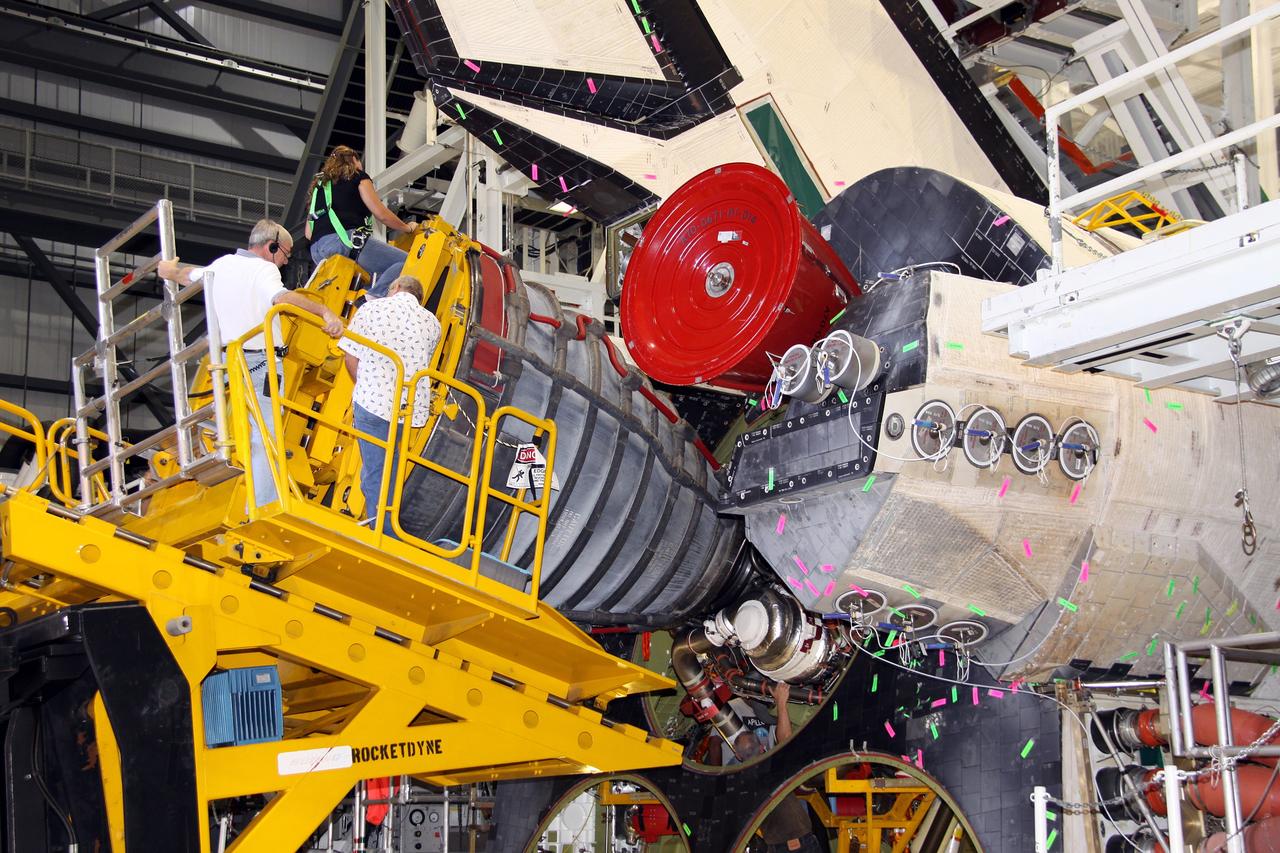
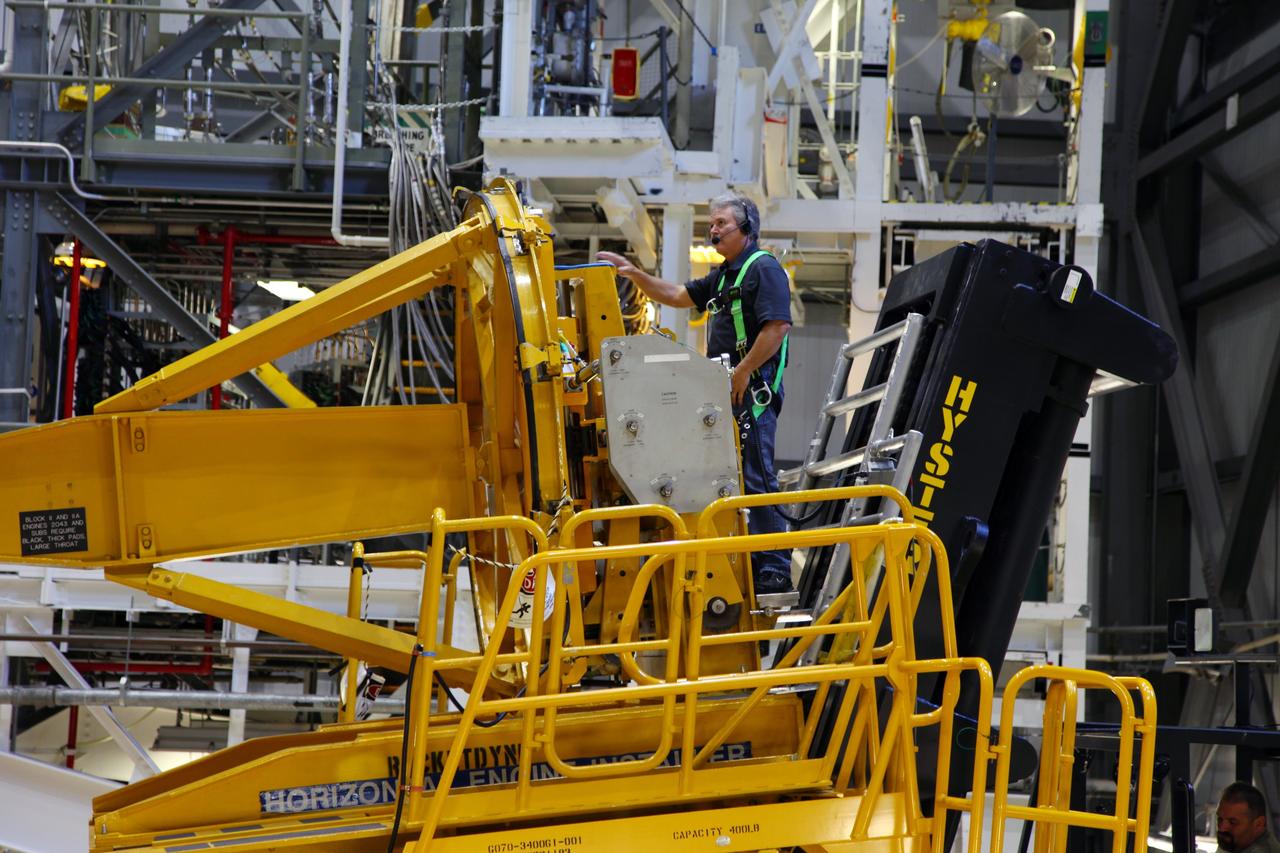
CAPE CANAVERAL, Fla. – In Orbiter Processing Bay 2 at NASA's Kennedy Space Center in Florida, technicians move the Hyster forklift into position to remove main engine no. 1 from space shuttle Endeavour. Engine removal is part of the post-landing processing; engine no. 2 was removed Aug. 17. Endeavour returned from the STS-127 mission July 31. Endeavour's next mission is STS-130 targeted for February 2010. Endeavour will deliver to the International Space Station the Tranquility pressurized module that will provide room for many of the station's life support systems. Photo credit: NASA/Jack Pfaller
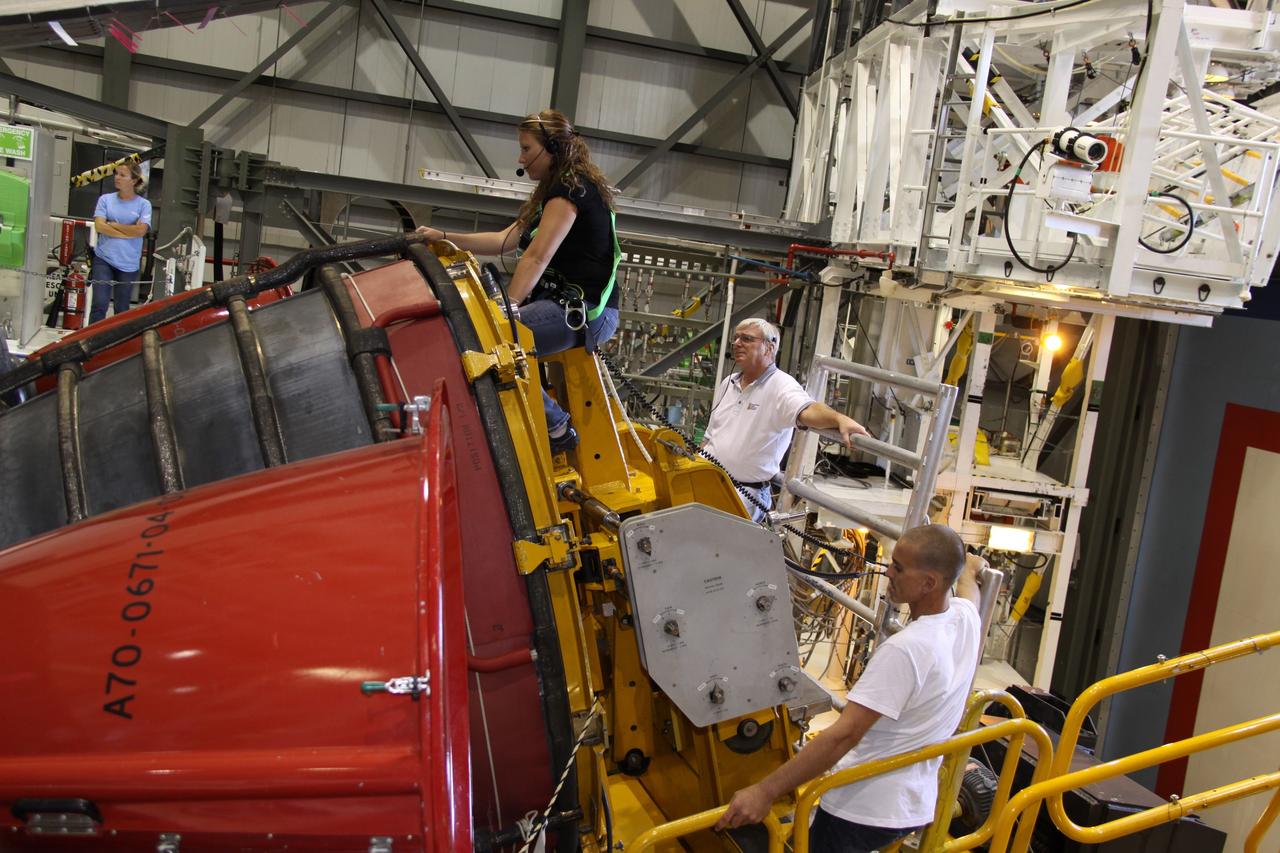
CAPE CANAVERAL, Fla. – In Orbiter Processing Bay 2 at NASA's Kennedy Space Center in Florida, technicians focus on moving the Hyster forklift into position to remove main engine no. 1 from space shuttle Endeavour. Engine removal is part of the post-landing processing; engine no. 2 was removed Aug. 17. Endeavour returned from the STS-127 mission July 31. Endeavour's next mission is STS-130 targeted for February 2010. Endeavour will deliver to the International Space Station the Tranquility pressurized module that will provide room for many of the station's life support systems. Photo credit: NASA/Jack Pfaller
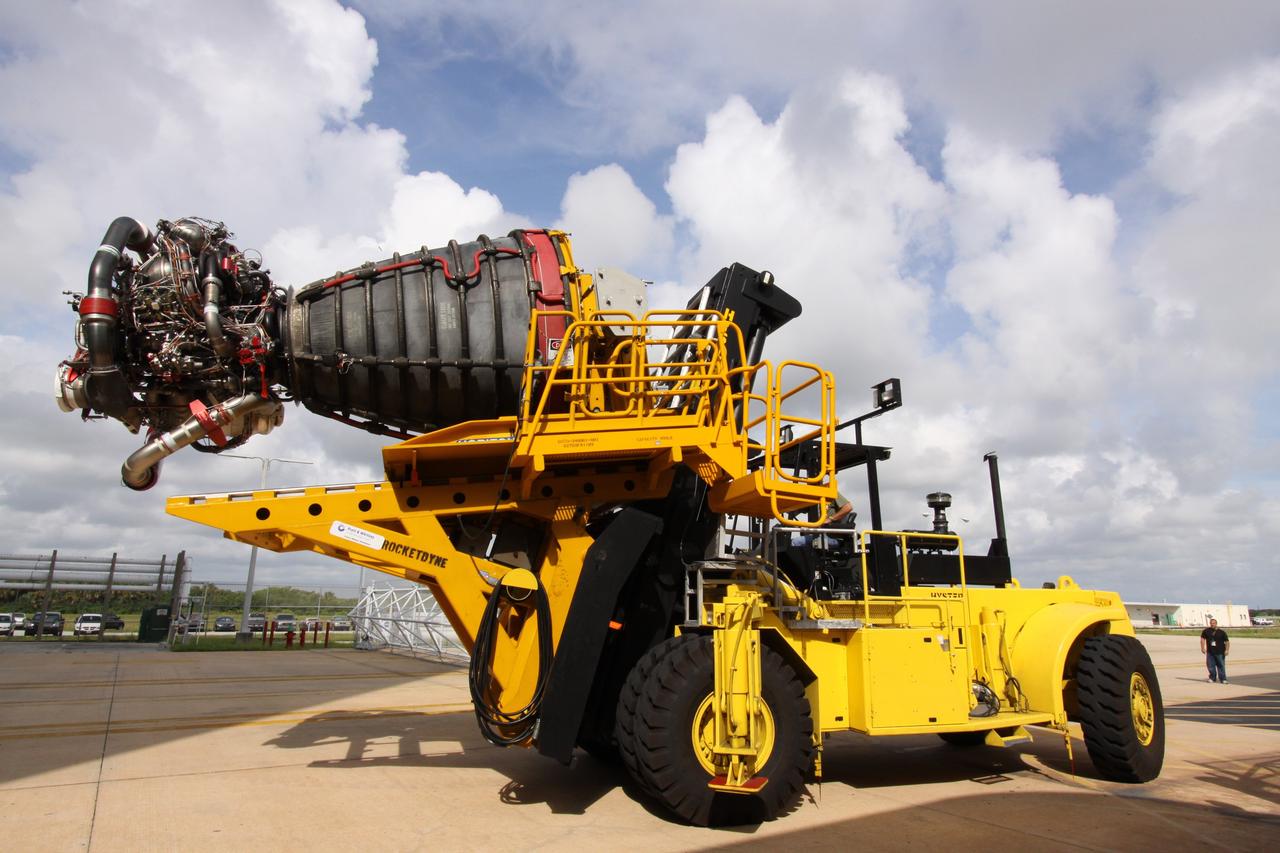
CAPE CANAVERAL, Fla. – At NASA's Kennedy Space Center in Florida, space shuttle Endeavour's main engine no. 1 is moved out of Orbiter Processing Bay 2 after removal from the shuttle. Engine removal is part of the post-landing processing; engine no. 2 was removed Aug. 17. Endeavour returned from the STS-127 mission July 31. Endeavour's next mission is STS-130 targeted for February 2010. Endeavour will deliver to the International Space Station the Tranquility pressurized module that will provide room for many of the station's life support systems. Photo credit: NASA/Jack Pfaller
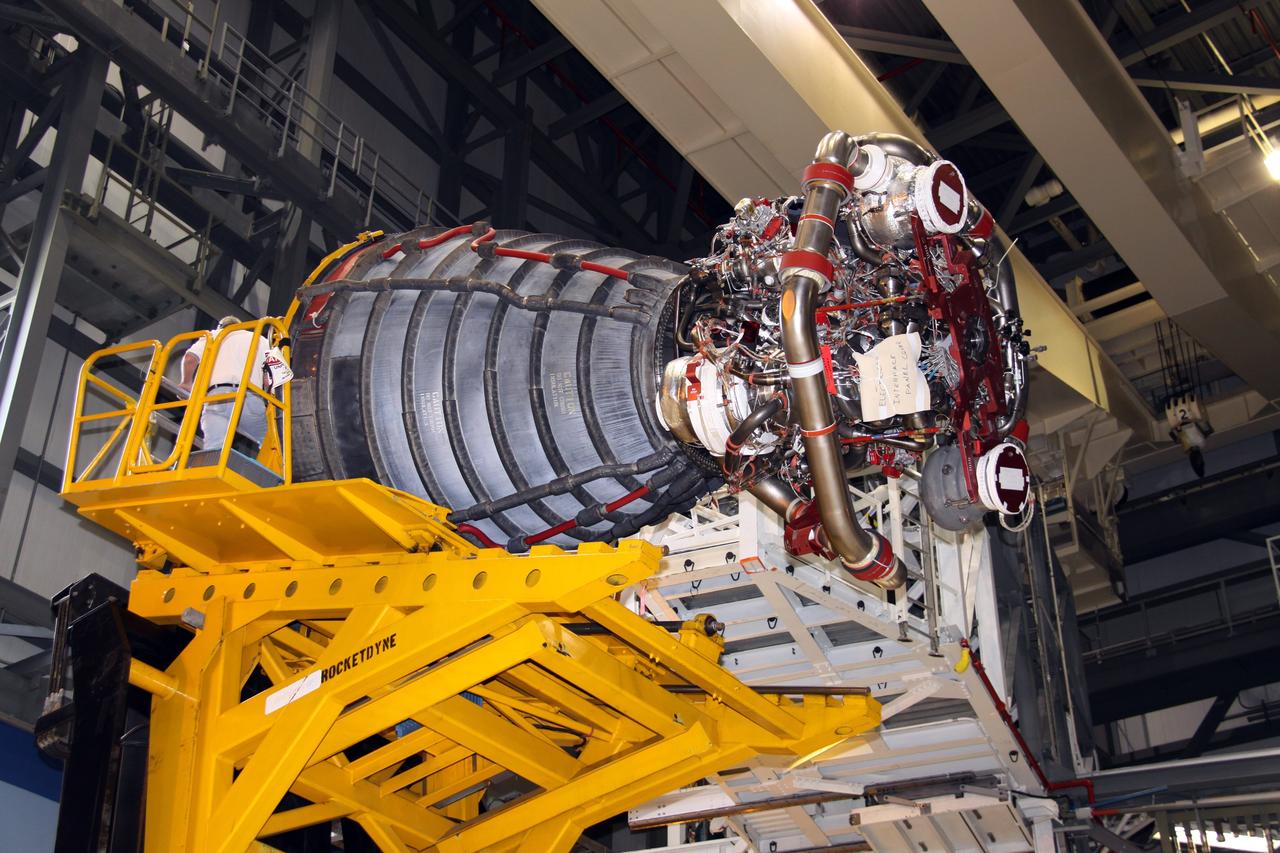
CAPE CANAVERAL, Fla. – In Orbiter Processing Bay 2 at NASA's Kennedy Space Center in Florida, main engine no. 1 is removed from space shuttle Endeavour. Engine removal is part of the post-landing processing; engine no. 2 was removed Aug. 17. Endeavour returned from the STS-127 mission July 31. Endeavour's next mission is STS-130 targeted for February 2010. Endeavour will deliver to the International Space Station the Tranquility pressurized module that will provide room for many of the station's life support systems. Photo credit: NASA/Jack Pfaller
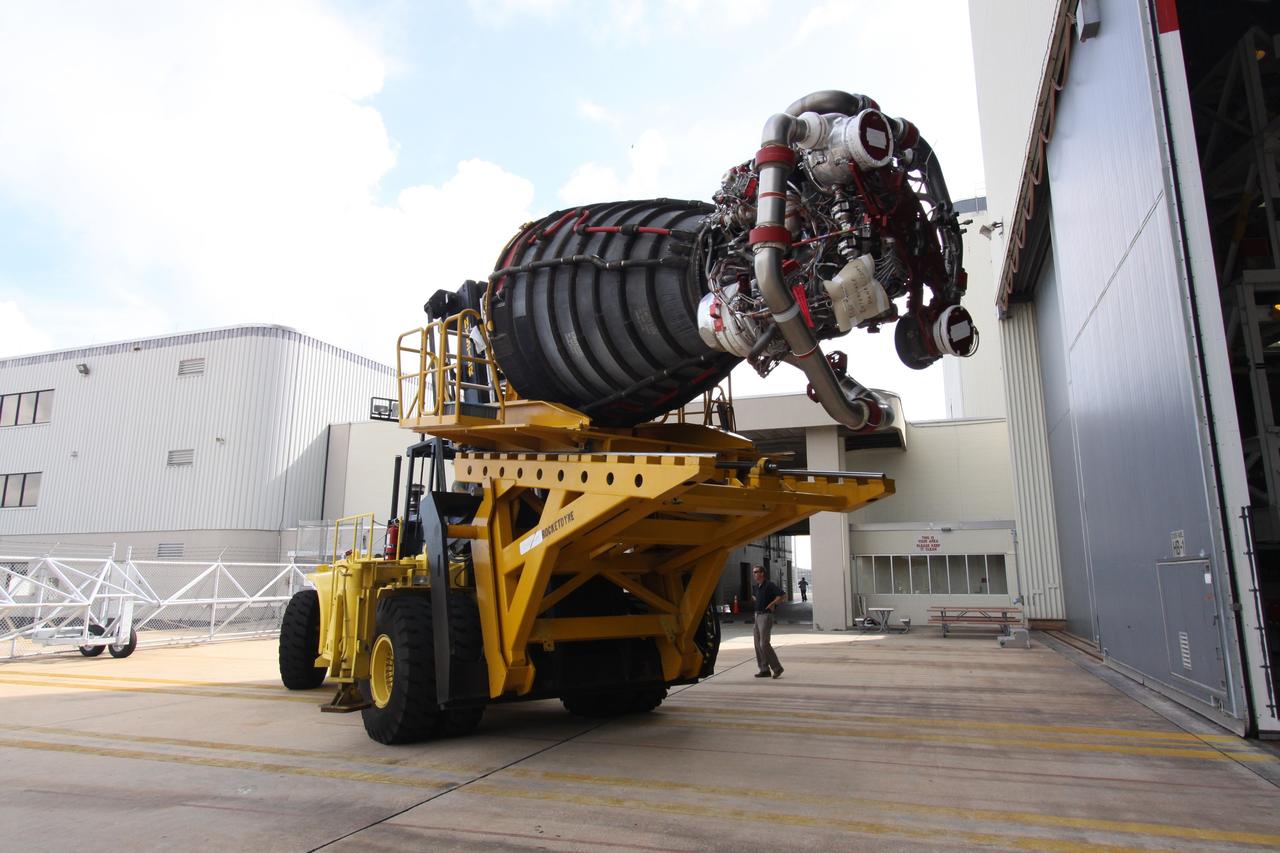
CAPE CANAVERAL, Fla. –At NASA's Kennedy Space Center in Florida, space shuttle Endeavour's main engine no. 1 is moved out of Orbiter Processing Bay 2 after removal from the shuttle. Engine removal is part of the post-landing processing; engine no. 2 was removed Aug. 17. Endeavour returned from the STS-127 mission July 31. Endeavour's next mission is STS-130 targeted for February 2010. Endeavour will deliver to the International Space Station the Tranquility pressurized module that will provide room for many of the station's life support systems. Photo credit: NASA/Jack Pfaller
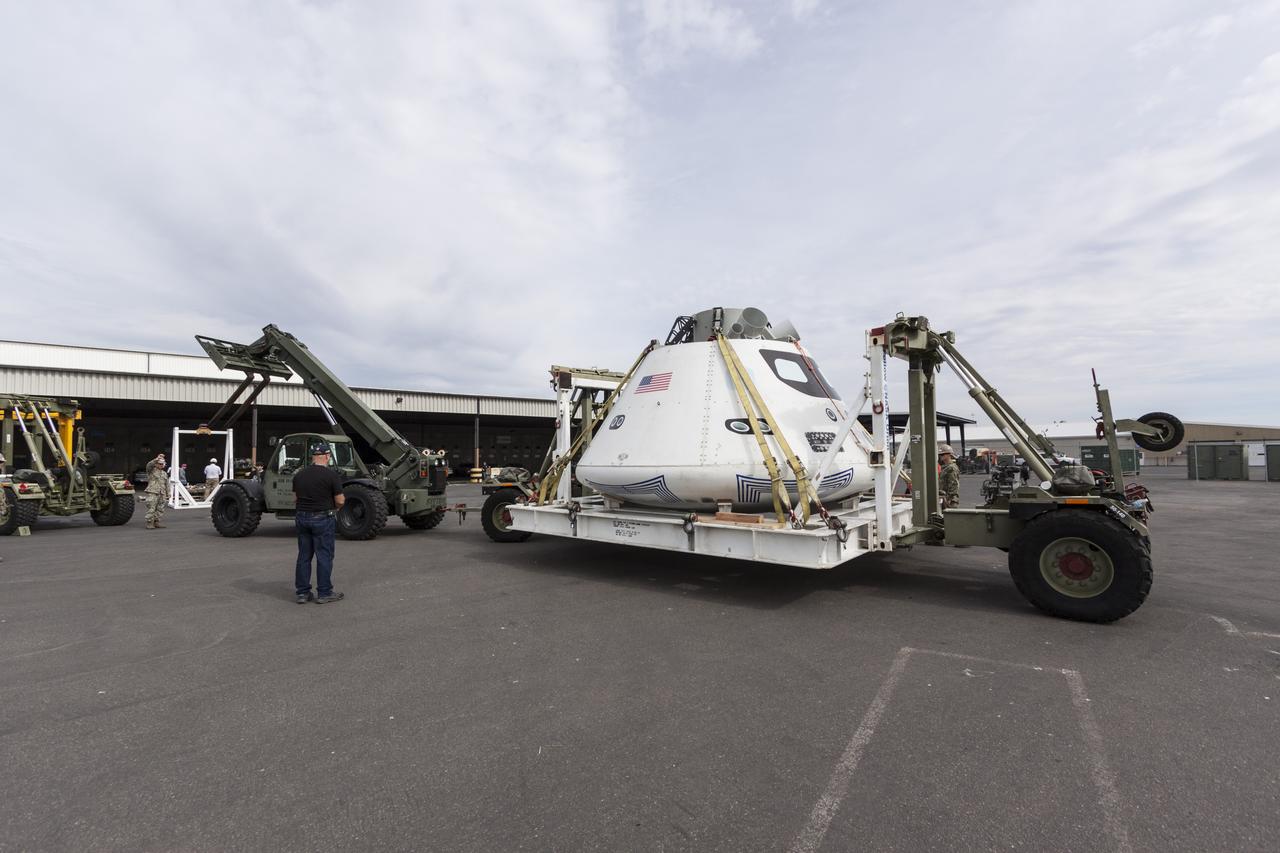
SAN DIEGO, Calif. – The Orion boilerplate test vehicle was offloaded from the USS San Diego at the U.S. Naval Base San Diego in California. Orion was transported in the ship’s well deck about 100 miles offshore for an underway recovery test. NASA and the U.S. Navy conducted tests to prepare for recovery of the Orion crew module, forward bay cover and parachutes on its return from a deep space mission. The underway recovery test allowed the teams to demonstrate and evaluate the recovery processes, procedures, hardware and personnel in open waters. During the testing, the tether lines were unable to support the tension caused by crew module motion that was driven by wave turbulence in the well deck of the ship. NASA and the U.S. Navy are reviewing the testing data collected to evaluate the next steps. The Ground Systems Development and Operations Program was conducting the recovery tests. Orion is the exploration spacecraft designed to carry astronauts to destinations not yet explored by humans, including an asteroid and Mars. It will have emergency abort capability, sustain the crew during space travel and provide safe re-entry from deep space return velocities. The first unpiloted test flight of the Orion is scheduled to launch in 2014 atop a Delta IV rocket and in 2017 on NASA’s Space Launch System rocket. For more information, visit http://www.nasa.gov/orion. Photo credit: NASA/Cory Huston
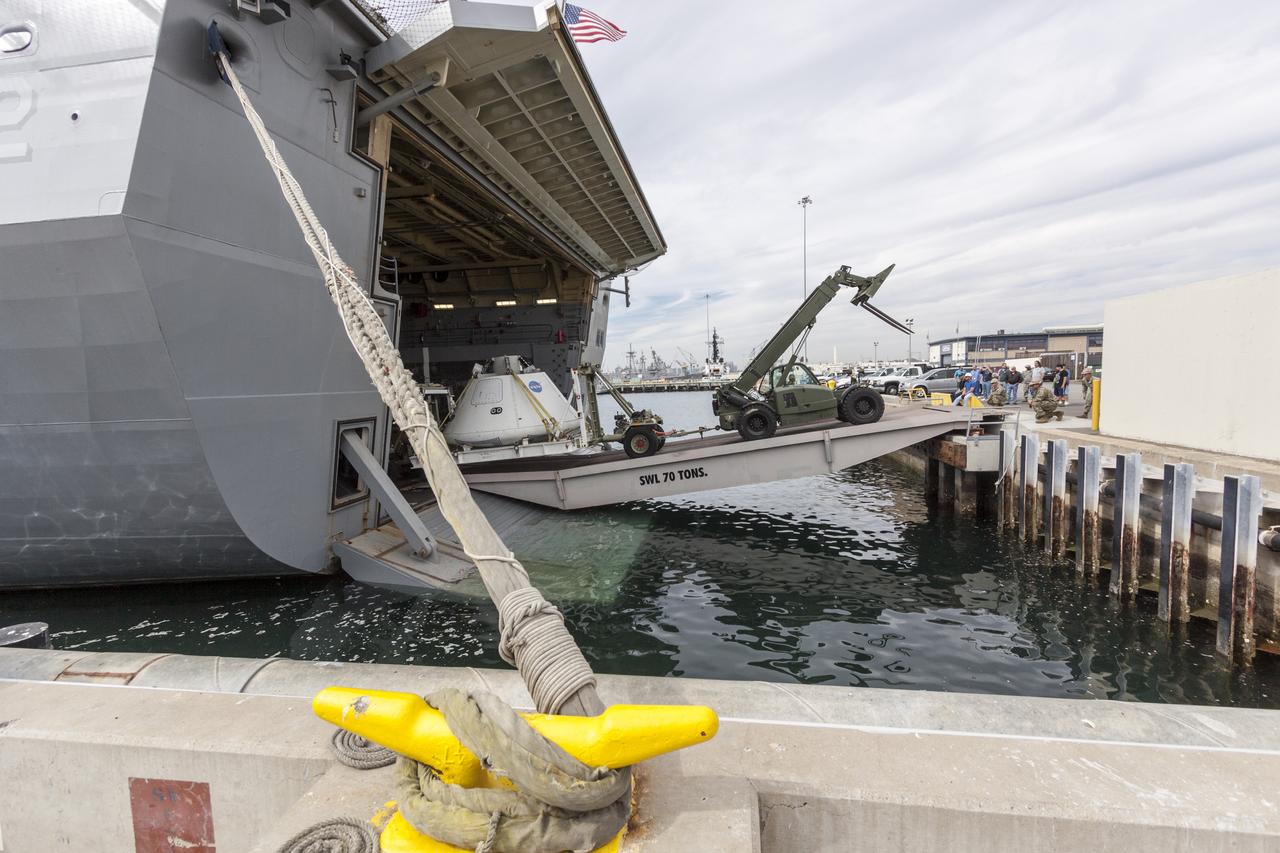
SAN DIEGO, Calif. – The Orion boilerplate test vehicle is being offloaded from the USS San Diego at the U.S. Naval Base San Diego in California. Orion was transported in the ship’s well deck about 100 miles offshore for an underway recovery test. NASA and the U.S. Navy conducted tests to prepare for recovery of the Orion crew module, forward bay cover and parachutes on its return from a deep space mission. The underway recovery test allowed the teams to demonstrate and evaluate the recovery processes, procedures, hardware and personnel in open waters. During the testing, the tether lines were unable to support the tension caused by crew module motion that was driven by wave turbulence in the well deck of the ship. NASA and the U.S. Navy are reviewing the testing data collected to evaluate the next steps. The Ground Systems Development and Operations Program was conducting the recovery tests. Orion is the exploration spacecraft designed to carry astronauts to destinations not yet explored by humans, including an asteroid and Mars. It will have emergency abort capability, sustain the crew during space travel and provide safe re-entry from deep space return velocities. The first unpiloted test flight of the Orion is scheduled to launch in 2014 atop a Delta IV rocket and in 2017 on NASA’s Space Launch System rocket. For more information, visit http://www.nasa.gov/orion. Photo credit: NASA/Cory Huston
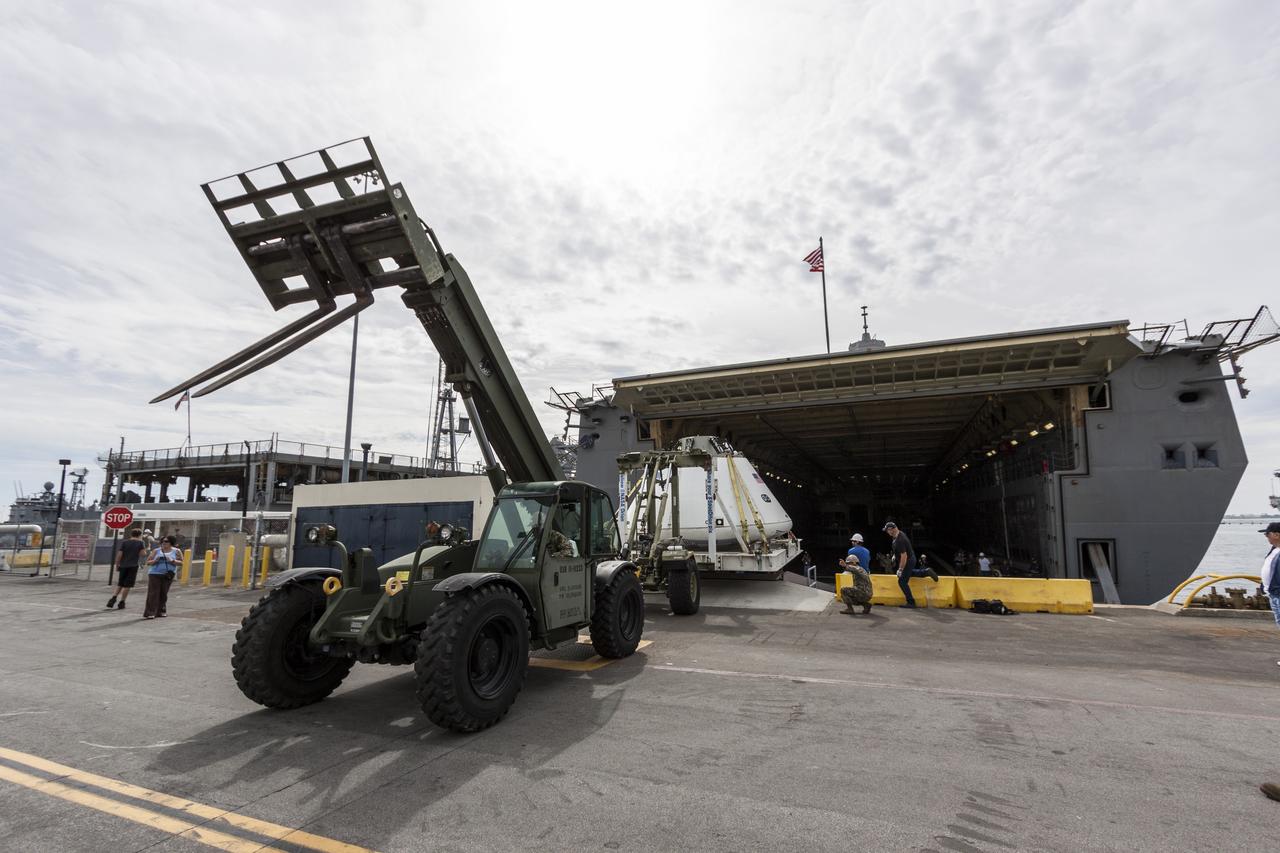
SAN DIEGO, Calif. – The Orion boilerplate test vehicle is being offloaded from the USS San Diego at the U.S. Naval Base San Diego in California. Orion was transported in the ship’s well deck about 100 miles offshore for an underway recovery test. NASA and the U.S. Navy conducted tests to prepare for recovery of the Orion crew module, forward bay cover and parachutes on its return from a deep space mission. The underway recovery test allowed the teams to demonstrate and evaluate the recovery processes, procedures, hardware and personnel in open waters. During the testing, the tether lines were unable to support the tension caused by crew module motion that was driven by wave turbulence in the well deck of the ship. NASA and the U.S. Navy are reviewing the testing data collected to evaluate the next steps. The Ground Systems Development and Operations Program was conducting the recovery tests. Orion is the exploration spacecraft designed to carry astronauts to destinations not yet explored by humans, including an asteroid and Mars. It will have emergency abort capability, sustain the crew during space travel and provide safe re-entry from deep space return velocities. The first unpiloted test flight of the Orion is scheduled to launch in 2014 atop a Delta IV rocket and in 2017 on NASA’s Space Launch System rocket. For more information, visit http://www.nasa.gov/orion. Photo credit: NASA/Cory Huston
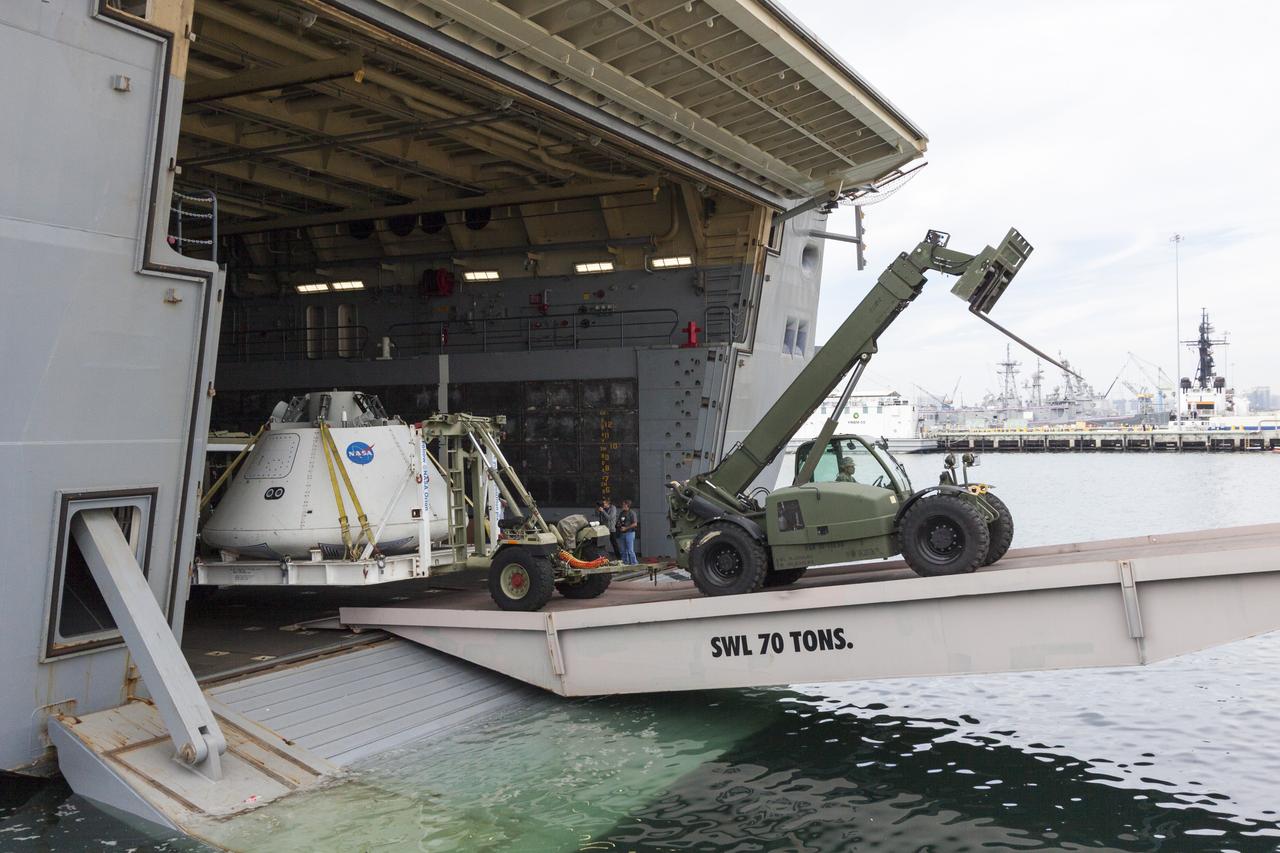
SAN DIEGO, Calif. – The Orion boilerplate test vehicle is being offloaded from the USS San Diego at the U.S. Naval Base San Diego in California. Orion was transported in the ship’s well deck about 100 miles offshore for an underway recovery test. NASA and the U.S. Navy conducted tests to prepare for recovery of the Orion crew module, forward bay cover and parachutes on its return from a deep space mission. The underway recovery test allowed the teams to demonstrate and evaluate the recovery processes, procedures, hardware and personnel in open waters. During the testing, the tether lines were unable to support the tension caused by crew module motion that was driven by wave turbulence in the well deck of the ship. NASA and the U.S. Navy are reviewing the testing data collected to evaluate the next steps. The Ground Systems Development and Operations Program was conducting the recovery tests. Orion is the exploration spacecraft designed to carry astronauts to destinations not yet explored by humans, including an asteroid and Mars. It will have emergency abort capability, sustain the crew during space travel and provide safe re-entry from deep space return velocities. The first unpiloted test flight of the Orion is scheduled to launch in 2014 atop a Delta IV rocket and in 2017 on NASA’s Space Launch System rocket. For more information, visit http://www.nasa.gov/orion. Photo credit: NASA/Cory Huston
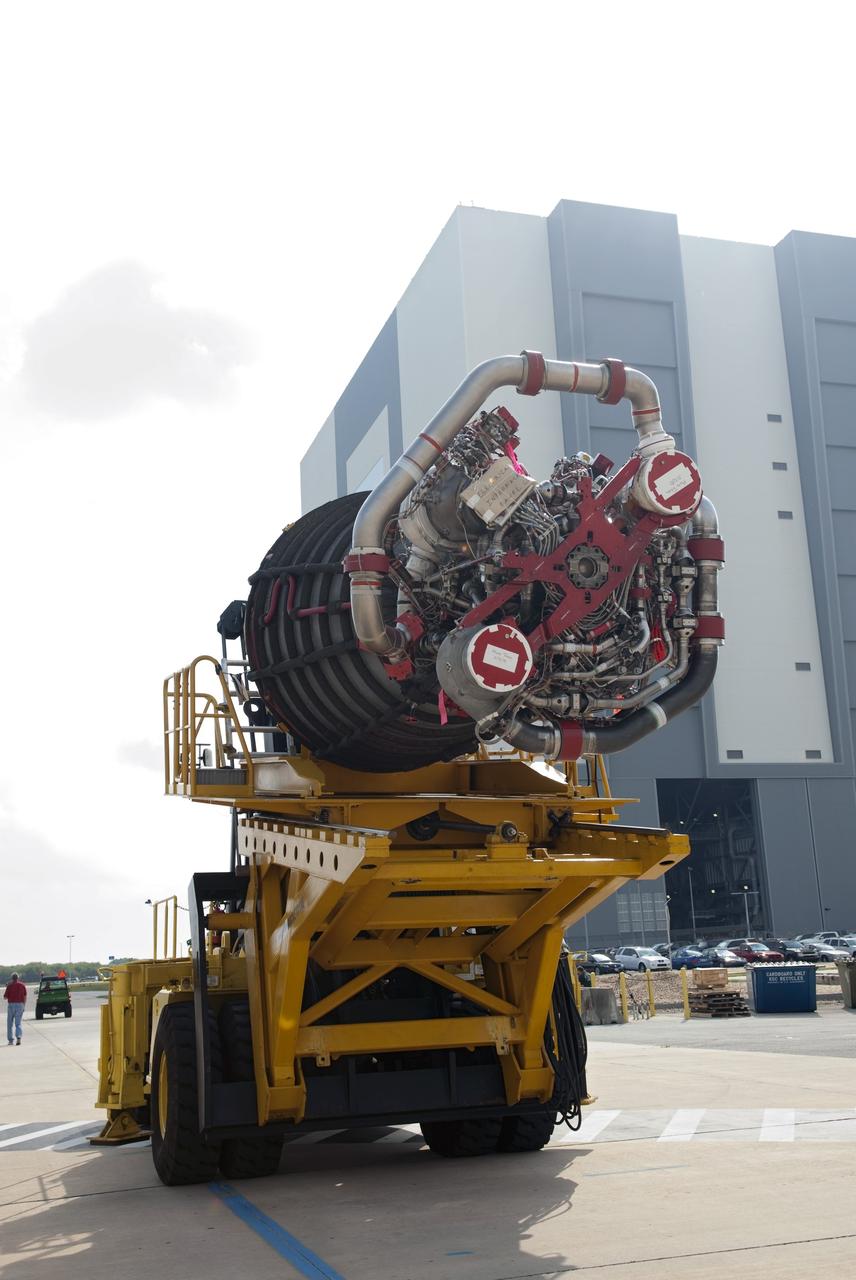
CAPE CANAVERAL, Fla. -- A heavy forklift with its specialized engine installer hold one of the main engines taken from space shuttle Discovery. The forklift is driving the engine from Orbiter Processing Facility-2 at NASA's Kennedy Space Center in Florida to the center's Space Shuttle Main Engine Processing Facility. The transition and retirement processing is expected to help rocket designers build next-generation spacecraft and prepare the shuttle for display. Photo credit: NASA/Jim Grossmann
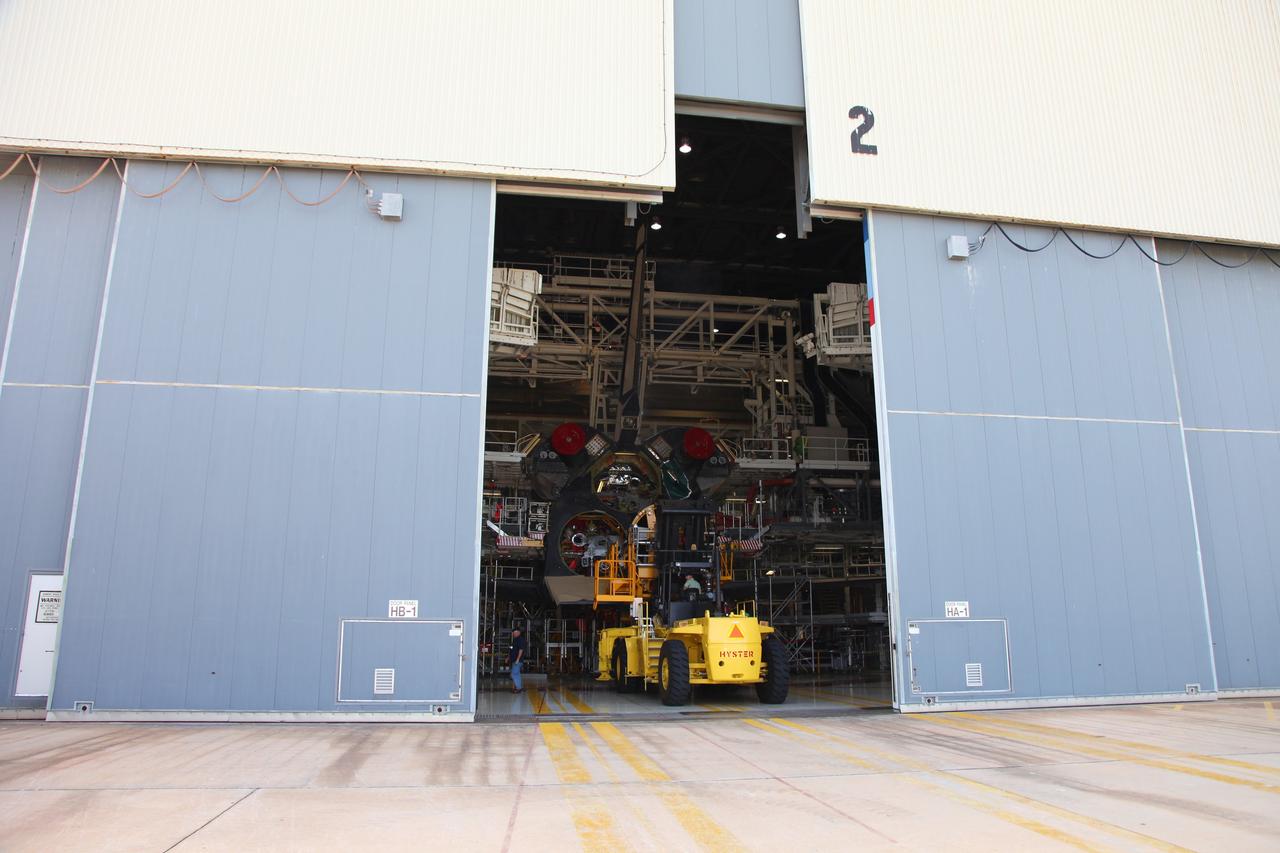
CAPE CANAVERAL, Fla. -- In Orbiter Processing Facility-2 at NASA’s Kennedy Space Center in Florida, technicians, using a Hyster forklift, have removed Engine #1, the final engine to be removed from space shuttle Atlantis. The forklift will be used to transport the engine to the Engine Shop for possible future use. Each of the three space shuttle main engines is 14 feet long and weighs 7,800 pounds.In Orbiter Processing Facility-2 at NASA’s Kennedy Space Center in Florida, technicians used a Hyster forklift to remove Engine #1, the final engine to be removed from space shuttle Atlantis. The forklift will be used to transport the engine to the Engine Shop for possible future use. Each of the three space shuttle main engines is 14 feet long and weighs 7,800 pounds. Removal of the space shuttle main engines is part of the Transition and Retirement work that is being performed in order to prepare Atlantis for eventual display at the Kennedy Space Center Visitor Complex in Florida. Photo credit: Frankie Martin
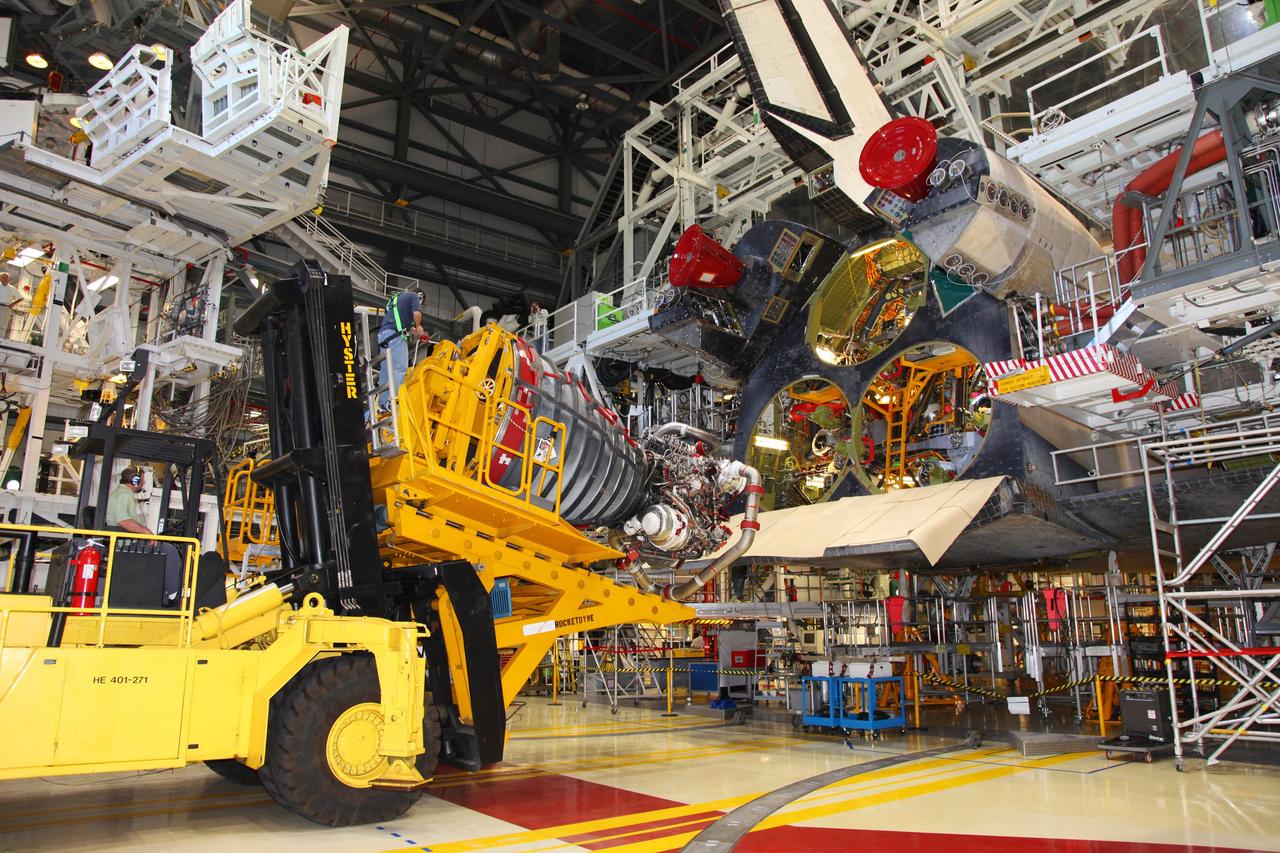
CAPE CANAVERAL, Fla. -- In Orbiter Processing Facility-2 at NASA’s Kennedy Space Center in Florida, technicians used a Hyster forklift to remove Engine #1, the final engine to be removed from space shuttle Atlantis. The forklift will be used to transport the engine to the Engine Shop for possible future use. Each of the three space shuttle main engines is 14 feet long and weighs 7,800 pounds. Removal of the space shuttle main engines is part of the Transition and Retirement work that is being performed in order to prepare Atlantis for eventual display at the Kennedy Space Center Visitor Complex in Florida. Photo credit: Frankie Martin
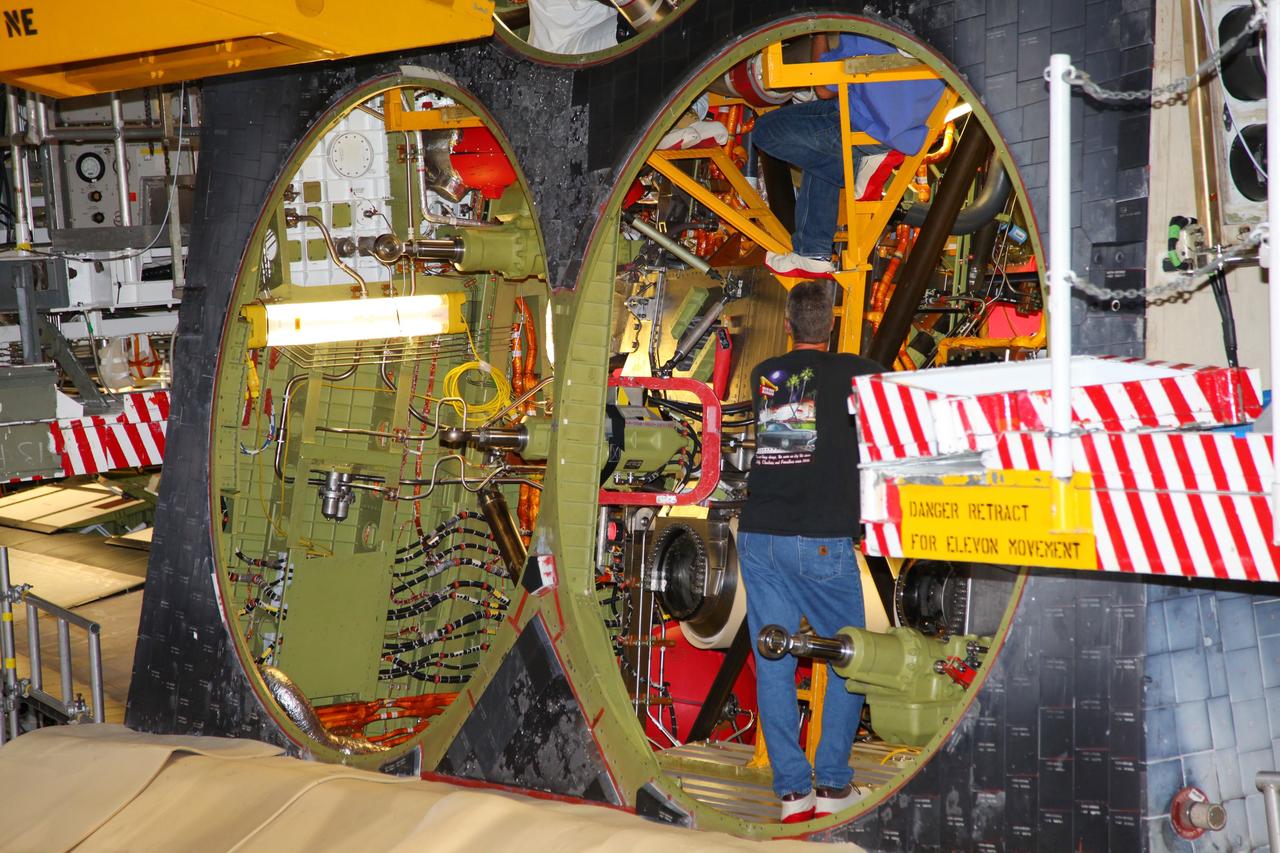
CAPE CANAVERAL, Fla. -- In Orbiter Processing Facility-2 at NASA’s Kennedy Space Center in Florida, technicians inside the aft area monitor the progress as a Hyster forklift is used to remove Engine #1, the final engine to be removed from space shuttle Atlantis. The forklift will be used to remove the engine and transport it to the Engine Shop for possible future use. Each of the three space shuttle main engines is 14 feet long and weighs 7,800 pounds. Removal of the space shuttle main engines is part of the Transition and Retirement work that is being performed in order to prepare Atlantis for eventual display at the Kennedy Space Center Visitor Complex in Florida. Photo credit: Frankie Martin
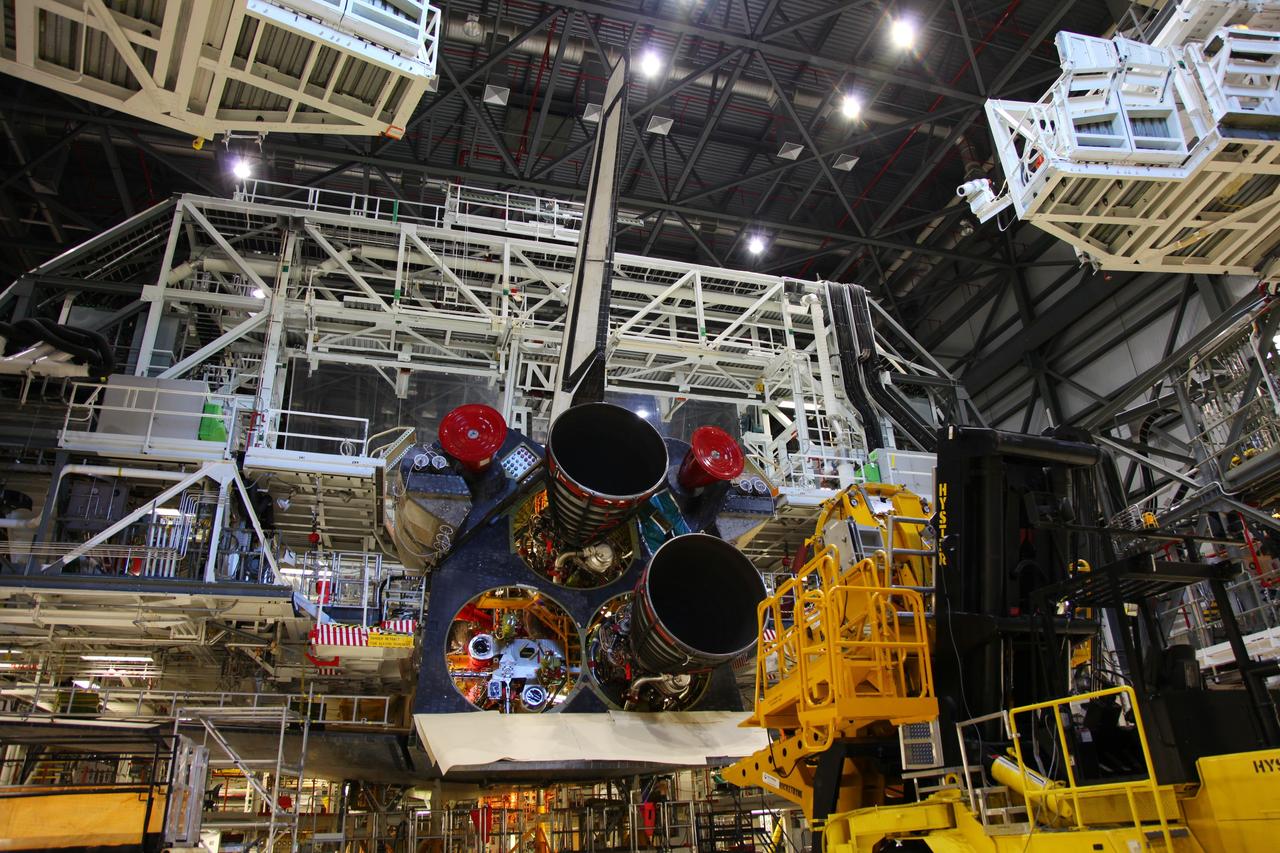
CAPE CANAVERAL, Fla. -- In Orbiter Processing Facility-2 at NASA’s Kennedy Space Center in Florida, a technician moves a Hyster forklift toward Engine #3 on space shuttle Atlantis. The forklift will be used to remove the engine and transport it to the Engine Shop for possible future use. Each of the three space shuttle main engines is 14 feet long and weighs 7,800 pounds. Removal of the space shuttle main engines is part of the Transition and Retirement work that is being performed in order to prepare Atlantis for eventual display at the Kennedy Space Center Visitor Complex in Florida. Photo credit: Frankie Martin
CAPE CANAVERAL, Fla. -- In Orbiter Processing Facility-2 at NASA’s Kennedy Space Center in Florida, a technician moves a Hyster forklift toward Engine #3 on space shuttle Atlantis. The forklift will be used to remove the engine and transport it to the Engine Shop for possible future use. Each of the three space shuttle main engines is 14 feet long and weighs 7,800 pounds. Removal of the space shuttle main engines is part of the Transition and Retirement work that is being performed in order to prepare Atlantis for eventual display at the Kennedy Space Center Visitor Complex in Florida. Photo credit: Frankie Martin
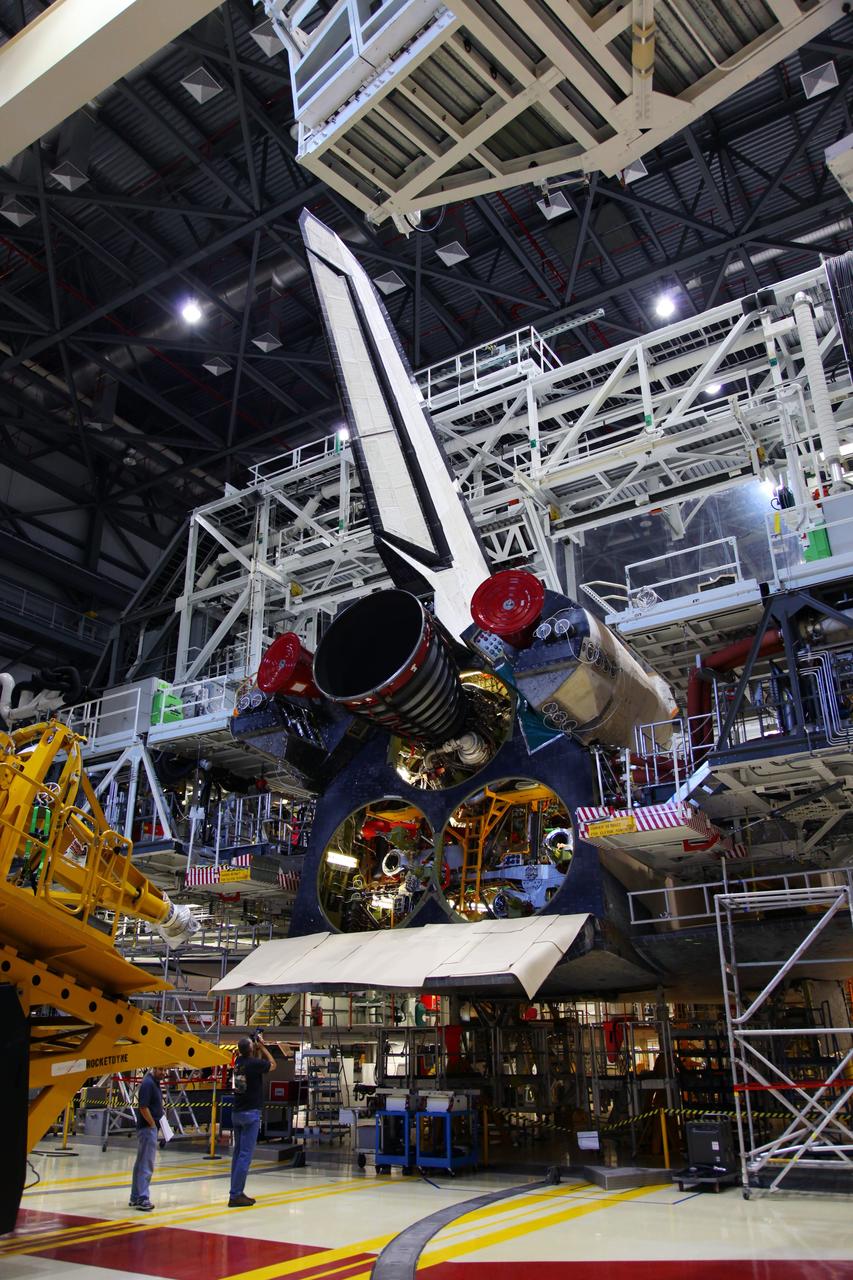
CAPE CANAVERAL, Fla. -- In Orbiter Processing Facility-2 at NASA’s Kennedy Space Center in Florida, technicians move a Hyster forklift toward Engine #1, the final engine to be removed from space shuttle Atlantis. The forklift will be used to remove the engine and transport it to the Engine Shop for possible future use. Each of the three space shuttle main engines is 14 feet long and weighs 7,800 pounds. Removal of the space shuttle main engines is part of the Transition and Retirement work that is being performed in order to prepare Atlantis for eventual display at the Kennedy Space Center Visitor Complex in Florida. Photo credit: Frankie Martin
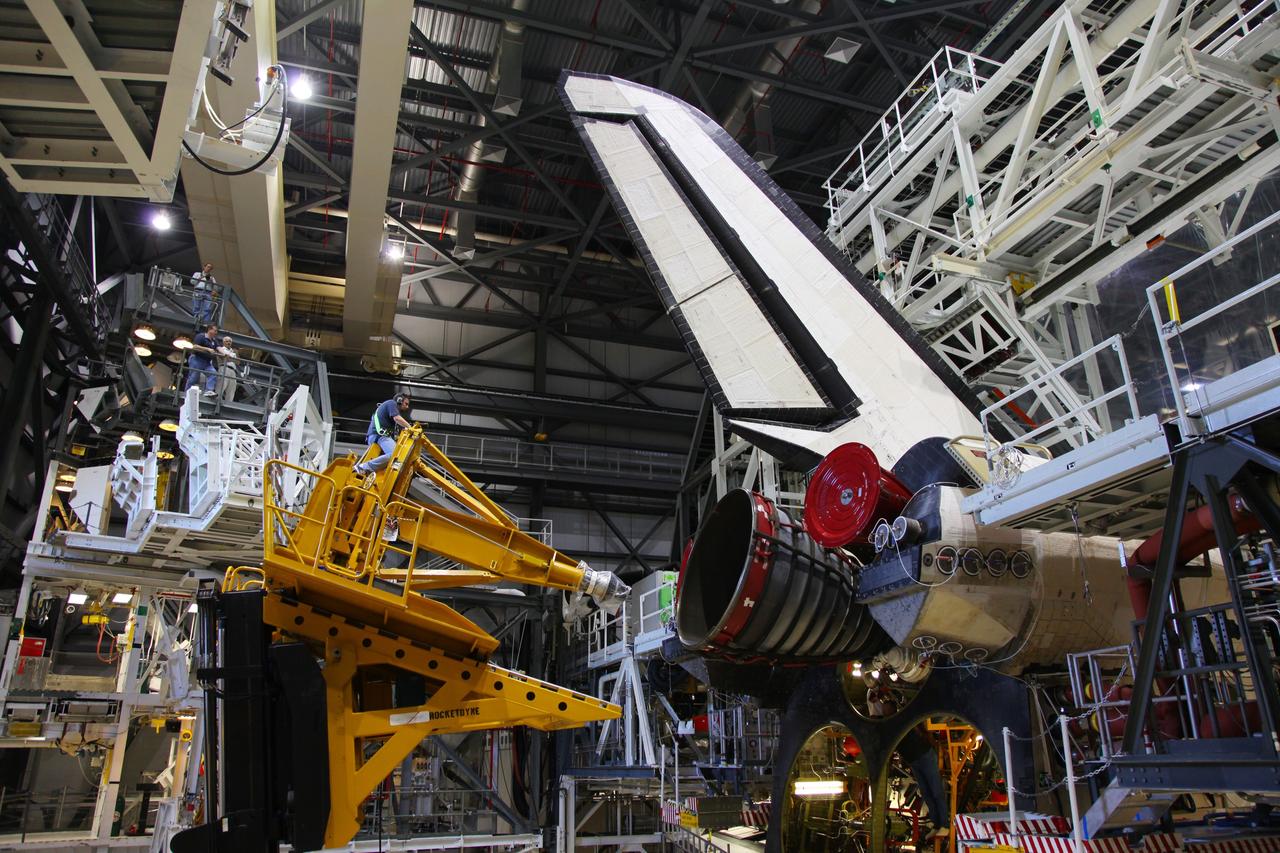
CAPE CANAVERAL, Fla. -- In Orbiter Processing Facility-2 at NASA’s Kennedy Space Center in Florida, technicians move a Hyster forklift closer to Engine #1, the final engine to be removed from space shuttle Atlantis. The forklift will be used to remove the engine and transport it to the Engine Shop for possible future use. Each of the three space shuttle main engines is 14 feet long and weighs 7,800 pounds. Removal of the space shuttle main engines is part of the Transition and Retirement work that is being performed in order to prepare Atlantis for eventual display at the Kennedy Space Center Visitor Complex in Florida. Photo credit: Frankie Martin
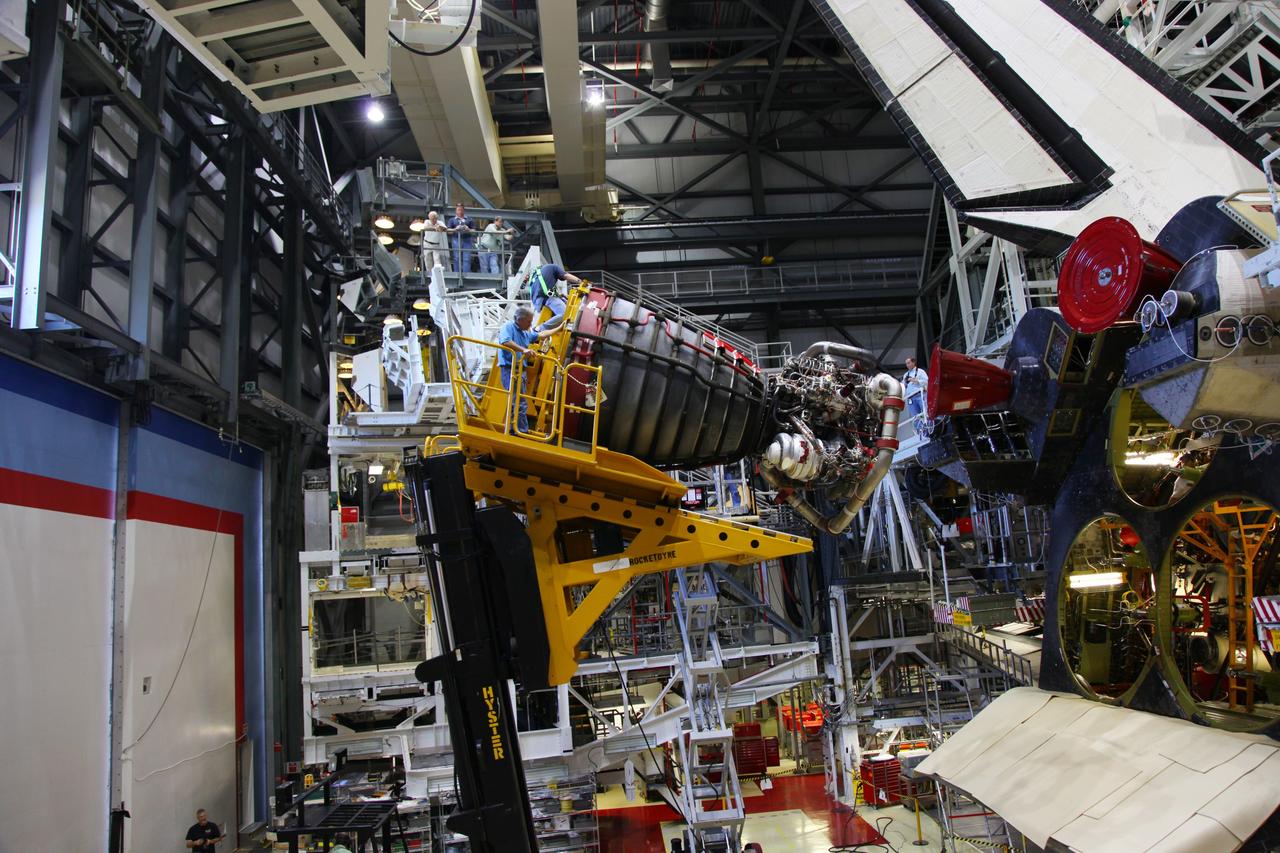
CAPE CANAVERAL, Fla. -- In Orbiter Processing Facility-2 at NASA’s Kennedy Space Center in Florida, technicians use a Hyster forklift to remove Engine #1, the final engine to be removed from space shuttle Atlantis. The forklift will be used to transport the engine to the Engine Shop for possible future use. Each of the three space shuttle main engines is 14 feet long and weighs 7,800 pounds. Removal of the space shuttle main engines is part of the Transition and Retirement work that is being performed in order to prepare Atlantis for eventual display at the Kennedy Space Center Visitor Complex in Florida. Photo credit: Frankie Martin
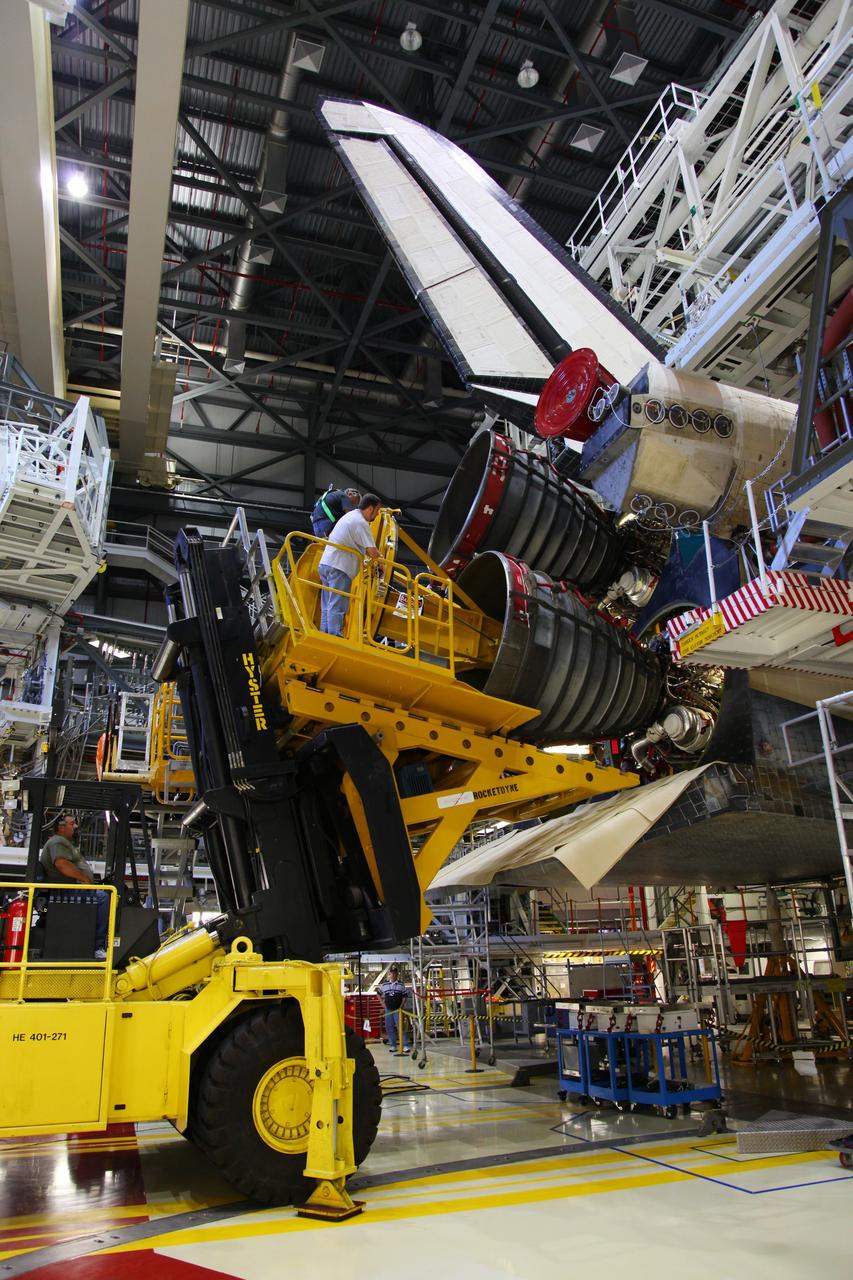
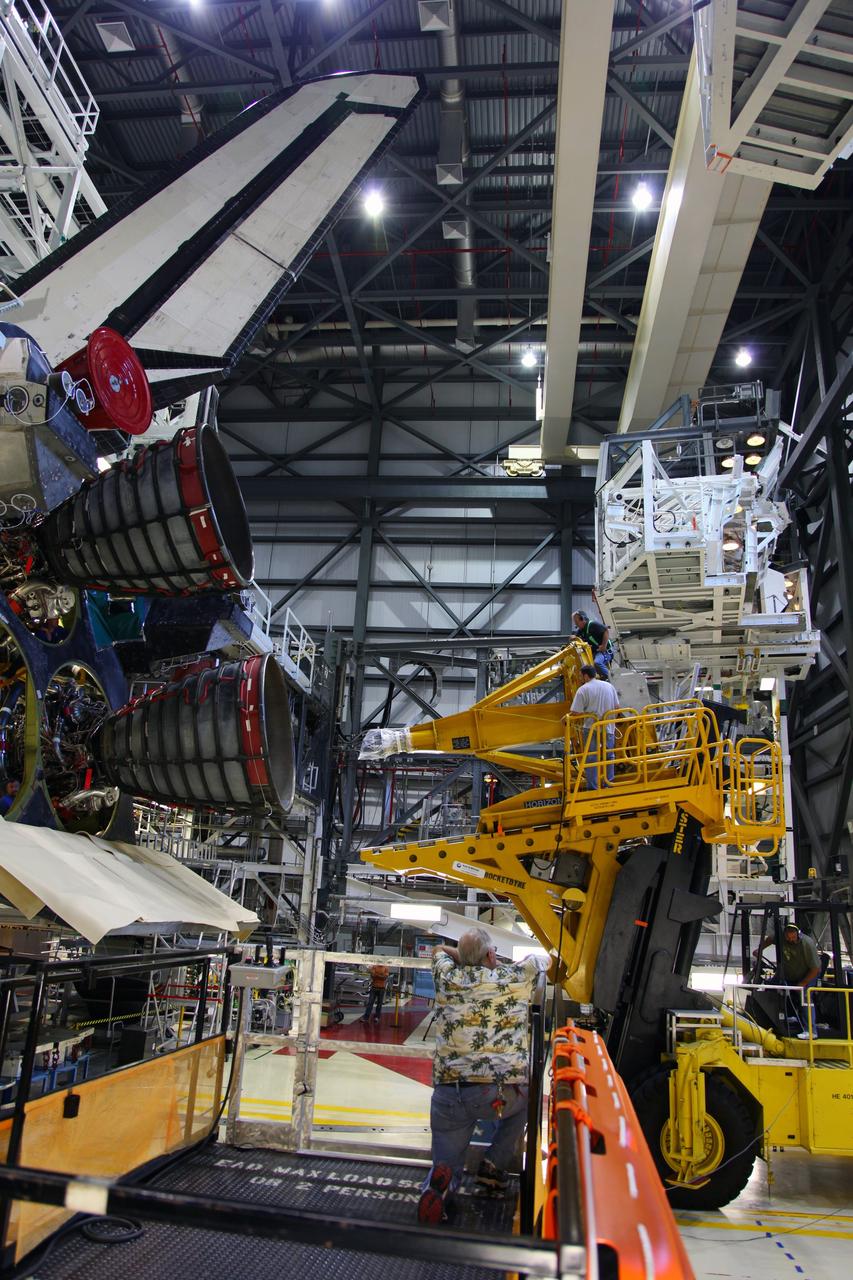
CAPE CANAVERAL, Fla. -- In Orbiter Processing Facility-2 at NASA’s Kennedy Space Center in Florida, technicians use a Hyster forklift to position an engine removal device on Engine #3 on space shuttle Atlantis. The forklift will be used to remove the engine and transport it to the Engine Shop for possible future use. Each of the three space shuttle main engines is 14 feet long and weighs 7,800 pounds. Removal of the space shuttle main engines is part of the Transition and Retirement work that is being performed in order to prepare Atlantis for eventual display at the Kennedy Space Center Visitor Complex in Florida. Photo credit: Frankie Martin
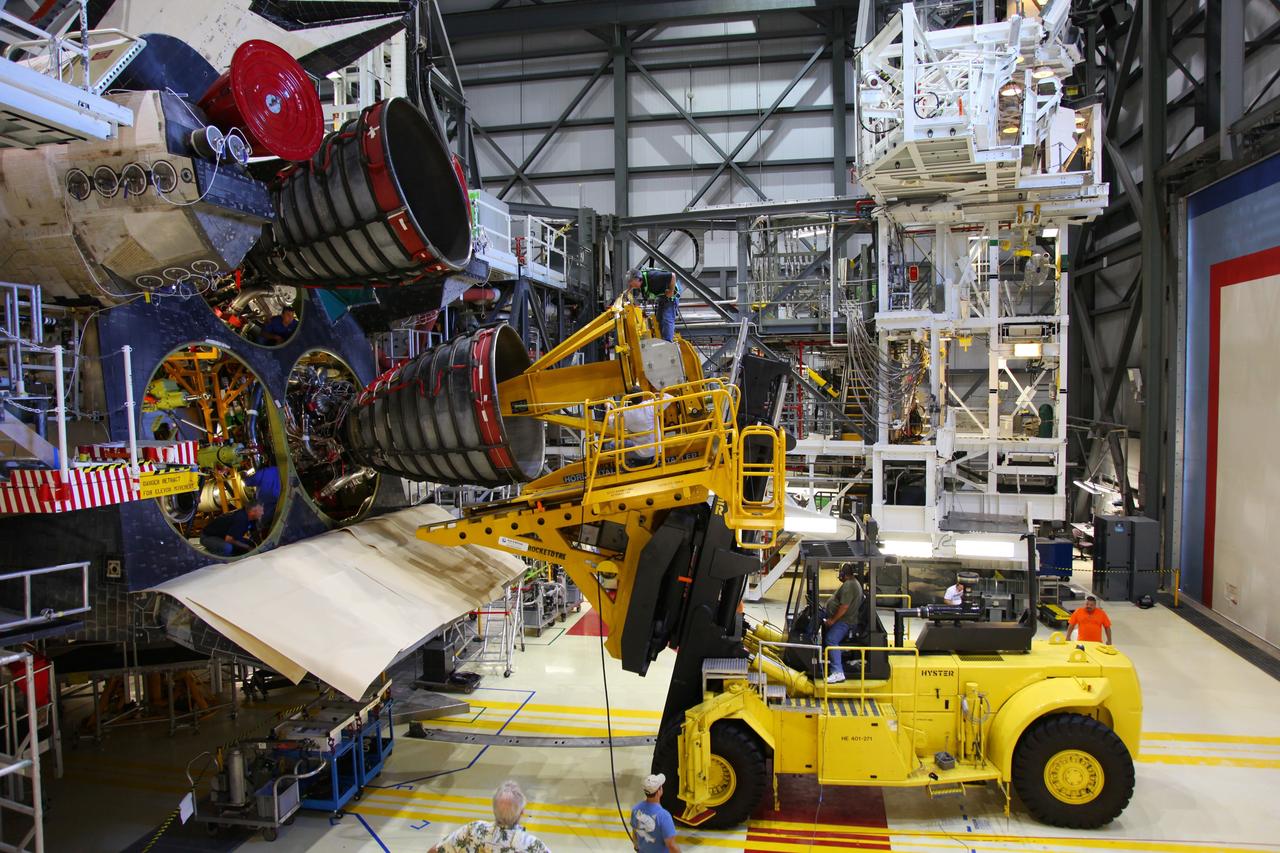
CAPE CANAVERAL, Fla. -- In Orbiter Processing Facility-2 at NASA’s Kennedy Space Center in Florida, technicians use a Hyster forklift to position an engine removal device on Engine #3 on space shuttle Atlantis. The forklift will be used to remove the engine and transport it to the Engine Shop for possible future use. Each of the three space shuttle main engines is 14 feet long and weighs 7,800 pounds. Removal of the space shuttle main engines is part of the Transition and Retirement work that is being performed in order to prepare Atlantis for eventual display at the Kennedy Space Center Visitor Complex in Florida. Photo credit: Frankie Martin
CAPE CANAVERAL, Fla. -- In Orbiter Processing Facility-2 at NASA’s Kennedy Space Center in Florida, a technician sitting on the Hyster forklift monitors the progress as the engine removal device moves toward Engine #1, the final engine to be removed from space shuttle Atlantis. The forklift will be used to remove the engine and transport it to the Engine Shop for possible future use. Each of the three space shuttle main engines is 14 feet long and weighs 7,800 pounds. Removal of the space shuttle main engines is part of the Transition and Retirement work that is being performed in order to prepare Atlantis for eventual display at the Kennedy Space Center Visitor Complex in Florida. Photo credit: Frankie Martin
CAPE CANAVERAL, Fla. -- In Orbiter Processing Facility-2 at NASA’s Kennedy Space Center in Florida, technicians use a Hyster forklift to remove Engine #1, the final engine to be removed from space shuttle Atlantis. The forklift will be used to transport the engine to the Engine Shop for possible future use. Each of the three space shuttle main engines is 14 feet long and weighs 7,800 pounds. Removal of the space shuttle main engines is part of the Transition and Retirement work that is being performed in order to prepare Atlantis for eventual display at the Kennedy Space Center Visitor Complex in Florida. Photo credit: Frankie Martin
CAPE CANAVERAL, Fla. -- In Orbiter Processing Facility-2 at NASA’s Kennedy Space Center in Florida, a technician moves a Hyster forklift toward Engine #3 on space shuttle Atlantis. The forklift will be used to remove the engine and transport it to the Engine Shop for possible future use. Each of the three space shuttle main engines is 14 feet long and weighs 7,800 pounds. Removal of the space shuttle main engines is part of the Transition and Retirement work that is being performed in order to prepare Atlantis for eventual display at the Kennedy Space Center Visitor Complex in Florida. Photo credit: Frankie Martin
CAPE CANAVERAL, Fla. -- In Orbiter Processing Facility-2 at NASA’s Kennedy Space Center in Florida, a technician moves a Hyster forklift toward Engine #3 on space shuttle Atlantis. The forklift will be used to remove the engine and transport it to the Engine Shop for possible future use. Each of the three space shuttle main engines is 14 feet long and weighs 7,800 pounds. Removal of the space shuttle main engines is part of the Transition and Retirement work that is being performed in order to prepare Atlantis for eventual display at the Kennedy Space Center Visitor Complex in Florida. Photo credit: Frankie Martin
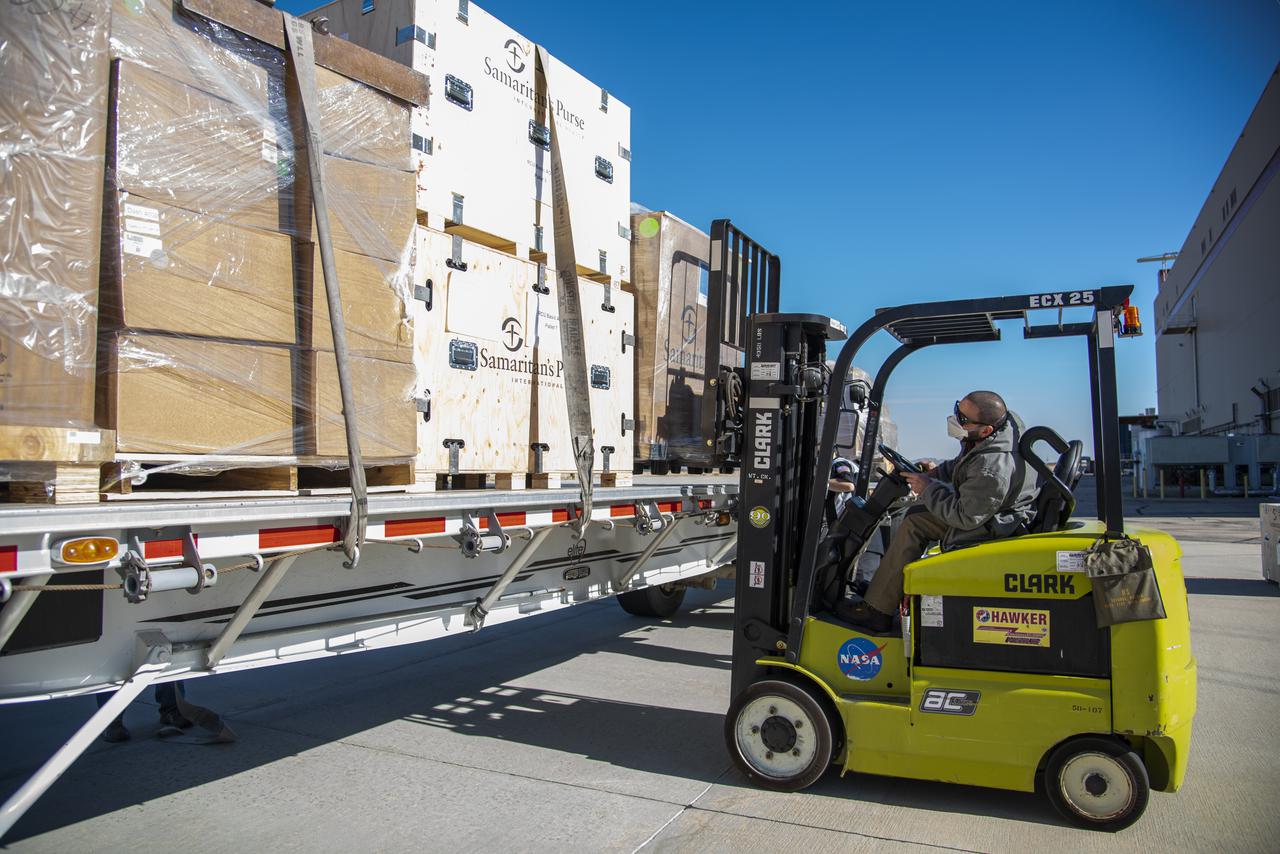
Marlon Espinoza uses a forklift at NASA's Armstrong Flight Research Center Building 703 in Palmdale, California, to assist in Samaritan Purse's COVID-19 aid work. The supplies were unloaded from a DC-8 and loaded onto a truck.
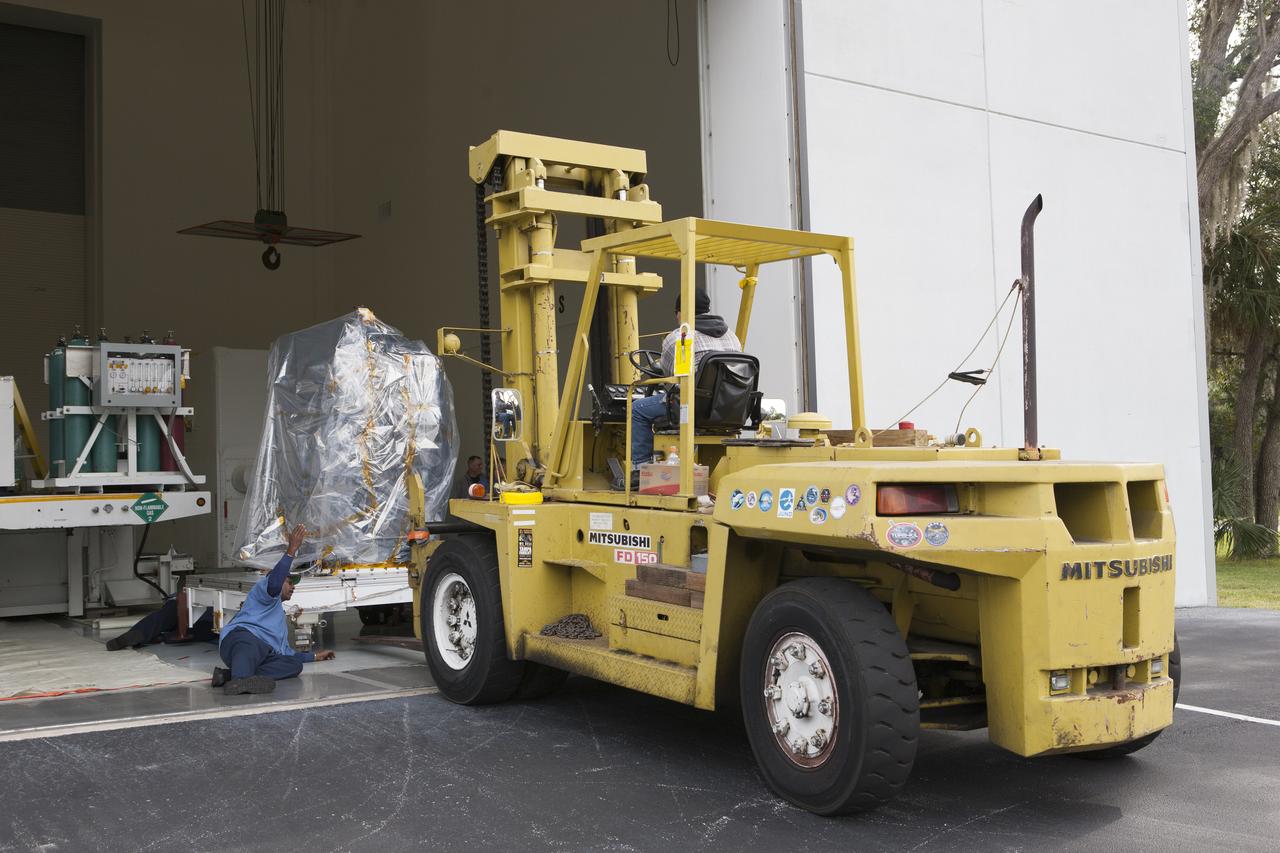
A forklift is enlisted to move NOAA’s Deep Space Climate Observatory spacecraft, or DSCOVR, wrapped in plastic and secured onto a portable work stand, from the airlock of Building 2 to the high bay of Building 1 at the Astrotech payload processing facility.
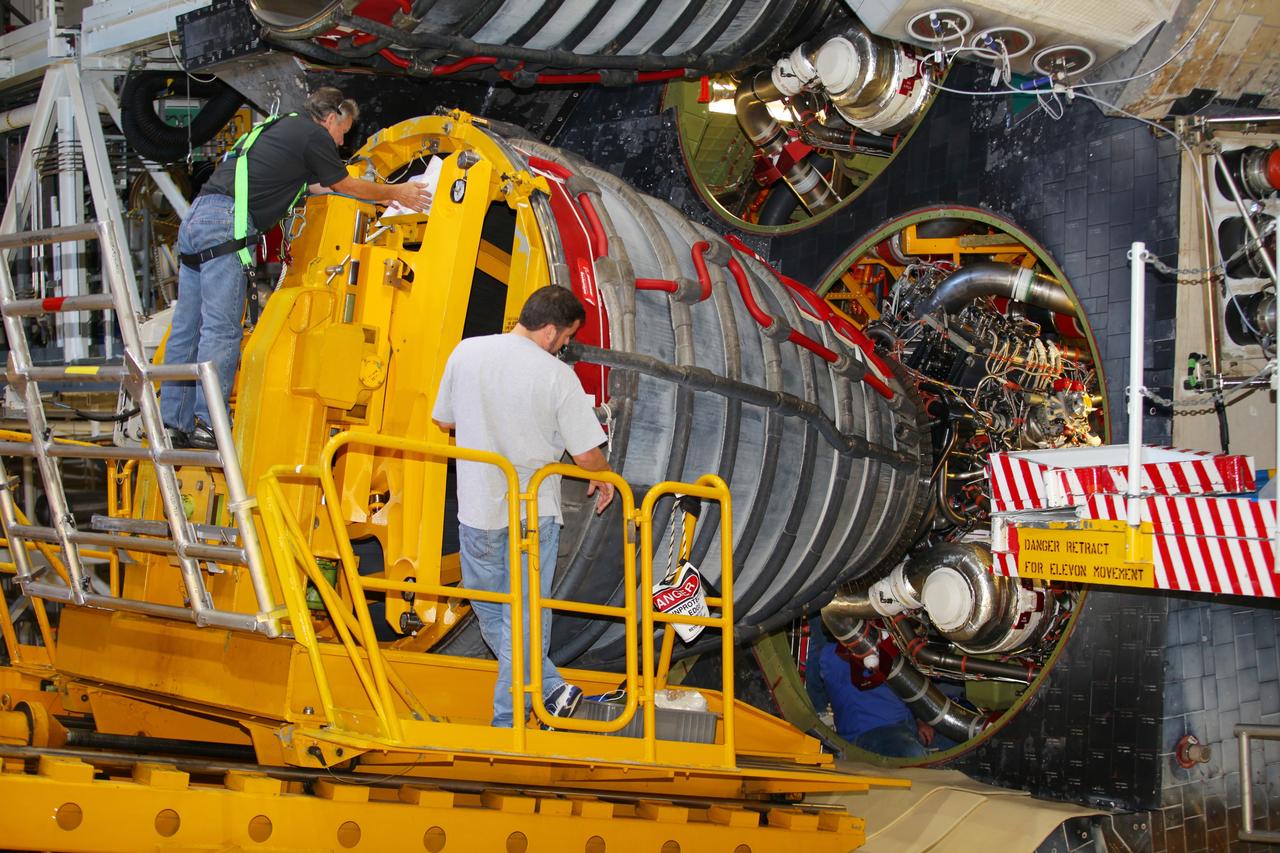
CAPE CANAVERAL, Fla. -- In Orbiter Processing Facility-2 at NASA’s Kennedy Space Center in Florida, technicians monitor the progress as they use a Hyster forklift to position an engine removal device on Engine #3 on space shuttle Atlantis. Inside the aft section, a technician disconnects hydraulic, fluid and electrical lines. The forklift will be used to remove the engine and transport it to the Engine Shop for possible future use. Each of the three space shuttle main engines is 14 feet long and weighs 7,800 pounds. Removal of the space shuttle main engines is part of the Transition and Retirement work that is being performed in order to prepare Atlantis for eventual display at the Kennedy Space Center Visitor Complex in Florida. Photo credit: Frankie Martin
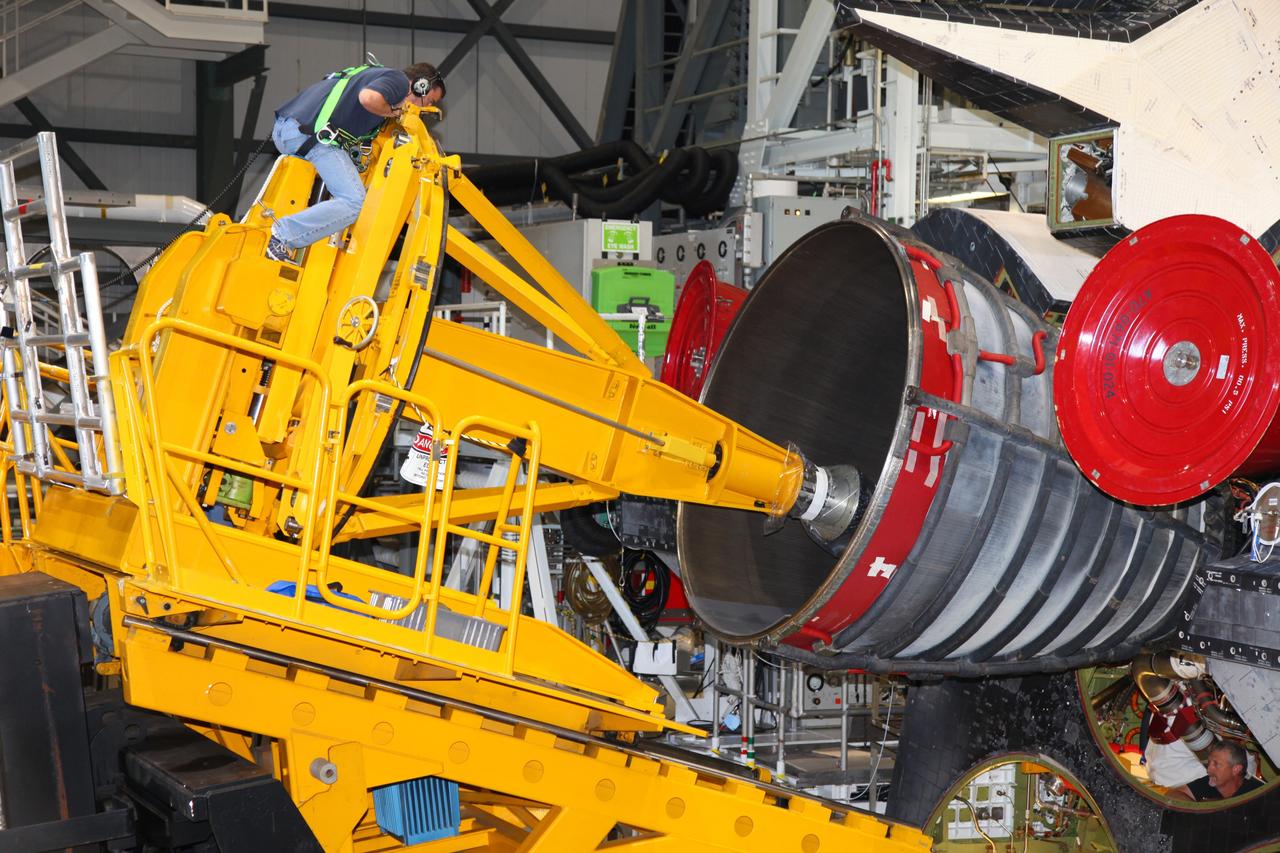
CAPE CANAVERAL, Fla. -- In Orbiter Processing Facility-2 at NASA’s Kennedy Space Center in Florida, a technician sits on top of the Hyster forklift to help guide the engine removal device toward Engine #1, the final engine to be removed from space shuttle Atlantis. Another technician monitors the progress from inside the aft section of Atlantis. The forklift will be used to remove the engine and transport it to the Engine Shop for possible future use. Each of the three space shuttle main engines is 14 feet long and weighs 7,800 pounds. Removal of the space shuttle main engines is part of the Transition and Retirement work that is being performed in order to prepare Atlantis for eventual display at the Kennedy Space Center Visitor Complex in Florida. Photo credit: Frankie Martin
In Orbiter Processing Facility bay 2, technicians on a Hyster forklift maneuver space shuttle main engine no. 3 into place on Endeavour. Each space shuttle main engine is 14 feet long, weighs about 6,700 pounds, and is 7.5 feet in diameter at the end of the nozzle. The orbiter is scheduled for mission STS-118, targeted for launch on June 28. The mission will be the 22nd flight to the International Space Station, carrying another starboard array, S5, for installation.
CAPE CANAVERAL, Fla. - Technicians carefully remove main engine No. 1 from space shuttle Discovery using a specially designed engine installer, called a Hyster forklift. The work is taking place in Orbiter Processing Facility-2 at NASA's Kennedy Space Center in Florida. The removal is part of Discovery's transition and retirement processing. Work performed on Discovery is expected to help rocket designers build next-generation spacecraft and prepare the shuttle for future public display. Photo credit: NASA/Jack Pfaller
CAPE CANAVERAL, Fla. – In the Orbiter Processing Facility bay 2, technicians on the Hyster forklift maneuver main engine 1 for installation on space shuttle Endeavour. The scheduled launch vehicle for the STS-126 mission, Endeavour will deliver a multi-purpose logistics module to the International Space Station. Launch is targeted for Nov. 10. Endeavour is also the backup shuttle, if needed for rescue, for the STS-125 mission in October that will make repairs on the Hubble Space Telescope. For that purpose, it is designated STS-400. Photo credit: NASA/Jim Grossmann
KENNEDY SPACE CENTER, FLA. -- In Orbiter Processing Facility bay 2, technicians on a Hyster forklift maneuver space shuttle main engine no. 3 into place on Endeavour. Each space shuttle main engine is 14 feet long, weighs about 6,700 pounds, and is 7.5 feet in diameter at the end of the nozzle. The orbiter is scheduled for mission STS-118, targeted for launch on June 28. The mission will be the 22nd flight to the International Space Station, carrying another starboard array, S5, for installation. Photo credit: NASA/George Shelton
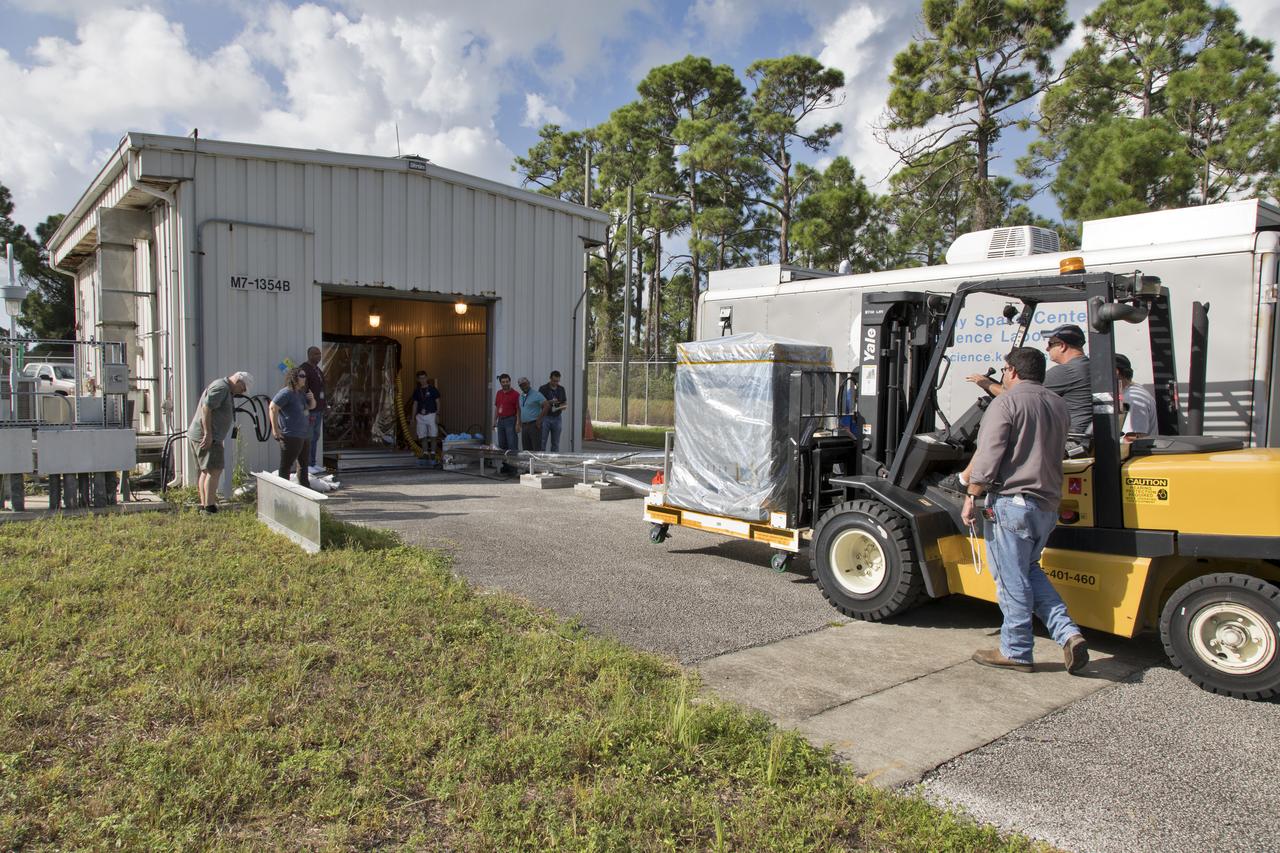
A worker uses a forklift to carry the Robotic Refueling Mission-3 (RRM3) payload to the entrance of the Payload Hazardous Servicing Facility on Oct. 3, 2018, at NASA's Kennedy Space Center in Florida. The payload will be carried to the International Space Station on SpaceX's 16th Commercial Resupply Services mission. RRM3 demonstrates the transfer of xenon gas and liquid methane in microgravity, and advances technologies for storing and manipulating these cryogenic fuels robotically. RRM3 also supports development of technology for the Restore-L mission, a robotic spacecraft equipped to service satellites in-orbit.
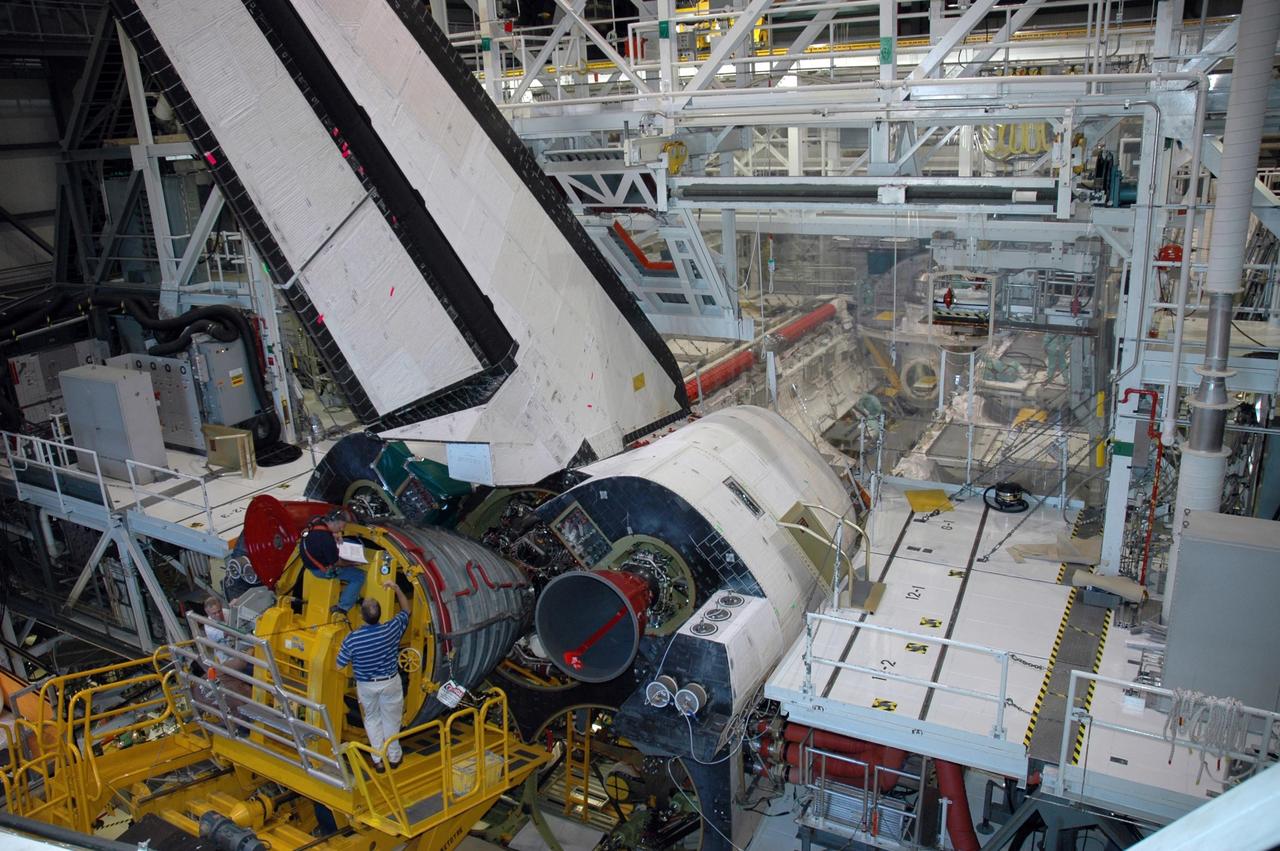
KENNEDY SPACE CENTER, FLA. -- In Orbiter Processing Facility bay 3 at NASA's Kennedy Space Center, technicians on a Hyster forklift maneuver space shuttle main engine no. 1 into place on Endeavour. Each space shuttle main engine is 14 feet long, weighs about 6,700 pounds, and is 7.5 feet in diameter at the end of the nozzle. The orbiter is targeted for launch on Feb. 14 for mission STS-123 to the International Space Station. Photo credit: NASA/Jack Pfaller
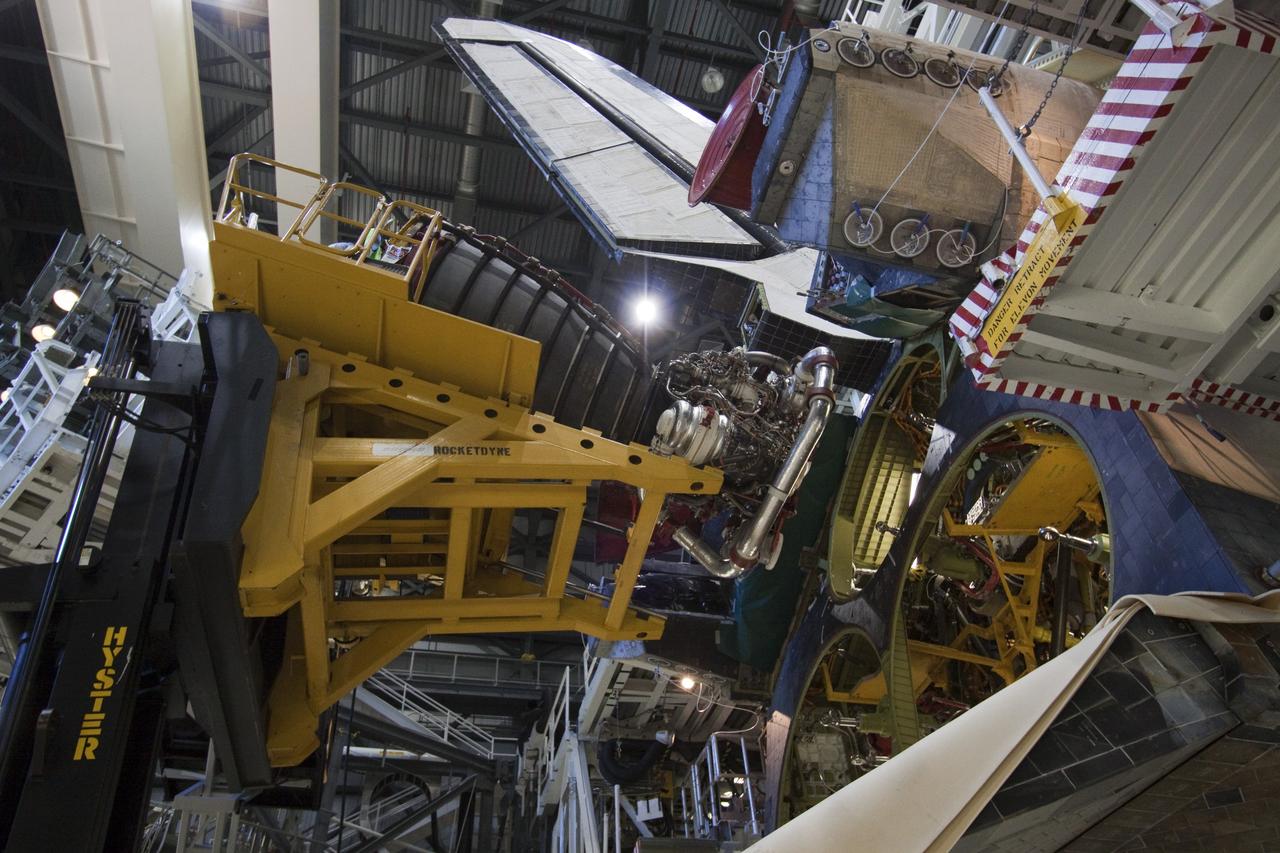
CAPE CANAVERAL, Fla. - Technicians complete the removal of main engine No. 1 from space shuttle Discovery using a specially designed engine installer, called a Hyster forklift. The work is taking place in Orbiter Processing Facility-2 at NASA's Kennedy Space Center in Florida. The removal is part of Discovery's transition and retirement processing. Work performed on Discovery is expected to help rocket designers build next-generation spacecraft and prepare the shuttle for future public display. Photo credit: NASA/Jack Pfaller

KENNEDY SPACE CENTER, FLA. -- In Orbiter Processing Facility bay 3 at NASA's Kennedy Space Center, technicians on a Hyster forklift move space shuttle main engine no. 1 toward Endeavour for installation. Each space shuttle main engine is 14 feet long, weighs about 6,700 pounds, and is 7.5 feet in diameter at the end of the nozzle. The orbiter is targeted for launch on Feb. 14 for mission STS-123 to the International Space Station. Photo credit: NASA/Jack Pfaller
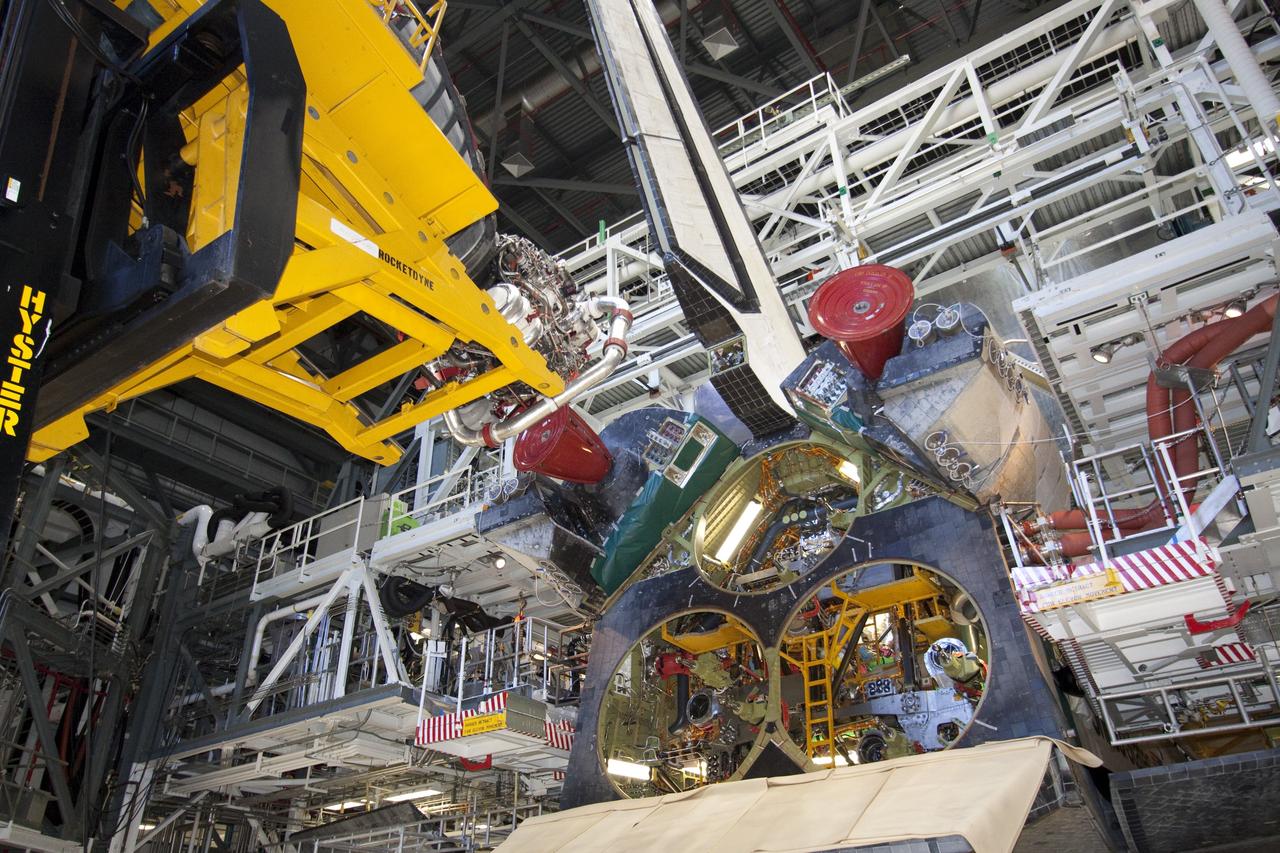
CAPE CANAVERAL, Fla. - Technicians complete the removal of main engine No. 1 from space shuttle Discovery using a specially designed engine installer, called a Hyster forklift. The work is taking place in Orbiter Processing Facility-2 at NASA's Kennedy Space Center in Florida. The removal is part of Discovery's transition and retirement processing. Work performed on Discovery is expected to help rocket designers build next-generation spacecraft and prepare the shuttle for future public display. Photo credit: NASA/Jack Pfaller

In Orbiter Processing Facility bay 2, technicians on a Hyster forklift maneuver space shuttle main engine no. 3 into place on Endeavour. Each space shuttle main engine is 14 feet long, weighs about 6,700 pounds, and is 7.5 feet in diameter at the end of the nozzle. The orbiter is scheduled for mission STS-118, targeted for launch on June 28. The mission will be the 22nd flight to the International Space Station, carrying another starboard array, S5, for installation.
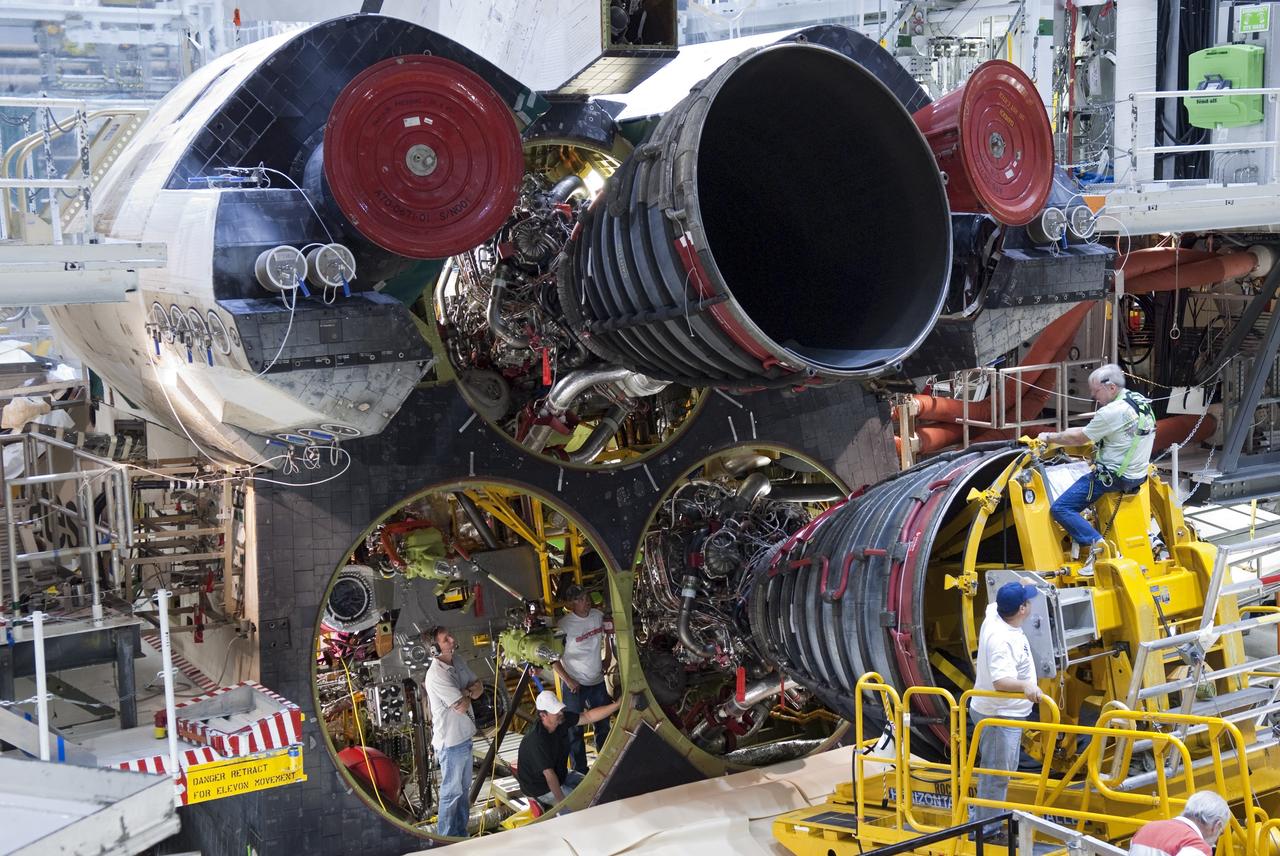
CAPE CANAVERAL, Fla. - Technicians carefully remove main engine No. 3 from space shuttle Discovery using a specially designed engine installer, called a Hyster forklift. The work is taking place in Orbiter Processing Facility-2 at NASA's Kennedy Space Center in Florida. The removal is part of Discovery's transition and retirement processing. Work performed on Discovery is expected to help rocket designers build next-generation spacecraft and prepare the shuttle for future public display. NASA/Jim Grossmann
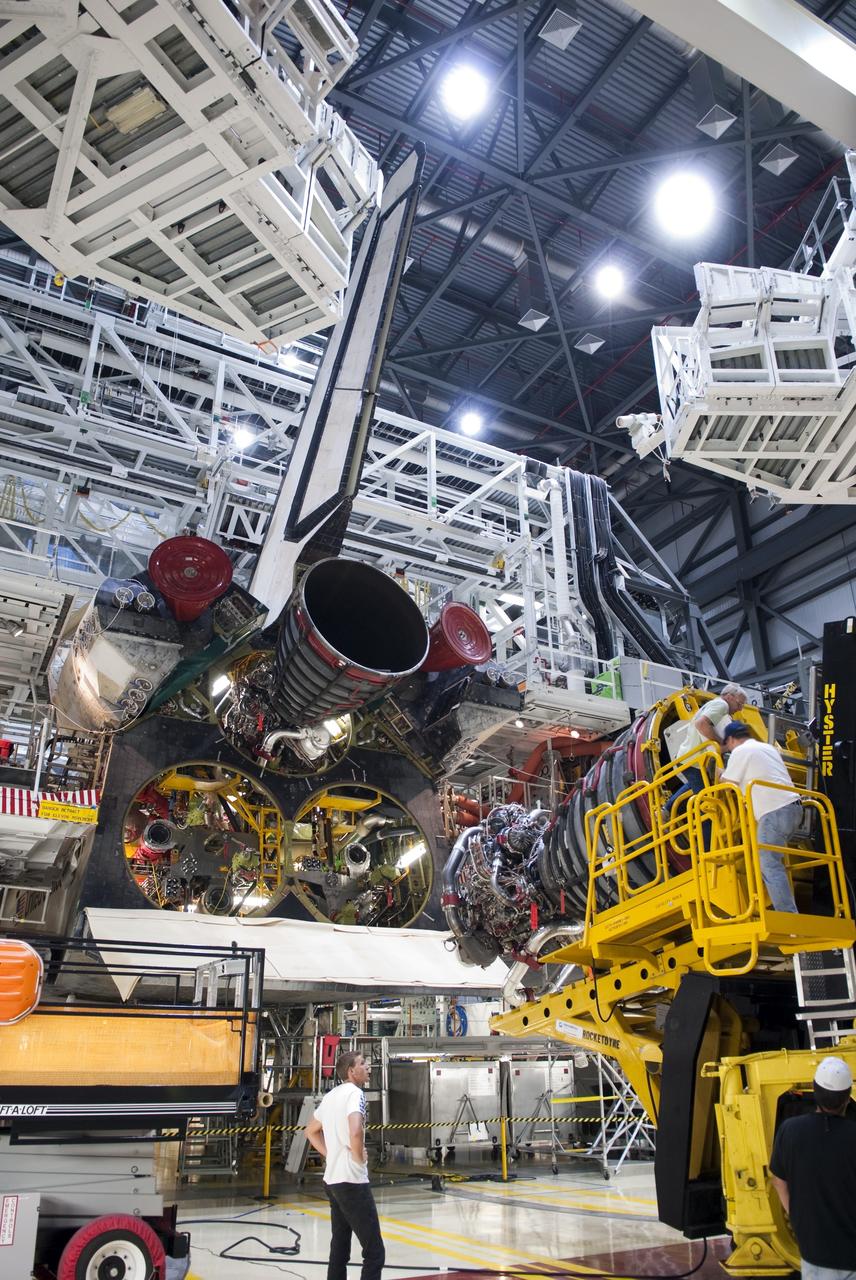
CAPE CANAVERAL, Fla. - Technicians complete the removal of main engine No. 3 from space shuttle Discovery using a specially designed engine installer, called a Hyster forklift. The work is taking place in Orbiter Processing Facility-2 at NASA's Kennedy Space Center in Florida. The removal is part of Discovery's transition and retirement processing. Work performed on Discovery is expected to help rocket designers build next-generation spacecraft and prepare the shuttle for future public display. NASA/Jim Grossmann
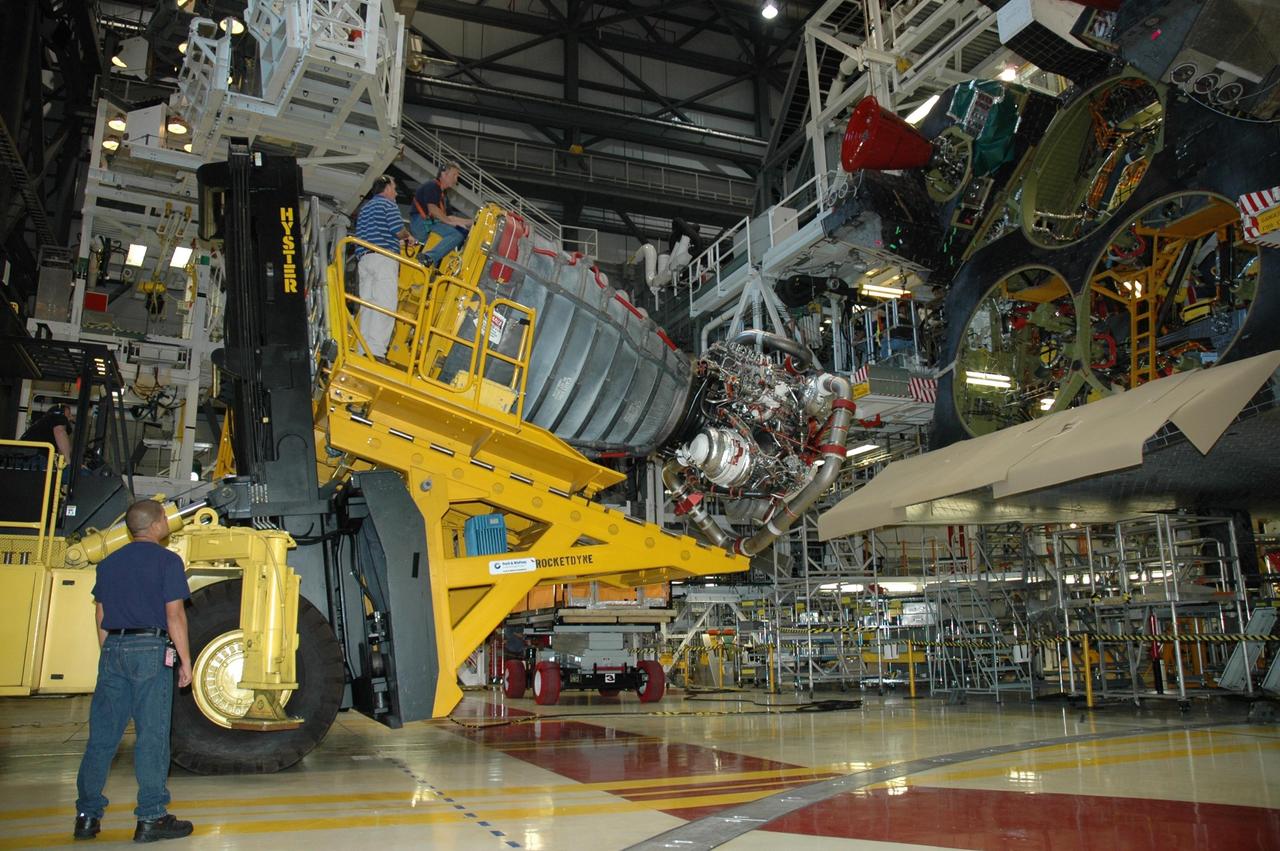
KENNEDY SPACE CENTER, FLA. -- In Orbiter Processing Facility bay 3 at NASA's Kennedy Space Center, technicians on a Hyster forklift move space shuttle main engine no. 1 toward Endeavour for installation. Each space shuttle main engine is 14 feet long, weighs about 6,700 pounds, and is 7.5 feet in diameter at the end of the nozzle. The orbiter is targeted for launch on Feb. 14 for mission STS-123 to the International Space Station. Photo credit: NASA/Jack Pfaller
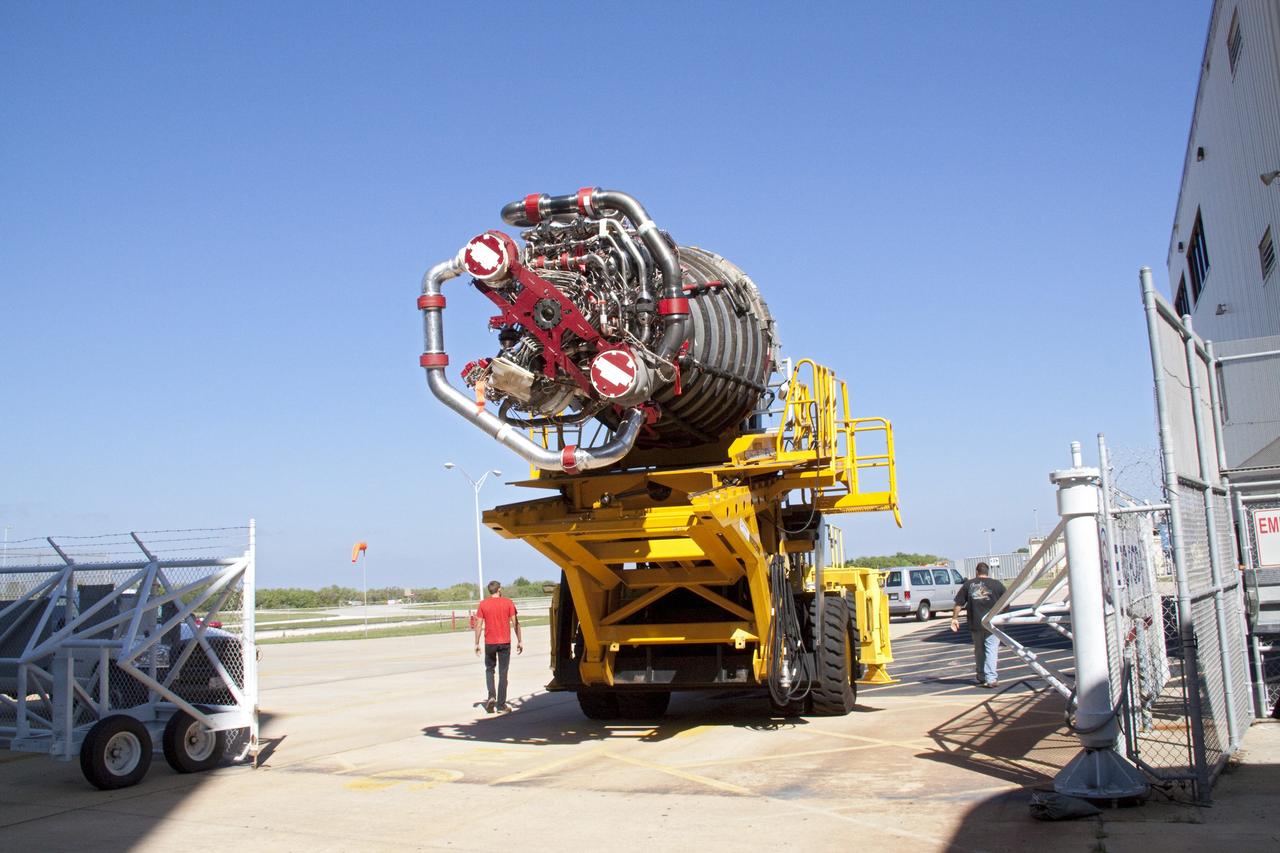
CAPE CANAVERAL, Fla. - Technicians complete the removal of main engine No. 1 from space shuttle Discovery using a specially designed engine installer, called a Hyster forklift. The work is taking place in Orbiter Processing Facility-2 at NASA's Kennedy Space Center in Florida. The removal is part of Discovery's transition and retirement processing. Work performed on Discovery is expected to help rocket designers build next-generation spacecraft and prepare the shuttle for future public display. Photo credit: NASA/Jack Pfaller
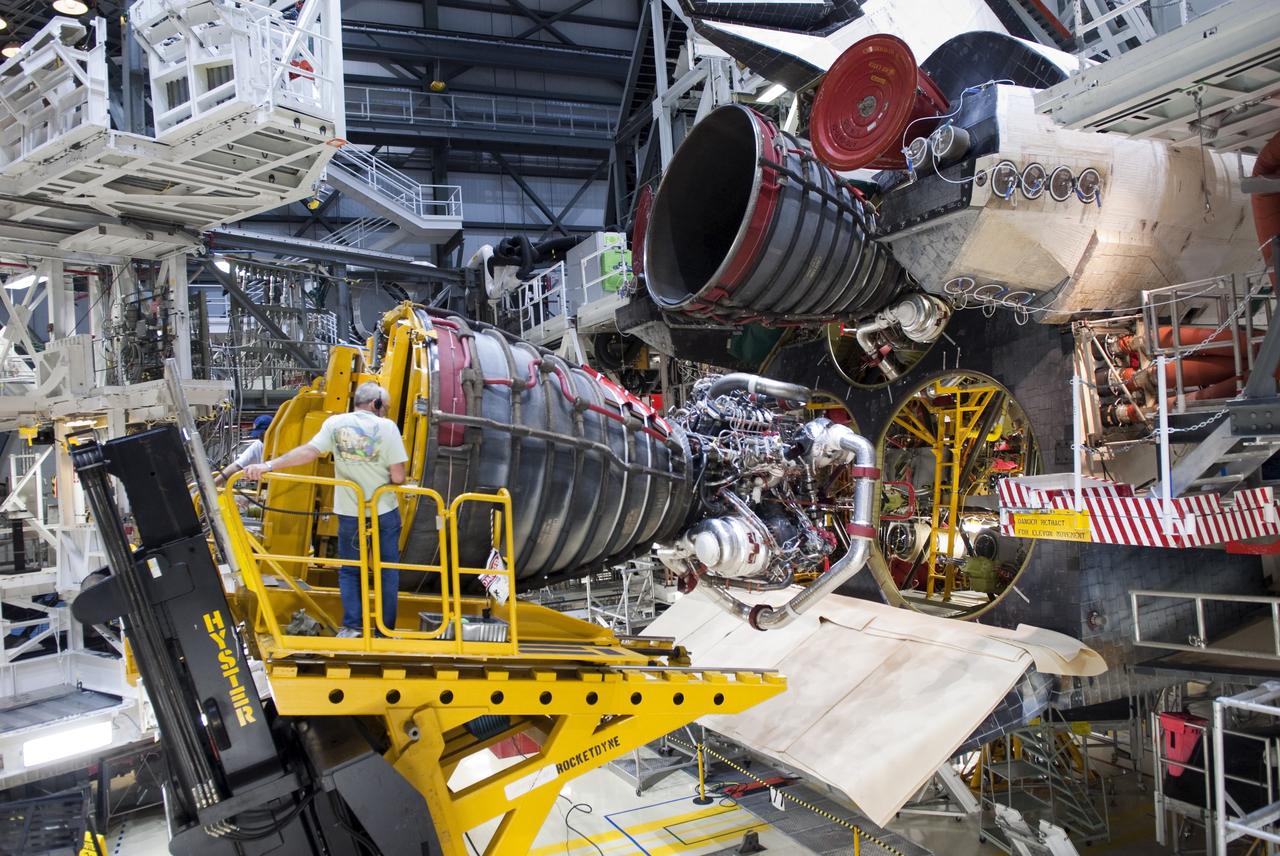
CAPE CANAVERAL, Fla. - Technicians complete the removal of main engine No. 3 from space shuttle Discovery using a specially designed engine installer, called a Hyster forklift. The work is taking place in Orbiter Processing Facility-2 at NASA's Kennedy Space Center in Florida. The removal is part of Discovery's transition and retirement processing. Work performed on Discovery is expected to help rocket designers build next-generation spacecraft and prepare the shuttle for future public display. NASA/Jim Grossmann
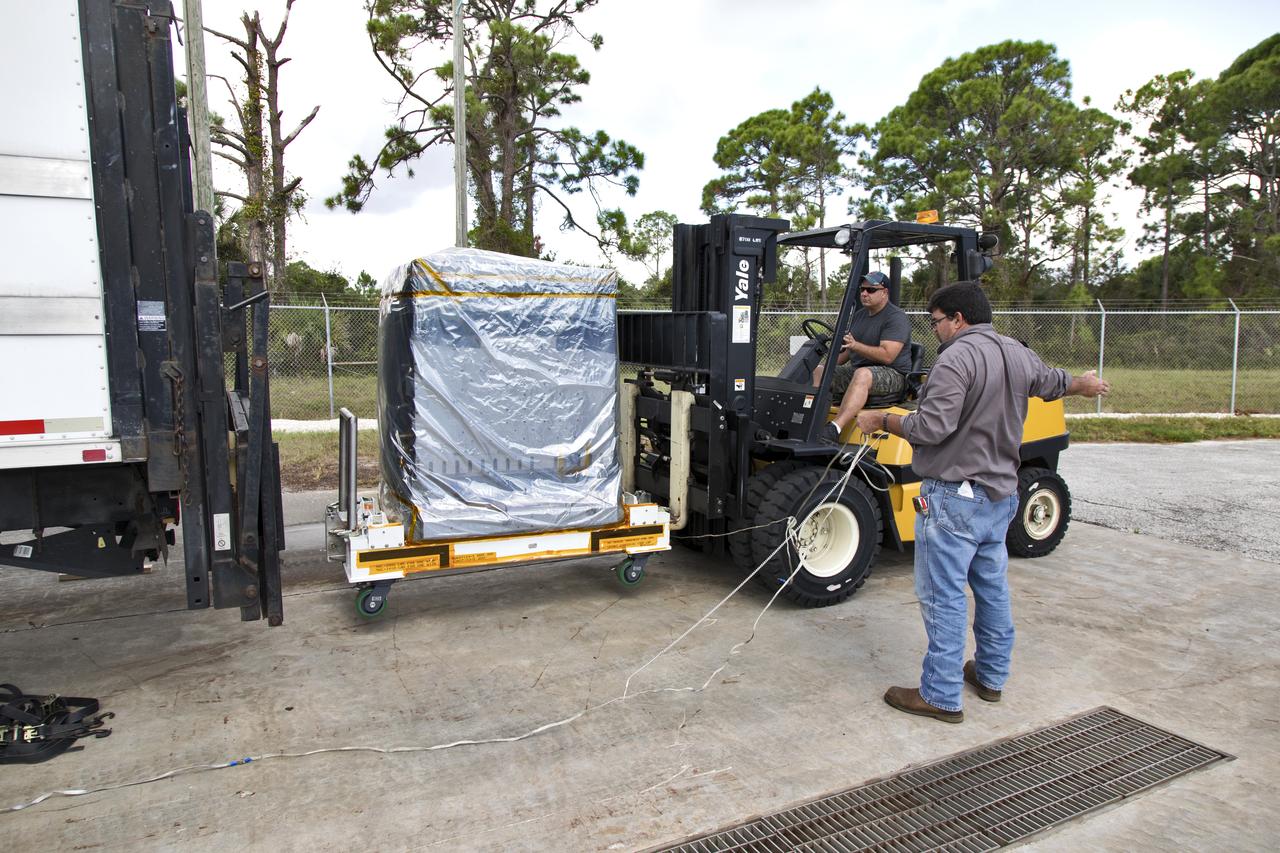
A worker uses a forklift to unload the Robotic Refueling Mission-3 (RRM3) payload from a truck at the Payload Hazardous Servicing Facility on Oct. 3, 2018, at NASA's Kennedy Space Center in Florida. The payload will be carried to the International Space Station on SpaceX's 16th Commercial Resupply Services mission. RRM3 demonstrates the transfer of xenon gas and liquid methane in microgravity, and advances technologies for storing and manipulating these cryogenic fuels robotically. RRM3 also supports development of technology for the Restore-L mission, a robotic spacecraft equipped to service satellites in-orbit.
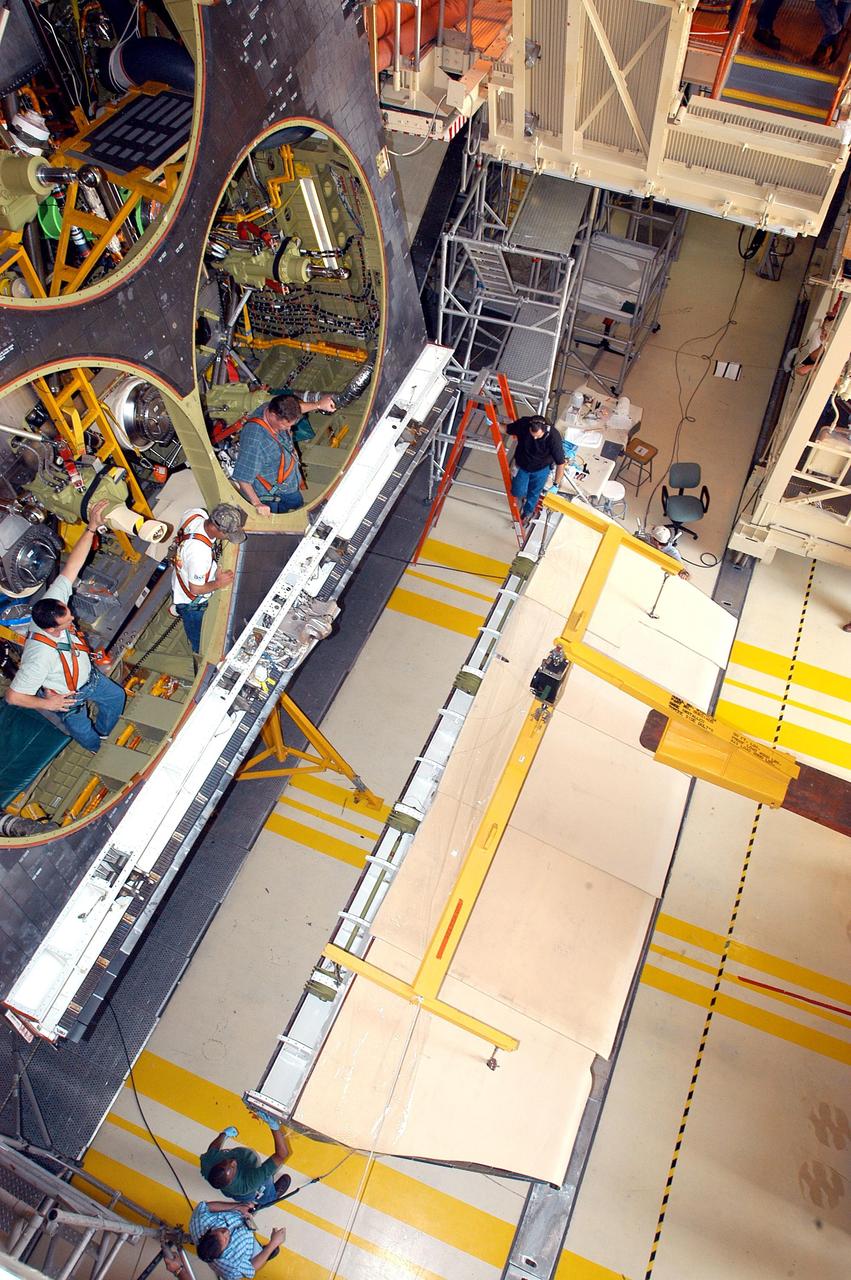
KENNEDY SPACE CENTER, FLA. - A Hyster forklift in the Orbiter Processing Facility moves the body flap toward the aft of the orbiter Discovery. The body flap is an aluminum structure consisting of ribs, spars, skin panels and a trailing edge assembly. It thermally shields the three main engines during entry and provides pitch control trim during landing approach. Discovery is being processed for launch on the first Return to Flight mission, STS-114.
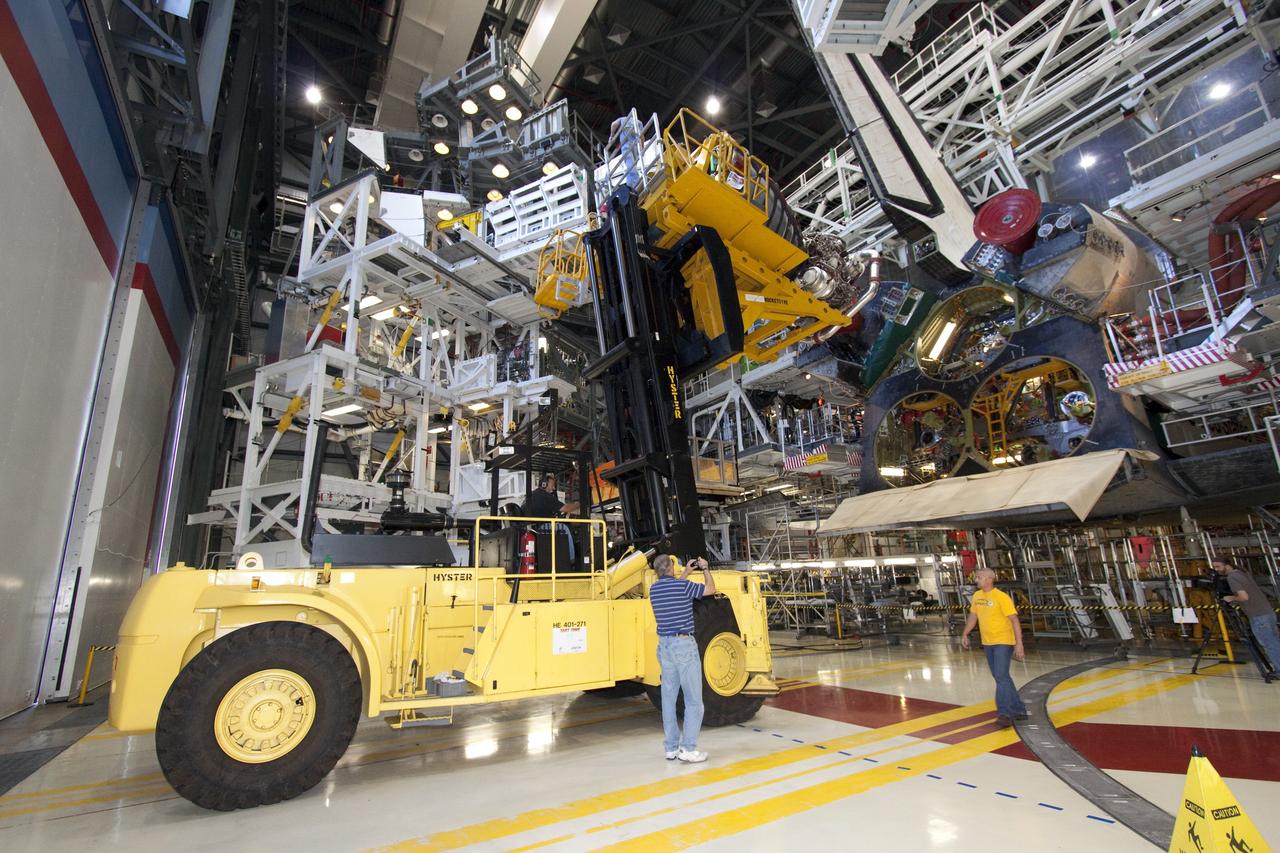
CAPE CANAVERAL, Fla. - Technicians complete the removal of main engine No. 1 from space shuttle Discovery using a specially designed engine installer, called a Hyster forklift. The work is taking place in Orbiter Processing Facility-2 at NASA's Kennedy Space Center in Florida. The removal is part of Discovery's transition and retirement processing. Work performed on Discovery is expected to help rocket designers build next-generation spacecraft and prepare the shuttle for future public display. Photo credit: NASA/Jack Pfaller
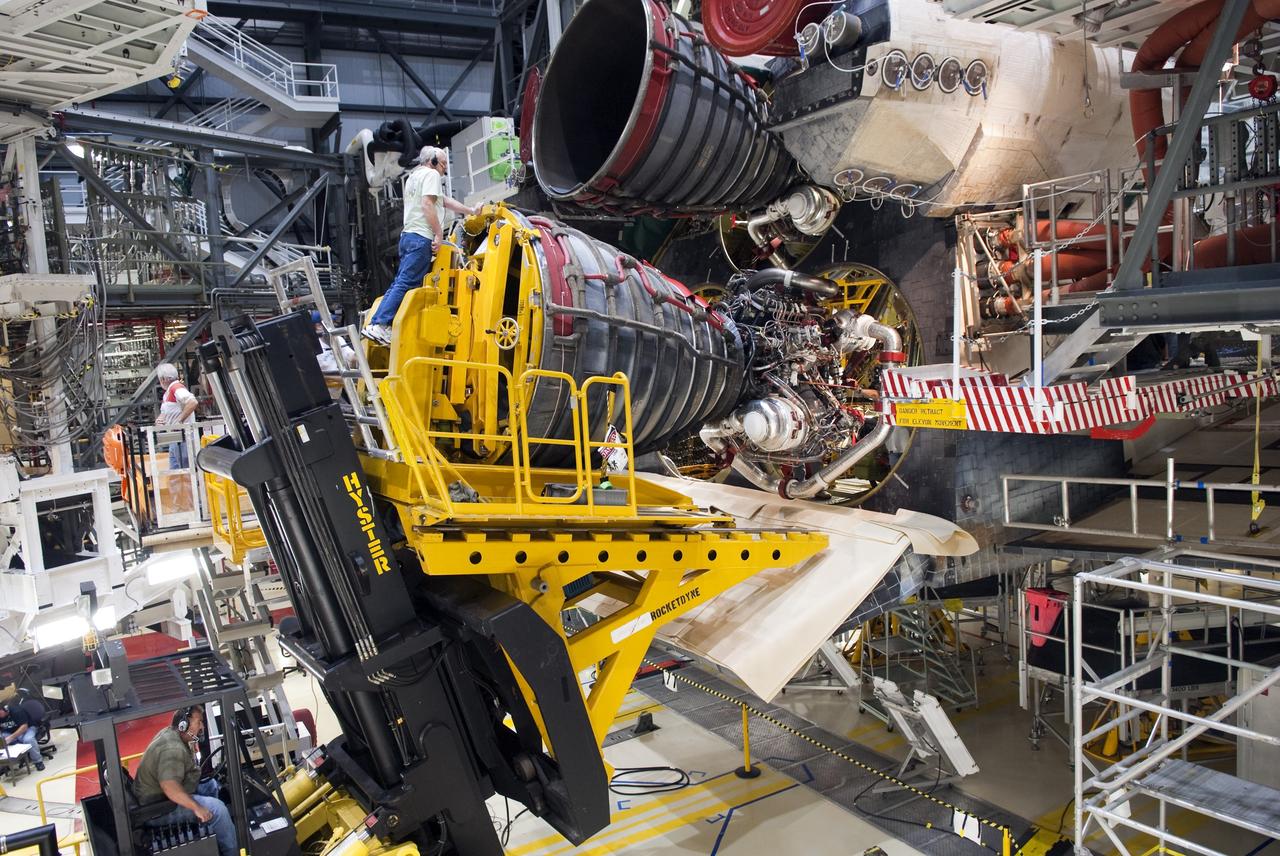
CAPE CANAVERAL, Fla. - Technicians carefully remove main engine No. 3 from space shuttle Discovery using a specially designed engine installer, called a Hyster forklift. The work is taking place in Orbiter Processing Facility-2 at NASA's Kennedy Space Center in Florida. The removal is part of Discovery's transition and retirement processing. Work performed on Discovery is expected to help rocket designers build next-generation spacecraft and prepare the shuttle for future public display. NASA/Jim Grossmann

KENNEDY SPACE CENTER, FLA. -- In Orbiter Processing Facility bay 2, technicians on a Hyster forklift install space shuttle main engine no. 3 into Endeavour. Each space shuttle main engine is 14 feet long, weighs about 6,700 pounds, and is 7.5 feet in diameter at the end of the nozzle. The orbiter is scheduled for mission STS-118, targeted for launch on June 28. The mission will be the 22nd flight to the International Space Station, carrying another starboard array, S5, for installation. Photo credit: NASA/George Shelton
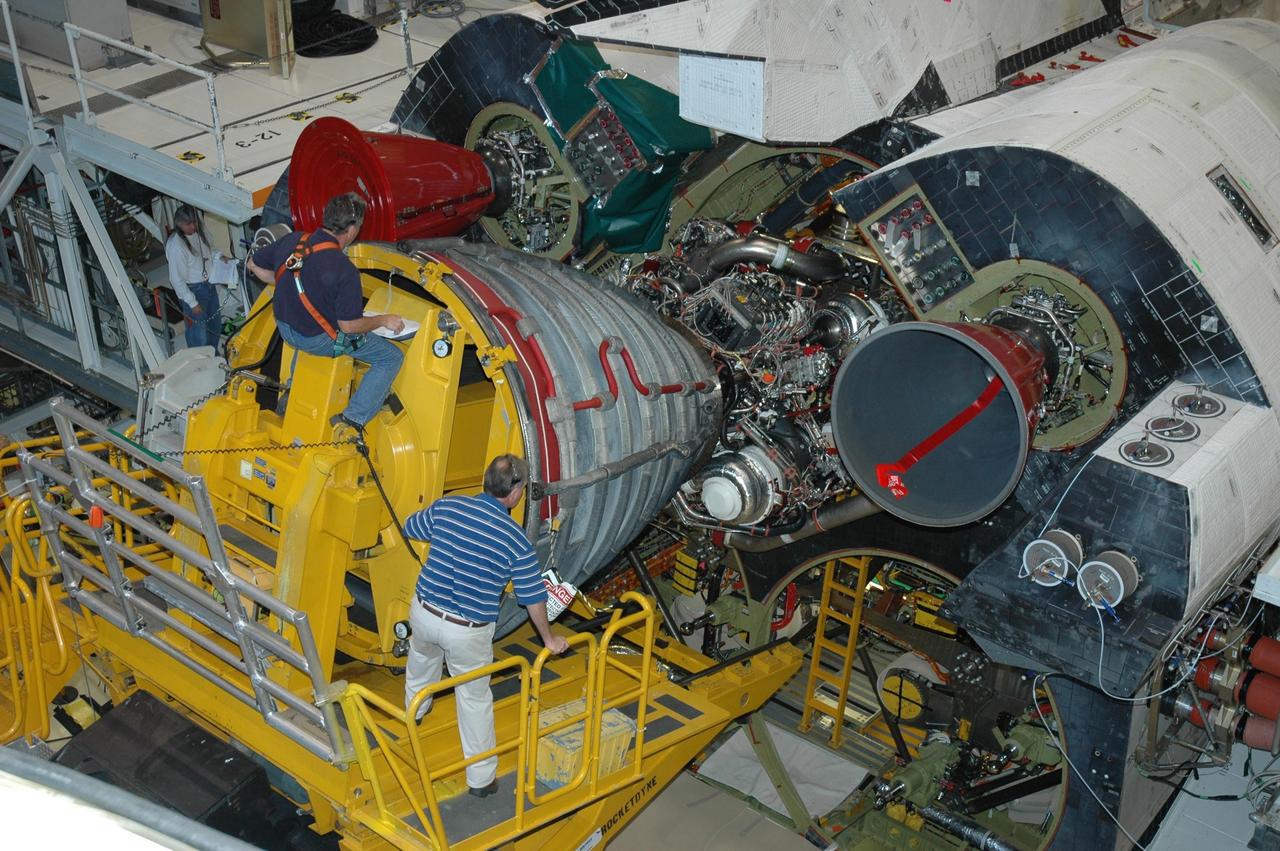
KENNEDY SPACE CENTER, FLA. -- In Orbiter Processing Facility bay 3 at NASA's Kennedy Space Center, technicians on a Hyster forklift maneuver space shuttle main engine no. 1 into place on Endeavour. Each space shuttle main engine is 14 feet long, weighs about 6,700 pounds, and is 7.5 feet in diameter at the end of the nozzle. The orbiter is targeted for launch on Feb. 14 for mission STS-123 to the International Space Station. Photo credit: NASA/Jack Pfaller
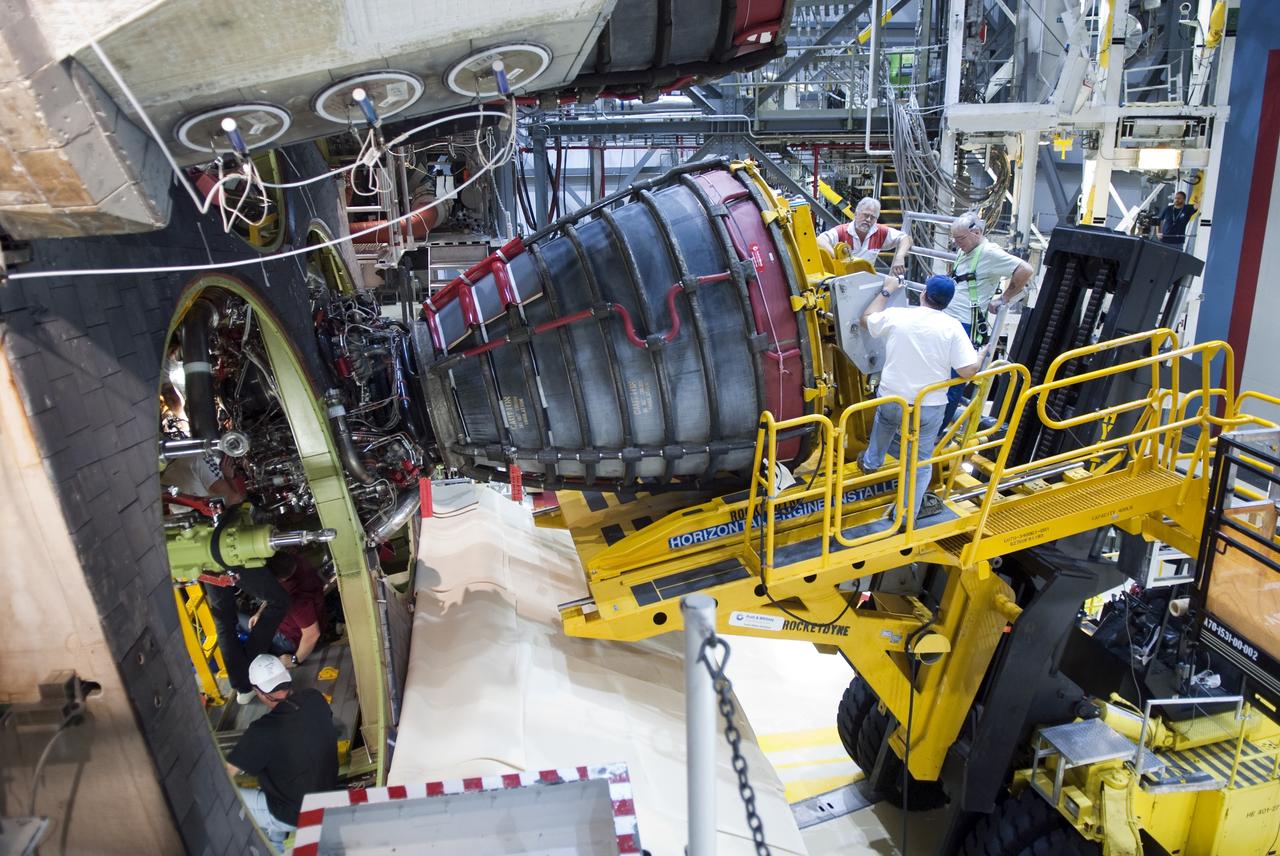
CAPE CANAVERAL, Fla. - Technicians carefully remove main engine No. 3 from space shuttle Discovery using a specially designed engine installer, called a Hyster forklift. The work is taking place in Orbiter Processing Facility-2 at NASA's Kennedy Space Center in Florida. The removal is part of Discovery's transition and retirement processing. Work performed on Discovery is expected to help rocket designers build next-generation spacecraft and prepare the shuttle for future public display. NASA/Jim Grossmann
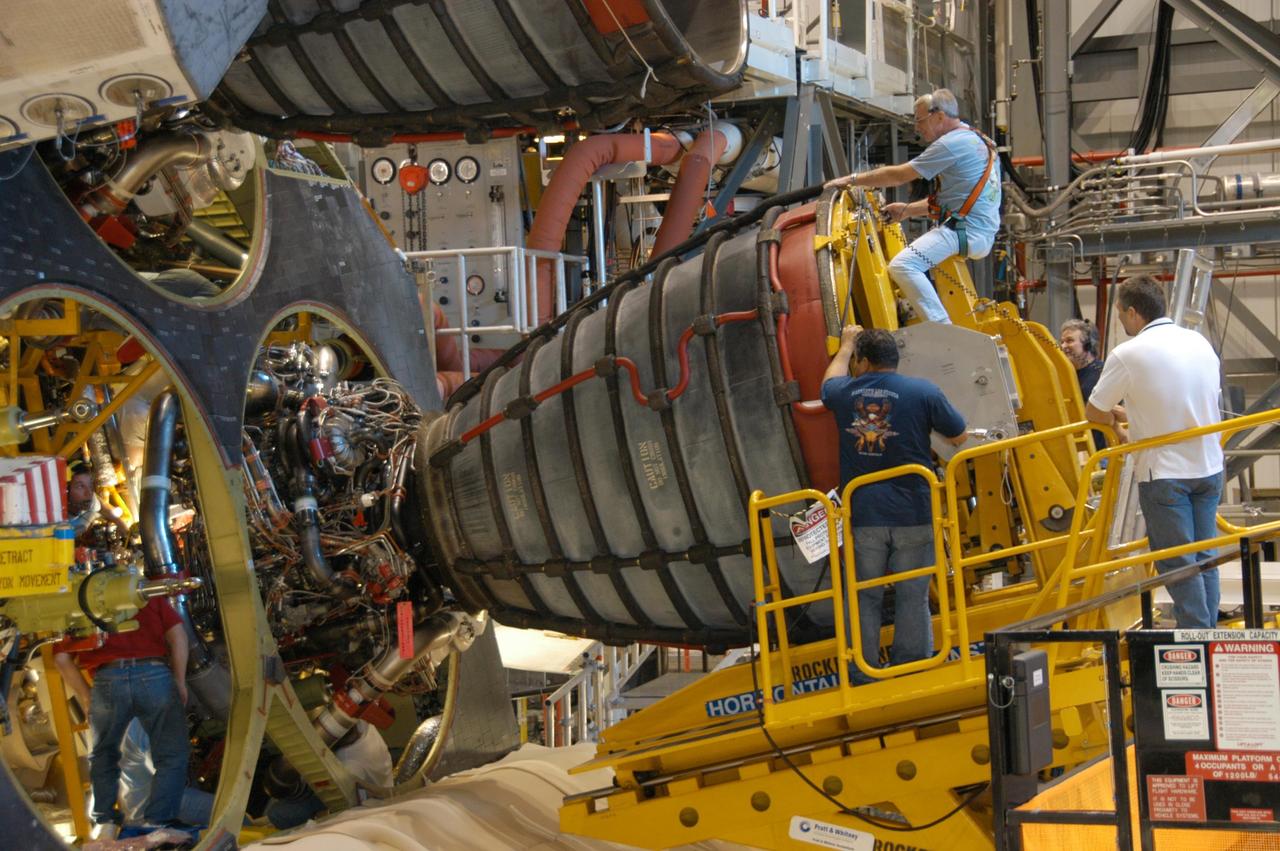
KENNEDY SPACE CENTER, FLA. -- In Orbiter Processing Facility bay 2, technicians on a Hyster forklift maneuver space shuttle main engine no. 3 into place on Endeavour. Each space shuttle main engine is 14 feet long, weighs about 6,700 pounds, and is 7.5 feet in diameter at the end of the nozzle. The orbiter is scheduled for mission STS-118, targeted for launch on June 28. The mission will be the 22nd flight to the International Space Station, carrying another starboard array, S5, for installation. Photo credit: NASA/George Shelton
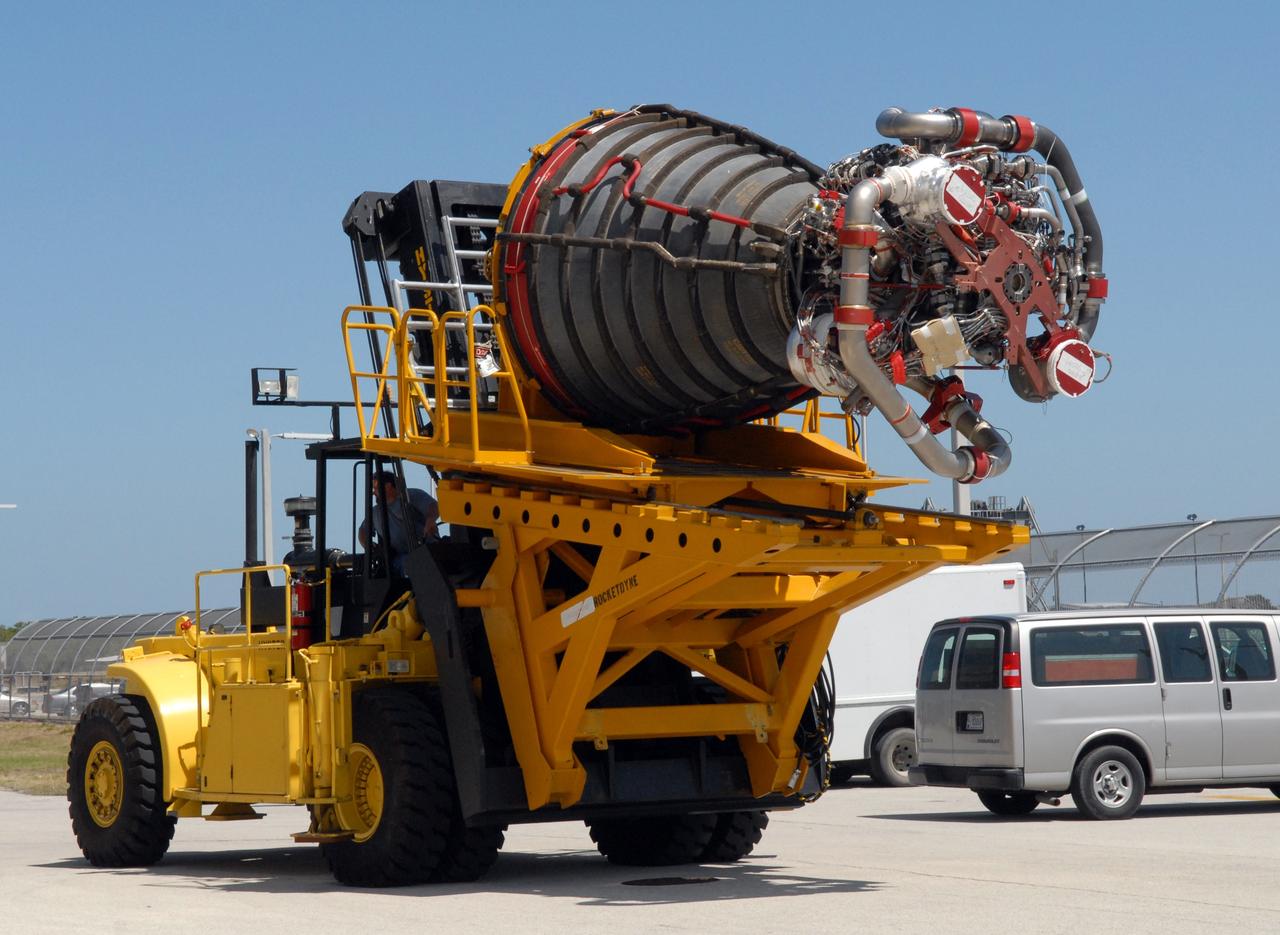
CAPE CANAVERAL, Fla. – After removal from space shuttle Discovery, the third and final main engine, carried by the Hyster forklift, has left Orbiter Processing Facility 3 at NASA's Kennedy Space Center in Florida. Each engine is 14 feet long, weighs about 6,700 pounds, and is 7.5 feet in diameter at the end of the nozzle. Discovery next will be used on the STS-128 mission to deliver supplies and equipment to the International Space Station. The launch is targeted for Aug. 6. Photo credit: NASA/Tim Jacobs
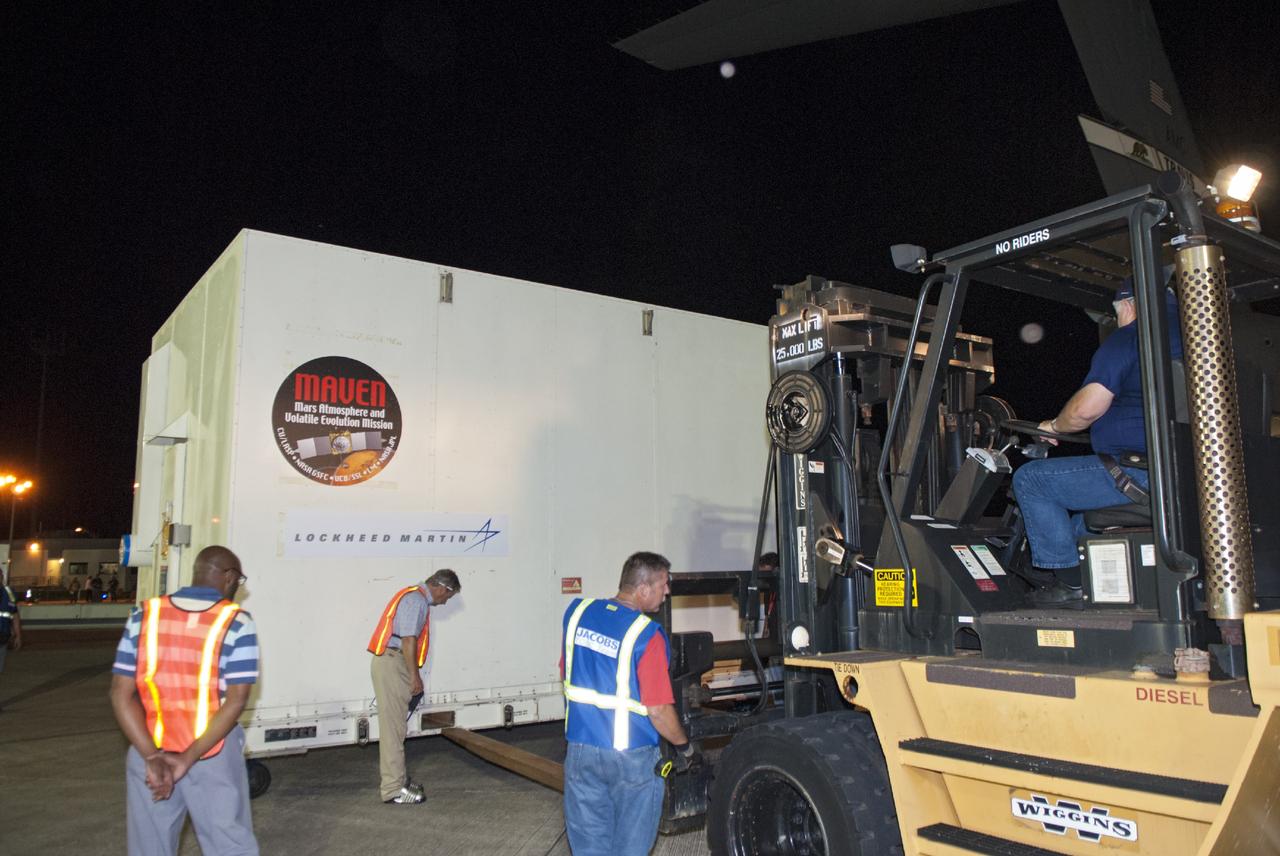
CAPE CANAVERAL, Fla. – At NASA's Kennedy Space Center in Florida, the MAVEN spacecraft, still in its shipping container, is picked up by a forklift at the Shuttle Landing Facility following offload from a C-17 aircraft. The aircraft delivered MAVEN for processing ahead of a launch later this year on a United Launch Alliance Atlas V rocket. MAVEN, short for Mars Atmosphere and Volatile Evolution, will orbit Mars to study the Red Planet's upper atmosphere in unprecedented detail. Photo credit: NASA/Tim Jacobs
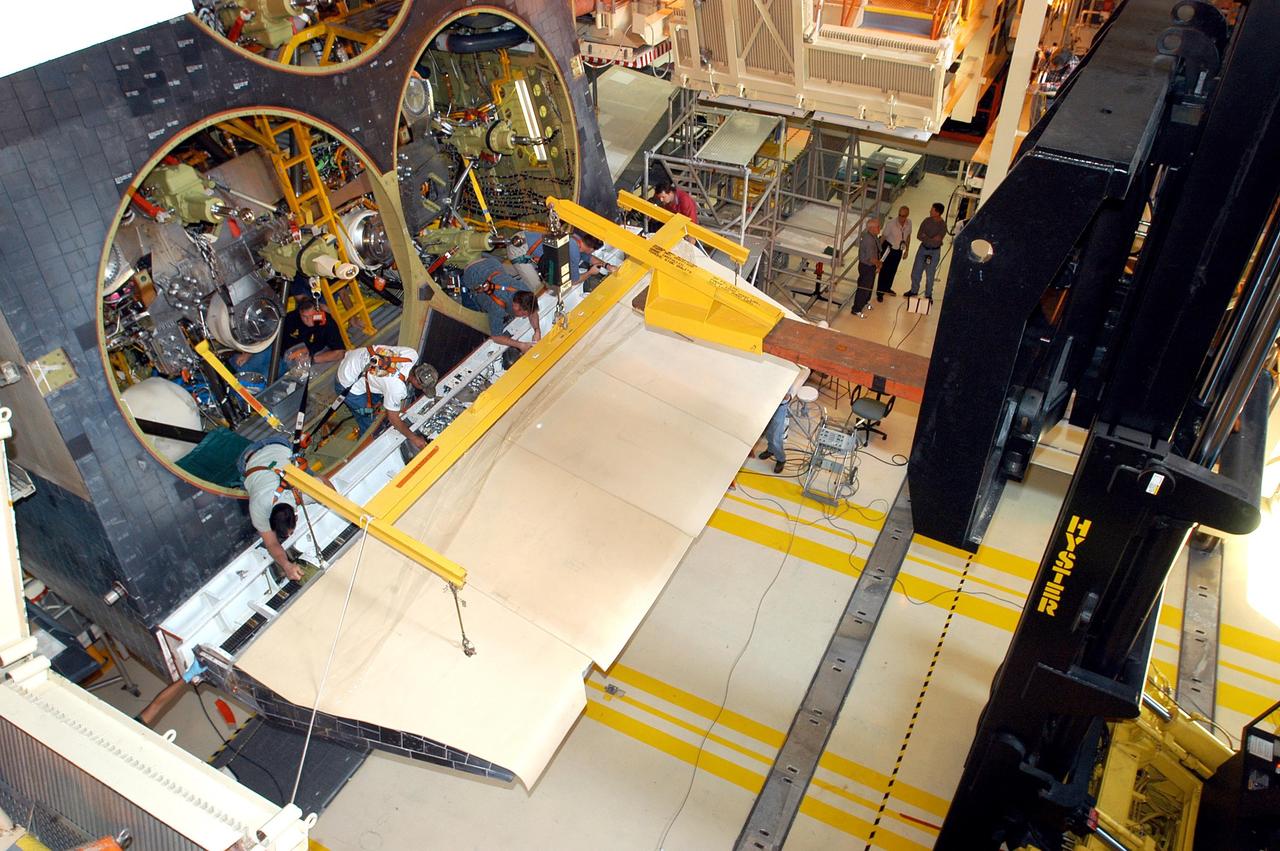
KENNEDY SPACE CENTER, FLA. - In the Orbiter Processing Facility, A Hyster forklift supports the body flap as workers secure it to the orbiter Discovery. The body flap is an aluminum structure consisting of ribs, spars, skin panels and a trailing edge assembly. It thermally shields the three main engines during entry and provides pitch control trim during landing approach. Discovery is being processed for launch on the first Return to Flight mission, STS-114.
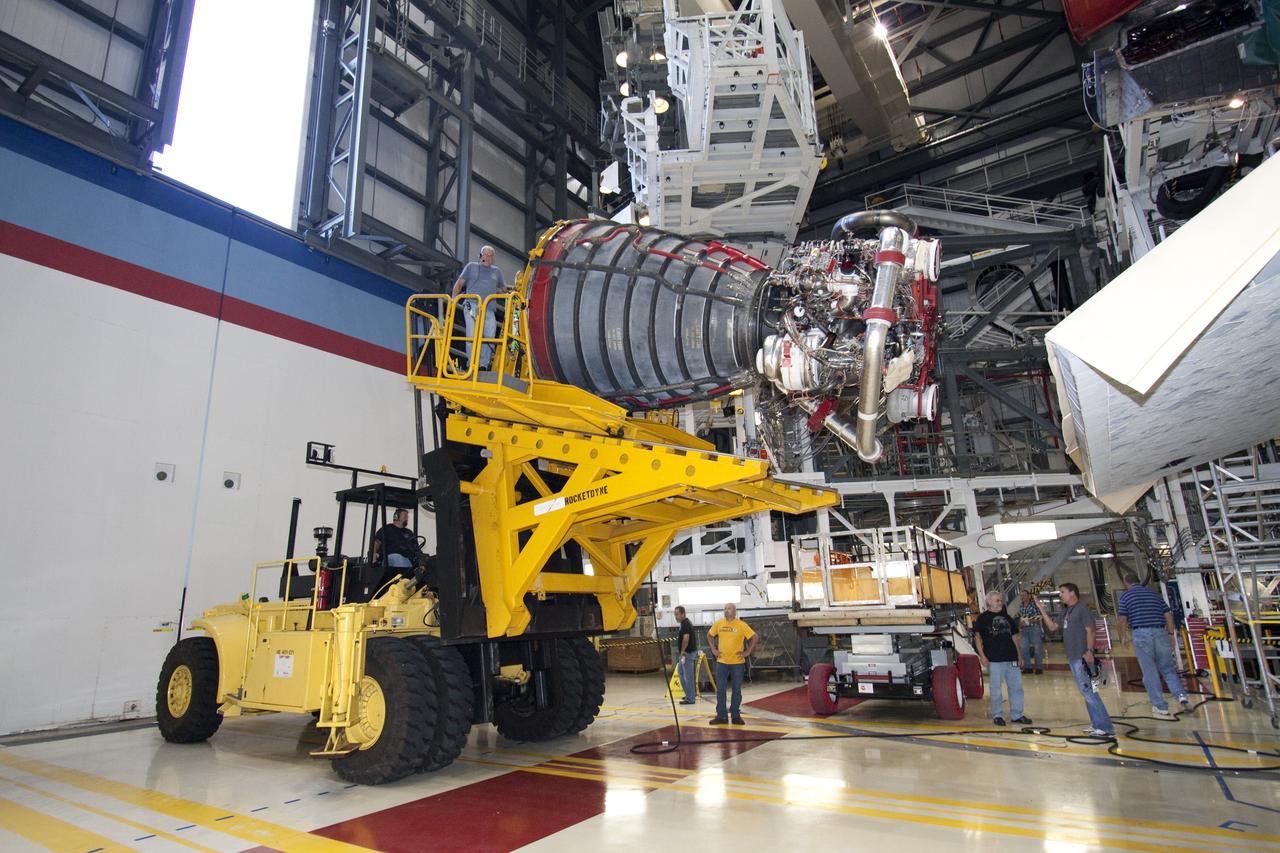
CAPE CANAVERAL, Fla. - Technicians complete the removal of main engine No. 1 from space shuttle Discovery using a specially designed engine installer, called a Hyster forklift. The work is taking place in Orbiter Processing Facility-2 at NASA's Kennedy Space Center in Florida. The removal is part of Discovery's transition and retirement processing. Work performed on Discovery is expected to help rocket designers build next-generation spacecraft and prepare the shuttle for future public display. Photo credit: NASA/Jack Pfaller
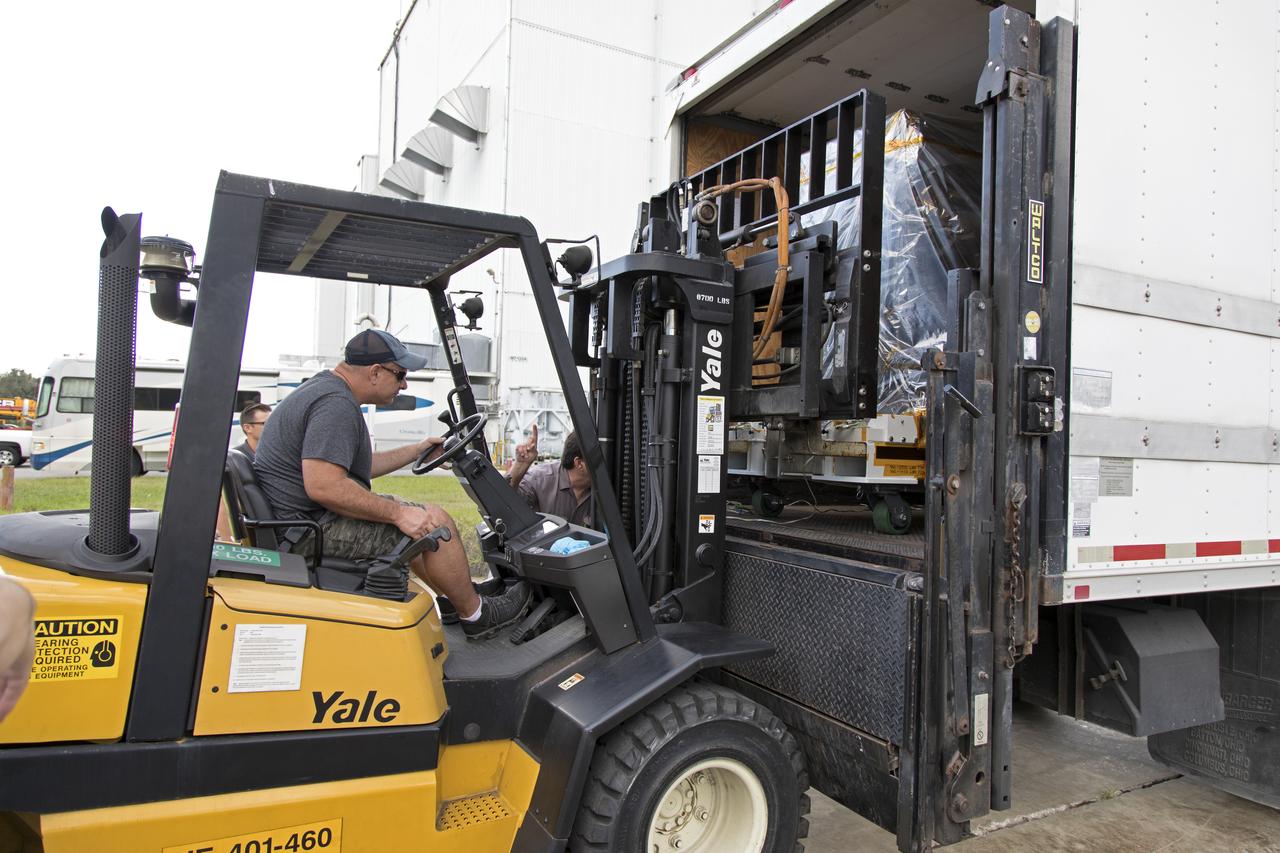
A worker uses a forklift to unload the Robotic Refueling Mission-3 (RRM3) payload from a truck at the Payload Hazardous Servicing Facility on Oct. 3, 2018, at NASA's Kennedy Space Center in Florida. The payload will be carried to the International Space Station on SpaceX's 16th Commercial Resupply Services mission. RRM3 demonstrates the transfer of xenon gas and liquid methane in microgravity, and advances technologies for storing and manipulating these cryogenic fuels robotically. RRM3 also supports development of technology for the Restore-L mission, a robotic spacecraft equipped to service satellites in-orbit.
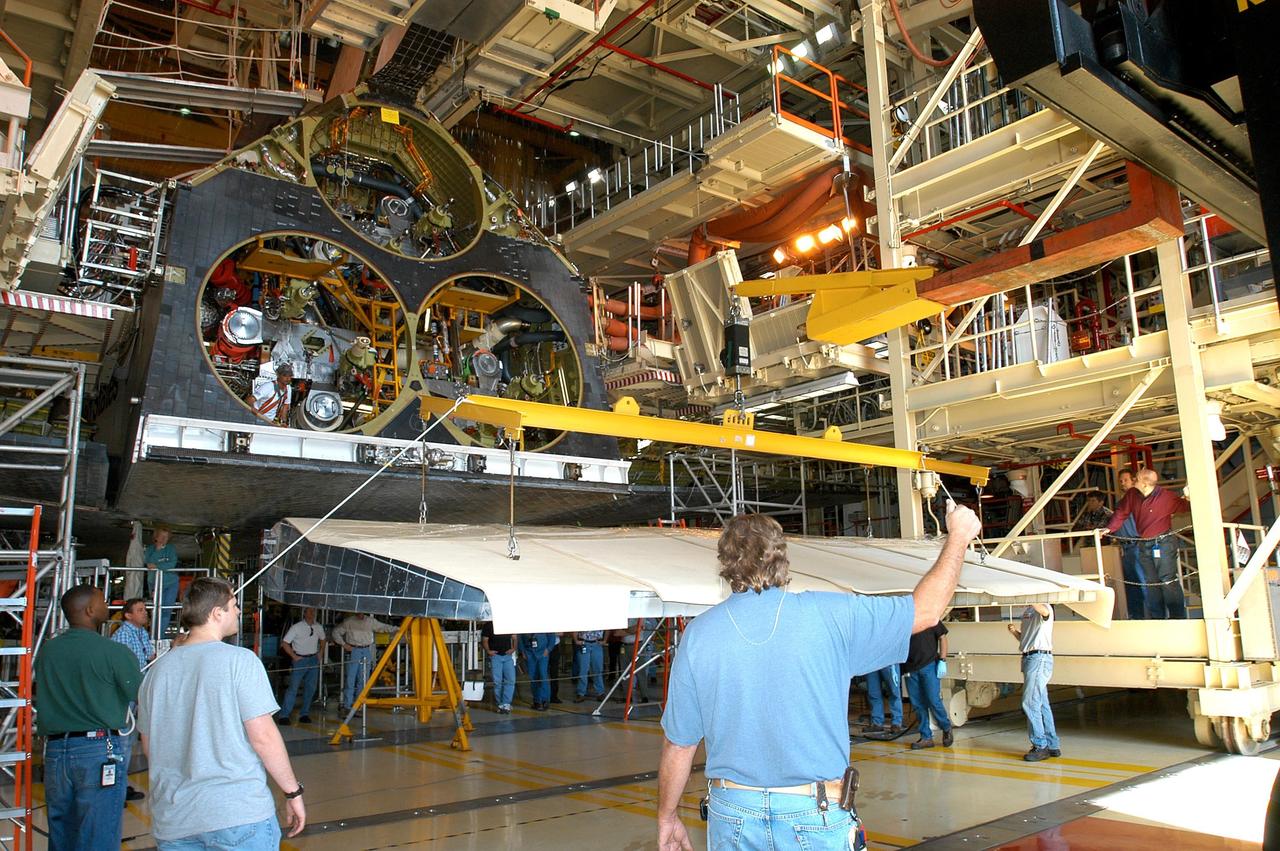
KENNEDY SPACE CENTER, FLA. - A Hyster forklift in the Orbiter Processing Facility lifts the body flap to be installed on the orbiter Discovery. The body flap is an aluminum structure consisting of ribs, spars, skin panels and a trailing edge assembly. It thermally shields the three main engines during entry and provides pitch control trim during landing approach. Discovery is being processed for launch on the first Return to Flight mission, STS-114.
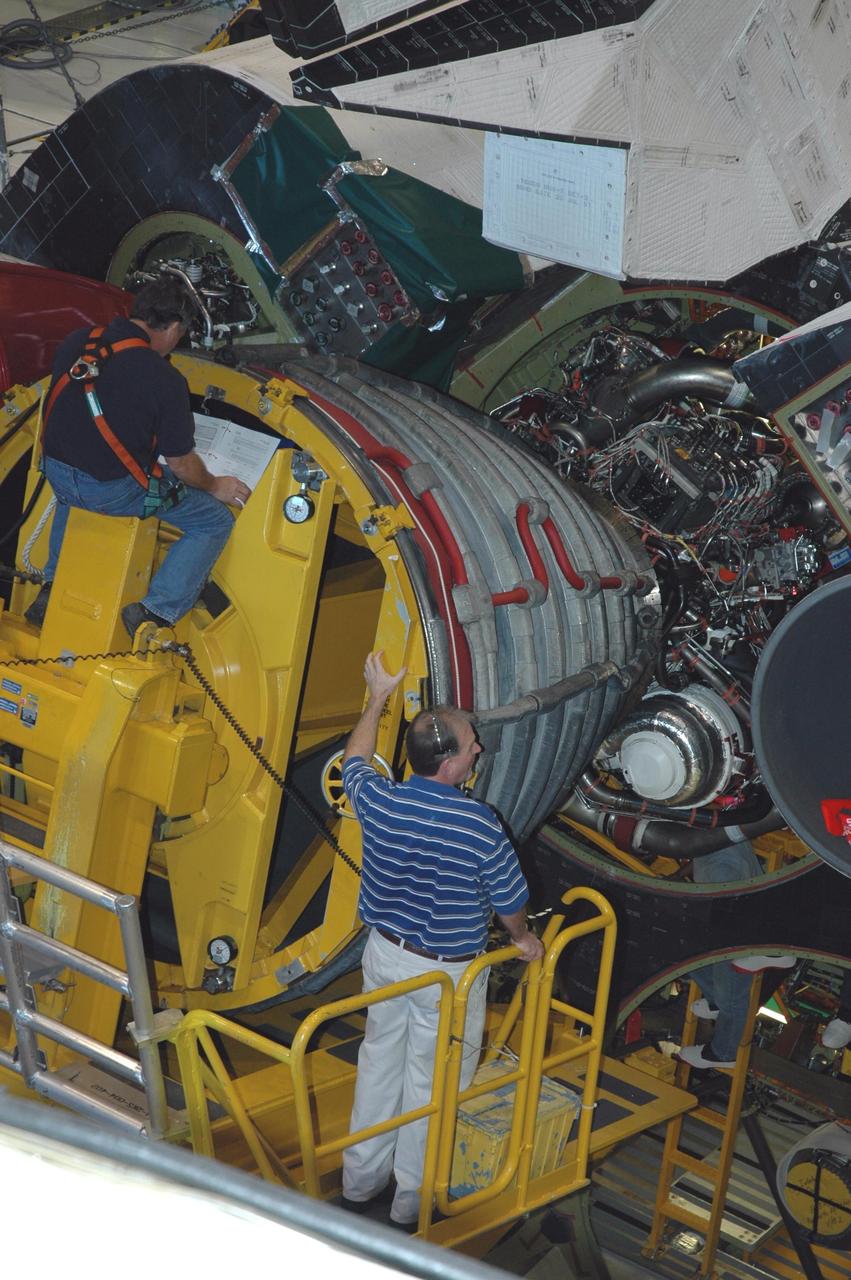
KENNEDY SPACE CENTER, FLA. -- In Orbiter Processing Facility bay 3 at NASA's Kennedy Space Center, technicians on a Hyster forklift maneuver space shuttle main engine no. 1 into place on Endeavour. Each space shuttle main engine is 14 feet long, weighs about 6,700 pounds, and is 7.5 feet in diameter at the end of the nozzle. The orbiter is targeted for launch on Feb. 14 for mission STS-123 to the International Space Station. Photo credit: NASA/Jack Pfaller
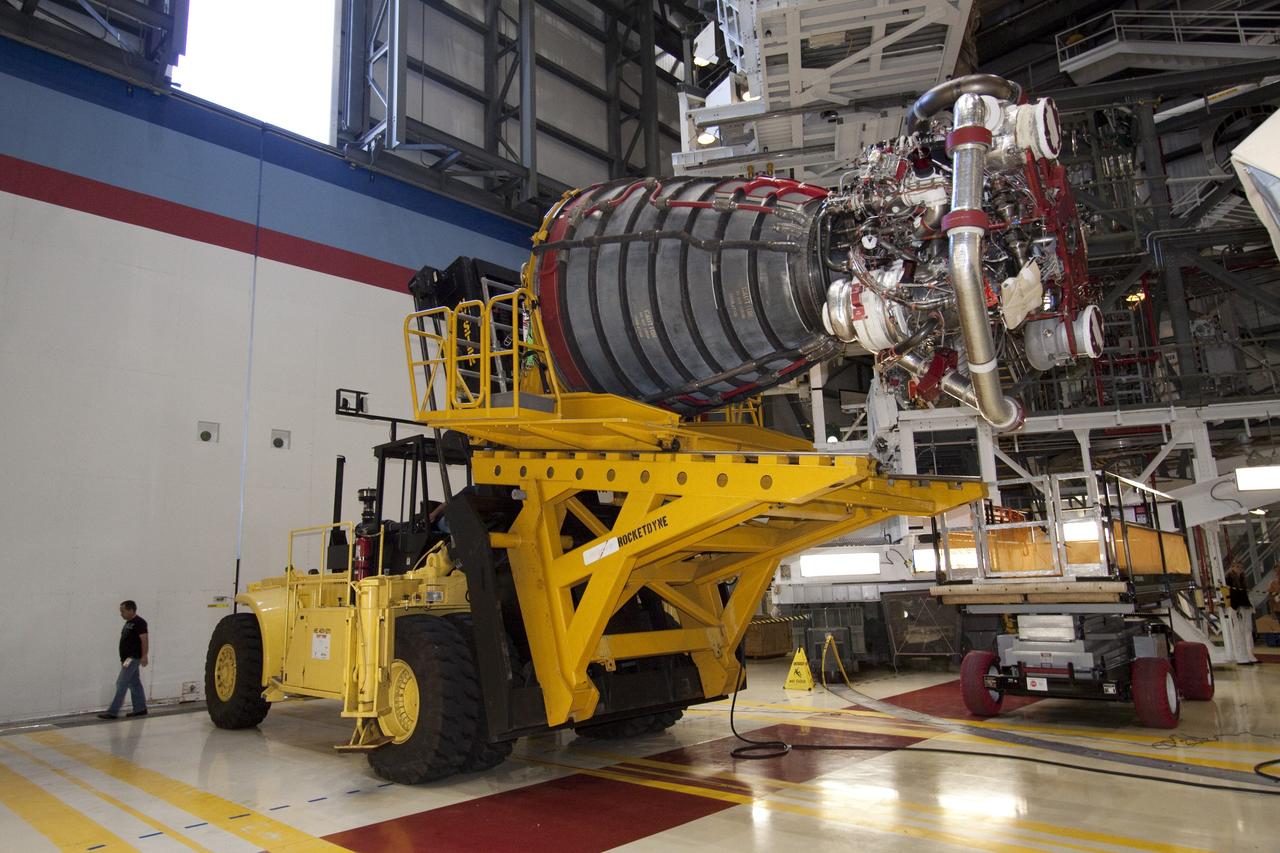
CAPE CANAVERAL, Fla. - Technicians complete the removal of main engine No. 1 from space shuttle Discovery using a specially designed engine installer, called a Hyster forklift. The work is taking place in Orbiter Processing Facility-2 at NASA's Kennedy Space Center in Florida. The removal is part of Discovery's transition and retirement processing. Work performed on Discovery is expected to help rocket designers build next-generation spacecraft and prepare the shuttle for future public display. Photo credit: NASA/Jack Pfaller
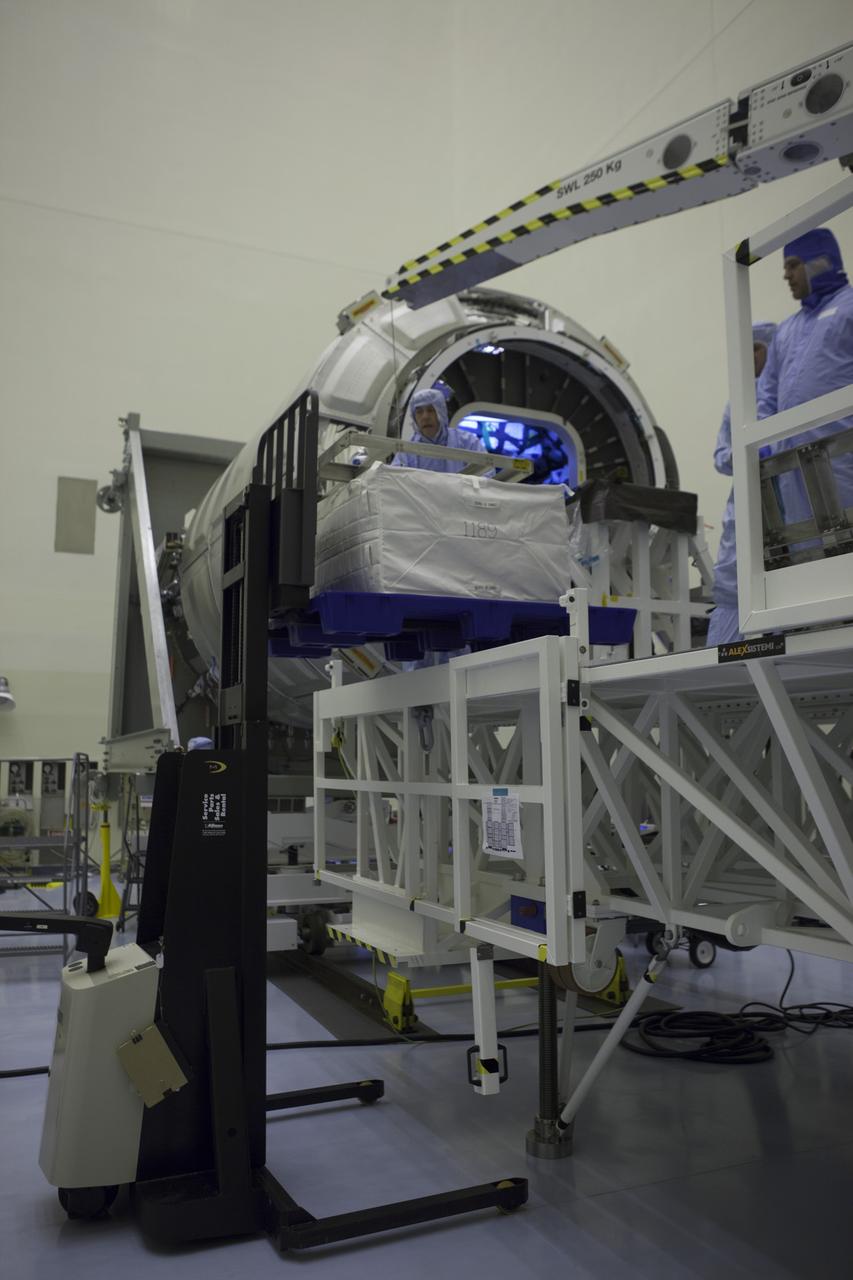
Technicians prepare to move a cargo package from a forklift into the Orbital ATK CRS-6 pressurized cargo module during late stowage inside the Payload Hazardous Servicing Facility at NASA’s Kennedy Space Center in Florida. The spacecraft is scheduled for the upcoming Orbital ATK Commercial Resupply Services-6 mission to deliver hardware and supplies to the International Space Station. The Cygnus is scheduled to lift off atop a United Launch Alliance Atlas V rocket on March 22.
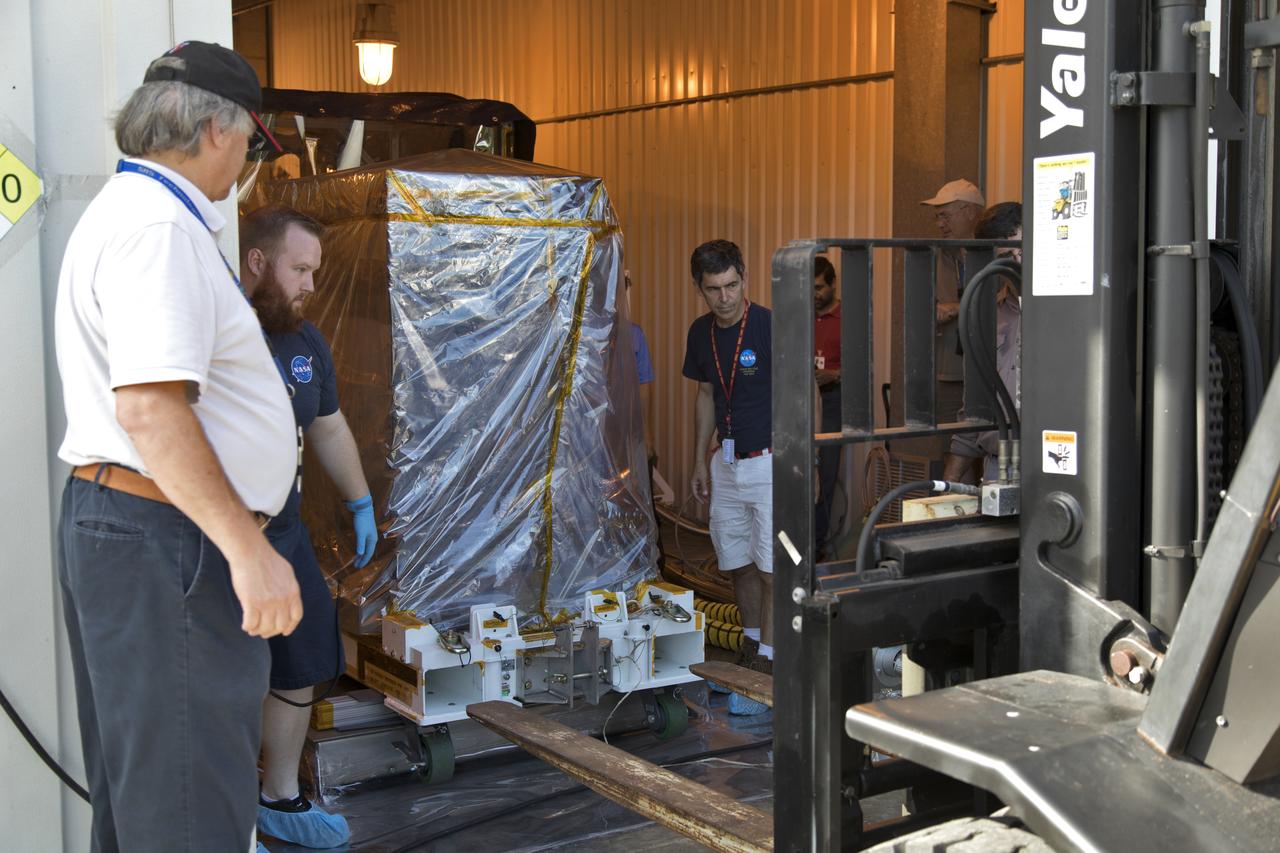
The Robotic Refueling Mission-3 (RRM3) payload is unloaded from a forklift inside the Payload Hazardous Servicing Facility on Oct. 3, 2018, at NASA's Kennedy Space Center in Florida. The payload will be carried to the International Space Station on SpaceX's 16th Commercial Resupply Services mission. RRM3 demonstrates the transfer of xenon gas and liquid methane in microgravity, and advances technologies for storing and manipulating these cryogenic fuels robotically. RRM3 also supports development of technology for the Restore-L mission, a robotic spacecraft equipped to service satellites in-orbit.
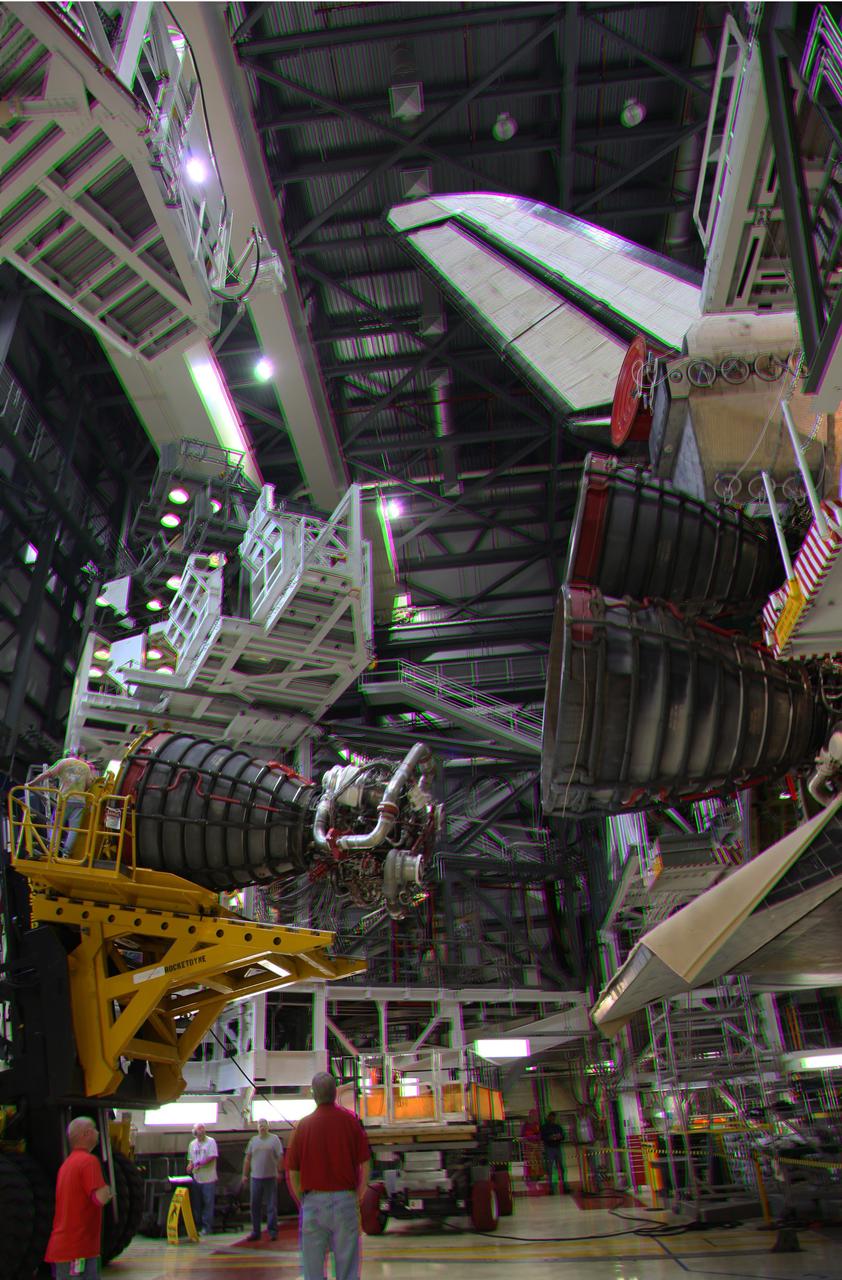
CAPE CANAVERAL, Fla. -- This is a 3-D image of crews in Orbiter Processing Facility-2 at NASA's Kennedy Space Center in Florida using a Hyster forklift to lower one of space shuttle Discovery's main engines after removal for cleaning and inspection. This is part of the spacecraft's transition and retirement processing and work performed on Discovery is expected to help rocket designers build next-generation spacecraft and prepare the shuttle for future public display. To view this image, use green and magenta 3-D glasses. Photo credit: NASA/Frankie Martin
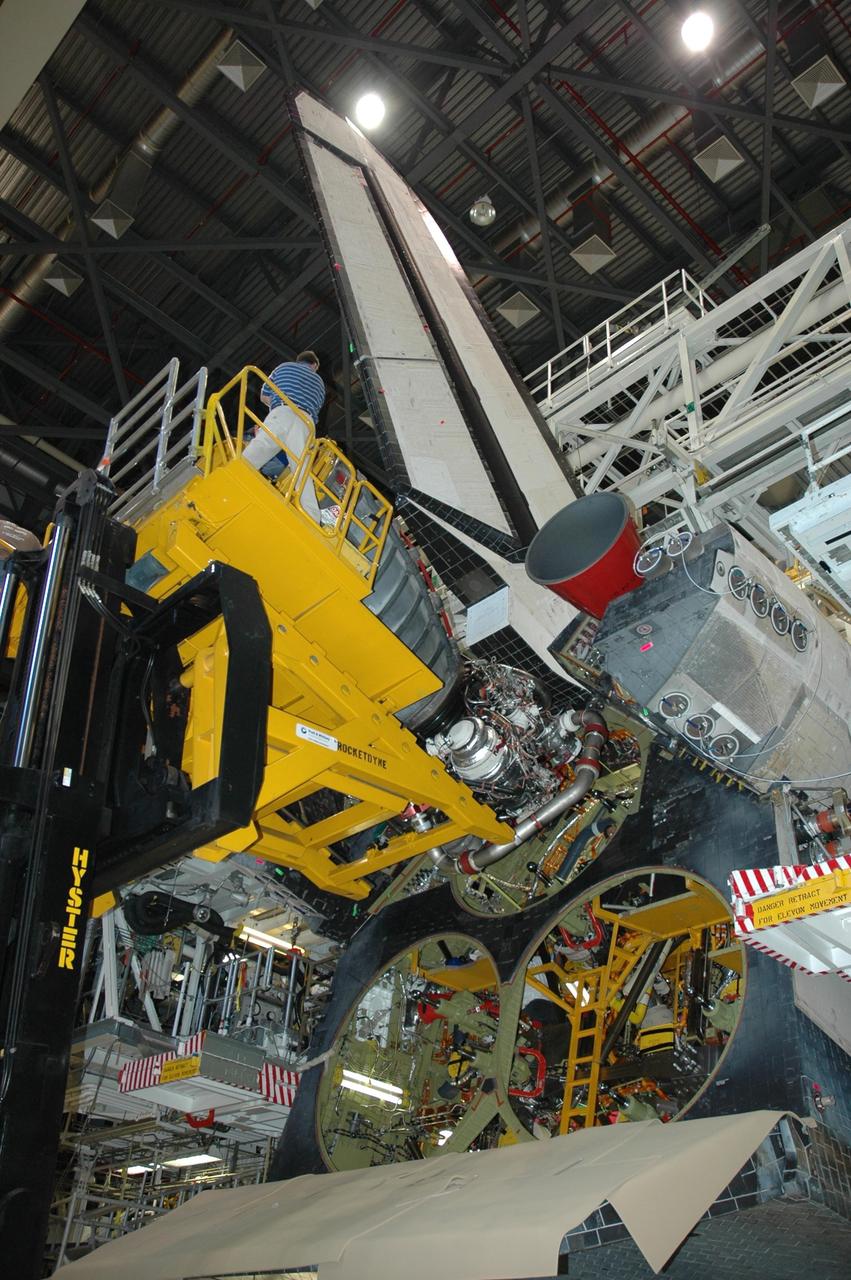
KENNEDY SPACE CENTER, FLA. -- In Orbiter Processing Facility bay 3 at NASA's Kennedy Space Center, technicians on a Hyster forklift maneuver space shuttle main engine no. 1 into place on Endeavour. Each space shuttle main engine is 14 feet long, weighs about 6,700 pounds, and is 7.5 feet in diameter at the end of the nozzle. The orbiter is targeted for launch on Feb. 14 for mission STS-123 to the International Space Station. Photo credit: NASA/Jack Pfaller
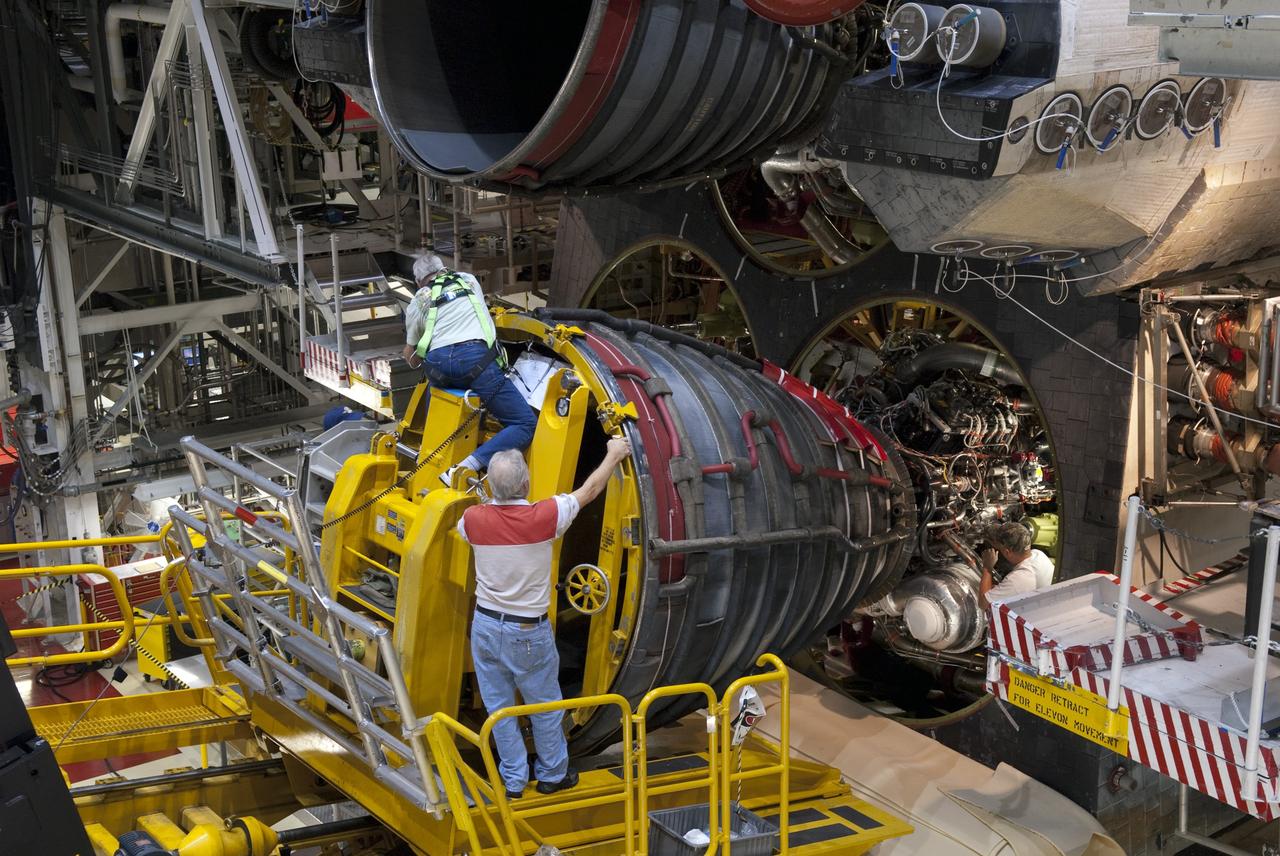
CAPE CANAVERAL, Fla. - Technicians carefully remove main engine No. 3 from space shuttle Discovery using a specially designed engine installer, called a Hyster forklift. The work is taking place in Orbiter Processing Facility-2 at NASA's Kennedy Space Center in Florida. The removal is part of Discovery's transition and retirement processing. Work performed on Discovery is expected to help rocket designers build next-generation spacecraft and prepare the shuttle for future public display. NASA/Jim Grossmann
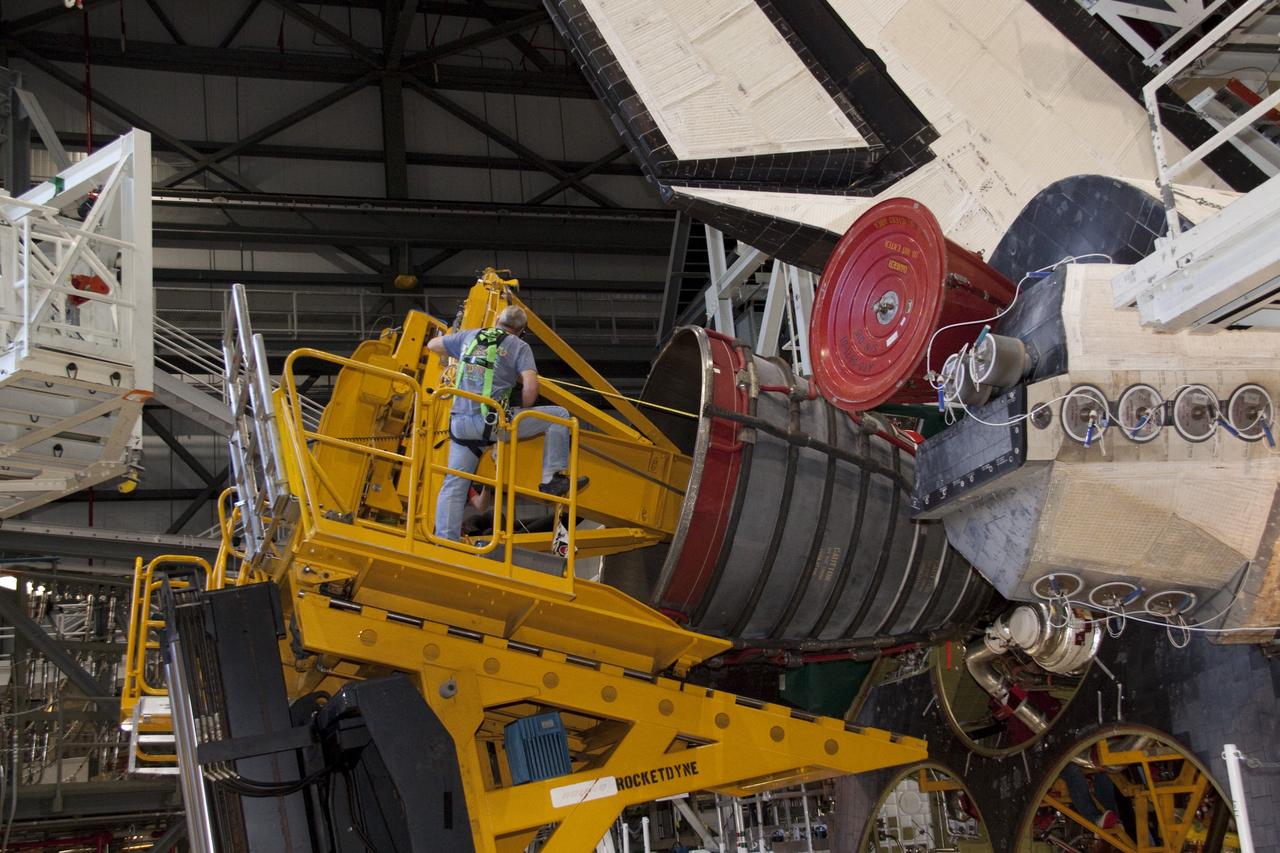
CAPE CANAVERAL, Fla. - Technicians carefully remove main engine No. 1 from space shuttle Discovery using a specially designed engine installer, called a Hyster forklift. The work is taking place in Orbiter Processing Facility-2 at NASA's Kennedy Space Center in Florida. The removal is part of Discovery's transition and retirement processing. Work performed on Discovery is expected to help rocket designers build next-generation spacecraft and prepare the shuttle for future public display. Photo credit: NASA/Jack Pfaller
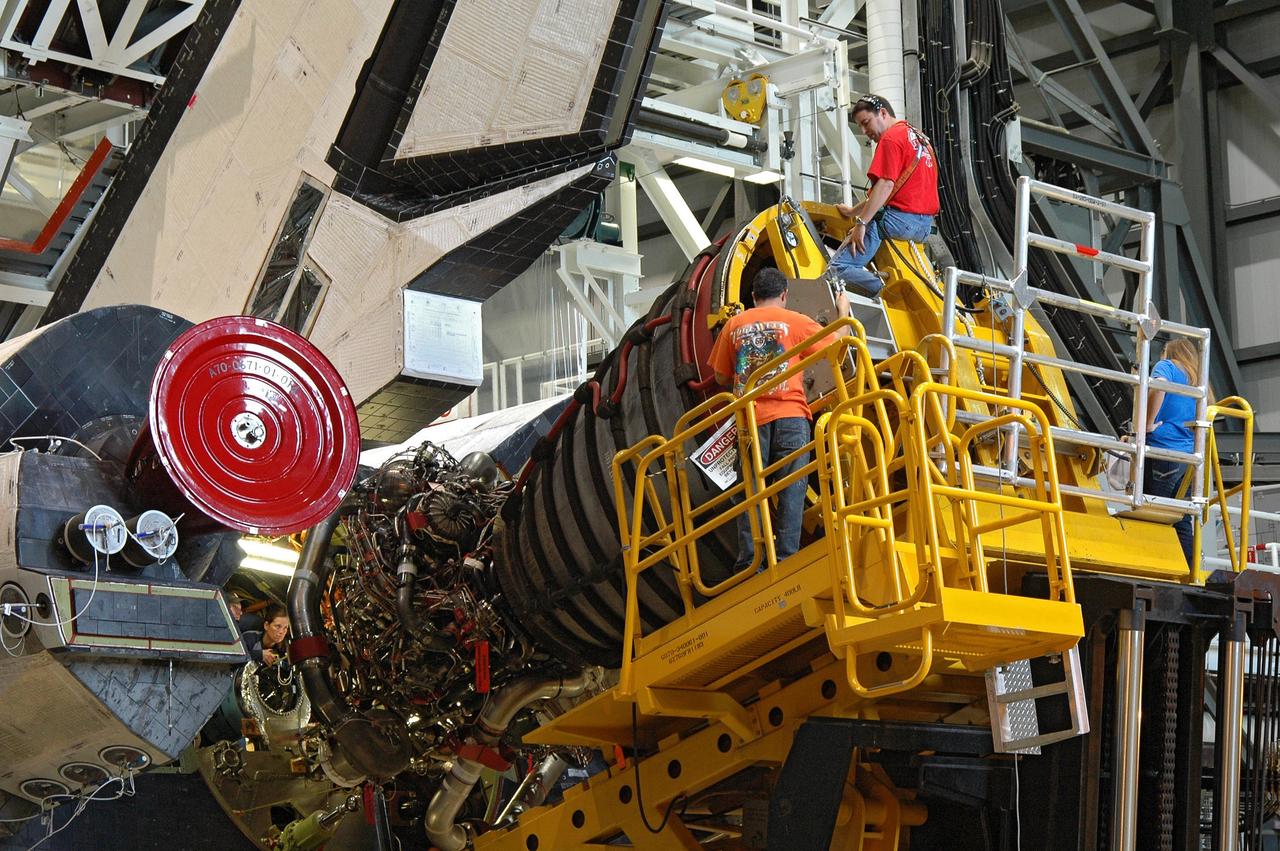
CAPE CANAVERAL, Fla. – In the Orbiter Processing Facility bay 2, technicians on the Hyster forklift maneuver main engine 1 for installation on space shuttle Endeavour. The scheduled launch vehicle for the STS-126 mission, Endeavour will deliver a multi-purpose logistics module to the International Space Station. Launch is targeted for Nov. 10. Endeavour is also the backup shuttle, if needed for rescue, for the STS-125 mission in October that will make repairs on the Hubble Space Telescope. For that purpose, it is designated STS-400. Photo credit: NASA/Jim Grossmann
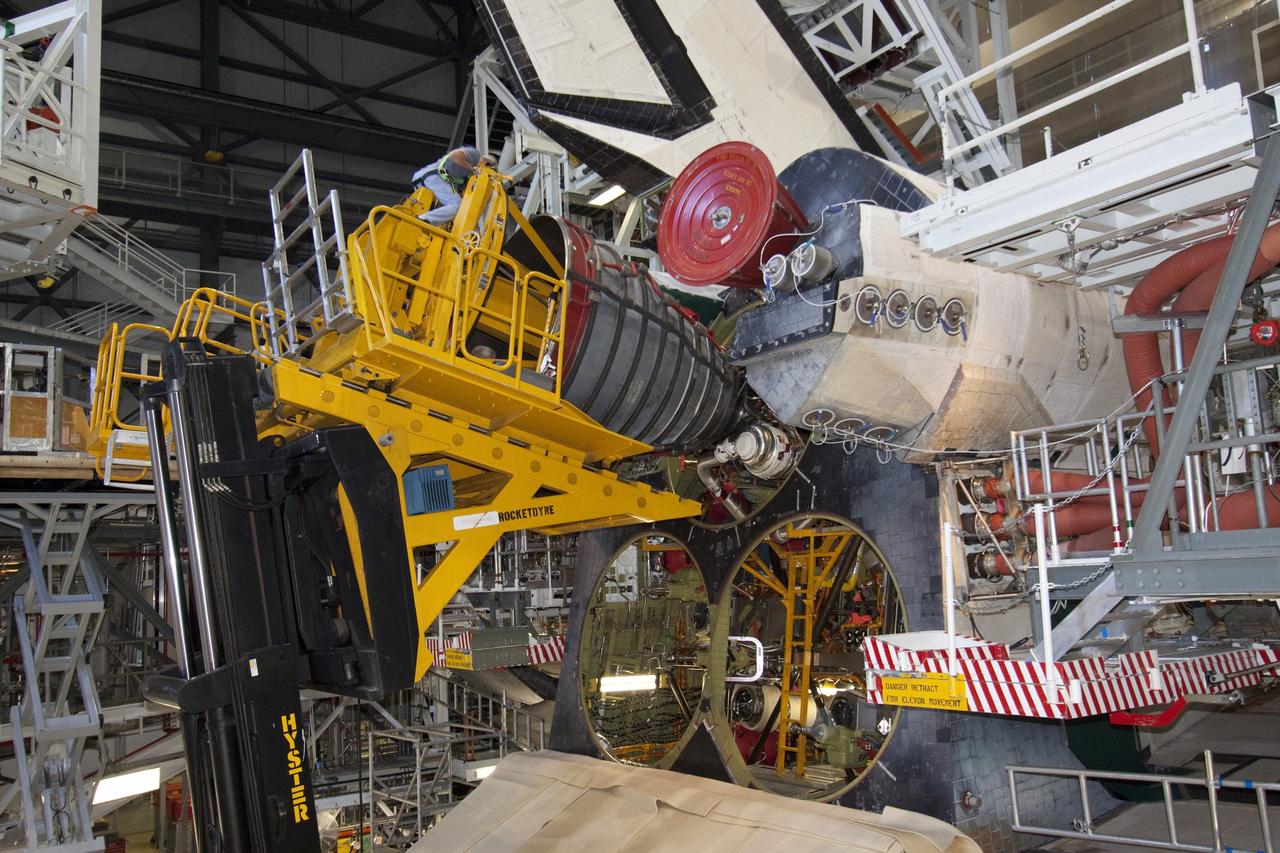
CAPE CANAVERAL, Fla. - Technicians carefully remove main engine No. 1 from space shuttle Discovery using a specially designed engine installer, called a Hyster forklift. The work is taking place in Orbiter Processing Facility-2 at NASA's Kennedy Space Center in Florida. The removal is part of Discovery's transition and retirement processing. Work performed on Discovery is expected to help rocket designers build next-generation spacecraft and prepare the shuttle for future public display. Photo credit: NASA/Jack Pfaller
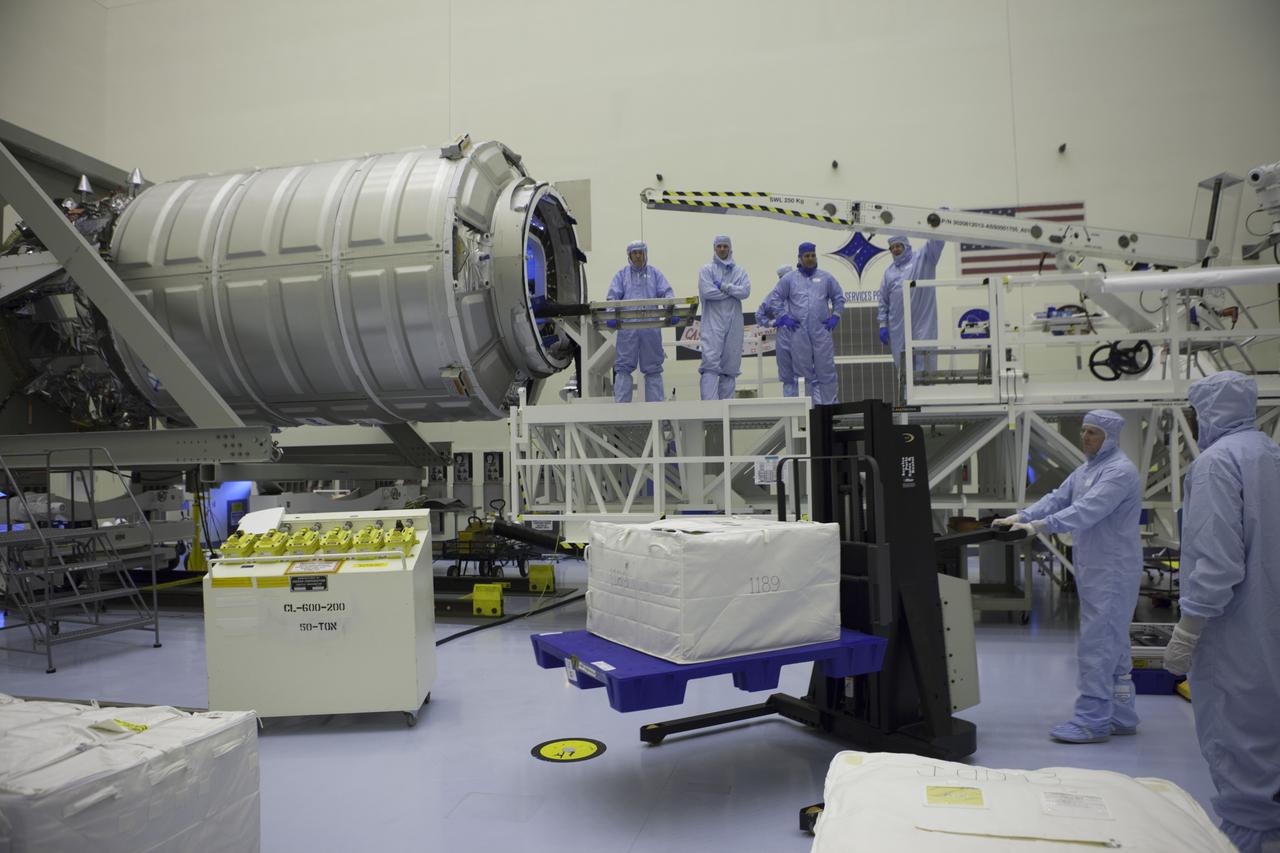
Technicians are positioned at the hatch of the Orbital ATK CRS-6 pressurized cargo module as a forklift moves a cargo package into position for installation into the spacecraft inside the Payload Hazardous Servicing Facility at NASA’s Kennedy Space Center in Florida. The spacecraft is scheduled for the upcoming Orbital ATK Commercial Resupply Services-6 mission to deliver hardware and supplies to the International Space Station. The Cygnus is scheduled to lift off atop a United Launch Alliance Atlas V rocket on March 22
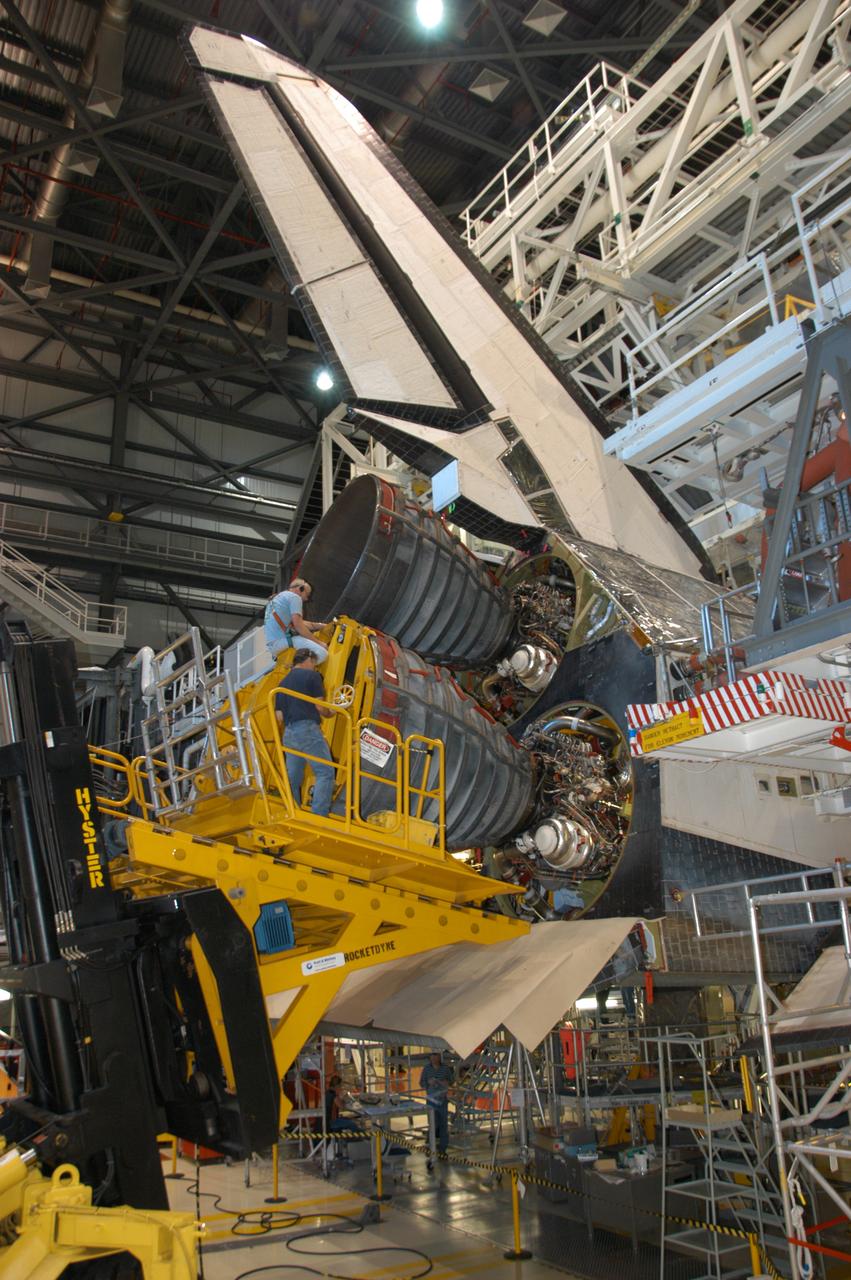
In Orbiter Processing Facility bay 2, technicians on a Hyster forklift install space shuttle main engine no. 3 into Endeavour. Each space shuttle main engine is 14 feet long, weighs about 6,700 pounds, and is 7.5 feet in diameter at the end of the nozzle. The orbiter is scheduled for mission STS-118, targeted for launch on June 28. The mission will be the 22nd flight to the International Space Station, carrying another starboard array, S5, for installation.
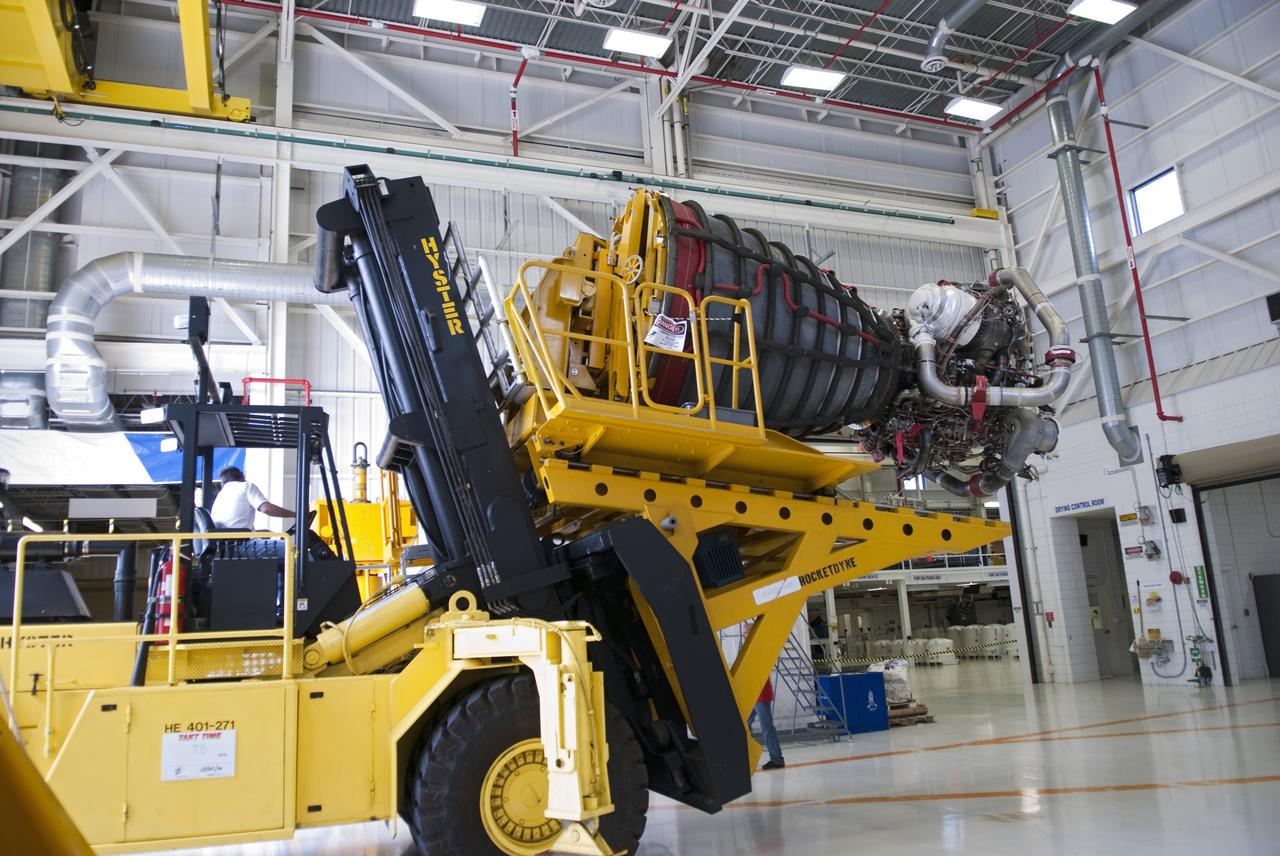
CAPE CANAVERAL, Fla. -- A heavy forklift with its specialized engine installer carries one of the main engines taken from space shuttle Discovery into the Space Shuttle Main Engine Processing Facility at NASA's Kennedy Space Center in Florida. The transition and retirement processing is expected to help rocket designers build next-generation spacecraft and prepare the shuttle for display. Photo credit: NASA/Jim Grossmann
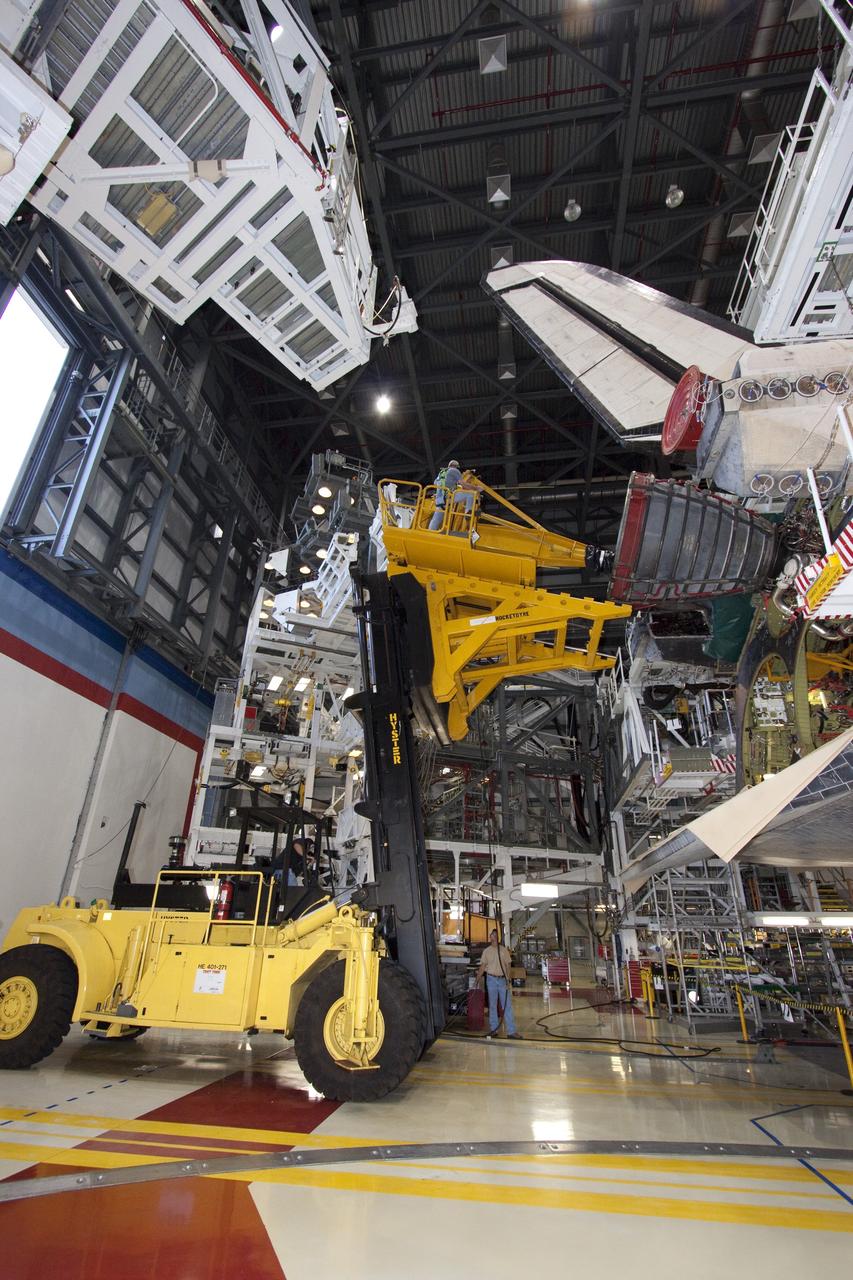
CAPE CANAVERAL, Fla. - Technicians carefully remove main engine No. 1 from space shuttle Discovery using a specially designed engine installer, called a Hyster forklift. The work is taking place in Orbiter Processing Facility-2 at NASA's Kennedy Space Center in Florida. The removal is part of Discovery's transition and retirement processing. Work performed on Discovery is expected to help rocket designers build next-generation spacecraft and prepare the shuttle for future public display. Photo credit: NASA/Jack Pfaller
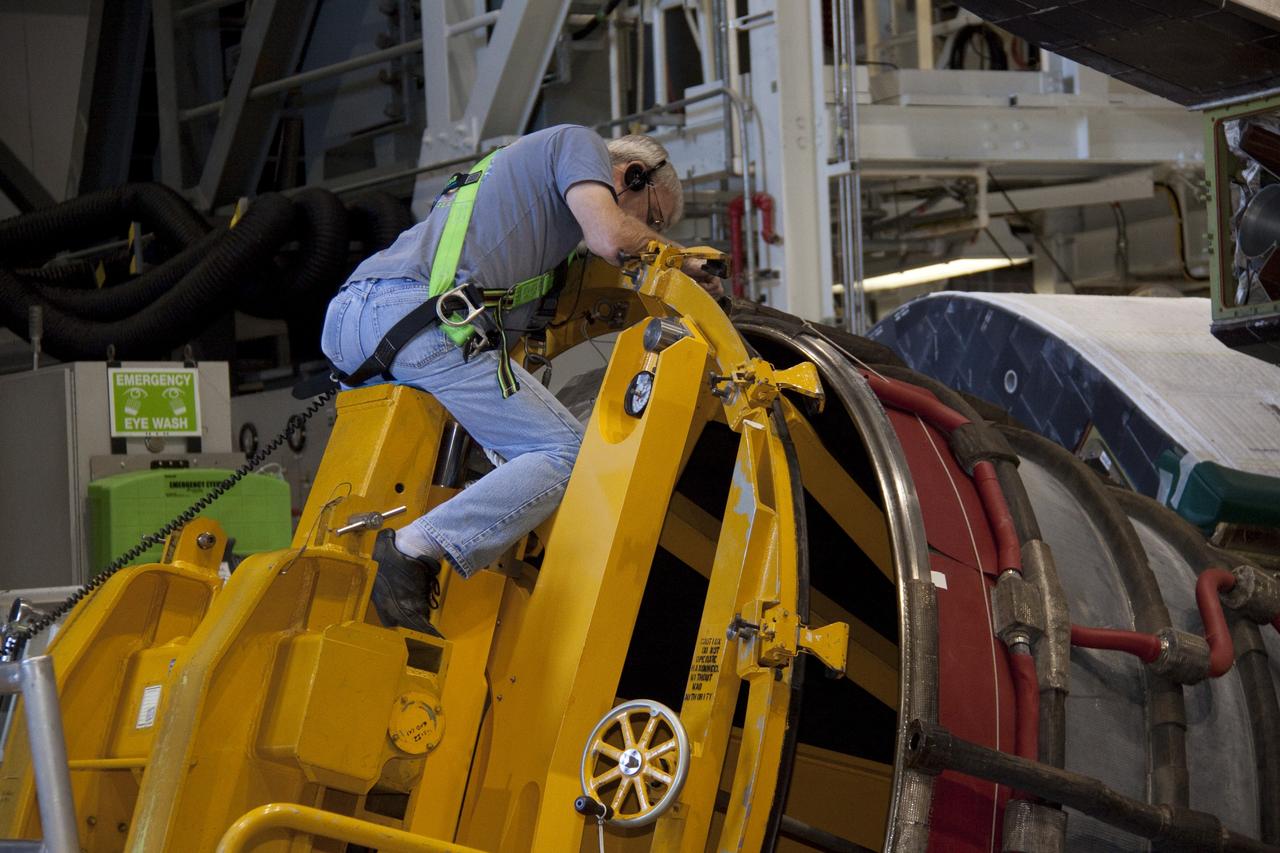
CAPE CANAVERAL, Fla. - Technicians carefully remove main engine No. 1 from space shuttle Discovery using a specially designed engine installer, called a Hyster forklift. The work is taking place in Orbiter Processing Facility-2 at NASA's Kennedy Space Center in Florida. The removal is part of Discovery's transition and retirement processing. Work performed on Discovery is expected to help rocket designers build next-generation spacecraft and prepare the shuttle for future public display. Photo credit: NASA/Jack Pfaller
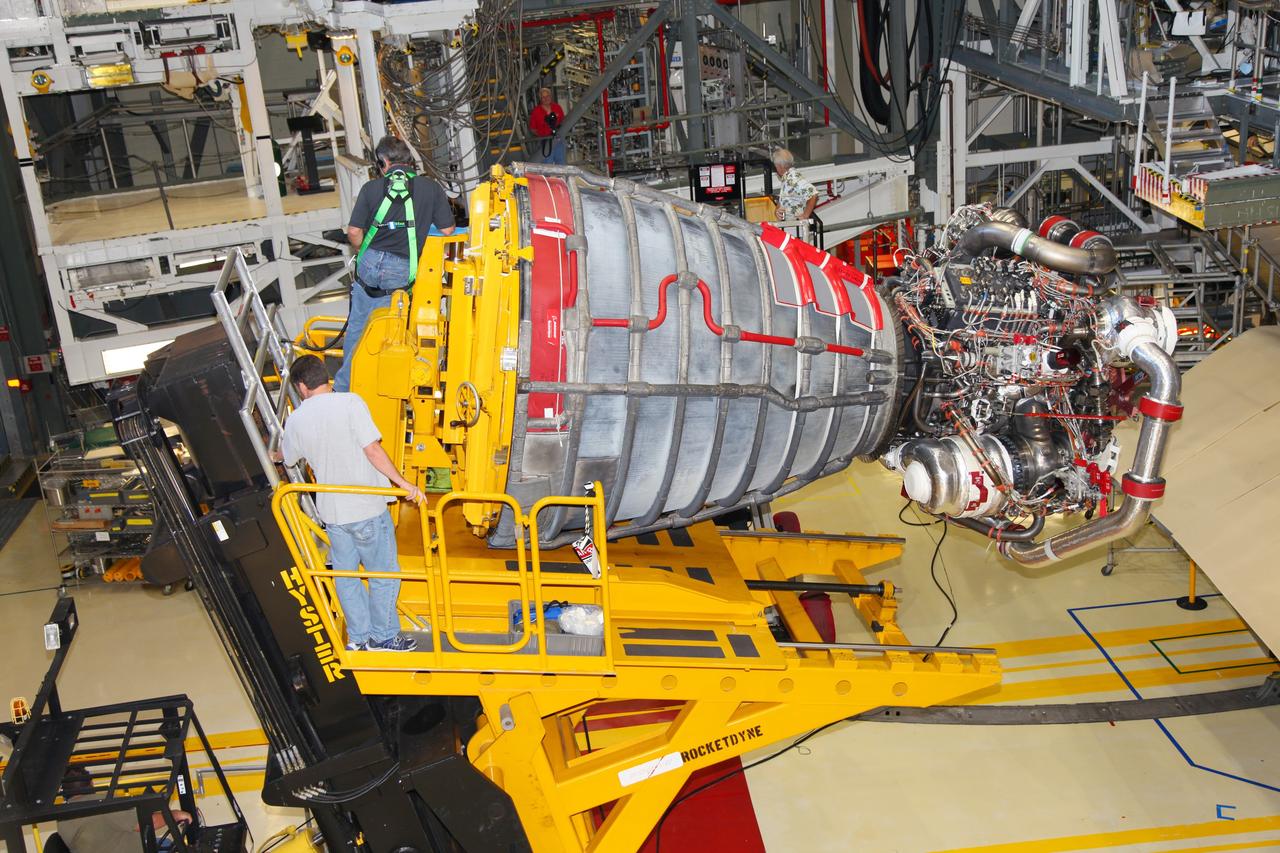
CAPE CANAVERAL, Fla. -- In Orbiter Processing Facility-2 at NASA’s Kennedy Space Center in Florida, technicians used a Hyster forklift to remove Engine #3 from space shuttle Atlantis. The engine will be transported to the Engine Shop for possible future use. Each of the three space shuttle main engines is 14 feet long and weighs 7,800 pounds. Removal of the space shuttle main engines is part of the Transition and Retirement work that is being performed in order to prepare Atlantis for eventual display at the Kennedy Space Center Visitor Complex in Florida. Photo credit: Frankie Martin
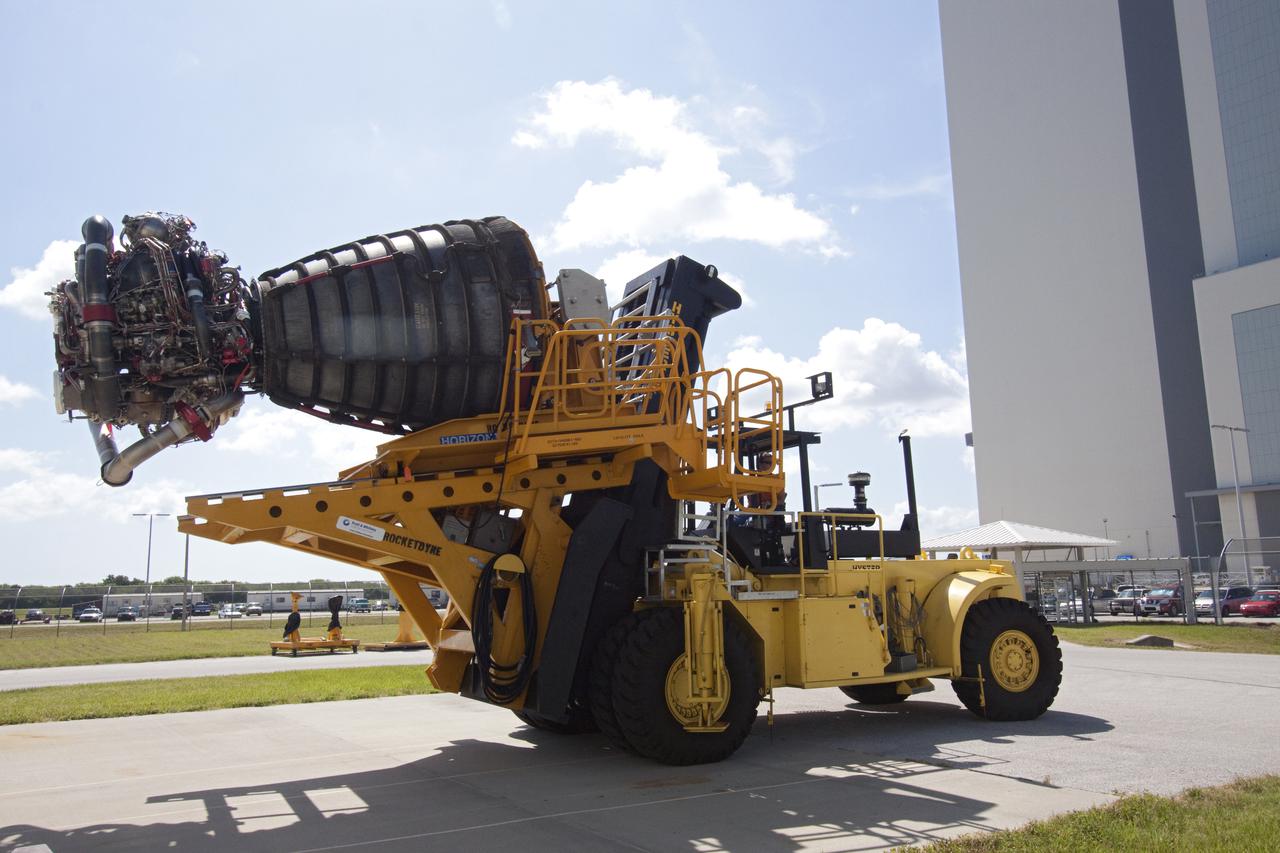
CAPE CANAVERAL, Fla. -- At NASA's Kennedy Space Center in Florida, a space shuttle main engine secured on a Hyster forklift moves from the Space Shuttle Main Engine Processing Facility to Orbiter Processing Facility-3. Three main engines, weighing 7,000 pounds each, will be installed in space shuttle Discovery for the STS-133 mission to the International Space Station. Discovery and its STS-133 crew are targeted to deliver the Express Logistics Carrier-4 filled with external payloads and experiments, as well as critical spare components to the station later this year. Photo credit: NASA_Jack Pfaller
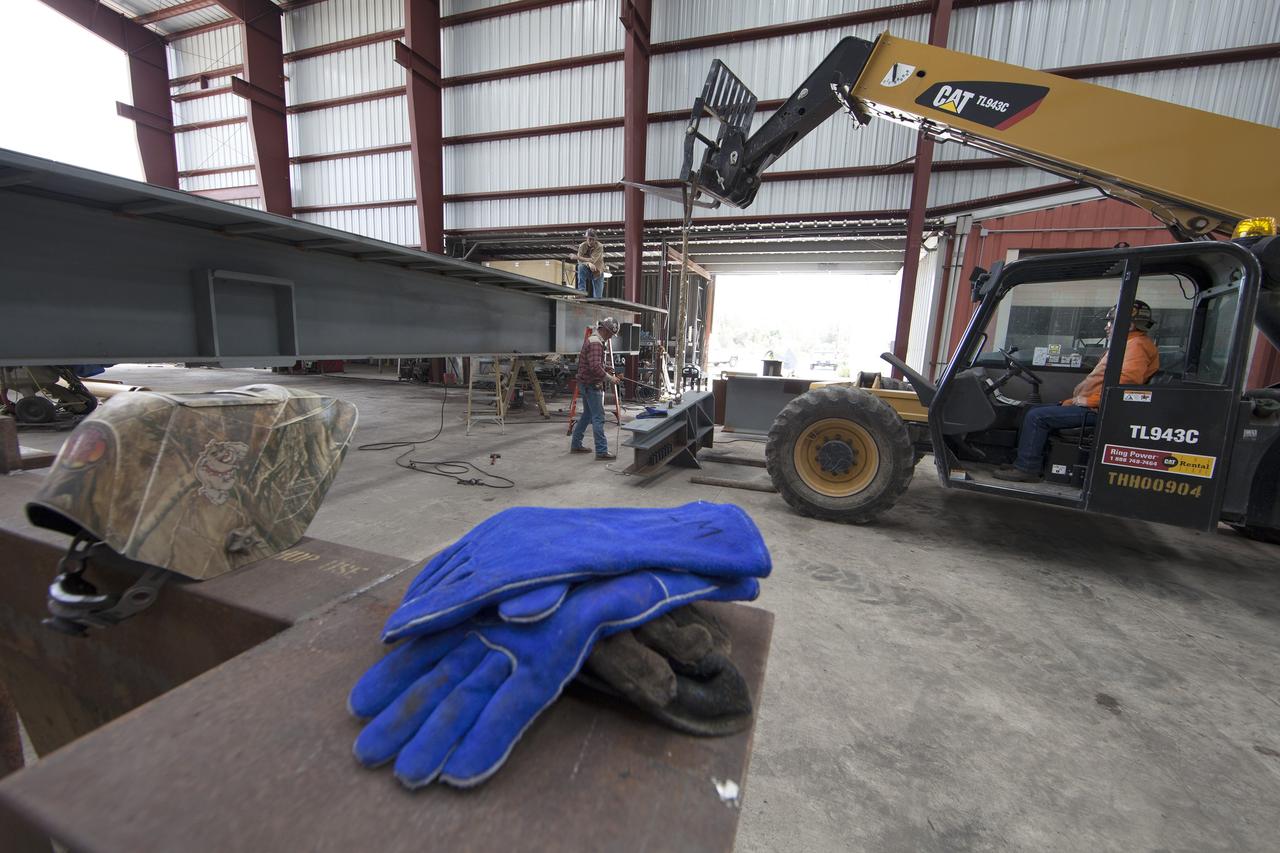
Bright-colored work gloves in the foreground are a stark contrast to the construction work going on at Sauer in Oak Hill, Florida. A forklift is being used to lift a segment of the first of 10 new work platforms for high bay 3 in the Vehicle Assembly Building at NASA's Kennedy Space Center in Florida, for buildup. A contract to modify high bay 3 was awarded by NASA to the Hensel Phelps Construction Co. of Orlando, Florida in March 2014. Sauer is a subcontractor to Hensel Phelps. The Ground Systems Development and Operations Program is overseeing upgrades and modifications to the high bay to support processing of NASA's Space Launch System and Orion spacecraft, and other exploration vehicles. Photo credit: NASA/Ben Smegelsky
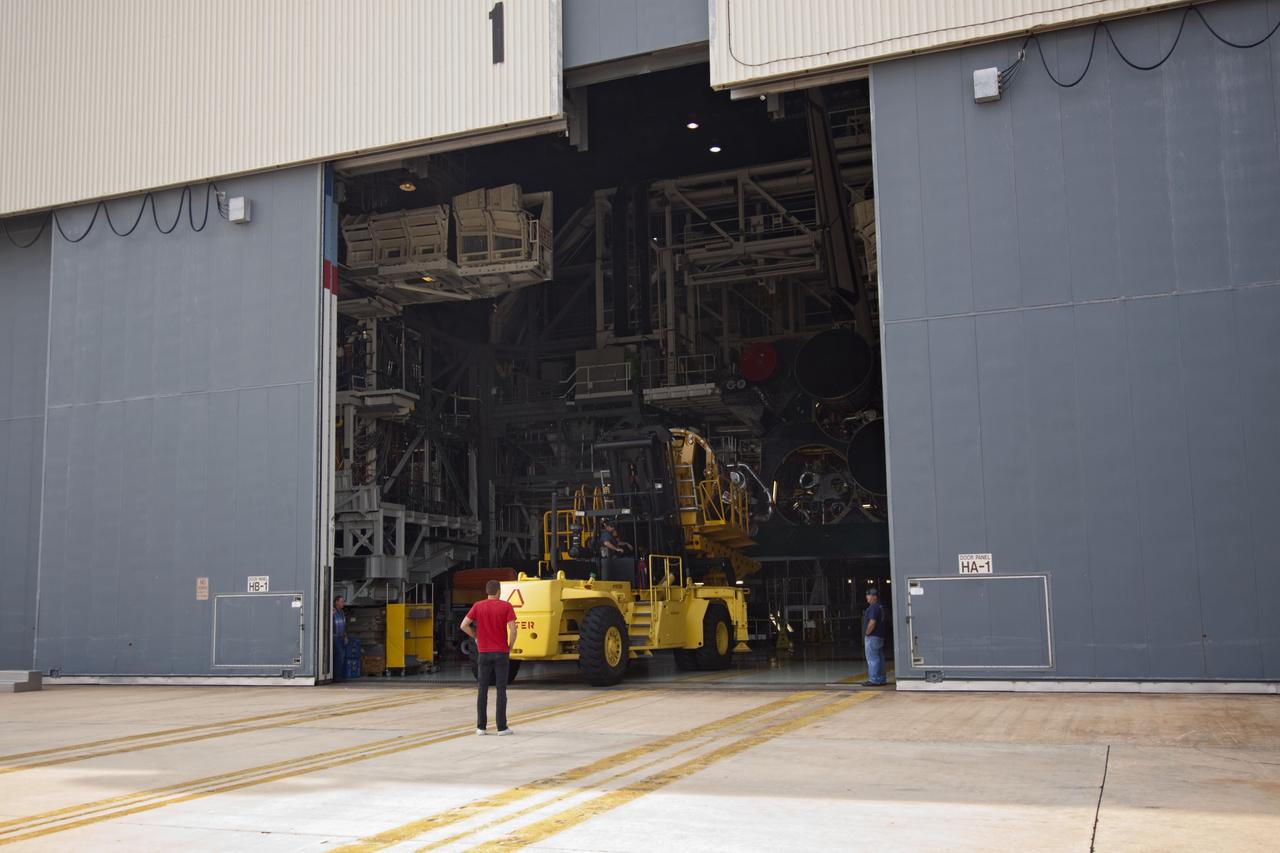
CAPE CANAVERAL, Fla. -- In Orbiter Processing Facility-1 at NASA's Kennedy Space Center in Florida, technicians have removed engine No. 2, one of three space shuttle main engines from Endeavour, using a specially designed engine installer, called a Hyster forklift. The removal is part of Endeavour's transition and retirement processing. Endeavour is being prepared for public display at the California Science Center in Los Angeles. Endeavour flew 25 missions, spent 299 days in space, orbited Earth 4,671 times and traveled 122,883,151 miles over the course of its 19-year career. Photo credit: NASA/Jim Grossmann
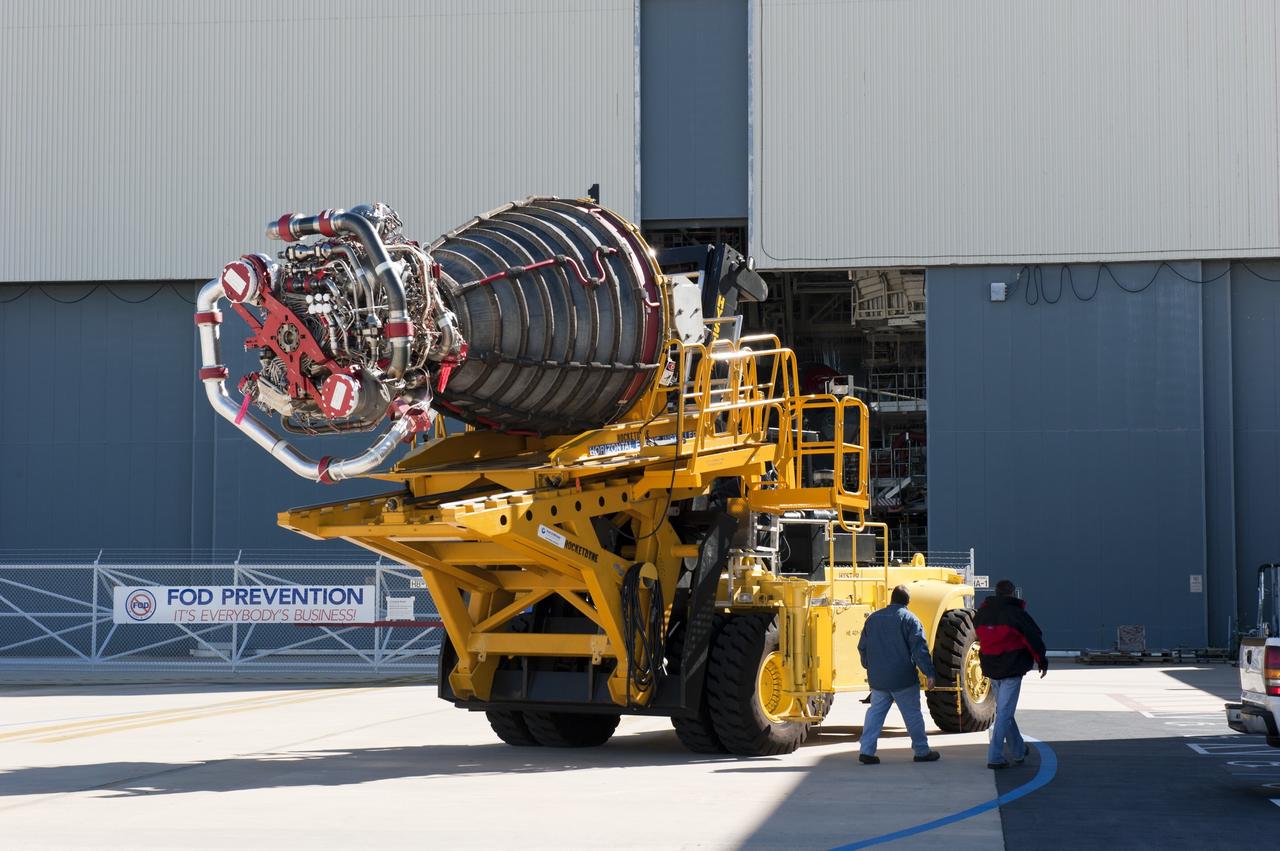
CAPE CANAVERAL, Fla. -- A Hyster forklift transports the second of shuttle Atlantis' three main engines from the Space Shuttle Main Engine (SSME) Shop to Orbiter Processing Facility-1 at NASA's Kennedy Space Center in Florida. Once inside the processing facility, the engine will be installed in the shuttle. Each engine is 14 feet long, weighs about 6,700 pounds, and is 7.5 feet in diameter at the end of the nozzle. This is the final planned engine installation for the Space Shuttle Program. Atlantis is being prepared for the "launch on need," or potential rescue mission, for the final planned shuttle flight, Endeavour's STS-134 mission. For more information, visit www.nasa.gov/shuttle. Photo credit: NASA/Kim Shiflett
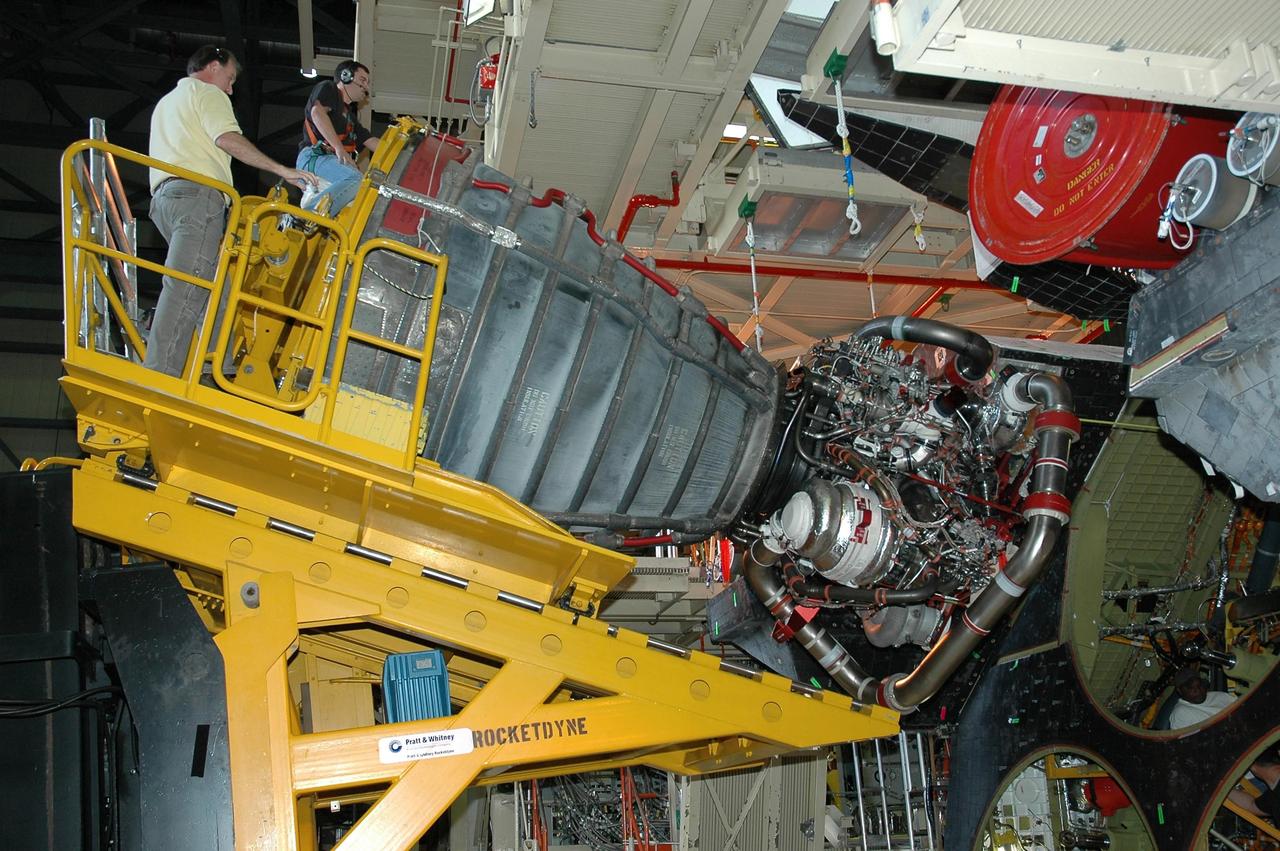
KENNEDY SPACE CENTER, FLA. - In In the Orbiter Processing Facility bay 1, a Hyster forklift maneuvers a main engine into position for installation into Discovery. The main engine configuration is manufactured by Boeing Rocketdyne in Canoga Park, Calif., and includes a Pratt & Whitney high-pressure fuel turbo pump. Each space shuttle main engine is 14 feet (4.3 meters) long, weighs about 6,700 pounds (3,039 kilograms), and is 7.5 feet (2.3 meters) in diameter at the end of the nozzle. Discovery is being processed for the second return-to-flight mission STS-121.
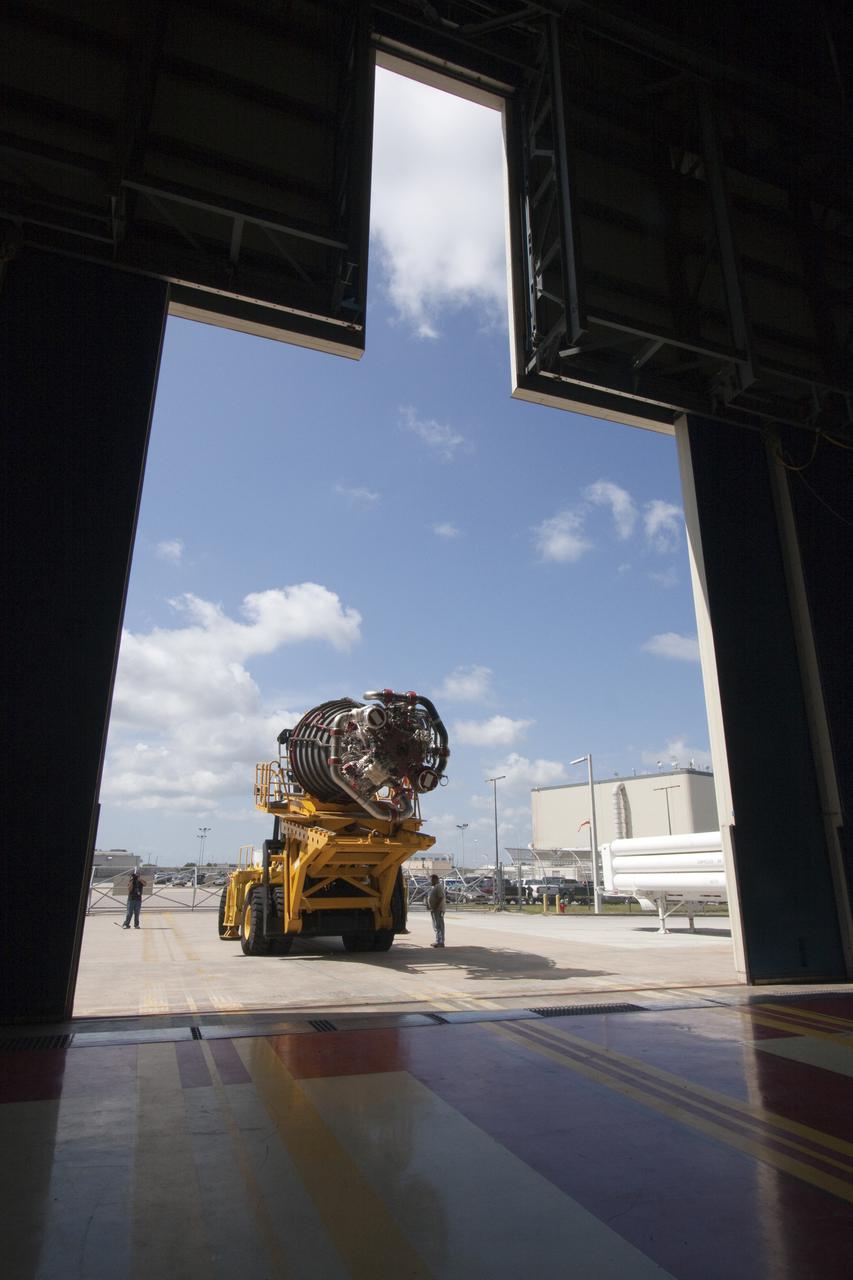
CAPE CANAVERAL, Fla. -- At NASA's Kennedy Space Center in Florida, a space shuttle main engine secured on a Hyster forklift enters Orbiter Processing Facility-3. Three main engines, weighing 7,000 pounds each, will be installed in space shuttle Discovery for the STS-133 mission to the International Space Station. Engines are inspected and maintained in the nearby Space Shuttle Main Engine Processing Facility before installation. Discovery and its STS-133 crew are targeted to deliver the Express Logistics Carrier-4 filled with external payloads and experiments, as well as critical spare components to the station later this year. Photo credit: NASA_Jack Pfaller
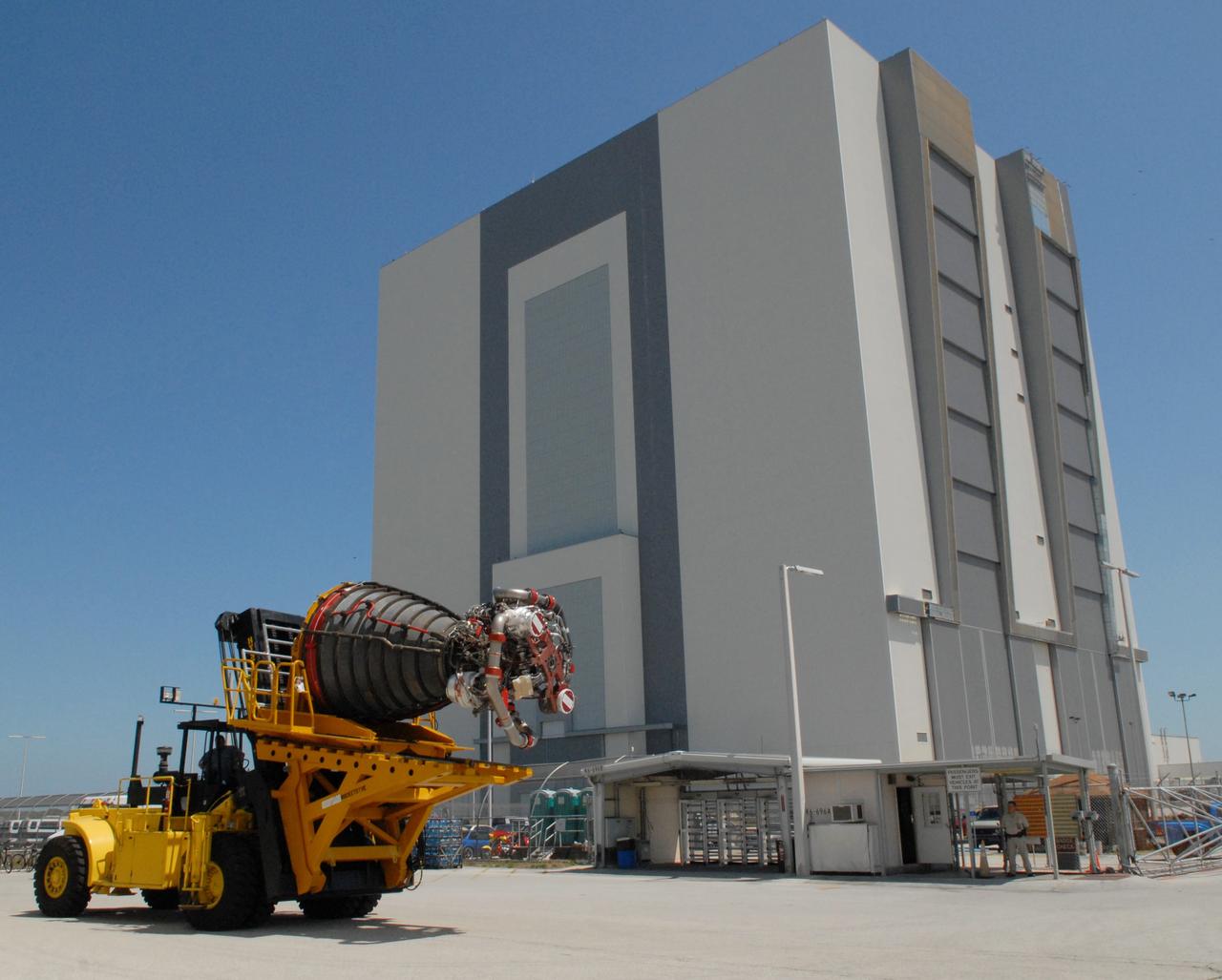
CAPE CANAVERAL, Fla. – After removal from space shuttle Discovery, the third and final main engine has left Orbiter Processing Facility 3 at NASA's Kennedy Space Center in Florida. Behind the Hyster forklift holding the engine is the Vehicle Assembly Building. Each engine is 14 feet long, weighs about 6,700 pounds, and is 7.5 feet in diameter at the end of the nozzle. Discovery next will be used on the STS-128 mission to deliver supplies and equipment to the International Space Station. The launch is targeted for Aug. 6. Photo credit: NASA/Tim Jacobs
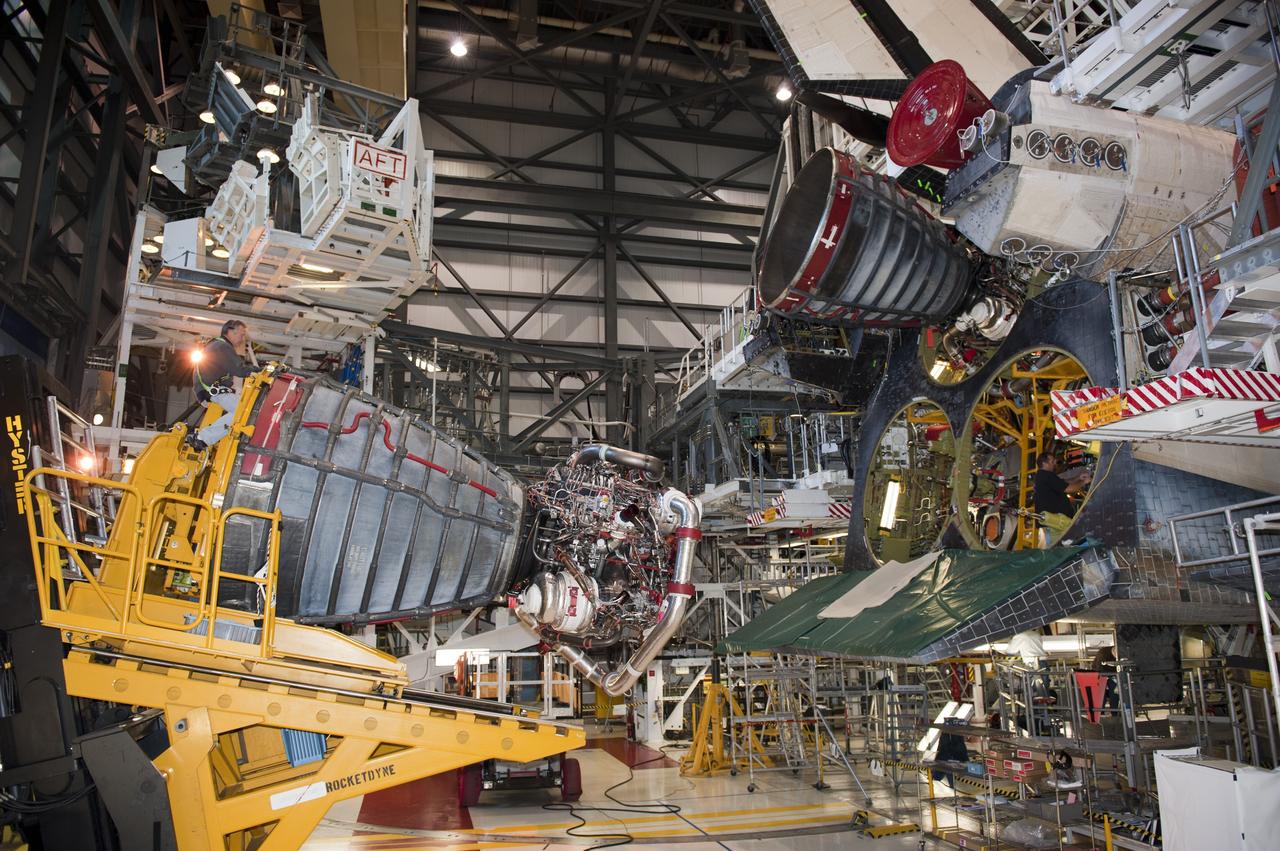
CAPE CANAVERAL, Fla. -- In Orbiter Processing Facility-1 at NASA's Kennedy Space Center in Florida, a Hyster forklift moves the second of three space shuttle main engines closer to shuttle Atlantis for installation. Each engine is 14 feet long, weighs about 6,700 pounds, and is 7.5 feet in diameter at the end of the nozzle. This is the final planned engine installation for the Space Shuttle Program. Atlantis is being prepared for the "launch on need," or potential rescue mission, for the final planned shuttle flight, Endeavour's STS-134 mission. For more information, visit www.nasa.gov/shuttle. Photo credit: NASA/Kim Shiflett
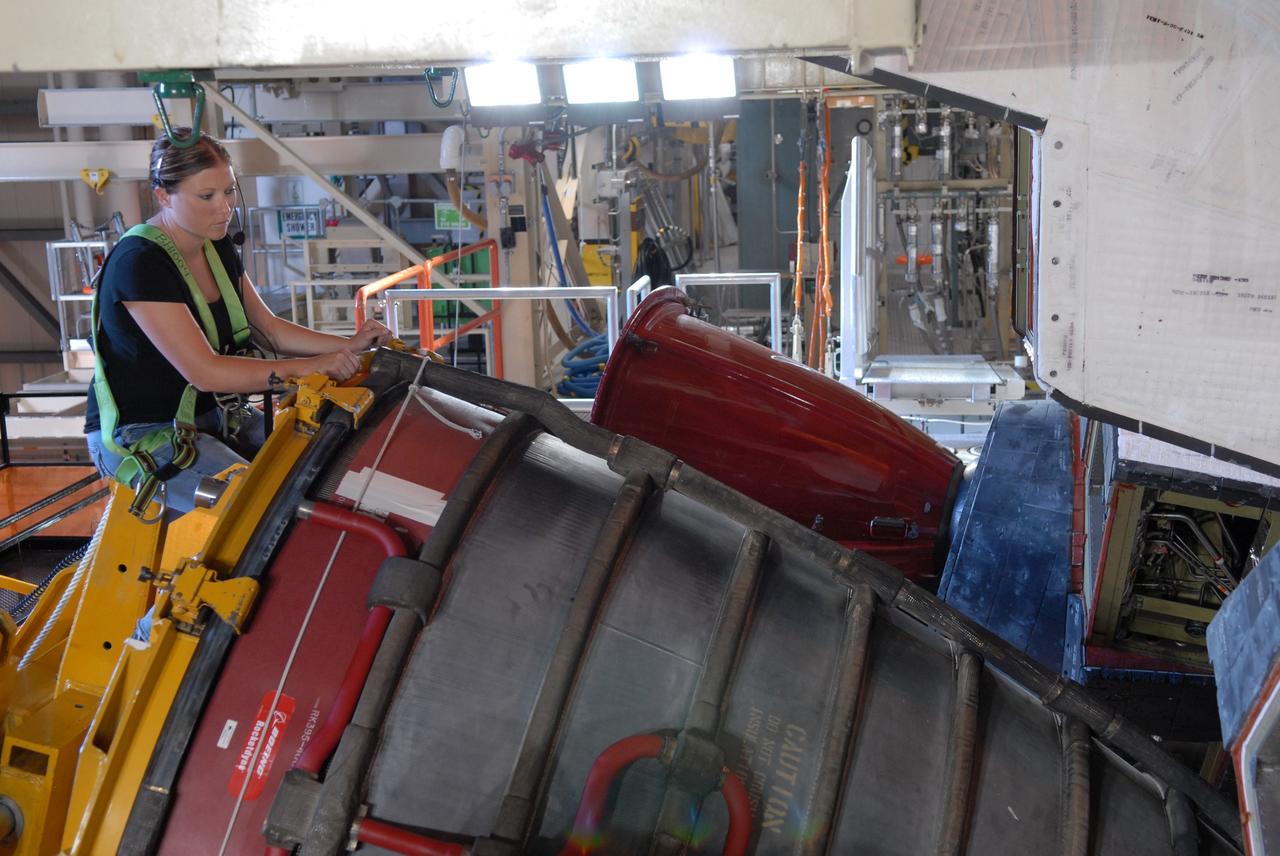
CAPE CANAVERAL, Fla. – At NASA's Kennedy Space Center in Florida, a technician using a Hyster forklift begins removing one of the three main engines on space shuttle Discovery. Engine removal is part of the post-landing processing. Discovery completed the STS-119 mission March 28 with a landing at Kennedy's Shuttle Landing Facility. Each engine is 14 feet long, weighs about 6,700 pounds, and is 7.5 feet in diameter at the end of the nozzle. Discovery next will be used on the STS-128 mission to deliver supplies and equipment to the International Space Station. The launch is targeted for Aug. 6. Photo credit: NASA/Tim Jacobs
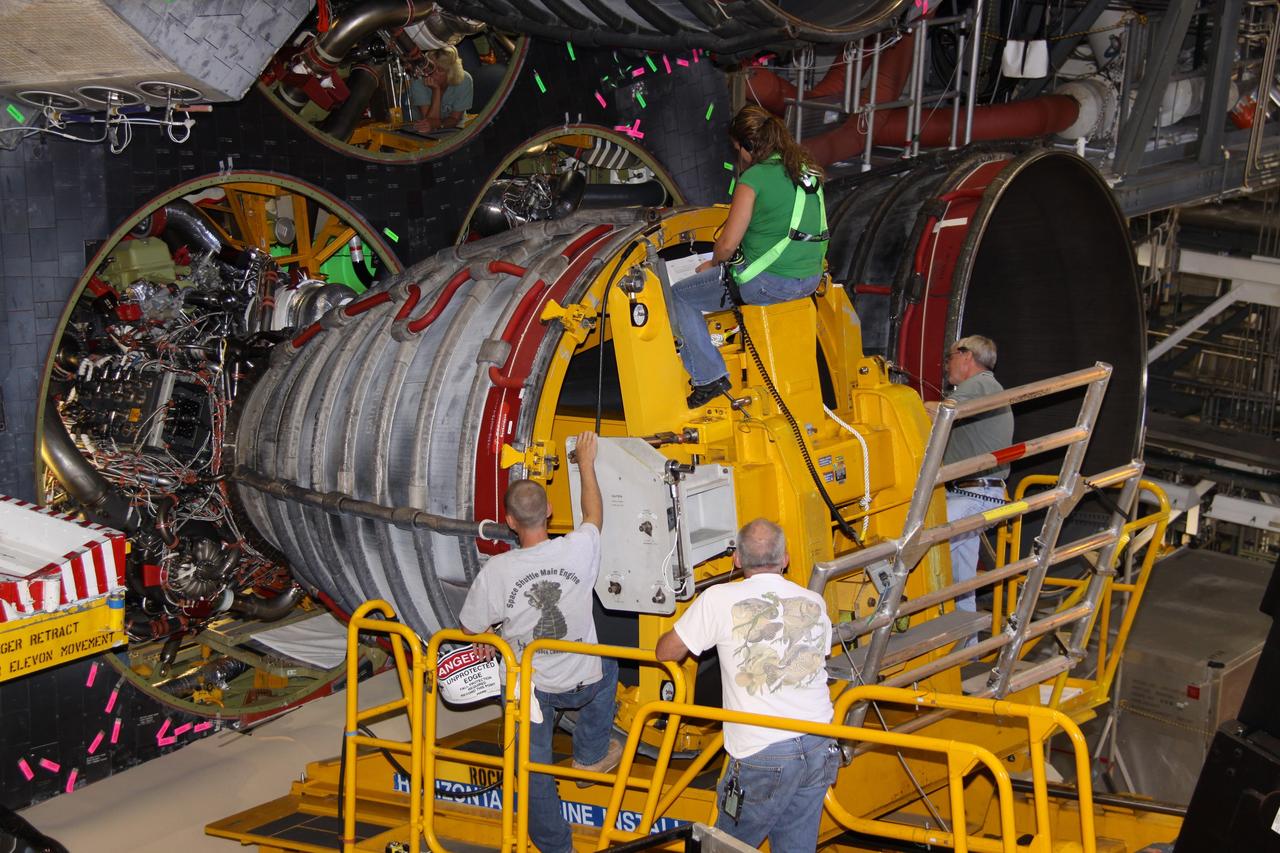
CAPE CANAVERAL, Fla. – In Orbiter Processing Bay 2 at NASA's Kennedy Space Center in Florida, technicians using a Hyster forklift remove main engine no. 2 from space shuttle Endeavour. Engine removal is part of the post-landing processing. Endeavour returned from the STS-127 mission July 31. Endeavour's next mission is STS-130 targeted for February 2010. Endeavour will deliver to the International Space Station the Tranquility pressurized module that will provide room for many of the station's life support systems. Photo credit: NASA/Jack Pfaller
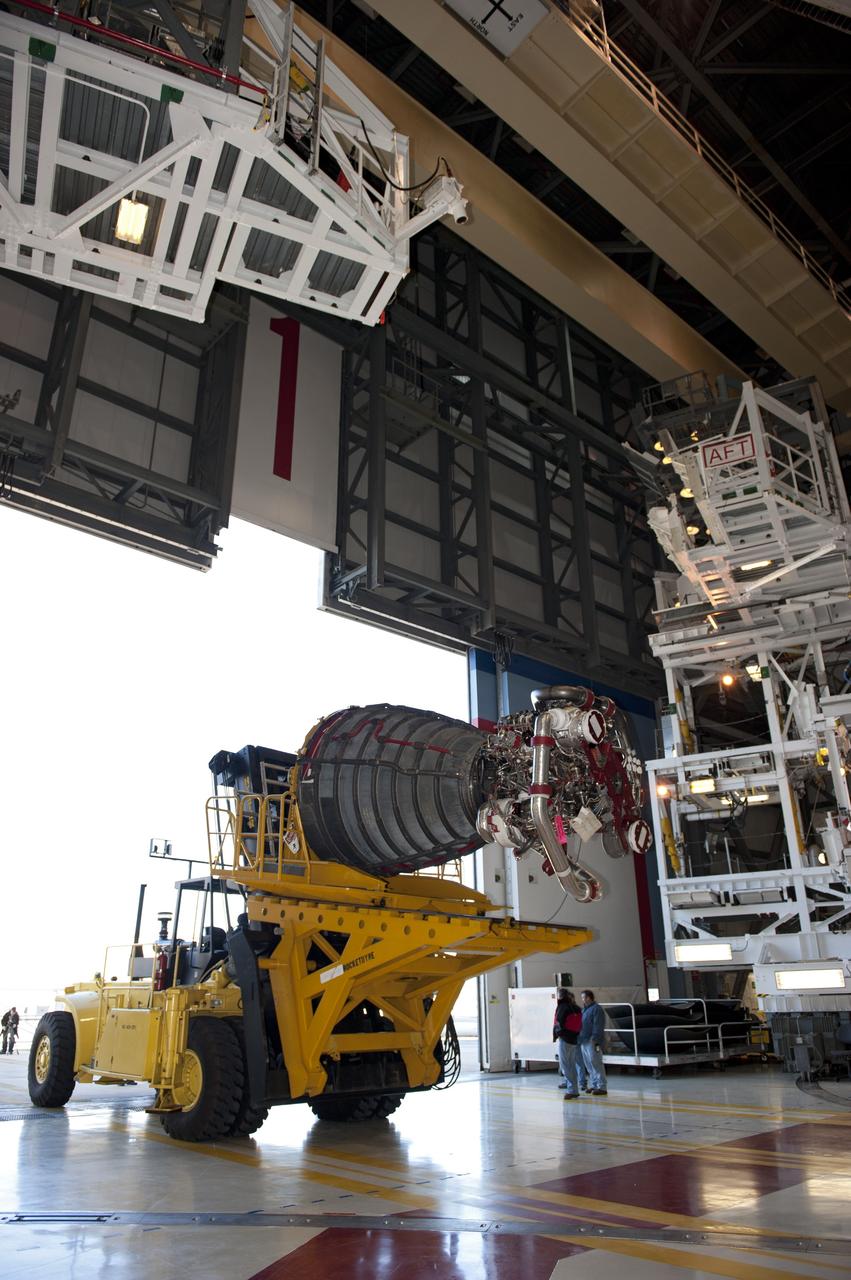
CAPE CANAVERAL, Fla. -- A Hyster forklift transporting the second of shuttle Atlantis' three main engines arrives at Orbiter Processing Facility-1 from the Space Shuttle Main Engine (SSME) Shop at NASA's Kennedy Space Center in Florida. There, the engine will be installed in the shuttle. Each engine is 14 feet long, weighs about 6,700 pounds, and is 7.5 feet in diameter at the end of the nozzle. This is the final planned engine installation for the Space Shuttle Program. Atlantis is being prepared for the "launch on need," or potential rescue mission, for the final planned shuttle flight, Endeavour's STS-134 mission. For more information, visit www.nasa.gov/shuttle. Photo credit: NASA/Kim Shiflett
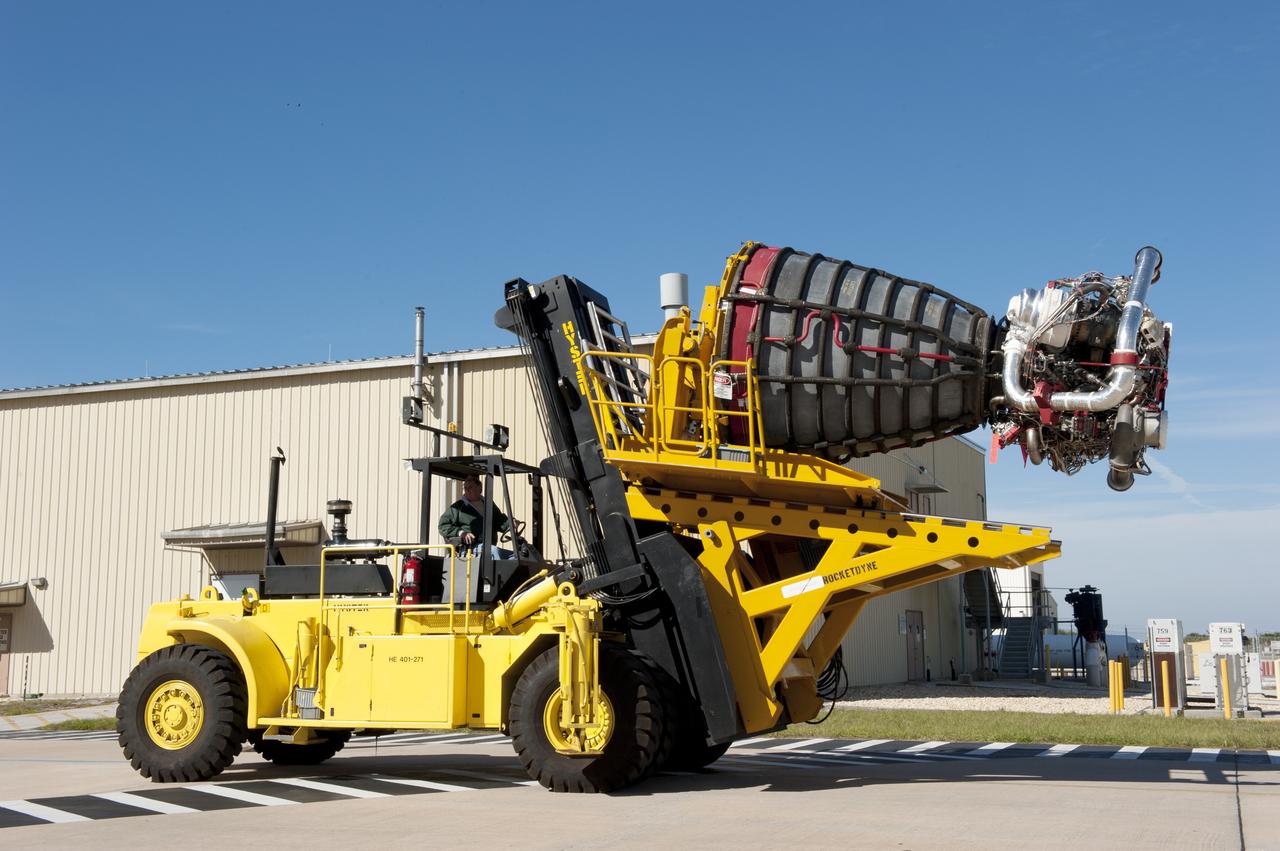
CAPE CANAVERAL, Fla. -- A Hyster forklift transports engine #2, the last of shuttle Atlantis' three main engines, from the Space Shuttle Main Engine (SSME) Shop to Orbiter Processing Facility-1 at NASA's Kennedy Space Center in Florida. Inside the processing facility, the engine will be installed in the shuttle. Each engine is 14 feet long, weighs about 6,700 pounds, and is 7.5 feet in diameter at the end of the nozzle. This is the final planned engine installation for the Space Shuttle Program. Atlantis is being prepared for the "launch on need," or potential rescue mission, for the final planned shuttle flight, Endeavour's STS-134 mission. For more information, visit www.nasa.gov/shuttle. Photo credit: NASA/Kim Shiflett
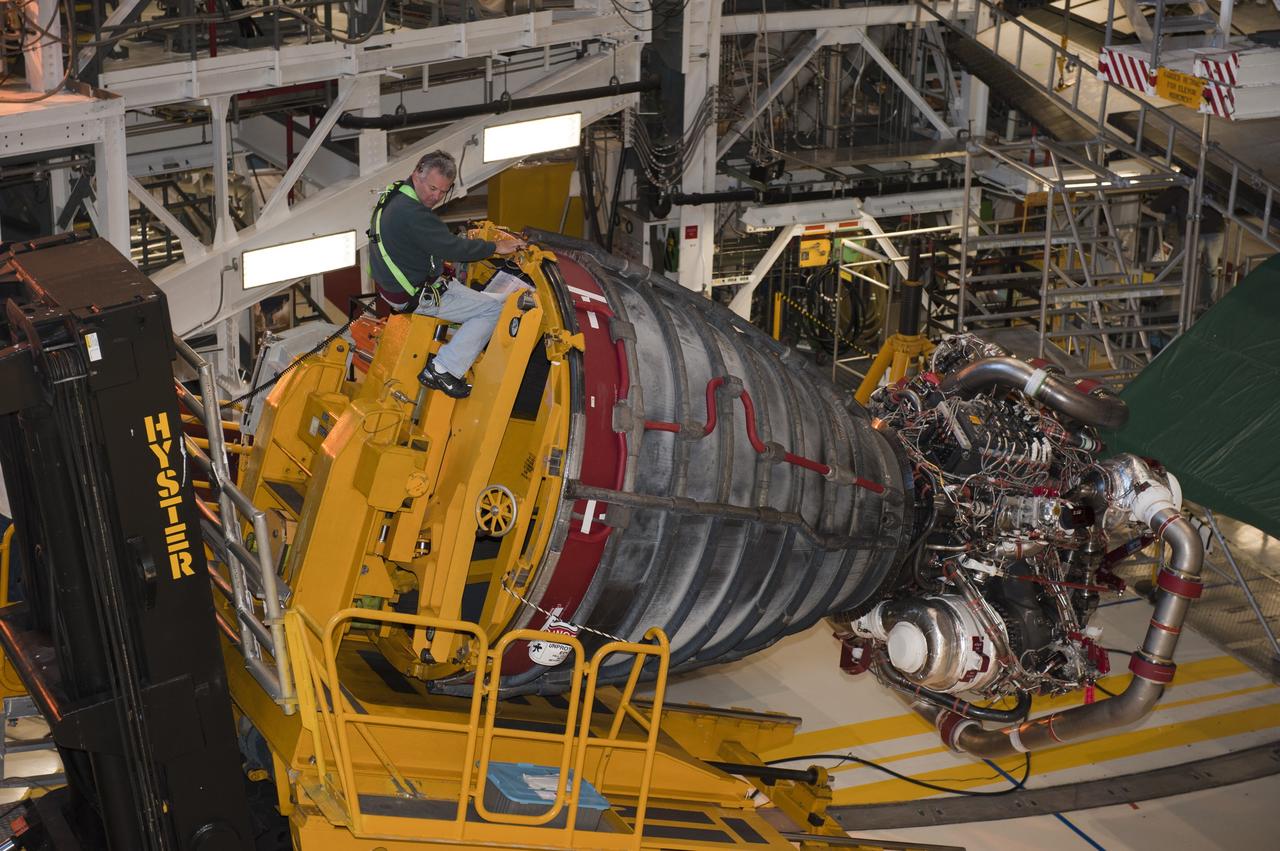
CAPE CANAVERAL, Fla. -- In Orbiter Processing Facility-1 at NASA's Kennedy Space Center in Florida, a Hyster forklift moves the first of three space shuttle main engines closer to space shuttle Atlantis for installation. Each engine is 14 feet long, weighs about 6,700 pounds, and is 7.5 feet in diameter at the end of the nozzle. This is the final planned engine installation for the Space Shuttle Program. Atlantis is being prepared for the "launch on need," or potential rescue mission, for the final planned shuttle flight, Endeavour's STS-134 mission. For more information, visit www.nasa.gov/shuttle. Photo credit: NASA/Kim Shiflett
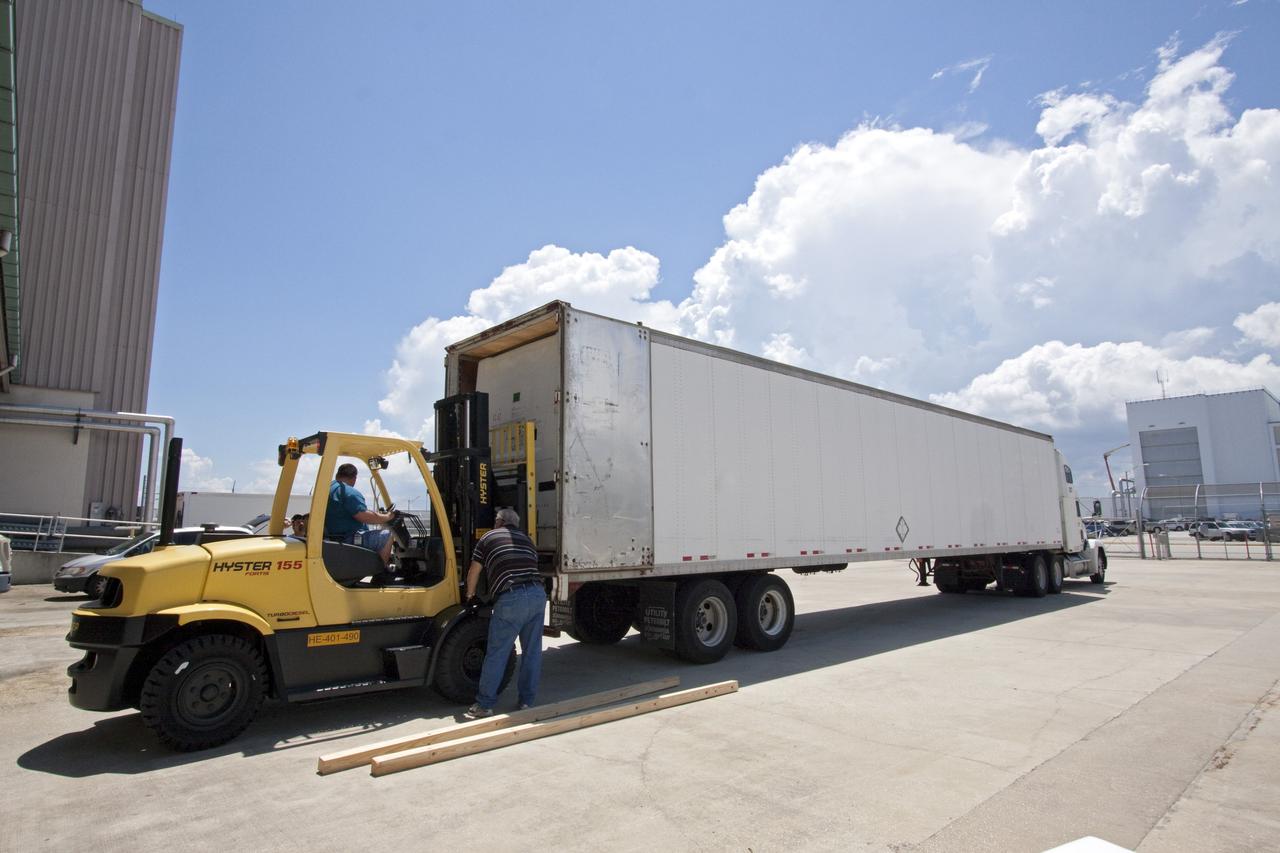
CAPE CANAVERAL, Fla. -- In the Space Station Processing Facility at NASA's Kennedy Space Center in Florida, a forklift moves shipping containers packed with tools and flight support equipment for orbital replacement units into a tractor-trailer for their trip to the Japanese Aerospace Exploration Agency's Tanegashima Space Center. There, the six units, including the flex hose rotary coupler, will be processed for launch to the International Space Station aboard HTV-2, scheduled for Jan. 20, 2011. HTV-2 is an uncrewed cargo transporter that will be launched by the H-IIB launch vehicle. It is designed to deliver up to 6 tons of supplies, including food, clothes and experiment devices to the space station. Photo credit: NASA/Jack Pfaller
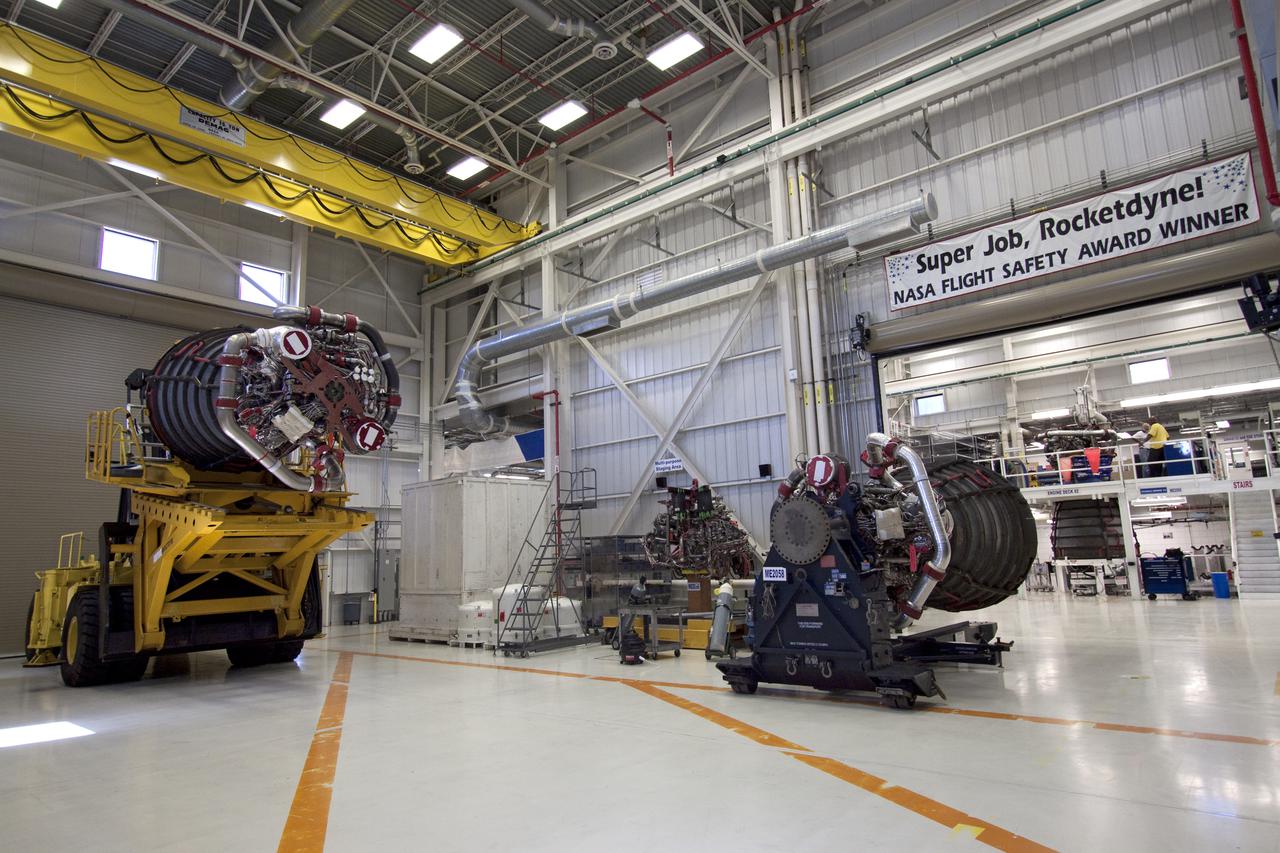
CAPE CANAVERAL, Fla. -- In the Space Shuttle Main Engine Processing Facility at NASA's Kennedy Space Center in Florida, a space shuttle main engine is secured on a Hyster forklift, left, and ready for its move to Orbiter Processing Facility-3. Three main engines, weighing 7,000 pounds each, will be installed in space shuttle Discovery for the STS-133 mission to the International Space Station. Discovery and its STS-133 crew are targeted to deliver the Express Logistics Carrier-4 filled with external payloads and experiments, as well as critical spare components to the station later this year. Photo credit: NASA_Jack Pfaller
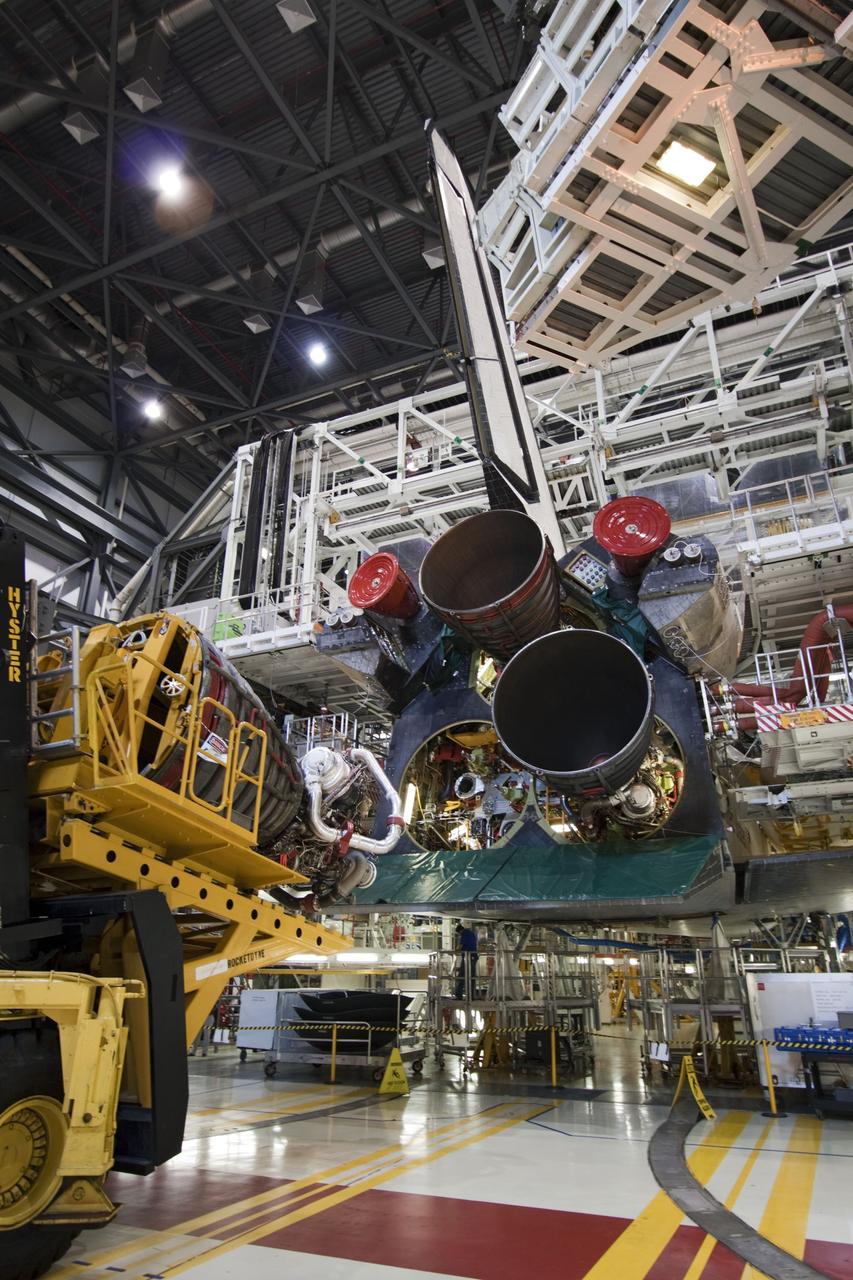
CAPE CANAVERAL, Fla. -- In Orbiter Processing Facility-1 at NASA's Kennedy Space Center in Florida, technicians carefully remove engine No. 2, one of three space shuttle main engines from Endeavour, using a specially designed engine installer, called a Hyster forklift. The removal is part of Endeavour's transition and retirement processing. Endeavour is being prepared for public display at the California Science Center in Los Angeles. Endeavour flew 25 missions, spent 299 days in space, orbited Earth 4,671 times and traveled 122,883,151 miles over the course of its 19-year career. Photo credit: NASA/Jim Grossmann
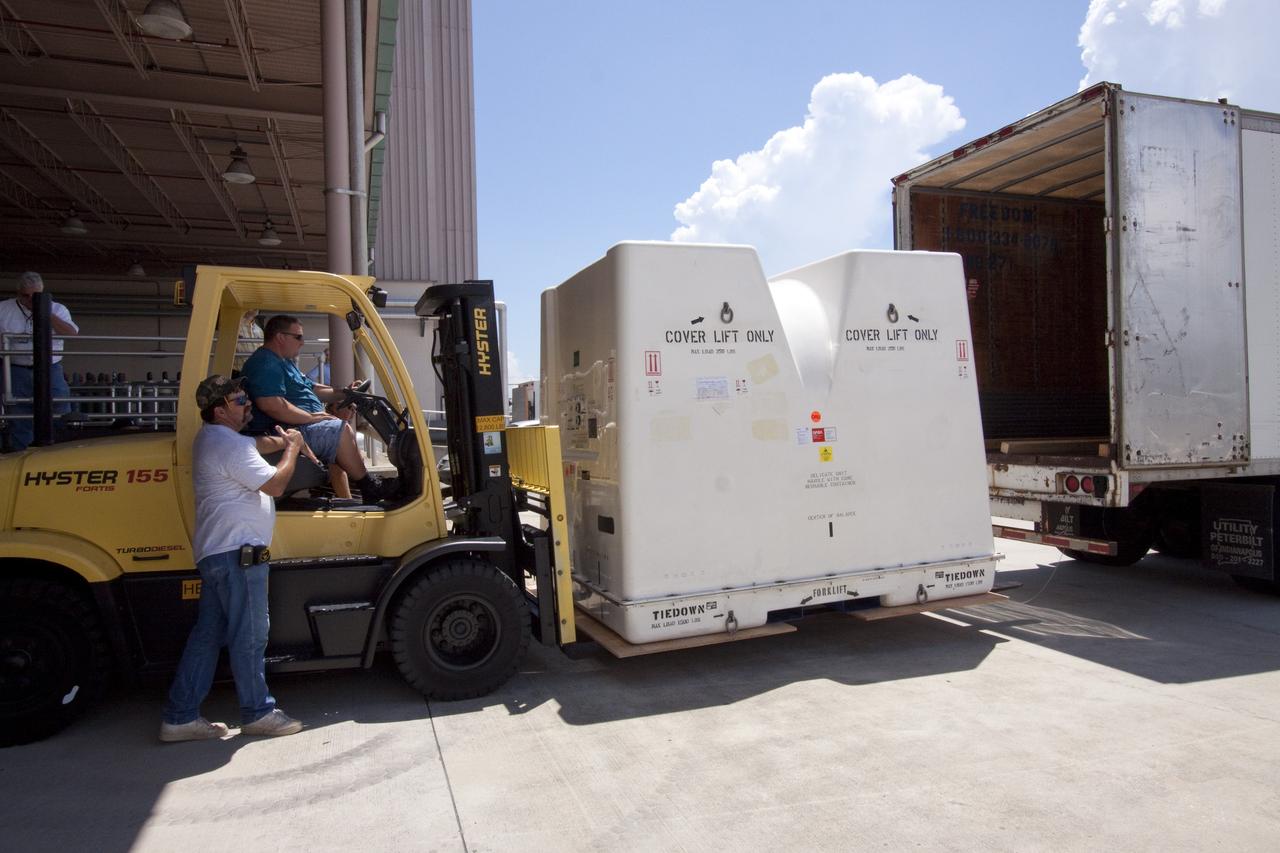
CAPE CANAVERAL, Fla. -- In the Space Station Processing Facility at NASA's Kennedy Space Center in Florida, a forklift moves shipping containers packed with tools and flight support equipment for orbital replacement units into a tractor-trailer for their trip to the Japanese Aerospace Exploration Agency's Tanegashima Space Center. There, the six units, including the flex hose rotary coupler, will be processed for launch to the International Space Station aboard HTV-2, scheduled for Jan. 20, 2011. HTV-2 is an uncrewed cargo transporter that will be launched by the H-IIB launch vehicle. It is designed to deliver up to 6 tons of supplies, including food, clothes and experiment devices to the space station. Photo credit: NASA/Jack Pfaller
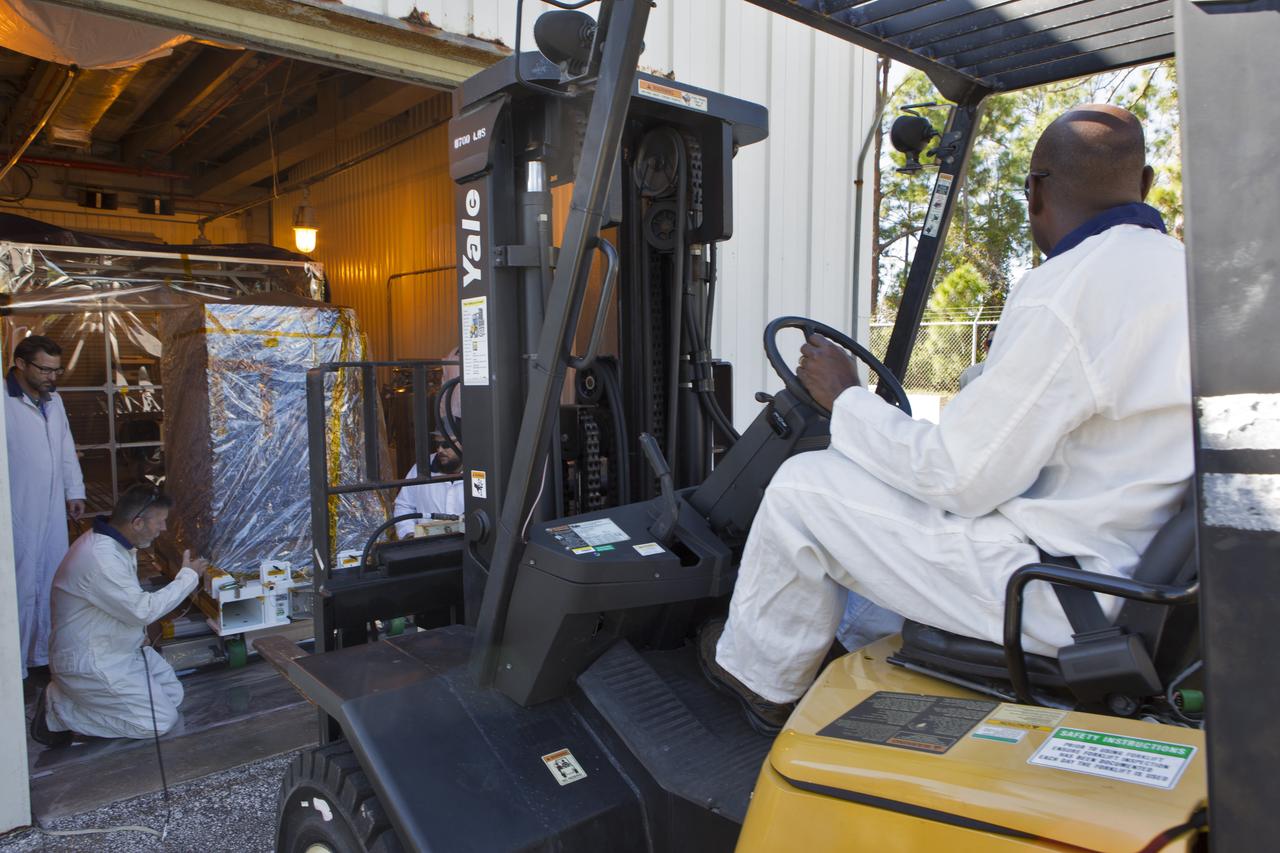
A forklift is being used to lift the Robotic Refueling Mission-3 (RRM3) payload out of the Fuel Transfer Building on Oct. 30, 2018, to be transported to the SpaceX facility at NASA's Kennedy Space Center in Florida. The payload will be carried to the International Space Station on SpaceX's 16th Commercial Resupply Services mission. RRM3 demonstrates the transfer of xenon gas and liquid methane in microgravity, and advances technologies for storing and manipulating these cryogenic fuels robotically. RRM3 also supports development of technology for the Restore-L mission, a robotic spacecraft equipped to service satellites in-orbit.
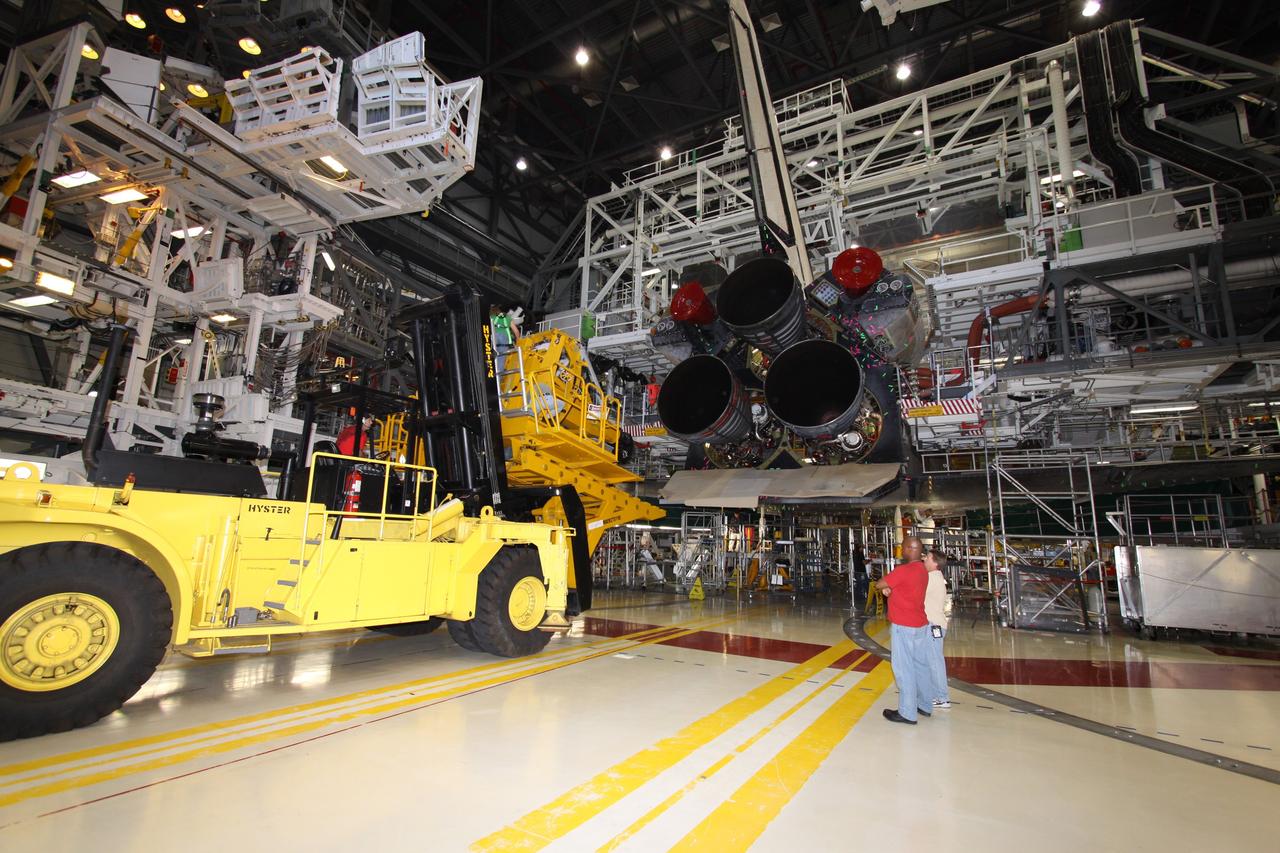
CAPE CANAVERAL, Fla. – In Orbiter Processing Bay 2 at NASA's Kennedy Space Center in Florida, a Hyster forklift is moved into position to remove engine no. 2 from space shuttle Endeavour. Engine removal is part of the post-landing processing. Endeavour returned from the STS-127 mission July 31. Endeavour's next mission is STS-130 targeted for February 2010. Endeavour will deliver to the International Space Station the Tranquility pressurized module that will provide room for many of the station's life support systems. Photo credit: NASA/Jack Pfaller
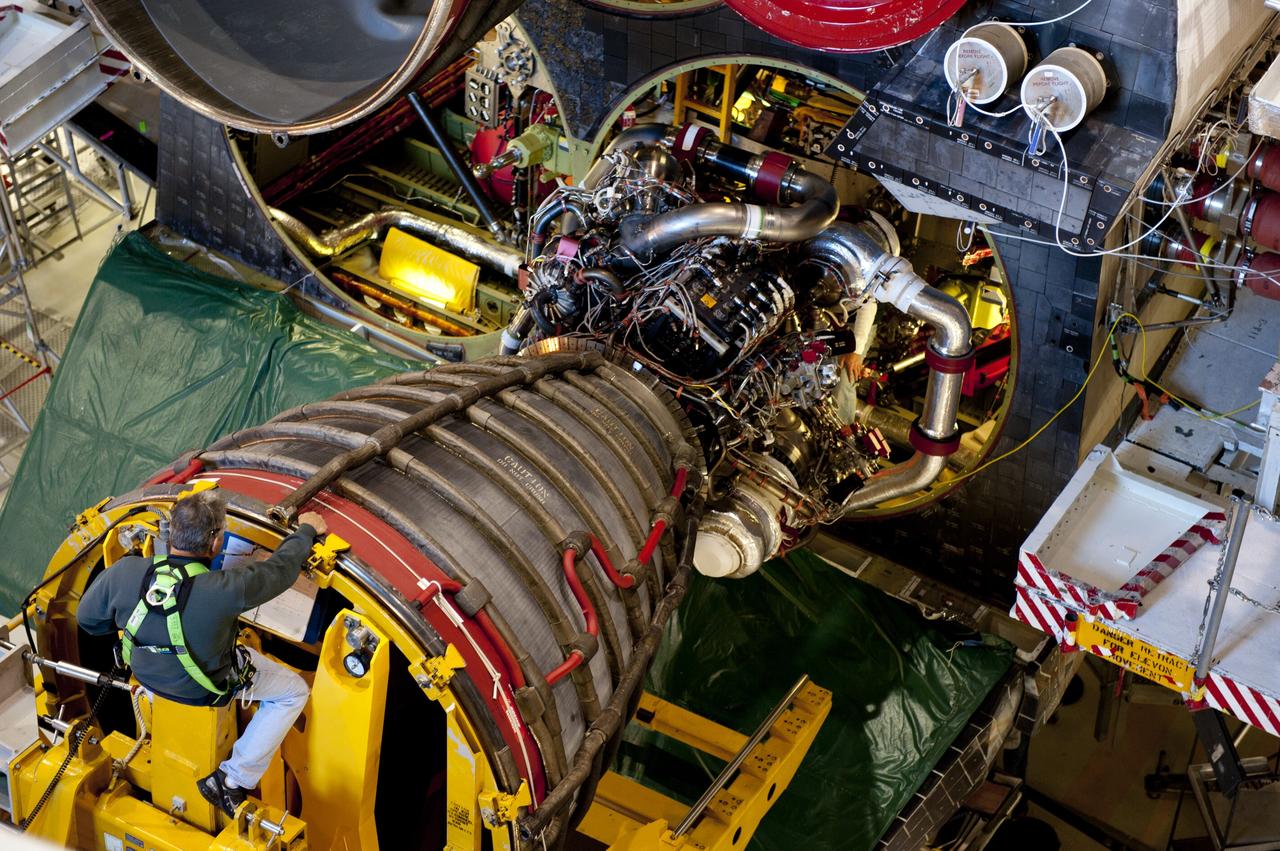
CAPE CANAVERAL, Fla. -- In Orbiter Processing Facility-1 at NASA's Kennedy Space Center in Florida, a Hyster forklift moves the second of three space shuttle main engines closer to shuttle Atlantis for installation. Each engine is 14 feet long, weighs about 6,700 pounds, and is 7.5 feet in diameter at the end of the nozzle. This is the final planned engine installation for the Space Shuttle Program. Atlantis is being prepared for the "launch on need," or potential rescue mission, for the final planned shuttle flight, Endeavour's STS-134 mission. For more information, visit www.nasa.gov/shuttle. Photo credit: NASA/Kim Shiflett
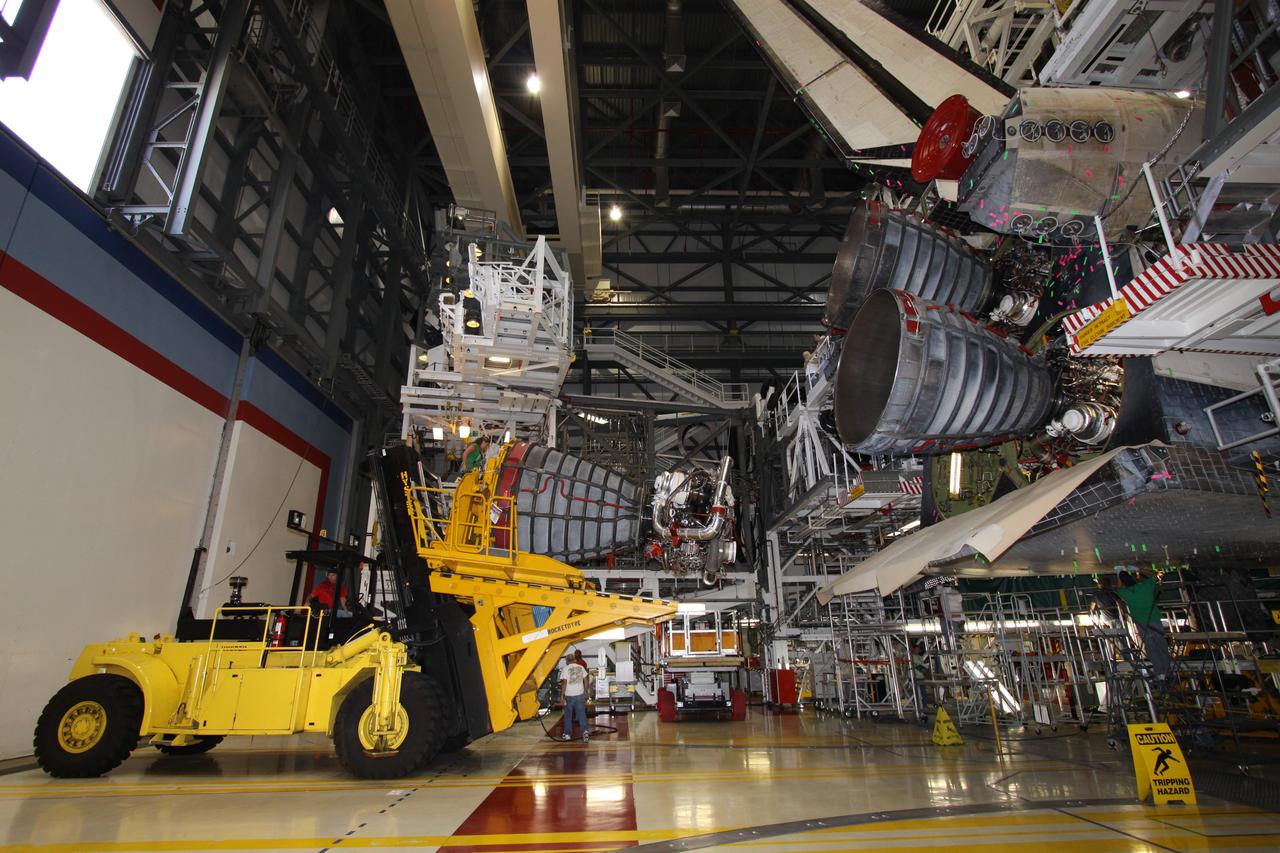
CAPE CANAVERAL, Fla. – In Orbiter Processing Bay 2 at NASA's Kennedy Space Center in Florida, technicians using a Hyster forklift have removed main engine no. 2 from space shuttle Endeavour. Engine removal is part of the post-landing processing. Endeavour returned from the STS-127 mission July 31. Endeavour's next mission is STS-130 targeted for February 2010. Endeavour will deliver to the International Space Station the Tranquility pressurized module that will provide room for many of the station's life support systems. Photo credit: NASA/Jack Pfaller
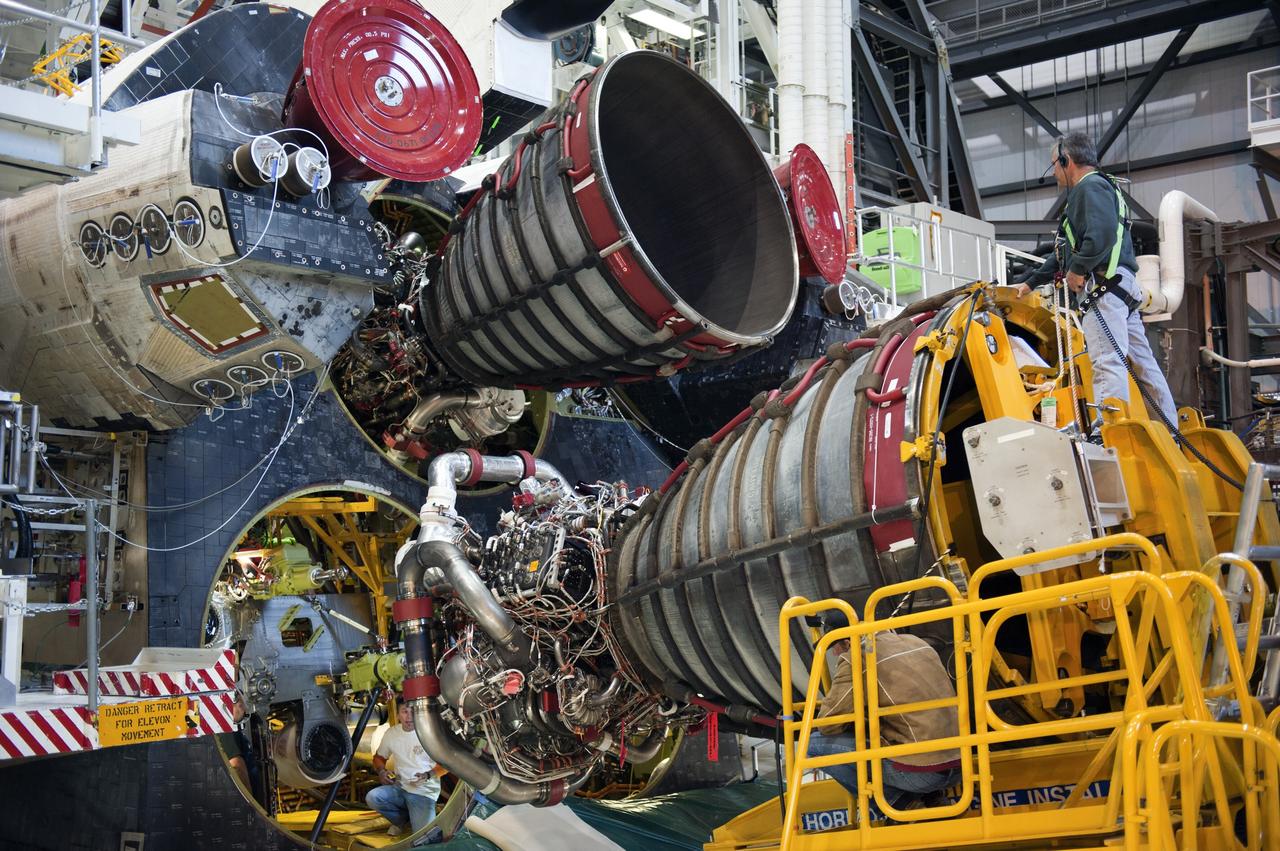
CAPE CANAVERAL, Fla. -- In Orbiter Processing Facility-1 at NASA's Kennedy Space Center in Florida, a Hyster forklift moves engine #2, the last of three space shuttle main engines, into position for installation on shuttle Atlantis. Each engine is 14 feet long, weighs about 6,700 pounds, and is 7.5 feet in diameter at the end of the nozzle. This is the final planned engine installation for the Space Shuttle Program. Atlantis is being prepared for the "launch on need," or potential rescue mission, for the final planned shuttle flight, Endeavour's STS-134 mission. For more information, visit www.nasa.gov/shuttle. Photo credit: NASA/Kim Shiflett
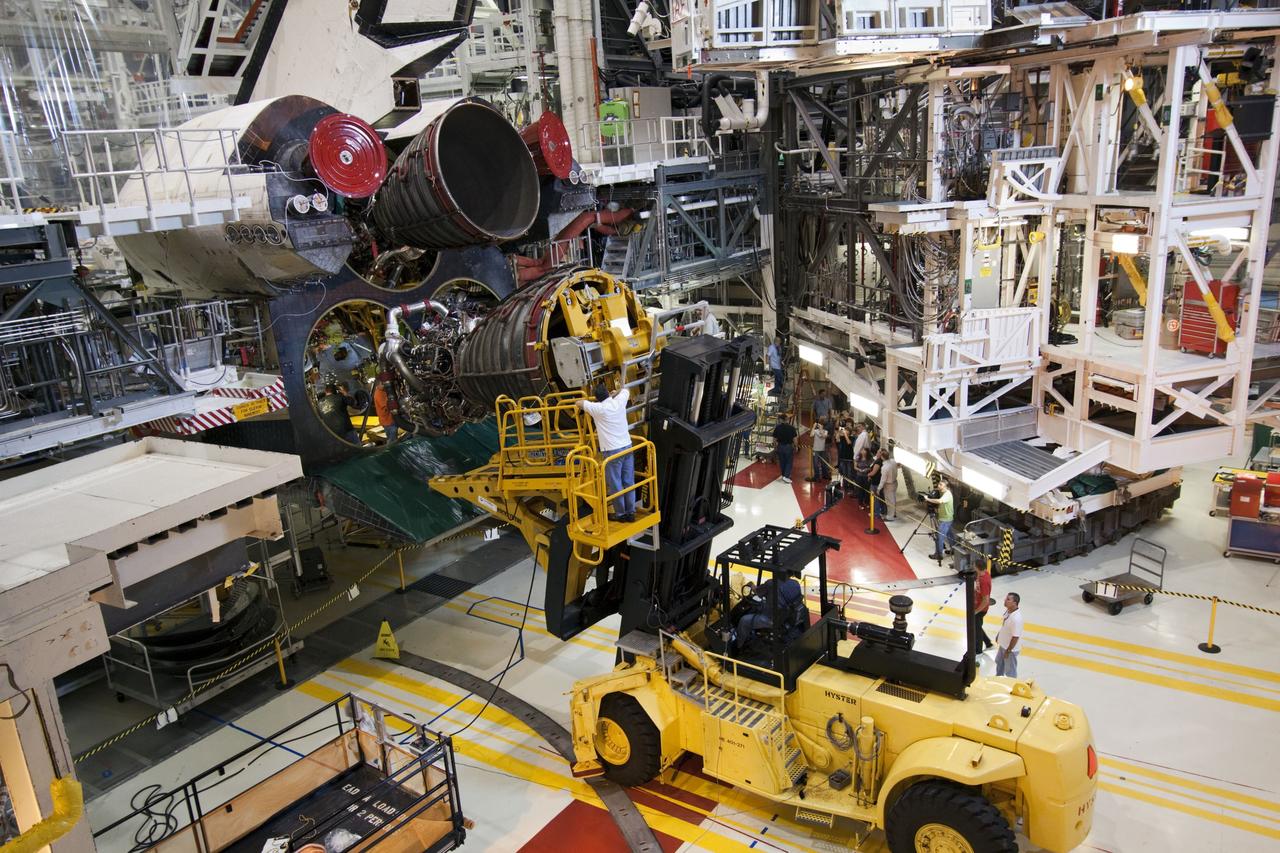
CAPE CANAVERAL, Fla. -- In Orbiter Processing Facility-1 at NASA's Kennedy Space Center in Florida, technicians carefully remove engine No. 2, one of three space shuttle main engines from Endeavour, using a specially designed engine installer, called a Hyster forklift. The removal is part of Endeavour's transition and retirement processing. Endeavour is being prepared for public display at the California Science Center in Los Angeles. Endeavour flew 25 missions, spent 299 days in space, orbited Earth 4,671 times and traveled 122,883,151 miles over the course of its 19-year career. Photo credit: NASA/Jim Grossmann