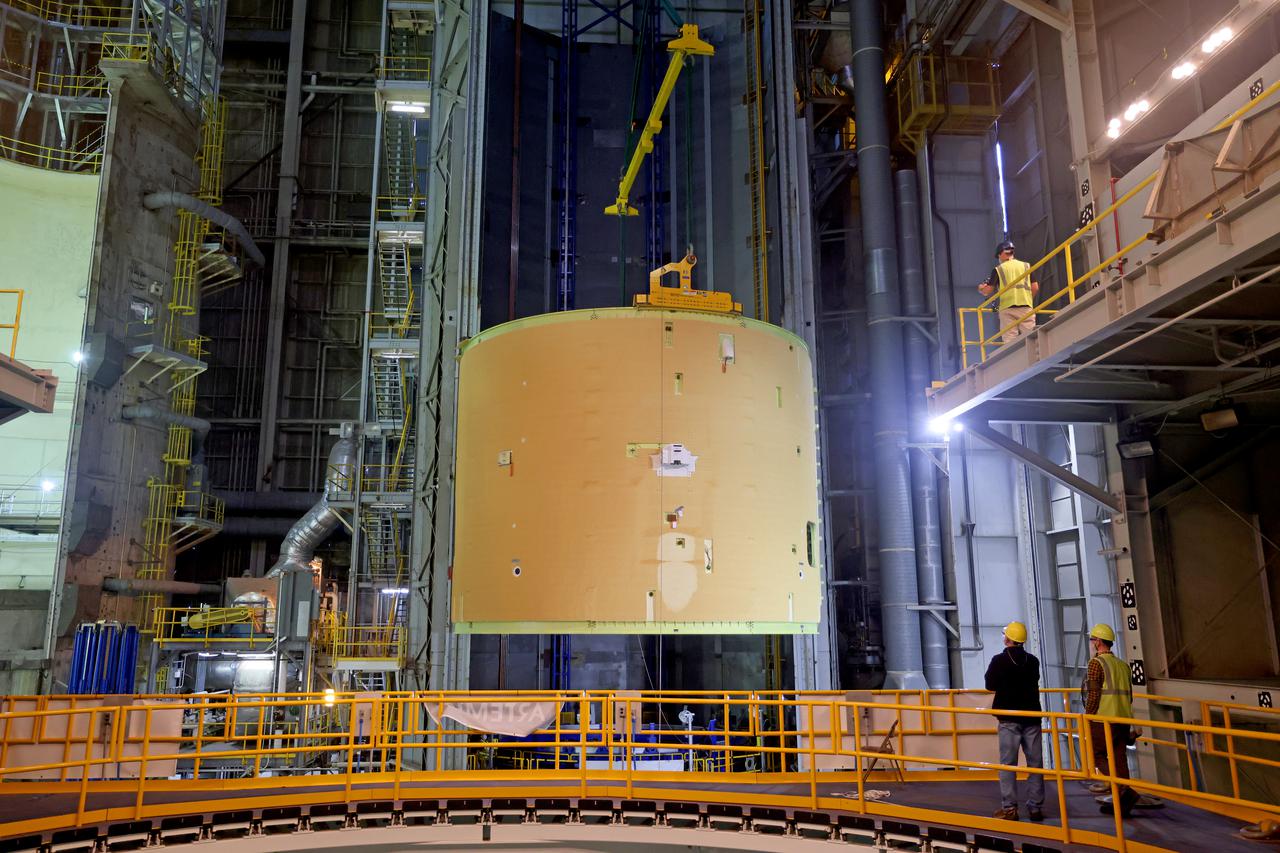
This image shows technicians and engineers beginning the process of the forward join on the core stage of NASA’s Space Launch System rocket for Artemis II, the first crewed mission of NASA’s Artemis program at NASA’s Michoud Assembly Facility. The forward join connects the forward skirt, the liquid oxygen tank (LOX) and the intertank structures to form the top part of the SLS rocket’s core stage. Now, NASA and Boeing, the SLS prime contractor, will continue to integrate various systems inside the forward part of the core stage and prepare for structural joining of the liquid hydrogen tank and engine section to form the bottom of the stage. Together with its four RS-25 engines, the rocket’s massive 212-foot-tall core stage — the largest stage NASA has ever built — and its twin solid rocket boosters will produce 8.8 million pounds of thrust to send NASA’s Orion spacecraft, astronauts and supplies beyond Earth’s orbit to the Moon and, ultimately, Mars. Offering more payload mass, volume capability and energy to speed missions through space, the SLS rocket, along with NASA’s Gateway in lunar orbit, the Human Landing System, and Orion spacecraft, is part of NASA’s backbone for deep space exploration and the Artemis lunar program. No other rocket is capable of carrying astronauts in Orion around the Moon in a single mission. Image credit: NASA/Michael DeMocker

This image shows technicians and engineers beginning the process of the forward join on the core stage of NASA’s Space Launch System rocket for Artemis II, the first crewed mission of NASA’s Artemis program at NASA’s Michoud Assembly Facility. The forward join connects the forward skirt, the liquid oxygen tank (LOX) and the intertank structures to form the top part of the SLS rocket’s core stage. Now, NASA and Boeing, the SLS prime contractor, will continue to integrate various systems inside the forward part of the core stage and prepare for structural joining of the liquid hydrogen tank and engine section to form the bottom of the stage. Together with its four RS-25 engines, the rocket’s massive 212-foot-tall core stage — the largest stage NASA has ever built — and its twin solid rocket boosters will produce 8.8 million pounds of thrust to send NASA’s Orion spacecraft, astronauts and supplies beyond Earth’s orbit to the Moon and, ultimately, Mars. Offering more payload mass, volume capability and energy to speed missions through space, the SLS rocket, along with NASA’s Gateway in lunar orbit, the Human Landing System, and Orion spacecraft, is part of NASA’s backbone for deep space exploration and the Artemis lunar program. No other rocket is capable of carrying astronauts in Orion around the Moon in a single mission. Image credit: NASA/Michael DeMocker
This image shows technicians and engineers beginning the process of the forward join on the core stage of NASA’s Space Launch System rocket for Artemis II, the first crewed mission of NASA’s Artemis program at NASA’s Michoud Assembly Facility. The forward join connects the forward skirt, the liquid oxygen tank (LOX) and the intertank structures to form the top part of the SLS rocket’s core stage. Now, NASA and Boeing, the SLS prime contractor, will continue to integrate various systems inside the forward part of the core stage and prepare for structural joining of the liquid hydrogen tank and engine section to form the bottom of the stage. Together with its four RS-25 engines, the rocket’s massive 212-foot-tall core stage — the largest stage NASA has ever built — and its twin solid rocket boosters will produce 8.8 million pounds of thrust to send NASA’s Orion spacecraft, astronauts and supplies beyond Earth’s orbit to the Moon and, ultimately, Mars. Offering more payload mass, volume capability and energy to speed missions through space, the SLS rocket, along with NASA’s Gateway in lunar orbit, the Human Landing System, and Orion spacecraft, is part of NASA’s backbone for deep space exploration and the Artemis lunar program. No other rocket is capable of carrying astronauts in Orion around the Moon in a single mission. Image credit: NASA/Michael DeMocker
This image shows technicians and engineers beginning the process of the forward join on the core stage of NASA’s Space Launch System rocket for Artemis II, the first crewed mission of NASA’s Artemis program at NASA’s Michoud Assembly Facility. The forward join connects the forward skirt, the liquid oxygen tank (LOX) and the intertank structures to form the top part of the SLS rocket’s core stage. Now, NASA and Boeing, the SLS prime contractor, will continue to integrate various systems inside the forward part of the core stage and prepare for structural joining of the liquid hydrogen tank and engine section to form the bottom of the stage. Together with its four RS-25 engines, the rocket’s massive 212-foot-tall core stage — the largest stage NASA has ever built — and its twin solid rocket boosters will produce 8.8 million pounds of thrust to send NASA’s Orion spacecraft, astronauts and supplies beyond Earth’s orbit to the Moon and, ultimately, Mars. Offering more payload mass, volume capability and energy to speed missions through space, the SLS rocket, along with NASA’s Gateway in lunar orbit, the Human Landing System, and Orion spacecraft, is part of NASA’s backbone for deep space exploration and the Artemis lunar program. No other rocket is capable of carrying astronauts in Orion around the Moon in a single mission. Image credit: NASA/Michael DeMocker
This image shows technicians and engineers beginning the process of the forward join on the core stage of NASA’s Space Launch System rocket for Artemis II, the first crewed mission of NASA’s Artemis program at NASA’s Michoud Assembly Facility. The forward join connects the forward skirt, the liquid oxygen tank (LOX) and the intertank structures to form the top part of the SLS rocket’s core stage. Now, NASA and Boeing, the SLS prime contractor, will continue to integrate various systems inside the forward part of the core stage and prepare for structural joining of the liquid hydrogen tank and engine section to form the bottom of the stage. Together with its four RS-25 engines, the rocket’s massive 212-foot-tall core stage — the largest stage NASA has ever built — and its twin solid rocket boosters will produce 8.8 million pounds of thrust to send NASA’s Orion spacecraft, astronauts and supplies beyond Earth’s orbit to the Moon and, ultimately, Mars. Offering more payload mass, volume capability and energy to speed missions through space, the SLS rocket, along with NASA’s Gateway in lunar orbit, the Human Landing System, and Orion spacecraft, is part of NASA’s backbone for deep space exploration and the Artemis lunar program. No other rocket is capable of carrying astronauts in Orion around the Moon in a single mission. Image credit: NASA/Michael DeMocker
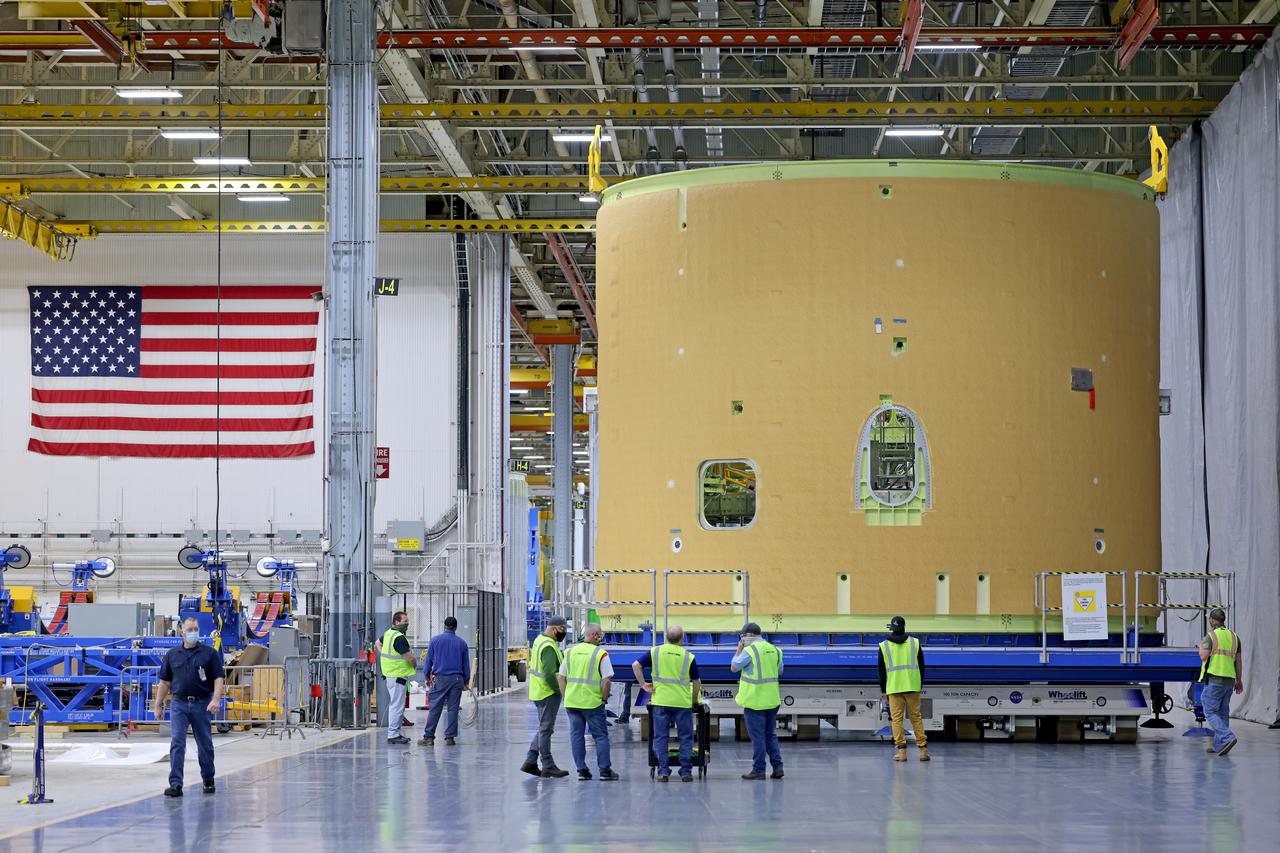
This image shows technicians and engineers beginning the process of the forward join on the core stage of NASA’s Space Launch System rocket for Artemis II, the first crewed mission of NASA’s Artemis program at NASA’s Michoud Assembly Facility. The forward join connects the forward skirt, the liquid oxygen tank (LOX) and the intertank structures to form the top part of the SLS rocket’s core stage. Now, NASA and Boeing, the SLS prime contractor, will continue to integrate various systems inside the forward part of the core stage and prepare for structural joining of the liquid hydrogen tank and engine section to form the bottom of the stage. Together with its four RS-25 engines, the rocket’s massive 212-foot-tall core stage — the largest stage NASA has ever built — and its twin solid rocket boosters will produce 8.8 million pounds of thrust to send NASA’s Orion spacecraft, astronauts and supplies beyond Earth’s orbit to the Moon and, ultimately, Mars. Offering more payload mass, volume capability and energy to speed missions through space, the SLS rocket, along with NASA’s Gateway in lunar orbit, the Human Landing System, and Orion spacecraft, is part of NASA’s backbone for deep space exploration and the Artemis lunar program. No other rocket is capable of carrying astronauts in Orion around the Moon in a single mission. Image credit: NASA/Michael DeMocker
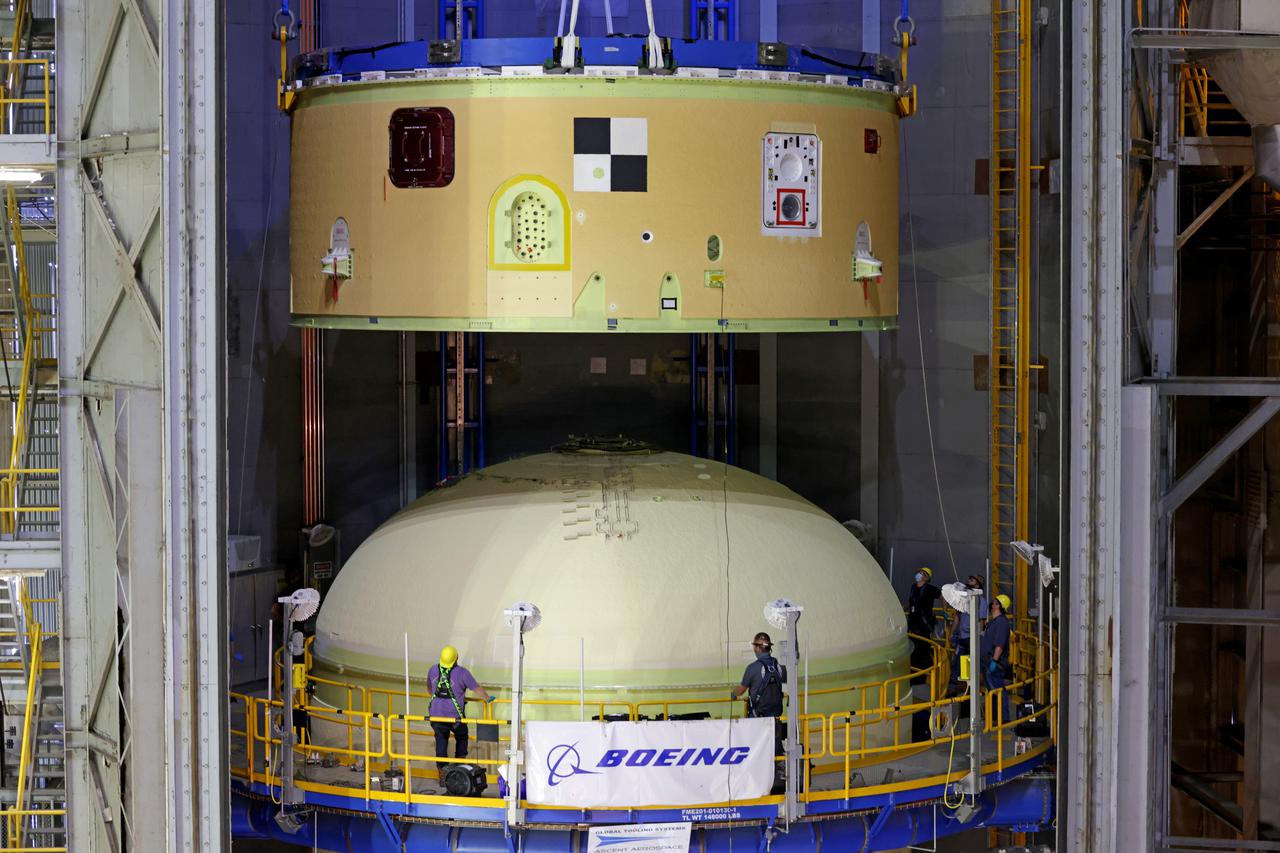
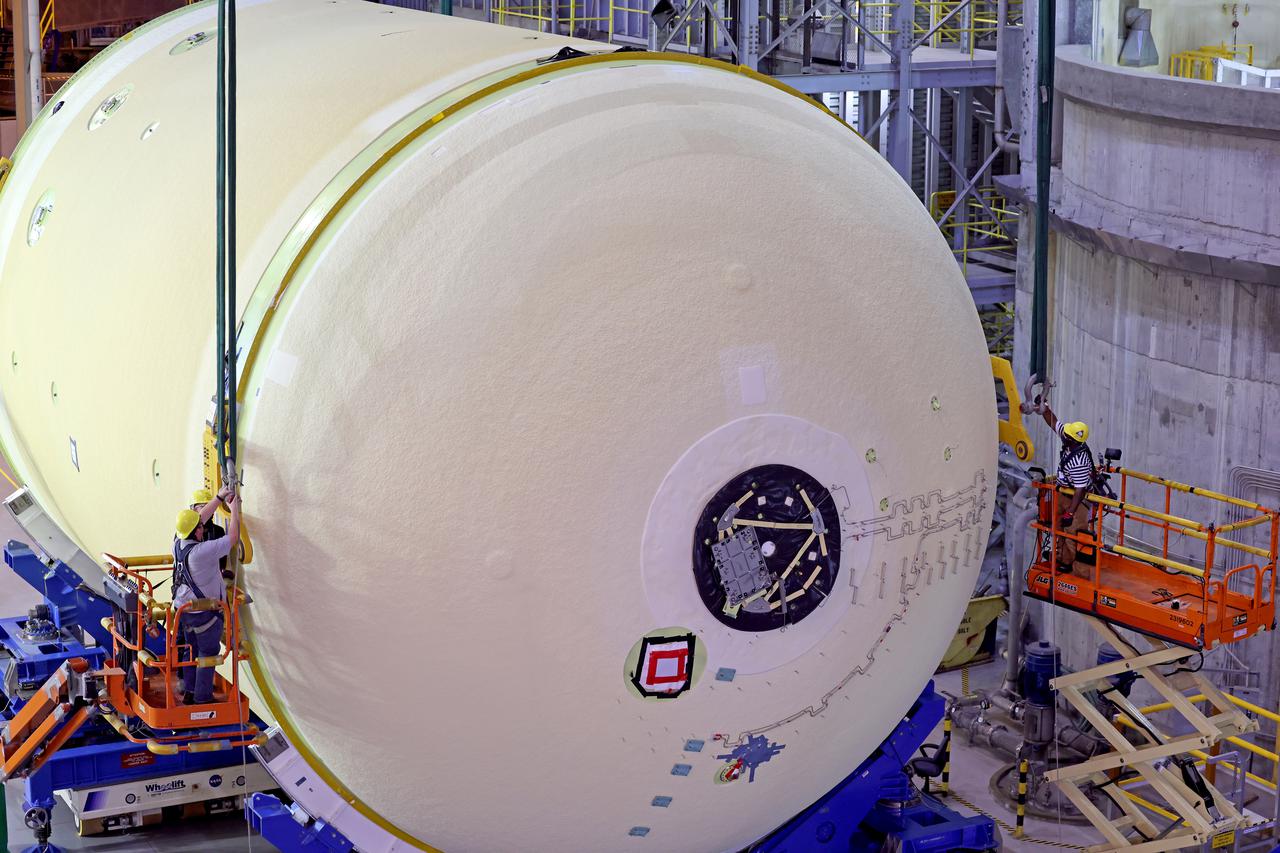
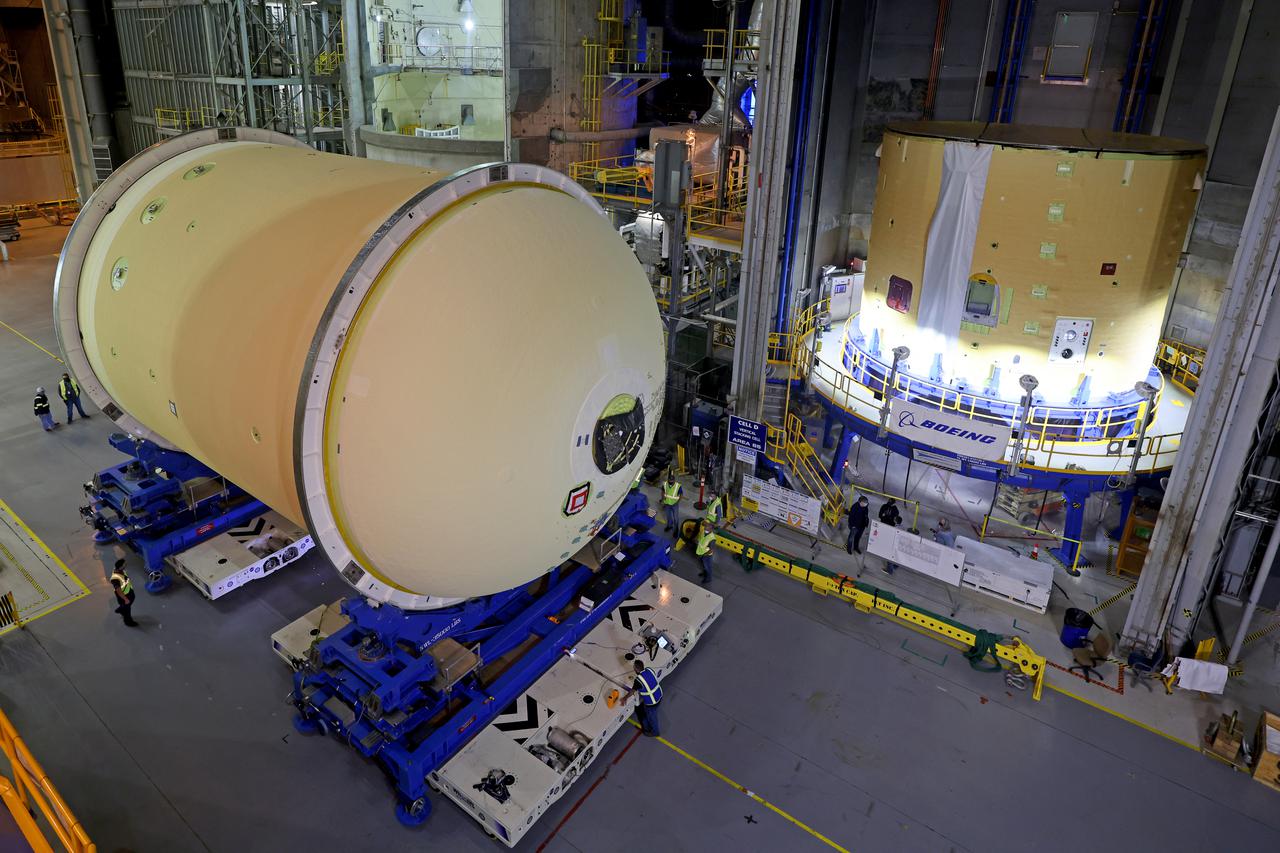
This image shows technicians and engineers moving and connecting the forward skirt to the liquid oxygen tank (LOX) as they continue the process of the forward join on the core stage of NASA’s Space Launch System rocket for Artemis II, the first crewed mission of NASA’s Artemis program at NASA’s Michoud Assembly Facility. The forward join connects the forward skirt, the liquid oxygen tank (LOX) and the intertank structures to form the top part of the SLS rocket’s core stage. Now, NASA and Boeing, the SLS prime contractor, will continue to integrate various systems inside the forward part of the core stage and prepare for structural joining of the liquid hydrogen tank and engine section to form the bottom of the stage. Together with its four RS-25 engines, the rocket’s massive 212-foot-tall core stage — the largest stage NASA has ever built — and its twin solid rocket boosters will produce 8.8 million pounds of thrust to send NASA’s Orion spacecraft, astronauts and supplies beyond Earth’s orbit to the Moon and, ultimately, Mars. Offering more payload mass, volume capability and energy to speed missions through space, the SLS rocket, along with NASA’s Gateway in lunar orbit, the Human Landing System, and Orion spacecraft, is part of NASA’s backbone for deep space exploration and the Artemis lunar program. No other rocket is capable of carrying astronauts in Orion around the Moon in a single mission. Image credit: NASA/Michael DeMocker
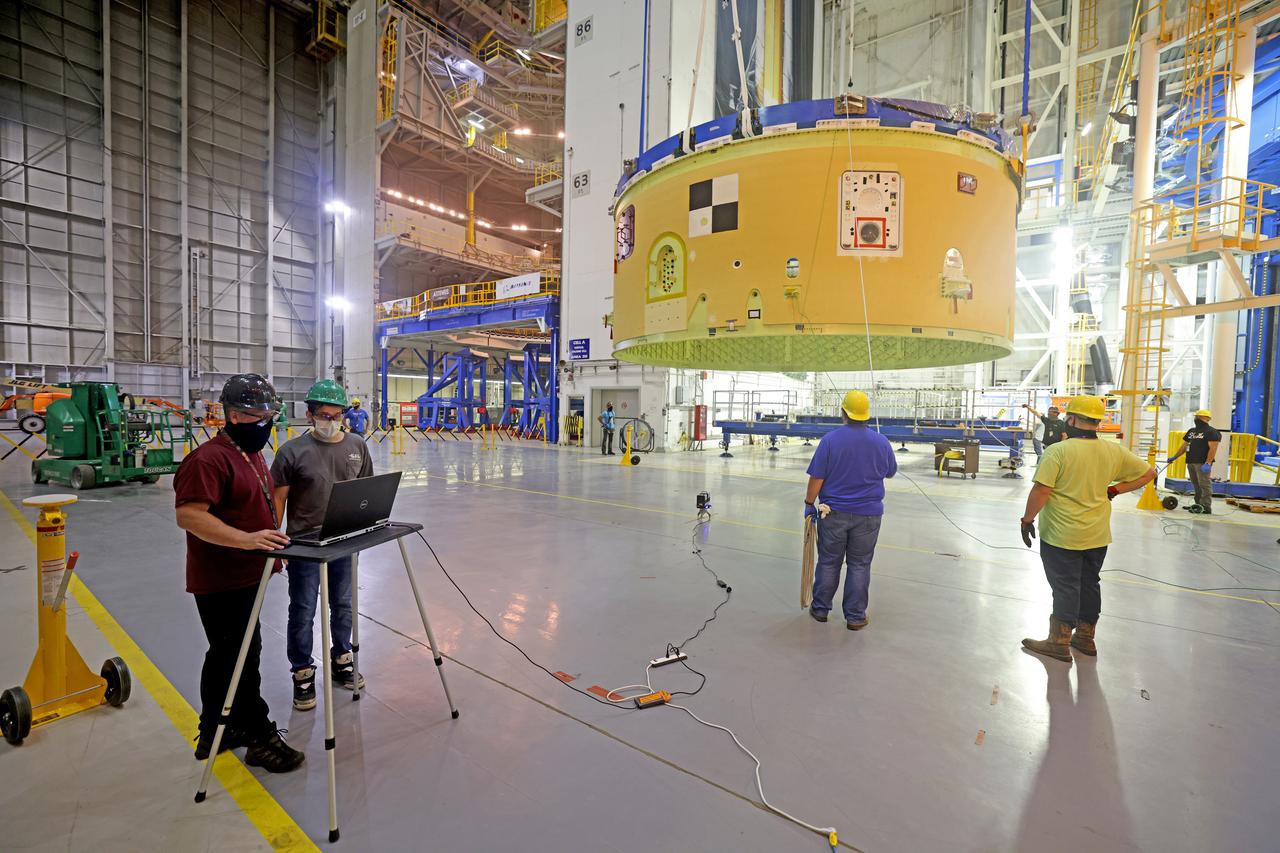
This image shows technicians and engineers preparing to movie and connect the forward skirt to the liquid oxygen tank (LOX) as they continue the process of the forward join on the core stage of NASA’s Space Launch System rocket for Artemis II, the first crewed mission of NASA’s Artemis program at NASA’s Michoud Assembly Facility. The forward join connects the forward skirt, the liquid oxygen tank (LOX) and the intertank structures to form the top part of the SLS rocket’s core stage. Now, NASA and Boeing, the SLS prime contractor, will continue to integrate various systems inside the forward part of the core stage and prepare for structural joining of the liquid hydrogen tank and engine section to form the bottom of the stage. Together with its four RS-25 engines, the rocket’s massive 212-foot-tall core stage — the largest stage NASA has ever built — and its twin solid rocket boosters will produce 8.8 million pounds of thrust to send NASA’s Orion spacecraft, astronauts and supplies beyond Earth’s orbit to the Moon and, ultimately, Mars. Offering more payload mass, volume capability and energy to speed missions through space, the SLS rocket, along with NASA’s Gateway in lunar orbit, the Human Landing System, and Orion spacecraft, is part of NASA’s backbone for deep space exploration and the Artemis lunar program. No other rocket is capable of carrying astronauts in Orion around the Moon in a single mission. Image credit: NASA/Michael DeMocker
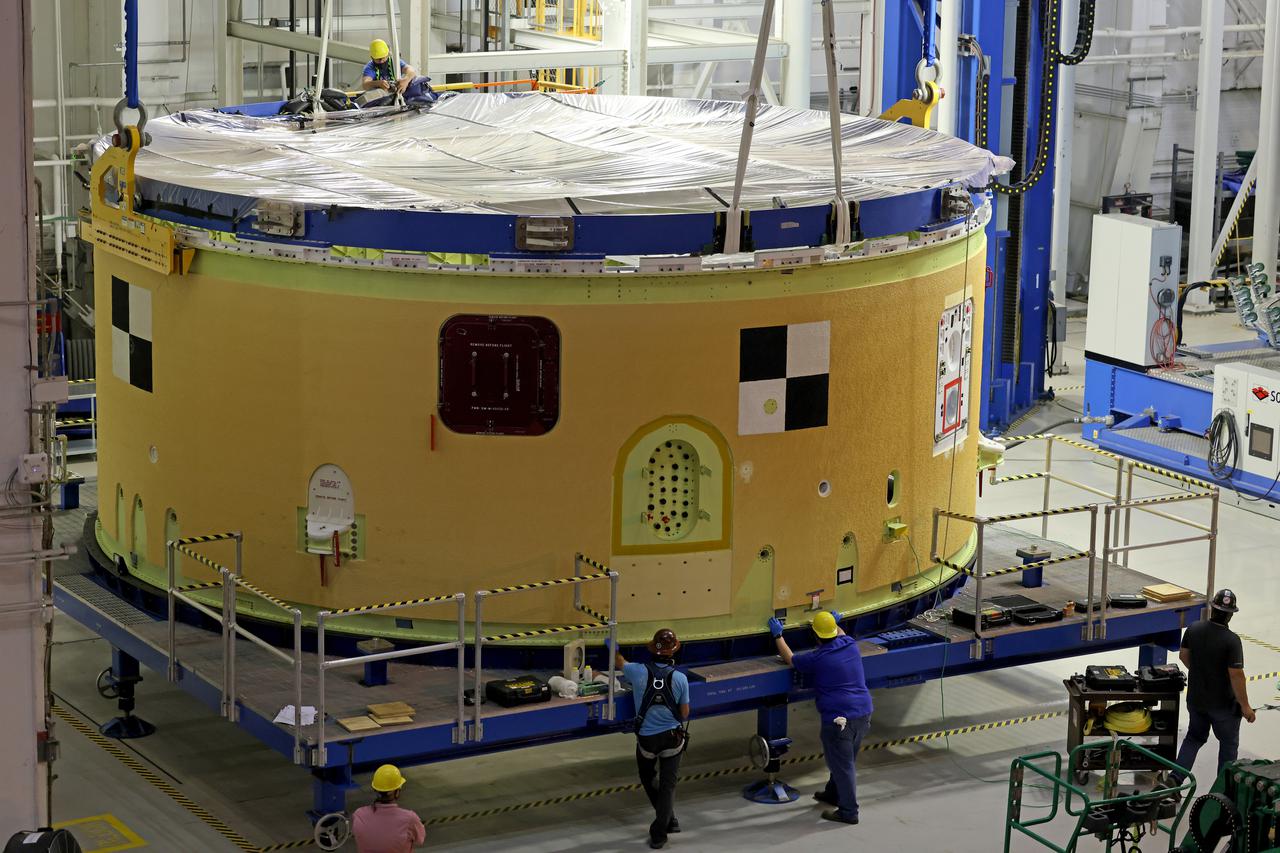
This image shows technicians and engineers preparing to movie and connect the forward skirt to the liquid oxygen tank (LOX) as they continue the process of the forward join on the core stage of NASA’s Space Launch System rocket for Artemis II, the first crewed mission of NASA’s Artemis program at NASA’s Michoud Assembly Facility. The forward join connects the forward skirt, the liquid oxygen tank (LOX) and the intertank structures to form the top part of the SLS rocket’s core stage. Now, NASA and Boeing, the SLS prime contractor, will continue to integrate various systems inside the forward part of the core stage and prepare for structural joining of the liquid hydrogen tank and engine section to form the bottom of the stage. Together with its four RS-25 engines, the rocket’s massive 212-foot-tall core stage — the largest stage NASA has ever built — and its twin solid rocket boosters will produce 8.8 million pounds of thrust to send NASA’s Orion spacecraft, astronauts and supplies beyond Earth’s orbit to the Moon and, ultimately, Mars. Offering more payload mass, volume capability and energy to speed missions through space, the SLS rocket, along with NASA’s Gateway in lunar orbit, the Human Landing System, and Orion spacecraft, is part of NASA’s backbone for deep space exploration and the Artemis lunar program. No other rocket is capable of carrying astronauts in Orion around the Moon in a single mission. Image credit: NASA/Michael DeMocker
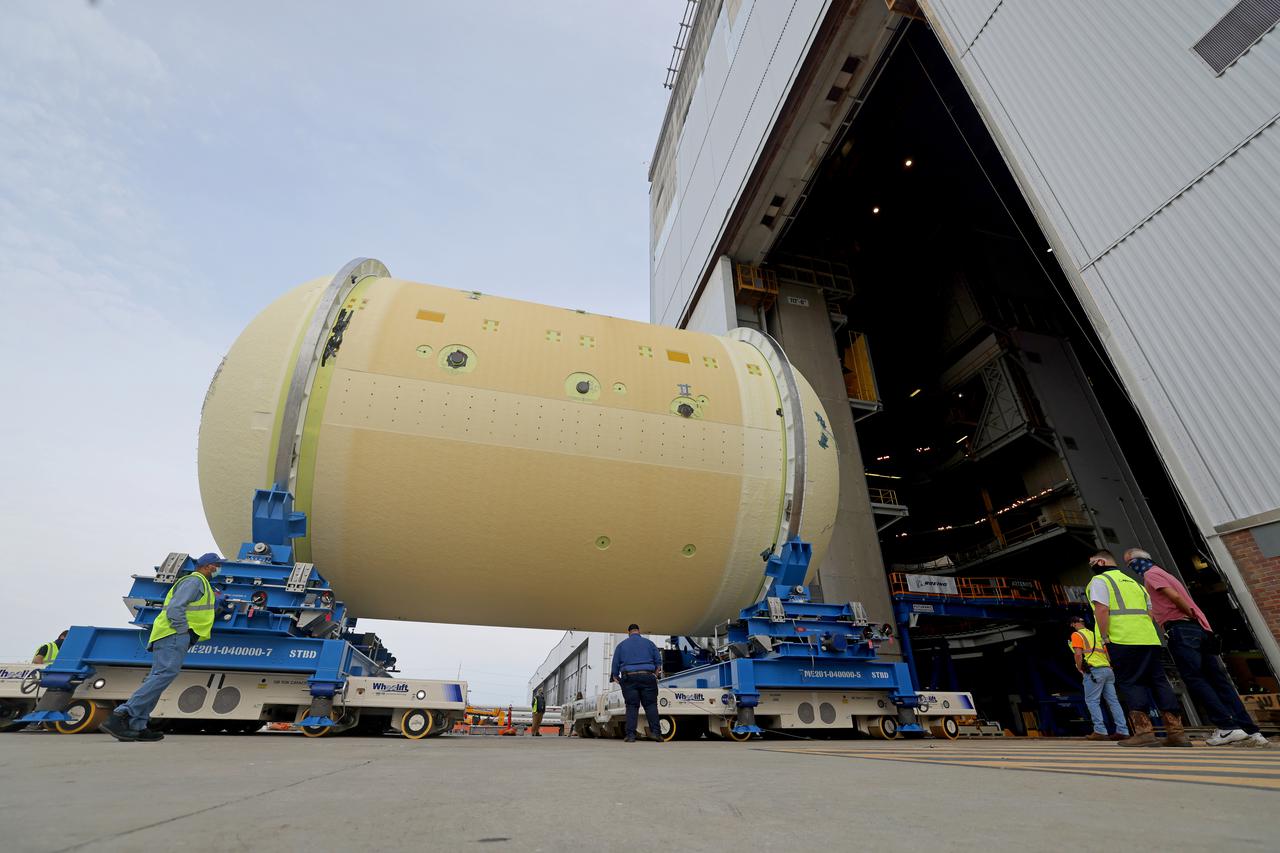
This image shows technicians and engineers moving the liquid oxygen tank (LOX) into position as they continue the process of the forward join on the core stage of NASA’s Space Launch System rocket for Artemis II, the first crewed mission of NASA’s Artemis program at NASA’s Michoud Assembly Facility. The forward join connects the forward skirt, the liquid oxygen tank (LOX) and the intertank structures to form the top part of the SLS rocket’s core stage. Now, NASA and Boeing, the SLS prime contractor, will continue to integrate various systems inside the forward part of the core stage and prepare for structural joining of the liquid hydrogen tank and engine section to form the bottom of the stage. Together with its four RS-25 engines, the rocket’s massive 212-foot-tall core stage — the largest stage NASA has ever built — and its twin solid rocket boosters will produce 8.8 million pounds of thrust to send NASA’s Orion spacecraft, astronauts and supplies beyond Earth’s orbit to the Moon and, ultimately, Mars. Offering more payload mass, volume capability and energy to speed missions through space, the SLS rocket, along with NASA’s Gateway in lunar orbit, the Human Landing System, and Orion spacecraft, is part of NASA’s backbone for deep space exploration and the Artemis lunar program. No other rocket is capable of carrying astronauts in Orion around the Moon in a single mission. Image credit: NASA/Michael DeMocker
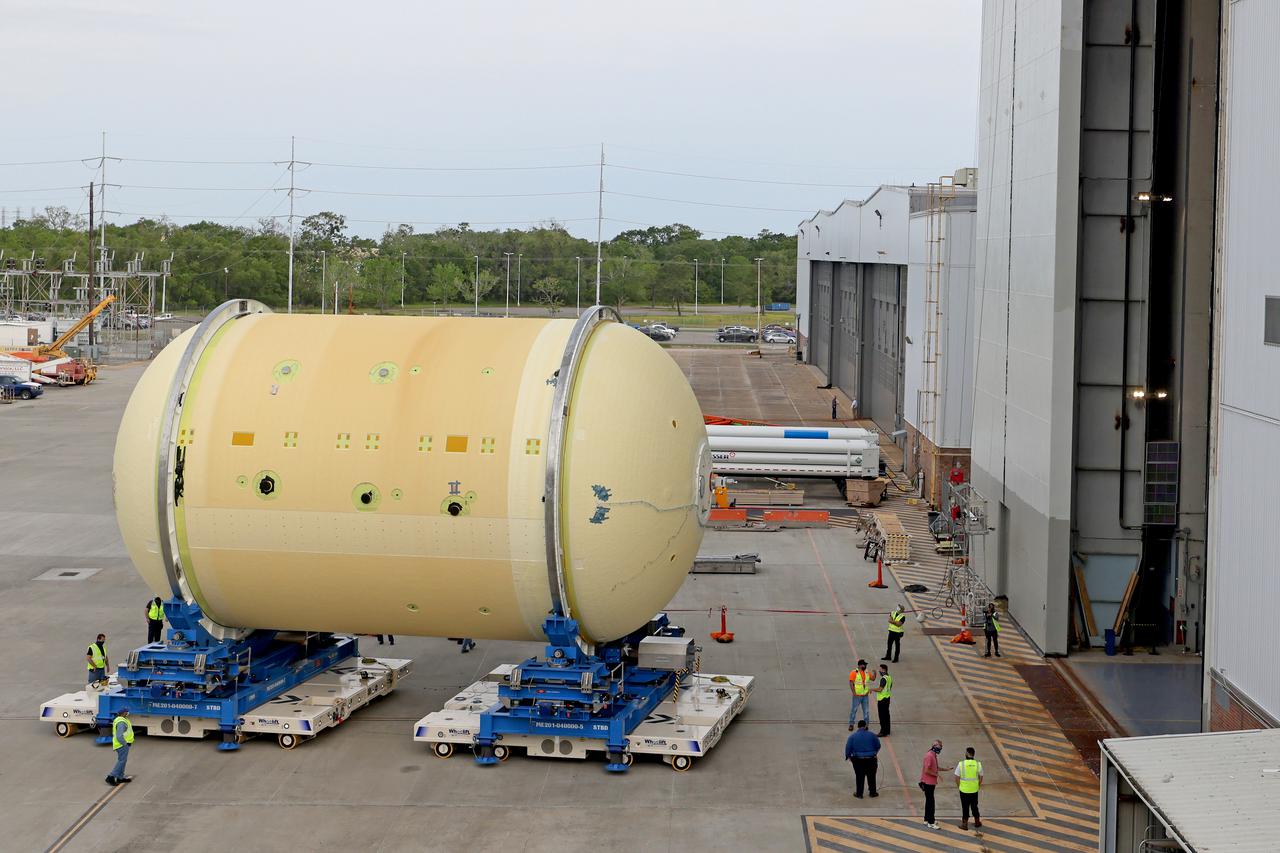
This image shows technicians and engineers moving the liquid oxygen tank (LOX) into position as they continue the process of the forward join on the core stage of NASA’s Space Launch System rocket for Artemis II, the first crewed mission of NASA’s Artemis program at NASA’s Michoud Assembly Facility. The forward join connects the forward skirt, the liquid oxygen tank (LOX) and the intertank structures to form the top part of the SLS rocket’s core stage. Now, NASA and Boeing, the SLS prime contractor, will continue to integrate various systems inside the forward part of the core stage and prepare for structural joining of the liquid hydrogen tank and engine section to form the bottom of the stage. Together with its four RS-25 engines, the rocket’s massive 212-foot-tall core stage — the largest stage NASA has ever built — and its twin solid rocket boosters will produce 8.8 million pounds of thrust to send NASA’s Orion spacecraft, astronauts and supplies beyond Earth’s orbit to the Moon and, ultimately, Mars. Offering more payload mass, volume capability and energy to speed missions through space, the SLS rocket, along with NASA’s Gateway in lunar orbit, the Human Landing System, and Orion spacecraft, is part of NASA’s backbone for deep space exploration and the Artemis lunar program. No other rocket is capable of carrying astronauts in Orion around the Moon in a single mission. Image credit: NASA/Michael DeMocker

This image shows technicians and engineers moving the liquid oxygen tank (LOX) into position as they continue the process of the forward join on the core stage of NASA’s Space Launch System rocket for Artemis II, the first crewed mission of NASA’s Artemis program at NASA’s Michoud Assembly Facility. The forward join connects the forward skirt, the liquid oxygen tank (LOX) and the intertank structures to form the top part of the SLS rocket’s core stage. Now, NASA and Boeing, the SLS prime contractor, will continue to integrate various systems inside the forward part of the core stage and prepare for structural joining of the liquid hydrogen tank and engine section to form the bottom of the stage. Together with its four RS-25 engines, the rocket’s massive 212-foot-tall core stage — the largest stage NASA has ever built — and its twin solid rocket boosters will produce 8.8 million pounds of thrust to send NASA’s Orion spacecraft, astronauts and supplies beyond Earth’s orbit to the Moon and, ultimately, Mars. Offering more payload mass, volume capability and energy to speed missions through space, the SLS rocket, along with NASA’s Gateway in lunar orbit, the Human Landing System, and Orion spacecraft, is part of NASA’s backbone for deep space exploration and the Artemis lunar program. No other rocket is capable of carrying astronauts in Orion around the Moon in a single mission. Image credit: NASA/Eric Bordelon
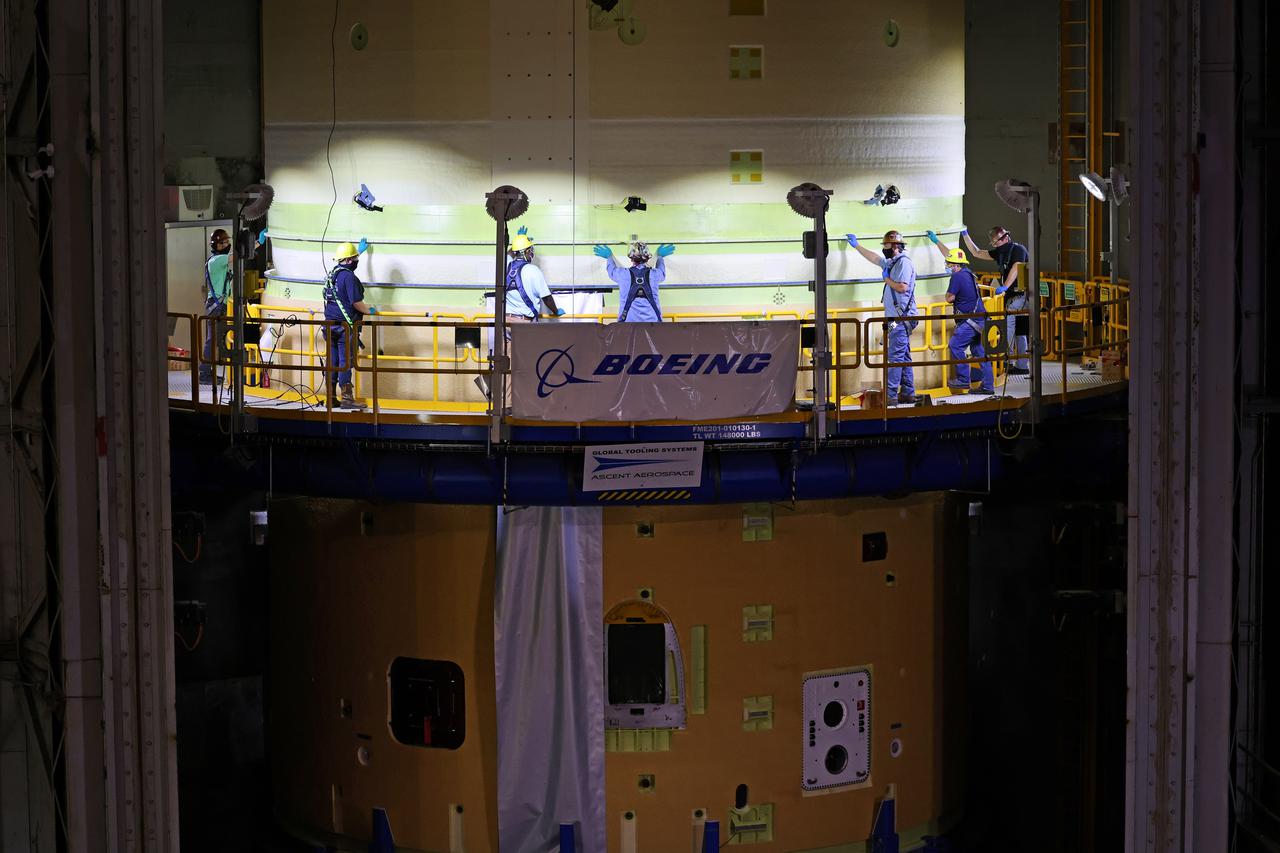
This image shows technicians and engineers move and connect the liquid oxygen tank (LOX) to the intertank as they continue the process of the forward join on the core stage of NASA’s Space Launch System rocket for Artemis II, the first crewed mission of NASA’s Artemis program at NASA’s Michoud Assembly Facility. The forward join connects the forward skirt, the liquid oxygen tank (LOX) and the intertank structures to form the top part of the SLS rocket’s core stage. Now, NASA and Boeing, the SLS prime contractor, will continue to integrate various systems inside the forward part of the core stage and prepare for structural joining of the liquid hydrogen tank and engine section to form the bottom of the stage. Together with its four RS-25 engines, the rocket’s massive 212-foot-tall core stage — the largest stage NASA has ever built — and its twin solid rocket boosters will produce 8.8 million pounds of thrust to send NASA’s Orion spacecraft, astronauts and supplies beyond Earth’s orbit to the Moon and, ultimately, Mars. Offering more payload mass, volume capability and energy to speed missions through space, the SLS rocket, along with NASA’s Gateway in lunar orbit, the Human Landing System, and Orion spacecraft, is part of NASA’s backbone for deep space exploration and the Artemis lunar program. No other rocket is capable of carrying astronauts in Orion around the Moon in a single mission. Image credit: NASA/Michael DeMocker

This image shows technicians and engineers moving the liquid oxygen tank (LOX) into position as they continue the process of the forward join on the core stage of NASA’s Space Launch System rocket for Artemis II, the first crewed mission of NASA’s Artemis program at NASA’s Michoud Assembly Facility. The forward join connects the forward skirt, the liquid oxygen tank (LOX) and the intertank structures to form the top part of the SLS rocket’s core stage. Now, NASA and Boeing, the SLS prime contractor, will continue to integrate various systems inside the forward part of the core stage and prepare for structural joining of the liquid hydrogen tank and engine section to form the bottom of the stage. Together with its four RS-25 engines, the rocket’s massive 212-foot-tall core stage — the largest stage NASA has ever built — and its twin solid rocket boosters will produce 8.8 million pounds of thrust to send NASA’s Orion spacecraft, astronauts and supplies beyond Earth’s orbit to the Moon and, ultimately, Mars. Offering more payload mass, volume capability and energy to speed missions through space, the SLS rocket, along with NASA’s Gateway in lunar orbit, the Human Landing System, and Orion spacecraft, is part of NASA’s backbone for deep space exploration and the Artemis lunar program. No other rocket is capable of carrying astronauts in Orion around the Moon in a single mission. Image credit: NASA/Eric Bordelon
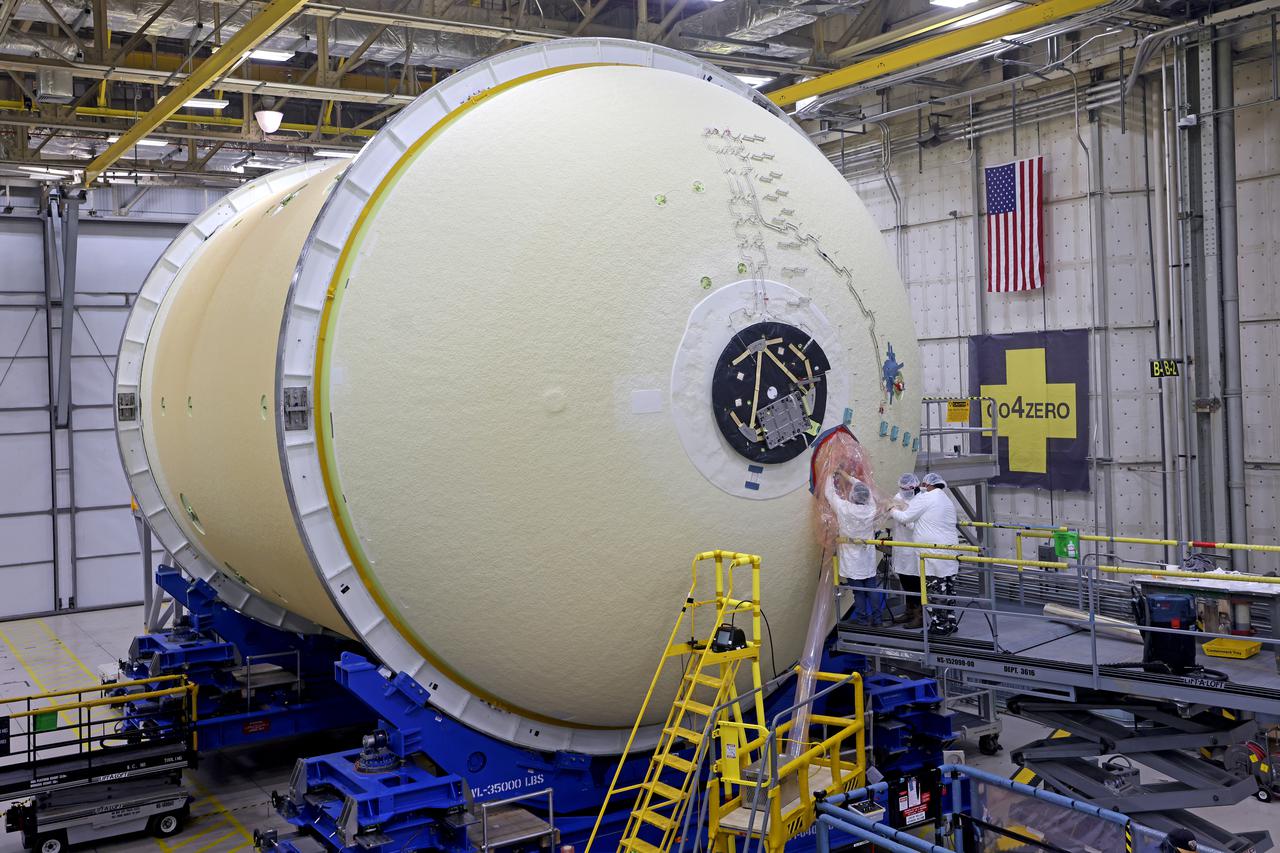
This image shows technicians and engineers preparing to move the liquid oxygen tank (LOX) into position as they continue the process of the forward join on the core stage of NASA’s Space Launch System rocket for Artemis II, the first crewed mission of NASA’s Artemis program at NASA’s Michoud Assembly Facility. The forward join connects the forward skirt, the liquid oxygen tank (LOX) and the intertank structures to form the top part of the SLS rocket’s core stage. Now, NASA and Boeing, the SLS prime contractor, will continue to integrate various systems inside the forward part of the core stage and prepare for structural joining of the liquid hydrogen tank and engine section to form the bottom of the stage. Together with its four RS-25 engines, the rocket’s massive 212-foot-tall core stage — the largest stage NASA has ever built — and its twin solid rocket boosters will produce 8.8 million pounds of thrust to send NASA’s Orion spacecraft, astronauts and supplies beyond Earth’s orbit to the Moon and, ultimately, Mars. Offering more payload mass, volume capability and energy to speed missions through space, the SLS rocket, along with NASA’s Gateway in lunar orbit, the Human Landing System, and Orion spacecraft, is part of NASA’s backbone for deep space exploration and the Artemis lunar program. No other rocket is capable of carrying astronauts in Orion around the Moon in a single mission. Image credit: NASA/Michael DeMocker
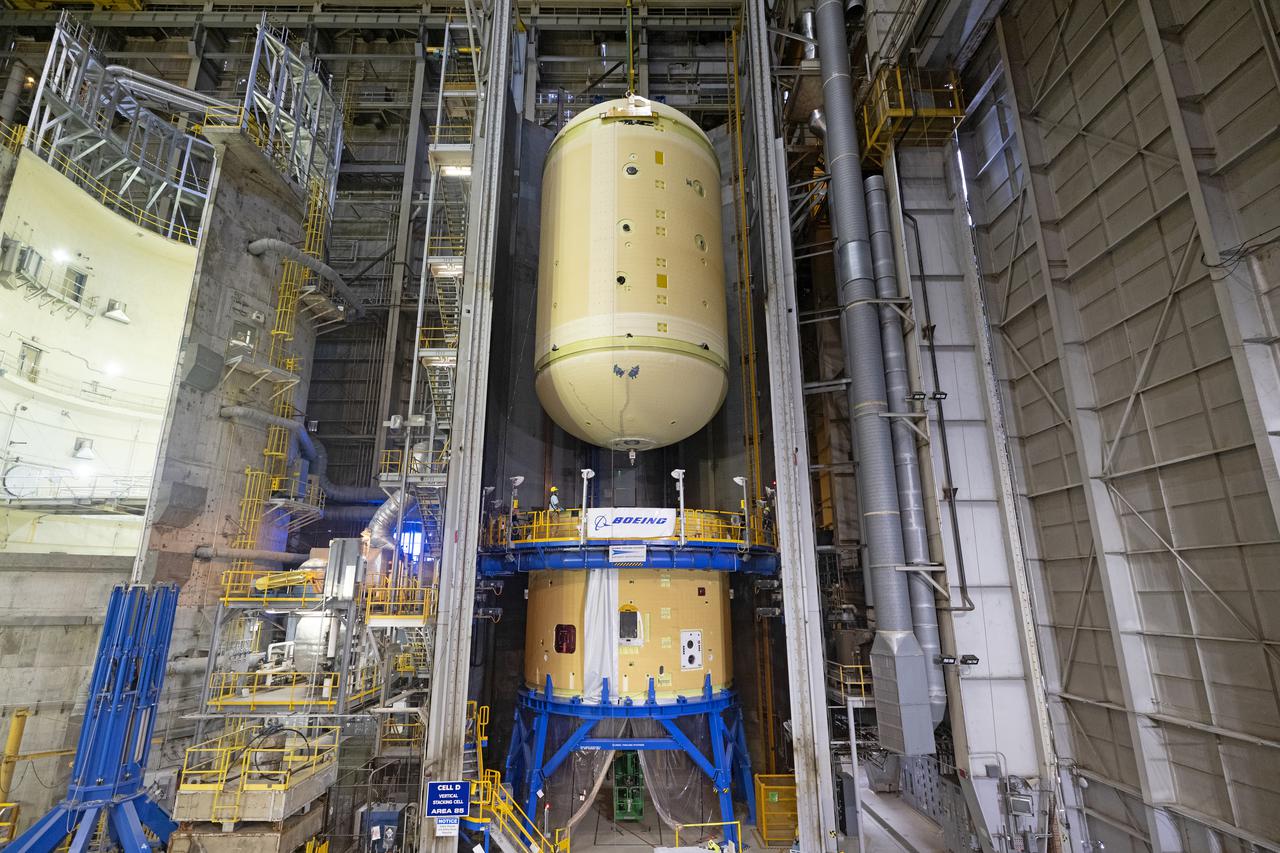
This image shows technicians and engineers move and connect the liquid oxygen tank (LOX) to the intertank as they continue the process of the forward join on the core stage of NASA’s Space Launch System rocket for Artemis II, the first crewed mission of NASA’s Artemis program at NASA’s Michoud Assembly Facility. The forward join connects the forward skirt, the liquid oxygen tank (LOX) and the intertank structures to form the top part of the SLS rocket’s core stage. Now, NASA and Boeing, the SLS prime contractor, will continue to integrate various systems inside the forward part of the core stage and prepare for structural joining of the liquid hydrogen tank and engine section to form the bottom of the stage. Together with its four RS-25 engines, the rocket’s massive 212-foot-tall core stage — the largest stage NASA has ever built — and its twin solid rocket boosters will produce 8.8 million pounds of thrust to send NASA’s Orion spacecraft, astronauts and supplies beyond Earth’s orbit to the Moon and, ultimately, Mars. Offering more payload mass, volume capability and energy to speed missions through space, the SLS rocket, along with NASA’s Gateway in lunar orbit, the Human Landing System, and Orion spacecraft, is part of NASA’s backbone for deep space exploration and the Artemis lunar program. No other rocket is capable of carrying astronauts in Orion around the Moon in a single mission. Image credit: NASA/Michael DeMocker
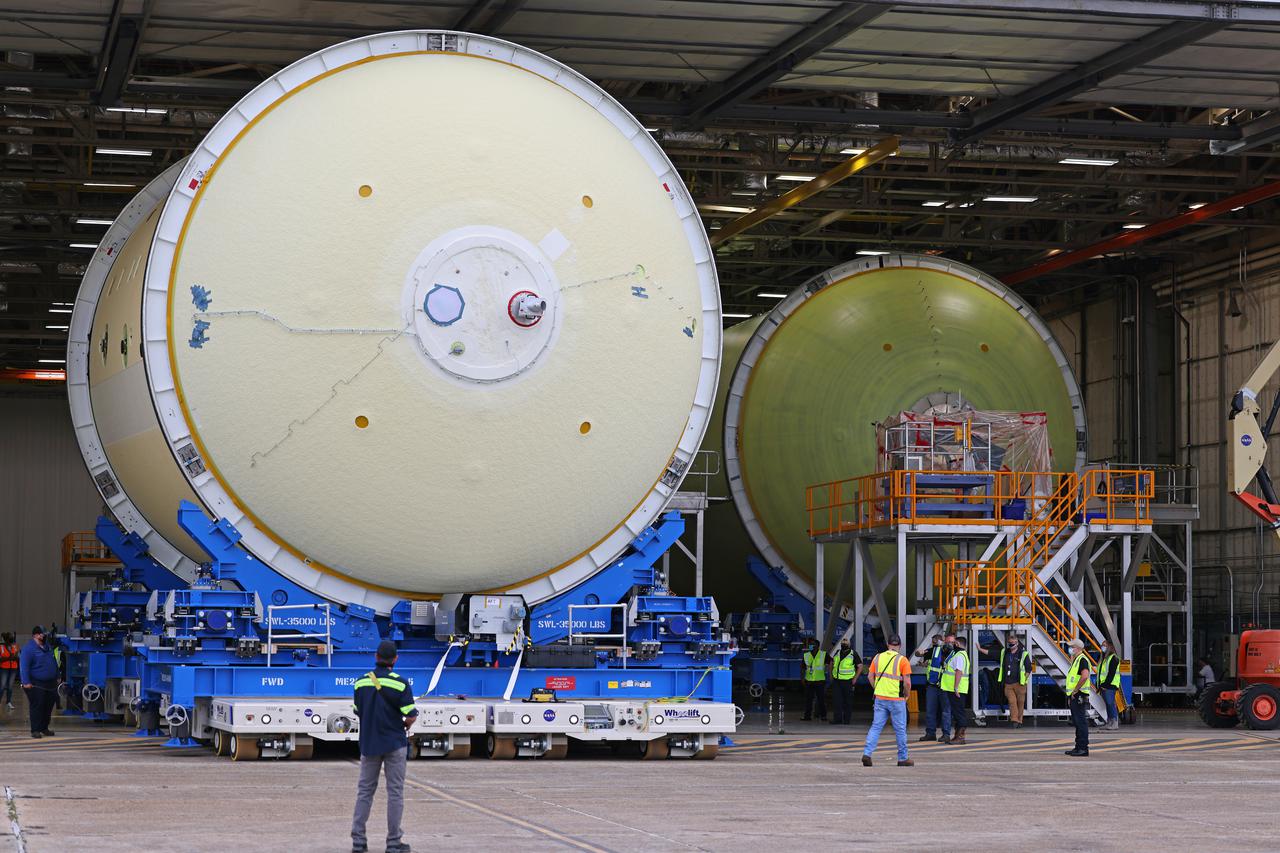
This image shows technicians and engineers moving the liquid oxygen tank (LOX) into position as they continue the process of the forward join on the core stage of NASA’s Space Launch System rocket for Artemis II, the first crewed mission of NASA’s Artemis program at NASA’s Michoud Assembly Facility. The forward join connects the forward skirt, the liquid oxygen tank (LOX) and the intertank structures to form the top part of the SLS rocket’s core stage. Now, NASA and Boeing, the SLS prime contractor, will continue to integrate various systems inside the forward part of the core stage and prepare for structural joining of the liquid hydrogen tank and engine section to form the bottom of the stage. Together with its four RS-25 engines, the rocket’s massive 212-foot-tall core stage — the largest stage NASA has ever built — and its twin solid rocket boosters will produce 8.8 million pounds of thrust to send NASA’s Orion spacecraft, astronauts and supplies beyond Earth’s orbit to the Moon and, ultimately, Mars. Offering more payload mass, volume capability and energy to speed missions through space, the SLS rocket, along with NASA’s Gateway in lunar orbit, the Human Landing System, and Orion spacecraft, is part of NASA’s backbone for deep space exploration and the Artemis lunar program. No other rocket is capable of carrying astronauts in Orion around the Moon in a single mission. Image credit: NASA/Michael DeMocker

This image shows technicians and engineers move and connect the liquid oxygen tank (LOX) to the intertank as they continue the process of the forward join on the core stage of NASA’s Space Launch System rocket for Artemis II, the first crewed mission of NASA’s Artemis program at NASA’s Michoud Assembly Facility. The forward join connects the forward skirt, the liquid oxygen tank (LOX) and the intertank structures to form the top part of the SLS rocket’s core stage. Now, NASA and Boeing, the SLS prime contractor, will continue to integrate various systems inside the forward part of the core stage and prepare for structural joining of the liquid hydrogen tank and engine section to form the bottom of the stage. Together with its four RS-25 engines, the rocket’s massive 212-foot-tall core stage — the largest stage NASA has ever built — and its twin solid rocket boosters will produce 8.8 million pounds of thrust to send NASA’s Orion spacecraft, astronauts and supplies beyond Earth’s orbit to the Moon and, ultimately, Mars. Offering more payload mass, volume capability and energy to speed missions through space, the SLS rocket, along with NASA’s Gateway in lunar orbit, the Human Landing System, and Orion spacecraft, is part of NASA’s backbone for deep space exploration and the Artemis lunar program. No other rocket is capable of carrying astronauts in Orion around the Moon in a single mission. Image credit: NASA/Michael DeMocker
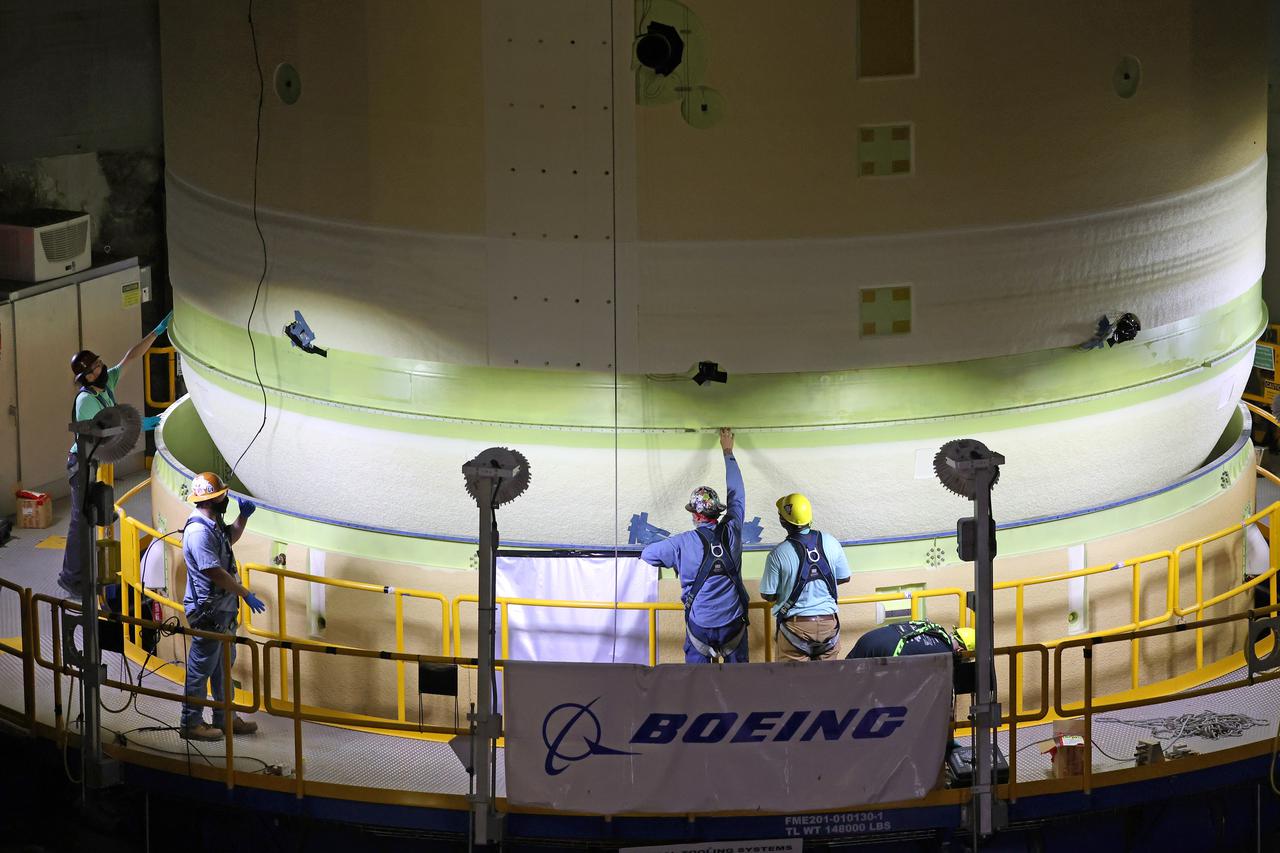
This image shows technicians and engineers move and connect the liquid oxygen tank (LOX) to the intertank as they continue the process of the forward join on the core stage of NASA’s Space Launch System rocket for Artemis II, the first crewed mission of NASA’s Artemis program at NASA’s Michoud Assembly Facility. The forward join connects the forward skirt, the liquid oxygen tank (LOX) and the intertank structures to form the top part of the SLS rocket’s core stage. Now, NASA and Boeing, the SLS prime contractor, will continue to integrate various systems inside the forward part of the core stage and prepare for structural joining of the liquid hydrogen tank and engine section to form the bottom of the stage. Together with its four RS-25 engines, the rocket’s massive 212-foot-tall core stage — the largest stage NASA has ever built — and its twin solid rocket boosters will produce 8.8 million pounds of thrust to send NASA’s Orion spacecraft, astronauts and supplies beyond Earth’s orbit to the Moon and, ultimately, Mars. Offering more payload mass, volume capability and energy to speed missions through space, the SLS rocket, along with NASA’s Gateway in lunar orbit, the Human Landing System, and Orion spacecraft, is part of NASA’s backbone for deep space exploration and the Artemis lunar program. No other rocket is capable of carrying astronauts in Orion around the Moon in a single mission. Image credit: NASA/Michael DeMocker
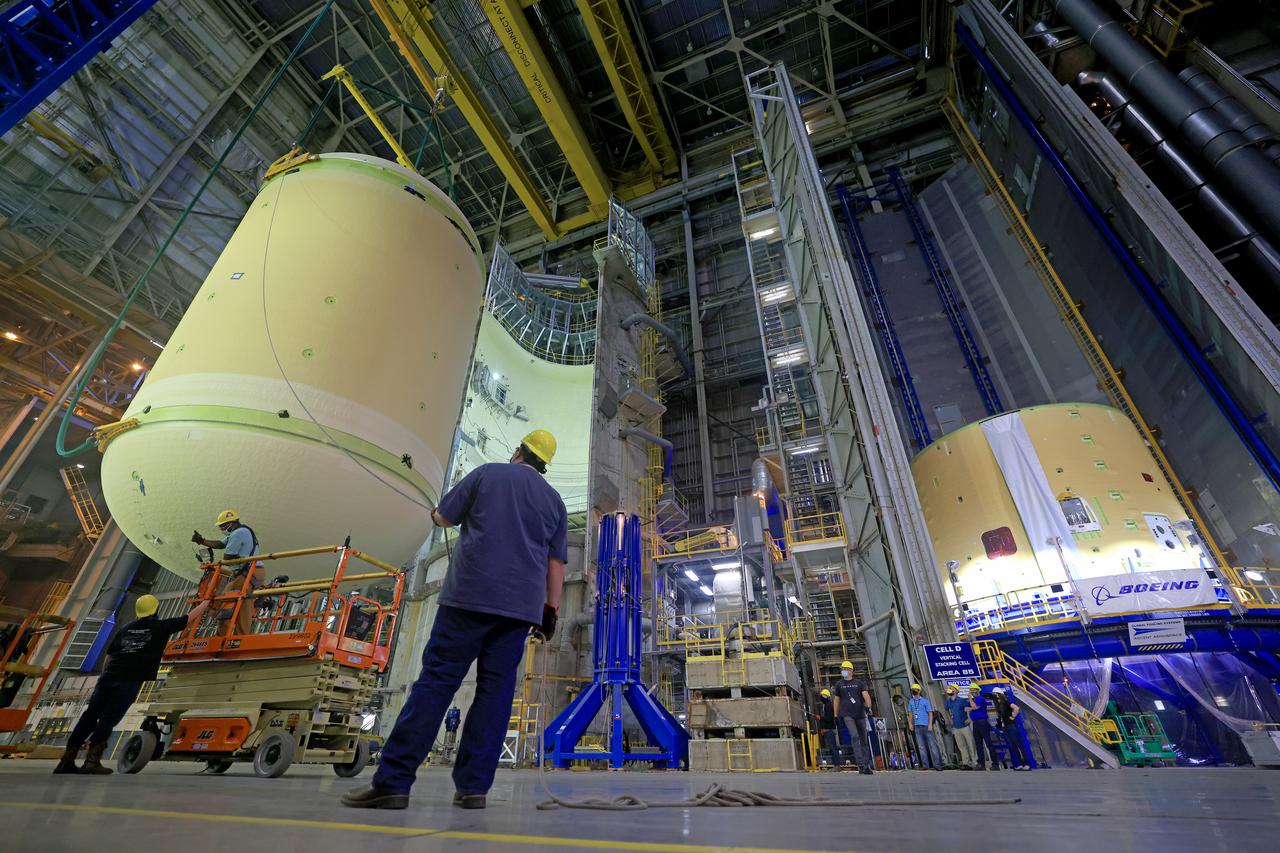
This image shows technicians and engineers move and connect the liquid oxygen tank (LOX) to the intertank as they continue the process of the forward join on the core stage of NASA’s Space Launch System rocket for Artemis II, the first crewed mission of NASA’s Artemis program at NASA’s Michoud Assembly Facility. The forward join connects the forward skirt, the liquid oxygen tank (LOX) and the intertank structures to form the top part of the SLS rocket’s core stage. Now, NASA and Boeing, the SLS prime contractor, will continue to integrate various systems inside the forward part of the core stage and prepare for structural joining of the liquid hydrogen tank and engine section to form the bottom of the stage. Together with its four RS-25 engines, the rocket’s massive 212-foot-tall core stage — the largest stage NASA has ever built — and its twin solid rocket boosters will produce 8.8 million pounds of thrust to send NASA’s Orion spacecraft, astronauts and supplies beyond Earth’s orbit to the Moon and, ultimately, Mars. Offering more payload mass, volume capability and energy to speed missions through space, the SLS rocket, along with NASA’s Gateway in lunar orbit, the Human Landing System, and Orion spacecraft, is part of NASA’s backbone for deep space exploration and the Artemis lunar program. No other rocket is capable of carrying astronauts in Orion around the Moon in a single mission. Image credit: NASA/Michael DeMocker
This image shows technicians and engineers move and connect the liquid oxygen tank (LOX) to the intertank as they continue the process of the forward join on the core stage of NASA’s Space Launch System rocket for Artemis II, the first crewed mission of NASA’s Artemis program at NASA’s Michoud Assembly Facility. The forward join connects the forward skirt, the liquid oxygen tank (LOX) and the intertank structures to form the top part of the SLS rocket’s core stage. Now, NASA and Boeing, the SLS prime contractor, will continue to integrate various systems inside the forward part of the core stage and prepare for structural joining of the liquid hydrogen tank and engine section to form the bottom of the stage. Together with its four RS-25 engines, the rocket’s massive 212-foot-tall core stage — the largest stage NASA has ever built — and its twin solid rocket boosters will produce 8.8 million pounds of thrust to send NASA’s Orion spacecraft, astronauts and supplies beyond Earth’s orbit to the Moon and, ultimately, Mars. Offering more payload mass, volume capability and energy to speed missions through space, the SLS rocket, along with NASA’s Gateway in lunar orbit, the Human Landing System, and Orion spacecraft, is part of NASA’s backbone for deep space exploration and the Artemis lunar program. No other rocket is capable of carrying astronauts in Orion around the Moon in a single mission. Image credit: NASA/Michael DeMocker
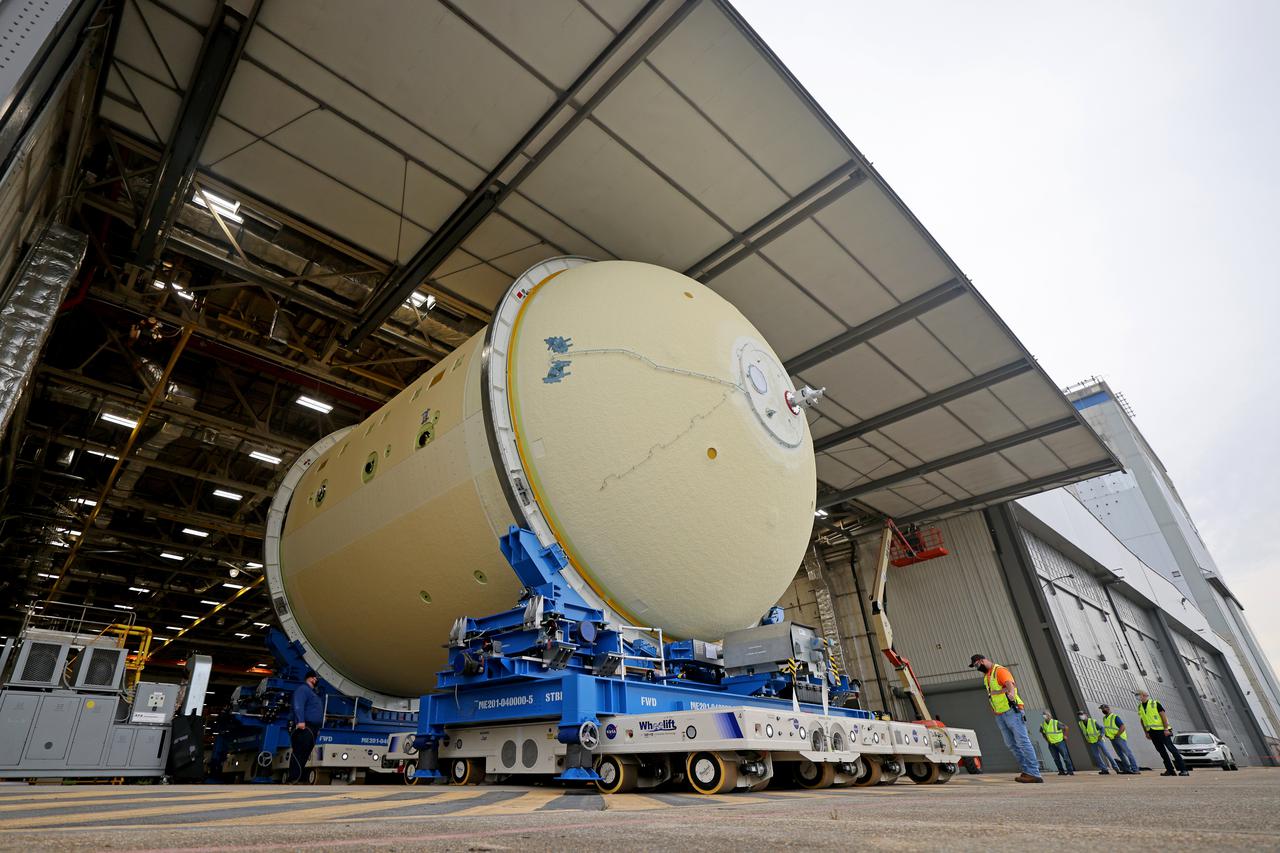
This image shows technicians and engineers moving the liquid oxygen tank (LOX) into position as they continue the process of the forward join on the core stage of NASA’s Space Launch System rocket for Artemis II, the first crewed mission of NASA’s Artemis program at NASA’s Michoud Assembly Facility. The forward join connects the forward skirt, the liquid oxygen tank (LOX) and the intertank structures to form the top part of the SLS rocket’s core stage. Now, NASA and Boeing, the SLS prime contractor, will continue to integrate various systems inside the forward part of the core stage and prepare for structural joining of the liquid hydrogen tank and engine section to form the bottom of the stage. Together with its four RS-25 engines, the rocket’s massive 212-foot-tall core stage — the largest stage NASA has ever built — and its twin solid rocket boosters will produce 8.8 million pounds of thrust to send NASA’s Orion spacecraft, astronauts and supplies beyond Earth’s orbit to the Moon and, ultimately, Mars. Offering more payload mass, volume capability and energy to speed missions through space, the SLS rocket, along with NASA’s Gateway in lunar orbit, the Human Landing System, and Orion spacecraft, is part of NASA’s backbone for deep space exploration and the Artemis lunar program. No other rocket is capable of carrying astronauts in Orion around the Moon in a single mission. Image credit: NASA/Michael DeMocker
This image shows technicians and engineers moving the liquid oxygen tank (LOX) into position as they continue the process of the forward join on the core stage of NASA’s Space Launch System rocket for Artemis II, the first crewed mission of NASA’s Artemis program at NASA’s Michoud Assembly Facility. The forward join connects the forward skirt, the liquid oxygen tank (LOX) and the intertank structures to form the top part of the SLS rocket’s core stage. Now, NASA and Boeing, the SLS prime contractor, will continue to integrate various systems inside the forward part of the core stage and prepare for structural joining of the liquid hydrogen tank and engine section to form the bottom of the stage. Together with its four RS-25 engines, the rocket’s massive 212-foot-tall core stage — the largest stage NASA has ever built — and its twin solid rocket boosters will produce 8.8 million pounds of thrust to send NASA’s Orion spacecraft, astronauts and supplies beyond Earth’s orbit to the Moon and, ultimately, Mars. Offering more payload mass, volume capability and energy to speed missions through space, the SLS rocket, along with NASA’s Gateway in lunar orbit, the Human Landing System, and Orion spacecraft, is part of NASA’s backbone for deep space exploration and the Artemis lunar program. No other rocket is capable of carrying astronauts in Orion around the Moon in a single mission. Image credit: NASA/Michael DeMocker
This image shows technicians and engineers move and connect the liquid oxygen tank (LOX) to the intertank as they continue the process of the forward join on the core stage of NASA’s Space Launch System rocket for Artemis II, the first crewed mission of NASA’s Artemis program at NASA’s Michoud Assembly Facility. The forward join connects the forward skirt, the liquid oxygen tank (LOX) and the intertank structures to form the top part of the SLS rocket’s core stage. Now, NASA and Boeing, the SLS prime contractor, will continue to integrate various systems inside the forward part of the core stage and prepare for structural joining of the liquid hydrogen tank and engine section to form the bottom of the stage. Together with its four RS-25 engines, the rocket’s massive 212-foot-tall core stage — the largest stage NASA has ever built — and its twin solid rocket boosters will produce 8.8 million pounds of thrust to send NASA’s Orion spacecraft, astronauts and supplies beyond Earth’s orbit to the Moon and, ultimately, Mars. Offering more payload mass, volume capability and energy to speed missions through space, the SLS rocket, along with NASA’s Gateway in lunar orbit, the Human Landing System, and Orion spacecraft, is part of NASA’s backbone for deep space exploration and the Artemis lunar program. No other rocket is capable of carrying astronauts in Orion around the Moon in a single mission. Image credit: NASA/Michael DeMocker
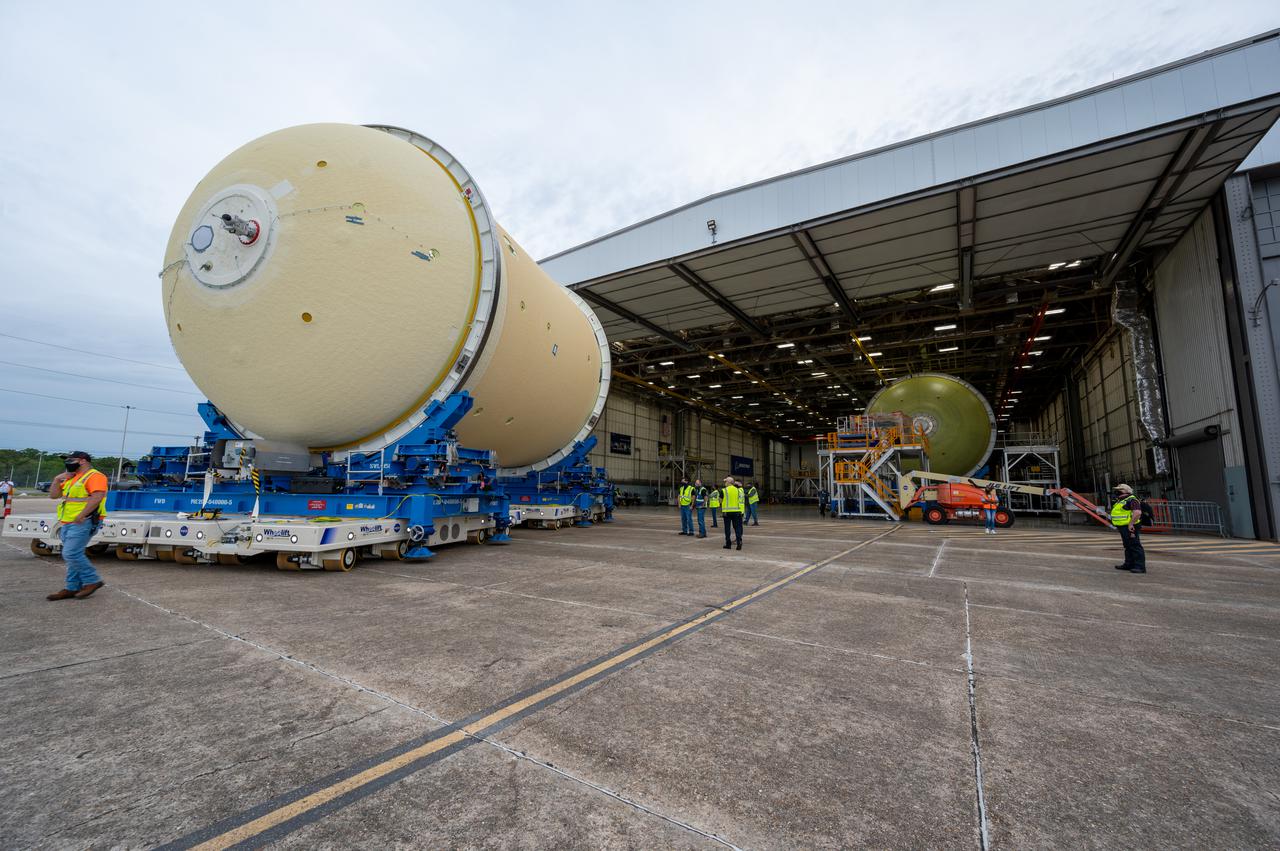
This image shows technicians and engineers moving the liquid oxygen tank (LOX) into position as they continue the process of the forward join on the core stage of NASA’s Space Launch System rocket for Artemis II, the first crewed mission of NASA’s Artemis program at NASA’s Michoud Assembly Facility. The forward join connects the forward skirt, the liquid oxygen tank (LOX) and the intertank structures to form the top part of the SLS rocket’s core stage. Now, NASA and Boeing, the SLS prime contractor, will continue to integrate various systems inside the forward part of the core stage and prepare for structural joining of the liquid hydrogen tank and engine section to form the bottom of the stage. Together with its four RS-25 engines, the rocket’s massive 212-foot-tall core stage — the largest stage NASA has ever built — and its twin solid rocket boosters will produce 8.8 million pounds of thrust to send NASA’s Orion spacecraft, astronauts and supplies beyond Earth’s orbit to the Moon and, ultimately, Mars. Offering more payload mass, volume capability and energy to speed missions through space, the SLS rocket, along with NASA’s Gateway in lunar orbit, the Human Landing System, and Orion spacecraft, is part of NASA’s backbone for deep space exploration and the Artemis lunar program. No other rocket is capable of carrying astronauts in Orion around the Moon in a single mission. Image credit: NASA/Jared Lyons
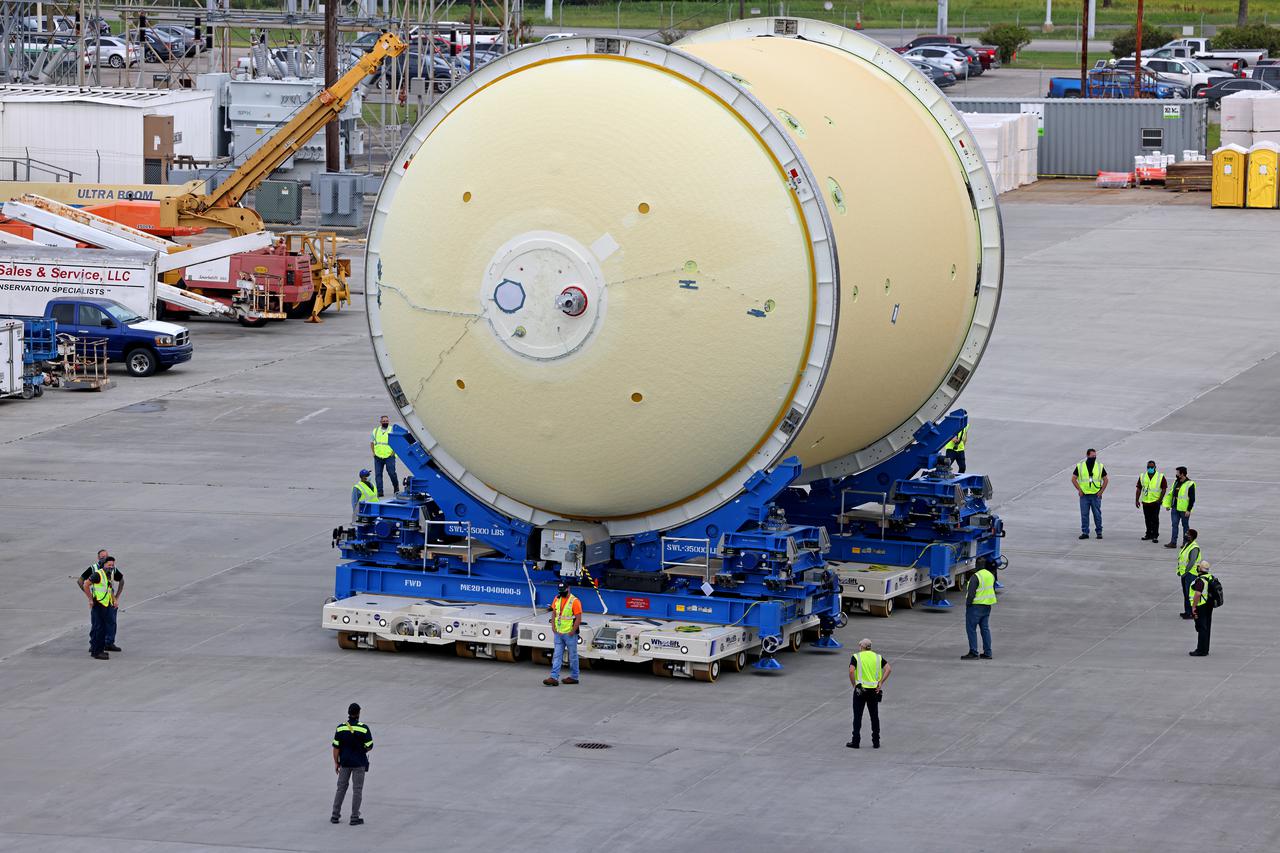
This image shows technicians and engineers moving the liquid oxygen tank (LOX) into position as they continue the process of the forward join on the core stage of NASA’s Space Launch System rocket for Artemis II, the first crewed mission of NASA’s Artemis program at NASA’s Michoud Assembly Facility. The forward join connects the forward skirt, the liquid oxygen tank (LOX) and the intertank structures to form the top part of the SLS rocket’s core stage. Now, NASA and Boeing, the SLS prime contractor, will continue to integrate various systems inside the forward part of the core stage and prepare for structural joining of the liquid hydrogen tank and engine section to form the bottom of the stage. Together with its four RS-25 engines, the rocket’s massive 212-foot-tall core stage — the largest stage NASA has ever built — and its twin solid rocket boosters will produce 8.8 million pounds of thrust to send NASA’s Orion spacecraft, astronauts and supplies beyond Earth’s orbit to the Moon and, ultimately, Mars. Offering more payload mass, volume capability and energy to speed missions through space, the SLS rocket, along with NASA’s Gateway in lunar orbit, the Human Landing System, and Orion spacecraft, is part of NASA’s backbone for deep space exploration and the Artemis lunar program. No other rocket is capable of carrying astronauts in Orion around the Moon in a single mission. Image credit: NASA/Michael DeMocker

This image shows technicians and engineers moving the liquid oxygen tank (LOX) into position as they continue the process of the forward join on the core stage of NASA’s Space Launch System rocket for Artemis II, the first crewed mission of NASA’s Artemis program at NASA’s Michoud Assembly Facility. The forward join connects the forward skirt, the liquid oxygen tank (LOX) and the intertank structures to form the top part of the SLS rocket’s core stage. Now, NASA and Boeing, the SLS prime contractor, will continue to integrate various systems inside the forward part of the core stage and prepare for structural joining of the liquid hydrogen tank and engine section to form the bottom of the stage. Together with its four RS-25 engines, the rocket’s massive 212-foot-tall core stage — the largest stage NASA has ever built — and its twin solid rocket boosters will produce 8.8 million pounds of thrust to send NASA’s Orion spacecraft, astronauts and supplies beyond Earth’s orbit to the Moon and, ultimately, Mars. Offering more payload mass, volume capability and energy to speed missions through space, the SLS rocket, along with NASA’s Gateway in lunar orbit, the Human Landing System, and Orion spacecraft, is part of NASA’s backbone for deep space exploration and the Artemis lunar program. No other rocket is capable of carrying astronauts in Orion around the Moon in a single mission. Image credit: NASA/Michael DeMocker
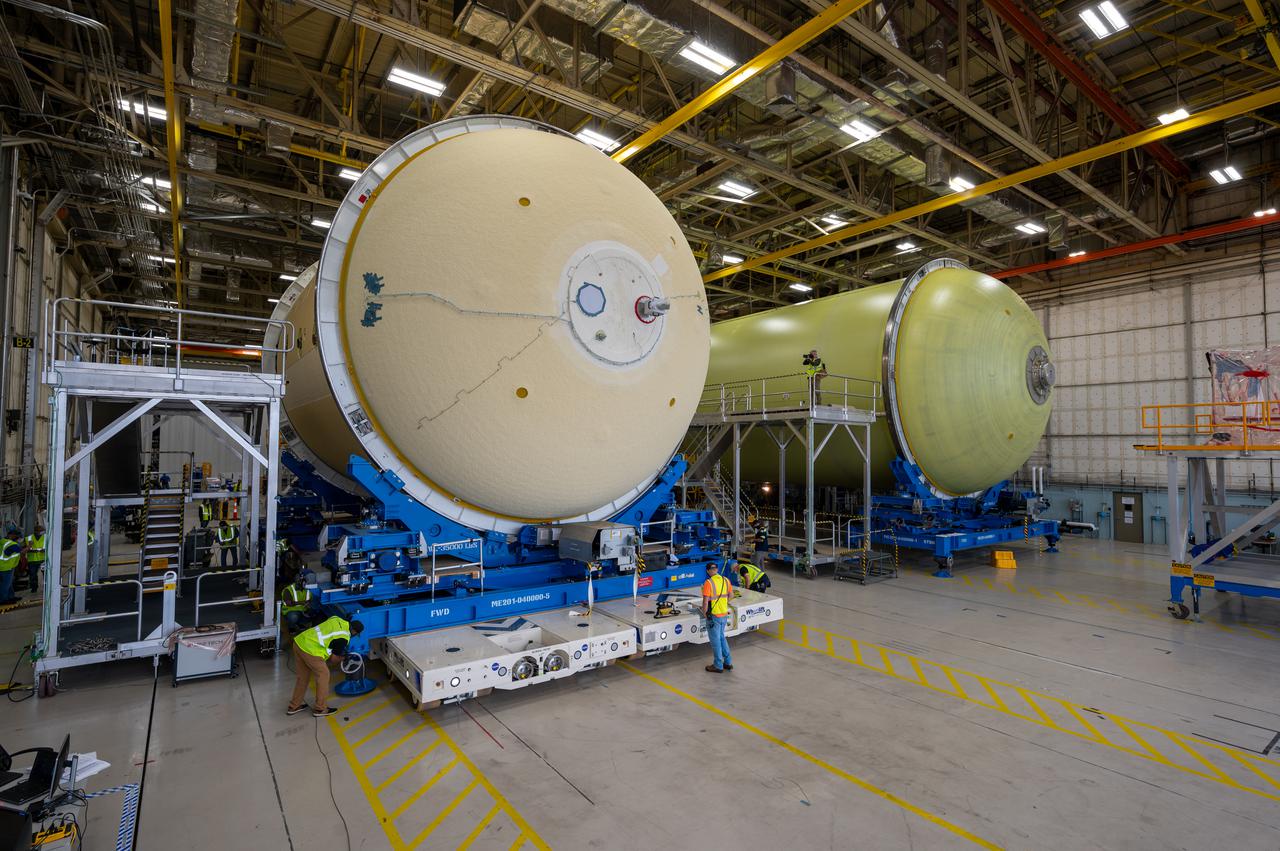
This image shows technicians and engineers moving the liquid oxygen tank (LOX) into position as they continue the process of the forward join on the core stage of NASA’s Space Launch System rocket for Artemis II, the first crewed mission of NASA’s Artemis program at NASA’s Michoud Assembly Facility. The forward join connects the forward skirt, the liquid oxygen tank (LOX) and the intertank structures to form the top part of the SLS rocket’s core stage. Now, NASA and Boeing, the SLS prime contractor, will continue to integrate various systems inside the forward part of the core stage and prepare for structural joining of the liquid hydrogen tank and engine section to form the bottom of the stage. Together with its four RS-25 engines, the rocket’s massive 212-foot-tall core stage — the largest stage NASA has ever built — and its twin solid rocket boosters will produce 8.8 million pounds of thrust to send NASA’s Orion spacecraft, astronauts and supplies beyond Earth’s orbit to the Moon and, ultimately, Mars. Offering more payload mass, volume capability and energy to speed missions through space, the SLS rocket, along with NASA’s Gateway in lunar orbit, the Human Landing System, and Orion spacecraft, is part of NASA’s backbone for deep space exploration and the Artemis lunar program. No other rocket is capable of carrying astronauts in Orion around the Moon in a single mission. Image credit: NASA/Jared Lyons
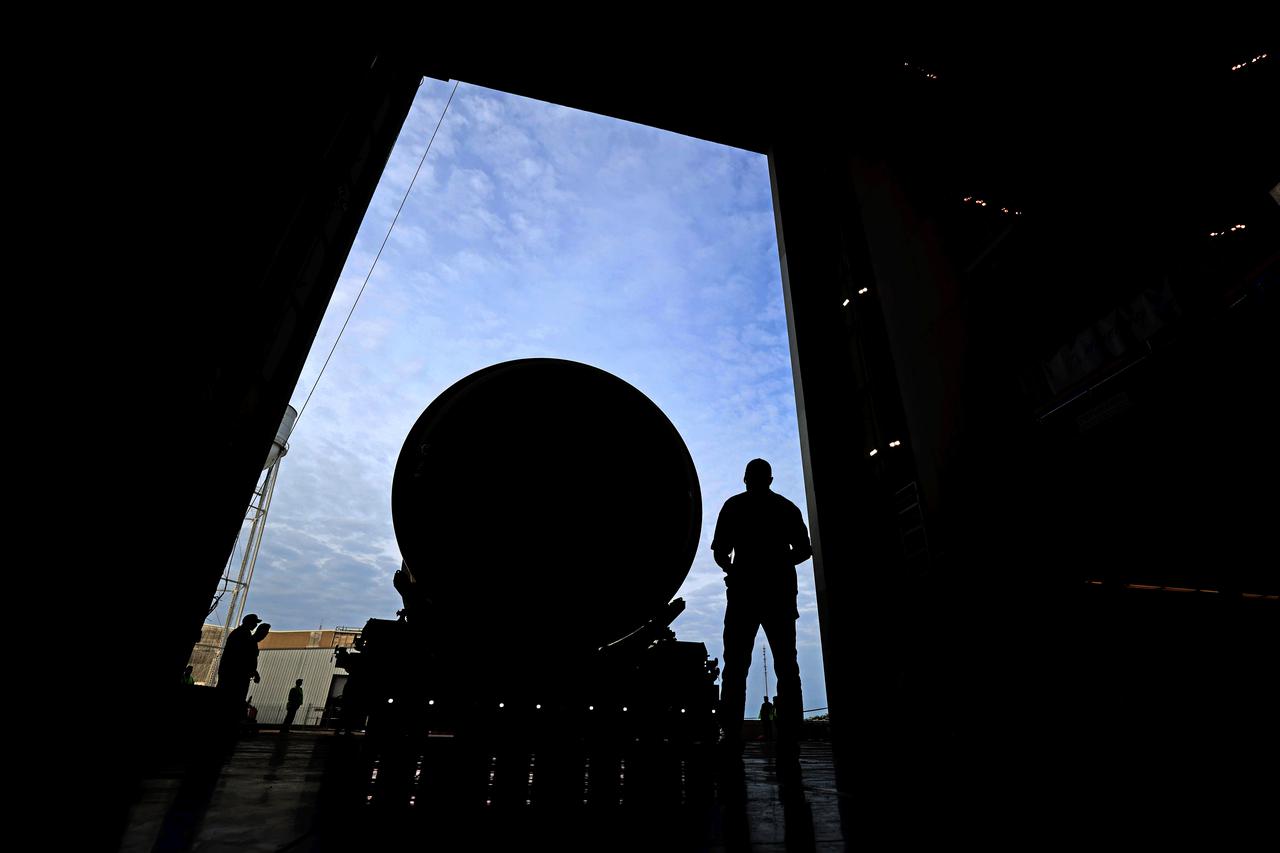
This image shows technicians and engineers moving the liquid oxygen tank (LOX) into position as they continue the process of the forward join on the core stage of NASA’s Space Launch System rocket for Artemis II, the first crewed mission of NASA’s Artemis program at NASA’s Michoud Assembly Facility. The forward join connects the forward skirt, the liquid oxygen tank (LOX) and the intertank structures to form the top part of the SLS rocket’s core stage. Now, NASA and Boeing, the SLS prime contractor, will continue to integrate various systems inside the forward part of the core stage and prepare for structural joining of the liquid hydrogen tank and engine section to form the bottom of the stage. Together with its four RS-25 engines, the rocket’s massive 212-foot-tall core stage — the largest stage NASA has ever built — and its twin solid rocket boosters will produce 8.8 million pounds of thrust to send NASA’s Orion spacecraft, astronauts and supplies beyond Earth’s orbit to the Moon and, ultimately, Mars. Offering more payload mass, volume capability and energy to speed missions through space, the SLS rocket, along with NASA’s Gateway in lunar orbit, the Human Landing System, and Orion spacecraft, is part of NASA’s backbone for deep space exploration and the Artemis lunar program. No other rocket is capable of carrying astronauts in Orion around the Moon in a single mission. Image credit: NASA/Michael DeMocker
This image shows technicians and engineers moving the liquid oxygen tank (LOX) into position as they continue the process of the forward join on the core stage of NASA’s Space Launch System rocket for Artemis II, the first crewed mission of NASA’s Artemis program at NASA’s Michoud Assembly Facility. The forward join connects the forward skirt, the liquid oxygen tank (LOX) and the intertank structures to form the top part of the SLS rocket’s core stage. Now, NASA and Boeing, the SLS prime contractor, will continue to integrate various systems inside the forward part of the core stage and prepare for structural joining of the liquid hydrogen tank and engine section to form the bottom of the stage. Together with its four RS-25 engines, the rocket’s massive 212-foot-tall core stage — the largest stage NASA has ever built — and its twin solid rocket boosters will produce 8.8 million pounds of thrust to send NASA’s Orion spacecraft, astronauts and supplies beyond Earth’s orbit to the Moon and, ultimately, Mars. Offering more payload mass, volume capability and energy to speed missions through space, the SLS rocket, along with NASA’s Gateway in lunar orbit, the Human Landing System, and Orion spacecraft, is part of NASA’s backbone for deep space exploration and the Artemis lunar program. No other rocket is capable of carrying astronauts in Orion around the Moon in a single mission. Image credit: NASA/Michael DeMocker
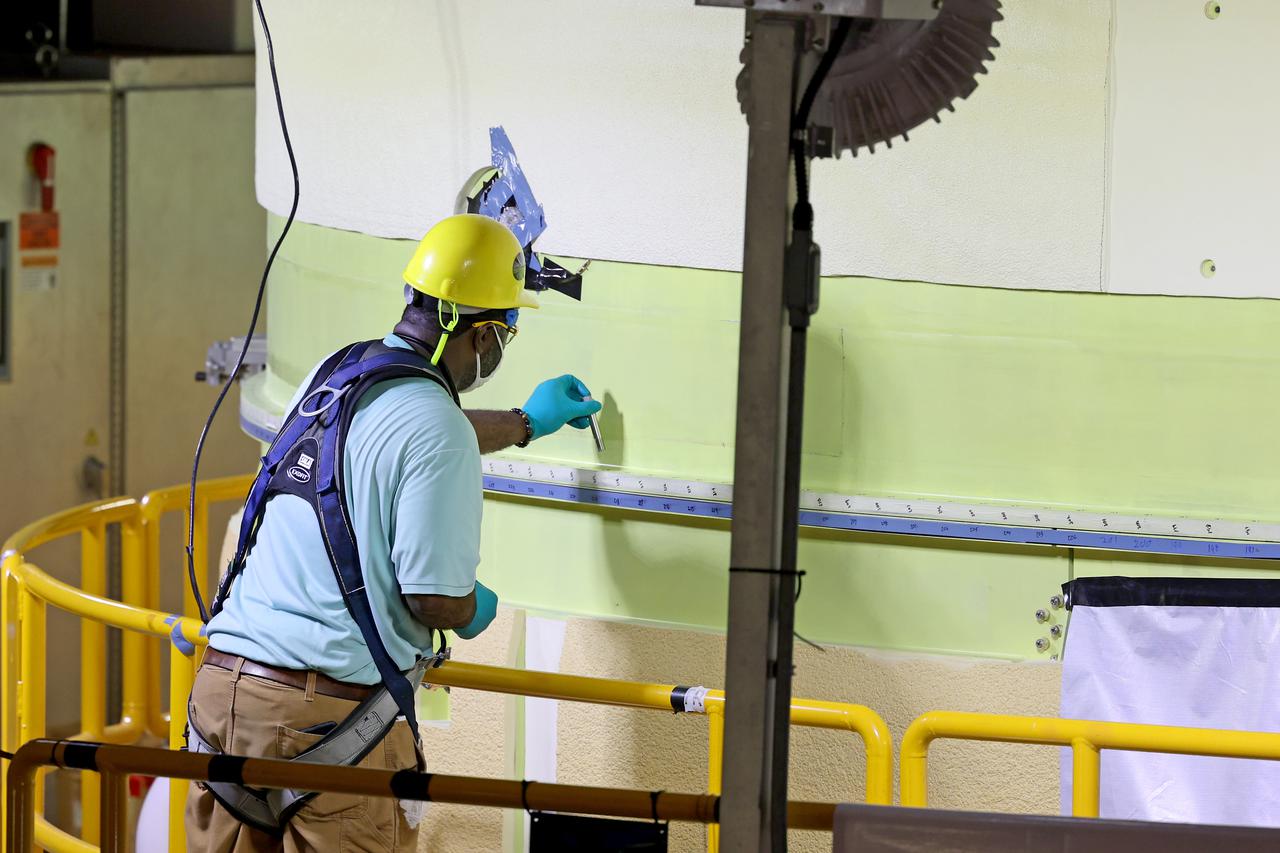
This image shows technicians and engineers move and connect the liquid oxygen tank (LOX) to the intertank as they continue the process of the forward join on the core stage of NASA’s Space Launch System rocket for Artemis II, the first crewed mission of NASA’s Artemis program at NASA’s Michoud Assembly Facility. The forward join connects the forward skirt, the liquid oxygen tank (LOX) and the intertank structures to form the top part of the SLS rocket’s core stage. Now, NASA and Boeing, the SLS prime contractor, will continue to integrate various systems inside the forward part of the core stage and prepare for structural joining of the liquid hydrogen tank and engine section to form the bottom of the stage. Together with its four RS-25 engines, the rocket’s massive 212-foot-tall core stage — the largest stage NASA has ever built — and its twin solid rocket boosters will produce 8.8 million pounds of thrust to send NASA’s Orion spacecraft, astronauts and supplies beyond Earth’s orbit to the Moon and, ultimately, Mars. Offering more payload mass, volume capability and energy to speed missions through space, the SLS rocket, along with NASA’s Gateway in lunar orbit, the Human Landing System, and Orion spacecraft, is part of NASA’s backbone for deep space exploration and the Artemis lunar program. No other rocket is capable of carrying astronauts in Orion around the Moon in a single mission. Image credit: NASA/Michael DeMocker
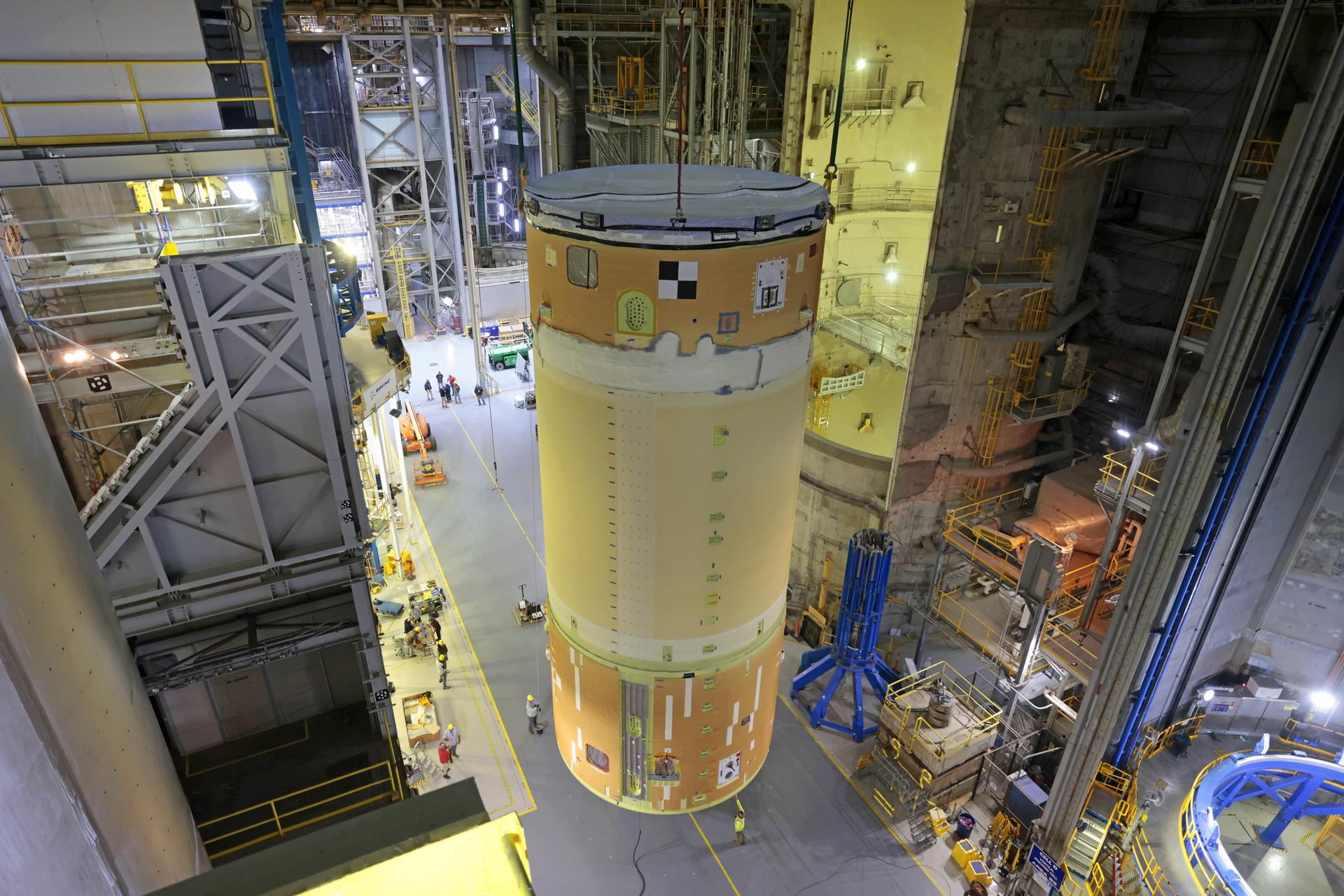
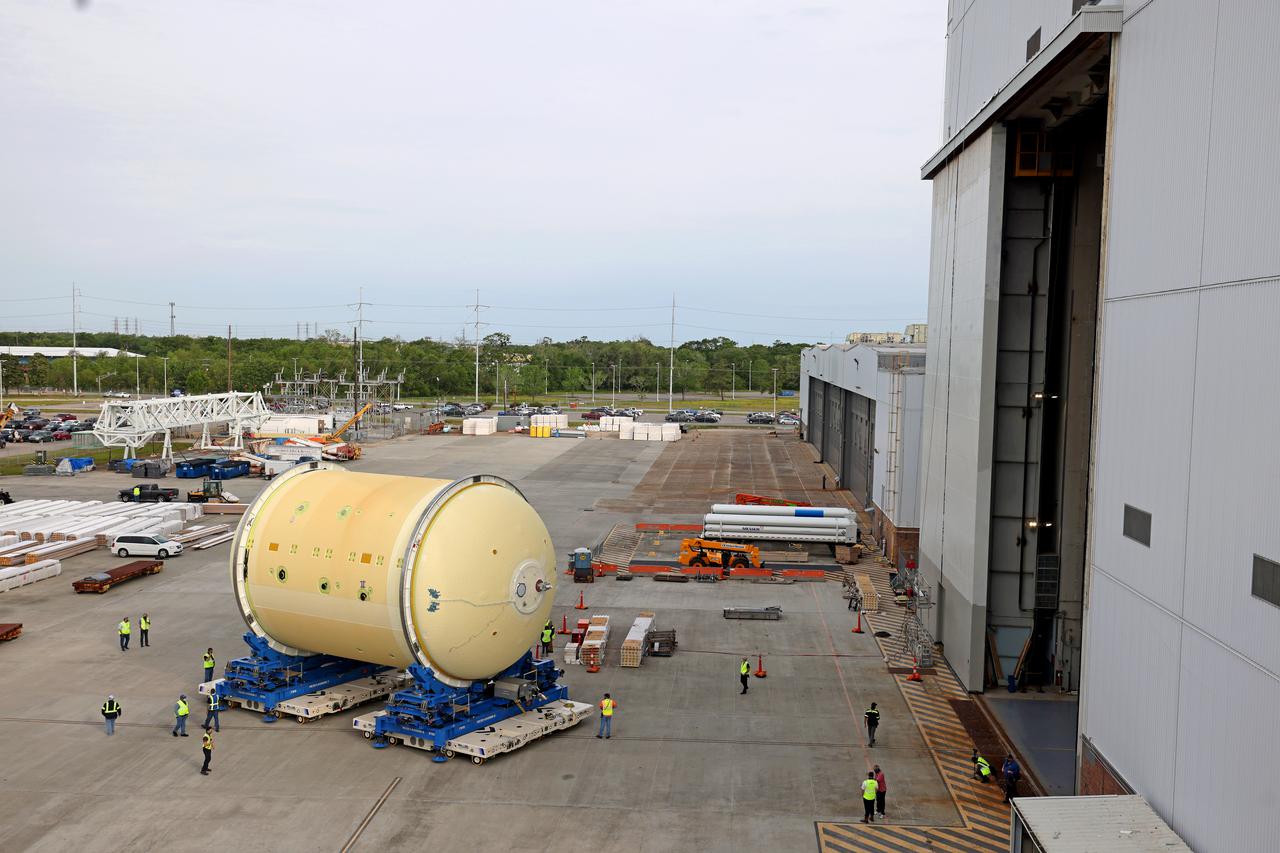
Move crews at NASA’s Michoud Assembly Facility in New Orleans, lift the forward-joined flight hardware for the agency’s SLS (Space Launch System) rocket out of a stacking cell in the vertical assembly building on Dec. 19, 2025. The forward join, which consists of the intertank, liquid oxygen tank, and forward skirt, will be used on the core stage slated for NASA’s Artemis III mission. Teams moved the flight hardware from the cell and set it atop self-propelled mobile transporters. Soon, the article will be brought to the factory’s final assembly area where it will be mated to the core stage’s previously joined liquid hydrogen tank and undergo further integration. The core stage, along with its four RS-25 engines, produce more than two million pounds of thrust to help launch NASA’s Orion spacecraft, astronauts, and supplies beyond Earth’s orbit and to the lunar surface for Artemis. Image credit: NASA/Michael DeMocker
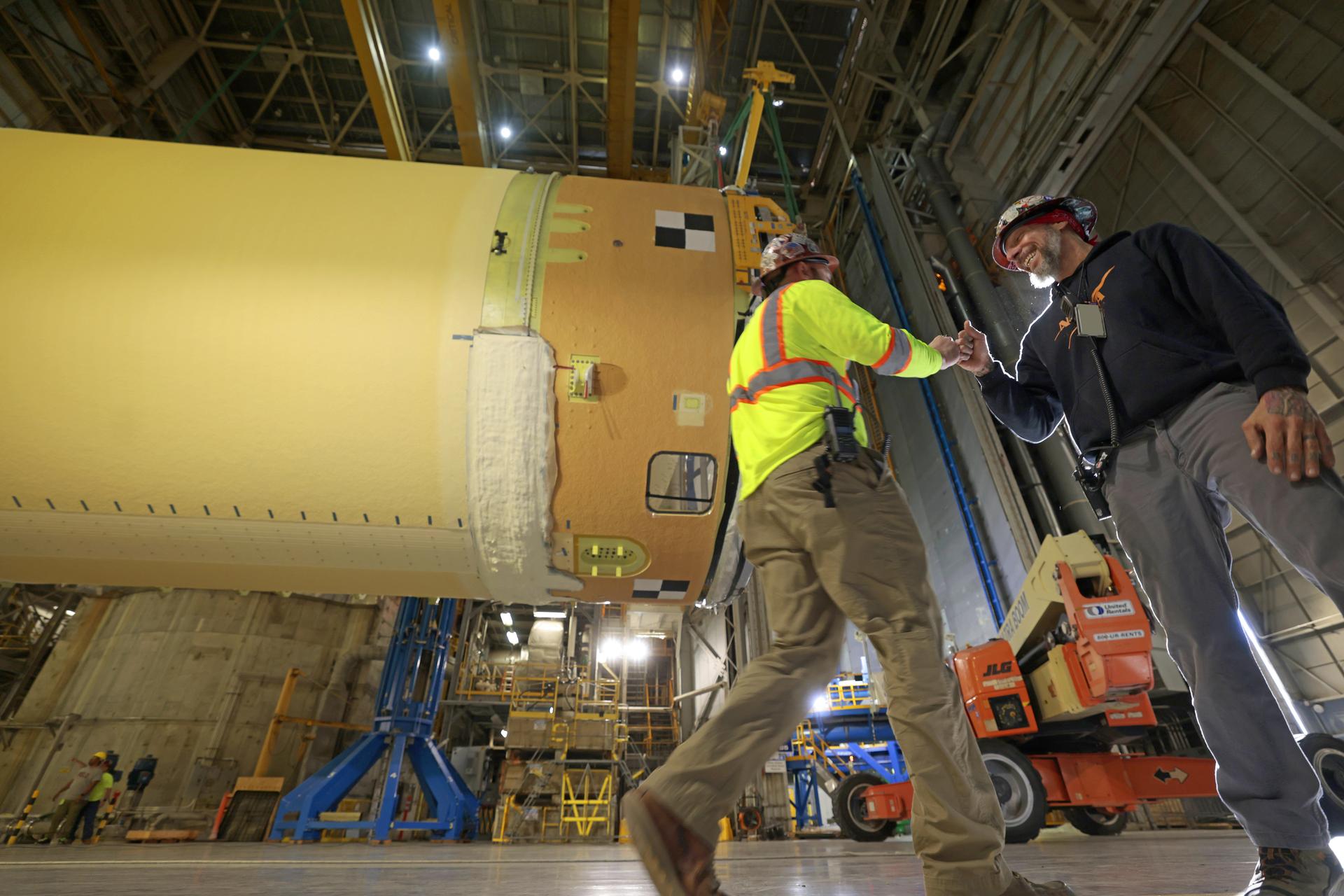
Move crews at NASA’s Michoud Assembly Facility in New Orleans, lift the forward-joined flight hardware for the agency’s SLS (Space Launch System) rocket out of a stacking cell in the vertical assembly building on Dec. 19, 2025. The forward join, which consists of the intertank, liquid oxygen tank, and forward skirt, will be used on the core stage slated for NASA’s Artemis III mission. Teams moved the flight hardware from the cell and set it atop self-propelled mobile transporters. Soon, the article will be brought to the factory’s final assembly area where it will be mated to the core stage’s previously joined liquid hydrogen tank and undergo further integration. The core stage, along with its four RS-25 engines, produce more than two million pounds of thrust to help launch NASA’s Orion spacecraft, astronauts, and supplies beyond Earth’s orbit and to the lunar surface for Artemis. Image credit: NASA/Michael DeMocker
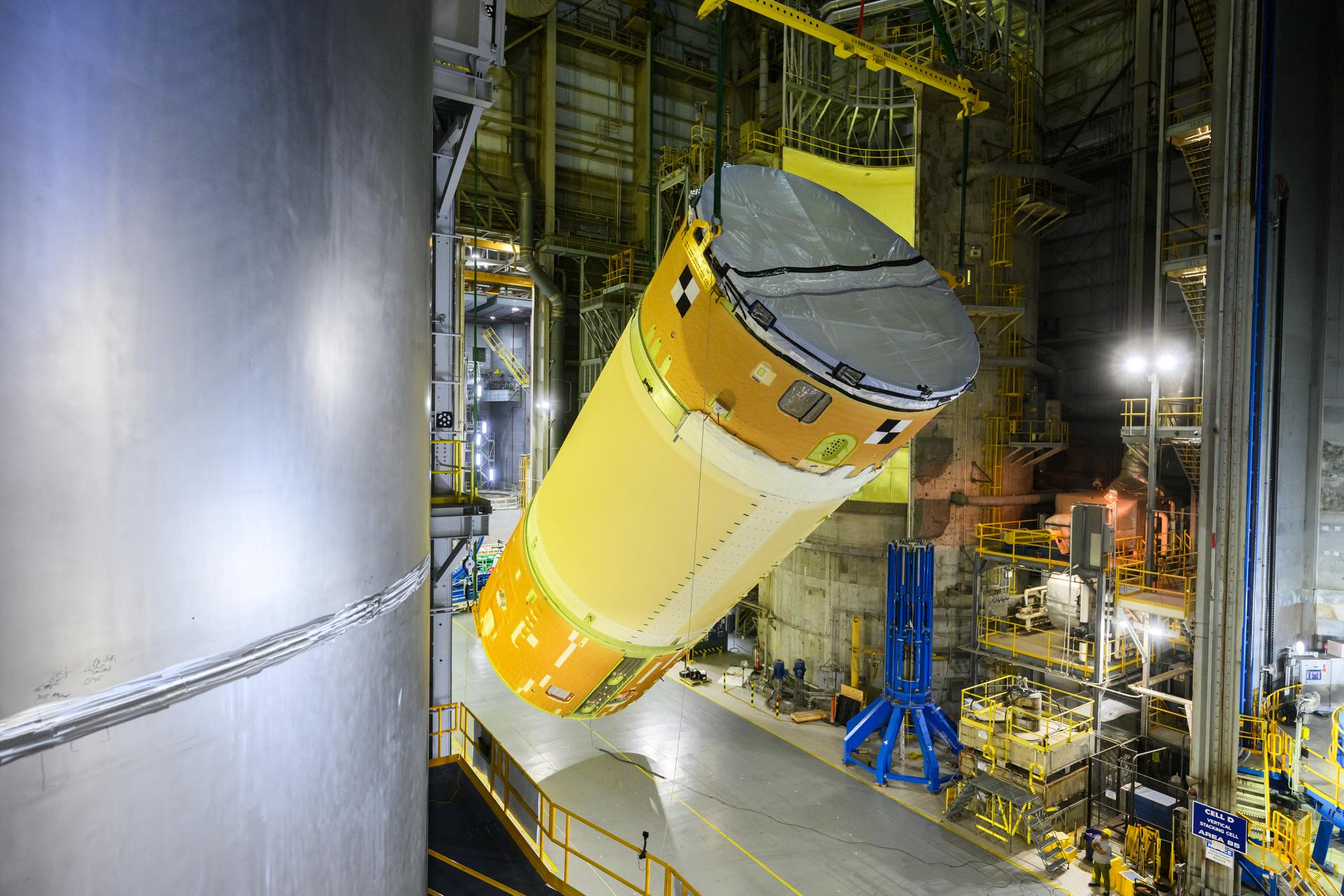
Move crews at NASA’s Michoud Assembly Facility in New Orleans, lift the forward-joined flight hardware for the agency’s SLS (Space Launch System) rocket out of a stacking cell in the vertical assembly building on Dec. 19, 2025. The forward join, which consists of the intertank, liquid oxygen tank, and forward skirt, will be used on the core stage slated for NASA’s Artemis III mission. Teams moved the flight hardware from the cell and set it atop self-propelled mobile transporters. Soon, the article will be brought to the factory’s final assembly area where it will be mated to the core stage’s previously joined liquid hydrogen tank and undergo further integration. The core stage, along with its four RS-25 engines, produce more than two million pounds of thrust to help launch NASA’s Orion spacecraft, astronauts, and supplies beyond Earth’s orbit and to the lunar surface for Artemis.
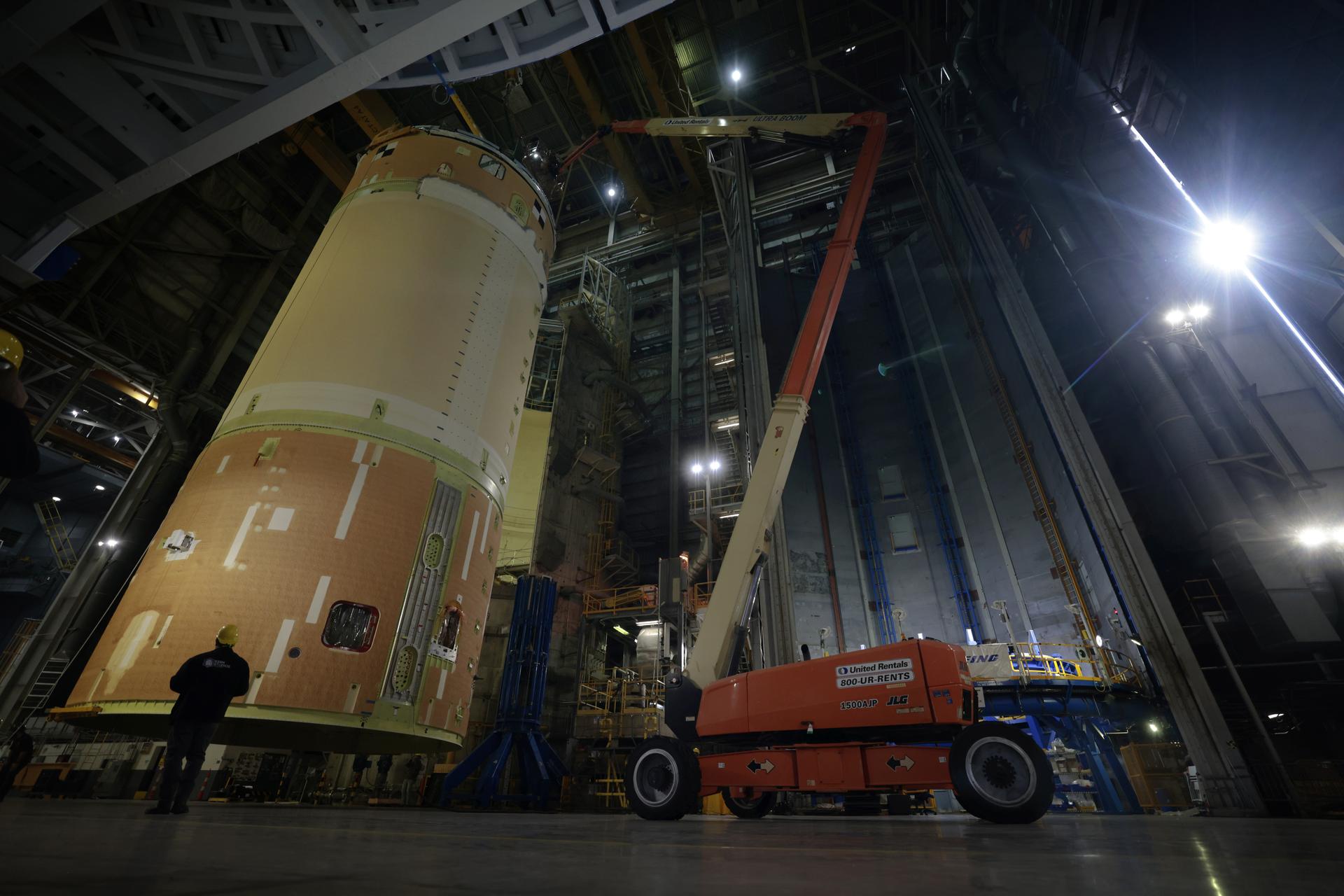
Move crews at NASA’s Michoud Assembly Facility in New Orleans, lift the forward-joined flight hardware for the agency’s SLS (Space Launch System) rocket out of a stacking cell in the vertical assembly building on Dec. 19, 2025. The forward join, which consists of the intertank, liquid oxygen tank, and forward skirt, will be used on the core stage slated for NASA’s Artemis III mission. Teams moved the flight hardware from the cell and set it atop self-propelled mobile transporters. Soon, the article will be brought to the factory’s final assembly area where it will be mated to the core stage’s previously joined liquid hydrogen tank and undergo further integration. The core stage, along with its four RS-25 engines, produce more than two million pounds of thrust to help launch NASA’s Orion spacecraft, astronauts, and supplies beyond Earth’s orbit and to the lunar surface for Artemis. Image credit: NASA/Michael DeMocker
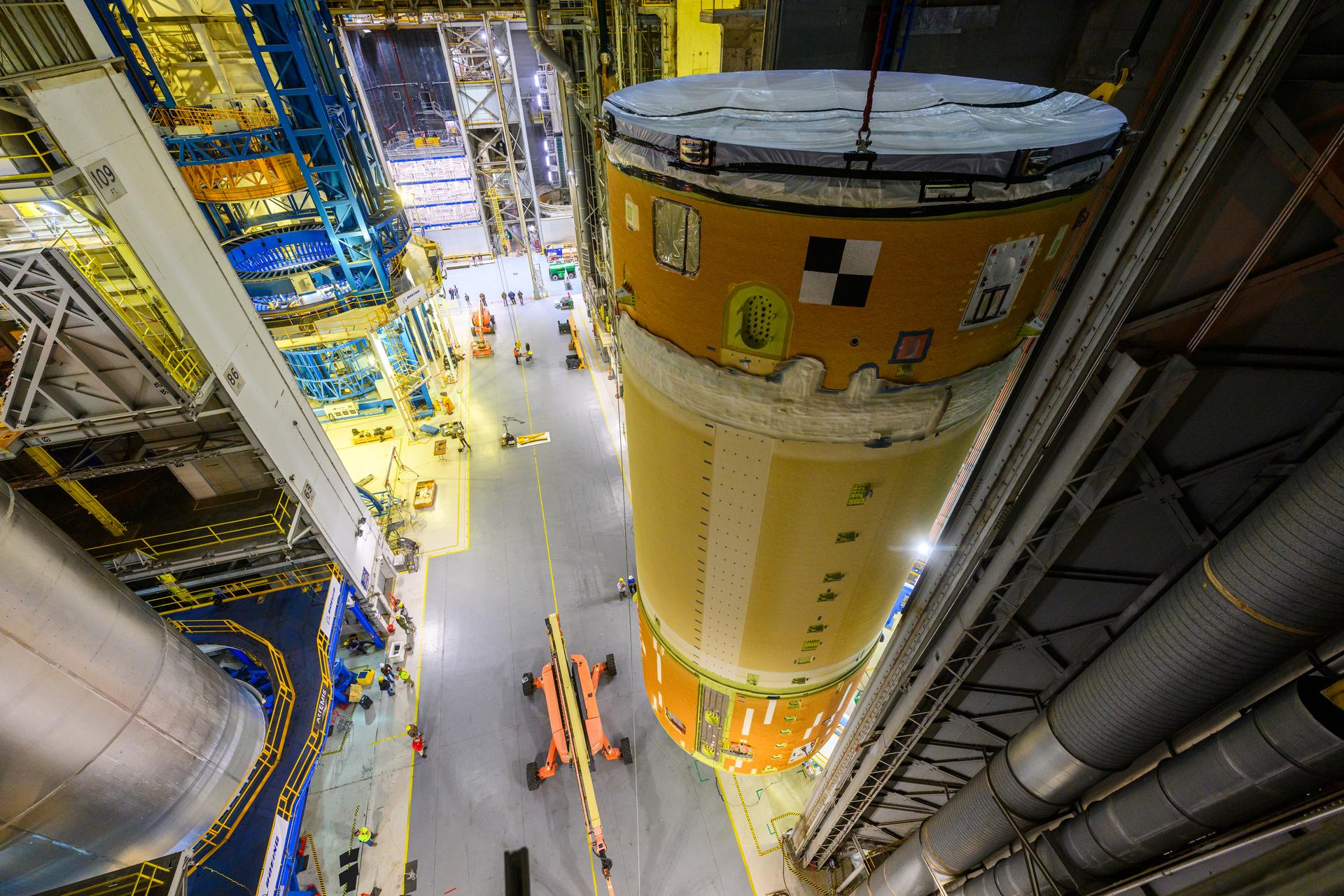
Move crews at NASA’s Michoud Assembly Facility in New Orleans, lift the forward-joined flight hardware for the agency’s SLS (Space Launch System) rocket out of a stacking cell in the vertical assembly building on Dec. 19, 2025. The forward join, which consists of the intertank, liquid oxygen tank, and forward skirt, will be used on the core stage slated for NASA’s Artemis III mission. Teams moved the flight hardware from the cell and set it atop self-propelled mobile transporters. Soon, the article will be brought to the factory’s final assembly area where it will be mated to the core stage’s previously joined liquid hydrogen tank and undergo further integration. The core stage, along with its four RS-25 engines, produce more than two million pounds of thrust to help launch NASA’s Orion spacecraft, astronauts, and supplies beyond Earth’s orbit and to the lunar surface for Artemis.
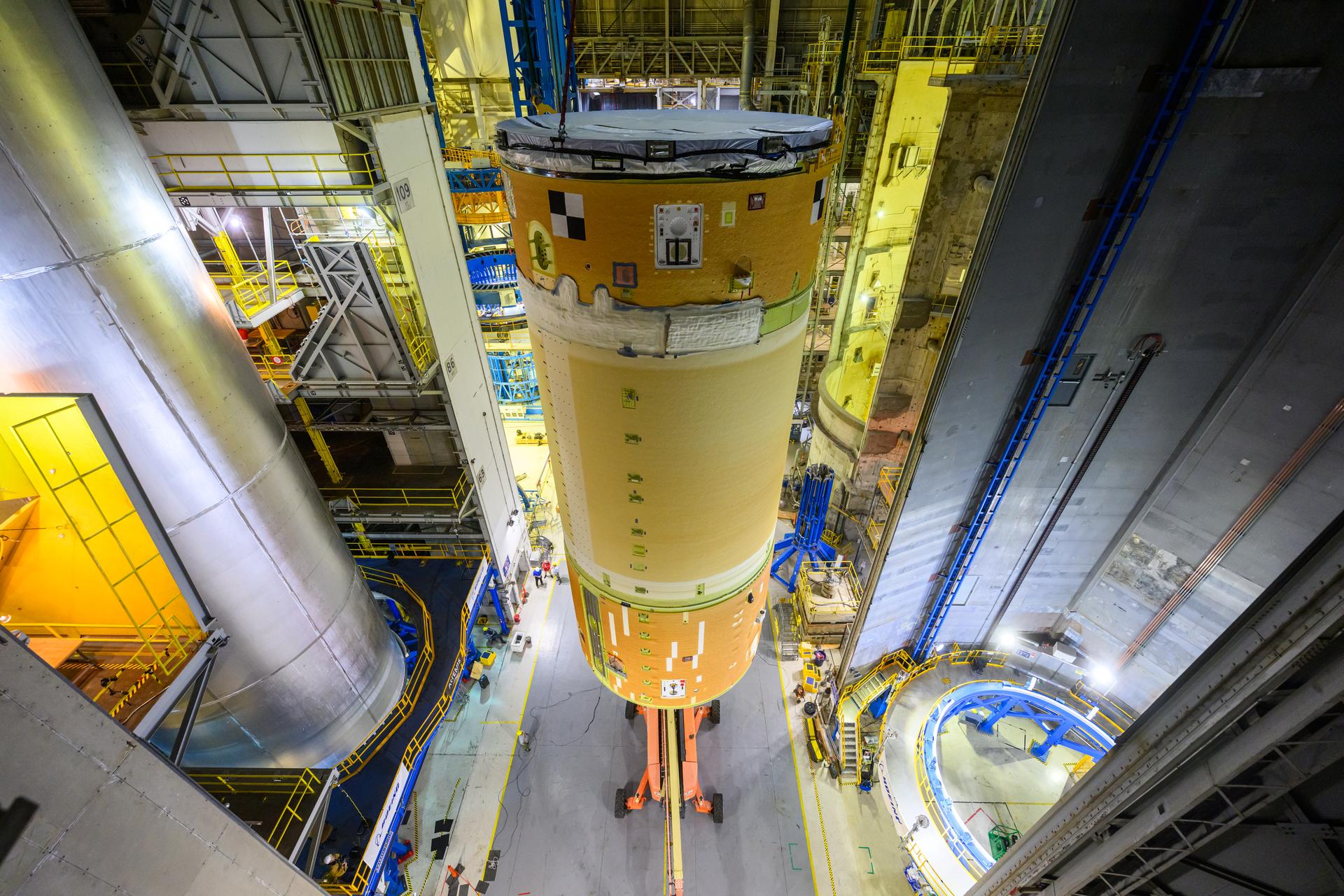
Move crews at NASA’s Michoud Assembly Facility in New Orleans, lift the forward-joined flight hardware for the agency’s SLS (Space Launch System) rocket out of a stacking cell in the vertical assembly building on Dec. 19, 2025. The forward join, which consists of the intertank, liquid oxygen tank, and forward skirt, will be used on the core stage slated for NASA’s Artemis III mission. Teams moved the flight hardware from the cell and set it atop self-propelled mobile transporters. Soon, the article will be brought to the factory’s final assembly area where it will be mated to the core stage’s previously joined liquid hydrogen tank and undergo further integration. The core stage, along with its four RS-25 engines, produce more than two million pounds of thrust to help launch NASA’s Orion spacecraft, astronauts, and supplies beyond Earth’s orbit and to the lunar surface for Artemis.
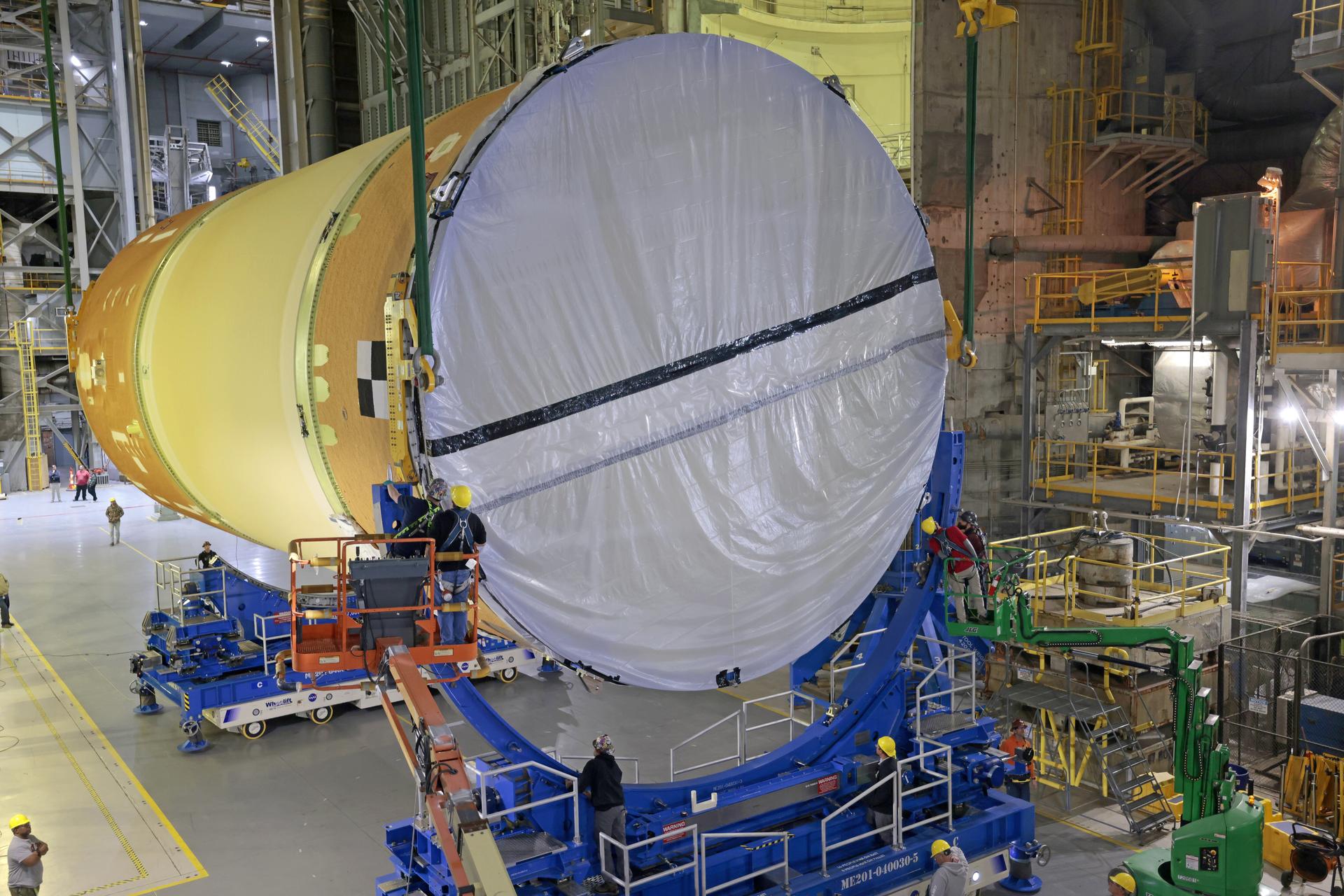
Move crews at NASA’s Michoud Assembly Facility in New Orleans, lift the forward-joined flight hardware for the agency’s SLS (Space Launch System) rocket out of a stacking cell in the vertical assembly building on Dec. 19, 2025. The forward join, which consists of the intertank, liquid oxygen tank, and forward skirt, will be used on the core stage slated for NASA’s Artemis III mission. Teams moved the flight hardware from the cell and set it atop self-propelled mobile transporters. Soon, the article will be brought to the factory’s final assembly area where it will be mated to the core stage’s previously joined liquid hydrogen tank and undergo further integration. The core stage, along with its four RS-25 engines, produce more than two million pounds of thrust to help launch NASA’s Orion spacecraft, astronauts, and supplies beyond Earth’s orbit and to the lunar surface for Artemis. Image credit: NASA/Michael DeMocker
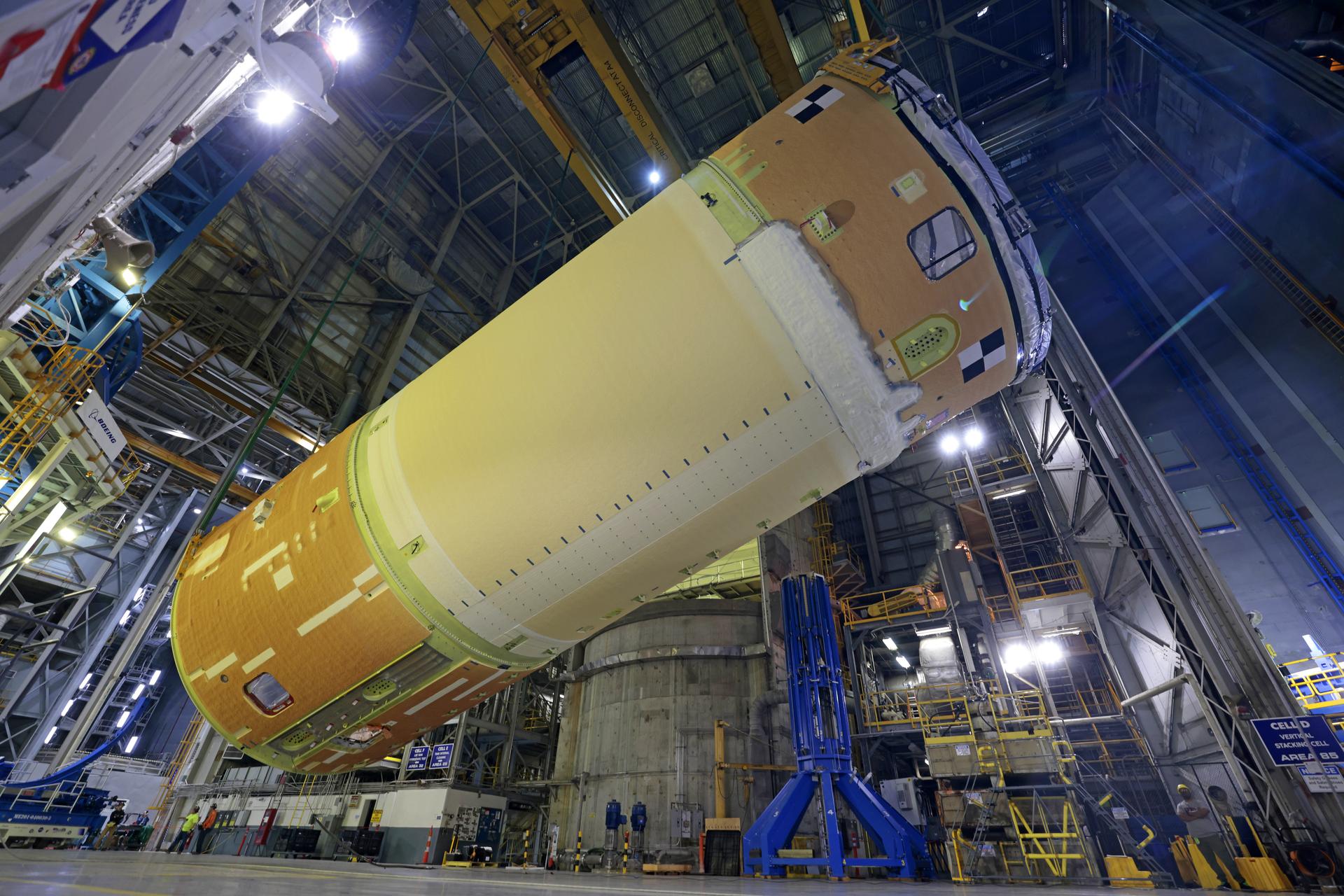
Move crews at NASA’s Michoud Assembly Facility in New Orleans, lift the forward-joined flight hardware for the agency’s SLS (Space Launch System) rocket out of a stacking cell in the vertical assembly building on Dec. 19, 2025. The forward join, which consists of the intertank, liquid oxygen tank, and forward skirt, will be used on the core stage slated for NASA’s Artemis III mission. Teams moved the flight hardware from the cell and set it atop self-propelled mobile transporters. Soon, the article will be brought to the factory’s final assembly area where it will be mated to the core stage’s previously joined liquid hydrogen tank and undergo further integration. The core stage, along with its four RS-25 engines, produce more than two million pounds of thrust to help launch NASA’s Orion spacecraft, astronauts, and supplies beyond Earth’s orbit and to the lunar surface for Artemis. Image credit: NASA/Michael DeMocker
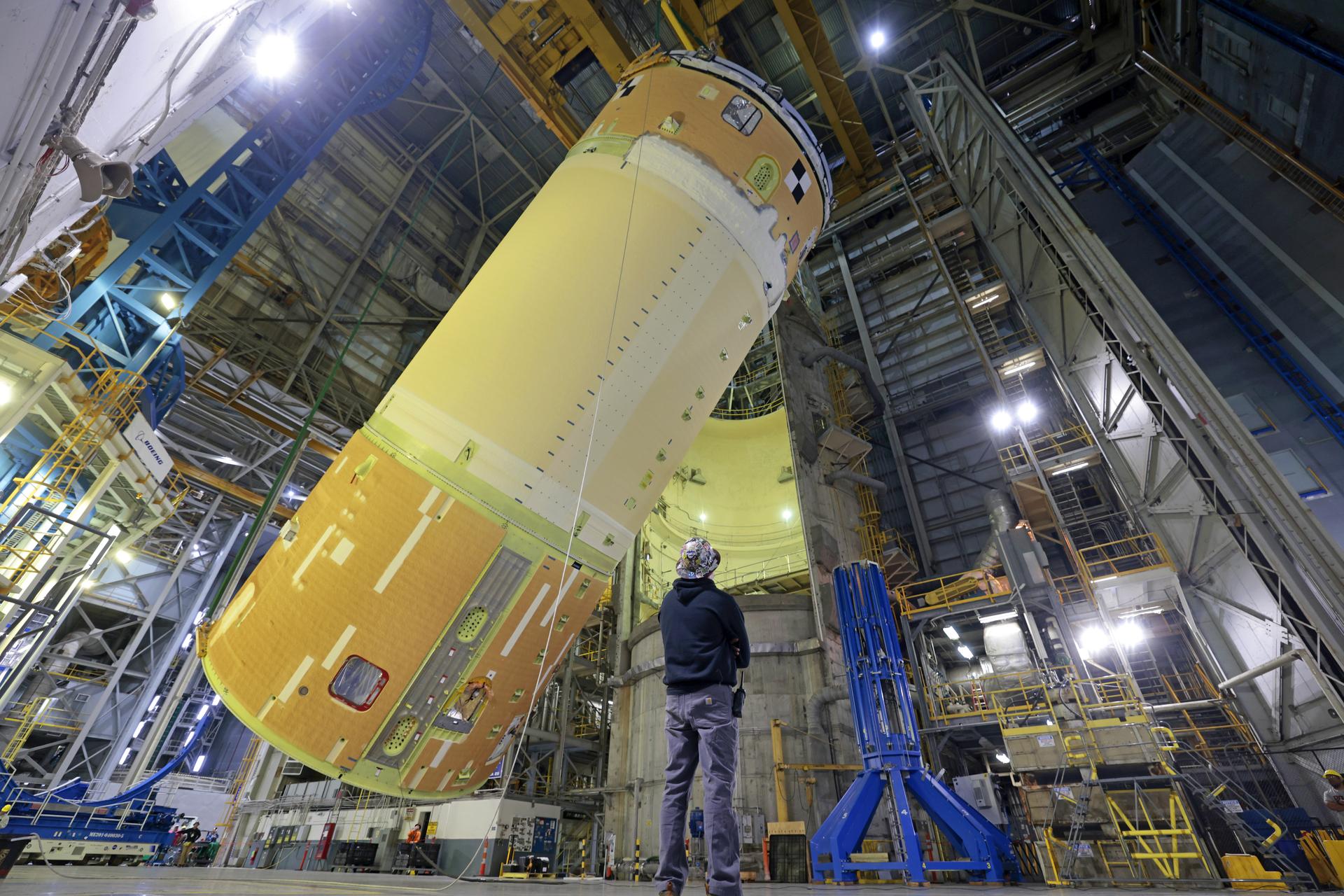
Move crews at NASA’s Michoud Assembly Facility in New Orleans, lift the forward-joined flight hardware for the agency’s SLS (Space Launch System) rocket out of a stacking cell in the vertical assembly building on Dec. 19, 2025. The forward join, which consists of the intertank, liquid oxygen tank, and forward skirt, will be used on the core stage slated for NASA’s Artemis III mission. Teams moved the flight hardware from the cell and set it atop self-propelled mobile transporters. Soon, the article will be brought to the factory’s final assembly area where it will be mated to the core stage’s previously joined liquid hydrogen tank and undergo further integration. The core stage, along with its four RS-25 engines, produce more than two million pounds of thrust to help launch NASA’s Orion spacecraft, astronauts, and supplies beyond Earth’s orbit and to the lunar surface for Artemis. Image credit: NASA/Michael DeMocker
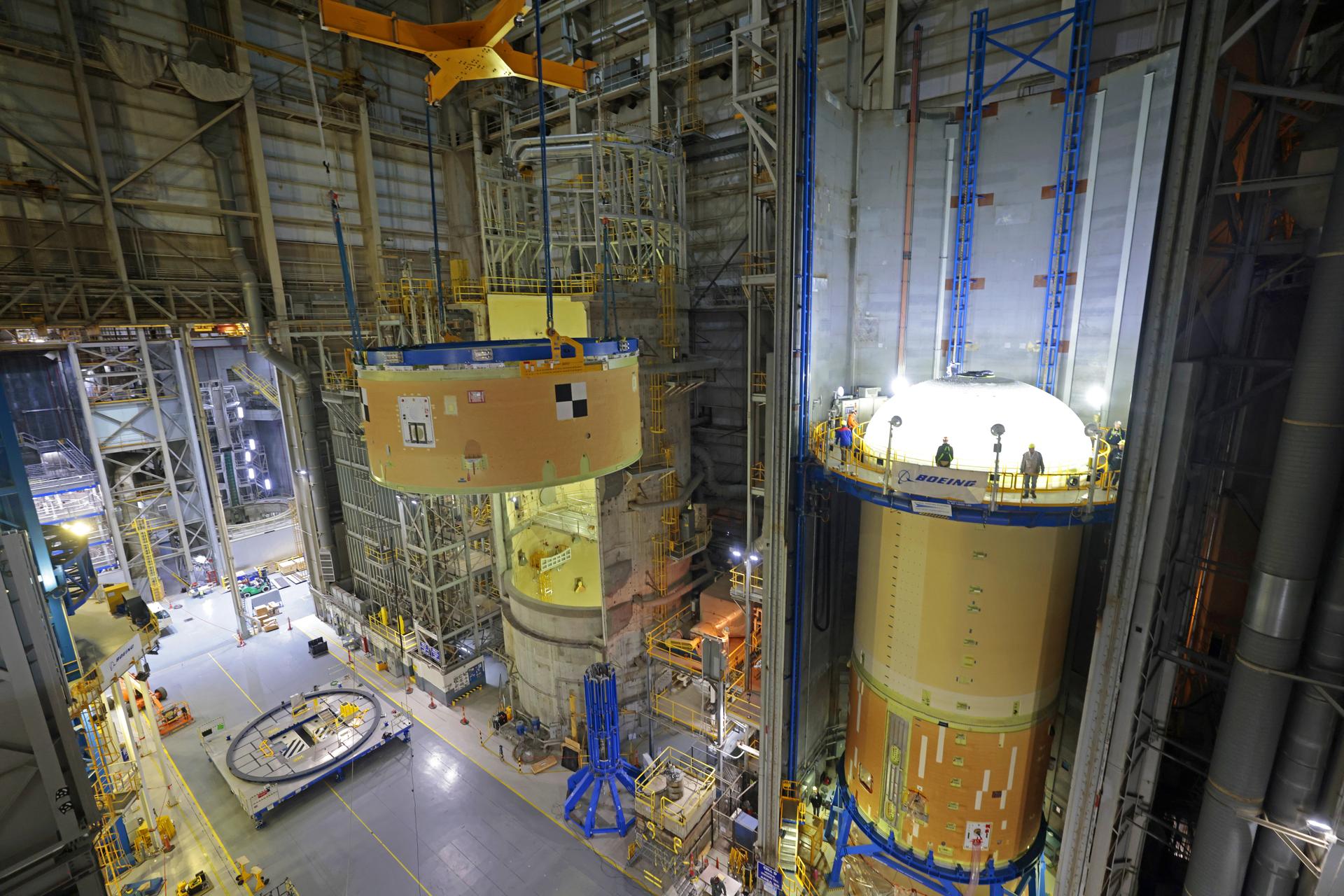
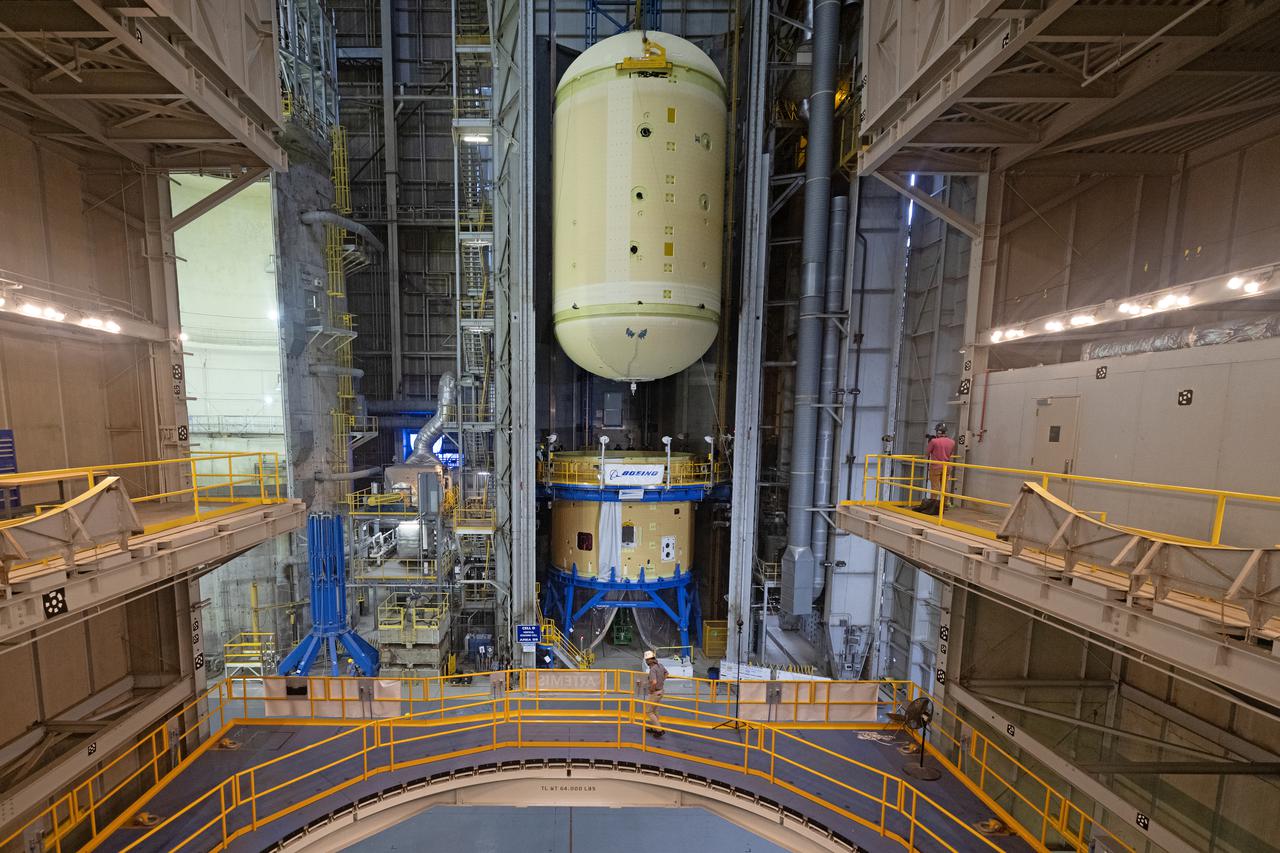
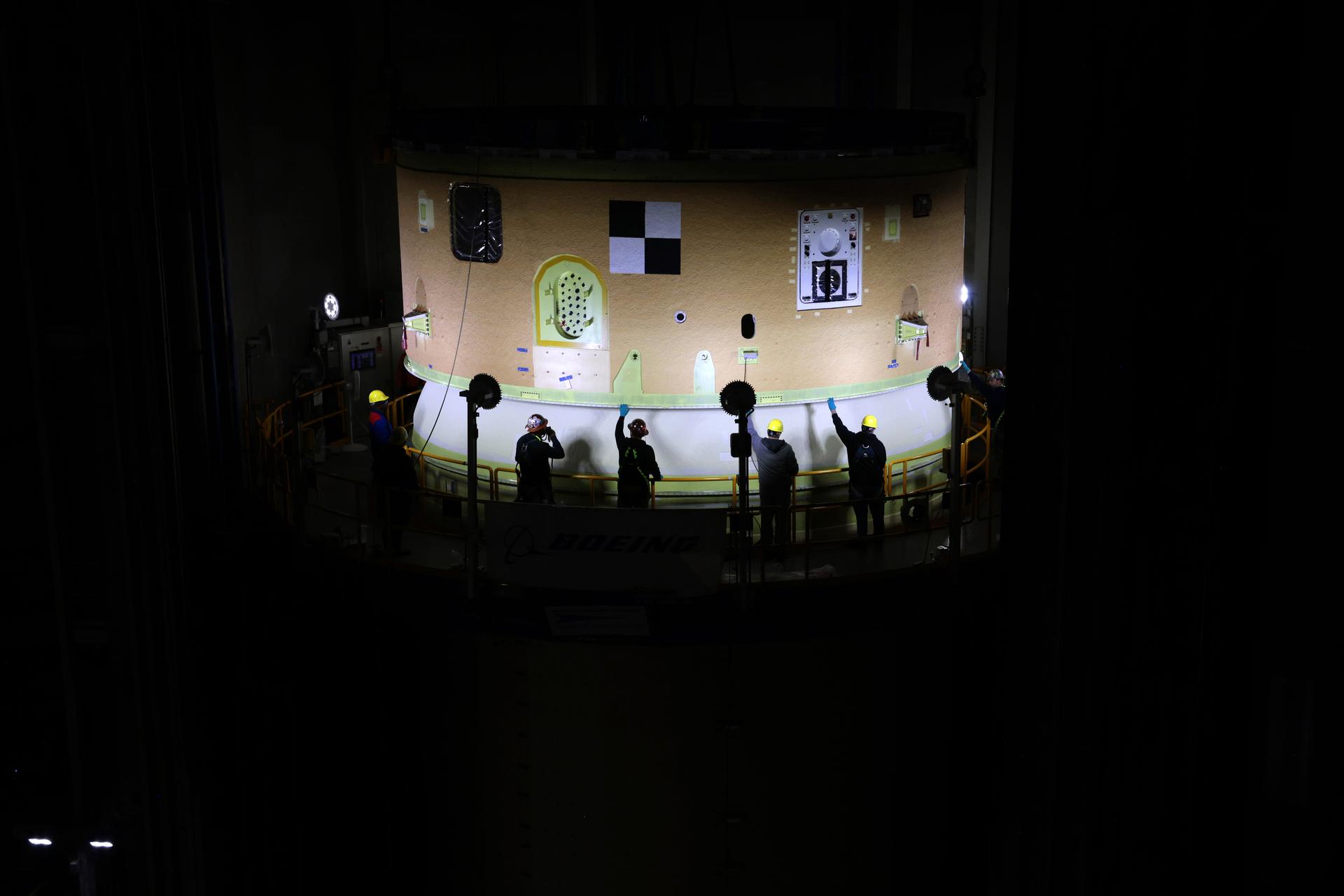
Move crews at NASA’s Michoud Assembly Facility in New Orleans lift the forward skirt for the agency’s SLS (Space Launch System) rocket core stage via an overhead crane system and sit it atop the previously mated intertank and liquid oxygen tank on Dec. 5, 2025. Teams with Boeing – NASA’s Prime Contractor for SLS – will mate the forward skirt to the forward end of the liquid oxygen tank to complete forward join operations for the core stage of the agency’s Artemis III mission. The forward skirt houses flight computers, cameras and avionics systems, and is one of five major elements that make up the 212-foot-tall rocket stage. The core stage, along with its four RS-25 engines, produce more than two million pounds of thrust to help launch NASA’s Orion spacecraft, astronauts, and supplies beyond Earth’s orbit and to the lunar surface for Artemis. Image credit: NASA/Michael DeMocker
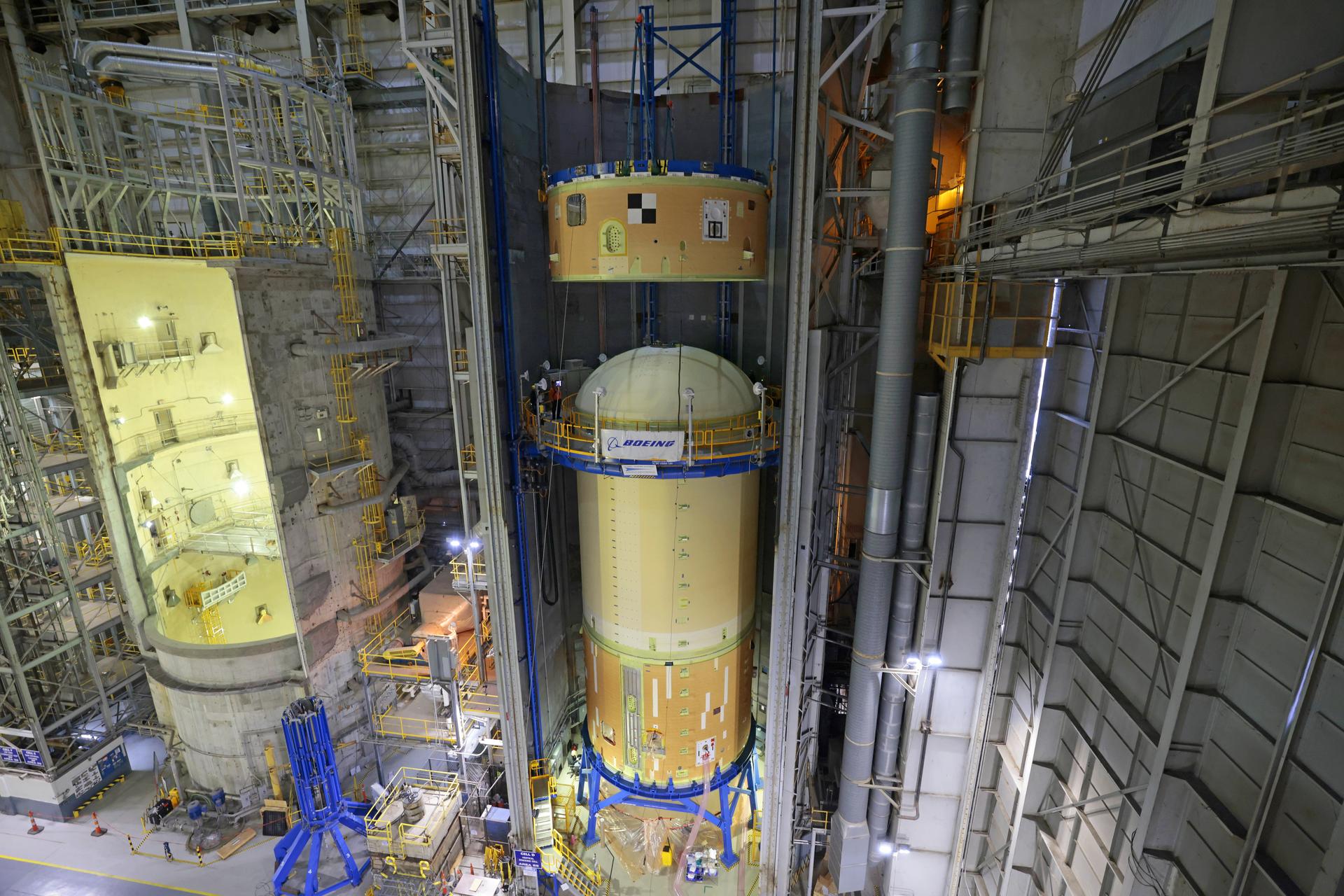
Move crews at NASA’s Michoud Assembly Facility in New Orleans lift the forward skirt for the agency’s SLS (Space Launch System) rocket core stage via an overhead crane system and sit it atop the previously mated intertank and liquid oxygen tank on Dec. 5, 2025. Teams with Boeing – NASA’s Prime Contractor for SLS – will mate the forward skirt to the forward end of the liquid oxygen tank to complete forward join operations for the core stage of the agency’s Artemis III mission. The forward skirt houses flight computers, cameras and avionics systems, and is one of five major elements that make up the 212-foot-tall rocket stage. The core stage, along with its four RS-25 engines, produce more than two million pounds of thrust to help launch NASA’s Orion spacecraft, astronauts, and supplies beyond Earth’s orbit and to the lunar surface for Artemis. Image credit: NASA/Michael DeMocker
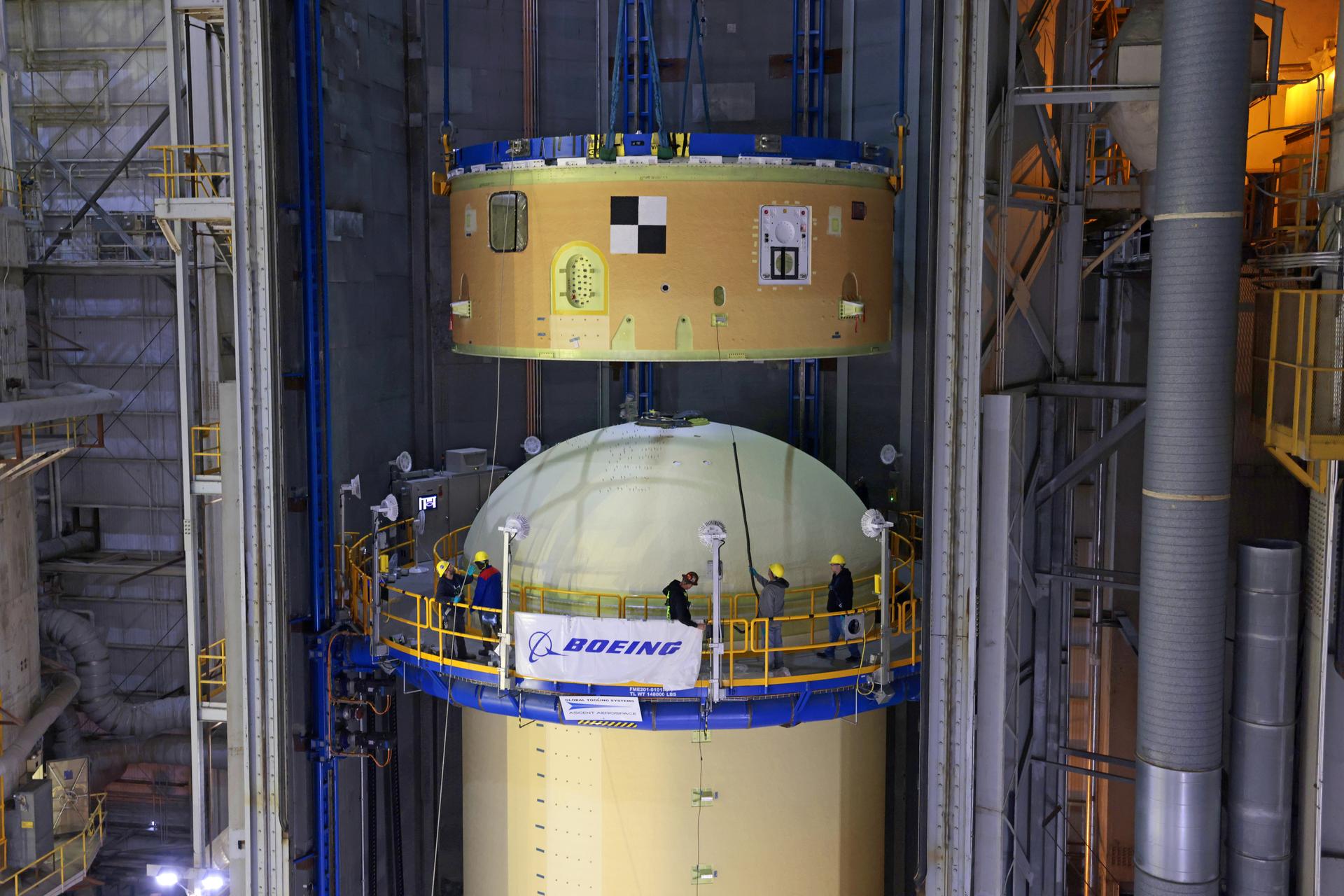
Move crews at NASA’s Michoud Assembly Facility in New Orleans lift the forward skirt for the agency’s SLS (Space Launch System) rocket core stage via an overhead crane system and sit it atop the previously mated intertank and liquid oxygen tank on Dec. 5, 2025. Teams with Boeing – NASA’s Prime Contractor for SLS – will mate the forward skirt to the forward end of the liquid oxygen tank to complete forward join operations for the core stage of the agency’s Artemis III mission. The forward skirt houses flight computers, cameras and avionics systems, and is one of five major elements that make up the 212-foot-tall rocket stage. The core stage, along with its four RS-25 engines, produce more than two million pounds of thrust to help launch NASA’s Orion spacecraft, astronauts, and supplies beyond Earth’s orbit and to the lunar surface for Artemis. Image credit: NASA/Michael DeMocker
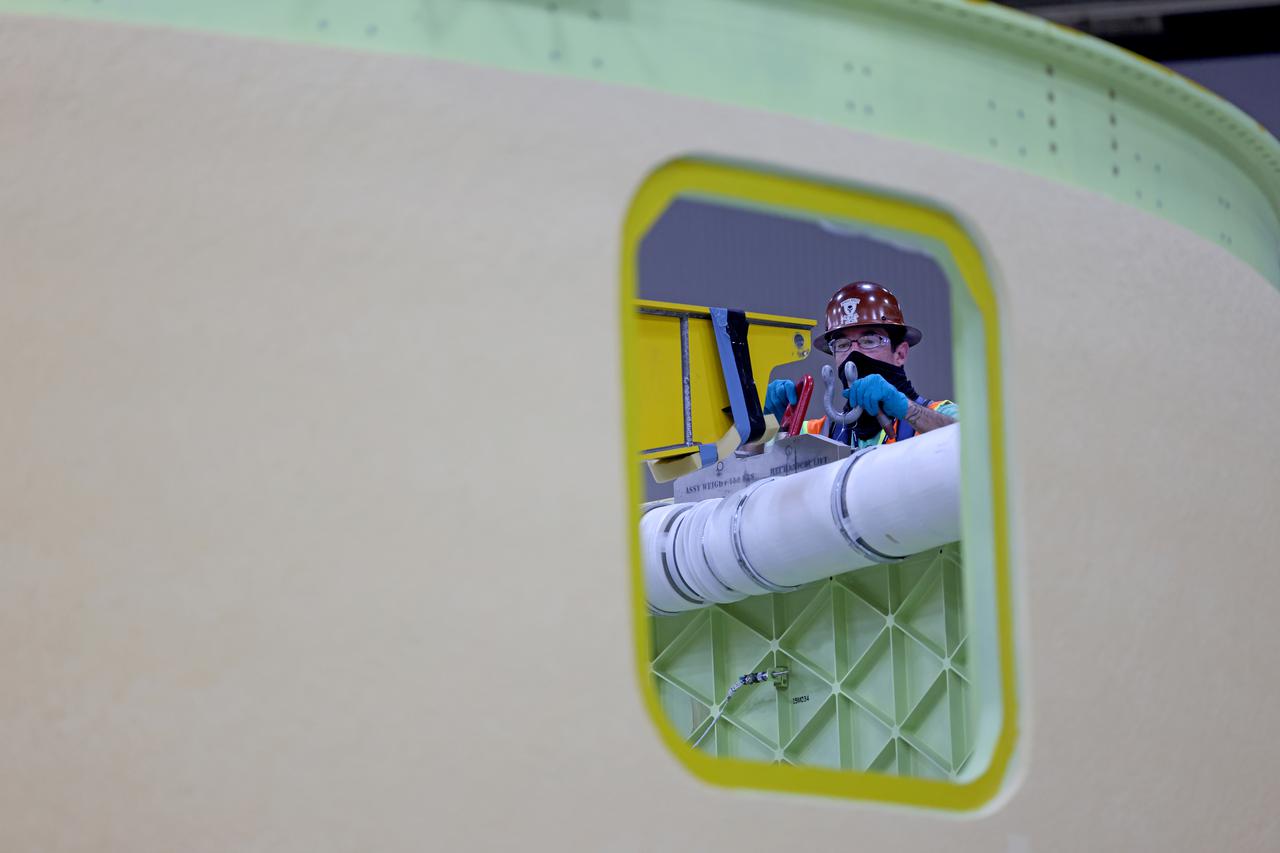
Move crews at NASA’s Michoud Assembly Facility in New Orleans lift the forward skirt for the agency’s SLS (Space Launch System) rocket core stage via an overhead crane system and sit it atop the previously mated intertank and liquid oxygen tank on Dec. 5, 2025. Teams with Boeing – NASA’s Prime Contractor for SLS – will mate the forward skirt to the forward end of the liquid oxygen tank to complete forward join operations for the core stage of the agency’s Artemis III mission. The forward skirt houses flight computers, cameras and avionics systems, and is one of five major elements that make up the 212-foot-tall rocket stage. The core stage, along with its four RS-25 engines, produce more than two million pounds of thrust to help launch NASA’s Orion spacecraft, astronauts, and supplies beyond Earth’s orbit and to the lunar surface for Artemis. Image credit: NASA/Michael DeMocker

This image shows technicians and engineers move and connect the liquid oxygen tank (LOX) to the intertank as they continue the process of the forward join on the core stage of NASA’s Space Launch System rocket for Artemis II, the first crewed mission of NASA’s Artemis program at NASA’s Michoud Assembly Facility. The forward join connects the forward skirt, the liquid oxygen tank (LOX) and the intertank structures to form the top part of the SLS rocket’s core stage. Now, NASA and Boeing, the SLS prime contractor, will continue to integrate various systems inside the forward part of the core stage and prepare for structural joining of the liquid hydrogen tank and engine section to form the bottom of the stage. Together with its four RS-25 engines, the rocket’s massive 212-foot-tall core stage — the largest stage NASA has ever built — and its twin solid rocket boosters will produce 8.8 million pounds of thrust to send NASA’s Orion spacecraft, astronauts and supplies beyond Earth’s orbit to the Moon and, ultimately, Mars. Offering more payload mass, volume capability and energy to speed missions through space, the SLS rocket, along with NASA’s Gateway in lunar orbit, the Human Landing System, and Orion spacecraft, is part of NASA’s backbone for deep space exploration and the Artemis lunar program. No other rocket is capable of carrying astronauts in Orion around the Moon in a single mission.

This image shows technicians and engineers move and connect the liquid oxygen tank (LOX) to the intertank as they continue the process of the forward join on the core stage of NASA’s Space Launch System rocket for Artemis II, the first crewed mission of NASA’s Artemis program at NASA’s Michoud Assembly Facility. The forward join connects the forward skirt, the liquid oxygen tank (LOX) and the intertank structures to form the top part of the SLS rocket’s core stage. Now, NASA and Boeing, the SLS prime contractor, will continue to integrate various systems inside the forward part of the core stage and prepare for structural joining of the liquid hydrogen tank and engine section to form the bottom of the stage. Together with its four RS-25 engines, the rocket’s massive 212-foot-tall core stage — the largest stage NASA has ever built — and its twin solid rocket boosters will produce 8.8 million pounds of thrust to send NASA’s Orion spacecraft, astronauts and supplies beyond Earth’s orbit to the Moon and, ultimately, Mars. Offering more payload mass, volume capability and energy to speed missions through space, the SLS rocket, along with NASA’s Gateway in lunar orbit, the Human Landing System, and Orion spacecraft, is part of NASA’s backbone for deep space exploration and the Artemis lunar program. No other rocket is capable of carrying astronauts in Orion around the Moon in a single mission.

This image shows technicians and engineers move and connect the liquid oxygen tank (LOX) to the intertank as they continue the process of the forward join on the core stage of NASA’s Space Launch System rocket for Artemis II, the first crewed mission of NASA’s Artemis program at NASA’s Michoud Assembly Facility. The forward join connects the forward skirt, the liquid oxygen tank (LOX) and the intertank structures to form the top part of the SLS rocket’s core stage. Now, NASA and Boeing, the SLS prime contractor, will continue to integrate various systems inside the forward part of the core stage and prepare for structural joining of the liquid hydrogen tank and engine section to form the bottom of the stage. Together with its four RS-25 engines, the rocket’s massive 212-foot-tall core stage — the largest stage NASA has ever built — and its twin solid rocket boosters will produce 8.8 million pounds of thrust to send NASA’s Orion spacecraft, astronauts and supplies beyond Earth’s orbit to the Moon and, ultimately, Mars. Offering more payload mass, volume capability and energy to speed missions through space, the SLS rocket, along with NASA’s Gateway in lunar orbit, the Human Landing System, and Orion spacecraft, is part of NASA’s backbone for deep space exploration and the Artemis lunar program. No other rocket is capable of carrying astronauts in Orion around the Moon in a single mission.

This image shows technicians and engineers move and connect the liquid oxygen tank (LOX) to the intertank as they continue the process of the forward join on the core stage of NASA’s Space Launch System rocket for Artemis II, the first crewed mission of NASA’s Artemis program at NASA’s Michoud Assembly Facility. The forward join connects the forward skirt, the liquid oxygen tank (LOX) and the intertank structures to form the top part of the SLS rocket’s core stage. Now, NASA and Boeing, the SLS prime contractor, will continue to integrate various systems inside the forward part of the core stage and prepare for structural joining of the liquid hydrogen tank and engine section to form the bottom of the stage. Together with its four RS-25 engines, the rocket’s massive 212-foot-tall core stage — the largest stage NASA has ever built — and its twin solid rocket boosters will produce 8.8 million pounds of thrust to send NASA’s Orion spacecraft, astronauts and supplies beyond Earth’s orbit to the Moon and, ultimately, Mars. Offering more payload mass, volume capability and energy to speed missions through space, the SLS rocket, along with NASA’s Gateway in lunar orbit, the Human Landing System, and Orion spacecraft, is part of NASA’s backbone for deep space exploration and the Artemis lunar program. No other rocket is capable of carrying astronauts in Orion around the Moon in a single mission.
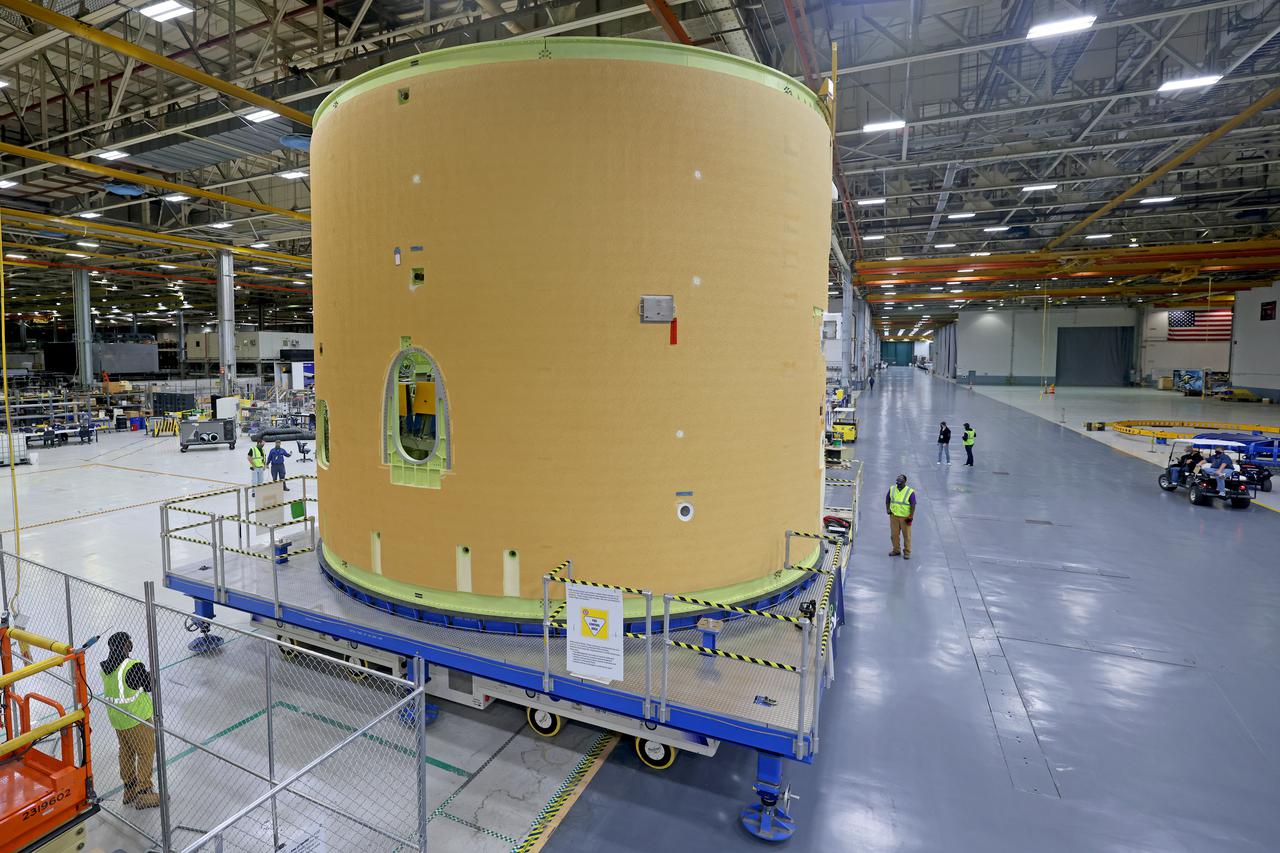
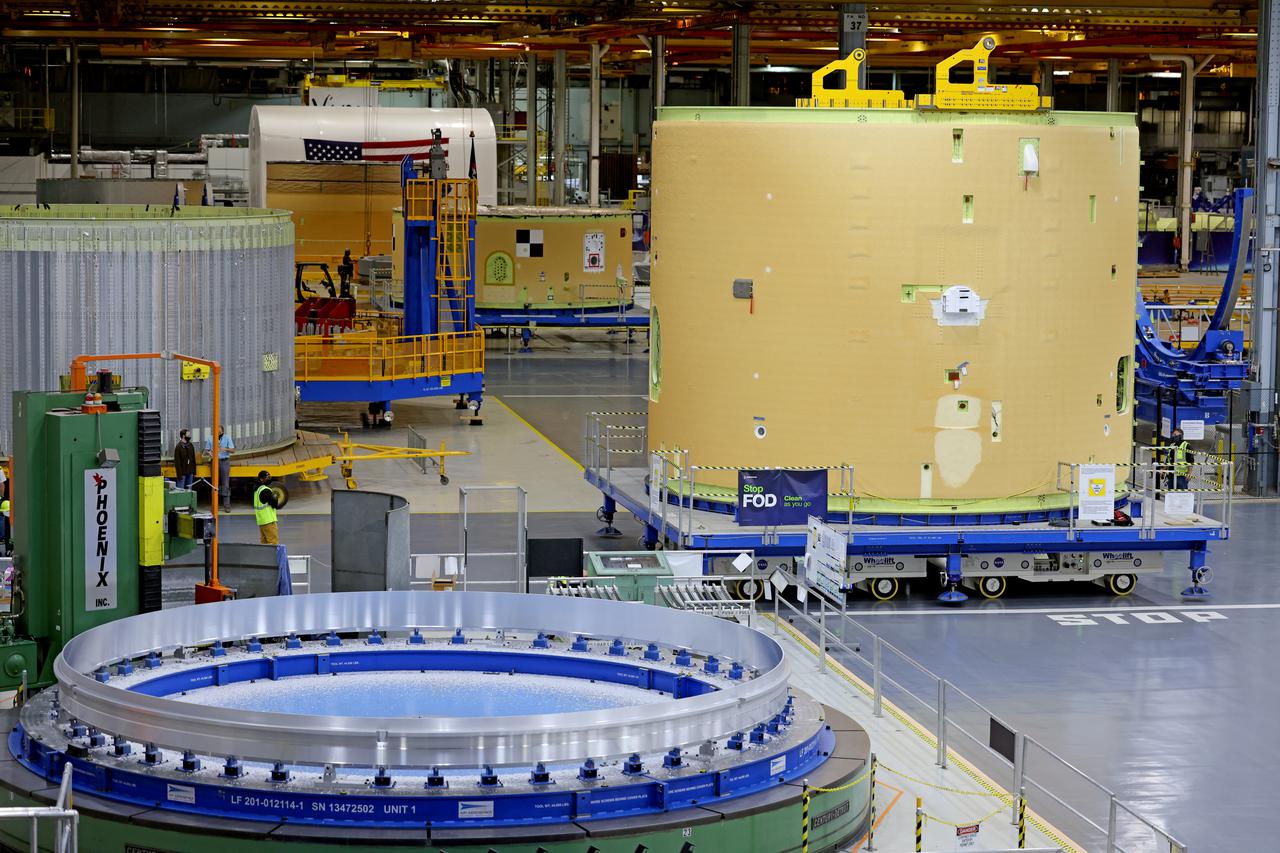
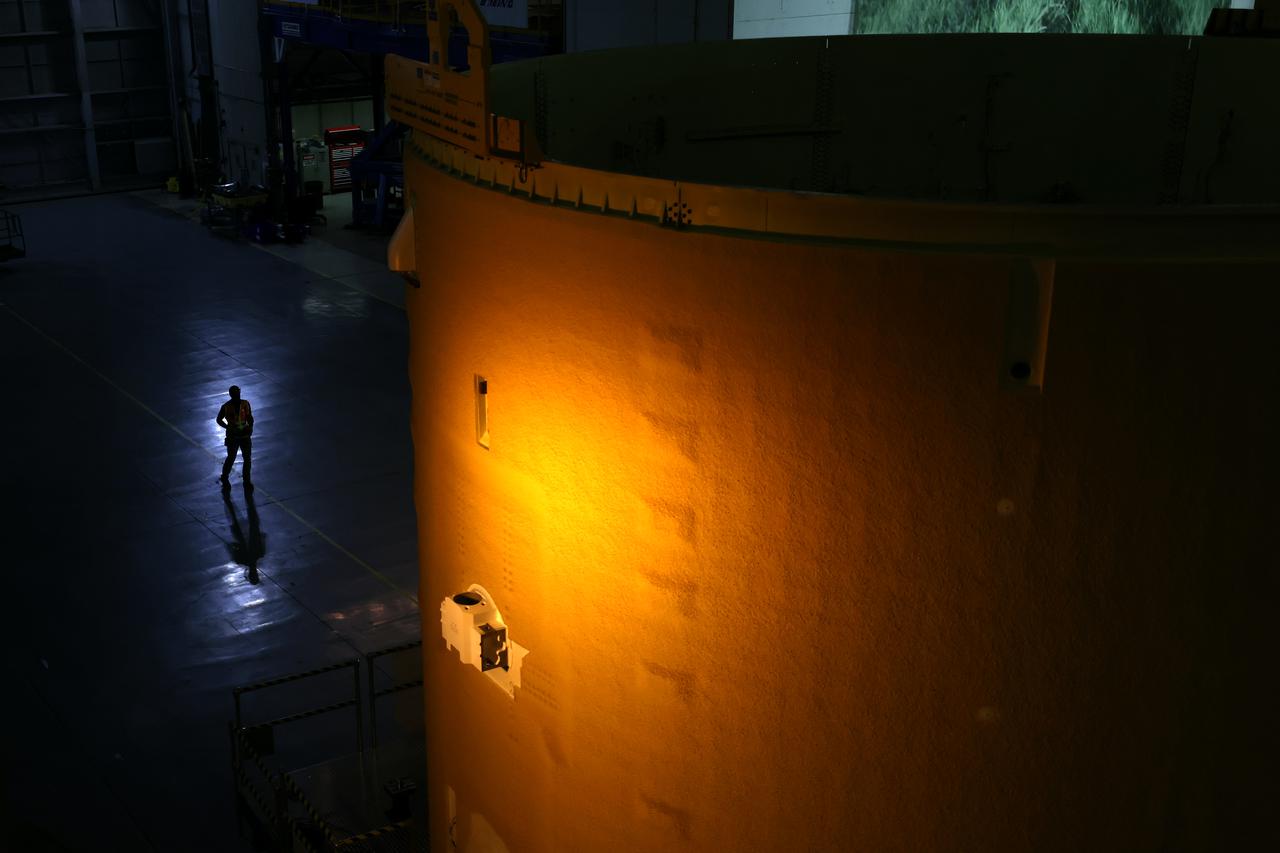
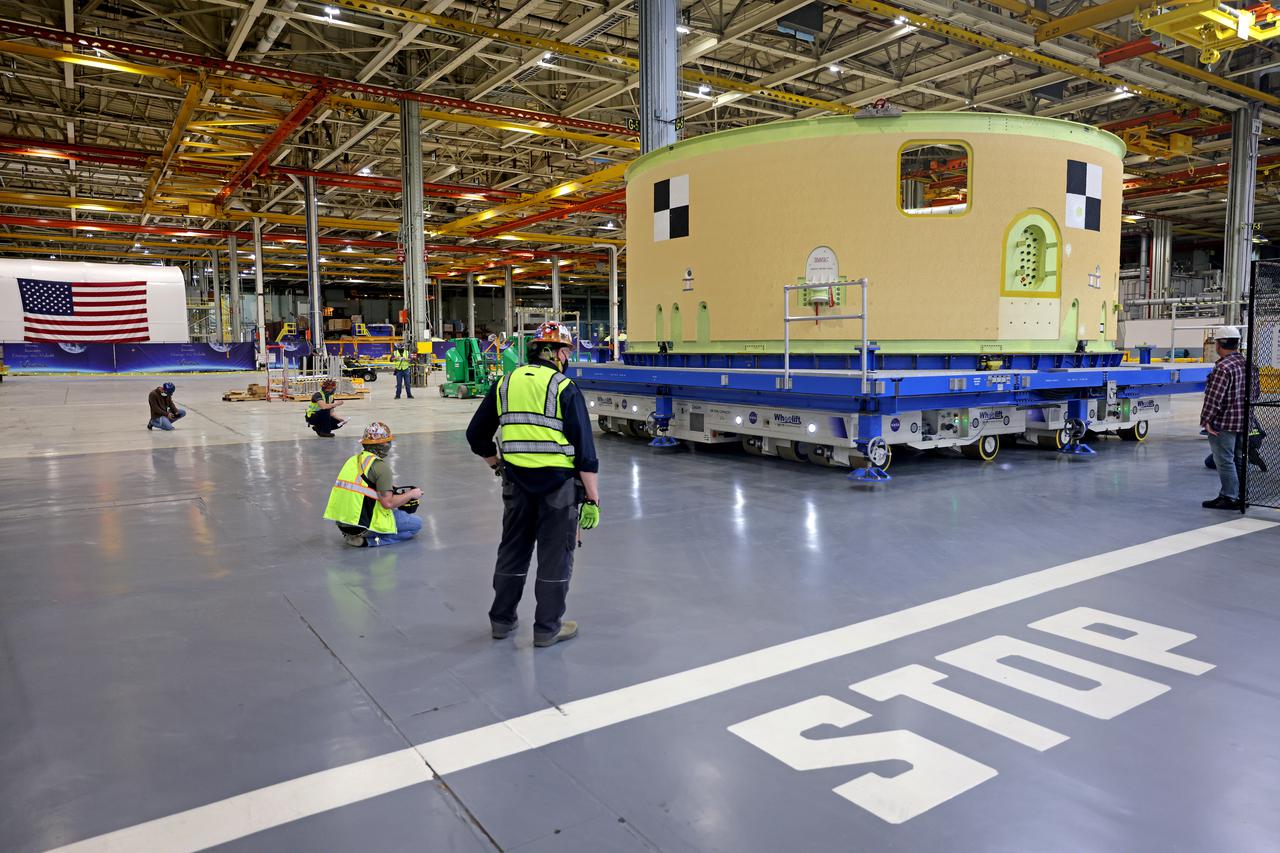
This image shows the forward skirt that will be used on the core stage of NASA’s Space Launch System rocket for Artemis II, the first crewed mission of NASA’s Artemis program, at NASA’s Michoud Assembly Facility. The SLS core stage is made up of five unique elements: the forward skirt, liquid oxygen tank, intertank, liquid hydrogen tank, and the engine section. The forward skirt houses flight computers, cameras, and avionics systems. The hardware is located at the top of the 212-foot-tall core stage and connects the upper part of the rocket to the core stage. Soon, technicians will ready the forward skirt for the first of three core stage assembly mates called the forward join. The forward join consists of three main parts -- the forward skirt, liquid oxygen tank, and intertank – to create the top, or forward part, of the core stage. Together with its four RS-25 engines, the rocket’s massive 212-foot-tall core stage — the largest stage NASA has ever built — and its twin solid rocket boosters will produce 8.8 million pounds of thrust to send NASA’s Orion spacecraft, astronauts and supplies beyond Earth’s orbit to the Moon and, ultimately, Mars. Offering more payload mass, volume capability and energy to speed missions through space, the SLS rocket, along with NASA’s Gateway in lunar orbit, the human landing system, and Orion spacecraft, is part of NASA’s backbone for deep space exploration and the Artemis lunar program. No other rocket is capable of carrying astronauts in Orion around the Moon in a single mission. Image credit: NASA/Michael DeMocker
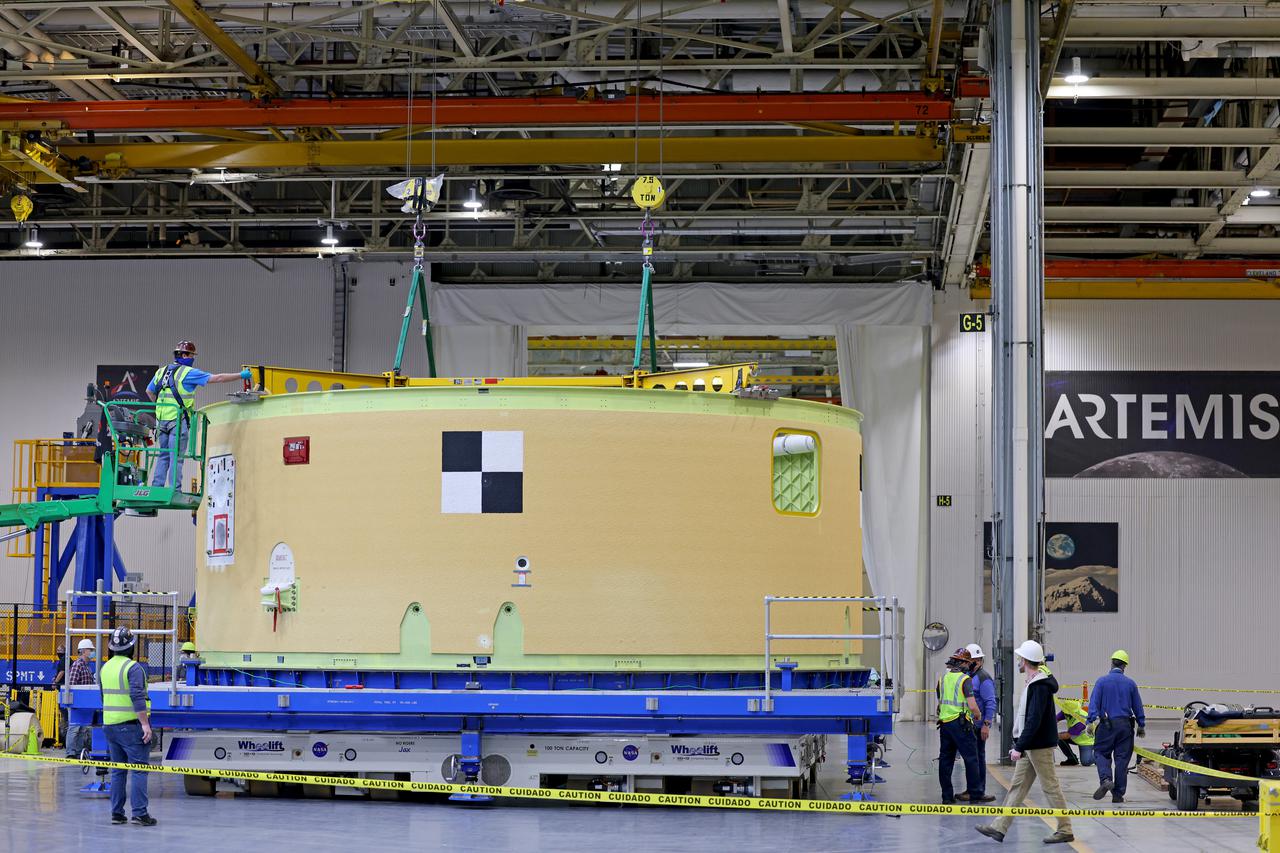
This image shows the forward skirt that will be used on the core stage of NASA’s Space Launch System rocket for Artemis II, the first crewed mission of NASA’s Artemis program, at NASA’s Michoud Assembly Facility. The SLS core stage is made up of five unique elements: the forward skirt, liquid oxygen tank, intertank, liquid hydrogen tank, and the engine section. The forward skirt houses flight computers, cameras, and avionics systems. The hardware is located at the top of the 212-foot-tall core stage and connects the upper part of the rocket to the core stage. Soon, technicians will ready the forward skirt for the first of three core stage assembly mates called the forward join. The forward join consists of three main parts -- the forward skirt, liquid oxygen tank, and intertank – to create the top, or forward part, of the core stage. Together with its four RS-25 engines, the rocket’s massive 212-foot-tall core stage — the largest stage NASA has ever built — and its twin solid rocket boosters will produce 8.8 million pounds of thrust to send NASA’s Orion spacecraft, astronauts and supplies beyond Earth’s orbit to the Moon and, ultimately, Mars. Offering more payload mass, volume capability and energy to speed missions through space, the SLS rocket, along with NASA’s Gateway in lunar orbit, the human landing system, and Orion spacecraft, is part of NASA’s backbone for deep space exploration and the Artemis lunar program. No other rocket is capable of carrying astronauts in Orion around the Moon in a single mission. Image credit: NASA/Michael DeMocker
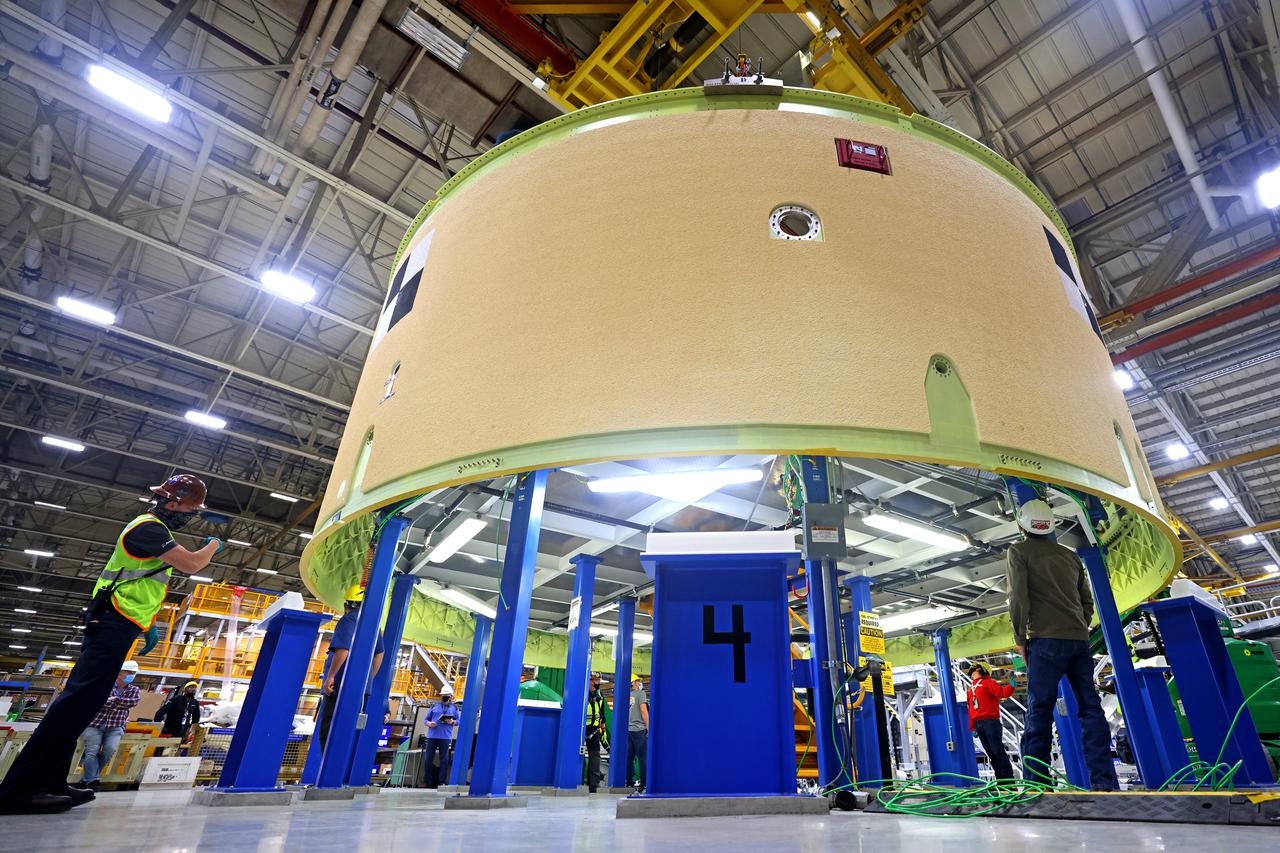
This image shows the forward skirt that will be used on the core stage of NASA’s Space Launch System rocket for Artemis II, the first crewed mission of NASA’s Artemis program, at NASA’s Michoud Assembly Facility. The SLS core stage is made up of five unique elements: the forward skirt, liquid oxygen tank, intertank, liquid hydrogen tank, and the engine section. The forward skirt houses flight computers, cameras, and avionics systems. The hardware is located at the top of the 212-foot-tall core stage and connects the upper part of the rocket to the core stage. Soon, technicians will ready the forward skirt for the first of three core stage assembly mates called the forward join. The forward join consists of three main parts -- the forward skirt, liquid oxygen tank, and intertank – to create the top, or forward part, of the core stage. Together with its four RS-25 engines, the rocket’s massive 212-foot-tall core stage — the largest stage NASA has ever built — and its twin solid rocket boosters will produce 8.8 million pounds of thrust to send NASA’s Orion spacecraft, astronauts and supplies beyond Earth’s orbit to the Moon and, ultimately, Mars. Offering more payload mass, volume capability and energy to speed missions through space, the SLS rocket, along with NASA’s Gateway in lunar orbit, the human landing system, and Orion spacecraft, is part of NASA’s backbone for deep space exploration and the Artemis lunar program. No other rocket is capable of carrying astronauts in Orion around the Moon in a single mission. Image credit: NASA/Michael DeMocker
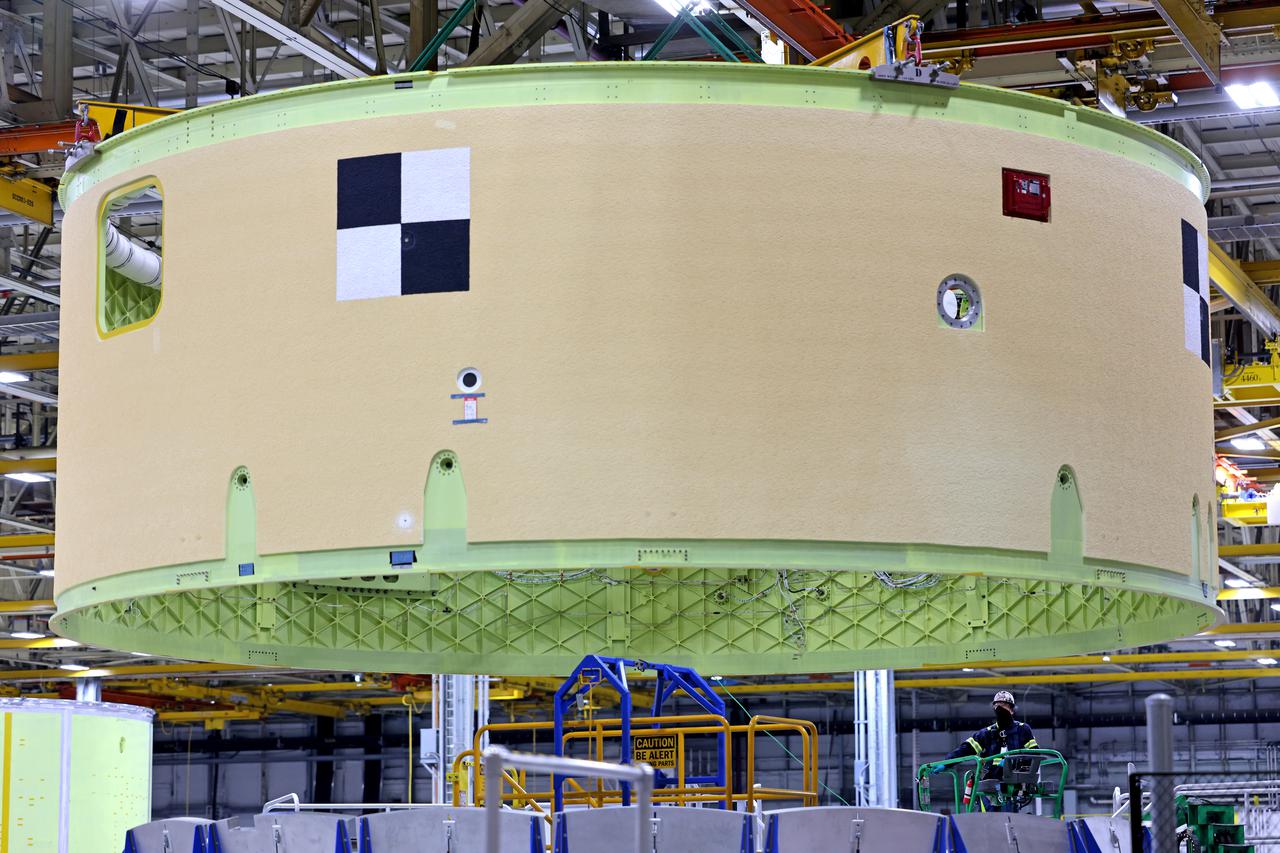
This image shows the forward skirt that will be used on the core stage of NASA’s Space Launch System rocket for Artemis II, the first crewed mission of NASA’s Artemis program, at NASA’s Michoud Assembly Facility. The SLS core stage is made up of five unique elements: the forward skirt, liquid oxygen tank, intertank, liquid hydrogen tank, and the engine section. The forward skirt houses flight computers, cameras, and avionics systems. The hardware is located at the top of the 212-foot-tall core stage and connects the upper part of the rocket to the core stage. Soon, technicians will ready the forward skirt for the first of three core stage assembly mates called the forward join. The forward join consists of three main parts -- the forward skirt, liquid oxygen tank, and intertank – to create the top, or forward part, of the core stage. Together with its four RS-25 engines, the rocket’s massive 212-foot-tall core stage — the largest stage NASA has ever built — and its twin solid rocket boosters will produce 8.8 million pounds of thrust to send NASA’s Orion spacecraft, astronauts and supplies beyond Earth’s orbit to the Moon and, ultimately, Mars. Offering more payload mass, volume capability and energy to speed missions through space, the SLS rocket, along with NASA’s Gateway in lunar orbit, the human landing system, and Orion spacecraft, is part of NASA’s backbone for deep space exploration and the Artemis lunar program. No other rocket is capable of carrying astronauts in Orion around the Moon in a single mission. Image credit: NASA/Michael DeMocker
This image shows the forward skirt that will be used on the core stage of NASA’s Space Launch System rocket for Artemis II, the first crewed mission of NASA’s Artemis program, at NASA’s Michoud Assembly Facility. The SLS core stage is made up of five unique elements: the forward skirt, liquid oxygen tank, intertank, liquid hydrogen tank, and the engine section. The forward skirt houses flight computers, cameras, and avionics systems. The hardware is located at the top of the 212-foot-tall core stage and connects the upper part of the rocket to the core stage. Soon, technicians will ready the forward skirt for the first of three core stage assembly mates called the forward join. The forward join consists of three main parts -- the forward skirt, liquid oxygen tank, and intertank – to create the top, or forward part, of the core stage. Together with its four RS-25 engines, the rocket’s massive 212-foot-tall core stage — the largest stage NASA has ever built — and its twin solid rocket boosters will produce 8.8 million pounds of thrust to send NASA’s Orion spacecraft, astronauts and supplies beyond Earth’s orbit to the Moon and, ultimately, Mars. Offering more payload mass, volume capability and energy to speed missions through space, the SLS rocket, along with NASA’s Gateway in lunar orbit, the human landing system, and Orion spacecraft, is part of NASA’s backbone for deep space exploration and the Artemis lunar program. No other rocket is capable of carrying astronauts in Orion around the Moon in a single mission. Image credit: NASA/Michael DeMocker
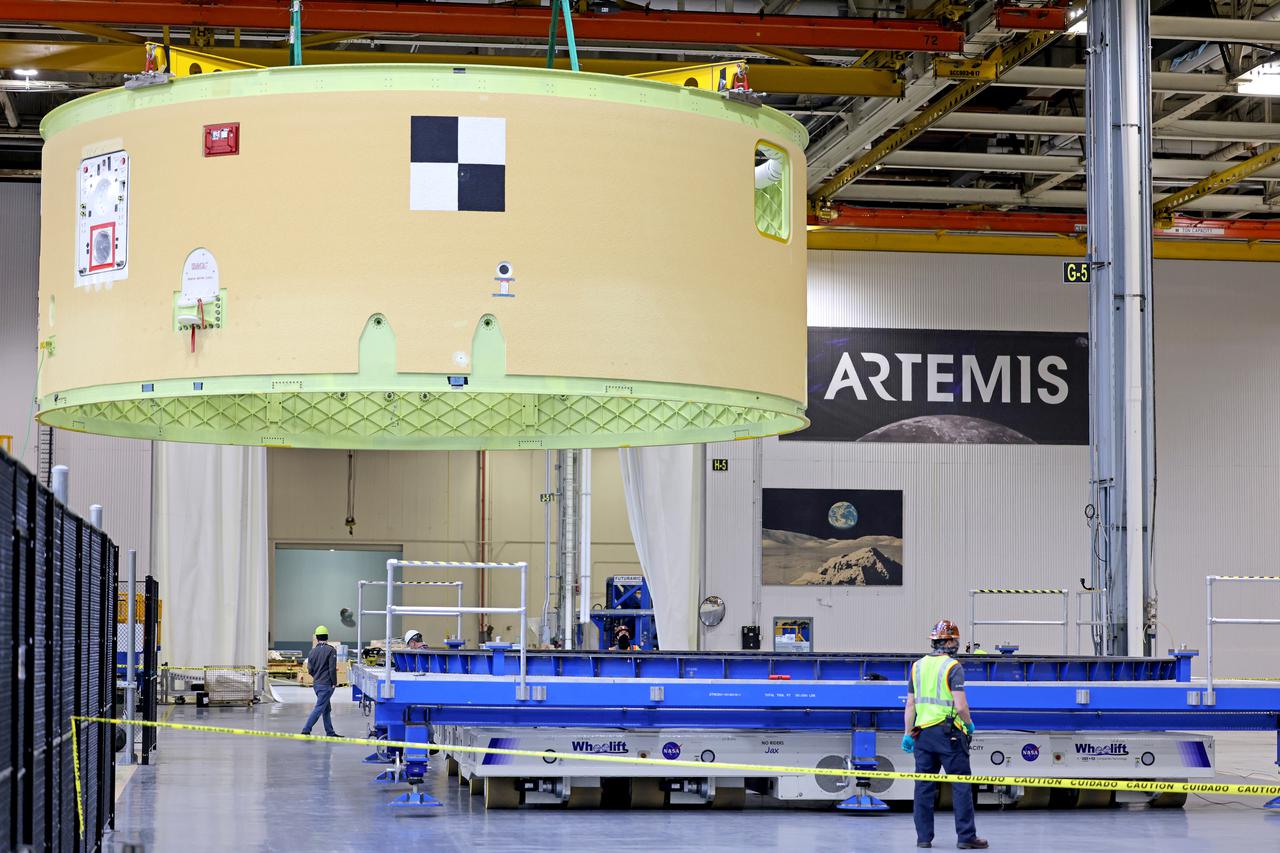
This image shows the forward skirt that will be used on the core stage of NASA’s Space Launch System rocket for Artemis II, the first crewed mission of NASA’s Artemis program, at NASA’s Michoud Assembly Facility. The SLS core stage is made up of five unique elements: the forward skirt, liquid oxygen tank, intertank, liquid hydrogen tank, and the engine section. The forward skirt houses flight computers, cameras, and avionics systems. The hardware is located at the top of the 212-foot-tall core stage and connects the upper part of the rocket to the core stage. Soon, technicians will ready the forward skirt for the first of three core stage assembly mates called the forward join. The forward join consists of three main parts -- the forward skirt, liquid oxygen tank, and intertank – to create the top, or forward part, of the core stage. Together with its four RS-25 engines, the rocket’s massive 212-foot-tall core stage — the largest stage NASA has ever built — and its twin solid rocket boosters will produce 8.8 million pounds of thrust to send NASA’s Orion spacecraft, astronauts and supplies beyond Earth’s orbit to the Moon and, ultimately, Mars. Offering more payload mass, volume capability and energy to speed missions through space, the SLS rocket, along with NASA’s Gateway in lunar orbit, the human landing system, and Orion spacecraft, is part of NASA’s backbone for deep space exploration and the Artemis lunar program. No other rocket is capable of carrying astronauts in Orion around the Moon in a single mission. Image credit: NASA/Michael DeMocker
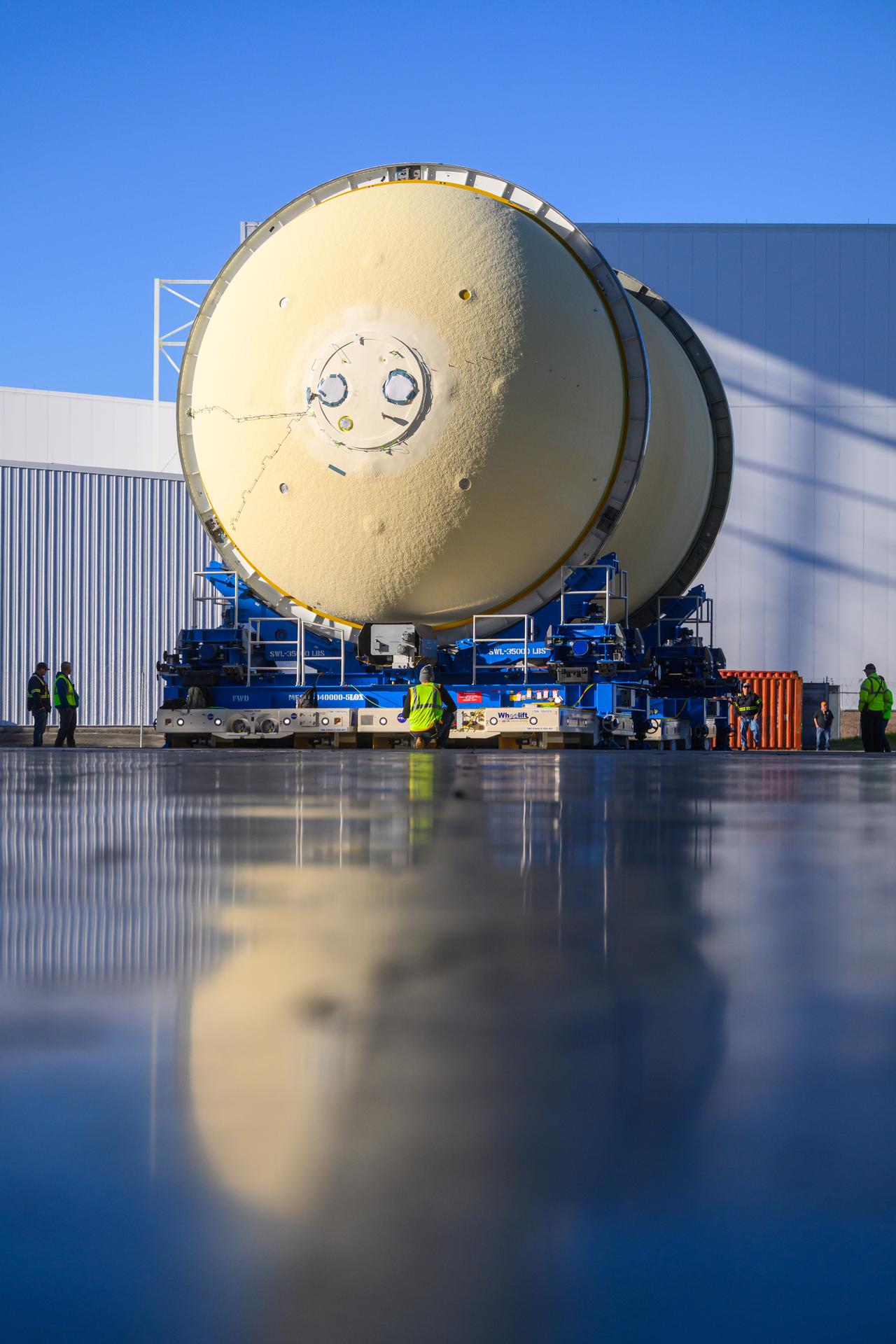
Move crews at NASA’s Michoud Assembly Facility in New Orleans move the liquid oxygen tank for the core stage of the agency’s Artemis III mission into the facility’s vertical assembly building on Nov.3. Eventually, teams with SLS (Space Launch System) prime contractor, Boeing, will lift the tank into the production cell currently housing the intertank and mate the flight hardware together before capping them off with the forward skirt to complete the core stage forward join. The propellant tank is one of five major elements that make up the 212-foot-tall rocket stage. The core stage, along with its four RS-25 engines, produce more than two million pounds of thrust to help launch NASA’s Orion spacecraft, astronauts, and supplies beyond Earth’s orbit and to the lunar surface for Artemis.
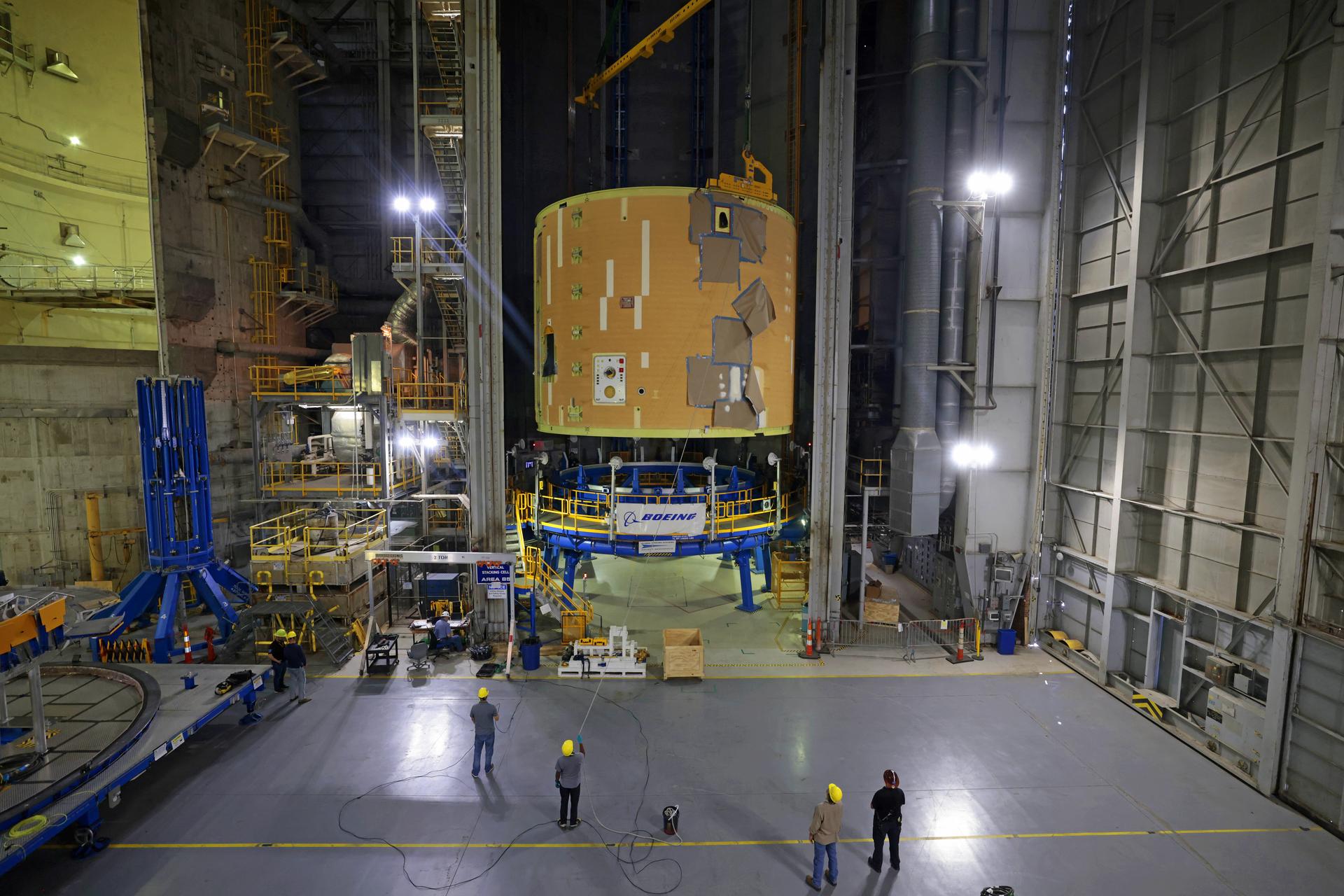
Teams at NASA’s Michoud Assembly Facility in New Orleans move the 21.8-foot-tall intertank for the core stage of the agency’s Artemis III mission into the vertical assembly building on Oct. 21. Inside the production cell, NASA’s prime contractor for the SLS (Space Launch System) core stage, Boeing, will mate the intertank to the liquid oxygen tank and the forward skirt in a process called a “forward join.” The intertank houses avionics and electronics, serves as an attachment point for the solid rocket boosters, and is one of five major elements that make up the 212-foot-tall rocket stage. The core stage, along with its four RS-25 engines, produce more than two million pounds of thrust to help launch NASA’s Orion spacecraft, astronauts, and supplies beyond Earth’s orbit and to the lunar surface for Artemis. Image credit: NASA/Michael DeMocker
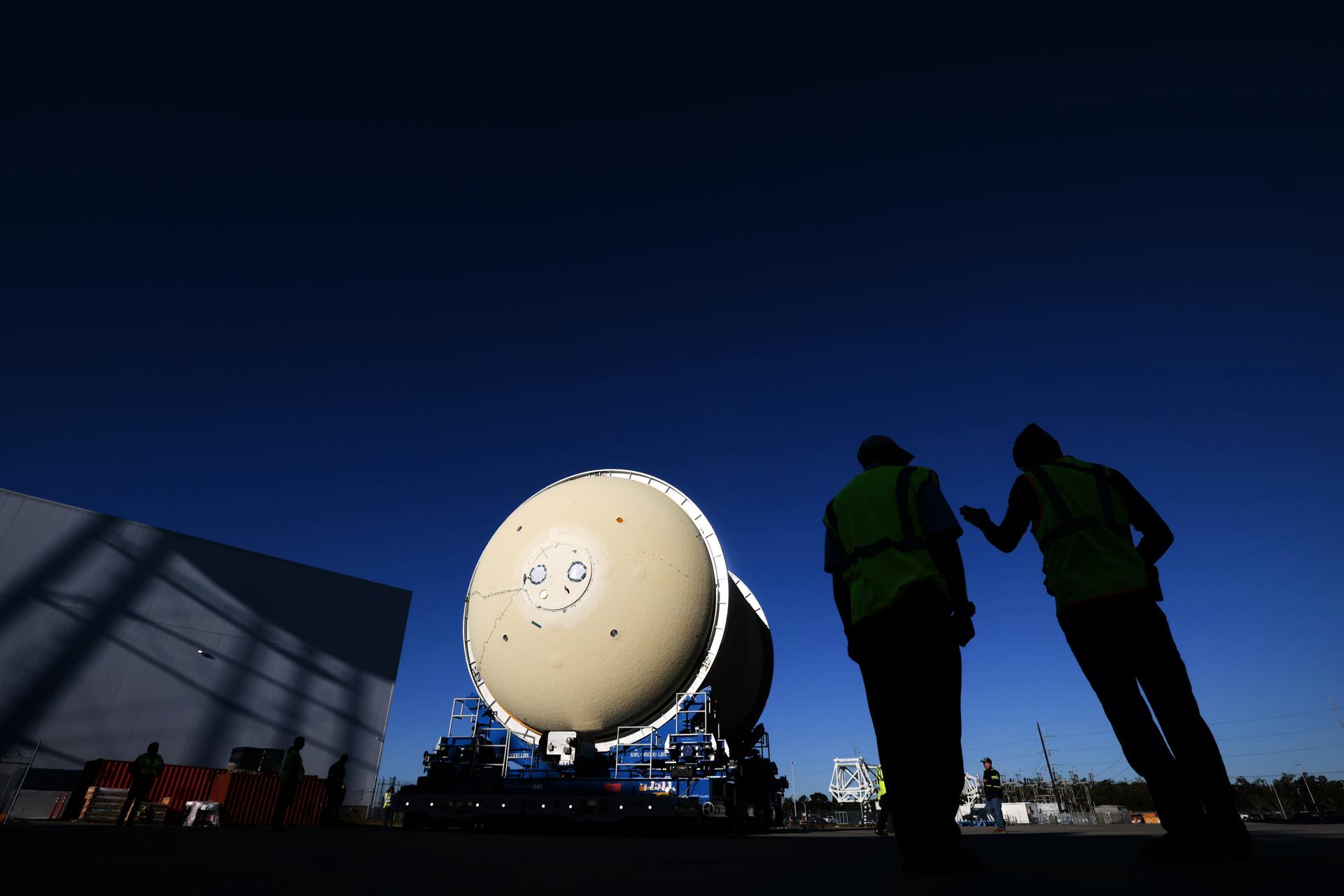
Move crews at NASA’s Michoud Assembly Facility in New Orleans move the liquid oxygen tank for the core stage of the agency’s Artemis III mission into the facility’s vertical assembly building on Nov.3. Eventually, teams with SLS (Space Launch System) prime contractor, Boeing, will lift the tank into the production cell currently housing the intertank and mate the flight hardware together before capping them off with the forward skirt to complete the core stage forward join. The propellant tank is one of five major elements that make up the 212-foot-tall rocket stage. The core stage, along with its four RS-25 engines, produce more than two million pounds of thrust to help launch NASA’s Orion spacecraft, astronauts, and supplies beyond Earth’s orbit and to the lunar surface for Artemis. Image credit: NASA/Michael DeMocker
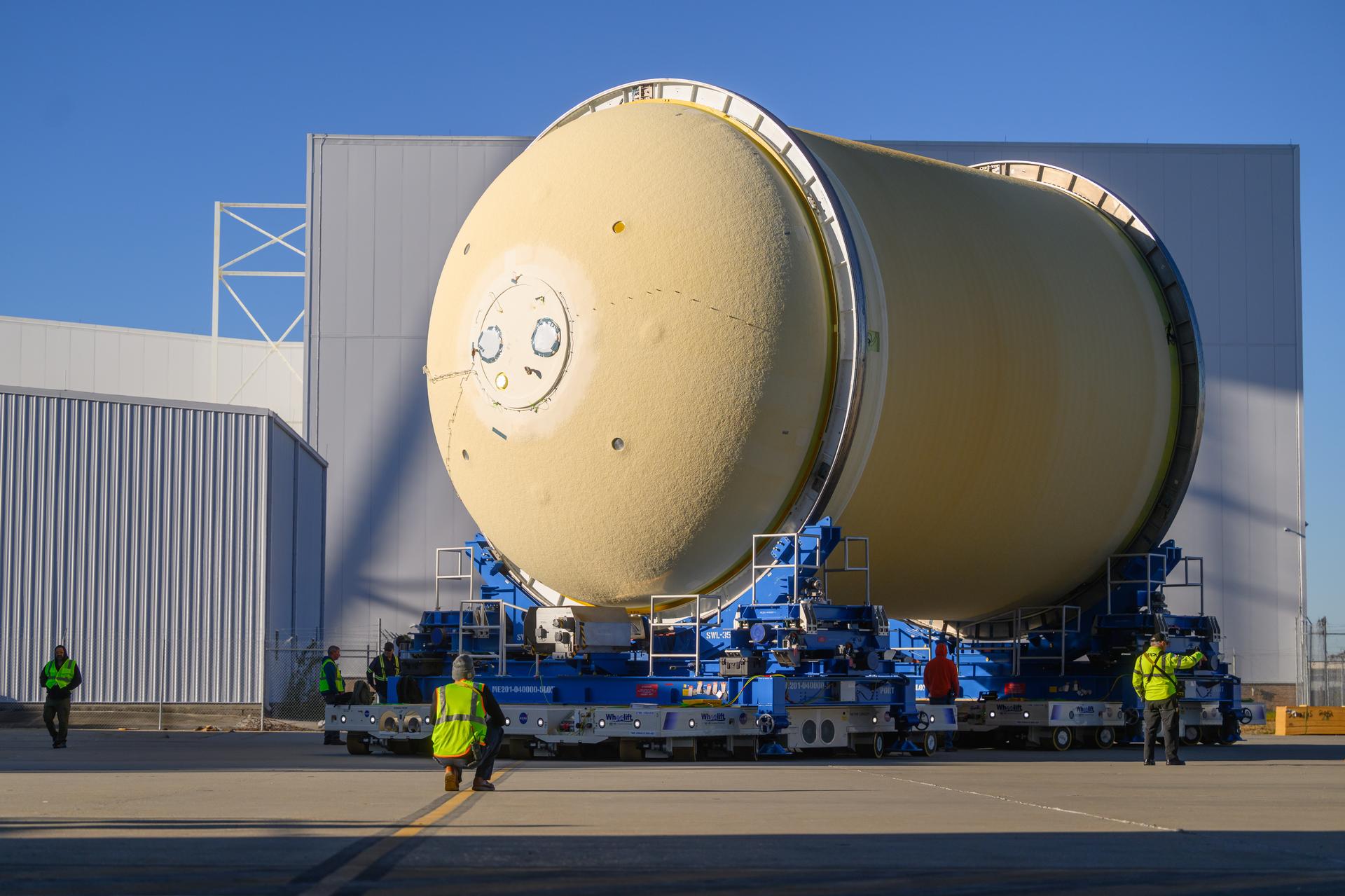
Move crews at NASA’s Michoud Assembly Facility in New Orleans move the liquid oxygen tank for the core stage of the agency’s Artemis III mission into the facility’s vertical assembly building on Nov.3. Eventually, teams with SLS (Space Launch System) prime contractor, Boeing, will lift the tank into the production cell currently housing the intertank and mate the flight hardware together before capping them off with the forward skirt to complete the core stage forward join. The propellant tank is one of five major elements that make up the 212-foot-tall rocket stage. The core stage, along with its four RS-25 engines, produce more than two million pounds of thrust to help launch NASA’s Orion spacecraft, astronauts, and supplies beyond Earth’s orbit and to the lunar surface for Artemis.
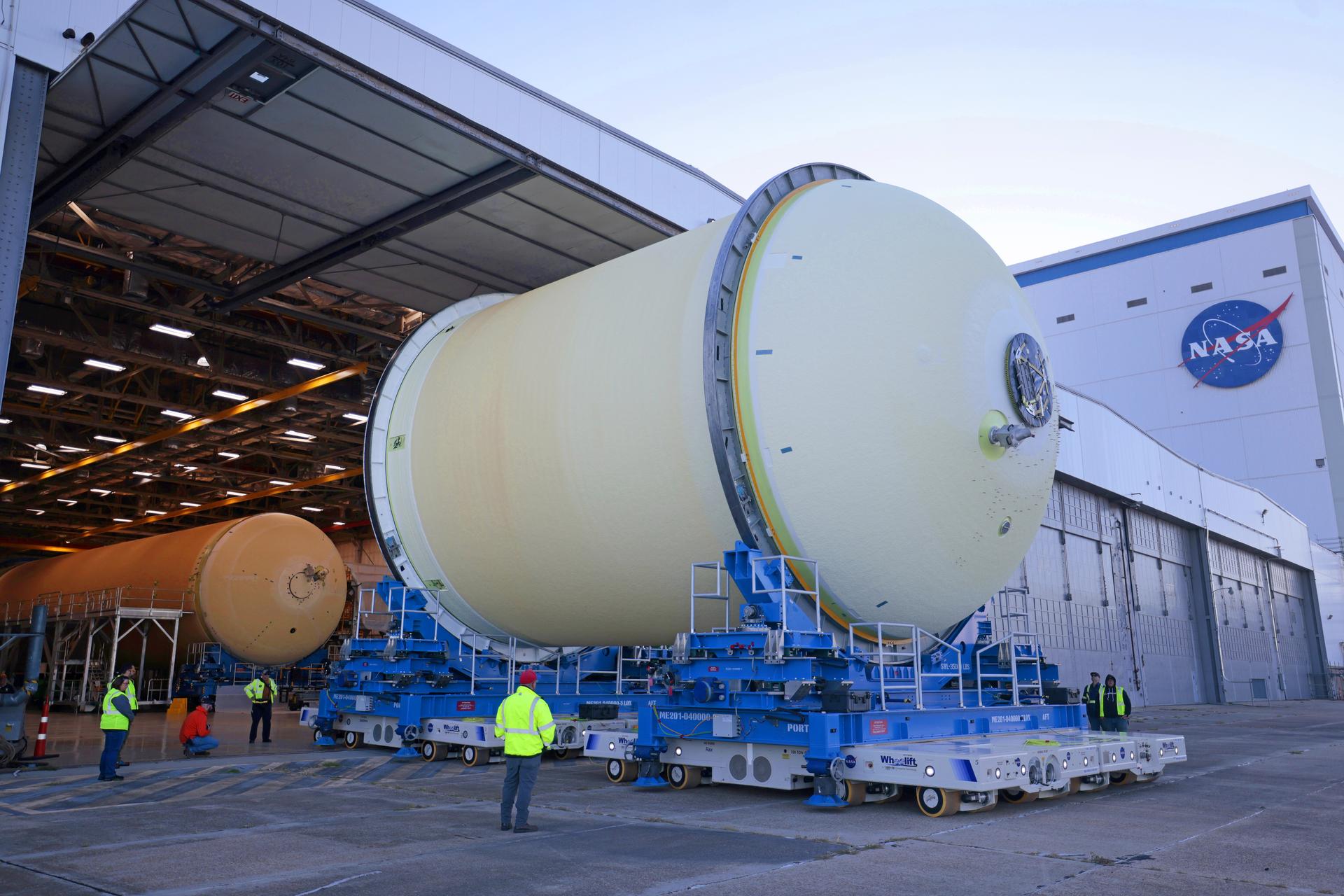
Move crews at NASA’s Michoud Assembly Facility in New Orleans move the liquid oxygen tank for the core stage of the agency’s Artemis III mission into the facility’s vertical assembly building on Nov.3. Eventually, teams with SLS (Space Launch System) prime contractor, Boeing, will lift the tank into the production cell currently housing the intertank and mate the flight hardware together before capping them off with the forward skirt to complete the core stage forward join. The propellant tank is one of five major elements that make up the 212-foot-tall rocket stage. The core stage, along with its four RS-25 engines, produce more than two million pounds of thrust to help launch NASA’s Orion spacecraft, astronauts, and supplies beyond Earth’s orbit and to the lunar surface for Artemis. Image credit: NASA/Michael DeMocker
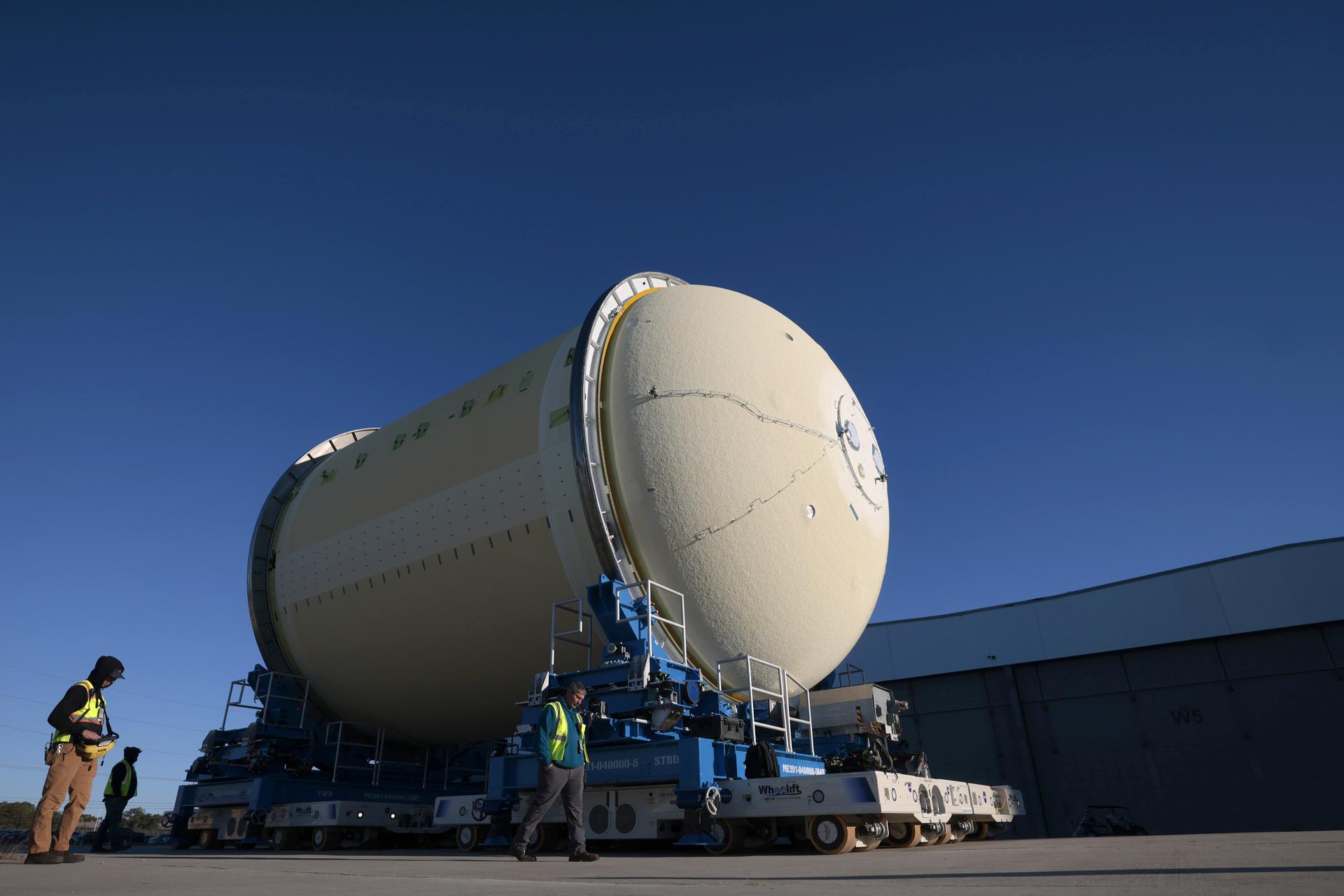
Move crews at NASA’s Michoud Assembly Facility in New Orleans move the liquid oxygen tank for the core stage of the agency’s Artemis III mission into the facility’s vertical assembly building on Nov.3. Eventually, teams with SLS (Space Launch System) prime contractor, Boeing, will lift the tank into the production cell currently housing the intertank and mate the flight hardware together before capping them off with the forward skirt to complete the core stage forward join. The propellant tank is one of five major elements that make up the 212-foot-tall rocket stage. The core stage, along with its four RS-25 engines, produce more than two million pounds of thrust to help launch NASA’s Orion spacecraft, astronauts, and supplies beyond Earth’s orbit and to the lunar surface for Artemis. Image credit: NASA/Michael DeMocker
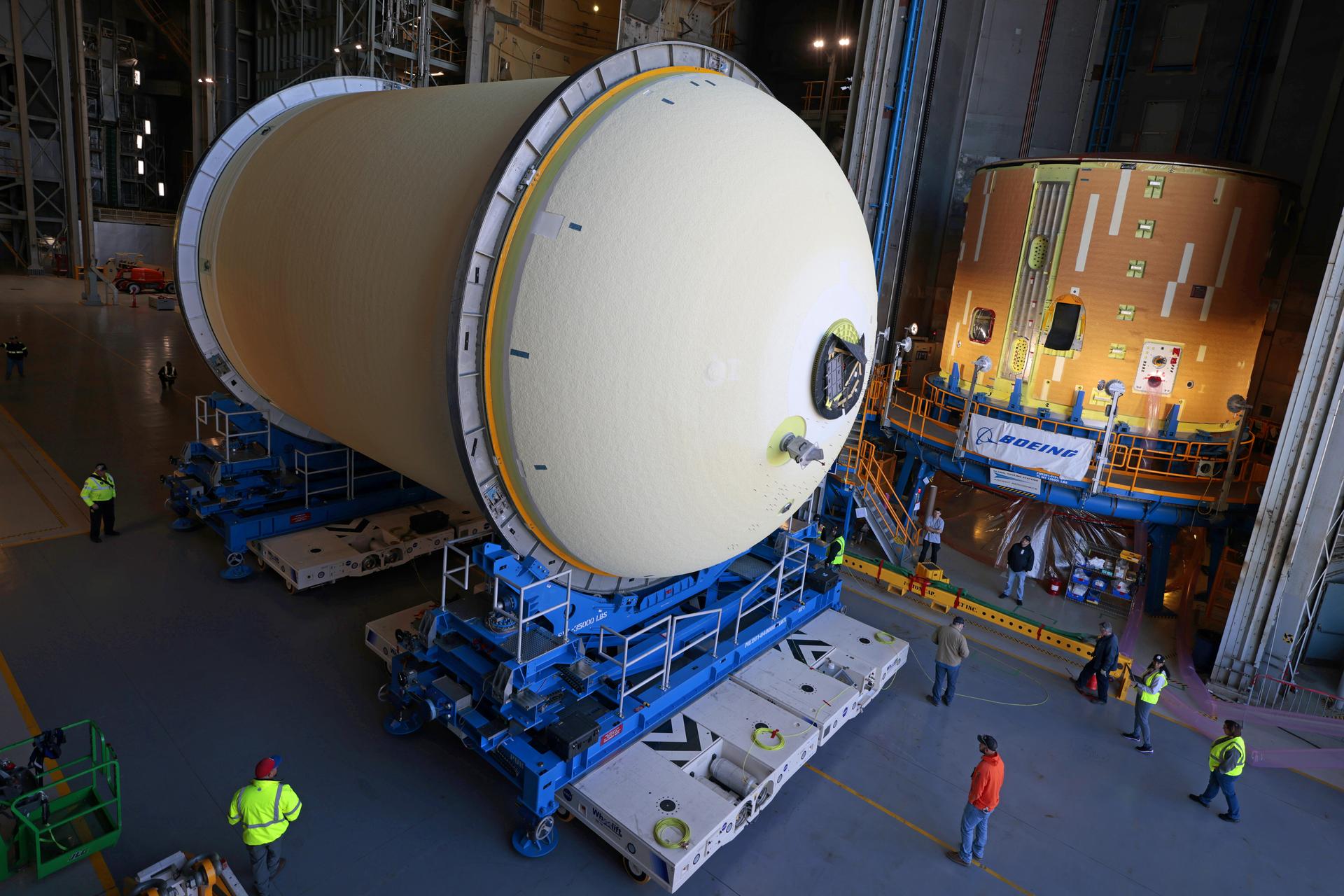
Move crews at NASA’s Michoud Assembly Facility in New Orleans move the liquid oxygen tank for the core stage of the agency’s Artemis III mission into the facility’s vertical assembly building on Nov.3. Eventually, teams with SLS (Space Launch System) prime contractor, Boeing, will lift the tank into the production cell currently housing the intertank and mate the flight hardware together before capping them off with the forward skirt to complete the core stage forward join. The propellant tank is one of five major elements that make up the 212-foot-tall rocket stage. The core stage, along with its four RS-25 engines, produce more than two million pounds of thrust to help launch NASA’s Orion spacecraft, astronauts, and supplies beyond Earth’s orbit and to the lunar surface for Artemis. Image credit: NASA/Michael DeMocker
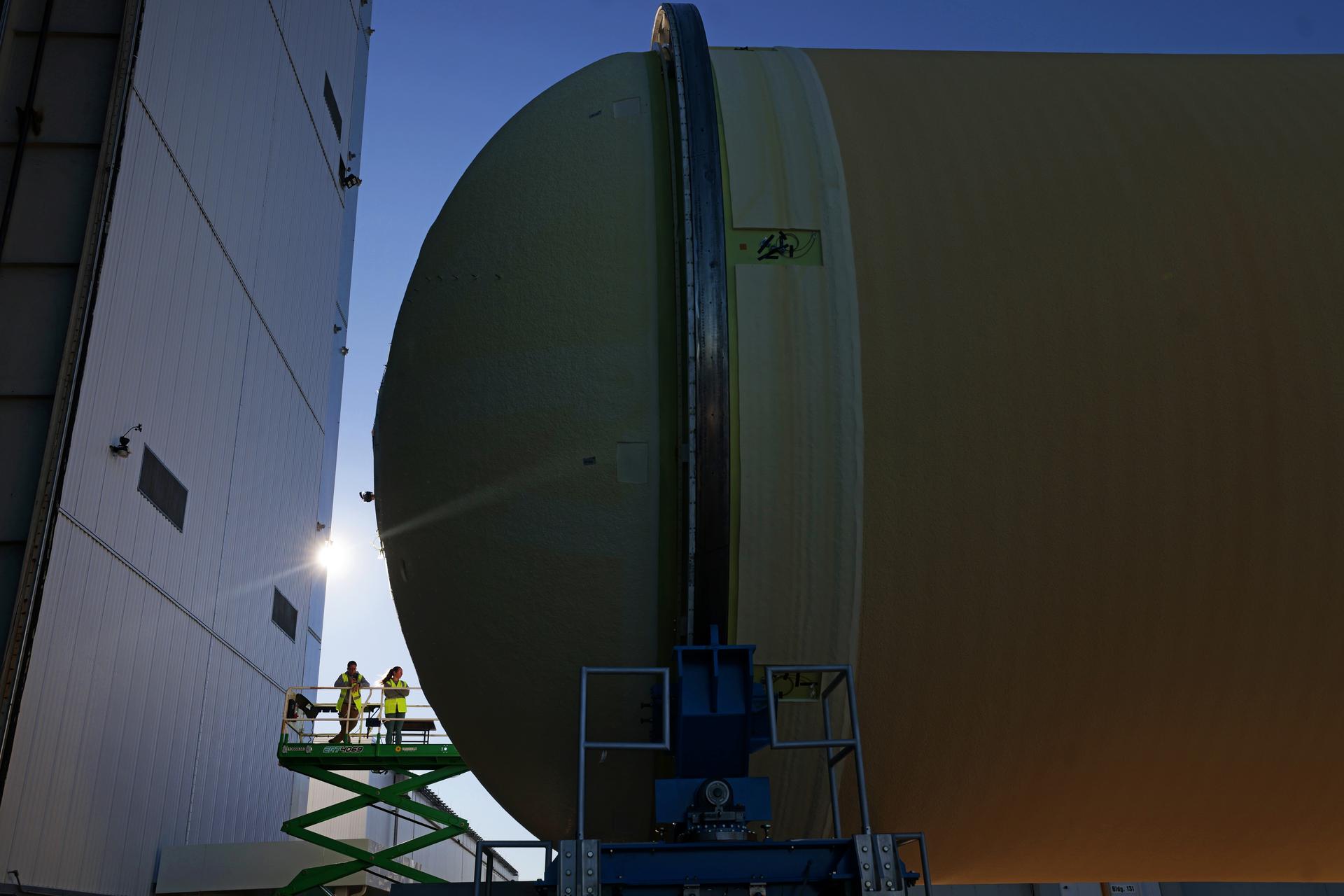
Move crews at NASA’s Michoud Assembly Facility in New Orleans move the liquid oxygen tank for the core stage of the agency’s Artemis III mission into the facility’s vertical assembly building on Nov.3. Eventually, teams with SLS (Space Launch System) prime contractor, Boeing, will lift the tank into the production cell currently housing the intertank and mate the flight hardware together before capping them off with the forward skirt to complete the core stage forward join. The propellant tank is one of five major elements that make up the 212-foot-tall rocket stage. The core stage, along with its four RS-25 engines, produce more than two million pounds of thrust to help launch NASA’s Orion spacecraft, astronauts, and supplies beyond Earth’s orbit and to the lunar surface for Artemis. Image credit: NASA/Michael DeMocker
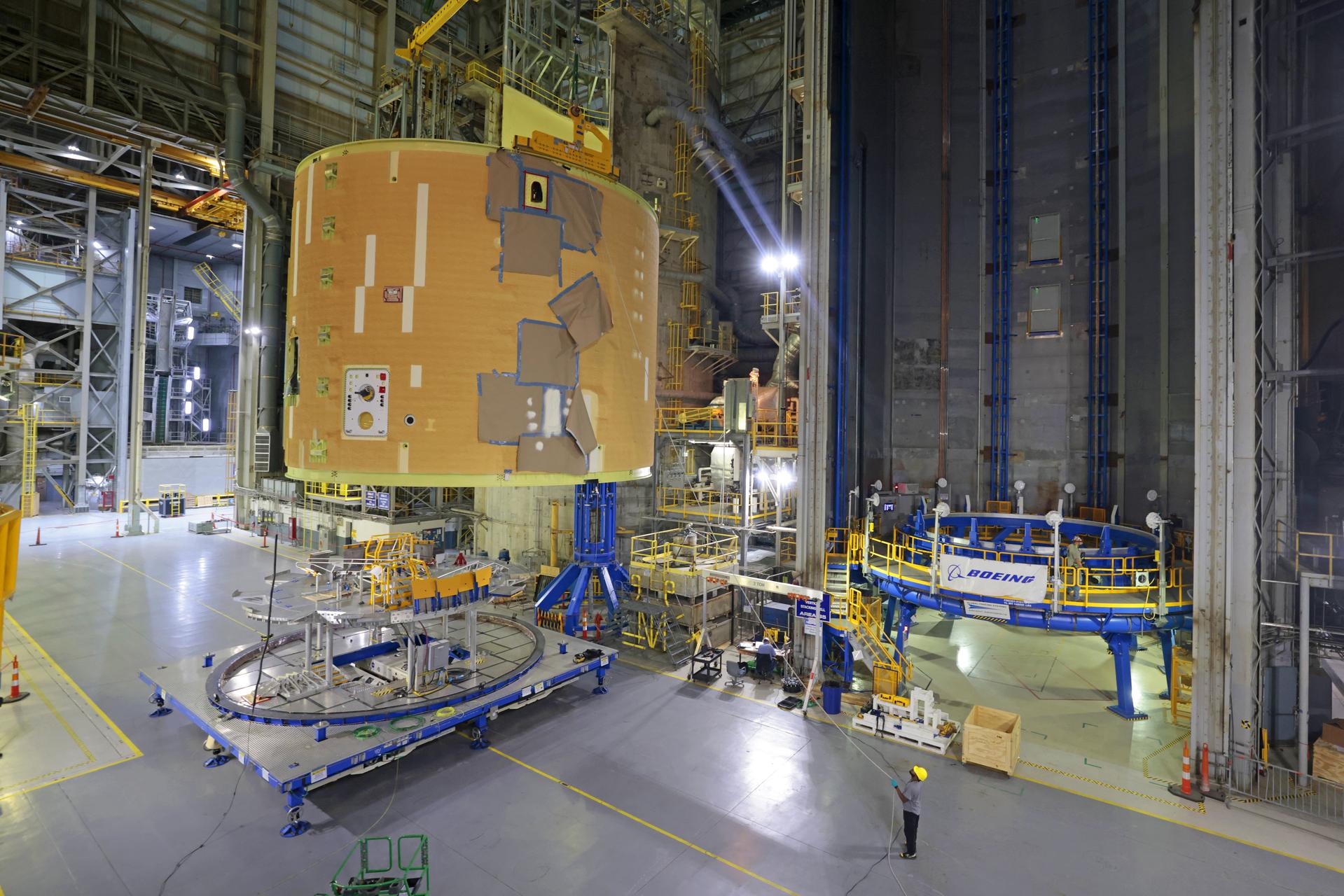
Teams at NASA’s Michoud Assembly Facility in New Orleans move the 21.8-foot-tall intertank for the core stage of the agency’s Artemis III mission into the vertical assembly building on Oct. 21. Inside the production cell, NASA’s prime contractor for the SLS (Space Launch System) core stage, Boeing, will mate the intertank to the liquid oxygen tank and the forward skirt in a process called a “forward join.” The intertank houses avionics and electronics, serves as an attachment point for the solid rocket boosters, and is one of five major elements that make up the 212-foot-tall rocket stage. The core stage, along with its four RS-25 engines, produce more than two million pounds of thrust to help launch NASA’s Orion spacecraft, astronauts, and supplies beyond Earth’s orbit and to the lunar surface for Artemis. Image credit: NASA/Michael DeMocker
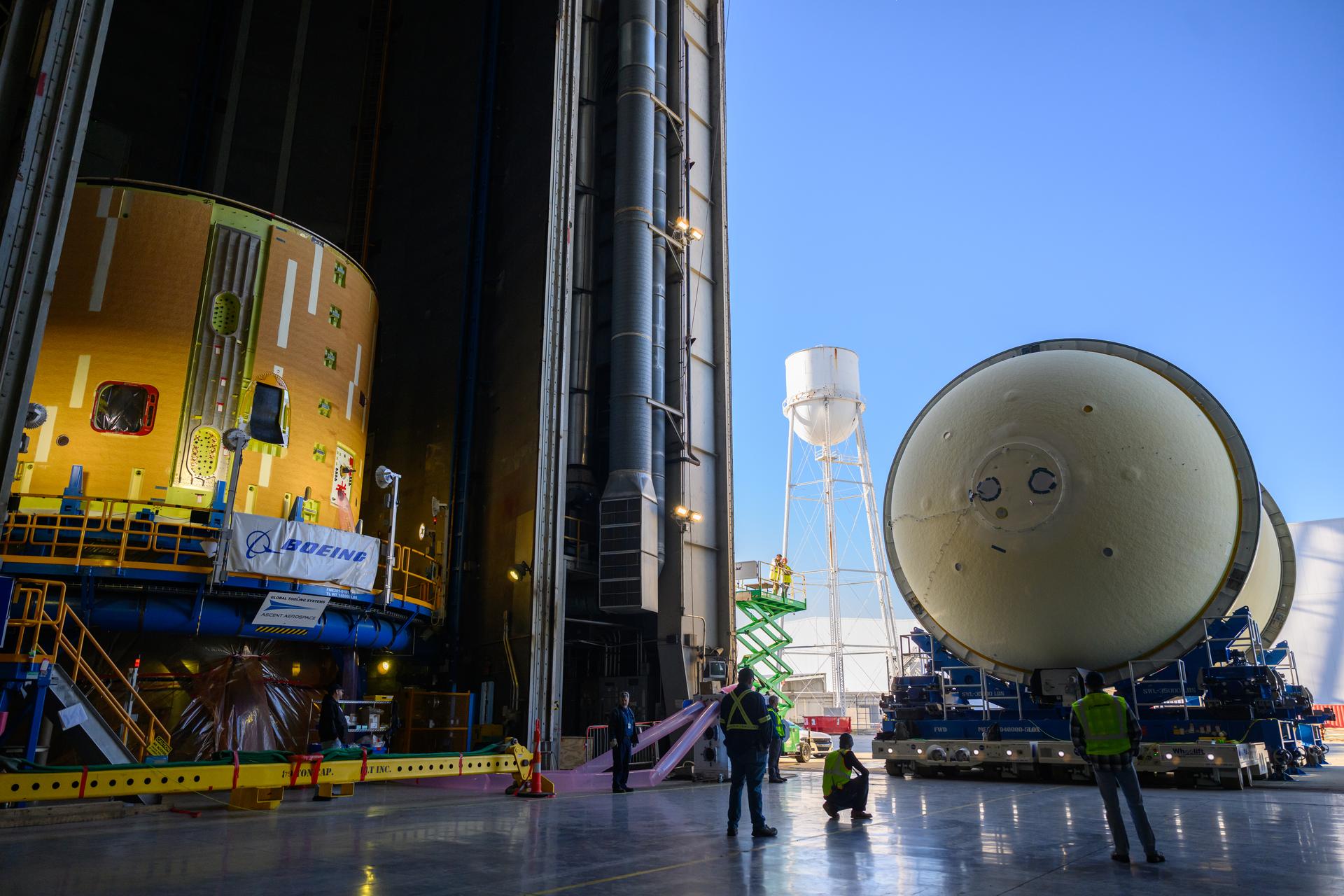
Move crews at NASA’s Michoud Assembly Facility in New Orleans move the liquid oxygen tank for the core stage of the agency’s Artemis III mission into the facility’s vertical assembly building on Nov.3. Eventually, teams with SLS (Space Launch System) prime contractor, Boeing, will lift the tank into the production cell currently housing the intertank and mate the flight hardware together before capping them off with the forward skirt to complete the core stage forward join. The propellant tank is one of five major elements that make up the 212-foot-tall rocket stage. The core stage, along with its four RS-25 engines, produce more than two million pounds of thrust to help launch NASA’s Orion spacecraft, astronauts, and supplies beyond Earth’s orbit and to the lunar surface for Artemis.
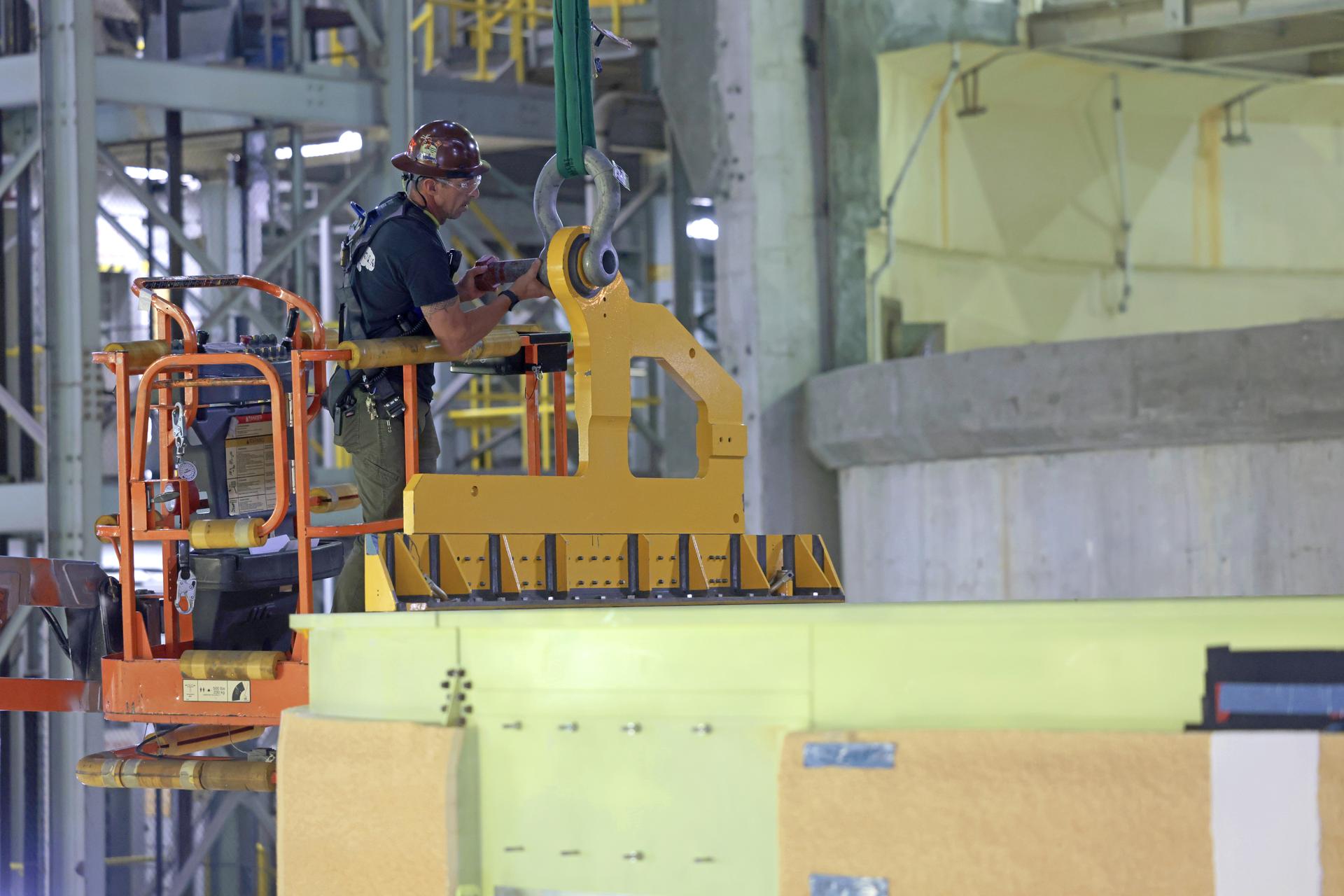
Teams at NASA’s Michoud Assembly Facility in New Orleans move the 21.8-foot-tall intertank for the core stage of the agency’s Artemis III mission into the vertical assembly building on Oct. 21. Inside the production cell, NASA’s prime contractor for the SLS (Space Launch System) core stage, Boeing, will mate the intertank to the liquid oxygen tank and the forward skirt in a process called a “forward join.” The intertank houses avionics and electronics, serves as an attachment point for the solid rocket boosters, and is one of five major elements that make up the 212-foot-tall rocket stage. The core stage, along with its four RS-25 engines, produce more than two million pounds of thrust to help launch NASA’s Orion spacecraft, astronauts, and supplies beyond Earth’s orbit and to the lunar surface for Artemis. Image credit: NASA/Michael DeMocker
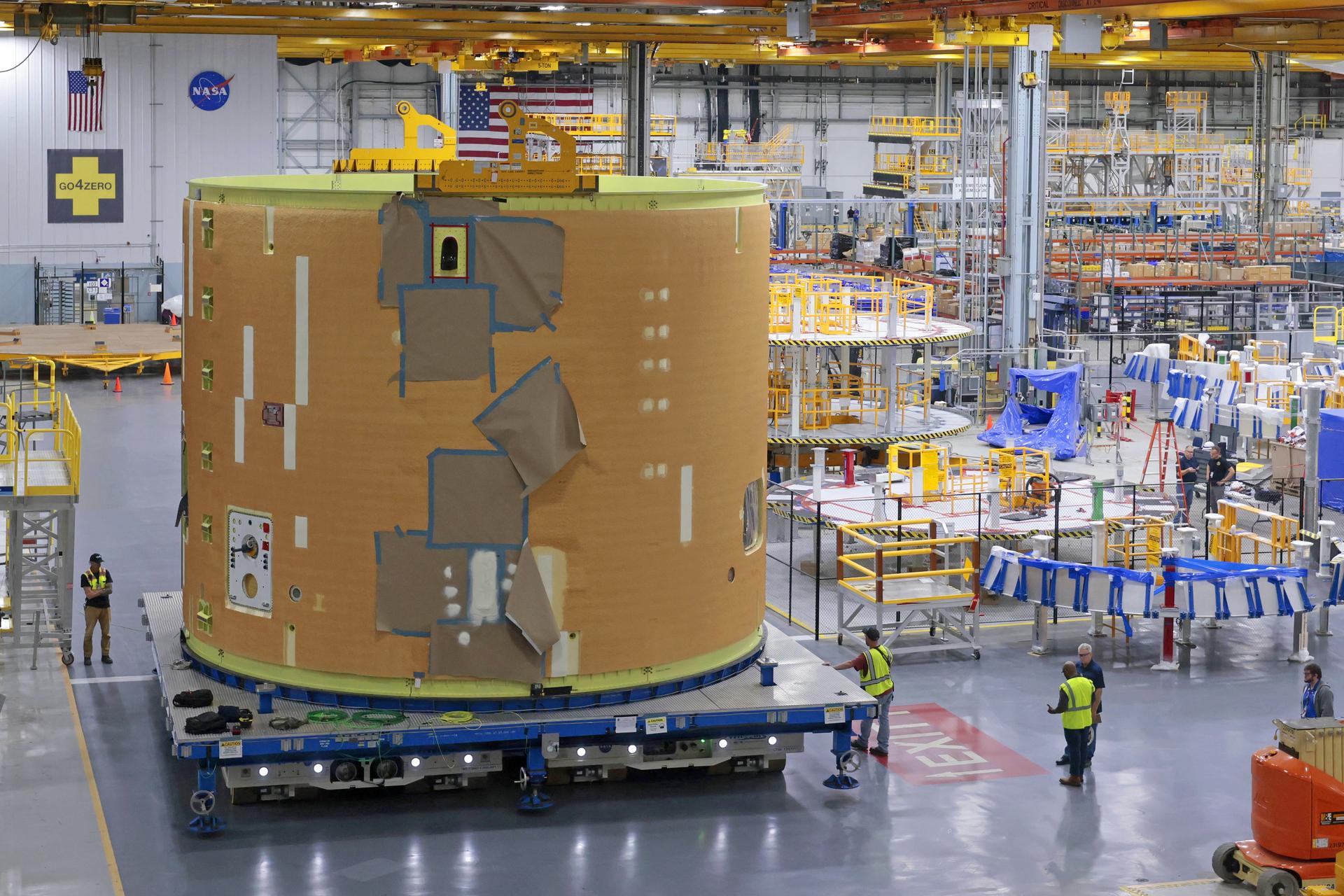
Teams at NASA’s Michoud Assembly Facility in New Orleans move the 21.8-foot-tall intertank for the core stage of the agency’s Artemis III mission into the vertical assembly building on Oct. 21. Inside the production cell, NASA’s prime contractor for the SLS (Space Launch System) core stage, Boeing, will mate the intertank to the liquid oxygen tank and the forward skirt in a process called a “forward join.” The intertank houses avionics and electronics, serves as an attachment point for the solid rocket boosters, and is one of five major elements that make up the 212-foot-tall rocket stage. The core stage, along with its four RS-25 engines, produce more than two million pounds of thrust to help launch NASA’s Orion spacecraft, astronauts, and supplies beyond Earth’s orbit and to the lunar surface for Artemis. Image credit: NASA/Michael DeMocker

Move crews at NASA’s Michoud Assembly Facility in New Orleans move the liquid oxygen tank for the core stage of the agency’s Artemis III mission into the facility’s vertical assembly building on Nov.3. Eventually, teams with SLS (Space Launch System) prime contractor, Boeing, will lift the tank into the production cell currently housing the intertank and mate the flight hardware together before capping them off with the forward skirt to complete the core stage forward join. The propellant tank is one of five major elements that make up the 212-foot-tall rocket stage. The core stage, along with its four RS-25 engines, produce more than two million pounds of thrust to help launch NASA’s Orion spacecraft, astronauts, and supplies beyond Earth’s orbit and to the lunar surface for Artemis.
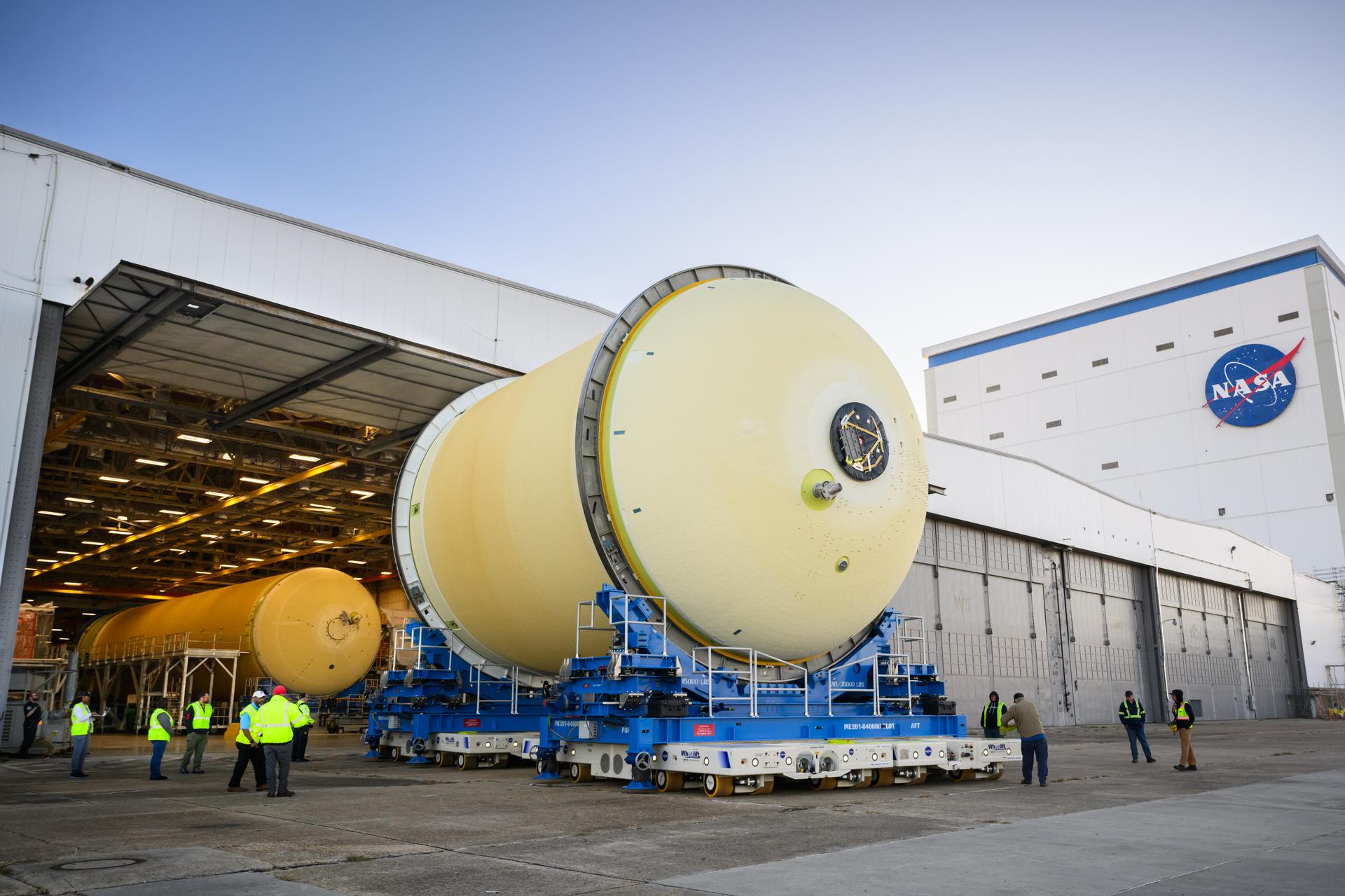
Move crews at NASA’s Michoud Assembly Facility in New Orleans move the liquid oxygen tank for the core stage of the agency’s Artemis III mission into the facility’s vertical assembly building on Nov.3. Eventually, teams with SLS (Space Launch System) prime contractor, Boeing, will lift the tank into the production cell currently housing the intertank and mate the flight hardware together before capping them off with the forward skirt to complete the core stage forward join. The propellant tank is one of five major elements that make up the 212-foot-tall rocket stage. The core stage, along with its four RS-25 engines, produce more than two million pounds of thrust to help launch NASA’s Orion spacecraft, astronauts, and supplies beyond Earth’s orbit and to the lunar surface for Artemis.
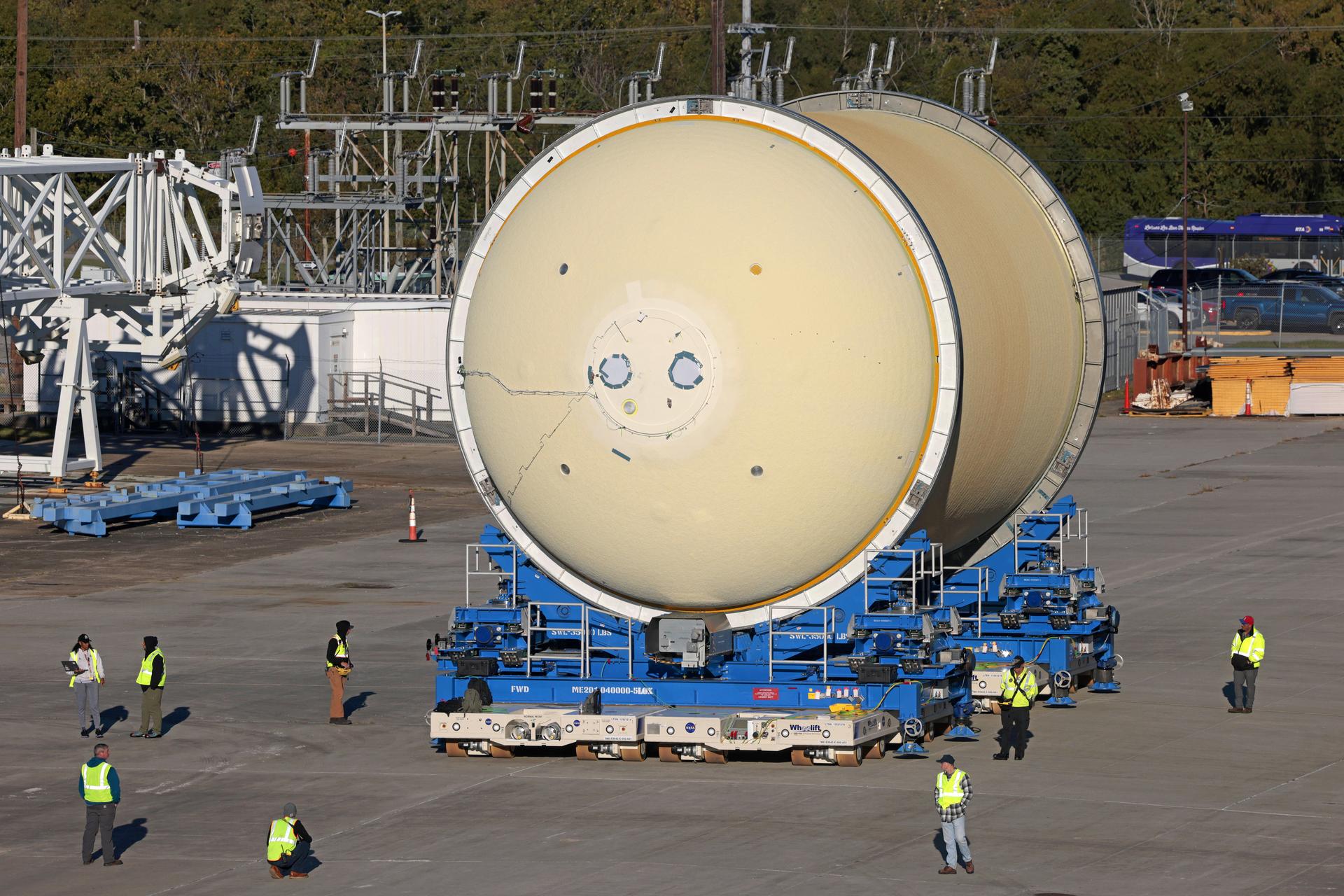
Move crews at NASA’s Michoud Assembly Facility in New Orleans move the liquid oxygen tank for the core stage of the agency’s Artemis III mission into the facility’s vertical assembly building on Nov.3. Eventually, teams with SLS (Space Launch System) prime contractor, Boeing, will lift the tank into the production cell currently housing the intertank and mate the flight hardware together before capping them off with the forward skirt to complete the core stage forward join. The propellant tank is one of five major elements that make up the 212-foot-tall rocket stage. The core stage, along with its four RS-25 engines, produce more than two million pounds of thrust to help launch NASA’s Orion spacecraft, astronauts, and supplies beyond Earth’s orbit and to the lunar surface for Artemis. Image credit: NASA/Michael DeMocker
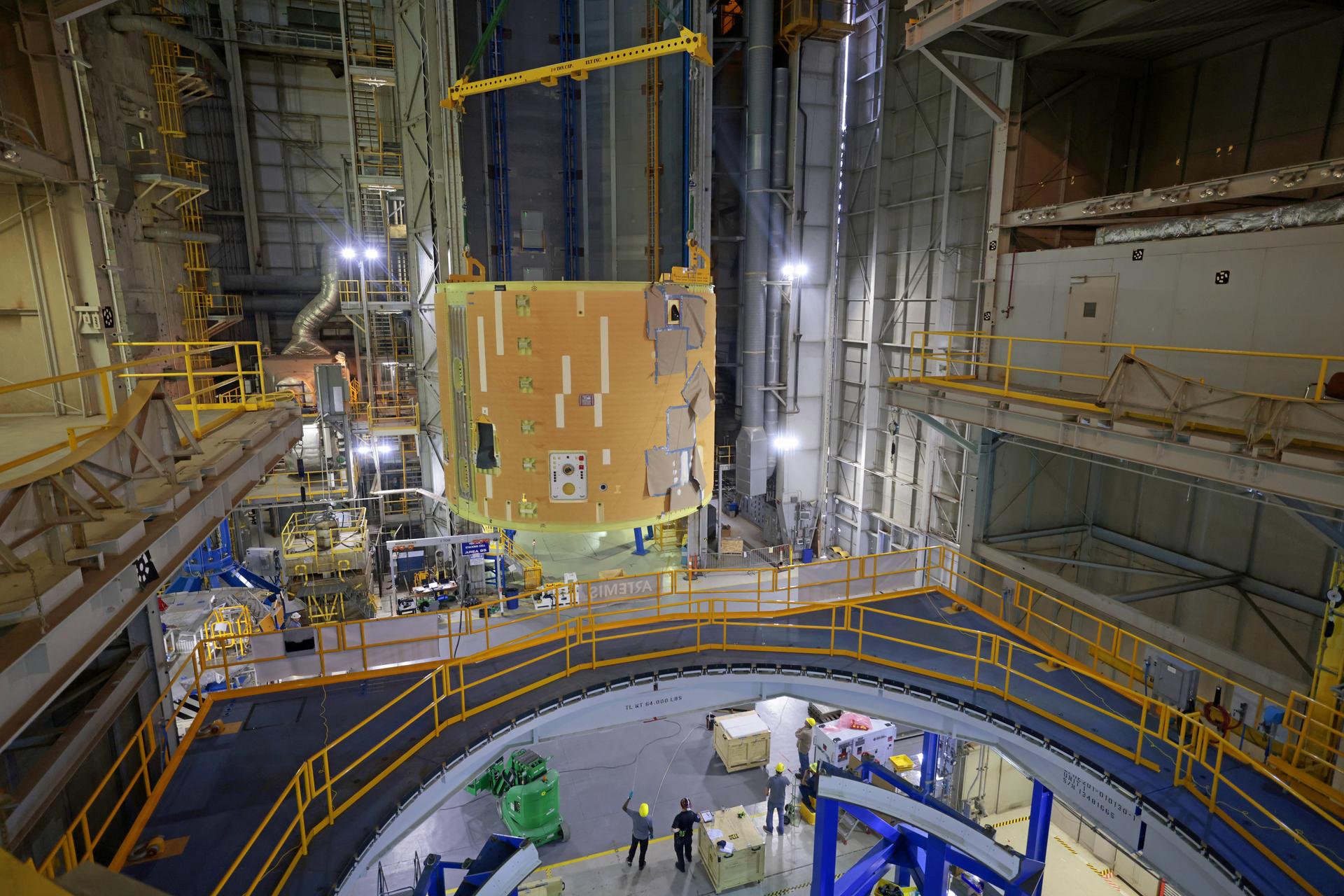
Teams at NASA’s Michoud Assembly Facility in New Orleans move the 21.8-foot-tall intertank for the core stage of the agency’s Artemis III mission into the vertical assembly building on Oct. 21. Inside the production cell, NASA’s prime contractor for the SLS (Space Launch System) core stage, Boeing, will mate the intertank to the liquid oxygen tank and the forward skirt in a process called a “forward join.” The intertank houses avionics and electronics, serves as an attachment point for the solid rocket boosters, and is one of five major elements that make up the 212-foot-tall rocket stage. The core stage, along with its four RS-25 engines, produce more than two million pounds of thrust to help launch NASA’s Orion spacecraft, astronauts, and supplies beyond Earth’s orbit and to the lunar surface for Artemis. Image credit: NASA/Michael DeMocker
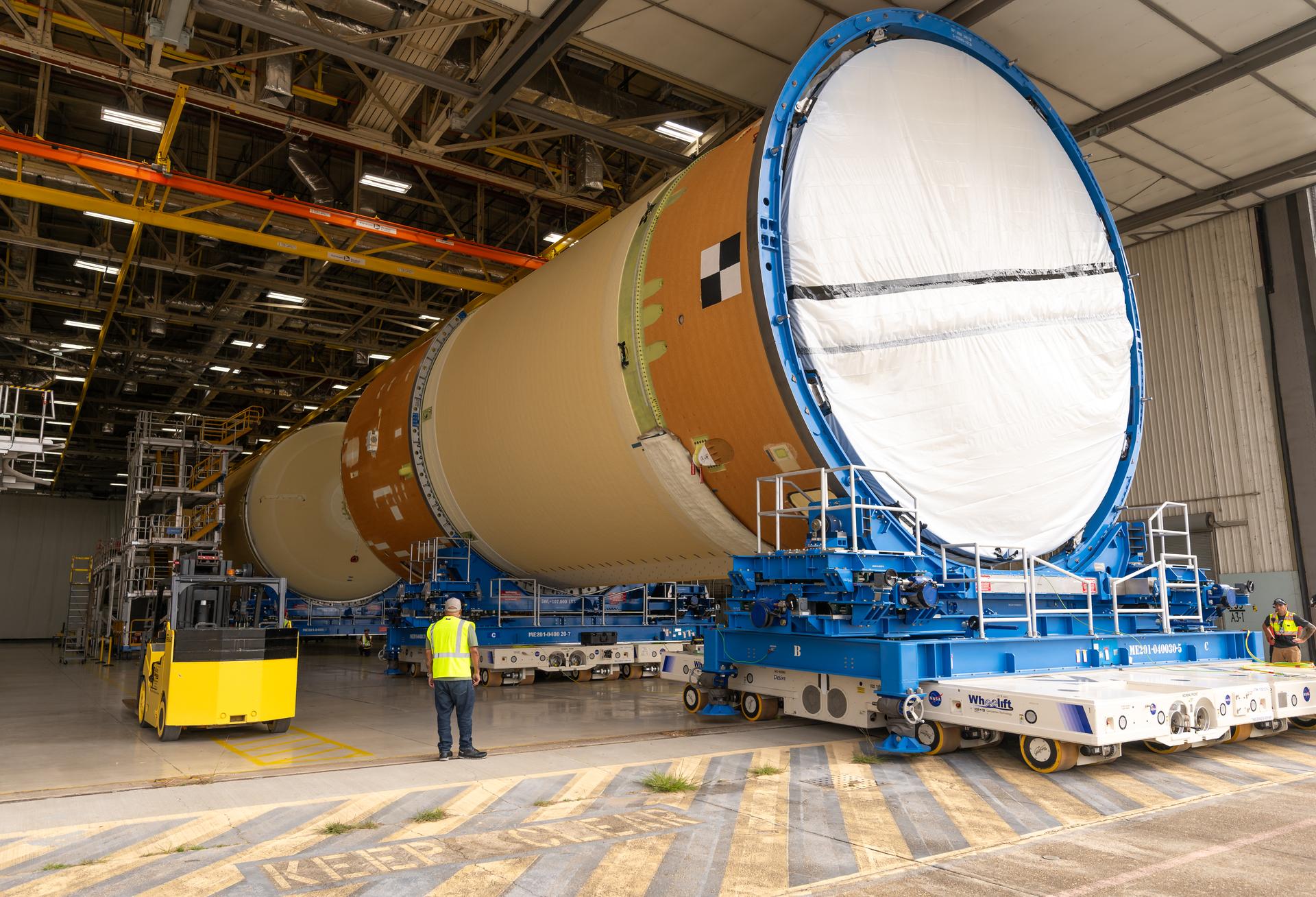
Move crews at NASA’s Michoud Assembly Facility in New Orleans, lift the forward-joined flight hardware for the agency’s SLS (Space Launch System) rocket out of a stacking cell in the vertical assembly building on Dec. 19, 2025. The forward join, which consists of the intertank, liquid oxygen tank, and forward skirt, will be used on the core stage slated for NASA’s Artemis III mission. Teams moved the flight hardware from the cell and set it atop self-propelled mobile transporters. The article was brought to the factory’s final assembly area on Dec. 27, 2025 where it will be mated to the core stage’s previously joined liquid hydrogen tank and undergo further integration. The core stage, along with its four RS-25 engines, produce more than two million pounds of thrust to help launch NASA’s Orion spacecraft, astronauts, and supplies beyond Earth’s orbit and to the lunar surface for Artemis.
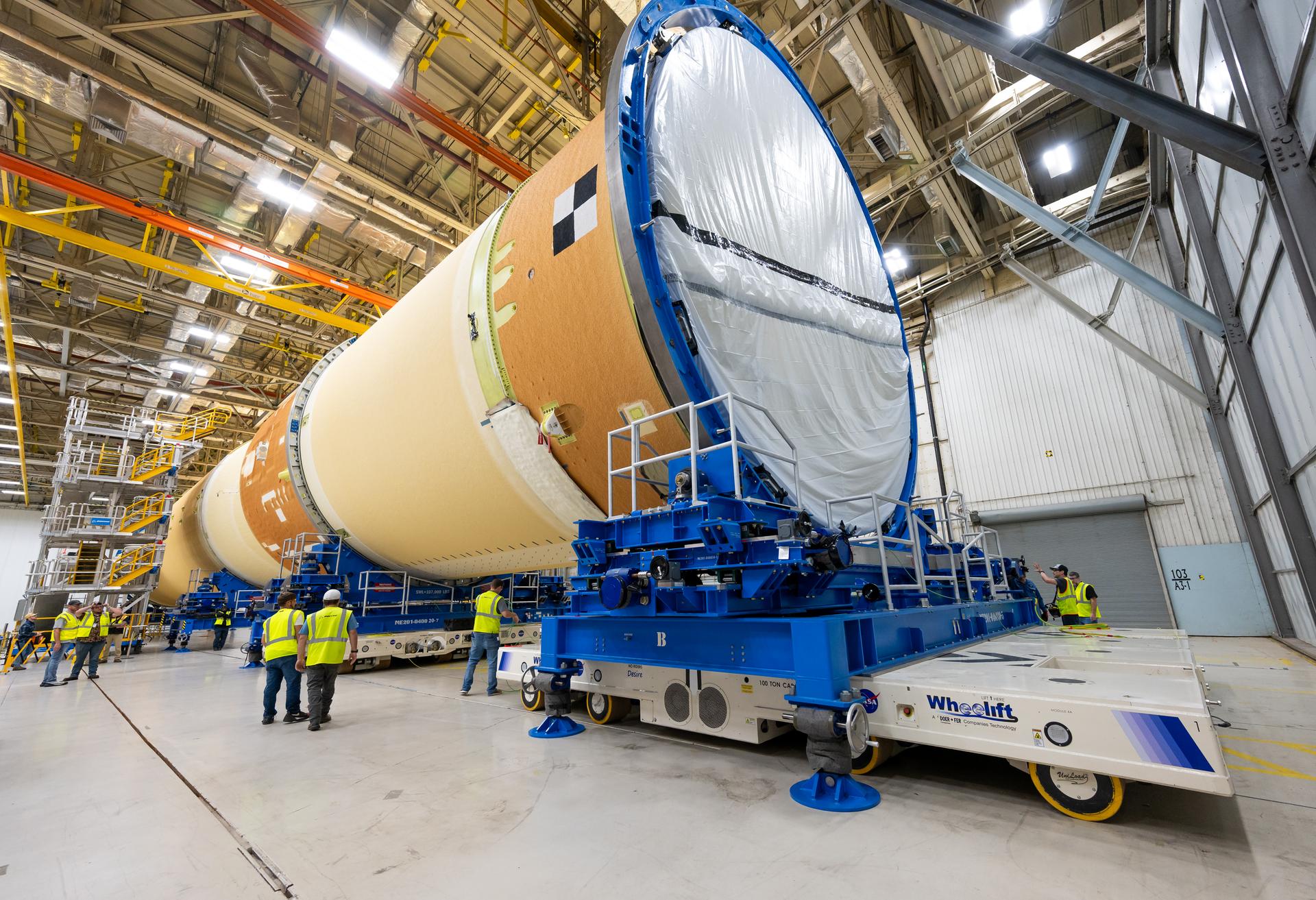
Move crews at NASA’s Michoud Assembly Facility in New Orleans, lift the forward-joined flight hardware for the agency’s SLS (Space Launch System) rocket out of a stacking cell in the vertical assembly building on Dec. 19, 2025. The forward join, which consists of the intertank, liquid oxygen tank, and forward skirt, will be used on the core stage slated for NASA’s Artemis III mission. Teams moved the flight hardware from the cell and set it atop self-propelled mobile transporters. The article was brought to the factory’s final assembly area on Dec. 27, 2025 where it will be mated to the core stage’s previously joined liquid hydrogen tank and undergo further integration. The core stage, along with its four RS-25 engines, produce more than two million pounds of thrust to help launch NASA’s Orion spacecraft, astronauts, and supplies beyond Earth’s orbit and to the lunar surface for Artemis.
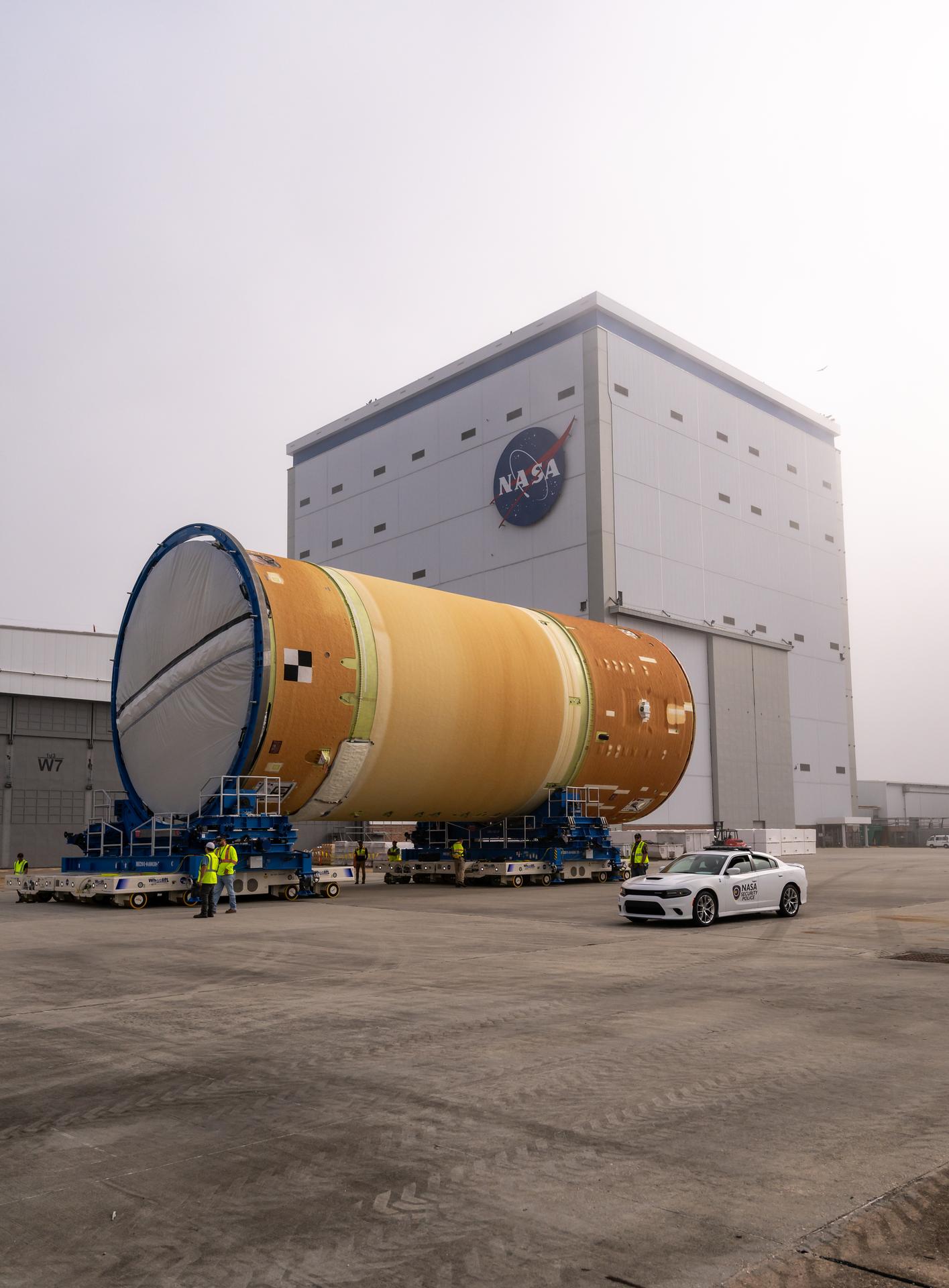
Move crews at NASA’s Michoud Assembly Facility in New Orleans, lift the forward-joined flight hardware for the agency’s SLS (Space Launch System) rocket out of a stacking cell in the vertical assembly building on Dec. 19, 2025. The forward join, which consists of the intertank, liquid oxygen tank, and forward skirt, will be used on the core stage slated for NASA’s Artemis III mission. Teams moved the flight hardware from the cell and set it atop self-propelled mobile transporters. The article was brought to the factory’s final assembly area on Dec. 27, 2025 where it will be mated to the core stage’s previously joined liquid hydrogen tank and undergo further integration. The core stage, along with its four RS-25 engines, produce more than two million pounds of thrust to help launch NASA’s Orion spacecraft, astronauts, and supplies beyond Earth’s orbit and to the lunar surface for Artemis.
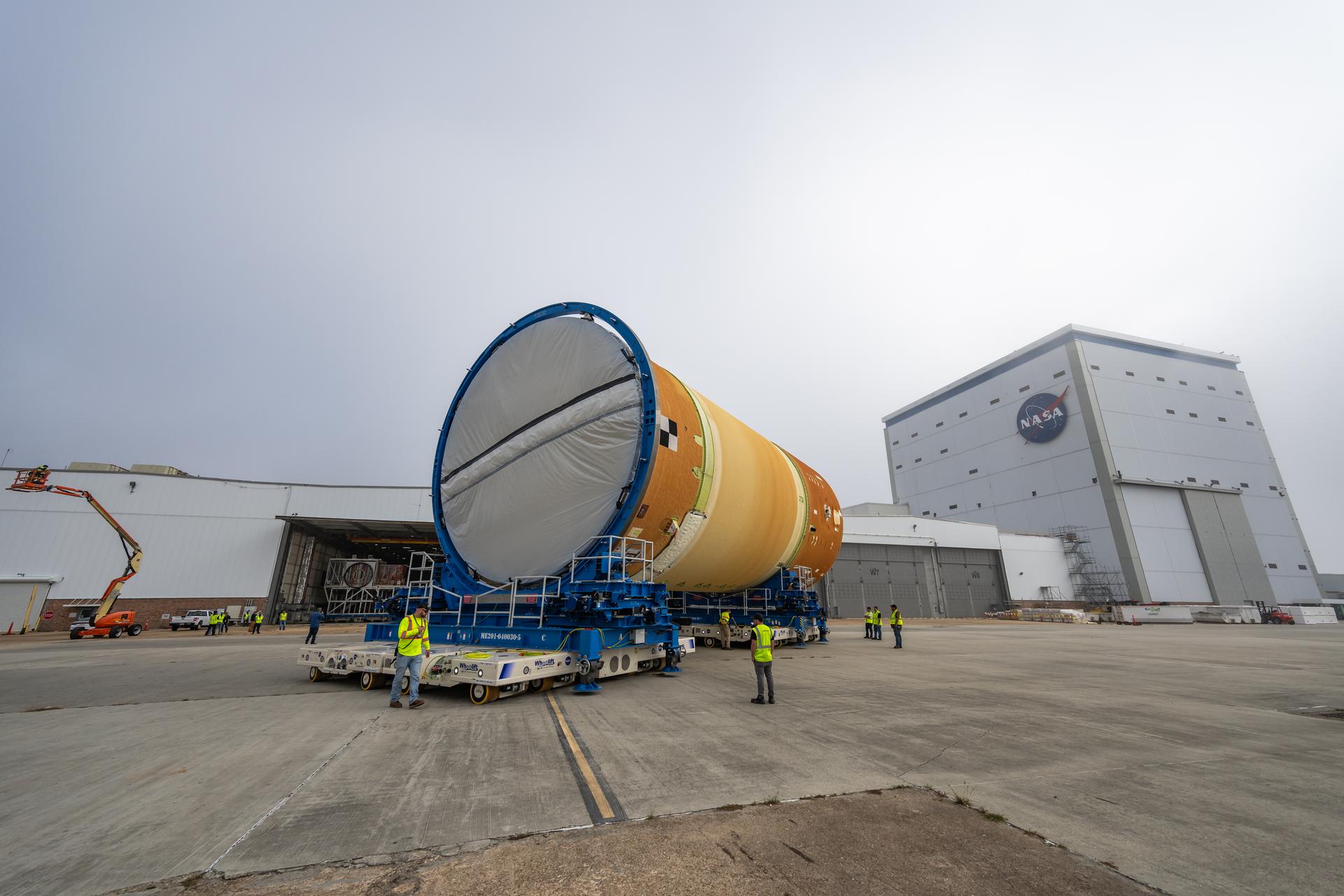
Move crews at NASA’s Michoud Assembly Facility in New Orleans, lift the forward-joined flight hardware for the agency’s SLS (Space Launch System) rocket out of a stacking cell in the vertical assembly building on Dec. 19, 2025. The forward join, which consists of the intertank, liquid oxygen tank, and forward skirt, will be used on the core stage slated for NASA’s Artemis III mission. Teams moved the flight hardware from the cell and set it atop self-propelled mobile transporters. The article was brought to the factory’s final assembly area on Dec. 27, 2025 where it will be mated to the core stage’s previously joined liquid hydrogen tank and undergo further integration. The core stage, along with its four RS-25 engines, produce more than two million pounds of thrust to help launch NASA’s Orion spacecraft, astronauts, and supplies beyond Earth’s orbit and to the lunar surface for Artemis.
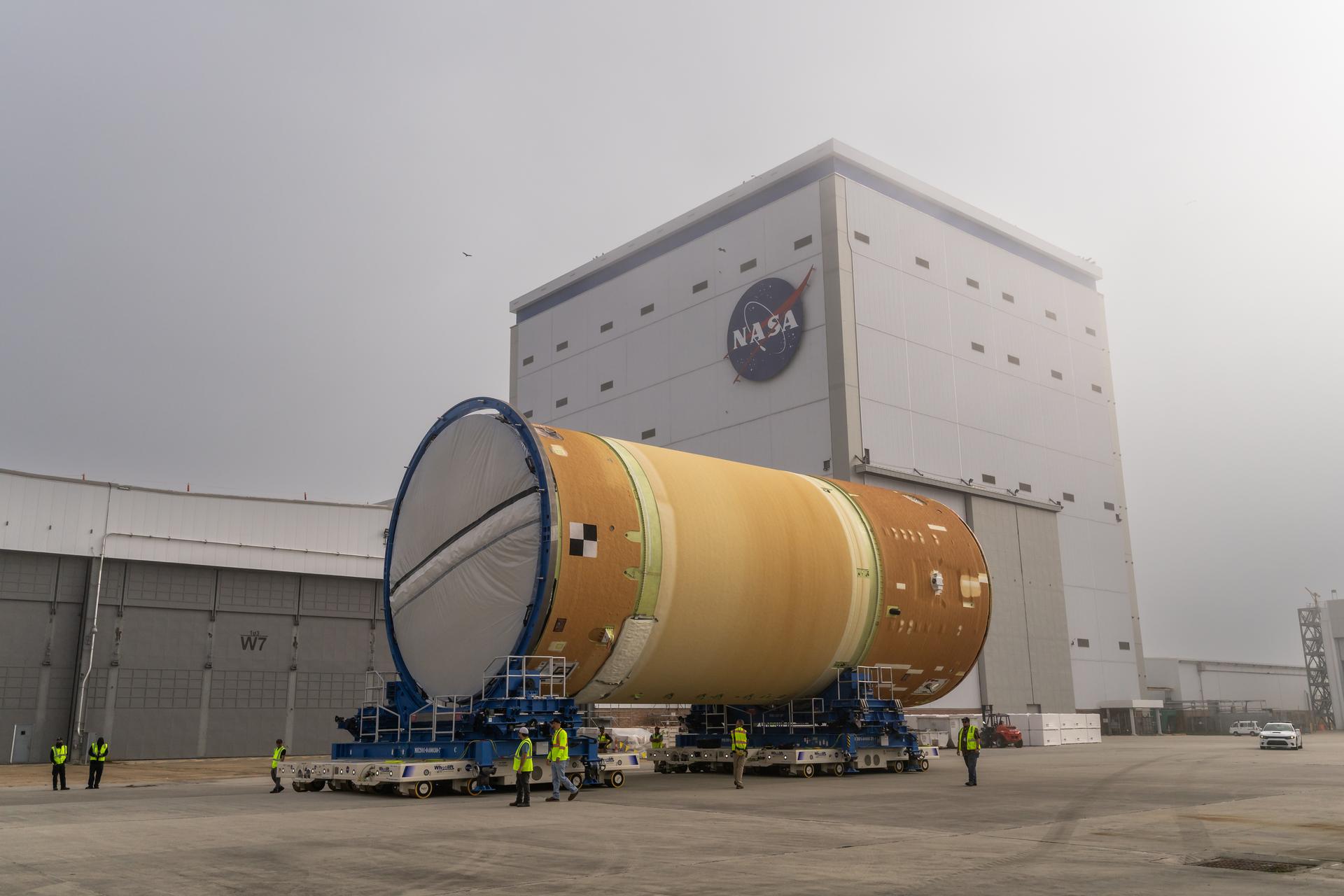
Move crews at NASA’s Michoud Assembly Facility in New Orleans, lift the forward-joined flight hardware for the agency’s SLS (Space Launch System) rocket out of a stacking cell in the vertical assembly building on Dec. 19, 2025. The forward join, which consists of the intertank, liquid oxygen tank, and forward skirt, will be used on the core stage slated for NASA’s Artemis III mission. Teams moved the flight hardware from the cell and set it atop self-propelled mobile transporters. The article was brought to the factory’s final assembly area on Dec. 27, 2025 where it will be mated to the core stage’s previously joined liquid hydrogen tank and undergo further integration. The core stage, along with its four RS-25 engines, produce more than two million pounds of thrust to help launch NASA’s Orion spacecraft, astronauts, and supplies beyond Earth’s orbit and to the lunar surface for Artemis.
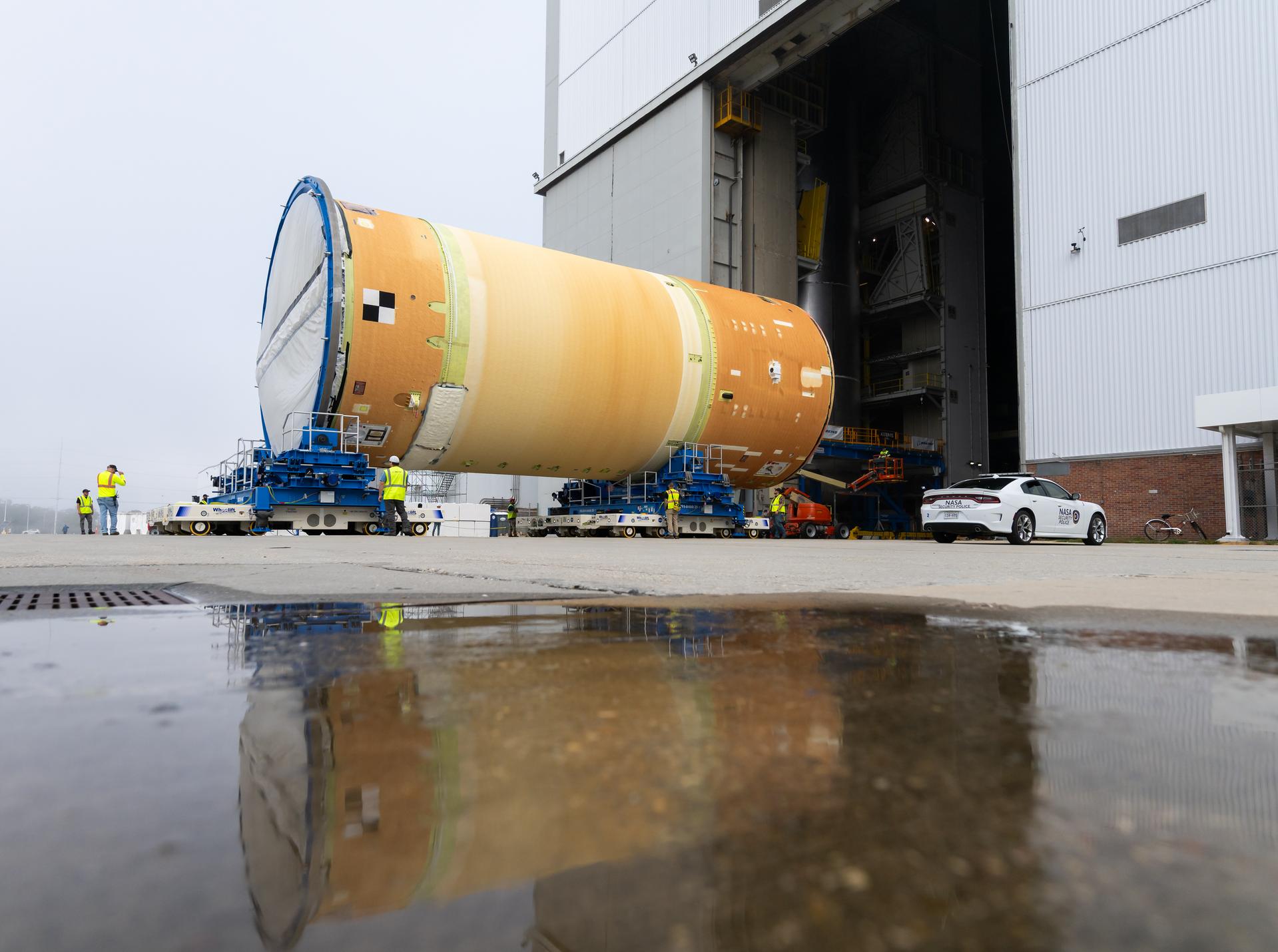
Move crews at NASA’s Michoud Assembly Facility in New Orleans, lift the forward-joined flight hardware for the agency’s SLS (Space Launch System) rocket out of a stacking cell in the vertical assembly building on Dec. 19, 2025. The forward join, which consists of the intertank, liquid oxygen tank, and forward skirt, will be used on the core stage slated for NASA’s Artemis III mission. Teams moved the flight hardware from the cell and set it atop self-propelled mobile transporters. The article was brought to the factory’s final assembly area on Dec. 27, 2025 where it will be mated to the core stage’s previously joined liquid hydrogen tank and undergo further integration. The core stage, along with its four RS-25 engines, produce more than two million pounds of thrust to help launch NASA’s Orion spacecraft, astronauts, and supplies beyond Earth’s orbit and to the lunar surface for Artemis.
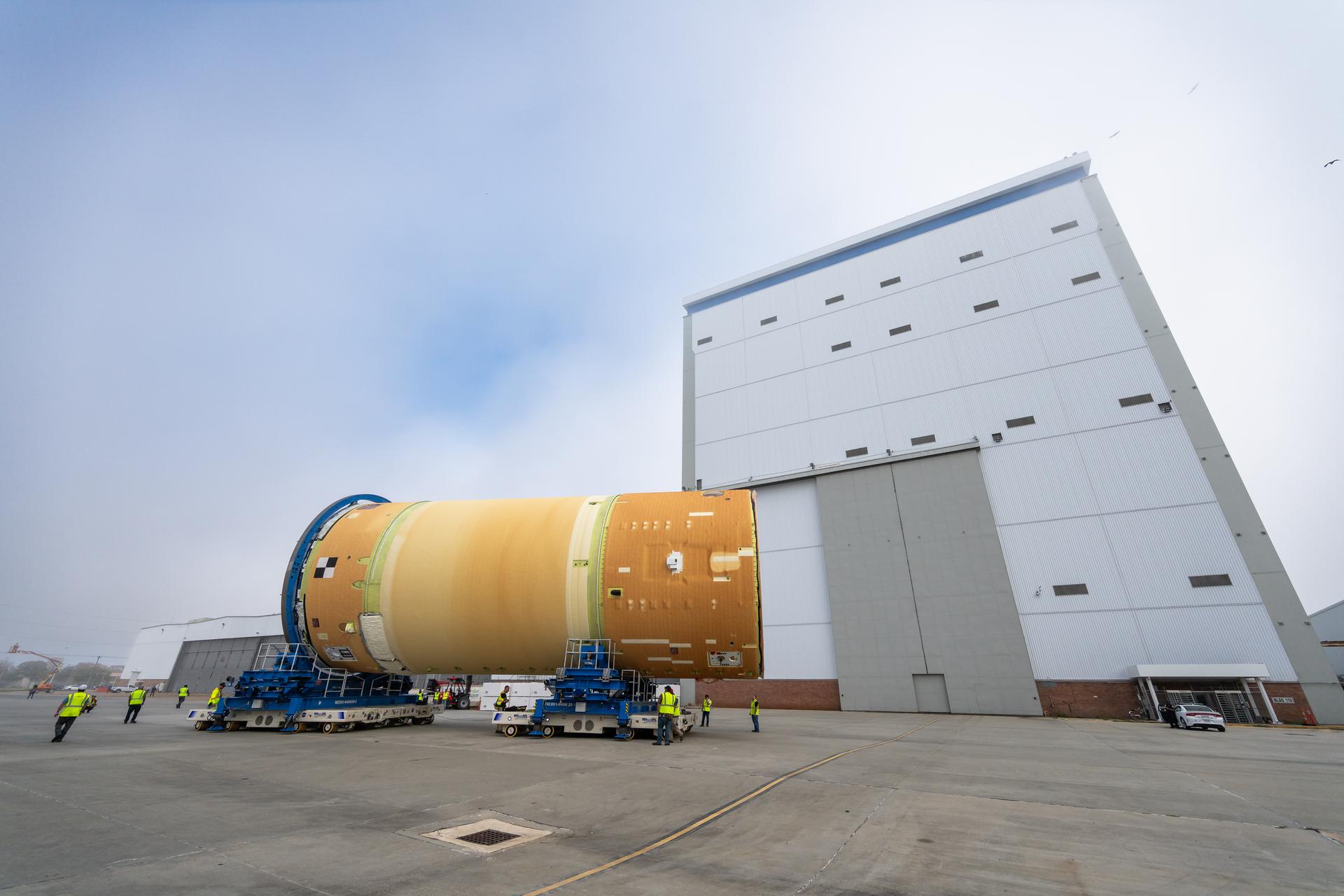
Move crews at NASA’s Michoud Assembly Facility in New Orleans, lift the forward-joined flight hardware for the agency’s SLS (Space Launch System) rocket out of a stacking cell in the vertical assembly building on Dec. 19, 2025. The forward join, which consists of the intertank, liquid oxygen tank, and forward skirt, will be used on the core stage slated for NASA’s Artemis III mission. Teams moved the flight hardware from the cell and set it atop self-propelled mobile transporters. The article was brought to the factory’s final assembly area on Dec. 27, 2025 where it will be mated to the core stage’s previously joined liquid hydrogen tank and undergo further integration. The core stage, along with its four RS-25 engines, produce more than two million pounds of thrust to help launch NASA’s Orion spacecraft, astronauts, and supplies beyond Earth’s orbit and to the lunar surface for Artemis.
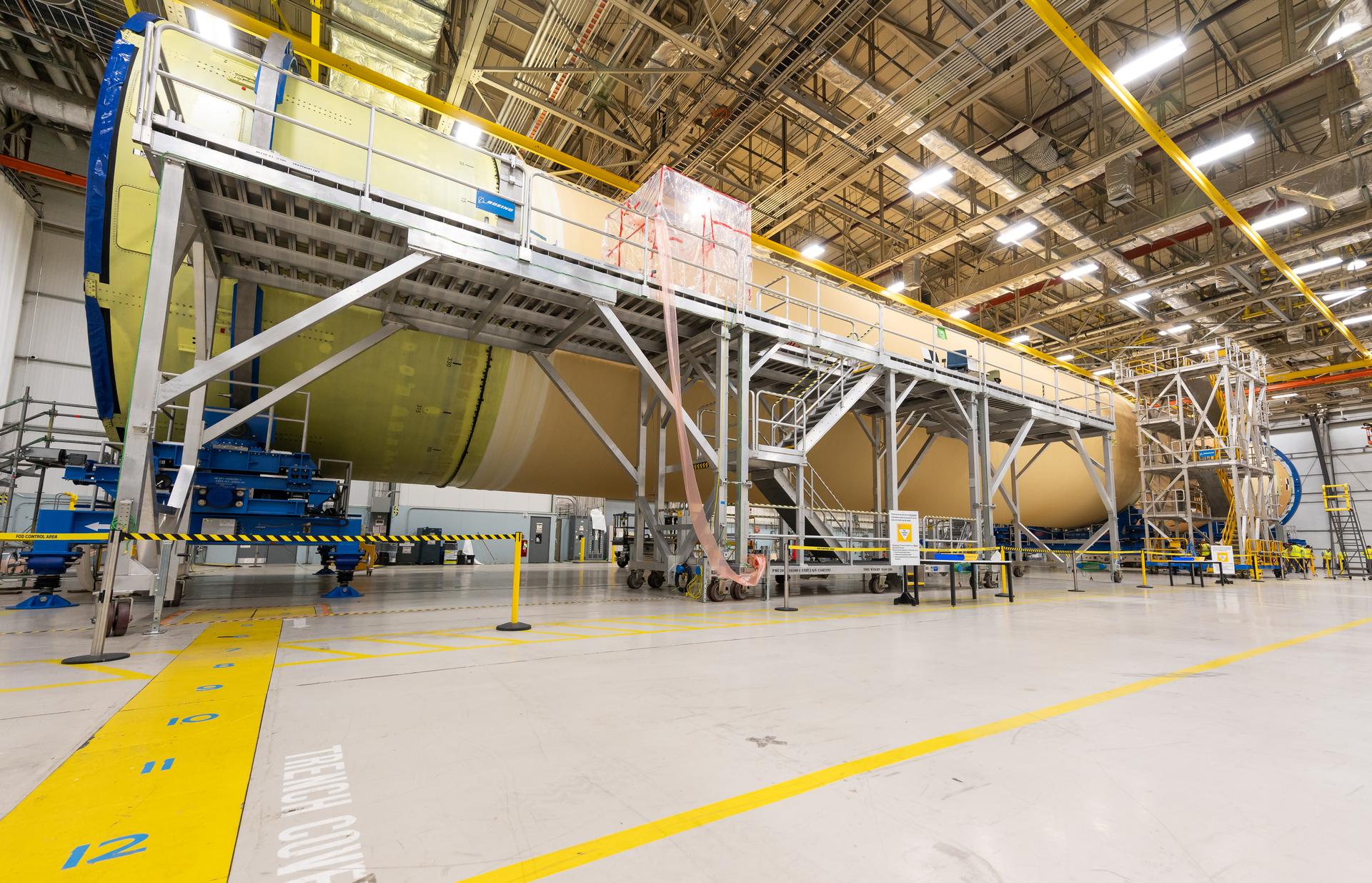
Move crews at NASA’s Michoud Assembly Facility in New Orleans, lift the forward-joined flight hardware for the agency’s SLS (Space Launch System) rocket out of a stacking cell in the vertical assembly building on Dec. 19, 2025. The forward join, which consists of the intertank, liquid oxygen tank, and forward skirt, will be used on the core stage slated for NASA’s Artemis III mission. Teams moved the flight hardware from the cell and set it atop self-propelled mobile transporters. The article was brought to the factory’s final assembly area on Dec. 27, 2025 where it will be mated to the core stage’s previously joined liquid hydrogen tank and undergo further integration. The core stage, along with its four RS-25 engines, produce more than two million pounds of thrust to help launch NASA’s Orion spacecraft, astronauts, and supplies beyond Earth’s orbit and to the lunar surface for Artemis.
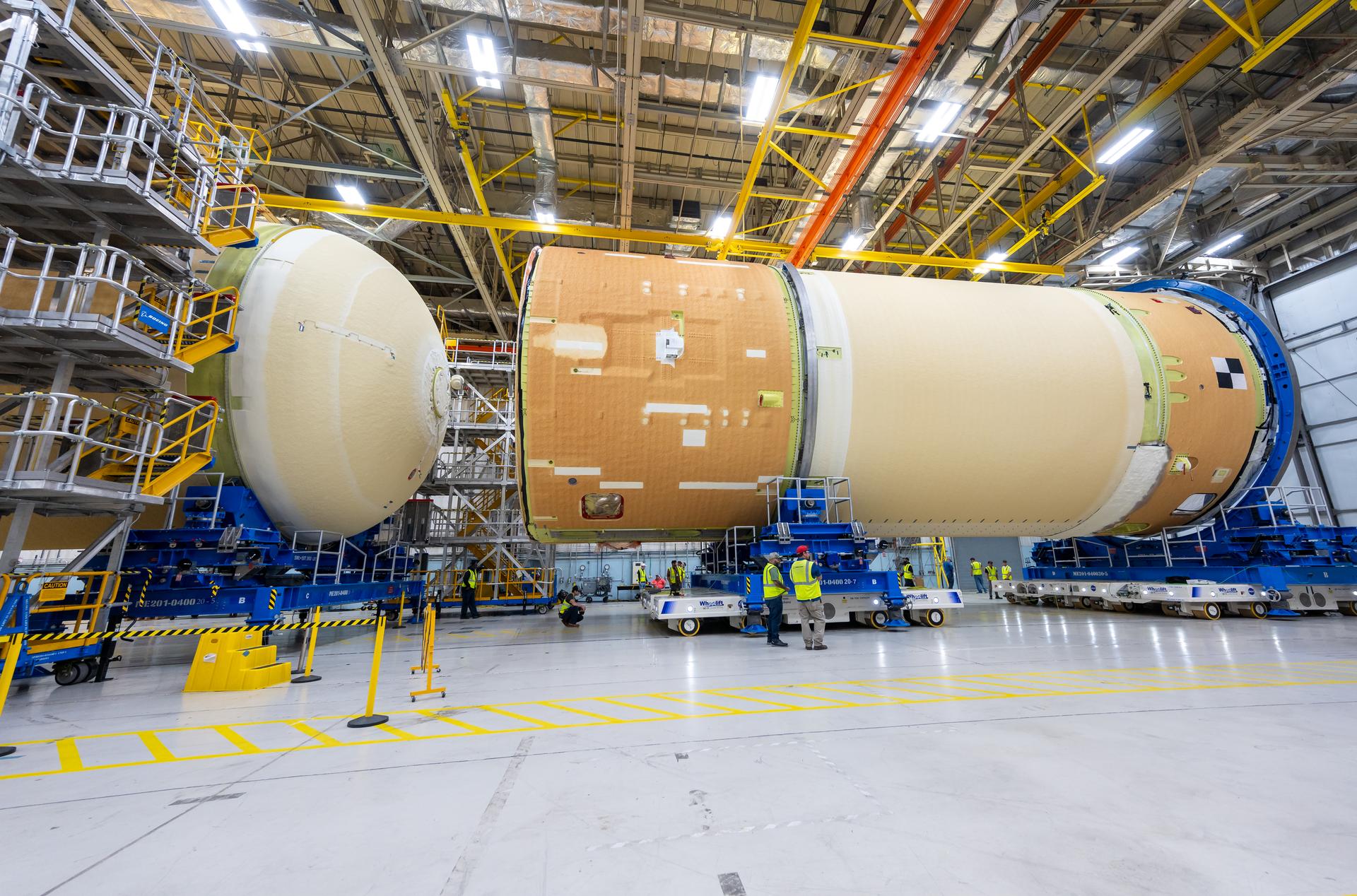
Move crews at NASA’s Michoud Assembly Facility in New Orleans, lift the forward-joined flight hardware for the agency’s SLS (Space Launch System) rocket out of a stacking cell in the vertical assembly building on Dec. 19, 2025. The forward join, which consists of the intertank, liquid oxygen tank, and forward skirt, will be used on the core stage slated for NASA’s Artemis III mission. Teams moved the flight hardware from the cell and set it atop self-propelled mobile transporters. The article was brought to the factory’s final assembly area on Dec. 27, 2025 where it will be mated to the core stage’s previously joined liquid hydrogen tank and undergo further integration. The core stage, along with its four RS-25 engines, produce more than two million pounds of thrust to help launch NASA’s Orion spacecraft, astronauts, and supplies beyond Earth’s orbit and to the lunar surface for Artemis.
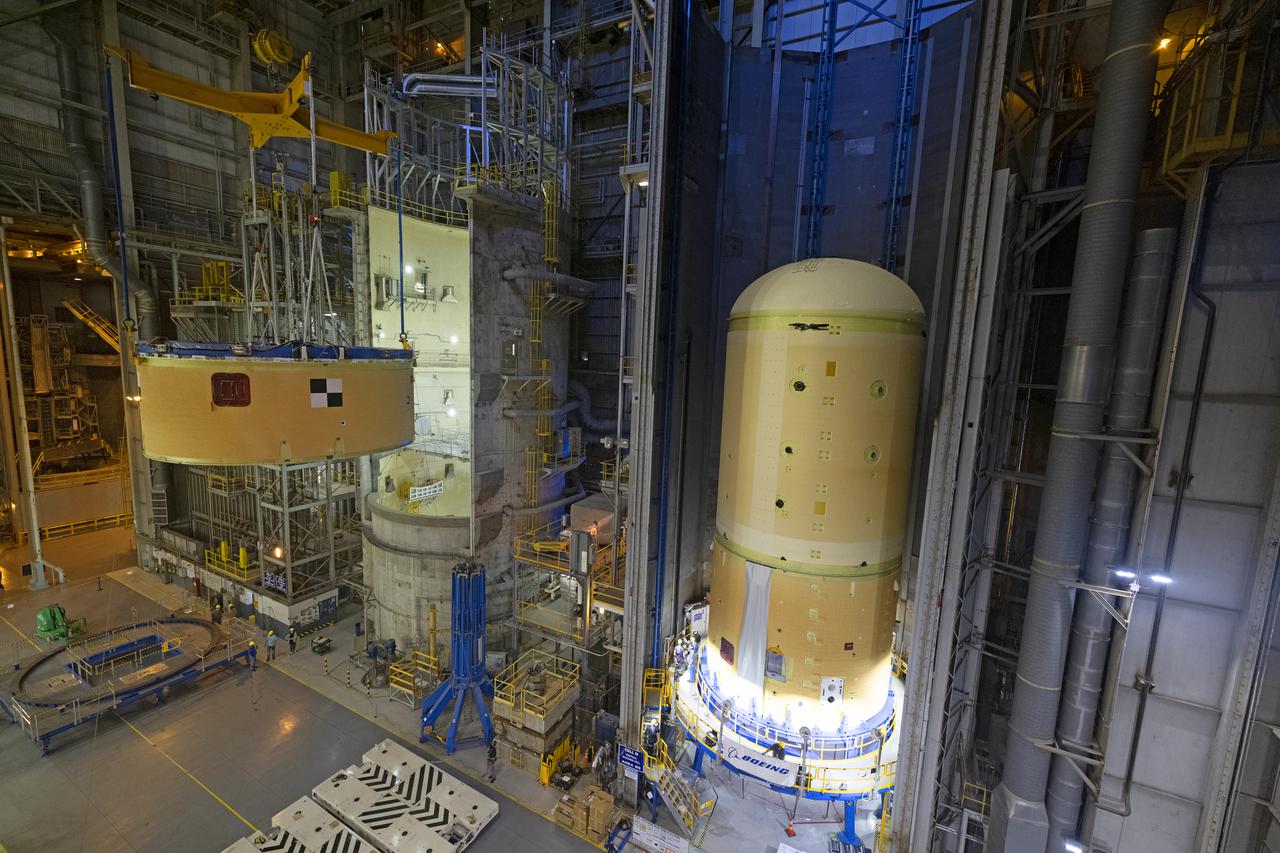
NASA’s Space Launch System (SLS) team fully stacked three hardware elements together May 24 to form the top of the rocket’s core stage for the Artemis II mission. NASA and core stage prime contractor Boeing connected the forward skirt with the liquid oxygen tank and intertank flight hardware inside an assembly area at NASA’s Michoud Assembly Facility in New Orleans. Teams had previously stacked the liquid oxygen tank and intertank on April 28. The joining of the three structures together is the first major assembly of core stage hardware for Artemis II, the first crewed Artemis mission and second flight of the SLS rocket. Next, technicians will work to complete outfitting and integrating the systems within the upper structure. At 66 feet tall, the upper part of the stage is just a fraction of the entire core stage. The fully-assembled, 212-foot-tall rocket stage consists of five hardware elements, including two liquid propellant tanks and four RS-25 engines. The liquid oxygen tank in the upper portion of the stage will hold 196,000 gallons of liquid oxygen cooled to minus 297 degrees Fahrenheit. Meanwhile, the forward skirt and intertank house avionics, flight computer, and electronic systems for the rocket stage. Together, the core stage and its four RS-25 engines will provide more than 2 million pounds of thrust to help send Artemis II astronauts beyond Earth’s orbit to lunar orbit. With Artemis, NASA will land the first woman and the first person of color on the Moon and establish sustainable exploration in preparation for missions to Mars. SLS and NASA’s Orion spacecraft, along with the commercial human landing system and the Gateway in orbit around the Moon, are NASA’s backbone for deep space exploration. SLS is the only rocket that can send Orion, astronauts, and supplies to the Moon in a single mission. Image credit: NASA/Michael DeMocker

NASA’s Space Launch System (SLS) team fully stacked three hardware elements together May 24 to form the top of the rocket’s core stage for the Artemis II mission. NASA and core stage prime contractor Boeing connected the forward skirt with the liquid oxygen tank and intertank flight hardware inside an assembly area at NASA’s Michoud Assembly Facility in New Orleans. Teams had previously stacked the liquid oxygen tank and intertank on April 28. The joining of the three structures together is the first major assembly of core stage hardware for Artemis II, the first crewed Artemis mission and second flight of the SLS rocket. Next, technicians will work to complete outfitting and integrating the systems within the upper structure. At 66 feet tall, the upper part of the stage is just a fraction of the entire core stage. The fully-assembled, 212-foot-tall rocket stage consists of five hardware elements, including two liquid propellant tanks and four RS-25 engines. The liquid oxygen tank in the upper portion of the stage will hold 196,000 gallons of liquid oxygen cooled to minus 297 degrees Fahrenheit. Meanwhile, the forward skirt and intertank house avionics, flight computer, and electronic systems for the rocket stage. Together, the core stage and its four RS-25 engines will provide more than 2 million pounds of thrust to help send Artemis II astronauts beyond Earth’s orbit to lunar orbit. With Artemis, NASA will land the first woman and the first person of color on the Moon and establish sustainable exploration in preparation for missions to Mars. SLS and NASA’s Orion spacecraft, along with the commercial human landing system and the Gateway in orbit around the Moon, are NASA’s backbone for deep space exploration. SLS is the only rocket that can send Orion, astronauts, and supplies to the Moon in a single mission. Image credit: NASA/Eric Bordelon
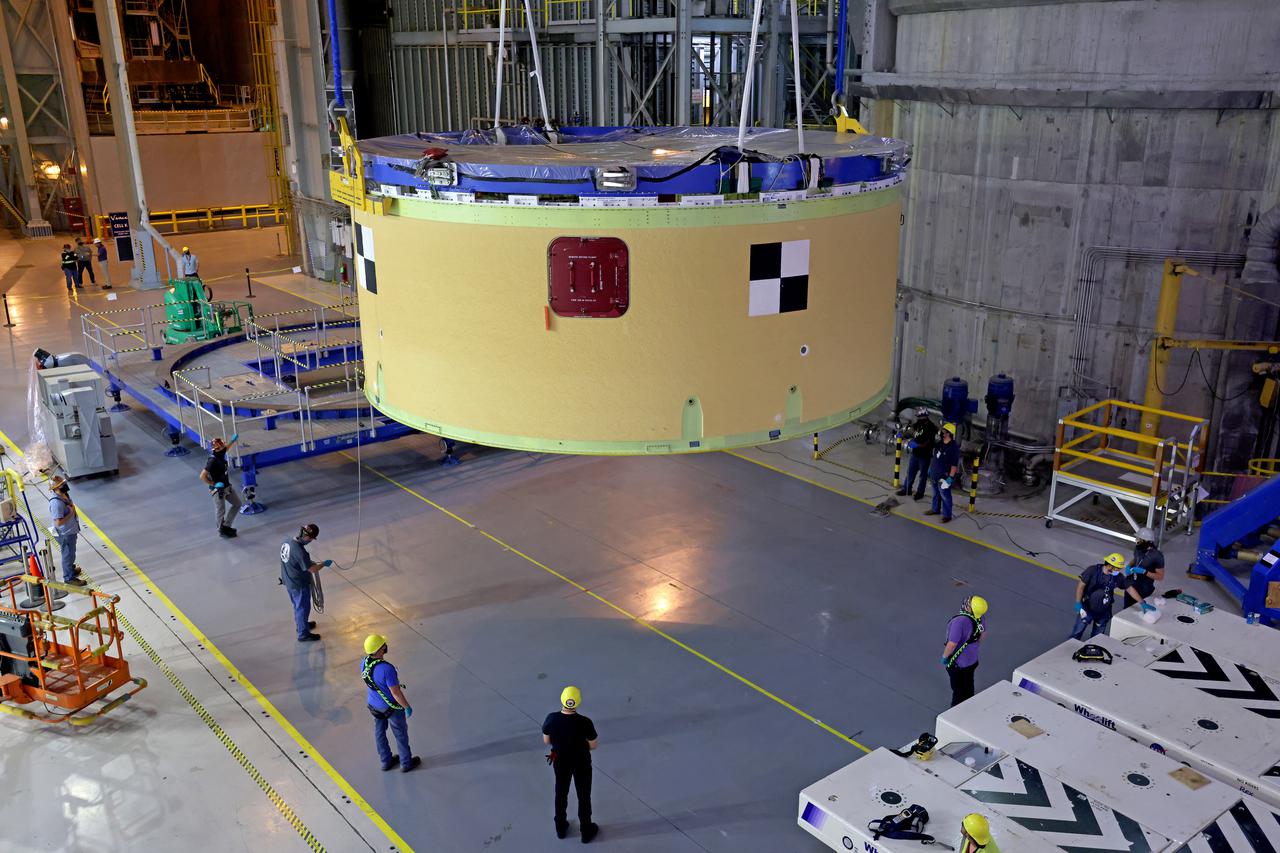
NASA’s Space Launch System (SLS) team fully stacked three hardware elements together May 24 to form the top of the rocket’s core stage for the Artemis II mission. NASA and core stage prime contractor Boeing connected the forward skirt with the liquid oxygen tank and intertank flight hardware inside an assembly area at NASA’s Michoud Assembly Facility in New Orleans. Teams had previously stacked the liquid oxygen tank and intertank on April 28. The joining of the three structures together is the first major assembly of core stage hardware for Artemis II, the first crewed Artemis mission and second flight of the SLS rocket. Next, technicians will work to complete outfitting and integrating the systems within the upper structure. At 66 feet tall, the upper part of the stage is just a fraction of the entire core stage. The fully-assembled, 212-foot-tall rocket stage consists of five hardware elements, including two liquid propellant tanks and four RS-25 engines. The liquid oxygen tank in the upper portion of the stage will hold 196,000 gallons of liquid oxygen cooled to minus 297 degrees Fahrenheit. Meanwhile, the forward skirt and intertank house avionics, flight computer, and electronic systems for the rocket stage. Together, the core stage and its four RS-25 engines will provide more than 2 million pounds of thrust to help send Artemis II astronauts beyond Earth’s orbit to lunar orbit. With Artemis, NASA will land the first woman and the first person of color on the Moon and establish sustainable exploration in preparation for missions to Mars. SLS and NASA’s Orion spacecraft, along with the commercial human landing system and the Gateway in orbit around the Moon, are NASA’s backbone for deep space exploration. SLS is the only rocket that can send Orion, astronauts, and supplies to the Moon in a single mission. Image credit: NASA/Michael DeMocker
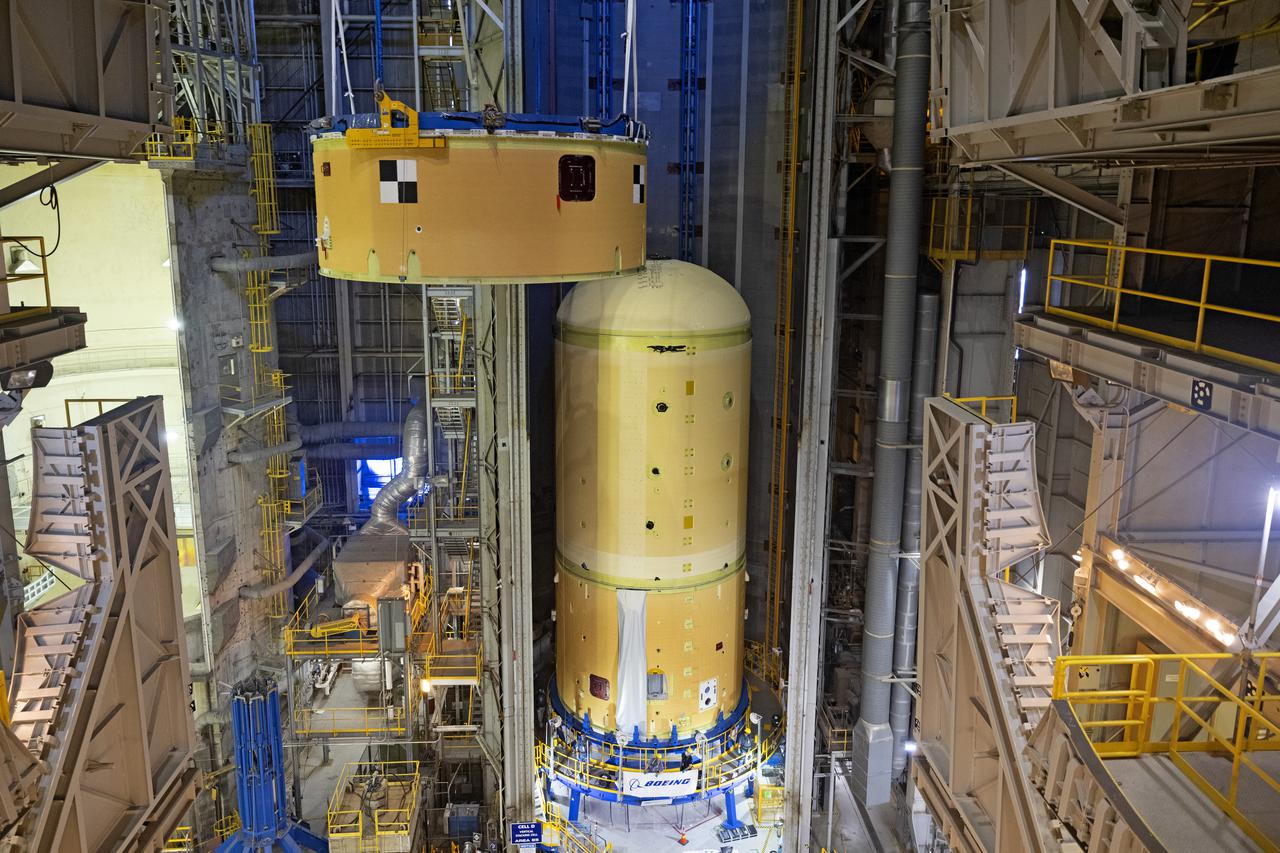
NASA’s Space Launch System (SLS) team fully stacked three hardware elements together May 24 to form the top of the rocket’s core stage for the Artemis II mission. NASA and core stage prime contractor Boeing connected the forward skirt with the liquid oxygen tank and intertank flight hardware inside an assembly area at NASA’s Michoud Assembly Facility in New Orleans. Teams had previously stacked the liquid oxygen tank and intertank on April 28. The joining of the three structures together is the first major assembly of core stage hardware for Artemis II, the first crewed Artemis mission and second flight of the SLS rocket. Next, technicians will work to complete outfitting and integrating the systems within the upper structure. At 66 feet tall, the upper part of the stage is just a fraction of the entire core stage. The fully-assembled, 212-foot-tall rocket stage consists of five hardware elements, including two liquid propellant tanks and four RS-25 engines. The liquid oxygen tank in the upper portion of the stage will hold 196,000 gallons of liquid oxygen cooled to minus 297 degrees Fahrenheit. Meanwhile, the forward skirt and intertank house avionics, flight computer, and electronic systems for the rocket stage. Together, the core stage and its four RS-25 engines will provide more than 2 million pounds of thrust to help send Artemis II astronauts beyond Earth’s orbit to lunar orbit. With Artemis, NASA will land the first woman and the first person of color on the Moon and establish sustainable exploration in preparation for missions to Mars. SLS and NASA’s Orion spacecraft, along with the commercial human landing system and the Gateway in orbit around the Moon, are NASA’s backbone for deep space exploration. SLS is the only rocket that can send Orion, astronauts, and supplies to the Moon in a single mission. Image credit: NASA/Michael DeMocker

NASA’s Space Launch System (SLS) team fully stacked three hardware elements together May 24 to form the top of the rocket’s core stage for the Artemis II mission. NASA and core stage prime contractor Boeing connected the forward skirt with the liquid oxygen tank and intertank flight hardware inside an assembly area at NASA’s Michoud Assembly Facility in New Orleans. Teams had previously stacked the liquid oxygen tank and intertank on April 28. The joining of the three structures together is the first major assembly of core stage hardware for Artemis II, the first crewed Artemis mission and second flight of the SLS rocket. Next, technicians will work to complete outfitting and integrating the systems within the upper structure. At 66 feet tall, the upper part of the stage is just a fraction of the entire core stage. The fully-assembled, 212-foot-tall rocket stage consists of five hardware elements, including two liquid propellant tanks and four RS-25 engines. The liquid oxygen tank in the upper portion of the stage will hold 196,000 gallons of liquid oxygen cooled to minus 297 degrees Fahrenheit. Meanwhile, the forward skirt and intertank house avionics, flight computer, and electronic systems for the rocket stage. Together, the core stage and its four RS-25 engines will provide more than 2 million pounds of thrust to help send Artemis II astronauts beyond Earth’s orbit to lunar orbit. With Artemis, NASA will land the first woman and the first person of color on the Moon and establish sustainable exploration in preparation for missions to Mars. SLS and NASA’s Orion spacecraft, along with the commercial human landing system and the Gateway in orbit around the Moon, are NASA’s backbone for deep space exploration. SLS is the only rocket that can send Orion, astronauts, and supplies to the Moon in a single mission. Image credit: NASA/Eric Bordelon
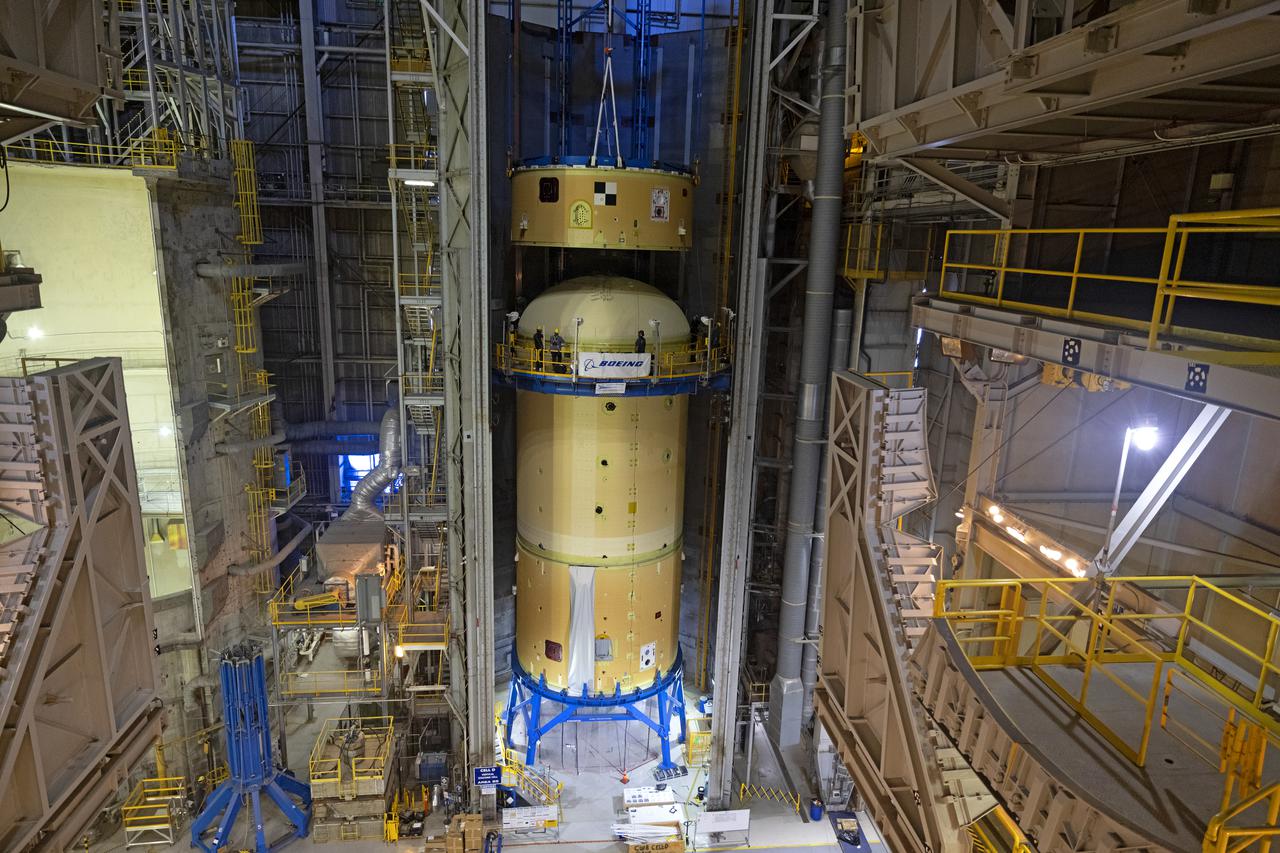
NASA’s Space Launch System (SLS) team fully stacked three hardware elements together May 24 to form the top of the rocket’s core stage for the Artemis II mission. NASA and core stage prime contractor Boeing connected the forward skirt with the liquid oxygen tank and intertank flight hardware inside an assembly area at NASA’s Michoud Assembly Facility in New Orleans. Teams had previously stacked the liquid oxygen tank and intertank on April 28. The joining of the three structures together is the first major assembly of core stage hardware for Artemis II, the first crewed Artemis mission and second flight of the SLS rocket. Next, technicians will work to complete outfitting and integrating the systems within the upper structure. At 66 feet tall, the upper part of the stage is just a fraction of the entire core stage. The fully-assembled, 212-foot-tall rocket stage consists of five hardware elements, including two liquid propellant tanks and four RS-25 engines. The liquid oxygen tank in the upper portion of the stage will hold 196,000 gallons of liquid oxygen cooled to minus 297 degrees Fahrenheit. Meanwhile, the forward skirt and intertank house avionics, flight computer, and electronic systems for the rocket stage. Together, the core stage and its four RS-25 engines will provide more than 2 million pounds of thrust to help send Artemis II astronauts beyond Earth’s orbit to lunar orbit. With Artemis, NASA will land the first woman and the first person of color on the Moon and establish sustainable exploration in preparation for missions to Mars. SLS and NASA’s Orion spacecraft, along with the commercial human landing system and the Gateway in orbit around the Moon, are NASA’s backbone for deep space exploration. SLS is the only rocket that can send Orion, astronauts, and supplies to the Moon in a single mission. Image credit: NASA/Michael DeMocker
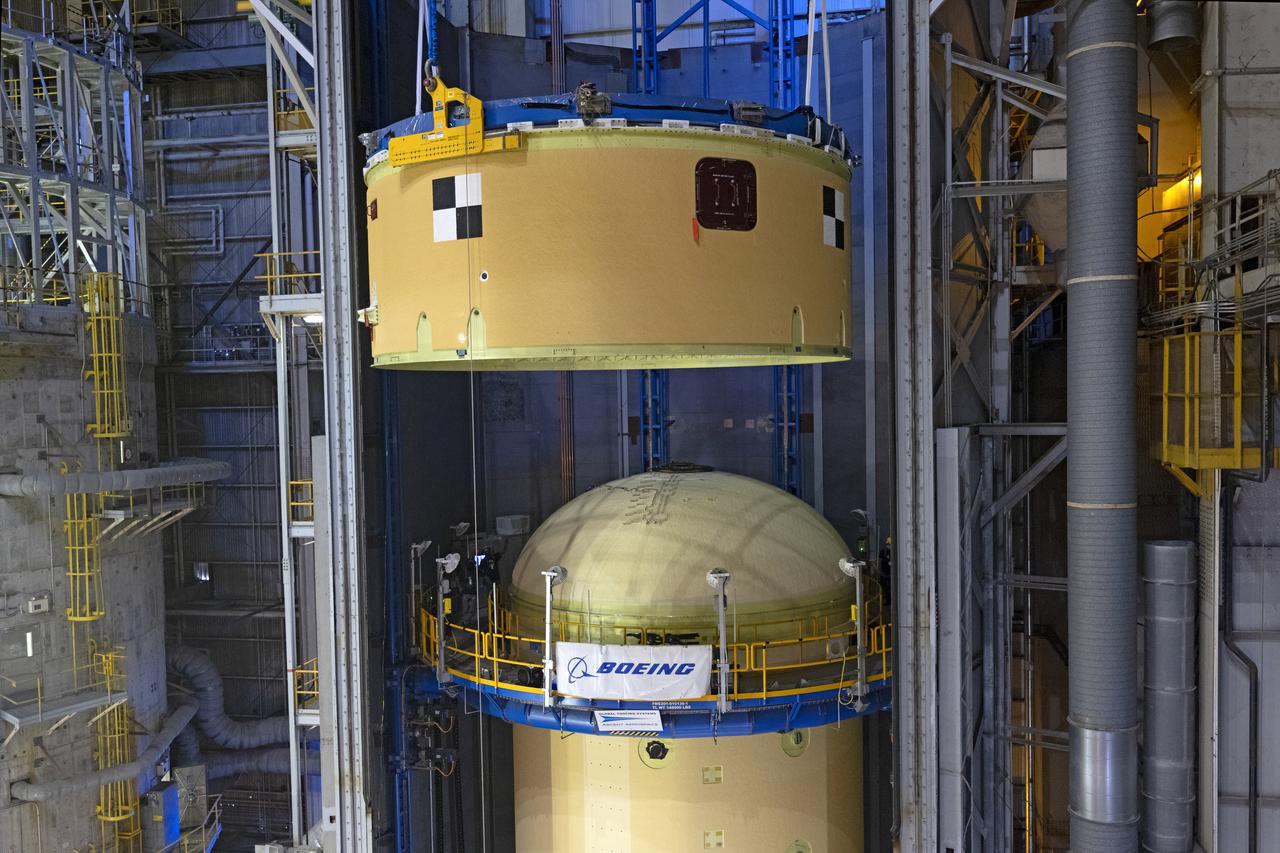
NASA’s Space Launch System (SLS) team fully stacked three hardware elements together May 24 to form the top of the rocket’s core stage for the Artemis II mission. NASA and core stage prime contractor Boeing connected the forward skirt with the liquid oxygen tank and intertank flight hardware inside an assembly area at NASA’s Michoud Assembly Facility in New Orleans. Teams had previously stacked the liquid oxygen tank and intertank on April 28. The joining of the three structures together is the first major assembly of core stage hardware for Artemis II, the first crewed Artemis mission and second flight of the SLS rocket. Next, technicians will work to complete outfitting and integrating the systems within the upper structure. At 66 feet tall, the upper part of the stage is just a fraction of the entire core stage. The fully-assembled, 212-foot-tall rocket stage consists of five hardware elements, including two liquid propellant tanks and four RS-25 engines. The liquid oxygen tank in the upper portion of the stage will hold 196,000 gallons of liquid oxygen cooled to minus 297 degrees Fahrenheit. Meanwhile, the forward skirt and intertank house avionics, flight computer, and electronic systems for the rocket stage. Together, the core stage and its four RS-25 engines will provide more than 2 million pounds of thrust to help send Artemis II astronauts beyond Earth’s orbit to lunar orbit. With Artemis, NASA will land the first woman and the first person of color on the Moon and establish sustainable exploration in preparation for missions to Mars. SLS and NASA’s Orion spacecraft, along with the commercial human landing system and the Gateway in orbit around the Moon, are NASA’s backbone for deep space exploration. SLS is the only rocket that can send Orion, astronauts, and supplies to the Moon in a single mission. Image credit: NASA/Michael DeMocker
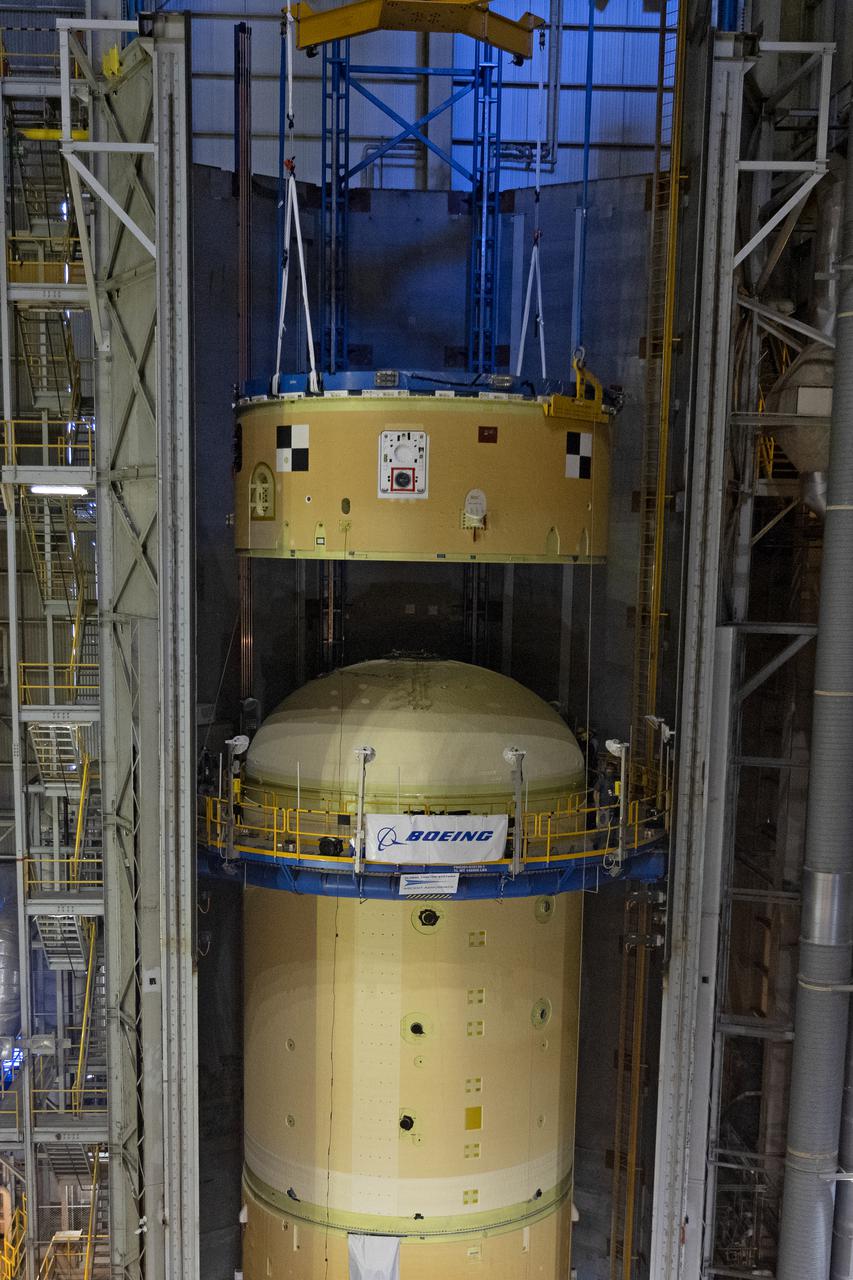
NASA’s Space Launch System (SLS) team fully stacked three hardware elements together May 24 to form the top of the rocket’s core stage for the Artemis II mission. NASA and core stage prime contractor Boeing connected the forward skirt with the liquid oxygen tank and intertank flight hardware inside an assembly area at NASA’s Michoud Assembly Facility in New Orleans. Teams had previously stacked the liquid oxygen tank and intertank on April 28. The joining of the three structures together is the first major assembly of core stage hardware for Artemis II, the first crewed Artemis mission and second flight of the SLS rocket. Next, technicians will work to complete outfitting and integrating the systems within the upper structure. At 66 feet tall, the upper part of the stage is just a fraction of the entire core stage. The fully-assembled, 212-foot-tall rocket stage consists of five hardware elements, including two liquid propellant tanks and four RS-25 engines. The liquid oxygen tank in the upper portion of the stage will hold 196,000 gallons of liquid oxygen cooled to minus 297 degrees Fahrenheit. Meanwhile, the forward skirt and intertank house avionics, flight computer, and electronic systems for the rocket stage. Together, the core stage and its four RS-25 engines will provide more than 2 million pounds of thrust to help send Artemis II astronauts beyond Earth’s orbit to lunar orbit. With Artemis, NASA will land the first woman and the first person of color on the Moon and establish sustainable exploration in preparation for missions to Mars. SLS and NASA’s Orion spacecraft, along with the commercial human landing system and the Gateway in orbit around the Moon, are NASA’s backbone for deep space exploration. SLS is the only rocket that can send Orion, astronauts, and supplies to the Moon in a single mission. Image credit: NASA/Michael DeMocker

NASA’s Space Launch System (SLS) team fully stacked three hardware elements together May 24 to form the top of the rocket’s core stage for the Artemis II mission. NASA and core stage prime contractor Boeing connected the forward skirt with the liquid oxygen tank and intertank flight hardware inside an assembly area at NASA’s Michoud Assembly Facility in New Orleans. Teams had previously stacked the liquid oxygen tank and intertank on April 28. The joining of the three structures together is the first major assembly of core stage hardware for Artemis II, the first crewed Artemis mission and second flight of the SLS rocket. Next, technicians will work to complete outfitting and integrating the systems within the upper structure. At 66 feet tall, the upper part of the stage is just a fraction of the entire core stage. The fully-assembled, 212-foot-tall rocket stage consists of five hardware elements, including two liquid propellant tanks and four RS-25 engines. The liquid oxygen tank in the upper portion of the stage will hold 196,000 gallons of liquid oxygen cooled to minus 297 degrees Fahrenheit. Meanwhile, the forward skirt and intertank house avionics, flight computer, and electronic systems for the rocket stage. Together, the core stage and its four RS-25 engines will provide more than 2 million pounds of thrust to help send Artemis II astronauts beyond Earth’s orbit to lunar orbit. With Artemis, NASA will land the first woman and the first person of color on the Moon and establish sustainable exploration in preparation for missions to Mars. SLS and NASA’s Orion spacecraft, along with the commercial human landing system and the Gateway in orbit around the Moon, are NASA’s backbone for deep space exploration. SLS is the only rocket that can send Orion, astronauts, and supplies to the Moon in a single mission. Image credit: NASA/Michael DeMocker
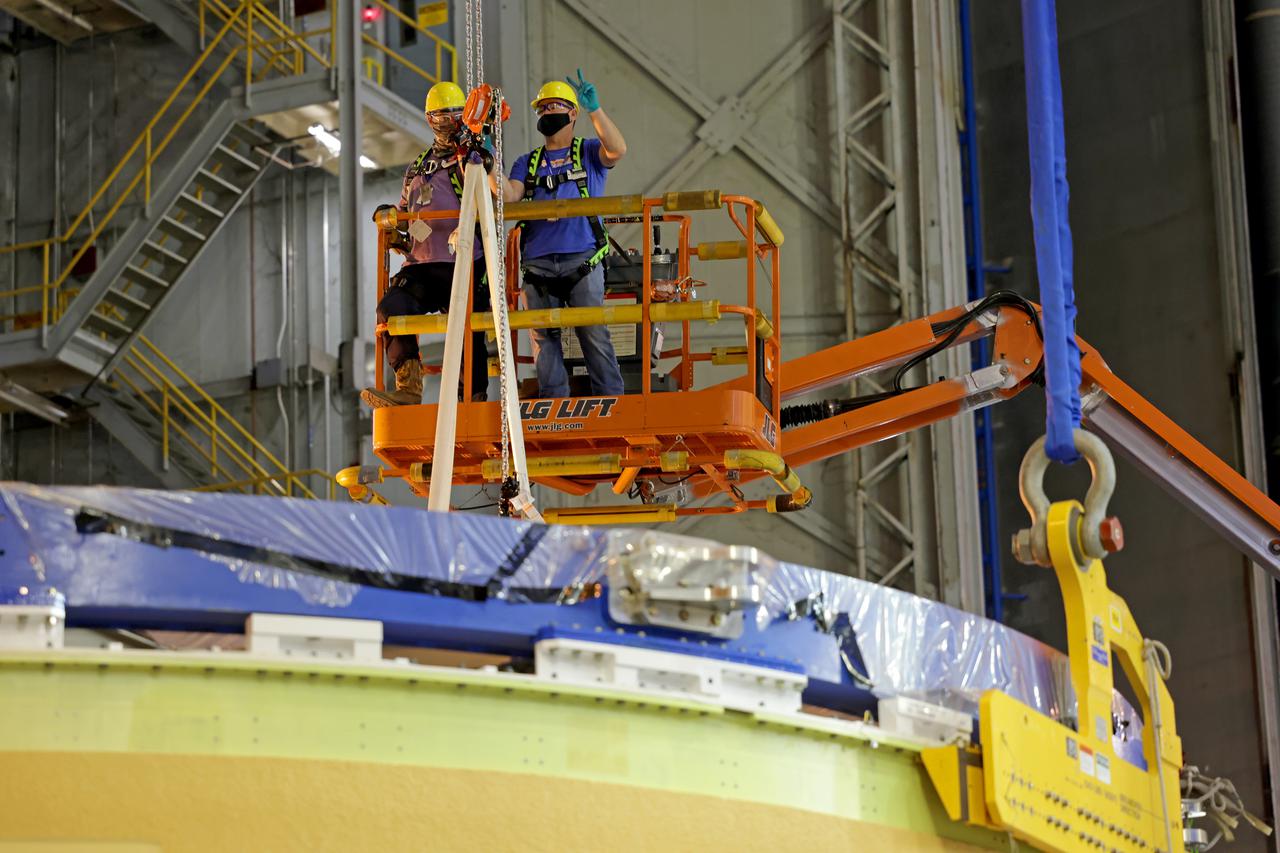
NASA’s Space Launch System (SLS) team fully stacked three hardware elements together May 24 to form the top of the rocket’s core stage for the Artemis II mission. NASA and core stage prime contractor Boeing connected the forward skirt with the liquid oxygen tank and intertank flight hardware inside an assembly area at NASA’s Michoud Assembly Facility in New Orleans. Teams had previously stacked the liquid oxygen tank and intertank on April 28. The joining of the three structures together is the first major assembly of core stage hardware for Artemis II, the first crewed Artemis mission and second flight of the SLS rocket. Next, technicians will work to complete outfitting and integrating the systems within the upper structure. At 66 feet tall, the upper part of the stage is just a fraction of the entire core stage. The fully-assembled, 212-foot-tall rocket stage consists of five hardware elements, including two liquid propellant tanks and four RS-25 engines. The liquid oxygen tank in the upper portion of the stage will hold 196,000 gallons of liquid oxygen cooled to minus 297 degrees Fahrenheit. Meanwhile, the forward skirt and intertank house avionics, flight computer, and electronic systems for the rocket stage. Together, the core stage and its four RS-25 engines will provide more than 2 million pounds of thrust to help send Artemis II astronauts beyond Earth’s orbit to lunar orbit. With Artemis, NASA will land the first woman and the first person of color on the Moon and establish sustainable exploration in preparation for missions to Mars. SLS and NASA’s Orion spacecraft, along with the commercial human landing system and the Gateway in orbit around the Moon, are NASA’s backbone for deep space exploration. SLS is the only rocket that can send Orion, astronauts, and supplies to the Moon in a single mission. Image credit: NASA/Michael DeMocker

NASA’s Space Launch System (SLS) team fully stacked three hardware elements together May 24 to form the top of the rocket’s core stage for the Artemis II mission. NASA and core stage prime contractor Boeing connected the forward skirt with the liquid oxygen tank and intertank flight hardware inside an assembly area at NASA’s Michoud Assembly Facility in New Orleans. Teams had previously stacked the liquid oxygen tank and intertank on April 28. The joining of the three structures together is the first major assembly of core stage hardware for Artemis II, the first crewed Artemis mission and second flight of the SLS rocket. Next, technicians will work to complete outfitting and integrating the systems within the upper structure. At 66 feet tall, the upper part of the stage is just a fraction of the entire core stage. The fully-assembled, 212-foot-tall rocket stage consists of five hardware elements, including two liquid propellant tanks and four RS-25 engines. The liquid oxygen tank in the upper portion of the stage will hold 196,000 gallons of liquid oxygen cooled to minus 297 degrees Fahrenheit. Meanwhile, the forward skirt and intertank house avionics, flight computer, and electronic systems for the rocket stage. Together, the core stage and its four RS-25 engines will provide more than 2 million pounds of thrust to help send Artemis II astronauts beyond Earth’s orbit to lunar orbit. With Artemis, NASA will land the first woman and the first person of color on the Moon and establish sustainable exploration in preparation for missions to Mars. SLS and NASA’s Orion spacecraft, along with the commercial human landing system and the Gateway in orbit around the Moon, are NASA’s backbone for deep space exploration. SLS is the only rocket that can send Orion, astronauts, and supplies to the Moon in a single mission. Image credit: NASA/Eric Bordelon
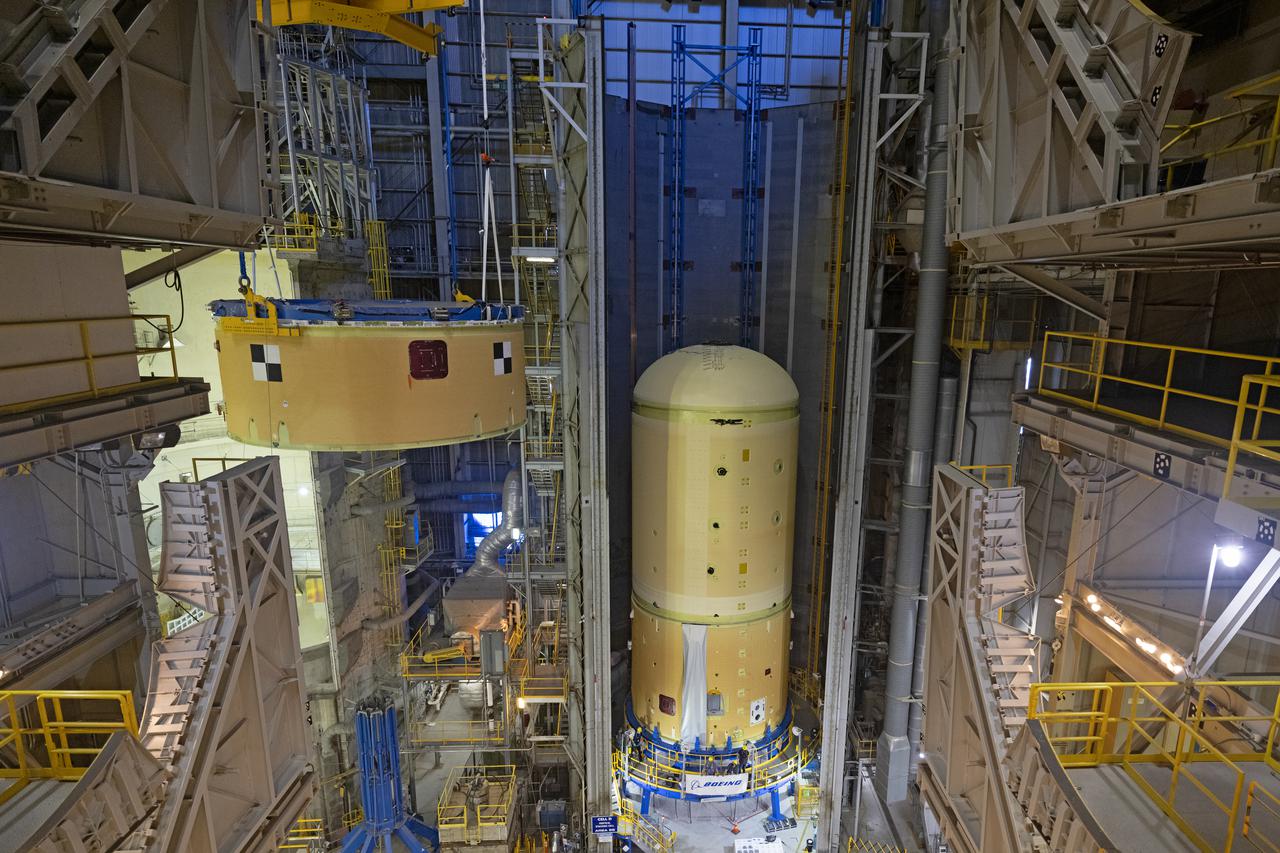
NASA’s Space Launch System (SLS) team fully stacked three hardware elements together May 24 to form the top of the rocket’s core stage for the Artemis II mission. NASA and core stage prime contractor Boeing connected the forward skirt with the liquid oxygen tank and intertank flight hardware inside an assembly area at NASA’s Michoud Assembly Facility in New Orleans. Teams had previously stacked the liquid oxygen tank and intertank on April 28. The joining of the three structures together is the first major assembly of core stage hardware for Artemis II, the first crewed Artemis mission and second flight of the SLS rocket. Next, technicians will work to complete outfitting and integrating the systems within the upper structure. At 66 feet tall, the upper part of the stage is just a fraction of the entire core stage. The fully-assembled, 212-foot-tall rocket stage consists of five hardware elements, including two liquid propellant tanks and four RS-25 engines. The liquid oxygen tank in the upper portion of the stage will hold 196,000 gallons of liquid oxygen cooled to minus 297 degrees Fahrenheit. Meanwhile, the forward skirt and intertank house avionics, flight computer, and electronic systems for the rocket stage. Together, the core stage and its four RS-25 engines will provide more than 2 million pounds of thrust to help send Artemis II astronauts beyond Earth’s orbit to lunar orbit. With Artemis, NASA will land the first woman and the first person of color on the Moon and establish sustainable exploration in preparation for missions to Mars. SLS and NASA’s Orion spacecraft, along with the commercial human landing system and the Gateway in orbit around the Moon, are NASA’s backbone for deep space exploration. SLS is the only rocket that can send Orion, astronauts, and supplies to the Moon in a single mission. Image credit: NASA/Michael DeMocker
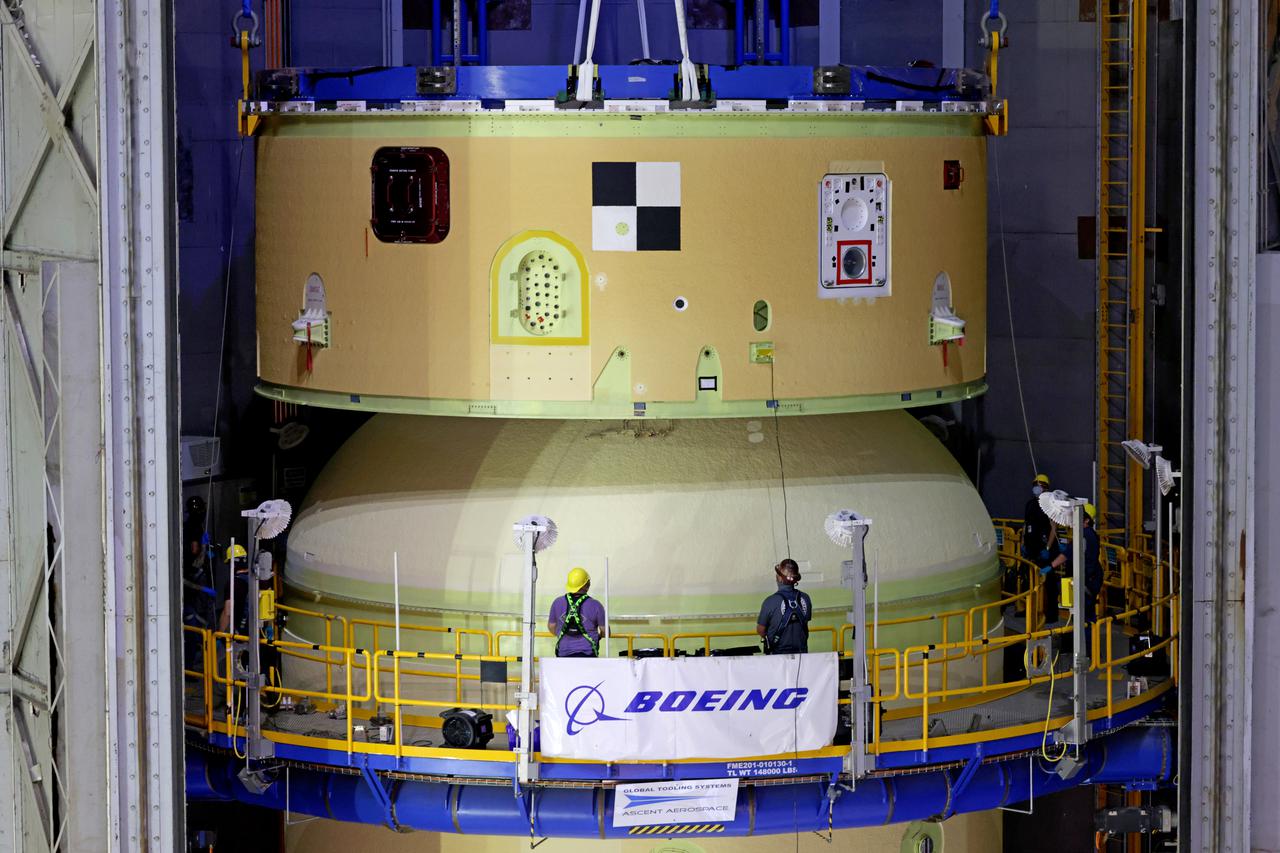
NASA’s Space Launch System (SLS) team fully stacked three hardware elements together May 24 to form the top of the rocket’s core stage for the Artemis II mission. NASA and core stage prime contractor Boeing connected the forward skirt with the liquid oxygen tank and intertank flight hardware inside an assembly area at NASA’s Michoud Assembly Facility in New Orleans. Teams had previously stacked the liquid oxygen tank and intertank on April 28. The joining of the three structures together is the first major assembly of core stage hardware for Artemis II, the first crewed Artemis mission and second flight of the SLS rocket. Next, technicians will work to complete outfitting and integrating the systems within the upper structure. At 66 feet tall, the upper part of the stage is just a fraction of the entire core stage. The fully-assembled, 212-foot-tall rocket stage consists of five hardware elements, including two liquid propellant tanks and four RS-25 engines. The liquid oxygen tank in the upper portion of the stage will hold 196,000 gallons of liquid oxygen cooled to minus 297 degrees Fahrenheit. Meanwhile, the forward skirt and intertank house avionics, flight computer, and electronic systems for the rocket stage. Together, the core stage and its four RS-25 engines will provide more than 2 million pounds of thrust to help send Artemis II astronauts beyond Earth’s orbit to lunar orbit. With Artemis, NASA will land the first woman and the first person of color on the Moon and establish sustainable exploration in preparation for missions to Mars. SLS and NASA’s Orion spacecraft, along with the commercial human landing system and the Gateway in orbit around the Moon, are NASA’s backbone for deep space exploration. SLS is the only rocket that can send Orion, astronauts, and supplies to the Moon in a single mission. Image credit: NASA/Michael DeMocker
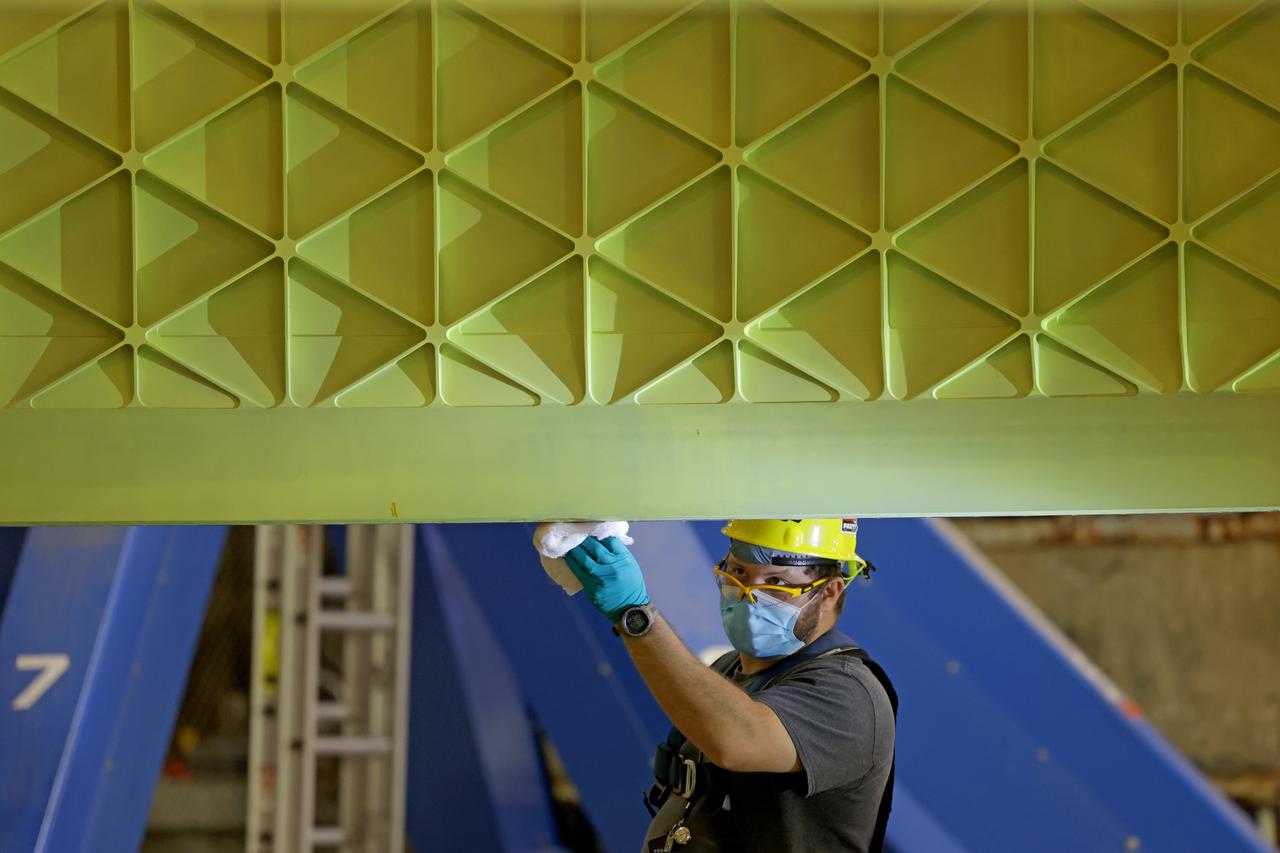
NASA’s Space Launch System (SLS) team fully stacked three hardware elements together May 24 to form the top of the rocket’s core stage for the Artemis II mission. NASA and core stage prime contractor Boeing connected the forward skirt with the liquid oxygen tank and intertank flight hardware inside an assembly area at NASA’s Michoud Assembly Facility in New Orleans. Teams had previously stacked the liquid oxygen tank and intertank on April 28. The joining of the three structures together is the first major assembly of core stage hardware for Artemis II, the first crewed Artemis mission and second flight of the SLS rocket. Next, technicians will work to complete outfitting and integrating the systems within the upper structure. At 66 feet tall, the upper part of the stage is just a fraction of the entire core stage. The fully-assembled, 212-foot-tall rocket stage consists of five hardware elements, including two liquid propellant tanks and four RS-25 engines. The liquid oxygen tank in the upper portion of the stage will hold 196,000 gallons of liquid oxygen cooled to minus 297 degrees Fahrenheit. Meanwhile, the forward skirt and intertank house avionics, flight computer, and electronic systems for the rocket stage. Together, the core stage and its four RS-25 engines will provide more than 2 million pounds of thrust to help send Artemis II astronauts beyond Earth’s orbit to lunar orbit. With Artemis, NASA will land the first woman and the first person of color on the Moon and establish sustainable exploration in preparation for missions to Mars. SLS and NASA’s Orion spacecraft, along with the commercial human landing system and the Gateway in orbit around the Moon, are NASA’s backbone for deep space exploration. SLS is the only rocket that can send Orion, astronauts, and supplies to the Moon in a single mission. Image credit: NASA/Michael DeMocker
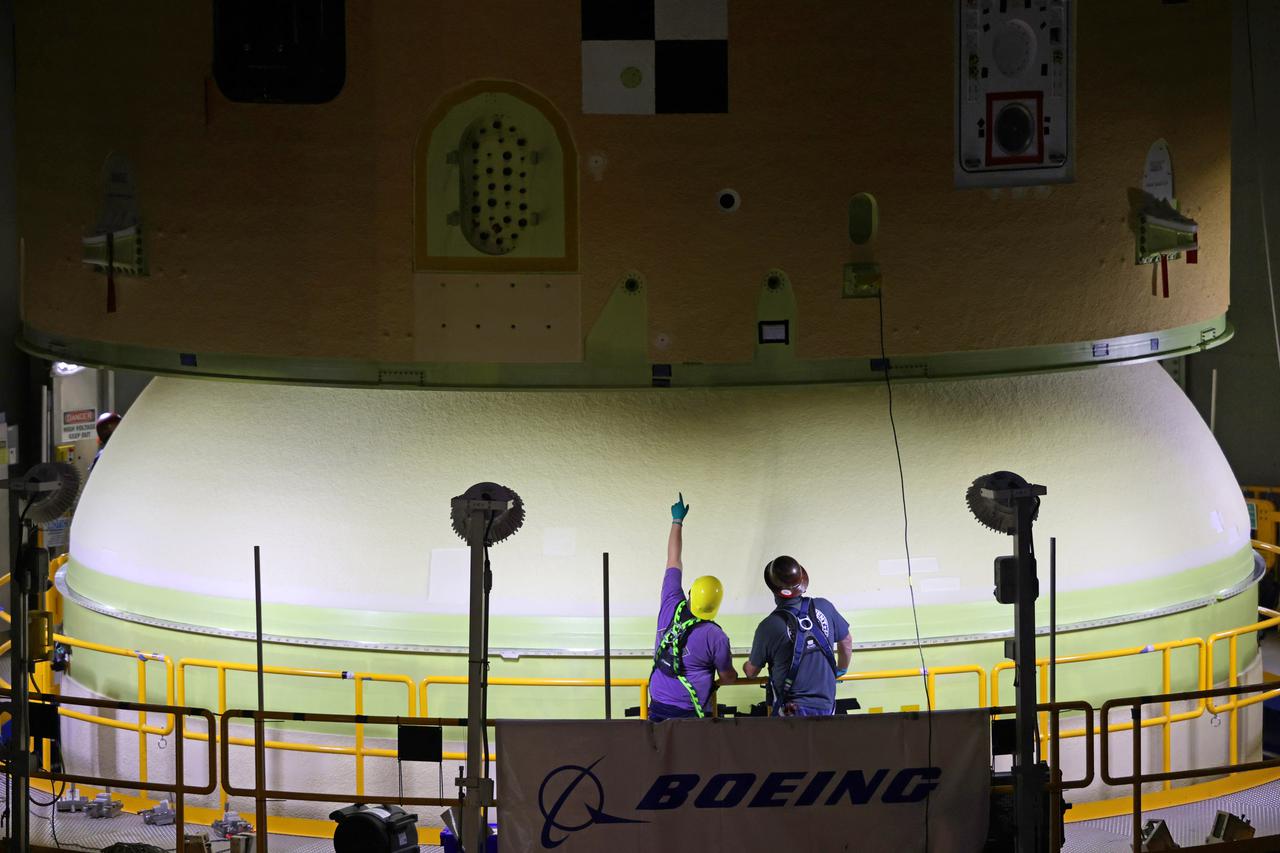
NASA’s Space Launch System (SLS) team fully stacked three hardware elements together May 24 to form the top of the rocket’s core stage for the Artemis II mission. NASA and core stage prime contractor Boeing connected the forward skirt with the liquid oxygen tank and intertank flight hardware inside an assembly area at NASA’s Michoud Assembly Facility in New Orleans. Teams had previously stacked the liquid oxygen tank and intertank on April 28. The joining of the three structures together is the first major assembly of core stage hardware for Artemis II, the first crewed Artemis mission and second flight of the SLS rocket. Next, technicians will work to complete outfitting and integrating the systems within the upper structure. At 66 feet tall, the upper part of the stage is just a fraction of the entire core stage. The fully-assembled, 212-foot-tall rocket stage consists of five hardware elements, including two liquid propellant tanks and four RS-25 engines. The liquid oxygen tank in the upper portion of the stage will hold 196,000 gallons of liquid oxygen cooled to minus 297 degrees Fahrenheit. Meanwhile, the forward skirt and intertank house avionics, flight computer, and electronic systems for the rocket stage. Together, the core stage and its four RS-25 engines will provide more than 2 million pounds of thrust to help send Artemis II astronauts beyond Earth’s orbit to lunar orbit. With Artemis, NASA will land the first woman and the first person of color on the Moon and establish sustainable exploration in preparation for missions to Mars. SLS and NASA’s Orion spacecraft, along with the commercial human landing system and the Gateway in orbit around the Moon, are NASA’s backbone for deep space exploration. SLS is the only rocket that can send Orion, astronauts, and supplies to the Moon in a single mission. Image credit: NASA/Michael DeMocker

NASA’s Space Launch System (SLS) team fully stacked three hardware elements together May 24 to form the top of the rocket’s core stage for the Artemis II mission. NASA and core stage prime contractor Boeing connected the forward skirt with the liquid oxygen tank and intertank flight hardware inside an assembly area at NASA’s Michoud Assembly Facility in New Orleans. Teams had previously stacked the liquid oxygen tank and intertank on April 28. The joining of the three structures together is the first major assembly of core stage hardware for Artemis II, the first crewed Artemis mission and second flight of the SLS rocket. Next, technicians will work to complete outfitting and integrating the systems within the upper structure. At 66 feet tall, the upper part of the stage is just a fraction of the entire core stage. The fully-assembled, 212-foot-tall rocket stage consists of five hardware elements, including two liquid propellant tanks and four RS-25 engines. The liquid oxygen tank in the upper portion of the stage will hold 196,000 gallons of liquid oxygen cooled to minus 297 degrees Fahrenheit. Meanwhile, the forward skirt and intertank house avionics, flight computer, and electronic systems for the rocket stage. Together, the core stage and its four RS-25 engines will provide more than 2 million pounds of thrust to help send Artemis II astronauts beyond Earth’s orbit to lunar orbit. With Artemis, NASA will land the first woman and the first person of color on the Moon and establish sustainable exploration in preparation for missions to Mars. SLS and NASA’s Orion spacecraft, along with the commercial human landing system and the Gateway in orbit around the Moon, are NASA’s backbone for deep space exploration. SLS is the only rocket that can send Orion, astronauts, and supplies to the Moon in a single mission. Image credit: NASA/Eric Bordelon

NASA’s Space Launch System (SLS) team fully stacked three hardware elements together May 24 to form the top of the rocket’s core stage for the Artemis II mission. NASA and core stage prime contractor Boeing connected the forward skirt with the liquid oxygen tank and intertank flight hardware inside an assembly area at NASA’s Michoud Assembly Facility in New Orleans. Teams had previously stacked the liquid oxygen tank and intertank on April 28. The joining of the three structures together is the first major assembly of core stage hardware for Artemis II, the first crewed Artemis mission and second flight of the SLS rocket. Next, technicians will work to complete outfitting and integrating the systems within the upper structure. At 66 feet tall, the upper part of the stage is just a fraction of the entire core stage. The fully-assembled, 212-foot-tall rocket stage consists of five hardware elements, including two liquid propellant tanks and four RS-25 engines. The liquid oxygen tank in the upper portion of the stage will hold 196,000 gallons of liquid oxygen cooled to minus 297 degrees Fahrenheit. Meanwhile, the forward skirt and intertank house avionics, flight computer, and electronic systems for the rocket stage. Together, the core stage and its four RS-25 engines will provide more than 2 million pounds of thrust to help send Artemis II astronauts beyond Earth’s orbit to lunar orbit. With Artemis, NASA will land the first woman and the first person of color on the Moon and establish sustainable exploration in preparation for missions to Mars. SLS and NASA’s Orion spacecraft, along with the commercial human landing system and the Gateway in orbit around the Moon, are NASA’s backbone for deep space exploration. SLS is the only rocket that can send Orion, astronauts, and supplies to the Moon in a single mission. Image credit: NASA/Michael DeMocker
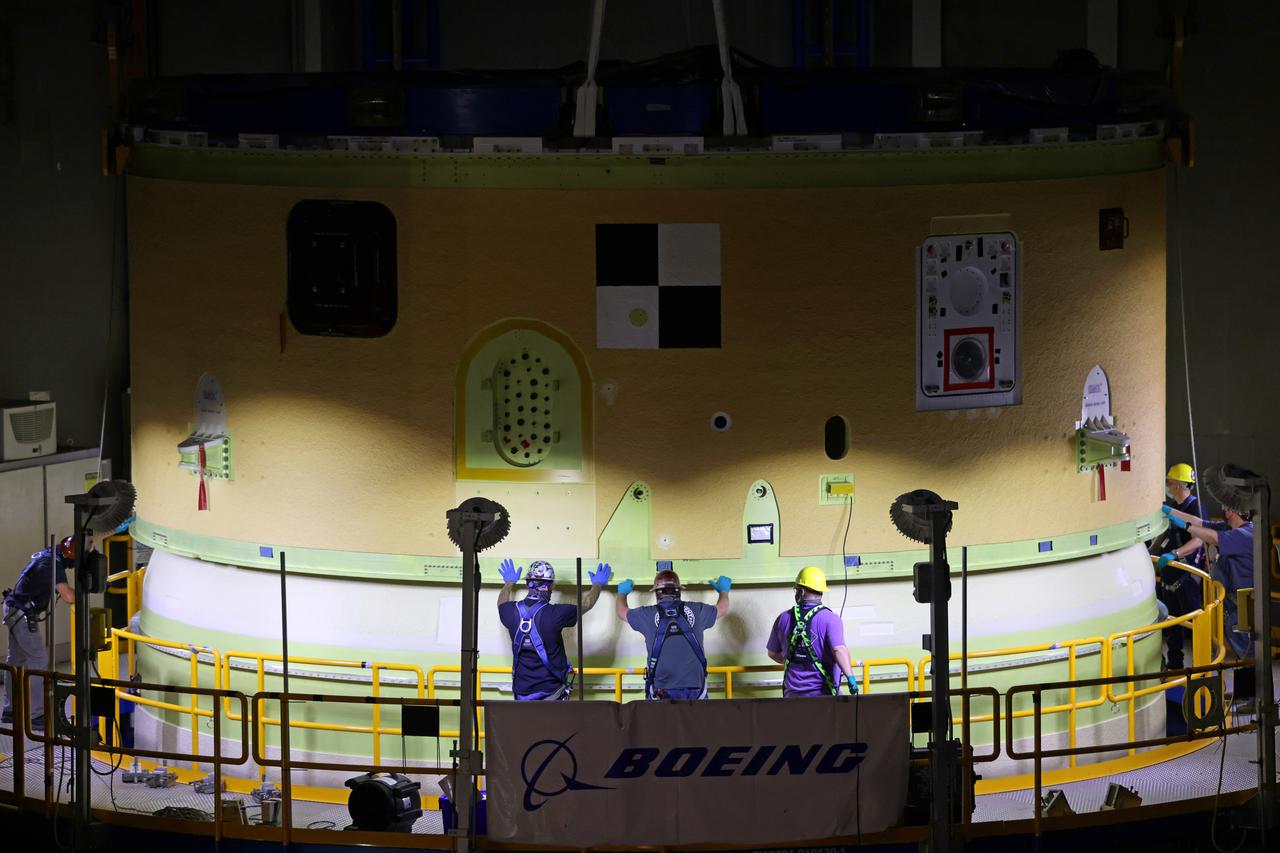
NASA’s Space Launch System (SLS) team fully stacked three hardware elements together May 24 to form the top of the rocket’s core stage for the Artemis II mission. NASA and core stage prime contractor Boeing connected the forward skirt with the liquid oxygen tank and intertank flight hardware inside an assembly area at NASA’s Michoud Assembly Facility in New Orleans. Teams had previously stacked the liquid oxygen tank and intertank on April 28. The joining of the three structures together is the first major assembly of core stage hardware for Artemis II, the first crewed Artemis mission and second flight of the SLS rocket. Next, technicians will work to complete outfitting and integrating the systems within the upper structure. At 66 feet tall, the upper part of the stage is just a fraction of the entire core stage. The fully-assembled, 212-foot-tall rocket stage consists of five hardware elements, including two liquid propellant tanks and four RS-25 engines. The liquid oxygen tank in the upper portion of the stage will hold 196,000 gallons of liquid oxygen cooled to minus 297 degrees Fahrenheit. Meanwhile, the forward skirt and intertank house avionics, flight computer, and electronic systems for the rocket stage. Together, the core stage and its four RS-25 engines will provide more than 2 million pounds of thrust to help send Artemis II astronauts beyond Earth’s orbit to lunar orbit. With Artemis, NASA will land the first woman and the first person of color on the Moon and establish sustainable exploration in preparation for missions to Mars. SLS and NASA’s Orion spacecraft, along with the commercial human landing system and the Gateway in orbit around the Moon, are NASA’s backbone for deep space exploration. SLS is the only rocket that can send Orion, astronauts, and supplies to the Moon in a single mission. Image credit: NASA/Michael DeMocker
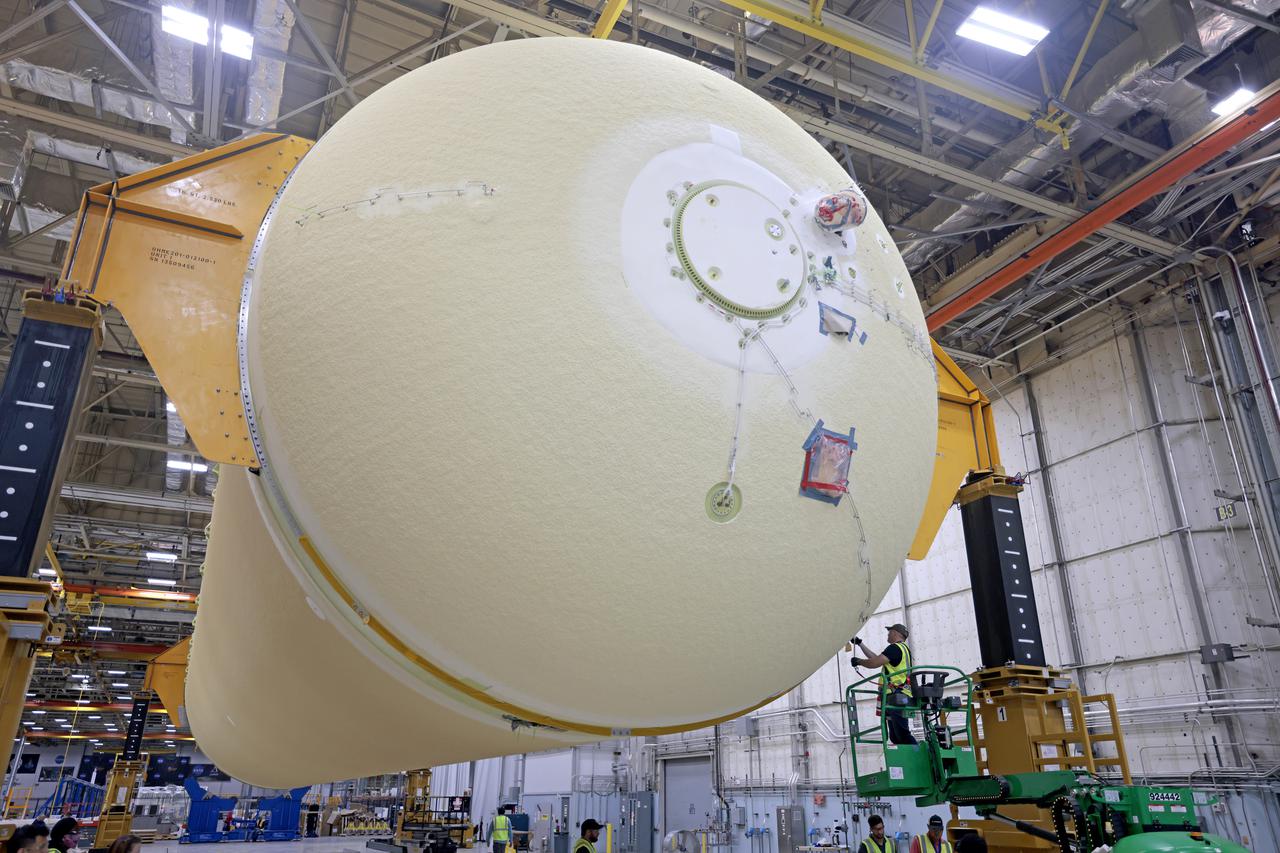
NASA is preparing major pieces of the Space Launch System rocket’s core stage to be joined as part of assembling the core stage for the Artemis II mission that will send crews to lunar orbit. Crews will soon connect the forward assembly with the 130-foot liquid hydrogen tank in the final assembly area at NASA’s Michoud Assembly Facility in New Orleans. When this process is completed, four of the five large structures that make up the core stage will be joined. The 66-foot forward assembly consists of the forward skirt, liquid oxygen tank and the intertank, which were mated earlier. This forward assembly will be joined with the 130-foot liquid hydrogen tank, the largest part of the stage that holds more than 500,000 gallons of cryogenic propellant. To compete the Artemis II core stage, engineers will add the engine section, which is currently being outfitted and includes the main propulsion systems that connect to the four RS-25 engines, Together, with the SLS twin solid rocket boosters, the core stage will produce 8.8 million pounds of thrust to send NASA’s Orion spacecraft, astronauts, and supplies beyond Earth’s orbit to the Moon. The SLS rocket and the Orion spacecraft form the foundation for deep space exploration and the Artemis lunar program. For more on the core stage: https://www.nasa.gov/exploration/systems/sls/multimedia/infographics/corestage101.html Image credit: NASA/Michael DeMocker
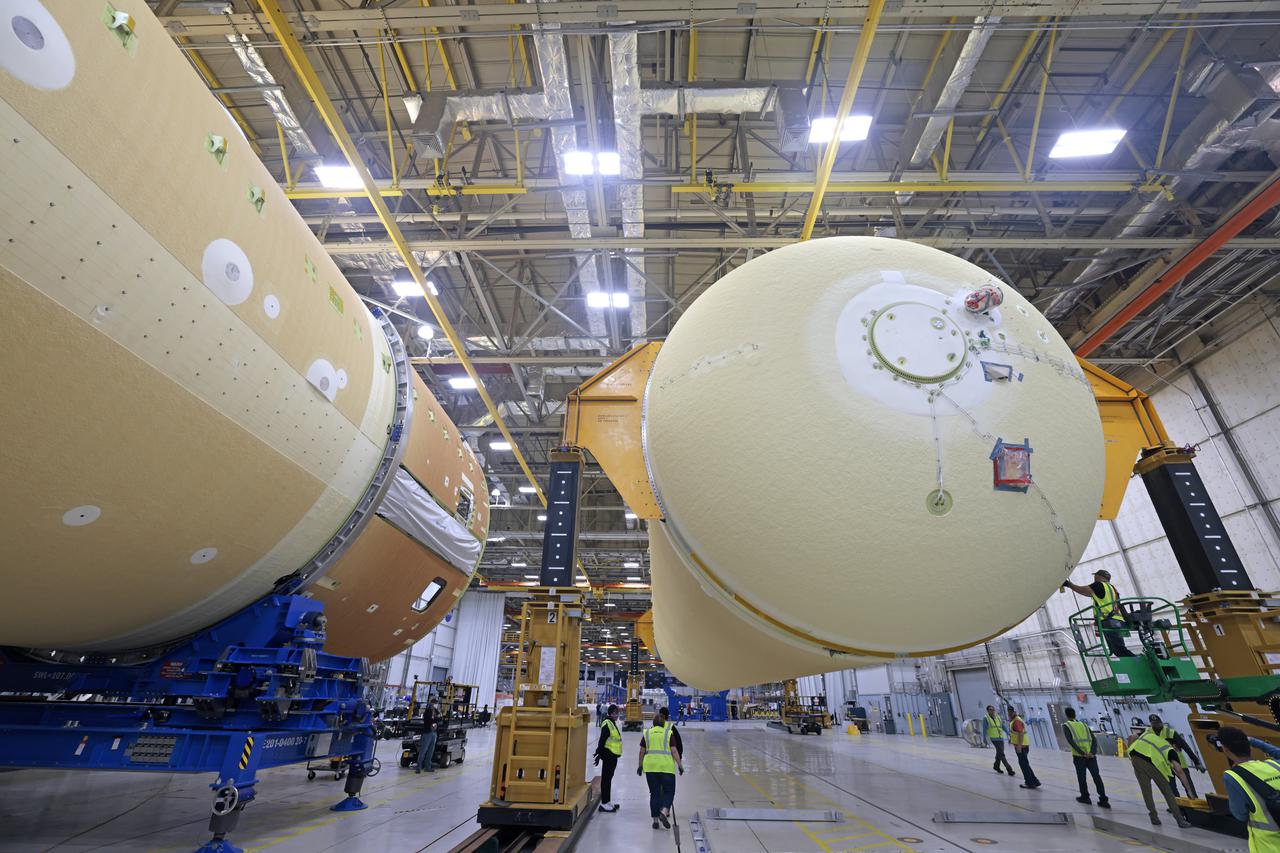
NASA is preparing major pieces of the Space Launch System rocket’s core stage to be joined as part of assembling the core stage for the Artemis II mission that will send crews to lunar orbit. Crews will soon connect the forward assembly with the 130-foot liquid hydrogen tank in the final assembly area at NASA’s Michoud Assembly Facility in New Orleans. When this process is completed, four of the five large structures that make up the core stage will be joined. The 66-foot forward assembly consists of the forward skirt, liquid oxygen tank and the intertank, which were mated earlier. This forward assembly will be joined with the 130-foot liquid hydrogen tank, the largest part of the stage that holds more than 500,000 gallons of cryogenic propellant. To compete the Artemis II core stage, engineers will add the engine section, which is currently being outfitted and includes the main propulsion systems that connect to the four RS-25 engines, Together, with the SLS twin solid rocket boosters, the core stage will produce 8.8 million pounds of thrust to send NASA’s Orion spacecraft, astronauts, and supplies beyond Earth’s orbit to the Moon. The SLS rocket and the Orion spacecraft form the foundation for deep space exploration and the Artemis lunar program. For more on the core stage: https://www.nasa.gov/exploration/systems/sls/multimedia/infographics/corestage101.html Image credit: NASA/Michael DeMocker
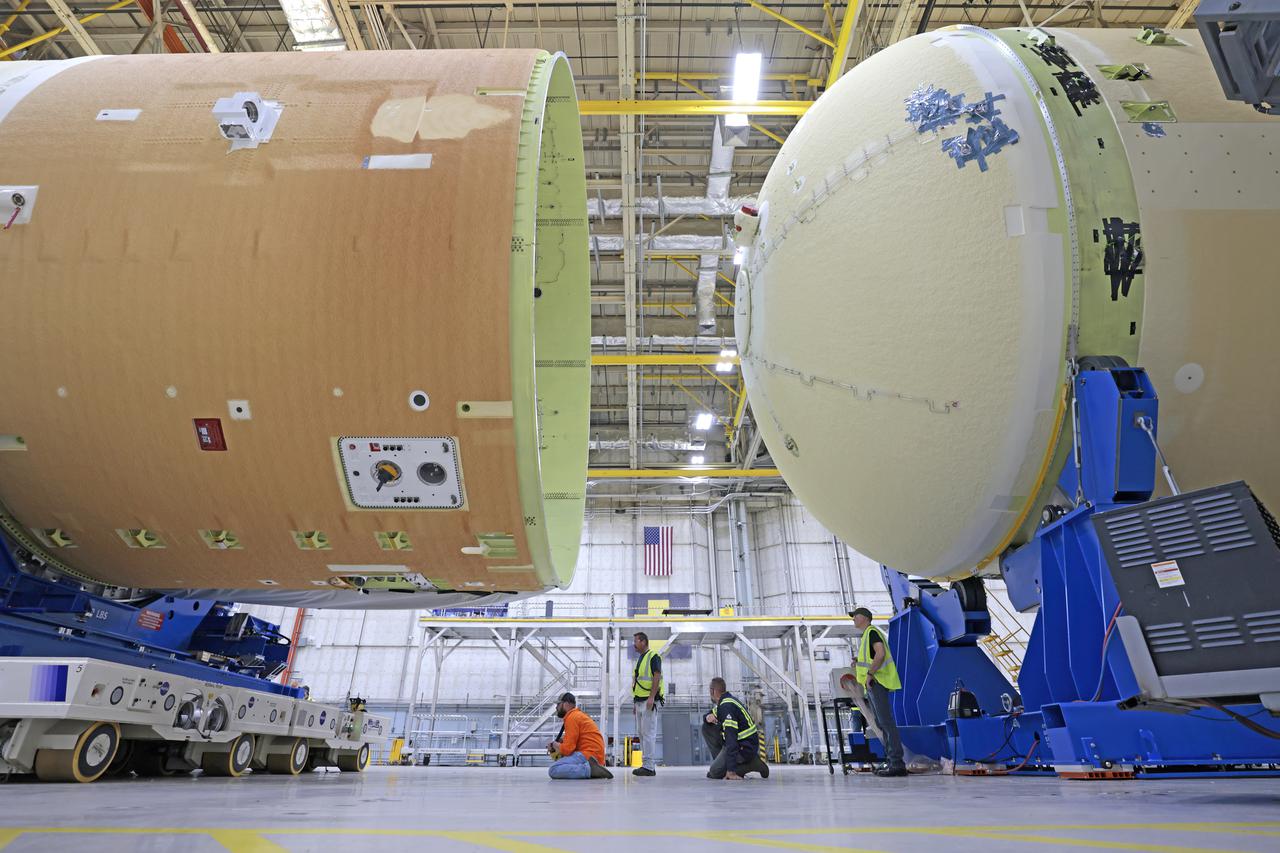
NASA is preparing major pieces of the Space Launch System rocket’s core stage to be joined as part of assembling the core stage for the Artemis II mission that will send crews to lunar orbit. Crews will soon connect the forward assembly with the 130-foot liquid hydrogen tank in the final assembly area at NASA’s Michoud Assembly Facility in New Orleans. When this process is completed, four of the five large structures that make up the core stage will be joined. The 66-foot forward assembly consists of the forward skirt, liquid oxygen tank and the intertank, which were mated earlier. This forward assembly will be joined with the 130-foot liquid hydrogen tank, the largest part of the stage that holds more than 500,000 gallons of cryogenic propellant. To compete the Artemis II core stage, engineers will add the engine section, which is currently being outfitted and includes the main propulsion systems that connect to the four RS-25 engines, Together, with the SLS twin solid rocket boosters, the core stage will produce 8.8 million pounds of thrust to send NASA’s Orion spacecraft, astronauts, and supplies beyond Earth’s orbit to the Moon. The SLS rocket and the Orion spacecraft form the foundation for deep space exploration and the Artemis lunar program. For more on the core stage: https://www.nasa.gov/exploration/systems/sls/multimedia/infographics/corestage101.html Image credit: NASA/Michael DeMocker