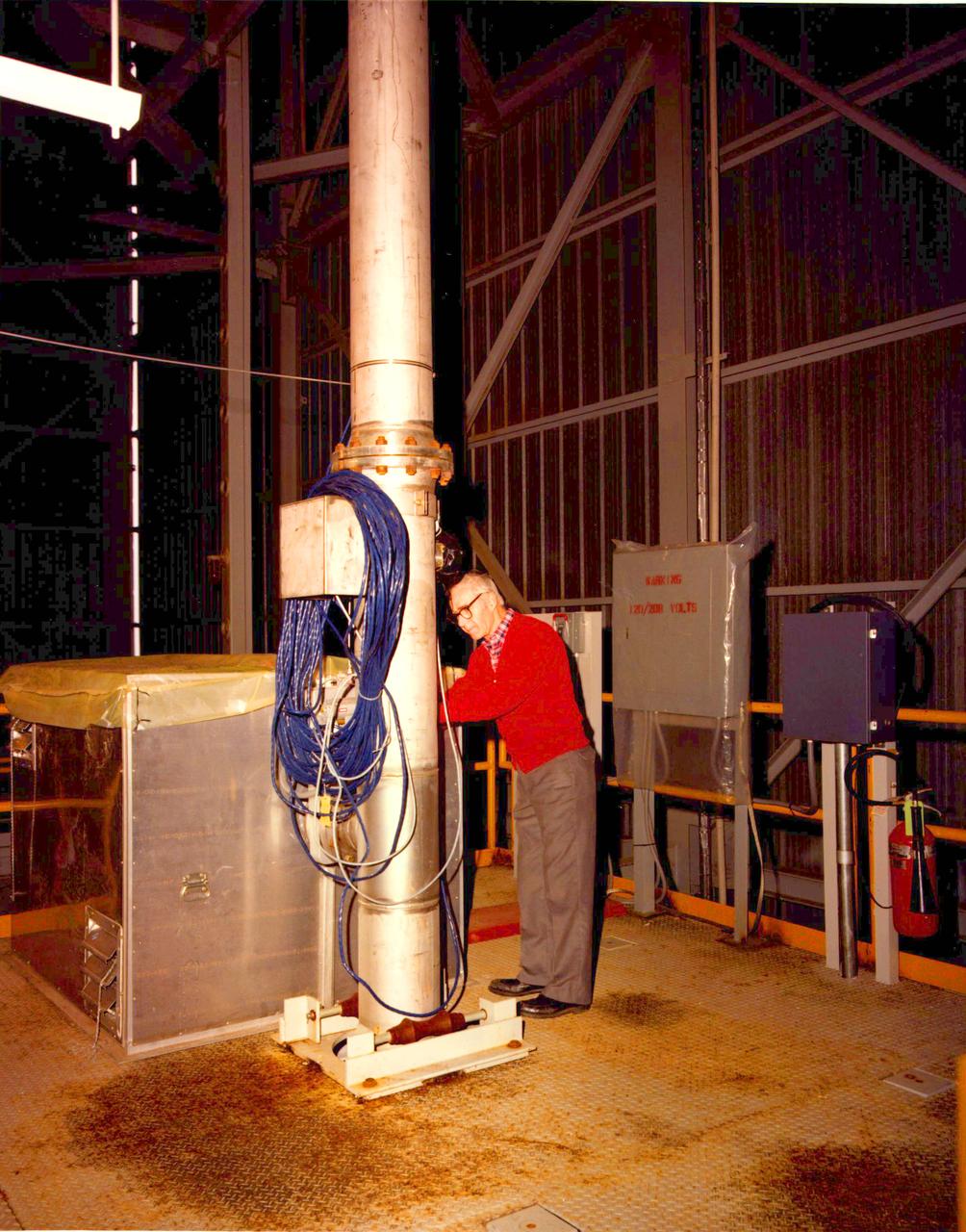
A Drop Tube is a long vertical shaft used for dropping experiment packages, enabling them to achieve microgravity through freefall.
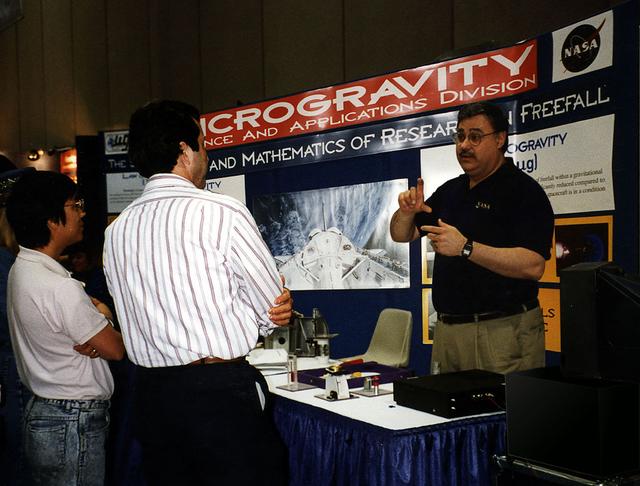
Dr. Michael Wargo, program scientist for materials science at NASA headquarters, explains the math and physics principles associated with freefall research to attendees at the arnual conference of the National Council of Teachers of Mathematics.
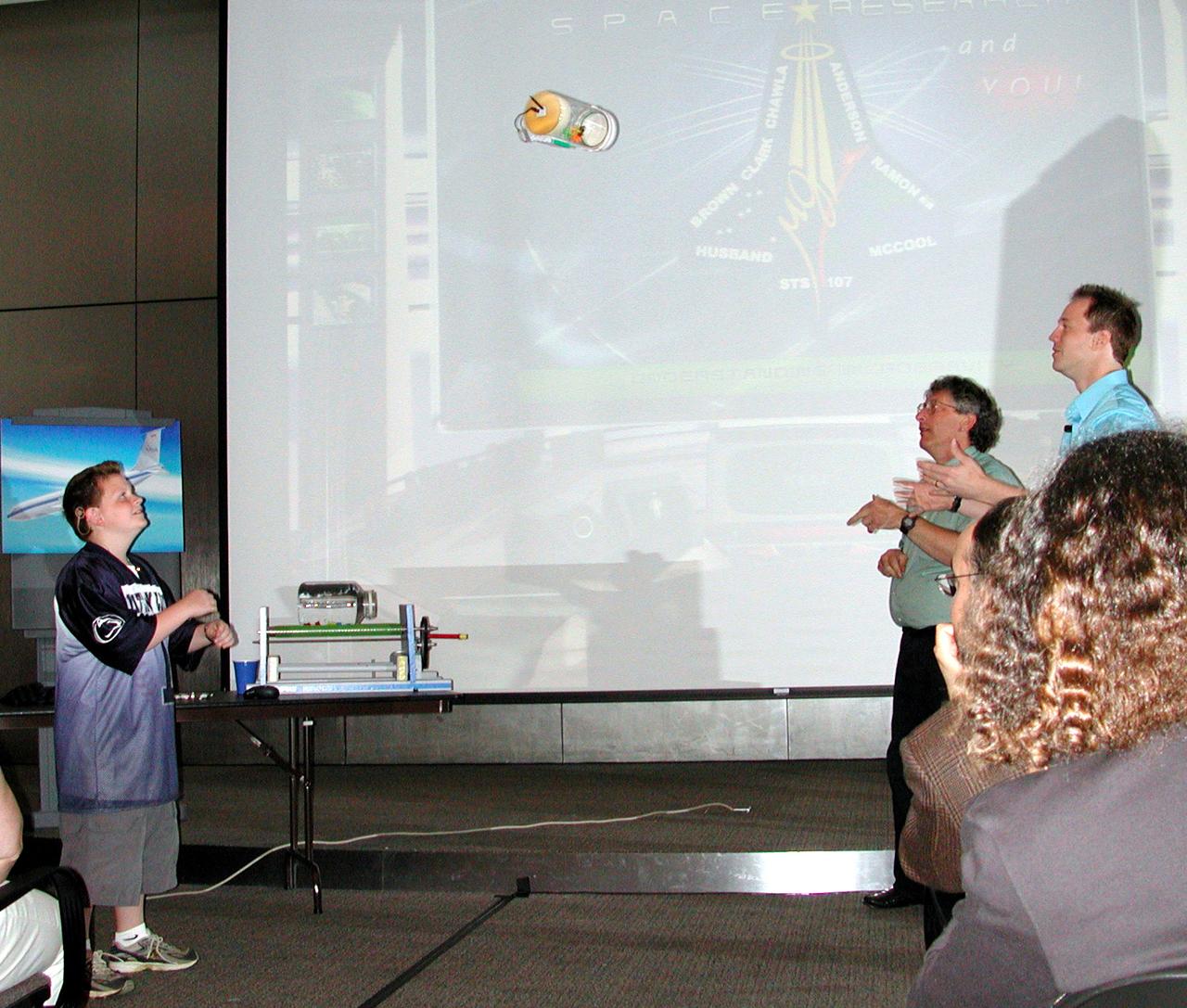
A student gets ready to catch a plastic tube carrying a small fluid bottle and a wireless video camera. As it arced through the air, the container was in free-fall -- just like astronauts in space -- and the TV camera broadcast images of how the fluid behaved. The activity was part of the Space Research and You education event held by NASA's Office of Biological and Physical Research on June 25, 2002, in Arlington, VA, to highlight the research that will be conducted on STS-107. (Digital camera image; no film original.
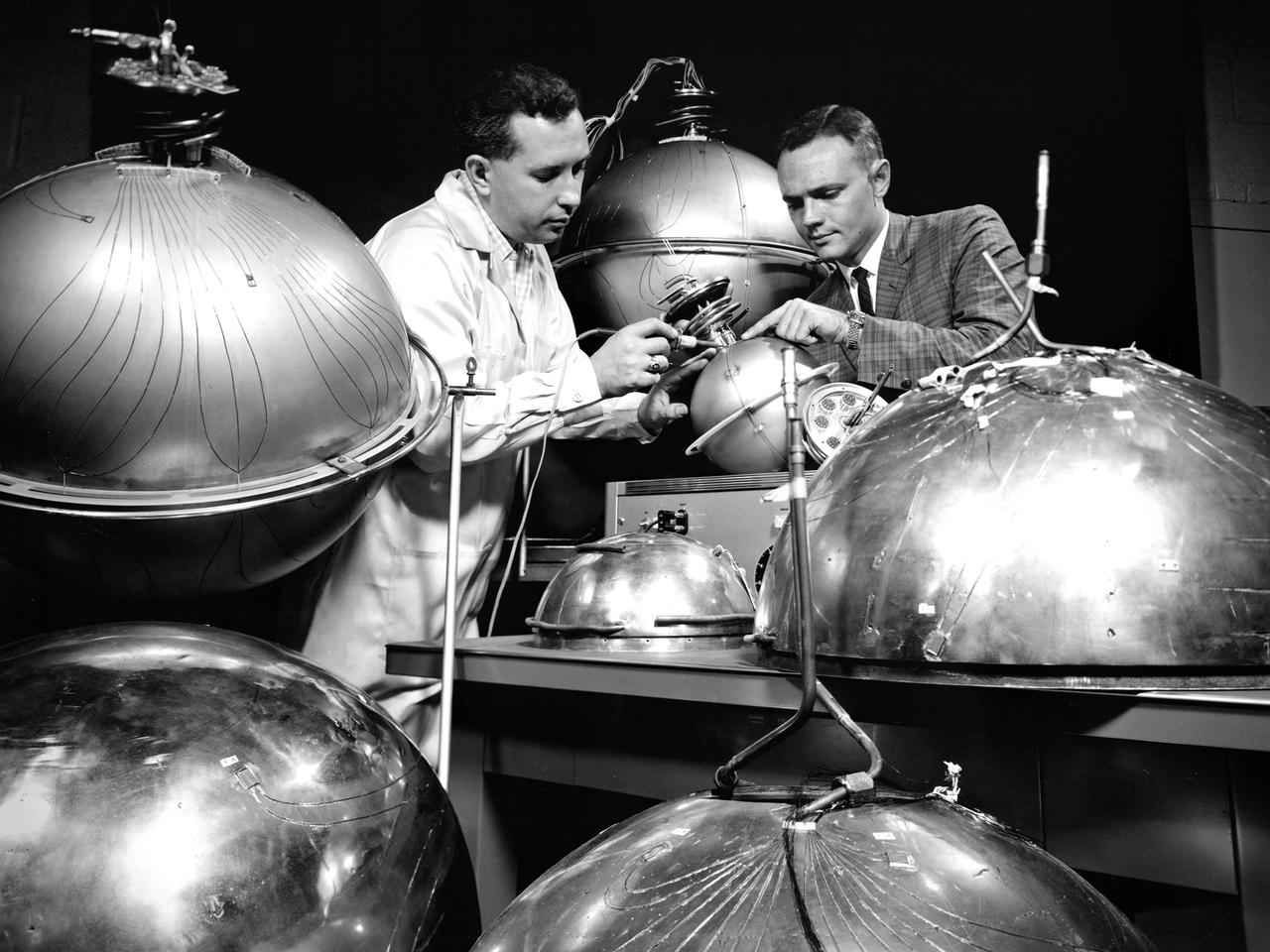
An engineer and technician at the National Aeronautics and Space Administration (NASA) Lewis Research Center install the instrumentation on spherical fuel tanks for an investigation of the behavior of liquids in microgravity. Lewis researchers were undertaking a broad effort to study the heat transfer properties of high energy propellants such as liquid hydrogen in microgravity. In the center’s 2.2-Second Drop Tower they investigated the wetting characteristics of liquid and the liquid-vapor configurations, and predicted the equilibrium state in microgravity conditions. Lewis was also conducting a series microgravity investigations which launched 9-inch diameter spherical dewars, seen here, on an Aerobee sounding rocket. A camera inside the rocket filmed the liquid hydrogen’s behavior during its 4 to 7 minutes of freefall. The researchers concluded, however, that they needed to extend the weightlessness period to obtain better results. So they designed an experiment to be launched on an Atlas missile that would provide 21 minutes of weightlessness. The experiment was flight qualified at Lewis. The 36-percent full liquid hydrogen stainless steel dewar was launched on the Atlas on February 25, 1964. The instrumentation measured temperature, pressure, vacuum, and liquid level. Temperature instrumentation indicated wall drying during the freefall. The resultant pressure-rise characteristics were similar to those used for the normal-gravity test.
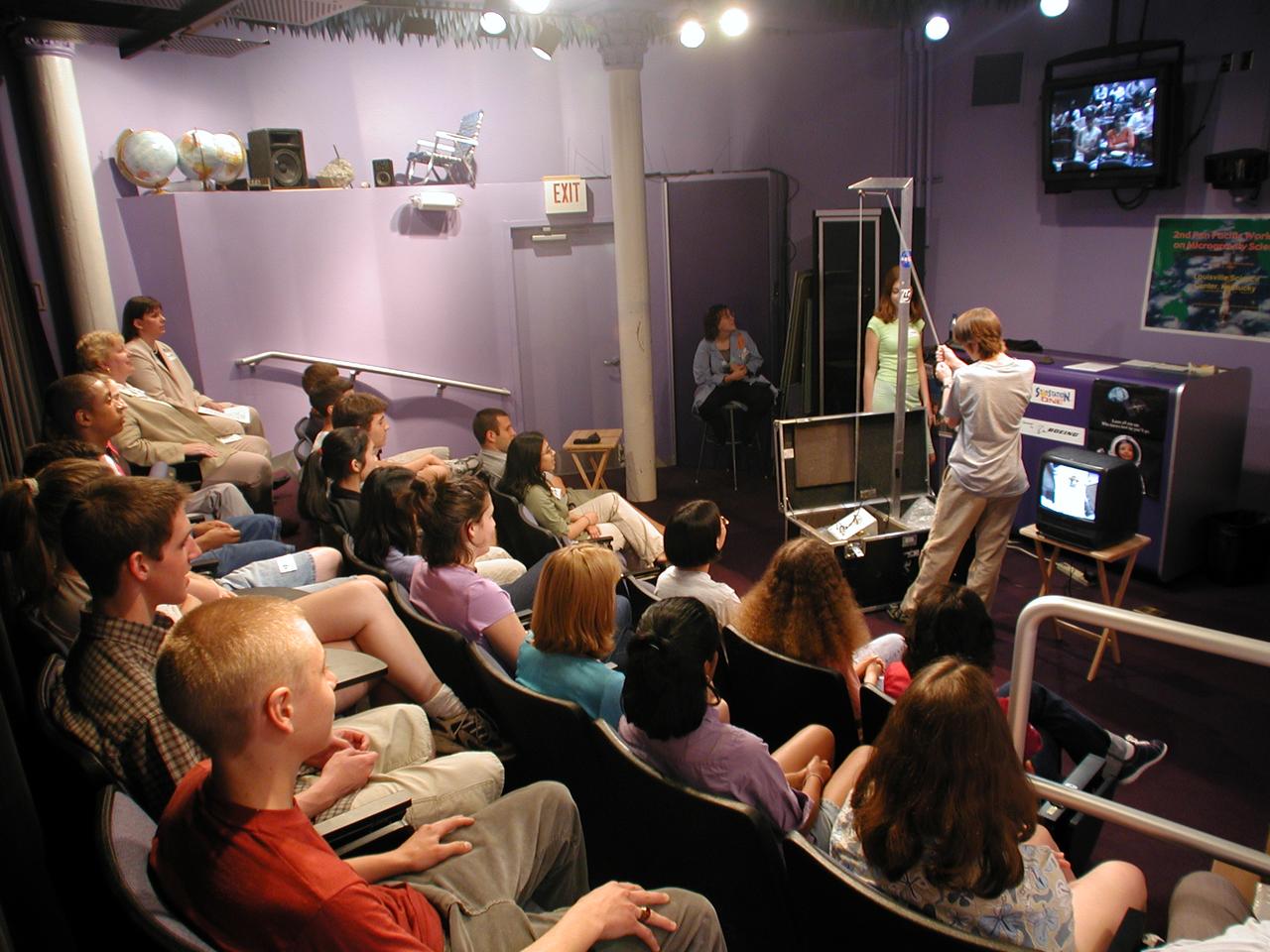
John Henson (grade 12) and Suzi Bryce (grade 10) from DuPont Manual High School in Louisville, Kentucky, conduct a drop with NASA's Microgravity Demonstrator. A camera and a TV/VCR unit let students play back recordings of how different physical devices behave differently during freefall as compared to 1-g. The activity was part of the education outreach segment of the Pan-Pacific Basin Workshop on Microgravity Sciences held in Pasadena, California. The event originated at the California Science Center in Los Angeles. The DuPont Manual students patched in to the event through the distance learning lab at the Louisville Science Center. This image is from a digital still camera; higher resolution is not available.
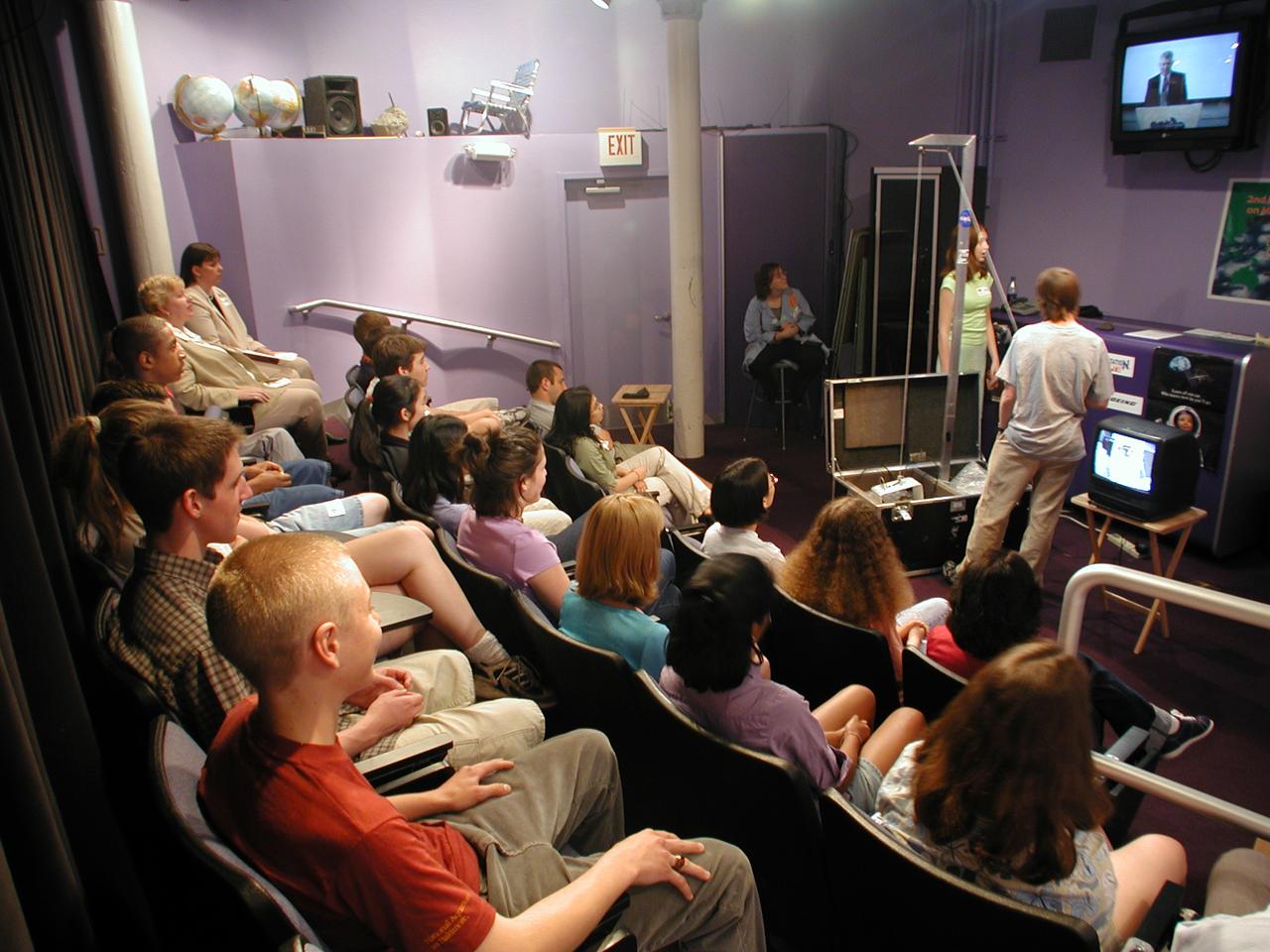
John Henson (grade 12) and Suzi Bryce (grade 10) conducted the drop from DuPont Manual High School in Louisville, Kentucky, conduct a drop with NASA's Microgravity Demonstrator. A camera and a TV/VCR unit let students play back recordings of how different physical devices behave differently during freefall as compared to 1-g. The activity was part of the education outreach segment of the Pan-Pacific Basin Workshop on Microgravity Sciences held in Pasadena, California. The event originated at the California Science Center in Los Angeles. The DuPont Manual students patched in to the event through the distance learning lab at the Louisville Science Center. This image is from a digital still camera; higher resolution is not available.

A researcher fills a small container used to represent a liquid hydrogen tank in preparation for a microgravity test in the 2.2-Second Drop Tower at the National Aeronautics and Space Administration (NASA) Lewis Research Center. For over a decade, NASA Lewis endeavored to make liquid hydrogen a viable propellant. Hydrogen’s light weight and high energy made it very appealing for rocket propulsion. One of the unknowns at the time was the behavior of fluids in the microgravity of space. Rocket designers needed to know where the propellant would be inside the fuel tank in order to pump it to the engine. NASA Lewis utilized sounding rockets, research aircraft, and the 2.2 Second Drop Tower to study liquids in microgravity. The drop tower, originally built as a fuel distillation tower in 1948, descended into a steep ravine. By early 1961 the facility was converted into an eight-floor, 100-foot tower connected to a shop and laboratory space. Small glass tanks, like this one, were installed in experiment carts with cameras to film the liquid’s behavior during freefall. Thousands of drop tower tests in the early 1960s provided an increased understanding of low-gravity processes and phenomena. The tower only afforded a relatively short experiment time but was sufficient enough that the research could be expanded upon using longer duration freefalls on sounding rockets or aircraft. The results of the early experimental fluid studies verified predictions made by Lewis researchers that the total surface energy would be minimized in microgravity.
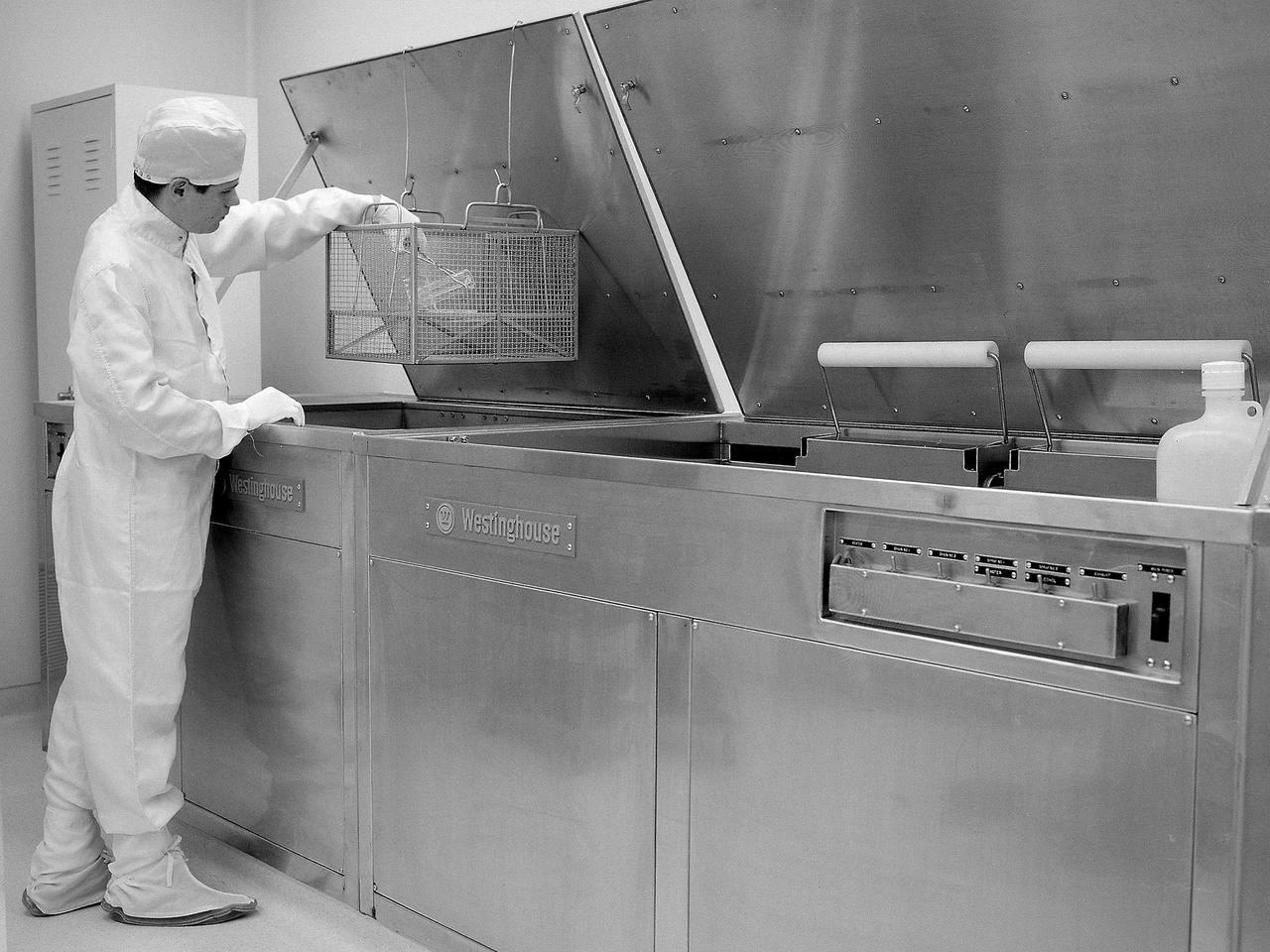
A technician prepares a test sample in the Zero Gravity Research Facility clean room at the National Aeronautics and Space Administration (NASA) Lewis Research Center. The Zero Gravity Research Facility contained a drop tower which provided five seconds of microgravity during freefall in its 450-foot deep vacuum chamber. The facility has been used for a variety of studies relating to the behavior of fluids and flames in microgravity. During normal operations, a cylindrical 3-foot diameter and 11-foot long vehicle was used to house the experiments, instrumentation, and high speed cameras. The 4.5-foot long and 1.5-foot wide rectangular vehicle, seen in this photograph, was used less frequently. A 3-foot diameter orb was used for the special ten-second drops in which the package was pneumatically shot to the top of the tower then dropped. The facility also contained a control room, shop offices, tool and equipment rooms, and this clean room. The 242.5-foot long and 19.5-foot wide clean room was equipped with specialized cleaning equipment. In the 1960s the room was rated as a class 10,000 clean room, but I was capable of meeting the class 100 requirements. The room included a fume hood, ultrasonic cleaner, and a laminar flow station which operated as a class 100 environment. The environment in the clean room was maintained at 71° F and a relative humidity of 45- percent.