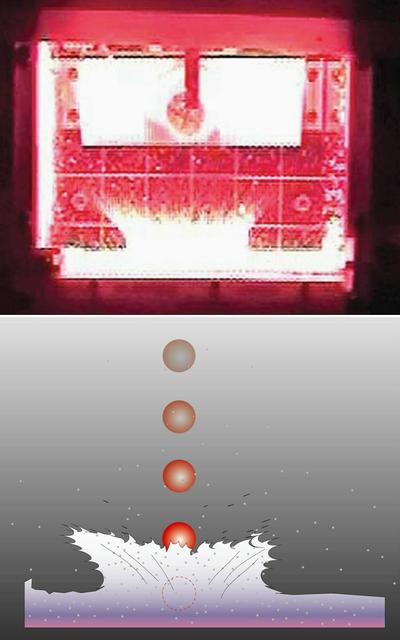
Clues to the formation of planets and planetary rings -- like Saturn's dazzling ring system -- may be found by studying how dust grains interact as they collide at low speeds. To study the question of low-speed dust collisions, NASA sponsored the COLLisions Into Dust Experiment (COLLIDE) at the University of Colorado. It was designed to spring-launch marble-size projectiles into trays of powder similar to space or lunar dust. COLLIDE-1 (1998) discovered that collisions below a certain energy threshold eject no material. COLLIDE-2 was designed to identify where the threshold is. In COLLIDE-2, scientists nudged small projectiles into dust beds and recorded how the dust splashed outward (video frame at top; artist's rendering at bottom). The slowest impactor ejected no material and stuck in the target. The faster impactors produced ejecta; some rebounded while others stuck in the target.
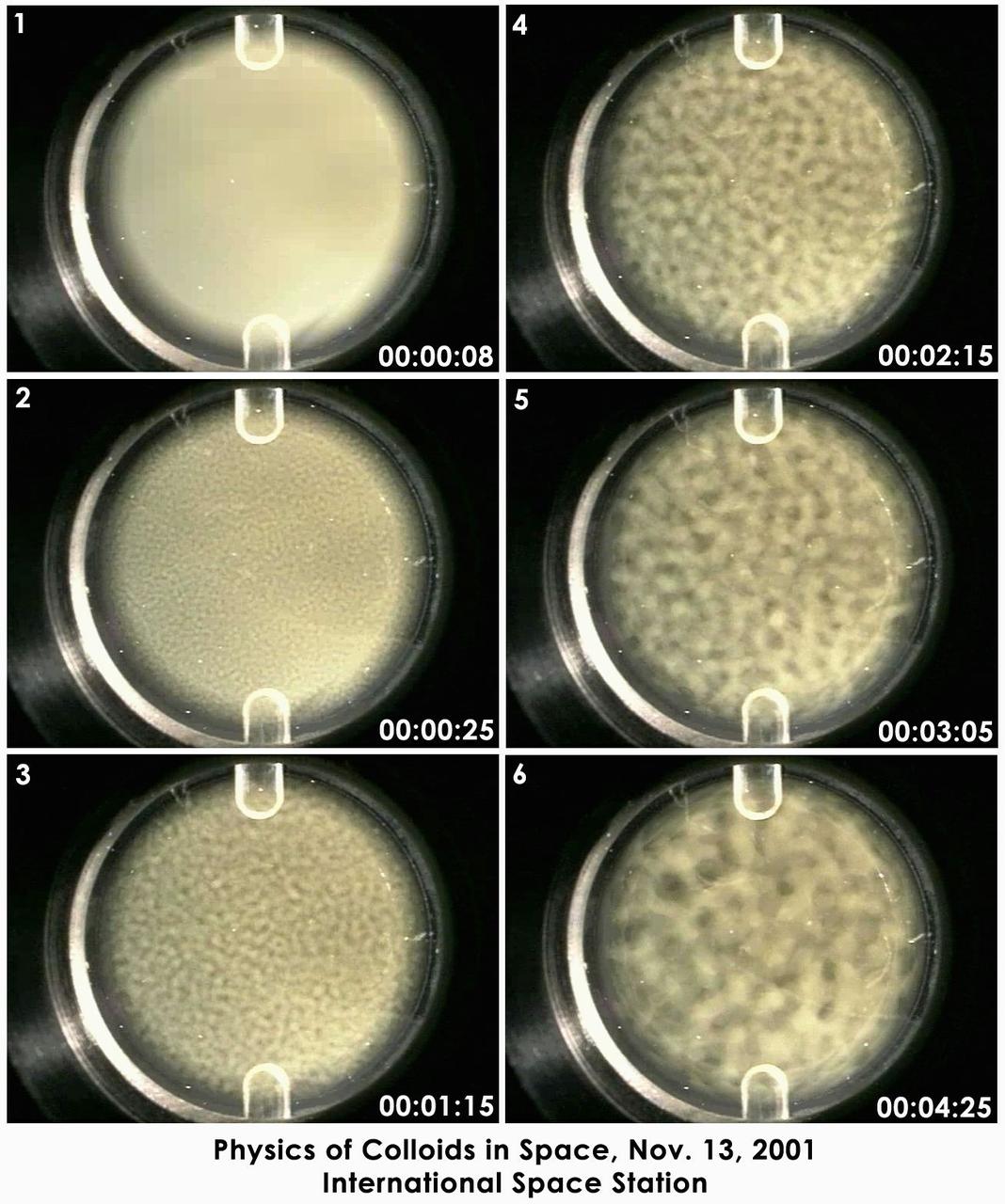
Still photographs taken over 16 hours on Nov. 13, 2001, on the International Space Station have been condensed into a few seconds to show the de-mixing -- or phase separation -- process studied by the Experiment on Physics of Colloids in Space. Commanded from the ground, dozens of similar tests have been conducted since the experiment arrived on ISS in 2000. The sample is a mix of polymethylmethacrylate (PMMA or acrylic) colloids, polystyrene polymers and solvents. The circular area is 2 cm (0.8 in.) in diameter. The phase separation process occurs spontaneously after the sample is mechanically mixed. The evolving lighter regions are rich in colloid and have the structure of a liquid. The dark regions are poor in colloids and have the structure of a gas. This behavior carnot be observed on Earth because gravity causes the particles to fall out of solution faster than the phase separation can occur. While similar to a gas-liquid phase transition, the growth rate observed in this test is different from any atomic gas-liquid or liquid-liquid phase transition ever measured experimentally. Ultimately, the sample separates into colloid-poor and colloid-rich areas, just as oil and vinegar separate. The fundamental science of de-mixing in this colloid-polymer sample is the same found in the annealing of metal alloys and plastic polymer blends. Improving the understanding of this process may lead to improving processing of these materials on Earth.

This image depicts the formation of multiple whirlpools in a sodium gas cloud. Scientists who cooled the cloud and made it spin created the whirlpools in a Massachusetts Institute of Technology laboratory, as part of NASA-funded research. This process is similar to a phenomenon called starquakes that appear as glitches in the rotation of pulsars in space. MIT's Wolgang Ketterle and his colleagues, who conducted the research under a grant from the Biological and Physical Research Program through NASA's Jet Propulsion Laboratory, Pasadena, Calif., cooled the sodium gas to less than one millionth of a degree above absolute zero (-273 Celsius or -460 Fahrenheit). At such extreme cold, the gas cloud converts to a peculiar form of matter called Bose-Einstein condensate, as predicted by Albert Einstein and Satyendra Bose of India in 1927. No physical container can hold such ultra-cold matter, so Ketterle's team used magnets to keep the cloud in place. They then used a laser beam to make the gas cloud spin, a process Ketterle compares to stroking a ping-pong ball with a feather until it starts spirning. The spinning sodium gas cloud, whose volume was one- millionth of a cubic centimeter, much smaller than a raindrop, developed a regular pattern of more than 100 whirlpools.
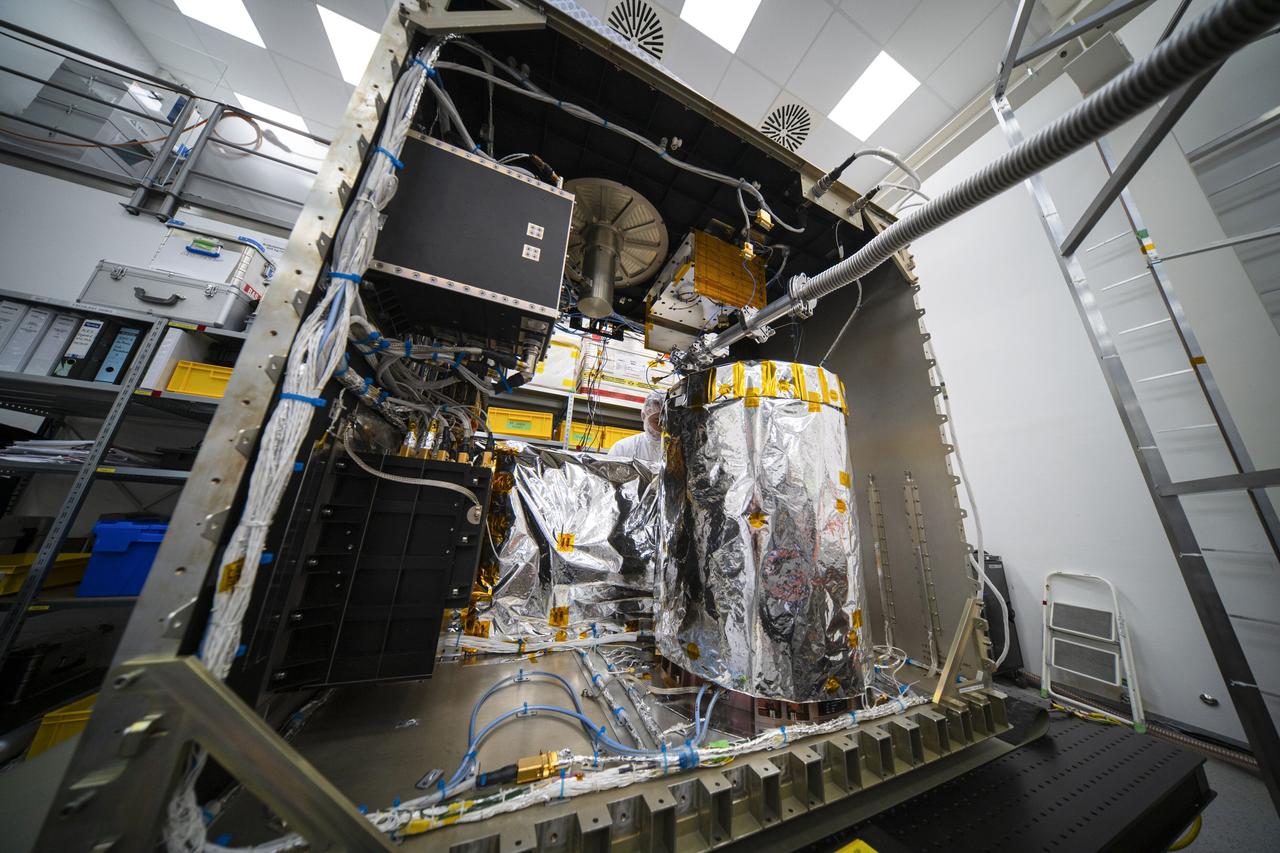
jsc2025e015680 (3/6/2025) --- The closure of the instrument panel of the Atomic Clock Ensemble in Space (ACES) has taken place at Airbus Friedrichshafen, Germany. ACES is an ESA instrument that tests fundamental physics, such as Einstein’s theory of general relativity, from the International Space Station. According to this theory, gravity affects the passing of time—time flies faster at the top of Mount Everest than at sea level. This effect has been proven in experiments on Earth, and ACES will make more precise measurements of this phenomenon and other fundamental physics such as the standard model of particle physics, as it flies 400 km high on the space station. ACES contains two clocks: PHARAO, a caesium atomic clock developed by the French Space Agency CNES, and the Space Hydrogen Maser developed by Spectratime, which uses hydrogen atoms as a frequency reference. The payload will be externally mounted to ESA’s Columbus laboratory on the space station. Image courtesy of S. Corvaja (ESA).
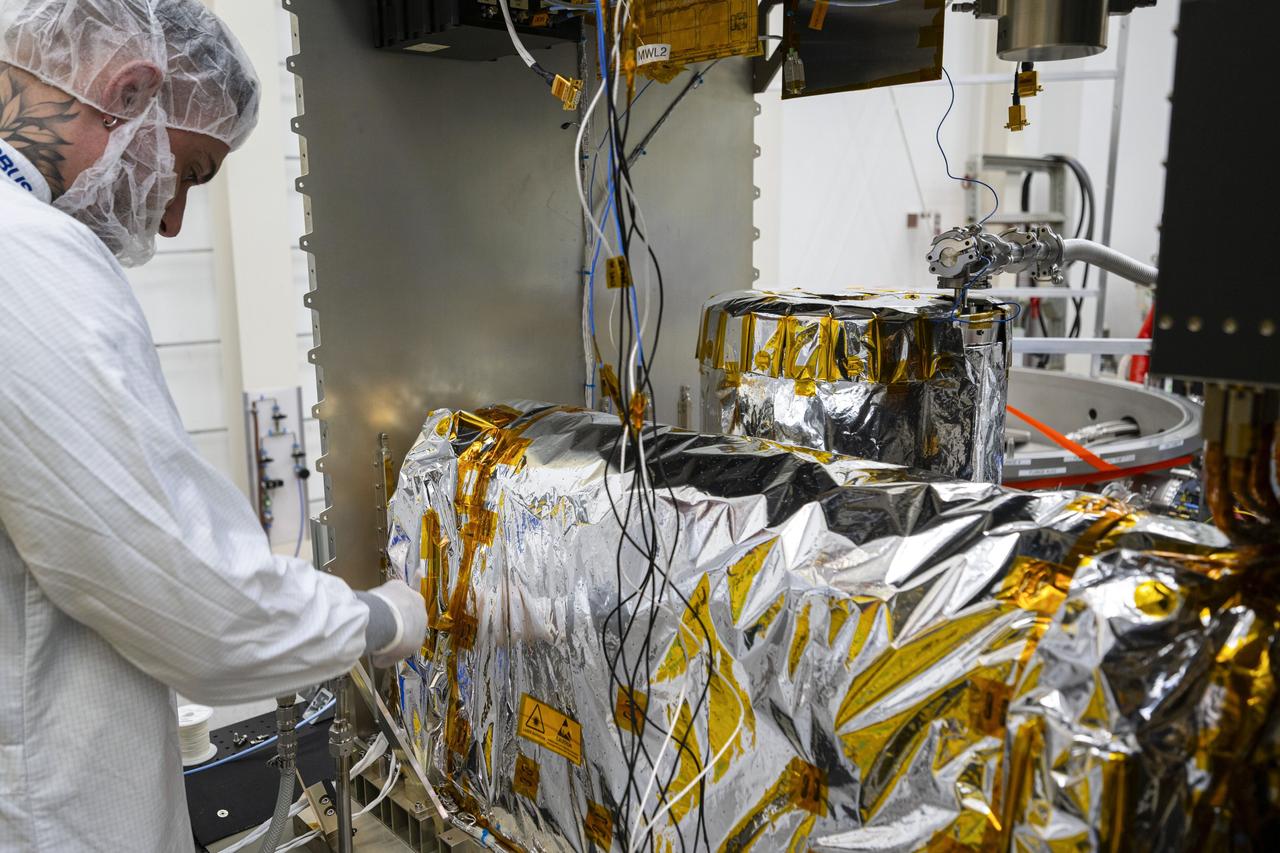
jsc2025e015677 (3/6/2025) --- The closure of the instrument panel of the Atomic Clock Ensemble in Space (ACES) has taken place at Airbus Friedrichshafen, Germany. ACES is an ESA instrument that tests fundamental physics, such as Einstein’s theory of general relativity, from the International Space Station. According to this theory, gravity affects the passing of time—time flies faster at the top of Mount Everest than at sea level. This effect has been proven in experiments on Earth, and ACES will make more precise measurements of this phenomenon and other fundamental physics such as the standard model of particle physics, as it flies 400 km high on the space station. ACES contains two clocks: PHARAO, a caesium atomic clock developed by the French Space Agency CNES, and the Space Hydrogen Maser developed by Spectratime, which uses hydrogen atoms as a frequency reference. The payload will be externally mounted to ESA’s Columbus laboratory on the space station. Image courtesy of S. Corvaja (ESA).
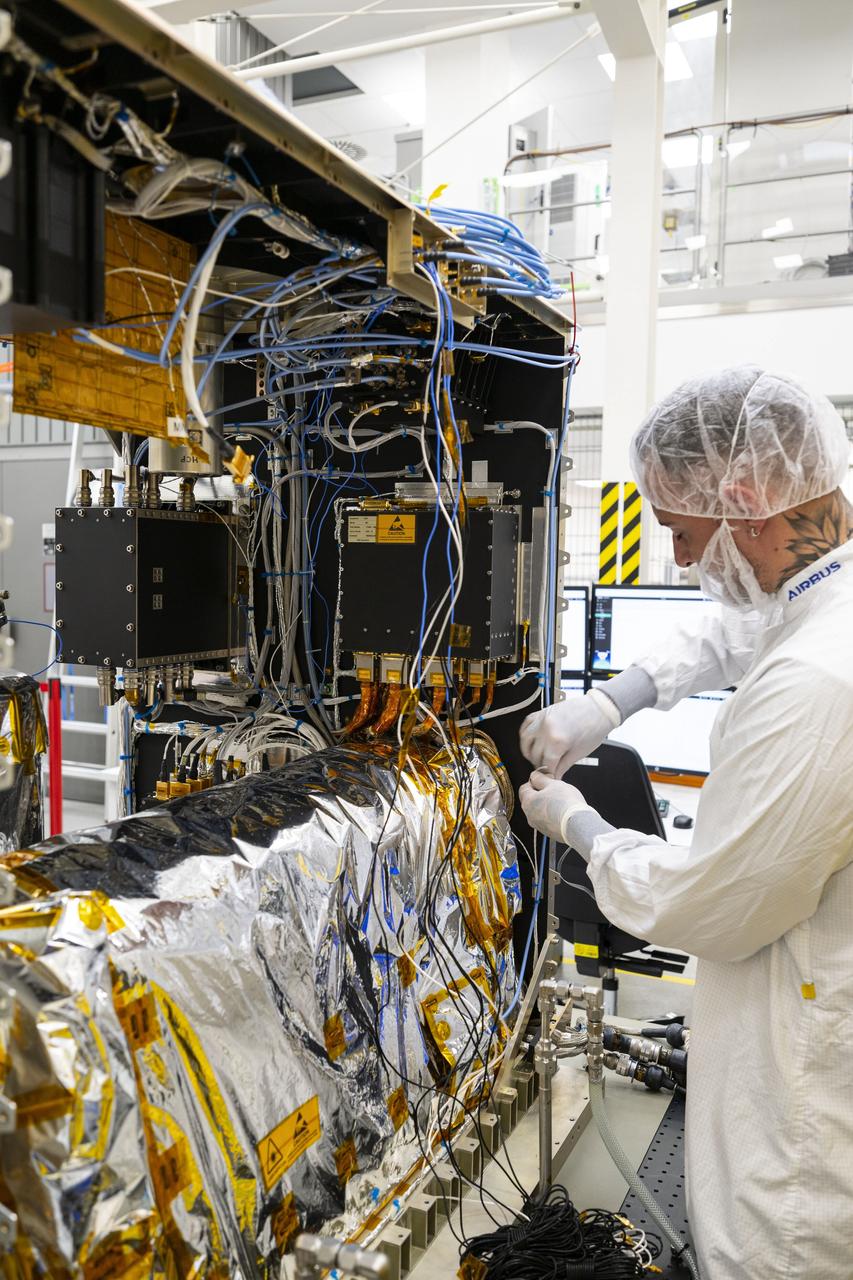
jsc2025e015678 (3/6/2025) --- The closure of the instrument panel of the Atomic Clock Ensemble in Space (ACES) has taken place at Airbus Friedrichshafen, Germany. ACES is an ESA instrument that tests fundamental physics, such as Einstein’s theory of general relativity, from the International Space Station. According to this theory, gravity affects the passing of time—time flies faster at the top of Mount Everest than at sea level. This effect has been proven in experiments on Earth, and ACES will make more precise measurements of this phenomenon and other fundamental physics such as the standard model of particle physics, as it flies 400 km high on the space station. ACES contains two clocks: PHARAO, a caesium atomic clock developed by the French Space Agency CNES, and the Space Hydrogen Maser developed by Spectratime, which uses hydrogen atoms as a frequency reference. The payload will be externally mounted to ESA’s Columbus laboratory on the space station. Image courtesy of S. Corvaja (ESA).
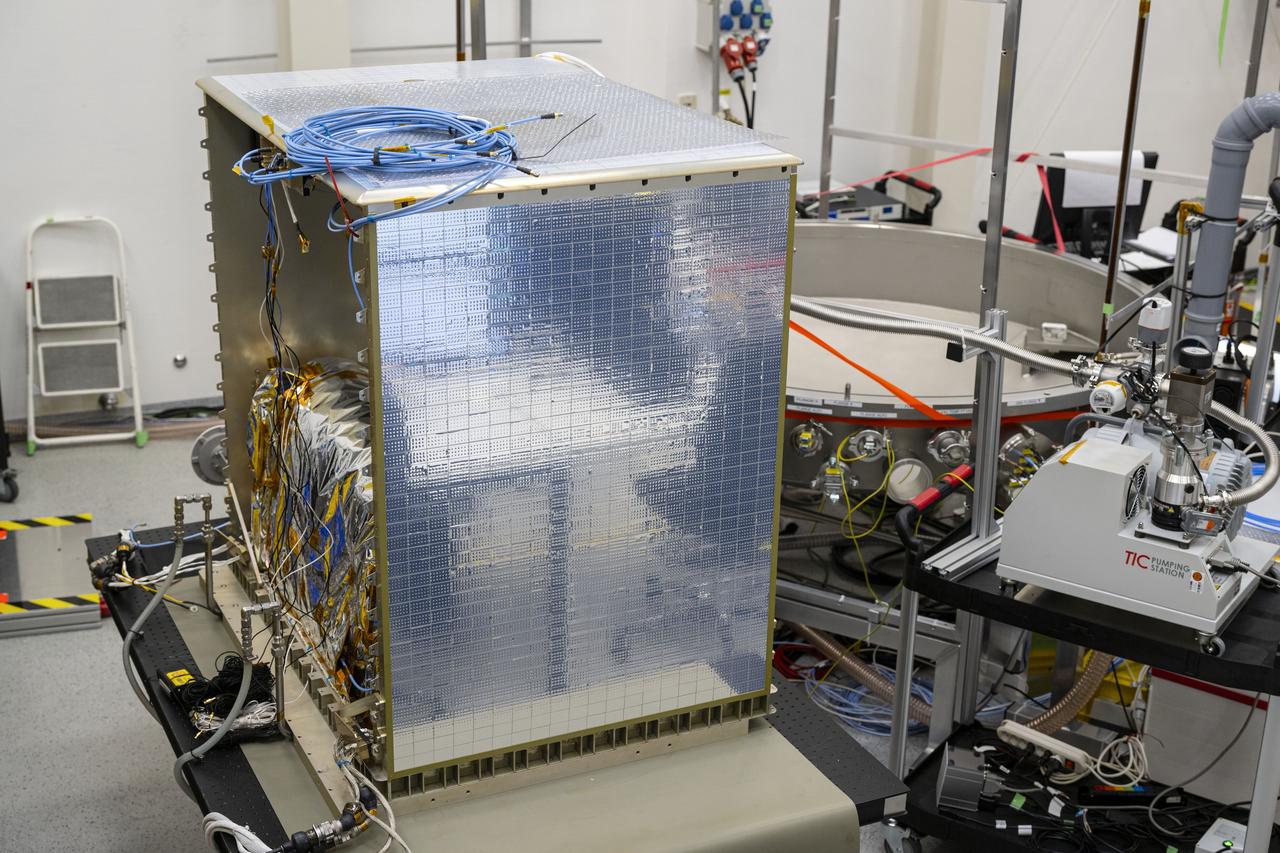
jsc2025e015679 (3/6/2025) --- The closure of the instrument panel of the Atomic Clock Ensemble in Space (ACES) has taken place at Airbus Friedrichshafen, Germany. ACES is an ESA instrument that tests fundamental physics, such as Einstein’s theory of general relativity, from the International Space Station. According to this theory, gravity affects the passing of time—time flies faster at the top of Mount Everest than at sea level. This effect has been proven in experiments on Earth, and ACES will make more precise measurements of this phenomenon and other fundamental physics such as the standard model of particle physics, as it flies 400 km high on the space station. ACES contains two clocks: PHARAO, a caesium atomic clock developed by the French Space Agency CNES, and the Space Hydrogen Maser developed by Spectratime, which uses hydrogen atoms as a frequency reference. The payload will be externally mounted to ESA’s Columbus laboratory on the space station. Image courtesy of S. Corvaja (ESA).
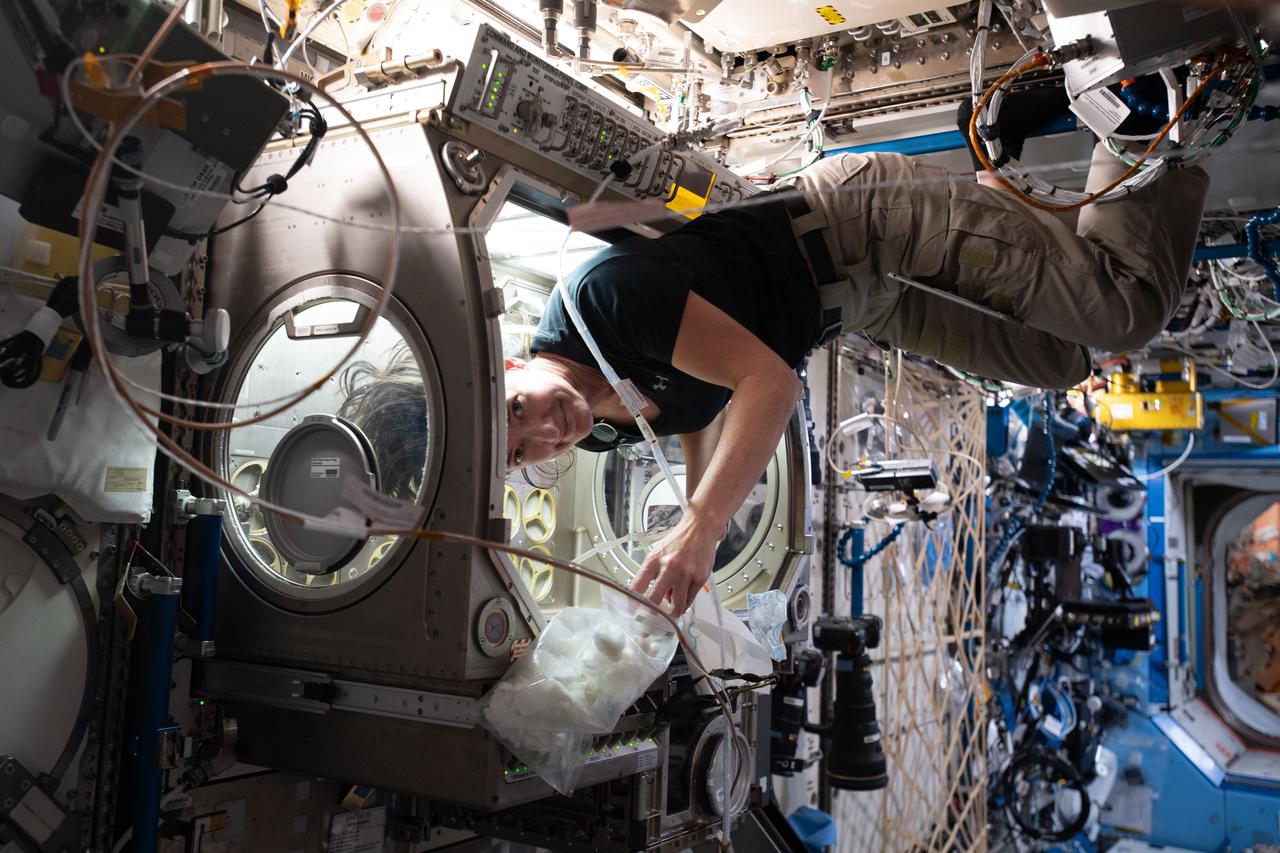
iss065e017714 (May 3, 2021) --- NASA astronaut and Expedition 65 Flight Engineer Megan McArthur cleans the inside of the Microgravity Science Glovebox (MSG). Located in the International Space Station's U.S. Destiny laboratory module, the MSG supports a variety of research disciplines including biotechnology, combustion science, fluid physics, fundamental physics, and materials science.
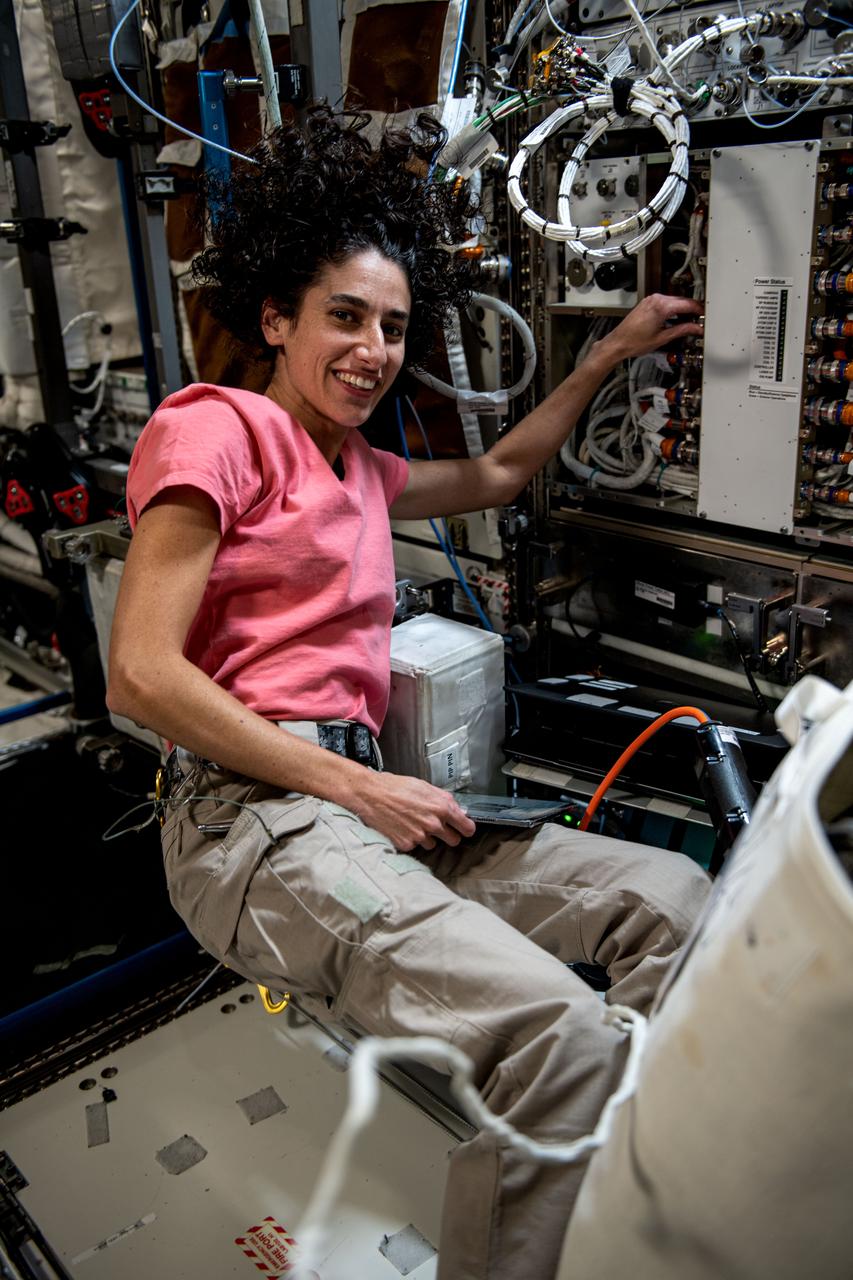
iss069e092237 (Sept. 25, 2023) --- NASA astronaut and Expedition 70 Flight Engineer Jasmin Moghbeli is pictured removing and replacing components inside the Cold Atom Lab aboard the International Space Station. The space physics device enables observations of atoms chilled to temperatures near absolute zero allowing scientists to study fundamental behaviors and quantum characteristics not possible on Earth.
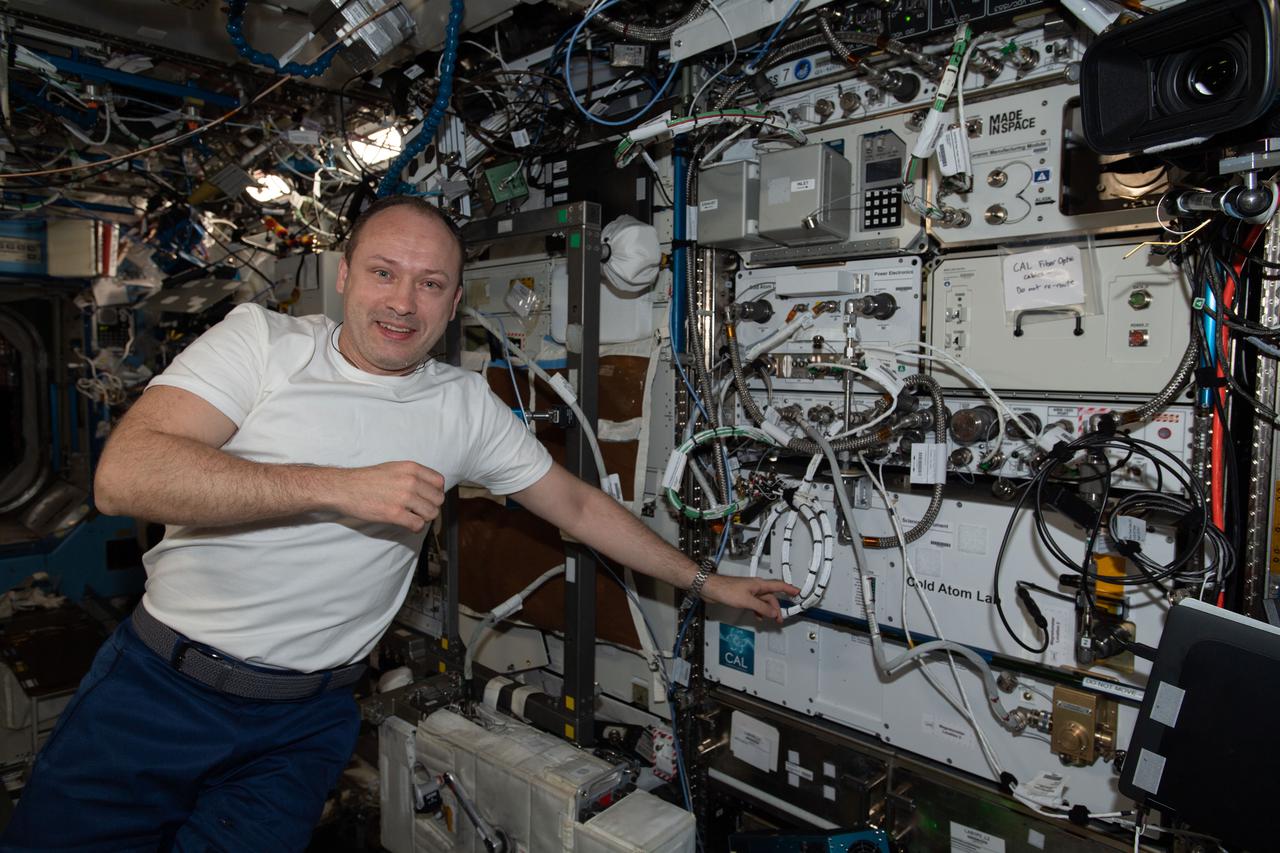
iss066e088442 (Dec. 11, 2021) --- Roscosmos cosmonaut and Soyuz MS-20 Commander Alexander Misurkin is pictured next to the Cold Atom Lab inside the International Space Station's U.S. Destiny module. The space physics research device enables observations of atoms chilled to temperatures near absolute zero allowing scientists to study fundamental behaviors and quantum characteristics not possible on Earth.
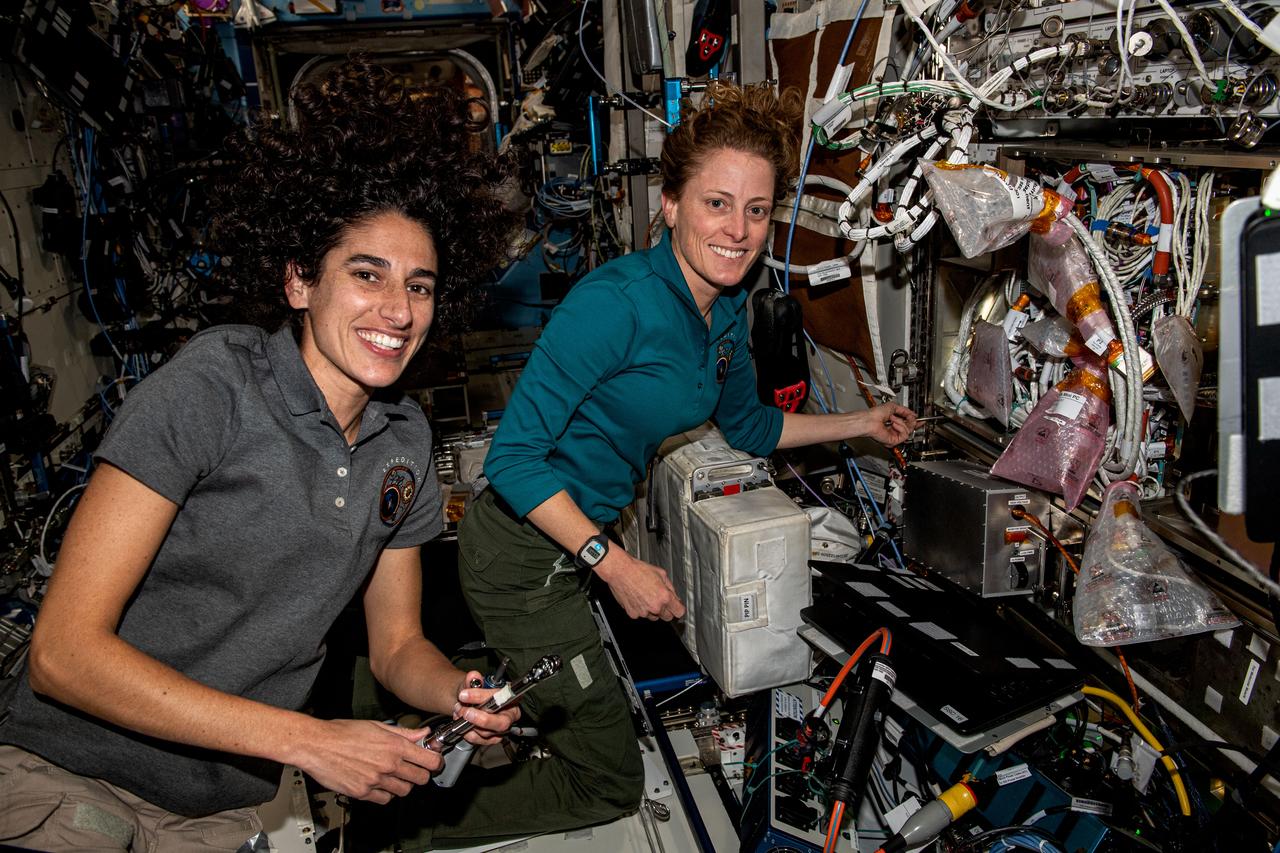
iss069e092348 (Sept. 26, 2023) --- NASA astronauts (from left) Jasmin Moghbeli and Loral O'Hara, both Expedition 70 Flight Engineers, partner together removing and replacing components inside the Cold Atom Lab aboard the International Space Station. The space physics device enables observations of atoms chilled to temperatures near absolute zero allowing scientists to study fundamental behaviors and quantum characteristics not possible on Earth.
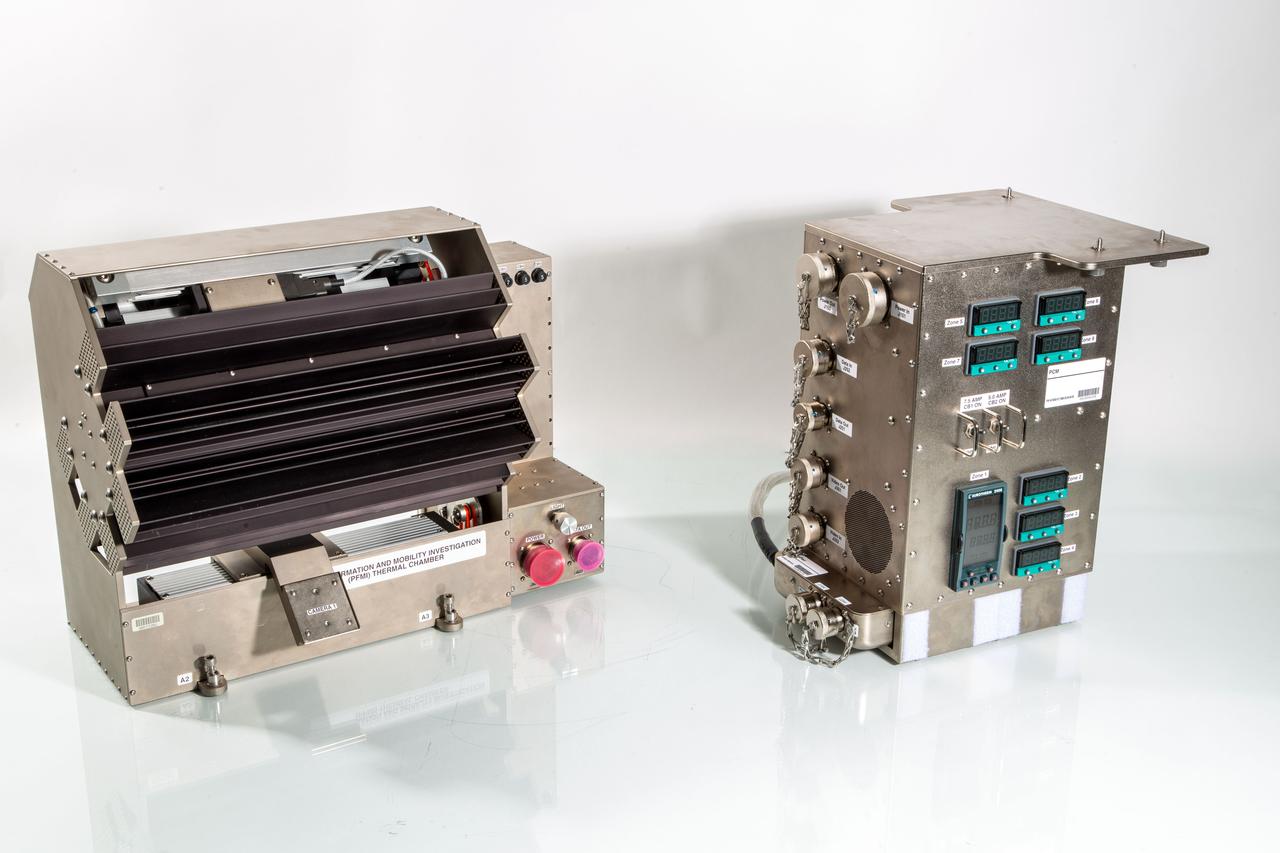
jsc2020e030482 (4/24/2020) --- A preflight view of the PFMI Furnace. The Pore Formation and Mobility Investigation (PFMI) facility objective is to study the fundamental phenomena responsible for the formation of certain classes of defects in different materials. Investigators examine the physical principles which control the occurrence of defects in manufacturing on Earth in order to develop methods to reduce flaws, defects or wasted material. (Image courtesy of: Techshot, Inc.)
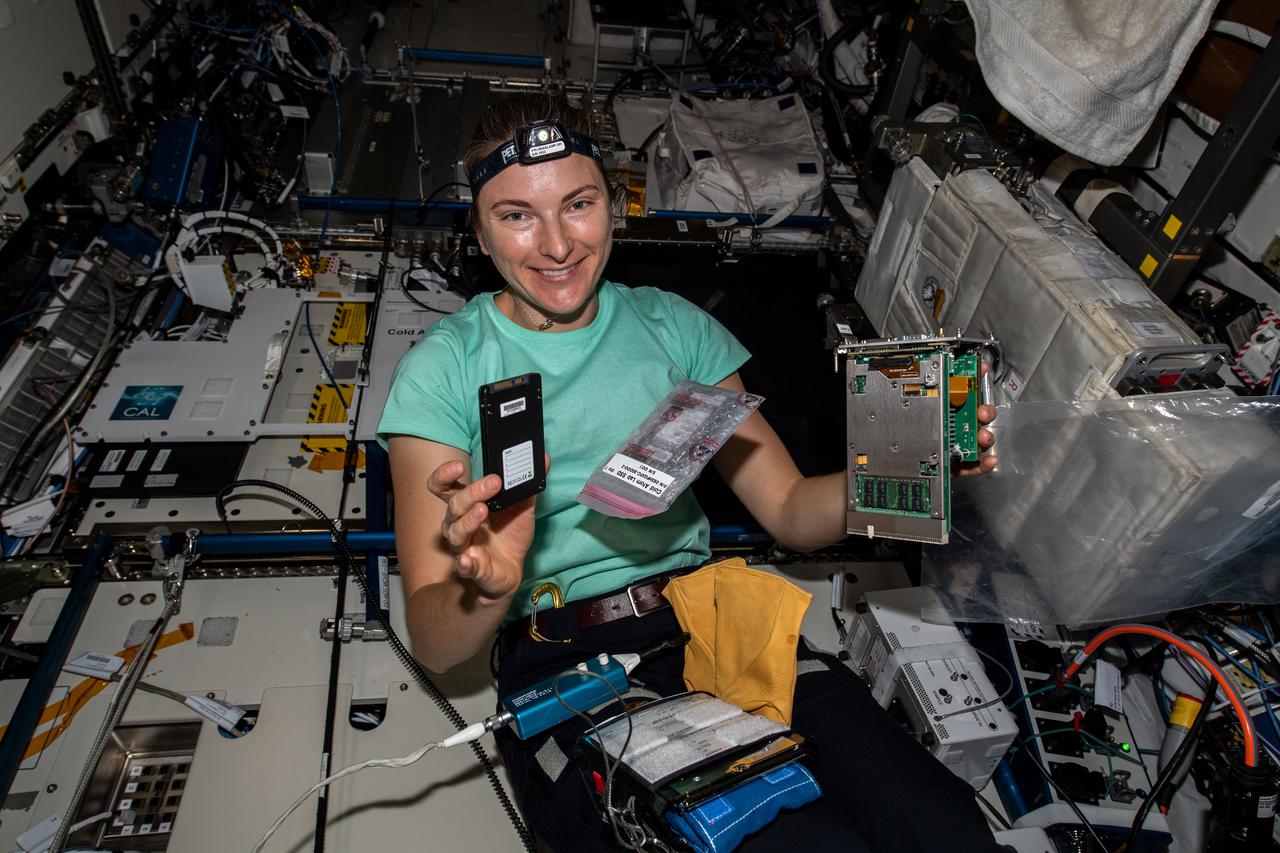
iss066e091400 (Dec. 16, 2021) --- NASA astronaut and Expedition 66 Flight Engineer Kayla Barron replaces computer hardware inside the International Space Station's Cold Atom Lab. The space physics device enables observations of atoms chilled to temperatures near absolute zero allowing scientists to study fundamental behaviors and quantum characteristics not possible on Earth.
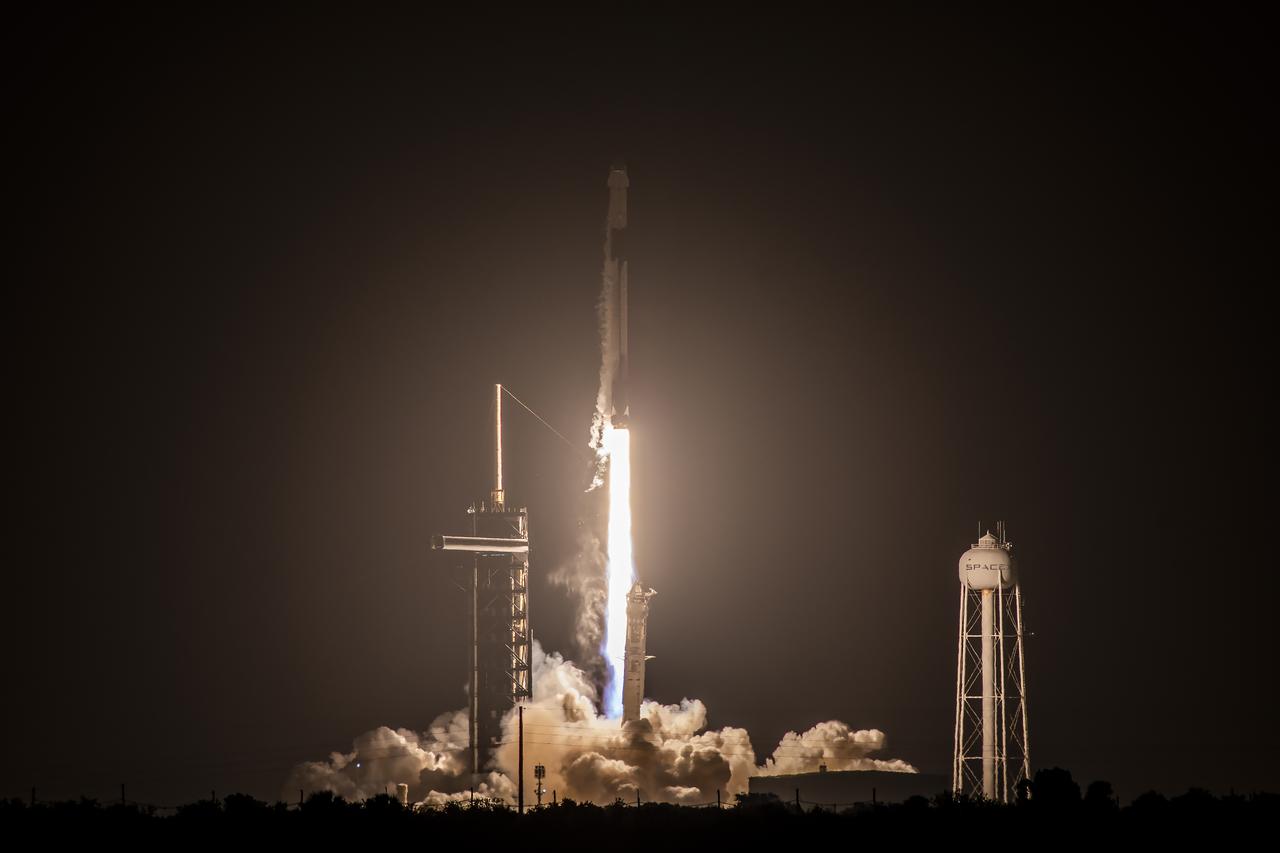
The SpaceX Falcon 9 rocket carrying the Dragon spacecraft lifts off from Launch Complex 39A at NASA’s Kennedy Space Center in Florida on Monday, April 21, on the company’s 32nd commercial resupply services mission for the agency to the International Space Station. Liftoff was at 4:15 a.m. EDT. Dragon will deliver a variety of science experiments, including a demonstration of refined maneuvers for free-floating robots. Dragon also carries an enhanced air quality monitoring system that could protect crew members on exploration missions to the Moon and Mars, and two atomic clocks to examine fundamental physics concepts such as relativity and test worldwide synchronization of precision timepieces.
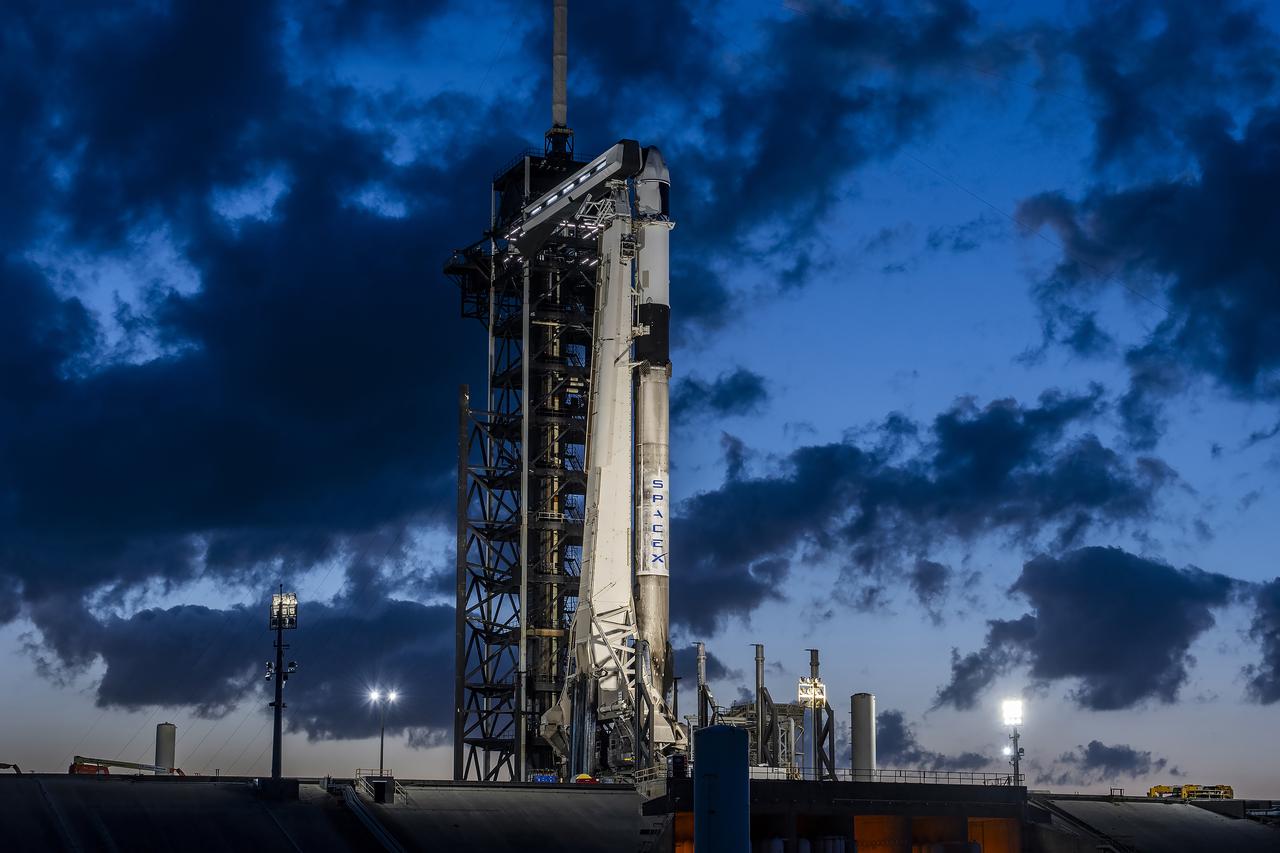
A SpaceX Falcon 9 rocket, with the company’s Dragon spacecraft atop, stands in a vertical position at Launch Complex 39A at NASA’s Kennedy Space Center in Florida on Monday, April 21, in preparation for the 32nd commercial resupply services launch to the International Space Station. Dragon is delivering a variety of science experiments, including a demonstration of refined maneuvers for free-floating robots. Dragon also carries an enhanced air quality monitoring system that could protect crew members on exploration missions to the Moon and Mars, and two atomic clocks to examine fundamental physics concepts such as relativity and test worldwide synchronization of precision timepieces.
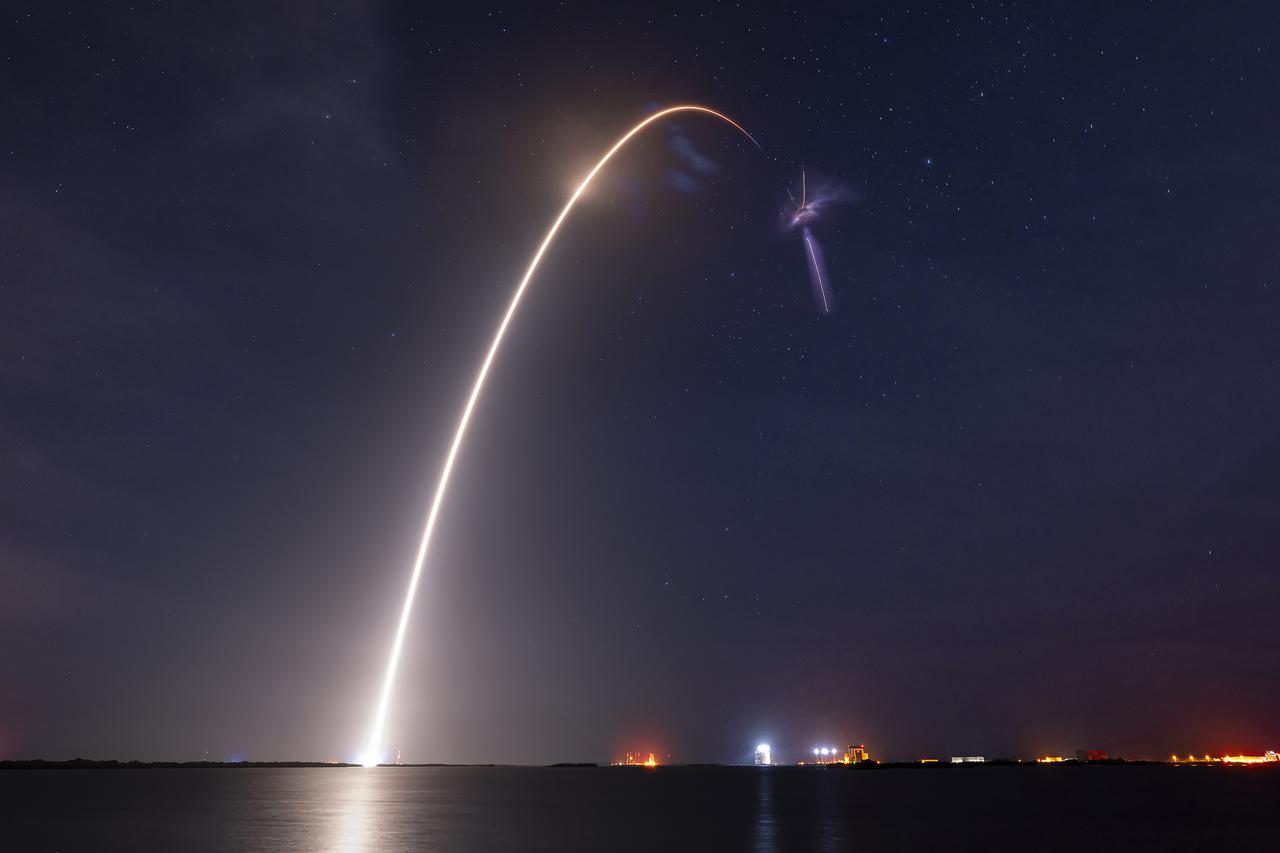
The SpaceX Falcon 9 rocket carrying the Dragon spacecraft lifts off from Launch Complex 39A at NASA’s Kennedy Space Center in Florida on Monday, April 21, on the company’s 32nd commercial resupply services mission for the agency to the International Space Station. Liftoff was at 4:15 a.m. EDT. Dragon will deliver a variety of science experiments, including a demonstration of refined maneuvers for free-floating robots. Dragon also carries an enhanced air quality monitoring system that could protect crew members on exploration missions to the Moon and Mars, and two atomic clocks to examine fundamental physics concepts such as relativity and test worldwide synchronization of precision timepieces.
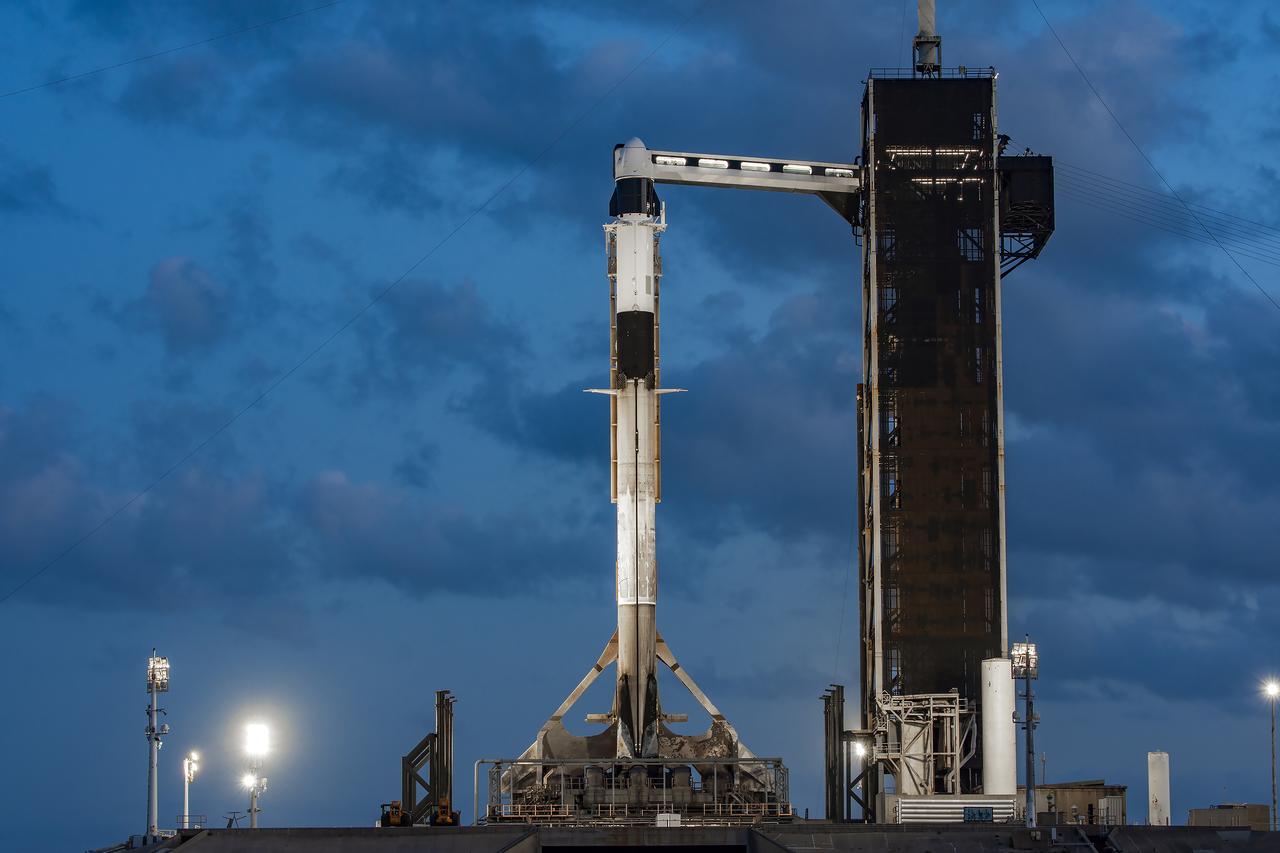
A SpaceX Falcon 9 rocket, with the company’s Dragon spacecraft atop, stands in a vertical position at Launch Complex 39A at NASA’s Kennedy Space Center in Florida on Monday, April 21, in preparation for the 32nd commercial resupply services launch to the International Space Station. Dragon is delivering a variety of science experiments, including a demonstration of refined maneuvers for free-floating robots. Dragon also carries an enhanced air quality monitoring system that could protect crew members on exploration missions to the Moon and Mars, and two atomic clocks to examine fundamental physics concepts such as relativity and test worldwide synchronization of precision timepieces.
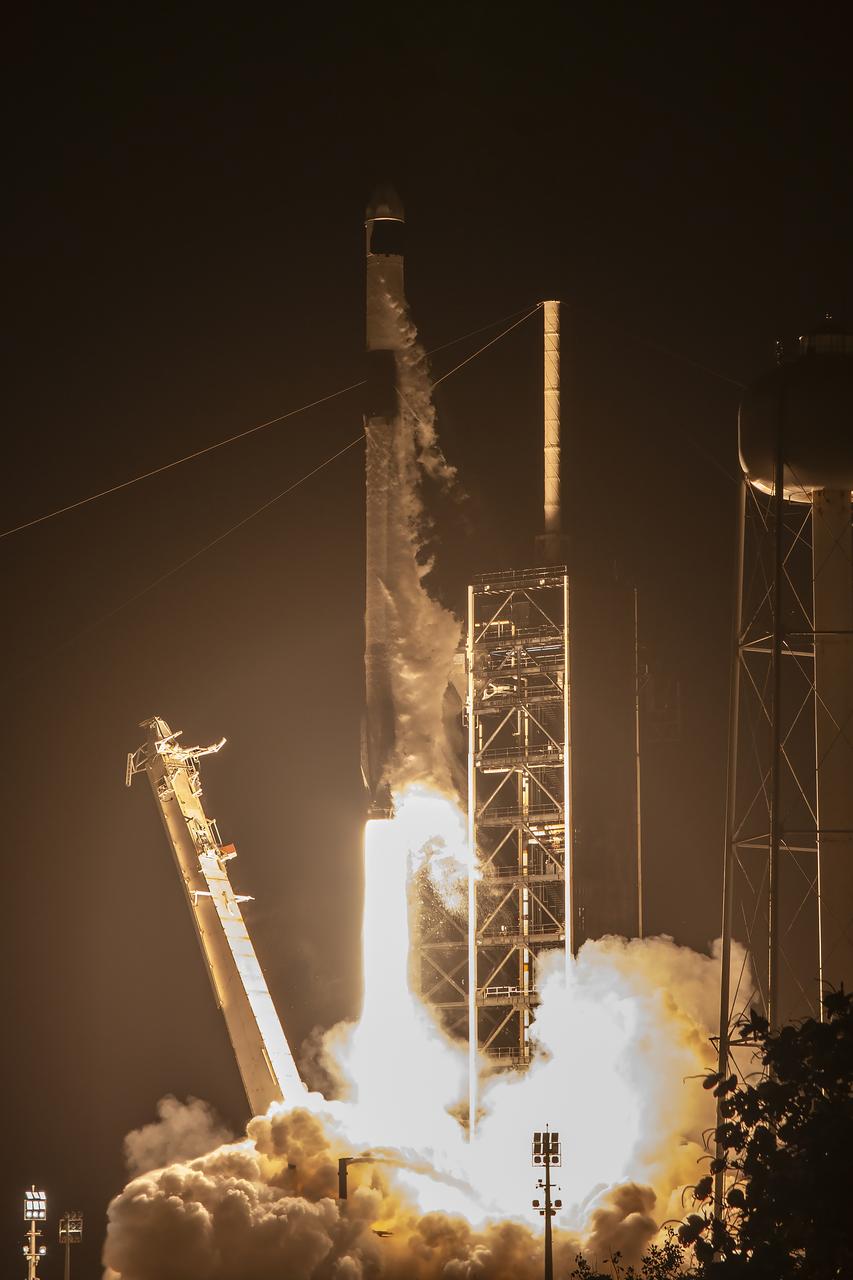
The SpaceX Falcon 9 rocket carrying the Dragon spacecraft lifts off from Launch Complex 39A at NASA’s Kennedy Space Center in Florida on Monday, April 21, on the company’s 32nd commercial resupply services mission for the agency to the International Space Station. Liftoff was at 4:15 a.m. EDT. Dragon will deliver a variety of science experiments, including a demonstration of refined maneuvers for free-floating robots. Dragon also carries an enhanced air quality monitoring system that could protect crew members on exploration missions to the Moon and Mars, and two atomic clocks to examine fundamental physics concepts such as relativity and test worldwide synchronization of precision timepieces.
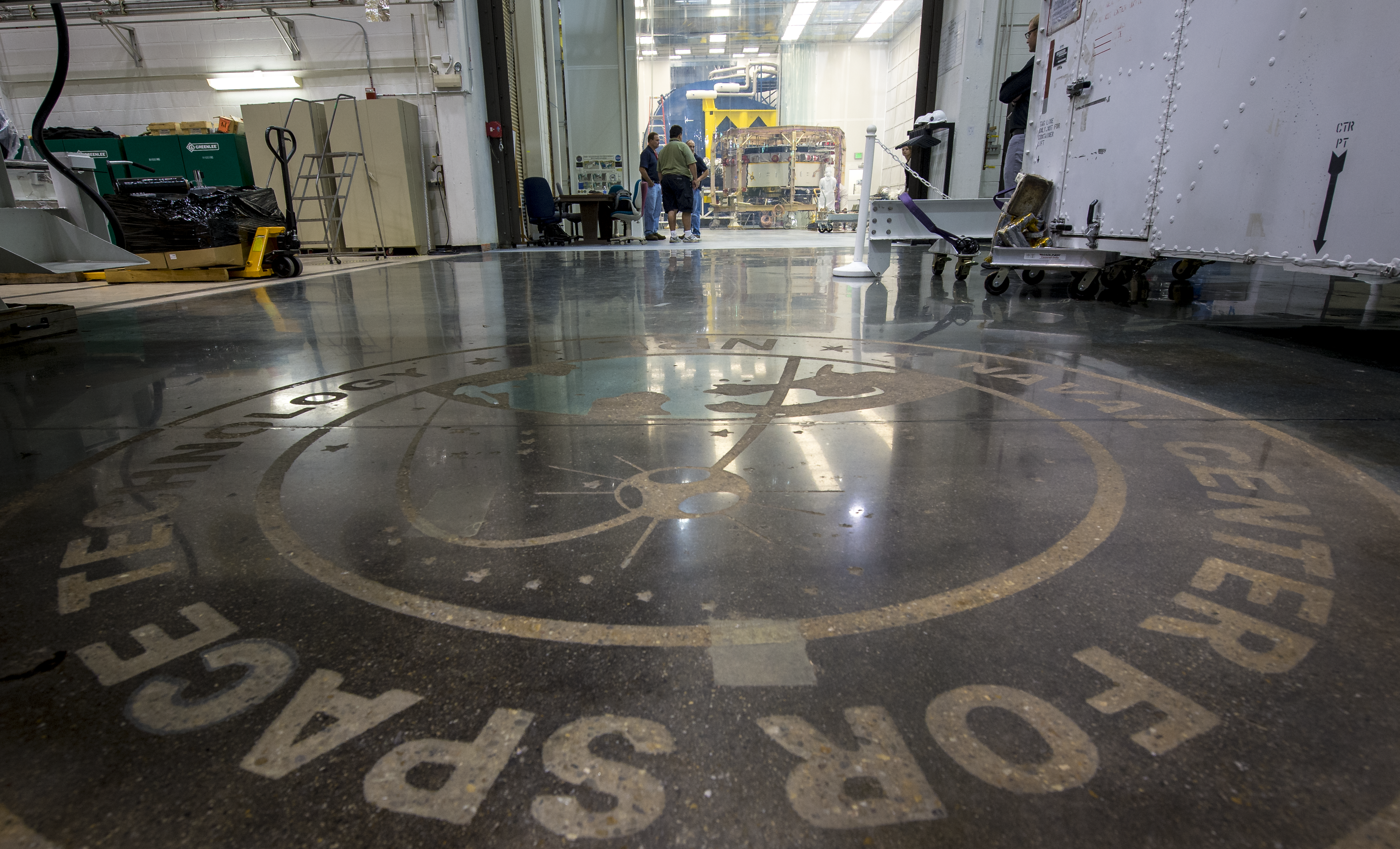
One of four Magnetospheric Multiscale (MMS) spacecraft, in the background, is seen in a cleanroom at the Naval Research Lab’s, Naval Center for Space Technology, Monday, August 4, 2014, in Washington. The Magnetospheric Multiscale, or MMS, mission will study the mystery of how magnetic fields around Earth connect and disconnect, explosively releasing energy via a process known as magnetic reconnection. The four identical spacecraft are scheduled to launch in 2015 from Cape Canaveral and will orbit around Earth in varying formations through the dynamic magnetic system surrounding our planet to provide the first three-dimensional views of the magnetic reconnection process. The goal of the STP Program is to understand the fundamental physical processes of the space environment from the sun to Earth, other planets, and the extremes of the solar system boundary. Photo Credit: (NASA/Bill Ingalls)
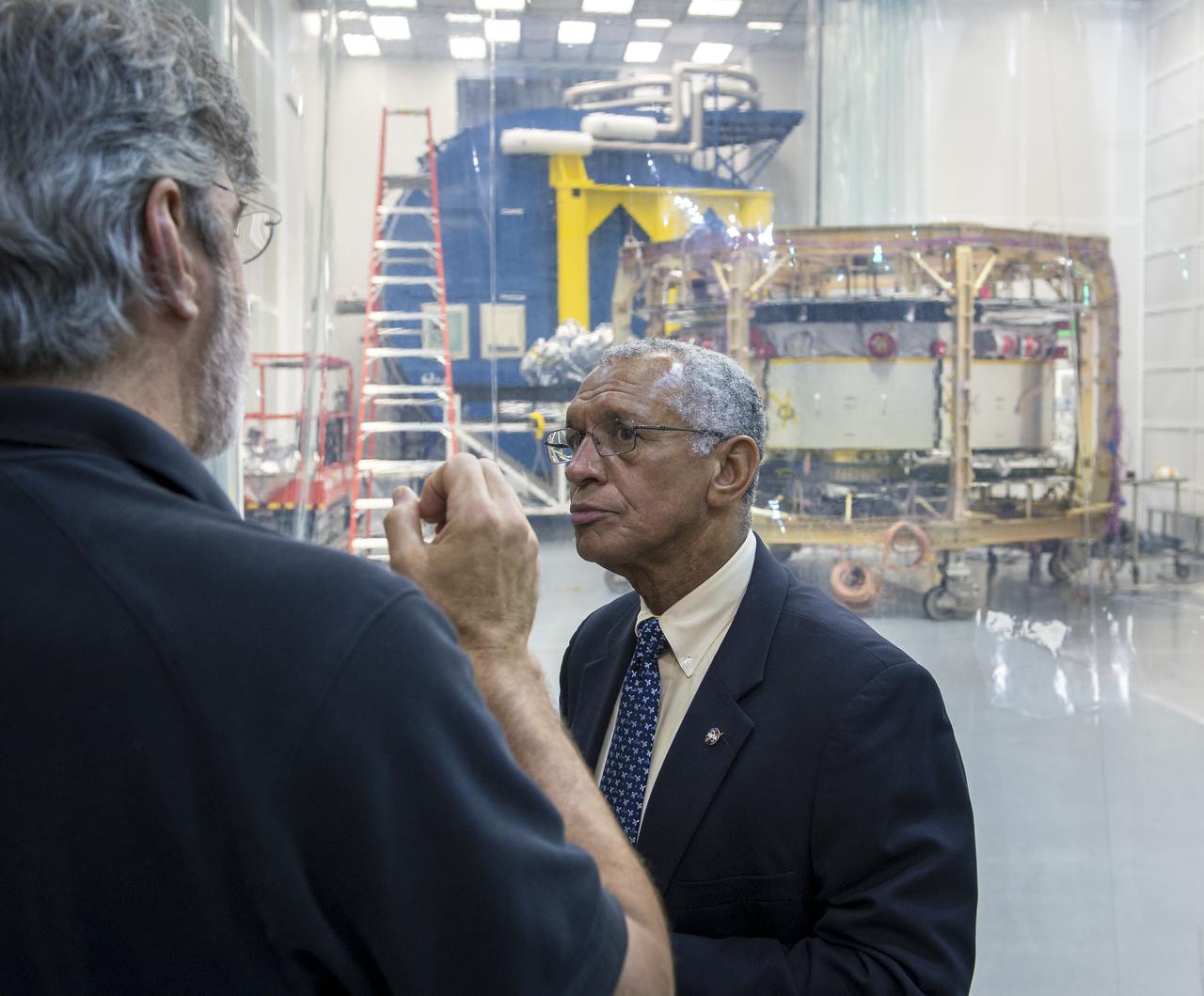
NASA Administrator Charles Bolden listens to Magnetospheric Multiscale (MMS) Mission Project Manager Craig Tooley talk about the MMS mission outside of a Naval Research Laboratory cleanroom where one of four Magnetospheric Multiscale (MMS) spacecraft is currently undergoing testing, Monday, August 4, 2014, in Washington. The Magnetospheric Multiscale, or MMS, mission will study the mystery of how magnetic fields around Earth connect and disconnect, explosively releasing energy via a process known as magnetic reconnection. The four identical spacecraft are scheduled to launch in 2015 from Cape Canaveral and will orbit around Earth in varying formations through the dynamic magnetic system surrounding our planet to provide the first three-dimensional views of the magnetic reconnection process. The goal of the STP Program is to understand the fundamental physical processes of the space environment from the sun to Earth, other planets, and the extremes of the solar system boundary. Photo Credit: (NASA/Bill Ingalls)
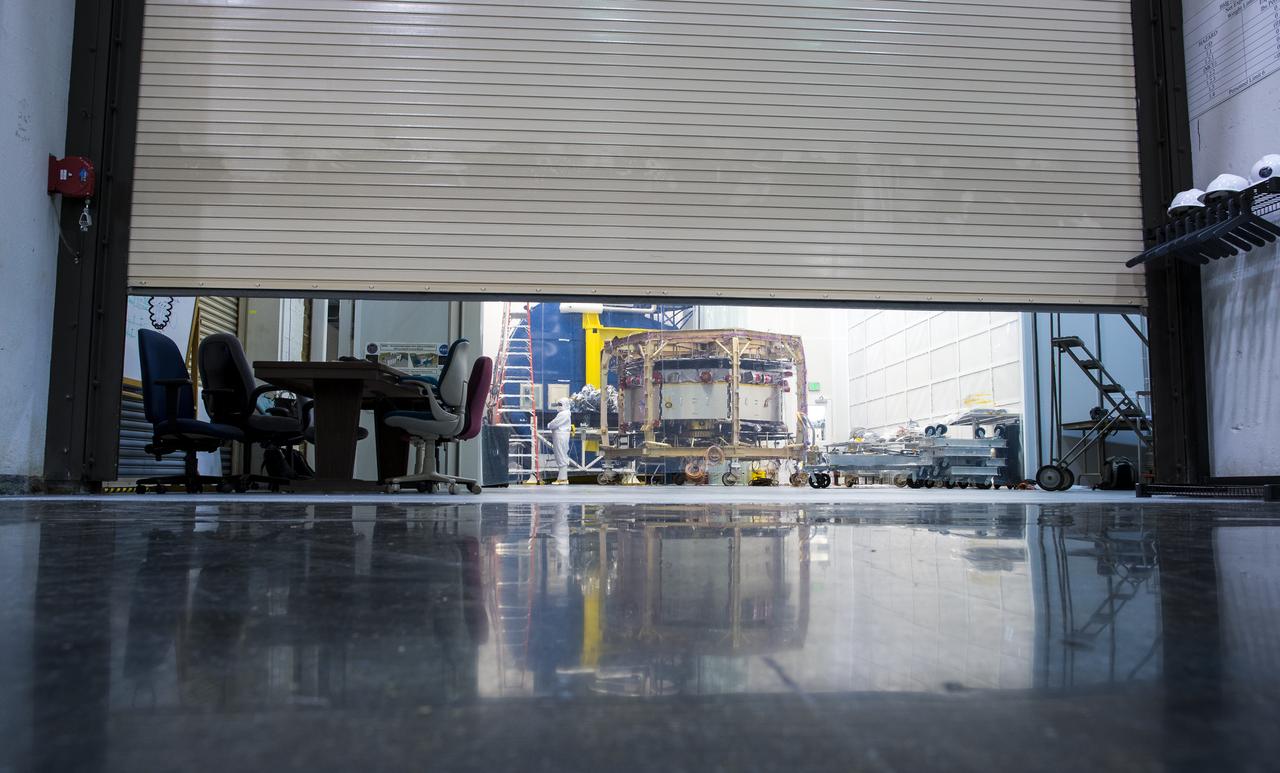
One of four Magnetospheric Multiscale (MMS) spacecraft, in the background, is seen in a cleanroom at the Naval Research Lab’s, Naval Center for Space Technology, Monday, August 4, 2014, in Washington. The Magnetospheric Multiscale, or MMS, mission will study the mystery of how magnetic fields around Earth connect and disconnect, explosively releasing energy via a process known as magnetic reconnection. The four identical spacecraft are scheduled to launch in 2015 from Cape Canaveral and will orbit around Earth in varying formations through the dynamic magnetic system surrounding our planet to provide the first three-dimensional views of the magnetic reconnection process. The goal of the STP Program is to understand the fundamental physical processes of the space environment from the sun to Earth, other planets, and the extremes of the solar system boundary. Photo Credit: (NASA/Bill Ingalls)

CAPE CANAVERAL, Fla. - Nicky Fox, Radiation Belt Storm Probes, or RBSP, deputy project scientist at Johns Hopkins Applied Physics Laboratory in Laurel, M.D., participates in a postlaunch news conference at NASA Kennedy Space Center’s Press Site in Florida. The RBSP spacecraft launched atop a United Launch Alliance, or ULA, Atlas V rocket at 4:05 a.m. EDT from Space Launch Complex 41 at Cape Canaveral Air Force Station. RBSP will explore changes in Earth's space environment caused by the sun -- known as "space weather" -- that can disable satellites, create power-grid failures and disrupt GPS service. The mission also will provide data on the fundamental radiation and particle acceleration processes throughout the universe. For more information on RBSP, visit http://www.nasa.gov/rbsp. Photo credit: NASA/Jim Grossmann
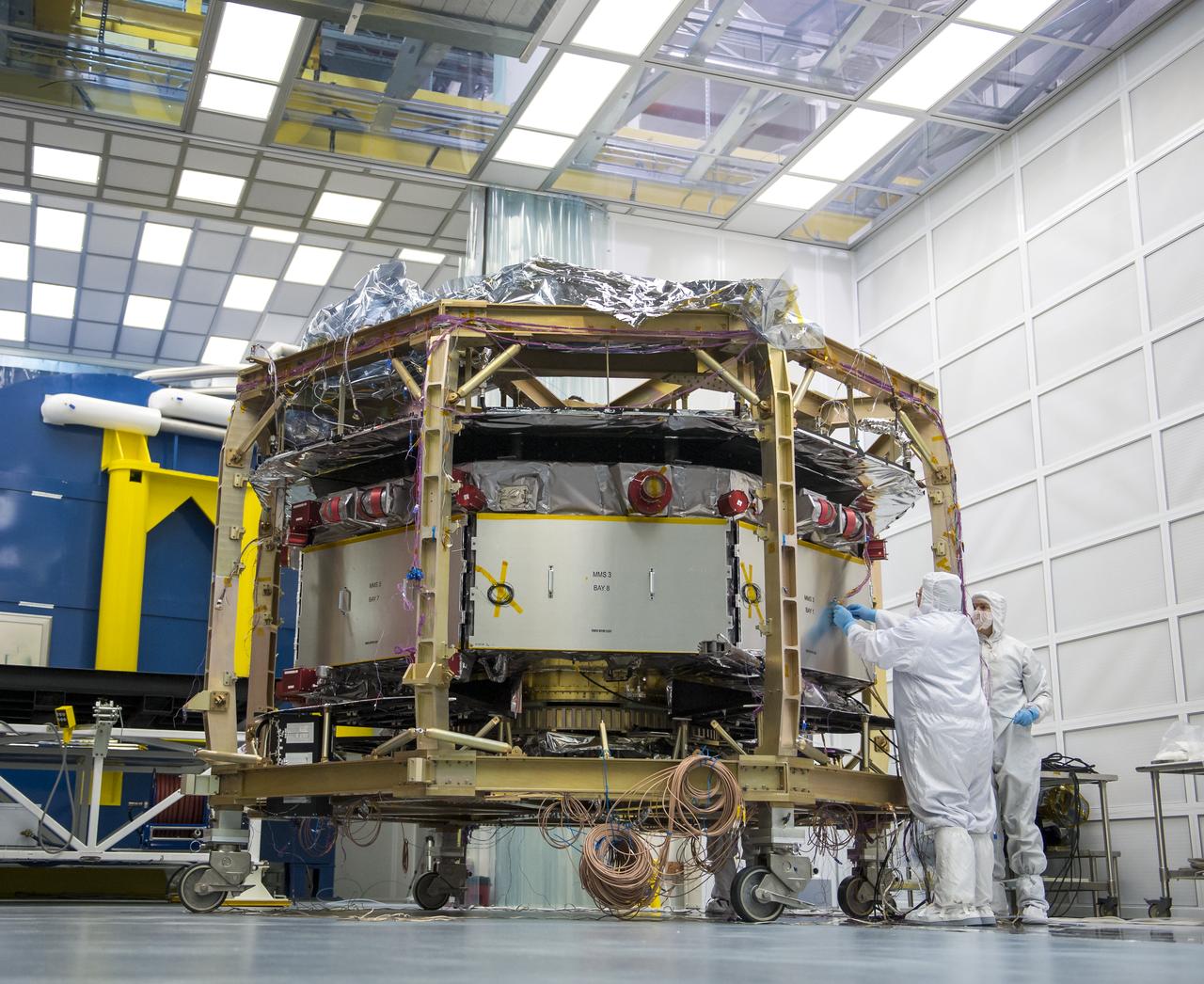
Engineers work on one of four Magnetospheric Multiscale (MMS) spacecraft in a cleanroom at the Naval Research Lab, Monday, August 4, 2014, in Washington. The Magnetospheric Multiscale, or MMS, mission will study the mystery of how magnetic fields around Earth connect and disconnect, explosively releasing energy via a process known as magnetic reconnection. The four identical spacecraft are scheduled to launch in 2015 from Cape Canaveral and will orbit around Earth in varying formations through the dynamic magnetic system surrounding our planet to provide the first three-dimensional views of the magnetic reconnection process. The goal of the STP Program is to understand the fundamental physical processes of the space environment from the sun to Earth, other planets, and the extremes of the solar system boundary. Photo Credit: (NASA/Bill Ingalls)
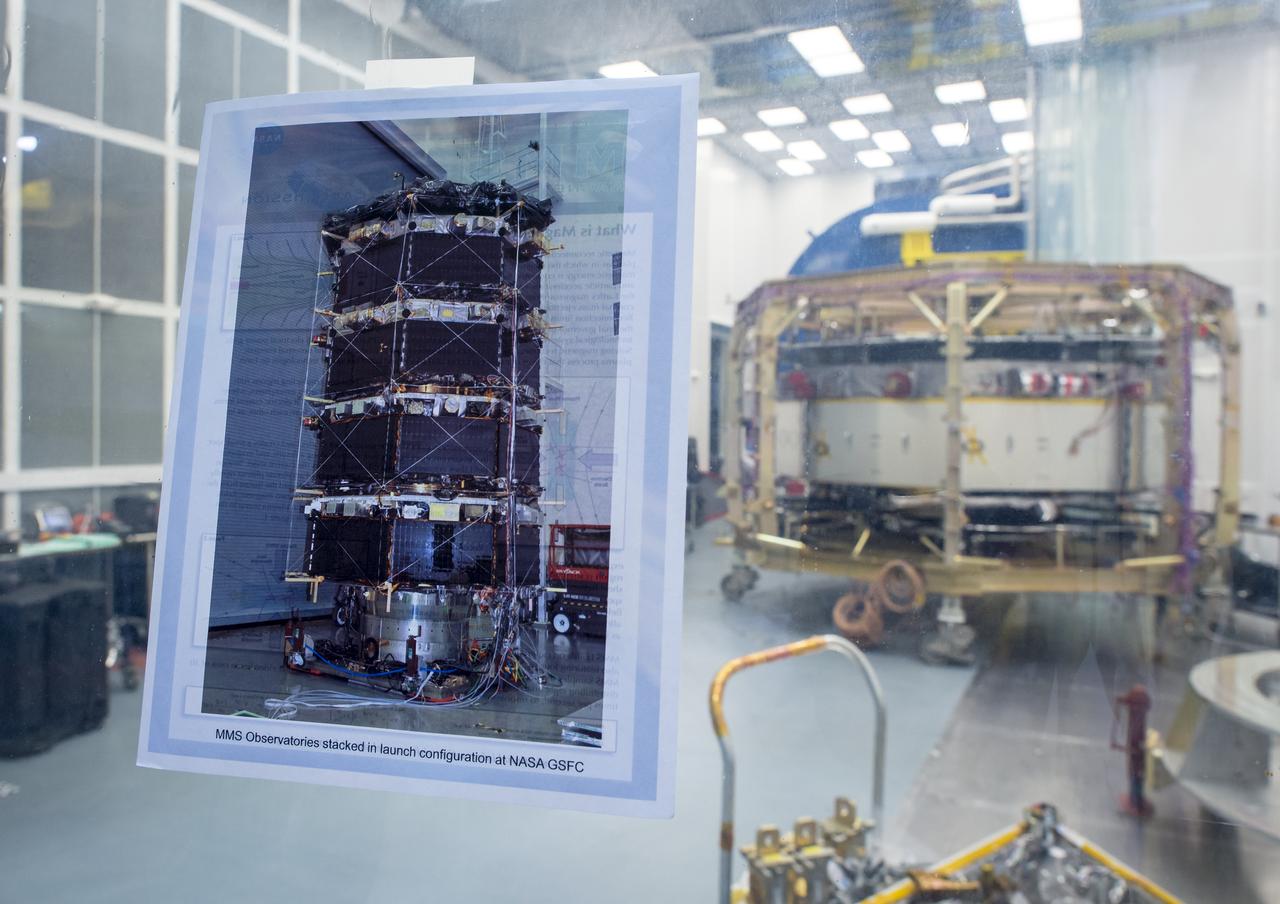
A photograph showing what all four Magnetospheric Multiscale (MMS) spacecraft look like when stacked is seen taped to the window of a Naval Research Laboratory cleanroom where one of the four spacecraft is undergoing testing, Monday, August 4, 2014, in Washington. The Magnetospheric Multiscale, or MMS, mission will study the mystery of how magnetic fields around Earth connect and disconnect, explosively releasing energy via a process known as magnetic reconnection. The four identical spacecraft are scheduled to launch in 2015 from Cape Canaveral and will orbit around Earth in varying formations through the dynamic magnetic system surrounding our planet to provide the first three-dimensional views of the magnetic reconnection process. The goal of the STP Program is to understand the fundamental physical processes of the space environment from the sun to Earth, other planets, and the extremes of the solar system boundary. Photo Credit: (NASA/Bill Ingalls)
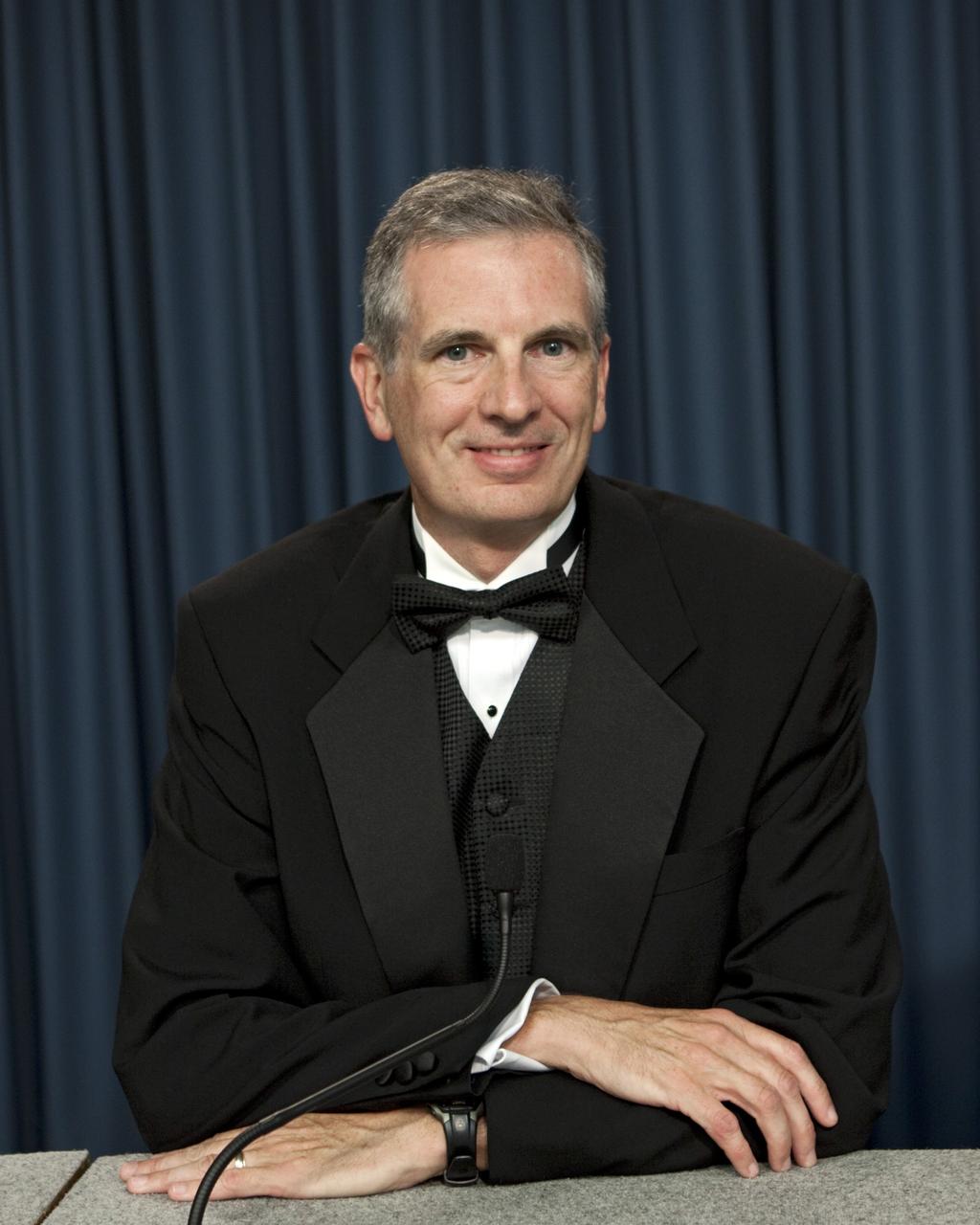
CAPE CANAVERAL, Fla. – Richard Fitzgerald, Radiation Belt Storm Probes, or RBSP, project manager at Johns Hopkins Applied Physics Laboratory? in Laurel, M.D., participates in a postlaunch news conference at NASA Kennedy Space Center’s Press Site in Florida. The RBSP spacecraft launched atop a United Launch Alliance, or ULA, Atlas V rocket at 4:05 a.m. EDT from Space Launch Complex 41 at Cape Canaveral Air Force Station. RBSP will explore changes in Earth's space environment caused by the sun -- known as "space weather" -- that can disable satellites, create power-grid failures and disrupt GPS service. The mission also will provide data on the fundamental radiation and particle acceleration processes throughout the universe. For more information on RBSP, visit http://www.nasa.gov/rbsp. Photo credit: NASA/Jim Grossmann
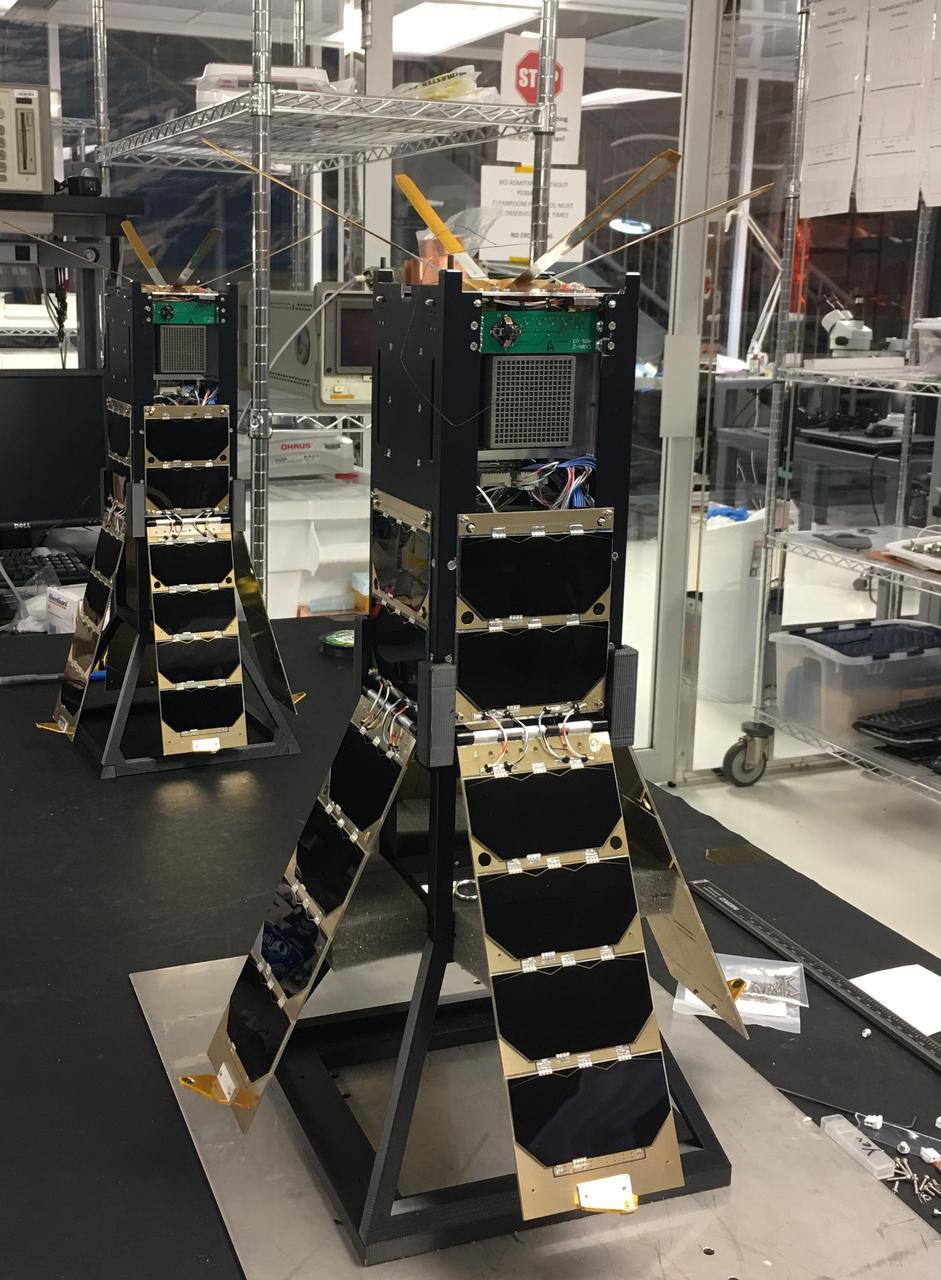
The Cosmic X-Ray Background NanoSat-2 (CXBN-2) CubeSat Mission developed by Morehead State University and its partners the Keldysh Institute (Moscow, Russia), the Maysville Community and Technical College (Morehead, KY) and KYSpace LLC (Lexington, KY) will increase the precision of measurements of the Cosmic X-Ray Background in the 30-50 keV range to a precision of <5%, thereby constraining models that attempt to explain the relative contribution of proposed sources lending insight into the underlying physics of the early universe. The mission addresses a fundamental science question that is central to our understanding of the structure, origin, and evolution of the universe by potentially lending insight into both the high-energy background radiation and into the evolution of primordial galaxies. Launched by NASA’s CubeSat Launch Initiative NET April 18, 2017 ELaNa XVII mission on the seventh Orbital-ATK Cygnus Commercial Resupply Services (OA-7) to the International Space Station and deployed on tbd.
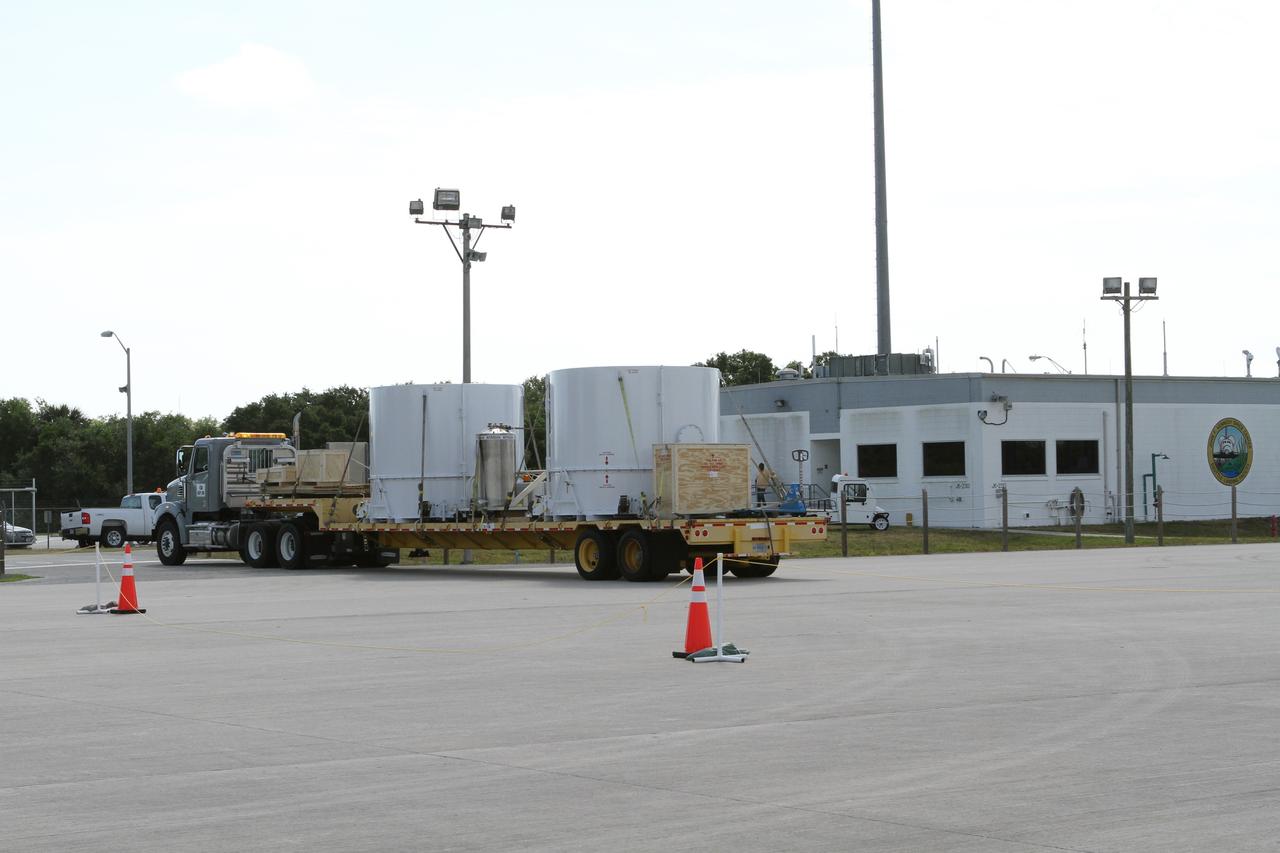
CAPE CANAVERAL, Fla. – NASA's twin Radiation Belt Storm Probes, enclosed in protective shipping containers, depart from the Shuttle Landing Facility at NASA’s Kennedy Space Center in Florida aboard a flatbed truck. The spacecraft were delivered in the cargo bay of a U.S. Air Force C-17 aircraft earlier in the day and are on their way to the Astrotech payload processing facility near Kennedy Space Center where Applied Physics Laboratory technicians will begin spacecraft testing and prelaunch preparations. The RBSP mission will help us understand the sun’s influence on Earth and near-Earth space by studying the Earth’s radiation belts on various scales of space and time. The RBSP instruments will provide the measurements needed to characterize and quantify the plasma processes that produce very energetic ions and relativistic electrons. The mission is part of NASA’s broader Living With a Star Program that was conceived to explore fundamental processes that operate throughout the solar system, and in particular those that generate hazardous space weather effects in the vicinity of Earth and phenomena that could impact solar system exploration. RBSP is scheduled to begin its mission of exploration of Earth's Van Allen Radiation Belts and the extremes of space weather after launch. Launch aboard a United Launch Alliance Atlas V rocket is scheduled for August 23. For more information, visit http://www.nasa.gov/rbsp. Photo credit: NASA/Kim Shiflett
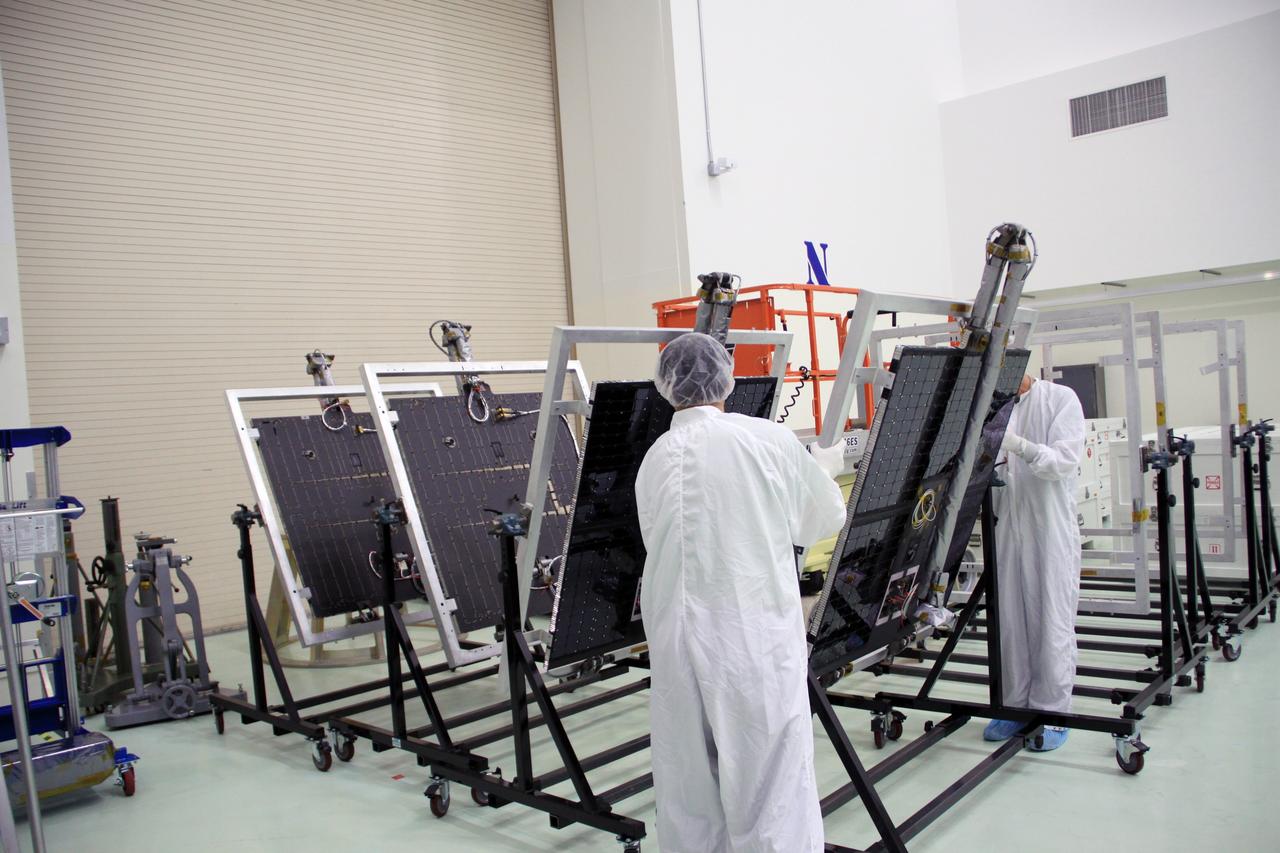
CAPE CANAVERAL, Fla. – In the clean room high bay at the Astrotech payload processing facility near NASA’s Kennedy Space Center in Florida, Applied Physics Laboratory technicians line up the holding fixtures containing the solar arrays for NASA's Radiation Belt Storm Probe A. The Radiation Belt Storm Probes, or RBSP, mission will help us understand the sun’s influence on Earth and near-Earth space by studying the Earth’s radiation belts on various scales of space and time. RBSP instruments will provide the measurements needed to characterize and quantify the plasma processes that produce very energetic ions and relativistic electrons. The mission is part of NASA’s broader Living With a Star Program that was conceived to explore fundamental processes that operate throughout the solar system, particularly those that generate hazardous space weather effects in the vicinity of Earth and phenomena that could impact solar system exploration. RBSP will begin its mission of exploration of Earth's Van Allen radiation belts and the extremes of space weather after launch. Launch aboard a United Launch Alliance Atlas V rocket is scheduled for August 23. For more information, visit http://www.nasa.gov/rbsp. Photo credit: NASA/Jim Grossmann
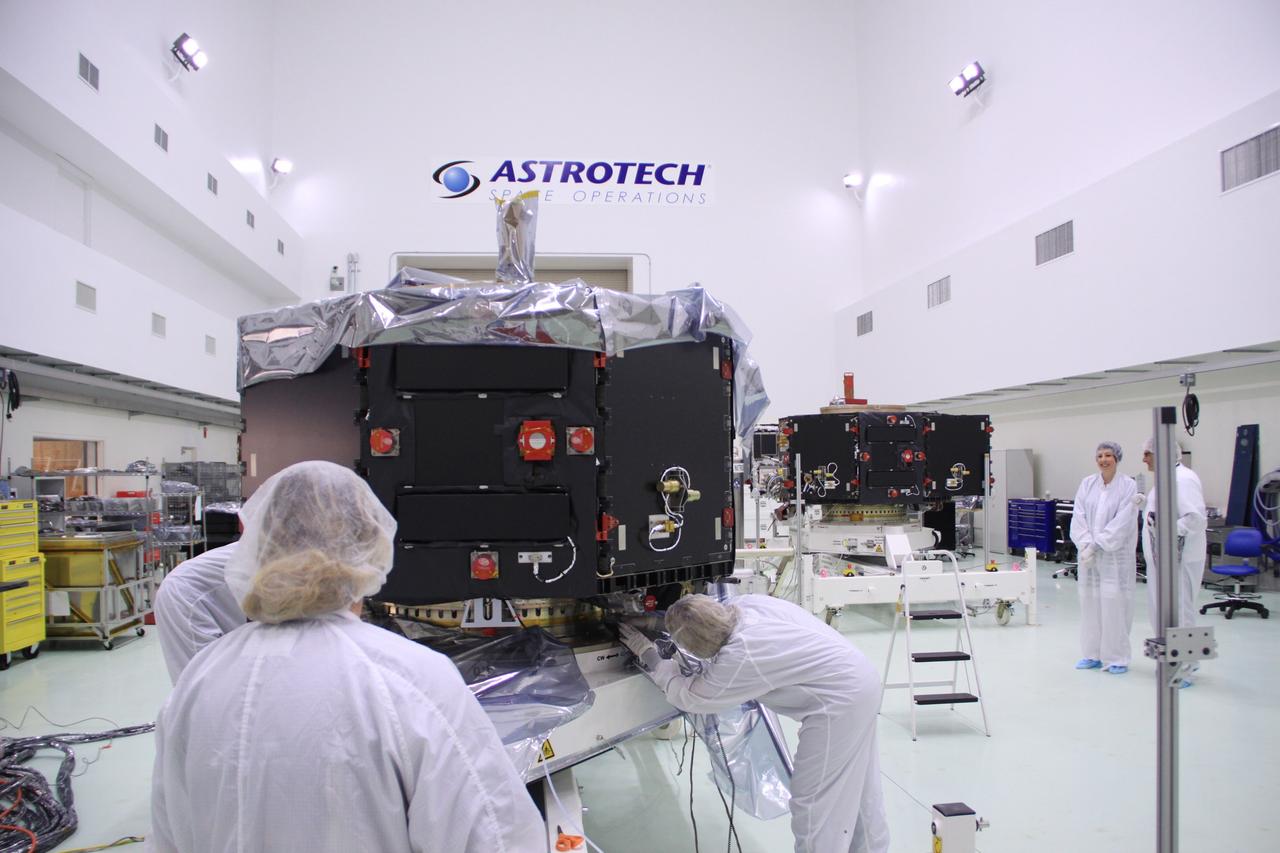
CAPE CANAVERAL, Fla. – In the clean room high bay at the Astrotech payload processing facility near NASA’s Kennedy Space Center in Florida, Applied Physics Laboratory technicians remove the protective shroud from around NASA's Radiation Belt Storm Probe B. Its twin, Radiation Belt Storm Probe A, in the background, has already been uncovered. The Radiation Belt Storm Probes, or RBSP, mission will help us understand the sun’s influence on Earth and near-Earth space by studying the Earth’s radiation belts on various scales of space and time. RBSP instruments will provide the measurements needed to characterize and quantify the plasma processes that produce very energetic ions and relativistic electrons. The mission is part of NASA’s broader Living With a Star Program that was conceived to explore fundamental processes that operate throughout the solar system, particularly those that generate hazardous space weather effects in the vicinity of Earth and phenomena that could impact solar system exploration. RBSP will begin its mission of exploration of Earth's Van Allen radiation belts and the extremes of space weather after launch. Launch aboard a United Launch Alliance Atlas V rocket is scheduled for August 23. For more information, visit http://www.nasa.gov/rbsp. Photo credit: NASA/Jim Grossmann
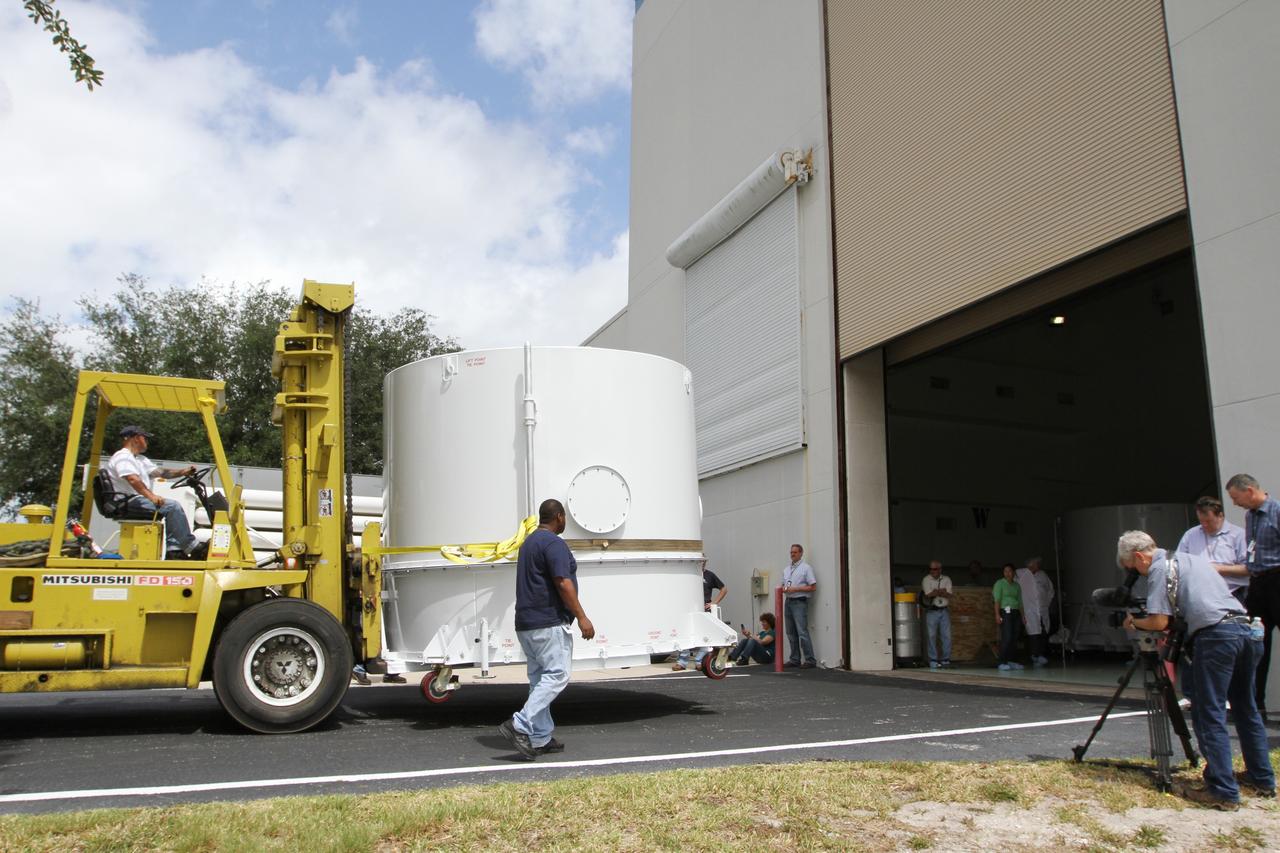
CAPE CANAVERAL, Fla. – A forklift operator moves NASA's Radiation Belt Storm Probe B, enclosed in a protective shipping container, toward the open bay door of the Astrotech payload processing facility near NASA’s Kennedy Space Center in Florida where Applied Physics Laboratory technicians will begin spacecraft testing and prelaunch preparations. The twin RBSP spacecraft arrived at Kennedy’s Shuttle Landing Facility in the cargo bay of a U.S. Air Force C-17 aircraft earlier in the day. The RBSP mission will help us understand the sun’s influence on Earth and near-Earth space by studying the Earth’s radiation belts on various scales of space and time. The RBSP instruments will provide the measurements needed to characterize and quantify the plasma processes that produce very energetic ions and relativistic electrons. The mission is part of NASA’s broader Living With a Star Program that was conceived to explore fundamental processes that operate throughout the solar system, and in particular those that generate hazardous space weather effects in the vicinity of Earth and phenomena that could impact solar system exploration. RBSP is scheduled to begin its mission of exploration of Earth's Van Allen Radiation Belts and the extremes of space weather after launch. Launch aboard a United Launch Alliance Atlas V rocket is scheduled for August 23. For more information, visit http://www.nasa.gov/rbsp. Photo credit: NASA/Kim Shiflett
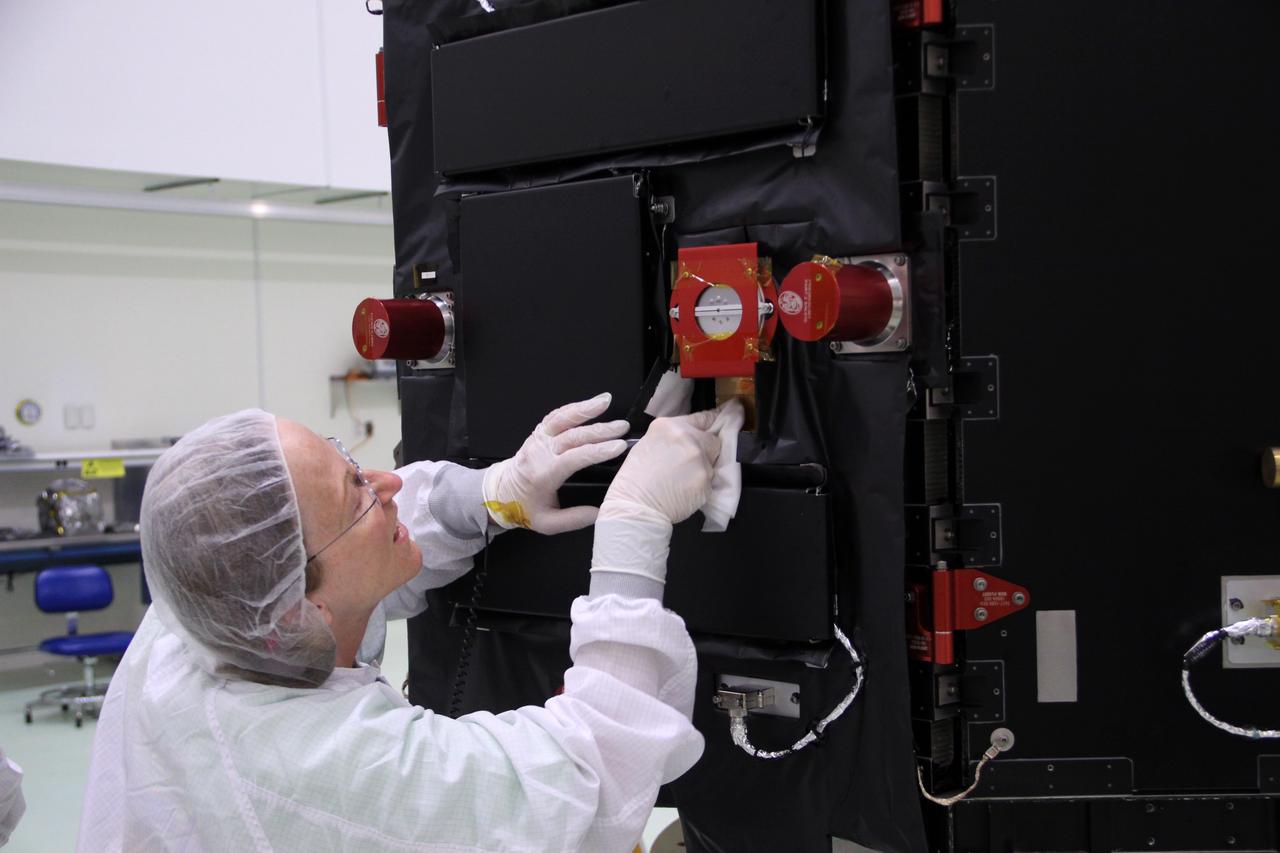
CAPE CANAVERAL, Fla. – In the clean room high bay at the Astrotech payload processing facility near NASA’s Kennedy Space Center in Florida, an Applied Physics Laboratory technician cleans NASA's Radiation Belt Storm Probe B. Prelaunch preparations and spacecraft testing will follow. The Radiation Belt Storm Probes, or RBSP, mission will help us understand the sun’s influence on Earth and near-Earth space by studying the Earth’s radiation belts on various scales of space and time. RBSP instruments will provide the measurements needed to characterize and quantify the plasma processes that produce very energetic ions and relativistic electrons. The mission is part of NASA’s broader Living With a Star Program that was conceived to explore fundamental processes that operate throughout the solar system, particularly those that generate hazardous space weather effects in the vicinity of Earth and phenomena that could impact solar system exploration. RBSP will begin its mission of exploration of Earth's Van Allen radiation belts and the extremes of space weather after launch. Launch aboard a United Launch Alliance Atlas V rocket is scheduled for August 23. For more information, visit http://www.nasa.gov/rbsp. Photo credit: NASA/Jim Grossmann
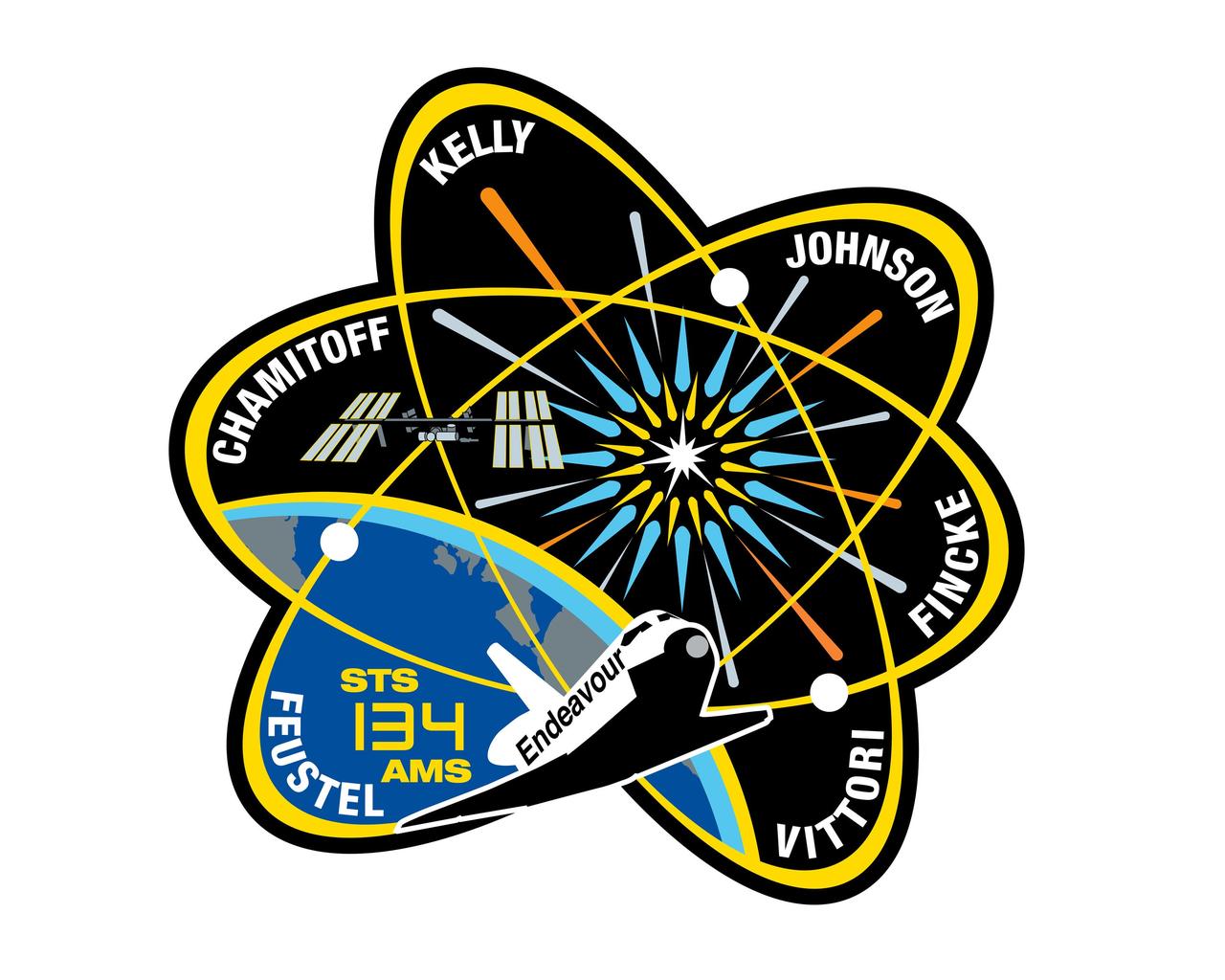
STS134-S-001 (March 2010) --- The design of the STS-134 crew patch highlights research on the International Space Station (ISS) focusing on the fundamental physics of the universe. On this mission, the crew of space shuttle Endeavour will install the Alpha Magnetic Spectrometer-2 (AMS) experiment -- a cosmic particle detector that utilizes the first-ever superconducting magnet to be flown in space. By studying sub-atomic particles in the background cosmic radiation, and searching for anti-matter and dark-matter, it will help scientists better understand the evolution and properties of our universe. The shape of the patch is inspired by the international atomic symbol, and represents the atom with orbiting electrons around the nucleus. The burst near the center refers to the big-bang theory and the origin of the universe. The shuttle Endeavour and ISS fly together into the sunrise over the limb of Earth, representing the dawn of a new age, understanding the nature of the universe. The NASA insignia design for shuttle flights is reserved for use by the astronauts and for other official use as the NASA administrator may authorize. Public availability has been approved only in the form of illustrations by the various news media. When and if there is any change in this policy, which we do not anticipate, it will be publicly announced.
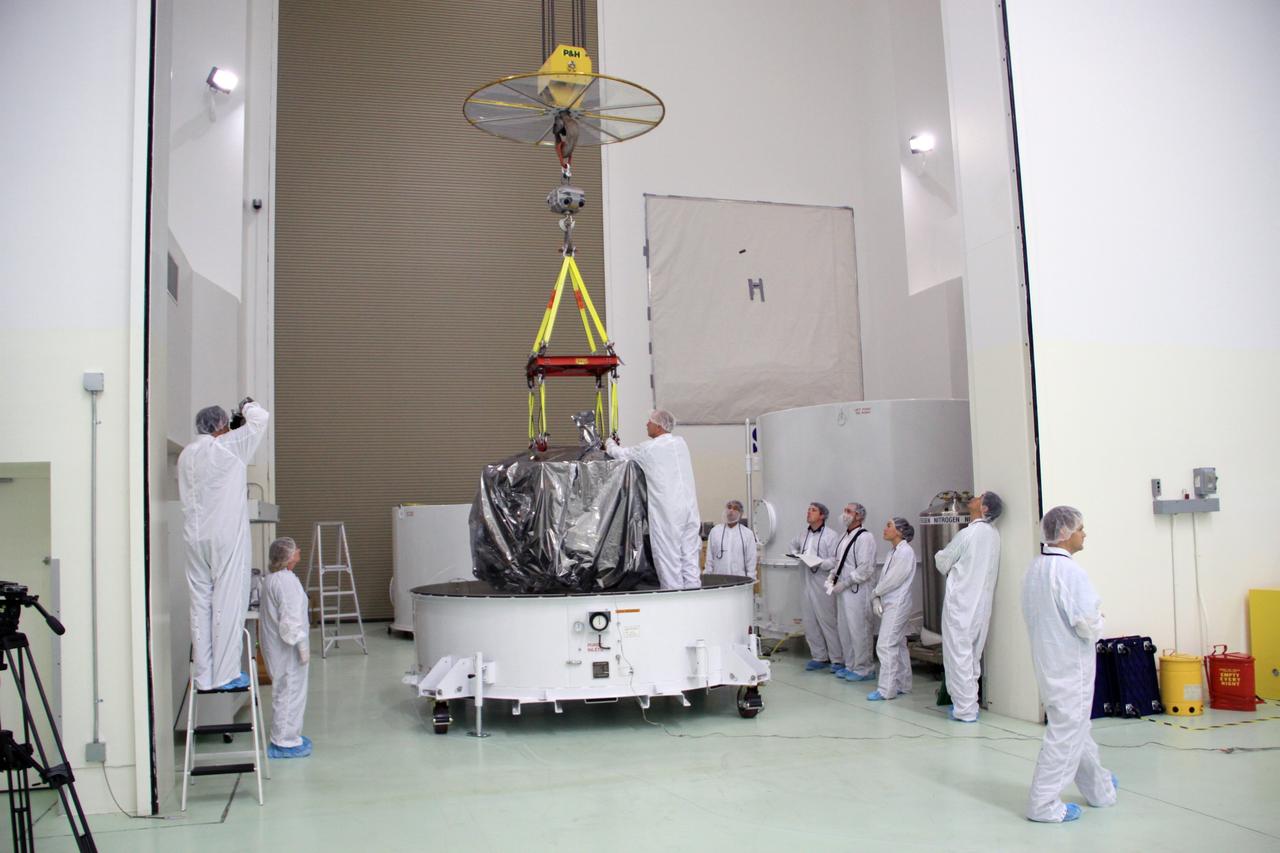
CAPE CANAVERAL, Fla. – In the clean room high bay at the Astrotech payload processing facility near NASA’s Kennedy Space Center in Florida, Applied Physics Laboratory technicians prepare to lift NASA's Radiation Belt Storm Probe A, wrapped in a protective shroud, from the bottom of its shipping container. Prelaunch preparations and spacecraft testing will follow. The Radiation Belt Storm Probes, or RBSP, mission will help us understand the sun’s influence on Earth and near-Earth space by studying the Earth’s radiation belts on various scales of space and time. RBSP instruments will provide the measurements needed to characterize and quantify the plasma processes that produce very energetic ions and relativistic electrons. The mission is part of NASA’s broader Living With a Star Program that was conceived to explore fundamental processes that operate throughout the solar system, particularly those that generate hazardous space weather effects in the vicinity of Earth and phenomena that could impact solar system exploration. RBSP will begin its mission of exploration of Earth's Van Allen radiation belts and the extremes of space weather after launch. Launch aboard a United Launch Alliance Atlas V rocket is scheduled for August 23. For more information, visit http://www.nasa.gov/rbsp. Photo credit: NASA/Jim Grossmann
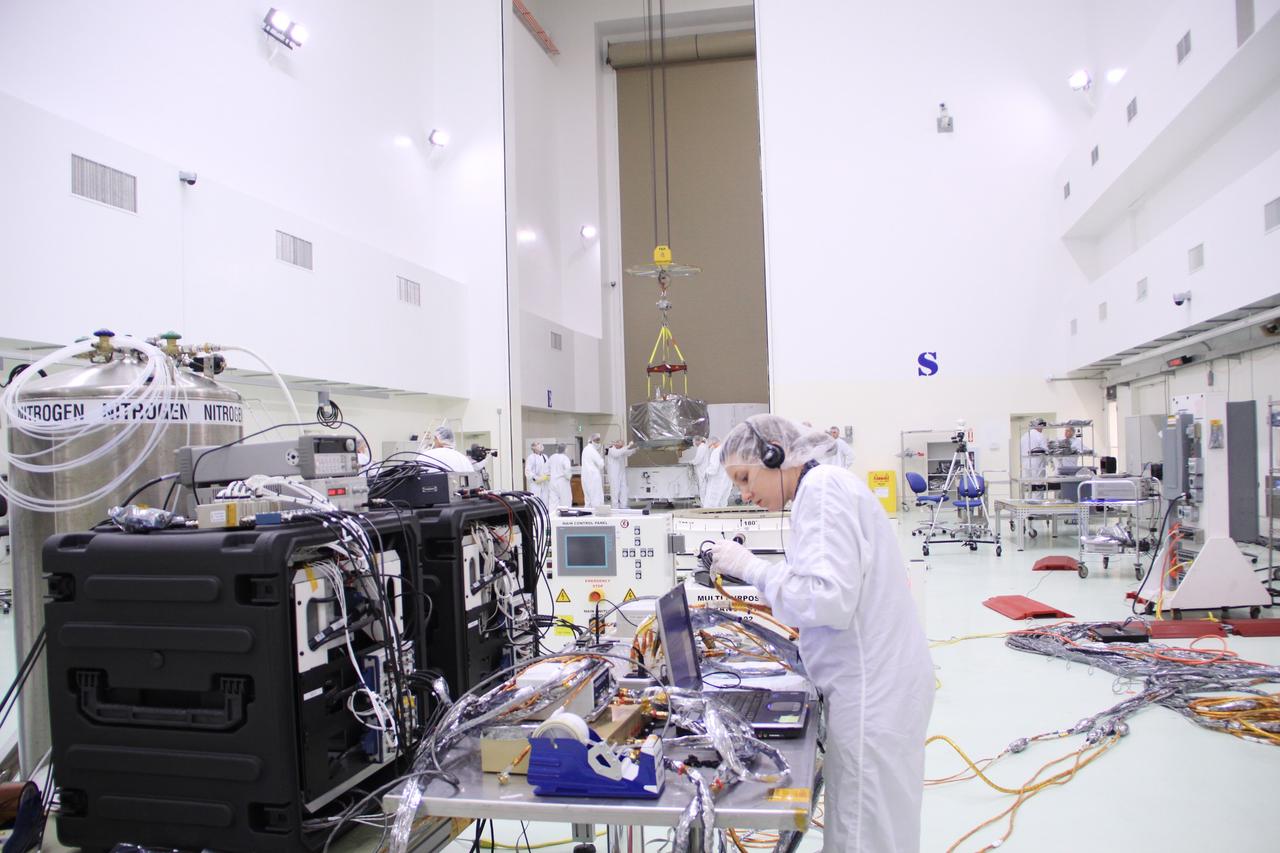
CAPE CANAVERAL, Fla. – In the clean room high bay at the Astrotech payload processing facility near NASA’s Kennedy Space Center in Florida, an Applied Physics Laboratory technician prepares the instruments and equipment that will be used to test and monitor NASA's Radiation Belt Storm Probes. The Radiation Belt Storm Probes, or RBSP, mission will help us understand the sun’s influence on Earth and near-Earth space by studying the Earth’s radiation belts on various scales of space and time. RBSP instruments will provide the measurements needed to characterize and quantify the plasma processes that produce very energetic ions and relativistic electrons. The mission is part of NASA’s broader Living With a Star Program that was conceived to explore fundamental processes that operate throughout the solar system, particularly those that generate hazardous space weather effects in the vicinity of Earth and phenomena that could impact solar system exploration. RBSP will begin its mission of exploration of Earth's Van Allen radiation belts and the extremes of space weather after launch. Launch aboard a United Launch Alliance Atlas V rocket is scheduled for August 23. For more information, visit http://www.nasa.gov/rbsp. Photo credit: NASA/Jim Grossmann
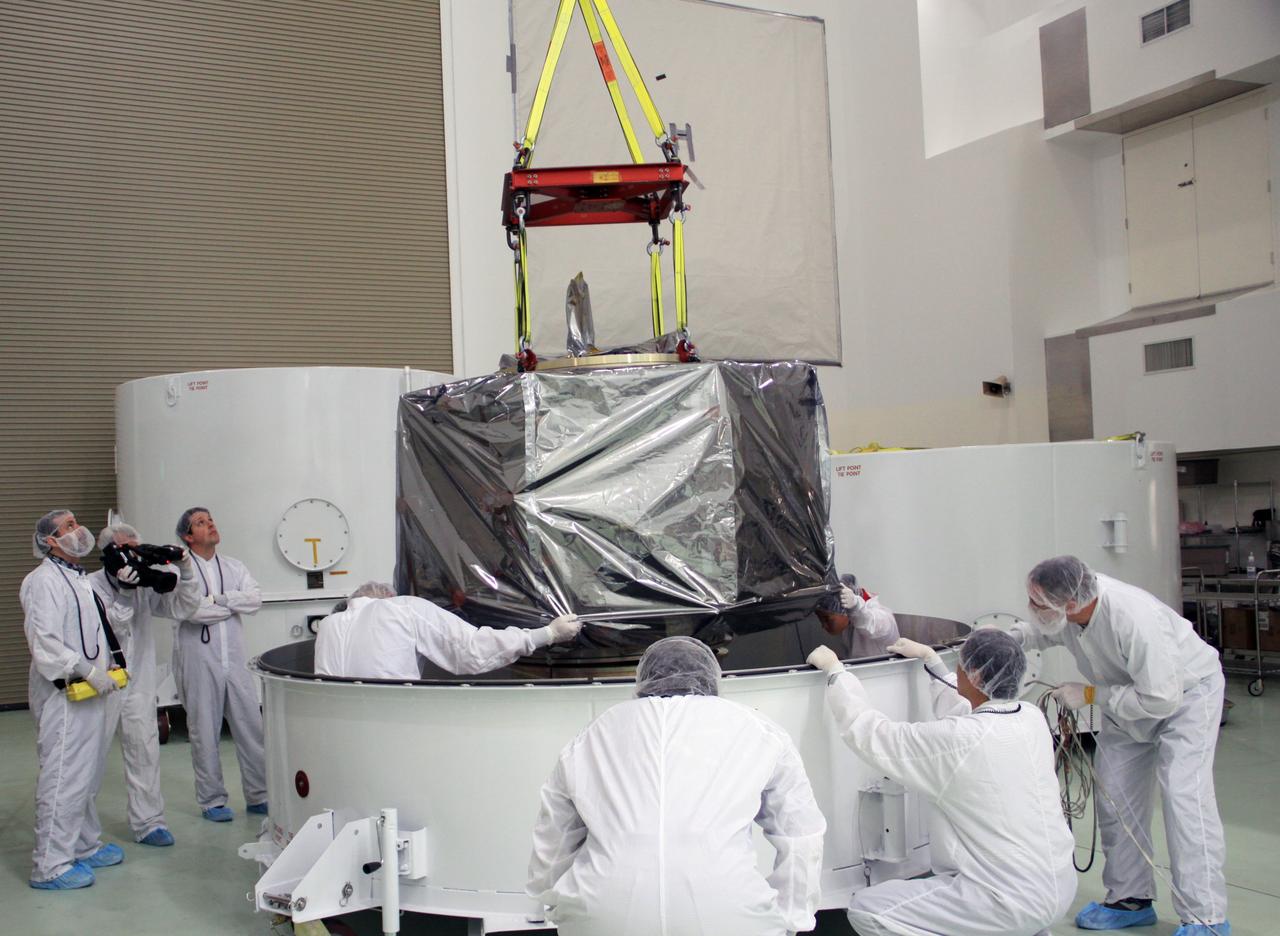
CAPE CANAVERAL, Fla. – In the clean room high bay at the Astrotech payload processing facility near NASA’s Kennedy Space Center in Florida, Applied Physics Laboratory technicians lift NASA's Radiation Belt Storm Probe B, wrapped in a protective shroud, from the bottom of its shipping container. Prelaunch preparations and spacecraft testing will follow. The Radiation Belt Storm Probes, or RBSP, mission will help us understand the sun’s influence on Earth and near-Earth space by studying the Earth’s radiation belts on various scales of space and time. RBSP instruments will provide the measurements needed to characterize and quantify the plasma processes that produce very energetic ions and relativistic electrons. The mission is part of NASA’s broader Living With a Star Program that was conceived to explore fundamental processes that operate throughout the solar system, particularly those that generate hazardous space weather effects in the vicinity of Earth and phenomena that could impact solar system exploration. RBSP will begin its mission of exploration of Earth's Van Allen radiation belts and the extremes of space weather after launch. Launch aboard a United Launch Alliance Atlas V rocket is scheduled for August 23. For more information, visit http://www.nasa.gov/rbsp. Photo credit: NASA/Jim Grossmann
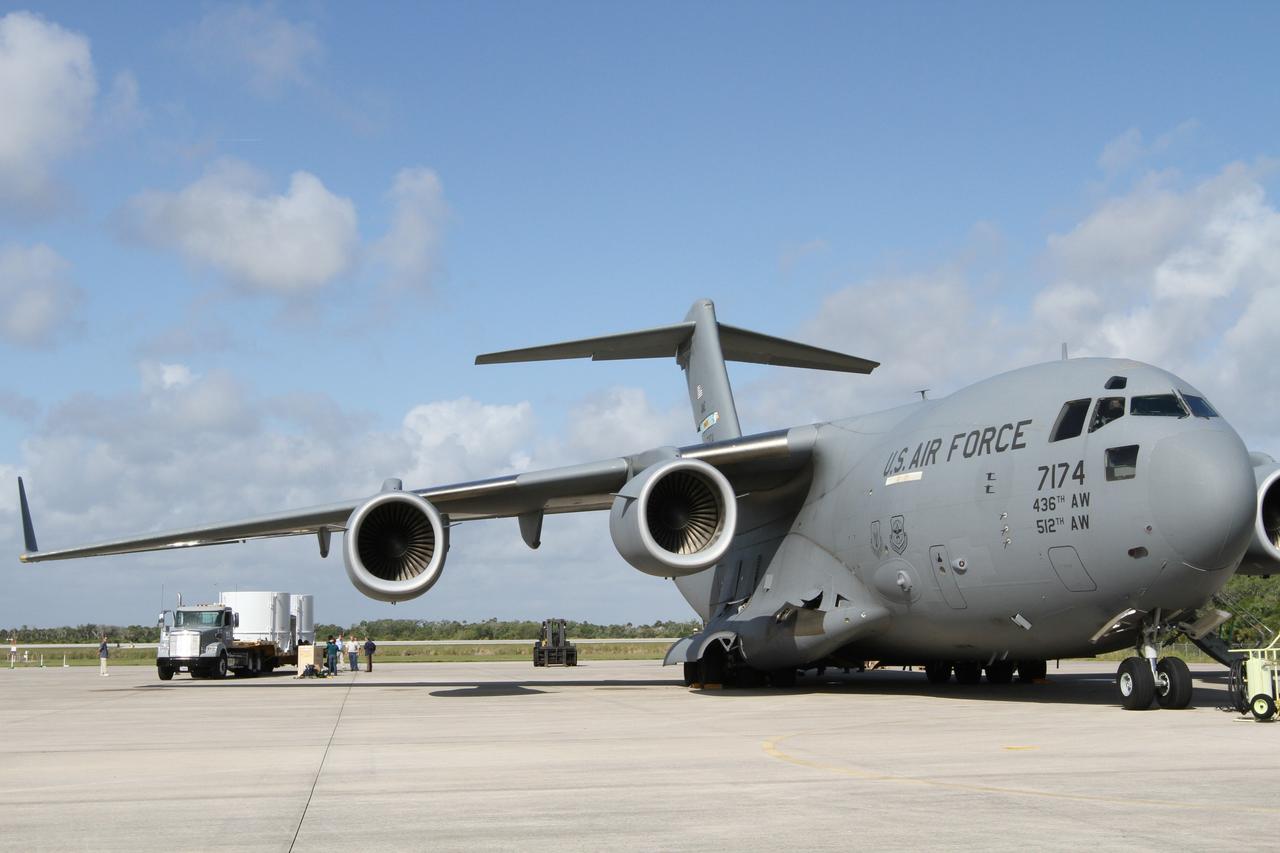
CAPE CANAVERAL, Fla. – NASA's twin Radiation Belt Storm Probes, enclosed in protective shipping containers, have been secured on a flatbed truck at the Shuttle Landing Facility at NASA’s Kennedy Space Center in Florida. The spacecraft will be transported to the Astrotech payload processing facility near Kennedy Space Center where Applied Physics Laboratory technicians will begin spacecraft testing and prelaunch preparations. The spacecraft arrived at Kennedy in the cargo bay of the U.S. Air Force C-17 airplane at right. The RBSP mission will help us understand the sun’s influence on Earth and near-Earth space by studying the Earth’s radiation belts on various scales of space and time. The RBSP instruments will provide the measurements needed to characterize and quantify the plasma processes that produce very energetic ions and relativistic electrons. The mission is part of NASA’s broader Living With a Star Program that was conceived to explore fundamental processes that operate throughout the solar system, and in particular those that generate hazardous space weather effects in the vicinity of Earth and phenomena that could impact solar system exploration. RBSP is scheduled to begin its mission of exploration of Earth's Van Allen Radiation Belts and the extremes of space weather after launch. Launch aboard a United Launch Alliance Atlas V rocket is scheduled for August 23. For more information, visit http://www.nasa.gov/rbsp. Photo credit: NASA/Kim Shiflett
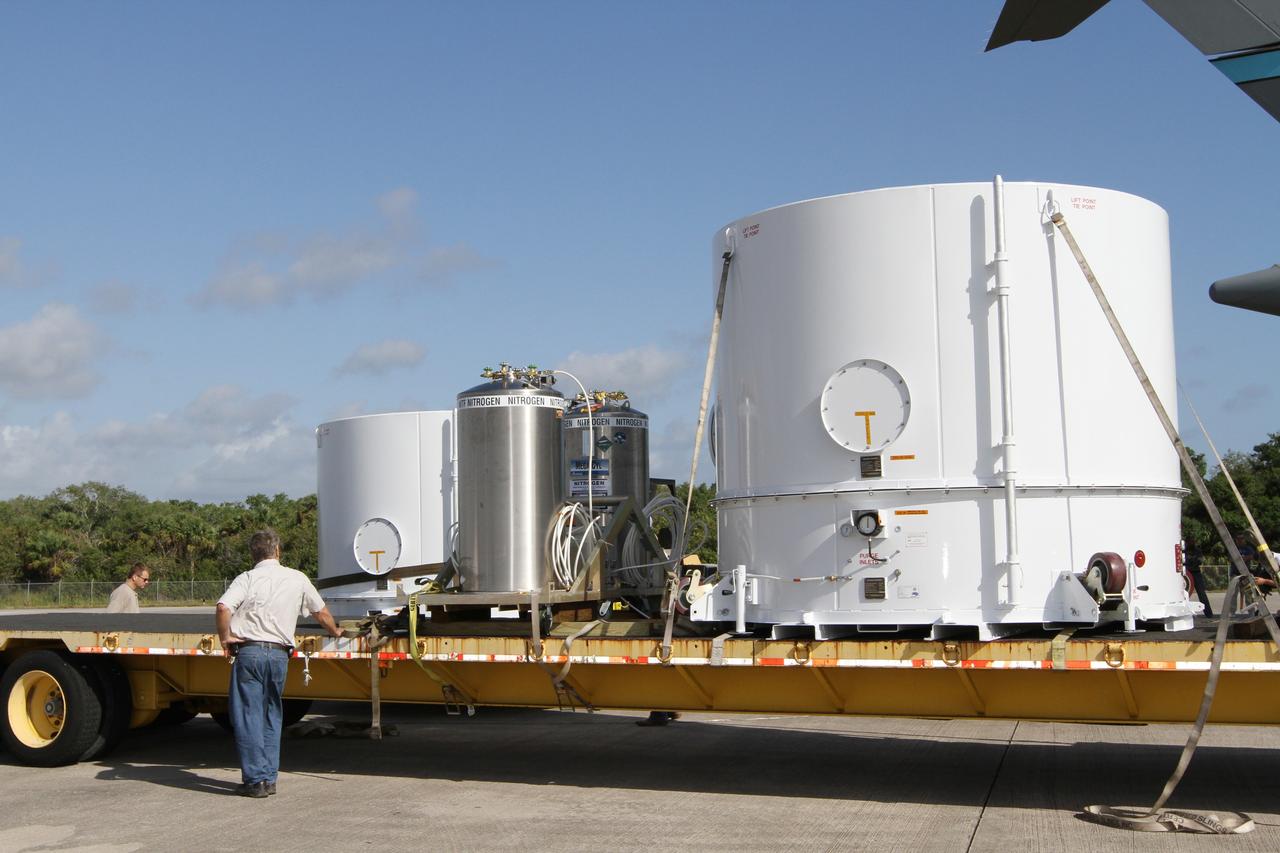
CAPE CANAVERAL, Fla. – Workers prepare to load NASA's Radiation Belt Storm Probe A, enclosed in a protective shipping container, onto a flatbed truck at the Shuttle Landing Facility at NASA’s Kennedy Space Center in Florida. The twin RBSP spacecraft will be transported to the Astrotech payload processing facility near Kennedy Space Center where Applied Physics Laboratory technicians will begin spacecraft testing and prelaunch preparations. Nitrogen will be pumped into the canisters during transport to provide the proper environmental control for the spacecraft. The RBSP mission will help us understand the sun’s influence on Earth and near-Earth space by studying the Earth’s radiation belts on various scales of space and time. The RBSP instruments will provide the measurements needed to characterize and quantify the plasma processes that produce very energetic ions and relativistic electrons. The mission is part of NASA’s broader Living With a Star Program that was conceived to explore fundamental processes that operate throughout the solar system, and in particular those that generate hazardous space weather effects in the vicinity of Earth and phenomena that could impact solar system exploration. RBSP is scheduled to begin its mission of exploration of Earth's Van Allen Radiation Belts and the extremes of space weather after launch. Launch aboard a United Launch Alliance Atlas V rocket is scheduled for August 23. For more information, visit http://www.nasa.gov/rbsp. Photo credit: NASA/Kim Shiflett
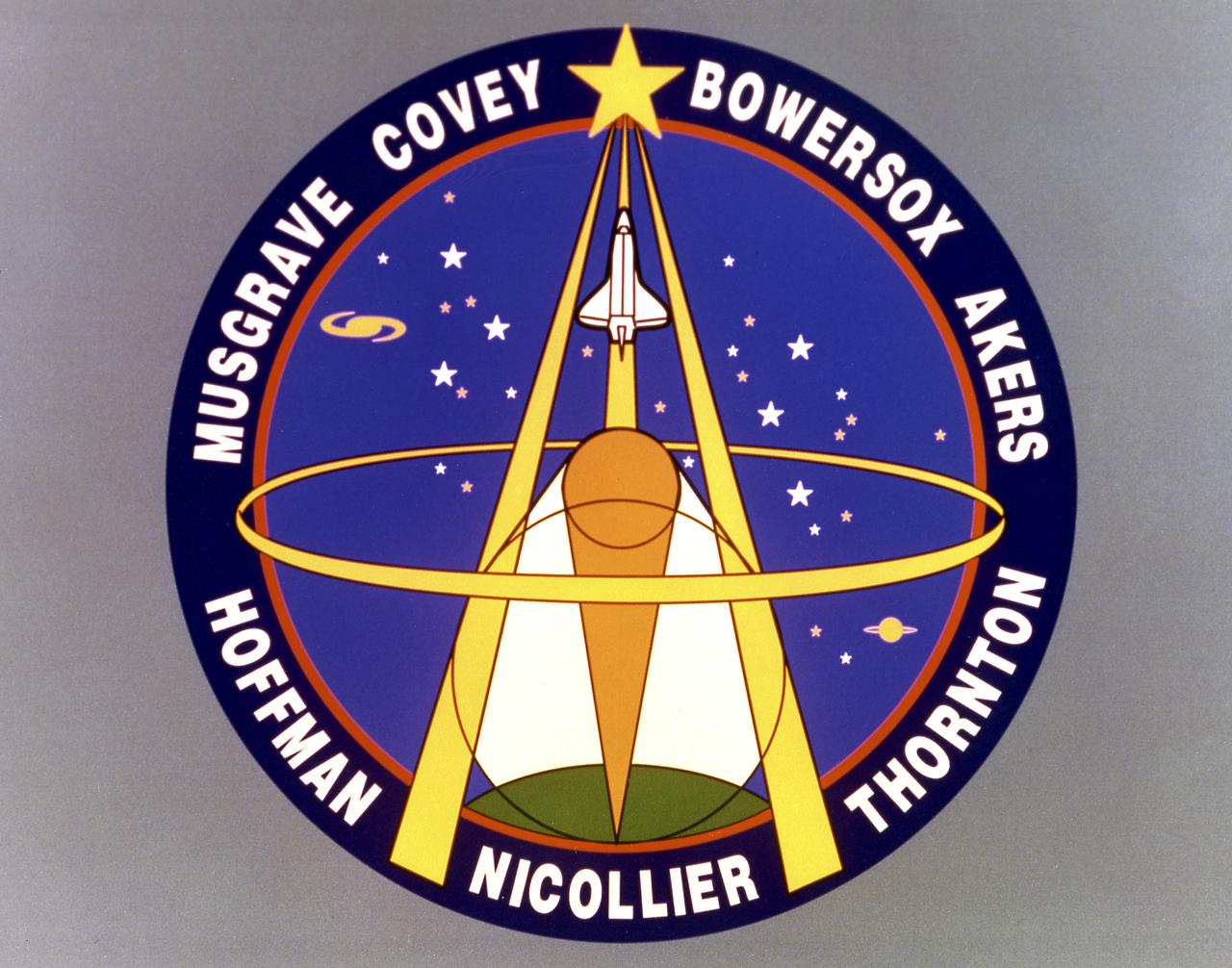
Designed by the mission crew members, the STS-61 crew insignia depicts the astronaut symbol superimposed against the sky with the Earth underneath. Also seen are two circles representing the optical configuration of the Hubble Space Telescope (HST). Light is focused by reflections from a large primary mirror and a smaller secondary mirror. The light is analyzed by various instruments and, according to the crew members, brings to us on Earth knowledge about planets, stars, galaxies and other celestial objects, allowing us to better understand the complex physical processes at work in the universe. The Space Shuttle Endeavour is also represented as the fundamental tool that allows the crew to perform the first servicing of the Hubble Space Telescope so its scientific deep space mission may be extended for several years to come. The overall design of the emblem, with lines converging to a high point, is also a symbolic representation of the large-scale Earth-based effort which involves space agencies, industry, and the universities to reach goals of knowledge and perfection.

STS134-S-001 (March 2010) --- The design of the STS-134 crew patch highlights research on the International Space Station (ISS) focusing on the fundamental physics of the universe. On this mission, the crew of the space shuttle Endeavour will install the Alpha Magnetic Spectrometer (AMS) experiment - a cosmic particle detector. By studying subatomic particles in the background cosmic radiation and searching for antimatter, dark-matter, and dark energy, it will help scientists better understand the evolution and properties of our universe. The shape of the patch is inspired by the international atomic symbol, and represents the atom with orbiting electrons around the nucleus. The burst near the center refers to the origin of the universe. The space shuttle Endeavour and ISS fly together into the sunrise over the limb of the Earth, representing the dawn of a new age?understanding the nature of the universe. The NASA insignia design for space shuttle flights is reserved for use by the astronauts and for other official use as the NASA Administrator may authorize. Public availability has been approved only in the forms of illustrations by the various news media. When and if there is any change in this policy, which is not anticipated, the change will be publicly announced. Photo credit: NASA
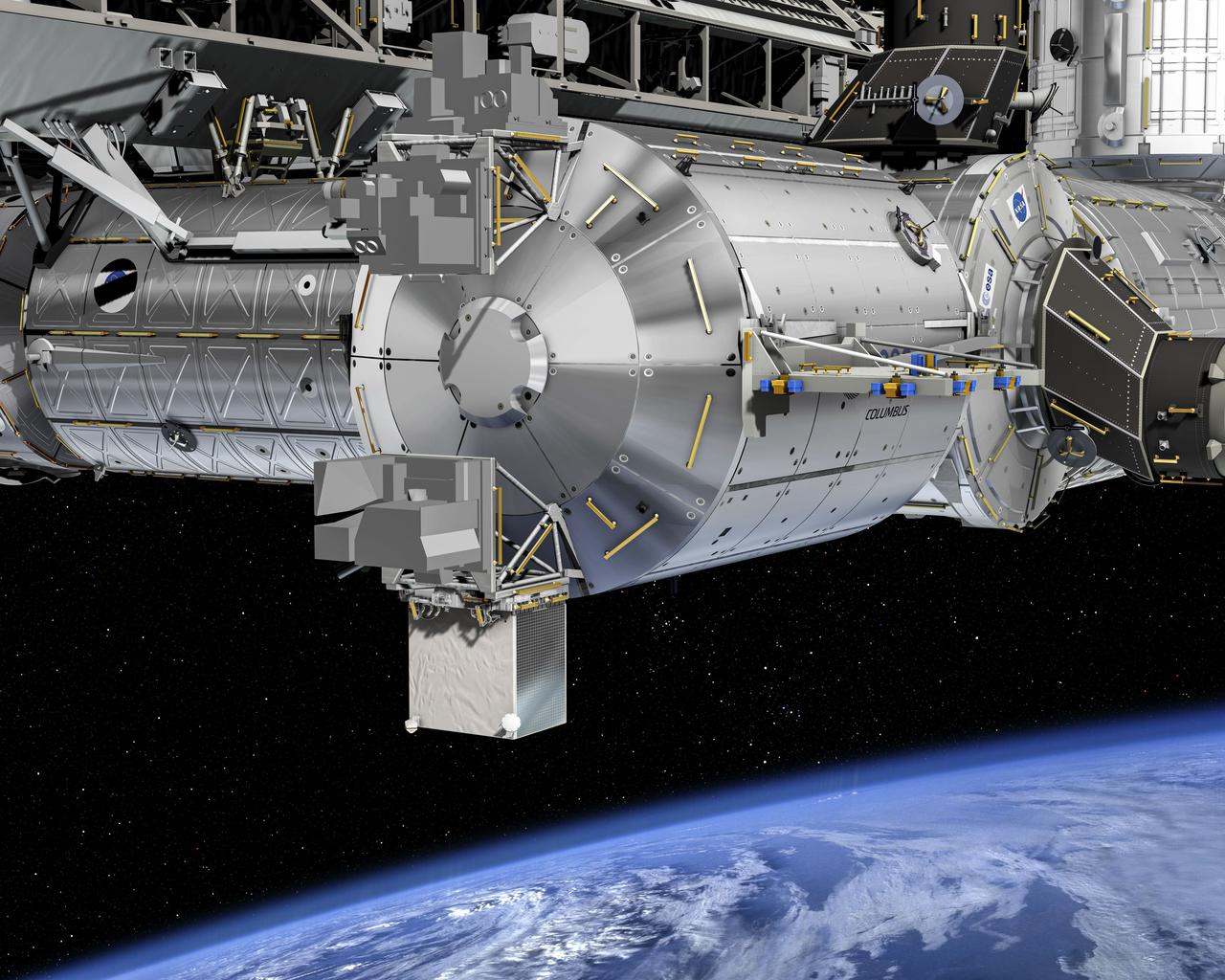
jsc2025e015676 (3/6/2025) --- The Atomic Clock Ensemble in Space (ACES) facility attached to the exterior of ESA's Columbus facility on the International Space Station. By creating a "network of clocks", this European facility can link its own highly precise timepieces with the most accurate clocks on Earth and compare them to measure the flow of time. ACES includes two cutting-edge clocks: Project d'Horloge Atomique par Refroidissement d'Atomes en Orbit (PHARAO) and Space Hydrogen Maser (SHM). The excellent stability of SHM over a one hour period, combined with the long-term stability and accuracy of PHARAO, provide timekeeping for ACES with a precision of one second over 300 million years. Once in space, a robotic arm positions ACES onto the Columbus module, where it will remain for 30 months to collect data. ACES aims to record continuous data over at least ten sessions of 25 days each. By comparing clocks in space and on Earth, ACES can provide scientists with precise measurements to test Einstein’s gravitational time dilation effect, search for time variations of fundamental constants of physics, and hunt for dark matter. ACES is fully assembled at Airbus in Friedrichshafen, Germany. Image courtesy of D. Ducros (ESA).
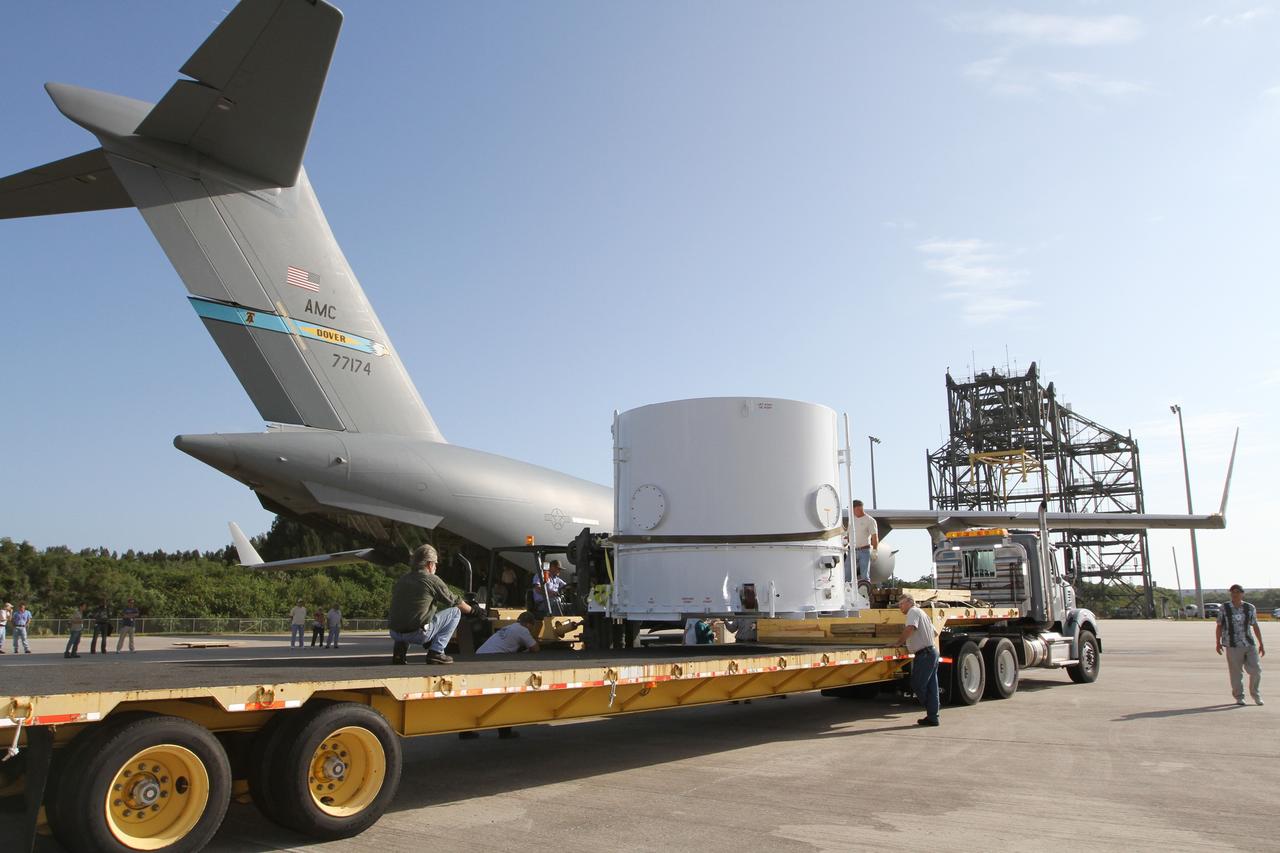
CAPE CANAVERAL, Fla. – Workers position NASA's Radiation Belt Storm Probe B, enclosed in a protective shipping container, onto a flatbed truck at the Shuttle Landing Facility at NASA’s Kennedy Space Center in Florida. The twin RBSP spacecraft will be transported to the Astrotech payload processing facility near Kennedy Space Center where Applied Physics Laboratory technicians will begin spacecraft testing and prelaunch preparations. The RBSP mission will help us understand the sun’s influence on Earth and near-Earth space by studying the Earth’s radiation belts on various scales of space and time. The RBSP instruments will provide the measurements needed to characterize and quantify the plasma processes that produce very energetic ions and relativistic electrons. The mission is part of NASA’s broader Living With a Star Program that was conceived to explore fundamental processes that operate throughout the solar system, and in particular those that generate hazardous space weather effects in the vicinity of Earth and phenomena that could impact solar system exploration. RBSP is scheduled to begin its mission of exploration of Earth's Van Allen Radiation Belts and the extremes of space weather after launch. Launch aboard a United Launch Alliance Atlas V rocket is scheduled for August 23. For more information, visit http://www.nasa.gov/rbsp. Photo credit: NASA/Kim Shiflett
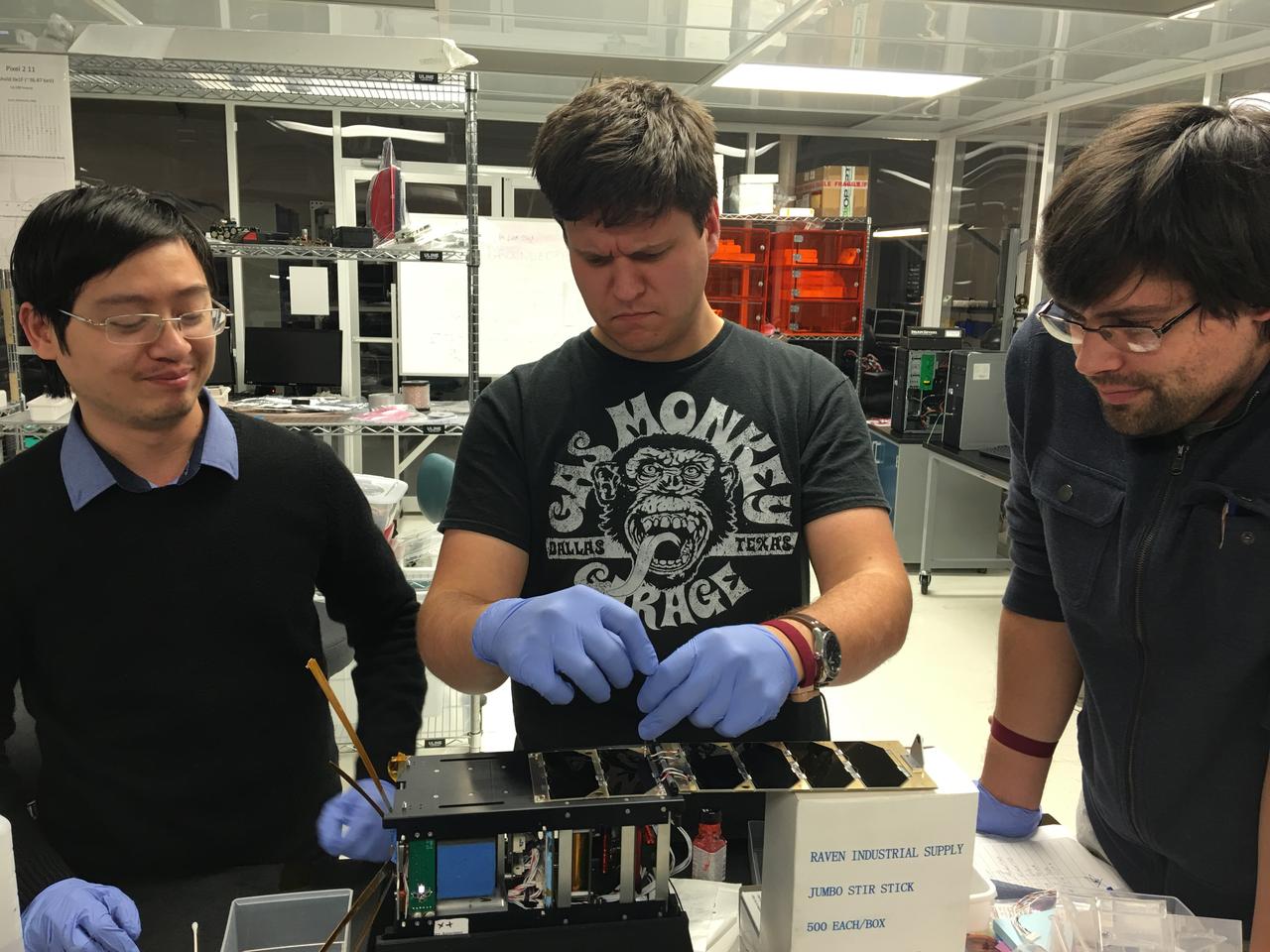
CXBN-2 Integration Team in the Morehead State University Spacecraft Integration and Assembly Facility. Left to right: Kein Dant, Yevgeniy Byleborodov, and Nate Richard. The Cosmic X-Ray Background NanoSat-2 (CXBN-2) CubeSat Mission developed by Morehead State University and its partners the Keldysh Institute (Moscow, Russia), the Maysville Community and Technical College (Morehead, KY) and KYSpace LLC (Lexington, KY) will increase the precision of measurements of the Cosmic X-Ray Background in the 30-50 keV range to a precision of <5%, thereby constraining models that attempt to explain the relative contribution of proposed sources lending insight into the underlying physics of the early universe. The mission addresses a fundamental science question that is central to our understanding of the structure, origin, and evolution of the universe by potentially lending insight into both the high-energy background radiation and into the evolution of primordial galaxies. Launched by NASA’s CubeSat Launch Initiative NET April 18, 2017 ELaNa XVII mission on the seventh Orbital-ATK Cygnus Commercial Resupply Services (OA-7) to the International Space Station and deployed on tbd.
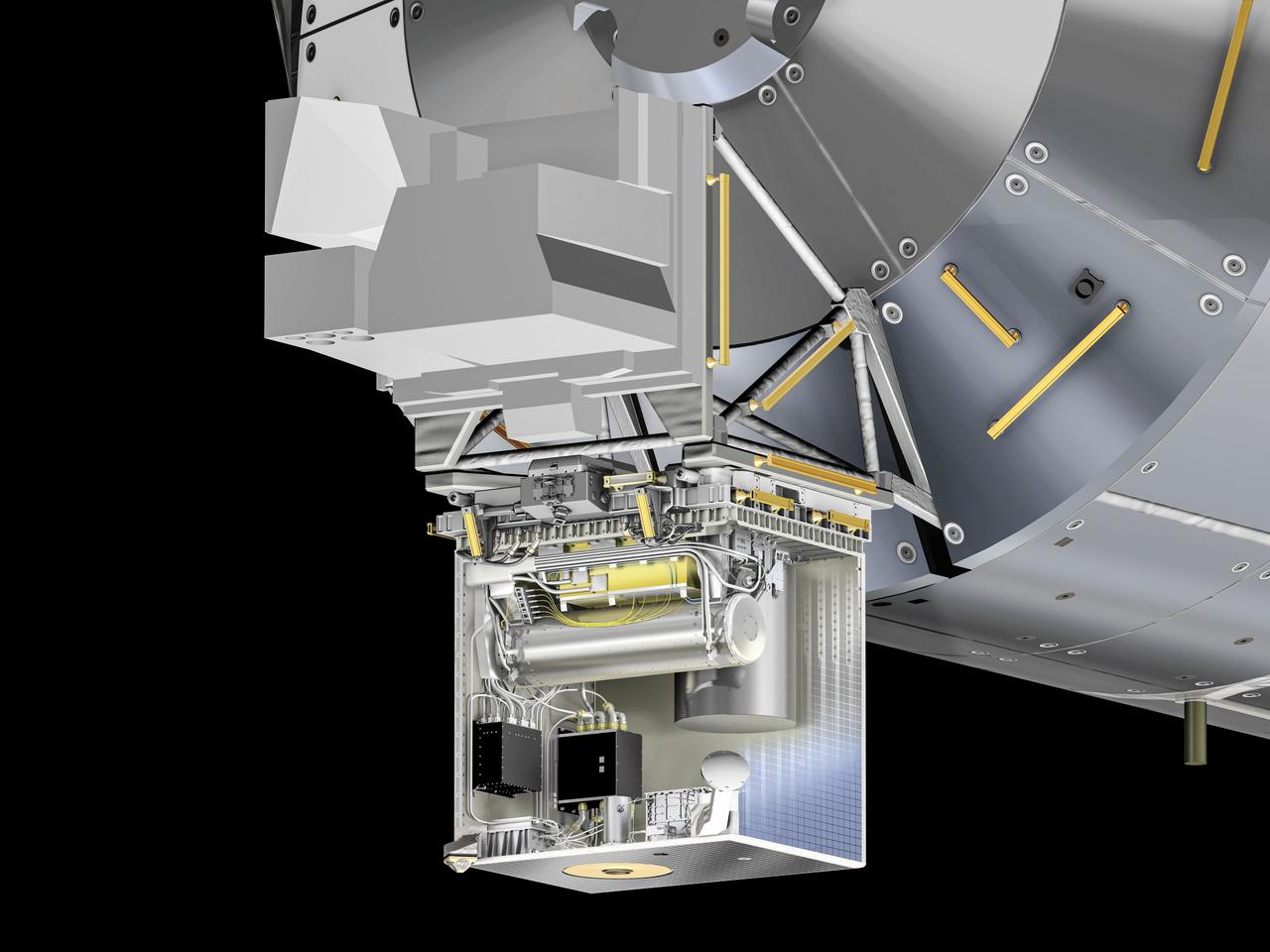
jsc2025e015681 (3/6/2025) --- The Atomic Clock Ensemble in Space (ACES) facility attached to the exterior of ESA's Columbus facility on the International Space Station. By creating a "network of clocks", this European facility can link its own highly precise timepieces with the most accurate clocks on Earth and compare them to measure the flow of time. ACES includes two cutting-edge clocks: Project d'Horloge Atomique par Refroidissement d'Atomes en Orbit (PHARAO) and Space Hydrogen Maser (SHM). The excellent stability of SHM over a one hour period, combined with the long-term stability and accuracy of PHARAO, provide timekeeping for ACES with a precision of one second over 300 million years. Once in space, a robotic arm positions ACES onto the Columbus module, where it will remain for 30 months to collect data. ACES aims to record continuous data over at least ten sessions of 25 days each. By comparing clocks in space and on Earth, ACES can provide scientists with precise measurements to test Einstein’s gravitational time dilation effect, search for time variations of fundamental constants of physics, and hunt for dark matter. ACES is fully assembled at Airbus in Friedrichshafen, Germany. Image courtesy of D. Ducros (ESA).
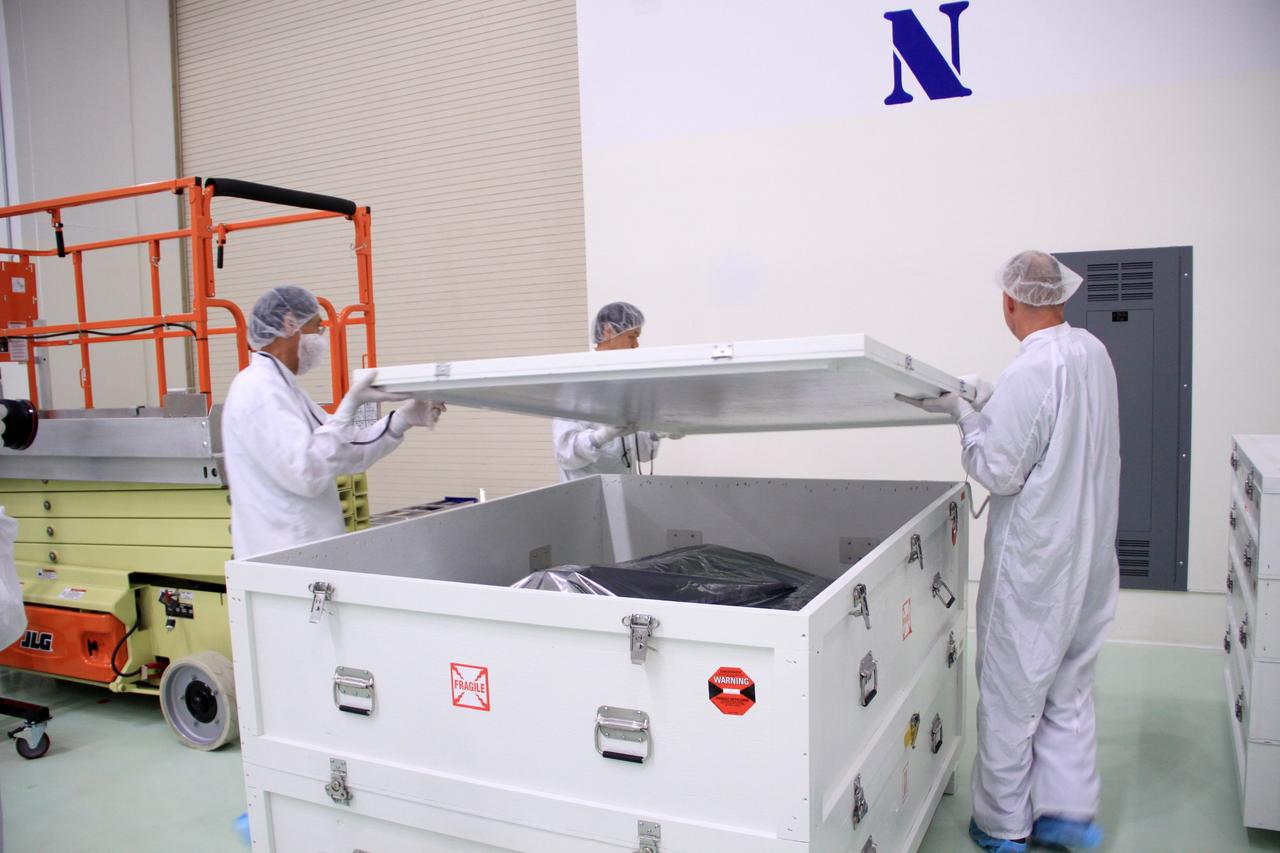
CAPE CANAVERAL, Fla. – In the clean room high bay at the Astrotech payload processing facility near NASA’s Kennedy Space Center in Florida, Applied Physics Laboratory technicians unpack the solar arrays for NASA's Radiation Belt Storm Probe A. The Radiation Belt Storm Probes, or RBSP, mission will help us understand the sun’s influence on Earth and near-Earth space by studying the Earth’s radiation belts on various scales of space and time. RBSP instruments will provide the measurements needed to characterize and quantify the plasma processes that produce very energetic ions and relativistic electrons. The mission is part of NASA’s broader Living With a Star Program that was conceived to explore fundamental processes that operate throughout the solar system, particularly those that generate hazardous space weather effects in the vicinity of Earth and phenomena that could impact solar system exploration. RBSP will begin its mission of exploration of Earth's Van Allen radiation belts and the extremes of space weather after launch. Launch aboard a United Launch Alliance Atlas V rocket is scheduled for August 23. For more information, visit http://www.nasa.gov/rbsp. Photo credit: NASA/Jim Grossmann
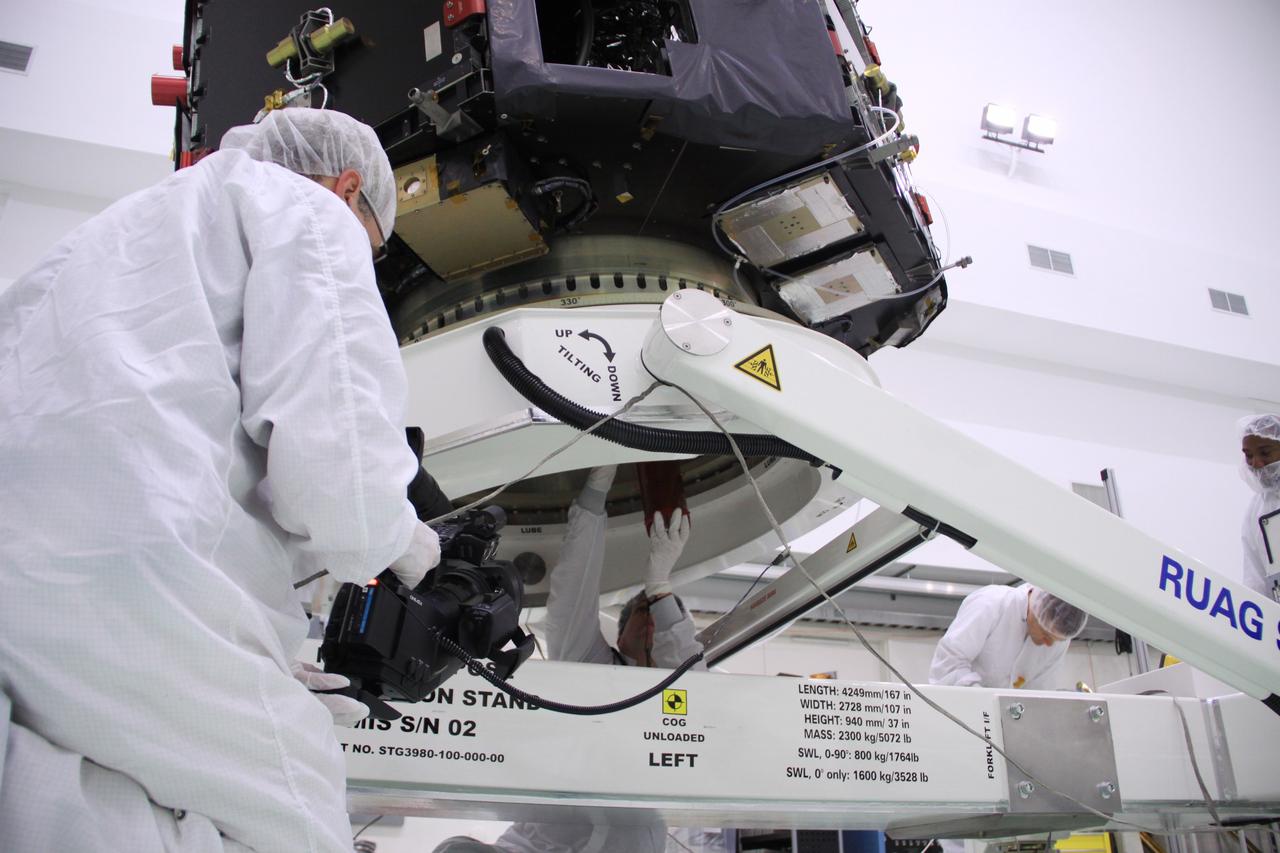
CAPE CANAVERAL, Fla. – In the clean room high bay at the Astrotech payload processing facility near NASA’s Kennedy Space Center in Florida, an Applied Physics Laboratory technician secures NASA's Radiation Belt Storm Probe B to a test stand from beneath the spacecraft. The Radiation Belt Storm Probes, or RBSP, mission will help us understand the sun’s influence on Earth and near-Earth space by studying the Earth’s radiation belts on various scales of space and time. RBSP instruments will provide the measurements needed to characterize and quantify the plasma processes that produce very energetic ions and relativistic electrons. The mission is part of NASA’s broader Living With a Star Program that was conceived to explore fundamental processes that operate throughout the solar system, particularly those that generate hazardous space weather effects in the vicinity of Earth and phenomena that could impact solar system exploration. RBSP will begin its mission of exploration of Earth's Van Allen radiation belts and the extremes of space weather after launch. Launch aboard a United Launch Alliance Atlas V rocket is scheduled for August 23. For more information, visit http://www.nasa.gov/rbsp. Photo credit: NASA/Jim Grossmann
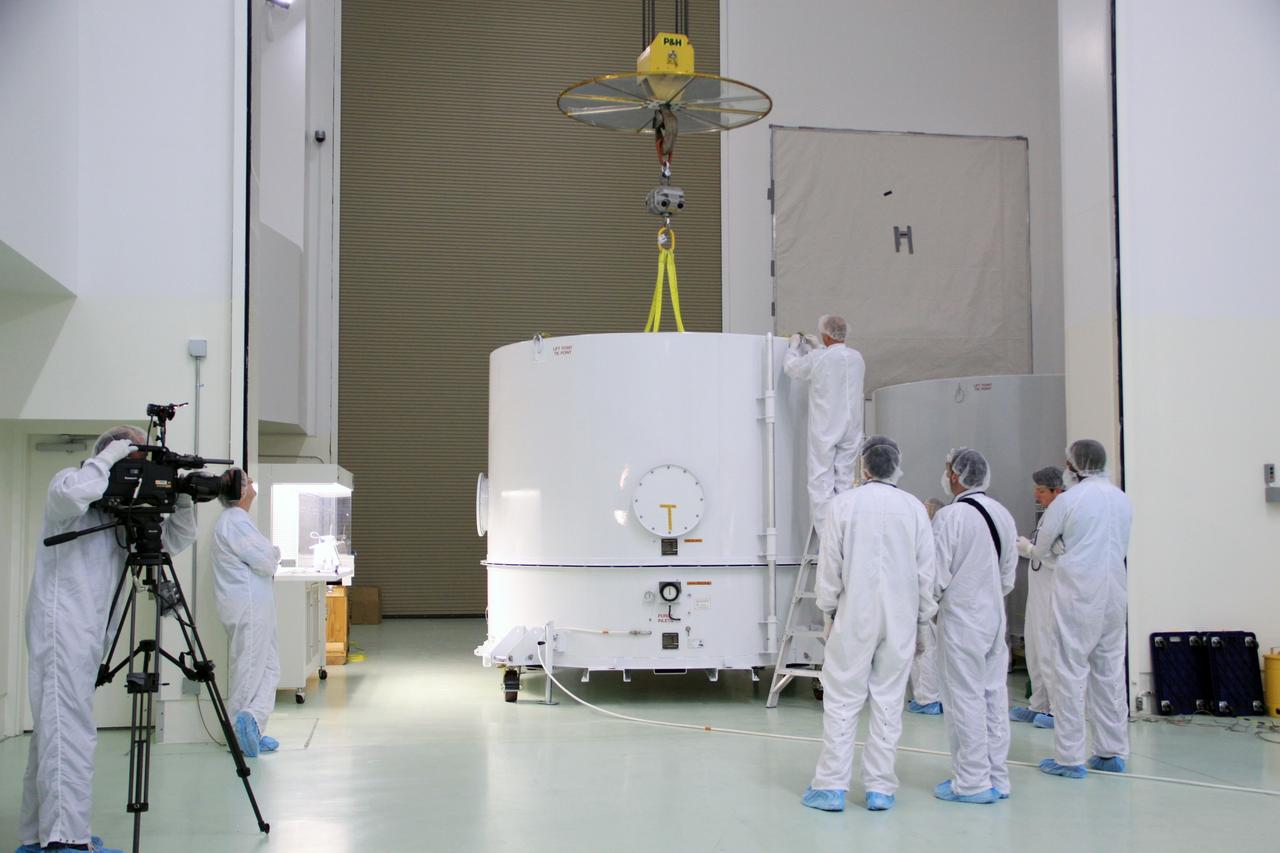
CAPE CANAVERAL, Fla. – In the clean room high bay at the Astrotech payload processing facility near NASA’s Kennedy Space Center in Florida, Applied Physics Laboratory technicians prepare to remove the shipping container from around NASA's Radiation Belt Storm Probe A. Prelaunch preparations and spacecraft testing will follow. The Radiation Belt Storm Probes, or RBSP, mission will help us understand the sun’s influence on Earth and near-Earth space by studying the Earth’s radiation belts on various scales of space and time. RBSP instruments will provide the measurements needed to characterize and quantify the plasma processes that produce very energetic ions and relativistic electrons. The mission is part of NASA’s broader Living With a Star Program that was conceived to explore fundamental processes that operate throughout the solar system, particularly those that generate hazardous space weather effects in the vicinity of Earth and phenomena that could impact solar system exploration. RBSP will begin its mission of exploration of Earth's Van Allen radiation belts and the extremes of space weather after launch. Launch aboard a United Launch Alliance Atlas V rocket is scheduled for August 23. For more information, visit http://www.nasa.gov/rbsp. Photo credit: NASA/Jim Grossmann
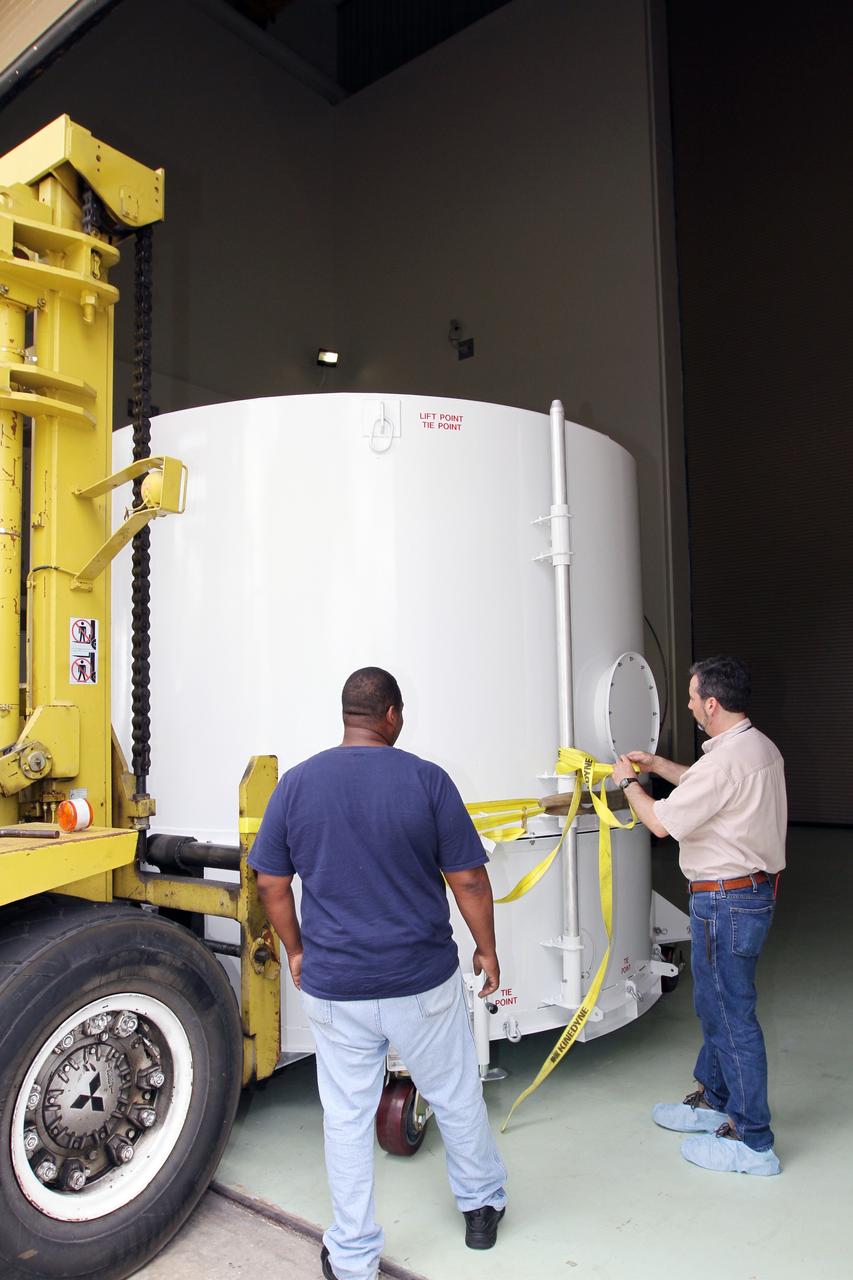
CAPE CANAVERAL, Fla. – A worker releases NASA's Radiation Belt Storm Probe B, enclosed in a protective shipping container, from the forklift that delivered it to the airlock of the Astrotech payload processing facility near NASA’s Kennedy Space Center in Florida where Applied Physics Laboratory technicians will begin spacecraft testing and prelaunch preparations. The twin RBSP spacecraft arrived at Kennedy’s Shuttle Landing Facility in the cargo bay of a U.S. Air Force C-17 aircraft earlier in the day. The RBSP mission will help us understand the sun’s influence on Earth and near-Earth space by studying the Earth’s radiation belts on various scales of space and time. The RBSP instruments will provide the measurements needed to characterize and quantify the plasma processes that produce very energetic ions and relativistic electrons. The mission is part of NASA’s broader Living With a Star Program that was conceived to explore fundamental processes that operate throughout the solar system, and in particular those that generate hazardous space weather effects in the vicinity of Earth and phenomena that could impact solar system exploration. RBSP is scheduled to begin its mission of exploration of Earth's Van Allen Radiation Belts and the extremes of space weather after launch. Launch aboard a United Launch Alliance Atlas V rocket is scheduled for August 23. For more information, visit http://www.nasa.gov/rbsp. Photo credit: NASA/Kim Shiflett
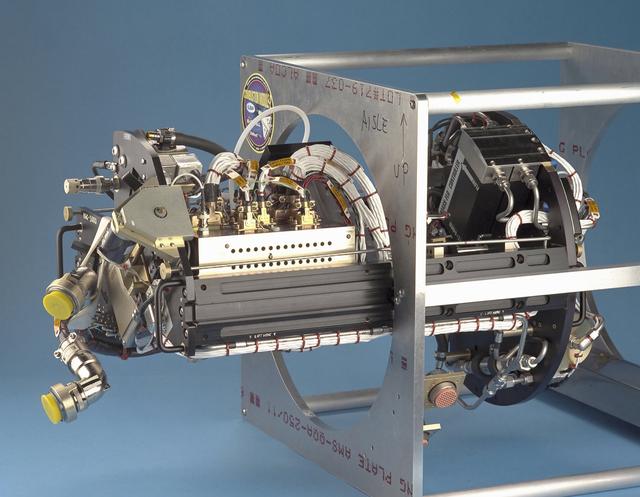
The Water Mist commercial research program is scheduled to fly an investigation on STS-107 in 2002. This investigation will be flown as an Experimental Mounting Structure (EMS) insert into the updated Combustion Module (CM-2), a sophisticated combustion chamber plus diagnostic equipment. (The investigation hardware is shown here mounted in a non-flight frame similar to the EMS.) Water Mist is a commercial research program by the Center for Commercial Applications of Combustion in Space (CCACS), a NASA Commercial Space Center located at the Colorado School of Mines, in Golden, CO and Industry Partner Environmental Engineering Concepts. The program is focused on developing water mist as a replacement for bromine-based chemical fire suppression agents (halons). By conducting the experiments in microgravity, interference from convection currents is minimized and fundamental knowledge can be gained. This knowledge is incorporated into models, which can be used to simulate a variety of physical environments. The immediate objective of the project is to study the effect of a fine water mist on a laminar propagating flame generated in a propane-air mixture at various equivalence ratios. The effects of droplet size and concentration on the speed of the flame front is used as a measure of the effectiveness of fire suppression in this highly controlled experimental environment.
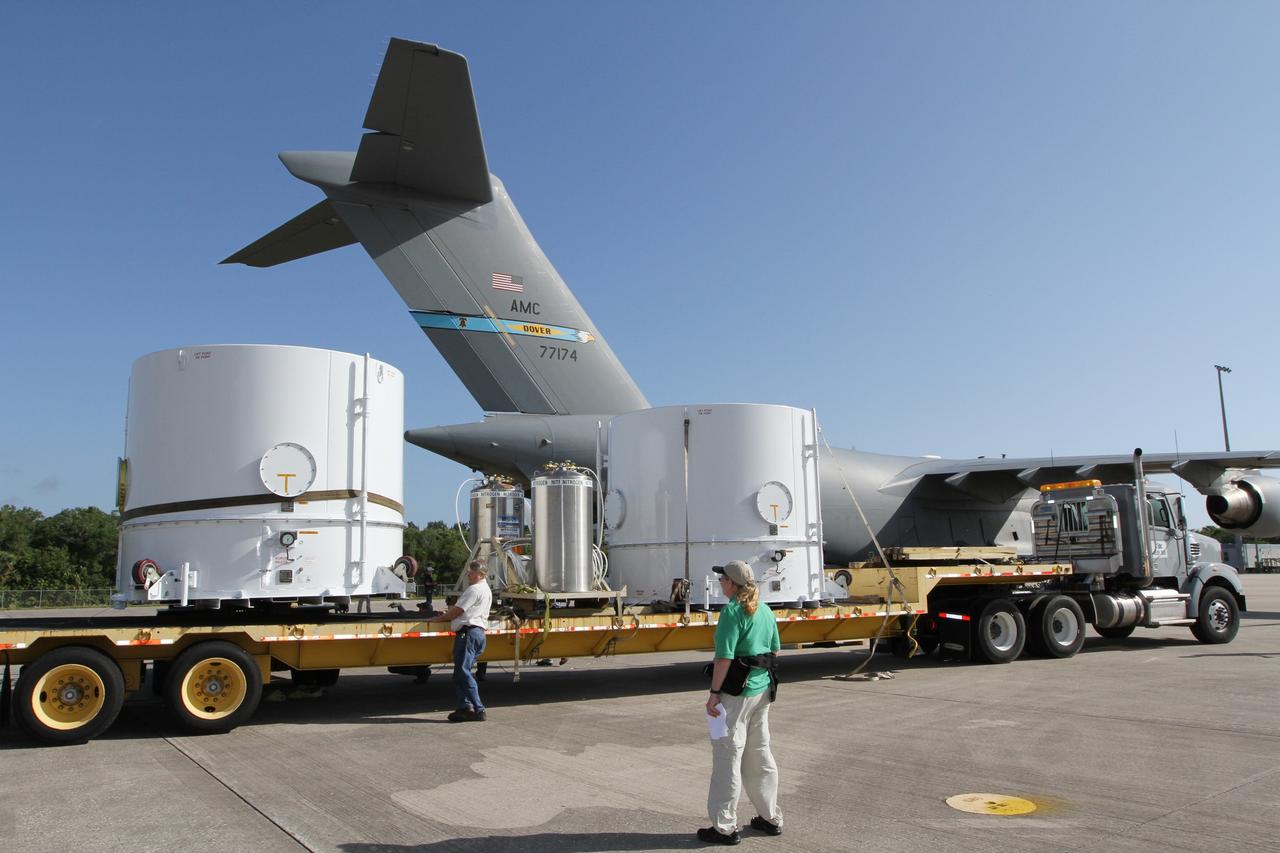
CAPE CANAVERAL, Fla. – Workers position NASA's Radiation Belt Storm Probe A, enclosed in a protective shipping container, onto a flatbed truck at the Shuttle Landing Facility at NASA’s Kennedy Space Center in Florida. The twin RBSP spacecraft will be transported to the Astrotech payload processing facility near Kennedy Space Center where Applied Physics Laboratory technicians will begin spacecraft testing and prelaunch preparations. Nitrogen will be pumped into the canisters during transport to provide the proper environmental control for the spacecraft. The RBSP mission will help us understand the sun’s influence on Earth and near-Earth space by studying the Earth’s radiation belts on various scales of space and time. The RBSP instruments will provide the measurements needed to characterize and quantify the plasma processes that produce very energetic ions and relativistic electrons. The mission is part of NASA’s broader Living With a Star Program that was conceived to explore fundamental processes that operate throughout the solar system, and in particular those that generate hazardous space weather effects in the vicinity of Earth and phenomena that could impact solar system exploration. RBSP is scheduled to begin its mission of exploration of Earth's Van Allen Radiation Belts and the extremes of space weather after launch. Launch aboard a United Launch Alliance Atlas V rocket is scheduled for August 23. For more information, visit http://www.nasa.gov/rbsp. Photo credit: NASA/Kim Shiflett
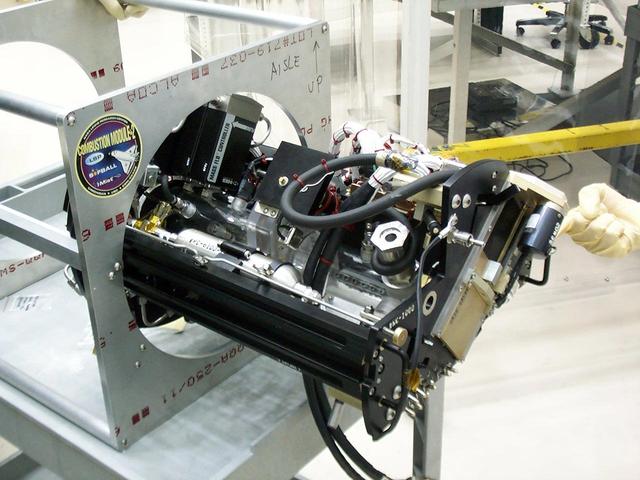
The Water Mist commercial research program is scheduled to fly an investigation on STS-107 in 2002. This investigation will be flown as an Experimental Mounting Structure (EMS) insert into the updated Combustion Module (CM-2), a sophisticated combustion chamber plus diagnostic equipment. (The investigation hardware is shown here mounted in a non-flight frame similar to the EMS.) Water Mist is a commercial research program by the Center for Commercial Applications of Combustion in Space (CCACS), a NASA Commercial Space Center located at the Colorado School of Mines, in Golden, CO and Industry Partner Environmental Engineering Concepts. The program is focused on developing water mist as a replacement for bromine-based chemical fire suppression agents (halons). By conducting the experiments in microgravity, interference from convection currents is minimized and fundamental knowledge can be gained. This knowledge is incorporated into models, which can be used to simulate a variety of physical environments. The immediate objective of the project is to study the effect of a fine water mist on a laminar propagating flame generated in a propane-air mixture at various equivalence ratios. The effects of droplet size and concentration on the speed of the flame front is used as a measure of the effectiveness of fire suppression in this highly controlled experimental environment.
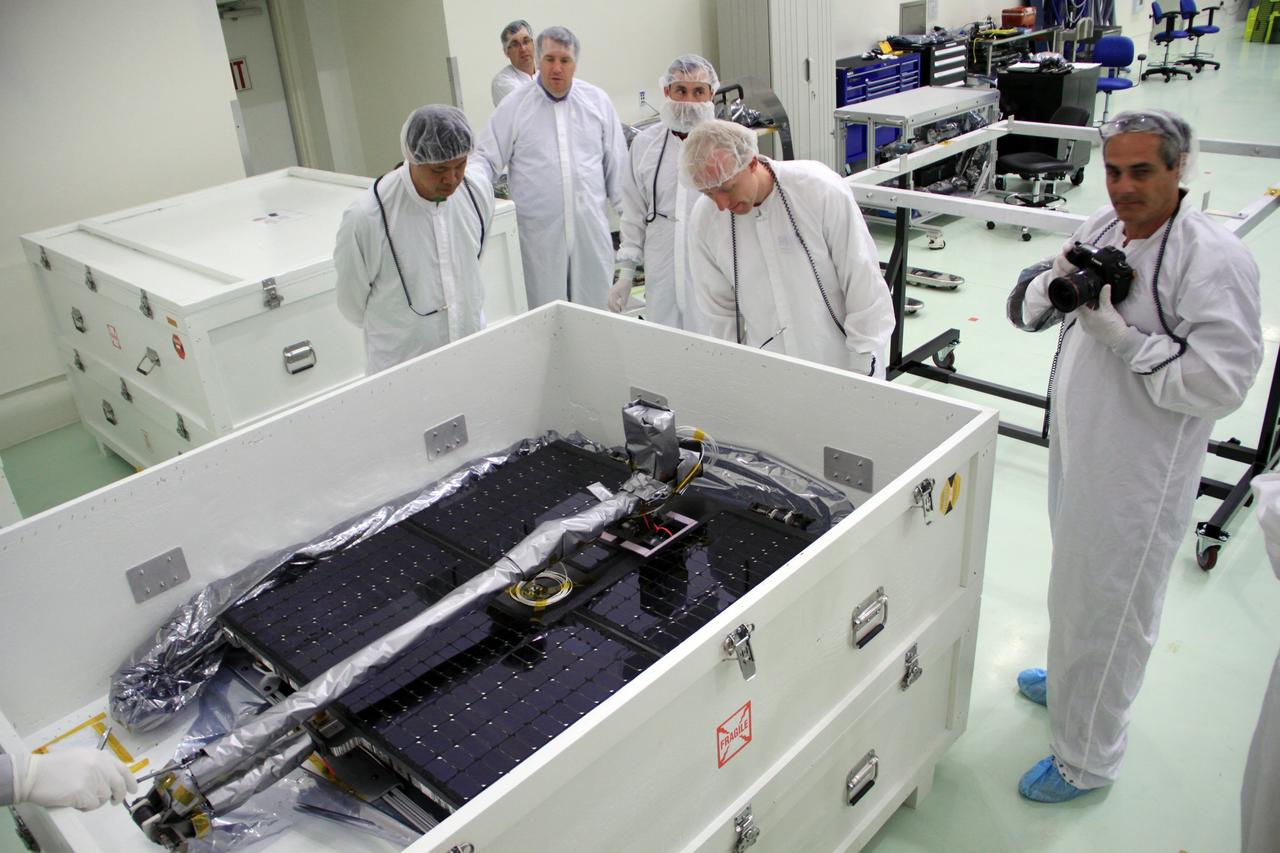
CAPE CANAVERAL, Fla. – In the clean room high bay at the Astrotech payload processing facility near NASA’s Kennedy Space Center in Florida, Applied Physics Laboratory technicians prepare to place one of the solar arrays for NASA's Radiation Belt Storm Probe A into a holding fixture. The Radiation Belt Storm Probes, or RBSP, mission will help us understand the sun’s influence on Earth and near-Earth space by studying the Earth’s radiation belts on various scales of space and time. RBSP instruments will provide the measurements needed to characterize and quantify the plasma processes that produce very energetic ions and relativistic electrons. The mission is part of NASA’s broader Living With a Star Program that was conceived to explore fundamental processes that operate throughout the solar system, particularly those that generate hazardous space weather effects in the vicinity of Earth and phenomena that could impact solar system exploration. RBSP will begin its mission of exploration of Earth's Van Allen radiation belts and the extremes of space weather after launch. Launch aboard a United Launch Alliance Atlas V rocket is scheduled for August 23. For more information, visit http://www.nasa.gov/rbsp. Photo credit: NASA/Jim Grossmann
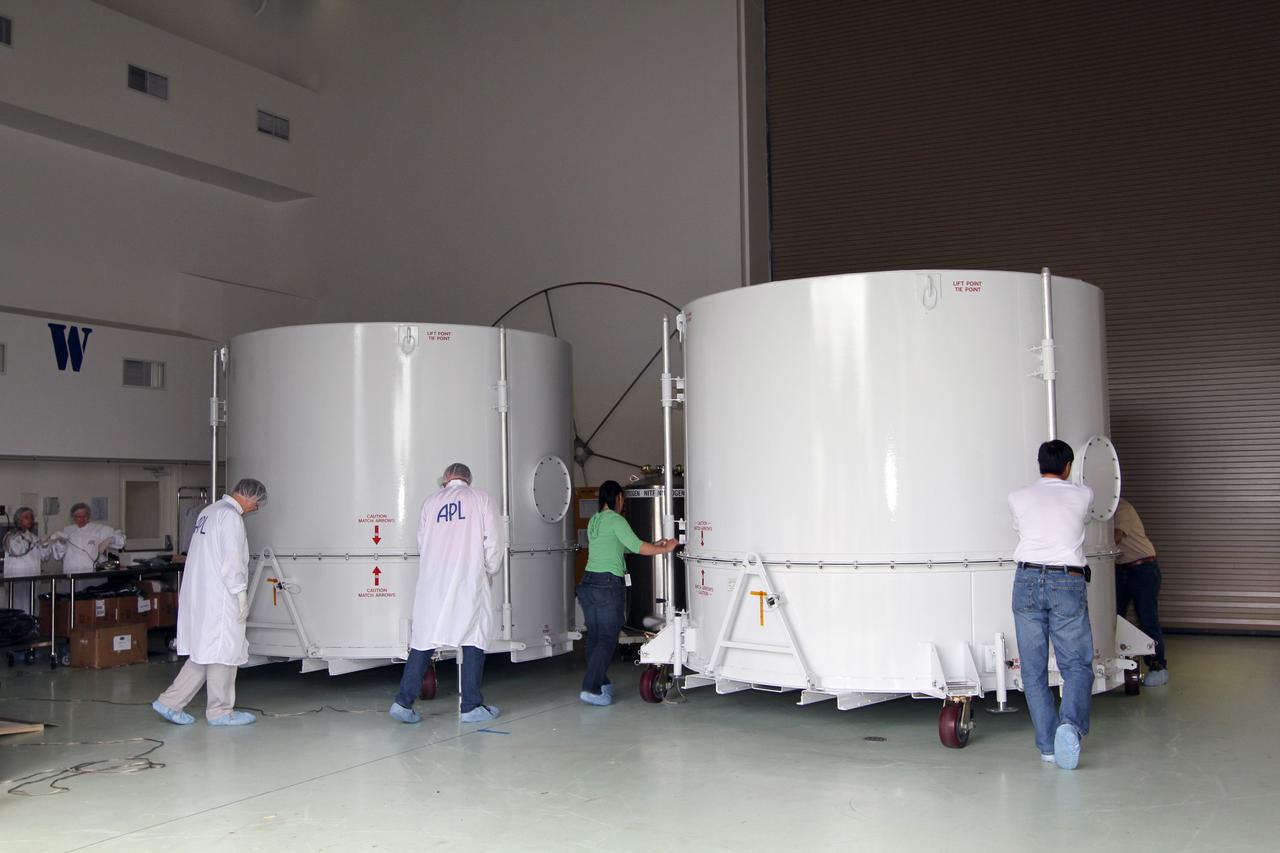
CAPE CANAVERAL, Fla. – NASA's twin Radiation Belt Storm Probes, enclosed in protective shipping containers, have arrived in the airlock of the Astrotech payload processing facility near NASA’s Kennedy Space Center in Florida where Applied Physics Laboratory technicians will begin spacecraft testing and prelaunch preparations. The spacecraft were delivered to Kennedy’s Shuttle Landing Facility in the cargo bay of a U.S. Air Force C-17 aircraft earlier in the day. The RBSP mission will help us understand the sun’s influence on Earth and near-Earth space by studying the Earth’s radiation belts on various scales of space and time. The RBSP instruments will provide the measurements needed to characterize and quantify the plasma processes that produce very energetic ions and relativistic electrons. The mission is part of NASA’s broader Living With a Star Program that was conceived to explore fundamental processes that operate throughout the solar system, and in particular those that generate hazardous space weather effects in the vicinity of Earth and phenomena that could impact solar system exploration. RBSP is scheduled to begin its mission of exploration of Earth's Van Allen Radiation Belts and the extremes of space weather after launch. Launch aboard a United Launch Alliance Atlas V rocket is scheduled for August 23. For more information, visit http://www.nasa.gov/rbsp. Photo credit: NASA/Kim Shiflett
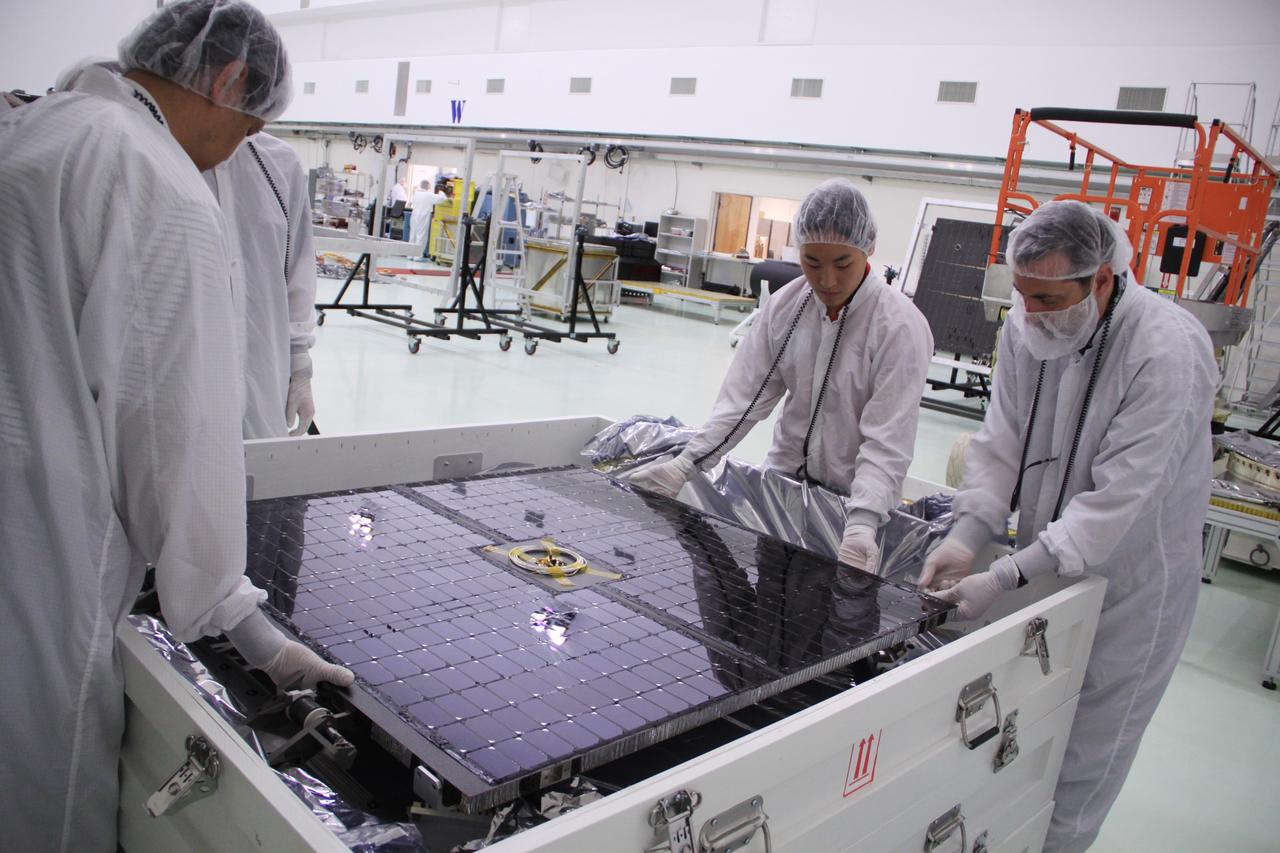
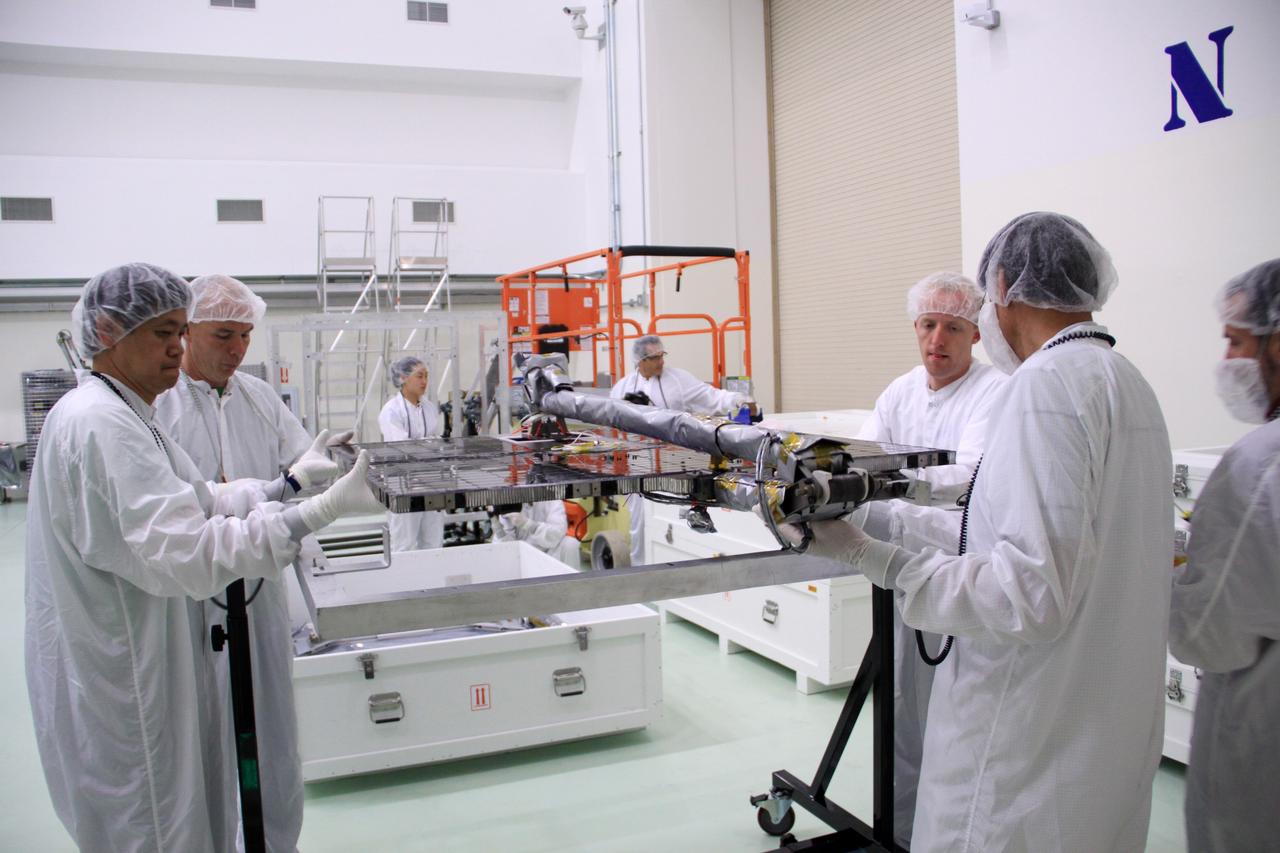
CAPE CANAVERAL, Fla. – In the clean room high bay at the Astrotech payload processing facility near NASA’s Kennedy Space Center in Florida, Applied Physics Laboratory technicians lift one of the solar arrays for NASA's Radiation Belt Storm Probe B from its shipping container. The Radiation Belt Storm Probes, or RBSP, mission will help us understand the sun’s influence on Earth and near-Earth space by studying the Earth’s radiation belts on various scales of space and time. RBSP instruments will provide the measurements needed to characterize and quantify the plasma processes that produce very energetic ions and relativistic electrons. The mission is part of NASA’s broader Living With a Star Program that was conceived to explore fundamental processes that operate throughout the solar system, particularly those that generate hazardous space weather effects in the vicinity of Earth and phenomena that could impact solar system exploration. RBSP will begin its mission of exploration of Earth's Van Allen radiation belts and the extremes of space weather after launch. Launch aboard a United Launch Alliance Atlas V rocket is scheduled for August 23. For more information, visit http://www.nasa.gov/rbsp. Photo credit: NASA/Jim Grossmann
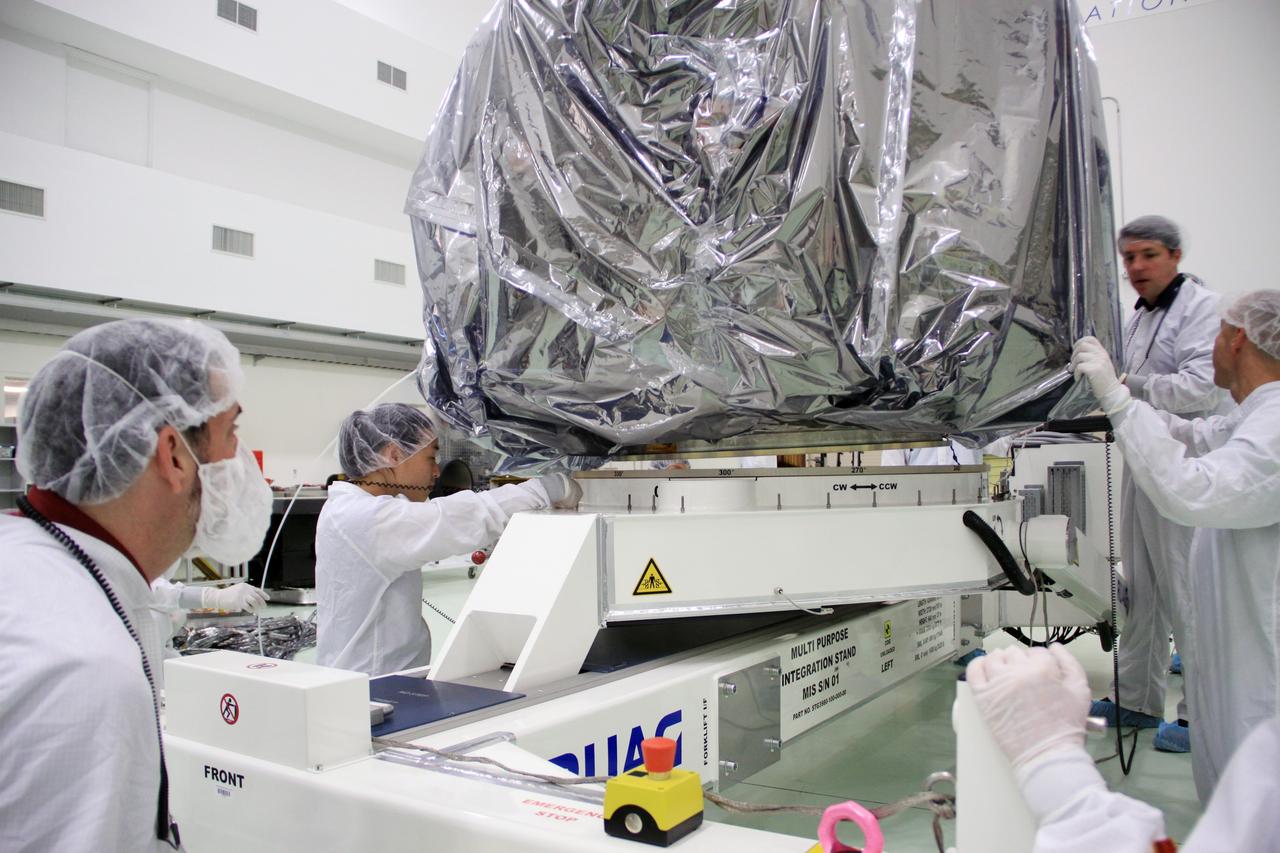
CAPE CANAVERAL, Fla. – In the clean room high bay at the Astrotech payload processing facility near NASA’s Kennedy Space Center in Florida, Applied Physics Laboratory technicians secure NASA's Radiation Belt Storm Probe A, wrapped in a protective shroud, on a test stand. Prelaunch preparations and spacecraft testing will follow. The Radiation Belt Storm Probes, or RBSP, mission will help us understand the sun’s influence on Earth and near-Earth space by studying the Earth’s radiation belts on various scales of space and time. RBSP instruments will provide the measurements needed to characterize and quantify the plasma processes that produce very energetic ions and relativistic electrons. The mission is part of NASA’s broader Living With a Star Program that was conceived to explore fundamental processes that operate throughout the solar system, particularly those that generate hazardous space weather effects in the vicinity of Earth and phenomena that could impact solar system exploration. RBSP will begin its mission of exploration of Earth's Van Allen radiation belts and the extremes of space weather after launch. Launch aboard a United Launch Alliance Atlas V rocket is scheduled for August 23. For more information, visit http://www.nasa.gov/rbsp. Photo credit: NASA/Jim Grossmann
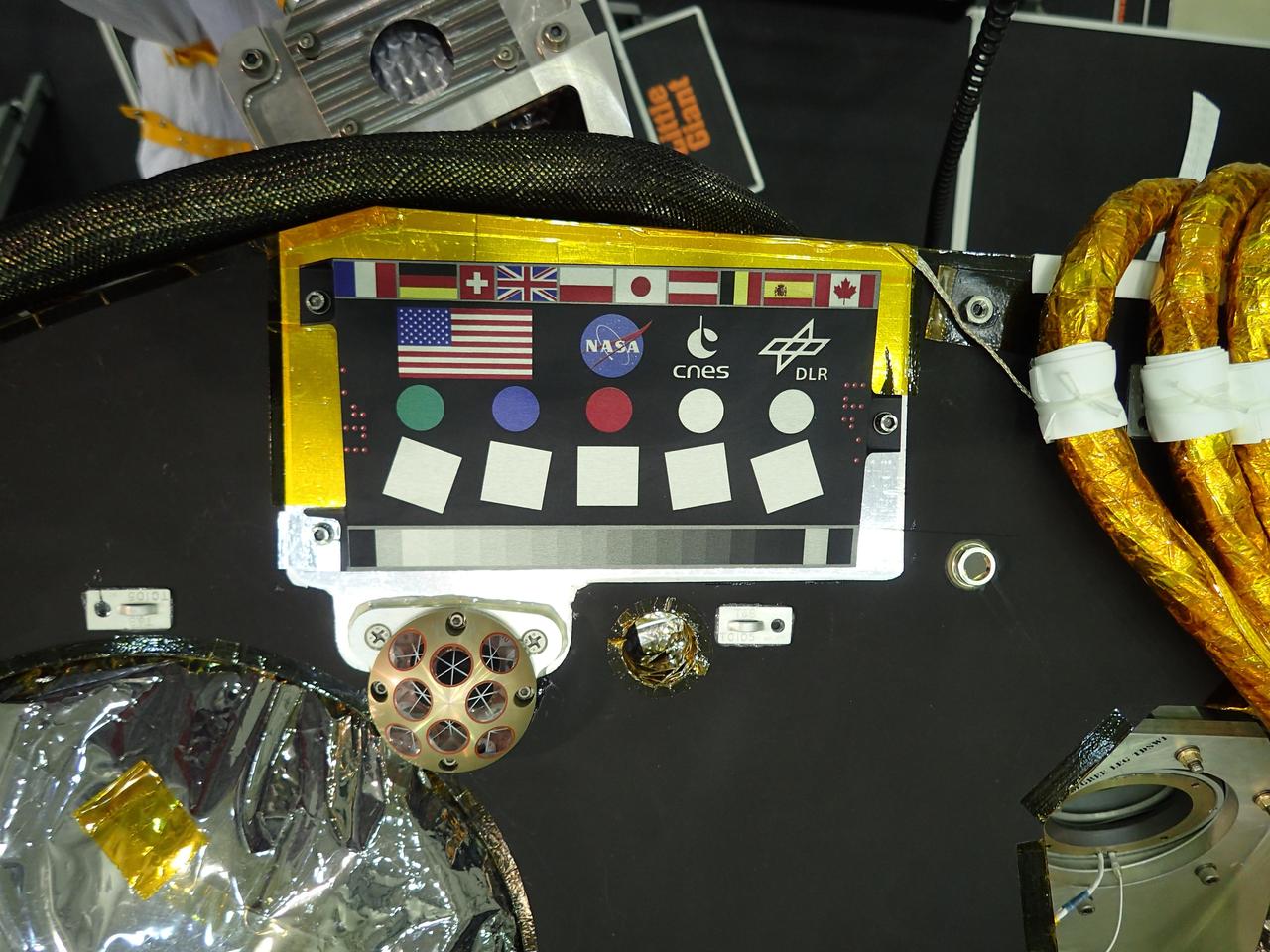
A camera calibration target sits on the deck of the NASA's InSight lander, adorned with the flags of the countries participating in the mission. The target, which will be viewed by InSight's cameras, provides a variety of colors and shapes to help calibrate the lander's cameras. It also shows off international flags representing the agencies, institutions and participating scientists of the mission as of late 2014 (since that time, Italy has contributed an experiment). In the second row are the United States flag and the logos of NASA, the French space agency CNES, which provided InSight's seismometer; and the German Aerospace Center DLR, which provided InSight's heat flow probe. Below the target in the photo is an Italian experiment called the Laser Retroreflector for InSight (LaRRI). LaRRI is the small, copper-colored dome covered with circles just below the calibration target; it won't actually play a role in InSight's mission. The national space agency of Italy (ASI, for Agenzia Spaziale Italiana) provided LaRRI to be used by a possible future Mars orbiter mission with a laser altimeter making extremely precise measurements of the lander's location for fundamental physics studies and precision cartography. A microchip bearing the names of nearly a million members of the public is visible in this image to the right of the calibration target. A second microchip with more than a million additional names was added after this photo was taken. https://photojournal.jpl.nasa.gov/catalog/PIA22540
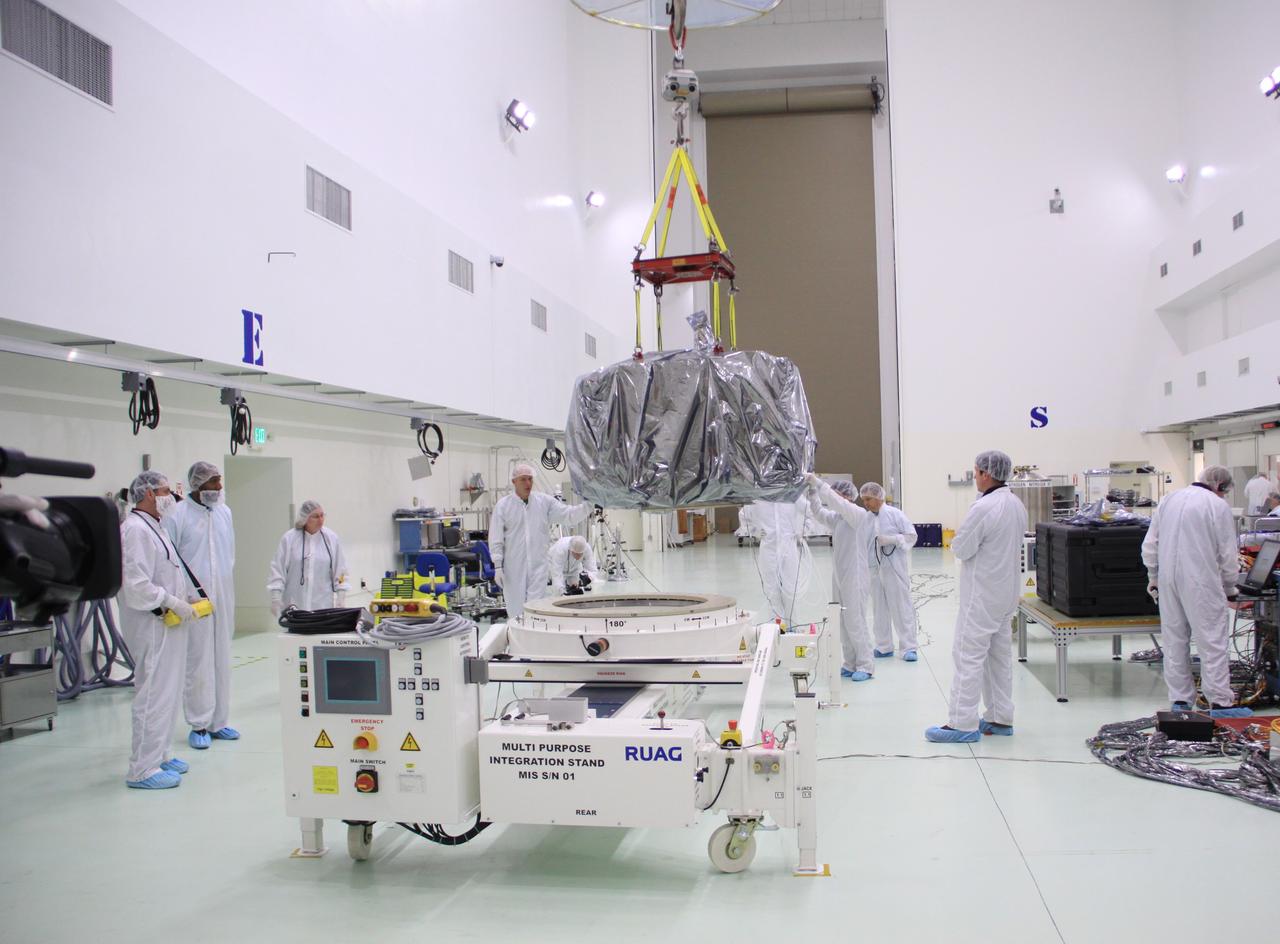
CAPE CANAVERAL, Fla. – In the clean room high bay at the Astrotech payload processing facility near NASA’s Kennedy Space Center in Florida, Applied Physics Laboratory technicians lift NASA's Radiation Belt Storm Probe A, wrapped in a protective shroud, onto a test stand. Prelaunch preparations and spacecraft testing will follow. The Radiation Belt Storm Probes, or RBSP, mission will help us understand the sun’s influence on Earth and near-Earth space by studying the Earth’s radiation belts on various scales of space and time. RBSP instruments will provide the measurements needed to characterize and quantify the plasma processes that produce very energetic ions and relativistic electrons. The mission is part of NASA’s broader Living With a Star Program that was conceived to explore fundamental processes that operate throughout the solar system, particularly those that generate hazardous space weather effects in the vicinity of Earth and phenomena that could impact solar system exploration. RBSP will begin its mission of exploration of Earth's Van Allen radiation belts and the extremes of space weather after launch. Launch aboard a United Launch Alliance Atlas V rocket is scheduled for August 23. For more information, visit http://www.nasa.gov/rbsp. Photo credit: NASA/Jim Grossmann
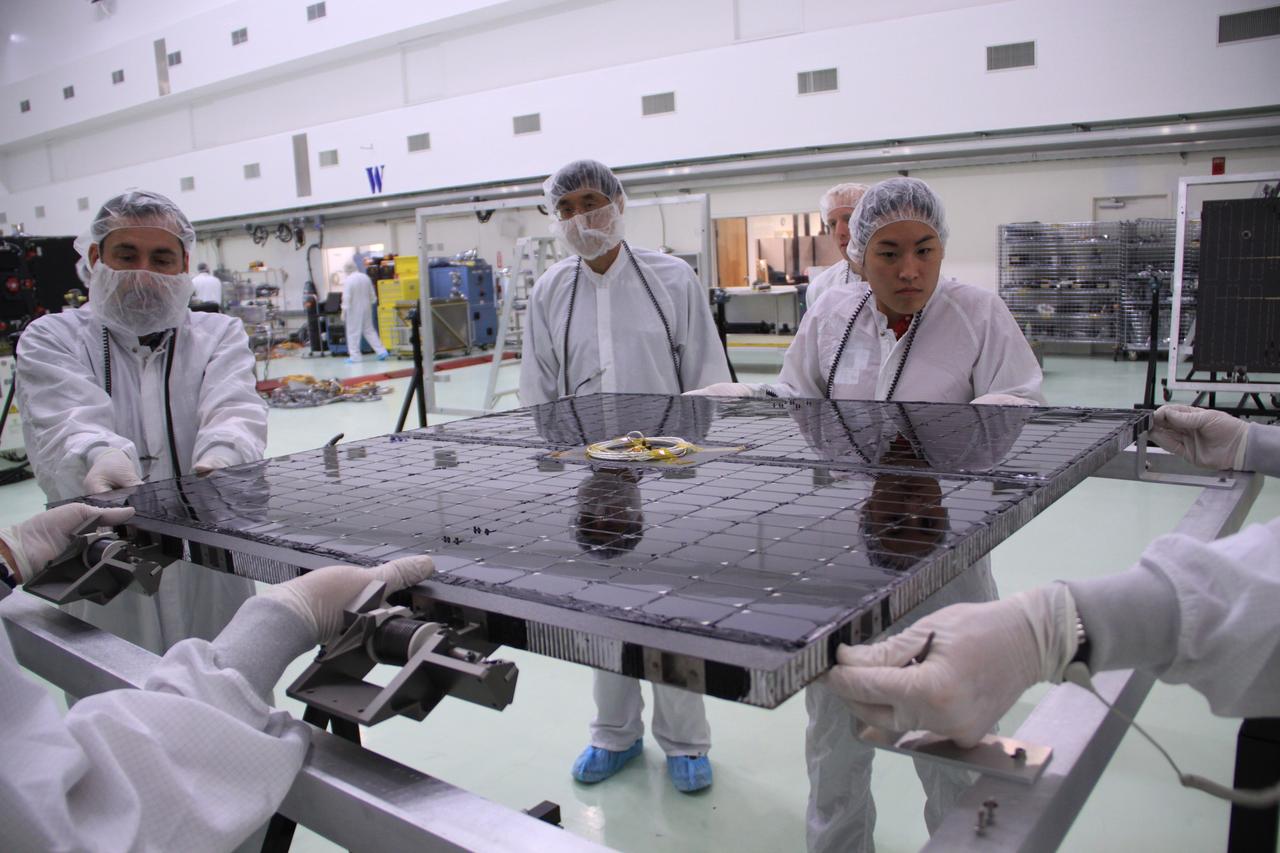
CAPE CANAVERAL, Fla. – In the clean room high bay at the Astrotech payload processing facility near NASA’s Kennedy Space Center in Florida, a team approach is used by Applied Physics Laboratory technicians to secure one of the solar arrays for NASA's Radiation Belt Storm Probe B to a holding fixture. The Radiation Belt Storm Probes, or RBSP, mission will help us understand the sun’s influence on Earth and near-Earth space by studying the Earth’s radiation belts on various scales of space and time. RBSP instruments will provide the measurements needed to characterize and quantify the plasma processes that produce very energetic ions and relativistic electrons. The mission is part of NASA’s broader Living With a Star Program that was conceived to explore fundamental processes that operate throughout the solar system, particularly those that generate hazardous space weather effects in the vicinity of Earth and phenomena that could impact solar system exploration. RBSP will begin its mission of exploration of Earth's Van Allen radiation belts and the extremes of space weather after launch. Launch aboard a United Launch Alliance Atlas V rocket is scheduled for August 23. For more information, visit http://www.nasa.gov/rbsp. Photo credit: NASA/Jim Grossmann
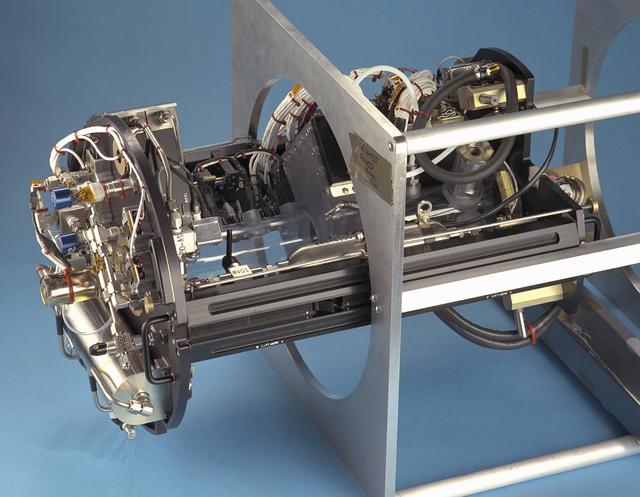
The Water Mist commercial research program is scheduled to fly an investigation on STS-107 in 2002. This investigation will be flown as an Experimental Mounting Structure (EMS) insert into the updated Combustion Module (CM-2), a sophisticated combustion chamber plus diagnostic equipment. (The investigation hardware is shown here mounted in a non-flight frame similar to the EMS.) Water Mist is a commercial research program by the Center for Commercial Applications of Combustion in Space (CCACS), a NASA Commercial Space Center located at the Colorado School of Mines, in Golden, CO and Industry Partner Environmental Engineering Concepts. The program is focused on developing water mist as a replacement for bromine-based chemical fire suppression agents (halons). By conducting the experiments in microgravity, interference from convection currents is minimized and fundamental knowledge can be gained. This knowledge is incorporated into models, which can be used to simulate a variety of physical environments. The immediate objective of the project is to study the effect of a fine water mist on a laminar propagating flame generated in a propane-air mixture at various equivalence ratios. The effects of droplet size and concentration on the speed of the flame front is used as a measure of the effectiveness of fire suppression in this highly controlled experimental environment.
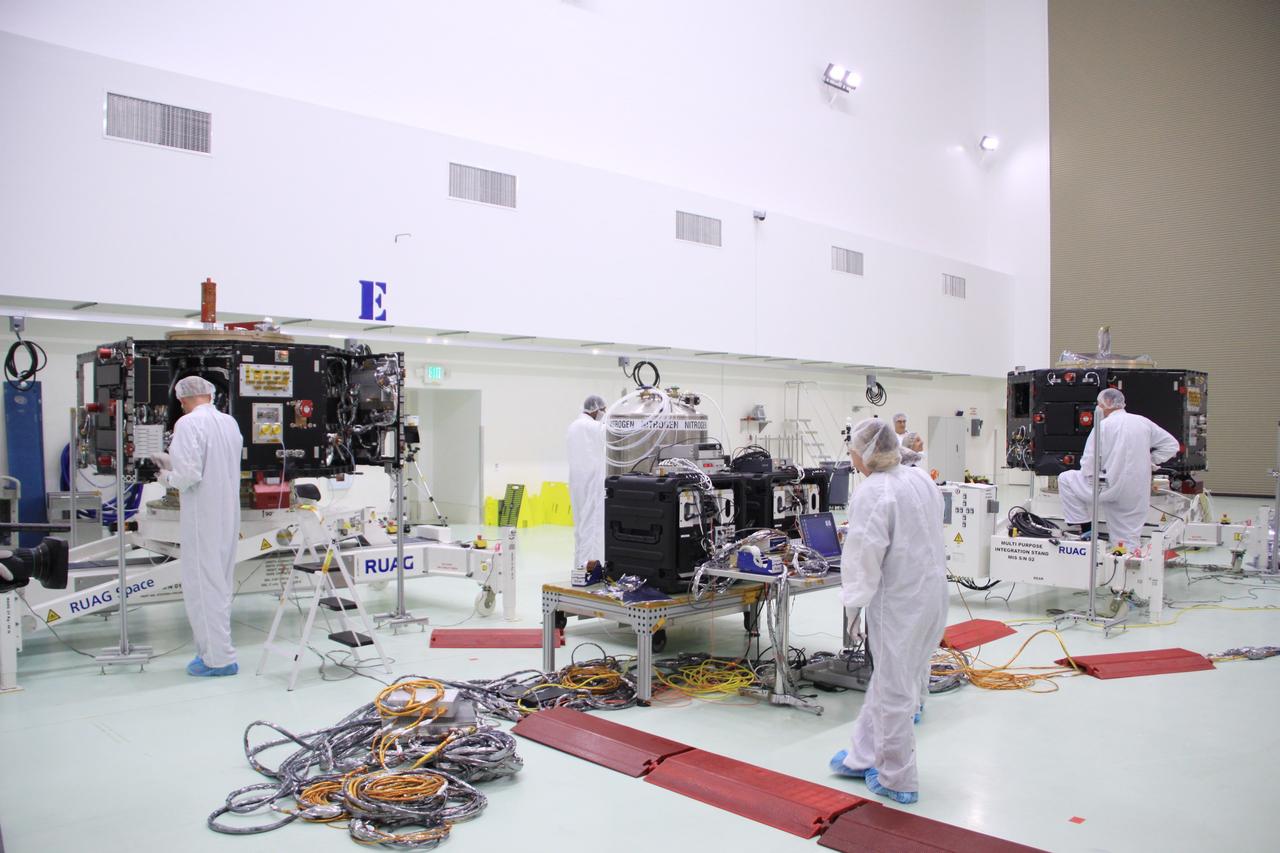
CAPE CANAVERAL, Fla. – In the clean room high bay at the Astrotech payload processing facility near NASA’s Kennedy Space Center in Florida, Applied Physics Laboratory technicians prepare to connect NASA's twin Radiation Belt Storm Probes to instruments and equipment that will be used to test and monitor them. The Radiation Belt Storm Probes, or RBSP, mission will help us understand the sun’s influence on Earth and near-Earth space by studying the Earth’s radiation belts on various scales of space and time. RBSP instruments will provide the measurements needed to characterize and quantify the plasma processes that produce very energetic ions and relativistic electrons. The mission is part of NASA’s broader Living With a Star Program that was conceived to explore fundamental processes that operate throughout the solar system, particularly those that generate hazardous space weather effects in the vicinity of Earth and phenomena that could impact solar system exploration. RBSP will begin its mission of exploration of Earth's Van Allen radiation belts and the extremes of space weather after launch. Launch aboard a United Launch Alliance Atlas V rocket is scheduled for August 23. For more information, visit http://www.nasa.gov/rbsp. Photo credit: NASA/Jim Grossmann
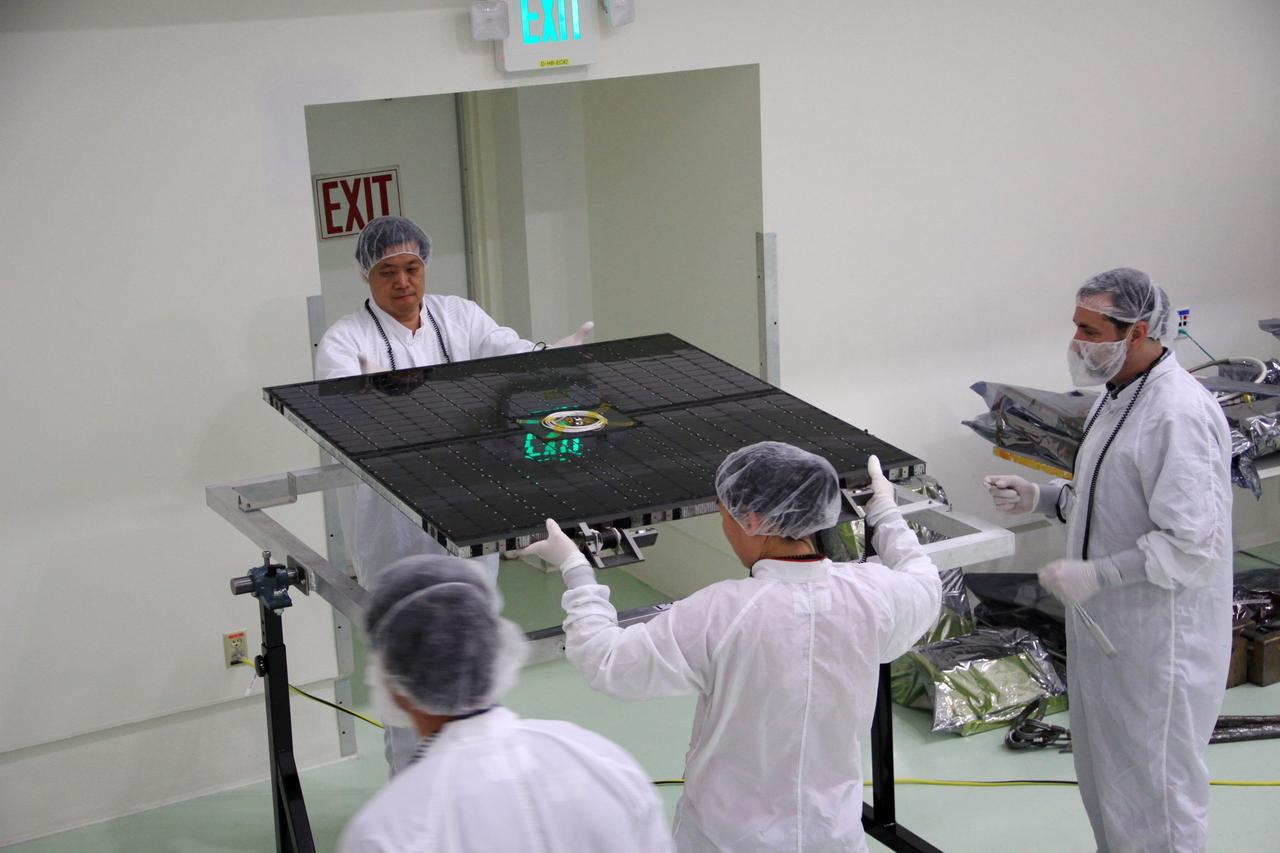
CAPE CANAVERAL, Fla. – In the clean room high bay at the Astrotech payload processing facility near NASA’s Kennedy Space Center in Florida, Applied Physics Laboratory technicians unpack one of the solar arrays for NASA's Radiation Belt Storm Probe B. The Radiation Belt Storm Probes, or RBSP, mission will help us understand the sun’s influence on Earth and near-Earth space by studying the Earth’s radiation belts on various scales of space and time. RBSP instruments will provide the measurements needed to characterize and quantify the plasma processes that produce very energetic ions and relativistic electrons. The mission is part of NASA’s broader Living With a Star Program that was conceived to explore fundamental processes that operate throughout the solar system, particularly those that generate hazardous space weather effects in the vicinity of Earth and phenomena that could impact solar system exploration. RBSP will begin its mission of exploration of Earth's Van Allen radiation belts and the extremes of space weather after launch. Launch aboard a United Launch Alliance Atlas V rocket is scheduled for August 23. For more information, visit http://www.nasa.gov/rbsp. Photo credit: NASA/Jim Grossmann
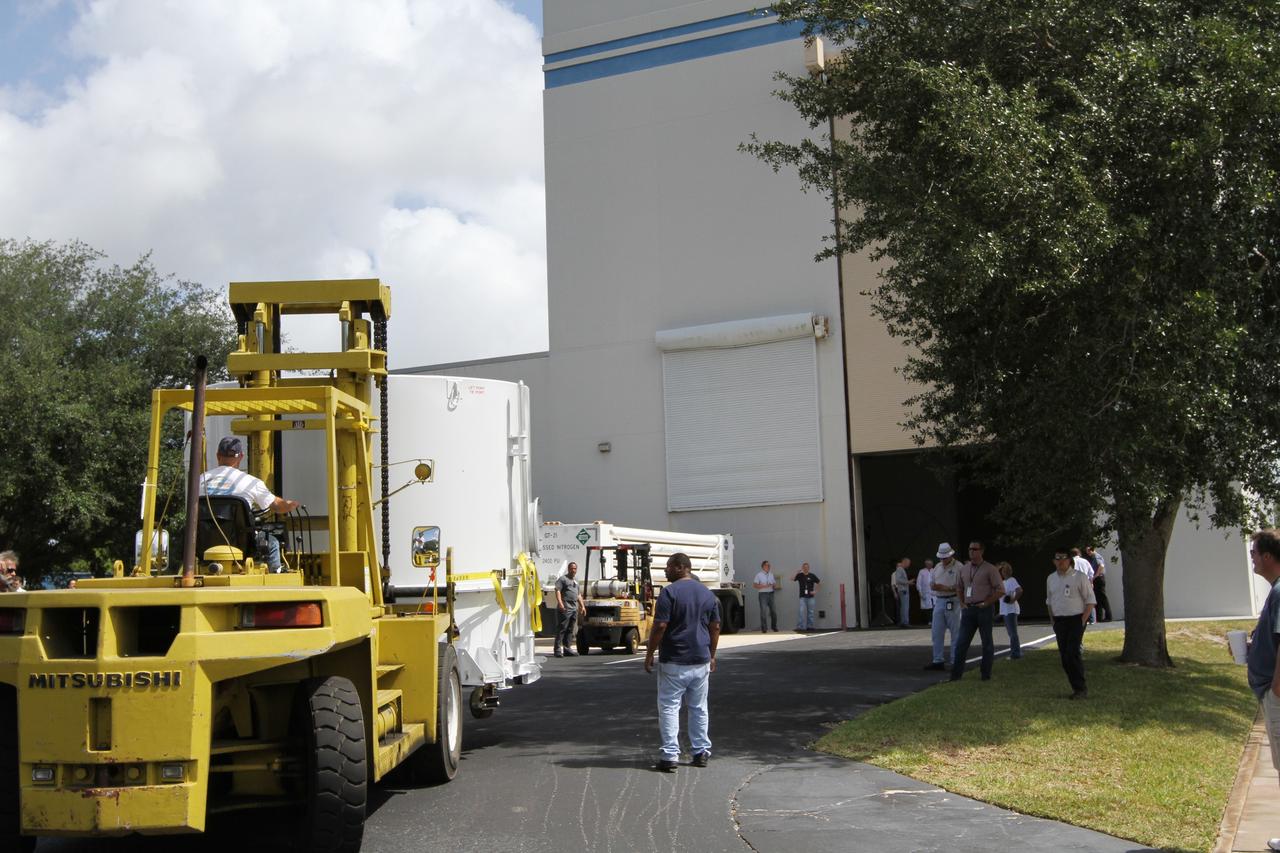
CAPE CANAVERAL, Fla. – A forklift operator moves NASA's Radiation Belt Storm Probe A, enclosed in a protective shipping container, toward the open bay door of the Astrotech payload processing facility near NASA’s Kennedy Space Center in Florida where Applied Physics Laboratory technicians will begin spacecraft testing and prelaunch preparations. The twin RBSP spacecraft arrived at Kennedy’s Shuttle Landing Facility in the cargo bay of a U.S. Air Force C-17 aircraft earlier in the day. The RBSP mission will help us understand the sun’s influence on Earth and near-Earth space by studying the Earth’s radiation belts on various scales of space and time. The RBSP instruments will provide the measurements needed to characterize and quantify the plasma processes that produce very energetic ions and relativistic electrons. The mission is part of NASA’s broader Living With a Star Program that was conceived to explore fundamental processes that operate throughout the solar system, and in particular those that generate hazardous space weather effects in the vicinity of Earth and phenomena that could impact solar system exploration. RBSP is scheduled to begin its mission of exploration of Earth's Van Allen Radiation Belts and the extremes of space weather after launch. Launch aboard a United Launch Alliance Atlas V rocket is scheduled for August 23. For more information, visit http://www.nasa.gov/rbsp. Photo credit: NASA/Kim Shiflett
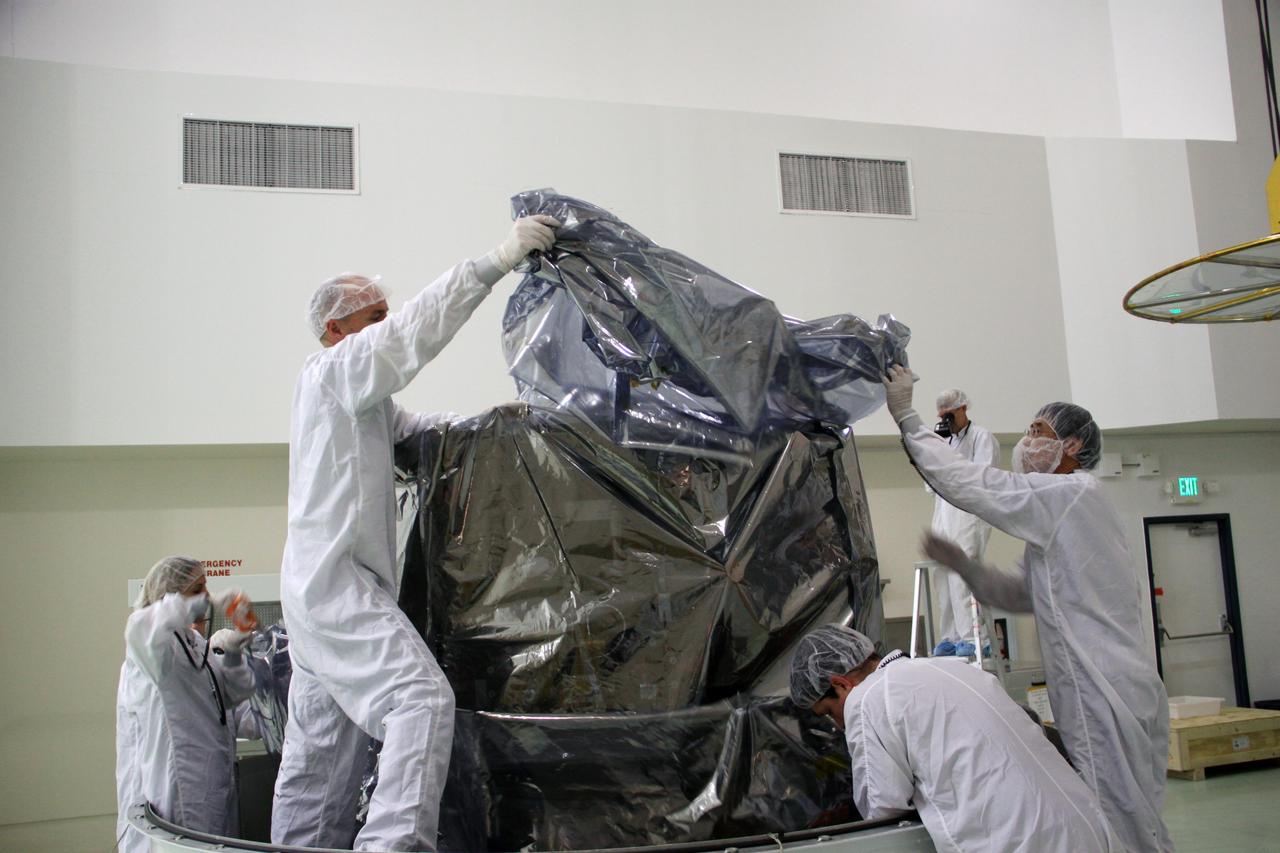
CAPE CANAVERAL, Fla. – In the clean room high bay at the Astrotech payload processing facility near NASA’s Kennedy Space Center in Florida, Applied Physics Laboratory technicians prepare NASA's Radiation Belt Storm Probe B, wrapped in a protective shroud, to be lifted from the bottom of its shipping container. Prelaunch preparations and spacecraft testing will follow. The Radiation Belt Storm Probes, or RBSP, mission will help us understand the sun’s influence on Earth and near-Earth space by studying the Earth’s radiation belts on various scales of space and time. RBSP instruments will provide the measurements needed to characterize and quantify the plasma processes that produce very energetic ions and relativistic electrons. The mission is part of NASA’s broader Living With a Star Program that was conceived to explore fundamental processes that operate throughout the solar system, particularly those that generate hazardous space weather effects in the vicinity of Earth and phenomena that could impact solar system exploration. RBSP will begin its mission of exploration of Earth's Van Allen radiation belts and the extremes of space weather after launch. Launch aboard a United Launch Alliance Atlas V rocket is scheduled for August 23. For more information, visit http://www.nasa.gov/rbsp. Photo credit: NASA/Jim Grossmann
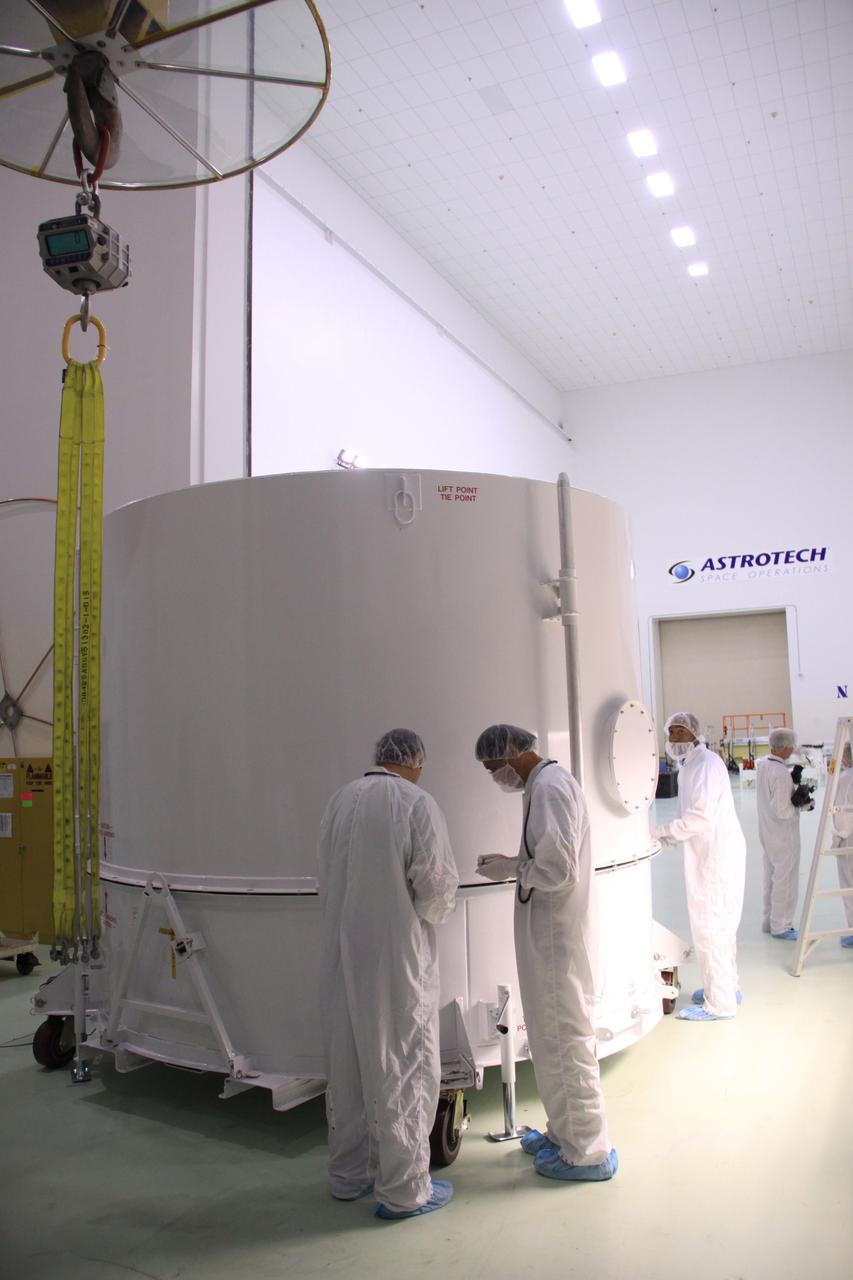
CAPE CANAVERAL, Fla. - In the clean room high bay at the Astrotech payload processing facility near NASA’s Kennedy Space Center in Florida, preparations are under way to remove the shipping container from around NASA's Radiation Belt Storm Probe A. Applied Physics Laboratory technicians then will begin prelaunch preparations and spacecraft testing. The Radiation Belt Storm Probes, or RBSP, mission will help us understand the sun’s influence on Earth and near-Earth space by studying the Earth’s radiation belts on various scales of space and time. RBSP instruments will provide the measurements needed to characterize and quantify the plasma processes that produce very energetic ions and relativistic electrons. The mission is part of NASA’s broader Living With a Star Program that was conceived to explore fundamental processes that operate throughout the solar system, particularly those that generate hazardous space weather effects in the vicinity of Earth and phenomena that could impact solar system exploration. RBSP will begin its mission of exploration of Earth's Van Allen radiation belts and the extremes of space weather after launch. Launch aboard a United Launch Alliance Atlas V rocket is scheduled for August 23. For more information, visit http://www.nasa.gov/rbsp. Photo credit: NASA/Jim Grossmann
CAPE CANAVERAL, Fla. – In the clean room high bay at the Astrotech payload processing facility near NASA’s Kennedy Space Center in Florida, Applied Physics Laboratory technicians steady one of the solar arrays for NASA's Radiation Belt Storm Probe A as it is secured into a holding fixture. The Radiation Belt Storm Probes, or RBSP, mission will help us understand the sun’s influence on Earth and near-Earth space by studying the Earth’s radiation belts on various scales of space and time. RBSP instruments will provide the measurements needed to characterize and quantify the plasma processes that produce very energetic ions and relativistic electrons. The mission is part of NASA’s broader Living With a Star Program that was conceived to explore fundamental processes that operate throughout the solar system, particularly those that generate hazardous space weather effects in the vicinity of Earth and phenomena that could impact solar system exploration. RBSP will begin its mission of exploration of Earth's Van Allen radiation belts and the extremes of space weather after launch. Launch aboard a United Launch Alliance Atlas V rocket is scheduled for August 23. For more information, visit http://www.nasa.gov/rbsp. Photo credit: NASA/Jim Grossmann
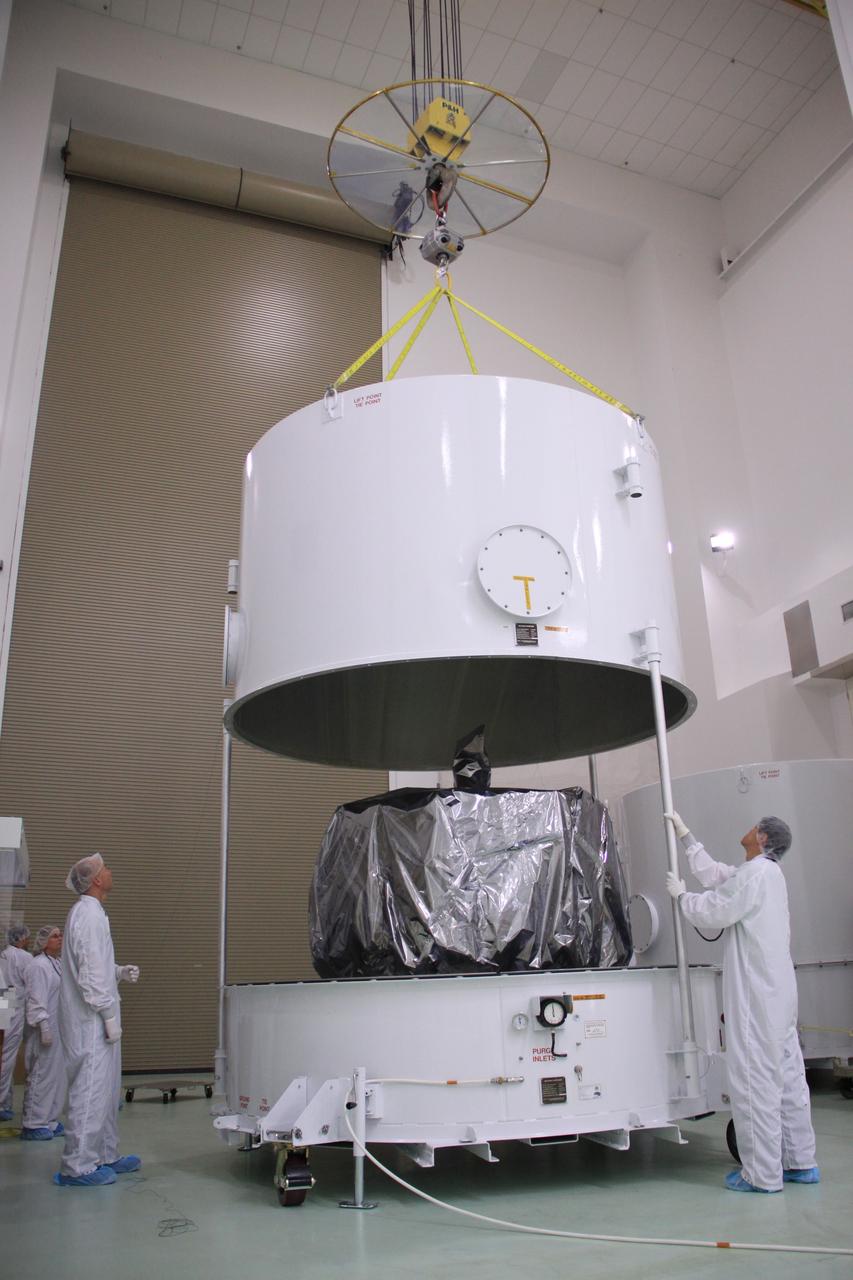
CAPE CANAVERAL, Fla. – In the clean room high bay at the Astrotech payload processing facility near NASA’s Kennedy Space Center in Florida, Applied Physics Laboratory technicians lift the shipping container from around NASA's Radiation Belt Storm Probe A, wrapped in a protective shroud. Prelaunch preparations and spacecraft testing will follow. The Radiation Belt Storm Probes, or RBSP, mission will help us understand the sun’s influence on Earth and near-Earth space by studying the Earth’s radiation belts on various scales of space and time. RBSP instruments will provide the measurements needed to characterize and quantify the plasma processes that produce very energetic ions and relativistic electrons. The mission is part of NASA’s broader Living With a Star Program that was conceived to explore fundamental processes that operate throughout the solar system, particularly those that generate hazardous space weather effects in the vicinity of Earth and phenomena that could impact solar system exploration. RBSP will begin its mission of exploration of Earth's Van Allen radiation belts and the extremes of space weather after launch. Launch aboard a United Launch Alliance Atlas V rocket is scheduled for August 23. For more information, visit http://www.nasa.gov/rbsp. Photo credit: NASA/Jim Grossmann
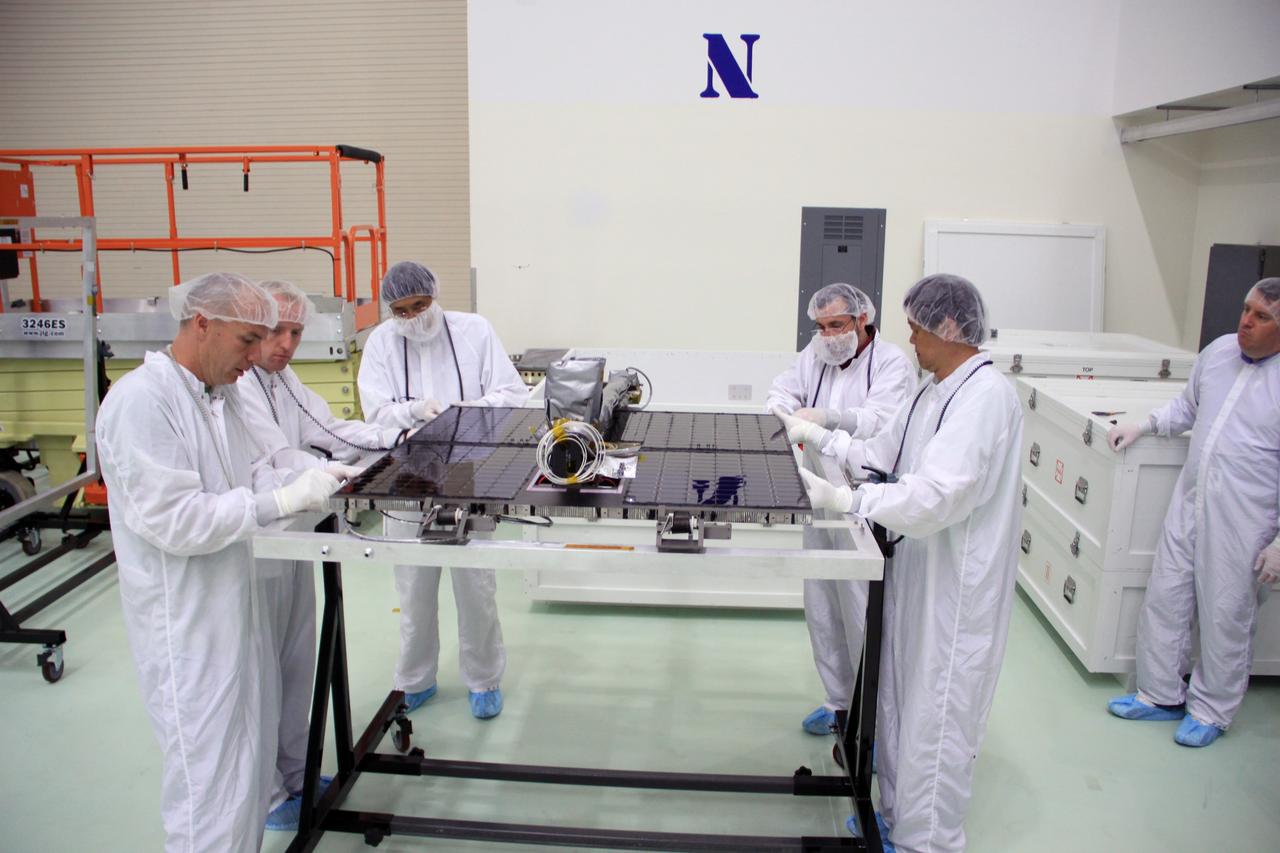
CAPE CANAVERAL, Fla. – In the clean room high bay at the Astrotech payload processing facility near NASA’s Kennedy Space Center in Florida, Applied Physics Laboratory technicians place the one of the solar arrays for NASA's Radiation Belt Storm Probe A into a holding fixture. The Radiation Belt Storm Probes, or RBSP, mission will help us understand the sun’s influence on Earth and near-Earth space by studying the Earth’s radiation belts on various scales of space and time. RBSP instruments will provide the measurements needed to characterize and quantify the plasma processes that produce very energetic ions and relativistic electrons. The mission is part of NASA’s broader Living With a Star Program that was conceived to explore fundamental processes that operate throughout the solar system, particularly those that generate hazardous space weather effects in the vicinity of Earth and phenomena that could impact solar system exploration. RBSP will begin its mission of exploration of Earth's Van Allen radiation belts and the extremes of space weather after launch. Launch aboard a United Launch Alliance Atlas V rocket is scheduled for August 23. For more information, visit http://www.nasa.gov/rbsp. Photo credit: NASA/Jim Grossmann
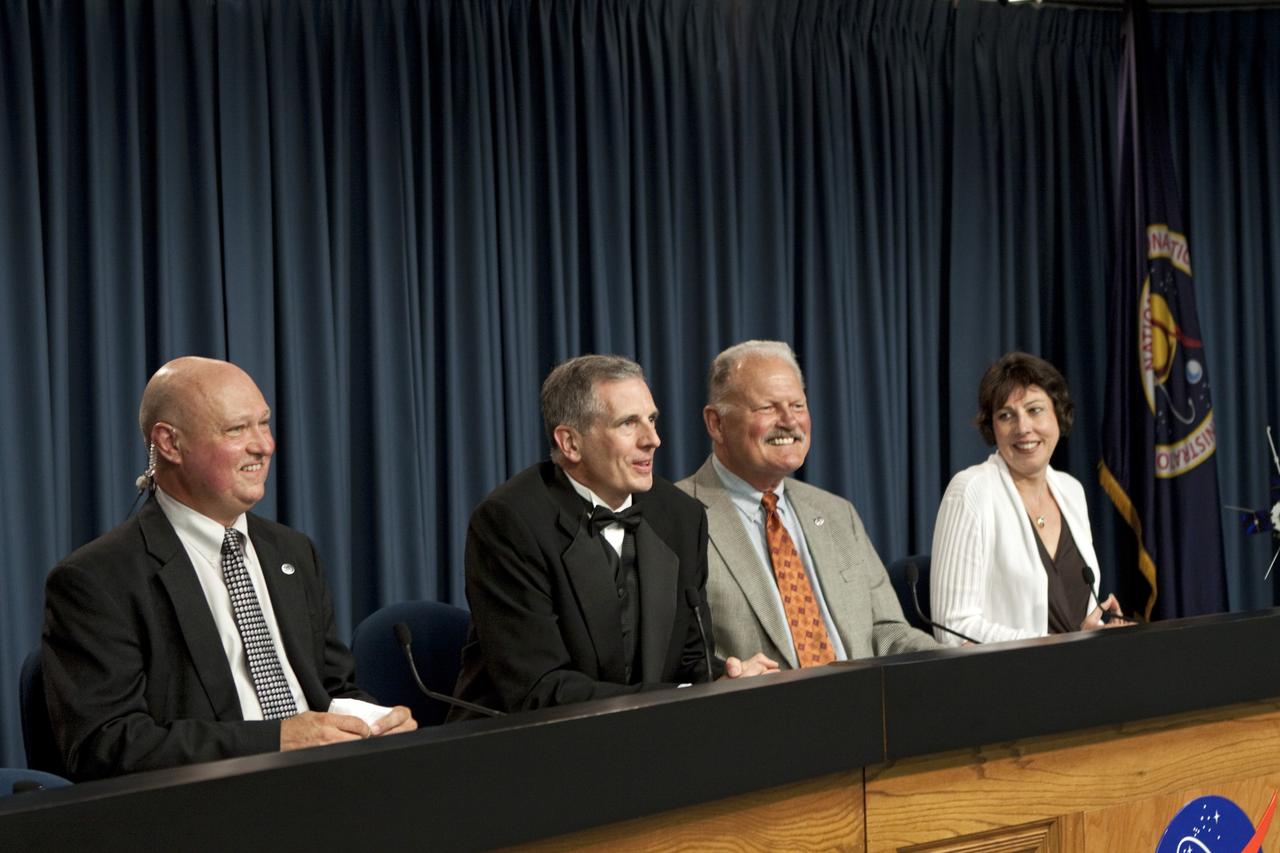
CAPE CANAVERAL, Fla. – A postlaunch news conference is held at NASA Kennedy Space Center’s Press Site in Florida following the launch of the Radiation Belt Storm Probes, or RBSP, mission atop a United Launch Alliance, or ULA, Atlas V rocket at 4:05 a.m. EDT from Space Launch Complex 41 at Cape Canaveral Air Force Station. From left, are Mike Curie of NASA Kennedy Public Affairs, Richard Fitzgerald, RBSP project manager at Johns Hopkins Applied Physics Laboratory? in Laurel, M.D., Michael Luther, deputy associate administrator of NASA's Science Mission Directorate? at NASA Headquarters?, and Nicky Fox, RBSP deputy project scientist at Johns Hopkins. RBSP will explore changes in Earth's space environment caused by the sun -- known as "space weather" -- that can disable satellites, create power-grid failures and disrupt GPS service. The mission also will provide data on the fundamental radiation and particle acceleration processes throughout the universe. For more information on RBSP, visit http://www.nasa.gov/rbsp. Photo credit: NASA/Jim Grossmann
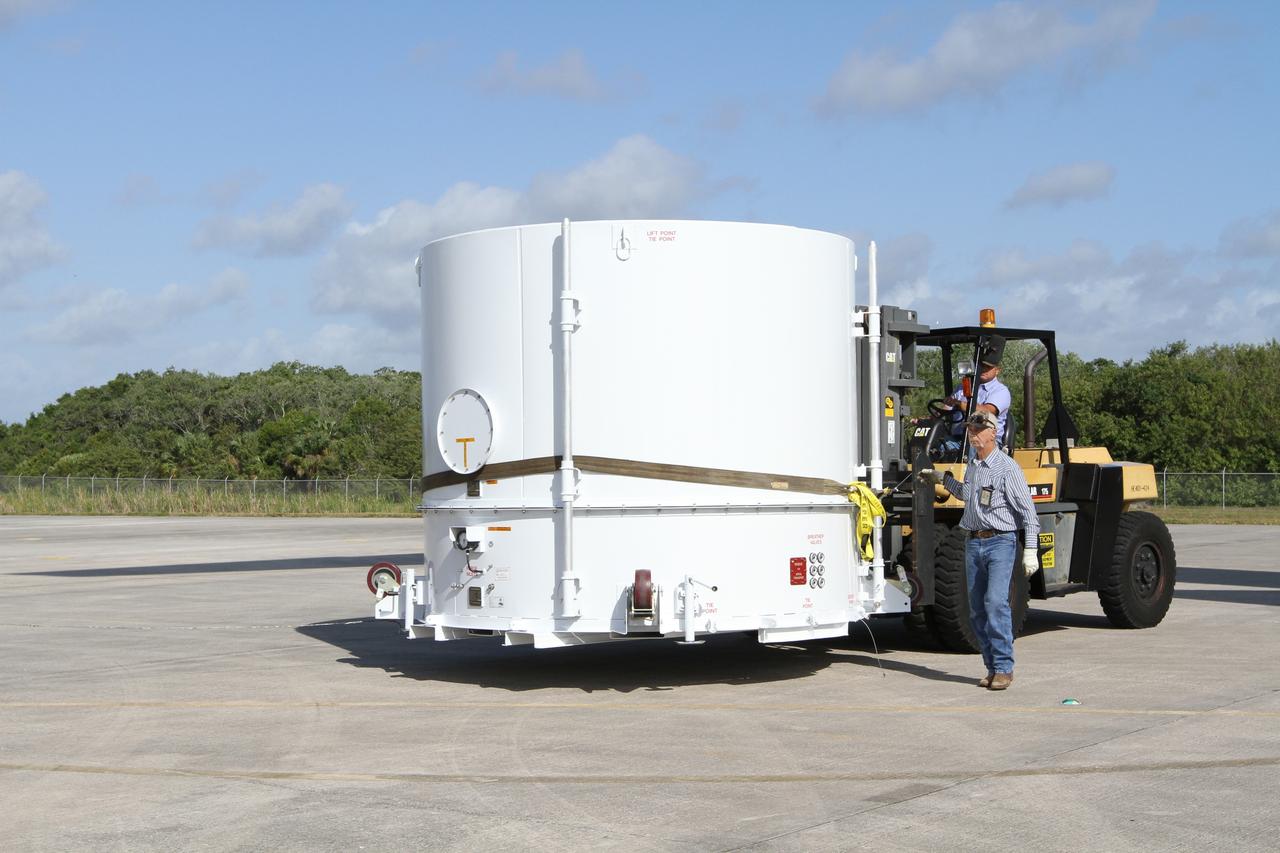
CAPE CANAVERAL, Fla. – A forklift operator NASA's Radiation Belt Storm Probe A, enclosed in a protective shipping container, toward a flatbed truck at the Shuttle Landing Facility at NASA’s Kennedy Space Center in Florida. The twin RBSP spacecraft will be transported to the Astrotech payload processing facility near Kennedy Space Center where Applied Physics Laboratory technicians will begin spacecraft testing and prelaunch preparations. The RBSP mission will help us understand the sun’s influence on Earth and near-Earth space by studying the Earth’s radiation belts on various scales of space and time. The RBSP instruments will provide the measurements needed to characterize and quantify the plasma processes that produce very energetic ions and relativistic electrons. The mission is part of NASA’s broader Living With a Star Program that was conceived to explore fundamental processes that operate throughout the solar system, and in particular those that generate hazardous space weather effects in the vicinity of Earth and phenomena that could impact solar system exploration. RBSP is scheduled to begin its mission of exploration of Earth's Van Allen Radiation Belts and the extremes of space weather after launch. Launch aboard a United Launch Alliance Atlas V rocket is scheduled for August 23. For more information, visit http://www.nasa.gov/rbsp. Photo credit: NASA/Kim Shiflett
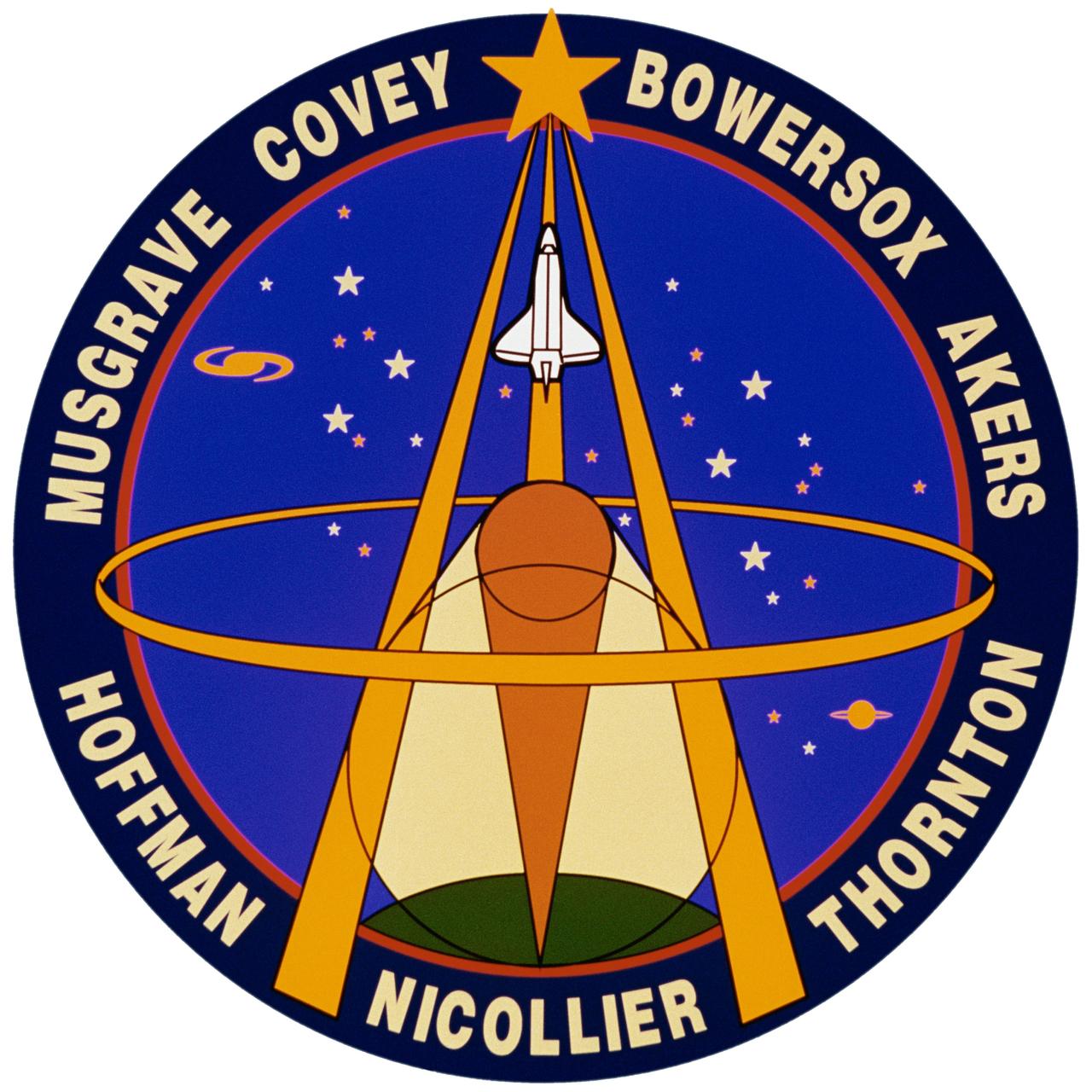
STS061-S-001 (1 Oct. 1993) --- Designed by the crew members, the STS-61 crew insignia depicts the astronaut symbol superimposed against the sky with the Earth underneath. Also seen are two circles representing the optical configuration of the Hubble Space Telescope (HST). Light is focused by reflections from a large primary mirror and a smaller secondary mirror. The light is analyzed by various instruments and, according to the crew members, "brings to us on Earth knowledge about planets, stars, galaxies and other celestial objects, allowing us to better understand the complex physical processes at work in the universe." The space shuttle Endeavour is also represented as the fundamental tool that allows the crew to perform the first servicing of the Hubble Space Telescope so its scientific deep space mission may be extended for several years to come. The overall design of the emblem, with lines converging to a high point, is also a symbolic representation of the large-scale Earth-based effort -- which involves space agencies, industry and the universities -- to reach goals of knowledge and perfection. The NASA insignia design for space shuttle flights is reserved for use by the astronauts and for other official use as the NASA Administrator may authorize. Public availability has been approved only in the forms of illustrations by the various news media. When and if there is any change in this policy, which is not anticipated, the change will be publicly announced. Photo credit: NASA
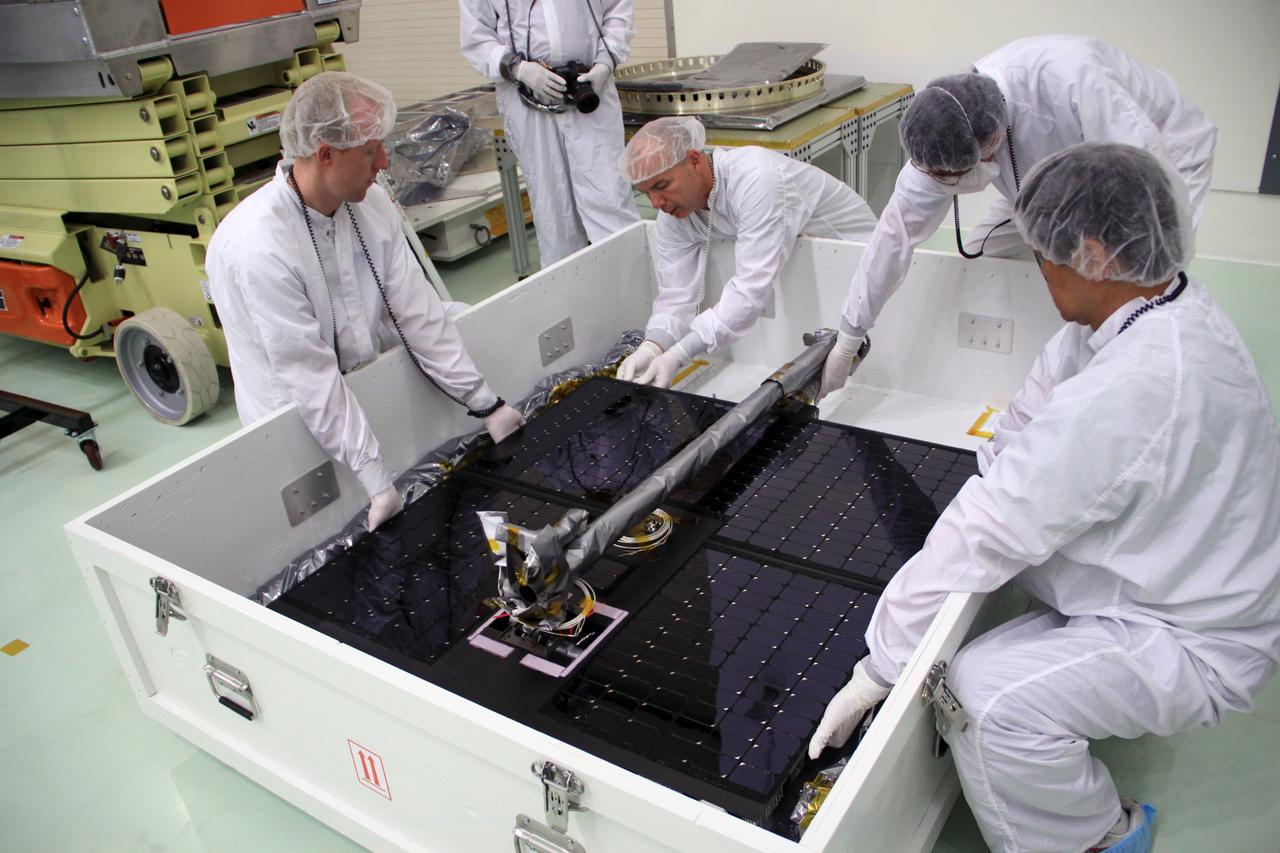
CAPE CANAVERAL, Fla. – In the clean room high bay at the Astrotech payload processing facility near NASA’s Kennedy Space Center in Florida, a team approach is used by Applied Physics Laboratory technicians to lift one of the solar arrays for NASA's Radiation Belt Storm Probe A from its shipping container. The Radiation Belt Storm Probes, or RBSP, mission will help us understand the sun’s influence on Earth and near-Earth space by studying the Earth’s radiation belts on various scales of space and time. RBSP instruments will provide the measurements needed to characterize and quantify the plasma processes that produce very energetic ions and relativistic electrons. The mission is part of NASA’s broader Living With a Star Program that was conceived to explore fundamental processes that operate throughout the solar system, particularly those that generate hazardous space weather effects in the vicinity of Earth and phenomena that could impact solar system exploration. RBSP will begin its mission of exploration of Earth's Van Allen radiation belts and the extremes of space weather after launch. Launch aboard a United Launch Alliance Atlas V rocket is scheduled for August 23. For more information, visit http://www.nasa.gov/rbsp. Photo credit: NASA/Jim Grossmann
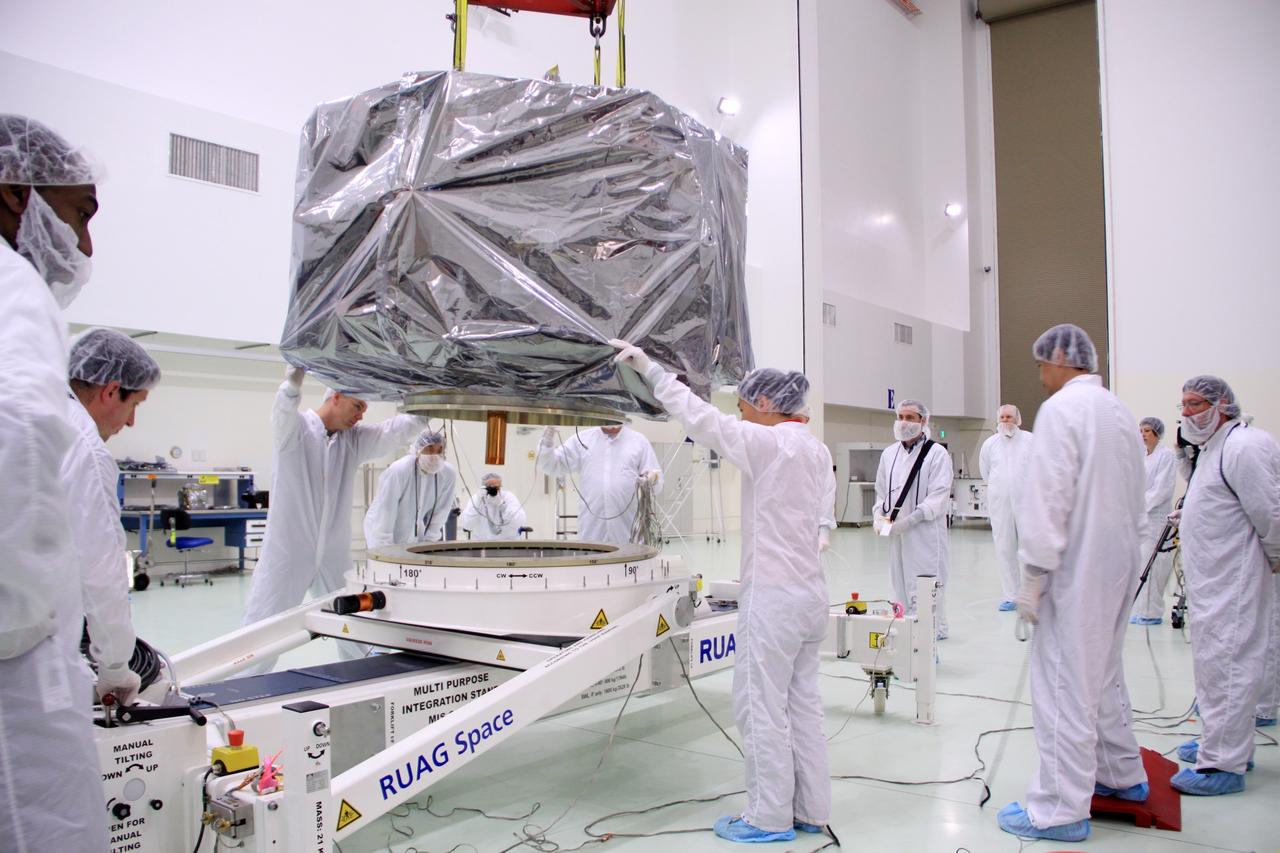
CAPE CANAVERAL, Fla. – In the clean room high bay at the Astrotech payload processing facility near NASA’s Kennedy Space Center in Florida, Applied Physics Laboratory technicians lower NASA's Radiation Belt Storm Probe B, wrapped in a protective shroud, onto a test stand. Prelaunch preparations and spacecraft testing will follow. The Radiation Belt Storm Probes, or RBSP, mission will help us understand the sun’s influence on Earth and near-Earth space by studying the Earth’s radiation belts on various scales of space and time. RBSP instruments will provide the measurements needed to characterize and quantify the plasma processes that produce very energetic ions and relativistic electrons. The mission is part of NASA’s broader Living With a Star Program that was conceived to explore fundamental processes that operate throughout the solar system, particularly those that generate hazardous space weather effects in the vicinity of Earth and phenomena that could impact solar system exploration. RBSP will begin its mission of exploration of Earth's Van Allen radiation belts and the extremes of space weather after launch. Launch aboard a United Launch Alliance Atlas V rocket is scheduled for August 23. For more information, visit http://www.nasa.gov/rbsp. Photo credit: NASA/Jim Grossmann
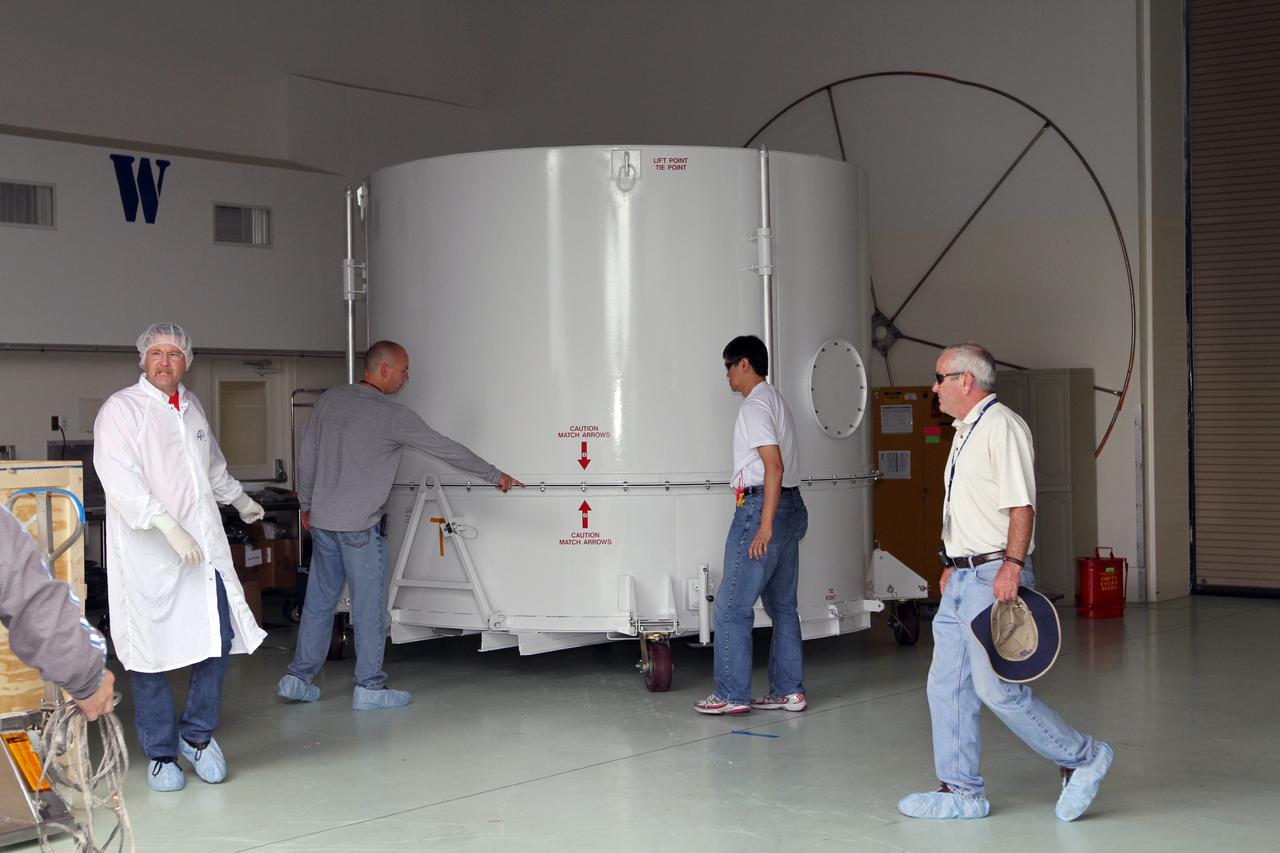
CAPE CANAVERAL, Fla. – NASA's Radiation Belt Storm Probe A, enclosed in a protective shipping container, is positioned into the airlock of the Astrotech payload processing facility near NASA’s Kennedy Space Center in Florida where Applied Physics Laboratory technicians will begin spacecraft testing and prelaunch preparations. The twin RBSP spacecraft arrived at Kennedy’s Shuttle Landing Facility in the cargo bay of a U.S. Air Force C-17 aircraft earlier in the day. The RBSP mission will help us understand the sun’s influence on Earth and near-Earth space by studying the Earth’s radiation belts on various scales of space and time. The RBSP instruments will provide the measurements needed to characterize and quantify the plasma processes that produce very energetic ions and relativistic electrons. The mission is part of NASA’s broader Living With a Star Program that was conceived to explore fundamental processes that operate throughout the solar system, and in particular those that generate hazardous space weather effects in the vicinity of Earth and phenomena that could impact solar system exploration. RBSP is scheduled to begin its mission of exploration of Earth's Van Allen Radiation Belts and the extremes of space weather after launch. Launch aboard a United Launch Alliance Atlas V rocket is scheduled for August 23. For more information, visit http://www.nasa.gov/rbsp. Photo credit: NASA/Kim Shiflett
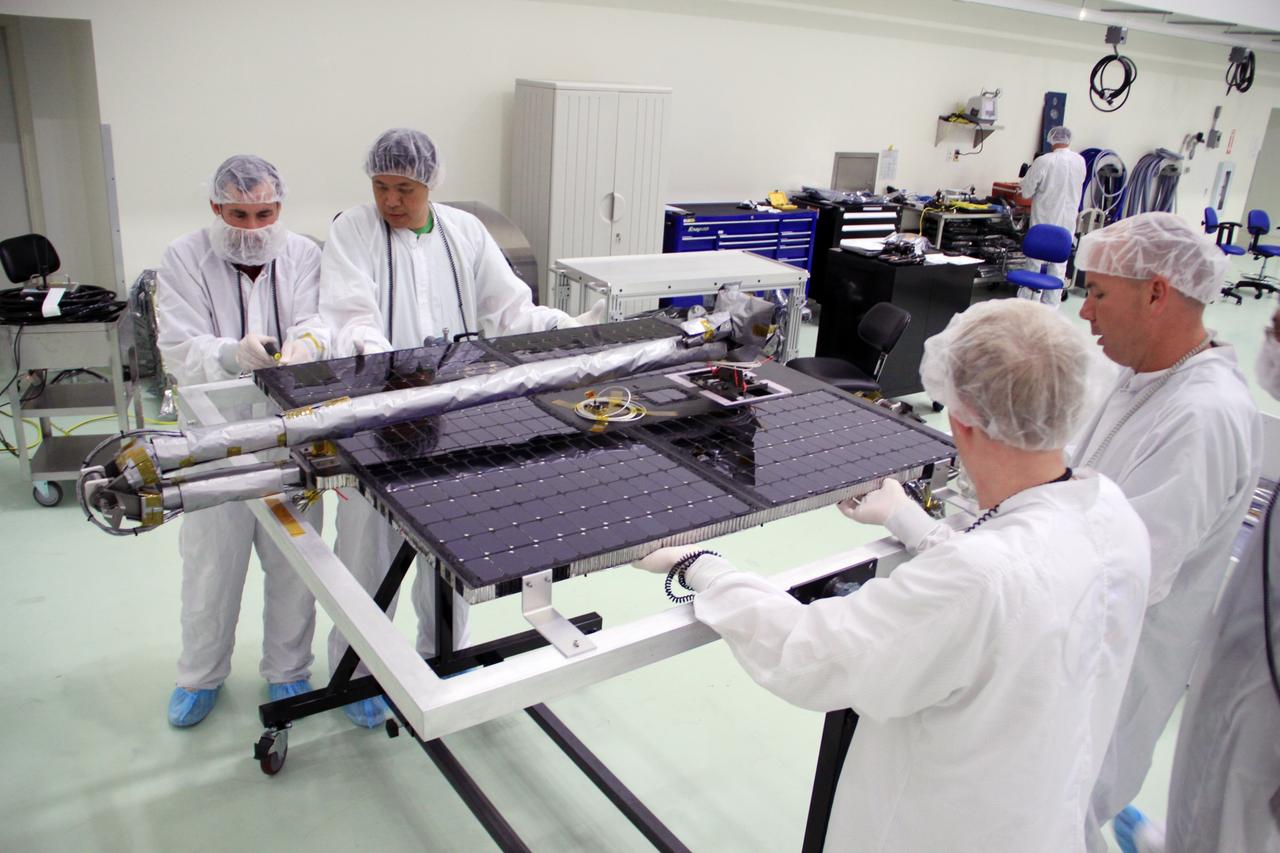
CAPE CANAVERAL, Fla. – In the clean room high bay at the Astrotech payload processing facility near NASA’s Kennedy Space Center in Florida, Applied Physics Laboratory technicians secure one of the solar arrays for NASA's Radiation Belt Storm Probe A into a holding fixture. The Radiation Belt Storm Probes, or RBSP, mission will help us understand the sun’s influence on Earth and near-Earth space by studying the Earth’s radiation belts on various scales of space and time. RBSP instruments will provide the measurements needed to characterize and quantify the plasma processes that produce very energetic ions and relativistic electrons. The mission is part of NASA’s broader Living With a Star Program that was conceived to explore fundamental processes that operate throughout the solar system, particularly those that generate hazardous space weather effects in the vicinity of Earth and phenomena that could impact solar system exploration. RBSP will begin its mission of exploration of Earth's Van Allen radiation belts and the extremes of space weather after launch. Launch aboard a United Launch Alliance Atlas V rocket is scheduled for August 23. For more information, visit http://www.nasa.gov/rbsp. Photo credit: NASA/Jim Grossmann
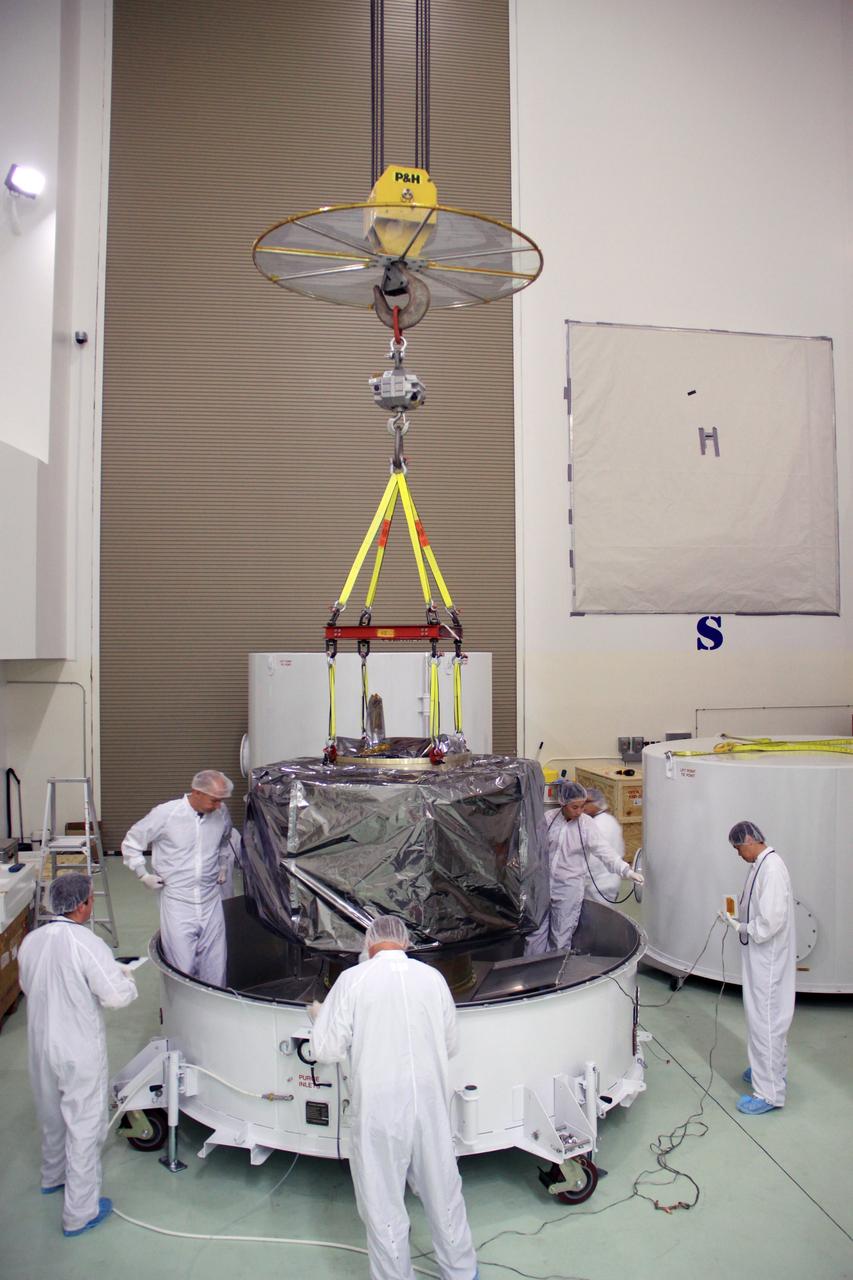
CAPE CANAVERAL, Fla. – In the clean room high bay at the Astrotech payload processing facility near NASA’s Kennedy Space Center in Florida, Applied Physics Laboratory technicians prepare to lift NASA's Radiation Belt Storm Probe B, wrapped in a protective shroud, from the bottom of its shipping container. Prelaunch preparations and spacecraft testing will follow. The Radiation Belt Storm Probes, or RBSP, mission will help us understand the sun’s influence on Earth and near-Earth space by studying the Earth’s radiation belts on various scales of space and time. RBSP instruments will provide the measurements needed to characterize and quantify the plasma processes that produce very energetic ions and relativistic electrons. The mission is part of NASA’s broader Living With a Star Program that was conceived to explore fundamental processes that operate throughout the solar system, particularly those that generate hazardous space weather effects in the vicinity of Earth and phenomena that could impact solar system exploration. RBSP will begin its mission of exploration of Earth's Van Allen radiation belts and the extremes of space weather after launch. Launch aboard a United Launch Alliance Atlas V rocket is scheduled for August 23. For more information, visit http://www.nasa.gov/rbsp. Photo credit: NASA/Jim Grossmann
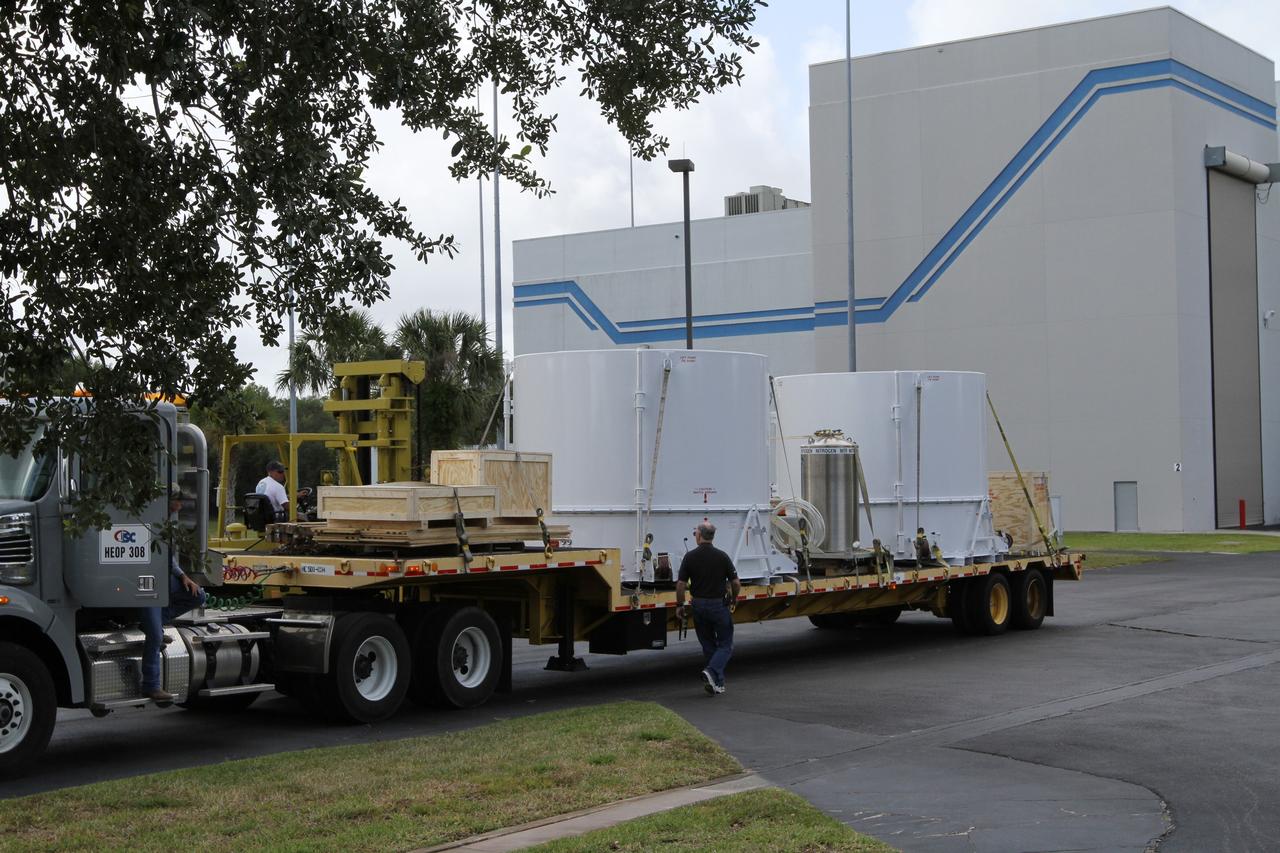
CAPE CANAVERAL, Fla. – NASA's twin Radiation Belt Storm Probes, enclosed in protective shipping containers, arrive at the Astrotech payload processing facility near NASA’s Kennedy Space Center in Florida where Applied Physics Laboratory technicians will begin spacecraft testing and prelaunch preparations. The spacecraft were delivered to Kennedy’s Shuttle Landing Facility in the cargo bay of a U.S. Air Force C-17 aircraft earlier in the day. The RBSP mission will help us understand the sun’s influence on Earth and near-Earth space by studying the Earth’s radiation belts on various scales of space and time. The RBSP instruments will provide the measurements needed to characterize and quantify the plasma processes that produce very energetic ions and relativistic electrons. The mission is part of NASA’s broader Living With a Star Program that was conceived to explore fundamental processes that operate throughout the solar system, and in particular those that generate hazardous space weather effects in the vicinity of Earth and phenomena that could impact solar system exploration. RBSP is scheduled to begin its mission of exploration of Earth's Van Allen Radiation Belts and the extremes of space weather after launch. Launch aboard a United Launch Alliance Atlas V rocket is scheduled for August 23. For more information, visit http://www.nasa.gov/rbsp. Photo credit: NASA/Kim Shiflett

CAPE CANAVERAL, Fla. – A postlaunch news conference is held at NASA Kennedy Space Center’s Press Site in Florida following the launch of the Radiation Belt Storm Probes, or RBSP, mission atop a United Launch Alliance, or ULA, Atlas V rocket at 4:05 a.m. EDT from Space Launch Complex 41 at Cape Canaveral Air Force Station. From left, are Richard Fitzgerald, RBSP project manager at Johns Hopkins Applied Physics Laboratory? in Laurel, M.D., Michael Luther, deputy associate administrator of NASA's Science Mission Directorate? at NASA Headquarters?, and Nicky Fox, RBSP deputy project scientist at Johns Hopkins. RBSP will explore changes in Earth's space environment caused by the sun -- known as "space weather" -- that can disable satellites, create power-grid failures and disrupt GPS service. The mission also will provide data on the fundamental radiation and particle acceleration processes throughout the universe. For more information on RBSP, visit http://www.nasa.gov/rbsp. Photo credit: NASA/Jim Grossmann
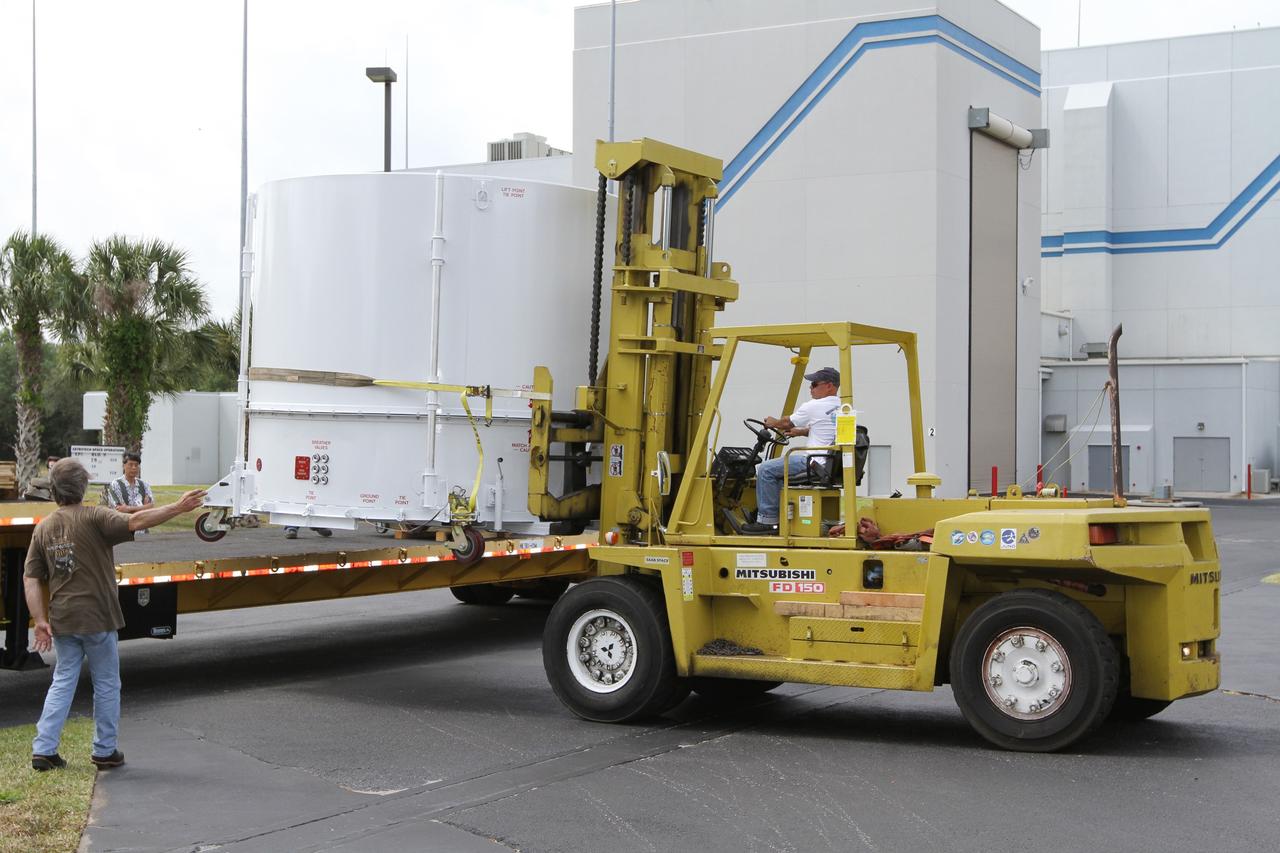
CAPE CANAVERAL, Fla. – A forklift operator offloads NASA's Radiation Belt Storm Probe B, enclosed in a protective shipping container, from a flatbed truck at the Astrotech payload processing facility near NASA’s Kennedy Space Center in Florida where Applied Physics Laboratory technicians will begin spacecraft testing and prelaunch preparations. The twin RBSP spacecraft arrived at Kennedy’s Shuttle Landing Facility in the cargo bay of a U.S. Air Force C-17 aircraft earlier in the day. The RBSP mission will help us understand the sun’s influence on Earth and near-Earth space by studying the Earth’s radiation belts on various scales of space and time. The RBSP instruments will provide the measurements needed to characterize and quantify the plasma processes that produce very energetic ions and relativistic electrons. The mission is part of NASA’s broader Living With a Star Program that was conceived to explore fundamental processes that operate throughout the solar system, and in particular those that generate hazardous space weather effects in the vicinity of Earth and phenomena that could impact solar system exploration. RBSP is scheduled to begin its mission of exploration of Earth's Van Allen Radiation Belts and the extremes of space weather after launch. Launch aboard a United Launch Alliance Atlas V rocket is scheduled for August 23. For more information, visit http://www.nasa.gov/rbsp. Photo credit: NASA/Kim Shiflett
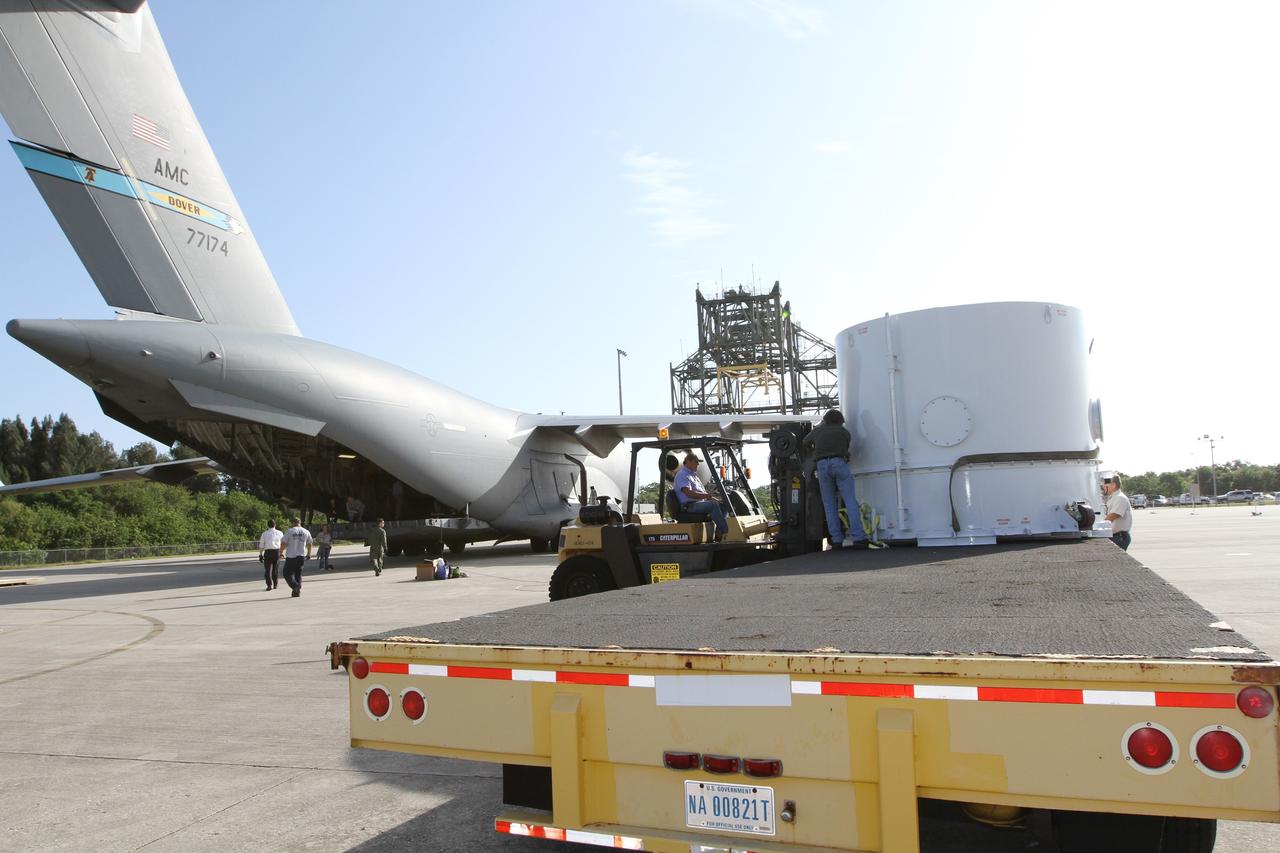
CAPE CANAVERAL, Fla. – Workers secure NASA's Radiation Belt Storm Probe B, enclosed in a protective shipping container, onto a flatbed truck at the Shuttle Landing Facility at NASA’s Kennedy Space Center in Florida. The twin RBSP spacecraft will be transported to the Astrotech payload processing facility near Kennedy Space Center where Applied Physics Laboratory technicians will begin spacecraft testing and prelaunch preparations. The RBSP mission will help us understand the sun’s influence on Earth and near-Earth space by studying the Earth’s radiation belts on various scales of space and time. The RBSP instruments will provide the measurements needed to characterize and quantify the plasma processes that produce very energetic ions and relativistic electrons. The mission is part of NASA’s broader Living With a Star Program that was conceived to explore fundamental processes that operate throughout the solar system, and in particular those that generate hazardous space weather effects in the vicinity of Earth and phenomena that could impact solar system exploration. RBSP is scheduled to begin its mission of exploration of Earth's Van Allen Radiation Belts and the extremes of space weather after launch. Launch aboard a United Launch Alliance Atlas V rocket is scheduled for August 23. For more information, visit http://www.nasa.gov/rbsp. Photo credit: NASA/Kim Shiflett
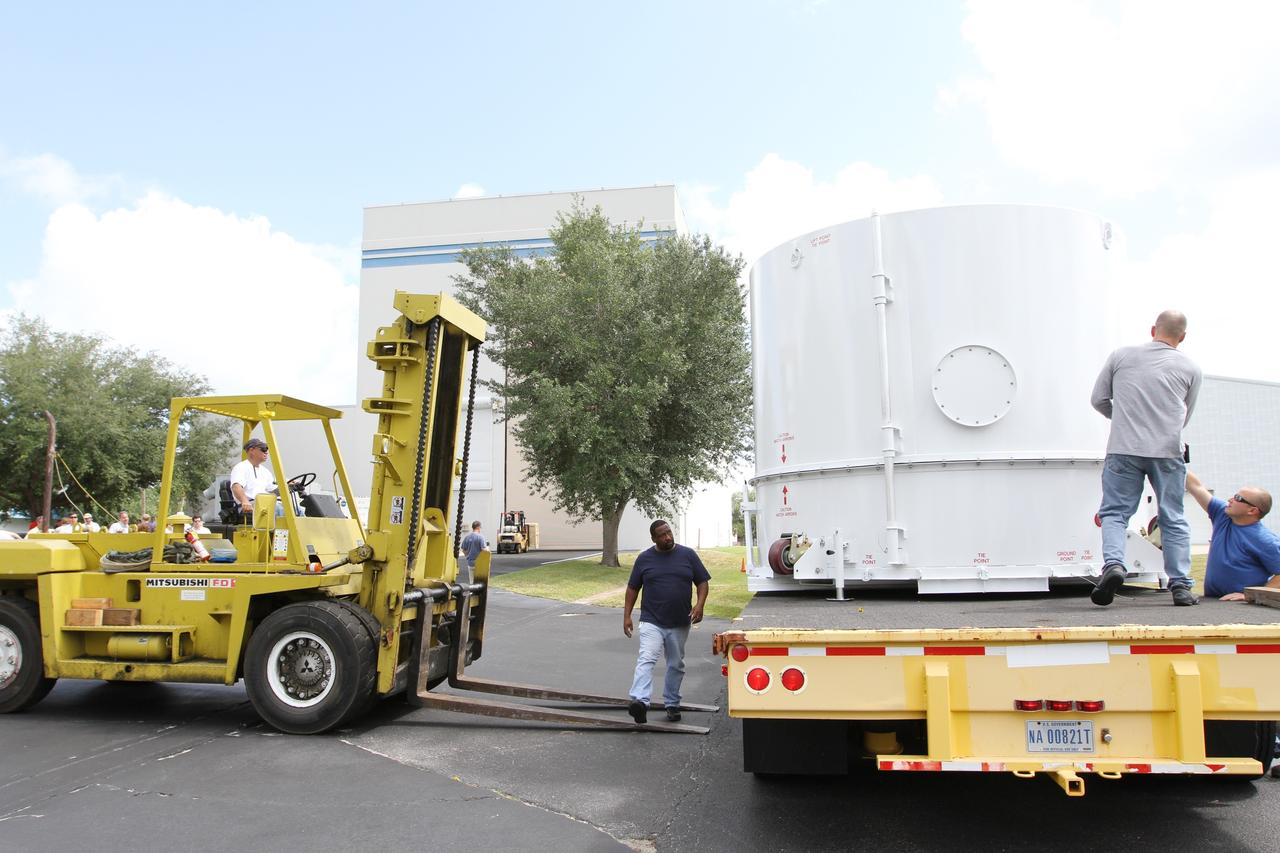
CAPE CANAVERAL, Fla. – Preparations are under way to offload NASA's twin Radiation Belt Storm Probes, enclosed in protective shipping containers, into the Astrotech payload processing facility near NASA’s Kennedy Space Center in Florida where Applied Physics Laboratory technicians will begin spacecraft testing and prelaunch preparations. The spacecraft arrived at Kennedy’s Shuttle Landing Facility in the cargo bay of a U.S. Air Force C-17 aircraft earlier in the day. The RBSP mission will help us understand the sun’s influence on Earth and near-Earth space by studying the Earth’s radiation belts on various scales of space and time. The RBSP instruments will provide the measurements needed to characterize and quantify the plasma processes that produce very energetic ions and relativistic electrons. The mission is part of NASA’s broader Living With a Star Program that was conceived to explore fundamental processes that operate throughout the solar system, and in particular those that generate hazardous space weather effects in the vicinity of Earth and phenomena that could impact solar system exploration. RBSP is scheduled to begin its mission of exploration of Earth's Van Allen Radiation Belts and the extremes of space weather after launch. Launch aboard a United Launch Alliance Atlas V rocket is scheduled for August 23. For more information, visit http://www.nasa.gov/rbsp. Photo credit: NASA/Kim Shiflett
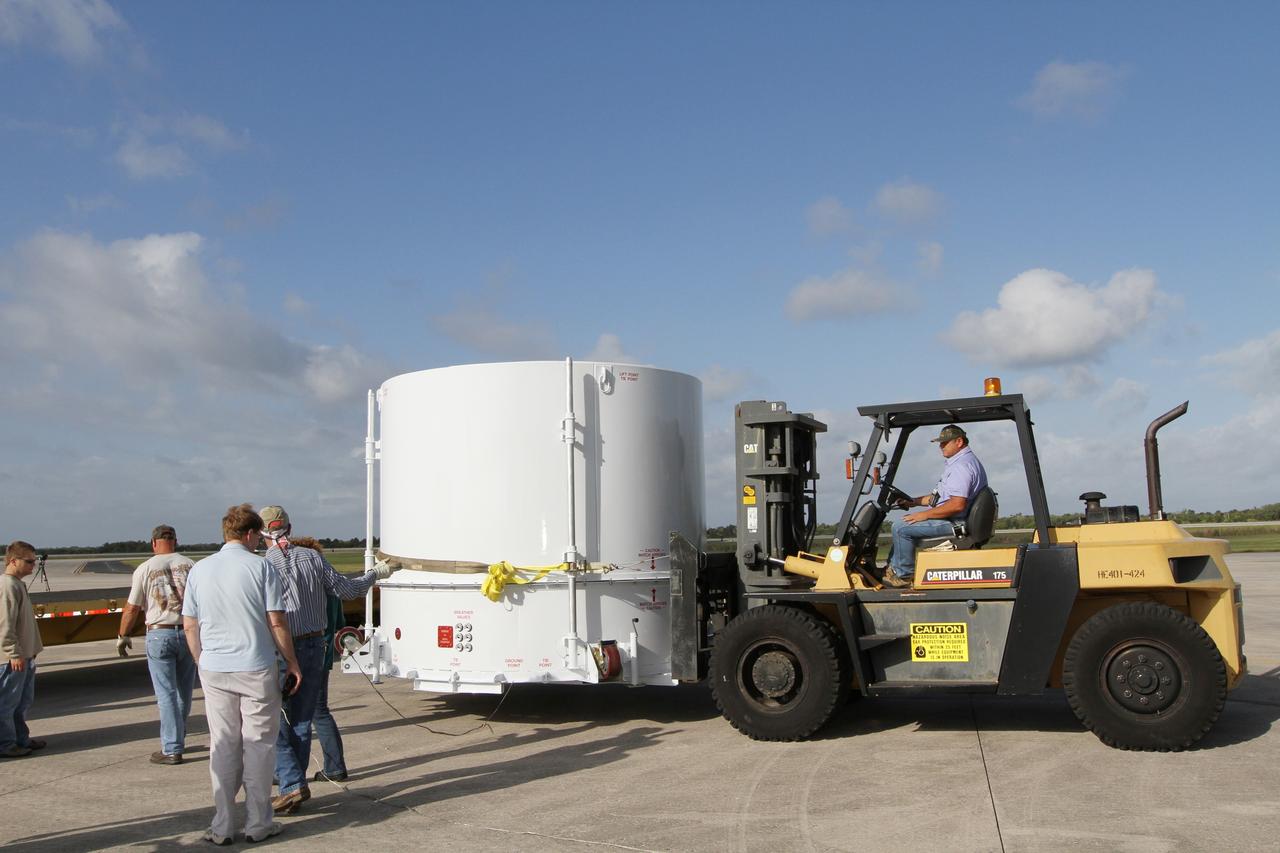
CAPE CANAVERAL, Fla. – A forklift operator moves NASA's Radiation Belt Storm Probe B, enclosed in a protective shipping container, toward a flatbed truck at the Shuttle Landing Facility at NASA’s Kennedy Space Center in Florida. The twin RBSP spacecraft will be transported to the Astrotech payload processing facility near Kennedy Space Center where Applied Physics Laboratory technicians will begin spacecraft testing and prelaunch preparations. The RBSP mission will help us understand the sun’s influence on Earth and near-Earth space by studying the Earth’s radiation belts on various scales of space and time. The RBSP instruments will provide the measurements needed to characterize and quantify the plasma processes that produce very energetic ions and relativistic electrons. The mission is part of NASA’s broader Living With a Star Program that was conceived to explore fundamental processes that operate throughout the solar system, and in particular those that generate hazardous space weather effects in the vicinity of Earth and phenomena that could impact solar system exploration. RBSP is scheduled to begin its mission of exploration of Earth's Van Allen Radiation Belts and the extremes of space weather after launch. Launch aboard a United Launch Alliance Atlas V rocket is scheduled for August 23. For more information, visit http://www.nasa.gov/rbsp. Photo credit: NASA/Kim Shiflett
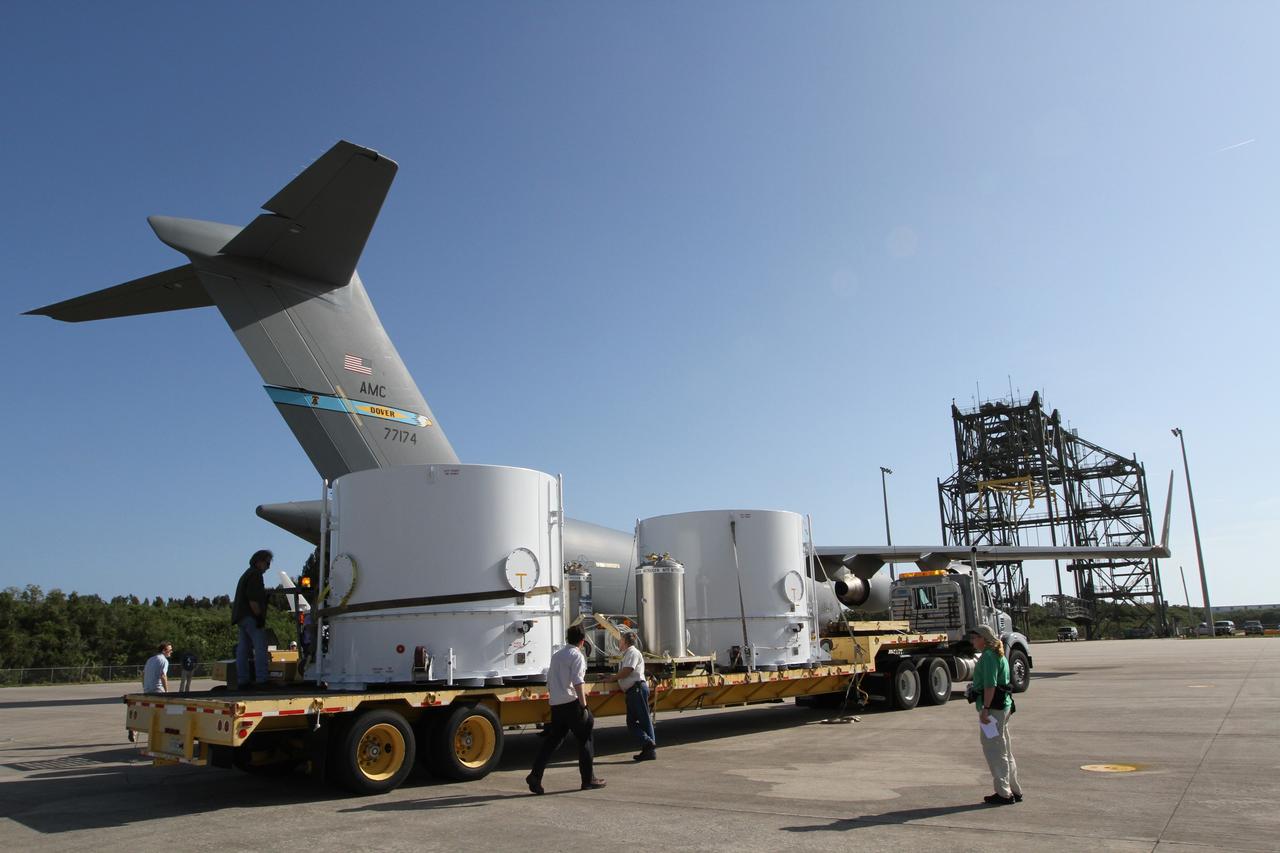
CAPE CANAVERAL, Fla. – Workers secure NASA's Radiation Belt Storm Probe A, enclosed in a protective shipping container, onto a flatbed truck at the Shuttle Landing Facility at NASA’s Kennedy Space Center in Florida. The twin RBSP spacecraft will be transported to the Astrotech payload processing facility near Kennedy Space Center where Applied Physics Laboratory technicians will begin spacecraft testing and prelaunch preparations. Nitrogen will be pumped into the canisters during transport to provide the proper environmental control for the spacecraft. The RBSP mission will help us understand the sun’s influence on Earth and near-Earth space by studying the Earth’s radiation belts on various scales of space and time. The RBSP instruments will provide the measurements needed to characterize and quantify the plasma processes that produce very energetic ions and relativistic electrons. The mission is part of NASA’s broader Living With a Star Program that was conceived to explore fundamental processes that operate throughout the solar system, and in particular those that generate hazardous space weather effects in the vicinity of Earth and phenomena that could impact solar system exploration. RBSP is scheduled to begin its mission of exploration of Earth's Van Allen Radiation Belts and the extremes of space weather after launch. Launch aboard a United Launch Alliance Atlas V rocket is scheduled for August 23. For more information, visit http://www.nasa.gov/rbsp. Photo credit: NASA/Kim Shiflett
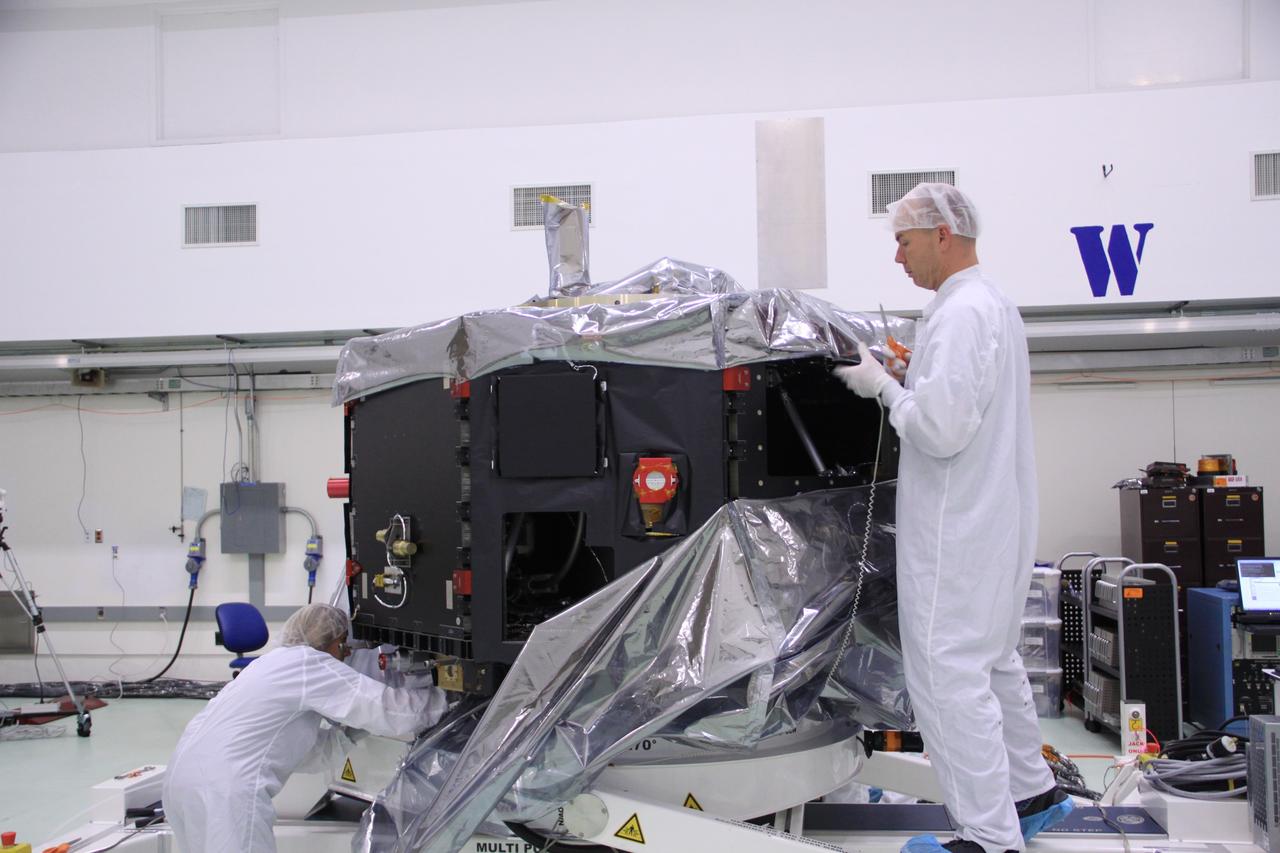
CAPE CANAVERAL, Fla. – In the clean room high bay at the Astrotech payload processing facility near NASA’s Kennedy Space Center in Florida, Applied Physics Laboratory technicians remove the protective shroud from around NASA's Radiation Belt Storm Probe B. Prelaunch preparations and spacecraft testing will follow. The Radiation Belt Storm Probes, or RBSP, mission will help us understand the sun’s influence on Earth and near-Earth space by studying the Earth’s radiation belts on various scales of space and time. RBSP instruments will provide the measurements needed to characterize and quantify the plasma processes that produce very energetic ions and relativistic electrons. The mission is part of NASA’s broader Living With a Star Program that was conceived to explore fundamental processes that operate throughout the solar system, particularly those that generate hazardous space weather effects in the vicinity of Earth and phenomena that could impact solar system exploration. RBSP will begin its mission of exploration of Earth's Van Allen radiation belts and the extremes of space weather after launch. Launch aboard a United Launch Alliance Atlas V rocket is scheduled for August 23. For more information, visit http://www.nasa.gov/rbsp. Photo credit: NASA/Jim Grossmann
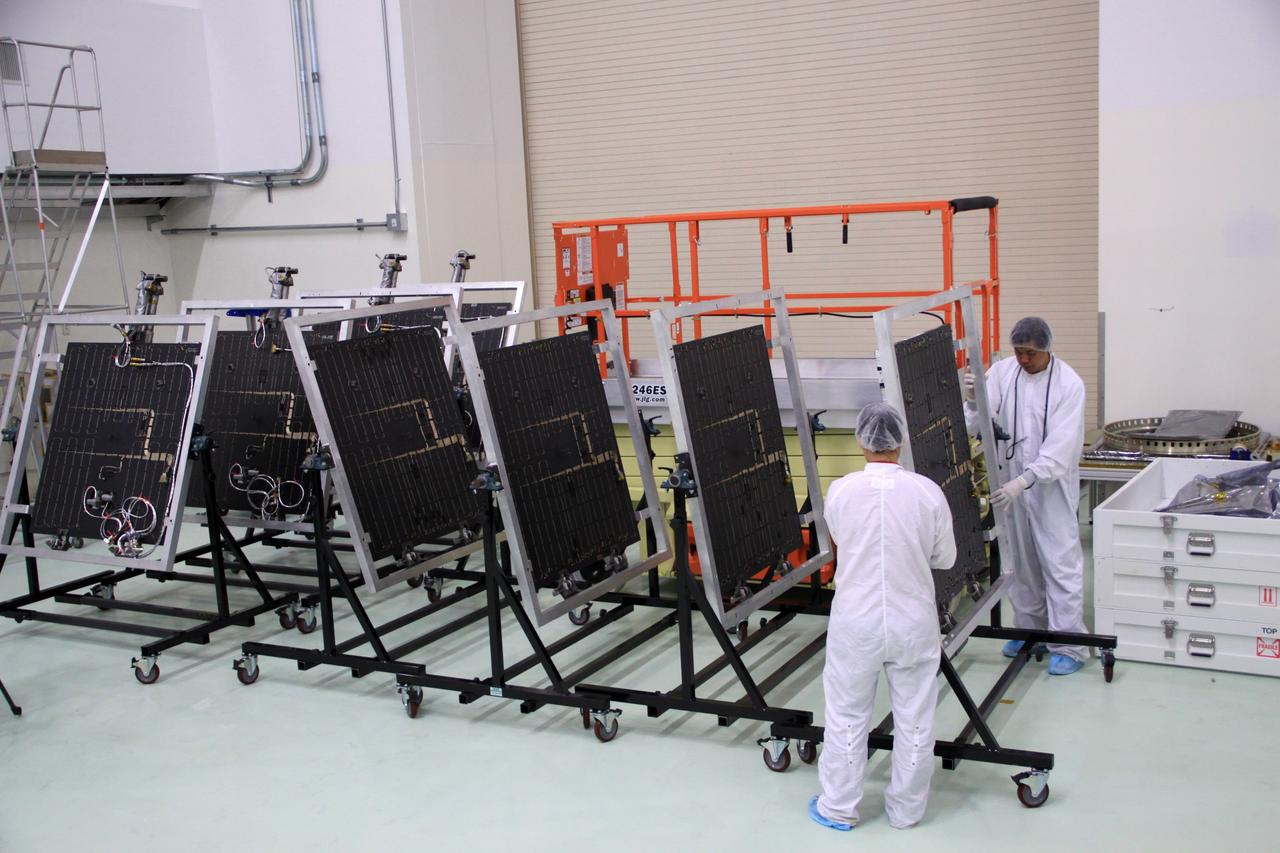
CAPE CANAVERAL, Fla. – In the clean room high bay at the Astrotech payload processing facility near NASA’s Kennedy Space Center in Florida, Applied Physics Laboratory technicians line up the holding fixtures containing the solar arrays for NASA's Radiation Belt Storm Probes A and B. The Radiation Belt Storm Probes, or RBSP, mission will help us understand the sun’s influence on Earth and near-Earth space by studying the Earth’s radiation belts on various scales of space and time. RBSP instruments will provide the measurements needed to characterize and quantify the plasma processes that produce very energetic ions and relativistic electrons. The mission is part of NASA’s broader Living With a Star Program that was conceived to explore fundamental processes that operate throughout the solar system, particularly those that generate hazardous space weather effects in the vicinity of Earth and phenomena that could impact solar system exploration. RBSP will begin its mission of exploration of Earth's Van Allen radiation belts and the extremes of space weather after launch. Launch aboard a United Launch Alliance Atlas V rocket is scheduled for August 23. For more information, visit http://www.nasa.gov/rbsp. Photo credit: NASA/Jim Grossmann
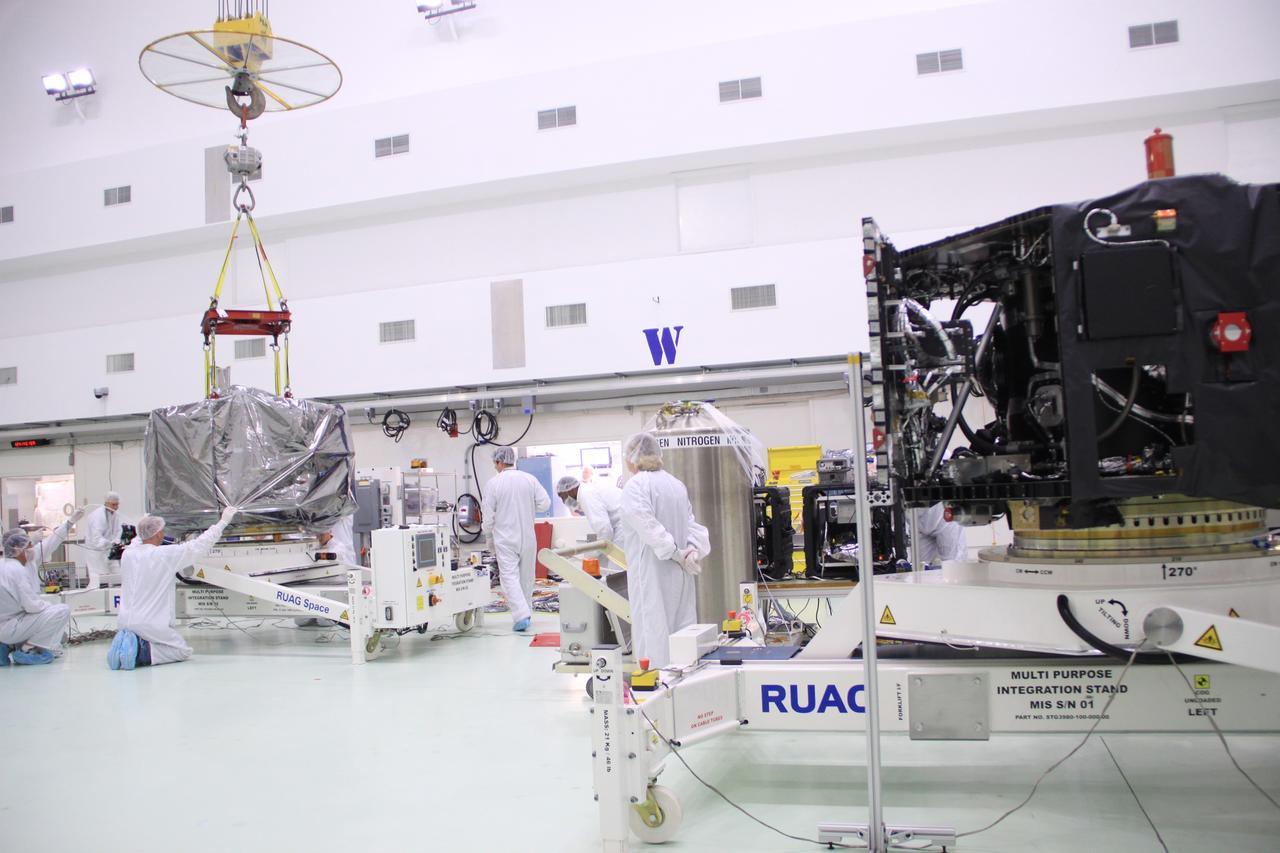
CAPE CANAVERAL, Fla. – In the clean room high bay at the Astrotech payload processing facility near NASA’s Kennedy Space Center in Florida, Applied Physics Laboratory technicians position NASA's Radiation Belt Storm Probe B, wrapped in a protective shroud, on a test stand. Prelaunch preparations and spacecraft testing will follow. The Radiation Belt Storm Probes, or RBSP, mission will help us understand the sun’s influence on Earth and near-Earth space by studying the Earth’s radiation belts on various scales of space and time. RBSP instruments will provide the measurements needed to characterize and quantify the plasma processes that produce very energetic ions and relativistic electrons. The mission is part of NASA’s broader Living With a Star Program that was conceived to explore fundamental processes that operate throughout the solar system, particularly those that generate hazardous space weather effects in the vicinity of Earth and phenomena that could impact solar system exploration. RBSP will begin its mission of exploration of Earth's Van Allen radiation belts and the extremes of space weather after launch. Launch aboard a United Launch Alliance Atlas V rocket is scheduled for August 23. For more information, visit http://www.nasa.gov/rbsp. Photo credit: NASA/Jim Grossmann
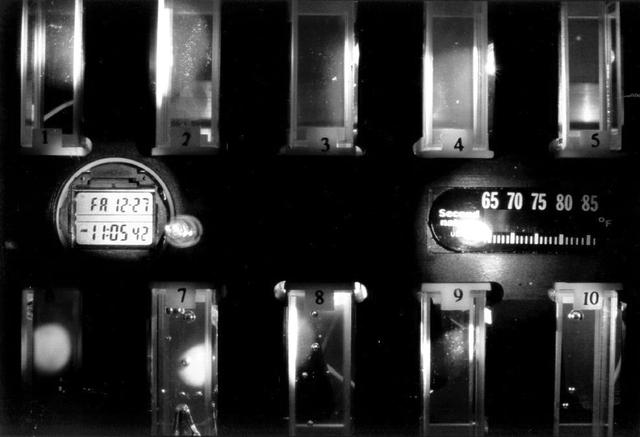
Close-up view of the Binary Colloidal Alloy Test during an experiment run aboard the Russian Mir space station. BCAT is part of an extensive series of experiments plarned to investigate the fundamental properties of colloids so that scientists can make colloids more useful for technological applications. Some of the colloids studied in BCAT are made of two different sized particles (binary colloidal alloys) that are very tiny, uniform plastic spheres. Under the proper conditions, these colloids can arrange themselves in a pattern to form crystals, which may have many unique properties that may form the basis of new classes of light switches, displays, and optical devices that can fuel the evolution of the next generation of computer and communication technologies. This Slow Growth hardware consisted of a 35-mm camera aimed toward a module which contained 10 separate colloid samples. To begin the experiment, one of the astronauts would mix the samples to disperse the colloidal particles. Then the hardware operated autonomously, taking photos of the colloidal samples over a 90-day period. The investigation proved that gravity plays a central role in the formation and stability of these types of colloidal crystal structures. The investigation also helped identify the optimum conditions for the formation of colloidal crystals, which will be used for optimizing future microgravity experiments in the study of colloidal physics. Dr. David Weitz of the University of Pennsylvania and Dr. Peter Pusey of the University of Edinburgh, United Kingdom, are the principal investigators.

Adolph Spakowski, head of the Photovoltaic Fundamentals Section at the National Aeronautics and Space Administration (NASA) Lewis Research Center, illustrated the difference between conventional silicon solar cells (rear panel) and the new thin-film cells. The larger, flexible thin-film cells in the foreground were evaluated by Lewis energy conversion specialists for possible future space use. The conventional solar cells used on most spacecraft at the time were both delicate and heavy. For example, the Mariner IV spacecraft required 28,000 these solar cells for its flyby of Mars in 1964. NASA Lewis began investigating cadmium sulfide thin-film solar cells in 1961. The thin-film cells were made by heating semiconductor material until it evaporated. The vapor was then condensed onto an electricity-producing film only one-thousandth of an inch thick. The physical flexibility of the new thin-film cells allowed them to be furled, or rolled up, during launch. Spakowski led an 18-month test program at Lewis to investigate the application of cadmium sulfide semiconductors on a light metallized substrate. The new thin-film solar cells were tested in a space simulation chamber at a simulated altitude of 200 miles. Sunlight was recreated by a 5000-watt xenon light. Two dozen cells were exposed to 15 minutes of light followed by 15 minutes of darkness to test their durability in the constantly changing illumination of Earth orbit.
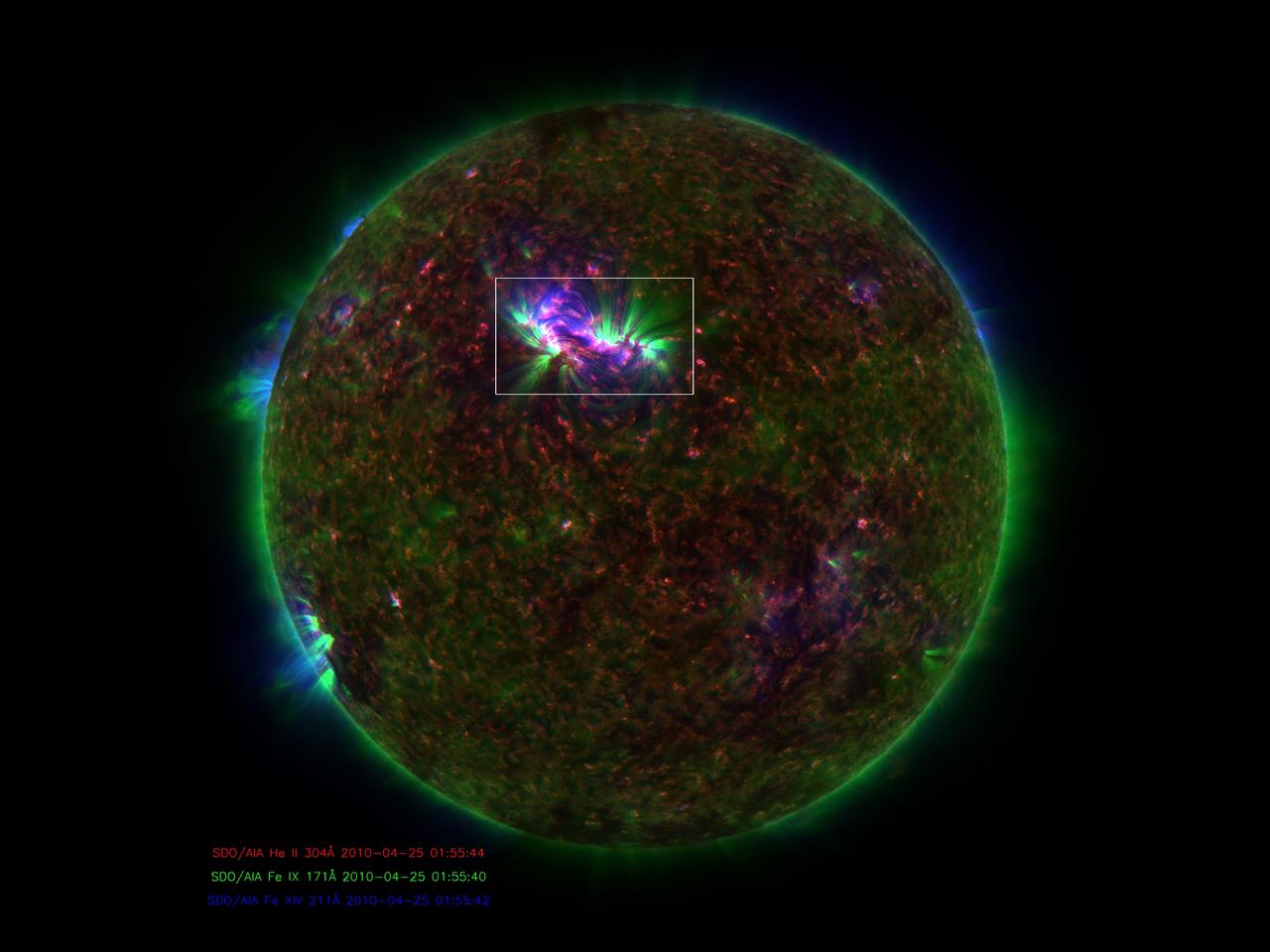
NASA image release January 6, 2010 Caption: Spicules on the sun, as observed by the Solar Dynamics Observatory. These bursts of gas jet off the surface of the sun at 150,000 miles per hour and contain gas that reaches temperatures over a million degrees. GREENBELT, Md. -- Observations from NASA's Solar Dynamics Observatory (SDO) and the Japanese satellite Hinode show that some gas in the giant, fountain-like jets in the sun's atmosphere known as spicules can reach temperatures of millions of degrees. The finding offers a possible new framework for how the sun's high atmosphere gets so much hotter than the surface of the sun. What makes the high atmosphere, or corona, so hot – over a million degrees, compared to the sun surface's 10,000 degrees Fahrenheit -- remains a poorly understood aspect of the sun's complicated space weather system. That weather system can reach Earth, causing auroral lights and, if strong enough, disrupting Earth's communications and power systems. Understanding such phenomena, therefore, is an important step towards better protecting our satellites and power grids. "The traditional view is that all the heating happens higher up in the corona," says Dean Pesnell, who is SDO's project scientist at NASA's Goddard Space Flight Center in Greenbelt, Md. "The suggestion in this paper is that cool gas is being ejected from the sun's surface in spicules and getting heated on its way to the corona." Spicules were first named in the 1940s, but were hard to study in detail until recently, says Bart De Pontieu of Lockheed Martin's Solar and Astrophysics Laboratory, Palo Alto, Calif. who is the lead author on a paper on this subject in the January 7, 2011 issue of Science magazine. In visible light, spicules can be seen to send large masses of so-called plasma – the electromagnetic gas that surrounds the sun – up through the lower solar atmosphere or photosphere. The amount of material sent up is stunning, some 100 times as much as streams away from the sun in the solar wind towards the edges of the solar system. But nobody knew if they contained hot gas. "Heating of spicules to the necessary hot temperatures has never been observed, so their role in coronal heating had been dismissed as unlikely," says De Pontieu. Now, De Pontieu's team -- which included researchers at Lockheed Martin, the High Altitude Observatory of the National Center for Atmospheric Research (NCAR) in Colorado and the University of Oslo, Norway -- was able to combine images from SDO and Hinode to produce a more complete picture of the gas inside these gigantic fountains. The scientists found that a large fraction of the gas is heated to a hundred thousand degrees, while a small fraction is heated to millions of degrees. Time-lapsed images show that this material spews up into the corona, with most falling back down towards the surface of the sun. However, the small fraction of the gas that is heated to millions of degrees does not immediately return to the surface. Given the large number of spicules on the Sun, and the amount of material in the spicules, the scientists believe that if even some of that super hot plasma stays aloft it would make a contribution to coronal heating. Astrophysicist Jonathan Cirtain, who is the U.S. project scientist for Hinode at NASA's Marshall Space Flight Center, Huntsville, Ala., says that incorporating such new information helps address an important question that reaches far beyond the sun. "This breakthrough in our understanding of the mechanisms which transfer energy from the solar photosphere to the corona addresses one of the most compelling questions in stellar astrophysics: How is the atmosphere of a star heated?" he says. "This is a fantastic discovery, and demonstrates the muscle of the NASA Heliophysics System Observatory, comprised of numerous instruments on multiple observatories." Hinode is the second mission in NASA's Solar Terrestrial Probes program, the goal of which is to improve understanding of fundamental solar and space physics processes. The mission is led by the Japan Aerospace Exploration Agency (JAXA) and the National Astronomical Observatory of Japan (NAOJ). The collaborative mission includes the U.S., the United Kingdom, Norway and Europe. NASA Marshall manages Hinode U.S. science operations and oversaw development of the scientific instrumentation provided for the mission by NASA, academia and industry. The Lockheed Martin Advanced Technology Center is the lead U.S. investigator for the Solar Optical Telescope on Hinode. SDO is the first mission in a NASA science program called Living With a Star, the goal of which is to develop the scientific understanding necessary to address those aspects of the sun-Earth system that directly affect our lives and society. NASA Goddard built, operates, and manages the SDO spacecraft for NASA's Science Mission Directorate in Washington. To learn more go to: <a href="http://www.nasa.gov/mission_pages/sdo/news/news20110106-spicules.html" rel="nofollow">www.nasa.gov/mission_pages/sdo/news/news20110106-spicules...</a> Credit: NASA Goddard/SDO/AIA <b><a href="http://www.nasa.gov/centers/goddard/home/index.html" rel="nofollow">NASA Goddard Space Flight Center</a></b> enables NASA’s mission through four scientific endeavors: Earth Science, Heliophysics, Solar System Exploration, and Astrophysics. Goddard plays a leading role in NASA’s accomplishments by contributing compelling scientific knowledge to advance the Agency’s mission. <b>Follow us on <a href="http://twitter.com/NASA_GoddardPix" rel="nofollow">Twitter</a></b> <b>Join us on <a href="http://www.facebook.com/pages/Greenbelt-MD/NASA-Goddard/395013845897?ref=tsd" rel="nofollow">Facebook</a></b>