
SCI2017_0007: Artist illustration of the thick ring of dust that can obscure the energetic processes that occur near the supermassive black hole of an active galactic nuclei. The SOFIA studies suggest that the dust distribution is about 30 percent smaller than previously thought. Credit: NASA/SOFIA/Lynette Cook

SCI2012_0003: SOFIA mid-infrared image of the planetary nebula Minkowski 2-9 (M2-9), also known as the Butterfly Nebula, compared with a visual-wavelength Hubble Space Telescope image at the same scale and orientation. The nebula is composed of two lobes of gas & dust expelled from a dying star with about the mass of our Sun that is seen at the center of the lobes. The HST image shows mostly ionized gas in the lobes whereas the SOFIA image shows mostly solid grains condensing in the gas. The SOFIA data were obtained during SOFIA's Early Science program in 2011 by a Guest Investigator team led by Michael Werner of Caltech/JPL using the FORCAST camera (P.I.Terry Herter, Cornell University). Credit: SOFIA image, RGB = 37, 24, 20 microns; NASA/DLR/USRA/DSI/FORCAST team/M. Werner et al./A. Helton, J. Rho; HST image: NASA/ESA/NSF/AURA/Hubble Heritage Team/STScI/B. Balick, V. Icke, G. Mellema

In archived NASA data, researchers have discovered "super spiral" galaxies that dwarf our own spiral galaxy, the Milky Way, and compete in size and brightness with the largest galaxies in the universe. The unprecedented galaxies have long hidden in plain sight by mimicking the appearance of typical spirals. Three examples of super spirals are presented here in images taken by the Sloan Digital Sky Survey. The super spiral on the left (Figure 1), catalogued as 2MASX J08542169+0449308, contains two galactic nuclei, instead of just the usual one, and thus looks like two eggs frying in a pan. The central image (Figure 2) shows a super spiral designated 2MASX J16014061+2718161, and it also contains the double nuclei. On the right (Figure 3), a huge galaxy with the moniker SDSS J094700.08+254045.7 stands as one of the biggest and brightest super spirals. The mega-galaxy's starry disk and spiral arms stretch about 320,000 light-years across, or more than three times the breadth of the Milky Way. These double nuclei, which are known to result from the recent merger of two galaxies, could offer a vital hint about the potential origin of super spirals. Researchers speculate that a special merger involving two, gas-rich spiral galaxies could see their pooled gases settle down into a new, larger stellar disk -- presto, a super spiral. The super spirals were discovered using the NASA/IPAC Extragalactic Database, or NED, an online repository containing information on over 100 million galaxies. NED brings together a wealth of data from many different projects, including ultraviolet light observations from the Galaxy Evolution Explorer, visible light from Sloan Digital Sky Survey, infrared light from the 2-Micron All-Sky Survey, and links to data from other missions such as NASA's Spitzer Space Telescope and Wide-Field Infrared Survey Explorer, or WISE. http://photojournal.jpl.nasa.gov/catalog/PIA20064

Feast your eyes on Hubble's Megamaser galaxy! Phenomena across the Universe emit radiation spanning the entire electromagnetic spectrum — from high-energy gamma rays, which stream out from the most energetic events in the cosmos, to lower-energy microwaves and radio waves. Microwaves, the very same radiation that can heat up your dinner, are produced by a multitude of astrophysical sources, including strong emitters known as masers (microwave lasers), even stronger emitters with the somewhat villainous name of megamasers and the centers of some galaxies. Especially intense and luminous galactic centers are known as active galactic nuclei. They are in turn thought to be driven by the presence of supermassive black holes, which drag surrounding material inwards and spit out bright jets and radiation as they do so. The two galaxies shown here, imaged by the NASA/ESA Hubble Space Telescope, are named MCG+01-38-004 (the upper, red-tinted one) and MCG+01-38-005 (the lower, blue-tinted one). MCG+01-38-005 (also known as NGC 5765B) is a special kind of megamaser; the galaxy’s active galactic nucleus pumps out huge amounts of energy, which stimulates clouds of surrounding water. Water’s constituent atoms of hydrogen and oxygen are able to absorb some of this energy and re-emit it at specific wavelengths, one of which falls within the microwave regime, invisible to Hubble but detectable by microwave telescopes. MCG+01-38-005 is thus known as a water megamaser! Astronomers can use such objects to probe the fundamental properties of the Universe. The microwave emissions from MCG+01-38-005 were used to calculate a refined value for the Hubble constant, a measure of how fast the Universe is expanding. This constant is named after the astronomer whose observations were responsible for the discovery of the expanding Universe and after whom the Hubble Space Telescope was named, Edwin Hubble.
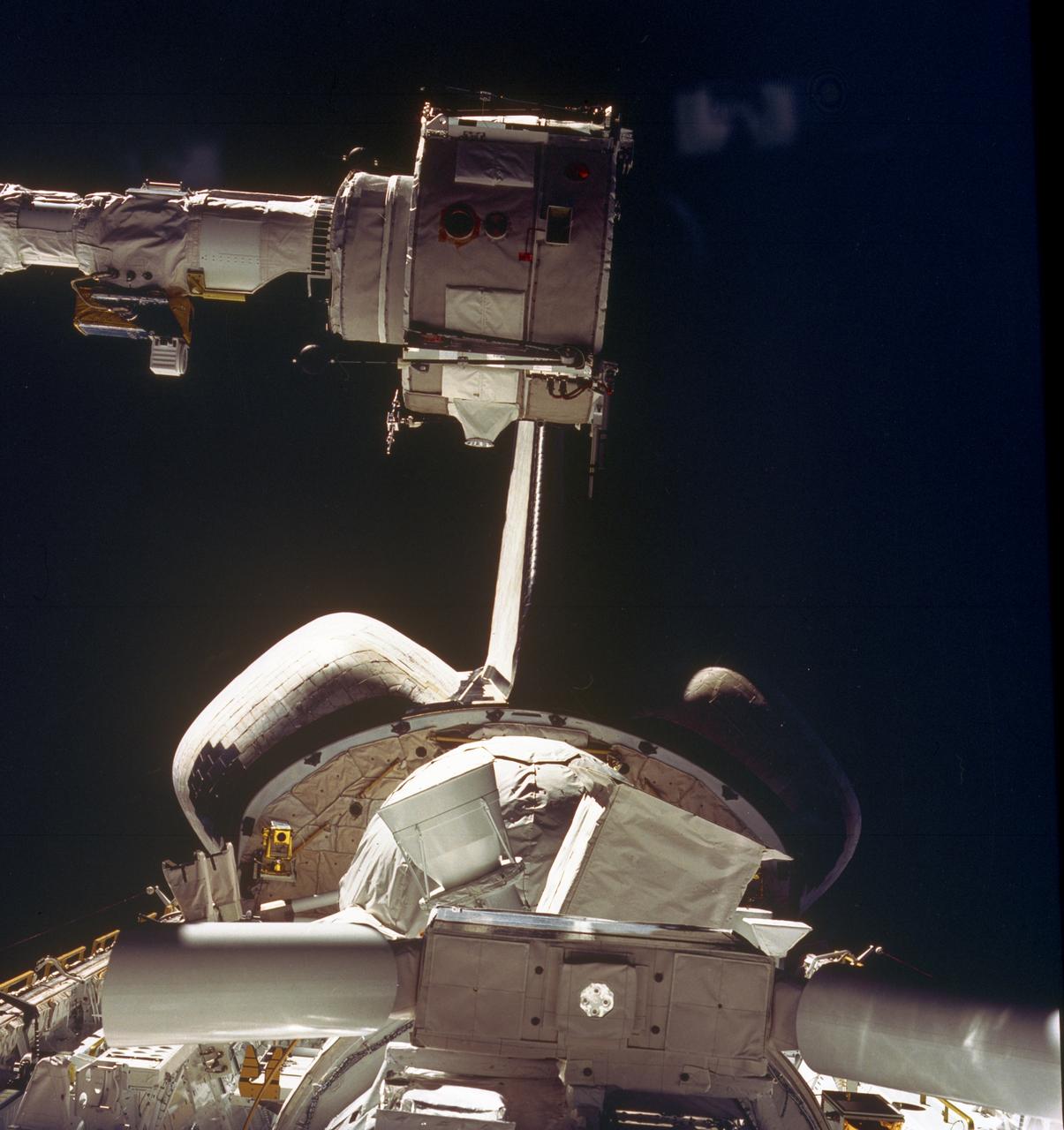
This STS-51F mission onboard Photograph shows some of the Spacelab-2 instruments in the cargo bay of the Orbiter Challenger. The Plasma Diagnostics Package (PDP). shown at the end of the Remote Manipulator System (RMS), used instruments on a subsatellite to study natural plasma processes, orbiter-induced plasma processes, and beam plasma physics. Fourteen instruments were mounted on the PDP for measurements of various plasma characteristics. The X-ray Telescope (XRT), is at the front. The goal of this investigation was to image and examine the X-ray emissions from clusters of galaxies in order to study the mechanisms that cause high-temperature emissions and to determine the weight of galactic clusters. The Small Helium-Cooled Infrared Telescope (IRT) is at the right behind the XRT. The objective of this investigation was to measure and map diffused and discrete infrared astronomical sources while evaluating the Space Shuttle as a platform for infrared astronomy. At the same time, a new large superfluid helium dewar system for cooling the telescope was evaluated. The egg-shaped Cosmic Ray Nuclei experiment (CRNE) is shown at the rear. This investigation was to study the composition of high-energy cosmic rays by using a large instrument exposed to space for a considerable period of time. Spacelab-2 (STS-51F, 19th Shuttle mission) was launched aboard the Space Shuttle Orbiter Challenger on July 29, 1985.

In 1986, NASA introduced a Shuttle-borne ultraviolet observatory called Astro. The Astro Observatory was designed to explore the universe by observing and measuring the ultraviolet radiation from celestial objects. Astronomical targets of observation selected for Astro missions included planets, stars, star clusters, galaxies, clusters of galaxies, quasars, remnants of exploded stars (supernovae), clouds of gas and dust (nebulae), and the interstellar medium. Astro-1 used a Spacelab pallet system with an instrument pointing system and a cruciform structure for bearing the three ultraviolet instruments mounted in a parallel configuration. The three instruments were: The Hopkins Ultraviolet Telescope (HUT), which was designed to obtain far-ultraviolet spectroscopic data from white dwarfs, emission nebulae, active galaxies, and quasars; the Wisconsin Ultraviolet Photo-Polarimeter Experiment (WUPPE) which was to study polarized ultraviolet light from magnetic white dwarfs, binary stars, reflection nebulae, and active galaxies; and the Ultraviolet Imaging Telescope (UIT) which was to record photographic images in ultraviolet light of galaxies, star clusters, and nebulae. The star trackers that supported the instrument pointing system were also mounted on the cruciform. Also in the payload bay was the Broad Band X-Ray Telescope (BBXRT), which was designed to obtain high-resolution x-ray spectra from stellar corona, x-ray binary stars, active galactic nuclei, and galaxy clusters. Managed by the Marshall Space Flight Center, the Astro-1 observatory was launched aboard the Space Shuttle Orbiter Columbia (STS-35) on December 2, 1990.

This photograph was taken during the integration of the Astro-1 mission payloads at the Kennedy Space Center on March 20, 1990, showing the Broad Band X-Ray Telescope (BBXRT) at the left, as three telescopes for the Astro-1 Observatory are settled into the Orbiter Columbia payload bay. Above Earth's atmospheric interference, Astro-1 would make precise measurements of objects such as planets, stars, and galaxies in relatively small fields of view and would observe and measure ultraviolet radiation from celestial objects. The Astro-1 used a Spacelab pallet system with an instrument pointing system and a cruciform structure for bearing the three ultraviolet instruments mounted in a parallel configuration. The three instruments were: The Hopkins Ultraviolet Telescope (HUT), which was designed to obtain far-ultraviolet spectroscopic data from white dwarfs, emission nebulae, active galaxies, and quasars; the Wisconsin Ultraviolet Photo-Polarimeter Experiment (WUPPE) which was to study polarized ultraviolet light from magnetic white dwarfs, binary stars, reflection nebulae, and active galaxies; and the Ultraviolet Imaging Telescope (UIT), which was to record photographic images in ultraviolet light of galaxies, star clusters, and nebulae. The star trackers that supported the instrument pointing system, were also mounted on the cruciform. Also in the payload bay was the Broad Band X-Ray Telescope (BBXRT), which was designed to obtain high-resolution x-ray spectra from stellar corona, x-ray binary stars, active galactic nuclei, and galaxy clusters. Managed by the Marshall Space Flight Center, the Astro-1 observatory was launched aboard the Space Shuttle Orbiter Columbia (STS-35) on December 2, 1990.