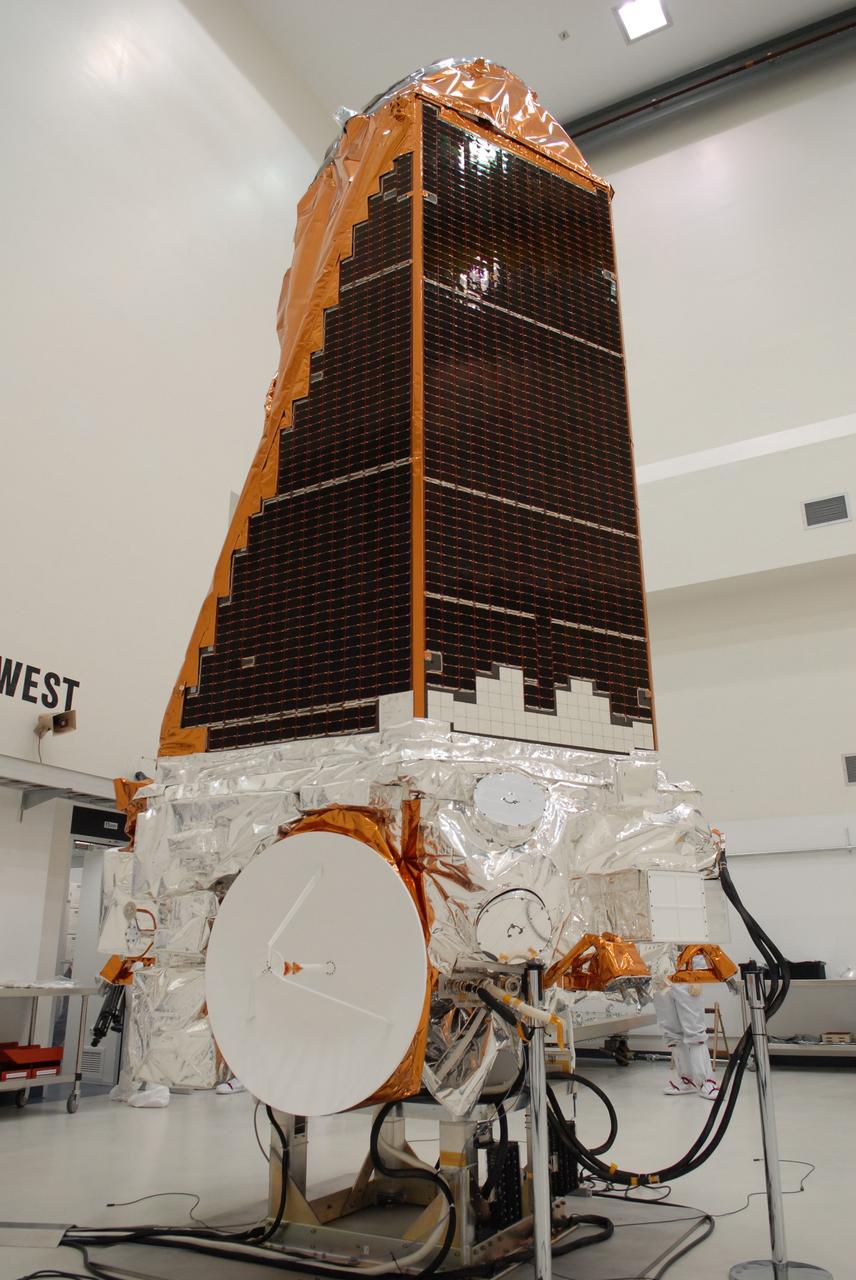
CAPE CANAVERAL, Fla. – NASA's Kepler spacecraft, that will be launched in March aboard a United Launch Alliance Delta II rocket, is ready for the media opportunity Jan. 30. Visible are the solar arrays on top and the high-gain antenna at lower left. The event, being held at the Astrotech Space Operations facility in Titusville, Fla., will provide media representatives an opportunity to photograph the space telescope and to interview project officials from NASA and Ball Aerospace, builder of the spacecraft. Kepler is designed to survey more that 100,000 stars in our galaxy to determine the number of sun-like stars that have Earth-size and larger planets, including those that lie in a star's "habitable zone," a region where liquid water, and perhaps life, could exist. If these Earth-size worlds do exist around stars like our sun, Kepler is expected to be the first to find them and the first to measure how common they are. The liftoff of Kepler aboard a Delta II rocket is currently planned for 10:48 p.m. EST March 5 from Space Launch Complex 17 on Cape Canaveral Air Force Station. Photo credit: NASA/Troy Cryder
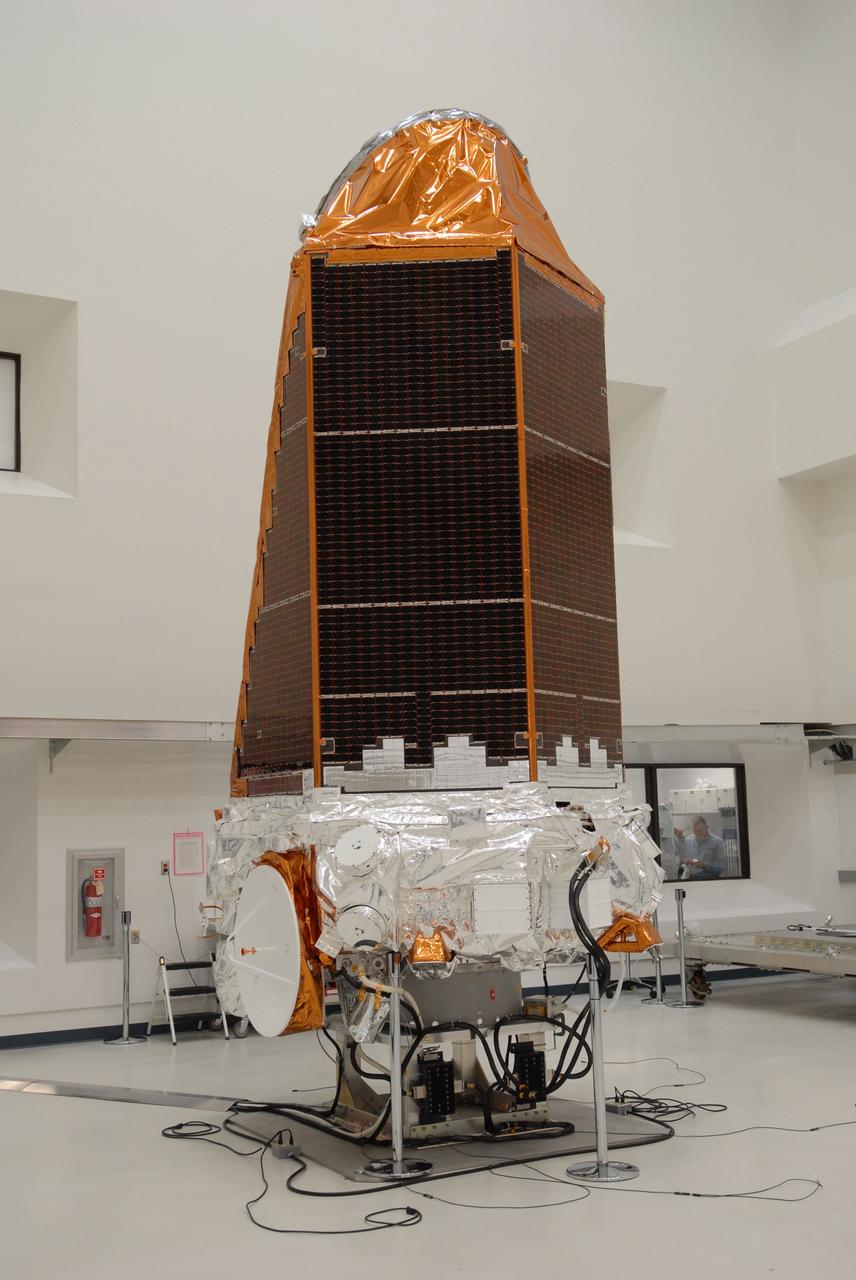
CAPE CANAVERAL, Fla. – NASA's Kepler spacecraft, that will be launched in March aboard a United Launch Alliance Delta II rocket, is ready for the media opportunity Jan. 30. Visible are the solar arrays on top and the high-gain antenna at lower left. The event, being held at the Astrotech Space Operations facility in Titusville, Fla., will provide media representatives an opportunity to photograph the space telescope and to interview project officials from NASA and Ball Aerospace, builder of the spacecraft. Kepler is designed to survey more that 100,000 stars in our galaxy to determine the number of sun-like stars that have Earth-size and larger planets, including those that lie in a star's "habitable zone," a region where liquid water, and perhaps life, could exist. If these Earth-size worlds do exist around stars like our sun, Kepler is expected to be the first to find them and the first to measure how common they are. The liftoff of Kepler aboard a Delta II rocket is currently planned for 10:48 p.m. EST March 5 from Space Launch Complex 17 on Cape Canaveral Air Force Station. Photo credit: NASA/Troy Cryder
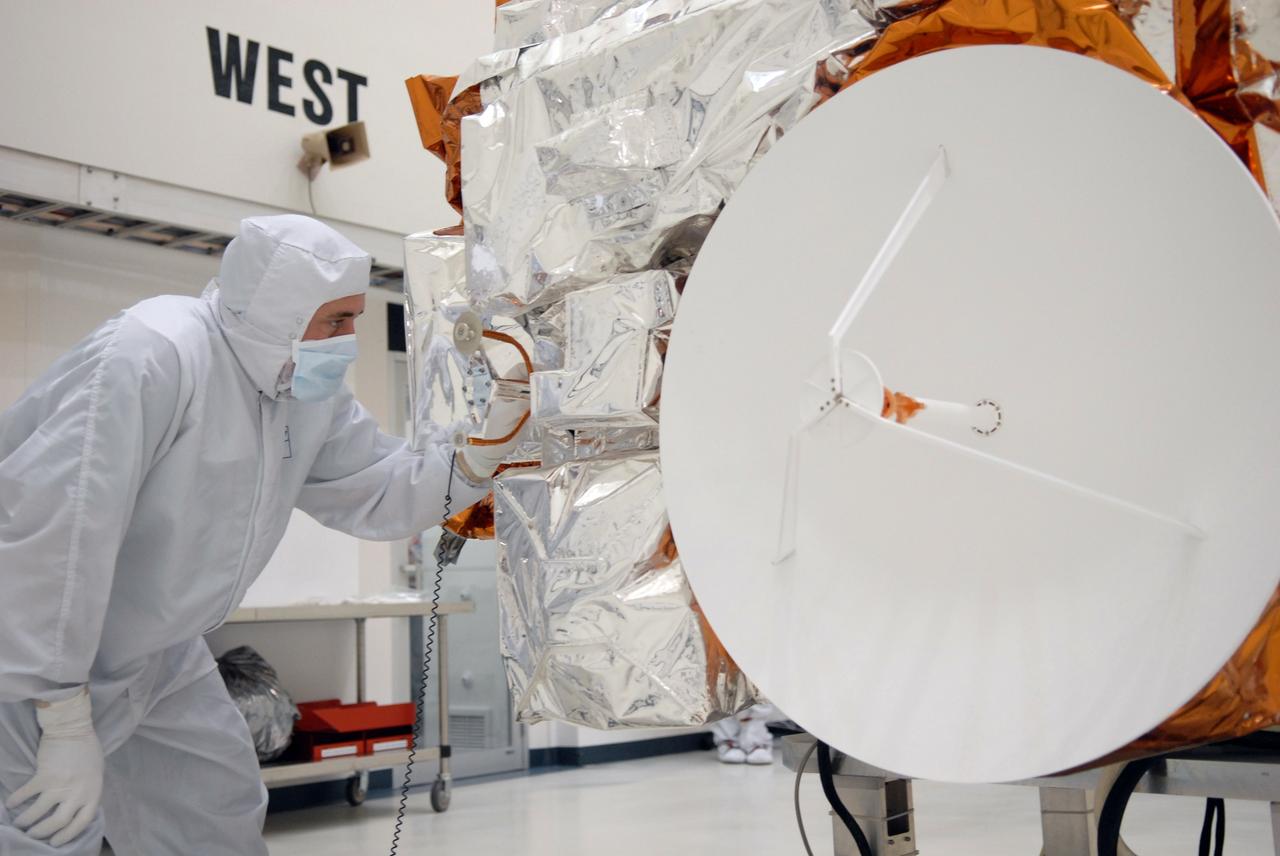
CAPE CANAVERAL, Fla. – During a media event at the Astrotech Space Operations facility in Titusville, Fla., a Ball Aerospace technician looks over NASA's Kepler spacecraft. At right is the high-gain antenna. The event provided media representatives an opportunity to photograph the space telescope and to interview project officials from NASA and Ball Aerospace, builder of the spacecraft. Kepler is designed to survey more that 100,000 stars in our galaxy to determine the number of sun-like stars that have Earth-size and larger planets, including those that lie in a star's "habitable zone," a region where liquid water, and perhaps life, could exist. If these Earth-size worlds do exist around stars like our sun, Kepler is expected to be the first to find them and the first to measure how common they are. The liftoff of Kepler aboard a Delta II rocket is currently planned for 10:48 p.m. EST March 5 from Space Launch Complex 17 on Cape Canaveral Air Force Station. Photo credit: NASA/Troy Cryder
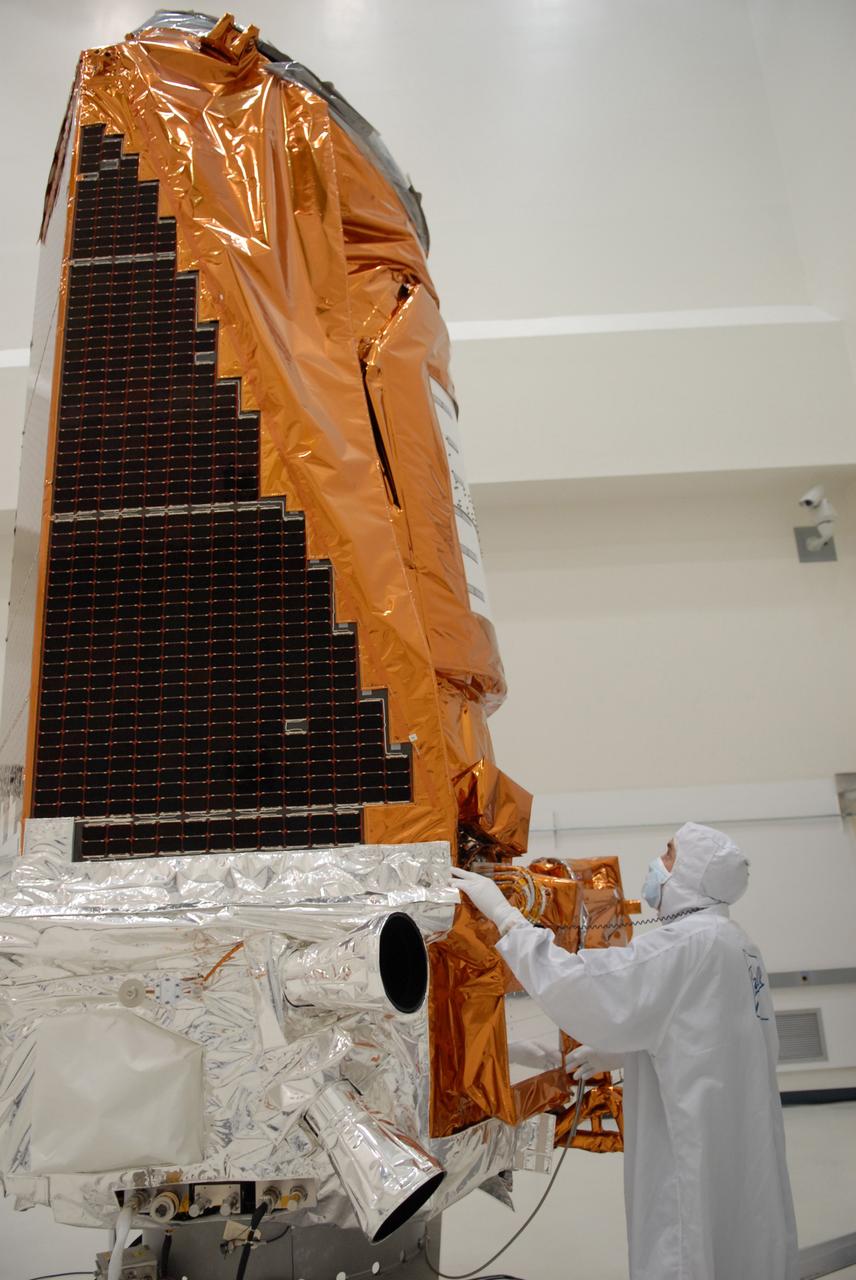
CAPE CANAVERAL, Fla. – During a media event at the Astrotech Space Operations facility in Titusville, Fla., a Ball Aerospace technician looks over NASA's Kepler spacecraft. Visible on top are the solar arrays. The event provided media representatives an opportunity to photograph the space telescope and to interview project officials from NASA and Ball Aerospace, builder of the spacecraft. Kepler is designed to survey more that 100,000 stars in our galaxy to determine the number of sun-like stars that have Earth-size and larger planets, including those that lie in a star's "habitable zone," a region where liquid water, and perhaps life, could exist. If these Earth-size worlds do exist around stars like our sun, Kepler is expected to be the first to find them and the first to measure how common they are. The liftoff of Kepler aboard a Delta II rocket is currently planned for 10:48 p.m. EST March 5 from Space Launch Complex 17 on Cape Canaveral Air Force Station. Photo credit: NASA/Troy Cryder
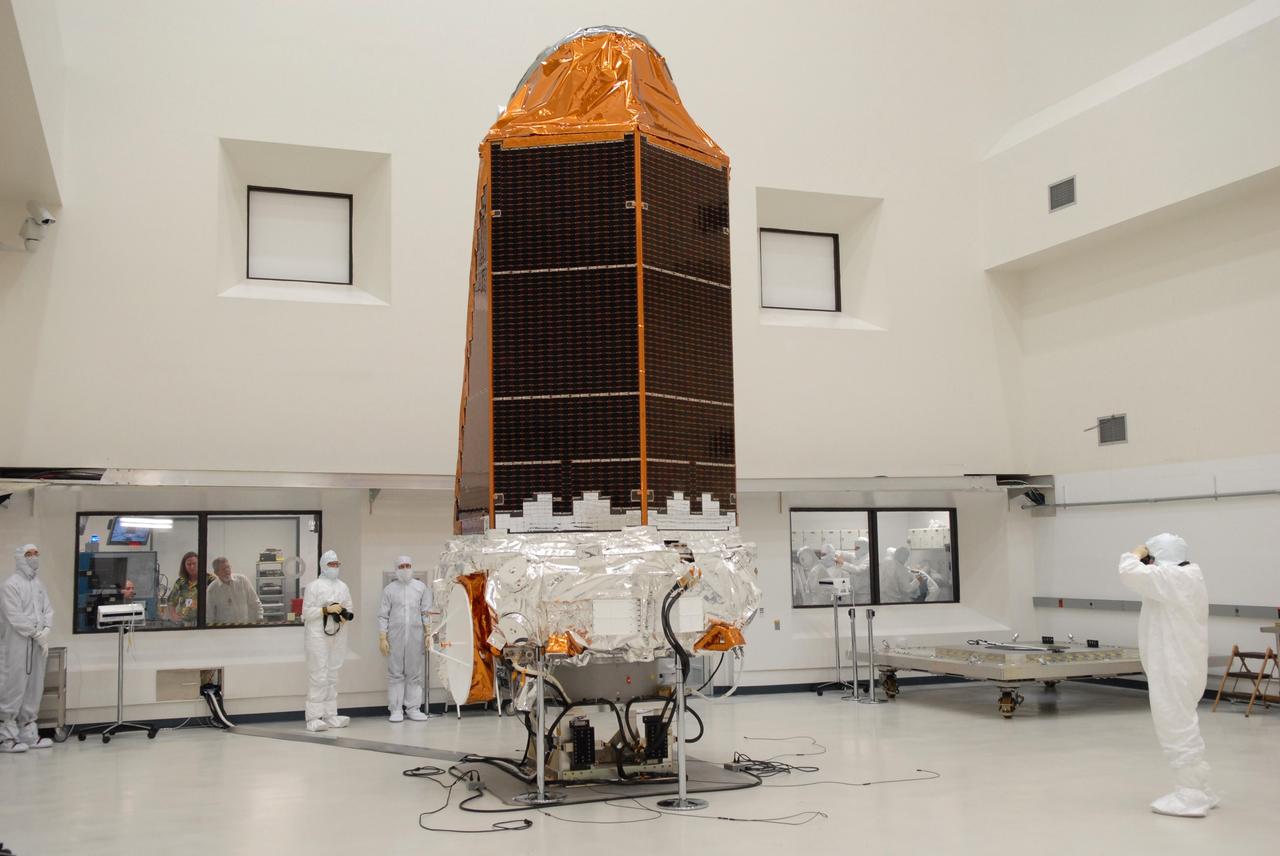
CAPE CANAVERAL, Fla. – NASA's Kepler spacecraft, that will be launched in March aboard a United Launch Alliance Delta II rocket, is photographed by journalists dressed in clean-room suits. Visible are the solar arrays on top and the high-gain antenna at lower left. The event, being held at the Astrotech Space Operations facility in Titusville, Fla., provides media representatives an opportunity to photograph the space telescope and to interview project officials from NASA and Ball Aerospace, builder of the spacecraft. Kepler is designed to survey more that 100,000 stars in our galaxy to determine the number of sun-like stars that have Earth-size and larger planets, including those that lie in a star's "habitable zone," a region where liquid water, and perhaps life, could exist. If these Earth-size worlds do exist around stars like our sun, Kepler is expected to be the first to find them and the first to measure how common they are. The liftoff of Kepler aboard a Delta II rocket is currently planned for 10:48 p.m. EST March 5 from Space Launch Complex 17 on Cape Canaveral Air Force Station. Photo credit: NASA/Troy Cryder
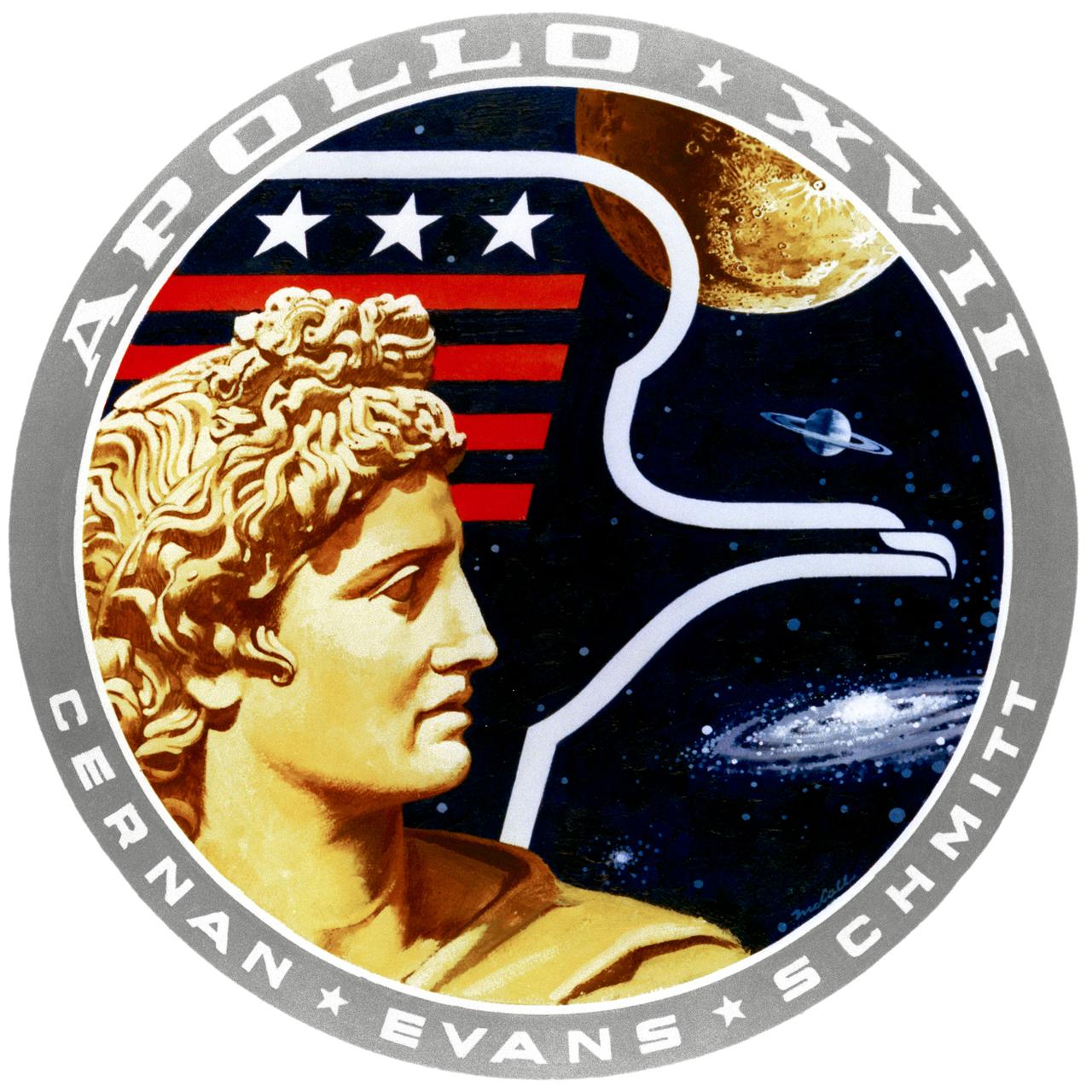
S72-49079 (8 Sept. 1972) --- This is the official emblem of the Apollo 17 lunar landing mission which will be flown by astronauts Eugene A. Cernan, Ronald E. Evans and Harrison H. Schmitt. The insignia is dominated by the image of Apollo, the Greek sun god. Suspended in space behind the head of Apollo is an American eagle of contemporary design, the red bars of the eagle's wing represent the bars in the United States flag; the three white stars symbolize the three astronaut crewmen. The background is deep blue space and within it are the moon, the planet Saturn and a spiral galaxy or nebula. The moon is partially overlaid by the eagle's wing suggesting that this is a celestial body that man has visited and in that sense conquered. The thrust of the eagle and the gaze of Apollo to the right and toward Saturn and the galaxy is meant to imply that man's goals in space will someday include the planets and perhaps the stars. The colors of the emblem are red, white and blue, the colors of our flag; with the addition of gold, to symbolize the golden age of space flight that will begin with this Apollo 17 lunar landing. The Apollo image used in this emblem was the famous Apollo of Belvedere sculpture now in the Vatican Gallery in Rome. This emblem was designed by artist Robert T. McCall in collaboration with the astronauts. This is the official Apollo 17 emblem, a property of the government of the United States. It has been authorized only for use by the astronauts. Its reproduction in any form other than in news, information and education media is not authorized without approval. Unauthorized use is subject to the provisions of Title 18, U.S. Code, Section 701.
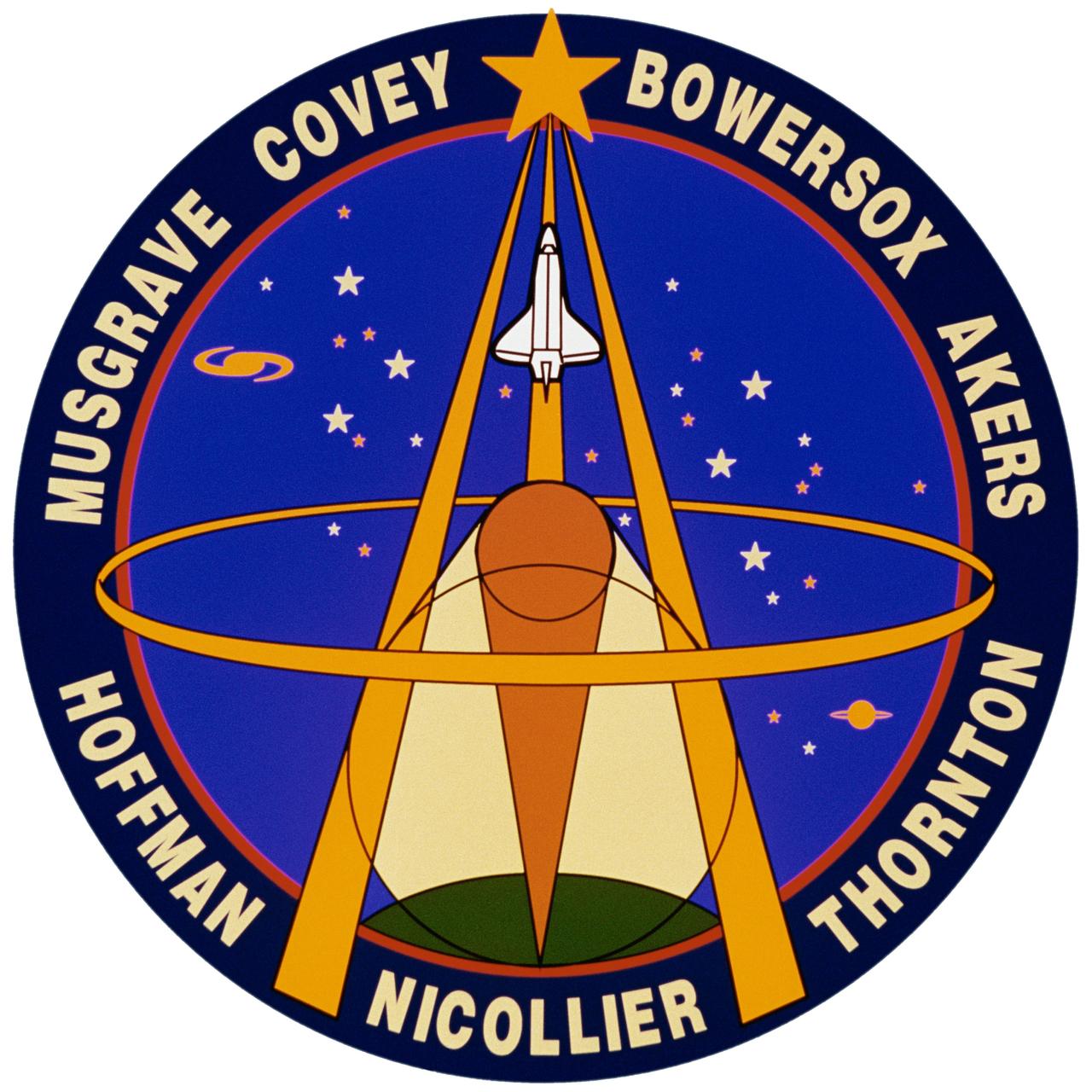
STS061-S-001 (1 Oct. 1993) --- Designed by the crew members, the STS-61 crew insignia depicts the astronaut symbol superimposed against the sky with the Earth underneath. Also seen are two circles representing the optical configuration of the Hubble Space Telescope (HST). Light is focused by reflections from a large primary mirror and a smaller secondary mirror. The light is analyzed by various instruments and, according to the crew members, "brings to us on Earth knowledge about planets, stars, galaxies and other celestial objects, allowing us to better understand the complex physical processes at work in the universe." The space shuttle Endeavour is also represented as the fundamental tool that allows the crew to perform the first servicing of the Hubble Space Telescope so its scientific deep space mission may be extended for several years to come. The overall design of the emblem, with lines converging to a high point, is also a symbolic representation of the large-scale Earth-based effort -- which involves space agencies, industry and the universities -- to reach goals of knowledge and perfection. The NASA insignia design for space shuttle flights is reserved for use by the astronauts and for other official use as the NASA Administrator may authorize. Public availability has been approved only in the forms of illustrations by the various news media. When and if there is any change in this policy, which is not anticipated, the change will be publicly announced. Photo credit: NASA

STS125-S-001 (December 2007) --- This STS-125 crew patch shows HST along with a representation of its many scientific discoveries. The overall structure and composition of the Universe is shown in blue and filled with planets, stars, and galaxies. The black background is indicative of the mysteries of dark-energy and dark-matter. The new instruments to be installed on HST during this mission, Wide Field Camera-3 and the Cosmic Origins Spectrograph, will make observations to help understand these unseen components which seem to dominate the structure of the Universe. The red border of the patch represents the red-shifted glow of the early Universe, and the limit of the Hubble's view into the cosmos. Upon completion of STS-125, the fifth mission to service HST, the Hubble will provide even deeper and more detailed views of the Universe. Soaring by the telescope is the space shuttle which initially deployed Hubble and has enabled astronauts to continually upgrade the telescope, significantly contributing to the expansion of human knowledge. The NASA insignia design for space shuttle flights is reserved for use by the astronauts and for other official use as the NASA Administrator may authorize. Public availability has been approved only in the forms of illustrations by the various news media. When and if there is any change in this policy, which is not anticipated, the change will be publicly announced. Photo credit: NASA

JOHNSON SPACE CENTER, Houston, Texas --- STS125-S-001 (December 2007) -- This STS-125 crew patch shows HST along with a representation of its many scientific discoveries. The overall structure and composition of the Universe is shown in blue and filled with planets, stars, and galaxies. The black background is indicative of the mysteries of dark-energy and dark-matter. The new instruments to be installed on HST during this mission, Wide Field Camera-3 and the Cosmic Origins Spectrograph, will make observations to help understand these unseen components which seem to dominate the structure of the Universe. The red border of the patch represents the red-shifted glow of the early Universe, and the limit of the Hubble's view into the cosmos. Upon completion of STS-125, the fifth mission to service HST, the Hubble will provide even deeper and more detailed views of the Universe. Soaring by the telescope is the space shuttle which initially deployed Hubble and has enabled astronauts to continually upgrade the telescope, significantly contributing to the expansion of human knowledge. The NASA insignia design for shuttle flights is reserved for use by the astronauts and for other official use as the NASA Administrator may authorize. Public availability has been approved only in the form of illustrations by the various news media. When and if there is any change in this policy, which is not anticipated, it will be publicly announced.

At Launch Pad 39B, Lisa Malone, chief, Media Services at KSC introduces the STS-103 crew standing ready to answer questions from the media. From left are Commander Curtis L. Brown Jr., Pilot Scott J. Kelly, and Mission Specialists Steven L. Smith, Jean-François Clervoy of France, who is with the European Space Agency (ESA), John M. Grunsfeld (Ph.D.), C. Michael Foale (Ph.D.), and Claude Nicollier of Switzerland, who is also with ESA. As a preparation for launch, the crew have been participating in Terminal Countdown Demonstration Test (TCDT) activities at KSC. The TCDT provides the crew with emergency egress training, opportunities to inspect their mission payloads in the orbiter's payload bay, and simulated countdown exercises. STS-103 is a "call-up" mission due to the need to replace and repair portions of the Hubble Space Telescope, including the gyroscopes that allow the telescope to point at stars, galaxies and planets. The STS-103 crew will be replacing a Fine Guidance Sensor, an older computer with a new enhanced model, an older data tape recorder with a solid-state digital recorder, a failed spare transmitter with a new one, and degraded insulation on the telescope with new thermal insulation. The crew will also install a Battery Voltage/Temperature Improvement Kit to protect the spacecraft batteries from overcharging and overheating when the telescope goes into a safe mode. Four EVA's are planned to make the necessary repairs and replacements on the telescope. The mission is targeted for launch Dec. 6 at 2:37 a.m. EST
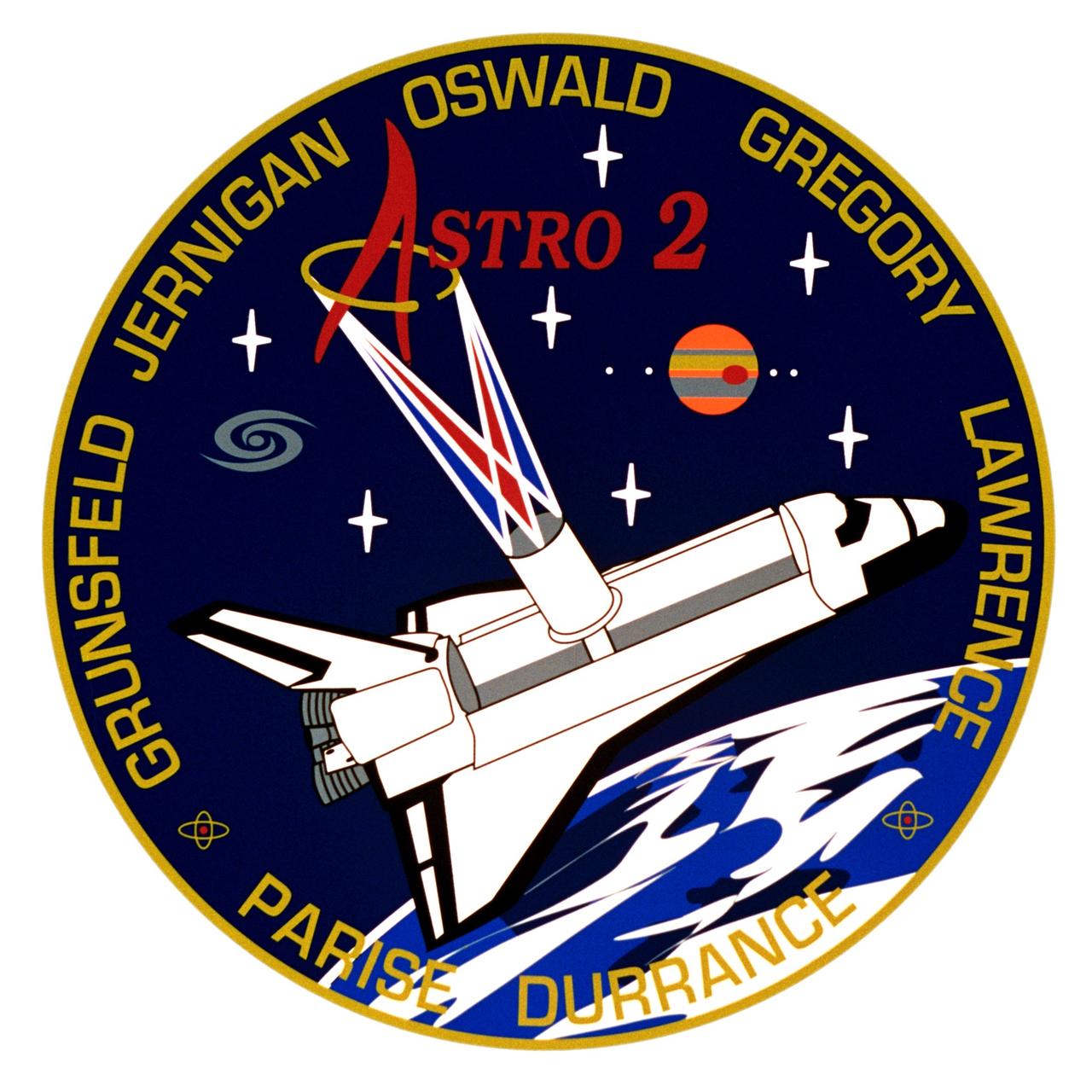
STS067-S-001 (October 1994) --- Observation and remote exploration of the Universe in the ultraviolet wavelengths of light are the focus of the STS-67/ASTRO-2 mission, as depicted in the crew patch designed by the crew members. The insignia shows the ASTRO-2 telescopes in the space shuttle Endeavour's payload bay, orbiting high above Earth's atmosphere. The three sets of rays, diverging from the telescope on the patch atop the Instrument Pointing System (IPS), correspond to the three ASTRO-2 telescopes -- the Hopkins Ultraviolet Telescope (HUT), the Ultraviolet Imaging Telescope (UIT), and the Wisconsin Ultraviolet Photo-Polarimeter Experiment (WUPPE). The telescopes are co-aligned to simultaneously view the same astronomical object, as shown by the convergence of rays on the NASA symbol. This symbol also represents the excellence of the union of the NASA teams and universality's in the exploration of the universe through astronomy. The celestial targets of ASTRO-2 include the observation of planets, stars and galaxies shown in the design. The two small atoms represent the search in the ultraviolet spectrum for the signature of primordial helium in intergalactic space left over from the Big Bang. The observations performed on ASTRO-2 will contribute to man's knowledge and understanding of the vast universe, from the planets in out system to the farthest reaches of space. The NASA insignia design for space shuttle flights is reserved for use by the astronauts and for other official use as the NASA Administrator may authorize. Public availability has been approved only in the forms of illustrations by the various news media. When and if there is any change in this policy, which is not anticipated, the change will be publicly announced. Photo credit: NASA
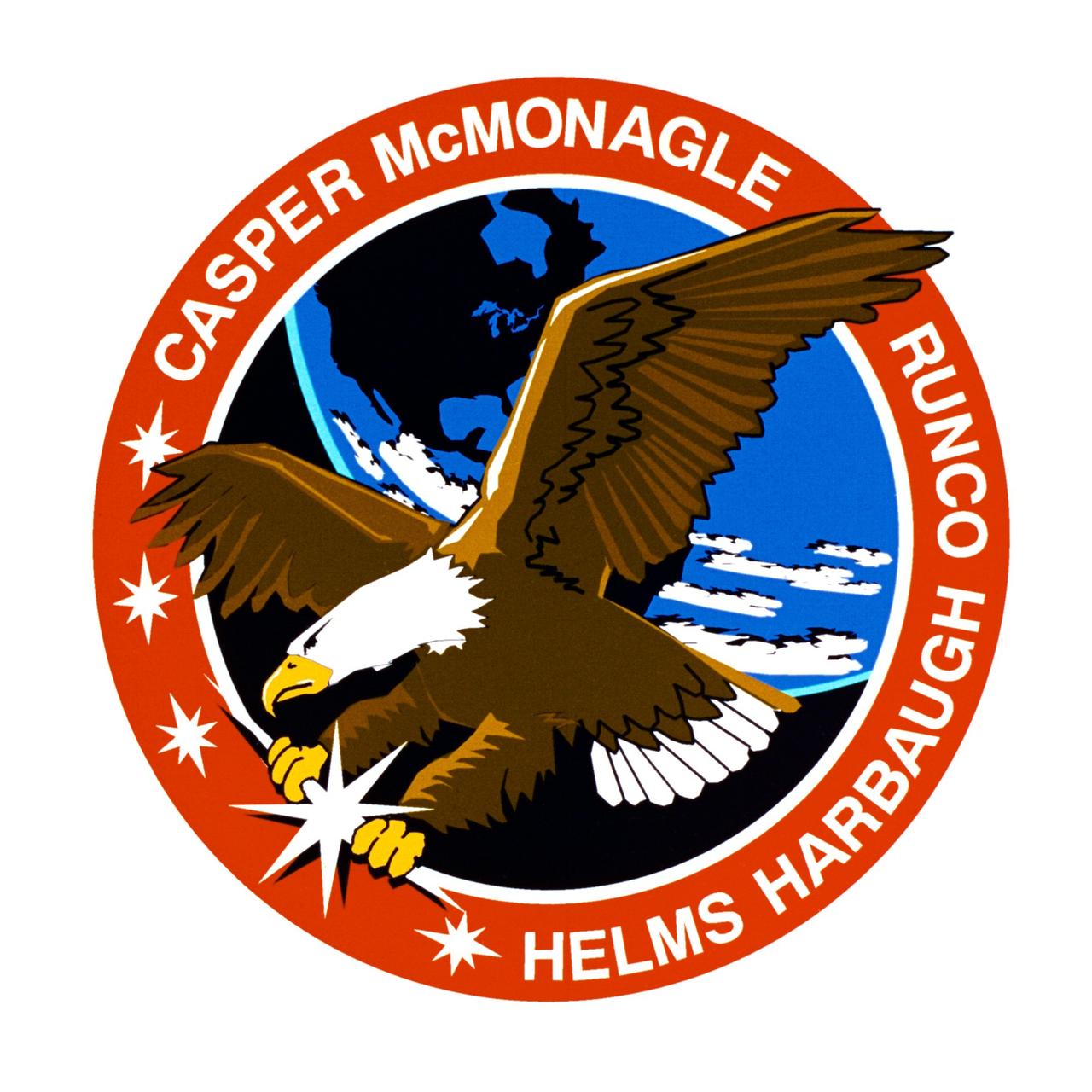
STS054-S-001 (July 1992) --- Designed by the crew members, the STS-54 crew patch depicts our national symbol, the American bald eagle, soaring above the Earth; and represents the United States Space Shuttle as a national asset in service to America and the world. The eagle is clutching an eight pointed star in its talons and is placing this larger star among a constellation of four others representing the placement of the fifth Tracking and Data Relay Satellite (TDRS) into orbit among the four already in service. The blackness of space with stars conspicuously absent represents the mission?s other primary objective in carrying the Diffuse X-ray Spectrometer into orbit to conduct astronomical observations of x-ray sources within the galaxy and throughout the universe. The depiction of our planet showing the crew?s home continent of North America is an expression of their and NASA?s intention that the medical and scientific experiments conducted onboard are for the benefit of all mankind. The clouds and blue of the Earth represent the crew?s part in NASA?s Mission to Planet Earth in conducting Earth observation photography. The NASA insignia design for space shuttle flights is reserved for use by the astronauts and for other official use as the NASA Administrator may authorize. Public availability has been approved only in the form of illustrations by the various news media. When and if there is any change in this policy, which we do not anticipate, it will be publicly announced. Photo credit: NASA
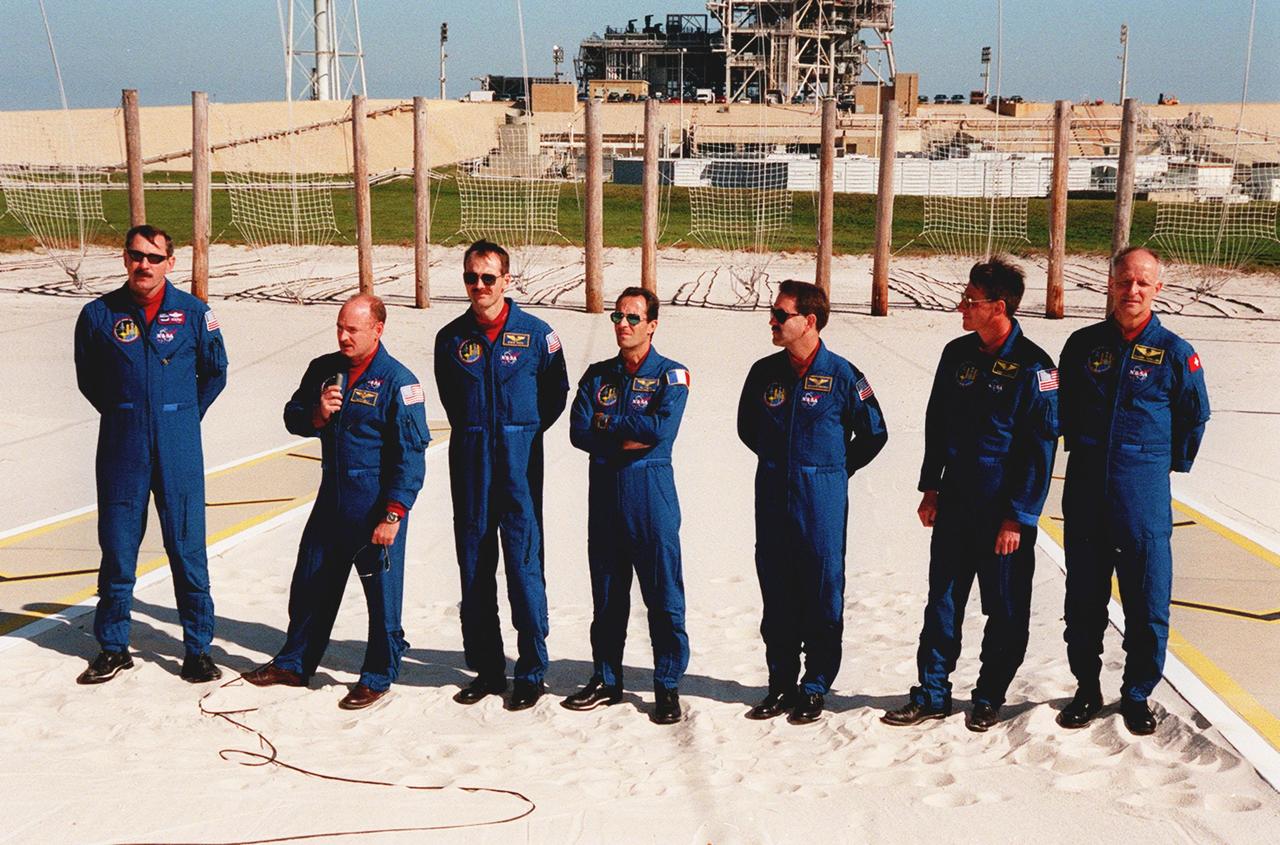
During an interview at Launch Pad 39B, STS-103 Pilot Scott J. Kelly responds to a question from the media about the mission. Standing with him are the remainder of the crew: (left to right) Commander Curtis L. Brown Jr., Kelly, and Mission Specialists Steven L. Smith, Jean-François Clervoy of France, who is with the European Space Agency (ESA), John M. Grunsfeld (Ph.D.), C. Michael Foale (Ph.D.), and Claude Nicollier of Switzerland, who is also with ESA. As a preparation for launch, they have been participating in Terminal Countdown Demonstration Test (TCDT) activities at KSC. The TCDT provides the crew with emergency egress training, opportunities to inspect their mission payloads in the orbiter's payload bay, and simulated countdown exercises. STS-103 is a "call-up" mission due to the need to replace and repair portions of the Hubble Space Telescope, including the gyroscopes that allow the telescope to point at stars, galaxies and planets. The STS-103 crew will be replacing a Fine Guidance Sensor, an older computer with a new enhanced model, an older data tape recorder with a solid-state digital recorder, a failed spare transmitter with a new one, and degraded insulation on the telescope with new thermal insulation. The crew will also install a Battery Voltage/Temperature Improvement Kit to protect the spacecraft batteries from overcharging and overheating when the telescope goes into a safe mode. Four EVA's are planned to make the necessary repairs and replacements on the telescope. The mission is targeted for launch Dec. 6 at 2:37 a.m. EST
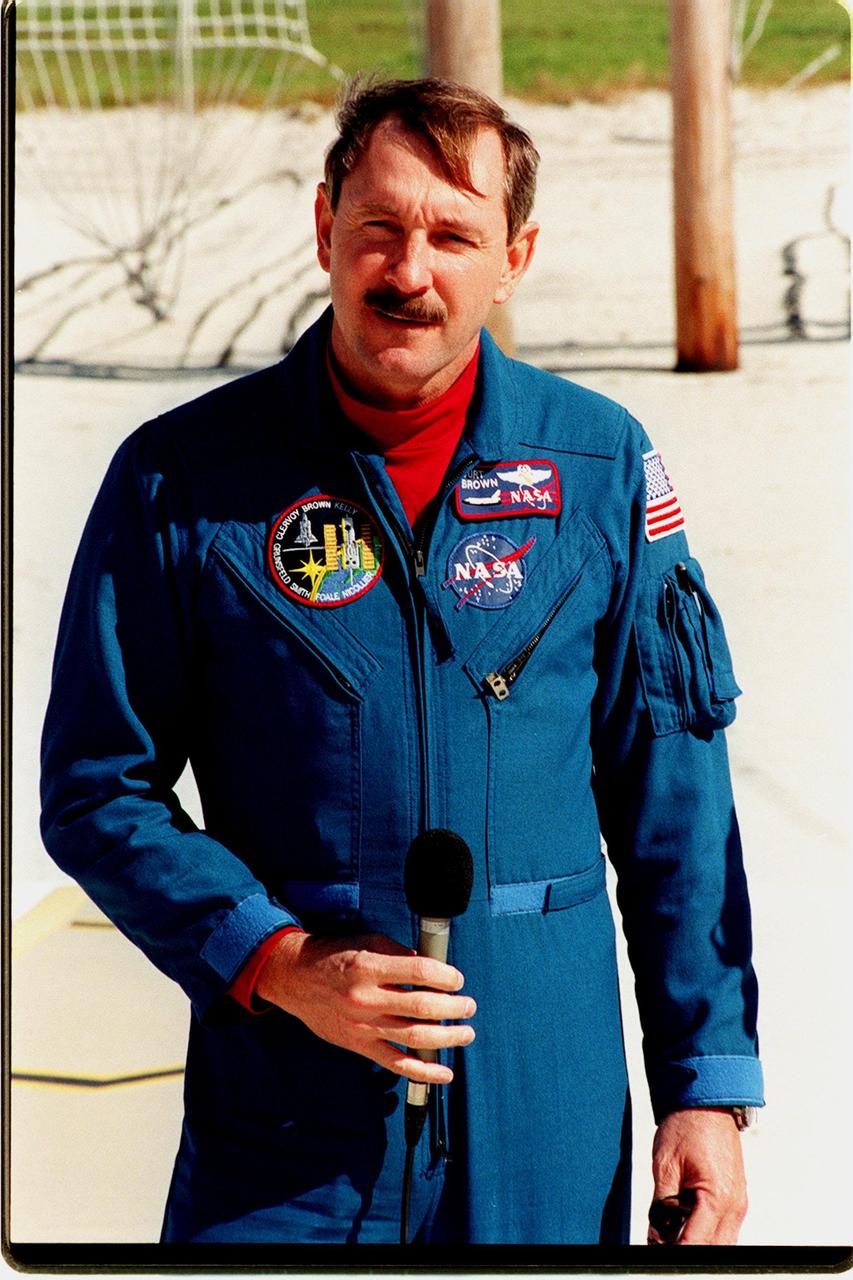
STS-103 Commander Curtis L. Brown Jr. answers a question from the media about the mission. As a preparation for launch, the crew have been participating in Terminal Countdown Demonstration Test (TCDT) activities at KSC. The TCDT provides the crew with emergency egress training, opportunities to inspect their mission payloads in the orbiter's payload bay, and simulated countdown exercises. Other crew members are Pilot Scott J. Kelly, and Mission Specialists Steven L. Smith, Jean-François Clervoy of France, who is with the European Space Agency (ESA), John M. Grunsfeld (Ph.D.), C. Michael Foale (Ph.D.), and Claude Nicollier of Switzerland, who is also with ESA. STS-103 is a "call-up" mission due to the need to replace and repair portions of the Hubble Space Telescope, including the gyroscopes that allow the telescope to point at stars, galaxies and planets. The STS-103 crew will be replacing a Fine Guidance Sensor, an older computer with a new enhanced model, an older data tape recorder with a solid-state digital recorder, a failed spare transmitter with a new one, and degraded insulation on the telescope with new thermal insulation. The crew will also install a Battery Voltage/Temperature Improvement Kit to protect the spacecraft batteries from overcharging and overheating when the telescope goes into a safe mode. Four EVA's are planned to make the necessary repairs and replacements on the telescope. The mission is targeted for launch Dec. 6 at 2:37 a.m. EST
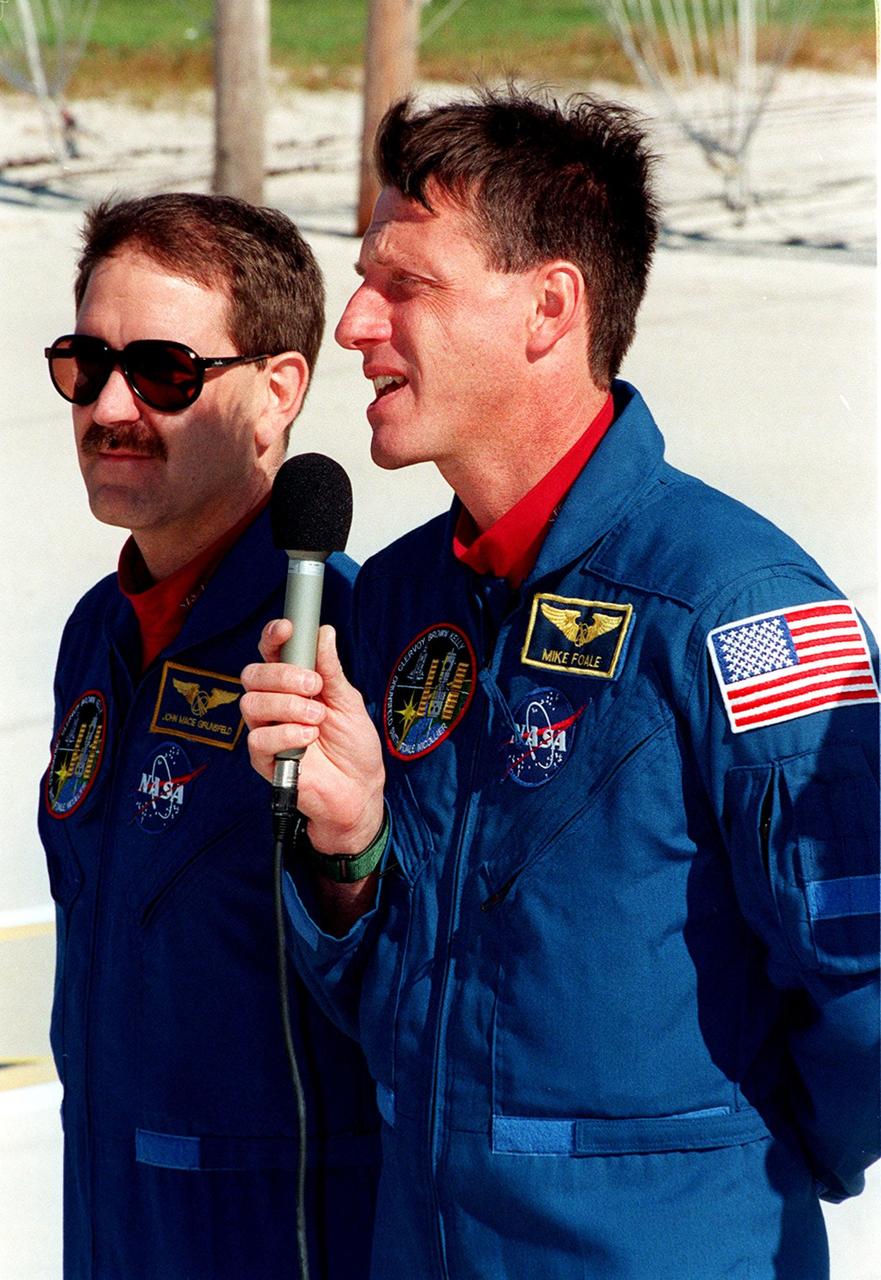
STS-103 Mission Specialist C. Michael Foale (Ph.D.) (at right) responds to a question from the media about the mission during an interview at Launch Pad 39B. Next to him is Mission Specialist John M. Grunsfeld (Ph.D.). As a preparation for launch, the crew have been participating in Terminal Countdown Demonstration Test (TCDT) activities at KSC. The TCDT provides the crew with emergency egress training, opportunities to inspect their mission payloads in the orbiter's payload bay, and simulated countdown exercises. Other crew members are Commander Curtis L. Brown Jr., Pilot Scott J. Kelly, and Mission Specialists Steven L. Smith, Jean-François Clervoy of France, and Claude Nicollier of Switzerland. Clervoy and Nicollier are with the European Space Agency. STS-103 is a "call-up" mission due to the need to replace and repair portions of the Hubble Space Telescope, including the gyroscopes that allow the telescope to point at stars, galaxies and planets. The STS-103 crew will be replacing a Fine Guidance Sensor, an older computer with a new enhanced model, an older data tape recorder with a solid-state digital recorder, a failed spare transmitter with a new one, and degraded insulation on the telescope with new thermal insulation. The crew will also install a Battery Voltage/Temperature Improvement Kit to protect the spacecraft batteries from overcharging and overheating when the telescope goes into a safe mode. Four EVA's are planned to make the necessary repairs and replacements on the telescope. The mission is targeted for launch Dec. 6 at 2:37 a.m. EST