![Final still from Fermi video [<a href="http://bit.ly/Y2K4LN" rel="nofollow">bit.ly/Y2K4LN</a>]. Credit: NASA/DOE/Fermi LAT Collaboration ----- NASA's Fermi Gamma-ray Space Telescope orbits our planet every 95 minutes, building up increasingly deeper views of the universe with every circuit. Its wide-eyed Large Area Telescope (LAT) sweeps across the entire sky every three hours, capturing the highest-energy form of light -- gamma rays -- from sources across the universe. These range from supermassive black holes billions of light-years away to intriguing objects in our own galaxy, such as X-ray binaries, supernova remnants and pulsars. Now a Fermi scientist has transformed LAT data of a famous pulsar into a mesmerizing movie that visually encapsulates the spacecraft's complex motion. Click here to continue reading: <a href="http://1.usa.gov/WhYwCU" rel="nofollow">1.usa.gov/WhYwCU</a> <b><a href="http://www.nasa.gov/audience/formedia/features/MP_Photo_Guidelines.html" rel="nofollow">NASA image use policy.</a></b> <b><a href="http://www.nasa.gov/centers/goddard/home/index.html" rel="nofollow">NASA Goddard Space Flight Center</a></b> enables NASA’s mission through four scientific endeavors: Earth Science, Heliophysics, Solar System Exploration, and Astrophysics. Goddard plays a leading role in NASA’s accomplishments by contributing compelling scientific knowledge to advance the Agency’s mission. <b>Follow us on <a href="http://twitter.com/NASA_GoddardPix" rel="nofollow">Twitter</a></b> <b>Like us on <a href="http://www.facebook.com/pages/Greenbelt-MD/NASA-Goddard/395013845897?ref=tsd" rel="nofollow">Facebook</a></b> <b>Find us on <a href="http://instagram.com/nasagoddard?vm=grid" rel="nofollow">Instagram</a></b>](https://images-assets.nasa.gov/image/GSFC_20171208_Archive_e001547/GSFC_20171208_Archive_e001547~small.jpg)
Final still from Fermi video [<a href="http://bit.ly/Y2K4LN" rel="nofollow">bit.ly/Y2K4LN</a>]. Credit: NASA/DOE/Fermi LAT Collaboration ----- NASA's Fermi Gamma-ray Space Telescope orbits our planet every 95 minutes, building up increasingly deeper views of the universe with every circuit. Its wide-eyed Large Area Telescope (LAT) sweeps across the entire sky every three hours, capturing the highest-energy form of light -- gamma rays -- from sources across the universe. These range from supermassive black holes billions of light-years away to intriguing objects in our own galaxy, such as X-ray binaries, supernova remnants and pulsars. Now a Fermi scientist has transformed LAT data of a famous pulsar into a mesmerizing movie that visually encapsulates the spacecraft's complex motion. Click here to continue reading: <a href="http://1.usa.gov/WhYwCU" rel="nofollow">1.usa.gov/WhYwCU</a> <b><a href="http://www.nasa.gov/audience/formedia/features/MP_Photo_Guidelines.html" rel="nofollow">NASA image use policy.</a></b> <b><a href="http://www.nasa.gov/centers/goddard/home/index.html" rel="nofollow">NASA Goddard Space Flight Center</a></b> enables NASA’s mission through four scientific endeavors: Earth Science, Heliophysics, Solar System Exploration, and Astrophysics. Goddard plays a leading role in NASA’s accomplishments by contributing compelling scientific knowledge to advance the Agency’s mission. <b>Follow us on <a href="http://twitter.com/NASA_GoddardPix" rel="nofollow">Twitter</a></b> <b>Like us on <a href="http://www.facebook.com/pages/Greenbelt-MD/NASA-Goddard/395013845897?ref=tsd" rel="nofollow">Facebook</a></b> <b>Find us on <a href="http://instagram.com/nasagoddard?vm=grid" rel="nofollow">Instagram</a></b>
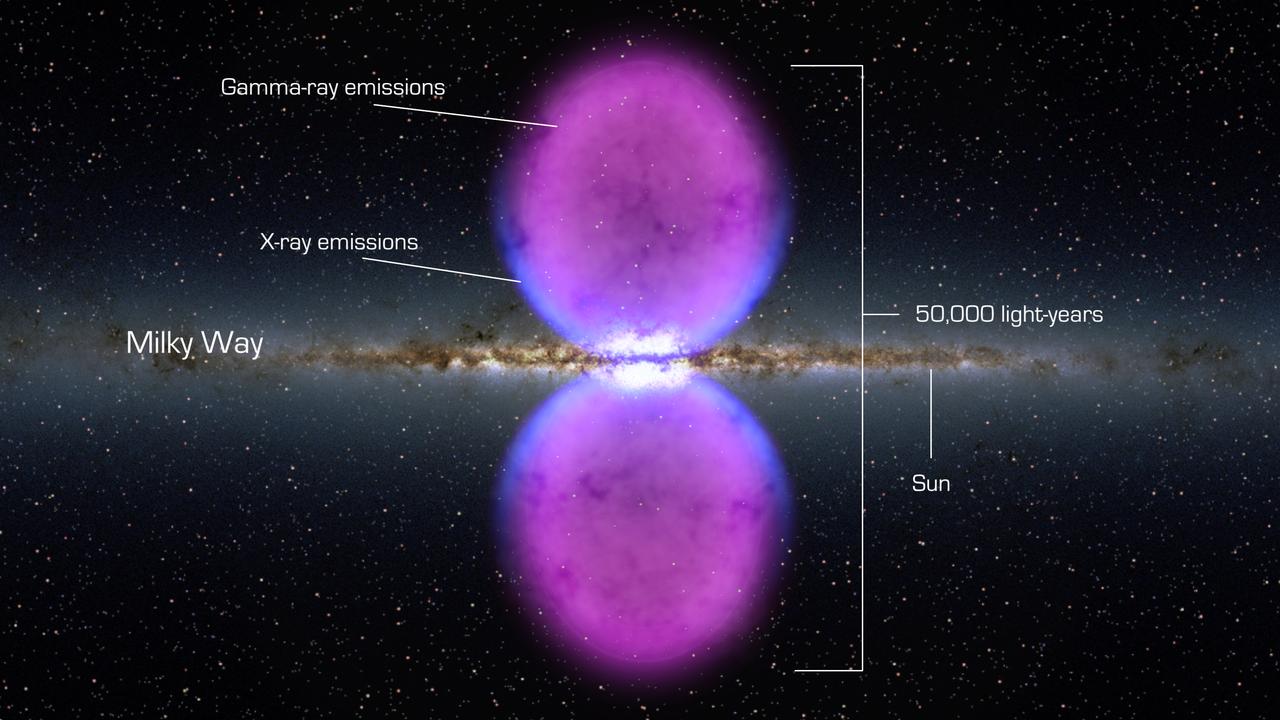
NASA image release November 9, 2010 To view a video about this story go to: <a href="http://www.flickr.com/photos/gsfc/5162413062">www.flickr.com/photos/gsfc/5162413062</a> From end to end, the gamma-ray bubbles extend 50,000 light-years, or roughly half of the Milky Way's diameter, as shown in this illustration. The bubbles stretch across 100 degrees, spanning the sky from the constellation Virgo to the constellation Grus. If the structure were rotated into the galaxy's plane, it would extend beyond our solar system. Hints of the bubbles' edges were first observed in X-rays (blue) by ROSAT (Röntgen Satellite), a Germany-led mission operating in the 1990s. The gamma rays mapped by Fermi (magenta) extend much farther from the galaxy's plane. To learn more go to: <a href="http://www.nasa.gov/mission_pages/GLAST/news/new-structure.html" rel="nofollow">www.nasa.gov/mission_pages/GLAST/news/new-structure.html</a> <b><a href="http://www.nasa.gov/centers/goddard/home/index.html" rel="nofollow">NASA Goddard Space Flight Center</a></b> enables NASA’s mission through four scientific endeavors: Earth Science, Heliophysics, Solar System Exploration, and Astrophysics. Goddard plays a leading role in NASA’s accomplishments by contributing compelling scientific knowledge to advance the Agency’s mission. <b>Follow us on <a href="http://twitter.com/NASA_GoddardPix" rel="nofollow">Twitter</a></b> <b>Join us on <a href="http://www.facebook.com/pages/Greenbelt-MD/NASA-Goddard/395013845897?ref=tsd" rel="nofollow">Facebook</a></b> Credit: <a href="http://svs.gsfc.nasa.gov/index.html" rel="nofollow">NASA/Goddard Space Flight Center Scientific Visualization Studio</a>
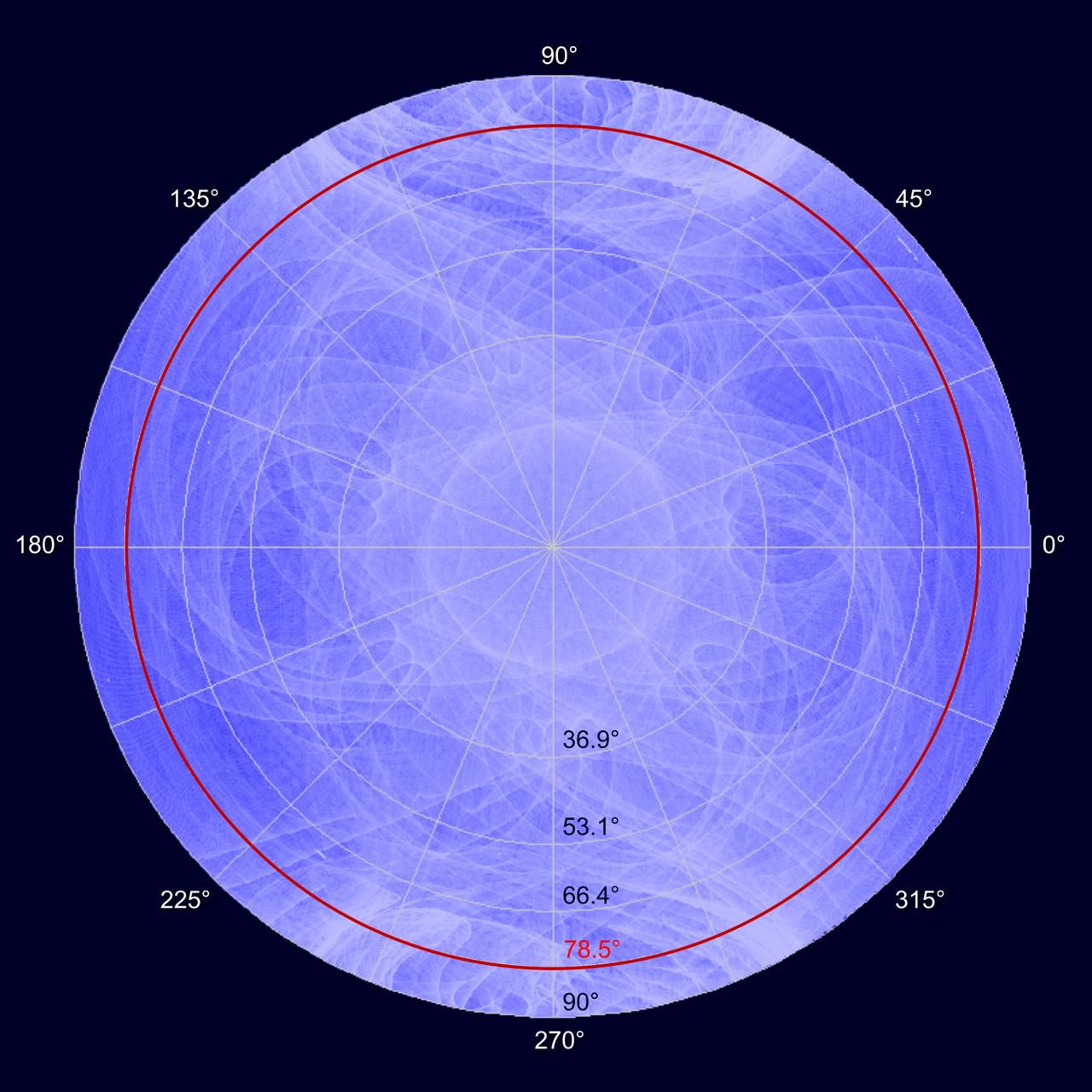
The LAT's sensitivity to gamma rays is greatest in the center of its wide field of view and decreases toward the edge. LAT scientists regard the effective limit of the instrument's field of view to be 78.5 degrees (red circle) from its center. View a video of this here: <a href="http://bit.ly/Y2K4LN" rel="nofollow">bit.ly/Y2K4LN</a>. Credit: NASA/DOE/Fermi LAT Collaboration ----- NASA's Fermi Gamma-ray Space Telescope orbits our planet every 95 minutes, building up increasingly deeper views of the universe with every circuit. Its wide-eyed Large Area Telescope (LAT) sweeps across the entire sky every three hours, capturing the highest-energy form of light -- gamma rays -- from sources across the universe. These range from supermassive black holes billions of light-years away to intriguing objects in our own galaxy, such as X-ray binaries, supernova remnants and pulsars. Now a Fermi scientist has transformed LAT data of a famous pulsar into a mesmerizing movie that visually encapsulates the spacecraft's complex motion. Click here to continue reading: <a href="http://1.usa.gov/WhYwCU" rel="nofollow">1.usa.gov/WhYwCU</a> <b><a href="http://www.nasa.gov/audience/formedia/features/MP_Photo_Guidelines.html" rel="nofollow">NASA image use policy.</a></b> <b><a href="http://www.nasa.gov/centers/goddard/home/index.html" rel="nofollow">NASA Goddard Space Flight Center</a></b> enables NASA’s mission through four scientific endeavors: Earth Science, Heliophysics, Solar System Exploration, and Astrophysics. Goddard plays a leading role in NASA’s accomplishments by contributing compelling scientific knowledge to advance the Agency’s mission. <b>Follow us on <a href="http://twitter.com/NASA_GoddardPix" rel="nofollow">Twitter</a></b> <b>Like us on <a href="http://www.facebook.com/pages/Greenbelt-MD/NASA-Goddard/395013845897?ref=tsd" rel="nofollow">Facebook</a></b> <b>Find us on <a href="http://instagram.com/nasagoddard?vm=grid" rel="nofollow">Instagram</a></b>
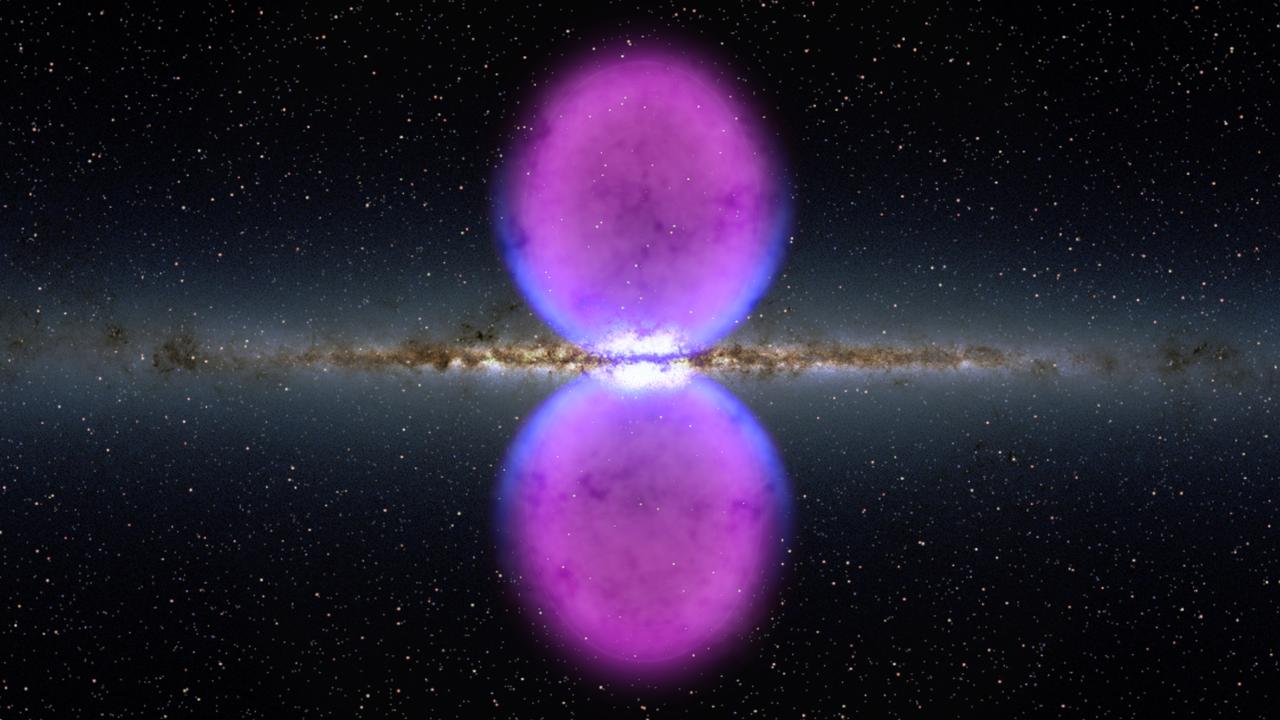
NASA image release November 9, 2010 To view a video about this story go to: <a href="http://www.flickr.com/photos/gsfc/5162413062">www.flickr.com/photos/gsfc/5162413062</a> From end to end, the newly discovered gamma-ray bubbles extend 50,000 light-years, or roughly half of the Milky Way's diameter, as shown in this illustration. Hints of the bubbles' edges were first observed in X-rays (blue) by ROSAT, a Germany-led mission operating in the 1990s. The gamma rays mapped by Fermi (magenta) extend much farther from the galaxy's plane. To learn more go to: <a href="http://www.nasa.gov/mission_pages/GLAST/news/new-structure.html" rel="nofollow">www.nasa.gov/mission_pages/GLAST/news/new-structure.html</a> <b><a href="http://www.nasa.gov/centers/goddard/home/index.html" rel="nofollow">NASA Goddard Space Flight Center</a></b> enables NASA’s mission through four scientific endeavors: Earth Science, Heliophysics, Solar System Exploration, and Astrophysics. Goddard plays a leading role in NASA’s accomplishments by contributing compelling scientific knowledge to advance the Agency’s mission. <b>Follow us on <a href="http://twitter.com/NASA_GoddardPix" rel="nofollow">Twitter</a></b> <b>Join us on <a href="http://www.facebook.com/pages/Greenbelt-MD/NASA-Goddard/395013845897?ref=tsd" rel="nofollow">Facebook</a></b> Credit: <a href="http://svs.gsfc.nasa.gov/index.html" rel="nofollow">NASA/Goddard Space Flight Center Scientific Visualization Studio</a>
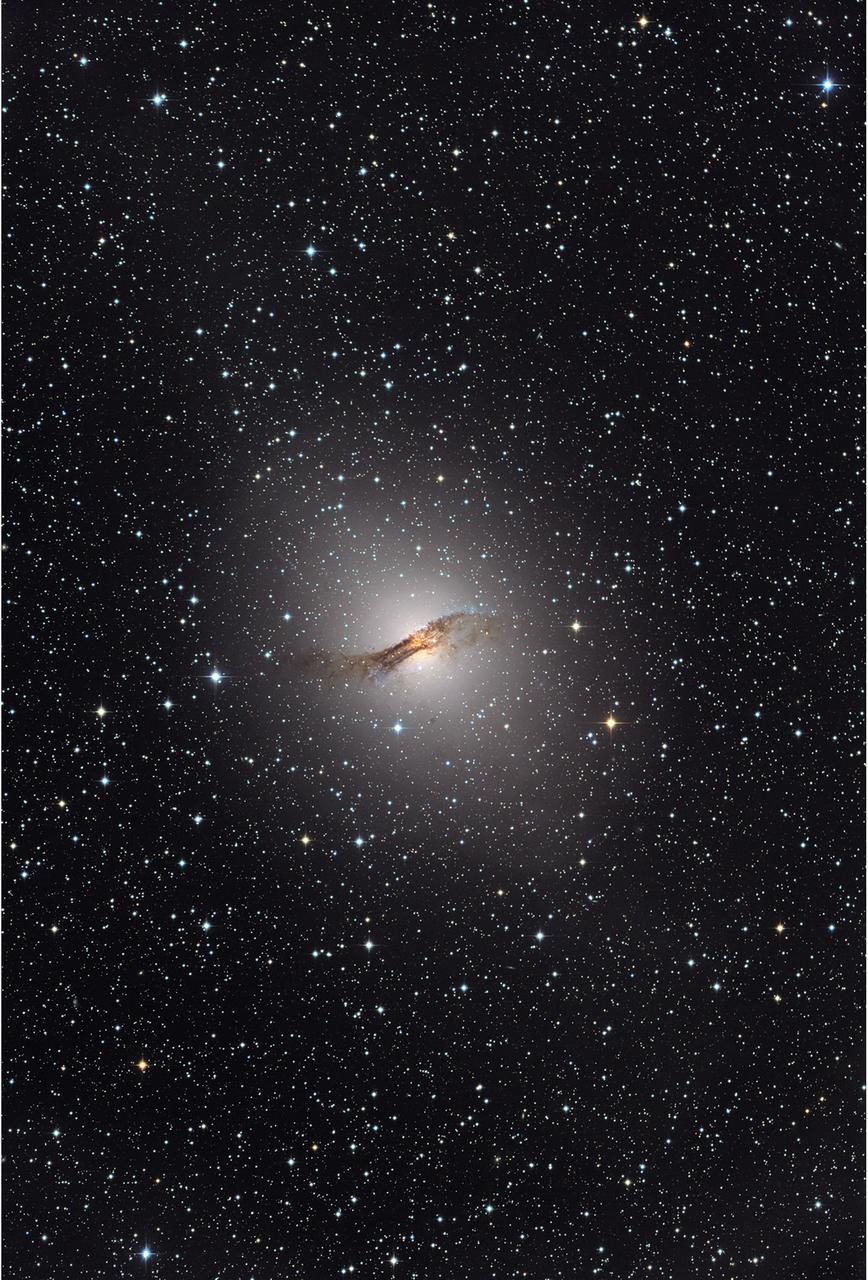
NASA release April 1, 2010 The giant elliptical galaxy NGC 5128, show here in visible light, hosts the radio source known as Centaurus A. Located 12 million light-years away, it is one of the closest active galaxies. Credit: Capella Observatory To learn more about these images go to: <a href="http://www.nasa.gov/mission_pages/GLAST/news/smokestack-plumes.html" rel="nofollow">www.nasa.gov/mission_pages/GLAST/news/smokestack-plumes.html</a> <b><a href="http://www.nasa.gov/centers/goddard/home/index.html" rel="nofollow">NASA Goddard Space Flight Center</a></b> is home to the nation's largest organization of combined scientists, engineers and technologists that build spacecraft, instruments and new technology to study the Earth, the sun, our solar system, and the universe.
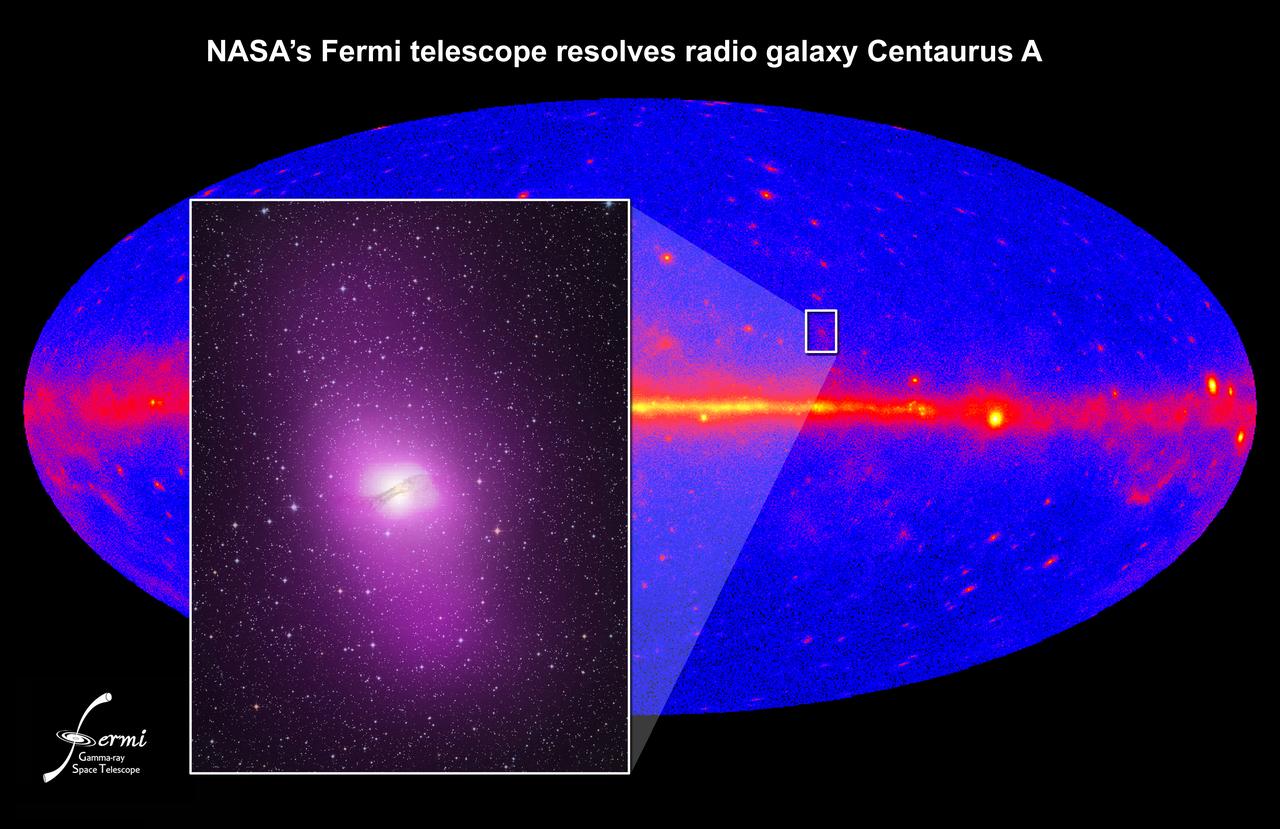
NASA release April 1, 2010 Fermi's Large Area Telescope resolved high-energy gamma rays from an extended region around the active galaxy Centaurus A. The emission corresponds to million-light-year-wide radio-emitting gas thrown out by the galaxy's supersized black hole. This inset shows an optical/gamma-ray composite of the galaxy and its location on the Fermi one-year sky map. Credit: NASA/DOE/Fermi LAT Collaboration, Capella Observatory To learn more about these images go to: <a href="http://www.nasa.gov/mission_pages/GLAST/news/smokestack-plumes.html" rel="nofollow">www.nasa.gov/mission_pages/GLAST/news/smokestack-plumes.html</a> <b><a href="http://www.nasa.gov/centers/goddard/home/index.html" rel="nofollow">NASA Goddard Space Flight Center</a></b> is home to the nation's largest organization of combined scientists, engineers and technologists that build spacecraft, instruments and new technology to study the Earth, the sun, our solar system, and the universe.
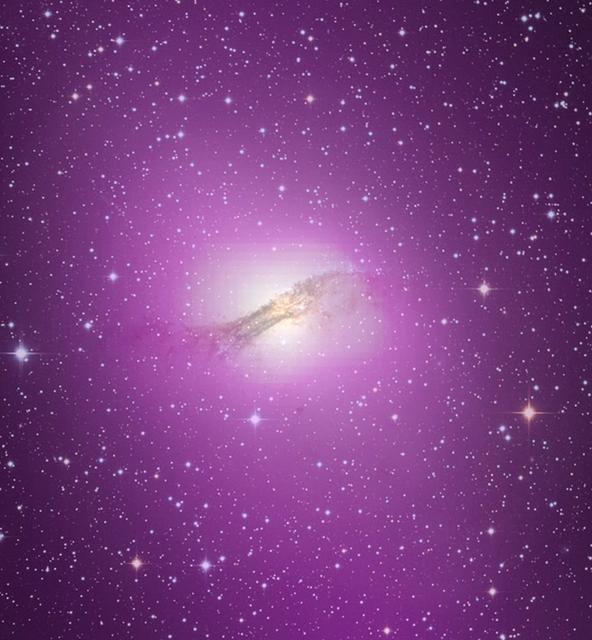
NASA release April 1, 2010 The gamma-ray output from Cen A's lobes exceeds their radio output by more than ten times. High-energy gamma rays detected by Fermi's Large Area Telescope are depicted as purple in this gamma ray/optical composite of the galaxy. Credit: NASA/DOE/Fermi LAT Collaboration, Capella Observatory To learn more about these images go to: <a href="http://www.nasa.gov/mission_pages/GLAST/news/smokestack-plumes.html" rel="nofollow">www.nasa.gov/mission_pages/GLAST/news/smokestack-plumes.html</a> <b><a href="http://www.nasa.gov/centers/goddard/home/index.html" rel="nofollow">NASA Goddard Space Flight Center</a></b> is home to the nation's largest organization of combined scientists, engineers and technologists that build spacecraft, instruments and new technology to study the Earth, the sun, our solar system, and the universe.
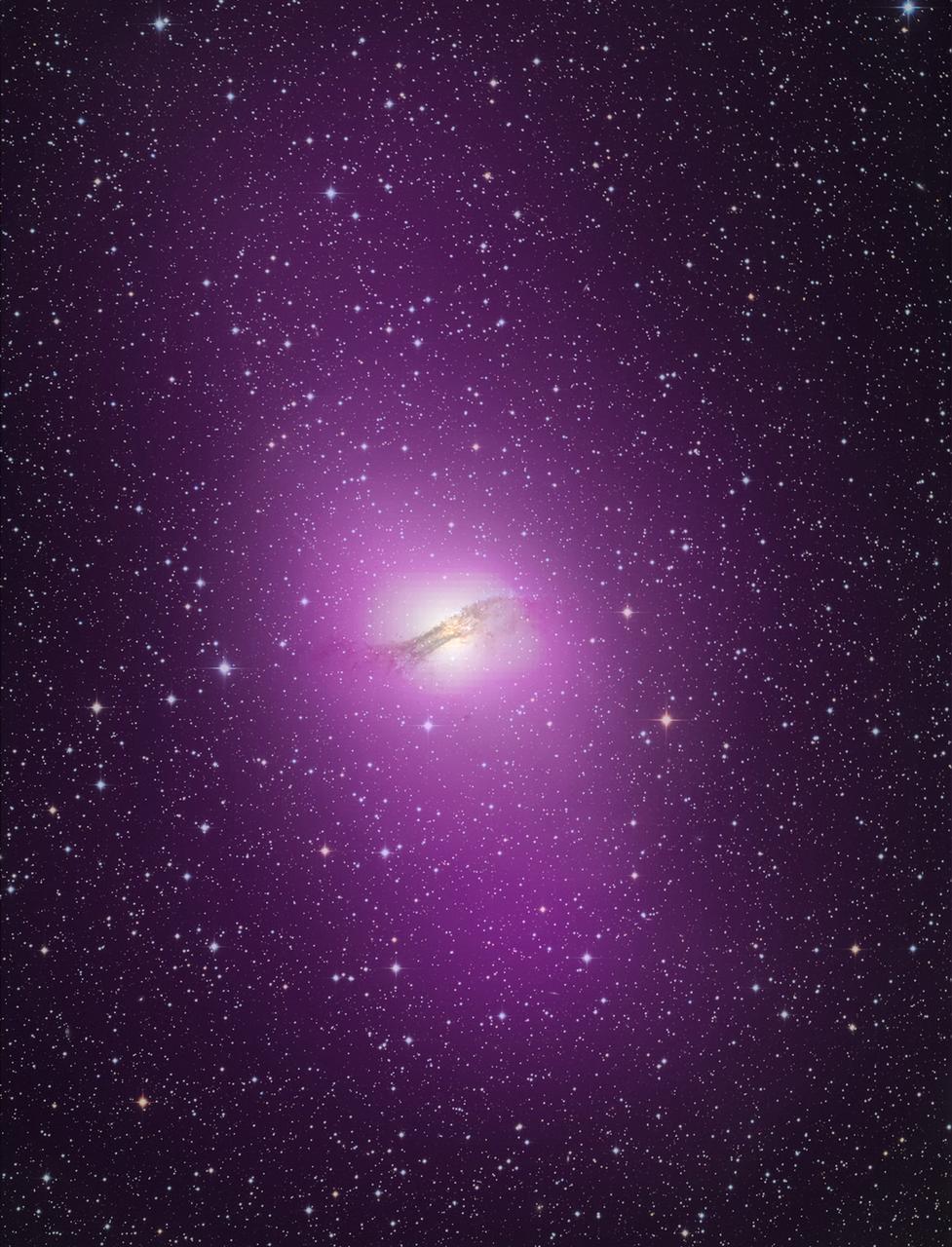
NASA release April 1, 2010 The gamma-ray output from Cen A's lobes exceeds their radio output by more than ten times. High-energy gamma rays detected by Fermi's Large Area Telescope are depicted as purple in this gamma ray/optical composite of the galaxy. Credit: NASA/DOE/Fermi LAT Collaboration, Capella Observatory To learn more about these images go to: <a href="http://www.nasa.gov/mission_pages/GLAST/news/smokestack-plumes.html" rel="nofollow">www.nasa.gov/mission_pages/GLAST/news/smokestack-plumes.html</a> <b><a href="http://www.nasa.gov/centers/goddard/home/index.html" rel="nofollow">NASA Goddard Space Flight Center</a></b> is home to the nation's largest organization of combined scientists, engineers and technologists that build spacecraft, instruments and new technology to study the Earth, the sun, our solar system, and the universe.
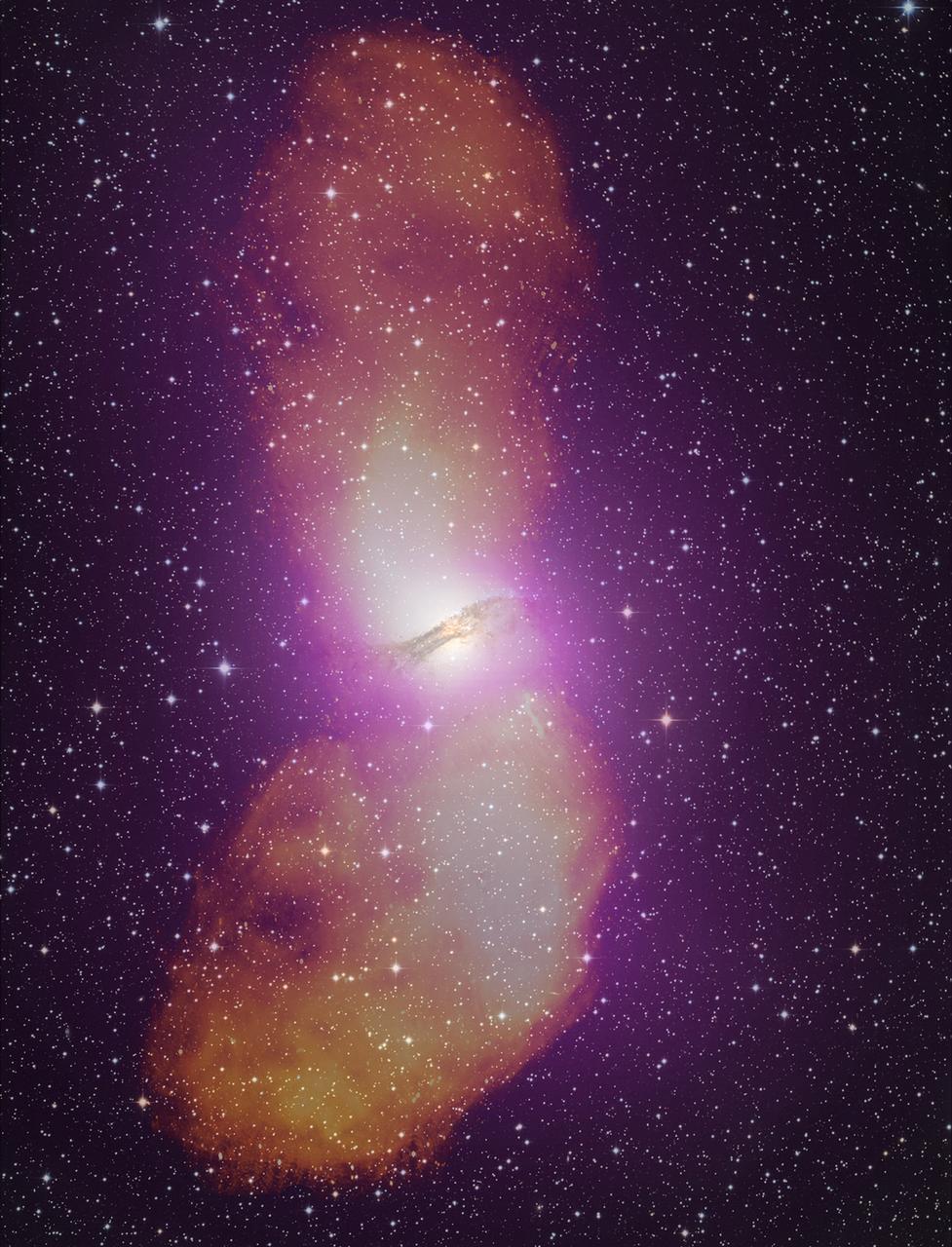
NASA release April 1, 2010 It takes the addition of radio data (orange) to fully appreciate the scale of Cen A's giant radio-emitting lobes, which stretch more than 1.4 million light-years. Gamma-rays from Fermi's Large Area Telescope (purple) and an image of the galaxy in visible light are also included in this composite. Credit: NASA/DOE/Fermi LAT Collaboration, Capella Observatory, and Ilana Feain, Tim Cornwell, and Ron Ekers (CSIRO/ATNF), R. Morganti (ASTRON), and N. Junkes (MPIfR) To learn more about these images go to: <a href="http://www.nasa.gov/mission_pages/GLAST/news/smokestack-plumes.html" rel="nofollow">www.nasa.gov/mission_pages/GLAST/news/smokestack-plumes.html</a> <b><a href="http://www.nasa.gov/centers/goddard/home/index.html" rel="nofollow">NASA Goddard Space Flight Center</a></b> is home to the nation's largest organization of combined scientists, engineers and technologists that build spacecraft, instruments and new technology to study the Earth, the sun, our solar system, and the universe.
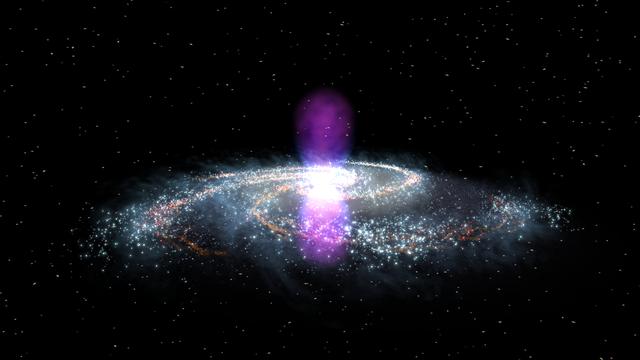
NASA image release November 9, 2010 To view a video about this story go to: <a href="http://www.flickr.com/photos/gsfc/5162413062">www.flickr.com/photos/gsfc/5162413062</a> Using data from NASA's Fermi Gamma-ray Space Telescope, scientists have recently discovered a gigantic, mysterious structure in our galaxy. This never-before-seen feature looks like a pair of bubbles extending above and below our galaxy's center. But these enormous gamma-ray emitting lobes aren't immediately visible in the Fermi all-sky map. However, by processing the data, a group of scientists was able to bring these unexpected structures into sharp relief. Each lobe is 25,000 light-years tall and the whole structure may be only a few million years old. Within the bubbles, extremely energetic electrons are interacting with lower-energy light to create gamma rays, but right now, no one knows the source of these electrons. Are the bubbles remnants of a massive burst of star formation? Leftovers from an eruption by the supermassive black hole at our galaxy's center? Or or did these forces work in tandem to produce them? Scientists aren't sure yet, but the more they learn about this amazing structure, the better we'll understand the Milky Way. To learn more go to: <a href="http://www.nasa.gov/mission_pages/GLAST/news/new-structure.html" rel="nofollow">www.nasa.gov/mission_pages/GLAST/news/new-structure.html</a> <b><a href="http://www.nasa.gov/centers/goddard/home/index.html" rel="nofollow">NASA Goddard Space Flight Center</a></b> enables NASA’s mission through four scientific endeavors: Earth Science, Heliophysics, Solar System Exploration, and Astrophysics. Goddard plays a leading role in NASA’s accomplishments by contributing compelling scientific knowledge to advance the Agency’s mission. <b>Follow us on <a href="http://twitter.com/NASA_GoddardPix" rel="nofollow">Twitter</a></b> <b>Join us on <a href="http://www.facebook.com/pages/Greenbelt-MD/NASA-Goddard/395013845897?ref=tsd" rel="nofollow">Facebook</a></b> Credit: <a href="http://svs.gsfc.nasa.gov/index.html" rel="nofollow">NASA/Goddard Space Flight Center Scientific Visualization Studio</a>
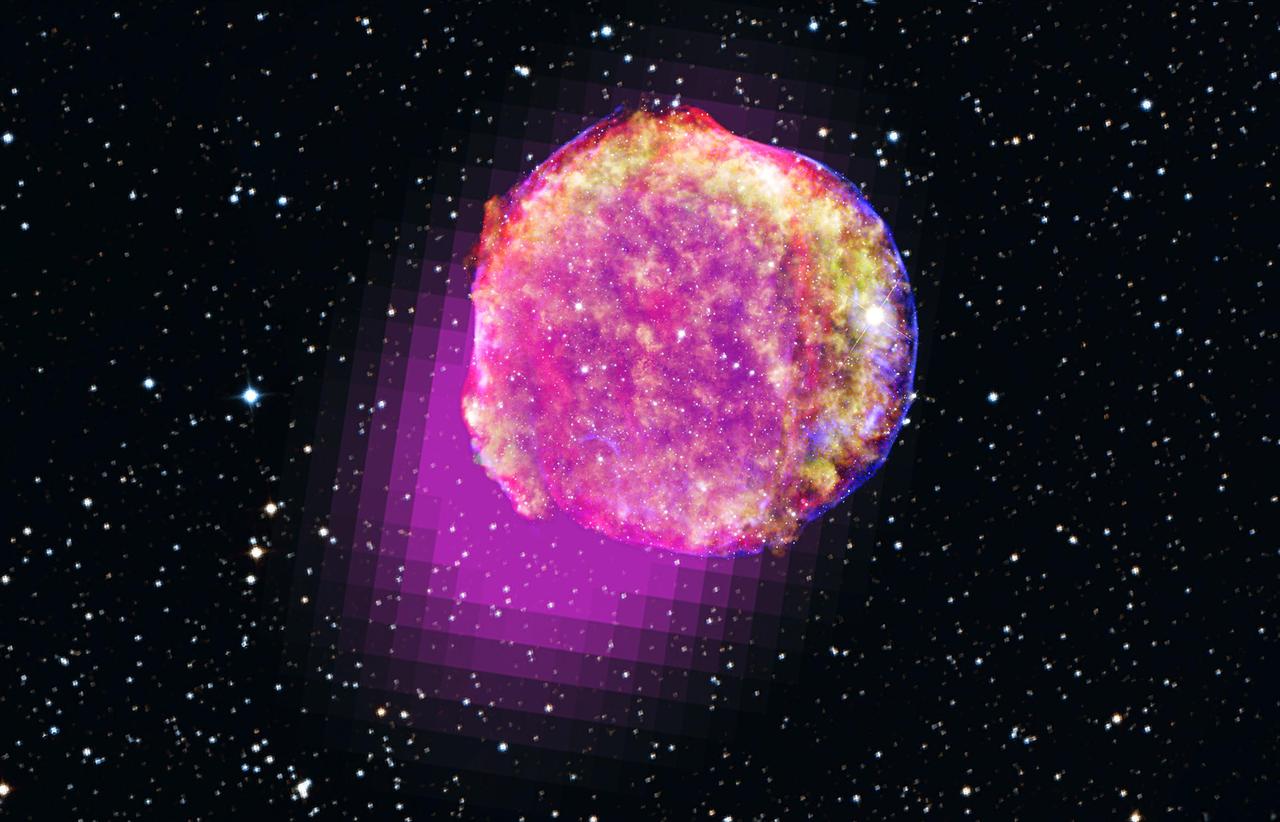
NASA image relase December 13, 2011 Gamma-rays detected by Fermi's LAT show that the remnant of Tycho's supernova shines in the highest-energy form of light. This portrait of the shattered star includes gamma rays (magenta), X-rays (yellow, green, and blue), infrared (red) and optical data. Credit: Gamma ray, NASA/DOE/Fermi LAT Collaboration; X-ray, NASA/CXC/SAO; Infrared, NASA/JPL-Caltech; Optical, MPIA, Calar Alto, O. Krause et al. and DSS To read more go to: <a href="http://www.nasa.gov/mission_pages/GLAST/news/tycho-star.html" rel="nofollow">www.nasa.gov/mission_pages/GLAST/news/tycho-star.html</a> <b><a href="http://www.nasa.gov/audience/formedia/features/MP_Photo_Guidelines.html" rel="nofollow">NASA image use policy.</a></b> <b><a href="http://www.nasa.gov/centers/goddard/home/index.html" rel="nofollow">NASA Goddard Space Flight Center</a></b> enables NASA’s mission through four scientific endeavors: Earth Science, Heliophysics, Solar System Exploration, and Astrophysics. Goddard plays a leading role in NASA’s accomplishments by contributing compelling scientific knowledge to advance the Agency’s mission. <b>Follow us on <a href="http://twitter.com/NASA_GoddardPix" rel="nofollow">Twitter</a></b> <b>Like us on <a href="http://www.facebook.com/pages/Greenbelt-MD/NASA-Goddard/395013845897?ref=tsd" rel="nofollow">Facebook</a></b> <b>Find us on <a href="http://instagrid.me/nasagoddard/?vm=grid" rel="nofollow">Instagram</a></b>