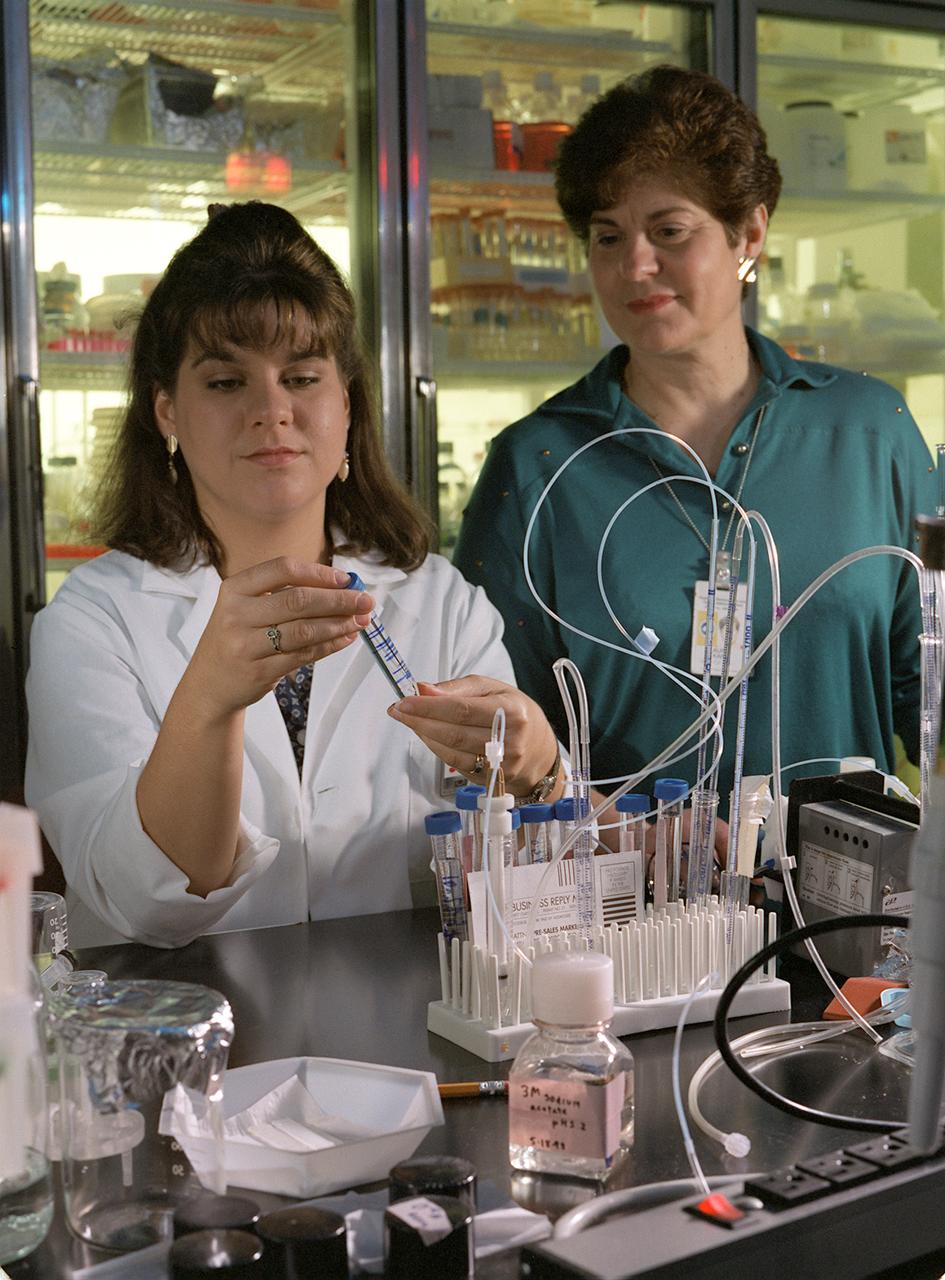
Lisa Crawford, a graduate research assistant from the University of Toledo, works with Laurel Karr of Marshall Space Flight Center (MSFC) in the molecular biology laboratory. They are donducting genetic manipulation of bacteria and yeast for the production of large amount of desired protein. Photo credit: NASA/Marshall Space Flight Center (MSFC)

Aboard the International Space Station (ISS), the Russian Lada greenhouse provides home to an experiment that investigates plant development and genetics. Space grown peas have dried and "gone to seed." The crew of the ISS will soon harvest the seeds. Eventually some will be replanted onboard the ISS, and some will be returned to Earth for further study.

Aboard the International Space Station (ISS), the Russian Lada greenhouse provides home to an experiment that investigates plant development and genetics. Space grown peas have dried and "gone to seed." The crew of the ISS will soon harvest the seeds. Eventually some will be replanted onboard the ISS, and some will be returned to Earth for further study.
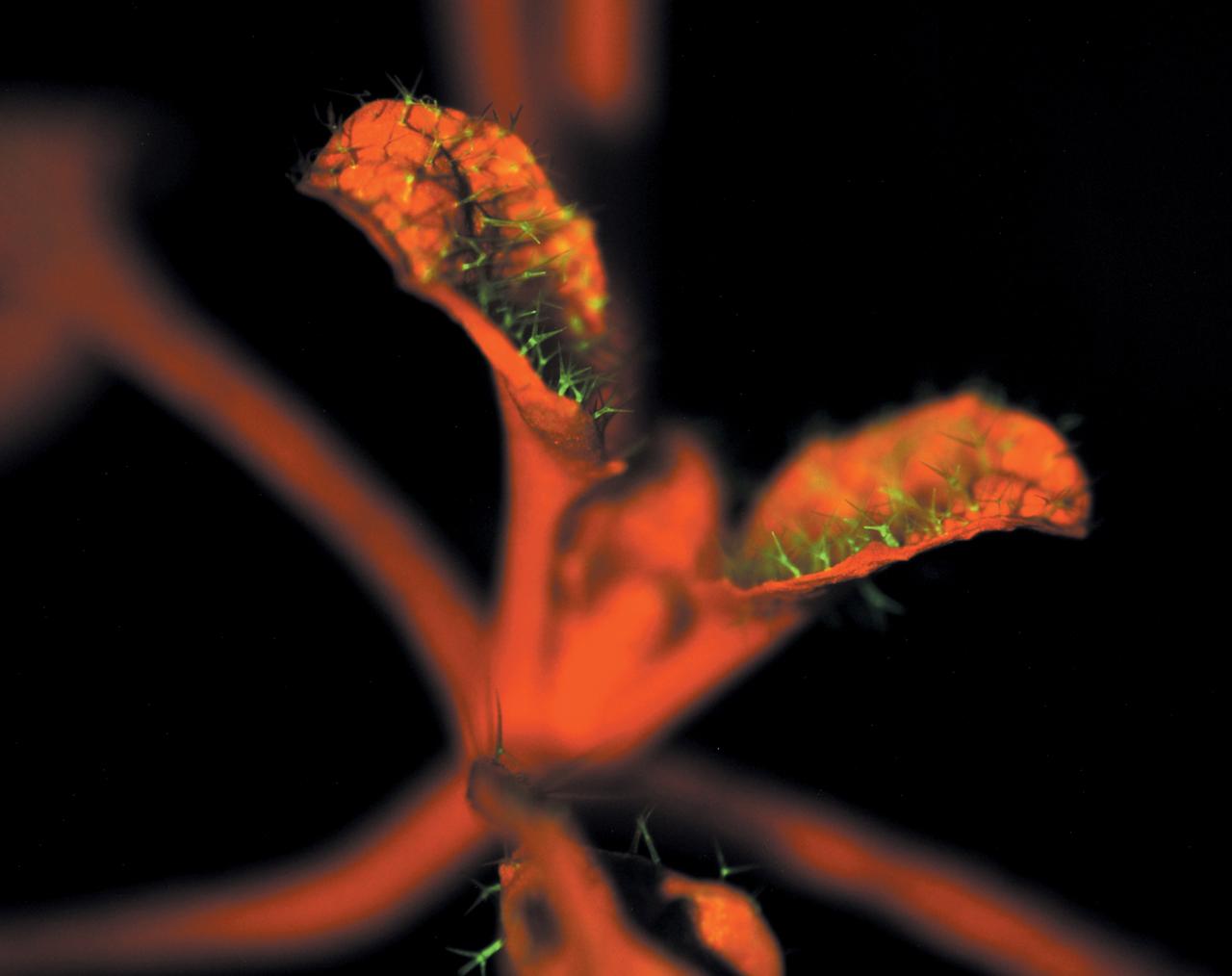
Researchers in Robert Ferl’s lab at the University of Florida in Gainesville, genetically altered this Arabdopsis Thaliana (a brassica species) plant to learn how extreme environments, such as the low atmospheric pressure on Mars, affect plant genes. They inserted green fluorescent protein (GFP) near the on/off switches for anoxia and drought genes. When those genes were turned on after exposure to reduced atmospheric pressure, GFP was turned on as well, causing cells expressing those genes to glow green under a blue light. The natural fluorescence of chlorophyll accounts for the red glow.
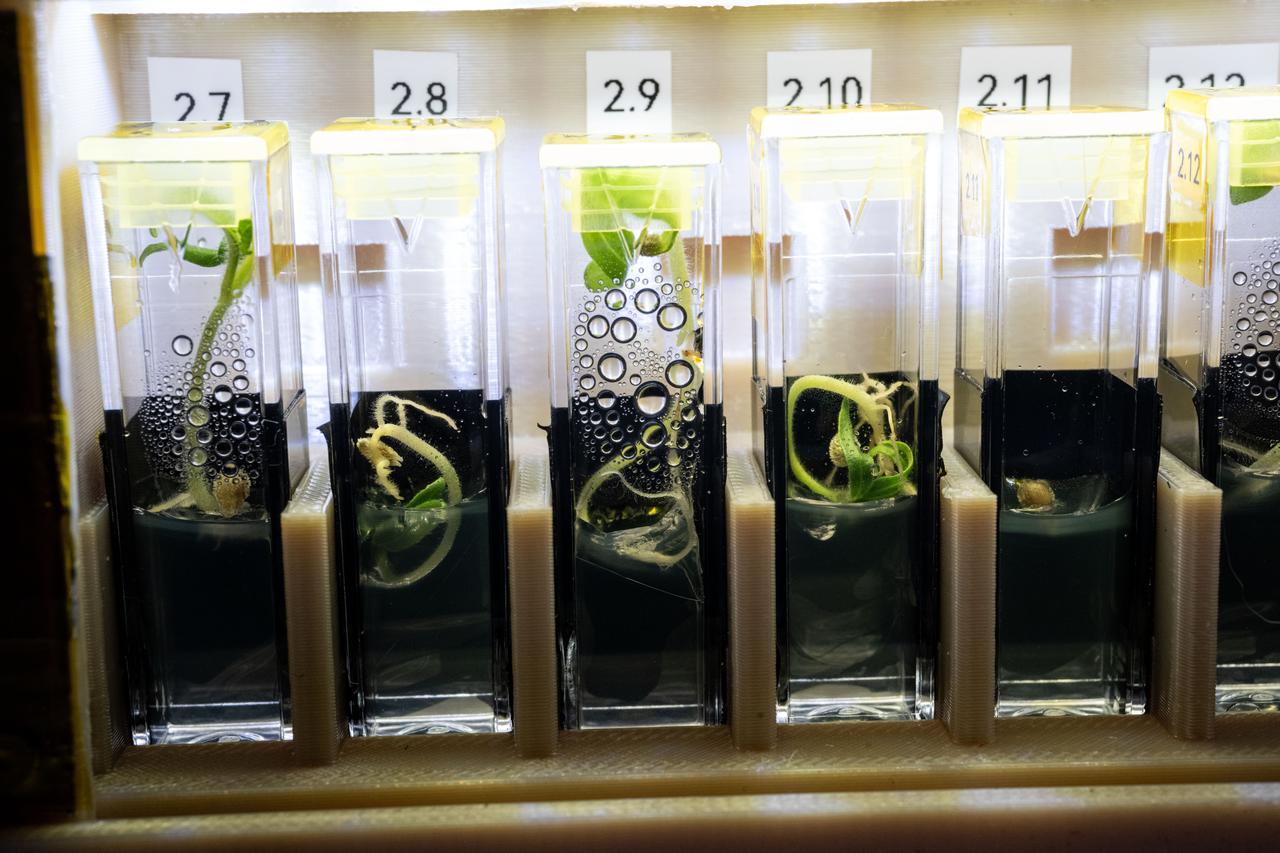
iss073e0032789 (May 16, 2025) --- Genetically modified, extemely dwarf tomato plants are pictured growing inside specialized research hardware, called Rhodium BioCuvettes, aboard the International Space Station's Destiny laboratory module. The space botany experiment tests the plants ability to grow without photosynthesis and survive in confined environments in weightlessness potentially supporting crop production on spacecraft.
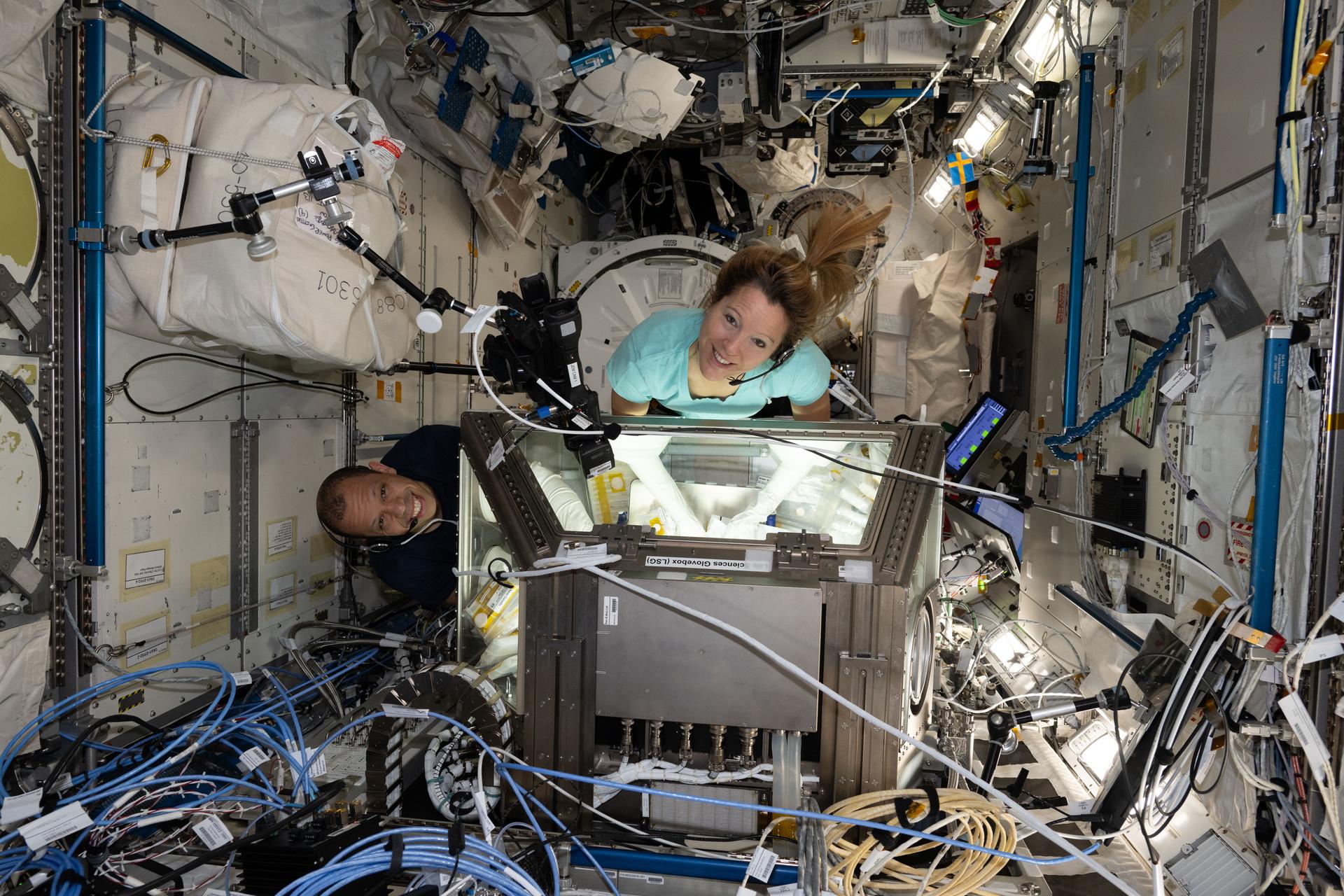
iss074e0503941 (April 22, 2026) --- Expedition 74 flight engineers Chris Williams of NASA and Sophie Adenot of the European Space Agency work together in the Kibo laboratory module’s Life Science Glovebox, processing genetic-material samples for the DNA Nano Therapeutics‑3 experiment. The investigation is exploring DNA‑inspired assembly techniques as a way to manufacture treatments—such as chemotherapy and immunotherapy—that can kill cancer cells and activate the immune system. Credit: NASA/Jessica Meir

iss073e0071009 (May 11, 2025) --- NASA astronaut and Expedition 73 Flight Engineer Jonny Kim photographs genetically modified, extemely dwarf tomato plants growing inside specialized research hardware, called Rhodium BioCuvettes, aboard the International Space Station's Destiny laboratory module. The space botany experiment tests the plants ability to grow without photosynthesis and survive in confined environments in weightlessness potentially supporting crop production on spacecraft.
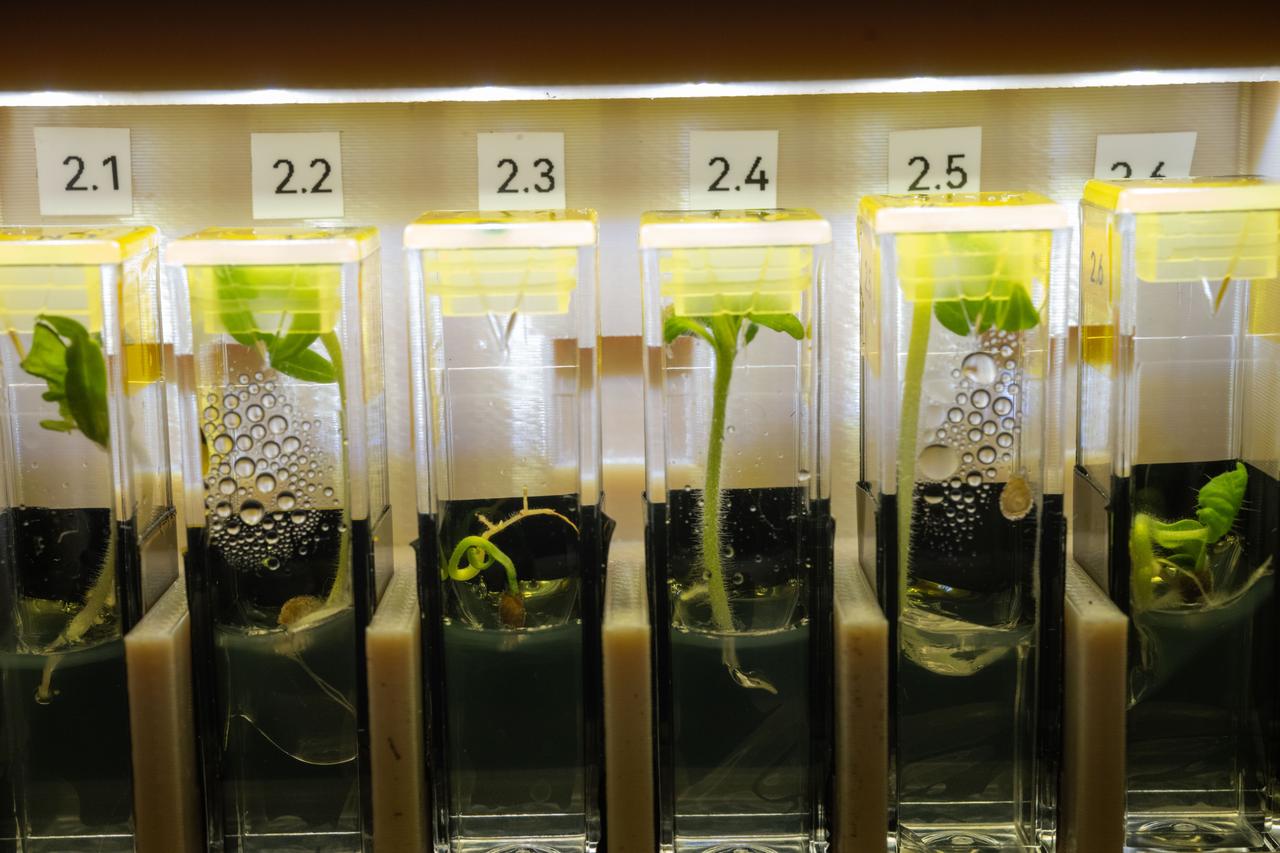
iss073e0031528 (May 15, 2025) --- Genetically modified, extemely dwarf tomato plants are pictured growing inside specialized research hardware, called Rhodium BioCuvettes, aboard the International Space Station's Destiny laboratory module. The space botany experiment tests the plants ability to grow without photosynthesis and survive in confined environments in weightlessness potentially supporting crop production on spacecraft.
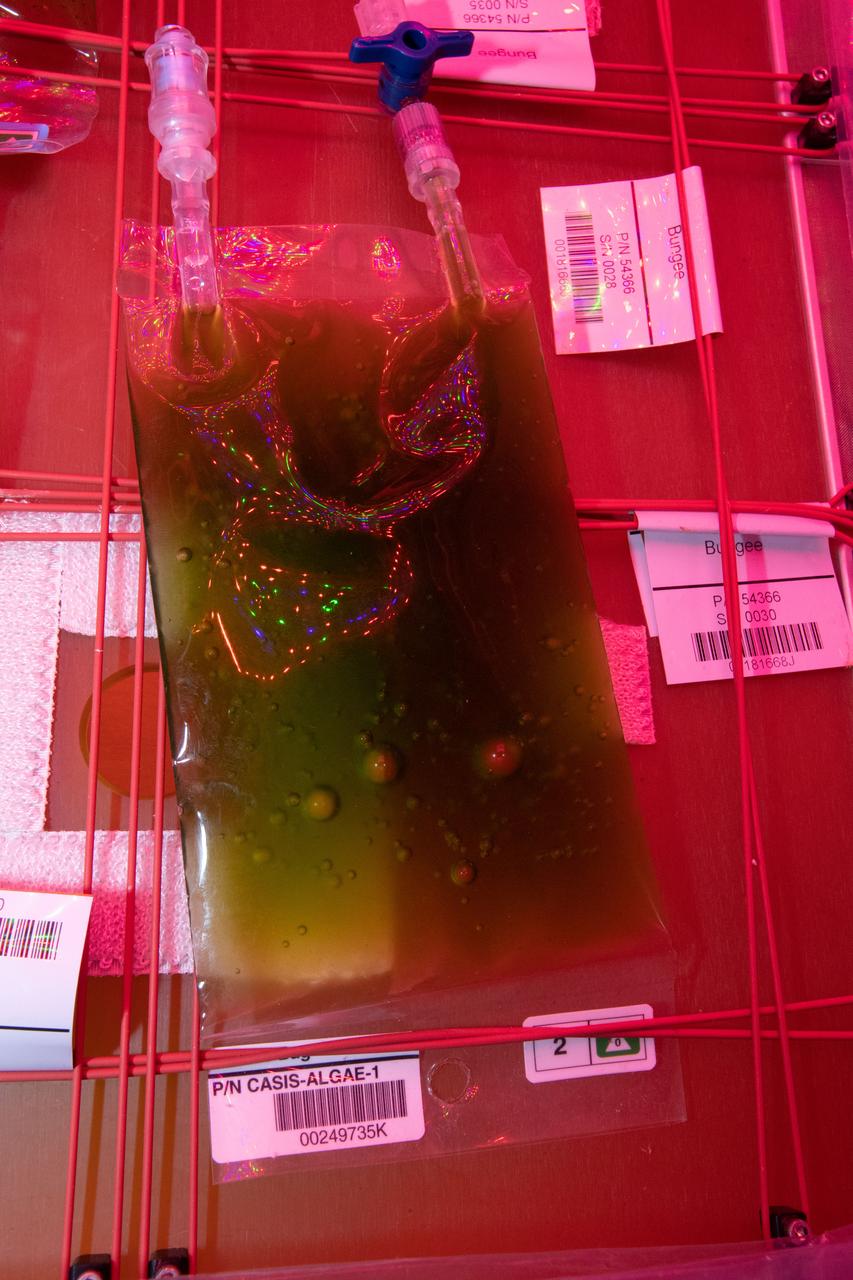
iss056e096982 (7/17/2018) --- View of the installation of a Space Algae culture bags in the Veggie facility. The Space Algae investigation explores the genetic basis for productivity of algae cultivated in space and whether this requires genetic adaptations or not.
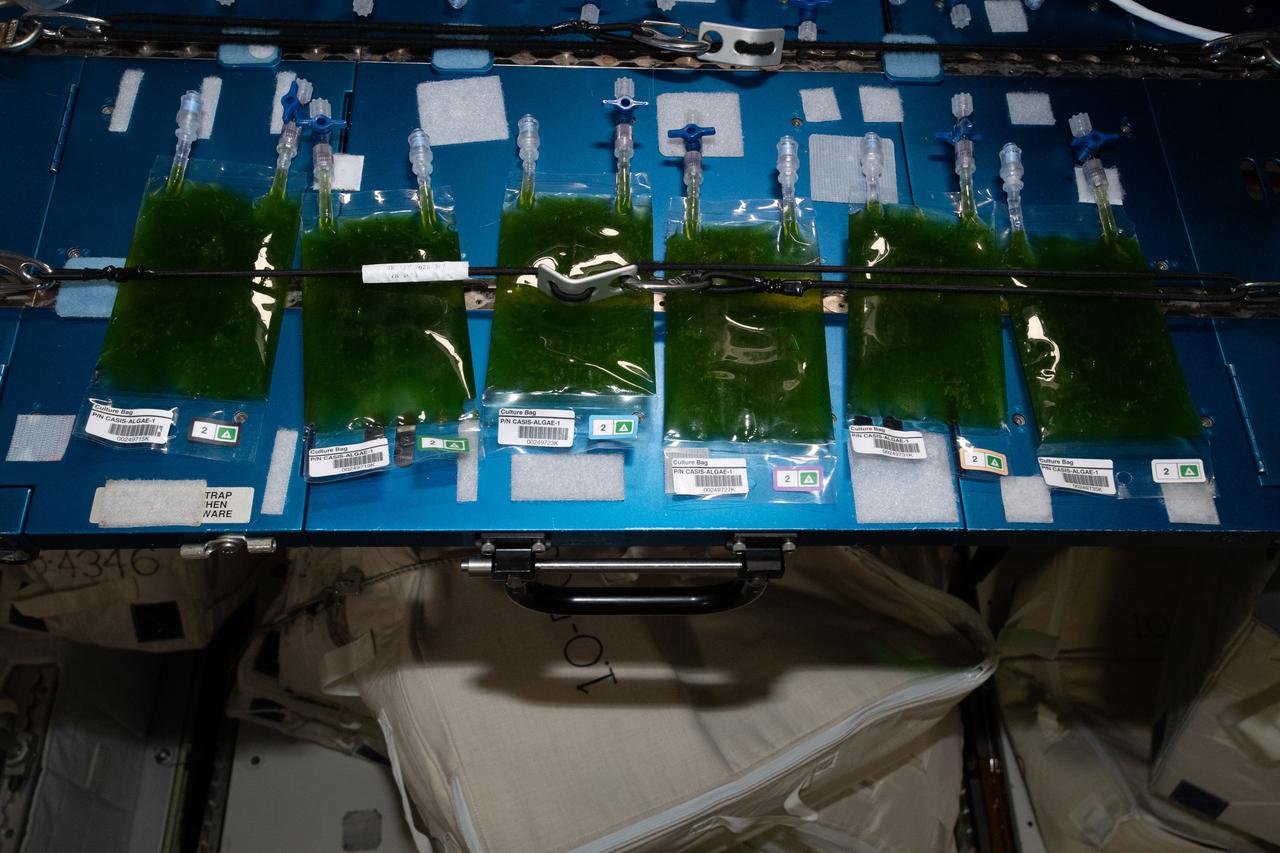
iss056e096983 (7/17/2018) --- View of the installation of six Space Algae culture bags in the Veggie facility. The Space Algae investigation explores the genetic basis for productivity of algae cultivated in space and whether this requires genetic adaptations or not.
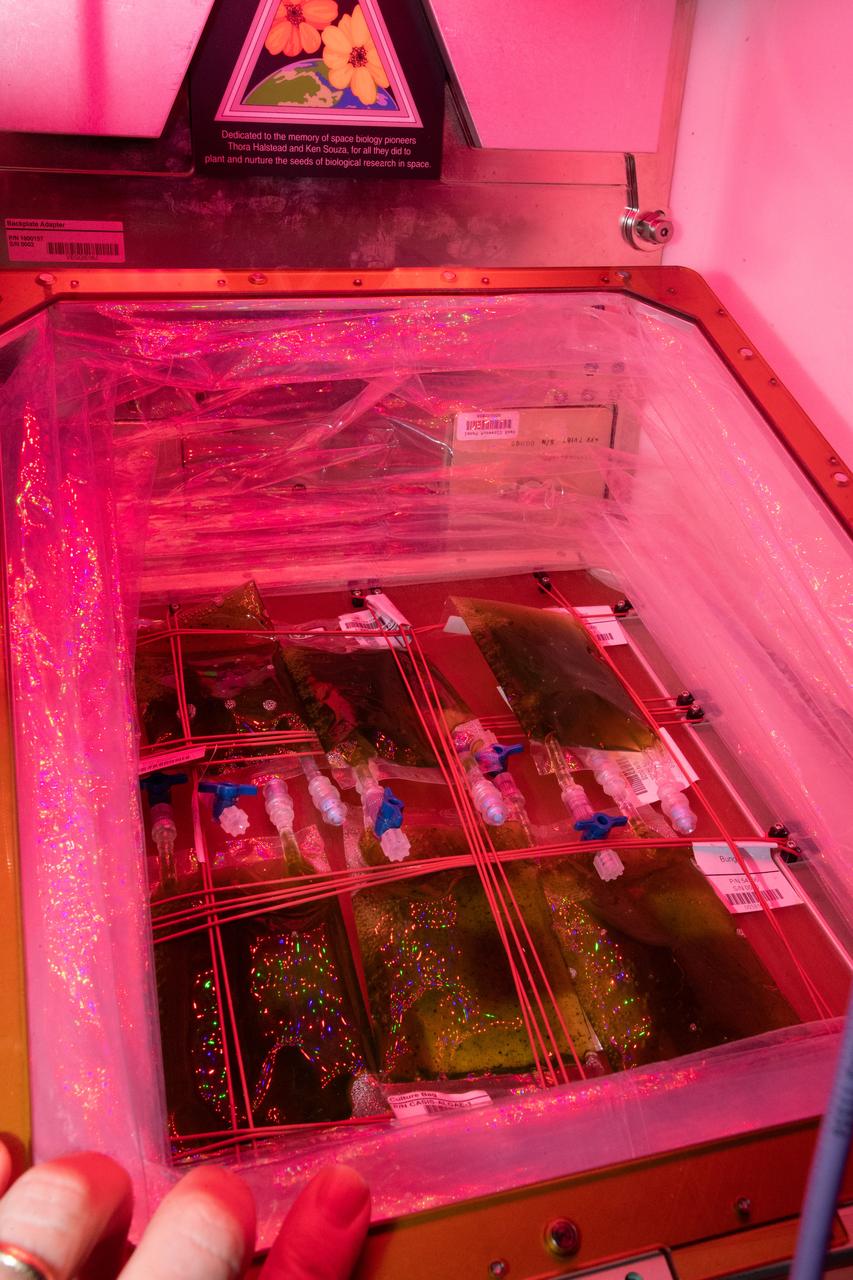
iss056e096962 (7/17/2018) --- View of the installation of six Space Algae culture bags in the Veggie facility. The Space Algae investigation explores the genetic basis for productivity of algae cultivated in space and whether this requires genetic adaptations or not.

iss056e096990 (7/17/2018) --- View of the installation of a Space Algae culture bags in the Veggie facility. The Space Algae investigation explores the genetic basis for productivity of algae cultivated in space and whether this requires genetic adaptations or not.
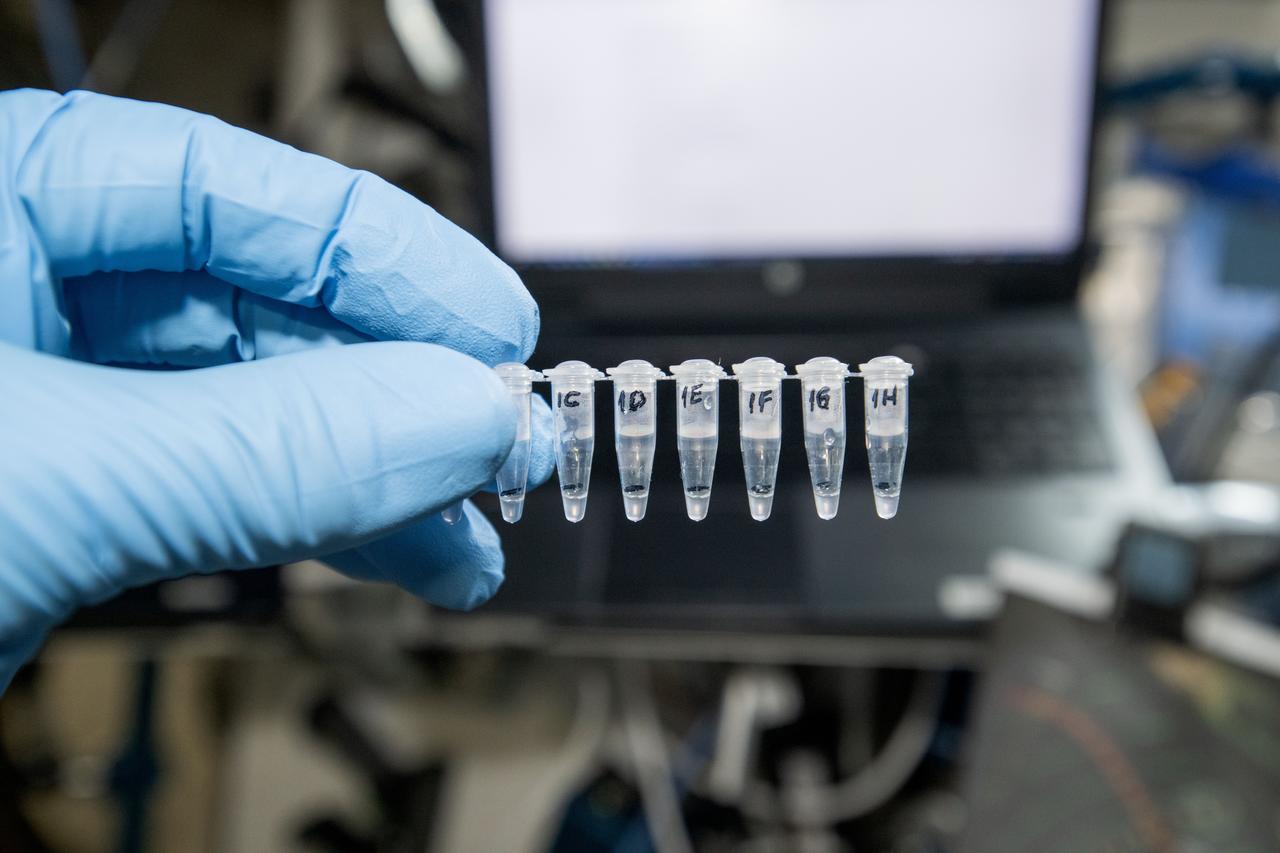
iss072e010035 (Oct. 12, 2024) --- NASA astronaut and Expedition 72 Flight Engineer Don Pettit displays Genes In Space-11 samples validating on-orbit Nucleic Acid Sequenced Based Amplification (NASBA), a novel technique to detect specific RNA sequences that can be applied to studying crucial biological processes, such as viral infection, genomic damage, or gene expression during spaceflight. Genes in Space-11 studies how spaceflight may activate retrotransposons, which are DNA fragments that copy and paste themselves throughout a genome, leading to cancer and other diseases. This investigation tests methods for detecting and measuring retrotransposons that may be adapted to detect other RNAs, including those of viruses that cause illness. Understanding the behavior of retrotransposons in microgravity may shed light on the genetic risks, including cancer, from space travel and support development of ways to protect astronauts during missions.

jsc2025e007253 (2/14/2025) --- The logo for Polaris Bioremediation Science Experiment - Genetic Exchange in Microgravity for Biofilm Bioremediation (GEM-B2).
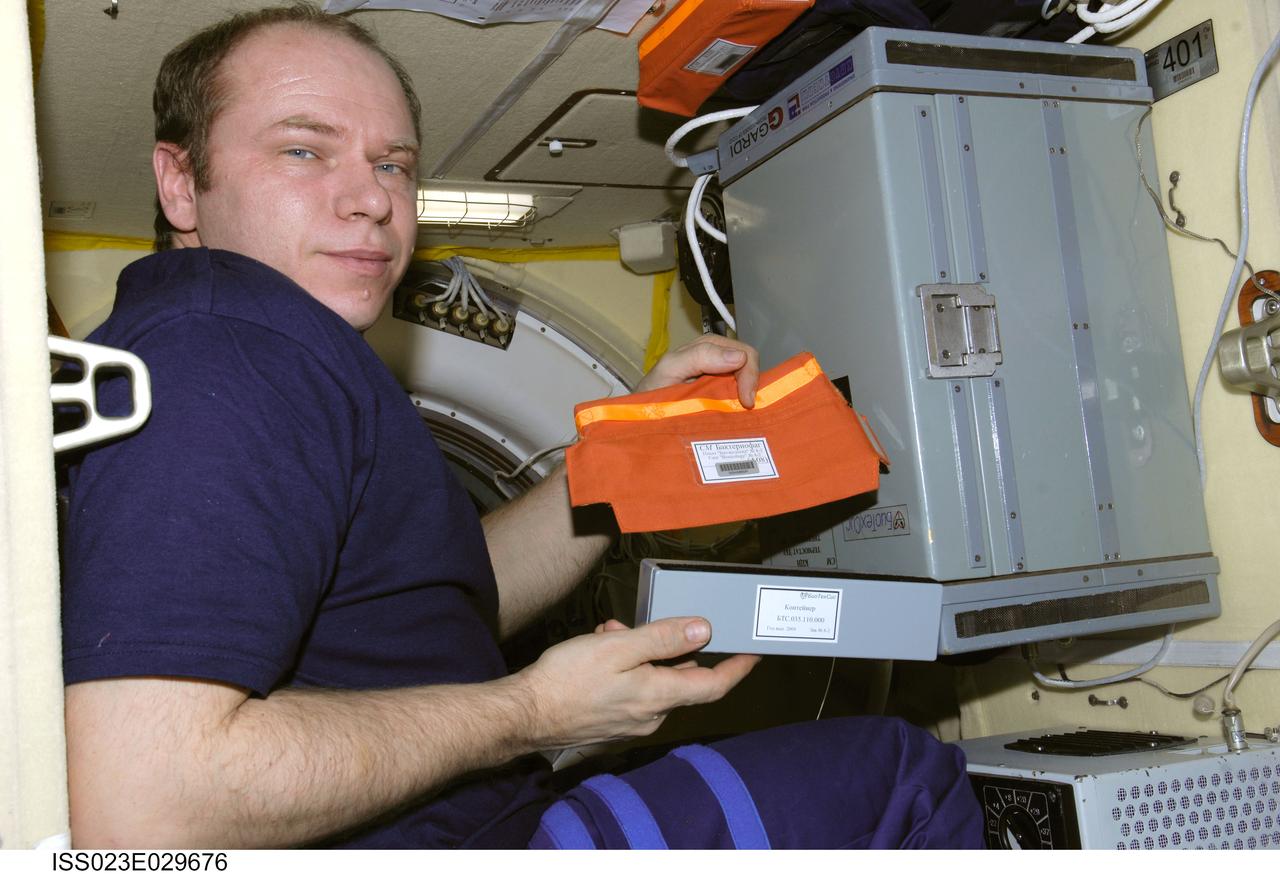
iss023e029676 (5/2/2010) Cosmonaut Oleg Kotov is photographed with a Bioecology container, containing the BTKh-41/BACTERIOFAG (Bacteriophage) experiment hardware in the Poisk Mini-Research Module 2 (MRM2)aboard the International Space station (ISS). The Study of the Effects of Spaceflight Factors on Bacterophages (Bakteriofag) investigation examines the therapeutic, diagnostic, and genetic properties of bacteriophages to discover possible changes in the physical, chemical, morphological, and genetic properties of therapeutic and diagnostic bacteriophages exposed to microgravity.
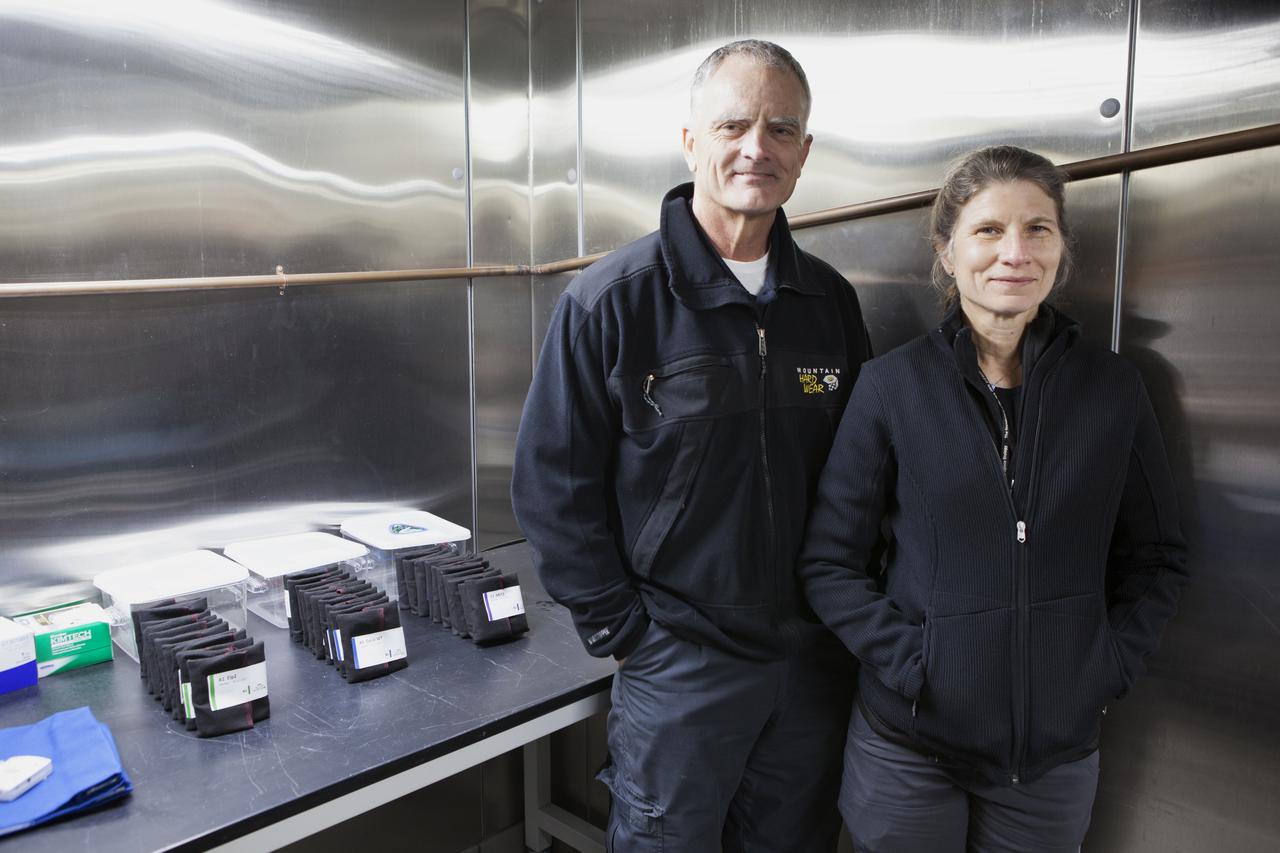
Drs. Rob Ferl and Anna-Lisa Paul in a cold room in the Kennedy Space Center Processing Facility with the petri plates they prepped at the University of Florida for APEX-04. Paul is the principal investigator (PI) and Ferl is co-PI. Apex-04 is an experiment involving Arabidopsis in petri plates inside the Veggie facility aboard the International Space Station. Since Arabidopsis is the genetic model of the plant world, it is a perfect sample organism for performing genetic studies in spaceflight. The experiment is the result of a grant from NASA’s Space Life and Physical Sciences division.
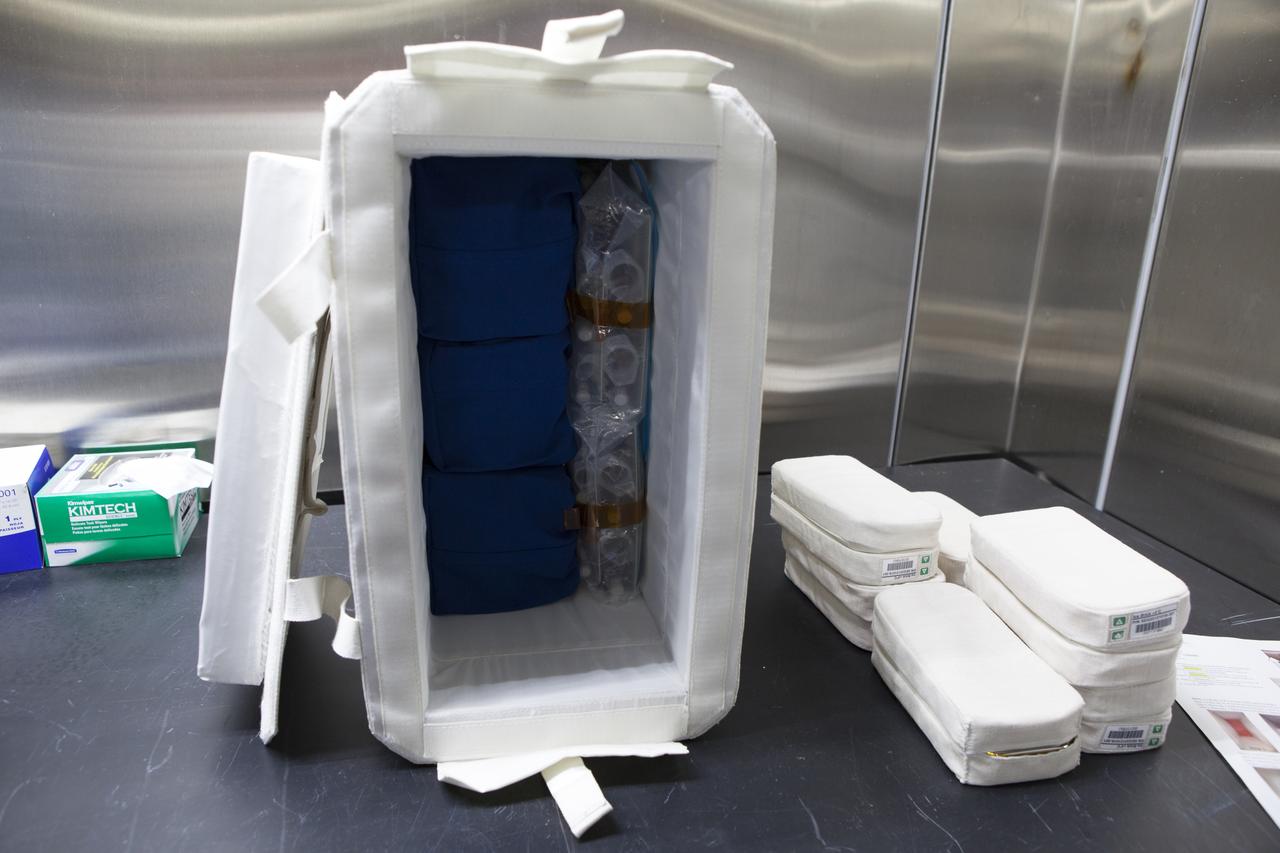
APEX-04, or Advanced Plant EXperiments-04, is being prepared in a cold room in the Kennedy Space Center Processing Facility for SpaceX-10. Dr. Anna Lisa Paul of the University of Florida is the principal investigator for APEX-04. Apex-04 is an experiment involving Arabidopsis in petri plates inside the Veggie facility aboard the International Space Station. Since Arabidopsis is the genetic model of the plant world, it is a perfect sample organism for performing genetic studies in spaceflight. The experiment is the result of a grant from NASA’s Space Life and Physical Sciences division.
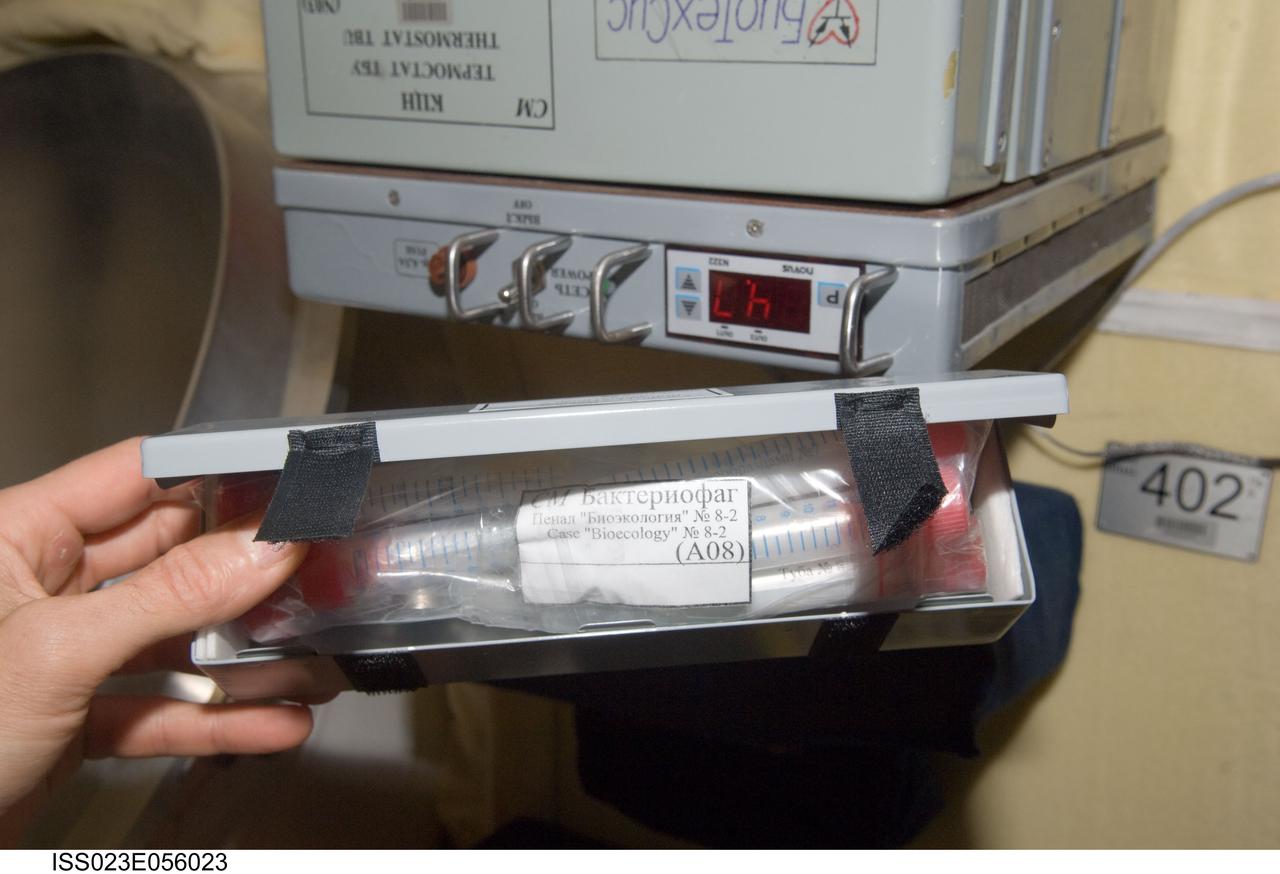
iss023e056023 (6/1/2010) --- Photo documentation of the BTKh-41/Bacteriophage hardware inside Bioecology Case 8-2 in the Poisk Mini-Research Module 2 (MRM2) aboard the International Space Station (ISS). The Study of the Effects of Spaceflight Factors on Bacterophages (Bakteriofag) investigation examines the therapeutic, diagnostic, and genetic properties of bacteriophages to discover possible changes in the physical, chemical, morphological, and genetic properties of therapeutic and diagnostic bacteriophages exposed to microgravity.
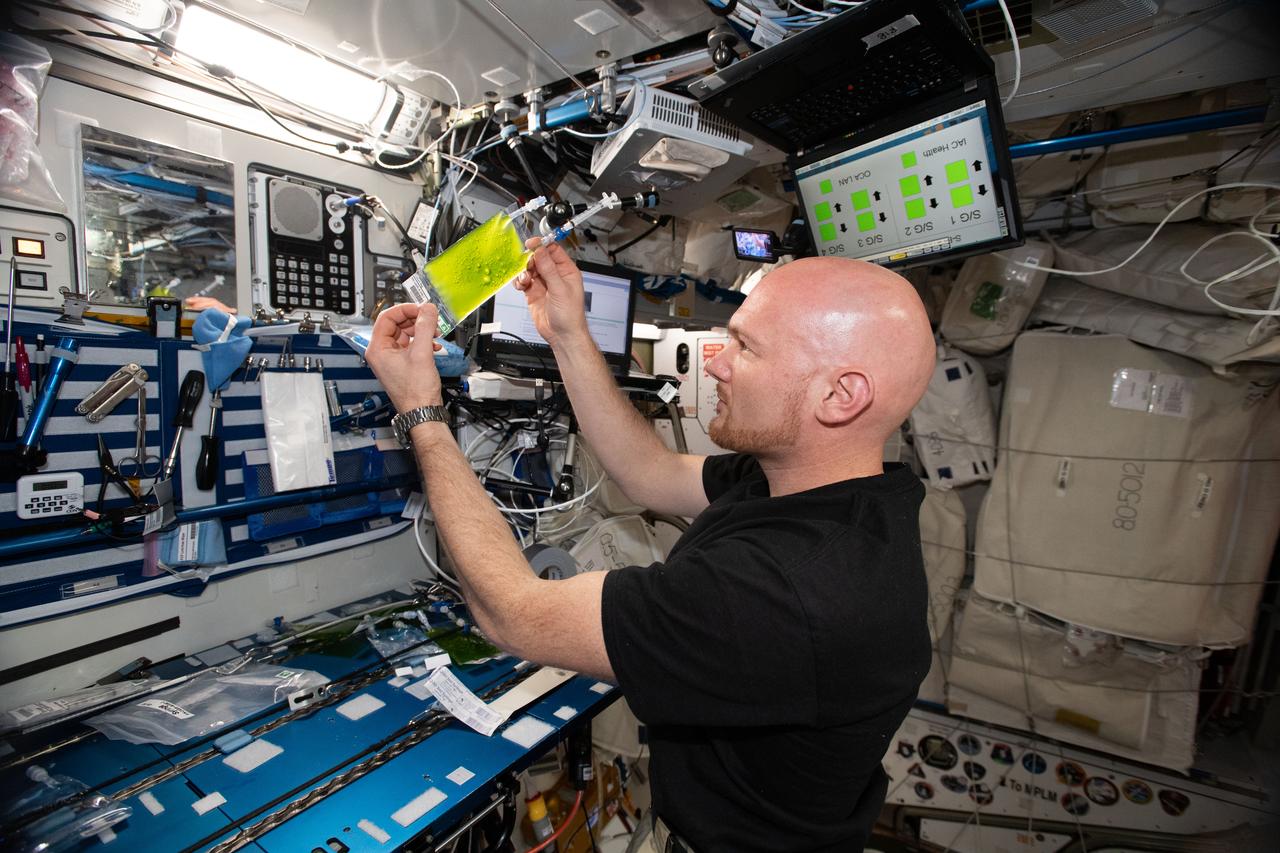
iss056e098239 (7/23/2018) --- Astronaut Alexander Gerst of ESA (European Space Agency) checking a Space Algae culture bag making sure it is green, gently agitating each one, and making sure each label colors match. The Space Algae investigation explores the genetic basis for productivity of algae cultivated in space and whether this requires genetic adaptations or not.

iss023e056026 (6/1/2010) --- Photo documentation of Bioecology Cases containing Bioecology, BTKh-40/Bifidobacterius, and BTKh-41/Bacteriophage hardware aboard the International Space Station (ISS). The Study of the Effects of Spaceflight Factors on Bacterophages (Bakteriofag) investigation examines the therapeutic, diagnostic, and genetic properties of bacteriophages to discover possible changes in the physical, chemical, morphological, and genetic properties of therapeutic and diagnostic bacteriophages exposed to microgravity.
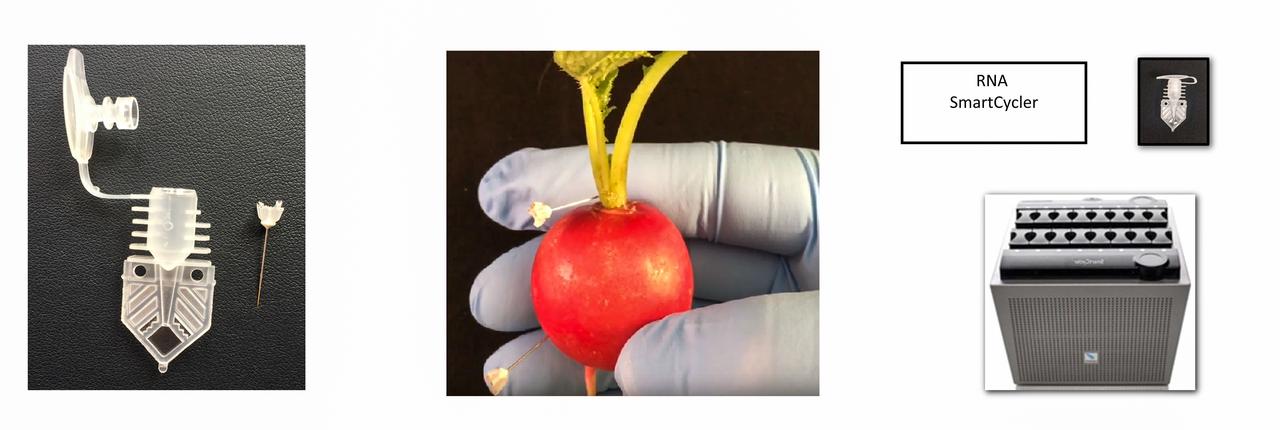
jsc2019e058183 (7/1/2019) --- Gene Sampler technology overview illustrating the direct purification and amplification of genetic material using RNA capture pins and the SmartCycler PCR instrument. Image courtesy of: Dr. Niel D. Crews
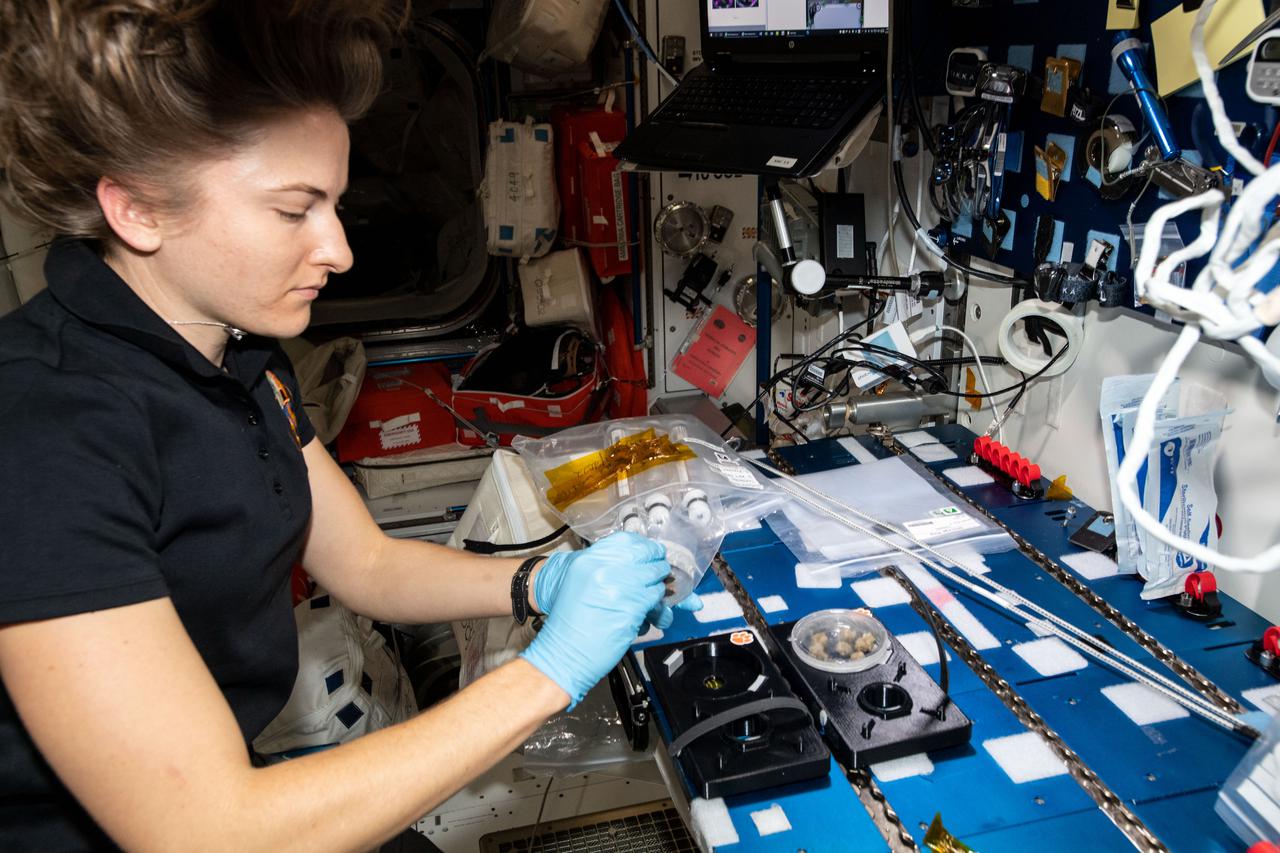
iss066e139750 (Feb. 10, 2022) --- NASA astronaut and Expedition 66 Flight Engineer Kayla Barron harvests cotton cell samples grown for the Plant Habitat-05 space agriculture experiment that is exploring the genetic architecture of plant regeneration.
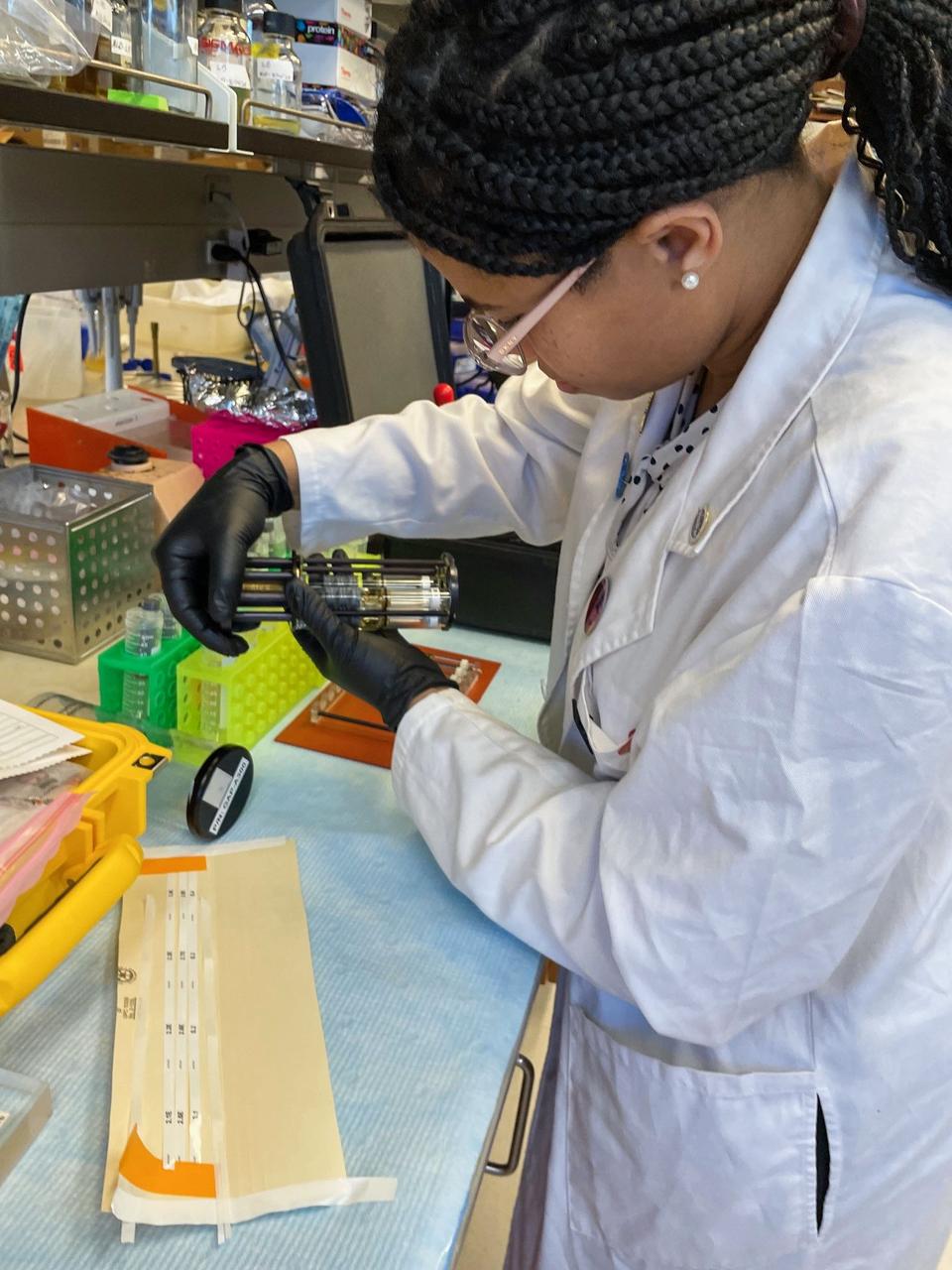
jsc2025e007254 (2/14/2025) --- Graduate student Lanie Briggs loads a Group Activation Pack (GAP) for the Polaris Bioremediation Science Experiment - Genetic Exchange in Microgravity for Biofilm Bioremediation (GEM-B2).
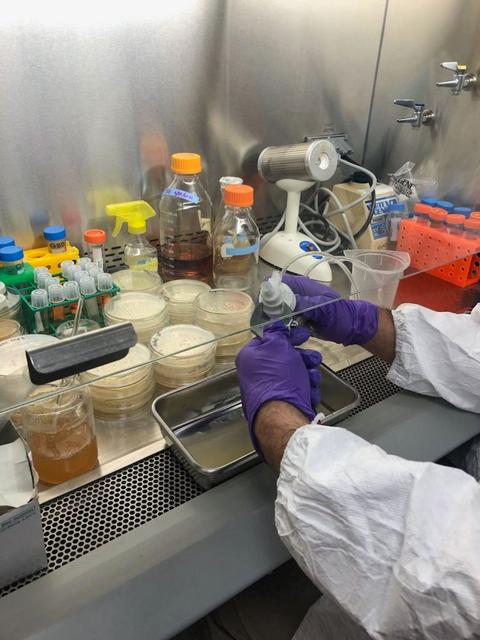
jsc2025e007251 (2/14/2025) --- Biofilm testing is shown in the early stages of the Polaris Bioremediation Science Experiment - Genetic Exchange in Microgravity for Biofilm Bioremediation (GEM-B2) project.

sc2024e016256 (2/23/2024) --- The Direct and Delayed Effects of Microgravity on "Space Memory" of Neural Crest Stem Cells (MemoBC) investigation operations overview. Image courtesy of Uppsala University, Department of Immunology, Genetics and Pathology.
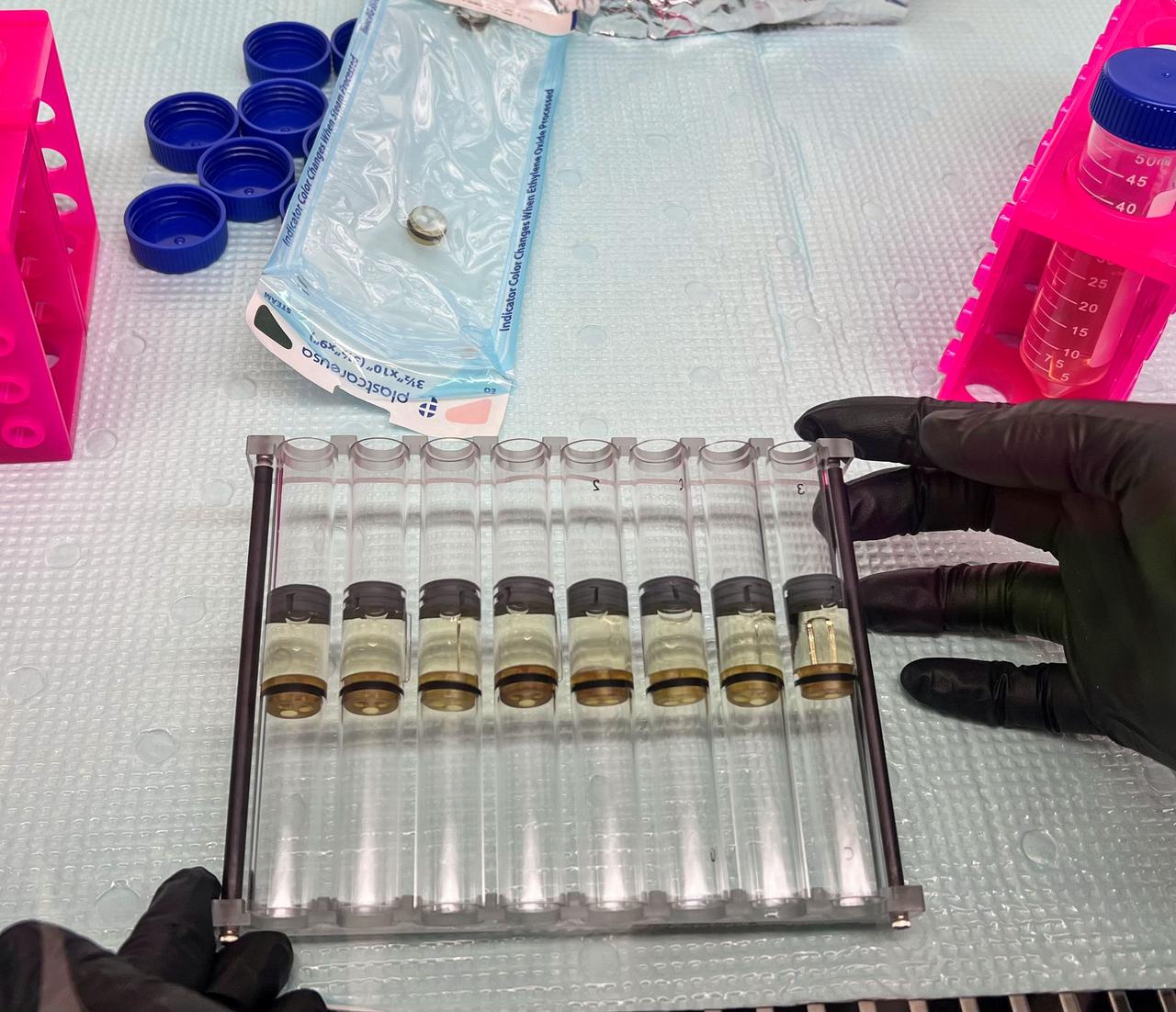
jsc2025e007256 (2/14/2025) --- Another view of the eight Fluid Processing Apparatus (FPAs) used in the Polaris Bioremediation Science Experiment - Genetic Exchange in Microgravity for Biofilm Bioremediation (GEM-B2) investigation. Image courtesy of BioServe.
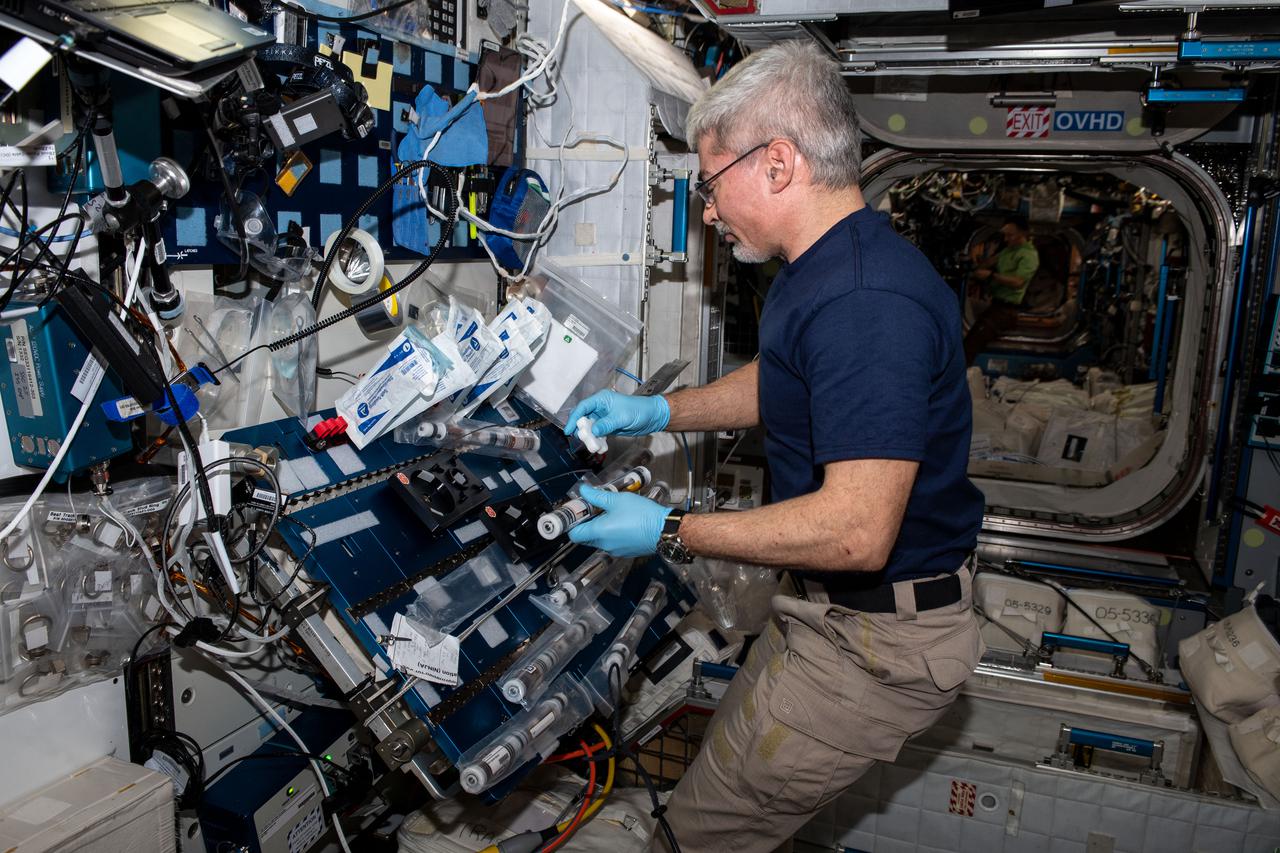
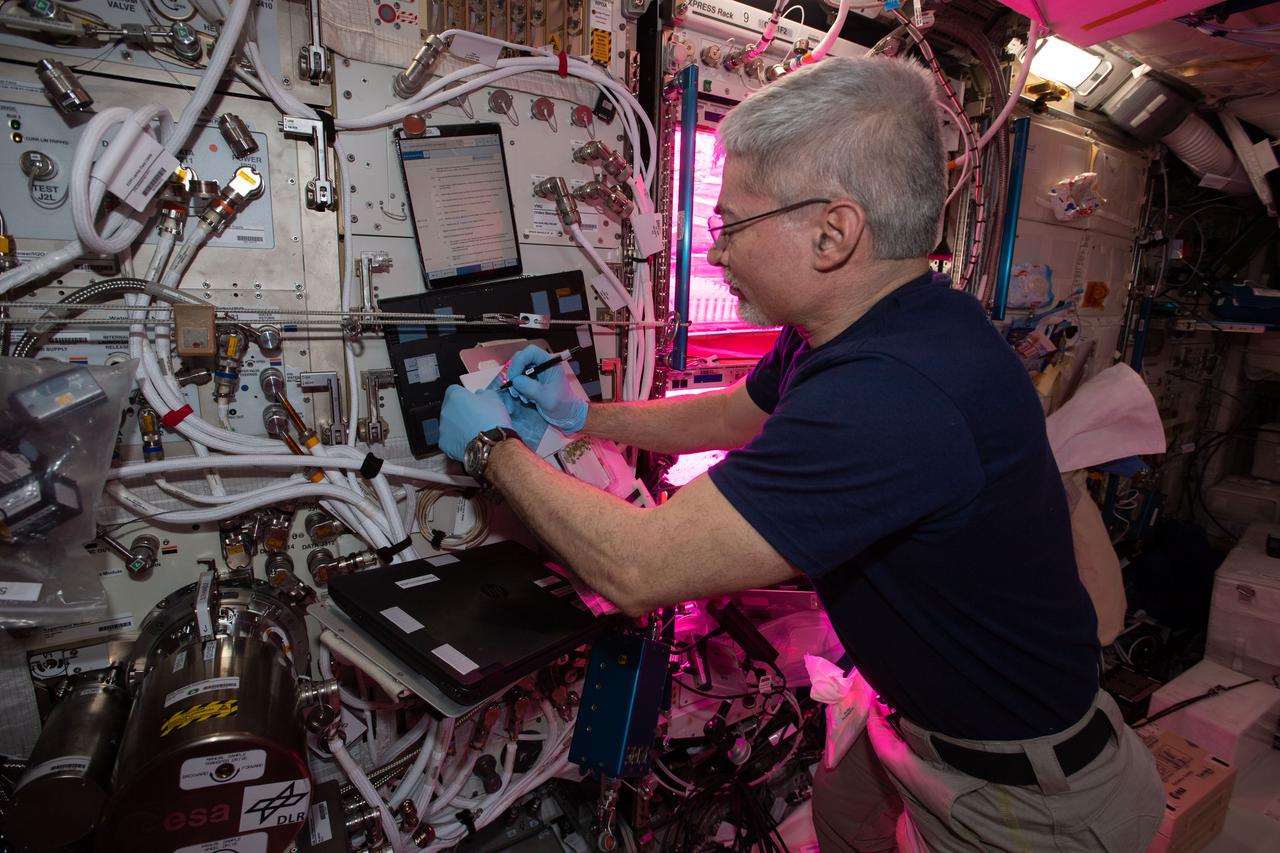
iss066e108292 (Jan. 6, 2022) --- NASA astronaut and Expedition 66 Flight Engineer Mark Vande Hei conducts operations for the Plant Habitat-5 space agriculture experiment that is studying cotton genetics.
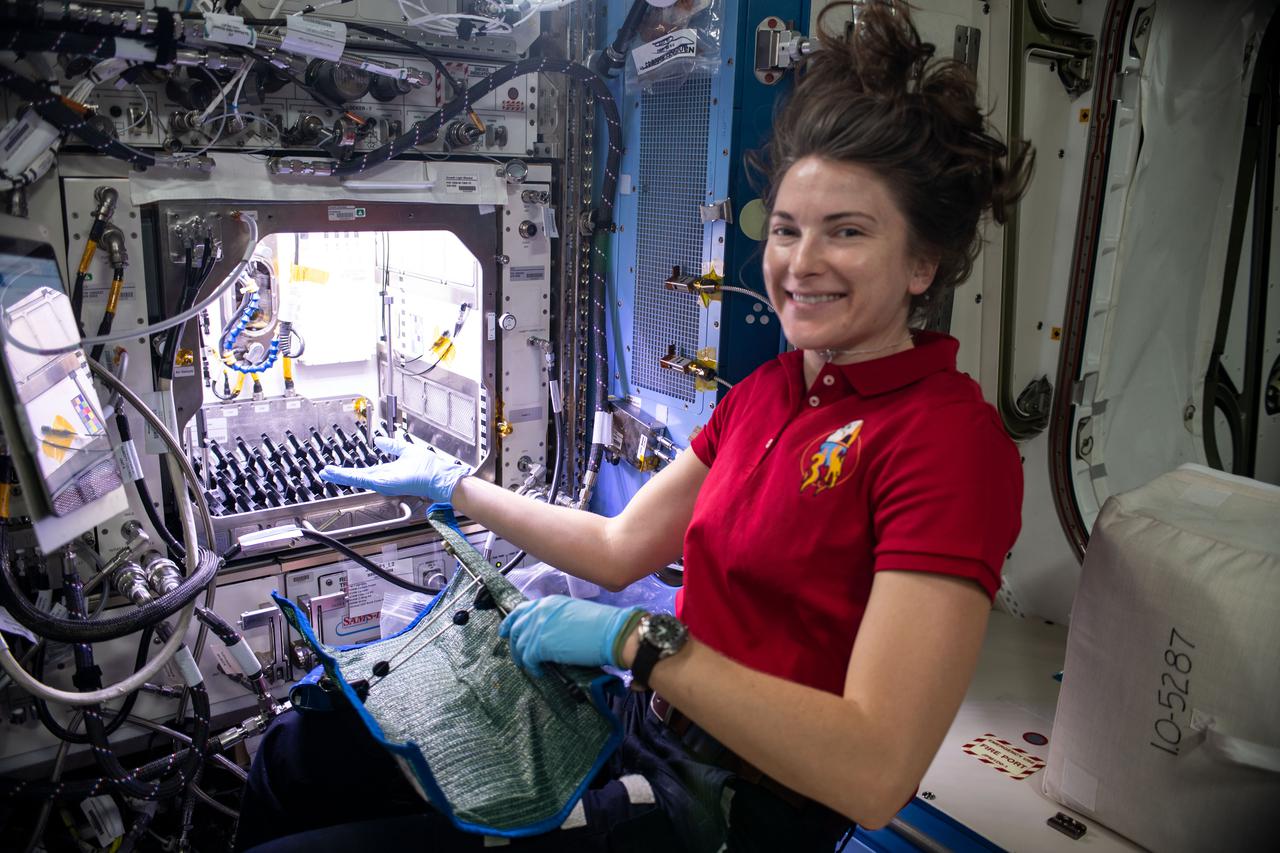
iss066e096821 (Dec. 27, 2021) --- NASA astronaut and Expedition 66 Flight Engineer Kayla Barron sets up the Plant Habitat-05 Growth experiment that is studying cotton genetics in microgravity.
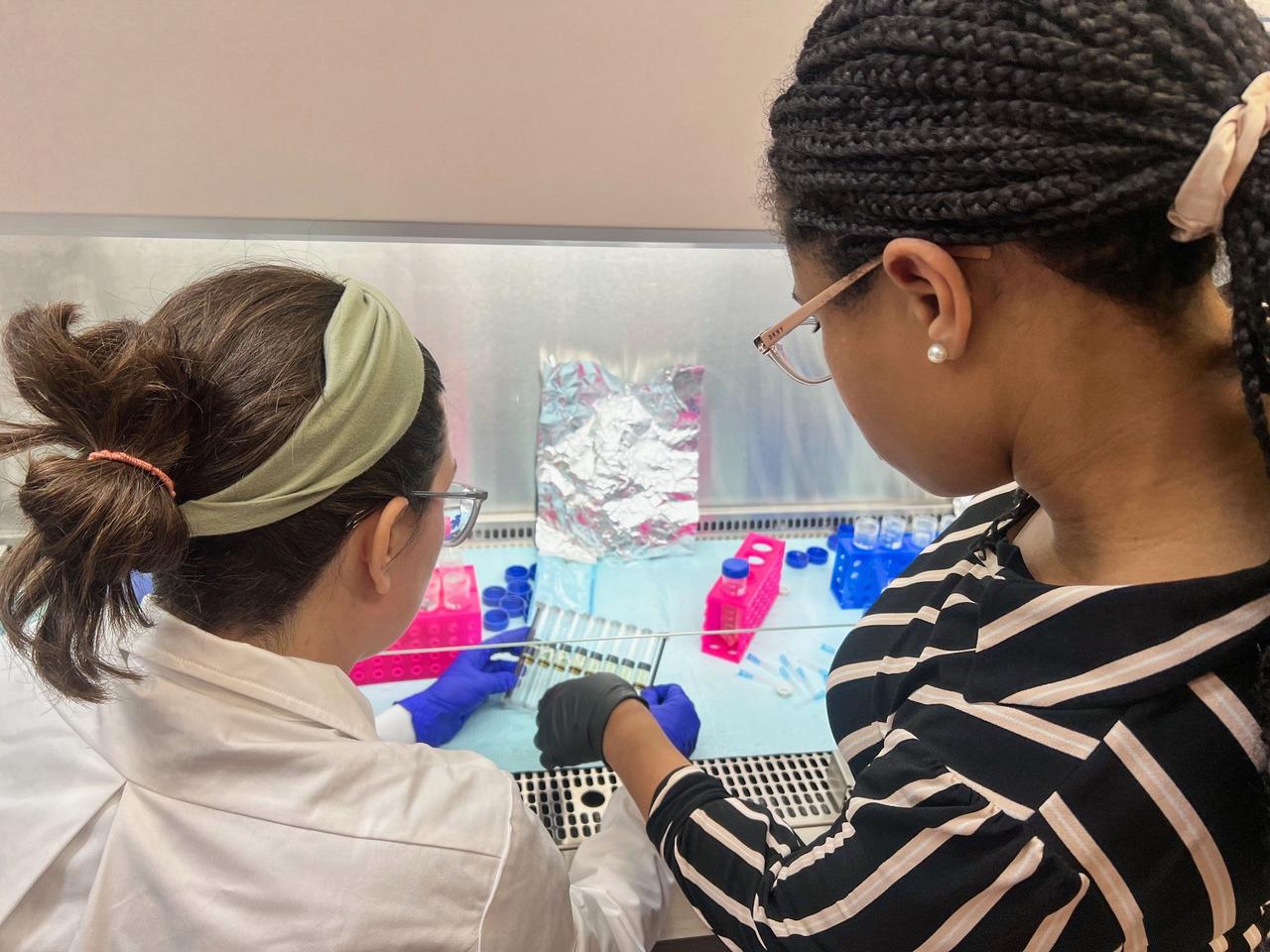
jsc2025e007257 (2/14/2025) --- A view of the Fluid Processing Apparatus (FPAs) used in the Polaris Bioremediation Science Experiment - Genetic Exchange in Microgravity for Biofilm Bioremediation (GEM-B2) investigation. Image courtesy of BioServe.
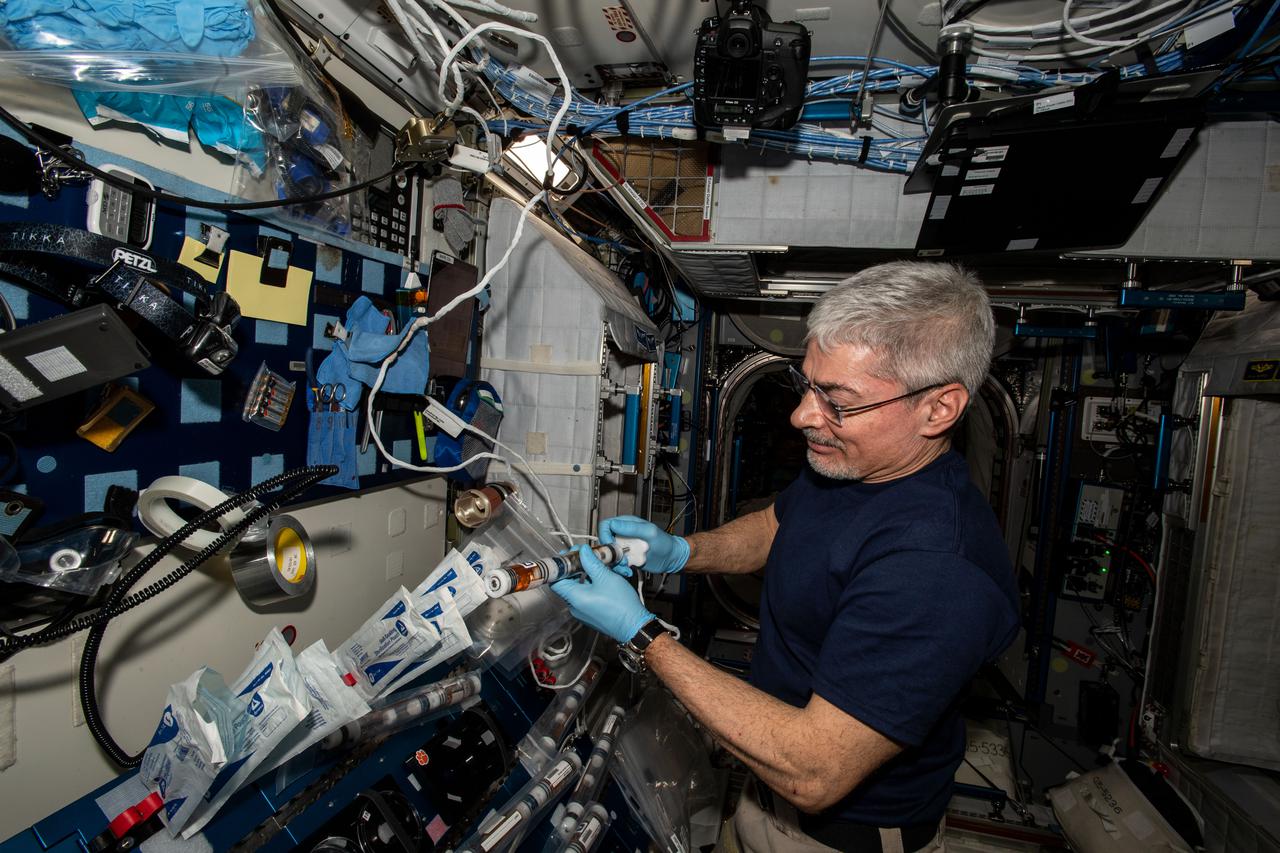
iss066e108544 (Jan. 6, 2022) --- NASA astronaut and Expedition 66 Flight Engineer Mark Vande Hei conducts operations for the Plant Habitat-5 space agriculture experiment that is studying cotton genetics.
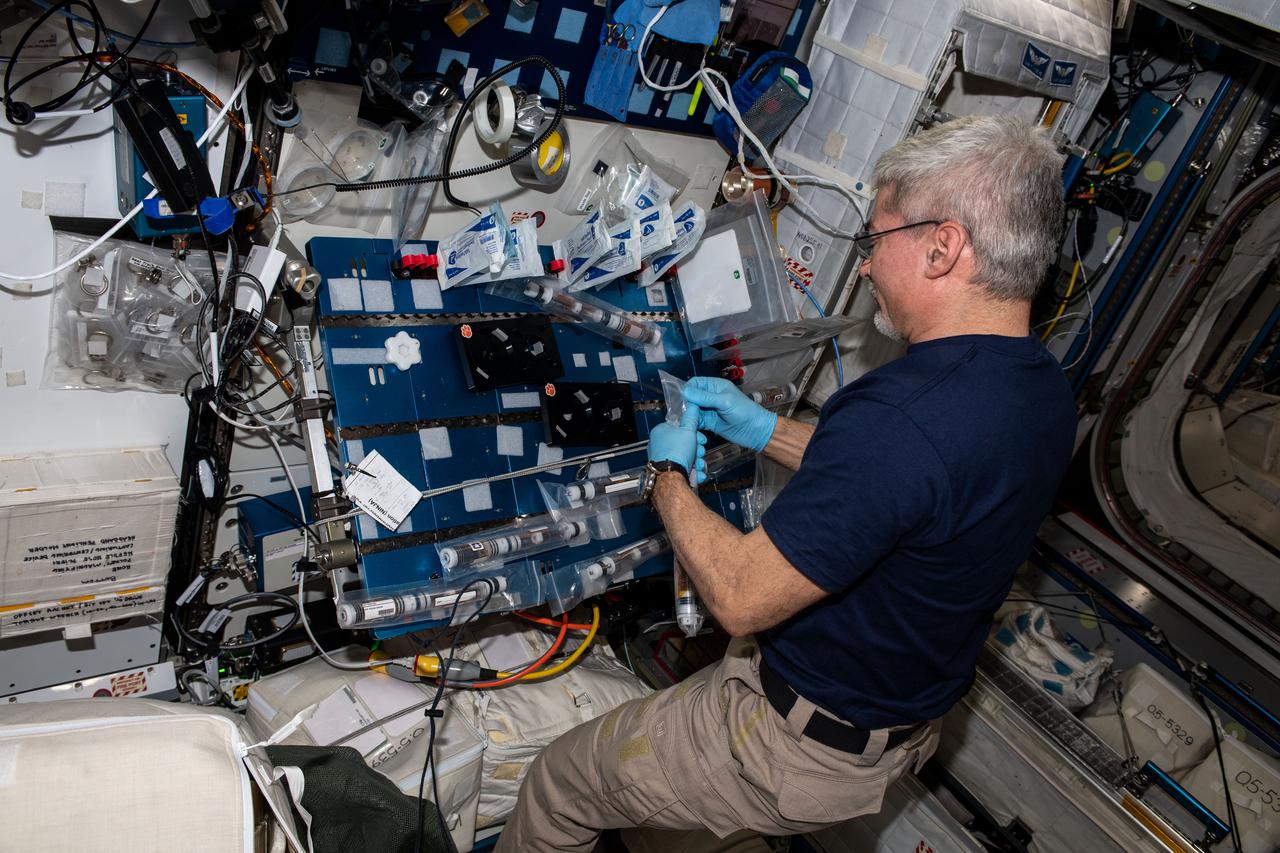
iss066e108295(Jan. 6, 2022) --- NASA astronaut and Expedition 66 Flight Engineer Mark Vande Hei conducts operations for the Plant Habitat-5 space agriculture experiment that is studying cotton genetics.
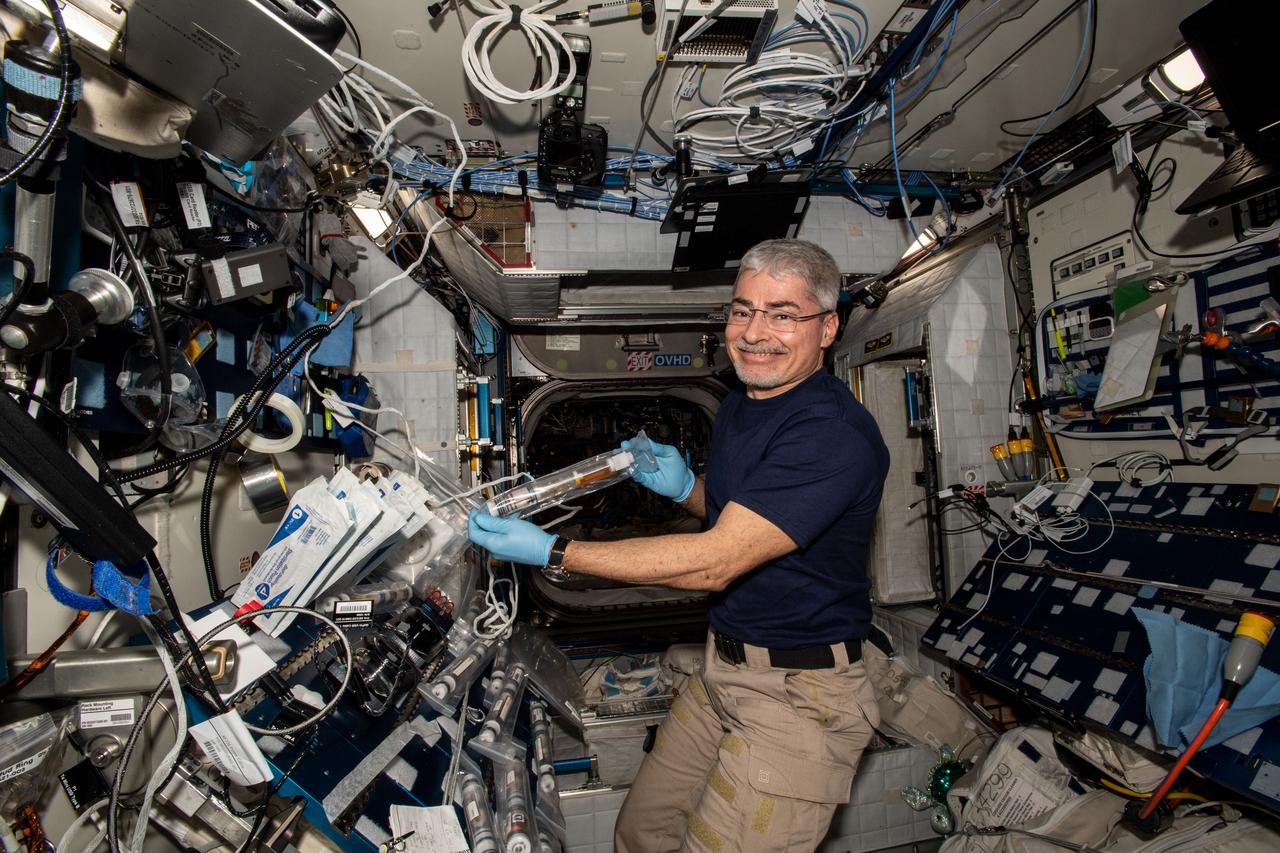
iss066e108552 (Jan. 6, 2022) --- NASA astronaut and Expedition 66 Flight Engineer Mark Vande Hei conducts operations for the Plant Habitat-5 space agriculture experiment that is studying cotton genetics.
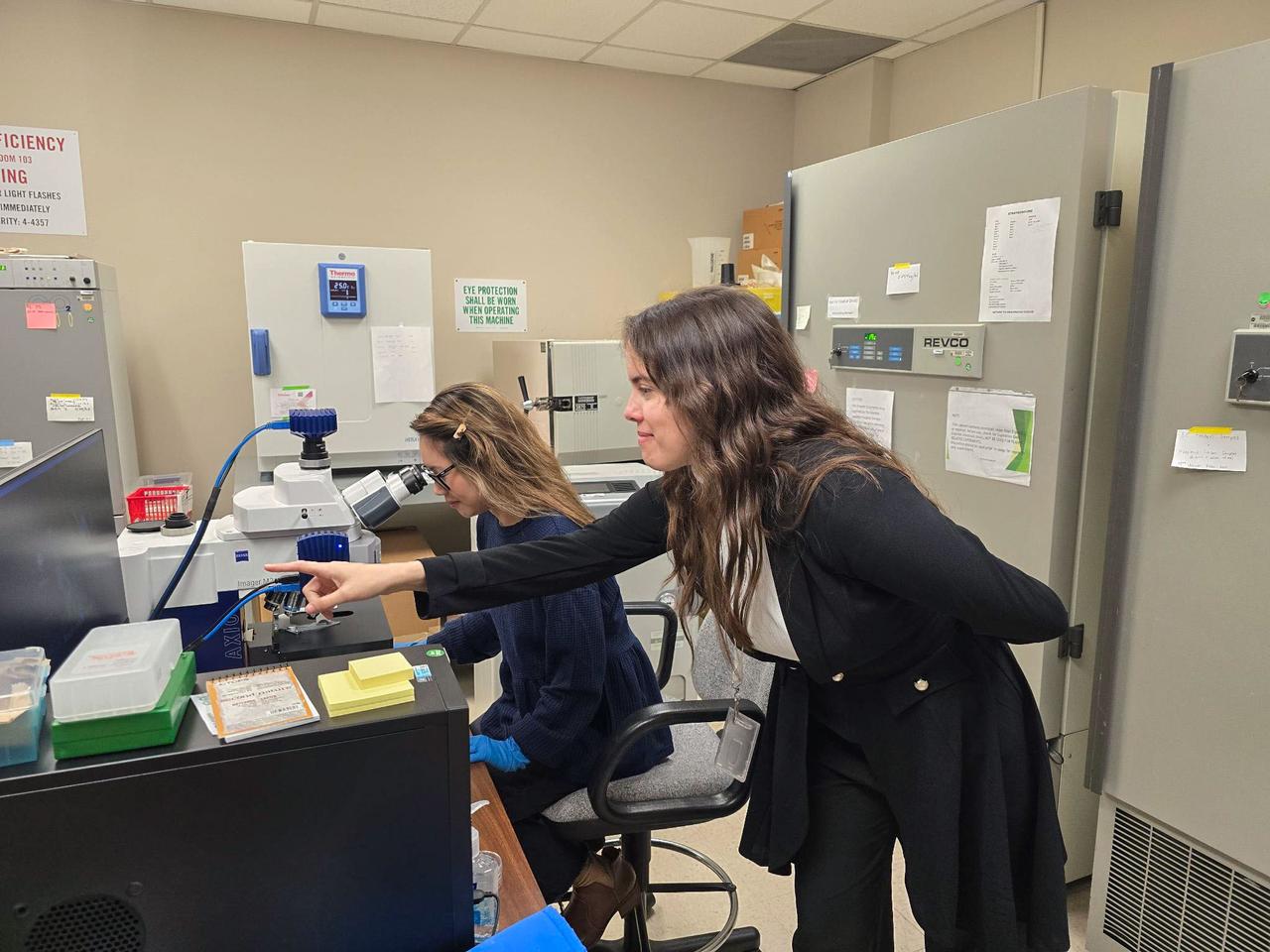
jsc2025e007252 (2/14/2025) --- Dr. Yo-Ann Velez performs microscopy in support of Polaris Bioremediation Science Experiment - Genetic Exchange in Microgravity for Biofilm Bioremediation (GEM-B2).
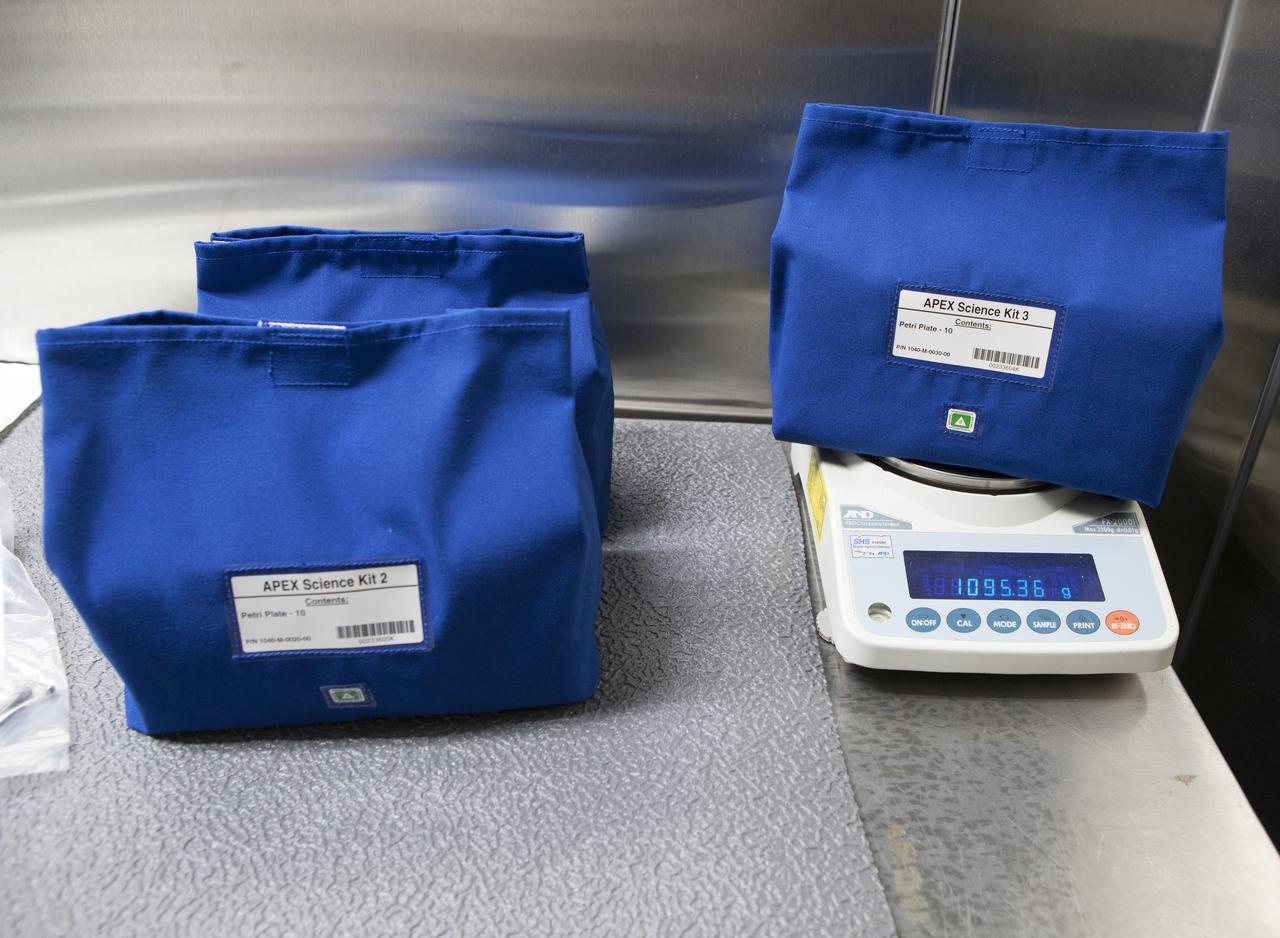
APEX-04, or Advanced Plant EXperiments-04, is being prepared in a cold room in the Kennedy Space Center Processing Facility for SpaceX-10. The three science kits are weighed prior to flight. Dr. Anna Lisa Paul of the University of Florida is the principal investigator for APEX-04. Apex-04 is an experiment involving Arabidopsis in petri plates inside the Veggie facility aboard the International Space Station. Since Arabidopsis is the genetic model of the plant world, it is a perfect sample organism for performing genetic studies in spaceflight. The experiment is the result of a grant from NASA’s Space Life and Physical Sciences division.
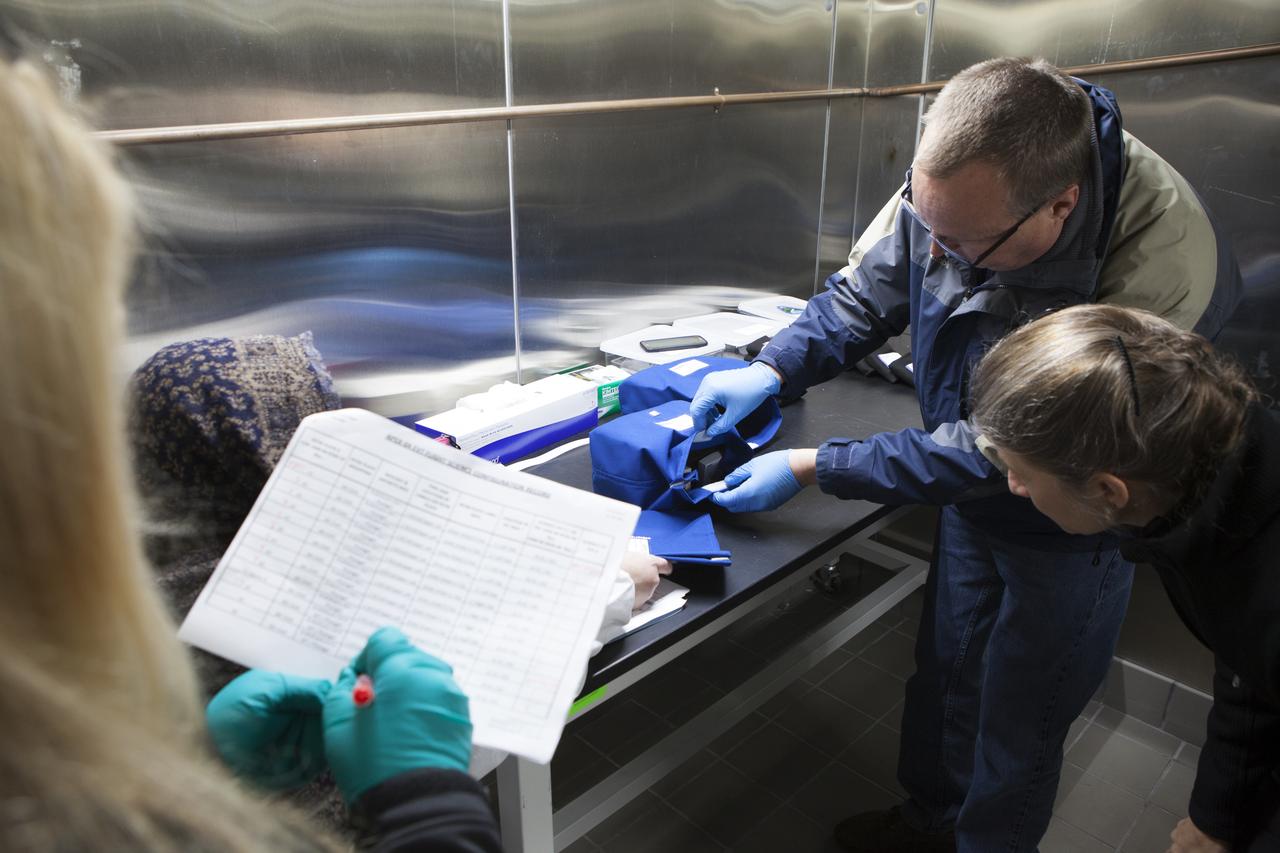
APEX-04, or Advanced Plant EXperiments-04, is being prepared in a cold room in the Kennedy Space Center Processing Facility for SpaceX-10. Shawn Stephens, Engineering Services Contract, and Dr. Anna Lisa Paul confirm proper orientation of the plates for launch prior to turnover to cold stowage. Dr. Paul of the University of Florida is the principal investigator for APEX-04. Apex-04 is an experiment involving Arabidopsis in petri plates inside the Veggie facility aboard the International Space Station. Since Arabidopsis is the genetic model of the plant world, it is a perfect sample organism for performing genetic studies in spaceflight. The experiment is the result of a grant from NASA’s Space Life and Physical Sciences division.

jsc2026e034370 (April 28, 2026) --- Preflight image of Syto9 staining of Staphylococcus aureus biofilm as part of ODYSSEY, an investigation that evaluates biofilm formation and exchange of genetic material among two species of bacteria in spaceflight and in simulated microgravity chambers on the ground. Comparing the results between these sample groups could help researchers determine whether Earth-based simulators can be considered as proxies for spaceflight research and get a better understanding of the mechanisms behind biofilm formation and exchange of genetic material when exposed to space-like conditions. Credit: JPL-Caltech.
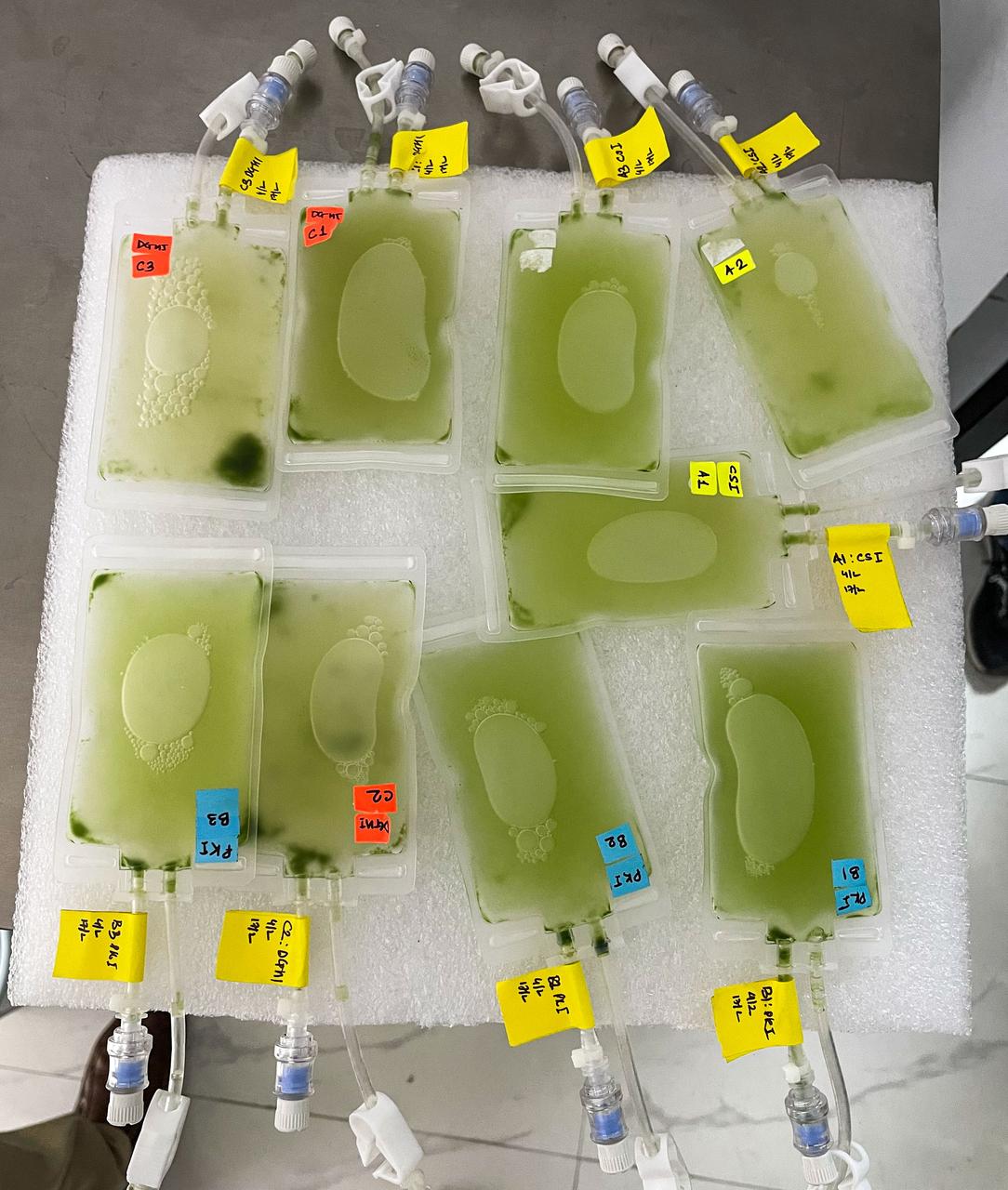
jsc2025e037099 (2/27/2025) --- Cell culture bags are shown filled with microalgae and growth media at the International Centre for Genetic Engineering and Biotechnology (ICGEB). Impact of Microgravity in the ISS on Edible Microalgae (Space Microalgae - ISRO) studies how the environment, microgravity, and increased radiation on the International Space Station affect algae growth and production. Image courtesy of Redwire.Cell culture bags are shown filled with microalgae and growth media at the International Centre for Genetic Engineering and Biotechnology (ICGEB). Impact of Microgravity in the ISS on Edible Microalgae (Space Microalgae - ISRO) studies how the environment, microgravity, and increased radiation on the International Space Station affect algae growth and production. Image courtesy of Redwire.

jsc2026e034367 (April 28, 2026) --- Image of Staphylococcus colonies grown on agar in preparation for ground testing as part of ODYSSEY, an investigation that evaluates biofilm formation and exchange of genetic material among two species of bacteria in spaceflight and in simulated microgravity chambers on the ground. Comparing the results between these sample groups could help researchers determine whether Earth-based simulators can be considered as proxies for spaceflight research and get a better understanding of the mechanisms behind biofilm formation and exchange of genetic material when exposed to space-like conditions. Credit: JPL-Caltech.

jsc2026e034369 (April 28, 2026) --- Image of RubyRed staining of Staphylococcus aureus biofilm obtained with a confocal 3D microscope during preflight testing of ODYSSEY, an investigation that evaluates biofilm formation and exchange of genetic material among two species of bacteria in spaceflight and in simulated microgravity chambers on the ground. Comparing the results between these sample groups could help researchers determine whether Earth-based simulators can be considered as proxies for spaceflight research and get a better understanding of the mechanisms behind biofilm formation and exchange of genetic material when exposed to space-like conditions. Credit: JPL-Caltech.
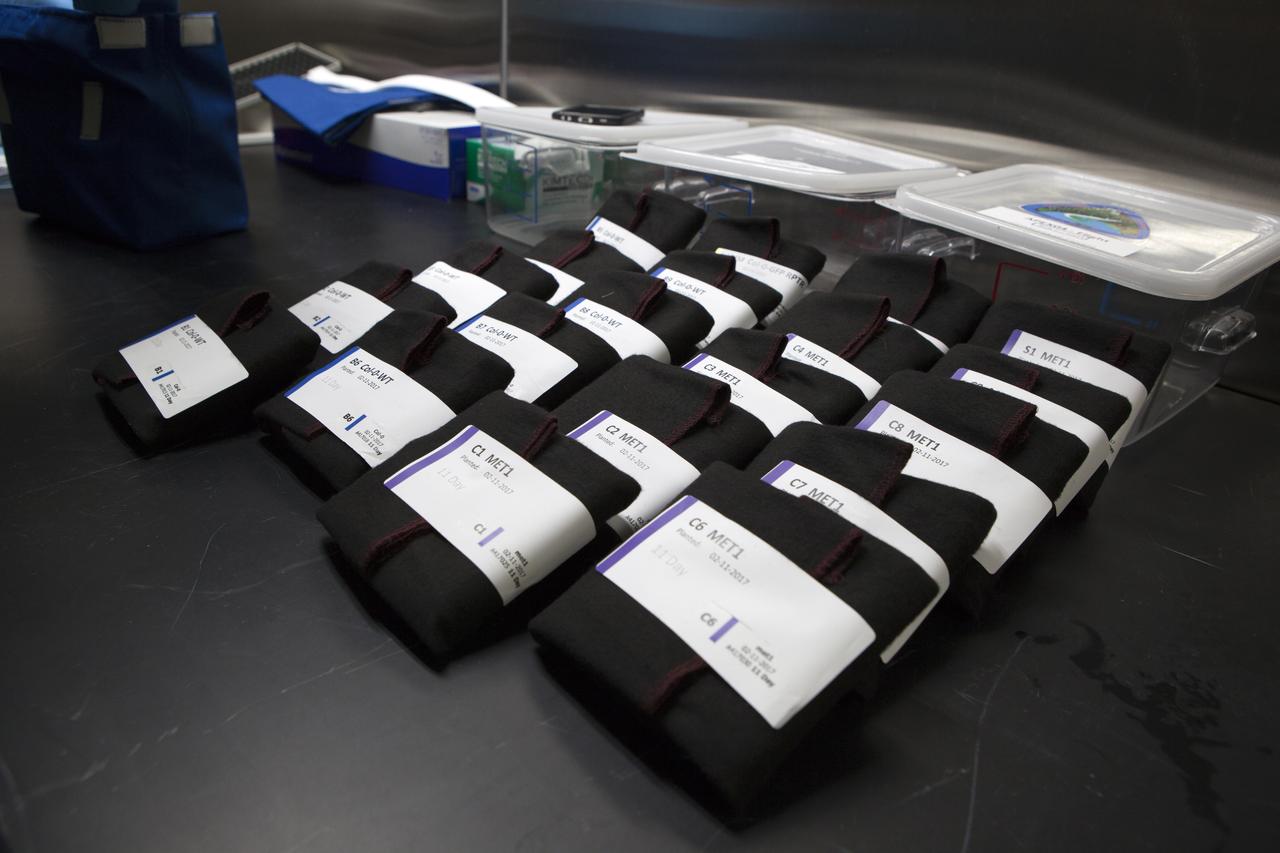
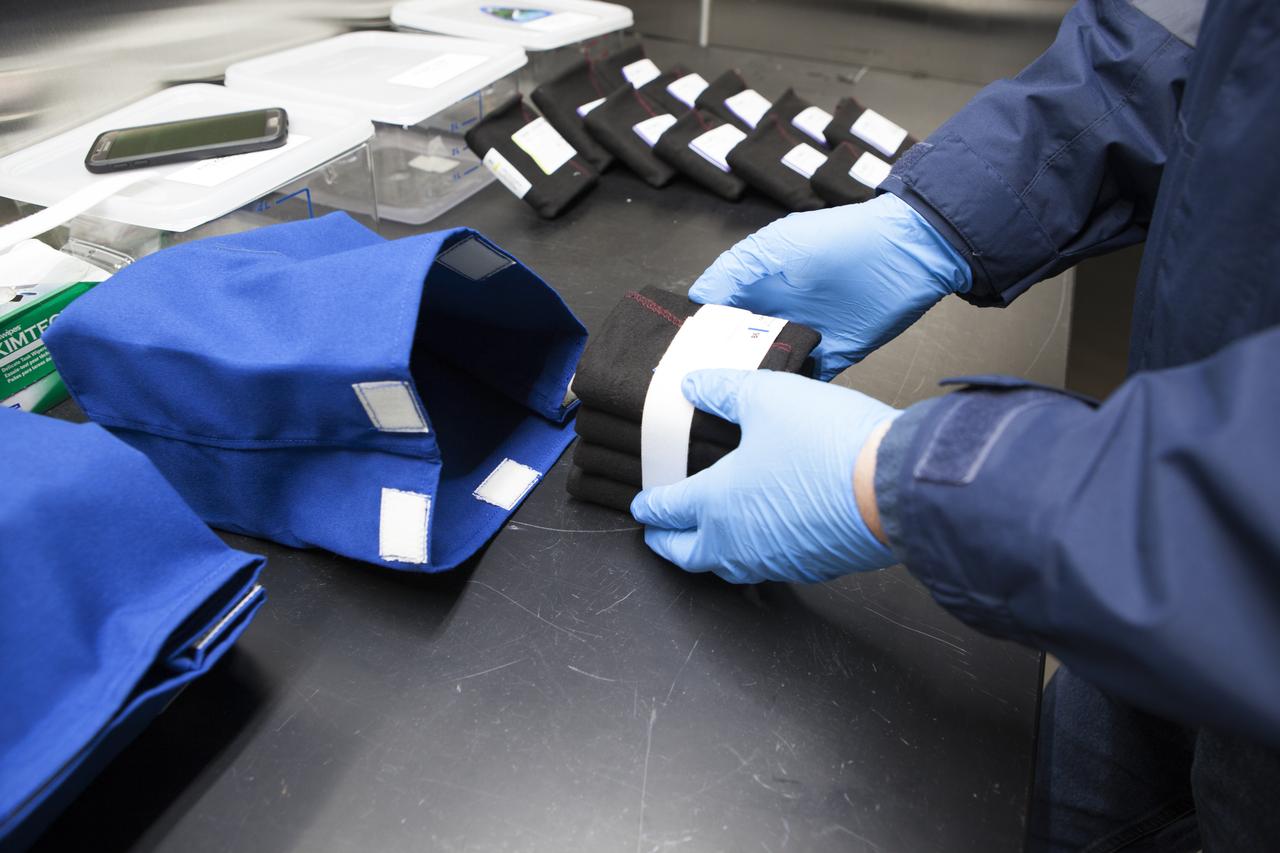
APEX-04, or Advanced Plant EXperiments-04, is being prepared in a cold room in the Kennedy Space Center Processing Facility for SpaceX-10. The petri plates are wrapped in black cloth and kept cold (+4 degrees Celsius) to prevent them from germinating prior to the experiment start on station. Dr. Anna Lisa Paul of the University of Florida is the principal investigator for APEX-04. Apex-04 is an experiment involving Arabidopsis in petri plates inside the Veggie facility aboard the International Space Station. Since Arabidopsis is the genetic model of the plant world, it is a perfect sample organism for performing genetic studies in spaceflight. The experiment is the result of a grant from NASA’s Space Life and Physical Sciences division.
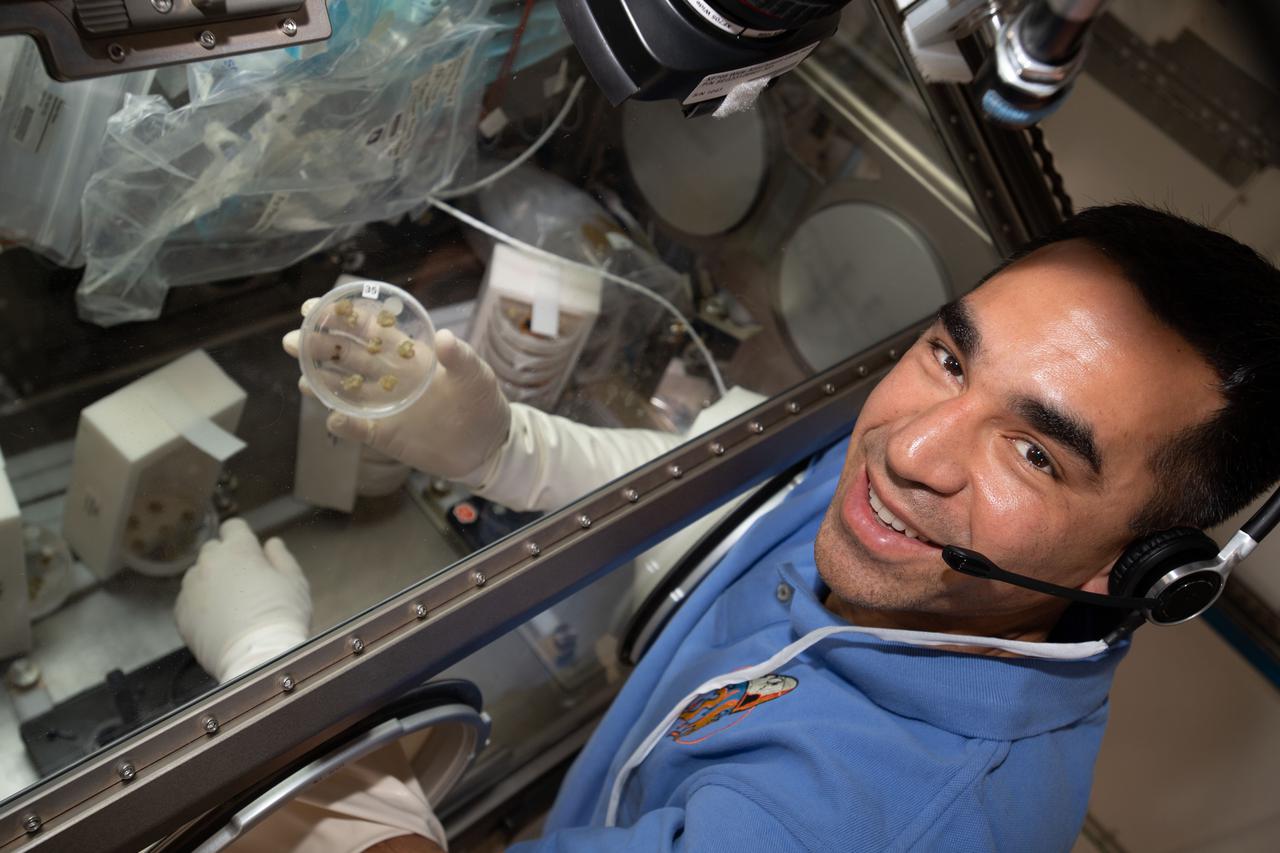
iss066e127275 (Jan. 26, 2022) --- NASA astronaut and Expedition 66 Flight Engineer Raja Chari works inside the Life Science Glovebox and displays cotton cells growing on a petri dish for the Plant Habitat-05 space botany study. The experiment uses the microgravity environment to observe the genetic architecture of plant regeneration.

iss056e097828 (July 23, 2018) --- Arabidopsis plants are pictured before being harvested inside the Plant Habitat-01 housed inside Europe's Columbus laboratory module. The Plant Habitat-01 study seeks to comprehensively compare differences in genetics, metabolism, photosynthesis, and gravity sensing between plants grown in space and on Earth.
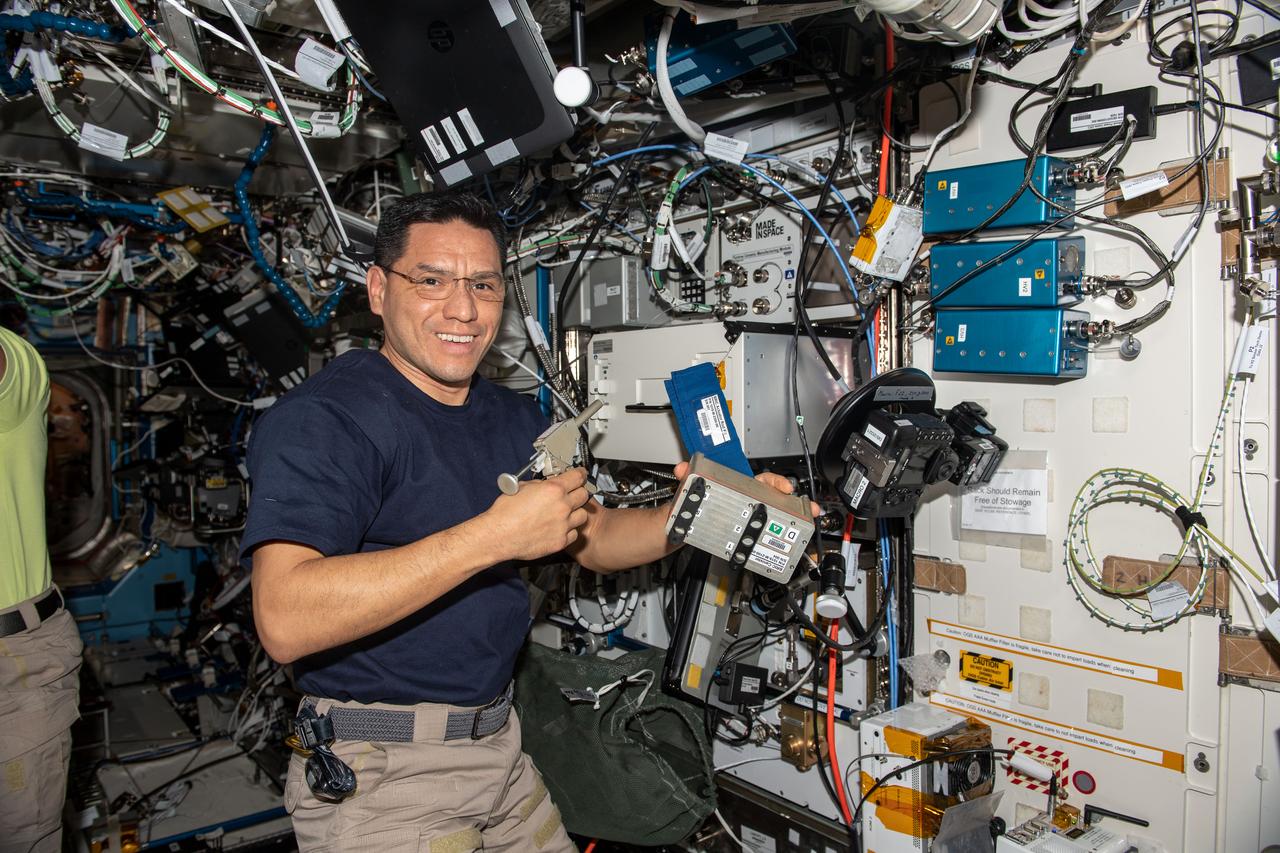
iss068e027511_alt (Dec. 6, 2022) --- NASA astronaut and Expedition 68 Flight Engineer Frank Rubio activates hardware for a space biology experiment that is studying how weightlessness affects genetic expression in microbes to understand bacterial adaptation and protect astronauts.
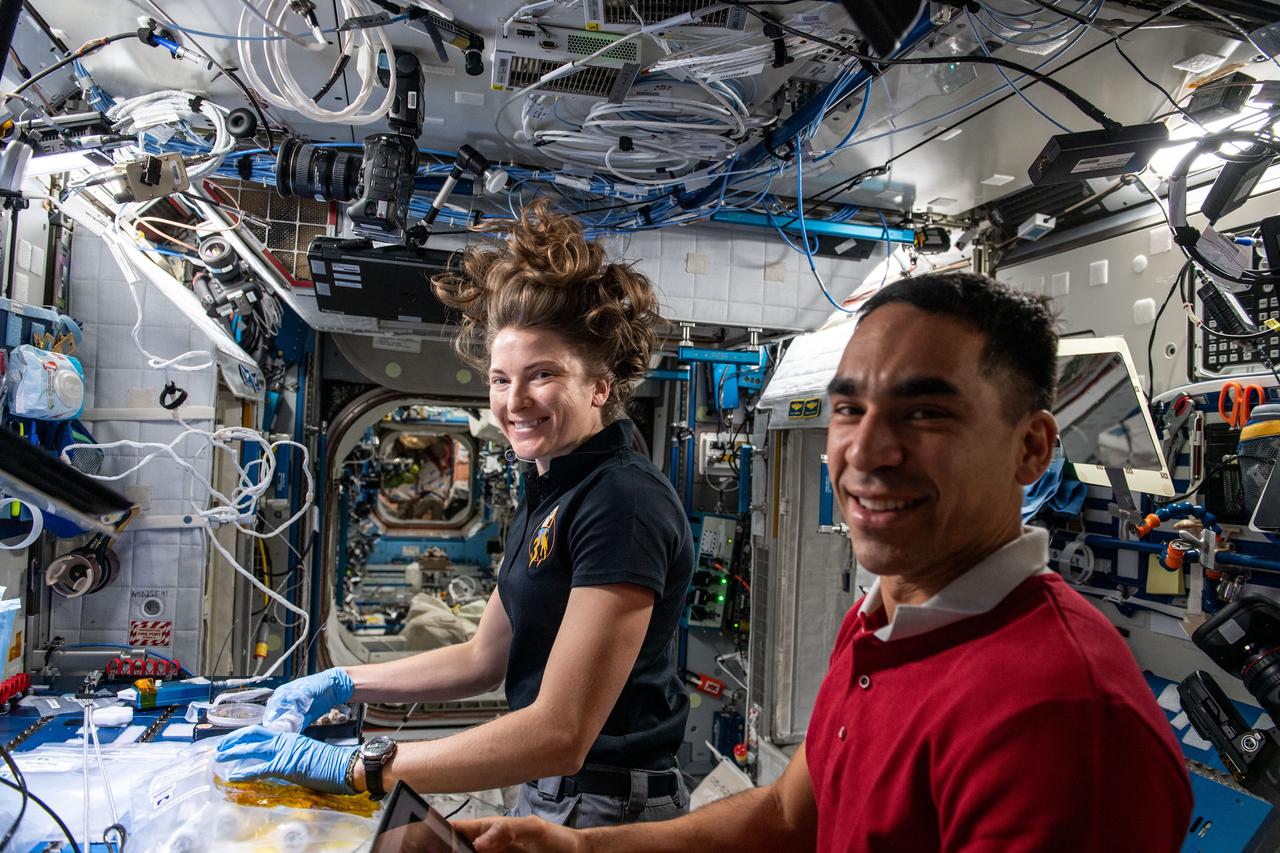
iss066e140558 (Feb. 10, 2022) --- NASA's Expedition 66 Flight Engineers Kayla Barron and Raja Chari harvest cotton cell samples grown for the Plant Habitat-05 space agriculture experiment that is exploring the genetic architecture of plant regeneration.
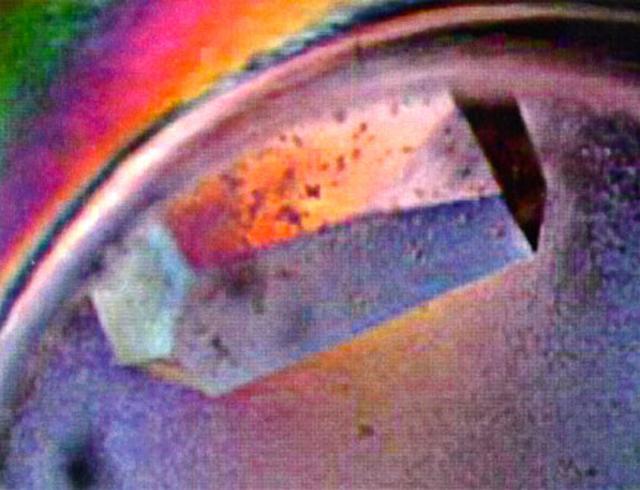
This is a large 2 mm crystal of histone octamer, grown on STS-81. A very dynamic structure which functions in many aspects of gene regulation from control of gene activity to the more subtle mechanisms of genetic imprinting. Principle Investigator is Dan Carter of New Century Pharmaceuticals.
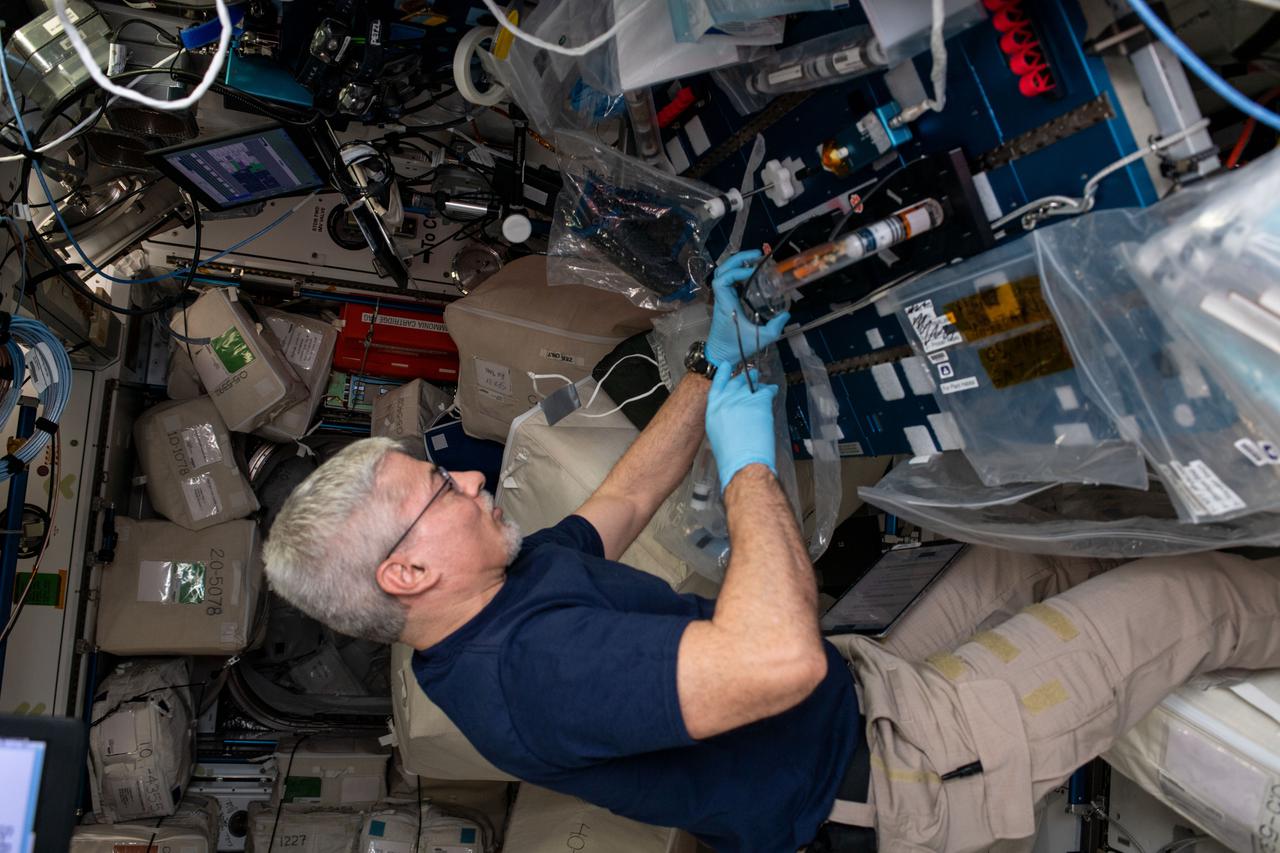
iss066e110821 (Jan. 11, 2022) --- NASA astronaut and Expedition 66 Flight Engineer Mark Vande Hei performs research operations for the Plant Habitat-05 space botany experiment that observes cotton cultures grown on the International Space Station to understand how weightlessness affects plant genetics.
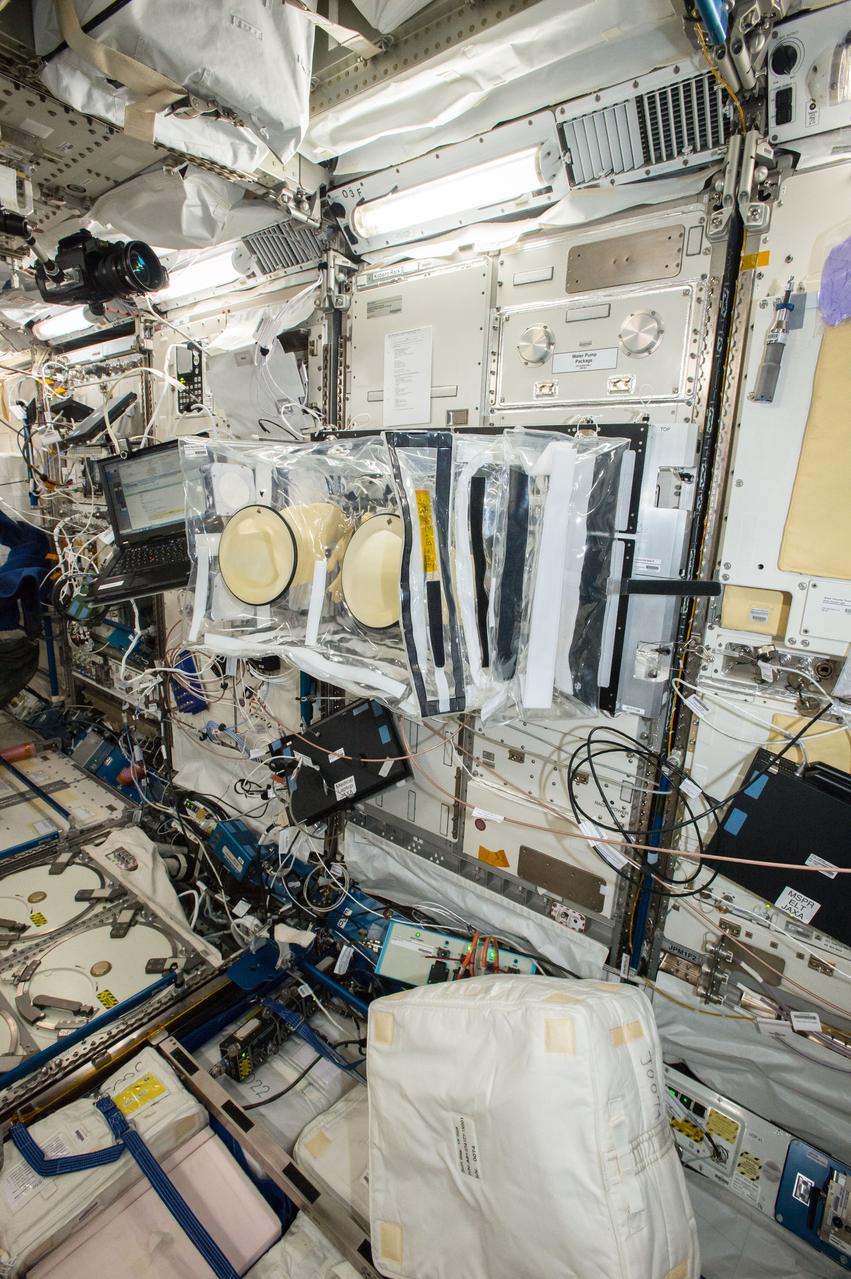
iss048e042371 (Jul. 21, 2016) --- Glove Box set up on the Kobairo Rack for the Mouse Epigenetics experiment in the Kibo Japanese Experiment Pressurized Module (JPM). The Mouse Epigenetics experiment studies the effects of the space environment on genetic activity, which can be used as a proxy for understanding how the human body changes in space.
iss066e110211 (Jan. 10, 2022) --- NASA astronaut and Expedition 66 Flight Engineer Mark Vande Hei harvests plants grown on petri plates for the APEX-07 (Advanced Plant Experiments) space botany study that is exploring how microgravity affects genetic expression in plants.
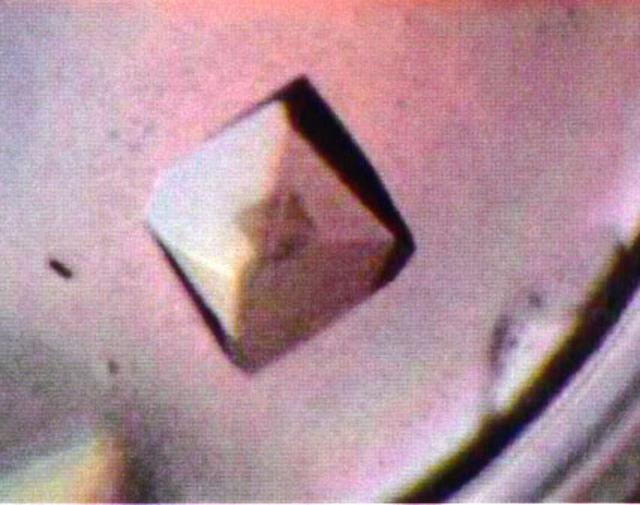
1 mm histone octamer crystal grown on STS-81. A very dynamic structure which functions in many aspects of gene regulation from control of gene activity to the more subtle mechanisms of genetic imprinting. Principle Investigator is Dan Carter of New Century Pharmaceuticals.
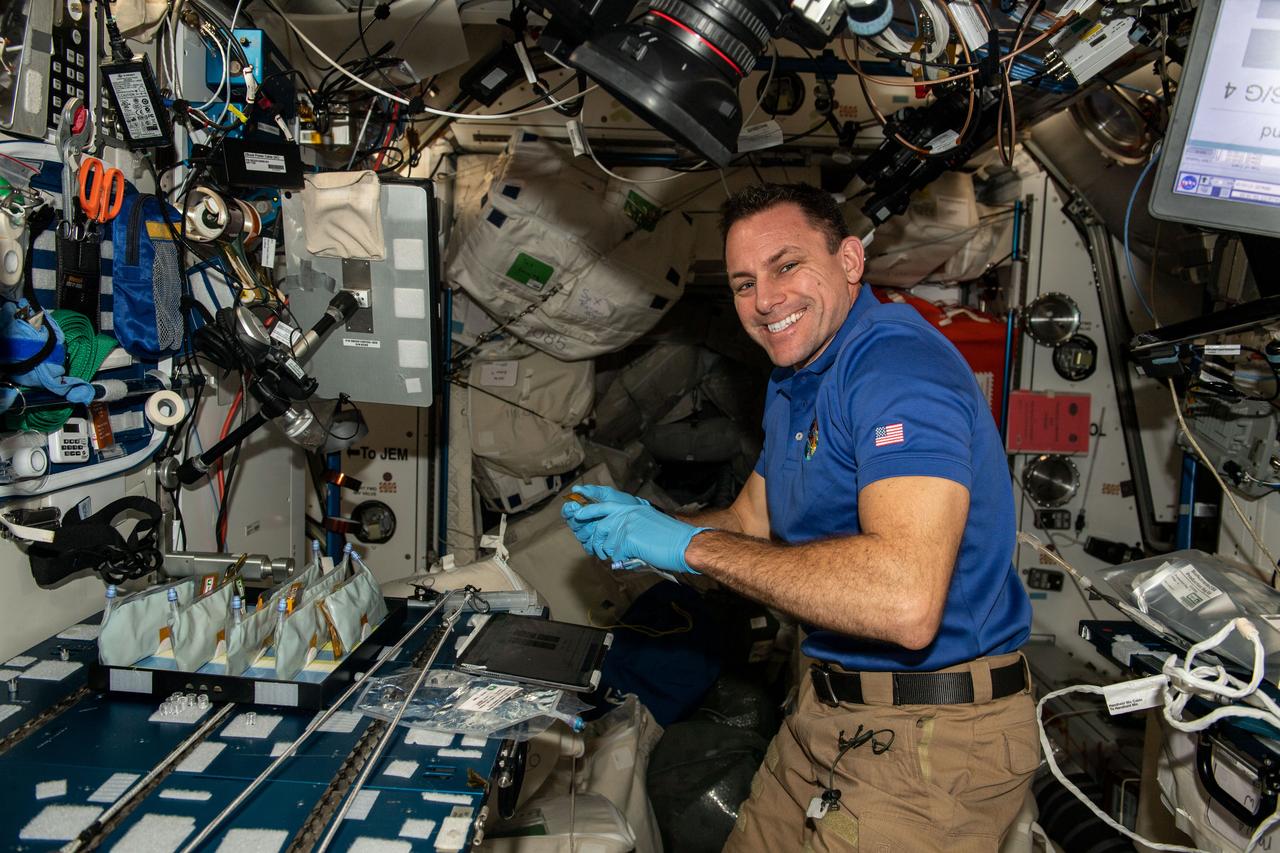
iss068e036904 (Jan. 4, 2022) --- NASA astronaut and Expedition 68 Flight Engineer Josh Cassada works in the International Space Station's Harmony module on the BioNutrients-2 investigation that uses genetically engineered microbes to provide nutrients, and potentially other compounds and pharmaceuticals, on demand in space.
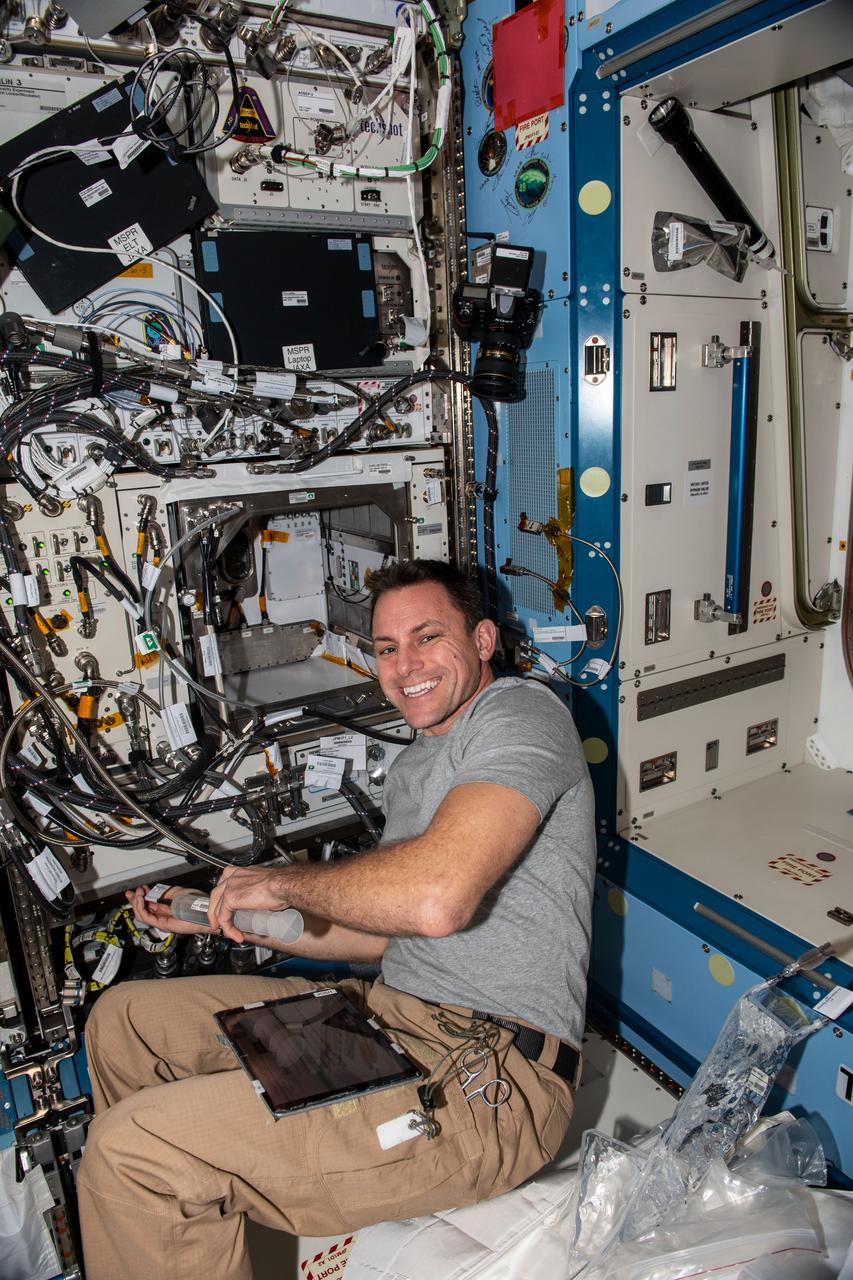
iss068e029941 (Dec. 15, 2022) --- NASA astronaut and Expedition 68 Flight Engineer Josh Cassada works in the Kibo laboratory module filling water reservoirs on the Pant Habitat for a space botany study exploring the genetic changes plants may go through when adapting to microgravity.
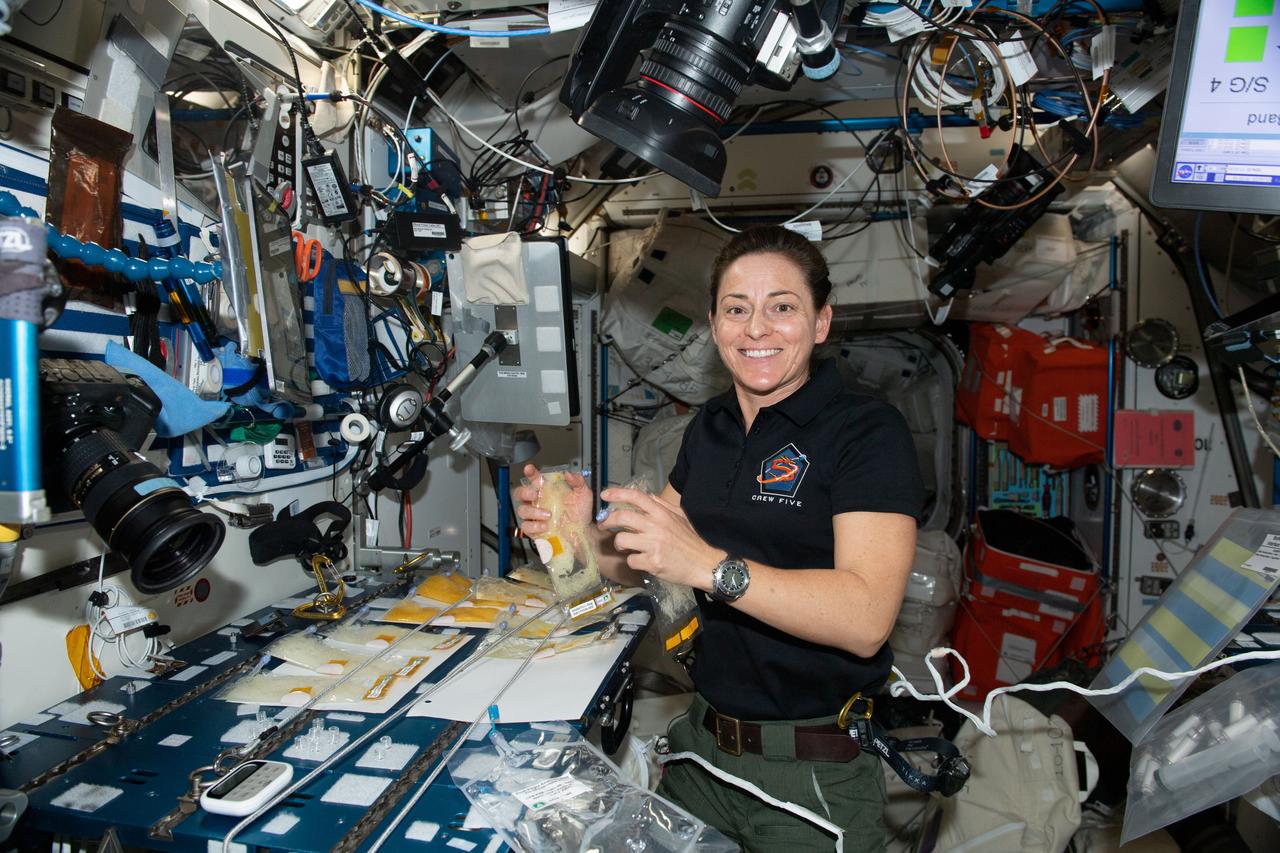
iss068e036727 (Jan. 3, 2023) --- NASA astronaut and Expedition 68 Flight Engineer Nicole Mann works in the International Space Station's Harmony module on the BioNutrients-2 investigation that uses genetically engineered microbes to provide nutrients, and potentially other compounds and pharmaceuticals, on demand in space.
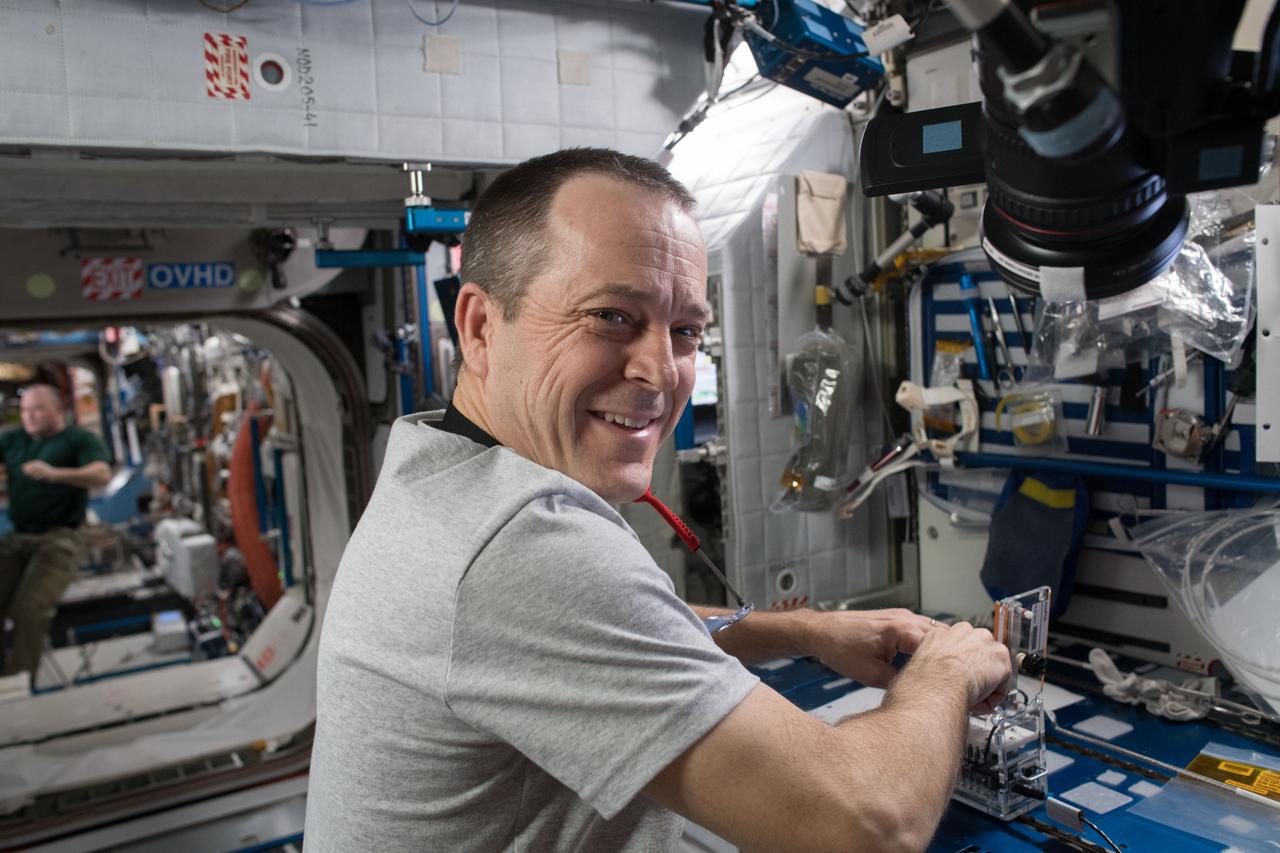
iss055e016051 (April 11, 2018) --- NASA astronaut and Flight Engineer Ricky Arnold works with the student-designed Genes in Space-5 experiment inside the Harmony module. The genetic research is helping scientists understand the relationship between DNA alterations and weakened immune systems possibly caused by living in space.
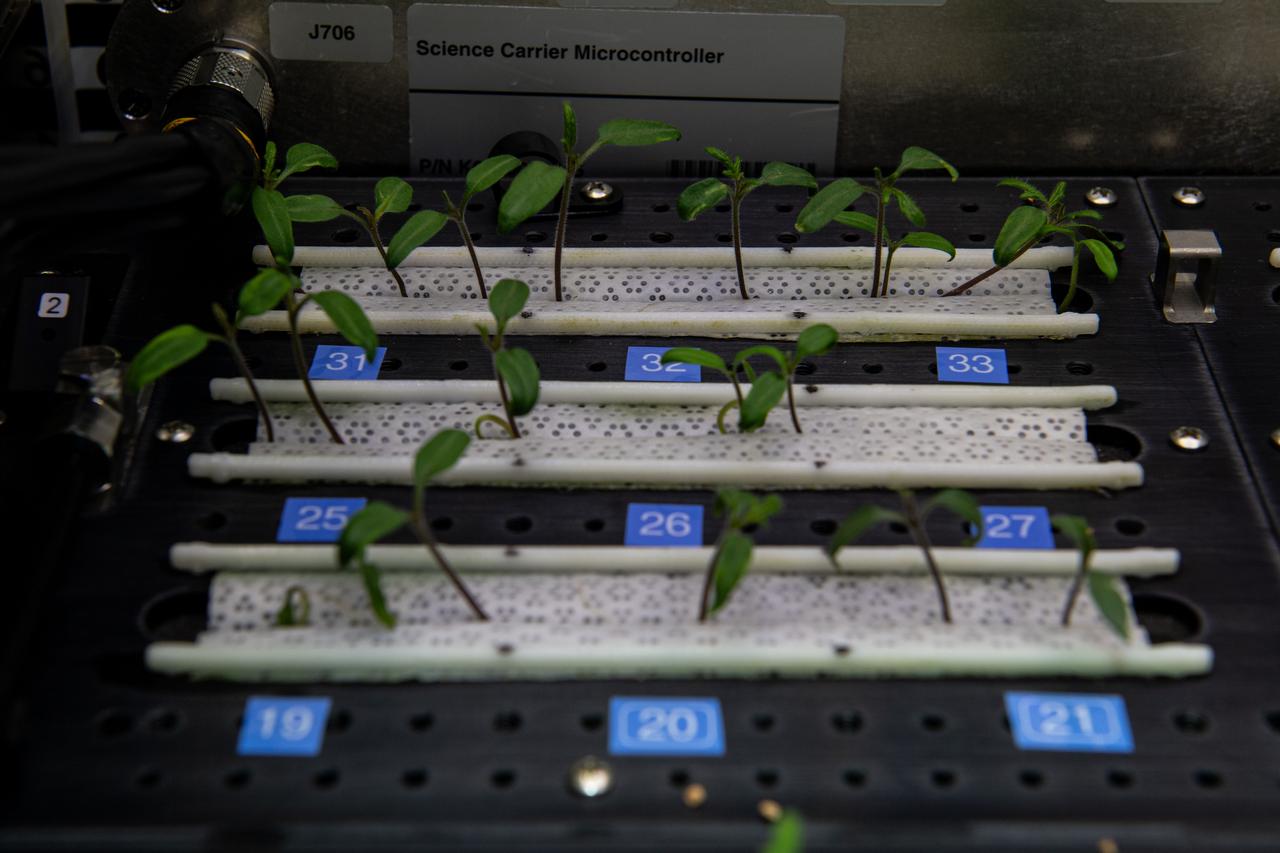
iss070e064263 (Jan. 12, 2024) -- Inside the Plant Habitat-06 facility, the early stages of seedling growth of wild-type tomatoes is visible. This specific investigation takes a look at the physiological and genetic responses to defense activation in wild-type and immune-deficient tomatoes during spaceflight.
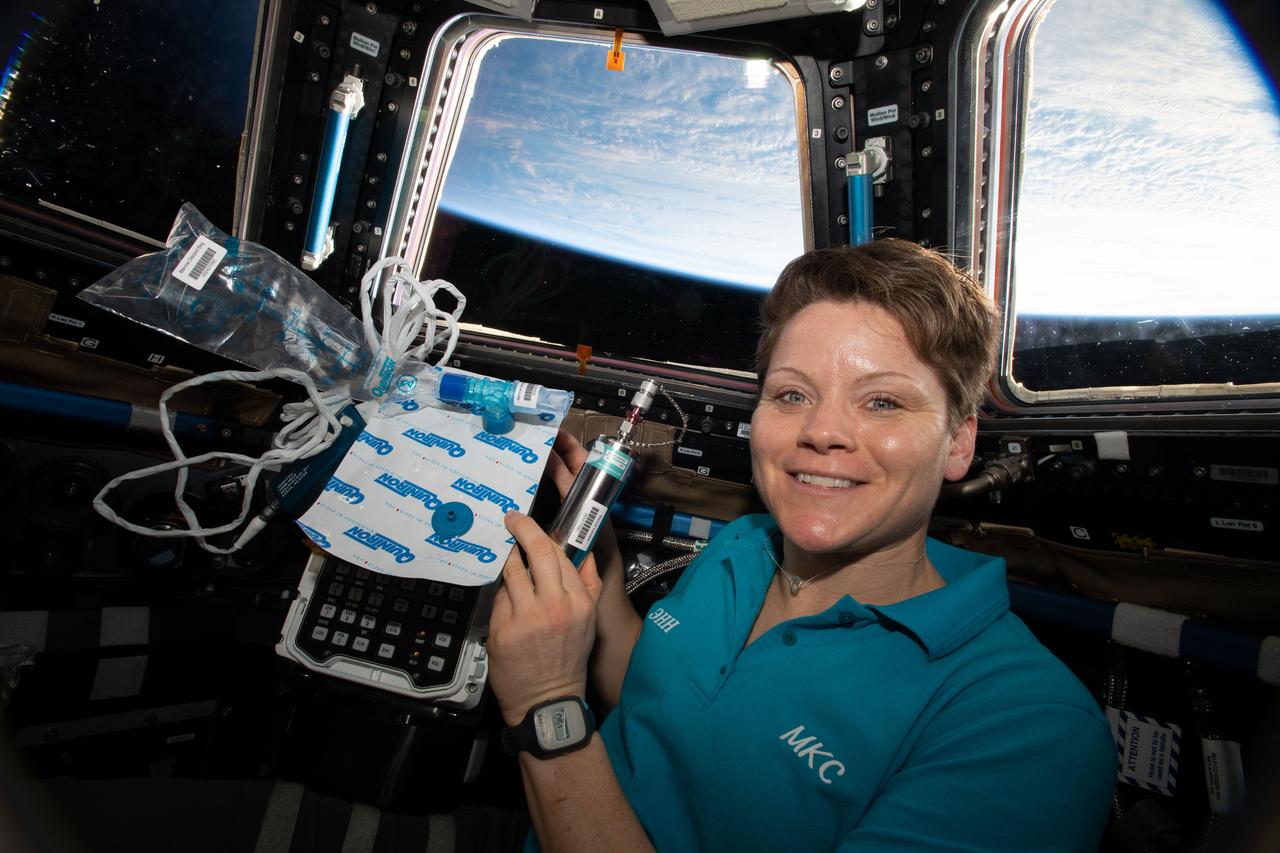
iss058e010750 (Feb. 6, 2019) --- Expedition 58 Flight Engineer Anne McClain of NASA is pictured in the cupola holding biomedical gear for the Marrow experiment. The study measures fat changes in the bone marrow before, and after exposure to microgravity. In addition, this investigation measures specific changes of red and white blood cell functions. Bone marrow fat is measured using magnetic resonance. Red blood cell function is measured with a breath sample analyzed with a gas chromatograph, and white blood cell function is studied through their genetic expression.
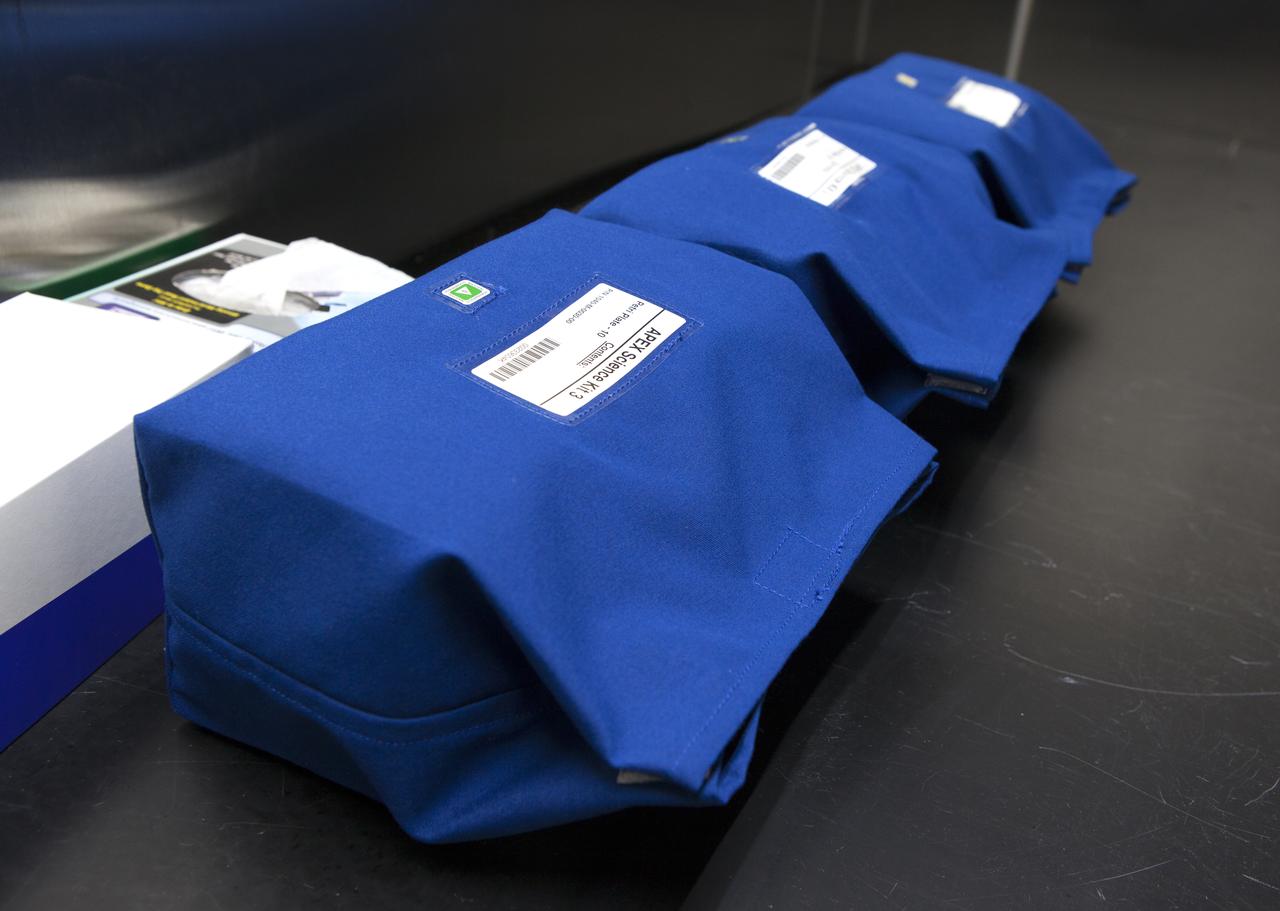
APEX-04, or Advanced Plant EXperiments-04, is being prepared in a cold room in the Kennedy Space Center Processing Facility for SpaceX-10. The 30 petri plates are bundled into groups of 10 and placed into one of three science kits. The science kits allow easy handling when the crew removes the plates from cold stowage on station. Dr. Anna Lisa Paul of the University of Florida is the principal investigator for APEX-04. Apex-04 is an experiment involving Arabidopsis in petri plates inside the Veggie facility aboard the International Space Station. Since Arabidopsis is the genetic model of the plant world, it is a perfect sample organism for performing genetic studies in spaceflight. The experiment is the result of a grant from NASA’s Space Life and Physical Sciences division.
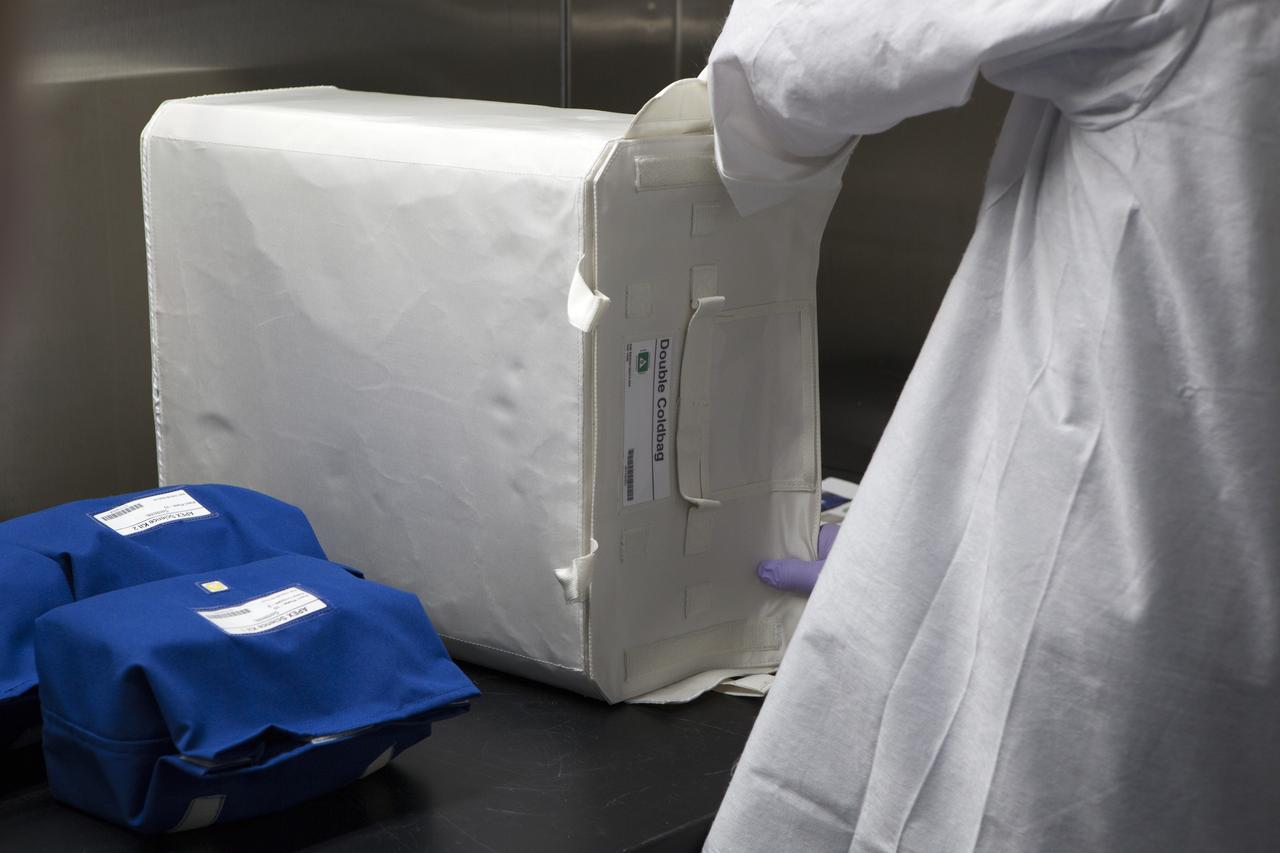
APEX-04, or Advanced Plant EXperiments-04, is being prepared in a cold room in the Kennedy Space Center Processing Facility for SpaceX-10. Eric Morris from the cold stowage group places the APEX-04 science kits into the Double Cold Bag (DCB), which is a non-powered container that keeps the APEX petri plates at +4 degrees Celsius during launch and ascent. The cold bricks in the lower right of the photo are placed in the DCB prior to closure. Dr. Anna Lisa Paul of the University of Florida is the principal investigator for APEX-04. Apex-04 is an experiment involving Arabidopsis in petri plates inside the Veggie facility aboard the International Space Station. Since Arabidopsis is the genetic model of the plant world, it is a perfect sample organism for performing genetic studies in spaceflight. The experiment is the result of a grant from NASA’s Space Life and Physical Sciences division.
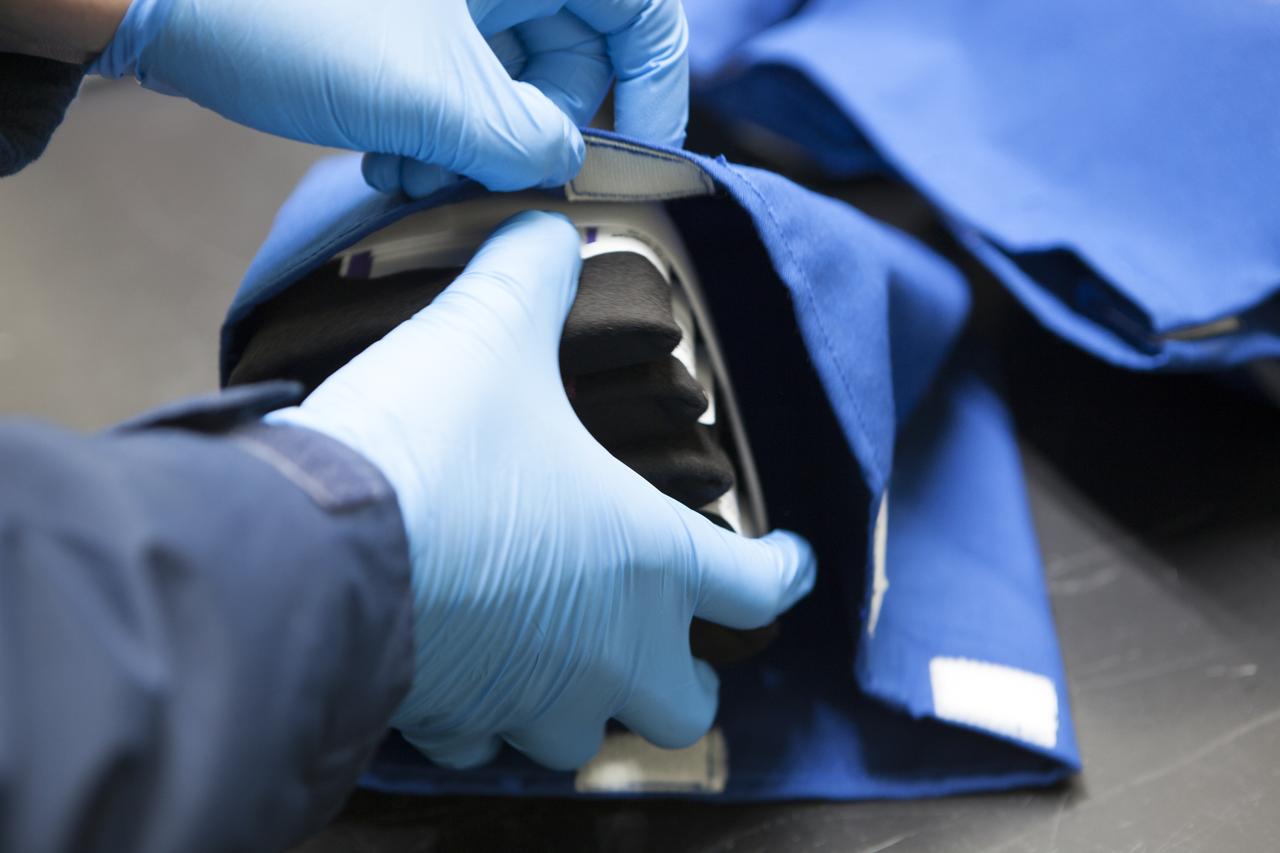
APEX-04, or Advanced Plant EXperiments-04, is being prepared in a cold room in the Kennedy Space Center Processing Facility for SpaceX-10. The 30 petri plates are bundled into groups of 10 and placed into one of three science kits. The science kits allow easy handling when the crew removes the plates from cold stowage on station. Dr. Anna Lisa Paul of the University of Florida is the principal investigator for APEX-04. Apex-04 is an experiment involving Arabidopsis in petri plates inside the Veggie facility aboard the International Space Station. Since Arabidopsis is the genetic model of the plant world, it is a perfect sample organism for performing genetic studies in spaceflight. The experiment is the result of a grant from NASA’s Space Life and Physical Sciences division.
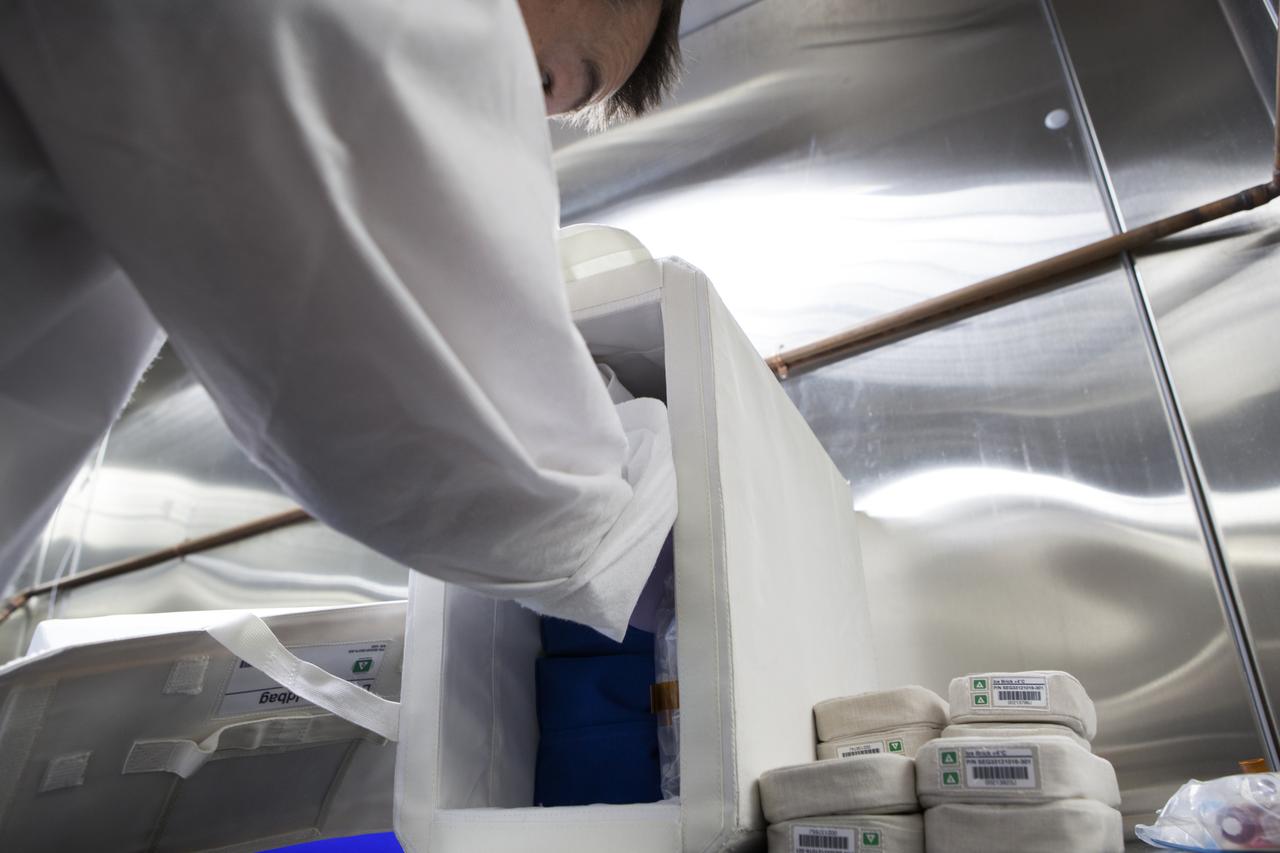
APEX-04, or Advanced Plant EXperiments-04, is being prepared in a cold room in the Kennedy Space Center Processing Facility for SpaceX-10. Eric Morris from the cold stowage group fits items into the Double Cold Bag (DCB) which is a non-powered container that keeps the APEX petri plates at +4 degrees Celsius during launch and ascent.. Dr. Anna Lisa Paul of the University of Florida is the principal investigator for APEX-04. Apex-04 is an experiment involving Arabidopsis in petri plates inside the Veggie facility aboard the International Space Station. Since Arabidopsis is the genetic model of the plant world, it is a perfect sample organism for performing genetic studies in spaceflight. The experiment is the result of a grant from NASA’s Space Life and Physical Sciences division.
APEX-04, or Advanced Plant EXperiments-04, is being prepared in a cold room in the Kennedy Space Center Processing Facility for SpaceX-10. The 30 petri plates are bundled into groups of 10 and placed into one of three science kits. The science kits allow easy handling when the crew removes the plates from cold stowage on station. Dr. Anna Lisa Paul of the University of Florida is the principal investigator for APEX-04. Apex-04 is an experiment involving Arabidopsis in petri plates inside the Veggie facility aboard the International Space Station. Since Arabidopsis is the genetic model of the plant world, it is a perfect sample organism for performing genetic studies in spaceflight. The experiment is the result of a grant from NASA’s Space Life and Physical Sciences division.
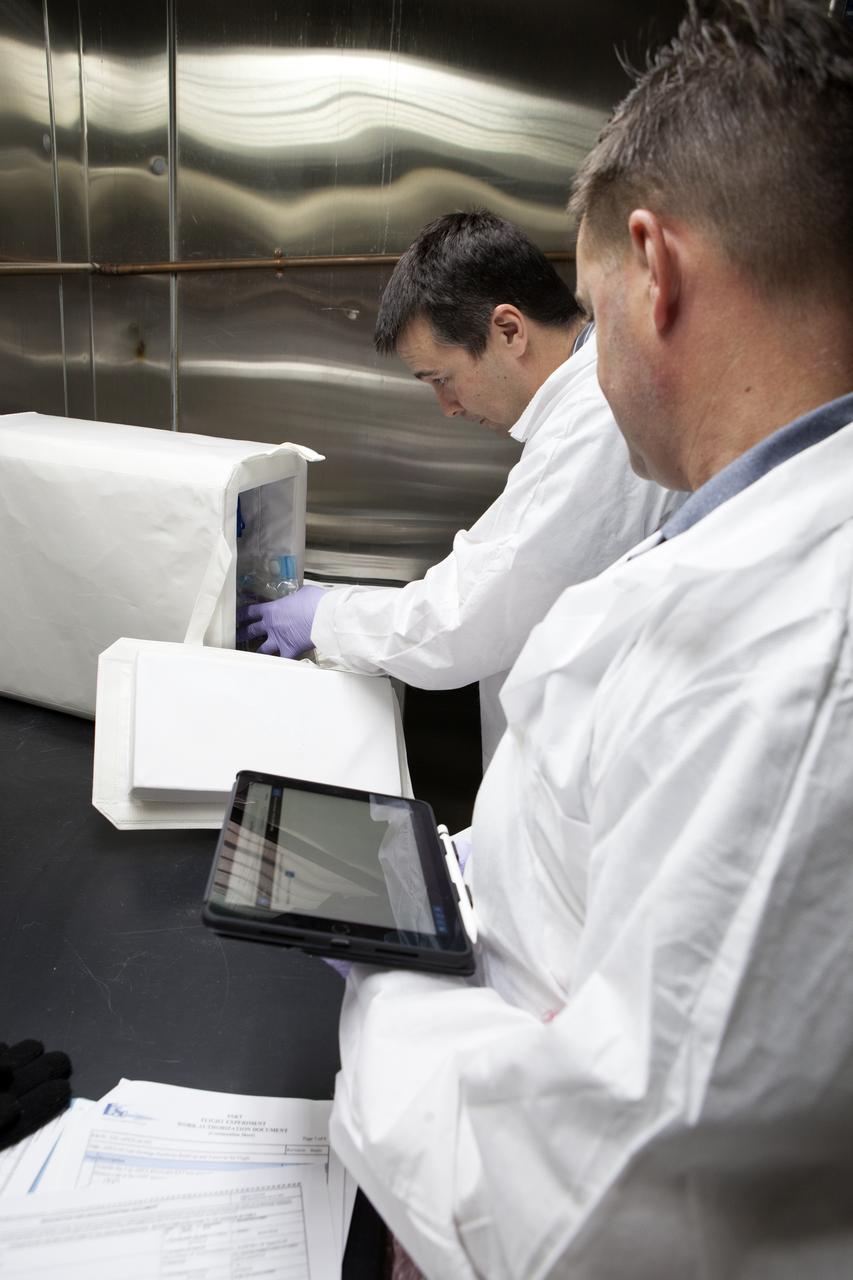
APEX-04, or Advanced Plant EXperiments-04, is being prepared in a cold room in the Kennedy Space Center Processing Facility for SpaceX-10. Eric Morris from the cold stowage group fits items into the Double Cold Bag (DCB) which is a non-powered container that keeps the APEX petri plates at +4 degrees Celsius during launch and ascent.. Dr. Anna Lisa Paul of the University of Florida is the principal investigator for APEX-04. Apex-04 is an experiment involving Arabidopsis in petri plates inside the Veggie facility aboard the International Space Station. Since Arabidopsis is the genetic model of the plant world, it is a perfect sample organism for performing genetic studies in spaceflight. The experiment is the result of a grant from NASA’s Space Life and Physical Sciences division.

jsc2026e034368 (April 28, 2026) --- Preflight image of ODYSSEY flight hardware containing cultures of donor and recipient strains for horizontal gene transfer testing. Strains sit in separate compartments prior to incubation, at which time both strains are mixed and form a co-culture. ODYSSEY evaluates biofilm formation and exchange of genetic material among two species of bacteria in spaceflight and in simulated microgravity chambers on the ground. Comparing the results between these sample groups could help researchers determine whether Earth-based simulators can be considered as proxies for spaceflight research and get a better understanding of the mechanisms behind biofilm formation and exchange of genetic material when exposed to space-like conditions. Credit: JPL-Caltech.
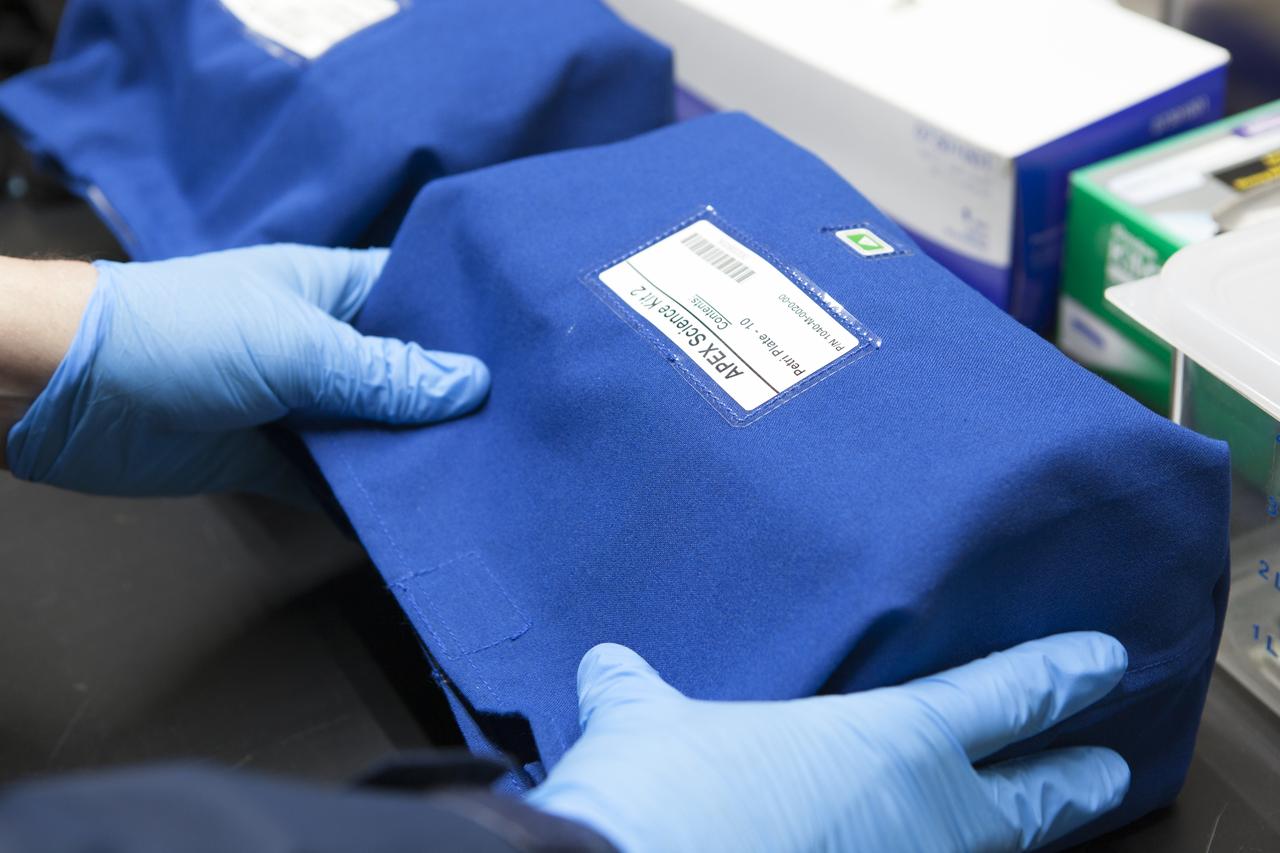
APEX-04, or Advanced Plant EXperiments-04, is being prepared in a cold room in the Kennedy Space Center Processing Facility for SpaceX-10. The 30 petri plates are bundled into groups of 10 and placed into one of three science kits. The science kits allow easy handling when the crew removes the plates from cold stowage on station. Dr. Anna Lisa Paul of the University of Florida is the principal investigator for APEX-04. Apex-04 is an experiment involving Arabidopsis in petri plates inside the Veggie facility aboard the International Space Station. Since Arabidopsis is the genetic model of the plant world, it is a perfect sample organism for performing genetic studies in spaceflight. The experiment is the result of a grant from NASA’s Space Life and Physical Sciences division.
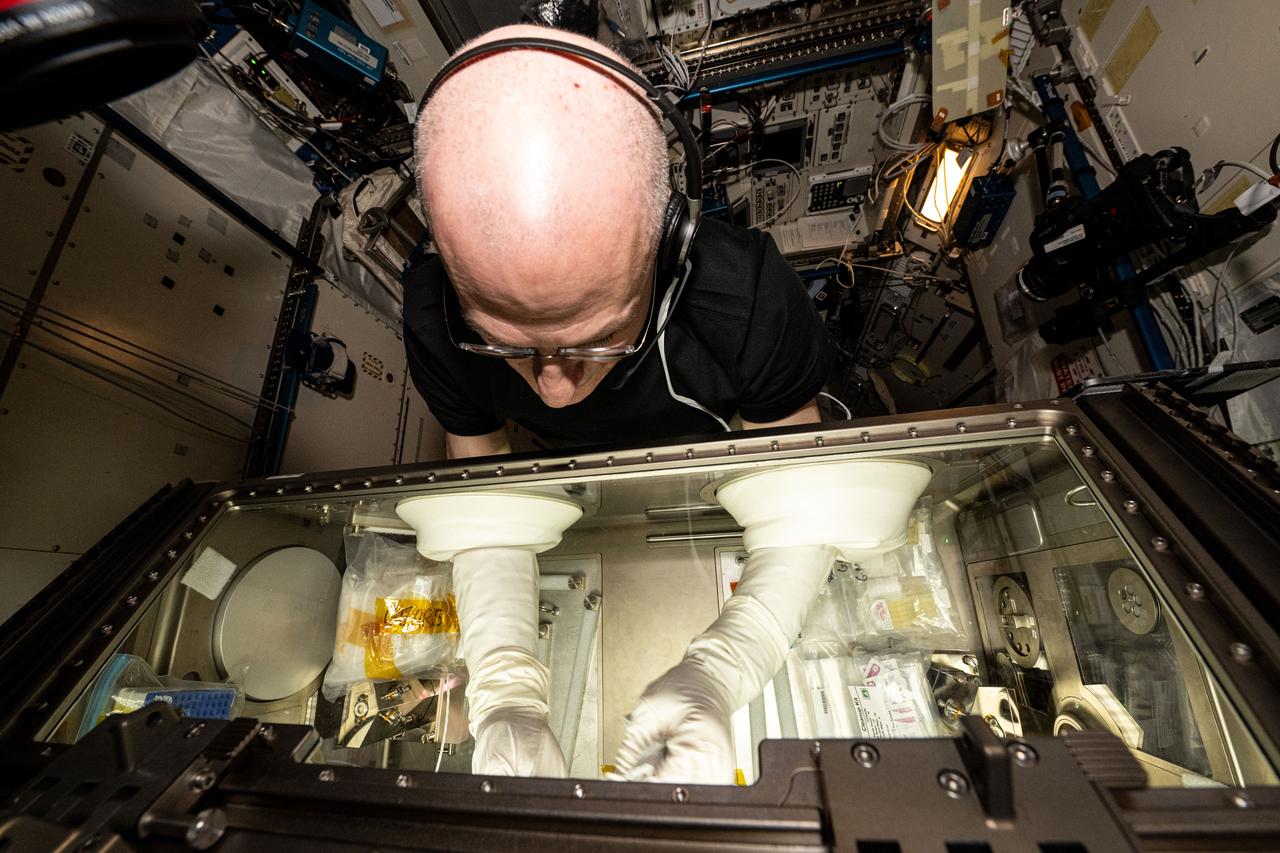
iss072e310952 (Dec. 3, 2024) --- NASA astronaut and Expedition 72 Flight Engineer Don Pettit processes bacteria samples in the Kibo laboratory module's Life Science Glove to understand why some pathogens are more potent in the microgravity environment. Those samples were also packed inside the SpaceX Dragon cargo spacecraft for return and analysis back on Earth. The space biology investigation uses genetic analysis techniques to identify the antibiotic resistant organisms and help researchers protect crew health on long-term space missions.
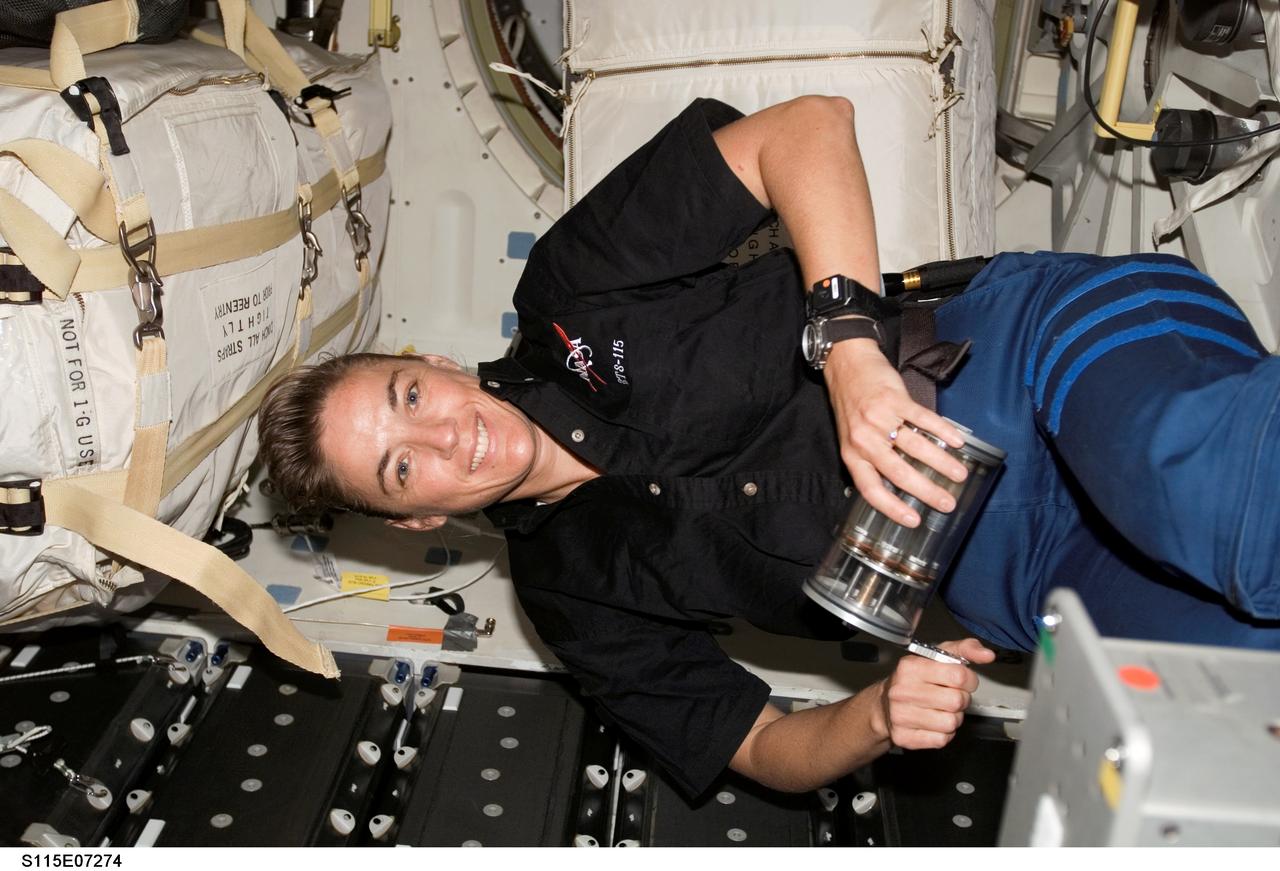
S115-E-07274 (9-21 Sept. 2006) --- Astronaut Heidemarie M. Stefanyshyn-Piper, STS-115 mission specialist, works with the Yeast-Group Activation Packs (Yeast-GAP) on the middeck of Space Shuttle Atlantis. Yeast-GAP experiment studies the effects of genetic changes of yeast cells exposed to the space environment. The results will help scientists to understand how cells respond to radiation and microgravity.
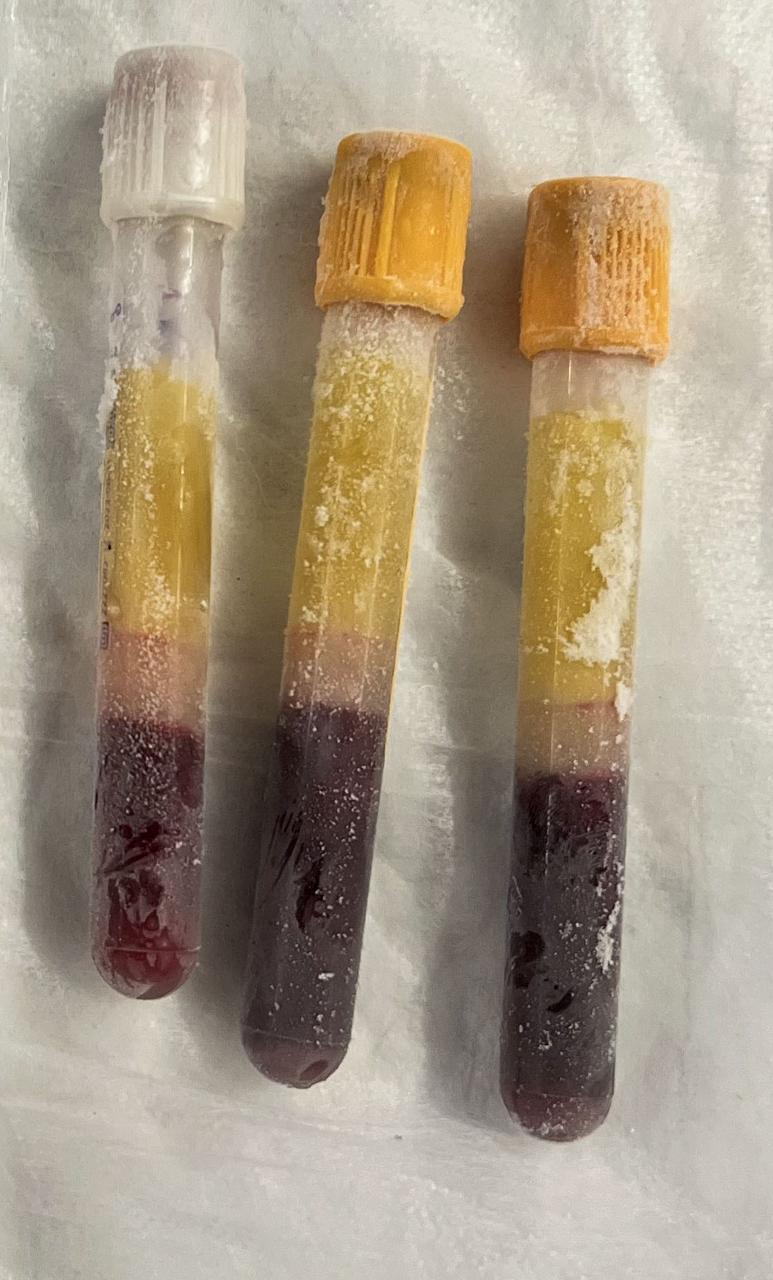
jsc2024e050837 (7/26/2024) --- Frozen blood samples collected aboard the International Space Station after return to Earth are part of the B Complex: A Nutraceutical SANS Countermeasure (B Complex) investigation. This study tests whether a daily B vitamin supplement can prevent or mitigate SANS and also assesses how an individual’s genetics may influence the response. The results could help maintain astronaut vision and health on future long-duration missions, including those to Mars.
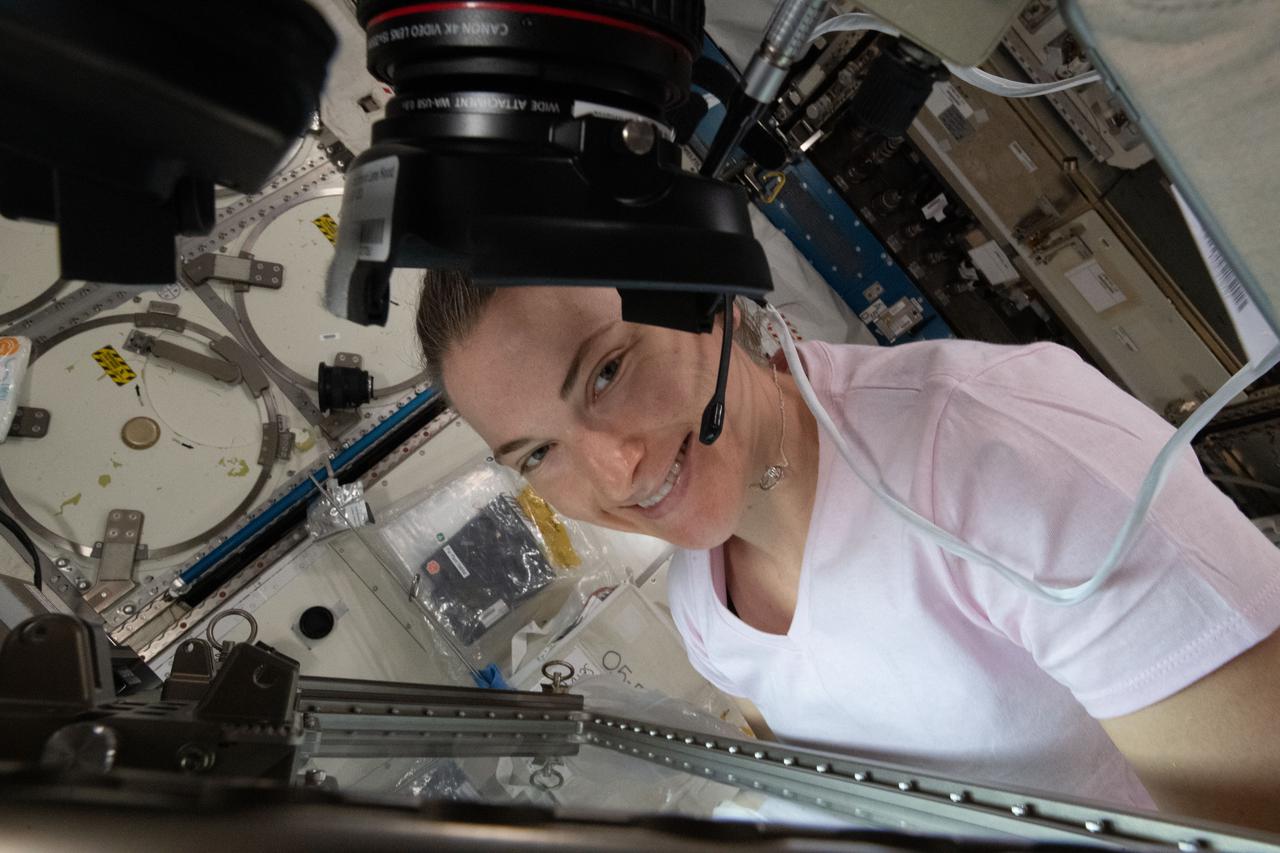
iss066e153087 (Fab. 29, 2022) --- NASA astronaut and Expedition 66 Flight Engineer Kayla Barron works inside the Life Science Glovebox conducting botany research for the Plant Habitat-05 investigation. The space agriculture study explores genetic expression in cotton cultures to learn more about the process of plant regeneration possibly improving crop production on Earth.
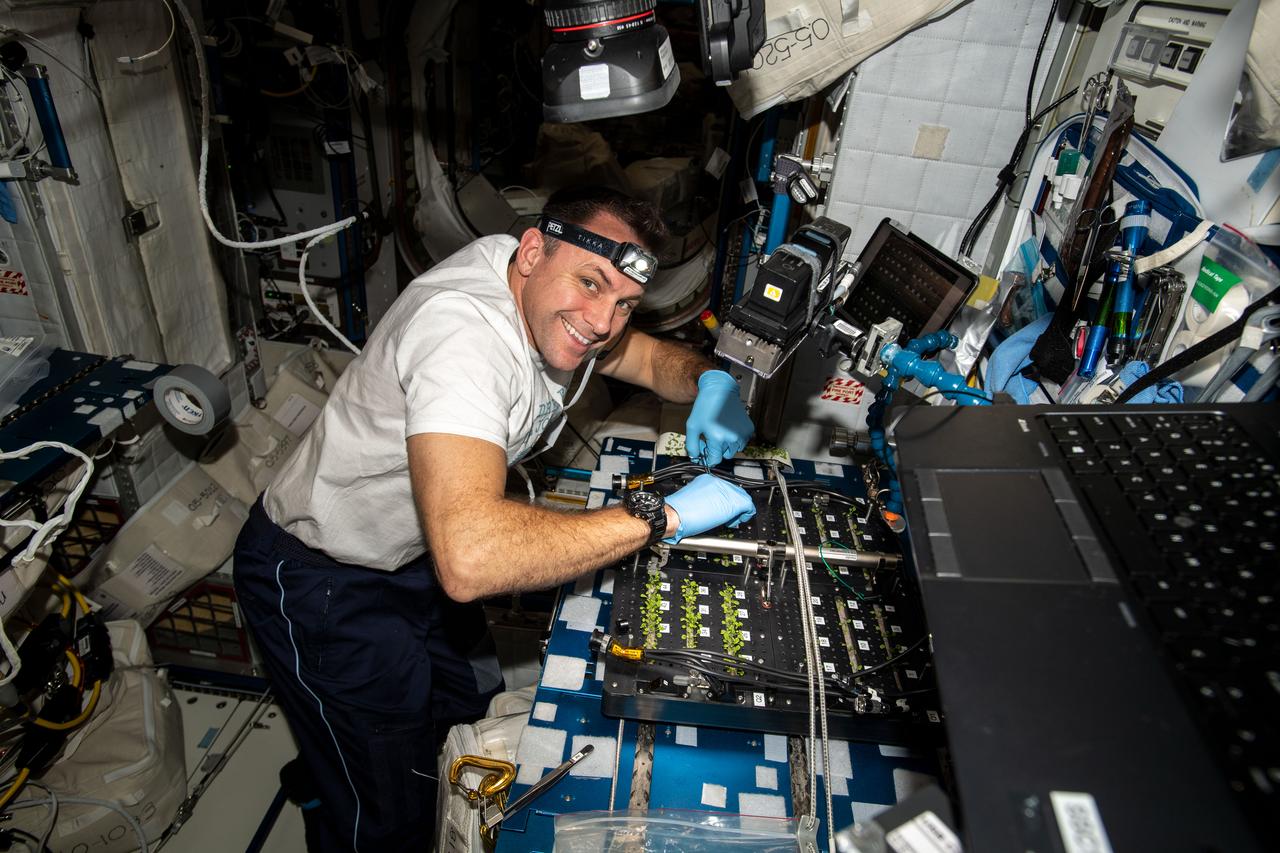
iss068e043103 (Jan. 12, 2023) --- NASA astronaut and Expedition 68 Flight Engineer Josh Cassada tends to thale cress plants growing for the Plant Habitat-03 space botany study that explores how plants genetically adapt to microgravity. Cassada removed the plants from the Advanced Plant Habitat located in the Kibo laboratory module and conducted the research activities in the Harmony module's maintenance work area.
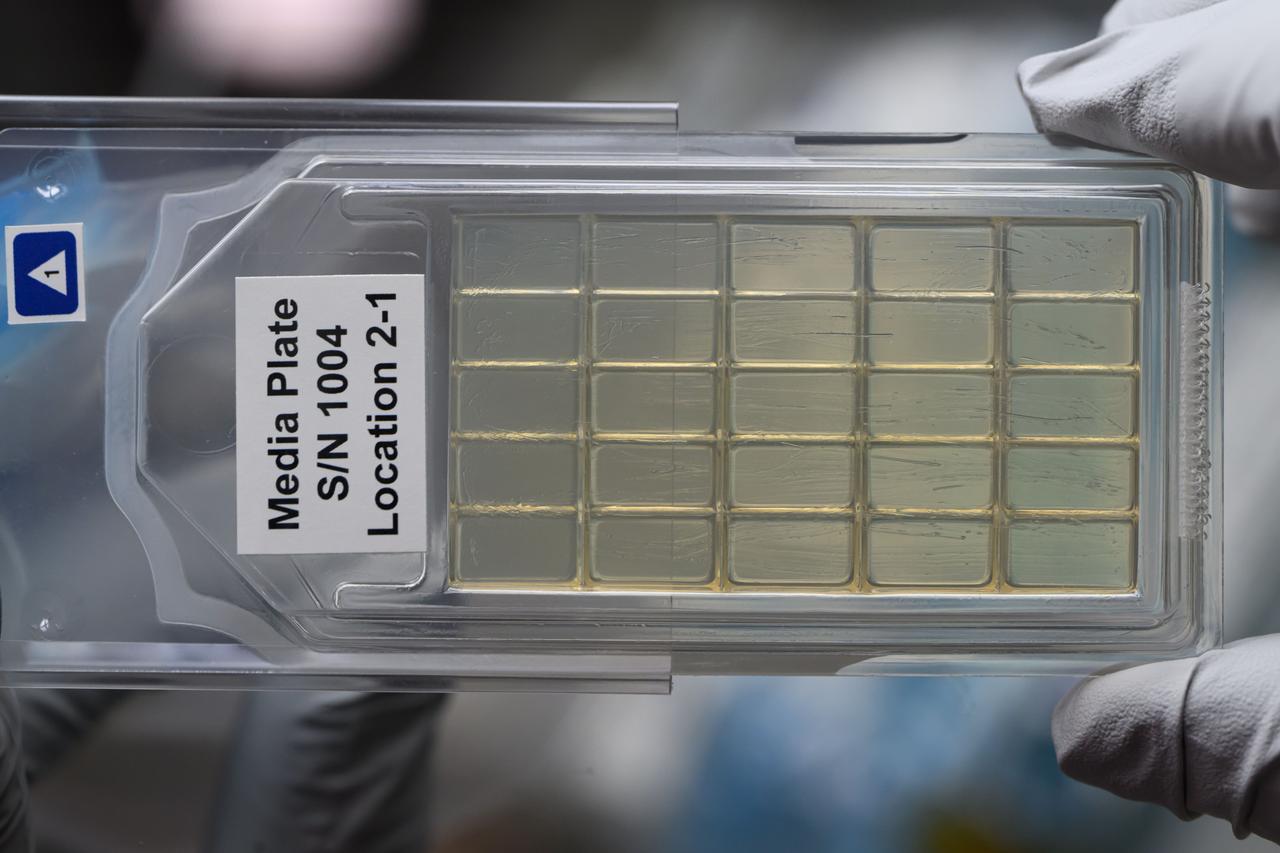
iss071e040230 (4/24/2024) --- A CS-05A: Genomic Enumeration of Antibiotic Resistance in Space (GEARS) sample media plate is shown aboard the International Space Station. The GEARS investigation surveys the space station for antibiotic resistant-organisms. Genetic analysis could show how these bacteria adapt to the space environment, providing knowledge that informs measures to protect astronauts on future long-duration missions.
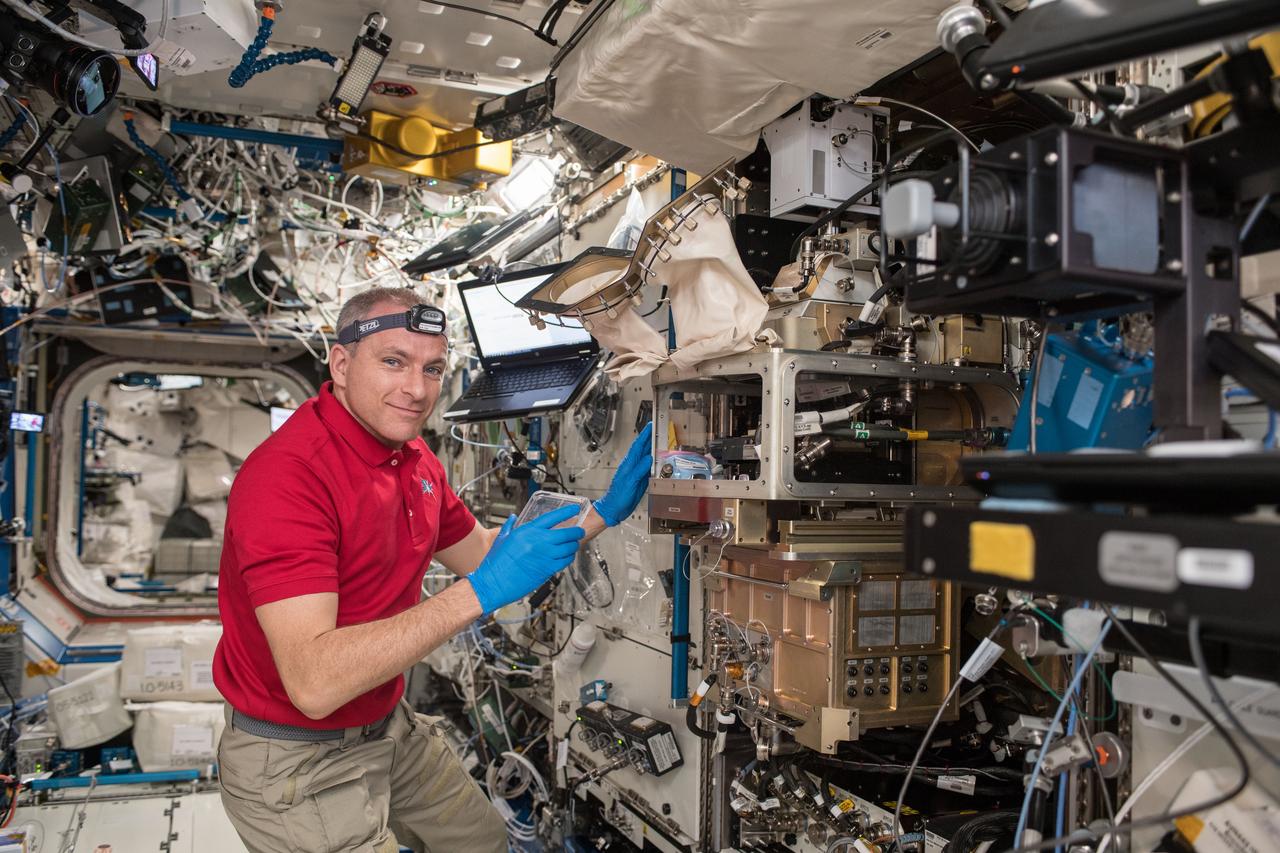
iss057e135002 (12/18/2018) --- Canadian Space Agency (CSA) astronaut David Saint-Jacques removes the APEX-05 Petri Plate from the FIR/LMM (Fluids Integrated Rack/Light Microscopy Module). The Spaceflight-induced Hypoxic/ROS Signaling (APEX-05) experiment grows different wild and mutant varieties of Arabidopsis thaliana, in order to understand how their genetic and molecular stress response systems work in space.
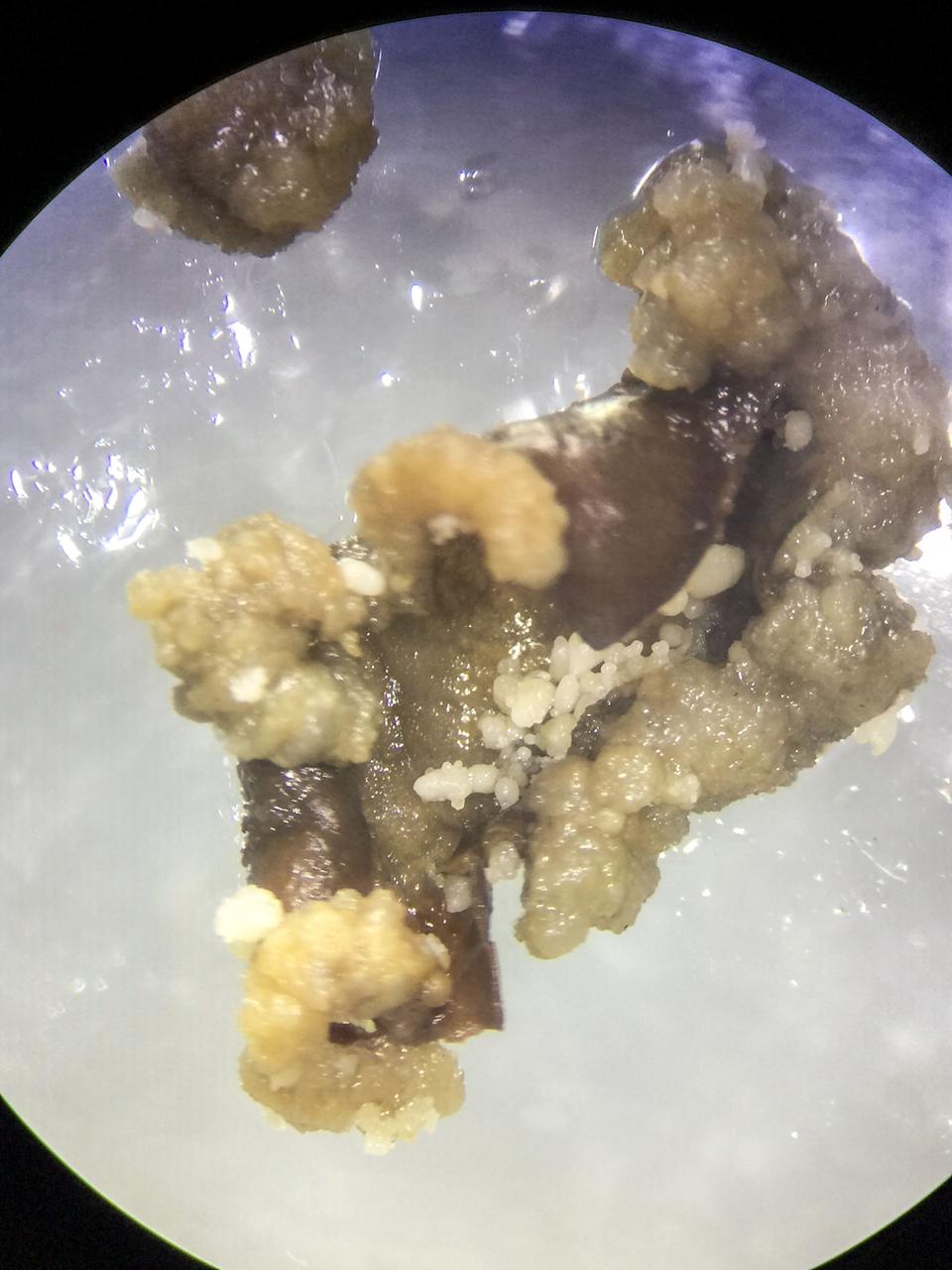
jsc2020e003413 (12/4/2019) --- Preflight imagery of space Cells-01. Space Cells-01 examines gene expression changes and genetic mutations in hemp and coffee plant cells in microgravity. Cell cultures spend approximately one month on the space station then return to Earth for analysis of their physical structure and gene expression and are compared to preflight parameters. Results could help identify new varieties or chemical expressions in the plants and improve understanding of how plants manage the stress of space travel.
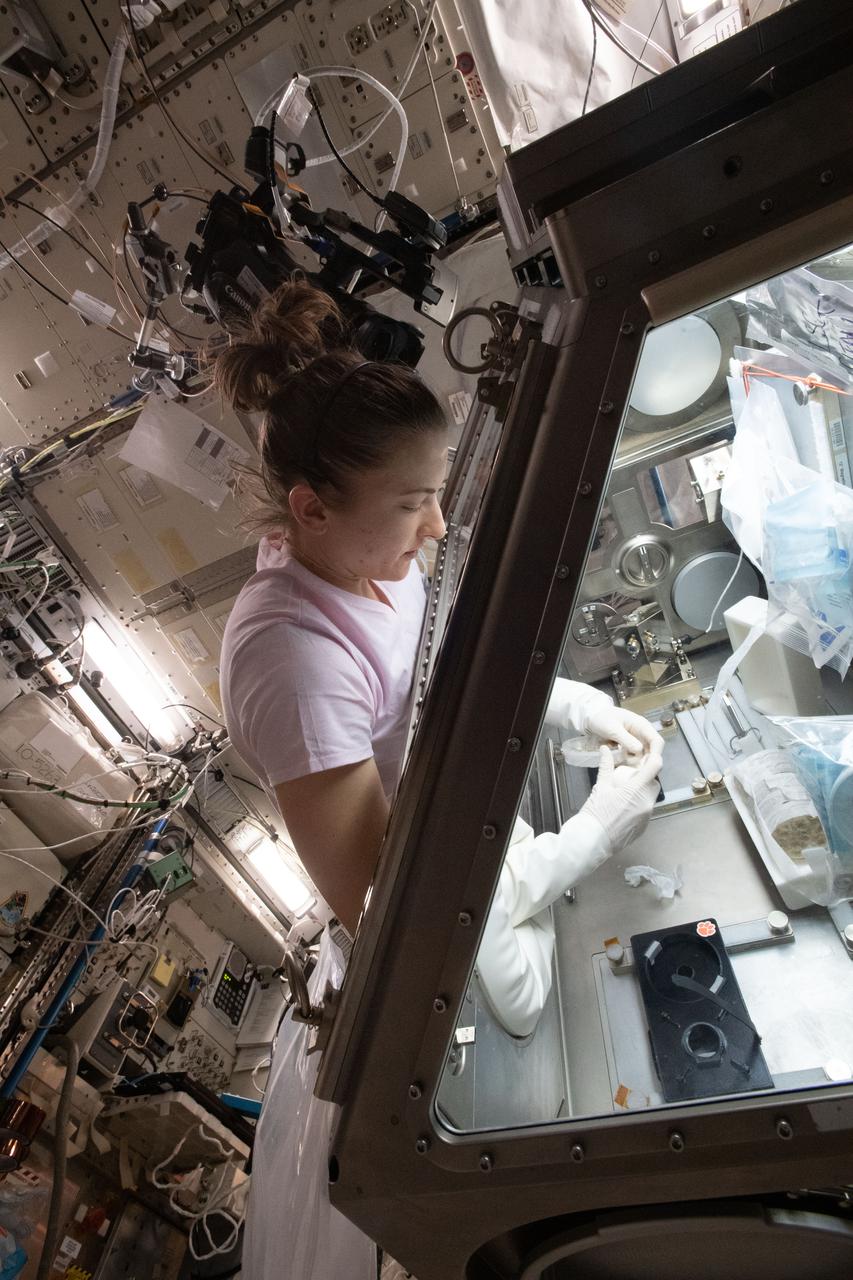
iss066e153063 (Fab. 29, 2022) --- NASA astronaut and Expedition 66 Flight Engineer Kayla Barron works inside the Life Science Glovebox conducting botany research for the Plant Habitat-05 investigation. The space agriculture study explores genetic expression in cotton cultures to learn more about the process of plant regeneration possibly improving crop production on Earth.
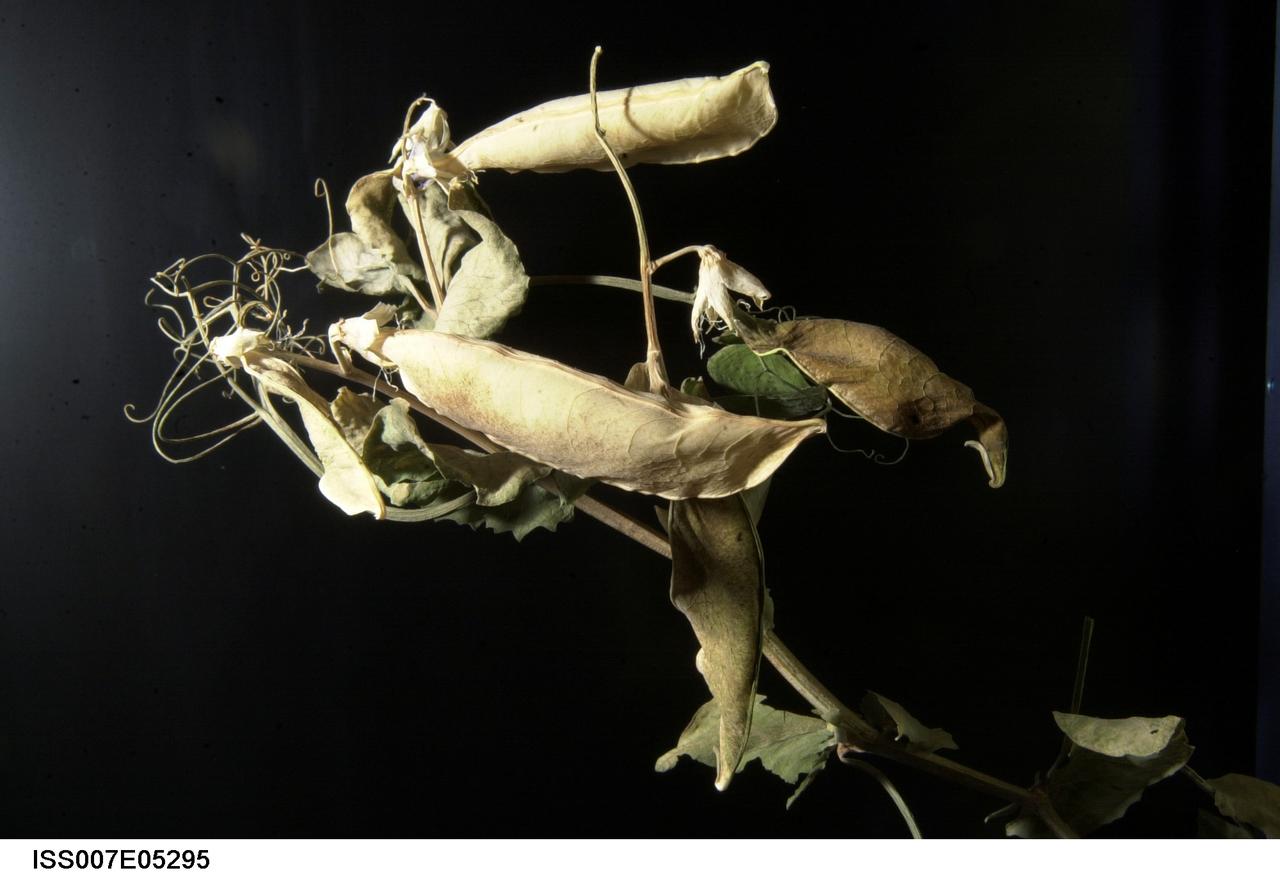
ISS007-E-05295 (May 2003) --- Inside the Russian Lada greenhouse, these peas have dried and “gone to seed.” They are part of an experiment to investigate plant development and genetics. The crew of the International Space Station (ISS) will soon harvest the seeds. Eventually, some will be re-planted onboard the ISS and some will be returned to Earth for further study.
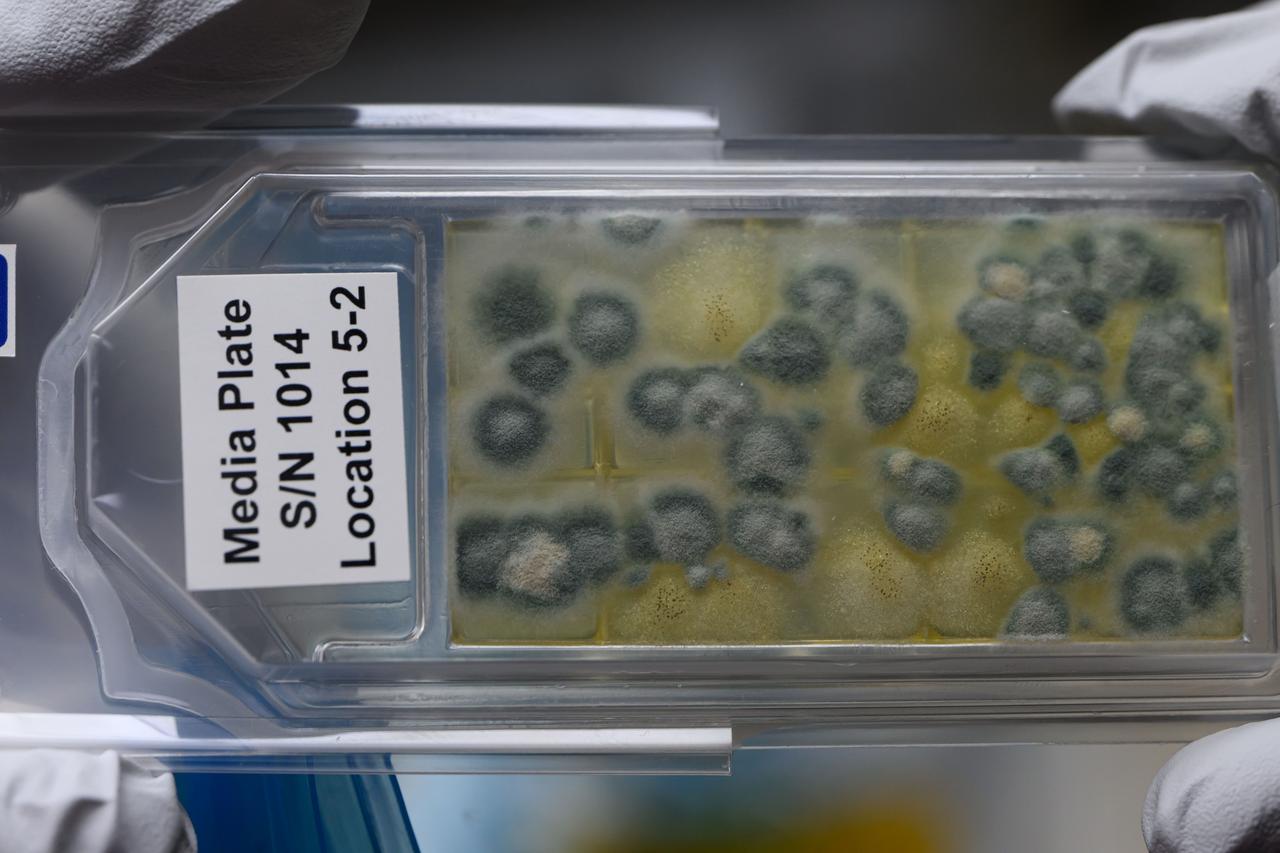
iss071e040200 (4/24/2024) --- A CS-05A: Genomic Enumeration of Antibiotic Resistance in Space (GEARS) sample media plate is shown aboard the International Space Station. The GEARS investigation surveys the space station for antibiotic resistant-organisms. Genetic analysis could show how these bacteria adapt to the space environment, providing knowledge that informs measures to protect astronauts on future long-duration missions.
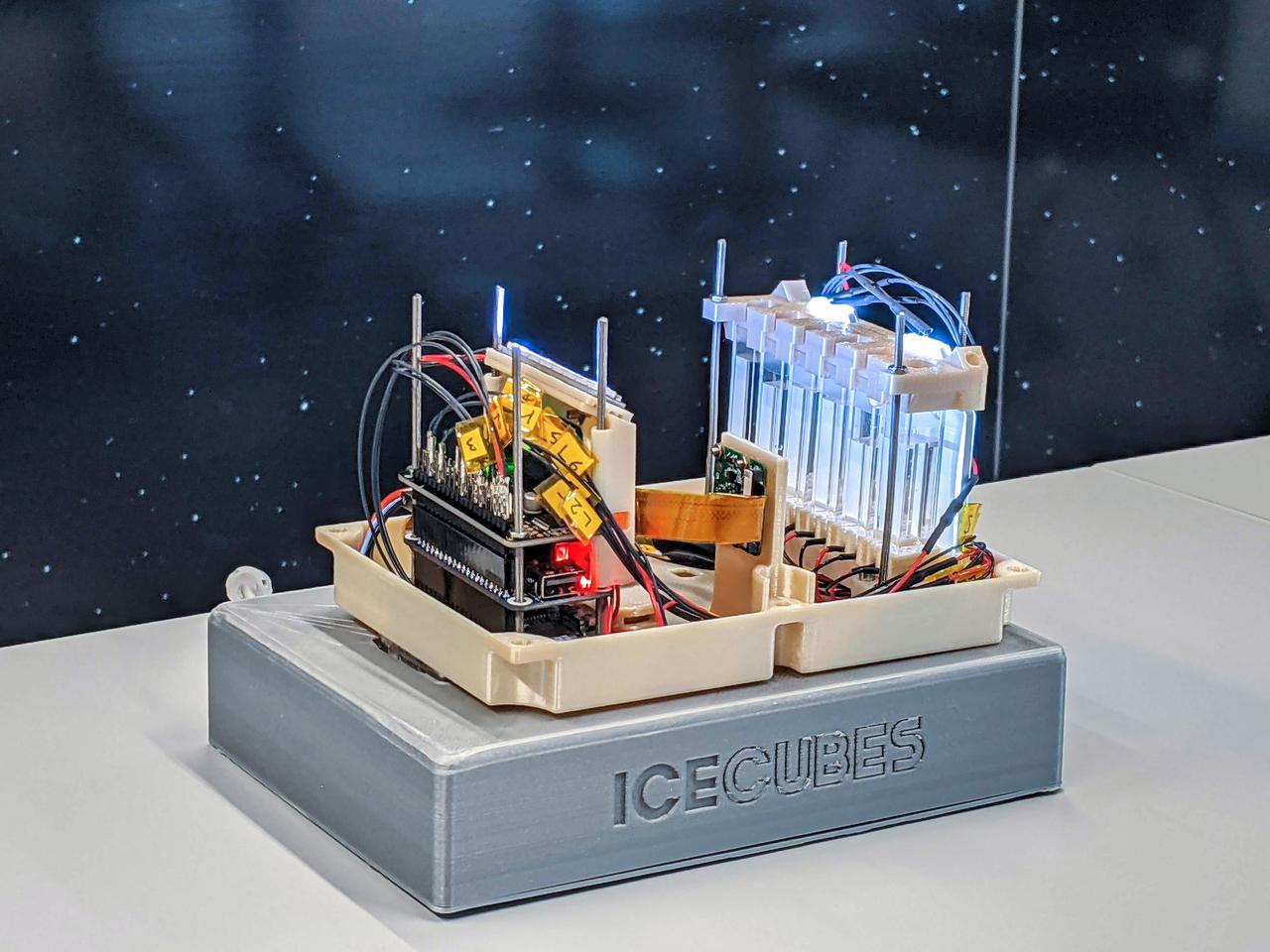
jsc2021e033555 (5/12/2021) --- A prefliight view of Ice Cubes #9 - Project Maleth. The Maltese Biocube, based on ICE Cubes platform by Space Applications Services, that will take samples to the International Space Station in a historic first for the country. The investigation studies Diabetes Mellitus Type 2 and Diabetic Foot Ulcers (DFU) using genetics and space biosciences is new and innovative research. Image credit: DOI: Ministry for Foreign and European Affairs, Malta

iss024e014711 (9/15/2010) --- A view of a Bioecology Case containing a stowed BTKh-27 ASTROVAKTSINA (Astrovaccine) payload aboard the International Space Station (ISS). The Cultivating Escheria coli Producer of CAF1 Protein in Weightlessness (Astrovaktsina) studies the effect of spaceflight factors on the processes of biosynthesis, secretion, capsule formation, and the biological properties of the E. coli producer of the genetically engineered CAF1 antigen protein of Yersinia pestis during its exposure to microgravity.

iss066e153092 (Fab. 29, 2022) -- Cotton cell samples, held by NASA astronaut and Expedition 66 Flight Engineer Kayla Barron, are pictured growing on a petri dish inside the Advanced Plant Habitat. The samples were grown and harvested for the Plant Habitat-05 space agriculture study that explores genetic expression in cotton cultures to learn more about the process of plant regeneration possibly improving crop production on Earth.
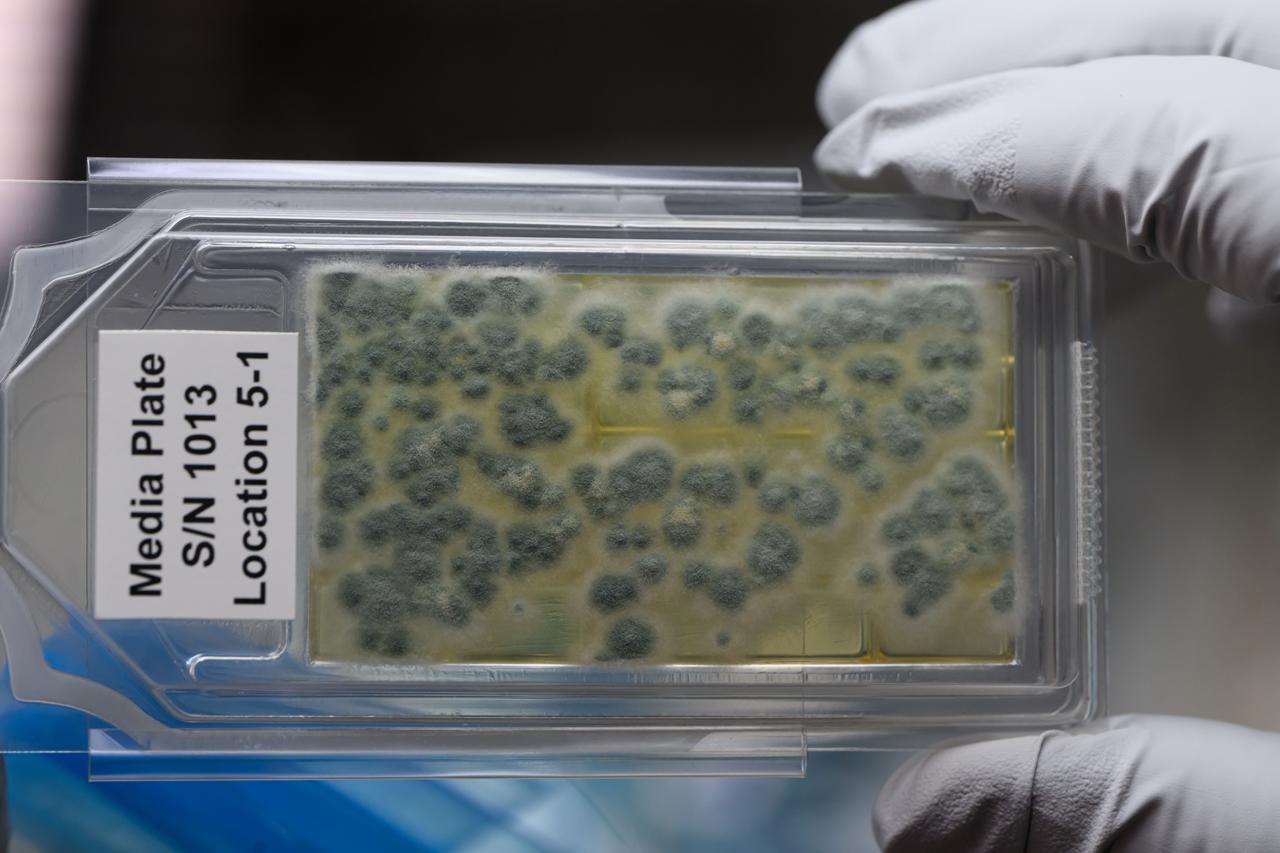
iss071e040194 (4/24/2024) --- A CS-05A: Genomic Enumeration of Antibiotic Resistance in Space (GEARS) sample media plate is shown aboard the International Space Station. The GEARS investigation surveys the space station for antibiotic resistant-organisms. Genetic analysis could show how these bacteria adapt to the space environment, providing knowledge that informs measures to protect astronauts on future long-duration missions.
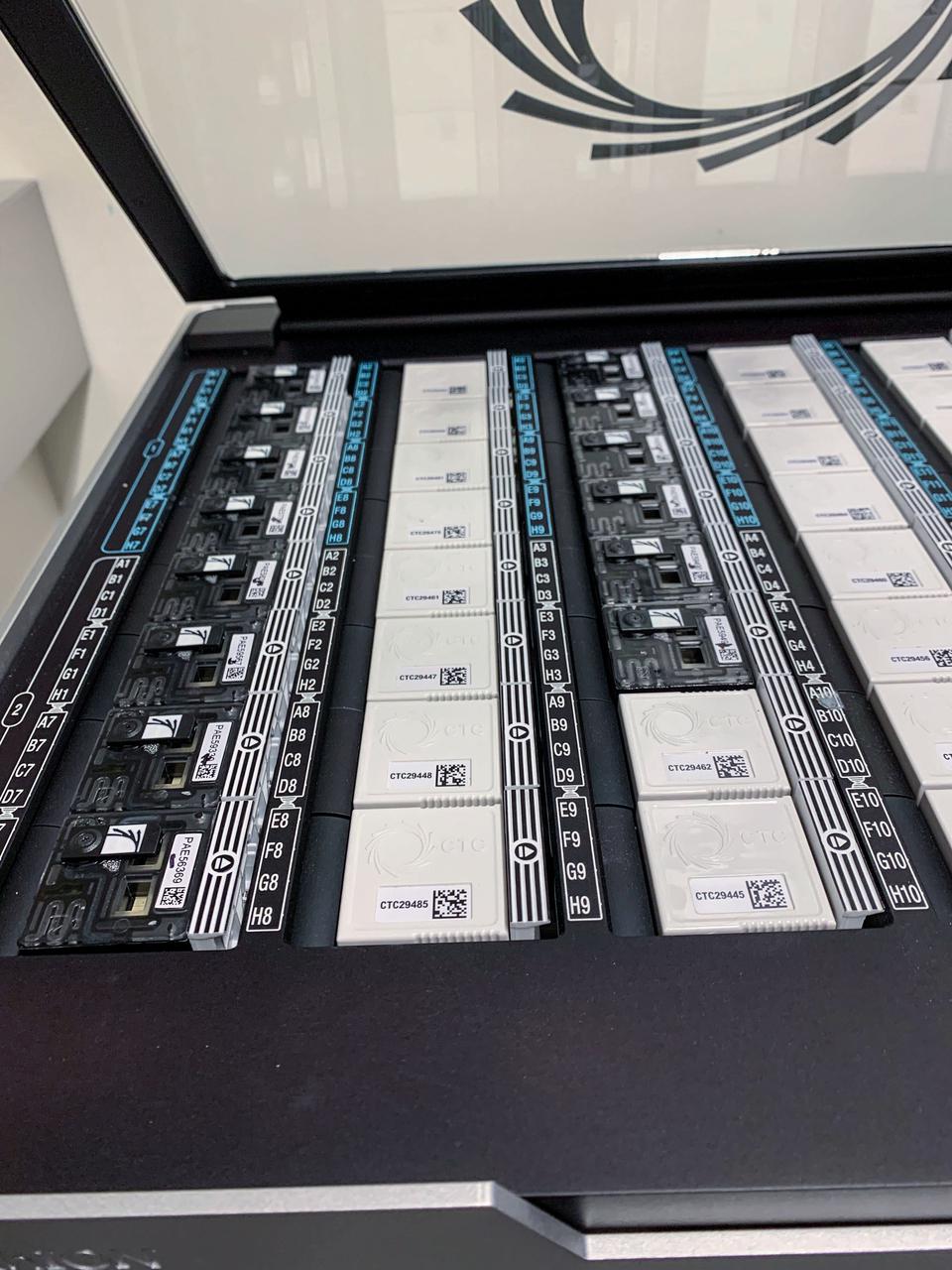
jsc2021e033549 (8/4/2021) --- A prefliight view of Ice Cubes #9 - Project Maleth. The Maltese Biocube, based on ICE Cubes platform by Space Applications Services, that will take samples to the International Space Station in a historic first for the country. The investigation studies Diabetes Mellitus Type 2 and Diabetic Foot Ulcers (DFU) using genetics and space biosciences is new and innovative research. Image credit: DOI: Ministry for Foreign and European Affairs, Malta
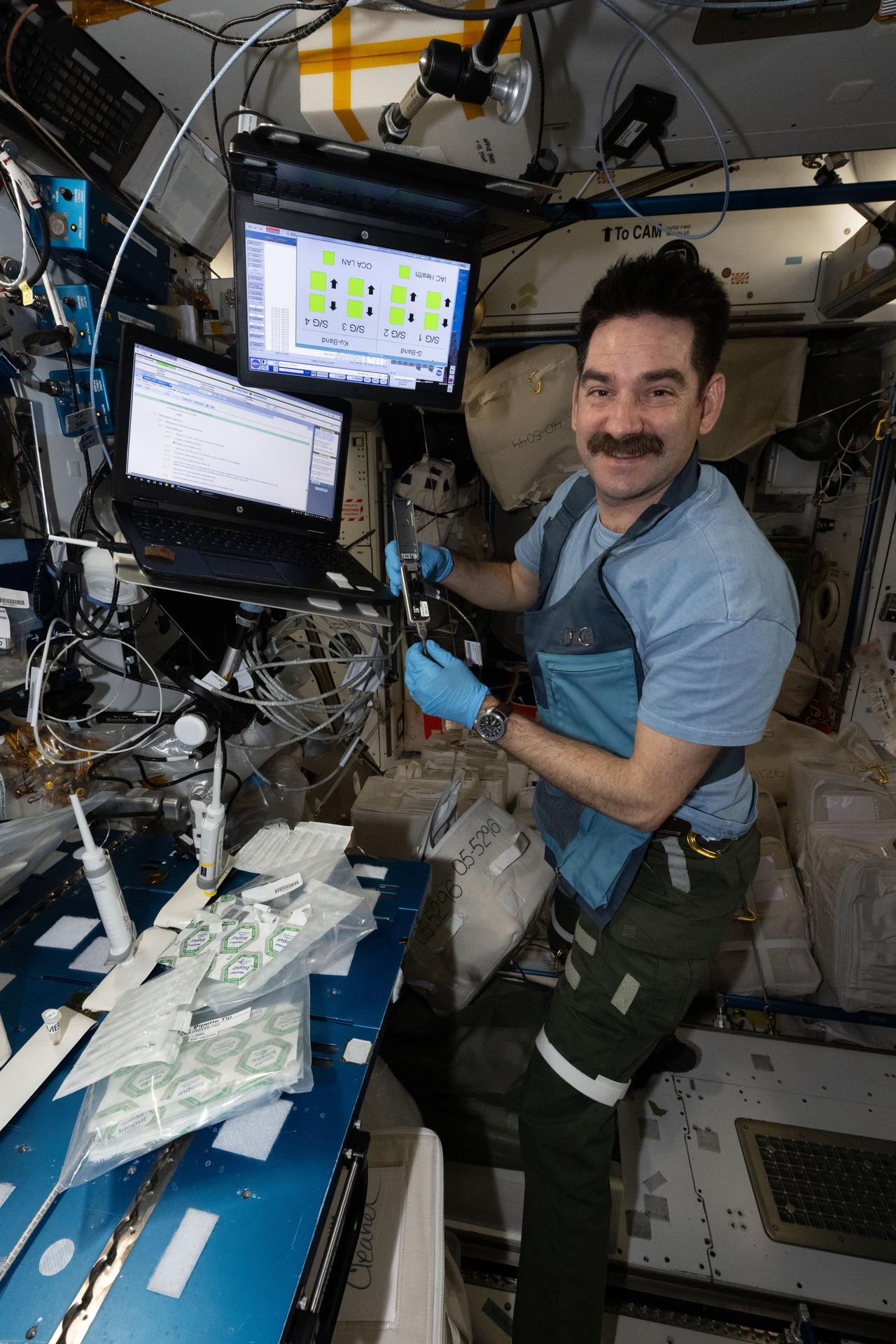
iss074e0722461 (June 17, 2026) --- NASA astronaut and Expedition 74 flight engineer Jack Hathaway loads bacterial samples into a portable DNA sequencer to read their genetic code inside the International Space Station’s Harmony module. The GEARS biotechnology investigation may help scientists understand how bacteria become resistant to antibiotics in the space environment, which could affect an astronaut’s ability to fight infections. Credit: NASA/Jessica Meir

jsc2021e033554 (5/12/2021) --- A prefliight view of Ice Cubes #9 - Project Maleth. The Maltese Biocube, based on ICE Cubes platform by Space Applications Services, that will take samples to the International Space Station in a historic first for the country. The investigation studies Diabetes Mellitus Type 2 and Diabetic Foot Ulcers (DFU) using genetics and space biosciences is new and innovative research. Image credit: DOI: Ministry for Foreign and European Affairs, Malta
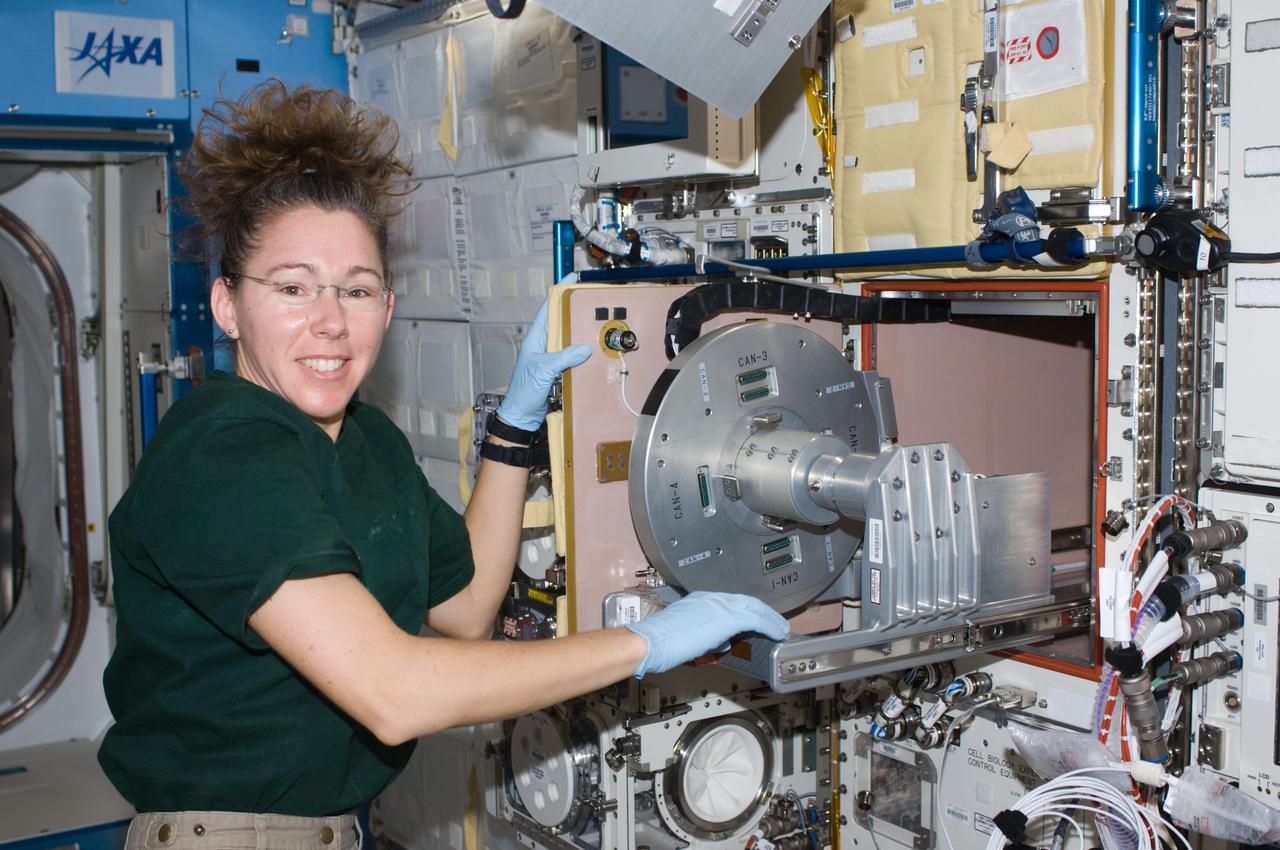
ISS018-E-034555 (20 Feb. 2009) --- Astronaut Sandra Magnus, Expedition 18 flight engineer, takes a moment for a photo while working with the LOH- RadGene experiment at the Cell Biology Experiment Facility (CBEF) in the Kibo laboratory of the International Space Station. This experiment investigates genetic alterations in immature immune cells that have been exposed to cosmic radiation. The samples were placed in culture bags and launched to the ISS on the STS-126 mission. After the experiment, frozen samples will be returned to the ground on the STS-119 mission.
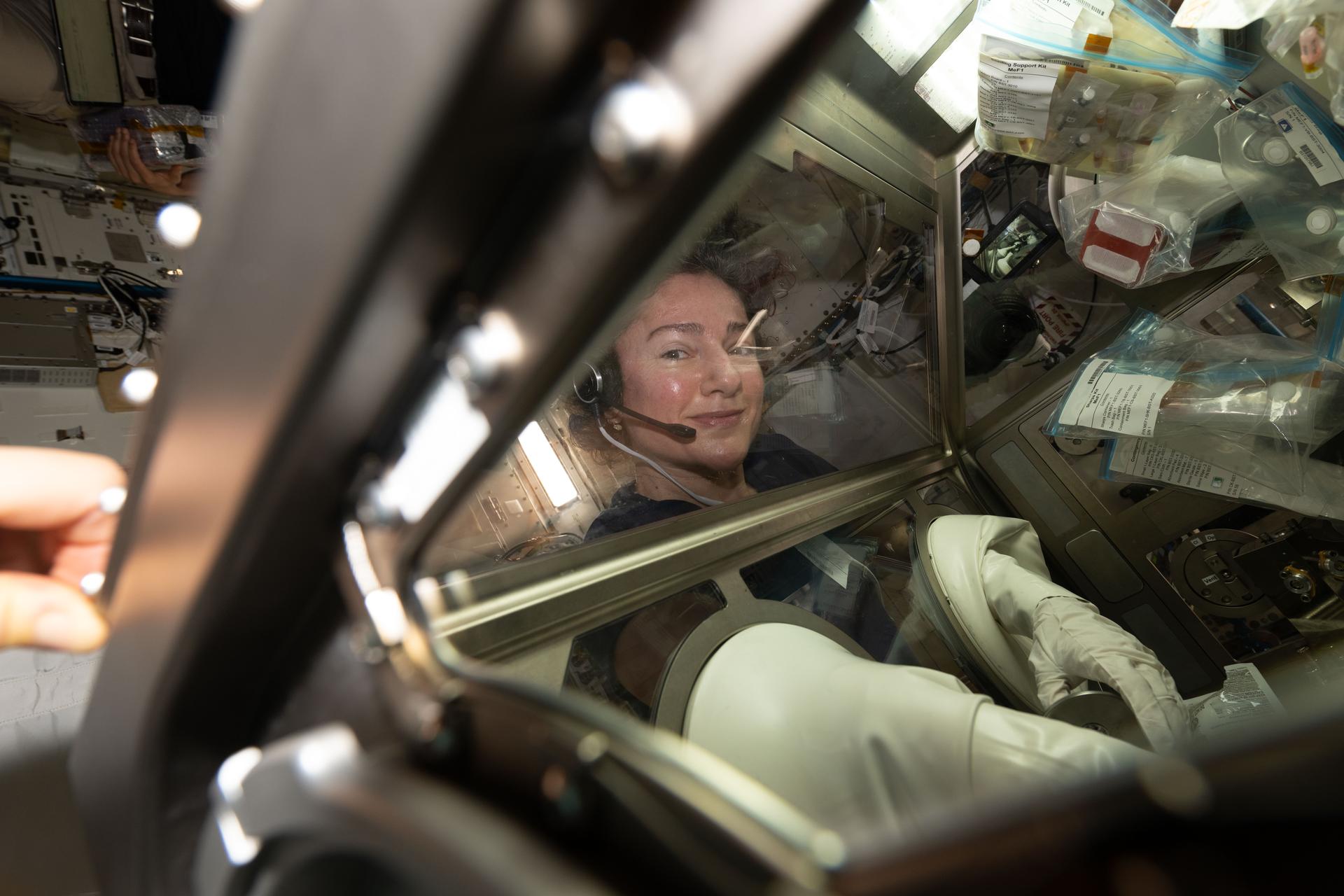
iss074e0590869 (May 18, 2026) --- NASA astronaut and Expedition 74 flight engineer Jessica Meir works inside the Kibo laboratory module’s Life Science Glovebox aboard the International Space Station. Meir was preparing blood‑making cell samples—blood platelets—for incubation and growth to observe how weightlessness affects a crew member’s blood clotting and immune function at the cellular and genetic levels. Credit: ESA/Sophie Adenot
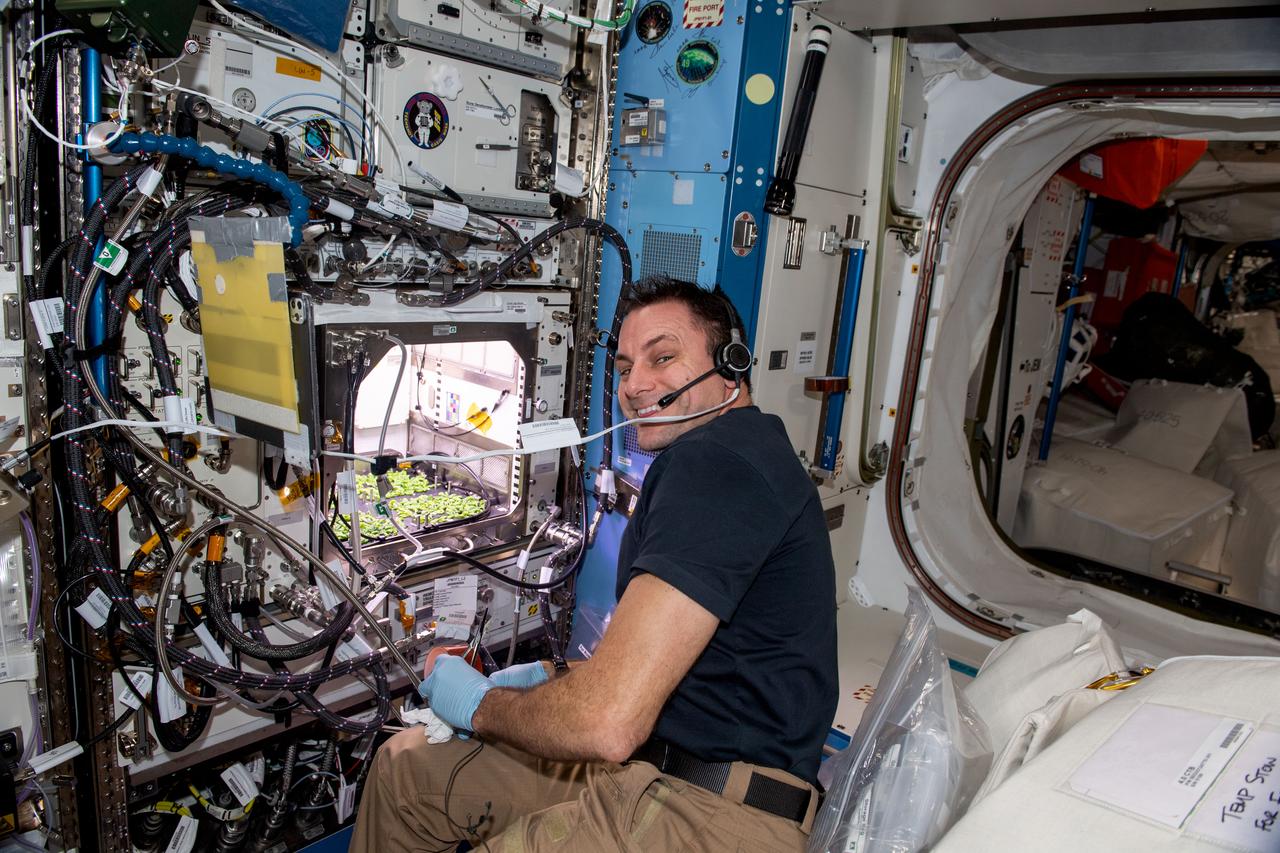
iss068e042034 (Jan. 26, 2023) --- NASA astronaut and Expedition 68 Flight Engineer Josh Cassada harvests thale cress plants housed inside the Advanced Plant Habitat for stowage and analysis on Earth. The space botany study takes place inside the International Space Station's Kibo laboratory module and studies genetic changes that take place in plants growing in microgravity
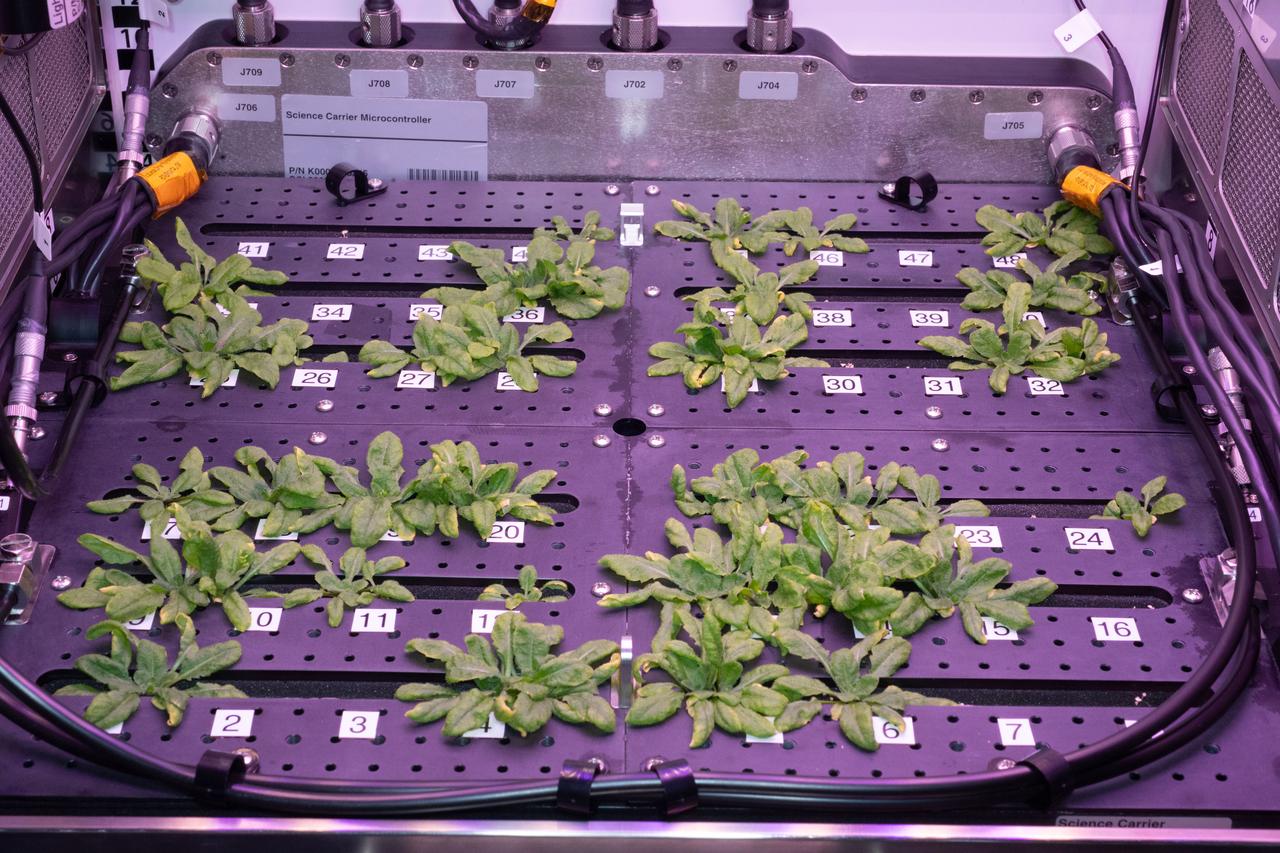
iss056e094286 (July 9, 2018) --- Arabidopsis plants are pictured inside the Plant Habitat experiment's Growth Chamber located in the Columbus laboratory module's EXPRESS Rack 5. The plants were harvested for the Plant Habitat experiment which is researching differences in genetics, metabolism, photosynthesis, and gravity sensing between plants grown in space and on Earth. Results may help crews on future missions successfully grow plants for food and oxygen generation.
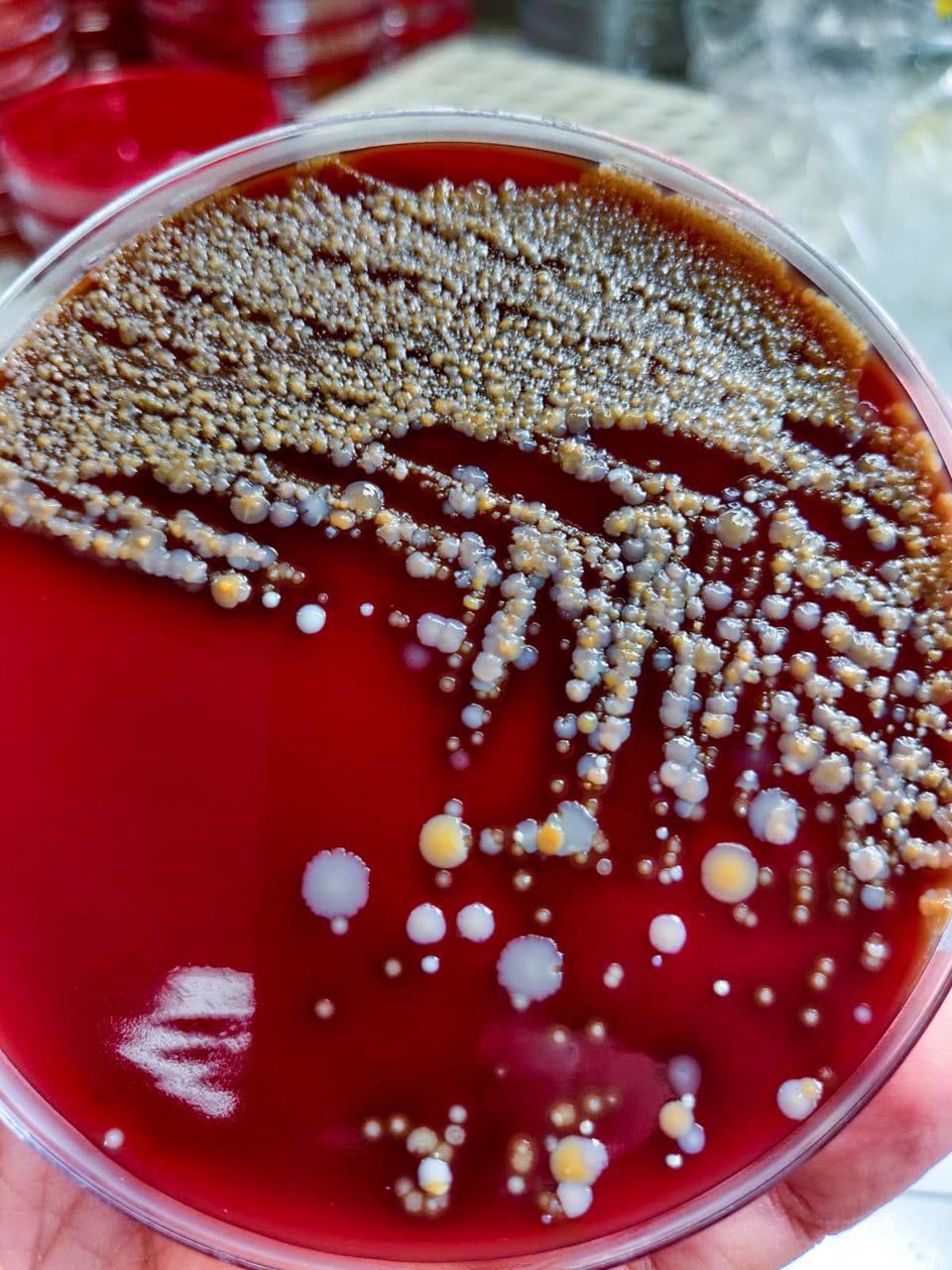
sc2021e033545 (8/4/2021) --- A preflight view the Ice Cubes #9 – Project Maleth (Space Omics Analysis of the Skin Microbiome of Diabetic Foot Ulcers, or SpaceOMIX) The investigation studies Diabetes Mellitus Type 2 and Diabetic Foot Ulcers (DFU) using genetics and space biosciences is new and innovative research. Image credit: DOI: Ministry for Foreign and European Affairs, Malta
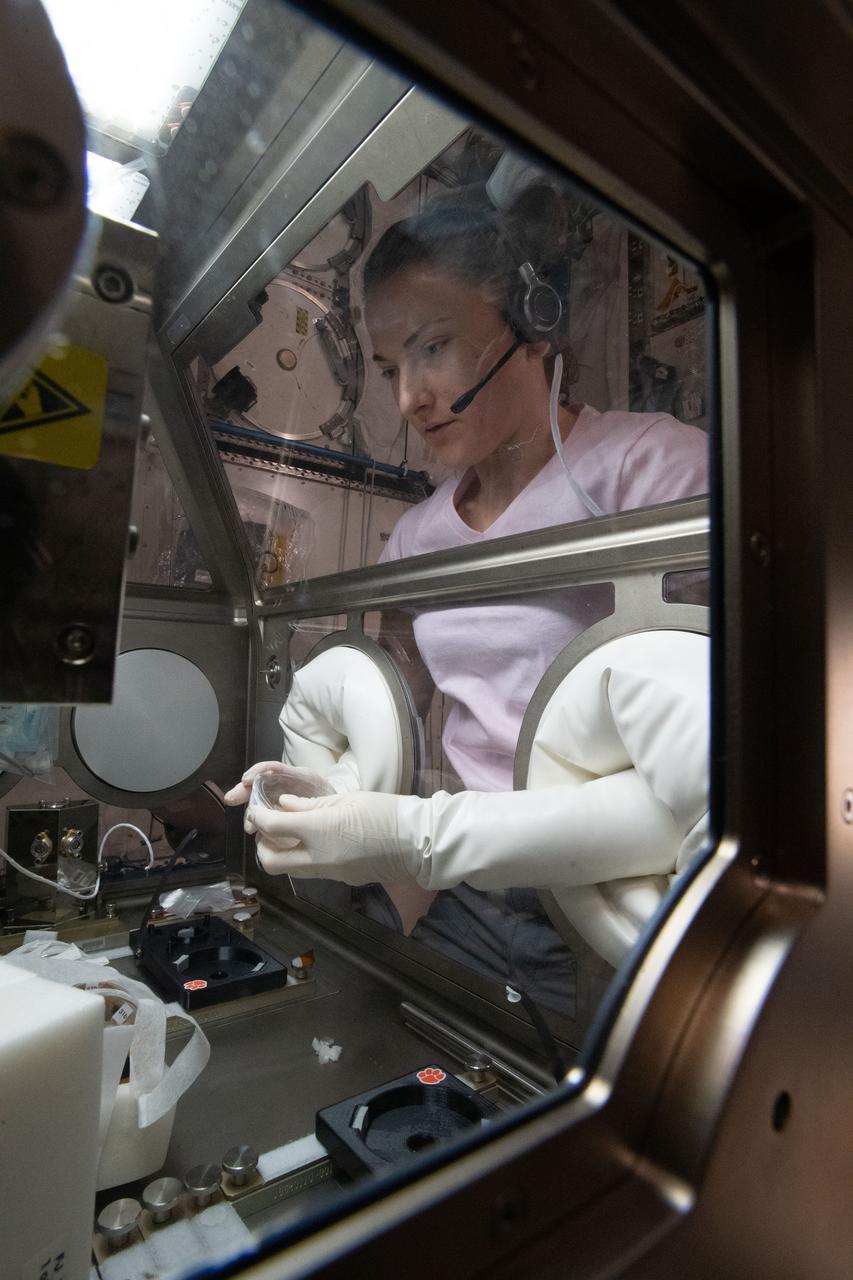
iss066e153069 (Fab. 29, 2022) --- NASA astronaut and Expedition 66 Flight Engineer Kayla Barron works inside the Life Science Glovebox conducting botany research for the Plant Habitat-05 investigation. The space agriculture study explores genetic expression in cotton cultures to learn more about the process of plant regeneration possibly improving crop production on Earth.
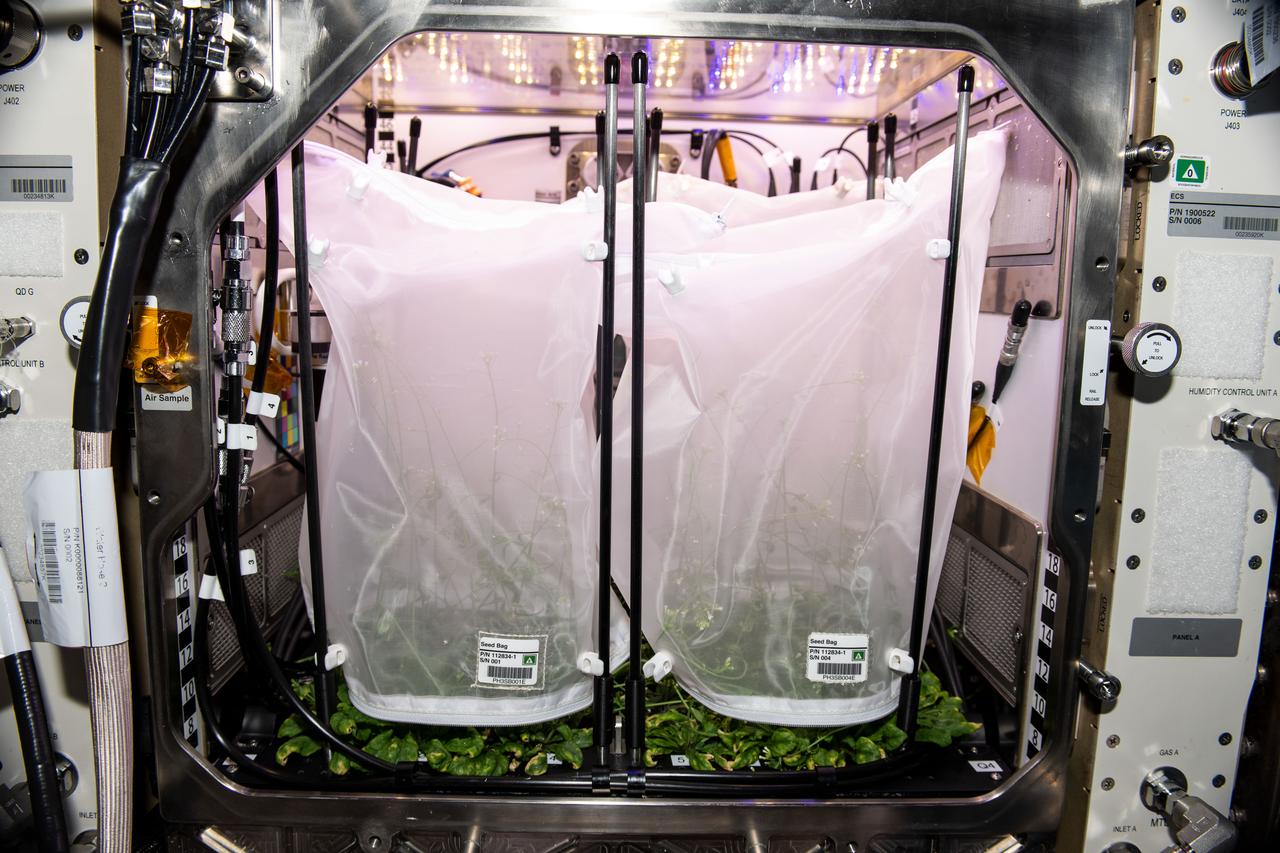
iss068e047055 (2/7/2023) --- Lightweight mesh bags are installed over plant stalks for the Plant Habitat-03 (PH-03) investigation aboard the International Space Station, helping contain them as seeds mature. Astronauts harvest the seed stalks when they mature and begin to dry, preserving them for a return to Earth and further analysis. PH-03 aims to discover whether genetic changes persist through multiple plant generations, a first step in developing plants better suited for future space exploration.
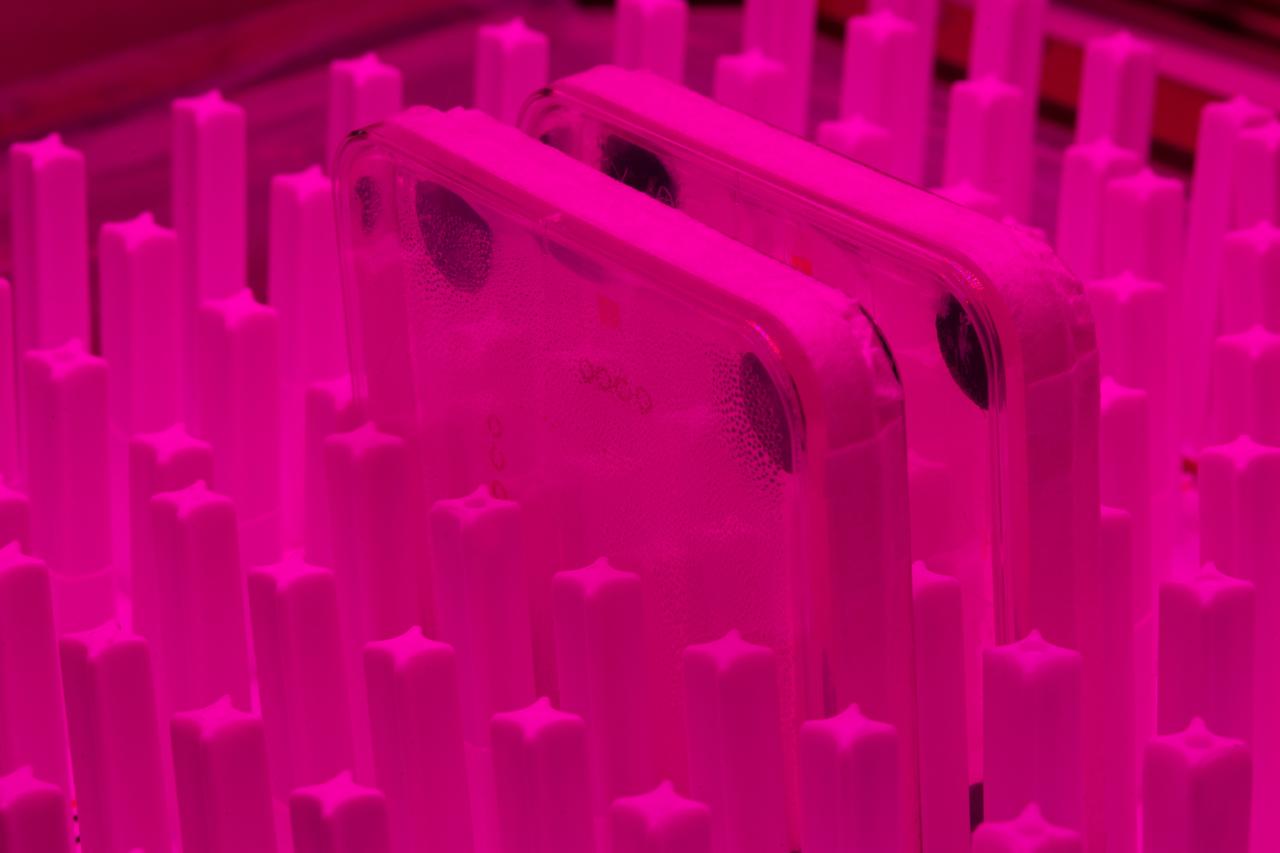
iss057e131531 (12/11/2018) --- A view of the APEX-05 Petri Plate in the Veggie facility onboard the International Space Station (ISS). The Spaceflight-induced Hypoxic/ROS Signaling (APEX-05) experiment grows different wild and mutant varieties of Arabidopsis thaliana, in order to understand how their genetic and molecular stress response systems work in space.
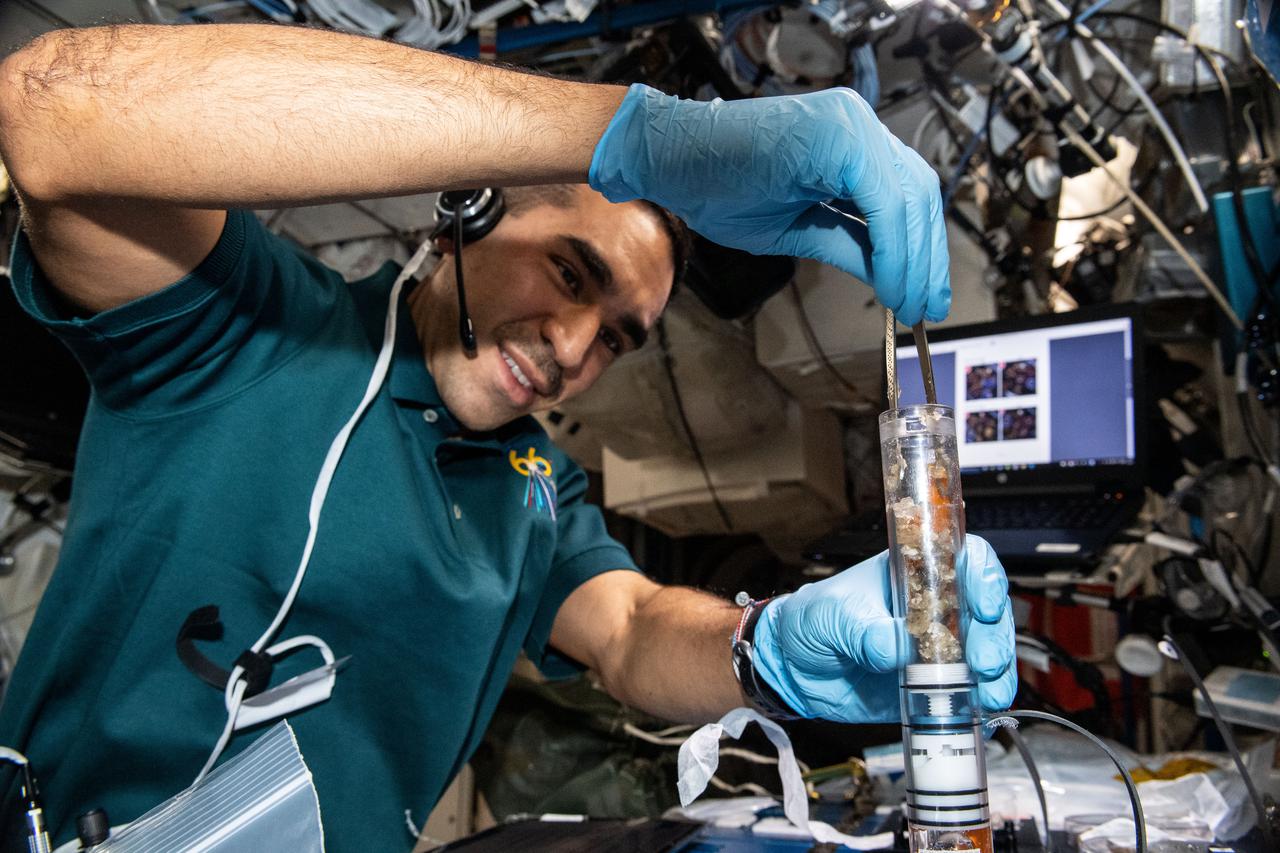
iss066e184149 (March 28, 2022) --- NASA astronaut and Expedition 66 Flight Engineer Raja Chari performs the final harvest of cotton cell cultures as part of the Plant Habitat-05 investigation (PH-05). The space agriculture study explored genetic expression in cotton cell cultures to learn more about the process of plant regeneration, potentially improving crop production on Earth.
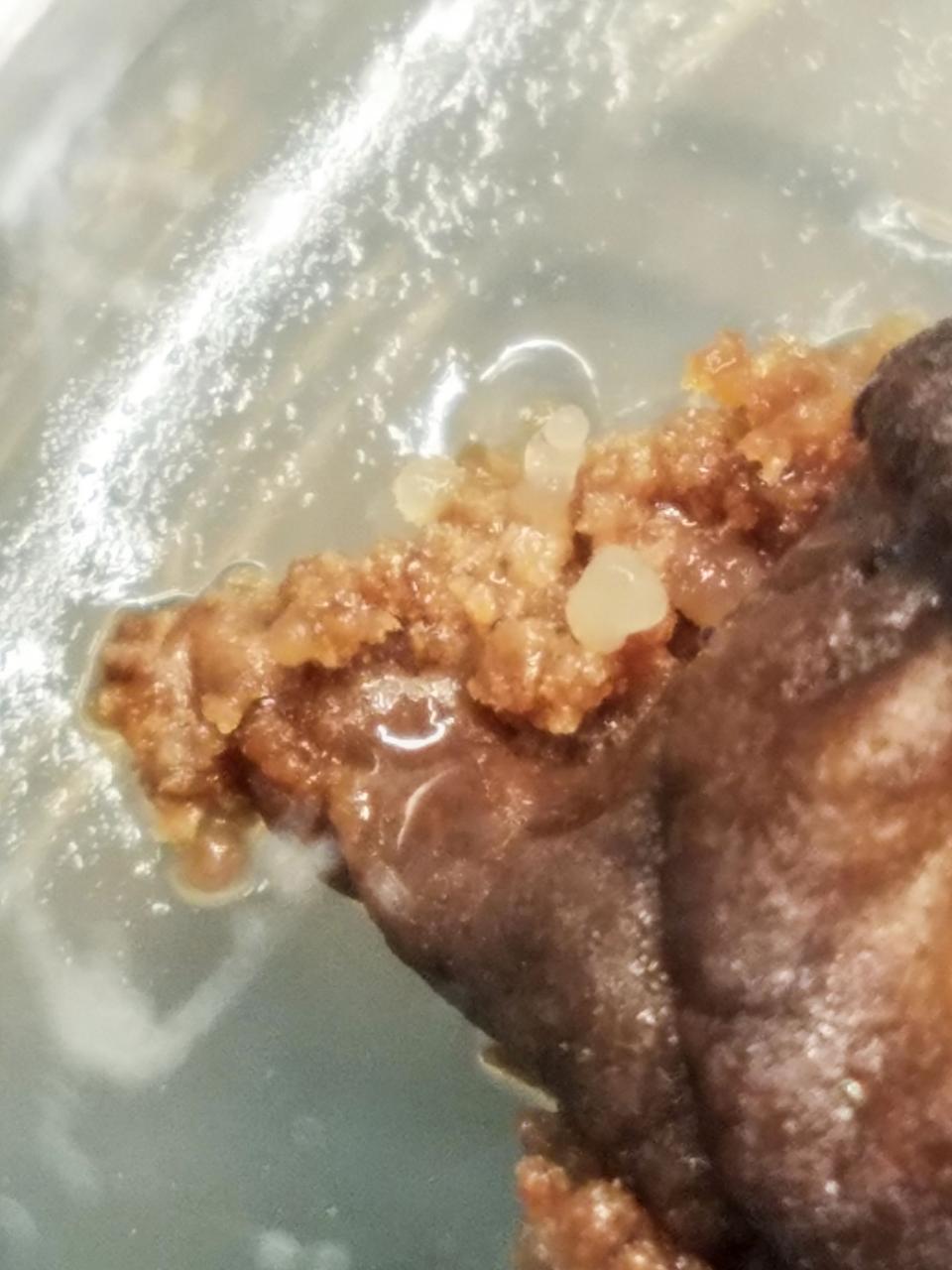
jsc2020e003414 (12/20/2019) --- Preflight imagery of Space Cells-01. Space Cells-01 examines gene expression changes and genetic mutations in hemp and coffee plant cells in microgravity. Cell cultures spend approximately one month on the space station then return to Earth for analysis of their physical structure and gene expression and are compared to preflight parameters. Results could help identify new varieties or chemical expressions in the plants and improve understanding of how plants manage the stress of space travel.
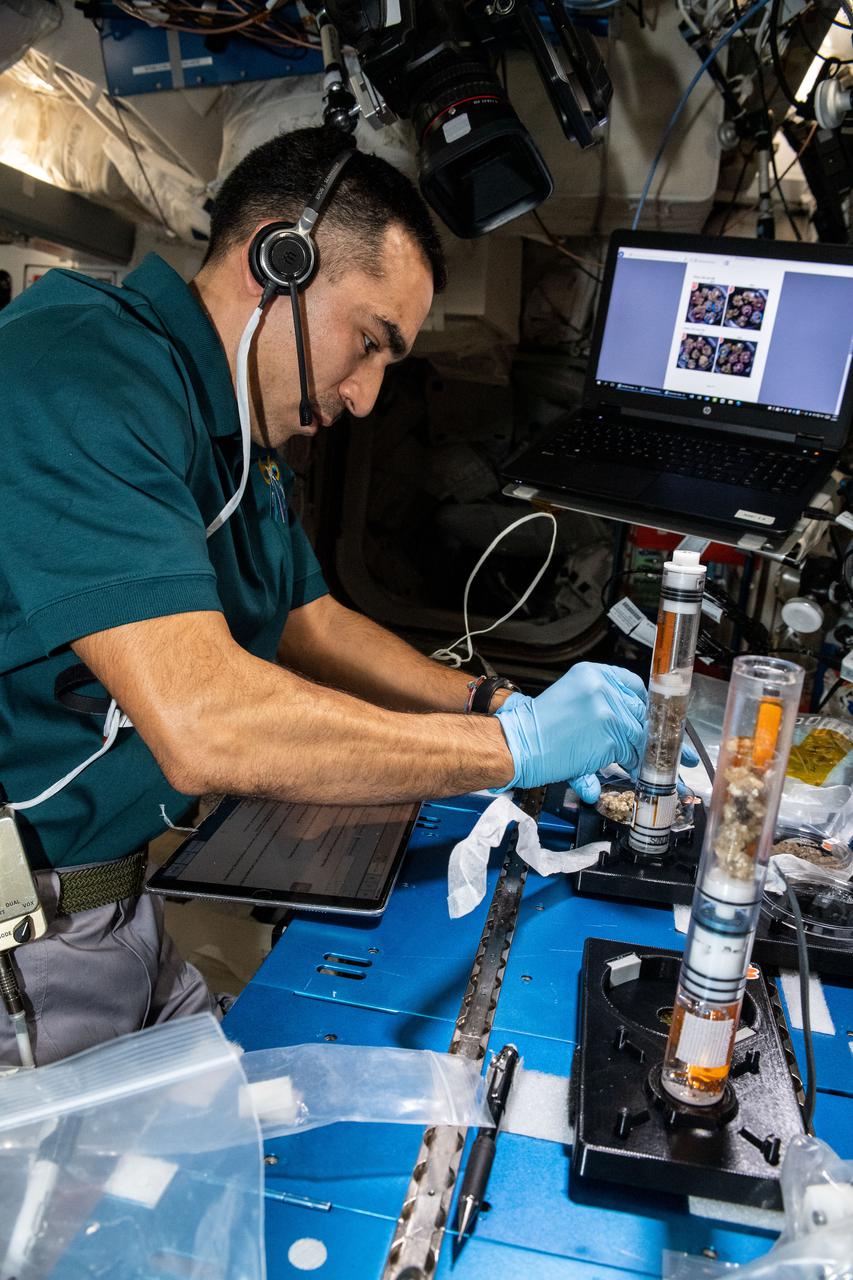
iss066e184146 (March 28, 2022) --- NASA astronaut and Expedition 66 Flight Engineer Raja Chari performs the final harvest of cotton cell cultures as part of the Plant Habitat-05 investigation (PH-05). The space agriculture study explored genetic expression in cotton cell cultures to learn more about the process of plant regeneration, potentially improving crop production on Earth.
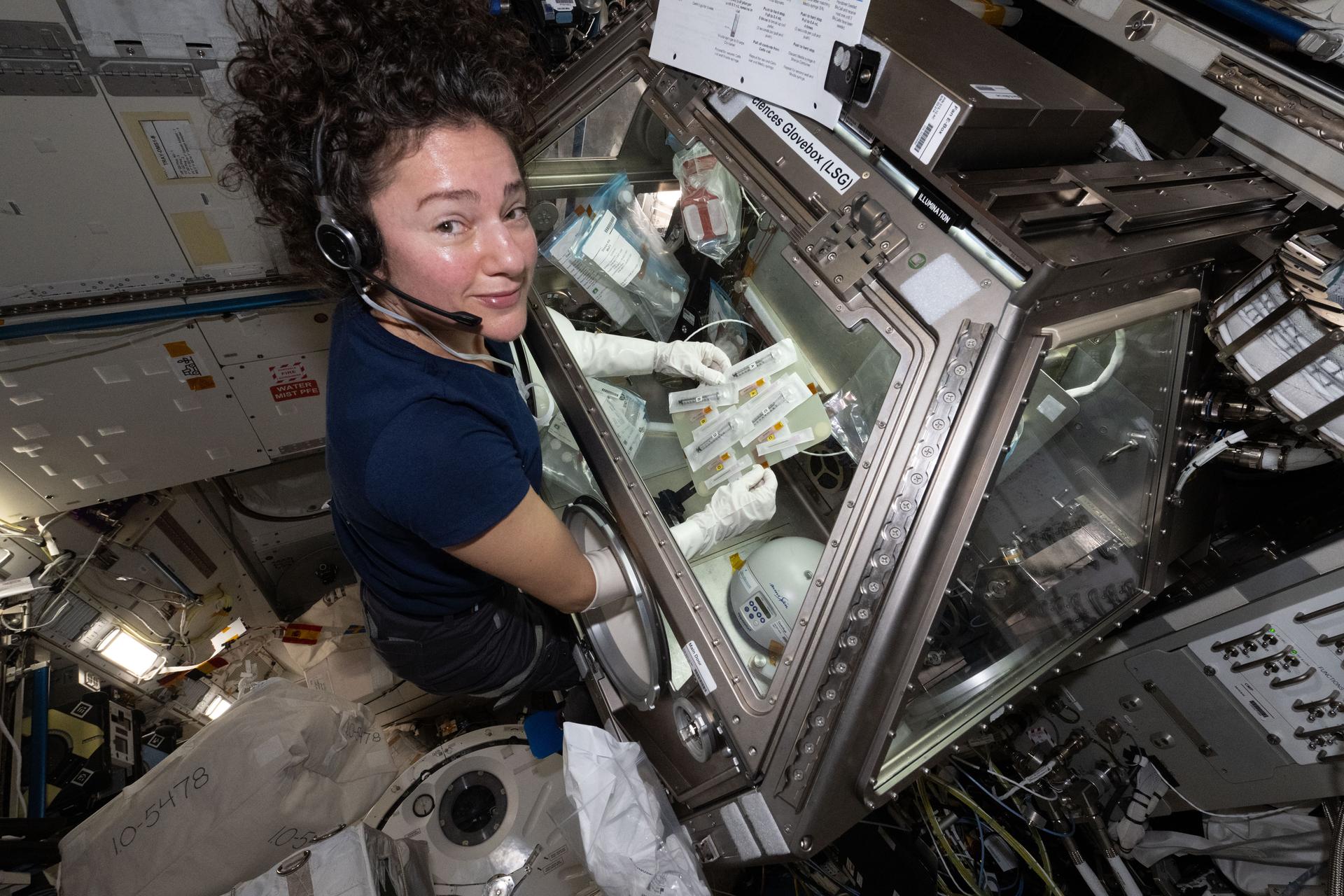
iss074e0591327 (May 18, 2026) --- NASA astronaut and Expedition 74 flight engineer Jessica Meir works inside the Kibo laboratory module’s Life Science Glovebox aboard the International Space Station. Meir was preparing blood platelet samples for incubation and growth to observe how weightlessness affects a crew member’s blood clotting and immune function at the cellular and genetic levels. Credit: ESA/Sophie Adenot

iss024e014714 (9/15/2010) --- A view of a Bioecology Case containing a stowed BTKh-27 ASTROVAKTSINA (Astrovaccine) payload aboard the International Space Station (ISS). The Cultivating Escheria coli Producer of CAF1 Protein in Weightlessness (Astrovaktsina) studies the effect of spaceflight factors on the processes of biosynthesis, secretion, capsule formation, and the biological properties of the E. coli producer of the genetically engineered CAF1 antigen protein of Yersinia pestis during its exposure to microgravity.
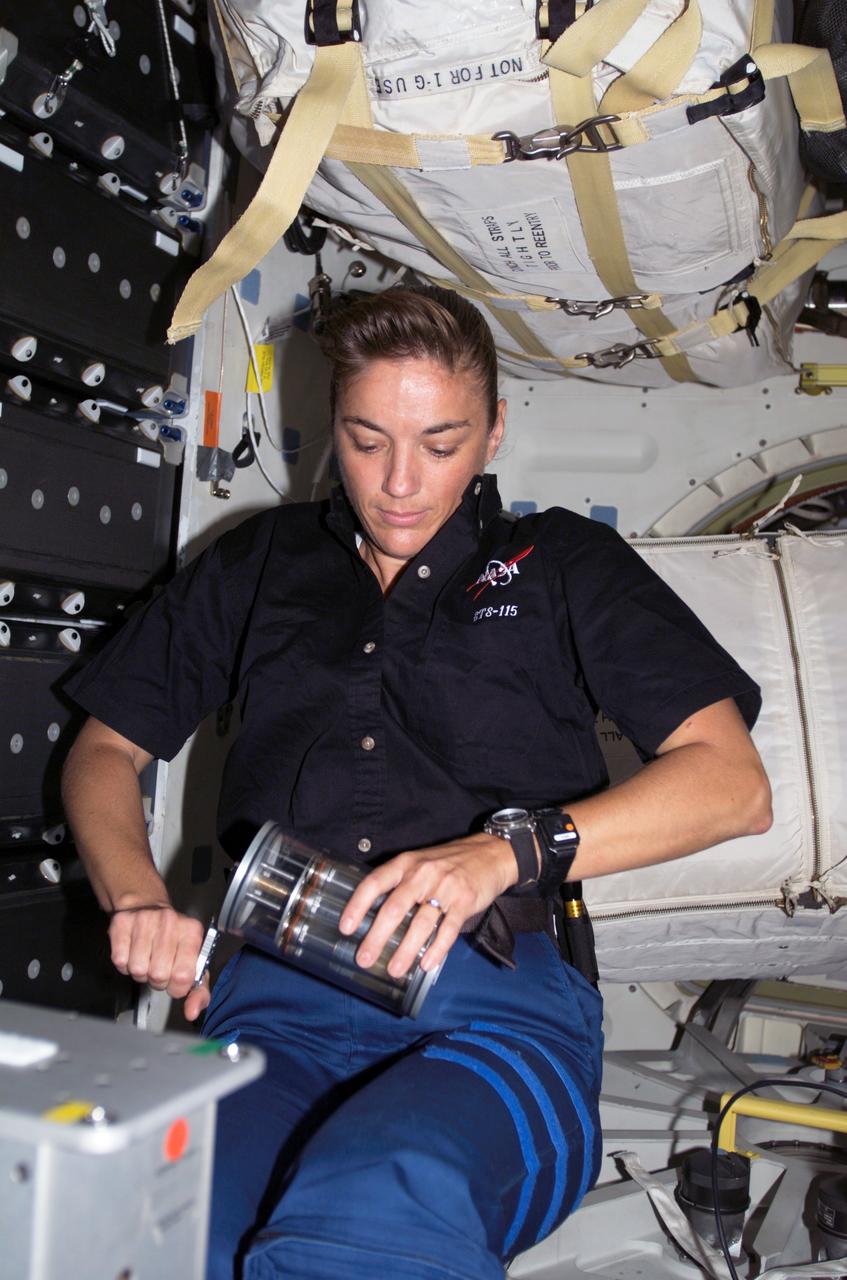
S115-E-07273 (9-21 Sept. 2006) --- Astronaut Heidemarie M. Stefanyshyn-Piper, STS-115 mission specialist, works with the Yeast-Group Activation Packs (Yeast-GAP) on the middeck of Space Shuttle Atlantis. Yeast-GAP experiment studies the effects of genetic changes of yeast cells exposed to the space environment. The results will help scientists to understand how cells respond to radiation and microgravity.
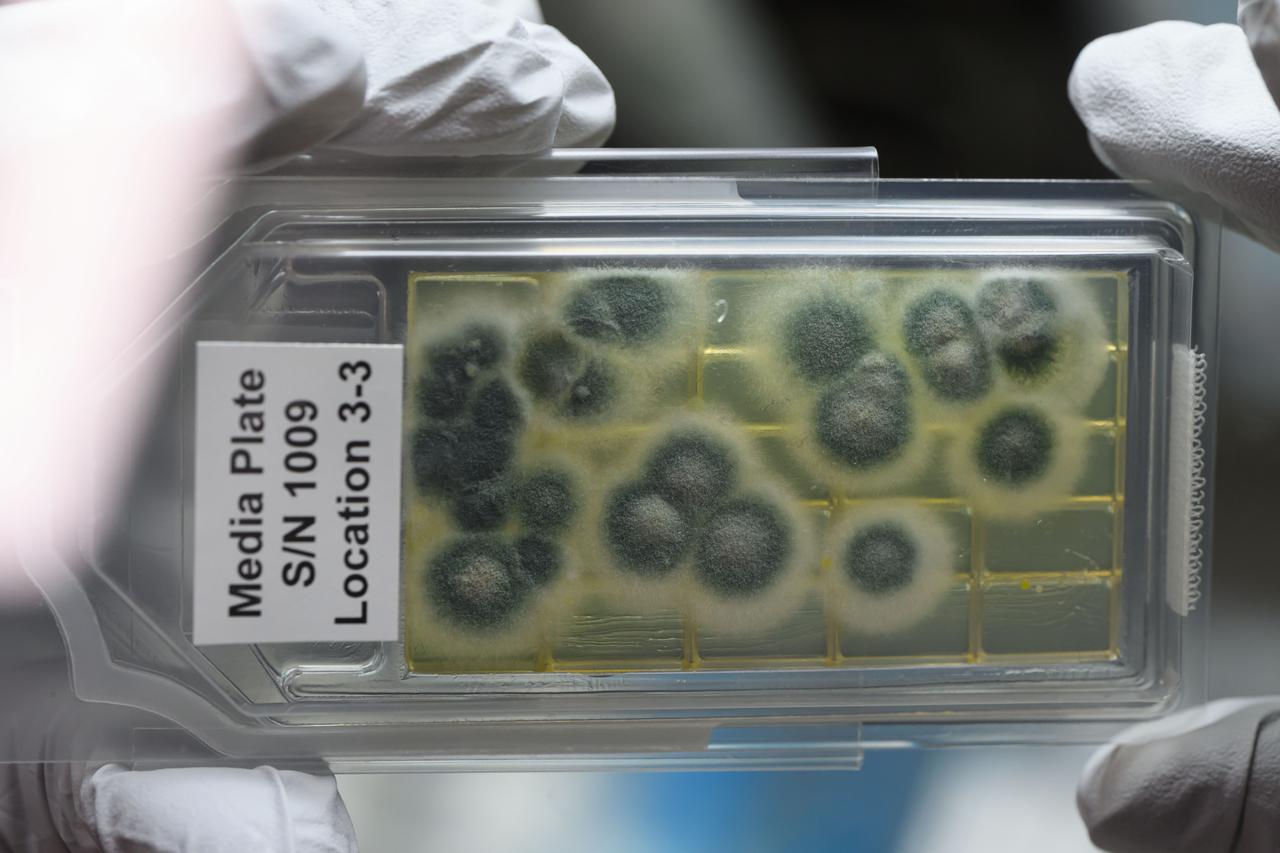
iss071e040186 (4/24/2024) --- A CS-05A: Genomic Enumeration of Antibiotic Resistance in Space (GEARS) sample media plate is shown aboard the International Space Station. The GEARS investigation surveys the space station for antibiotic resistant-organisms. Genetic analysis could show how these bacteria adapt to the space environment, providing knowledge that informs measures to protect astronauts on future long-duration missions.
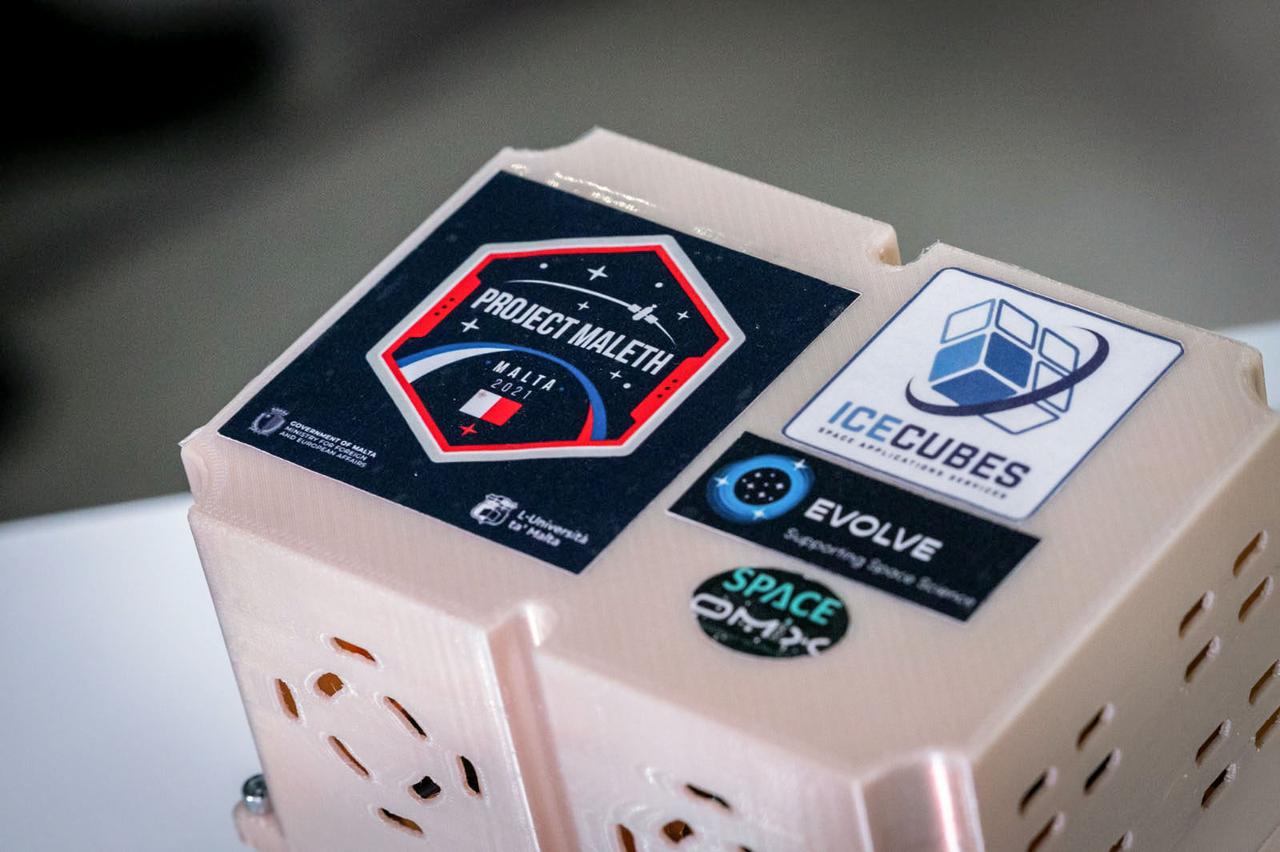
jsc2021e033543 (8/4/2021) --- A prefliight view of Ice Cubes #9 - Project Maleth. The Maltese Biocube, based on ICE Cubes platform by Space Applications Services, that will take samples to the International Space Station in a historic first for the country. The investigation studies Diabetes Mellitus Type 2 and Diabetic Foot Ulcers (DFU) using genetics and space biosciences is new and innovative research. Image credit: DOI: Ministry for Foreign and European Affairs, Malta
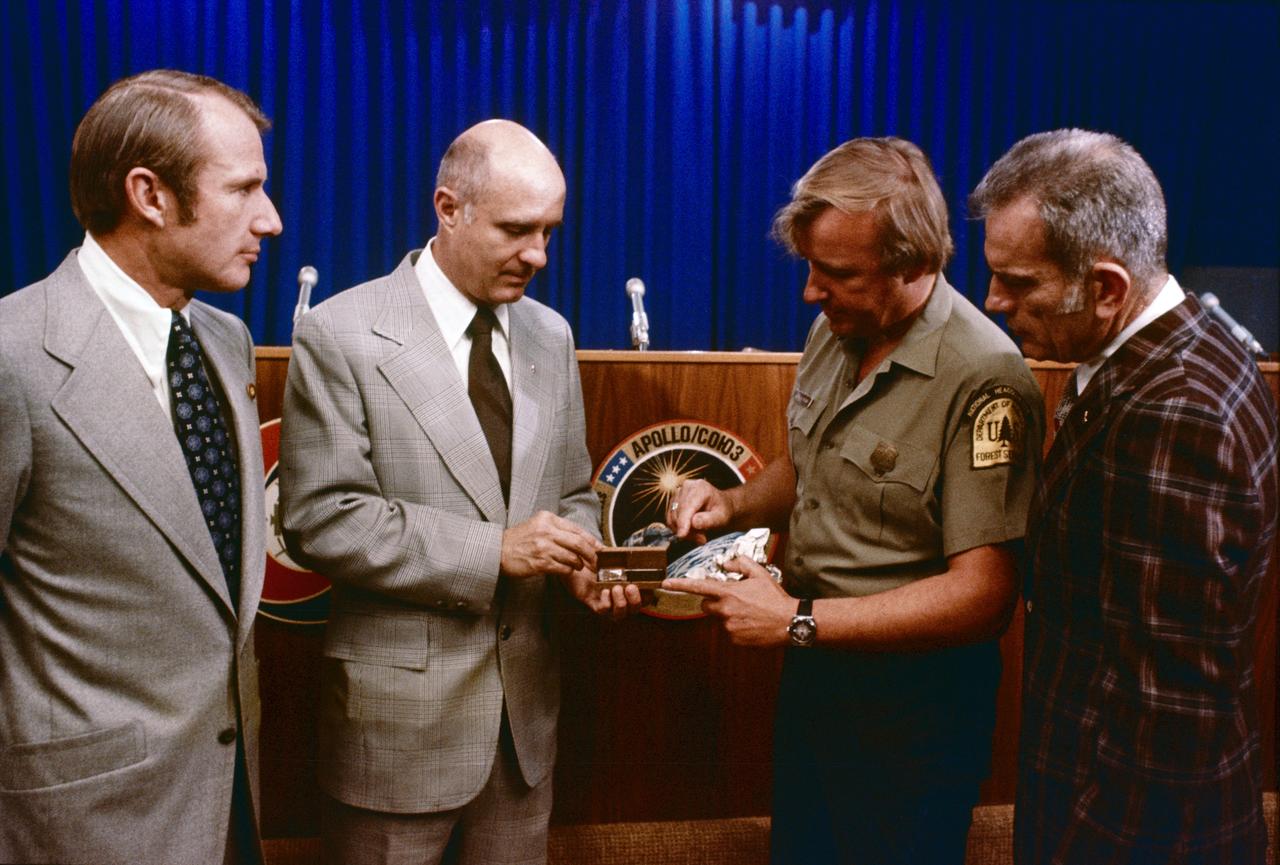
S75-27445 (6 June 1975) --- American ASTP crewmen Vance D. Brand (left), Thomas P. Stafford (second from left) and Donald K. Slayton (right) receive a special box of genetically superior white spruce seeds from Glenn A. Kovar (second from right), USDA Forest Service project coordinator. The seeds, enough to plant an acre of trees, will be presented to the Soviet ASTP crewmen during the U.S.-USSR Apollo-Soyuz Test Project docking-in-Earth-orbit mission in July 1975. The seeds will produce faster-growing trees of exceptional height and shape. The trees will thrive in Moscow-like climate, and were developed by Forest Service?s Institute of Forest Genetics in Rhinelander, Wisconsin. The seed container box was made from recycled fibers and stabilized walnut. These seeds are an outstanding example of the U.S. Forest Service research to help produce new improved forests for the world. The four men are standing in the Building 2 briefing room at NASA's Johnson Space Center.
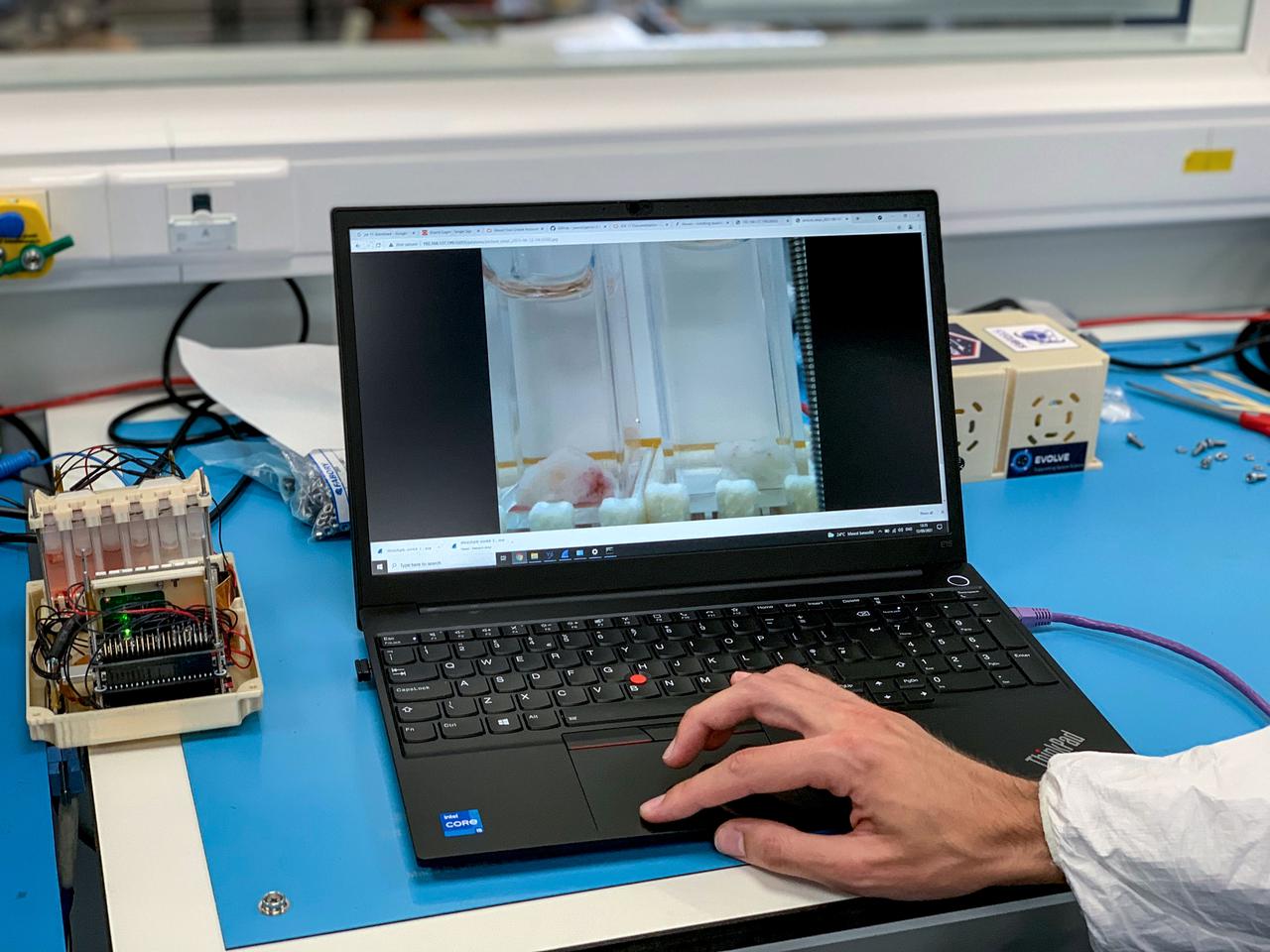
jsc2021e037898 (8/12/2021) --- A preflight image shows a zoomed up picture of two sample cuvettes containing human skin samples taken by the raspberry Pi video feed. Videos of up to 60 FPS can be recorded and saved for remote use. The Ice Cubes #9 – Project Maleth (Space Omics Analysis of the Skin Microbiome of Diabetic Foot Ulcers, or SpaceOMIX) investigation that studies Diabetes Mellitus Type 2 and Diabetic Foot Ulcers (DFU) using genetics and space biosciences is new and innovative research. Image courtesy Space Applications Services.
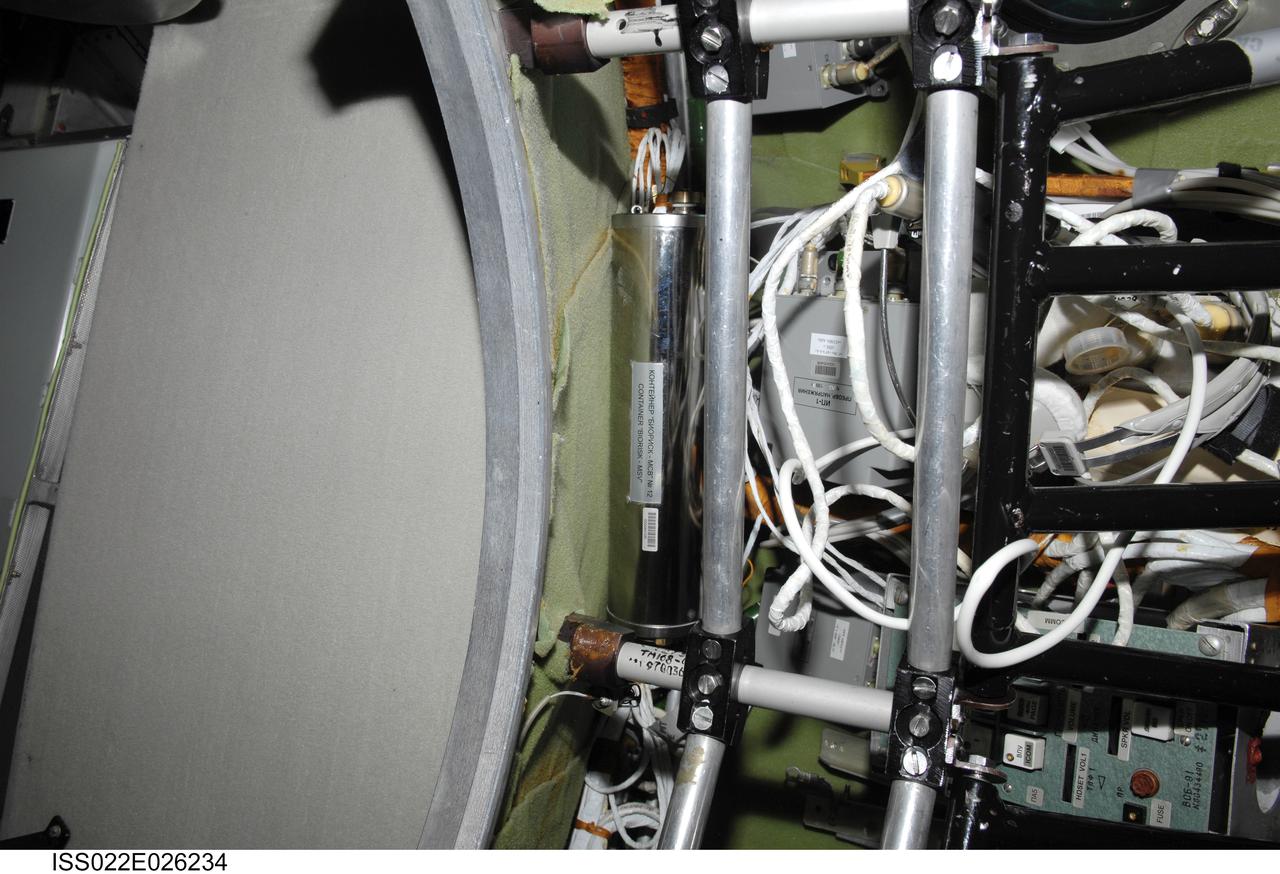
iss022e026234 (1/20/2010) --- A view of Container Biorisk MSV No. 12, in the Service Module (SM) aboard the International Space Station (ISS). The Influence of Factors of the Space Environment on the Condition of the System of Microorganisms-Hosts Relating to the Problem of Environmental Safety of Flight Techniques and Planetary Quarantine (Biorisk) investigation aims to obtain new data on physical and genetic changes in bacteria and fungi typically found on spacecraft equipment, and also in various biological test objects (higher plant seeds, dormant forms of lower crustaceans) under exposure in the interior ISS compartments and on the exterior ISS surfaces.