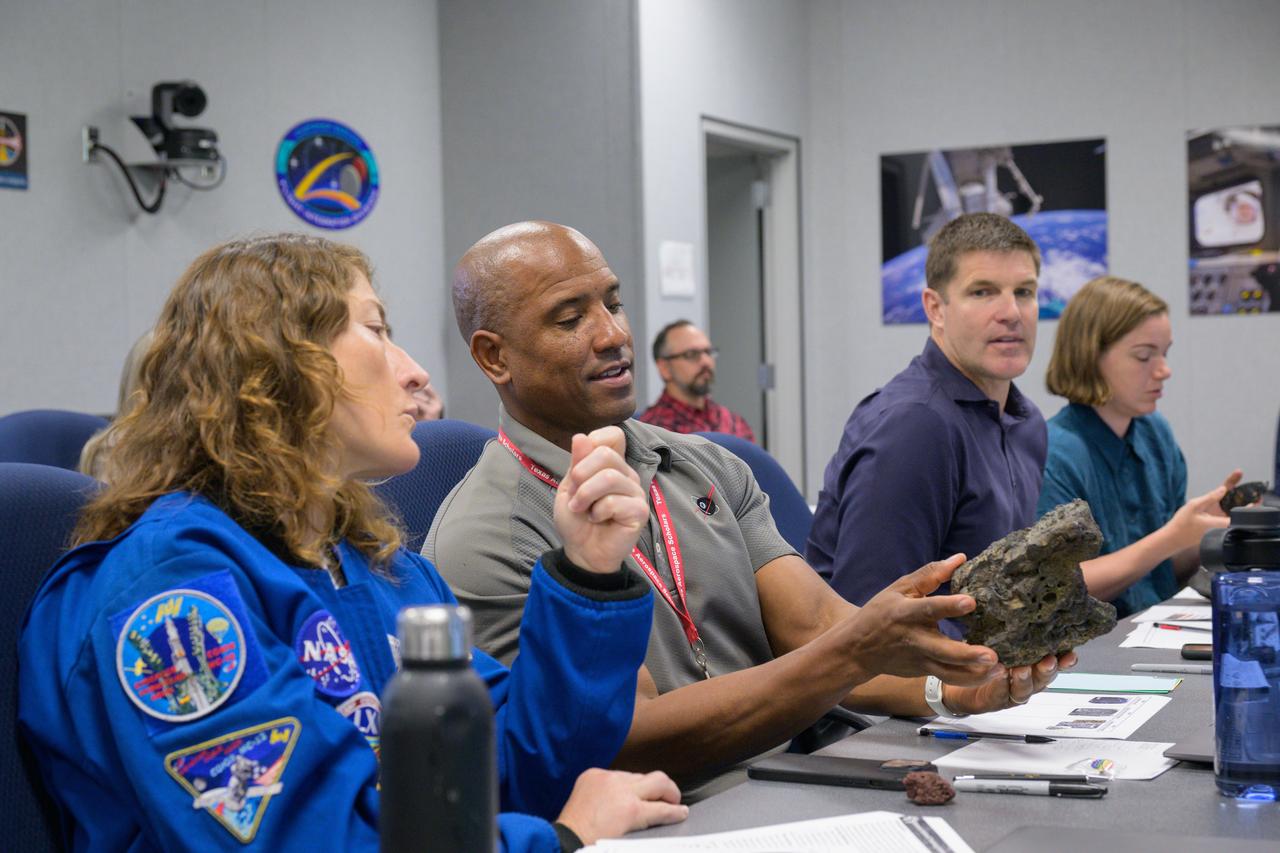
jsc2024e040808 --- Artemis II crew members, from left, NASA astronauts Christina Koch and Victor Glover, CSA (Canadian Space Agency) astronauts Jeremy Hansen and Jenni Gibbons, study rocks during classroom preparation ahead of their fieldwork training in Iceland.
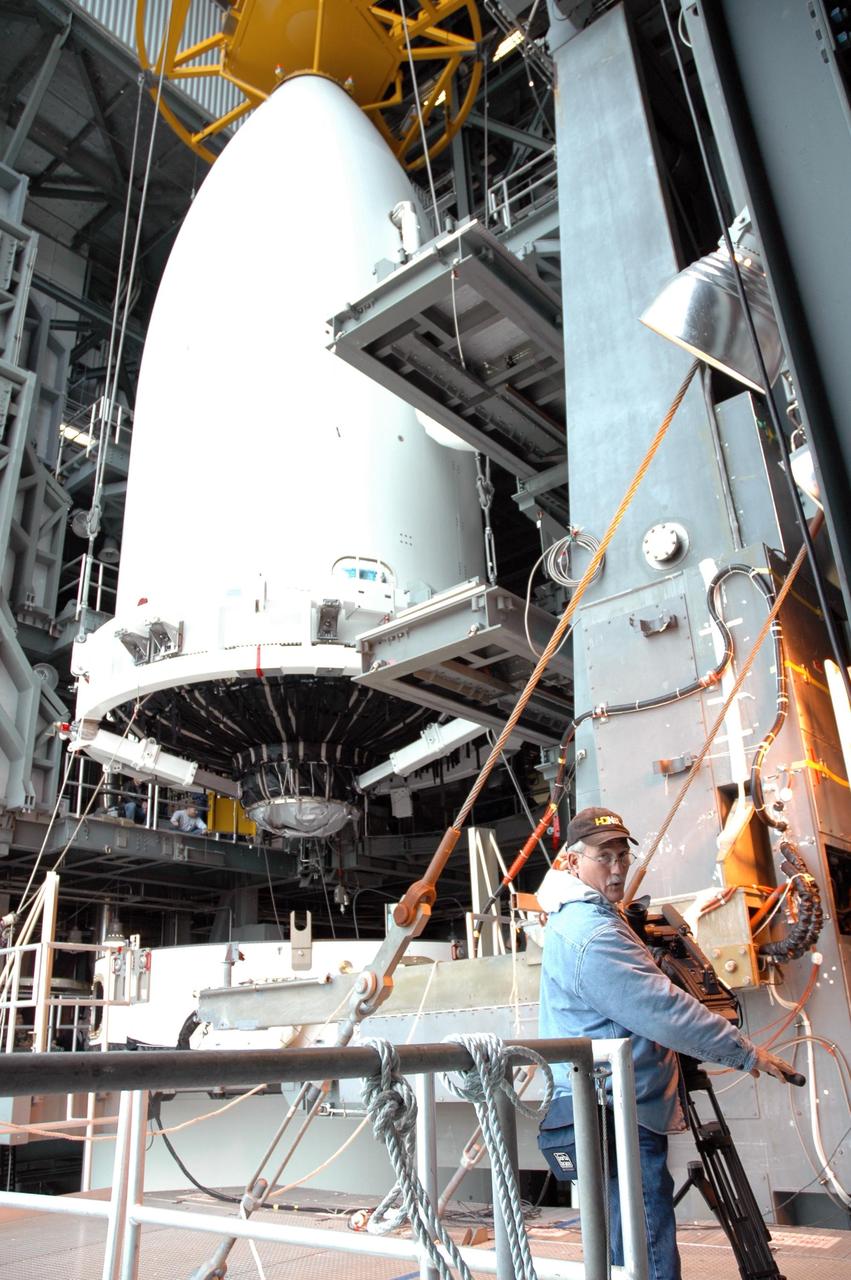
KENNEDY SPACE CENTER, FLA. - InDyne employee Mic Miracle captures on video the arrival of the fairing enclosing New Horizons at the top of a Lockheed Martin Atlas V launch vehicle in the Vertical Integration Facility at Complex 41 on Cape Canaveral Air Force Station. New Horizons carries seven scientific instruments that will characterize the global geology and geomorphology of Pluto and its moon Charon, map their surface compositions and temperatures, and examine Pluto's complex atmosphere. After that, flybys of Kuiper Belt objects from even farther in the solar system may be undertaken in an extended mission. New Horizons is the first mission in NASA's New Frontiers program of medium-class planetary missions. The spacecraft, designed for NASA by the Johns Hopkins University Applied Physics Laboratory in Laurel, Md., will launch aboard a Lockheed Martin Atlas V rocket and fly by Pluto and Charon as early as summer 2015.
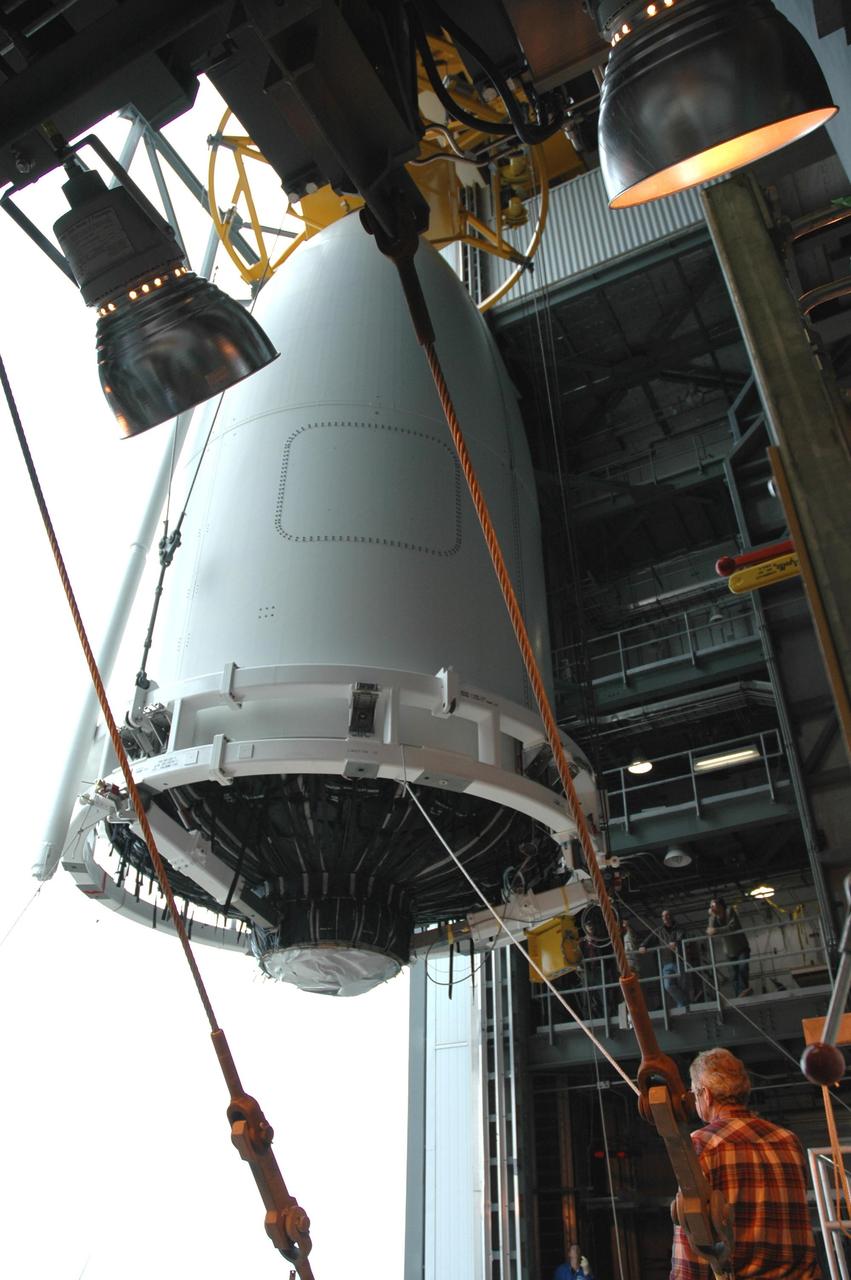
KENNEDY SPACE CENTER, FLA. - The fairing enclosing New Horizons arrives at the top of a Lockheed Martin Atlas V launch vehicle in the Vertical Integration Facility at Complex 41 on Cape Canaveral Air Force Station. New Horizons carries seven scientific instruments that will characterize the global geology and geomorphology of Pluto and its moon Charon, map their surface compositions and temperatures, and examine Pluto's complex atmosphere. After that, flybys of Kuiper Belt objects from even farther in the solar system may be undertaken in an extended mission. New Horizons is the first mission in NASA's New Frontiers program of medium-class planetary missions. The spacecraft, designed for NASA by the Johns Hopkins University Applied Physics Laboratory in Laurel, Md., will launch aboard a Lockheed Martin Atlas V rocket and fly by Pluto and Charon as early as summer 2015.
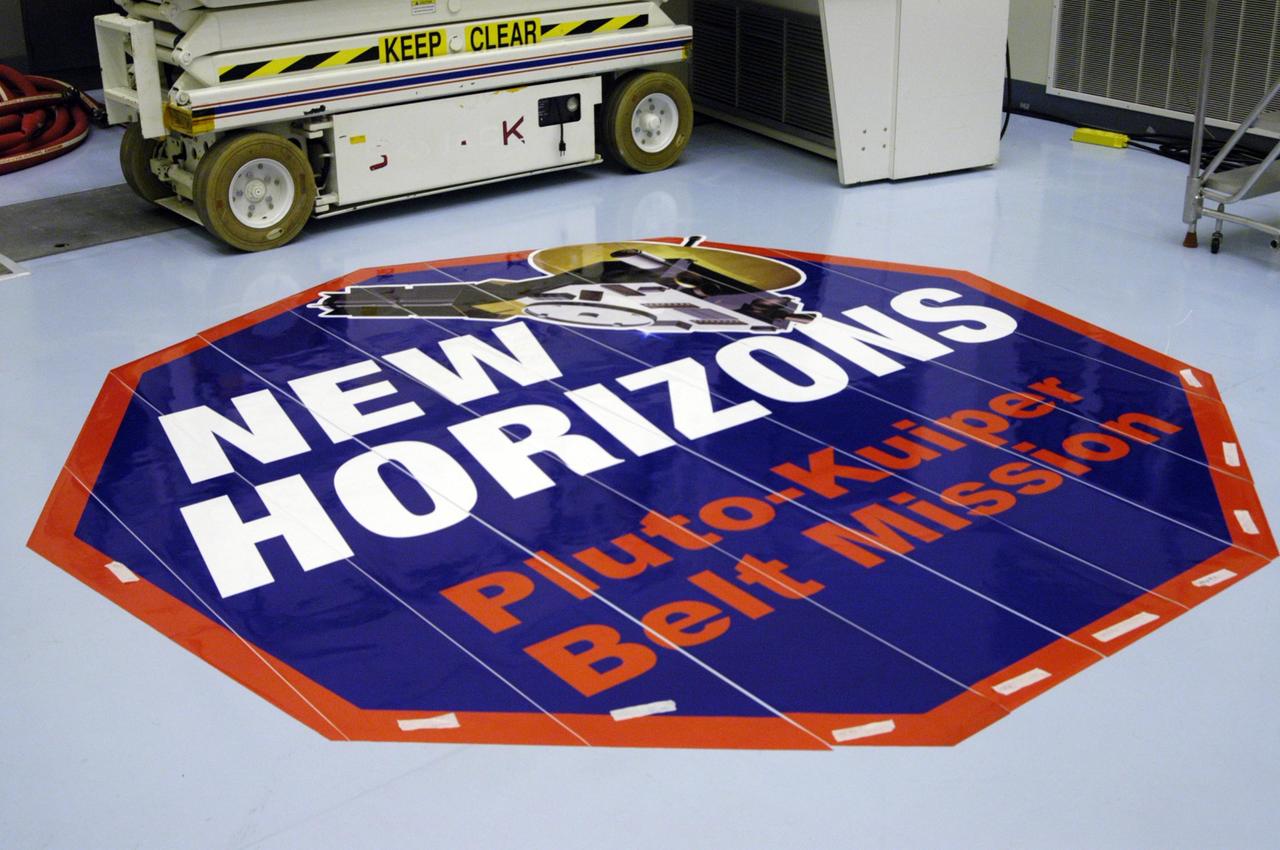
KENNEDY SPACE CENTER, FLA. - The mission decal for New Horizons is laid out in strips on the floor of the Payload Hazardous Servicing Facility before installation onto the spacecraft's fairing. New Horizons carries seven scientific instruments that will characterize the global geology and geomorphology of Pluto and its moon Charon, map their surface compositions and temperatures, and examine Pluto's complex atmosphere. After that, flybys of Kuiper Belt objects from even farther in the solar system may be undertaken in an extended mission. New Horizons is the first mission in NASA's New Frontiers program of medium-class planetary missions. The spacecraft, designed for NASA by the Johns Hopkins University Applied Physics Laboratory in Laurel, Md., will launch aboard a Lockheed Martin Atlas V rocket and fly by Pluto and Charon as early as summer 2015.
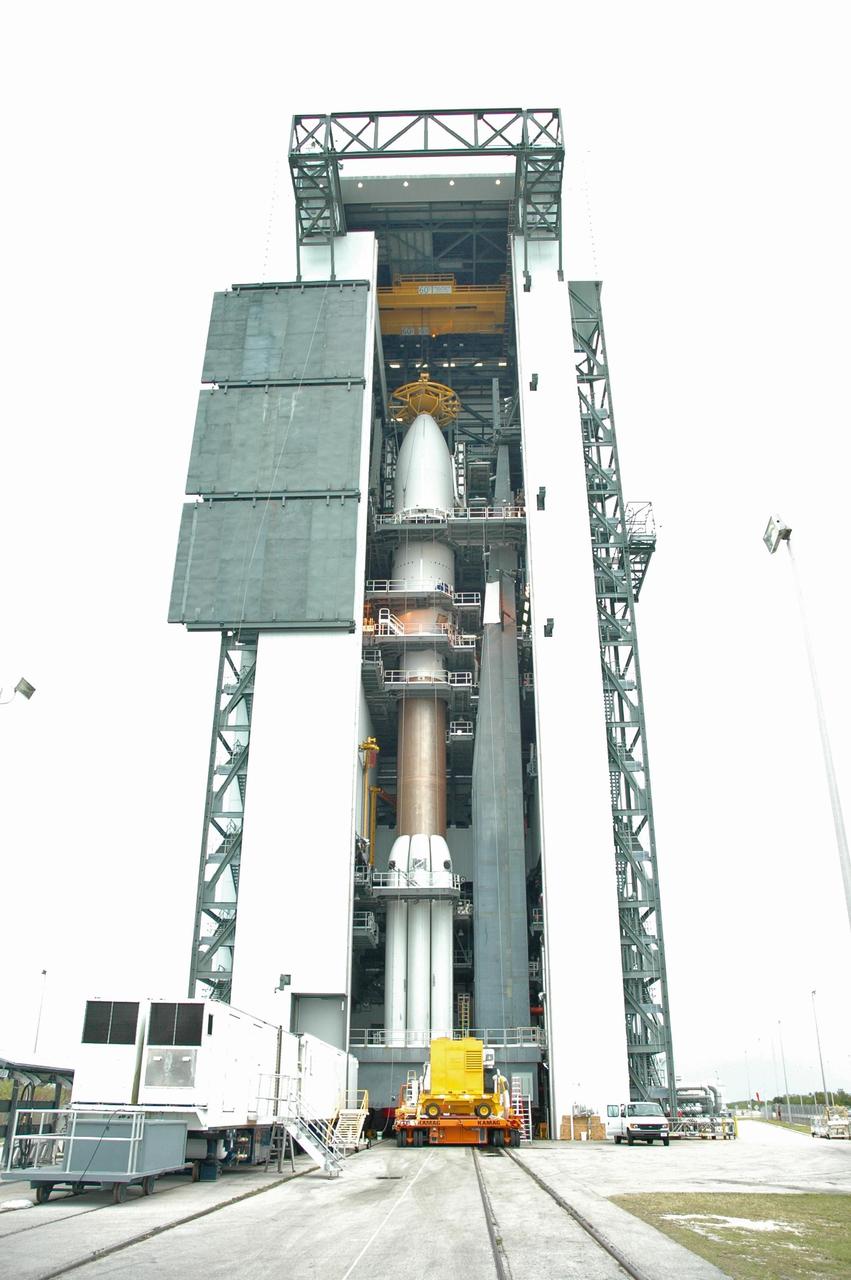
KENNEDY SPACE CENTER, FLA. - The fairing enclosing New Horizons awaits further processing upon its arrival atop a Lockheed Martin Atlas V launch vehicle in the Vertical Integration Facility at Complex 41 on Cape Canaveral Air Force Station. New Horizons carries seven scientific instruments that will characterize the global geology and geomorphology of Pluto and its moon Charon, map their surface compositions and temperatures, and examine Pluto's complex atmosphere. After that, flybys of Kuiper Belt objects from even farther in the solar system may be undertaken in an extended mission. New Horizons is the first mission in NASA's New Frontiers program of medium-class planetary missions. The spacecraft, designed for NASA by the Johns Hopkins University Applied Physics Laboratory in Laurel, Md., will launch aboard a Lockheed Martin Atlas V rocket and fly by Pluto and Charon as early as summer 2015.
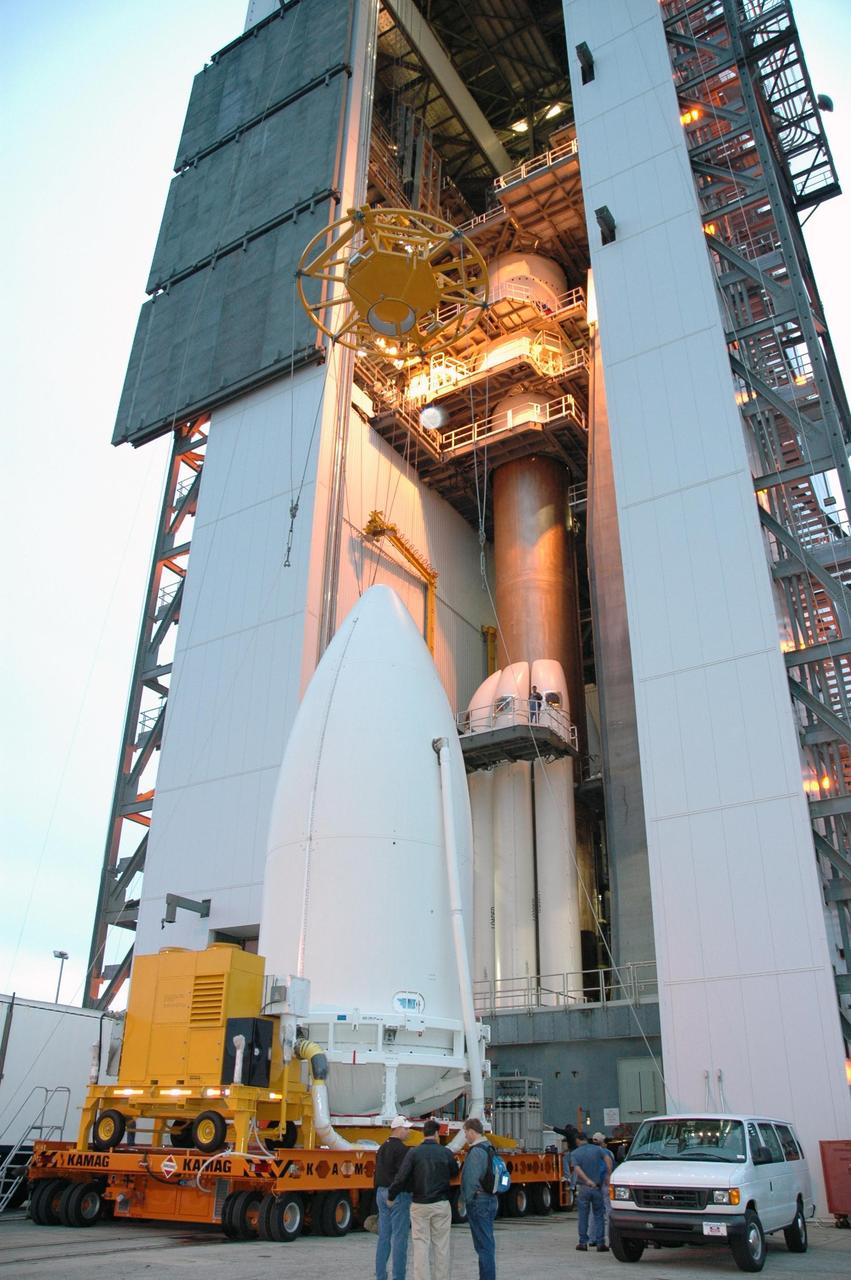
KENNEDY SPACE CENTER, FLA. - The fairing lifting fixture is lowered toward the nose of the fairing enclosing New Horizons upon its arrival at the Vertical Integration Facility at Complex 41 on Cape Canaveral Air Force Station. A Lockheed Martin Atlas V launch vehicle stands ready to receive it in the background. New Horizons carries seven scientific instruments that will characterize the global geology and geomorphology of Pluto and its moon Charon, map their surface compositions and temperatures, and examine Pluto's complex atmosphere. After that, flybys of Kuiper Belt objects from even farther in the solar system may be undertaken in an extended mission. New Horizons is the first mission in NASA's New Frontiers program of medium-class planetary missions. The spacecraft, designed for NASA by the Johns Hopkins University Applied Physics Laboratory in Laurel, Md., will launch aboard a Lockheed Martin Atlas V rocket and fly by Pluto and Charon as early as summer 2015.
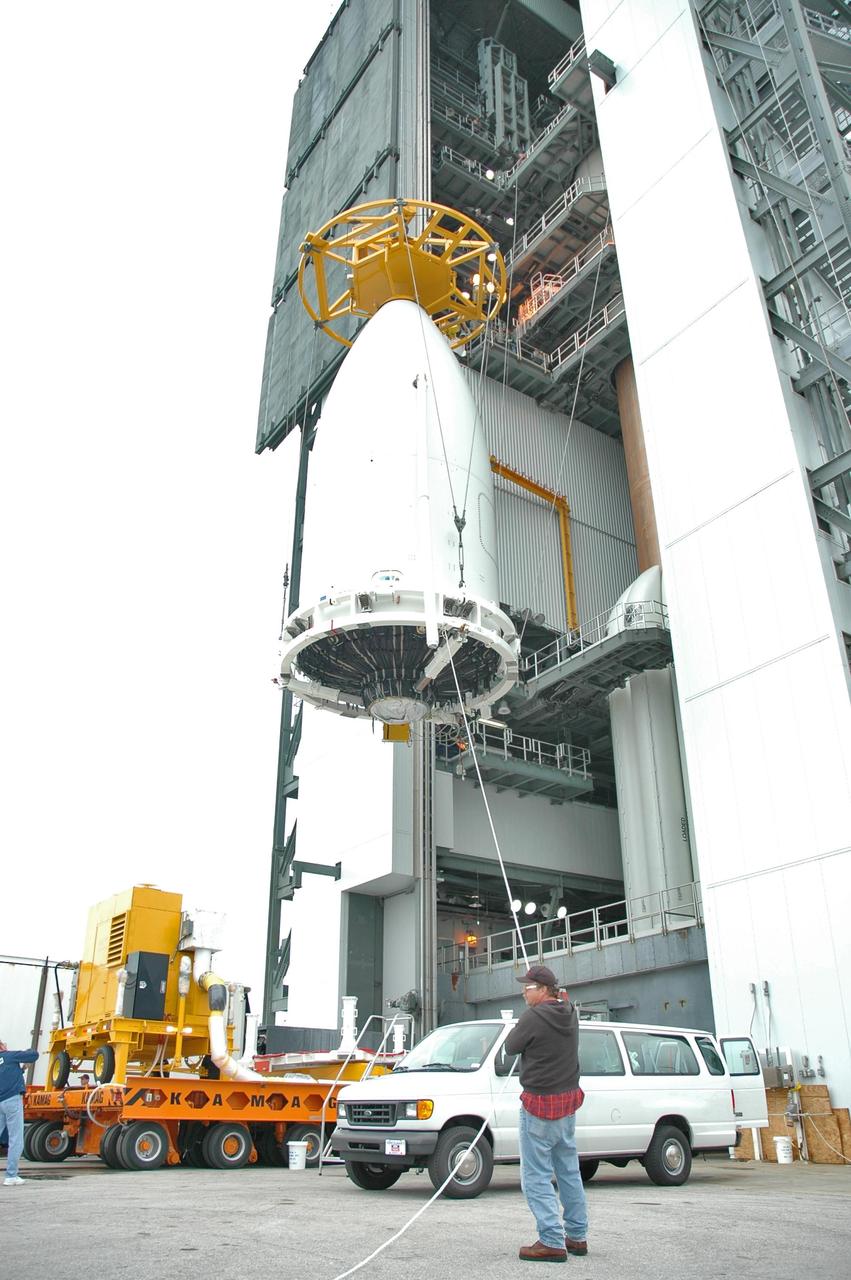
KENNEDY SPACE CENTER, FLA. - The fairing lifting fixture lifts the fairing enclosing New Horizons to the top of a Lockheed Martin Atlas V launch vehicle at the Vertical Integration Facility at Complex 41 on Cape Canaveral Air Force Station. New Horizons carries seven scientific instruments that will characterize the global geology and geomorphology of Pluto and its moon Charon, map their surface compositions and temperatures, and examine Pluto's complex atmosphere. After that, flybys of Kuiper Belt objects from even farther in the solar system may be undertaken in an extended mission. New Horizons is the first mission in NASA's New Frontiers program of medium-class planetary missions. The spacecraft, designed for NASA by the Johns Hopkins University Applied Physics Laboratory in Laurel, Md., will launch aboard a Lockheed Martin Atlas V rocket and fly by Pluto and Charon as early as summer 2015.
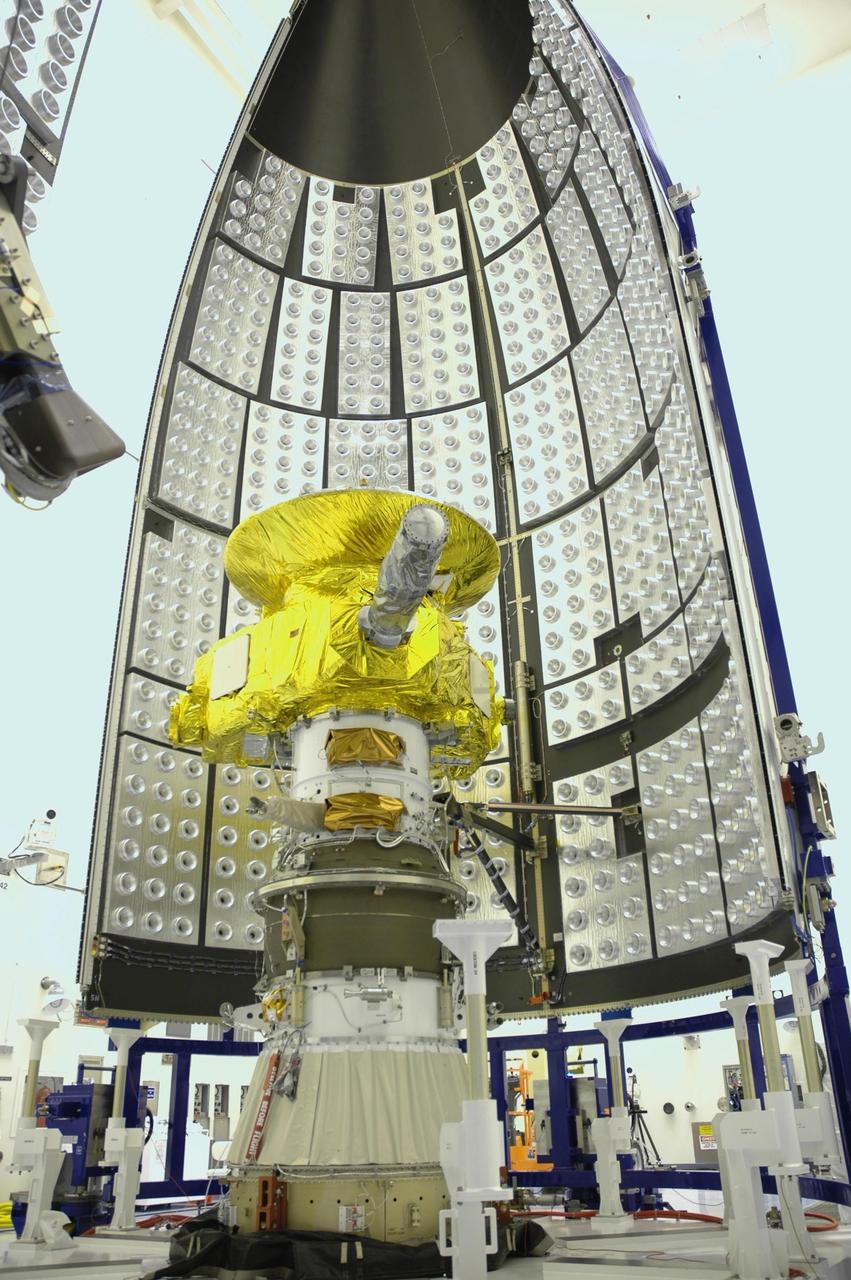
KENNEDY SPACE CENTER, FLA. - In the Payload Hazardous Servicing Facility, the New Horizons spacecraft waits for encapsulation within the fairing sections waiting nearby. The fairing protects the spacecraft during launch and flight through the atmosphere. Once out of the atmosphere, the fairing is jettisoned. The compact 1,060-pound New Horizons probe carries seven scientific instruments that will characterize the global geology and geomorphology of Pluto and its moon Charon, map their surface compositions and temperatures, and examine Pluto's complex atmosphere. After that, flybys of Kuiper Belt objects from even farther in the solar system may be undertaken in an extended mission. New Horizons is the first mission in NASA's New Frontiers program of medium-class planetary missions. The spacecraft, designed for NASA by the Johns Hopkins University Applied Physics Laboratory in Laurel, Md., will fly by Pluto and Charon as early as summer 2015.
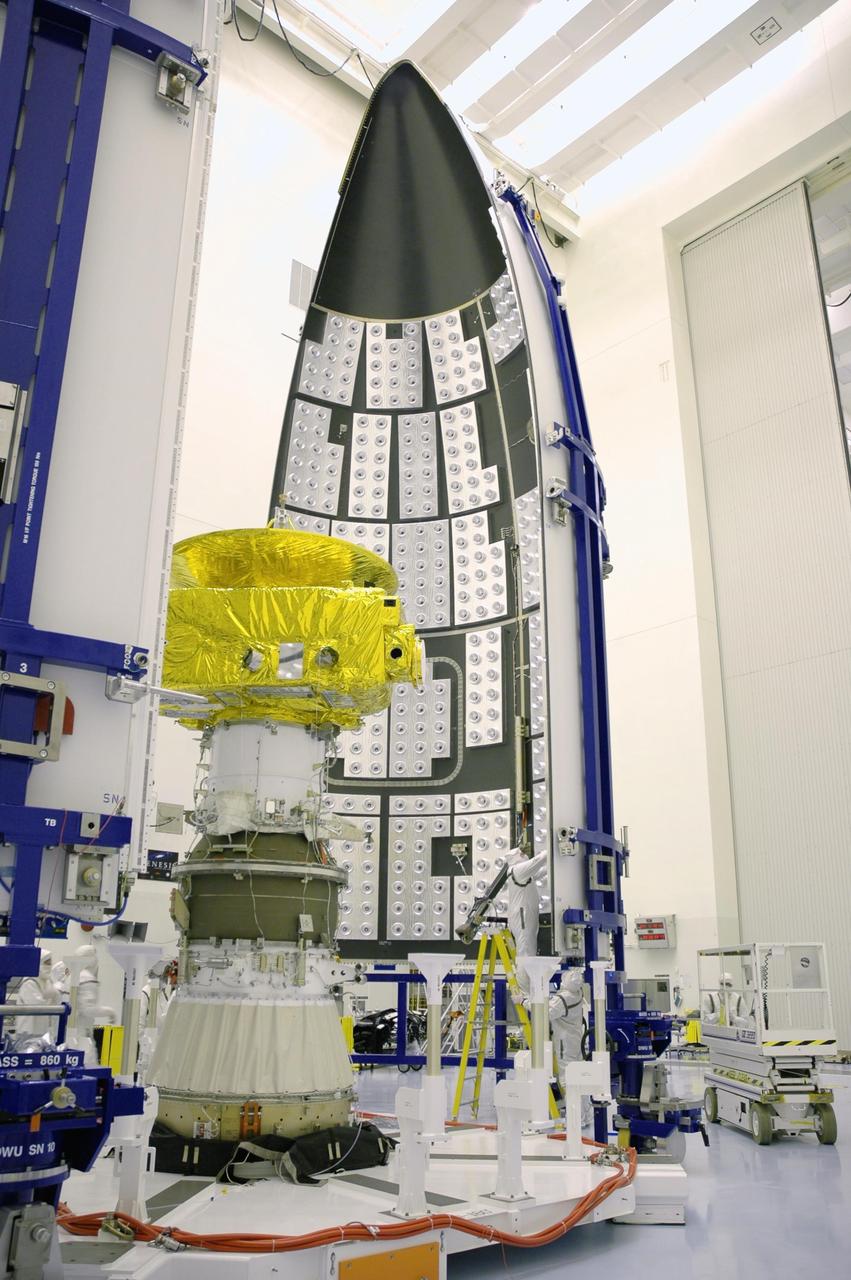
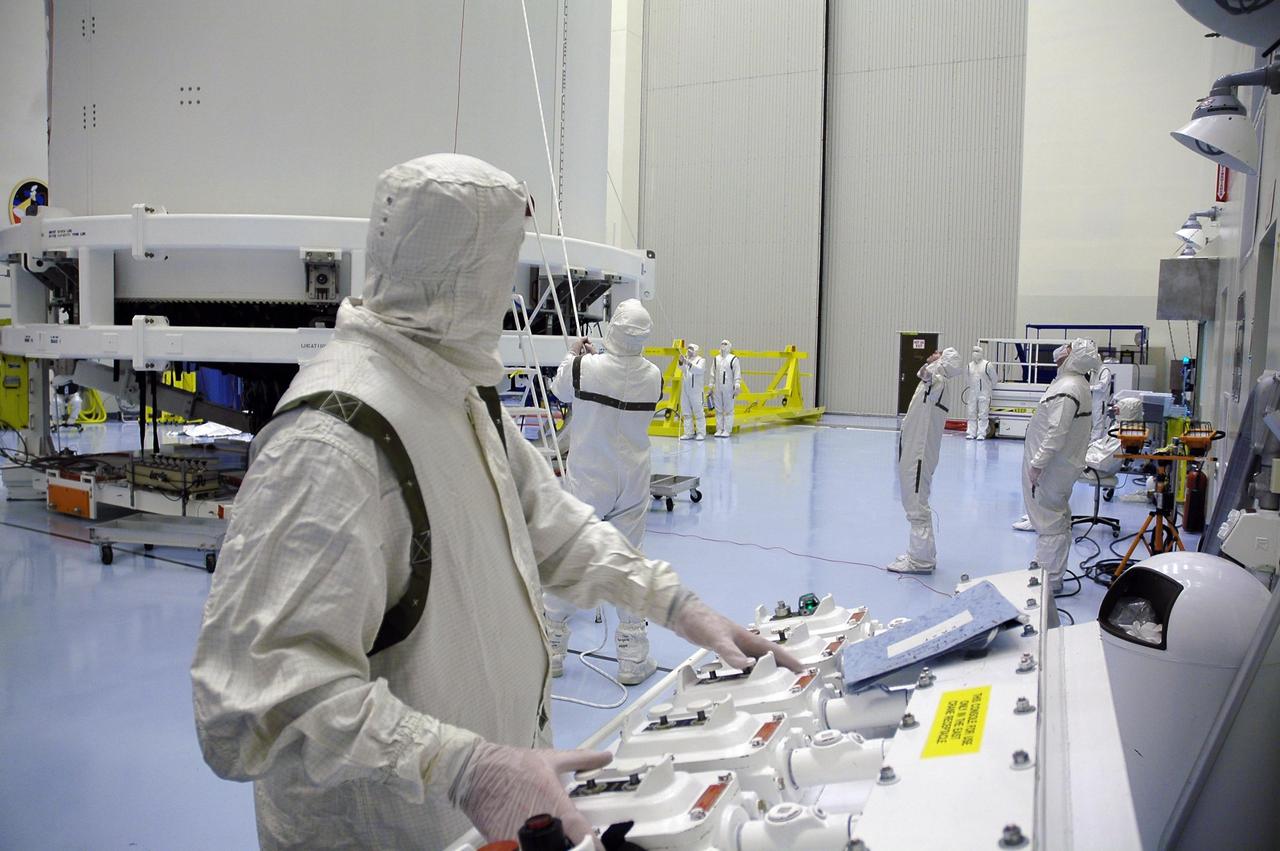
KENNEDY SPACE CENTER, FLA. - In the Payload Hazardous Servicing Facility, clean-suit garbed workers prepare the first fairing section (in the background) that will encapsulate the New Horizons spacecraft at left for flight. The fairing protects the spacecraft during launch and flight through the atmosphere. Once out of the atmosphere, the fairing is jettisoned. The compact 1,060-pound New Horizons probe carries seven scientific instruments that will characterize the global geology and geomorphology of Pluto and its moon Charon, map their surface compositions and temperatures, and examine Pluto's complex atmosphere. After that, flybys of Kuiper Belt objects from even farther in the solar system may be undertaken in an extended mission. New Horizons is the first mission in NASA's New Frontiers program of medium-class planetary missions. The spacecraft, designed for NASA by the Johns Hopkins University Applied Physics Laboratory in Laurel, Md., will fly by Pluto and Charon as early as summer 2015.

KENNEDY SPACE CENTER, FLA. - At NASA Kennedy Space Center’s Payload Hazardous Servicing Facility, a technician from the Applied Physics Laboratory adjusts the blanket that is being installed as a heat shield around the New Horizons spacecraft. Carrying seven scientific instruments, the compact 1,060-pound New Horizons probe will characterize the global geology and geomorphology of Pluto and its moon Charon, map their surface compositions and temperatures, and examine Pluto's complex atmosphere. After that, flybys of Kuiper Belt objects from even farther in the solar system may be undertaken in an extended mission. New Horizons is the first mission in NASA's New Frontiers program of medium-class planetary missions. The spacecraft, designed for NASA by the Johns Hopkins University Applied Physics Laboratory in Laurel, Md., will fly by Pluto and Charon as early as summer 2015.
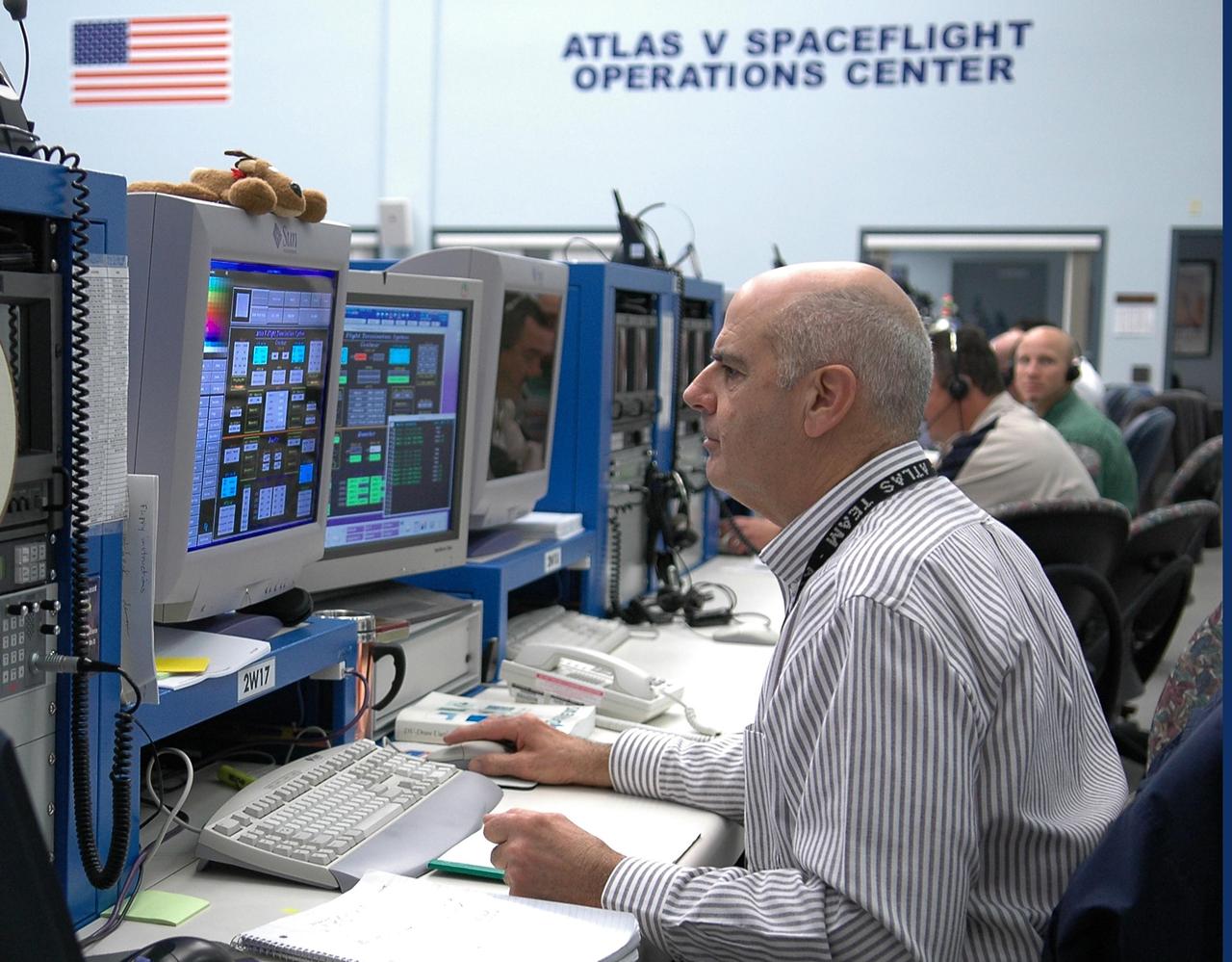
KENNEDY SPACE CENTER, FLA. - In the Atlas V Spaceflight Operations Center on Cape Canaveral Air Force Station, Ed Biggs (foreground), a fluids software engineer for Lockheed Martin, and other members of the New Horizons team take part in a dress rehearsal for the launch scheduled in mid-January. New Horizons carries seven scientific instruments that will characterize the global geology and geomorphology of Pluto and its moon Charon, map their surface compositions and temperatures, and examine Pluto's complex atmosphere. After that, flybys of Kuiper Belt objects from even farther in the solar system may be undertaken in an extended mission. New Horizons is the first mission in NASA's New Frontiers program of medium-class planetary missions. The spacecraft, designed for NASA by the Johns Hopkins University Applied Physics Laboratory in Laurel, Md., will launch aboard a Lockheed Martin Atlas V rocket and fly by Pluto and Charon as early as summer 2015.

KENNEDY SPACE CENTER, FLA. - New Horizons leaves the Payload Hazardous Servicing Facility before dawn for its journey to the Vertical Integration Facility at Complex 41 on Cape Canaveral Air Force Station. New Horizons carries seven scientific instruments that will characterize the global geology and geomorphology of Pluto and its moon Charon, map their surface compositions and temperatures, and examine Pluto's complex atmosphere. After that, flybys of Kuiper Belt objects from even farther in the solar system may be undertaken in an extended mission. New Horizons is the first mission in NASA's New Frontiers program of medium-class planetary missions. The spacecraft, designed for NASA by the Johns Hopkins University Applied Physics Laboratory in Laurel, Md., will launch aboard a Lockheed Martin Atlas V rocket and fly by Pluto and Charon as early as summer 2015.
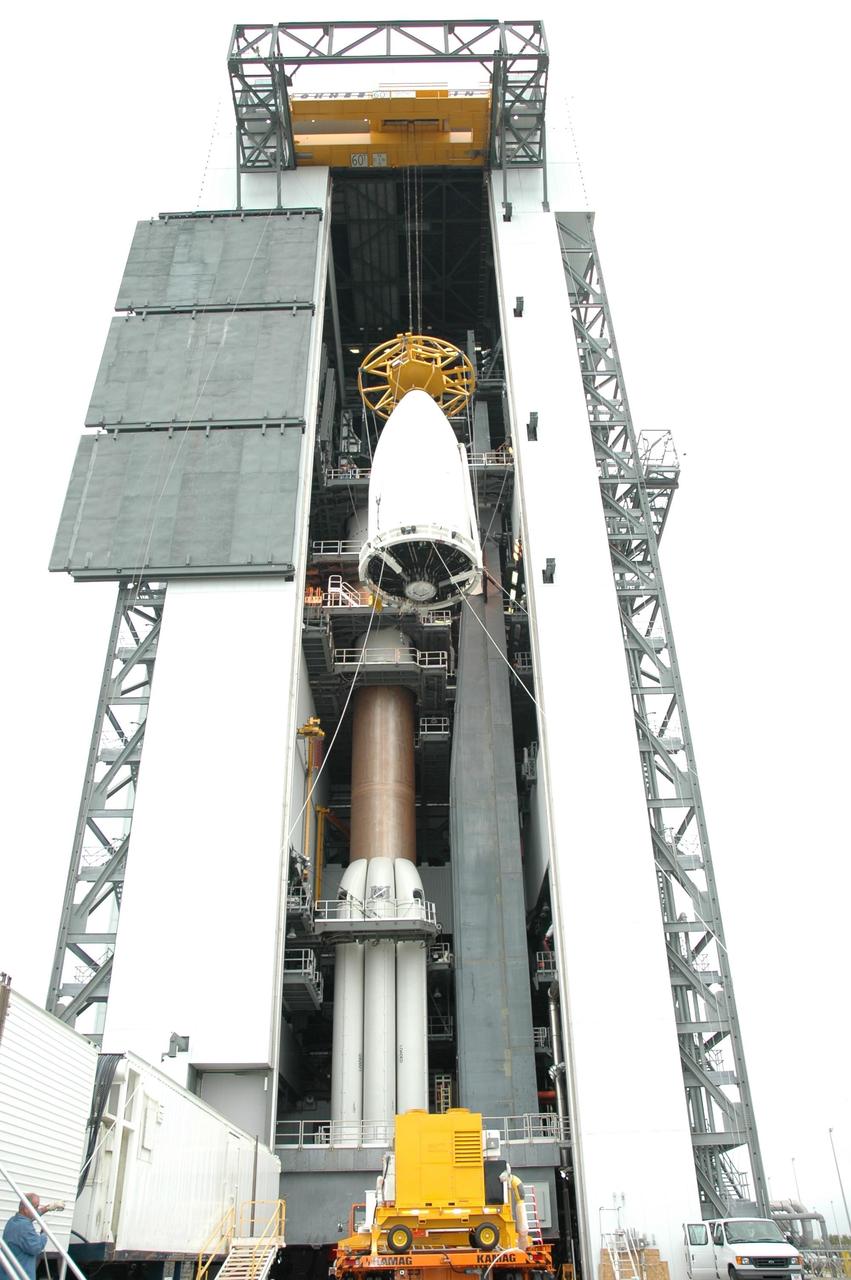
KENNEDY SPACE CENTER, FLA. - The fairing lifting fixture raises the fairing enclosing New Horizons to the top of a Lockheed Martin Atlas V launch vehicle in the Vertical Integration Facility at Complex 41 on Cape Canaveral Air Force Station. New Horizons carries seven scientific instruments that will characterize the global geology and geomorphology of Pluto and its moon Charon, map their surface compositions and temperatures, and examine Pluto's complex atmosphere. After that, flybys of Kuiper Belt objects from even farther in the solar system may be undertaken in an extended mission. New Horizons is the first mission in NASA's New Frontiers program of medium-class planetary missions. The spacecraft, designed for NASA by the Johns Hopkins University Applied Physics Laboratory in Laurel, Md., will launch aboard a Lockheed Martin Atlas V rocket and fly by Pluto and Charon as early as summer 2015.
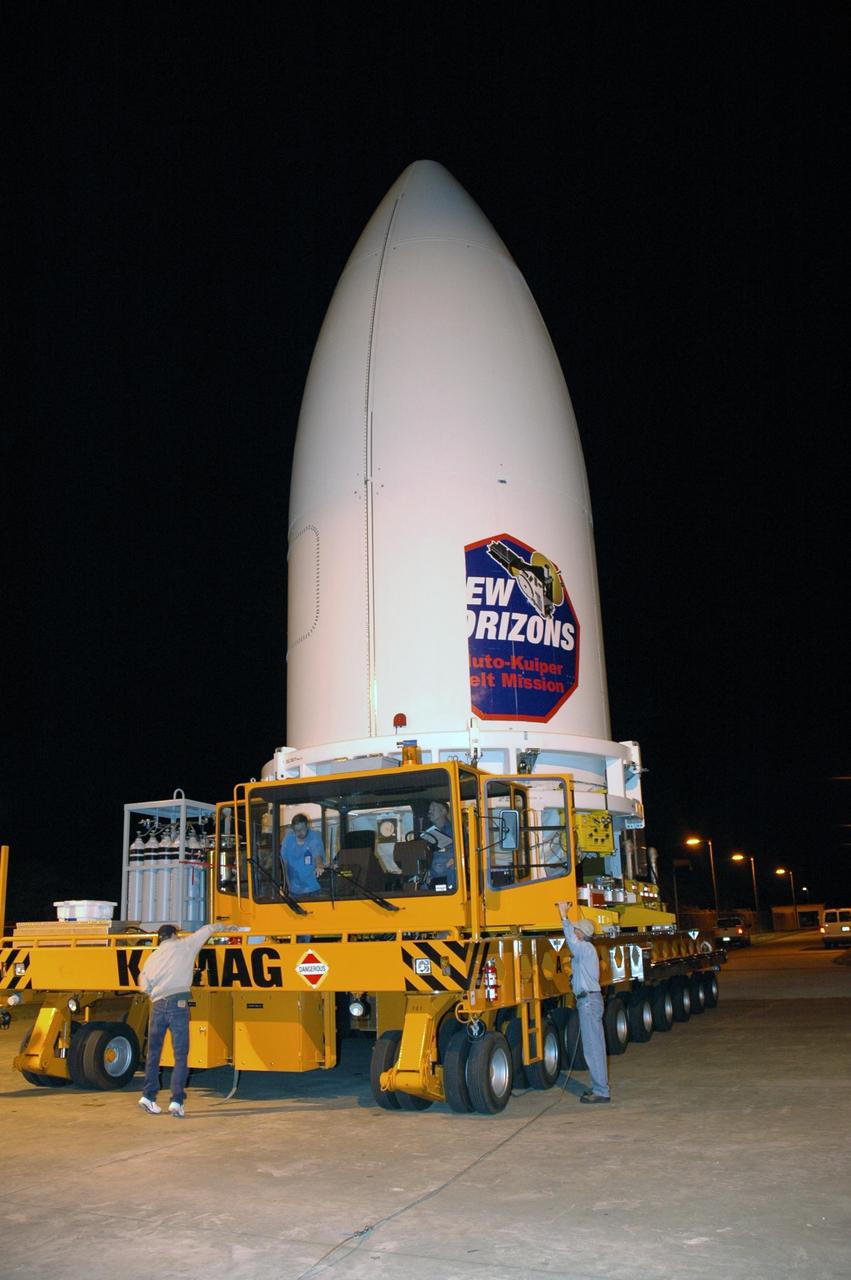
KENNEDY SPACE CENTER, FLA. - Technicians prepare to move New Horizons before dawn from the Payload Hazardous Servicing Facility to the Vertical Integration Facility at Complex 41 on Cape Canaveral Air Force Station. New Horizons carries seven scientific instruments that will characterize the global geology and geomorphology of Pluto and its moon Charon, map their surface compositions and temperatures, and examine Pluto's complex atmosphere. After that, flybys of Kuiper Belt objects from even farther in the solar system may be undertaken in an extended mission. New Horizons is the first mission in NASA's New Frontiers program of medium-class planetary missions. The spacecraft, designed for NASA by the Johns Hopkins University Applied Physics Laboratory in Laurel, Md., will launch aboard a Lockheed Martin Atlas V rocket and fly by Pluto and Charon as early as summer 2015.
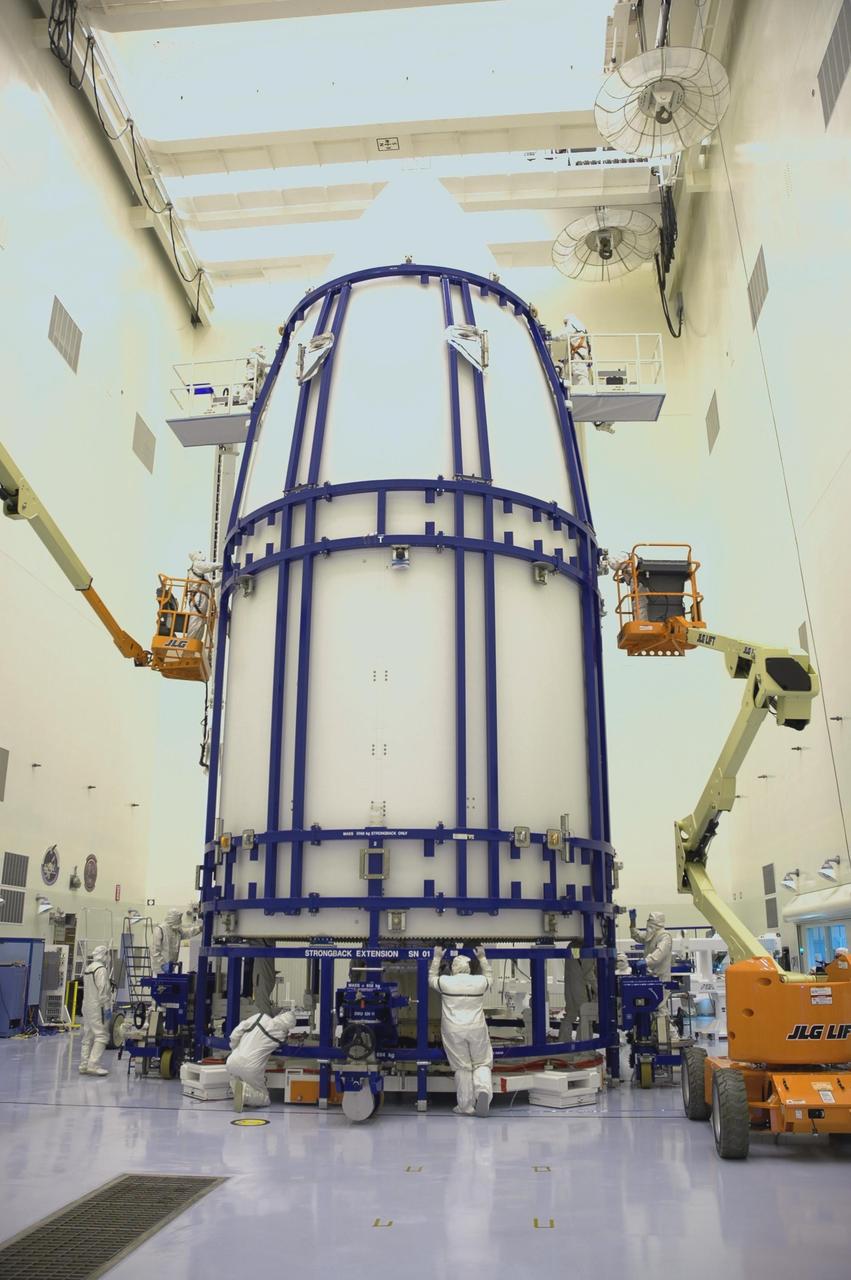
KENNEDY SPACE CENTER, FLA. - In the Payload Hazardous Servicing Facility, clean-suit garbed workers secure the fairing sections around the New Horizons spacecraft for encapsulation. The fairing protects the spacecraft during launch and flight through the atmosphere. Once out of the atmosphere, the fairing is jettisoned. The compact 1,060-pound New Horizons probe carries seven scientific instruments that will characterize the global geology and geomorphology of Pluto and its moon Charon, map their surface compositions and temperatures, and examine Pluto's complex atmosphere. After that, flybys of Kuiper Belt objects from even farther in the solar system may be undertaken in an extended mission. New Horizons is the first mission in NASA's New Frontiers program of medium-class planetary missions. The spacecraft, designed for NASA by the Johns Hopkins University Applied Physics Laboratory in Laurel, Md., will fly by Pluto and Charon as early as summer 2015.
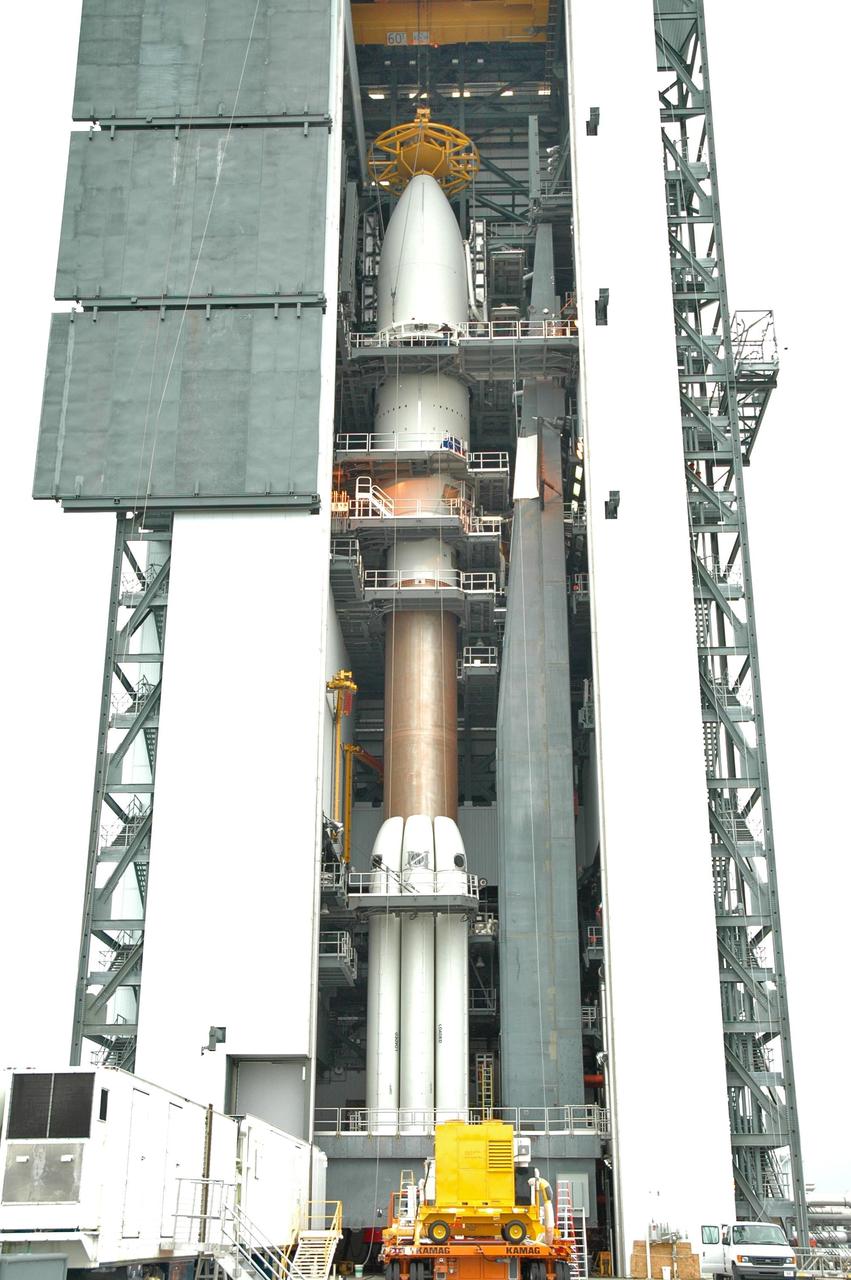
KENNEDY SPACE CENTER, FLA. - The fairing enclosing New Horizons awaits further processing upon its arrival atop a Lockheed Martin Atlas V launch vehicle in the Vertical Integration Facility at Complex 41 on Cape Canaveral Air Force Station. New Horizons carries seven scientific instruments that will characterize the global geology and geomorphology of Pluto and its moon Charon, map their surface compositions and temperatures, and examine Pluto's complex atmosphere. After that, flybys of Kuiper Belt objects from even farther in the solar system may be undertaken in an extended mission. New Horizons is the first mission in NASA's New Frontiers program of medium-class planetary missions. The spacecraft, designed for NASA by the Johns Hopkins University Applied Physics Laboratory in Laurel, Md., will launch aboard a Lockheed Martin Atlas V rocket and fly by Pluto and Charon as early as summer 2015.
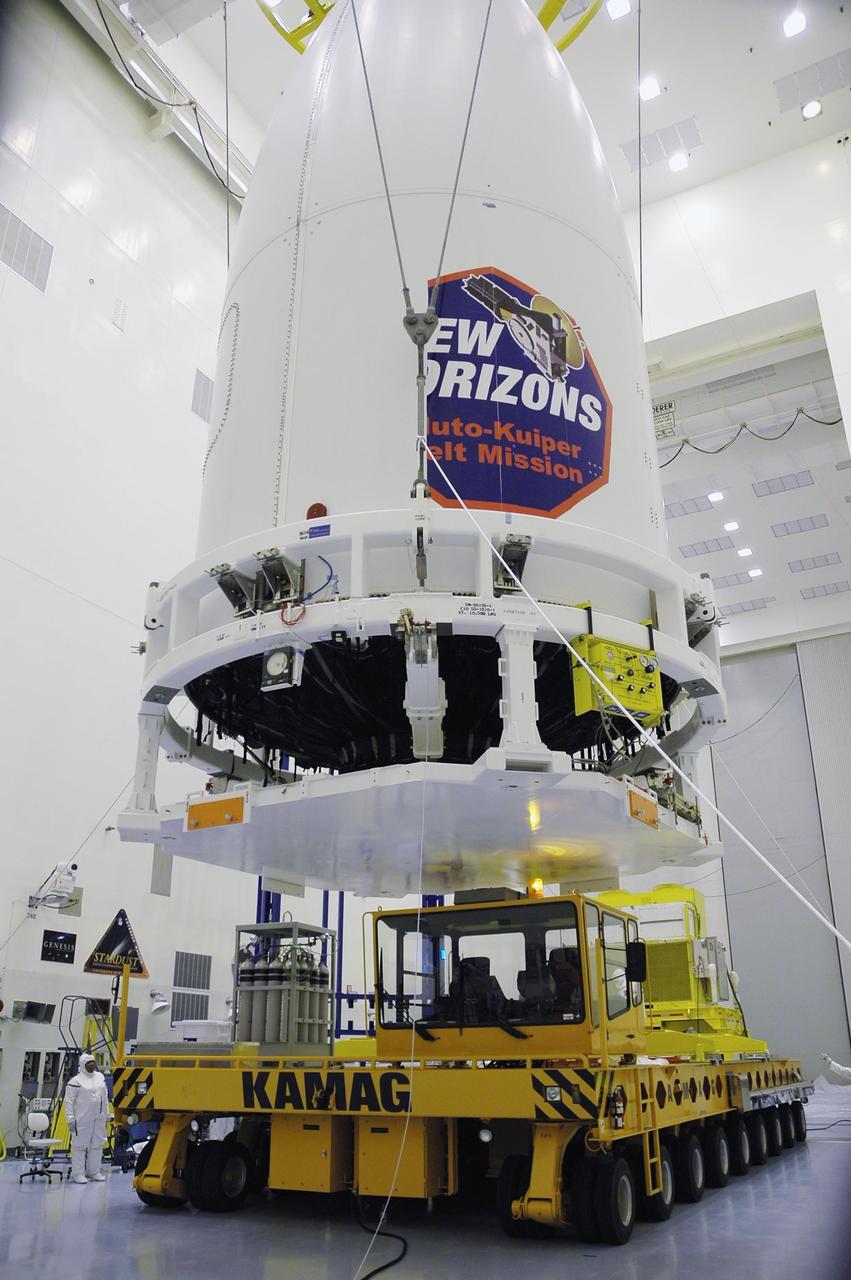
KENNEDY SPACE CENTER, FLA. - In the Payload Hazardous Servicing Facility, technicians lower New Horizons onto a transporter for its move to Complex 41 on Cape Canaveral Air Force Station. The last strip of the mission decal will be installed on the fairing after the spacecraft is delivered to the pad. New Horizons carries seven scientific instruments that will characterize the global geology and geomorphology of Pluto and its moon Charon, map their surface compositions and temperatures, and examine Pluto's complex atmosphere. After that, flybys of Kuiper Belt objects from even farther in the solar system may be undertaken in an extended mission. New Horizons is the first mission in NASA's New Frontiers program of medium-class planetary missions. The spacecraft, designed for NASA by the Johns Hopkins University Applied Physics Laboratory in Laurel, Md., will launch aboard a Lockheed Martin Atlas V rocket and fly by Pluto and Charon as early as summer 2015.
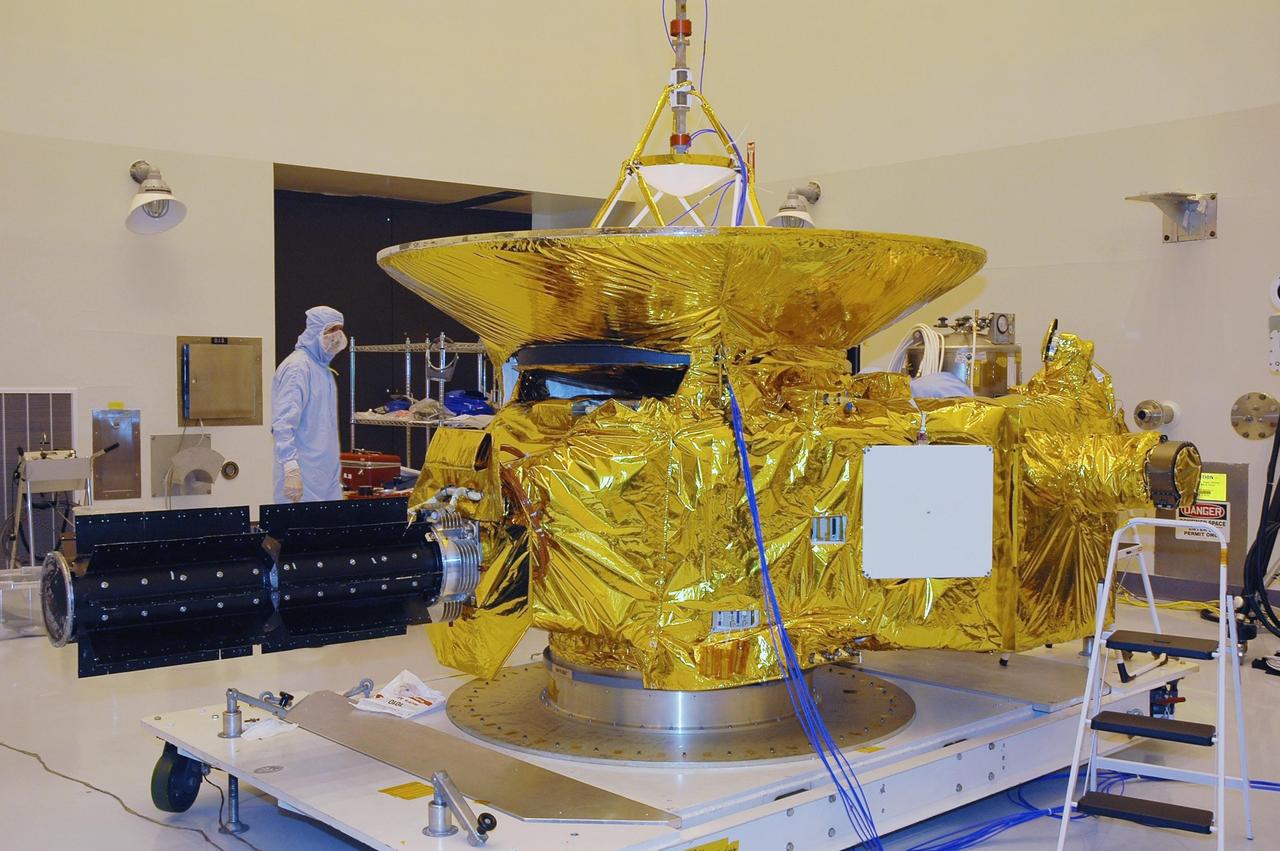
KENNEDY SPACE CENTER, FLA. - At NASA Kennedy Space Center’s Payload Hazardous Servicing Facility, the New Horizons spacecraft is shrouded in insulating blankets that were installed to serve as a heat shield. Carrying seven scientific instruments, the compact 1,060-pound New Horizons probe will characterize the global geology and geomorphology of Pluto and its moon Charon, map their surface compositions and temperatures, and examine Pluto's complex atmosphere. After that, flybys of Kuiper Belt objects from even farther in the solar system may be undertaken in an extended mission. New Horizons is the first mission in NASA's New Frontiers program of medium-class planetary missions. The spacecraft, designed for NASA by the Johns Hopkins University Applied Physics Laboratory in Laurel, Md., will fly by Pluto and Charon as early as summer 2015.
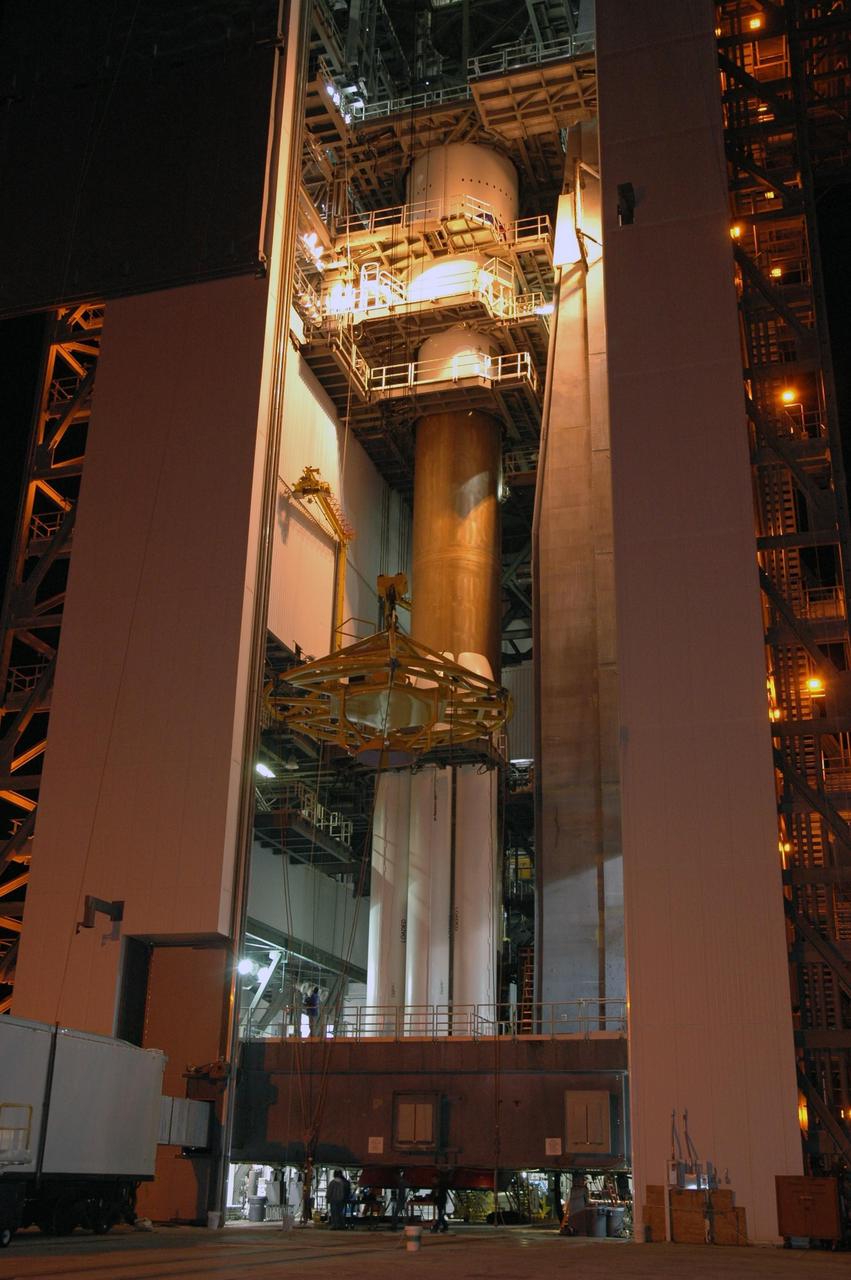
KENNEDY SPACE CENTER, FLA. - A Lockheed Martin Atlas V launch vehicle in the Vertical Integration Facility awaits the arrival of New Horizons at Complex 41 on Cape Canaveral Air Force Station. New Horizons carries seven scientific instruments that will characterize the global geology and geomorphology of Pluto and its moon Charon, map their surface compositions and temperatures, and examine Pluto's complex atmosphere. After that, flybys of Kuiper Belt objects from even farther in the solar system may be undertaken in an extended mission. New Horizons is the first mission in NASA's New Frontiers program of medium-class planetary missions. The spacecraft, designed for NASA by the Johns Hopkins University Applied Physics Laboratory in Laurel, Md., will launch aboard a Lockheed Martin Atlas V rocket and fly by Pluto and Charon as early as summer 2015.
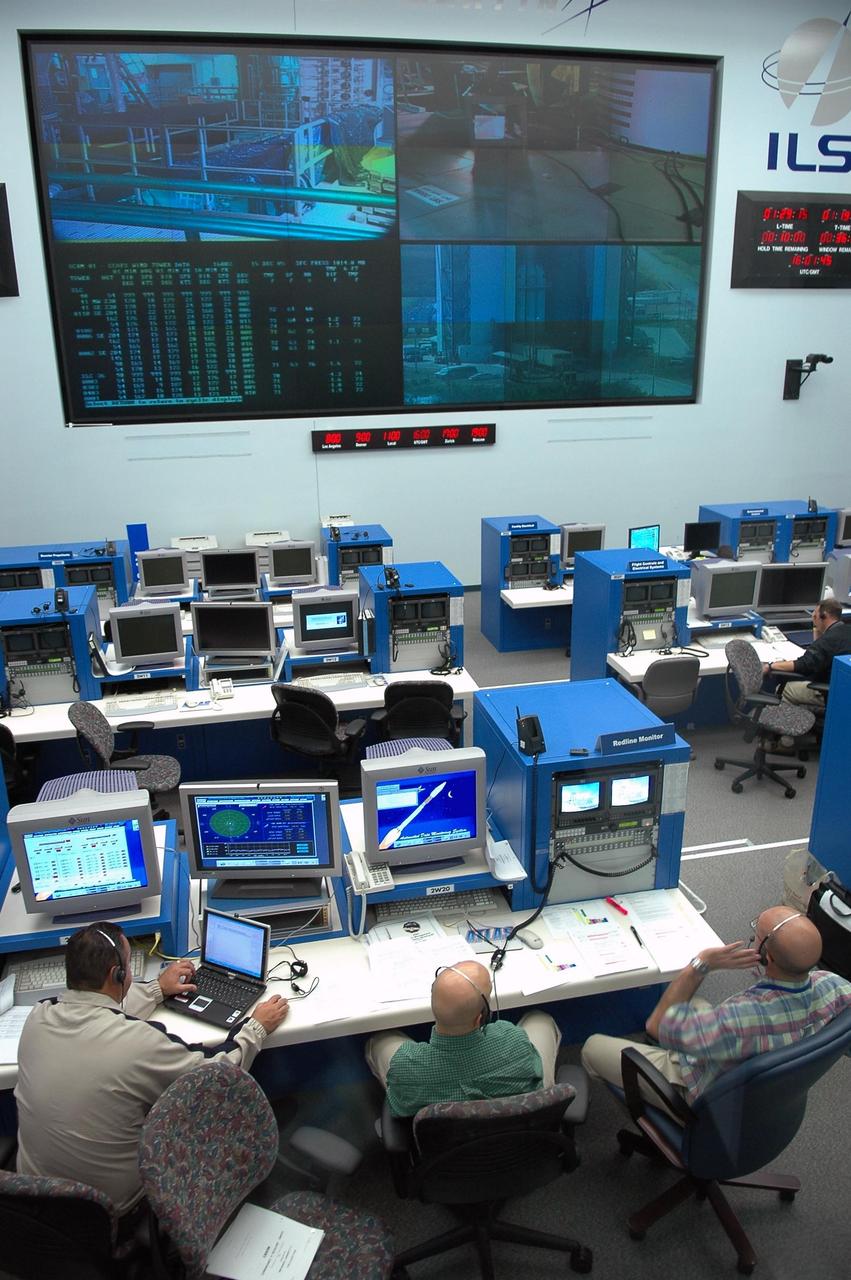
KENNEDY SPACE CENTER, FLA. - At their consoles in the Atlas V Spaceflight Operations Center on Cape Canaveral Air Force Station, members of the New Horizons team take part in a dress rehearsal for the launch scheduled in mid-January. New Horizons carries seven scientific instruments that will characterize the global geology and geomorphology of Pluto and its moon Charon, map their surface compositions and temperatures, and examine Pluto's complex atmosphere. After that, flybys of Kuiper Belt objects from even farther in the solar system may be undertaken in an extended mission. New Horizons is the first mission in NASA's New Frontiers program of medium-class planetary missions. The spacecraft, designed for NASA by the Johns Hopkins University Applied Physics Laboratory in Laurel, Md., will launch aboard a Lockheed Martin Atlas V rocket and fly by Pluto and Charon as early as summer 2015.
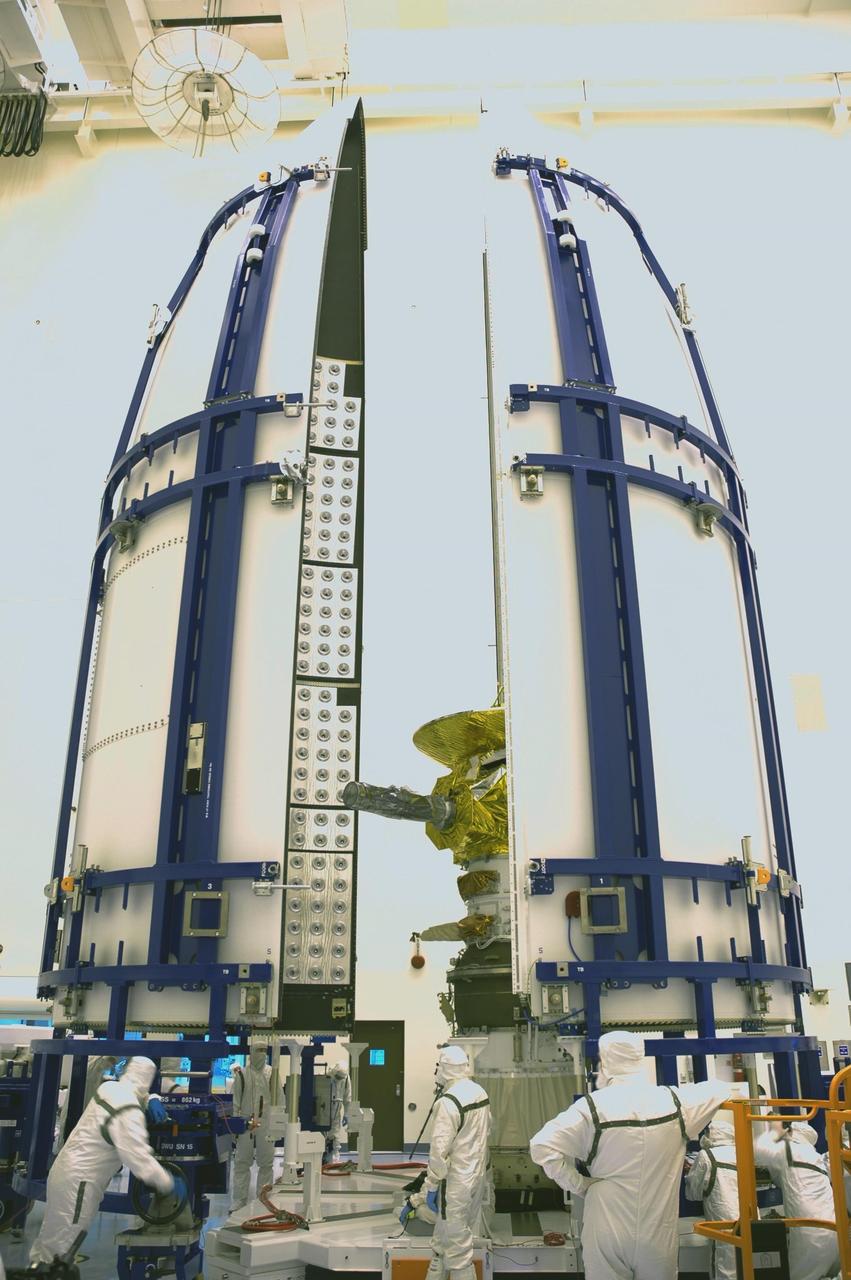
KENNEDY SPACE CENTER, FLA. - In the Payload Hazardous Servicing Facility, the two fairing sections close in around the New Horizons spacecraft to encapsulate it. The fairing protects the spacecraft during launch and flight through the atmosphere. Once out of the atmosphere, the fairing is jettisoned. The compact 1,060-pound New Horizons probe carries seven scientific instruments that will characterize the global geology and geomorphology of Pluto and its moon Charon, map their surface compositions and temperatures, and examine Pluto's complex atmosphere. After that, flybys of Kuiper Belt objects from even farther in the solar system may be undertaken in an extended mission. New Horizons is the first mission in NASA's New Frontiers program of medium-class planetary missions. The spacecraft, designed for NASA by the Johns Hopkins University Applied Physics Laboratory in Laurel, Md., will fly by Pluto and Charon as early as summer 2015.
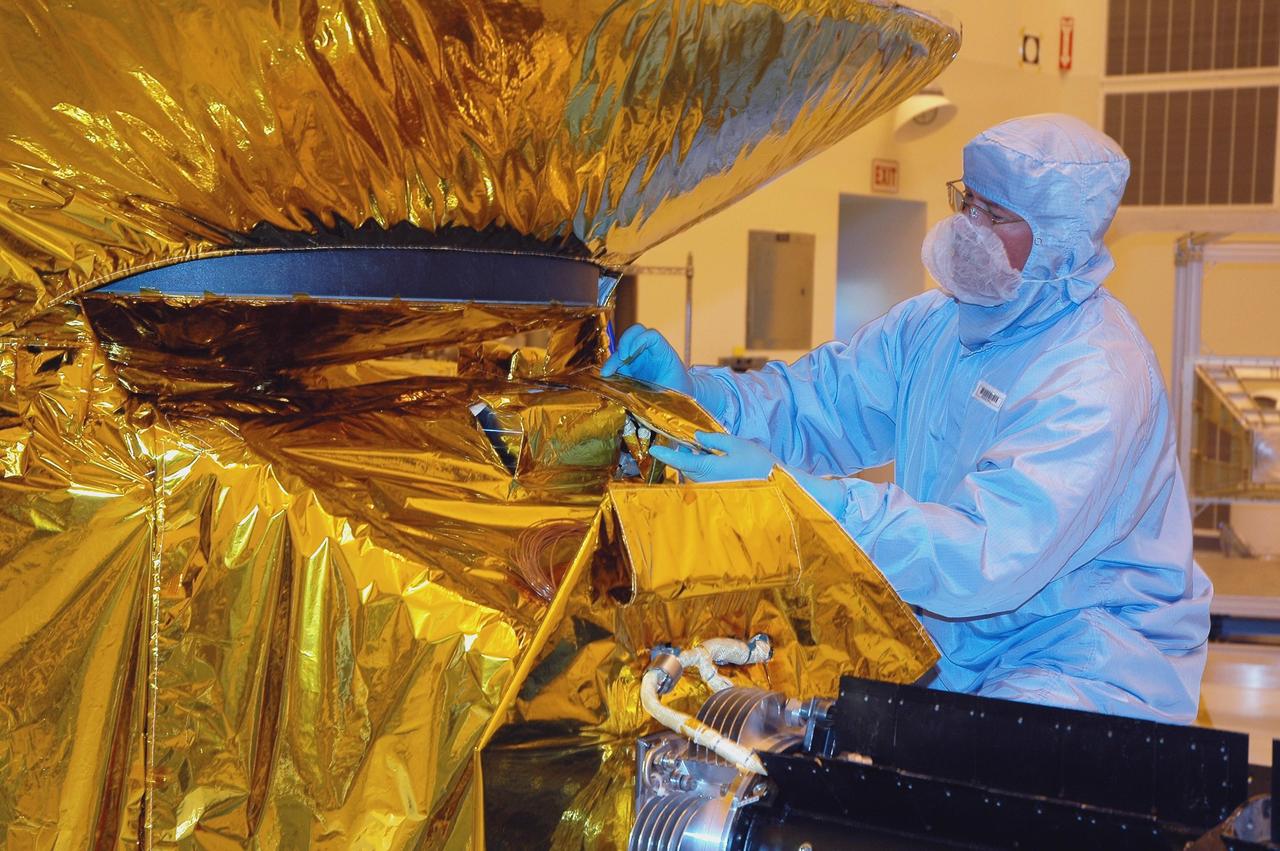
KENNEDY SPACE CENTER, FLA. - At NASA Kennedy Space Center’s Payload Hazardous Servicing Facility, a technician from the Applied Physics Laboratory adjusts part of the blanket that is being installed as a heat shield around the New Horizons spacecraft. Carrying seven scientific instruments, the compact 1,060-pound New Horizons probe will characterize the global geology and geomorphology of Pluto and its moon Charon, map their surface compositions and temperatures, and examine Pluto's complex atmosphere. After that, flybys of Kuiper Belt objects from even farther in the solar system may be undertaken in an extended mission. New Horizons is the first mission in NASA's New Frontiers program of medium-class planetary missions. The spacecraft, designed for NASA by the Johns Hopkins University Applied Physics Laboratory in Laurel, Md., will fly by Pluto and Charon as early as summer 2015.
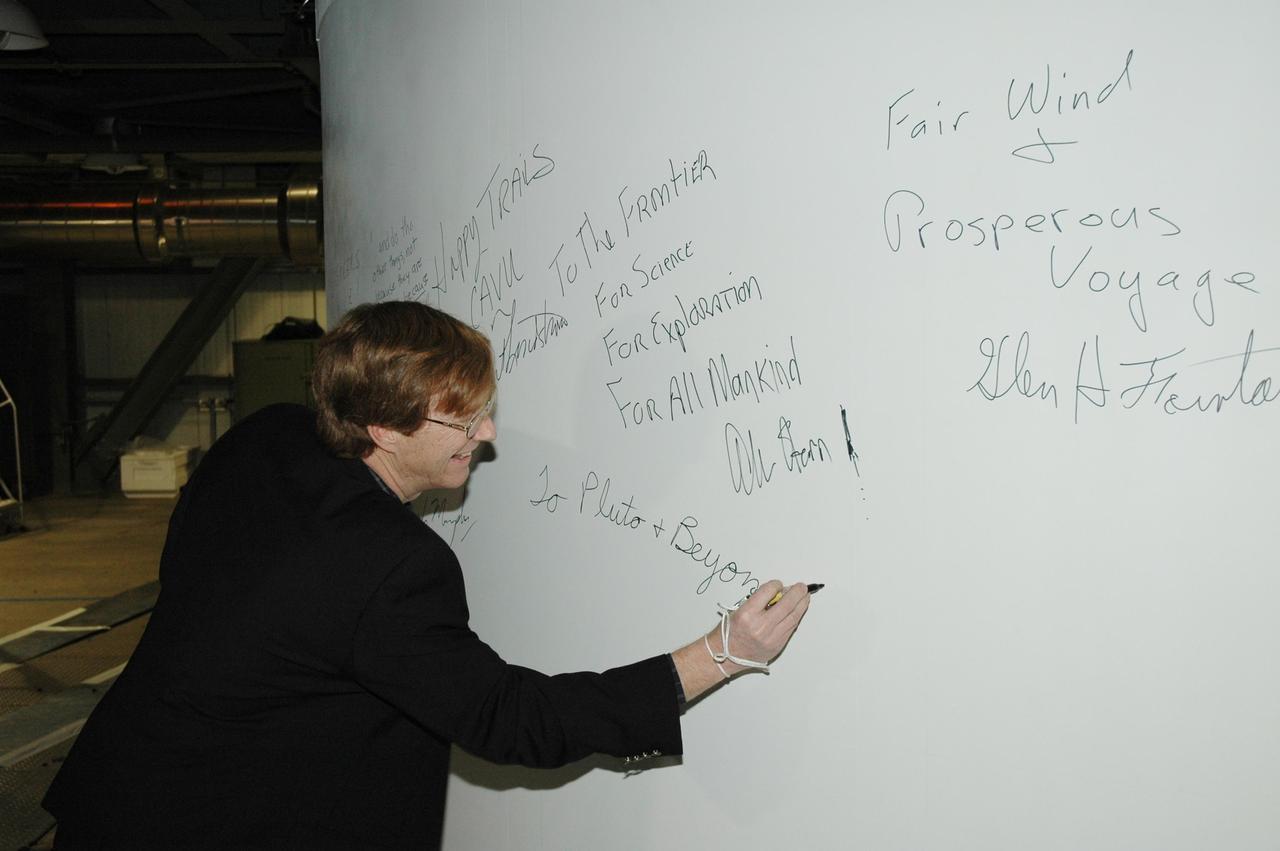
KENNEDY SPACE CENTER, FLA. - In the Vertical Integration Facility on Launch Complex 41, Cape Canaveral Air Force Station, Hal Weaver, New Horizons project scientist with the Johns Hopkins University Applied Physics Laboratory, signs the fairing enclosing the New Horizons spacecraft. The fairing protects the spacecraft during launch and flight through the atmosphere. Once out of the atmosphere, the fairing is jettisoned. The compact 1,060-pound New Horizons probe carries seven scientific instruments that will characterize the global geology and geomorphology of Pluto and its moon Charon, map their surface compositions and temperatures, and examine Pluto's complex atmosphere. New Horizons is the first mission in NASA's New Frontiers program of medium-class planetary missions. The spacecraft, designed for NASA by the Johns Hopkins University Applied Physics Laboratory in Laurel, Md., will fly by Pluto and Charon as early as summer 2015.
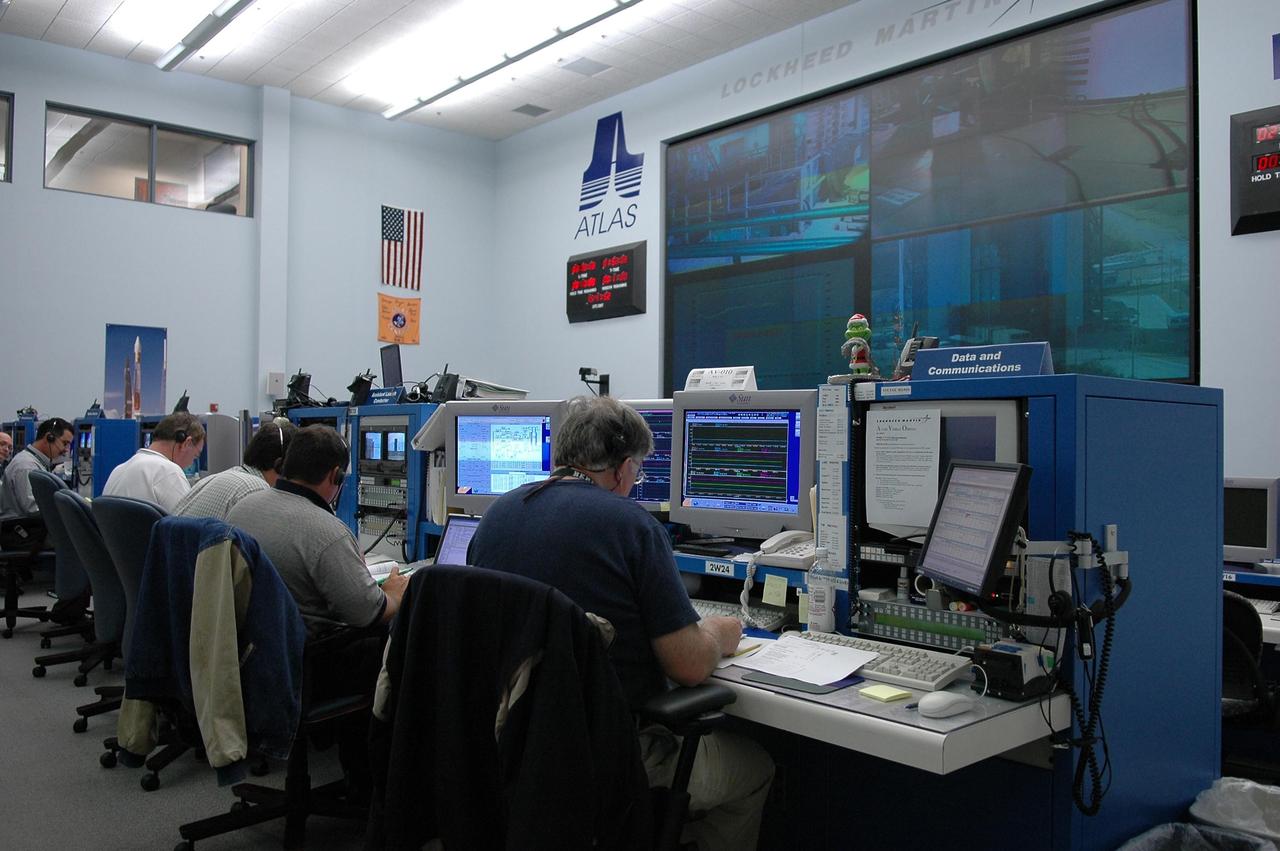
KENNEDY SPACE CENTER, FLA. - At their consoles in the Atlas V Spaceflight Operations Center on Cape Canaveral Air Force Station, members of the New Horizons team take part in a dress rehearsal for the launch scheduled in mid-January. New Horizons carries seven scientific instruments that will characterize the global geology and geomorphology of Pluto and its moon Charon, map their surface compositions and temperatures, and examine Pluto's complex atmosphere. After that, flybys of Kuiper Belt objects from even farther in the solar system may be undertaken in an extended mission. New Horizons is the first mission in NASA's New Frontiers program of medium-class planetary missions. The spacecraft, designed for NASA by the Johns Hopkins University Applied Physics Laboratory in Laurel, Md., will launch aboard a Lockheed Martin Atlas V rocket and fly by Pluto and Charon as early as summer 2015.

KENNEDY SPACE CENTER, FLA. - New Horizons arrives at the Vertical Integration Facility at Complex 41 on Cape Canaveral Air Force Station where buildup of its Lockheed Martin Atlas V launch vehicle is complete. New Horizons carries seven scientific instruments that will characterize the global geology and geomorphology of Pluto and its moon Charon, map their surface compositions and temperatures, and examine Pluto's complex atmosphere. After that, flybys of Kuiper Belt objects from even farther in the solar system may be undertaken in an extended mission. New Horizons is the first mission in NASA's New Frontiers program of medium-class planetary missions. The spacecraft, designed for NASA by the Johns Hopkins University Applied Physics Laboratory in Laurel, Md., will launch aboard a Lockheed Martin Atlas V rocket and fly by Pluto and Charon as early as summer 2015.
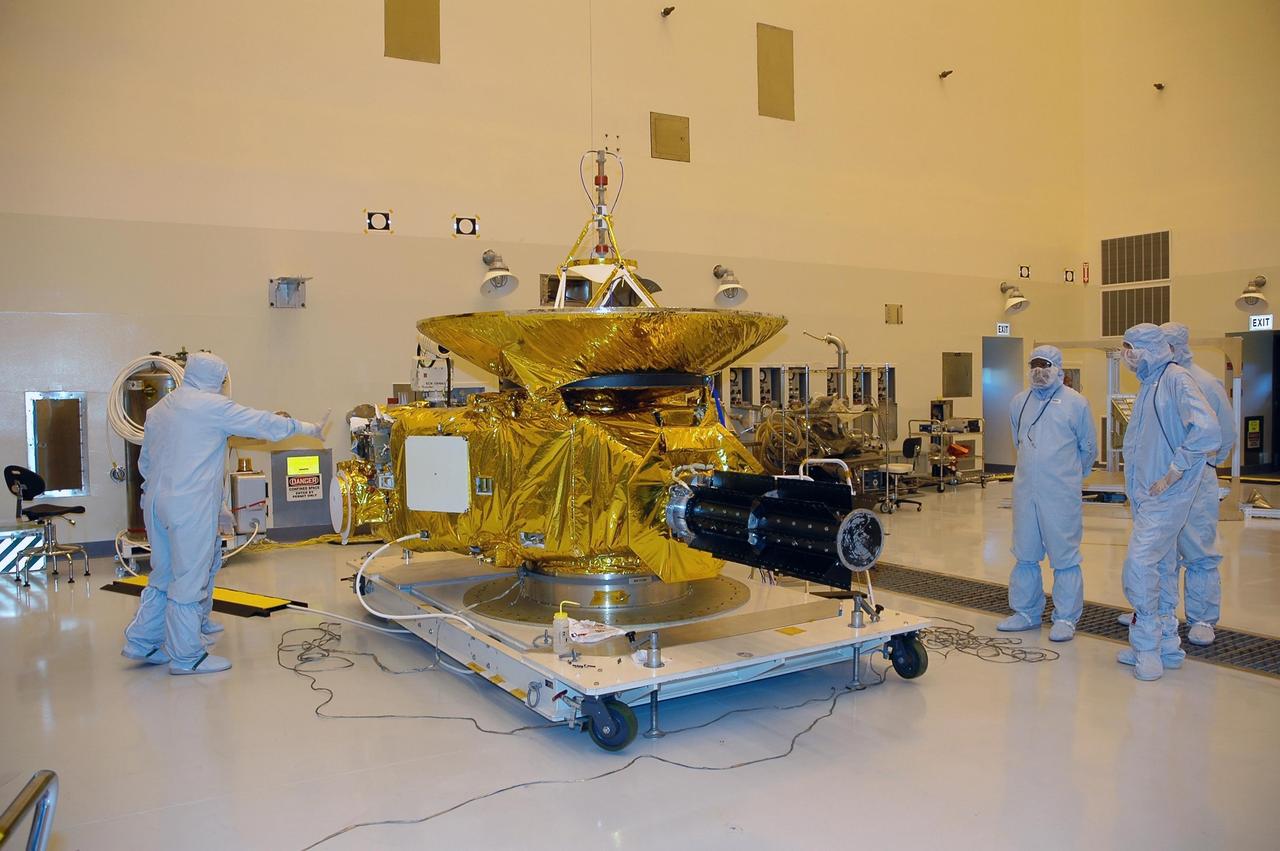
KENNEDY SPACE CENTER, FLA. - At NASA Kennedy Space Center’s Payload Hazardous Servicing Facility, technicians from the Applied Physics Laboratory are installing blankets that serve as heat shields around the New Horizons spacecraft. Carrying seven scientific instruments, the compact 1,060-pound New Horizons probe will characterize the global geology and geomorphology of Pluto and its moon Charon, map their surface compositions and temperatures, and examine Pluto's complex atmosphere. After that, flybys of Kuiper Belt objects from even farther in the solar system may be undertaken in an extended mission. New Horizons is the first mission in NASA's New Frontiers program of medium-class planetary missions. The spacecraft, designed for NASA by the Johns Hopkins University Applied Physics Laboratory in Laurel, Md., will fly by Pluto and Charon as early as summer 2015.
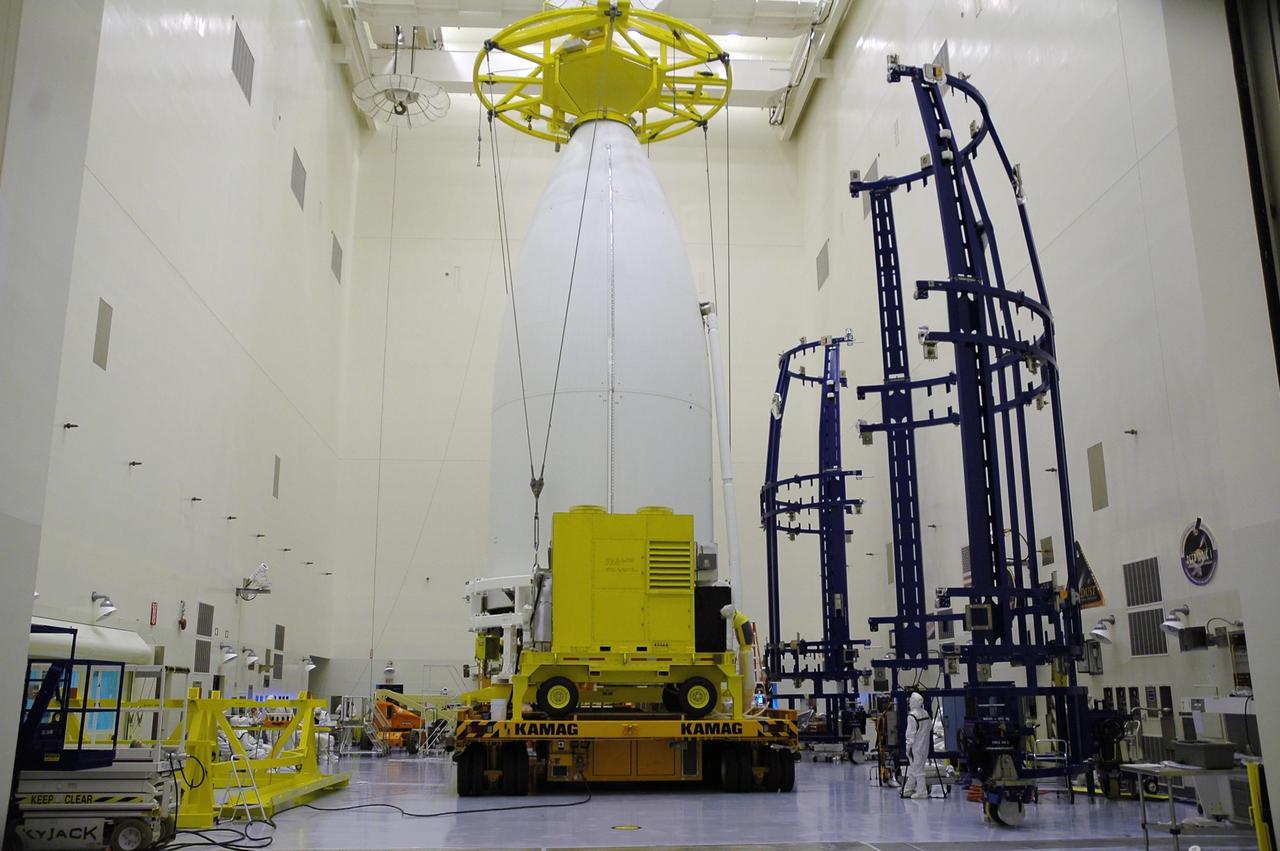
KENNEDY SPACE CENTER, FLA. - In the Payload Hazardous Servicing Facility, New Horizons sits atop a transporter awaiting its move to Complex 41 on Cape Canaveral Air Force Station. New Horizons carries seven scientific instruments that will characterize the global geology and geomorphology of Pluto and its moon Charon, map their surface compositions and temperatures, and examine Pluto's complex atmosphere. After that, flybys of Kuiper Belt objects from even farther in the solar system may be undertaken in an extended mission. New Horizons is the first mission in NASA's New Frontiers program of medium-class planetary missions. The spacecraft, designed for NASA by the Johns Hopkins University Applied Physics Laboratory in Laurel, Md., will launch aboard a Lockheed Martin Atlas V rocket and fly by Pluto and Charon as early as summer 2015.
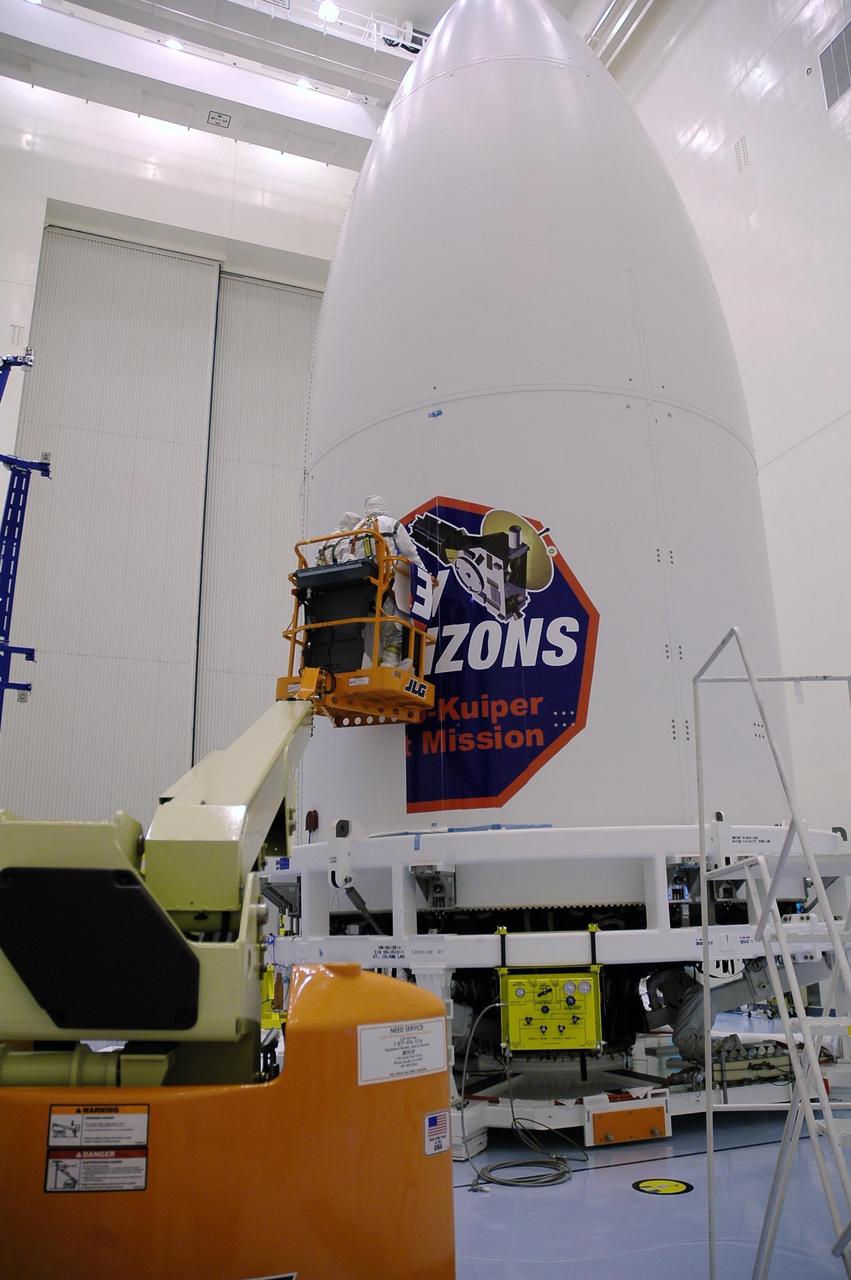
KENNEDY SPACE CENTER, FLA. - Technicians install strips of the New Horizons mission decal on the spacecraft fairing in the Payload Hazardous Servicing Facility. The last strip will be installed on the fairing after the spacecraft is delivered to Pad 41 on Dec. 17. New Horizons carries seven scientific instruments that will characterize the global geology and geomorphology of Pluto and its moon Charon, map their surface compositions and temperatures, and examine Pluto's complex atmosphere. After that, flybys of Kuiper Belt objects from even farther in the solar system may be undertaken in an extended mission. New Horizons is the first mission in NASA's New Frontiers program of medium-class planetary missions. The spacecraft, designed for NASA by the Johns Hopkins University Applied Physics Laboratory in Laurel, Md., will launch aboard a Lockheed Martin Atlas V rocket and fly by Pluto and Charon as early as summer 2015.
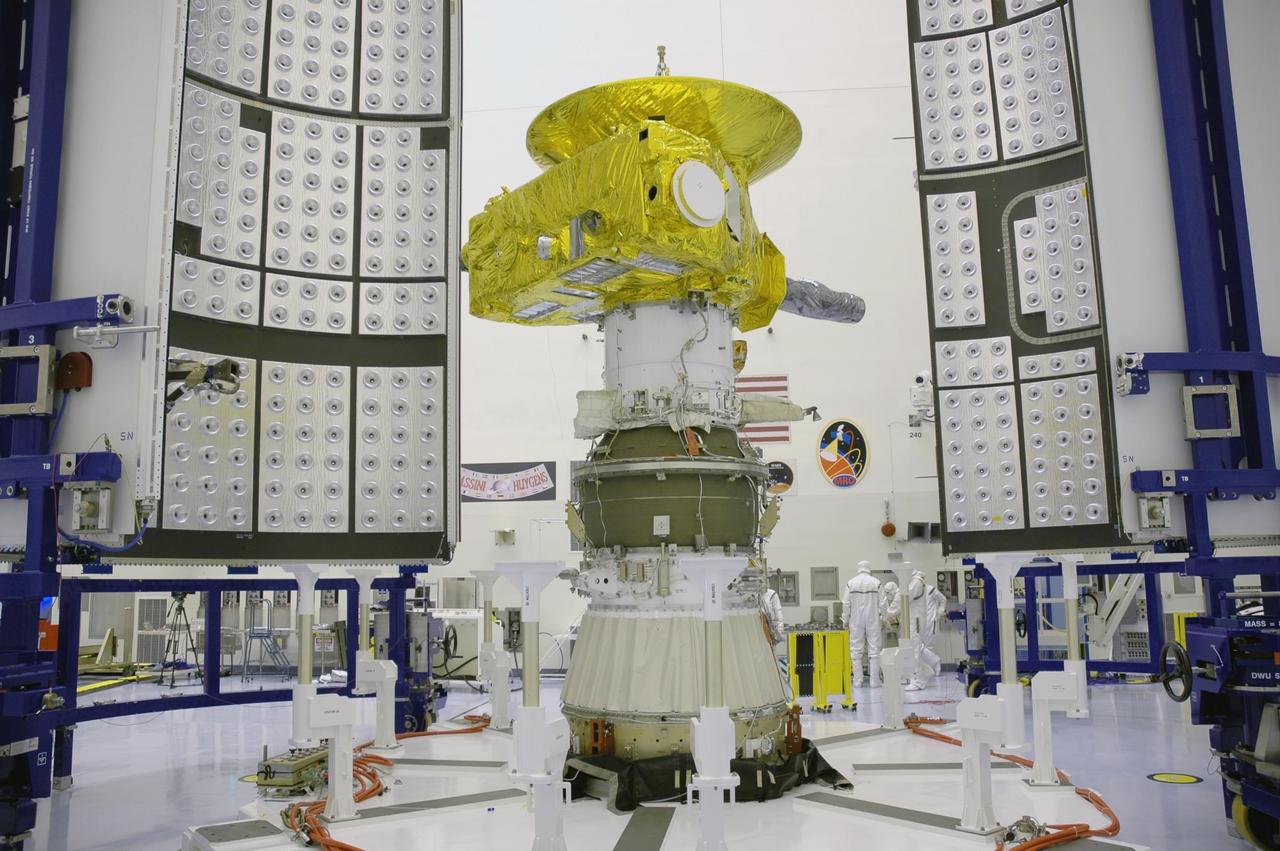
KENNEDY SPACE CENTER, FLA. - In the Payload Hazardous Servicing Facility, the two fairing sections are ready to be moved in place around the New Horizons spacecraft (in center) for encapsulation. The fairing protects the spacecraft during launch and flight through the atmosphere. Once out of the atmosphere, the fairing is jettisoned. The compact 1,060-pound New Horizons probe carries seven scientific instruments that will characterize the global geology and geomorphology of Pluto and its moon Charon, map their surface compositions and temperatures, and examine Pluto's complex atmosphere. After that, flybys of Kuiper Belt objects from even farther in the solar system may be undertaken in an extended mission. New Horizons is the first mission in NASA's New Frontiers program of medium-class planetary missions. The spacecraft, designed for NASA by the Johns Hopkins University Applied Physics Laboratory in Laurel, Md., will fly by Pluto and Charon as early as summer 2015.
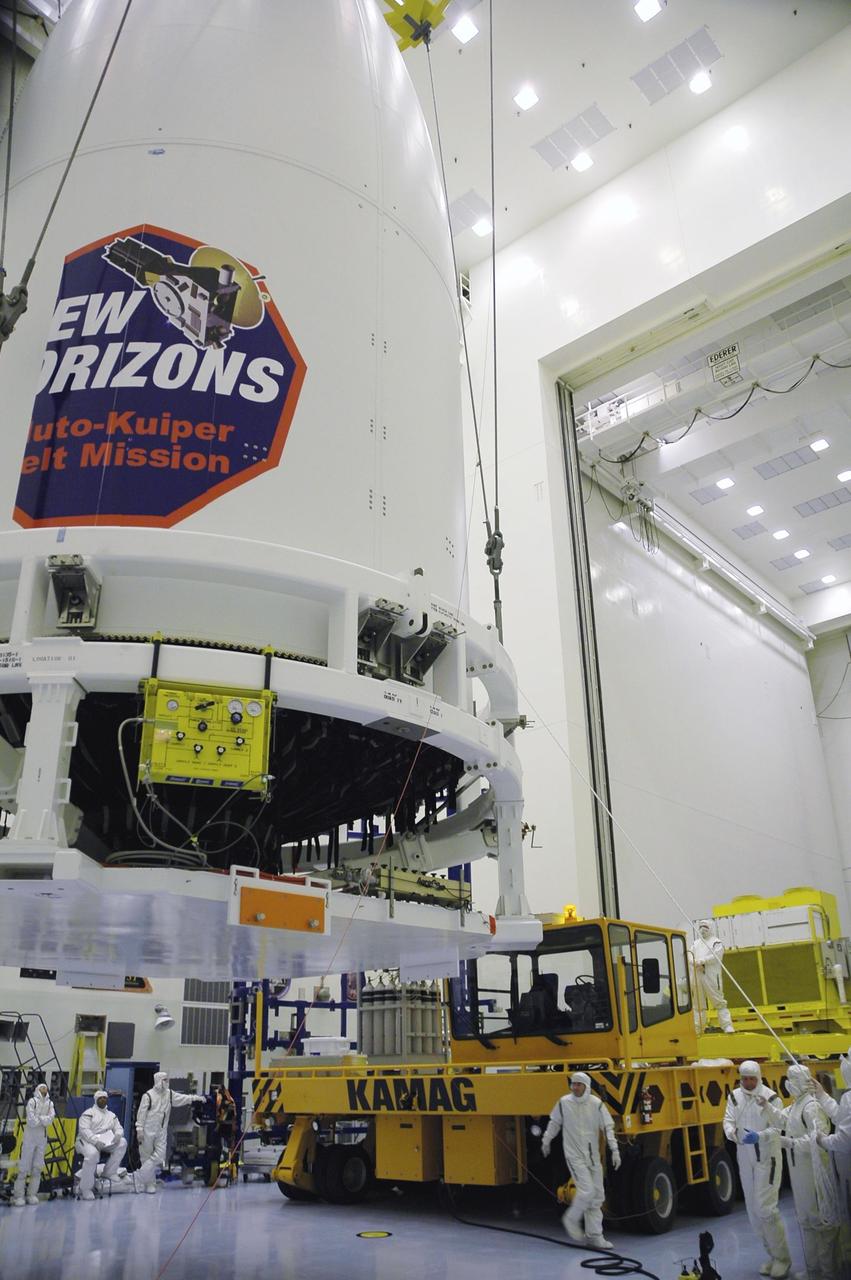
KENNEDY SPACE CENTER, FLA. - In the Payload Hazardous Servicing Facility, technicians lift New Horizons toward a transporter for its move to Complex 41 on Cape Canaveral Air Force Station. The last strip of the mission decal will be installed on the fairing after the spacecraft is delivered to the pad. New Horizons carries seven scientific instruments that will characterize the global geology and geomorphology of Pluto and its moon Charon, map their surface compositions and temperatures, and examine Pluto's complex atmosphere. After that, flybys of Kuiper Belt objects from even farther in the solar system may be undertaken in an extended mission. New Horizons is the first mission in NASA's New Frontiers program of medium-class planetary missions. The spacecraft, designed for NASA by the Johns Hopkins University Applied Physics Laboratory in Laurel, Md., will launch aboard a Lockheed Martin Atlas V rocket and fly by Pluto and Charon as early as summer 2015.
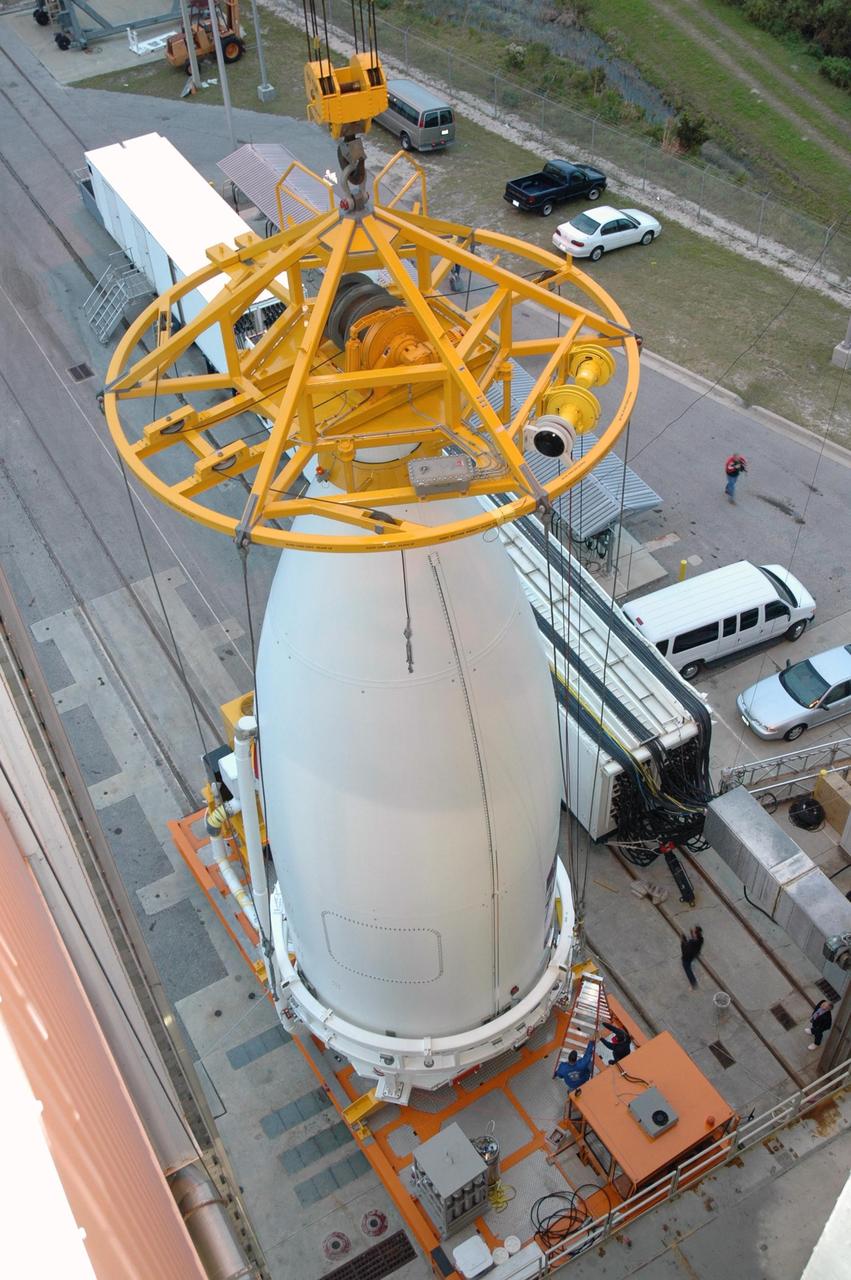
KENNEDY SPACE CENTER, FLA. - The fairing lifting fixture is secured to the nose of the fairing enclosing New Horizons at the Vertical Integration Facility at Complex 41 on Cape Canaveral Air Force Station. New Horizons carries seven scientific instruments that will characterize the global geology and geomorphology of Pluto and its moon Charon, map their surface compositions and temperatures, and examine Pluto's complex atmosphere. After that, flybys of Kuiper Belt objects from even farther in the solar system may be undertaken in an extended mission. New Horizons is the first mission in NASA's New Frontiers program of medium-class planetary missions. The spacecraft, designed for NASA by the Johns Hopkins University Applied Physics Laboratory in Laurel, Md., will launch aboard a Lockheed Martin Atlas V rocket and fly by Pluto and Charon as early as summer 2015.

KENNEDY SPACE CENTER, FLA. - Technicians monitor the fairing enclosing New Horizons as it is positioned atop a Lockheed Martin Atlas V launch vehicle in the Vertical Integration Facility at Complex 41 on Cape Canaveral Air Force Station. New Horizons carries seven scientific instruments that will characterize the global geology and geomorphology of Pluto and its moon Charon, map their surface compositions and temperatures, and examine Pluto's complex atmosphere. After that, flybys of Kuiper Belt objects from even farther in the solar system may be undertaken in an extended mission. New Horizons is the first mission in NASA's New Frontiers program of medium-class planetary missions. The spacecraft, designed for NASA by the Johns Hopkins University Applied Physics Laboratory in Laurel, Md., will launch aboard a Lockheed Martin Atlas V rocket and fly by Pluto and Charon as early as summer 2015.
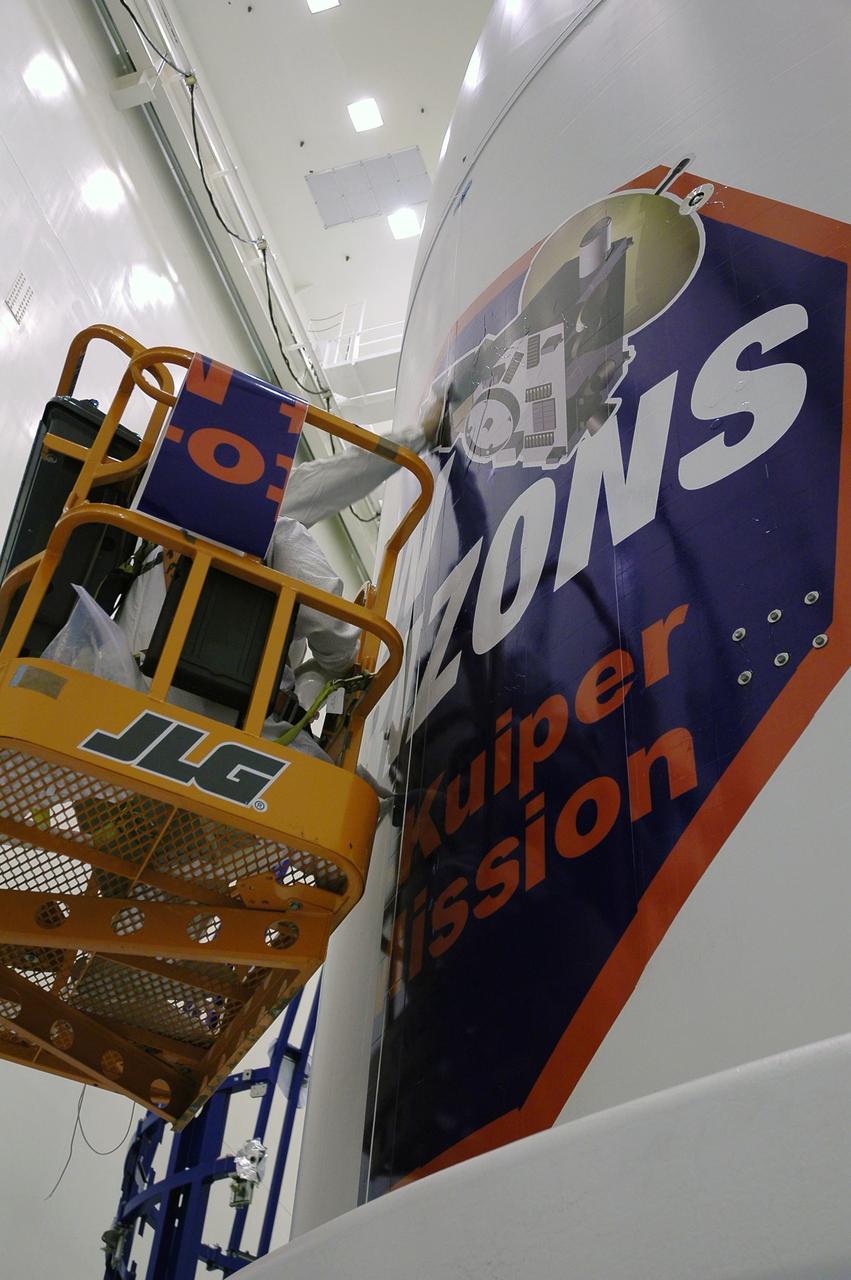
KENNEDY SPACE CENTER, FLA. - Technicians install strips of the New Horizons mission decal on the spacecraft fairing in the Payload Hazardous Servicing Facility. The last strip will be installed on the fairing after the spacecraft is delivered to Pad 41 on Dec. 17. New Horizons carries seven scientific instruments that will characterize the global geology and geomorphology of Pluto and its moon Charon, map their surface compositions and temperatures, and examine Pluto's complex atmosphere. After that, flybys of Kuiper Belt objects from even farther in the solar system may be undertaken in an extended mission. New Horizons is the first mission in NASA's New Frontiers program of medium-class planetary missions. The spacecraft, designed for NASA by the Johns Hopkins University Applied Physics Laboratory in Laurel, Md., will launch aboard a Lockheed Martin Atlas V rocket and fly by Pluto and Charon as early as summer 2015.
KENNEDY SPACE CENTER, FLA. - In the Payload Hazardous Servicing Facility, technicians prepare to lift New Horizons to a transporter for its move to Complex 41 on Cape Canaveral Air Force Station. New Horizons carries seven scientific instruments that will characterize the global geology and geomorphology of Pluto and its moon Charon, map their surface compositions and temperatures, and examine Pluto's complex atmosphere. After that, flybys of Kuiper Belt objects from even farther in the solar system may be undertaken in an extended mission. New Horizons is the first mission in NASA's New Frontiers program of medium-class planetary missions. The spacecraft, designed for NASA by the Johns Hopkins University Applied Physics Laboratory in Laurel, Md., will launch aboard a Lockheed Martin Atlas V rocket and fly by Pluto and Charon as early as summer 2015.
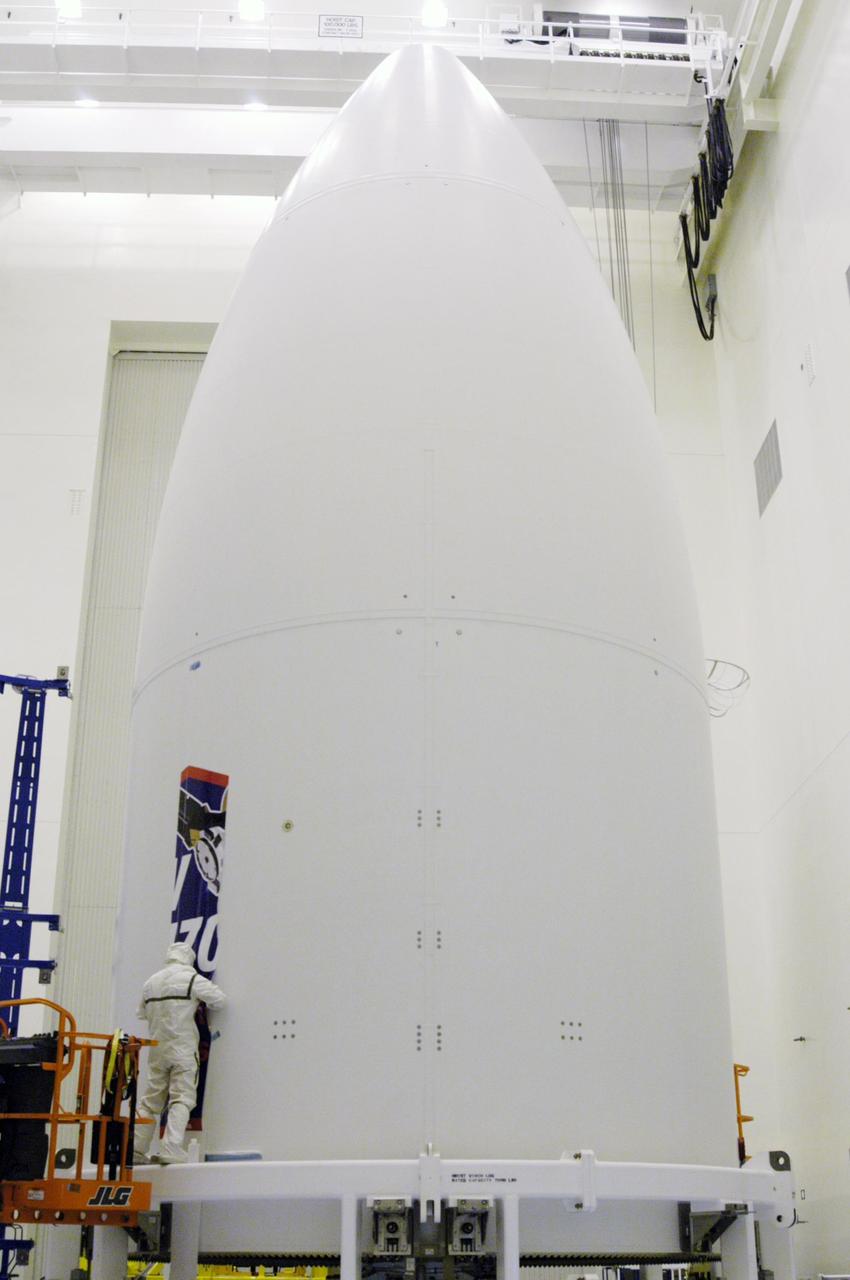
KENNEDY SPACE CENTER, FLA. - A technician installs the first strip of the New Horizons mission decal on the spacecraft fairing in the Payload Hazardous Servicing Facility. The last strip will be installed on the fairing after the spacecraft is delivered to Pad 41 on Dec. 17. New Horizons carries seven scientific instruments that will characterize the global geology and geomorphology of Pluto and its moon Charon, map their surface compositions and temperatures, and examine Pluto's complex atmosphere. After that, flybys of Kuiper Belt objects from even farther in the solar system may be undertaken in an extended mission. New Horizons is the first mission in NASA's New Frontiers program of medium-class planetary missions. The spacecraft, designed for NASA by the Johns Hopkins University Applied Physics Laboratory in Laurel, Md., will launch aboard a Lockheed Martin Atlas V rocket and fly by Pluto and Charon as early as summer 2015.
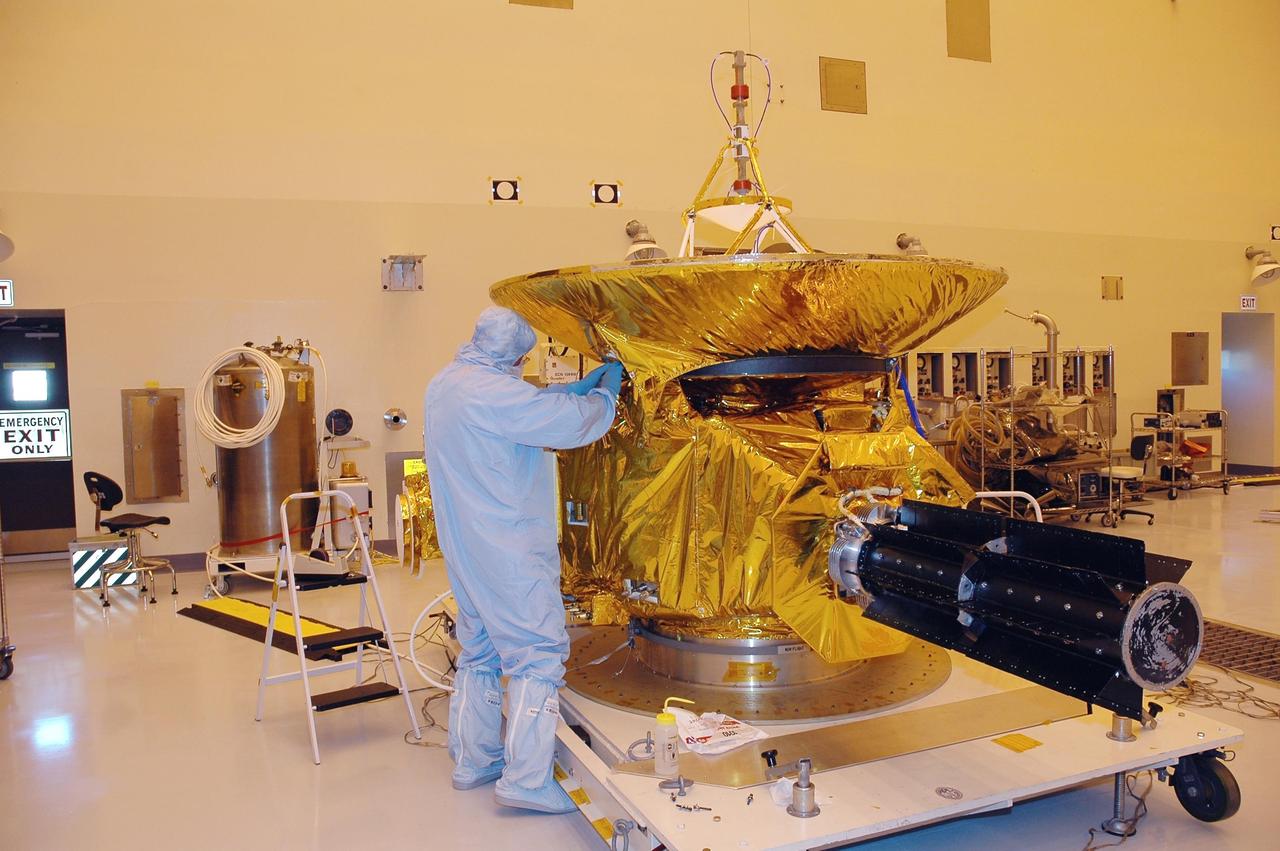
KENNEDY SPACE CENTER, FLA. - At NASA Kennedy Space Center’s Payload Hazardous Servicing Facility, a technician from the Applied Physics Laboratory adjusts part of the blanket that it is being installed as a heat shield around the New Horizons spacecraft. Carrying seven scientific instruments, the compact 1,060-pound New Horizons probe will characterize the global geology and geomorphology of Pluto and its moon Charon, map their surface compositions and temperatures, and examine Pluto's complex atmosphere. After that, flybys of Kuiper Belt objects from even farther in the solar system may be undertaken in an extended mission. New Horizons is the first mission in NASA's New Frontiers program of medium-class planetary missions. The spacecraft, designed for NASA by the Johns Hopkins University Applied Physics Laboratory in Laurel, Md., will fly by Pluto and Charon as early as summer 2015.
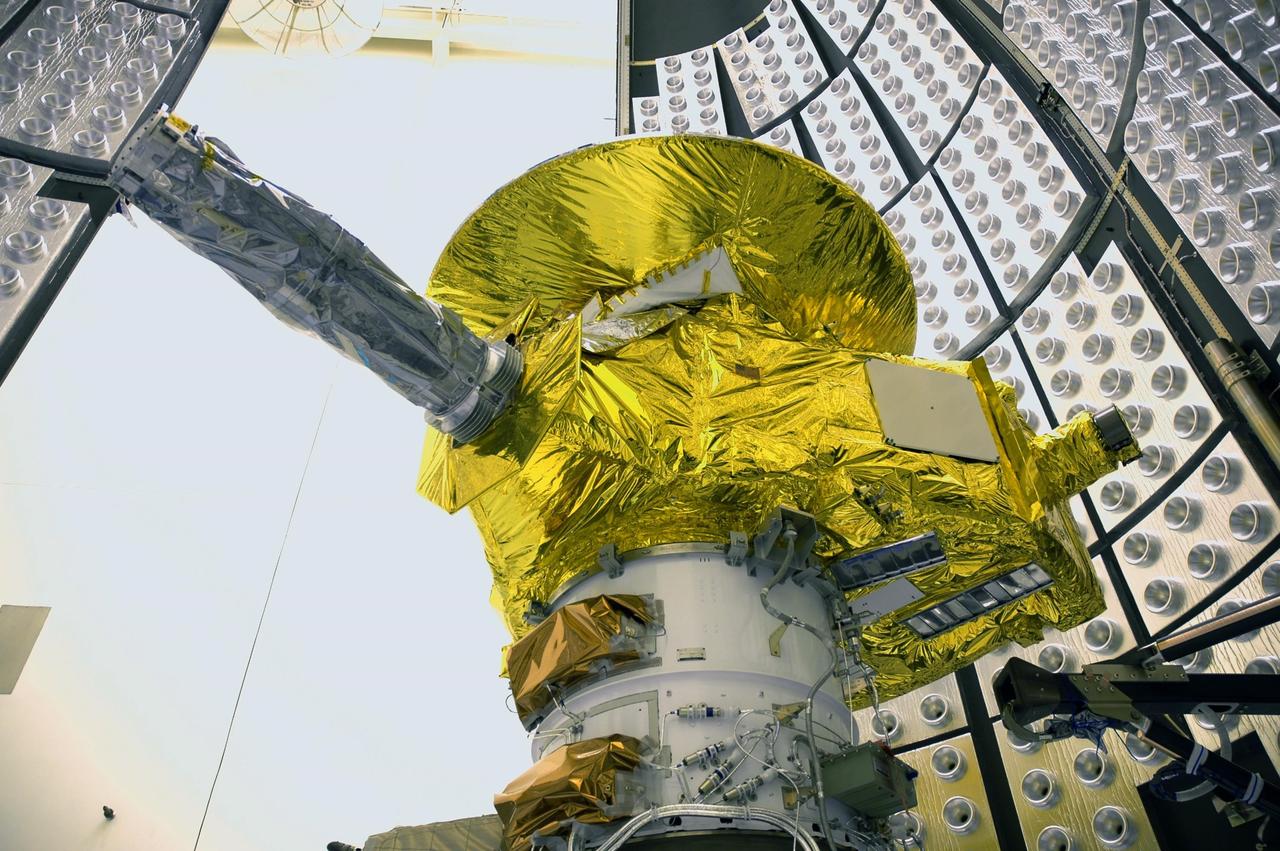
KENNEDY SPACE CENTER, FLA. - In the Payload Hazardous Servicing Facility, the two fairing sections move into place around the New Horizons spacecraft for encapsulation. The fairing protects the spacecraft during launch and flight through the atmosphere. Once out of the atmosphere, the fairing is jettisoned. The compact 1,060-pound New Horizons probe carries seven scientific instruments that will characterize the global geology and geomorphology of Pluto and its moon Charon, map their surface compositions and temperatures, and examine Pluto's complex atmosphere. After that, flybys of Kuiper Belt objects from even farther in the solar system may be undertaken in an extended mission. New Horizons is the first mission in NASA's New Frontiers program of medium-class planetary missions. The spacecraft, designed for NASA by the Johns Hopkins University Applied Physics Laboratory in Laurel, Md., will fly by Pluto and Charon as early as summer 2015.
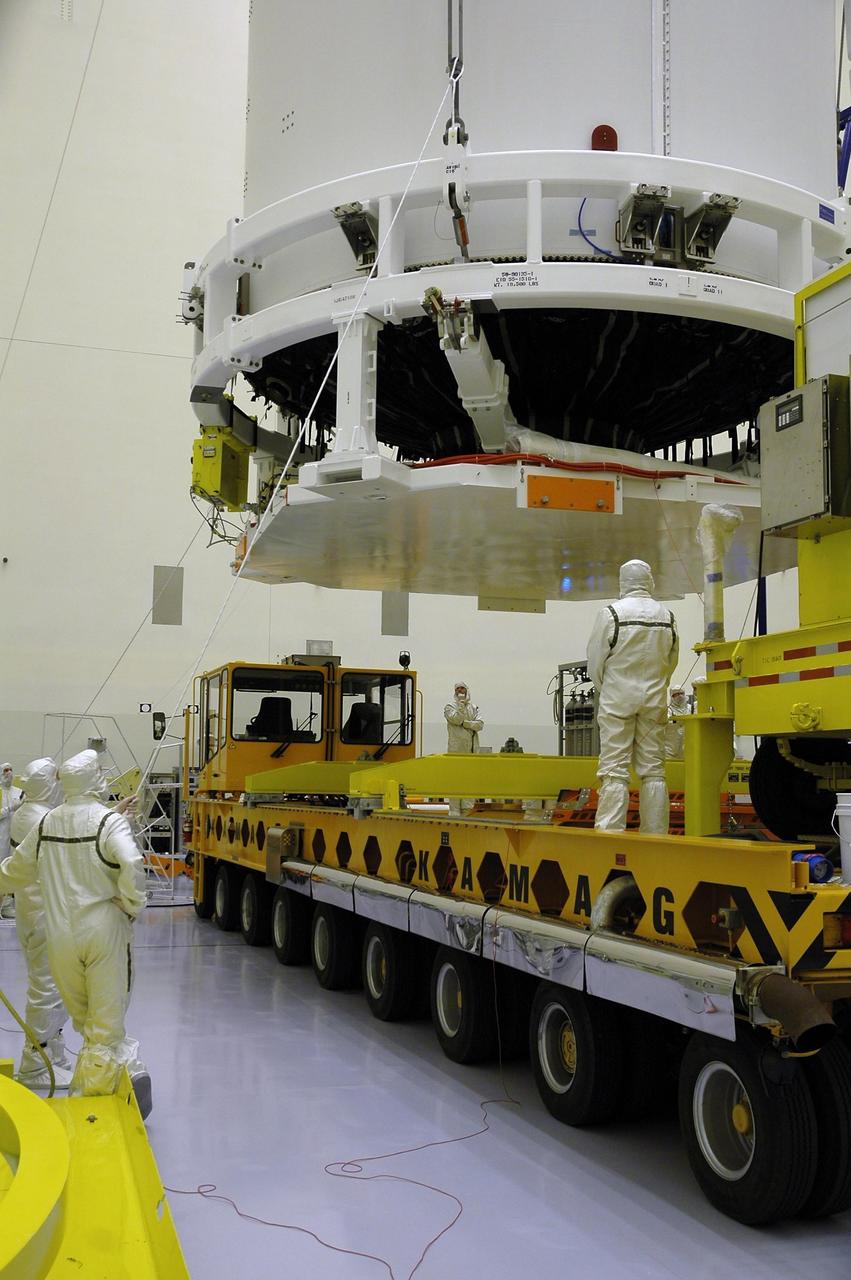
KENNEDY SPACE CENTER, FLA. - In the Payload Hazardous Servicing Facility, technicians monitor New Horizons as it is lowered onto a transporter for its move to Complex 41 on Cape Canaveral Air Force Station. New Horizons carries seven scientific instruments that will characterize the global geology and geomorphology of Pluto and its moon Charon, map their surface compositions and temperatures, and examine Pluto's complex atmosphere. After that, flybys of Kuiper Belt objects from even farther in the solar system may be undertaken in an extended mission. New Horizons is the first mission in NASA's New Frontiers program of medium-class planetary missions. The spacecraft, designed for NASA by the Johns Hopkins University Applied Physics Laboratory in Laurel, Md., will launch aboard a Lockheed Martin Atlas V rocket and fly by Pluto and Charon as early as summer 2015.
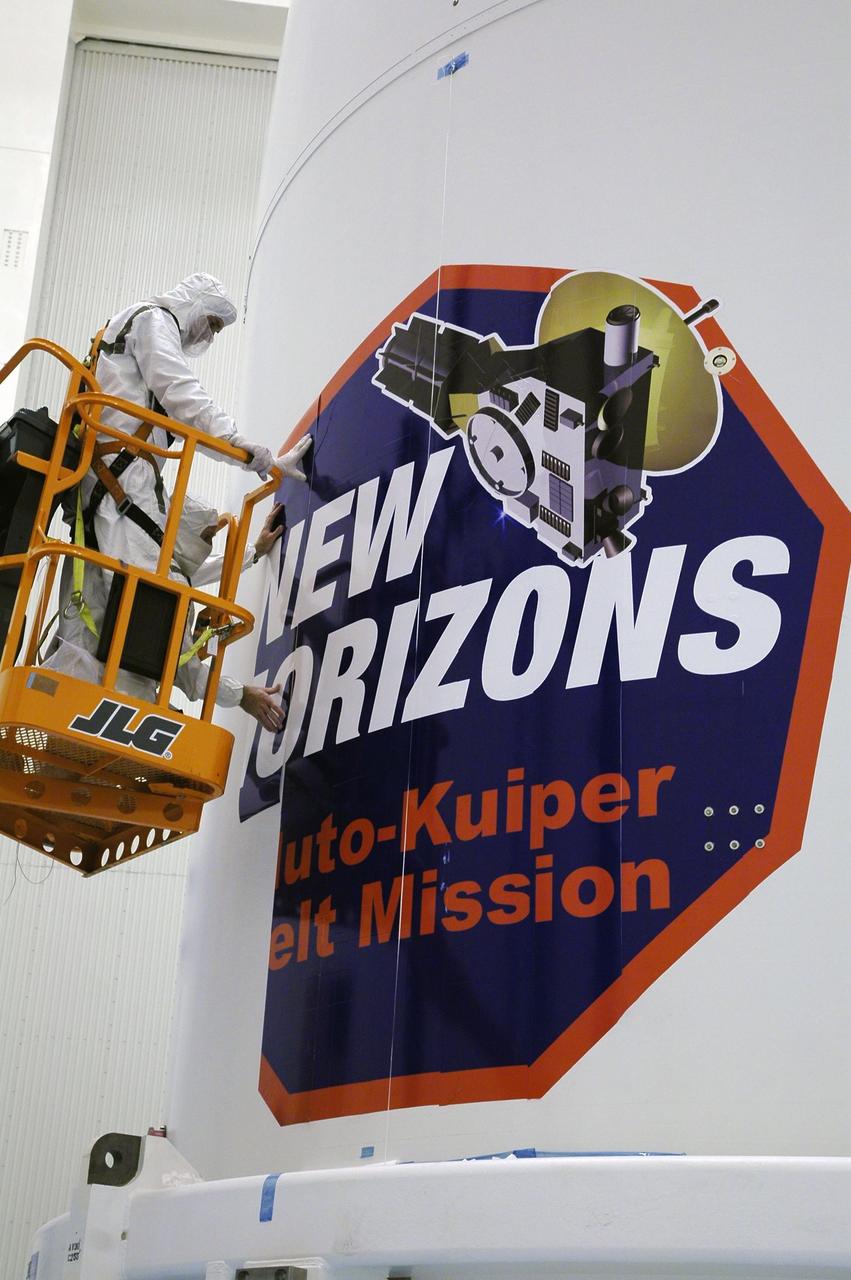
KENNEDY SPACE CENTER, FLA. - Technicians install strips of the New Horizons mission decal on the spacecraft fairing in the Payload Hazardous Servicing Facility. The last strip will be installed on the fairing after the spacecraft is delivered to Pad 41 on Dec. 17. New Horizons carries seven scientific instruments that will characterize the global geology and geomorphology of Pluto and its moon Charon, map their surface compositions and temperatures, and examine Pluto's complex atmosphere. After that, flybys of Kuiper Belt objects from even farther in the solar system may be undertaken in an extended mission. New Horizons is the first mission in NASA's New Frontiers program of medium-class planetary missions. The spacecraft, designed for NASA by the Johns Hopkins University Applied Physics Laboratory in Laurel, Md., will launch aboard a Lockheed Martin Atlas V rocket and fly by Pluto and Charon as early as summer 2015.
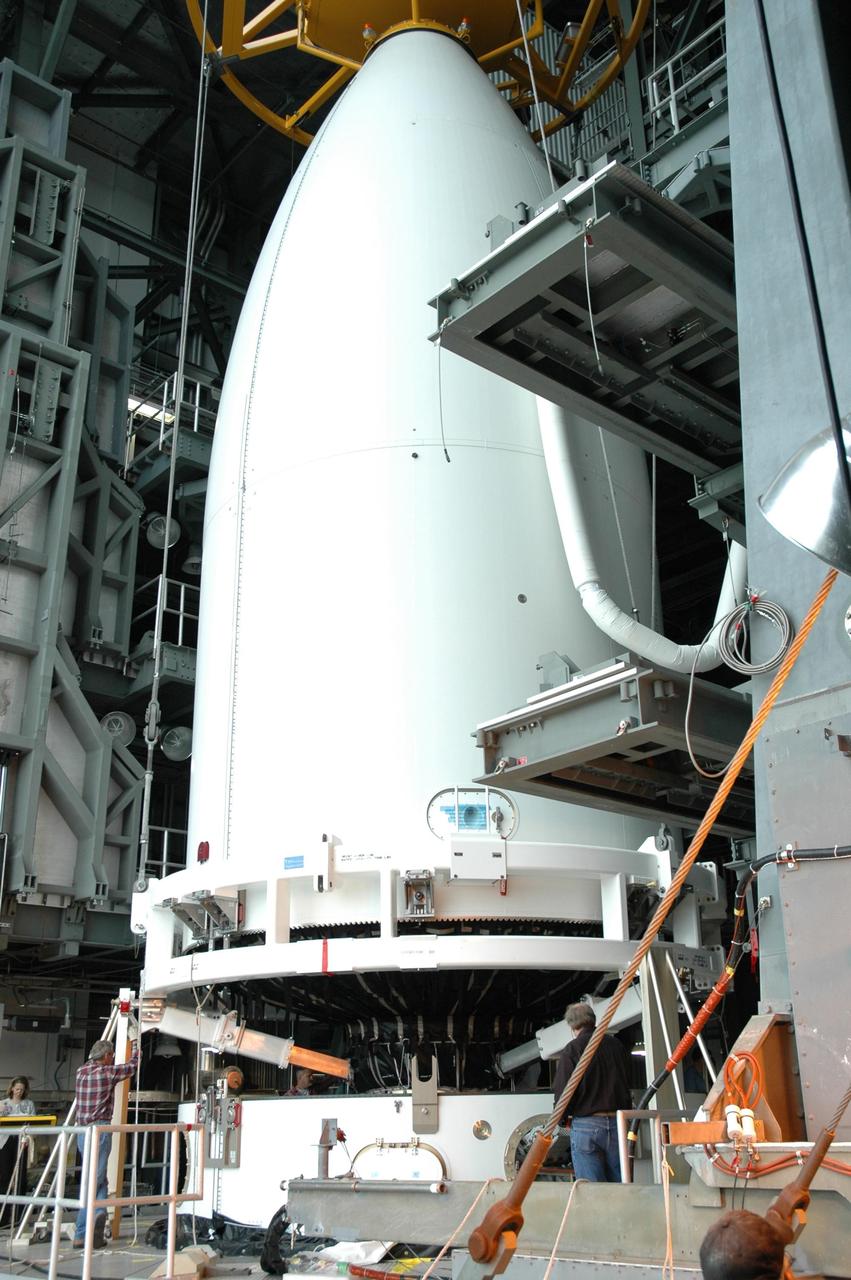
KENNEDY SPACE CENTER, FLA. - Technicians monitor the fairing enclosing New Horizons as it is lowered onto the top of a Lockheed Martin Atlas V launch vehicle in the Vertical Integration Facility at Complex 41 on Cape Canaveral Air Force Station. New Horizons carries seven scientific instruments that will characterize the global geology and geomorphology of Pluto and its moon Charon, map their surface compositions and temperatures, and examine Pluto's complex atmosphere. After that, flybys of Kuiper Belt objects from even farther in the solar system may be undertaken in an extended mission. New Horizons is the first mission in NASA's New Frontiers program of medium-class planetary missions. The spacecraft, designed for NASA by the Johns Hopkins University Applied Physics Laboratory in Laurel, Md., will launch aboard a Lockheed Martin Atlas V rocket and fly by Pluto and Charon as early as summer 2015.
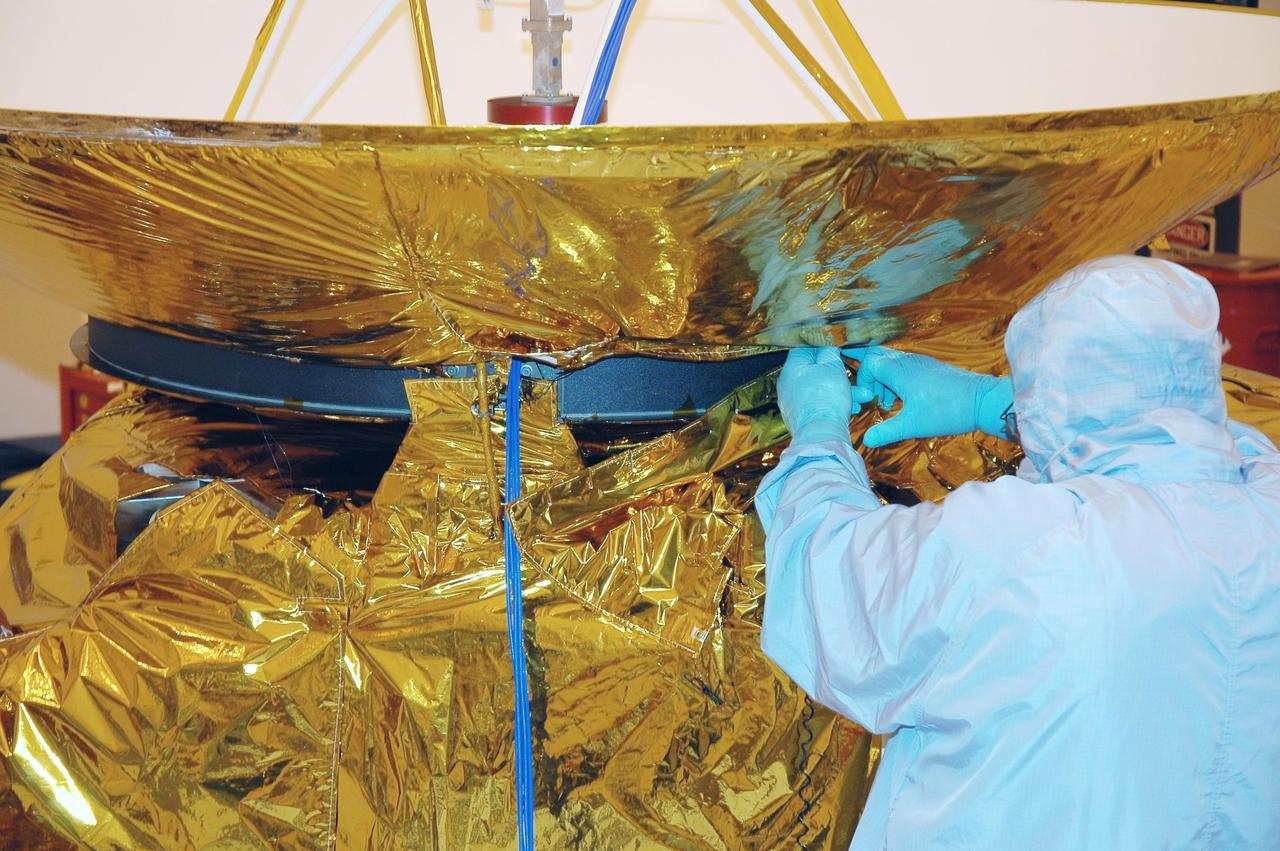
KENNEDY SPACE CENTER, FLA. - At NASA Kennedy Space Center’s Payload Hazardous Servicing Facility, a technician from the Applied Physics Laboratory adjusts the blanket that is being installed as a heat shield around the New Horizons spacecraft. Carrying seven scientific instruments, the compact 1,060-pound New Horizons probe will characterize the global geology and geomorphology of Pluto and its moon Charon, map their surface compositions and temperatures, and examine Pluto's complex atmosphere. After that, flybys of Kuiper Belt objects from even farther in the solar system may be undertaken in an extended mission. New Horizons is the first mission in NASA's New Frontiers program of medium-class planetary missions. The spacecraft, designed for NASA by the Johns Hopkins University Applied Physics Laboratory in Laurel, Md., will fly by Pluto and Charon as early as summer 2015.
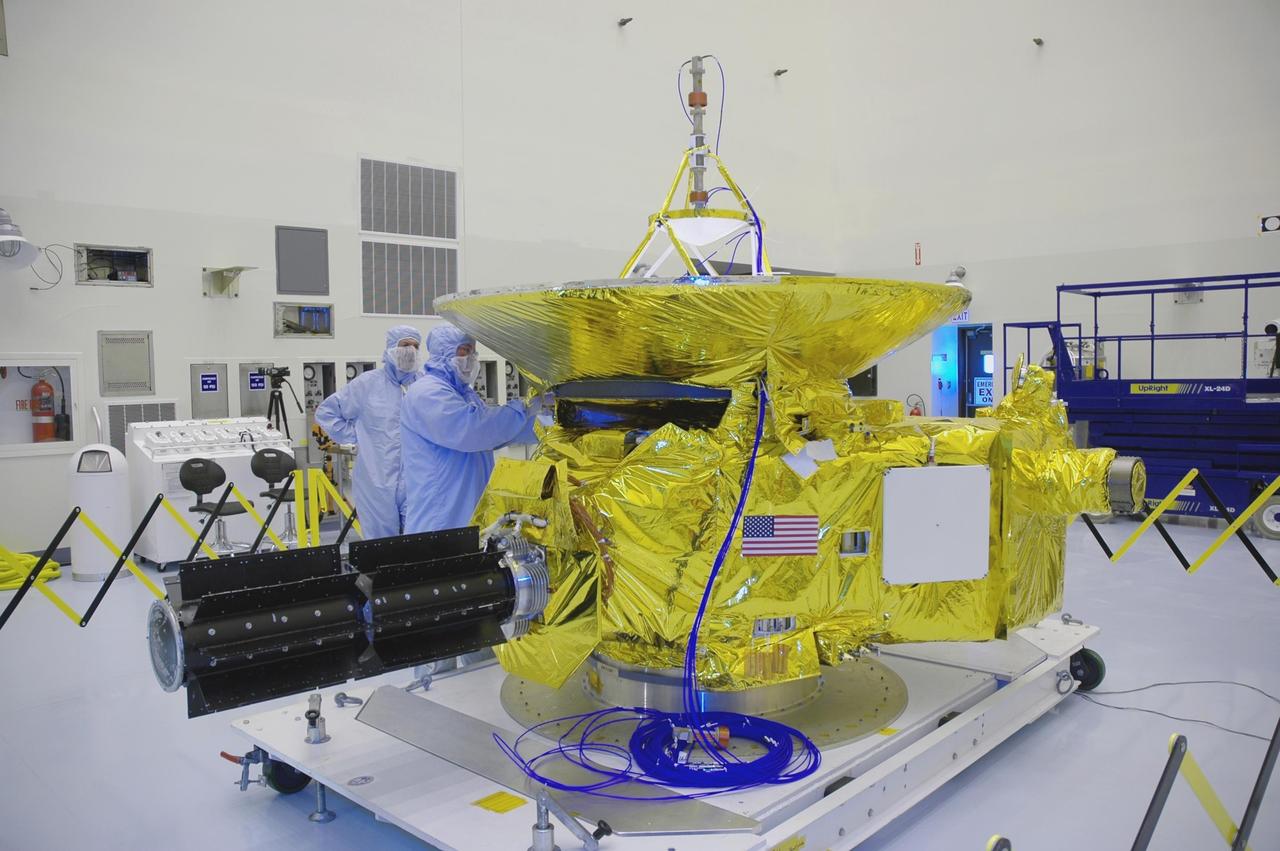
KENNEDY SPACE CENTER, FLA. - In the clean room at KSC’s Payload Hazardous Servicing Facility, technicians prepare the New Horizons spacecraft for a media event. Photographers and reporters will be able to photograph the New Horizons spacecraft and talk with project management and test team members from NASA and the Johns Hopkins University Applied Physics Laboratory. Seen behind the spacecraft is one half of the fairing that will enclose it for launch, scheduled for January 2006. Carrying seven scientific instruments, the compact 1,060-pound New Horizons probe will characterize the global geology and geomorphology of Pluto and its moon Charon, map their surface compositions and temperatures, and examine Pluto's complex atmosphere. After that, flybys of Kuiper Belt objects from even farther in the solar system may be undertaken in an extended mission. New Horizons is the first mission in NASA's New Frontiers program of medium-class planetary missions. The spacecraft, designed for NASA by the Johns Hopkins University Applied Physics Laboratory in Laurel, Md., will fly by Pluto and Charon as early as summer 2015.
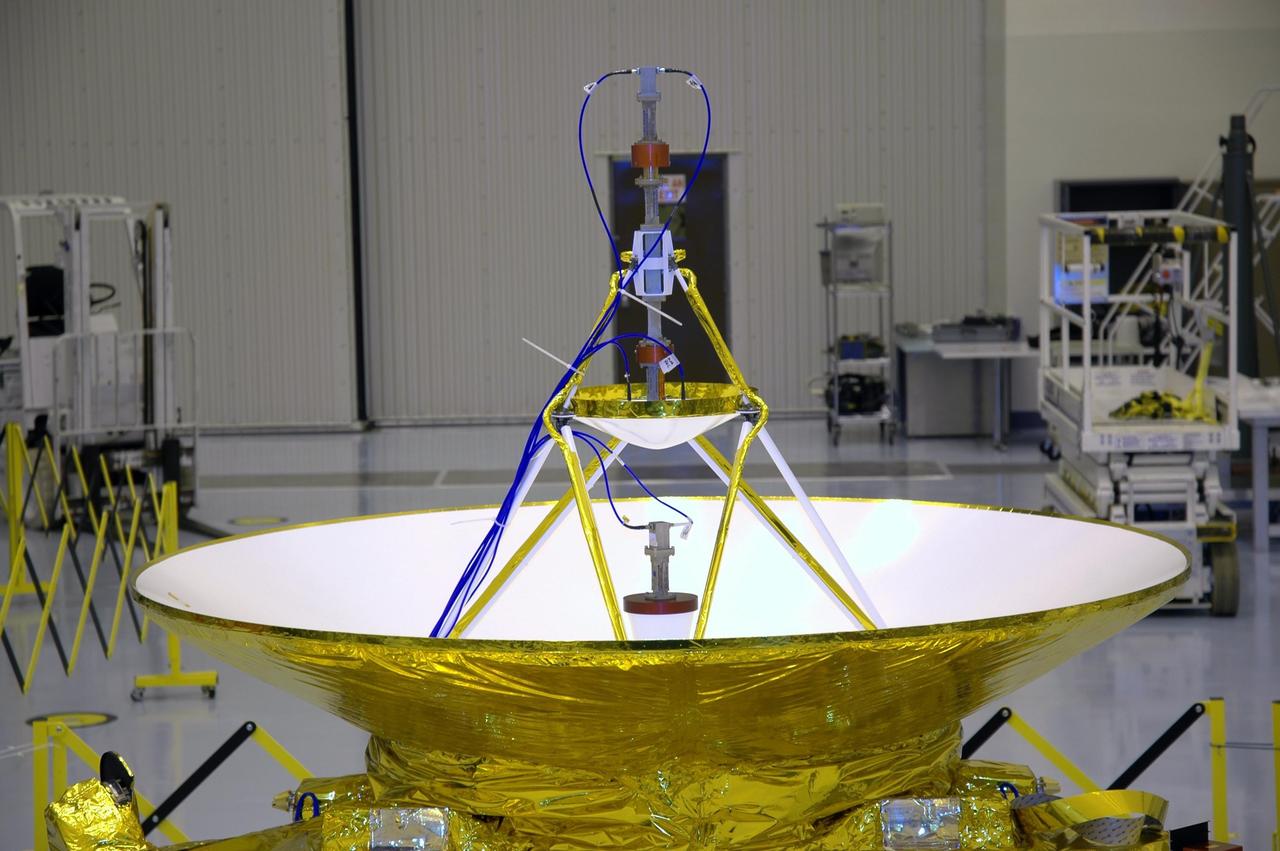
KENNEDY SPACE CENTER, FLA. - In the clean room at KSC’s Payload Hazardous Servicing Facility is NASA’s New Horizons spacecraft that is scheduled to be launched to Pluto and its moon Charon in January 2006. Seen here is the Radio Science Experiment (REX) that will measure atmospheric composition and temperature. The spacecraft is being prepared for a media event. Photographers and reporters will be able to photograph the New Horizons spacecraft and talk with project management and test team members from NASA and the Johns Hopkins University Applied Physics Laboratory. Carrying seven scientific instruments, the compact 1,060-pound New Horizons probe will characterize the global geology and geomorphology of Pluto and its moon Charon, map their surface compositions and temperatures, and examine Pluto's complex atmosphere. After that, flybys of Kuiper Belt objects from even farther in the solar system may be undertaken in an extended mission. New Horizons is the first mission in NASA's New Frontiers program of medium-class planetary missions. The spacecraft, designed for NASA by the Johns Hopkins University Applied Physics Laboratory in Laurel, Md., will fly by Pluto and Charon as early as summer 2015.
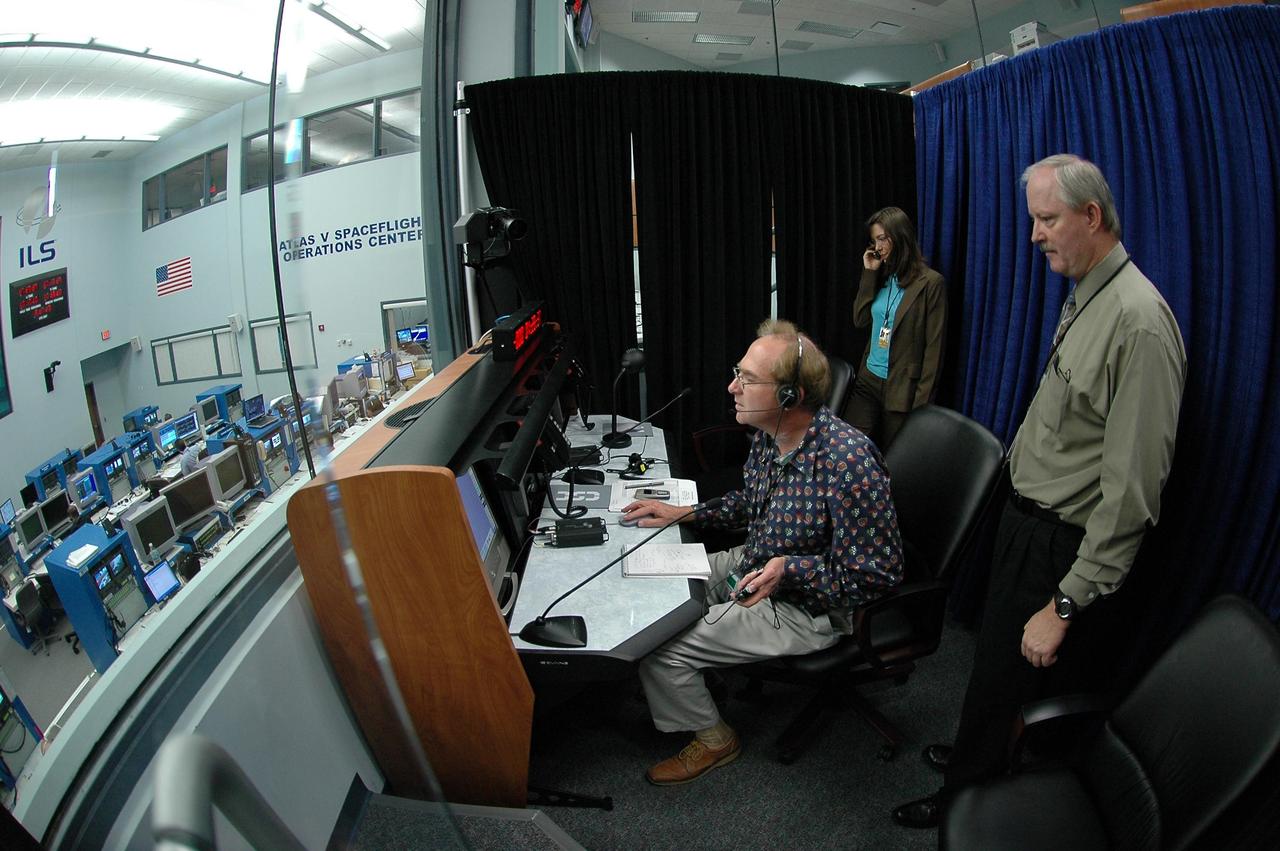
KENNEDY SPACE CENTER, FLA. - In the communications room above the Atlas V Spaceflight Operations Center on Cape Canaveral Air Force Station, NASA Public Information Officer George Diller rehearses his role for the upcoming launch of the New Horizons spacecraft. Behind him are Tiffany Nail, with the Launch Services Program at Kennedy Space Center, and Bob Summerville, a Lockheed Martin console system software engineer. Members of the New Horizons team are taking part in a dress rehearsal for the launch scheduled in mid-January. New Horizons carries seven scientific instruments that will characterize the global geology and geomorphology of Pluto and its moon Charon, map their surface compositions and temperatures, and examine Pluto's complex atmosphere. After that, flybys of Kuiper Belt objects from even farther in the solar system may be undertaken in an extended mission. New Horizons is the first mission in NASA's New Frontiers program of medium-class planetary missions. The spacecraft, designed for NASA by the Johns Hopkins University Applied Physics Laboratory in Laurel, Md., will launch aboard a Lockheed Martin Atlas V rocket and fly by Pluto and Charon as early as summer 2015.
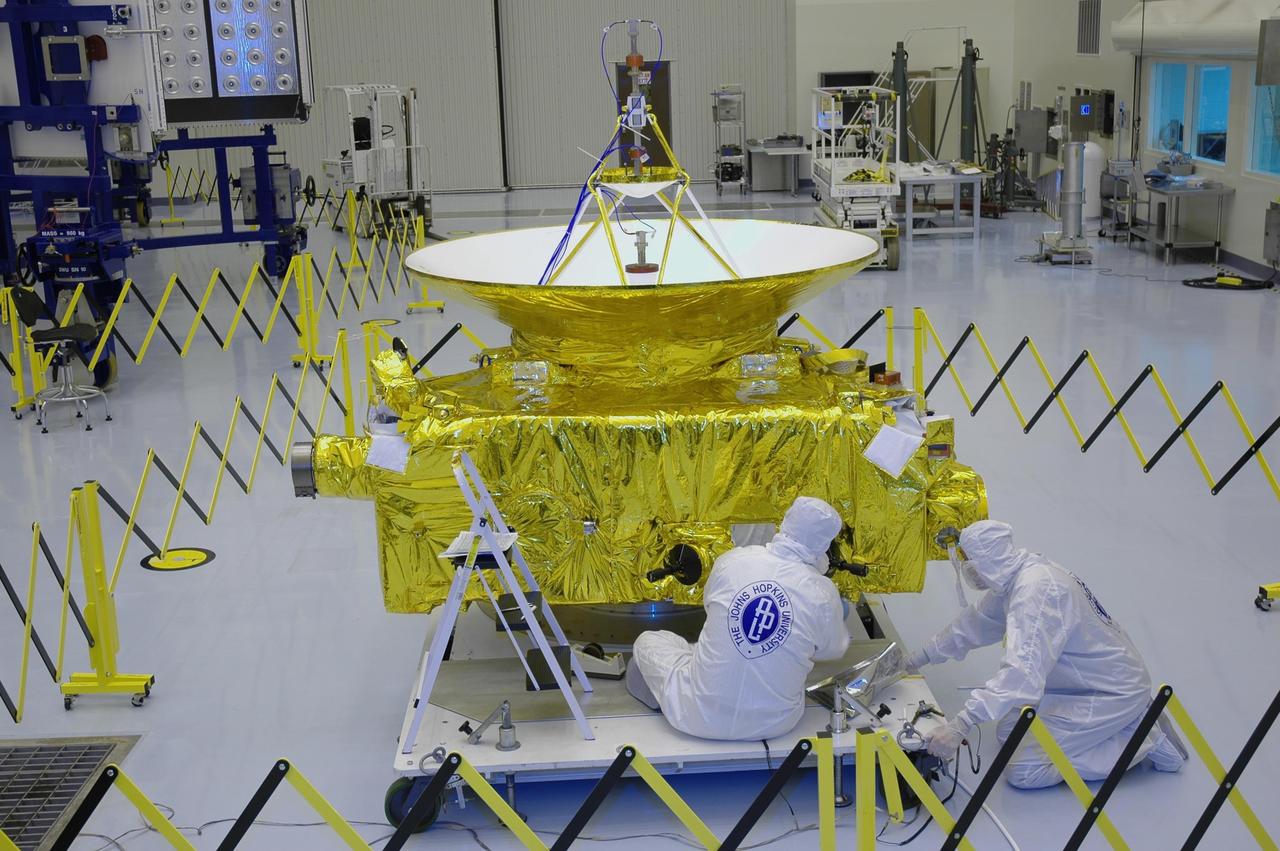
KENNEDY SPACE CENTER, FLA. - In the clean room at KSC’s Payload Hazardous Servicing Facility, the New Horizons spacecraft is being prepared for a media event. Photographers and reporters will be able to photograph the New Horizons spacecraft and talk with project management and test team members from NASA and the Johns Hopkins University Applied Physics Laboratory. Seen behind the spacecraft is one half of the fairing that will enclose it for launch, scheduled for January 2006. Carrying seven scientific instruments, the compact 1,060-pound New Horizons probe will characterize the global geology and geomorphology of Pluto and its moon Charon, map their surface compositions and temperatures, and examine Pluto's complex atmosphere. After that, flybys of Kuiper Belt objects from even farther in the solar system may be undertaken in an extended mission. New Horizons is the first mission in NASA's New Frontiers program of medium-class planetary missions. The spacecraft, designed for NASA by the Johns Hopkins University Applied Physics Laboratory in Laurel, Md., will fly by Pluto and Charon as early as summer 2015.
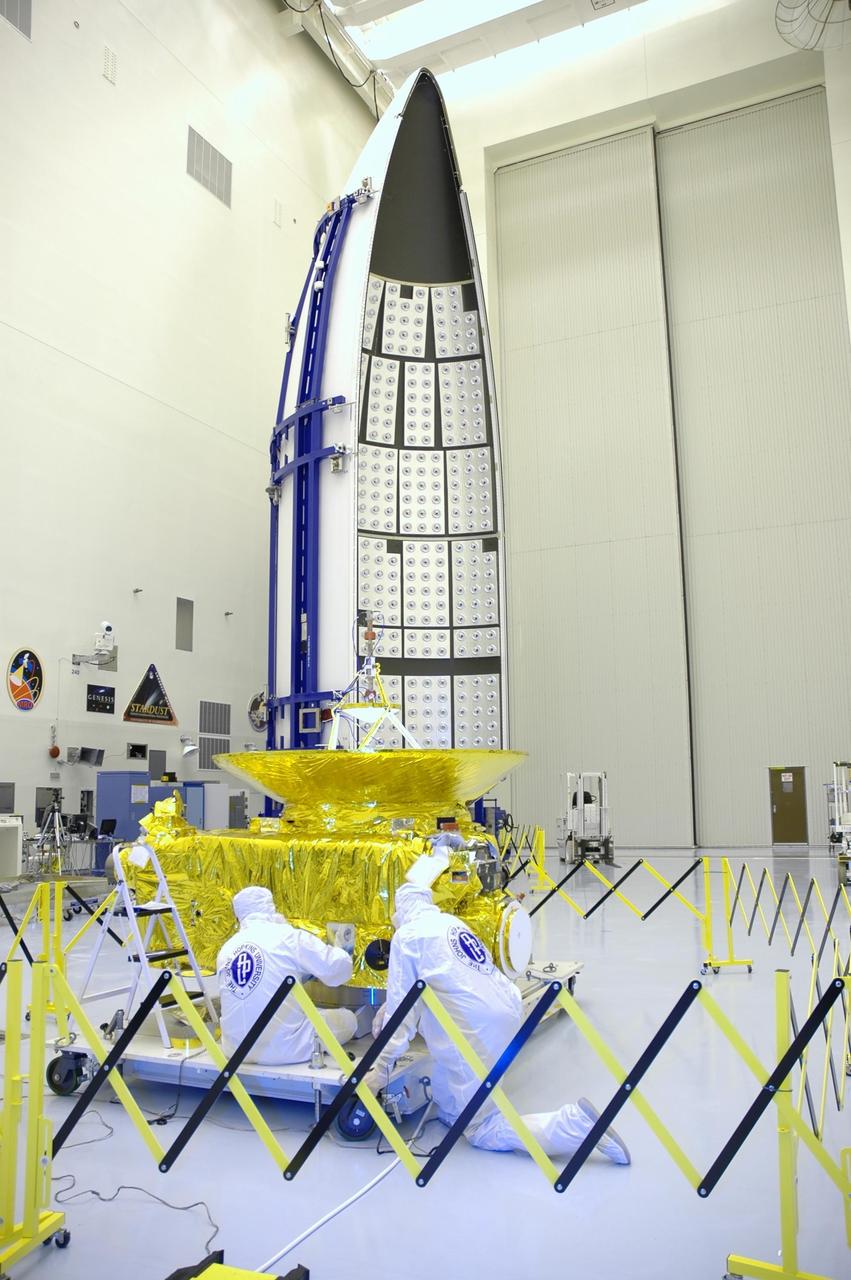
KENNEDY SPACE CENTER, FLA. - In the clean room at KSC’s Payload Hazardous Servicing Facility, technicians prepare the New Horizons spacecraft for a media event. Photographers and reporters will be able to photograph the New Horizons spacecraft and talk with project management and test team members from NASA and the Johns Hopkins University Applied Physics Laboratory. Seen behind the spacecraft is one half of the fairing that will enclose it for launch, scheduled for January 2006. Carrying seven scientific instruments, the compact 1,060-pound New Horizons probe will characterize the global geology and geomorphology of Pluto and its moon Charon, map their surface compositions and temperatures, and examine Pluto's complex atmosphere. After that, flybys of Kuiper Belt objects from even farther in the solar system may be undertaken in an extended mission. New Horizons is the first mission in NASA's New Frontiers program of medium-class planetary missions. The spacecraft, designed for NASA by the Johns Hopkins University Applied Physics Laboratory in Laurel, Md., will fly by Pluto and Charon as early as summer 2015.
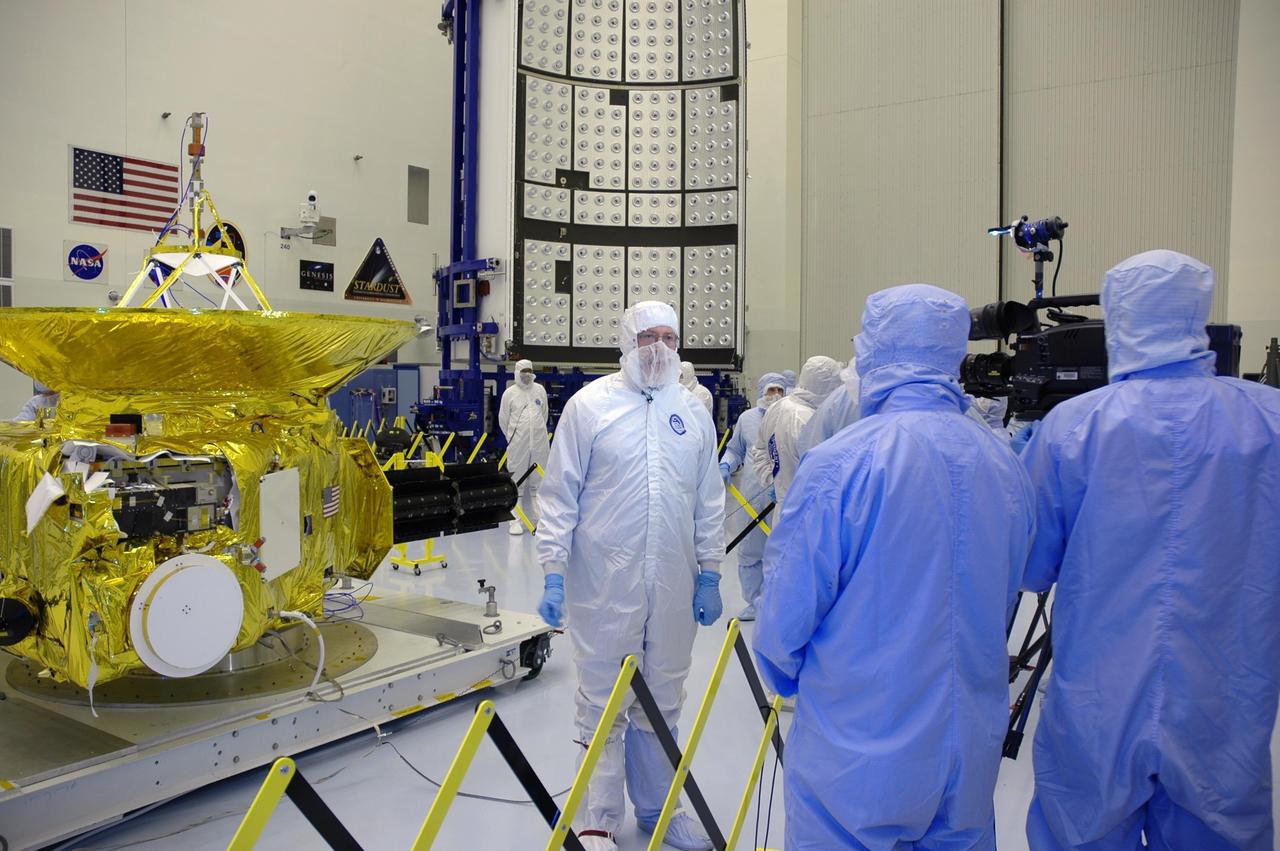
KENNEDY SPACE CENTER, FLA. - In the clean room at KSC’s Payload Hazardous Servicing Facility, the media (also dressed in clean room suits) learn about NASA’s New Horizons spacecraft (at left) from New Horizons Mission Systems Engineer David Kusnierkiewicz, in the center. Behind Kusnierkiewicz is one half of the fairing that will enclose the spacecraft for launch, scheduled for January 2006. The media event brought photographers and reporters to the site to talk with project management and test team members from NASA and the Johns Hopkins University Applied Physics Laboratory. Carrying seven scientific instruments, the compact 1,060-pound New Horizons probe will characterize the global geology and geomorphology of Pluto and its moon Charon, map their surface compositions and temperatures, and examine Pluto's complex atmosphere. After that, flybys of Kuiper Belt objects from even farther in the solar system may be undertaken in an extended mission. New Horizons is the first mission in NASA's New Frontiers program of medium-class planetary missions. The spacecraft, designed for NASA by the Johns Hopkins University Applied Physics Laboratory in Laurel, Md., will fly by Pluto and Charon as early as summer 2015.
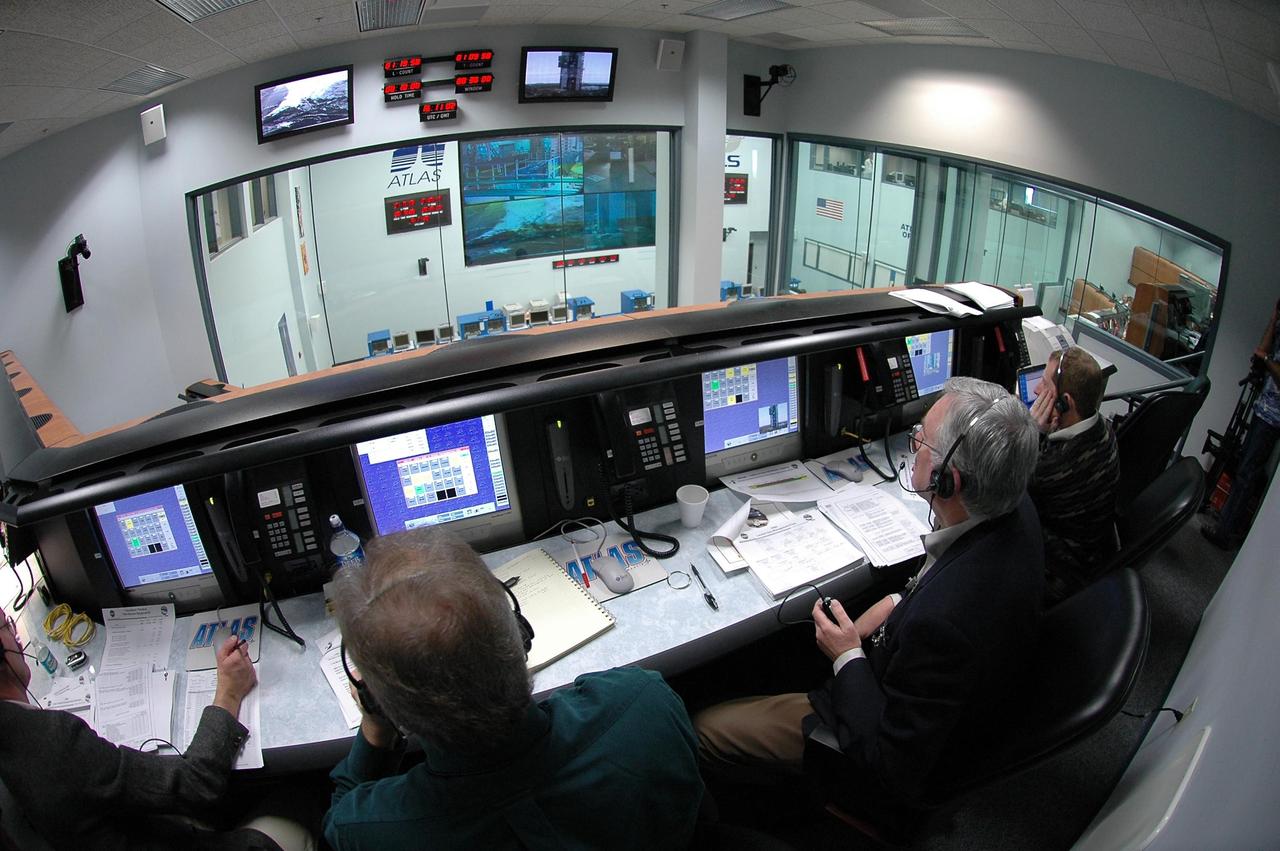
KENNEDY SPACE CENTER, FLA. - At their consoles in the Atlas V Spaceflight Operations Center on Cape Canaveral Air Force Station, members of the New Horizons team take part in a dress rehearsal for the launch scheduled in mid-January. Seen here (left to right) are David Kusnierkiewicz, New Horizons mission system engineer; Glen Fountain, Applied Physics Lab project manager; and Alan Stern, principal investigator from Southwest Research Institute. New Horizons carries seven scientific instruments that will characterize the global geology and geomorphology of Pluto and its moon Charon, map their surface compositions and temperatures, and examine Pluto's complex atmosphere. After that, flybys of Kuiper Belt objects from even farther in the solar system may be undertaken in an extended mission. New Horizons is the first mission in NASA's New Frontiers program of medium-class planetary missions. The spacecraft, designed for NASA by the Johns Hopkins University Applied Physics Laboratory in Laurel, Md., will launch aboard a Lockheed Martin Atlas V rocket and fly by Pluto and Charon as early as summer 2015.
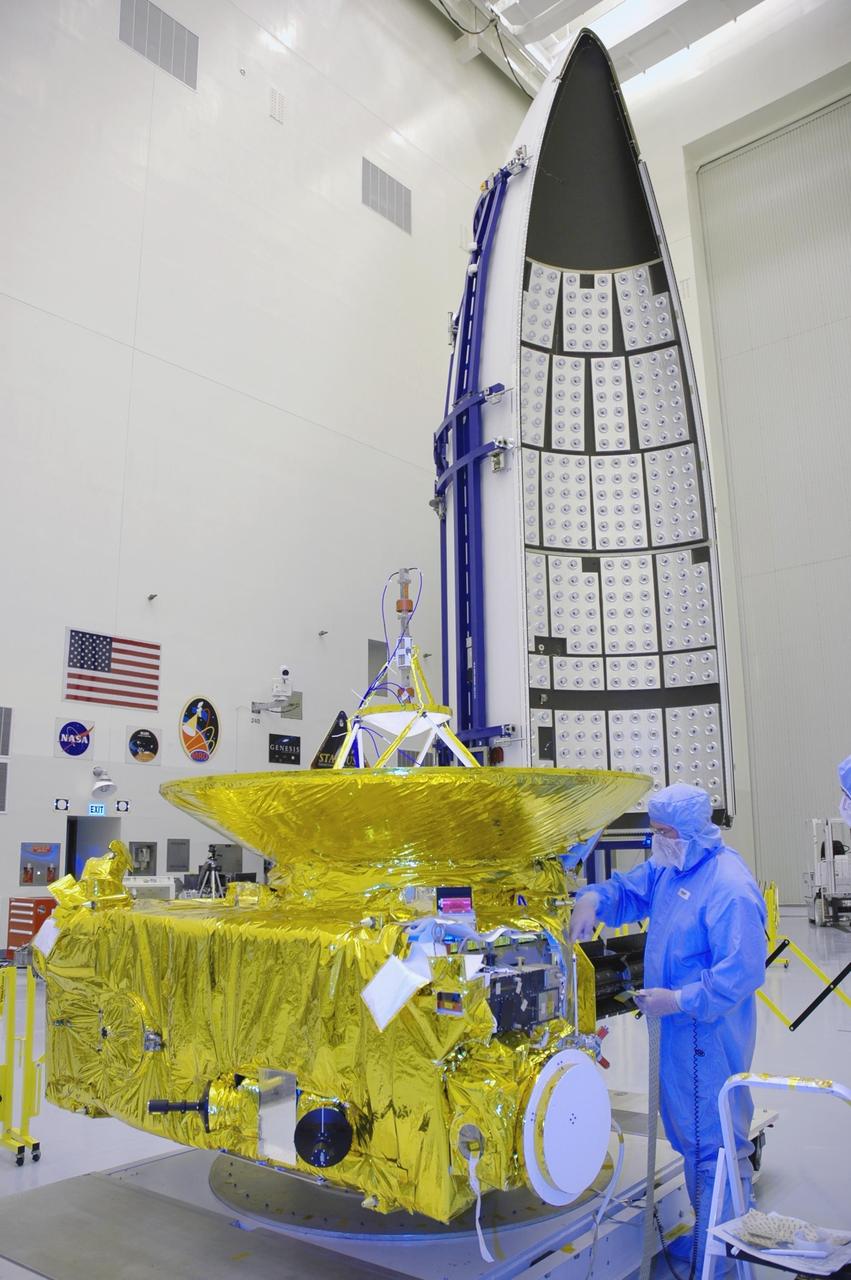
KENNEDY SPACE CENTER, FLA. - In the clean room at KSC’s Payload Hazardous Servicing Facility, the New Horizons spacecraft is prepared for a media event. Photographers and reporters will be able to photograph the New Horizons spacecraft and talk with project management and test team members from NASA and the Johns Hopkins University Applied Physics Laboratory. Seen behind the spacecraft is one half of the fairing that will enclose it for launch, scheduled for January 2006. Carrying seven scientific instruments, the compact 1,060-pound New Horizons probe will characterize the global geology and geomorphology of Pluto and its moon Charon, map their surface compositions and temperatures, and examine Pluto's complex atmosphere. After that, flybys of Kuiper Belt objects from even farther in the solar system may be undertaken in an extended mission. New Horizons is the first mission in NASA's New Frontiers program of medium-class planetary missions. The spacecraft, designed for NASA by the Johns Hopkins University Applied Physics Laboratory in Laurel, Md., will fly by Pluto and Charon as early as summer 2015.
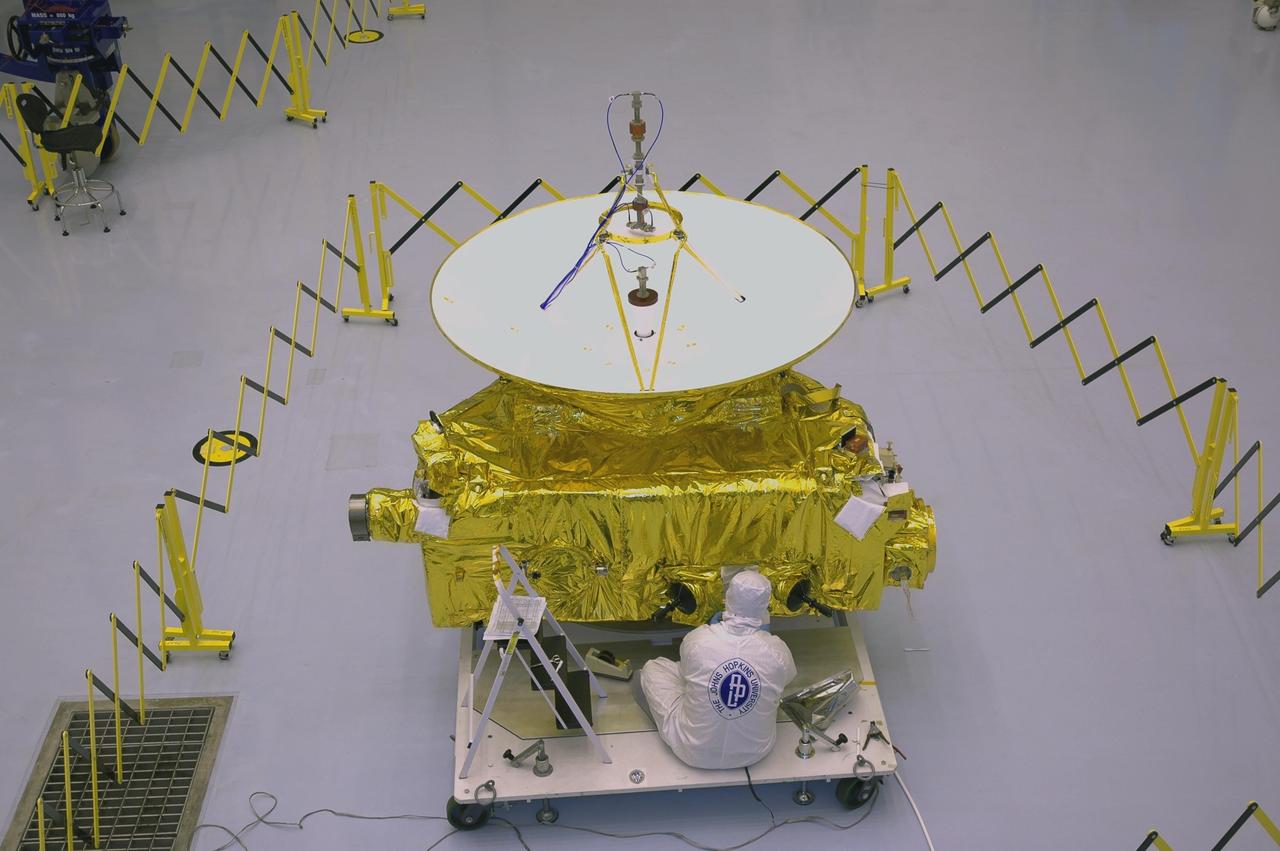
KENNEDY SPACE CENTER, FLA. - In the clean room at KSC’s Payload Hazardous Servicing Facility, the New Horizons spacecraft is ready for a media event. Photographers and reporters will be able to photograph the New Horizons spacecraft and talk with project management and test team members from NASA and the Johns Hopkins University Applied Physics Laboratory. Seen behind the spacecraft is one half of the fairing that will enclose it for launch, scheduled for January 2006. Carrying seven scientific instruments, the compact 1,060-pound New Horizons probe will characterize the global geology and geomorphology of Pluto and its moon Charon, map their surface compositions and temperatures, and examine Pluto's complex atmosphere. After that, flybys of Kuiper Belt objects from even farther in the solar system may be undertaken in an extended mission. New Horizons is the first mission in NASA's New Frontiers program of medium-class planetary missions. The spacecraft, designed for NASA by the Johns Hopkins University Applied Physics Laboratory in Laurel, Md., will fly by Pluto and Charon as early as summer 2015.
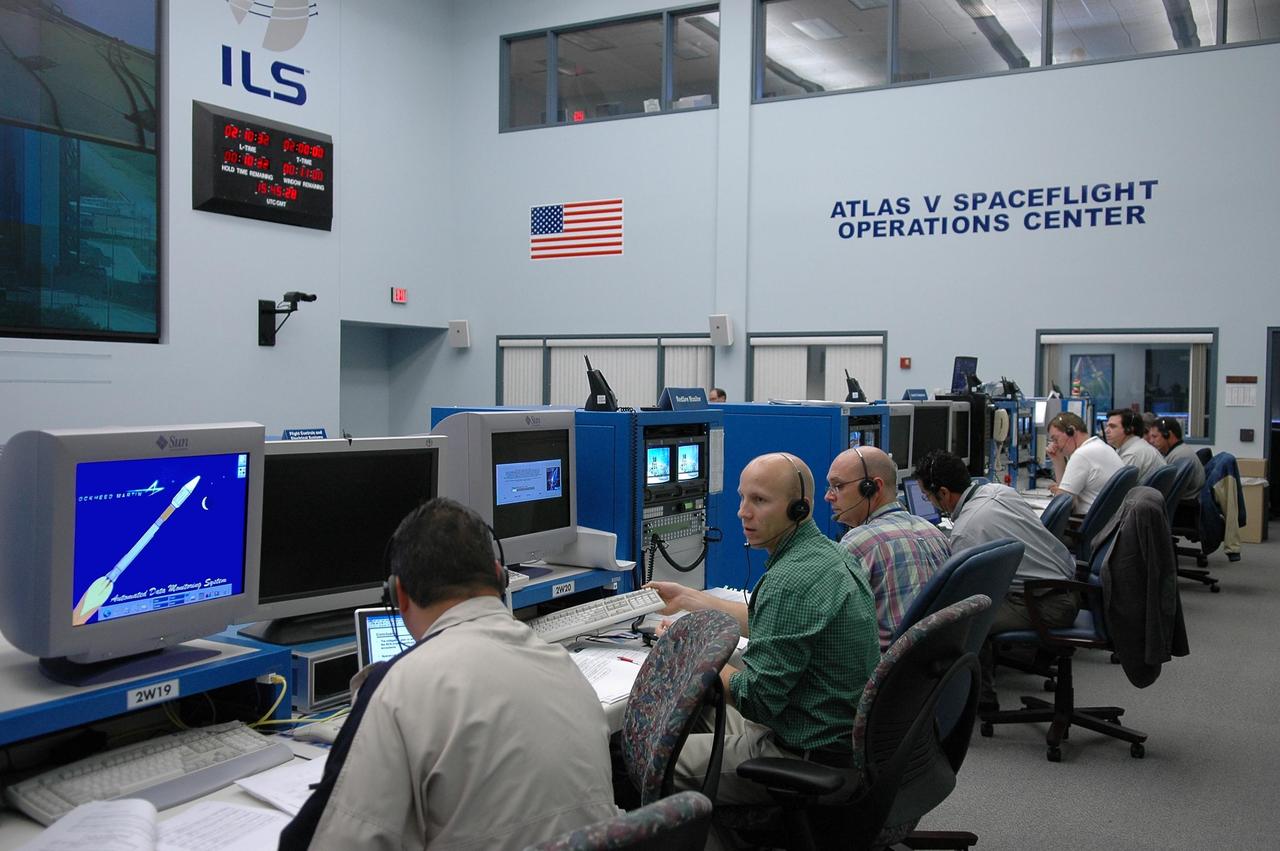
KENNEDY SPACE CENTER, FLA. - At their consoles in the Atlas V Spaceflight Operations Center on Cape Canaveral Air Force Station, members of the New Horizons team take part in a dress rehearsal for the launch scheduled in mid-January. From left are Lockheed Martin's Program Manager John Crocker; Michael Kubiak with the U.S. Air Force, participating with Lockheed Martin on the Education with Industry program; and Lockheed Martin's Carlos Prado. New Horizons carries seven scientific instruments that will characterize the global geology and geomorphology of Pluto and its moon Charon, map their surface compositions and temperatures, and examine Pluto's complex atmosphere. After that, flybys of Kuiper Belt objects from even farther in the solar system may be undertaken in an extended mission. New Horizons is the first mission in NASA's New Frontiers program of medium-class planetary missions. The spacecraft, designed for NASA by the Johns Hopkins University Applied Physics Laboratory in Laurel, Md., will launch aboard a Lockheed Martin Atlas V rocket and fly by Pluto and Charon as early as summer 2015.
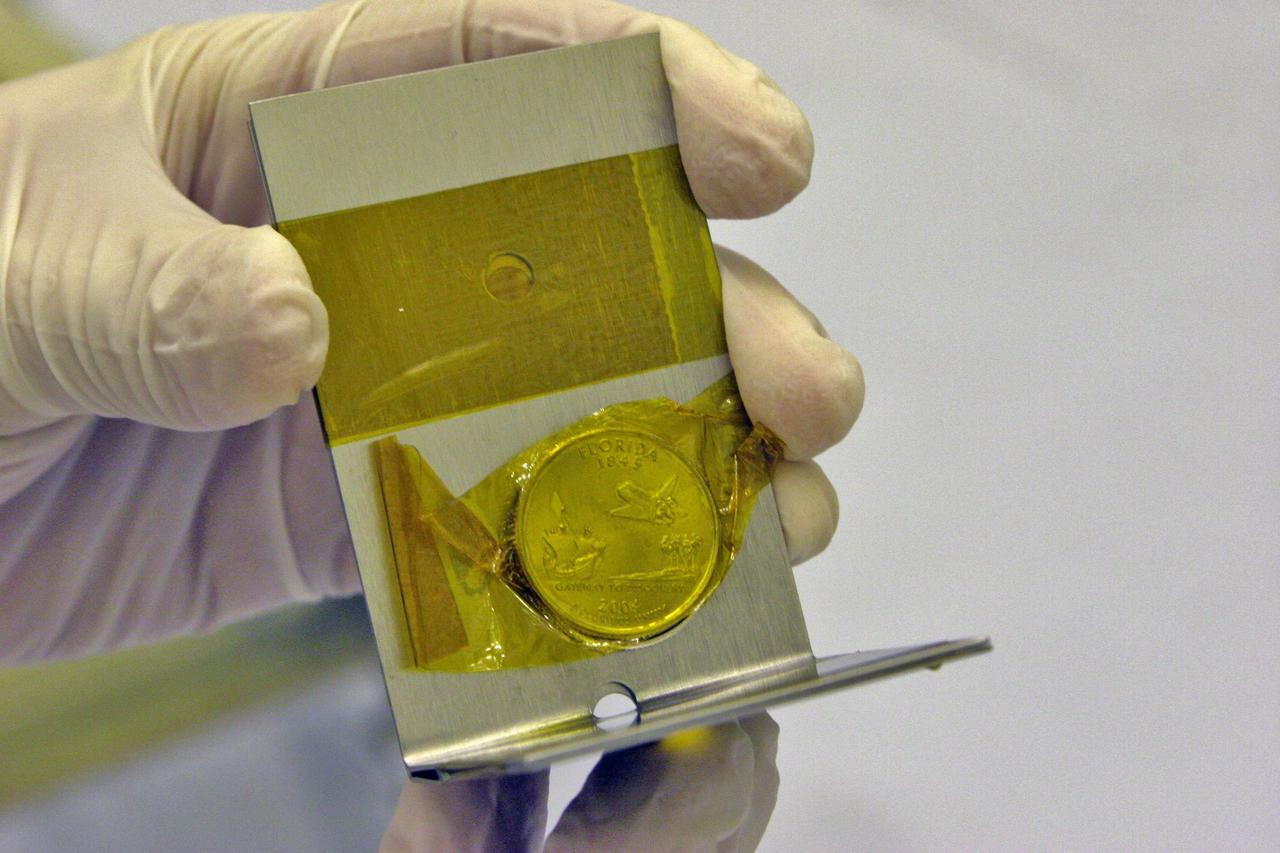
KENNEDY SPACE CENTER, FLA. - A Florida quarter is prepared for installation on the New Horizons spacecraft in Kennedy Space Center's Payload Hazardous Servicing Facility. The new quarter, engraved with the "Gateway to Discovery" design, will accompany New Horizons on its 3-billion-mile journey to the planet Pluto and its moon, Charon. Although appropriate for the mission to carry the coin from the state that symbolizes space exploration, it will also serve a practical purpose: scientists are using the quarter as a spin-balance weight. New Horizons comprises seven scientific instruments that will characterize the global geology and geomorphology of Pluto and its moon Charon, map their surface compositions and temperatures, and examine Pluto's complex atmosphere. After that, flybys of Kuiper Belt objects from even farther in the solar system may be undertaken in an extended mission. New Horizons is the first mission in NASA's New Frontiers program of medium-class planetary missions. The spacecraft, designed for NASA by the Johns Hopkins University Applied Physics Laboratory in Laurel, Md., will launch aboard a Lockheed Martin Atlas V rocket and fly by Pluto and Charon as early as summer 2015. Photo Credit: Applied Physics Laboratory/George W. Rogers III