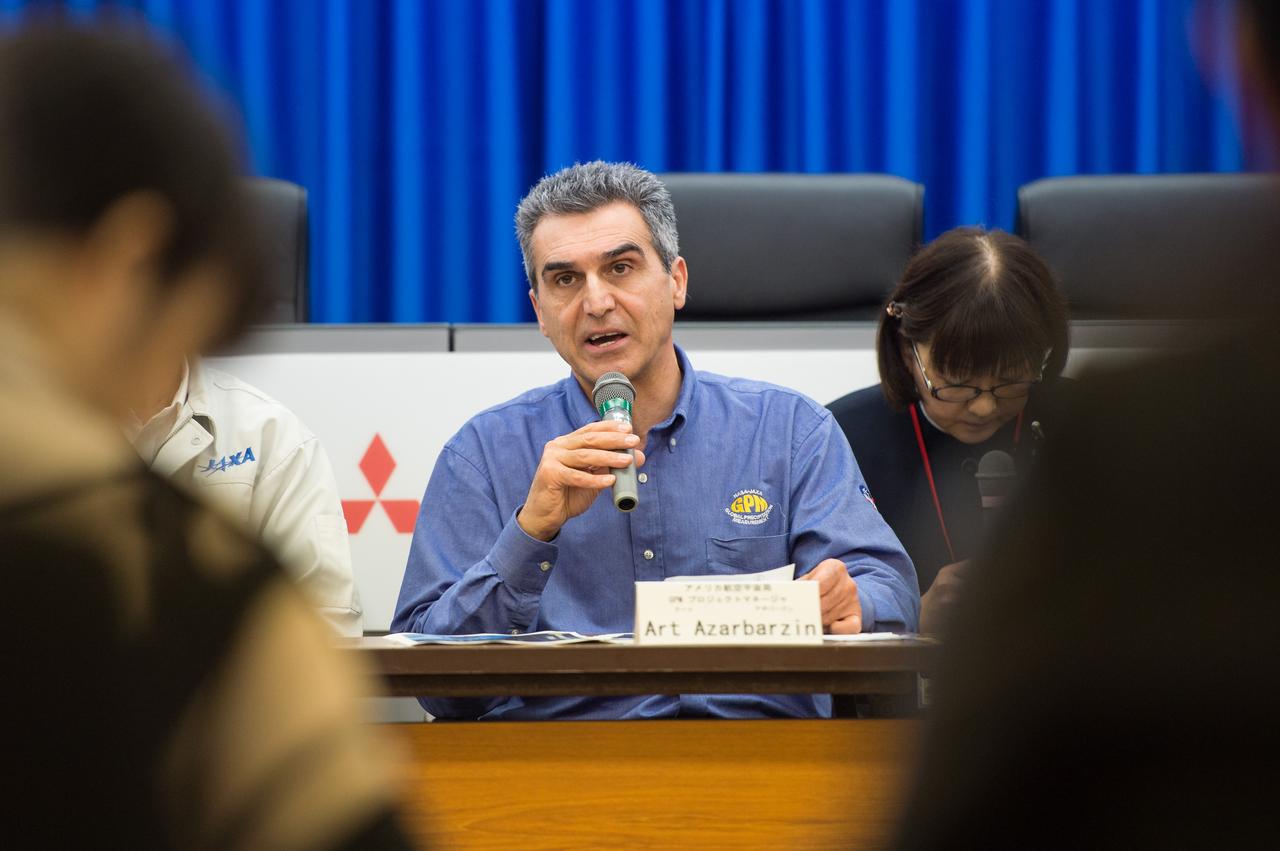
Art Azarbarzin, NASA Global Precipitation Measurement (GPM) project manager talks during a technical briefing for the launch of the Global Precipitation Measurement (GPM) Core Observatory aboard an H-IIA rocket, Wednesday, Feb. 26, 2014, Tanegashima Space Center, Japan. Launch is scheduled for early in the morning of Feb. 28 Japan time. Once launched, the GPM spacecraft will collect information that unifies data from an international network of existing and future satellites to map global rainfall and snowfall every three hours. Photo Credit: (NASA/Bill Ingalls)

A Japanese H-IIA rocket carrying the NASA-Japan Aerospace Exploration Agency (JAXA), Global Precipitation Measurement (GPM) Core Observatory is seen as it rolls out to launch pad 1 of the Tanegashima Space Center, Thursday, Feb. 27, 2014, Tanegashima, Japan. Once launched, the GPM spacecraft will collect information that unifies data from an international network of existing and future satellites to map global rainfall and snowfall every three hours. Photo Credit: (NASA/Bill Ingalls)

A Japanese H-IIA rocket carrying the NASA-Japan Aerospace Exploration Agency (JAXA), Global Precipitation Measurement (GPM) Core Observatory is seen as it rolls out to launch pad 1 of the Tanegashima Space Center, Thursday, Feb. 27, 2014, Tanegashima, Japan. Once launched, the GPM spacecraft will collect information that unifies data from an international network of existing and future satellites to map global rainfall and snowfall every three hours. Photo Credit: (NASA/Bill Ingalls)

A Japanese H-IIA rocket carrying the NASA-Japan Aerospace Exploration Agency (JAXA), Global Precipitation Measurement (GPM) Core Observatory is seen as it rolls out to launch pad 1 of the Tanegashima Space Center, Thursday, Feb. 27, 2014, Tanegashima, Japan. Once launched, the GPM spacecraft will collect information that unifies data from an international network of existing and future satellites to map global rainfall and snowfall every three hours. Photo Credit: (NASA/Bill Ingalls)
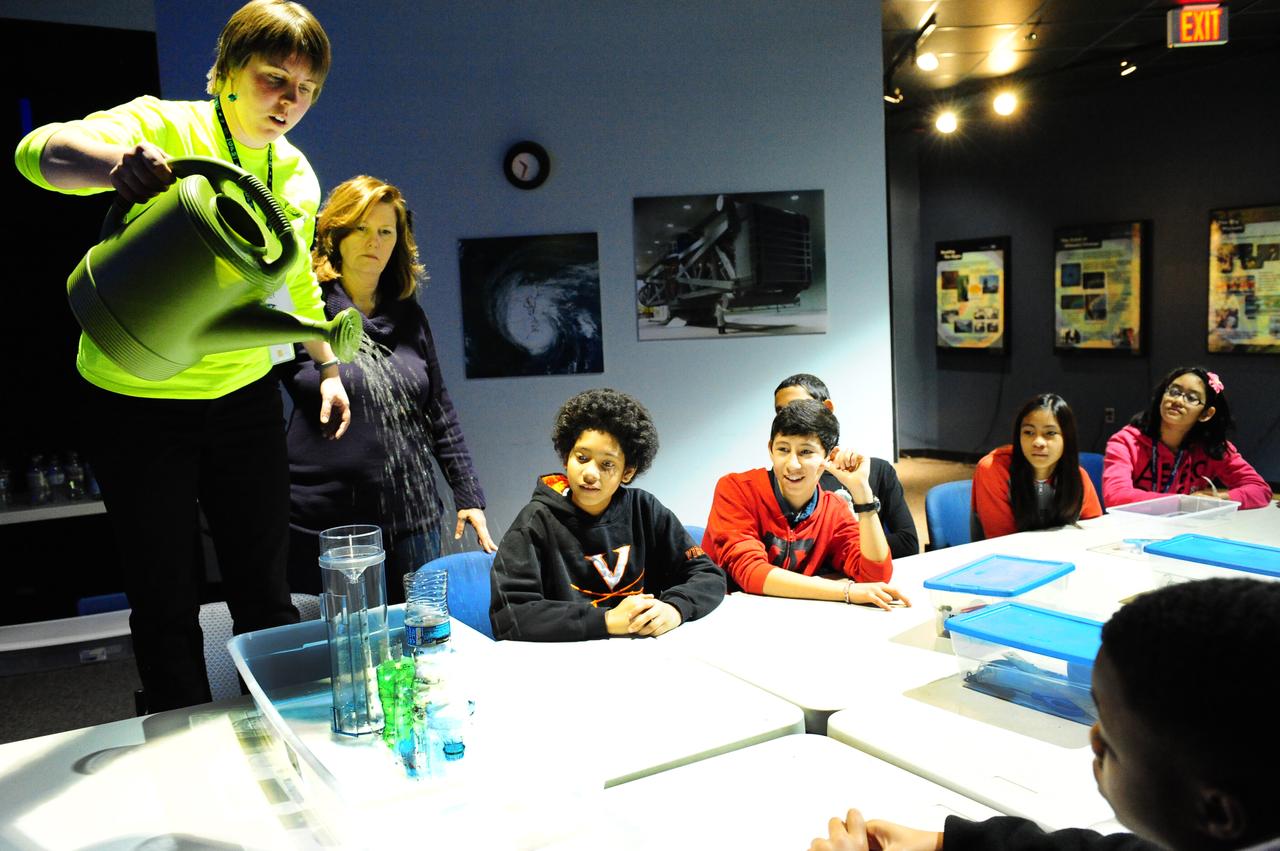
Children at the visitor center at NASA's Goddard Space Flight Center in Greenbelt, Md., receive a rainfall demonstration as part of activities tied to the launch of the Global Precipitation Measurement mission's Core Observatory on Feb. 27, 2014. <b>Credit: NASA's Goddard Space Flight Center/Debbie McCallum</b> GPM's Core Observatory is poised for launch from the Japan Aerospace Exploration Agency's Tanegashima Space Center, scheduled for the afternoon of Feb. 27, 2014 (EST). GPM is a joint venture between NASA and the Japan Aerospace Exploration Agency. The GPM Core Observatory will link data from a constellation of current and planned satellites to produce next-generation global measurements of rainfall and snowfall from space. The GPM mission is the first coordinated international satellite network to provide near real-time observations of rain and snow every three hours anywhere on the globe. The GPM Core Observatory anchors this network by providing observations on all types of precipitation. The observatory's data acts as the measuring stick by which partner observations can be combined into a unified data set. The data will be used by scientists to study climate change, freshwater resources, floods and droughts, and hurricane formation and tracking. <b><a href="http://www.nasa.gov/audience/formedia/features/MP_Photo_Guidelines.html" rel="nofollow">NASA image use policy.</a></b> <b><a href="http://www.nasa.gov/centers/goddard/home/index.html" rel="nofollow">NASA Goddard Space Flight Center</a></b> enables NASA’s mission through four scientific endeavors: Earth Science, Heliophysics, Solar System Exploration, and Astrophysics. Goddard plays a leading role in NASA’s accomplishments by contributing compelling scientific knowledge to advance the Agency’s mission. <b>Follow us on <a href="http://twitter.com/NASAGoddardPix" rel="nofollow">Twitter</a></b> <b>Like us on <a href="http://www.facebook.com/pages/Greenbelt-MD/NASA-Goddard/395013845897?ref=tsd" rel="nofollow">Facebook</a></b> <b>Find us on <a href="http://instagram.com/nasagoddard?vm=grid" rel="nofollow">Instagram</a></b>

A Japanese H-IIA rocket with the NASA-Japan Aerospace Exploration Agency (JAXA), Global Precipitation Measurement (GPM) Core Observatory onboard, is seen on launch pad 1 of the Tanegashima Space Center, Friday, Feb. 28, 2014, Tanegashima, Japan. Once launched, the GPM spacecraft will collect information that unifies data from an international network of existing and future satellites to map global rainfall and snowfall every three hours. Photo Credit: (NASA/Bill Ingalls)

Gail Skofronick-Jackson, NASA GPM Project Scientist, talks during a science briefing for the launch of the Global Precipitation Measurement (GPM) Core Observatory aboard an H-IIA rocket, Wednesday, Feb. 26, 2014, Tanegashima Space Center, Japan. Launch is scheduled for early in the morning of Feb. 28 Japan time. Once launched, the GPM spacecraft will collect information that unifies data from an international network of existing and future satellites to map global rainfall and snowfall every three hours. Photo Credit: (NASA/Bill Ingalls)
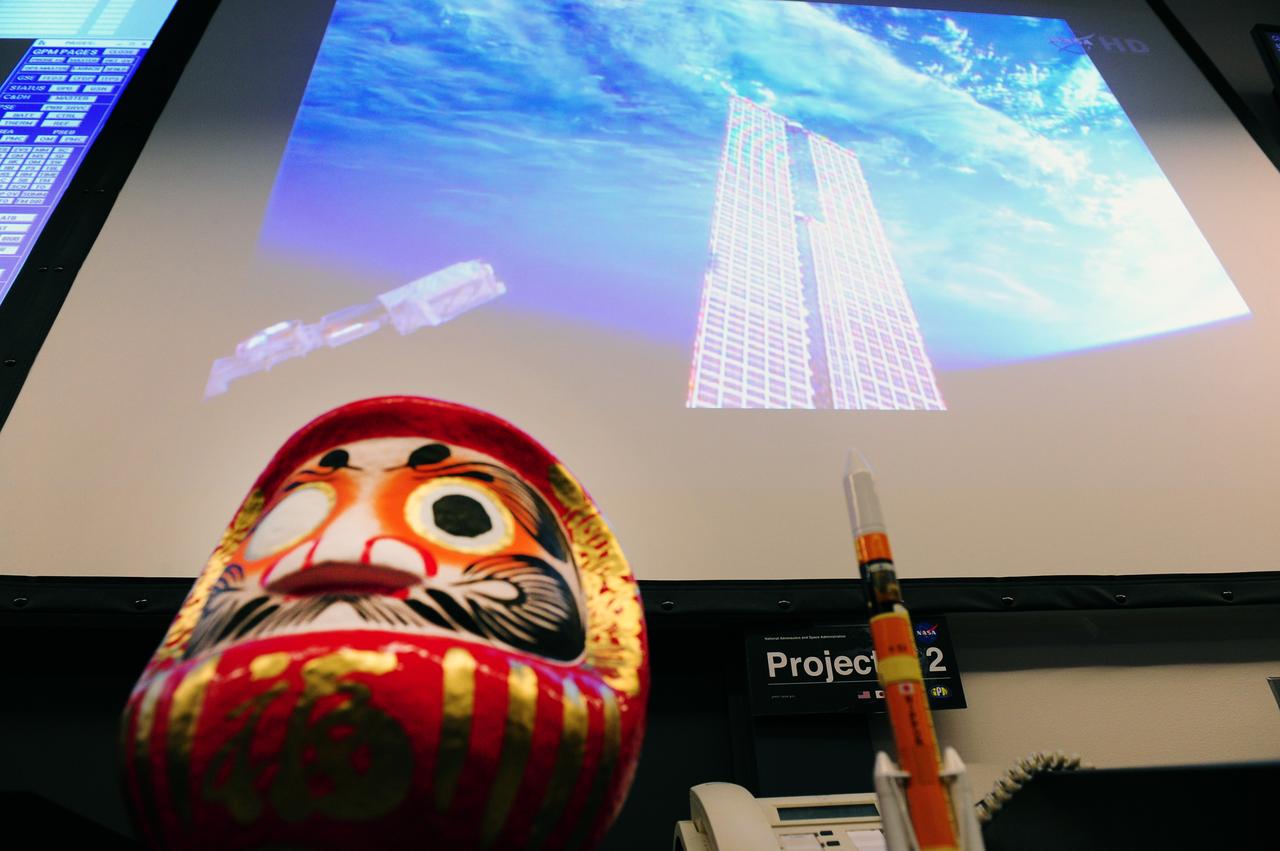
The Daruma doll is a symbol of good luck and in Japan is often given as a gift for encouragement to reach a goal. When the goal is set, one eye is colored in. When the goal is achieved, the other eye is colored. <a href="http://www.flickr.com/photos/nasahqphoto/12714130984/in/set-72157641344480584" target="_blank">An identical doll</a> sits in the control room at the Japan Aerospace Agency’s (JAXA) Tanegashima Space Center, leading up to the launch of the joint NASA-JAXA Global Precipitation Measurement mission’s Core Observatory. <b>Credit: NASA's Goddard Space Flight Center/Debbie McCallum</b> GPM's Core Observatory is poised for launch from the Japan Aerospace Exploration Agency's Tanegashima Space Center, scheduled for the afternoon of Feb. 27, 2014 (EST). GPM is a joint venture between NASA and the Japan Aerospace Exploration Agency. The GPM Core Observatory will link data from a constellation of current and planned satellites to produce next-generation global measurements of rainfall and snowfall from space. The GPM mission is the first coordinated international satellite network to provide near real-time observations of rain and snow every three hours anywhere on the globe. The GPM Core Observatory anchors this network by providing observations on all types of precipitation. The observatory's data acts as the measuring stick by which partner observations can be combined into a unified data set. The data will be used by scientists to study climate change, freshwater resources, floods and droughts, and hurricane formation and tracking. <b><a href="http://www.nasa.gov/audience/formedia/features/MP_Photo_Guidelines.html" rel="nofollow">NASA image use policy.</a></b> <b><a href="http://www.nasa.gov/centers/goddard/home/index.html" rel="nofollow">NASA Goddard Space Flight Center</a></b> enables NASA’s mission through four scientific endeavors: Earth Science, Heliophysics, Solar System Exploration, and Astrophysics. Goddard plays a leading role in NASA’s accomplishments by contributing compelling scientific knowledge to advance the Agency’s mission. <b>Follow us on <a href="http://twitter.com/NASAGoddardPix" rel="nofollow">Twitter</a></b> <b>Like us on <a href="http://www.facebook.com/pages/Greenbelt-MD/NASA-Goddard/395013845897?ref=tsd" rel="nofollow">Facebook</a></b> <b>Find us on <a href="http://instagram.com/nasagoddard?vm=grid" rel="nofollow">Instagram</a></b>

Caroline Bouvier Kennedy, U.S. Ambassador Extraordinary and Plenipotentiary to Japan, right, is welcomed by Japan Aerospace Exploration Agency (JAXA), President, Naoki Okumura, at the Tanegashima Space Center Visitors Center on Thursday, Feb. 27, 2014, Tanegashima, Japan. The Ambassador is visiting the space center and hopes to witness the planned launch of a Japanese H-IIA rocket carrying the NASA-JAXA, Global Precipitation Measurement (GPM) Core Observatory. Once launched, the GPM spacecraft will collect information that unifies data from an international network of existing and future satellites to map global rainfall and snowfall every three hours. Photo Credit: (NASA/Bill Ingalls)

A Japanese H-IIA rocket carrying the NASA-Japan Aerospace Exploration Agency (JAXA), Global Precipitation Measurement (GPM) Core Observatory is seen as it rolls out to launch pad 1 of the Tanegashima Space Center, Thursday, Feb. 27, 2014, Tanegashima, Japan. Once launched, the GPM spacecraft will collect information that unifies data from an international network of existing and future satellites to map global rainfall and snowfall every three hours. Photo Credit: (NASA/Bill Ingalls)

A Japanese H-IIA rocket carrying the NASA-Japan Aerospace Exploration Agency (JAXA), Global Precipitation Measurement (GPM) Core Observatory is seen as it rolls out to launch pad 1 of the Tanegashima Space Center, Thursday, Feb. 27, 2014, Tanegashima, Japan. Once launched, the GPM spacecraft will collect information that unifies data from an international network of existing and future satellites to map global rainfall and snowfall every three hours. Photo Credit: (NASA/Bill Ingalls)
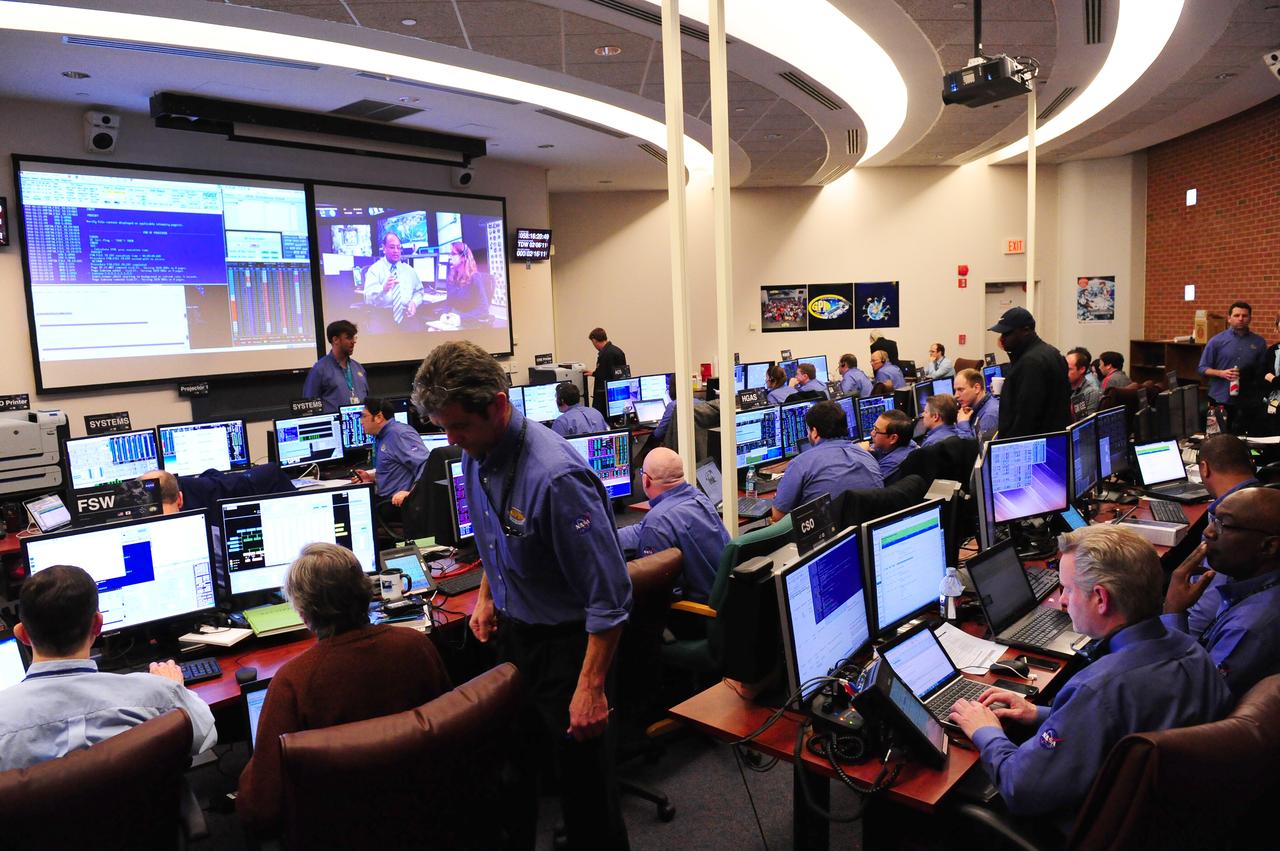
One of the control rooms at NASA’s Goddard Space Flight Center in Greenbelt, Md., prepares for the GPM mission’s Core Observatory on Feb. 27, 2014. <b>Credit: NASA's Goddard Space Flight Center/Debbie McCallum</b> GPM's Core Observatory is poised for launch from the Japan Aerospace Exploration Agency's Tanegashima Space Center, scheduled for the afternoon of Feb. 27, 2014 (EST). GPM is a joint venture between NASA and the Japan Aerospace Exploration Agency. The GPM Core Observatory will link data from a constellation of current and planned satellites to produce next-generation global measurements of rainfall and snowfall from space. The GPM mission is the first coordinated international satellite network to provide near real-time observations of rain and snow every three hours anywhere on the globe. The GPM Core Observatory anchors this network by providing observations on all types of precipitation. The observatory's data acts as the measuring stick by which partner observations can be combined into a unified data set. The data will be used by scientists to study climate change, freshwater resources, floods and droughts, and hurricane formation and tracking. <b><a href="http://www.nasa.gov/audience/formedia/features/MP_Photo_Guidelines.html" rel="nofollow">NASA image use policy.</a></b> <b><a href="http://www.nasa.gov/centers/goddard/home/index.html" rel="nofollow">NASA Goddard Space Flight Center</a></b> enables NASA’s mission through four scientific endeavors: Earth Science, Heliophysics, Solar System Exploration, and Astrophysics. Goddard plays a leading role in NASA’s accomplishments by contributing compelling scientific knowledge to advance the Agency’s mission. <b>Follow us on <a href="http://twitter.com/NASAGoddardPix" rel="nofollow">Twitter</a></b> <b>Like us on <a href="http://www.facebook.com/pages/Greenbelt-MD/NASA-Goddard/395013845897?ref=tsd" rel="nofollow">Facebook</a></b> <b>Find us on <a href="http://instagram.com/nasagoddard?vm=grid" rel="nofollow">Instagram</a></b>

Caroline Bouvier Kennedy, U.S. Ambassador Extraordinary and Plenipotentiary to Japan, center, tours the Tanegashima Space Center, Visitors Center with Japan Aerospace Exploration Agency (JAXA), President, Naoki Okumura, right, on Thursday, Feb. 27, 2014, Tanegashima, Japan. The Ambassador visiting the space center and hopes to witness the planned launch of a Japanese H-IIA rocket carrying the NASA-JAXA, Global Precipitation Measurement (GPM) Core Observatory. Once launched, the GPM spacecraft will collect information that unifies data from an international network of existing and future satellites to map global rainfall and snowfall every three hours. Photo Credit: (NASA/Bill Ingalls)

A Japanese H-IIA rocket carrying the NASA-Japan Aerospace Exploration Agency (JAXA), Global Precipitation Measurement (GPM) Core Observatory is seen as it rolls out to launch pad 1 of the Tanegashima Space Center, Thursday, Feb. 27, 2014, Tanegashima, Japan. Once launched, the GPM spacecraft will collect information that unifies data from an international network of existing and future satellites to map global rainfall and snowfall every three hours. Photo Credit: (NASA/Bill Ingalls)