
VANDENBERG AIR FORCE BASE, Calif. -- At Space Launch Complex 576-E at Vandenberg Air Force Base in California, workers unlatch the crane's guide wires from the Stage 0/1 interstage, part of the four-stage Taurus XL rocket that will carry NASA's Glory spacecraft into low Earth orbit, after it was lowered into launch position. Once Glory reaches orbit, it will collect data on the properties of aerosols and black carbon. It also will help scientists understand how the sun's irradiance affects Earth's climate. Launch is scheduled for 5:09 a.m. EST Feb. 23. For information, visit www.nasa.gov/glory. Photo credit: NASA/Randy Beaudoin, VAFB
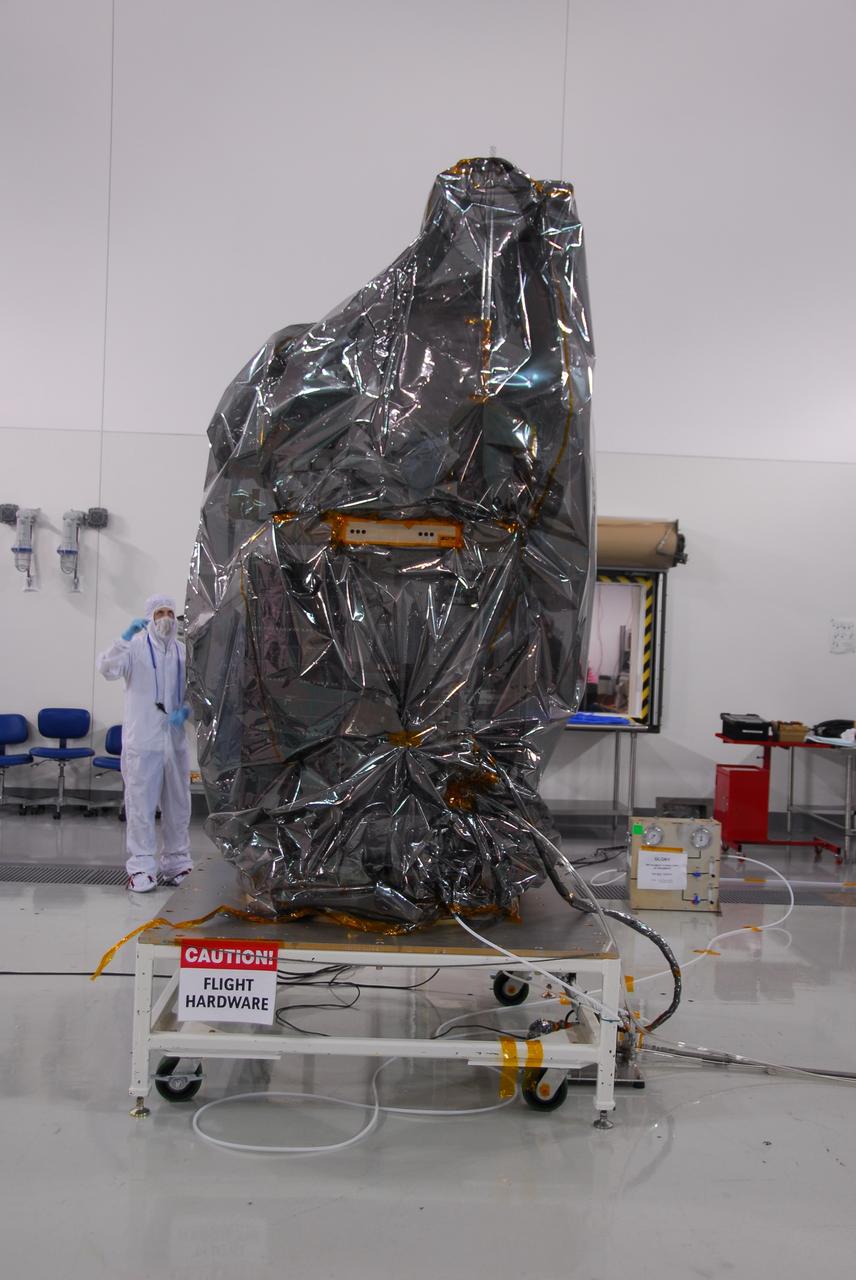
VANDENBERG AIR FORCE BASE, Calif. -- Inside the Astrotech payload processing facility at Vandenberg Air Force Base in California, NASA's Glory spacecraft will be removed from its protective covering. Next, the spacecraft will be encapsulated in its protective payload fairing before it is transported to Space Launch Complex 576-E and joined with the Taurus XL rocket's third stage. Once Glory reaches orbit, it will collect data on the properties of aerosols and black carbon. It also will help scientists understand how the sun's irradiance affects Earth's climate. Launch is scheduled for 5:09 a.m. EST Feb. 23. For information, visit www.nasa.gov/glory. Photo credit: NASA/Ed Henry, VAFB
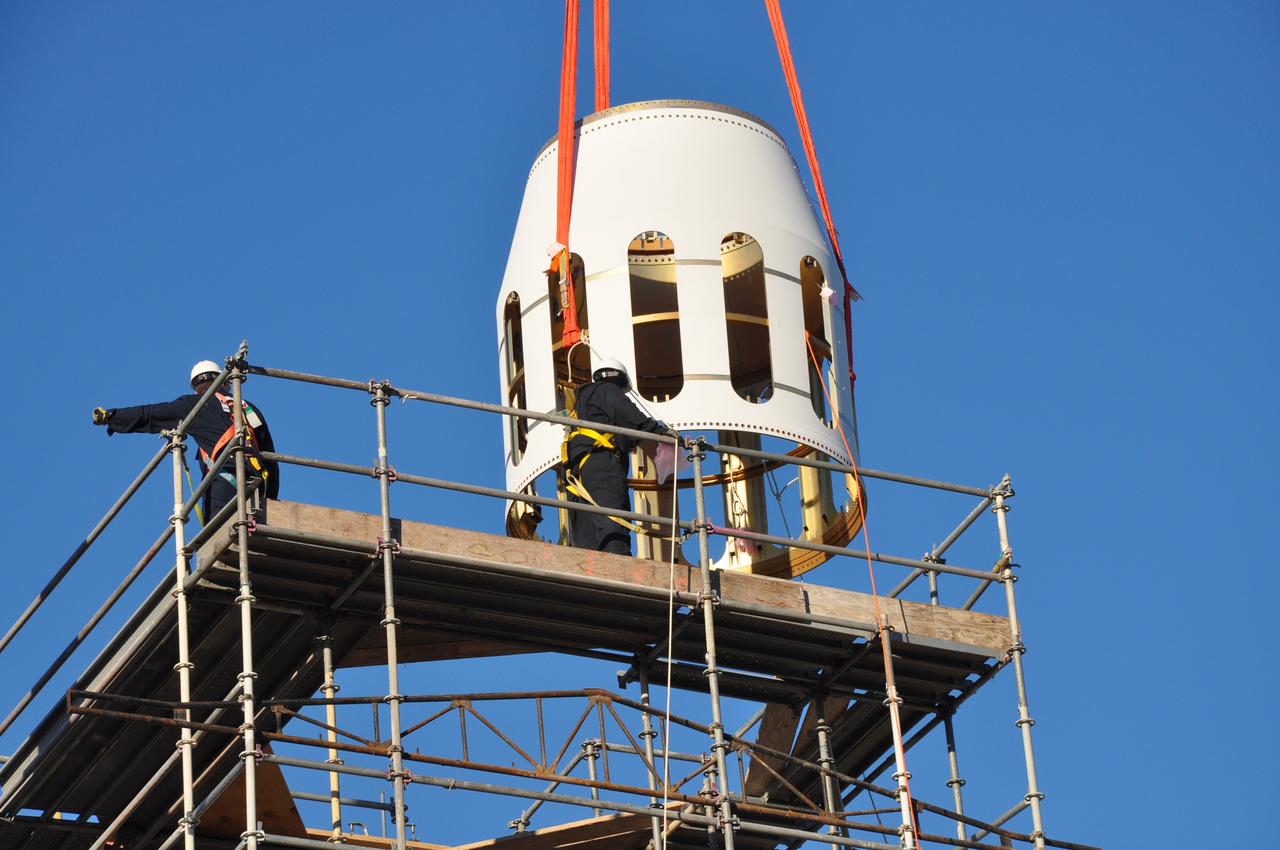
VANDENBERG AIR FORCE BASE, Calif. -- At Vandenberg Air Force Base in California, workers guide the Stage 0/1 interstage, part of the four-stage Taurus XL rocket that will carry NASA's Glory spacecraft into low Earth orbit, as it is lowered by crane into launch position at Space Launch Complex 576-E. Once Glory reaches orbit, it will collect data on the properties of aerosols and black carbon. It also will help scientists understand how the sun's irradiance affects Earth's climate. Launch is scheduled for 5:09 a.m. EST Feb. 23. For information, visit www.nasa.gov/glory. Photo credit: NASA/Randy Beaudoin, VAFB
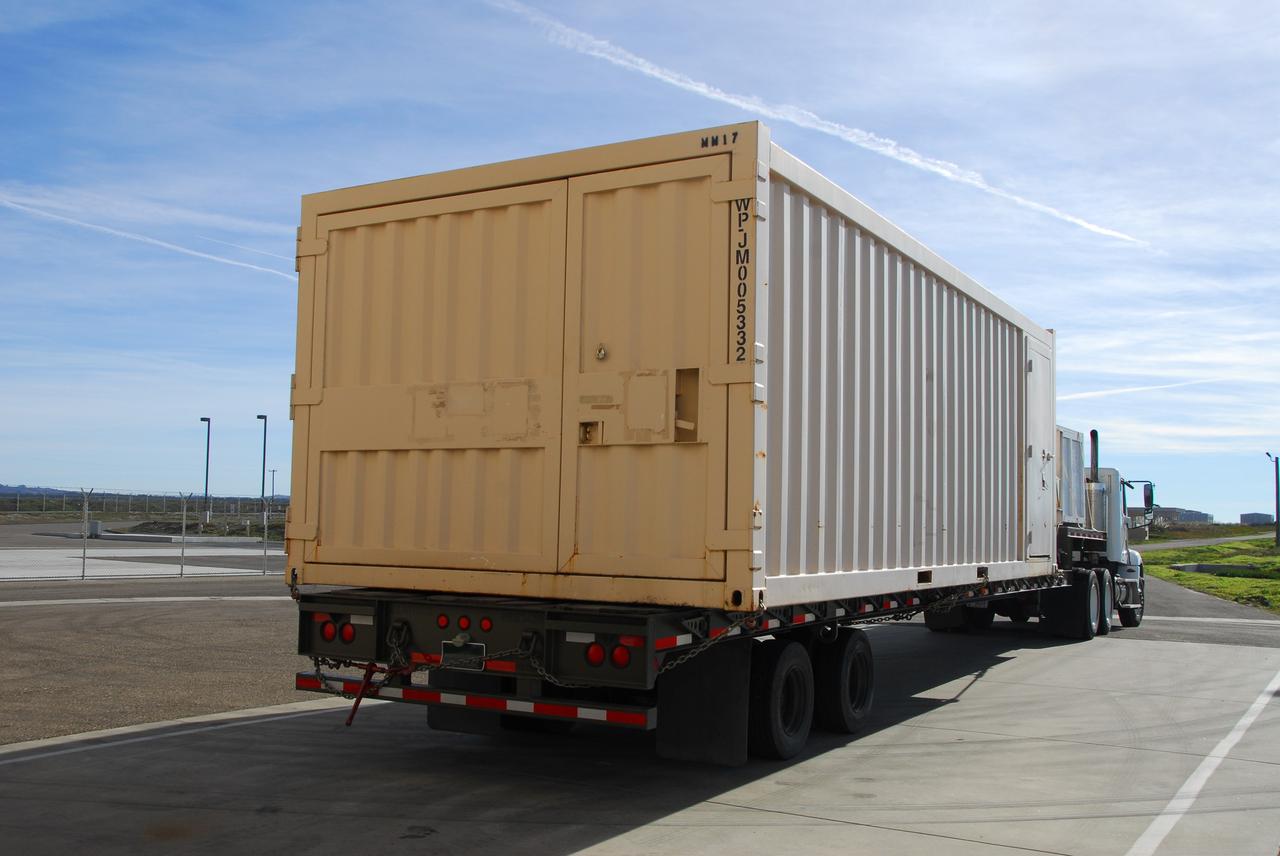
VANDENBERG AIR FORCE BASE, Calif. -- At Vandenberg Air Force Base in California, the protective payload fairing that will surround NASA's Glory spacecraft arrives at the Astrotech payload processing facility. Once encapsulated, the spacecraft will be transported to Space Launch Complex 576-E and joined with the Taurus XL rocket's third stage. Once Glory reaches orbit, it will collect data on the properties of aerosols and black carbon. It also will help scientists understand how the sun's irradiance affects Earth's climate. Launch is scheduled for 5:09 a.m. EST Feb. 23. For information, visit www.nasa.gov/glory. Photo credit: NASA/Ed Henry, VAFB
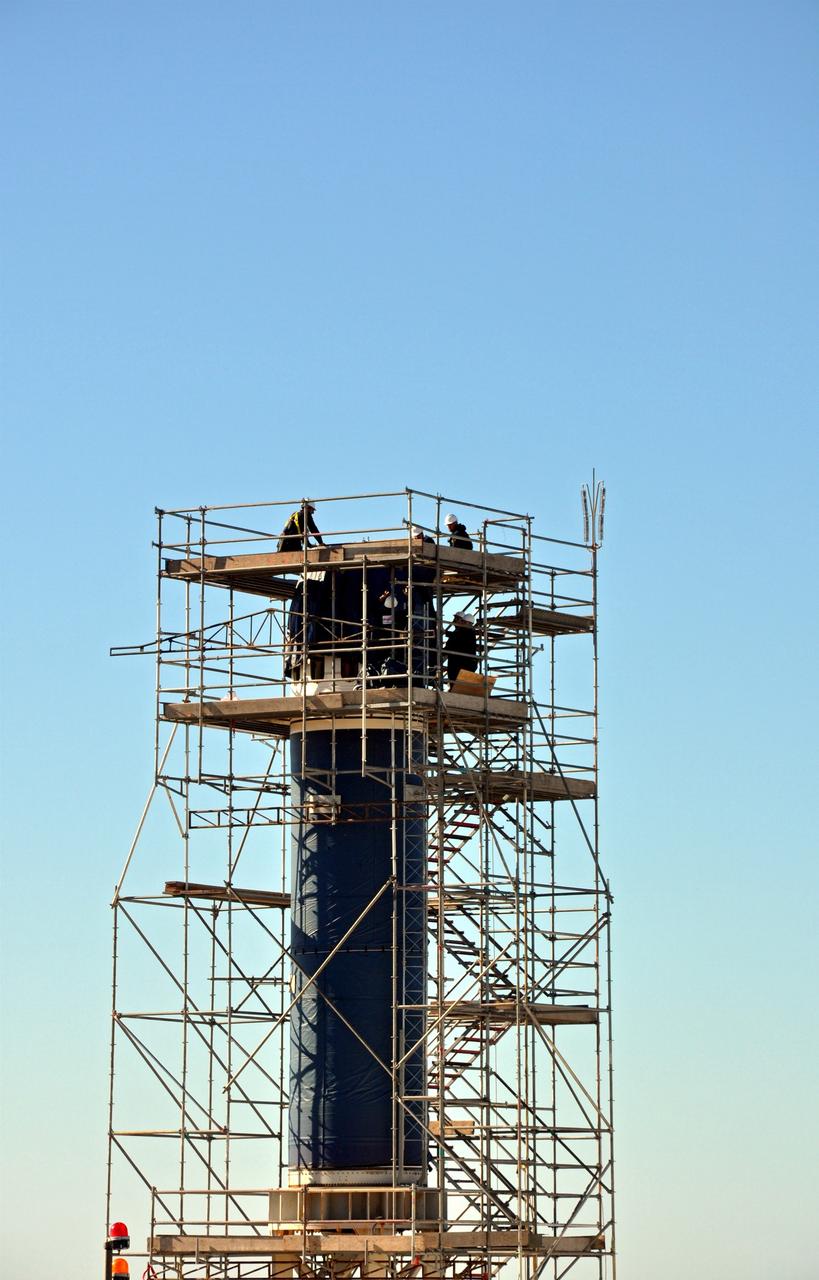
VANDENBERG AIR FORCE BASE, Calif. -- Workers at Space Launch Complex 576-E at Vandenberg Air Force Base in California, wrap the Stage 0/1 interstage in a weather-protective covering after it was secured to Stage 0 of the four-stage Taurus XL rocket that will carry NASA's Glory spacecraft into low Earth orbit. Once Glory reaches orbit, it will collect data on the properties of aerosols and black carbon. It also will help scientists understand how the sun's irradiance affects Earth's climate. Launch is scheduled for 5:09 a.m. EST Feb. 23. For information, visit www.nasa.gov/glory. Photo credit: NASA/Randy Beaudoin, VAFB
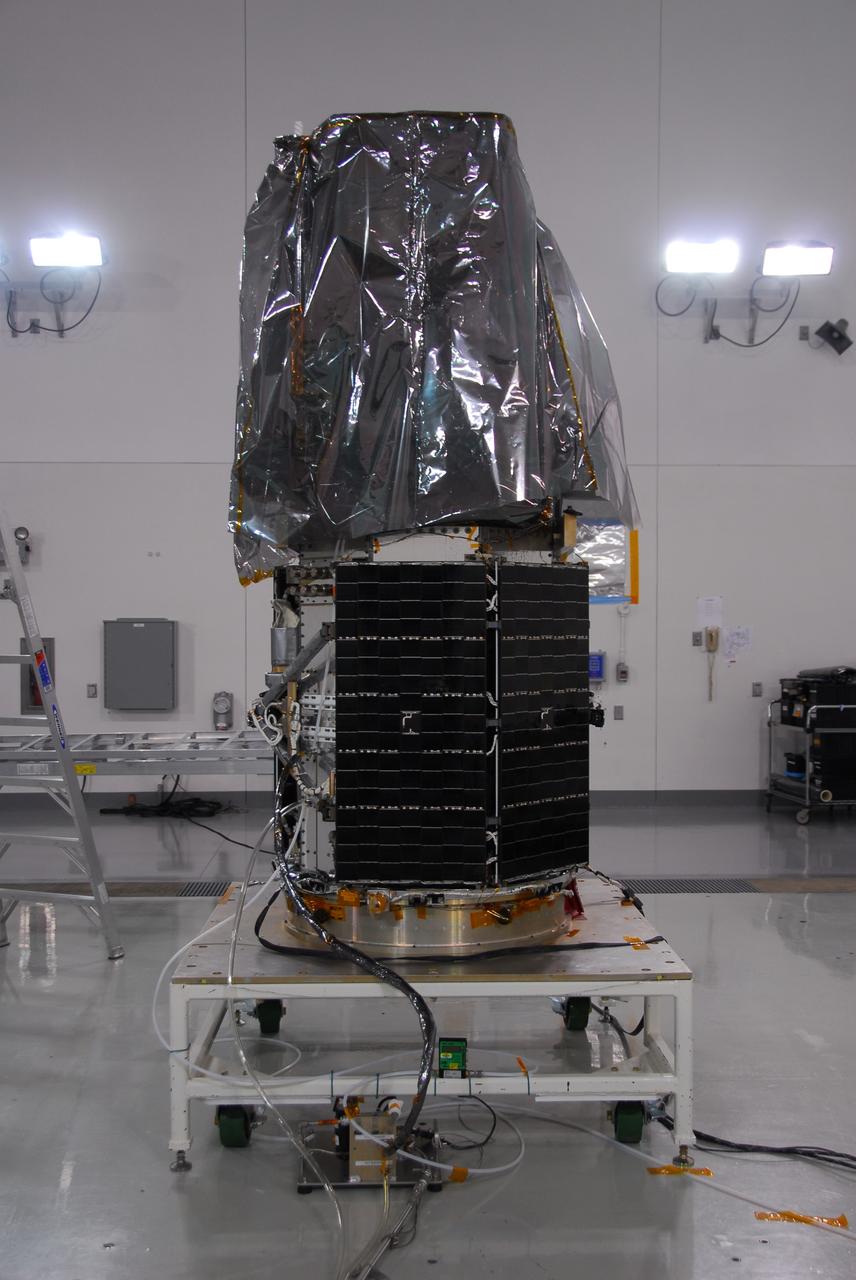
VANDENBERG AIR FORCE BASE, Calif. -- Inside the Astrotech payload processing facility at Vandenberg Air Force Base in California, technicians removed most of the protective covering surrounding NASA's Glory spacecraft. Next, the spacecraft will be encapsulated in its protective payload fairing before it is transported to Space Launch Complex 576-E and joined with the Taurus XL rocket's third stage. Once Glory reaches orbit, it will collect data on the properties of aerosols and black carbon. It also will help scientists understand how the sun's irradiance affects Earth's climate. Launch is scheduled for 5:09 a.m. EST Feb. 23. For information, visit www.nasa.gov/glory. Photo credit: NASA/Ed Henry, VAFB
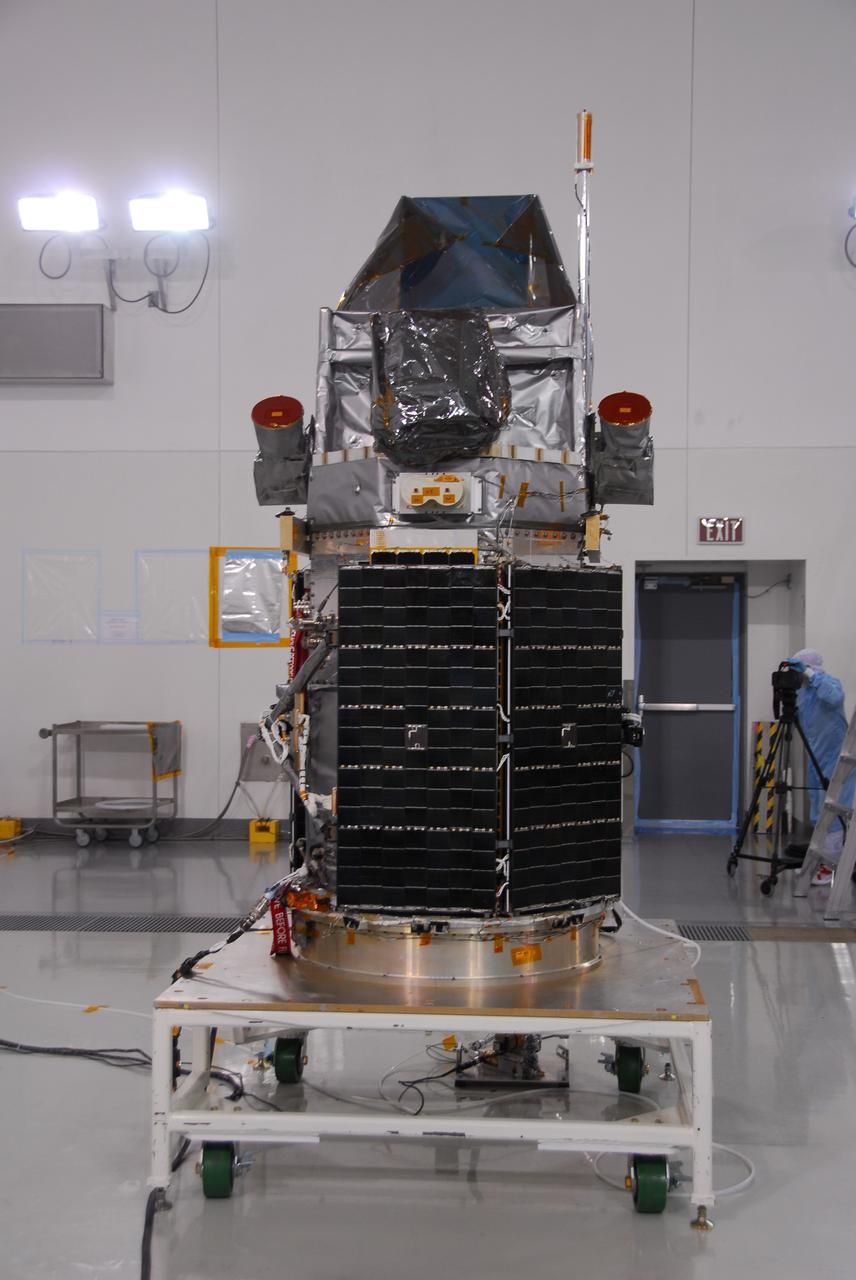
VANDENBERG AIR FORCE BASE, Calif. -- Inside the Astrotech payload processing facility at Vandenberg Air Force Base in California, technicians removed most of the protective covering surrounding NASA's Glory spacecraft. Next, the spacecraft will be encapsulated in its protective payload fairing before it is transported to Space Launch Complex 576-E and joined with the Taurus XL rocket's third stage. Once Glory reaches orbit, it will collect data on the properties of aerosols and black carbon. It also will help scientists understand how the sun's irradiance affects Earth's climate. Launch is scheduled for 5:09 a.m. EST Feb. 23. For information, visit www.nasa.gov/glory. Photo credit: NASA/Ed Henry, VAFB
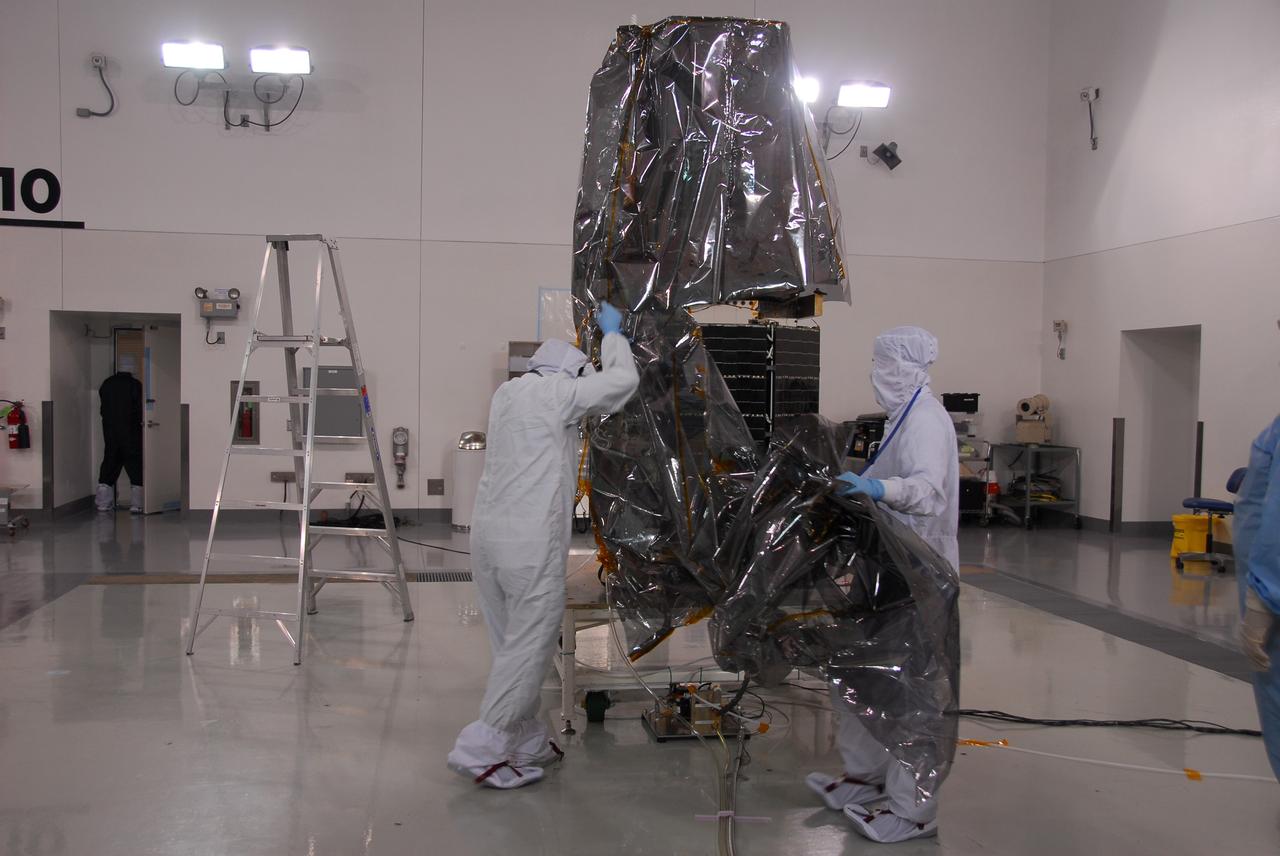
VANDENBERG AIR FORCE BASE, Calif. -- Inside the Astrotech payload processing facility at Vandenberg Air Force Base in California, technicians begin to remove the protective covering surrounding NASA's Glory spacecraft. Next, the spacecraft will be encapsulated in its protective payload fairing before it is transported to Space Launch Complex 576-E and joined with the Taurus XL rocket's third stage. Once Glory reaches orbit, it will collect data on the properties of aerosols and black carbon. It also will help scientists understand how the sun's irradiance affects Earth's climate. Launch is scheduled for 5:09 a.m. EST Feb. 23. For information, visit www.nasa.gov/glory. Photo credit: NASA/Ed Henry, VAFB
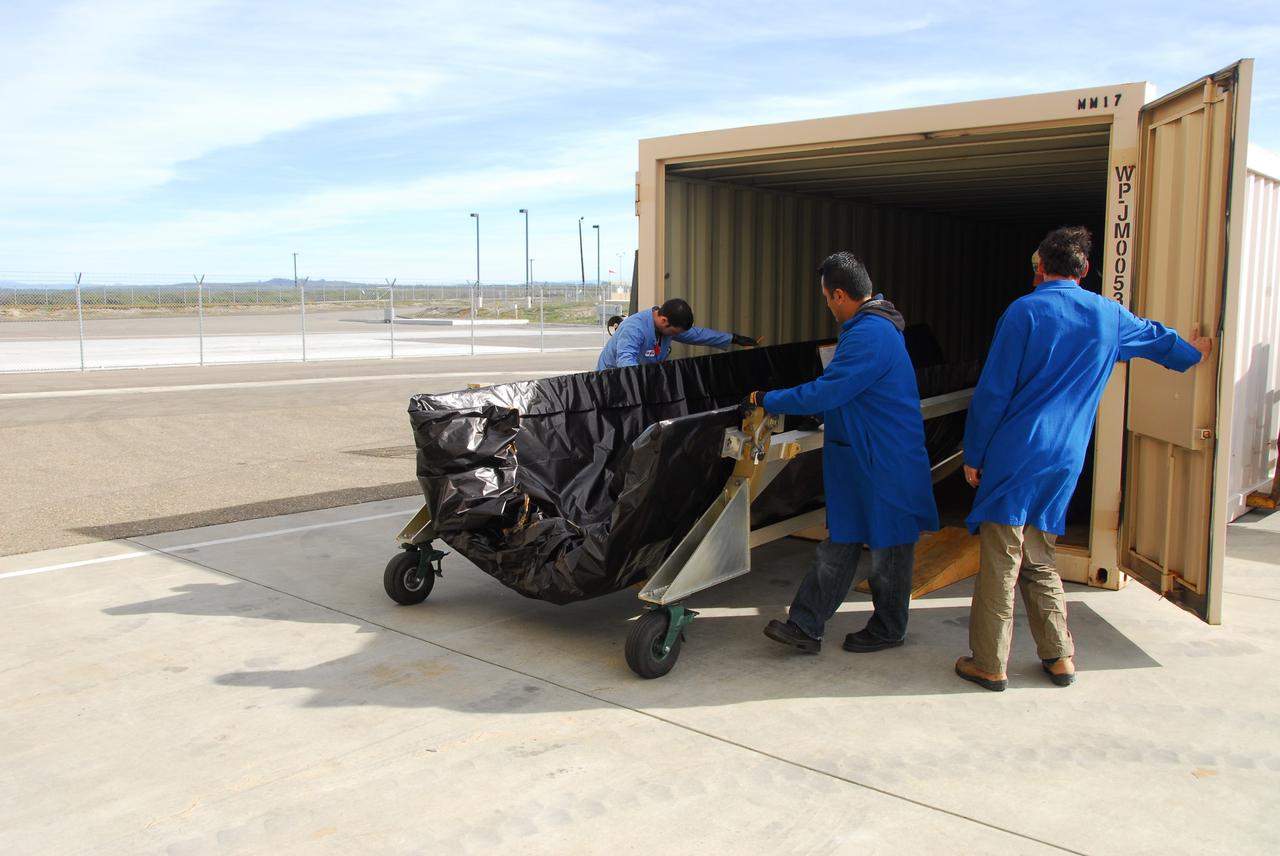
VANDENBERG AIR FORCE BASE, Calif. -- At Vandenberg Air Force Base in California, the protective payload fairing that will surround NASA's Glory spacecraft arrives at the Astrotech payload processing facility. Once encapsulated, the spacecraft will be transported to Space Launch Complex 576-E and joined with the Taurus XL rocket's third stage. Once Glory reaches orbit, it will collect data on the properties of aerosols and black carbon. It also will help scientists understand how the sun's irradiance affects Earth's climate. Launch is scheduled for 5:09 a.m. EST Feb. 23. For information, visit www.nasa.gov/glory. Photo credit: NASA/Ed Henry, VAFB
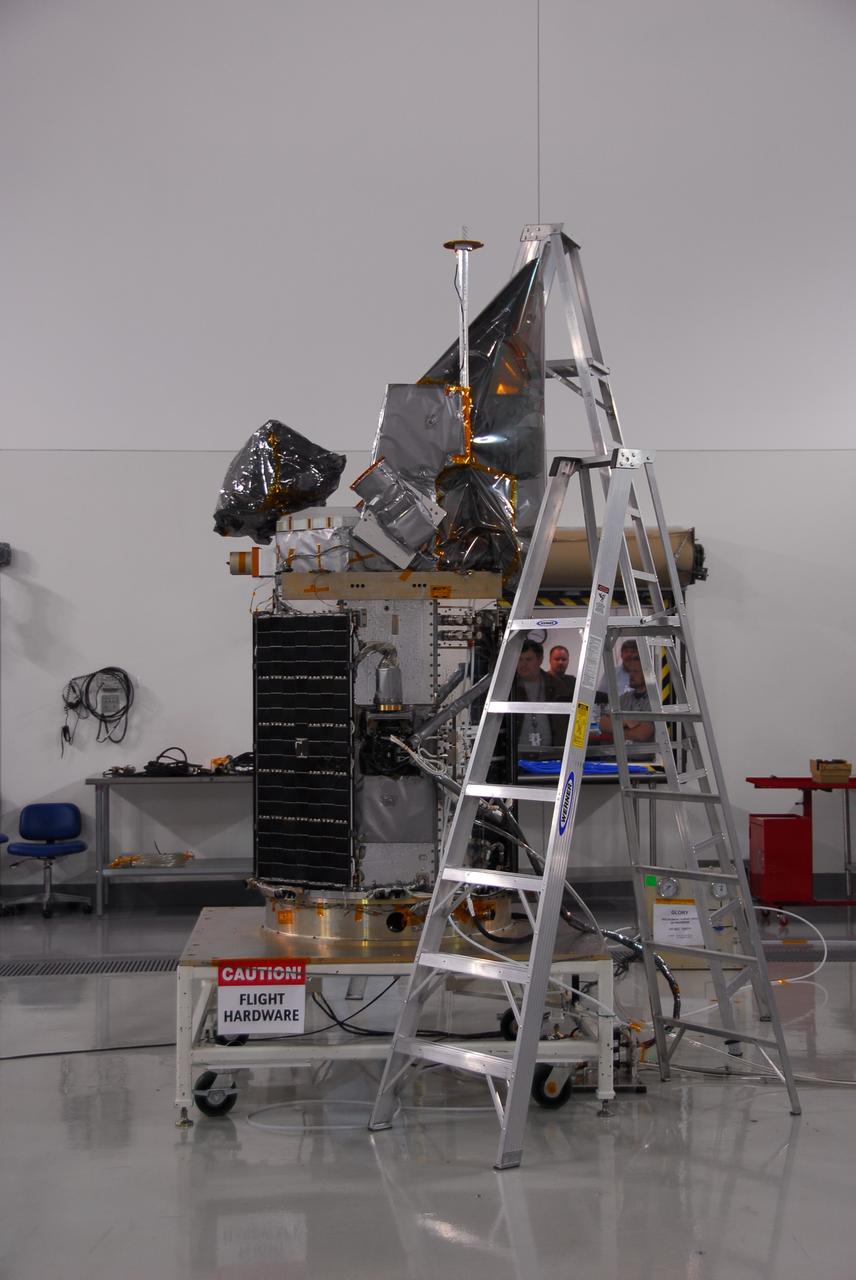
VANDENBERG AIR FORCE BASE, Calif. -- Inside the Astrotech payload processing facility at Vandenberg Air Force Base in California, technicians removed most of the protective covering surrounding NASA's Glory spacecraft. Next, the spacecraft will be encapsulated in its protective payload fairing before it is transported to Space Launch Complex 576-E and joined with the Taurus XL rocket's third stage. Once Glory reaches orbit, it will collect data on the properties of aerosols and black carbon. It also will help scientists understand how the sun's irradiance affects Earth's climate. Launch is scheduled for 5:09 a.m. EST Feb. 23. For information, visit www.nasa.gov/glory. Photo credit: NASA/Ed Henry, VAFB
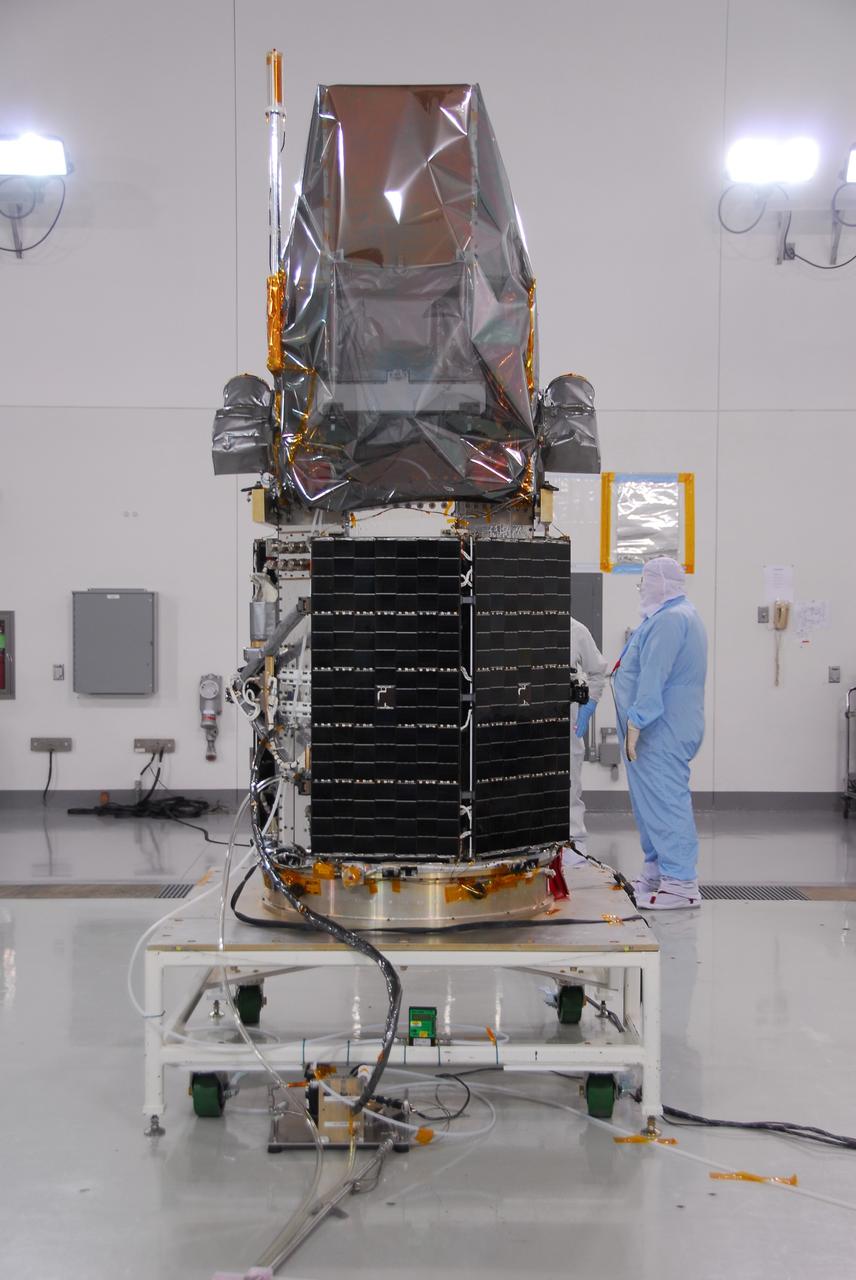
VANDENBERG AIR FORCE BASE, Calif. -- Inside the Astrotech payload processing facility at Vandenberg Air Force Base in California, technicians removed most of the protective covering surrounding NASA's Glory spacecraft. Next, the spacecraft will be encapsulated in its protective payload fairing before it is transported to Space Launch Complex 576-E and joined with the Taurus XL rocket's third stage. Once Glory reaches orbit, it will collect data on the properties of aerosols and black carbon. It also will help scientists understand how the sun's irradiance affects Earth's climate. Launch is scheduled for 5:09 a.m. EST Feb. 23. For information, visit www.nasa.gov/glory. Photo credit: NASA/Ed Henry, VAFB
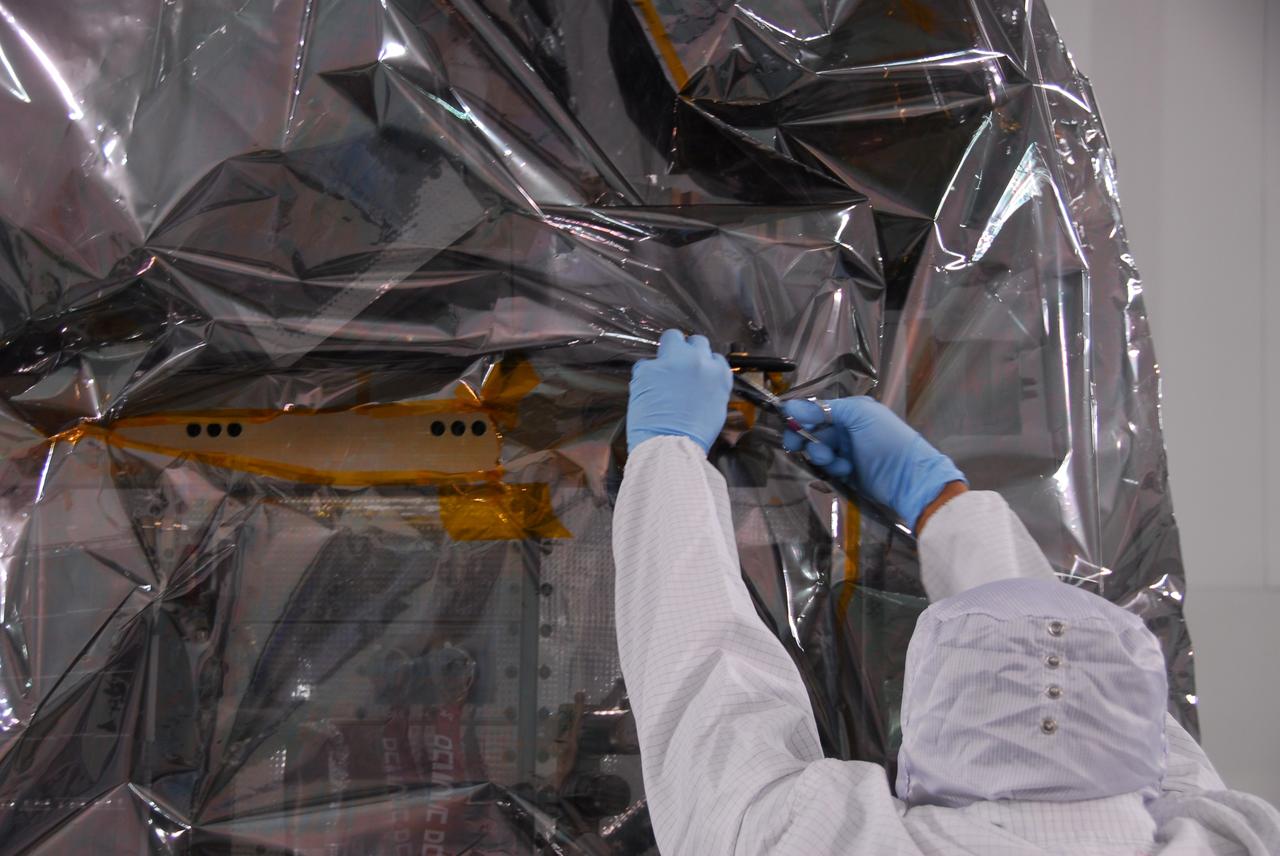
VANDENBERG AIR FORCE BASE, Calif. -- Inside the Astrotech payload processing facility at Vandenberg Air Force Base in California, a technician begins to remove the protective covering surrounding NASA's Glory spacecraft. Next, the spacecraft will be encapsulated in its protective payload fairing before it is transported to Space Launch Complex 576-E and joined with the Taurus XL rocket's third stage. Once Glory reaches orbit, it will collect data on the properties of aerosols and black carbon. It also will help scientists understand how the sun's irradiance affects Earth's climate. Launch is scheduled for 5:09 a.m. EST Feb. 23. For information, visit www.nasa.gov/glory. Photo credit: NASA/Ed Henry, VAFB
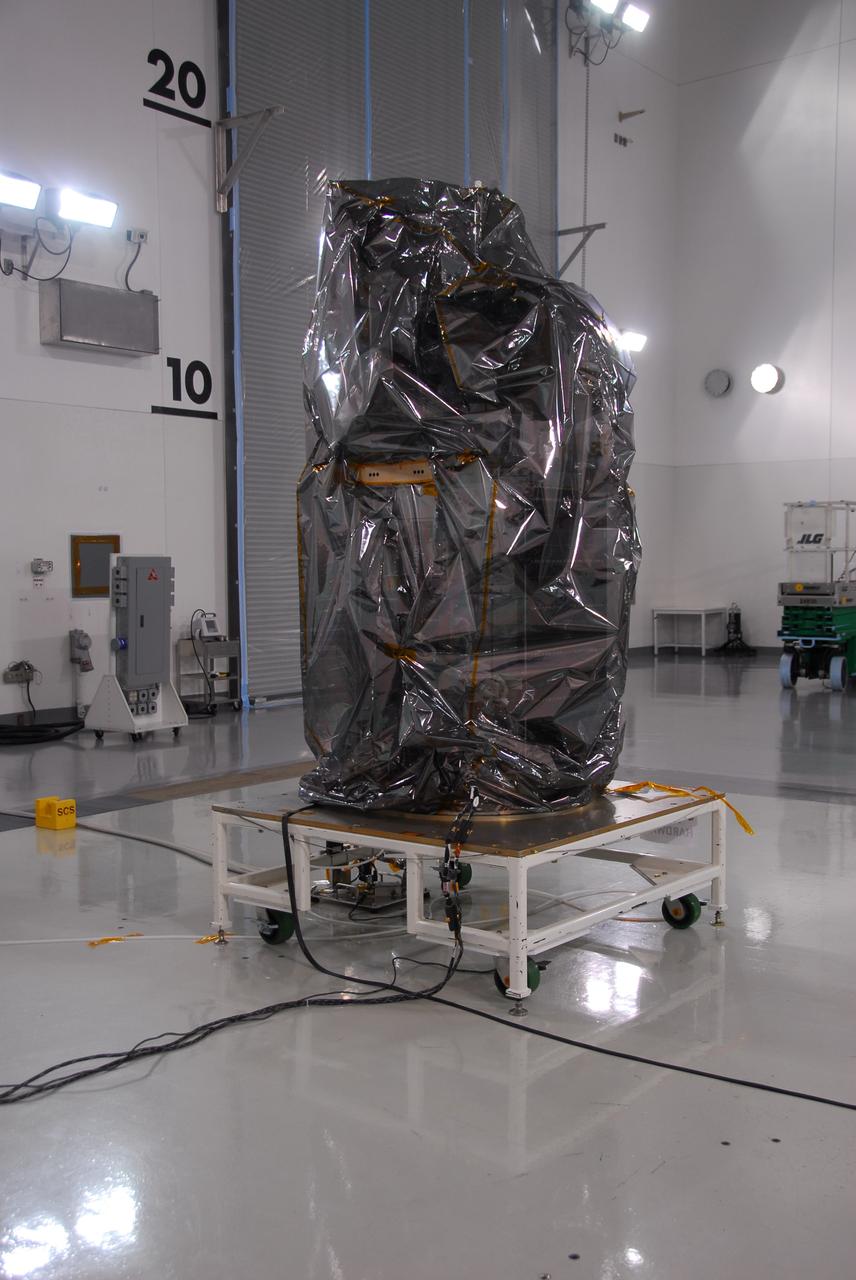
VANDENBERG AIR FORCE BASE, Calif. -- Inside the Astrotech payload processing facility at Vandenberg Air Force Base in California, NASA's Glory spacecraft will be removed from its protective covering. Next, the spacecraft will be encapsulated in its protective payload fairing before it is transported to Space Launch Complex 576-E and joined with the Taurus XL rocket's third stage. Once Glory reaches orbit, it will collect data on the properties of aerosols and black carbon. It also will help scientists understand how the sun's irradiance affects Earth's climate. Launch is scheduled for 5:09 a.m. EST Feb. 23. For information, visit www.nasa.gov/glory. Photo credit: NASA/Ed Henry, VAFB
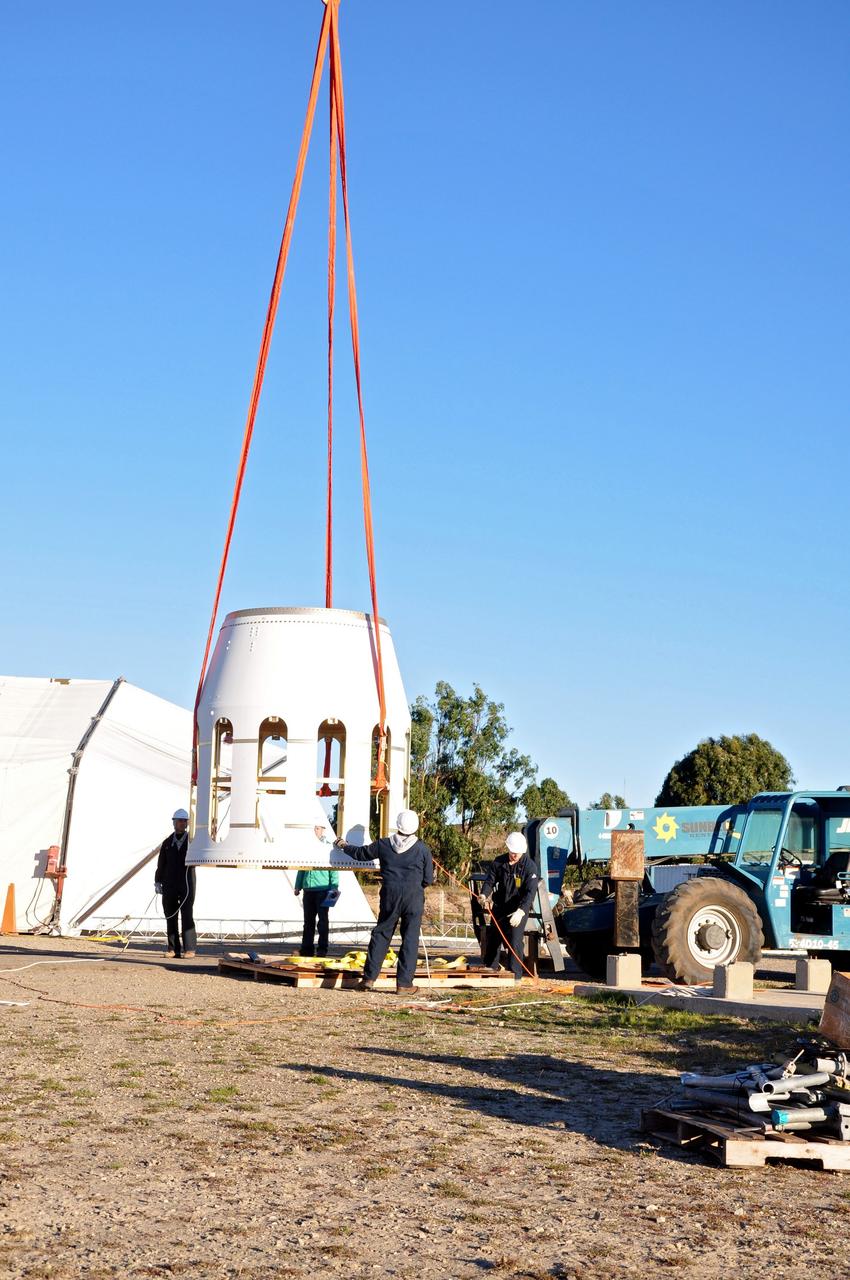
VANDENBERG AIR FORCE BASE, Calif. -- At Vandenberg Air Force Base in California, workers monitor the progress of the Stage 0/1 interstage, part of the four-stage Taurus XL rocket that will carry NASA's Glory spacecraft into low Earth orbit, as a crane hoists it toward the pad at Space Launch Complex 576-E. Once Glory reaches orbit, it will collect data on the properties of aerosols and black carbon. It also will help scientists understand how the sun's irradiance affects Earth's climate. Launch is scheduled for 5:09 a.m. EST Feb. 23. For information, visit www.nasa.gov/glory. Photo credit: NASA/Randy Beaudoin, VAFB
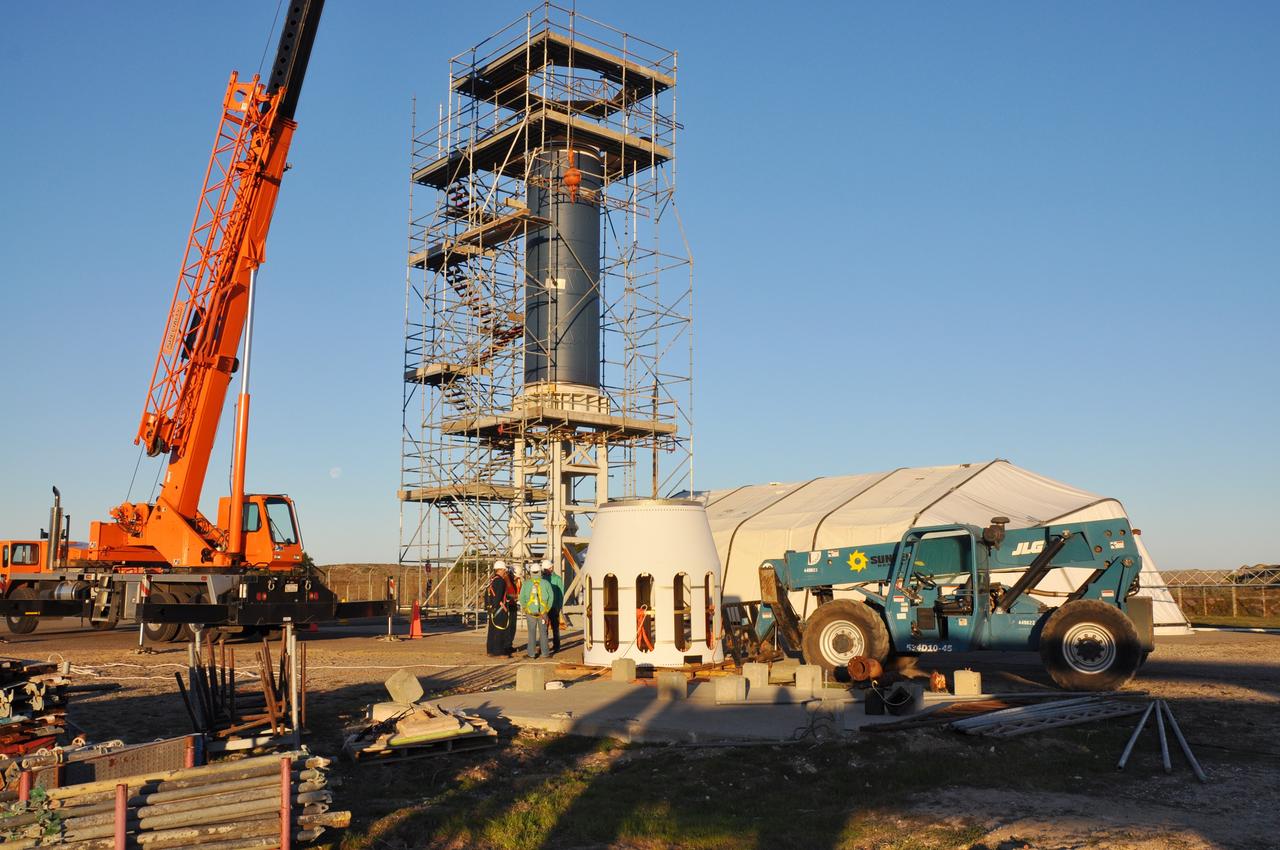
VANDENBERG AIR FORCE BASE, Calif. -- At Vandenberg Air Force Base in California, Stage 0/1 interstage, part of the four-stage Taurus XL rocket that will carry NASA's Glory spacecraft into low Earth orbit, arrives at Space Launch Complex 576-E. Once Glory reaches orbit, it will collect data on the properties of aerosols and black carbon. It also will help scientists understand how the sun's irradiance affects Earth's climate. Launch is scheduled for 5:09 a.m. EST Feb. 23. For information, visit www.nasa.gov/glory. Photo credit: NASA/Randy Beaudoin, VAFB
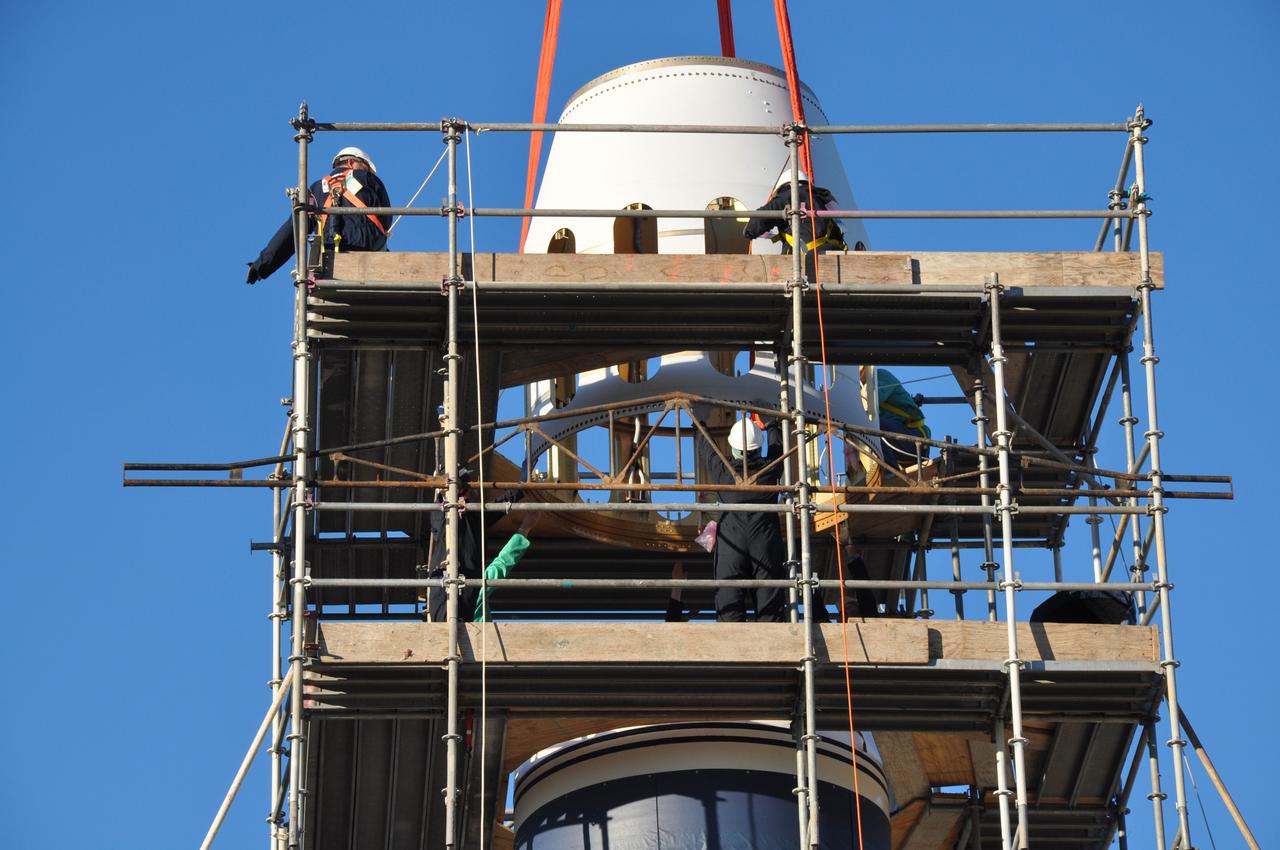
VANDENBERG AIR FORCE BASE, Calif. -- Workers at Vandenberg Air Force Base in California, guide the Stage 0/1 interstage, part of the four-stage Taurus XL rocket that will carry NASA's Glory spacecraft into low Earth orbit, into launch position at Space Launch Complex 576-E. Once Glory reaches orbit, it will collect data on the properties of aerosols and black carbon. It also will help scientists understand how the sun's irradiance affects Earth's climate. Launch is scheduled for 5:09 a.m. EST Feb. 23. For information, visit www.nasa.gov/glory. Photo credit: NASA/Randy Beaudoin, VAFB
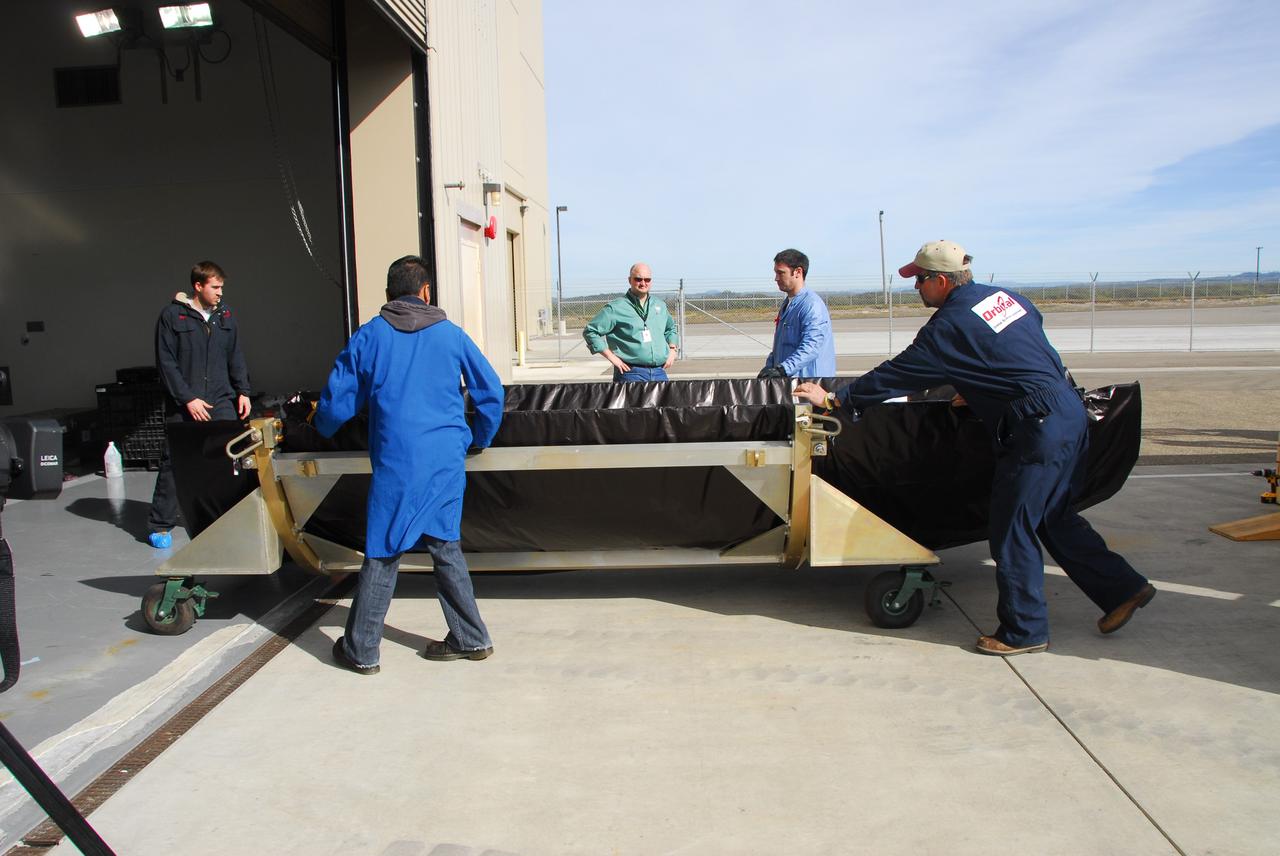
VANDENBERG AIR FORCE BASE, Calif. -- At Vandenberg Air Force Base in California, the protective payload fairing that will surround NASA's Glory spacecraft arrives at the Astrotech payload processing facility. Once encapsulated, the spacecraft will be transported to Space Launch Complex 576-E and joined with the Taurus XL rocket's third stage. Once Glory reaches orbit, it will collect data on the properties of aerosols and black carbon. It also will help scientists understand how the sun's irradiance affects Earth's climate. Launch is scheduled for 5:09 a.m. EST Feb. 23. For information, visit www.nasa.gov/glory. Photo credit: NASA/Ed Henry, VAFB
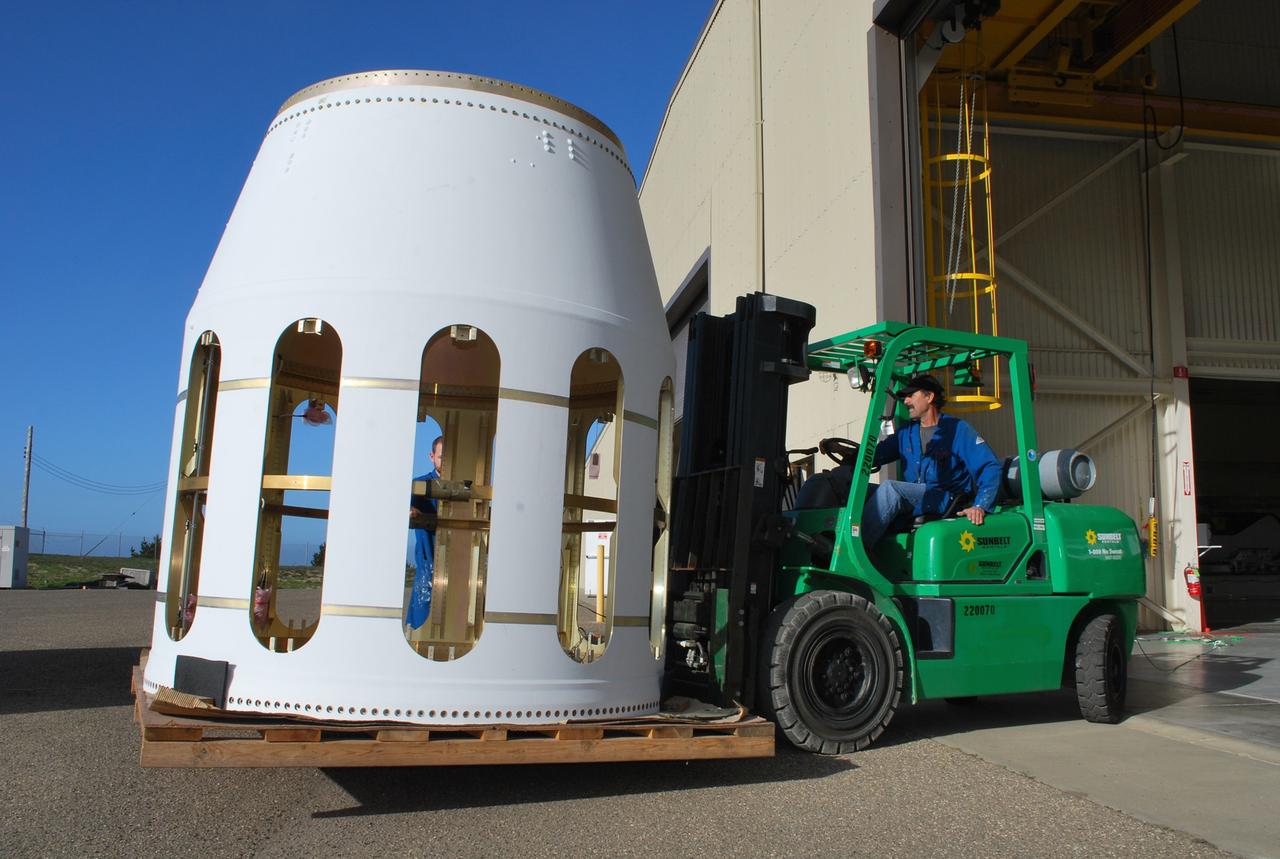
VANDENBERG AIR FORCE BASE, Calif. -- At the Orbital Sciences Corp. Building 1555 at Vandenberg Air Force Base in California, Stage 0/1 interstage, part of the four-stage Taurus XL rocket that will carry NASA's Glory spacecraft into low Earth orbit, is being prepared for transport to Space Launch Complex 576-E. Once Glory reaches orbit, it will collect data on the properties of aerosols and black carbon. It also will help scientists understand how the sun's irradiance affects Earth's climate. Launch is scheduled for 5:09 a.m. EST Feb. 23. For information, visit www.nasa.gov/glory. Photo credit: NASA/Randy Beaudoin, VAFB
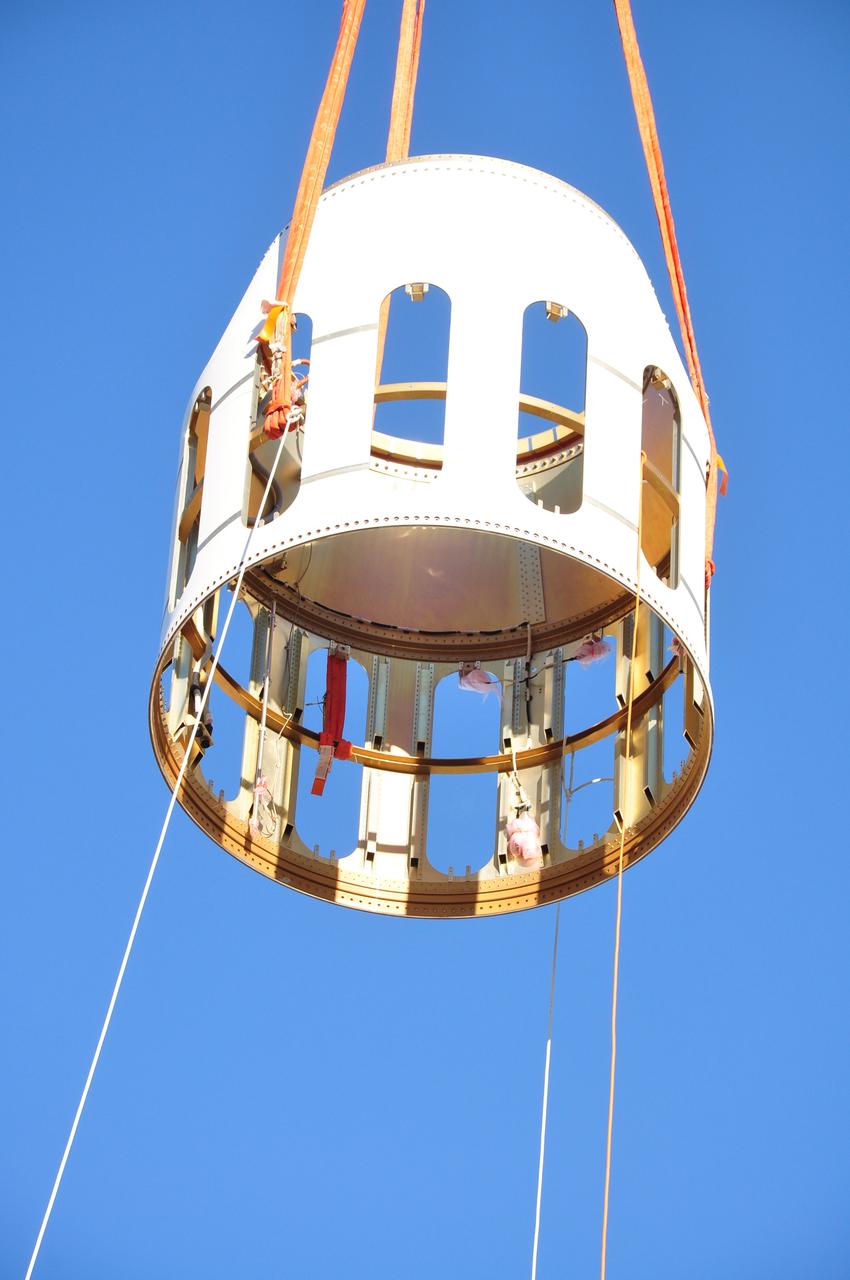
VANDENBERG AIR FORCE BASE, Calif. -- At Vandenberg Air Force Base in California, the Stage 0/1 interstage, part of the four-stage Taurus XL rocket that will carry NASA's Glory spacecraft into low Earth orbit, is lifted by crane toward the pad at Space Launch Complex 576-E. Once Glory reaches orbit, it will collect data on the properties of aerosols and black carbon. It also will help scientists understand how the sun's irradiance affects Earth's climate. Launch is scheduled for 5:09 a.m. EST Feb. 23. For information, visit www.nasa.gov/glory. Photo credit: NASA/Randy Beaudoin, VAFB
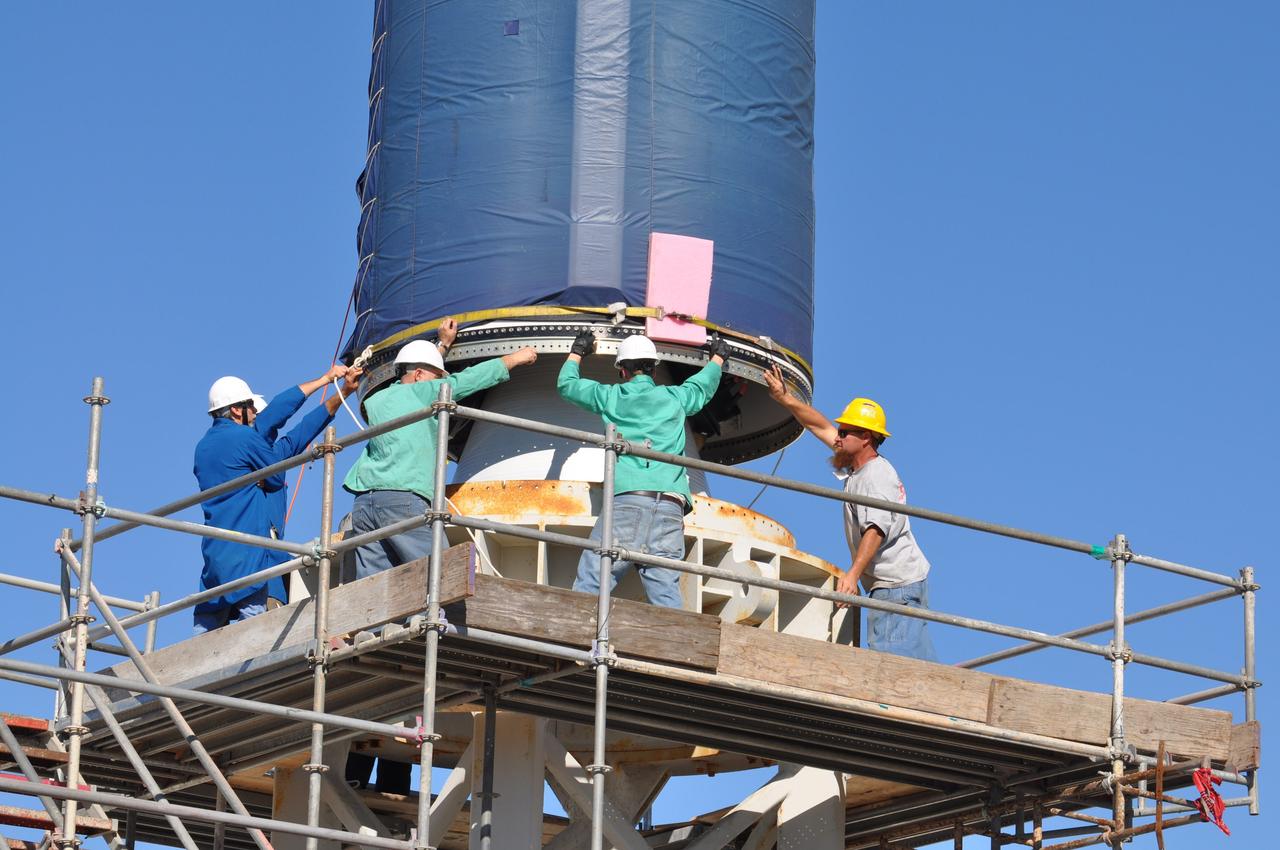
VANDENBERG AIR FORCE BASE, Calif. -- The Stage 0 motor of the Orbital Sciences Corp. Taurus XL is moved into launch position on Space Launch Complex 576-E at Vandenberg Air Force Base in California. As part of the four-stage Taurus XL rocket that will carry NASA's Glory spacecraft into low Earth orbit, stages 1, 2 and 3 will join Stage 0 at the launch pad about a week later. Once Glory reaches orbit, it will collect data on the properties of aerosols and black carbon. It also will help scientists understand how the sun's irradiance affects Earth's climate. Launch is scheduled for 5:09 a.m. EST Feb. 23. For information, visit www.nasa.gov/glory. Photo credit: NASA/Randy Beaudoin, VAFB
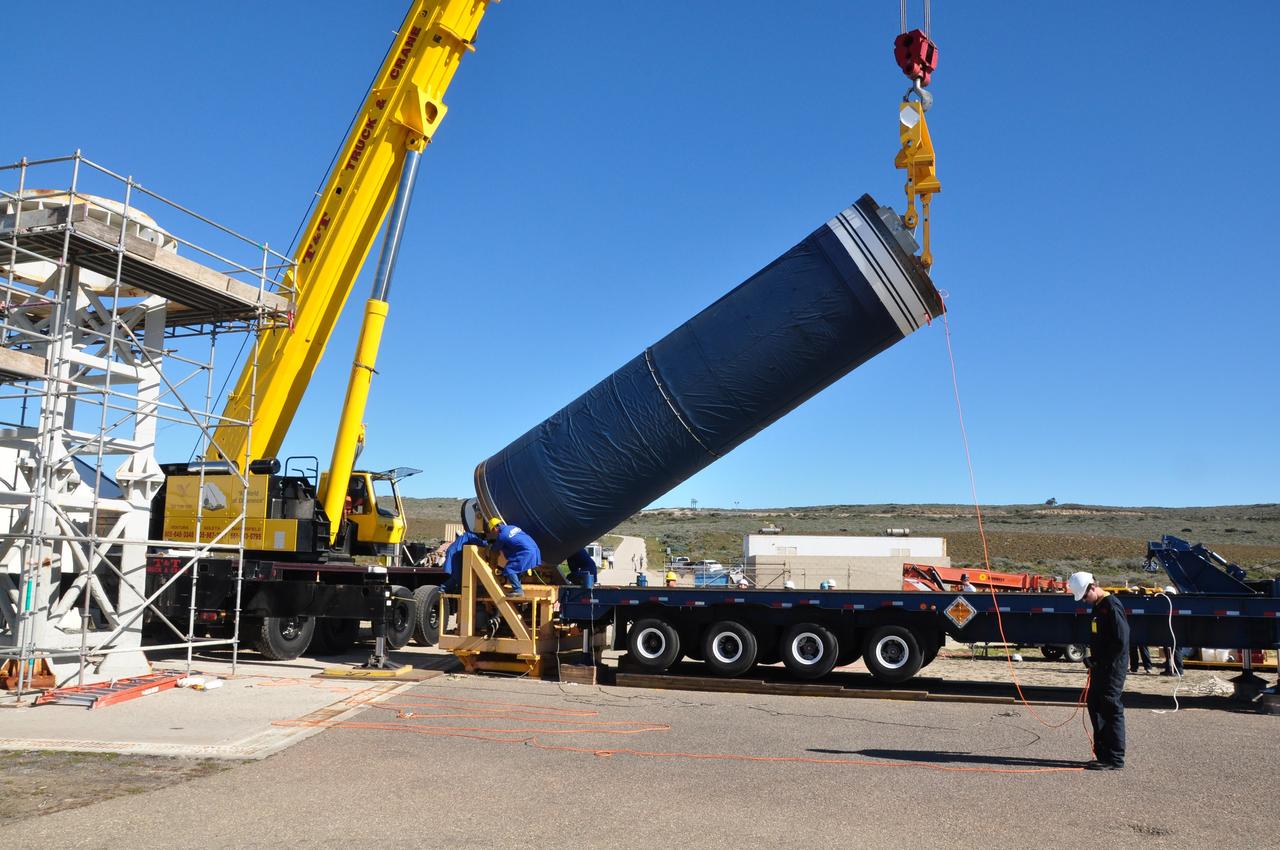
VANDENBERG AIR FORCE BASE, Calif. -- The Stage 0 motor of the Orbital Sciences Corp. Taurus XL is hoisted into launch position by crane at Space Launch Complex 576-E at Vandenberg Air Force Base in California. As part of the four-stage Taurus XL rocket that will carry NASA's Glory spacecraft into low Earth orbit, stages 1, 2 and 3 will join Stage 0 at the launch pad about a week later. Once Glory reaches orbit, it will collect data on the properties of aerosols and black carbon. It also will help scientists understand how the sun's irradiance affects Earth's climate. Launch is scheduled for 5:09 a.m. EST Feb. 23. For information, visit www.nasa.gov/glory. Photo credit: NASA/Randy Beaudoin, VAFB
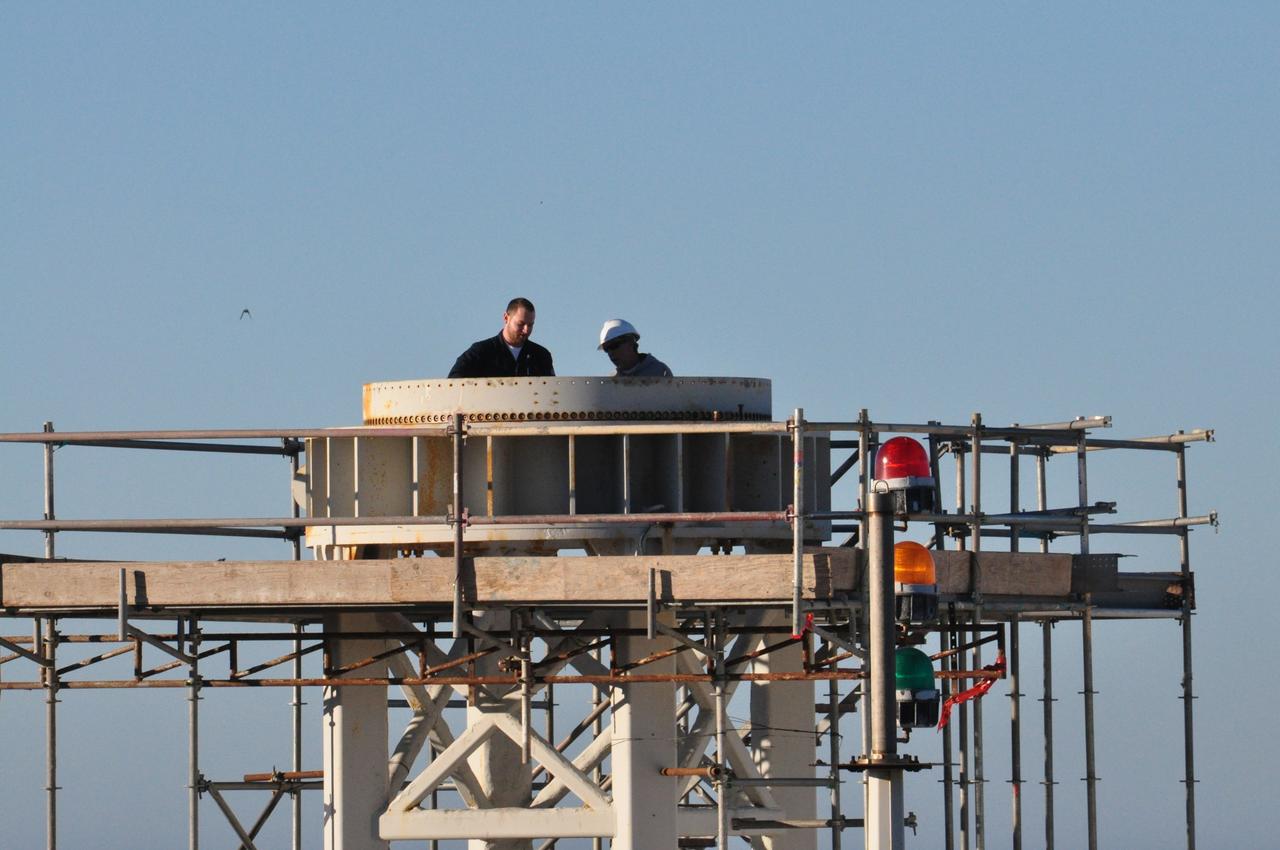
VANDENBERG AIR FORCE BASE, Calif. -- Workers on Space Launch Complex 576-E at Vandenberg Air Force Base in California prepare for the arrival of the Stage 0 motor of the Orbital Sciences Corp. Taurus XL rocket. Once at the pad, Stage 0 will be hoisted into its launch position. As part of the four-stage Taurus XL rocket that will carry NASA's Glory spacecraft into low Earth orbit, stages 1, 2 and 3 will join Stage 0 at the launch pad about a week later. Once Glory reaches orbit, it will collect data on the properties of aerosols and black carbon. It also will help scientists understand how the sun's irradiance affects Earth's climate. Launch is scheduled for 5:09 a.m. EST Feb. 23. For information, visit www.nasa.gov/glory. Photo credit: NASA/Randy Beaudoin, VAFB
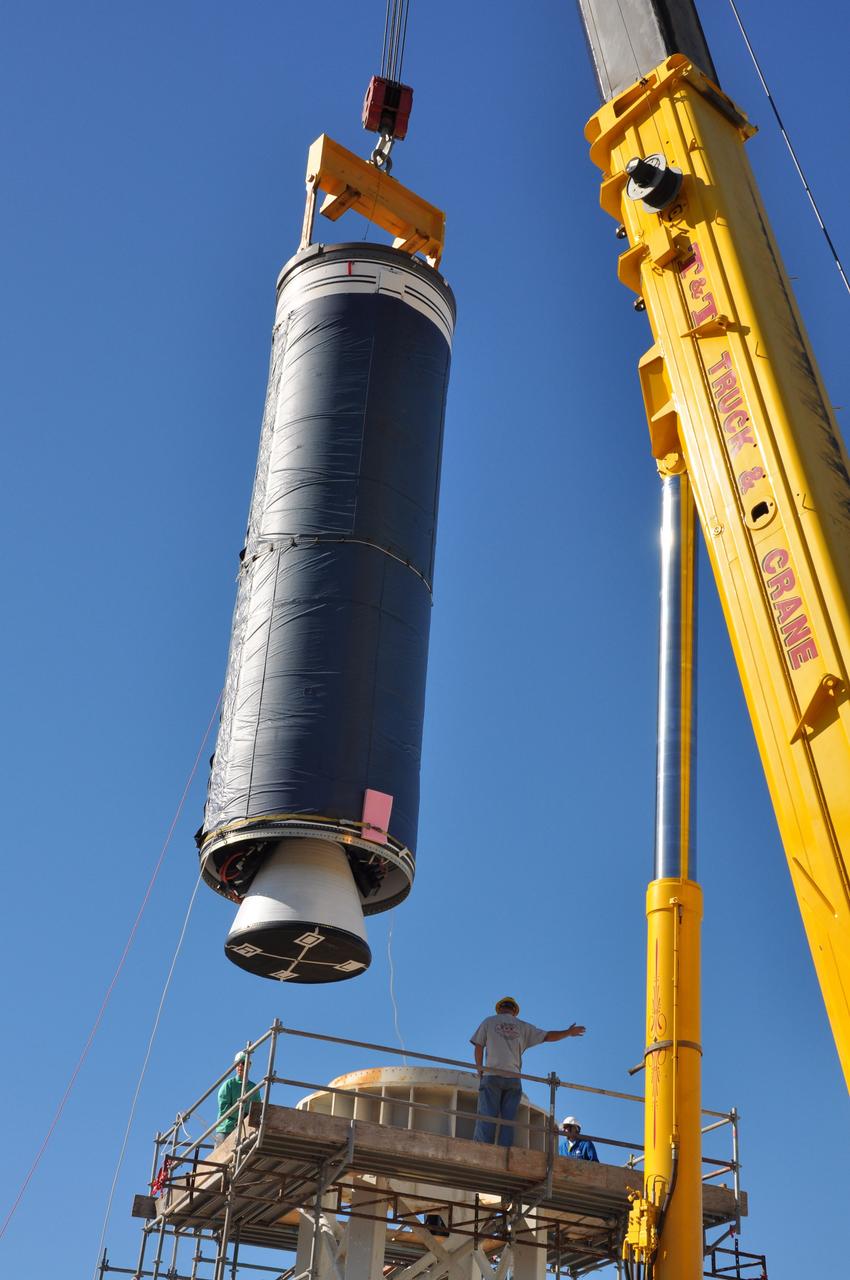
VANDENBERG AIR FORCE BASE, Calif. -- The Stage 0 motor of the Orbital Sciences Corp. Taurus XL is moved into launch position on Space Launch Complex 576-E at Vandenberg Air Force Base in California. As part of the four-stage Taurus XL rocket that will carry NASA's Glory spacecraft into low Earth orbit, stages 1, 2 and 3 will join Stage 0 at the launch pad about a week later. Once Glory reaches orbit, it will collect data on the properties of aerosols and black carbon. It also will help scientists understand how the sun's irradiance affects Earth's climate. Launch is scheduled for 5:09 a.m. EST Feb. 23. For information, visit www.nasa.gov/glory. Photo credit: NASA/Randy Beaudoin, VAFB
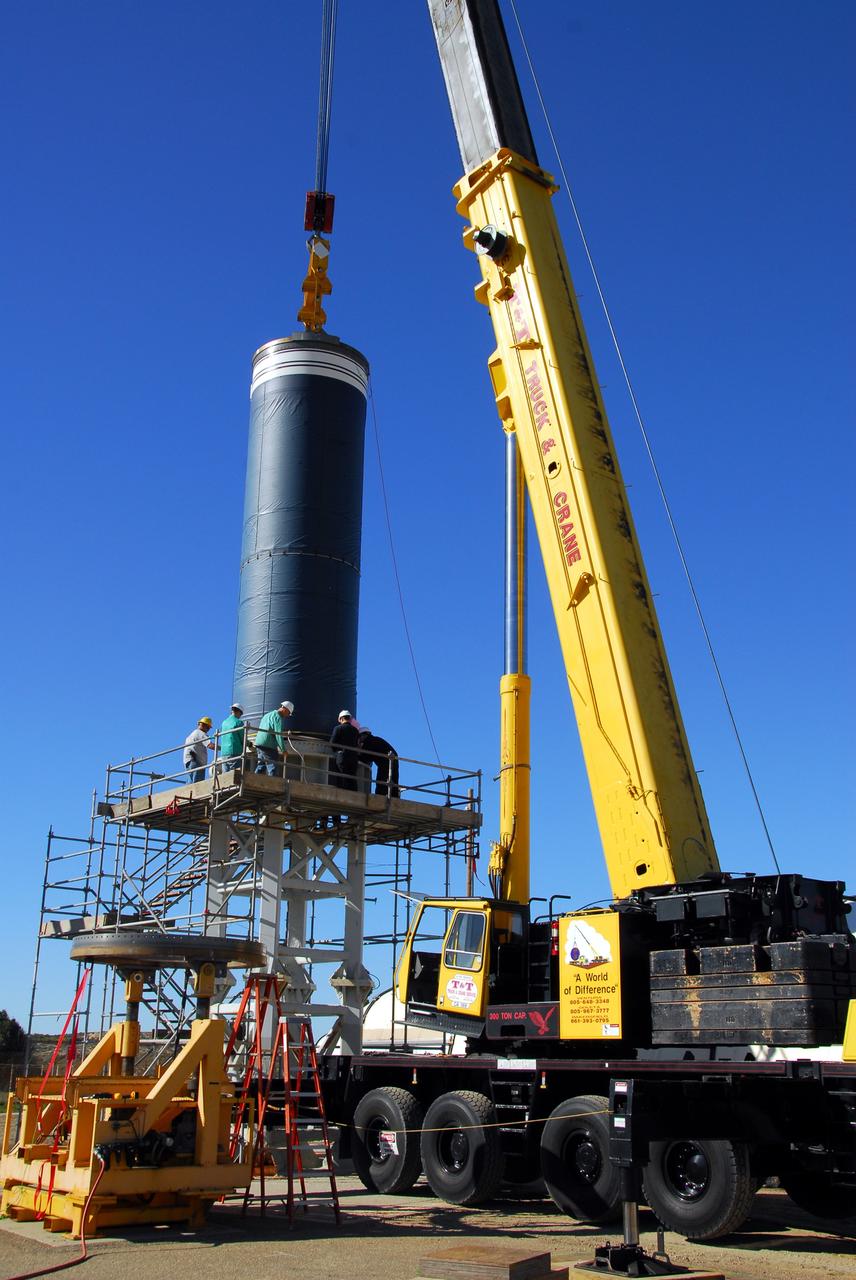
VANDENBERG AIR FORCE BASE, Calif. -- Workers move the Stage 0 motor of the Orbital Sciences Corp. Taurus XL into launch position on Space Launch Complex 576-E at Vandenberg Air Force Base in California. As part of the four-stage Taurus XL rocket that will carry NASA's Glory spacecraft into low Earth orbit, stages 1, 2 and 3 will join Stage 0 at the launch pad about a week later. Once Glory reaches orbit, it will collect data on the properties of aerosols and black carbon. It also will help scientists understand how the sun's irradiance affects Earth's climate. Launch is scheduled for 5:09 a.m. EST Feb. 23. For information, visit www.nasa.gov/glory. Photo credit: NASA/Don Kosoksa, VAFB
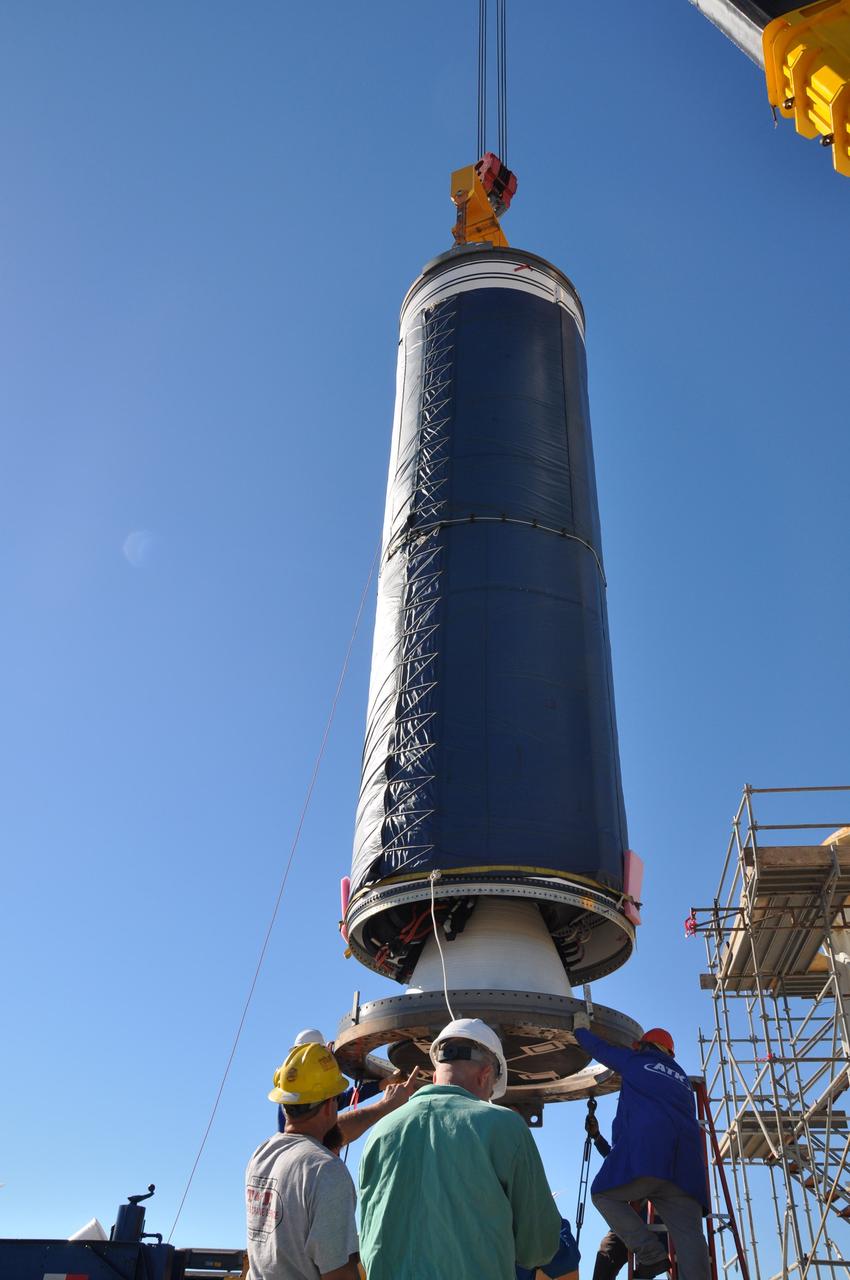
VANDENBERG AIR FORCE BASE, Calif. -- The Stage 0 motor of the Orbital Sciences Corp. Taurus XL is moved into launch position on Space Launch Complex 576-E at Vandenberg Air Force Base in California. As part of the four-stage Taurus XL rocket that will carry NASA's Glory spacecraft into low Earth orbit, stages 1, 2 and 3 will join Stage 0 at the launch pad about a week later. Once Glory reaches orbit, it will collect data on the properties of aerosols and black carbon. It also will help scientists understand how the sun's irradiance affects Earth's climate. Launch is scheduled for 5:09 a.m. EST Feb. 23. For information, visit www.nasa.gov/glory. Photo credit: NASA/Randy Beaudoin, VAFB
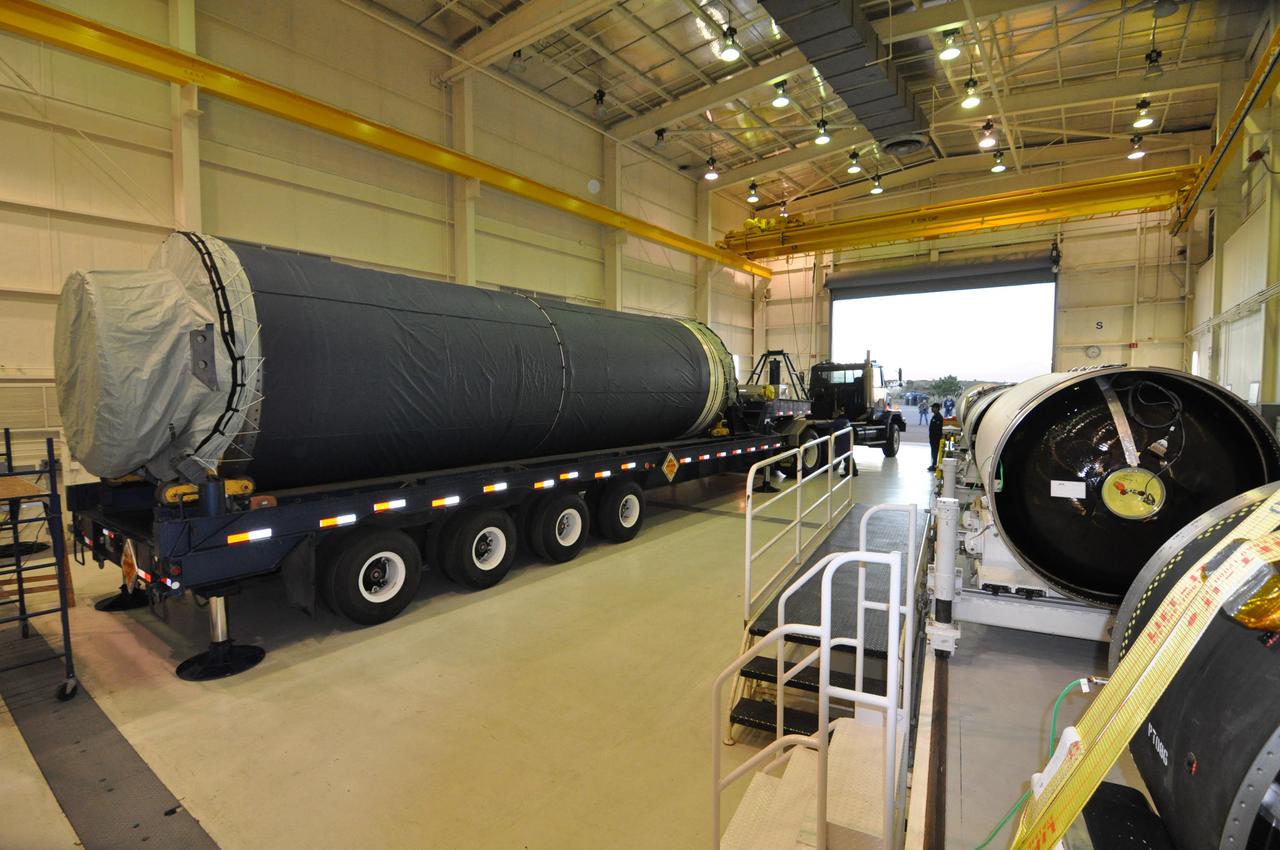
VANDENBERG AIR FORCE BASE, Calif. -- The Stage 0 motor, left, of the Orbital Sciences Corp. Taurus XL rocket is almost ready for its journey from Building 1555 to Space Launch Complex 576-E at Vandenberg Air Force Base in California. As part of the four-stage Taurus XL rocket that will carry NASA's Glory spacecraft into low Earth orbit, stages 1, 2 and 3, right, will join Stage 0 at the launch pad about a week later. Once Glory reaches orbit, it will collect data on the properties of aerosols and black carbon. It also will help scientists understand how the sun's irradiance affects Earth's climate. Launch is scheduled for 5:09 a.m. EST Feb. 23. For information, visit www.nasa.gov/glory. Photo credit: NASA/Randy Beaudoin, VAFB
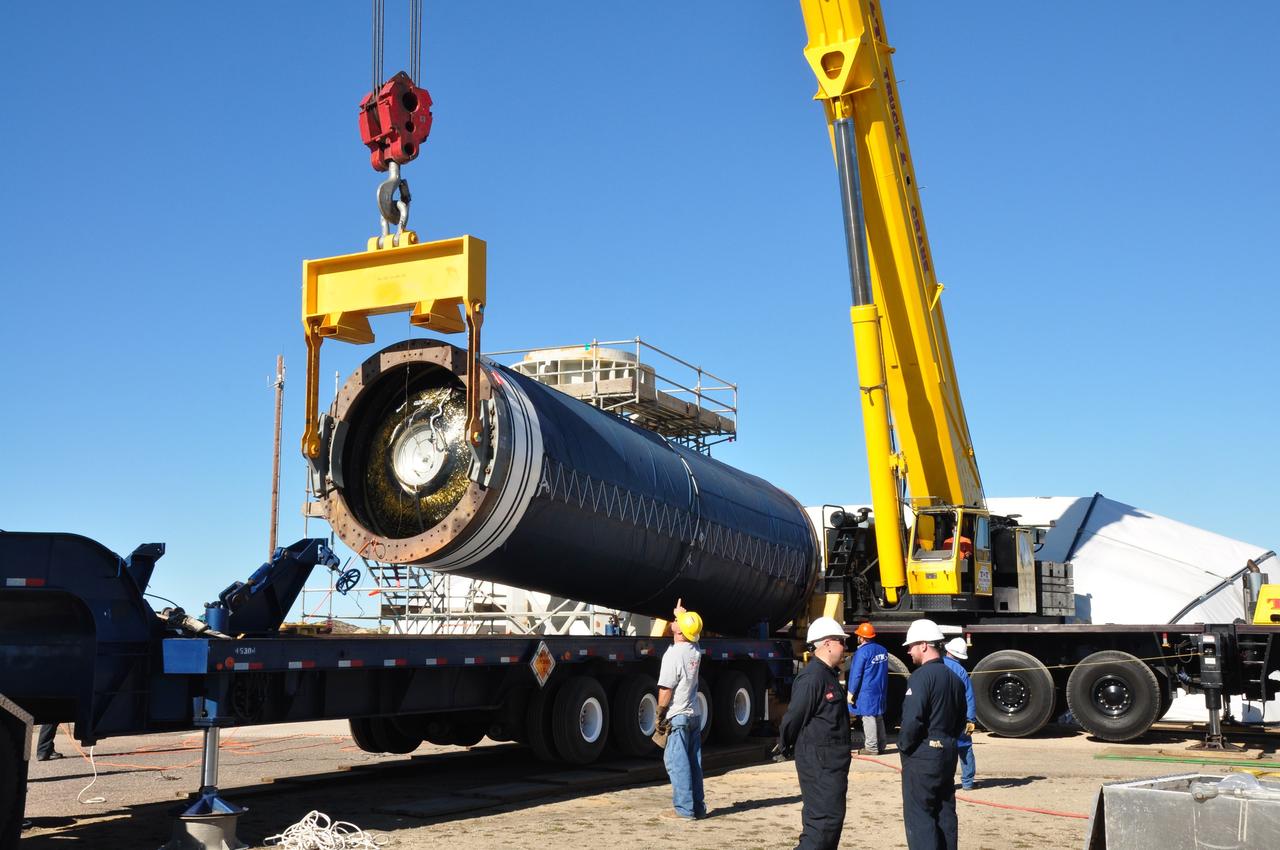
VANDENBERG AIR FORCE BASE, Calif. -- The Stage 0 motor of the Orbital Sciences Corp. Taurus XL is hoisted into launch position by crane at Space Launch Complex 576-E at Vandenberg Air Force Base in California. As part of the four-stage Taurus XL rocket that will carry NASA's Glory spacecraft into low Earth orbit, stages 1, 2 and 3 will join Stage 0 at the launch pad about a week later. Once Glory reaches orbit, it will collect data on the properties of aerosols and black carbon. It also will help scientists understand how the sun's irradiance affects Earth's climate. Launch is scheduled for 5:09 a.m. EST Feb. 23. For information, visit www.nasa.gov/glory. Photo credit: NASA/Randy Beaudoin, VAFB
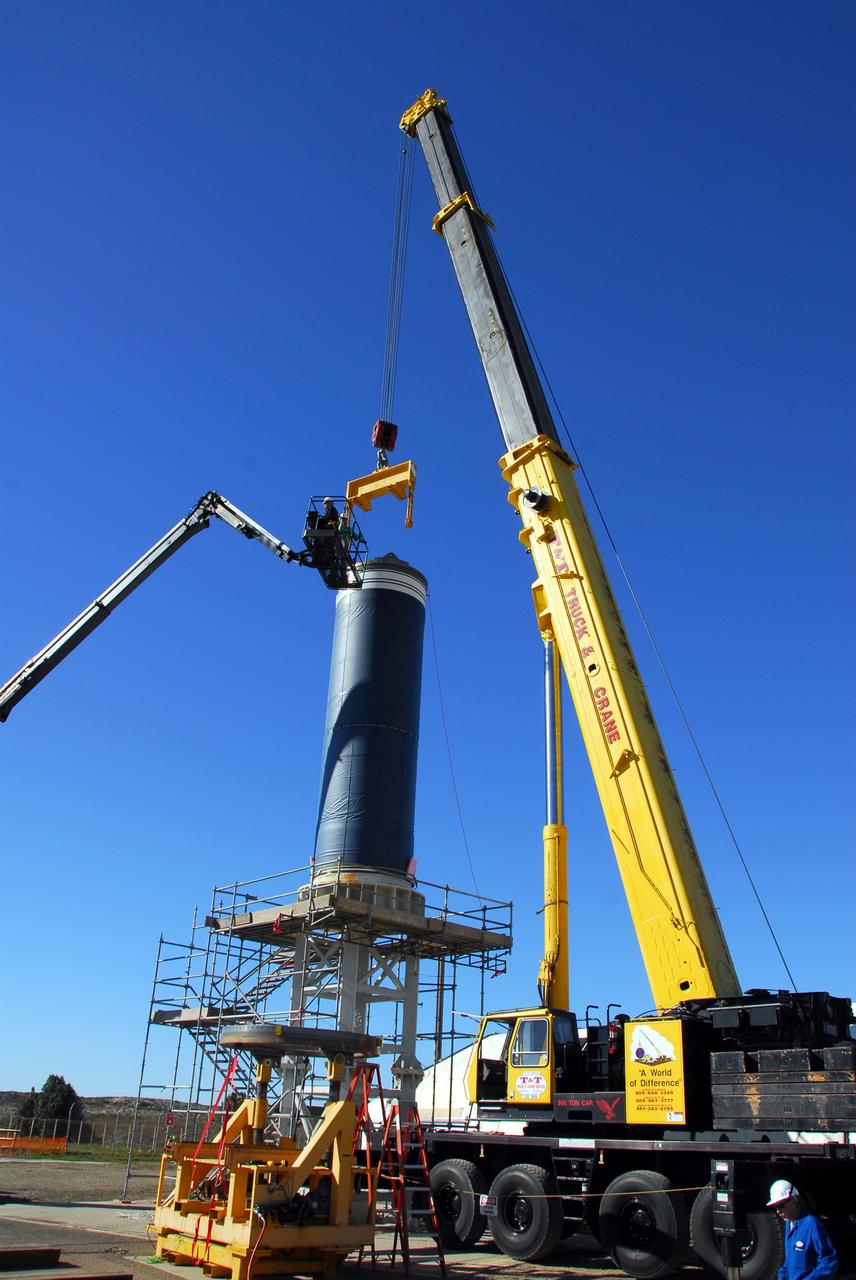
VANDENBERG AIR FORCE BASE, Calif. -- Workers unlatch the crane that lowered Stage 0 of the Orbital Sciences Corp. Taurus XL into launch position on Space Launch Complex 576-E at Vandenberg Air Force Base in California. As part of the four-stage Taurus XL rocket that will carry NASA's Glory spacecraft into low Earth orbit, stages 1, 2 and 3 will join Stage 0 at the launch pad about a week later. Once Glory reaches orbit, it will collect data on the properties of aerosols and black carbon. It also will help scientists understand how the sun's irradiance affects Earth's climate. Launch is scheduled for 5:09 a.m. EST Feb. 23. For information, visit www.nasa.gov/glory. Photo credit: NASA/Don Kosoksa, VAFB
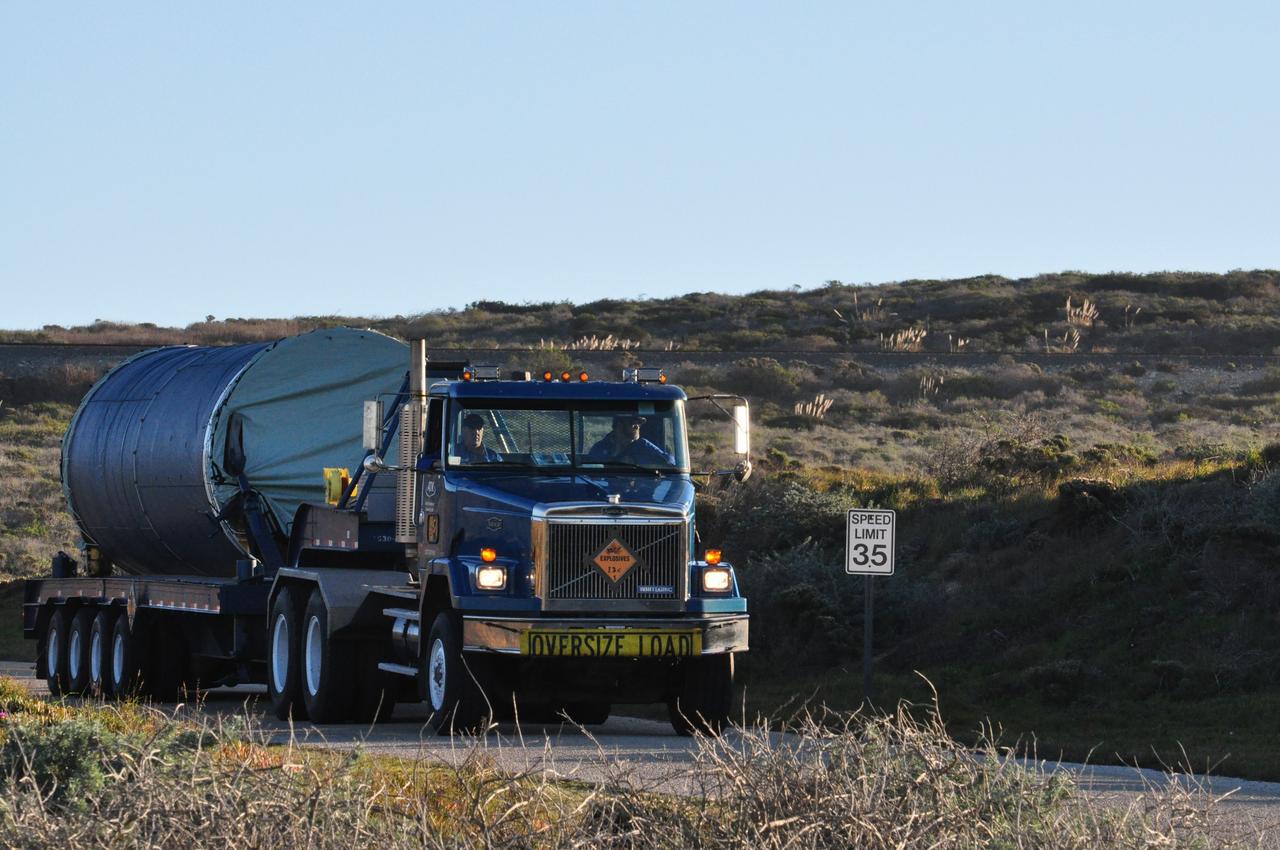
VANDENBERG AIR FORCE BASE, Calif. -- The Stage 0 motor of the Orbital Sciences Corp. Taurus XL rocket makes its journey from Building 1555 to Space Launch Complex 576-E at Vandenberg Air Force Base in California. As part of the four-stage Taurus XL rocket that will carry NASA's Glory spacecraft into low Earth orbit, stages 1, 2 and 3 will join Stage 0 at the launch pad about a week later. Once Glory reaches orbit, it will collect data on the properties of aerosols and black carbon. It also will help scientists understand how the sun's irradiance affects Earth's climate. Launch is scheduled for 5:09 a.m. EST Feb. 23. For information, visit www.nasa.gov/glory. Photo credit: NASA/Randy Beaudoin, VAFB
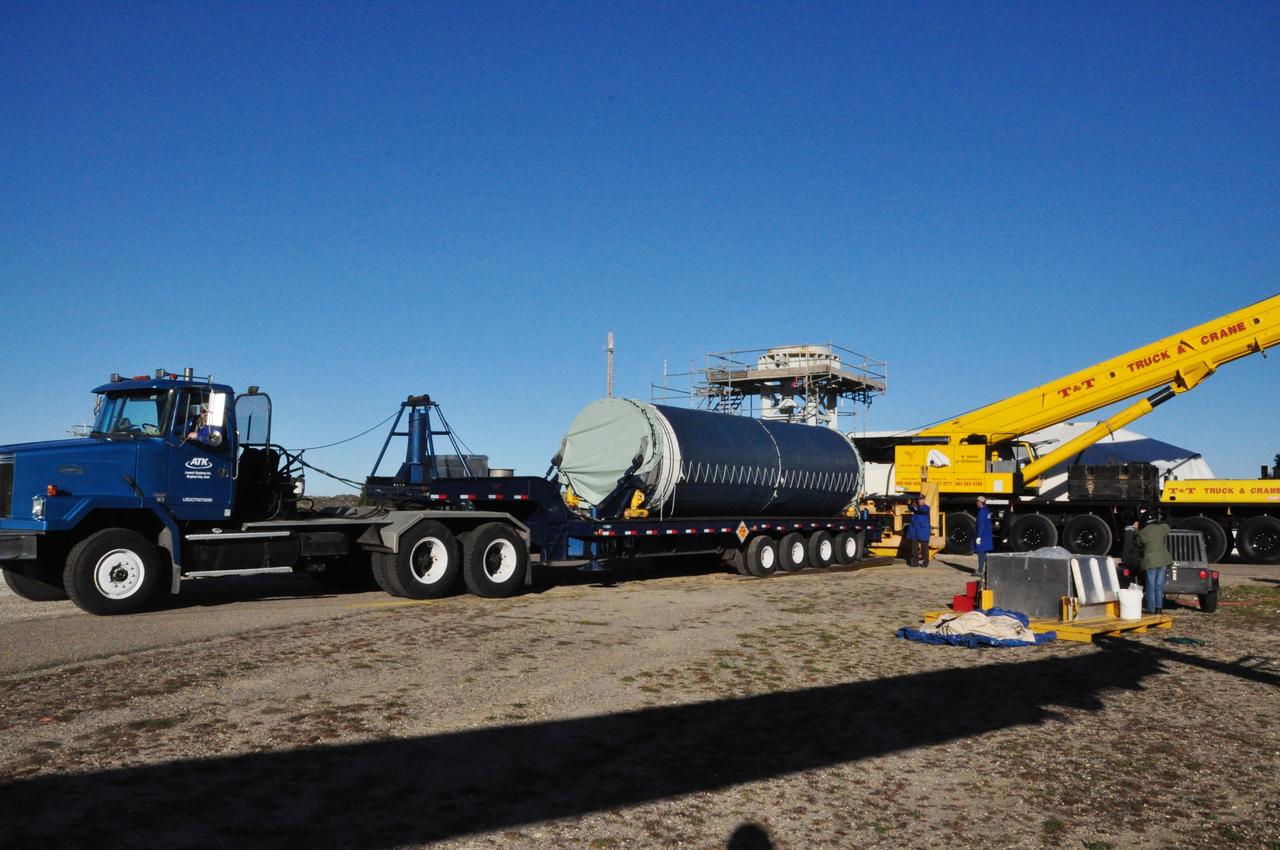
VANDENBERG AIR FORCE BASE, Calif. -- The Stage 0 motor of the Orbital Sciences Corp. Taurus XL rocket arrives at Space Launch Complex 576-E at Vandenberg Air Force Base in California. Next, Stage 0 will be hoisted into its launch position. As part of the four-stage Taurus XL rocket that will carry NASA's Glory spacecraft into low Earth orbit, stages 1, 2 and 3 will join Stage 0 at the launch pad about a week later. Once Glory reaches orbit, it will collect data on the properties of aerosols and black carbon. It also will help scientists understand how the sun's irradiance affects Earth's climate. Launch is scheduled for 5:09 a.m. EST Feb. 23. For information, visit www.nasa.gov/glory. Photo credit: NASA/Randy Beaudoin, VAFB
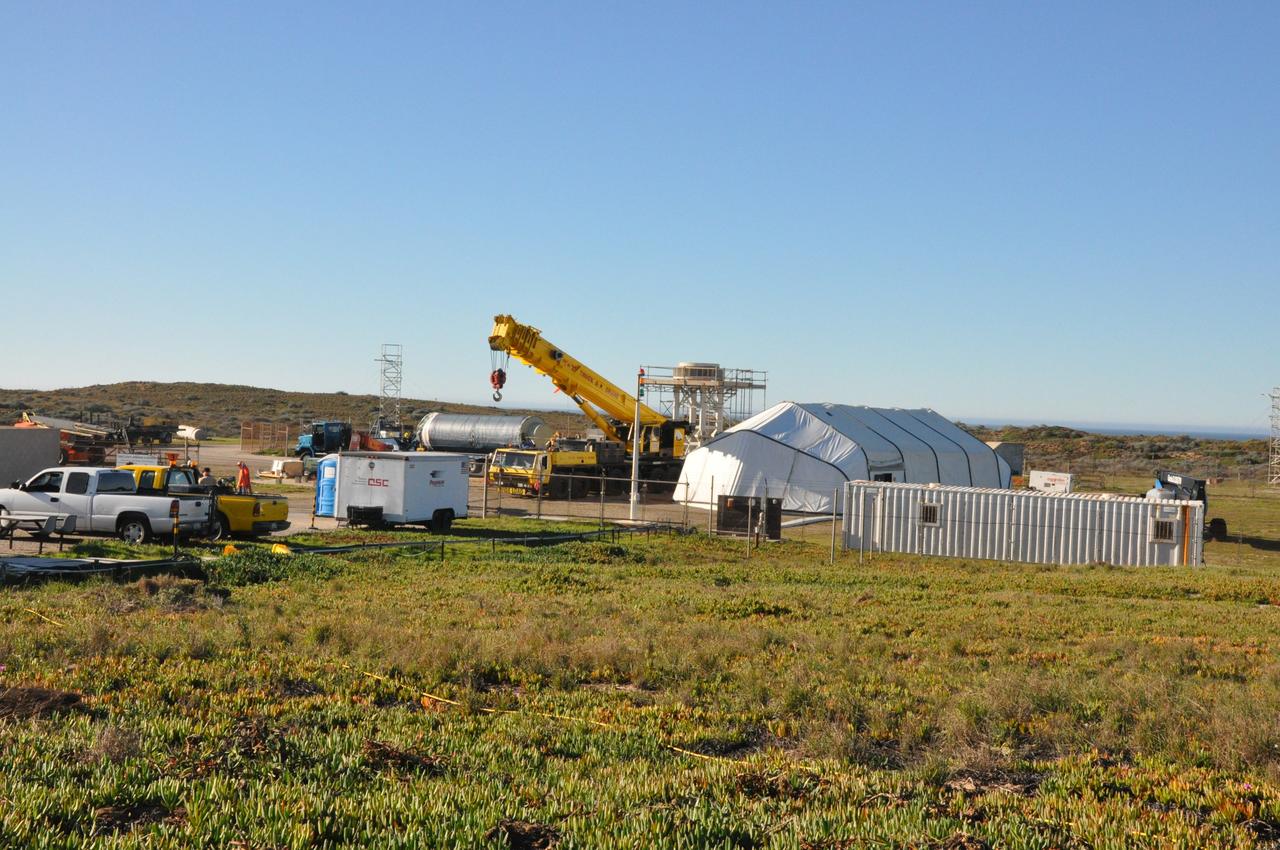
VANDENBERG AIR FORCE BASE, Calif. -- The Stage 0 motor of the Orbital Sciences Corp. Taurus XL rocket arrives at Space Launch Complex 576-E at Vandenberg Air Force Base in California. Next, Stage 0 will be hoisted into its launch position. As part of the four-stage Taurus XL rocket that will carry NASA's Glory spacecraft into low Earth orbit, stages 1, 2 and 3 will join Stage 0 at the launch pad about a week later. Once Glory reaches orbit, it will collect data on the properties of aerosols and black carbon. It also will help scientists understand how the sun's irradiance affects Earth's climate. Launch is scheduled for 5:09 a.m. EST Feb. 23. For information, visit www.nasa.gov/glory. Photo credit: NASA/Randy Beaudoin, VAFB
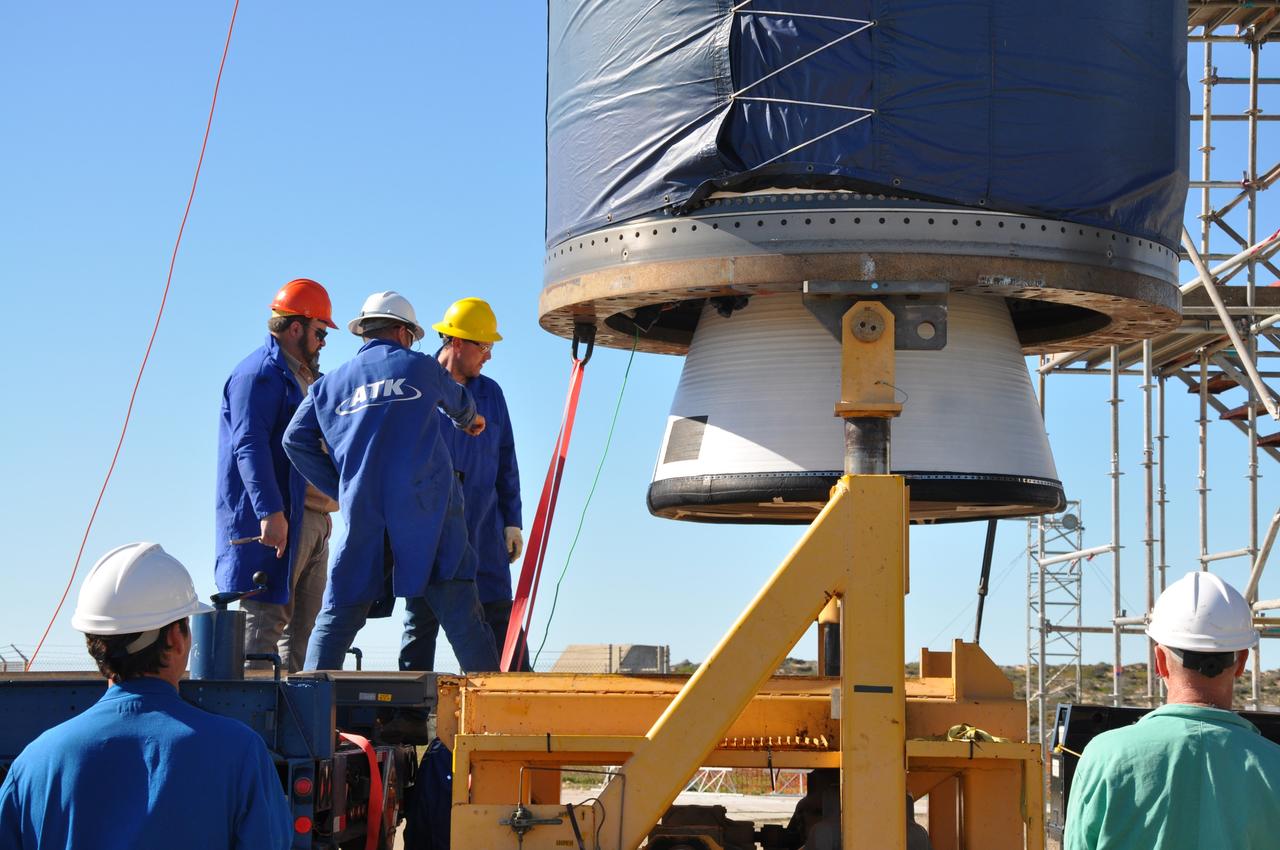
VANDENBERG AIR FORCE BASE, Calif. -- The Stage 0 motor of the Orbital Sciences Corp. Taurus XL is ready to be moved into launch position on Space Launch Complex 576-E at Vandenberg Air Force Base in California. As part of the four-stage Taurus XL rocket that will carry NASA's Glory spacecraft into low Earth orbit, stages 1, 2 and 3 will join Stage 0 at the launch pad about a week later. Once Glory reaches orbit, it will collect data on the properties of aerosols and black carbon. It also will help scientists understand how the sun's irradiance affects Earth's climate. Launch is scheduled for 5:09 a.m. EST Feb. 23. For information, visit www.nasa.gov/glory. Photo credit: NASA/Randy Beaudoin, VAFB

VANDENBERG AIR FORCE BASE, Calif. -- The Stage 0 motor of the Orbital Sciences Corp. Taurus XL rocket is almost ready for its journey from Building 1555 to Space Launch Complex 576-E at Vandenberg Air Force Base in California. As part of the four-stage Taurus XL rocket that will carry NASA's Glory spacecraft into low Earth orbit, stages 1, 2 and 3 will join Stage 0 at the launch pad about a week later. Once Glory reaches orbit, it will collect data on the properties of aerosols and black carbon. It also will help scientists understand how the sun's irradiance affects Earth's climate. Launch is scheduled for 5:09 a.m. EST Feb. 23. For information, visit www.nasa.gov/glory. Photo credit: NASA/Randy Beaudoin, VAFB
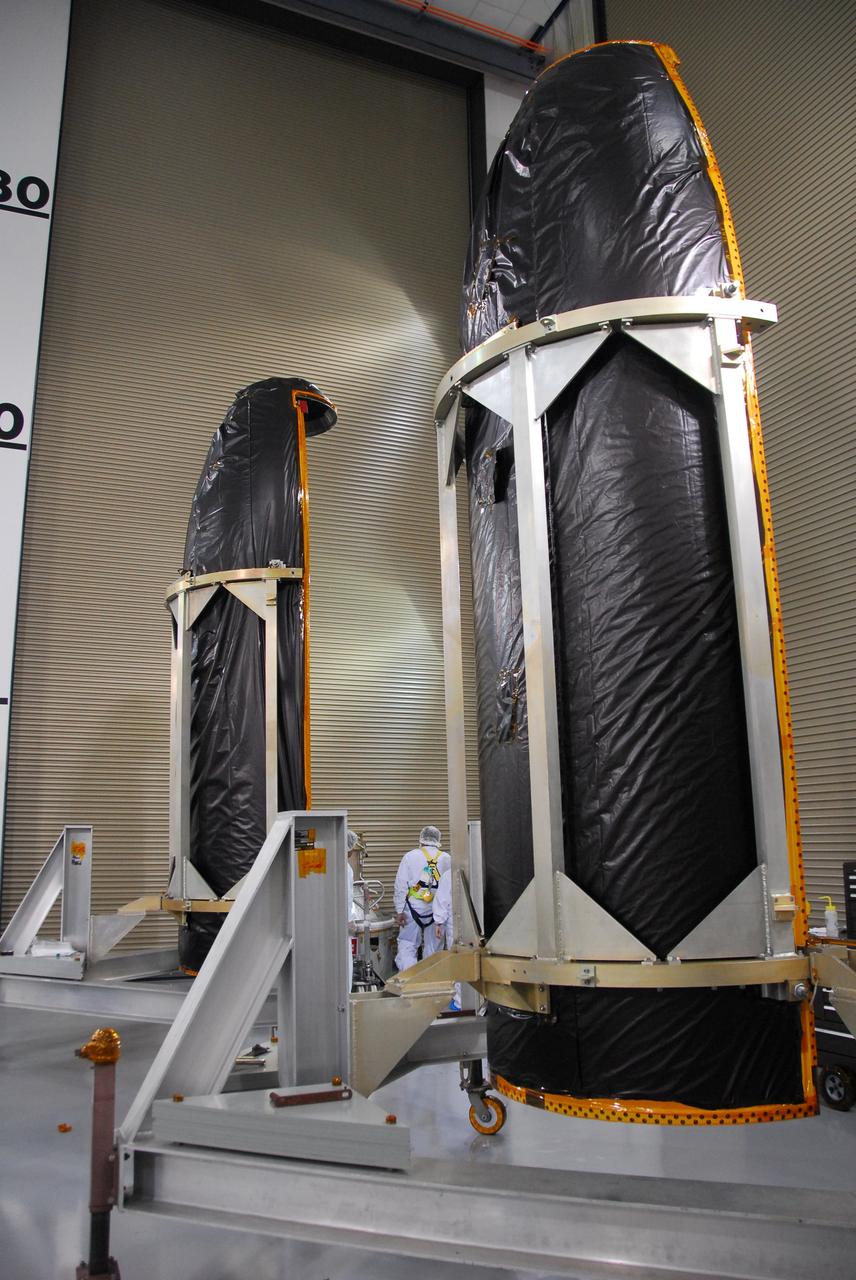
VANDENBERG AIR FORCE BASE, Calif. -- The two sections of the payload fairing for the Glory mission stand in the East High Bay in the Astrotech payload processing facility at Vandenberg Air Force Base in California. The payload fairing will cover the Glory spacecraft and be placed at the top of a Taurus XL rocket slated to lift the spacecraft into orbit. The payload fairing will protect the Glory spacecraft from aerodynamic pressures and heating during the first part of its climb into orbit. Once Glory reaches orbit, it will collect data on the properties of aerosols and black carbon. It also will help scientists understand how the sun's irradiance affects Earth's climate. Launch is scheduled for 5:09 a.m. EST Feb. 23. For information, visit www.nasa.gov/glory. Photo credit: NASA/Ed Henry, VAFB
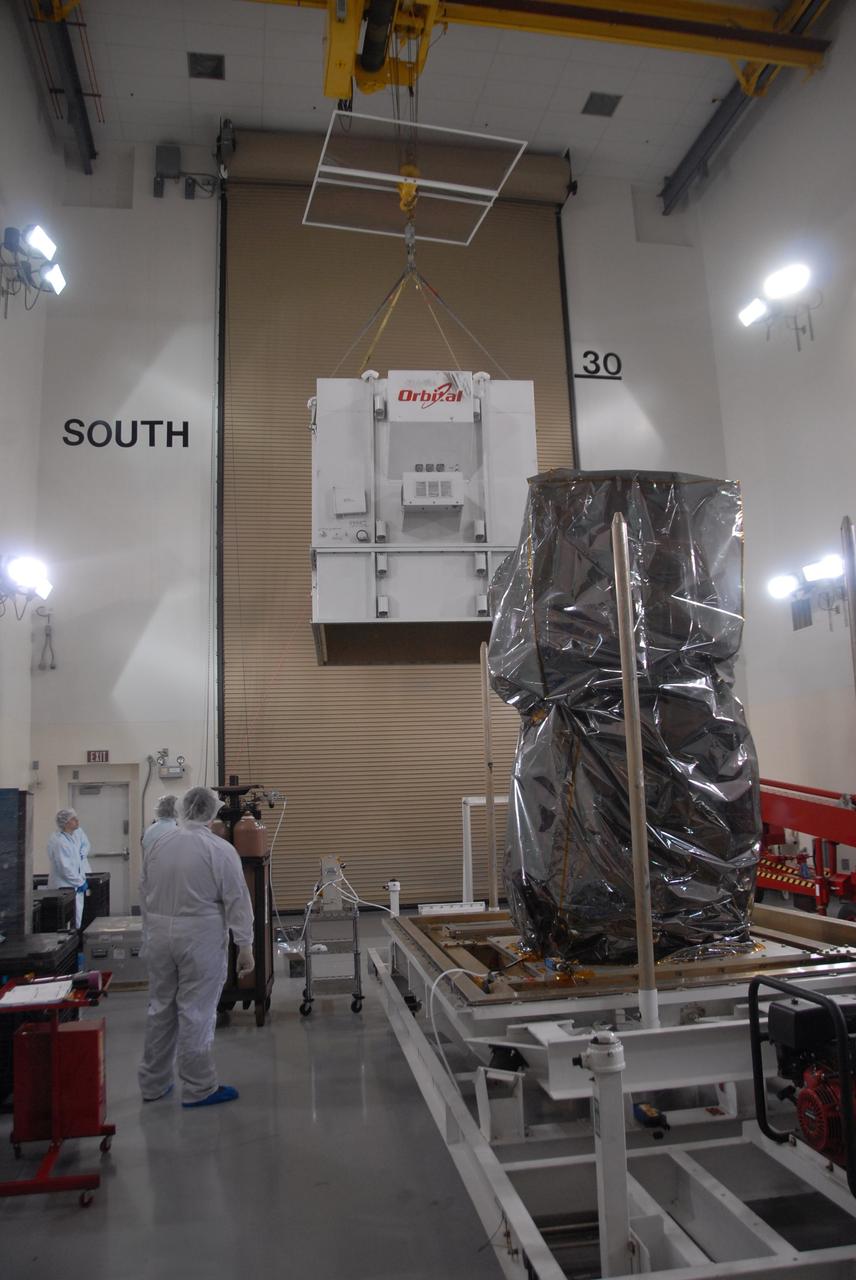
VANDENBERG AIR FORCE BASE, Calif. -- Inside the Astrotech processing facility at Vandenberg Air Force Base in California, technicians remove the shipping container surrounding NASA's Glory spacecraft. Next, technicians will take off Glory's protective covering before it is encapsulated in a protective payload fairing for flight. In early February, Glory is scheduled to be transported Space Launch Complex 576-E where it will be joined with the Taurus XL rocket, which is manufactured by Orbital Sciences Corp. Once Glory reaches orbit, it will collect data on the properties of aerosols and black carbon. It also will help scientists understand how the sun's irradiance affects Earth's climate. Launch is scheduled for 5:09 a.m. EST Feb. 23. For information, visit www.nasa.gov/glory. Photo credit: NASA/Ed Henry, VAFB
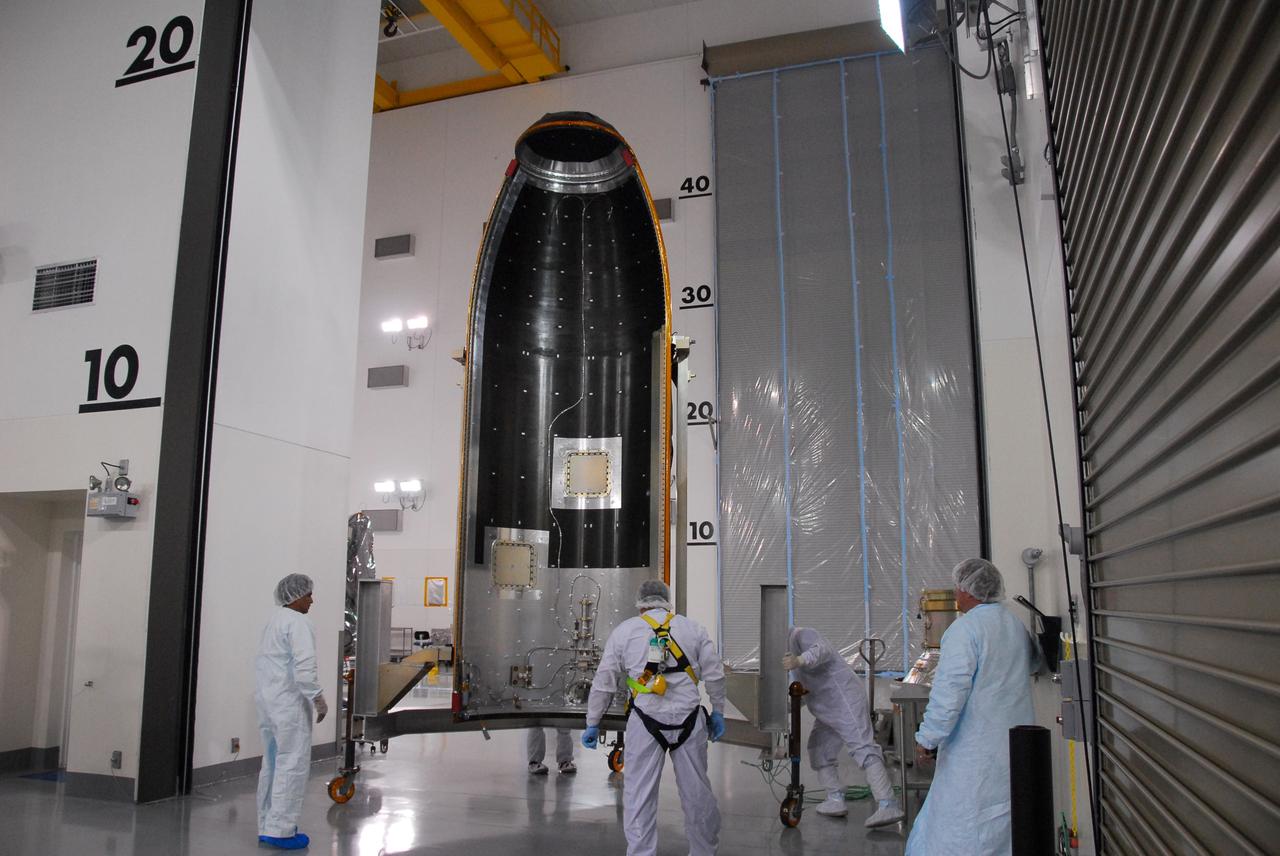
VANDENBERG AIR FORCE BASE, Calif. -- Technicians wheel half of Glory's payload fairing into the East High Bay at the Astrotech payload processing facility at Vandenberg Air Force Base in California. The payload fairing will cover the Glory spacecraft and be placed at the top of a Taurus XL rocket slated to lift the spacecraft into orbit. The payload fairing will protect the Glory spacecraft from aerodynamic pressures and heating during the first part of its climb into orbit. Once Glory reaches orbit, it will collect data on the properties of aerosols and black carbon. It also will help scientists understand how the sun's irradiance affects Earth's climate. Launch is scheduled for 5:09 a.m. EST Feb. 23. For information, visit www.nasa.gov/glory. Photo credit: NASA/Ed Henry, VAFB
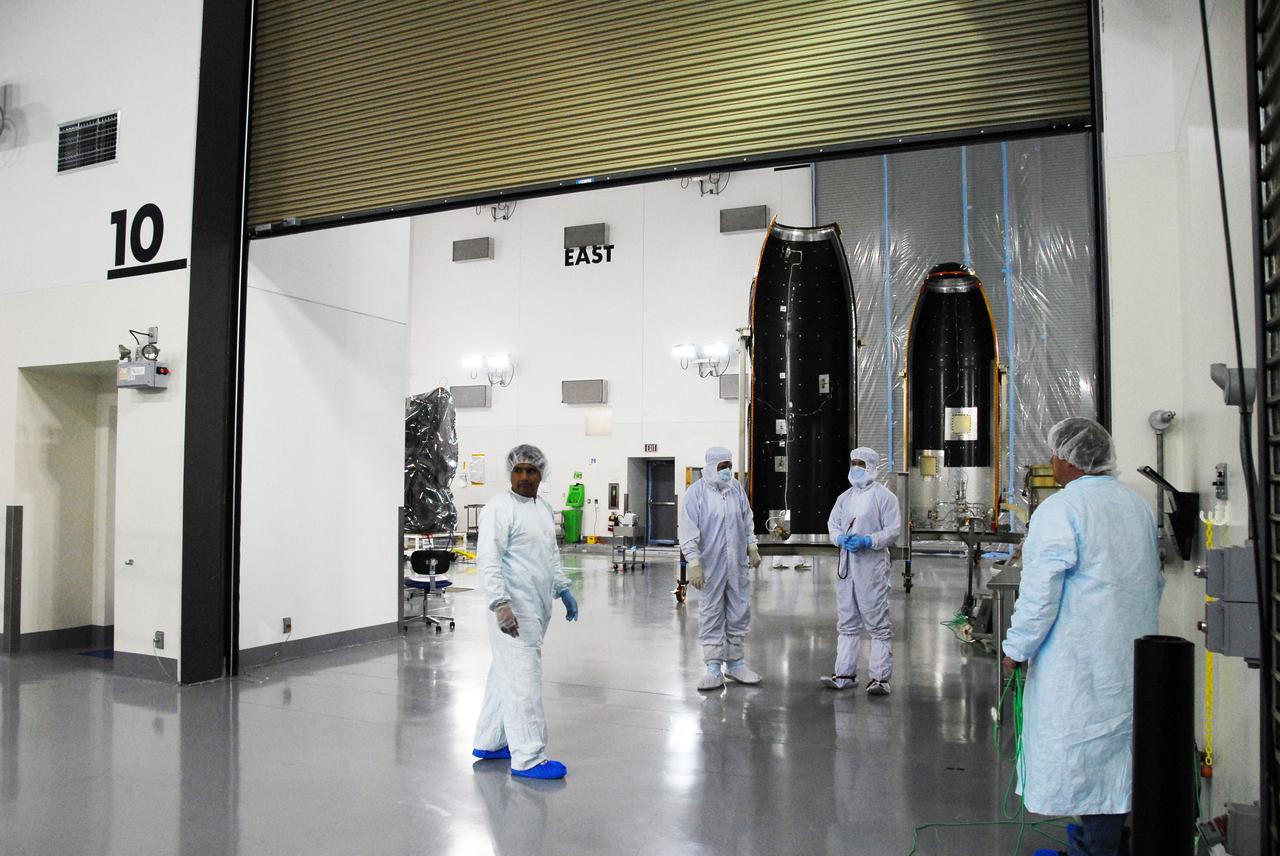
VANDENBERG AIR FORCE BASE, Calif. -- The payload fairing for the Glory mission stands in the East High Bay at the Astrotech payload processing facility at Vandenberg Air Force Base in California. The payload fairing will cover the Glory spacecraft and be placed at the top of a Taurus XL rocket slated to lift the spacecraft into orbit. The payload fairing will protect the Glory spacecraft from aerodynamic pressures and heating during the first part of its climb into orbit. Once Glory reaches orbit, it will collect data on the properties of aerosols and black carbon. It also will help scientists understand how the sun's irradiance affects Earth's climate. Launch is scheduled for 5:09 a.m. EST Feb. 23. For information, visit www.nasa.gov/glory. Photo credit: NASA/Ed Henry, VAFB
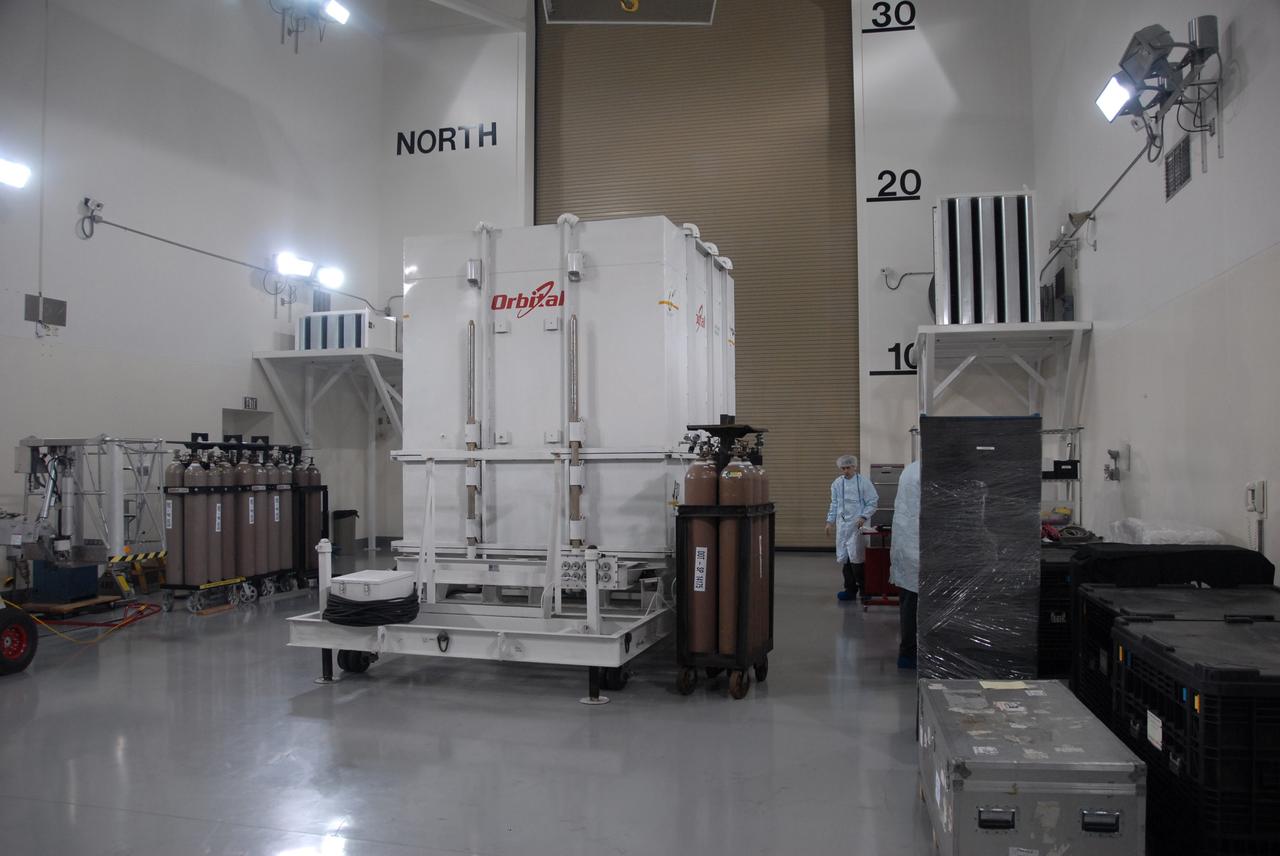
VANDENBERG AIR FORCE BASE, Calif. -- Inside the Astrotech processing facility at Vandenberg Air Force Base in California, the shipping container surrounding NASA's Glory spacecraft is ready for removal. Next, technicians will take off Glory's protective covering before it is encapsulated in a protective payload fairing for flight. In early February, Glory is scheduled to be transported Space Launch Complex 576-E where it will be joined with the Taurus XL rocket, which is manufactured by Orbital Sciences Corp. Once Glory reaches orbit, it will collect data on the properties of aerosols and black carbon. It also will help scientists understand how the sun's irradiance affects Earth's climate. Launch is scheduled for 5:09 a.m. EST Feb. 23. For information, visit www.nasa.gov/glory. Photo credit: NASA/Ed Henry, VAFB
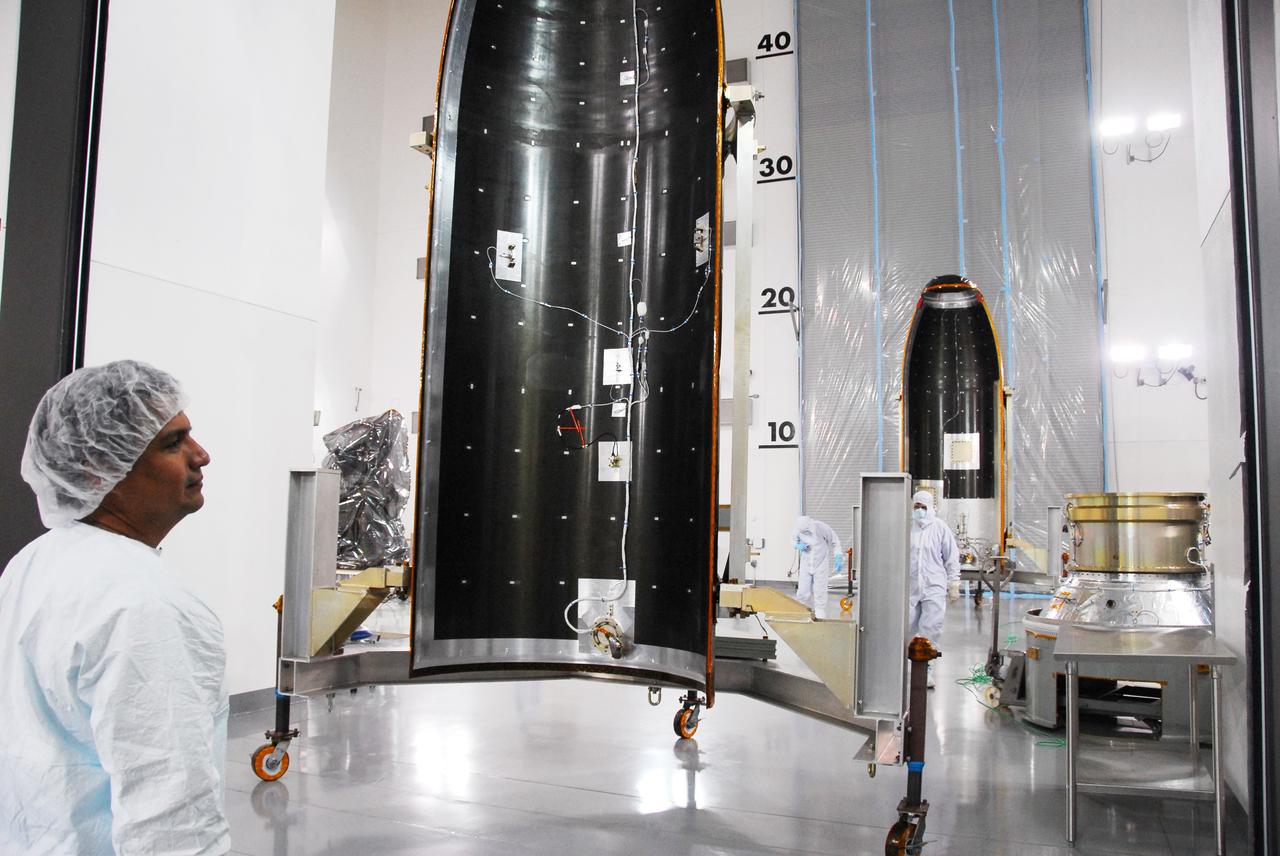
VANDENBERG AIR FORCE BASE, Calif. -- Technicians wheel the payload fairing for the Glory mission into the East High Bay at the Astrotech payload processing facility at Vandenberg Air Force Base in California. The payload fairing will cover the Glory spacecraft and be placed at the top of a Taurus XL rocket slated to lift the spacecraft into orbit. The payload fairing will protect the Glory spacecraft from aerodynamic pressures and heating during the first part of its climb into orbit. Once Glory reaches orbit, it will collect data on the properties of aerosols and black carbon. It also will help scientists understand how the sun's irradiance affects Earth's climate. Launch is scheduled for 5:09 a.m. EST Feb. 23. For information, visit www.nasa.gov/glory. Photo credit: NASA/Ed Henry, VAFB
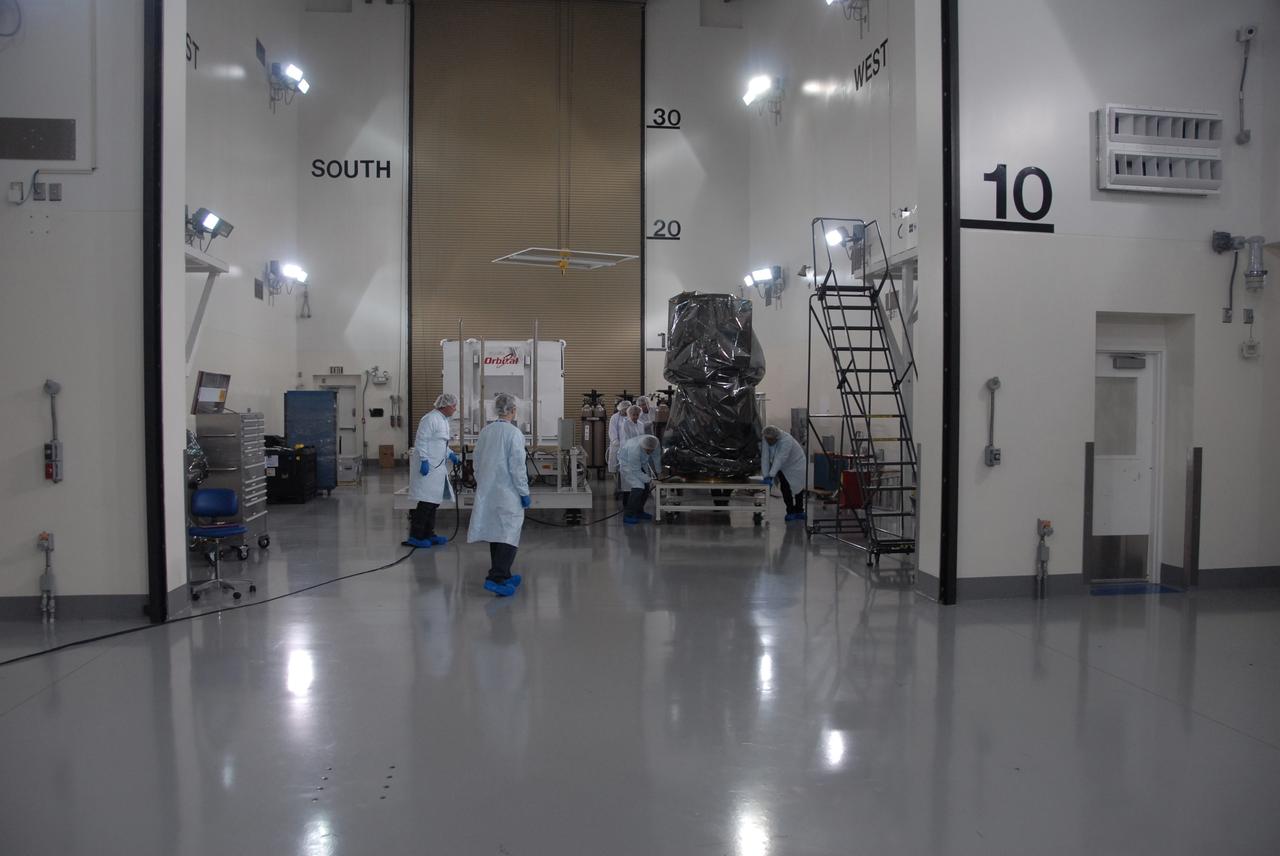
VANDENBERG AIR FORCE BASE, Calif. -- Inside the Astrotech processing facility at Vandenberg Air Force Base in California, NASA's Glory spacecraft is transferring to a processing dolly. Next, technicians will take off Glory's protective covering before it is encapsulated in a protective payload fairing for flight. In early February, Glory is scheduled to be transported Space Launch Complex 576-E where it will be joined with the Taurus XL rocket, which is manufactured by Orbital Sciences Corp. Once Glory reaches orbit, it will collect data on the properties of aerosols and black carbon. It also will help scientists understand how the sun's irradiance affects Earth's climate. Launch is scheduled for 5:09 a.m. EST Feb. 23. For information, visit www.nasa.gov/glory. Photo credit: NASA/Ed Henry, VAFB
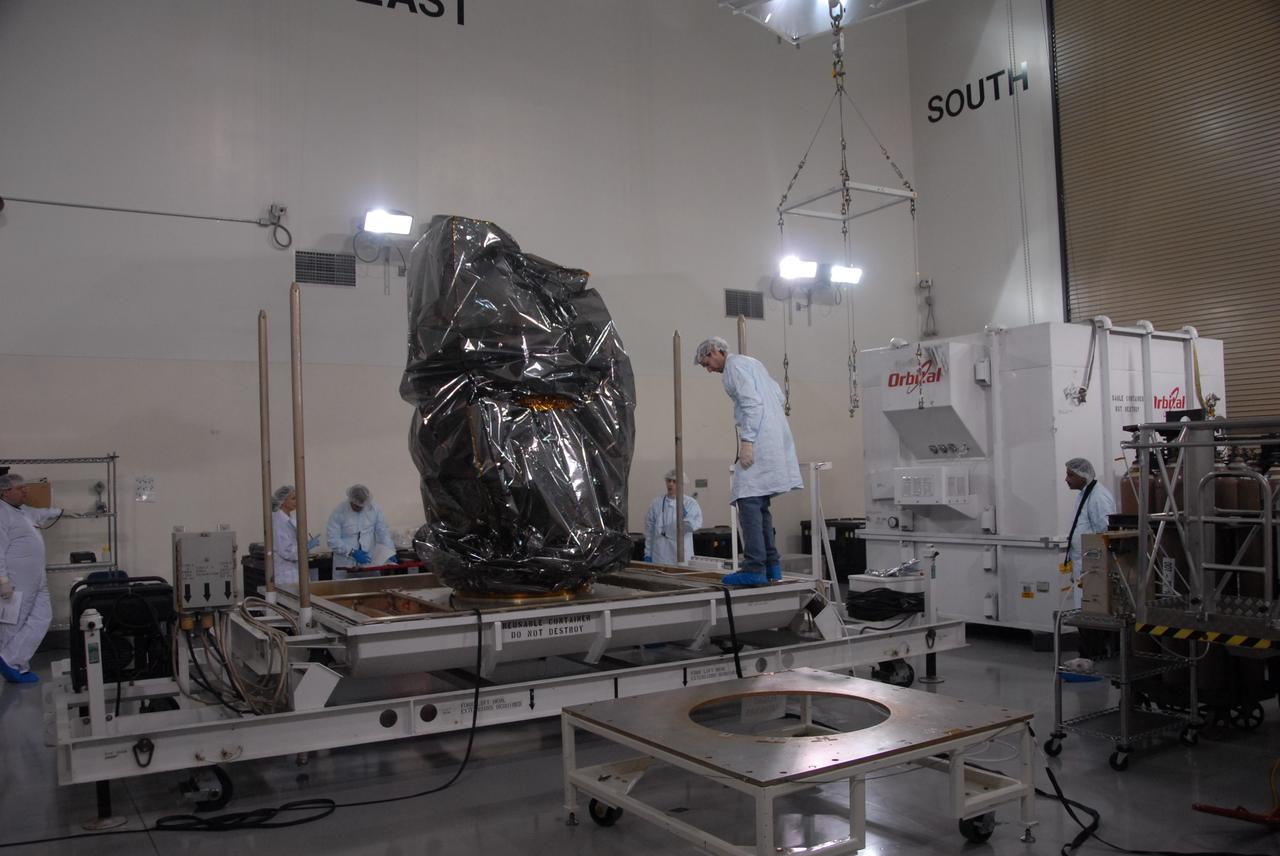
VANDENBERG AIR FORCE BASE, Calif. -- Inside the Astrotech processing facility at Vandenberg Air Force Base in California, technicians prepare to transfer NASA's Glory spacecraft to a processing dolly. Next, technicians will take off Glory's protective covering before it is encapsulated in a protective payload fairing for flight. In early February, Glory is scheduled to be transported Space Launch Complex 576-E where it will be joined with the Taurus XL rocket, which is manufactured by Orbital Sciences Corp. Once Glory reaches orbit, it will collect data on the properties of aerosols and black carbon. It also will help scientists understand how the sun's irradiance affects Earth's climate. Launch is scheduled for 5:09 a.m. EST Feb. 23. For information, visit www.nasa.gov/glory. Photo credit: NASA/Ed Henry, VAFB
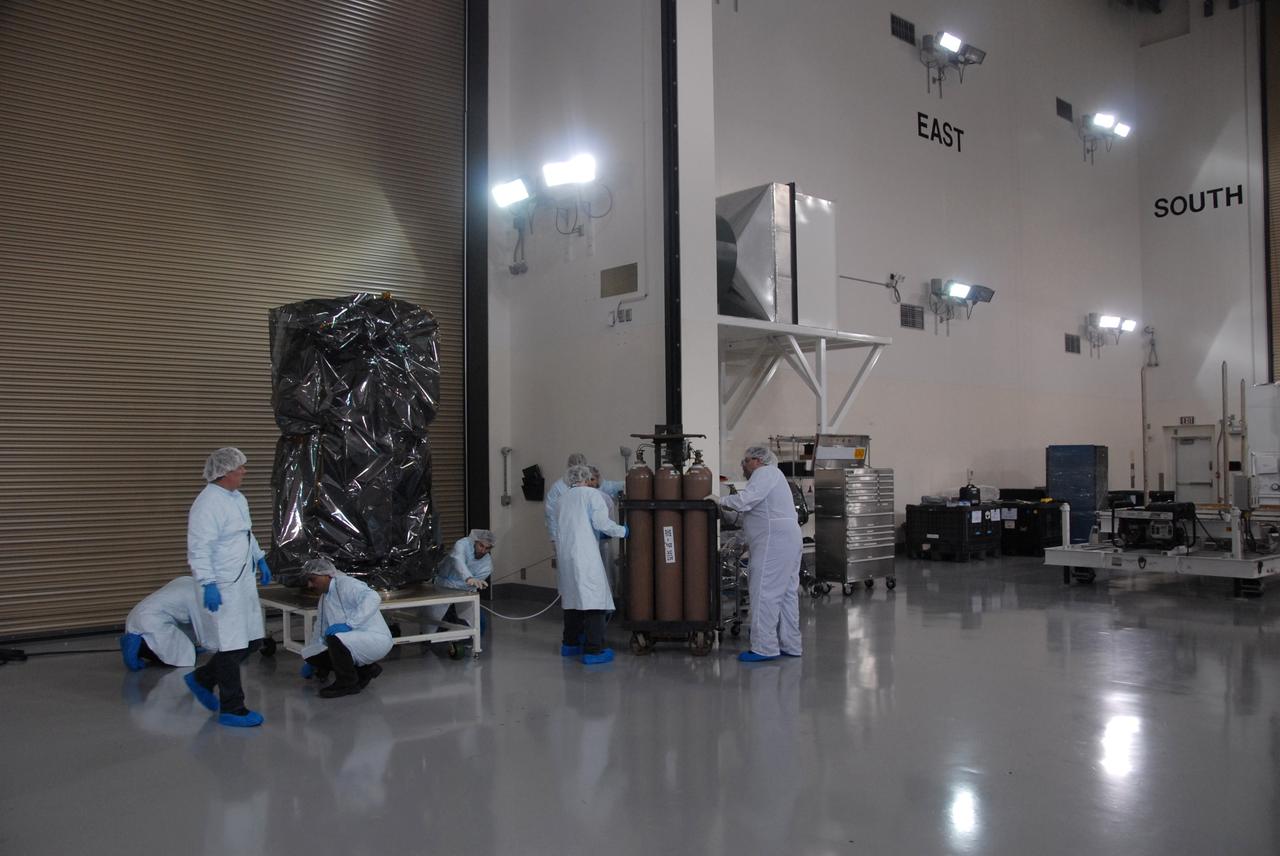
VANDENBERG AIR FORCE BASE, Calif. -- Inside the Astrotech processing facility at Vandenberg Air Force Base in California, NASA's Glory spacecraft is situated on a dolly and ready for processing. Next, technicians will take off Glory's protective covering before it is encapsulated in a protective payload fairing for flight. In early February, Glory is scheduled to be transported Space Launch Complex 576-E where it will be joined with the Taurus XL rocket, which is manufactured by Orbital Sciences Corp. Once Glory reaches orbit, it will collect data on the properties of aerosols and black carbon. It also will help scientists understand how the sun's irradiance affects Earth's climate. Launch is scheduled for 5:09 a.m. EST Feb. 23. For information, visit www.nasa.gov/glory. Photo credit: NASA/Ed Henry, VAFB
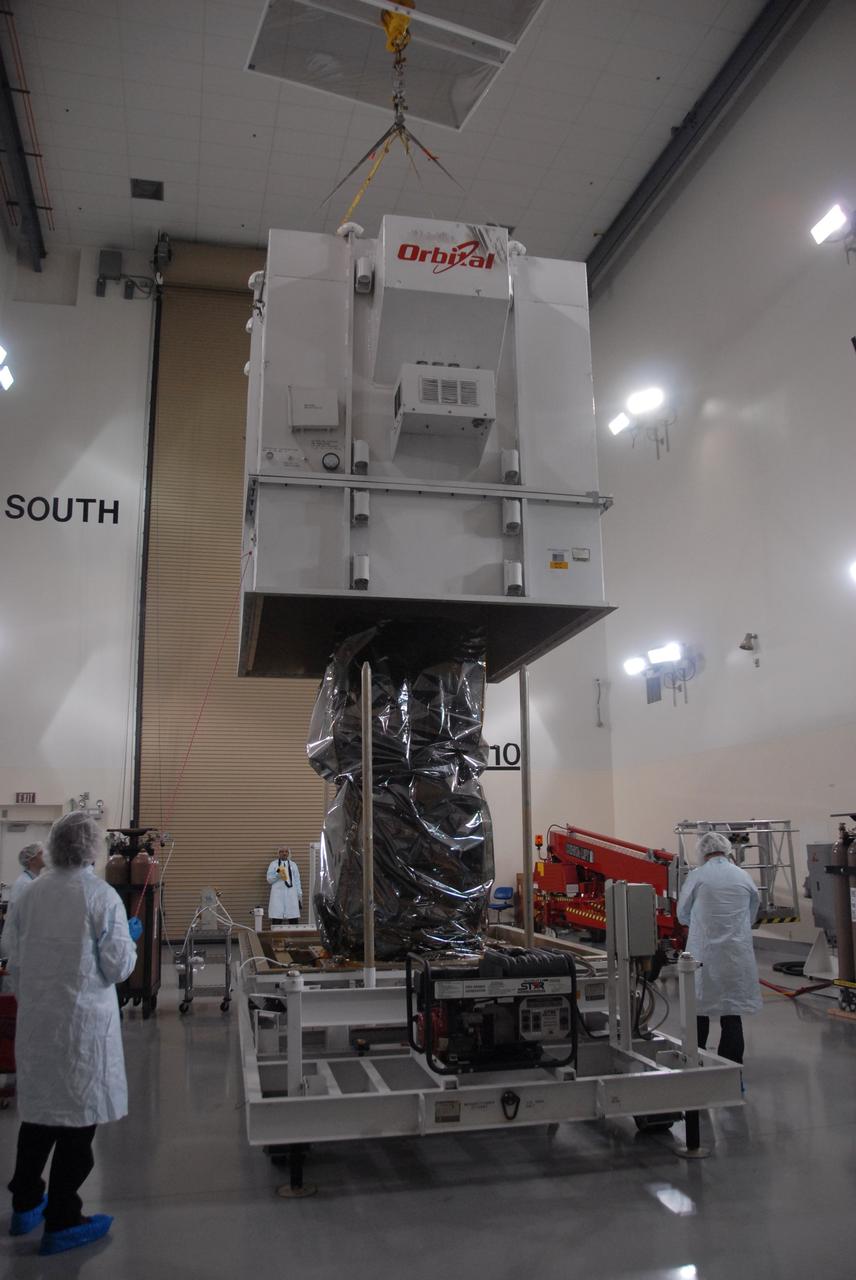
VANDENBERG AIR FORCE BASE, Calif. -- Inside the Astrotech processing facility at Vandenberg Air Force Base in California, technicians remove the shipping container surrounding NASA's Glory spacecraft. Next, technicians will take off Glory's protective covering before it is encapsulated in a protective payload fairing for flight. In early February, Glory is scheduled to be transported Space Launch Complex 576-E where it will be joined with the Taurus XL rocket, which is manufactured by Orbital Sciences Corp. Once Glory reaches orbit, it will collect data on the properties of aerosols and black carbon. It also will help scientists understand how the sun's irradiance affects Earth's climate. Launch is scheduled for 5:09 a.m. EST Feb. 23. For information, visit www.nasa.gov/glory. Photo credit: NASA/Ed Henry, VAFB
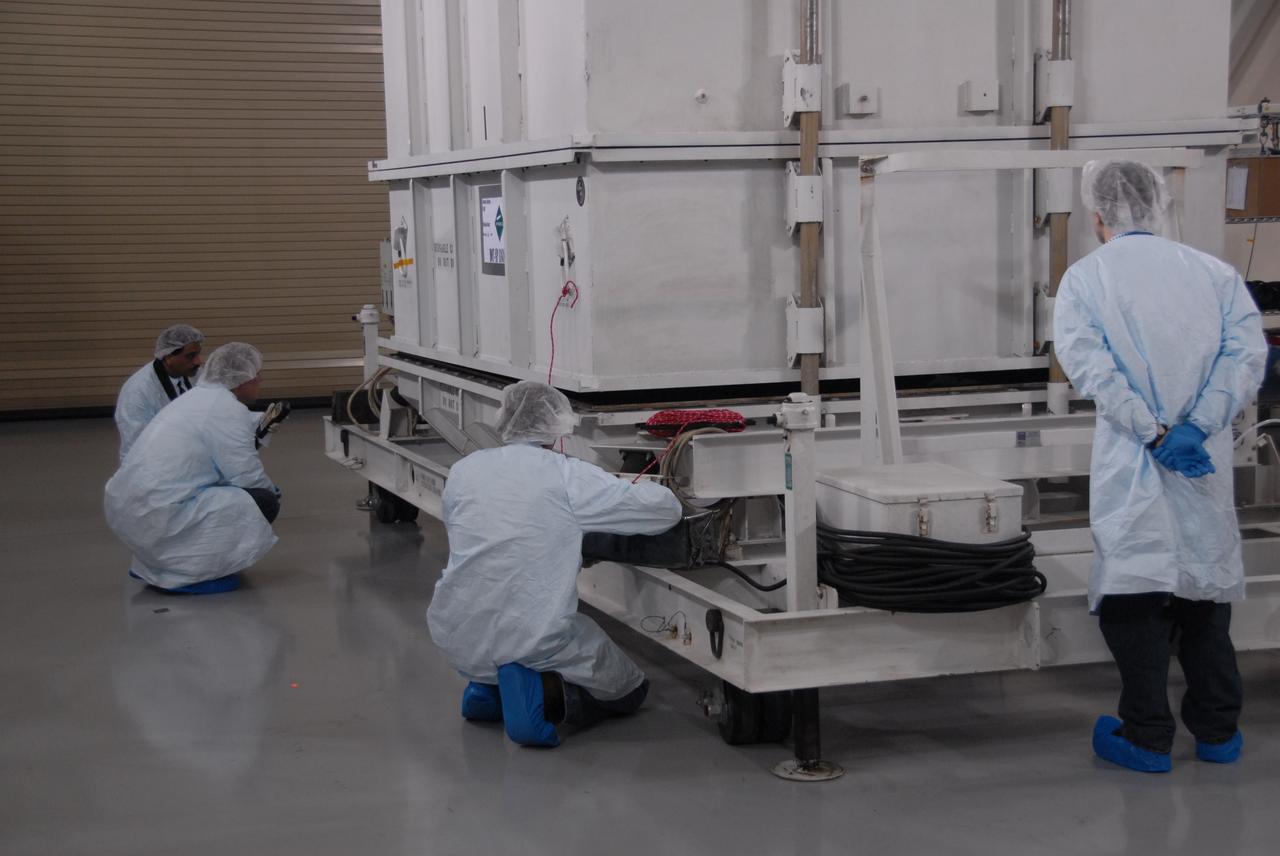
VANDENBERG AIR FORCE BASE, Calif. -- Inside the Astrotech processing facility at Vandenberg Air Force Base in California, technicians prepare to remove the shipping container surrounding NASA's Glory spacecraft. Next, technicians will take off Glory's protective covering before it is encapsulated in a protective payload fairing for flight. In early February, Glory is scheduled to be transported Space Launch Complex 576-E where it will be joined with the Taurus XL rocket, which is manufactured by Orbital Sciences Corp. Once Glory reaches orbit, it will collect data on the properties of aerosols and black carbon. It also will help scientists understand how the sun's irradiance affects Earth's climate. Launch is scheduled for 5:09 a.m. EST Feb. 23. For information, visit www.nasa.gov/glory. Photo credit: NASA/Ed Henry, VAFB
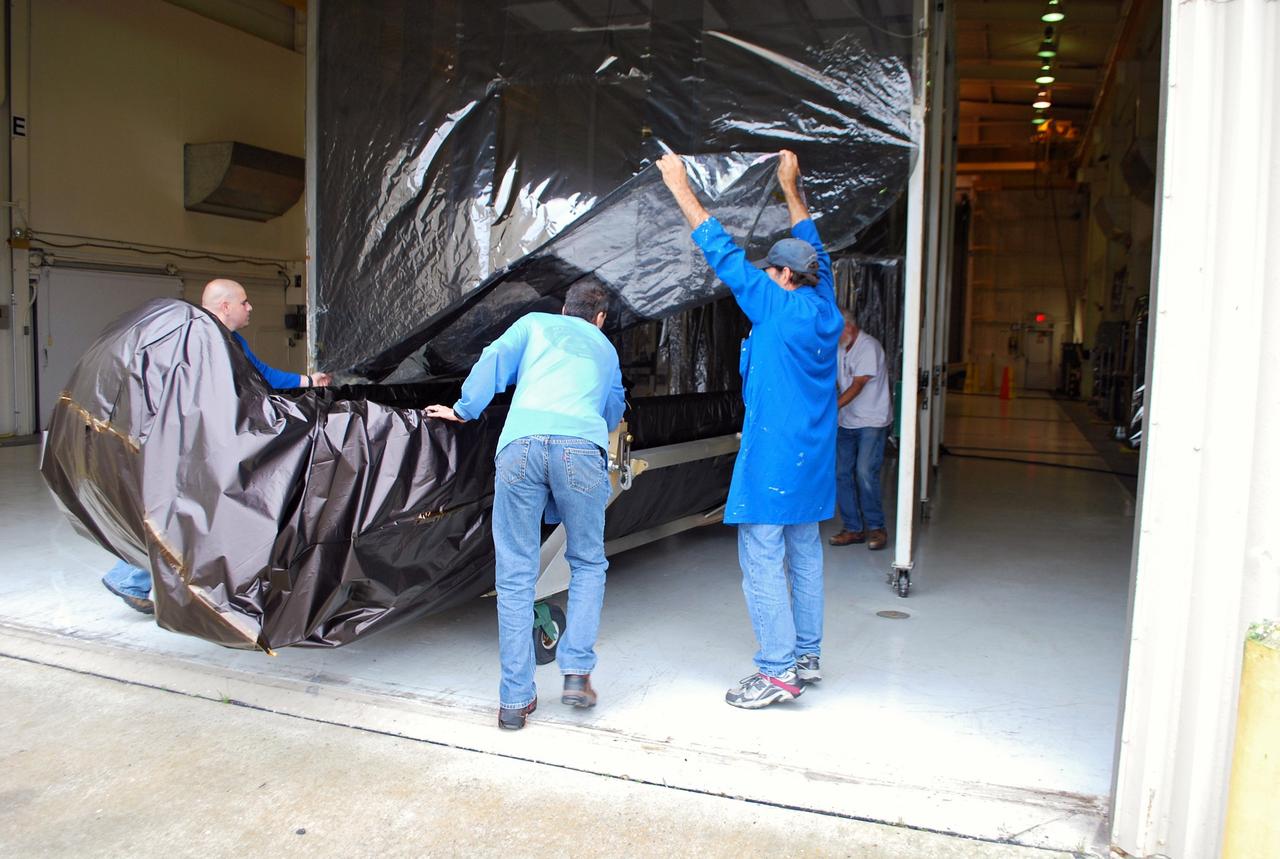
VANDENBERG AIR FORCE BASE, Calif. – At Vandenberg Air Force Base in California, the second half of the fairing that will encapsulate NASA's Glory satellite during launch aboard a Taurus XL rocket is moved into Building 1555. There, the black protective covering will be removed so that the fairing half can be thoroughly cleaned before it is installed around the spacecraft. The four-stage rocket and satellite are being prepared for a launch to low Earth orbit from Vandenberg's Space Launch Complex 576-E. Once Glory reaches orbit, it will collect data on the properties of aerosols and black carbon. It also will help scientists understand how the sun's irradiance affects Earth's climate. Photo credit: NASA/Randy Beaudoin, VAFB
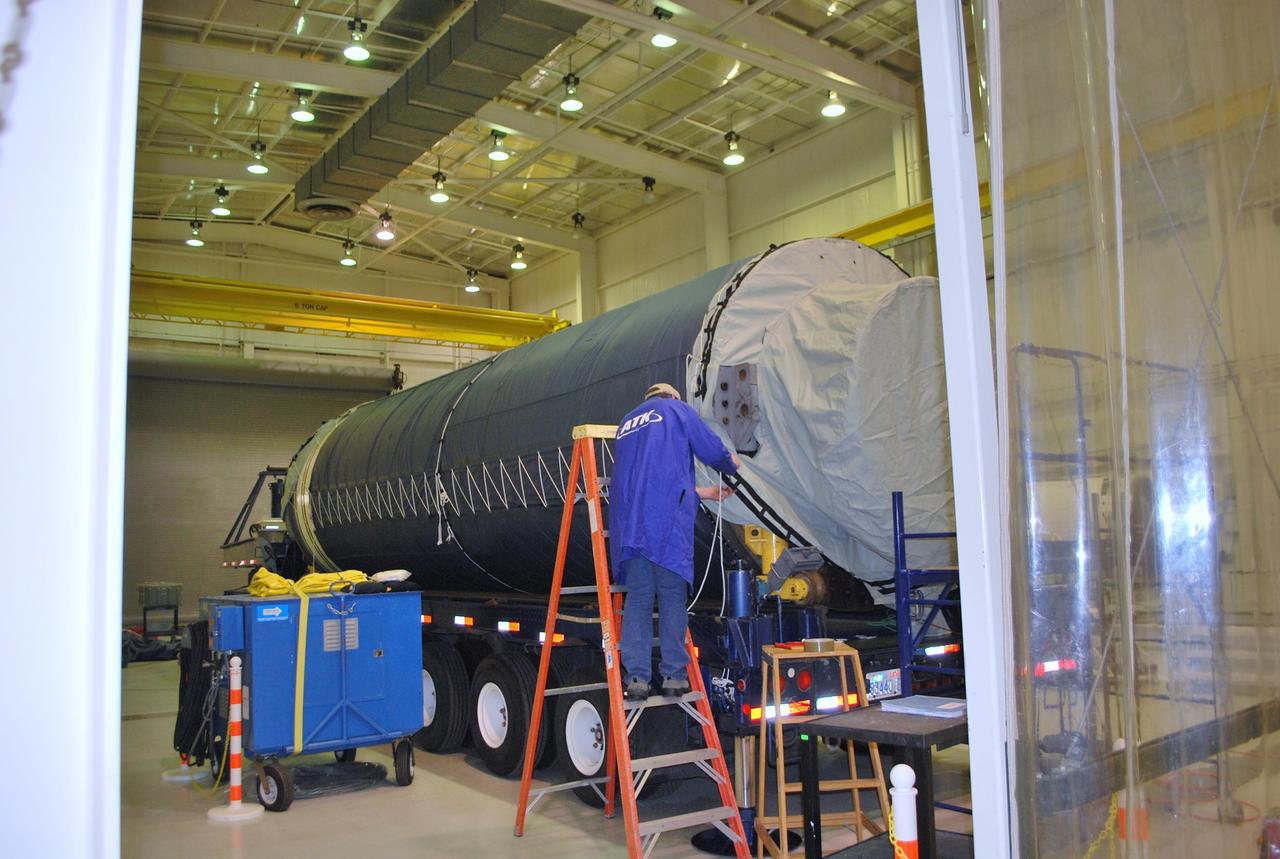
VANDENBERG AIR FORCE BASE, Calif. -- Inside the Orbital Sciences Corp. Building 1555 at Vandenberg Air Force Base in California, a worker installs a protective blanket over the Stage 0 motor in preparation for its move to Space Launch Complex 576-E, scheduled for Jan. 17. As part of the four-stage Taurus XL rocket that will carry NASA's Glory spacecraft into low Earth orbit, stages 1, 2 and 3 will join Stage 0 at the launch pad about a week later. Once Glory reaches orbit, it will collect data on the properties of aerosols and black carbon. It also will help scientists understand how the sun's irradiance affects Earth's climate. Launch is scheduled for 5:09 a.m. EST Feb. 23. For information, visit www.nasa.gov/glory. Photo credit: NASA/Randy Beaudoin, VAFB
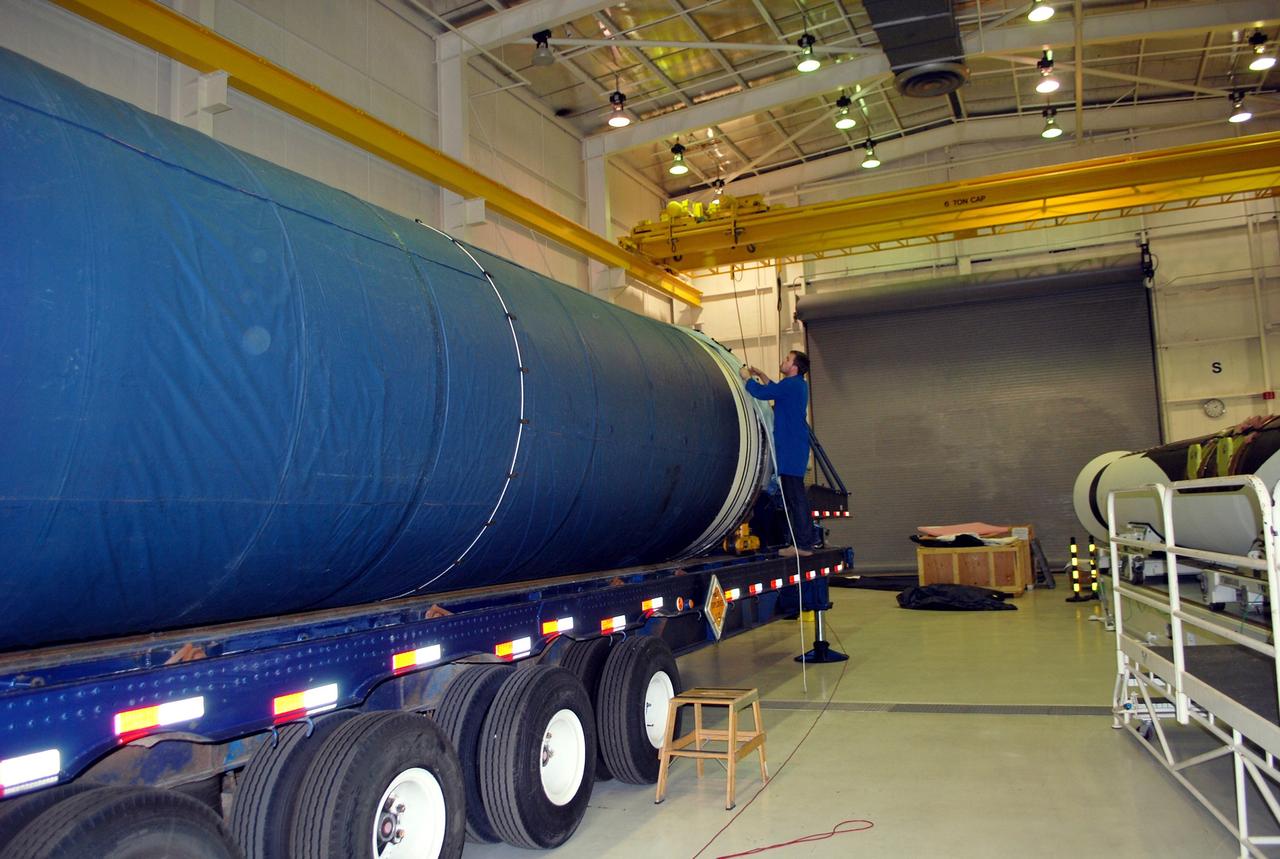
VANDENBERG AIR FORCE BASE, Calif. -- Inside the Orbital Sciences Corp. Building 1555 at Vandenberg Air Force Base in California, a worker installs a protective blanket over the Stage 0 motor in preparation for its move to Space Launch Complex 576-E, scheduled for Jan. 17. As part of the four-stage Taurus XL rocket that will carry NASA's Glory spacecraft into low Earth orbit, stages 1, 2 and 3 will join Stage 0 at the launch pad about a week later. Once Glory reaches orbit, it will collect data on the properties of aerosols and black carbon. It also will help scientists understand how the sun's irradiance affects Earth's climate. Launch is scheduled for 5:09 a.m. EST Feb. 23. For information, visit www.nasa.gov/glory. Photo credit: NASA/Randy Beaudoin, VAFB
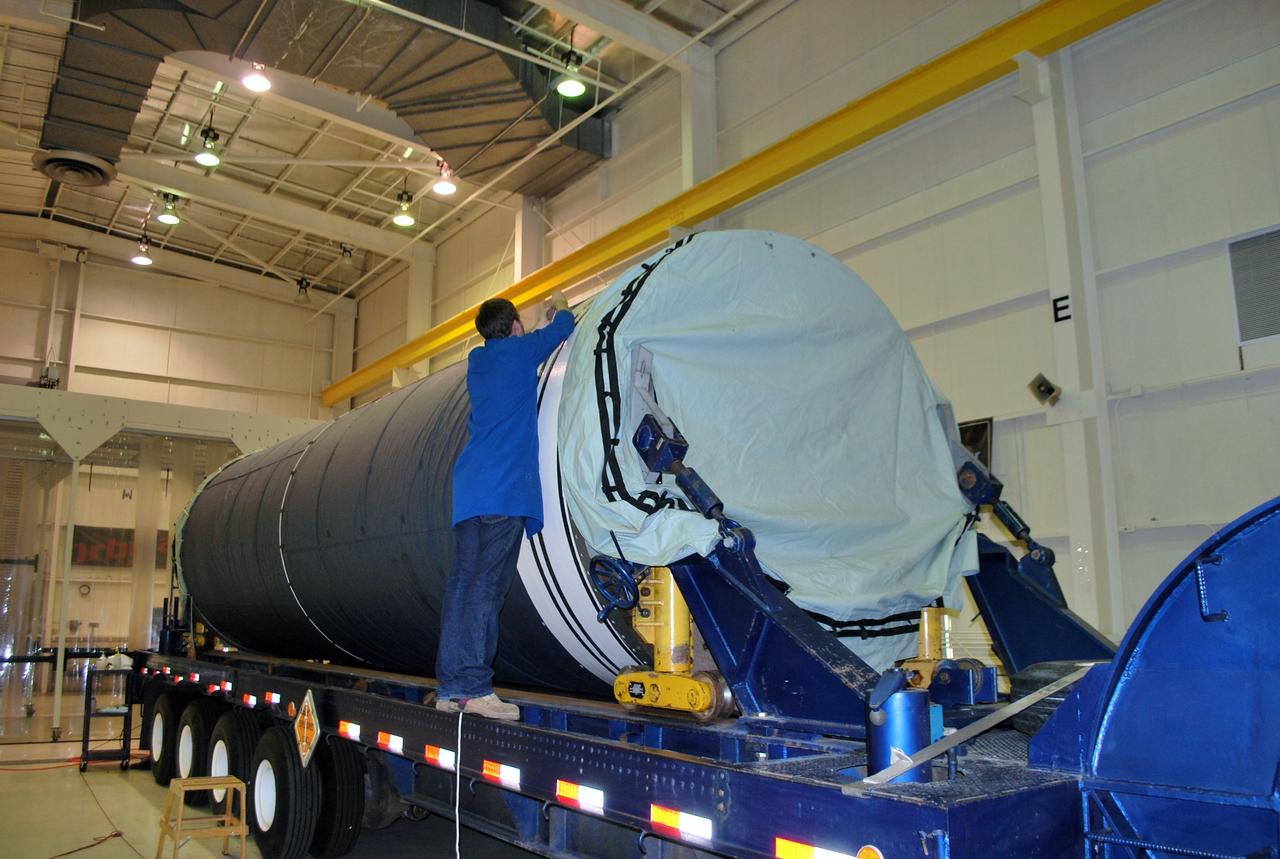
VANDENBERG AIR FORCE BASE, Calif. -- Inside the Orbital Sciences Corp. Building 1555 at Vandenberg Air Force Base in California, a worker installs a protective blanket over the Stage 0 motor in preparation for its move to Space Launch Complex 576-E, scheduled for Jan. 17. As part of the four-stage Taurus XL rocket that will carry NASA's Glory spacecraft into low Earth orbit, stages 1, 2 and 3 will join Stage 0 at the launch pad about a week later. Once Glory reaches orbit, it will collect data on the properties of aerosols and black carbon. It also will help scientists understand how the sun's irradiance affects Earth's climate. Launch is scheduled for 5:09 a.m. EST Feb. 23. For information, visit www.nasa.gov/glory. Photo credit: NASA/Randy Beaudoin, VAFB
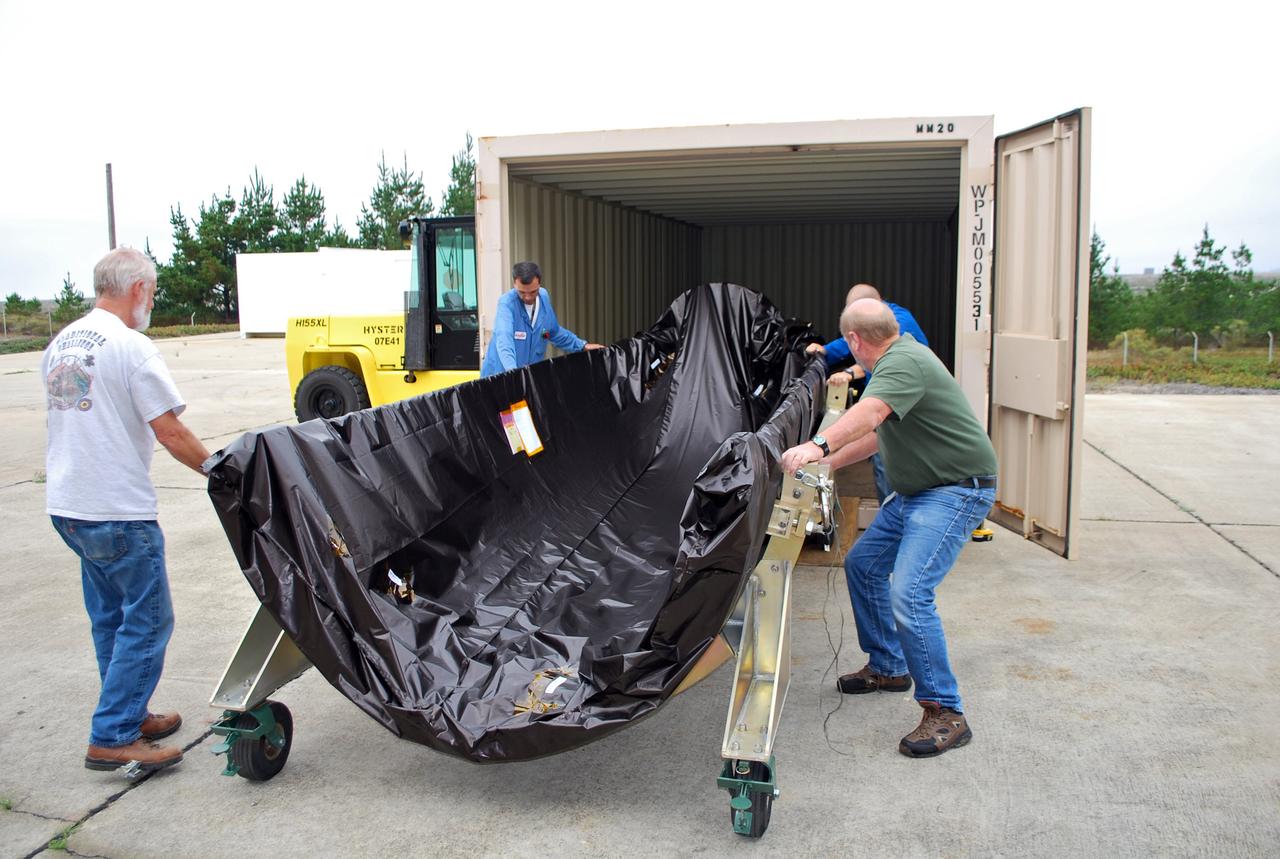
VANDENBERG AIR FORCE BASE, Calif. – At Vandenberg Air Force Base in California, the second half of the fairing that will encapsulate NASA's Glory satellite during launch aboard a Taurus XL rocket is offloaded and moved toward Building 1555. There, the black protective covering will be removed so that the fairing half can be thoroughly cleaned before it is installed around the spacecraft. The four-stage rocket and satellite are being prepared for a launch to low Earth orbit from Vandenberg's Space Launch Complex 576-E. Once Glory reaches orbit, it will collect data on the properties of aerosols and black carbon. It also will help scientists understand how the sun's irradiance affects Earth's climate. Photo credit: NASA/Randy Beaudoin, VAFB
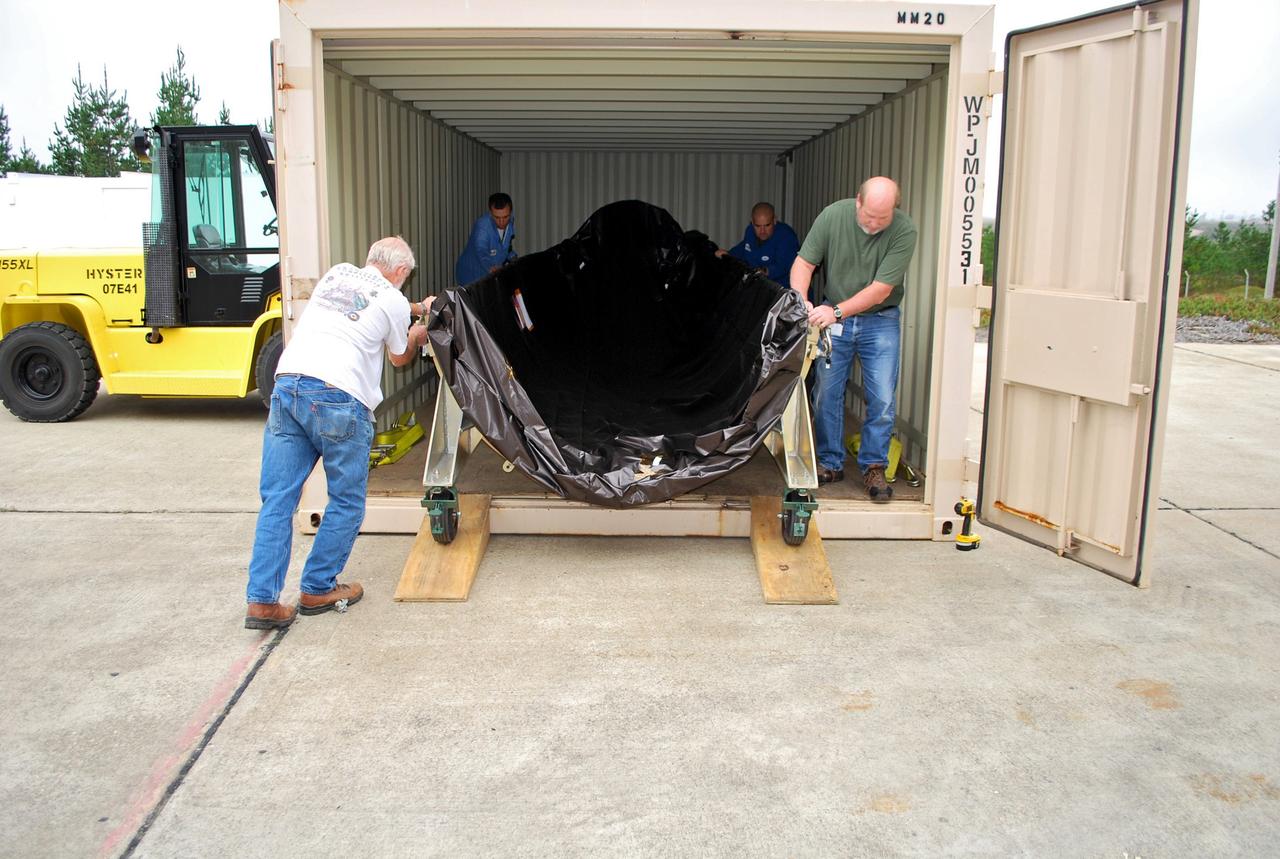
VANDENBERG AIR FORCE BASE, Calif. – At Vandenberg Air Force Base in California, the second half of the fairing that will encapsulate NASA's Glory satellite during launch aboard a Taurus XL rocket is offloaded and moved toward Building 1555. There, the black protective covering will be removed so that the fairing half can be thoroughly cleaned before it is installed around the spacecraft. The four-stage rocket and satellite are being prepared for a launch to low Earth orbit from Vandenberg's Space Launch Complex 576-E. Once Glory reaches orbit, it will collect data on the properties of aerosols and black carbon. It also will help scientists understand how the sun's irradiance affects Earth's climate. Photo credit: NASA/Randy Beaudoin, VAFB

VANDENBERG AIR FORCE BASE, Calif. – At Vandenberg Air Force Base in California, the second half of the fairing that will encapsulate NASA's Glory satellite during launch aboard a Taurus XL rocket is offloaded and moved toward Building 1555. There, the black protective covering will be removed so that the fairing half can be thoroughly cleaned before it is installed around the spacecraft. The four-stage rocket and satellite are being prepared for a launch to low Earth orbit from Vandenberg's Space Launch Complex 576-E. Once Glory reaches orbit, it will collect data on the properties of aerosols and black carbon. It also will help scientists understand how the sun's irradiance affects Earth's climate. Photo credit: NASA/Randy Beaudoin, VAFB
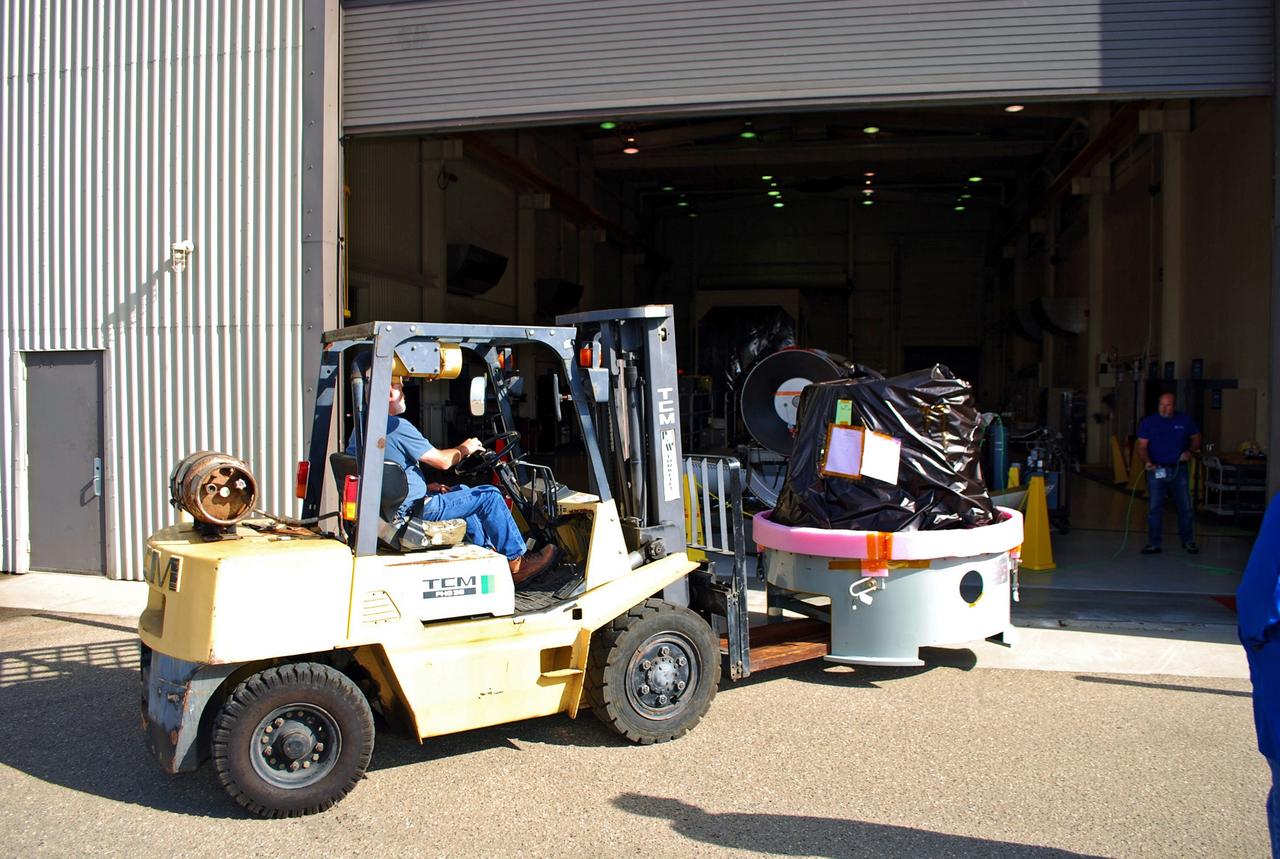
VANDENBERG AIR FORCE BASE, Calif. -- At Vandenberg Air Force Base in California, a worker user a Hyster lift moves the payload cone for NASA's Glory mission into VAFB's payload processing facility. The payload cone is an adapter that interfaces the Taurus XL rocket with the spacecraft. A four-stage Taurus XL rocket will carry Glory into low Earth orbit. Once Glory reaches orbit, it will collect data on the properties of aerosols and black carbon. It also will help scientists understand how the sun's irradiance affects Earth's climate. Launch is scheduled for 2:09 a.m. PST Nov. 22. For information, visit www.nasa.gov/glory. Photo credit: NASA/Randy Beaudoin, VAFB
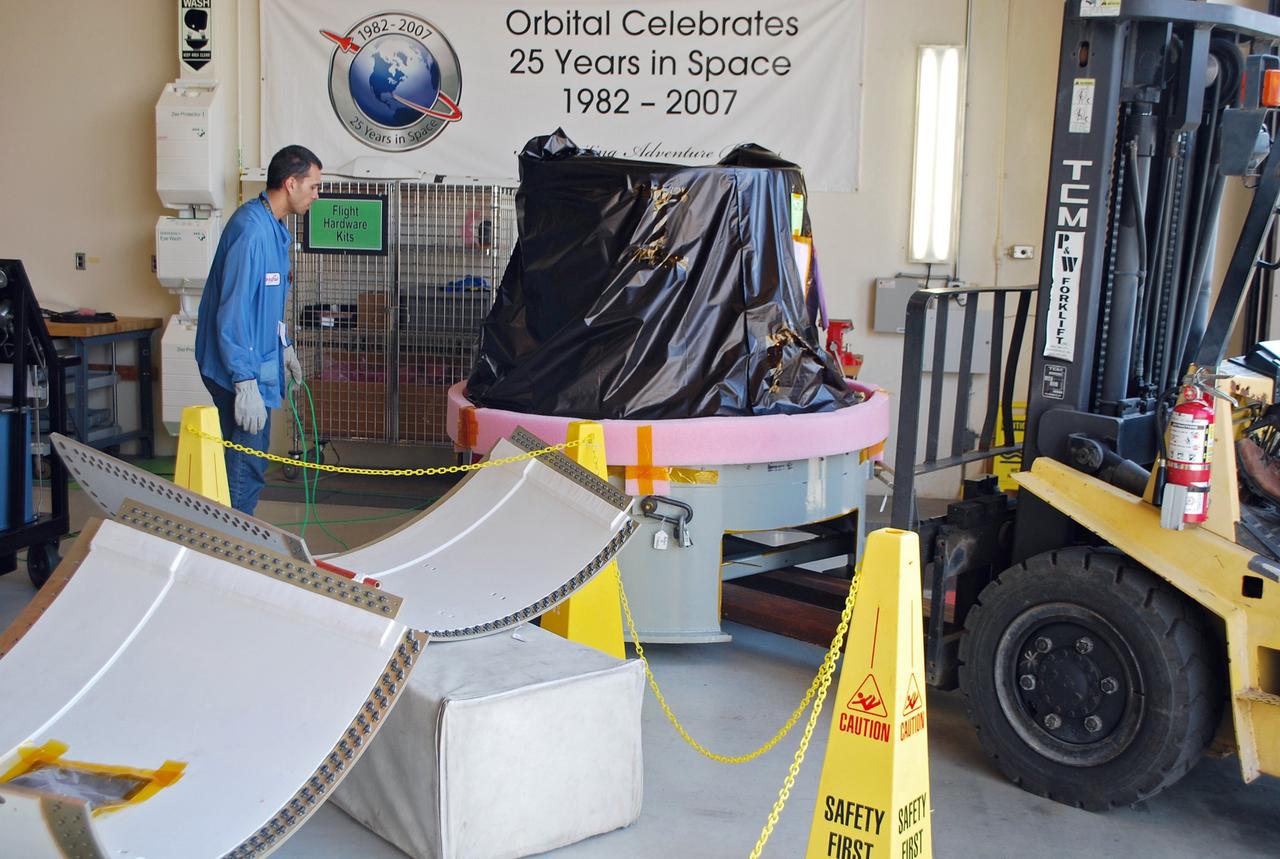
VANDENBERG AIR FORCE BASE, Calif. -- At Vandenberg Air Force Base in California, the payload cone is lowered onto the floor of VAFB's payload processing facility for NASA's Glory mission. The payload cone is an adapter that interfaces the Taurus XL rocket with the spacecraft. A four-stage Taurus XL rocket will carry Glory into low Earth orbit. Once Glory reaches orbit, it will collect data on the properties of aerosols and black carbon. It also will help scientists understand how the sun's irradiance affects Earth's climate. Launch is scheduled for 2:09 a.m. PST Nov. 22. For information, visit www.nasa.gov/glory. Photo credit: NASA/Randy Beaudoin, VAFB
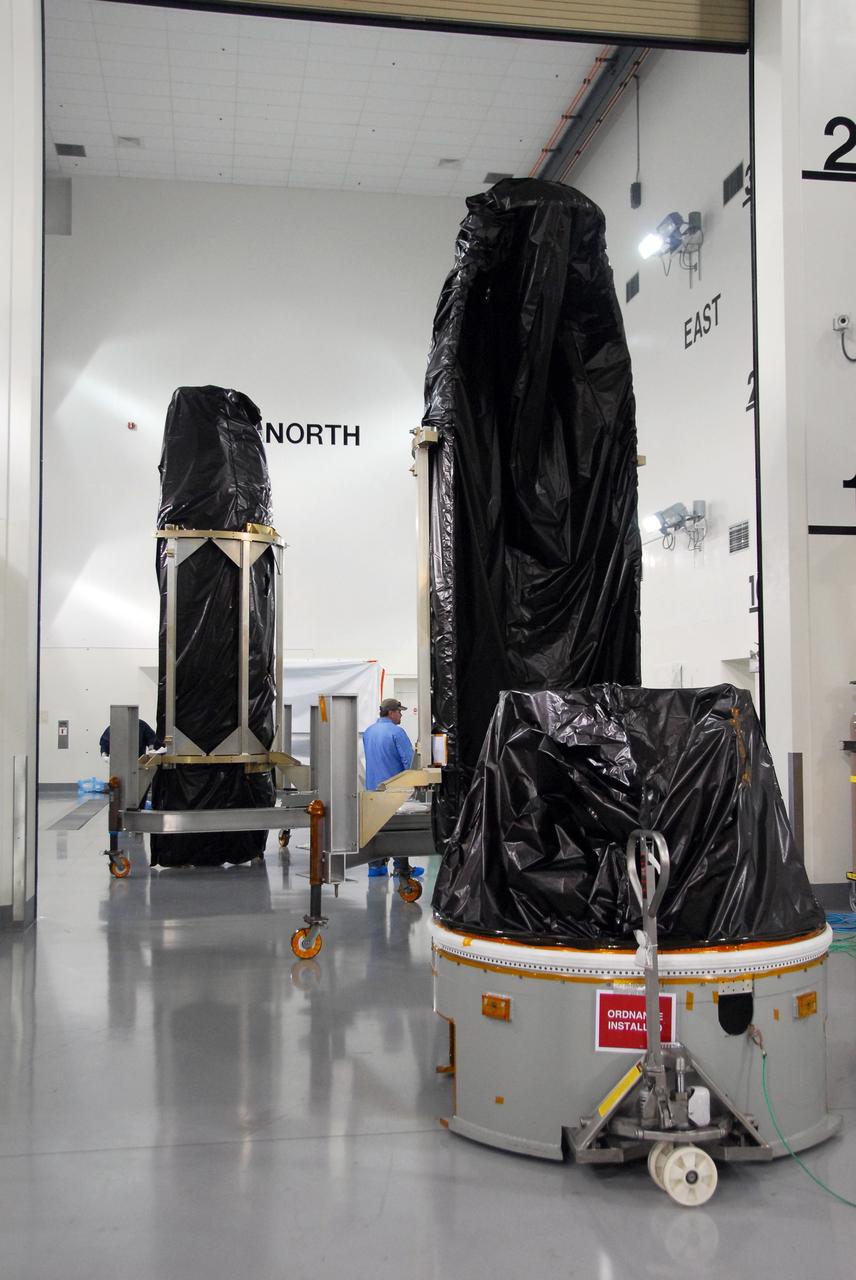
VANDENBERG AIR FORCE BASE, Calif. -- A technician works in the Astrotech payload processing facility at Vandenberg Air Force Base in California before the pieces that will make up the payload fairing for the Glory mission are moved to the East High Bay. The payload fairing will protect the Glory spacecraft from aerodynamic pressures and heating during the first part of its climb into orbit. Once Glory reaches orbit, it will collect data on the properties of aerosols and black carbon. It also will help scientists understand how the sun's irradiance affects Earth's climate. Launch is scheduled for 5:09 a.m. EST Feb. 23. For information, visit www.nasa.gov/glory. Photo credit: NASA/Ed Henry, VAFB
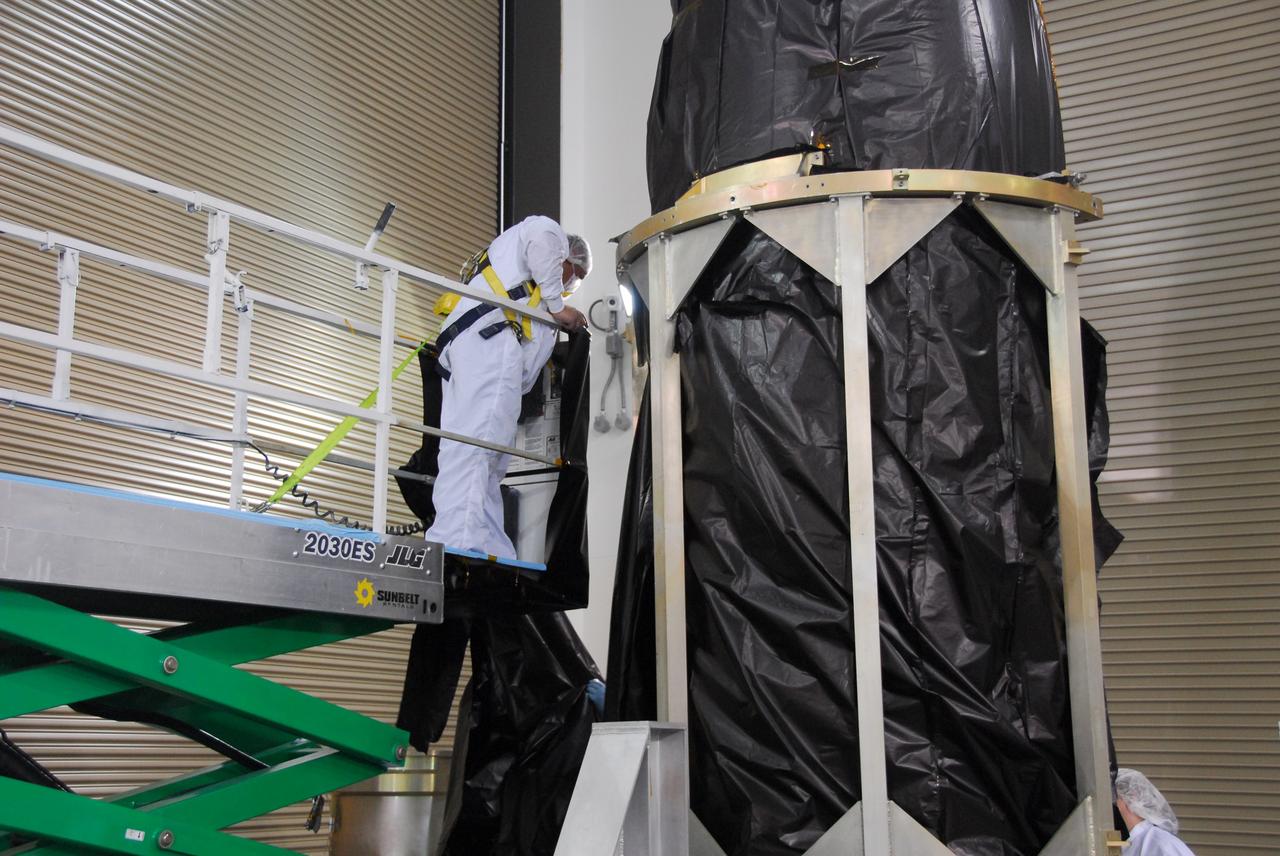
VANDENBERG AIR FORCE BASE, Calif. -- A technician prepare to remove the covering of the payload fairing for the Glory mission. He is working inside the Astrotech payload processing facility at Vandenberg Air Force Base in California. The payload fairing will protect the Glory spacecraft from aerodynamic pressures and heating during the first part of its climb into orbit. Once Glory reaches orbit, it will collect data on the properties of aerosols and black carbon. It also will help scientists understand how the sun's irradiance affects Earth's climate. Launch is scheduled for 5:09 a.m. EST Feb. 23. For information, visit www.nasa.gov/glory. Photo credit: NASA/Ed Henry, VAFB
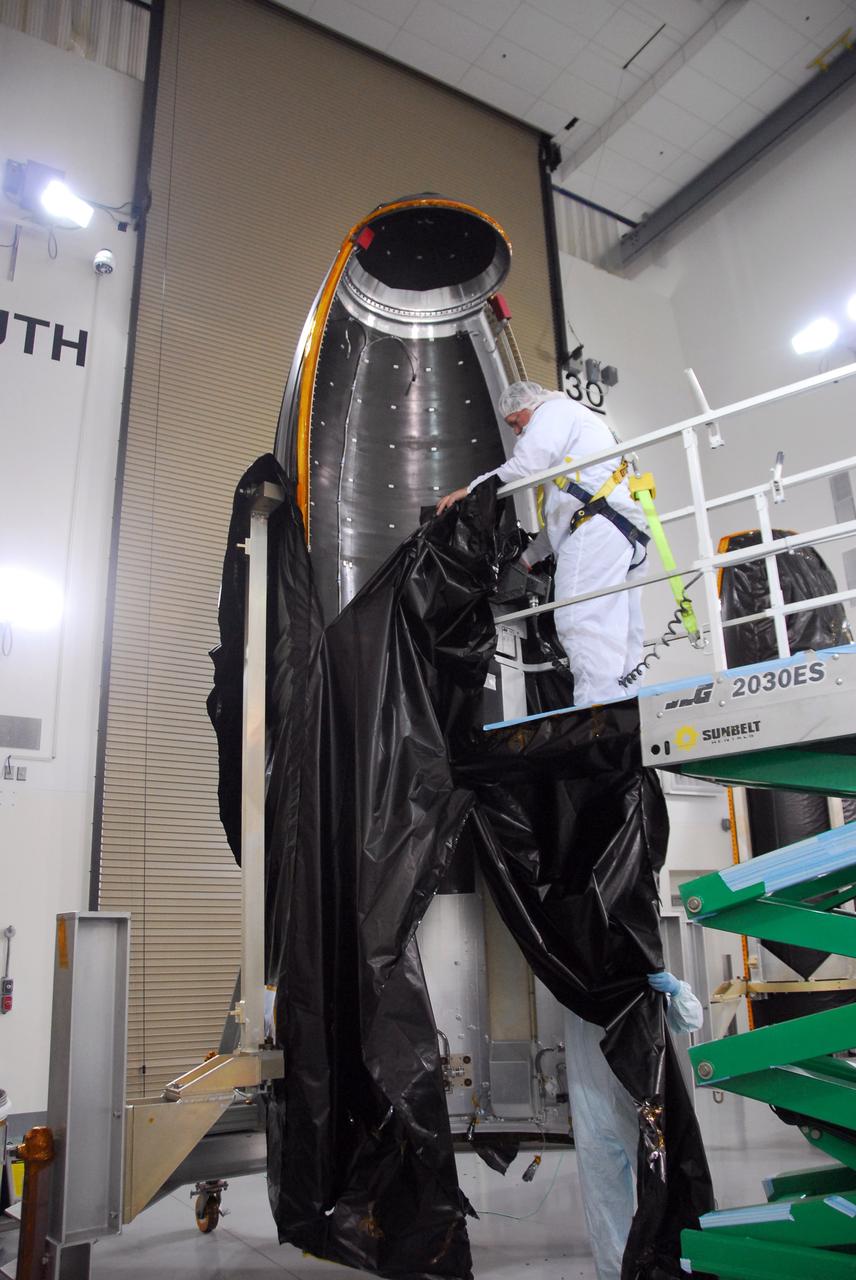
VANDENBERG AIR FORCE BASE, Calif. -- A technician uncovers half of the payload fairing for the Glory mission after the section was moved to the East High Bay of the Astrotech payload processing facility at Vandenberg Air Force Base in California. The payload fairing will protect the Glory spacecraft from aerodynamic pressures and heating during the first part of its climb into orbit. Once Glory reaches orbit, it will collect data on the properties of aerosols and black carbon. It also will help scientists understand how the sun's irradiance affects Earth's climate. Launch is scheduled for 5:09 a.m. EST Feb. 23. For information, visit www.nasa.gov/glory. Photo credit: NASA/Ed Henry, VAFB
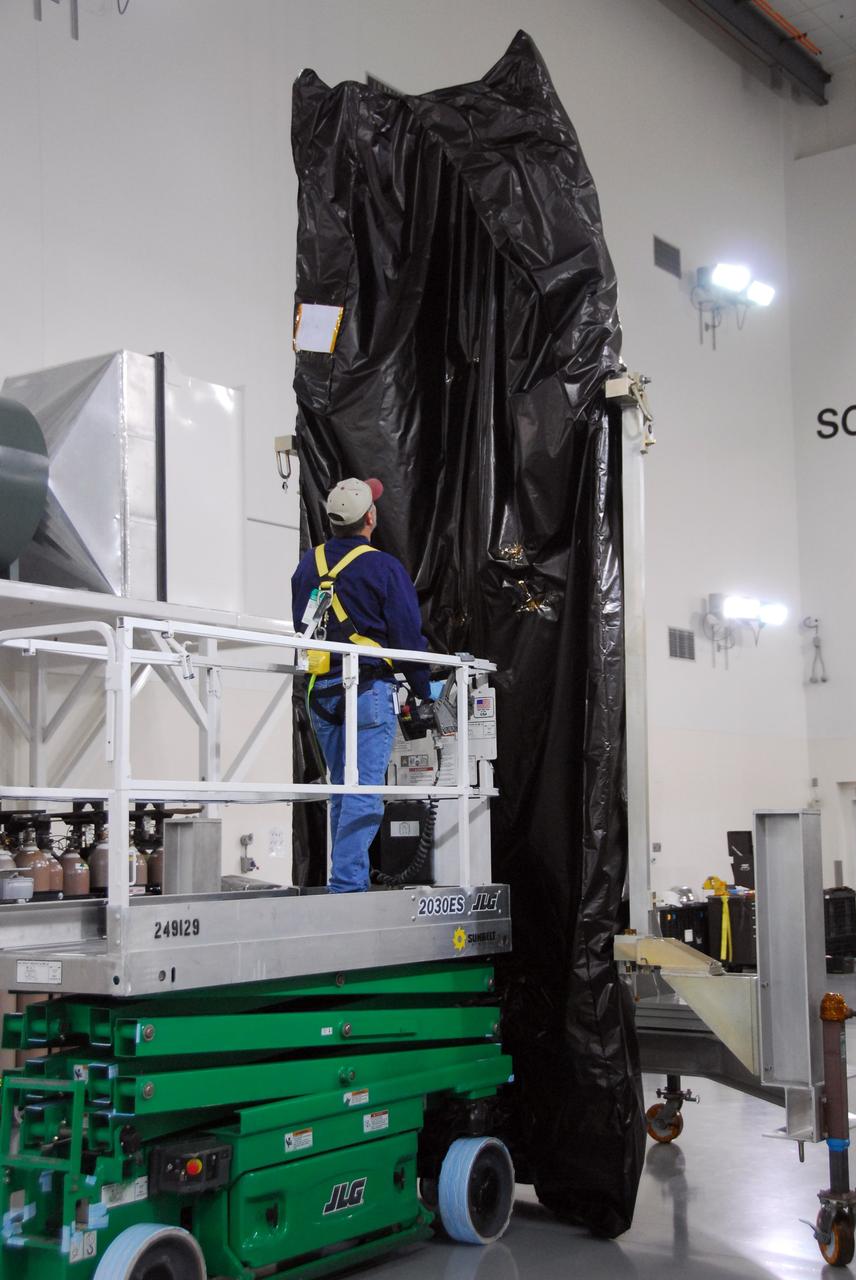
VANDENBERG AIR FORCE BASE, Calif. -- A technician works with half of the payload fairing to be used in the Glory mission before the fairing is moved to the East High Bay at the Astrotech payload processing facility at Vandenberg Air Force Base in California. The payload fairing will protect the Glory spacecraft from aerodynamic pressures and heating during the first part of its climb into orbit. Once Glory reaches orbit, it will collect data on the properties of aerosols and black carbon. It also will help scientists understand how the sun's irradiance affects Earth's climate. Launch is scheduled for 5:09 a.m. EST Feb. 23. For information, visit www.nasa.gov/glory. Photo credit: NASA/Ed Henry, VAFB
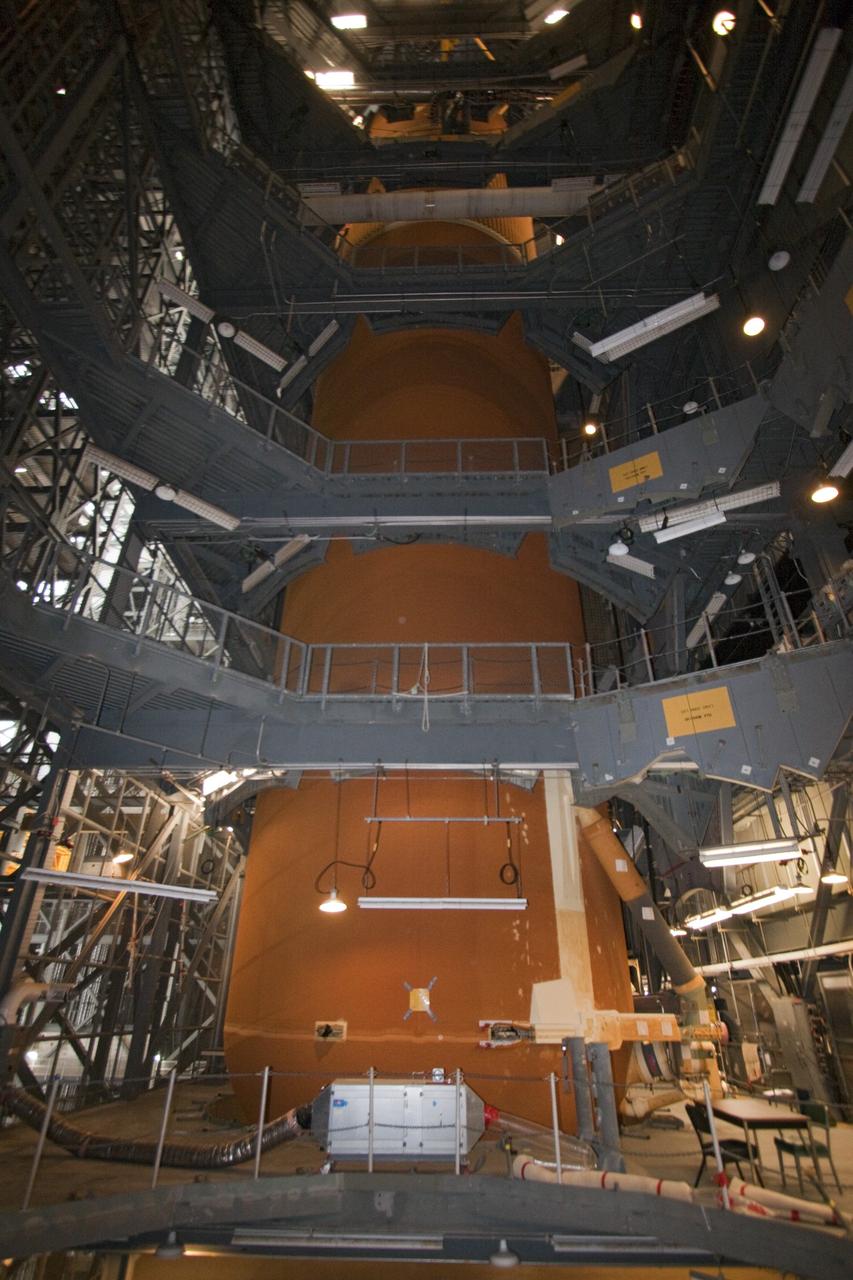
CAPE CANAVERAL, Fla. -- In the Vehicle Assembly Building at NASA's Kennedy Space Center in Florida, external fuel tank, ET-122, for space shuttle Endeavour's STS-134 mission, is ready to be lifted from its test cell. When lowered in place, the tank will be attached to the solid rocket boosters on the mobile launcher platform. Endeavour and its crew will deliver the Express Logistics Carrier-3 and the Alpha Magnetic Spectrometer to the International Space Station. Launch is targeted for April 19. For more information visit, http://www.nasa.gov/mission_pages/shuttle/shuttlemissions/sts134/index.html. Photo credit: NASA/Jack Pfaller
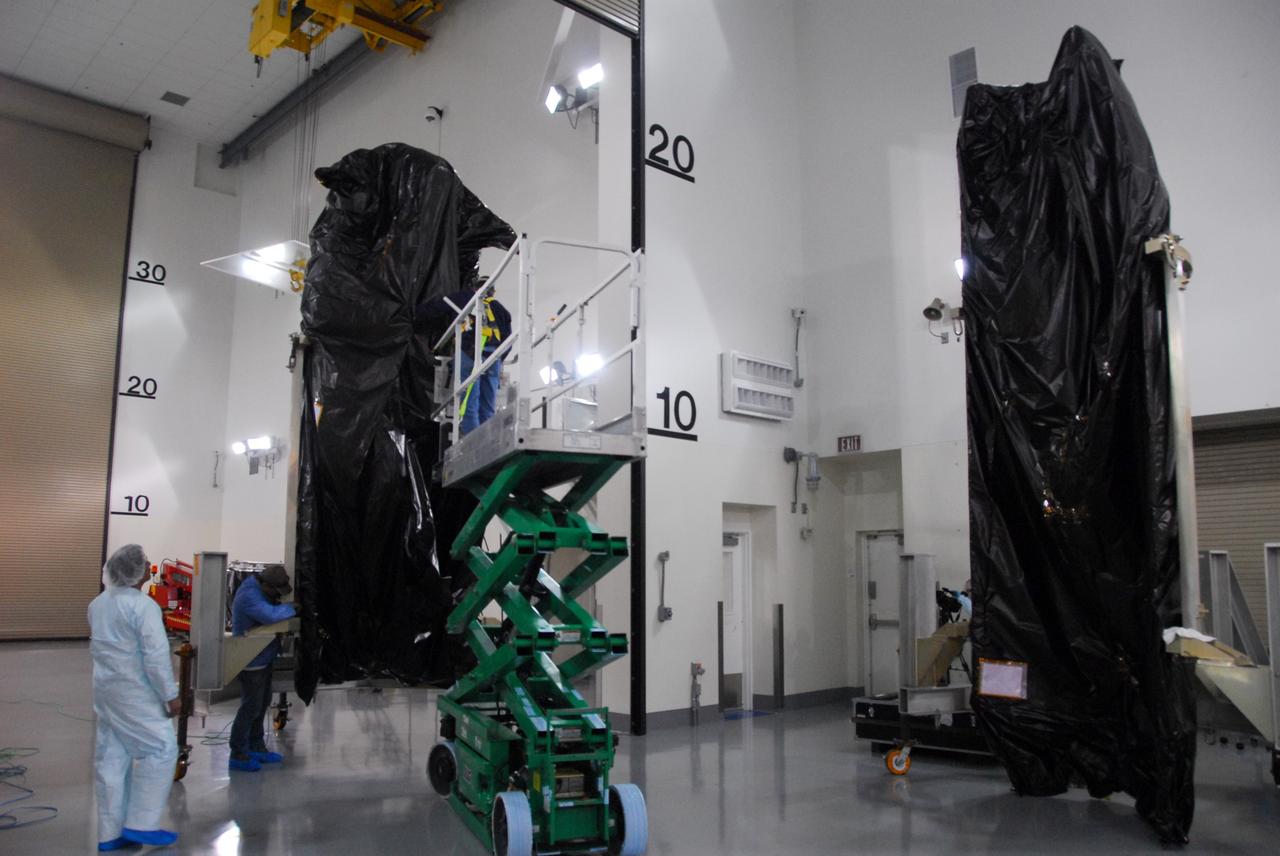
VANDENBERG AIR FORCE BASE, Calif. -- Technicians prepare the payload fairing to be used in the Glory mission before the fairing is moved to East High Bay at the Astrotech payload processing facility at Vandenberg Air Force Base in California. The payload fairing will protect the Glory spacecraft from aerodynamic pressures and heating during the first part of its climb into orbit. Once Glory reaches orbit, it will collect data on the properties of aerosols and black carbon. It also will help scientists understand how the sun's irradiance affects Earth's climate. Launch is scheduled for 5:09 a.m. EST Feb. 23. For information, visit www.nasa.gov/glory. Photo credit: NASA/Ed Henry, VAFB
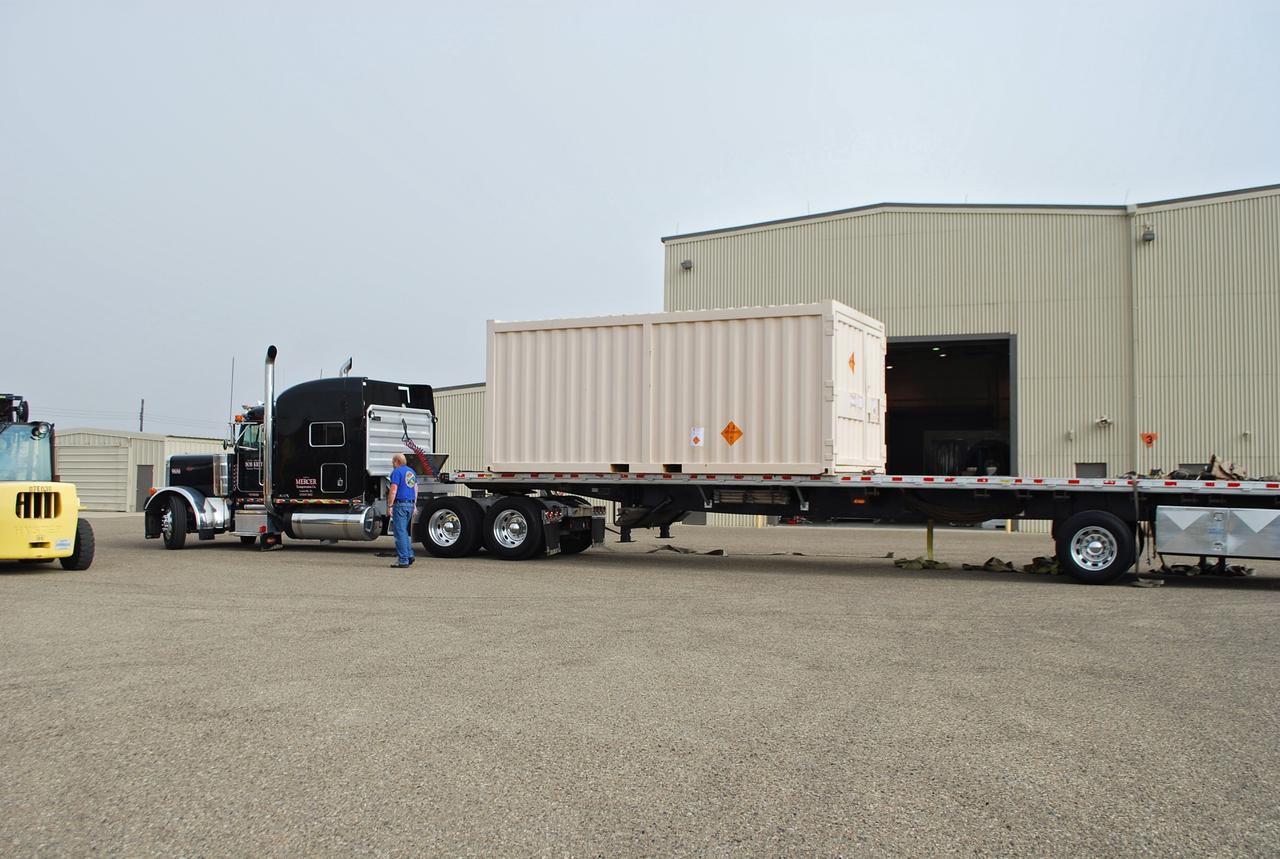
VANDENBERG AIR FORCE BASE, Calif. -- At Vandenberg Air Force Base in California, workers are preparing to unload a payload cone for NASA's Glory mission. The payload cone is an adapter that interfaces the Taurus XL rocket with the spacecraft. A four-stage Taurus XL rocket will carry Glory into low Earth orbit. Once Glory reaches orbit, it will collect data on the properties of aerosols and black carbon. It also will help scientists understand how the sun's irradiance affects Earth's climate. Launch is scheduled for 2:09 a.m. PST Nov. 22. For information, visit www.nasa.gov/glory. Photo credit: NASA/Randy Beaudoin, VAFB
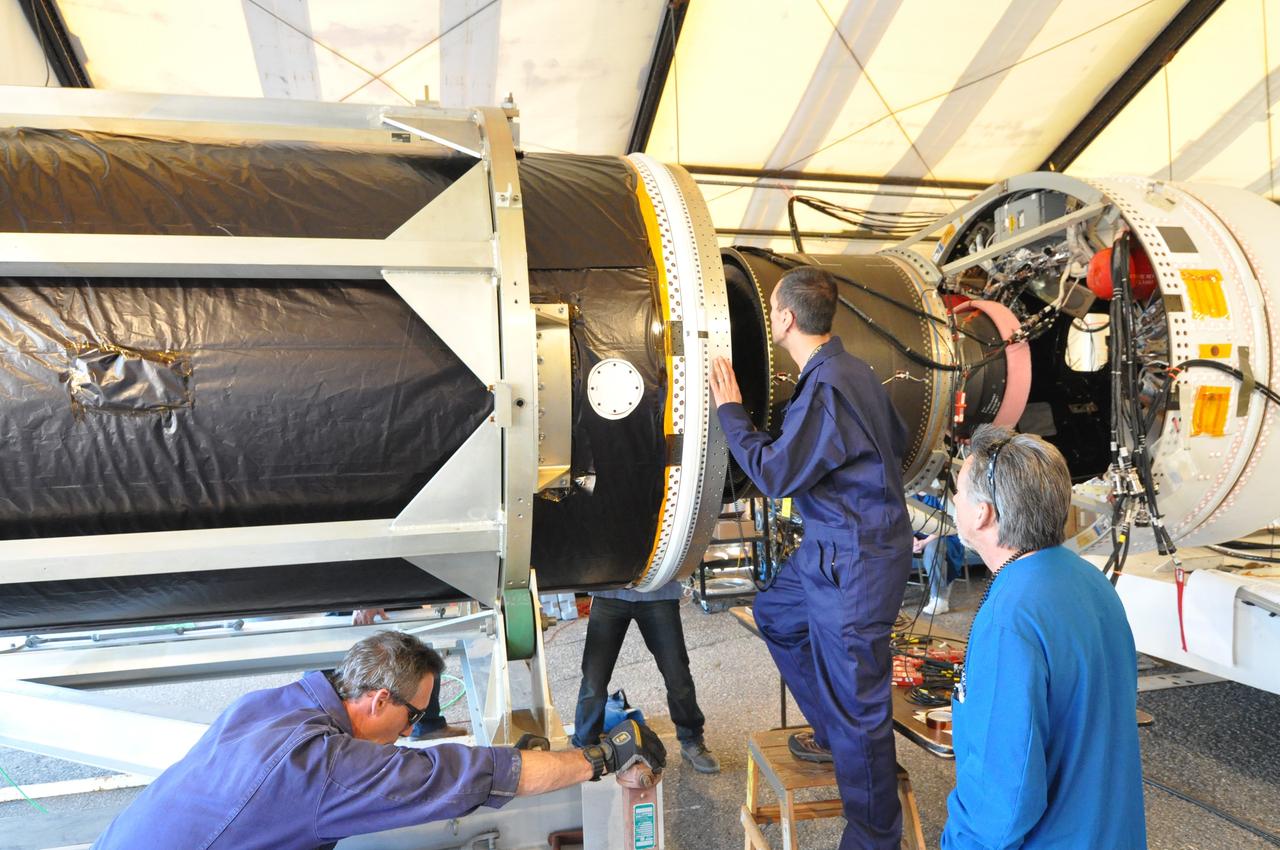
VANDENBERG AIR FORCE BASE, Calif. -- At Vandenberg Air Force Base in California, technicians join NASA's Glory spacecraft with the Taurus XL rocket's third stage, housed inside a temporary processing tent near the pad at Space Launch Complex 576-E. The Orbital Sciences Corp. Taurus XL rocket will carry Glory into low Earth orbit. Once Glory reaches orbit, it will collect data on the properties of aerosols and black carbon. It also will help scientists understand how the sun's irradiance affects Earth's climate. Launch is scheduled for 5:09 a.m. EST Feb. 23. For information, visit www.nasa.gov/glory. Photo credit: NASA/Randy Beaudoin, VAFB
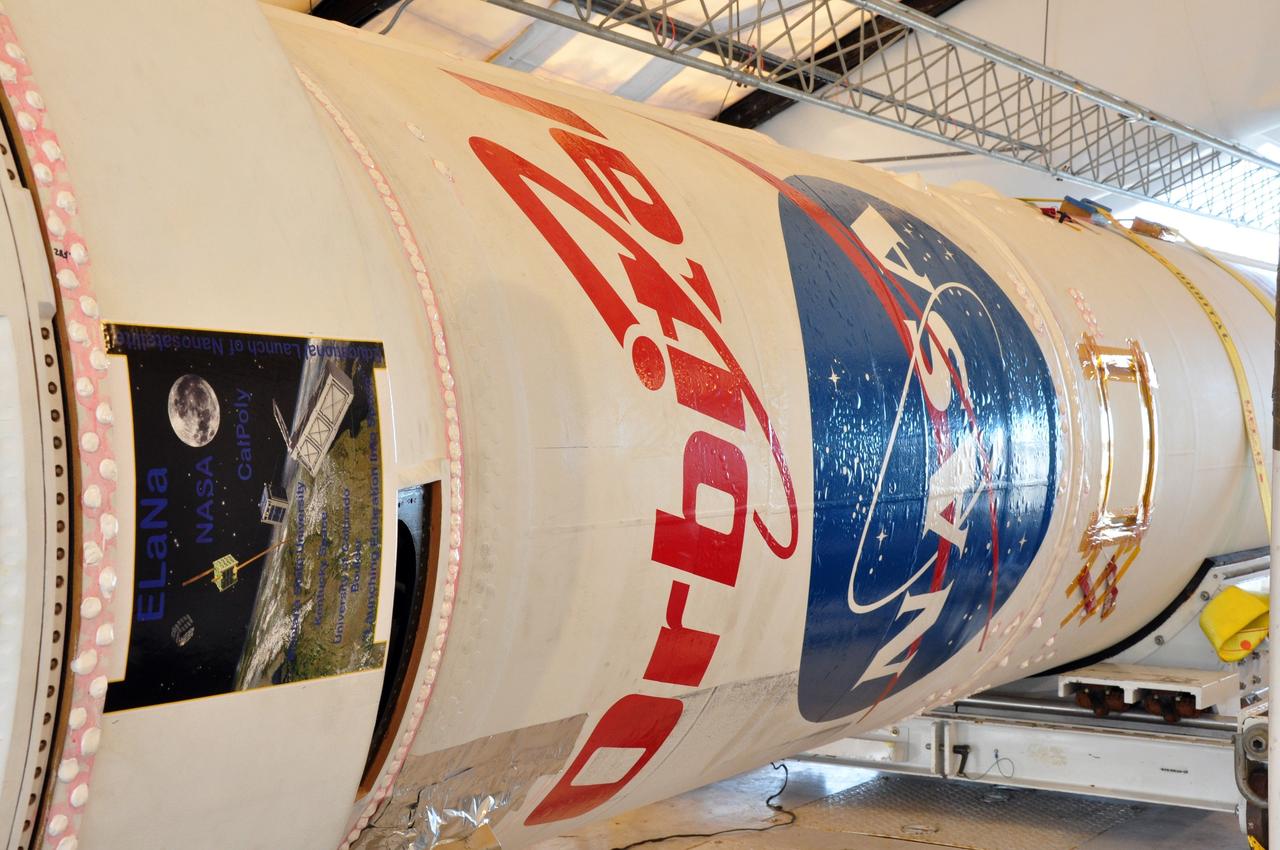
VANDENBERG AIR FORCE BASE, Calif. -- At Space Launch Complex 576-E at Vandenberg Air Force Base in California, NASA's Glory spacecraft already integrated with the upper stack of the Taurus rocket displays the mission decals. The Orbital Sciences Corp. Taurus XL rocket will launch Glory into low Earth orbit. Once Glory reaches orbit, it will collect data on the properties of aerosols and black carbon. It also will help scientists understand how the sun's irradiance affects Earth's climate. Launch is scheduled for 5:09 a.m. EST Feb. 23. For information, visit www.nasa.gov/glory. Photo credit: NASA/Randy Beaudoin, VAFB
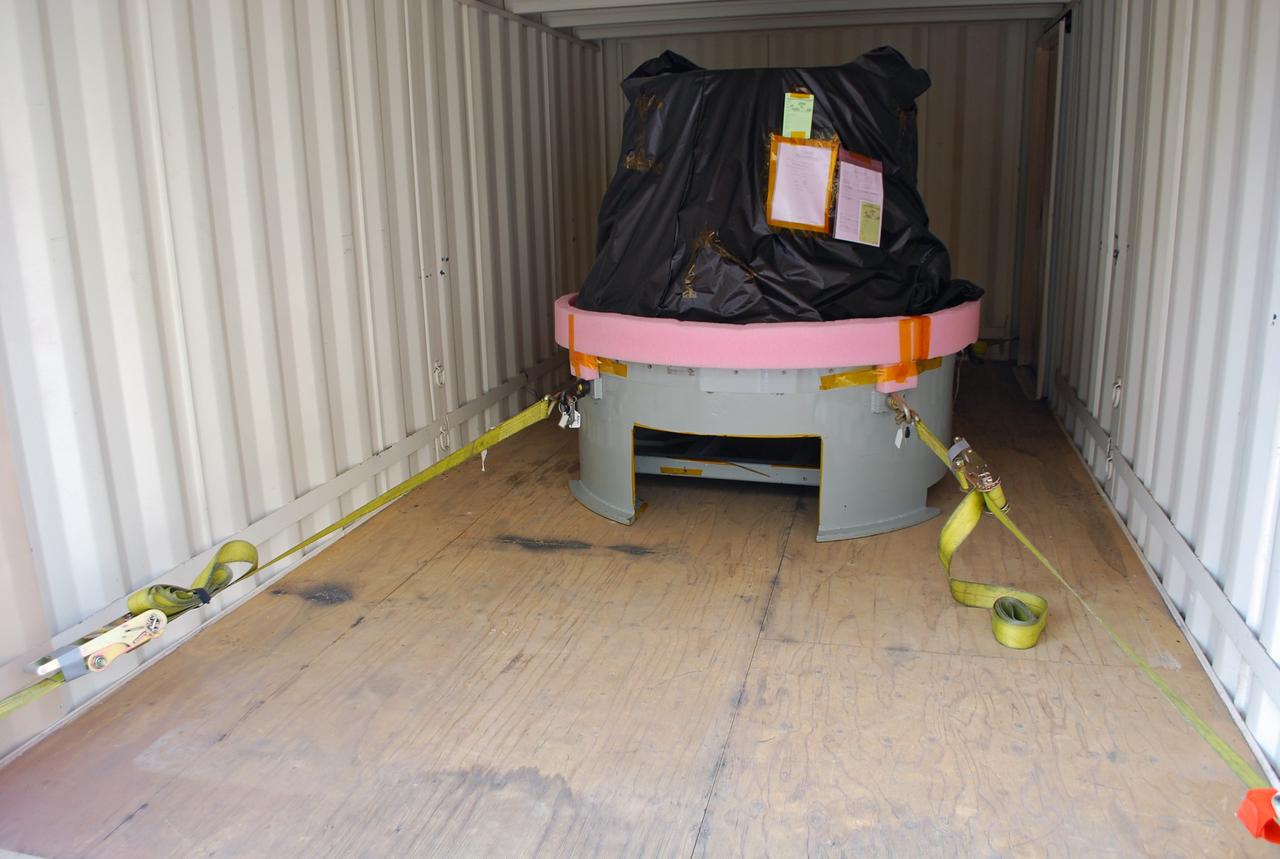
VANDENBERG AIR FORCE BASE, Calif. -- At Vandenberg Air Force Base in California, the payload cone for NASA's Glory mission is pictures secured inside its cargo carrier. The payload cone is an adapter that interfaces the Taurus XL rocket with the spacecraft. A four-stage Taurus XL rocket will carry Glory into low Earth orbit. Once Glory reaches orbit, it will collect data on the properties of aerosols and black carbon. It also will help scientists understand how the sun's irradiance affects Earth's climate. Launch is scheduled for 2:09 a.m. PST Nov. 22. For information, visit www.nasa.gov/glory. Photo credit: NASA/Randy Beaudoin, VAFB
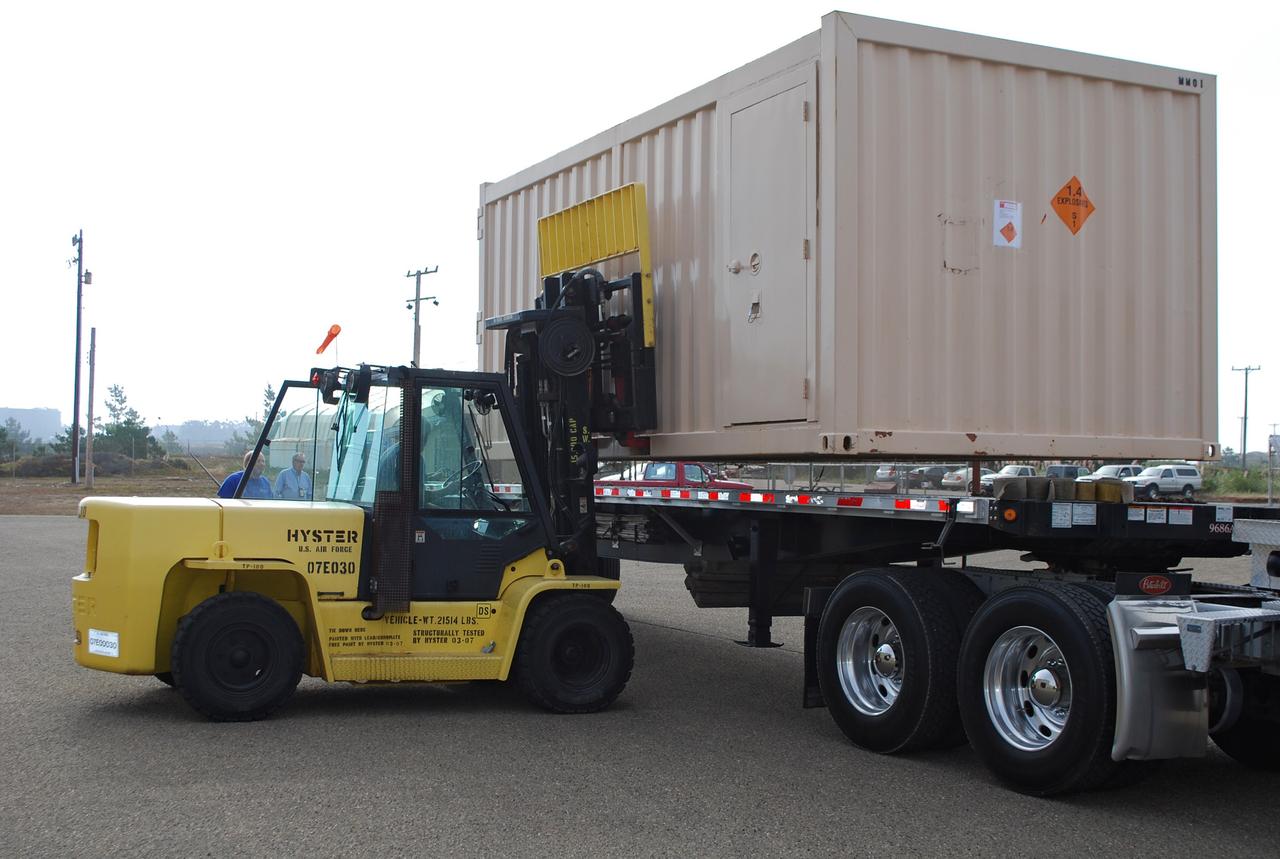
VANDENBERG AIR FORCE BASE, Calif. -- At Vandenberg Air Force Base in California, workers are preparing to unload a payload cone for NASA's Glory mission. The payload cone is an adapter that interfaces the Taurus XL rocket with the spacecraft. A four-stage Taurus XL rocket will carry Glory into low Earth orbit. Once Glory reaches orbit, it will collect data on the properties of aerosols and black carbon. It also will help scientists understand how the sun's irradiance affects Earth's climate. Launch is scheduled for 2:09 a.m. PST Nov. 22. For information, visit www.nasa.gov/glory. Photo credit: NASA/Randy Beaudoin, VAFB
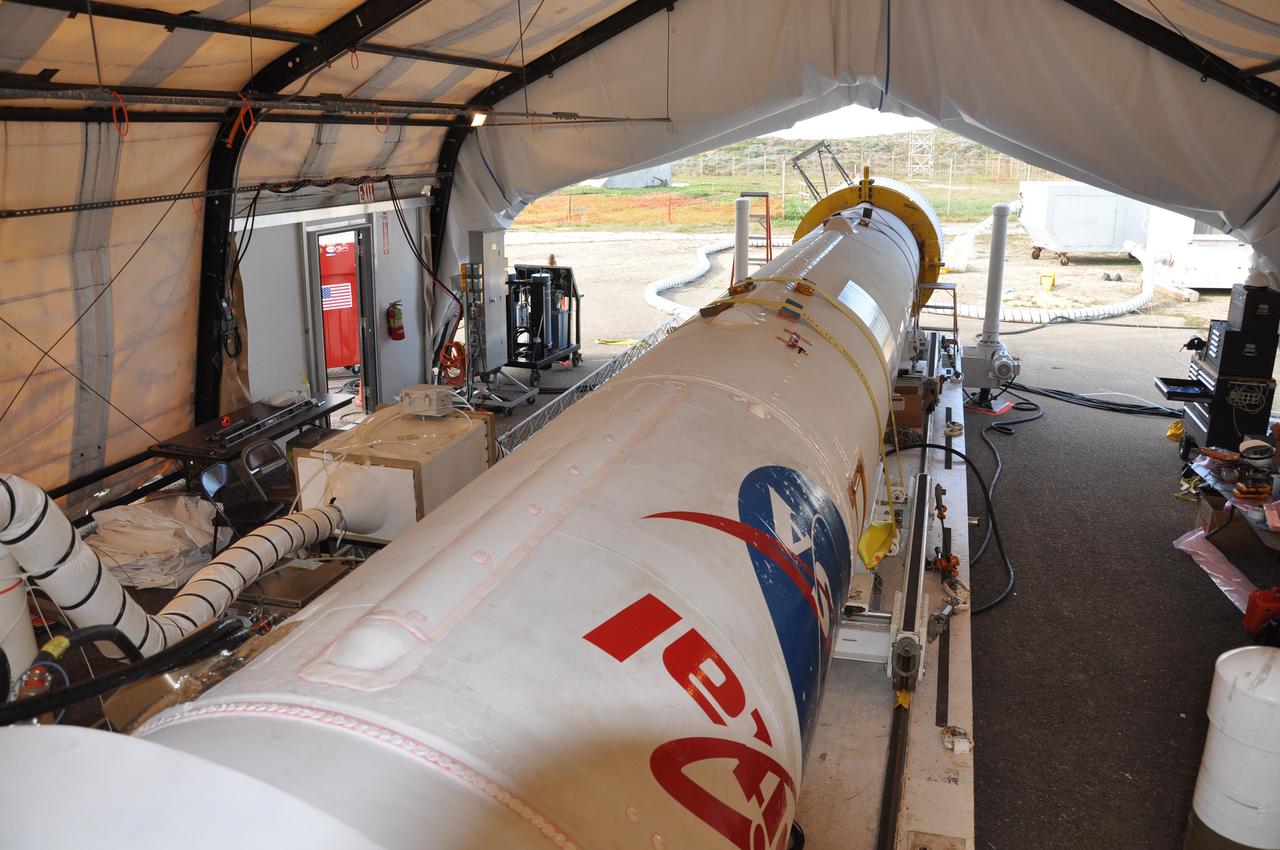
VANDENBERG AIR FORCE BASE, Calif. -- At Space Launch Complex 576-E at Vandenberg Air Force Base in California, NASA's Glory spacecraft, already integrated with the upper stack of the Taurus rocket, awaits installation of the upper umbilical tower inside a processing tent near the pad. The Orbital Sciences Corp. Taurus XL rocket will launch Glory into low Earth orbit. Once Glory reaches orbit, it will collect data on the properties of aerosols and black carbon. It also will help scientists understand how the sun's irradiance affects Earth's climate. Launch is scheduled for 5:09 a.m. EST Feb. 23. For information, visit www.nasa.gov/glory. Photo credit: NASA/Randy Beaudoin, VAFB
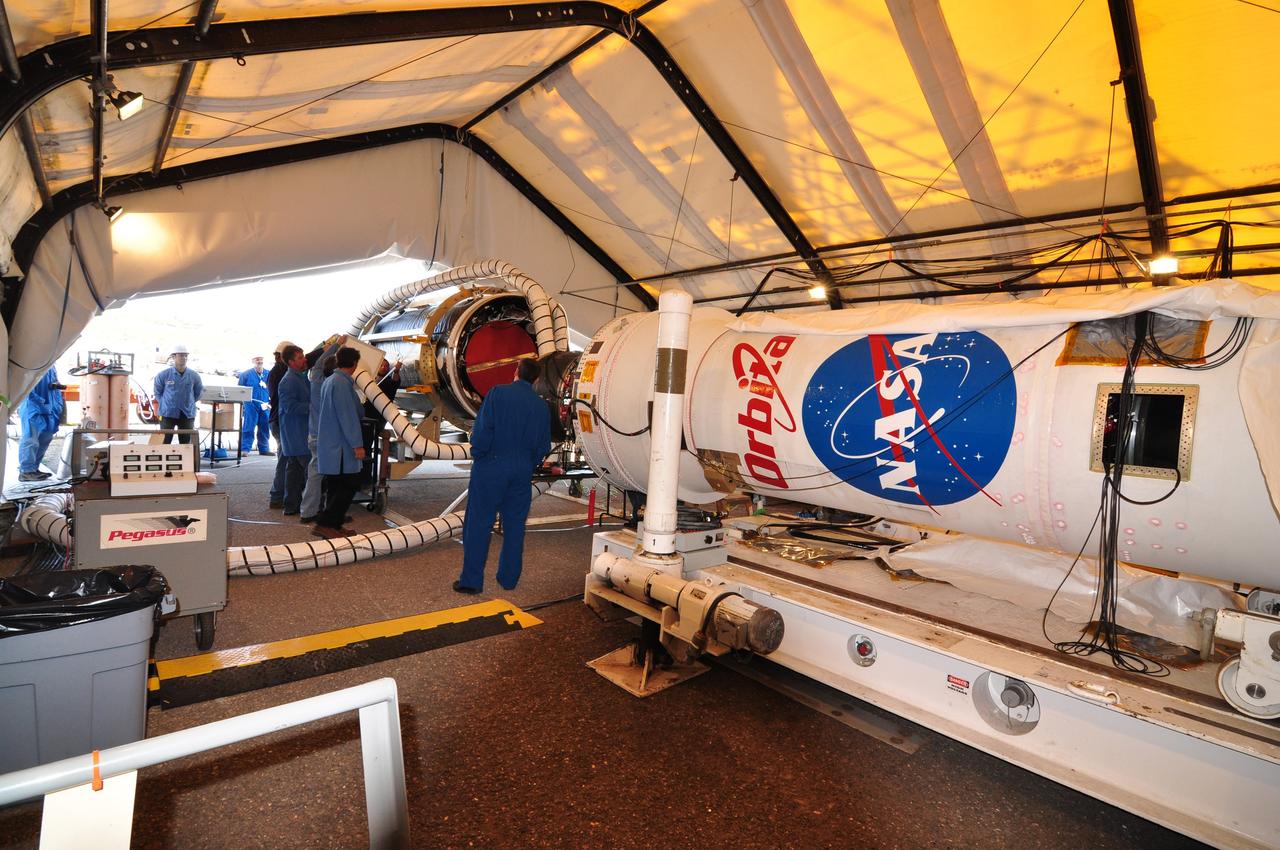
VANDENBERG AIR FORCE BASE, Calif. -- At Vandenberg Air Force Base in California, technicians are preparing to join NASA's Glory spacecraft with the Taurus XL rocket's third stage housed inside a temporary processing tent near the pad at Space Launch Complex 576-E. The Orbital Sciences Corp. Taurus XL rocket will carry Glory into low Earth orbit. Once Glory reaches orbit, it will collect data on the properties of aerosols and black carbon. It also will help scientists understand how the sun's irradiance affects Earth's climate. Launch is scheduled for 5:09 a.m. EST Feb. 23. For information, visit www.nasa.gov/glory. Photo credit: NASA/Randy Beaudoin, VAFB
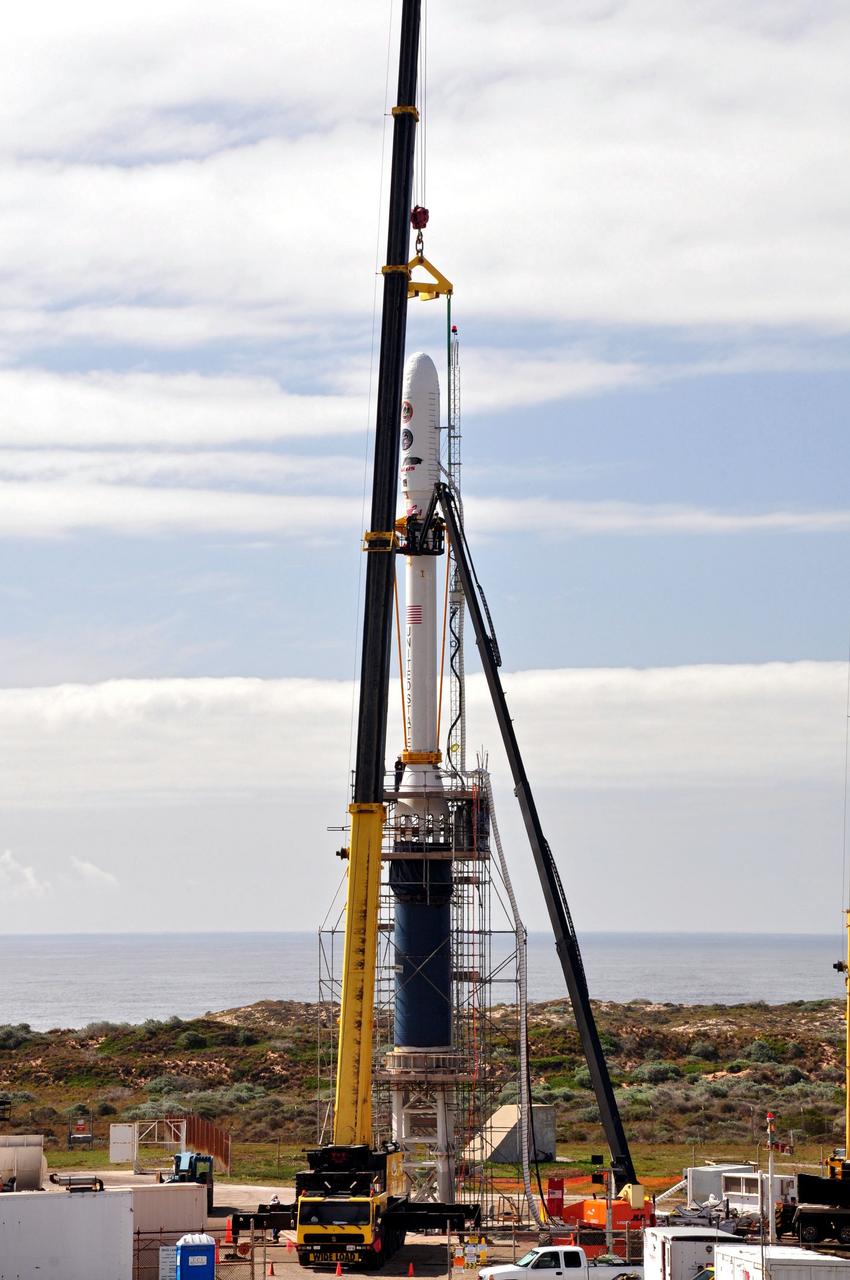
VANDENBERG AIR FORCE BASE, Calif. -- On Space Launch Complex 576-E at Vandenberg Air Force Base in California, workers in a bucket begin the process of removing the lifting fixture and sling from NASA's Glory upper stack after it was secured in place to the Taurus XL rocket's Stage 0. The upper stack consists of Stages 1, 2 and 3 of the Taurus as well as the encapsulated Glory spacecraft. The Orbital Sciences Taurus XL rocket will launch Glory into low Earth orbit. Once Glory reaches orbit, it will collect data on the properties of aerosols and black carbon. It also will help scientists understand how the sun's irradiance affects Earth's climate. Launch is scheduled for 5:09 a.m. EST Feb. 23. For information, visit www.nasa.gov/glory. Photo credit: NASA/Randy Beaudoin, VAFB
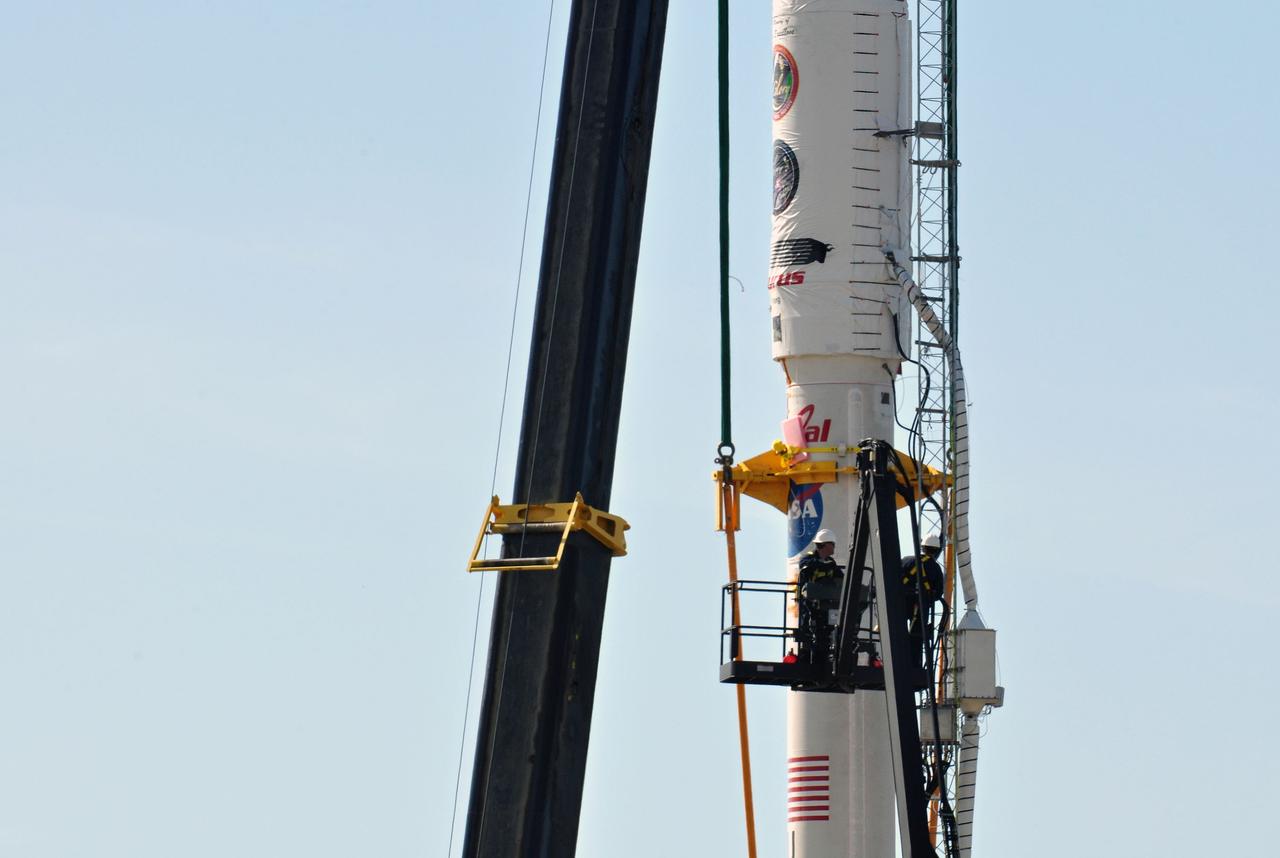
VANDENBERG AIR FORCE BASE, Calif. -- On Space Launch Complex 576-E at Vandenberg Air Force Base in California, workers in a bucket begin the process of removing the lifting fixture and sling from NASA's Glory upper stack after it was secured in place to the Taurus XL rocket's Stage 0. The upper stack consists of Stages 1, 2 and 3 of the Taurus as well as the encapsulated Glory spacecraft. The Orbital Sciences Taurus XL rocket will launch Glory into low Earth orbit. Once Glory reaches orbit, it will collect data on the properties of aerosols and black carbon. It also will help scientists understand how the sun's irradiance affects Earth's climate. Launch is scheduled for 5:09 a.m. EST Feb. 23. For information, visit www.nasa.gov/glory. Photo credit: NASA/Randy Beaudoin, VAFB
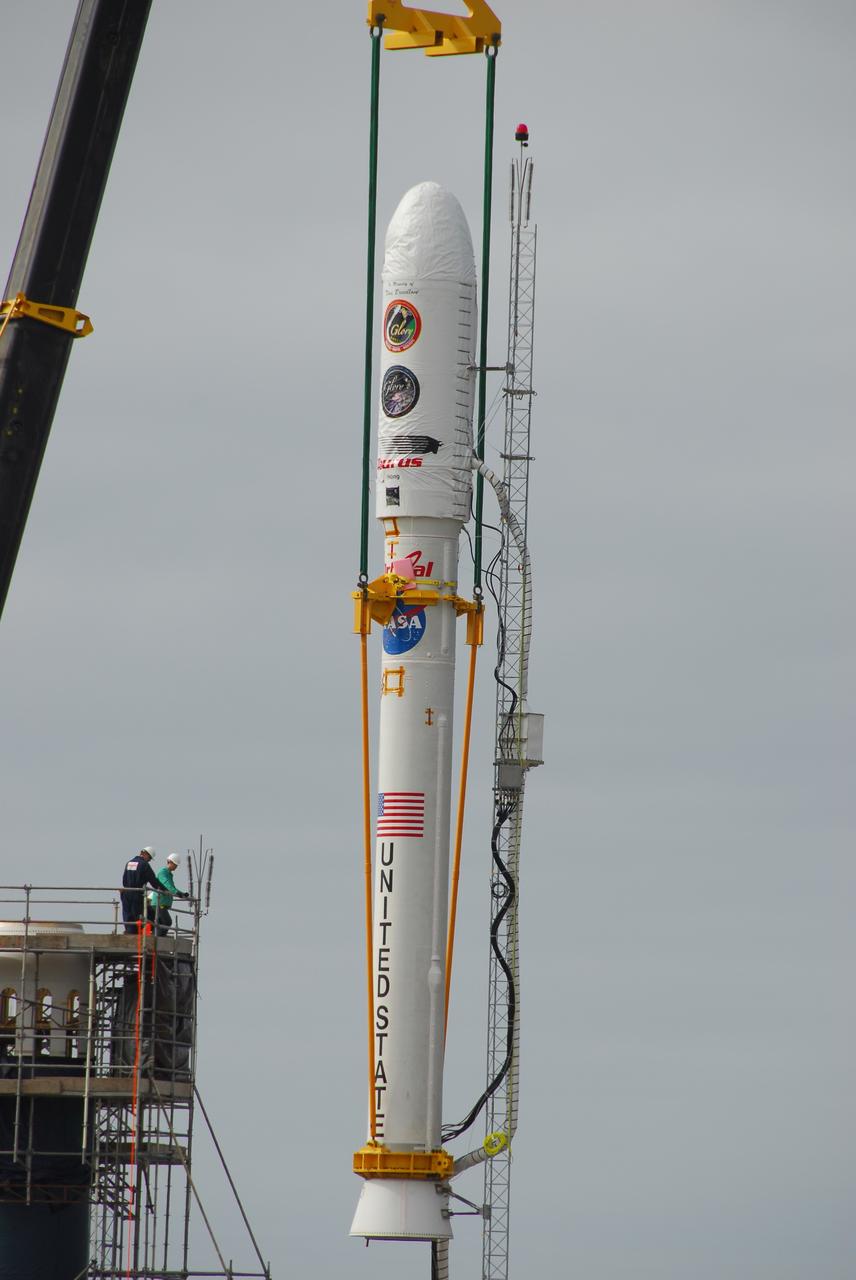
VANDENBERG AIR FORCE BASE, Calif. -- On Space Launch Complex 576-E at Vandenberg Air Force Base in California, a crane lowers NASA's Glory upper stack toward the Taurus XL rocket's Stage 0. The upper stack consists of Stages 1, 2 and 3 of the Taurus as well as the encapsulated Glory spacecraft. The Orbital Sciences Taurus XL rocket will launch Glory into low Earth orbit. Once Glory reaches orbit, it will collect data on the properties of aerosols and black carbon. It also will help scientists understand how the sun's irradiance affects Earth's climate. Launch is scheduled for 5:09 a.m. EST Feb. 23. For information, visit www.nasa.gov/glory. Photo credit: NASA/VAFB
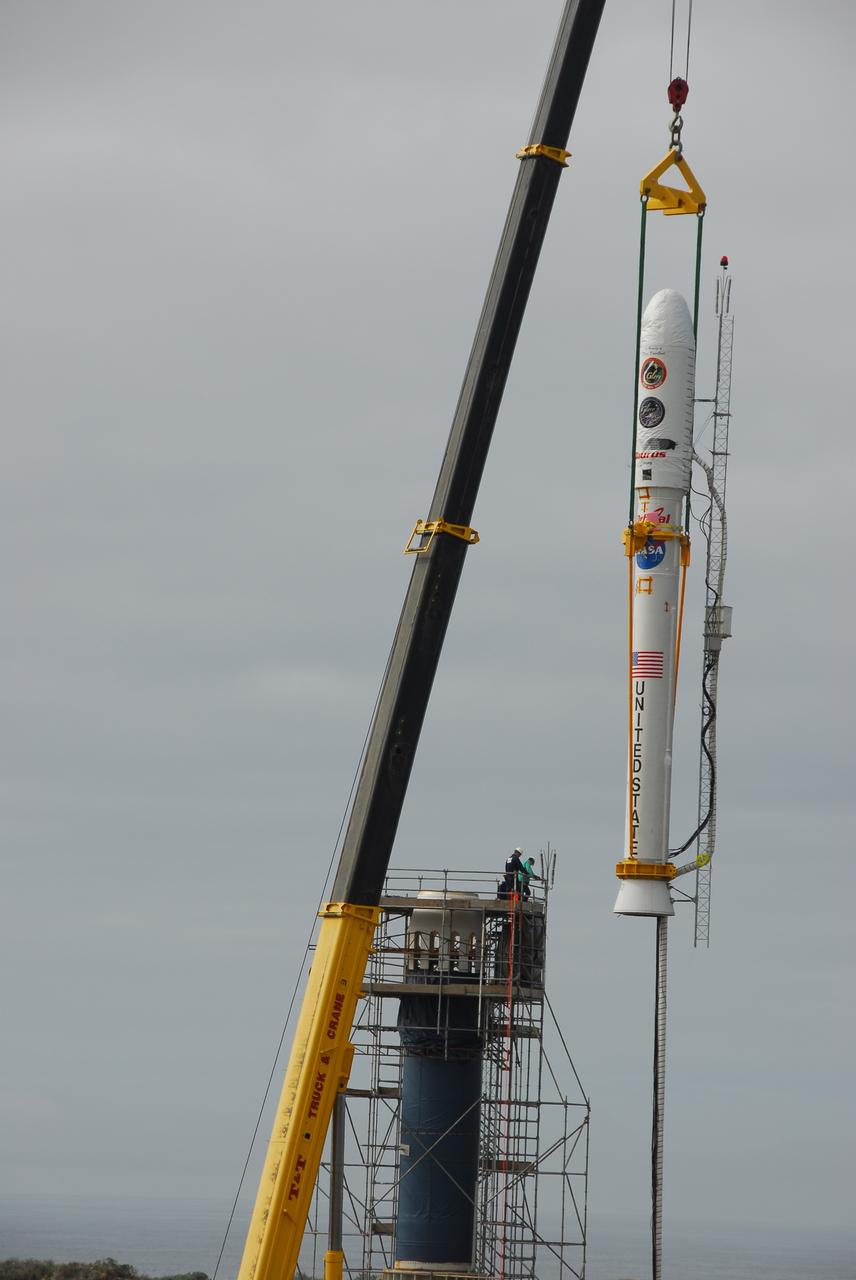
VANDENBERG AIR FORCE BASE, Calif. -- On Space Launch Complex 576-E at Vandenberg Air Force Base in California, a crane moves NASA's Glory upper stack toward the Taurus XL rocket's Stage 0. The upper stack consists of Stages 1, 2 and 3 of the Taurus as well as the encapsulated Glory spacecraft. The Orbital Sciences Taurus XL rocket will launch Glory into low Earth orbit. Once Glory reaches orbit, it will collect data on the properties of aerosols and black carbon. It also will help scientists understand how the sun's irradiance affects Earth's climate. Launch is scheduled for 5:09 a.m. EST Feb. 23. For information, visit www.nasa.gov/glory. Photo credit: NASA/VAFB
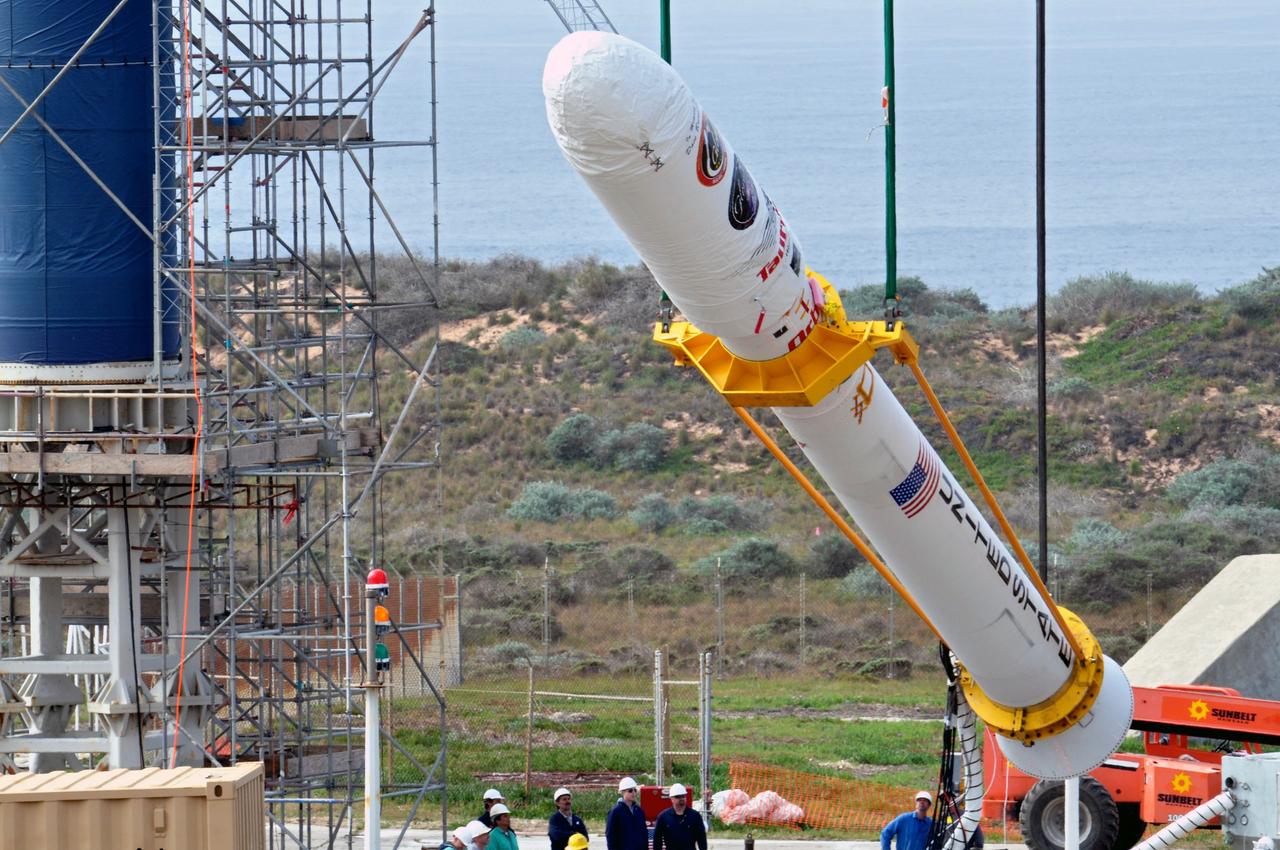
VANDENBERG AIR FORCE BASE, Calif. -- On Space Launch Complex 576-E at Vandenberg Air Force Base in California, Orbital Sciences workers monitor NASA's Glory upper stack as a crane lifts it from a stationary rail for attachment to the Taurus XL rocket's Stage 0. The upper stack consists of Stages 1, 2 and 3 of the Taurus as well as the encapsulated Glory spacecraft. Workers put the non-flight environmental shield over the fairing prior to assembly. The Orbital Sciences Taurus XL rocket will launch Glory into low Earth orbit. Once Glory reaches orbit, it will collect data on the properties of aerosols and black carbon. It also will help scientists understand how the sun's irradiance affects Earth's climate. Launch is scheduled for 5:09 a.m. EST Feb. 23. For information, visit www.nasa.gov/glory. Photo credit: NASA/Randy Beaudoin, VAFB
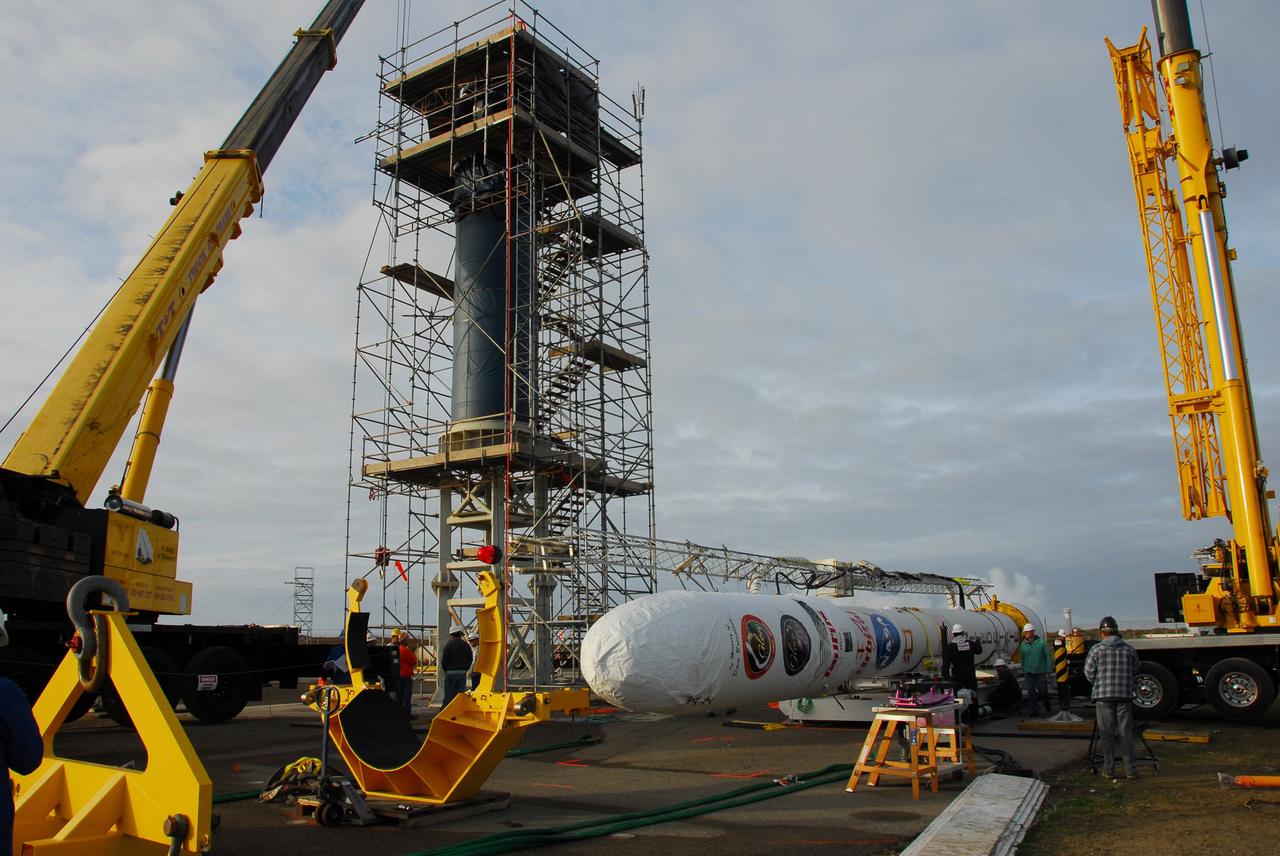
VANDENBERG AIR FORCE BASE, Calif. -- On Space Launch Complex 576-E at Vandenberg Air Force Base in California, Orbital Sciences workers prepare NASA's Glory upper stack for attachment to the Taurus XL rocket's Stage 0. The upper stack consists of Stages 1, 2 and 3 of the Taurus as well as the encapsulated Glory spacecraft. The Orbital Sciences Taurus XL rocket will launch Glory into low Earth orbit. Once Glory reaches orbit, it will collect data on the properties of aerosols and black carbon. It also will help scientists understand how the sun's irradiance affects Earth's climate. Launch is scheduled for 5:09 a.m. EST Feb. 23. For information, visit www.nasa.gov/glory. Photo credit: NASA/VAFB
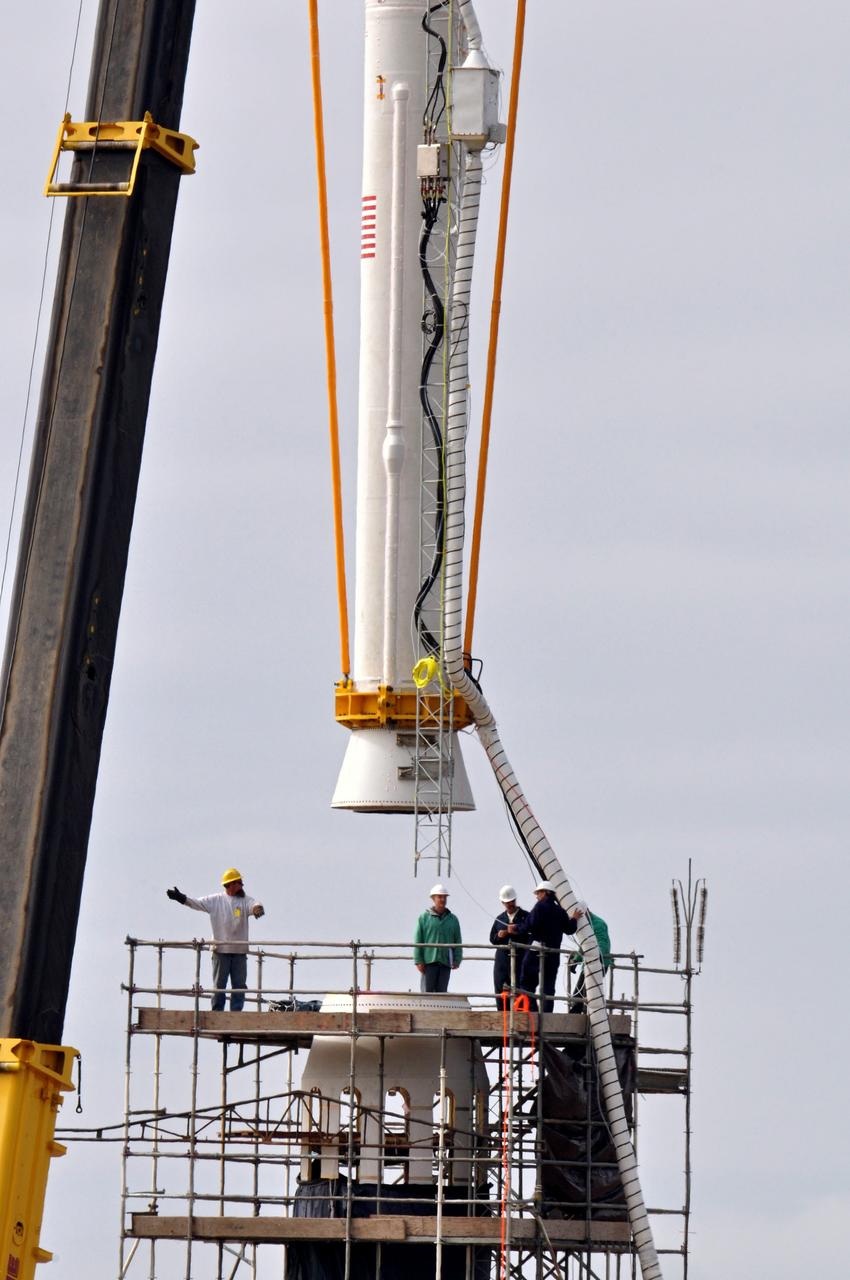
VANDENBERG AIR FORCE BASE, Calif. -- On Space Launch Complex 576-E at Vandenberg Air Force Base in California, workers guide NASA's Glory upper stack as a crane lowers it toward the Taurus XL rocket's Stage 0. The upper stack consists of Stages 1, 2 and 3 of the Taurus as well as the encapsulated Glory spacecraft. The Orbital Sciences Taurus XL rocket will launch Glory into low Earth orbit. Once Glory reaches orbit, it will collect data on the properties of aerosols and black carbon. It also will help scientists understand how the sun's irradiance affects Earth's climate. Launch is scheduled for 5:09 a.m. EST Feb. 23. For information, visit www.nasa.gov/glory. Photo credit: NASA/Randy Beaudoin, VAFB
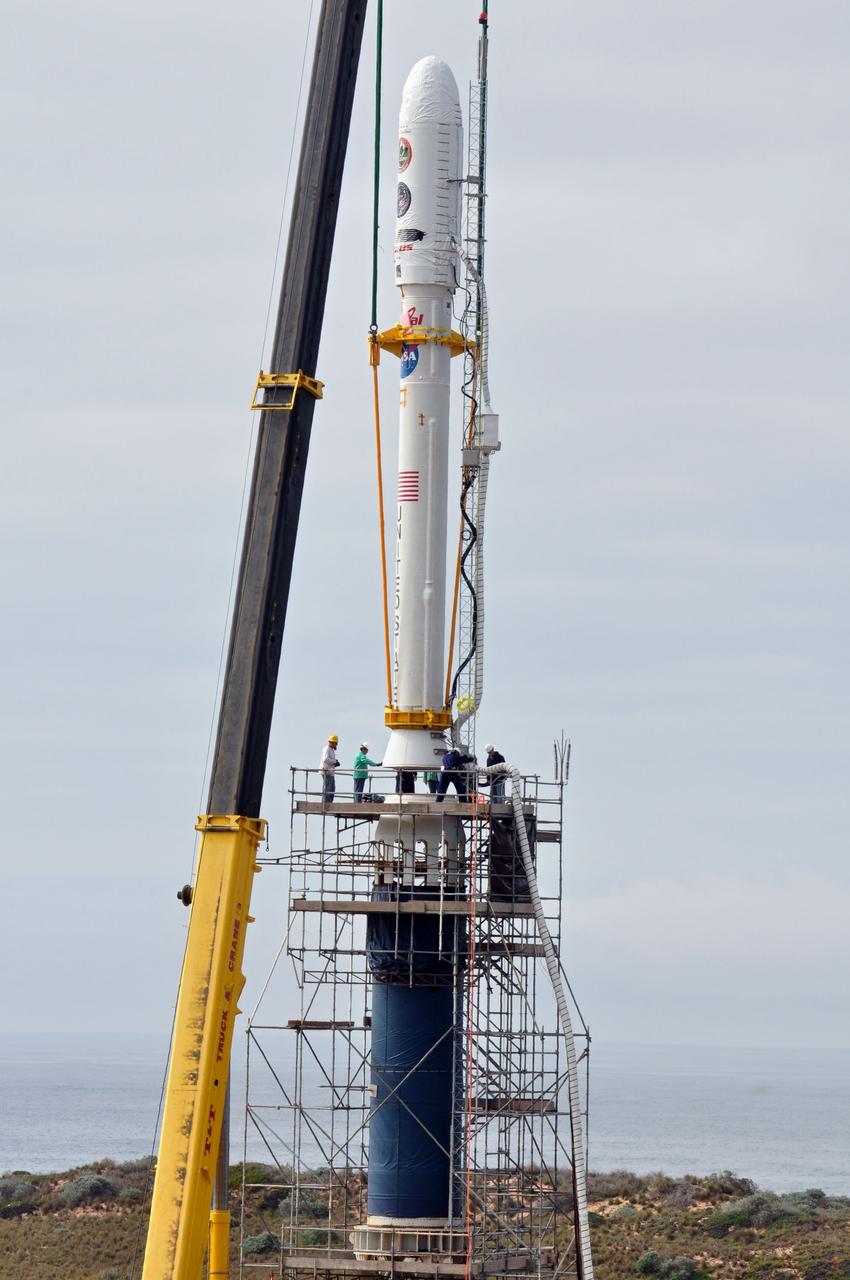
VANDENBERG AIR FORCE BASE, Calif. -- On Space Launch Complex 576-E at Vandenberg Air Force Base in California, workers guide NASA's Glory upper stack as a crane lowers it toward the Taurus XL rocket's Stage 0. The upper stack consists of Stages 1, 2 and 3 of the Taurus as well as the encapsulated Glory spacecraft. The Orbital Sciences Taurus XL rocket will launch Glory into low Earth orbit. Once Glory reaches orbit, it will collect data on the properties of aerosols and black carbon. It also will help scientists understand how the sun's irradiance affects Earth's climate. Launch is scheduled for 5:09 a.m. EST Feb. 23. For information, visit www.nasa.gov/glory. Photo credit: NASA/Randy Beaudoin, VAFB
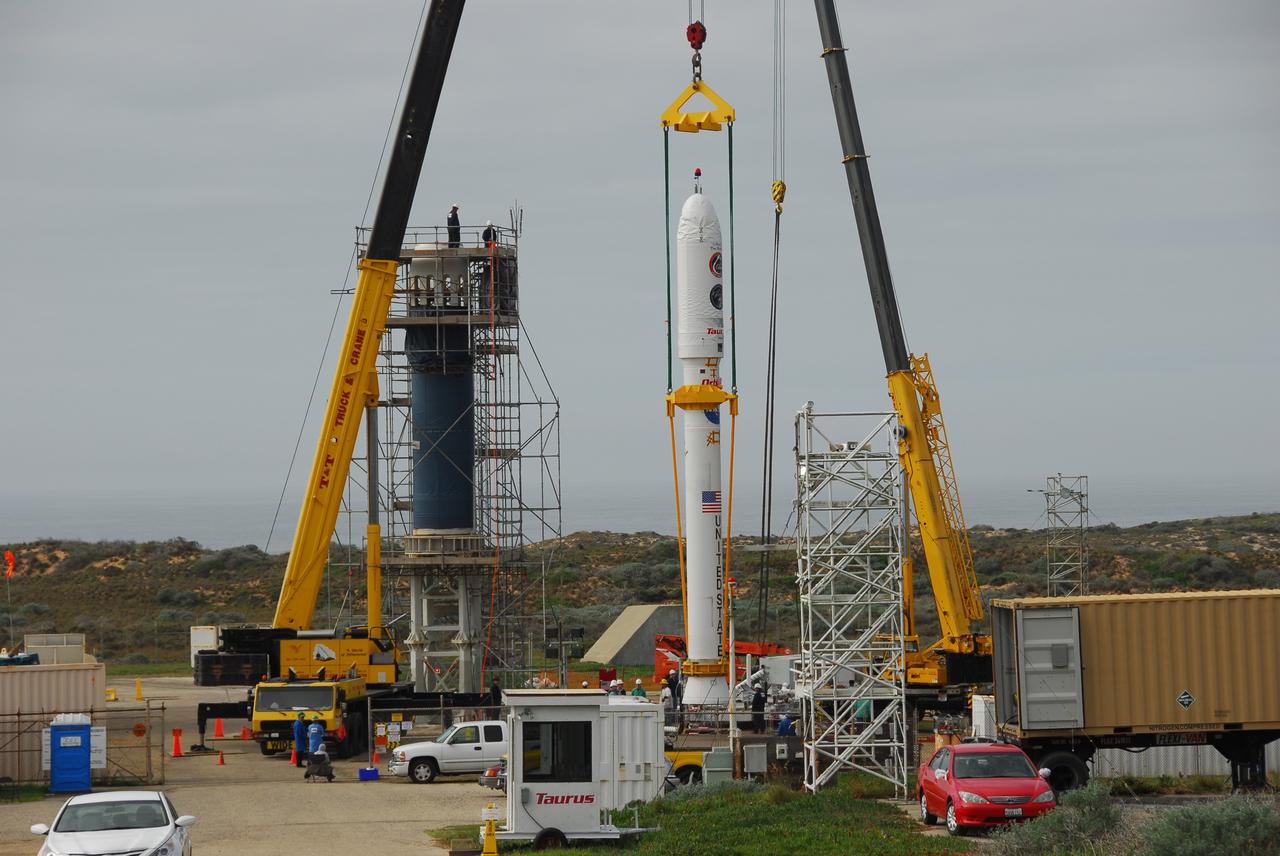
VANDENBERG AIR FORCE BASE, Calif. -- On Space Launch Complex 576-E at Vandenberg Air Force Base in California, Orbital Sciences workers monitor NASA's Glory upper stack as a crane lifts it from a stationary rail for attachment to the Taurus XL rocket's Stage 0. The upper stack consists of Stages 1, 2 and 3 of the Taurus as well as the encapsulated Glory spacecraft. The Orbital Sciences Taurus XL rocket will launch Glory into low Earth orbit. Once Glory reaches orbit, it will collect data on the properties of aerosols and black carbon. It also will help scientists understand how the sun's irradiance affects Earth's climate. Launch is scheduled for 5:09 a.m. EST Feb. 23. For information, visit www.nasa.gov/glory. Photo credit: NASA/VAFB
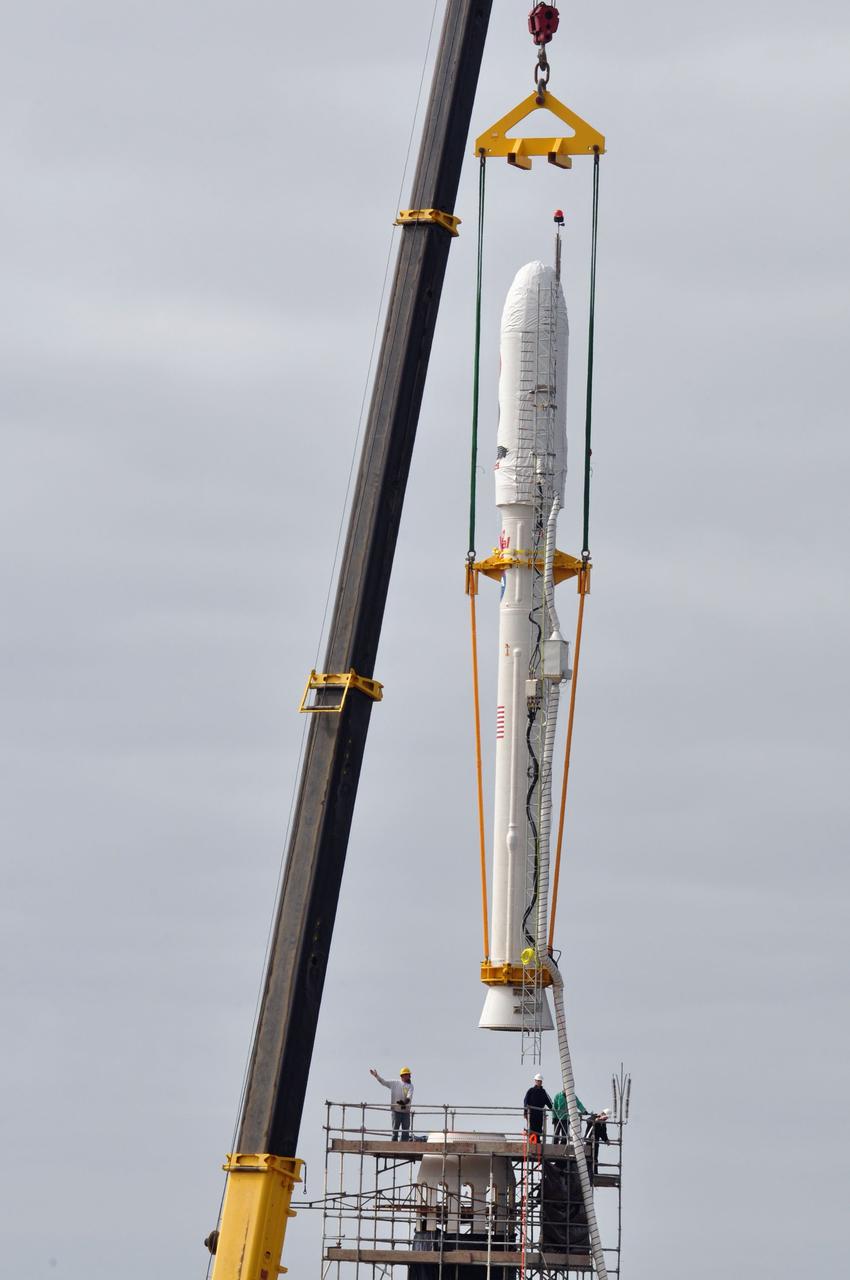
VANDENBERG AIR FORCE BASE, Calif. -- On Space Launch Complex 576-E at Vandenberg Air Force Base in California, a crane lowers NASA's Glory upper stack toward the Taurus XL rocket's Stage 0. The upper stack consists of Stages 1, 2 and 3 of the Taurus as well as the encapsulated Glory spacecraft. The Orbital Sciences Taurus XL rocket will launch Glory into low Earth orbit. Once Glory reaches orbit, it will collect data on the properties of aerosols and black carbon. It also will help scientists understand how the sun's irradiance affects Earth's climate. Launch is scheduled for 5:09 a.m. EST Feb. 23. For information, visit www.nasa.gov/glory. Photo credit: NASA/Randy Beaudoin, VAFB
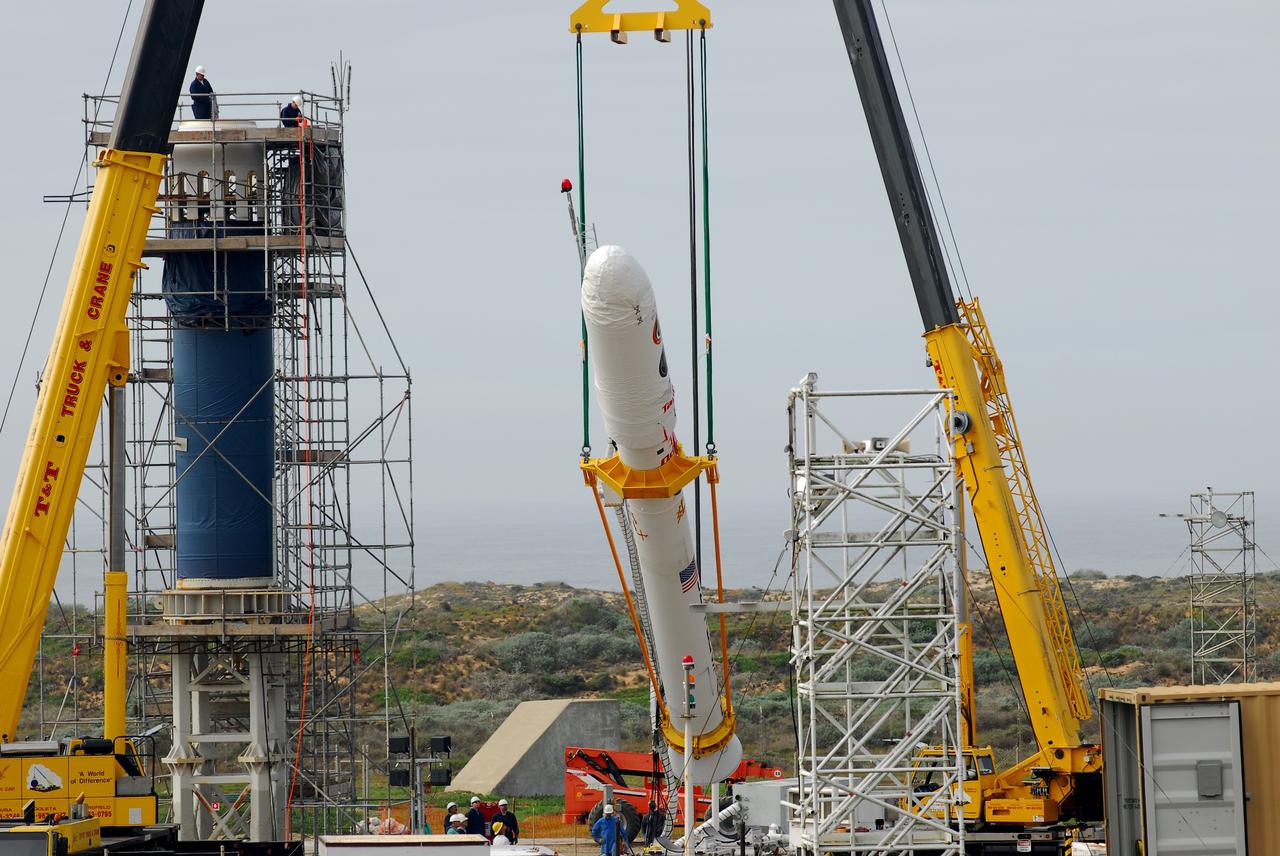
VANDENBERG AIR FORCE BASE, Calif. -- On Space Launch Complex 576-E at Vandenberg Air Force Base in California, Orbital Sciences workers monitor NASA's Glory upper stack as a crane lifts it from a stationary rail for attachment to the Taurus XL rocket's Stage 0. The upper stack consists of Stages 1, 2 and 3 of the Taurus as well as the encapsulated Glory spacecraft. The Orbital Sciences Taurus XL rocket will launch Glory into low Earth orbit. Once Glory reaches orbit, it will collect data on the properties of aerosols and black carbon. It also will help scientists understand how the sun's irradiance affects Earth's climate. Launch is scheduled for 5:09 a.m. EST Feb. 23. For information, visit www.nasa.gov/glory. Photo credit: NASA/VAFB
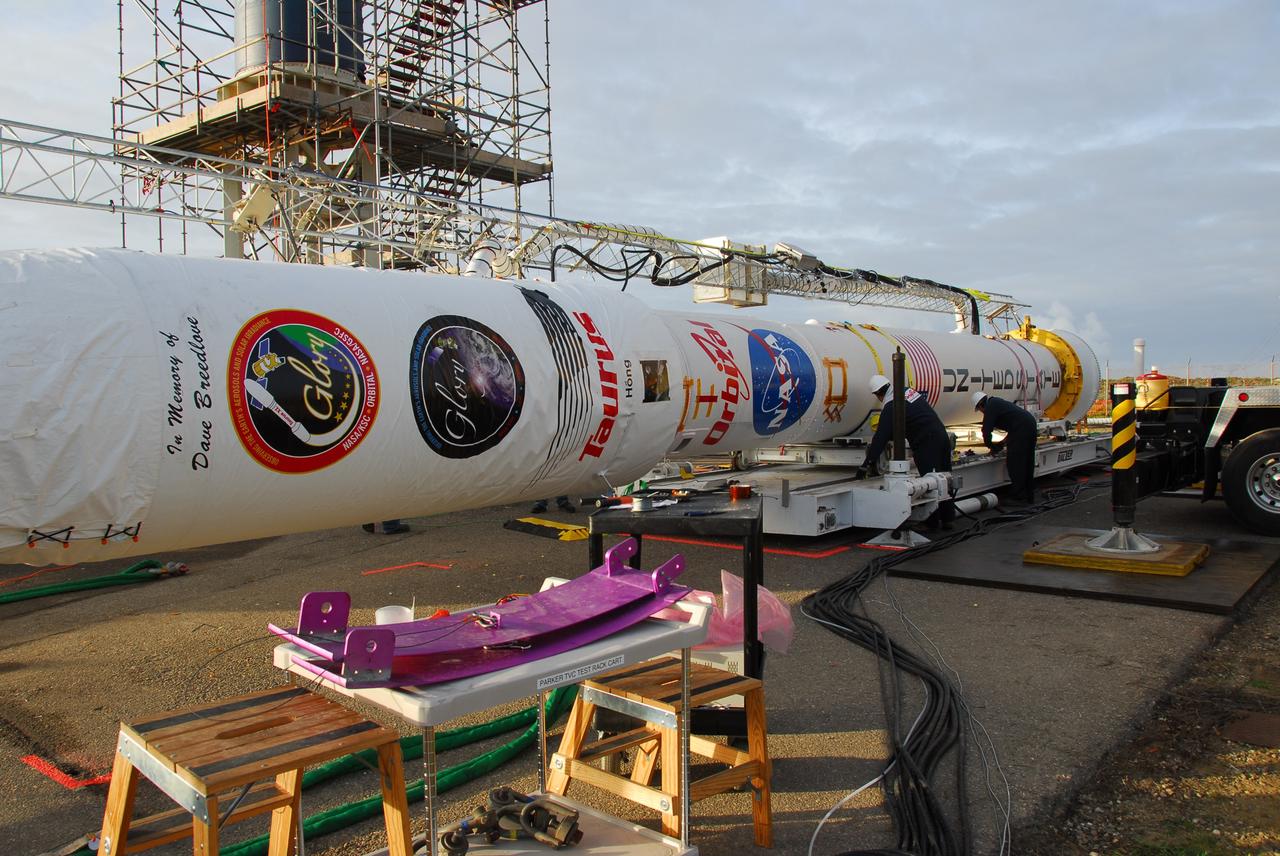
VANDENBERG AIR FORCE BASE, Calif. -- On Space Launch Complex 576-E at Vandenberg Air Force Base in California, Orbital Sciences workers prepare NASA's Glory upper stack for attachment to the Taurus XL rocket's Stage 0. The upper stack consists of Stages 1, 2 and 3 of the Taurus as well as the encapsulated Glory spacecraft. The Orbital Sciences Taurus XL rocket will launch Glory into low Earth orbit. Once Glory reaches orbit, it will collect data on the properties of aerosols and black carbon. It also will help scientists understand how the sun's irradiance affects Earth's climate. Launch is scheduled for 5:09 a.m. EST Feb. 23. For information, visit www.nasa.gov/glory. Photo credit: NASA/VAFB
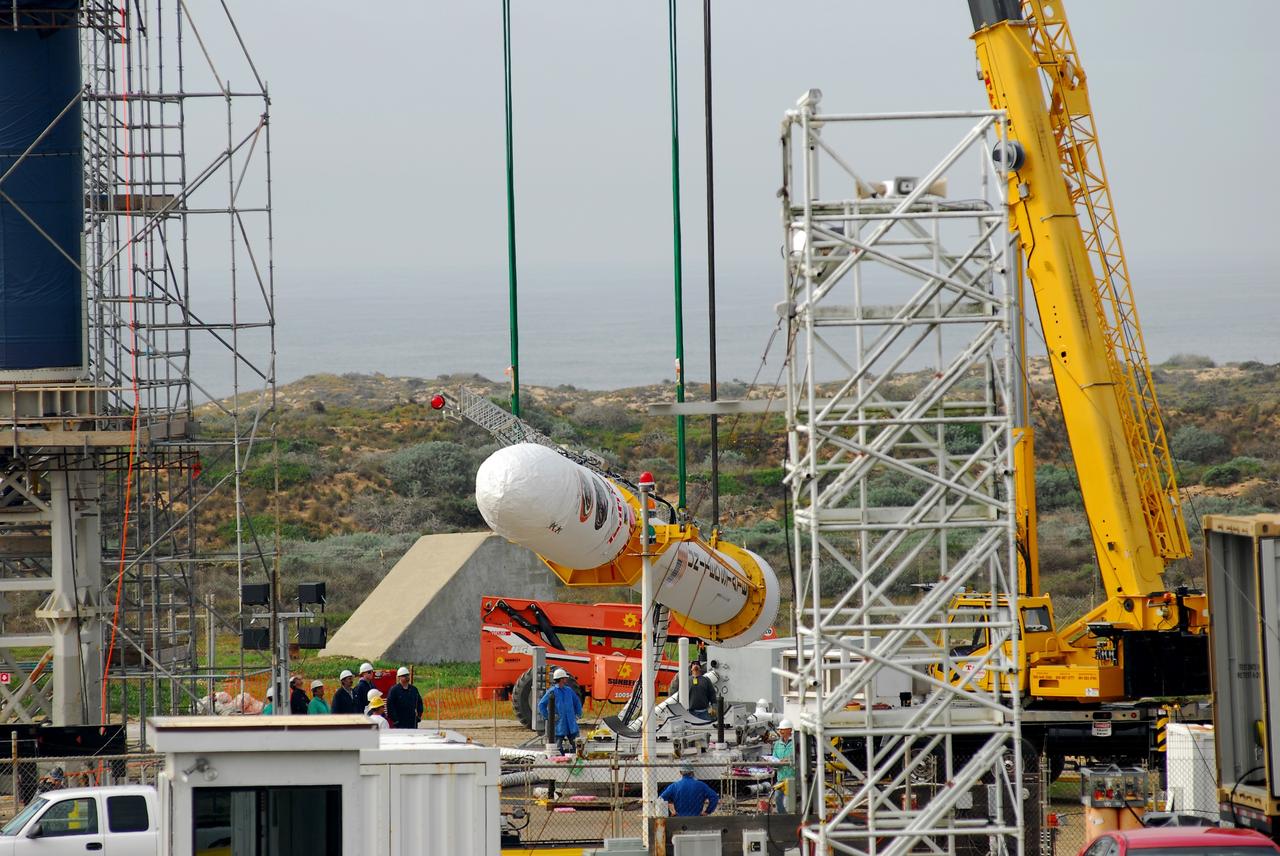
VANDENBERG AIR FORCE BASE, Calif. -- On Space Launch Complex 576-E at Vandenberg Air Force Base in California, Orbital Sciences workers monitor NASA's Glory upper stack as a crane lifts it from a stationary rail for attachment to the Taurus XL rocket's Stage 0. The upper stack consists of Stages 1, 2 and 3 of the Taurus as well as the encapsulated Glory spacecraft. The Orbital Sciences Taurus XL rocket will launch Glory into low Earth orbit. Once Glory reaches orbit, it will collect data on the properties of aerosols and black carbon. It also will help scientists understand how the sun's irradiance affects Earth's climate. Launch is scheduled for 5:09 a.m. EST Feb. 23. For information, visit www.nasa.gov/glory. Photo credit: NASA/VAFB
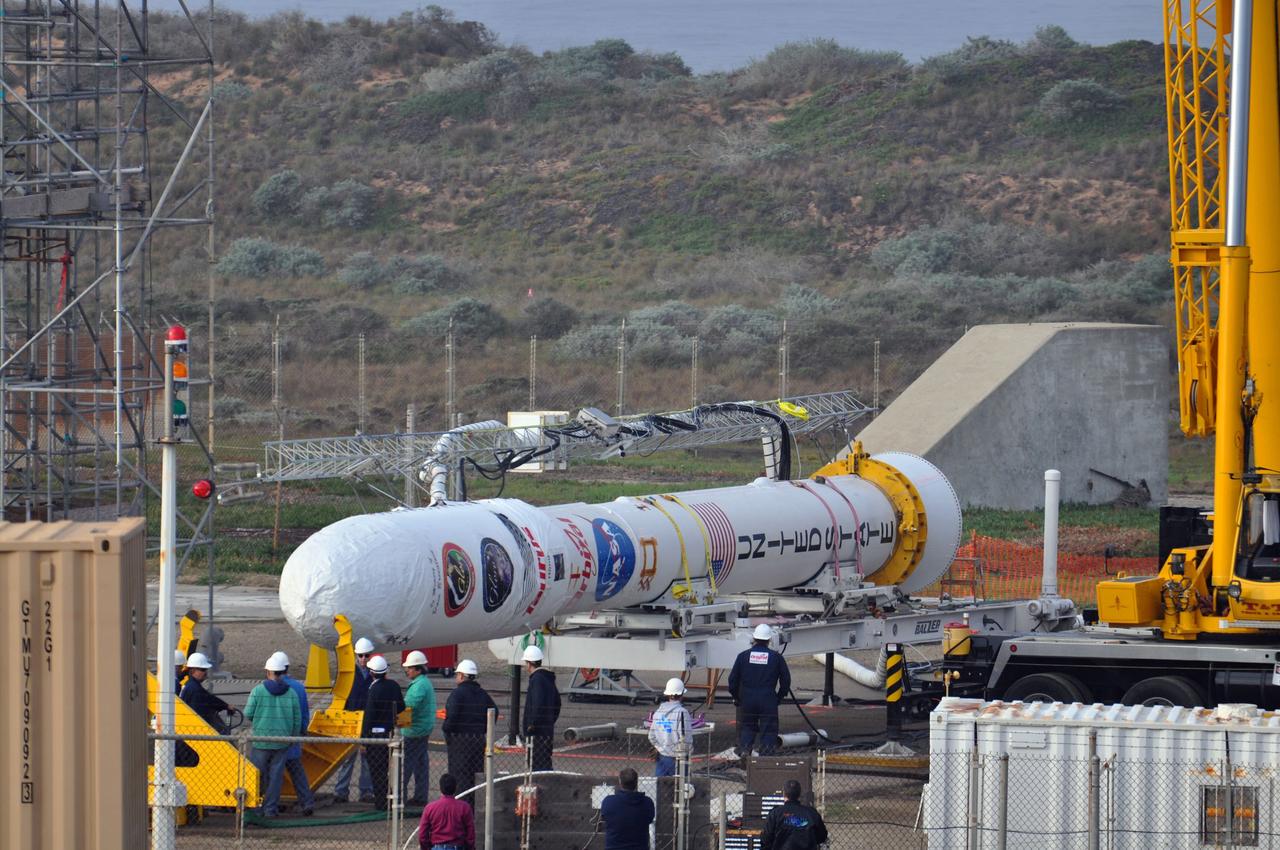
VANDENBERG AIR FORCE BASE, Calif. -- On Space Launch Complex 576-E at Vandenberg Air Force Base in California, Orbital Sciences workers prepare NASA's Glory upper stack for attachment to the Taurus XL rocket's Stage 0. The upper stack consists of Stages 1, 2 and 3 of the Taurus as well as the encapsulated Glory spacecraft. Workers put the non-flight environmental shield over the fairing prior to assembly. A portion of the umbilical tower is attached to the upper stack which falls away from the spacecraft during liftoff. The Orbital Sciences Taurus XL rocket will launch Glory into low Earth orbit. Once Glory reaches orbit, it will collect data on the properties of aerosols and black carbon. It also will help scientists understand how the sun's irradiance affects Earth's climate. Launch is scheduled for 5:09 a.m. EST Feb. 23. For information, visit www.nasa.gov/glory. Photo credit: NASA/Randy Beaudoin, VAFB
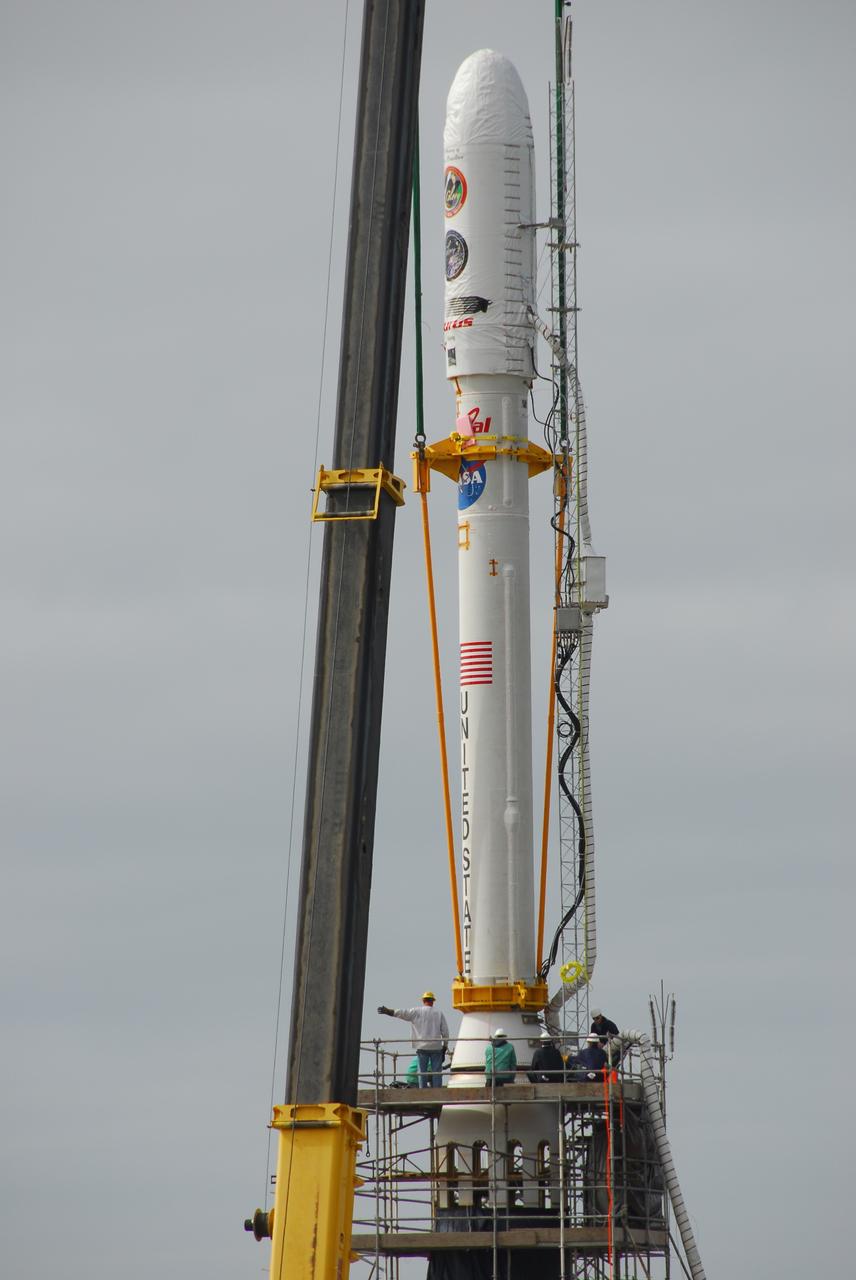
VANDENBERG AIR FORCE BASE, Calif. -- On Space Launch Complex 576-E at Vandenberg Air Force Base in California, a crane lowers NASA's Glory upper stack toward the Taurus XL rocket's Stage 0. The upper stack consists of Stages 1, 2 and 3 of the Taurus as well as the encapsulated Glory spacecraft. The Orbital Sciences Taurus XL rocket will launch Glory into low Earth orbit. Once Glory reaches orbit, it will collect data on the properties of aerosols and black carbon. It also will help scientists understand how the sun's irradiance affects Earth's climate. Launch is scheduled for 5:09 a.m. EST Feb. 23. For information, visit www.nasa.gov/glory. Photo credit: NASA/VAFB

VANDENBERG AIR FORCE BASE, Calif. -- At the Orbital Sciences payload processing facility on Vandenberg Air Force Base in California, workers offload the third stage motor of the Taurus XL rocket for the launch of the Glory spacecraft in June 2009. Glory is a low-Earth orbit scientific research satellite designed to collect data on the properties and distributions of aerosols in the Earth's atmosphere and on solar irradiance for the long-term Earth climate record. Glory will be launched from Vandenberg aboard Orbital's Taurus XL 3110 launch vehicle. Photo credit: NASA/Randy Beaudoin, VAFB

VANDENBERG AIR FORCE BASE, Calif. -- At the Orbital Sciences payload processing facility on Vandenberg Air Force Base in California, the first stage motor for the Glory spacecraft's Taurus XL rocket waits to be moved inside. Glory is a low-Earth orbit scientific research satellite designed to collect data on the properties and distributions of aerosols in the Earth's atmosphere and on solar irradiance for the long-term Earth climate record. Glory will be launched from Vandenberg aboard Orbital's Taurus XL 3110 launch vehicle. Photo credit: NASA/Randy Beaudoin, VAFB
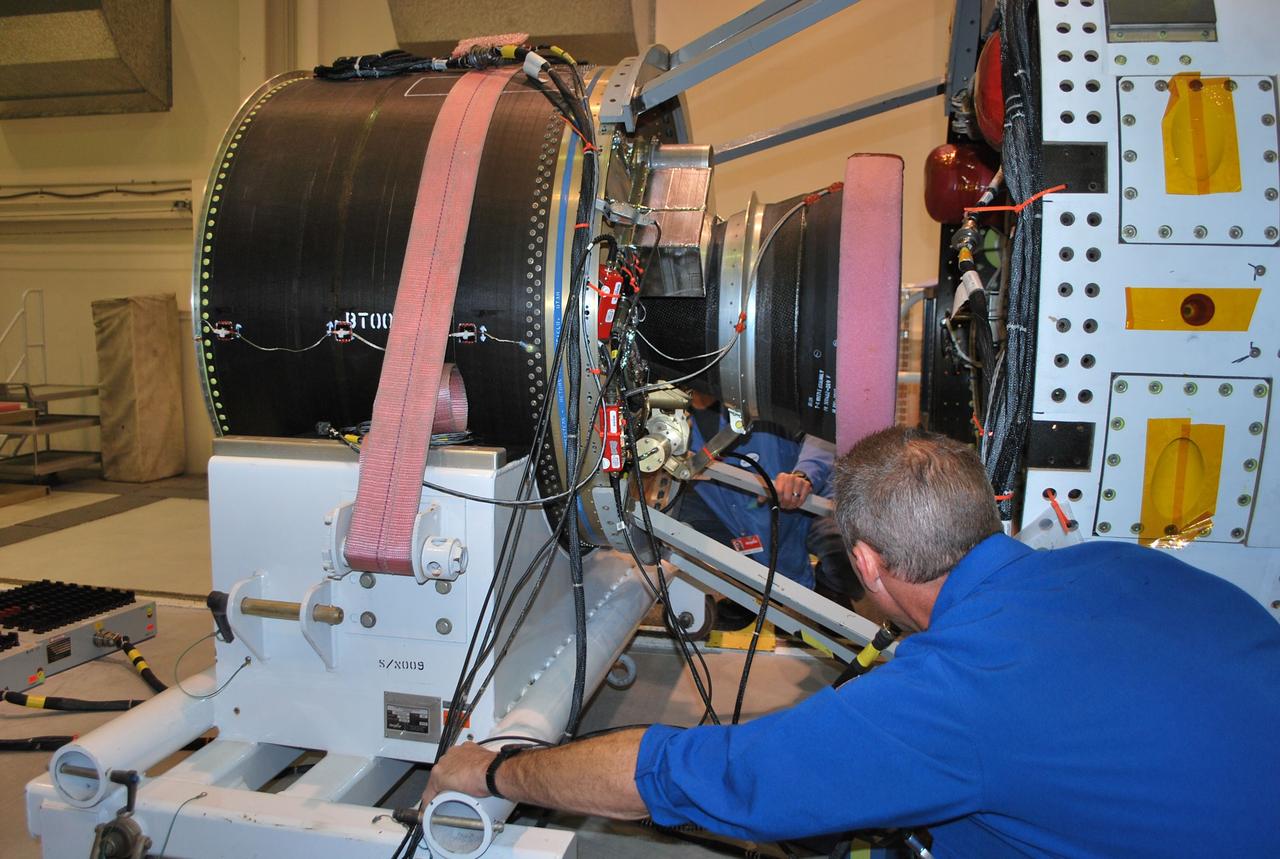
VANDENBERG AIR FORCE BASE, Calif. – In Building 1555 at Vandenberg Air Force Base in California, Orbital Sciences Corp. technicians connect the third stage of the Taurus XL rocket to the avionics of the temporary vehicle interface fixture. The fixture will come off once integrated with the encapsulated Glory spacecraft at the launch site. The Taurus XL rocket, targeted to lift off Feb. 23, 2011, from Vandenberg's Space Launch Complex 576-E, will take NASA's Glory satellite into low Earth. Glory is scheduled to collect data on the properties of aerosols and black carbon. It also will help scientists understand how the sun's irradiance affects Earth's climate. Photo credit: NASA/Randy Beaudoin, VAFB

VANDENBERG AIR FORCE BASE, Calif. -- In the Orbital Sciences payload processing facility on Vandenberg Air Force Base in California, the first, second and third stage motors for the Glory spacecraft's Taurus XL rocket are lined up after arrival. Glory is a low-Earth orbit scientific research satellite designed to collect data on the properties and distributions of aerosols in the Earth's atmosphere and on solar irradiance for the long-term Earth climate record. Glory will be launched from Vandenberg aboard Orbital's Taurus XL 3110 launch vehicle. Photo credit: NASA/Randy Beaudoin, VAFB

VANDENBERG AIR FORCE BASE, Calif. -- At the Orbital Sciences payload processing facility on Vandenberg Air Force Base in California, workers unstrap the newly arrived second (left) and first stage motors for the Glory spacecraft's Taurus XL rocket. Glory is a low-Earth orbit scientific research satellite designed to collect data on the properties and distributions of aerosols in the Earth's atmosphere and on solar irradiance for the long-term Earth climate record. Glory will be launched from Vandenberg aboard Orbital's Taurus XL 3110 launch vehicle. Photo credit: NASA/Randy Beaudoin, VAFB

VANDENBERG AIR FORCE BASE, Calif. -- At the Orbital Sciences payload processing facility on Vandenberg Air Force Base in California, workers offload the second (right) and third stage motors of the Taurus XL rocket for the launch of the Glory spacecraft in June 2009. Glory is a low-Earth orbit scientific research satellite designed to collect data on the properties and distributions of aerosols in the Earth's atmosphere and on solar irradiance for the long-term Earth climate record. Glory will be launched from Vandenberg aboard Orbital's Taurus XL 3110 launch vehicle. Photo credit: NASA/Randy Beaudoin, VAFB

VANDENBERG AIR FORCE BASE, Calif. -- Workers move the second stage motor of the Taurus XL rocket for the launch of the Glory spacecraft in June 2009 into the Orbital Sciences payload processing facility on Vandenberg Air Force Base in California. Glory is a low-Earth orbit scientific research satellite designed to collect data on the properties and distributions of aerosols in the Earth's atmosphere and on solar irradiance for the long-term Earth climate record. Glory will be launched from Vandenberg aboard Orbital's Taurus XL 3110 launch vehicle. Photo credit: NASA/Randy Beaudoin, VAFB
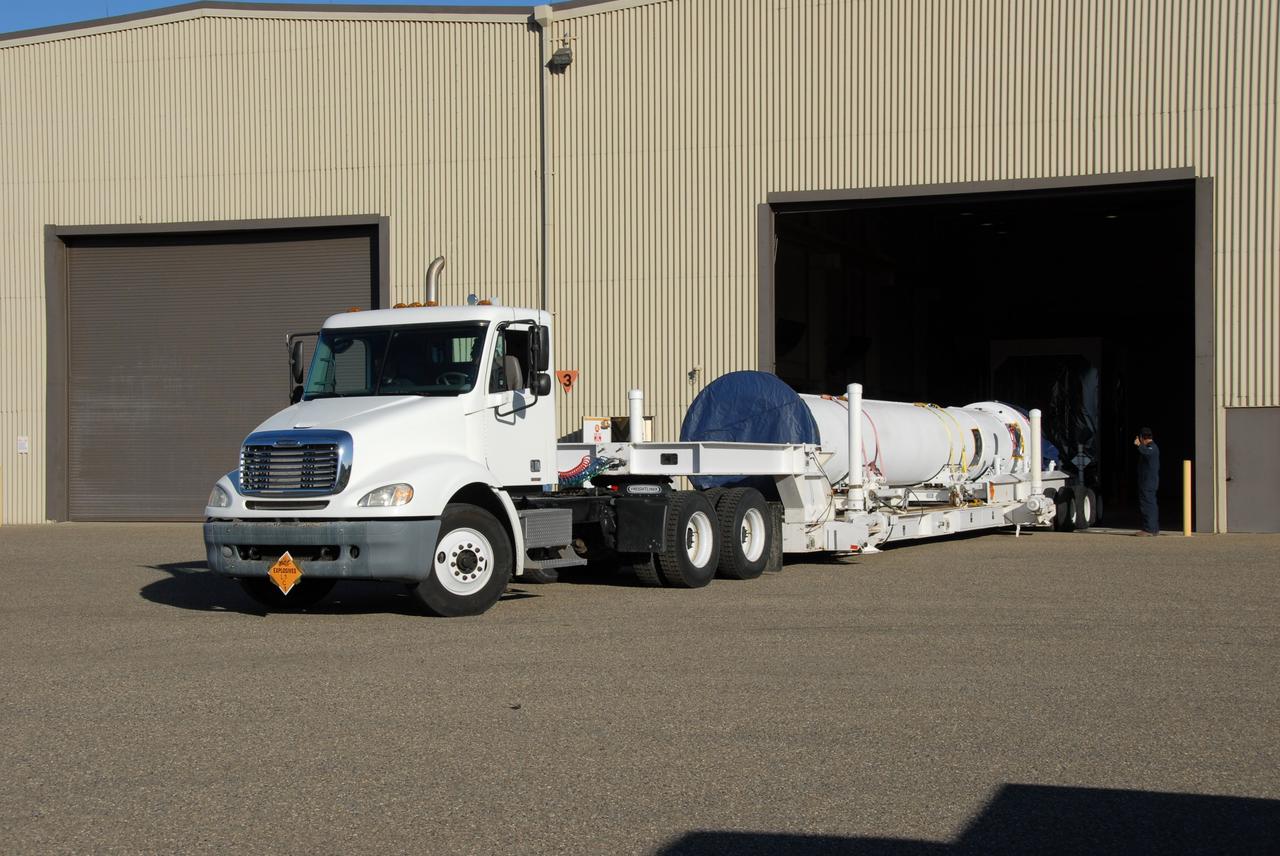
VANDENBERG AIR FORCE BASE, Calif. -- The upper vehicle stack, consisting of the first, second and third stages, of the Taurus XL rocket leaves Building 1555 for Space Launch Complex 576-E at Vandenberg Air Force Base in California. Orbital Sciences' Taurus XL is a four-stage rocket that will carry NASA's Glory spacecraft into low Earth orbit. Once Glory reaches orbit, it will collect data on the properties of aerosols and black carbon. It also will help scientists understand how the sun's irradiance affects Earth's climate. Launch is scheduled for 5:09 a.m. EST Feb. 23. For information, visit www.nasa.gov/glory. Photo credit: NASA/VAFB
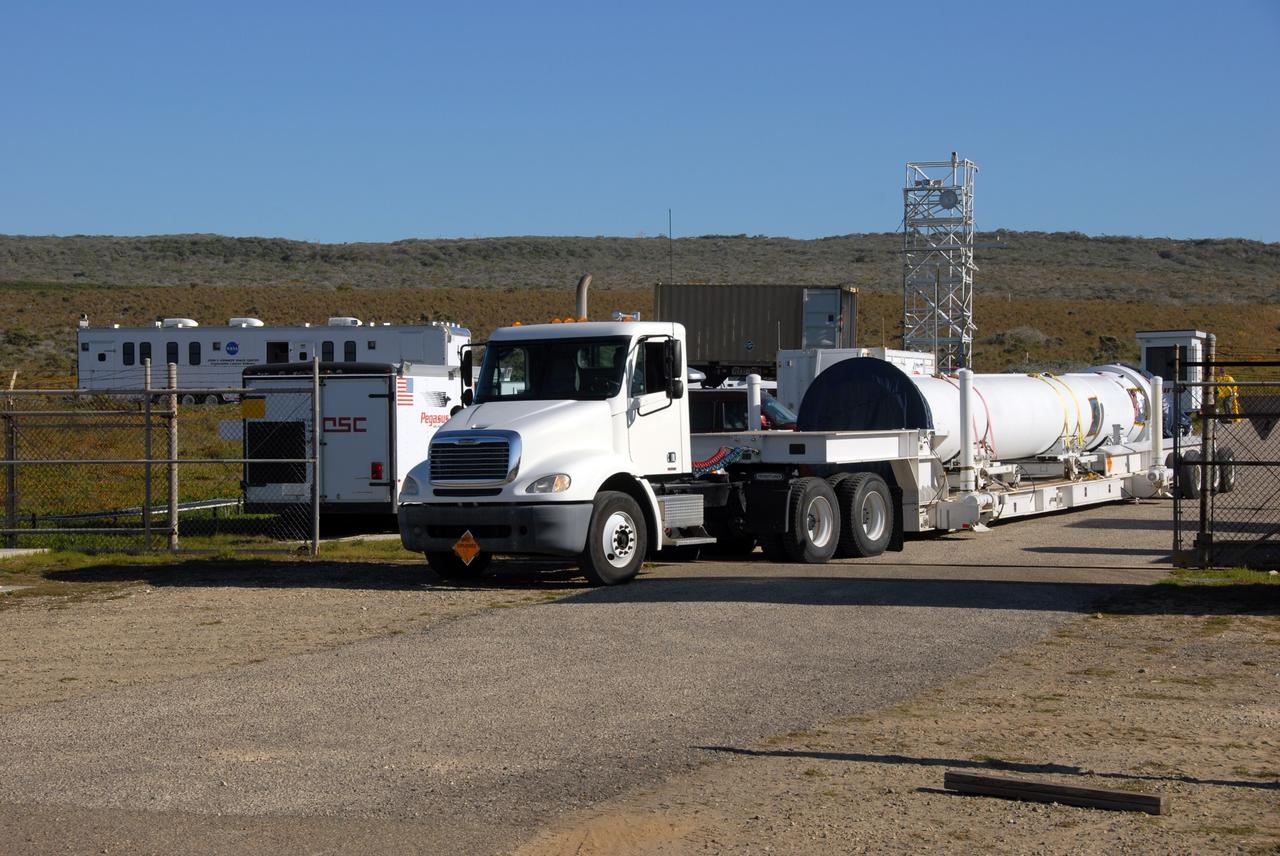
VANDENBERG AIR FORCE BASE, Calif. -- The upper vehicle stack, consisting of the first, second and third stages, of the Taurus XL rocket arrives at Space Launch Complex 576-E from Building 1555 at Vandenberg Air Force Base in California. Orbital Sciences' Taurus XL is a four-stage rocket that will carry NASA's Glory spacecraft into low Earth orbit. Once Glory reaches orbit, it will collect data on the properties of aerosols and black carbon. It also will help scientists understand how the sun's irradiance affects Earth's climate. Launch is scheduled for 5:09 a.m. EST Feb. 23. For information, visit www.nasa.gov/glory. Photo credit: NASA/VAFB
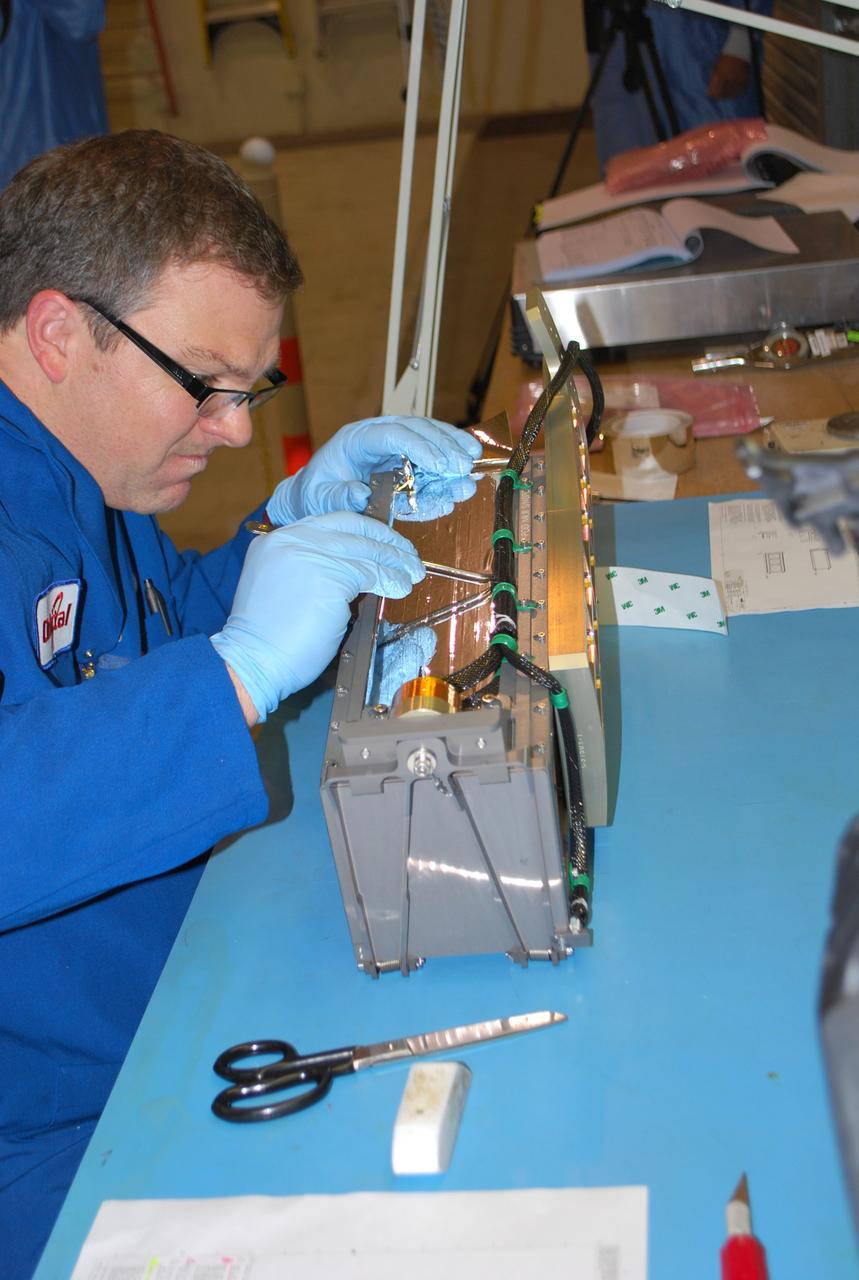
VANDENBERG AIR FORCE BASE, Calif. -- At Vandenberg Air Force Base in California, a technician installs a bracket on a Poly Picosatellite Orbital Deployer, or P-POD, container. The bracket is a connection interface between the P-POD and the Taurus rocket. The P-POD will hold three CubeSats or tiny satellites, designed and created by university and college students that will be carried on the Taurus rocket along with the Glory spacecraft. The Orbital Sciences Corp. Taurus XL rocket will carry NASA's Glory spacecraft into low Earth orbit. Once Glory reaches orbit, it will collect data on the properties of aerosols and black carbon. It also will help scientists understand how the sun's irradiance affects Earth's climate. Launch is scheduled for 5:09 a.m. EST Feb. 23. For information, visit www.nasa.gov/glory. Photo credit: NASA/Randy Beaudoin, VAFB
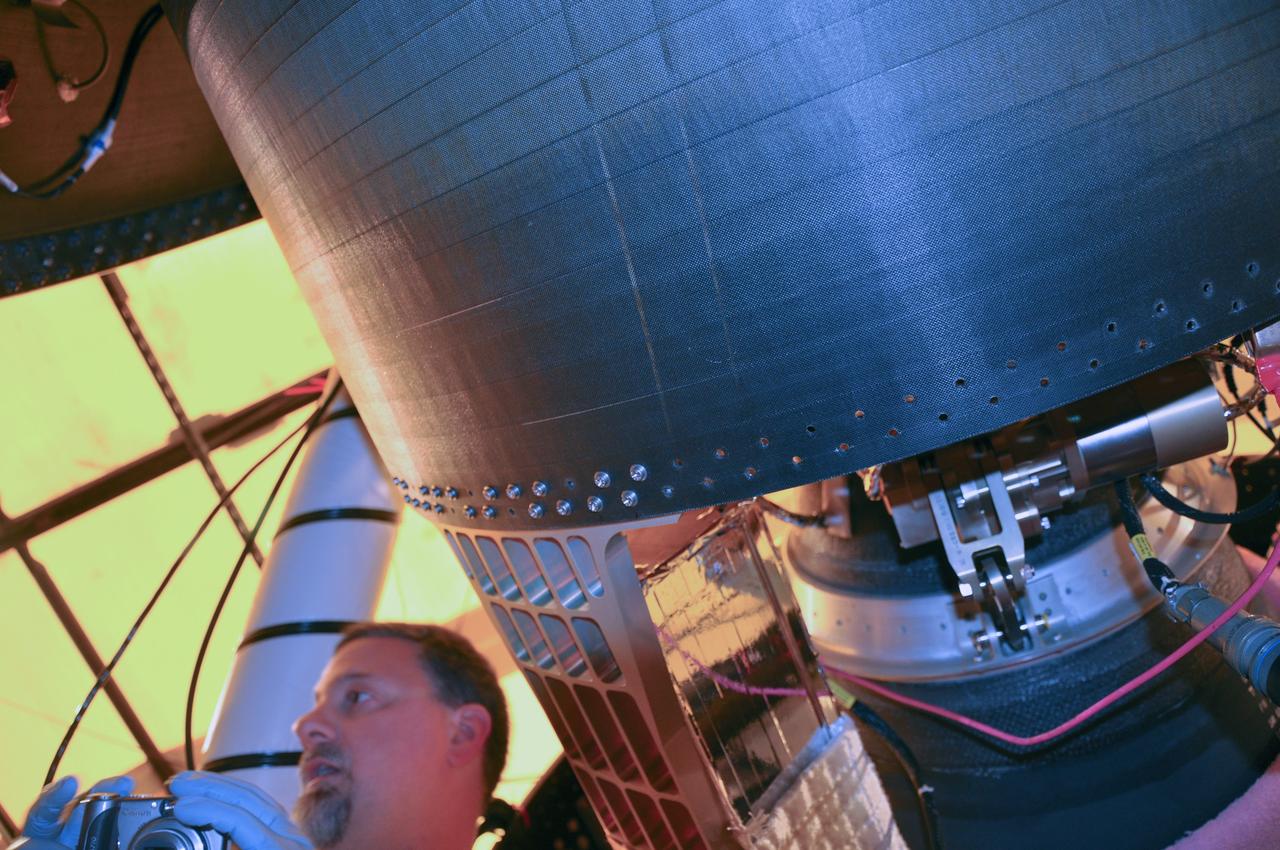
VANDENBERG AIR FORCE BASE, Calif. -- At Space Launch Complex 576-E at Vandenberg Air Force Base in California, the Poly Picosatellite Orbital Deployer, or P-POD, assembly has been installed to the aft end of the Taurus rocket's third stage using the Anodized gold aluminum bracket interface. The P-POD holds three CubeSats or tiny satellites, designed and created by university and college students that will be carried on the Taurus rocket along with the Glory spacecraft. The Orbital Sciences Corp. Taurus XL rocket will carry Glory into low Earth orbit. Once Glory reaches orbit, it will collect data on the properties of aerosols and black carbon. It also will help scientists understand how the sun's irradiance affects Earth's climate. Launch is scheduled for 5:09 a.m. EST Feb. 23. For information, visit www.nasa.gov/glory. Photo credit: NASA/Randy Beaudoin, VAFB
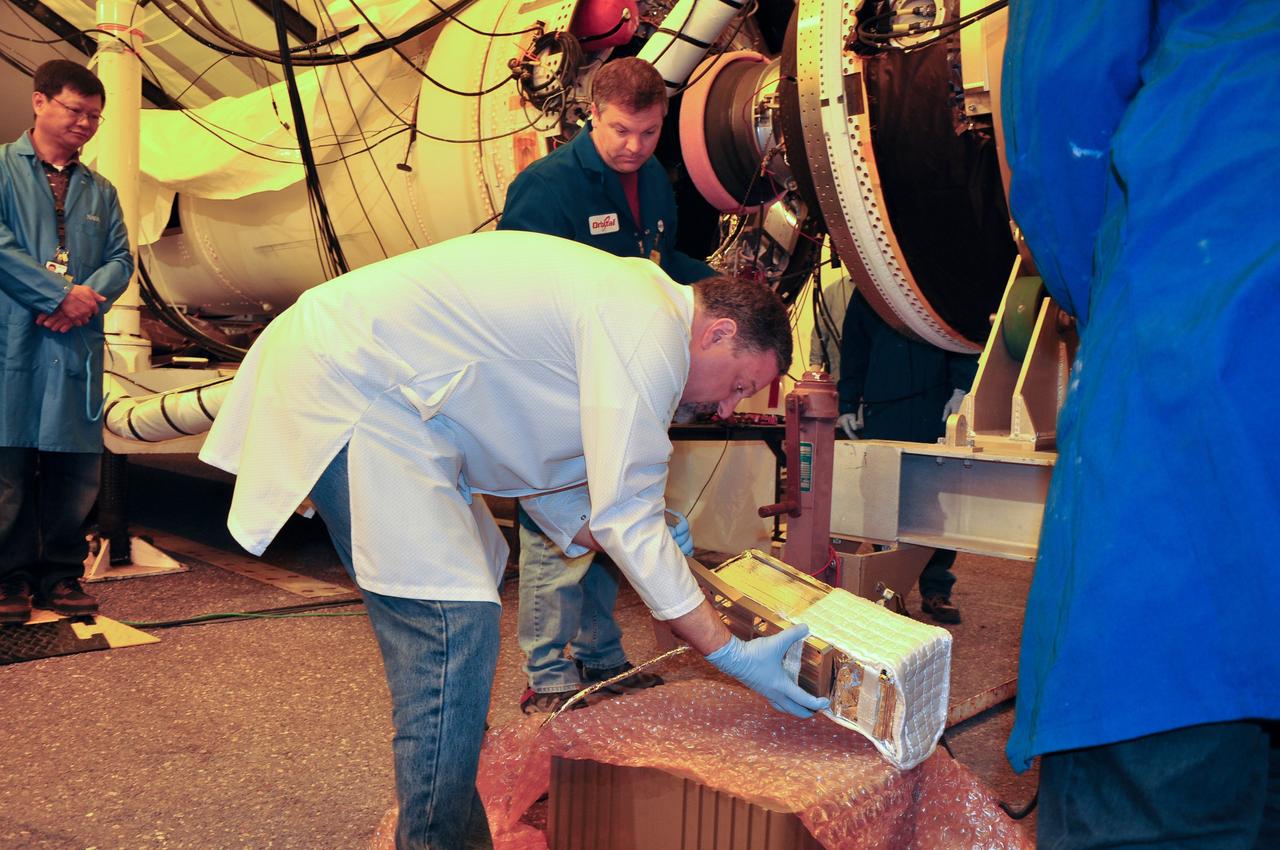
VANDENBERG AIR FORCE BASE, Calif. -- At Space Launch Complex 576-E at Vandenberg Air Force Base in California, a technician lifts the Poly Picosatellite Orbital Deployer, or P-POD, assembly by the Anodized gold aluminum bracket interface. The bracket is the connection point between the P-POD and the aft end of the Taurus rocket's third stage. The P-POD holds three CubeSats or tiny satellites, designed and created by university and college students that will be carried on the Taurus rocket along with the Glory spacecraft. The Orbital Sciences Corp. Taurus XL rocket will carry Glory into low Earth orbit. Once Glory reaches orbit, it will collect data on the properties of aerosols and black carbon. It also will help scientists understand how the sun's irradiance affects Earth's climate. Launch is scheduled for 5:09 a.m. EST Feb. 23. For information, visit www.nasa.gov/glory. Photo credit: NASA/Randy Beaudoin, VAFB
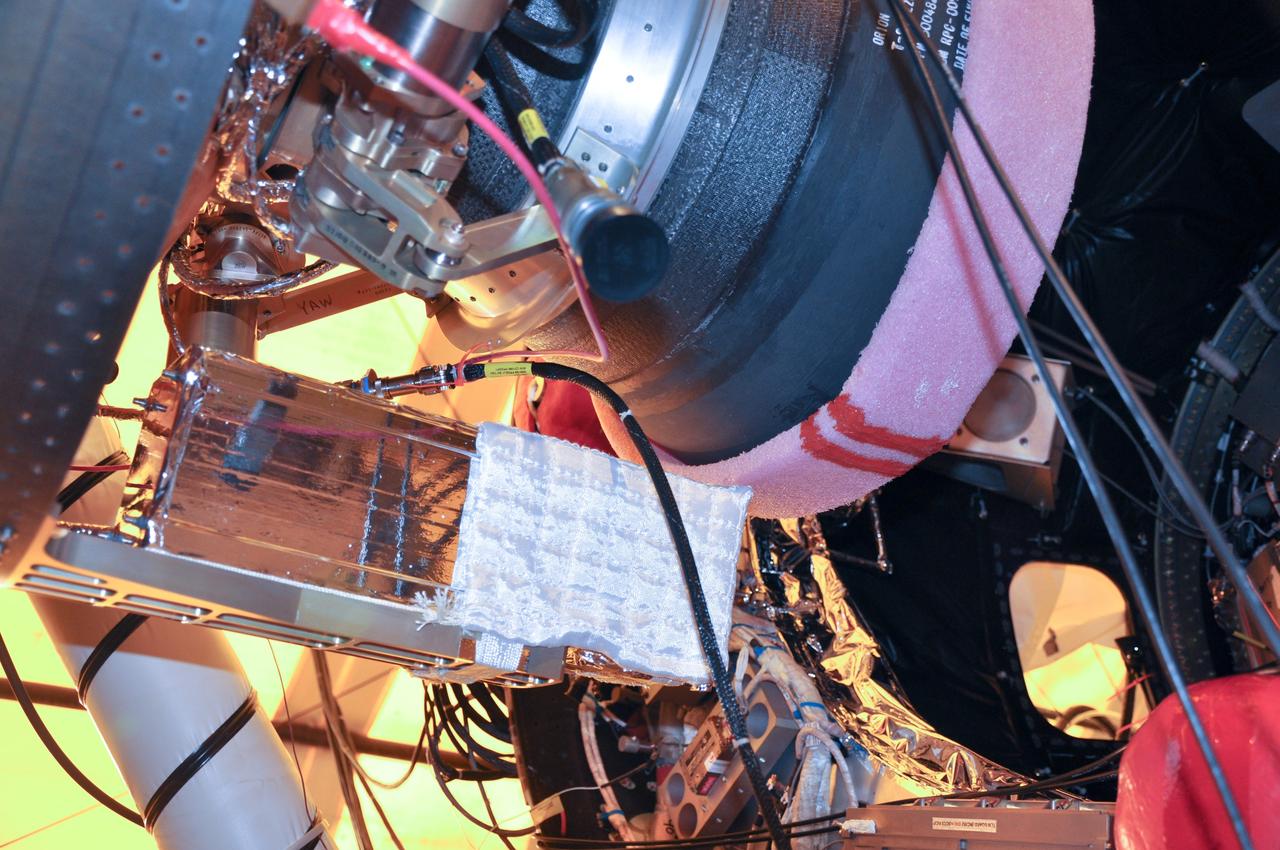
VANDENBERG AIR FORCE BASE, Calif. -- At Space Launch Complex 576-E at Vandenberg Air Force Base in California, the Poly Picosatellite Orbital Deployer, or P-POD, assembly has been installed to the aft end of the Taurus rocket's third stage using the Anodized gold aluminum bracket interface. The P-POD holds three CubeSats or tiny satellites, designed and created by university and college students that will be carried on the Taurus rocket along with the Glory spacecraft. The Orbital Sciences Corp. Taurus XL rocket will carry Glory into low Earth orbit. Once Glory reaches orbit, it will collect data on the properties of aerosols and black carbon. It also will help scientists understand how the sun's irradiance affects Earth's climate. Launch is scheduled for 5:09 a.m. EST Feb. 23. For information, visit www.nasa.gov/glory. Photo credit: NASA/Randy Beaudoin, VAFB
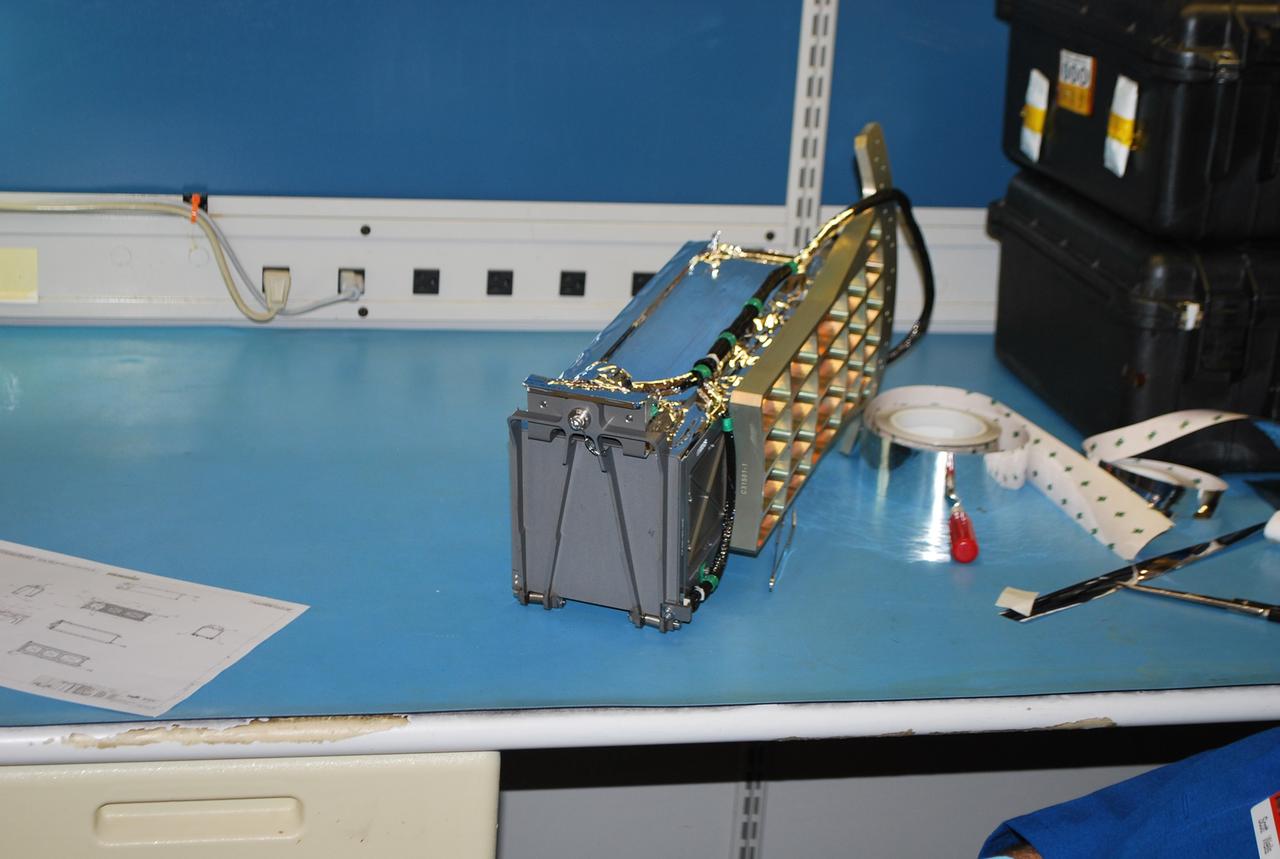
VANDENBERG AIR FORCE BASE, Calif. -- At Vandenberg Air Force Base in California, a Poly Picosatellite Orbital Deployer, or P-POD, container is imaged here with the bracket interface installed. The bracket is a connection interface between the P-POD and the Taurus rocket. The P-POD will hold three CubeSats or tiny satellites, designed and created by university and college students that will be carried on the Taurus rocket along with the Glory spacecraft. The Orbital Sciences Corp. Taurus XL rocket will carry NASA's Glory spacecraft into low Earth orbit. Once Glory reaches orbit, it will collect data on the properties of aerosols and black carbon. It also will help scientists understand how the sun's irradiance affects Earth's climate. Launch is scheduled for 5:09 a.m. EST Feb. 23. For information, visit www.nasa.gov/glory. Photo credit: NASA/Randy Beaudoin,VAFB
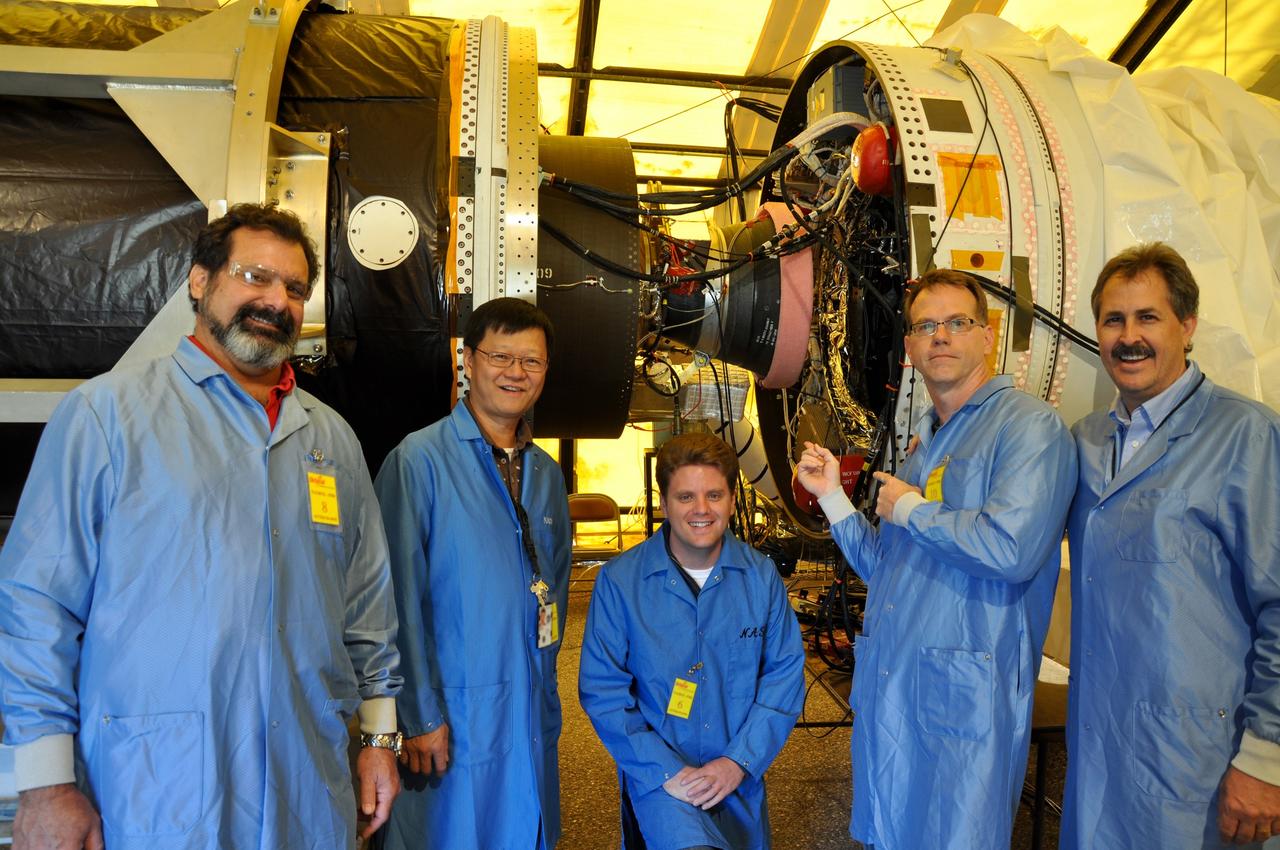
VANDENBERG AIR FORCE BASE, Calif. -- At Space Launch Complex 576-E at Vandenberg Air Force Base in California, the engineering team that installed the Poly Picosatellite Orbital Deployer, or P-POD, assembly to the Taurus rocket's third stage pose for a photo opportunity. From left to right are Kevin Harrington, Cuong Nguyen, Ryan Nugent, Richard Nielsen and Larry Fineberg. The P-POD holds three CubeSats or tiny satellites, designed and created by university and college students that will be carried on the Taurus rocket along with the Glory spacecraft. The Orbital Sciences Corp. Taurus XL rocket will carry Glory into low Earth orbit. Once Glory reaches orbit, it will collect data on the properties of aerosols and black carbon. It also will help scientists understand how the sun's irradiance affects Earth's climate. Launch is scheduled for 5:09 a.m. EST Feb. 23. For information, visit www.nasa.gov/glory. Photo credit: NASA/Randy Beaudoin, VAFB
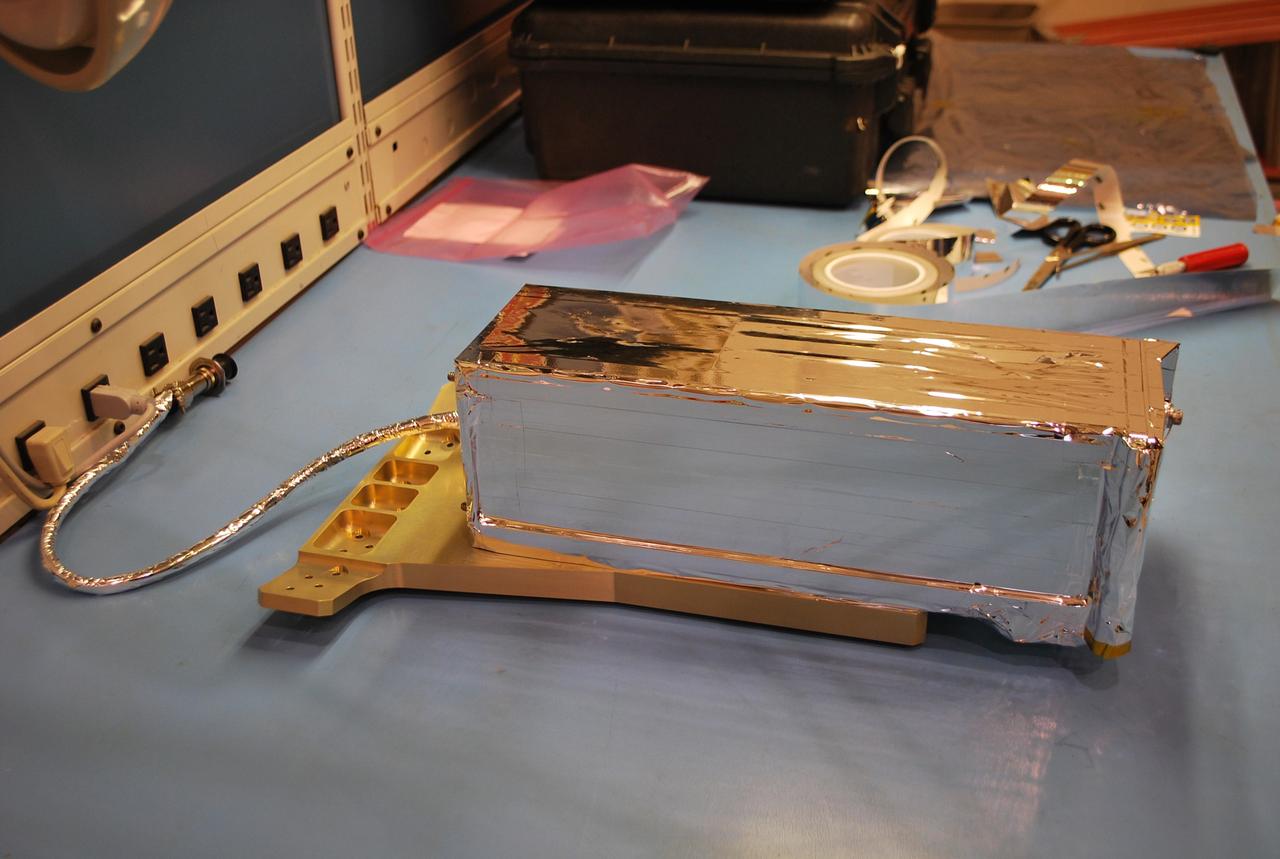
VANDENBERG AIR FORCE BASE, Calif. -- At Vandenberg Air Force Base in California, a Poly Picosatellite Orbital Deployer, or P-POD, container is imaged here after a sheet of thermal insulation has been applied and the bracket interface installed. The bracket will serve as a connection interface between the P-POD and the Taurus rocket. The P-POD will hold three CubeSats or tiny satellites, designed and created by university and college students that will be carried on the Taurus rocket along with the Glory spacecraft. The Orbital Sciences Corp. Taurus XL rocket will carry NASA's Glory spacecraft into low Earth orbit. Once Glory reaches orbit, it will collect data on the properties of aerosols and black carbon. It also will help scientists understand how the sun's irradiance affects Earth's climate. Launch is scheduled for 5:09 a.m. EST Feb. 23. For information, visit www.nasa.gov/glory. Photo credit: NASA/Randy Beaudoin, VAFB
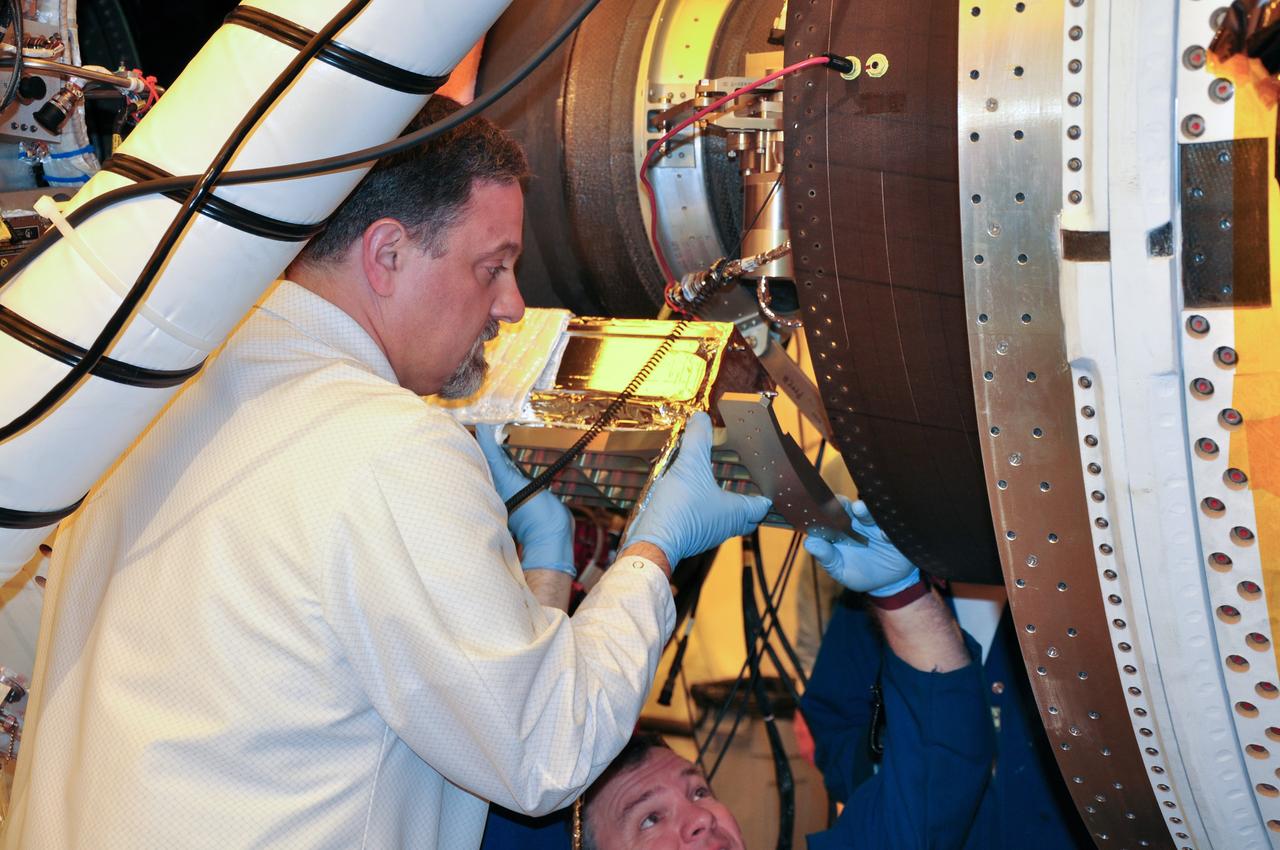
VANDENBERG AIR FORCE BASE, Calif. -- At Space Launch Complex 576-E at Vandenberg Air Force Base in California, technicians install the Poly Picosatellite Orbital Deployer, or P-POD, assembly to the aft end of the Taurus rocket's third stage. The P-POD holds three CubeSats or tiny satellites, designed and created by university and college students that will be carried on the Taurus rocket along with the Glory spacecraft. The Orbital Sciences Corp. Taurus XL rocket will carry Glory into low Earth orbit. Once Glory reaches orbit, it will collect data on the properties of aerosols and black carbon. It also will help scientists understand how the sun's irradiance affects Earth's climate. Launch is scheduled for 5:09 a.m. EST Feb. 23. For information, visit www.nasa.gov/glory. Photo credit: NASA/Randy Beaudoin, VAFB
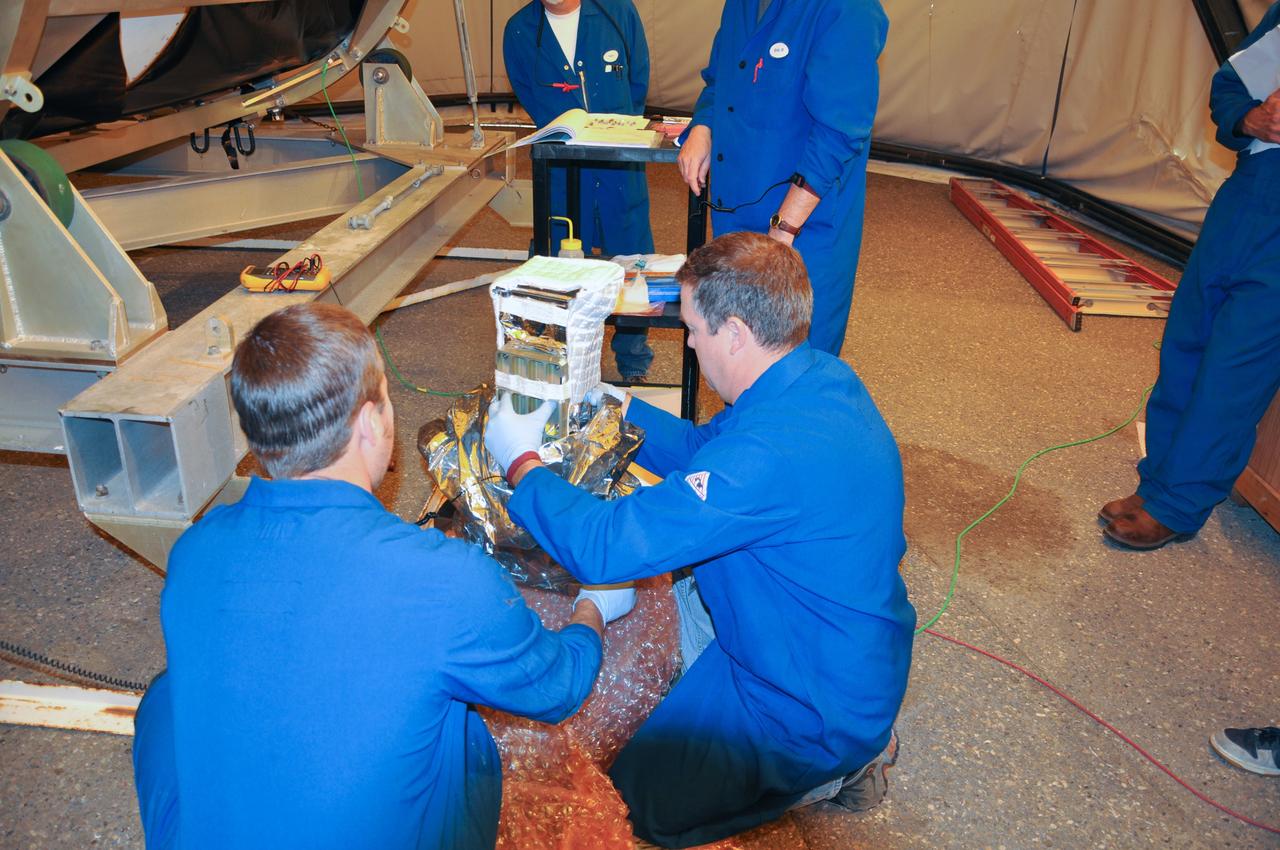
VANDENBERG AIR FORCE BASE, Calif. -- At Space Launch Complex 576-E at Vandenberg Air Force Base in California, technicians unwrap the Poly Picosatellite Orbital Deployer, or P-POD, assembly before installation to the aft end of the Taurus rocket's third stage. The P-POD holds three CubeSats or tiny satellites, designed and created by university and college students that will be carried on the Taurus rocket along with the Glory spacecraft. The Orbital Sciences Corp. Taurus XL rocket will carry Glory into low Earth orbit. Once Glory reaches orbit, it will collect data on the properties of aerosols and black carbon. It also will help scientists understand how the sun's irradiance affects Earth's climate. Launch is scheduled for 5:09 a.m. EST Feb. 23. For information, visit www.nasa.gov/glory. Photo credit: NASA/Randy Beaudoin, VAFB
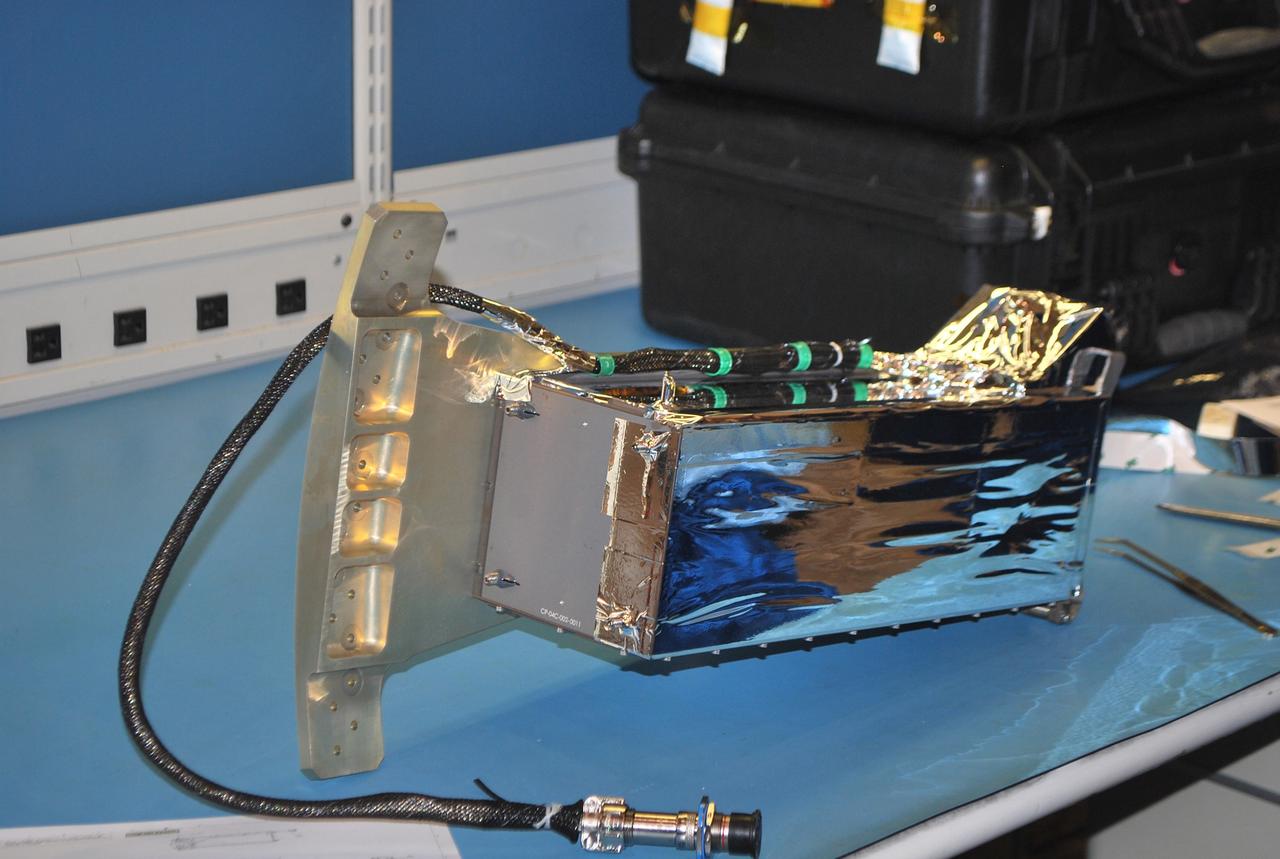
VANDENBERG AIR FORCE BASE, Calif. -- At Vandenberg Air Force Base in California, a Poly Picosatellite Orbital Deployer, or P-POD, container is imaged here with the bracket interface installed. The bracket is a connection interface between the P-POD and the Taurus rocket. The P-POD will hold three CubeSats or tiny satellites, designed and created by university and college students that will be carried on the Taurus rocket along with the Glory spacecraft. The Orbital Sciences Corp. Taurus XL rocket will carry NASA's Glory spacecraft into low Earth orbit. Once Glory reaches orbit, it will collect data on the properties of aerosols and black carbon. It also will help scientists understand how the sun's irradiance affects Earth's climate. Launch is scheduled for 5:09 a.m. EST Feb. 23. For information, visit www.nasa.gov/glory. Photo credit: NASA/Randy Beaudoin, VAFB