
This glowing emerald nebula seen by NASA Spitzer Space Telescope is named RCW 120; this region of hot gas and glowing dust can be found in the murky clouds encircled by the tail of the constellation Scorpius.
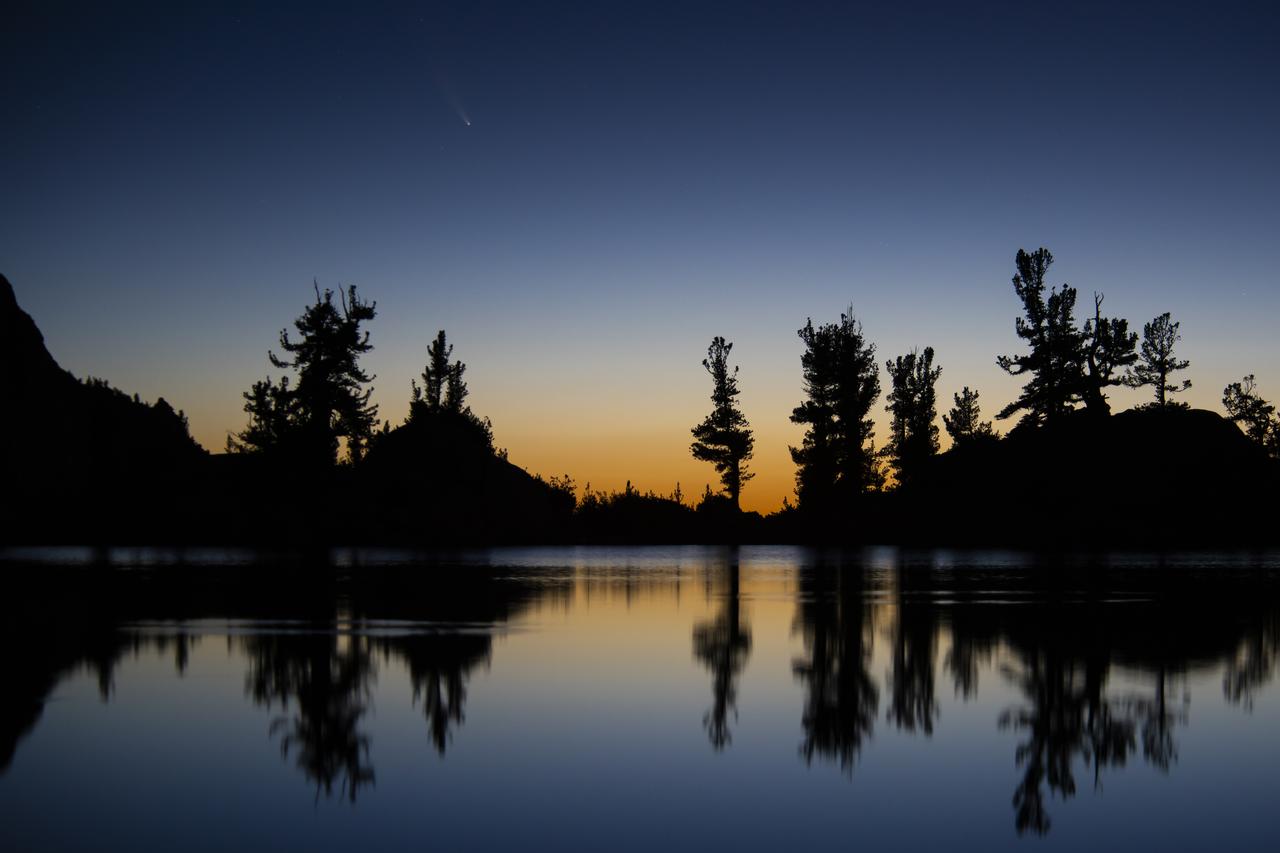
An image of the Comet C/2020 F3 NEOWISE (Comet NEOWISE) captured above the tree line of Lone Pine Lake, located on the Mount Whitney Trail in the Eastern Sierra Nevada Mountains in California. The photo was taken at 4:59 am on July 14, 2020. Visiting from the distant parts of the solar system, it’s characterized by a glowing tail and is visible during the month of July. The comet returns in 6,800 years.

STS105-710-081 (10-22 August 2001) --- One of the astronauts on the aft flight deck of the Space Shuttle Discovery used a 70mm handheld camera to record this image of a thruster firing. The blackness of space surrounds this view of the orbital maneuvering system (OMS) pods during the OMS burn giving the tail of the shuttle a red glow.
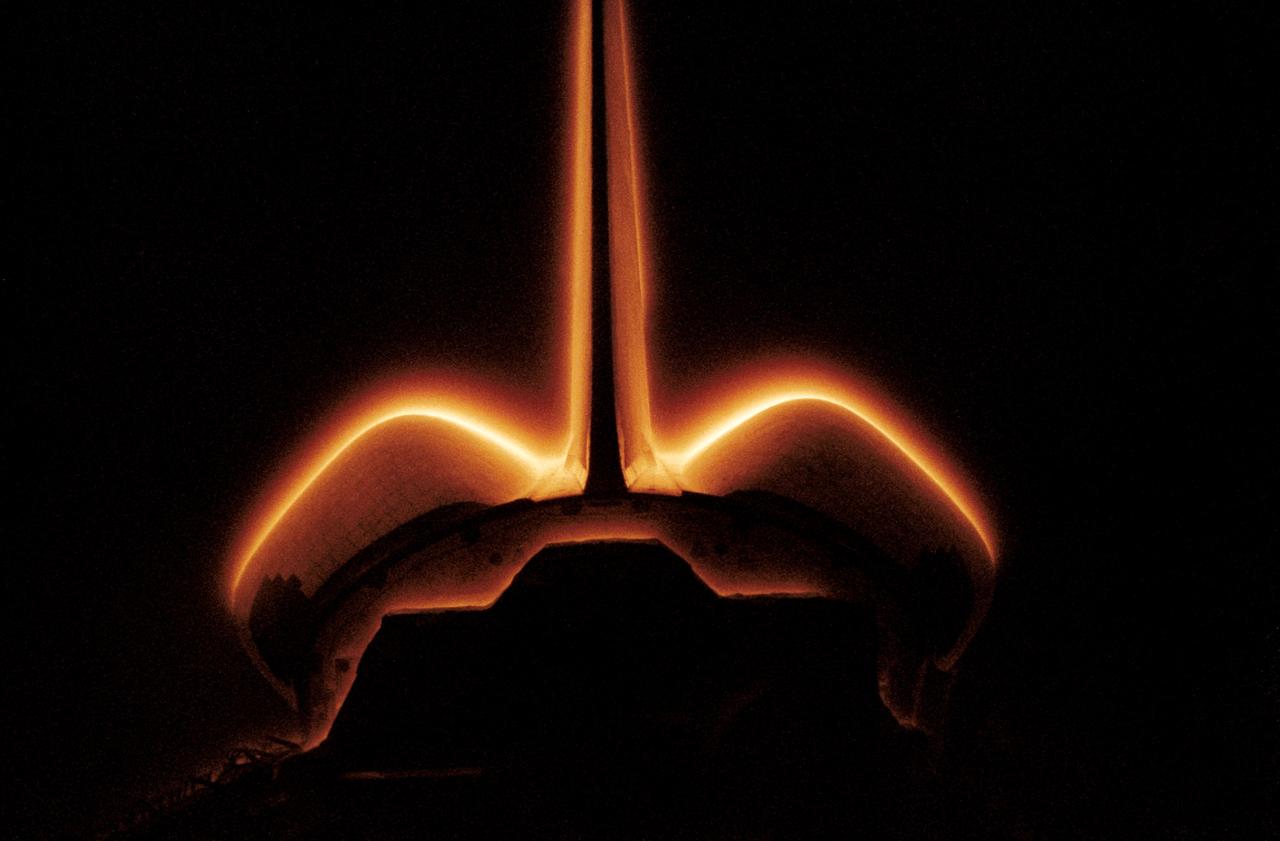
STS062-42-026 (4-18 March 1994) --- This 35mm frame, photographed as the Space Shuttle Columbia was orbiting Earth during a "night" pass, documents the glow phenomenon surrounding the vertical stabilizer and the Orbital Maneuvering System (OMS) pods of the spacecraft.
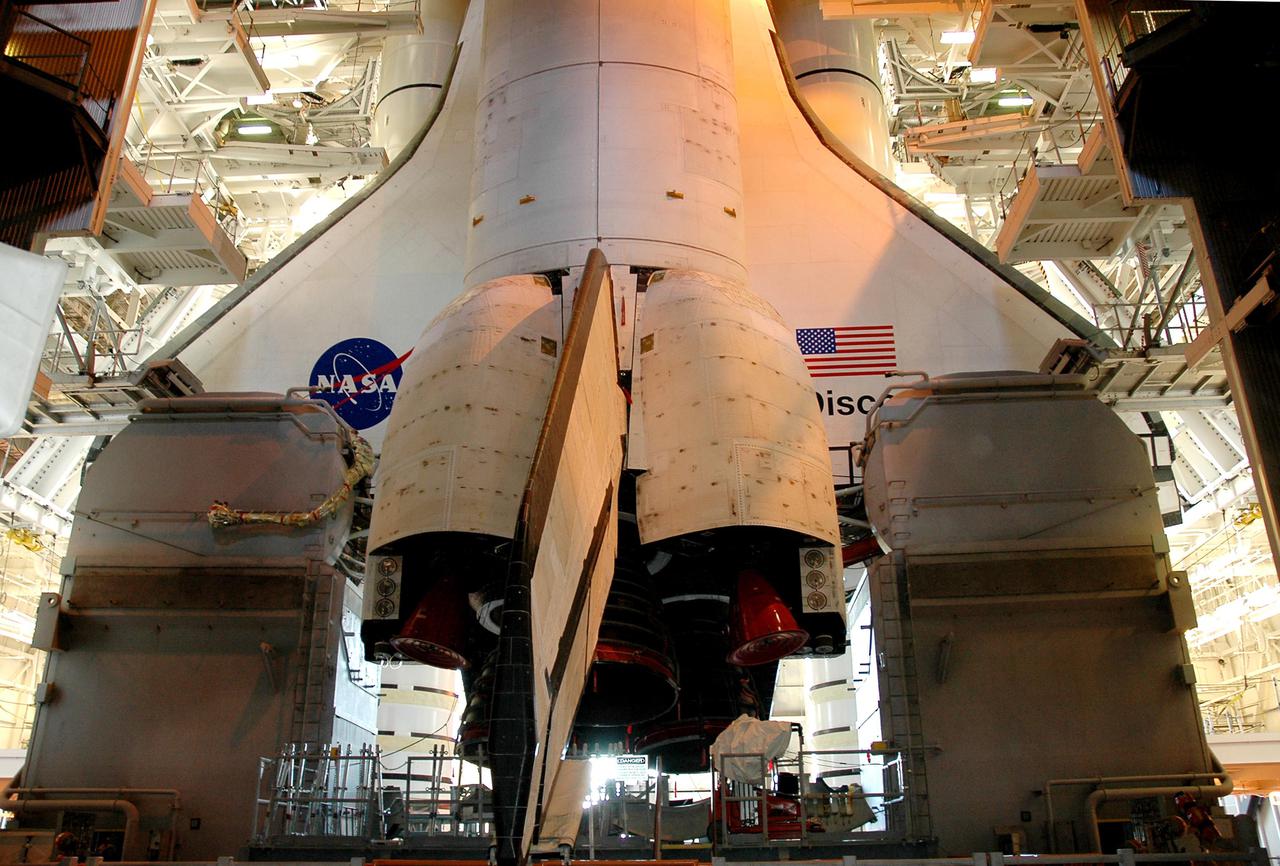
KENNEDY SPACE CENTER, FLA. - Lights inside the Vehicle Assembly Building cast an orange glow on Space Shuttle Discovery as waits on top of the Mobile Launcher Platform for rollout to Launch Pad 39B. Rollout is expected to begin about 12:01 a.m. June 15 for the 4-mile, 6-hour trip to the pad. On either side of Discovery’s tail and orbital maneuvering system pods are the Tail Masts that support the fluid, gas and electrical requirements of the orbiter’s liquid oxygen and liquid hydrogen aft T-0 umbilicals. Space Shuttle Discovery's Return to Flight mission STS-114 is scheduled for liftoff in a window extending from July 13 to July 31.
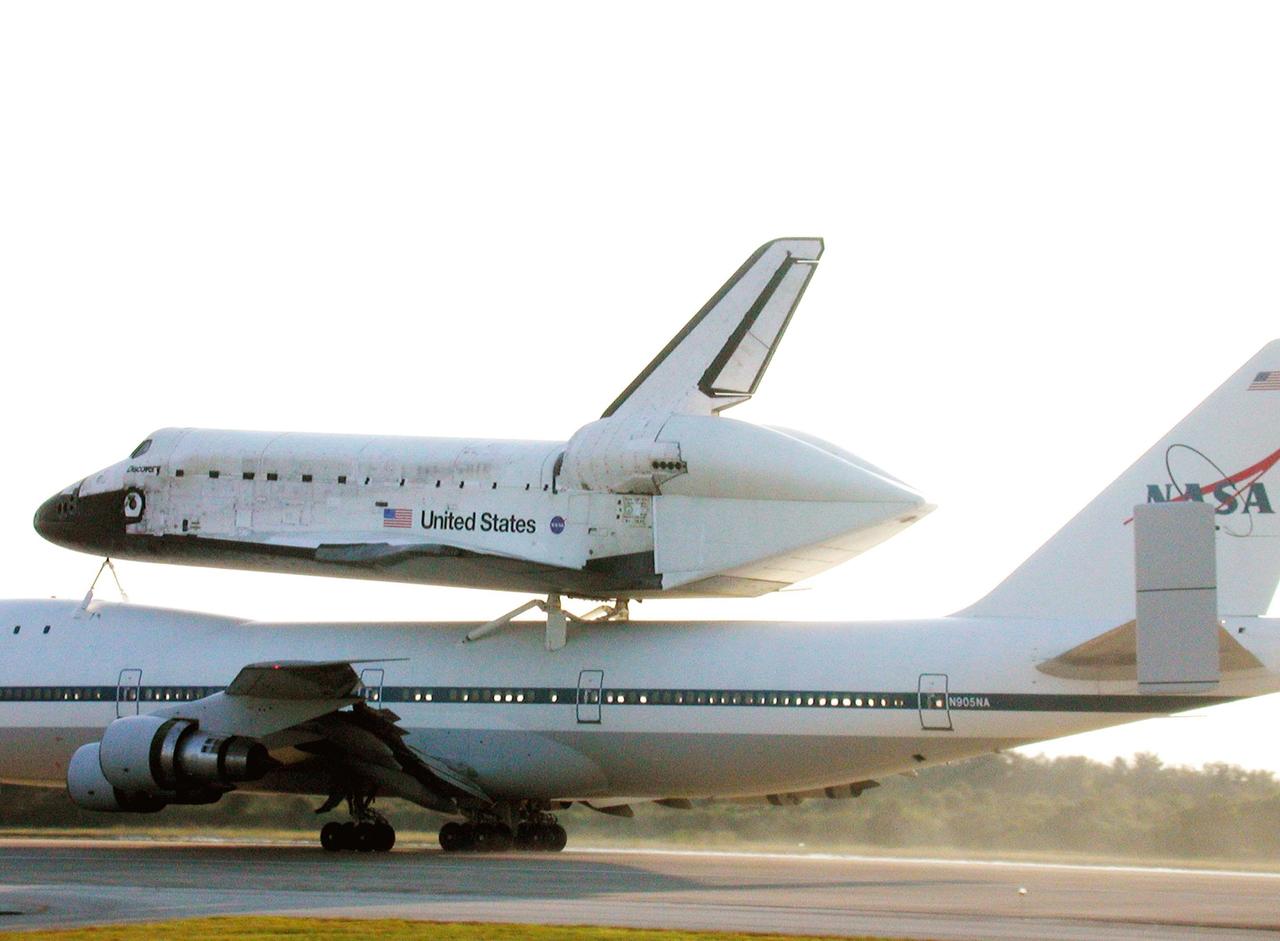
In the glow of a late afternoon sun, the Shuttle Carrier Aircraft (SCA) returns the orbiter Discovery to KSC after the orbiter’s California landing at Edwards Air Force Base at the end of mission STS-92. Discovery wears a tail cone protecting its aft nozzles for the ferry flight. Discovery will be demated from the SCA via the mate/demate device at the SLF and transported to the Orbiter Processing Facility bay 1. There it will undergo preparations for its next launch, STS-102, scheduled for February 2001

This image from NASA MESSENGER spacecraft is stitched together from thousands of observations made over the past 4 years by the MASCS/UVVS instrument, which measures sunlight scattered off of Mercury tenuous atmosphere. Scattered sunlight gives the sodium a bright orange glow. This scattering process also gives sodium atoms a push - this "radiation pressure" is strong enough, during parts of Mercury's year, to strip the atmosphere and give Mercury a long glowing tail. Someone standing on Mercury's nightside at the right time of year would see a faint orange similar to a city sky illuminated by sodium lamps! Instrument: Mercury Atmospheric and Surface Composition Spectrometer (MASCS)/Ultraviolet and Visible Spectrometer (UVVS) http://photojournal.jpl.nasa.gov/catalog/PIA19418
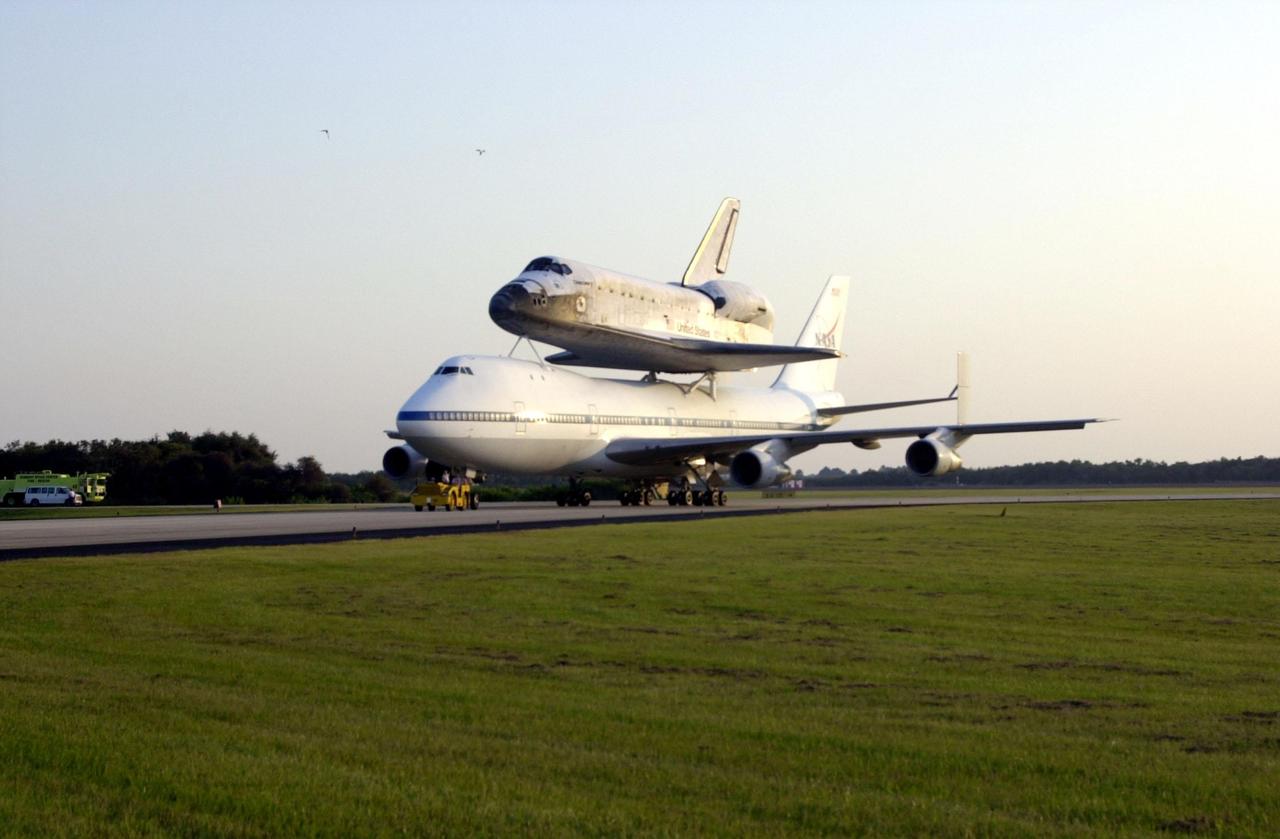
Catching the glow of the late afternoon sun, the Shuttle Carrier Aircraft (SCA) rolls down the runway at the Shuttle Landing Facility as it returns the orbiter Discovery to KSC. The ferry flight started in California after the orbiter’s landing more than a week ago at Edwards Air Force Base at the end of mission STS-92. Discovery wears a tail cone protecting its aft nozzles for the ferry flight. Discovery will be demated from the SCA via the mate/demate device at the SLF and transported to the Orbiter Processing Facility bay 1. There it will undergo preparations for its next launch, STS-102, scheduled for February 2001

Catching the glow of the late afternoon sun, the Shuttle Carrier Aircraft (SCA) rolls down the runway at the Shuttle Landing Facility as it returns the orbiter Discovery to KSC. The ferry flight started in California after the orbiter’s landing more than a week ago at Edwards Air Force Base at the end of mission STS-92. Discovery wears a tail cone protecting its aft nozzles for the ferry flight. Discovery will be demated from the SCA via the mate/demate device at the SLF and transported to the Orbiter Processing Facility bay 1. There it will undergo preparations for its next launch, STS-102, scheduled for February 2001

KENNEDY SPACE CENTER, FLA. - Its fiery tail casting a pink glow on cirrus clouds and water below, Space Shuttle Endeavour roars into space on mission STS-111 to the International Space Station. Liftoff occurred at 5:22:49 p.m. EDT. The STS-111 crew includes Commander Kenneth Cockrell, Pilot Paul Lockhart, and Mission Specialists Franklin Chang-Diaz and Philippe Perrin (CNES), as well as the Expedition Five crew members Valeri Korzun, Peggy Whitson and Sergei Treschev. This mission marks the 14th Shuttle flight to the International Space Station and the third Shuttle mission this year. Mission STS-111 is the 18th flight of Endeavour and the 110th flight overall in NASA's Space Shuttle program. [Photo by Anita Barrett
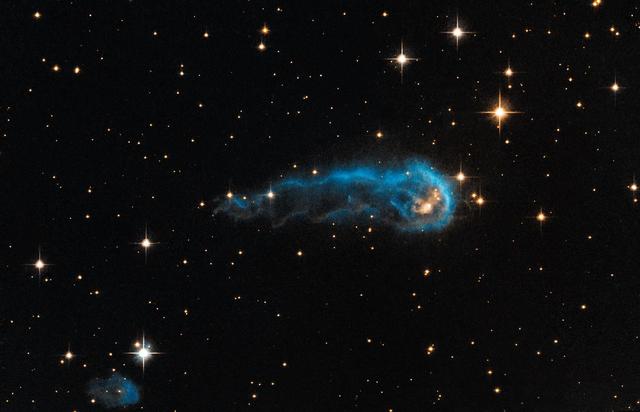
A bright blue tadpole appears to swim through the inky blackness of space. Known as IRAS 20324+4057, but dubbed "the Tadpole," this clump of gas and dust has given birth to a bright, "protostar," one of the earliest steps in building a star. This image was taken by NASA's Hubble Space Telescope, and released publicly, in 2012. There are actually multiple protostars within this tadpole's 'head," but the glowing yellow one in this image is the most luminous and massive. When this protostar has gathered together enough mass from its surroundings, it will eventually emerge as a fully-fledged young star. The intense blue glow is caused by nearby stars firing ultraviolet radiation at IRAS 20324+4057, which also sculpts its tail into a long, wiggly shape. In total, this clump spans roughly a light-year from head to tail-tip, and contains gas weighing almost four times the mass of the sun. Framed against a background of distant stars, IRAS 20324+4057 is making its way through the Cygnus OB2 association, a loose cluster of stars some 4,700 light-years from Earth in the constellation Cygnus. This association is one of the largest clusters known, and is famed for its heavyweight members. It contains some of the hottest, most massive and most luminous stars known, some of which are about two million times more luminous than the sun. The Tadpole is not alone in this interstellar pond. Just out of view, to the bottom right of this image, lies another curious object dubbed "the Goldfish" by astronomers. The Goldfish is about half the length of IRAS 20324+4057, and is also thought to be a globule of gas that is being both lit up and sculpted by radiation from cluster stars. Completing this trio is a small clump of blue gas, informally nicknamed "the Wriggler" by some astronomers, visible in the bottom left of this Hubble image. All three objects have the same orientation in the sky and appear to be brighter on their northern sides, leading astronomers to believe they are being shaped by aggressive winds and radiation flowing from hot Cygnus OB2 stars towards the top right of the frame. http://photojournal.jpl.nasa.gov/catalog/PIA18168
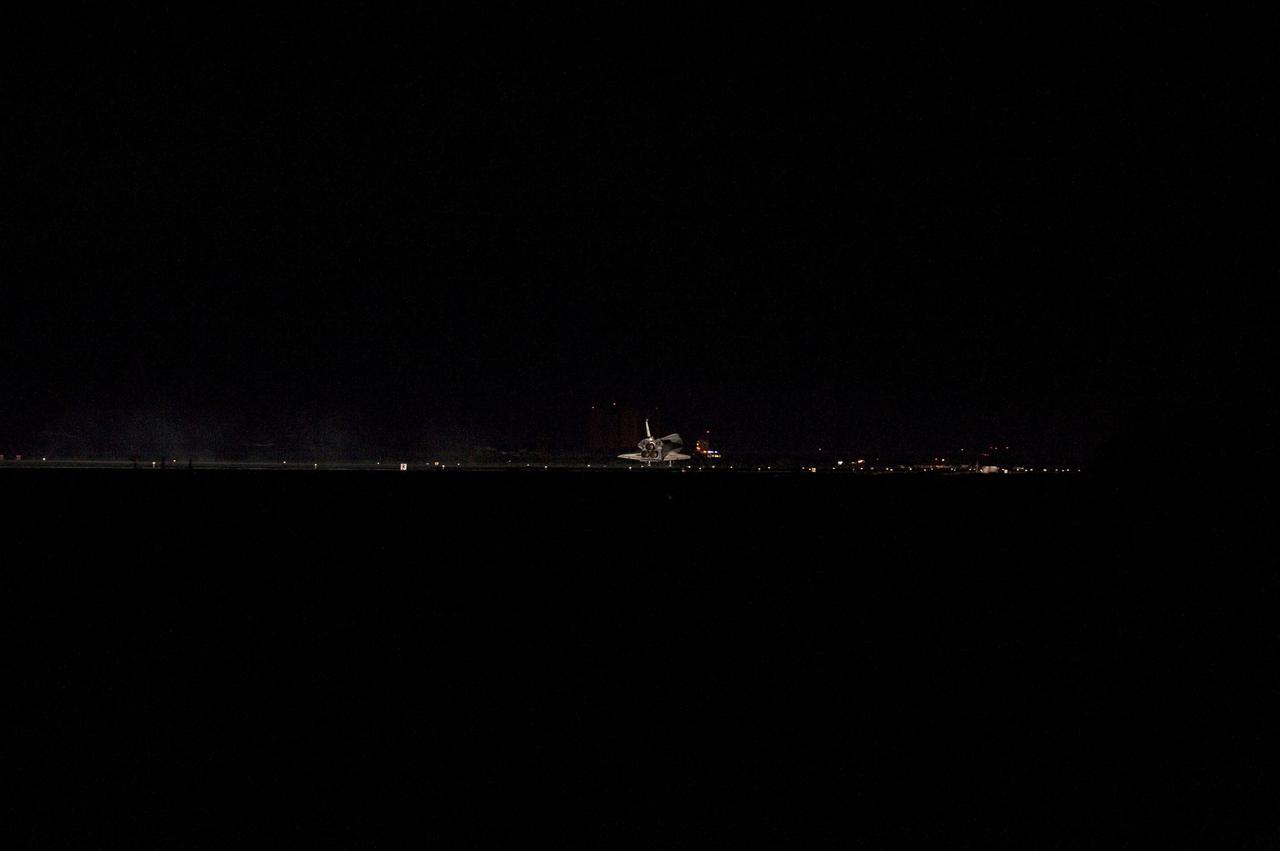
CAPE CANAVERAL, Fla. -- Space shuttle Atlantis' three main engines glow a red hue in the spacecraft's tail end as it touches down on the Shuttle Landing Facility's Runway 15 at NASA's Kennedy Space Center in Florida for the final time. Securing the space shuttle fleet's place in history, Atlantis marked the 26th nighttime landing of NASA's Space Shuttle Program and the 78th landing at Kennedy. Main gear touchdown was at 5:57:00 a.m. EDT, followed by nose gear touchdown at 5:57:20 a.m., and wheelstop at 5:57:54 a.m. On board are STS-135 Commander Chris Ferguson, Pilot Doug Hurley, and Mission Specialists Sandra Magnus and Rex Walheim. On the 37th shuttle mission to the International Space Station, STS-135 delivered more than 9,400 pounds of spare parts, equipment and supplies in the Raffaello multi-purpose logistics module that will sustain station operations for the next year. STS-135 was the 33rd and final flight for Atlantis, which has spent 307 days in space, orbited Earth 4,848 times and traveled 125,935,769 miles. For more information visit, www.nasa.gov/mission_pages/shuttle/shuttlemissions/sts135/index.html. Photo credit: NASA/Sandra Joseph
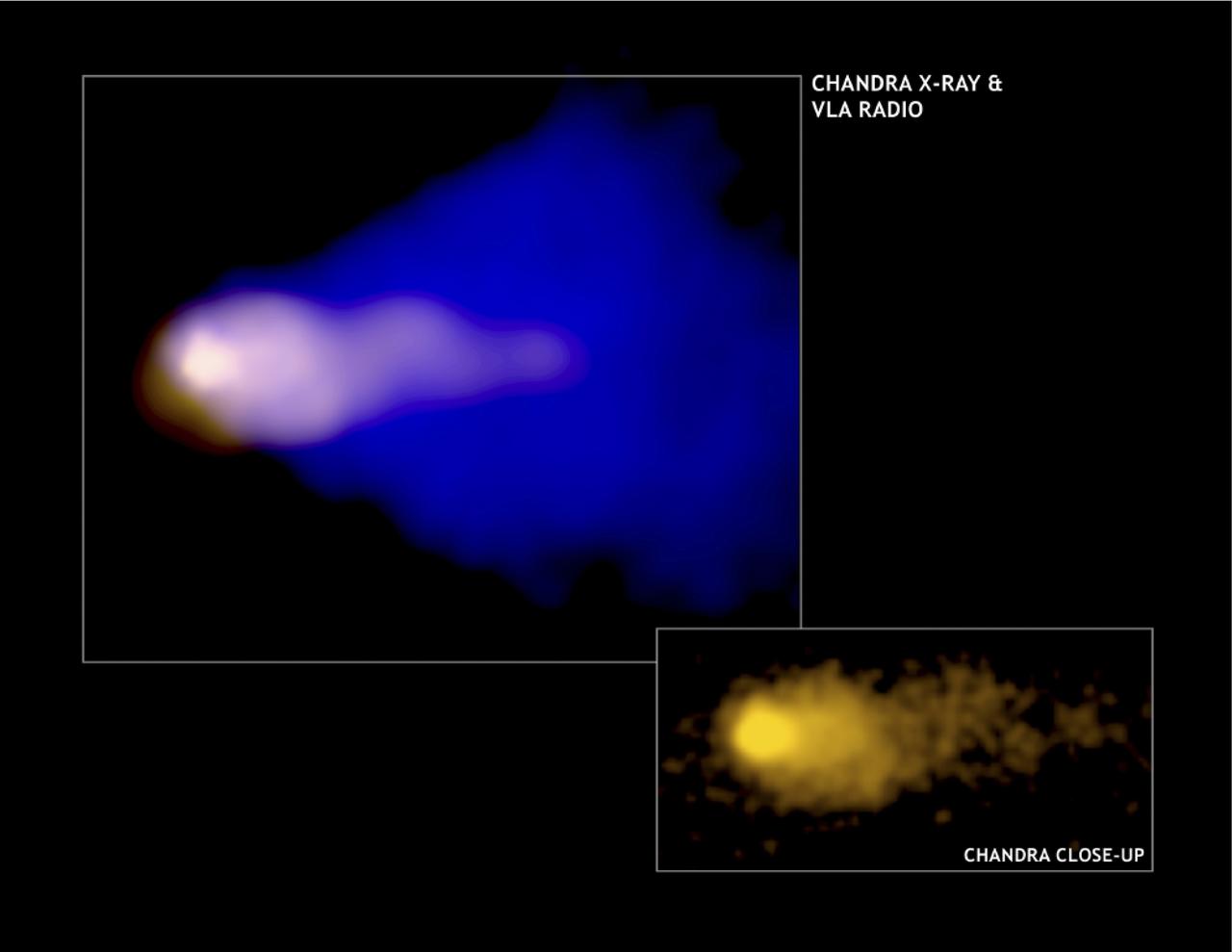
Astronomers have used an x-ray image to make the first detailed study of the behavior of high-energy particles around a fast moving pulsar. This image, from NASA's Chandra X-Ray Observatory (CXO), shows the shock wave created as a pulsar plows supersonically through interstellar space. These results will provide insight into theories for the production of powerful winds of matter and antimatter by pulsars. Chandra's image of the glowing cloud, known as the Mouse, shows a stubby bright column of high-energy particles, about four light years in length, swept back by the pulsar's interaction with interstellar gas. The intense source at the head of the X-ray column is the pulsar, estimated to be moving through space at about 1.3 million miles per hour. A cone-shaped cloud of radio-wave-emitting particles envelopes the x-ray column. The Mouse, a.k.a. G359.23-0.82, was discovered in 1987 by radio astronomers using the National Science Foundation's Very Large Array in New Mexico. G359.23-0.82 gets its name from its appearance in radio images that show a compact snout, a bulbous body, and a remarkable long, narrow, tail that extends for about 55 light years. NASA’s Marshall Space Flight Center in Huntsville, Alabama manages the Chandler program.
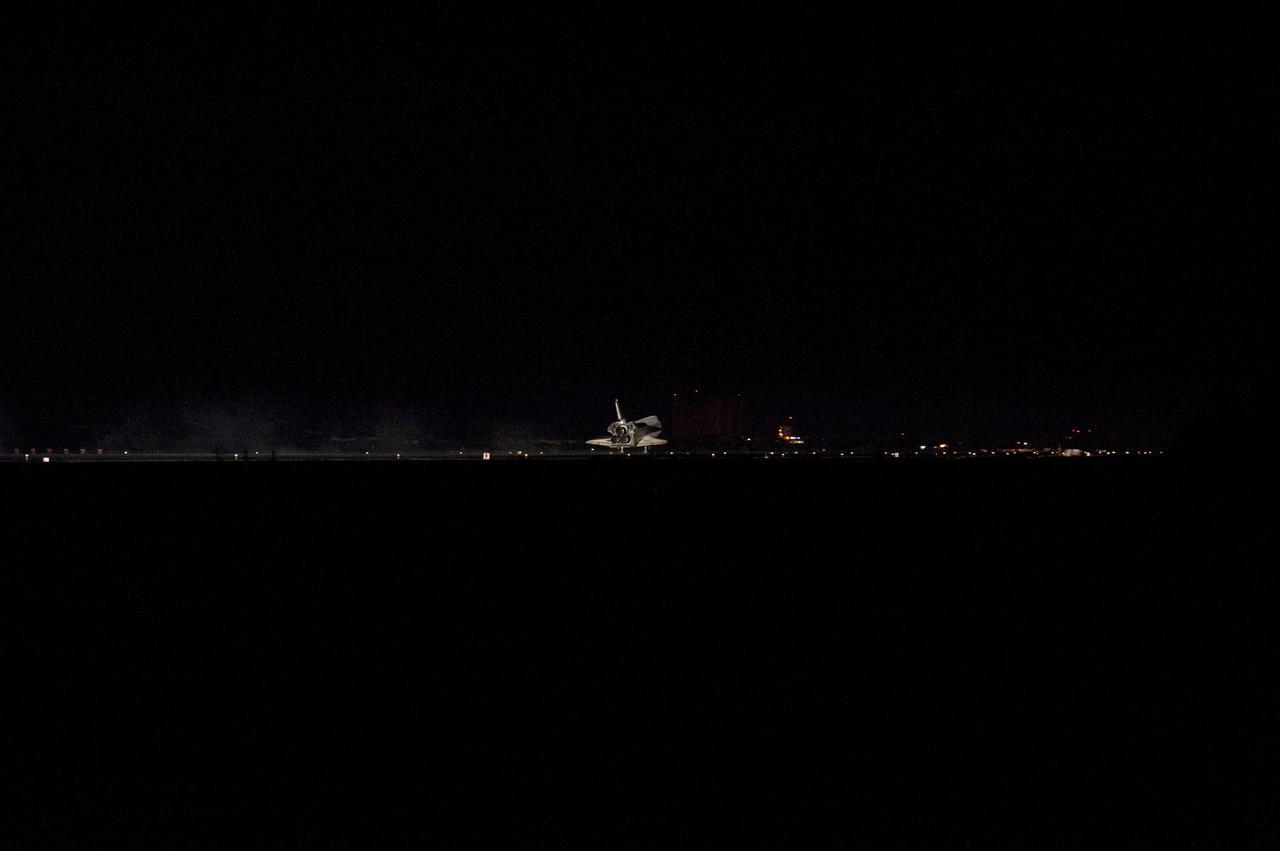
STS135-S-183 (21 July 2011) --- Space shuttle Atlantis' three main engines glow a red hue in the spacecraft's tail end as it touches down on the Shuttle Landing Facility's Runway 15 at NASA's Kennedy Space Center in Florida for the final time. Securing the space shuttle fleet's place in history, Atlantis marked the 26th nighttime landing of NASA's Space Shuttle Program and the 78th landing at Kennedy. Main gear touchdown was at 5:57:00 a.m. (EDT) on July 21, 2011, followed by nose gear touchdown at 5:57:20 a.m., and wheelstop at 5:57:54 a.m. Onboard are NASA astronauts Chris Ferguson, STS-135 commander; Doug Hurley, pilot; Sandy Magnus and Rex Walheim, both mission specialists. On the 37th shuttle mission to the International Space Station, STS-135 delivered more than 9,400 pounds of spare parts, equipment and supplies in the Raffaello multi-purpose logistics module that will sustain station operations for the next year. STS-135 was the 33rd and final flight for Atlantis, which has spent 307 days in space, orbited Earth 4,848 times and traveled 125,935,769 miles. Photo credit: NASA
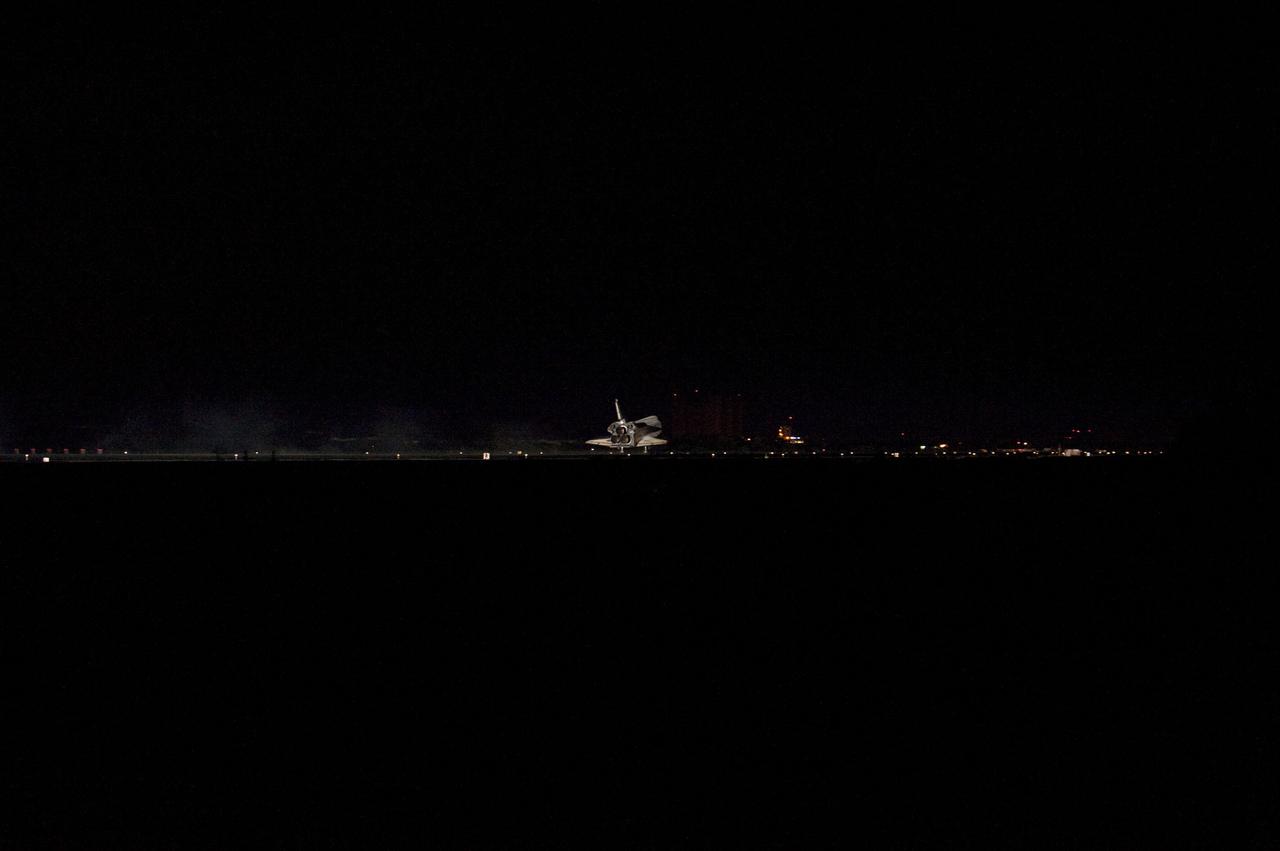
CAPE CANAVERAL, Fla. -- Space shuttle Atlantis' three main engines glow a red hue in the spacecraft's tail end as it touches down on the Shuttle Landing Facility's Runway 15 at NASA's Kennedy Space Center in Florida for the final time. Securing the space shuttle fleet's place in history, Atlantis marked the 26th nighttime landing of NASA's Space Shuttle Program and the 78th landing at Kennedy. Main gear touchdown was at 5:57:00 a.m. EDT, followed by nose gear touchdown at 5:57:20 a.m., and wheelstop at 5:57:54 a.m. On board are STS-135 Commander Chris Ferguson, Pilot Doug Hurley, and Mission Specialists Sandra Magnus and Rex Walheim. On the 37th shuttle mission to the International Space Station, STS-135 delivered more than 9,400 pounds of spare parts, equipment and supplies in the Raffaello multi-purpose logistics module that will sustain station operations for the next year. STS-135 was the 33rd and final flight for Atlantis, which has spent 307 days in space, orbited Earth 4,848 times and traveled 125,935,769 miles. For more information visit, www.nasa.gov/mission_pages/shuttle/shuttlemissions/sts135/index.html. Photo credit: NASA/Sandra Joseph
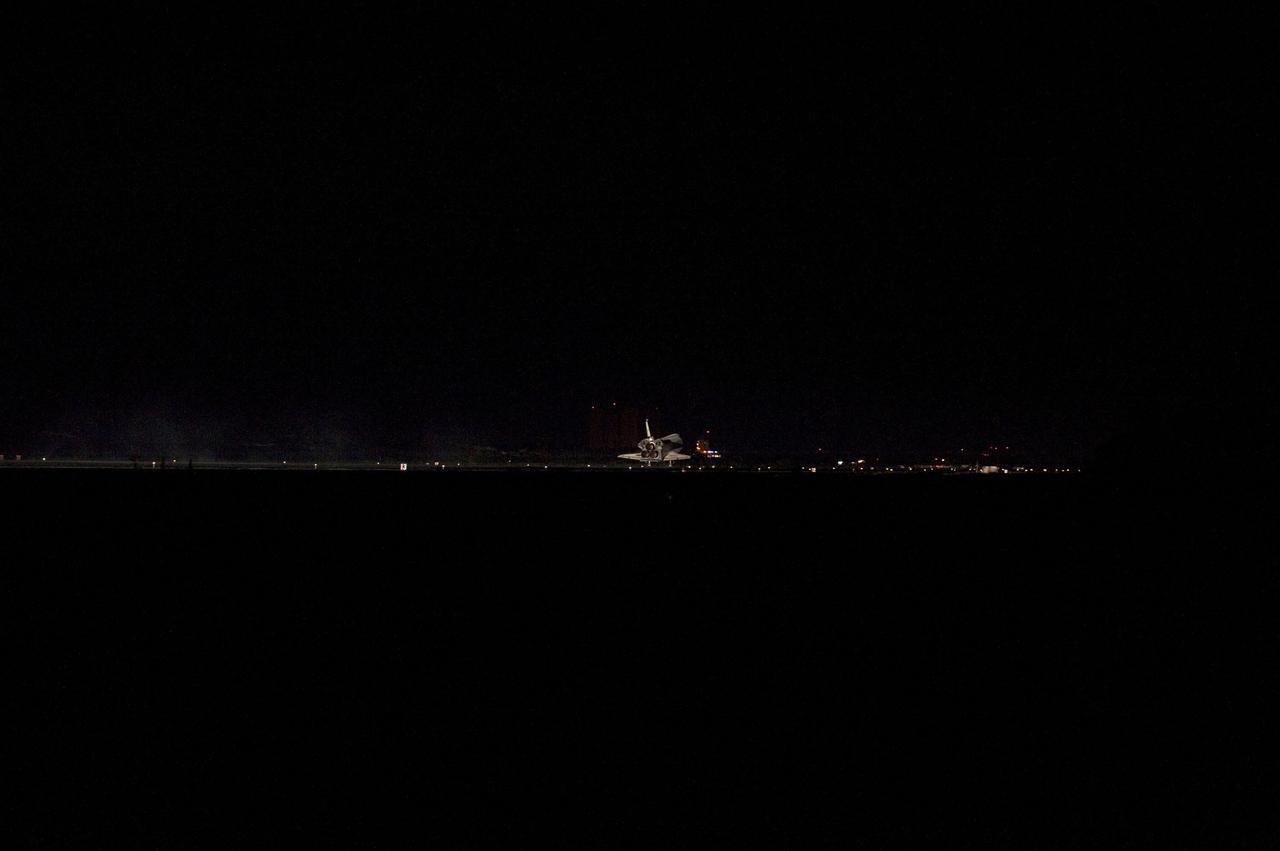
STS135-S-184 (21 July 2011) --- Space shuttle Atlantis' three main engines glow a red hue in the spacecraft's tail end as it touches down on the Shuttle Landing Facility's Runway 15 at NASA's Kennedy Space Center in Florida for the final time. Securing the space shuttle fleet's place in history, Atlantis marked the 26th nighttime landing of NASA's Space Shuttle Program and the 78th landing at Kennedy. Main gear touchdown was at 5:57:00 a.m. (EDT) on July 21, 2011, followed by nose gear touchdown at 5:57:20 a.m., and wheelstop at 5:57:54 a.m. Onboard are NASA astronauts Chris Ferguson, STS-135 commander; Doug Hurley, pilot; Sandy Magnus and Rex Walheim, both mission specialists. On the 37th shuttle mission to the International Space Station, STS-135 delivered more than 9,400 pounds of spare parts, equipment and supplies in the Raffaello multi-purpose logistics module that will sustain station operations for the next year. STS-135 was the 33rd and final flight for Atlantis, which has spent 307 days in space, orbited Earth 4,848 times and traveled 125,935,769 miles. Photo credit: NASA
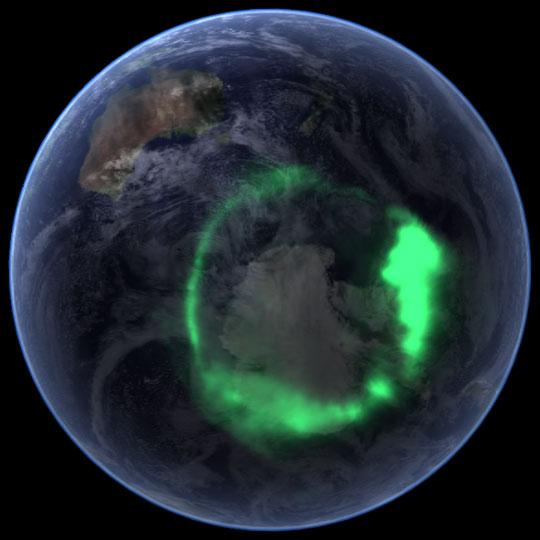
NASA file image acquired September 11, 2005 <b>To view a video of this event go here: <a href="http://www.flickr.com/photos/gsfc/6257608714">www.flickr.com/photos/gsfc/6257608714</a></b> From space, the aurora is a crown of light that circles each of Earth’s poles. The IMAGE satellite captured this view of the aurora australis (southern lights) on September 11, 2005, four days after a record-setting solar flare sent plasma—an ionized gas of protons and electrons—flying towards the Earth. The ring of light that the solar storm generated over Antarctica glows green in the ultraviolet part of the spectrum, shown in this image. The IMAGE observations of the aurora are overlaid onto NASA’s satellite-based Blue Marble image. From the Earth’s surface, the ring would appear as a curtain of light shimmering across the night sky. Like all solar storms, the September storm distorted the shape of the magnetic field that surrounds the Earth. Without buffeting from the solar wind (charged particles like protons and electrons that are ejected from the Sun), the Earth’s magnetic field would look something like a plump doughnut, with the North and South poles forming the slender hole in the center. In reality, the nearly constant solar winds flatten the space side of the “doughnut” into a long tail. The amount of distortion changes when solar storms, such as the flare on September 7, send stronger winds towards the Earth. Changes to the magnetic field release fast-moving particles, which flow with charged particles from the Sun towards the center of the “doughnut” at the Earth’s poles. As the particles sink into the atmosphere, they collide with oxygen and nitrogen, lighting the sky with Nature’s version of neon lights, the aurora. Though scientists knew that the aurora were caused by charged particles from the Sun and their interaction with the Earth’s magnetic field, they had no way to measure the interaction until NASA launched the Imager for Magnetopause-to-Aurora Global Exploration (IMAGE) satellite in 2000. The satellite’s mission was to collect data that would allow scientists to study the structure and dynamics of the Earth’s magnetic field for the first time. Designed to operate for two years, IMAGE sent its last data to Earth in December 2005 after a highly successful five-year mission. Since 2000, IMAGE has provided insight into how the Earth’s powerful magnetic field protects the planet from solar winds. Without the shield the magnetic field provides, the upper atmosphere would evaporate into space under the influence of solar winds. IMAGE has shown scientists what sort of changes the magnetic field undertakes as it diverts solar winds from the Earth. For a summary of the discoveries that IMAGE has made possible, see IMAGE Discovers. Instrument: IMAGE Credit: <a href="http://svs.gsfc.nasa.gov/index.html" rel="nofollow">NASA/Goddard Space Flight Center Scientific Visualization Studio</a> <b><a href="http://www.nasa.gov/audience/formedia/features/MP_Photo_Guidelines.html" rel="nofollow">NASA image use policy.</a></b> <b><a href="http://www.nasa.gov/centers/goddard/home/index.html" rel="nofollow">NASA Goddard Space Flight Center</a></b> enables NASA’s mission through four scientific endeavors: Earth Science, Heliophysics, Solar System Exploration, and Astrophysics. Goddard plays a leading role in NASA’s accomplishments by contributing compelling scientific knowledge to advance the Agency’s mission. <b>Follow us on <a href="http://twitter.com/NASAGoddardPix" rel="nofollow">Twitter</a></b> <b>Like us on <a href="http://www.facebook.com/pages/Greenbelt-MD/NASA-Goddard/395013845897?ref=tsd" rel="nofollow">Facebook</a></b> <b>Find us on <a href="http://instagrid.me/nasagoddard/?vm=grid" rel="nofollow">Instagram</a></b>