Goal!!
Goal!!
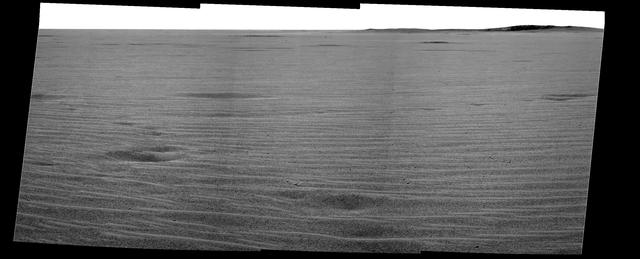
Endurance Goal Across the Plains
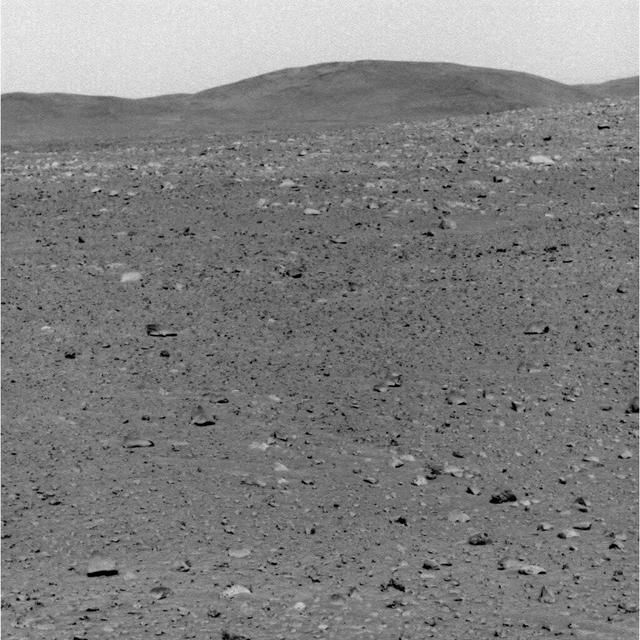
Hills Still a Distant Goal for Spirit
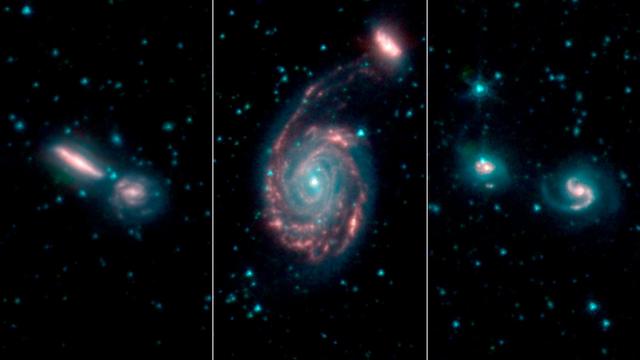
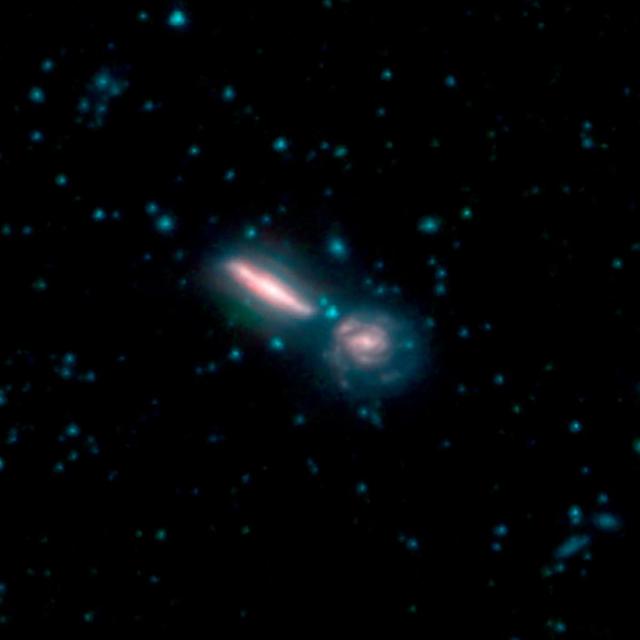
These three images show merging galaxies observed for the Great Observatories All-sky LIRG Survey, or GOALS. The merger on the left is Arp 302; in the middle are NGC 7752 and 7753; on the right is IIZw96.  https://photojournal.jpl.nasa.gov/catalog/PIA23009
GOALS Merging Galaxies
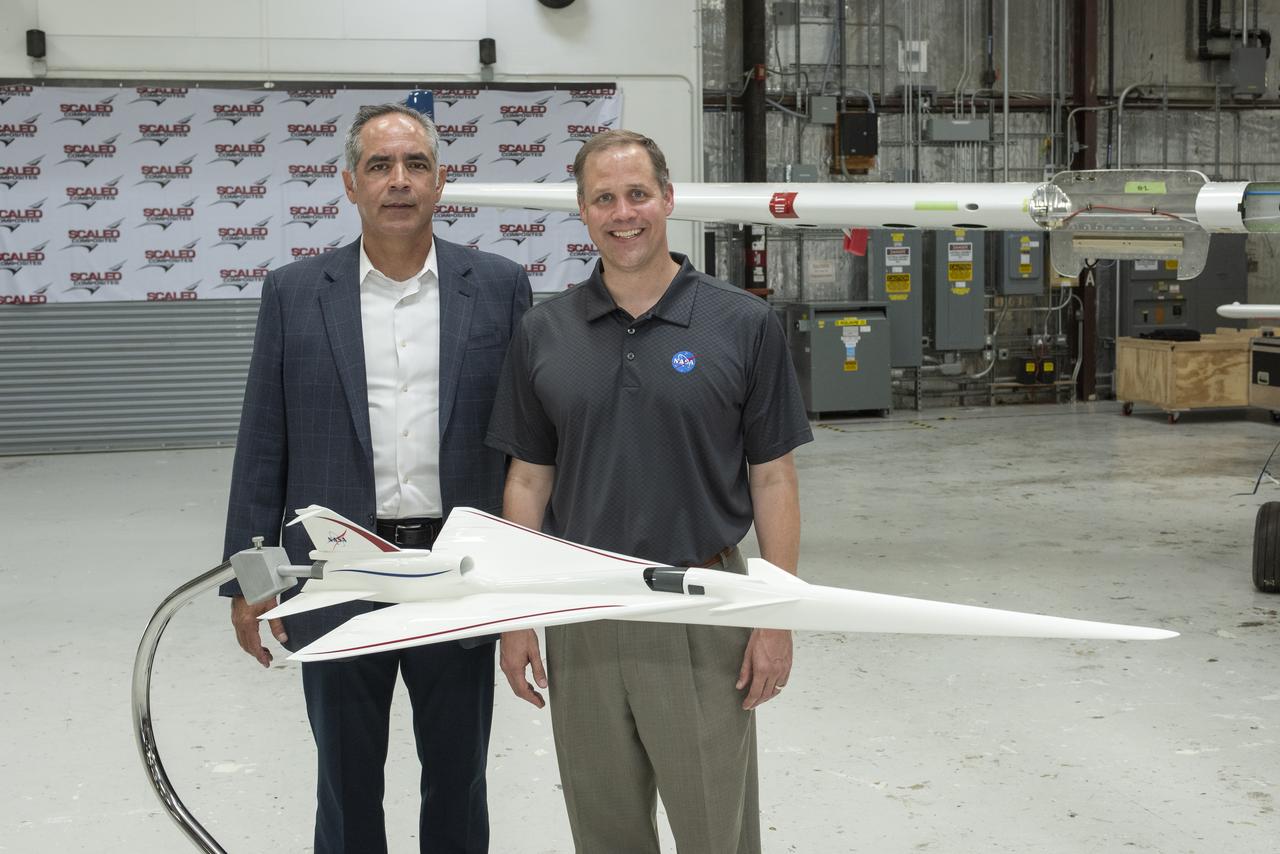
NASA Administrator Bridenstine stands with AFRC center director McBride by model NASA's Supersonic X-Plane, X-59 Quiet Supersonic Technology or QueSST. Bridenstine spoke at press event at Mojave Air and Space Port in California. The goal of X-59 is to quiet the sound when aircraft pierce the speed of sound and make a loud sonic boom on the ground.
NASA Administrator Bridenstine and Armstrong Flight Research Center's Center Director McBride stand beside model of NASA's Supersonic X-Plane, X-59 Quiet Supersonic Technology or QueSST at press event in Mojave Air & Space Port in California
This image shows two merging galaxies known as Arp 302, also called VV 340. It is composed of images from three Spitzer Infrared Array Camera (IRAC) channels: IRAC channel 1 in blue, IRAC channel 2 in green and IRAC channel 3 in red.  https://photojournal.jpl.nasa.gov/catalog/PIA23008
GOALS Merging Galaxies Arp 302
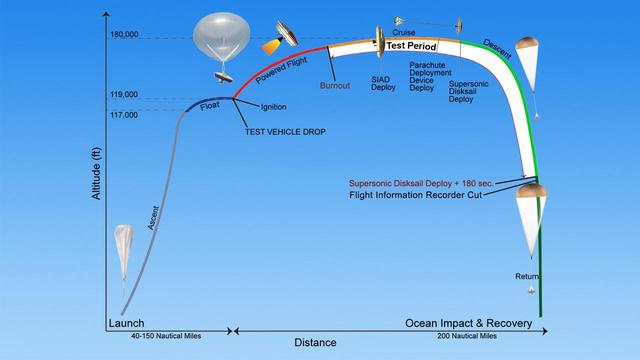
The saucer-shaped test vehicle for NASA Low-Density Supersonic Decelerator LDSD will undergo a series of events in the skies above Hawaii, with the ultimate goal of testing future landing technologies for Mars missions.
Timeline of Events for Planetary Landing Test
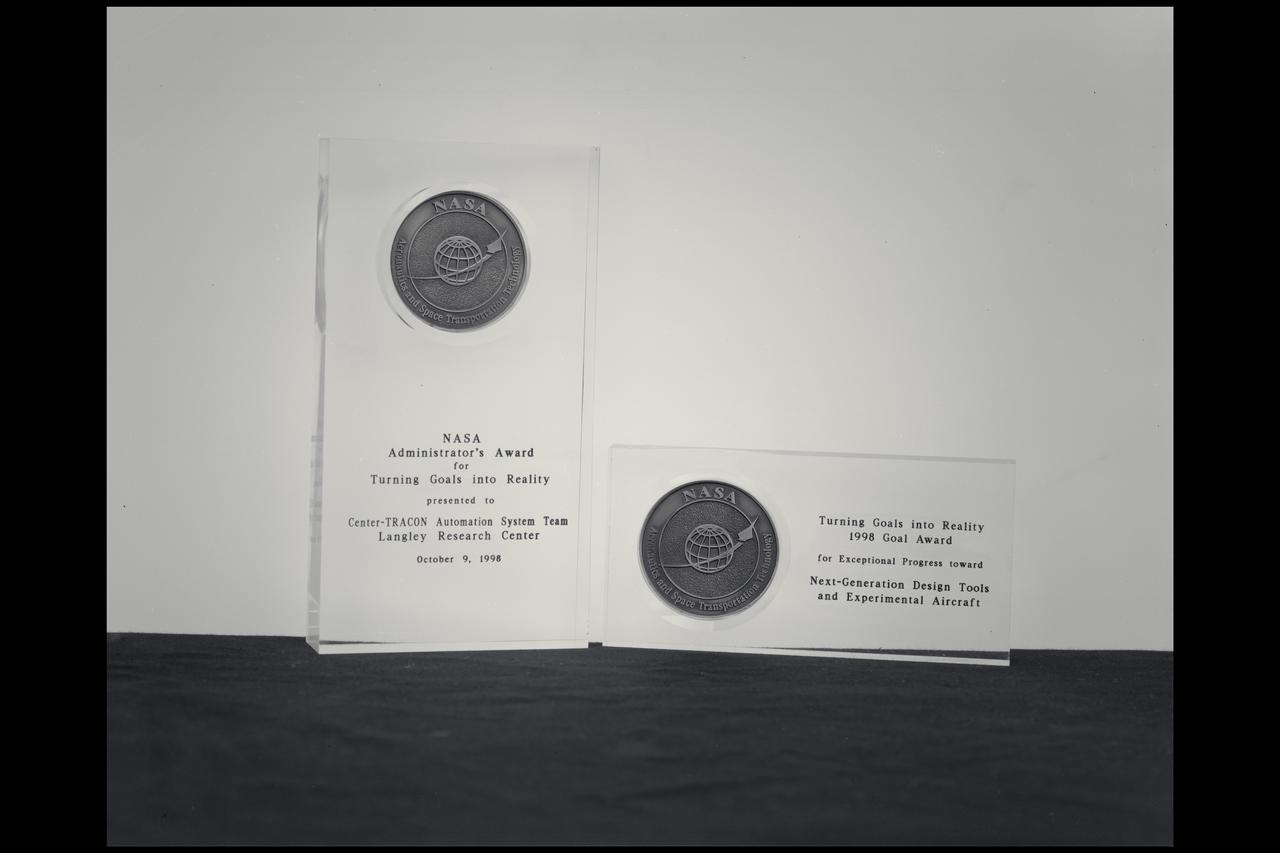
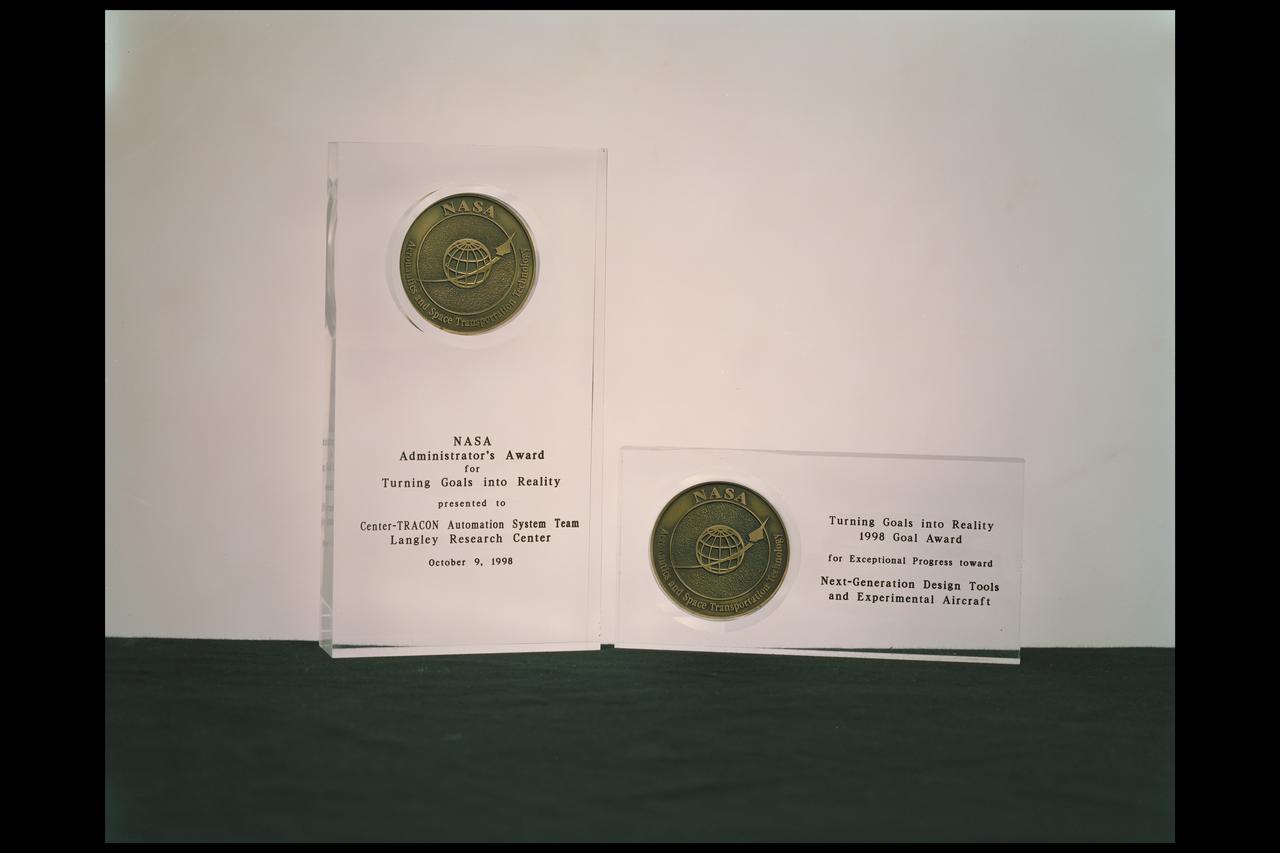
NASA Administrators Award for:  1. 'Turning Goals into Reality' presented to Center TRACON Automation System Team, Langley Research Center October 9, 1998 2. 'Turning Goals into Reality 1998 Goal Award for  Excetptional Progress toward Next-Generation Design Tools and Experimental Aircraft  acrylic
ARC-1998-A98-0242-1
WALT MELTON AND DAVID BROCK OF PROCUREMENT DISPLAY THE FY’13 NASA SMALL BUSINESS PRIME SOCIOECONOMIC PRIME GOAL ACHIEVEMENT AWARD GIVEN TO THE CENTER FOR EXCEEDING ITS SMALL BUSINESS GOALS IN ALL SOCIOECONOMIC CATEGORIES.  MARSHALL IS THE ONLY NASA CENTER TO RECEIVE THE AWARD FOR FIVE CONSECUTIVE YEARS.
1400343
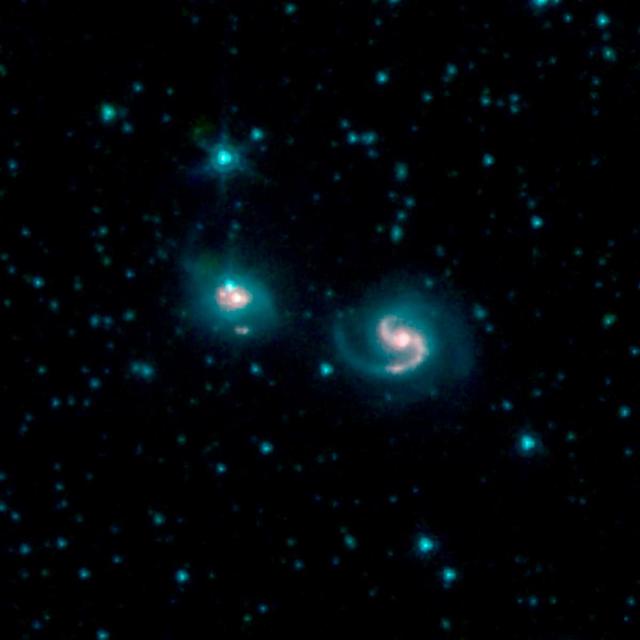
This image shows the merger of two galaxies, known as NGC 6786 (right) and UGC 11415 (left), also collectively called VII Zw 96. It is composed of images from three Spitzer Infrared Array Camera (IRAC) channels: IRAC channel 1 in blue, IRAC channel 2 in green and IRAC channel 3 in red.  https://photojournal.jpl.nasa.gov/catalog/PIA23007
GOALS Merging Galaxies VII Zw 96
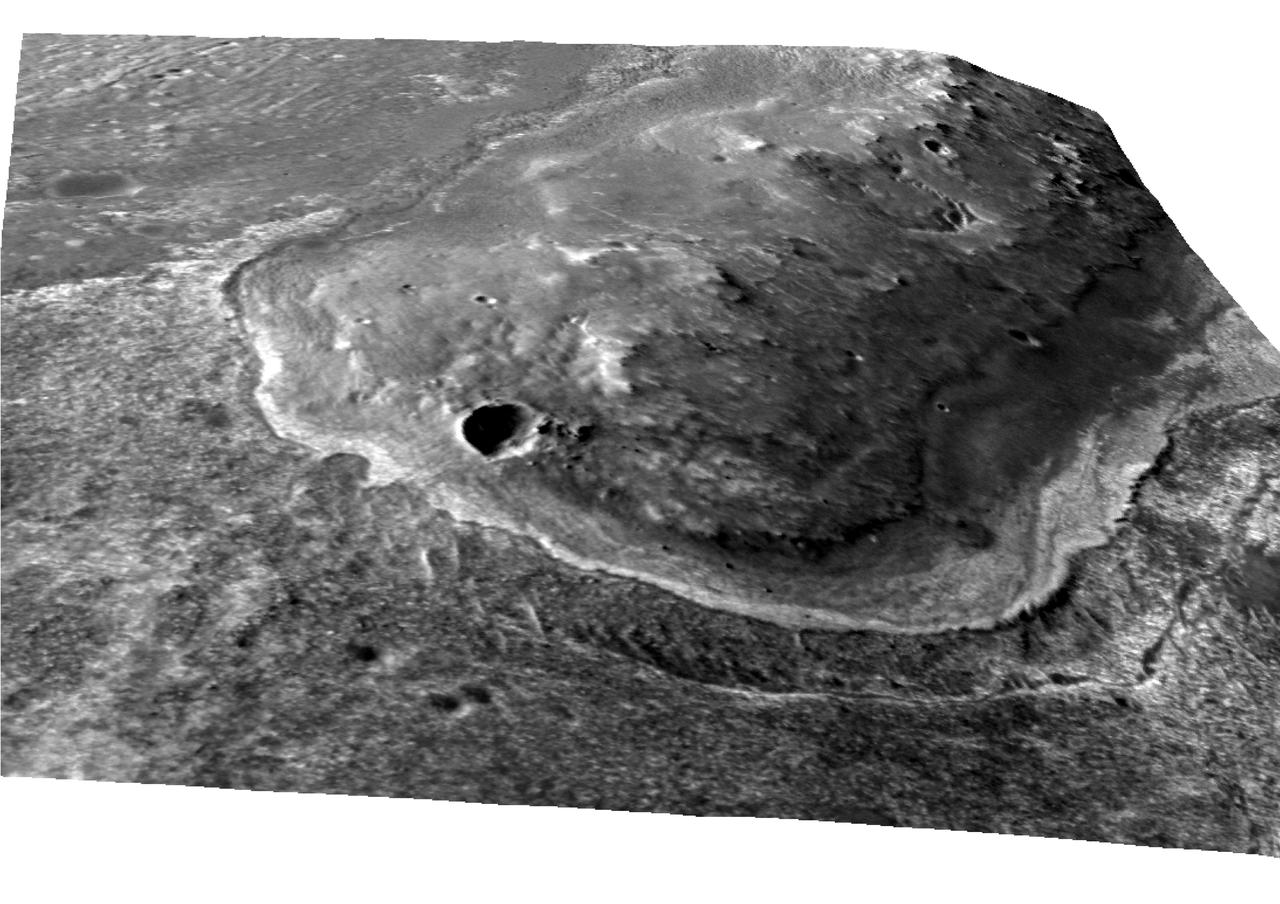
This image shows the portion of the rim of Endeavour crater given the informal name Spirit Point. This is the location where the team operating NASA Mars Exploration Rover Opportunity plans to drive the rover to its arrival at the Endeavour rim.
Opportunity First Goal at Endeavour Crater: Spirit Point
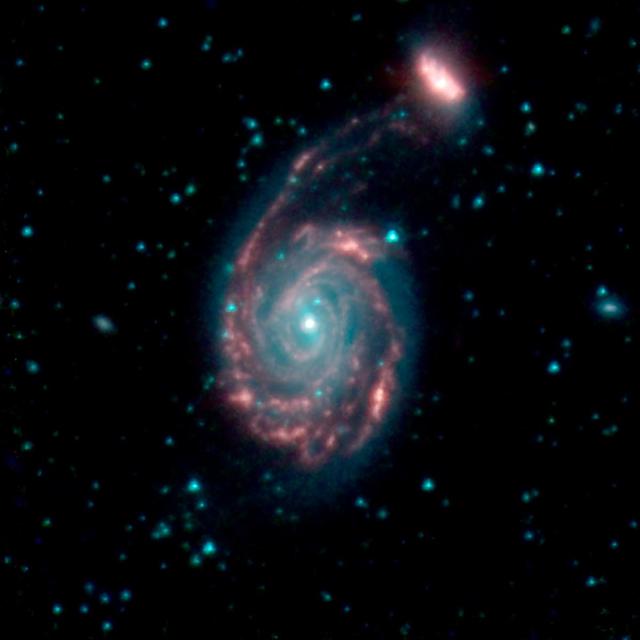
This image shows the merger of two galaxies, known as NGC 7752 (larger) and NGC 7753 (smaller), also collectively called Arp86. It is composed of images from three Spitzer Infrared Array Camera (IRAC) channels: IRAC channel 1 in blue, IRAC channel 2 in green and IRAC channel 3 in red.  https://photojournal.jpl.nasa.gov/catalog/PIA23006
GOALS Merging Galaxies NGC 7752 & 7753
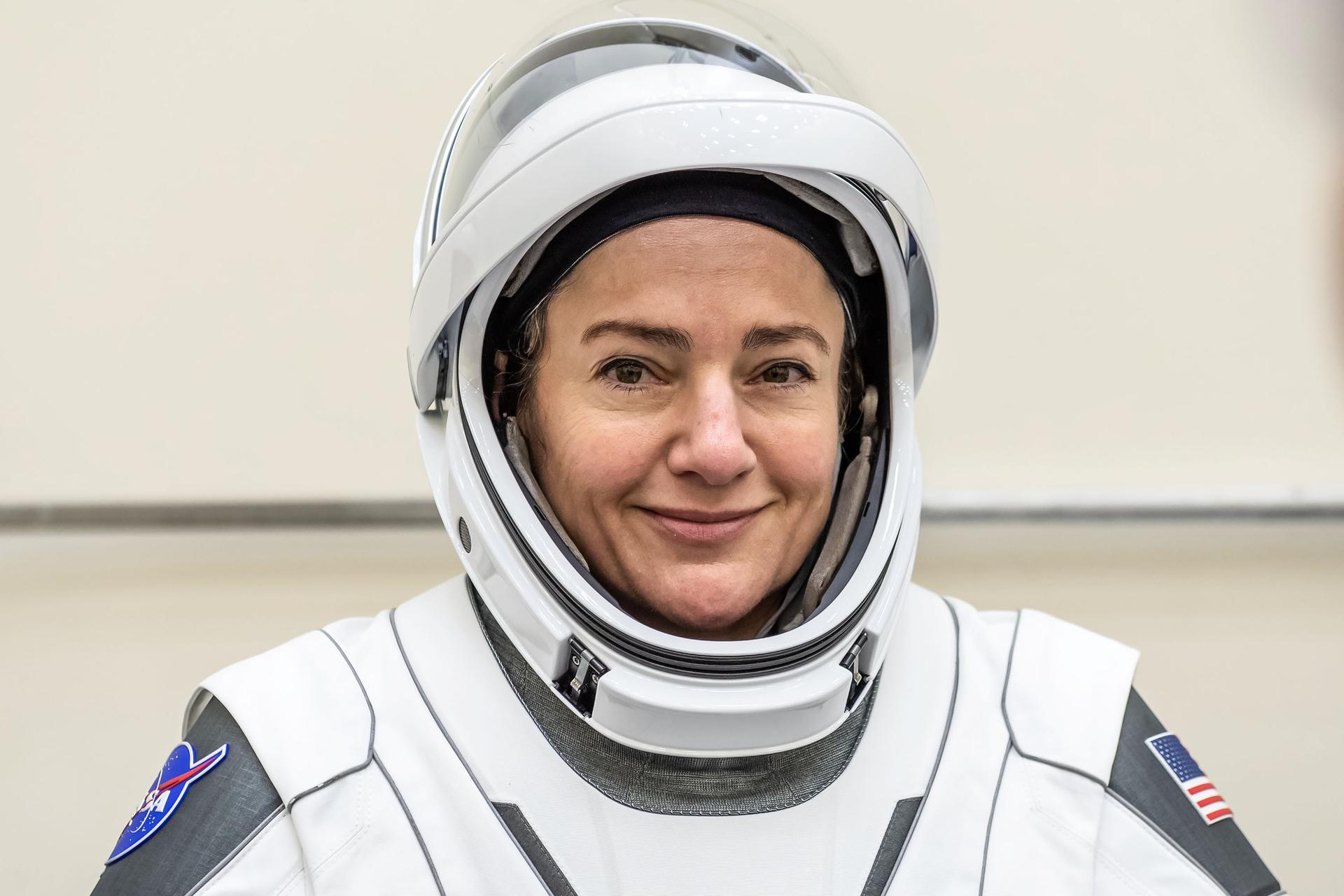
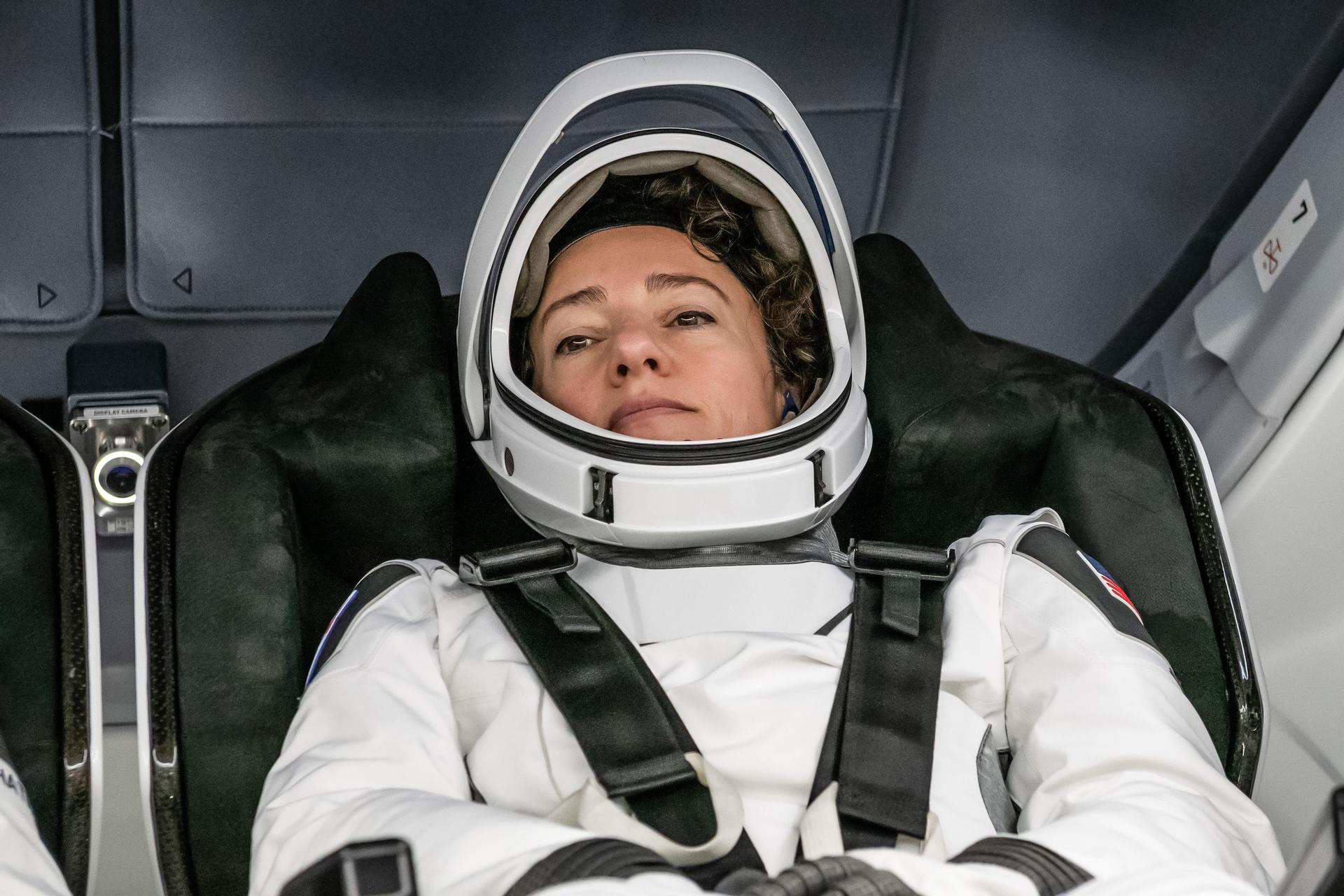
jsc2026e002966 (Jan. 12, 2026) --- NASA astronaut and SpaceX Crew-12 Commander Jessica Meir is photographed in her pressure suit during the Crew Equipment Interface Test at NASA’s Kennedy Space Center in Florida. The goal of the training is to rehearse launch day activities and get a close look at the Dragon spacecraft. Credit: SpaceX
NASA astronaut Jessica Meir is photographed in her SpaceX pressure suit
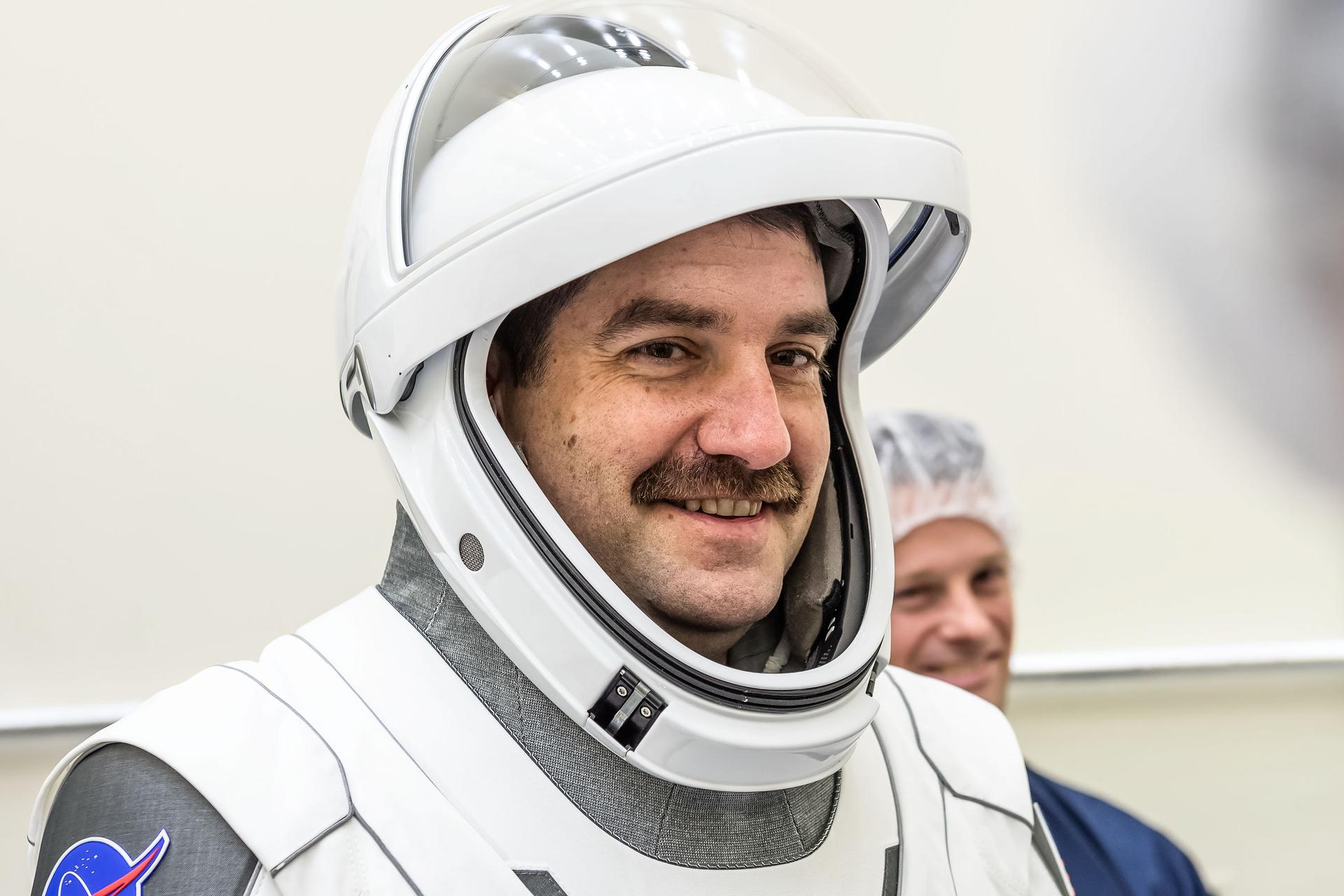
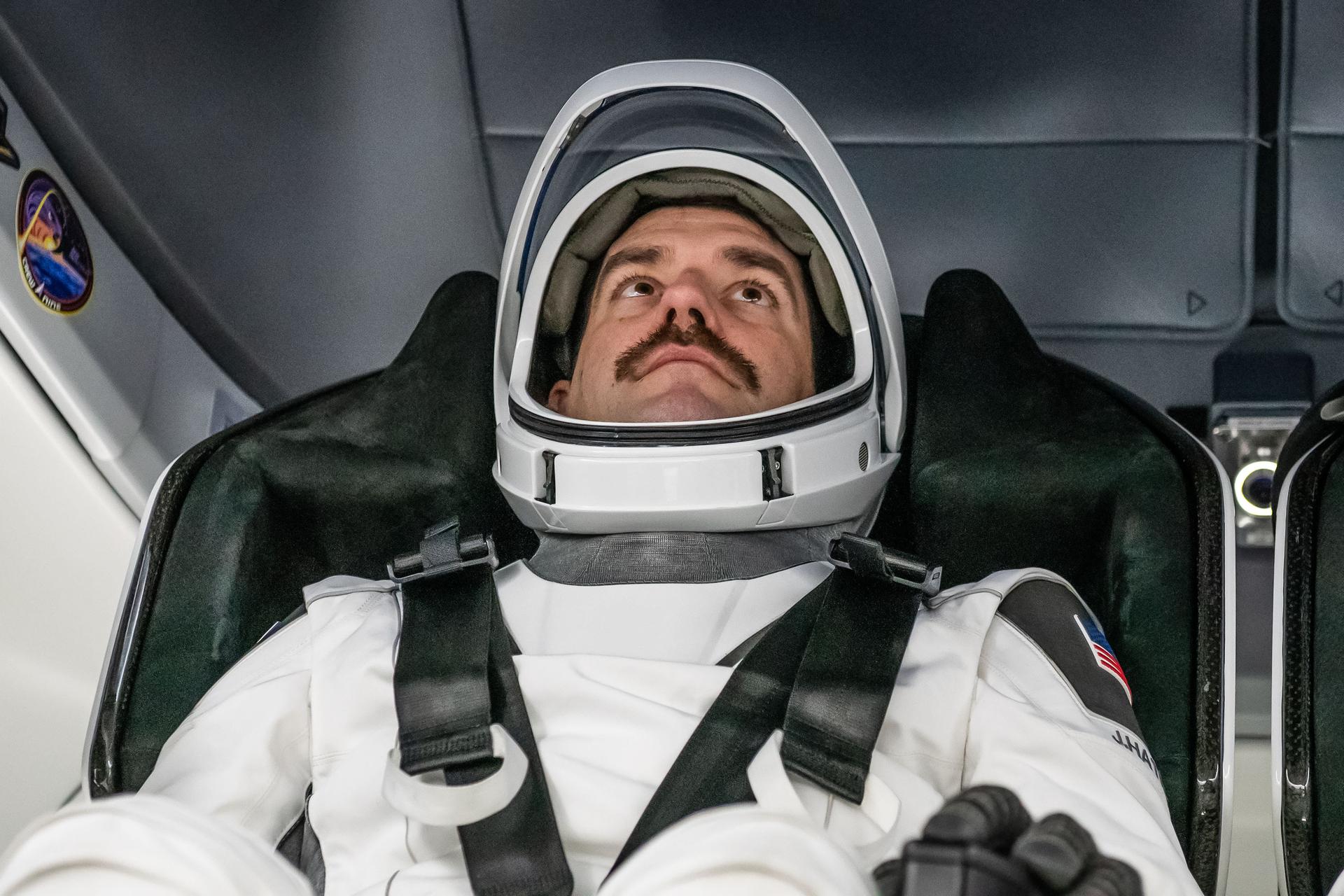
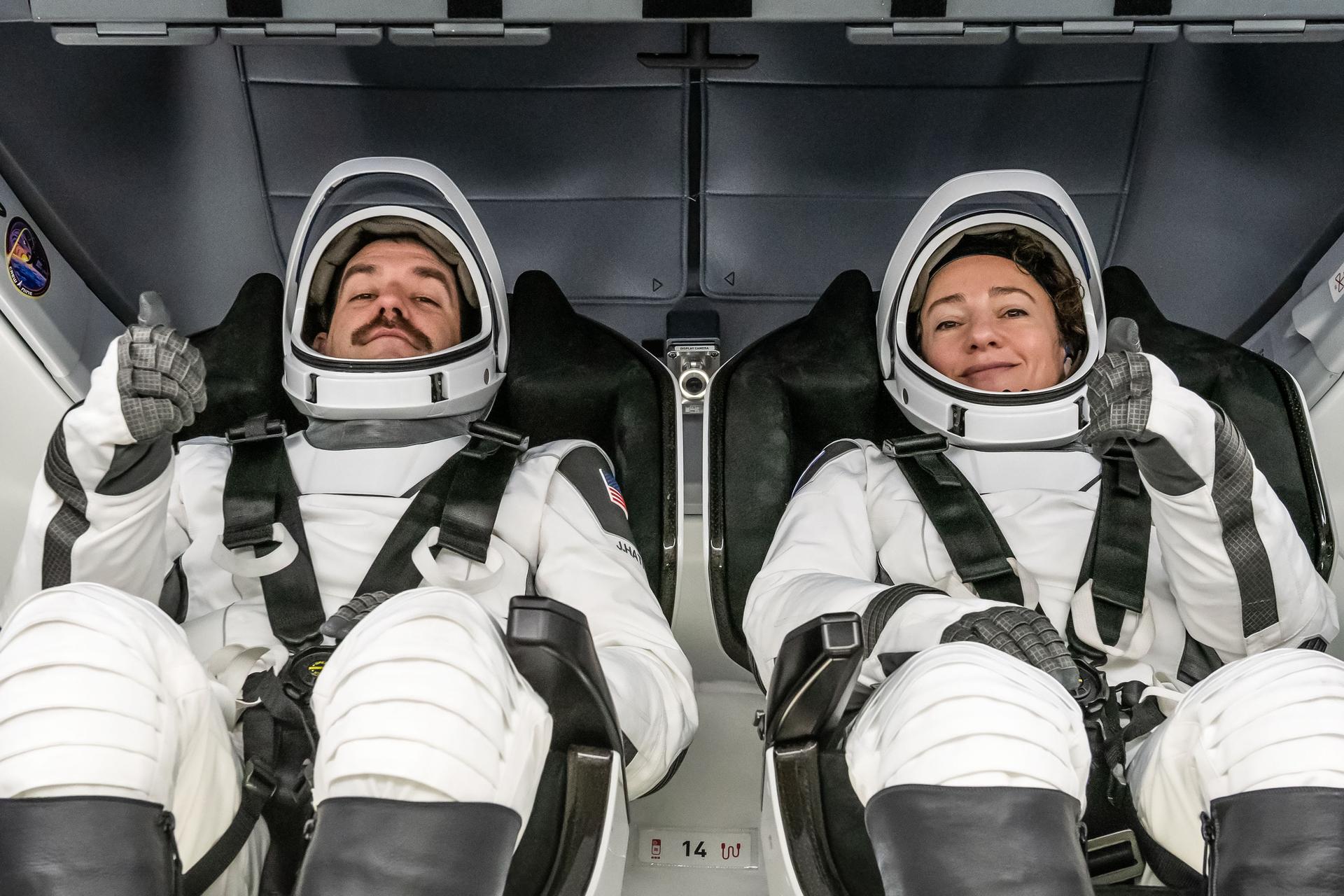
jsc2026e002965 (Jan. 12, 2026) --- NASA astronaut and SpaceX Crew-12 Pilot Jack Hathaway is photographed in his pressure suit during the Crew Equipment Interface Test at NASA’s Kennedy Space Center in Florida. The goal of the training is to rehearse launch day activities and get a close look at the Dragon spacecraft. Credit: SpaceX
NASA astronaut Jack Hathaway is photographed in his SpaceX pressure suit
CAPE CANAVERAL, Fla. – Pepper Phillips, Ground Systems Development and Operations program manager, takes part in a briefing inside the Young-Crippen Firing Room at NASA's Kennedy Space Center in Florida. NASA officials discussed the goals and expectations for a September 2014 flight test called Exploration Flight Test-1 or EFT-1 as part of the agency's goal of launching astronauts into deep space. Photo credit: NASA/Jim Grossmann
KSC-2013-1654
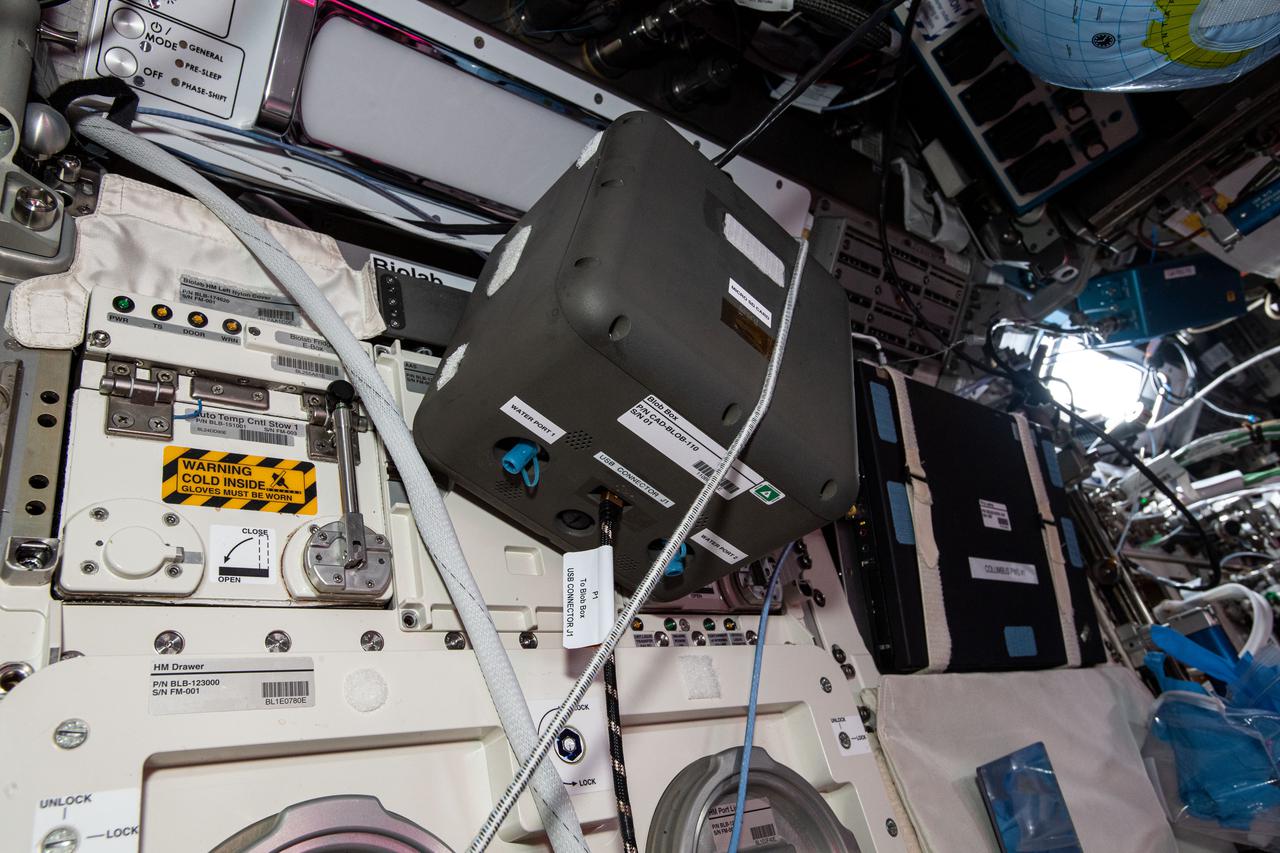
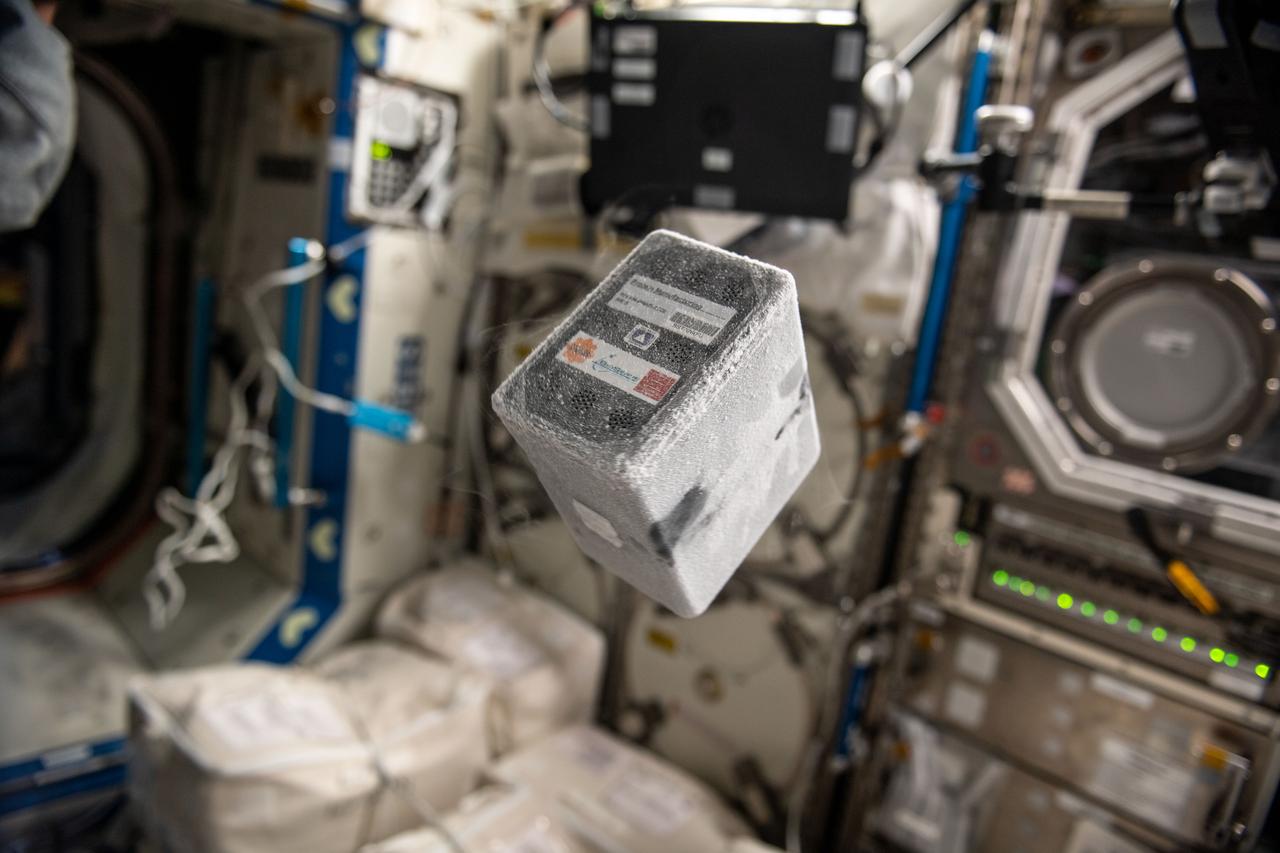
iss065e347815 (9/2/2021) --- A view of the Blob Box aboard the International Space Station (ISS). The goal of the Blob investigation is to observe the influence of microgravity on the Blob’s (a unicellular organism whose scientific name is Physarum polycephalum) behaviour when it explores its environment or when it eats. A ground experiment takes place in schools and the results are compared against the results of the International Space Station conclusions. The final goal is motivate students from France and other European Space Agency (ESA) Member States to study the Biological sciences.
iss065e347815
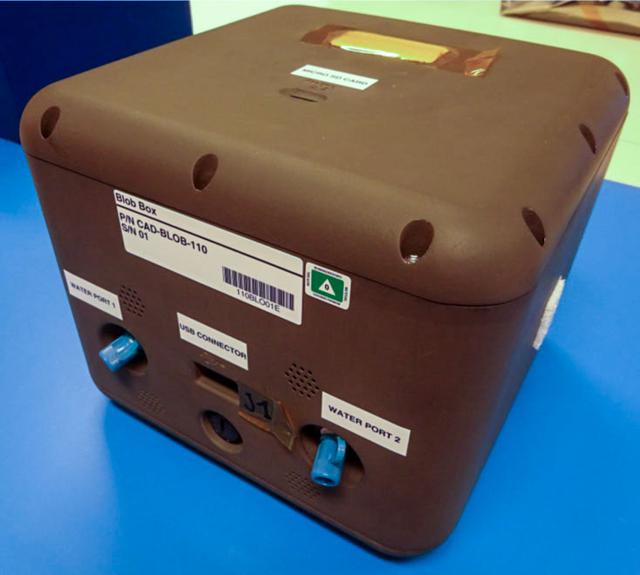
jsc2021e029749 (7/13/2021) --- A preflight view of the assembled Blob Box. The goal of the Blob investigation is to observe the influence of microgravity on the Blob’s (a unicellular organism whose scientific name is Physarum polycephalum) behaviour when it explores its environment or when it eats. A ground experiment takes place in schools and the results are compared against the results of the International Space Station conclusions. The final goal is motivate students from France and other European Space Agency (ESA) Member States to study the Biological sciences.
Blob slime mold experiment
CAPE CANAVERAL, Fla. – Todd May, Space Launch System program manager, takes part in a briefing inside the Young-Crippen Firing Room at NASA's Kennedy Space Center in Florida. NASA officials discussed the goals and expectations for a September 2014 flight test called Exploration Flight Test-1 or EFT-1 as part of the agency's goal of launching astronauts into deep space. Photo credit: NASA/Jim Grossmann
KSC-2013-1655
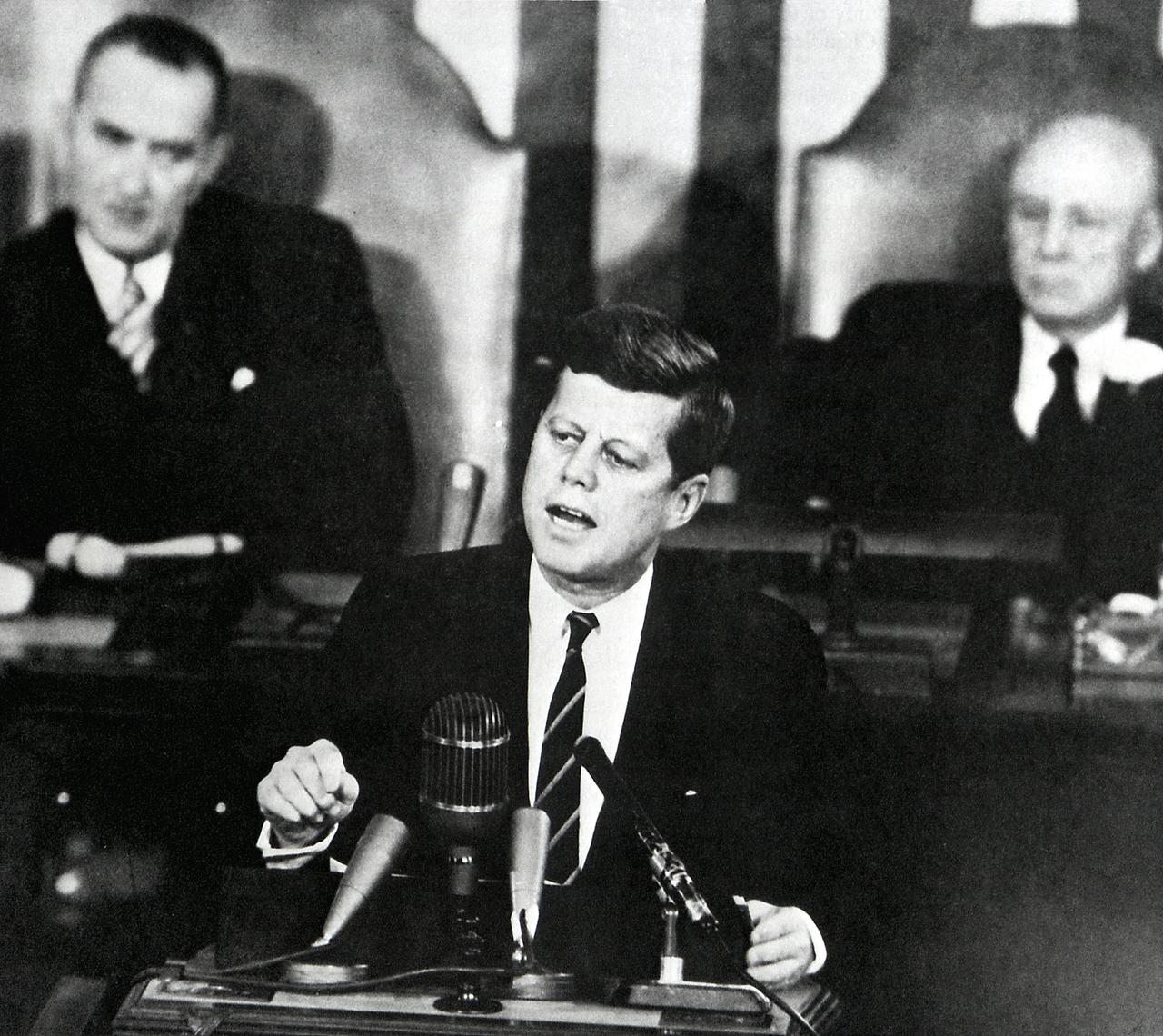
Speaking to Congress and the Nation at the joint session of Congress on May 25, 1961, President Kennedy said : "I believe that this Nation should commit itself to achieving the goal, before this decade is out, of landing a man on the Moon and returning him safely to Earth." National Aeronautic and Space Administration (NASA) achieved the goal of the first manned lunar landing on July 20, 1969.
Origin of Marshall Space Flight Center (MSFC)
CAPE CANAVERAL, Fla. – Dan Dumbacher, deputy associate administrator for the Exploration Systems Development Division, takes part in a briefing inside the Young-Crippen Firing Room at NASA's Kennedy Space Center in Florida. NASA officials discussed the goals and expectations for a September 2014 flight test called Exploration Flight Test-1 or EFT-1 as part of the agency's goal of launching astronauts into deep space. Photo credit: NASA/Jim Grossmann
KSC-2013-1657
CAPE CANAVERAL, Fla. – Mark Geyer, Orion program manager, takes part in a briefing inside the Young-Crippen Firing Room at NASA's Kennedy Space Center in Florida. NASA officials discussed the goals and expectations for a September 2014 flight test called Exploration Flight Test-1 or EFT-1 as part of the agency's goal of launching astronauts into deep space. Photo credit: NASA/Jim Grossmann
KSC-2013-1656
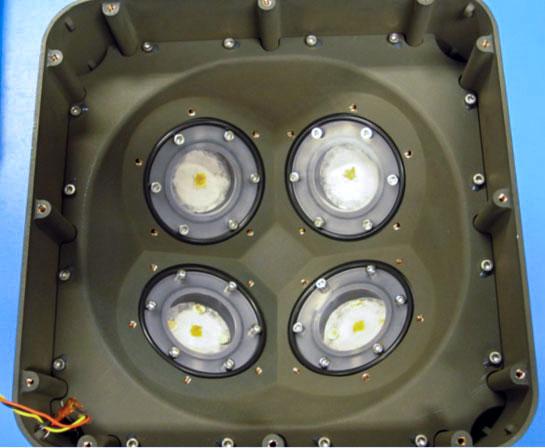
sc2021e029748(7/13/2021) --- A preflight view of the the 4 Blobs in their cell installed in the Blob Box . The goal of the Blob investigation is to observe the influence of microgravity on the Blob’s (a unicellular organism whose scientific name is Physarum polycephalum) behaviour when it explores its environment or when it eats. A ground experiment takes place in schools and the results are compared against the results of the International Space Station conclusions. The final goal is motivate students from France and other European Space Agency (ESA) Member States to study the Biological sciences.
Blob - slime mold investigation
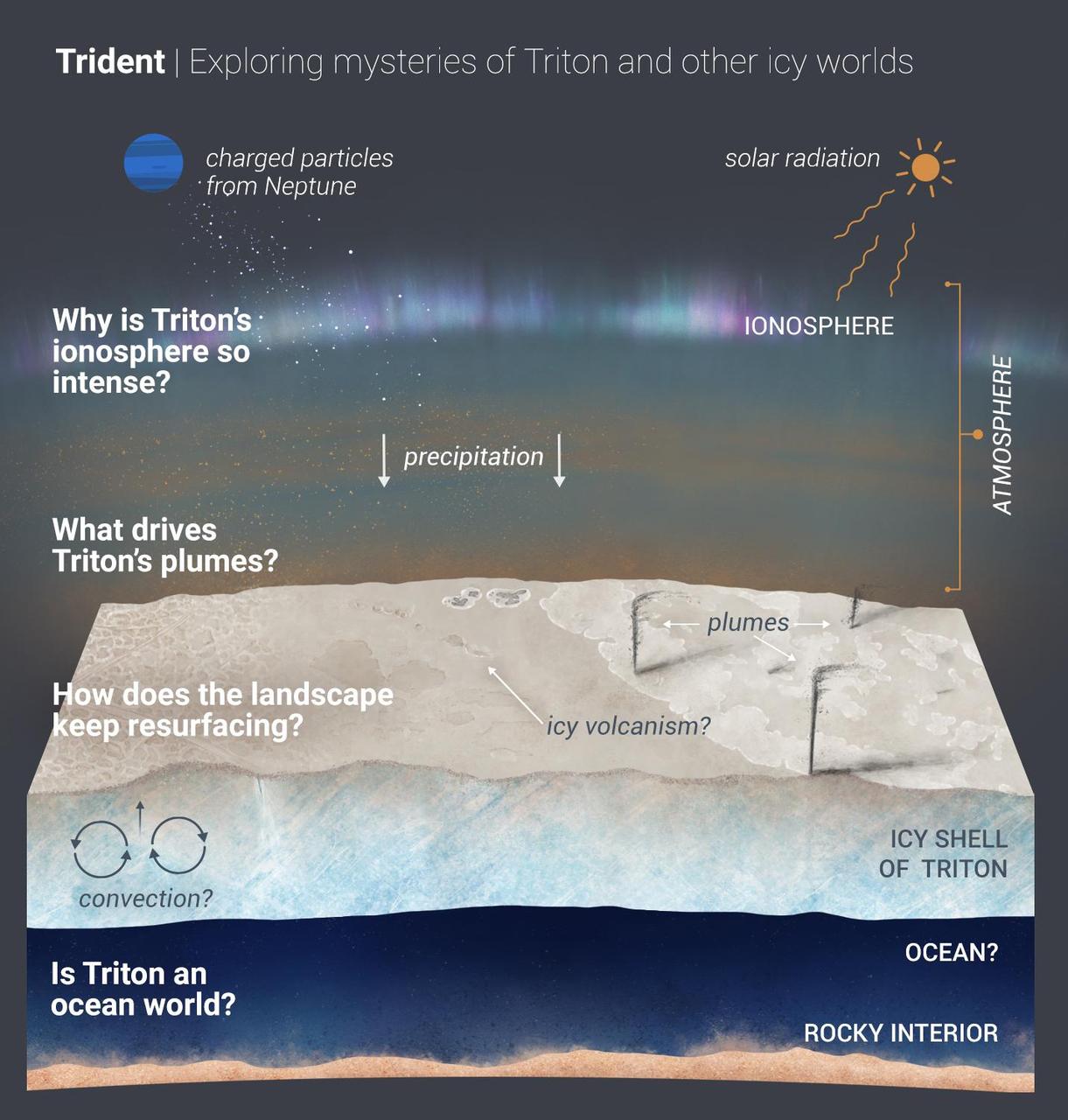
A new mission competing for selection under NASA's Discovery Program would explore Neptune's largest moon, Triton, which is potentially an ocean world with liquid water under its icy crust. Trident aims to answer the questions outlined in the graphic illustration above.      The questions fall under Trident's three main goals. The first goal is to explore the factors that lead to a solar system body having the necessary ingredients — including water — to be habitable.      A second goal is to explore vast, unseen lands. Most of what we know of the moon came from Voyager 2 data. But we've only seen 40% of the moon's surface; Trident would map most of the remainder.      Trident's third major goal: to understand how Triton's surface keeps renewing itself. The surface is remarkably young, geologically speaking (possibly only 10 million years old in a 4.6-billion-year-old solar system) and has almost no visible craters.      The Trident team is one of four developing concept studies for new missions. Up to two will be selected by summer 2021 to become a full-fledged mission and will launch later in the decade.  https://photojournal.jpl.nasa.gov/catalog/PIA23874
Trident: Exploring the Mysteries of Triton
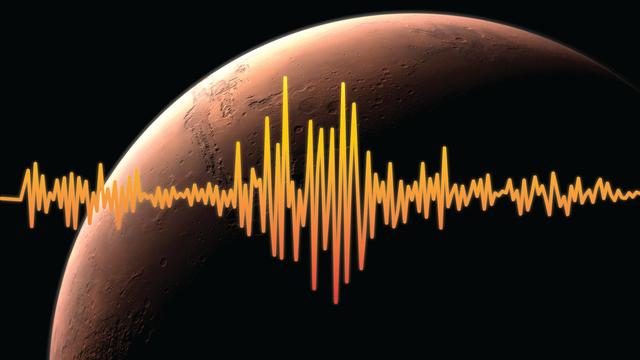
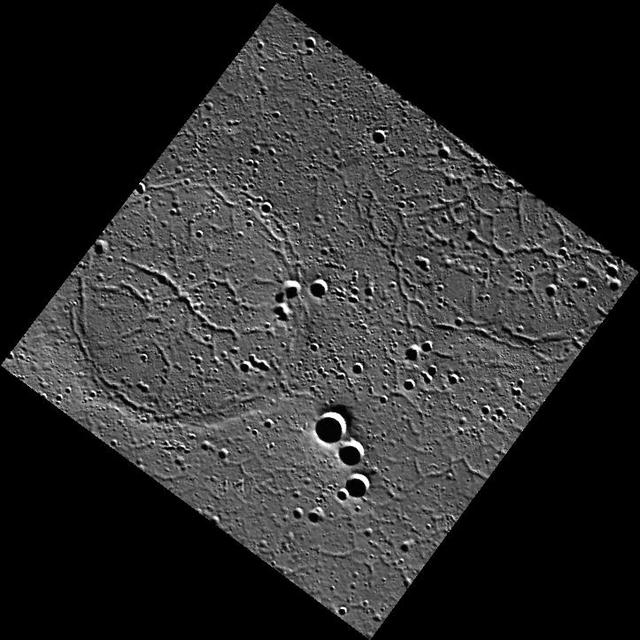
An artist's rendition of Mars, highlighting one of InSight's goals -- to figure out just how tectonically active Mars is today and how often meteorites impact it.  Interior Exploration using Seismic Investigations, Geodesy and Heat Transport, or InSight, is scheduled to launch from Vandenberg Air Force Base on the California coast between May 5 through June 8, 2018, and land on Mars six months later. InSight will give the Red Planet its first thorough check up since it formed, 4.5 billion years ago.  The InSight lander carries a seismometer, SEIS, that listens to the pulse of Mars. The seismometer records the waves traveling through the interior structure of a planet. Studying seismic waves tells us what might be creating the waves. On Mars, scientists suspect that the waves may be caused by marsquakes, meteorites striking the surface, or hot, molten magma moving at great depths underneath the surface.  https://photojournal.jpl.nasa.gov/catalog/PIA22230
Measuring the Pulse of Mars
jsc2026e002974 (Jan. 12, 2026) --- NASA astronaut and SpaceX Crew-12 Pilot Jack Hathaway is photographed in his pressure suit and inside the Dragon spacecraft during the Crew Equipment Interface Test at NASA’s Kennedy Space Center in Florida. The goal of the training is to rehearse launch day activities and get a close look at the spacecraft that will take them to the International Space Station. Credit: SpaceX
NASA astronaut Jack Hathaway is photographed inside the Dragon spacecraft
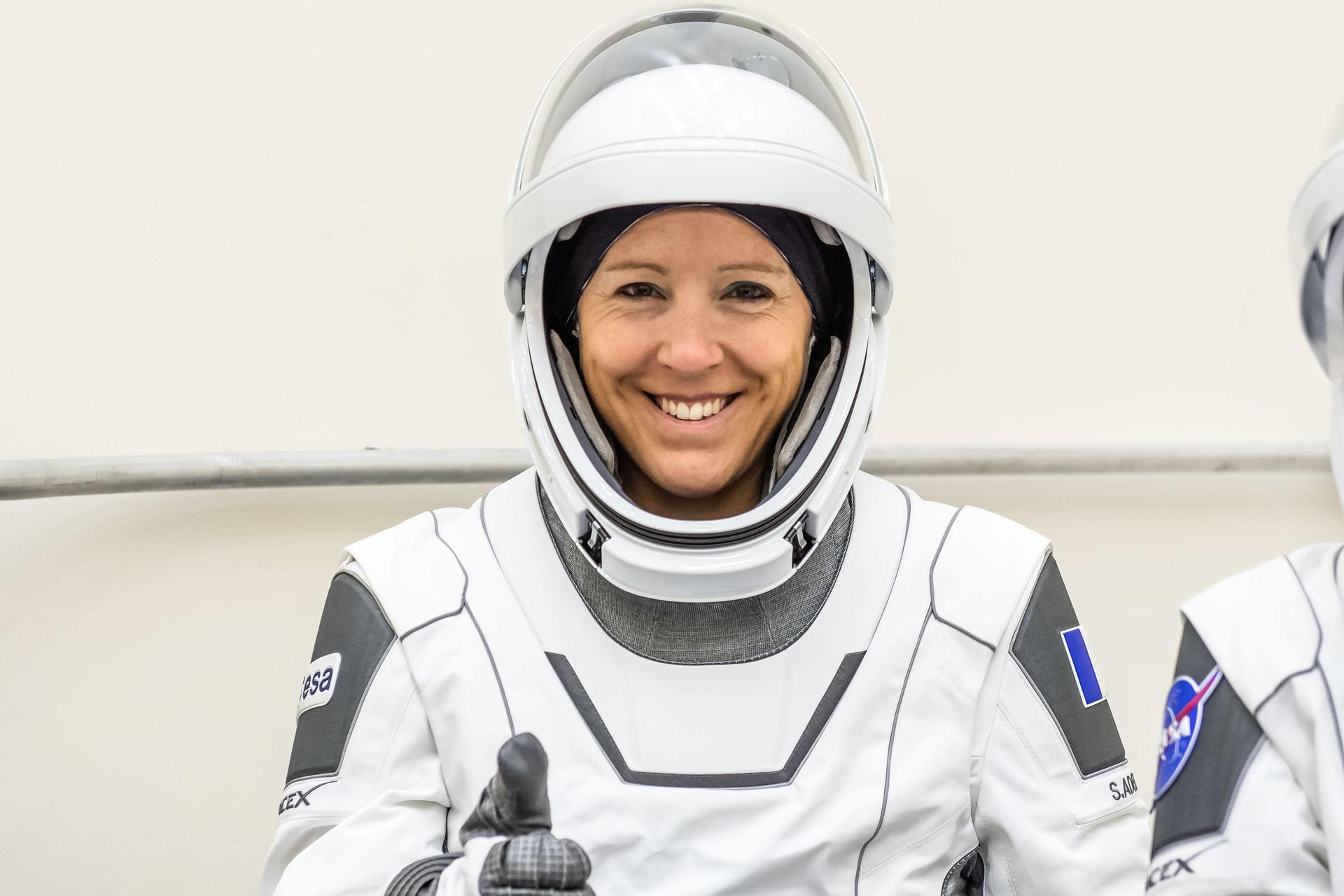
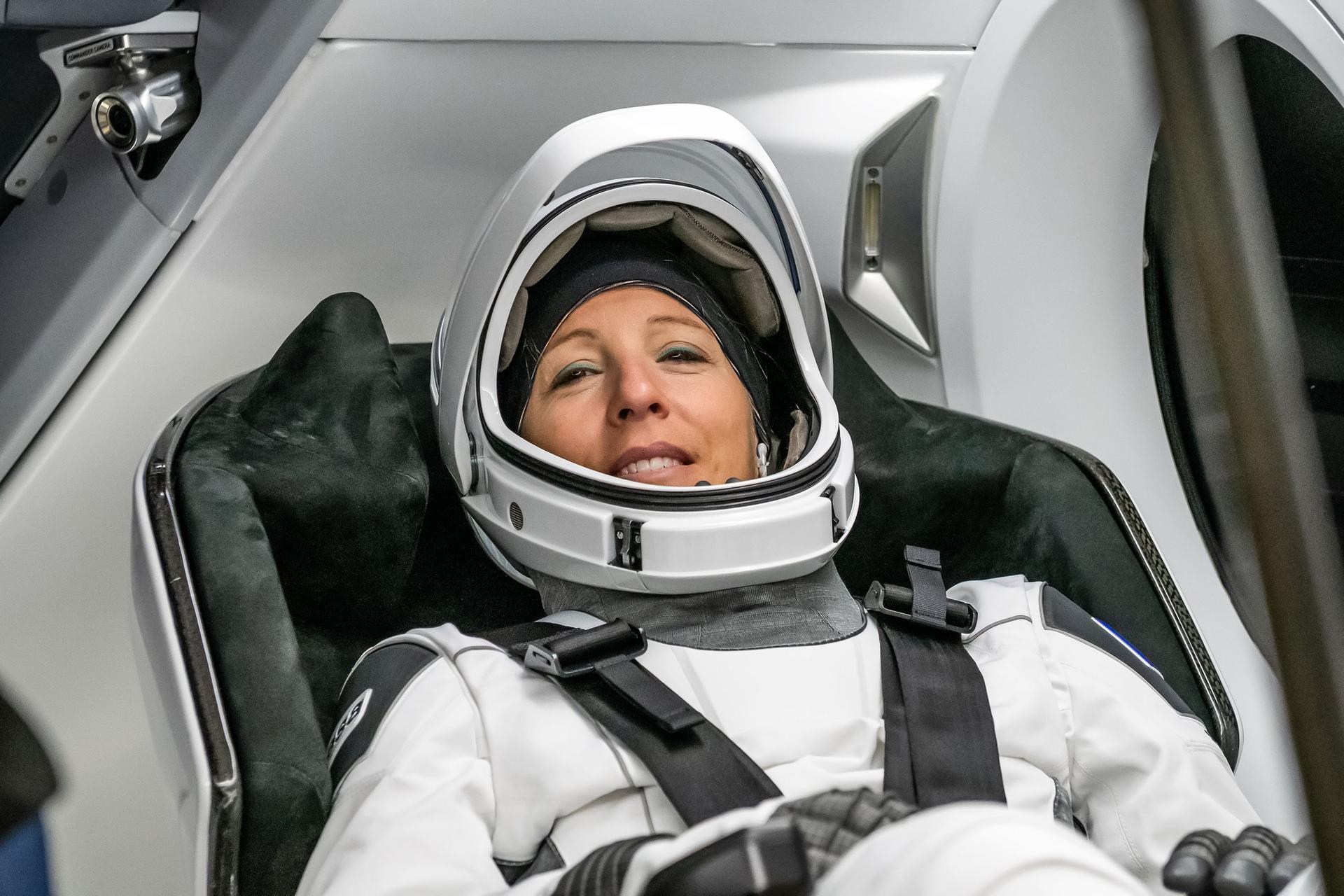
jsc2026e002964 (Jan. 12, 2026) --- ESA (European Space Agency) astronaut and SpaceX Crew-12 Mission Specialist Sophie Adenot is photographed in her pressure suit during the Crew Equipment Interface Test at NASA’s Kennedy Space Center in Florida. The goal of the training is to rehearse launch day activities and get a close look at the Dragon spacecraft. Credit: SpaceX
ESA astronaut Sophie Adenot is photographed in her SpaceX pressure suit
jsc2026e002976 (Jan. 12, 2026) --- NASA astronaut and SpaceX Crew-12 Commander Jessica Meir is photographed in her pressure suit and inside the Dragon spacecraft during the Crew Equipment Interface Test at NASA’s Kennedy Space Center in Florida. The goal of the training is to rehearse launch day activities and get a close look at the spacecraft that will take them to the International Space Station. Credit: SpaceX
NASA astronaut Jessica Meir is photographed inside the Dragon spacecraft
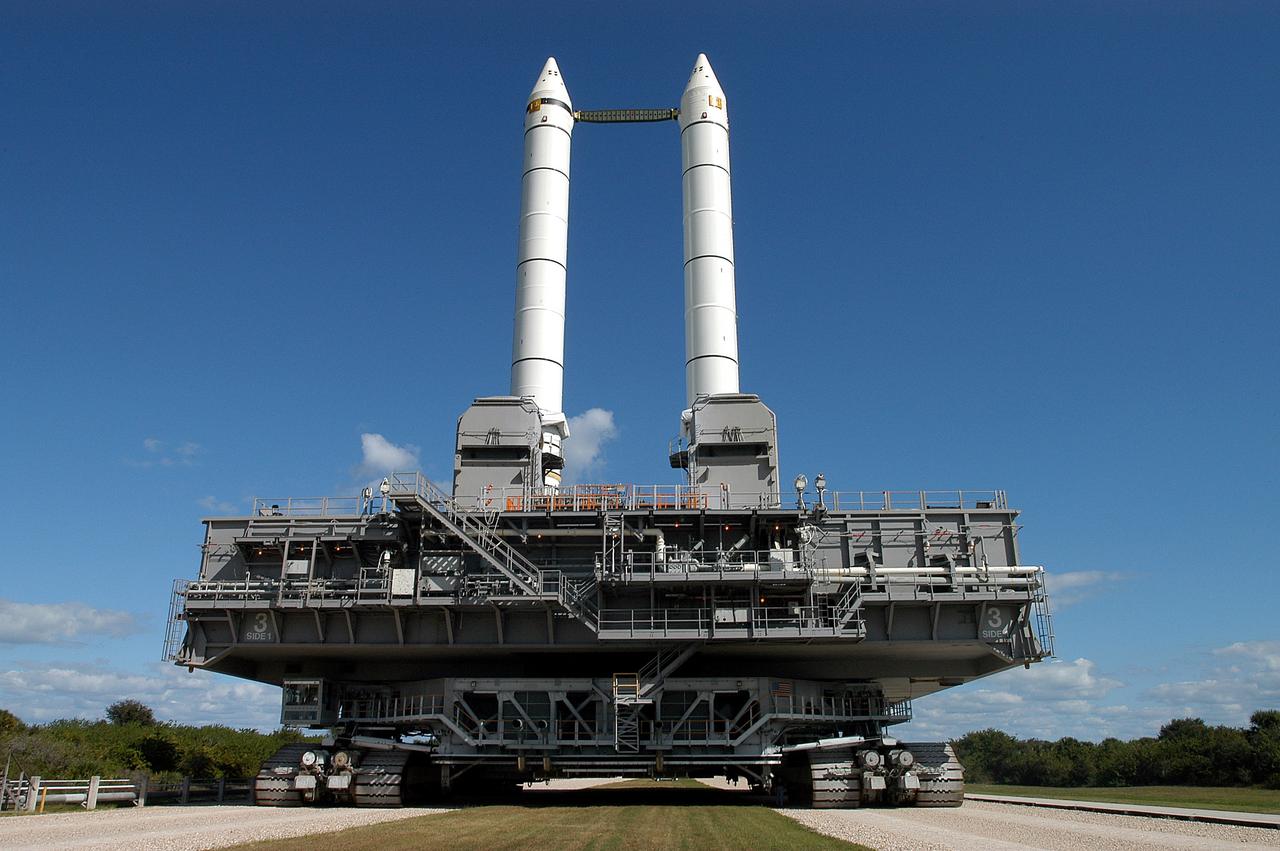
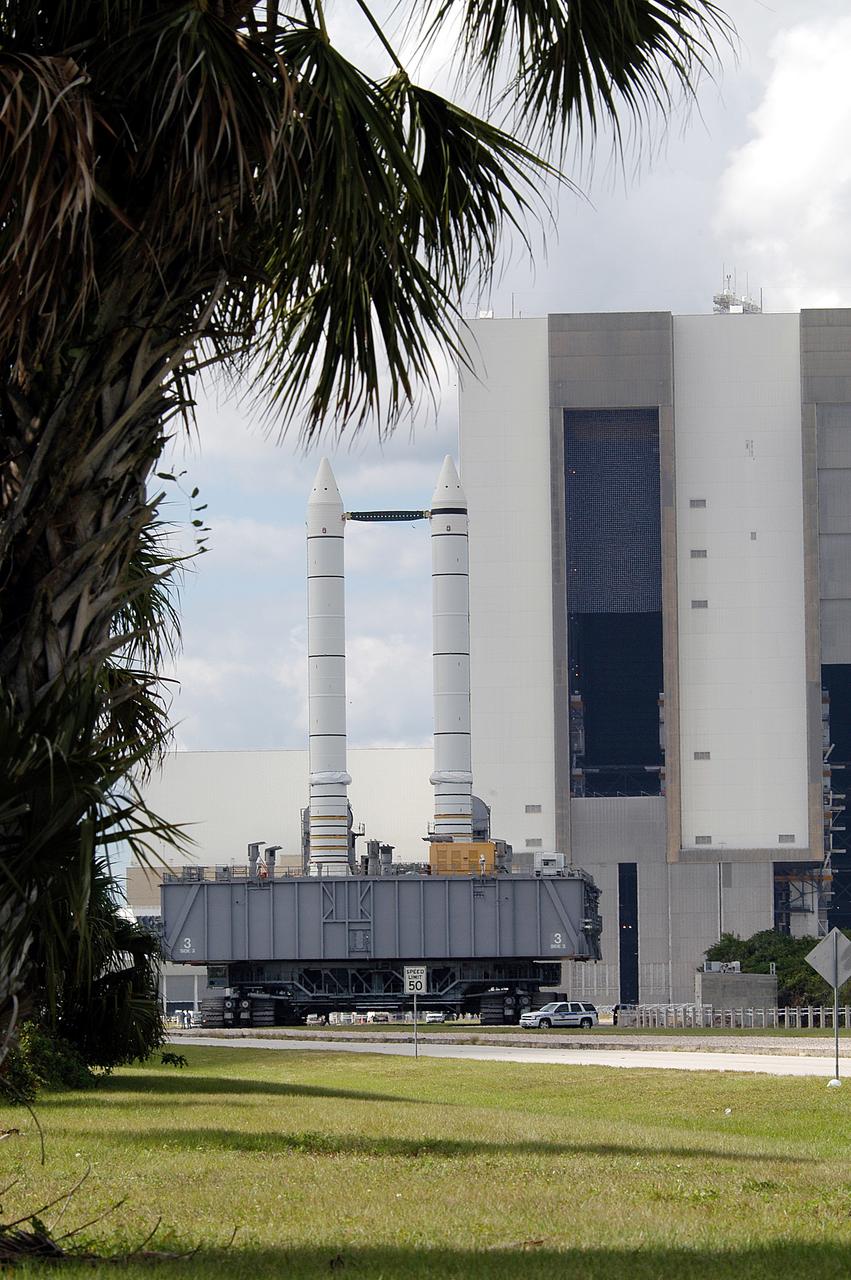
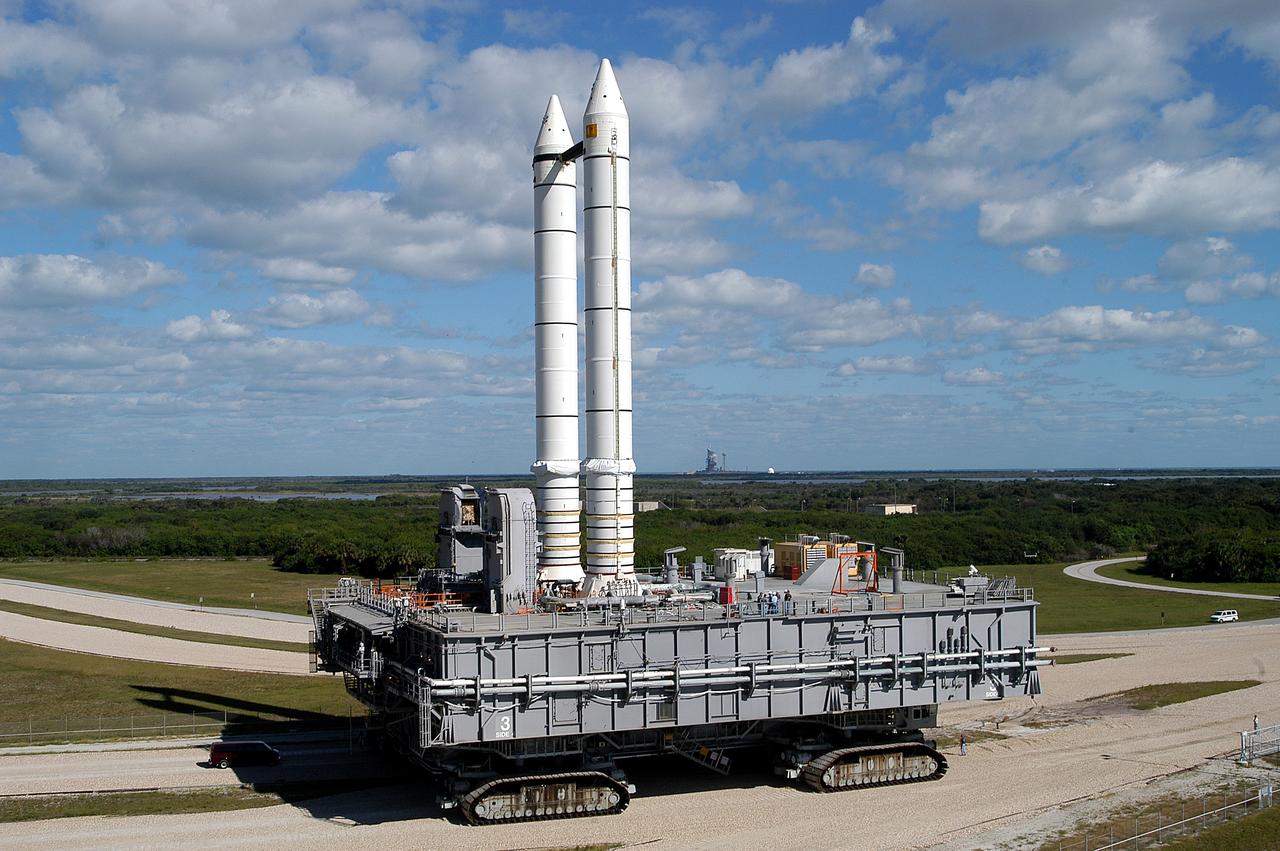
KENNEDY SPACE CENTER, FLA. -  Like candles embedded in a sculptured “cake,” the Mobile Launcher Platform (MLP) number 3 with twin solid rocket boosters bolted to it inches along the crawlerway at various speeds up to 1 mph in an effort to achieve vibration data gathering goals. The boosters are braced at the top for stability.  The primary purpose of these rollout tests is to gather data to develop future maintenance requirements on the transport equipment and the flight hardware. Various parts of the MLP and crawler transporter have been instrumented with vibration data collection equipment.
KENNEDY SPACE CENTER, FLA. - Like candles embedded in a sculptured “cake,” the Mobile Launcher Platform (MLP) number 3 with twin solid rocket boosters bolted to it inches along the crawlerway at various speeds up to 1 mph in an effort to achieve vibration data gathering goals. The boosters are braced at the top for stability. The primary purpose of these rollout tests is to gather data to develop future maintenance requirements on the transport equipment and the flight hardware. Various parts of the MLP and crawler transporter have been instrumented with vibration data collection equipment.
Administrator award (two) Center-Tracon Automation system Team Langley Res. CTR and Goal Award 1998, Next-Genreation Design Tools and Experimental Aircraft- acrylic
ARC-1998-AC98-0242-2
jsc2021e029747 (7/13/2021) --- A preflight view of an active  Blob. The goal of the Blob investigation is to observe the influence of microgravity on the Blob’s (a unicellular organism whose scientific name is Physarum polycephalum) behaviour when it explores its environment or when it eats. A ground experiment takes place in schools and the results are compared against the results of the International Space Station conclusions. The final goal is motivate students from France and other European Space Agency (ESA) Member States to study the Biological sciences. Image Credit: Audrey Dussutour - French National Centre for Scientific Research (CNRS)
Blob: jsc2021e029747
jsc2026e002978 (Jan. 12, 2026) --- NASA astronauts (from left) Jack Hathaway and Jessica Meir, SpaceX Crew-12 Pilot and Commander respectively, are photographed in their pressure suits and inside the Dragon spacecraft during the Crew Equipment Interface Test at NASA’s Kennedy Space Center in Florida. The goal of the training is to rehearse launch day activities and get a close look at the spacecraft that will take them to the International Space Station. Credit: SpaceX
NASA astronauts Jack Hathaway and Jessica Meir are photographed inside the Dragon spacecraft
jsc2026e002975 (Jan. 12, 2026) --- ESA (European Space Agency) astronaut and SpaceX Crew-12 Mission Specialist Sophie Adenot is photographed in her pressure suit and inside the Dragon spacecraft during the Crew Equipment Interface Test at NASA’s Kennedy Space Center in Florida. The goal of the training is to rehearse launch day activities and get a close look at the spacecraft that will take them to the International Space Station. Credit: SpaceX
ESA astronaut Sophie Adenot is photographed inside the Dragon spacecraft
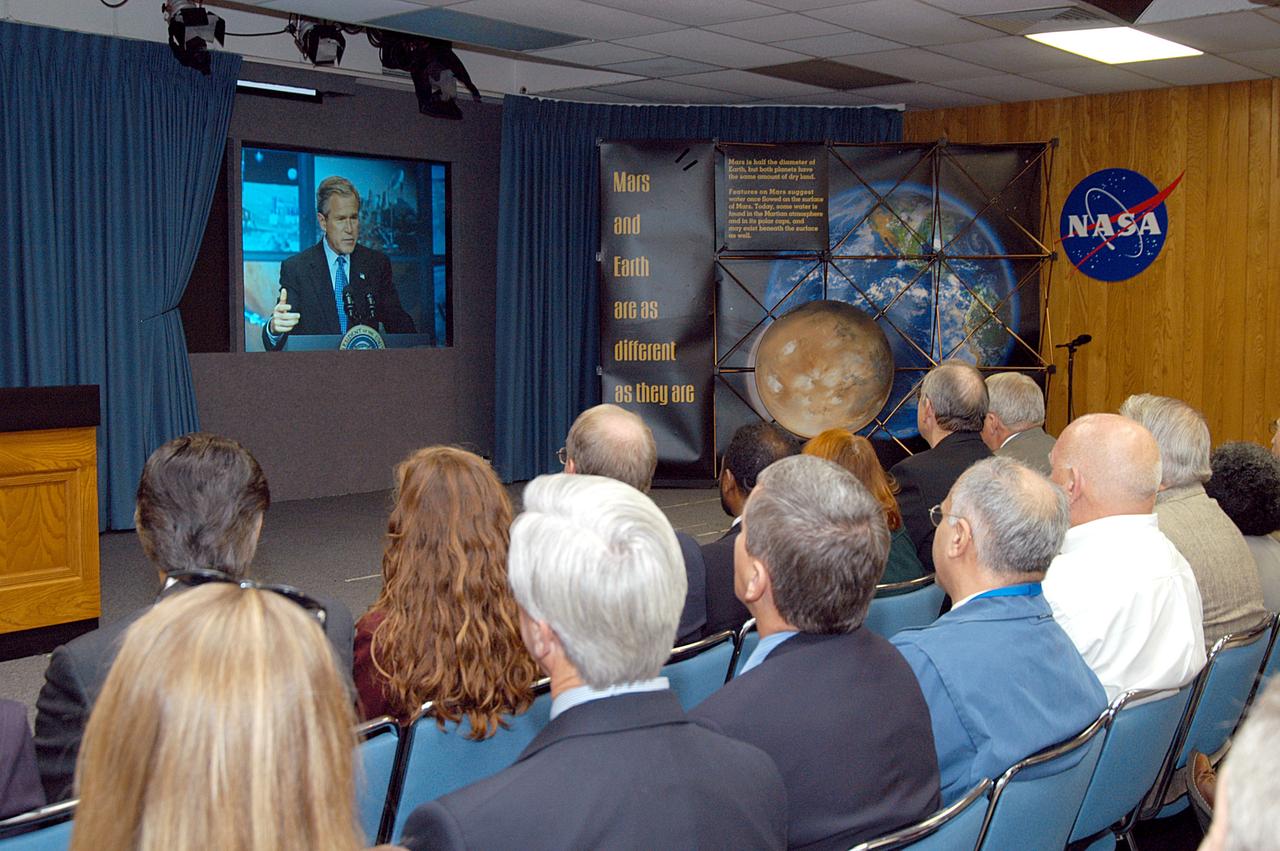
KENNEDY SPACE CENTER, FLA. -- KSC management and other employees gather in the Center’s television studio to watch the address by President George W. Bush from NASA Headquarters stating his goals for NASA’s new mission.  Seated in the front row, left to right, are Ken Aguilar, chief, Equal Opportunity office; Lisa Malone, director of External Affairs; Bruce Buckingham, assistant to Dr. Woodrow Whitlow, KSC deputy director; Dr. Whitlow; Shannon Roberts, with External Affairs; Howard DeCastro, vice president and Space Shuttle program manager, United Space Alliance; and Bill Pickavance vice president and associate program manager of Florida Operations, USA.  The President’s goals are completing the International Space Station, retiring the Space Shuttle orbiters, developing a new crew exploration vehicle, and returning to the moon and beyond within the next two decades. Pres. Bush was welcomed by NASA Administrator Sean O’Keefe and Expedition 8 Commander Michael Foale, who greeted him from the International Space Station.  Members of the Washington, D.C., audience included astronauts Eileen Collins, Ed Lu and Michael Lopez-Alegria, and former astronaut Gene Cernan.
KENNEDY SPACE CENTER, FLA. -- KSC management and other employees gather in the Center’s television studio to watch the address by President George W. Bush from NASA Headquarters stating his goals for NASA’s new mission. Seated in the front row, left to right, are Ken Aguilar, chief, Equal Opportunity office; Lisa Malone, director of External Affairs; Bruce Buckingham, assistant to Dr. Woodrow Whitlow, KSC deputy director; Dr. Whitlow; Shannon Roberts, with External Affairs; Howard DeCastro, vice president and Space Shuttle program manager, United Space Alliance; and Bill Pickavance vice president and associate program manager of Florida Operations, USA. The President’s goals are completing the International Space Station, retiring the Space Shuttle orbiters, developing a new crew exploration vehicle, and returning to the moon and beyond within the next two decades. Pres. Bush was welcomed by NASA Administrator Sean O’Keefe and Expedition 8 Commander Michael Foale, who greeted him from the International Space Station. Members of the Washington, D.C., audience included astronauts Eileen Collins, Ed Lu and Michael Lopez-Alegria, and former astronaut Gene Cernan.
The goal of this observation from NASA' Mars Reconnaissance Orbiter (MRO) is to determine the source of the ridge within a possible moraine that is also present in another HiRISE image. A moraine is a mass of rocks and sediment carried down and deposited by a glacier.  If the structure is a moraine, we should expect to find two sources of debris converging in the valley. If the sources are carrying lots of debris, there is a good chance of finding more moraine features further up the valley.  The map is projected here at a scale of 50 centimeters (19.7 inches) per pixel. [The original image scale is 59.5 centimeters (23.4 inches) per pixel (with 2 x 2 binning); objects on the order of 179 centimeters (70.5 inches) across are resolved.] North is up.  https://photojournal.jpl.nasa.gov/catalog/PIA22124
A Valley Near the Northern Lowlands
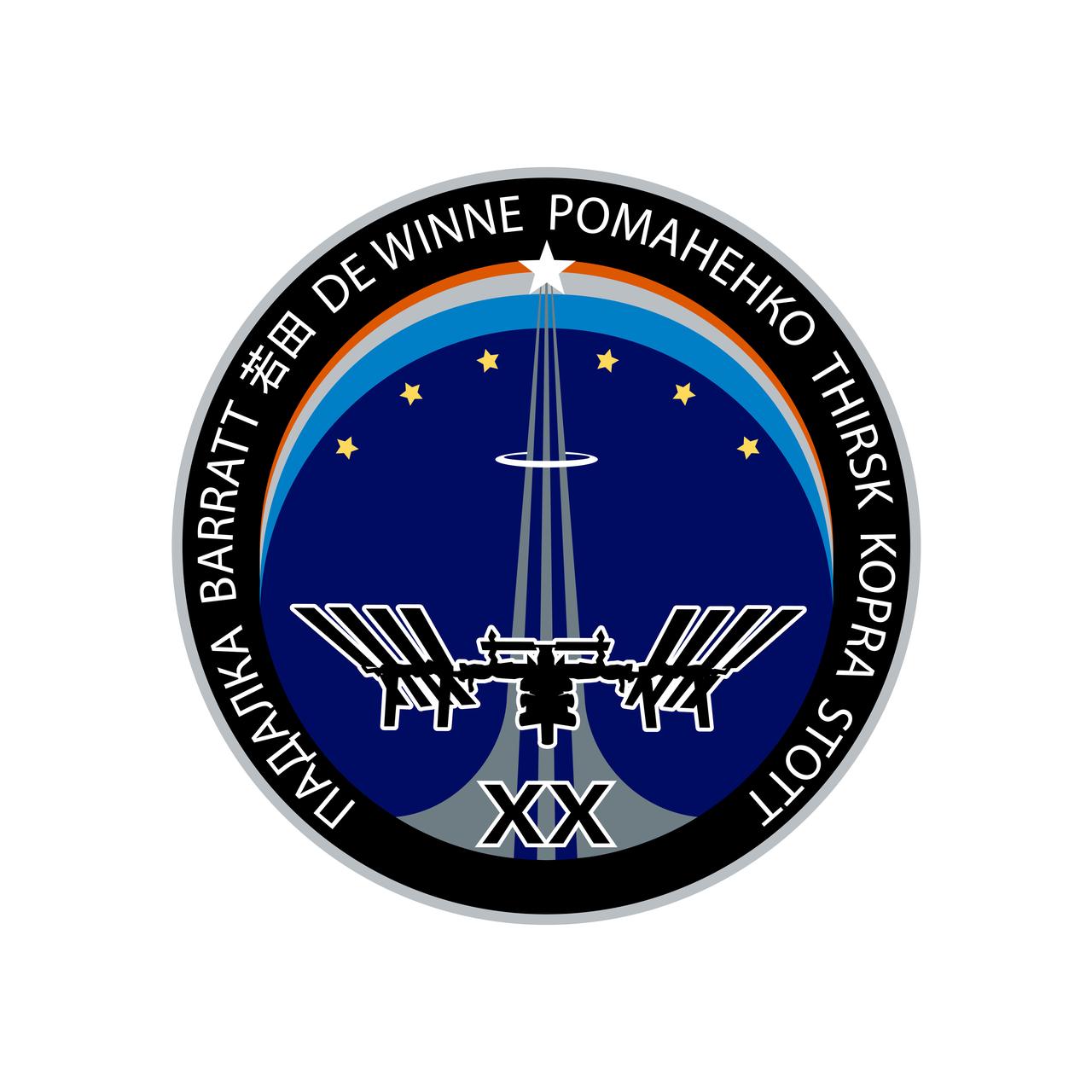
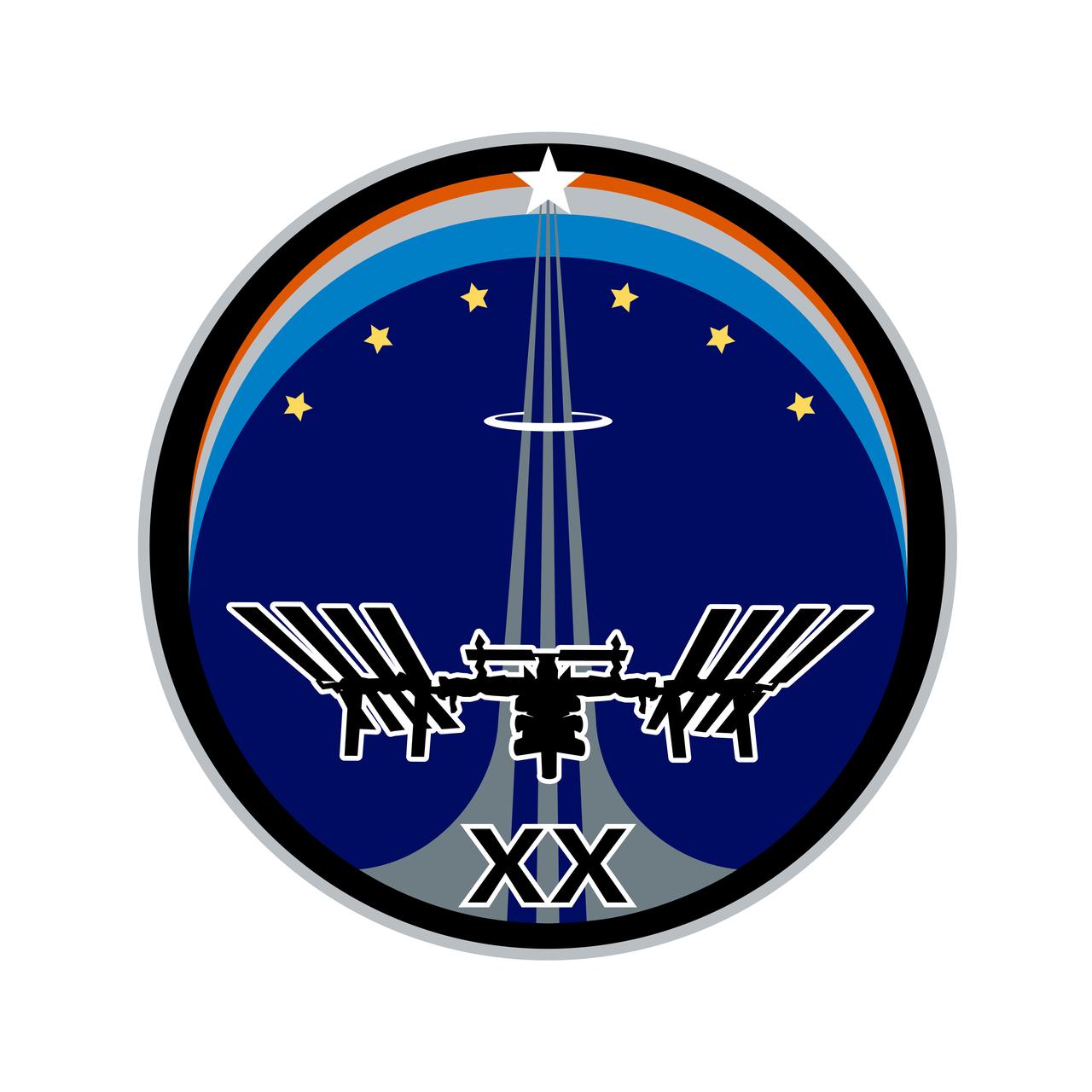
ISS020-S-001B (December 2008) --- The Expedition 20 patch symbolizes a new era in space exploration with the first six-person crew living and working onboard ISS and represents the significance of the ISS to the exploration goals of NASA and its international partners. The six gold stars signify the men and women of the crew. The astronaut symbol extends from the base of the patch to the star at the top to represent the international team, both on the ground and on orbit, that are working together to further our knowledge of living and working in space. The space station in the foreground represents where we are now and the important role it is playing towards meeting our exploration goals. The knowledge and expertise developed from these advancements will enable us to once again leave low earth orbit for the new challenges of establishing a permanent presence on the moon and then on to Mars. The blue, gray and red arcs represent our exploration goals as symbols of Earth, the moon and Mars.     The NASA insignia design for ISS expedition crews is reserved for use by the astronauts and for other official use as the NASA Administrator may authorize.  Public availability has been approved only in the form of illustrations by the various news media. When and if there is any change in this policy, which is not anticipated, it will be publicly announced.
ISS020-S-001B
ISS020-S-001A  (December 2008) --- The Expedition 20 patch symbolizes a new era in space exploration with the first six-person crew living and working onboard ISS and represents the significance of the ISS to the exploration goals of NASA and its international partners. The six gold stars signify the men and women of the crew. The astronaut symbol extends from the base of the patch to the star at the top to represent the international team, both on the ground and on orbit, that are working together to further our knowledge of living and working in space. The space station in the foreground represents where we are now and the important role it is playing towards meeting our exploration goals. The knowledge and expertise developed from these advancements will enable us to once again leave low earth orbit for the new challenges of establishing a permanent presence on the moon and then on to Mars. The blue, gray and red arcs represent our exploration goals as symbols of Earth, the moon and Mars.     The NASA insignia design for ISS expedition crews is reserved for use by the astronauts and for other official use as the NASA Administrator may authorize.  Public availability has been approved only in the form of illustrations by the various news media. When and if there is any change in this policy, which is not anticipated, it will be publicly announced.
ISS020-S-001A
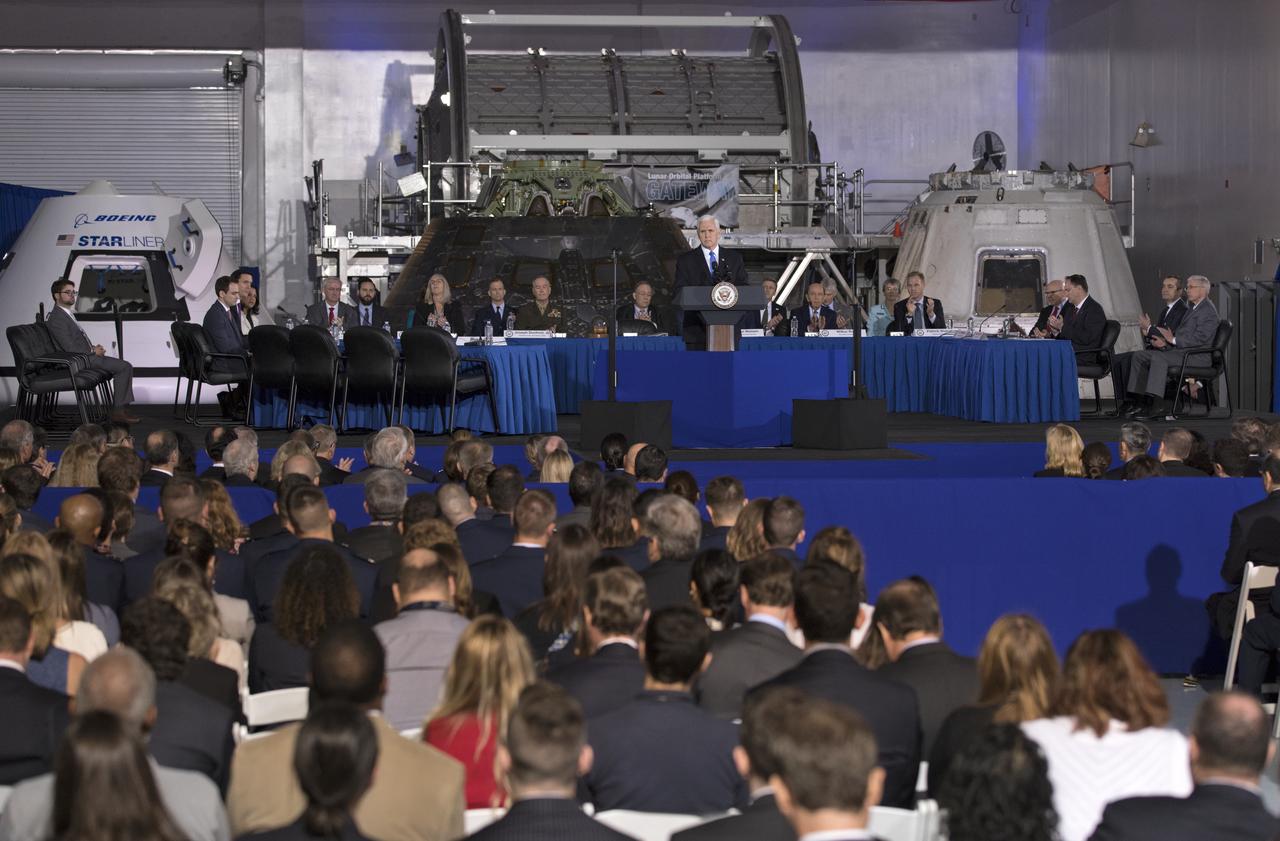
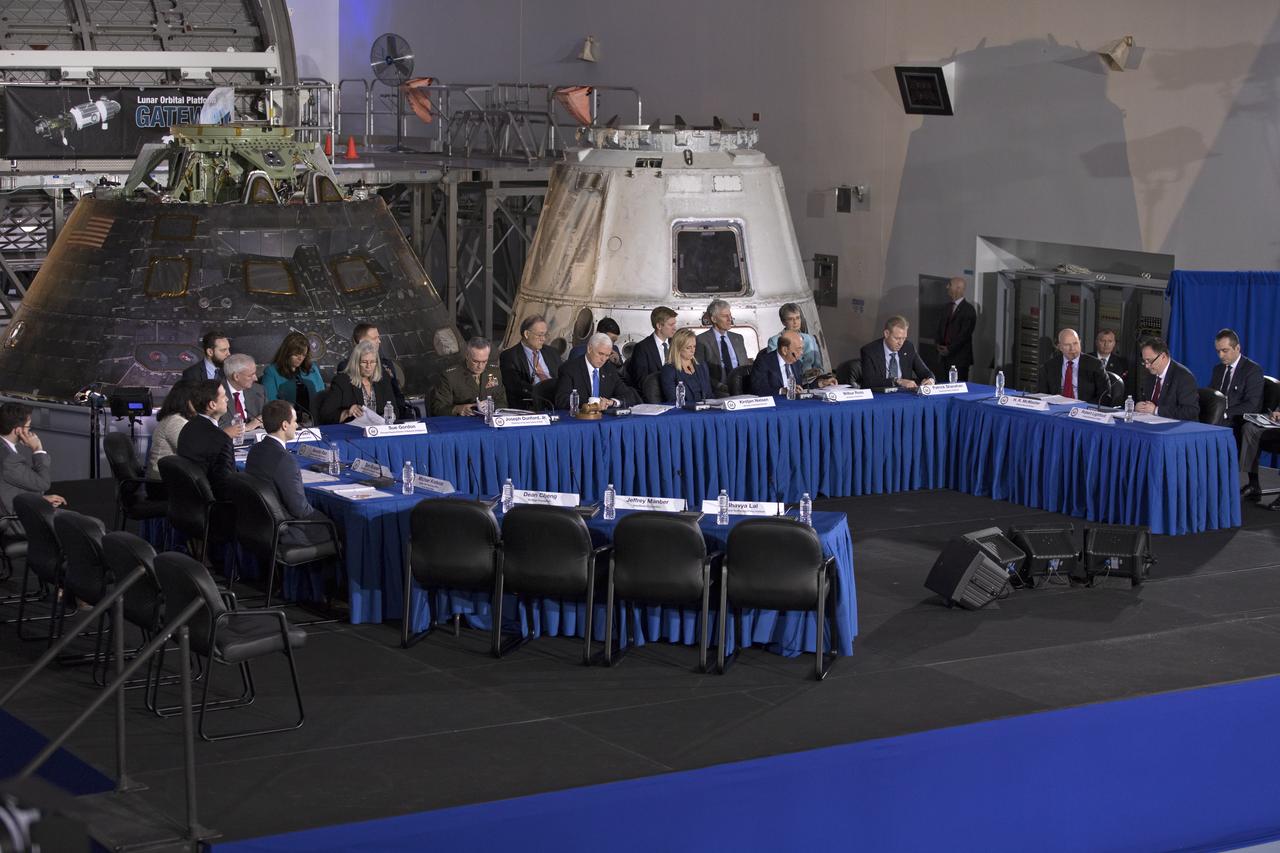
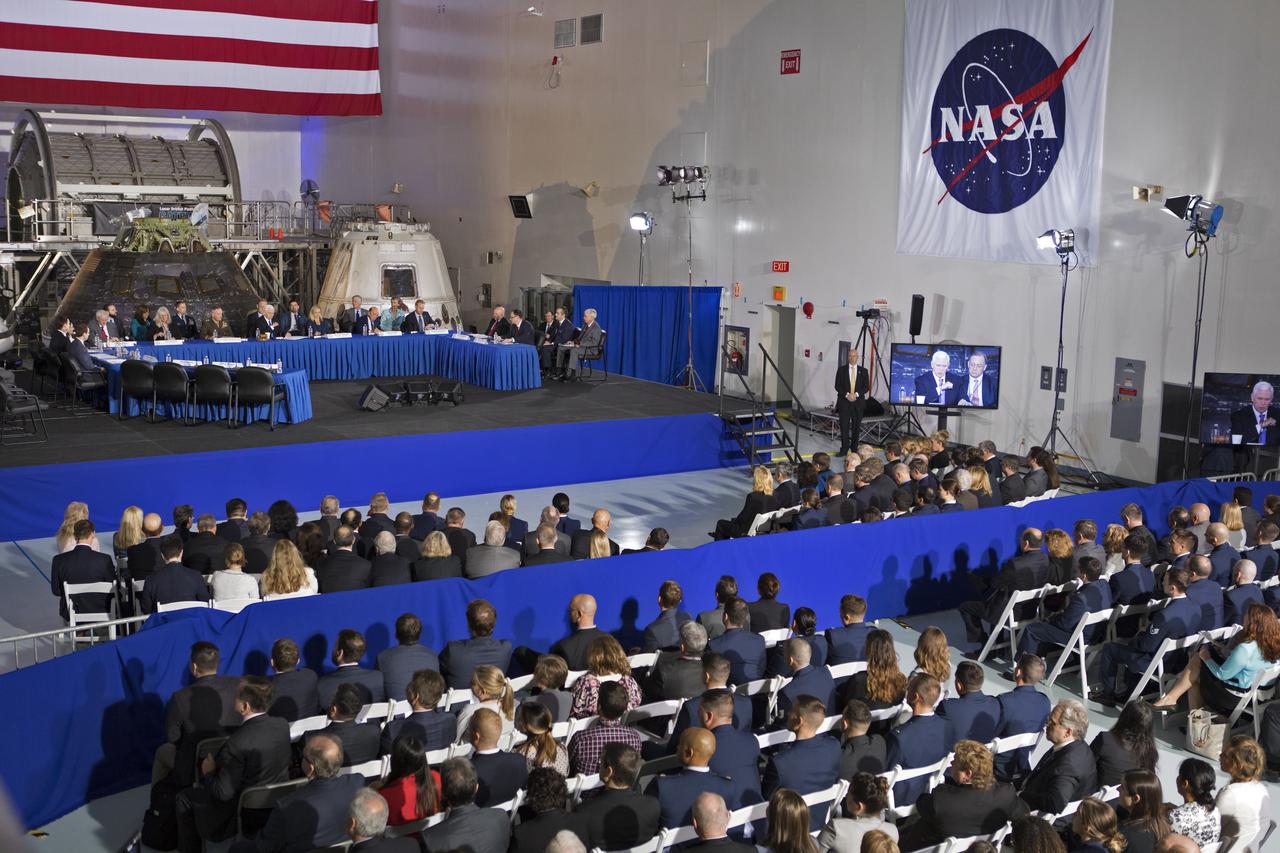
Members of the National Space Council meet in the high bay of the Space Station Processing Facility at NASA's Kennedy Space Center in Florida, on Feb. 21, 2018. Chaired by Vice President Mike Pence, the council's role is to advise the president regarding national space policy and strategy, and review the nation's long-range goals for space activities.
Vice President Mike Pence Visits Kennedy Space Center - National
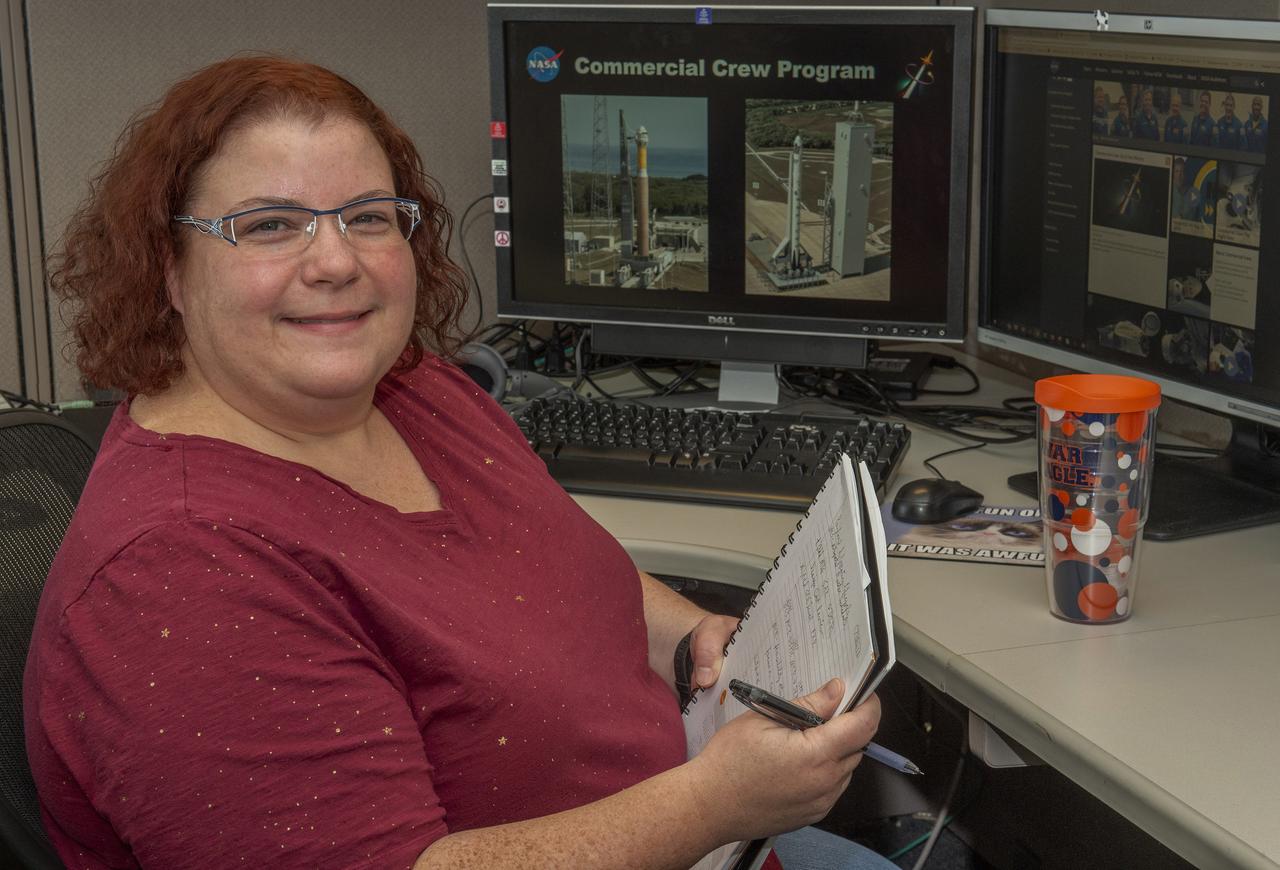
Miranda Holton is the Main Propulsion Systems (MPS) Subsystem Manager for NASA’s Commercial Crew Program.   The goal of the Commercial Crew Program is to have safe, reliable and cost-effective access to and from the International Space Station and foster commercial access to other potential low-Earth orbit destinations.
Miranda Holton is the Main Propulsion Systems (MPS) Subsystem Ma
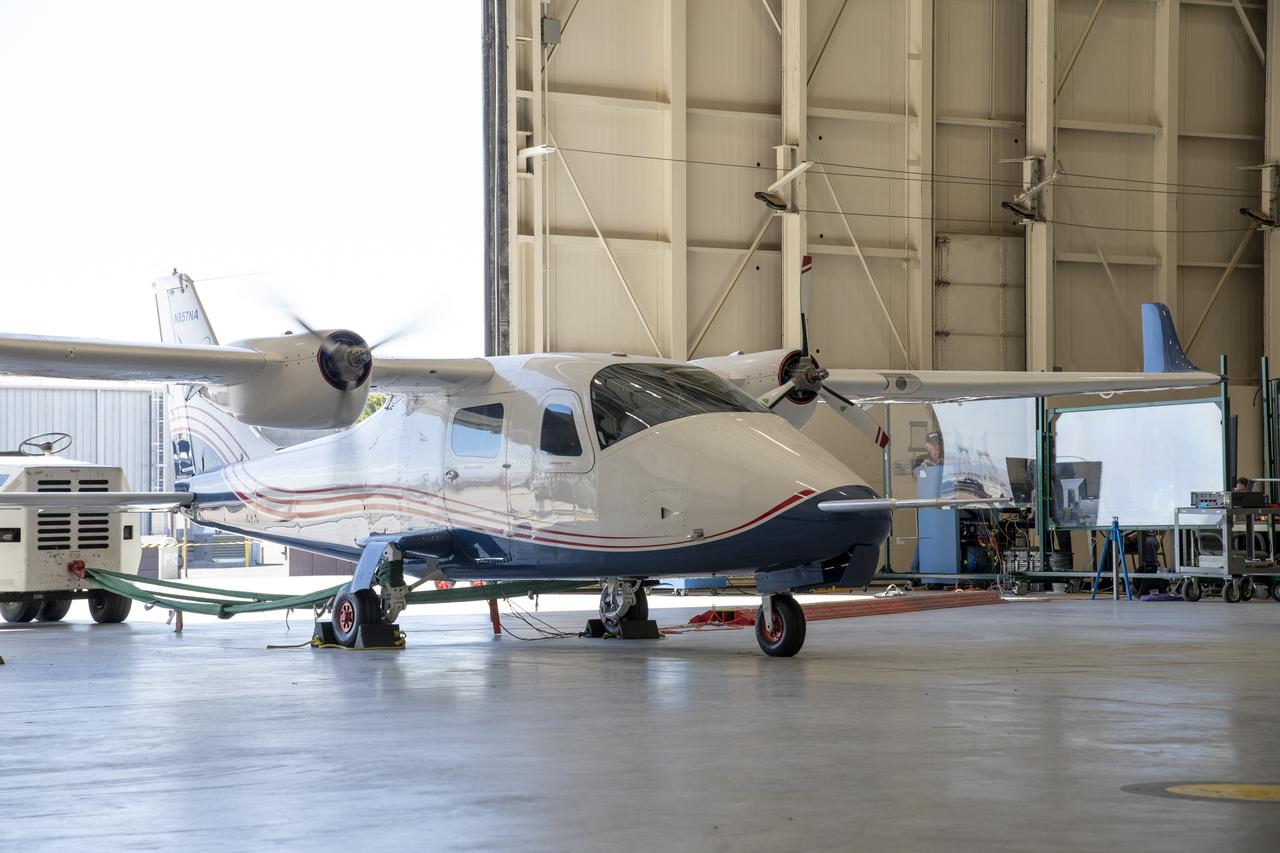
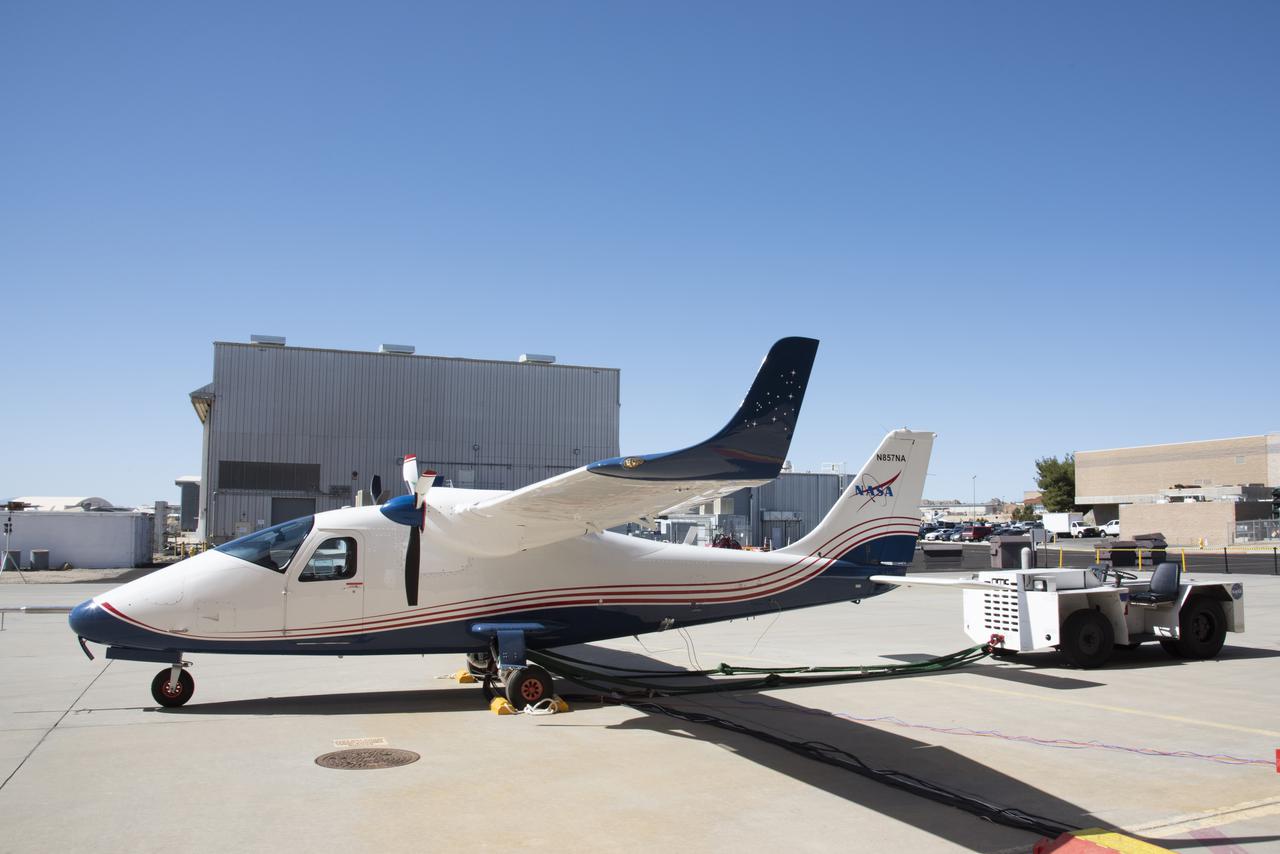
NASA's all-electric X-57 Maxwell aircraft undergoes high voltage ground testing at NASA's Armstrong Flight Research Center in California. A goal of the X-57 project is to help the Federal Aviation Administration set certification standards for emerging electric aircraft markets.
X-57 High Voltage Testing Begins
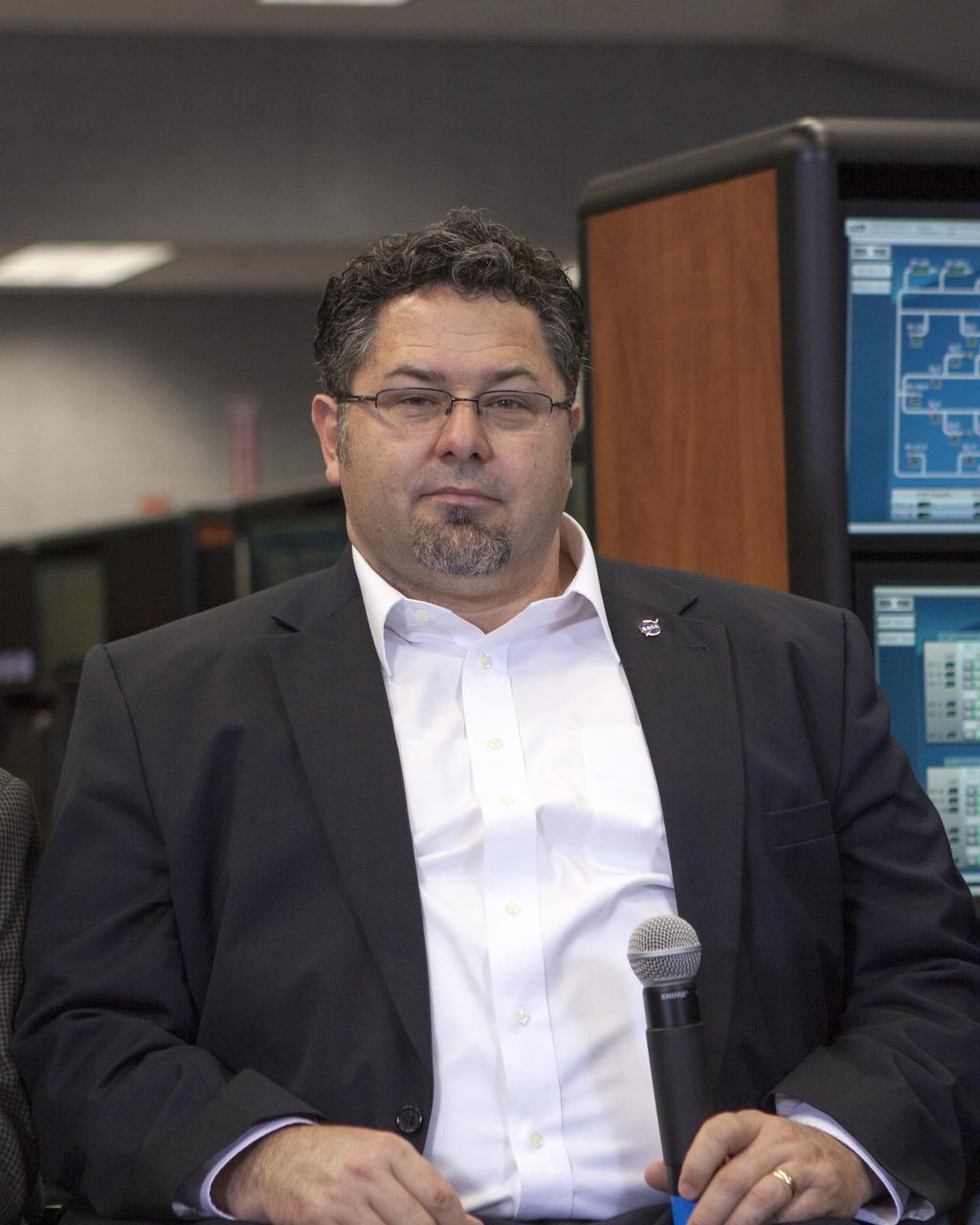
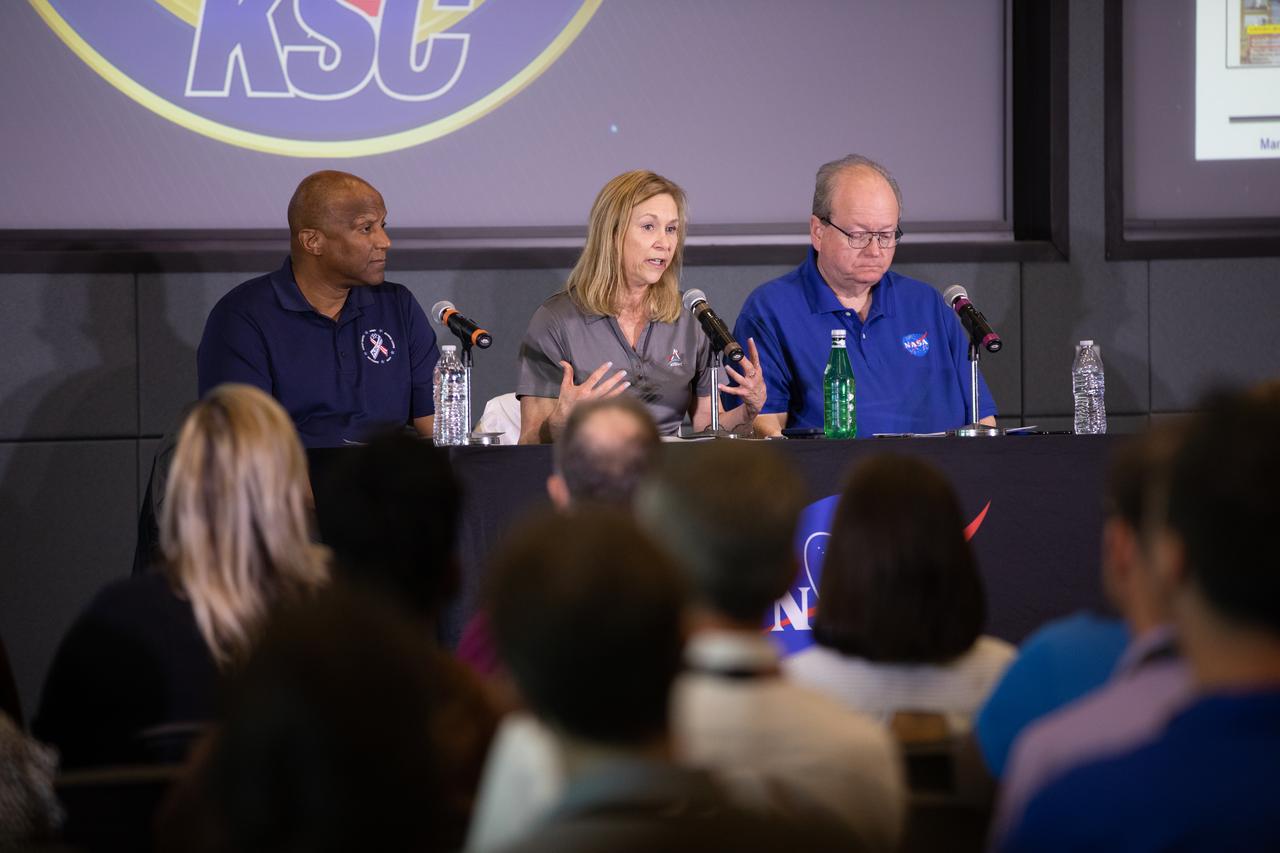
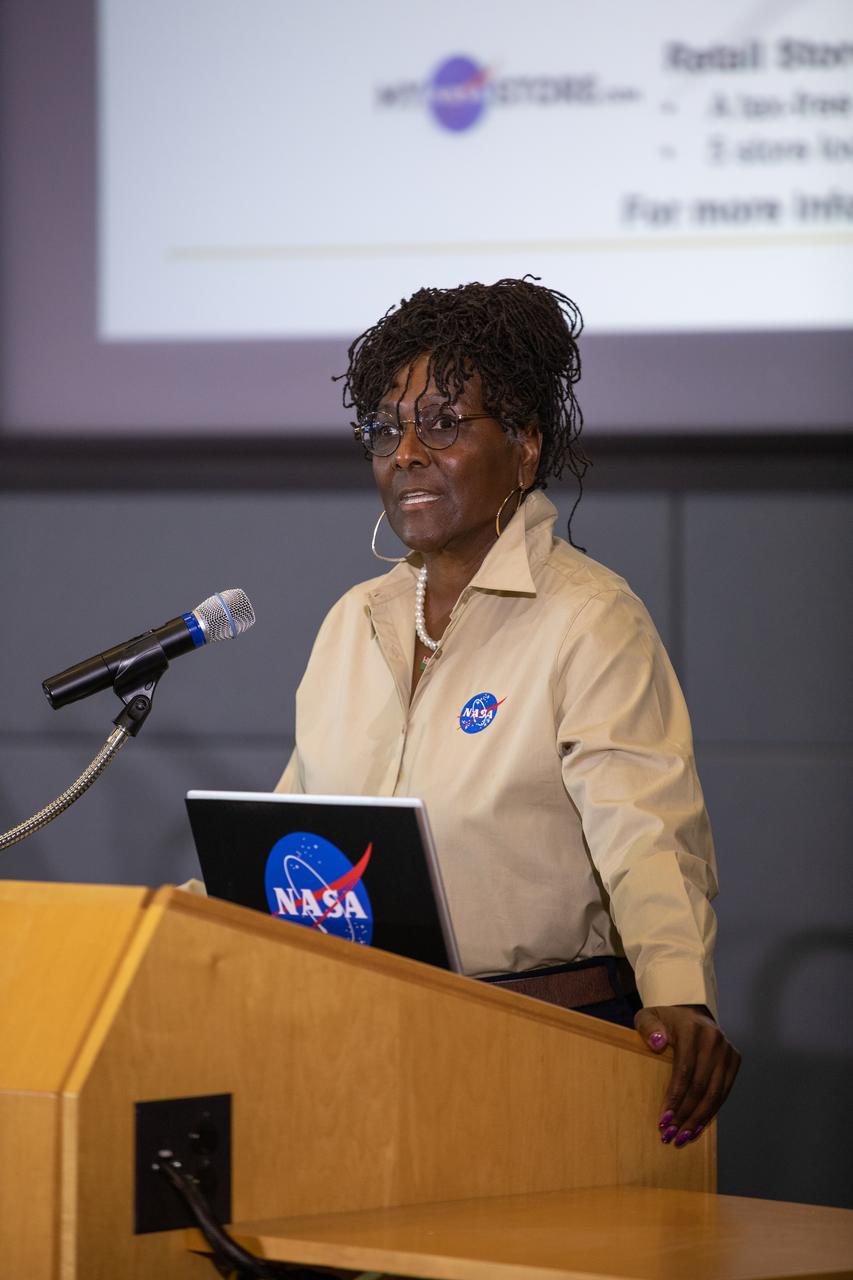
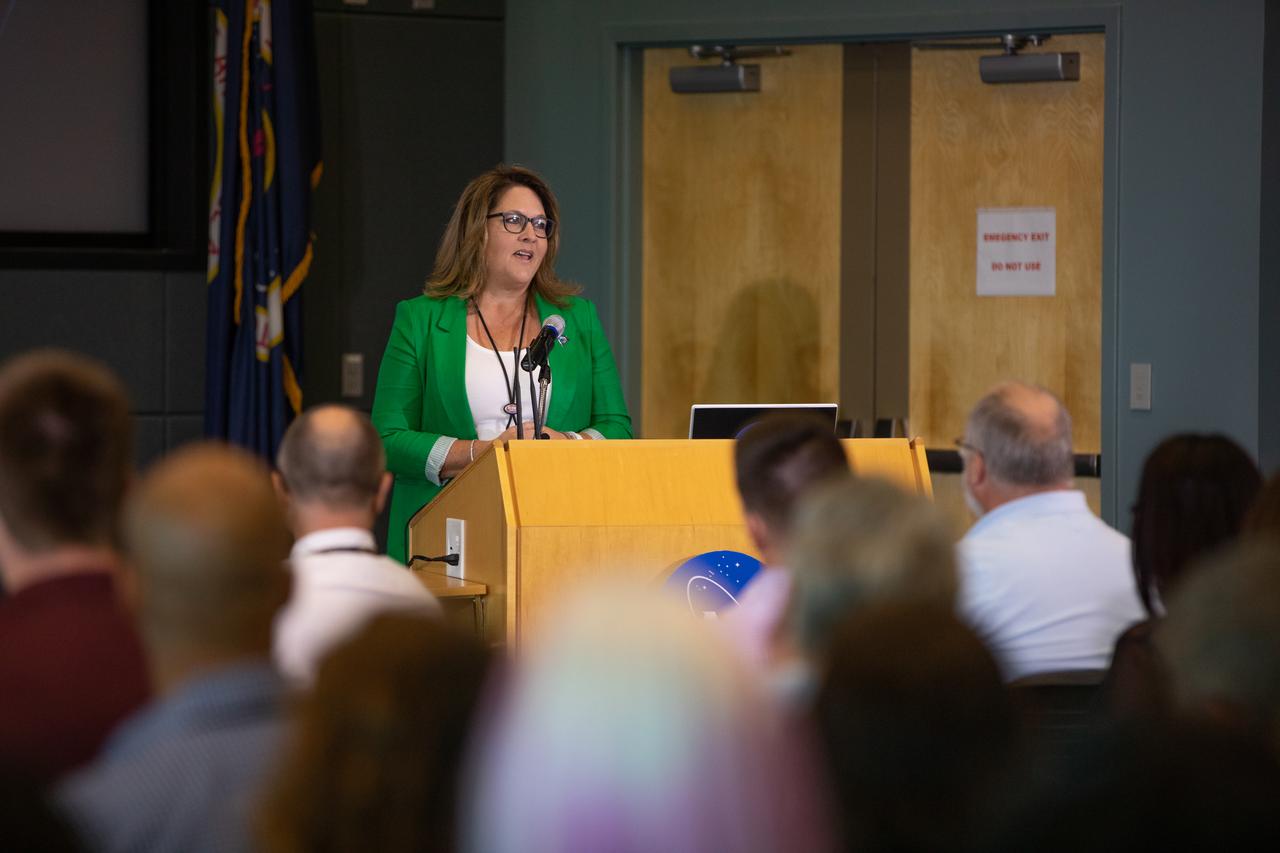
Hortense Blackwell, Office of Communication and Public Engagement director at NASA’s Kennedy Space Center, participates in an employee Town Hall at the Florida spaceport on March 13, 2023. During the event, senior leaders discussed key accomplishments and goals of the center, as well as answered questions from the Kennedy workforce.
KSC Town Hall
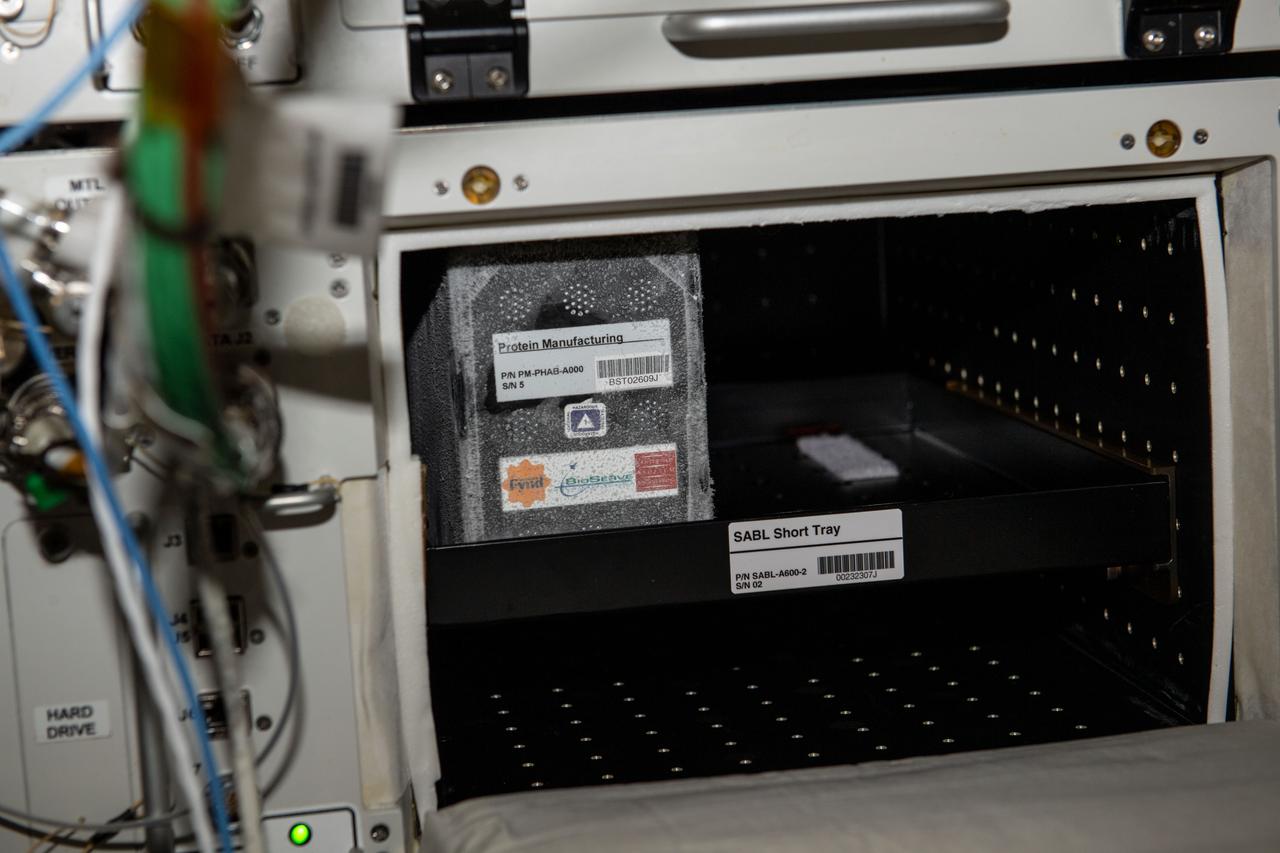
iss067e191182 (7/22/2022) --- A view of the of a Plate Habitat (PHAB) at -20°C prior to insertion into the SABL incubator aboard the International Space Station (ISS). The goal of the Protein Manufacturing project is to demonstrate the use of a novel bioreactor technology for growing high-protein food on the International Space Station (ISS).
iss067e191182
Members of the National Space Council meet in the high bay of the Space Station Processing Facility at NASA's Kennedy Space Center in Florida, on Feb. 21, 2018. Chaired by Vice President Mike Pence, the council's role is to advise the president regarding national space policy and strategy, and review the nation's long-range goals for space activities.
Vice President Mike Pence Visits Kennedy Space Center - National
jsc2021e031153 (7/22/2021) --- A preflight view of Slime molds Physarum polycephalum (nicknamed "blob") exploring an agar gel. The goal of the Blob investigation is to observe the influence of microgravity on the Blob’s (a unicellular organism whose scientific name is Physarum polycephalum) behaviour when it explores its environment or when it eats.  Photo courtesy of © DUSSUTOUR CNRS.
Blob: jsc2021e031153
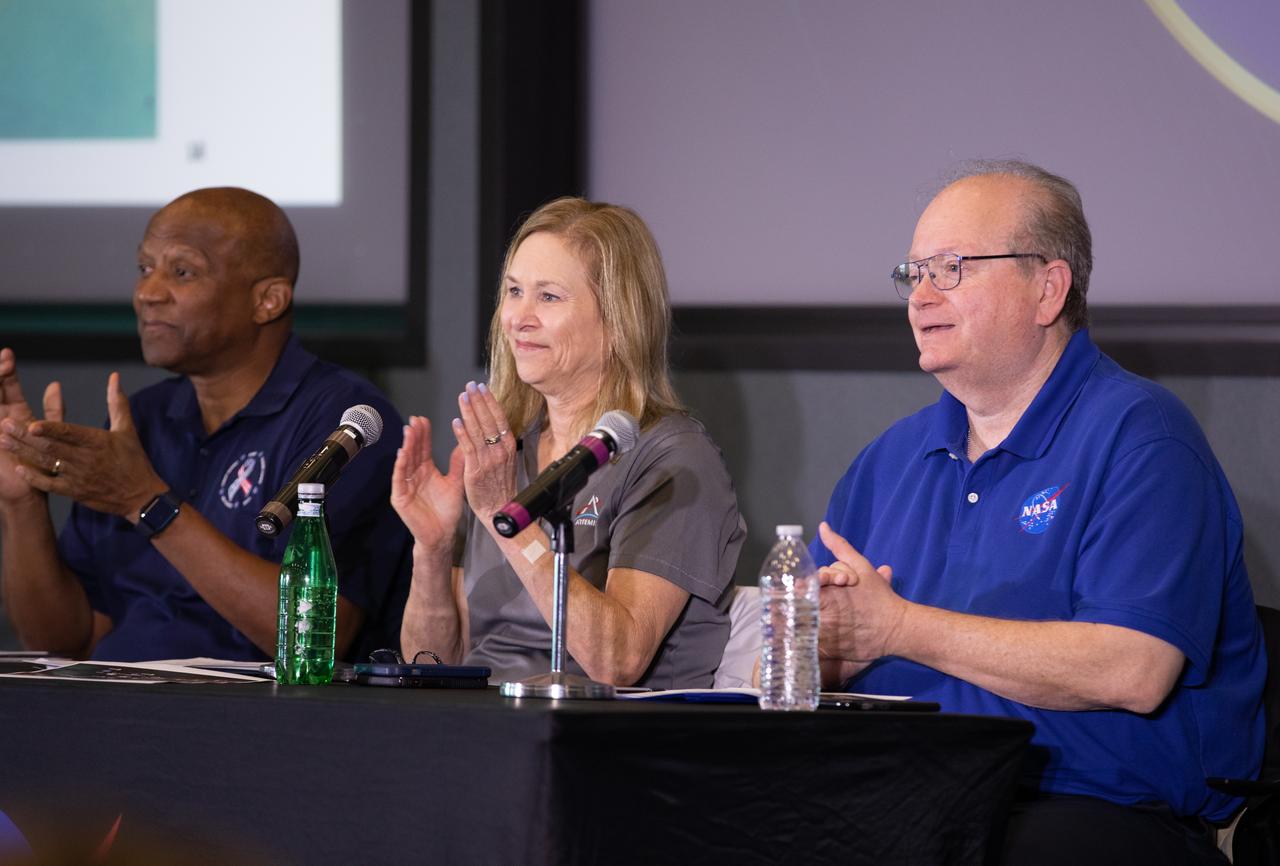
From left, NASA’s Kennedy Space Center Deputy Director Kelvin Manning, Director Janet Petro, and Associate Director, Management Burt Summerfield participate in an employee Town Hall at the Florida spaceport on March 13, 2023. The senior leaders discussed key accomplishments and goals of the center, as well as answered questions from the Kennedy workforce.
KSC Town Hall
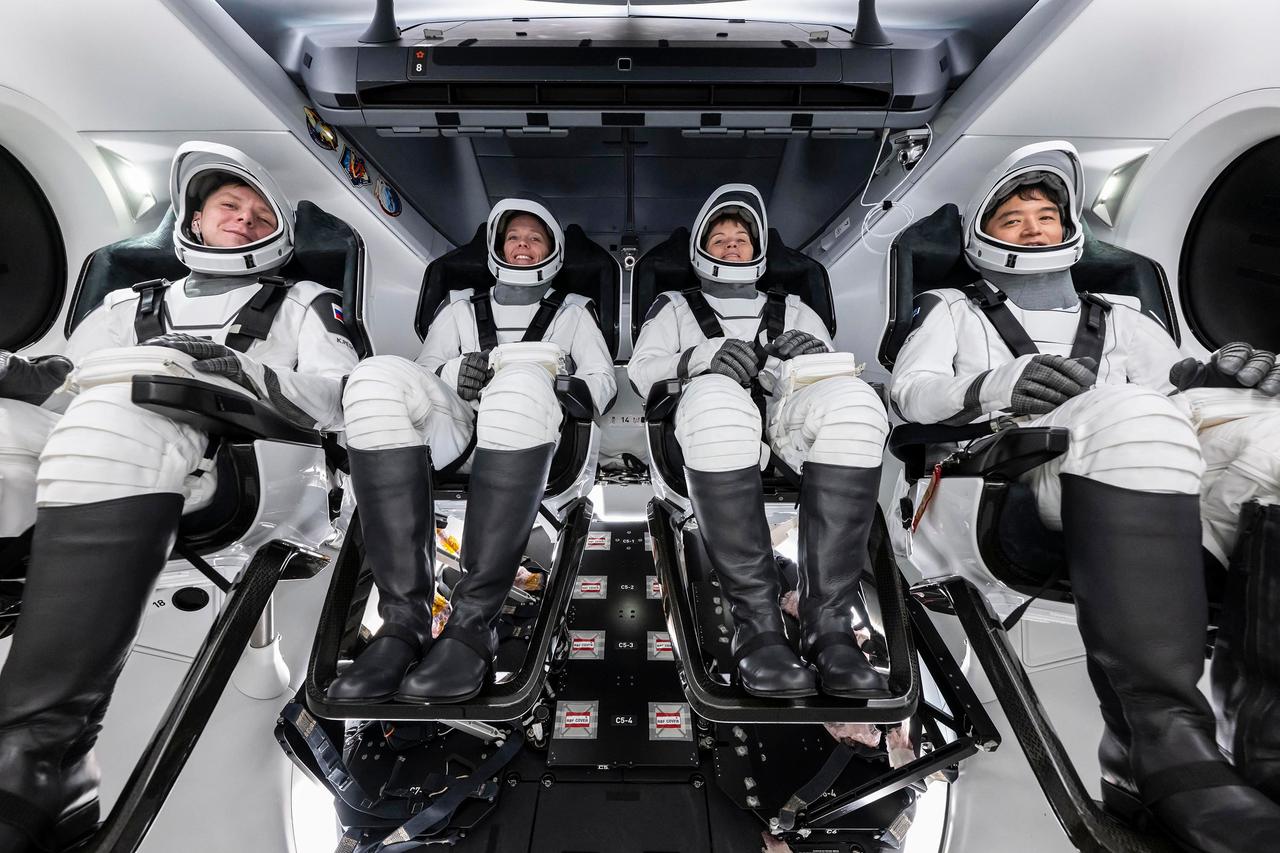
jsc2025e012270 - (February 17, 2025) --- The crew of NASA’s SpaceX Crew-10 mission to the International Space Station poses for a photo during their Crew Equipment Interface Test at NASA’s Kennedy Space Center in Florida. The goal of the training is to rehearse launch day activities and get a close look at the spacecraft that will take them to the International Space Station.
The crew members of NASA’s SpaceX Crew-10 mission
Vice President Mike Pence chairs a meeting of the National Space Council in the high bay of the Space Station Processing Facility at NASA's Kennedy Space Center in Florida, on Feb. 21, 2018. The council's role is to advise the president regarding national space policy and strategy, and review the nation's long-range goals for space activities.
Vice President Mike Pence Visits Kennedy Space Center - National
NASA's all-electric X-57 Maxwell aircraft tests the motors with the battery packs installed on the aircraft at NASA's Armstrong Flight Research Center in California. A goal of the X-57 project is to help the Federal Aviation Administration set certification standards for emerging electric aircraft markets.
X-57 Motor Spin Test on Aircraft Battery
S67-19620 (12 Sept. 1962) --- On Sept. 12, 1962, President John F. Kennedy delivers a speech announcing his goals for the nation?s space effort to land a human being on the moon before a crowd of 35,000 people in the football stadium at Rice University in Houston, Texas. Photo credit: NASA
s67-19620
Cory Taylor, an energy and water conservation specialist at Kennedy Space Center, absorbs information at the Multi-Function Facility on Oct. 20. Every third Thursday of October, civil servants, contractors and several energy utilities promote the awareness of our sustainability goals at Kennedy Space Center and at home. Photo credit: Cory Huston
2016 Energy Awareness Day
From left, NASA’s Kennedy Space Center Deputy Director Kelvin Manning, Director Janet Petro, and Associate Director, Management Burt Summerfield participate in an employee Town Hall at the Florida spaceport on March 13, 2023. The senior leaders discussed key accomplishments and goals of the center, as well as answered questions from the Kennedy workforce.
KSC Town Hall
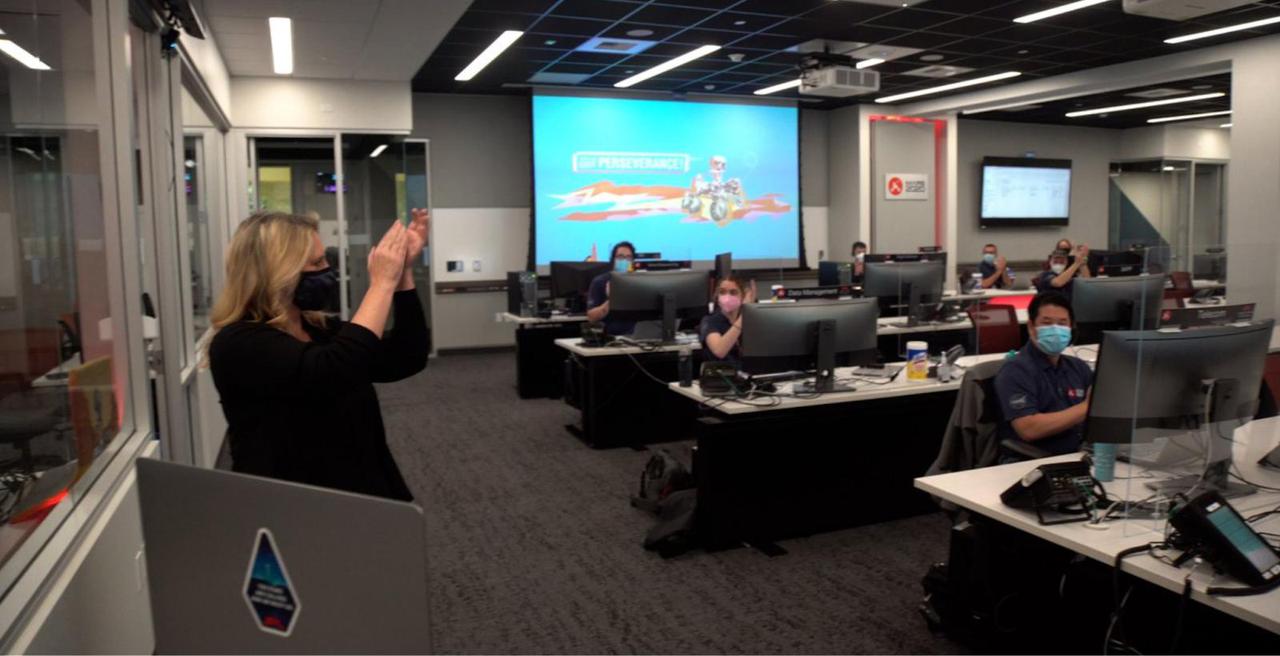
Jennifer Trosper, Mars Perseverance project manager, leads rover team members at JPL in a round of applause for students who were honored through the "You've Got Perseverance" campaign for overcoming obstacles in pursuit of their educational goals.  https://photojournal.jpl.nasa.gov/catalog/PIA25272
Team Members Honoring Students
Becky Murray, associate director of Engineering at NASA’s Kennedy Space Center, participates in an employee Town Hall at the Florida spaceport on March 13, 2023. During the event, senior leaders discussed key accomplishments and goals of the center, as well as answered questions from the Kennedy workforce.
KSC Town Hall
iss067e191207 (7/22/2022) --- A view of the of a Plate Habitat (PHAB) at -20°C after insertion into the SABL incubator aboard the International Space Station (ISS). The goal of the Protein Manufacturing project is to demonstrate the use of a novel bioreactor technology for growing high-protein food on the International Space Station (ISS).
iss067e191207
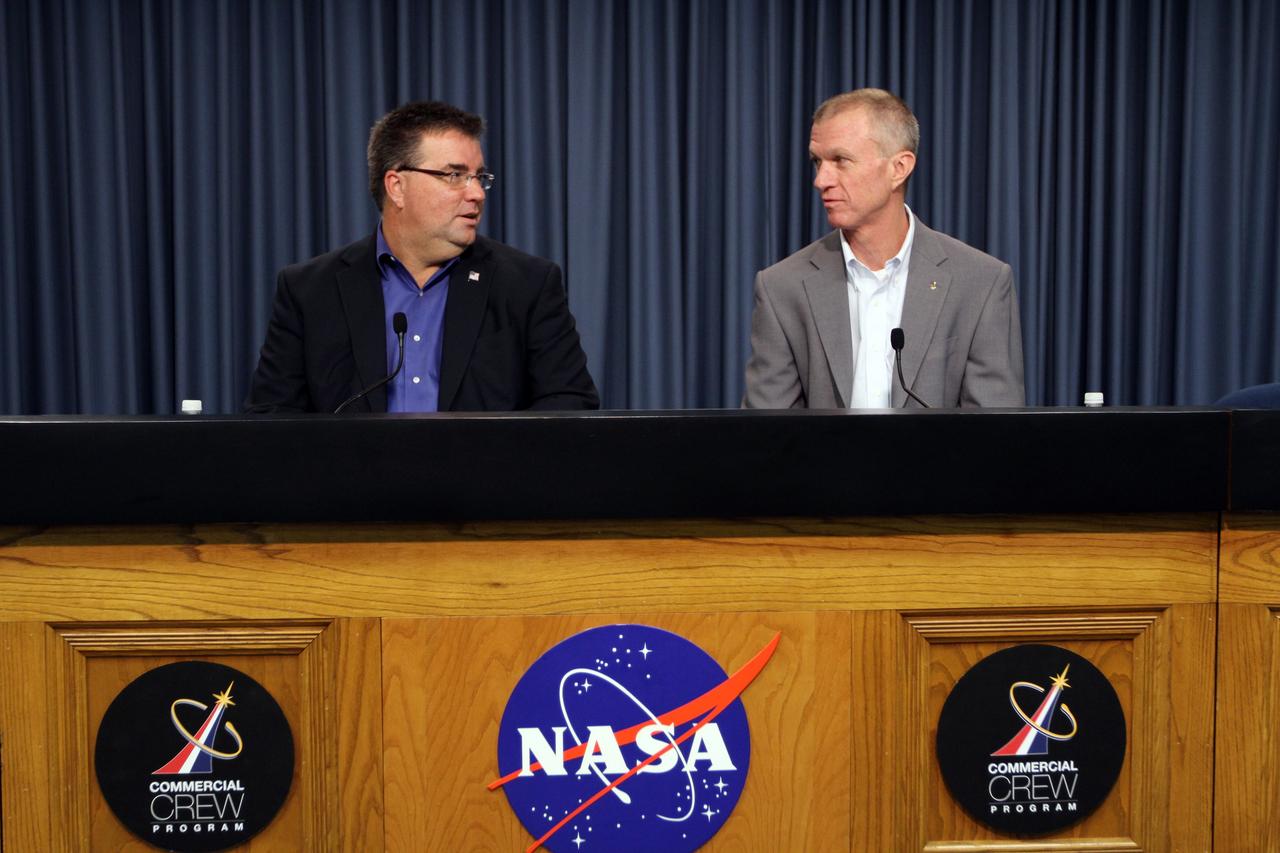
CAPE CANAVERAL, Fla. -- Commercial Crew Program (CCP) Manager Ed Mango, left, and Deputy Program Manager Brent Jett host a Program Strategy Forum at NASA's Kennedy Space Center in Florida. The forum was held to update industry partners about NASA's next phase of developing commercial space transportation system capabilities.     CCP is helping to mature the design and development of a crew transportation system with the overall goal of accelerating a United States-led capability to the International Space Station. The goal of the program is to drive down the cost of space travel as well as open up space to more people than ever before by balancing industry’s own innovative capabilities with NASA's 50 years of human spaceflight experience. For more information, visit www.nasa.gov/commercialcrew.  Photo credit: NASA/Kim Shiflett
KSC-2012-1265
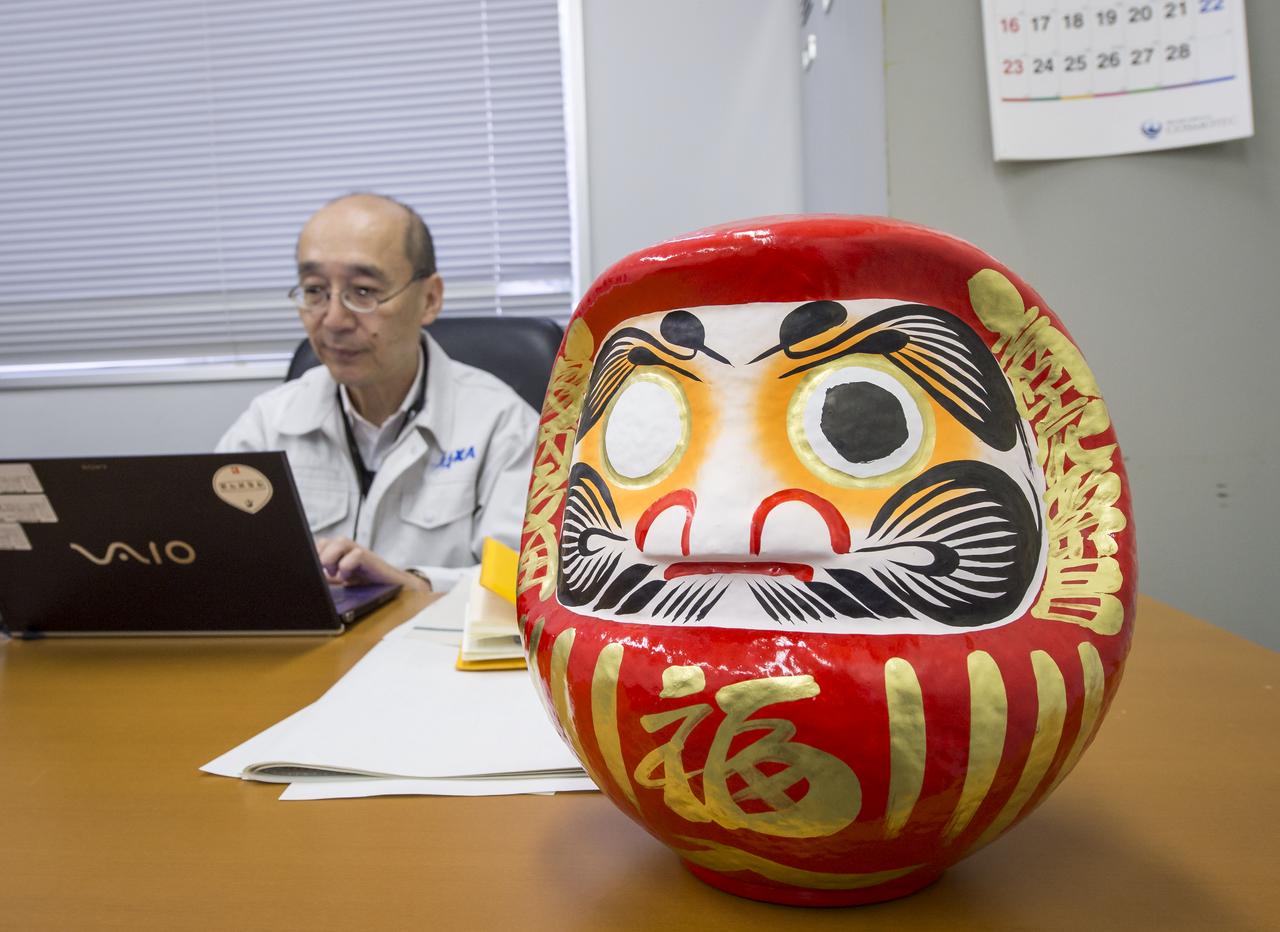
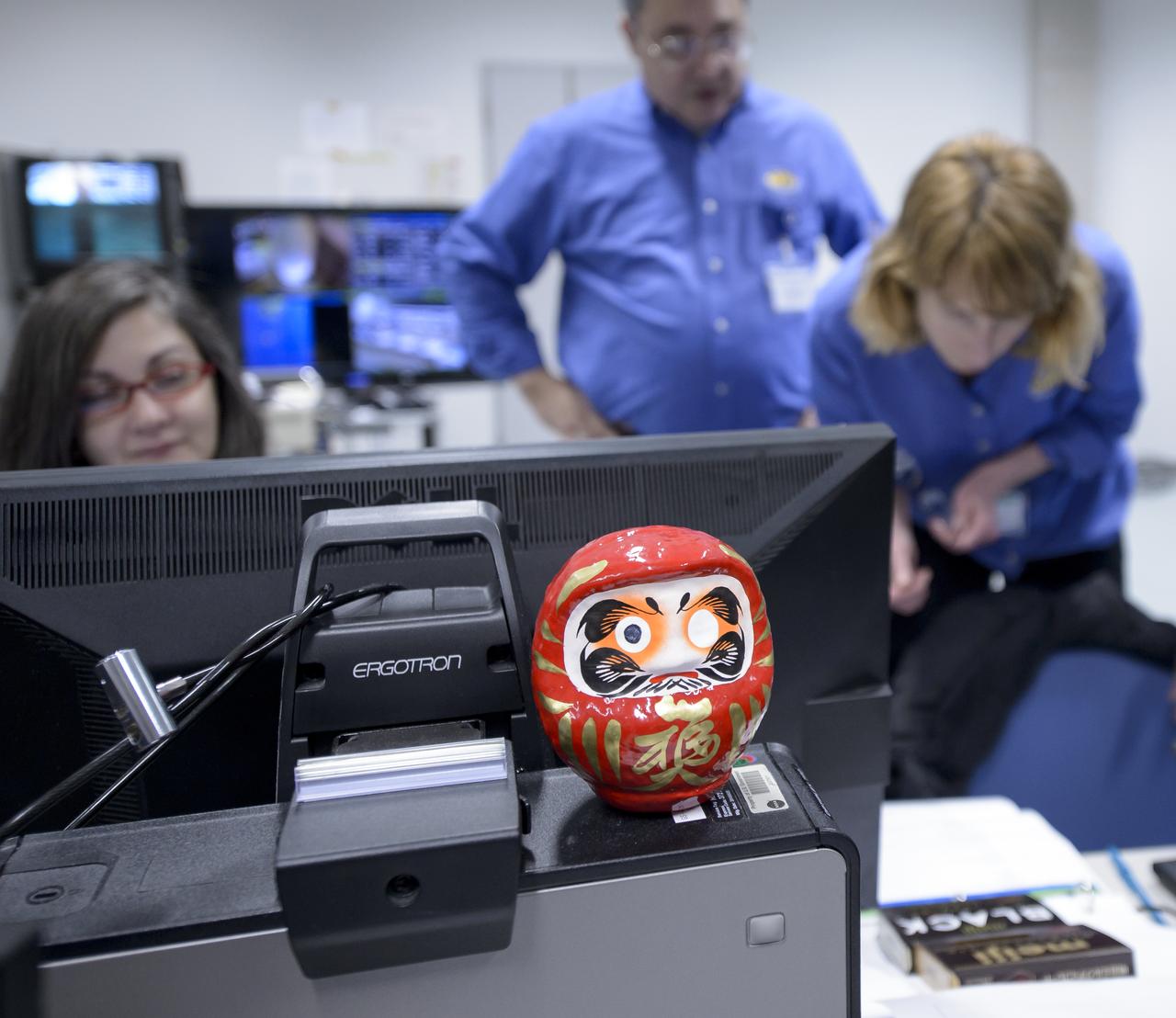
A daruma doll is seen on the desk of Masahiro Kojima, GPM Dual-frequency Precipitation Radar project manager, Japan Aerospace Exploration Agency (JAXA), at the Tanegashima Space Cener's Range Control Center (RCC), Wednesday, Feb. 26, 2014, Tanegashima, Japan. One eye of the daruma doll is colored in when a goal is set and the second eye is colored in at the completion of the goal. JAXA plans to launch an H-IIA rocket carrying the NASA-JAXA, Global Precipitation Measurement (GPM) Core Observatory from the space center on Feb. 28, 2014. Once launched, the GPM spacecraft will collect information that unifies data from an international network of existing and future satellites to map global rainfall and snowfall every three hours.  Photo Credit: (NASA/Bill Ingalls)
Global Precipitation Measurement (GPM) Mission
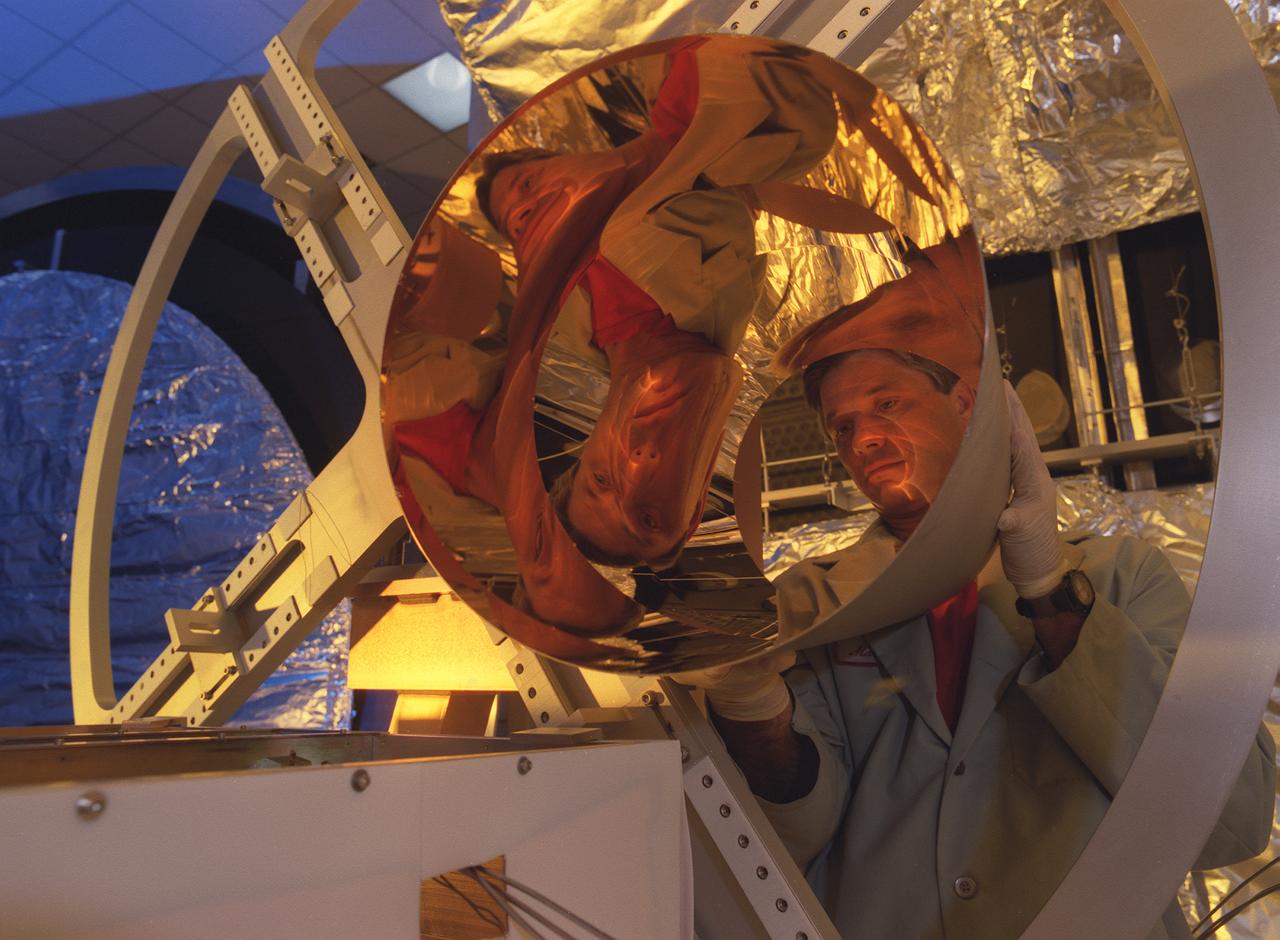
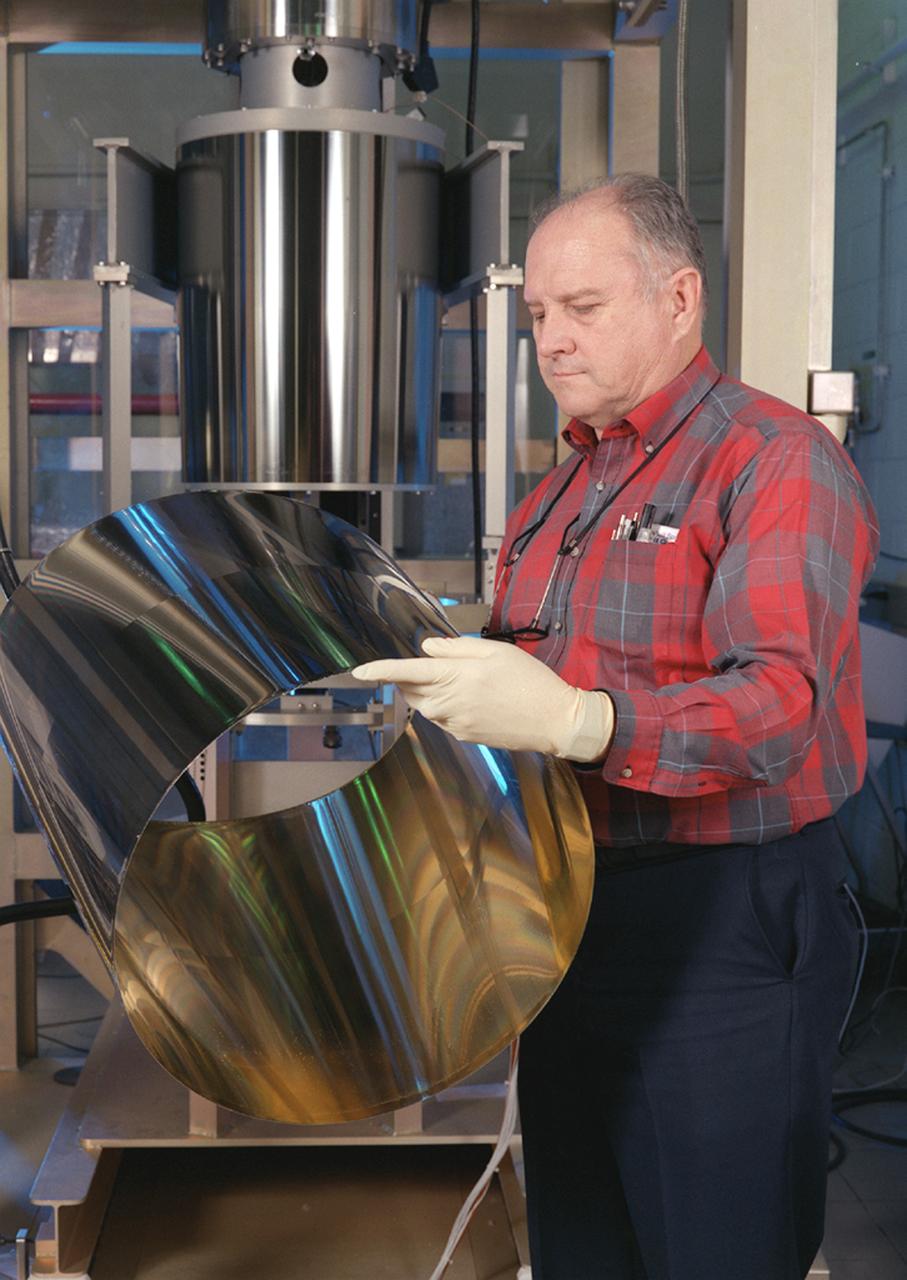
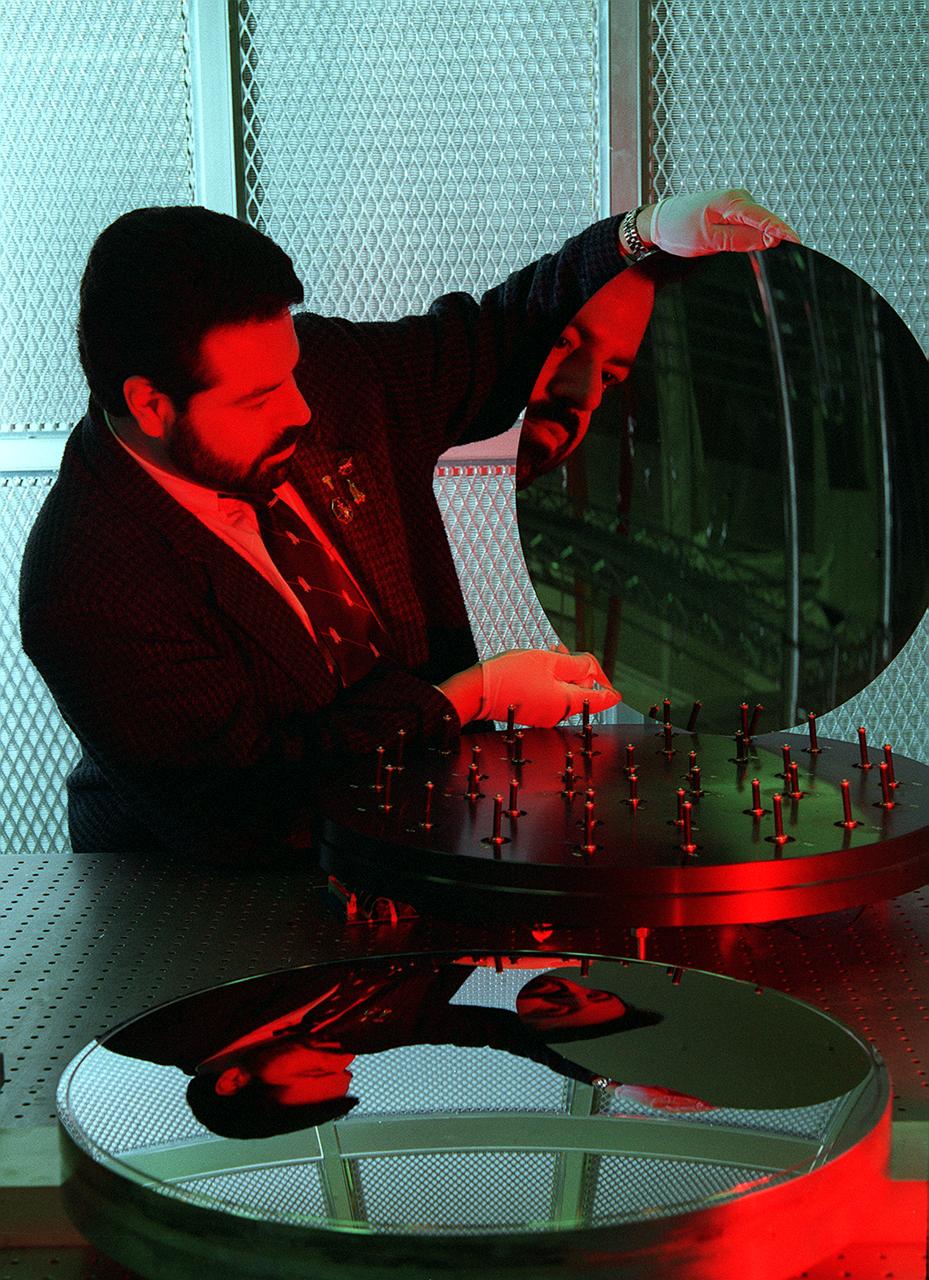
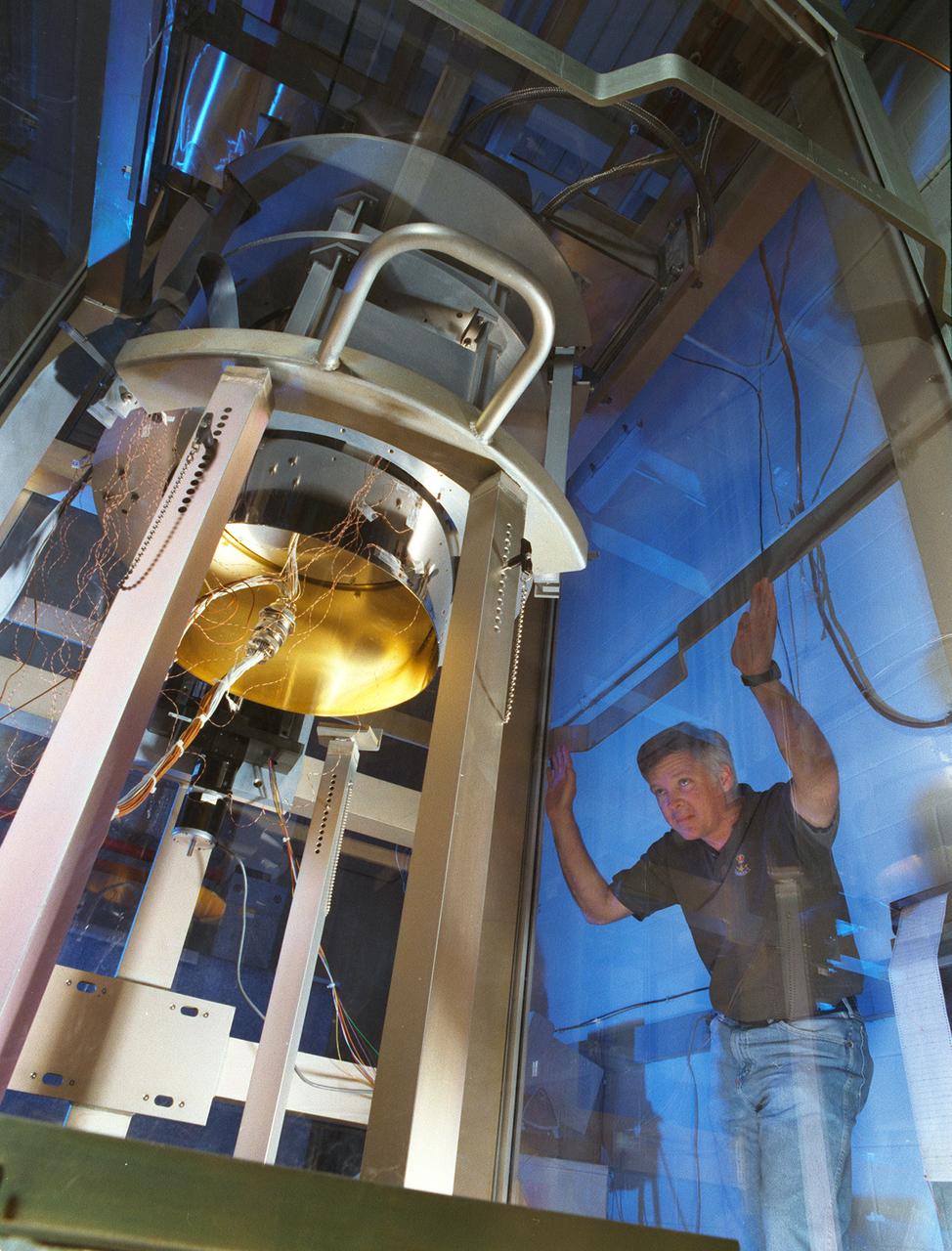
NASA's Space Optics Manufacturing Center has been working to expand our view of the universe via sophisticated new telescopes. The Optics Center's goal is to develop low-cost, advanced space optics technologies for the NASA program in the 21st century - including the long-term goal of imaging Earth-like planets in distant solar systems. To reduce the cost of mirror fabrication, Marshall Space Flight Center (MSFC) has developed replication techniques, the machinery and materials to replicate electro-formed nickel mirrors. The process allows fabricating precisely shaped mandrels to be used and reused as masters for replicating high-quality mirrors. This image shows a lightweight replicated x-ray mirror with gold coatings applied.
Space Science
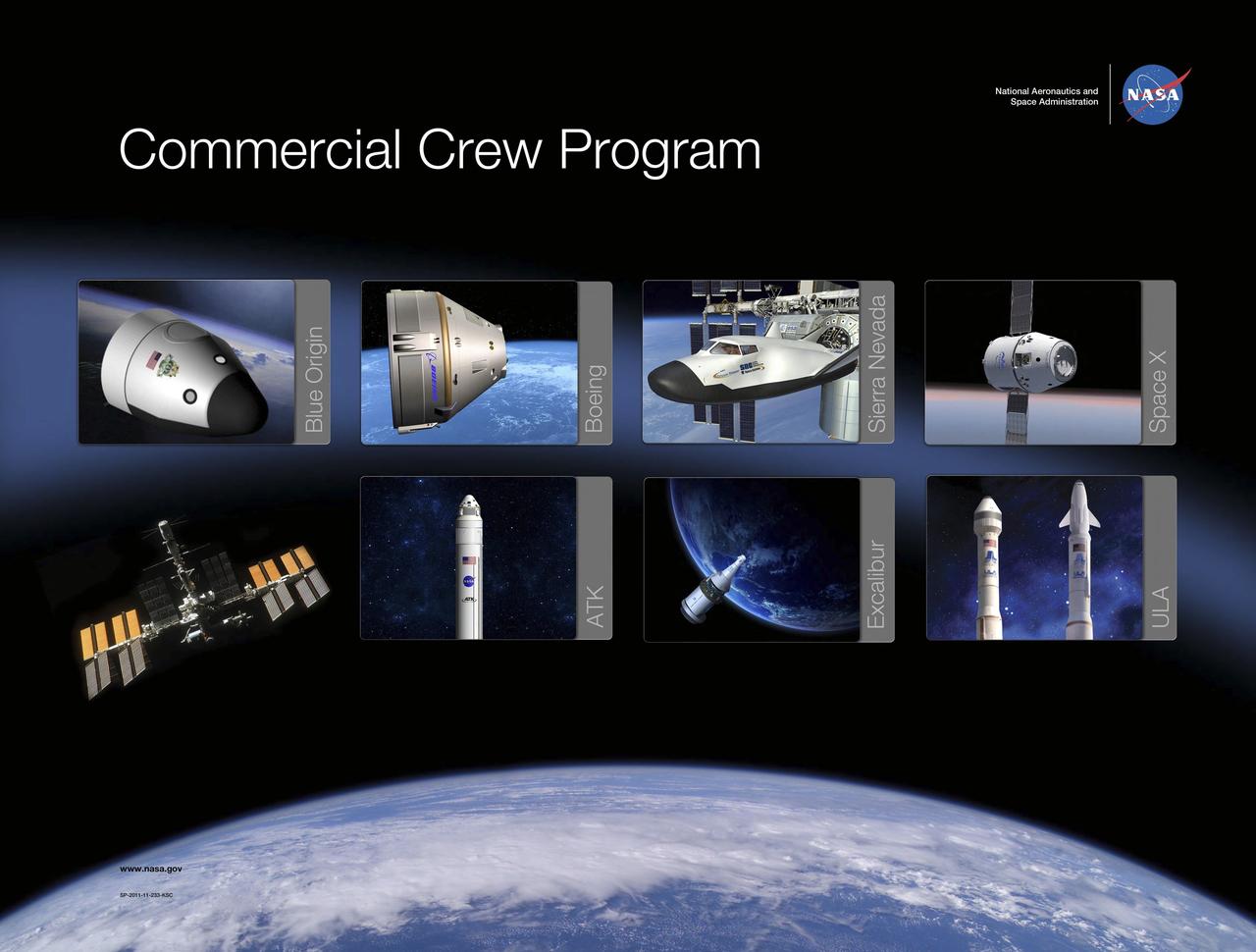
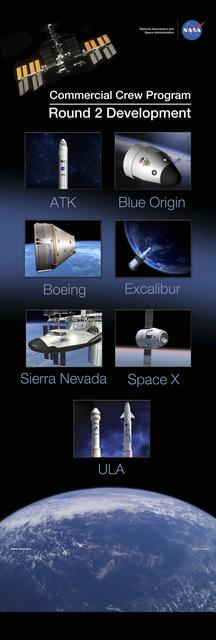
CAPE CANAVERAL, Fla. -- This is a printable banner of the aerospace companies NASA's Commercial Crew Program (CCP) entered into Space Act Agreements with during Commercial Crew Development Round 2 (CCDev2) activities in 2011 in order to mature the design and development of crew transportation systems with the overall goal of accelerating a United States-led capability to the International Space Station. CCDev2 companies are Alliant Techsystems (ATK), Blue Origin, The Boeing Co., Excalibur Almaz Inc., Sierra Nevada Corp., Space Exploration Technologies (SpaceX), and United Launch Alliance (ULA). The goal of CCP is to drive down the cost of space travel as well as open up space to more people than ever before by balancing industry’s own innovative capabilities with NASA's 50 years of human spaceflight experience. For more information, visit www.nasa.gov/commercialcrew
KSC-2012-1009
A daruma doll is seen amongst the NASA GPM Mission launch team in the Spacecraft Test and Assembly Building 2 (STA2) during the all-day launch simulation for the Global Precipitation Measurement (GPM) Core Observatory, Saturday, Feb. 22, 2014, Tanegashima Space Center (TNSC), Tanegashima Island, Japan. One eye of the daruma doll is colored in when a goal is set, in this case a successful launch of GPM, and the second eye is colored in at the completion of the goal. Japan Aerospace Exploration Agency (JAXA) plans to launch an H-IIA rocket carrying the GPM Core Observatory on Feb. 28, 2014. The NASA-JAXA GPM spacecraft will collect information that unifies data from an international network of existing and future satellites to map global rainfall and snowfall every three hours. Photo Credit: (NASA/Bill Ingalls)
Global Precipitation Measurement (GPM) Mission
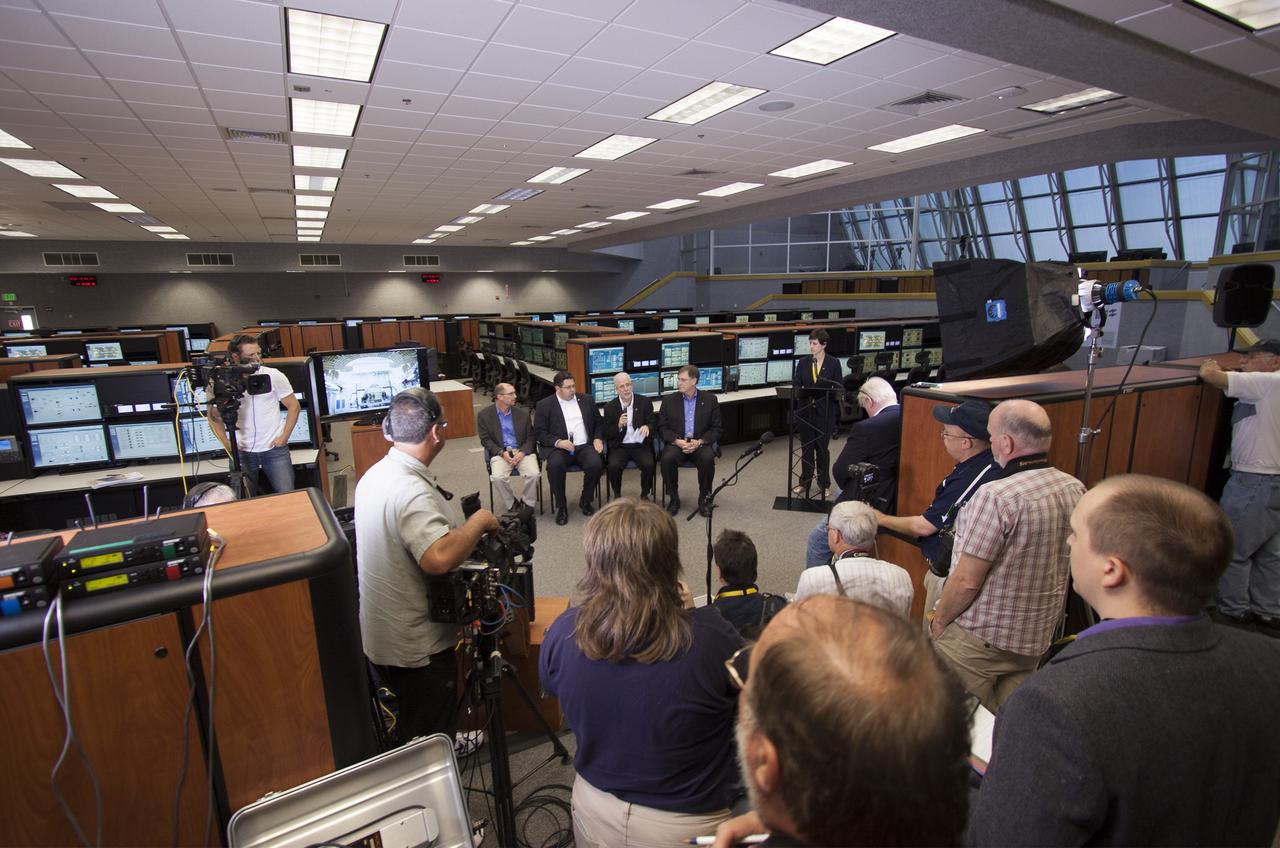
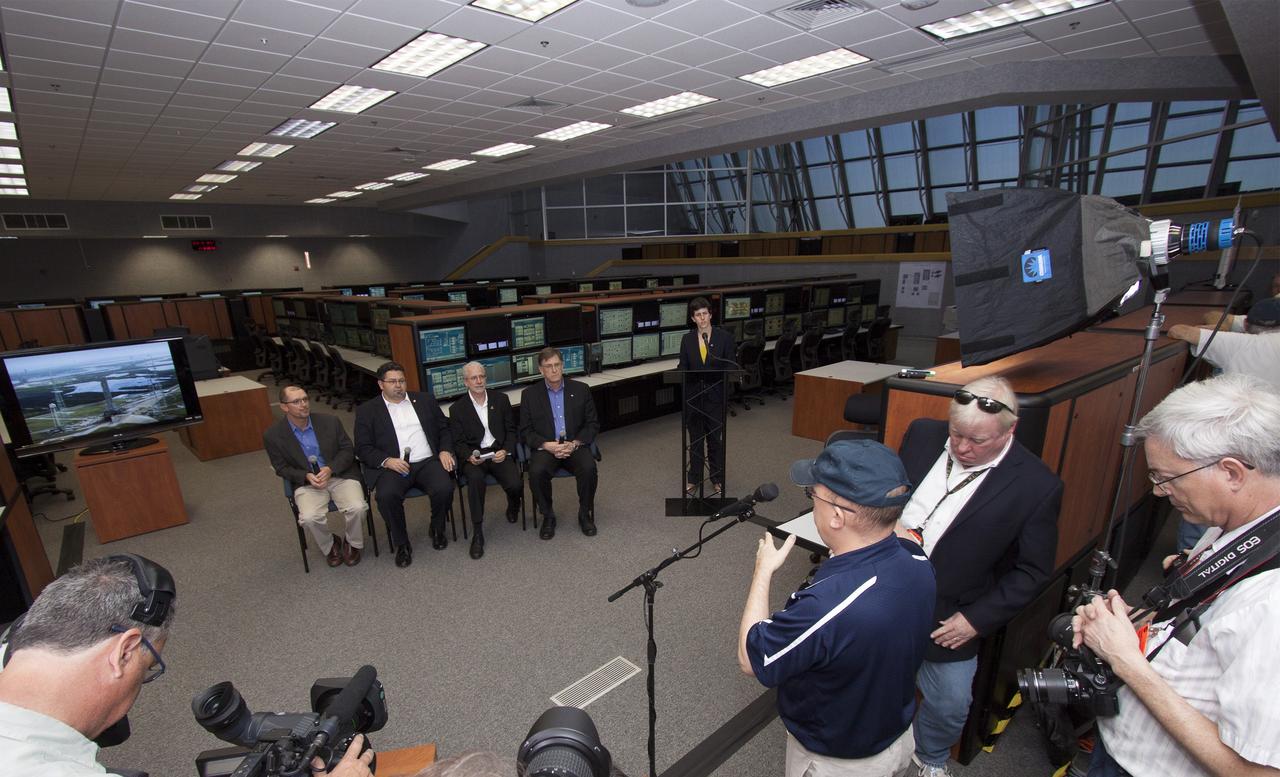
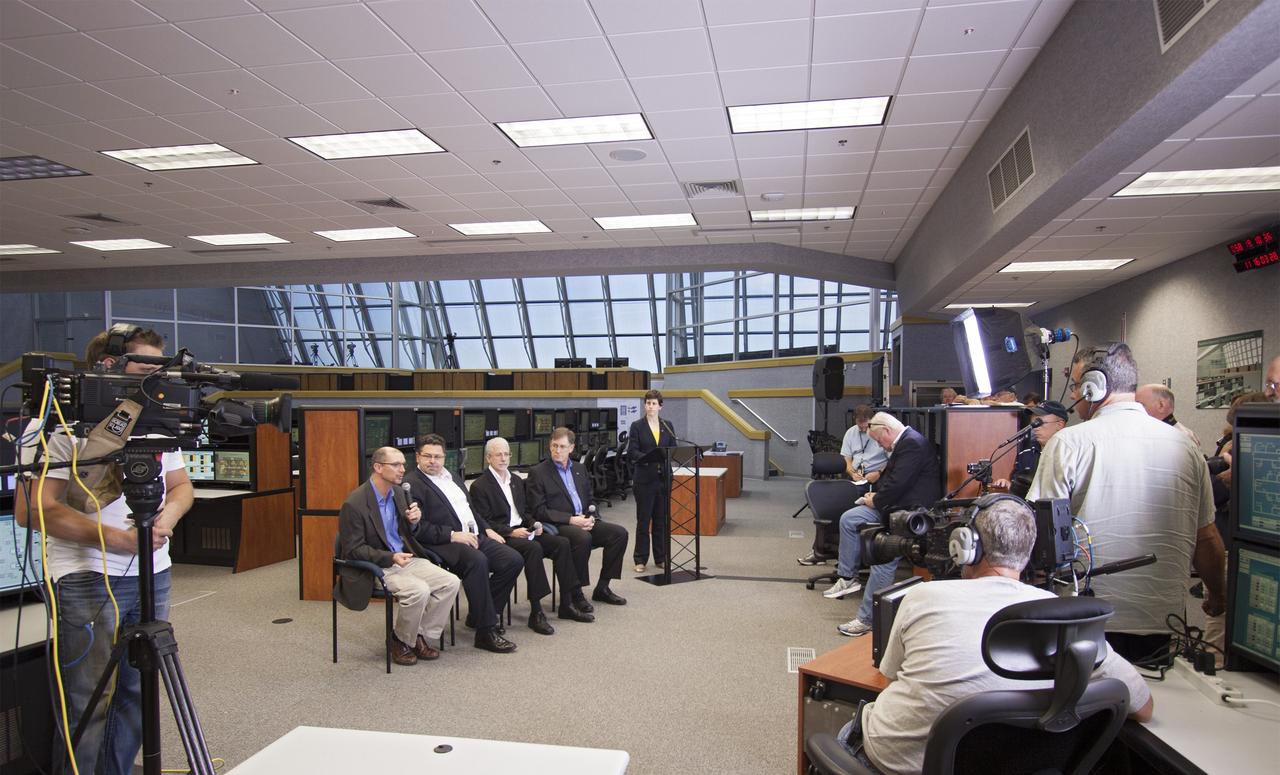
CAPE CANAVERAL, Fla. – NASA officials detail progress toward a September 2014 flight test called Exploration Flight Test-1 or EFT-1 as part of the agency's goal of launching astronauts into deep space. Speaking inside the Young-Crippen Firing Room at NASA's Kennedy Space Center in Florida, the officials discussed the goals and expectations for EFT-1 with news media. Seated, facing the camera from left to right are Pepper Phillips, Ground Systems Development and Operations program manager, Todd May, Space Launch System program manager, Mark Geyer, Orion program manager and Dan Dumbacher, deputy associate administrator for the Exploration Systems Development Division. Standing is Rachel Kraft, a public affairs officer from NASA Headquarters in Washington D.C. Photo credit: NASA/Jim Grossmann
KSC-2013-1653
CAPE CANAVERAL, Fla. -- This is a printable poster of the aerospace companies NASA's Commercial Crew Program (CCP) entered into Space Act Agreements with during Commercial Crew Development Round 2 (CCDev2) activities in 2011 in order to mature the design and development of crew transportation systems with the overall goal of accelerating a United States-led capability to the International Space Station. CCDev2 companies are Alliant Techsystems (ATK), Blue Origin, The Boeing Co., Excalibur Almaz Inc., Sierra Nevada Corp., Space Exploration Technologies (SpaceX), and United Launch Alliance (ULA). The goal of CCP is to drive down the cost of space travel as well as open up space to more people than ever before by balancing industry’s own innovative capabilities with NASA's 50 years of human spaceflight experience. For more information, visit www.nasa.gov/commercialcrew
KSC-2012-1012
CAPE CANAVERAL, Fla. – NASA officials detail progress toward a September 2014 flight test called Exploration Flight Test-1 or EFT-1 as part of the agency's goal of launching astronauts into deep space. Speaking inside the Young-Crippen Firing Room at NASA's Kennedy Space Center in Florida, the officials discussed the goals and expectations for EFT-1 with news media. Seated, facing the camera from left to right are Pepper Phillips, Ground Systems Development and Operations program manager, Todd May, Space Launch System program manager, Mark Geyer, Orion program manager and Dan Dumbacher, deputy associate administrator for the Exploration Systems Development Division. Standing is Rachel Kraft, a public affairs officer from NASA Headquarters in Washington D.C. Photo credit: NASA/Jim Grossmann
KSC-2013-1658
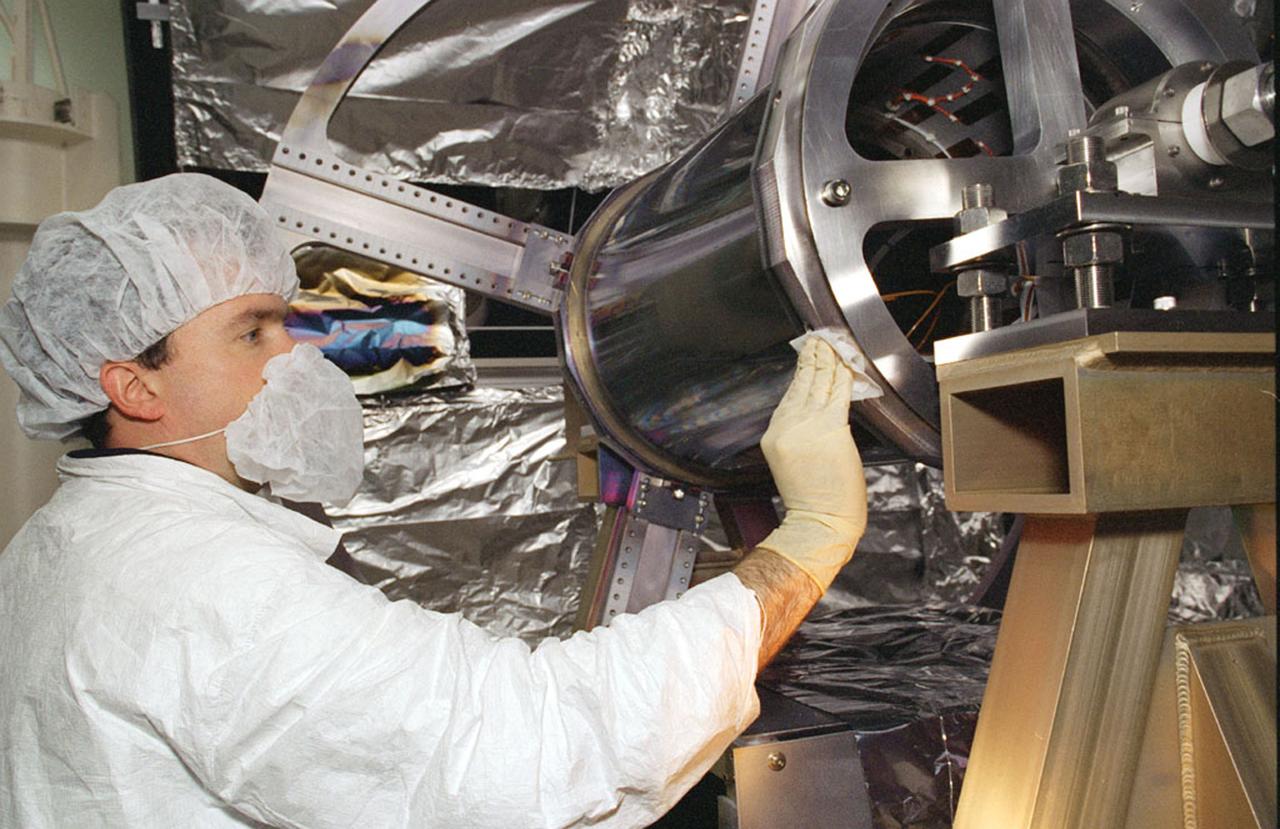
NASA's Space Optics Manufacturing Center has been working to expand our view of the universe via sophisticated new telescopes. The Optics Center's goal is to develop low-cost, advanced space optics technologies for the NASA program in the 21st century - including the long-term goal of imaging Earth-like planets in distant solar systems. To reduce the cost of mirror fabrication, Marshall Space Flight Center (MSFC) has developed replication techniques, the machinery, and materials to replicate electro-formed nickel mirrors. The process allows fabricating precisely shaped mandrels to be used and reused as masters for replicating high-quality mirrors. Image shows Dr. Alan Shapiro cleaning mirror mandrel to be applied with highly reflective and high-density coating in the Large Aperture Coating Chamber, MFSC Space Optics Manufacturing Technology Center (SOMTC).
Space Science
NASA's Space Optics Manufacturing Center has been working to expand our view of the universe via sophisticated new telescopes. The Optics Center's goal is to develop low-cost, advanced space optics technologies for the NASA program in the 21st century - including the long-term goal of imaging Earth-like planets in distant solar systems. To reduce the cost of mirror fabrication, Marshall Space Flight Center (MSFC) has developed replication techniques, the machinery, and materials to replicate electro-formed nickel mirrors. Optics replication uses reusable forms, called mandrels, to make telescope mirrors ready for final finishing. MSFC optical physicist Bill Jones monitors a device used to chill a mandrel, causing it to shrink and separate from the telescope mirror without deforming the mirror's precisely curved surface.
Space Science
NASA's Space Optics Manufacturing Center has been working to expand our view of the universe via sophisticated new telescopes. The Optics Center's goal is to develop low-cost, advanced space optics technologies for the NASA program in the 21st century - including the long-term goal of imaging Earth-like planets in distant solar systems. To reduce the cost of mirror fabrication, Marshall Space Flight Center (MSFC) has developed replication techniques, the machinery, and materials to replicate electro-formed nickel mirrors. The process allows fabricating precisely shaped mandrels to be used and reused as masters for replicating high-quality mirrors. Dr. Joe Ritter examines a replicated electro-formed nickel-alloy mirror which exemplifies the improvements in mirror fabrication techniques, with benefits such as dramtic weight reduction that have been achieved at the Marshall Space Flight Center's Space Optics Manufacturing Technology Center (SOMTC).
Space Science
NASA's Space Optics Manufacturing Center has been working to expand our view of the universe via sophisticated new telescopes. The Optics Center's goal is to develop low-cost, advanced space optics technologies to the NASA program in the 21st century - including the long-term goal of imaging Earth-like planets in distant solar systems. To reduce the cost of mirror fabrication, Marshall Space Flight Center (MSFC) has developed replication techniques, the machinery, and materials to replicate electro-formed nickel mirrors. The process allows fabricating precisely shaped mandrels to be used and reused as masters for replicating high-quality mirrors. Photograph shows J.R. Griffith inspecting a replicated x-ray mirror mandrel.
Space Science
CAPE CANAVERAL, Fla. – NASA officials detail progress toward a September 2014 flight test called Exploration Flight Test-1 or EFT-1 as part of the agency's goal of launching astronauts into deep space. Speaking inside the Young-Crippen Firing Room at NASA's Kennedy Space Center in Florida, the officials discussed the goals and expectations for EFT-1 with news media. Seated, facing the camera from left to right are Pepper Phillips, Ground Systems and Development program manager, Todd May, Space Launch System program manager, Mark Geyer, Orion program manager and Dan Dumbacher, deputy associate administrator for the Exploration Systems Development Division. Standing is Rachel Kraft, a public affairs officer from NASA Headquarters in Washington D.C. Photo credit: NASA/Jim Grossmann
KSC-2013-1659
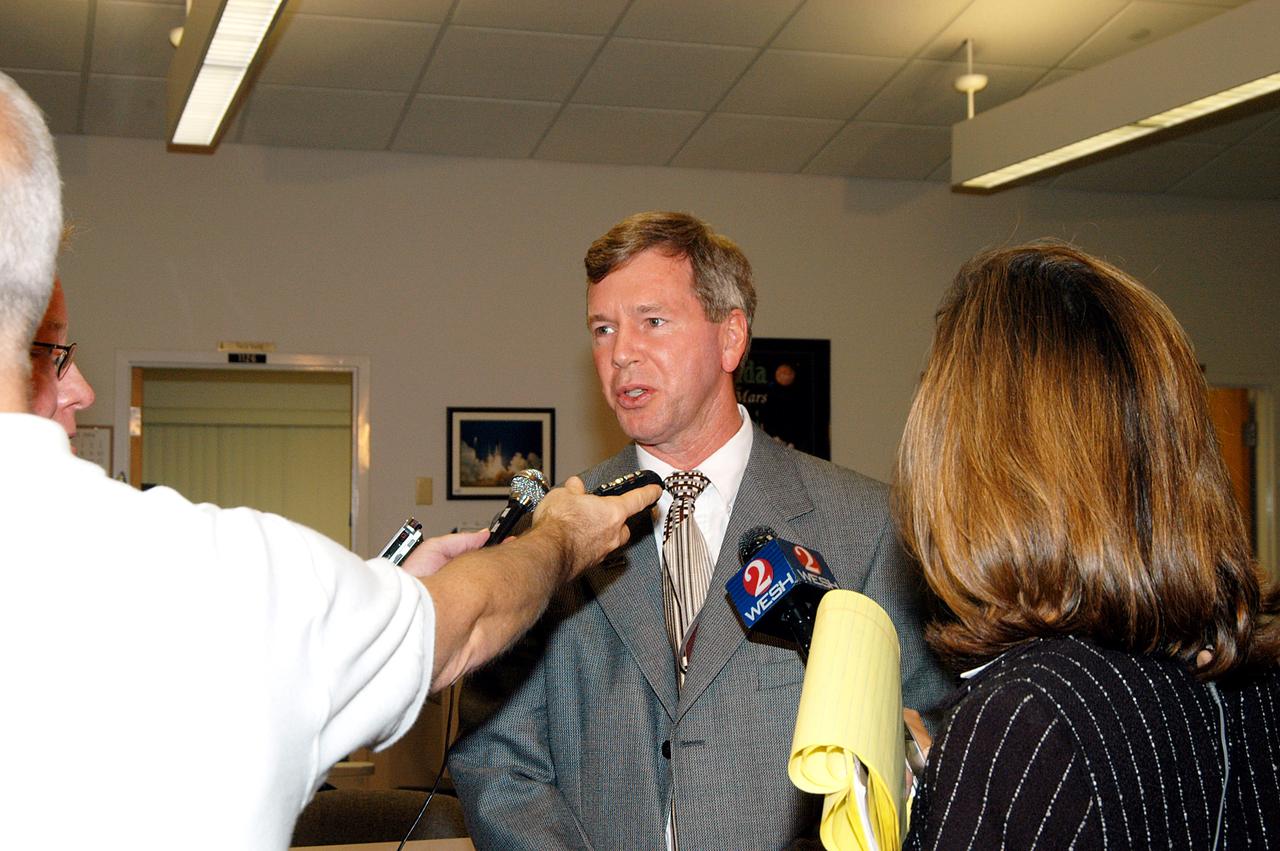
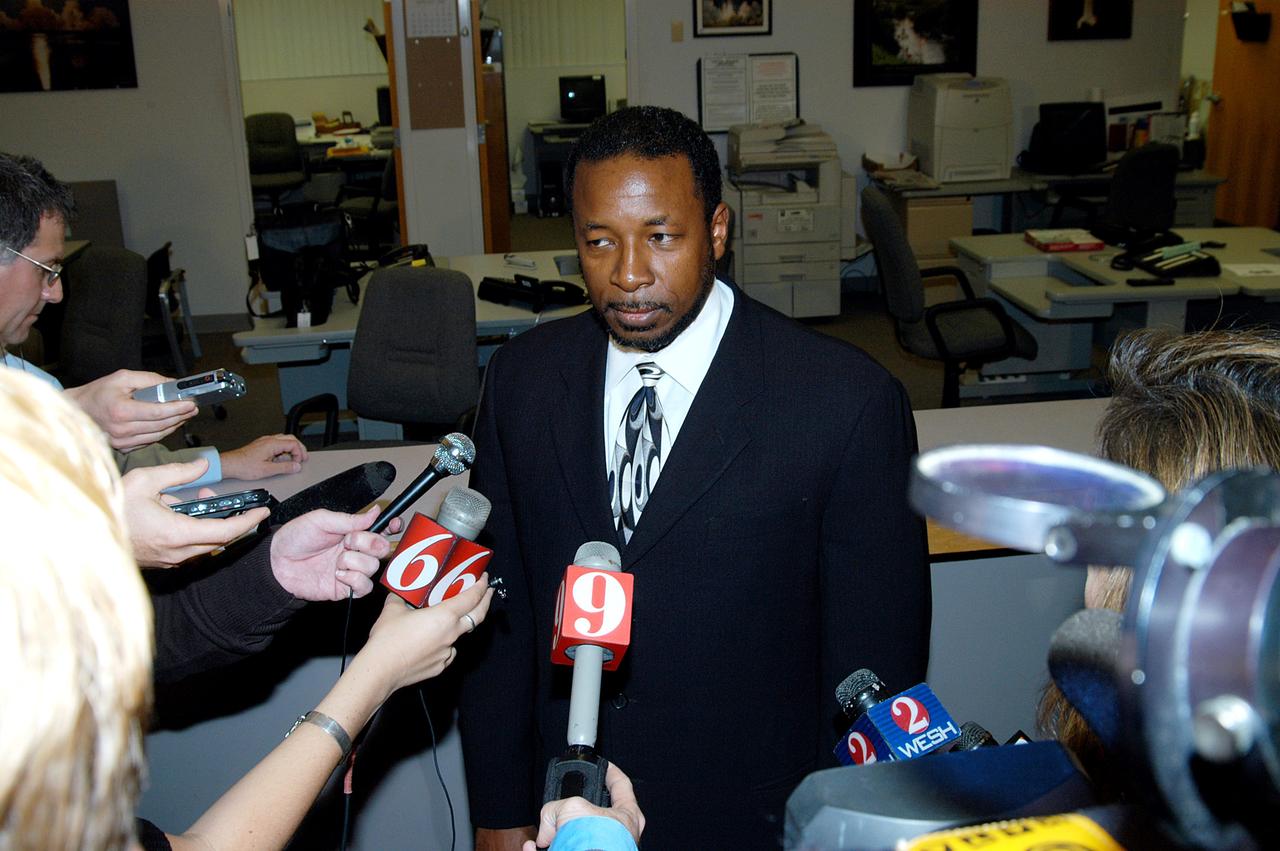
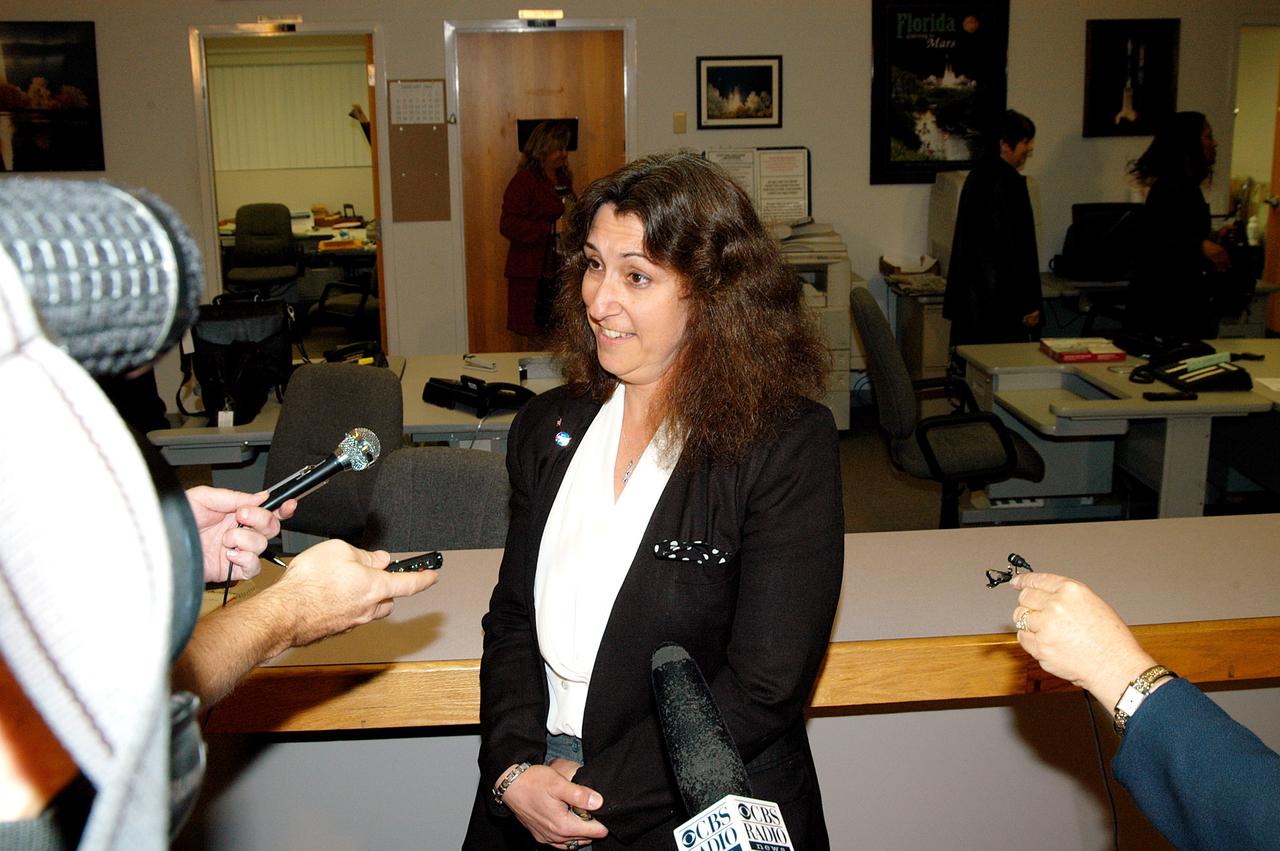
KENNEDY SPACE CENTER, FLA. -- Mike O’Neal, with the KSC Spaceport Technology Development Office, talks to the media at the NASA-KSC News Center after viewing President George W. Bush’s message on the future of NASA.  The President stated his goals for NASA’s new mission: Completing the International Space Station, retiring the Space Shuttle orbiters, developing a new crew exploration vehicle, and returning to the moon and beyond within the next two decades.   Pres. Bush was welcomed by NASA Administrator Sean O’Keefe and Expedition 8 Commander Michael Foale, who greeted him from the International Space Station.
KENNEDY SPACE CENTER, FLA. -- Mike O’Neal, with the KSC Spaceport Technology Development Office, talks to the media at the NASA-KSC News Center after viewing President George W. Bush’s message on the future of NASA. The President stated his goals for NASA’s new mission: Completing the International Space Station, retiring the Space Shuttle orbiters, developing a new crew exploration vehicle, and returning to the moon and beyond within the next two decades. Pres. Bush was welcomed by NASA Administrator Sean O’Keefe and Expedition 8 Commander Michael Foale, who greeted him from the International Space Station.
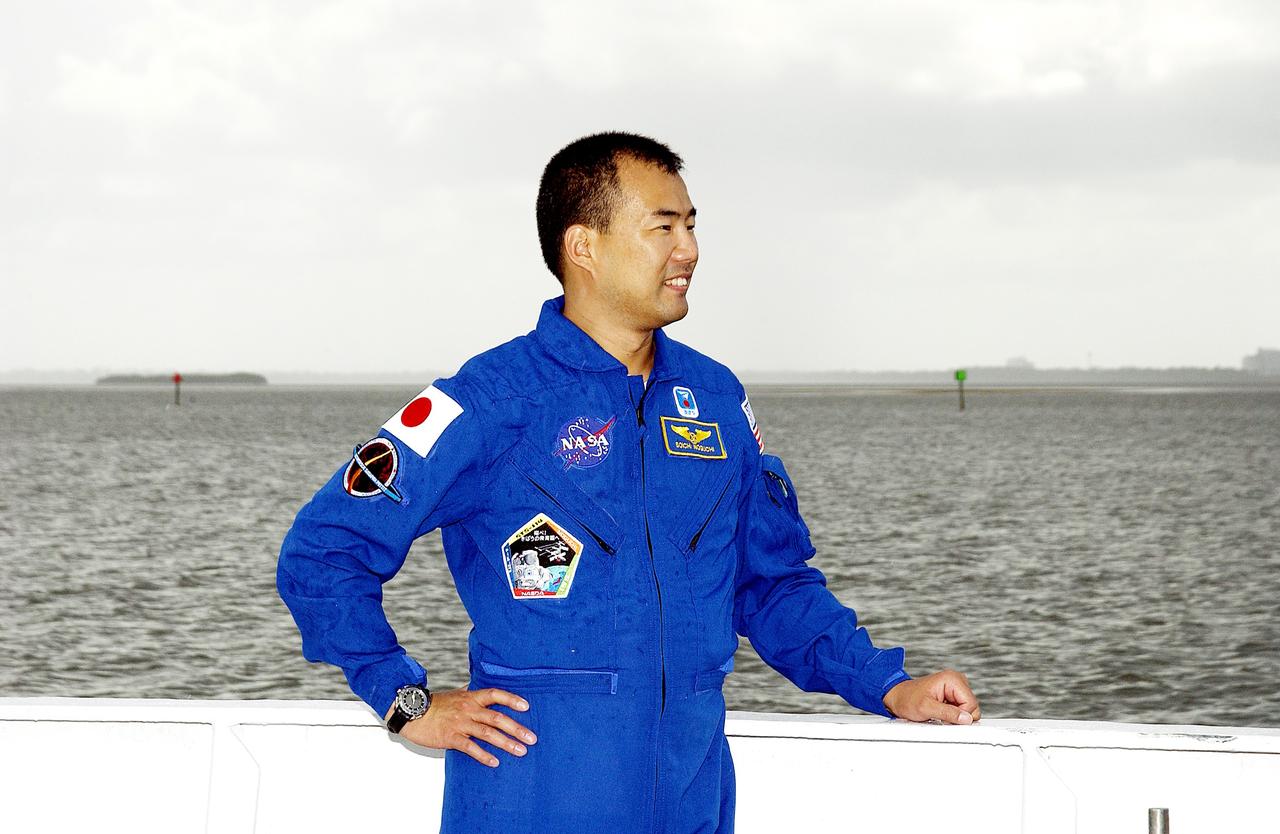
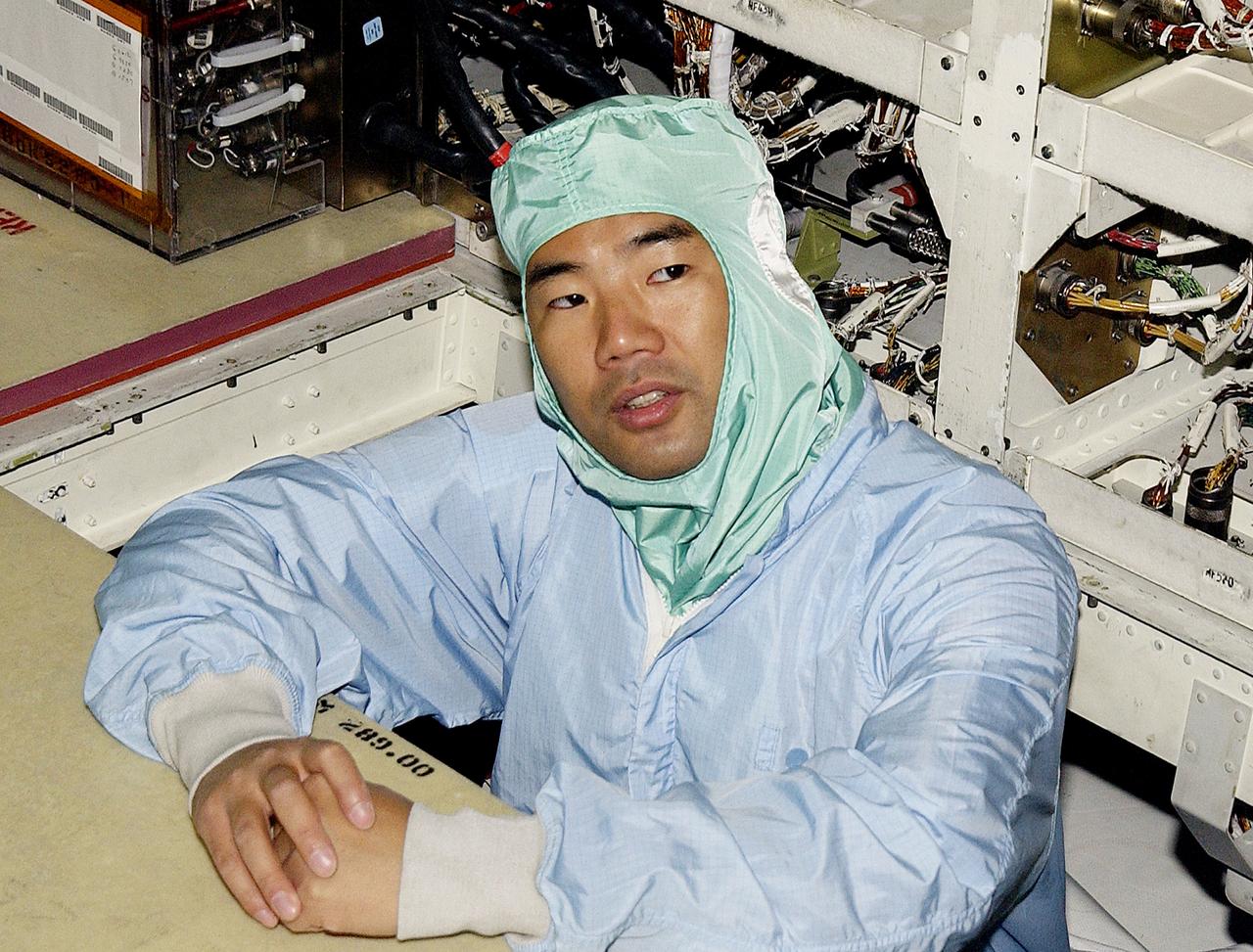
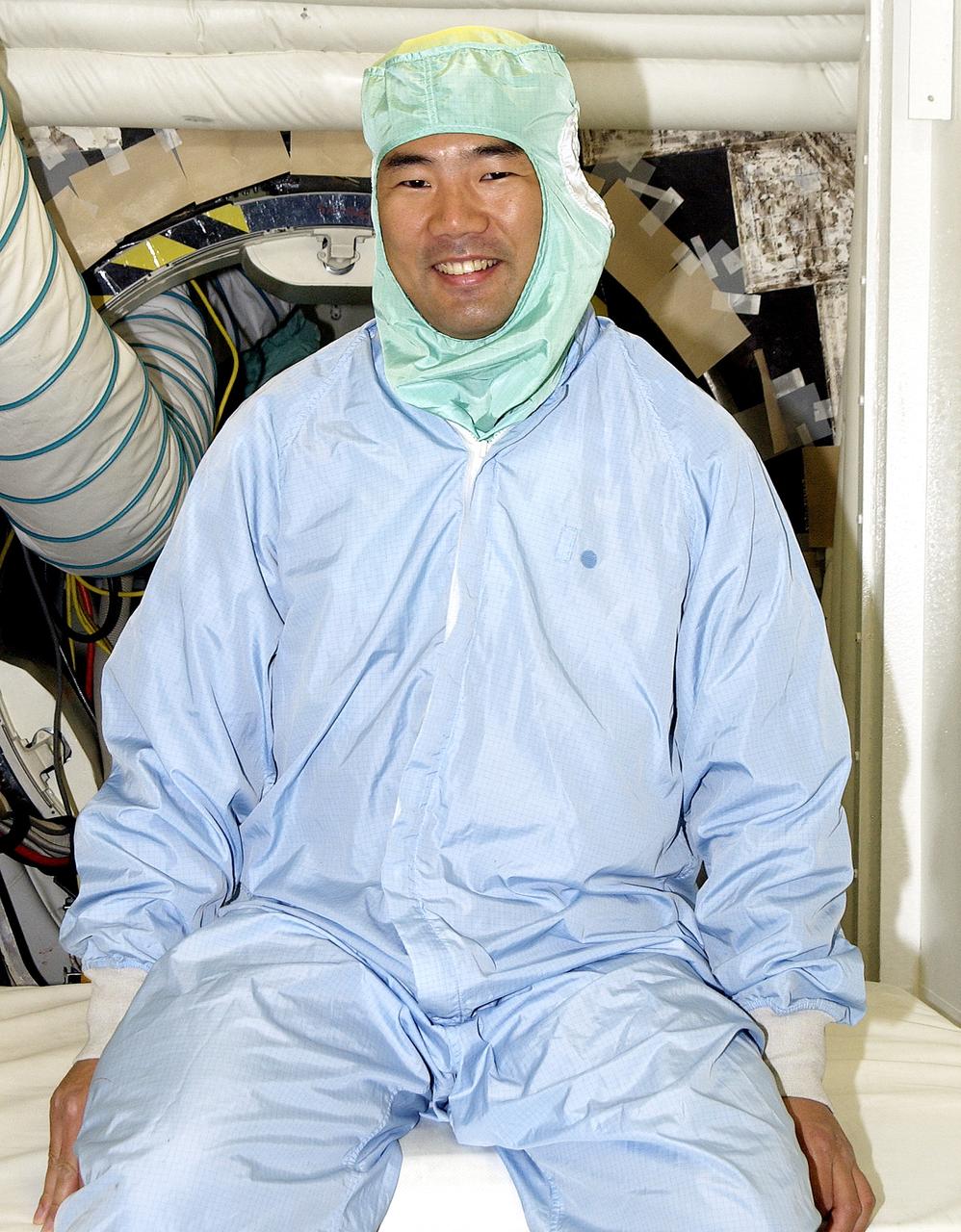
KENNEDY SPACE CENTER, FLA. -  STS-114 Mission Specialist Soichi Noguchi, who is with the Japanese space agency NASDA, poses on the deck of one of the SRB Retrieval Ships docked at Hangar AF on the Banana River.  He and other crew members Commander Eileen Collins, Pilot James Kelly and Mission Specialist Stephen Robinson toured the ships.  Mission STS-114 will carry the MultiPurpose Logistics Module (MPLM) Raffaello and External Stowage Platform 2 to the International Space Station.  The MPLM will contain supplies and equipment.  Another goal of the mission is to remove and replace a Control Moment Gyro.  Launch date for mission STS-114 is under review.
KENNEDY SPACE CENTER, FLA. - STS-114 Mission Specialist Soichi Noguchi, who is with the Japanese space agency NASDA, poses on the deck of one of the SRB Retrieval Ships docked at Hangar AF on the Banana River. He and other crew members Commander Eileen Collins, Pilot James Kelly and Mission Specialist Stephen Robinson toured the ships. Mission STS-114 will carry the MultiPurpose Logistics Module (MPLM) Raffaello and External Stowage Platform 2 to the International Space Station. The MPLM will contain supplies and equipment. Another goal of the mission is to remove and replace a Control Moment Gyro. Launch date for mission STS-114 is under review.
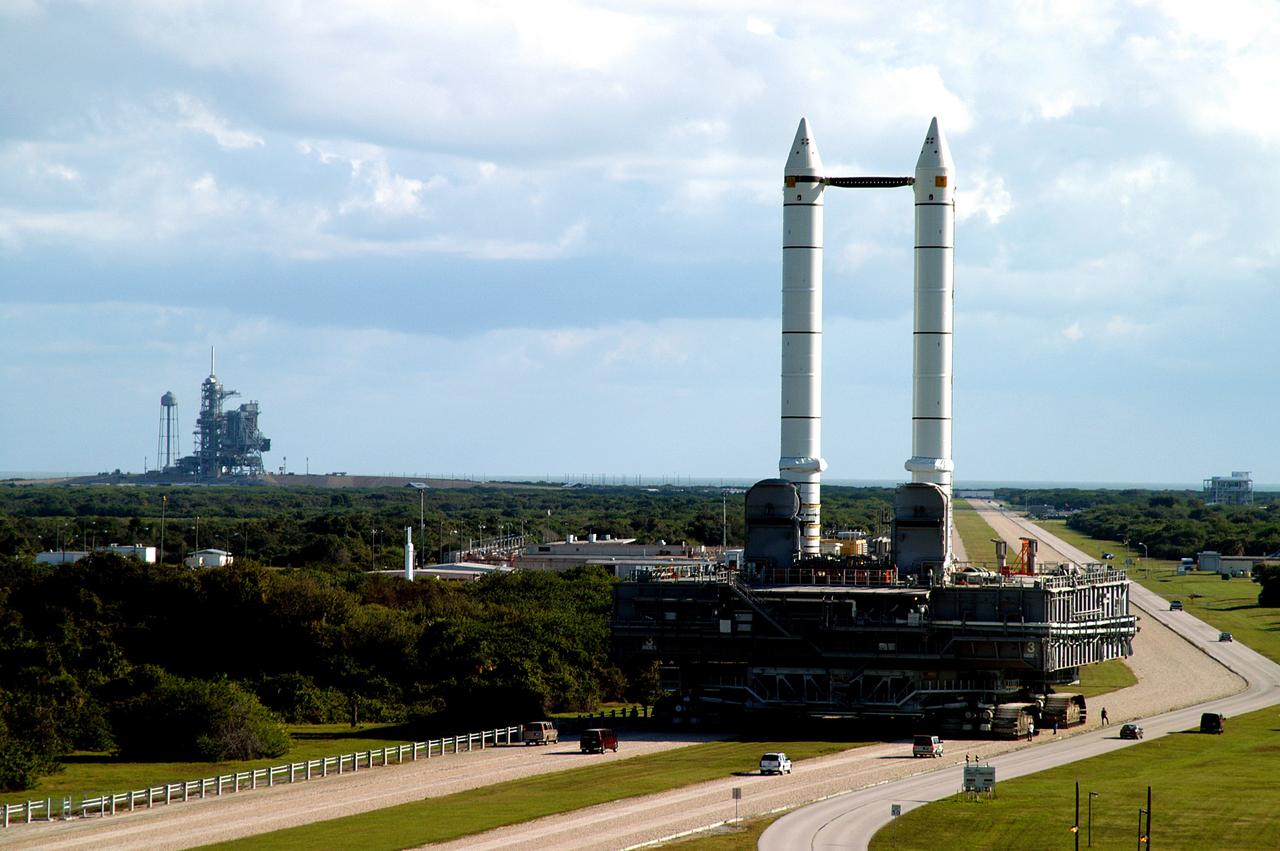
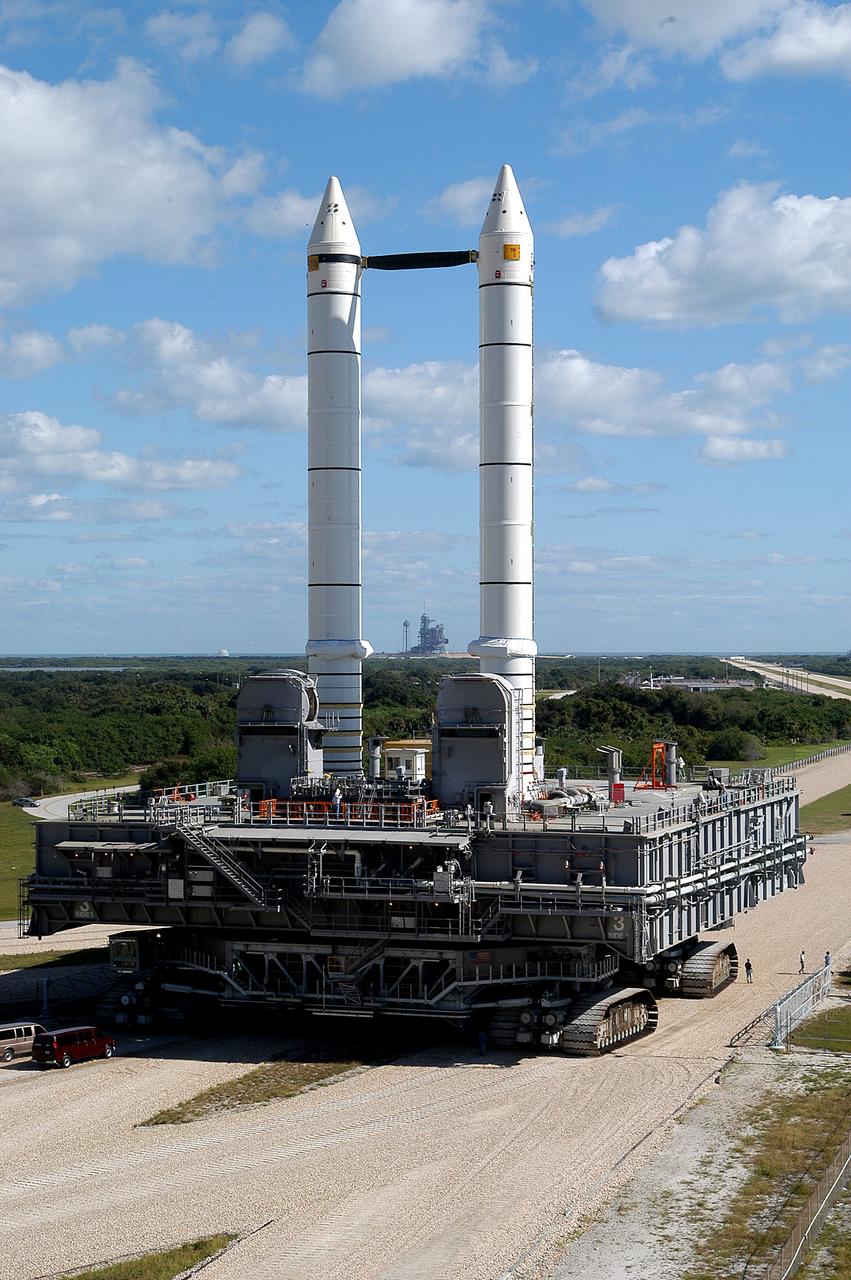
KENNEDY SPACE CENTER, FLA. -  Mobile Launcher Platform (MLP) number 3 and a set of twin solid rocket boosters, atop the crawler-transporter, inch along the crawlerway in support of the second engineering analysis vibration test on the crawler and MLP. The crawler is moving at various speeds up to 1 mph in an effort to achieve vibration data gathering goals as it leaves the VAB, travels toward Launch Pad 39A (framed between the boosters), and then returns.  The boosters are braced at the top for stability.  The primary purpose of these rollout tests is to gather data to develop future maintenance requirements on the transport equipment and the flight hardware. Various parts of the MLP and crawler transporter have been instrumented with vibration data collection equipment.
KENNEDY SPACE CENTER, FLA. - Mobile Launcher Platform (MLP) number 3 and a set of twin solid rocket boosters, atop the crawler-transporter, inch along the crawlerway in support of the second engineering analysis vibration test on the crawler and MLP. The crawler is moving at various speeds up to 1 mph in an effort to achieve vibration data gathering goals as it leaves the VAB, travels toward Launch Pad 39A (framed between the boosters), and then returns. The boosters are braced at the top for stability. The primary purpose of these rollout tests is to gather data to develop future maintenance requirements on the transport equipment and the flight hardware. Various parts of the MLP and crawler transporter have been instrumented with vibration data collection equipment.
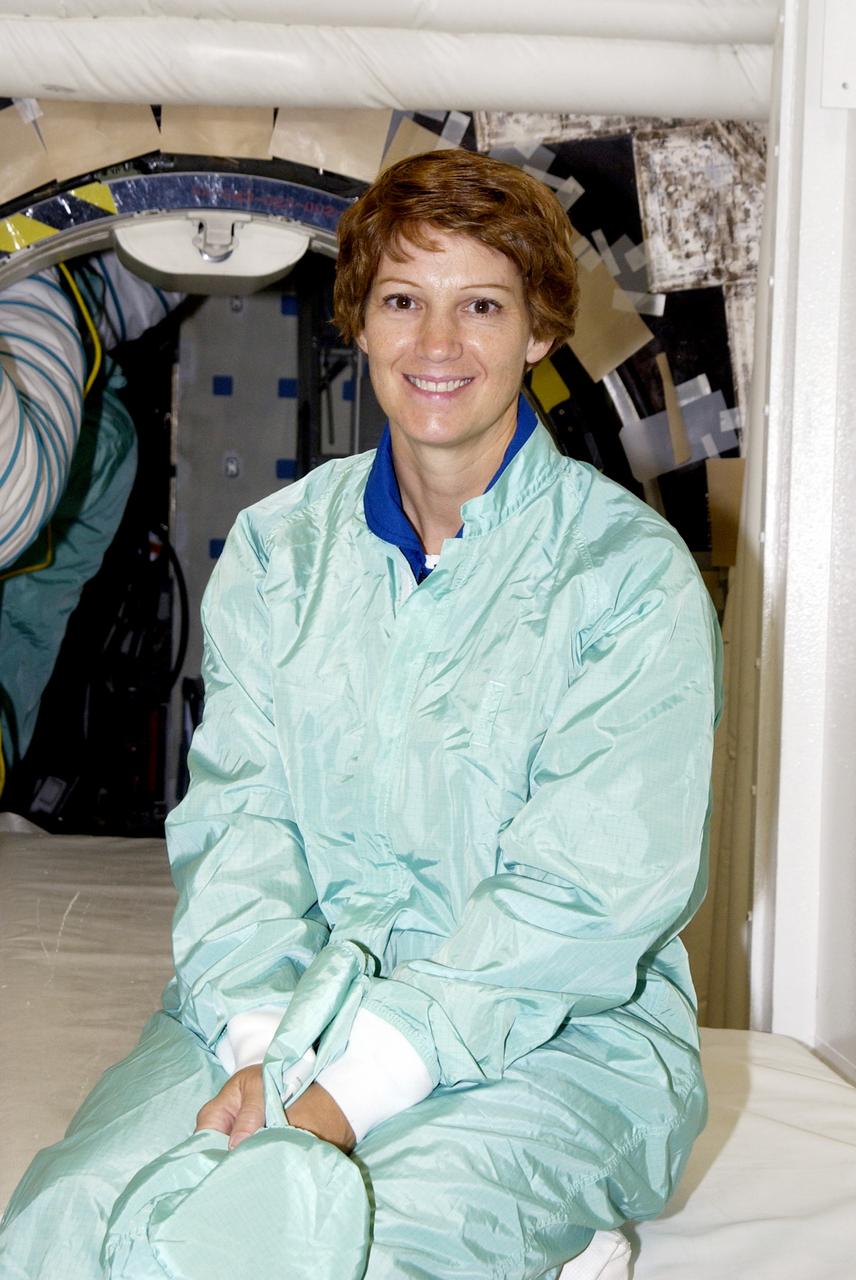
KENNEDY SPACE CENTER, FLA. -  STS-114 Commander Eileen Collins sits in the entry hatch to orbiter Atlantis.  She and other crew members - Pilot James Kelly and  Mission Specialists Soichi Noguchi and Stephen Robinson -  are at KSC for equipment familiarization. Noguchi is with the Japanese space agency NASDA. Mission STS-114 will carry the MultiPurpose Logistics Module (MPLM) Raffaello and External Stowage Platform 2 to the International Space Station.  The MPLM will contain supplies and equipment.  Another goal of the mission is to remove and replace a Control Moment Gyro.  Launch date for mission STS-114 is under review.
KENNEDY SPACE CENTER, FLA. - STS-114 Commander Eileen Collins sits in the entry hatch to orbiter Atlantis. She and other crew members - Pilot James Kelly and Mission Specialists Soichi Noguchi and Stephen Robinson - are at KSC for equipment familiarization. Noguchi is with the Japanese space agency NASDA. Mission STS-114 will carry the MultiPurpose Logistics Module (MPLM) Raffaello and External Stowage Platform 2 to the International Space Station. The MPLM will contain supplies and equipment. Another goal of the mission is to remove and replace a Control Moment Gyro. Launch date for mission STS-114 is under review.
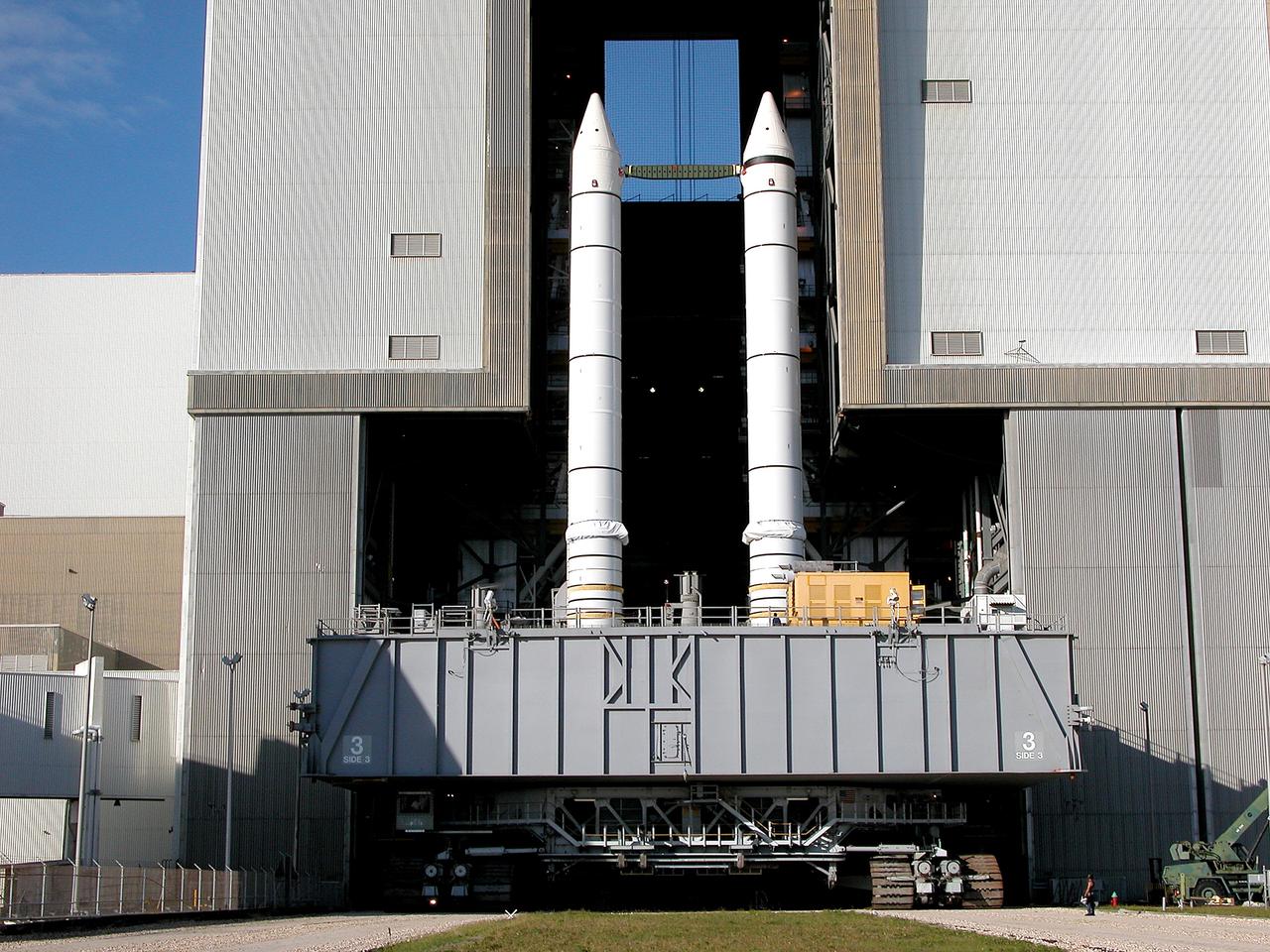
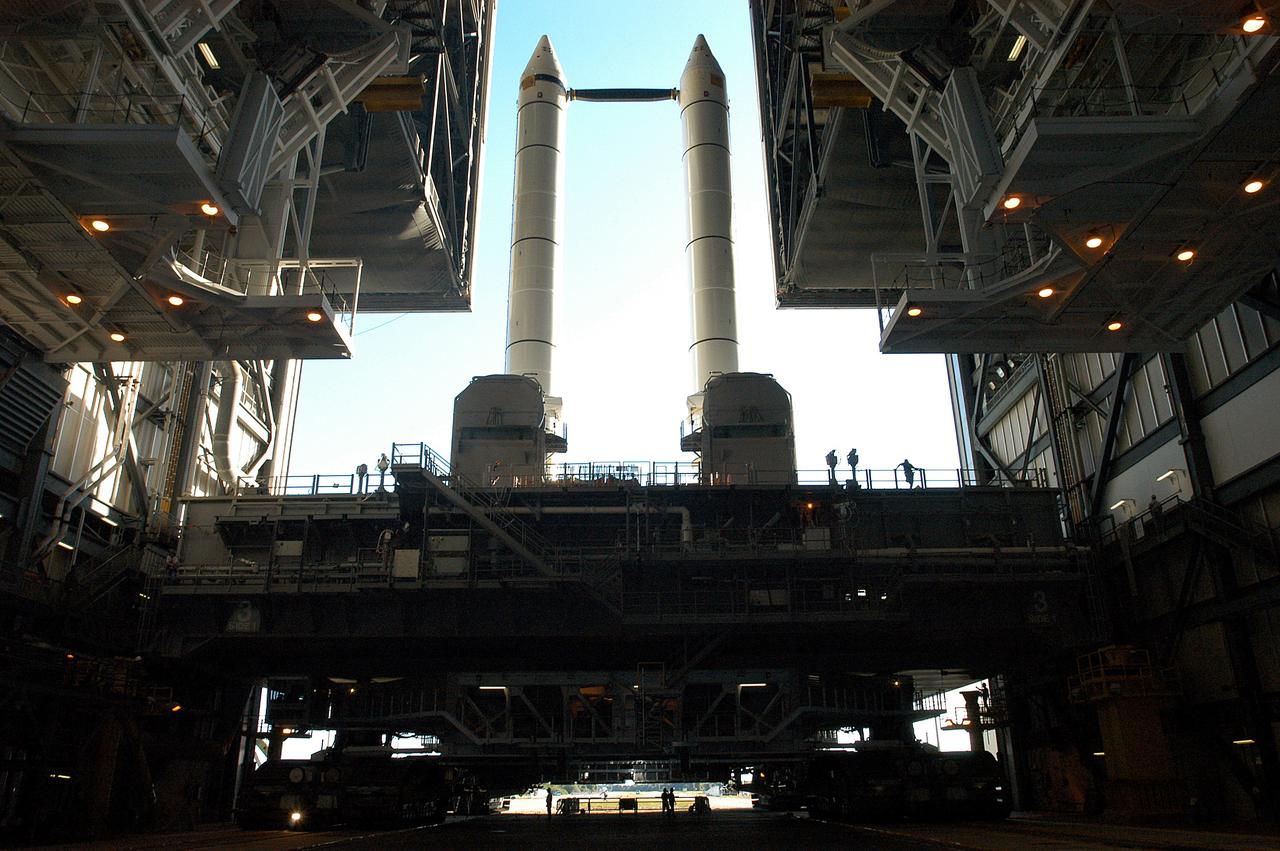
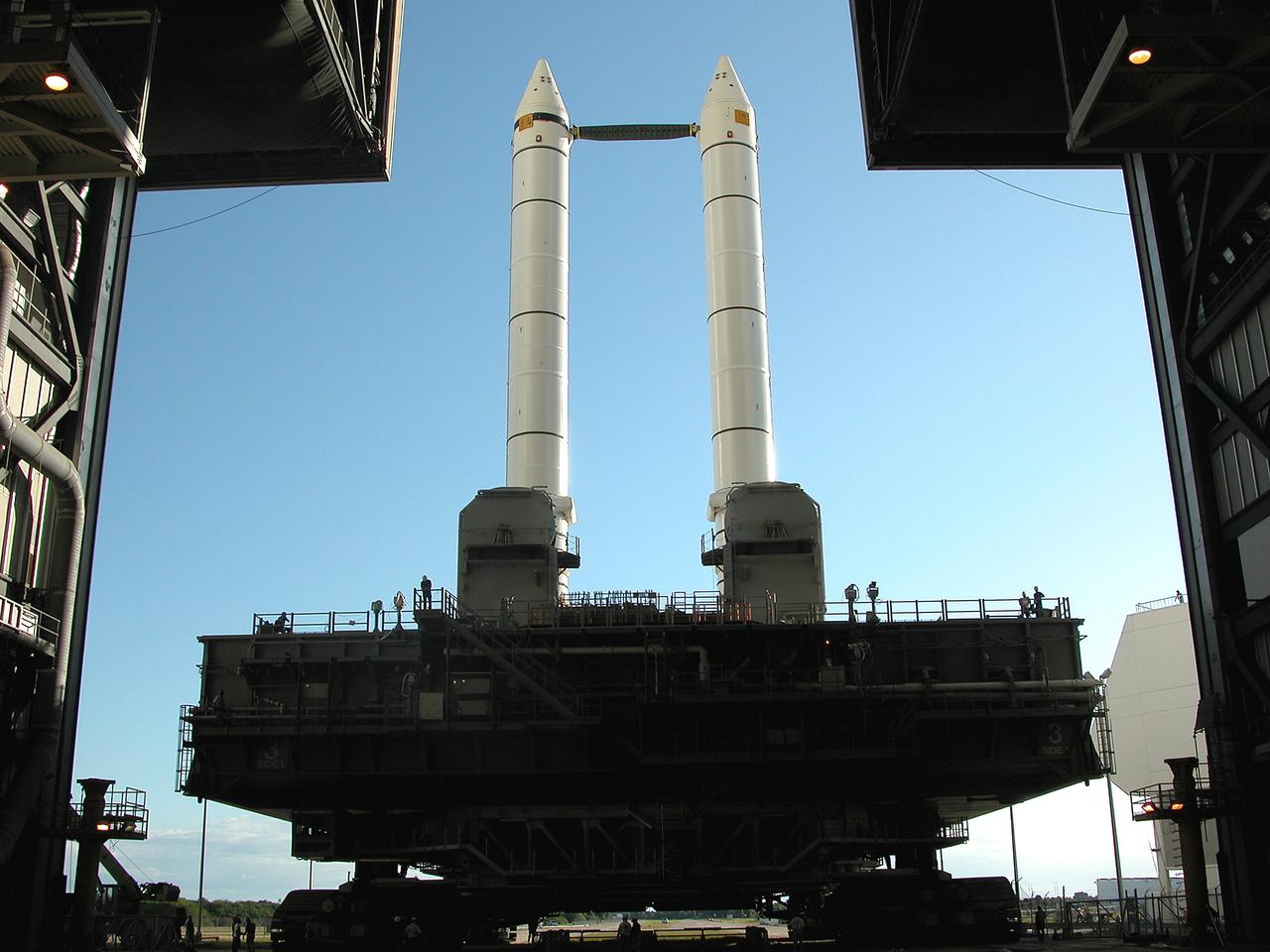
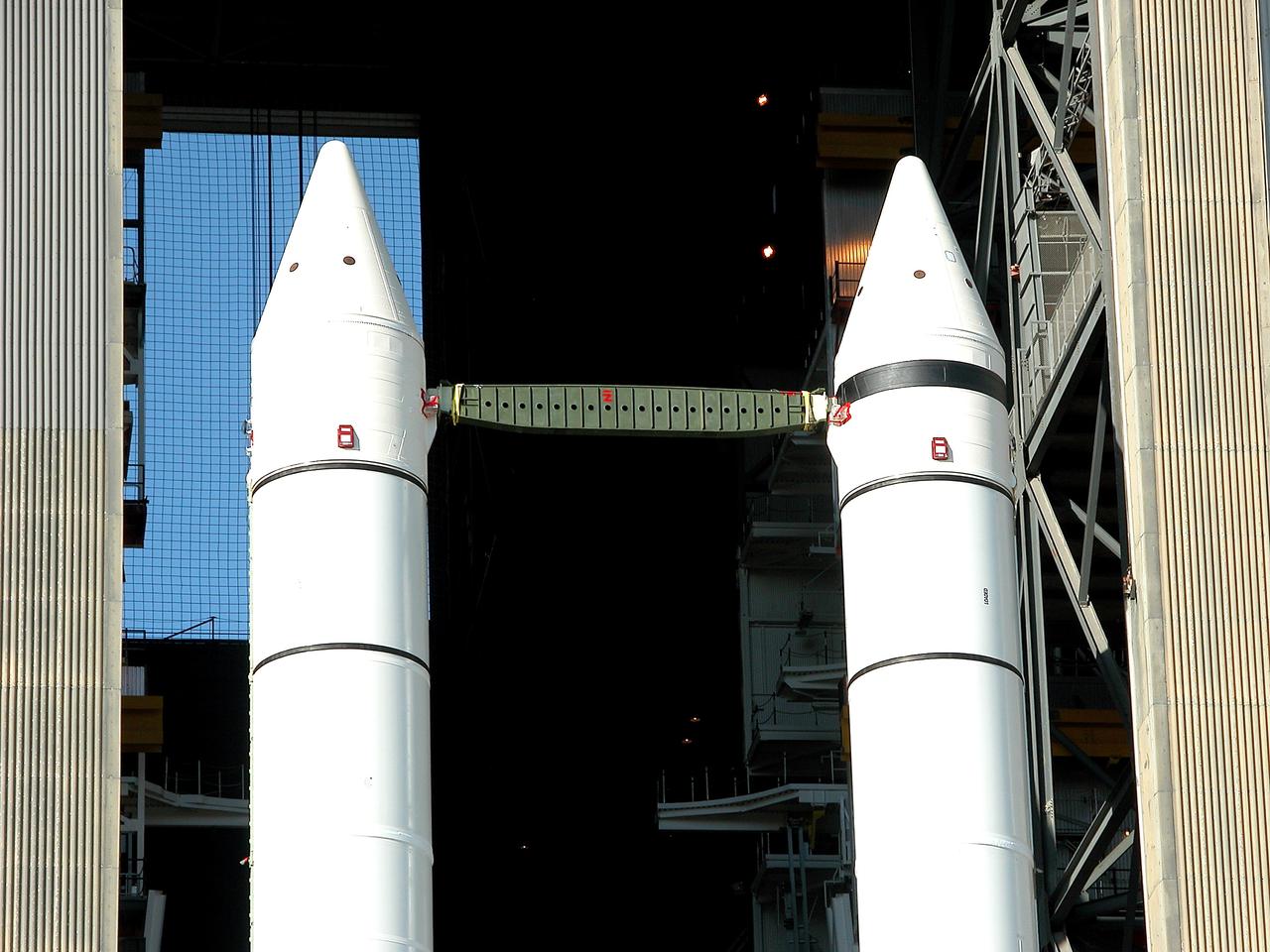
KENNEDY SPACE CENTER, FLA. -  As the crawler transporter slowly moves the Mobile Launcher Platform (MLP) out of the Vehicle Assembly Building, the two solid rocket boosters on top are framed in the doorway.  The move is in support of engineering analysis vibration tests on the crawler and MLP. The crawler is moving at various speeds up to 1 mph in an effort to achieve vibration data gathering goals as it leaves the VAB and then returns.  The boosters are braced at the top for stability.  The primary purpose of these rollout tests is to gather data to develop future maintenance requirements on the transport equipment and the flight hardware. Various parts of the MLP and crawler transporter have been instrumented with vibration data collection equipment.
KENNEDY SPACE CENTER, FLA. - As the crawler transporter slowly moves the Mobile Launcher Platform (MLP) out of the Vehicle Assembly Building, the two solid rocket boosters on top are framed in the doorway. The move is in support of engineering analysis vibration tests on the crawler and MLP. The crawler is moving at various speeds up to 1 mph in an effort to achieve vibration data gathering goals as it leaves the VAB and then returns. The boosters are braced at the top for stability. The primary purpose of these rollout tests is to gather data to develop future maintenance requirements on the transport equipment and the flight hardware. Various parts of the MLP and crawler transporter have been instrumented with vibration data collection equipment.
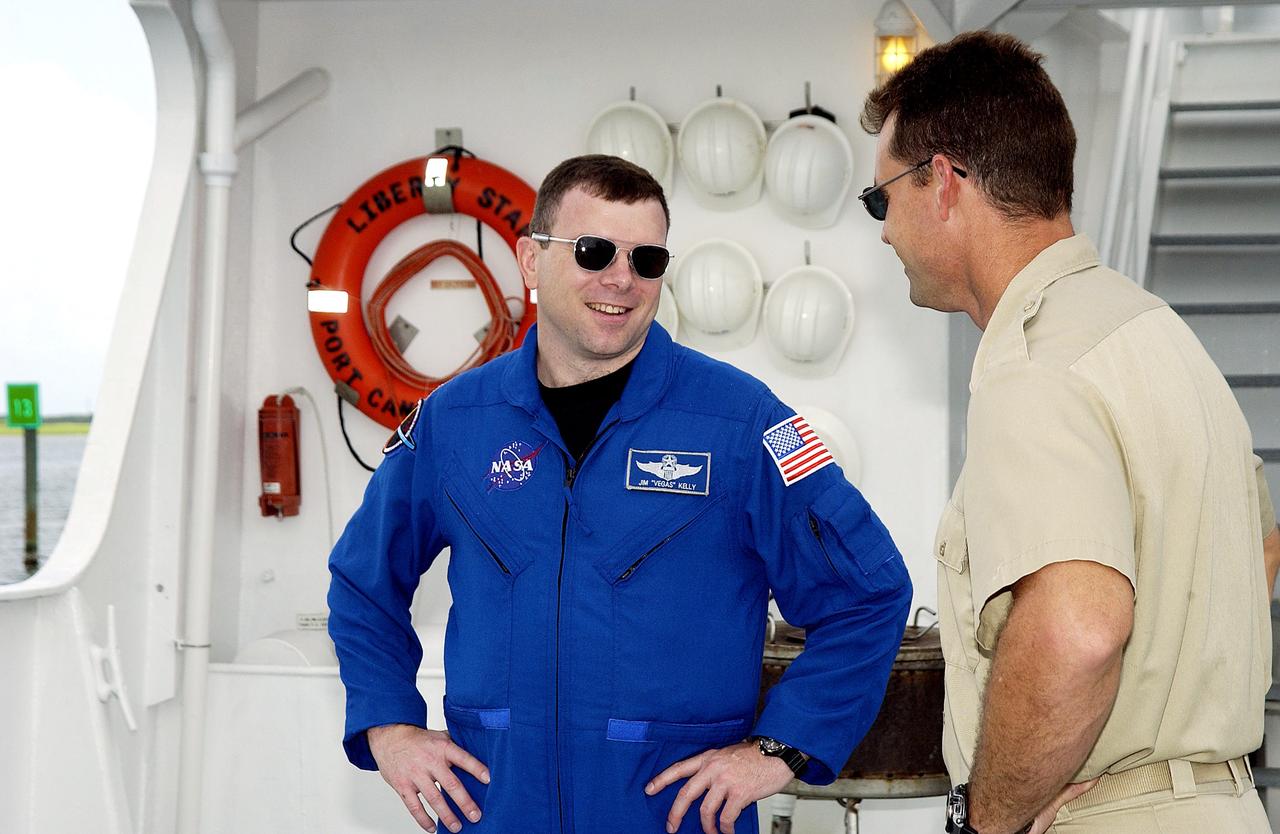
KENNEDY SPACE CENTER, FLA. -  STS-114 Pilot James Kelly talks with Bren Wade, captain of the Liberty Star, one of the SRB Retrieval Ships docked at Hangar AF on the Banana River.  Kelly and other crew members Commander Eileen Collins and Mission Specialists  Soichi Noguchi and Stephen Robinson toured the ships.  Noguchi is with the Japanese space agency NASDA.  Mission STS-114 will carry the MultiPurpose Logistics Module (MPLM) Raffaello and External Stowage Platform 2 to the International Space Station.  The MPLM will contain supplies and equipment.  Another goal of the mission is to remove and replace a Control Moment Gyro.  Launch date for mission STS-114 is under review.
KENNEDY SPACE CENTER, FLA. - STS-114 Pilot James Kelly talks with Bren Wade, captain of the Liberty Star, one of the SRB Retrieval Ships docked at Hangar AF on the Banana River. Kelly and other crew members Commander Eileen Collins and Mission Specialists Soichi Noguchi and Stephen Robinson toured the ships. Noguchi is with the Japanese space agency NASDA. Mission STS-114 will carry the MultiPurpose Logistics Module (MPLM) Raffaello and External Stowage Platform 2 to the International Space Station. The MPLM will contain supplies and equipment. Another goal of the mission is to remove and replace a Control Moment Gyro. Launch date for mission STS-114 is under review.
KENNEDY SPACE CENTER, FLA. -   STS-114 Mission Specialist Soichi Noguchi checks the midbody of orbiter Atlantis.  He and other crew members -  Commander Eileen Collins, Pilot James Kelly and Mission Specialist Stephen Robinson - are at KSC for equipment familiarization.  Noguchi is with the Japanese space agency NASDA.  Mission STS-114 will carry the MultiPurpose Logistics Module (MPLM) Raffaello and External Stowage Platform 2 to the International Space Station.  The MPLM will contain supplies and equipment.  Another goal of the mission is to remove and replace a Control Moment Gyro.  Launch date for mission STS-114 is under review.
KENNEDY SPACE CENTER, FLA. - STS-114 Mission Specialist Soichi Noguchi checks the midbody of orbiter Atlantis. He and other crew members - Commander Eileen Collins, Pilot James Kelly and Mission Specialist Stephen Robinson - are at KSC for equipment familiarization. Noguchi is with the Japanese space agency NASDA. Mission STS-114 will carry the MultiPurpose Logistics Module (MPLM) Raffaello and External Stowage Platform 2 to the International Space Station. The MPLM will contain supplies and equipment. Another goal of the mission is to remove and replace a Control Moment Gyro. Launch date for mission STS-114 is under review.
KENNEDY SPACE CENTER, FLA. -  Sitting in the entry hatch to orbiter Atlantis is STS-114 Mission Specialist Soichi Noguchi, who is with the Japanese space agency NASDA. He and other crew members - Commander Eileen Collins, Pilot James Kelly and Mission Specialist Stephen Robinson - are at KSC for equipment familiarization. Mission STS-114 will carry the MultiPurpose Logistics Module (MPLM) Raffaello and External Stowage Platform 2 to the International Space Station.  The MPLM will contain supplies and equipment.  Another goal of the mission is to remove and replace a Control Moment Gyro.  Launch date for mission STS-114 is under review.
KENNEDY SPACE CENTER, FLA. - Sitting in the entry hatch to orbiter Atlantis is STS-114 Mission Specialist Soichi Noguchi, who is with the Japanese space agency NASDA. He and other crew members - Commander Eileen Collins, Pilot James Kelly and Mission Specialist Stephen Robinson - are at KSC for equipment familiarization. Mission STS-114 will carry the MultiPurpose Logistics Module (MPLM) Raffaello and External Stowage Platform 2 to the International Space Station. The MPLM will contain supplies and equipment. Another goal of the mission is to remove and replace a Control Moment Gyro. Launch date for mission STS-114 is under review.
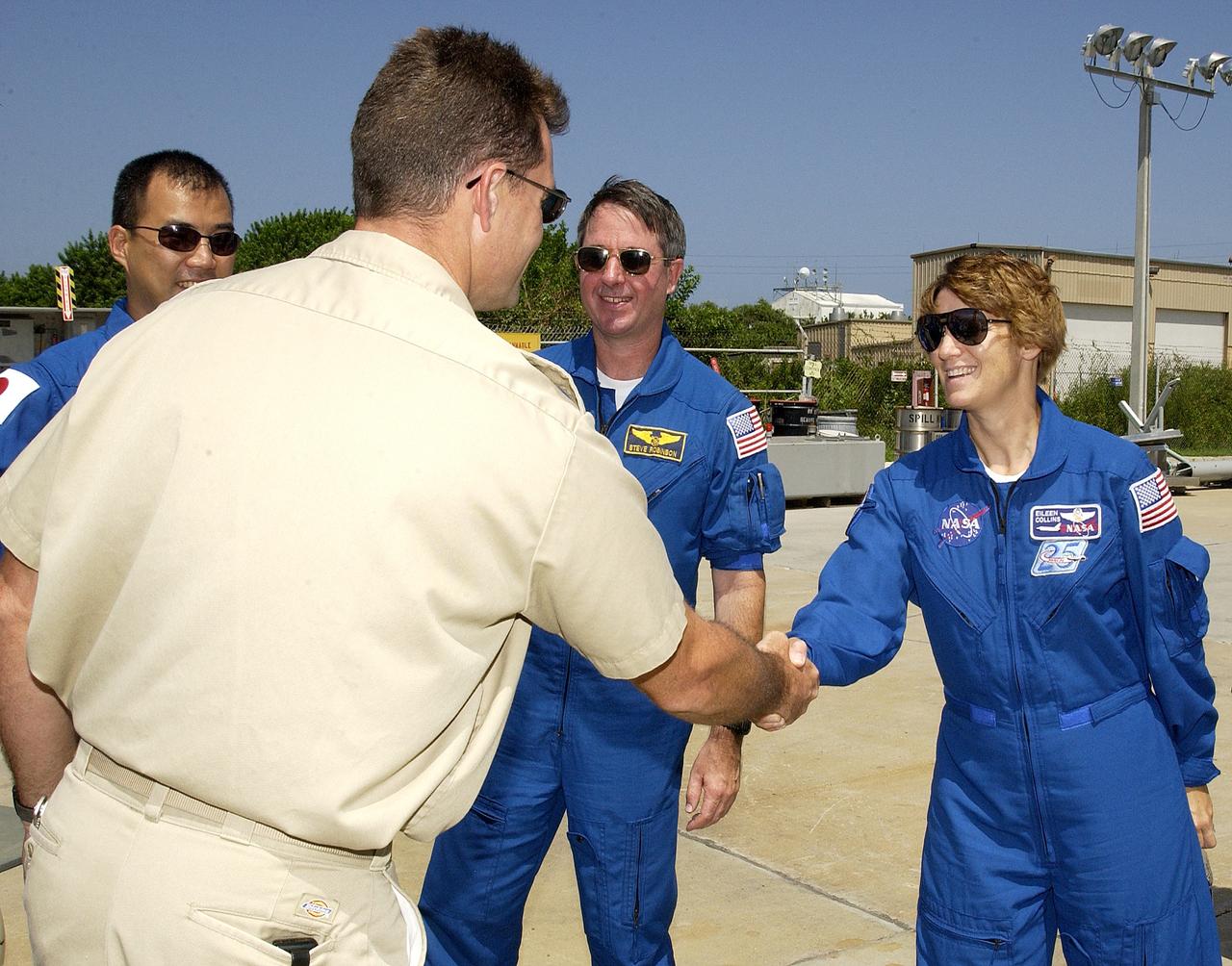
KENNEDY SPACE CENTER, FLA. -  Members of the STS-114 crew are welcomed to the Liberty Star, one of two SRB Retrieval Ships, by Captain Bren Wade (back to camera).  Crew members, from left, are Mission Specialist Soichi Noguchi, Mission Specialist Stephen Robinson and Commander Eileen Collins. Noguchi is with the Japanese space agency NASDA. Not pictured is Pilot James Kelly.  On their mission, the crew will carry the MultiPurpose Logistics Module (MPLM) Raffaello and External Stowage Platform 2 to the International Space Station.  The MPLM will contain supplies and equipment.  Another goal of the mission is to remove and replace a Control Moment Gyro.  Launch date for mission STS-114 is under review.
KENNEDY SPACE CENTER, FLA. - Members of the STS-114 crew are welcomed to the Liberty Star, one of two SRB Retrieval Ships, by Captain Bren Wade (back to camera). Crew members, from left, are Mission Specialist Soichi Noguchi, Mission Specialist Stephen Robinson and Commander Eileen Collins. Noguchi is with the Japanese space agency NASDA. Not pictured is Pilot James Kelly. On their mission, the crew will carry the MultiPurpose Logistics Module (MPLM) Raffaello and External Stowage Platform 2 to the International Space Station. The MPLM will contain supplies and equipment. Another goal of the mission is to remove and replace a Control Moment Gyro. Launch date for mission STS-114 is under review.
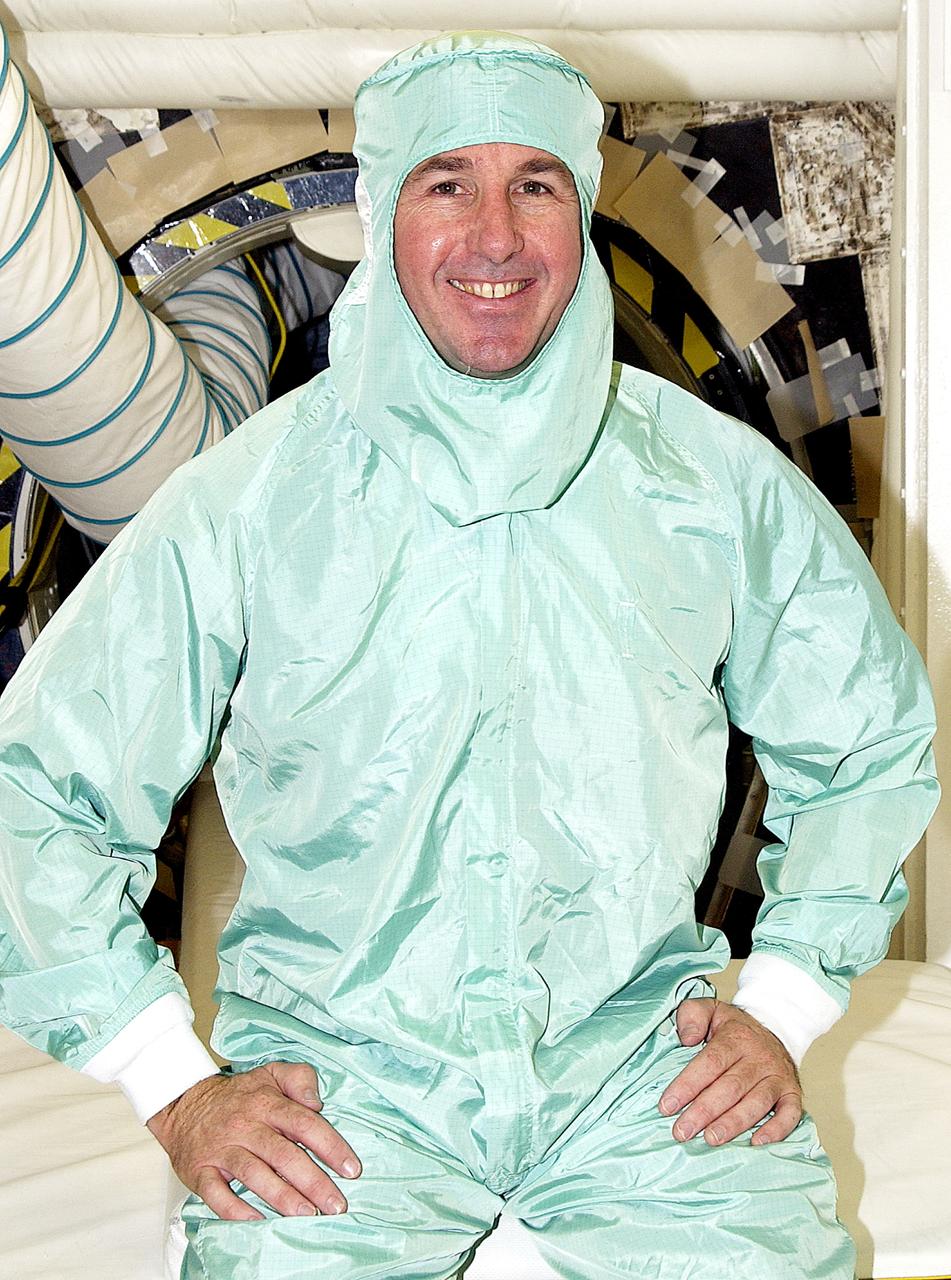
KENNEDY SPACE CENTER, FLA. -  STS-114 Mission Specialist Stephen Robinson sits in the entry hatch to orbiter Atlantis.  He and other crew members - Commander Eileen Collins, Pilot James Kelly and  Mission Specialist Soichi Noguchi - are at KSC for equipment familiarization. Noguchi is with the Japanese space agency NASDA. Mission STS-114 will carry the MultiPurpose Logistics Module (MPLM) Raffaello and External Stowage Platform 2 to the International Space Station.  The MPLM will contain supplies and equipment.  Another goal of the mission is to remove and replace a Control Moment Gyro.  Launch date for mission STS-114 is under review.
KENNEDY SPACE CENTER, FLA. - STS-114 Mission Specialist Stephen Robinson sits in the entry hatch to orbiter Atlantis. He and other crew members - Commander Eileen Collins, Pilot James Kelly and Mission Specialist Soichi Noguchi - are at KSC for equipment familiarization. Noguchi is with the Japanese space agency NASDA. Mission STS-114 will carry the MultiPurpose Logistics Module (MPLM) Raffaello and External Stowage Platform 2 to the International Space Station. The MPLM will contain supplies and equipment. Another goal of the mission is to remove and replace a Control Moment Gyro. Launch date for mission STS-114 is under review.
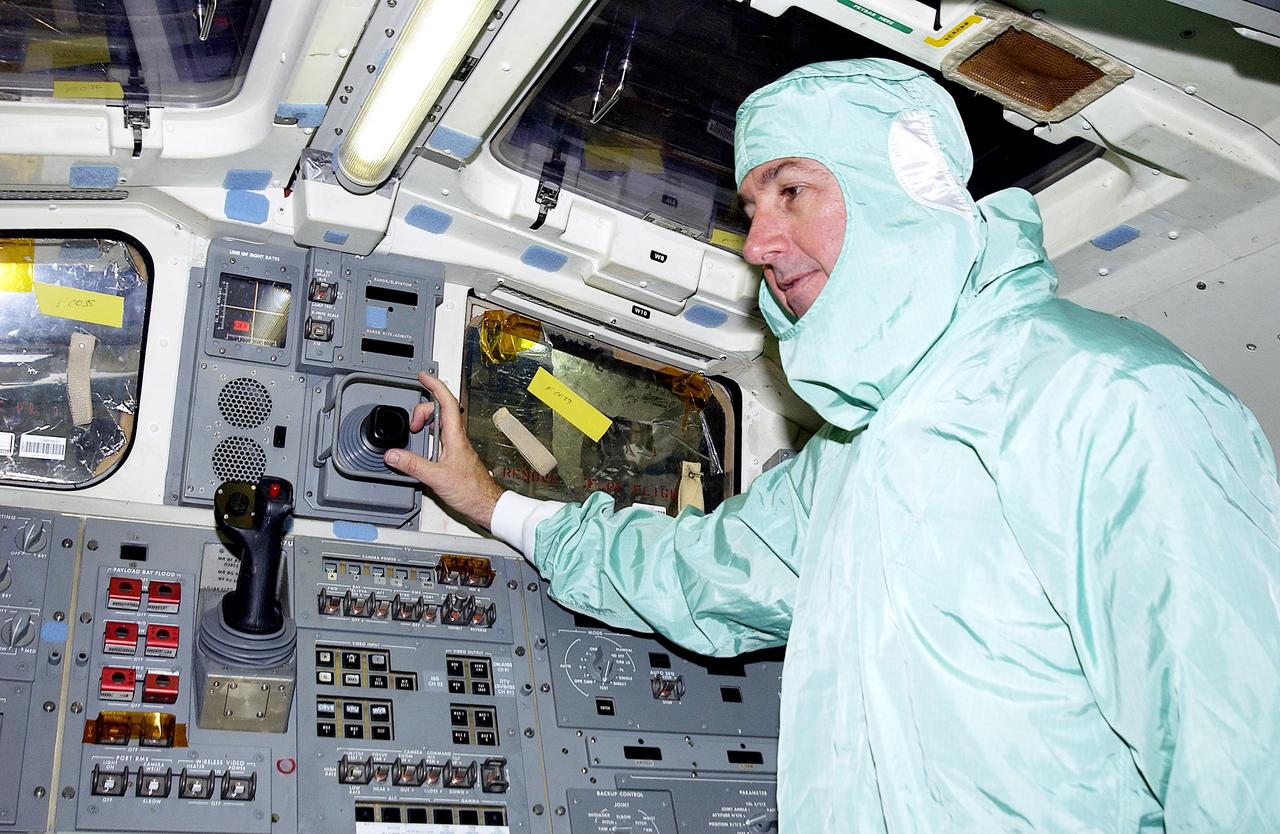
KENNEDY SPACE CENTER, FLA. -   STS-114 Mission Specialist Stephen Robinson checks equipment in the flight deck of orbiter Atlantis.  He and other crew members -  Commander Eileen Collins, Pilot James Kelly and Mission Specialist Soichi Noguchi - are at KSC for equipment familiarization.  Noguchi is with the Japanese space agency NASDA.  Mission STS-114 will carry the MultiPurpose Logistics Module (MPLM) Raffaello and External Stowage Platform 2 to the International Space Station.  The MPLM will contain supplies and equipment.  Another goal of the mission is to remove and replace a Control Moment Gyro.  Launch date for mission STS-114 is under review.
KENNEDY SPACE CENTER, FLA. - STS-114 Mission Specialist Stephen Robinson checks equipment in the flight deck of orbiter Atlantis. He and other crew members - Commander Eileen Collins, Pilot James Kelly and Mission Specialist Soichi Noguchi - are at KSC for equipment familiarization. Noguchi is with the Japanese space agency NASDA. Mission STS-114 will carry the MultiPurpose Logistics Module (MPLM) Raffaello and External Stowage Platform 2 to the International Space Station. The MPLM will contain supplies and equipment. Another goal of the mission is to remove and replace a Control Moment Gyro. Launch date for mission STS-114 is under review.
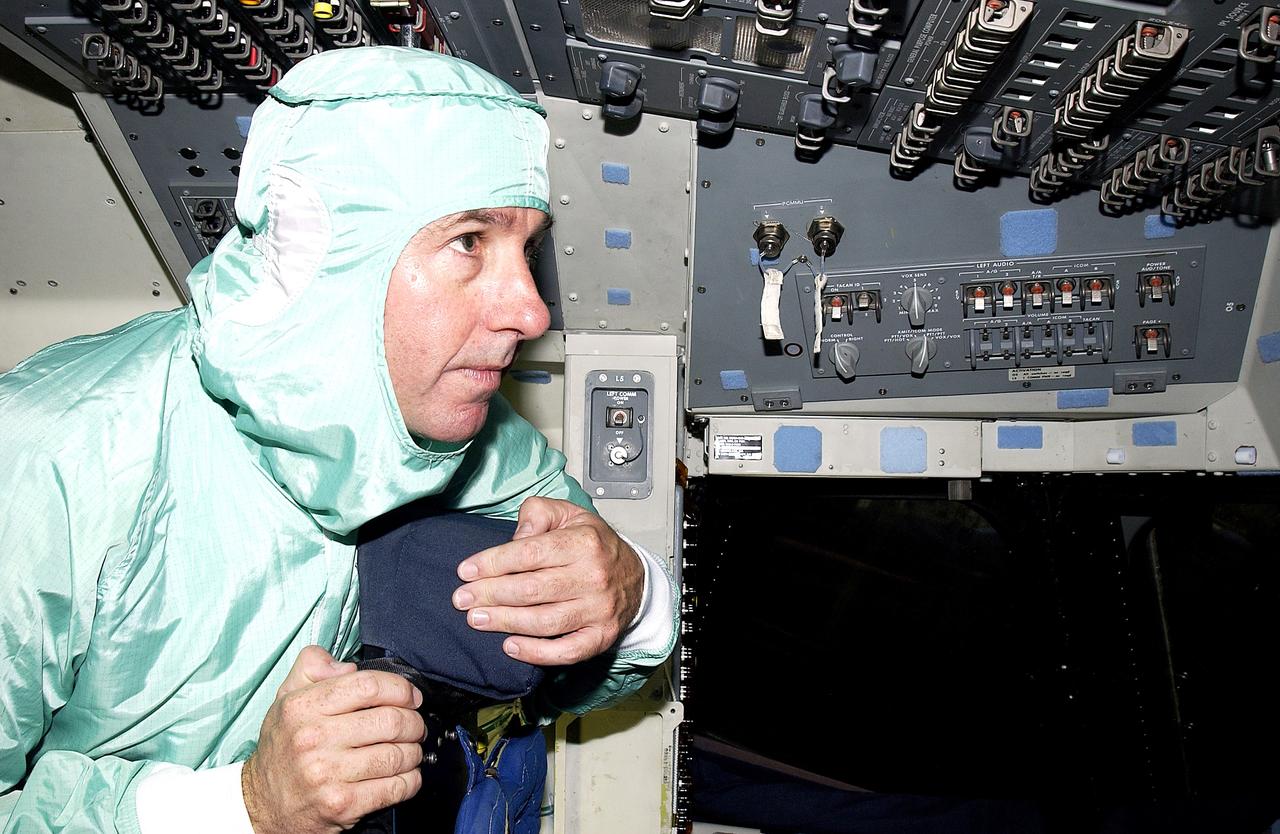
KENNEDY SPACE CENTER, FLA. -   STS-114 Mission Specialist Stephen Robinson looks at equipment in the flight deck of orbiter Atlantis.  He and other crew members -  Commander Eileen Collins, Pilot James Kelly and Mission Specialist Soichi Noguchi - are at KSC for equipment familiarization.  Noguchi is with the Japanese space agency NASDA.  Mission STS-114 will carry the MultiPurpose Logistics Module (MPLM) Raffaello and External Stowage Platform 2 to the International Space Station.  The MPLM will contain supplies and equipment.  Another goal of the mission is to remove and replace a Control Moment Gyro.  Launch date for mission STS-114 is under review.
KENNEDY SPACE CENTER, FLA. - STS-114 Mission Specialist Stephen Robinson looks at equipment in the flight deck of orbiter Atlantis. He and other crew members - Commander Eileen Collins, Pilot James Kelly and Mission Specialist Soichi Noguchi - are at KSC for equipment familiarization. Noguchi is with the Japanese space agency NASDA. Mission STS-114 will carry the MultiPurpose Logistics Module (MPLM) Raffaello and External Stowage Platform 2 to the International Space Station. The MPLM will contain supplies and equipment. Another goal of the mission is to remove and replace a Control Moment Gyro. Launch date for mission STS-114 is under review.
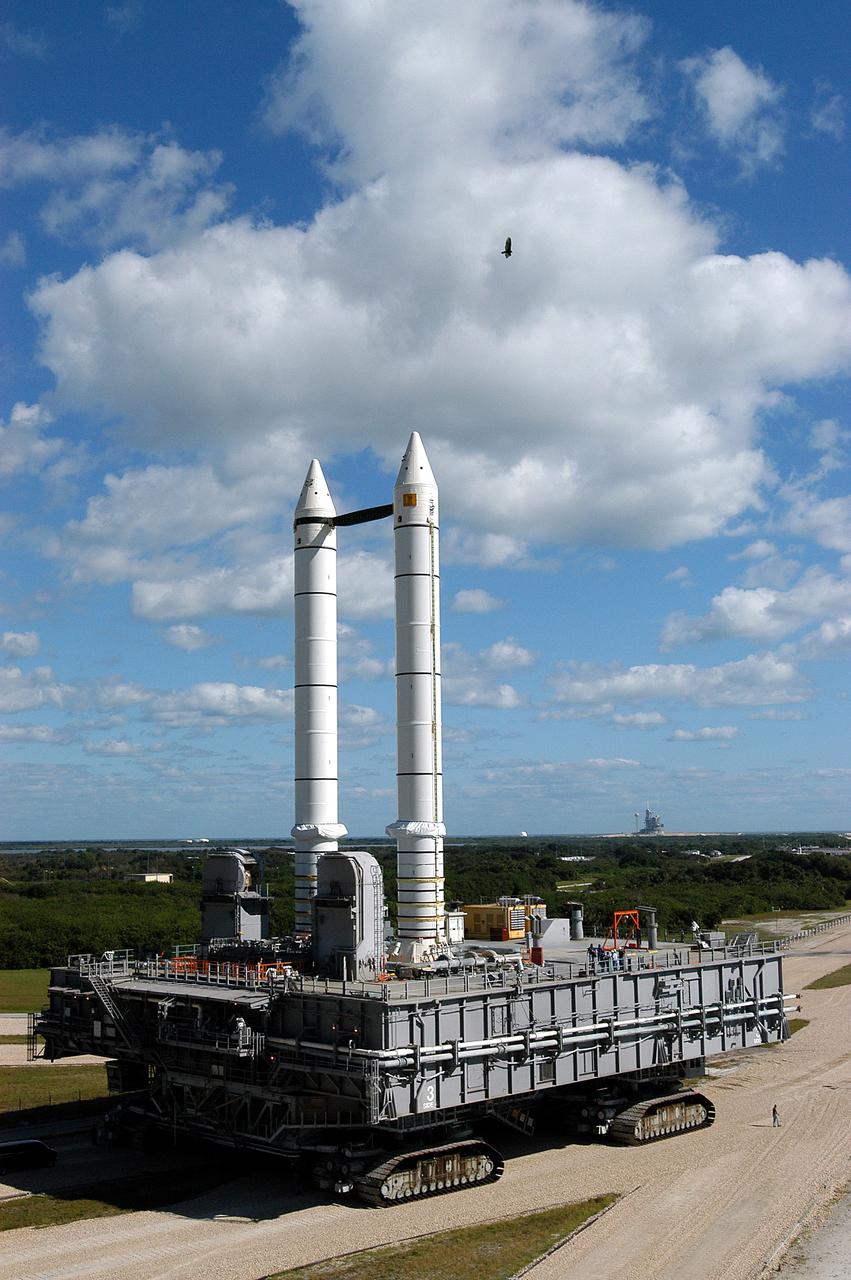
KENNEDY SPACE CENTER, FLA. -  A high-flying bird takes a closer look at the Mobile Launcher Platform (MLP) number 3 with twin solid rocket boosters bolted to it as it crawls toward Launch Pad 39A, in the background.  The crawler is moving along the crawlerway at various speeds up to 1 mph in an effort to achieve vibration data gathering goals as it travels toward Launch Pad 39A and then returns.  The boosters are braced at the top for stability.  The primary purpose of these rollout tests is to gather data to develop future maintenance requirements on the transport equipment and the flight hardware. Various parts of the MLP and crawler transporter have been instrumented with vibration data collection equipment.
KENNEDY SPACE CENTER, FLA. - A high-flying bird takes a closer look at the Mobile Launcher Platform (MLP) number 3 with twin solid rocket boosters bolted to it as it crawls toward Launch Pad 39A, in the background. The crawler is moving along the crawlerway at various speeds up to 1 mph in an effort to achieve vibration data gathering goals as it travels toward Launch Pad 39A and then returns. The boosters are braced at the top for stability. The primary purpose of these rollout tests is to gather data to develop future maintenance requirements on the transport equipment and the flight hardware. Various parts of the MLP and crawler transporter have been instrumented with vibration data collection equipment.
KENNEDY SPACE CENTER, FLA. -  As the crawler transporter slowly moves the Mobile Launcher Platform (MLP) out of the Vehicle Assembly Building, the two solid rocket boosters on top are framed in the doorway.  The move is in support of engineering analysis vibration tests on the crawler and MLP.  The crawler is moving at various speeds up to 1 mph in an effort to achieve vibration data gathering goals as it leaves the VAB and then returns.  The boosters are braced at the top for stability.  The primary purpose of these rollout tests is to gather data to develop future maintenance requirements on the transport equipment and the flight hardware. Various parts of the MLP and crawler transporter have been instrumented with vibration data collection equipment.
KENNEDY SPACE CENTER, FLA. - As the crawler transporter slowly moves the Mobile Launcher Platform (MLP) out of the Vehicle Assembly Building, the two solid rocket boosters on top are framed in the doorway. The move is in support of engineering analysis vibration tests on the crawler and MLP. The crawler is moving at various speeds up to 1 mph in an effort to achieve vibration data gathering goals as it leaves the VAB and then returns. The boosters are braced at the top for stability. The primary purpose of these rollout tests is to gather data to develop future maintenance requirements on the transport equipment and the flight hardware. Various parts of the MLP and crawler transporter have been instrumented with vibration data collection equipment.
KENNEDY SPACE CENTER, FLA. -  The crawler transporter slowly moves the Mobile Launcher Platform (MLP), carrying a set of twin solid rocket boosters, along the crawlerway in support of engineering analysis vibration tests on the crawler and MLP.   In the distance, at left, is Launch Pad 39A. The crawler is moving at various speeds up to 1 mph in an effort to achieve vibration data gathering goals as it leaves the VAB and then returns.  The boosters are braced at the top for stability.  The primary purpose of these rollout tests is to gather data to develop future maintenance requirements on the transport equipment and the flight hardware. Various parts of the MLP and crawler transporter have been instrumented with vibration data collection equipment.
KENNEDY SPACE CENTER, FLA. - The crawler transporter slowly moves the Mobile Launcher Platform (MLP), carrying a set of twin solid rocket boosters, along the crawlerway in support of engineering analysis vibration tests on the crawler and MLP. In the distance, at left, is Launch Pad 39A. The crawler is moving at various speeds up to 1 mph in an effort to achieve vibration data gathering goals as it leaves the VAB and then returns. The boosters are braced at the top for stability. The primary purpose of these rollout tests is to gather data to develop future maintenance requirements on the transport equipment and the flight hardware. Various parts of the MLP and crawler transporter have been instrumented with vibration data collection equipment.
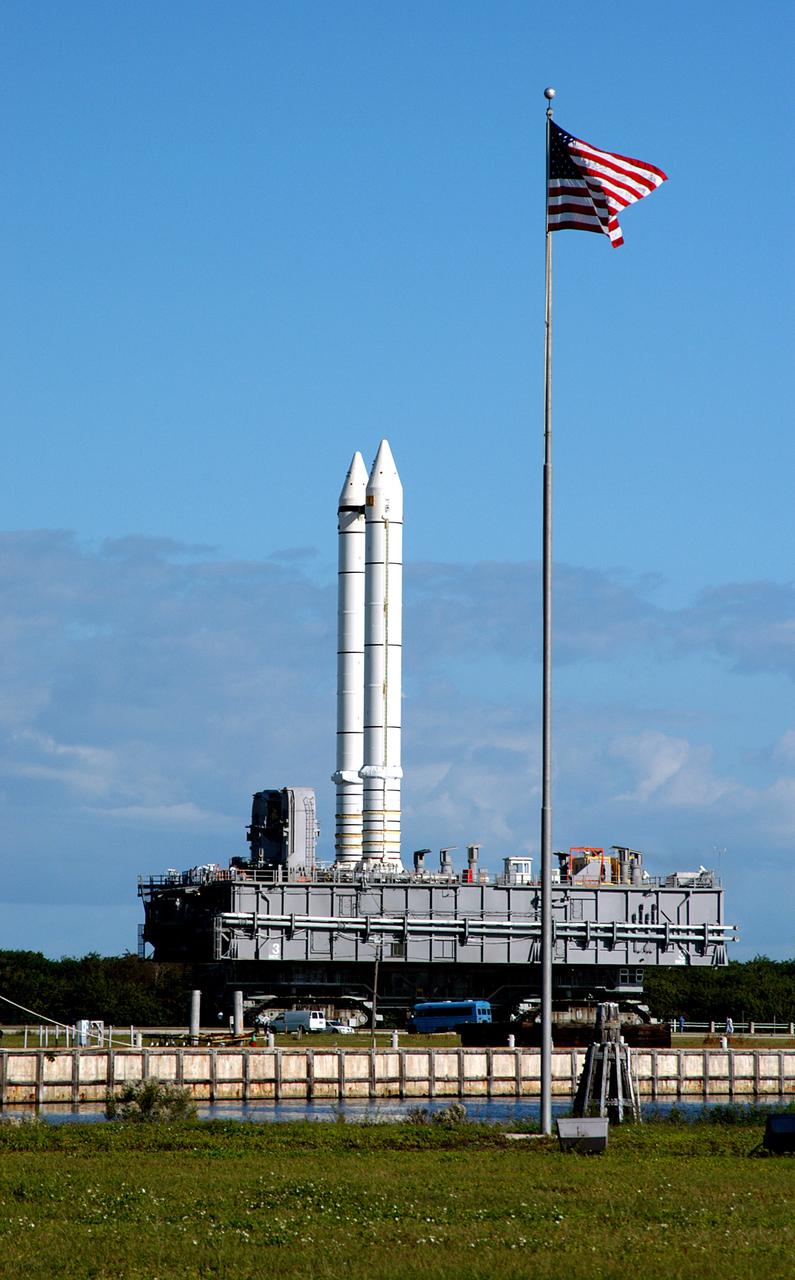
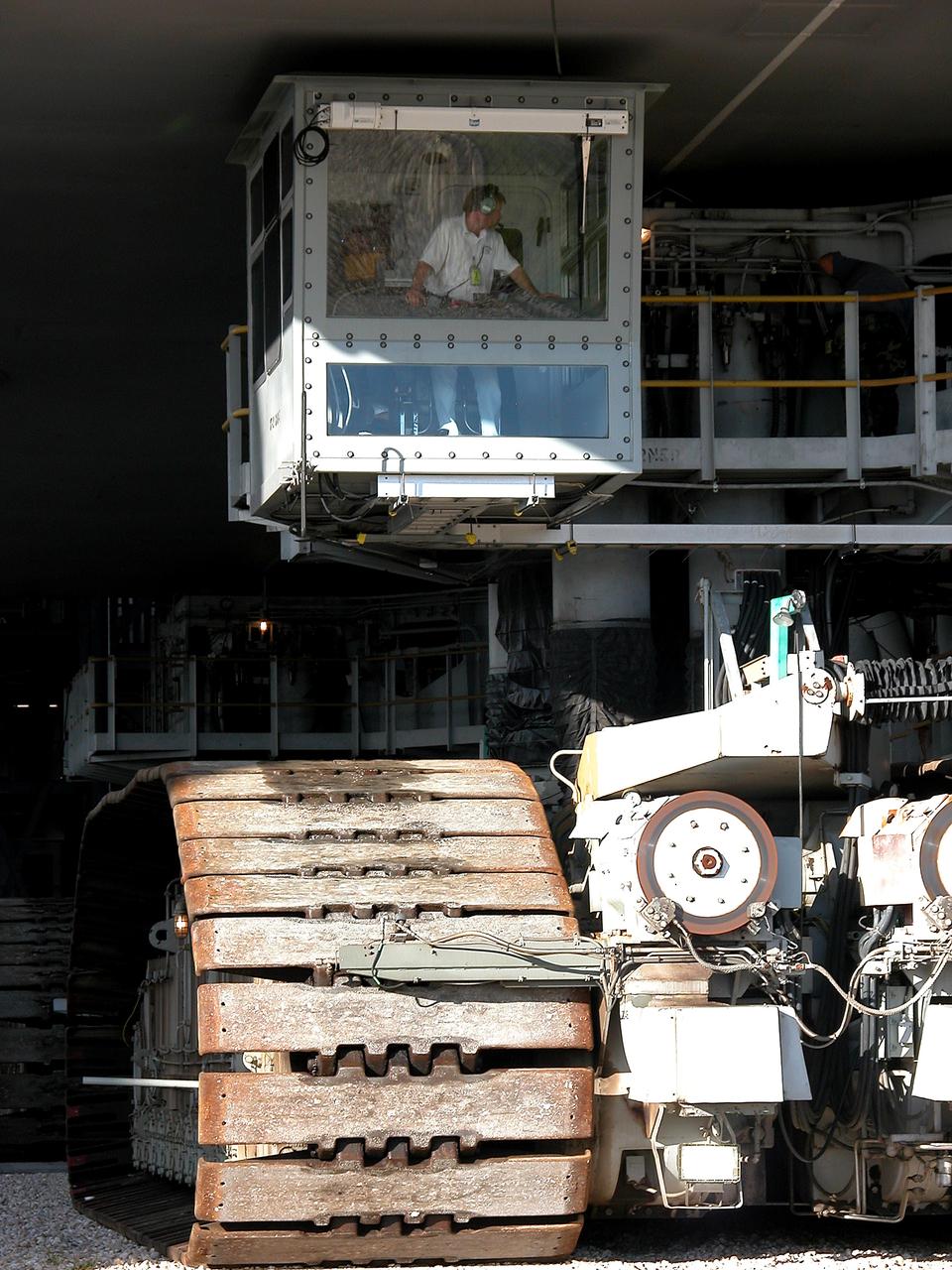
KENNEDY SPACE CENTER, FLA. - Carrying a set of twin solid rocket boosters, the crawler transporter slowly moves the Mobile Launcher Platform (MLP) past the NASA-KSC News Center where the U.S. flag flies daily.  The journey is in support of engineering analysis vibration tests on the crawler and MLP. The crawler is moving at various speeds up to 1 mph in an effort to achieve vibration data gathering goals as it leaves the VAB and then returns.  The boosters are braced at the top for stability.  The primary purpose of these rollout tests is to gather data to develop future maintenance requirements on the transport equipment and the flight hardware. Various parts of the MLP and crawler transporter have been instrumented with vibration data collection equipment.
KENNEDY SPACE CENTER, FLA. - Carrying a set of twin solid rocket boosters, the crawler transporter slowly moves the Mobile Launcher Platform (MLP) past the NASA-KSC News Center where the U.S. flag flies daily. The journey is in support of engineering analysis vibration tests on the crawler and MLP. The crawler is moving at various speeds up to 1 mph in an effort to achieve vibration data gathering goals as it leaves the VAB and then returns. The boosters are braced at the top for stability. The primary purpose of these rollout tests is to gather data to develop future maintenance requirements on the transport equipment and the flight hardware. Various parts of the MLP and crawler transporter have been instrumented with vibration data collection equipment.
KENNEDY SPACE CENTER, FLA. -  Mobile Launcher Platform (MLP) number 3 and a set of twin solid rocket boosters, atop the crawler-transporter, crawls away from the Vehicle Assembly Building in support of the second engineering analysis vibration test on the crawler and MLP. The crawler is moving at various speeds up to 1 mph in an effort to achieve vibration data gathering goals as it leaves the VAB, travels toward Launch Pad 39A and then returns.  The boosters are braced at the top for stability.  The primary purpose of these rollout tests is to gather data to develop future maintenance requirements on the transport equipment and the flight hardware. Various parts of the MLP and crawler transporter have been instrumented with vibration data collection equipment.
KENNEDY SPACE CENTER, FLA. - Mobile Launcher Platform (MLP) number 3 and a set of twin solid rocket boosters, atop the crawler-transporter, crawls away from the Vehicle Assembly Building in support of the second engineering analysis vibration test on the crawler and MLP. The crawler is moving at various speeds up to 1 mph in an effort to achieve vibration data gathering goals as it leaves the VAB, travels toward Launch Pad 39A and then returns. The boosters are braced at the top for stability. The primary purpose of these rollout tests is to gather data to develop future maintenance requirements on the transport equipment and the flight hardware. Various parts of the MLP and crawler transporter have been instrumented with vibration data collection equipment.
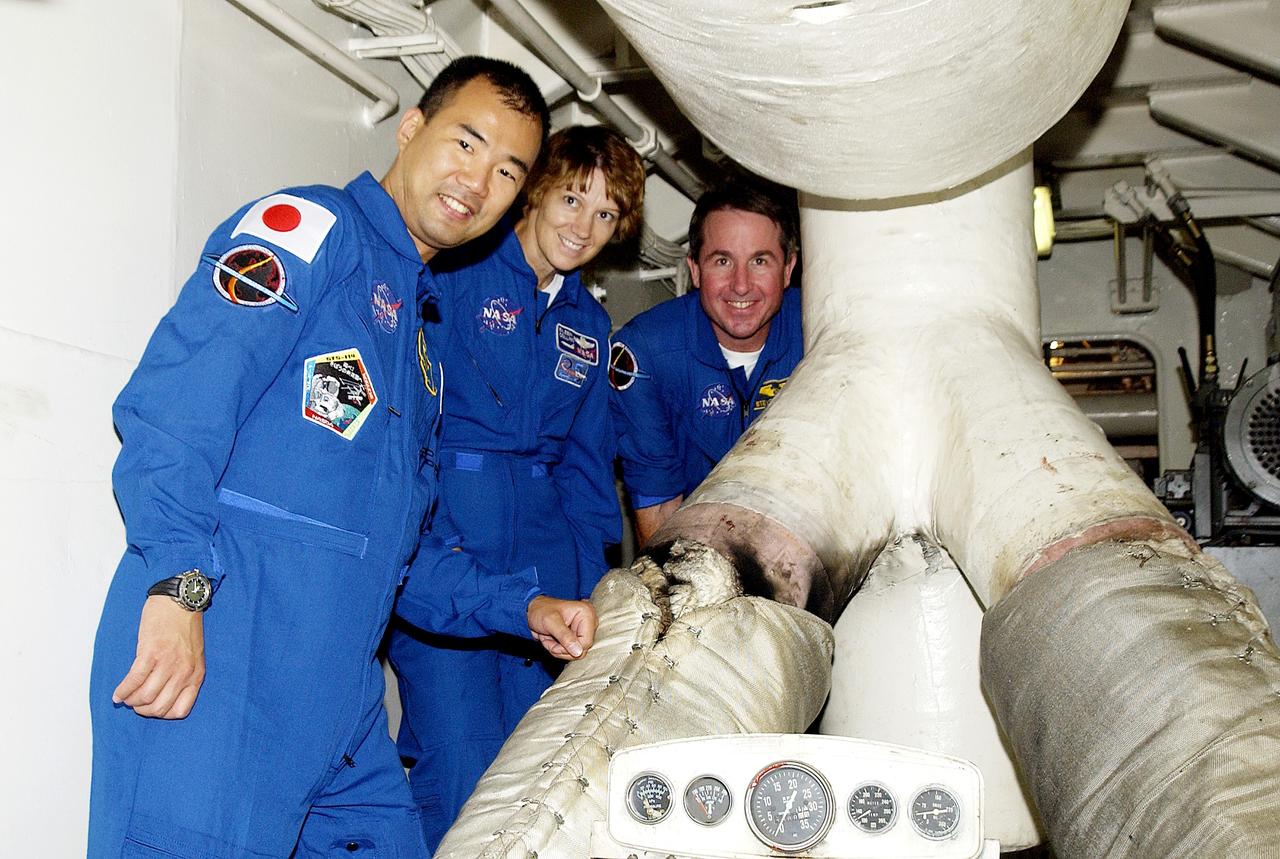
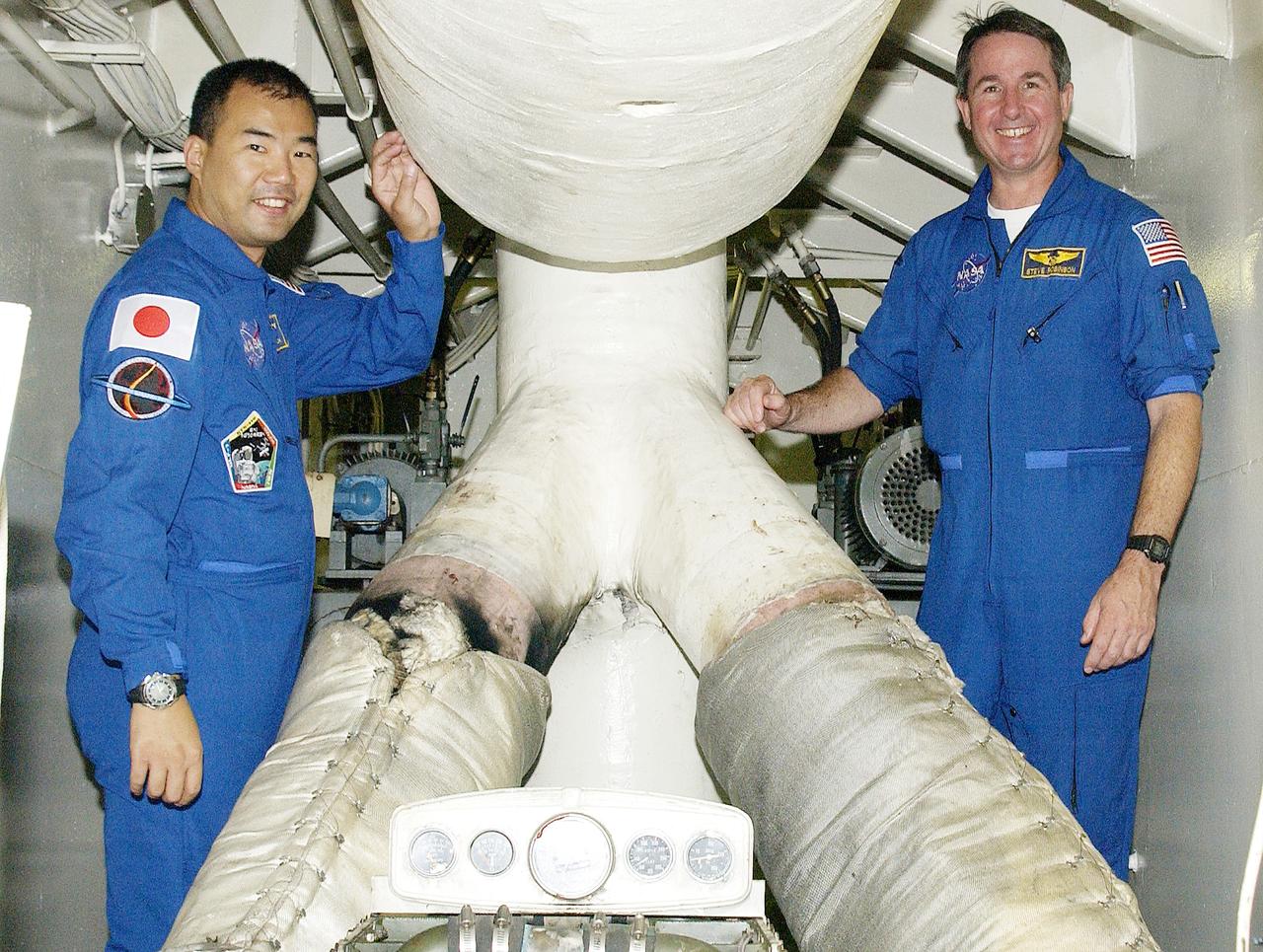
KENNEDY SPACE CENTER, FLA. -   Visiting the engine room of the Liberty Star, one of two SRB Retrieval Ships, are STS-114 crew members Soichi Noguchi, mission specialist, Eileen Collins, commander, and Stephen Robinson, mission specialist.  Noguchi is with the Japanese space agency NASDA. Not pictured is Pilot James Kelly.   On their mission, the crew will carry the MultiPurpose Logistics Module (MPLM) Raffaello and External Stowage Platform 2 to the International Space Station.  The MPLM will contain supplies and equipment.  Another goal of the mission is to remove and replace a Control Moment Gyro.  Launch date for mission STS-114 is under review.
KENNEDY SPACE CENTER, FLA. - Visiting the engine room of the Liberty Star, one of two SRB Retrieval Ships, are STS-114 crew members Soichi Noguchi, mission specialist, Eileen Collins, commander, and Stephen Robinson, mission specialist. Noguchi is with the Japanese space agency NASDA. Not pictured is Pilot James Kelly. On their mission, the crew will carry the MultiPurpose Logistics Module (MPLM) Raffaello and External Stowage Platform 2 to the International Space Station. The MPLM will contain supplies and equipment. Another goal of the mission is to remove and replace a Control Moment Gyro. Launch date for mission STS-114 is under review.
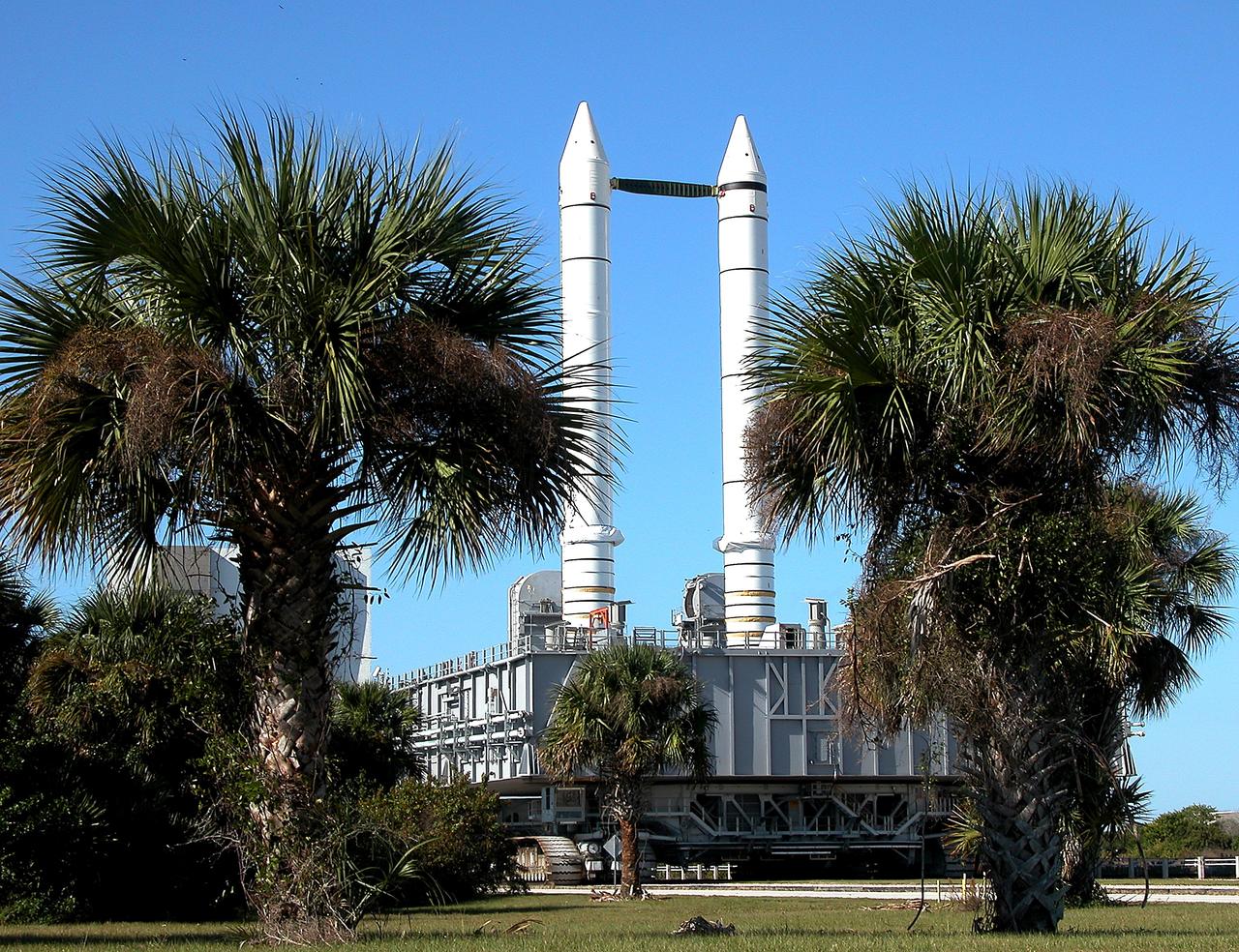
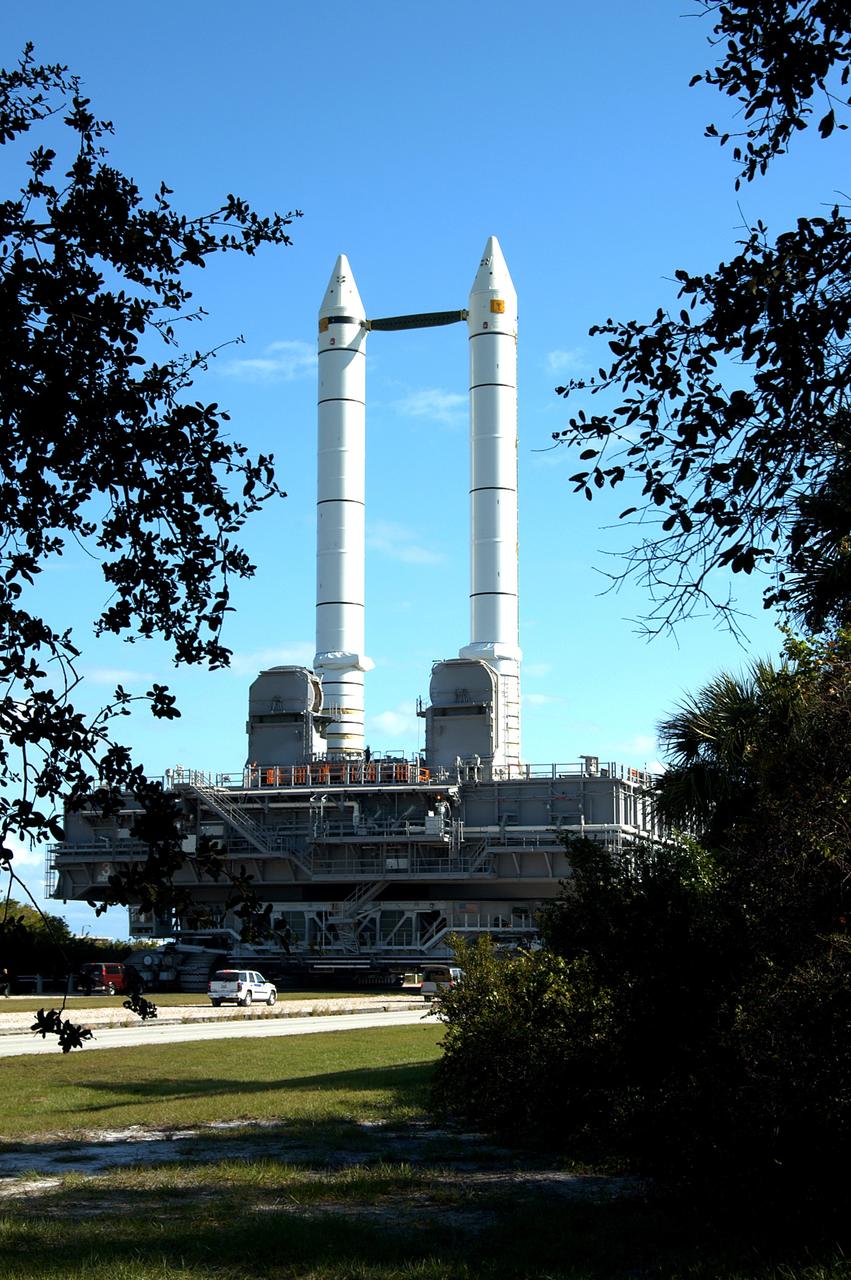
KENNEDY SPACE CENTER, FLA. -  Framed between palm trees, solid rocket boosters loom above the Mobile Launcher Platform (MLP) as the crawler transporter slowly moves it along the crawlerway.  The journey is in support of engineering analysis vibration tests on the crawler and MLP.  The crawler is moving at various speeds up to 1 mph in an effort to achieve vibration data gathering goals as it leaves the VAB and then returns.  The boosters are braced at the top for stability. The primary purpose of these rollout tests is to gather data to develop future maintenance requirements on the transport equipment and the flight hardware. Various parts of the MLP and crawler transporter have been instrumented with vibration data collection equipment.
KENNEDY SPACE CENTER, FLA. - Framed between palm trees, solid rocket boosters loom above the Mobile Launcher Platform (MLP) as the crawler transporter slowly moves it along the crawlerway. The journey is in support of engineering analysis vibration tests on the crawler and MLP. The crawler is moving at various speeds up to 1 mph in an effort to achieve vibration data gathering goals as it leaves the VAB and then returns. The boosters are braced at the top for stability. The primary purpose of these rollout tests is to gather data to develop future maintenance requirements on the transport equipment and the flight hardware. Various parts of the MLP and crawler transporter have been instrumented with vibration data collection equipment.
KENNEDY SPACE CENTER, FLA. -  Mobile Launcher Platform (MLP) number 3 and a set of twin solid rocket boosters, atop the crawler-transporter, inch along the crawlerway in support of the second engineering analysis vibration test on the crawler and MLP. The crawler is moving at various speeds up to 1 mph in an effort to achieve vibration data gathering goals as it leaves the VAB, travels toward Launch Pad 39A (on the horizon) and then returns.  The boosters are braced at the top for stability.  The primary purpose of these rollout tests is to gather data to develop future maintenance requirements on the transport equipment and the flight hardware. Various parts of the MLP and crawler transporter have been instrumented with vibration data collection equipment.
KENNEDY SPACE CENTER, FLA. - Mobile Launcher Platform (MLP) number 3 and a set of twin solid rocket boosters, atop the crawler-transporter, inch along the crawlerway in support of the second engineering analysis vibration test on the crawler and MLP. The crawler is moving at various speeds up to 1 mph in an effort to achieve vibration data gathering goals as it leaves the VAB, travels toward Launch Pad 39A (on the horizon) and then returns. The boosters are braced at the top for stability. The primary purpose of these rollout tests is to gather data to develop future maintenance requirements on the transport equipment and the flight hardware. Various parts of the MLP and crawler transporter have been instrumented with vibration data collection equipment.
KENNEDY SPACE CENTER, FLA. -   In the midbody of orbiter Atlantis, STS-114 crew members look over equipment under the eyes of a technician.  At left are Pilot James Kelly and Mission Specialist Soichi Noguchi.  They and Commander Eileen Collins and Mission Specialist Stephen Robinson are at KSC for equipment familiarization.  Noguchi is with the Japanese space agency NASDA.  Mission STS-114 will carry the MultiPurpose Logistics Module (MPLM) Raffaello and External Stowage Platform 2 to the International Space Station.  The MPLM will contain supplies and equipment.  Another goal of the mission is to remove and replace a Control Moment Gyro.  Launch date for mission STS-114 is under review.
KENNEDY SPACE CENTER, FLA. - In the midbody of orbiter Atlantis, STS-114 crew members look over equipment under the eyes of a technician. At left are Pilot James Kelly and Mission Specialist Soichi Noguchi. They and Commander Eileen Collins and Mission Specialist Stephen Robinson are at KSC for equipment familiarization. Noguchi is with the Japanese space agency NASDA. Mission STS-114 will carry the MultiPurpose Logistics Module (MPLM) Raffaello and External Stowage Platform 2 to the International Space Station. The MPLM will contain supplies and equipment. Another goal of the mission is to remove and replace a Control Moment Gyro. Launch date for mission STS-114 is under review.
KENNEDY SPACE CENTER, FLA. -  The crawler transporter slowly moves the Mobile Launcher Platform (MLP), carrying a set of twin solid rocket boosters, away from the Vehicle Assembly Building (VAB) in support of engineering analysis vibration tests on the crawler and MLP.   The crawler is moving at various speeds up to 1 mph in an effort to achieve vibration data gathering goals as it leaves the VAB and then returns.  The boosters are braced at the top for stability.  The primary purpose of these rollout tests is to gather data to develop future maintenance requirements on the transport equipment and the flight hardware. Various parts of the MLP and crawler transporter have been instrumented with vibration data collection equipment.
KENNEDY SPACE CENTER, FLA. - The crawler transporter slowly moves the Mobile Launcher Platform (MLP), carrying a set of twin solid rocket boosters, away from the Vehicle Assembly Building (VAB) in support of engineering analysis vibration tests on the crawler and MLP. The crawler is moving at various speeds up to 1 mph in an effort to achieve vibration data gathering goals as it leaves the VAB and then returns. The boosters are braced at the top for stability. The primary purpose of these rollout tests is to gather data to develop future maintenance requirements on the transport equipment and the flight hardware. Various parts of the MLP and crawler transporter have been instrumented with vibration data collection equipment.
KENNEDY SPACE CENTER, FLA. -   While touring the SRB Retrieval Ship Freedom Star, STS-114 Commander Eileen Collins and Mission Specialist Soichi Noguchi point at something on the Banana River. Noguchi is with the Japanese space agency NASDA.  The ships routinely are docked at Hangar AF on the river.  On their mission, the crew - which also includes Pilot James Kelly and Mission Specialist Stephen Robinson - will carry the MultiPurpose Logistics Module (MPLM) Raffaello and External Stowage Platform 2 to the International Space Station.  The MPLM will contain supplies and equipment.  Another goal of the mission is to remove and replace a Control Moment Gyro.  Launch date for mission STS-114 is under review.
KENNEDY SPACE CENTER, FLA. - While touring the SRB Retrieval Ship Freedom Star, STS-114 Commander Eileen Collins and Mission Specialist Soichi Noguchi point at something on the Banana River. Noguchi is with the Japanese space agency NASDA. The ships routinely are docked at Hangar AF on the river. On their mission, the crew - which also includes Pilot James Kelly and Mission Specialist Stephen Robinson - will carry the MultiPurpose Logistics Module (MPLM) Raffaello and External Stowage Platform 2 to the International Space Station. The MPLM will contain supplies and equipment. Another goal of the mission is to remove and replace a Control Moment Gyro. Launch date for mission STS-114 is under review.
KENNEDY SPACE CENTER, FLA. -   Captain Bren Wade of the Liberty Star, one of two SRB Retrieval Ships, talks to STS-114 crew members about the engines.  Seen at left are Pilot James Kelly and Mission Specialist Soichi Noguchi, who is with the Japanese space agency NASDA..   On their mission, the crew  - which includes Commander Eileen Collins and Mission Specialist Stephen Robinson - will carry the MultiPurpose Logistics Module (MPLM) Raffaello and External Stowage Platform 2 to the International Space Station.  The MPLM will contain supplies and equipment.  Another goal of the mission is to remove and replace a Control Moment Gyro.  Launch date for mission STS-114 is under review.
KENNEDY SPACE CENTER, FLA. - Captain Bren Wade of the Liberty Star, one of two SRB Retrieval Ships, talks to STS-114 crew members about the engines. Seen at left are Pilot James Kelly and Mission Specialist Soichi Noguchi, who is with the Japanese space agency NASDA.. On their mission, the crew - which includes Commander Eileen Collins and Mission Specialist Stephen Robinson - will carry the MultiPurpose Logistics Module (MPLM) Raffaello and External Stowage Platform 2 to the International Space Station. The MPLM will contain supplies and equipment. Another goal of the mission is to remove and replace a Control Moment Gyro. Launch date for mission STS-114 is under review.
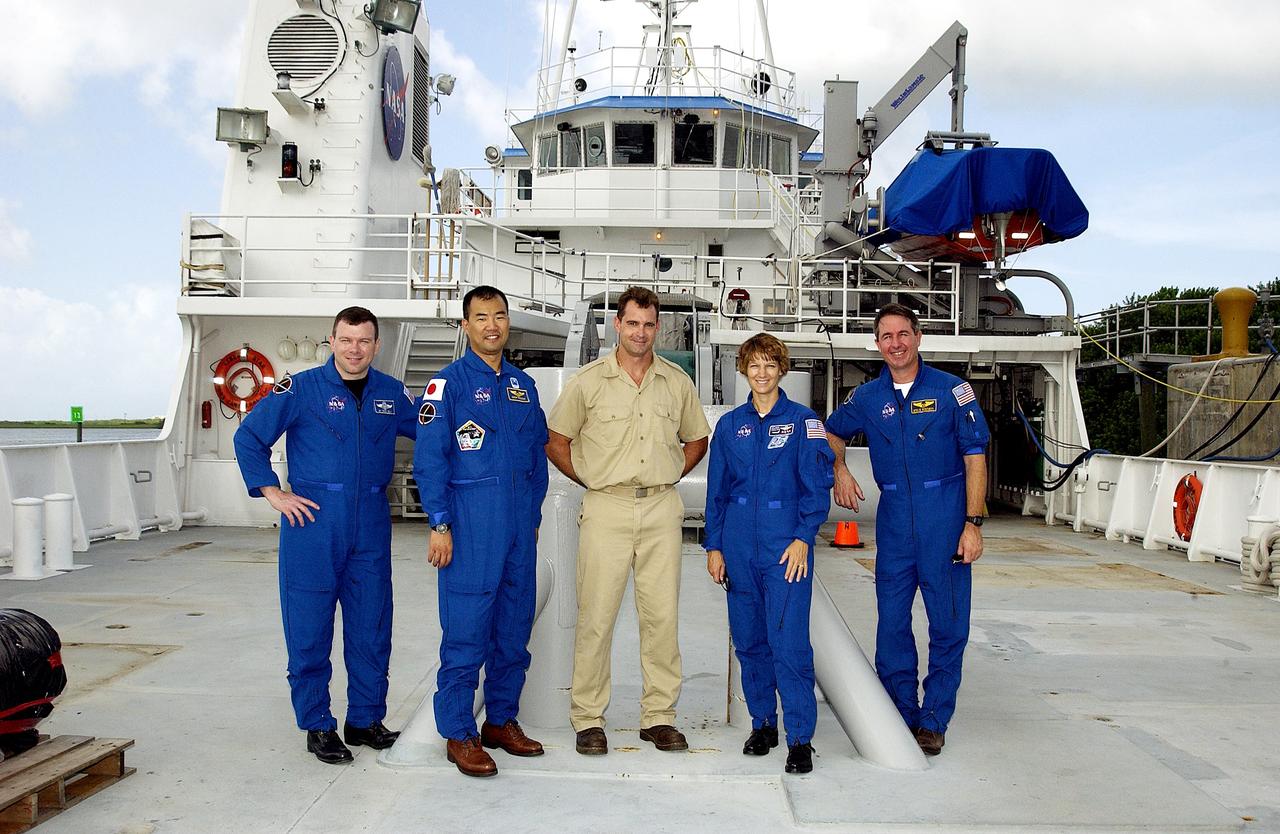
KENNEDY SPACE CENTER, FLA. -   The STS-114 crew poses on deck with the captain of the Liberty Star, one of the SRB Retrieval Ships docked at Hangar AF on the Banana River.   From left are Pilot James Kelly, Mission Specialist Soichi Noguchi, Capt. Bren Wade, Commander Eileen Collins and Mission Specialist Stephen Robinson.  Noguchi is with the Japanese space agency NASDA.  Mission STS-114 will carry the MultiPurpose Logistics Module (MPLM) Raffaello and External Stowage Platform 2 to the International Space Station.  The MPLM will contain supplies and equipment.  Another goal of the mission is to remove and replace a Control Moment Gyro.  Launch date for mission STS-114 is under review.
KENNEDY SPACE CENTER, FLA. - The STS-114 crew poses on deck with the captain of the Liberty Star, one of the SRB Retrieval Ships docked at Hangar AF on the Banana River. From left are Pilot James Kelly, Mission Specialist Soichi Noguchi, Capt. Bren Wade, Commander Eileen Collins and Mission Specialist Stephen Robinson. Noguchi is with the Japanese space agency NASDA. Mission STS-114 will carry the MultiPurpose Logistics Module (MPLM) Raffaello and External Stowage Platform 2 to the International Space Station. The MPLM will contain supplies and equipment. Another goal of the mission is to remove and replace a Control Moment Gyro. Launch date for mission STS-114 is under review.
KENNEDY SPACE CENTER, FLA. -  STS-114  Mission Specialists Soichi Noguchi and Stephen Robinson visit the engine room of the Liberty Star, one of two SRB Retrieval Ships.  Noguchi is with the Japanese space agency NASDA. Other crew members on the tour are Commander Eileen Collins and Pilot James Kelly.  On their mission, the crew will carry the MultiPurpose Logistics Module (MPLM) Raffaello and External Stowage Platform 2 to the International Space Station.  The MPLM will contain supplies and equipment.  Another goal of the mission is to remove and replace a Control Moment Gyro.  Launch date for mission STS-114 is under review.
KENNEDY SPACE CENTER, FLA. - STS-114 Mission Specialists Soichi Noguchi and Stephen Robinson visit the engine room of the Liberty Star, one of two SRB Retrieval Ships. Noguchi is with the Japanese space agency NASDA. Other crew members on the tour are Commander Eileen Collins and Pilot James Kelly. On their mission, the crew will carry the MultiPurpose Logistics Module (MPLM) Raffaello and External Stowage Platform 2 to the International Space Station. The MPLM will contain supplies and equipment. Another goal of the mission is to remove and replace a Control Moment Gyro. Launch date for mission STS-114 is under review.
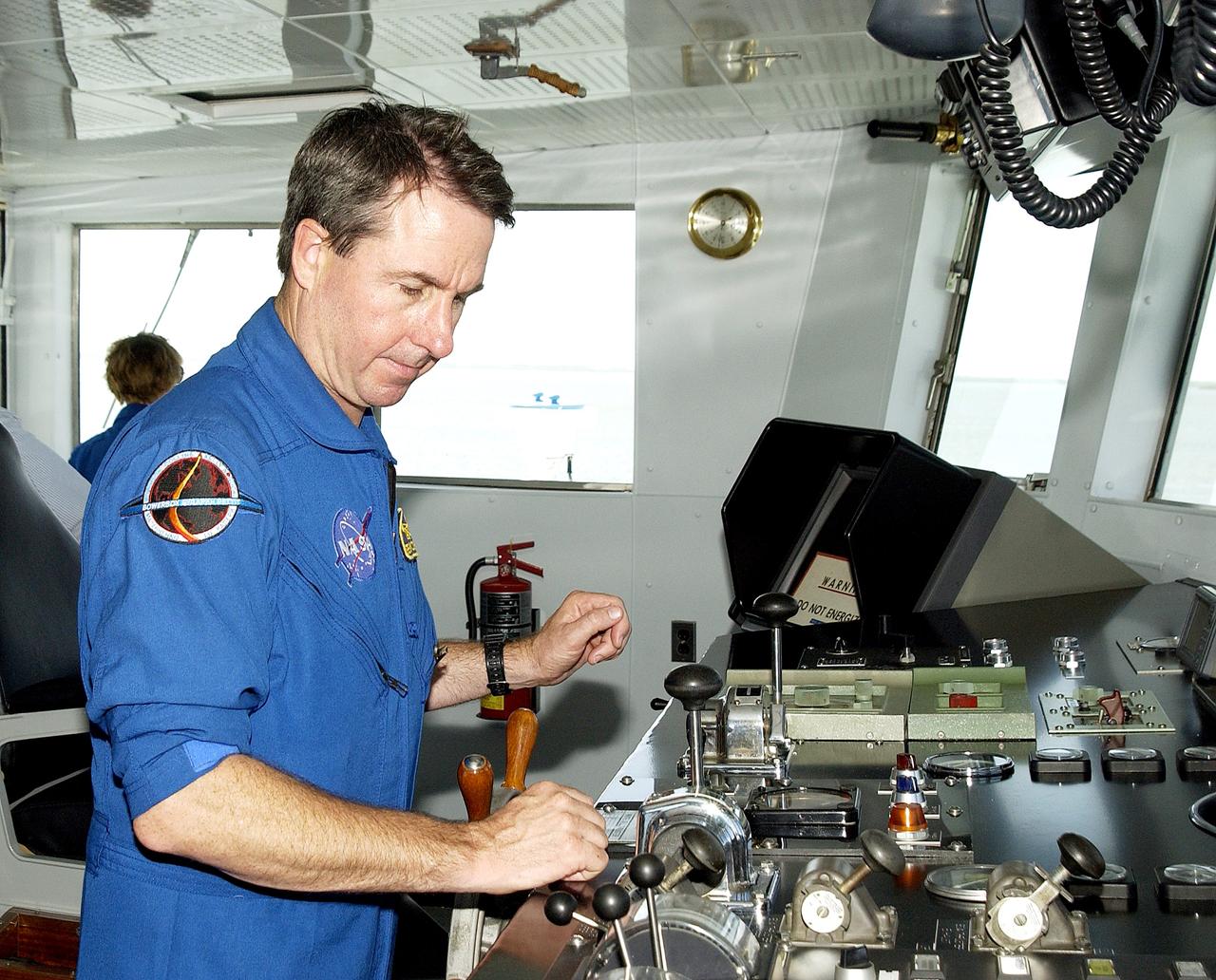
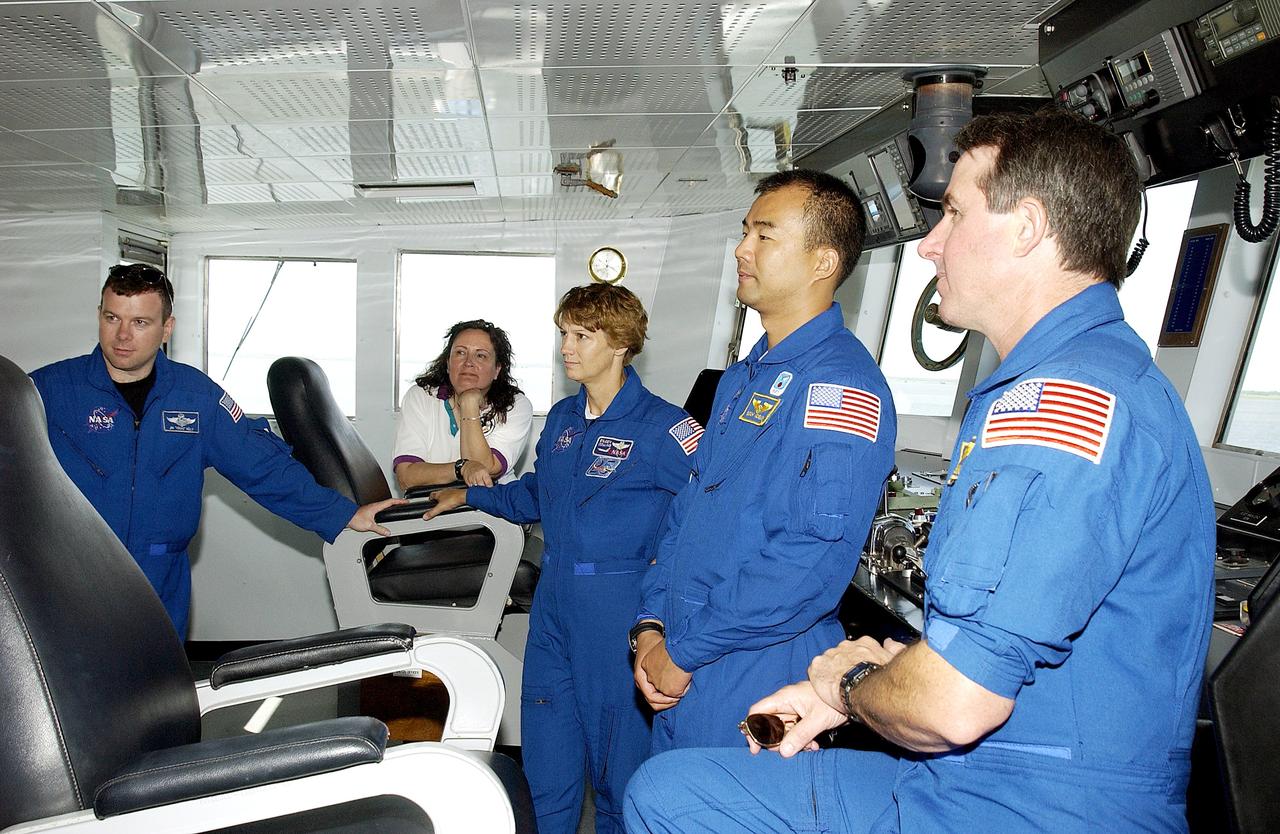
KENNEDY SPACE CENTER, FLA. -  The STS-114 crew visit the bridge of the Liberty Star, one of two SRB Retrieval Ships.  From left are Pilot James Kelly, Louise Kleba (with the Vehicle Integration Test Team (VITT) office), Commander Eileen Collins and Mission Specialists Soichi Noguchi and Stephen Robinson. Noguchi is with the Japanese space agency NASDA. On their mission, the crew will carry the MultiPurpose Logistics Module (MPLM) Raffaello and External Stowage Platform 2 to the International Space Station.  The MPLM will contain supplies and equipment.  Another goal of the mission is to remove and replace a Control Moment Gyro.  Launch date for mission STS-114 is under review.
KENNEDY SPACE CENTER, FLA. - The STS-114 crew visit the bridge of the Liberty Star, one of two SRB Retrieval Ships. From left are Pilot James Kelly, Louise Kleba (with the Vehicle Integration Test Team (VITT) office), Commander Eileen Collins and Mission Specialists Soichi Noguchi and Stephen Robinson. Noguchi is with the Japanese space agency NASDA. On their mission, the crew will carry the MultiPurpose Logistics Module (MPLM) Raffaello and External Stowage Platform 2 to the International Space Station. The MPLM will contain supplies and equipment. Another goal of the mission is to remove and replace a Control Moment Gyro. Launch date for mission STS-114 is under review.
KENNEDY SPACE CENTER, FLA. -  STS-114 Commander Eileen Collins sits in the entry hatch to orbiter Atlantis.  She and other crew members - Pilot James Kelly and  Mission Specialists Soichi Noguchi and Stephen Robinson -  are at KSC for equipment familiarization. Noguchi is with the Japanese space agency NASDA. Mission STS-114 will carry the MultiPurpose Logistics Module (MPLM) Raffaello and External Stowage Platform 2 to the International Space Station.  The MPLM will contain supplies and equipment.  Another goal of the mission is to remove and replace a Control Moment Gyro.  Launch date for mission STS-114 is under review.
KENNEDY SPACE CENTER, FLA. - STS-114 Commander Eileen Collins sits in the entry hatch to orbiter Atlantis. She and other crew members - Pilot James Kelly and Mission Specialists Soichi Noguchi and Stephen Robinson - are at KSC for equipment familiarization. Noguchi is with the Japanese space agency NASDA. Mission STS-114 will carry the MultiPurpose Logistics Module (MPLM) Raffaello and External Stowage Platform 2 to the International Space Station. The MPLM will contain supplies and equipment. Another goal of the mission is to remove and replace a Control Moment Gyro. Launch date for mission STS-114 is under review.
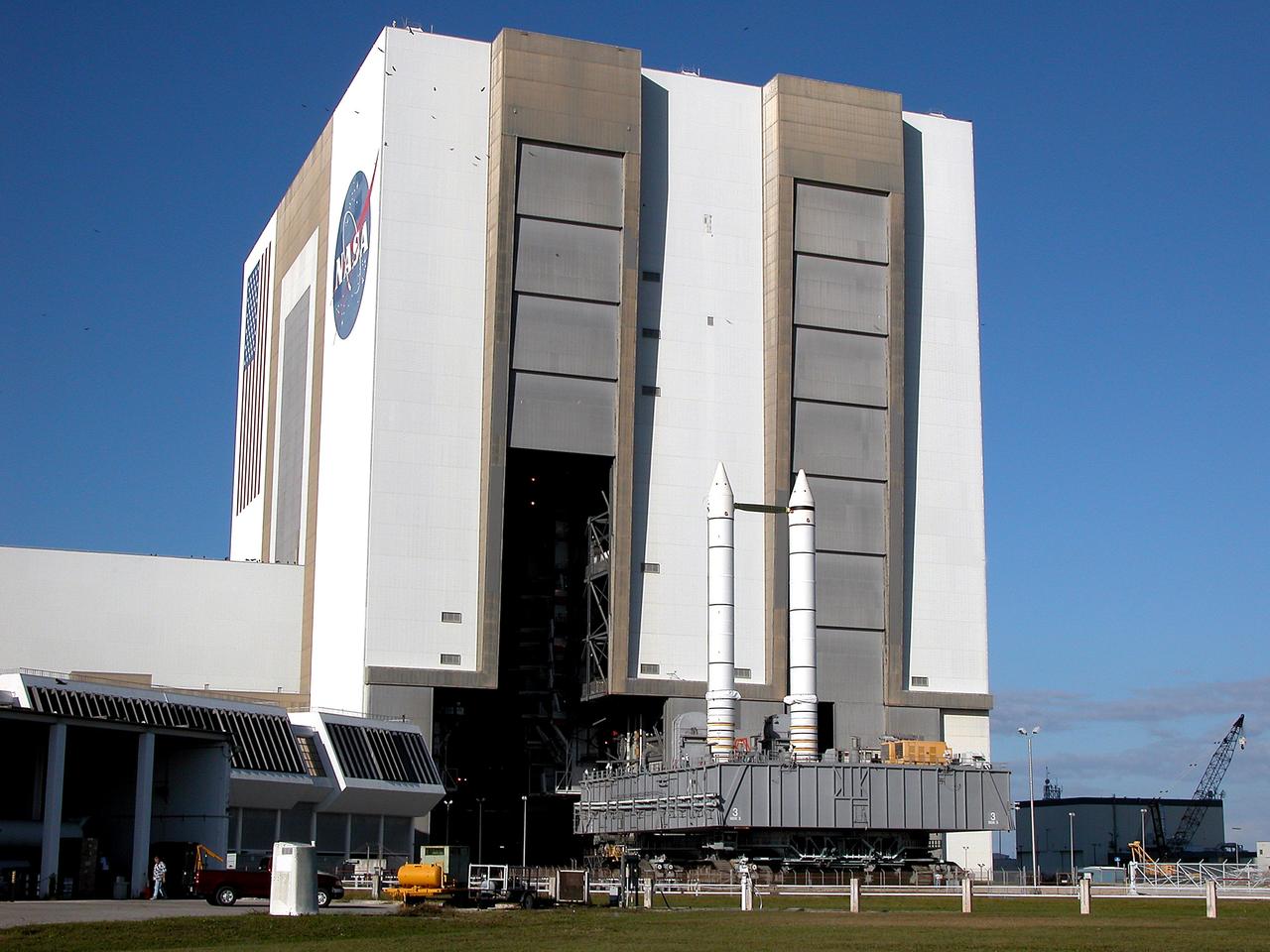
KENNEDY SPACE CENTER, FLA. -  The crawler transporter has slowly moved the Mobile Launcher Platform (MLP), carrying a set of twin solid rocket boosters, out of the Vehicle Assembly Building (VAB) in support of engineering analysis vibration tests on the crawler and MLP. The crawler is moving at various speeds up to 1 mph in an effort to achieve vibration data gathering goals as it leaves the VAB and then returns.  The boosters are braced at the top for stability.  The primary purpose of these rollout tests is to gather data to develop future maintenance requirements on the transport equipment and the flight hardware. Various parts of the MLP and crawler transporter have been instrumented with vibration data collection equipment.
KENNEDY SPACE CENTER, FLA. - The crawler transporter has slowly moved the Mobile Launcher Platform (MLP), carrying a set of twin solid rocket boosters, out of the Vehicle Assembly Building (VAB) in support of engineering analysis vibration tests on the crawler and MLP. The crawler is moving at various speeds up to 1 mph in an effort to achieve vibration data gathering goals as it leaves the VAB and then returns. The boosters are braced at the top for stability. The primary purpose of these rollout tests is to gather data to develop future maintenance requirements on the transport equipment and the flight hardware. Various parts of the MLP and crawler transporter have been instrumented with vibration data collection equipment.
KENNEDY SPACE CENTER, FLA. -  The crawler transporter slowly moves the Mobile Launcher Platform (MLP), carrying a set of twin solid rocket boosters, away from the Vehicle Assembly Building (VAB) in support of engineering analysis vibration tests on the crawler and MLP.   The crawler is moving at various speeds up to 1 mph in an effort to achieve vibration data gathering goals as it leaves the VAB and then returns.  The boosters are braced at the top for stability.  The primary purpose of these rollout tests is to gather data to develop future maintenance requirements on the transport equipment and the flight hardware. Various parts of the MLP and crawler transporter have been instrumented with vibration data collection equipment.
KENNEDY SPACE CENTER, FLA. - The crawler transporter slowly moves the Mobile Launcher Platform (MLP), carrying a set of twin solid rocket boosters, away from the Vehicle Assembly Building (VAB) in support of engineering analysis vibration tests on the crawler and MLP. The crawler is moving at various speeds up to 1 mph in an effort to achieve vibration data gathering goals as it leaves the VAB and then returns. The boosters are braced at the top for stability. The primary purpose of these rollout tests is to gather data to develop future maintenance requirements on the transport equipment and the flight hardware. Various parts of the MLP and crawler transporter have been instrumented with vibration data collection equipment.
KENNEDY SPACE CENTER, FLA. -  The crawler transporter slowly moves the Mobile Launcher Platform (MLP), carrying a set of twin solid rocket boosters, out of the Vehicle Assembly Building (VAB) in support of engineering analysis vibration tests on the crawler and MLP.   The crawler is moving at various speeds up to 1 mph in an effort to achieve vibration data gathering goals as it leaves the VAB and then returns.  The boosters are braced at the top for stability.  The primary purpose of these rollout tests is to gather data to develop future maintenance requirements on the transport equipment and the flight hardware. Various parts of the MLP and crawler transporter have been instrumented with vibration data collection equipment.
KENNEDY SPACE CENTER, FLA. - The crawler transporter slowly moves the Mobile Launcher Platform (MLP), carrying a set of twin solid rocket boosters, out of the Vehicle Assembly Building (VAB) in support of engineering analysis vibration tests on the crawler and MLP. The crawler is moving at various speeds up to 1 mph in an effort to achieve vibration data gathering goals as it leaves the VAB and then returns. The boosters are braced at the top for stability. The primary purpose of these rollout tests is to gather data to develop future maintenance requirements on the transport equipment and the flight hardware. Various parts of the MLP and crawler transporter have been instrumented with vibration data collection equipment.
KENNEDY SPACE CENTER, FLA. -  As the crawler transporter slowly moves the Mobile Launcher Platform (MLP) out of the Vehicle Assembly Building, the driver of the front control cab can be seen.  The MLP is carrying two solid rocket boosters for engineering analysis vibration tests on the crawler and MLP.    The crawler is moving at various speeds up to 1 mph in an effort to achieve vibration data gathering goals as it leaves the VAB and then returns.  The boosters are braced at the top for stability.  The primary purpose of these rollout tests is to gather data to develop future maintenance requirements on the transport equipment and the flight hardware. Various parts of the MLP and crawler transporter have been instrumented with vibration data collection equipment.
KENNEDY SPACE CENTER, FLA. - As the crawler transporter slowly moves the Mobile Launcher Platform (MLP) out of the Vehicle Assembly Building, the driver of the front control cab can be seen. The MLP is carrying two solid rocket boosters for engineering analysis vibration tests on the crawler and MLP. The crawler is moving at various speeds up to 1 mph in an effort to achieve vibration data gathering goals as it leaves the VAB and then returns. The boosters are braced at the top for stability. The primary purpose of these rollout tests is to gather data to develop future maintenance requirements on the transport equipment and the flight hardware. Various parts of the MLP and crawler transporter have been instrumented with vibration data collection equipment.
KENNEDY SPACE CENTER, FLA. -- Dr. Woodrow Whitlow, KSC deputy director, talks to the media at the NASA-KSC News Center after viewing President George W. Bush’s message on the future of NASA.  The President stated his goals for NASA’s new mission: Completing the International Space Station, retiring the Space Shuttle orbiters, developing a new crew exploration vehicle, and returning to the moon and beyond within the next two decades.   Pres. Bush was welcomed by NASA Administrator Sean O’Keefe and Expedition 8 Commander Michael Foale, who greeted him from the International Space Station.
KENNEDY SPACE CENTER, FLA. -- Dr. Woodrow Whitlow, KSC deputy director, talks to the media at the NASA-KSC News Center after viewing President George W. Bush’s message on the future of NASA. The President stated his goals for NASA’s new mission: Completing the International Space Station, retiring the Space Shuttle orbiters, developing a new crew exploration vehicle, and returning to the moon and beyond within the next two decades. Pres. Bush was welcomed by NASA Administrator Sean O’Keefe and Expedition 8 Commander Michael Foale, who greeted him from the International Space Station.
KENNEDY SPACE CENTER, FLA. -  STS-114 Pilot James Kelly sits in the entry hatch to orbiter Atlantis.  He and other crew members - Commander Eileen Collins and  Mission Specialists Soichi Noguchi and Stephen Robinson -  are at KSC for equipment familiarization. Noguchi is with the Japanese space agency NASDA. Mission STS-114 will carry the MultiPurpose Logistics Module (MPLM) Raffaello and External Stowage Platform 2 to the International Space Station.  The MPLM will contain supplies and equipment.  Another goal of the mission is to remove and replace a Control Moment Gyro.  Launch date for mission STS-114 is under review.
KENNEDY SPACE CENTER, FLA. - STS-114 Pilot James Kelly sits in the entry hatch to orbiter Atlantis. He and other crew members - Commander Eileen Collins and Mission Specialists Soichi Noguchi and Stephen Robinson - are at KSC for equipment familiarization. Noguchi is with the Japanese space agency NASDA. Mission STS-114 will carry the MultiPurpose Logistics Module (MPLM) Raffaello and External Stowage Platform 2 to the International Space Station. The MPLM will contain supplies and equipment. Another goal of the mission is to remove and replace a Control Moment Gyro. Launch date for mission STS-114 is under review.