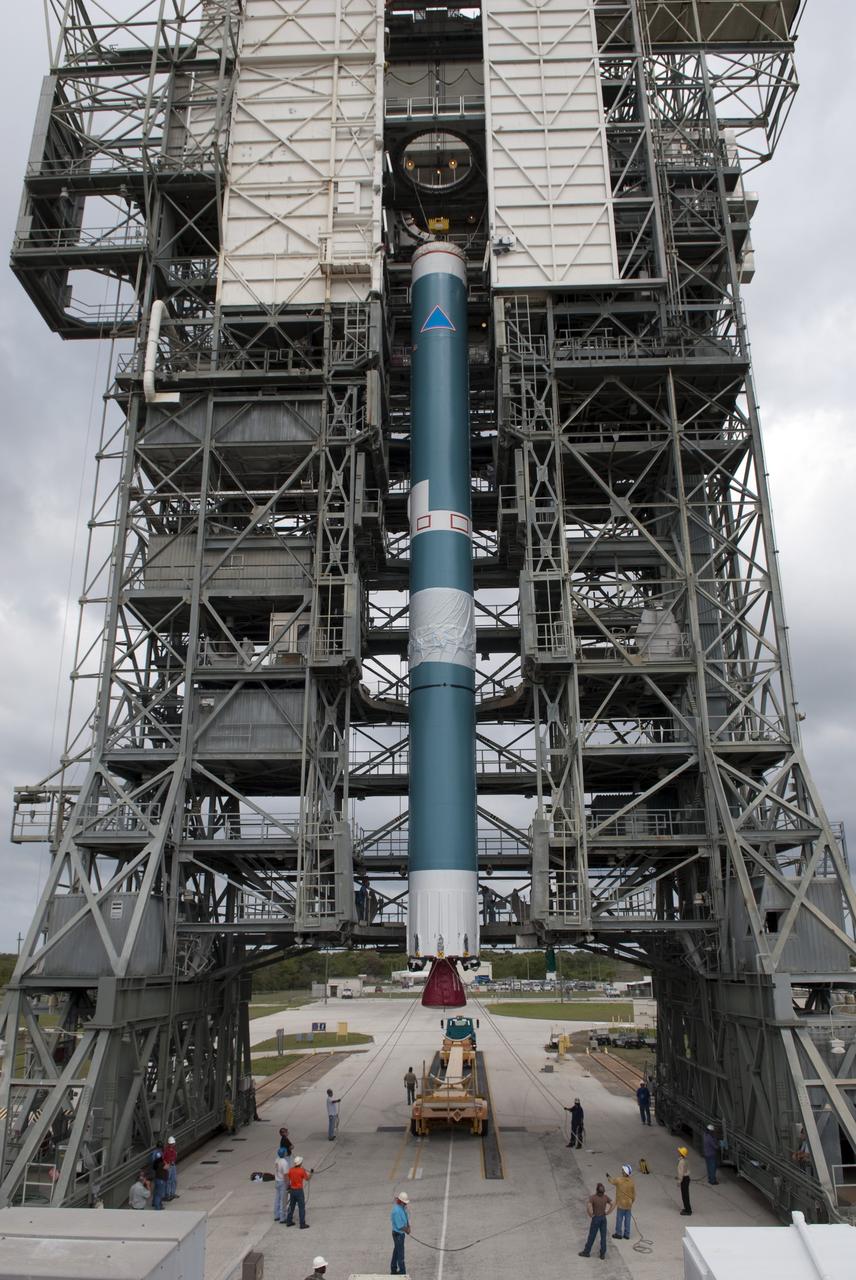
CAPE CANAVERAL, Fla. -- Workers at Cape Canaveral Air Force Station's Pad 17B monitor the progress as the first stage of a United Launch Alliance Delta II launch vehicle is lifted into the gantry. The Delta II will carry NASA's Gravity Recovery and Interior Laboratory, or GRAIL, spacecraft into lunar orbit. The GRAIL mission is a part of NASA's Discovery Program. GRAIL will fly twin spacecraft in tandem orbits around the moon for several months to measure its gravity field. The mission also will answer longstanding questions about Earth's moon and provide scientists a better understanding of how Earth and other rocky planets in the solar system formed. GRAIL is scheduled to launch September 8, 2011. For more information visit: http://science.nasa.gov/missions/grail/. Photo credit: NASA/Jim Grossmann
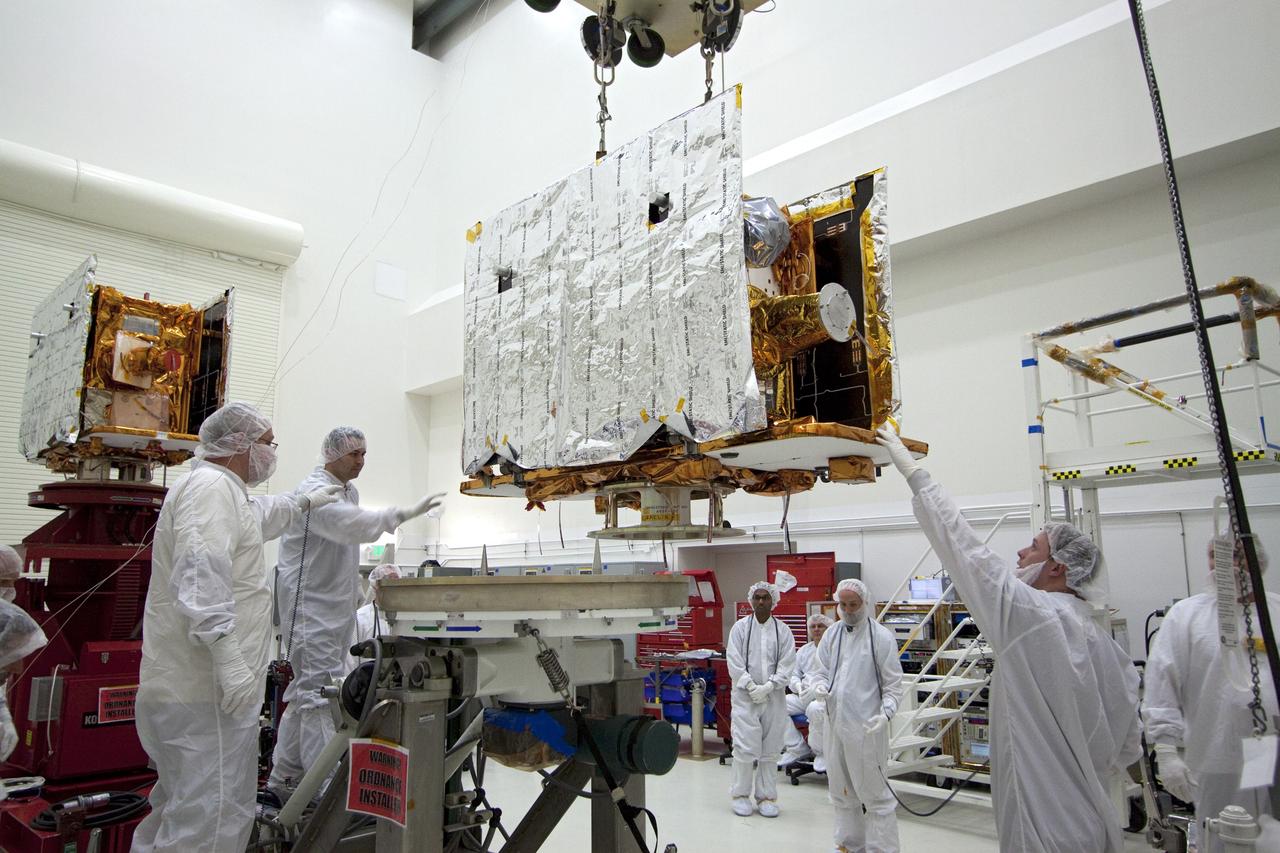
CAPE CANAVERAL, Fla. -- Technicians lift one of two spacecraft for NASA's Gravity Recovery and Interior Laboratory, or GRAIL, to a test stand in the Astrotech payload processing facility in Titusville, Fla. The twin spacecraft were built at the Lockheed Martin plant in Denver, Colo. The United Launch Alliance Delta II rocket that will carry GRAIL into lunar orbit already is fully stacked at NASA's Space Launch Complex 17B and launch is scheduled for Sept. 8. The GRAIL mission is a part of NASA's Discovery Program. GRAIL will fly twin spacecraft in tandem orbits around the moon for several months to measure its gravity field. The mission also will answer longstanding questions about Earth's moon and provide scientists a better understanding of how Earth and other rocky planets in the solar system formed. For more information, visit http://science.nasa.gov/missions/grail/. Photo credit: NASA/Jack Pfaller
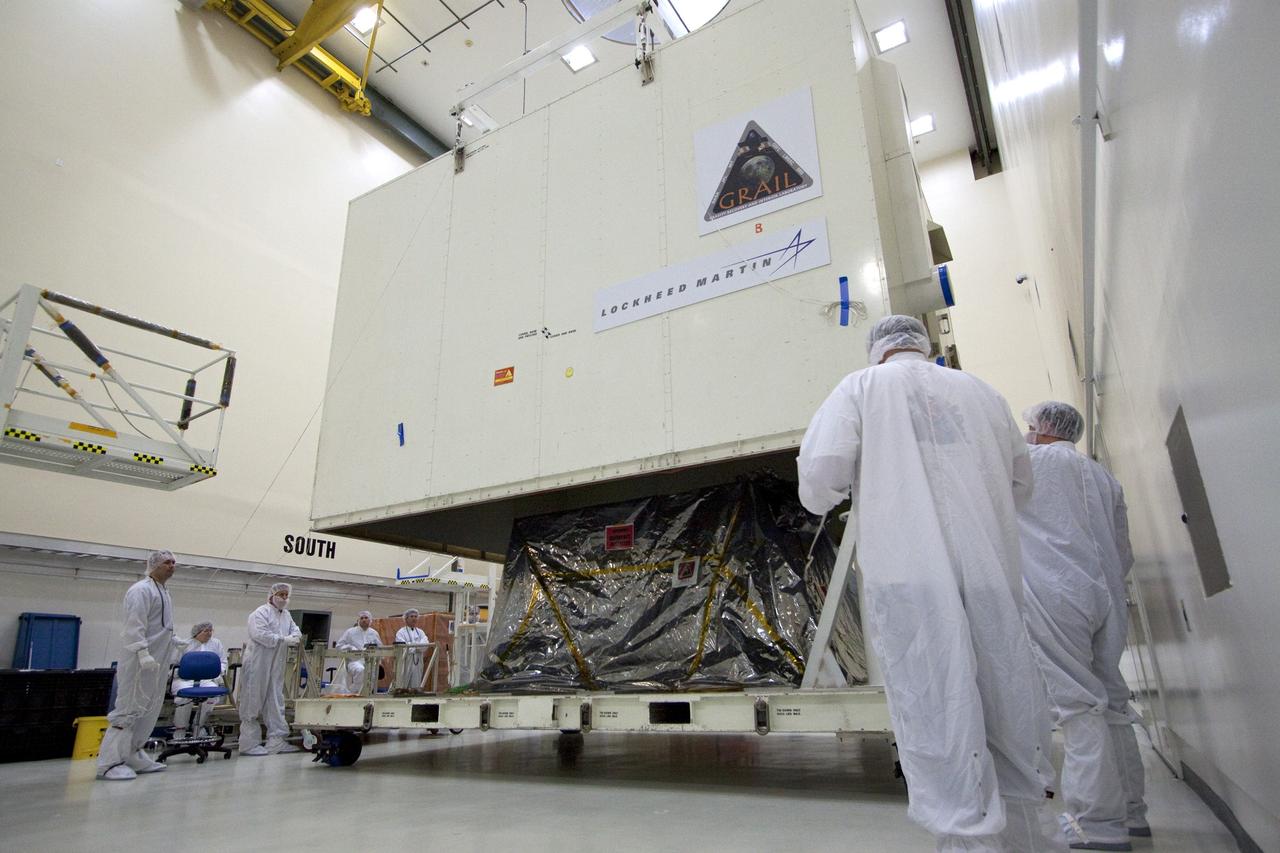
CAPE CANAVERAL, Fla. -- Technicians in the Astrotech payload processing facility in Titusville, Fla., unpack NASA's Gravity Recovery and Interior Laboratory, or GRAIL, twin spacecraft for testing and processing. GRAIL was built at the Lockheed Martin plant in Denver, Colo. The United Launch Alliance Delta II rocket that will carry GRAIL into lunar orbit already is fully stacked at NASA's Space Launch Complex 17B and launch is scheduled for Sept. 8. The GRAIL mission is a part of NASA's Discovery Program. GRAIL will fly twin spacecraft in tandem orbits around the moon for several months to measure its gravity field. The mission also will answer longstanding questions about Earth's moon and provide scientists a better understanding of how Earth and other rocky planets in the solar system formed. For more information, visit http://science.nasa.gov/missions/grail/. Photo credit: NASA/Jack Pfaller
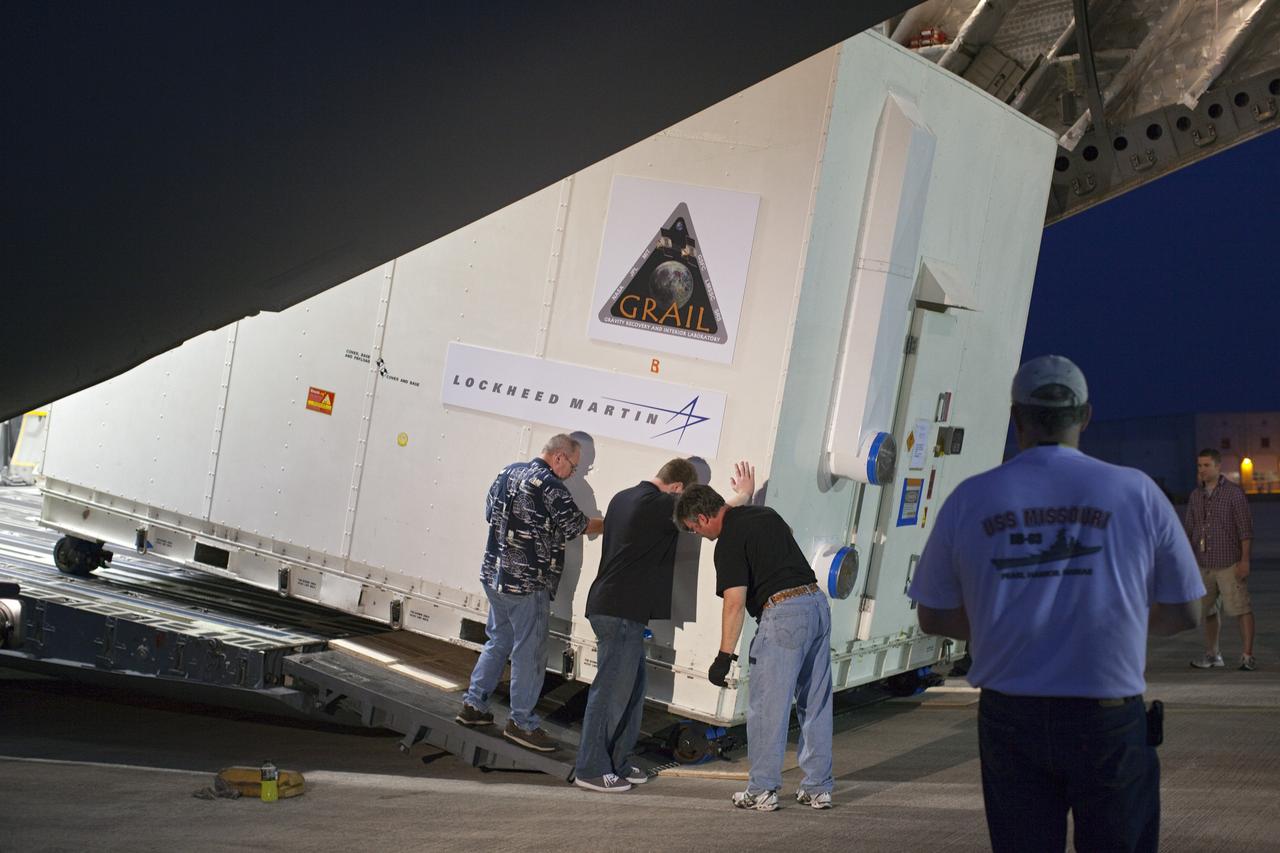
CAPE CANAVERAL, Fla. -- NASA's Gravity Recovery and Interior Laboratory, or GRAIL, spacecraft is offloaded from an Air Force C-17 cargo plane on the Shuttle Landing Facility at Kennedy Space Center in Florida. The spacecraft traveled from the Lockheed Martin plant in Denver, Colo., and will undergo further processing in the Astrotech payload processing facility in Titusville, Fla. The United Launch Alliance Delta II rocket that will carry GRAIL into lunar orbit already is fully stacked at NASA's Space Launch Complex 17B and launch is scheduled for Sept. 8. The GRAIL mission is a part of NASA's Discovery Program. GRAIL will fly twin spacecraft in tandem orbits around the moon for several months to measure its gravity field. The mission also will answer longstanding questions about Earth's moon and provide scientists a better understanding of how Earth and other rocky planets in the solar system formed. For more information, visit http://science.nasa.gov/missions/grail/. Photo credit: NASA/Dimitri Gerondidakis
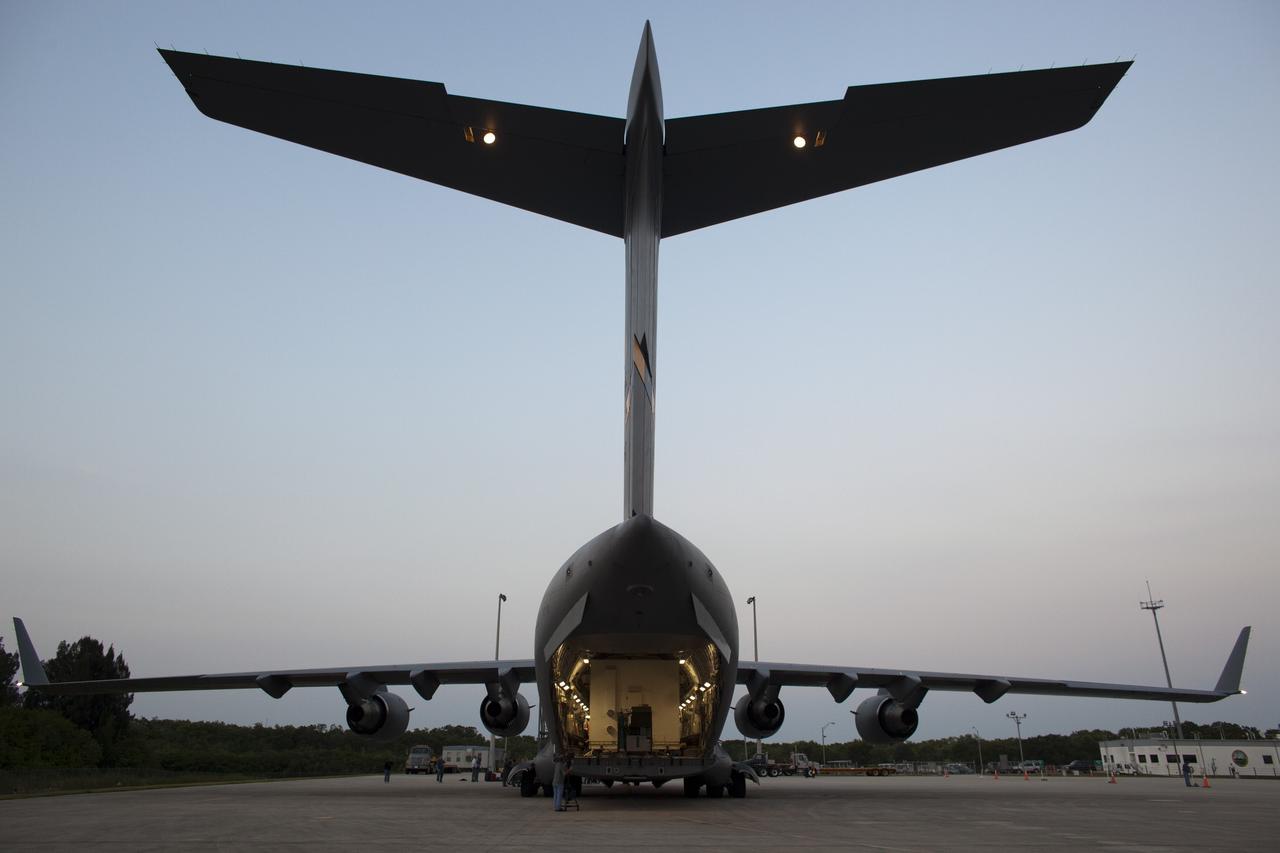
CAPE CANAVERAL, Fla. -- NASA's Gravity Recovery and Interior Laboratory, or GRAIL, spacecraft will be offloaded from an Air Force C-17 cargo plane on the Shuttle Landing Facility at Kennedy Space Center in Florida. The spacecraft traveled from the Lockheed Martin plant in Denver, Colo., and will undergo further processing in the Astrotech payload processing facility in Titusville, Fla. The United Launch Alliance Delta II rocket that will carry GRAIL into lunar orbit already is fully stacked at NASA's Space Launch Complex 17B and launch is scheduled for Sept. 8. The GRAIL mission is a part of NASA's Discovery Program. GRAIL will fly twin spacecraft in tandem orbits around the moon for several months to measure its gravity field. The mission also will answer longstanding questions about Earth's moon and provide scientists a better understanding of how Earth and other rocky planets in the solar system formed. For more information, visit http://science.nasa.gov/missions/grail/. Photo credit: NASA/Dimitri Gerondidakis
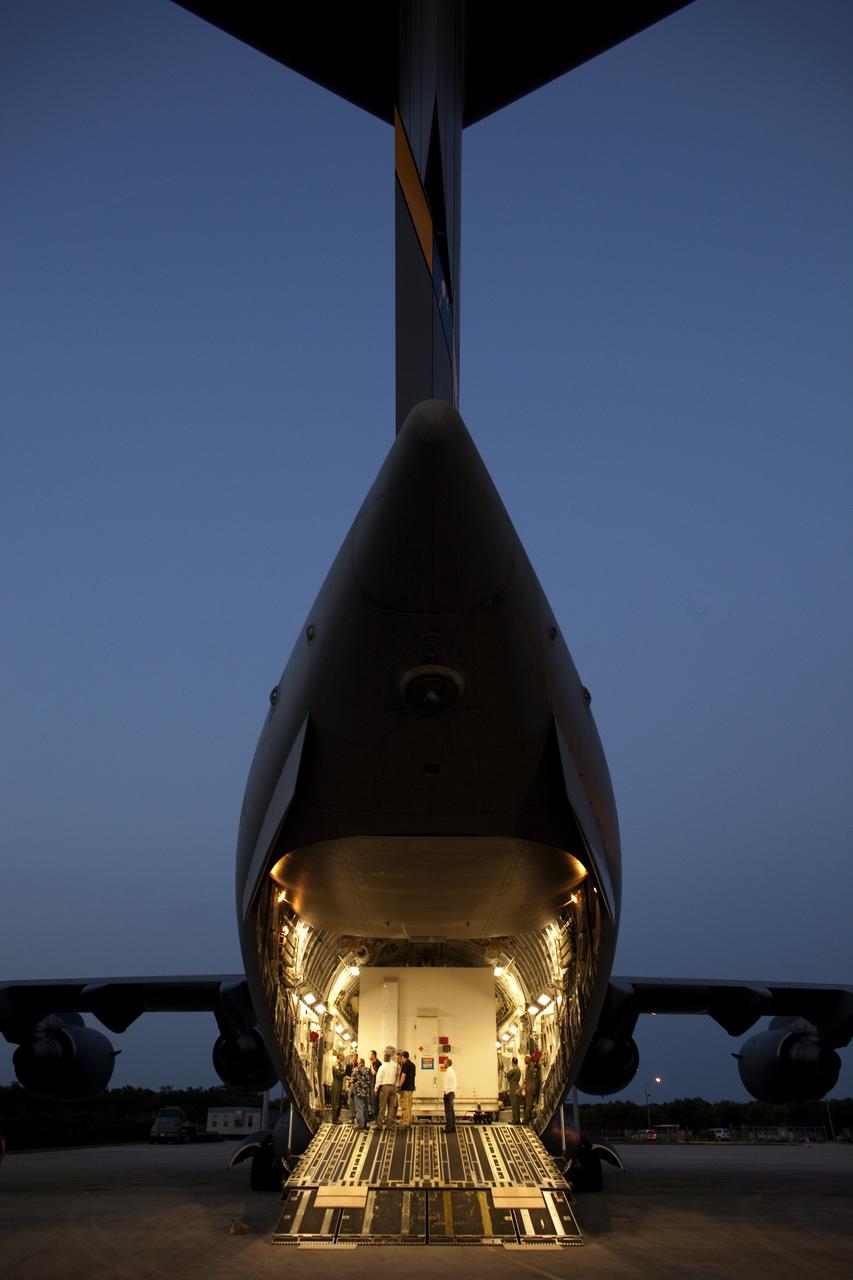
CAPE CANAVERAL, Fla. -- NASA's Gravity Recovery and Interior Laboratory, or GRAIL, spacecraft will be offloaded from an Air Force C-17 cargo plane on the Shuttle Landing Facility at Kennedy Space Center in Florida. The spacecraft traveled from the Lockheed Martin plant in Denver, Colo., and will undergo further processing in the Astrotech payload processing facility in Titusville, Fla. The United Launch Alliance Delta II rocket that will carry GRAIL into lunar orbit already is fully stacked at NASA's Space Launch Complex 17B and launch is scheduled for Sept. 8. The GRAIL mission is a part of NASA's Discovery Program. GRAIL will fly twin spacecraft in tandem orbits around the moon for several months to measure its gravity field. The mission also will answer longstanding questions about Earth's moon and provide scientists a better understanding of how Earth and other rocky planets in the solar system formed. For more information, visit http://science.nasa.gov/missions/grail/. Photo credit: NASA/Dimitri Gerondidakis

CAPE CANAVERAL, Fla. -- At NASA's Space Launch Complex 17B in Florida, workers using an overhead crane hoist the second stage of a United Launch Alliance Delta II launch vehicle into the tower to be mated with the first stage. The payload fairing then will be raised into the white room of the mobile service tower. The Delta II will carry NASA's Gravity Recovery and Interior Laboratory, or GRAIL, spacecraft into lunar orbit. The GRAIL mission is a part of NASA's Discovery Program. GRAIL will fly twin spacecraft in tandem orbits around the moon for several months to measure its gravity field. The mission also will answer longstanding questions about Earth's moon and provide scientists a better understanding of how Earth and other rocky planets in the solar system formed. GRAIL is scheduled to launch Sept. 8. For more information visit: http://science.nasa.gov/missions/grail/. Photo credit: NASA/Jack Pfaller
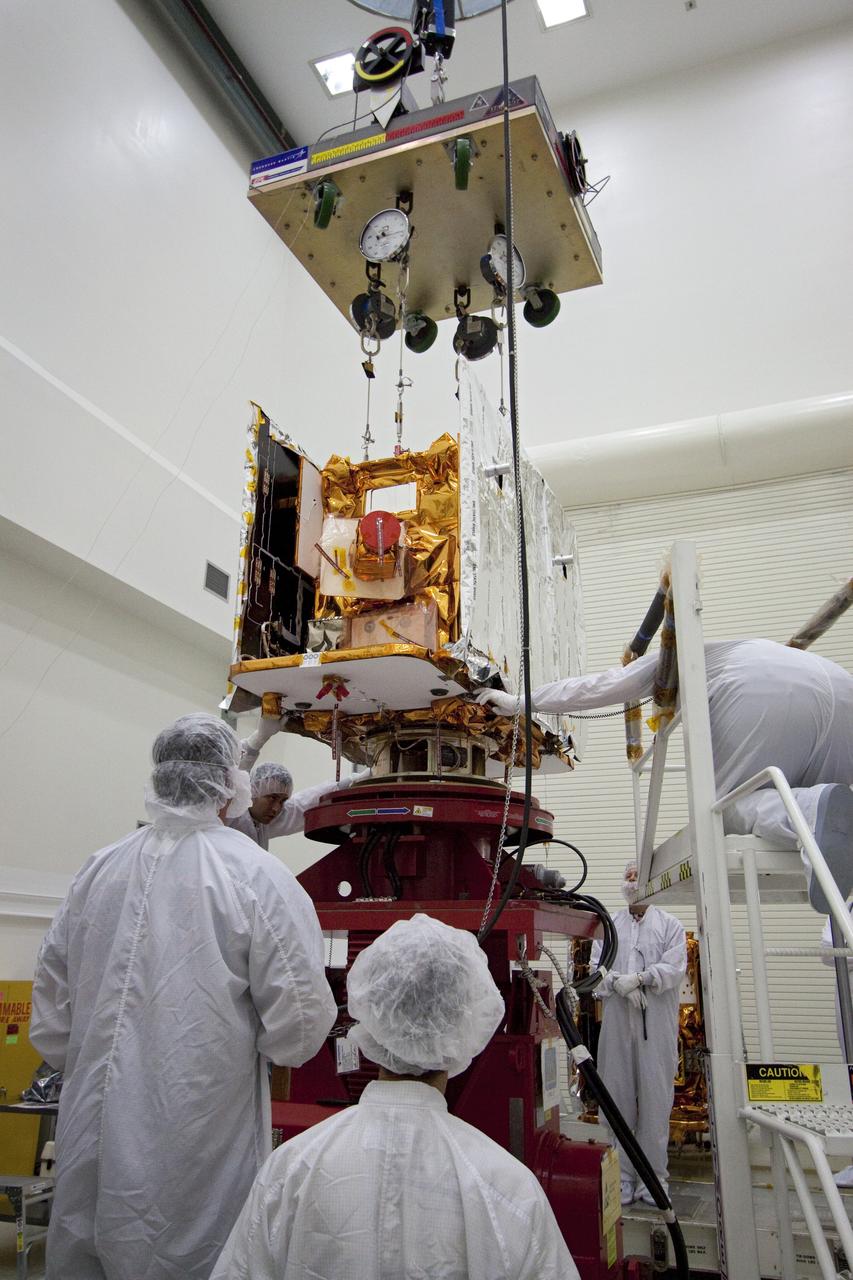
CAPE CANAVERAL, Fla. -- Technicians lower one of two spacecraft for NASA's Gravity Recovery and Interior Laboratory, or GRAIL, to a test stand in the Astrotech payload processing facility in Titusville, Fla. The twin spacecraft were built at the Lockheed Martin plant in Denver, Colo. The United Launch Alliance Delta II rocket that will carry GRAIL into lunar orbit already is fully stacked at NASA's Space Launch Complex 17B and launch is scheduled for Sept. 8. The GRAIL mission is a part of NASA's Discovery Program. GRAIL will fly twin spacecraft in tandem orbits around the moon for several months to measure its gravity field. The mission also will answer longstanding questions about Earth's moon and provide scientists a better understanding of how Earth and other rocky planets in the solar system formed. For more information, visit http://science.nasa.gov/missions/grail/. Photo credit: NASA/Jack Pfaller
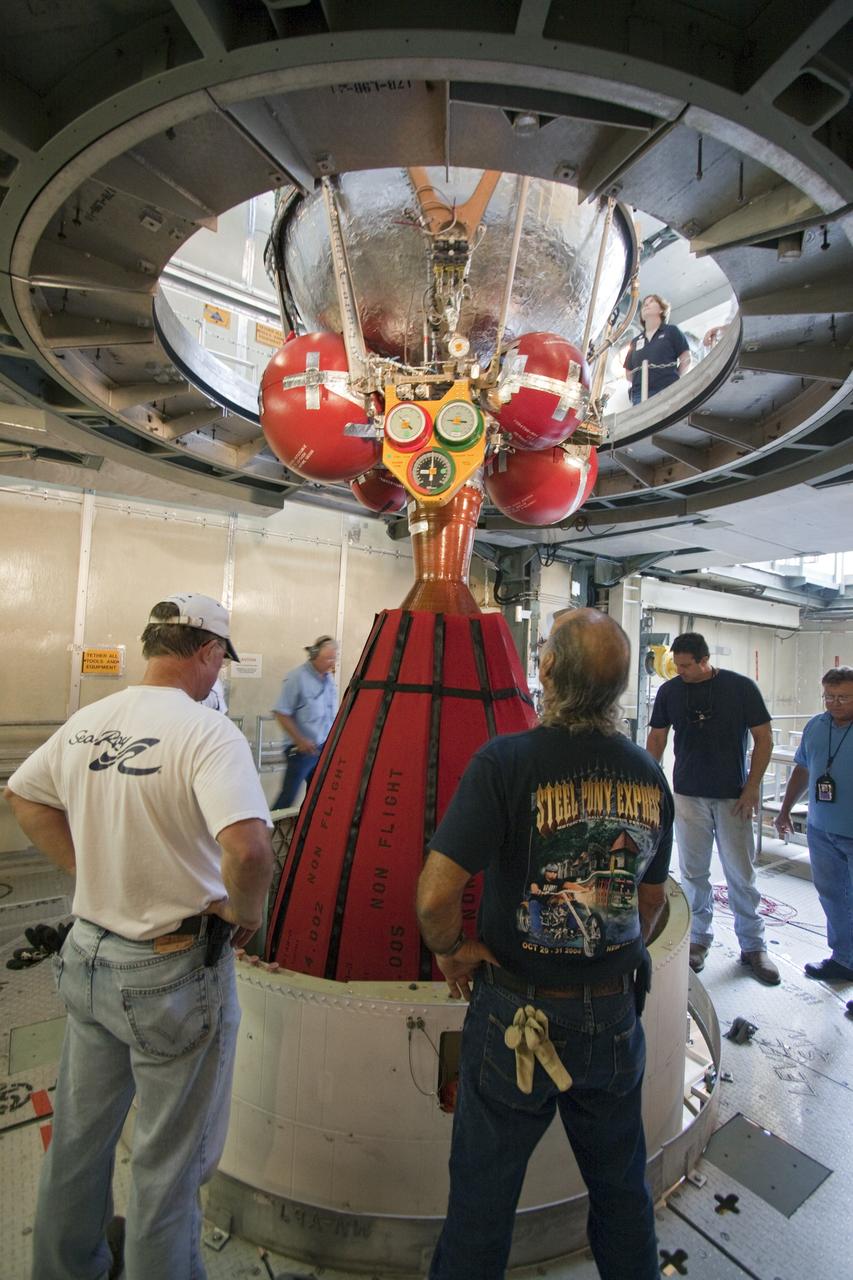
CAPE CANAVERAL, Fla. -- At NASA's Space Launch Complex 17B in Florida, workers using an overhead crane lower the second stage of a United Launch Alliance Delta II launch vehicle toward the first stage for mating. The payload fairing then will be raised into the white room of the mobile service tower. The Delta II will carry NASA's Gravity Recovery and Interior Laboratory, or GRAIL, spacecraft into lunar orbit. The GRAIL mission is a part of NASA's Discovery Program. GRAIL will fly twin spacecraft in tandem orbits around the moon for several months to measure its gravity field. The mission also will answer longstanding questions about Earth's moon and provide scientists a better understanding of how Earth and other rocky planets in the solar system formed. GRAIL is scheduled to launch Sept. 8. For more information visit: http://science.nasa.gov/missions/grail/. Photo credit: NASA/Jack Pfaller
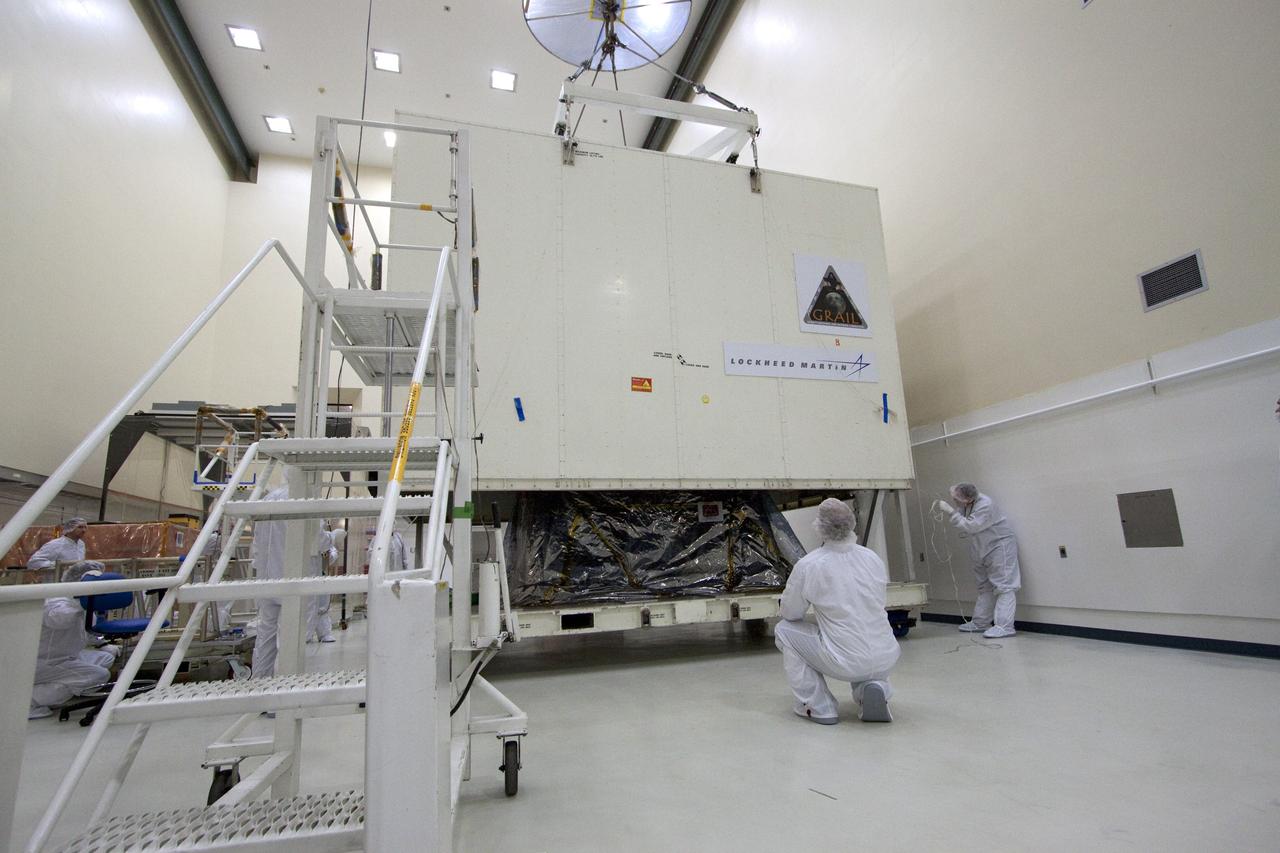
CAPE CANAVERAL, Fla. -- Technicians in the Astrotech payload processing facility in Titusville, Fla., begin to unpack NASA's Gravity Recovery and Interior Laboratory, or GRAIL, twin spacecraft for testing and processing. GRAIL was built at the Lockheed Martin plant in Denver, Colo. The United Launch Alliance Delta II rocket that will carry GRAIL into lunar orbit already is fully stacked at NASA's Space Launch Complex 17B and launch is scheduled for Sept. 8. The GRAIL mission is a part of NASA's Discovery Program. GRAIL will fly twin spacecraft in tandem orbits around the moon for several months to measure its gravity field. The mission also will answer longstanding questions about Earth's moon and provide scientists a better understanding of how Earth and other rocky planets in the solar system formed. For more information, visit http://science.nasa.gov/missions/grail/. Photo credit: NASA/Jack Pfaller
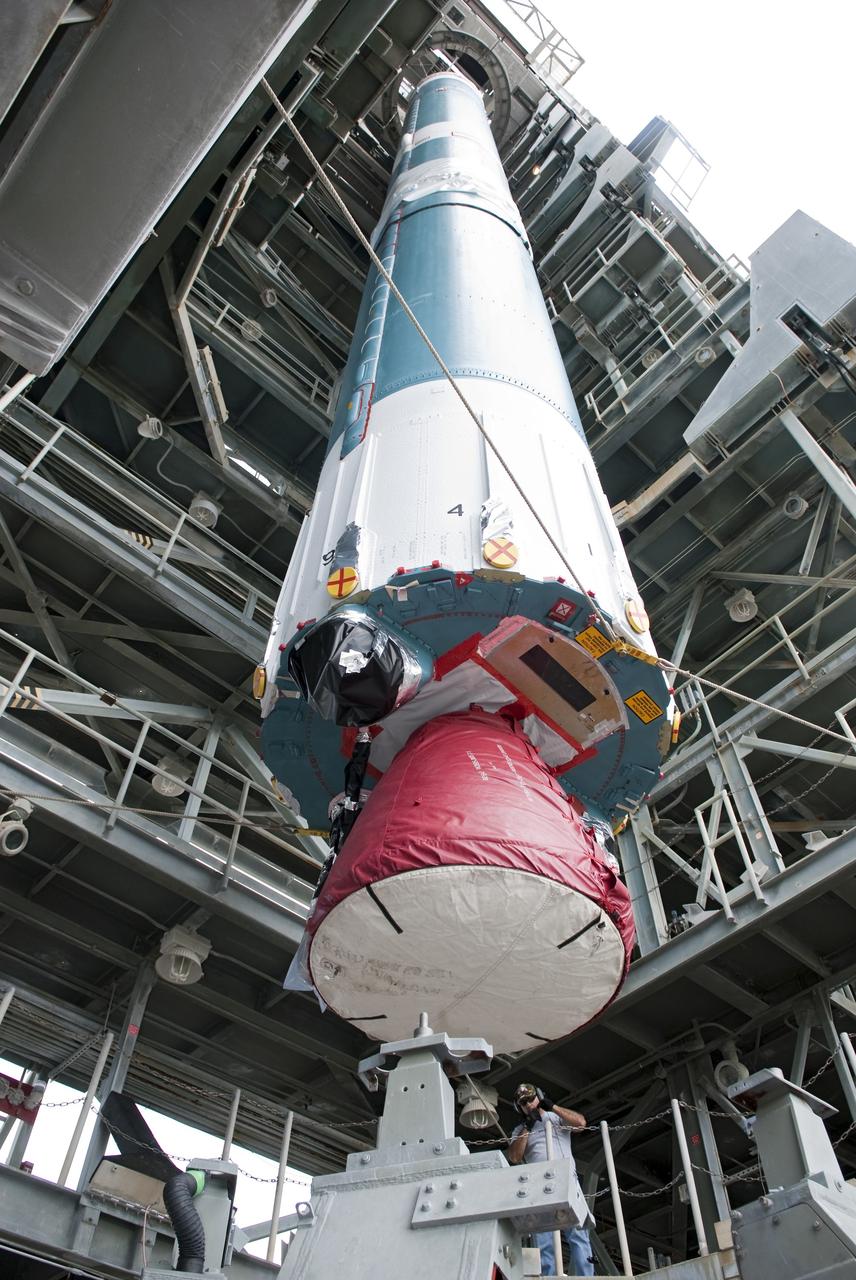
CAPE CANAVERAL, Fla. -- At Cape Canaveral Air Force Station in Florida, the first stage of a United Launch Alliance Delta II launch vehicle is being lifted into position in the Pad 17B gantry. The Delta II will carry NASA's Gravity Recovery and Interior Laboratory, or GRAIL, spacecraft into lunar orbit. The GRAIL mission is a part of NASA's Discovery Program. GRAIL will fly twin spacecraft in tandem orbits around the moon for several months to measure its gravity field. The mission also will answer longstanding questions about Earth's moon and provide scientists a better understanding of how Earth and other rocky planets in the solar system formed. GRAIL is scheduled to launch September 8, 2011. For more information visit: http://science.nasa.gov/missions/grail/. Photo credit: NASA/Jim Grossmann
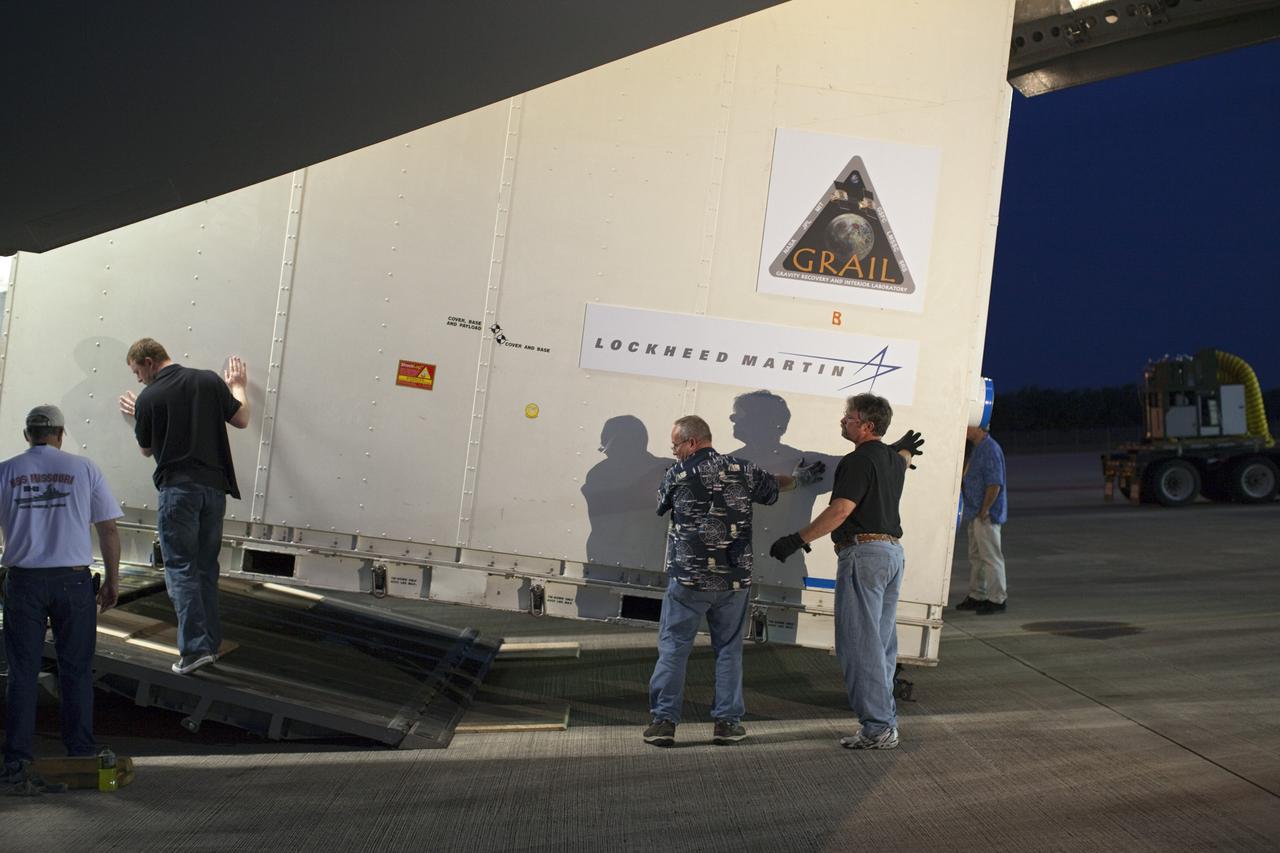
CAPE CANAVERAL, Fla. -- NASA's Gravity Recovery and Interior Laboratory, or GRAIL, spacecraft is offloaded from an Air Force C-17 cargo plane on the Shuttle Landing Facility at Kennedy Space Center in Florida. The spacecraft traveled from the Lockheed Martin plant in Denver, Colo., and will undergo further processing in the Astrotech payload processing facility in Titusville, Fla. The United Launch Alliance Delta II rocket that will carry GRAIL into lunar orbit already is fully stacked at NASA's Space Launch Complex 17B and launch is scheduled for Sept. 8. The GRAIL mission is a part of NASA's Discovery Program. GRAIL will fly twin spacecraft in tandem orbits around the moon for several months to measure its gravity field. The mission also will answer longstanding questions about Earth's moon and provide scientists a better understanding of how Earth and other rocky planets in the solar system formed. For more information, visit http://science.nasa.gov/missions/grail/. Photo credit: NASA/Dimitri Gerondidakis
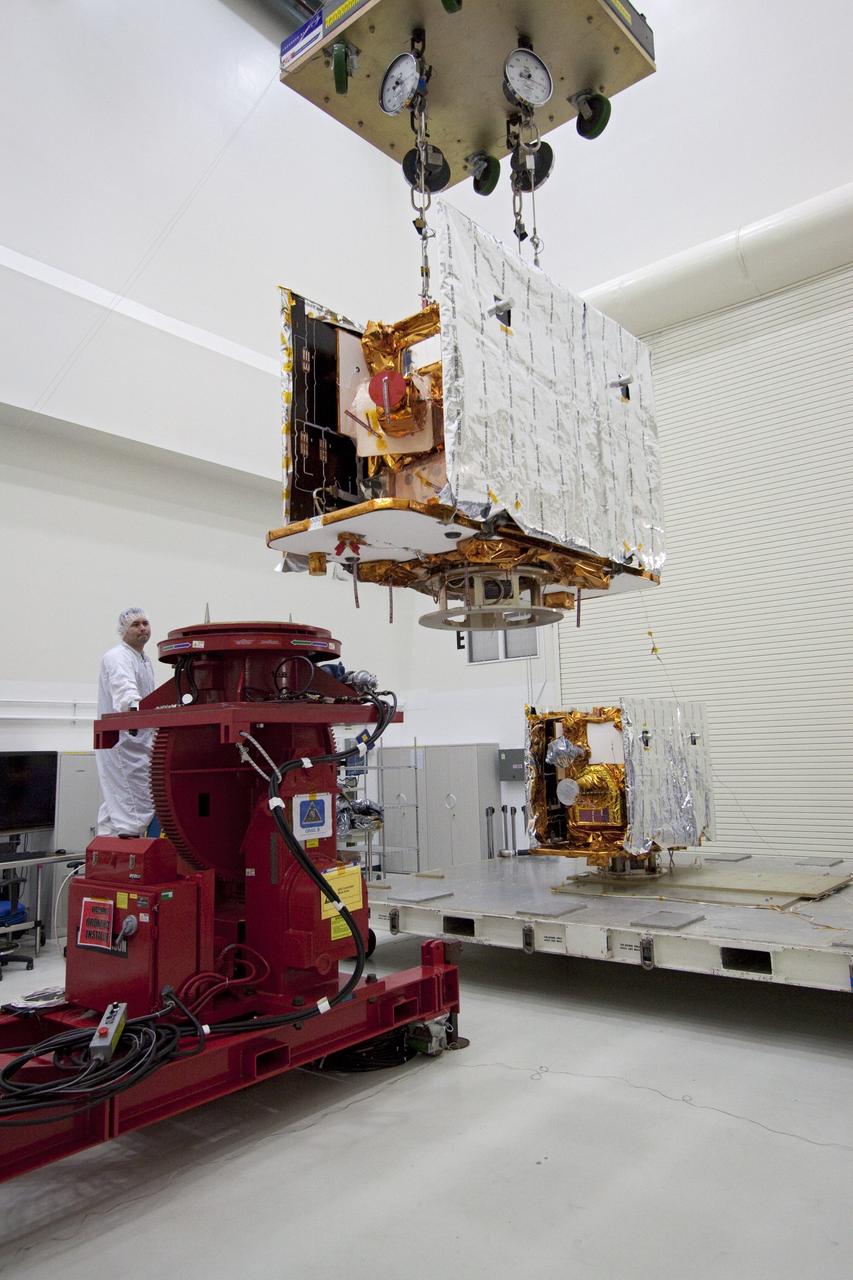
CAPE CANAVERAL, Fla. -- Technicians lift one of two spacecraft for NASA's Gravity Recovery and Interior Laboratory, or GRAIL, to a test stand in the Astrotech payload processing facility in Titusville, Fla. The twin spacecraft were built at the Lockheed Martin plant in Denver, Colo. The United Launch Alliance Delta II rocket that will carry GRAIL into lunar orbit already is fully stacked at NASA's Space Launch Complex 17B and launch is scheduled for Sept. 8. The GRAIL mission is a part of NASA's Discovery Program. GRAIL will fly twin spacecraft in tandem orbits around the moon for several months to measure its gravity field. The mission also will answer longstanding questions about Earth's moon and provide scientists a better understanding of how Earth and other rocky planets in the solar system formed. For more information, visit http://science.nasa.gov/missions/grail/. Photo credit: NASA/Jack Pfaller
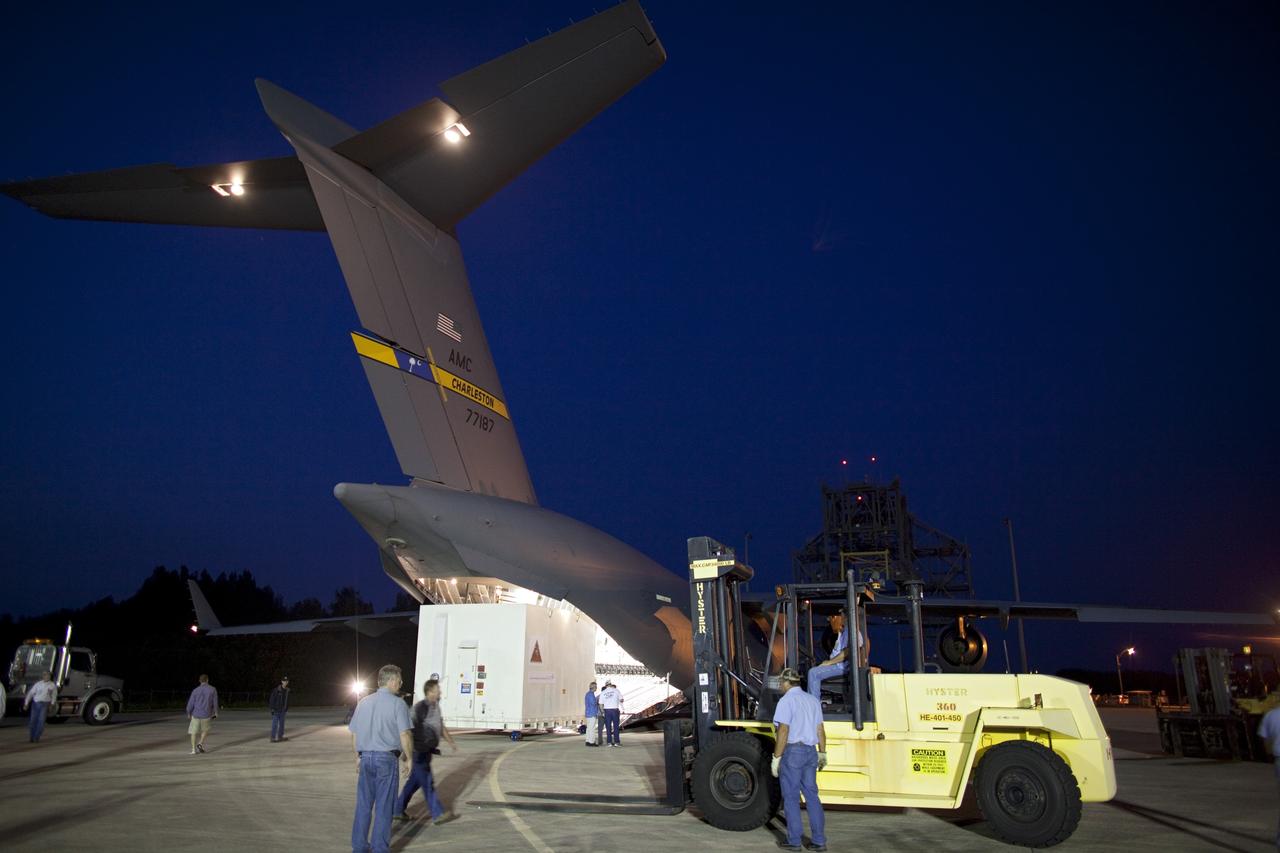
CAPE CANAVERAL, Fla. -- NASA's Gravity Recovery and Interior Laboratory, or GRAIL, spacecraft is offloaded from an Air Force C-17 cargo plane on the Shuttle Landing Facility at Kennedy Space Center in Florida. The spacecraft traveled from the Lockheed Martin plant in Denver, Colo., and will undergo further processing in the Astrotech payload processing facility in Titusville, Fla. The United Launch Alliance Delta II rocket that will carry GRAIL into lunar orbit already is fully stacked at NASA's Space Launch Complex 17B and launch is scheduled for Sept. 8. The GRAIL mission is a part of NASA's Discovery Program. GRAIL will fly twin spacecraft in tandem orbits around the moon for several months to measure its gravity field. The mission also will answer longstanding questions about Earth's moon and provide scientists a better understanding of how Earth and other rocky planets in the solar system formed. For more information, visit http://science.nasa.gov/missions/grail/. Photo credit: NASA/Dimitri Gerondidakis

CAPE CANAVERAL, Fla. -- Workers at Cape Canaveral Air Force Station's Pad 17B secure the first stage of a United Launch Alliance Delta II launch vehicle to the gantry. The Delta II will carry NASA's Gravity Recovery and Interior Laboratory, or GRAIL, spacecraft into lunar orbit. The GRAIL mission is a part of NASA's Discovery Program. GRAIL will fly twin spacecraft in tandem orbits around the moon for several months to measure its gravity field. The mission also will answer longstanding questions about Earth's moon and provide scientists a better understanding of how Earth and other rocky planets in the solar system formed. GRAIL is scheduled to launch September 8, 2011. For more information visit: http://science.nasa.gov/missions/grail/. Photo credit: NASA/Jim Grossmann
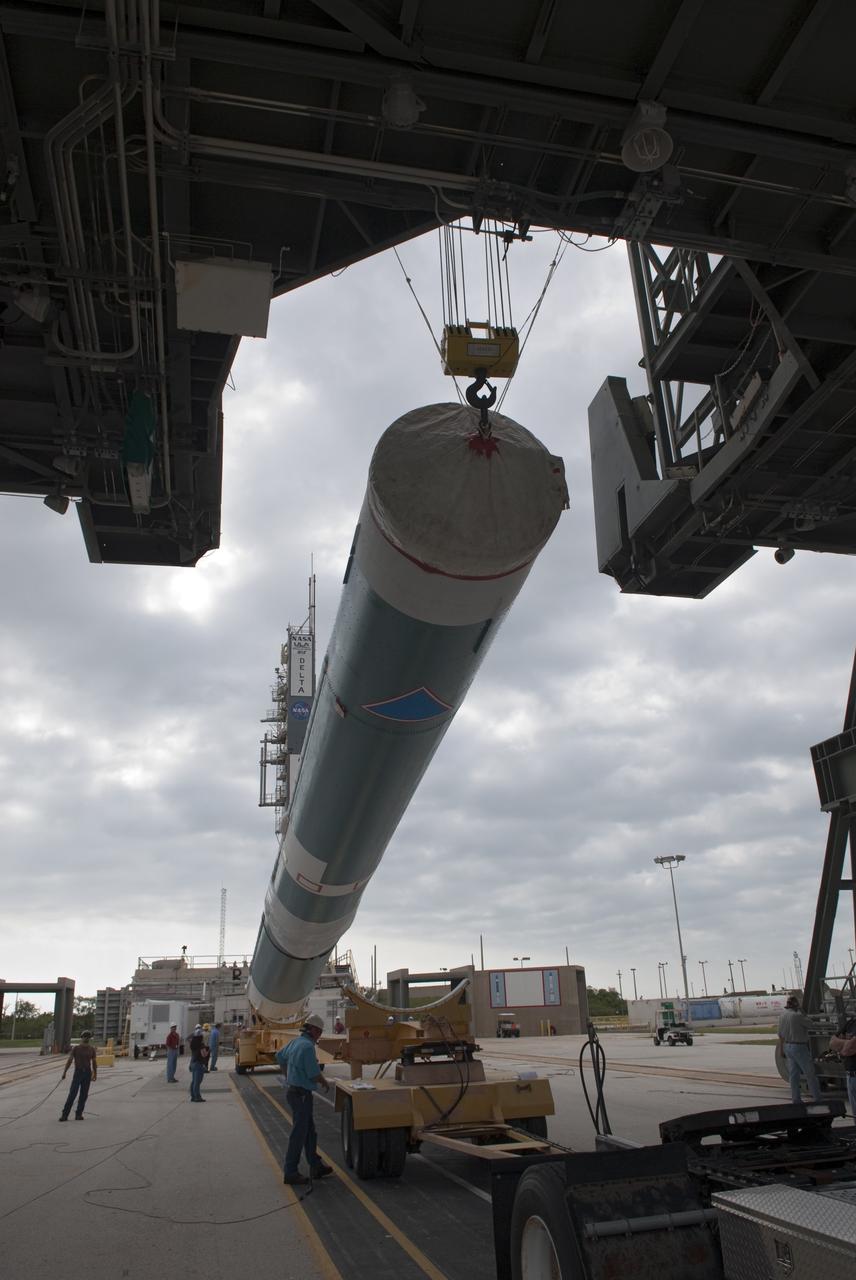
CAPE CANAVERAL, Fla. -- An overhead crane lifts the first stage of a United Launch Alliance Delta II launch vehicle into Pad 17B's gantry at Cape Canaveral Air Force Station in Florida. The Delta II will carry NASA's Gravity Recovery and Interior Laboratory, or GRAIL, spacecraft into lunar orbit. The GRAIL mission is a part of NASA's Discovery Program. GRAIL will fly twin spacecraft in tandem orbits around the moon for several months to measure its gravity field. The mission also will answer longstanding questions about Earth's moon and provide scientists a better understanding of how Earth and other rocky planets in the solar system formed. GRAIL is scheduled to launch September 8, 2011. For more information visit: http://science.nasa.gov/missions/grail/. Photo credit: NASA/Jim Grossmann

CAPE CANAVERAL, Fla. -- At NASA's Space Launch Complex 17B in Florida, workers using an overhead crane lower the second stage of a United Launch Alliance Delta II launch vehicle toward the first stage for mating. The payload fairing then will be raised into the white room of the mobile service tower. The Delta II will carry NASA's Gravity Recovery and Interior Laboratory, or GRAIL, spacecraft into lunar orbit. The GRAIL mission is a part of NASA's Discovery Program. GRAIL will fly twin spacecraft in tandem orbits around the moon for several months to measure its gravity field. The mission also will answer longstanding questions about Earth's moon and provide scientists a better understanding of how Earth and other rocky planets in the solar system formed. GRAIL is scheduled to launch Sept. 8. For more information visit: http://science.nasa.gov/missions/grail/. Photo credit: NASA/Jack Pfaller
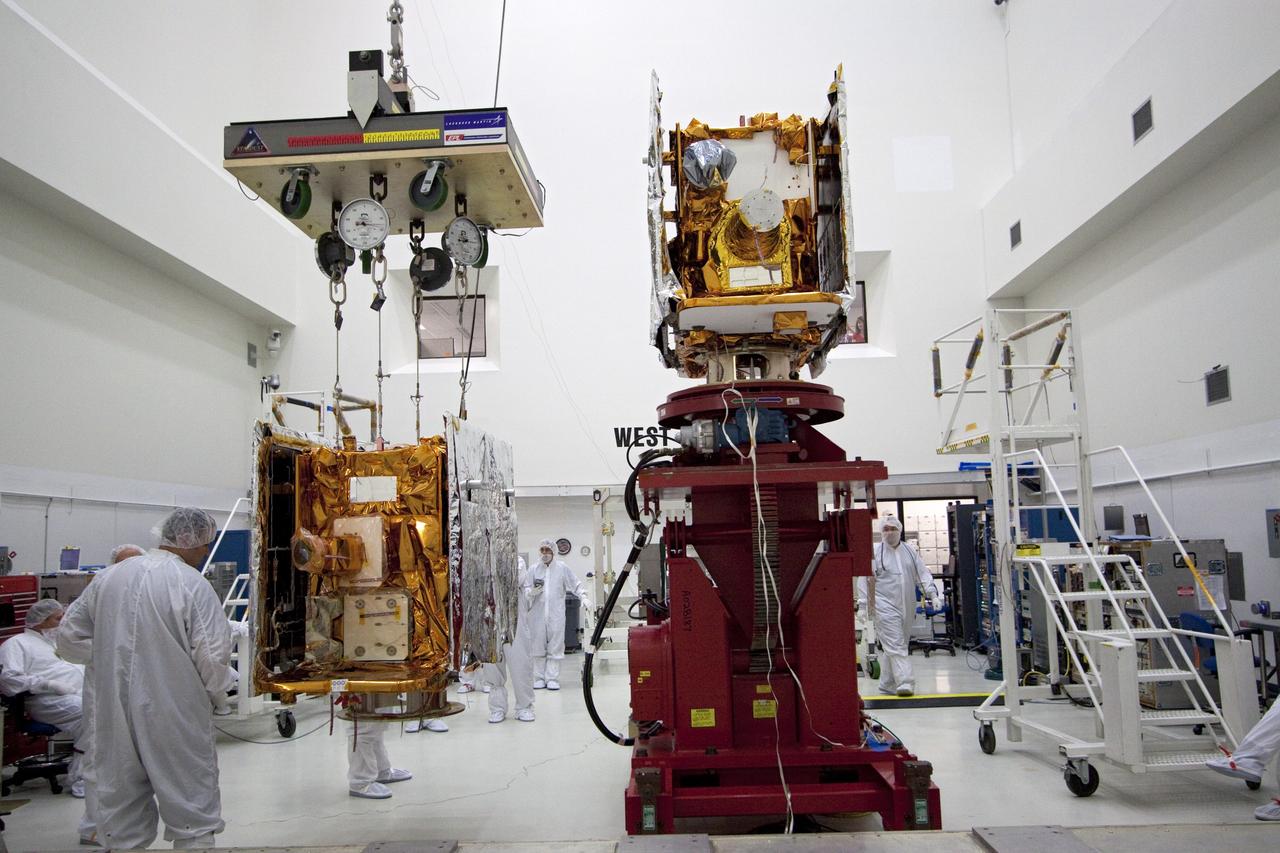
CAPE CANAVERAL, Fla. -- Technicians lift one of two spacecraft for NASA's Gravity Recovery and Interior Laboratory, or GRAIL, to a test stand in the Astrotech payload processing facility in Titusville, Fla. The twin spacecraft were built at the Lockheed Martin plant in Denver, Colo. The United Launch Alliance Delta II rocket that will carry GRAIL into lunar orbit already is fully stacked at NASA's Space Launch Complex 17B and launch is scheduled for Sept. 8. The GRAIL mission is a part of NASA's Discovery Program. GRAIL will fly twin spacecraft in tandem orbits around the moon for several months to measure its gravity field. The mission also will answer longstanding questions about Earth's moon and provide scientists a better understanding of how Earth and other rocky planets in the solar system formed. For more information, visit http://science.nasa.gov/missions/grail/. Photo credit: NASA/Jack Pfaller

CAPE CANAVERAL, Fla. -- NASA's Gravity Recovery and Interior Laboratory, or GRAIL, spacecraft is loaded onto a tractor-trailer for transport to the Astrotech payload processing facility in Titusville, Fla., where it will be processed for launch. An Air Force C-17 cargo plane flew the spacecraft from the Lockheed Martin plant in Denver, Colo., to the Shuttle Landing Facility at Kennedy Space Center in Florida. The United Launch Alliance Delta II rocket that will carry GRAIL into lunar orbit already is fully stacked at NASA's Space Launch Complex 17B and launch is scheduled for Sept. 8. The GRAIL mission is a part of NASA's Discovery Program. GRAIL will fly twin spacecraft in tandem orbits around the moon for several months to measure its gravity field. The mission also will answer longstanding questions about Earth's moon and provide scientists a better understanding of how Earth and other rocky planets in the solar system formed. For more information, visit http://science.nasa.gov/missions/grail/. Photo credit: NASA/Dimitri Gerondidakis
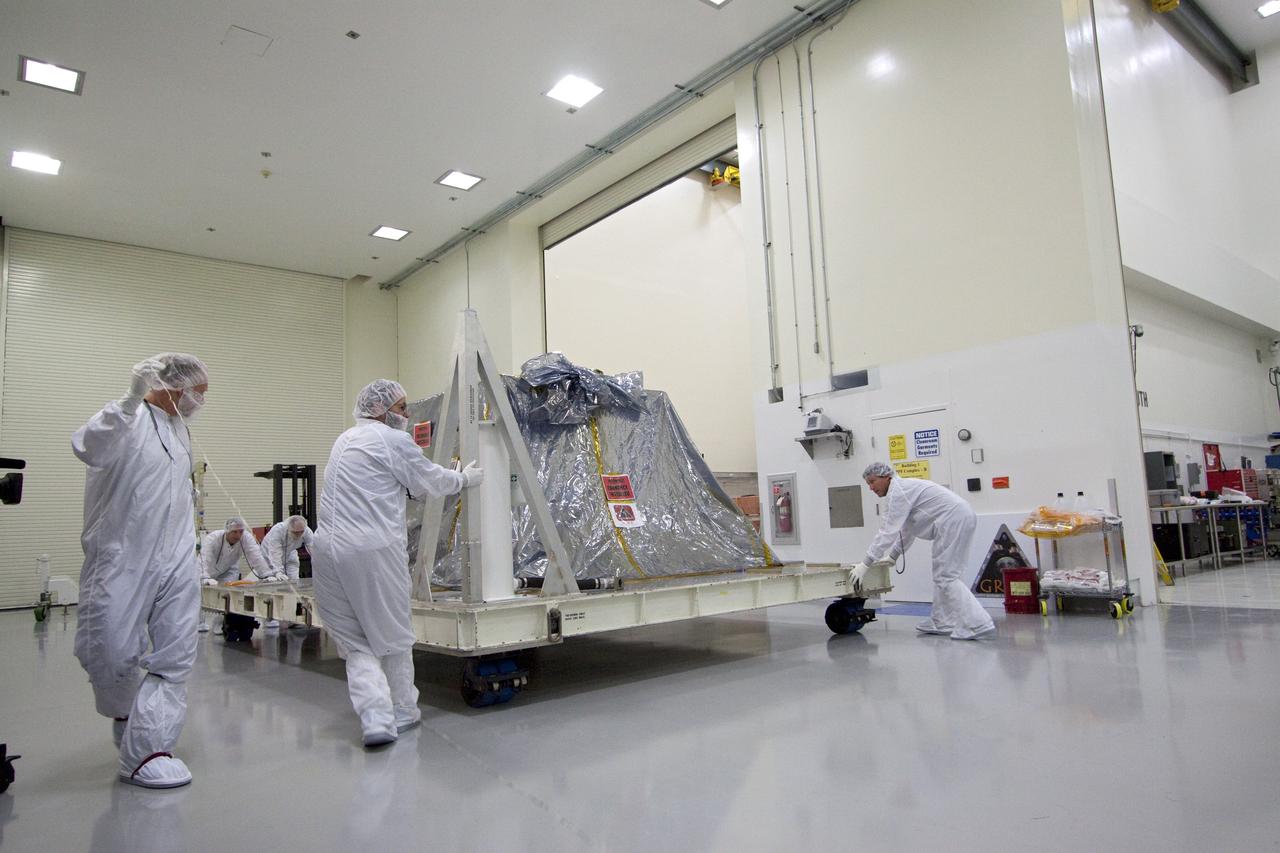
CAPE CANAVERAL, Fla. -- Technicians in the Astrotech payload processing facility in Titusville, Fla., roll NASA's Gravity Recovery and Interior Laboratory, or GRAIL, twin spacecraft toward a test stand where they will be processed for launch. GRAIL was built at the Lockheed Martin plant in Denver, Colo. The United Launch Alliance Delta II rocket that will carry GRAIL into lunar orbit already is fully stacked at NASA's Space Launch Complex 17B and launch is scheduled for Sept. 8. The GRAIL mission is a part of NASA's Discovery Program. GRAIL will fly twin spacecraft in tandem orbits around the moon for several months to measure its gravity field. The mission also will answer longstanding questions about Earth's moon and provide scientists a better understanding of how Earth and other rocky planets in the solar system formed. For more information, visit http://science.nasa.gov/missions/grail/. Photo credit: NASA/Jack Pfaller
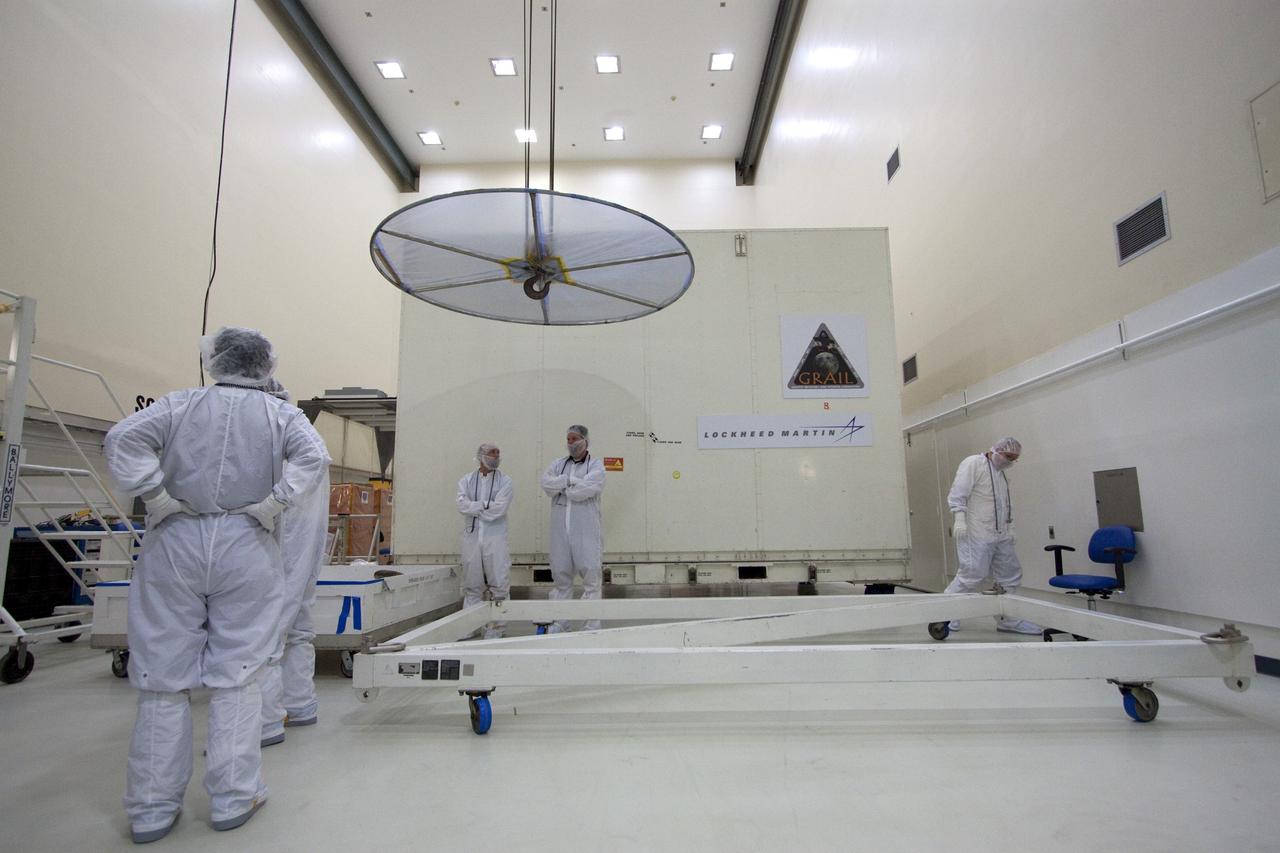
CAPE CANAVERAL, Fla. -- Technicians in the Astrotech payload processing facility in Titusville, Fla., prepare to unpack NASA's Gravity Recovery and Interior Laboratory, or GRAIL, twin spacecraft for testing and processing. GRAIL was built at the Lockheed Martin plant in Denver, Colo. The United Launch Alliance Delta II rocket that will carry GRAIL into lunar orbit already is fully stacked at NASA's Space Launch Complex 17B and launch is scheduled for Sept. 8. The GRAIL mission is a part of NASA's Discovery Program. GRAIL will fly twin spacecraft in tandem orbits around the moon for several months to measure its gravity field. The mission also will answer longstanding questions about Earth's moon and provide scientists a better understanding of how Earth and other rocky planets in the solar system formed. For more information, visit http://science.nasa.gov/missions/grail/. Photo credit: NASA/Jack Pfaller
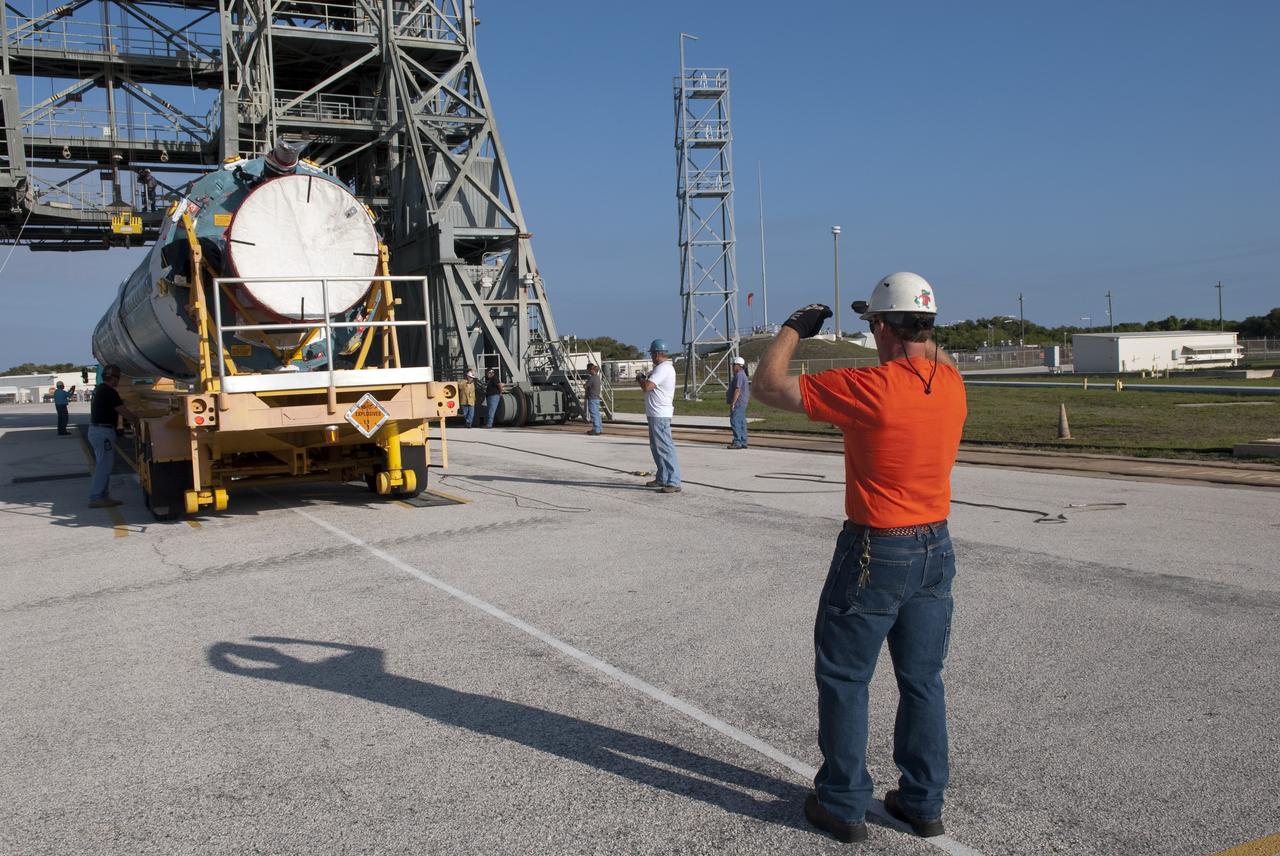
CAPE CANAVERAL, Fla. -- Workers prepare a crane to lift the first stage of a United Launch Alliance Delta II launch vehicle into Pad 17B's gantry at Cape Canaveral Air Force Station in Florida. The Delta II will carry NASA's Gravity Recovery and Interior Laboratory, or GRAIL, spacecraft into lunar orbit. The GRAIL mission is a part of NASA's Discovery Program. GRAIL will fly twin spacecraft in tandem orbits around the moon for several months to measure its gravity field. The mission also will answer longstanding questions about Earth's moon and provide scientists a better understanding of how Earth and other rocky planets in the solar system formed. GRAIL is scheduled to launch September 8, 2011. For more information visit: http://science.nasa.gov/missions/grail/. Photo credit: NASA/Jim Grossmann
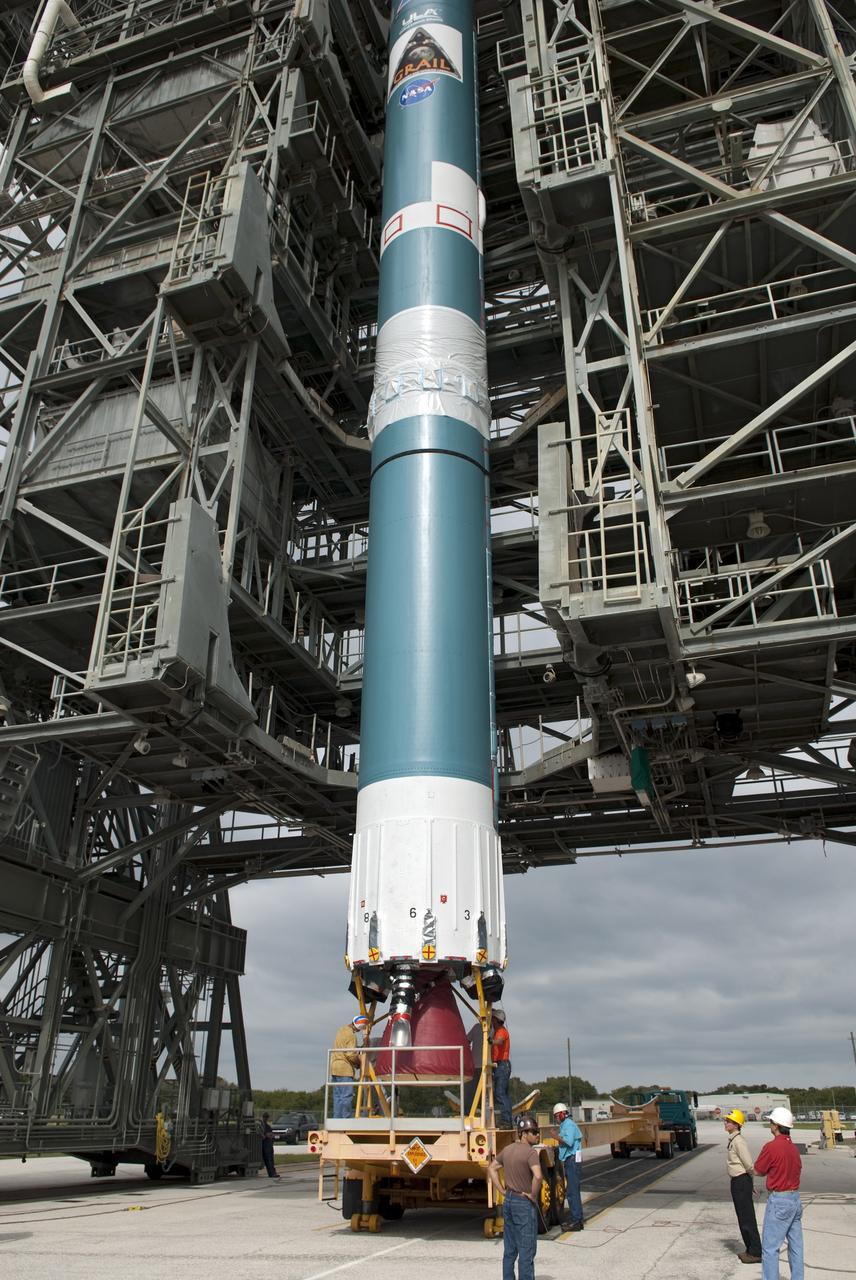
CAPE CANAVERAL, Fla. -- At Cape Canaveral Air Force Station in Florida, workers guide the first stage of a United Launch Alliance Delta II launch vehicle as it is being lifted into the Pad 17B gantry. The Delta II will carry NASA's Gravity Recovery and Interior Laboratory, or GRAIL, spacecraft into lunar orbit. The GRAIL mission is a part of NASA's Discovery Program. GRAIL will fly twin spacecraft in tandem orbits around the moon for several months to measure its gravity field. The mission also will answer longstanding questions about Earth's moon and provide scientists a better understanding of how Earth and other rocky planets in the solar system formed. GRAIL is scheduled to launch September 8, 2011. For more information visit: http://science.nasa.gov/missions/grail/. Photo credit: NASA/Jim Grossmann
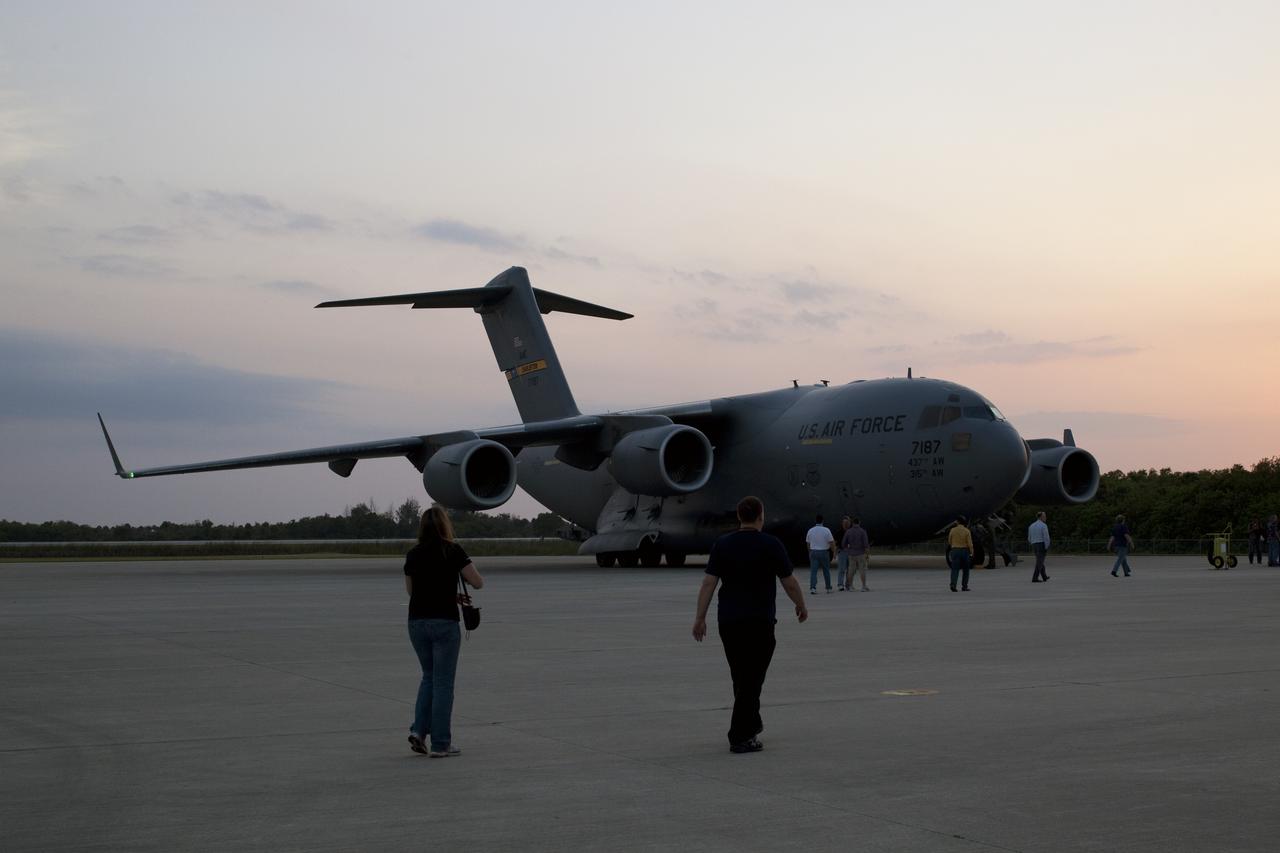
CAPE CANAVERAL, Fla. -- An Air Force C-17 cargo plane arrives on the Shuttle Landing Facility at NASA's Kennedy Space Center in Florida carrying the space agency's Gravity Recovery and Interior Laboratory, or GRAIL, spacecraft. The spacecraft traveled from the Lockheed Martin plant in Denver, Colo., and will undergo further processing in the Astrotech payload processing facility in Titusville, Fla. The United Launch Alliance Delta II rocket that will carry GRAIL into lunar orbit already is fully stacked at NASA's Space Launch Complex 17B and launch is scheduled for Sept. 8. The GRAIL mission is a part of NASA's Discovery Program. GRAIL will fly twin spacecraft in tandem orbits around the moon for several months to measure its gravity field. The mission also will answer longstanding questions about Earth's moon and provide scientists a better understanding of how Earth and other rocky planets in the solar system formed. For more information, visit http://science.nasa.gov/missions/grail/. Photo credit: NASA/Dimitri Gerondidakis
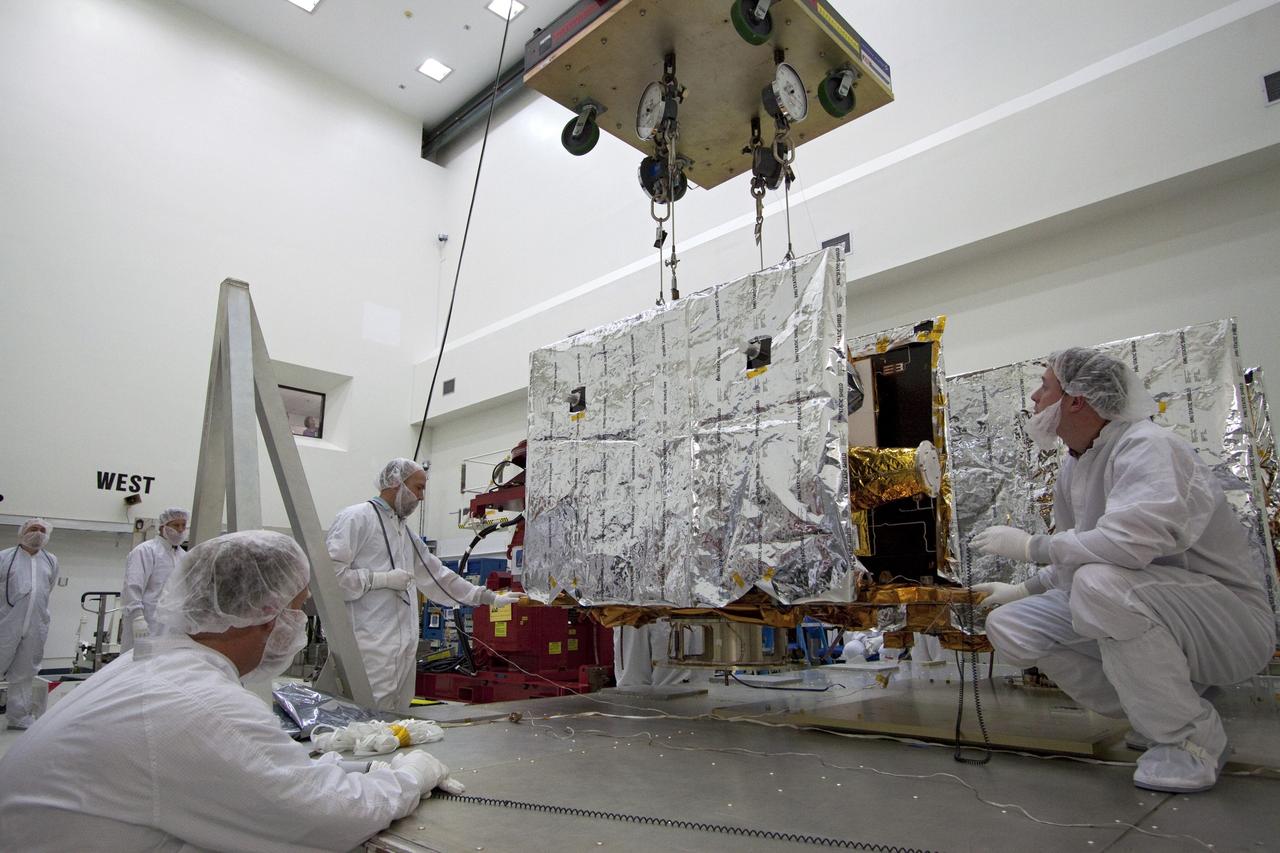
CAPE CANAVERAL, Fla. -- Technicians begin to lift one of two spacecraft for NASA's Gravity Recovery and Interior Laboratory, or GRAIL, to a test stand in the Astrotech payload processing facility in Titusville, Fla. The twin spacecraft were built at the Lockheed Martin plant in Denver, Colo. The United Launch Alliance Delta II rocket that will carry GRAIL into lunar orbit already is fully stacked at NASA's Space Launch Complex 17B and launch is scheduled for Sept. 8. The GRAIL mission is a part of NASA's Discovery Program. GRAIL will fly twin spacecraft in tandem orbits around the moon for several months to measure its gravity field. The mission also will answer longstanding questions about Earth's moon and provide scientists a better understanding of how Earth and other rocky planets in the solar system formed. For more information, visit http://science.nasa.gov/missions/grail/. Photo credit: NASA/Jack Pfaller
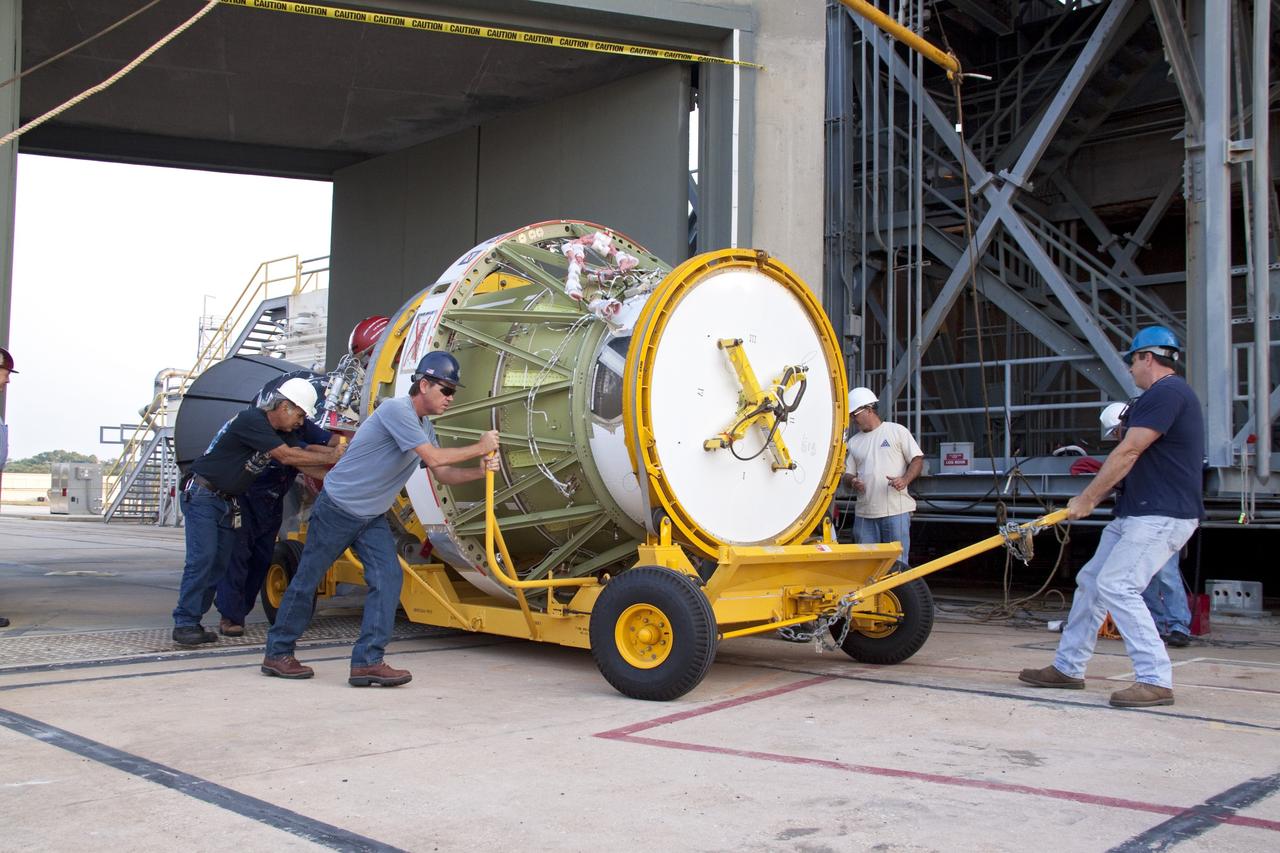
CAPE CANAVERAL, Fla. -- At NASA's Space Launch Complex 17B in Florida, workers move the second stage of a United Launch Alliance Delta II launch vehicle toward the mobile service tower. It will then be hoisted atop the first stage. The Delta II will carry NASA's Gravity Recovery and Interior Laboratory, or GRAIL, spacecraft into lunar orbit. The GRAIL mission is a part of NASA's Discovery Program. GRAIL will fly twin spacecraft in tandem orbits around the moon for several months to measure its gravity field. The mission also will answer longstanding questions about Earth's moon and provide scientists a better understanding of how Earth and other rocky planets in the solar system formed. GRAIL is scheduled to launch Sept. 8. For more information visit: http://science.nasa.gov/missions/grail/. Photo credit: NASA/Jack Pfaller
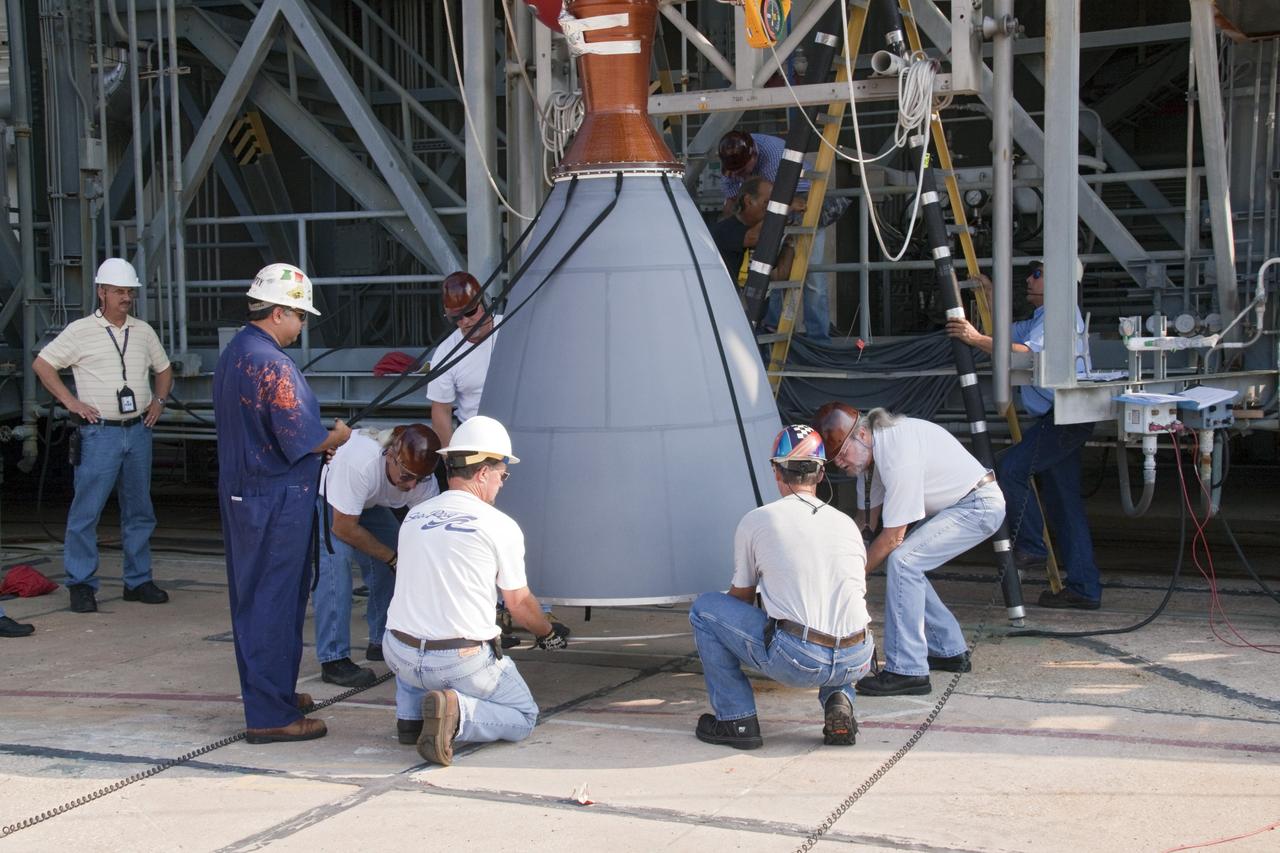
CAPE CANAVERAL, Fla. -- At NASA's Space Launch Complex 17B in Florida, workers secure the engine bell on the second stage of a United Launch Alliance Delta II launch vehicle before it is hoisted into the mobile service tower. The Delta II will carry NASA's Gravity Recovery and Interior Laboratory, or GRAIL, spacecraft into lunar orbit. The GRAIL mission is a part of NASA's Discovery Program. GRAIL will fly twin spacecraft in tandem orbits around the moon for several months to measure its gravity field. The mission also will answer longstanding questions about Earth's moon and provide scientists a better understanding of how Earth and other rocky planets in the solar system formed. GRAIL is scheduled to launch Sept. 8. For more information visit: http://science.nasa.gov/missions/grail/. Photo credit: NASA/Jack Pfaller
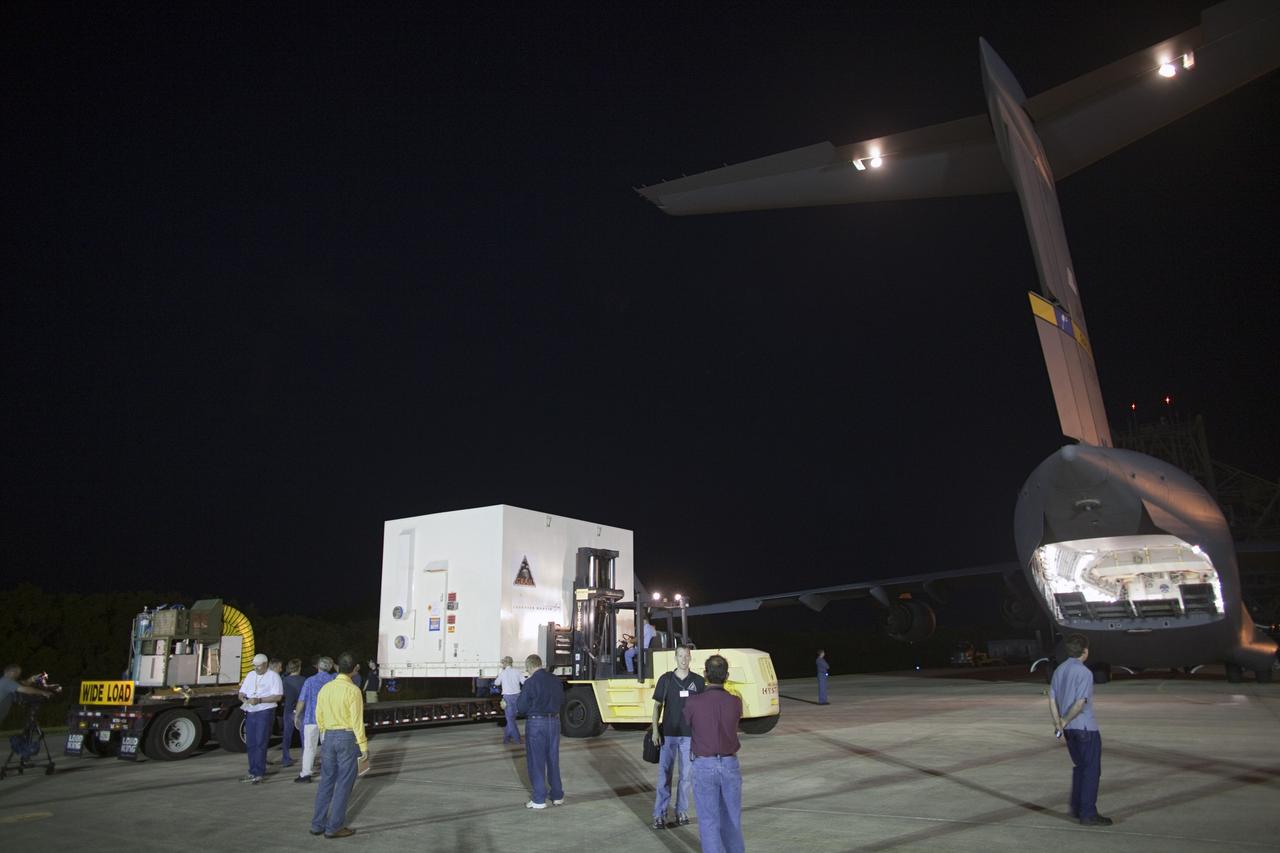
CAPE CANAVERAL, Fla. -- NASA's Gravity Recovery and Interior Laboratory, or GRAIL, spacecraft is loaded onto a tractor-trailer for transport to the Astrotech payload processing facility in Titusville, Fla., where it will be processed for launch. An Air Force C-17 cargo plane flew the spacecraft from the Lockheed Martin plant in Denver, Colo., to the Shuttle Landing Facility at Kennedy Space Center in Florida. The United Launch Alliance Delta II rocket that will carry GRAIL into lunar orbit already is fully stacked at NASA's Space Launch Complex 17B and launch is scheduled for Sept. 8. The GRAIL mission is a part of NASA's Discovery Program. GRAIL will fly twin spacecraft in tandem orbits around the moon for several months to measure its gravity field. The mission also will answer longstanding questions about Earth's moon and provide scientists a better understanding of how Earth and other rocky planets in the solar system formed. For more information, visit http://science.nasa.gov/missions/grail/. Photo credit: NASA/Dimitri Gerondidakis
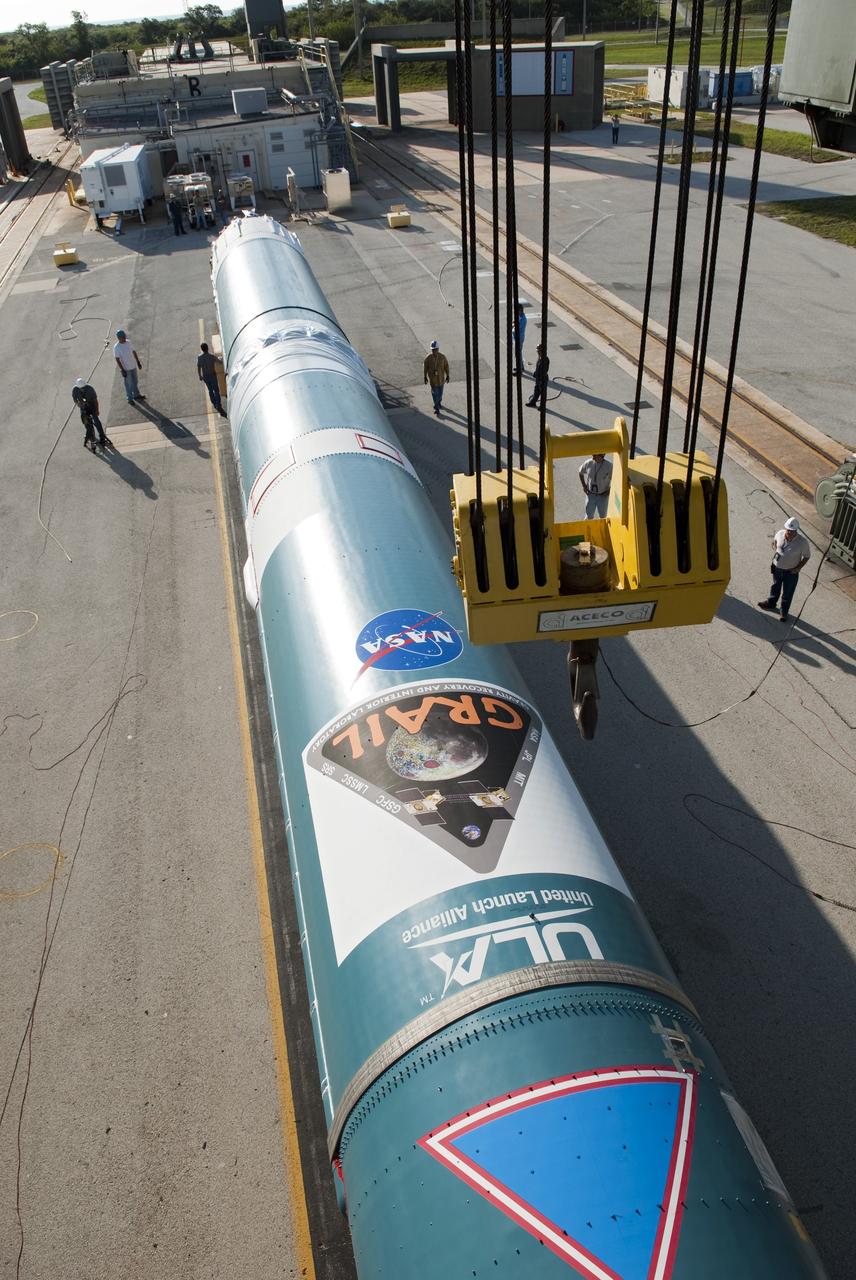
CAPE CANAVERAL, Fla. -- At Cape Canaveral Air Force Station in Florida, the first stage of a United Launch Alliance Delta II launch vehicle has arrived at Pad 17B. The Delta II will carry NASA's Gravity Recovery and Interior Laboratory, or GRAIL, spacecraft into lunar orbit. The GRAIL mission is a part of NASA's Discovery Program. GRAIL will fly twin spacecraft in tandem orbits around the moon for several months to measure its gravity field. The mission also will answer longstanding questions about Earth's moon and provide scientists a better understanding of how Earth and other rocky planets in the solar system formed. GRAIL is scheduled to launch September 8, 2011. For more information visit: http://science.nasa.gov/missions/grail/. Photo credit: NASA/Jim Grossmann
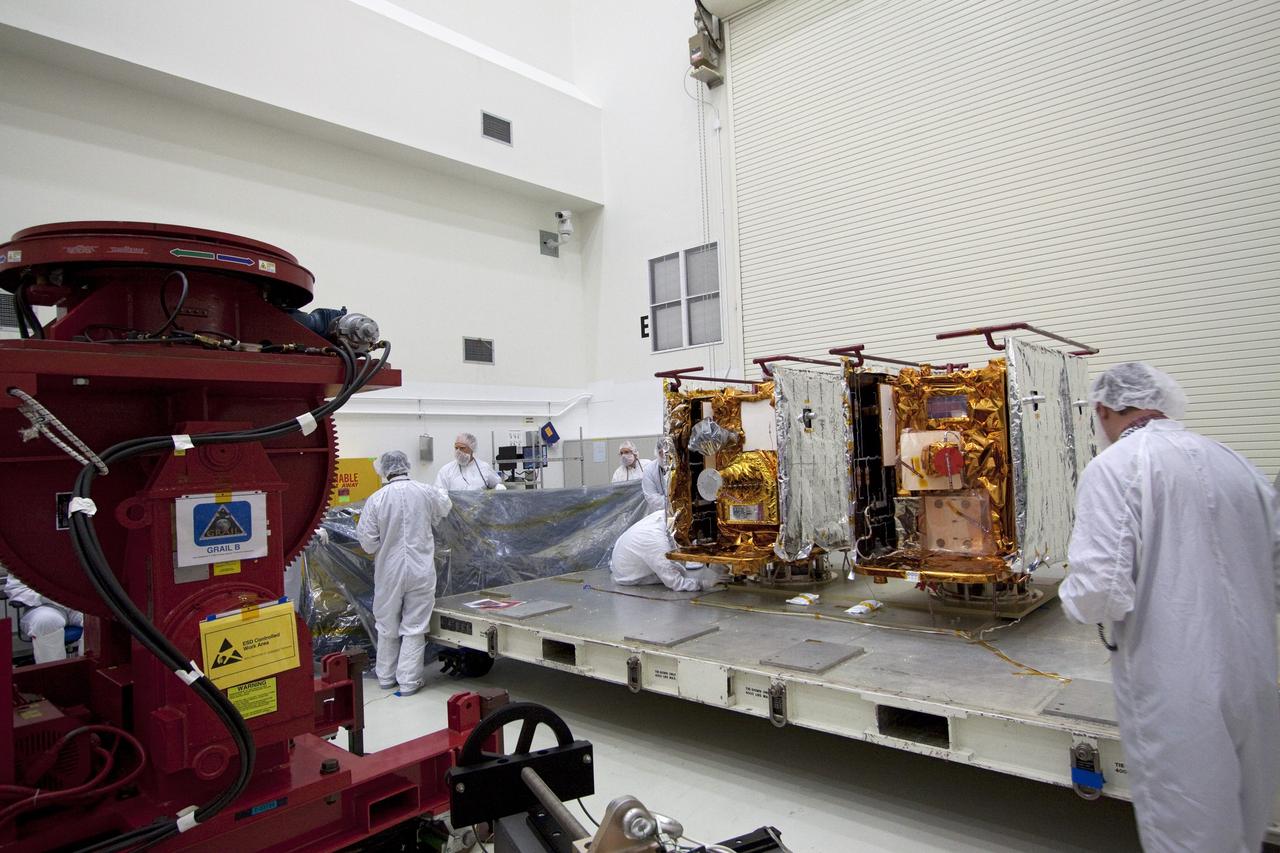
CAPE CANAVERAL, Fla. -- Technicians in the Astrotech payload processing facility in Titusville, Fla., prepare NASA's Gravity Recovery and Interior Laboratory, or GRAIL, twin spacecraft for testing and processing. GRAIL was built at the Lockheed Martin plant in Denver, Colo. The United Launch Alliance Delta II rocket that will carry GRAIL into lunar orbit already is fully stacked at NASA's Space Launch Complex 17B and launch is scheduled for Sept. 8. The GRAIL mission is a part of NASA's Discovery Program. GRAIL will fly twin spacecraft in tandem orbits around the moon for several months to measure its gravity field. The mission also will answer longstanding questions about Earth's moon and provide scientists a better understanding of how Earth and other rocky planets in the solar system formed. For more information, visit http://science.nasa.gov/missions/grail/. Photo credit: NASA/Jack Pfaller
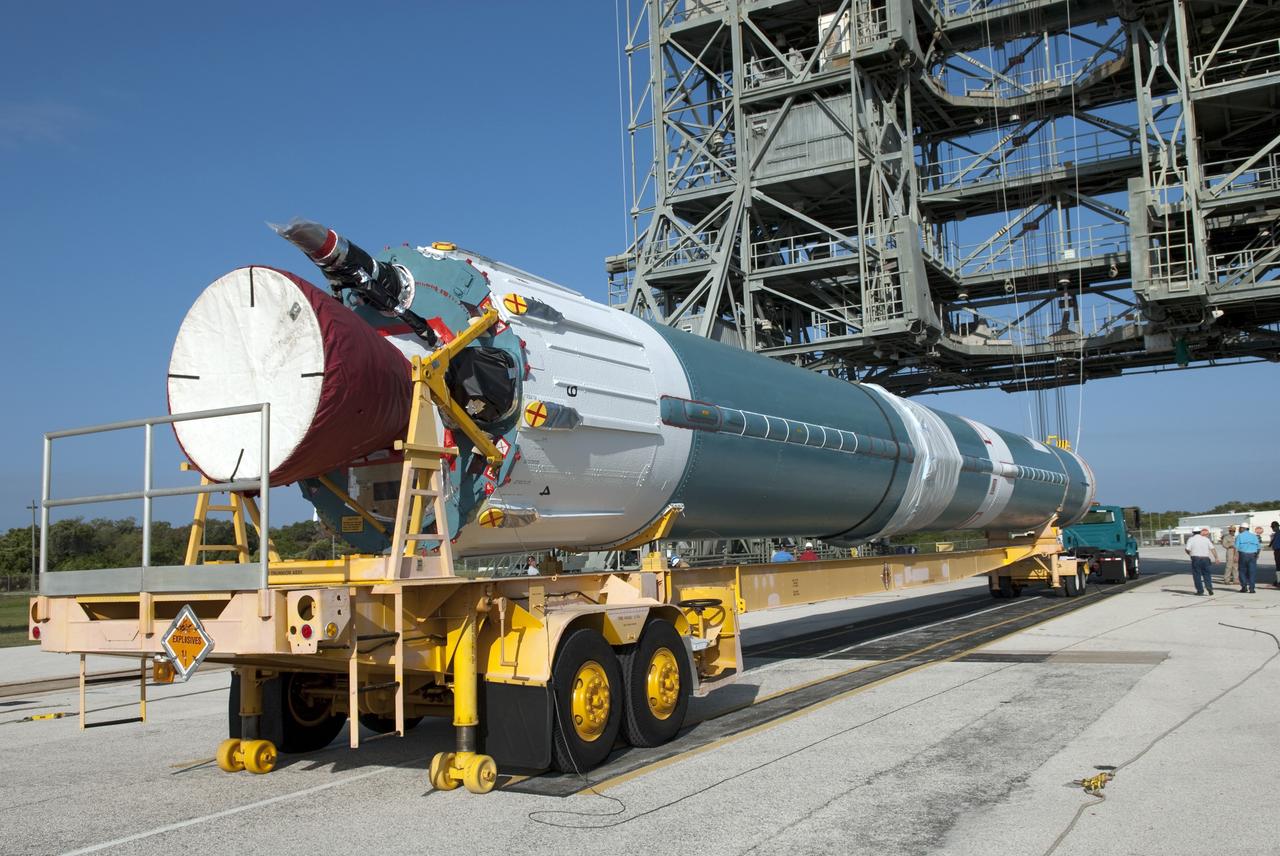
CAPE CANAVERAL, Fla. -- Workers prepare a crane to lift the first stage of a United Launch Alliance Delta II launch vehicle into Pad 17B's gantry at Cape Canaveral Air Force Station in Florida. The Delta II will carry NASA's Gravity Recovery and Interior Laboratory, or GRAIL, spacecraft into lunar orbit. The GRAIL mission is a part of NASA's Discovery Program. GRAIL will fly twin spacecraft in tandem orbits around the moon for several months to measure its gravity field. The mission also will answer longstanding questions about Earth's moon and provide scientists a better understanding of how Earth and other rocky planets in the solar system formed. GRAIL is scheduled to launch September 8, 2011. For more information visit: http://science.nasa.gov/missions/grail/. Photo credit: NASA/Jim Grossmann
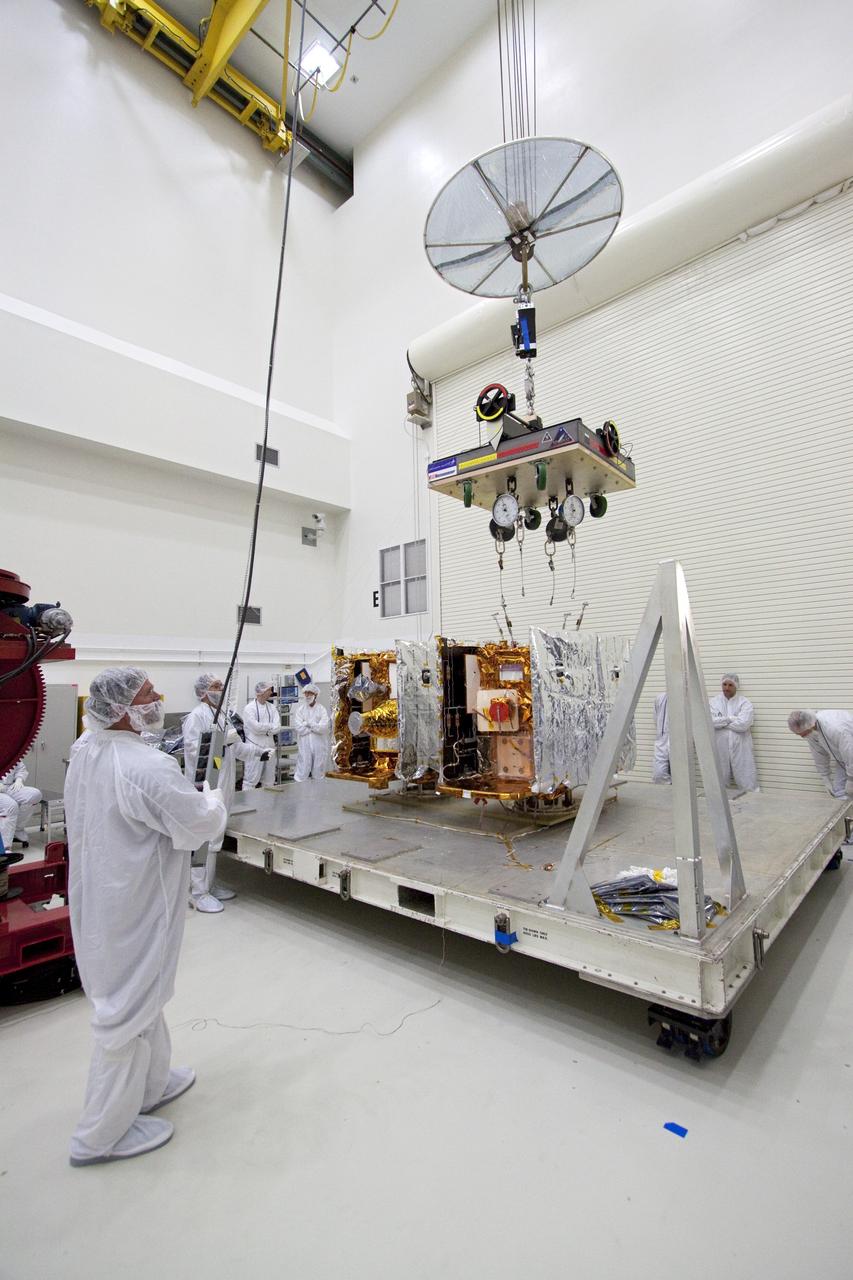
CAPE CANAVERAL, Fla. -- Technicians prepare to lift one of two spacecraft for NASA's Gravity Recovery and Interior Laboratory, or GRAIL, to a test stand in the Astrotech payload processing facility in Titusville, Fla. The twin spacecraft were built at the Lockheed Martin plant in Denver, Colo. The United Launch Alliance Delta II rocket that will carry GRAIL into lunar orbit already is fully stacked at NASA's Space Launch Complex 17B and launch is scheduled for Sept. 8. The GRAIL mission is a part of NASA's Discovery Program. GRAIL will fly twin spacecraft in tandem orbits around the moon for several months to measure its gravity field. The mission also will answer longstanding questions about Earth's moon and provide scientists a better understanding of how Earth and other rocky planets in the solar system formed. For more information, visit http://science.nasa.gov/missions/grail/. Photo credit: NASA/Jack Pfaller
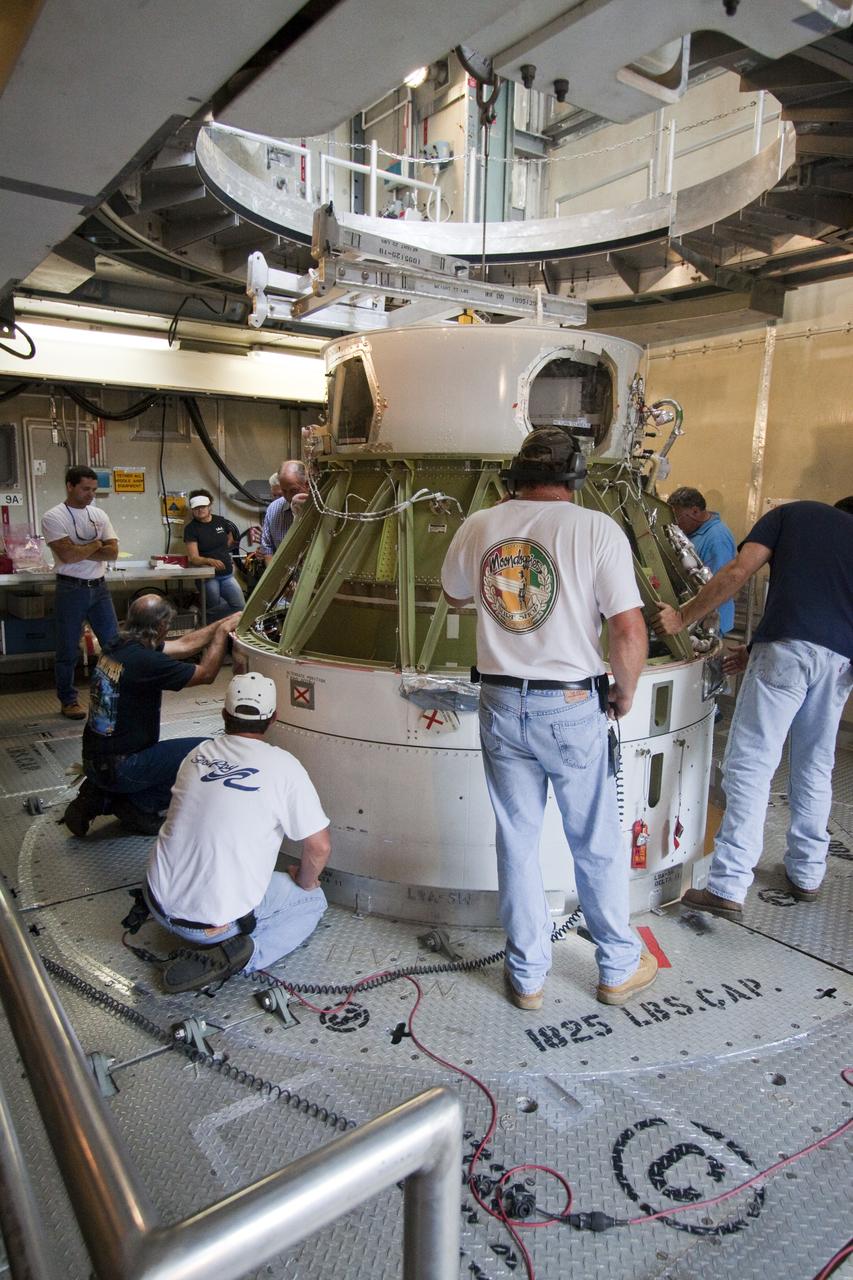
CAPE CANAVERAL, Fla. -- At NASA's Space Launch Complex 17B in Florida, workers secure the second stage of a United Launch Alliance Delta II launch vehicle to the first stage. The payload fairing then will be raised into the white room of the mobile service tower. The Delta II will carry NASA's Gravity Recovery and Interior Laboratory, or GRAIL, spacecraft into lunar orbit. The GRAIL mission is a part of NASA's Discovery Program. GRAIL will fly twin spacecraft in tandem orbits around the moon for several months to measure its gravity field. The mission also will answer longstanding questions about Earth's moon and provide scientists a better understanding of how Earth and other rocky planets in the solar system formed. GRAIL is scheduled to launch Sept. 8. For more information visit: http://science.nasa.gov/missions/grail/. Photo credit: NASA/Jack Pfaller

CAPE CANAVERAL, Fla. -- Technicians lift one of two spacecraft for NASA's Gravity Recovery and Interior Laboratory, or GRAIL, to a test stand in the Astrotech payload processing facility in Titusville, Fla. The twin spacecraft were built at the Lockheed Martin plant in Denver, Colo. The United Launch Alliance Delta II rocket that will carry GRAIL into lunar orbit already is fully stacked at NASA's Space Launch Complex 17B and launch is scheduled for Sept. 8. The GRAIL mission is a part of NASA's Discovery Program. GRAIL will fly twin spacecraft in tandem orbits around the moon for several months to measure its gravity field. The mission also will answer longstanding questions about Earth's moon and provide scientists a better understanding of how Earth and other rocky planets in the solar system formed. For more information, visit http://science.nasa.gov/missions/grail/. Photo credit: NASA/Jack Pfaller
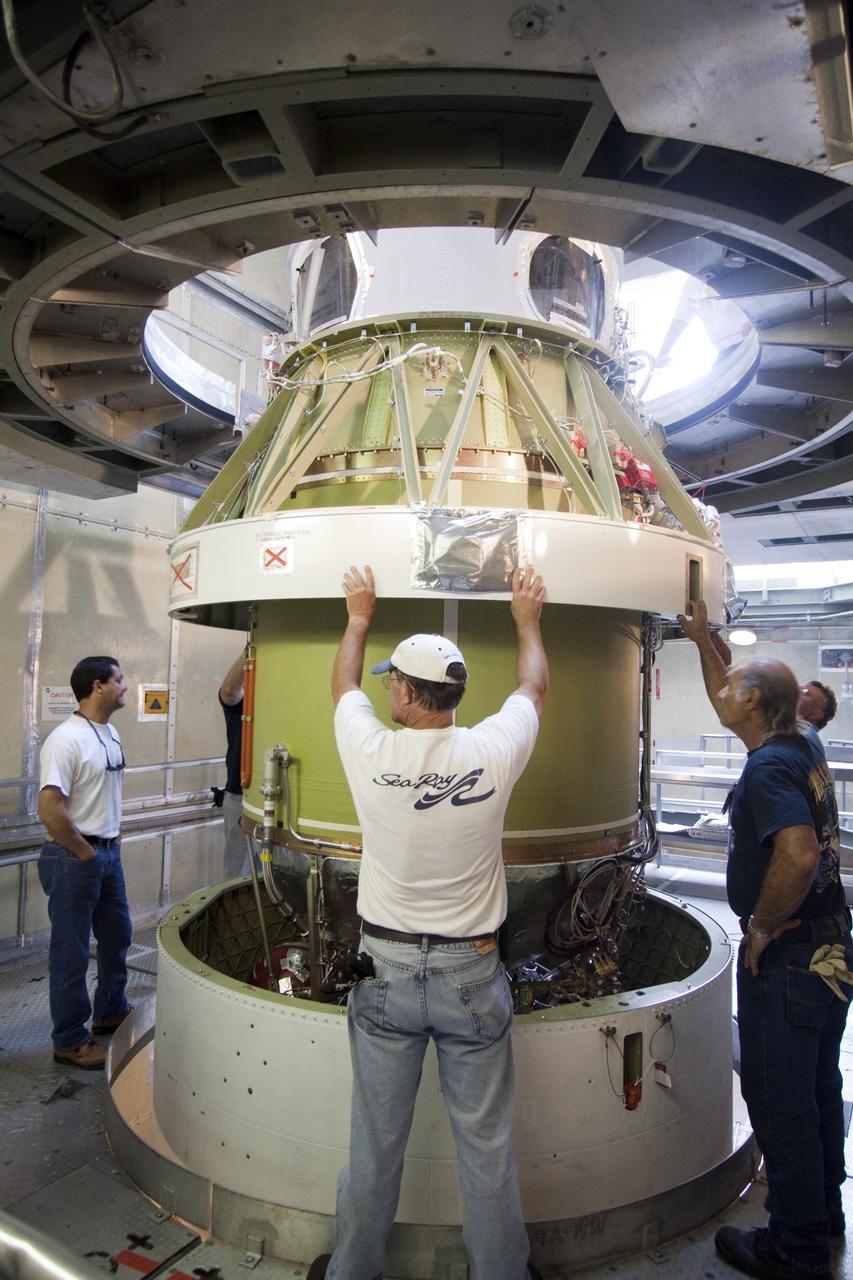
CAPE CANAVERAL, Fla. -- At NASA's Space Launch Complex 17B in Florida, workers lower the second stage of a United Launch Alliance Delta II launch vehicle toward the first stage for mating. The payload fairing then will be raised into the white room of the mobile service tower. The Delta II will carry NASA's Gravity Recovery and Interior Laboratory, or GRAIL, spacecraft into lunar orbit. The GRAIL mission is a part of NASA's Discovery Program. GRAIL will fly twin spacecraft in tandem orbits around the moon for several months to measure its gravity field. The mission also will answer longstanding questions about Earth's moon and provide scientists a better understanding of how Earth and other rocky planets in the solar system formed. GRAIL is scheduled to launch Sept. 8. For more information visit: http://science.nasa.gov/missions/grail/. Photo credit: NASA/Jack Pfaller
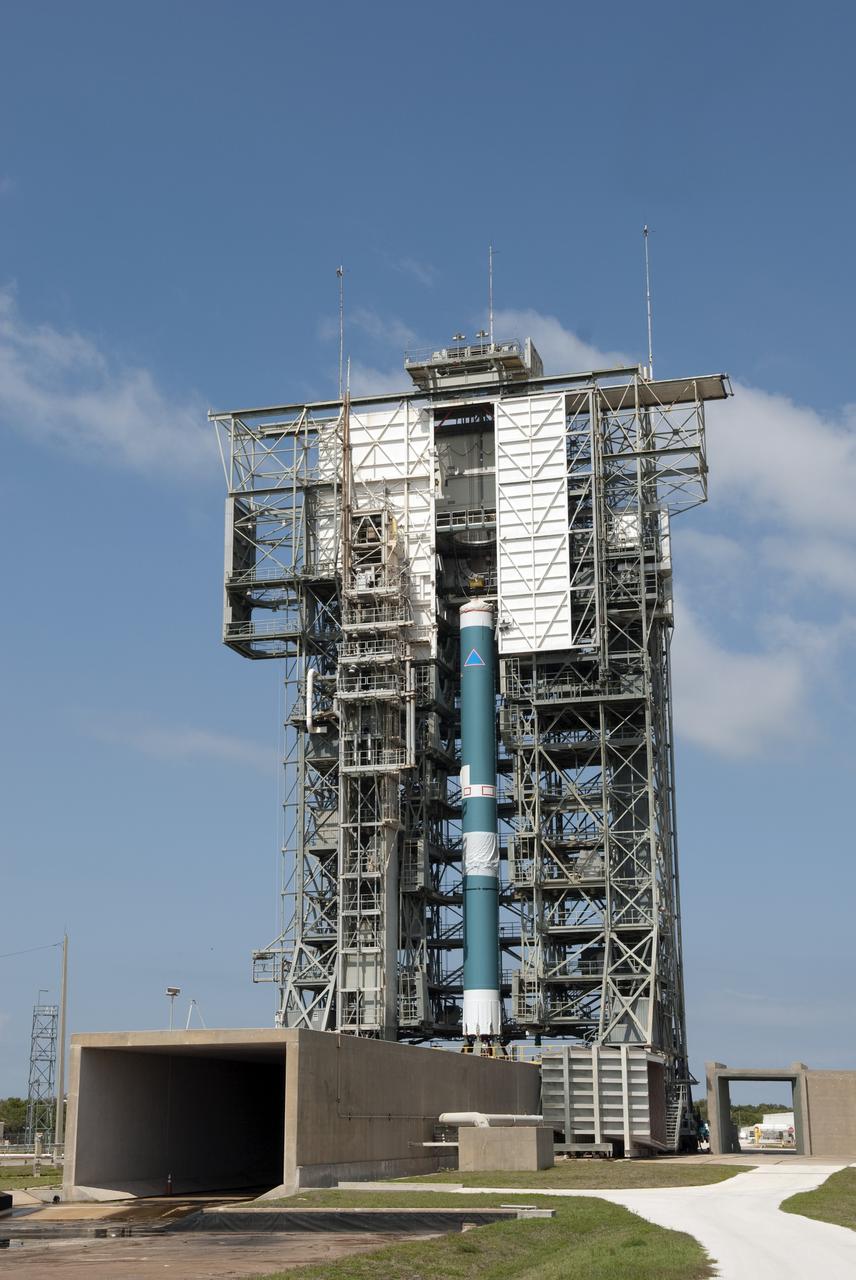
CAPE CANAVERAL, Fla. -- At Cape Canaveral Air Force Station in Florida, the first stage of a United Launch Alliance Delta II launch vehicle is secured into position inside the Pad 17B gantry. The Delta II will carry NASA's Gravity Recovery and Interior Laboratory, or GRAIL, spacecraft into lunar orbit. The GRAIL mission is a part of NASA's Discovery Program. GRAIL will fly twin spacecraft in tandem orbits around the moon for several months to measure its gravity field. The mission also will answer longstanding questions about Earth's moon and provide scientists a better understanding of how Earth and other rocky planets in the solar system formed. GRAIL is scheduled to launch September 8, 2011. For more information visit: http://science.nasa.gov/missions/grail/. Photo credit: NASA/Jim Grossmann
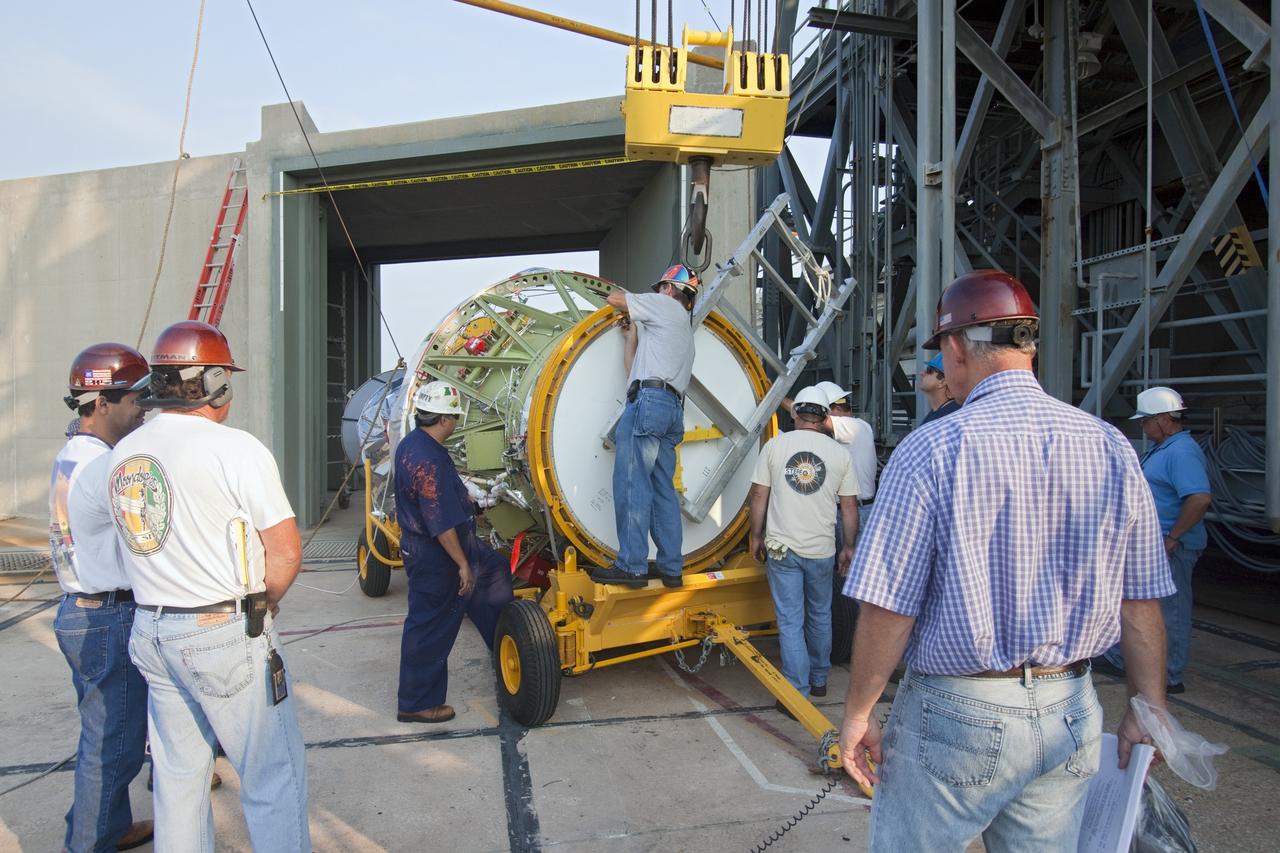
CAPE CANAVERAL, Fla. -- At NASA's Space Launch Complex 17B in Florida, workers attach an overhead crane to the second stage of a United Launch Alliance Delta II launch vehicle. It will then be hoisted atop the first stage for mating. The Delta II will carry NASA's Gravity Recovery and Interior Laboratory, or GRAIL, spacecraft into lunar orbit. The GRAIL mission is a part of NASA's Discovery Program. GRAIL will fly twin spacecraft in tandem orbits around the moon for several months to measure its gravity field. The mission also will answer longstanding questions about Earth's moon and provide scientists a better understanding of how Earth and other rocky planets in the solar system formed. GRAIL is scheduled to launch Sept. 8. For more information visit: http://science.nasa.gov/missions/grail/. Photo credit: NASA/Jack Pfaller
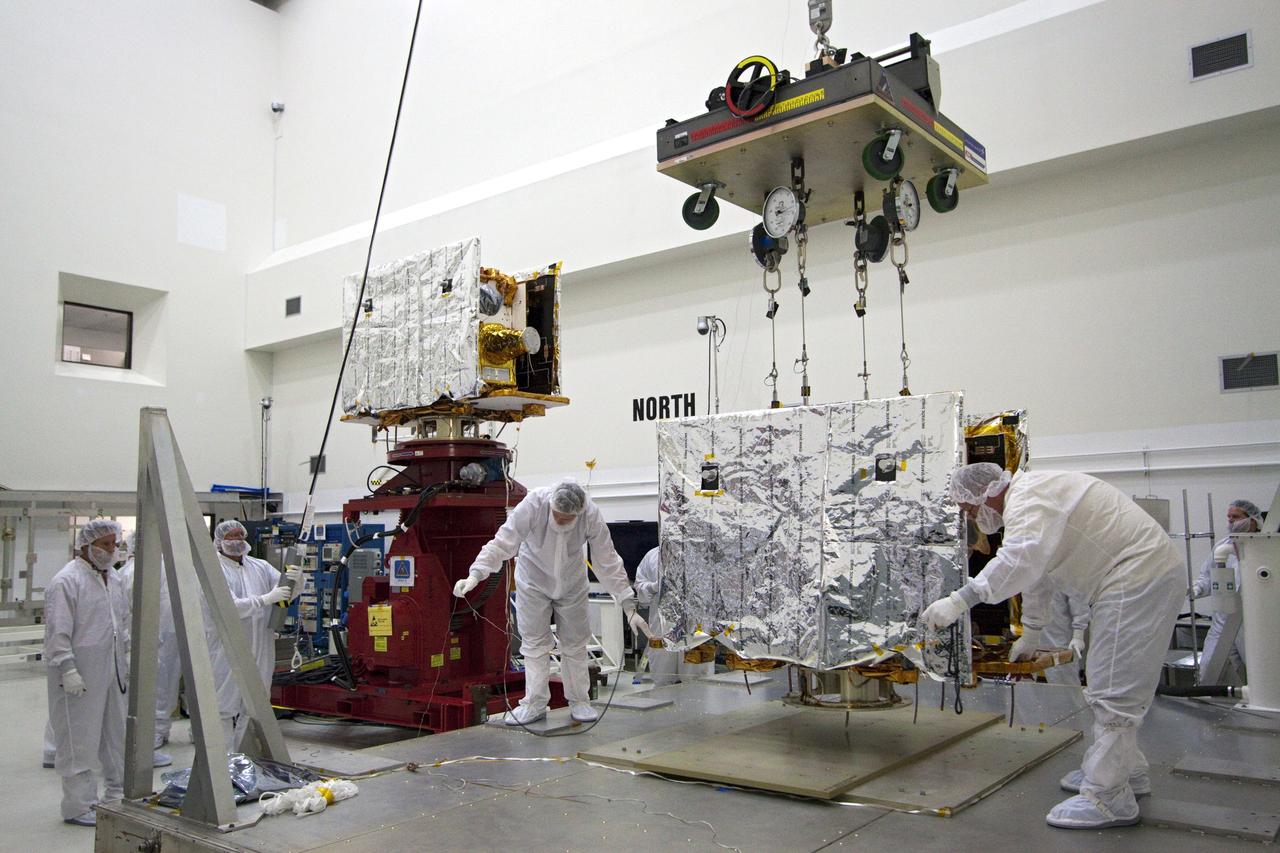
CAPE CANAVERAL, Fla. -- Technicians begin to lift one of two spacecraft for NASA's Gravity Recovery and Interior Laboratory, or GRAIL, to a test stand in the Astrotech payload processing facility in Titusville, Fla. The twin spacecraft were built at the Lockheed Martin plant in Denver, Colo. The United Launch Alliance Delta II rocket that will carry GRAIL into lunar orbit already is fully stacked at NASA's Space Launch Complex 17B and launch is scheduled for Sept. 8. The GRAIL mission is a part of NASA's Discovery Program. GRAIL will fly twin spacecraft in tandem orbits around the moon for several months to measure its gravity field. The mission also will answer longstanding questions about Earth's moon and provide scientists a better understanding of how Earth and other rocky planets in the solar system formed. For more information, visit http://science.nasa.gov/missions/grail/. Photo credit: NASA/Jack Pfaller
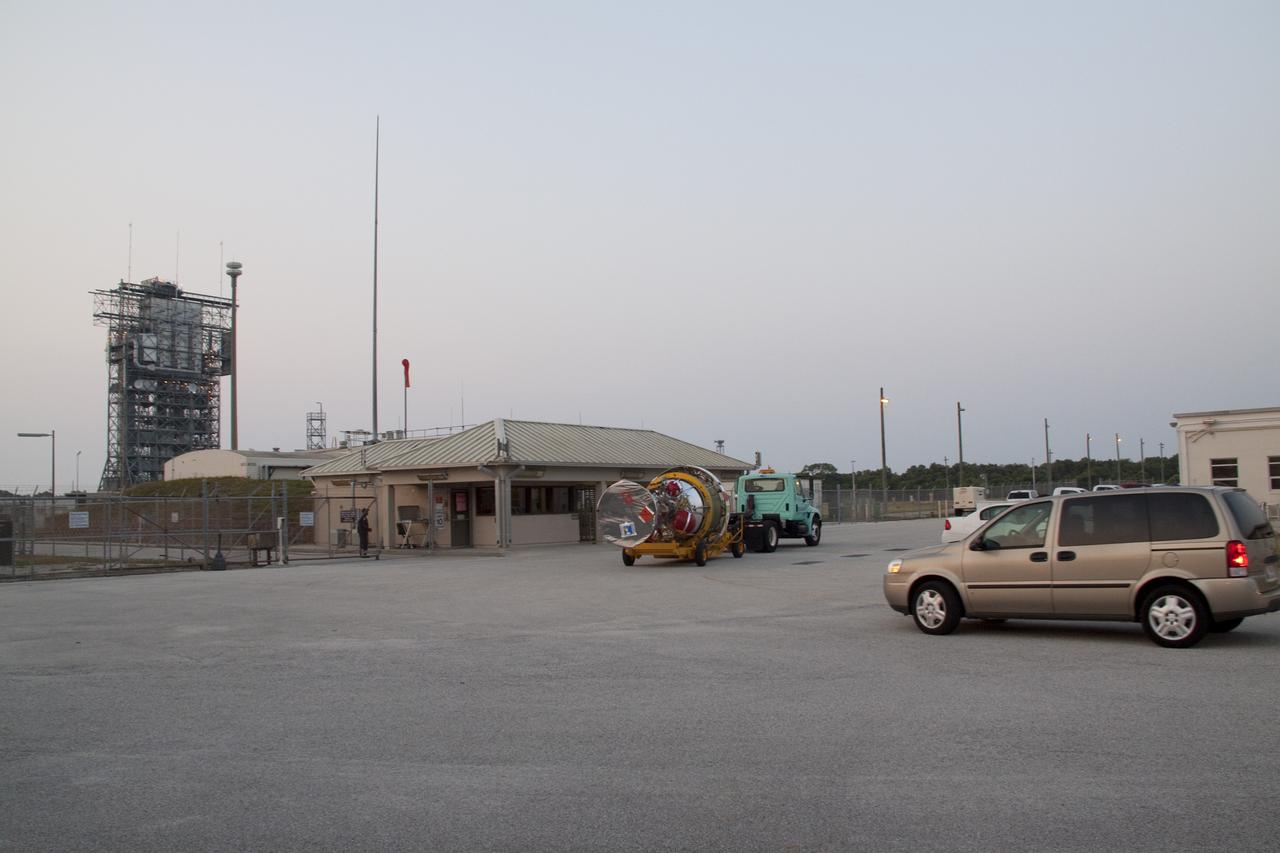
CAPE CANAVERAL, Fla. -- Workers transport the second stage of a United Launch Alliance Delta II launch vehicle to NASA's Space Launch Complex 17B in Florida. There, it will be hoisted into the mobile service tower and mated with the first stage. The Delta II will carry NASA's Gravity Recovery and Interior Laboratory, or GRAIL, spacecraft into lunar orbit. The GRAIL mission is a part of NASA's Discovery Program. GRAIL will fly twin spacecraft in tandem orbits around the moon for several months to measure its gravity field. The mission also will answer longstanding questions about Earth's moon and provide scientists a better understanding of how Earth and other rocky planets in the solar system formed. GRAIL is scheduled to launch Sept. 8. For more information visit: http://science.nasa.gov/missions/grail/. Photo credit: NASA/Jack Pfaller
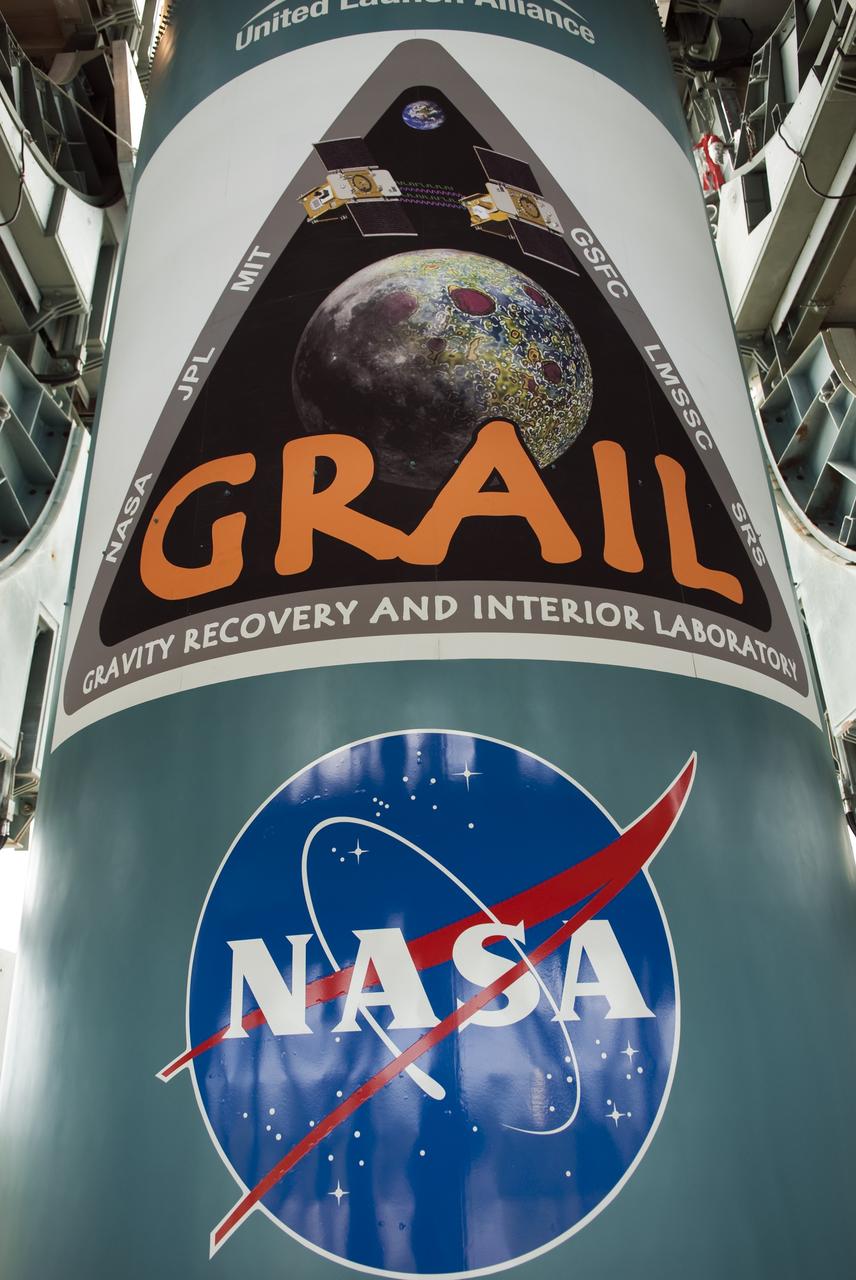
CAPE CANAVERAL, Fla. -- NASA's Gravity Recovery and Interior Laboratory, or GRAIL, spacecraft logo is emblazed on the first stage of a United Launch Alliance Delta II launch vehicle, now secured in the gantry at Cape Canaveral Air Force Station's Pad 17B. The Delta II will carry GRAIL into lunar orbit. The GRAIL mission is a part of NASA's Discovery Program. GRAIL will fly twin spacecraft in tandem orbits around the moon for several months to measure its gravity field. The mission also will answer longstanding questions about Earth's moon and provide scientists a better understanding of how Earth and other rocky planets in the solar system formed. GRAIL is scheduled to launch September 8, 2011. For more information visit: http://science.nasa.gov/missions/grail/. Photo credit: NASA/Jim Grossmann
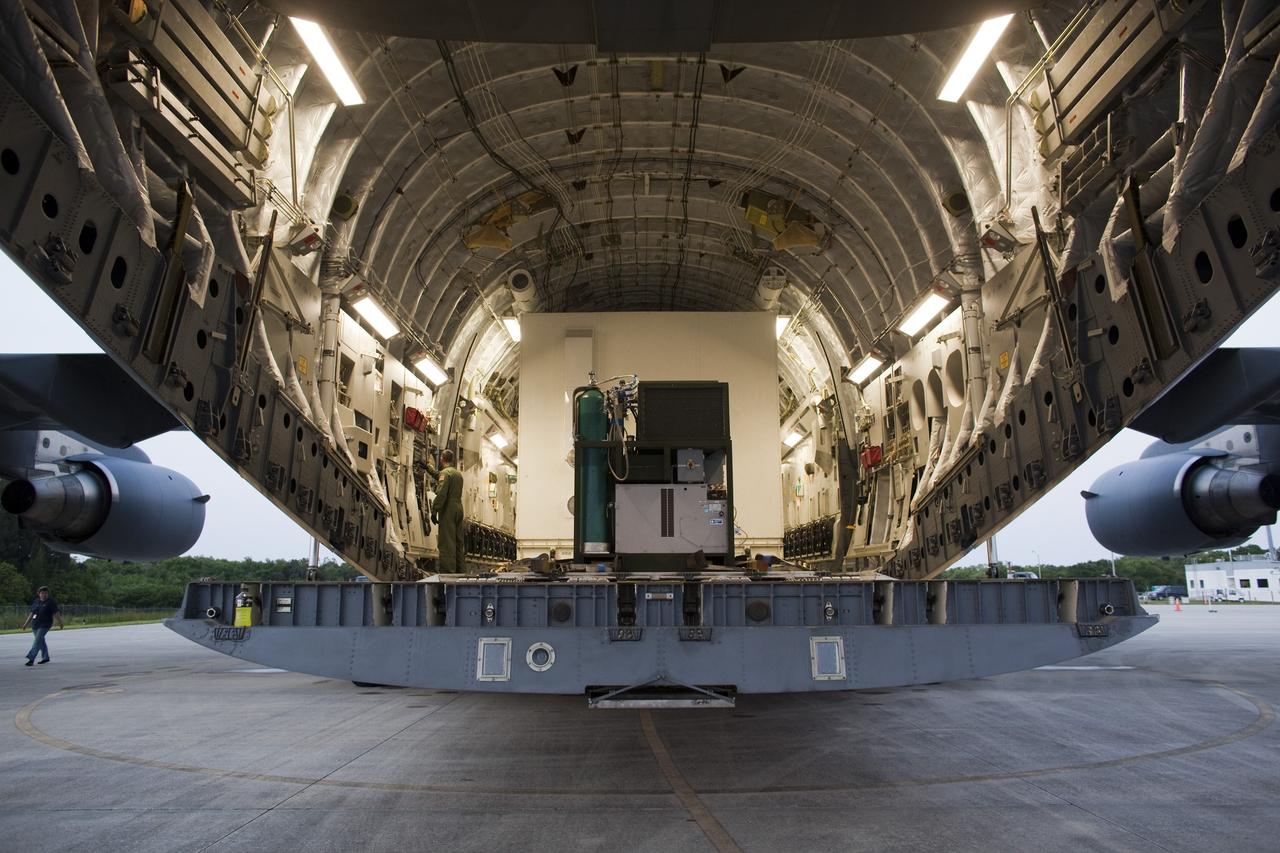
CAPE CANAVERAL, Fla. -- NASA's Gravity Recovery and Interior Laboratory, or GRAIL, spacecraft will be offloaded from an Air Force C-17 cargo plane on the Shuttle Landing Facility at Kennedy Space Center in Florida. The spacecraft traveled from the Lockheed Martin plant in Denver, Colo., and will undergo further processing in the Astrotech payload processing facility in Titusville, Fla. The United Launch Alliance Delta II rocket that will carry GRAIL into lunar orbit already is fully stacked at NASA's Space Launch Complex 17B and launch is scheduled for Sept. 8. The GRAIL mission is a part of NASA's Discovery Program. GRAIL will fly twin spacecraft in tandem orbits around the moon for several months to measure its gravity field. The mission also will answer longstanding questions about Earth's moon and provide scientists a better understanding of how Earth and other rocky planets in the solar system formed. For more information, visit http://science.nasa.gov/missions/grail/. Photo credit: NASA/Dimitri Gerondidakis
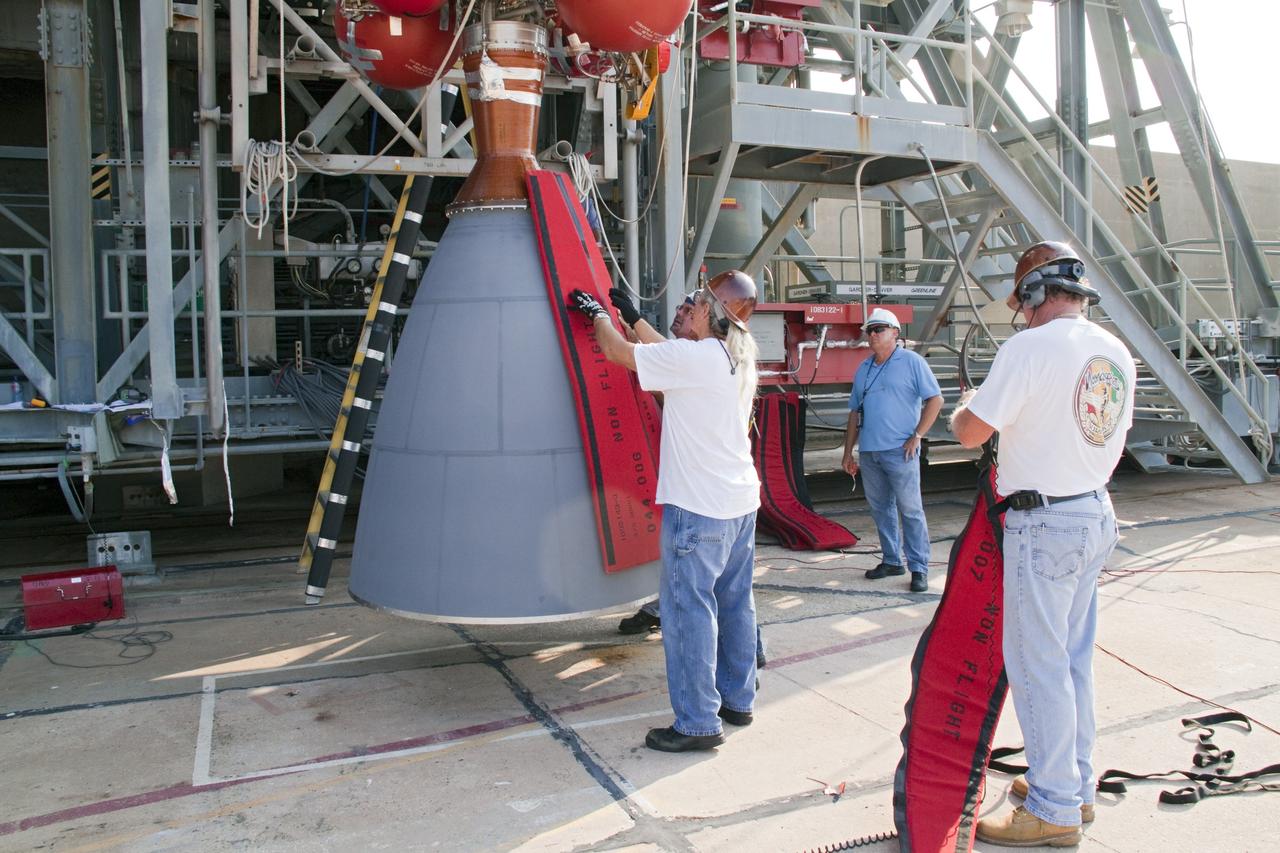
CAPE CANAVERAL, Fla. -- At NASA's Space Launch Complex 17B in Florida, workers install a protective covering around the engine bell of the second stage of a United Launch Alliance Delta II launch vehicle before it is hoisted and mated to the first stage. The Delta II will carry NASA's Gravity Recovery and Interior Laboratory, or GRAIL, spacecraft into lunar orbit. The GRAIL mission is a part of NASA's Discovery Program. GRAIL will fly twin spacecraft in tandem orbits around the moon for several months to measure its gravity field. The mission also will answer longstanding questions about Earth's moon and provide scientists a better understanding of how Earth and other rocky planets in the solar system formed. GRAIL is scheduled to launch Sept. 8. For more information visit: http://science.nasa.gov/missions/grail/. Photo credit: NASA/Jack Pfaller
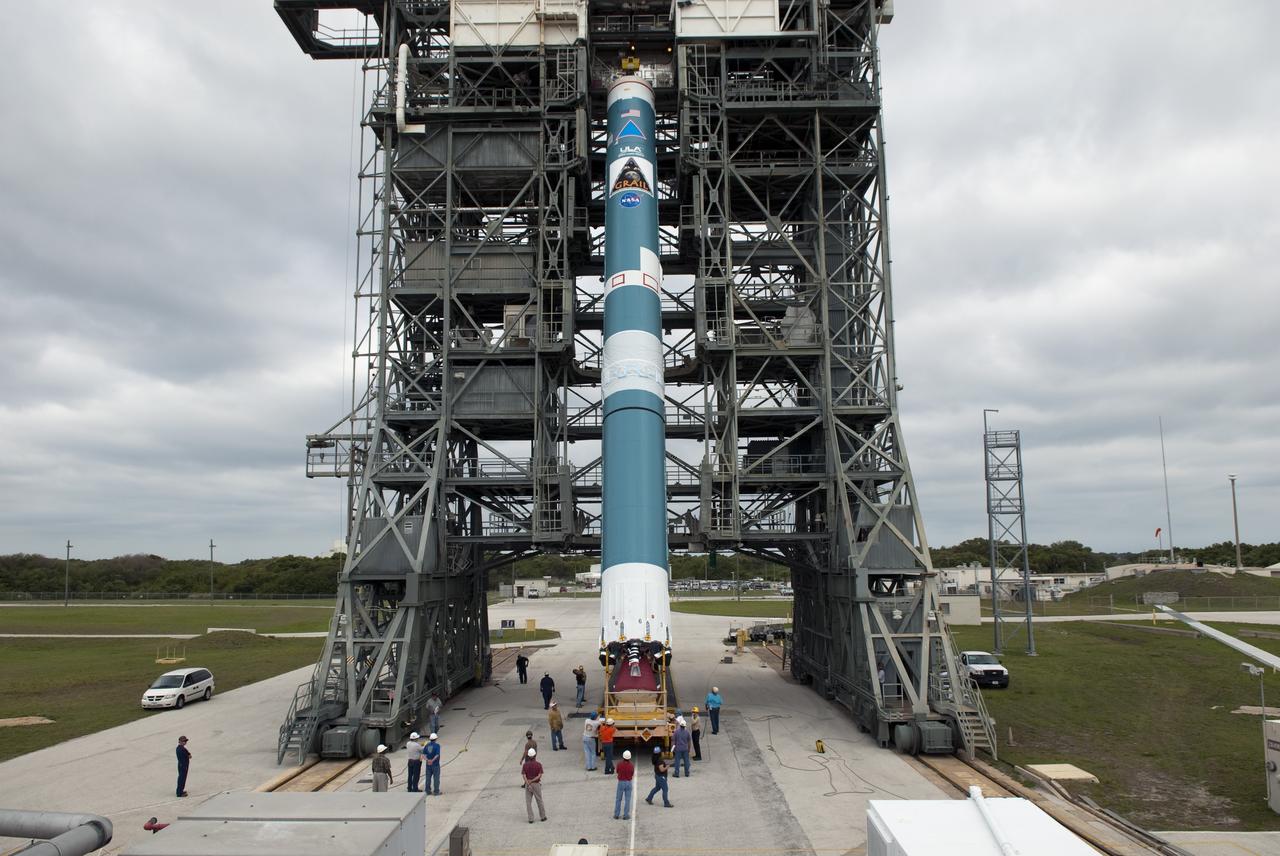
CAPE CANAVERAL, Fla. -- At Cape Canaveral Air Force Station in Florida, the first stage of a United Launch Alliance Delta II launch vehicle is being lifted into the Pad 17B gantry. The Delta II will carry NASA's Gravity Recovery and Interior Laboratory, or GRAIL, spacecraft into lunar orbit. The GRAIL mission is a part of NASA's Discovery Program. GRAIL will fly twin spacecraft in tandem orbits around the moon for several months to measure its gravity field. The mission also will answer longstanding questions about Earth's moon and provide scientists a better understanding of how Earth and other rocky planets in the solar system formed. GRAIL is scheduled to launch September 8, 2011. For more information visit: http://science.nasa.gov/missions/grail/. Photo credit: NASA/Jim Grossmann
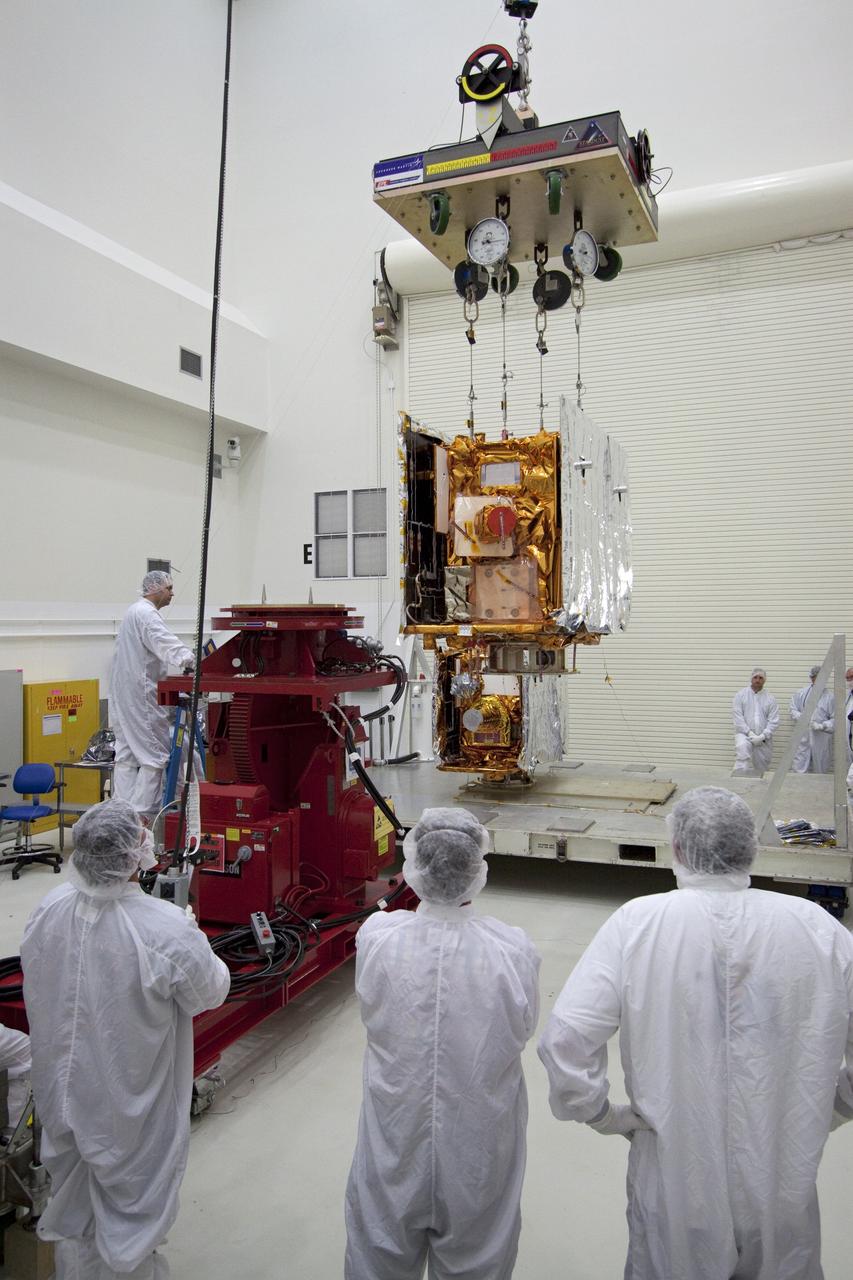
CAPE CANAVERAL, Fla. -- Technicians lift one of two spacecraft for NASA's Gravity Recovery and Interior Laboratory, or GRAIL, to a test stand in the Astrotech payload processing facility in Titusville, Fla. The twin spacecraft were built at the Lockheed Martin plant in Denver, Colo. The United Launch Alliance Delta II rocket that will carry GRAIL into lunar orbit already is fully stacked at NASA's Space Launch Complex 17B and launch is scheduled for Sept. 8. The GRAIL mission is a part of NASA's Discovery Program. GRAIL will fly twin spacecraft in tandem orbits around the moon for several months to measure its gravity field. The mission also will answer longstanding questions about Earth's moon and provide scientists a better understanding of how Earth and other rocky planets in the solar system formed. For more information, visit http://science.nasa.gov/missions/grail/. Photo credit: NASA/Jack Pfaller
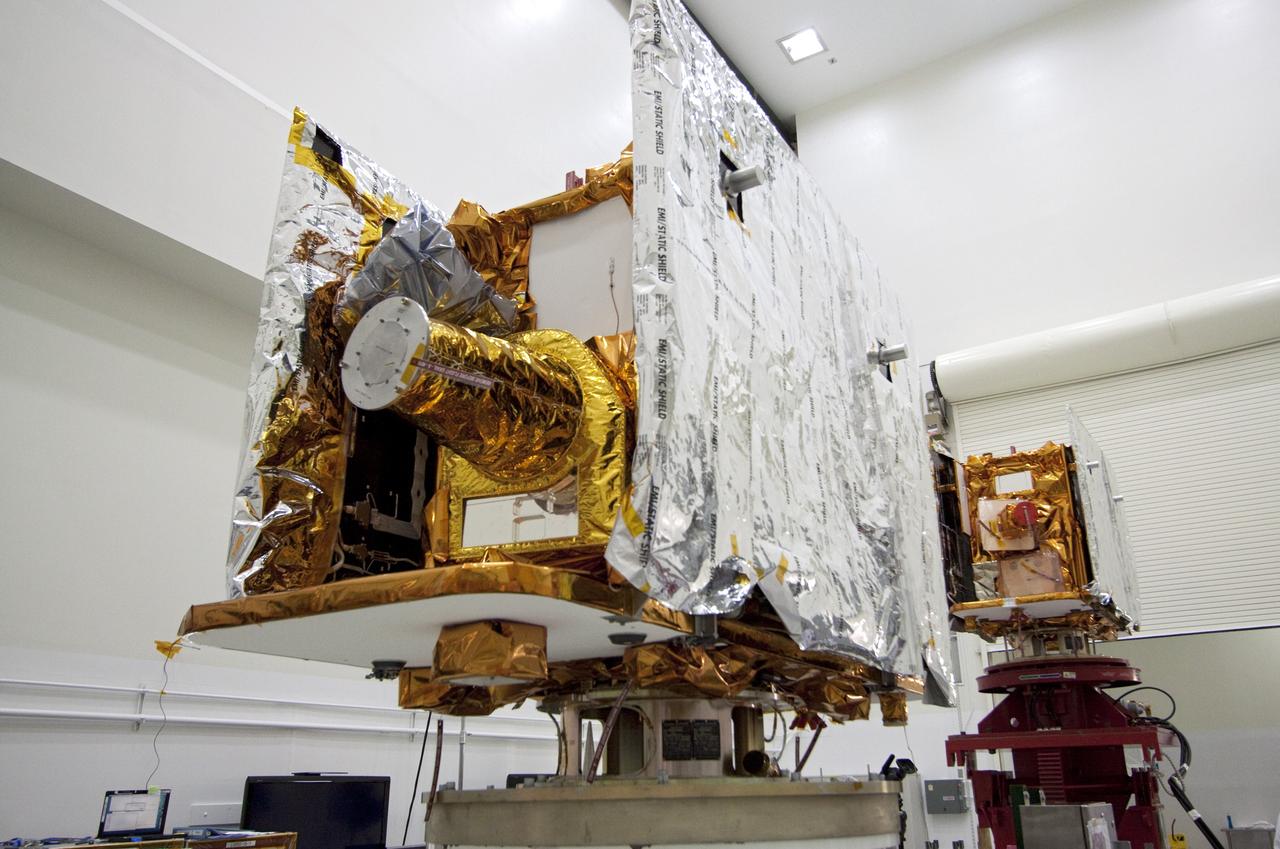
CAPE CANAVERAL, Fla. -- The two spacecraft for NASA's Gravity Recovery and Interior Laboratory, or GRAIL, are atop test stands in the Astrotech payload processing facility in Titusville, Fla. The twin spacecraft were built at the Lockheed Martin plant in Denver, Colo. The United Launch Alliance Delta II rocket that will carry GRAIL into lunar orbit already is fully stacked at NASA's Space Launch Complex 17B and launch is scheduled for Sept. 8. The GRAIL mission is a part of NASA's Discovery Program. GRAIL will fly twin spacecraft in tandem orbits around the moon for several months to measure its gravity field. The mission also will answer longstanding questions about Earth's moon and provide scientists a better understanding of how Earth and other rocky planets in the solar system formed. For more information, visit http://science.nasa.gov/missions/grail/. Photo credit: NASA/Jack Pfaller
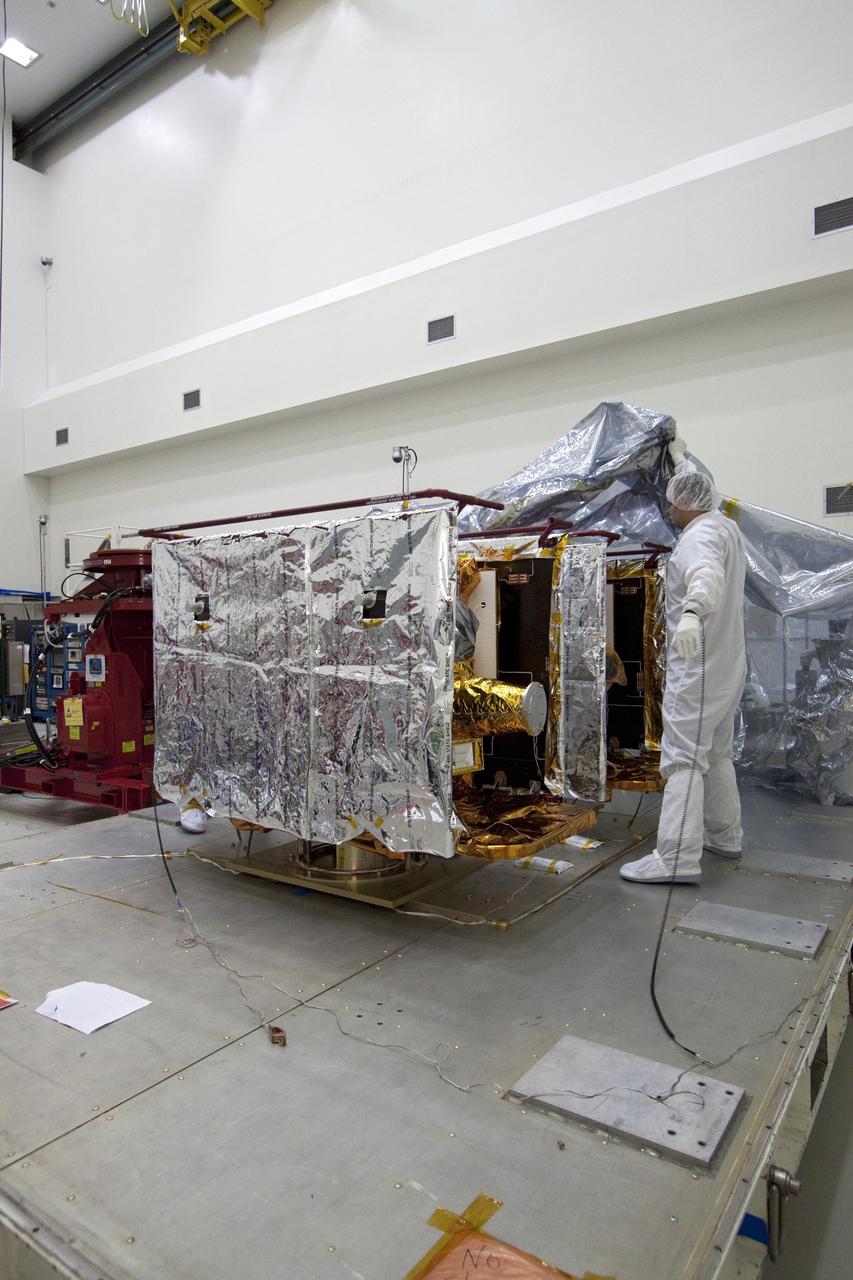
CAPE CANAVERAL, Fla. -- Technicians in the Astrotech payload processing facility in Titusville, Fla., remove the protective cover from NASA's Gravity Recovery and Interior Laboratory, or GRAIL, twin spacecraft to begin testing and processing. GRAIL was built at the Lockheed Martin plant in Denver, Colo. The United Launch Alliance Delta II rocket that will carry GRAIL into lunar orbit already is fully stacked at NASA's Space Launch Complex 17B and launch is scheduled for Sept. 8. The GRAIL mission is a part of NASA's Discovery Program. GRAIL will fly twin spacecraft in tandem orbits around the moon for several months to measure its gravity field. The mission also will answer longstanding questions about Earth's moon and provide scientists a better understanding of how Earth and other rocky planets in the solar system formed. For more information, visit http://science.nasa.gov/missions/grail/. Photo credit: NASA/Jack Pfaller
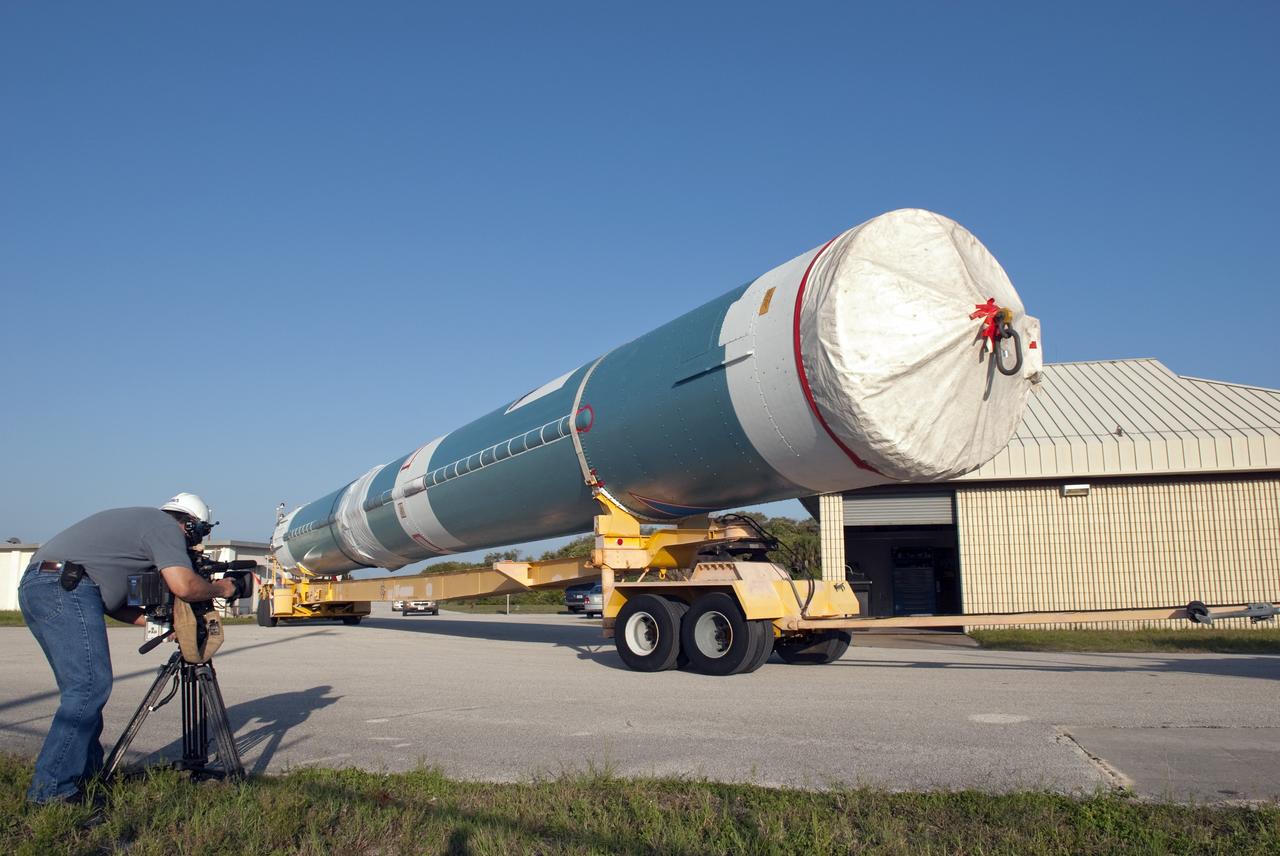
CAPE CANAVERAL, Fla. -- At Cape Canaveral Air Force Station in Florida, the first stage of a United Launch Alliance Delta II launch vehicle has arrived at Pad 17B. The Delta II will carry NASA's Gravity Recovery and Interior Laboratory, or GRAIL, spacecraft into lunar orbit. The GRAIL mission is a part of NASA's Discovery Program. GRAIL will fly twin spacecraft in tandem orbits around the moon for several months to measure its gravity field. The mission also will answer longstanding questions about Earth's moon and provide scientists a better understanding of how Earth and other rocky planets in the solar system formed. GRAIL is scheduled to launch September 8, 2011. For more information visit: http://science.nasa.gov/missions/grail/. Photo credit: NASA/Jim Grossmann
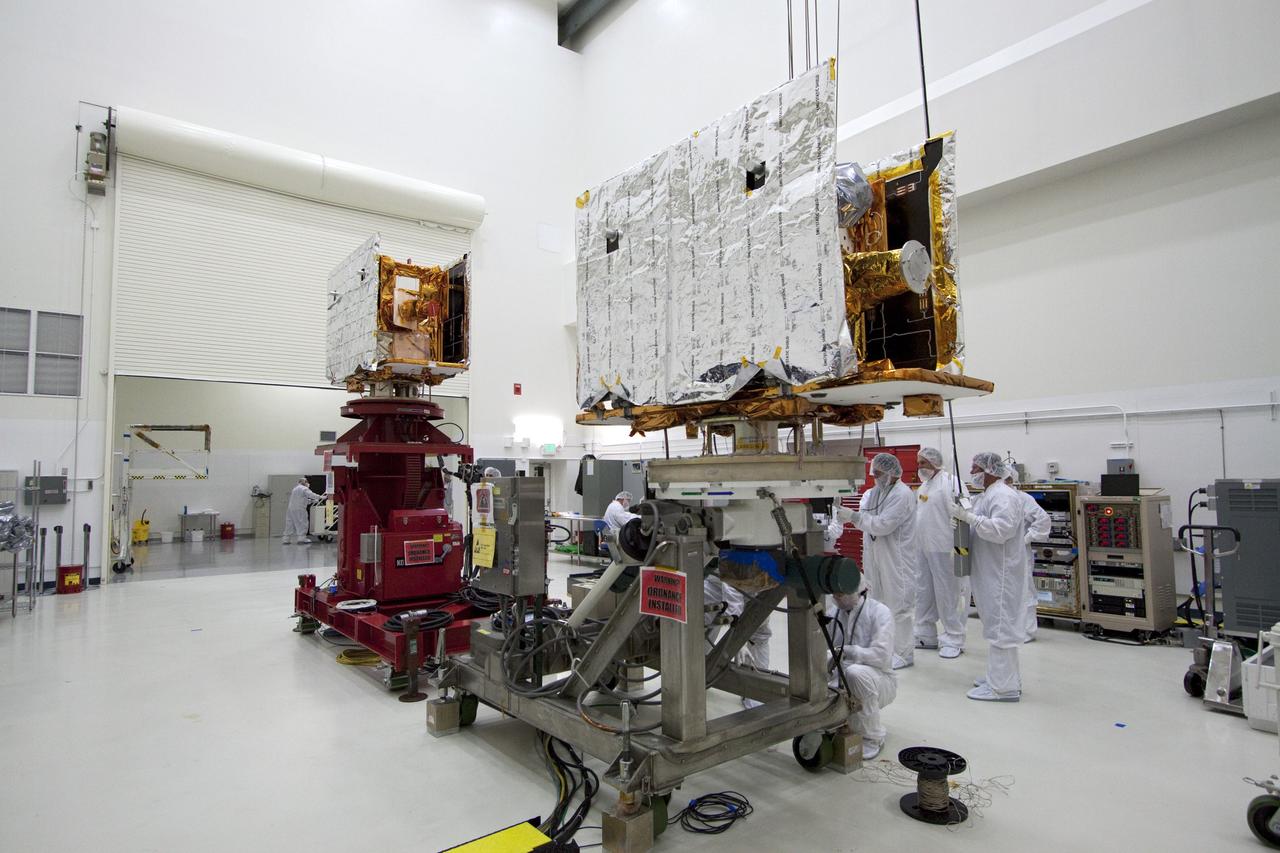
CAPE CANAVERAL, Fla. -- The two spacecraft for NASA's Gravity Recovery and Interior Laboratory, or GRAIL, are atop test stands in the Astrotech payload processing facility in Titusville, Fla. The twin spacecraft were built at the Lockheed Martin plant in Denver, Colo. The United Launch Alliance Delta II rocket that will carry GRAIL into lunar orbit already is fully stacked at NASA's Space Launch Complex 17B and launch is scheduled for Sept. 8. The GRAIL mission is a part of NASA's Discovery Program. GRAIL will fly twin spacecraft in tandem orbits around the moon for several months to measure its gravity field. The mission also will answer longstanding questions about Earth's moon and provide scientists a better understanding of how Earth and other rocky planets in the solar system formed. For more information, visit http://science.nasa.gov/missions/grail/. Photo credit: NASA/Jack Pfaller
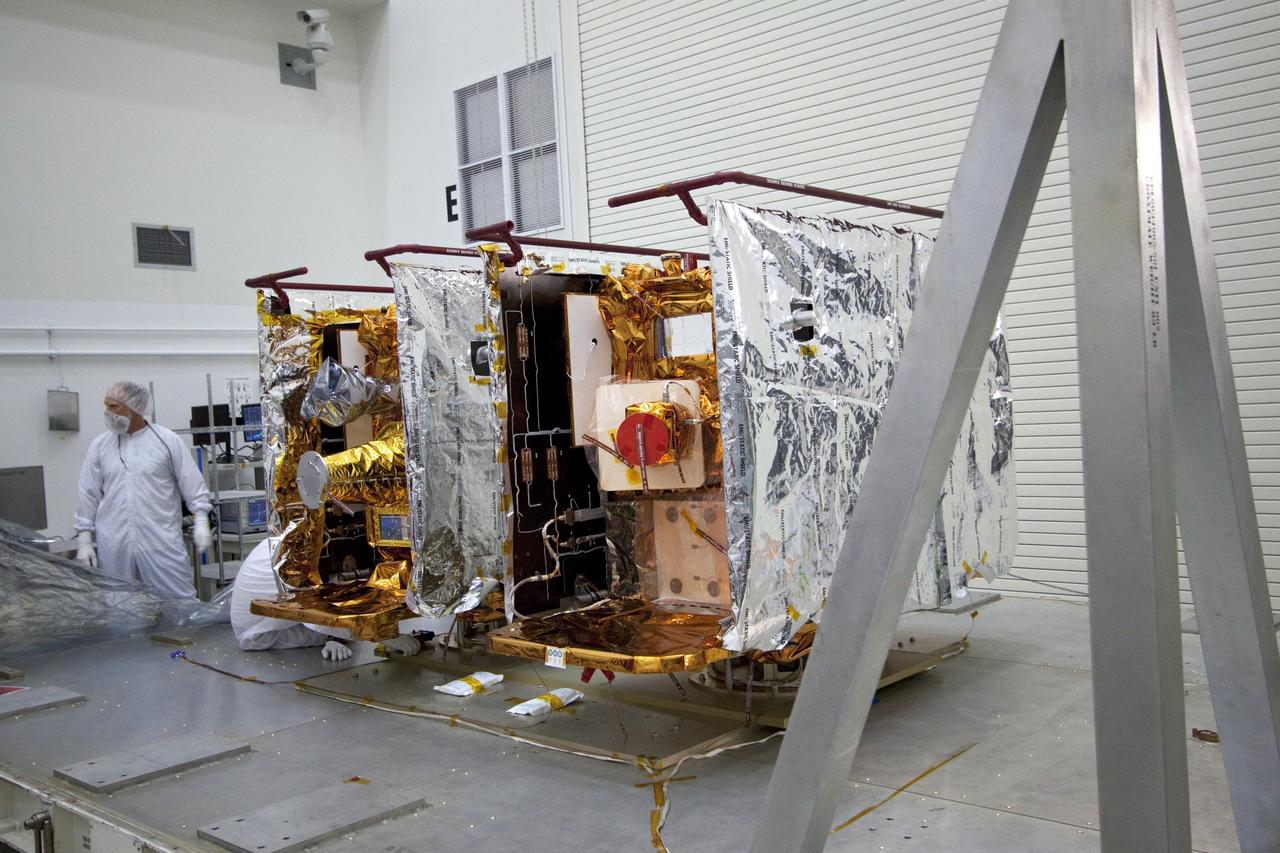
CAPE CANAVERAL, Fla. -- Technicians in the Astrotech payload processing facility in Titusville, Fla., prepare NASA's Gravity Recovery and Interior Laboratory, or GRAIL, twin spacecraft for testing and processing. GRAIL was built at the Lockheed Martin plant in Denver, Colo. The United Launch Alliance Delta II rocket that will carry GRAIL into lunar orbit already is fully stacked at NASA's Space Launch Complex 17B and launch is scheduled for Sept. 8. The GRAIL mission is a part of NASA's Discovery Program. GRAIL will fly twin spacecraft in tandem orbits around the moon for several months to measure its gravity field. The mission also will answer longstanding questions about Earth's moon and provide scientists a better understanding of how Earth and other rocky planets in the solar system formed. For more information, visit http://science.nasa.gov/missions/grail/. Photo credit: NASA/Jack Pfaller
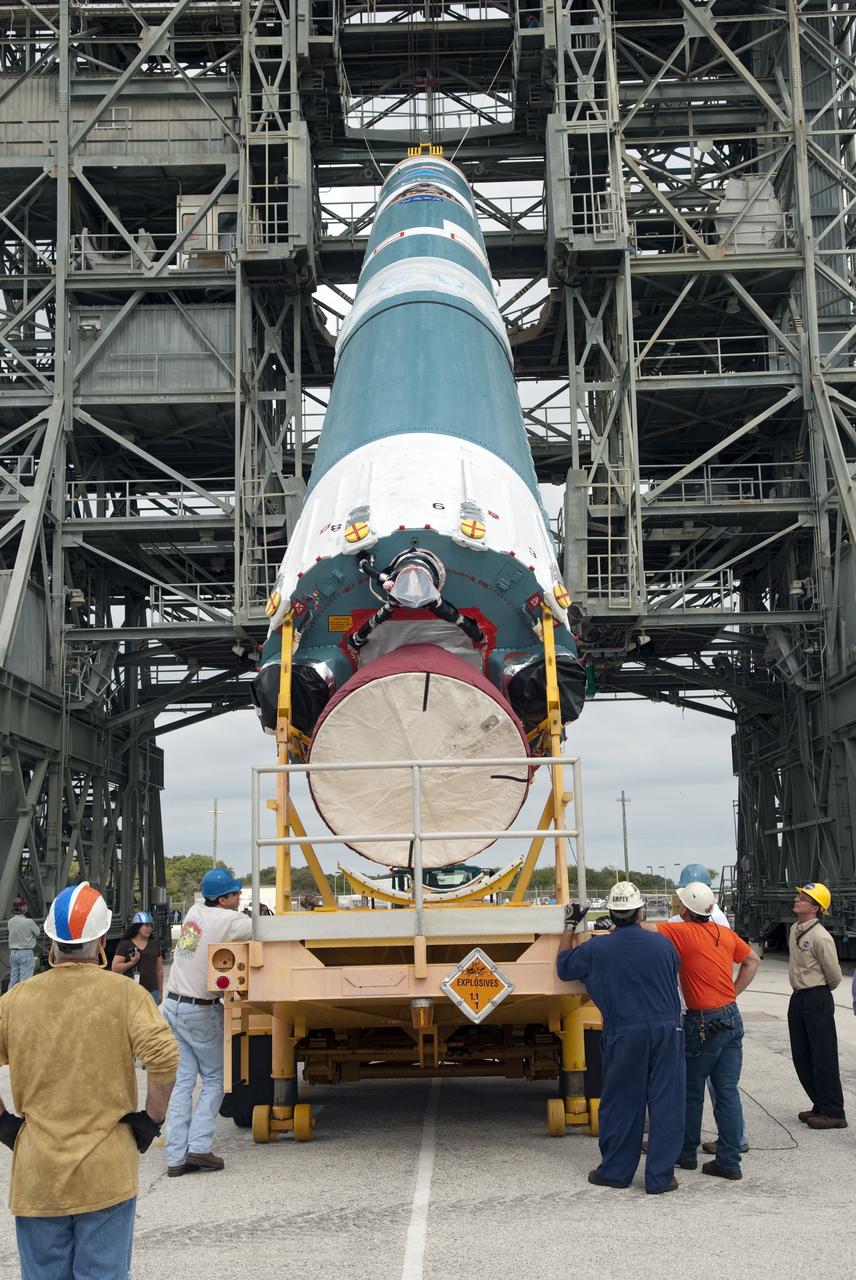
CAPE CANAVERAL, Fla. -- Workers at Cape Canaveral Air Force Station's Pad 17B monitor the progress as the first stage of a United Launch Alliance Delta II launch vehicle is lifted into the gantry. The Delta II will carry NASA's Gravity Recovery and Interior Laboratory, or GRAIL, spacecraft into lunar orbit. The GRAIL mission is a part of NASA's Discovery Program. GRAIL will fly twin spacecraft in tandem orbits around the moon for several months to measure its gravity field. The mission also will answer longstanding questions about Earth's moon and provide scientists a better understanding of how Earth and other rocky planets in the solar system formed. GRAIL is scheduled to launch September 8, 2011. For more information visit: http://science.nasa.gov/missions/grail/. Photo credit: NASA/Jim Grossmann
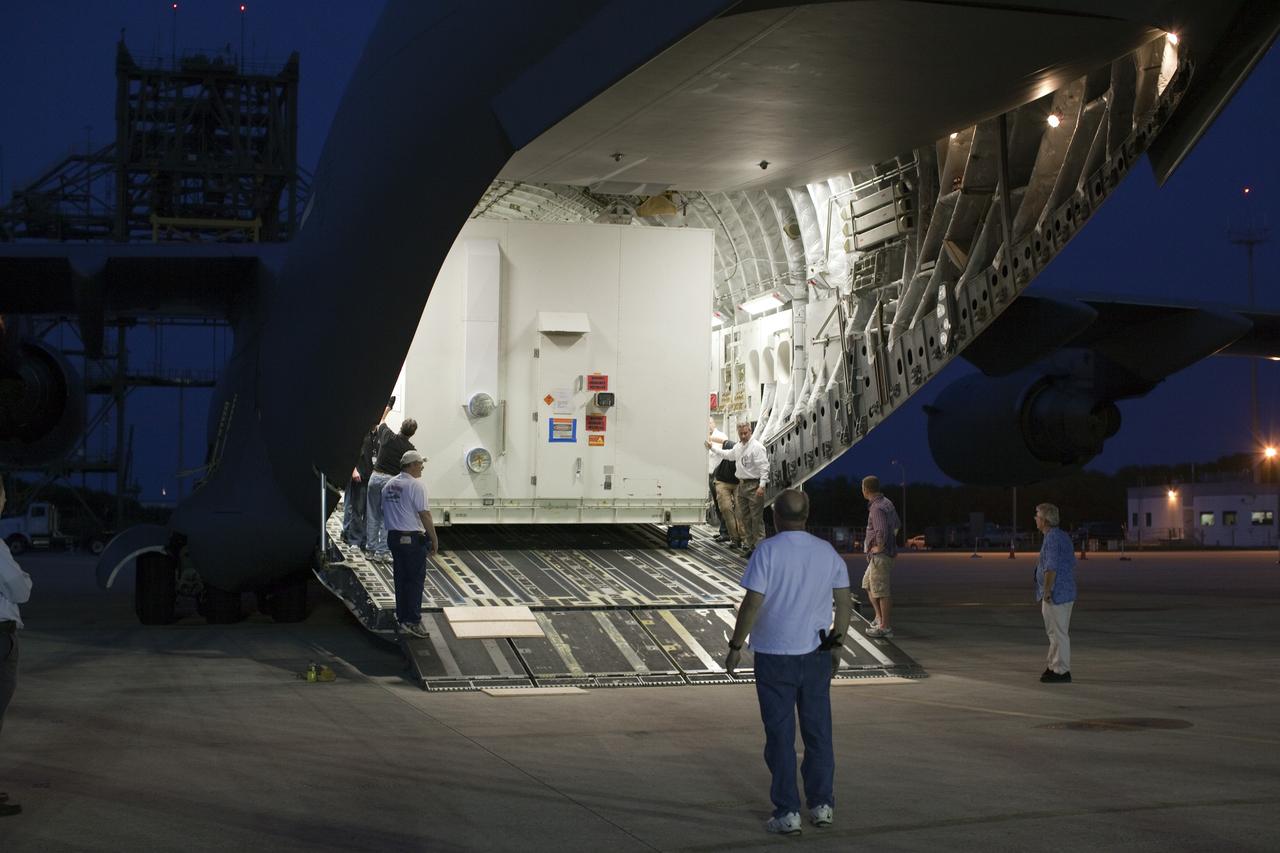
CAPE CANAVERAL, Fla. -- NASA's Gravity Recovery and Interior Laboratory, or GRAIL, spacecraft is offloaded from an Air Force C-17 cargo plane on the Shuttle Landing Facility at Kennedy Space Center in Florida. The spacecraft traveled from the Lockheed Martin plant in Denver, Colo., and will undergo further processing in the Astrotech payload processing facility in Titusville, Fla. The United Launch Alliance Delta II rocket that will carry GRAIL into lunar orbit already is fully stacked at NASA's Space Launch Complex 17B and launch is scheduled for Sept. 8. The GRAIL mission is a part of NASA's Discovery Program. GRAIL will fly twin spacecraft in tandem orbits around the moon for several months to measure its gravity field. The mission also will answer longstanding questions about Earth's moon and provide scientists a better understanding of how Earth and other rocky planets in the solar system formed. For more information, visit http://science.nasa.gov/missions/grail/. Photo credit: NASA/Dimitri Gerondidakis
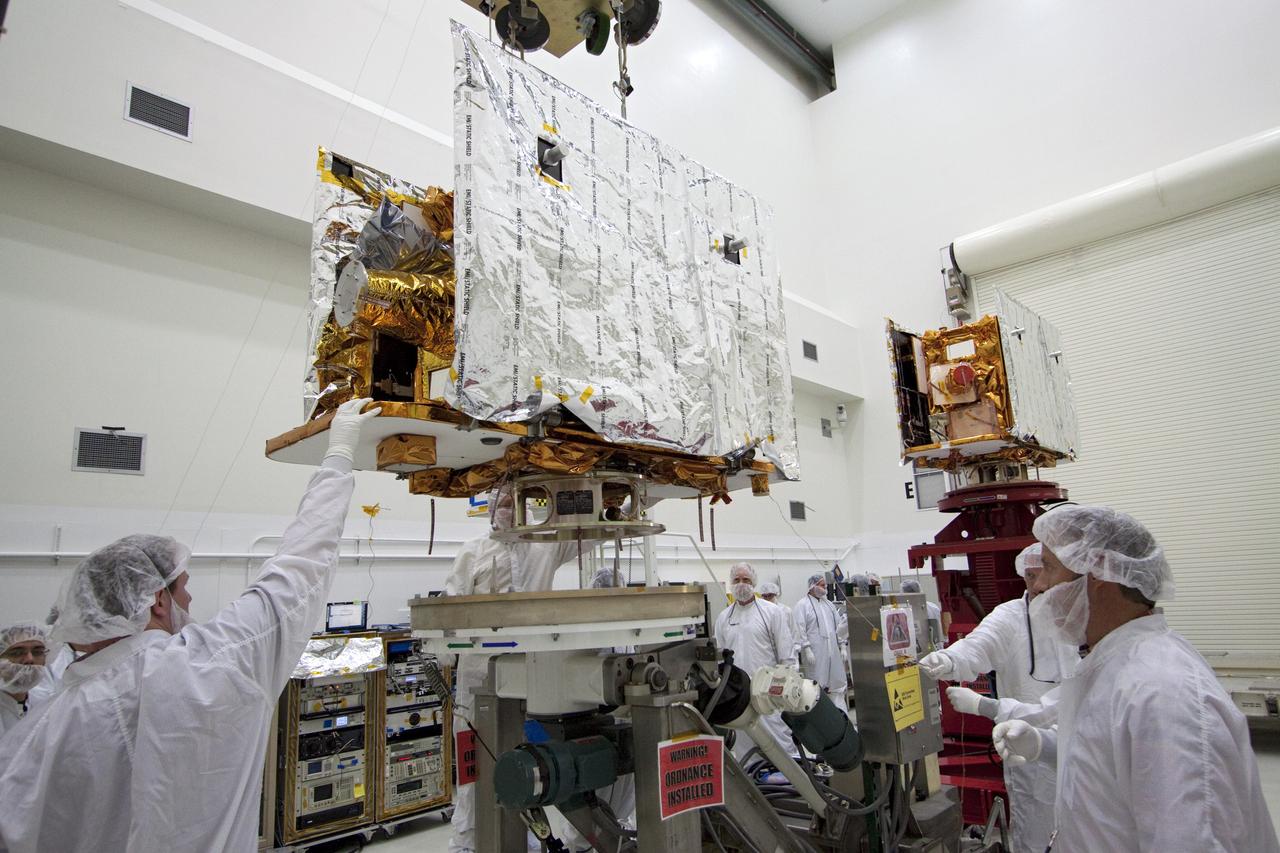
CAPE CANAVERAL, Fla. -- Technicians lower one of two spacecraft for NASA's Gravity Recovery and Interior Laboratory, or GRAIL, to a test stand in the Astrotech payload processing facility in Titusville, Fla. The twin spacecraft were built at the Lockheed Martin plant in Denver, Colo. The United Launch Alliance Delta II rocket that will carry GRAIL into lunar orbit already is fully stacked at NASA's Space Launch Complex 17B and launch is scheduled for Sept. 8. The GRAIL mission is a part of NASA's Discovery Program. GRAIL will fly twin spacecraft in tandem orbits around the moon for several months to measure its gravity field. The mission also will answer longstanding questions about Earth's moon and provide scientists a better understanding of how Earth and other rocky planets in the solar system formed. For more information, visit http://science.nasa.gov/missions/grail/. Photo credit: NASA/Jack Pfaller
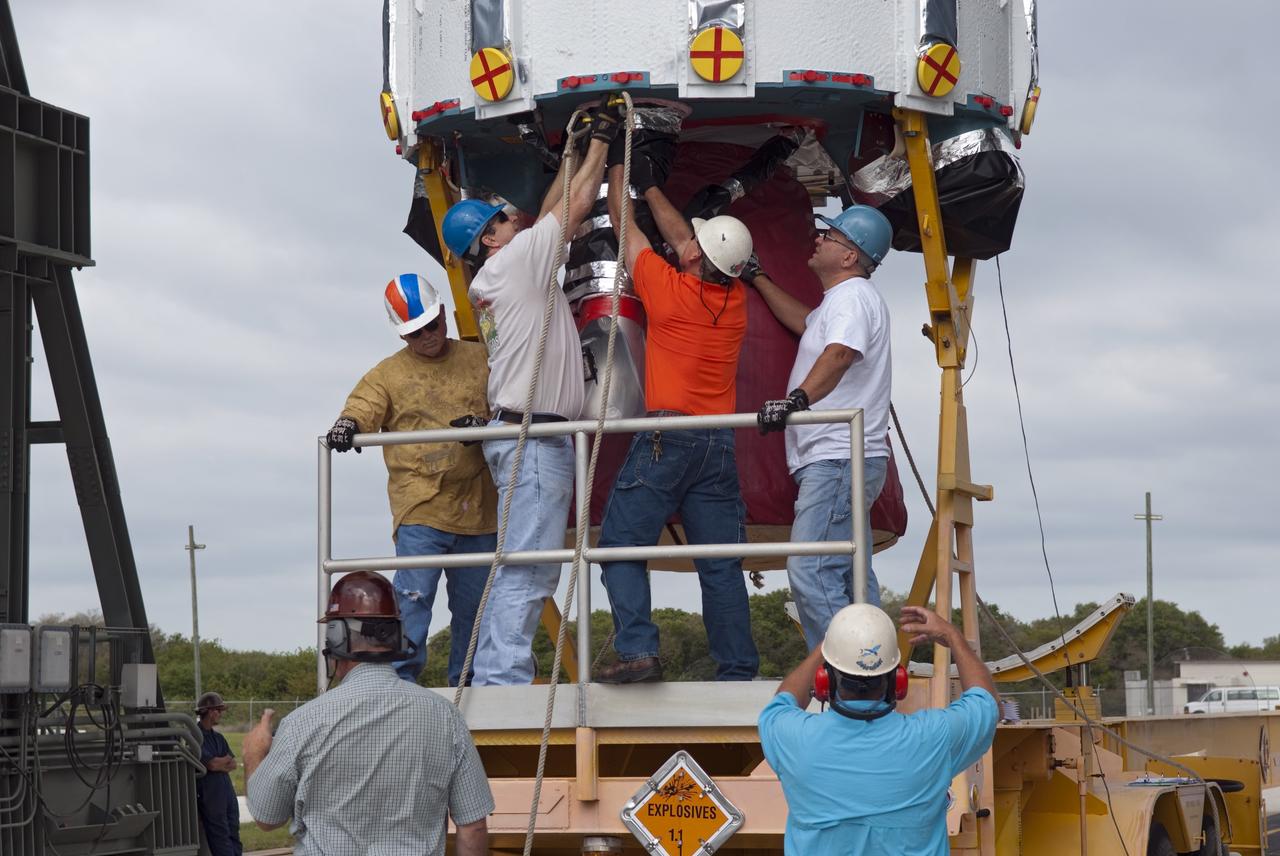
CAPE CANAVERAL, Fla. -- At Cape Canaveral Air Force Station in Florida, workers guide the first stage of a United Launch Alliance Delta II launch vehicle as it is being lifted into the Pad 17B gantry. The Delta II will carry NASA's Gravity Recovery and Interior Laboratory, or GRAIL, spacecraft into lunar orbit. The GRAIL mission is a part of NASA's Discovery Program. GRAIL will fly twin spacecraft in tandem orbits around the moon for several months to measure its gravity field. The mission also will answer longstanding questions about Earth's moon and provide scientists a better understanding of how Earth and other rocky planets in the solar system formed. GRAIL is scheduled to launch September 8, 2011. For more information visit: http://science.nasa.gov/missions/grail/. Photo credit: NASA/Jim Grossmann
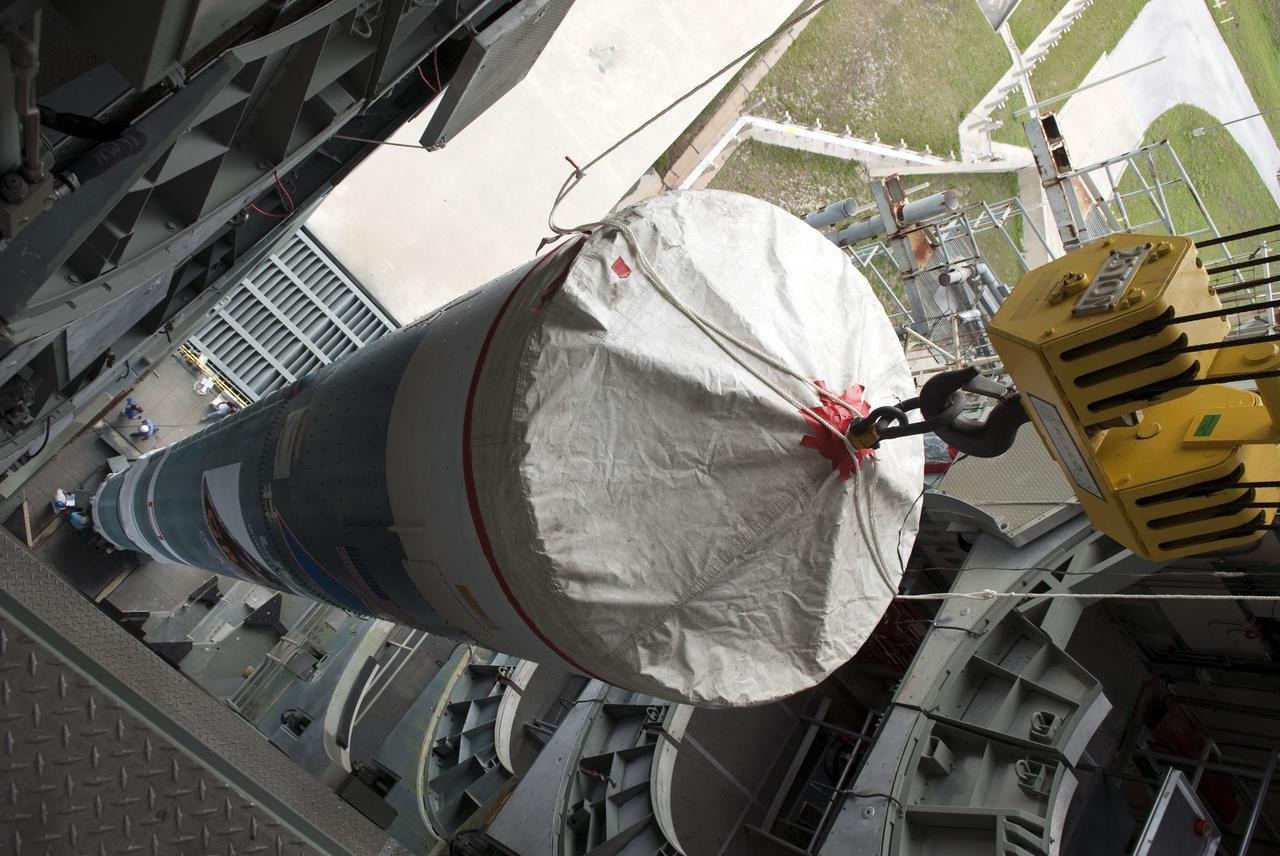
CAPE CANAVERAL, Fla. -- At Cape Canaveral Air Force Station in Florida, the first stage of a United Launch Alliance Delta II launch vehicle is secured into position inside the Pad 17B gantry. The Delta II will carry NASA's Gravity Recovery and Interior Laboratory, or GRAIL, spacecraft into lunar orbit. The GRAIL mission is a part of NASA's Discovery Program. GRAIL will fly twin spacecraft in tandem orbits around the moon for several months to measure its gravity field. The mission also will answer longstanding questions about Earth's moon and provide scientists a better understanding of how Earth and other rocky planets in the solar system formed. GRAIL is scheduled to launch September 8, 2011. For more information visit: http://science.nasa.gov/missions/grail/. Photo credit: NASA/Jim Grossmann
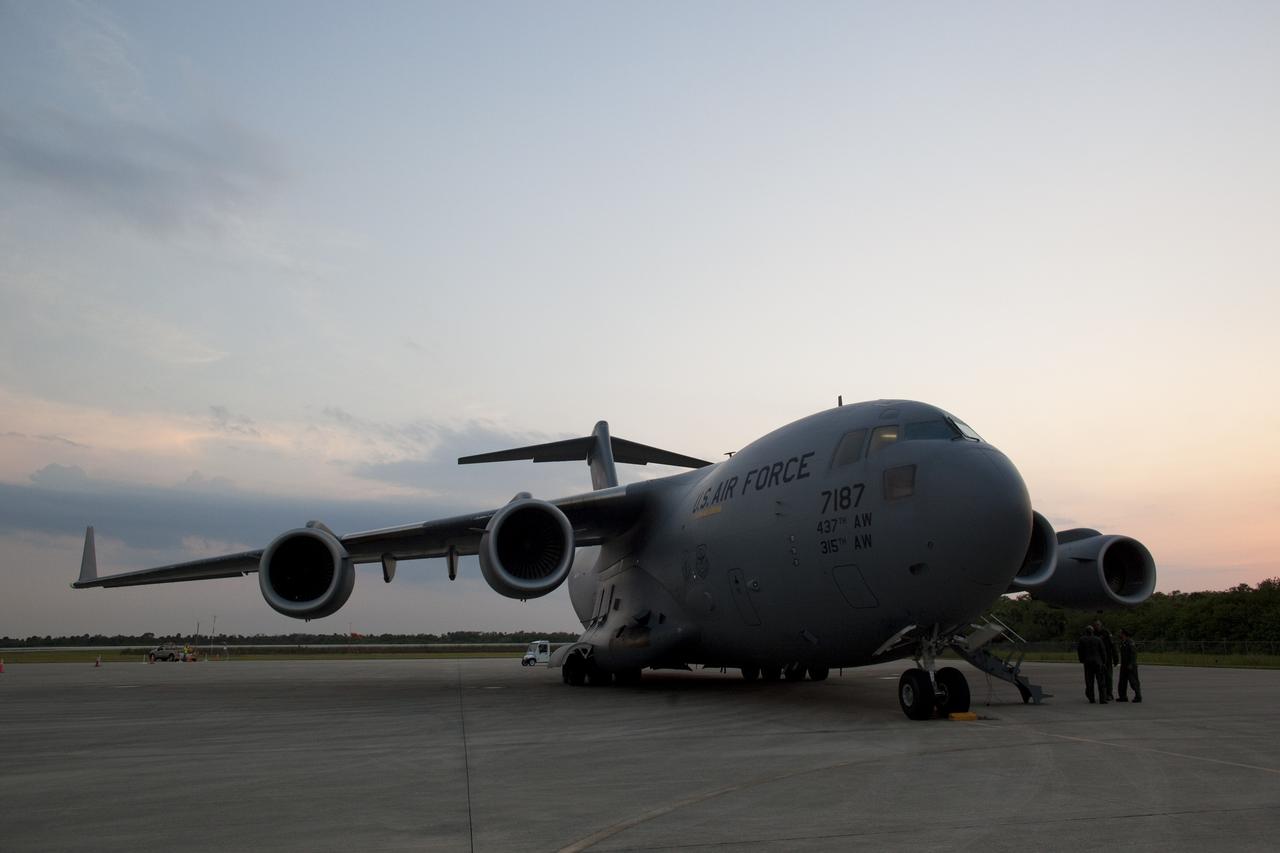
CAPE CANAVERAL, Fla. -- An Air Force C-17 cargo plane arrives on the Shuttle Landing Facility at NASA's Kennedy Space Center in Florida carrying the space agency's Gravity Recovery and Interior Laboratory, or GRAIL, spacecraft. The spacecraft traveled from the Lockheed Martin plant in Denver, Colo., and will undergo further processing in the Astrotech payload processing facility in Titusville, Fla. The United Launch Alliance Delta II rocket that will carry GRAIL into lunar orbit already is fully stacked at NASA's Space Launch Complex 17B and launch is scheduled for Sept. 8. The GRAIL mission is a part of NASA's Discovery Program. GRAIL will fly twin spacecraft in tandem orbits around the moon for several months to measure its gravity field. The mission also will answer longstanding questions about Earth's moon and provide scientists a better understanding of how Earth and other rocky planets in the solar system formed. For more information, visit http://science.nasa.gov/missions/grail/. Photo credit: NASA/Dimitri Gerondidakis
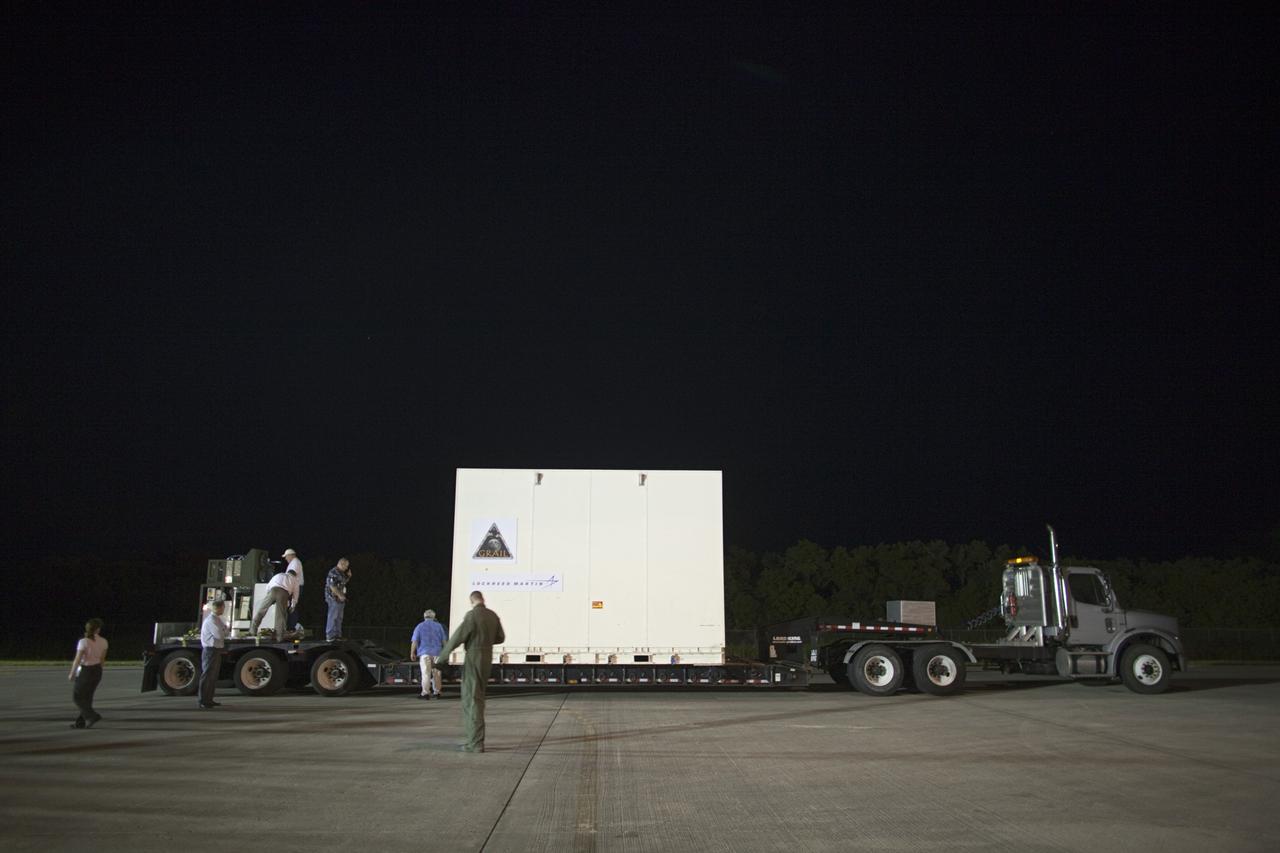
CAPE CANAVERAL, Fla. -- A tractor-trailer will transport NASA's Gravity Recovery and Interior Laboratory, or GRAIL, spacecraft to the Astrotech payload processing facility in Titusville, Fla., where it will be processed for launch. An Air Force C-17 cargo plane flew the spacecraft from the Lockheed Martin plant in Denver, Colo., to the Shuttle Landing Facility at Kennedy Space Center in Florida. The United Launch Alliance Delta II rocket that will carry GRAIL into lunar orbit already is fully stacked at NASA's Space Launch Complex 17B and launch is scheduled for Sept. 8. The GRAIL mission is a part of NASA's Discovery Program. GRAIL will fly twin spacecraft in tandem orbits around the moon for several months to measure its gravity field. The mission also will answer longstanding questions about Earth's moon and provide scientists a better understanding of how Earth and other rocky planets in the solar system formed. For more information, visit http://science.nasa.gov/missions/grail/. Photo credit: NASA/Dimitri Gerondidakis
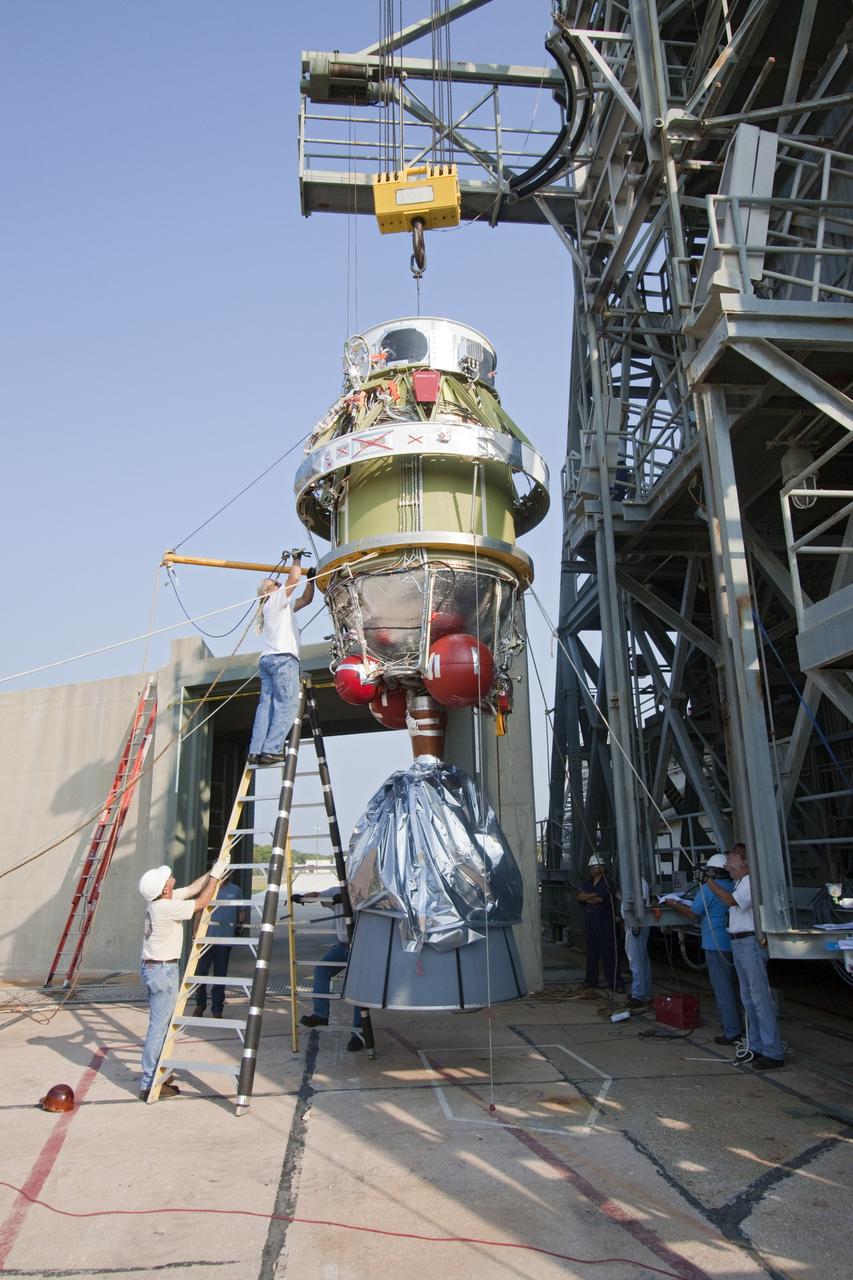
CAPE CANAVERAL, Fla. -- At NASA's Space Launch Complex 17B in Florida, workers using an overhead crane hoist the second stage of a United Launch Alliance Delta II launch vehicle toward the first stage for mating. The payload fairing then will be raised into the white room of the mobile service tower. The Delta II will carry NASA's Gravity Recovery and Interior Laboratory, or GRAIL, spacecraft into lunar orbit. The GRAIL mission is a part of NASA's Discovery Program. GRAIL will fly twin spacecraft in tandem orbits around the moon for several months to measure its gravity field. The mission also will answer longstanding questions about Earth's moon and provide scientists a better understanding of how Earth and other rocky planets in the solar system formed. GRAIL is scheduled to launch Sept. 8. For more information visit: http://science.nasa.gov/missions/grail/. Photo credit: NASA/Jack Pfaller
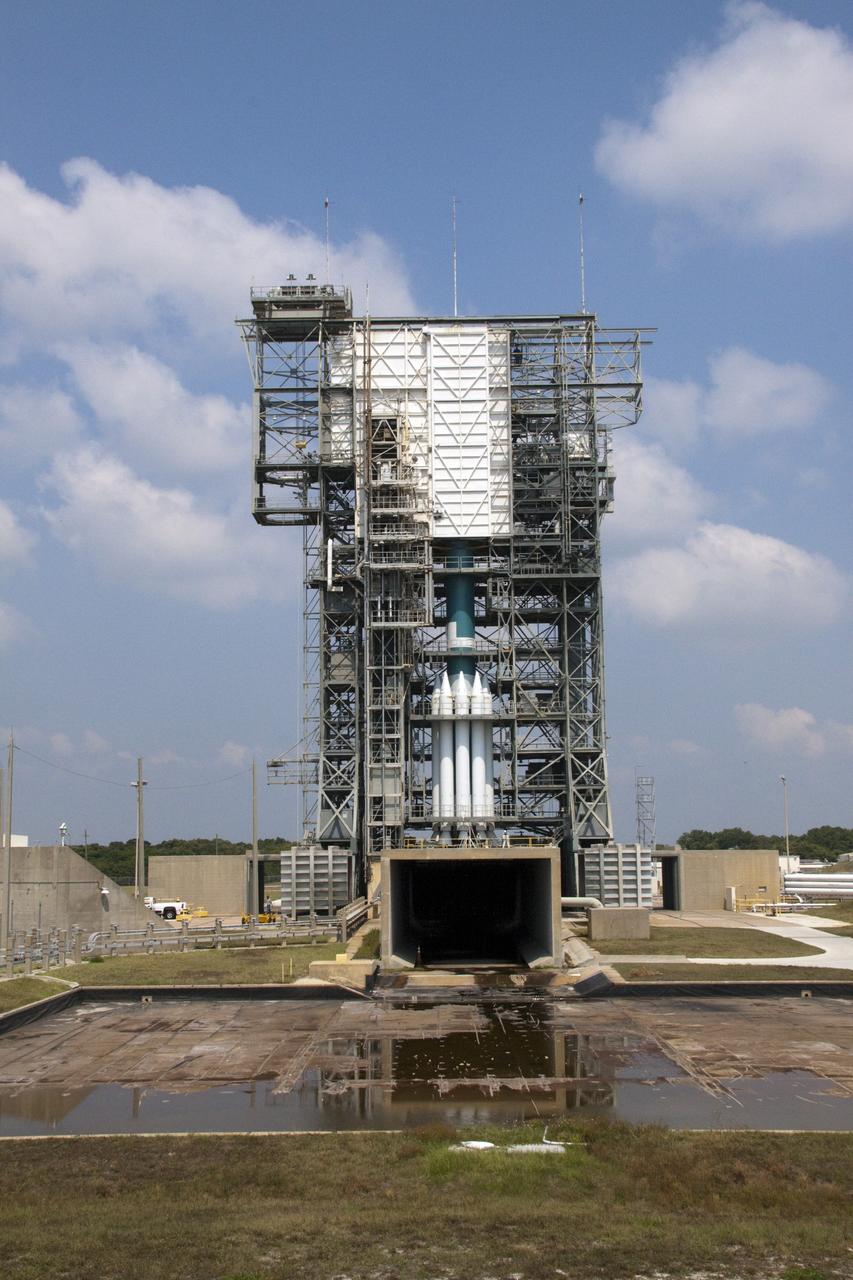
CAPE CANAVERAL, Fla. -- At NASA's Space Launch Complex 17B in Florida, the first and second stages of a United Launch Alliance Delta II launch vehicle along with its nine solid rocket boosters are seen mated in the mobile service tower. The Delta II will carry NASA's Gravity Recovery and Interior Laboratory, or GRAIL, spacecraft into lunar orbit. The GRAIL mission is a part of NASA's Discovery Program. GRAIL will fly twin spacecraft in tandem orbits around the moon for several months to measure its gravity field. The mission also will answer longstanding questions about Earth's moon and provide scientists a better understanding of how Earth and other rocky planets in the solar system formed. GRAIL is scheduled to launch Sept. 8. For more information visit: http://science.nasa.gov/missions/grail/. Photo credit: NASA/Jack Pfaller
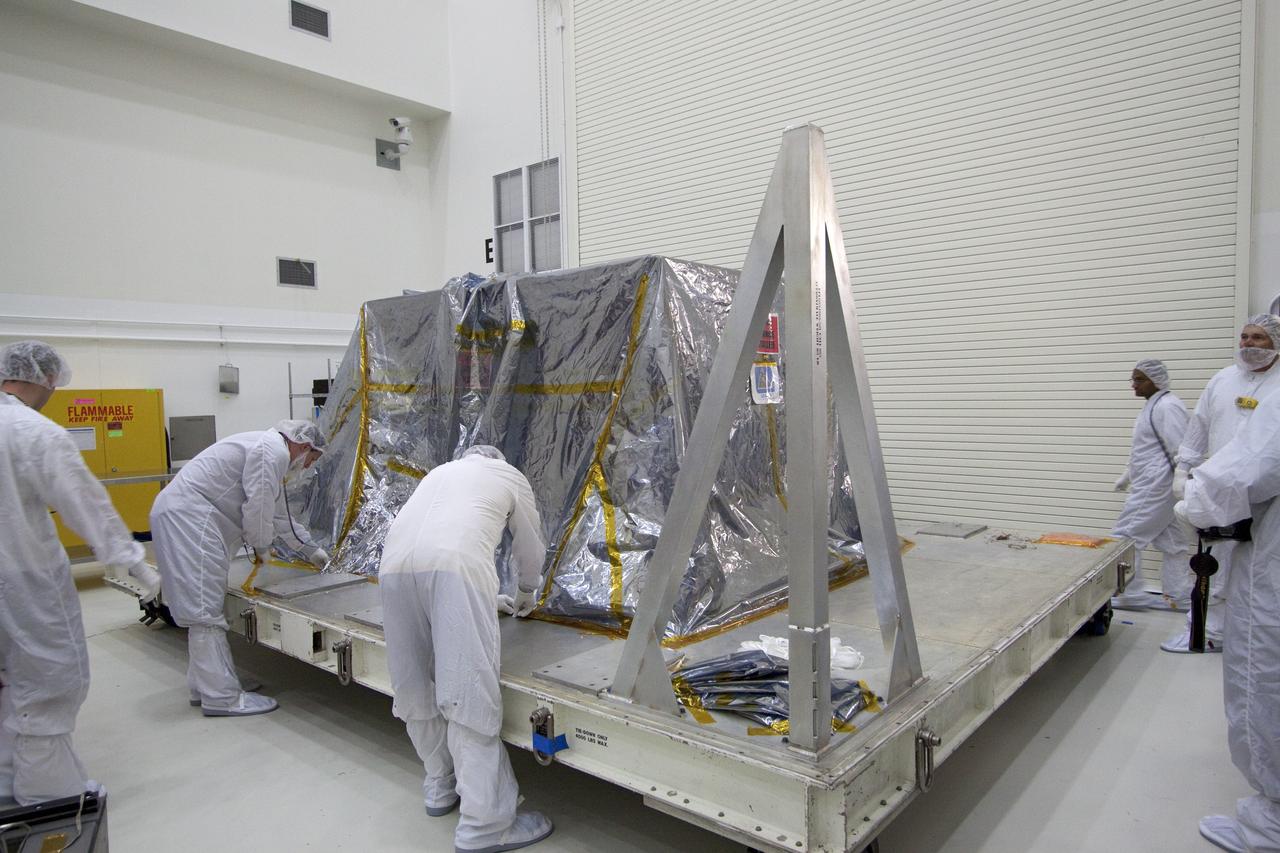
CAPE CANAVERAL, Fla. -- Technicians in the Astrotech payload processing facility in Titusville, Fla., remove the protective cover from NASA's Gravity Recovery and Interior Laboratory, or GRAIL, twin spacecraft to begin testing and processing. GRAIL was built at the Lockheed Martin plant in Denver, Colo. The United Launch Alliance Delta II rocket that will carry GRAIL into lunar orbit already is fully stacked at NASA's Space Launch Complex 17B and launch is scheduled for Sept. 8. The GRAIL mission is a part of NASA's Discovery Program. GRAIL will fly twin spacecraft in tandem orbits around the moon for several months to measure its gravity field. The mission also will answer longstanding questions about Earth's moon and provide scientists a better understanding of how Earth and other rocky planets in the solar system formed. For more information, visit http://science.nasa.gov/missions/grail/. Photo credit: NASA/Jack Pfaller
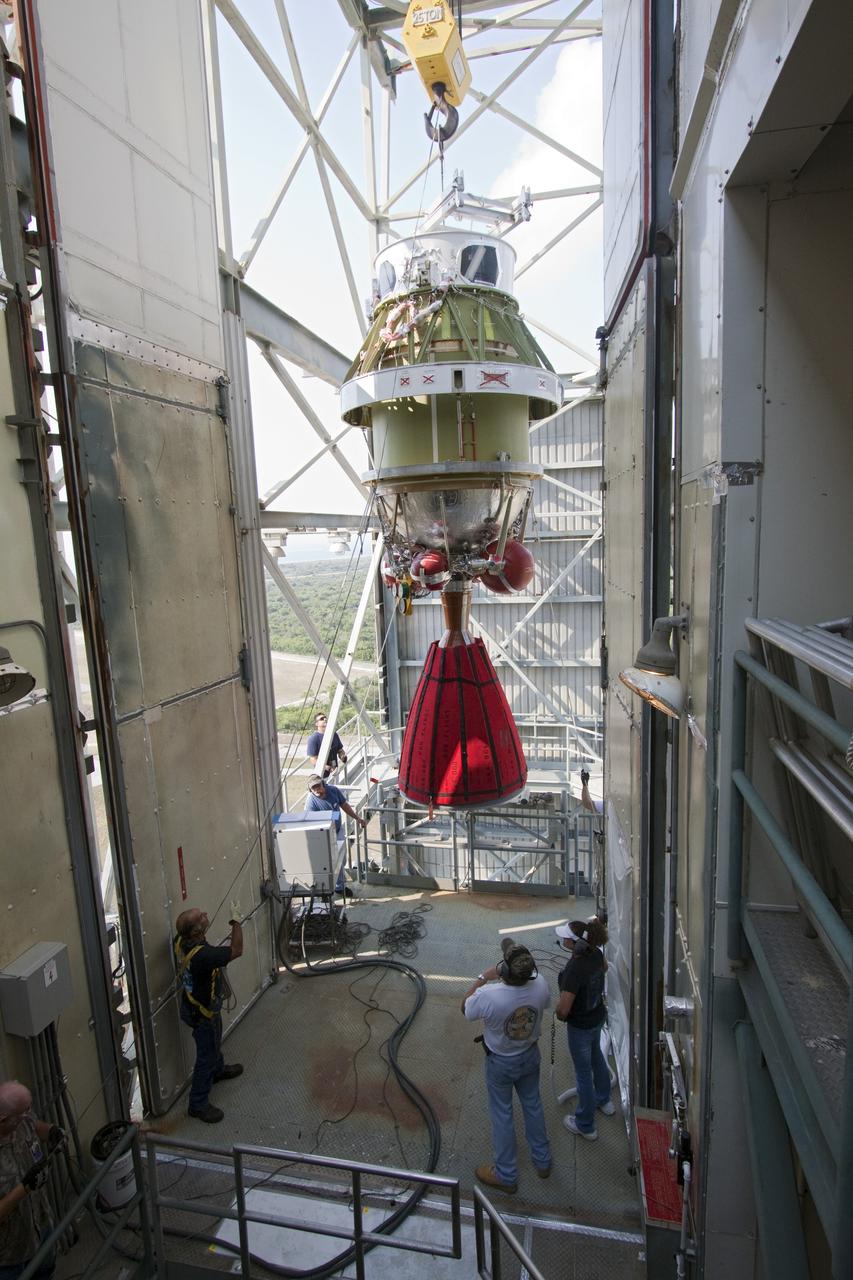
CAPE CANAVERAL, Fla. -- At NASA's Space Launch Complex 17B in Florida, workers using an overhead crane guide the second stage of a United Launch Alliance Delta II launch vehicle into the tower to be mated with the first stage. The payload fairing then will be raised into the white room of the mobile service tower. The Delta II will carry NASA's Gravity Recovery and Interior Laboratory, or GRAIL, spacecraft into lunar orbit. The GRAIL mission is a part of NASA's Discovery Program. GRAIL will fly twin spacecraft in tandem orbits around the moon for several months to measure its gravity field. The mission also will answer longstanding questions about Earth's moon and provide scientists a better understanding of how Earth and other rocky planets in the solar system formed. GRAIL is scheduled to launch Sept. 8. For more information visit: http://science.nasa.gov/missions/grail/. Photo credit: NASA/Jack Pfaller
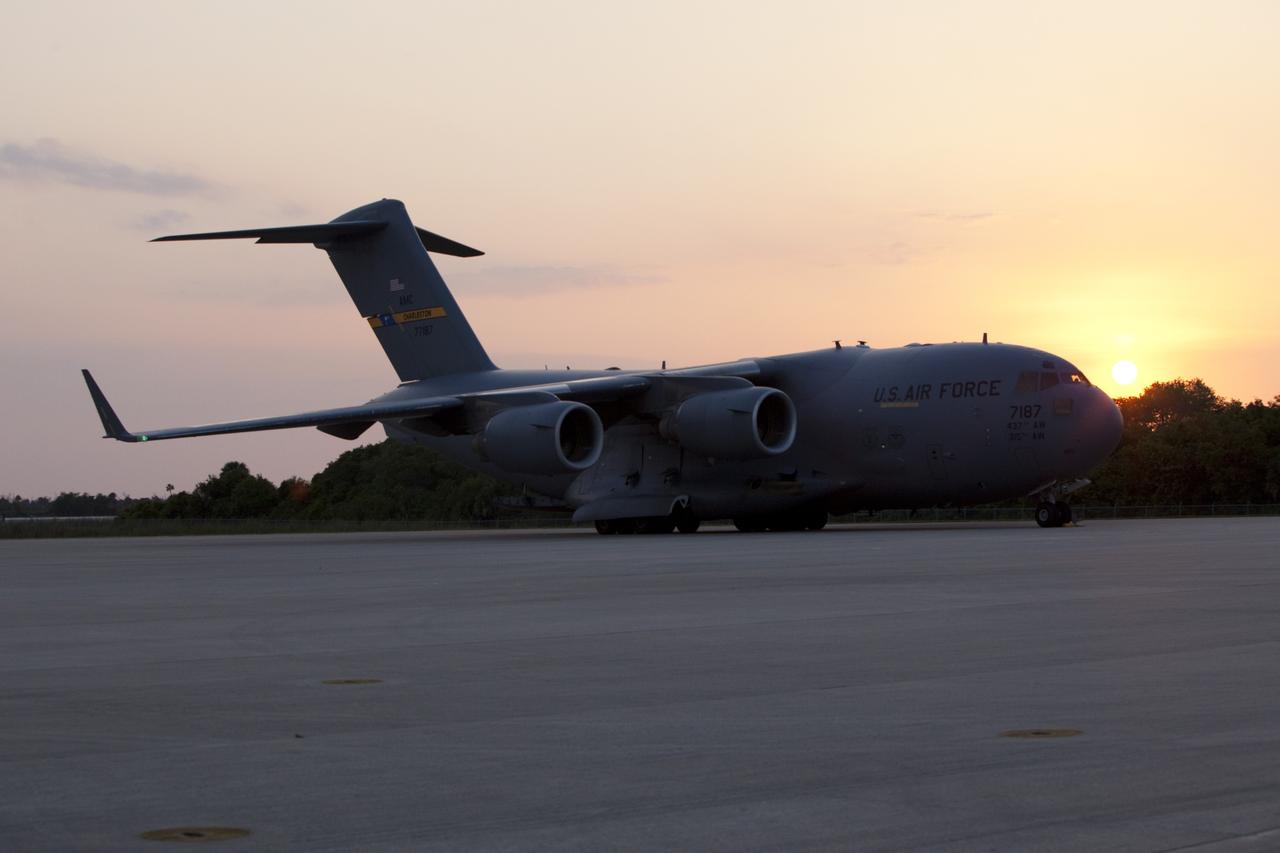
CAPE CANAVERAL, Fla. -- An Air Force C-17 cargo plane arrives on the Shuttle Landing Facility at NASA's Kennedy Space Center in Florida carrying the space agency's Gravity Recovery and Interior Laboratory, or GRAIL, spacecraft. The spacecraft traveled from the Lockheed Martin plant in Denver, Colo., and will undergo further processing in the Astrotech payload processing facility in Titusville, Fla. The United Launch Alliance Delta II rocket that will carry GRAIL into lunar orbit already is fully stacked at NASA's Space Launch Complex 17B and launch is scheduled for Sept. 8. The GRAIL mission is a part of NASA's Discovery Program. GRAIL will fly twin spacecraft in tandem orbits around the moon for several months to measure its gravity field. The mission also will answer longstanding questions about Earth's moon and provide scientists a better understanding of how Earth and other rocky planets in the solar system formed. For more information, visit http://science.nasa.gov/missions/grail/. Photo credit: NASA/Dimitri Gerondidakis
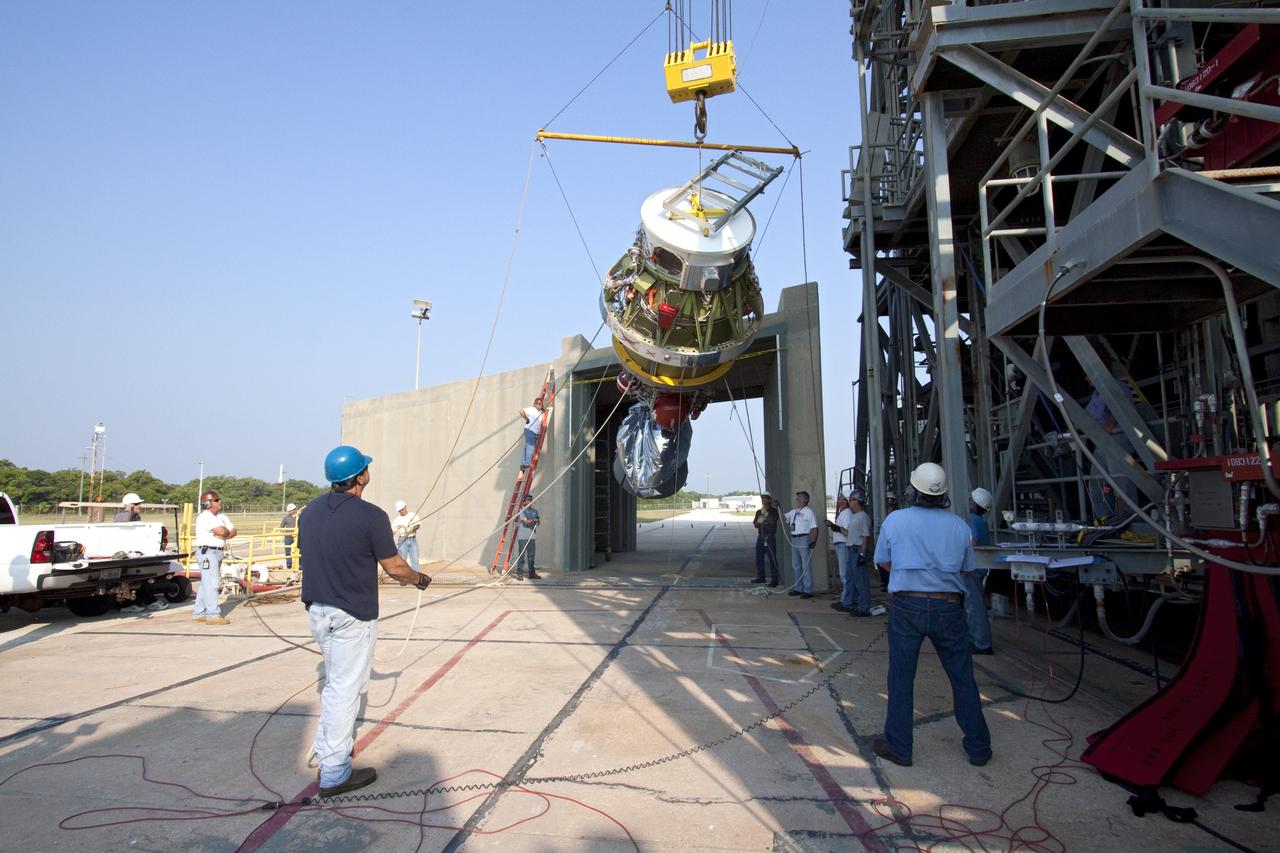
CAPE CANAVERAL, Fla. -- At NASA's Space Launch Complex 17B in Florida, workers using an overhead crane hoist the second stage of a United Launch Alliance Delta II launch vehicle toward the first stage for mating. The payload fairing then will be raised into the white room of the mobile service tower. The Delta II will carry NASA's Gravity Recovery and Interior Laboratory, or GRAIL, spacecraft into lunar orbit. The GRAIL mission is a part of NASA's Discovery Program. GRAIL will fly twin spacecraft in tandem orbits around the moon for several months to measure its gravity field. The mission also will answer longstanding questions about Earth's moon and provide scientists a better understanding of how Earth and other rocky planets in the solar system formed. GRAIL is scheduled to launch Sept. 8. For more information visit: http://science.nasa.gov/missions/grail/. Photo credit: NASA/Jack Pfaller
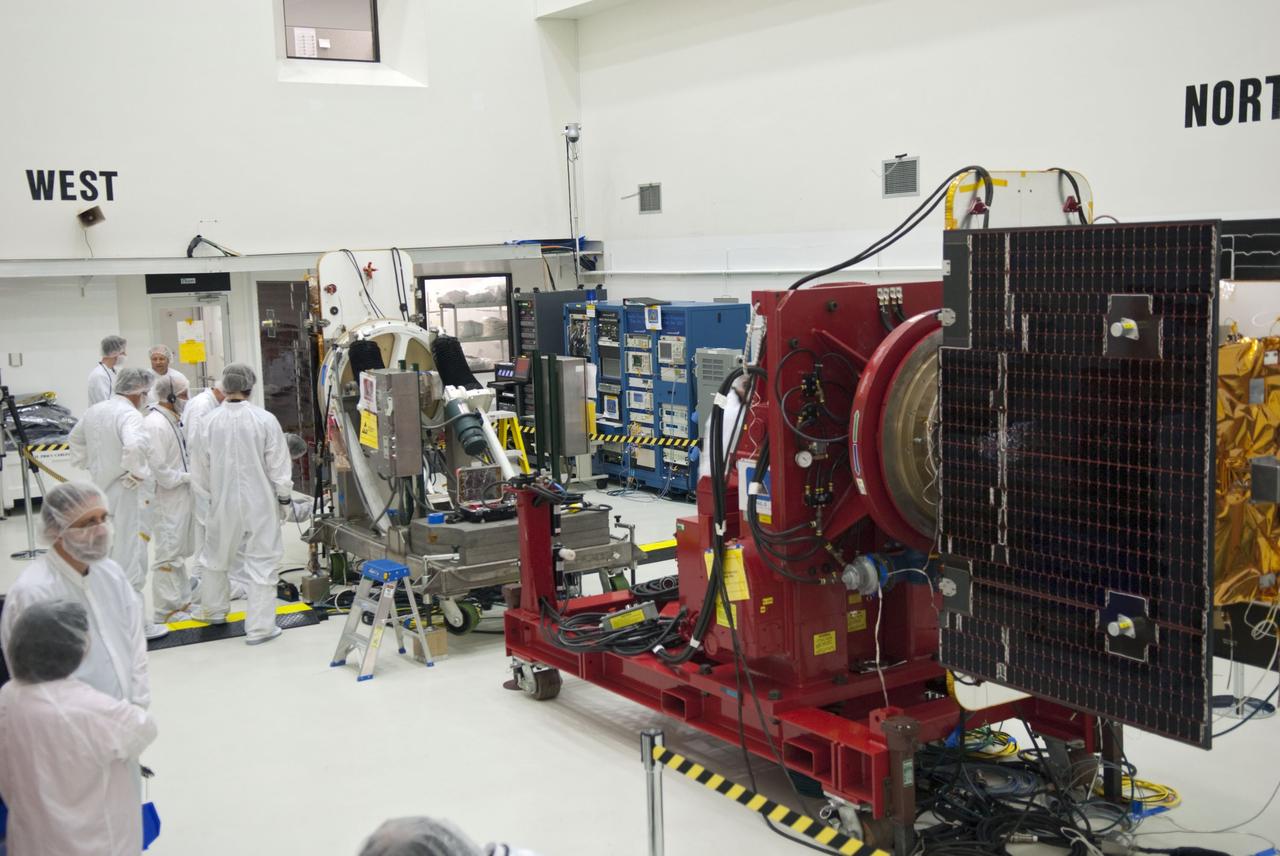
CAPE CANAVERAL, Fla. -- Technicians at Astrotech payload processing facility in Titusville, Fla., are conducting solar panel deployment tests on NASA's Gravity Recovery and Interior Laboratory, or GRAIL, twin spacecraft. The United Launch Alliance Delta II rocket that will carry GRAIL into lunar orbit already is fully stacked at NASA's Space Launch Complex 17B, and launch is scheduled for Sept. 8. The GRAIL mission is a part of NASA's Discovery Program. GRAIL will fly the twin spacecraft in tandem orbits around the moon for several months to measure its gravity field. The mission also will answer longstanding questions about Earth's moon and provide scientists a better understanding of how Earth and other rocky planets in the solar system formed. For more information, visit http://solarsystem.nasa.gov/grail/. Photo credit: NASA/Jim Grossmann
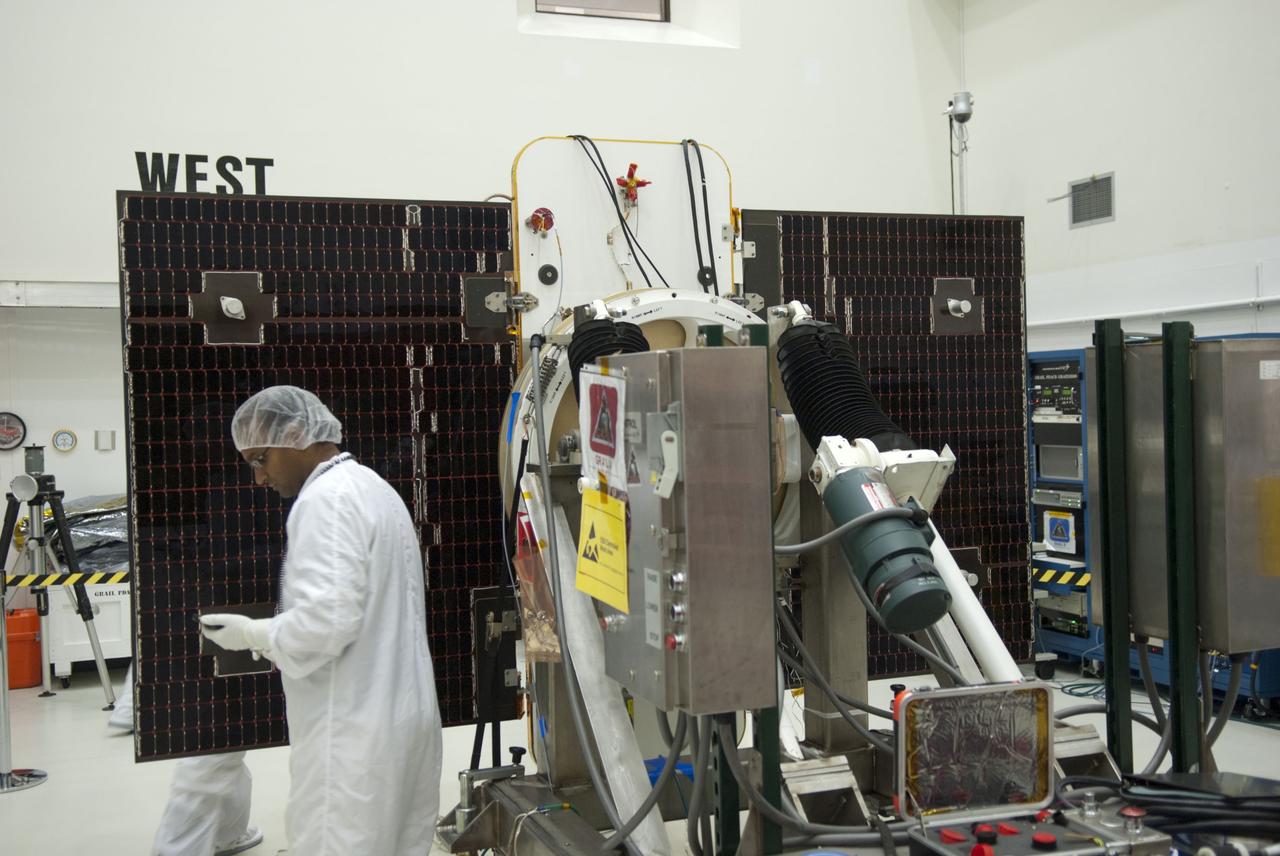
CAPE CANAVERAL, Fla. -- Technicians at Astrotech payload processing facility in Titusville, Fla., are conducting solar panel deployment tests on NASA's Gravity Recovery and Interior Laboratory, or GRAIL, twin spacecraft. The United Launch Alliance Delta II rocket that will carry GRAIL into lunar orbit already is fully stacked at NASA's Space Launch Complex 17B, and launch is scheduled for Sept. 8. The GRAIL mission is a part of NASA's Discovery Program. GRAIL will fly the twin spacecraft in tandem orbits around the moon for several months to measure its gravity field. The mission also will answer longstanding questions about Earth's moon and provide scientists a better understanding of how Earth and other rocky planets in the solar system formed. For more information, visit http://solarsystem.nasa.gov/grail/. Photo credit: NASA/Jim Grossmann
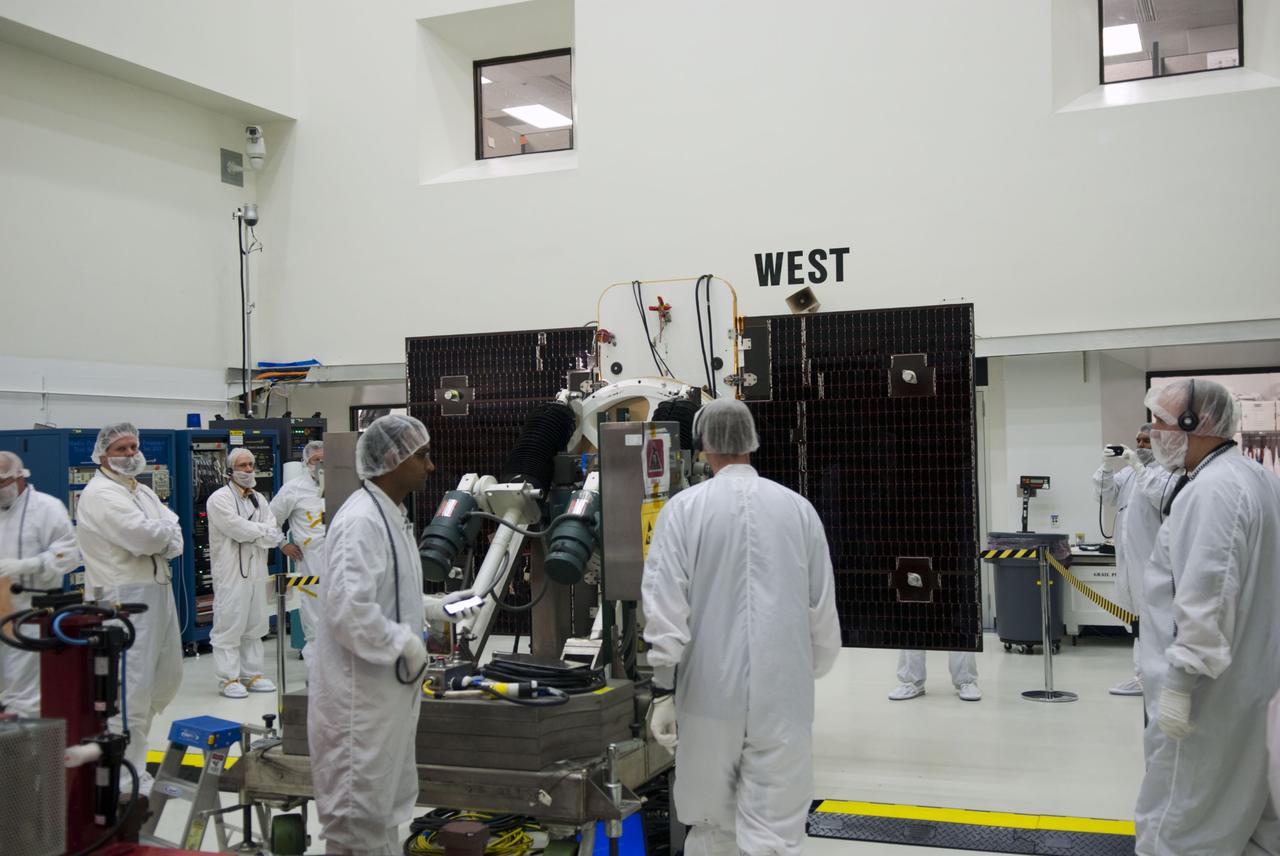
CAPE CANAVERAL, Fla. -- Technicians at Astrotech payload processing facility in Titusville, Fla., are conducting solar panel deployment tests on NASA's Gravity Recovery and Interior Laboratory, or GRAIL, twin spacecraft. The United Launch Alliance Delta II rocket that will carry GRAIL into lunar orbit already is fully stacked at NASA's Space Launch Complex 17B, and launch is scheduled for Sept. 8. The GRAIL mission is a part of NASA's Discovery Program. GRAIL will fly the twin spacecraft in tandem orbits around the moon for several months to measure its gravity field. The mission also will answer longstanding questions about Earth's moon and provide scientists a better understanding of how Earth and other rocky planets in the solar system formed. For more information, visit http://solarsystem.nasa.gov/grail/. Photo credit: NASA/Jim Grossmann
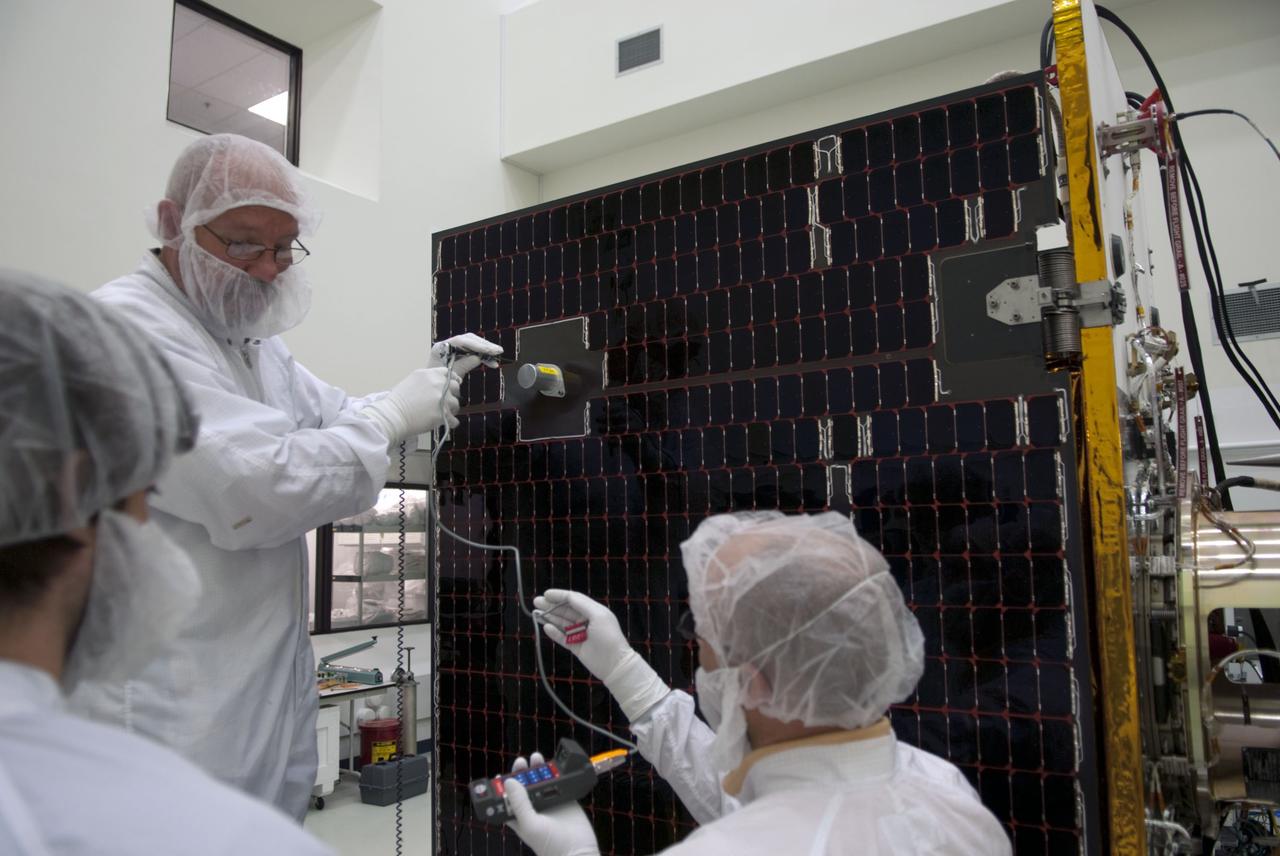
CAPE CANAVERAL, Fla. -- Technicians at Astrotech payload processing facility in Titusville, Fla., are preparing NASA's Gravity Recovery and Interior Laboratory, or GRAIL, twin spacecraft for solar panel deployment testing. The United Launch Alliance Delta II rocket that will carry GRAIL into lunar orbit already is fully stacked at NASA's Space Launch Complex 17B, and launch is scheduled for Sept. 8. The GRAIL mission is a part of NASA's Discovery Program. GRAIL will fly the twin spacecraft in tandem orbits around the moon for several months to measure its gravity field. The mission also will answer longstanding questions about Earth's moon and provide scientists a better understanding of how Earth and other rocky planets in the solar system formed. For more information, visit http://solarsystem.nasa.gov/grail/. Photo credit: NASA/Jim Grossmann
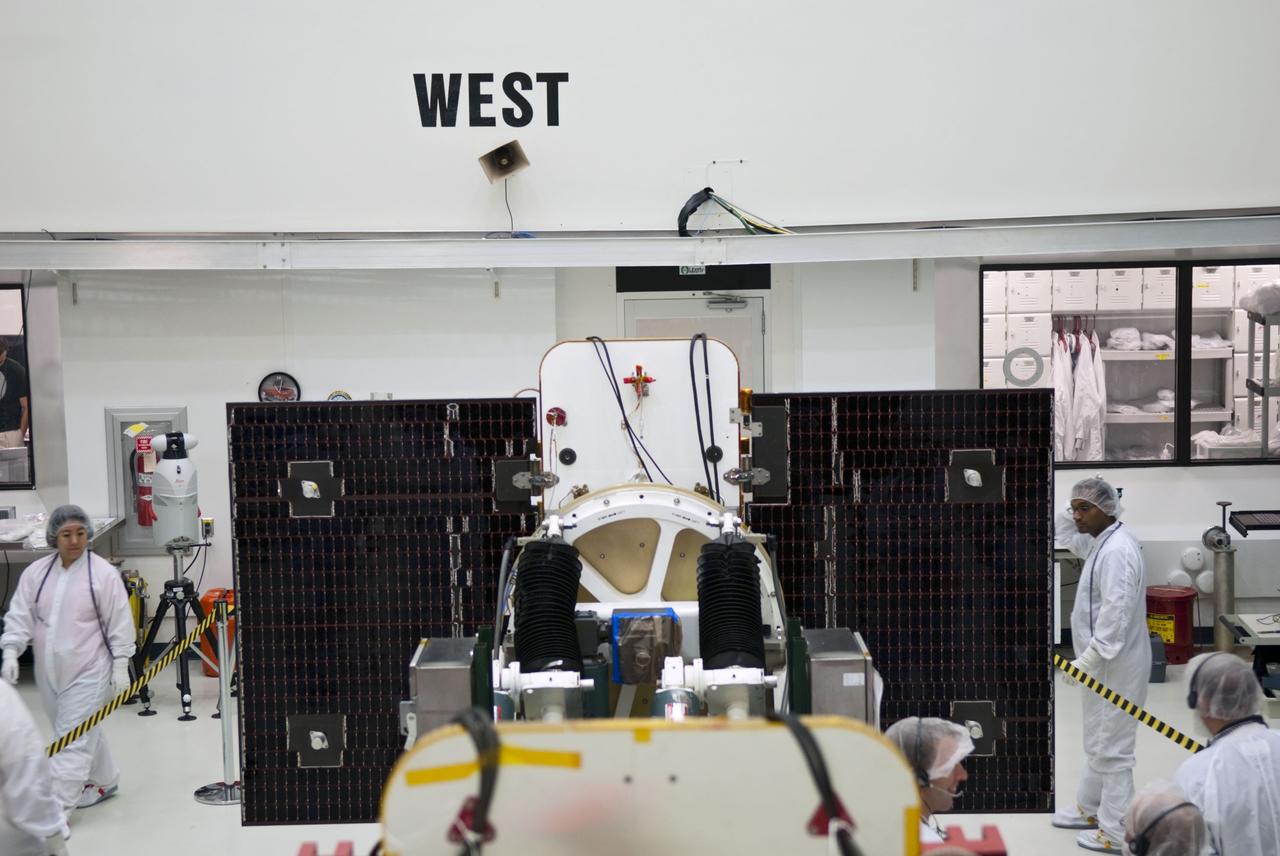
CAPE CANAVERAL, Fla. -- Technicians at Astrotech payload processing facility in Titusville, Fla., are conducting solar panel deployment tests on NASA's Gravity Recovery and Interior Laboratory, or GRAIL, twin spacecraft. The United Launch Alliance Delta II rocket that will carry GRAIL into lunar orbit already is fully stacked at NASA's Space Launch Complex 17B, and launch is scheduled for Sept. 8. The GRAIL mission is a part of NASA's Discovery Program. GRAIL will fly the twin spacecraft in tandem orbits around the moon for several months to measure its gravity field. The mission also will answer longstanding questions about Earth's moon and provide scientists a better understanding of how Earth and other rocky planets in the solar system formed. For more information, visit http://solarsystem.nasa.gov/grail/. Photo credit: NASA/Jim Grossmann
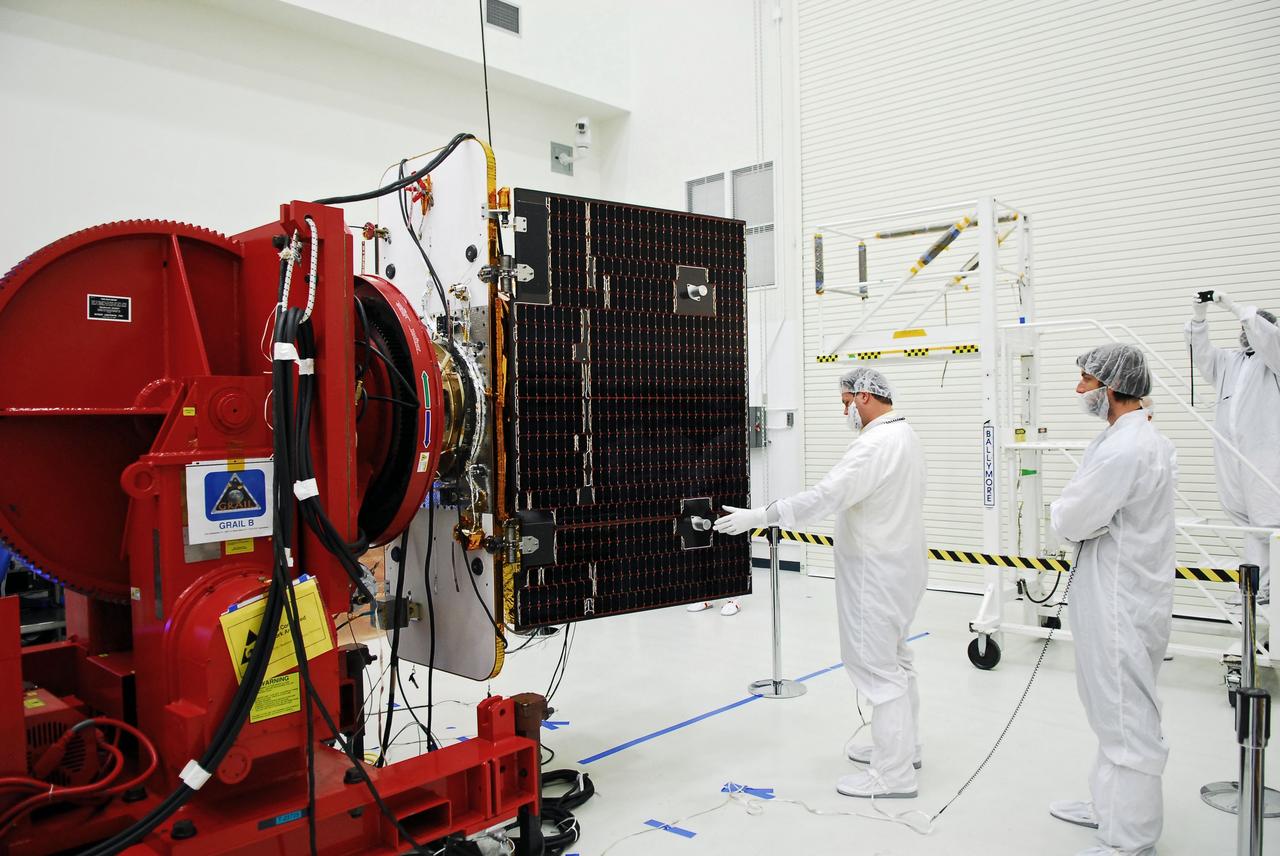
CAPE CANAVERAL, Fla. -- Technicians at Astrotech payload processing facility in Titusville, Fla., are conducting solar panel deployment tests on NASA's Gravity Recovery and Interior Laboratory, or GRAIL, twin spacecraft. The United Launch Alliance Delta II rocket that will carry GRAIL into lunar orbit already is fully stacked at NASA's Space Launch Complex 17B, and launch is scheduled for Sept. 8. The GRAIL mission is a part of NASA's Discovery Program. GRAIL will fly the twin spacecraft in tandem orbits around the moon for several months to measure its gravity field. The mission also will answer longstanding questions about Earth's moon and provide scientists a better understanding of how Earth and other rocky planets in the solar system formed. For more information, visit http://solarsystem.nasa.gov/grail/. Photo credit: NASA/Jim Grossmann
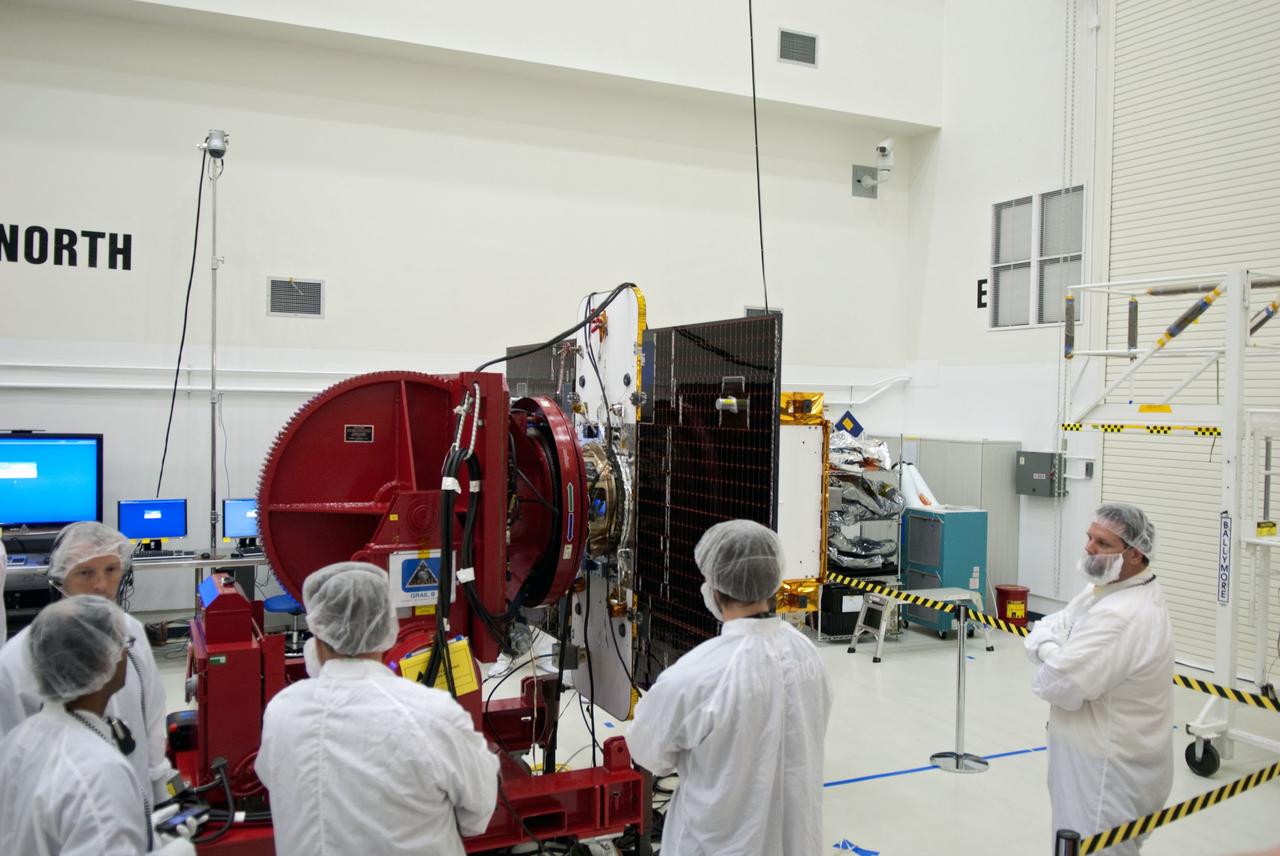
CAPE CANAVERAL, Fla. -- Technicians at Astrotech payload processing facility in Titusville, Fla., are conducting solar panel deployment tests on NASA's Gravity Recovery and Interior Laboratory, or GRAIL, twin spacecraft. The United Launch Alliance Delta II rocket that will carry GRAIL into lunar orbit already is fully stacked at NASA's Space Launch Complex 17B, and launch is scheduled for Sept. 8. The GRAIL mission is a part of NASA's Discovery Program. GRAIL will fly the twin spacecraft in tandem orbits around the moon for several months to measure its gravity field. The mission also will answer longstanding questions about Earth's moon and provide scientists a better understanding of how Earth and other rocky planets in the solar system formed. For more information, visit http://solarsystem.nasa.gov/grail/. Photo credit: NASA/Jim Grossmann
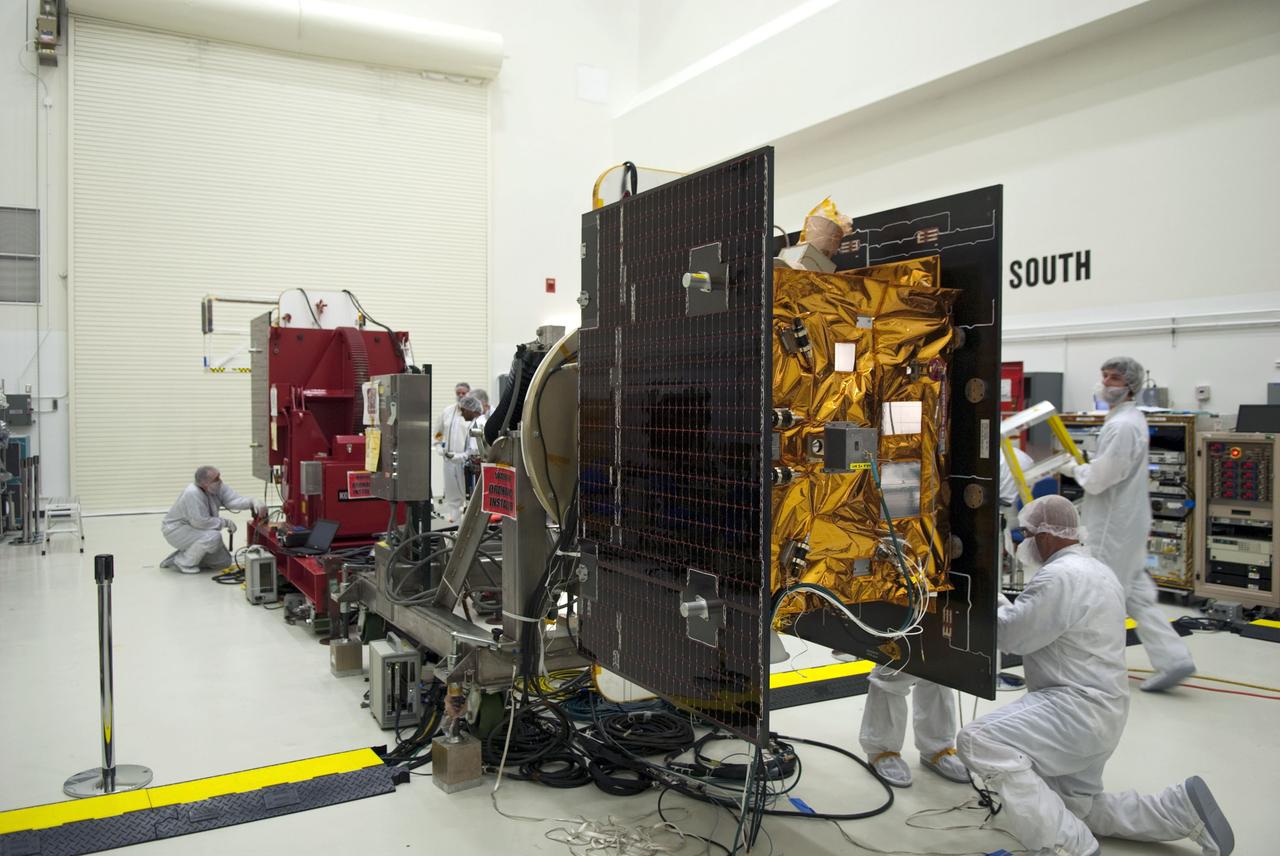
CAPE CANAVERAL, Fla. -- Technicians at Astrotech payload processing facility in Titusville, Fla., are preparing NASA's Gravity Recovery and Interior Laboratory, or GRAIL, twin spacecraft for solar panel deployment testing. The United Launch Alliance Delta II rocket that will carry GRAIL into lunar orbit already is fully stacked at NASA's Space Launch Complex 17B, and launch is scheduled for Sept. 8. The GRAIL mission is a part of NASA's Discovery Program. GRAIL will fly the twin spacecraft in tandem orbits around the moon for several months to measure its gravity field. The mission also will answer longstanding questions about Earth's moon and provide scientists a better understanding of how Earth and other rocky planets in the solar system formed. For more information, visit http://solarsystem.nasa.gov/grail/. Photo credit: NASA/Jim Grossmann
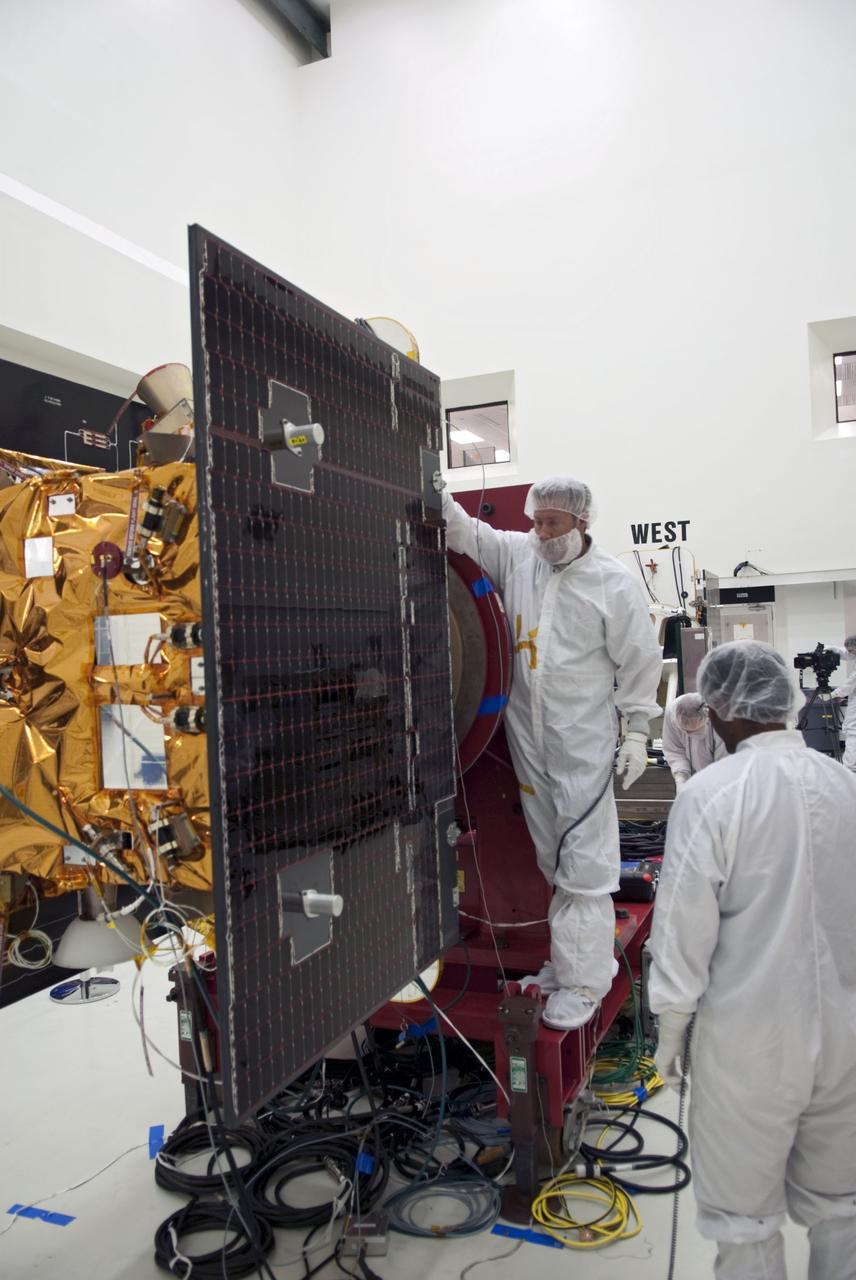
CAPE CANAVERAL, Fla. -- Technicians at Astrotech payload processing facility in Titusville, Fla., are conducting solar panel deployment tests on NASA's Gravity Recovery and Interior Laboratory, or GRAIL, twin spacecraft. The United Launch Alliance Delta II rocket that will carry GRAIL into lunar orbit already is fully stacked at NASA's Space Launch Complex 17B, and launch is scheduled for Sept. 8. The GRAIL mission is a part of NASA's Discovery Program. GRAIL will fly the twin spacecraft in tandem orbits around the moon for several months to measure its gravity field. The mission also will answer longstanding questions about Earth's moon and provide scientists a better understanding of how Earth and other rocky planets in the solar system formed. For more information, visit http://solarsystem.nasa.gov/grail/. Photo credit: NASA/Jim Grossmann
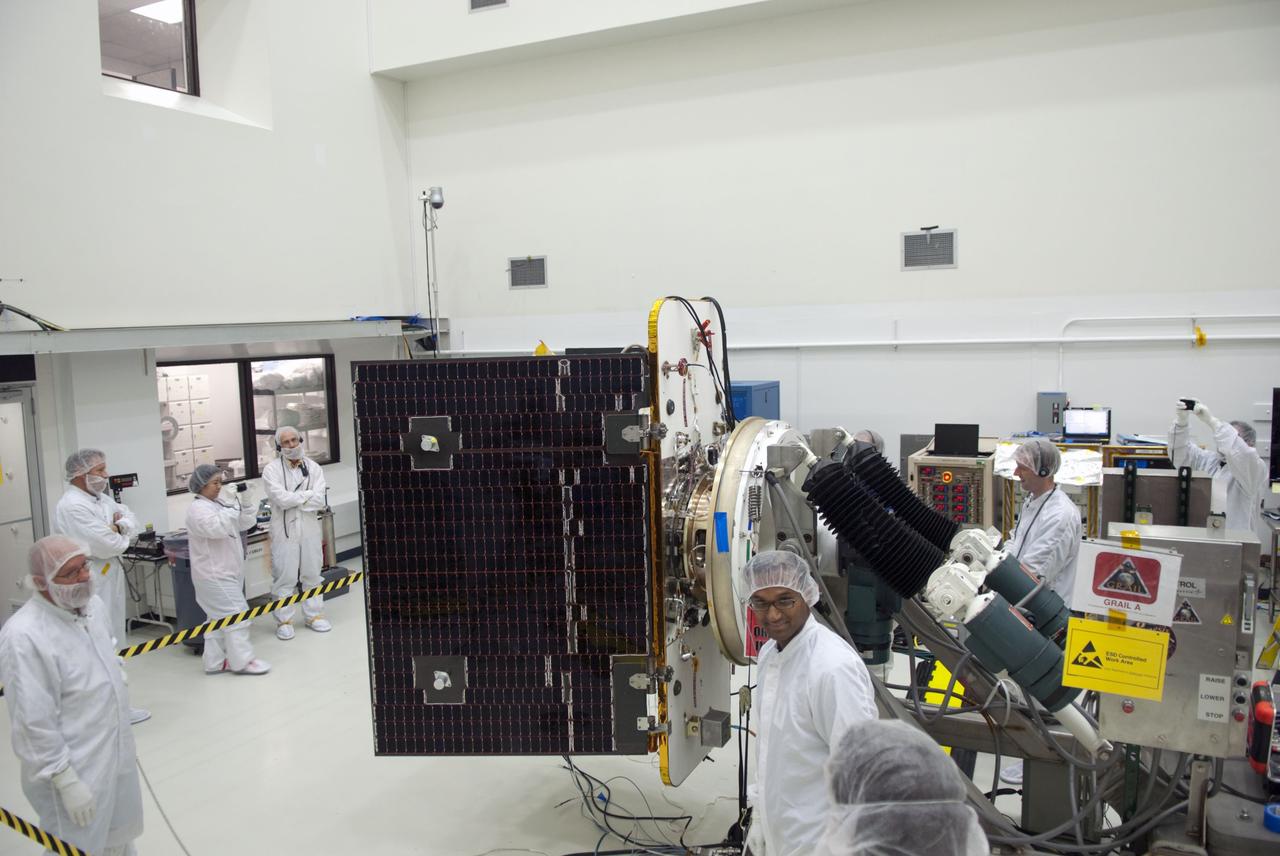
CAPE CANAVERAL, Fla. -- Technicians at Astrotech payload processing facility in Titusville, Fla., are conducting solar panel deployment tests on NASA's Gravity Recovery and Interior Laboratory, or GRAIL, twin spacecraft. The United Launch Alliance Delta II rocket that will carry GRAIL into lunar orbit already is fully stacked at NASA's Space Launch Complex 17B, and launch is scheduled for Sept. 8. The GRAIL mission is a part of NASA's Discovery Program. GRAIL will fly the twin spacecraft in tandem orbits around the moon for several months to measure its gravity field. The mission also will answer longstanding questions about Earth's moon and provide scientists a better understanding of how Earth and other rocky planets in the solar system formed. For more information, visit http://solarsystem.nasa.gov/grail/. Photo credit: NASA/Jim Grossmann