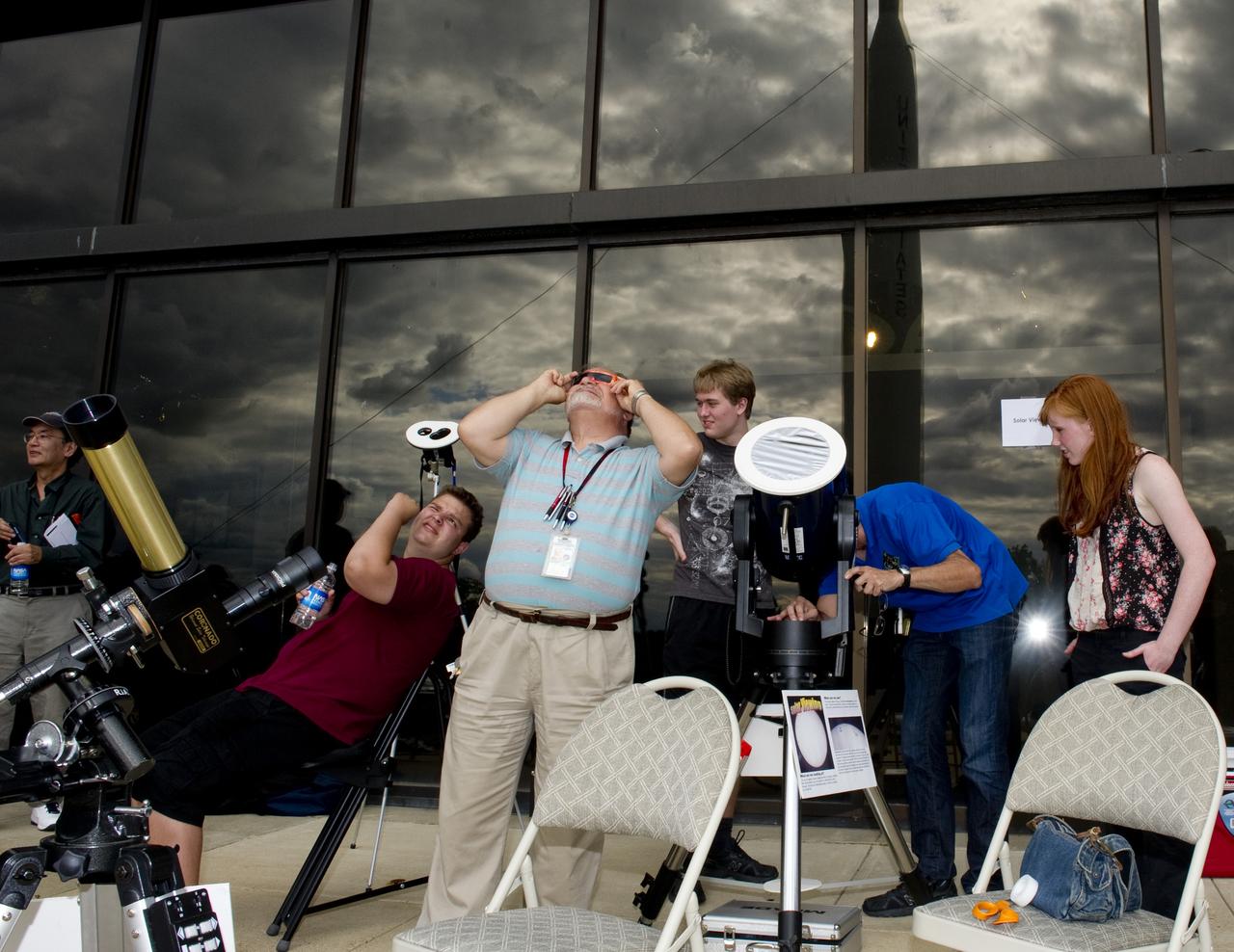
A "transit of Venus" occurs when the planet Venus passes directly between the sun and the Earth. During the event, Venus will be seen from Earth as a small black sphere moving across the face of the sun. Such an event won’t occur again until the year 2117. The Goddard Visitor Center hosted a watch party that included near real-time images from NASA’s Solar Dynamics Observatory mission, coverage of the event from several locations via NASA TV, in-person presentations by NASA experts, hands-on activities for children of all ages. Heavy cloud cover did not allow viewing opportunities of the transit via solar telescopes. Credit: NASA/Goddard Space Flight Center/Bill Hrybyk <b><a href="http://www.nasa.gov/audience/formedia/features/MP_Photo_Guidelines.html" rel="nofollow">NASA image use policy.</a></b> <b><a href="http://www.nasa.gov/centers/goddard/home/index.html" rel="nofollow">NASA Goddard Space Flight Center</a></b> enables NASA’s mission through four scientific endeavors: Earth Science, Heliophysics, Solar System Exploration, and Astrophysics. Goddard plays a leading role in NASA’s accomplishments by contributing compelling scientific knowledge to advance the Agency’s mission. <b>Follow us on <a href="http://twitter.com/NASA_GoddardPix" rel="nofollow">Twitter</a></b> <b>Like us on <a href="http://www.facebook.com/pages/Greenbelt-MD/NASA-Goddard/395013845897?ref=tsd" rel="nofollow">Facebook</a></b> <b>Find us on <a href="http://instagrid.me/nasagoddard/?vm=grid" rel="nofollow">Instagram</a></b>