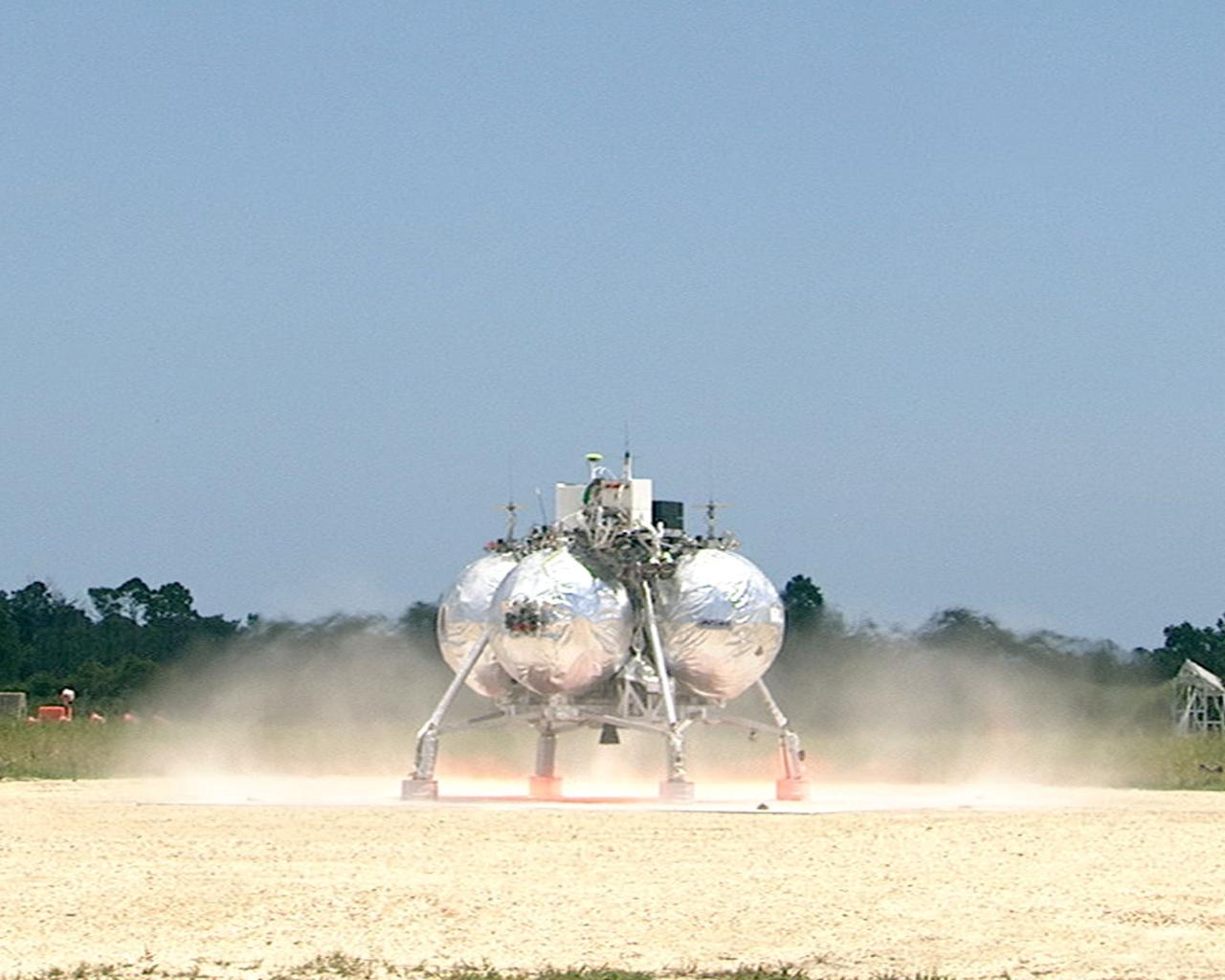
CAPE CANAVERAL, Fla. – At the Shuttle Landing Facility at NASA’s Kennedy Space Center in Florida, the Morpheus prototype lander begins to lift off of the ground during a free-flight test. Testing of the prototype lander had been ongoing at NASA’s Johnson Space Center in Houston in preparation for its first free-flight test at Kennedy Space Center. Morpheus was manufactured and assembled at JSC and Armadillo Aerospace. Morpheus is large enough to carry 1,100 pounds of cargo to the moon – for example, a humanoid robot, a small rover, or a small laboratory to convert moon dust into oxygen. The primary focus of the test is to demonstrate an integrated propulsion and guidance, navigation and control system that can fly a lunar descent profile to exercise the Autonomous Landing and Hazard Avoidance Technology, or ALHAT, safe landing sensors and closed-loop flight control. For more information on Project Morpheus, visit http://morpheuslander.jsc.nasa.gov/. Photo credit: NASA
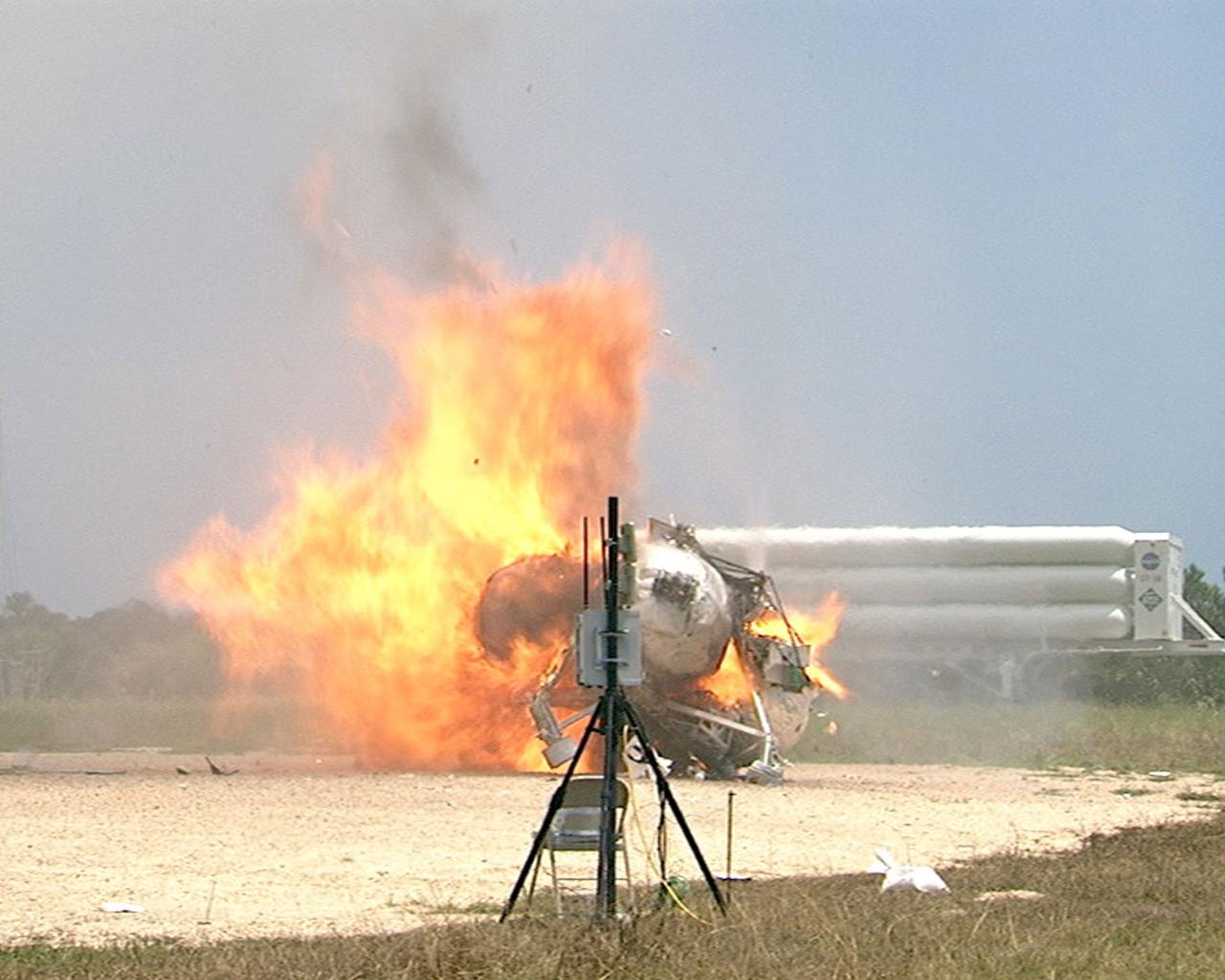
CAPE CANAVERAL, Fla. – During a free-flight test of the Project Morpheus vehicle at the Shuttle Landing Facility at NASA’s Kennedy Space Center in Florida, the vehicle lifted off the ground and then experienced a hardware component failure, which prevented it from maintaining stable flight. No one was injured and the resulting fire was extinguished by Kennedy fire personnel. Engineers are looking into the test data and the agency will release information as it becomes available. Failures such as these were anticipated prior to the test, and are part of the development process for any complex spaceflight hardware. Testing of the prototype lander had been ongoing at NASA’s Johnson Space Center in Houston in preparation for its first free-flight test at Kennedy Space Center. Morpheus was manufactured and assembled at JSC and Armadillo Aerospace. Morpheus is large enough to carry 1,100 pounds of cargo to the moon – for example, a humanoid robot, a small rover, or a small laboratory to convert moon dust into oxygen. The primary focus of the test is to demonstrate an integrated propulsion and guidance, navigation and control system that can fly a lunar descent profile to exercise the Autonomous Landing and Hazard Avoidance Technology, or ALHAT, safe landing sensors and closed-loop flight control. For more information on Project Morpheus, visit http://morpheuslander.jsc.nasa.gov/. Photo credit: NASA
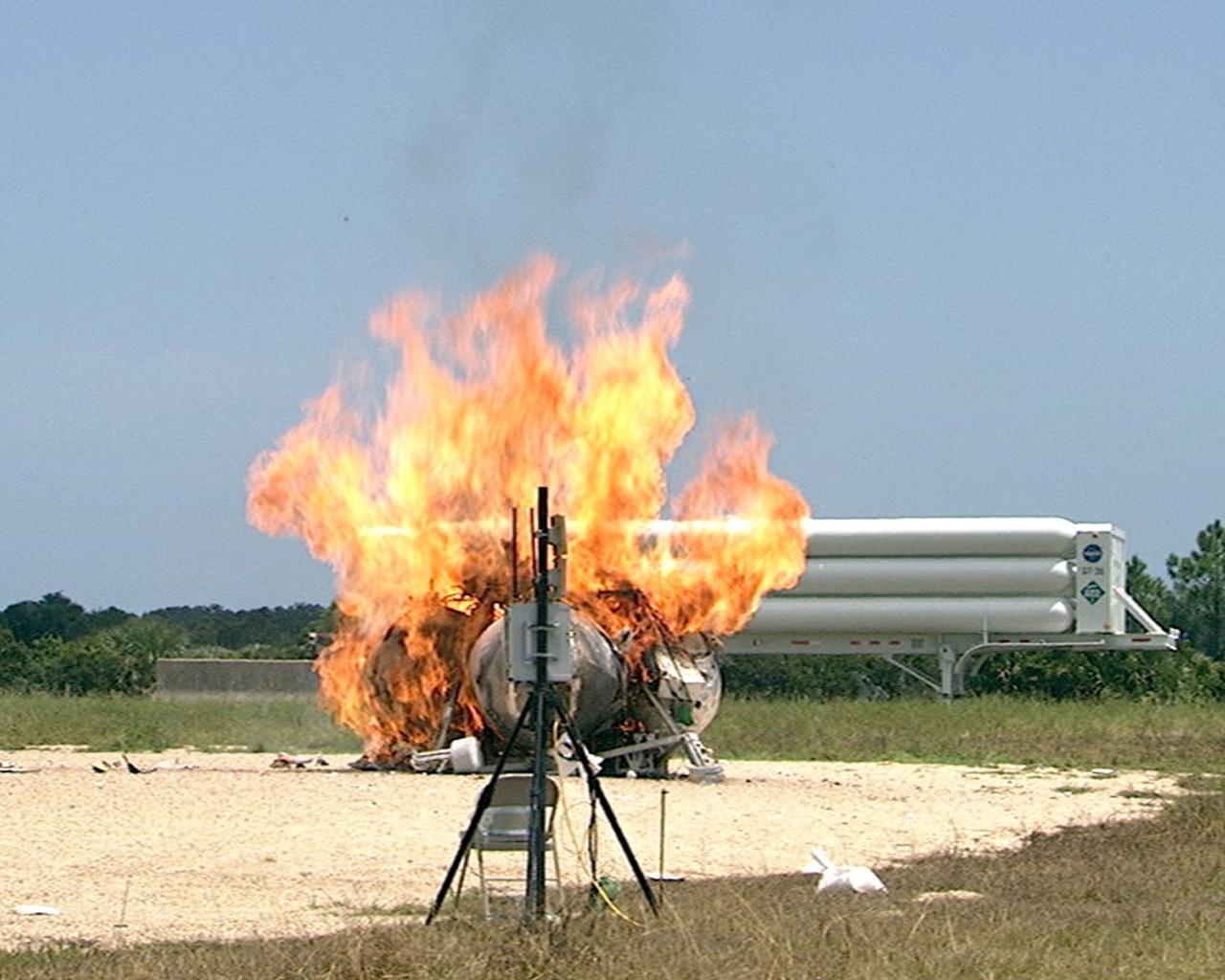
CAPE CANAVERAL, Fla. – During a free-flight test of the Project Morpheus vehicle at the Shuttle Landing Facility at NASA’s Kennedy Space Center in Florida, the vehicle lifted off the ground and then experienced a hardware component failure, which prevented it from maintaining stable flight. No one was injured and the resulting fire was extinguished by Kennedy fire personnel. Engineers are looking into the test data and the agency will release information as it becomes available. Failures such as these were anticipated prior to the test, and are part of the development process for any complex spaceflight hardware. Testing of the prototype lander had been ongoing at NASA’s Johnson Space Center in Houston in preparation for its first free-flight test at Kennedy Space Center. Morpheus was manufactured and assembled at JSC and Armadillo Aerospace. Morpheus is large enough to carry 1,100 pounds of cargo to the moon – for example, a humanoid robot, a small rover, or a small laboratory to convert moon dust into oxygen. The primary focus of the test is to demonstrate an integrated propulsion and guidance, navigation and control system that can fly a lunar descent profile to exercise the Autonomous Landing and Hazard Avoidance Technology, or ALHAT, safe landing sensors and closed-loop flight control. For more information on Project Morpheus, visit http://morpheuslander.jsc.nasa.gov/. Photo credit: NASA
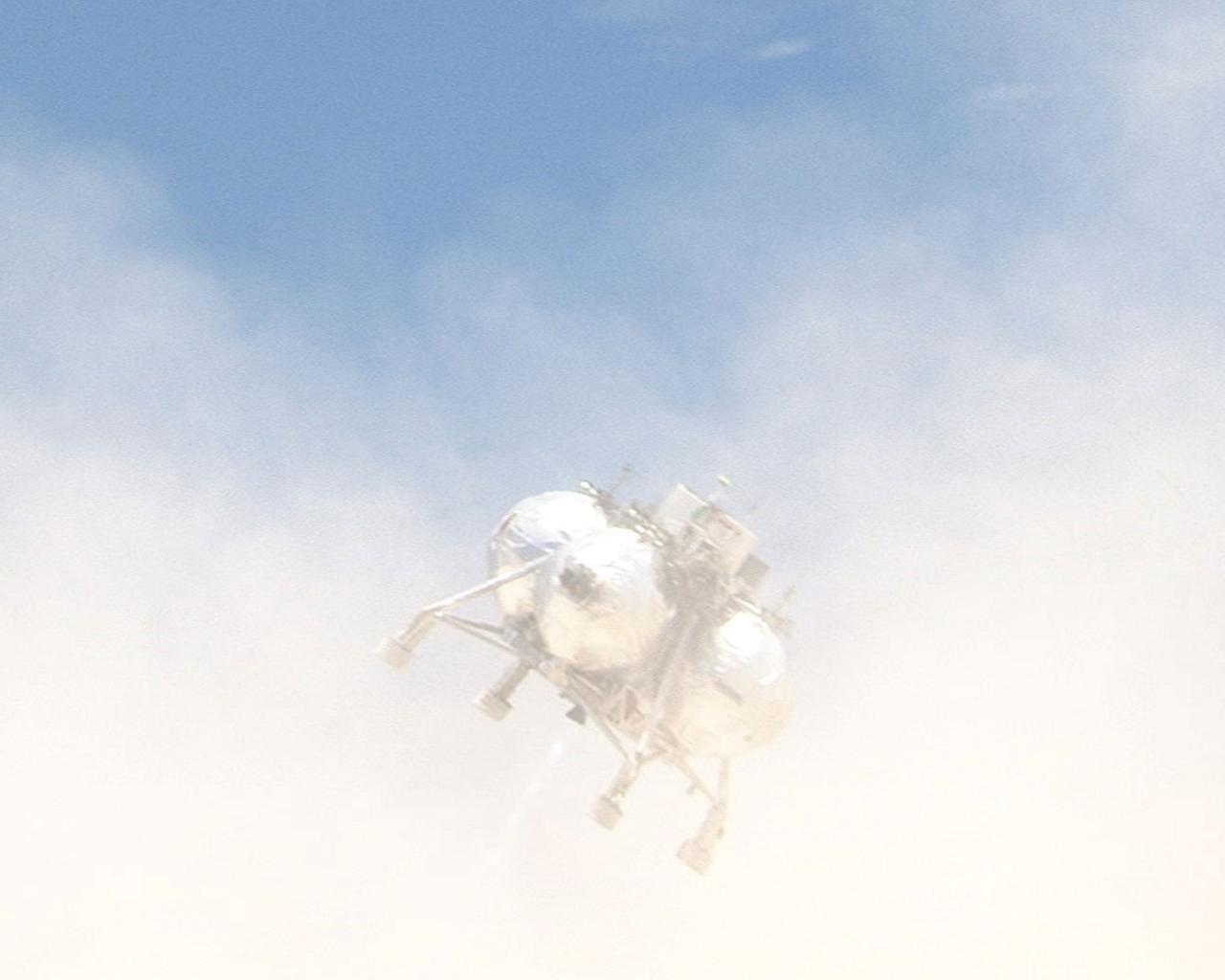
CAPE CANAVERAL, Fla. – During a free-flight test of the Project Morpheus vehicle at the Shuttle Landing Facility at NASA’s Kennedy Space Center in Florida, the vehicle lifted off the ground and then experienced a hardware component failure, which prevented it from maintaining stable flight. Engineers are looking into the test data and the agency will release information as it becomes available. Failures such as these were anticipated prior to the test, and are part of the development process for any complex spaceflight hardware. Testing of the prototype lander had been ongoing at NASA’s Johnson Space Center in Houston in preparation for its first free-flight test at Kennedy Space Center. Morpheus was manufactured and assembled at JSC and Armadillo Aerospace. Morpheus is large enough to carry 1,100 pounds of cargo to the moon – for example, a humanoid robot, a small rover, or a small laboratory to convert moon dust into oxygen. The primary focus of the test is to demonstrate an integrated propulsion and guidance, navigation and control system that can fly a lunar descent profile to exercise the Autonomous Landing and Hazard Avoidance Technology, or ALHAT, safe landing sensors and closed-loop flight control. For more information on Project Morpheus, visit http://morpheuslander.jsc.nasa.gov/. Photo credit: NASA
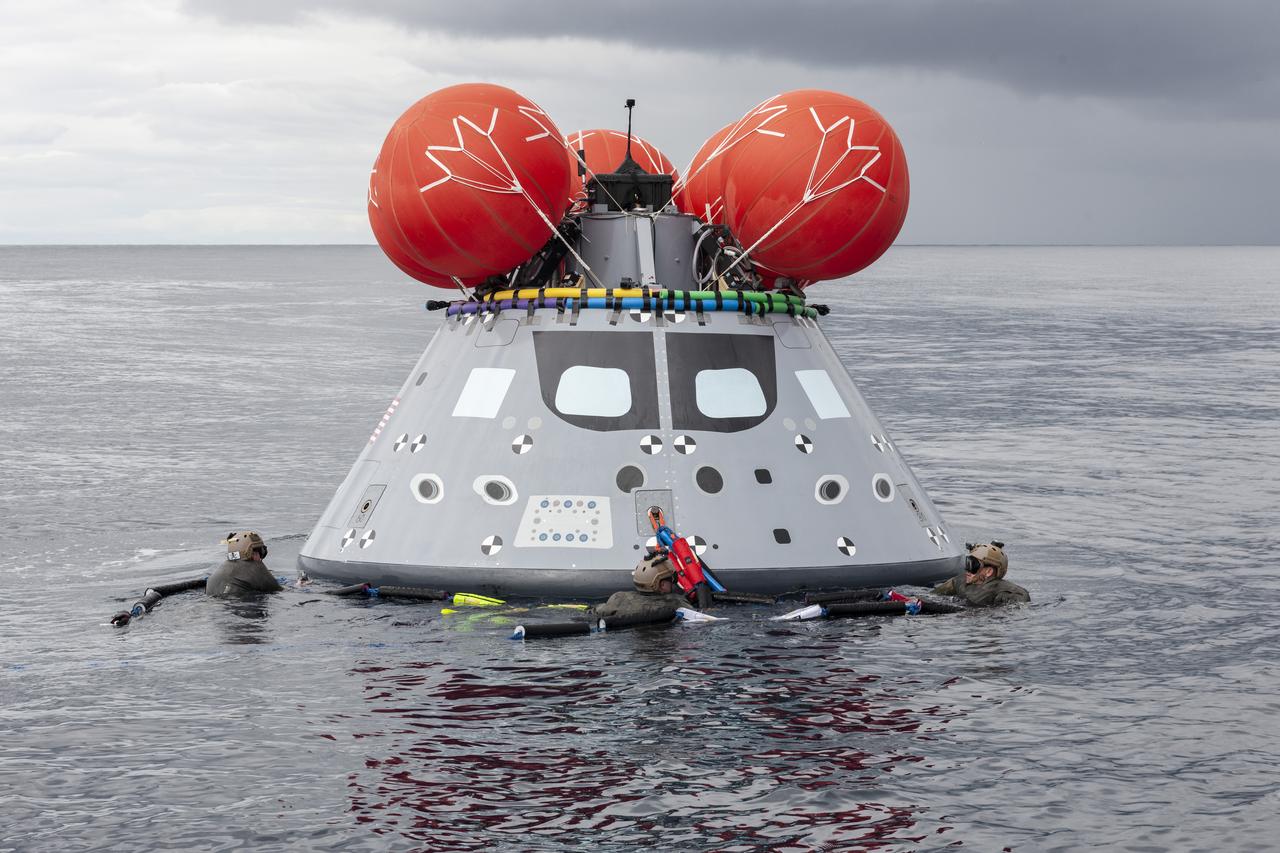
During Underway Recovery Test-8, NASA's Landing and Recovery team from Exploration Ground Systems at Kennedy Space Center performed their first full mission profile test of the recovery procedures for Artemis I aboard the USS John P. Murtha in the Pacific Ocean. Artemis I will be the first integrated flight test of NASA's Deep Space Exploration Systems: the Orion spacecraft, Space Launch System rocket, with the newly upgraded Exploration Ground Systems at Kennedy Space Center.
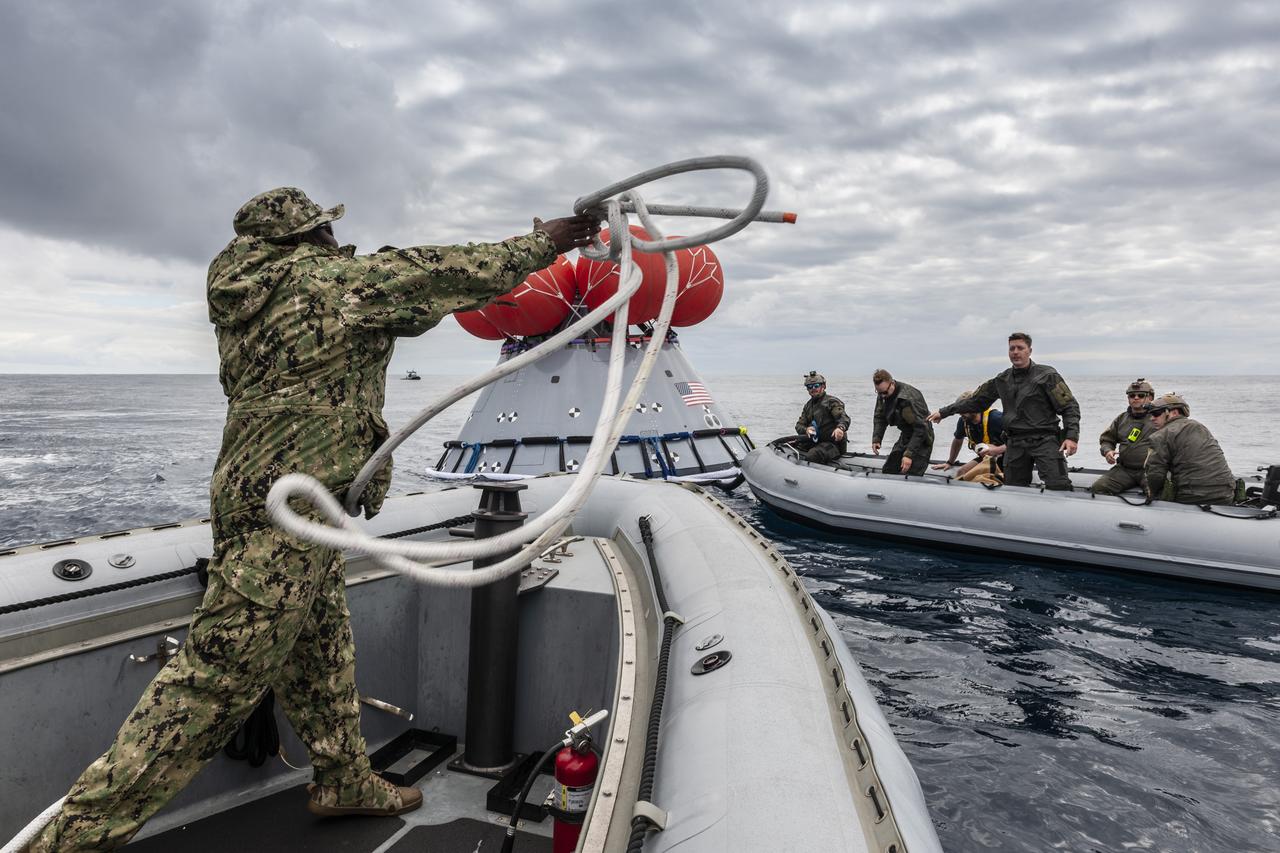
During Underway Recovery Test-8, NASA's Landing and Recovery team from Exploration Ground Systems at Kennedy Space Center performed their first full mission profile test of the recovery procedures for Artemis I aboard the USS John P. Murtha in the Pacific Ocean. Artemis I will be the first integrated flight test of NASA's Deep Space Exploration Systems: the Orion spacecraft, Space Launch System rocket, with the newly upgraded Exploration Ground Systems at Kennedy Space Center.
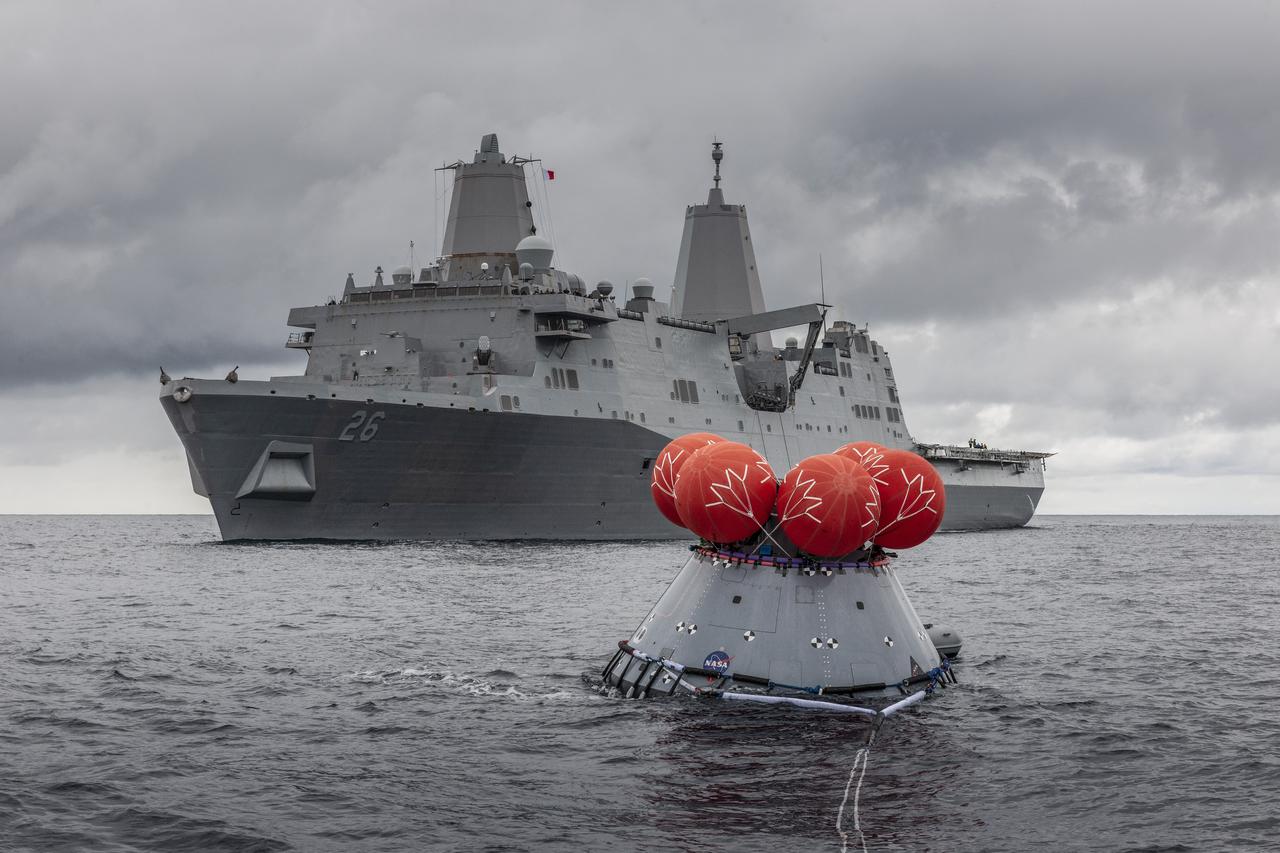
During Underway Recovery Test-8, NASA's Landing and Recovery team from Exploration Ground Systems at Kennedy Space Center performed their first full mission profile test of the recovery procedures for Artemis I aboard the USS John P. Murtha in the Pacific Ocean. Artemis I will be the first integrated flight test of NASA's Deep Space Exploration Systems: the Orion spacecraft, Space Launch System rocket, with the newly upgraded Exploration Ground Systems at Kennedy Space Center.
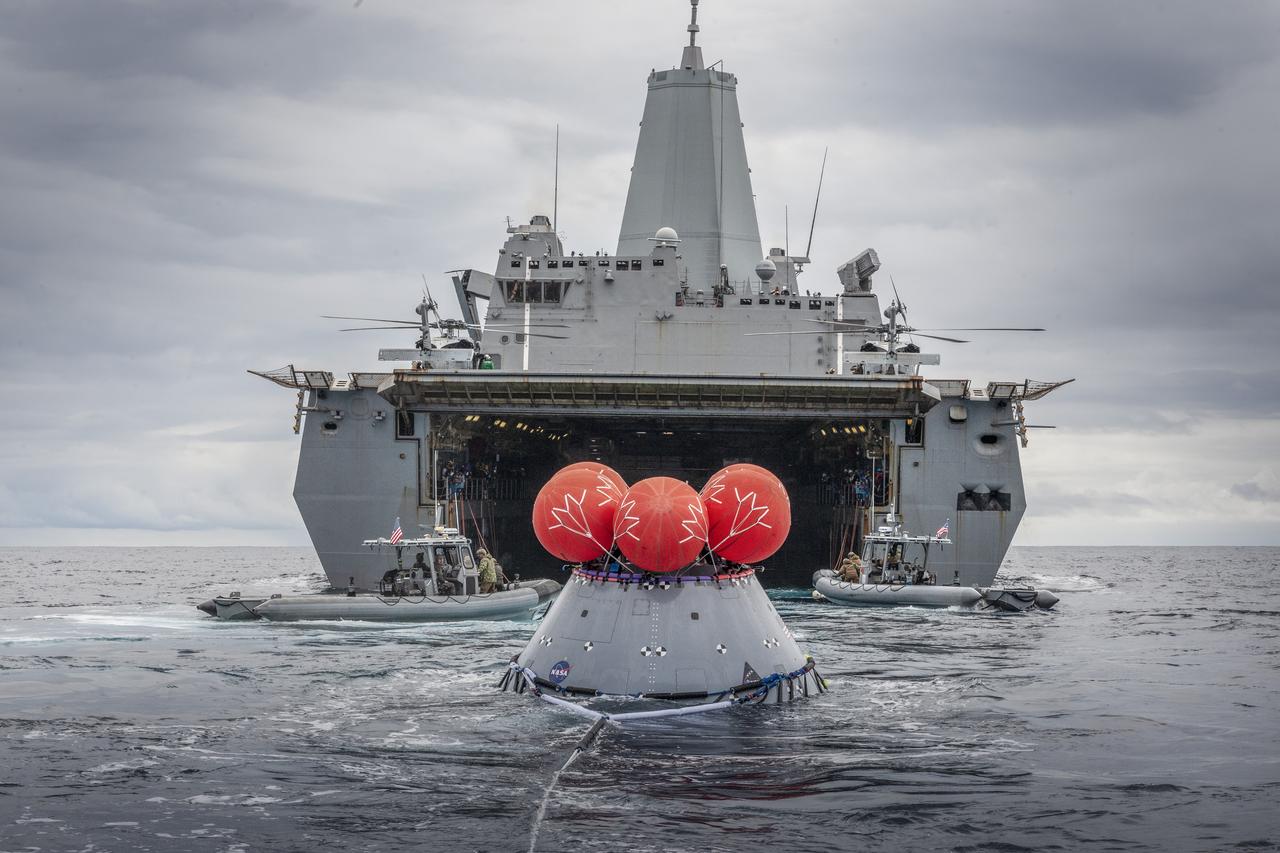
During Underway Recovery Test-8, NASA's Landing and Recovery team from Exploration Ground Systems at Kennedy Space Center performed their first full mission profile test of the recovery procedures for Artemis I aboard the USS John P. Murtha in the Pacific Ocean. Artemis I will be the first integrated flight test of NASA's Deep Space Exploration Systems: the Orion spacecraft, Space Launch System rocket, with the newly upgraded Exploration Ground Systems at Kennedy Space Center.
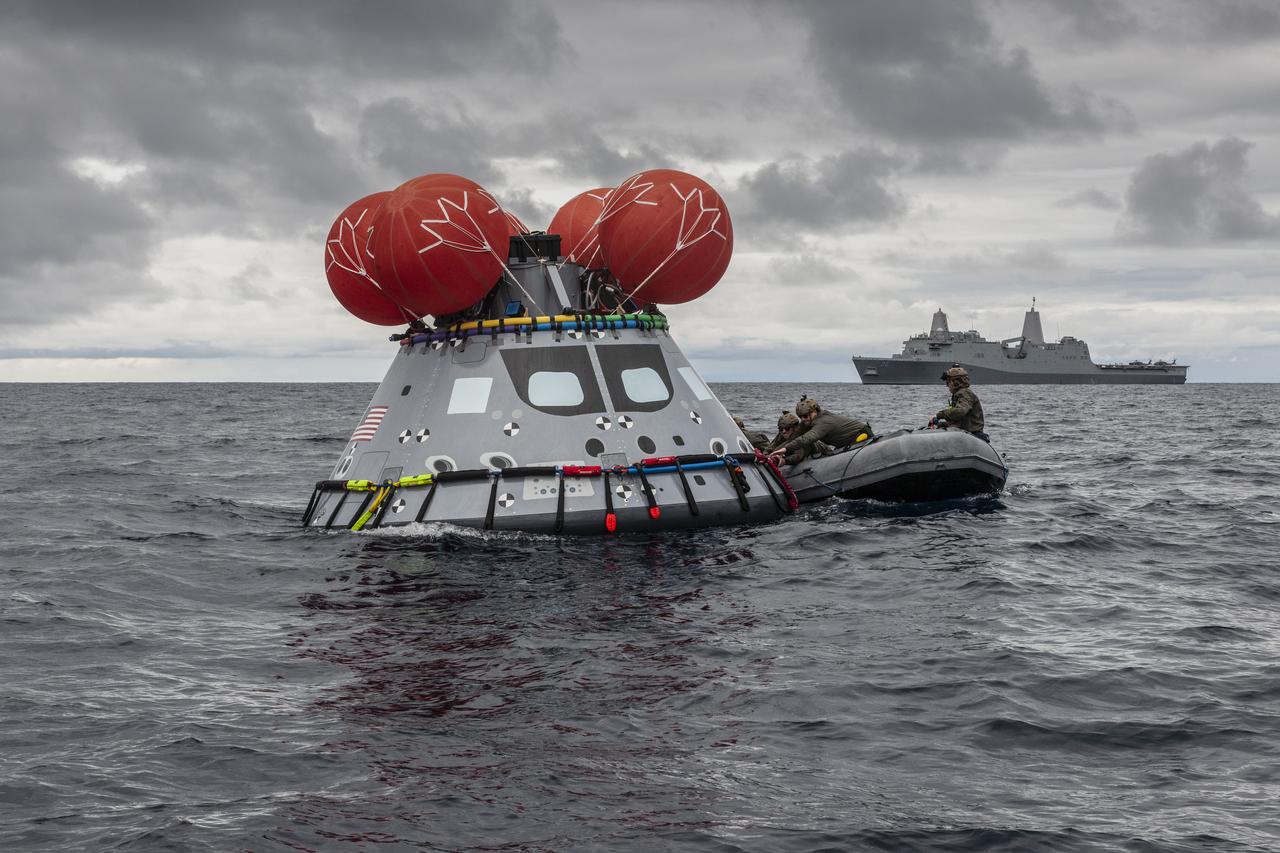
During Underway Recovery Test-8, NASA's Landing and Recovery team from Exploration Ground Systems at Kennedy Space Center performed their first full mission profile test of the recovery procedures for Artemis I aboard the USS John P. Murtha in the Pacific Ocean. Artemis I will be the first integrated flight test of NASA's Deep Space Exploration Systems: the Orion spacecraft, Space Launch System rocket, with the newly upgraded Exploration Ground Systems at Kennedy Space Center.
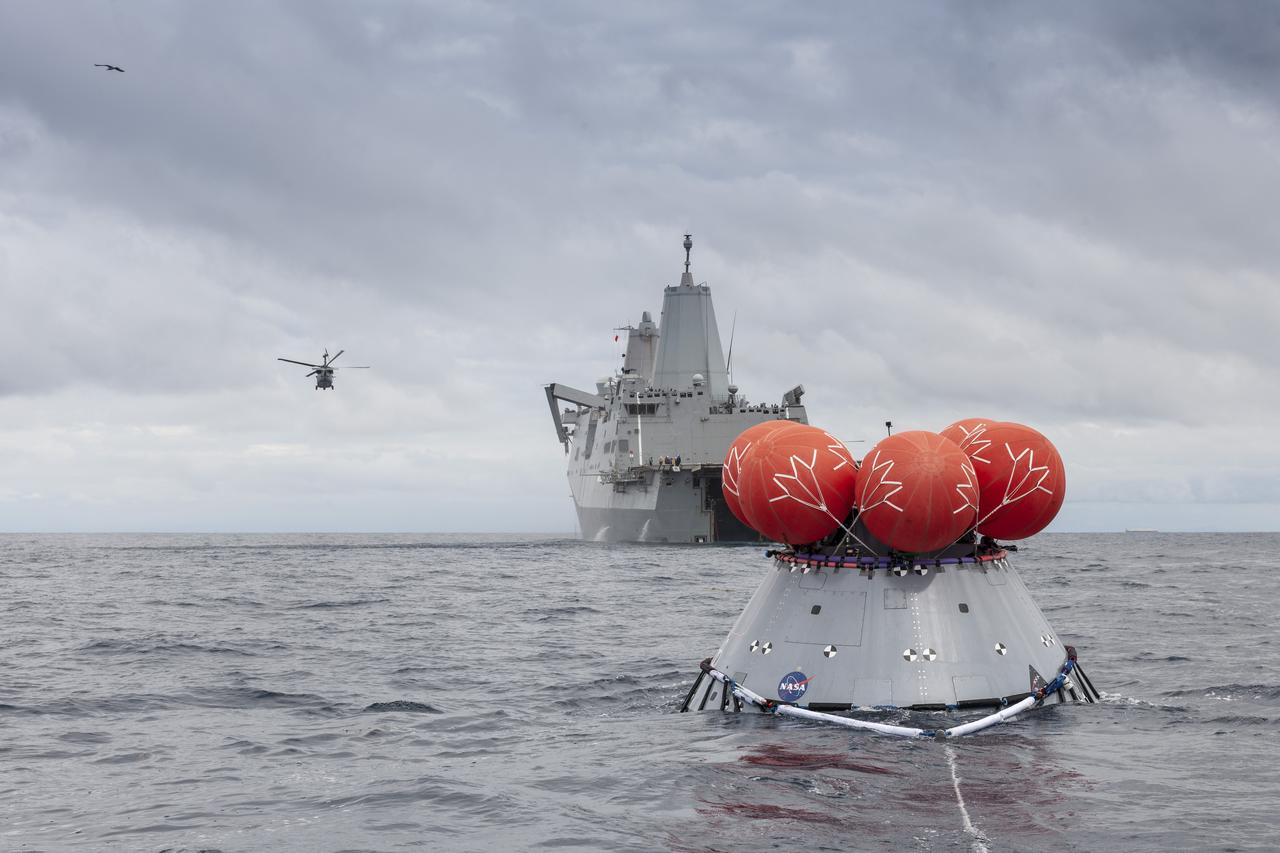
During Underway Recovery Test-8, NASA's Landing and Recovery team from Exploration Ground Systems at Kennedy Space Center performed their first full mission profile test of the recovery procedures for Artemis I aboard the USS John P. Murtha in the Pacific Ocean. Artemis I will be the first integrated flight test of NASA's Deep Space Exploration Systems: the Orion spacecraft, Space Launch System rocket, with the newly upgraded Exploration Ground Systems at Kennedy Space Center.
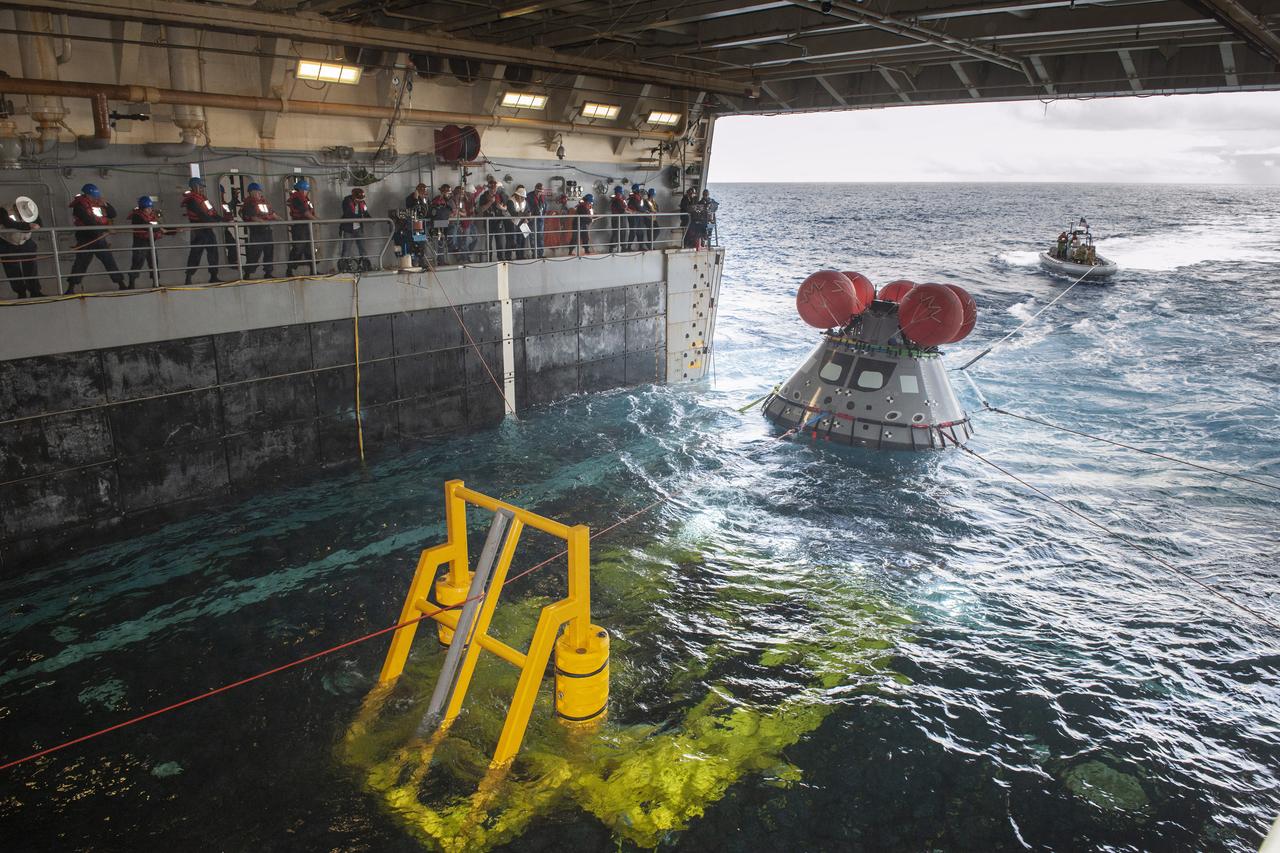
During Underway Recovery Test-8, NASA's Landing and Recovery team from Exploration Ground Systems at Kennedy Space Center performed their first full mission profile test of the recovery procedures for Artemis I aboard the USS John P. Murtha in the Pacific Ocean. Artemis I will be the first integrated flight test of NASA's Deep Space Exploration Systems: the Orion spacecraft, Space Launch System rocket, with the newly upgraded Exploration Ground Systems at Kennedy Space Center.
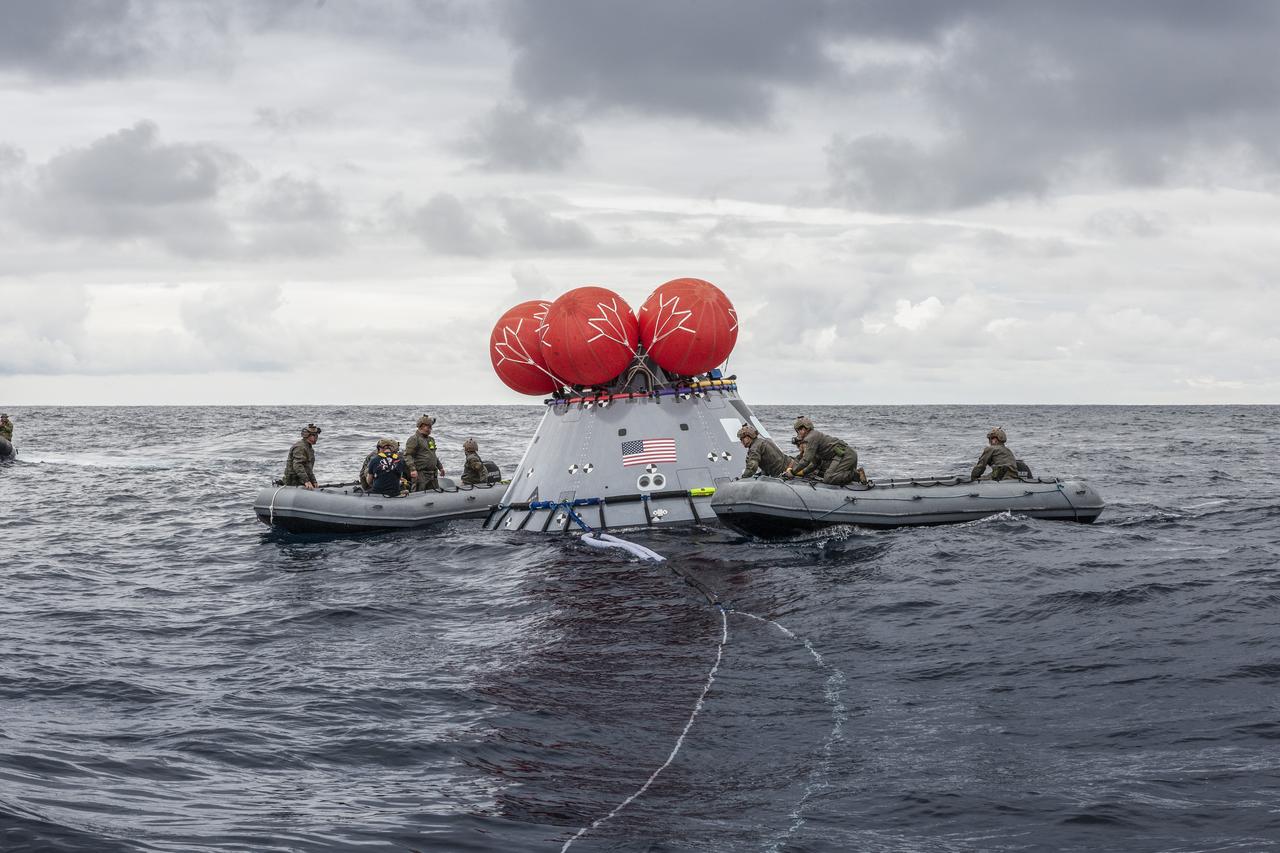
During Underway Recovery Test-8, NASA's Landing and Recovery team from Exploration Ground Systems at Kennedy Space Center performed their first full mission profile test of the recovery procedures for Artemis I aboard the USS John P. Murtha in the Pacific Ocean. Artemis I will be the first integrated flight test of NASA's Deep Space Exploration Systems: the Orion spacecraft, Space Launch System rocket, with the newly upgraded Exploration Ground Systems at Kennedy Space Center.
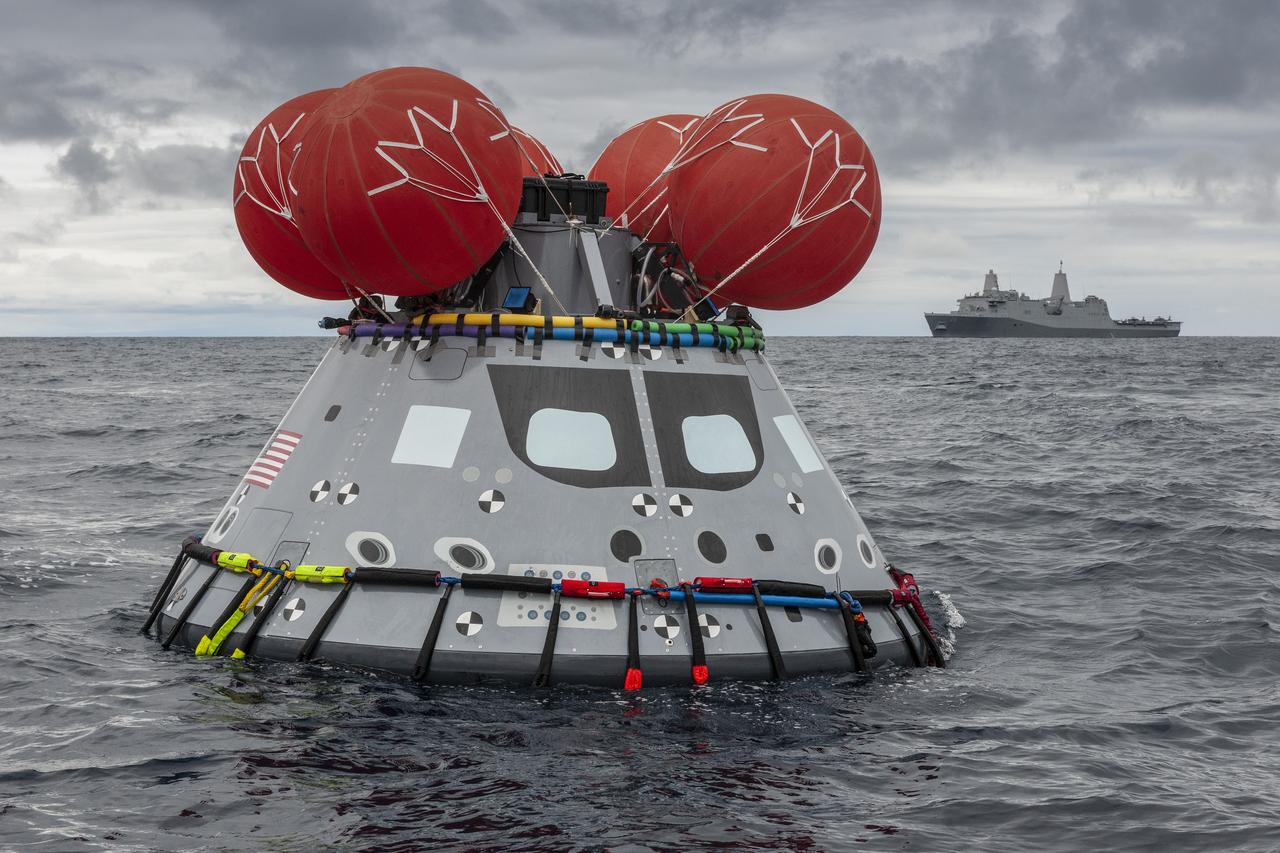
During Underway Recovery Test-8, NASA's Landing and Recovery team from Exploration Ground Systems at Kennedy Space Center performed their first full mission profile test of the recovery procedures for Artemis I aboard the USS John P. Murtha in the Pacific Ocean. Artemis I will be the first integrated flight test of NASA's Deep Space Exploration Systems: the Orion spacecraft, Space Launch System rocket, with the newly upgraded Exploration Ground Systems at Kennedy Space Center.
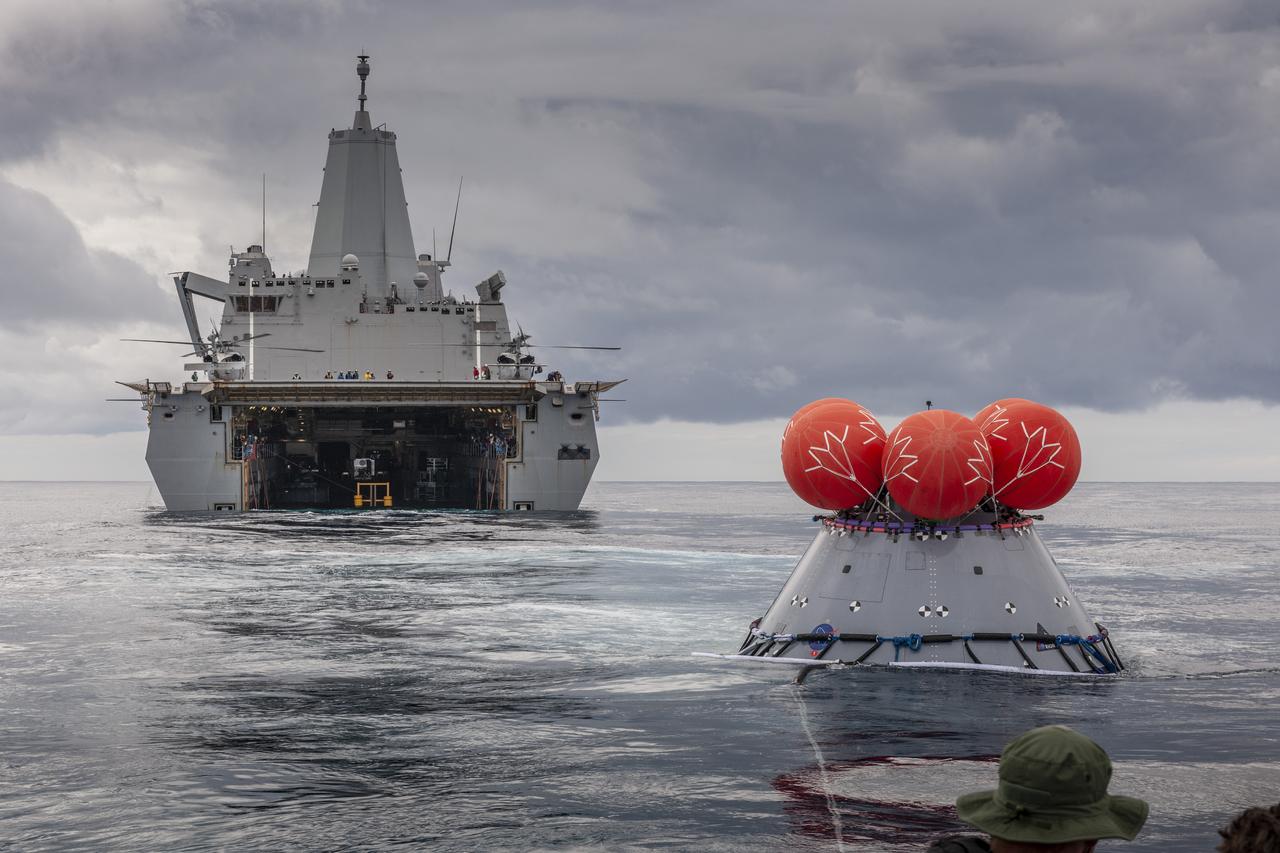
During Underway Recovery Test-8, NASA's Landing and Recovery team from Exploration Ground Systems at Kennedy Space Center performed their first full mission profile test of the recovery procedures for Artemis I aboard the USS John P. Murtha in the Pacific Ocean. Artemis I will be the first integrated flight test of NASA's Deep Space Exploration Systems: the Orion spacecraft, Space Launch System rocket, with the newly upgraded Exploration Ground Systems at Kennedy Space Center.
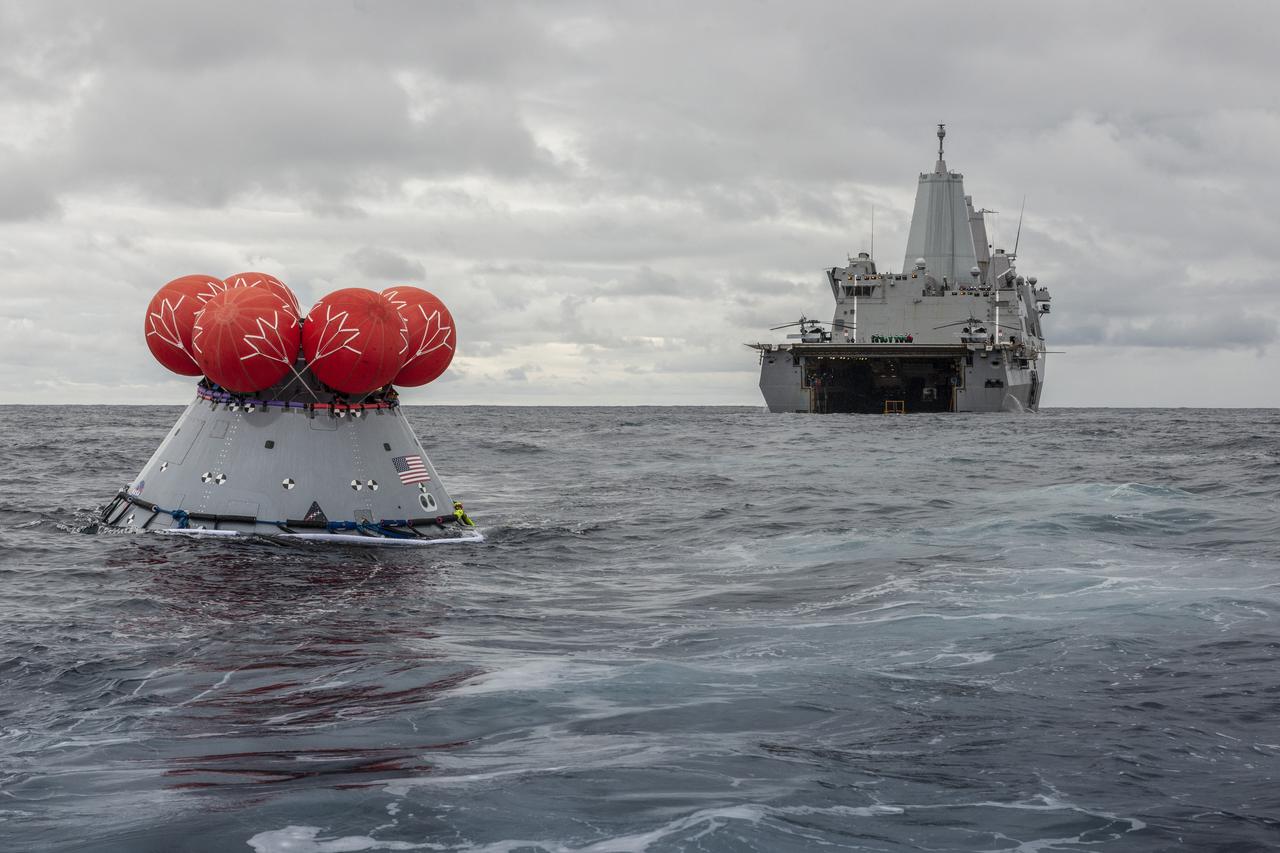
During Underway Recovery Test-8, NASA's Landing and Recovery team from Exploration Ground Systems at Kennedy Space Center performed their first full mission profile test of the recovery procedures for Artemis I aboard the USS John P. Murtha in the Pacific Ocean. Artemis I will be the first integrated flight test of NASA's Deep Space Exploration Systems: the Orion spacecraft, Space Launch System rocket, with the newly upgraded Exploration Ground Systems at Kennedy Space Center.
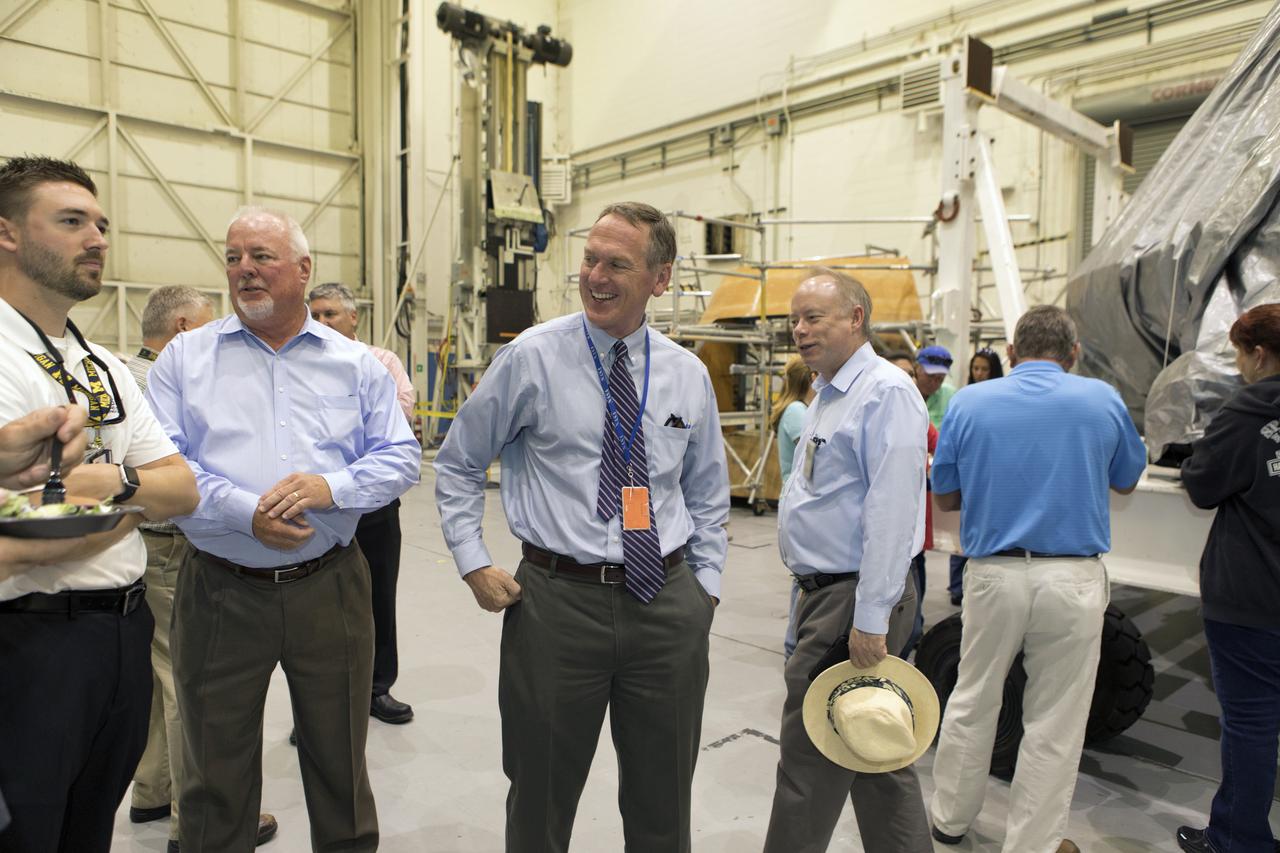
The team that tested the umbilical lines and accessories that will connect from the mobile launcher to NASA's Space Launch System rocket and Orion spacecraft for Exploration Mission-1 hold a banner signing event July 24, 2018, to mark completion of testing at the Launch Equipment Test Facility (LETF) at NASA's Kennedy Space Center in Florida. Attending the event is Mike Bolger, center, Exploration Ground Systems manager. A total of 21 umbilicals and launch accessories were tested on various simulators at the LETF before they were transferred to the mobile launcher for installation.
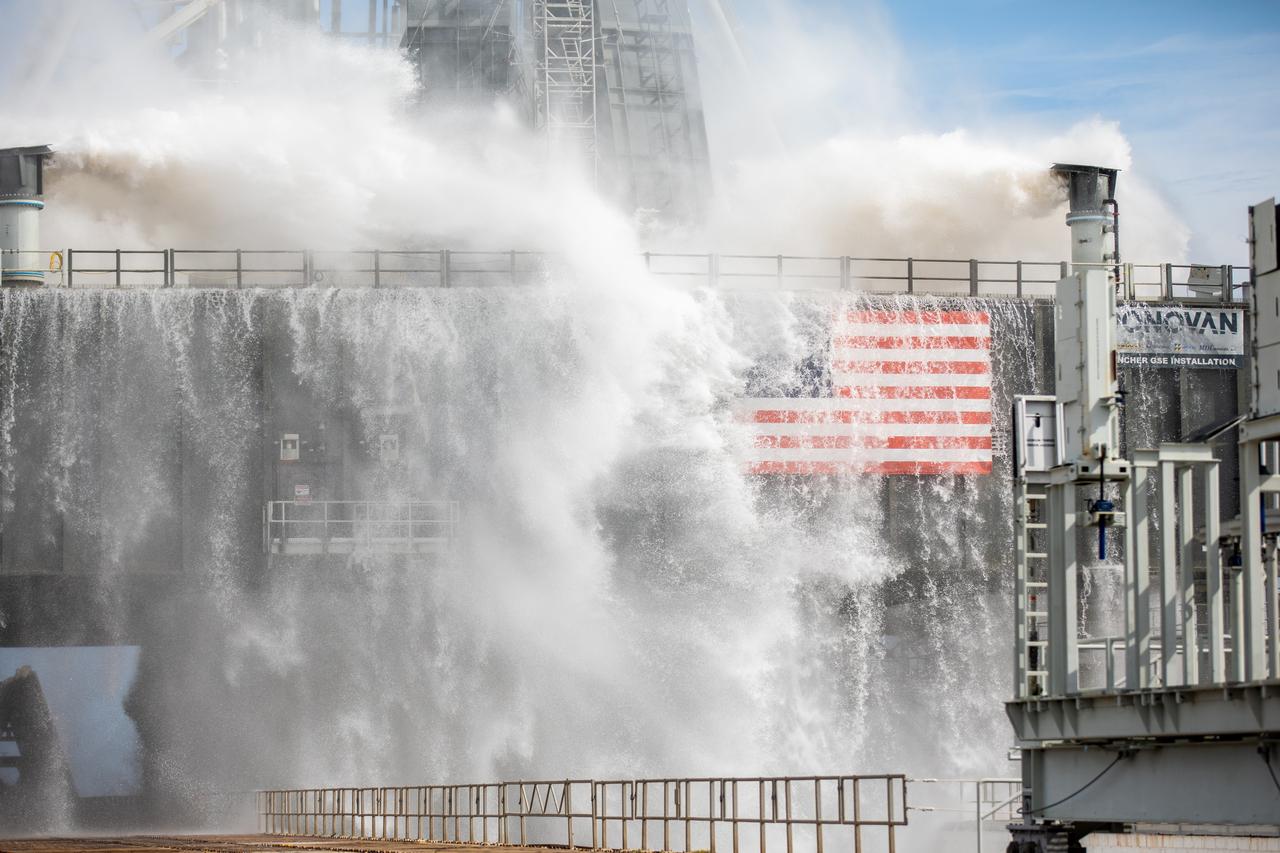
A wet flow test at Launch Pad 39B on September 13, 2019, tests the sound suppression system that will be used for launch of NASA’s Space Launch System for the Artemis I mission. During the test, about 450,000 gallons of water poured onto the Pad B flame deflector, the mobile launcher flame hole and onto the launcher’s blast deck. This was the first time the ground launch sequencer that will be used on the day of launch was used for the timing of a sound suppression test.
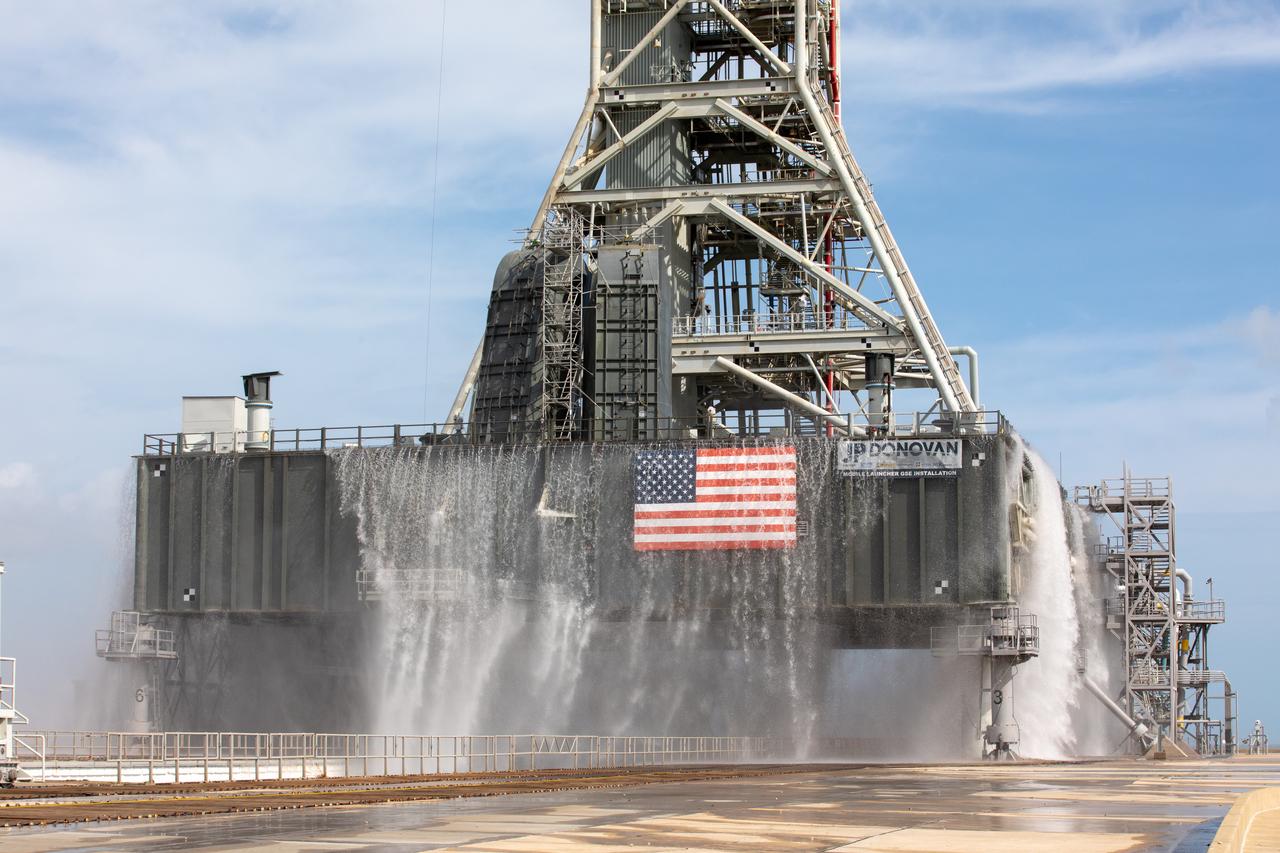
A wet flow test at Launch Pad 39B on September 13, 2019, tests the sound suppression system that will be used for launch of NASA’s Space Launch System for the Artemis I mission. During the test, about 450,000 gallons of water poured onto the Pad B flame deflector, the mobile launcher flame hole and onto the launcher’s blast deck. This was the first time the ground launch sequencer that will be used on the day of launch was used for the timing of a sound suppression test.
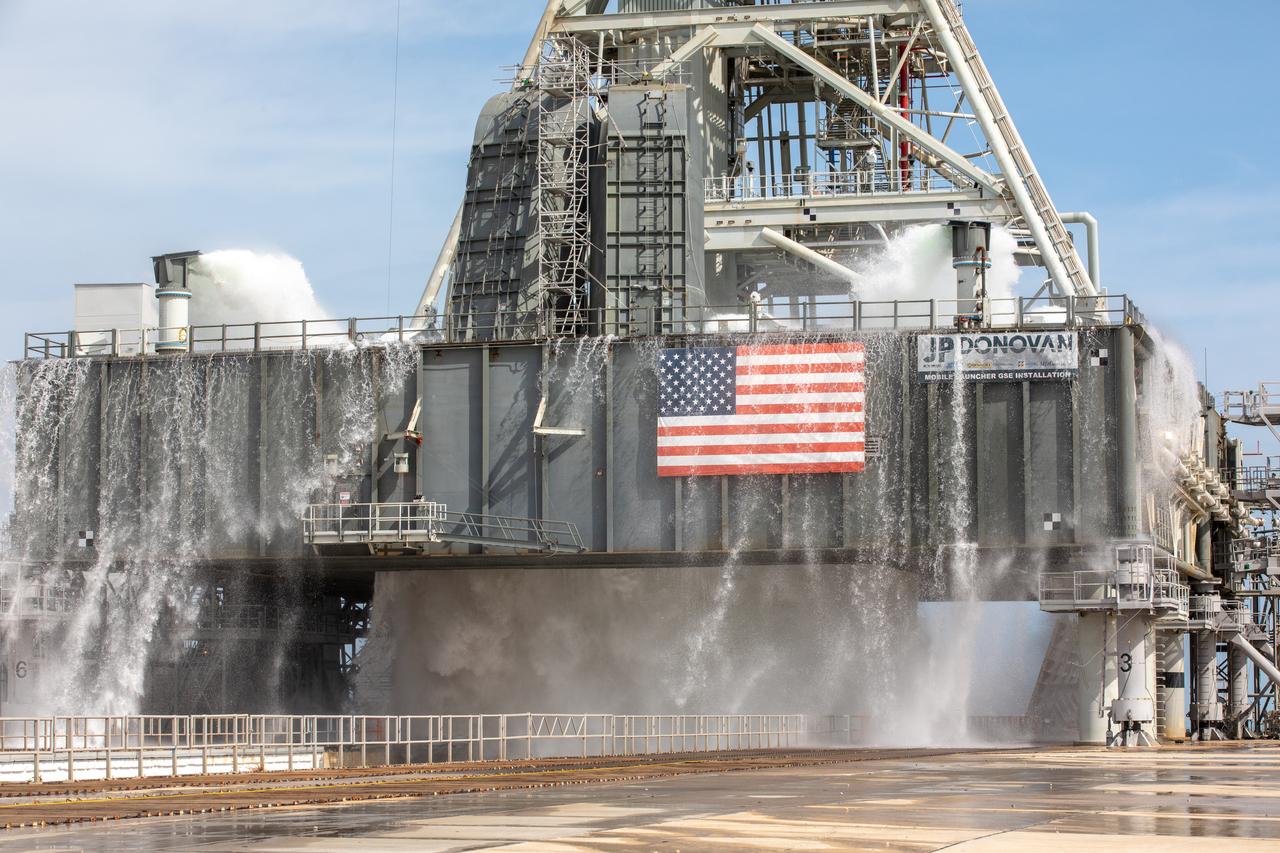
A wet flow test at Launch Pad 39B on September 13, 2019, tests the sound suppression system that will be used for launch of NASA’s Space Launch System for the Artemis I mission. During the test, about 450,000 gallons of water poured onto the Pad B flame deflector, the mobile launcher flame hole and onto the launcher’s blast deck. This was the first time the ground launch sequencer that will be used on the day of launch was used for the timing of a sound suppression test.
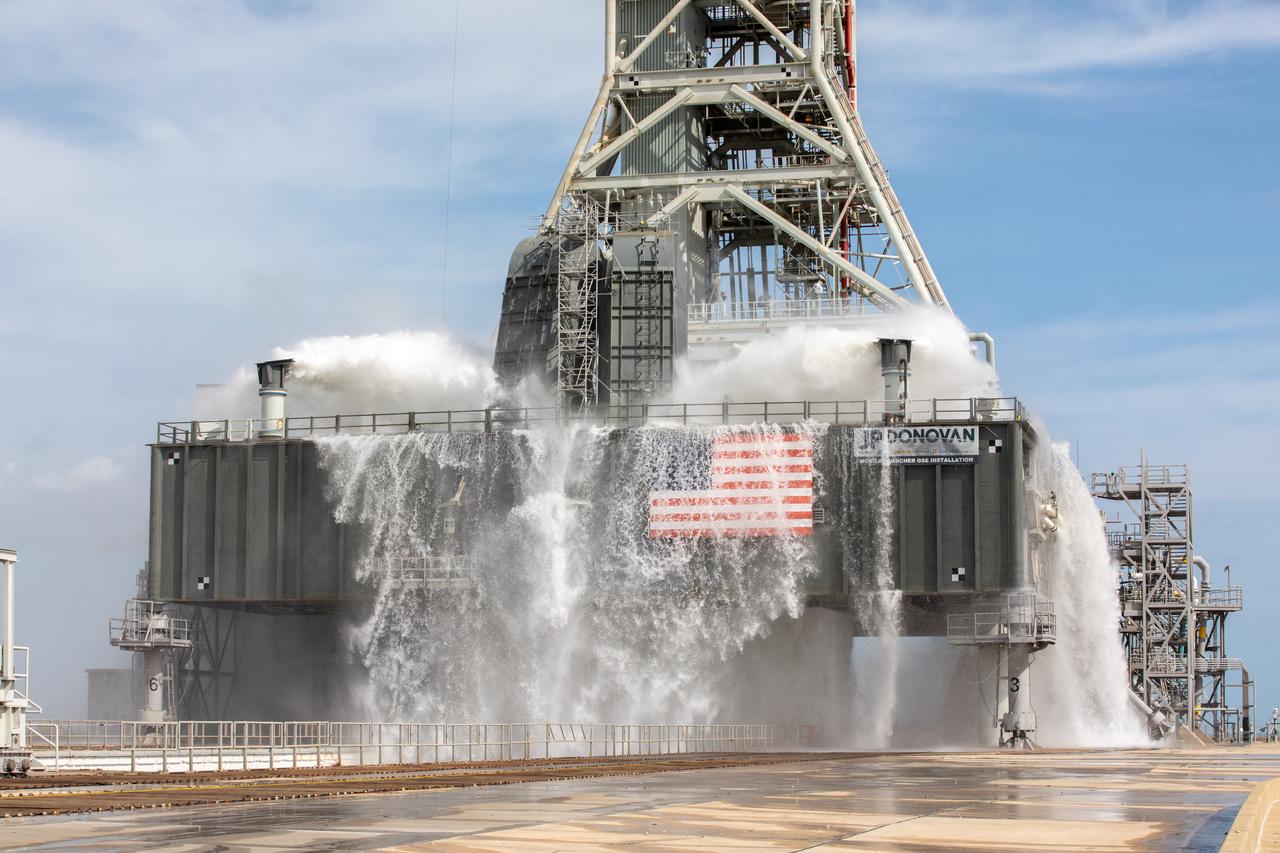
A wet flow test at Launch Pad 39B on September 13, 2019, tests the sound suppression system that will be used for launch of NASA’s Space Launch System for the Artemis I mission. During the test, about 450,000 gallons of water poured onto the Pad B flame deflector, the mobile launcher flame hole and onto the launcher’s blast deck. This was the first time the ground launch sequencer that will be used on the day of launch was used for the timing of a sound suppression test.
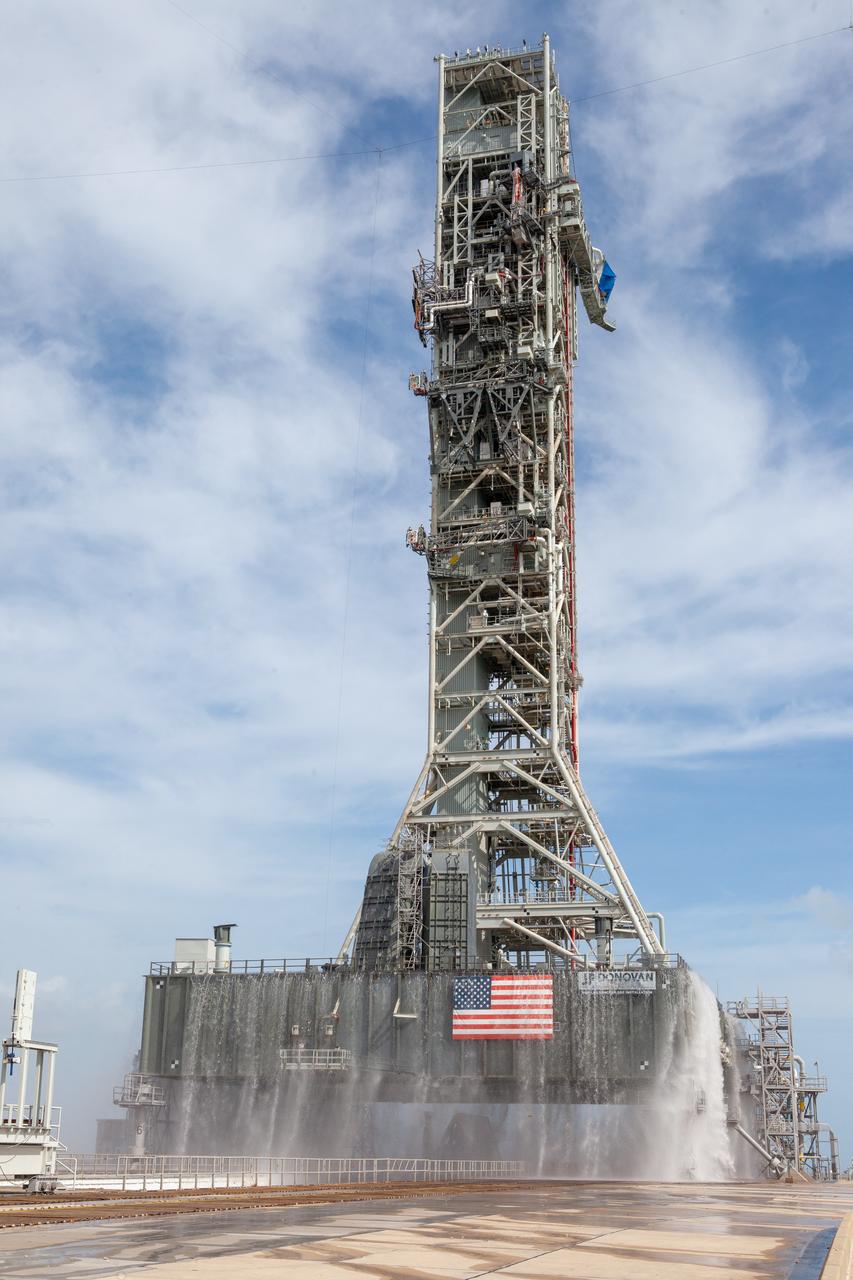
A wet flow test at Launch Pad 39B on September 13, 2019, tests the sound suppression system that will be used for launch of NASA’s Space Launch System for the Artemis I mission. During the test, about 450,000 gallons of water poured onto the Pad B flame deflector, the mobile launcher flame hole and onto the launcher’s blast deck. This was the first time the ground launch sequencer that will be used on the day of launch was used for the timing of a sound suppression test.

A wet flow test at Launch Pad 39B on September 13, 2019, tests the sound suppression system that will be used for launch of NASA’s Space Launch System for the Artemis I mission. During the test, about 450,000 gallons of water poured onto the Pad B flame deflector, the mobile launcher flame hole and onto the launcher’s blast deck. This was the first time the ground launch sequencer that will be used on the day of launch was used for the timing of a sound suppression test.
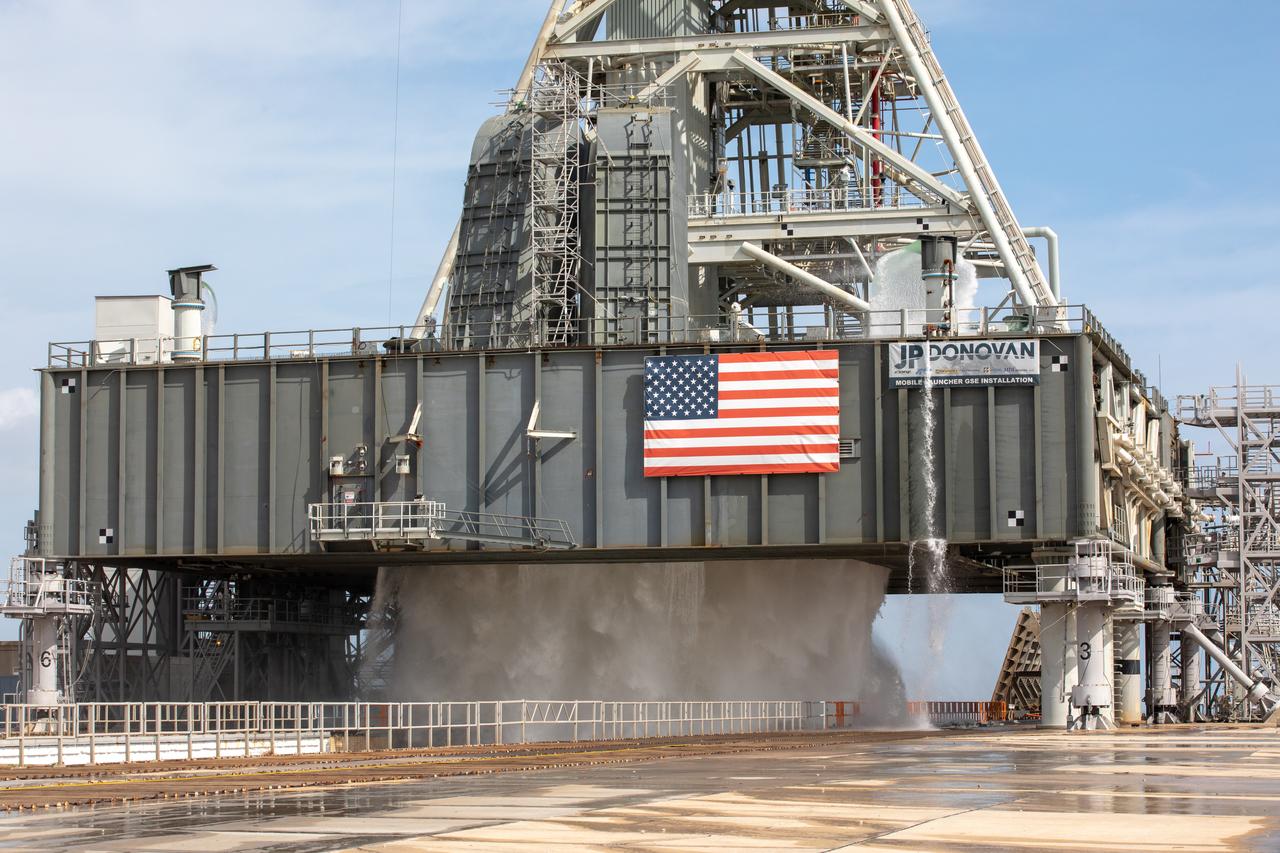
A wet flow test at Launch Pad 39B on September 13, 2019, tests the sound suppression system that will be used for launch of NASA’s Space Launch System for the Artemis I mission. During the test, about 450,000 gallons of water poured onto the Pad B flame deflector, the mobile launcher flame hole and onto the launcher’s blast deck. This was the first time the ground launch sequencer that will be used on the day of launch was used for the timing of a sound suppression test.
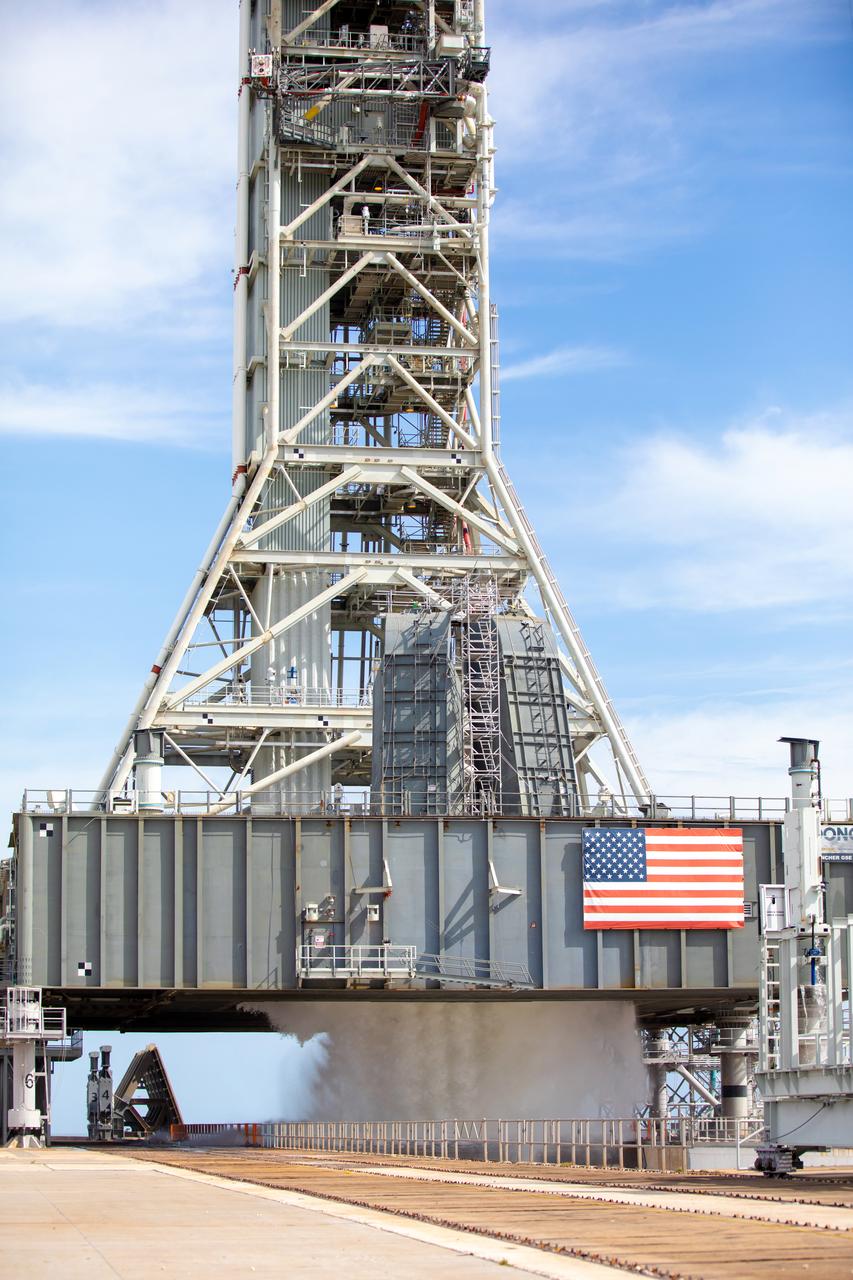
A wet flow test at Launch Pad 39B on September 13, 2019, tests the sound suppression system that will be used for launch of NASA’s Space Launch System for the Artemis I mission. During the test, about 450,000 gallons of water poured onto the Pad B flame deflector, the mobile launcher flame hole and onto the launcher’s blast deck. This was the first time the ground launch sequencer that will be used on the day of launch was used for the timing of a sound suppression test.
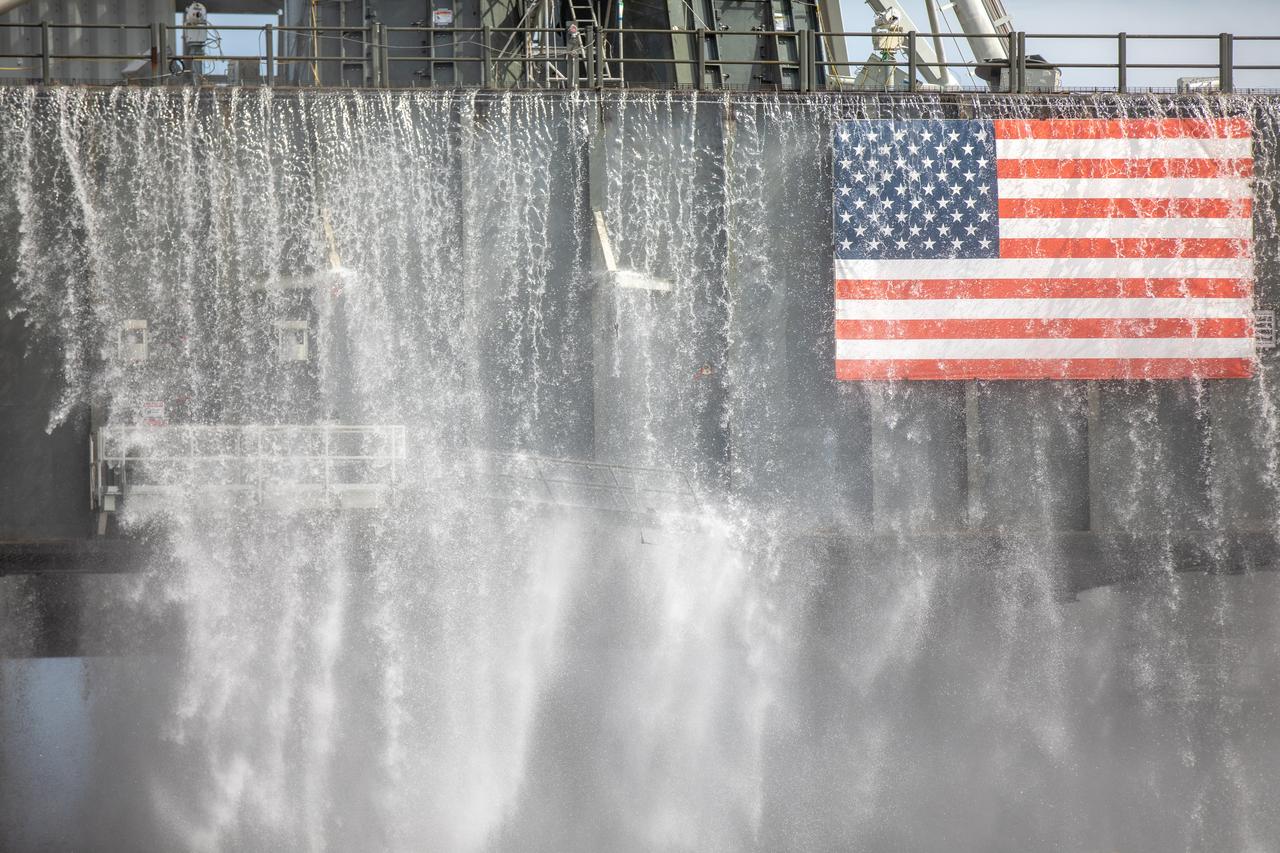
A wet flow test at Launch Pad 39B on September 13, 2019, tests the sound suppression system that will be used for launch of NASA’s Space Launch System for the Artemis I mission. During the test, about 450,000 gallons of water poured onto the Pad B flame deflector, the mobile launcher flame hole and onto the launcher’s blast deck. This was the first time the ground launch sequencer that will be used on the day of launch was used for the timing of a sound suppression test.
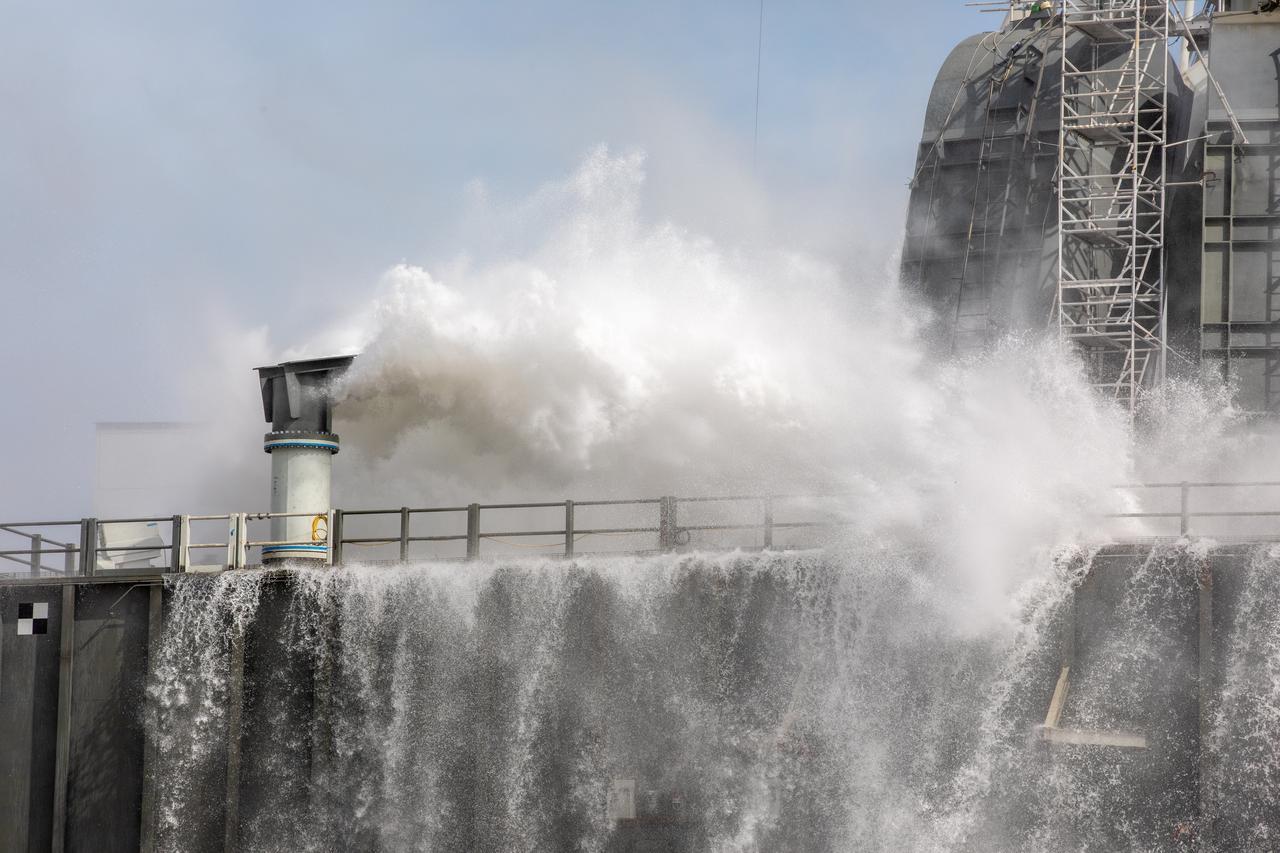
A wet flow test at Launch Pad 39B on September 13, 2019, tests the sound suppression system that will be used for launch of NASA’s Space Launch System for the Artemis I mission. During the test, about 450,000 gallons of water poured onto the Pad B flame deflector, the mobile launcher flame hole and onto the launcher’s blast deck. This was the first time the ground launch sequencer that will be used on the day of launch was used for the timing of a sound suppression test.
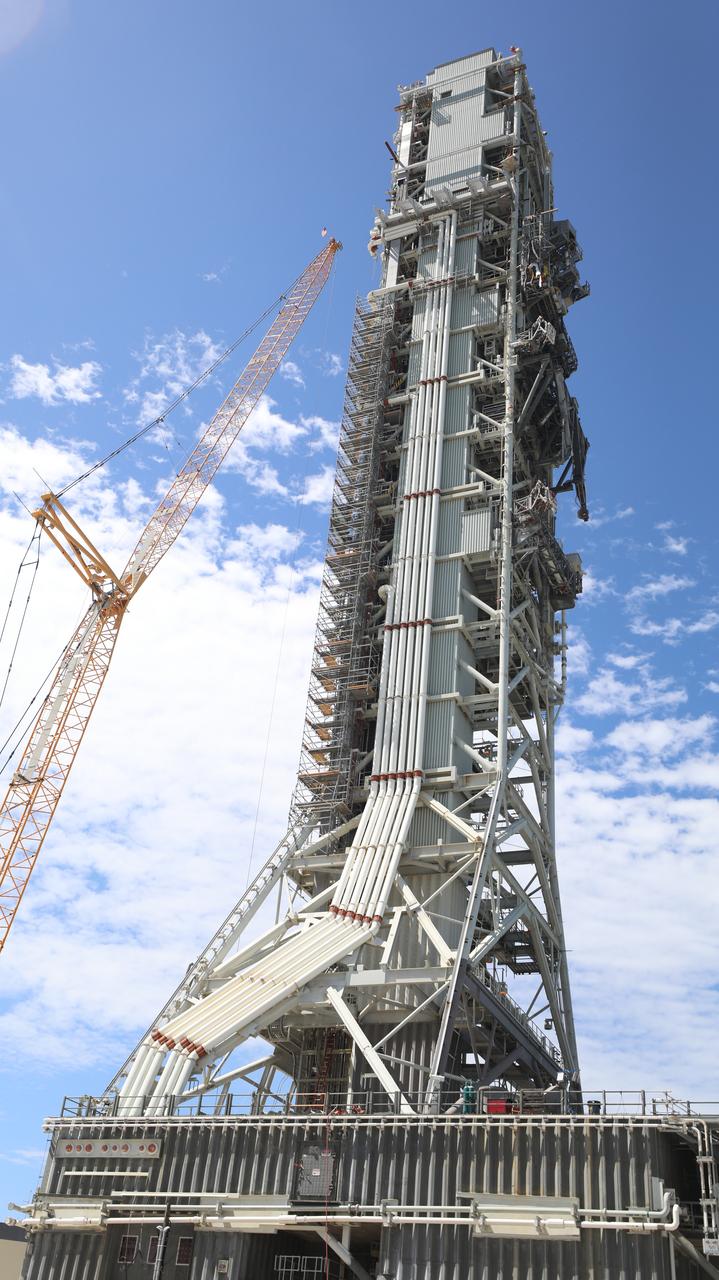
Teams with Exploration Ground Systems at NASA’s Kennedy Space Center in Florida make upgrades and repairs on mobile launcher 1 at its park site location on July 20, 2023, ahead of the first critical ground testing for Artemis II. Under Artemis, the mobile launcher will transport NASA’s Space Launch System rocket and Orion spacecraft to Kennedy’s Launch Complex 39B for liftoff. Artemis II will be the first Artemis mission flying crew aboard Orion.

Teams with Exploration Ground Systems at NASA’s Kennedy Space Center in Florida make upgrades and repairs on mobile launcher 1 at its park site location on July 20, 2023, ahead of the first critical ground testing for Artemis II. Under Artemis, the mobile launcher will transport NASA’s Space Launch System rocket and Orion spacecraft to Kennedy’s Launch Complex 39B for liftoff. Artemis II will be the first Artemis mission flying crew aboard Orion.
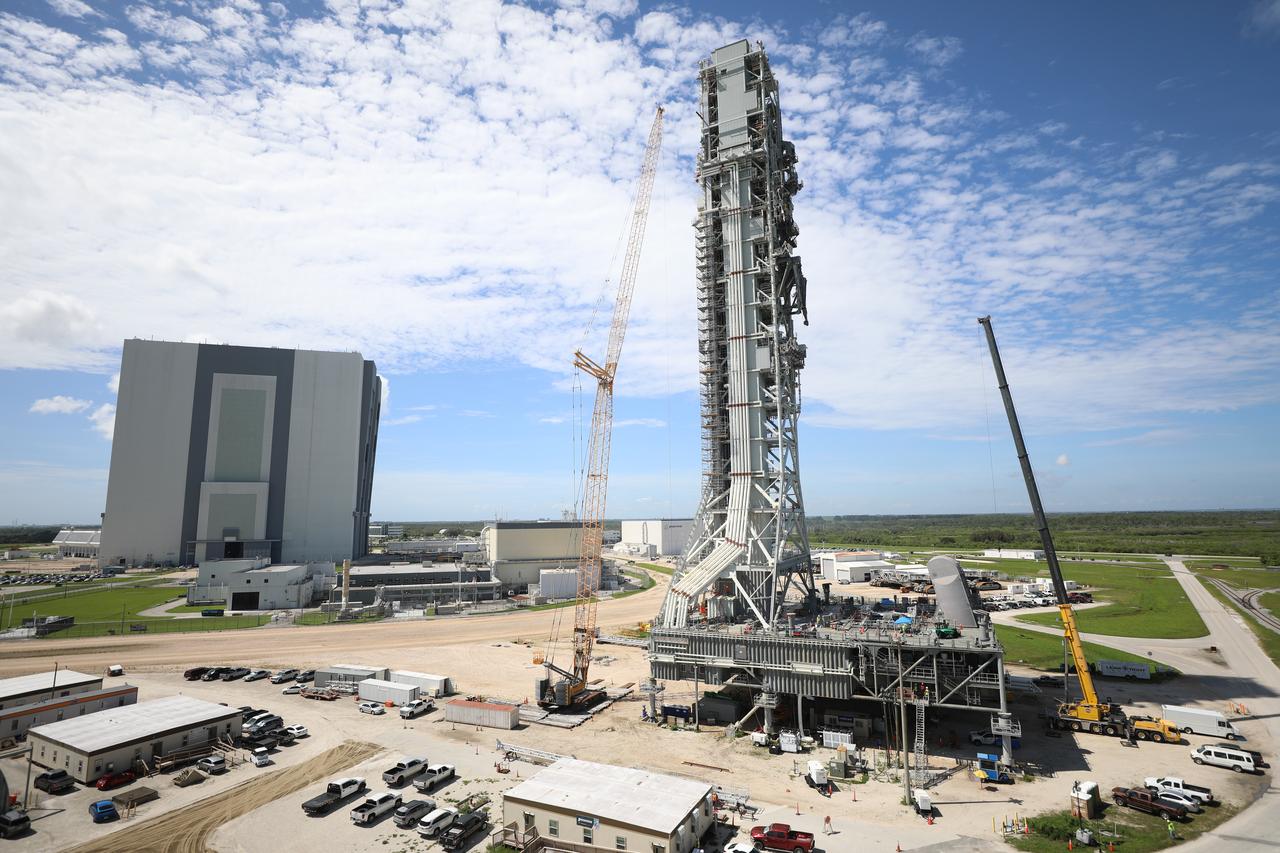
With the iconic Vehicle Assembly Building at NASA’s Kennedy Space Center in Florida nearby, teams with Exploration Ground Systems make upgrades and repairs on mobile launcher 1 at its park site location on July 20, 2023, ahead of the first critical ground testing for Artemis II. Under Artemis, the mobile launcher will transport NASA’s Space Launch System rocket and Orion spacecraft to Kennedy’s Launch Complex 39B for liftoff. Artemis II will be the first Artemis mission flying crew aboard Orion.
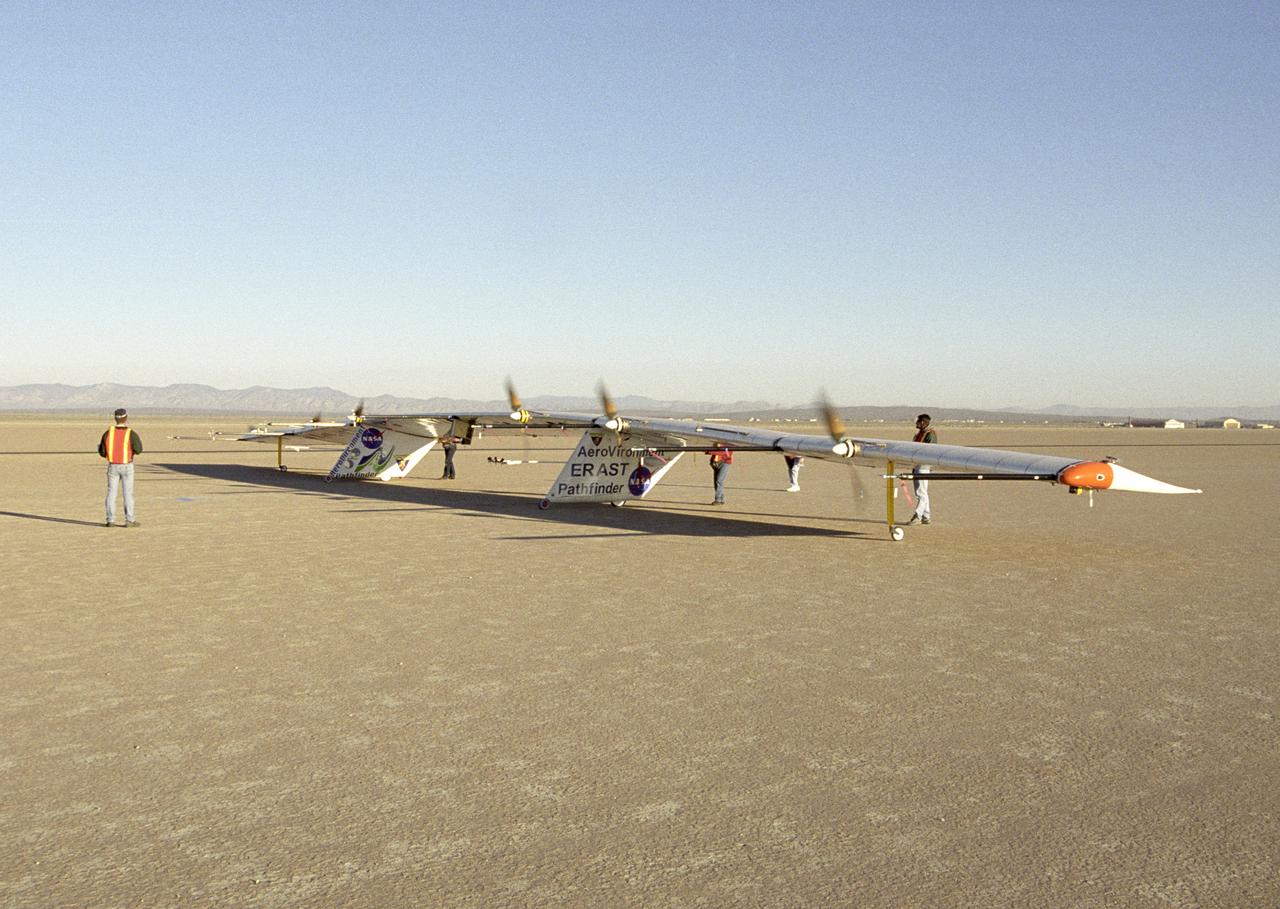
AeroVironment ground crew check out the operation of the Pathfinder-Plus solar aircraft's electric motors during combined systems tests on Rogers Dry Lake.
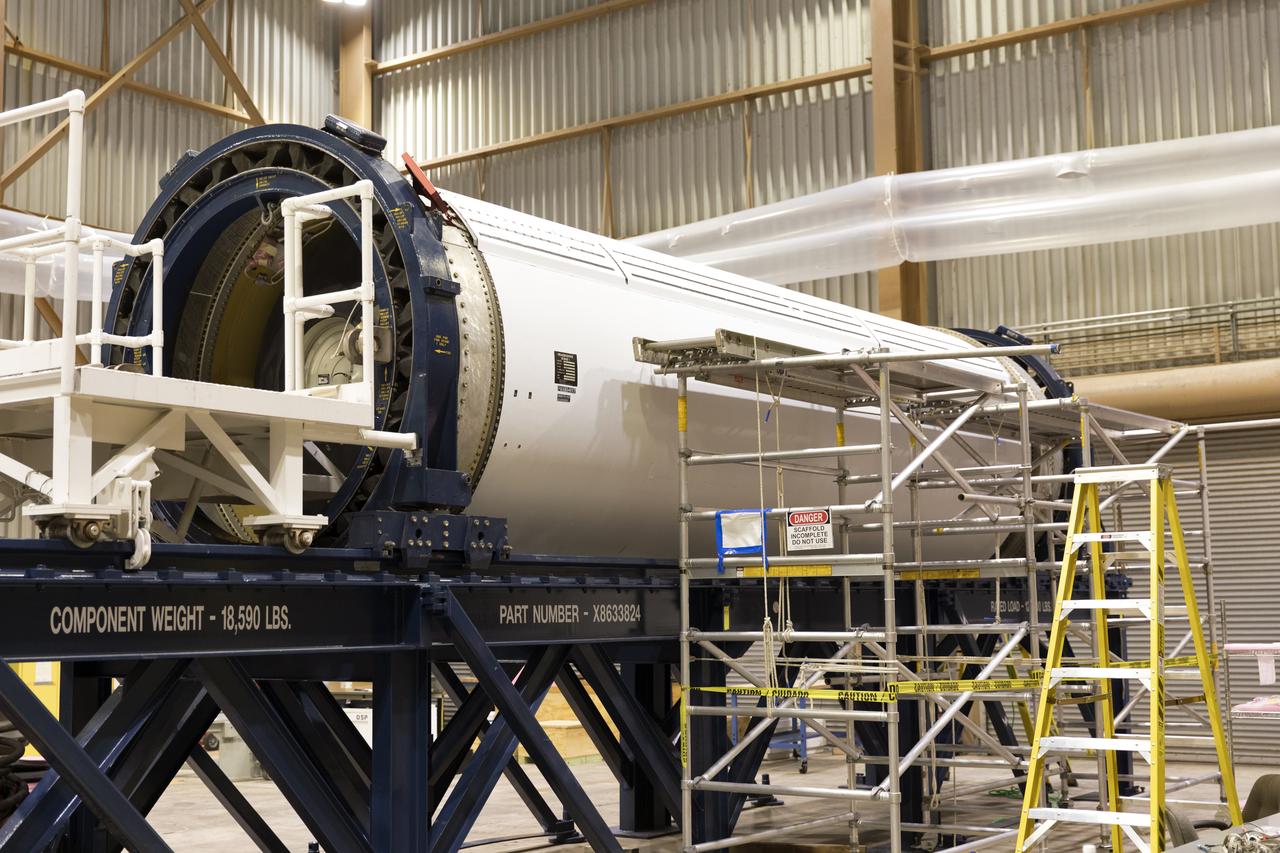
The ground test motor for Orion's Launch Abort System (LAS) is secured on a work stand inside the Rotation, Processing and Surge Facility on July 31, 2018, at NASA's Kennedy Space Center in Florida. It will be inspected and prepared for transport to Space Launch Complex 46 (SLC-46) at Cape Canaveral Air Force Station for mechanical fit testing. This inert motor will not be used for flight, but will be used to certify flight hardware assembly in preparation for a full-stress test of the LAS, called Ascent Abort-2 (AA-2) flight test, scheduled for April 2019. During the test, the booster will launch from SLC 46, carrying a fully functional LAS and a 22,000-pound Orion test vehicle to an altitude of 31,000 feet and traveling at more than 1,000 miles an hour. The test will verify the LAS can steer the crew module and astronauts aboard to safety in the event of an issue with the Space Launch System (SLS) rocket when the spacecraft is under the highest aerodynamic loads it will experience during a rapid climb into space. NASA's Orion and Exploration Ground Systems programs and their contractors from Jacob's and Northrup Grumman in conjunction with the Air Force Space and Missile Center's Launch Operations branch are performing the pathfinding exercises and flight operations for AA-2.
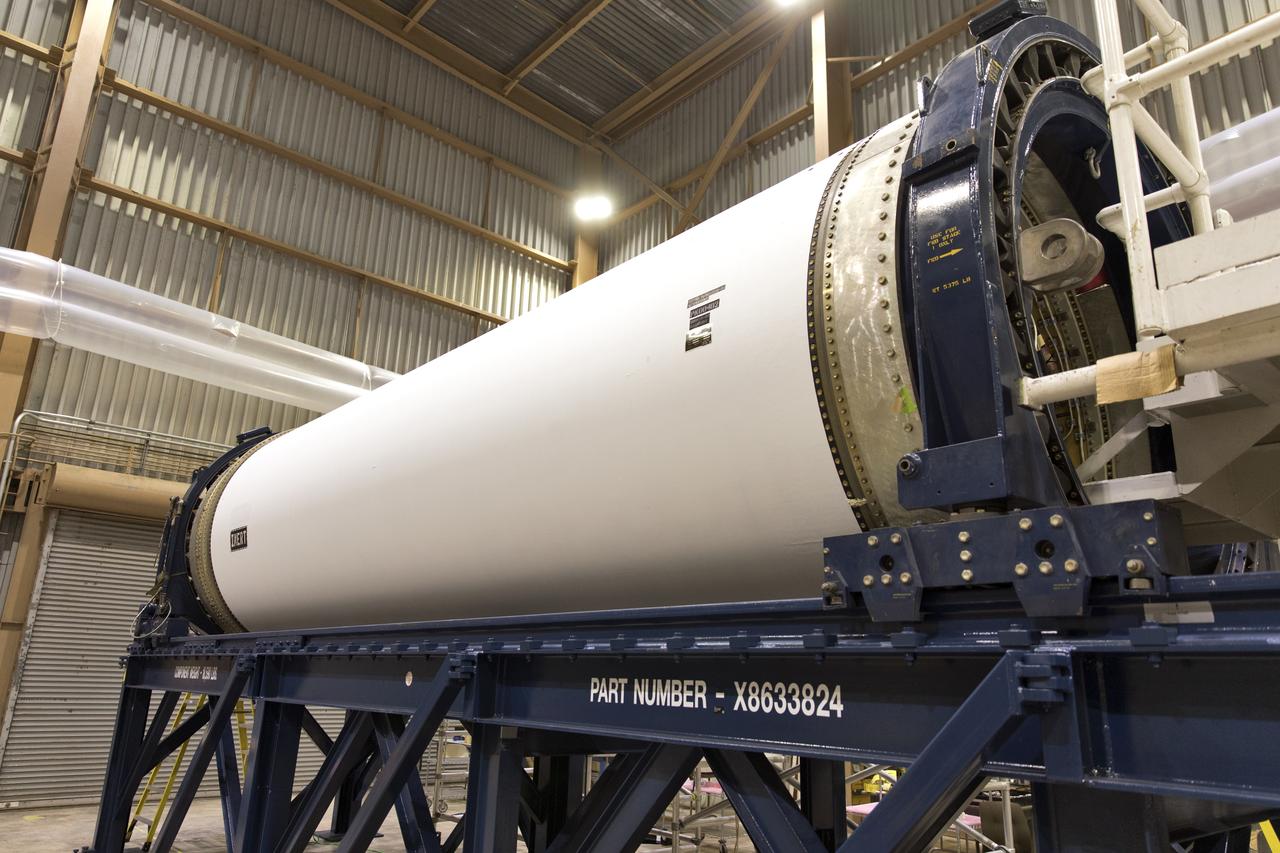
The ground test motor for Orion's Launch Abort System (LAS) is secured on a work stand inside the Rotation, Processing and Surge Facility on July 31, 2018, at NASA's Kennedy Space Center in Florida. It will be inspected and prepared for transport to Space Launch Complex 46 (SLC-46) at Cape Canaveral Air Force Station for mechanical fit testing. This inert motor will not be used for flight, but will be used to certify flight hardware assembly in preparation for a full-stress test of the LAS, called Ascent Abort-2 (AA-2) flight test, scheduled for April 2019. During the test, the booster will launch from SLC 46, carrying a fully functional LAS and a 22,000-pound Orion test vehicle to an altitude of 31,000 feet and traveling at more than 1,000 miles an hour. The test will verify the LAS can steer the crew module and astronauts aboard to safety in the event of an issue with the Space Launch System (SLS) rocket when the spacecraft is under the highest aerodynamic loads it will experience during a rapid climb into space. NASA's Orion and Exploration Ground Systems programs and their contractors from Jacob's and Northrup Grumman in conjunction with the Air Force Space and Missile Center's Launch Operations branch are performing the pathfinding exercises and flight operations for AA-2.
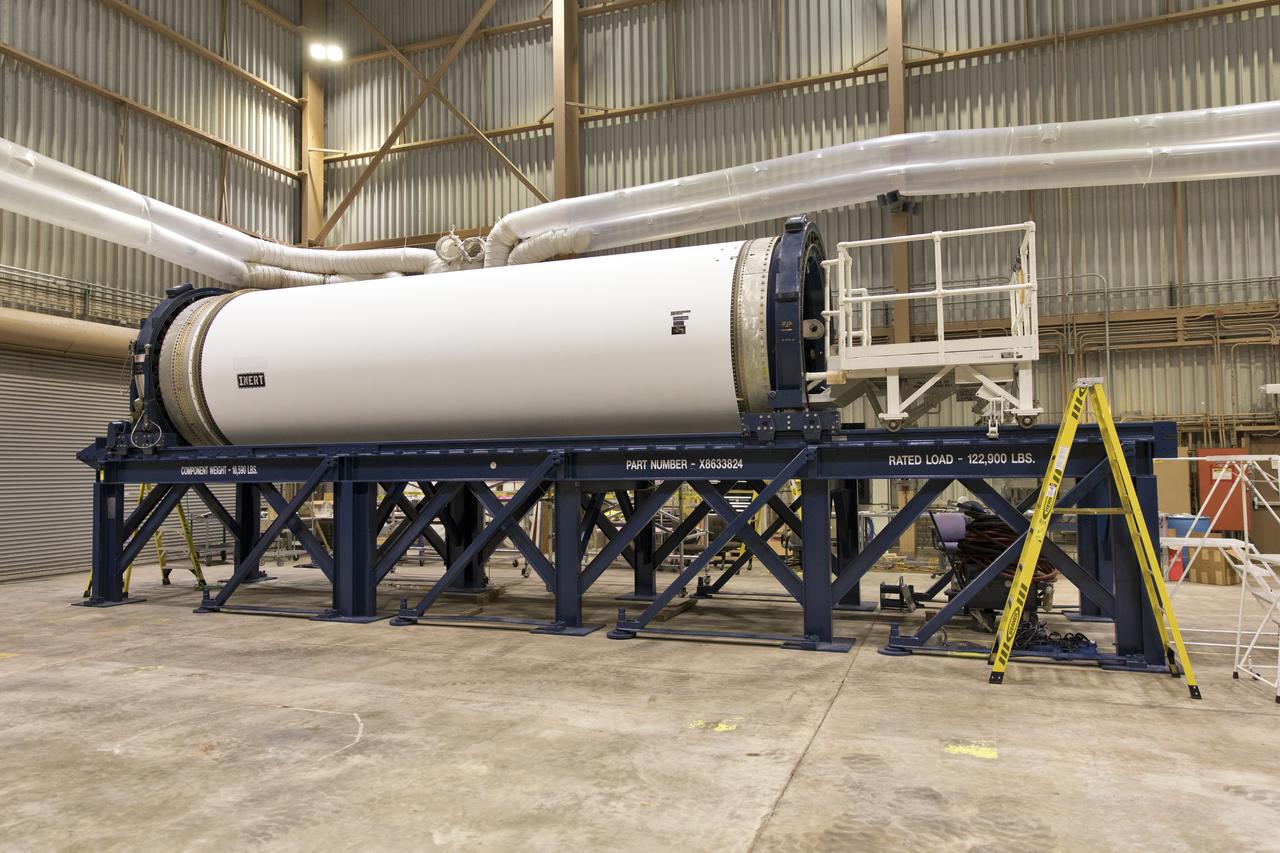
The ground test motor for Orion's Launch Abort System (LAS) is secured on a work stand inside the Rotation, Processing and Surge Facility on July 31, 2018, at NASA's Kennedy Space Center in Florida. It will be inspected and prepared for transport to Space Launch Complex 46 (SLC-46) at Cape Canaveral Air Force Station for mechanical fit testing. This inert motor will not be used for flight, but will be used to certify flight hardware assembly in preparation for a full-stress test of the LAS, called Ascent Abort-2 (AA-2) flight test, scheduled for April 2019. During the test, the booster will launch from SLC 46, carrying a fully functional LAS and a 22,000-pound Orion test vehicle to an altitude of 31,000 feet and traveling at more than 1,000 miles an hour. The test will verify the LAS can steer the crew module and astronauts aboard to safety in the event of an issue with the Space Launch System (SLS) rocket when the spacecraft is under the highest aerodynamic loads it will experience during a rapid climb into space. NASA's Orion and Exploration Ground Systems programs and their contractors from Jacob's and Northrup Grumman in conjunction with the Air Force Space and Missile Center's Launch Operations branch are performing the pathfinding exercises and flight operations for AA-2.
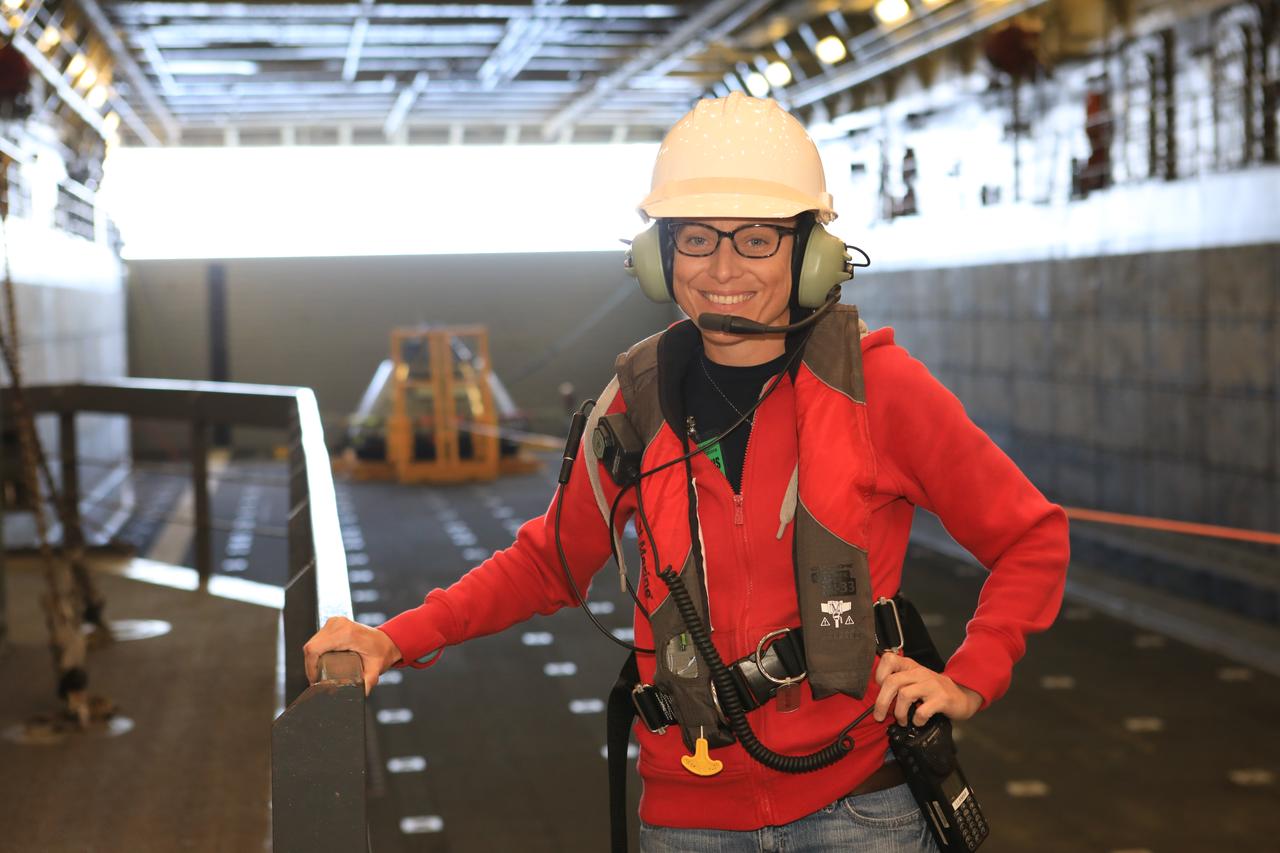
Exploration Ground Systems’ recovery team, along with the U.S. Navy, practice keeping an Orion test article under control as part of Underway Recovery Test-7. The testing is one in a series of tests to verify and validate procedures and hardware that will be used to recover the Orion spacecraft after it splashes down in the Pacific Ocean following deep space exploration missions.
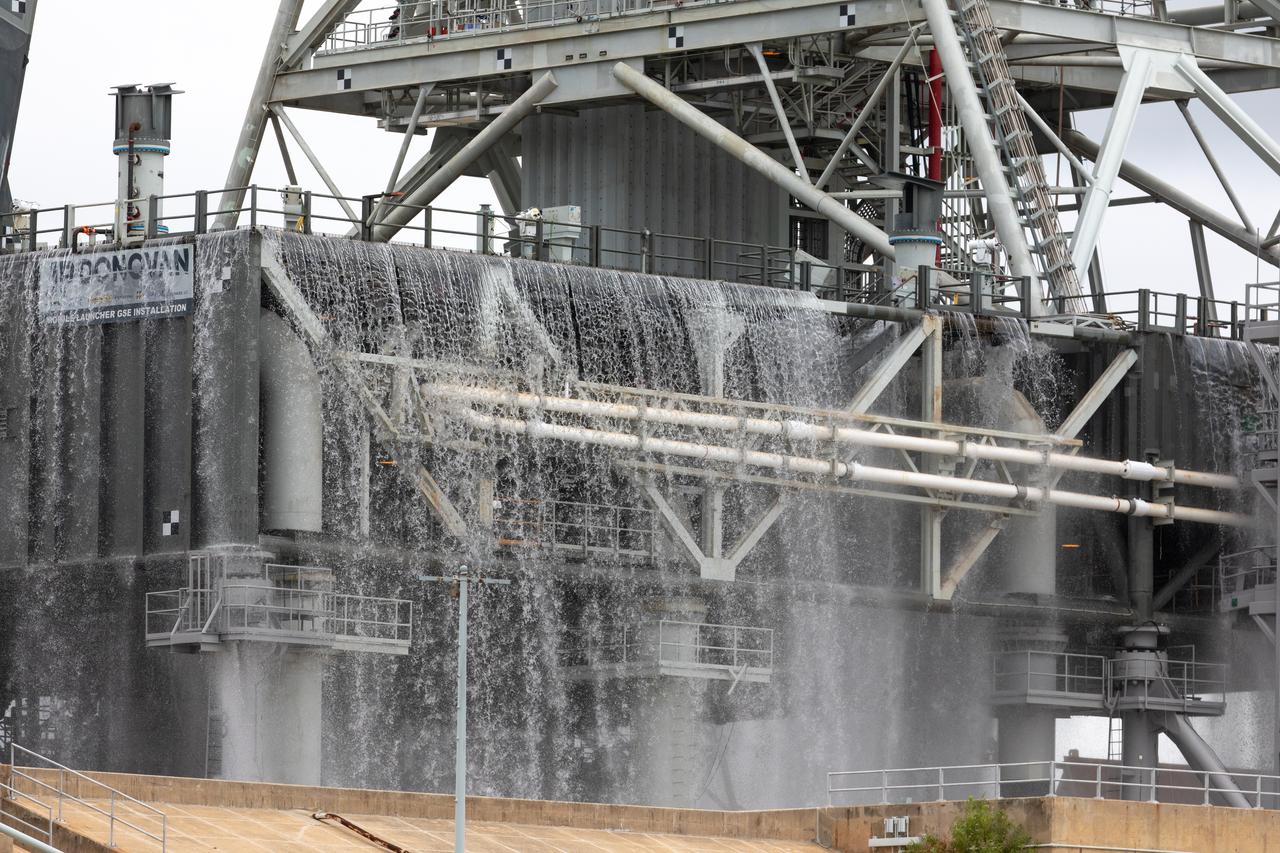
A flow test of the Ignition Overpressure Protection and Sound Suppression water deluge system is underway on the mobile launcher at Launch Pad 39B at NASA's Kennedy Space Center in Florida, on July 25, 2019. The testing is part of a series of tests that Exploration Ground System is doing to verify the system is ready for the new Space Launch System rocket. Modifications were made to the pad after a previous wet flow test, increasing the performance of the system. During the launch of Artemis 1 and subsequent missions, this water deluge system will release about 450,000 gallons of water across the mobile launcher and Flame Deflector to reduce the extreme heat and energy generated by the rocket during ignition and liftoff.
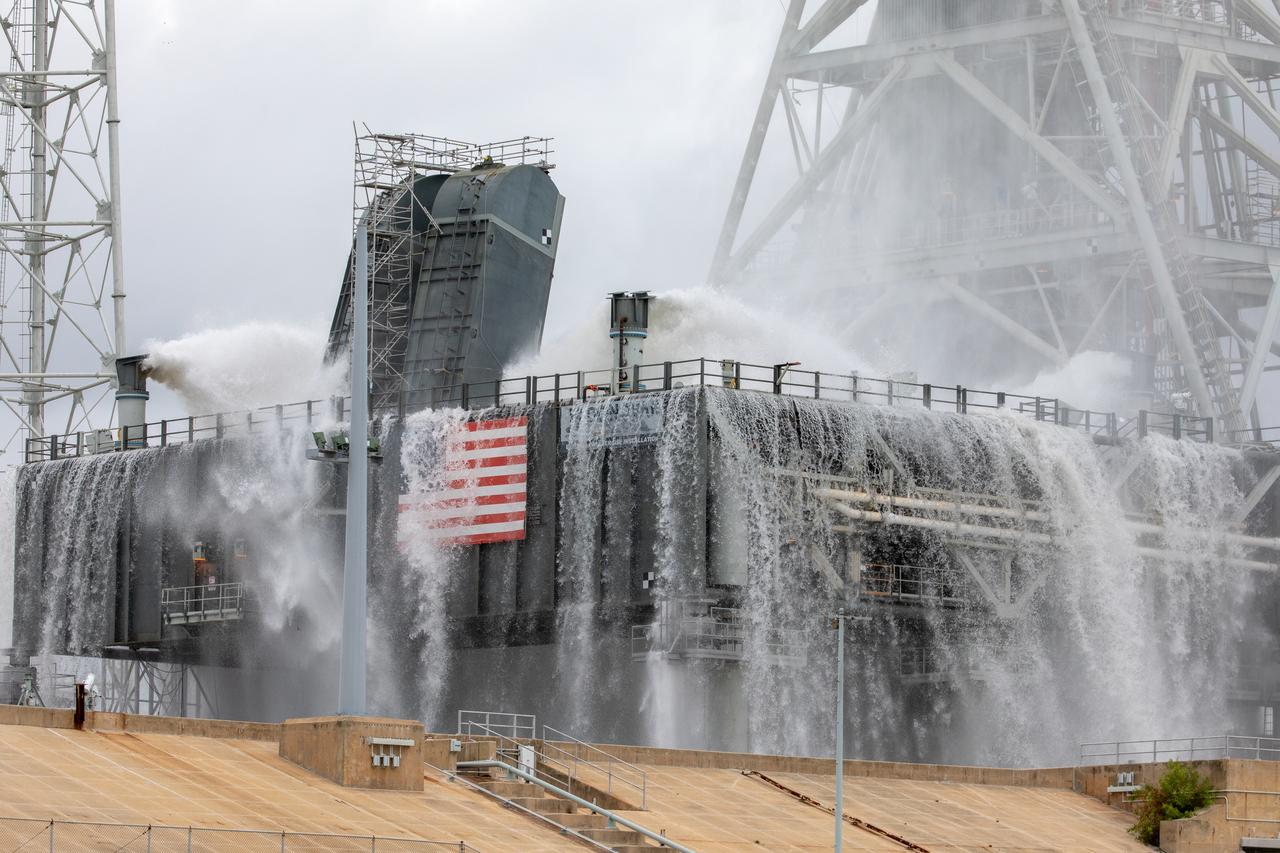
A flow test of the Ignition Overpressure Protection and Sound Suppression water deluge system is underway on the mobile launcher at Launch Pad 39B at NASA's Kennedy Space Center in Florida, on July 25, 2019. The testing is part of a series of tests that Exploration Ground System is doing to verify the system is ready for the new Space Launch System rocket. Modifications were made to the pad after a previous wet flow test, increasing the performance of the system. During the launch of Artemis 1 and subsequent missions, this water deluge system will release about 450,000 gallons of water across the mobile launcher and Flame Deflector to reduce the extreme heat and energy generated by the rocket during ignition and liftoff.
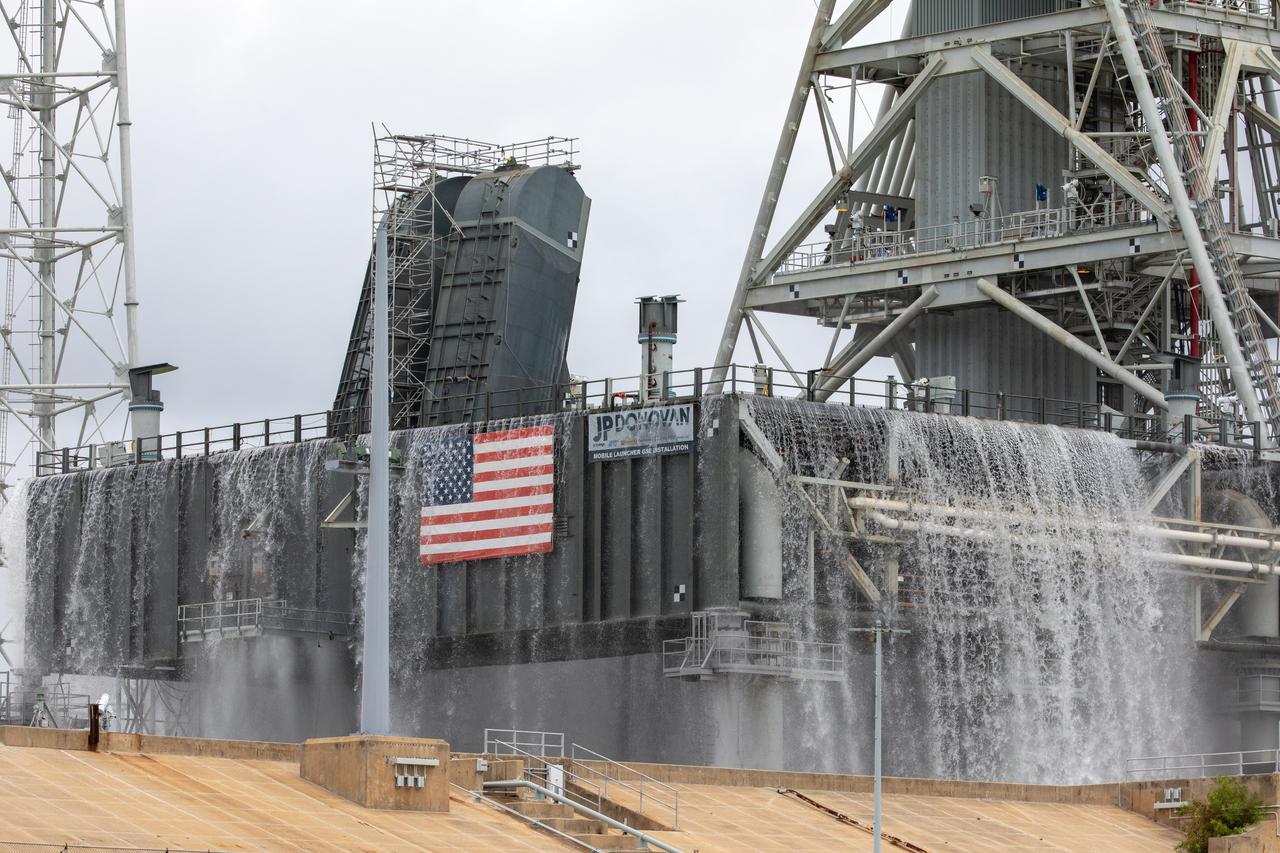
A flow test of the Ignition Overpressure Protection and Sound Suppression water deluge system is underway on the mobile launcher at Launch Pad 39B at NASA's Kennedy Space Center in Florida, on July 25, 2019. The testing is part of a series of tests that Exploration Ground System is doing to verify the system is ready for the new Space Launch System rocket. Modifications were made to the pad after a previous wet flow test, increasing the performance of the system. During the launch of Artemis 1 and subsequent missions, this water deluge system will release about 450,000 gallons of water across the mobile launcher and Flame Deflector to reduce the extreme heat and energy generated by the rocket during ignition and liftoff.
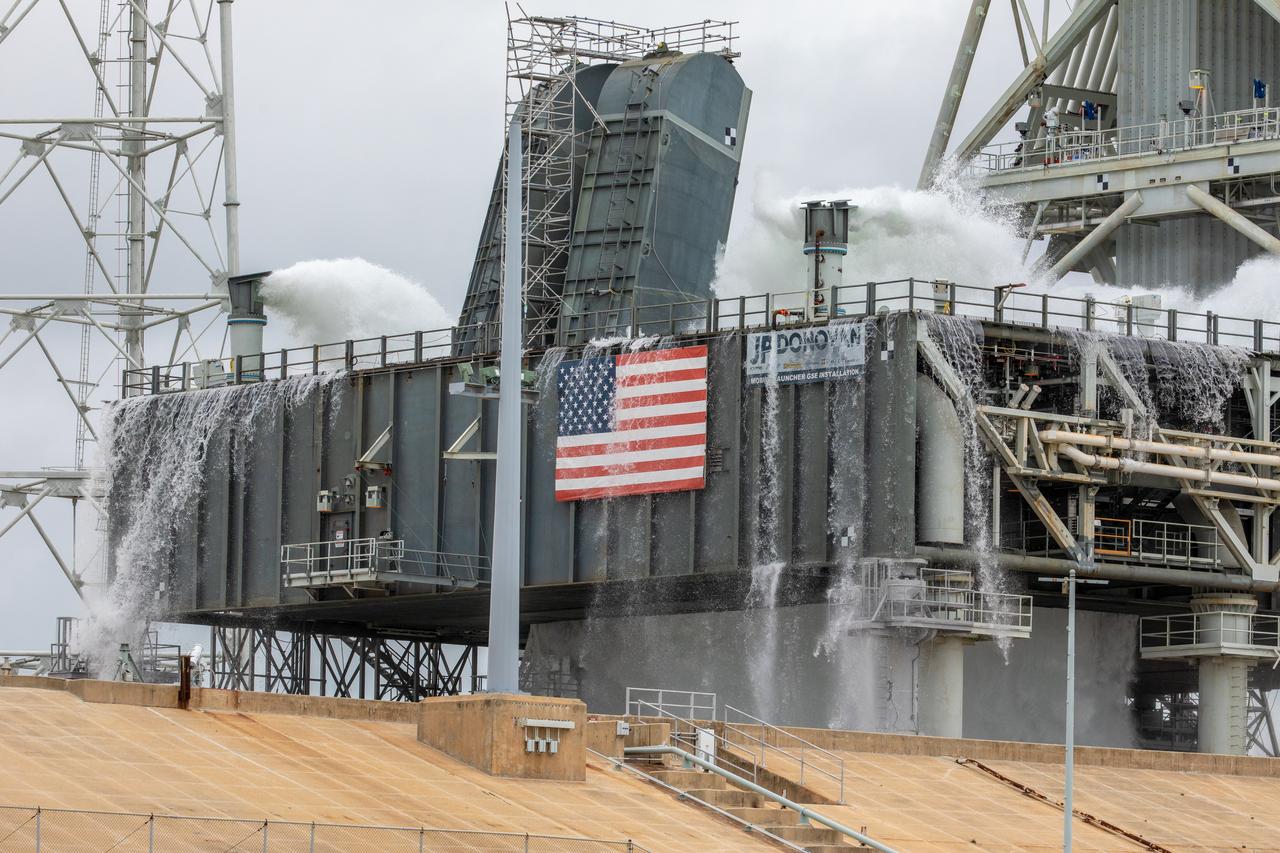
A flow test of the Ignition Overpressure Protection and Sound Suppression water deluge system begins on the mobile launcher at Launch Pad 39B at NASA's Kennedy Space Center in Florida, on July 25, 2019. The testing is part of a series of tests that Exploration Ground System is doing to verify the system is ready for the new Space Launch System rocket. Modifications were made to the pad after a previous wet flow test, increasing the performance of the system. During the launch of Artemis 1 and subsequent missions, this water deluge system will release about 450,000 gallons of water across the mobile launcher and Flame Deflector to reduce the extreme heat and energy generated by the rocket during ignition and liftoff.

A flow test of the Ignition Overpressure Protection and Sound Suppression water deluge system is underway on the mobile launcher at Launch Pad 39B at NASA's Kennedy Space Center in Florida, on July 25, 2019. The testing is part of a series of tests that Exploration Ground System is doing to verify the system is ready for the new Space Launch System rocket. Modifications were made to the pad after a previous wet flow test, increasing the performance of the system. During the launch of Artemis 1 and subsequent missions, this water deluge system will release about 450,000 gallons of water across the mobile launcher and Flame Deflector to reduce the extreme heat and energy generated by the rocket during ignition and liftoff.
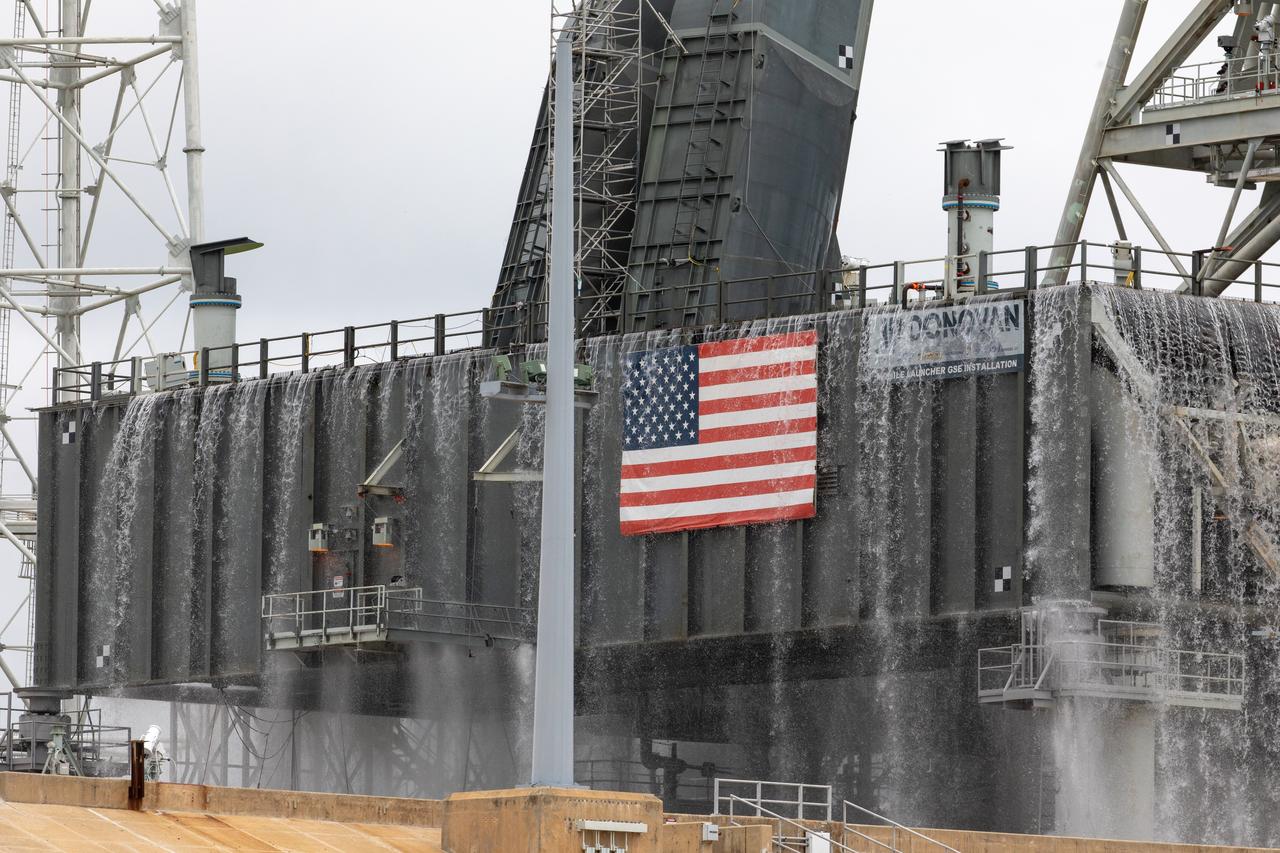
A flow test of the Ignition Overpressure Protection and Sound Suppression water deluge system is underway on the mobile launcher at Launch Pad 39B at NASA's Kennedy Space Center in Florida, on July 25, 2019. The testing is part of a series of tests that Exploration Ground System is doing to verify the system is ready for the new Space Launch System rocket. Modifications were made to the pad after a previous wet flow test, increasing the performance of the system. During the launch of Artemis 1 and subsequent missions, this water deluge system will release about 450,000 gallons of water across the mobile launcher and Flame Deflector to reduce the extreme heat and energy generated by the rocket during ignition and liftoff.
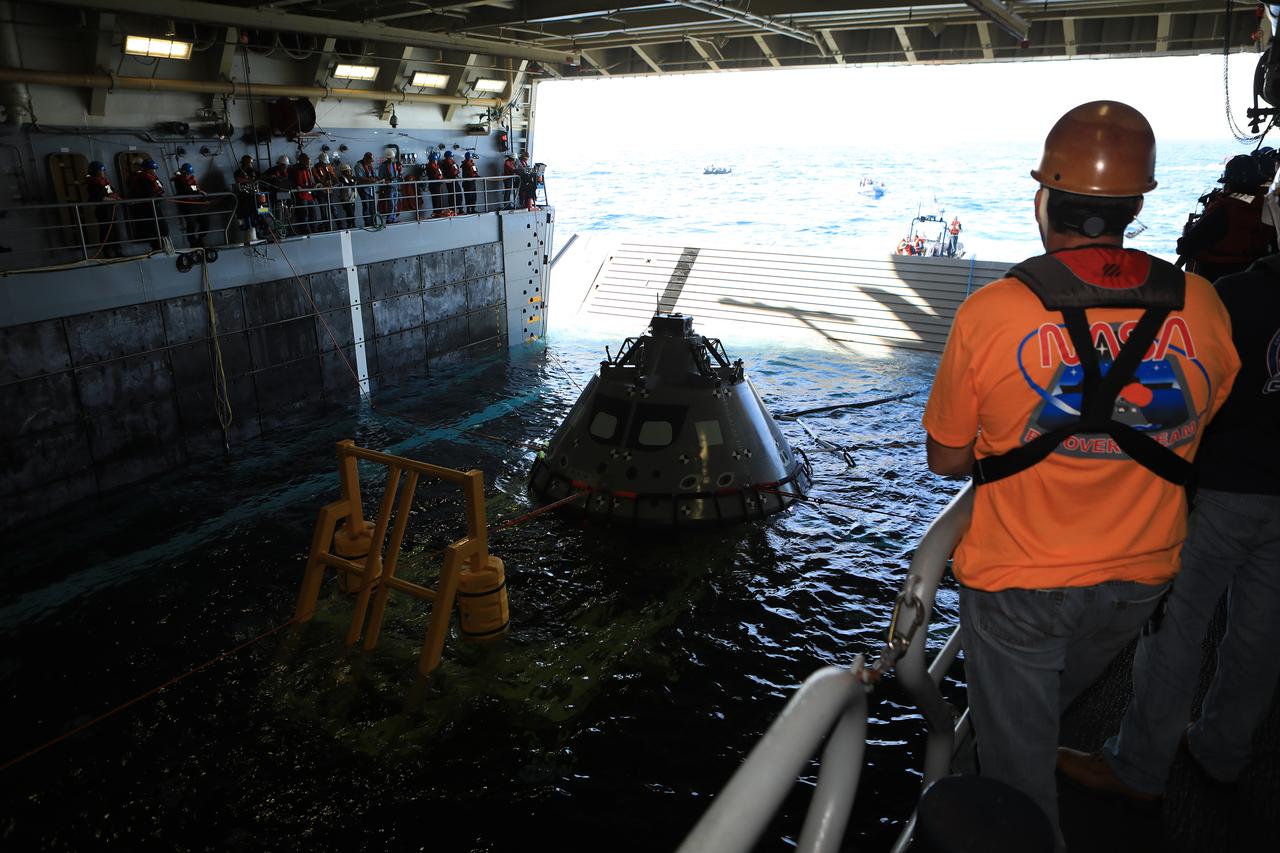
The Exploration Ground Systems Recovery Team, based out of Kennedy Space Center in Florida, practices bringing a test version of the Orion capsule inside the flooded well deck of the USS John P. Murtha and setting it in a cradle as part of Underway Recovery Test-7 (URT-7) on Oct. 31, 2018, in the Pacific Ocean. URT-7 is one in a series of tests to verify and validate procedures and hardware that will be used to recover the Orion spacecraft after it splashes down in the Pacific Ocean following deep space exploration missions. Orion will have emergency abort capability, sustain the crew during space travel and provide safe re-entry from deep space return velocities.
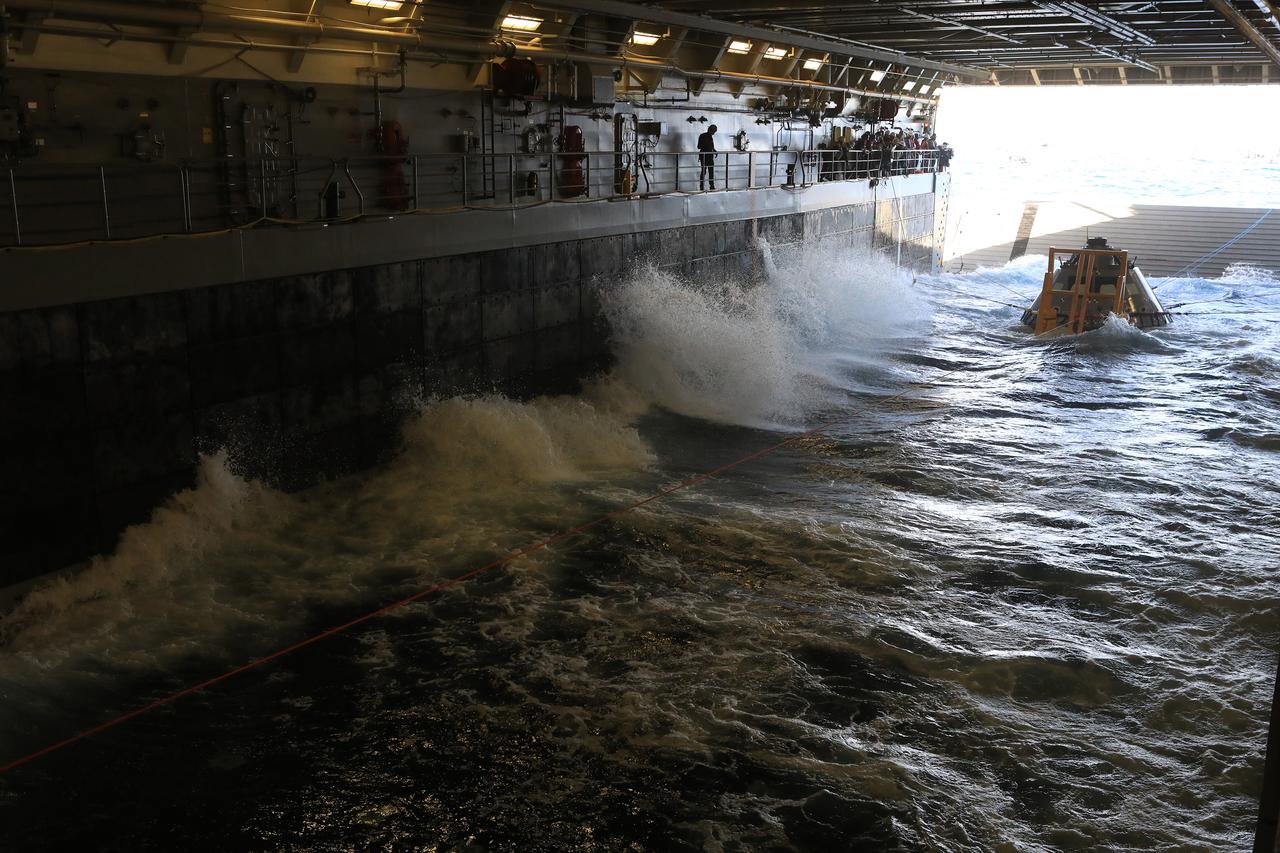
The Exploration Ground Systems Recovery Team, based out of Kennedy Space Center in Florida, practices bringing a test version of the Orion capsule inside the flooded well deck of the USS John P. Murtha and setting it in a cradle as part of Underway Recovery Test-7 (URT-7) on Oct. 31, 2018, in the Pacific Ocean. URT-7 is one in a series of tests to verify and validate procedures and hardware that will be used to recover the Orion spacecraft after it splashes down in the Pacific Ocean following deep space exploration missions. Orion will have emergency abort capability, sustain the crew during space travel and provide safe re-entry from deep space return velocities.
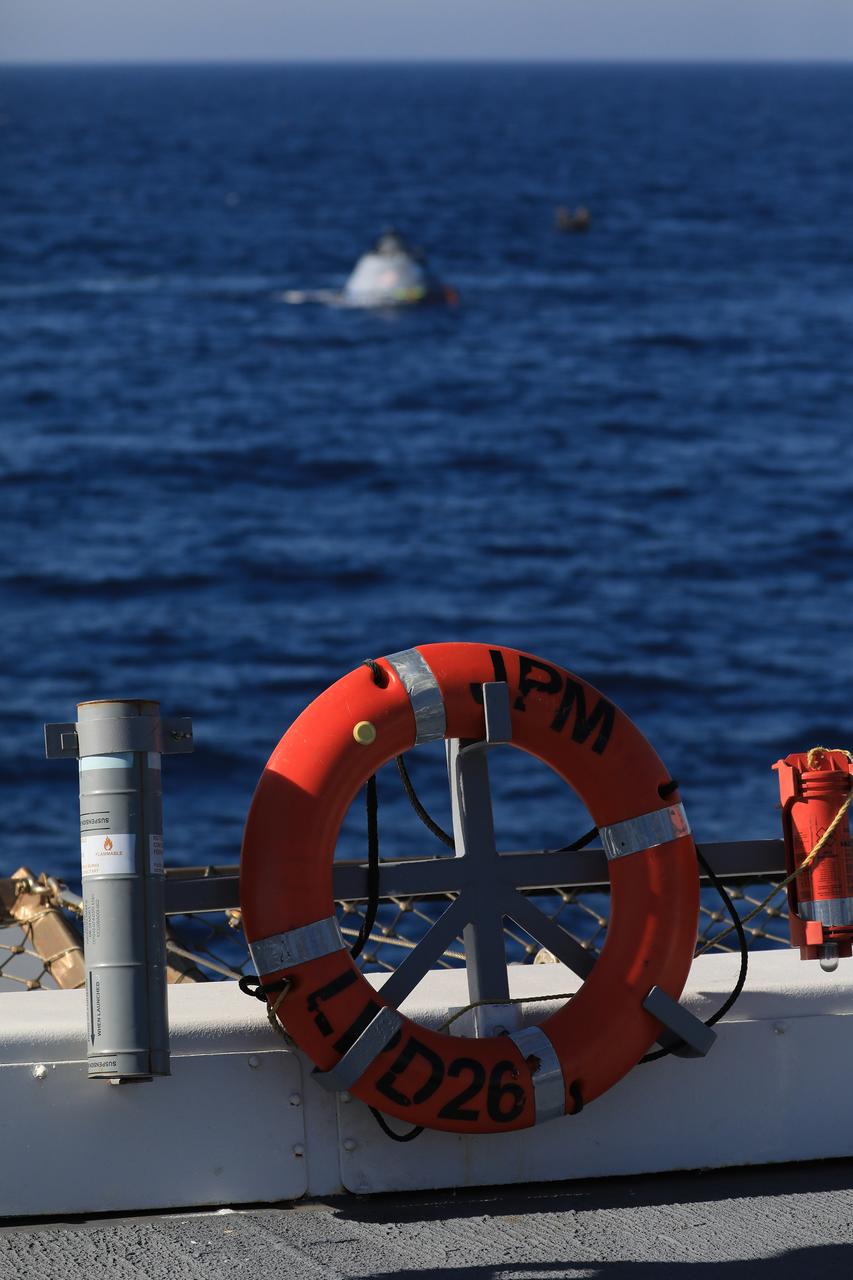
The Exploration Ground Systems recovery team, along with the U.S. Navy, practice recovering a test version of the Orion capsule during Underway Recovery Test-7 (URT-7) onboard the USS John P. Murtha, on Oct. 31, 2018, in the Pacific Ocean. URT-7 is one in a series of tests to verify and validate procedures and hardware that will be used to recover the Orion spacecraft after it splashes down in the Pacific Ocean following deep space exploration missions. Orion will have emergency abort capability, sustain the crew during space travel and provide safe re-entry from deep space return velocities.
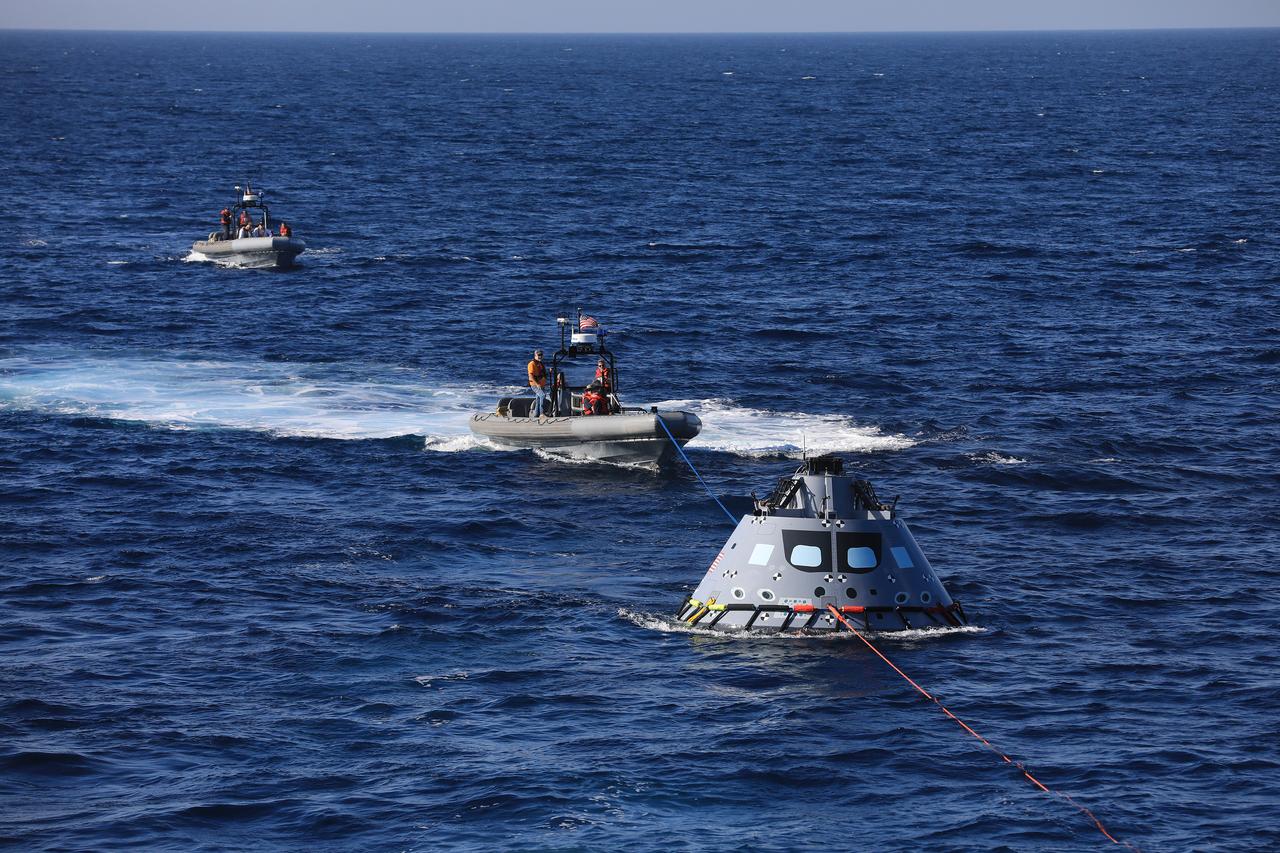
The Exploration Ground Systems recovery team, along with the U.S. Navy, practice recovering a test version of the Orion capsule and bringing it inside the well deck of the USS John P. Murtha during Underway Recovery Test-7 (URT-7) on Oct. 31, 2018, in the Pacific Ocean. URT-7 is one in a series of tests to verify and validate procedures and hardware that will be used to recover the Orion spacecraft after it splashes down in the Pacific Ocean following deep space exploration missions. Orion will have emergency abort capability, sustain the crew during space travel and provide safe re-entry from deep space return velocities.
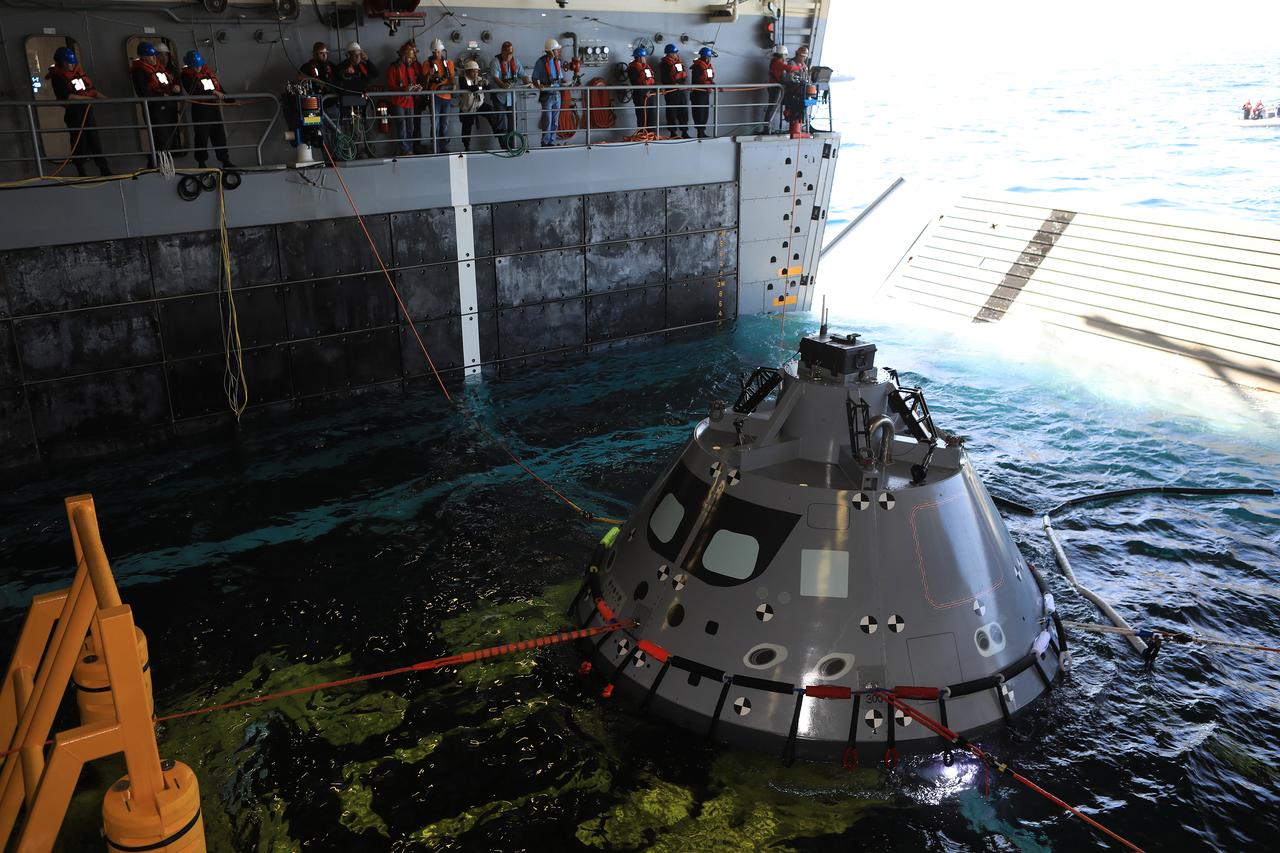
The Exploration Ground Systems Recovery Team, based out of Kennedy Space Center in Florida, practices bringing a test version of the Orion capsule inside the flooded well deck of the USS John P. Murtha and set it in a cradle as part of Underway Recovery Test-7 (URT-7) on Oct. 31, 2018, in the Pacific Ocean. URT-7 is one in a series of tests to verify and validate procedures and hardware that will be used to recover the Orion spacecraft after it splashes down in the Pacific Ocean following deep space exploration missions. Orion will have emergency abort capability, sustain the crew during space travel and provide safe re-entry from deep space return velocities.
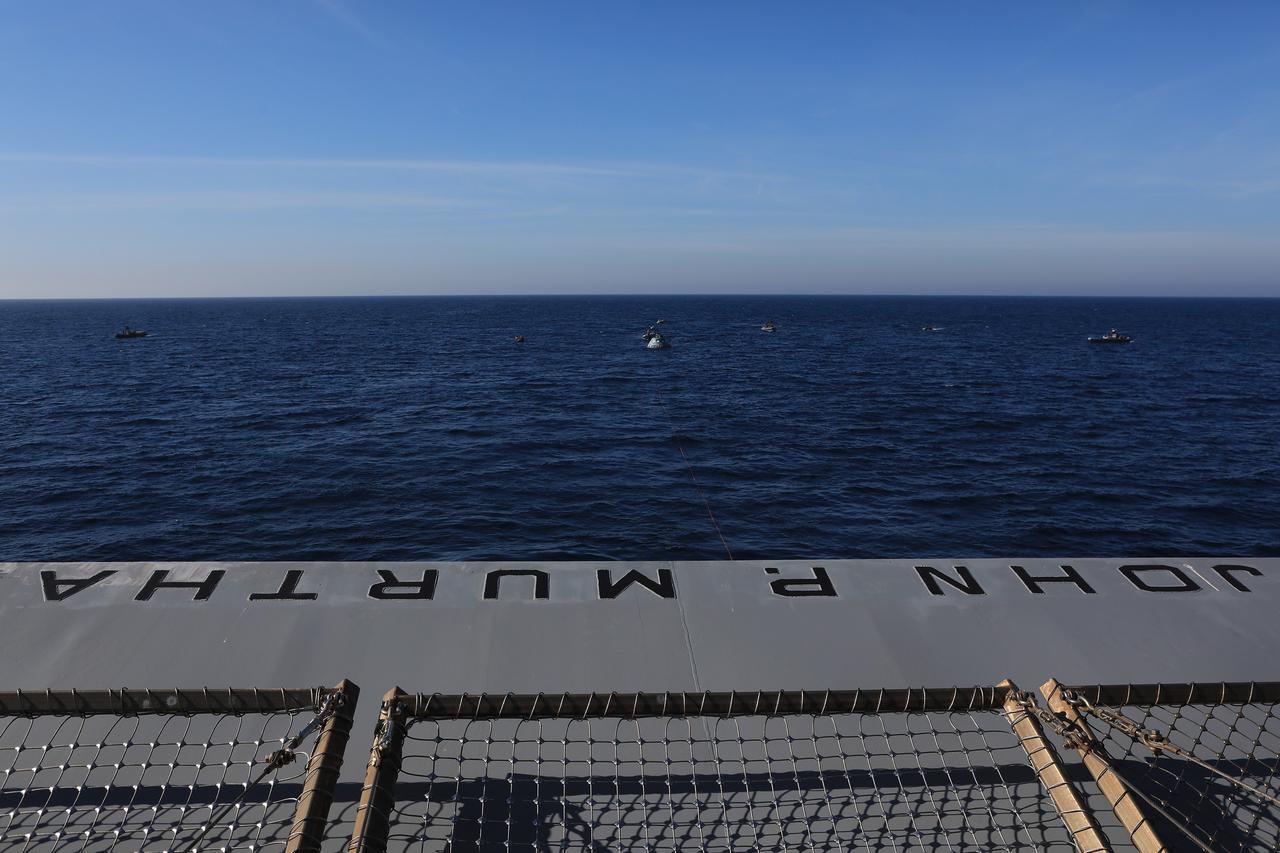
The Exploration Ground Systems Recovery Team, based out of Kennedy Space Center in Florida, is practicing recovering a test version of the Orion capsule during Underway Recovery Test-7 (URT-7), on Oct. 31, 2018, aboard the USS John P. Murtha, in the Pacific Ocean. URT-7 is one in a series of tests to verify and validate procedures and hardware that will be used to recover the Orion spacecraft after it splashes down in the Pacific Ocean following deep space exploration missions. Orion will have emergency abort capability, sustain the crew during space travel and provide safe re-entry from deep space return velocities.
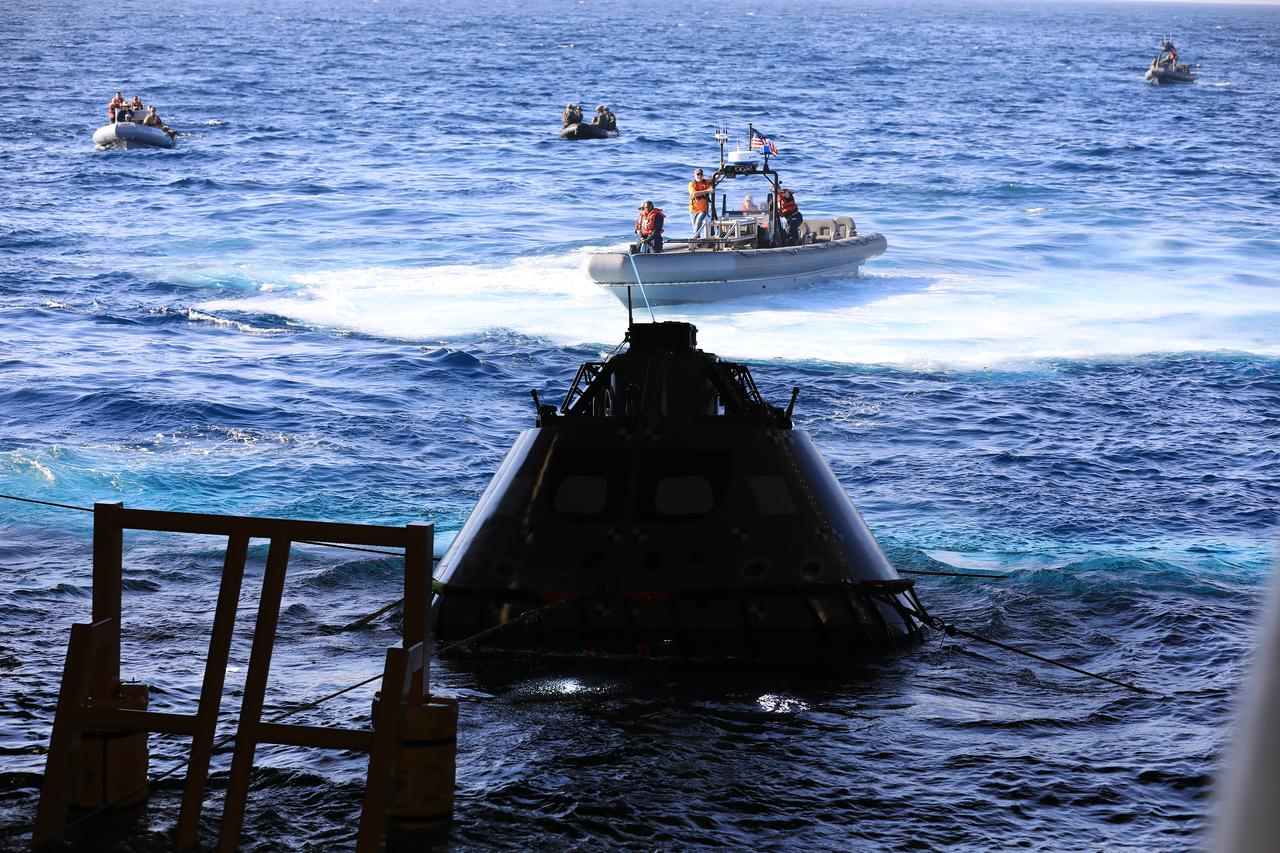
The Exploration Ground Systems Recovery Team, along with the U.S. Navy, practice recovering a test version of the Orion capsule and bringing it inside the well deck of the USS John P. Murtha during Underway Recovery Test-7 (URT-7) on Oct. 31, 2018, in the Pacific Ocean. URT-7 is one in a series of tests to verify and validate procedures and hardware that will be used to recover the Orion spacecraft after it splashes down in the Pacific Ocean following deep space exploration missions. Orion will have emergency abort capability, sustain the crew during space travel and provide safe re-entry from deep space return velocities.
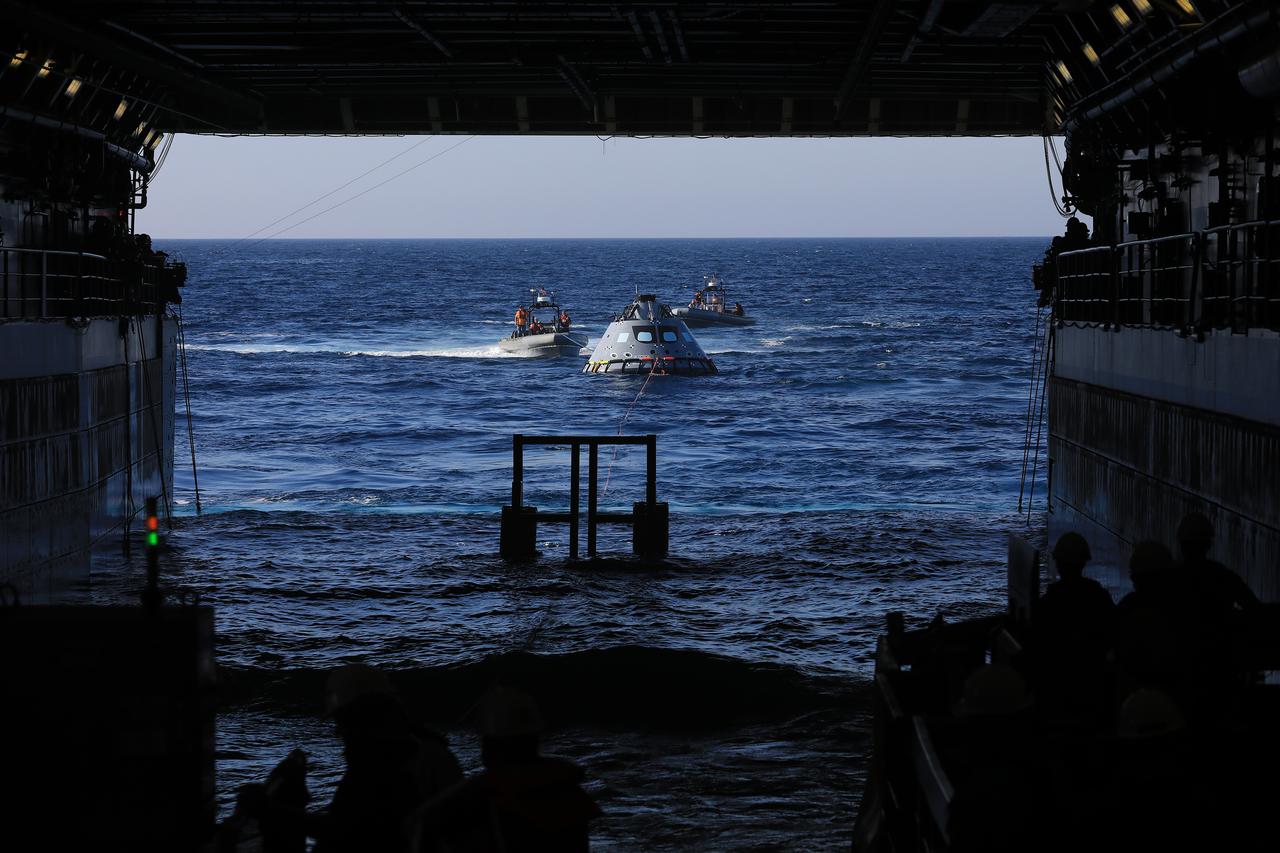
The Exploration Ground Systems recovery team, along with the U.S. Navy, practice recovering a test version of the Orion capsule and bringing it inside the well deck of the USS John P. Murtha during Underway Recovery Test-7 (URT-7) on Oct. 31, 2018, in the Pacific Ocean. URT-7 is one in a series of tests to verify and validate procedures and hardware that will be used to recover the Orion spacecraft after it splashes down in the Pacific Ocean following deep space exploration missions. Orion will have emergency abort capability, sustain the crew during space travel and provide safe re-entry from deep space return velocities.
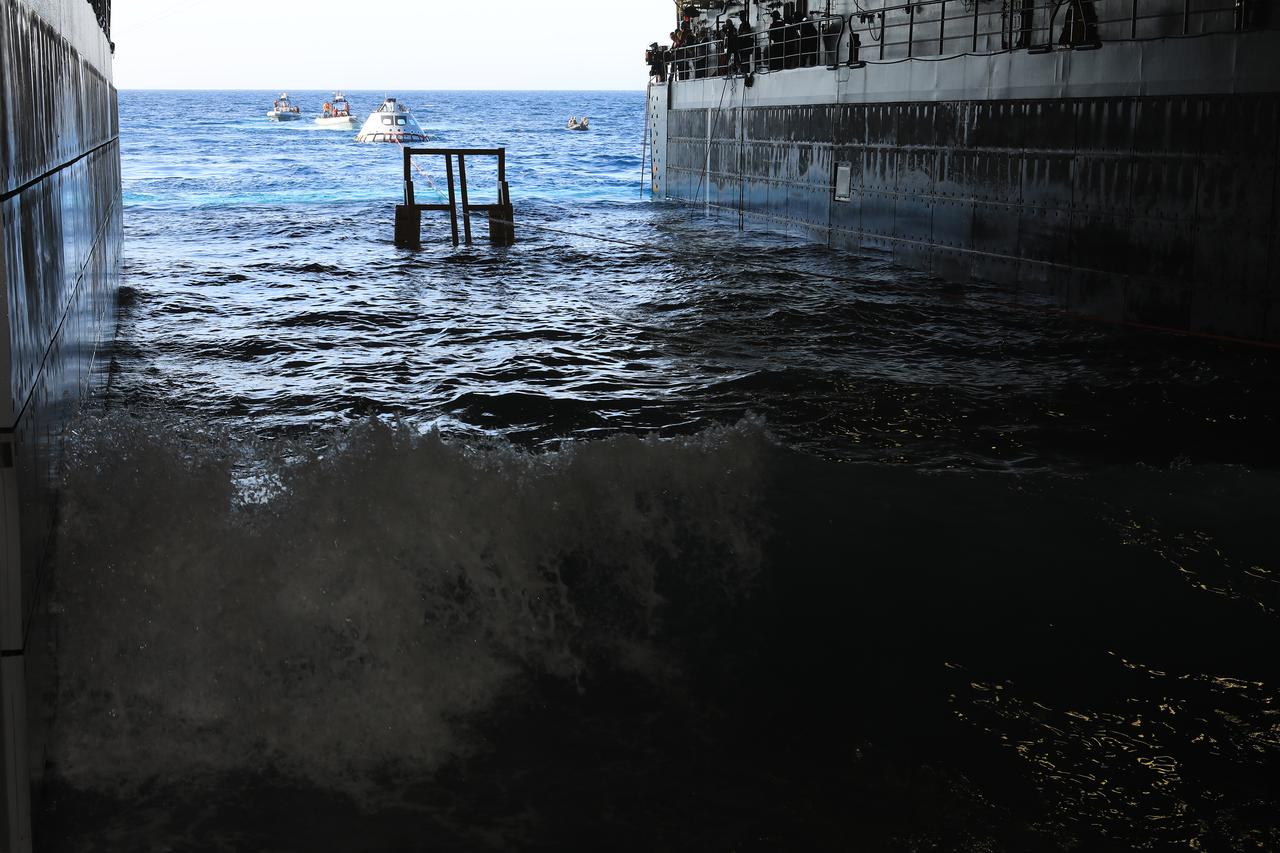
The Exploration Ground Systems Recovery Team, based out of Kennedy Space Center in Florida, along with the U.S. Navy, prepare to pull a test version of the Orion capsule inside the well deck of the USS John P. Murtha during Underway Recovery Test-7 (URT-7) on Oct. 31, 2018, in the Pacific Ocean. URT-7 is one in a series of tests to verify and validate procedures and hardware that will be used to recover the Orion spacecraft after it splashes down in the Pacific Ocean following deep space exploration missions. Orion will have emergency abort capability, sustain the crew during space travel and provide safe re-entry from deep space return velocities.
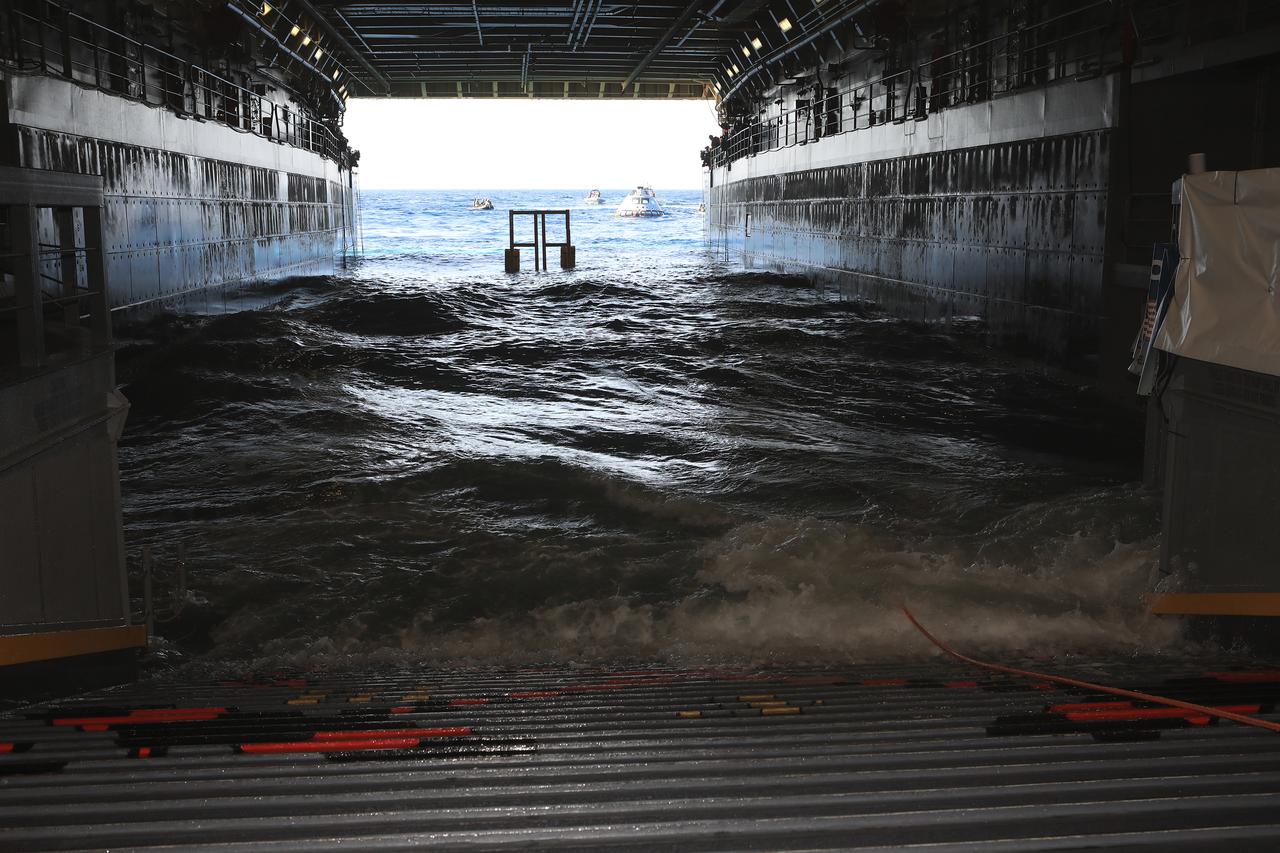
The Exploration Ground Systems Recovery Team, based out of Kennedy Space Center in Florida, along with the U.S. Navy, prepare to pull a test version of the Orion capsule inside the well deck of the USS John P. Murtha during Underway Recovery Test-7 (URT-7) on Oct. 31, 2018, in the Pacific Ocean. URT-7 is one in a series of tests to verify and validate procedures and hardware that will be used to recover the Orion spacecraft after it splashes down in the Pacific Ocean following deep space exploration missions. Orion will have emergency abort capability, sustain the crew during space travel and provide safe re-entry from deep space return velocities.
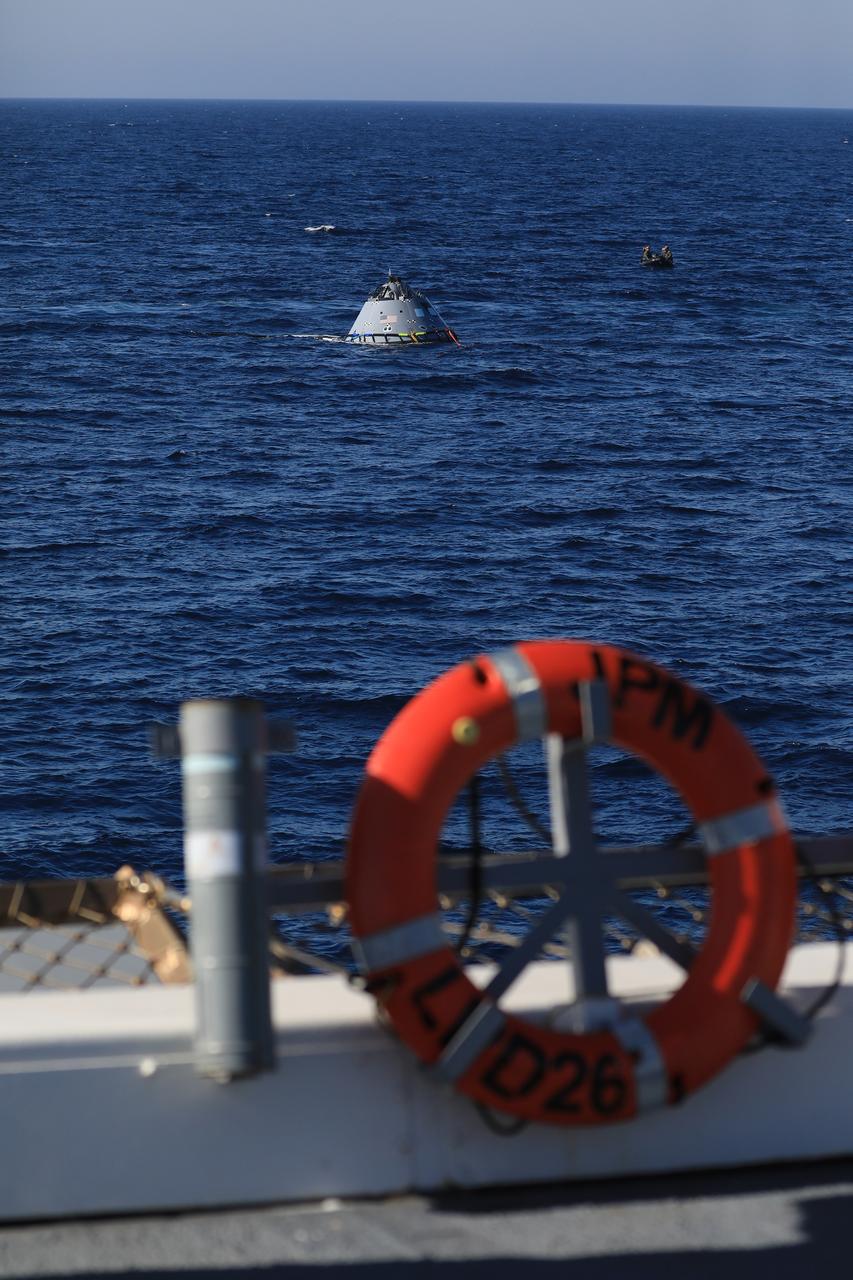
The Exploration Ground Systems recovery team, along with the U.S. Navy, practice recovering a test version of the Orion capsule during Underway Recovery Test-7 (URT-7) onboard the USS John P. Murtha, on Oct. 31, 2018, in the Pacific Ocean. URT-7 is one in a series of tests to verify and validate procedures and hardware that will be used to recover the Orion spacecraft after it splashes down in the Pacific Ocean following deep space exploration missions. Orion will have emergency abort capability, sustain the crew during space travel and provide safe re-entry from deep space return velocities.
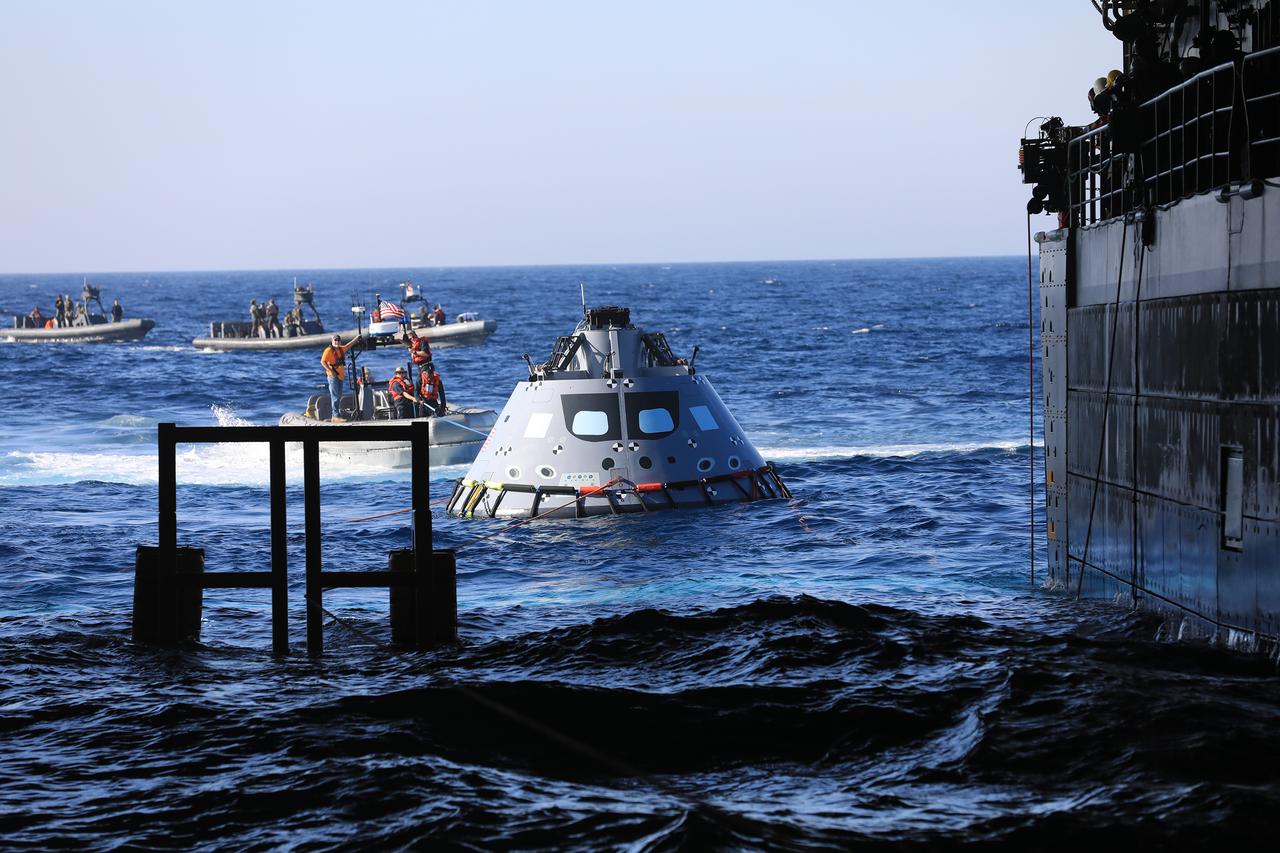
The Exploration Ground Systems Recovery Team, along with the U.S. Navy, practice recovering a test version of the Orion capsule and bringing it inside the well deck of the USS John P. Murtha during Underway Recovery Test-7 (URT-7) on Oct. 31, 2018, in the Pacific Ocean. URT-7 is one in a series of tests to verify and validate procedures and hardware that will be used to recover the Orion spacecraft after it splashes down in the Pacific Ocean following deep space exploration missions. Orion will have emergency abort capability, sustain the crew during space travel and provide safe re-entry from deep space return velocities.
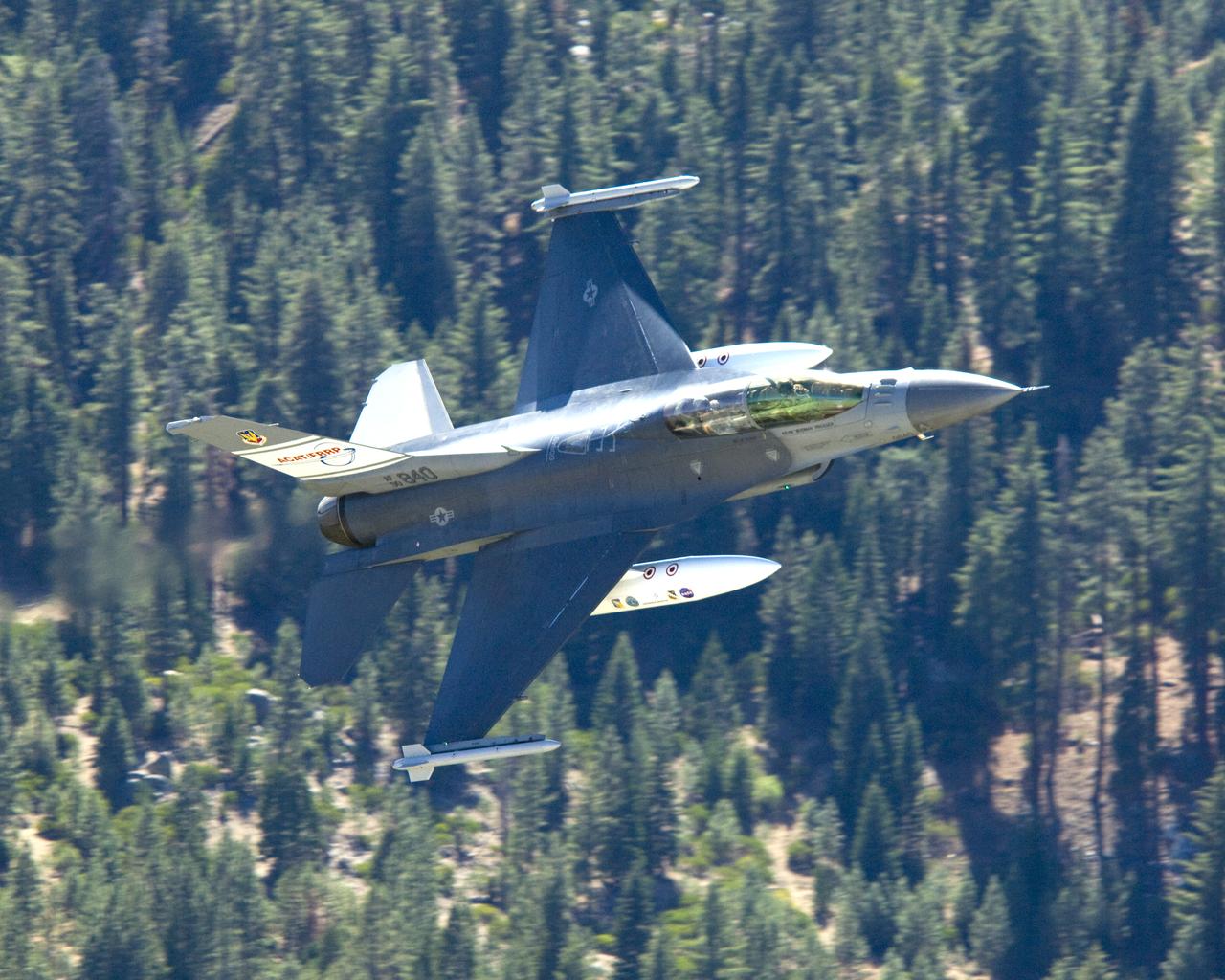
The F-16D Automatic Collision Avoidance Technology aircraft tests of the Automatic Ground Collision Avoidance System, or Auto-GCAS, included flights in areas of potentially hazardous terrain, including canyons and mountains.
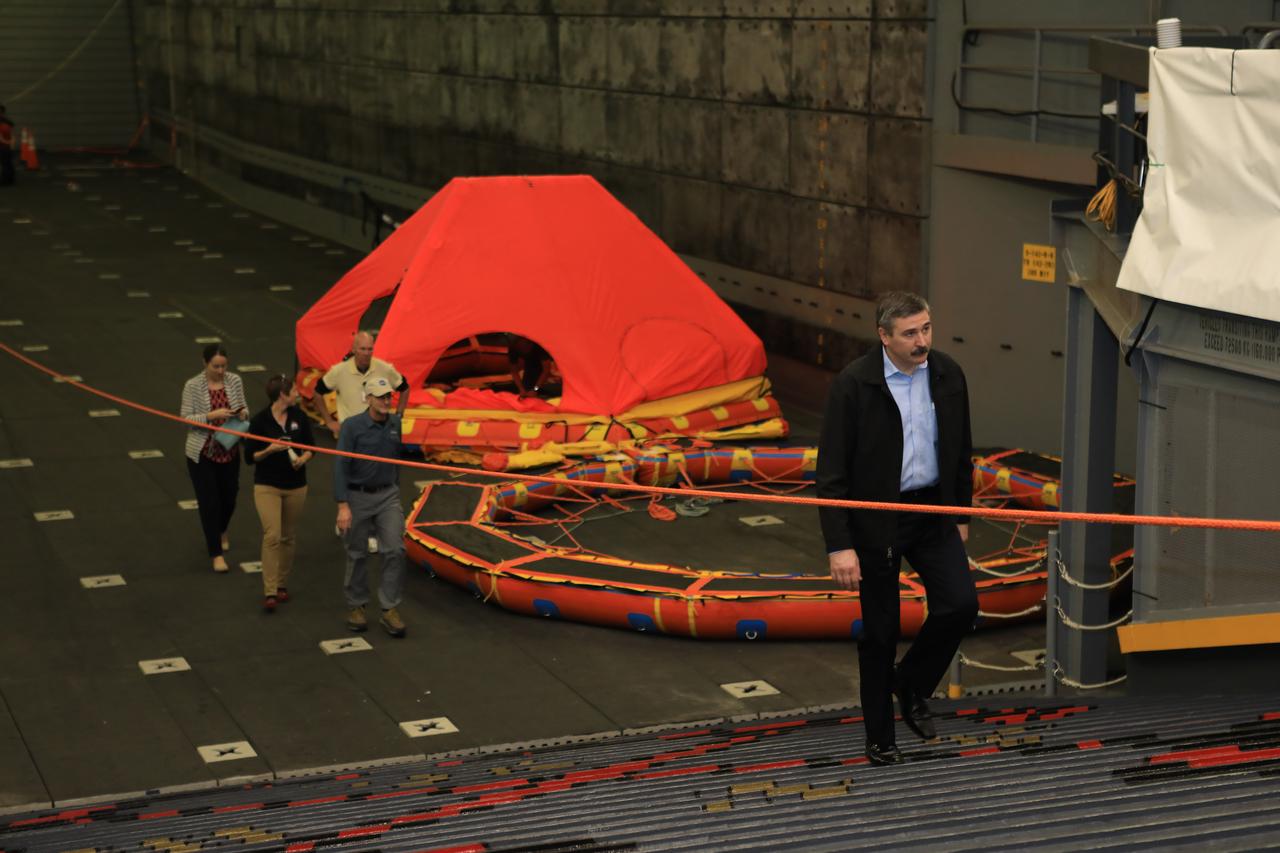
Exploration Mission-1 Mission Manager Mike Sarafin and other senior leaders from around NASA received a familiarization tour by the Exploration Ground Systems (EGS) recovery team on Oct. 29, 2018, as they prepare for Underway Recovery Test-7 (URT-7) on a U.S. Navy ship. EGS and the U.S. Navy will use a test version of the Orion crew module, several rigid hull inflatable boats and support equipment to verify and validate processes, procedures, hardware and personnel during recovery of Orion in open waters. URTs are a series of tests to ensure all systems are go when recovering the Orion crew capsule and astronauts onboard in the future. Orion will have emergency abort capability, sustain the crew during space travel and provide safe re-entry from deep space return velocities.
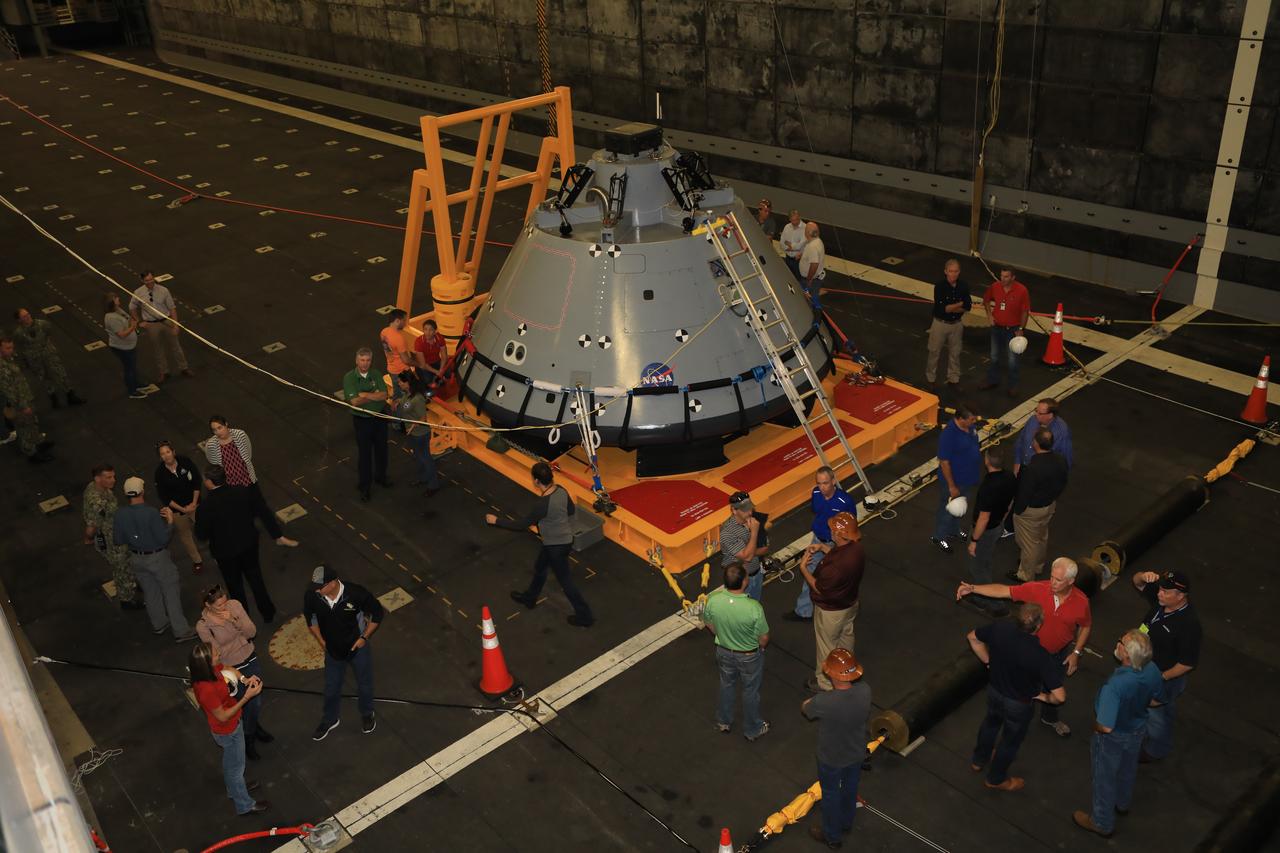
Senior leaders from around NASA receive a familiarization tour by the Exploration Ground Systems (EGS) recovery team on Oct. 29, 2018, as they prepare for Underway Recovery Test-7 (URT-7) aboard a U.S. Navy ship. EGS and the U.S. Navy will use a test version of the Orion crew module, several rigid hull inflatable boats and support equipment to verify and validate processes, procedures, hardware and personnel during recovery of Orion in open waters. URTs are a series of tests to ensure all systems are go when recovering the Orion crew capsule and astronauts onboard in the future. Orion will have emergency abort capability, sustain the crew during space travel and provide safe re-entry from deep space return velocities.
Landing and Recovery Director Melissa Jones gives senior leaders from around NASA a familiarization tour onboard a U.S. Navy ship on Oct. 29, 2018, as the Exploration Ground Systems (EGS) recovery team prepares for Underway Recovery Test-7 (URT-7). EGS and the U.S. Navy will use a test version of the Orion crew module, several rigid hull inflatable boats and support equipment to verify and validate processes, procedures, hardware and personnel during recovery of Orion in open waters. URTs are a series of tests to ensure all systems are go when recovering the Orion crew capsule and astronauts onboard in the future. Orion will have emergency abort capability, sustain the crew during space travel and provide safe re-entry from deep space return velocities.
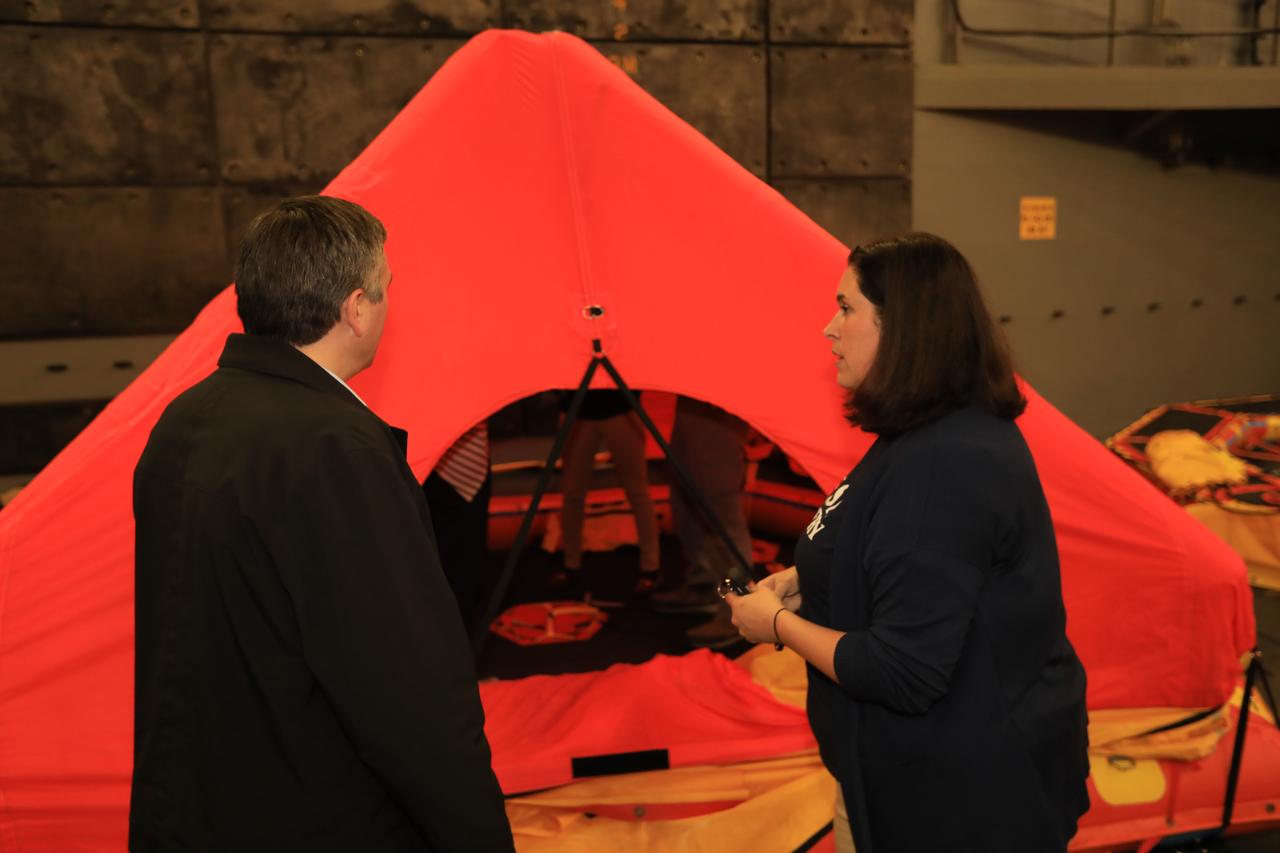
NASA Landing and Recovery Director Melissa Jones, at right, and Exploration Mission-1 Mission Manager Mike Sarafin discuss the benefits that the front porch will provide to astronauts after splashing down in the Orion crew capsule on future missions. Senior leaders from around NASA receive a familiarization tour by the Exploration Ground Systems (EGS) recovery team on Oct. 29, 2018, as they prepare for Underway Recovery Test-7 (URT-7). EGS and the U.S. Navy will use a test version of the Orion crew module, several rigid hull inflatable boats and support equipment to verify and validate processes, procedures, hardware and personnel during recovery of Orion in open waters. URTs are a series of tests to ensure all systems are go when recovering the Orion crew capsule and astronauts onboard in the future. Orion will have emergency abort capability, sustain the crew during space travel and provide safe re-entry from deep space return velocities.
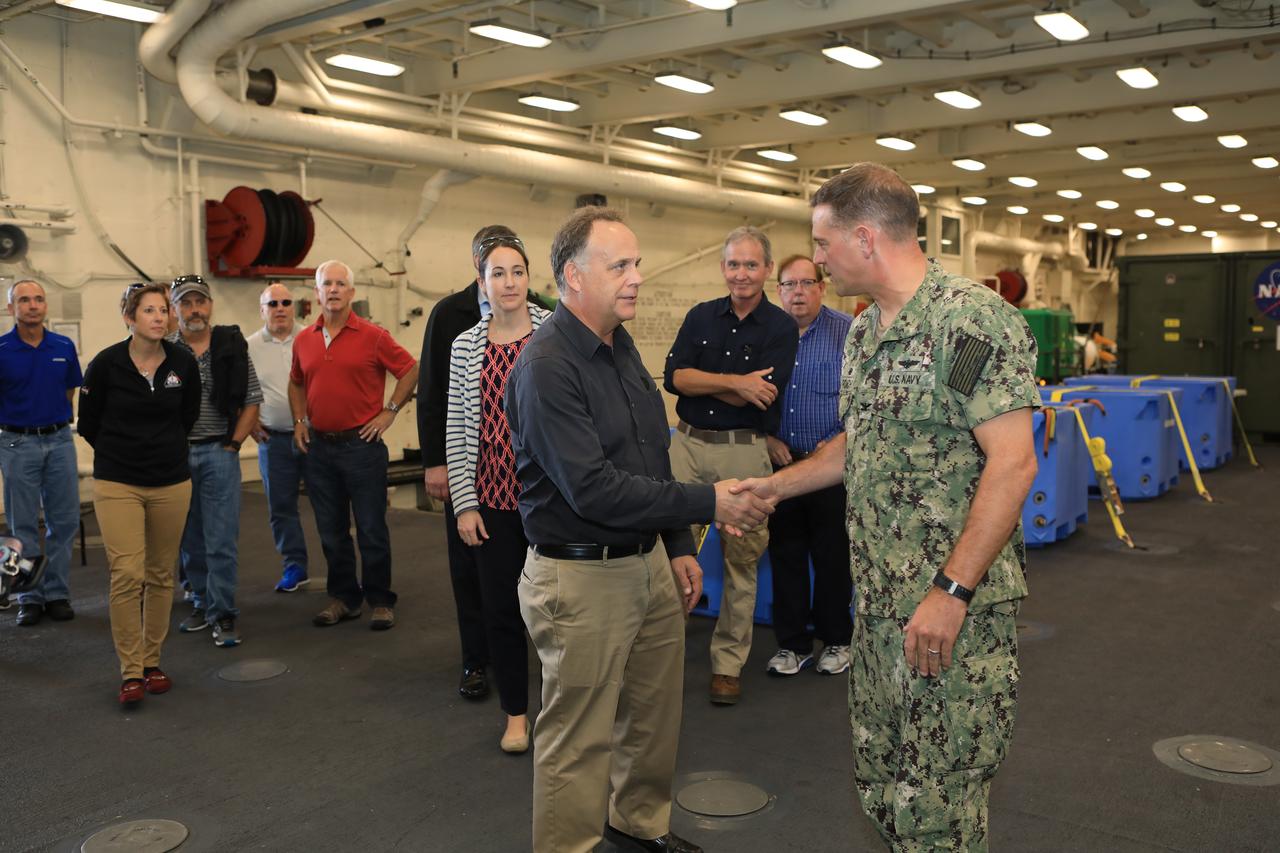
Captain Anthony Roach, at right, commanding officer in the U.S. Navy, welcomes Shawn Quinn and other senior leaders from around NASA onto his ship on Oct. 29, 2018. The visit is a familiarization tour coordinated by the Exploration Ground Systems (EGS) recovery team as they prepare for Underway Recovery Test-7 (URT-7). EGS and the U.S. Navy will use a test version of the Orion crew module, several rigid hull inflatable boats and support equipment to verify and validate processes, procedures, hardware and personnel during recovery of Orion in open waters. URTs are a series of tests to ensure all systems are go when recovering the Orion crew capsule and astronauts onboard in the future. Orion will have emergency abort capability, sustain the crew during space travel and provide safe re-entry from deep space return velocities.
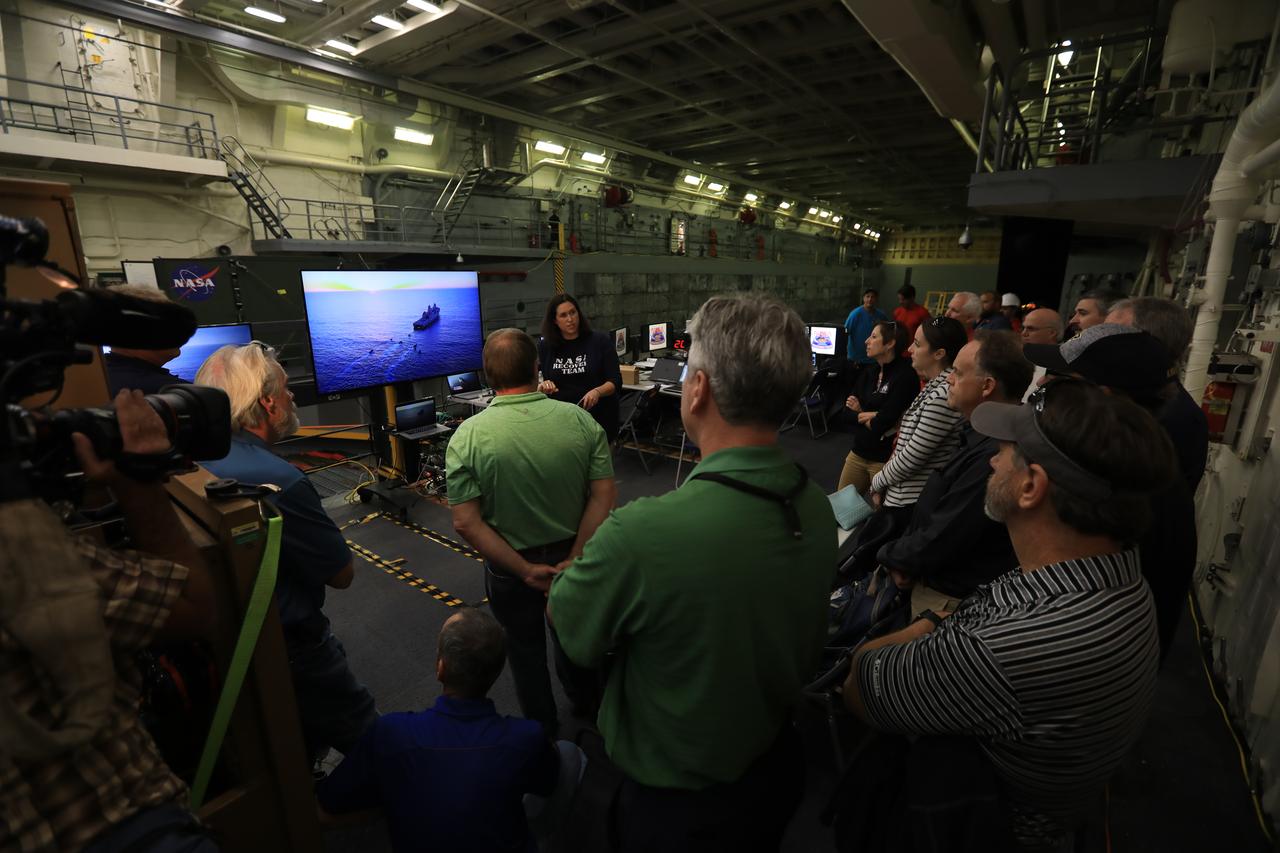
Landing and Recovery Director Melissa Jones, standing in center, gives senior leaders from around NASA a familiarization tour onboard a U.S. Navy ship on Oct. 29, 2018, as the Exploration Ground Systems (EGS) recovery team prepares for Underway Recovery Test-7 (URT-7). EGS and the U.S. Navy will use a test version of the Orion crew module, several rigid hull inflatable boats and support equipment to verify and validate processes, procedures, hardware and personnel during recovery of Orion in open waters. URTs are a series of tests to ensure all systems are go when recovering the Orion crew capsule and astronauts onboard in the future. Orion will have emergency abort capability, sustain the crew during space travel and provide safe re-entry from deep space return velocities.
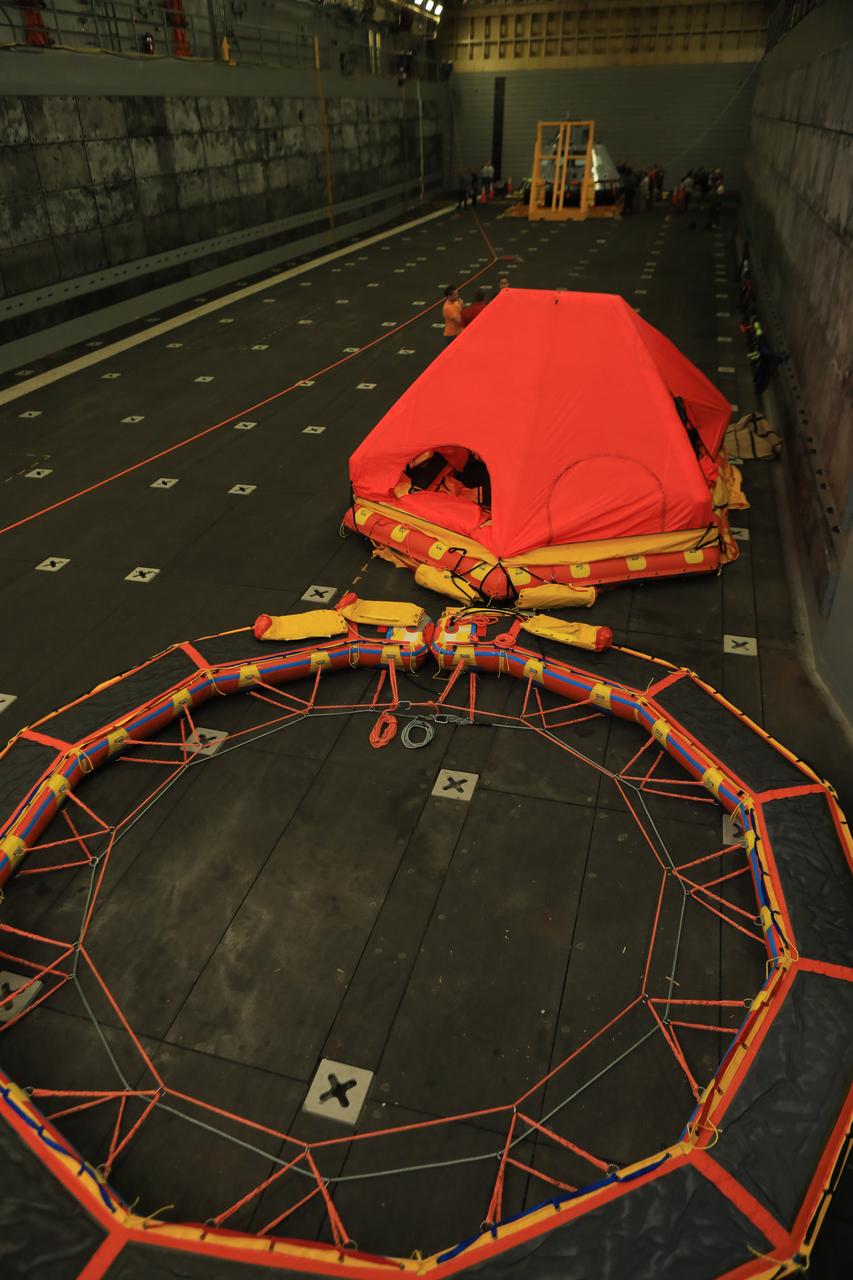
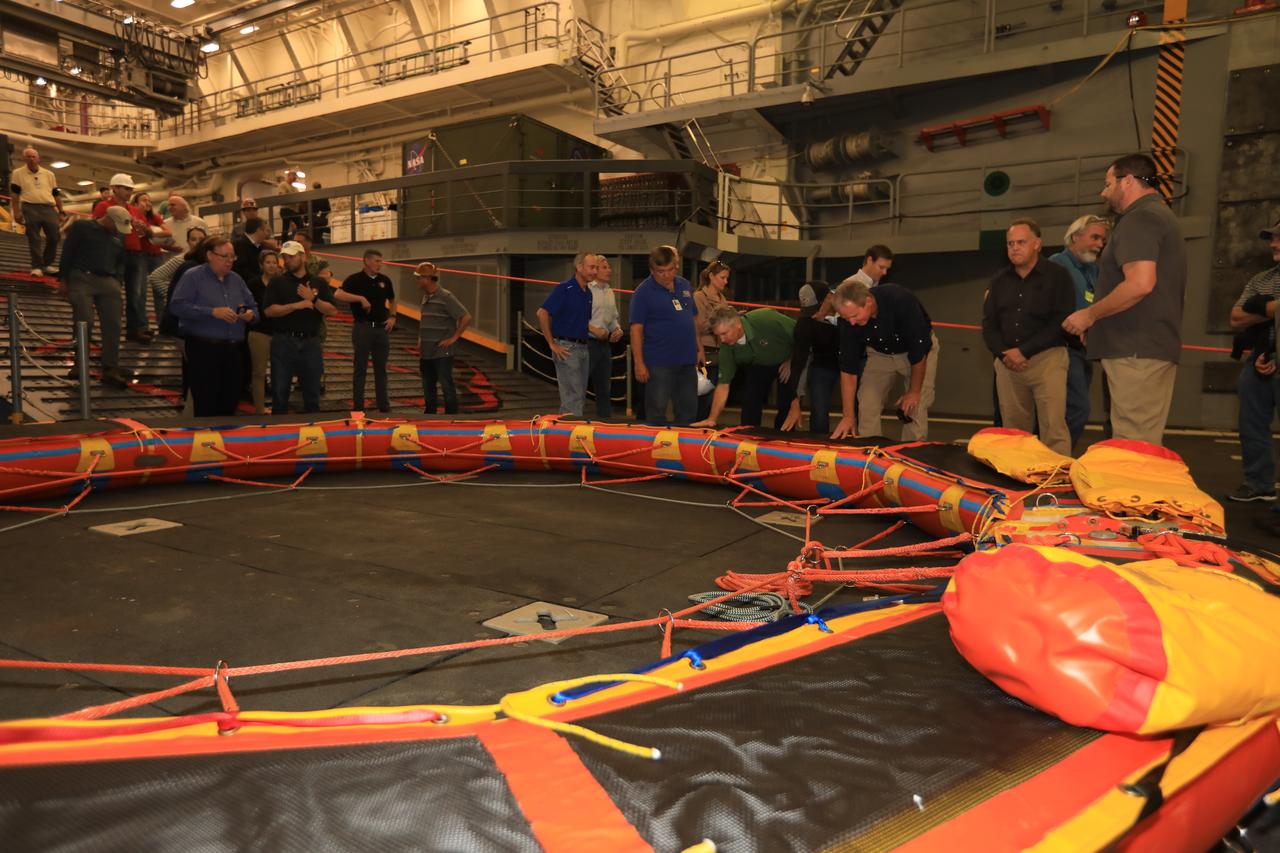
A stabilization collar and front porch are in the well deck of a U.S. Navy ship on Oct. 29, 2018. They will be used to stabilize and recover the Orion capsule and future crew onboard. The Exploration Ground Systems (EGS) recovery team are preparing for Underway Recovery Test-7 (URT-7). EGS and the U.S. Navy will use a test version of the Orion crew module, several rigid hull inflatable boats and support equipment to verify and validate processes, procedures, hardware and personnel during recovery of Orion in open waters. URTs are a series of tests to ensure all systems are go when recovering the Orion crew capsule and astronauts onboard in the future. Orion will have emergency abort capability, sustain the crew during space travel and provide safe re-entry from deep space return velocities.
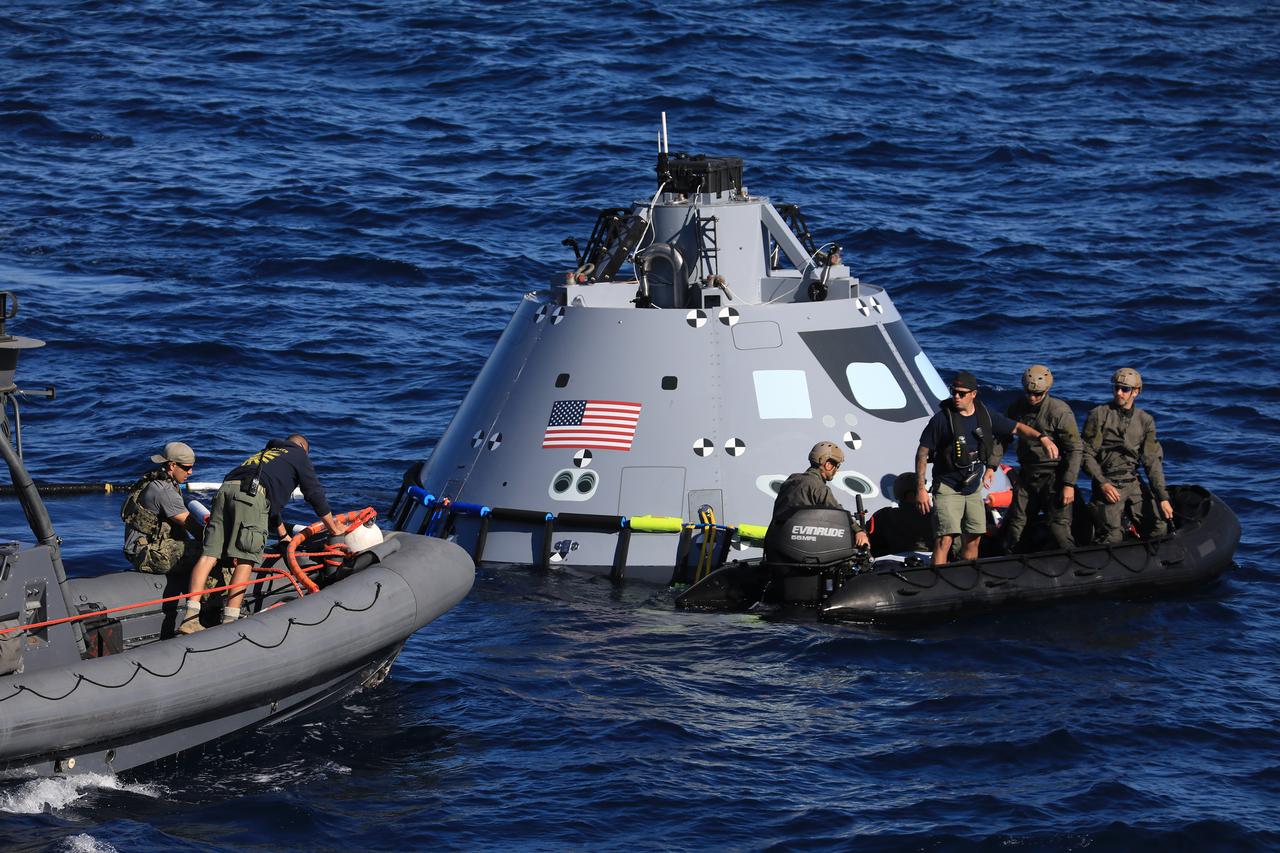
During Underway Recovery Test-7 (URT-7), U.S. Navy divers approach a test version of the Orion capsule to practice securing it for recovery into the well deck of an amphibious assault ship on Oct. 31, 2018 in the Pacific Ocean. The Exploration Ground Systems recovery team and the U.S. Navy work together to verify and validate procedures and hardware that will be used to recover the Orion spacecraft after it splashed down in the Pacific Ocean following deep space exploration missions. Orion will have emergency abort capability, sustain the crew during space travel and provide safe re-entry from deep space return velocities.
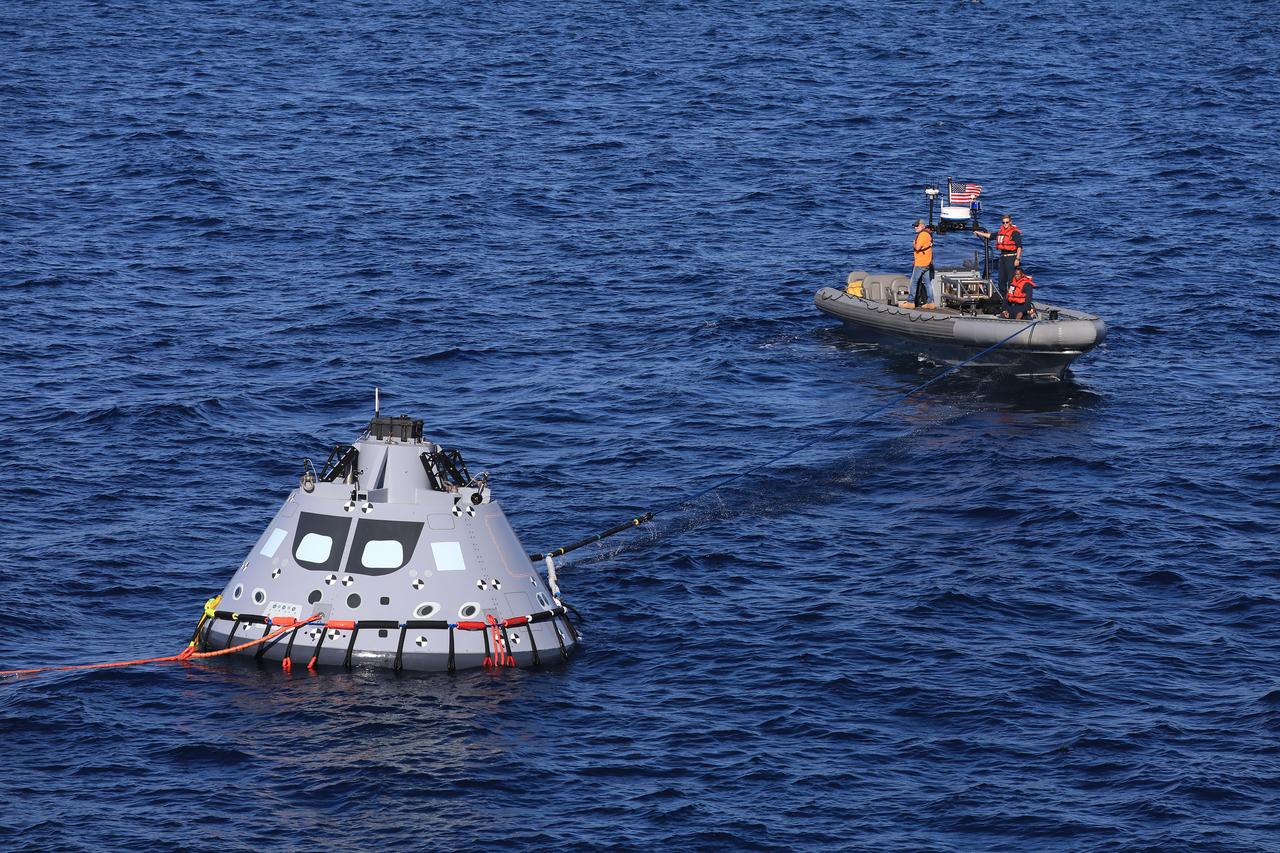
A U.S. Navy boat secures a tending line to a test version of the Orion capsule during Underway Recovery Test-7 (URT-7) on Oct. 31, 2018, in the Pacific Ocean. The Exploration Ground Systems recovery team and the U.S. Navy work together to verify and validate procedures and hardware that will be used to recover the Orion spacecraft after it splashes down in the Pacific Ocean following deep space exploration missions. Orion will have emergency abort capability, sustain the crew during space travel and provide safe re-entry from deep space return velocities.
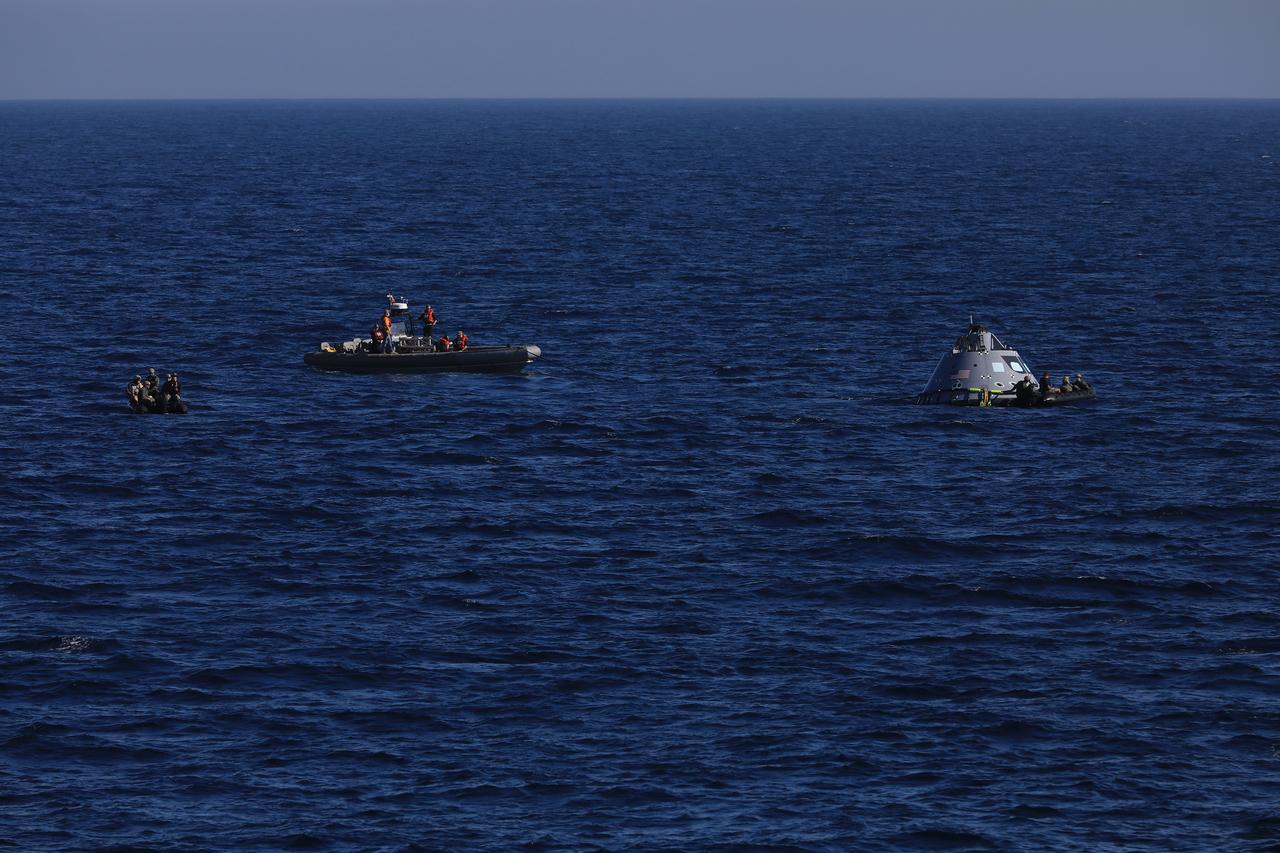
During Underway Recovery Test-7 (URT-7), U.S. Navy divers approach a test version of the Orion capsule to practice securing it for recovery into the well deck of an amphibious assault ship on Oct. 31, 2018 in the Pacific Ocean. The Exploration Ground Systems recovery team and the U.S. Navy work together to verify and validate procedures and hardware that will be used to recover the Orion spacecraft after it splashes down in the Pacific Ocean following deep space exploration missions. Orion will have emergency abort capability, sustain the crew during space travel and provide safe re-entry from deep space return velocities.

During Underway Recovery Test-7 (URT-7), U.S. Navy divers approach a test version of the Orion capsule to practice securing it for recovery into the well deck of an amphibious assault ship on Oct. 31, 2018 in the Pacific Ocean. The Exploration Ground Systems recovery team and the U.S. Navy work together to verify and validate procedures and hardware that will be used to recover the Orion spacecraft after it splashes down in the Pacific Ocean following deep space exploration missions. Orion will have emergency abort capability, sustain the crew during space travel and provide safe re-entry from deep space return velocities.
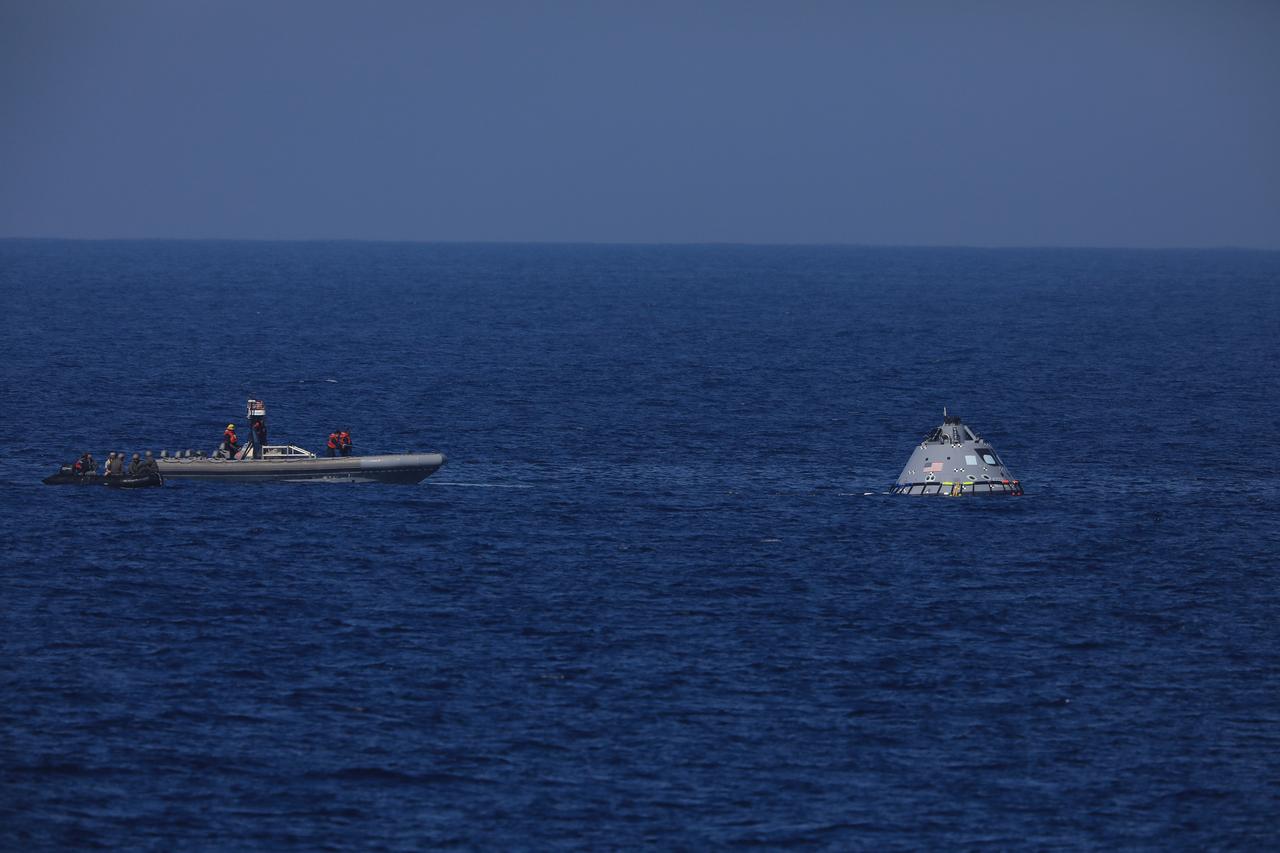
During Underway Recovery Test-7 (URT-7), U.S. Navy divers approach a test version of the Orion capsule to practice securing it for recovery into the well deck of an amphibious assault ship on Oct. 31, 2018 in the Pacific Ocean. The Exploration Ground Systems recovery team and the U.S. Navy work together to verify and validate procedures and hardware that will be used to recover the Orion spacecraft after it splashes down in the Pacific Ocean following deep space exploration missions. Orion will have emergency abort capability, sustain the crew during space travel and provide safe re-entry from deep space return velocities.

During Underway Recovery Test-7 (URT-7), U.S. Navy divers approach a test version of the Orion capsule to practice securing it for recovery into the well deck of an amphibious assault ship on Oct. 31, 2018 in the Pacific Ocean. The Exploration Ground Systems recovery team and the U.S. Navy work together to verify and validate procedures and hardware that will be used to recover the Orion spacecraft after it splashes down in the Pacific Ocean following deep space exploration missions. Orion will have emergency abort capability, sustain the crew during space travel and provide safe re-entry from deep space return velocities.
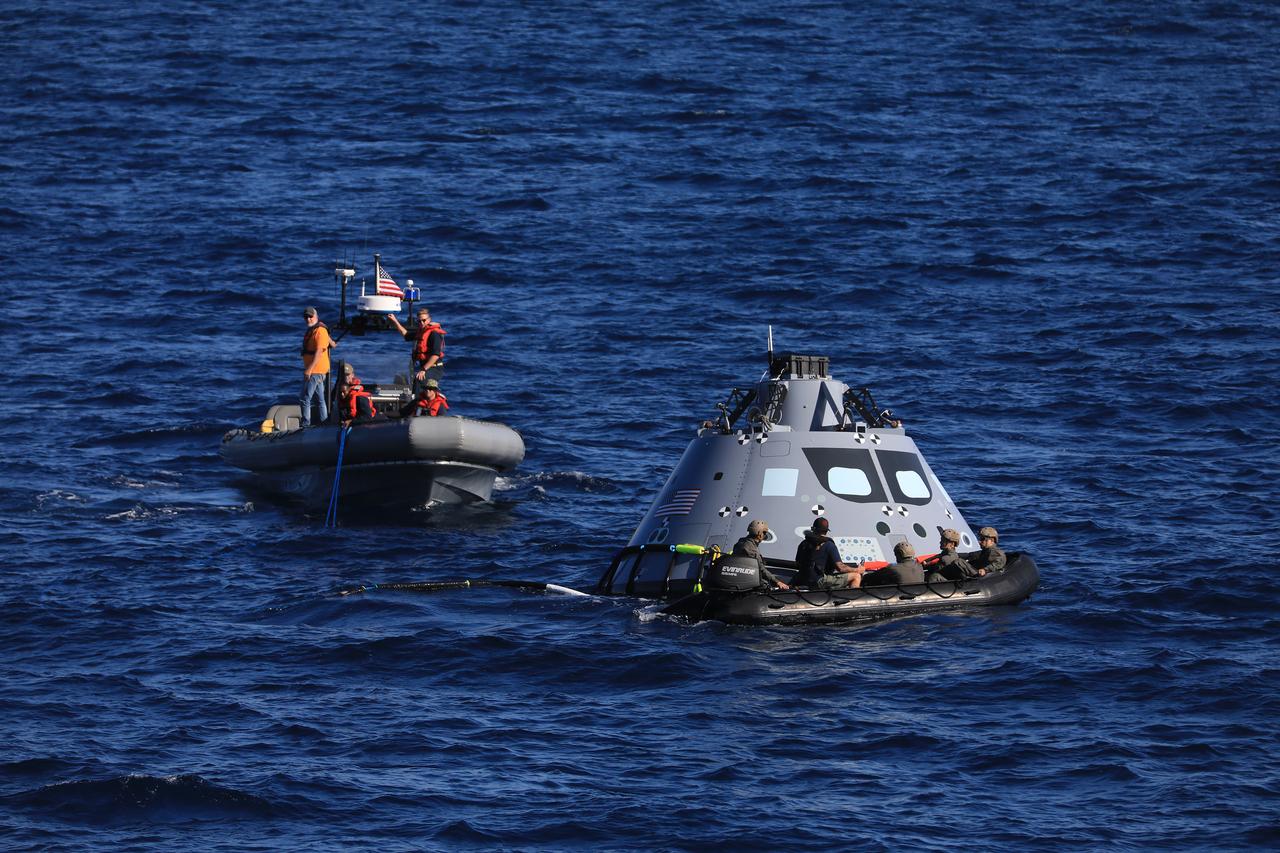
During Underway Recovery Test-7 (URT-7), U.S. Navy divers approach a test version of the Orion capsule to practice securing it for recovery into the well deck of an amphibious assault ship on Oct. 31, 2018 in the Pacific Ocean. The Exploration Ground Systems recovery team and the U.S. Navy work together to verify and validate procedures and hardware that will be used to recover the Orion spacecraft after it splashes down in the Pacific Ocean following deep space exploration missions. Orion will have emergency abort capability, sustain the crew during space travel and provide safe re-entry from deep space return velocities.
During Underway Recovery Test-7 (URT-7), U.S. Navy divers approach a test version of the Orion capsule to practice securing it for recovery into the well deck of an amphibious assault ship on Oct. 31, 2018 in the Pacific Ocean. The Exploration Ground Systems recovery team and the U.S. Navy work together to verify and validate procedures and hardware that will be used to recover the Orion spacecraft after it splashes down in the Pacific Ocean following deep space exploration missions. Orion will have emergency abort capability, sustain the crew during space travel and provide safe re-entry from deep space return velocities.
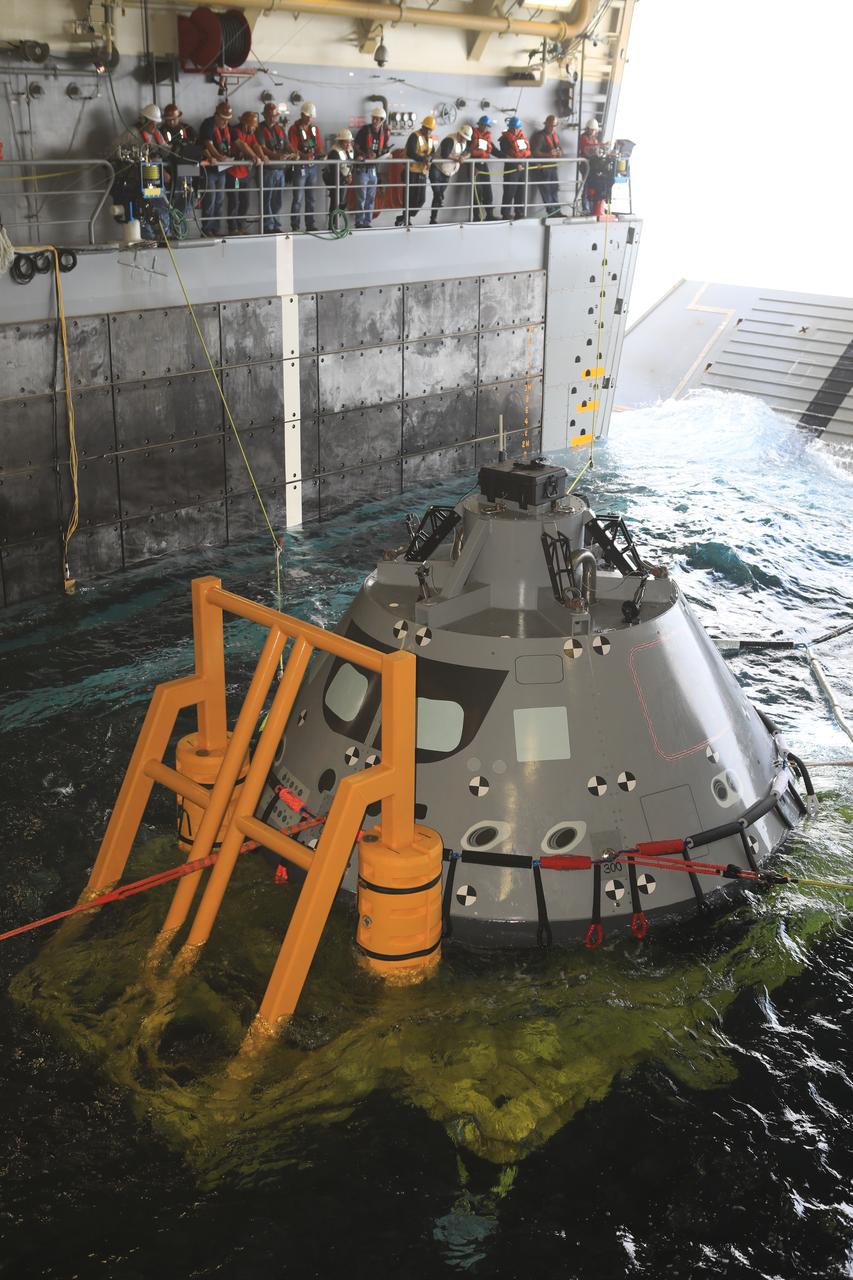
The Exploration Ground Systems (EGS) recovery team, along with the U.S. Navy, practice keeping an Orion test article under control in the well deck of a U.S. Navy ship as part of Underway Recovery Test-7 (URT-7) on Oct. 30, 2018, in the Pacific Ocean. EGS and the U.S. Navy will use a test version of the Orion crew module, several rigid hull inflatable boats and support equipment to verify and validate processes, procedures, hardware and personnel during recovery of Orion in open waters. The testing is one in a series of tests to verify and validate procedures and hardware that will be used to recover the Orion spacecraft after it splashes down in the Pacific Ocean following deep space exploration missions. Orion will have emergency abort capability, sustain the crew during space travel and provide safe re-entry from deep space return velocities.
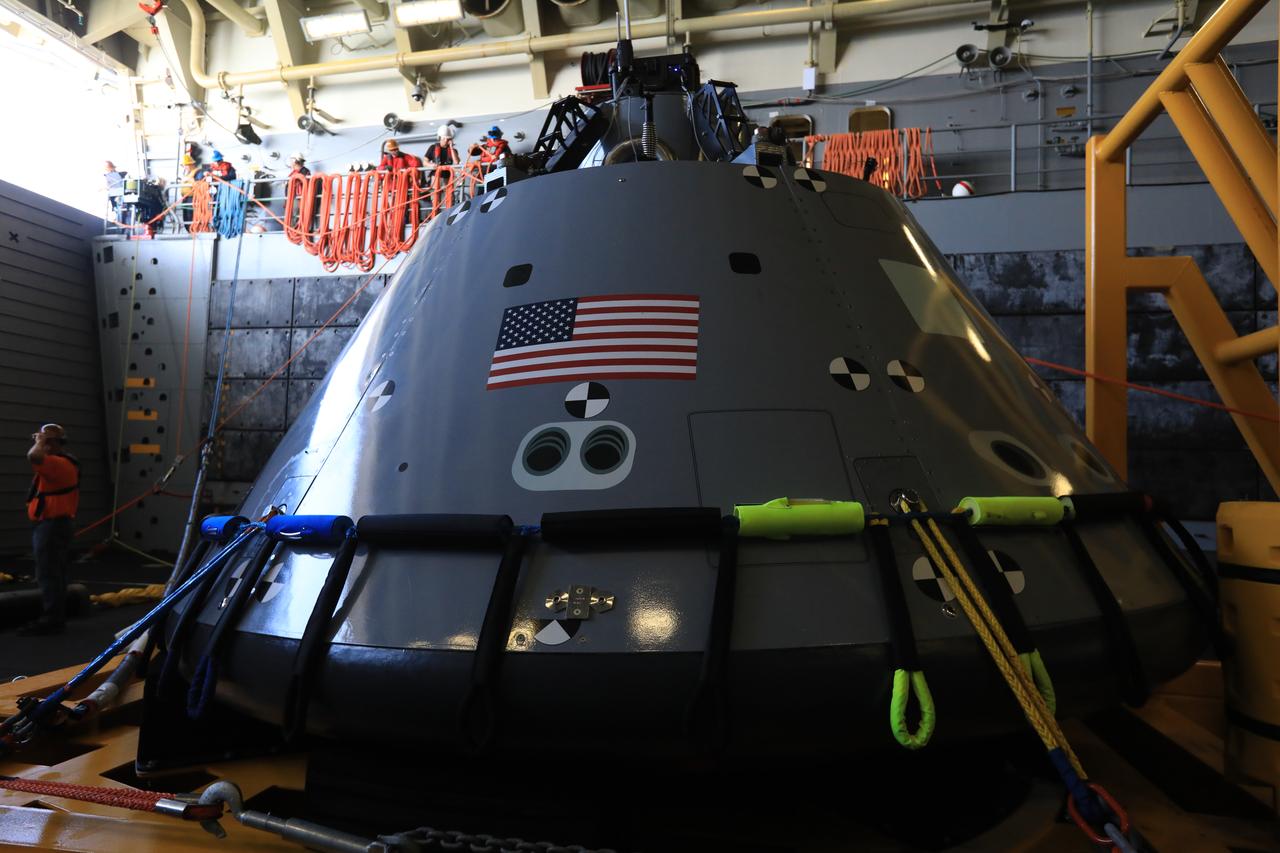
A test version of the Orion capsule sits in its cradle in the well deck of the USS John P. Murtha during Underway Recovery Test-7 (URT-7) on Oct. 31, 2018. The Exploration Ground Systems recovery team and the U.S. Navy are using a test version of the Orion crew module, several rigid hull inflatable boats and support equipment to verify and validate processes, procedures, hardware and personnel during recovery of Orion in open waters. The test is one in a series of tests to verify and validate procedures and hardware that will be used to recover the Orion spacecraft after it splashes down in the Pacific Ocean following deep space exploration missions. Orion will have emergency abort capability, sustain the crew during space travel and provide safe re-entry from deep space return velocities.
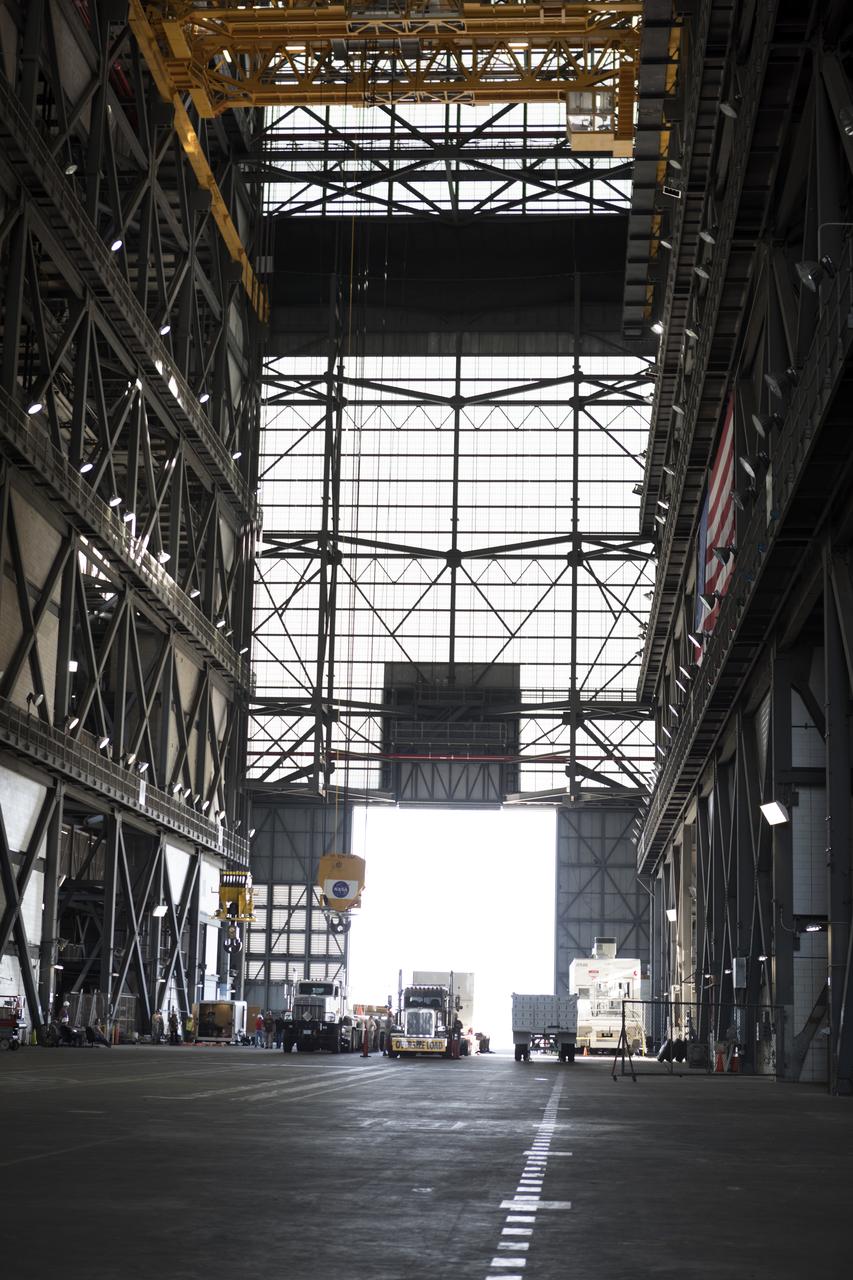
The ground test motor for Orion's Launch Abort System (LAS) arrives by flatbed truck in its shipping container in the transfer aisle of the Vehicle Assembly Building on July 20, 2018, at NASA's Kennedy Space Center in Florida. It will be transferred to the Rotation, Processing and Surge Facility where it will be inspected and prepared for transport to Space Launch Complex 46 (SLC-46) at Cape Canaveral Air Force Station for mechanical fit testing. This inert motor will not be used for flight, but will be used to certify flight hardware assembly in preparation for a full-stress test of the LAS, called Ascent Abort-2 (AA-2) flight test, scheduled for April 2019. During the test, the booster will launch from SLC 46, carrying a fully functional LAS and a 22,000-pound Orion test vehicle to an altitude of 31,000 feet and traveling at more than 1,000 miles an hour. The test will verify the LAS can steer the crew module and astronauts aboard to safety in the event of an issue with the Space Launch System (SLS) rocket when the spacecraft is under the highest aerodynamic loads it will experience during a rapid climb into space. NASA's Orion and Exploration Ground Systems programs and their contractors from Jacob's and Northrup Grumman in conjunction with the Air Force Space and Missile Center's Launch Operations branch are performing the pathfinding exercises and flight operations for AA-2.
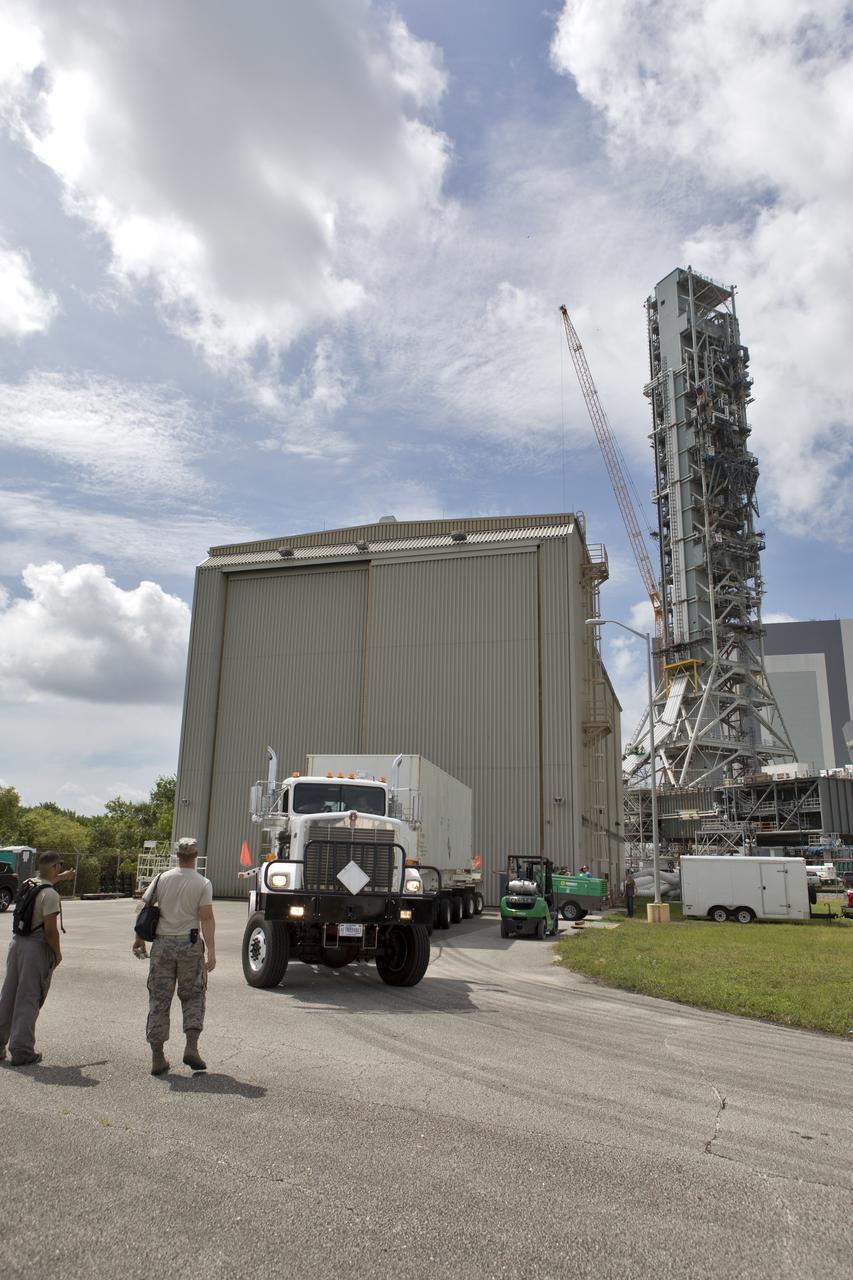
Secured on a flatbed transporter in its shipping container, the ground test motor for Orion's Launch Abort System (LAS) arrives at the Rotation, Processing and Surge Facility (RPSF) on July 20, 2018, at NASA's Kennedy Space Center in Florida. In the RPSF the motor will be inspected and prepared for transport to Space Launch Complex 46 (SLC-46) at Cape Canaveral Air Force Station for mechanical fit testing. This inert motor will not be used for flight, but will be used to certify flight hardware assembly in preparation for a full-stress test of the LAS, called Ascent Abort-2 (AA-2) flight test, scheduled for April 2019. During the test, the booster will launch from SLC 46, carrying a fully functional LAS and a 22,000-pound Orion test vehicle to an altitude of 31,000 feet and traveling at more than 1,000 miles an hour. The test will verify the LAS can steer the crew module and astronauts aboard to safety in the event of an issue with the Space Launch System (SLS) rocket when the spacecraft is under the highest aerodynamic loads it will experience during a rapid climb into space. NASA's Orion and Exploration Ground Systems programs and their contractors from Jacob's and Northrup Grumman in conjunction with the Air Force Space and Missile Center's Launch Operations branch SMC/LEXO, are performing the pathfinding exercises and flight operations for AA-2.
The ground test motor for Orion's Launch Abort System (LAS) arrives by flatbed truck in its shipping container in the transfer aisle of the Vehicle Assembly Building on July 20, 2018, at NASA's Kennedy Space Center in Florida. It will be transferred to the Rotation, Processing and Surge Facility where it will be inspected and prepared for transport to Space Launch Complex 46 (SLC-46) at Cape Canaveral Air Force Station for mechanical fit testing. This inert motor will not be used for flight, but will be used to certify flight hardware assembly in preparation for a full-stress test of the LAS, called Ascent Abort-2 (AA-2) flight test, scheduled for April 2019. During the test, the booster will launch from SLC 46, carrying a fully functional LAS and a 22,000-pound Orion test vehicle to an altitude of 31,000 feet and traveling at more than 1,000 miles an hour. The test will verify the LAS can steer the crew module and astronauts aboard to safety in the event of an issue with the Space Launch System (SLS) rocket when the spacecraft is under the highest aerodynamic loads it will experience during a rapid climb into space. NASA's Orion and Exploration Ground Systems programs and their contractors from Jacob's and Northrup Grumman in conjunction with the Air Force Space and Missile Center's Launch Operations branch SMC/LEXO, are performing the pathfinding exercises and flight operations for AA-2.
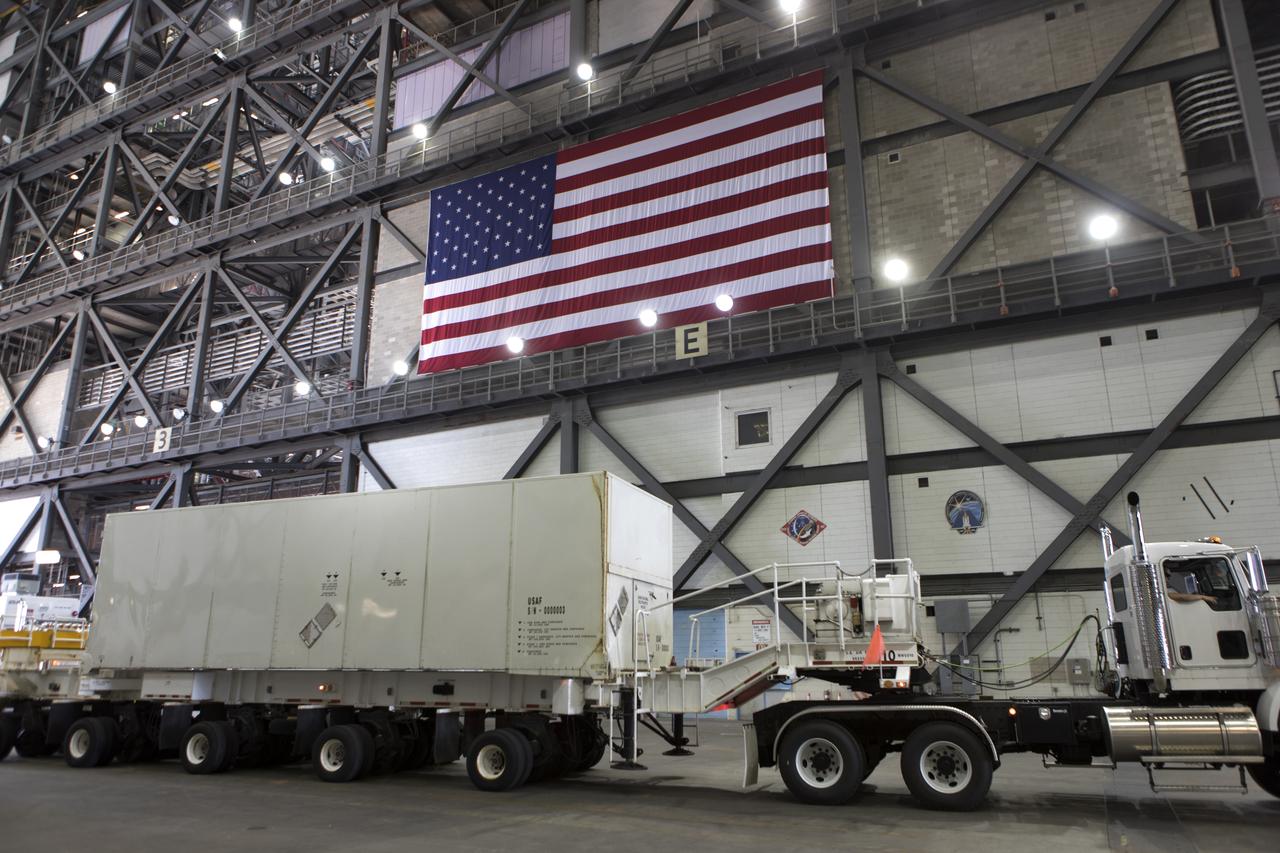
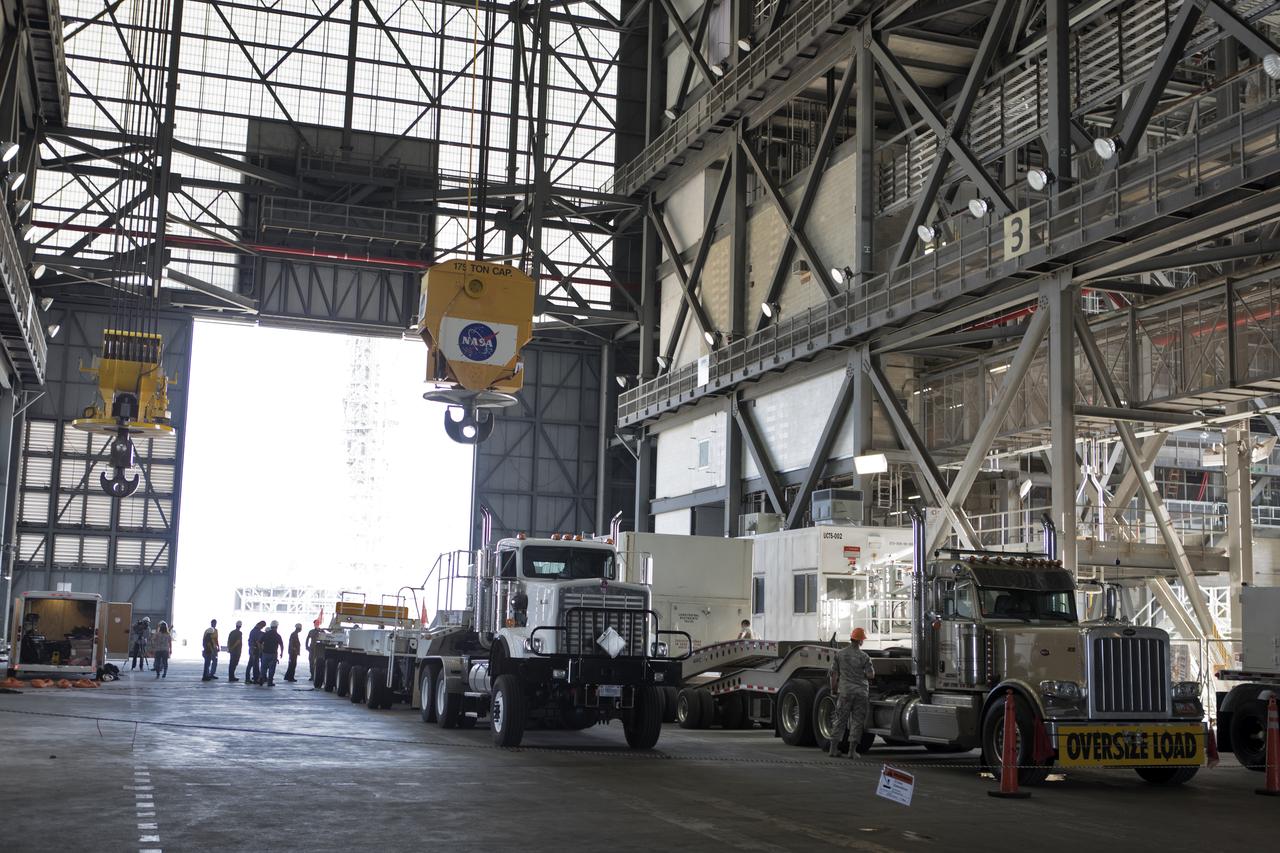
Secured on a flatbed transporter in its shipping container, the ground test motor for Orion's Launch Abort System (LAS) will be moved from the transfer aisle of the Vehicle Assembly Building to the Rotation, Processing and Surge Facility (RPSF) on July 20, 2018, at NASA's Kennedy Space Center in Florida. In the RPSF the motor will be inspected and prepared for transport to Space Launch Complex 46 (SLC-46) at Cape Canaveral Air Force Station for mechanical fit testing. This inert motor will not be used for flight, but will be used to certify flight hardware assembly in preparation for a full-stress test of the LAS, called Ascent Abort-2 (AA-2) flight test, scheduled for April 2019. During the test, the booster will launch from SLC 46, carrying a fully functional LAS and a 22,000-pound Orion test vehicle to an altitude of 31,000 feet and traveling at more than 1,000 miles an hour. The test will verify the LAS can steer the crew module and astronauts aboard to safety in the event of an issue with the Space Launch System (SLS) rocket when the spacecraft is under the highest aerodynamic loads it will experience during a rapid climb into space. NASA's Orion and Exploration Ground Systems programs and their contractors from Jacob's and Northrup Grumman in conjunction with the Air Force Space and Missile Center's Launch Operations branch SMC/LEXO, are performing the pathfinding exercises and flight operations for AA-2.
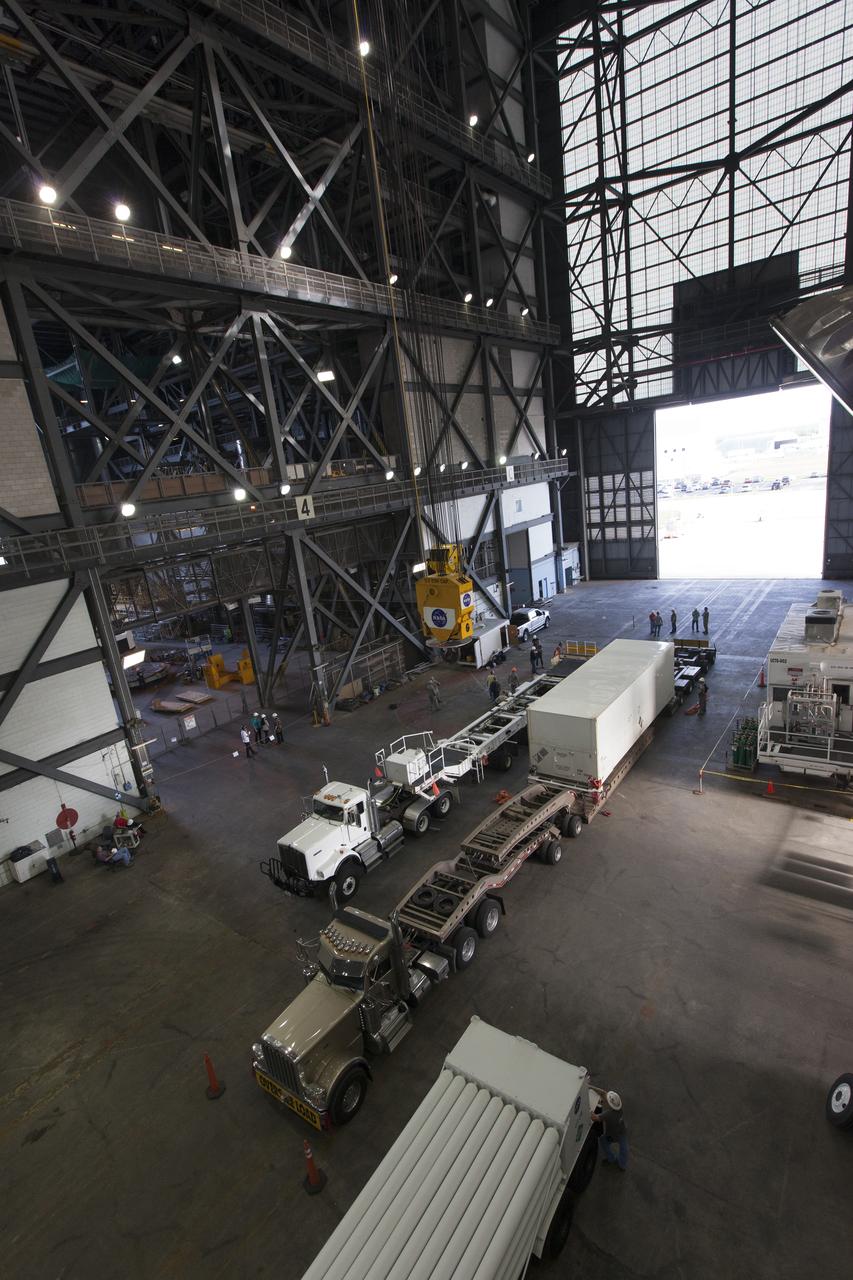
The ground test motor for Orion's Launch Abort System (LAS) arrives by flatbed truck in its shipping container in the transfer aisle of the Vehicle Assembly Building on July 20, 2018, at NASA's Kennedy Space Center in Florida. It will be transferred to the Rotation, Processing and Surge Facility where it will be inspected and prepared for transport to Space Launch Complex 46 (SLC-46) at Cape Canaveral Air Force Station for mechanical fit testing. This inert motor will not be used for flight, but will be used to certify flight hardware assembly in preparation for a full-stress test of the LAS, called Ascent Abort-2 (AA-2) flight test, scheduled for April 2019. During the test, the booster will launch from SLC 46, carrying a fully functional LAS and a 22,000-pound Orion test vehicle to an altitude of 31,000 feet and traveling at more than 1,000 miles an hour. The test will verify the LAS can steer the crew module and astronauts aboard to safety in the event of an issue with the Space Launch System (SLS) rocket when the spacecraft is under the highest aerodynamic loads it will experience during a rapid climb into space. NASA's Orion and Exploration Ground Systems programs and their contractors from Jacob's and Northrup Grumman in conjunction with the Air Force Space and Missile Center's Launch Operations branch SMC/LEXO, are performing the pathfinding exercises and flight operations for AA-2.
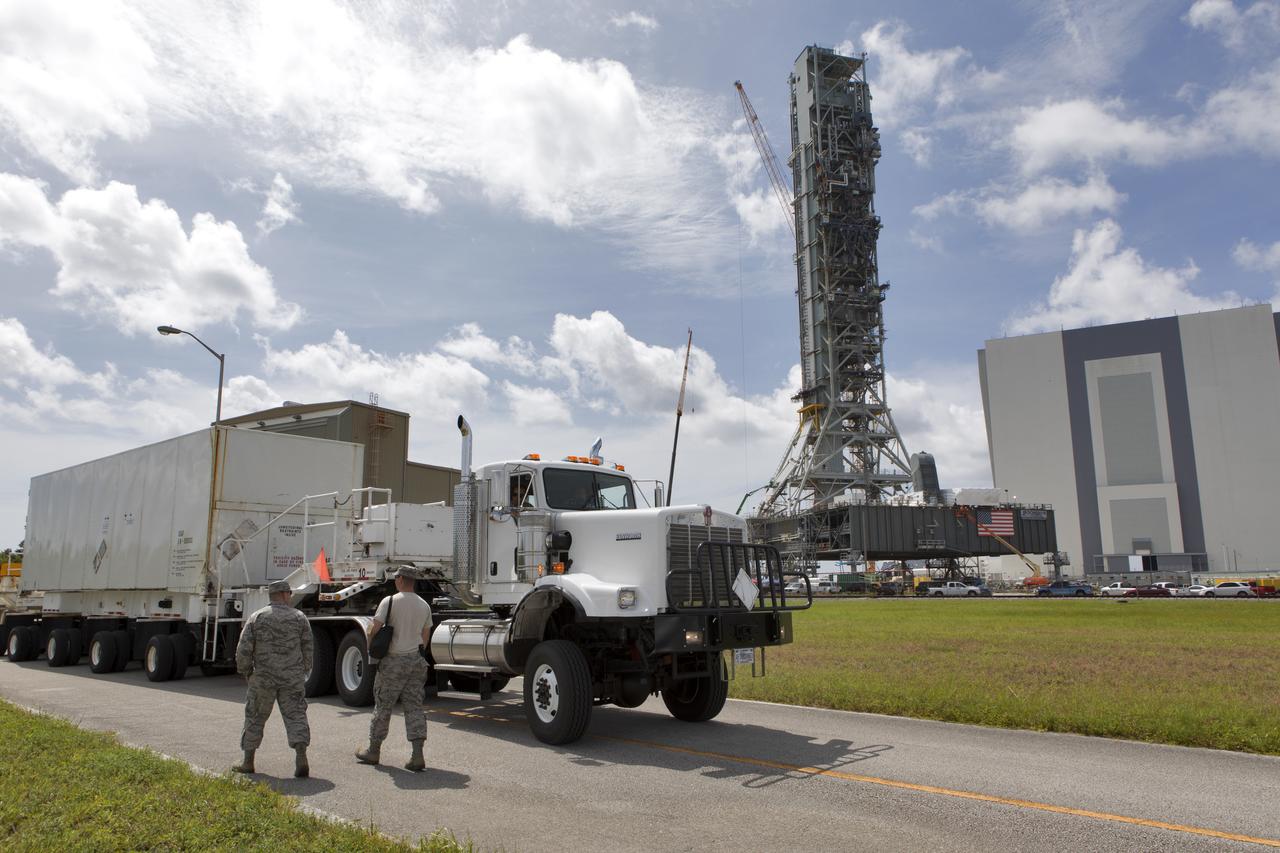
Secured on a flatbed transporter in its shipping container, the ground test motor for Orion's Launch Abort System (LAS) is moved to the Rotation, Processing and Surge Facility (RPSF) on July 20, 2018, at NASA's Kennedy Space Center in Florida. In the RPSF the motor will be inspected and prepared for transport to Space Launch Complex 46 (SLC-46) at Cape Canaveral Air Force Station for mechanical fit testing. This inert motor will not be used for flight, but will be used to certify flight hardware assembly in preparation for a full-stress test of the LAS, called Ascent Abort-2 (AA-2) flight test, scheduled for April 2019. During the test, the booster will launch from SLC 46, carrying a fully functional LAS and a 22,000-pound Orion test vehicle to an altitude of 31,000 feet and traveling at more than 1,000 miles an hour. The test will verify the LAS can steer the crew module and astronauts aboard to safety in the event of an issue with the Space Launch System (SLS) rocket when the spacecraft is under the highest aerodynamic loads it will experience during a rapid climb into space. NASA's Orion and Exploration Ground Systems programs and their contractors from Jacob's and Northrup Grumman in conjunction with the Air Force Space and Missile Center's Launch Operations branch SMC/LEXO, are performing the pathfinding exercises and flight operations for AA-2.
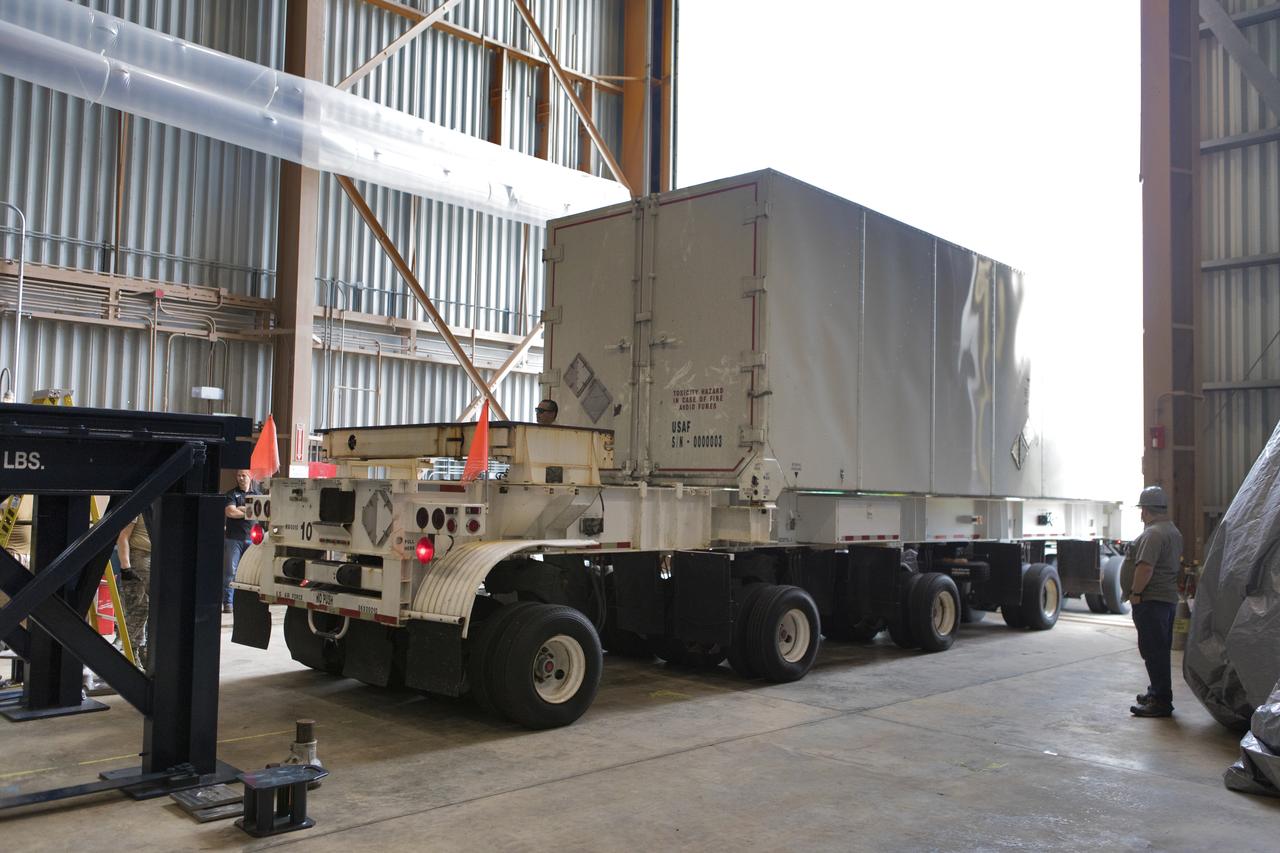
Secured on a flatbed transporter in its shipping container, the ground test motor for Orion's Launch Abort System (LAS) arrives at the Rotation, Processing and Surge Facility (RPSF) on July 20, 2018, at NASA's Kennedy Space Center in Florida. In the RPSF the motor will be inspected and prepared for transport to Space Launch Complex 46 (SLC-46) at Cape Canaveral Air Force Station for mechanical fit testing. This inert motor will not be used for flight, but will be used to certify flight hardware assembly in preparation for a full-stress test of the LAS, called Ascent Abort-2 (AA-2) flight test, scheduled for April 2019. During the test, the booster will launch from SLC 46, carrying a fully functional LAS and a 22,000-pound Orion test vehicle to an altitude of 31,000 feet and traveling at more than 1,000 miles an hour. The test will verify the LAS can steer the crew module and astronauts aboard to safety in the event of an issue with the Space Launch System (SLS) rocket when the spacecraft is under the highest aerodynamic loads it will experience during a rapid climb into space. NASA's Orion and Exploration Ground Systems programs and their contractors from Jacob's and Northrup Grumman in conjunction with the Air Force Space and Missile Center's Launch Operations branch SMC/LEXO, are performing the pathfinding exercises and flight operations for AA-2.
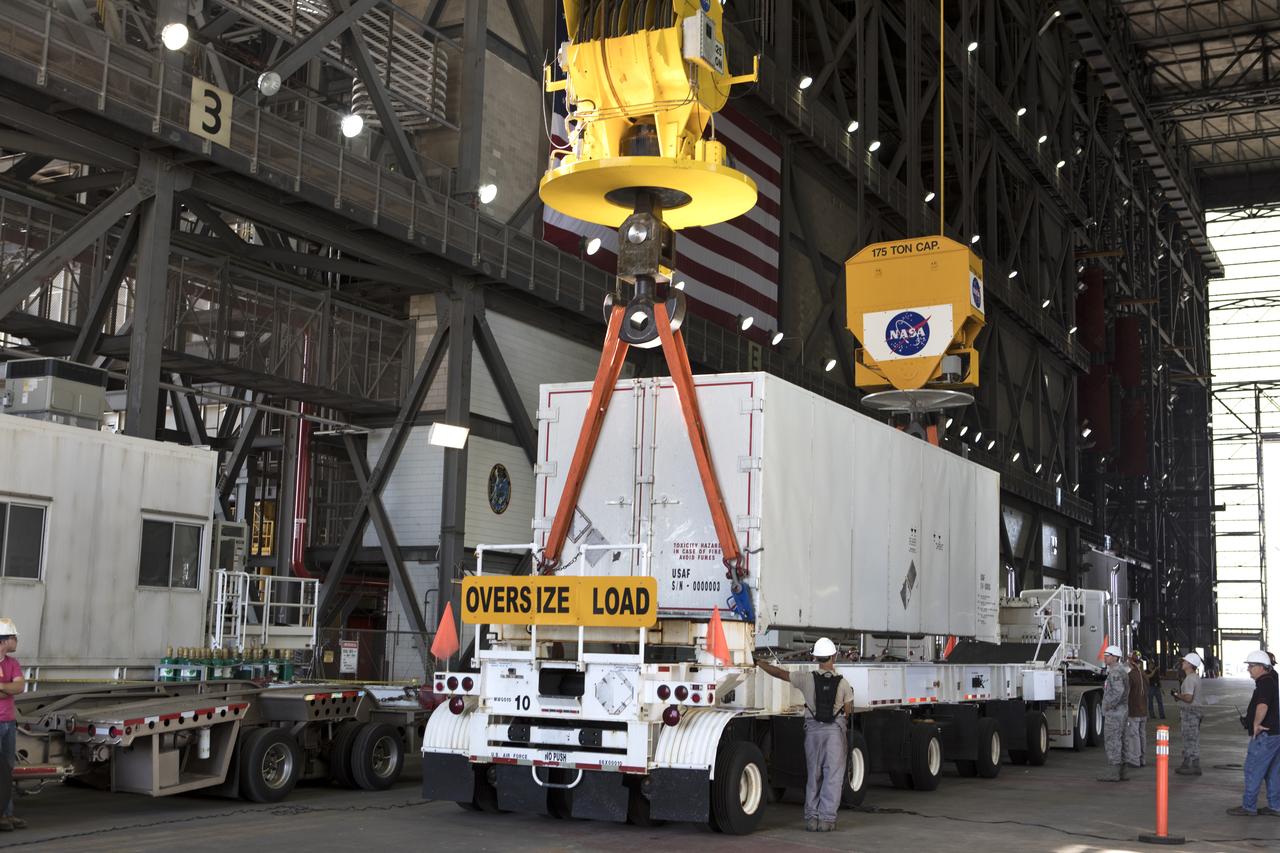
In the transfer aisle inside the Vehicle Assembly Building (VAB) at NASA's Kennedy Space Center in Florida, a crane lowers the shipping container with the ground test motor for Orion's Launch Abort System (LAS) inside onto another transporter on July 20, 2018. The container will be moved to the Rotation, Processing and Surge Facility where it will be inspected and prepared for transport to Space Launch Complex 46 (SLC-46) at Cape Canaveral Air Force Station for mechanical fit testing. This inert motor will not be used for flight, but will be used to certify flight hardware assembly in preparation for a full-stress test of the LAS, called Ascent Abort-2 (AA-2) flight test, scheduled for April 2019. During the test, the booster will launch from SLC 46, carrying a fully functional LAS and a 22,000-pound Orion test vehicle to an altitude of 31,000 feet and traveling at more than 1,000 miles an hour. The test will verify the LAS can steer the crew module and astronauts aboard to safety in the event of an issue with the Space Launch System (SLS) rocket when the spacecraft is under the highest aerodynamic loads it will experience during a rapid climb into space. NASA's Orion and Exploration Ground Systems programs and their contractors from Jacob's and Northrup Grumman in conjunction with the Air Force Space and Missile Center's Launch Operations branch SMC/LEXO, are performing the pathfinding exercises and flight operations for AA-2.
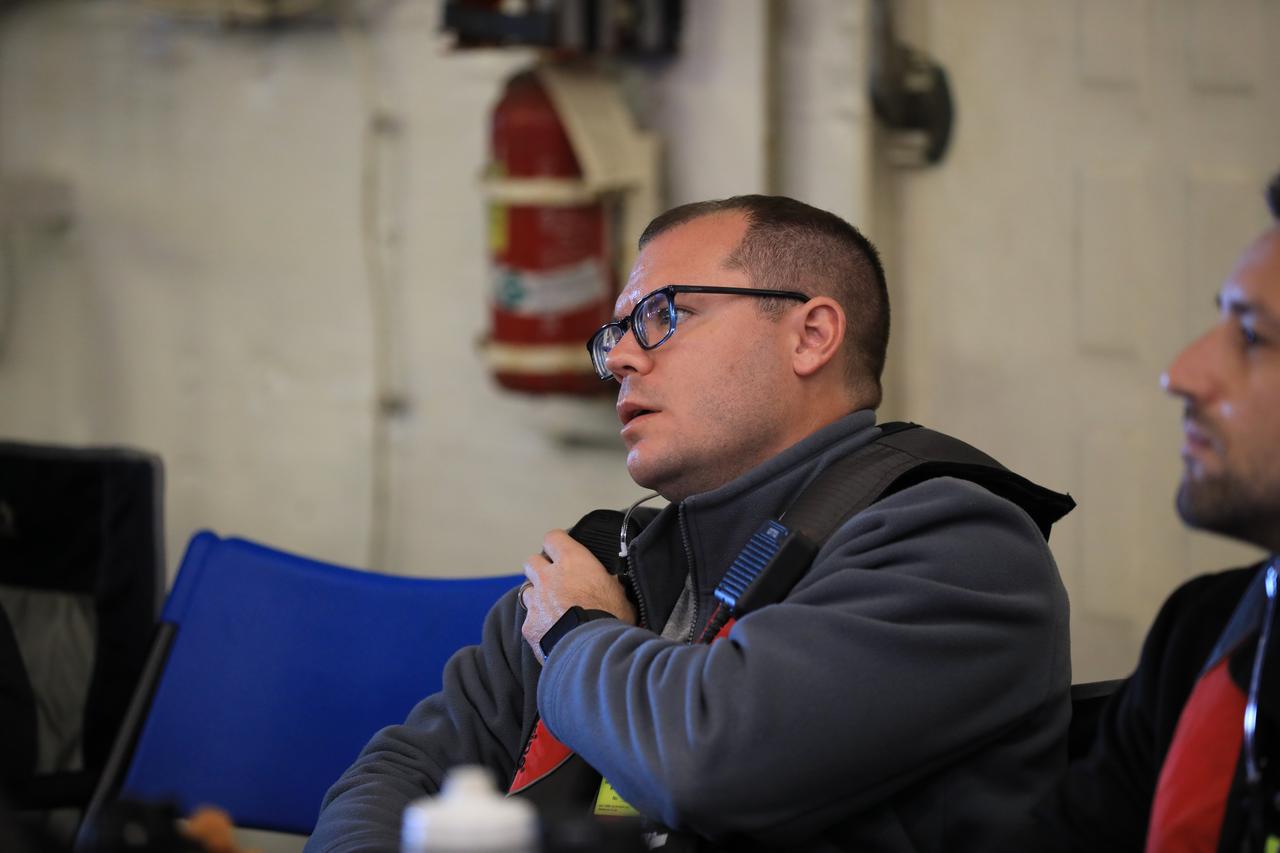
Members of NASA’s Exploration Ground System’s Landing and Recovery team and partners from the Department of Defense aboard the USS San Diego monitor operations of the day in the ship’s well deck and practice recovery procedures using the Crew Module Test Article, during Underway Recovery Test 11 (URT-11) off the coast of San Diego on Thursday, Feb. 22, 2024. URT-11 is the eleventh in a series of Artemis recovery tests, and the first time NASA and its partners put their Artemis II recovery procedures to the test with the astronauts.
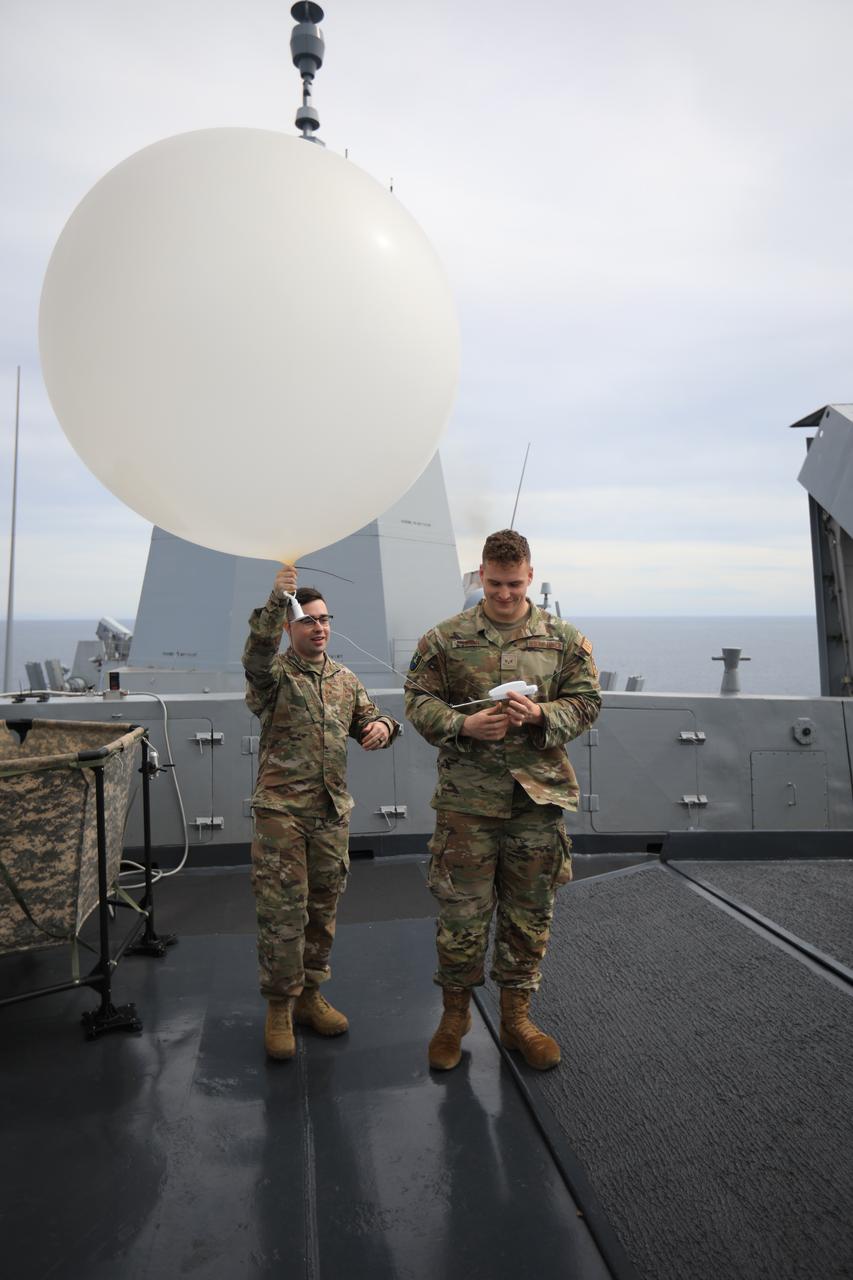
Members of NASA’s Exploration Ground System’s Landing and Recovery team and partners from the Department of Defense aboard the USS San Diego release a weather balloon while practicing recovery procedures using the Crew Module Test Article during Underway Recovery Test 11 (URT-11) off the coast of San Diego on Saturday, Feb. 24, 2024. URT-11 is the eleventh in a series of Artemis recovery tests, and the first time NASA and its partners put their Artemis II recovery procedures to the test with the astronauts.
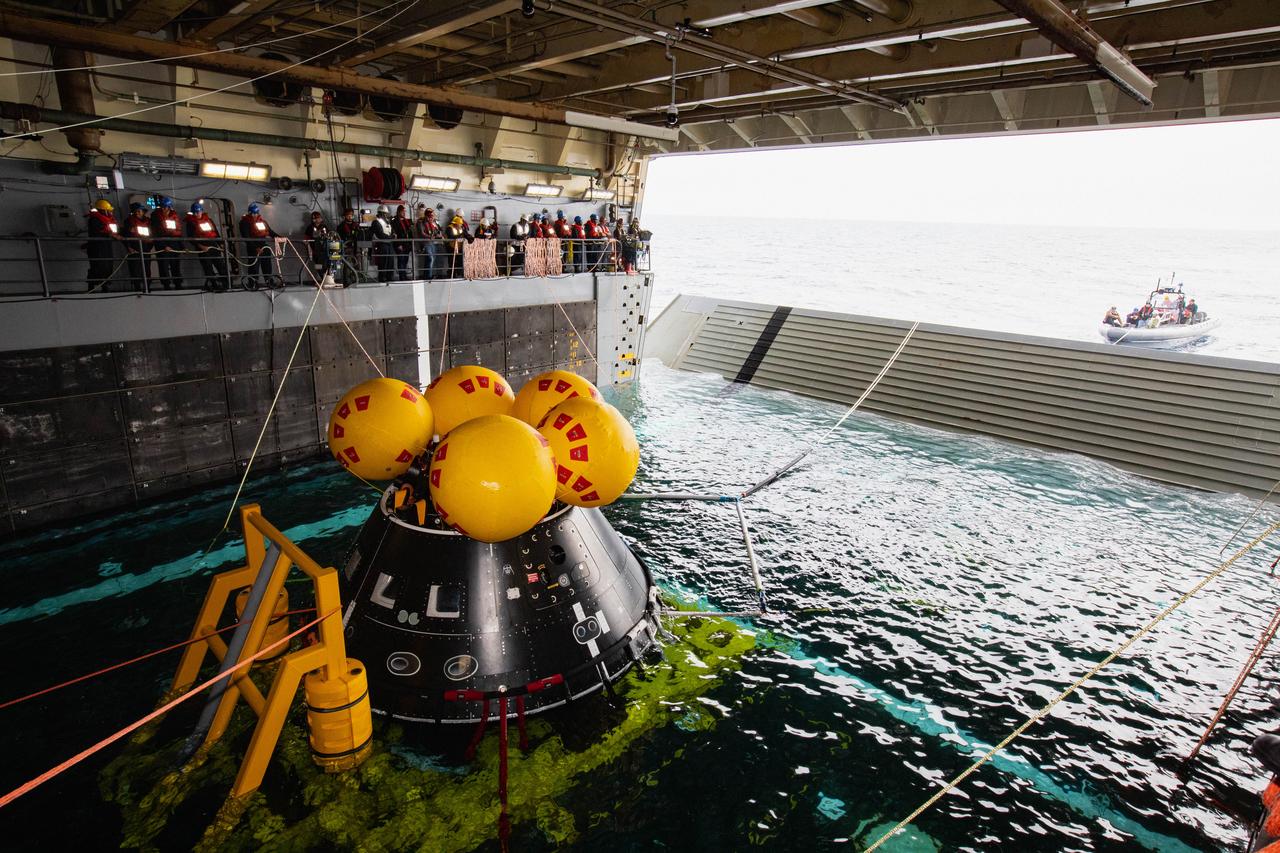
NASA’s Exploration Ground System’s Landing and Recovery team and partners from the Department of Defense aboard the USS San Diego practice recovery procedures using the Crew Module Test Article, during Underway Recovery Test 11 (URT-11) off the coast of San Diego, California on Sunday, Feb. 25, 2024. URT-11 is the eleventh in a series of Artemis recovery tests, and the first time NASA and its partners put their Artemis II recovery procedures to the test with the astronauts.
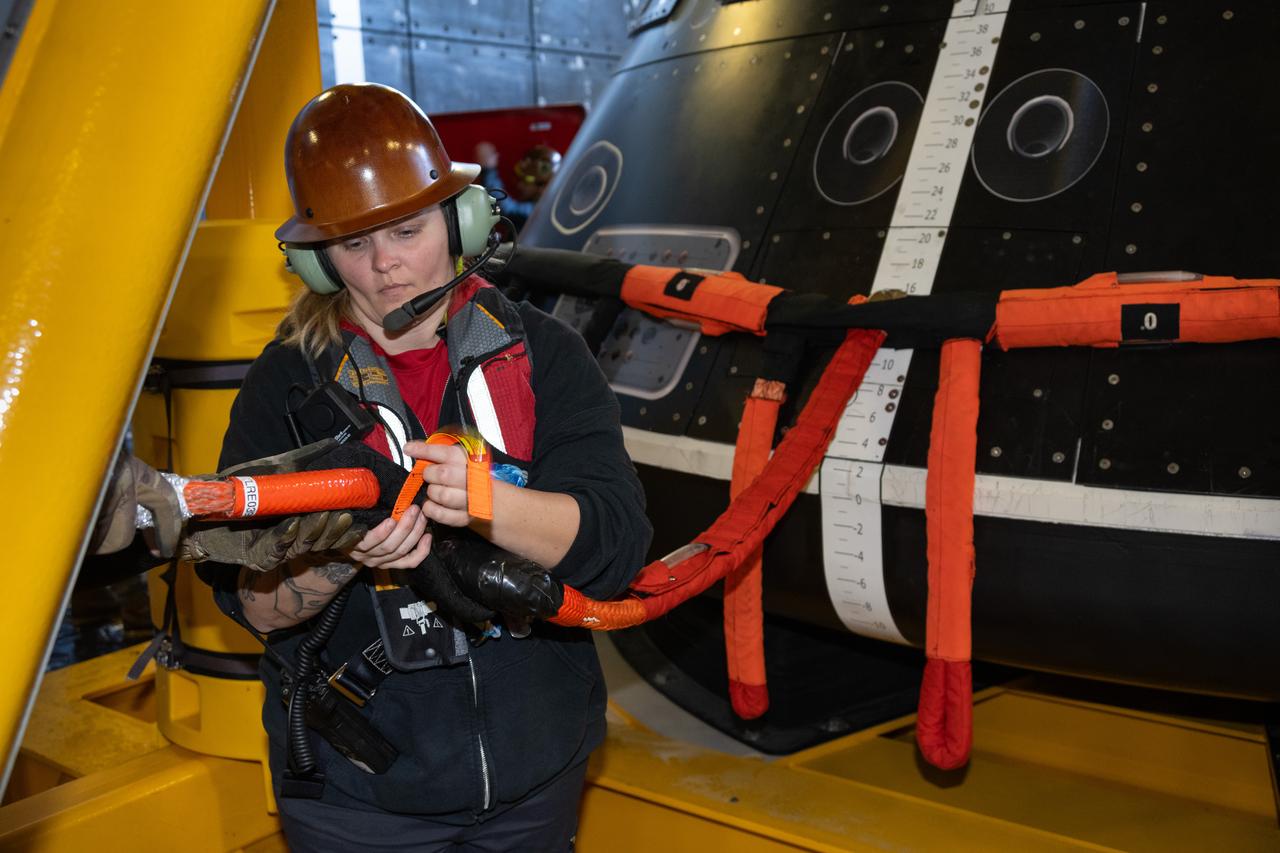
Members of NASA’s Exploration Ground System’s Landing and Recovery team and partners from the Department of Defense aboard the USS San Diego secure the Crew Module Test Article on its stand in the ship’s well deck while practicing recovery procedures during Underway Recovery Test 11 (URT-11) off the coast of San Diego on Thursday, Feb. 22, 2024. URT-11 is the eleventh in a series of Artemis recovery tests, and the first time NASA and its partners put their Artemis II recovery procedures to the test with the astronauts.
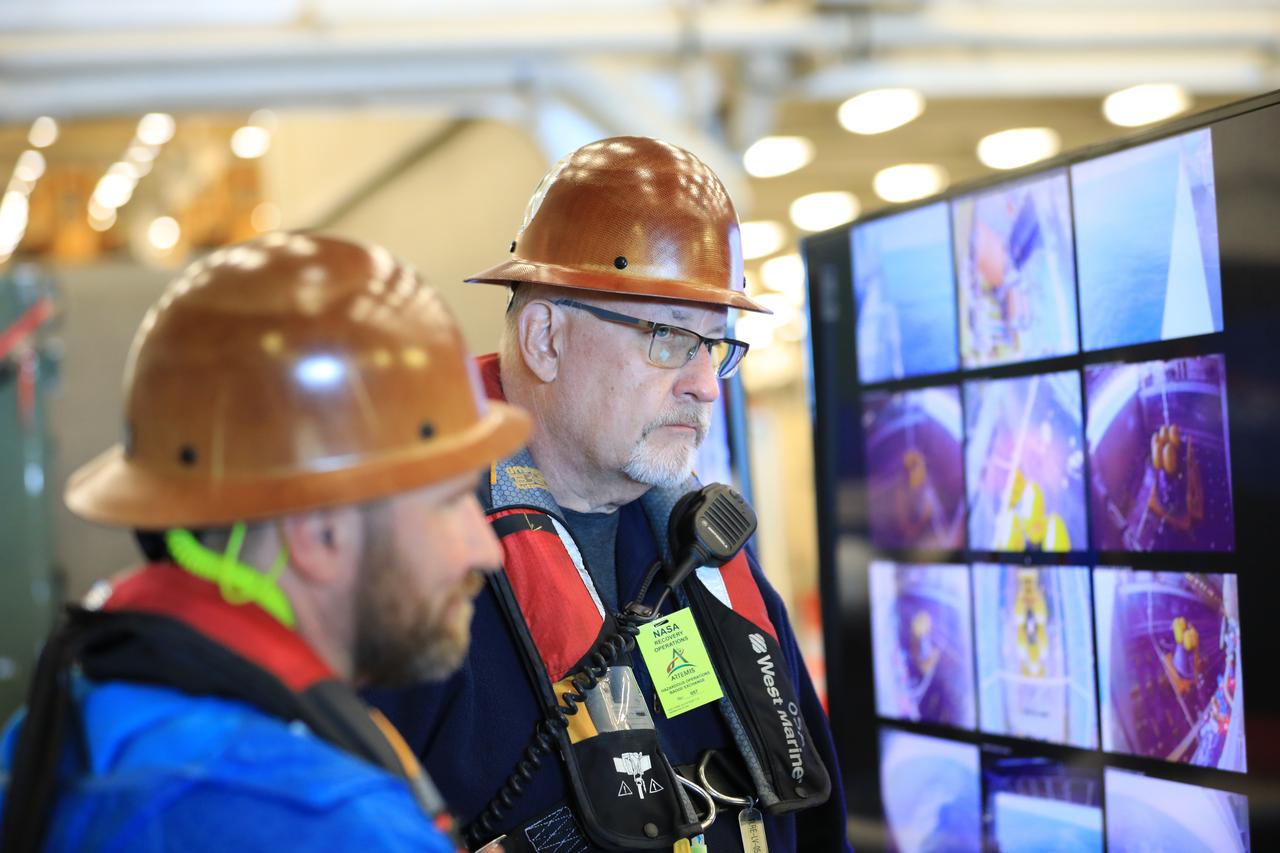
Members of NASA’s Exploration Ground System’s Landing and Recovery team and partners from the Department of Defense aboard the USS San Diego monitor operations of the day in the ship’s well deck and practice recovery procedures using the Crew Module Test Article, during Underway Recovery Test 11 (URT-11) off the coast of San Diego on Thursday, Feb. 22, 2024. URT-11 is the eleventh in a series of Artemis recovery tests, and the first time NASA and its partners put their Artemis II recovery procedures to the test with the astronauts.
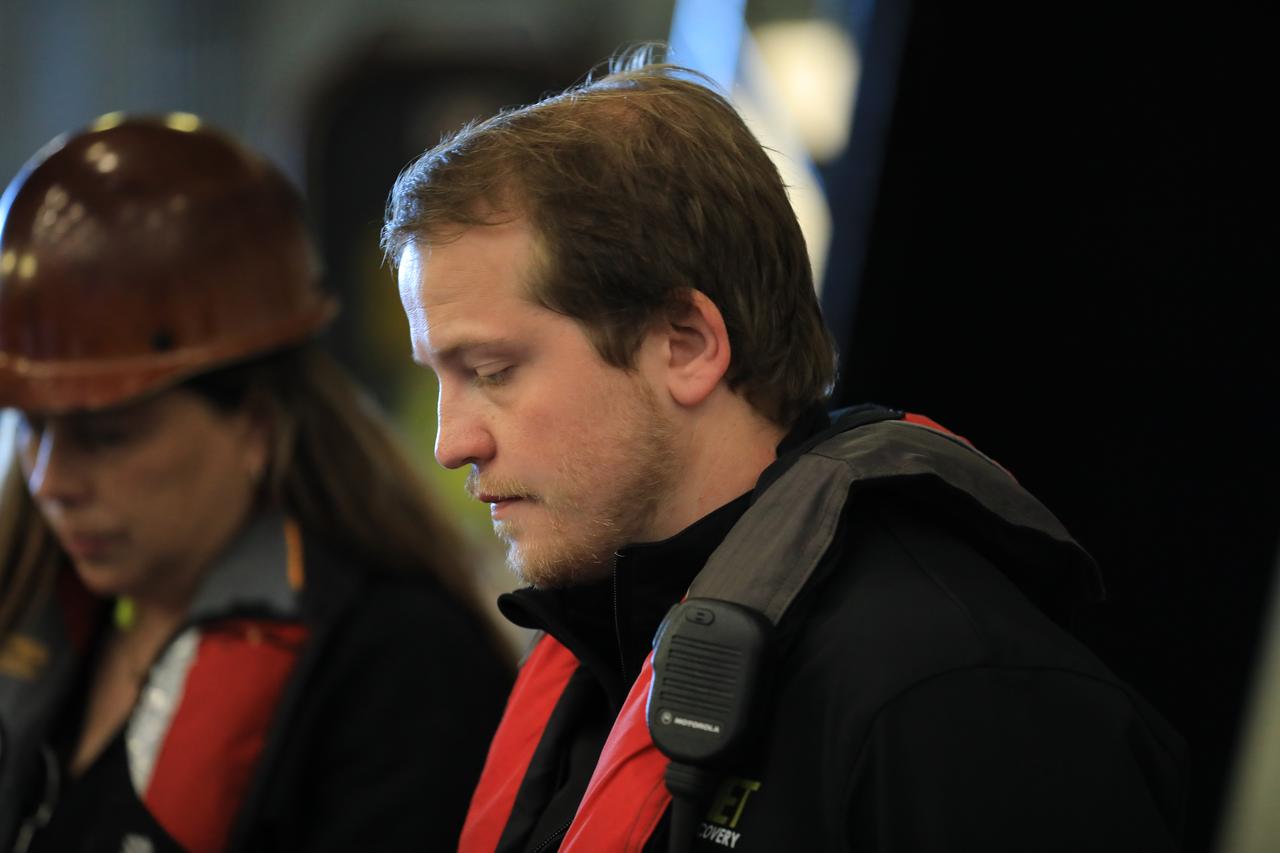
Members of NASA’s Exploration Ground System’s Landing and Recovery team and partners from the Department of Defense aboard the USS San Diego monitor operations of the day in the ship’s well deck and practice recovery procedures using the Crew Module Test Article, during Underway Recovery Test 11 (URT-11) off the coast of San Diego on Thursday, Feb. 22, 2024. URT-11 is the eleventh in a series of Artemis recovery tests, and the first time NASA and its partners put their Artemis II recovery procedures to the test with the astronauts.
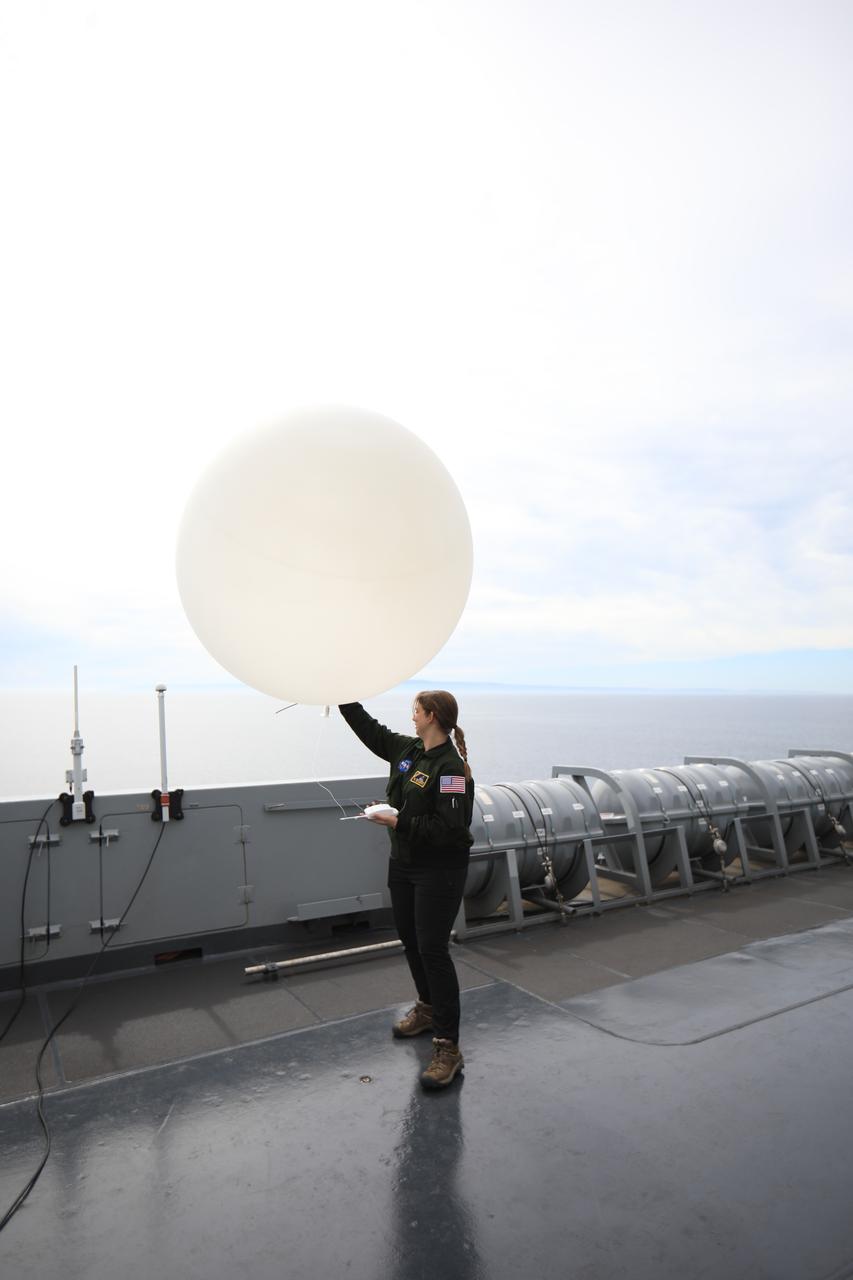
Members of NASA’s Exploration Ground System’s Landing and Recovery team and partners from the Department of Defense aboard the USS San Diego release a weather balloon while practicing recovery procedures using the Crew Module Test Article during Underway Recovery Test 11 (URT-11) off the coast of San Diego on Saturday, Feb. 24, 2024. URT-11 is the eleventh in a series of Artemis recovery tests, and the first time NASA and its partners put their Artemis II recovery procedures to the test with the astronauts.
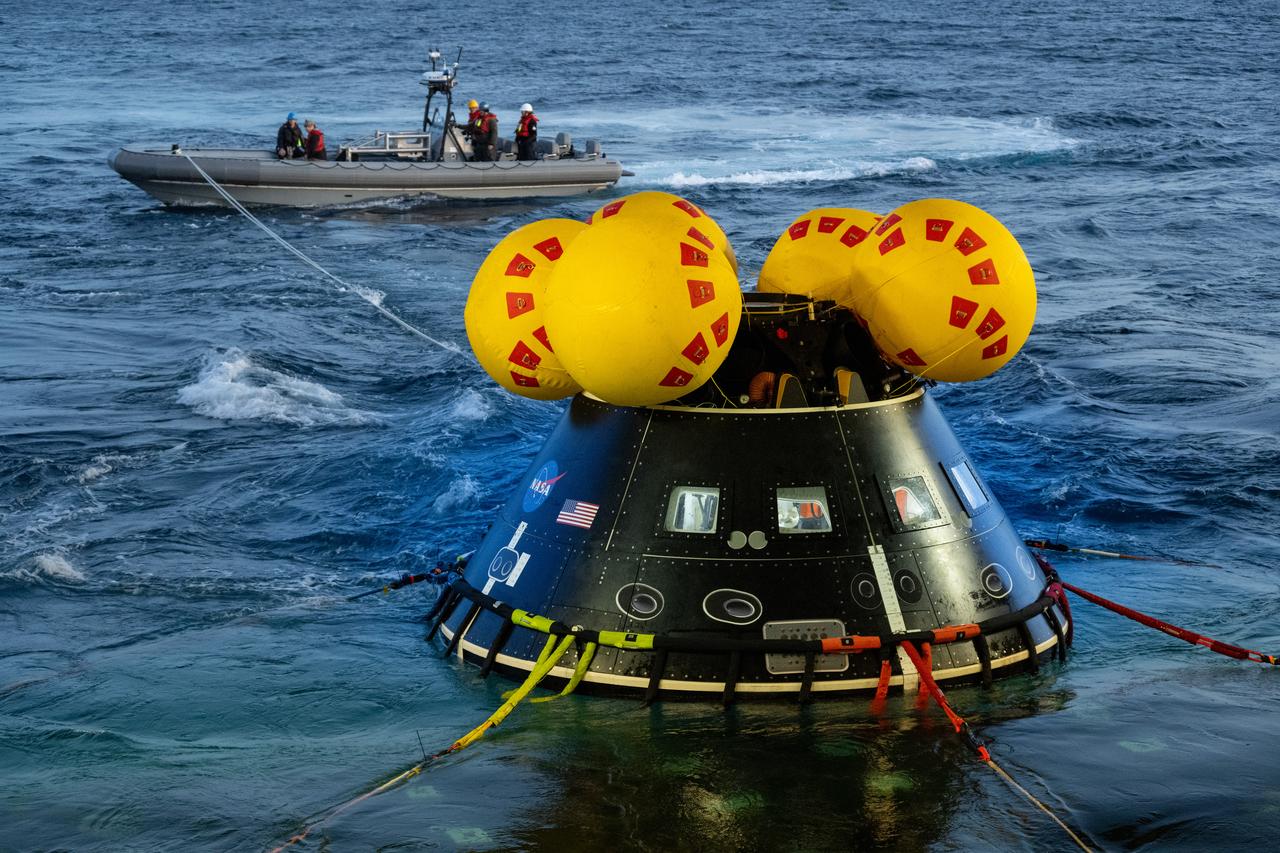
Members of NASA’s Exploration Ground System’s Landing and Recovery team and partners from the Department of Defense aboard the USS San Diego recover the Crew Module Test Article into the ship’s well deck while practicing recovery procedures during Underway Recovery Test 11 (URT-11) off the coast of San Diego on Thursday, Feb. 22, 2024. URT-11 is the eleventh in a series of Artemis recovery tests, and the first time NASA and its partners put their Artemis II recovery procedures to the test with the astronauts.
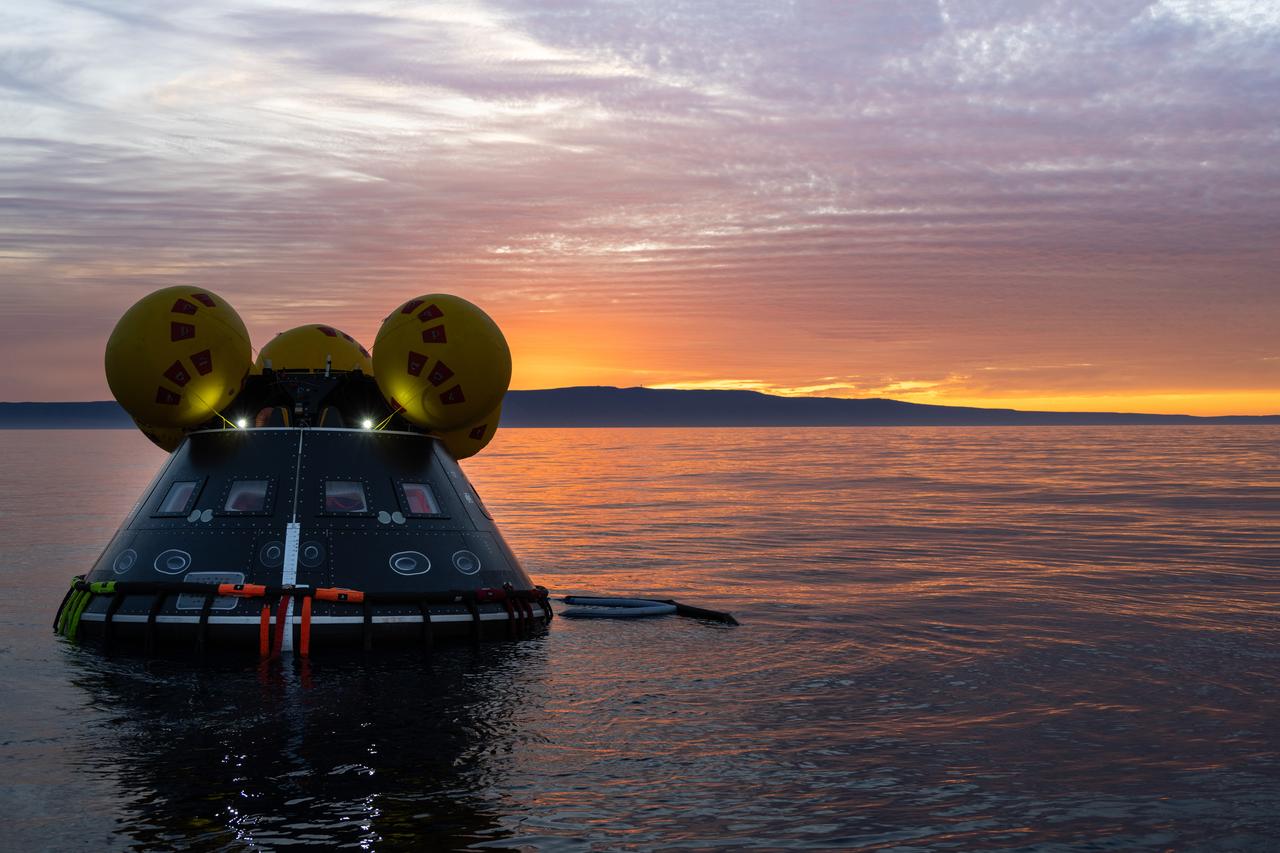
During sunrise over the Pacific Ocean, members of NASA’s Exploration Ground System’s Landing and Recovery team and partners from the Department of Defense aboard the USS San Diego practice recovery procedures using the Crew Module Test Article during Underway Recovery Test 11 (URT-11) off the coast of San Diego on Friday, Feb. 23, 2024. URT-11 is the eleventh in a series of Artemis recovery tests, and the first time NASA and its partners put their Artemis II recovery procedures to the test with the astronauts.
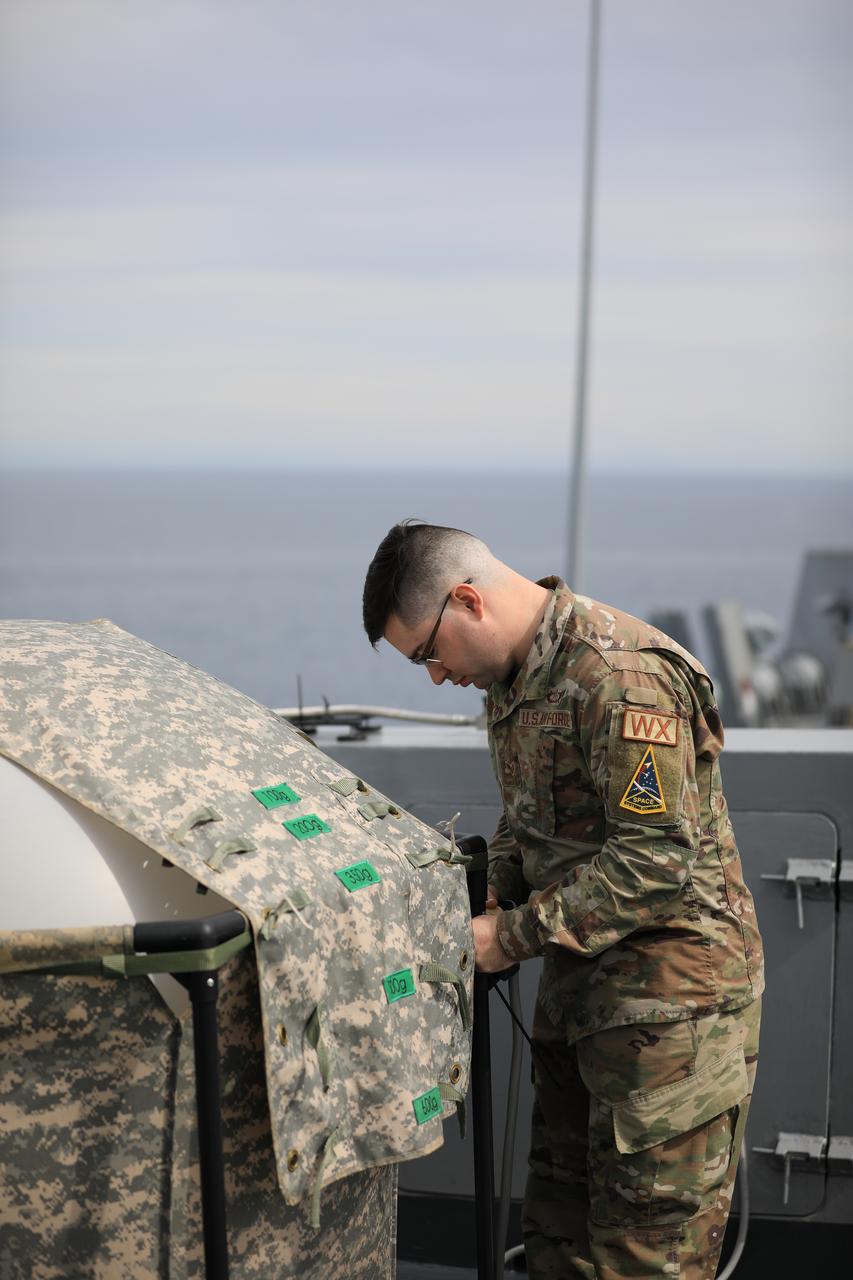
Members of NASA’s Exploration Ground System’s Landing and Recovery team and partners from the Department of Defense aboard the USS San Diego release a weather balloon while practicing recovery procedures using the Crew Module Test Article during Underway Recovery Test 11 (URT-11) off the coast of San Diego on Saturday, Feb. 24, 2024. URT-11 is the eleventh in a series of Artemis recovery tests, and the first time NASA and its partners put their Artemis II recovery procedures to the test with the astronauts.
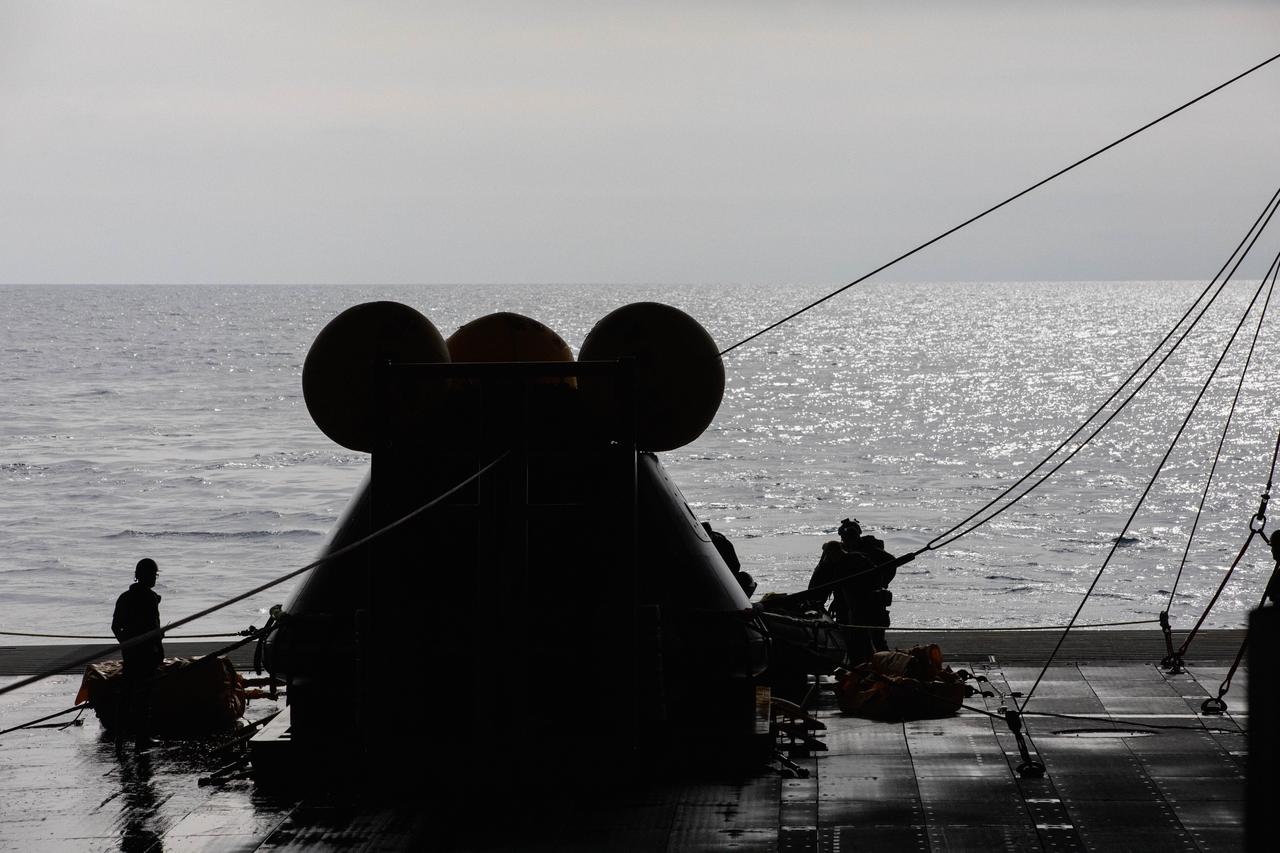
NASA’s Exploration Ground System’s Landing and Recovery team and partners from the Department of Defense aboard the USS San Diego practice recovery procedures using the Crew Module Test Article, during Underway Recovery Test 11 (URT-11) off the coast of San Diego, California on Sunday, Feb. 25, 2024. URT-11 is the eleventh in a series of Artemis recovery tests, and the first time NASA and its partners put their Artemis II recovery procedures to the test with the astronauts.
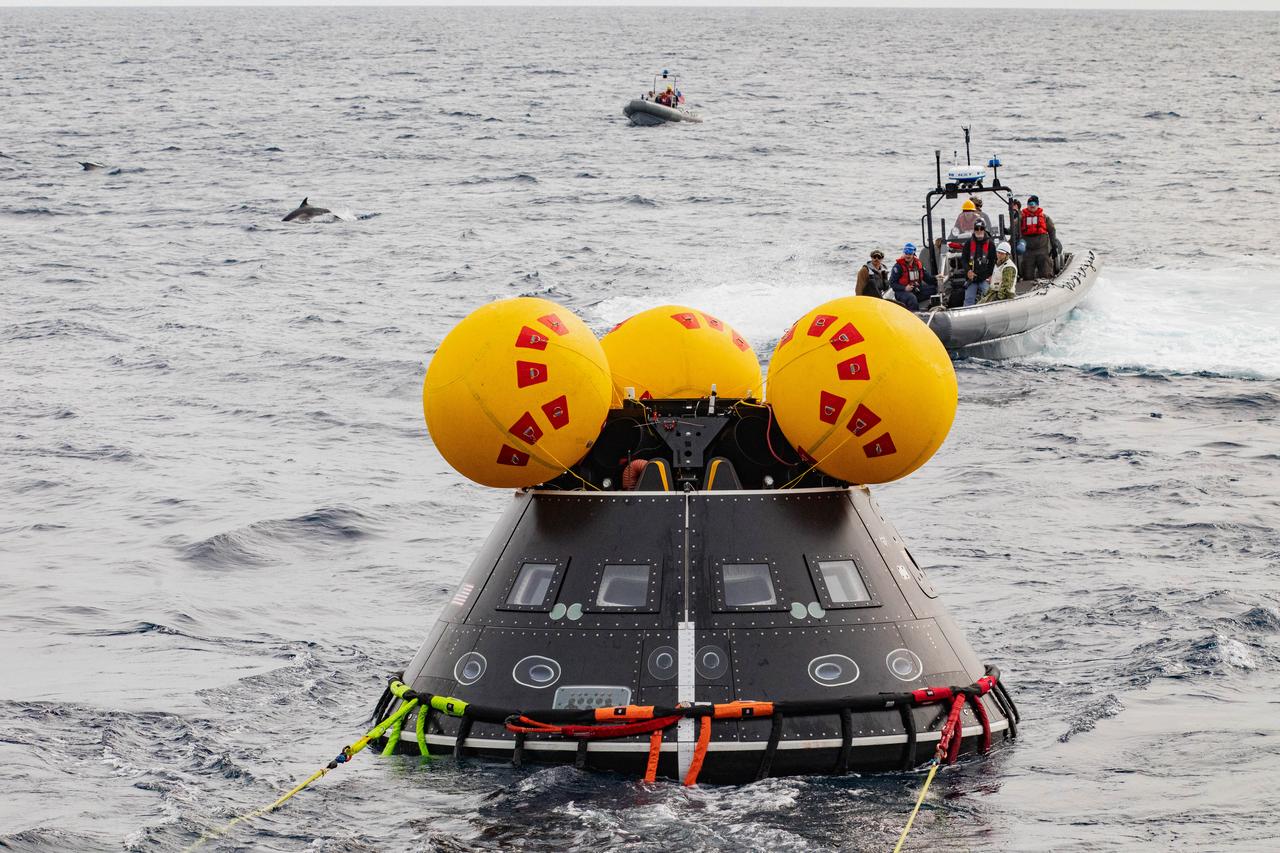
NASA’s Exploration Ground System’s Landing and Recovery team and partners from the Department of Defense aboard the USS San Diego practice recovery procedures using the Crew Module Test Article, during Underway Recovery Test 11 (URT-11) off the coast of San Diego, California on Sunday, Feb. 25, 2024. URT-11 is the eleventh in a series of Artemis recovery tests, and the first time NASA and its partners put their Artemis II recovery procedures to the test with the astronauts.
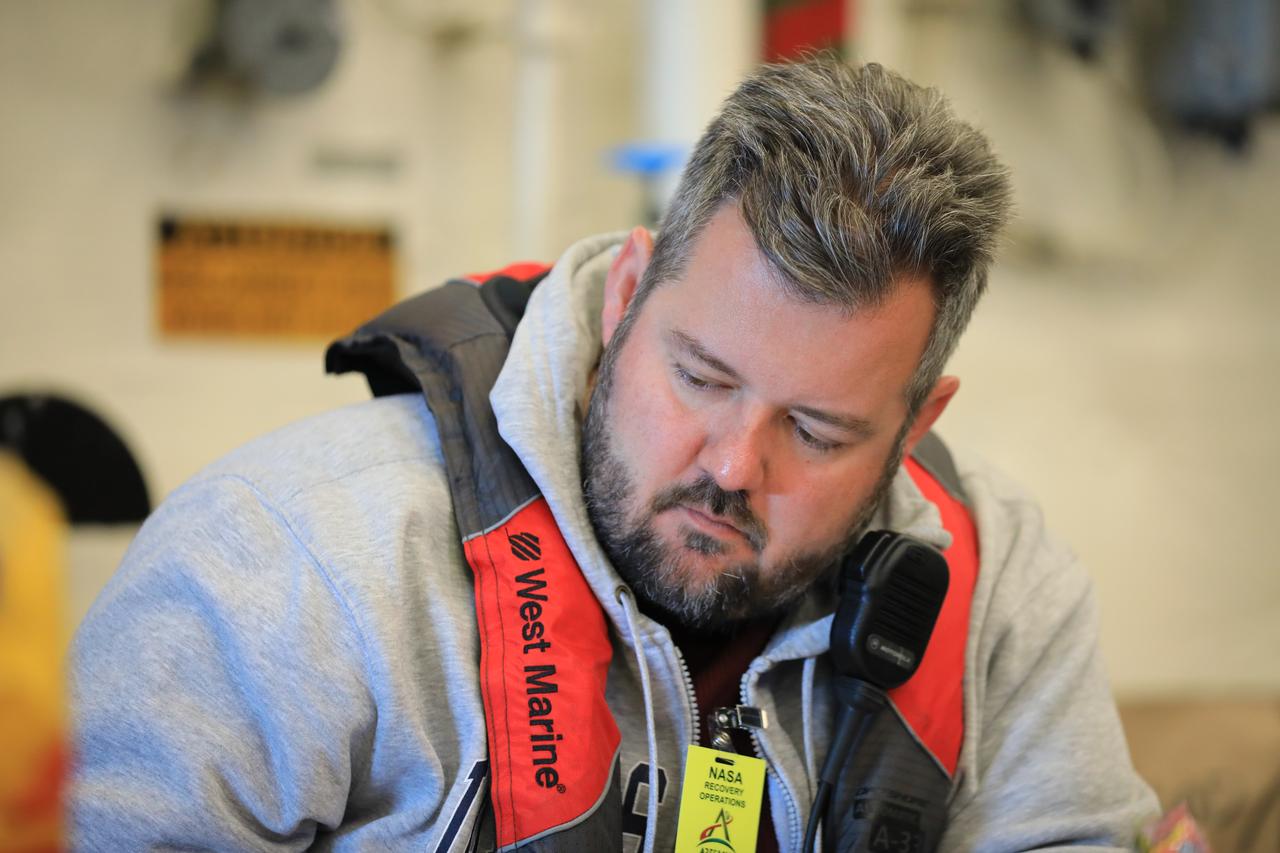
Members of NASA’s Exploration Ground System’s Landing and Recovery team and partners from the Department of Defense aboard the USS San Diego monitor operations of the day in the ship’s well deck and practice recovery procedures using the Crew Module Test Article, during Underway Recovery Test 11 (URT-11) off the coast of San Diego on Thursday, Feb. 22, 2024. URT-11 is the eleventh in a series of Artemis recovery tests, and the first time NASA and its partners put their Artemis II recovery procedures to the test with the astronauts.
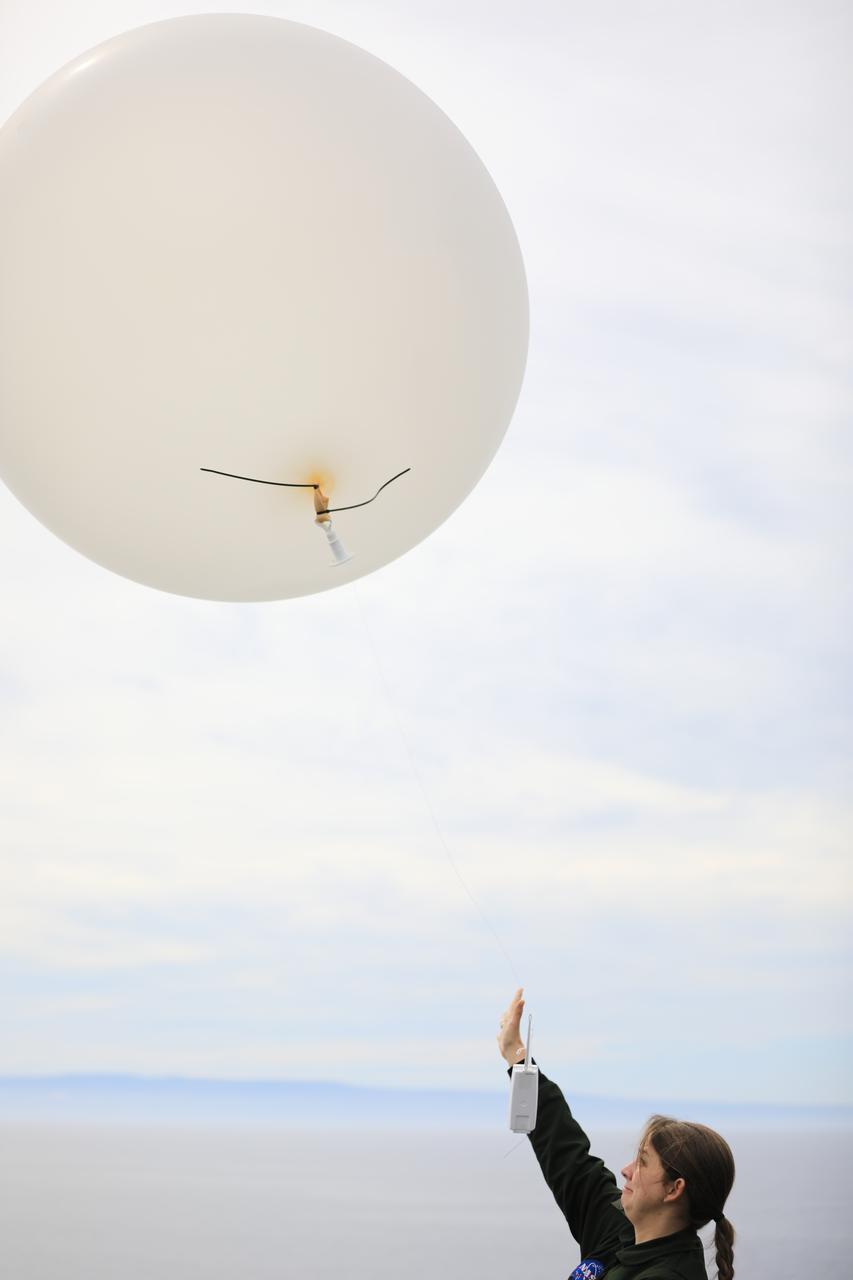
Members of NASA’s Exploration Ground System’s Landing and Recovery team and partners from the Department of Defense aboard the USS San Diego release a weather balloon while practicing recovery procedures using the Crew Module Test Article during Underway Recovery Test 11 (URT-11) off the coast of San Diego on Saturday, Feb. 24, 2024. URT-11 is the eleventh in a series of Artemis recovery tests, and the first time NASA and its partners put their Artemis II recovery procedures to the test with the astronauts.
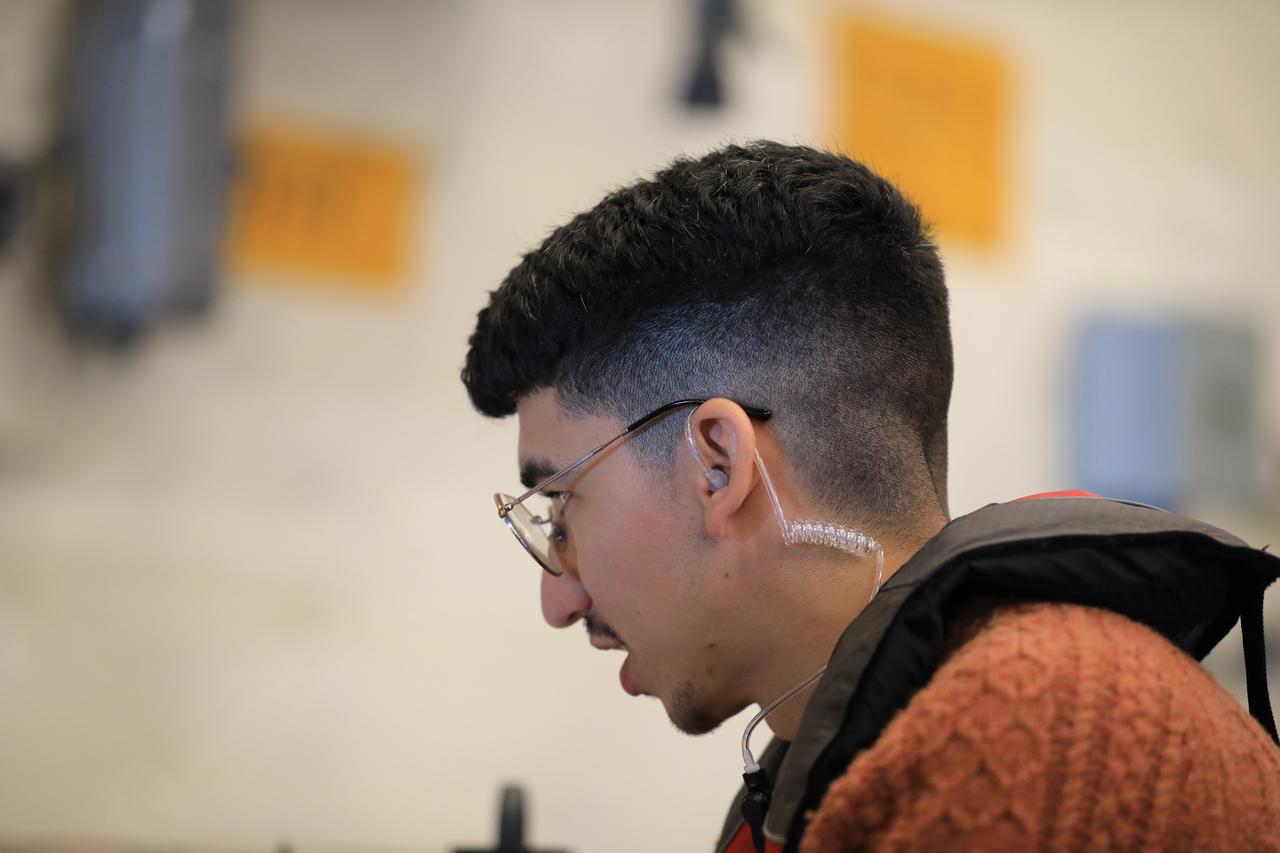
Members of NASA’s Exploration Ground System’s Landing and Recovery team and partners from the Department of Defense aboard the USS San Diego monitor operations of the day in the ship’s well deck and practice recovery procedures using the Crew Module Test Article, during Underway Recovery Test 11 (URT-11) off the coast of San Diego on Thursday, Feb. 22, 2024. URT-11 is the eleventh in a series of Artemis recovery tests, and the first time NASA and its partners put their Artemis II recovery procedures to the test with the astronauts.
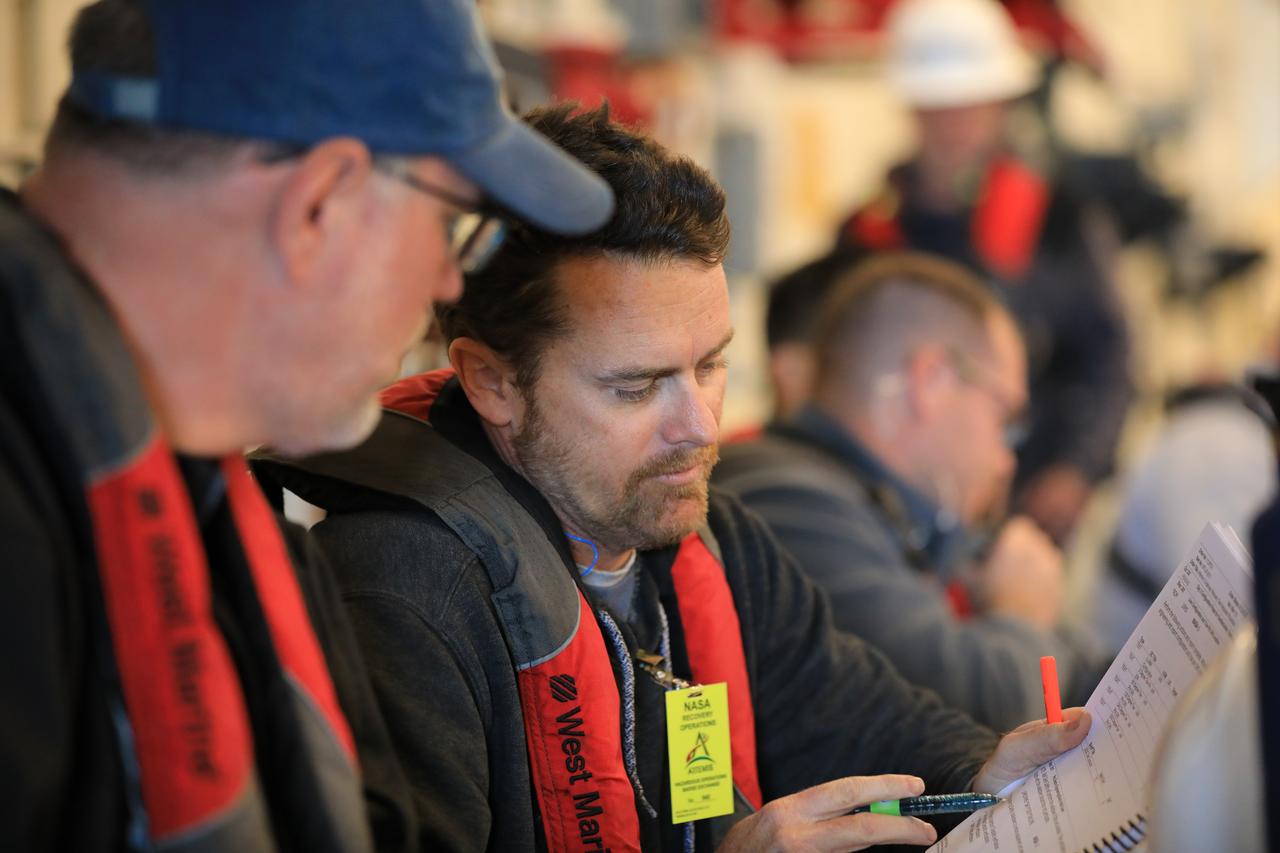
Members of NASA’s Exploration Ground System’s Landing and Recovery team and partners from the Department of Defense aboard the USS San Diego monitor operations of the day in the ship’s well deck and practice recovery procedures using the Crew Module Test Article, during Underway Recovery Test 11 (URT-11) off the coast of San Diego on Thursday, Feb. 22, 2024. URT-11 is the eleventh in a series of Artemis recovery tests, and the first time NASA and its partners put their Artemis II recovery procedures to the test with the astronauts.
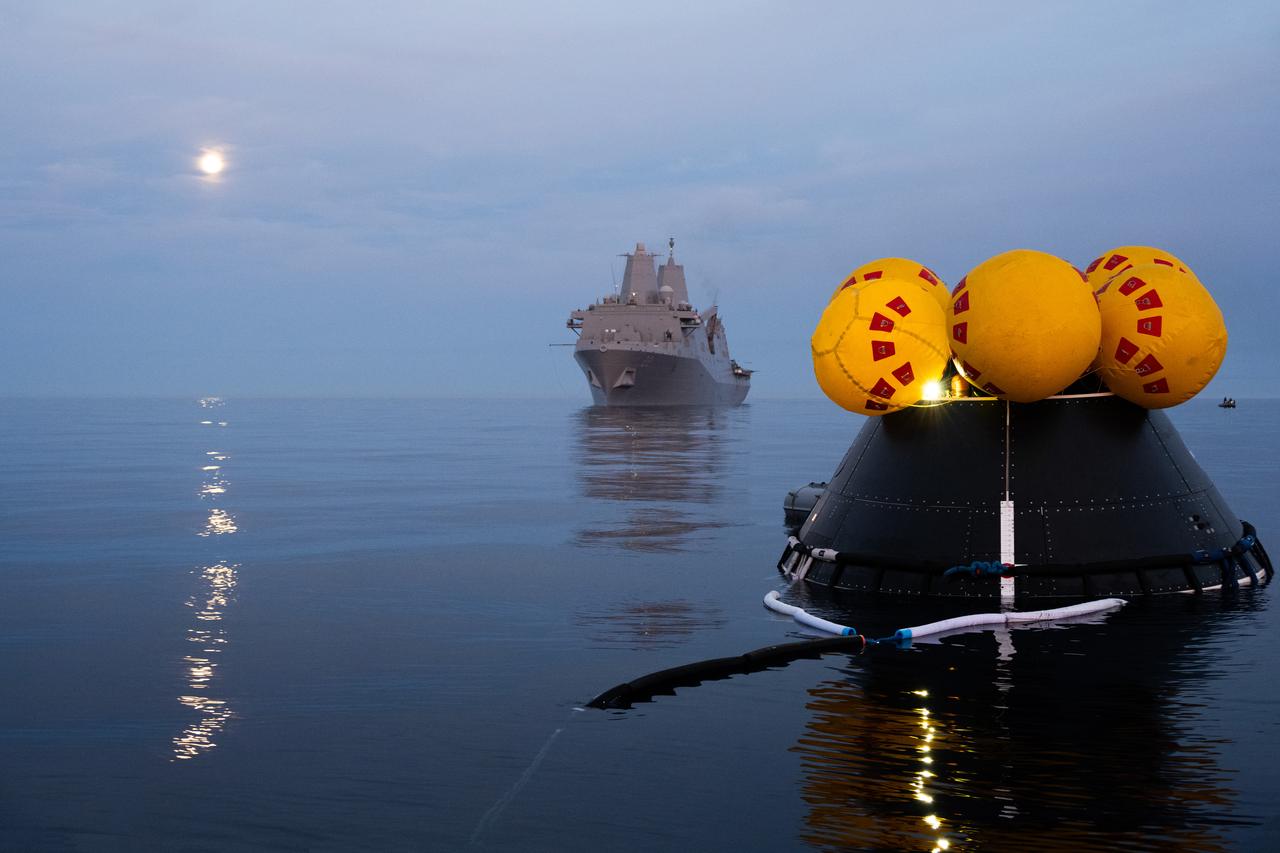
During sunrise over the Pacific Ocean, members of NASA’s Exploration Ground System’s Landing and Recovery team and partners from the Department of Defense aboard the USS San Diego practice recovery procedures using the Crew Module Test Article during Underway Recovery Test 11 (URT-11) off the coast of San Diego on Friday, Feb. 23, 2024. URT-11 is the eleventh in a series of Artemis recovery tests, and the first time NASA and its partners put their Artemis II recovery procedures to the test with the astronauts.
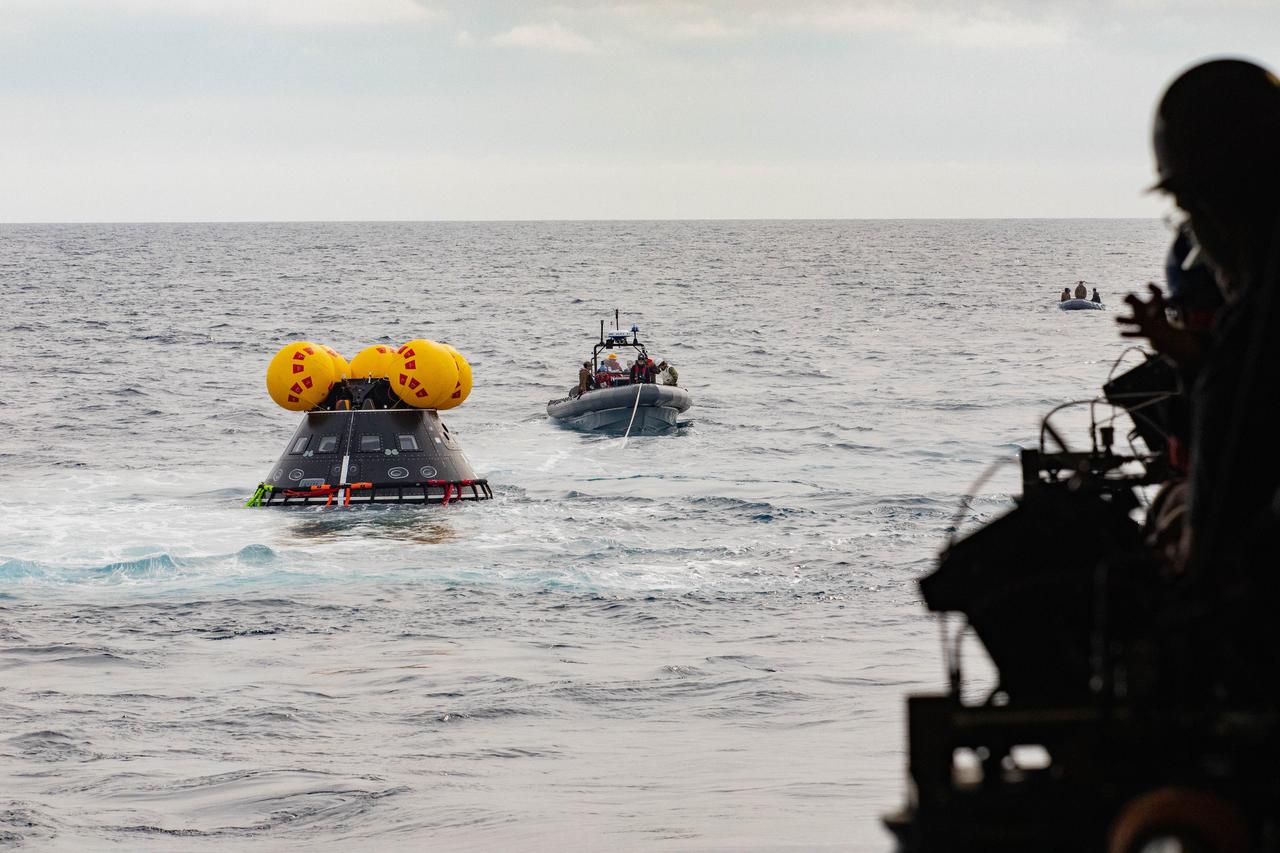
NASA’s Exploration Ground System’s Landing and Recovery team and partners from the Department of Defense aboard the USS San Diego practice recovery procedures using the Crew Module Test Article, during Underway Recovery Test 11 (URT-11) off the coast of San Diego, California on Sunday, Feb. 25, 2024. URT-11 is the eleventh in a series of Artemis recovery tests, and the first time NASA and its partners put their Artemis II recovery procedures to the test with the astronauts.
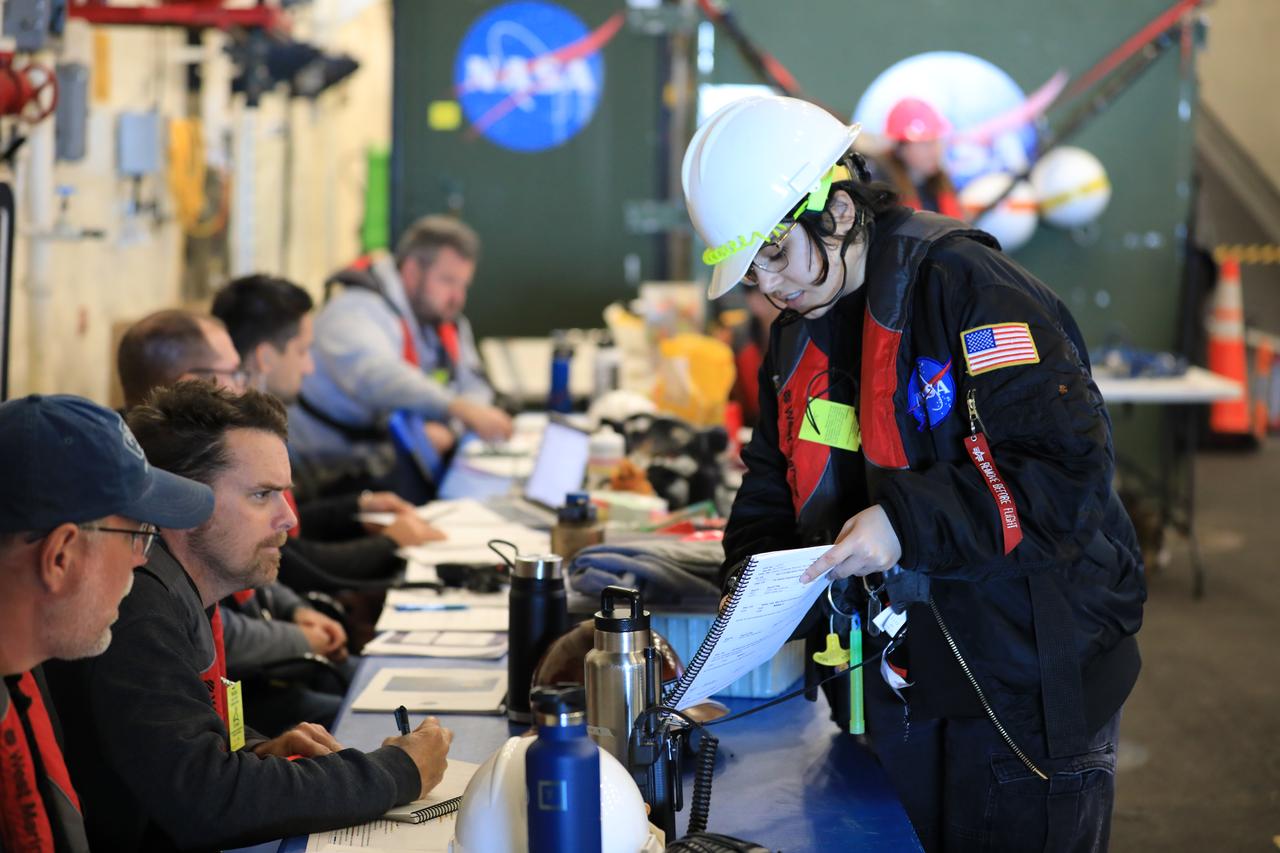
Members of NASA’s Exploration Ground System’s Landing and Recovery team and partners from the Department of Defense aboard the USS San Diego monitor operations of the day in the ship’s well deck and practice recovery procedures using the Crew Module Test Article, during Underway Recovery Test 11 (URT-11) off the coast of San Diego on Thursday, Feb. 22, 2024. URT-11 is the eleventh in a series of Artemis recovery tests, and the first time NASA and its partners put their Artemis II recovery procedures to the test with the astronauts.
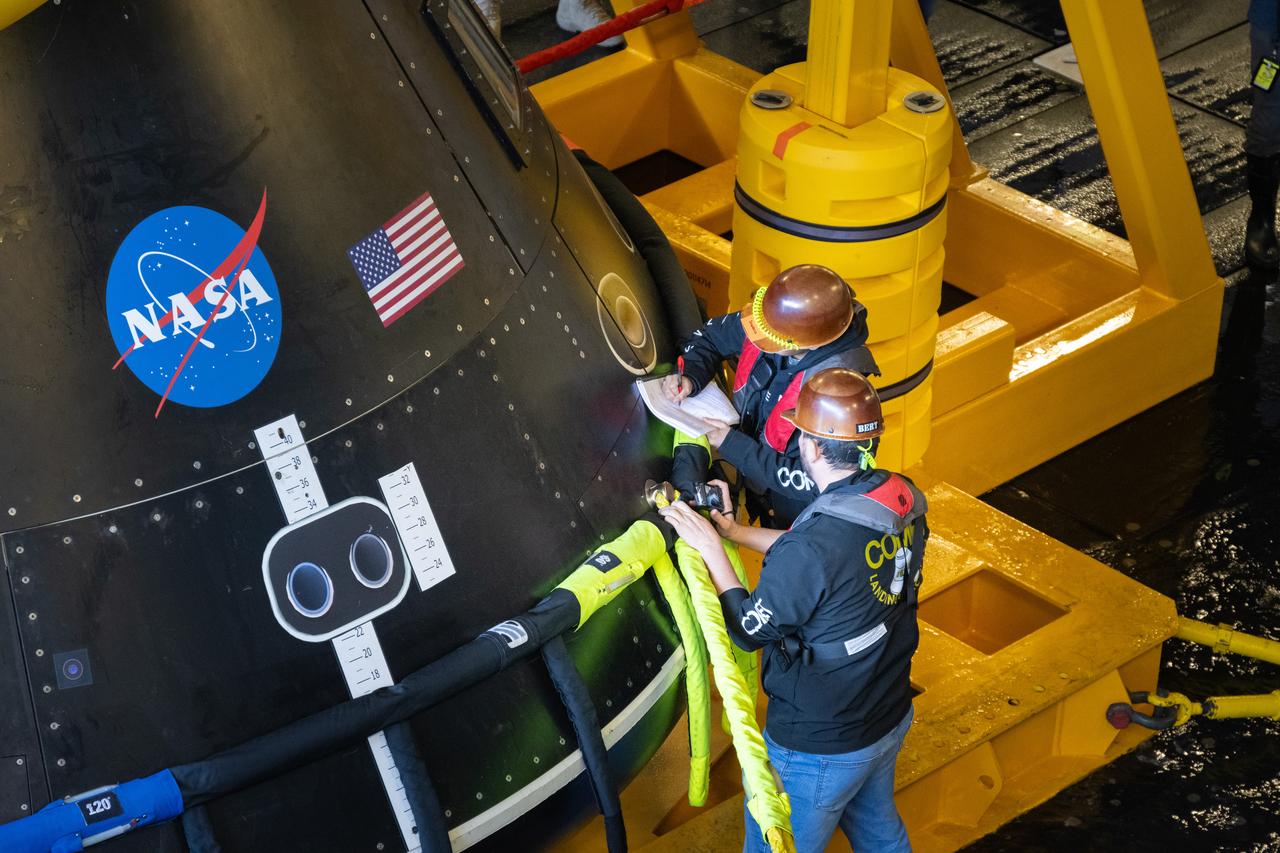
Members of NASA’s Exploration Ground System’s Landing and Recovery team and partners from the Department of Defense aboard the USS San Diego secure the Crew Module Test Article on its stand in the ship’s well deck while practicing recovery procedures during Underway Recovery Test 11 (URT-11) off the coast of San Diego on Thursday, Feb. 22, 2024. URT-11 is the eleventh in a series of Artemis recovery tests, and the first time NASA and its partners put their Artemis II recovery procedures to the test with the astronauts.
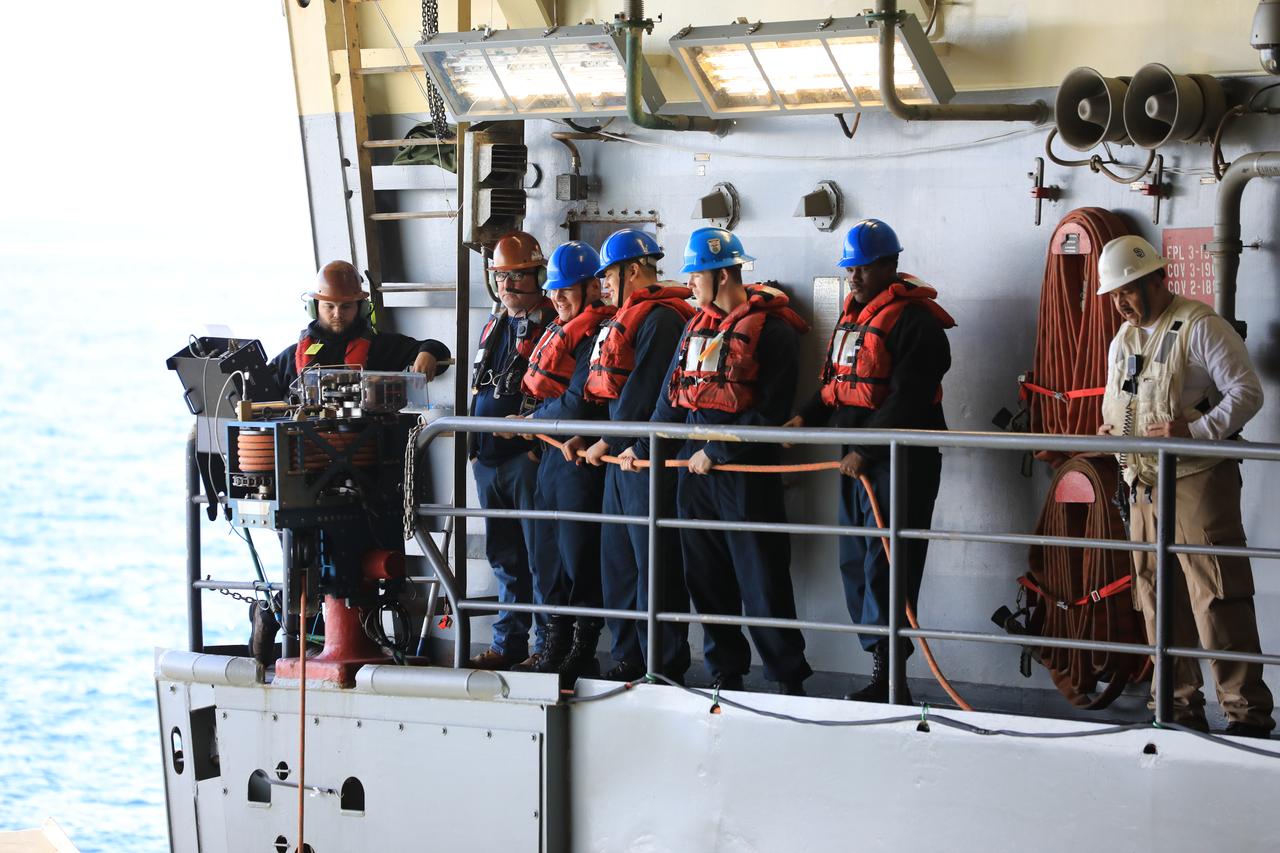
Members of NASA’s Exploration Ground System’s Landing and Recovery team and partners from the Department of Defense aboard the USS San Diego monitor operations of the day in the ship’s well deck and practice recovery procedures using the Crew Module Test Article, during Underway Recovery Test 11 (URT-11) off the coast of San Diego on Thursday, Feb. 22, 2024. URT-11 is the eleventh in a series of Artemis recovery tests, and the first time NASA and its partners put their Artemis II recovery procedures to the test with the astronauts.
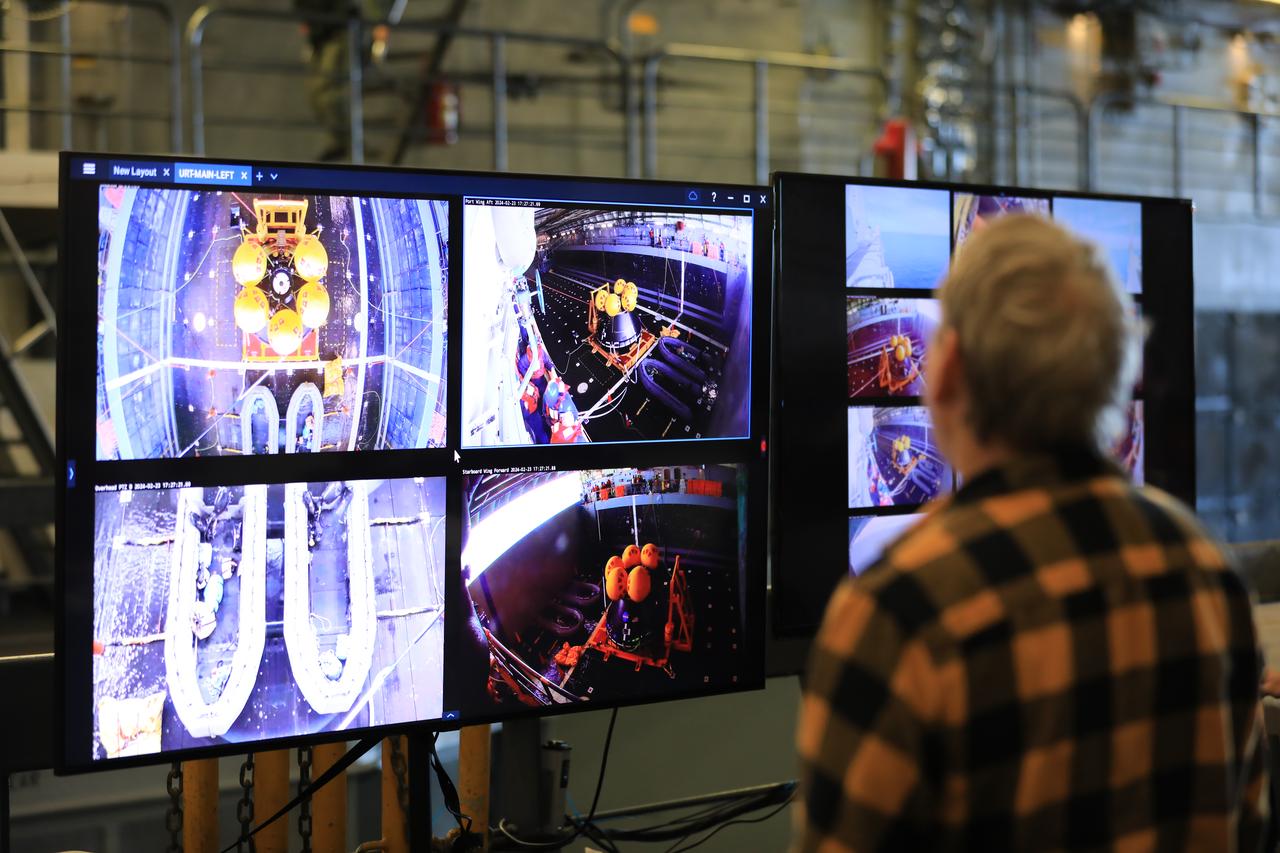
Members of NASA’s Exploration Ground System’s Landing and Recovery team and partners from the Department of Defense aboard the USS San Diego monitor operations of the day in the ship’s well deck and practice recovery procedures using the Crew Module Test Article, during Underway Recovery Test 11 (URT-11) off the coast of San Diego on Friday, Feb. 23, 2024. URT-11 is the eleventh in a series of Artemis recovery tests, and the first time NASA and its partners put their Artemis II recovery procedures to the test with the astronauts.