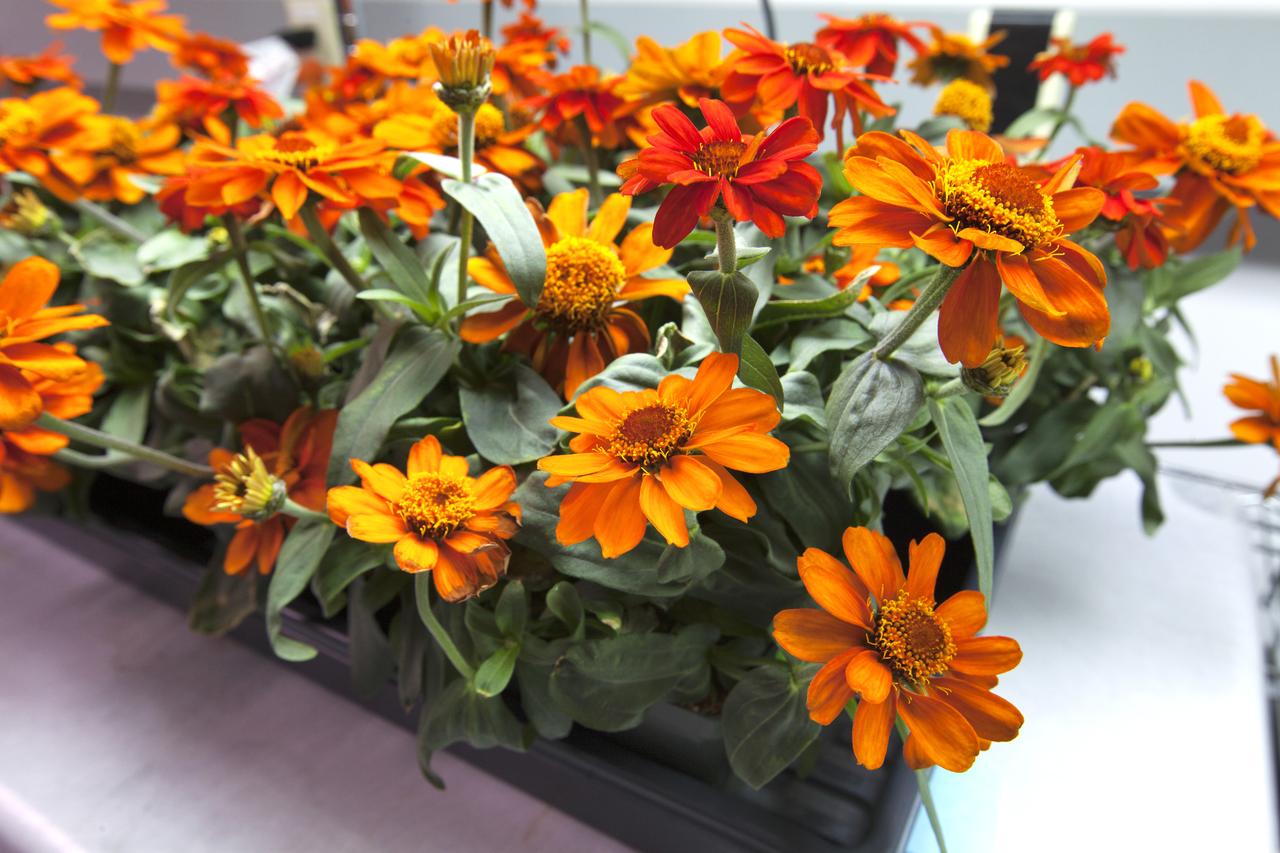
Zinnia seeds grown in the Veggie plant growth system on the International Space Station were planted and are growing in the Veggie Laboratory in the Space Station Processing Facility (SSPF) at NASA's Kennedy Space Center in Florida on Nov. 27, 2018.
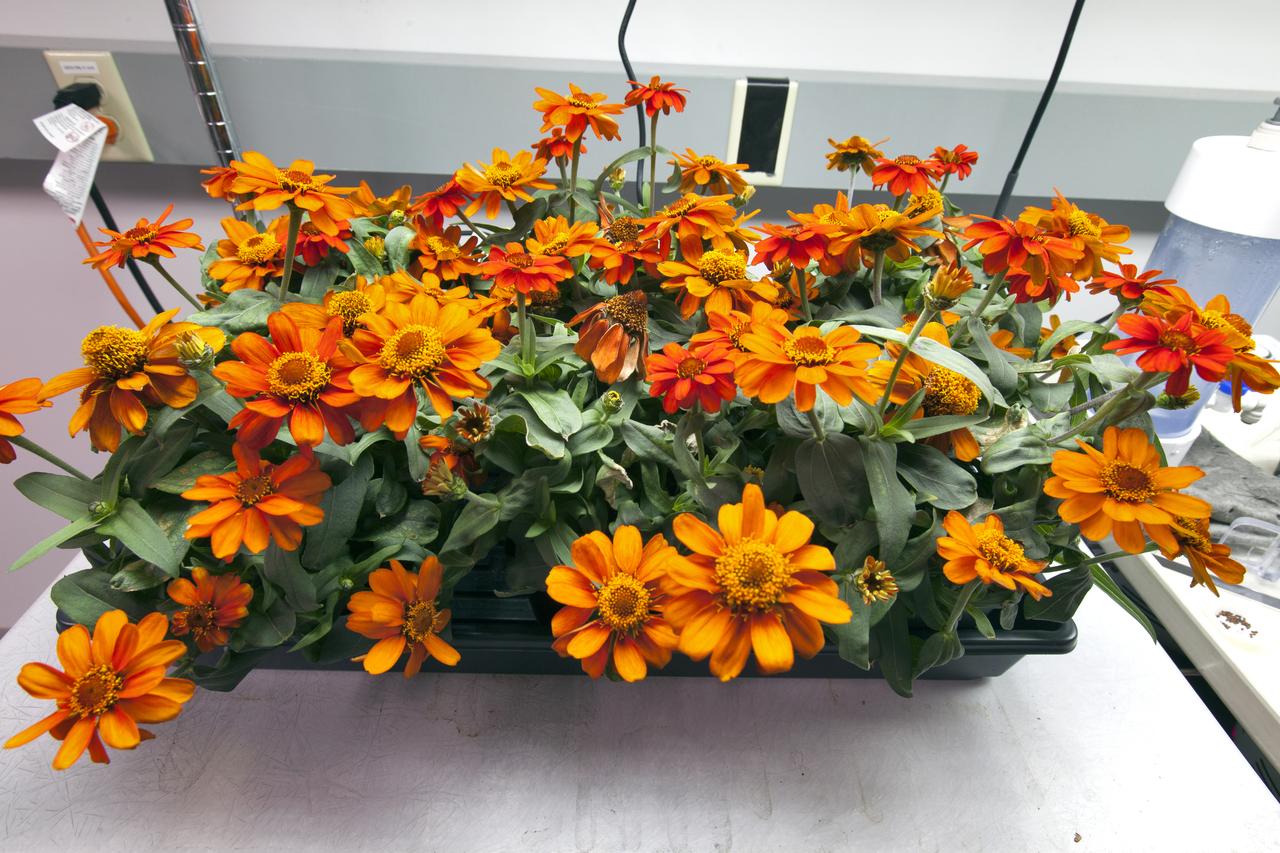
Zinnia seeds grown in the Veggie plant growth system on the International Space Station were planted and are growing in the Veggie Laboratory in the Space Station Processing Facility (SSPF) at NASA's Kennedy Space Center in Florida on Nov. 27, 2018.
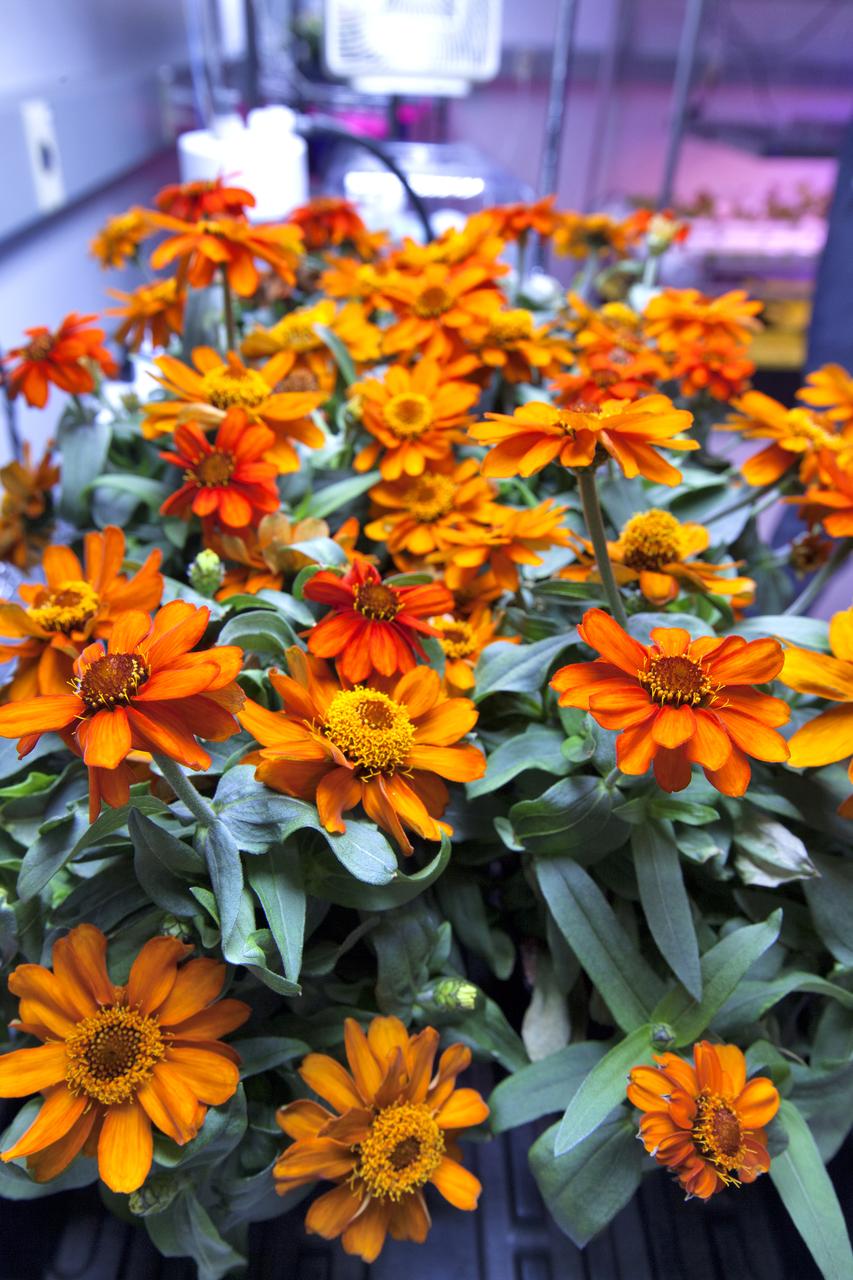
Zinnia seeds grown in the Veggie plant growth system on the International Space Station were planted and are growing in the Veggie Laboratory in the Space Station Processing Facility (SSPF) at NASA's Kennedy Space Center in Florida on Nov. 27, 2018.
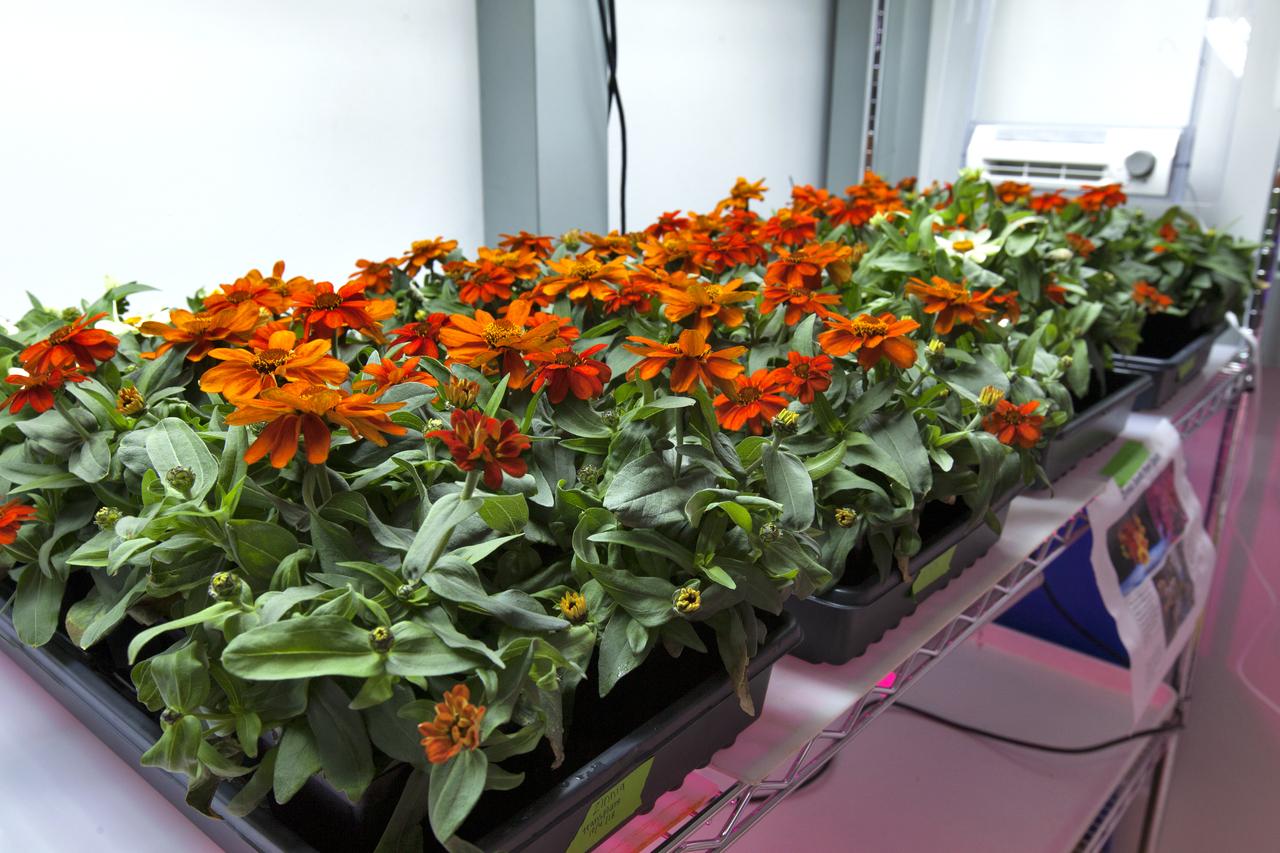
Zinnia seeds grown in the Veggie plant growth system on the International Space Station were planted and are growing in the Veggie Laboratory in the Space Station Processing Facility (SSPF) at NASA's Kennedy Space Center in Florida on Nov. 27, 2018.

A close-up view of a zinnia flower grown in the Veggie Laboratory in the Space Station Processing Facility (SSPF) at NASA's Kennedy Space Center in Florida, on Nov. 27, 2018. Seeds from zinnias growing on the space station were returned to Earth. Researchers in the SSPF planted the seeds in the Veggie control unit and grew the colorful flowers.
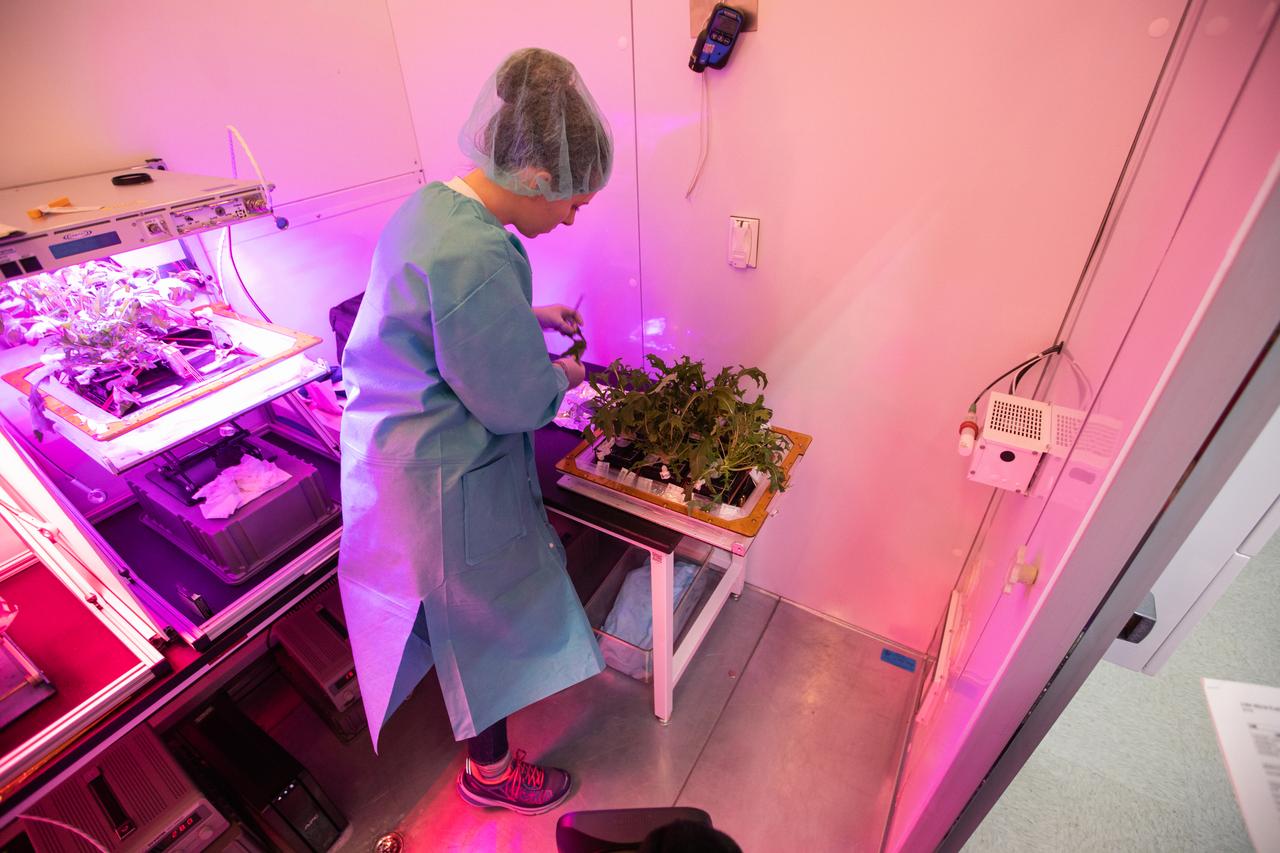
Jess Bunchek, a veggie plant scientist and pseudonaut, harvests mizuna mustard inside the Veggie harvest chamber in the Space Station Processing Facility at NASA’s Kennedy Space Center in Florida on Feb. 19, 2019, as part of the Experiment Verification Test for the VEG-04B mission that will launch to the International Space Station later this year. VEG-04B examines the interactions between light and spaceflight by growing plants under two different LED lighting conditions. A similar harvest will be conducted on the space station after a grow-out duration of 56 days. Ultimately, fresh vegetables grown in space will be an essential supplement to the crew’s pre-packaged diet, prepping them for long-duration space exploration.
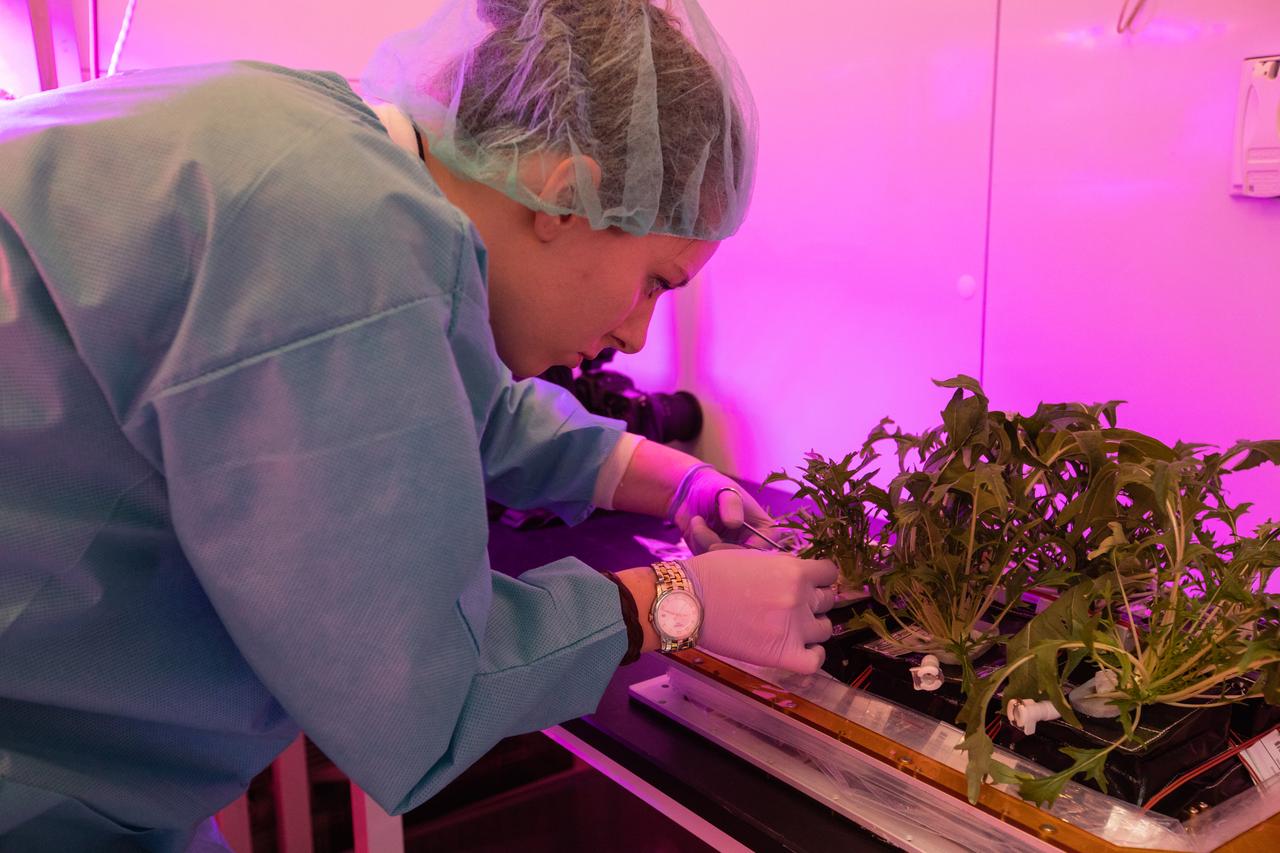
Jess Bunchek, a veggie plant scientist and pseudonaut, harvests mizuna mustard inside the Veggie harvest chamber in the Space Station Processing Facility at NASA’s Kennedy Space Center in Florida on Feb. 19, 2019, as part of the Experiment Verification Test for the VEG-04B mission that will launch to the International Space Station later this year. VEG-04B examines the interactions between light and spaceflight by growing plants under two different LED lighting conditions. A similar harvest will be conducted on the space station after a grow-out duration of 56 days. Ultimately, fresh vegetables grown in space will be an essential supplement to the crew’s pre-packaged diet, prepping them for long-duration space exploration.
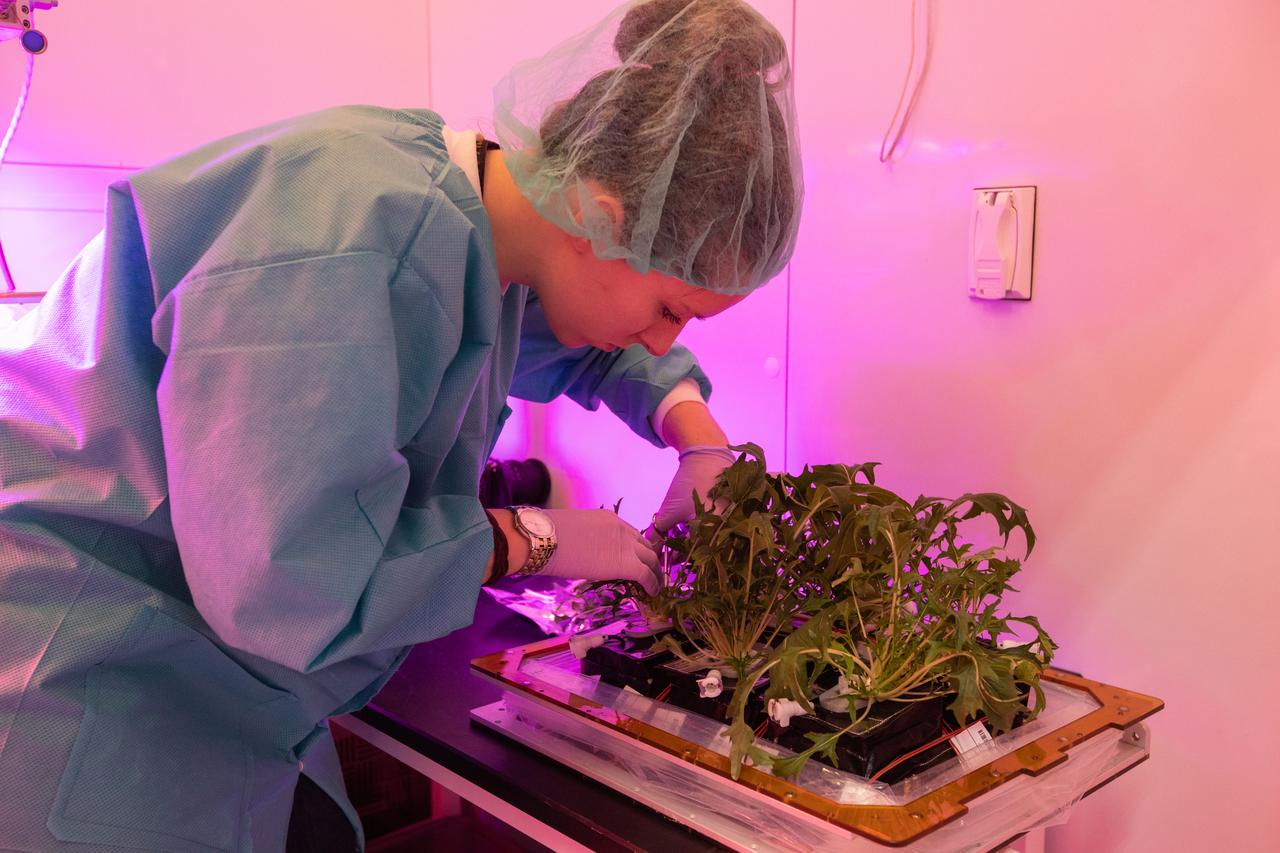
Jess Bunchek, a veggie plant scientist and pseudonaut, harvests mizuna mustard inside the Veggie harvest chamber in the Space Station Processing Facility at NASA’s Kennedy Space Center in Florida on Feb. 19, 2019, as part of the Experiment Verification Test for the VEG-04B mission that will launch to the International Space Station later this year. VEG-04B examines the interactions between light and spaceflight by growing plants under two different LED lighting conditions. A similar harvest will be conducted on the space station after a grow-out duration of 56 days. Ultimately, fresh vegetables grown in space will be an essential supplement to the crew’s pre-packaged diet, prepping them for long-duration space exploration.
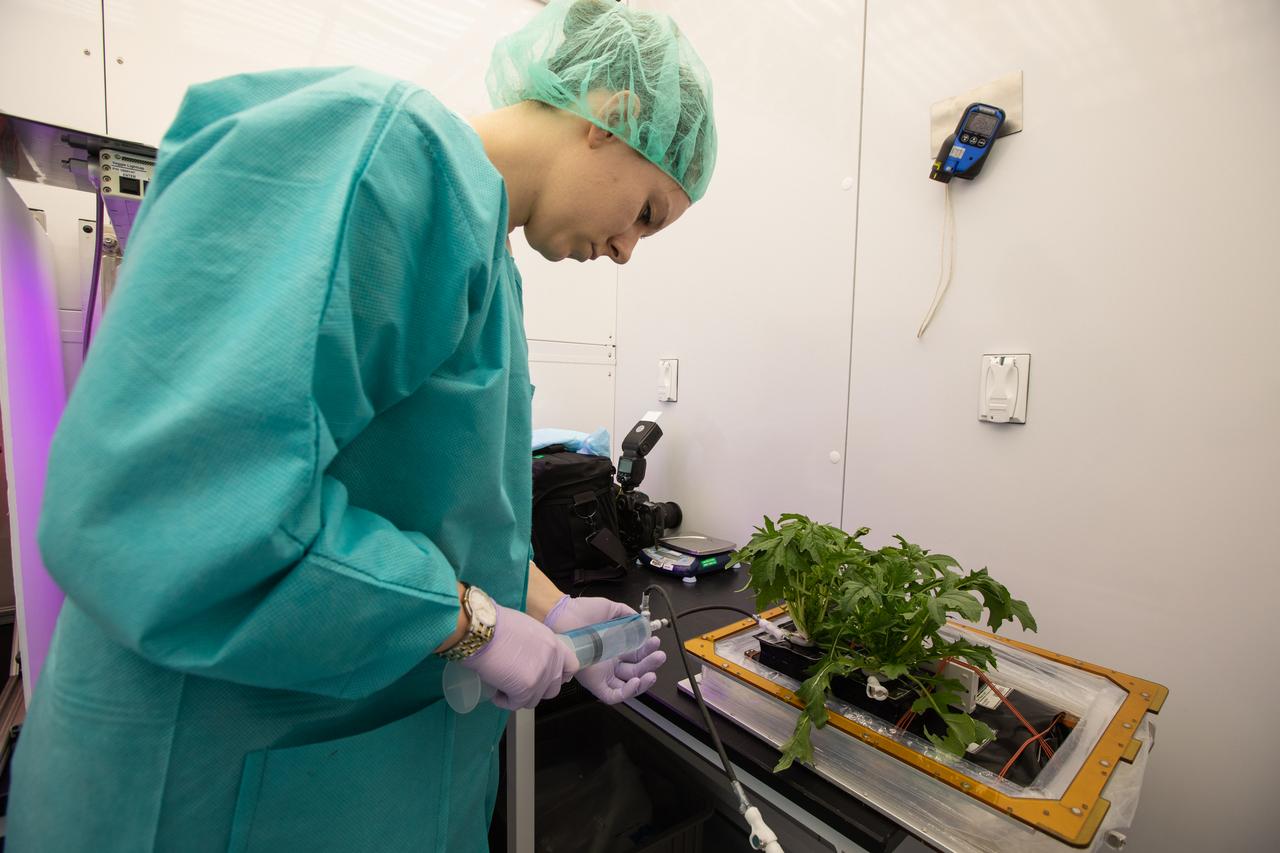
Jess Bunchek, a veggie plant scientist and pseudonaut, harvests mizuna mustard inside the Veggie harvest chamber in the Space Station Processing Facility at NASA’s Kennedy Space Center in Florida on Feb. 19, 2019, as part of the Experiment Verification Test for the VEG-04B mission that will launch to the International Space Station later this year. VEG-04B examines the interactions between light and spaceflight by growing plants under two different LED lighting conditions. A similar harvest will be conducted on the space station after a grow-out duration of 56 days. Ultimately, fresh vegetables grown in space will be an essential supplement to the crew’s pre-packaged diet, prepping them for long-duration space exploration.
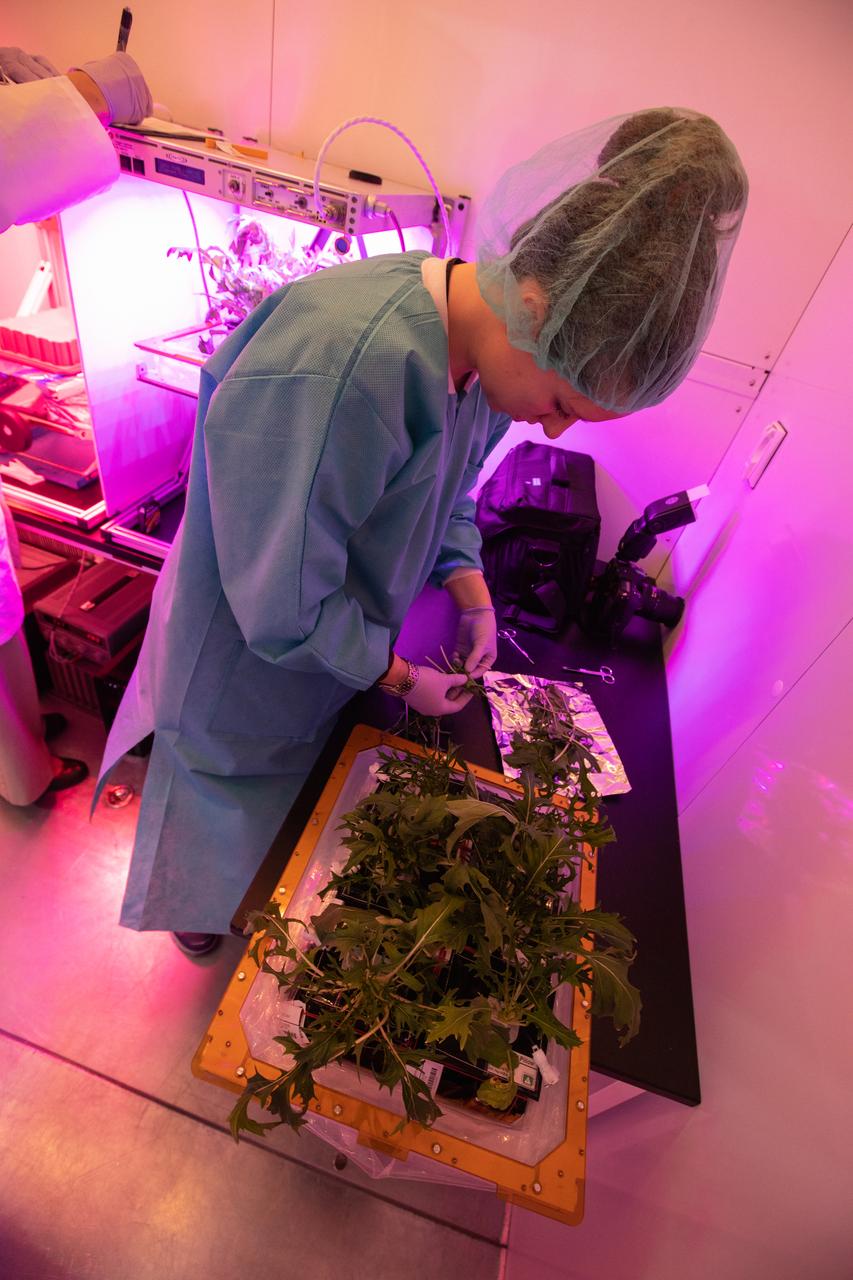
Jess Bunchek, a veggie plant scientist and pseudonaut, harvests mizuna mustard inside the Veggie harvest chamber in the Space Station Processing Facility at NASA’s Kennedy Space Center in Florida on Feb. 19, 2019, as part of the Experiment Verification Test for the VEG-04B mission that will launch to the International Space Station later this year. VEG-04B examines the interactions between light and spaceflight by growing plants under two different LED lighting conditions. A similar harvest will be conducted on the space station after a grow-out duration of 56 days. Ultimately, fresh vegetables grown in space will be an essential supplement to the crew’s pre-packaged diet, prepping them for long-duration space exploration.
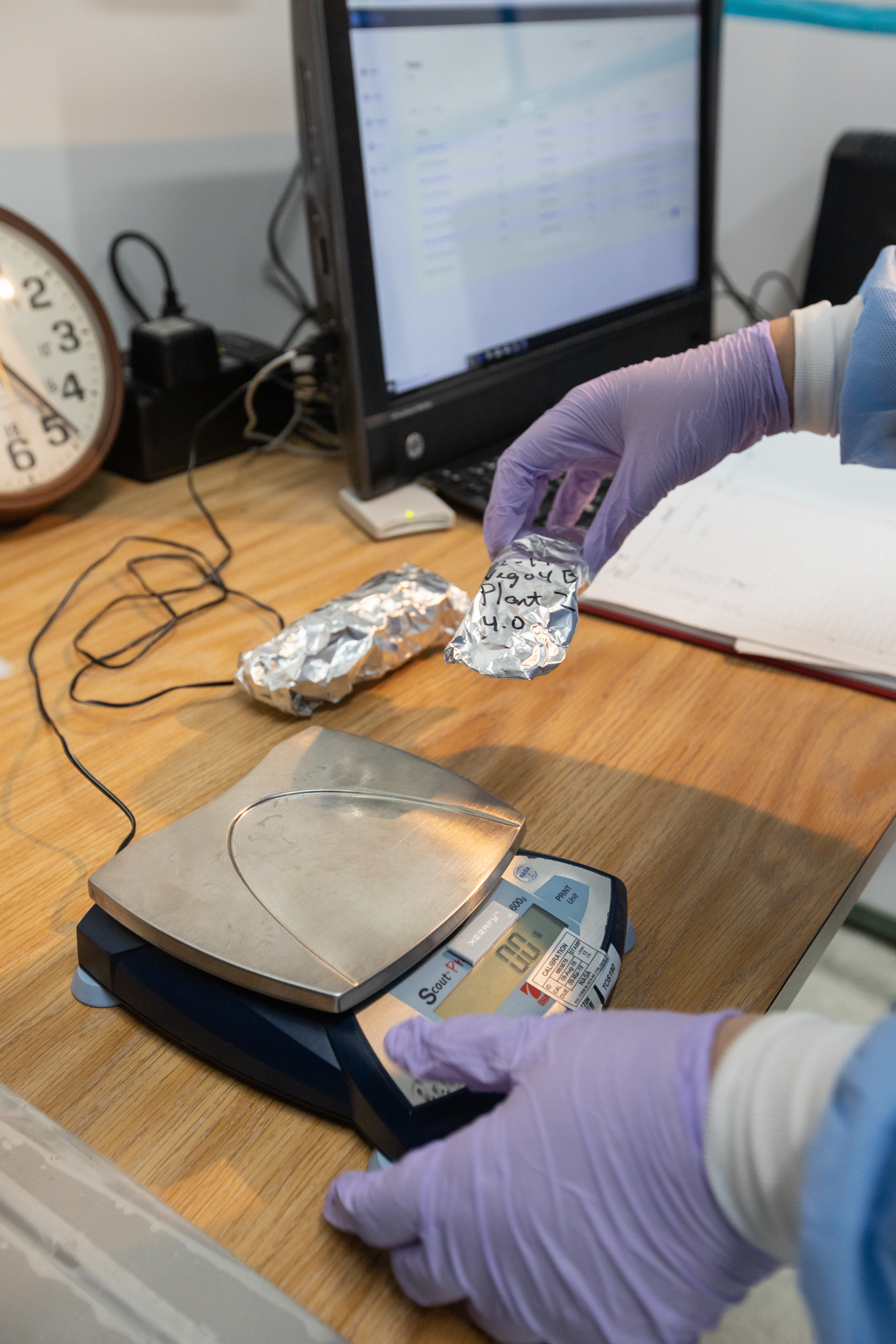
Gretchen Maldonado Vazquez, a microbiologist, weighs the harvest of mizuna mustard inside the Veggie harvest chamber in the Space Station Processing Facility at NASA’s Kennedy Space Center in Florida on Feb. 19, 2019, from the Experiment Verification Test for the VEG-04B mission that will launch to the International Space Station later this year. VEG-04B examines the interactions between light and spaceflight by growing plants under two different LED lighting conditions, and a similar harvest will be conducted on the space station after a grow-out duration of 56 days. Ultimately, fresh vegetables grown in space will be an essential supplement to the crew’s pre-packaged diet, prepping them for long-duration space exploration.
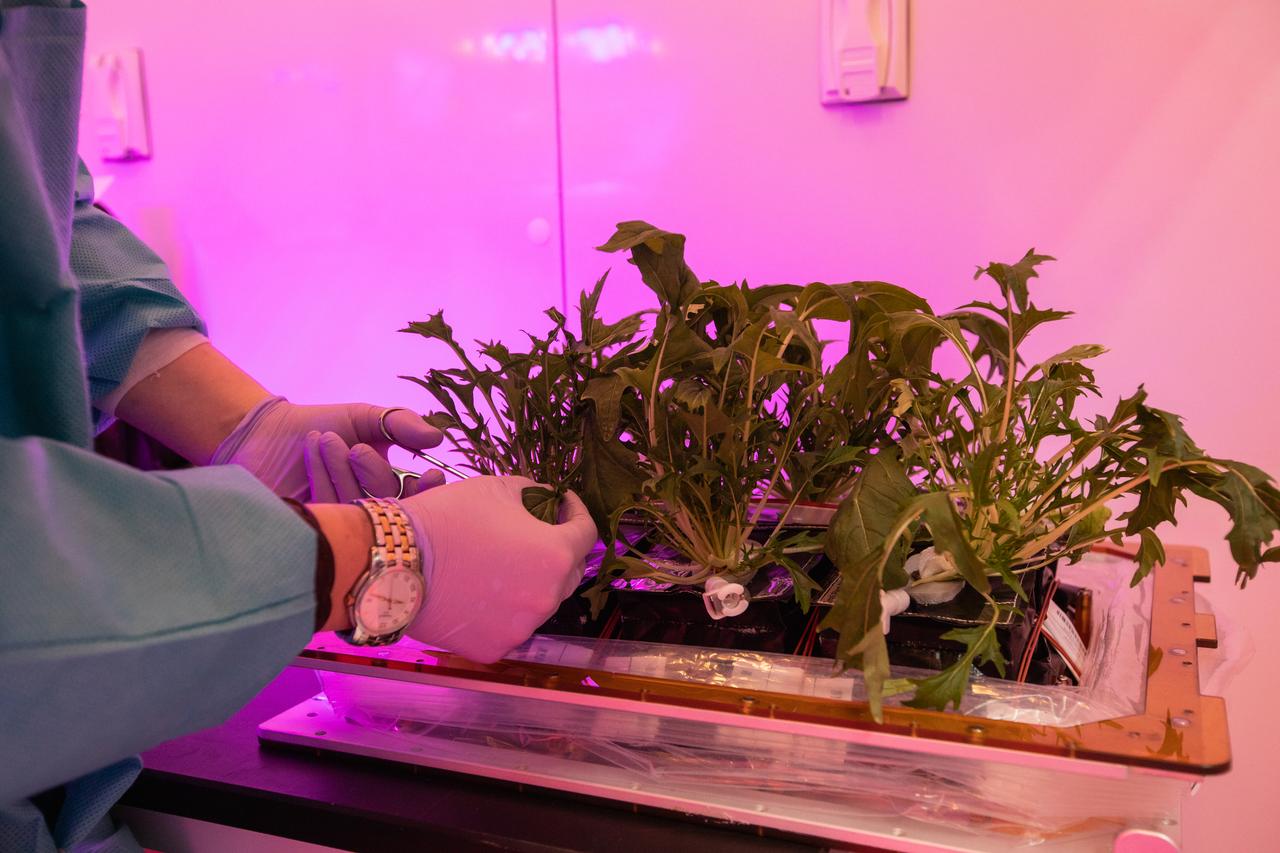
Mizuna mustard is harvested inside the Veggie harvest chamber in the Space Station Processing Facility at NASA’s Kennedy Space Center in Florida on Feb. 19, 2019, as part of the Experiment Verification Test for the VEG-04B mission that will launch to the International Space Station later this year. VEG-04B examines the interactions between light and spaceflight by growing plants under two different LED lighting conditions. A similar harvest will be conducted on the space station after a grow-out duration of 56 days. The VEG-04B mission is expected to provide sensory stimulation and help mark the passage of time in the confined and isolated environment of the space station. Ultimately, fresh vegetables grown in space will be an essential supplement to the crew’s pre-packaged diet, prepping them for long-duration space exploration.
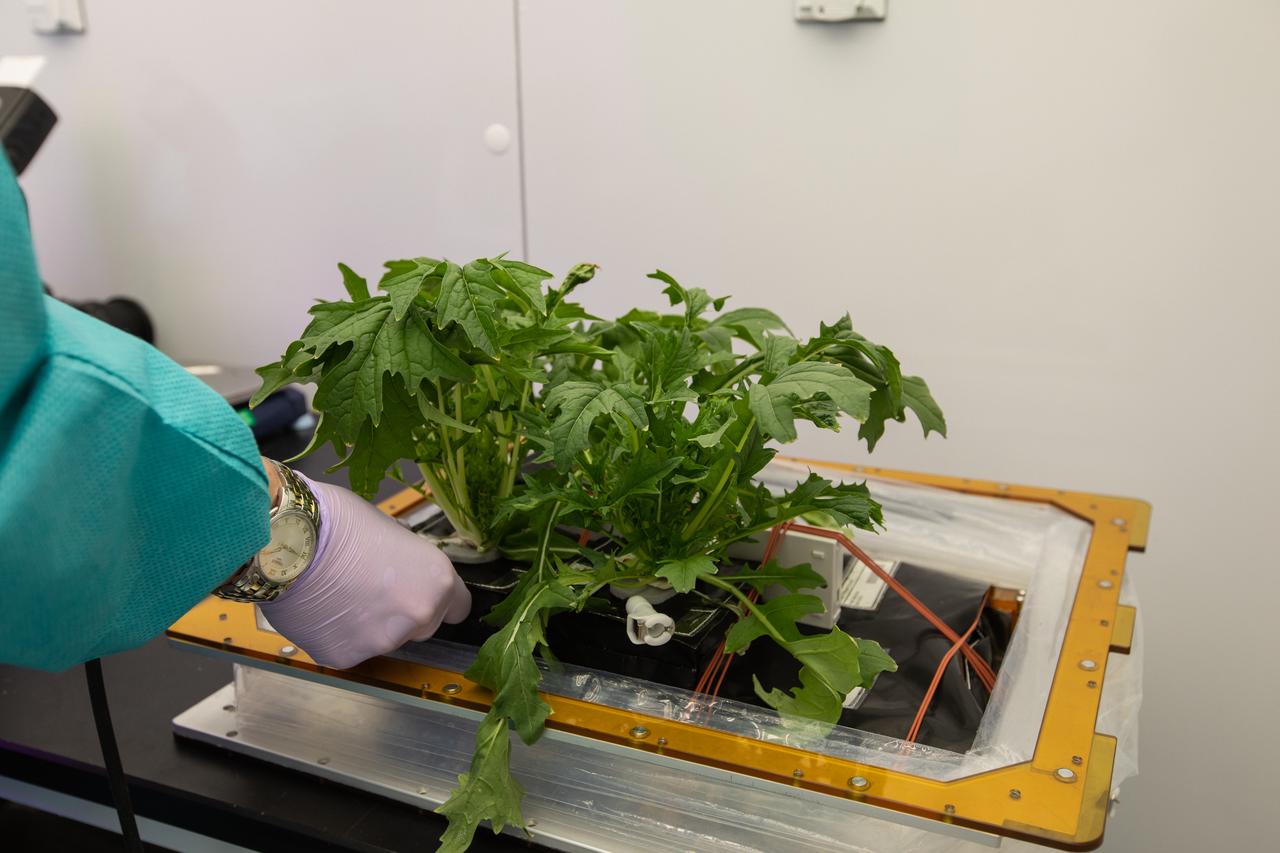
Jess Bunchek, a veggie plant scientist and pseudonaut, harvests mizuna mustard inside the Veggie harvest chamber in the Space Station Processing Facility at NASA’s Kennedy Space Center in Florida on Feb. 19, 2019, as part of the Experiment Verification Test for the VEG-04B mission that will launch to the International Space Station later this year. VEG-04B examines the interactions between light and spaceflight by growing plants under two different LED lighting conditions. A similar harvest will be conducted on the space station after a grow-out duration of 56 days. The VEG-04B mission is expected to provide fresh food, sensory stimulation and help mark the passage of time in the confined and isolated environment of the space station. Ultimately, fresh vegetables grown in space will be an essential supplement to the crew’s pre-packaged diet, prepping them for long-duration space exploration.

From the first taste of Red Romaine Lettuce in fall 2015, astronauts have grown and eaten a range of salad crops in orbit as NASA researches ways to keep crews healthy on future missions exploring the Moon and Mars. These plants are good sources of Vitamin C and Vitamin K, and they have traits that make them good candidates for feeding future space explorers.
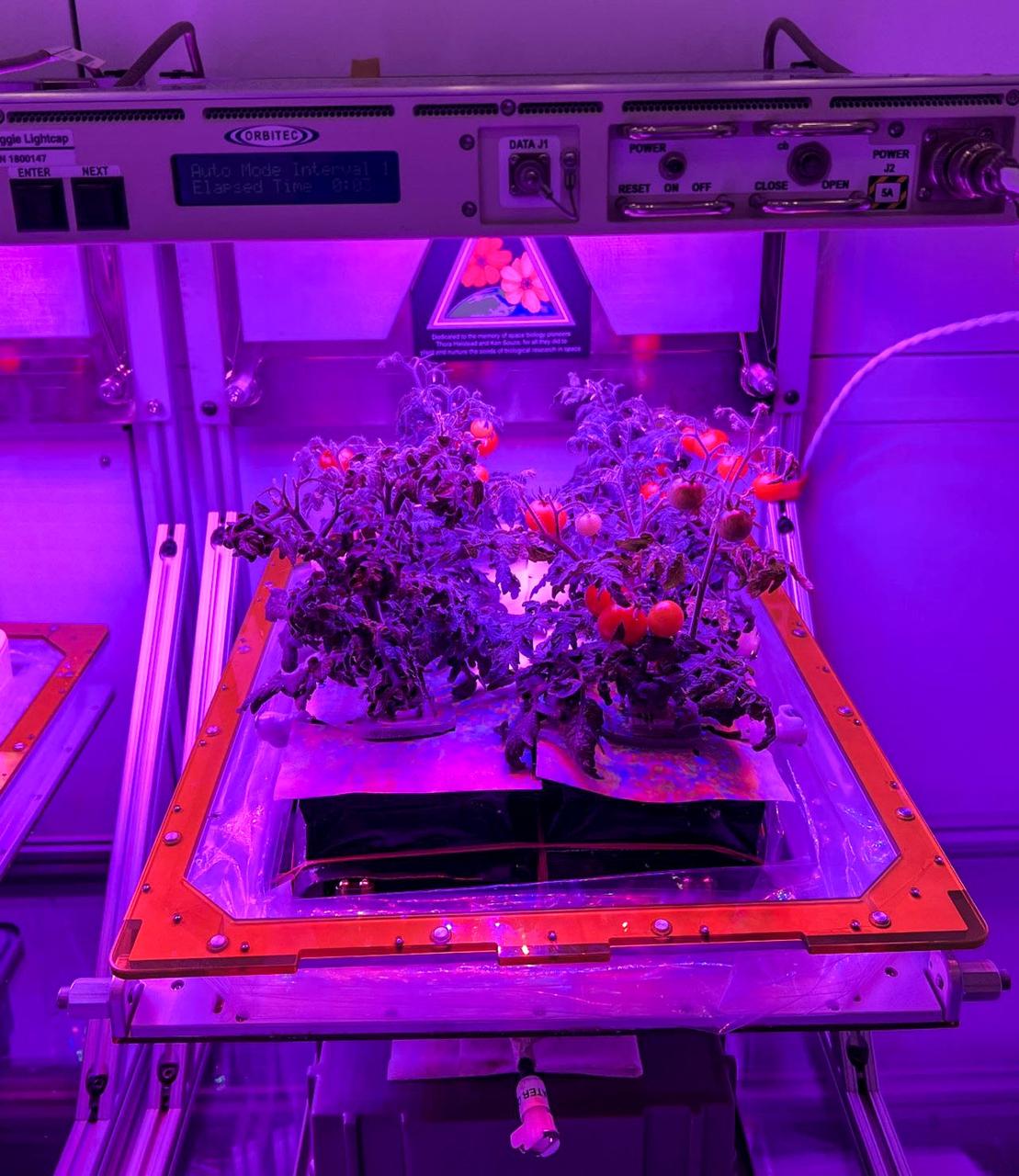
jsc2022e072972 (9/22/2022) --- A preflight view of ‘Red Robin’ dwarf tomato growing in growing in Veggie hardware at the Kennedy Space Center - part of Veg-05 experiment.
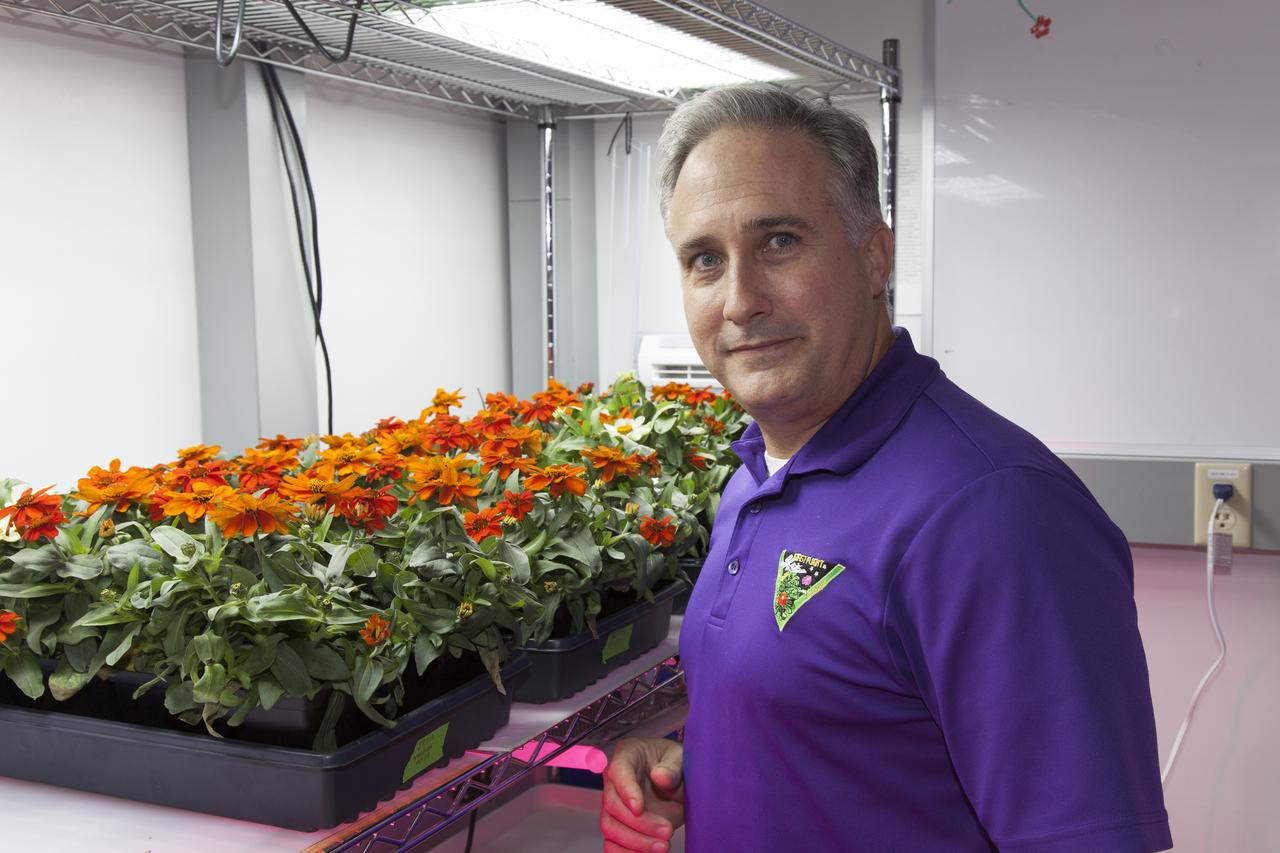
Trent Smith, Veggie project manager, Exploration Research and Technology Programs, is in the Veggie Laboratory in the Space Station Processing Facility (SSPF) at NASA's Kennedy Space Center in Florida on Nov. 27, 2018. Next to him are zinnia flowers grown from seeds germinated in the Veggie plant growth system on the International Space Station. The seeds were returned to Earth and researchers in the SSPF planted them in the Veggie control unit and grew the colorful flowers.
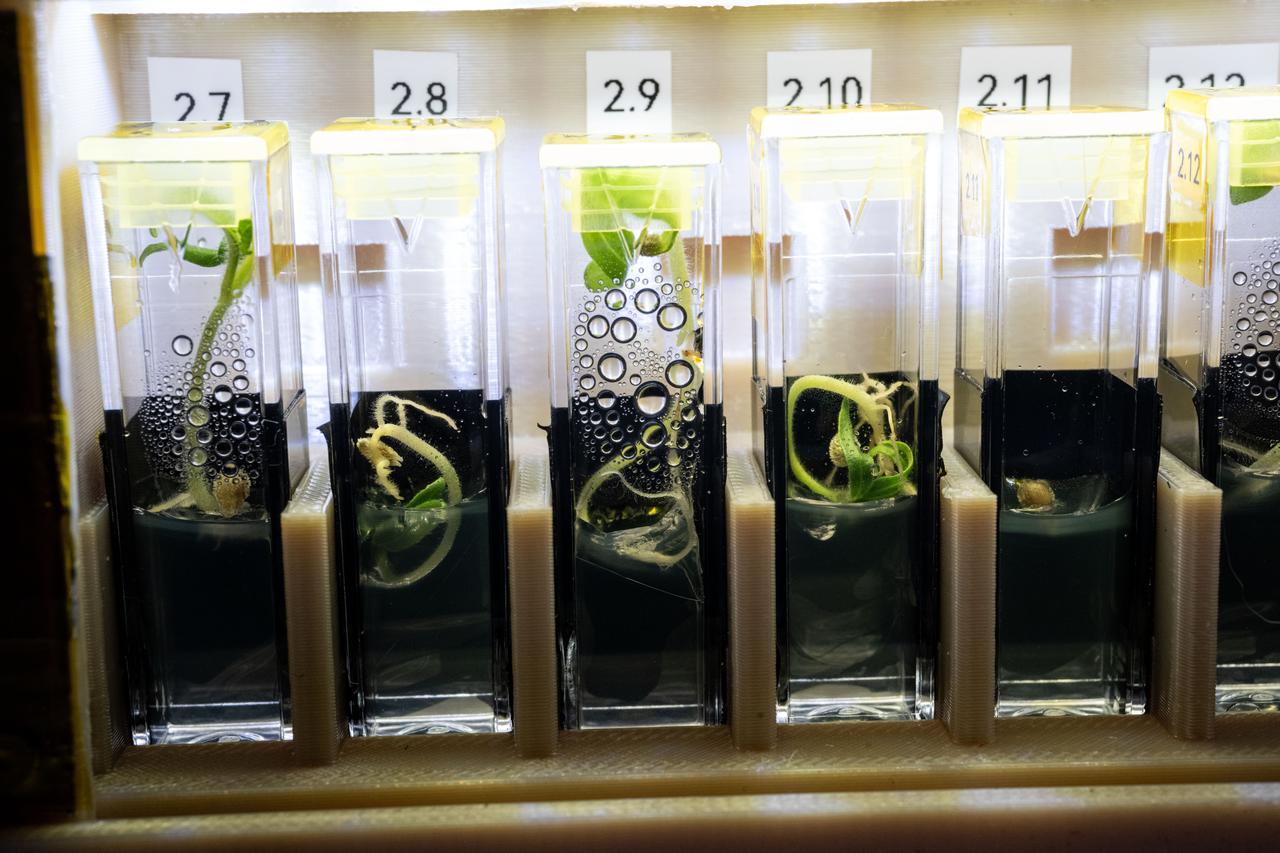
iss073e0032789 (May 16, 2025) --- Genetically modified, extemely dwarf tomato plants are pictured growing inside specialized research hardware, called Rhodium BioCuvettes, aboard the International Space Station's Destiny laboratory module. The space botany experiment tests the plants ability to grow without photosynthesis and survive in confined environments in weightlessness potentially supporting crop production on spacecraft.
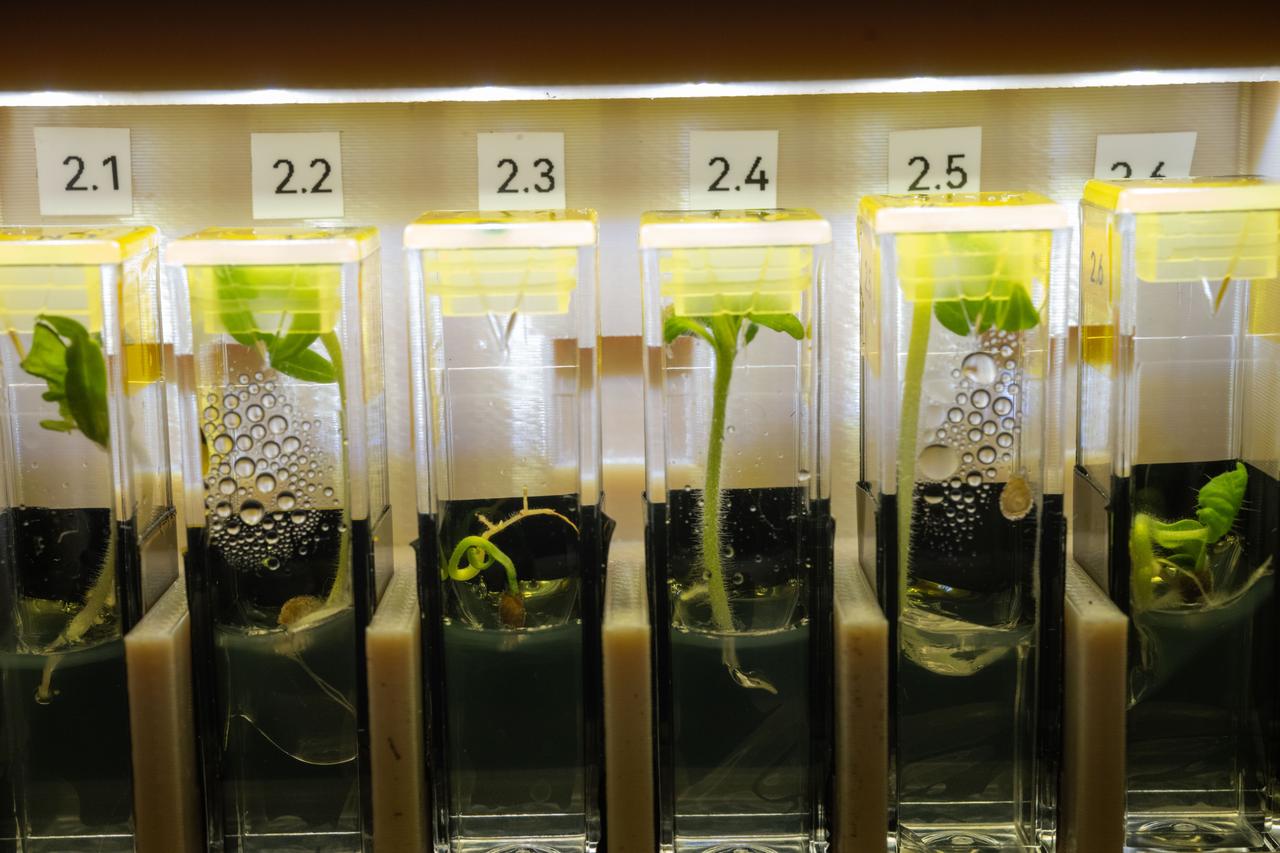
iss073e0031528 (May 15, 2025) --- Genetically modified, extemely dwarf tomato plants are pictured growing inside specialized research hardware, called Rhodium BioCuvettes, aboard the International Space Station's Destiny laboratory module. The space botany experiment tests the plants ability to grow without photosynthesis and survive in confined environments in weightlessness potentially supporting crop production on spacecraft.
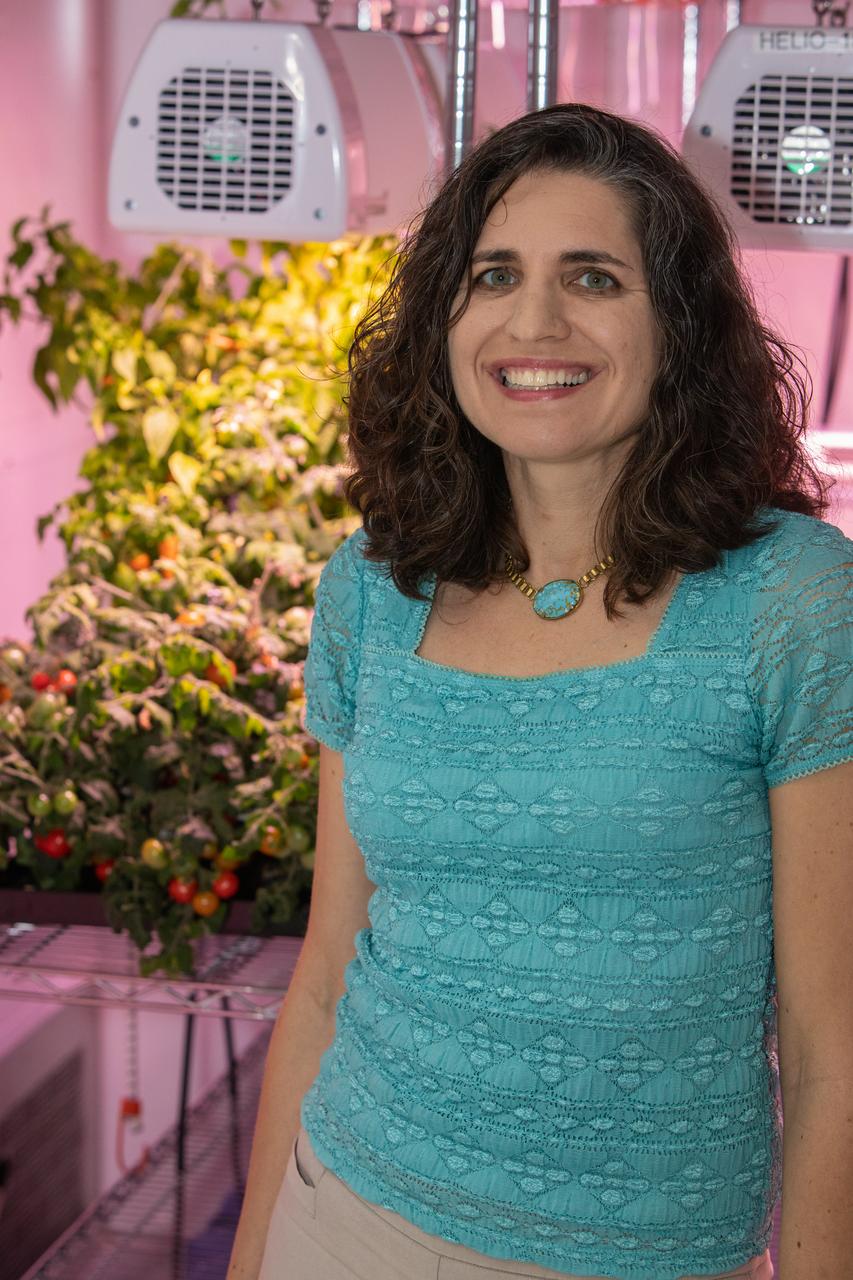
Gioia Massa, a NASA project scientist, poses inside a lab at the Space Station Processing Facility located at the agency’s Kennedy Space Center in Florida. Massa’s responsibilities include studying the effects of a microgravity environment on plant growth, discovering the perfect conditions for growing plants in space and determining what plant species grow the most effectively under those conditions. Massa and her team are currently experimenting with growing plants aboard the International Space Station to develop the knowhow to supplement astronauts’ packaged diets with freshly grown crops, which should facilitate long-duration exploration missions into deep space.
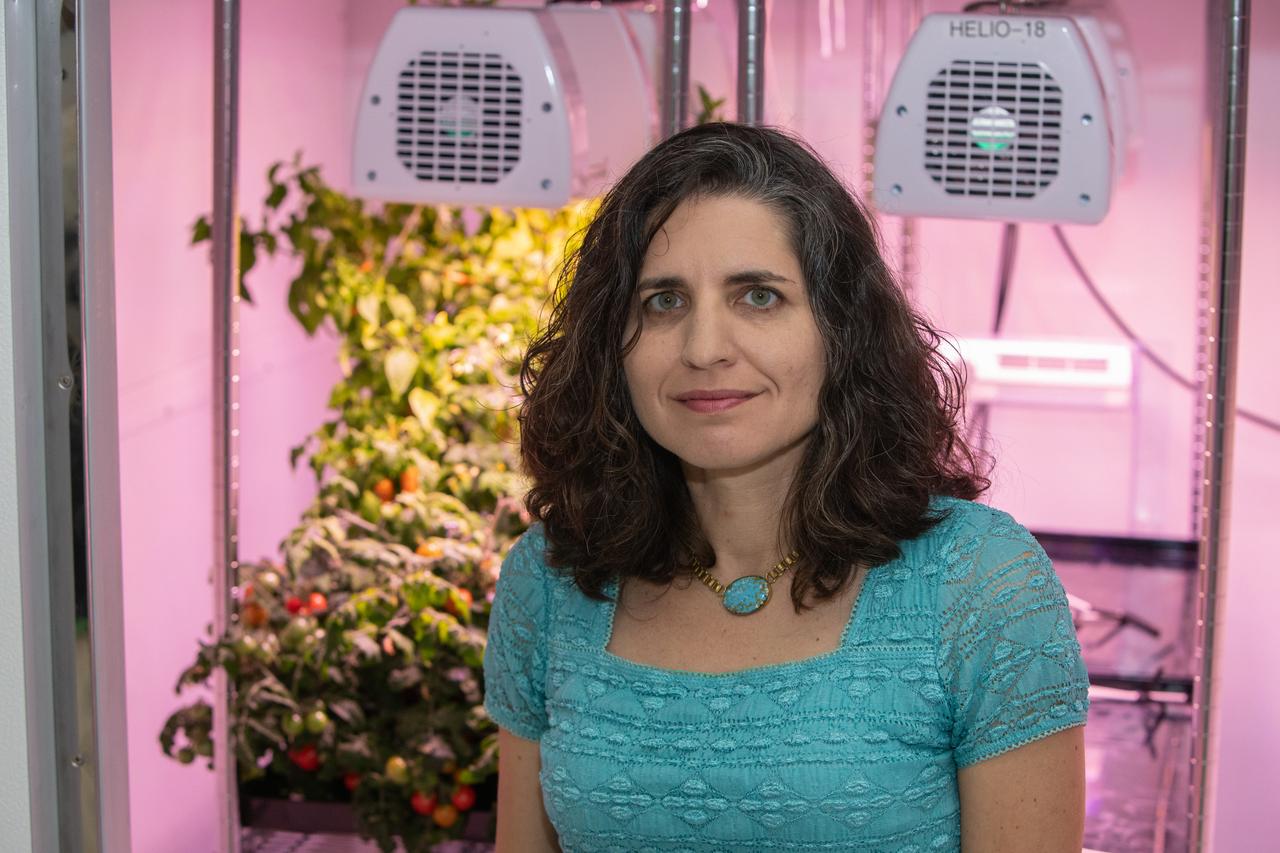
Gioia Massa, a NASA project scientist, poses inside a lab at the Space Station Processing Facility located at the agency’s Kennedy Space Center in Florida. Massa’s responsibilities include studying the effects of a microgravity environment on plant growth, discovering the perfect conditions for growing plants in space and determining what plant species grow the most effectively under those conditions. Massa and her team are currently experimenting with growing plants aboard the International Space Station to develop the knowhow to supplement astronauts’ packaged diets with freshly grown crops, which should facilitate long-duration exploration missions into deep space.
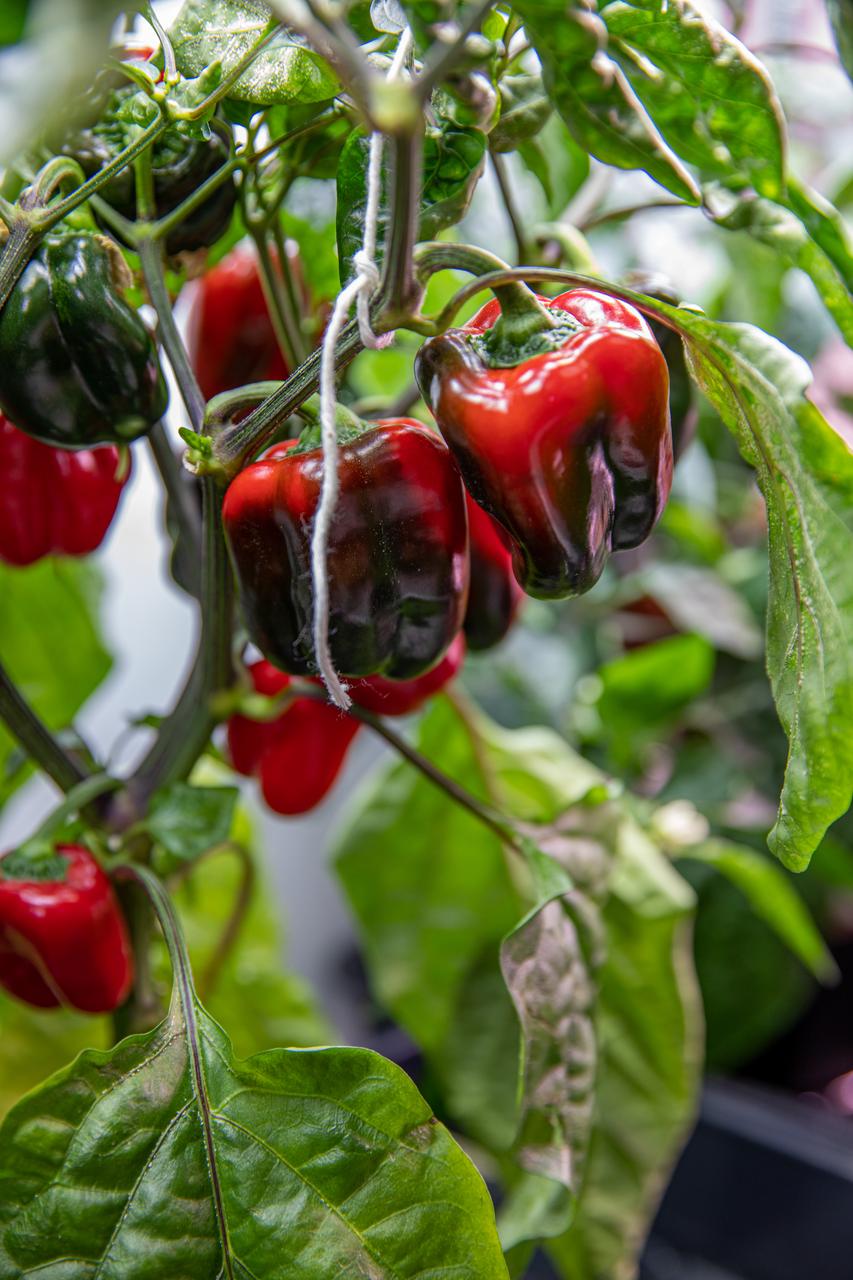
Researchers are growing green peppers inside the Space Station Processing Facility at NASA’s Kennedy Space Center in Florida on Jan. 15, 2020, in preparation for sending them to space. As NASA prepares to send humans beyond low-Earth orbit, the ability for astronauts to grow a variety of fresh fruits and vegetables in space will be critical. Fresh produce will be an essential supplement to the crew’s pre-packaged diet during long-duration space exploration when they are away from Earth for extended periods of time.
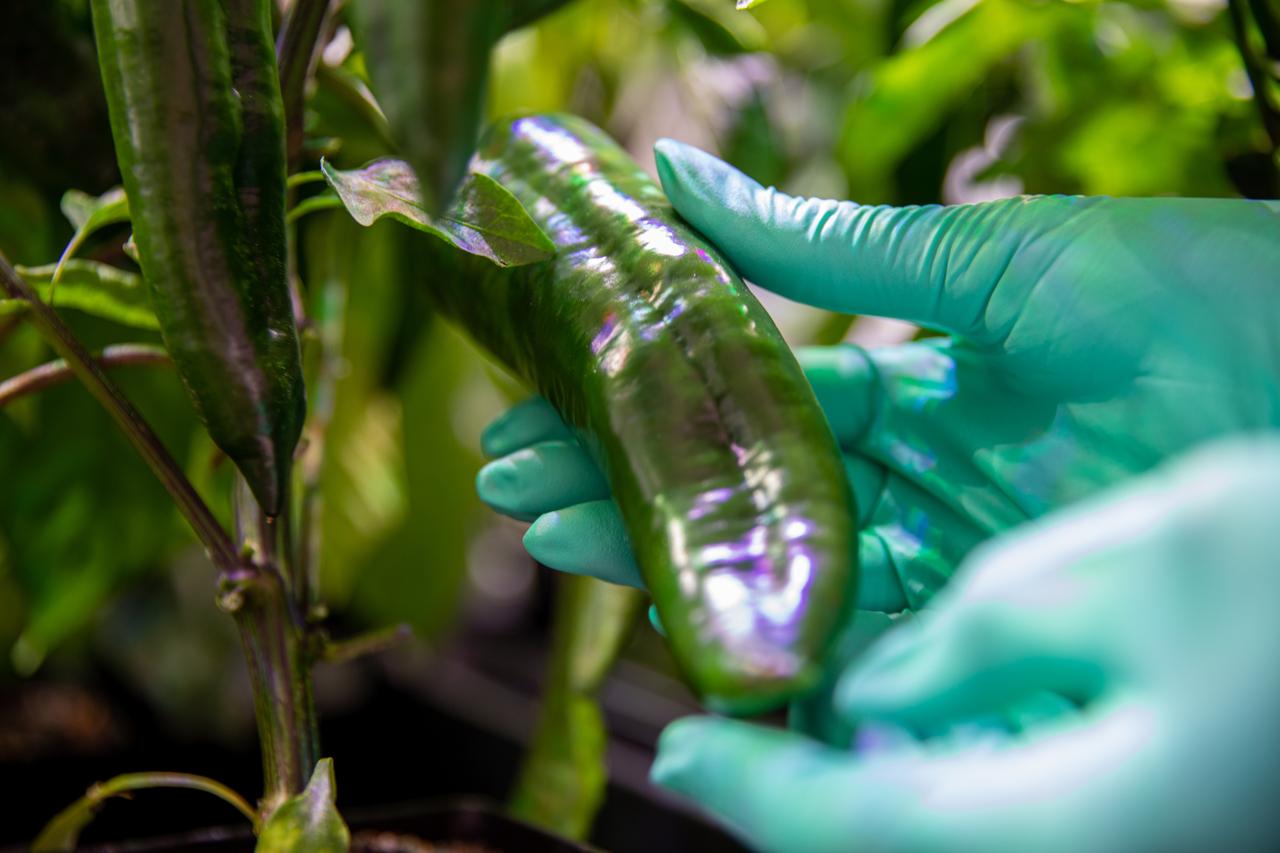
Researchers are growing green peppers inside the Space Station Processing Facility at NASA’s Kennedy Space Center in Florida on Jan. 15, 2020, in preparation for sending them to space. As NASA prepares to send humans beyond low-Earth orbit, the ability for astronauts to grow a variety of fresh fruits and vegetables in space will be critical. Fresh produce will be an essential supplement to the crew’s pre-packaged diet during long-duration space exploration when they are away from Earth for extended periods of time.
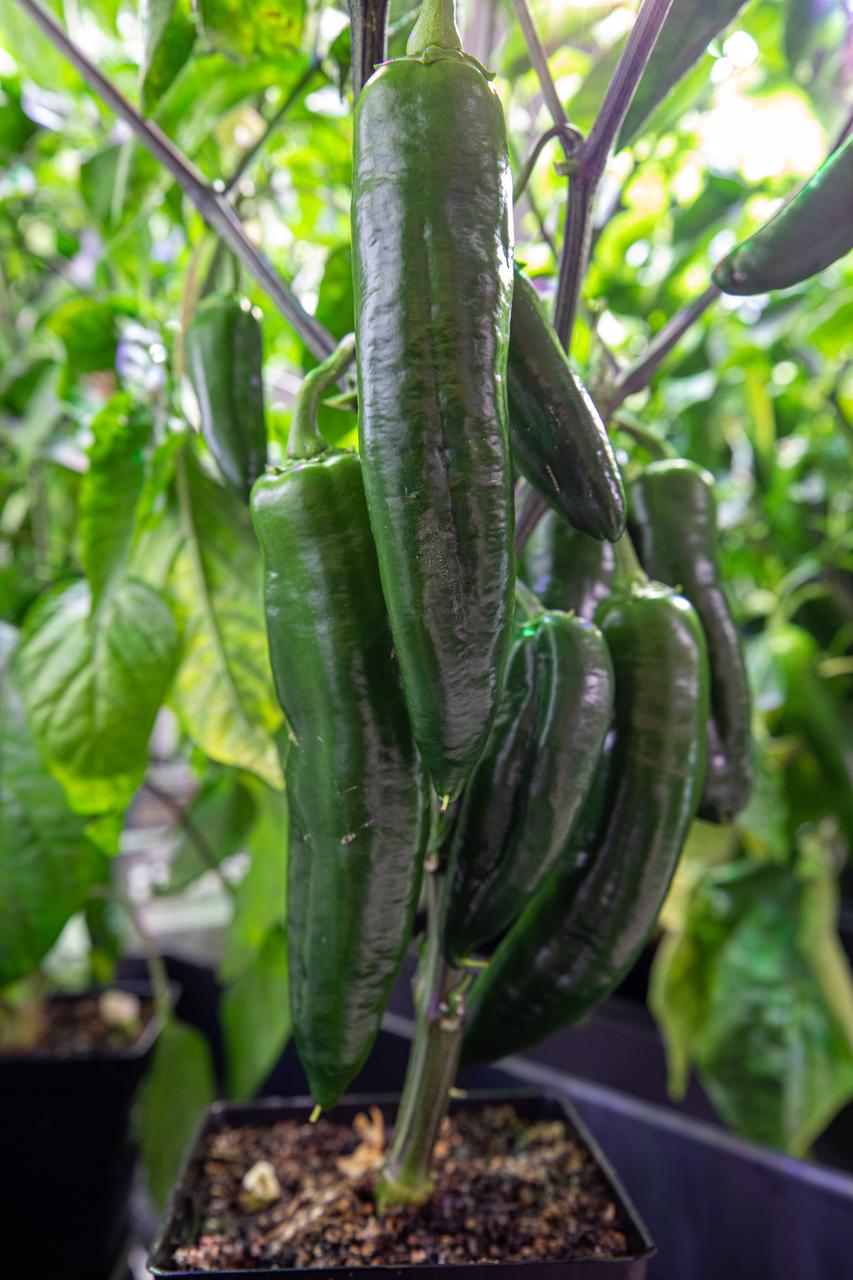
Researchers are growing green peppers inside the Space Station Processing Facility at NASA’s Kennedy Space Center in Florida on Jan. 15, 2020, in preparation for sending them to space. As NASA prepares to send humans beyond low-Earth orbit, the ability for astronauts to grow a variety of fresh fruits and vegetables in space will be critical. Fresh produce will be an essential supplement to the crew’s pre-packaged diet during long-duration space exploration when they are away from Earth for extended periods of time.
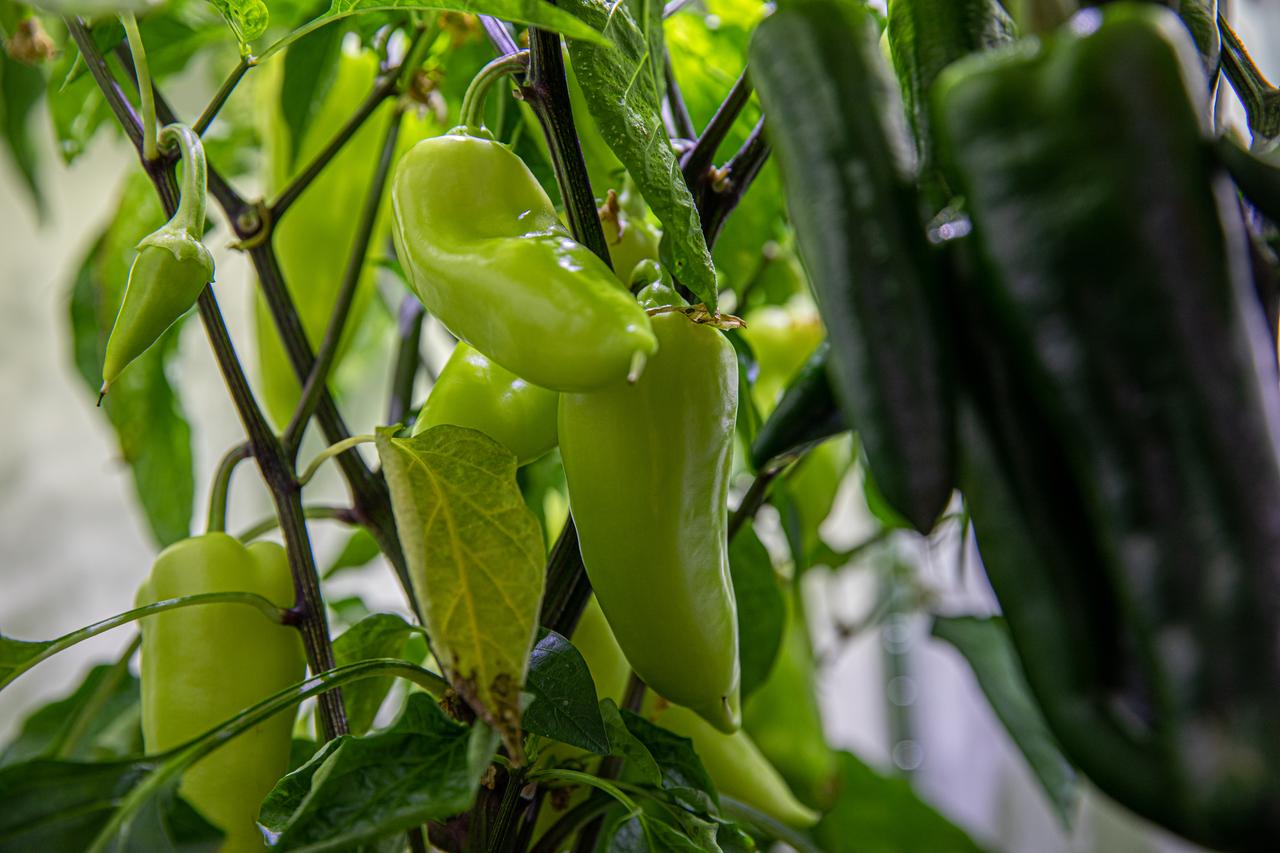
Researchers are growing green peppers inside the Space Station Processing Facility at NASA’s Kennedy Space Center in Florida on Jan. 15, 2020, in preparation for sending them to space. As NASA prepares to send humans beyond low-Earth orbit, the ability for astronauts to grow a variety of fresh fruits and vegetables in space will be critical. Fresh produce will be an essential supplement to the crew’s pre-packaged diet during long-duration space exploration when they are away from Earth for extended periods of time.
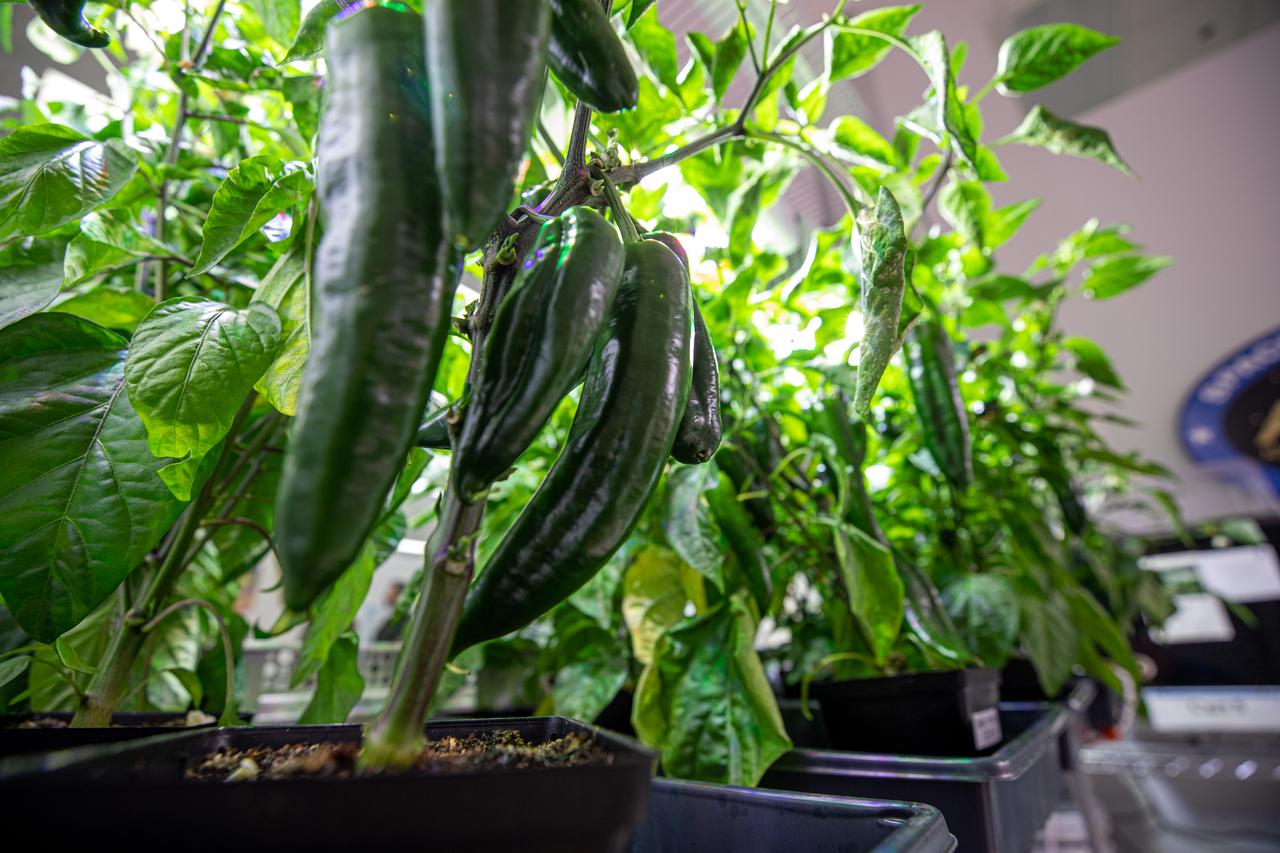
Researchers are growing green peppers inside the Space Station Processing Facility at NASA’s Kennedy Space Center in Florida on Jan. 15, 2020, in preparation for sending them to space. As NASA prepares to send humans beyond low-Earth orbit, the ability for astronauts to grow a variety of fresh fruits and vegetables in space will be critical. Fresh produce will be an essential supplement to the crew’s pre-packaged diet during long-duration space exploration when they are away from Earth for extended periods of time.
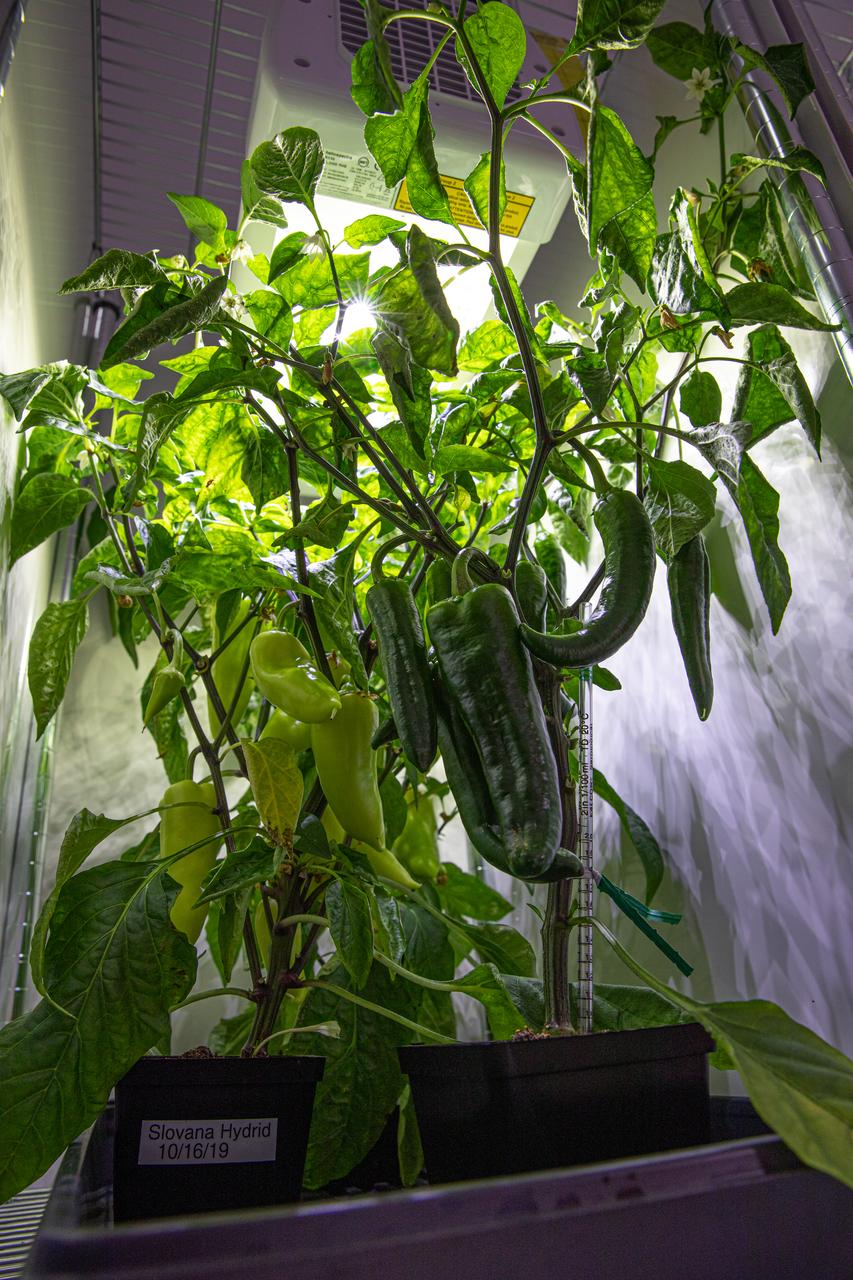
Researchers are growing green peppers inside the Space Station Processing Facility at NASA’s Kennedy Space Center in Florida on Jan. 15, 2020, in preparation for sending them to space. As NASA prepares to send humans beyond low-Earth orbit, the ability for astronauts to grow a variety of fresh fruits and vegetables in space will be critical. Fresh produce will be an essential supplement to the crew’s pre-packaged diet during long-duration space exploration when they are away from Earth for extended periods of time.
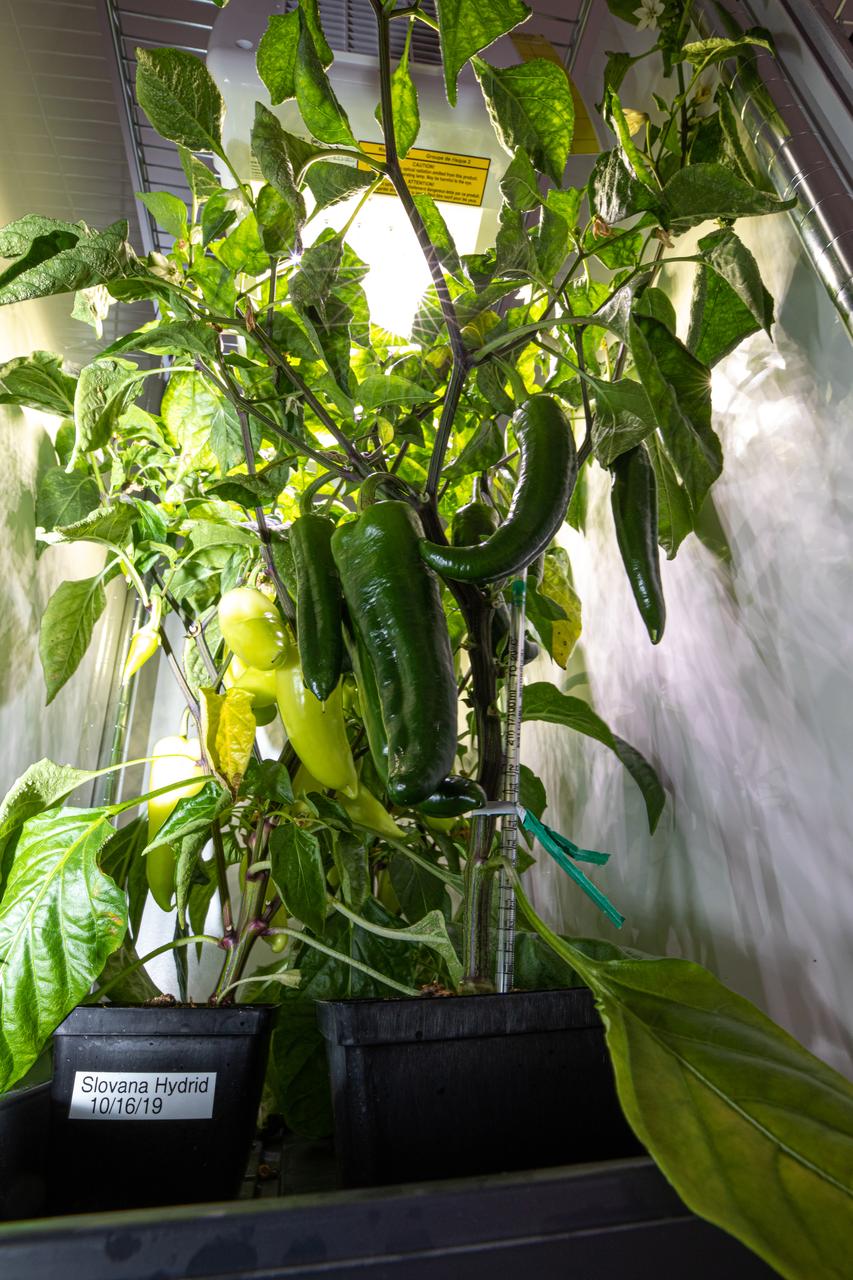
Researchers are growing green peppers inside the Space Station Processing Facility at NASA’s Kennedy Space Center in Florida on Jan. 15, 2020, in preparation for sending them to space. As NASA prepares to send humans beyond low-Earth orbit, the ability for astronauts to grow a variety of fresh fruits and vegetables in space will be critical. Fresh produce will be an essential supplement to the crew’s pre-packaged diet during long-duration space exploration when they are away from Earth for extended periods of time.
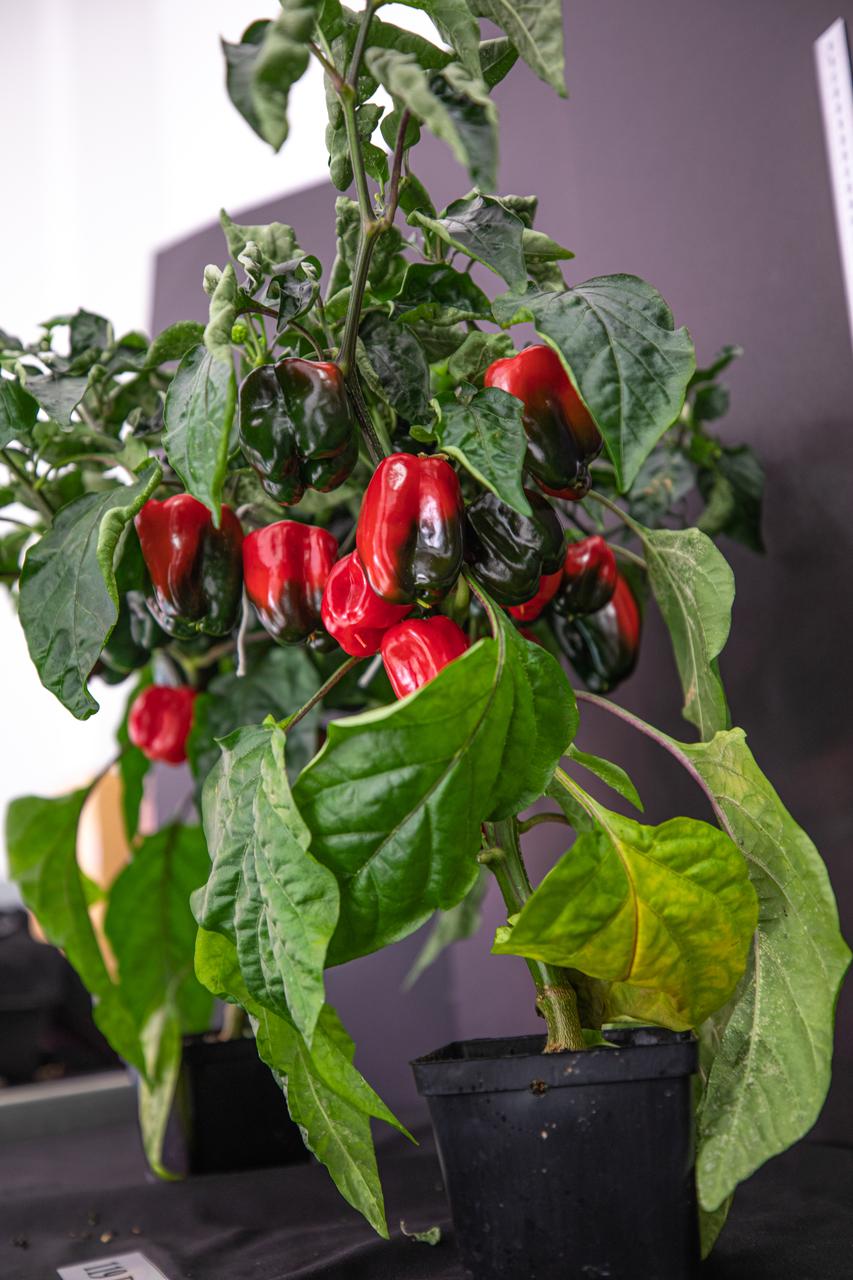
Researchers are growing green peppers inside the Space Station Processing Facility at NASA’s Kennedy Space Center in Florida on Jan. 15, 2020, in preparation for sending them to space. As NASA prepares to send humans beyond low-Earth orbit, the ability for astronauts to grow a variety of fresh fruits and vegetables in space will be critical. Fresh produce will be an essential supplement to the crew’s pre-packaged diet during long-duration space exploration when they are away from Earth for extended periods of time.
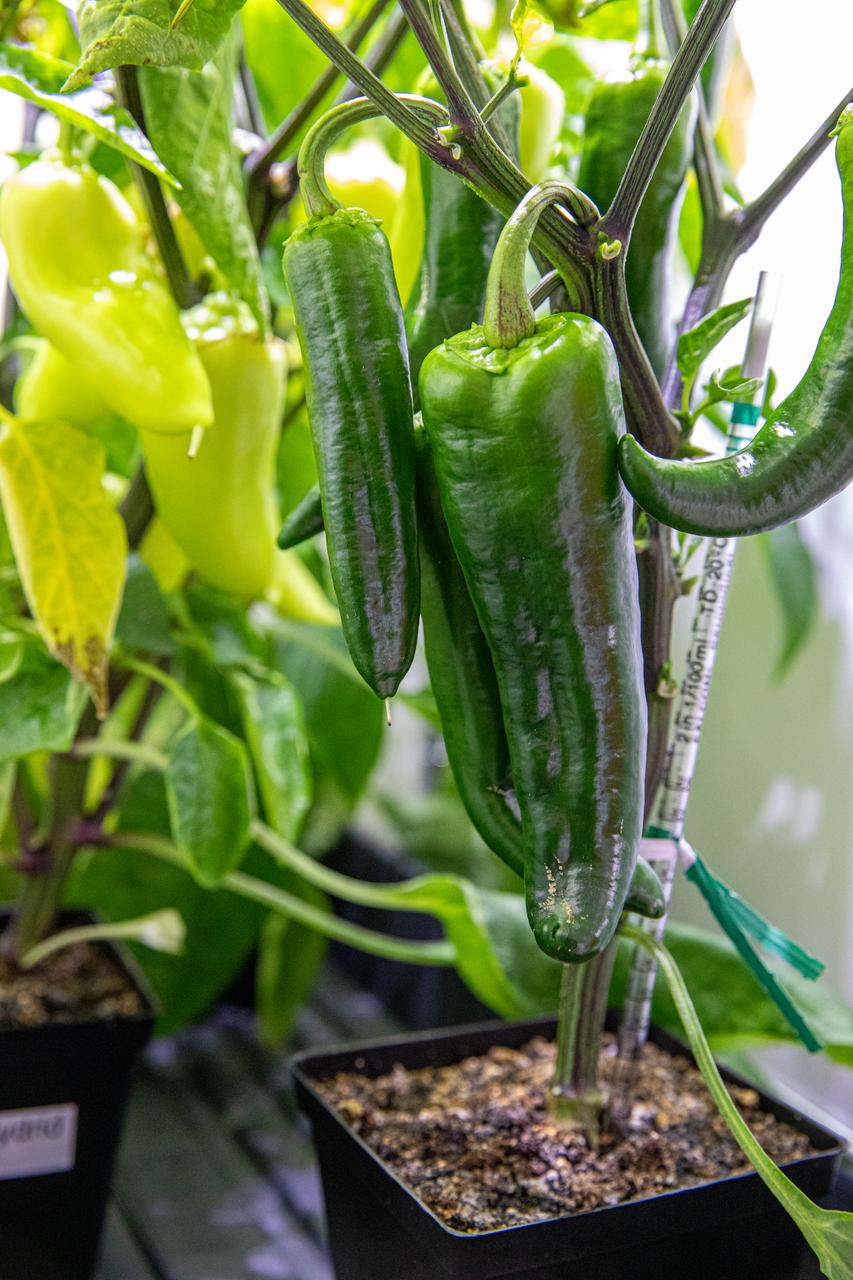
Researchers are growing green peppers inside the Space Station Processing Facility at NASA’s Kennedy Space Center in Florida on Jan. 15, 2020, in preparation for sending them to space. As NASA prepares to send humans beyond low-Earth orbit, the ability for astronauts to grow a variety of fresh fruits and vegetables in space will be critical. Fresh produce will be an essential supplement to the crew’s pre-packaged diet during long-duration space exploration when they are away from Earth for extended periods of time.
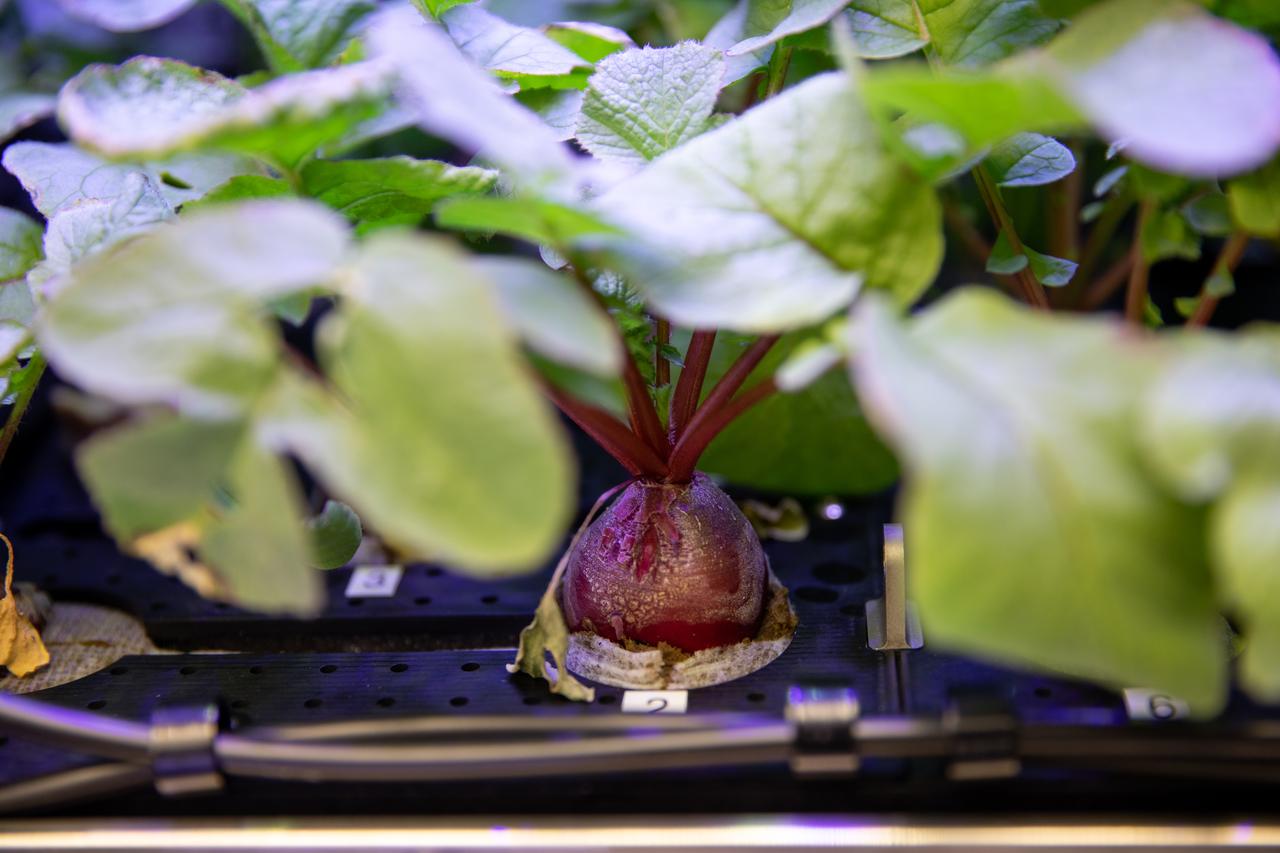
A view of radishes growing in the Advanced Plant Habitat (APH) ground unit inside the Space Station Processing Facility at NASA’s Kennedy Space Center in Florida on Dec. 14, 2020. The radishes are a ground control crop for the Plant Habitat-02 (PH-02) experiment. The experiment also involves growing two similar radish crops inside the International Space Station’s APH. NASA astronaut Kate Rubins harvested the first crop on Nov. 30, and the second harvest aboard the orbiting laboratory is planned for Dec. 30. Once samples return to Earth, researchers will compare those grown in space to the radishes grown here on Earth to better understand how microgravity affects plant growth.
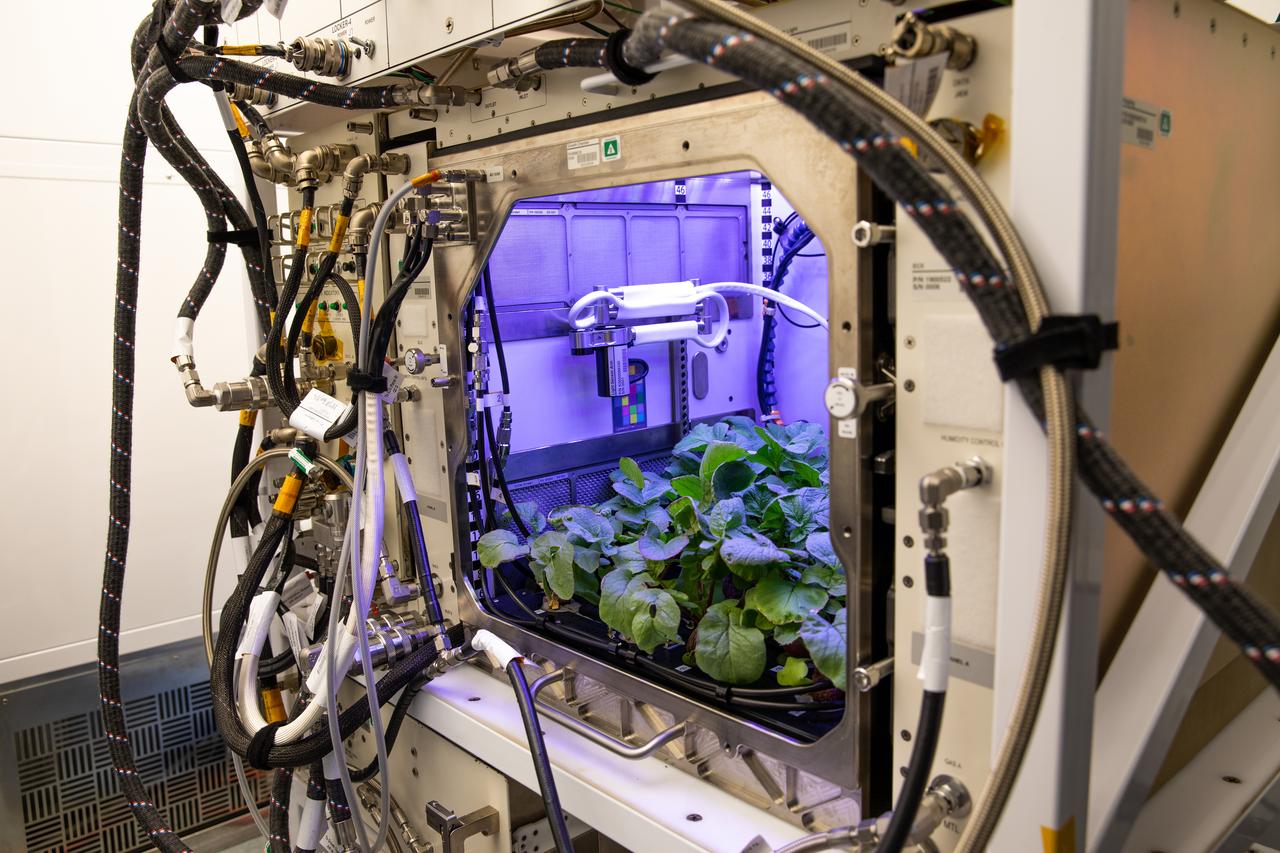
A view of radishes growing in the Advanced Plant Habitat (APH) ground unit inside the Space Station Processing Facility at NASA’s Kennedy Space Center in Florida on Dec. 14, 2020. The radishes are a ground control crop for the Plant Habitat-02 (PH-02) experiment, which also involves growing two similar radish crops inside the International Space Station’s APH. NASA astronaut Kate Rubins harvested the first crop on Nov. 30, and the second harvest aboard the orbiting laboratory is planned for Dec. 30. Once samples return to Earth, researchers will compare those grown in space to the radishes grown here on Earth to better understand how microgravity affects plant growth.
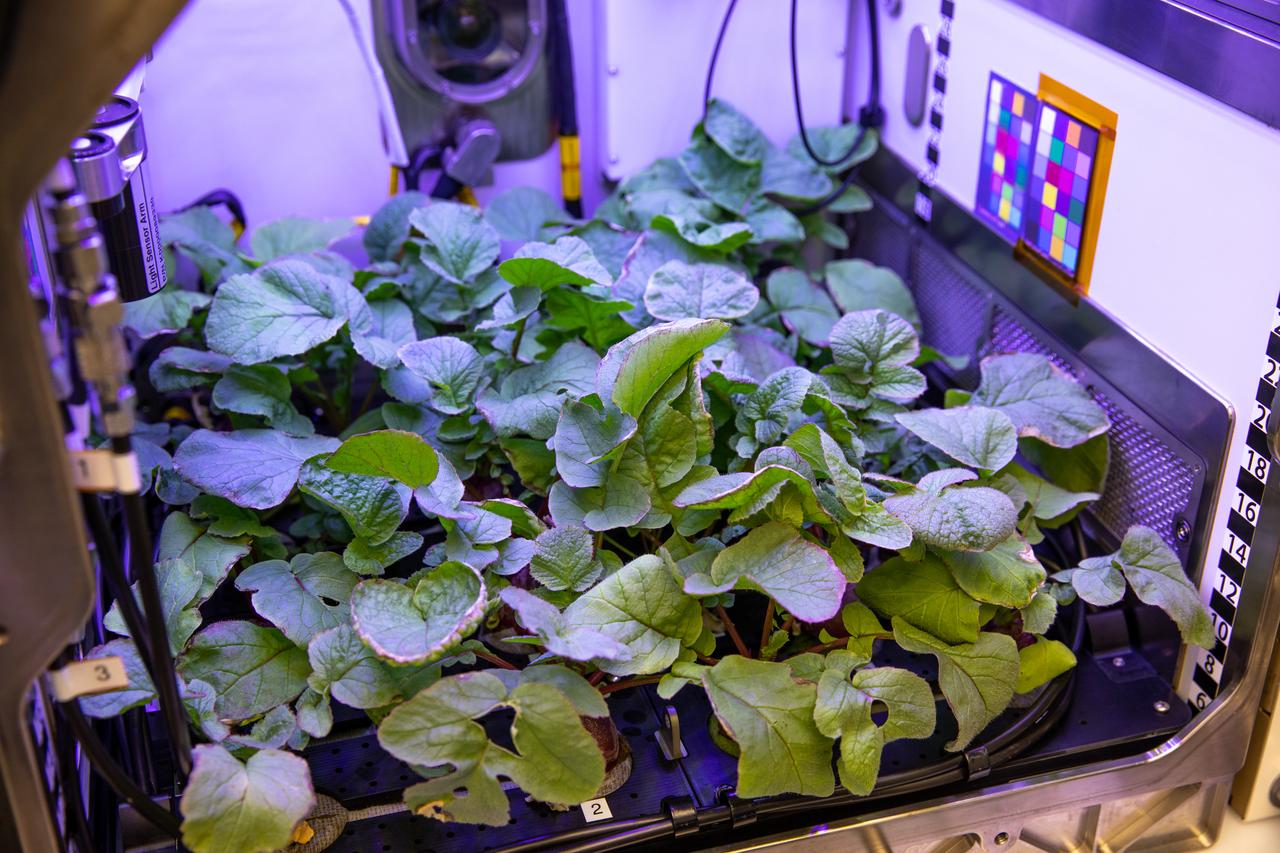
A view of radishes growing in the Advanced Plant Habitat (APH) ground unit inside the Space Station Processing Facility at NASA’s Kennedy Space Center in Florida on Dec. 14, 2020. The radishes are a ground control crop for the Plant Habitat-02 (PH-02) experiment. The experiment also involves growing two similar radish crops inside the International Space Station’s APH. NASA astronaut Kate Rubins harvested the first crop on Nov. 30, and the second harvest aboard the orbiting laboratory is planned for Dec. 30. Once samples return to Earth, researchers will compare those grown in space to the radishes grown here on Earth to better understand how microgravity affects plant growth.
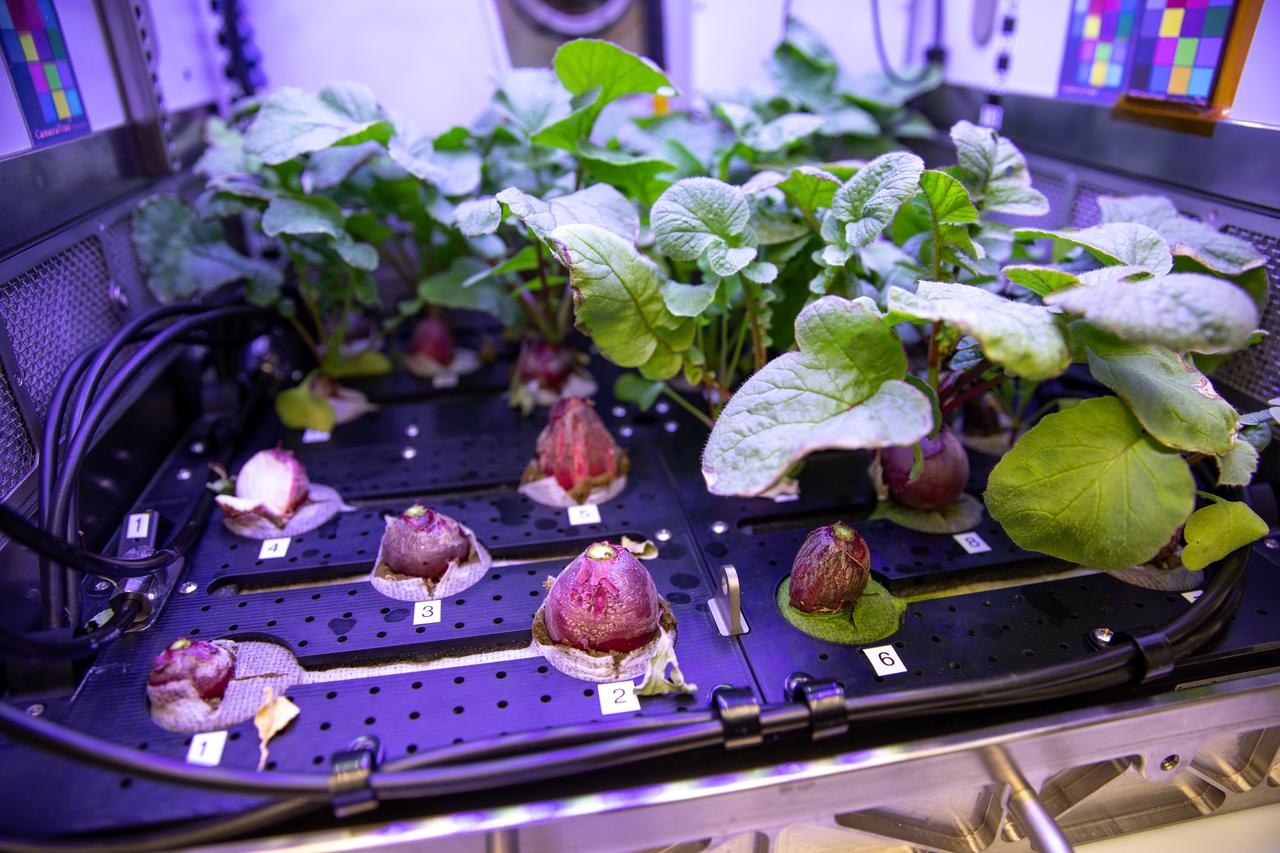
A view of radishes growing in the Advanced Plant Habitat (APH) ground unit inside the Space Station Processing Facility at NASA’s Kennedy Space Center in Florida on Dec. 14, 2020. The radishes are a ground control crop for the Plant Habitat-02 (PH-02) experiment. The experiment also involves growing two similar radish crops inside the International Space Station’s APH. NASA astronaut Kate Rubins harvested the first crop on Nov. 30, and the second harvest aboard the orbiting laboratory is planned for Dec. 30. Once samples return to Earth, researchers will compare those grown in space to the radishes grown here on Earth to better understand how microgravity affects plant growth.
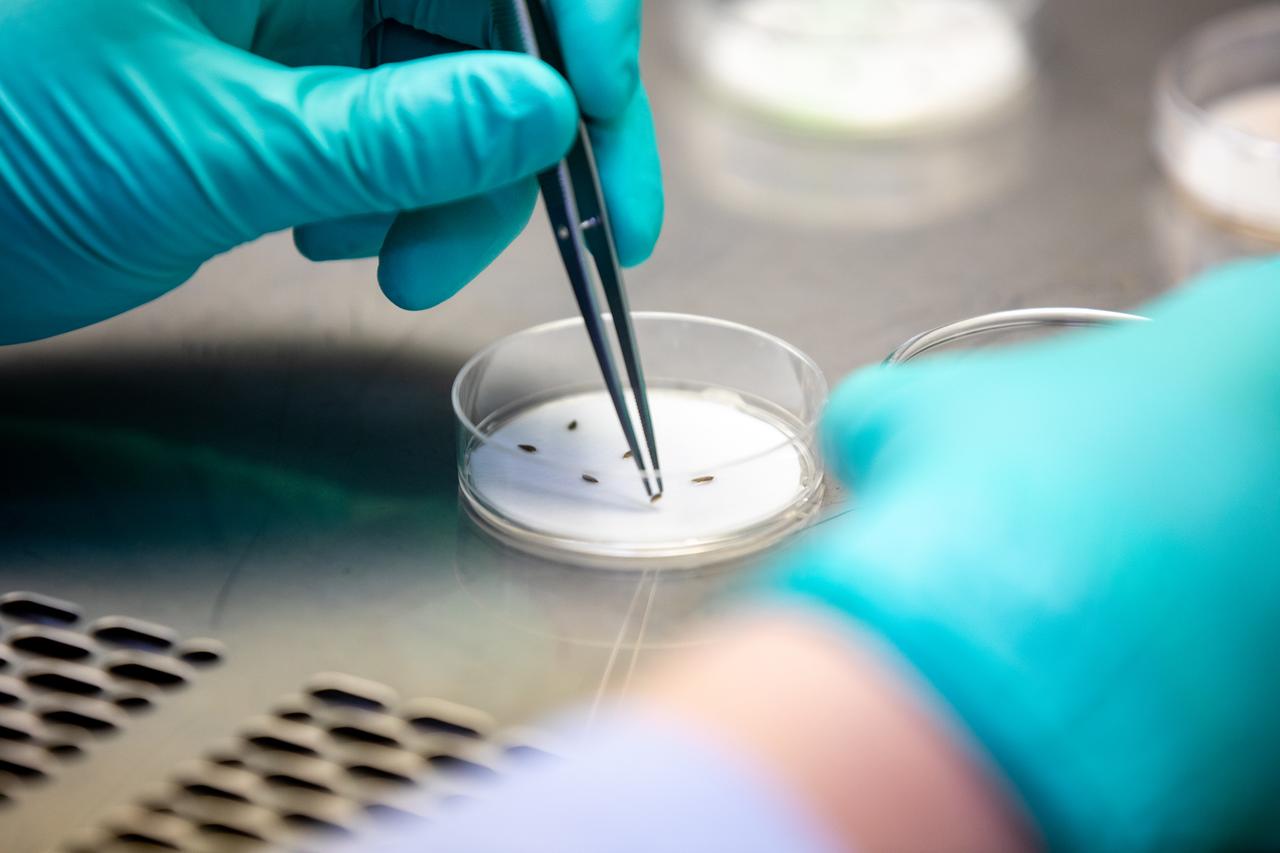
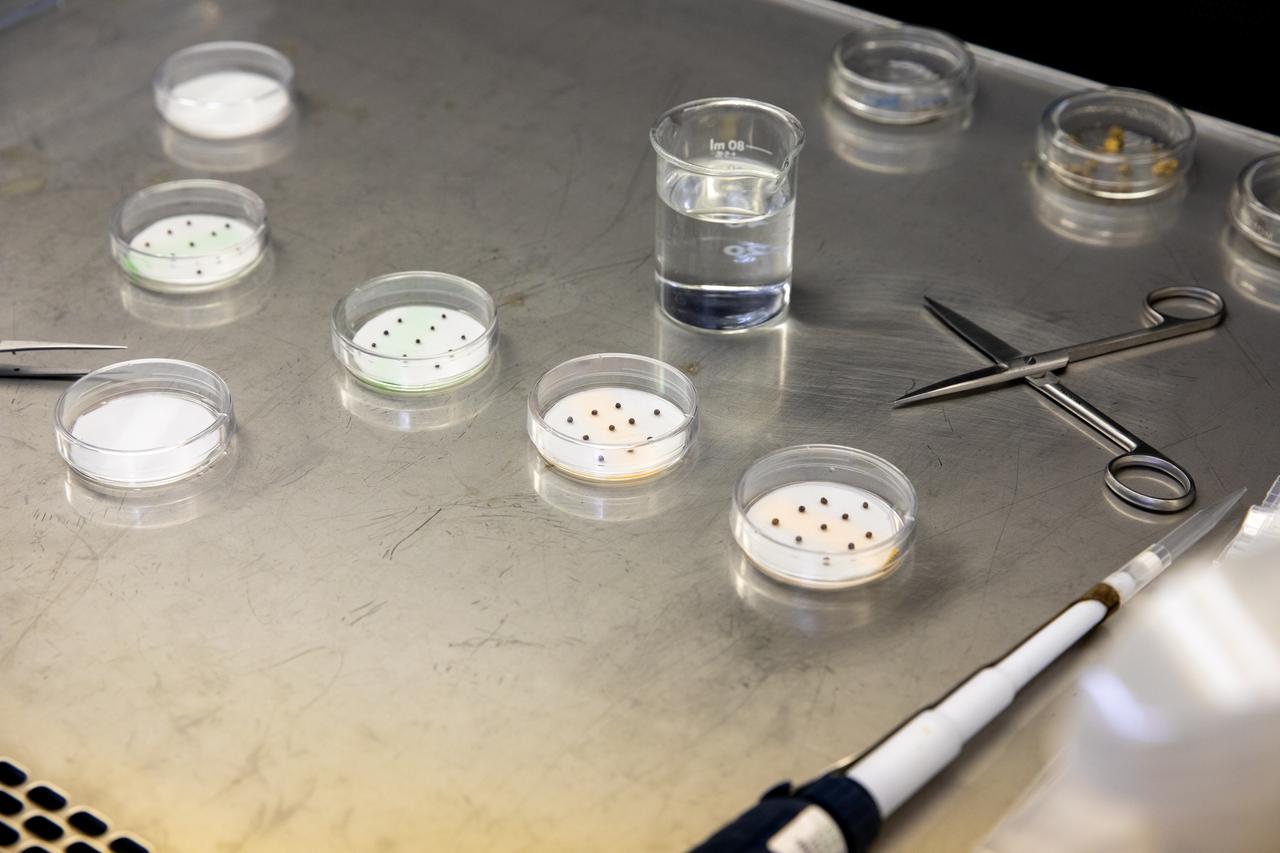
Inside the Space Station Processing Facility at NASA’s Kennedy Space Center in Florida on Jan. 15, 2020, red romaine lettuce seeds are being prepared for a germination test. The test will verify that the seeds can successfully grow from seed film – a new seed handling material – here on Earth before it’s sent to the International Space Station for testing in a microgravity environment as part of the VEG-03 series of experiments. The seed film experiment involves crew aboard the orbiting laboratory planting the seeds into plant pillows – a common method used to grow plants in space – themselves for the first time ever. The water-soluble, dissolving film addresses the challenge of handling seeds in a microgravity environment and also can be used to deliver fertilizers and other beneficial substances that help plants grow. The experiment will launch aboard a Northrop Grumman Antares rocket and Cygnus spacecraft on the company’s 13th resupply services mission to the space station. Liftoff is scheduled for Feb. 9, 2020, at 5:39 p.m. EST from the agency’s Wallops Flight Facility in Virginia.
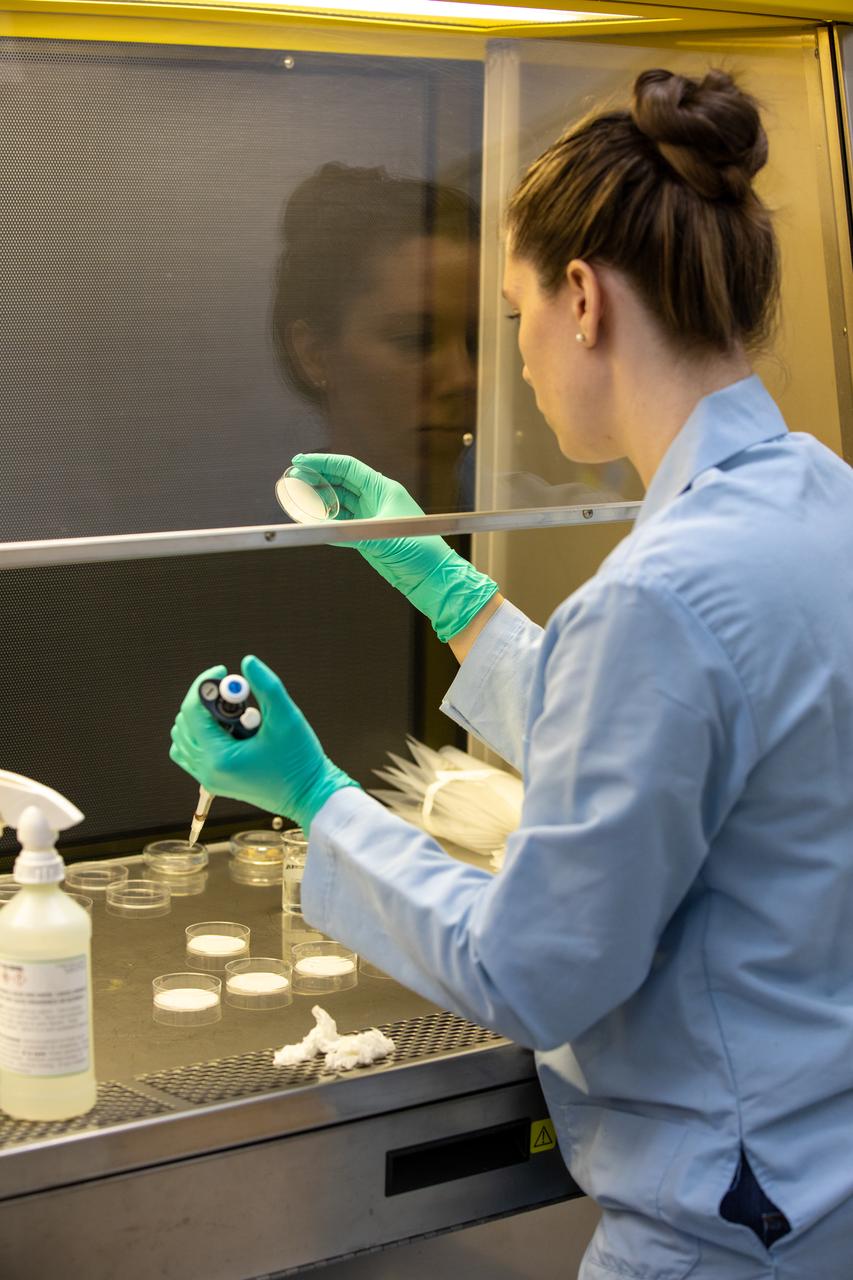
Inside the Space Station Processing Facility at NASA’s Kennedy Space Center in Florida on Jan. 15, 2020, Jess Bunchek, a pseudonaut and associate scientist, prepares seeds for a germination test. The test will verify that the seeds can successfully grow here on Earth before they are sent to the International Space Station for testing in a microgravity environment as part of the VEG-03 series of experiments. The seed film experiment involves crew aboard the orbiting laboratory planting the seeds into plant pillows – a common method used to grow plants in space – themselves for the first time ever. The water-soluble, dissolving film addresses the challenge of handling seeds in a microgravity environment and also can be used to deliver fertilizers and other beneficial substances that help plants grow. The experiment will launch aboard a Northrop Grumman Antares rocket and Cygnus spacecraft on the company’s 13th resupply services mission to the space station. Liftoff is scheduled for Feb. 9, 2020, at 5:39 p.m. EST from the agency’s Wallops Flight Facility in Virginia.
Jess Bunchek, a pseudonaut and associate scientist at NASA’s Kennedy Space Center in Florida, prepares the materials needed for a germination test of red romaine lettuce seeds inside the Space Station Processing Facility on Jan. 15, 2020. The test will verify that the seeds can successfully grow from seed film – a new seed handling material – here on Earth before it’s sent to the International Space Station for testing in a microgravity environment as part of the VEG-03 series of experiments. The seed film experiment involves crew aboard the orbiting laboratory planting the seeds into plant pillows – a common method used to grow plants in space – themselves for the first time ever. The water-soluble, dissolving film addresses the challenge of handling seeds in a microgravity environment and also can be used to deliver fertilizers and other beneficial substances that help plants grow. The experiment will launch aboard a Northrop Grumman Antares rocket and Cygnus spacecraft on the company’s 13th resupply services mission to the space station. Liftoff is scheduled for Feb. 9, 2020, at 5:39 p.m. EST from the agency’s Wallops Flight Facility in Virginia.
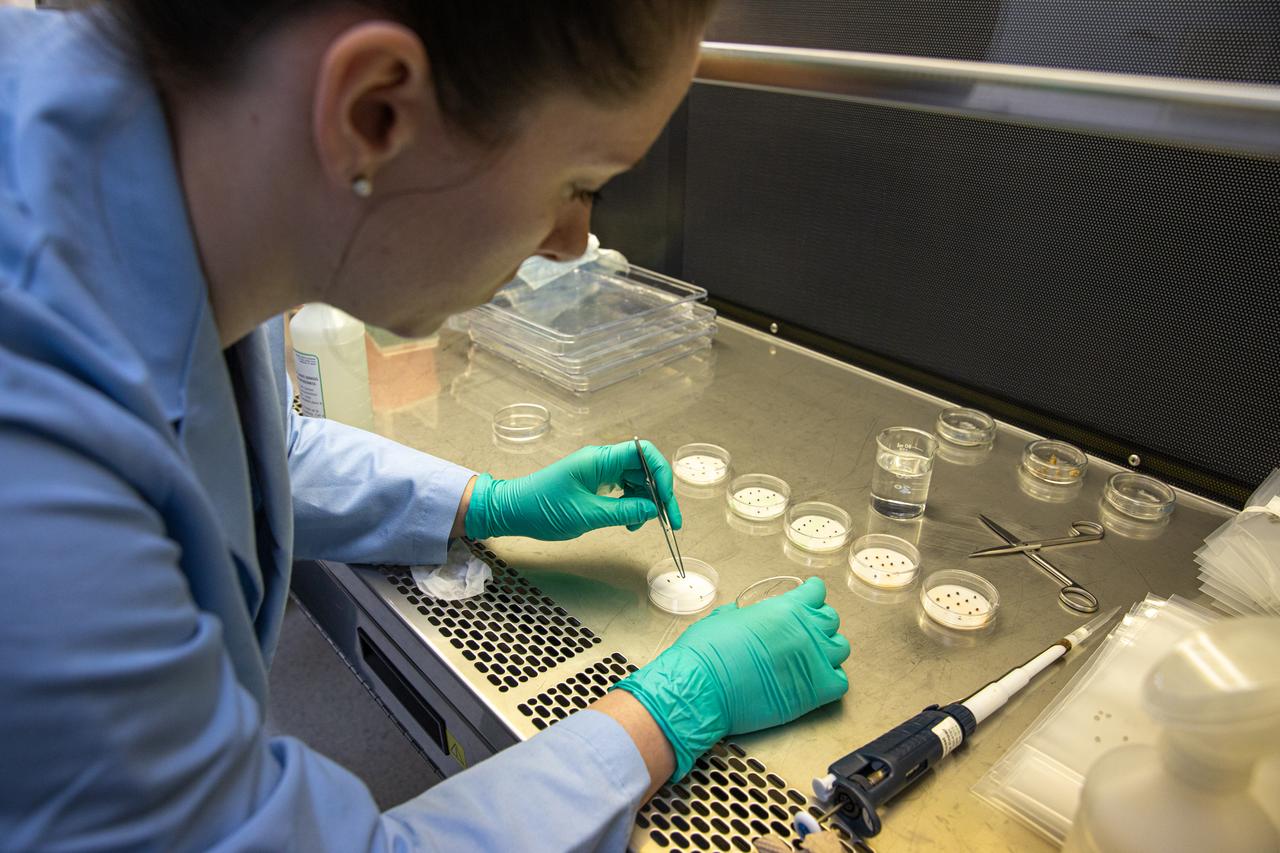
Jess Bunchek, a pseudonaut and associate scientist at NASA’s Kennedy Space Center in Florida, prepares red romaine lettuce seeds for a germination test inside the Space Station Processing Facility on Jan. 15, 2020. The test will verify that the seeds can successfully grow from seed film – a new seed handling material – here on Earth before it’s sent to the International Space Station for testing in a microgravity environment as part of the VEG-03 series of experiments. The seed film experiment involves crew aboard the orbiting laboratory planting the seeds into plant pillows – a common method used to grow plants in space – themselves for the first time ever. The water-soluble, dissolving film addresses the challenge of handling seeds in a microgravity environment and also can be used to deliver fertilizers and other beneficial substances that help plants grow. The experiment will launch aboard a Northrop Grumman Antares rocket and Cygnus spacecraft on the company’s 13th resupply services mission to the space station. Liftoff is scheduled for Feb. 9, 2020, at 5:39 p.m. EST from the agency’s Wallops Flight Facility in Virginia.
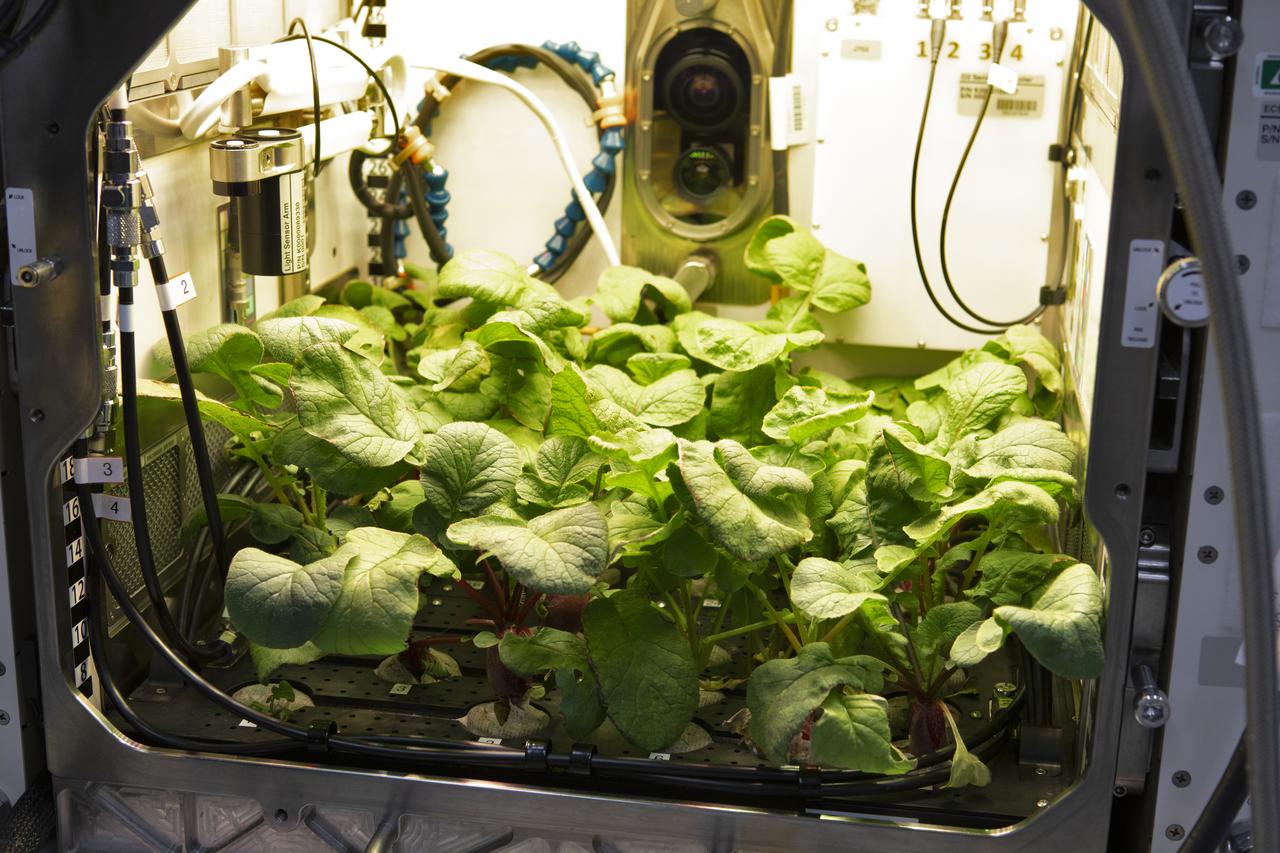
Radish plants are growing inside the Advanced Plant Habitat (APH) ground unit inside a laboratory in the Space Station Processing Facility at NASA's Kennedy Space Center in Florida on June 13, 2019. The plants are being grown as part of a science verification test for PH-02, a Space Life and Physical Sciences Research and Applications-funded experiment which seeks to determine the effects of spaceflight on radishes. The APH is a highly automated plant growth chamber with 180 sensors and is able to closely regulate variables related to plant growth.
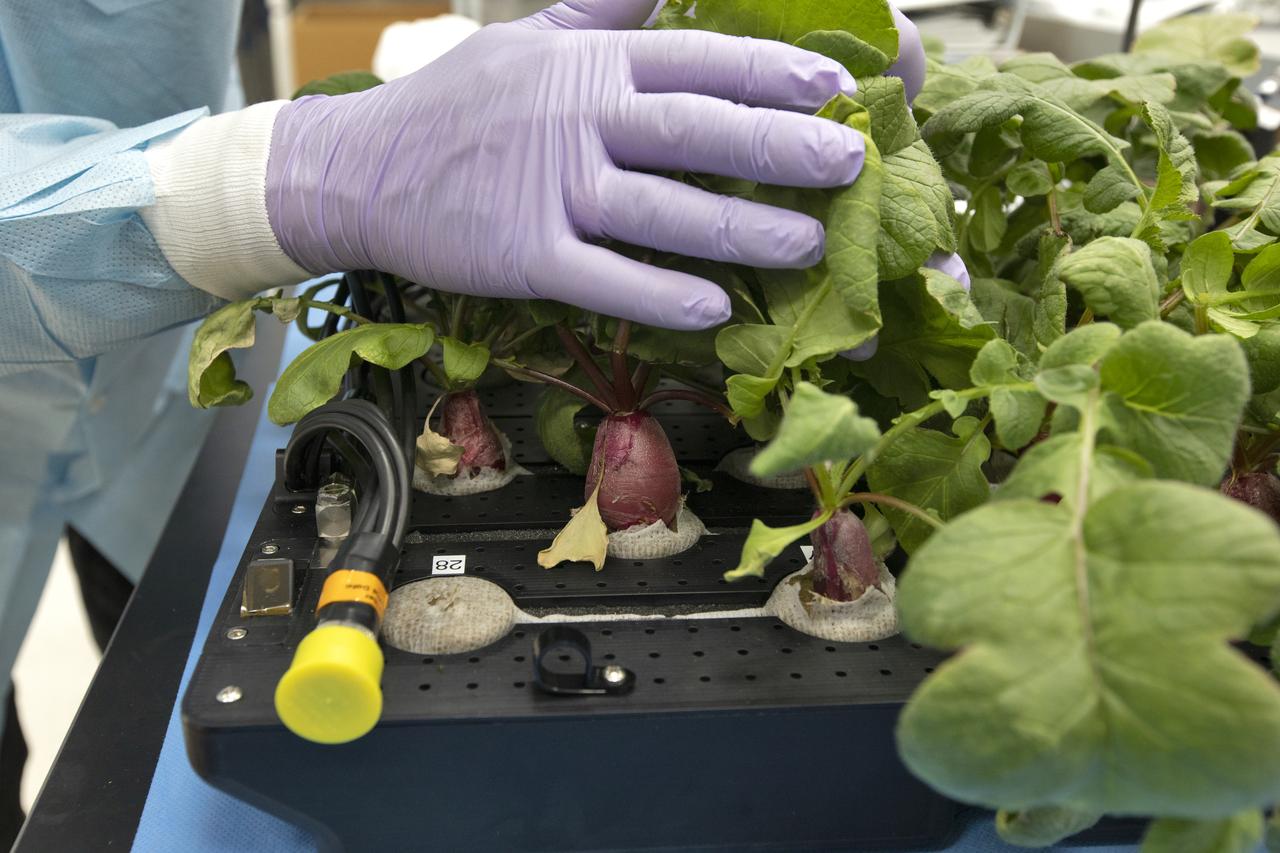
Radish plants are growing inside the Advanced Plant Habitat (APH) ground unit inside a laboratory in the Space Station Processing Facility at NASA's Kennedy Space Center in Florida on June 13, 2019. The plants are being grown as part of a science verification test for PH-02, a Space Life and Physical Sciences Research and Applications-funded experiment which seeks to determine the effects of spaceflight on radishes. The APH is a highly automated plant growth chamber with 180 sensors and is able to closely regulate variables related to plant growth.

Radish plants are growing inside the Advanced Plant Habitat (APH) ground unit inside a laboratory in the Space Station Processing Facility at NASA's Kennedy Space Center in Florida on June 13, 2019. The plants are being grown as part of a science verification test for PH-02, a Space Life and Physical Sciences Research and Applications-funded experiment which seeks to determine the effects of spaceflight on radishes. The APH is a highly automated plant growth chamber with 180 sensors and is able to closely regulate variables related to plant growth.
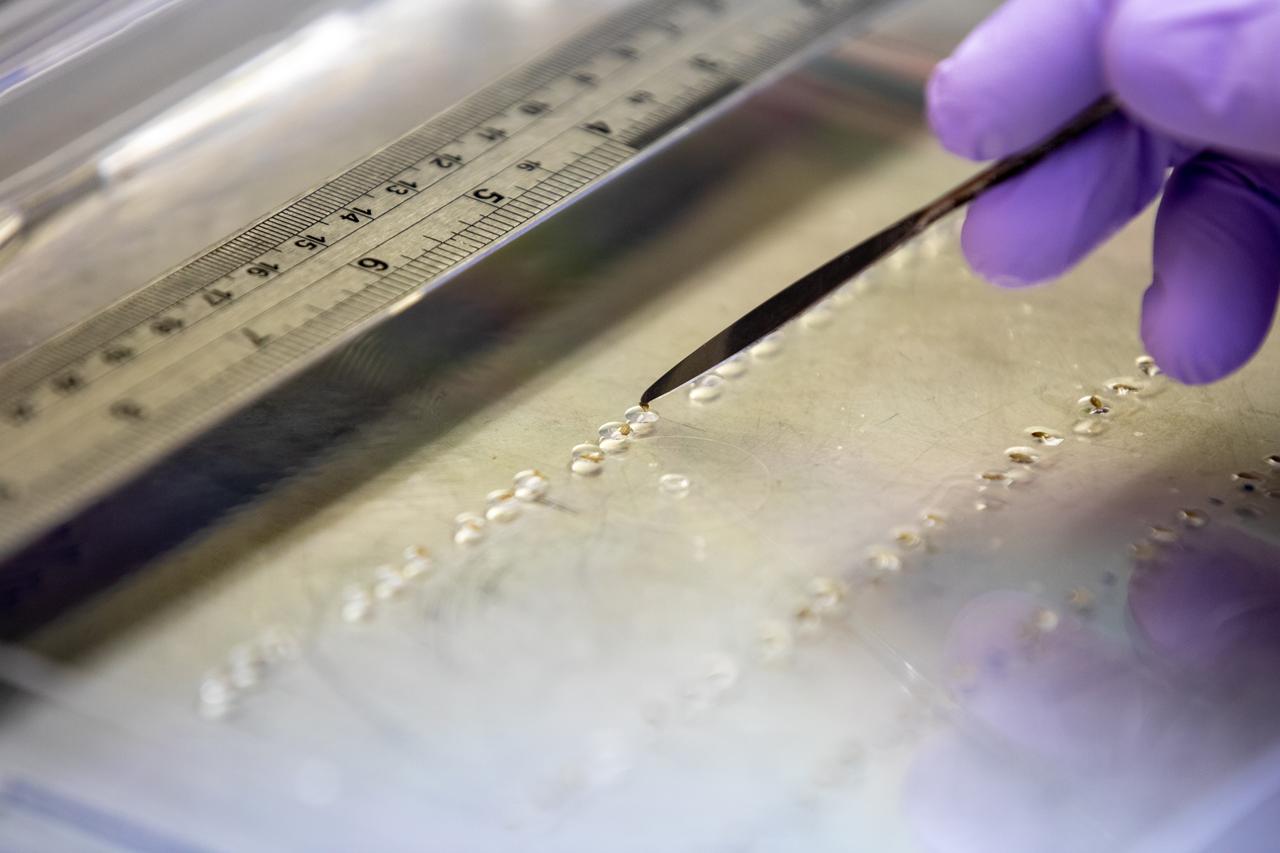
Inside the Space Station Processing Facility at NASA’s Kennedy Space Center in Florida, red romaine lettuce seeds are affixed to seed film – a new seed handling material – on Jan. 15, 2020. The seed film is being prepared for the VEG-03 J experiment that will fly to the International Space Station on Northrop Grumman’s 13th resupply services (NG-13) mission. This seed film experiment involves crew aboard the orbiting laboratory planting the seeds into plant pillows – a common method used to grow plants in space – themselves for the first time ever. The water-soluble, dissolving film addresses the challenge of handling seeds in a microgravity environment and also can be used to deliver fertilizers and other beneficial substances that help plants grow. NG-13 is scheduled to launch from the agency’s Wallops Flight Facility in Virginia on Feb. 9, 2020, at 5:39 p.m. EST.

Inside the Space Station Processing Facility at NASA’s Kennedy Space Center in Florida, a research scientist glues red romaine lettuce seeds to a sheet of seed film – a new seed handling material – on Jan. 15, 2020. The seed film is being prepared for the VEG-03 J experiment that will fly to the International Space Station on Northrop Grumman’s 13th resupply services (NG-13) mission. This seed film experiment involves crew aboard the orbiting laboratory planting the seeds into plant pillows – a common method used to grow plants in space – themselves for the first time ever. The water-soluble, dissolving film addresses the challenge of handling seeds in a microgravity environment and also can be used to deliver fertilizers and other beneficial substances that help plants grow. NG-13 is scheduled to launch from the agency’s Wallops Flight Facility in Virginia on Feb. 9, 2020, at 5:39 p.m. EST.
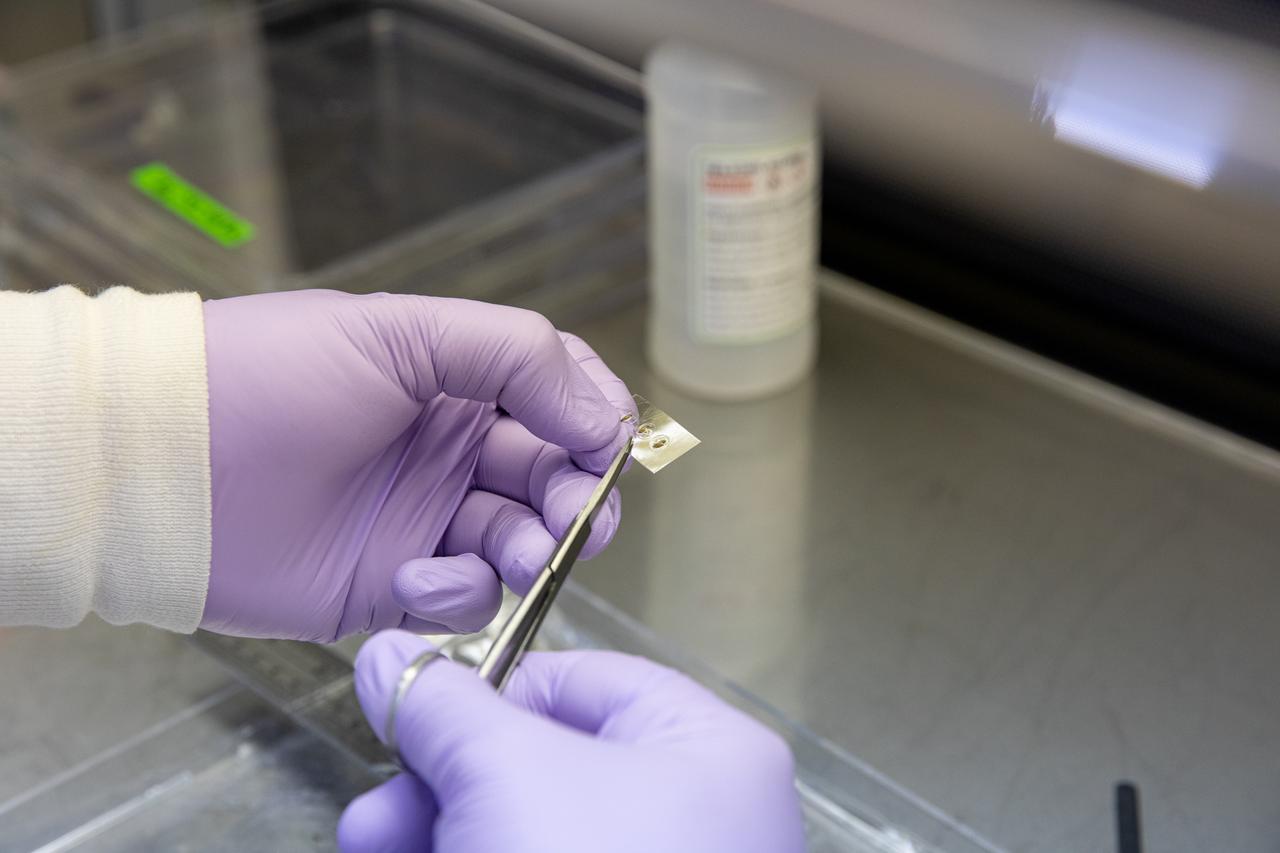
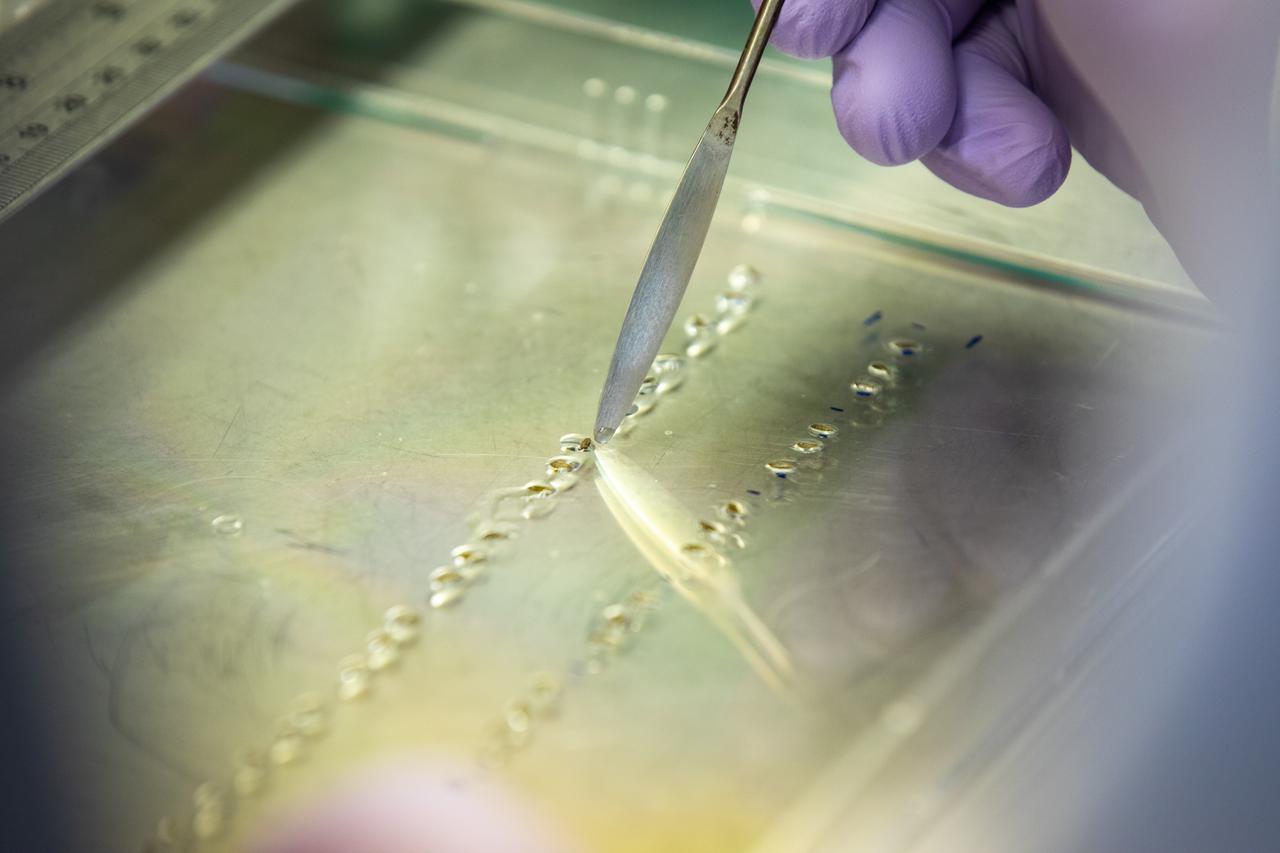
A research scientist at NASA’s Kennedy Space Center in Florida cuts strips of seed film – a new seed handling material containing red romaine lettuce seeds – inside the Space Station Processing Facility on Jan. 16, 2020. The seed film is being prepared for the VEG-03 J experiment that will fly to the International Space Station on Northrop Grumman’s 13th resupply services (NG-13) mission. This seed film experiment involves crew aboard the orbiting laboratory planting the seeds into plant pillows – a common method used to grow plants in space – themselves for the first time ever. The water-soluble, dissolving film addresses the challenge of handling seeds in a microgravity environment and also can be used to deliver fertilizers and other beneficial substances that help plants grow. NG-13 is scheduled to launch from the agency’s Wallops Flight Facility in Virginia on Feb. 9, 2020, at 5:39 p.m. EST.
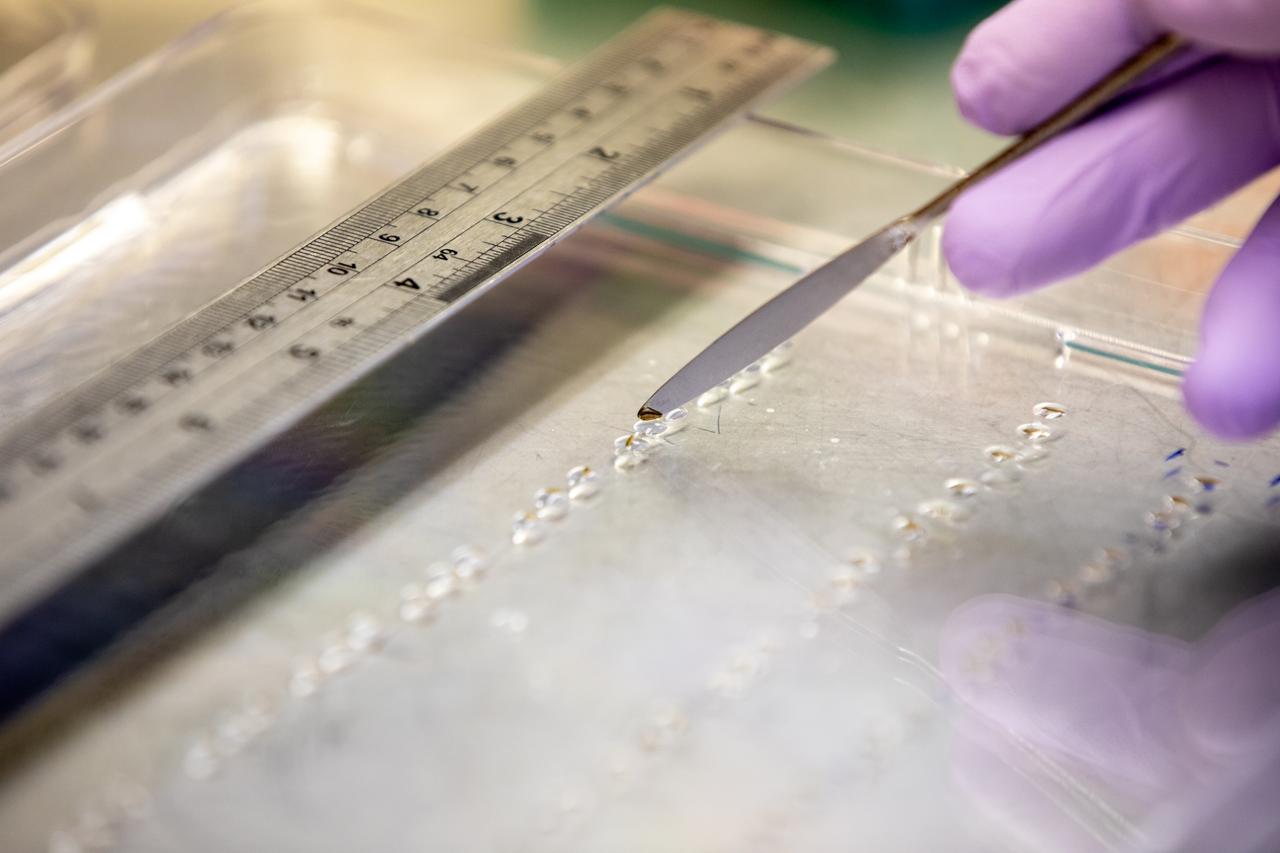
Inside the Space Station Processing Facility at NASA’s Kennedy Space Center in Florida, red romaine lettuce seeds are affixed to seed film – a new seed handling material – on Jan. 15, 2020. The seed film is being prepared for the VEG-03 J experiment that will fly to the International Space Station on Northrop Grumman’s 13th resupply services (NG-13) mission. This seed film experiment involves crew aboard the orbiting laboratory planting the seeds into plant pillows – a common method used to grow plants in space – themselves for the first time ever. The water-soluble, dissolving film addresses the challenge of handling seeds in a microgravity environment and also can be used to deliver fertilizers and other beneficial substances that help plants grow. NG-13 is scheduled to launch from the agency’s Wallops Flight Facility in Virginia on Feb. 9, 2020, at 5:39 p.m. EST.
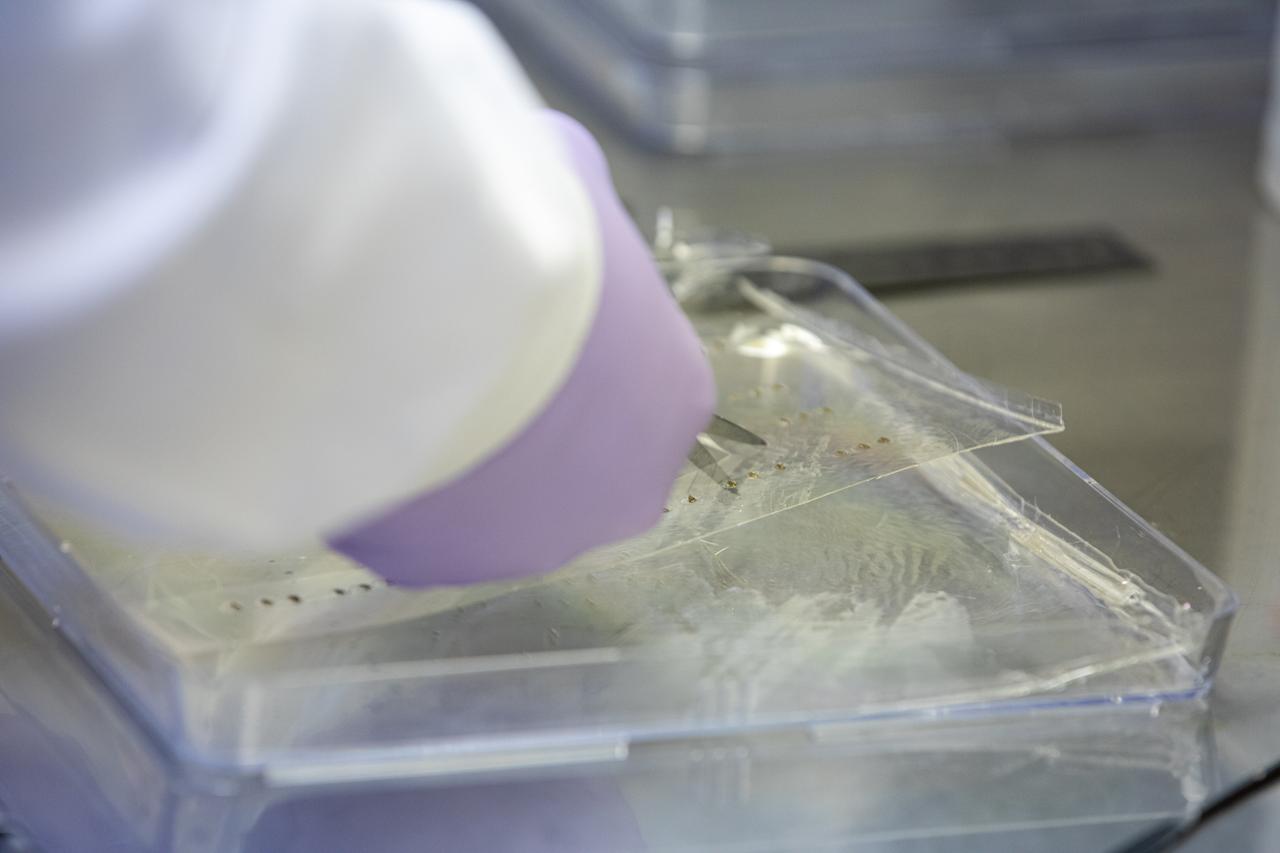
A research scientist at NASA’s Kennedy Space Center in Florida cuts strips of seed film – a new seed handling material containing red romaine lettuce seeds – inside the Space Station Processing Facility on Jan. 16, 2020. The seed film is being prepared for the VEG-03 J experiment that will fly to the International Space Station on Northrop Grumman’s 13th resupply services (NG-13) mission. This seed film experiment involves crew aboard the orbiting laboratory planting the seeds into plant pillows – a common method used to grow plants in space – themselves for the first time ever. The water-soluble, dissolving film addresses the challenge of handling seeds in a microgravity environment and also can be used to deliver fertilizers and other beneficial substances that help plants grow. NG-13 is scheduled to launch from the agency’s Wallops Flight Facility in Virginia on Feb. 9, 2020, at 5:39 p.m. EST.
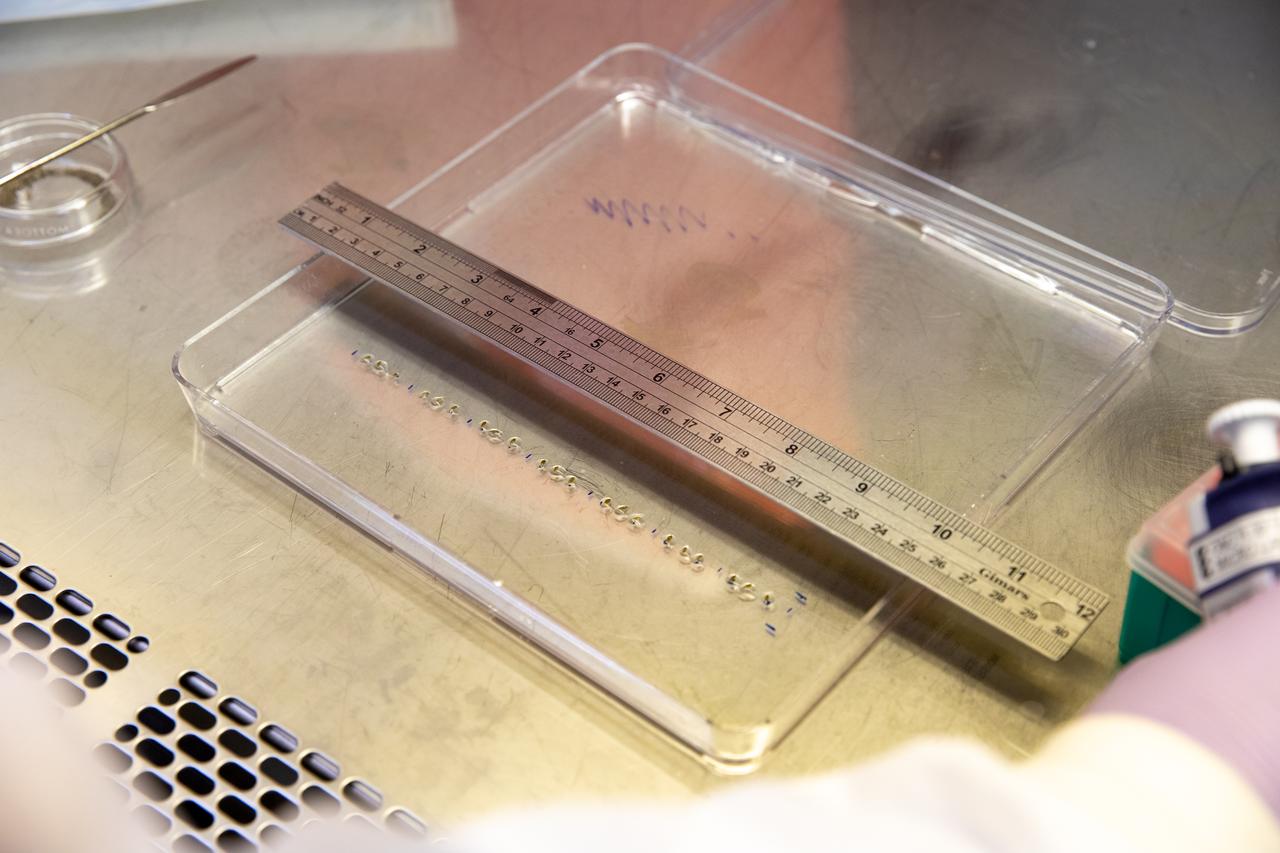
Inside the Space Station Processing Facility at NASA’s Kennedy Space Center in Florida, red romaine lettuce seeds are measured before being placed in seed film – a new seed handling material – on Jan. 15, 2020. The seed film is being prepared for the VEG-03 J experiment that will fly to the International Space Station on Northrop Grumman’s 13th resupply services (NG-13) mission. This seed film experiment involves crew aboard the orbiting laboratory planting the seeds into plant pillows – a common method used to grow plants in space – themselves for the first time ever. The water-soluble, dissolving film addresses the challenge of handling seeds in a microgravity environment and also can be used to deliver fertilizers and other beneficial substances that help plants grow. NG-13 is scheduled to launch from the agency’s Wallops Flight Facility in Virginia on Feb. 9, 2020, at 5:39 p.m. EST.
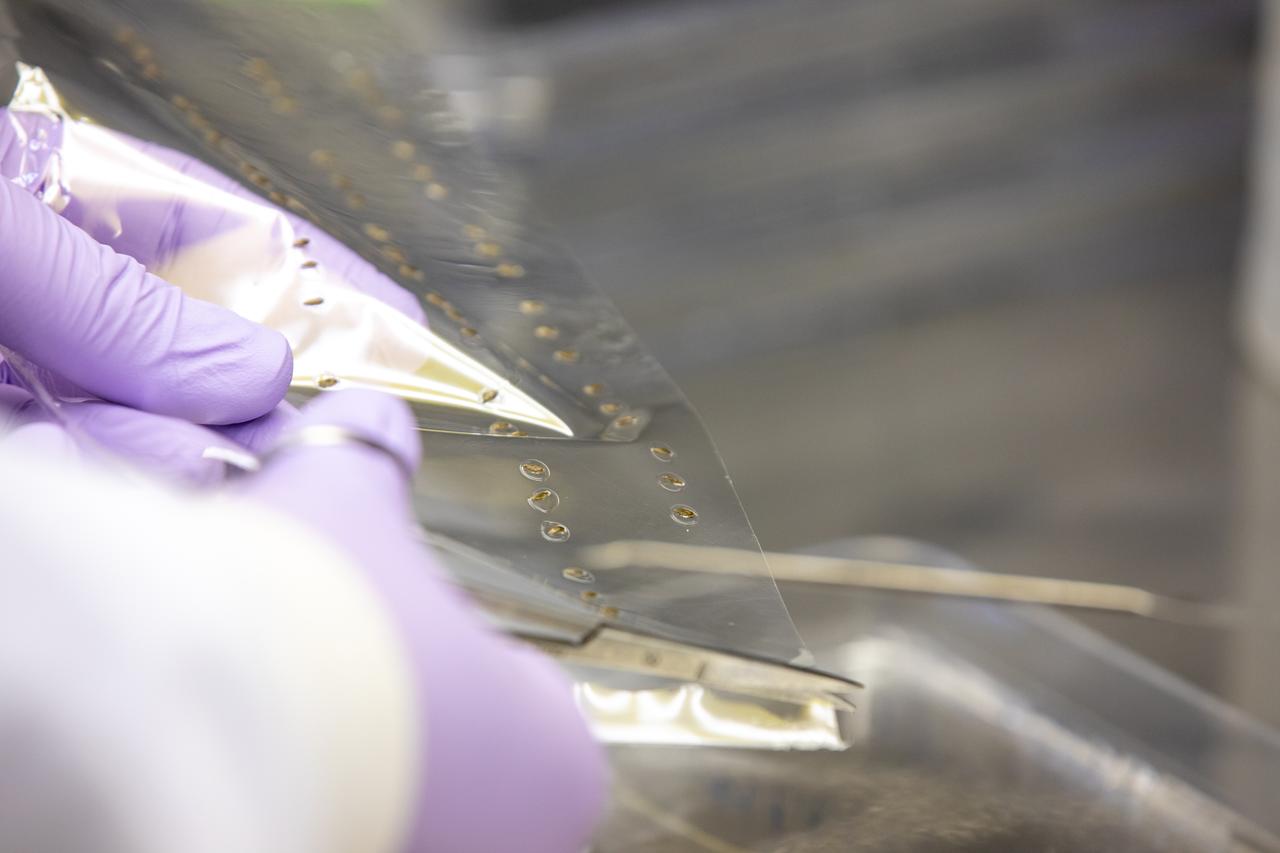
A research scientist at NASA’s Kennedy Space Center in Florida cuts strips of seed film – a new seed handling material containing red romaine lettuce seeds – inside the Space Station Processing Facility on Jan. 16, 2020. The seed film is being prepared for the VEG-03 J experiment that will fly to the International Space Station on Northrop Grumman’s 13th resupply services (NG-13) mission. This seed film experiment involves crew aboard the orbiting laboratory planting the seeds into plant pillows – a common method used to grow plants in space – themselves for the first time ever. The water-soluble, dissolving film addresses the challenge of handling seeds in a microgravity environment and also can be used to deliver fertilizers and other beneficial substances that help plants grow. NG-13 is scheduled to launch from the agency’s Wallops Flight Facility in Virginia on Feb. 9, 2020, at 5:39 p.m. EST.
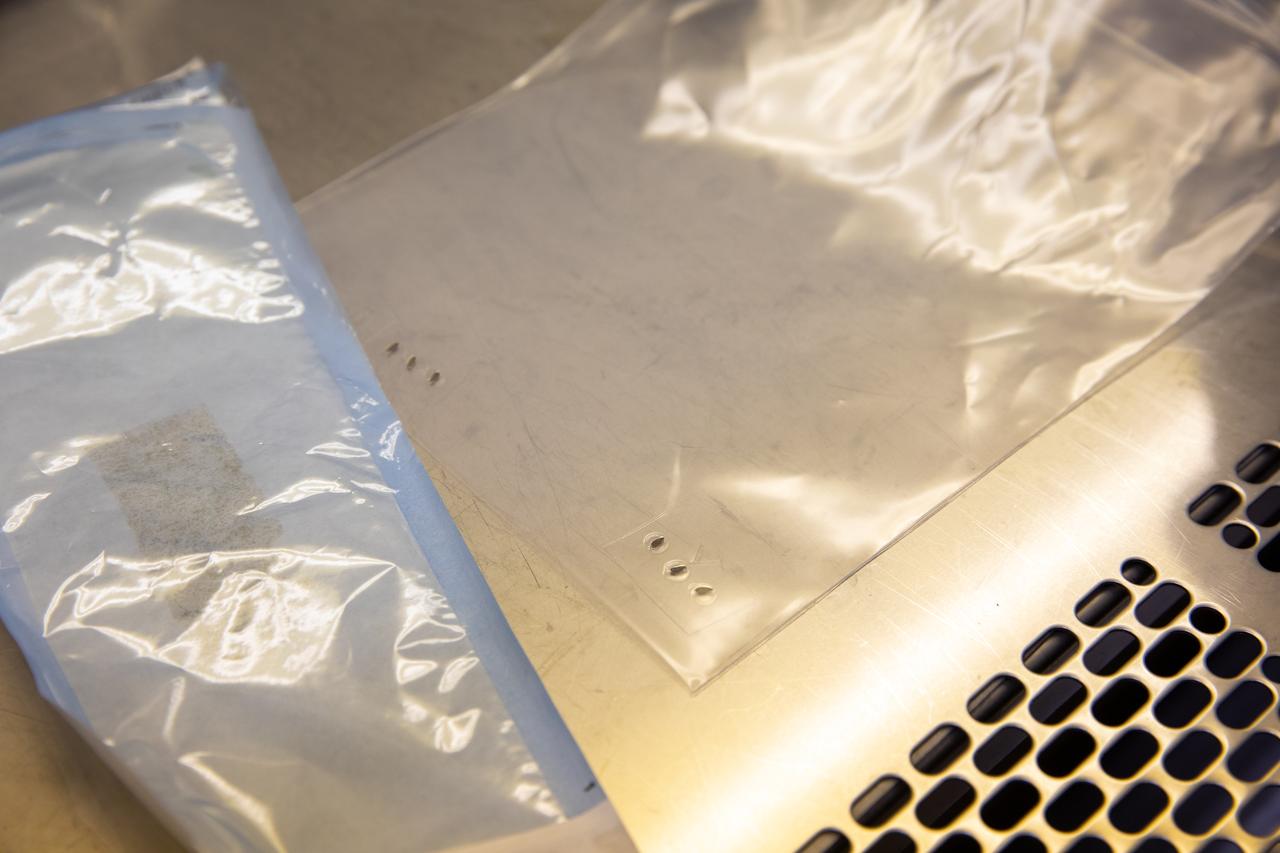
Strips of seed film – a new seed handling material containing red romaine lettuce seeds – are photographed inside the Space Station Processing Facility at NASA’s Kennedy Space Center in Florida on Jan. 16, 2020. The seed film is being prepared for the VEG-03 J experiment that will fly to the International Space Station on Northrop Grumman’s 13th resupply services (NG-13) mission. This seed film experiment involves crew aboard the orbiting laboratory planting the seeds into plant pillows – a common method used to grow plants in space – themselves for the first time ever. The water-soluble, dissolving film addresses the challenge of handling seeds in a microgravity environment and also can be used to deliver fertilizers and other beneficial substances that help plants grow. NG-13 is scheduled to launch from the agency’s Wallops Flight Facility in Virginia on Feb. 9, 2020, at 5:39 p.m. EST.
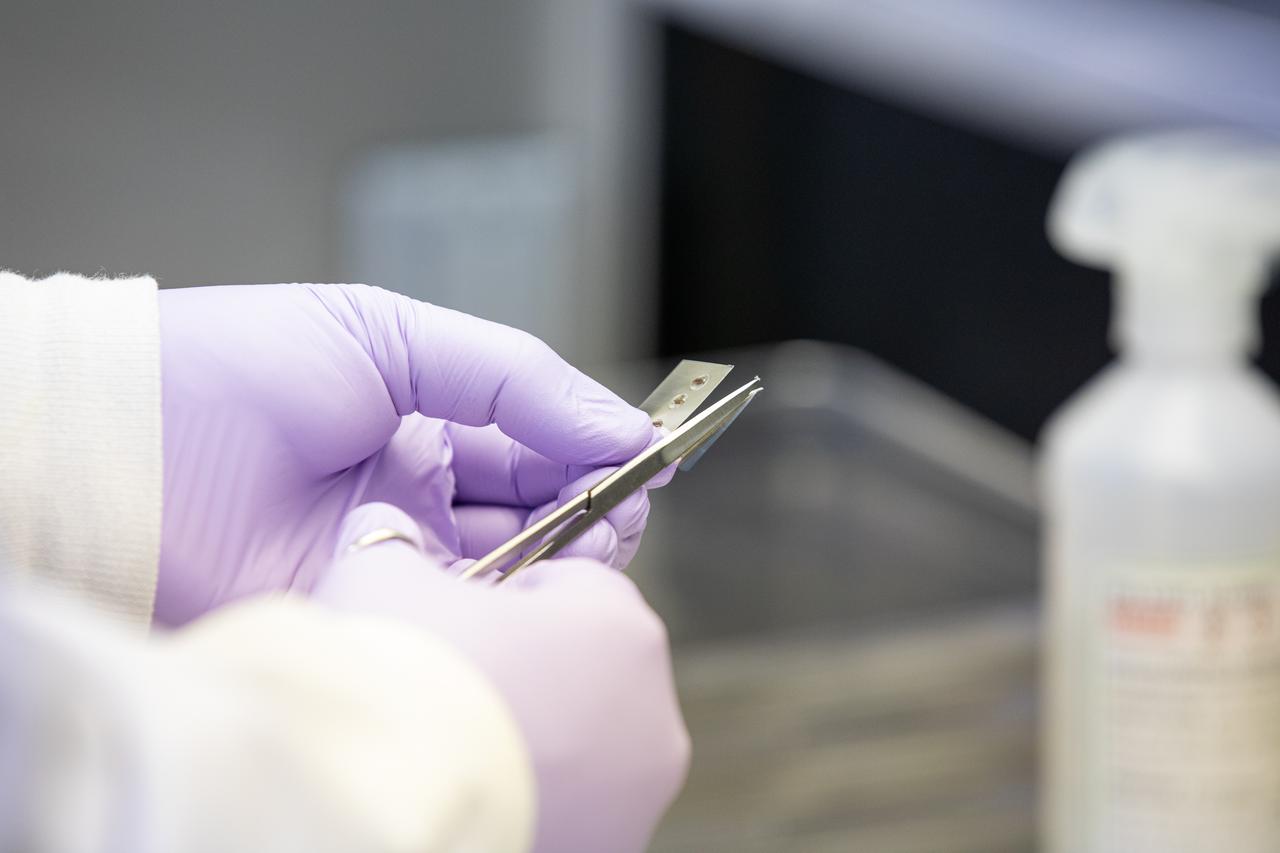
A research scientist at NASA’s Kennedy Space Center in Florida cuts strips of seed film – a new seed handling material containing red romaine lettuce seeds – inside the Space Station Processing Facility on Jan. 16, 2020. The seed film is being prepared for the VEG-03 J experiment that will fly to the International Space Station on Northrop Grumman’s 13th resupply services (NG-13) mission. This seed film experiment involves crew aboard the orbiting laboratory planting the seeds into plant pillows – a common method used to grow plants in space – themselves for the first time ever. The water-soluble, dissolving film addresses the challenge of handling seeds in a microgravity environment and also can be used to deliver fertilizers and other beneficial substances that help plants grow. NG-13 is scheduled to launch from the agency’s Wallops Flight Facility in Virginia on Feb. 9, 2020, at 5:39 p.m. EST.
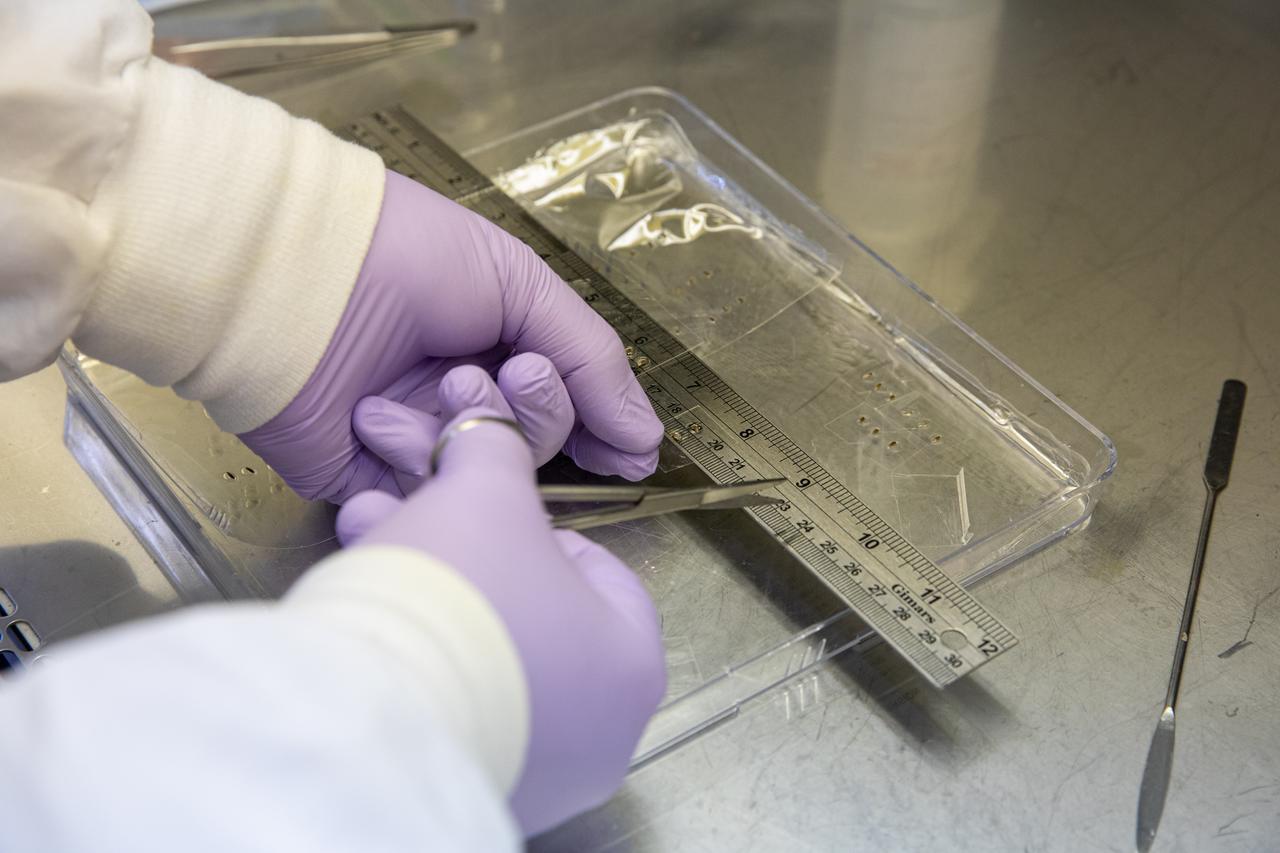
A research scientist at NASA’s Kennedy Space Center in Florida cuts strips of seed film – a new seed handling material containing red romaine lettuce seeds – inside the Space Station Processing Facility on Jan. 16, 2020. The seed film is being prepared for the VEG-03 J experiment that will fly to the International Space Station on Northrop Grumman’s 13th resupply services (NG-13) mission. This seed film experiment involves crew aboard the orbiting laboratory planting the seeds into plant pillows – a common method used to grow plants in space – themselves for the first time ever. The water-soluble, dissolving film addresses the challenge of handling seeds in a microgravity environment and also can be used to deliver fertilizers and other beneficial substances that help plants grow. NG-13 is scheduled to launch from the agency’s Wallops Flight Facility in Virginia on Feb. 9, 2020, at 5:39 p.m. EST.
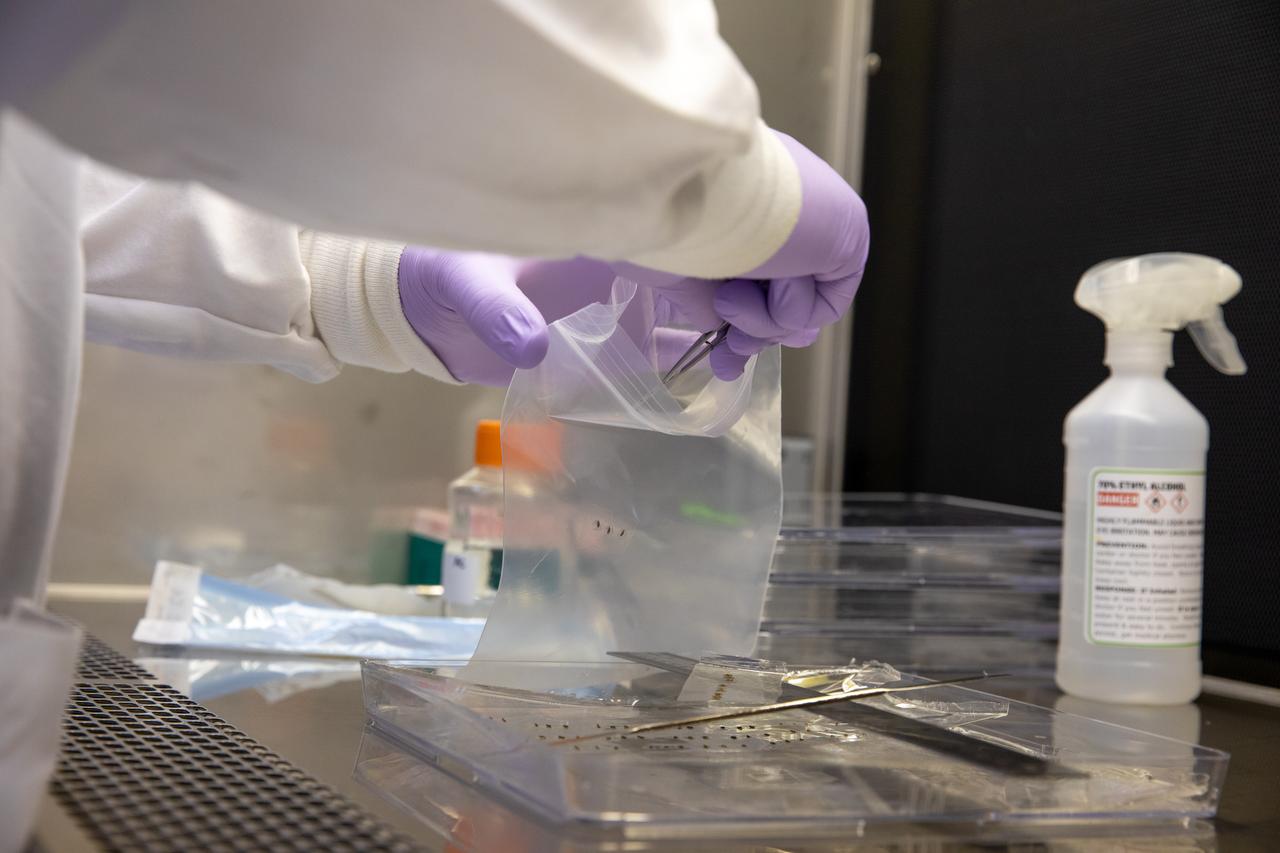
A research scientist at NASA’s Kennedy Space Center in Florida cuts and stores strips of seed film – a new seed handling material containing red romaine lettuce seeds – inside the Space Station Processing Facility on Jan. 16, 2020. The seed film is being prepared for the VEG-03 J experiment that will fly to the International Space Station on Northrop Grumman’s 13th resupply services (NG-13) mission. This seed film experiment involves crew aboard the orbiting laboratory planting the seeds into plant pillows – a common method used to grow plants in space – themselves for the first time ever. The water-soluble, dissolving film addresses the challenge of handling seeds in a microgravity environment and also can be used to deliver fertilizers and other beneficial substances that help plants grow. NG-13 is scheduled to launch from the agency’s Wallops Flight Facility in Virginia on Feb. 9, 2020, at 5:39 p.m. EST.
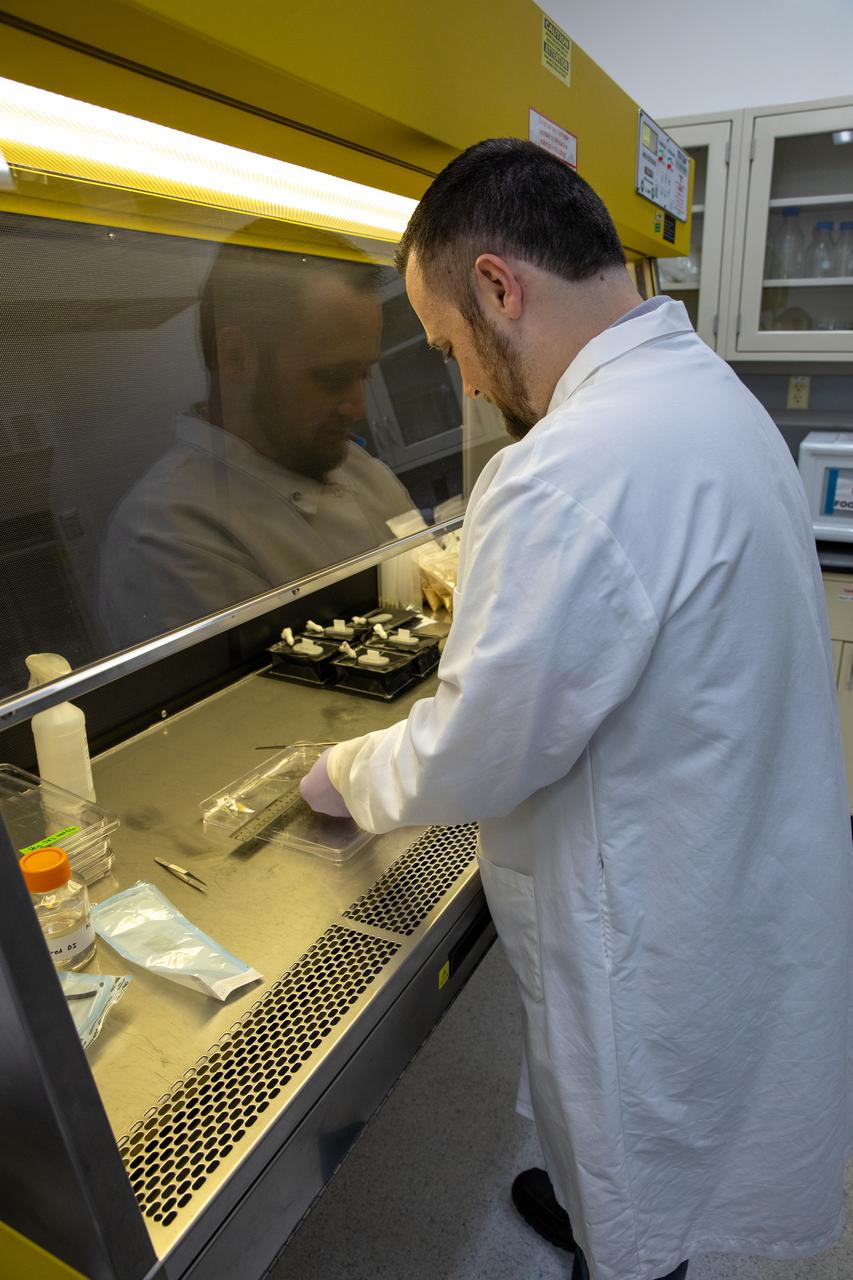
Aaron Curry, a LASSO research scientist at NASA’s Kennedy Space Center in Florida, measures out strips of seed film – a new seed handling material containing red romaine lettuce seeds – inside the Space Station Processing Facility on Jan. 16, 2020, in preparation for the VEG-03 J experiment. The seed film experiment involves crew aboard the International Space Station planting the seeds into plant pillows – a common method used to grow plants in space – themselves for the first time ever. This water-soluble, dissolving film addresses the challenge of handling seeds in a microgravity environment and also can be used to deliver fertilizers and other beneficial substances that help plants grow. The experiment will be launched to the orbiting laboratory aboard a Northrop Grumman Antares rocket and Cygnus spacecraft on the company’s 13th resupply services mission. Liftoff is scheduled for Feb. 9, 2020, at 5:39 p.m. EST from the agency’s Wallops Flight Facility in Virginia.
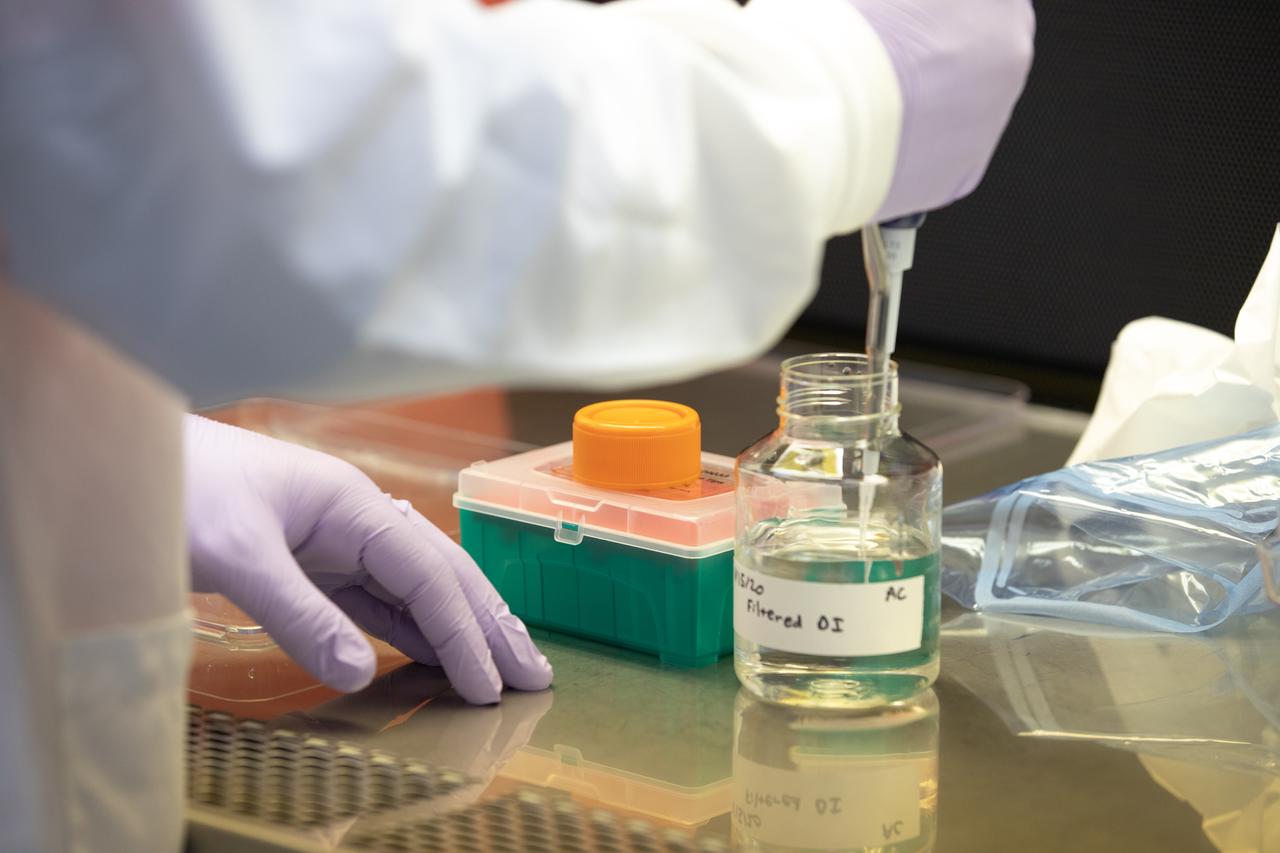
Inside the Space Station Processing Facility at NASA’s Kennedy Space Center in Florida, a researcher prepares red romaine lettuce seeds in seed film – a new seed handling material– on Jan. 15, 2020. The seed film is being prepared for the VEG-03 J experiment that will fly to the International Space Station on Northrop Grumman’s 13th resupply services (NG-13) mission. This seed film experiment involves crew aboard the orbiting laboratory planting the seeds into plant pillows – a common method used to grow plants in space – themselves for the first time ever. The water-soluble, dissolving film addresses the challenge of handling seeds in a microgravity environment and also can be used to deliver fertilizers and other beneficial substances that help plants grow. NG-13 is scheduled to launch from the agency’s Wallops Flight Facility in Virginia on Feb. 9, 2020, at 5:39 p.m. EST.
Inside the Space Station Processing Facility at NASA’s Kennedy Space Center in Florida, a research scientist is preparing to glue red romaine lettuce seeds to a sheet of seed film – a new seed handling material – on Jan. 15, 2020. The seed film is being prepared for the VEG-03 J experiment that will fly to the International Space Station on Northrop Grumman’s 13th resupply services (NG-13) mission. This seed film experiment involves crew aboard the orbiting laboratory planting the seeds into plant pillows – a common method used to grow plants in space – themselves for the first time ever. The water-soluble, dissolving film addresses the challenge of handling seeds in a microgravity environment and also can be used to deliver fertilizers and other beneficial substances that help plants grow. NG-13 is scheduled to launch from the agency’s Wallops Flight Facility in Virginia on Feb. 9, 2020, at 5:39 p.m. EST.

A researcher from NASA’s Kennedy Space Center in Florida prepares pepper seeds for planting inside science carriers on April 8, 2021, inside the Space Life Sciences Lab for the Plant Habitat-04 (PH-04) experiment. The seeds will fly to the International Space Station on SpaceX’s 22nd Commercial Resupply Services (CRS-22) mission. When the experiment starts, astronauts will grow the pepper seeds in the Advanced Plant Habitat (APH) growth chamber, which will monitor the experiment with more than 180 sensors. The astronauts will observe plant growth for about four months and conduct two harvests to study whether microgravity affects growth, flavor, or texture. Since peppers take longer to germinate, grow, and develop than previous crops grown in space, the PH-04 experiment also will test the durability and reliability of the various systems within the APH.

A researcher from NASA’s Kennedy Space Center in Florida prepares pepper seeds for planting inside science carriers on April 8, 2021, inside the Space Life Sciences Lab for the Plant Habitat-04 (PH-04) experiment. The seeds will fly to the International Space Station on SpaceX’s 22nd Commercial Resupply Services (CRS-22) mission. When the experiment starts, astronauts will grow the pepper seeds in the Advanced Plant Habitat (APH) growth chamber, which will monitor the experiment with more than 180 sensors. The astronauts will observe plant growth for about four months and conduct two harvests to study whether microgravity affects growth, flavor, or texture. Since peppers take longer to germinate, grow, and develop than previous crops grown in space, the PH-04 experiment also will test the durability and reliability of the various systems within the APH.

Inside the Space Life Sciences Lab at NASA’s Kennedy Space Center in Florida, researchers plant pepper seeds in a science carrier on April 8, 2021, in preparation for the Plant Habitat-04 (PH-04) experiment. The seeds will fly to the International Space Station on SpaceX’s 22nd Commercial Resupply Services (CRS-22) mission. When the experiment starts, astronauts will grow the pepper seeds in the Advanced Plant Habitat (APH) growth chamber, which will monitor the experiment with more than 180 sensors. The astronauts will observe plant growth for about four months and conduct two harvests to study whether microgravity affects growth, flavor, or texture. Since peppers take longer to germinate, grow, and develop than previous crops grown in space, the PH-04 experiment also will test the durability and reliability of the various systems within the APH.
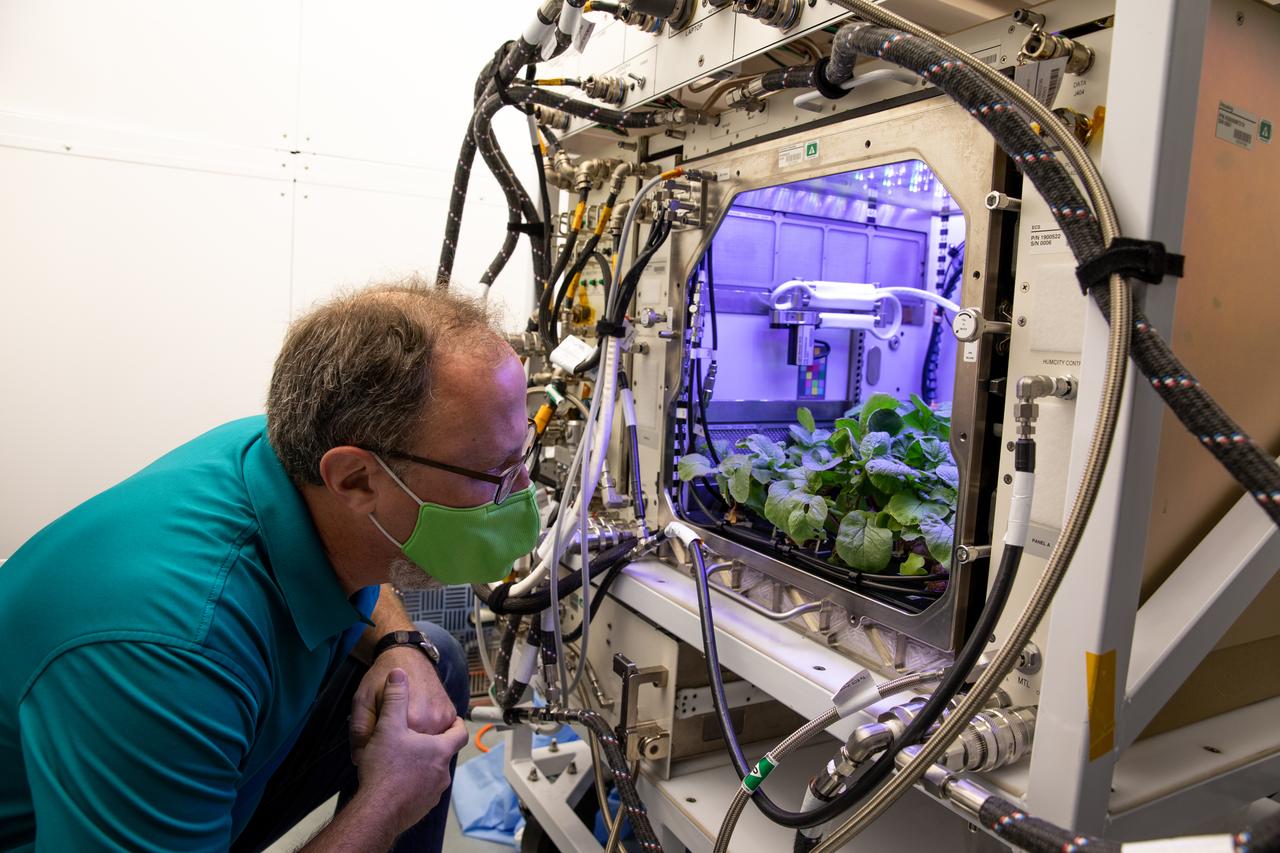
Dave Reed, Florida operations director for Techshot, Inc., observes radishes growing in the Advanced Plant Habitat (APH) ground unit inside the Space Station Processing Facility at NASA’s Kennedy Space Center in Florida on Dec. 14, 2020. The radishes are a ground control crop for the Plant Habitat-02 (PH-02) experiment, which also involves growing two similar radish crops inside the International Space Station’s APH. NASA astronaut Kate Rubins harvested the first crop on Nov. 30, and the second harvest aboard the orbiting laboratory is planned for Dec. 30. Once samples return to Earth, researchers will compare those grown in space to the radishes grown here on Earth to better understand how microgravity affects plant growth.
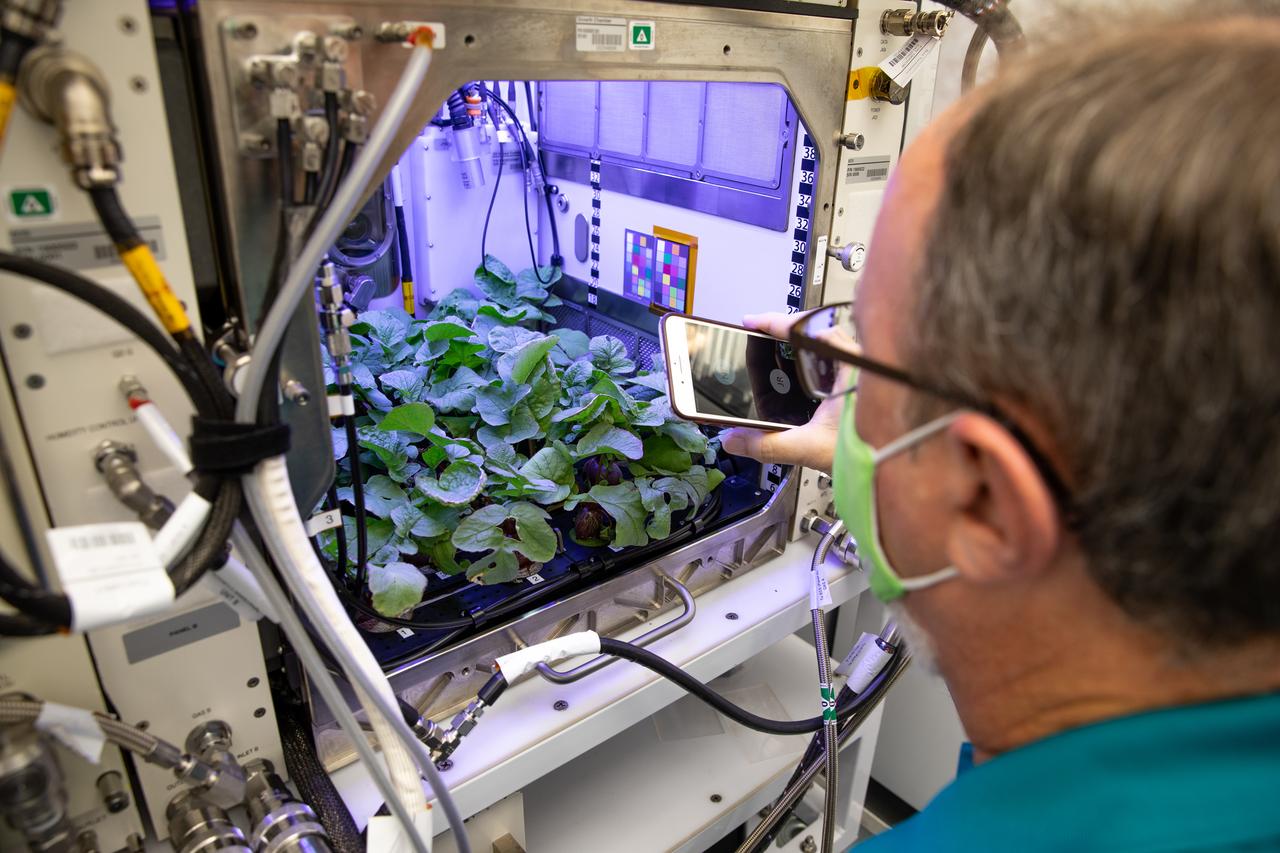
Dave Reed, Florida operations director for Techshot, Inc., observes radishes growing in the Advanced Plant Habitat (APH) ground unit inside the Space Station Processing Facility at NASA’s Kennedy Space Center in Florida on Dec. 14, 2020. The radishes are a ground control crop for the Plant Habitat-02 (PH-02) experiment. The experiment also involves growing two similar radish crops inside the International Space Station’s APH. NASA astronaut Kate Rubins harvested the first crop on Nov. 30, and the second harvest aboard the orbiting laboratory is planned for Dec. 30. Once samples return to Earth, researchers will compare those grown in space to the radishes grown here on Earth to better understand how microgravity affects plant growth.

A researcher from NASA’s Kennedy Space Center in Florida prepares pepper seeds for planting inside science carriers on April 8, 2021, inside the Space Life Sciences Lab for the Plant Habitat-04 (PH-04) experiment. The seeds will fly to the International Space Station on SpaceX’s 22nd Commercial Resupply Services (CRS-22) mission. When the experiment starts, astronauts will grow the pepper seeds in the Advanced Plant Habitat (APH) growth chamber, which will monitor the experiment with more than 180 sensors. The astronauts will observe plant growth for about four months and conduct two harvests to study whether microgravity affects growth, flavor, or texture. Since peppers take longer to germinate, grow, and develop than previous crops grown in space, the PH-04 experiment also will test the durability and reliability of the various systems within the APH.

A close-up photo of a pepper seed prepared by researchers at NASA’s Kennedy Space Center in Florida is shown before it’s planted inside a science carrier on April 8, 2021, inside the Space Life Sciences Lab for the Plant Habitat-04 (PH-04) experiment. The seeds will fly to the International Space Station on SpaceX’s 22nd Commercial Resupply Services (CRS-22) mission. When the experiment starts, astronauts will grow the pepper seeds in the Advanced Plant Habitat (APH) growth chamber, which will monitor the experiment with more than 180 sensors. The astronauts will observe plant growth for about four months and conduct two harvests to study whether microgravity affects growth, flavor, or texture. Since peppers take longer to germinate, grow, and develop than previous crops grown in space, the PH-04 experiment also will test the durability and reliability of the various systems within the APH.

Inside the Space Life Sciences Lab at NASA’s Kennedy Space Center in Florida, a researcher plants pepper seeds in science carriers on April 8, 2021, in preparation for the Plant Habitat-04 (PH-04) experiment. The seeds will fly to the International Space Station on SpaceX’s 22nd Commercial Resupply Services (CRS-22) mission. When the experiment starts, astronauts will grow the pepper seeds in the Advanced Plant Habitat (APH) growth chamber, which will monitor the experiment with more than 180 sensors. The astronauts will observe plant growth for about four months and conduct two harvests to study whether microgravity affects growth, flavor, or texture. Since peppers take longer to germinate, grow, and develop than previous crops grown in space, the PH-04 experiment also will test the durability and reliability of the various systems within the APH.
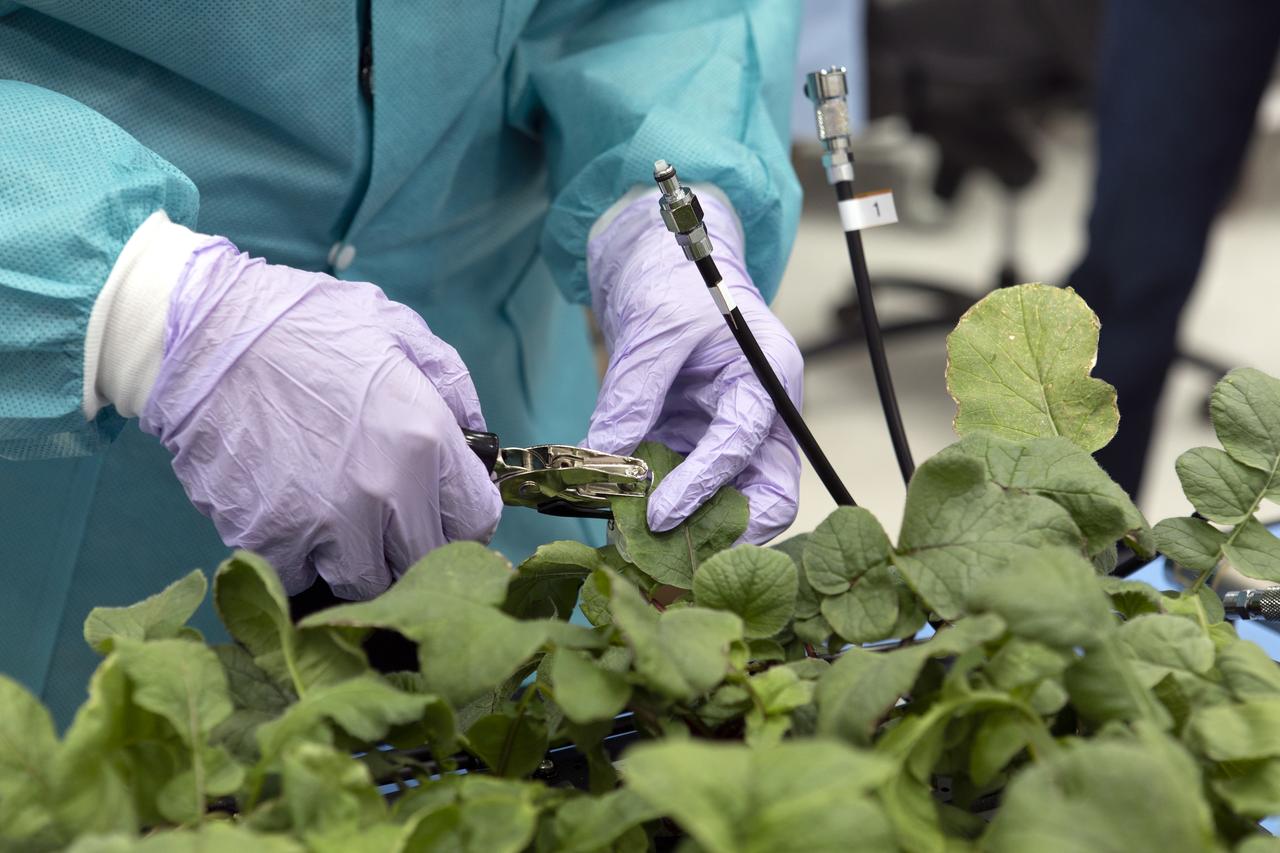
Clayton Grosse, a mechanical engineer with Techshot, uses a punch to take a sample of the leaf of a radish plant growing in the base of the Advanced Plant Habitat (APH) ground unit, inside a laboratory in the Space Station Processing Facility at NASA’s Kennedy Space Center in Florida on June 13, 2019. The radishes are being harvested as part of a science verification test. The APH is currently the largest plant chamber built for the agency in use on the International Space Station. It is an autonomous plant growth facility that is being used to conduct bioscience research on the space station with the goal of enabling astronauts to be sustainable on long duration missions to the Moon, Mars and beyond.
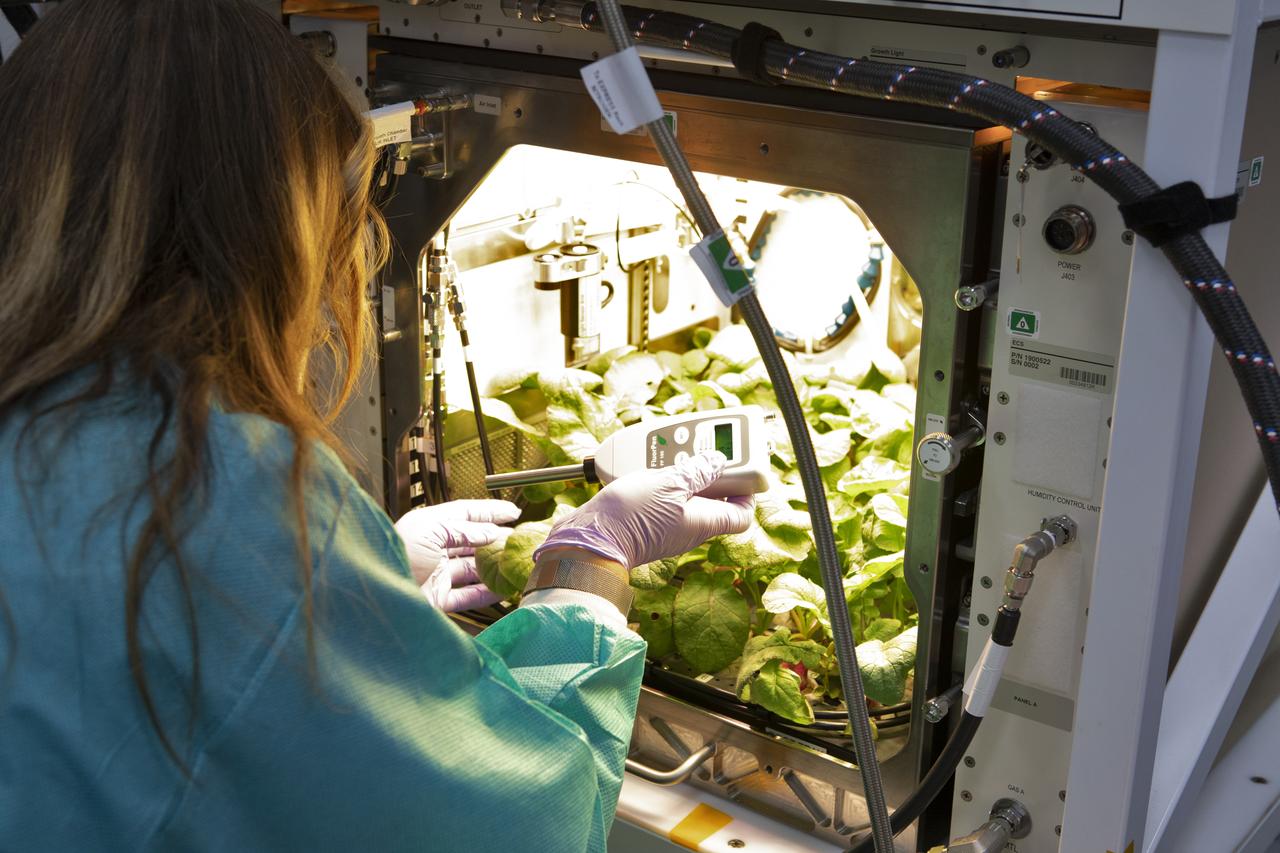
Inside a laboratory in the Space Station Processing Facility at NASA’s Kennedy Space Center in Florida, a plant biologist prepares to harvest radish plants growing in the Advanced Plant Habitat (APH) ground unit on June 13, 2019. The radishes are being harvested as part of a science verification test. The APH is currently the largest plant chamber built for the agency in use on the International Space Station. It is an autonomous plant growth facility that is being used to conduct bioscience research on the space station with the goal of enabling astronauts to be sustainable on long duration missions to the Moon, Mars and beyond.
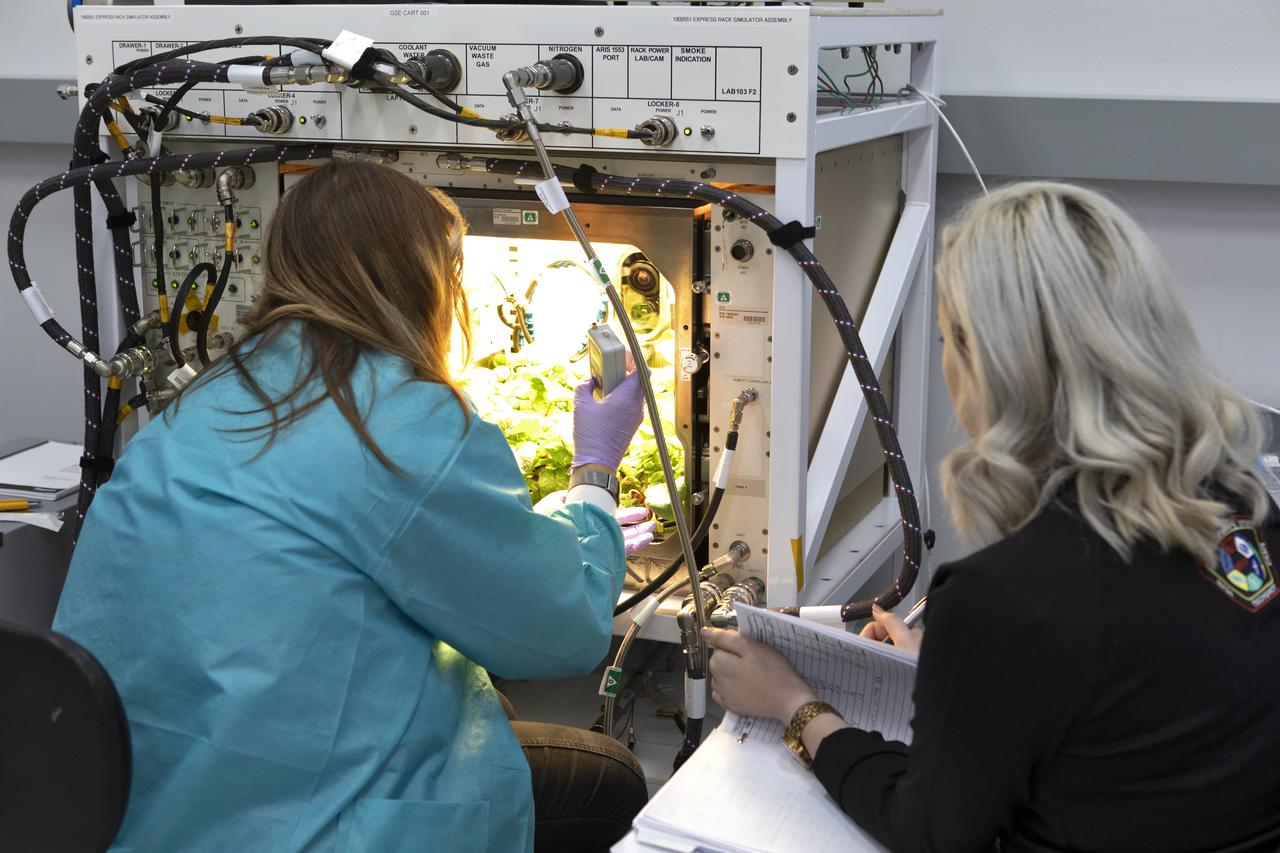
Inside a laboratory in the Space Station Processing Facility at NASA’s Kennedy Space Center in Florida, plant biologists prepare to harvest radish plants growing in the Advanced Plant Habitat (APH) ground unit on June 13, 2019. The radishes are being harvested as part of a science verification test. The APH is currently the largest plant chamber built for the agency in use on the International Space Station. It is an autonomous plant growth facility that is being used to conduct bioscience research on the space station with the goal of enabling astronauts to be sustainable on long duration missions to the Moon, Mars and beyond.
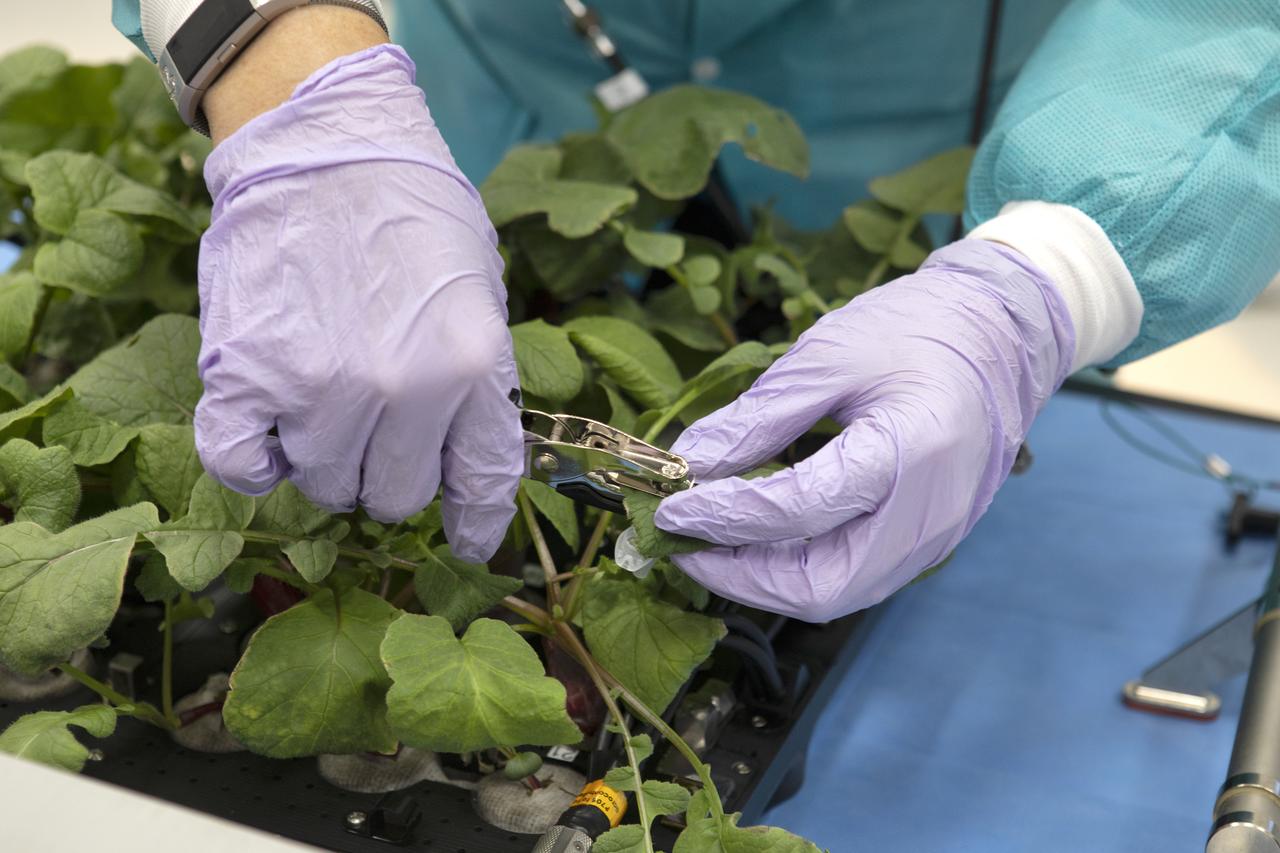
A sample of a leaf from one of the radish plant growing in the base of the Advanced Plant Habitat (APH) ground unit is taken inside a laboratory in the Space Station Processing Facility at NASA’s Kennedy Space Center in Florida on June 13, 2019. The radishes are being harvested as part of a science verification test. The APH is currently the largest plant chamber built for the agency in use on the International Space Station. It is an autonomous plant growth facility that is being used to conduct bioscience research on the space station with the goal of enabling astronauts to be sustainable on long duration missions to the Moon, Mars and beyond.
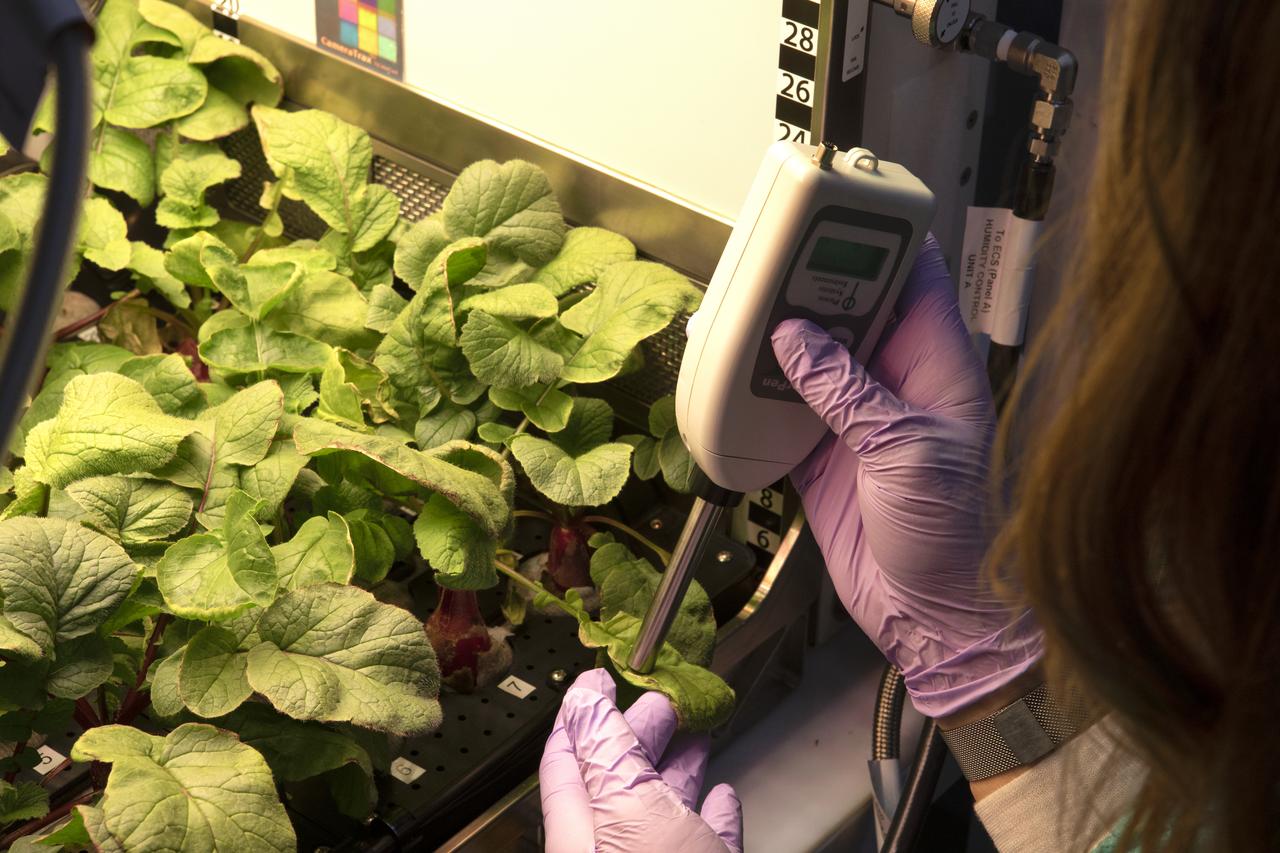
Inside a laboratory in the Space Station Processing Facility at NASA’s Kennedy Space Center in Florida, a plant biologist prepares to harvest radish plants growing in the Advanced Plant Habitat (APH) ground unit on June 13, 2019. The radishes are being harvested as part of a science verification test. The APH is currently the largest plant chamber built for the agency in use on the International Space Station. It is an autonomous plant growth facility that is being used to conduct bioscience research on the space station with the goal of enabling astronauts to be sustainable on long duration missions to the Moon, Mars and beyond.
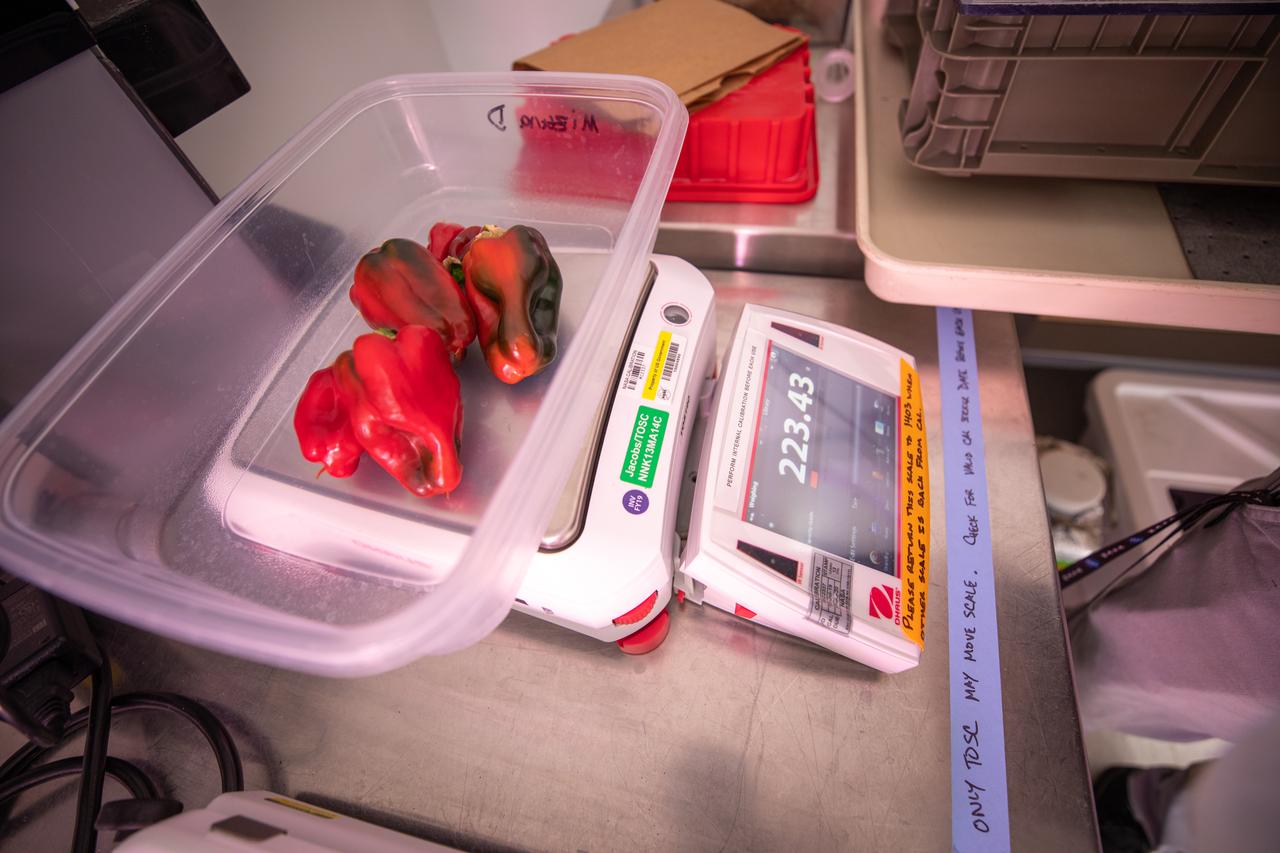
Peppers that were grown and harvested inside the Space Station Processing Facility at NASA’s Kennedy Space Center in Florida are weighed on Jan. 15, 2020, in preparation for sending them to space. As NASA prepares to send humans beyond low-Earth orbit, the ability for astronauts to grow a variety of fresh fruits and vegetables in space will be critical. Fresh produce will be an essential supplement to the crew’s pre-packaged diet during long-duration space exploration when they are away from Earth for extended periods of time.
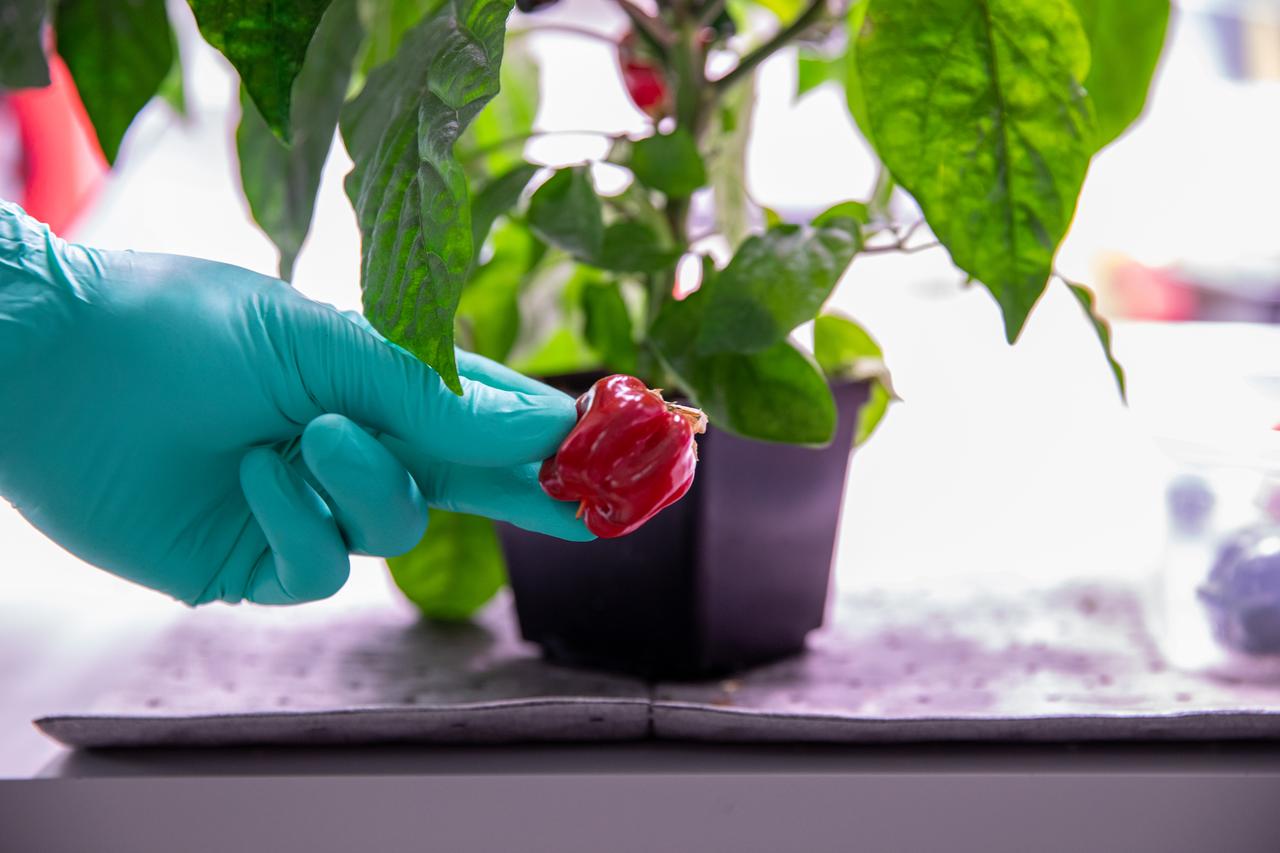
Inside the Space Station Processing Facility at NASA’s Kennedy Space Center in Florida, peppers are harvested on Jan. 15, 2020, for a growth assessment in preparation for sending them to space. As NASA prepares to send humans beyond low-Earth orbit, the ability for astronauts to grow a variety of fresh fruits and vegetables in space will be critical. Fresh produce will be an essential supplement to the crew’s pre-packaged diet during long-duration space exploration when they are away from Earth for extended periods of time.

A growing black hole, called a quasar, is seen at the center of a faraway galaxy in this artist concept. Astronomers using NASA Spitzer and Chandra space telescopes discovered swarms of similar quasars hiding in dusty galaxies in the distant universe.
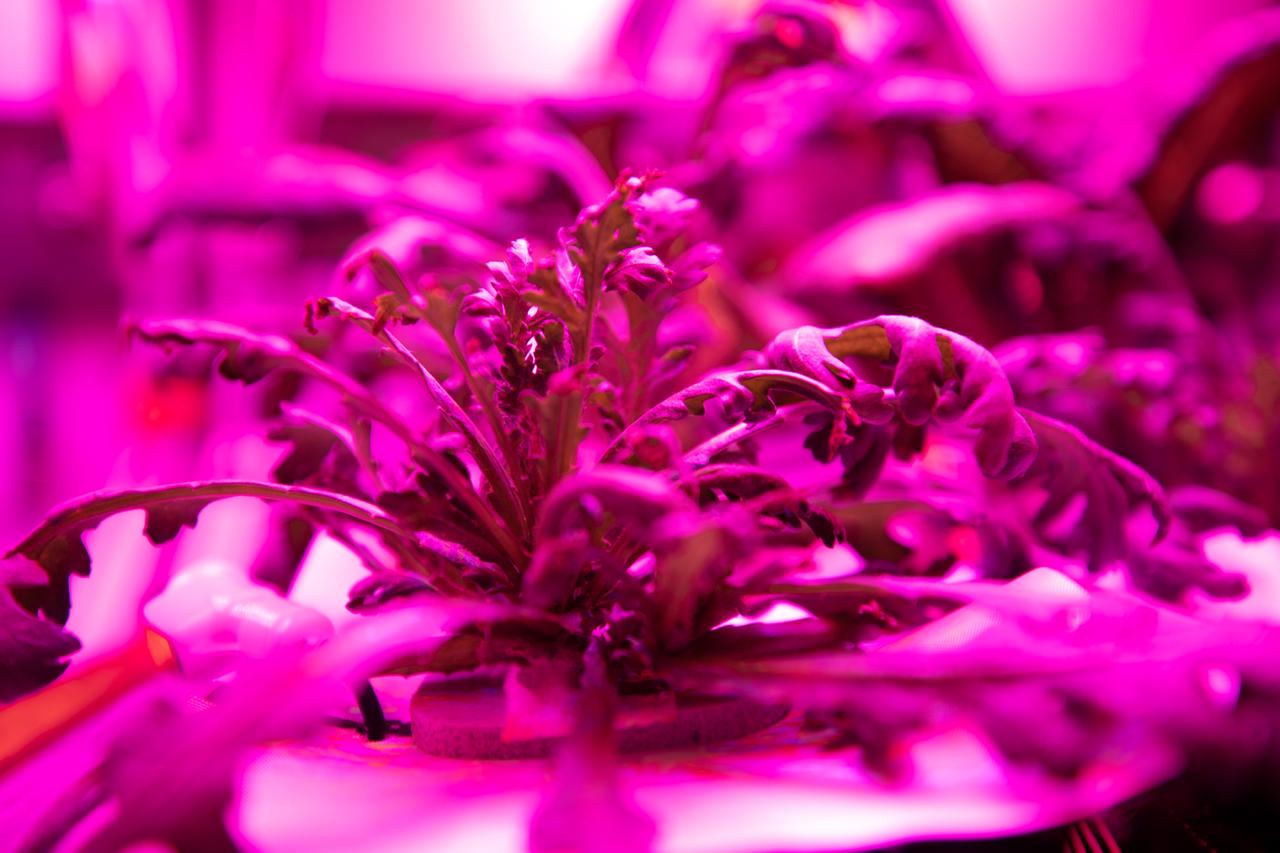
Three crops grown under a test condition representative of the International Space Station are photographed moments before harvest for a science verification test (SVT) in the Space Station Processing Facility at NASA’s Kennedy Space Center in Florida on Sept. 30, 2019. The SVT will study the potential of the three plant cultivars to grow in space. The harvest included ‘outredgeous’ red romaine lettuce, which has been grown in space before, and two new plant cultivars – amara mustard and shungiku, an Asian green comparable to an edible chrysanthemum. All three lettuce plants were grown from seed film, making this the first SVT with this new plant growth material. Earlier this year, the amara mustard and shungiku plants were grown for the first time using seed bags – referred to as pillows – during the Sustained Veggie project, a study funded by the Human Research Program.
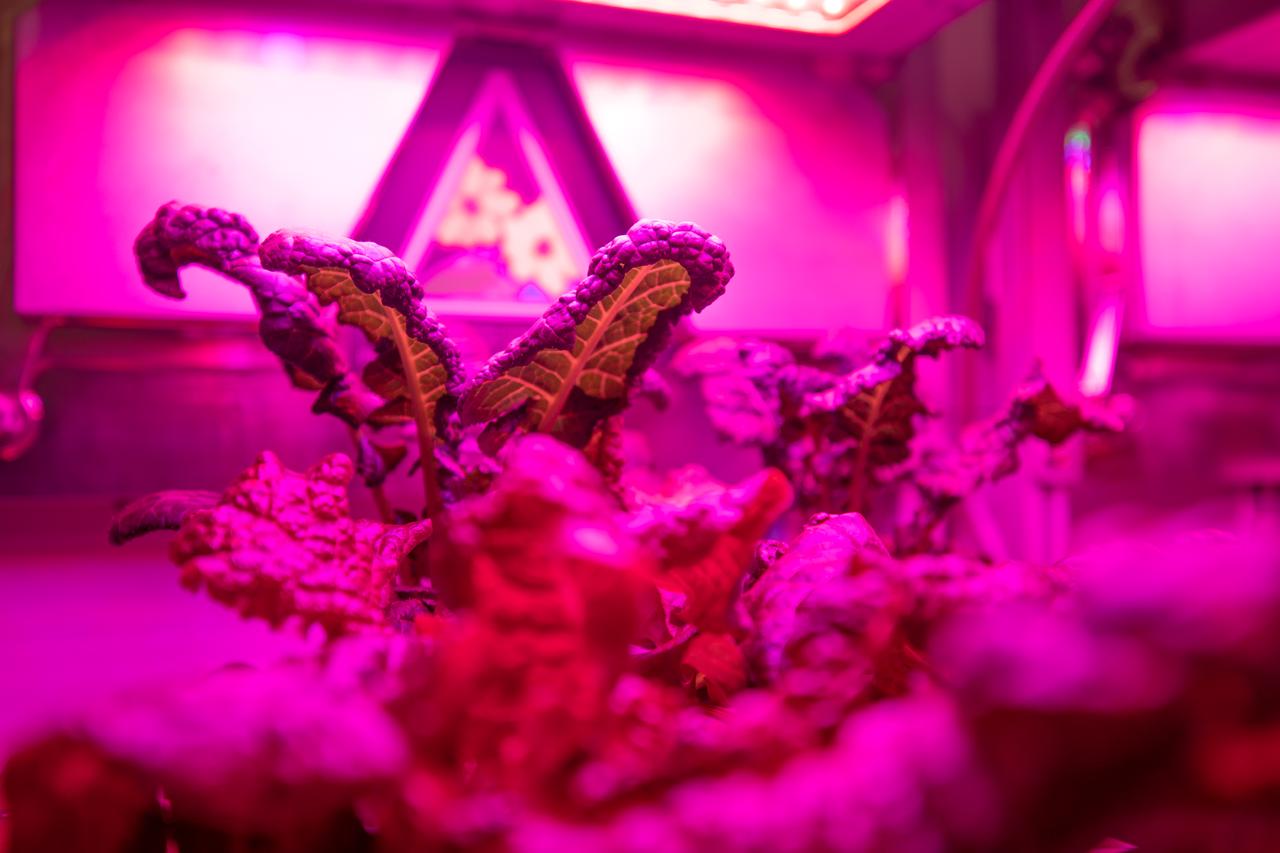
Three crops grown under a test condition representative of the International Space Station are photographed moments before harvest for a science verification test (SVT) in the Space Station Processing Facility at NASA’s Kennedy Space Center in Florida on Sept. 30, 2019. The SVT will study the potential of the three plant cultivars to grow in space. The harvest included ‘outredgeous’ red romaine lettuce, which has been grown in space before, and two new plant cultivars – amara mustard and shungiku, an Asian green comparable to an edible chrysanthemum. All three lettuce plants were grown from seed film, making this the first SVT with this new plant growth material. Earlier this year, the amara mustard and shungiku plants were grown for the first time using seed bags – referred to as pillows – during the Sustained Veggie project, a study funded by the Human Research Program.
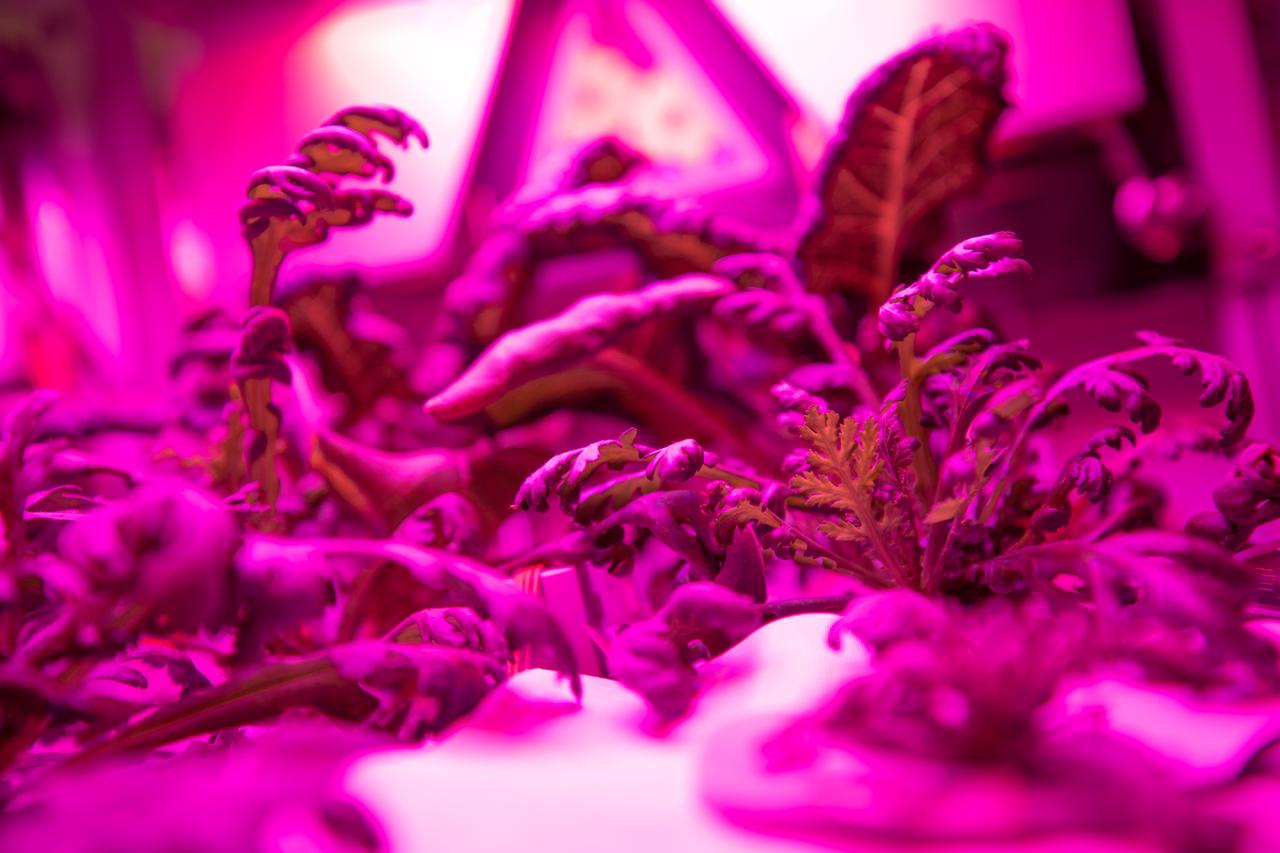
Three crops grown under a test condition representative of the International Space Station are photographed moments before harvest for a science verification test (SVT) in the Space Station Processing Facility at NASA’s Kennedy Space Center in Florida on Sept. 30, 2019. The SVT will study the potential of the three plant cultivars to grow in space. The harvest included ‘outredgeous’ red romaine lettuce, which has been grown in space before, and two new plant cultivars – amara mustard and shungiku, an Asian green comparable to an edible chrysanthemum. All three lettuce plants were grown from seed film, making this the first SVT with this new plant growth material. Earlier this year, the amara mustard and shungiku plants were grown for the first time using seed bags – referred to as pillows – during the Sustained Veggie project, a study funded by the Human Research Program.
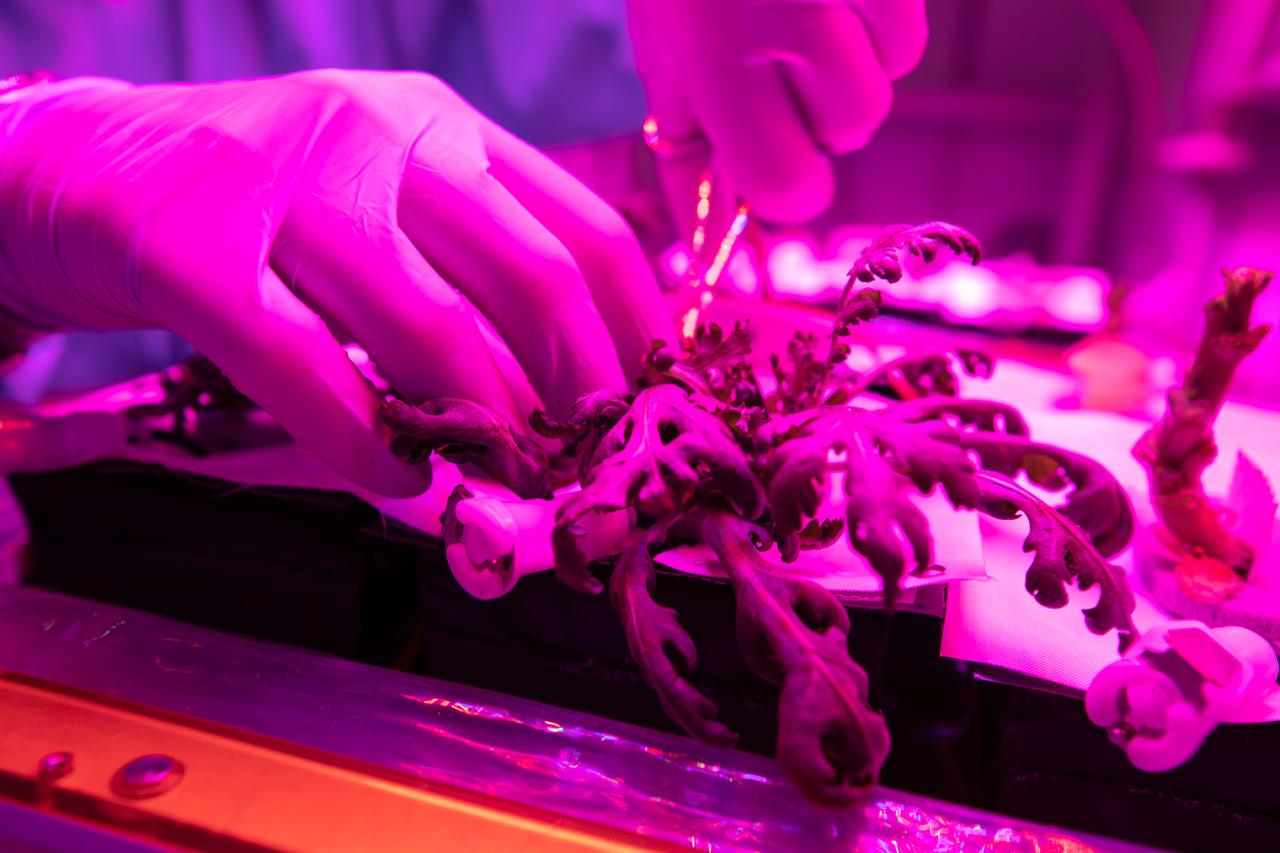
Test crops are harvested inside the Veggie growth chamber in the Space Station Processing Facility at NASA’s Kennedy Space Center in Florida on Sept. 30, 2019, for a science verification test (SVT) to study their potential to grow in space. The harvest included ‘outredgeous’ red romaine lettuce, which has been grown in space before, and two new plant cultivars – amara mustard and shungiku, an Asian green comparable to an edible chrysanthemum. All three lettuce plants were grown from seed film, making this the first SVT with this new plant growth material. Earlier this year, the amara mustard and shungiku plants were grown for the first time using seed bags – referred to as pillows – during the Sustained Veggie project, a study funded by the Human Research Program.
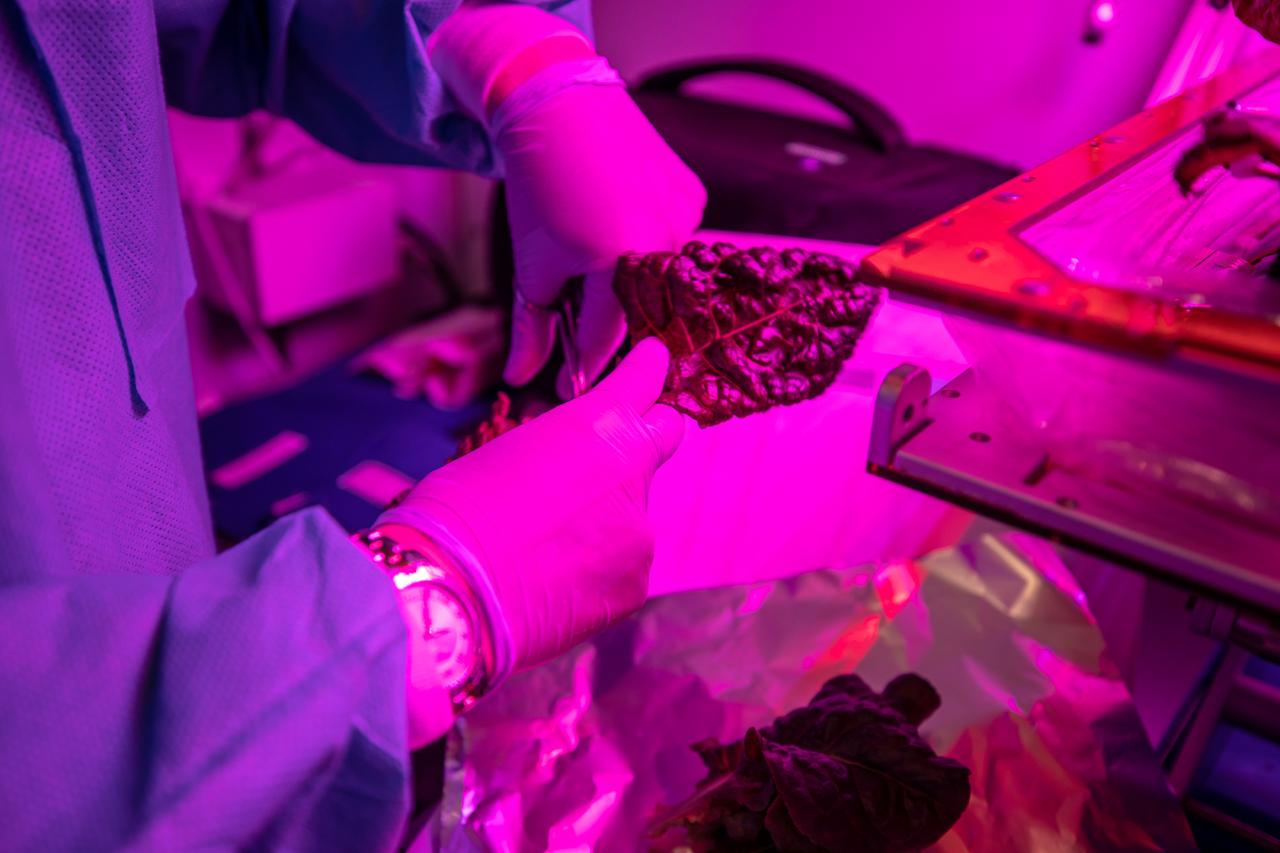
Test crops are harvested inside the Veggie growth chamber in the Space Station Processing Facility at NASA’s Kennedy Space Center in Florida on Sept. 30, 2019, for a science verification test (SVT) to study their potential to grow in space. The harvest included ‘outredgeous’ red romaine lettuce, which has been grown in space before, and two new plant cultivars – amara mustard and shungiku, an Asian green comparable to an edible chrysanthemum. All three lettuce plants were grown from seed film, making this the first SVT with this new plant growth material. Earlier this year, the amara mustard and shungiku plants were grown for the first time using seed bags – referred to as pillows – during the Sustained Veggie project, a study funded by the Human Research Program.
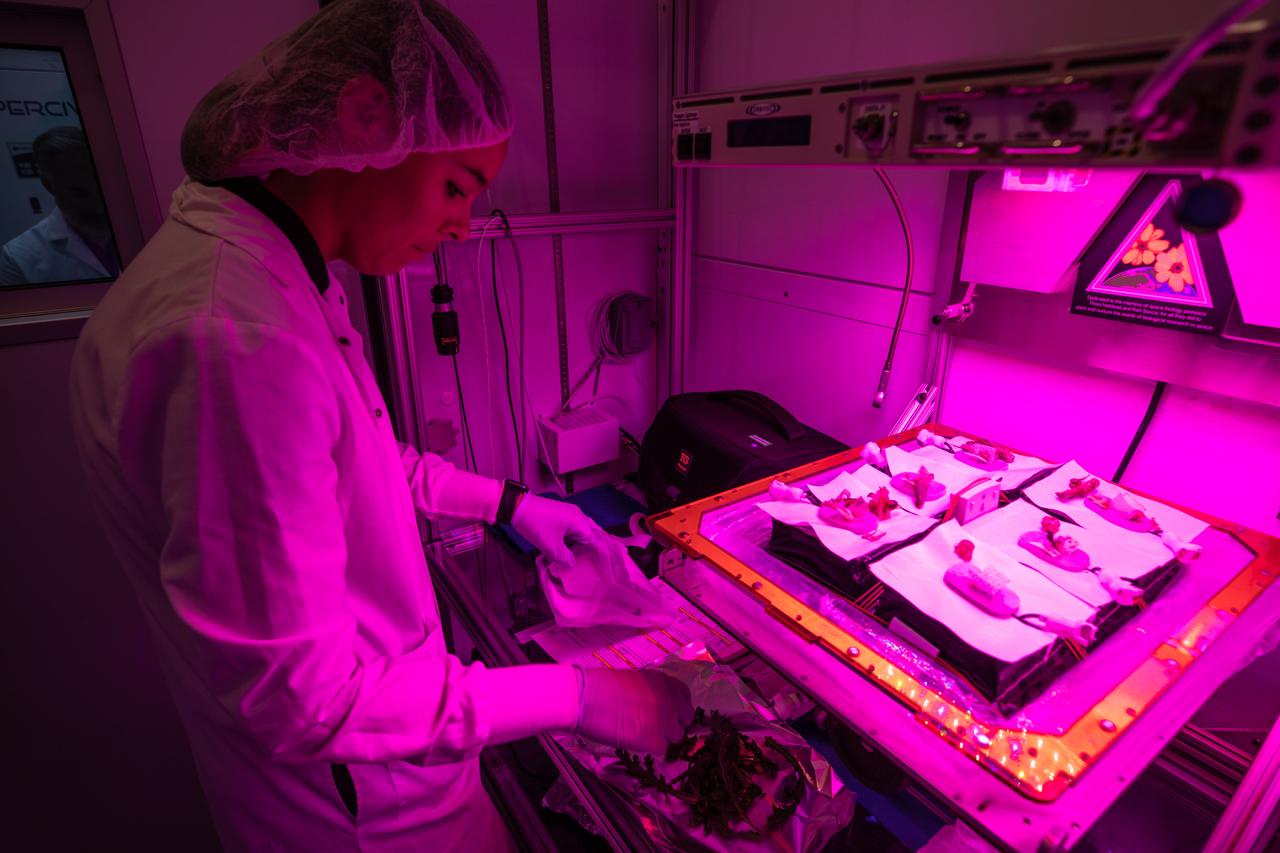
Kennedy Space Center employee Anna Maria Ruby harvests plant cultivars inside the Veggie growth chamber in the Space Station Processing Facility on Sept. 30, 2019, for a science verification test (SVT). This SVT will study the potential of three plants – amara mustard, ‘outredgeous’ red romaine lettuce and shungiku, an Asian green comparable to an edible chrysanthemum – to grow in space. All three lettuce plants were grown from seed film, making this the first SVT with this new plant growth material. Earlier this year, the amara mustard and shungiku plants were grown for the first time using seed bags – referred to as pillows – during the Sustained Veggie project, a study funded by the Human Research Program.
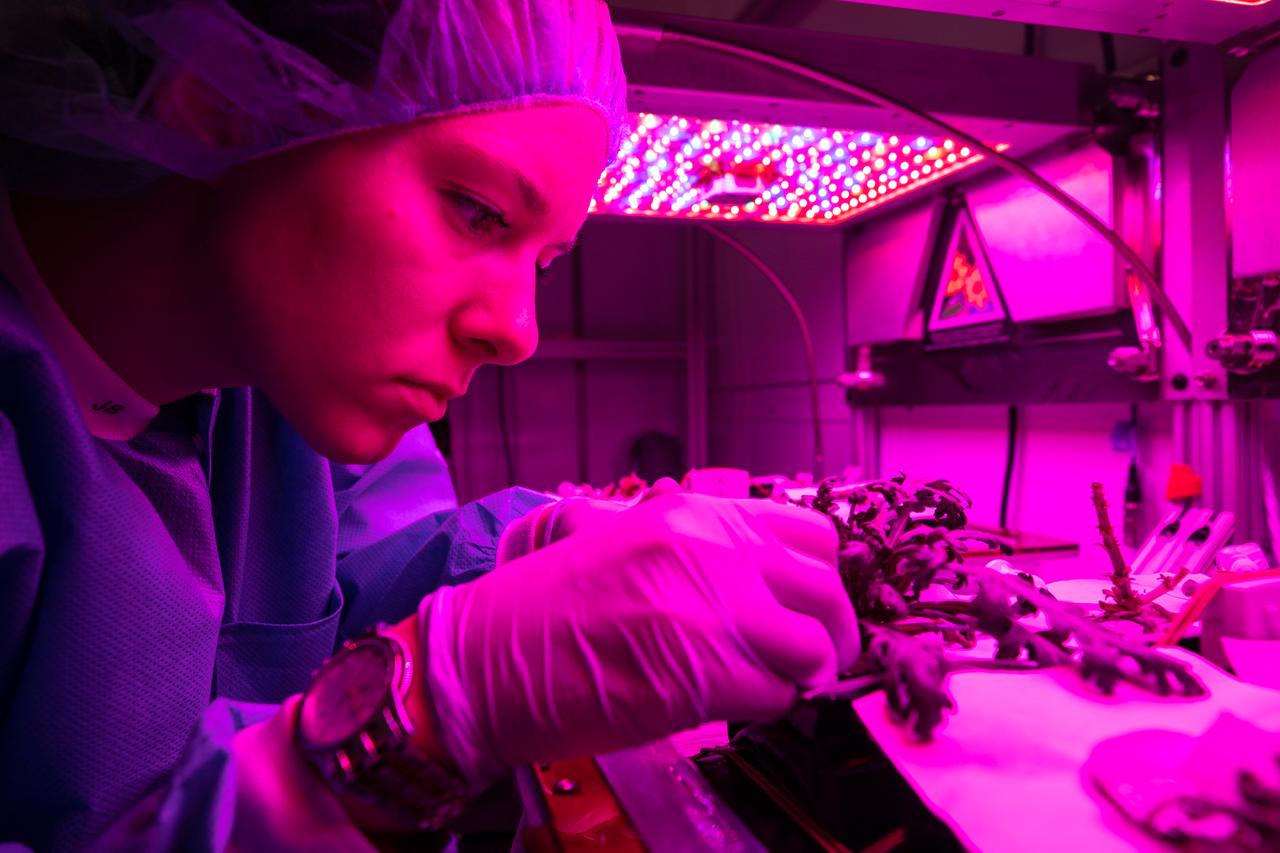
Jess Bunchek, an associate scientist at NASA’s Kennedy Space Center in Florida, harvests plant cultivars inside the Veggie growth chamber in the Space Station Processing Facility on Sept. 30, 2019, for a science verification test (SVT). This SVT will study the potential of three plants – amara mustard, ‘outredgeous’ red romaine lettuce and shungiku, an Asian green comparable to an edible chrysanthemum – to grow in space. All three lettuce plants were grown from seed film, making this the first SVT with this new plant growth material. Earlier this year, the amara mustard and shungiku plants were grown for the first time using seed bags – referred to as pillows – during the Sustained Veggie project, a study funded by the Human Research Program.
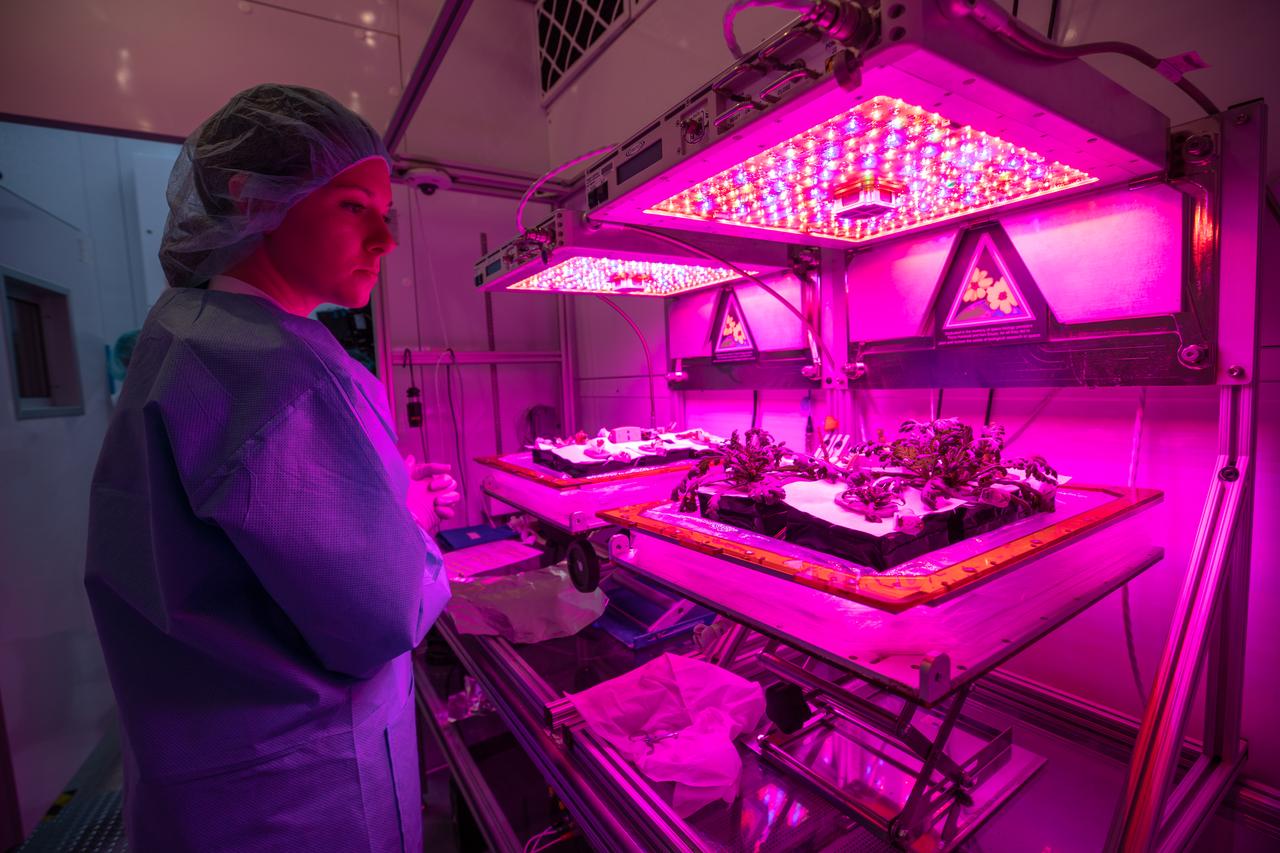
Jess Bunchek, an associate scientist at NASA’s Kennedy Space Center in Florida, observes plant cultivars inside the Veggie growth chamber in the Space Station Processing Facility prior to harvesting them on Sept. 30, 2019, for a science verification test (SVT). This SVT will study the potential of three plants – amara mustard, ‘outredgeous’ red romaine lettuce and shungiku, an Asian green comparable to an edible chrysanthemum – to grow in space. All three lettuce plants were grown from seed film, making this the first SVT with this new plant growth material. Earlier this year, the amara mustard and shungiku plants were grown for the first time using seed bags – referred to as pillows – during the Sustained Veggie project, a study funded by the Human Research Program.
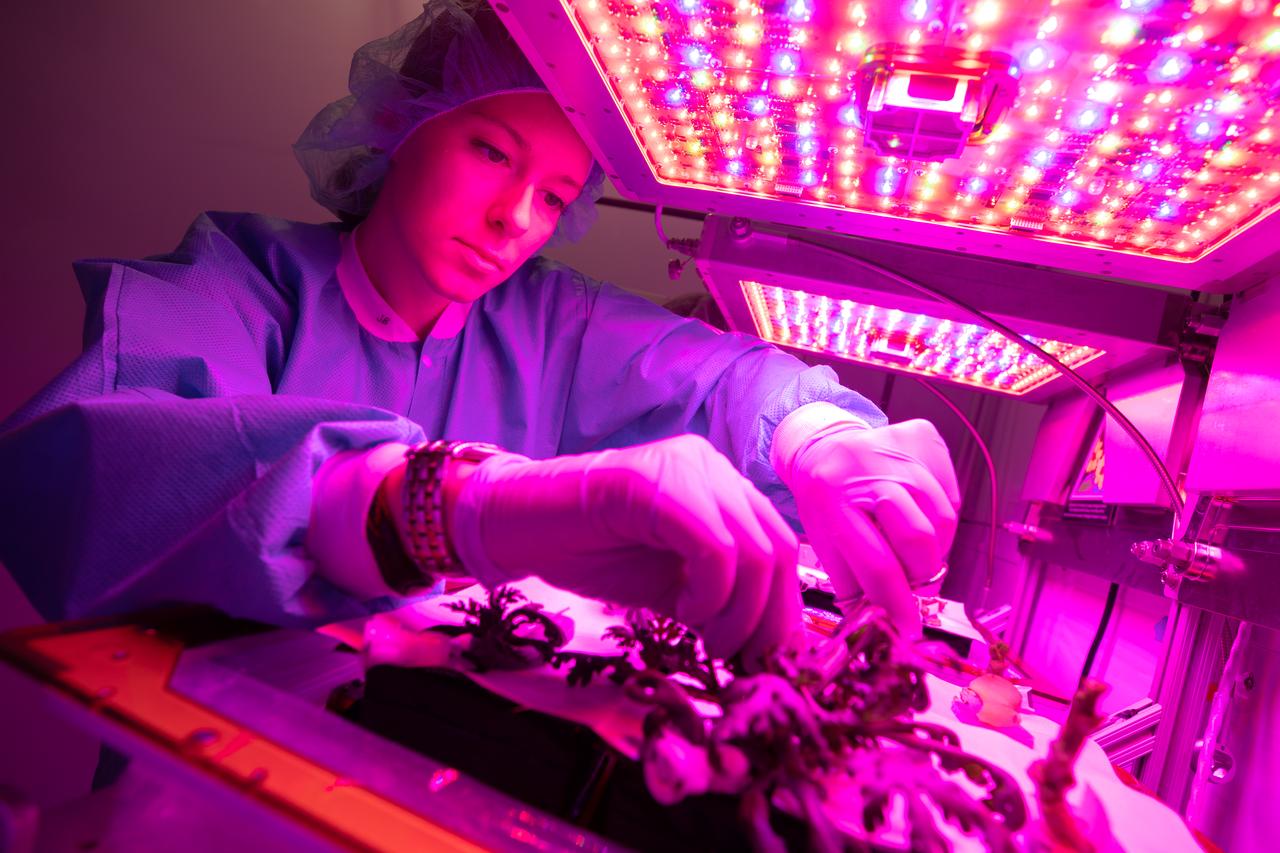
Jess Bunchek, an associate scientist at NASA’s Kennedy Space Center in Florida, harvests shungiku – an Asian green comparable to an edible chrysanthemum – inside the Veggie growth chamber in the Space Station Processing Facility on Sept. 30, 2019, for a science verification test (SVT). The SVT included the harvest of two other plant cultivars – amara mustard and ‘outredgeous’ red romaine lettuce – and will study their potential to grow in space. All three lettuce plants were grown from seed film, making this the first SVT with this new plant growth material. Earlier this year, the amara mustard and shungiku plants were grown for the first time using seed bags – referred to as pillows – during the Sustained Veggie project, a study funded by the Human Research Program.
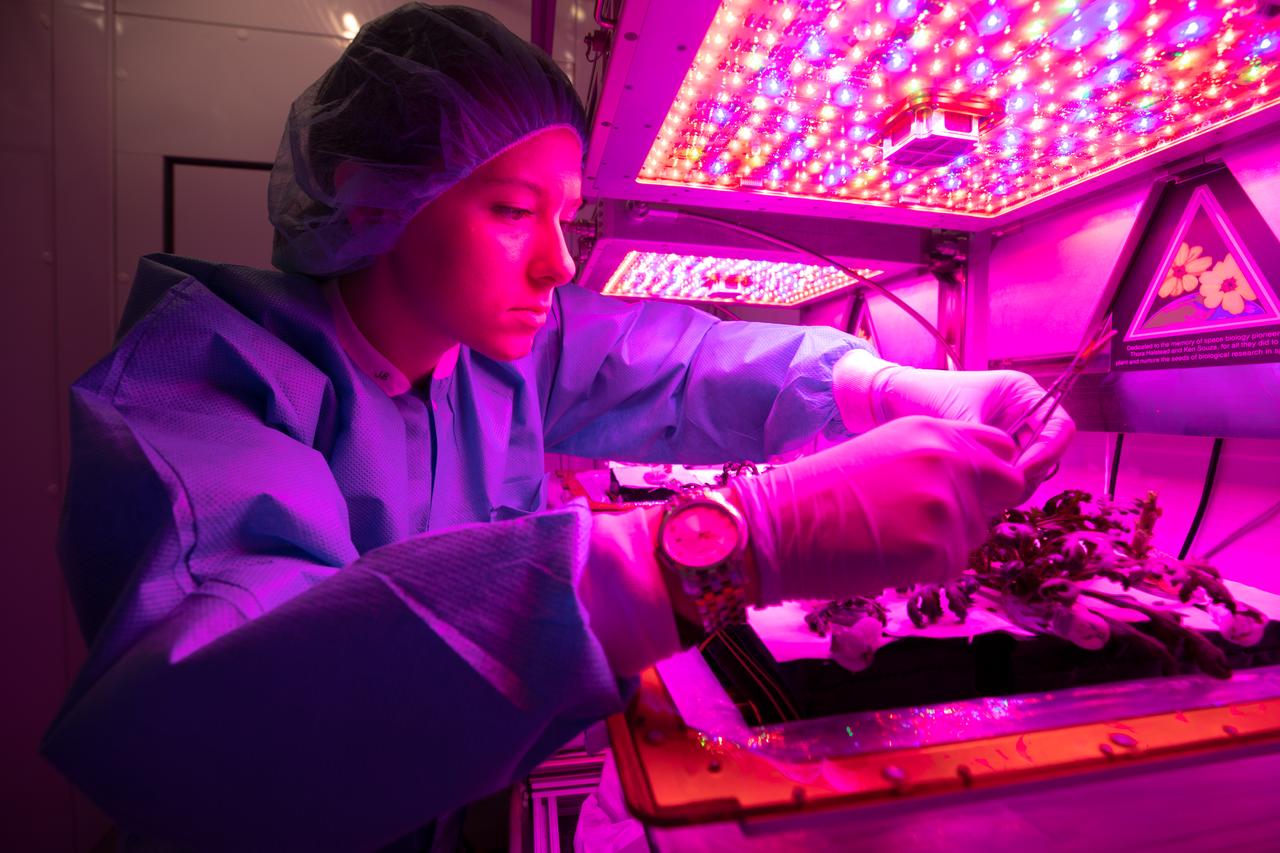
Jess Bunchek, an associate scientist at NASA’s Kennedy Space Center in Florida, harvests shungiku – an Asian green comparable to an edible chrysanthemum – inside the Veggie growth chamber in the Space Station Processing Facility on Sept. 30, 2019, for a science verification test (SVT). The SVT included the harvest of two other plant cultivars – amara mustard and ‘outredgeous’ red romaine lettuce – and will study their potential to grow in space. All three lettuce plants were grown from seed film, making this the first SVT with this new plant growth material. Earlier this year, the amara mustard and shungiku plants were grown for the first time using seed bags – referred to as pillows – during the Sustained Veggie project, a study funded by the Human Research Program.
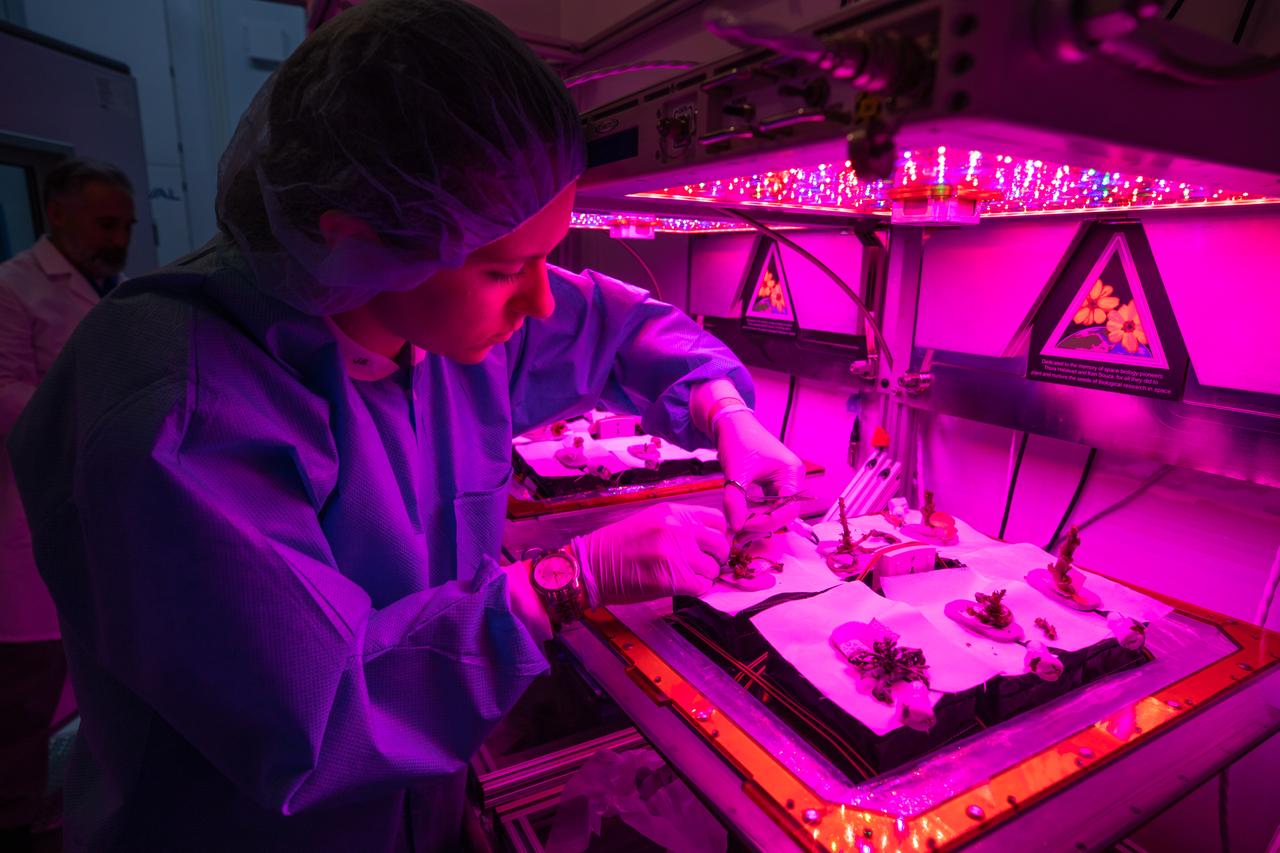
Jess Bunchek, an associate scientist at NASA’s Kennedy Space Center in Florida, harvests plant cultivars inside the Veggie growth chamber in the Space Station Processing Facility on Sept. 30, 2019, for a science verification test (SVT). This SVT will study the potential of three plants – amara mustard, ‘outredgeous’ red romaine lettuce and shungiku, an Asian green comparable to an edible chrysanthemum – to grow in space. All three lettuce plants were grown from seed film, making this the first SVT with this new plant growth material. Earlier this year, the amara mustard and shungiku plants were grown for the first time using seed bags – referred to as pillows – during the Sustained Veggie project, a study funded by the Human Research Program.
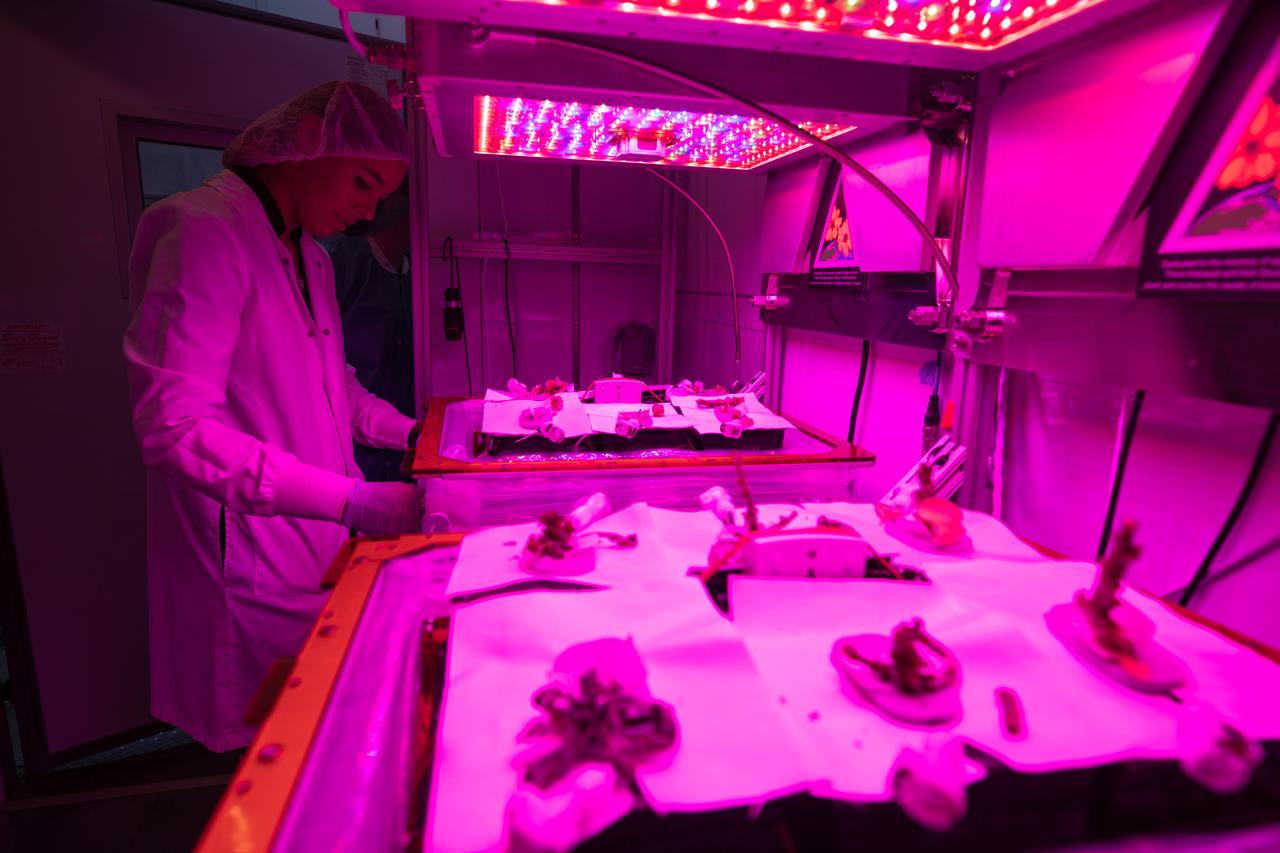
Kennedy Space Center employee Anna Maria Ruby observes plant cultivars inside the Veggie growth chamber in the Space Station Processing Facility prior to harvesting them on Sept. 30, 2019, for a science verification test (SVT). This SVT will study the potential of three plants – amara mustard, ‘outredgeous’ red romaine lettuce and shungiku, an Asian green comparable to an edible chrysanthemum – to grow in space. All three lettuce plants were grown from seed film, making this the first SVT with this new plant growth material. Earlier this year, the amara mustard and shungiku plants were grown for the first time using seed bags – referred to as pillows – during the Sustained Veggie project, a study funded by the Human Research Program.
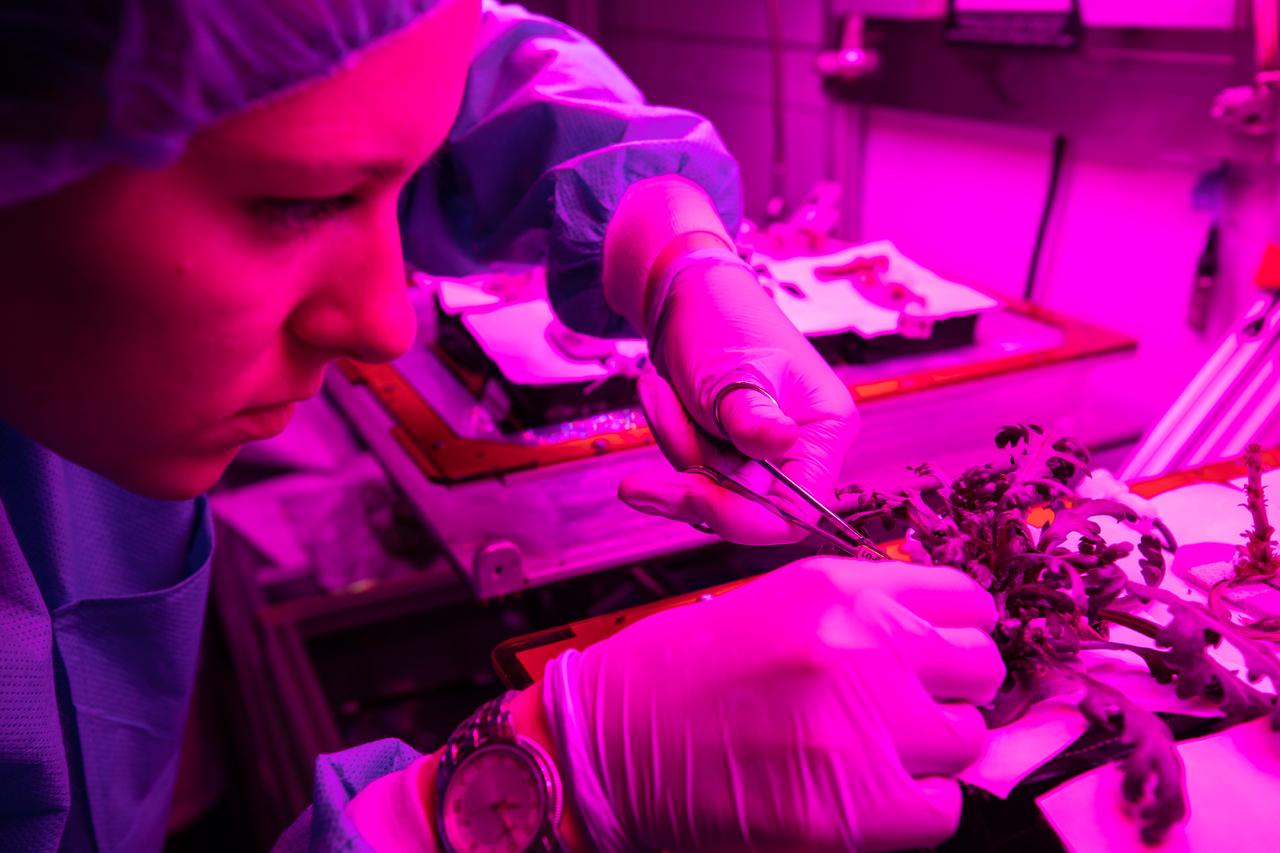
Jess Bunchek, an associate scientist at NASA’s Kennedy Space Center in Florida, harvests shungiku – an Asian green comparable to an edible chrysanthemum – inside the Veggie growth chamber in the Space Station Processing Facility on Sept. 30, 2019, for a science verification test (SVT). The SVT included the harvest of two other plant cultivars – amara mustard and ‘outredgeous’ red romaine lettuce – and will study their potential to grow in space. All three lettuce plants were grown from seed film, making this the first SVT with this new plant growth material. Earlier this year, the amara mustard and shungiku plants were grown for the first time using seed bags – referred to as pillows – during the Sustained Veggie project, a study funded by the Human Research Program.
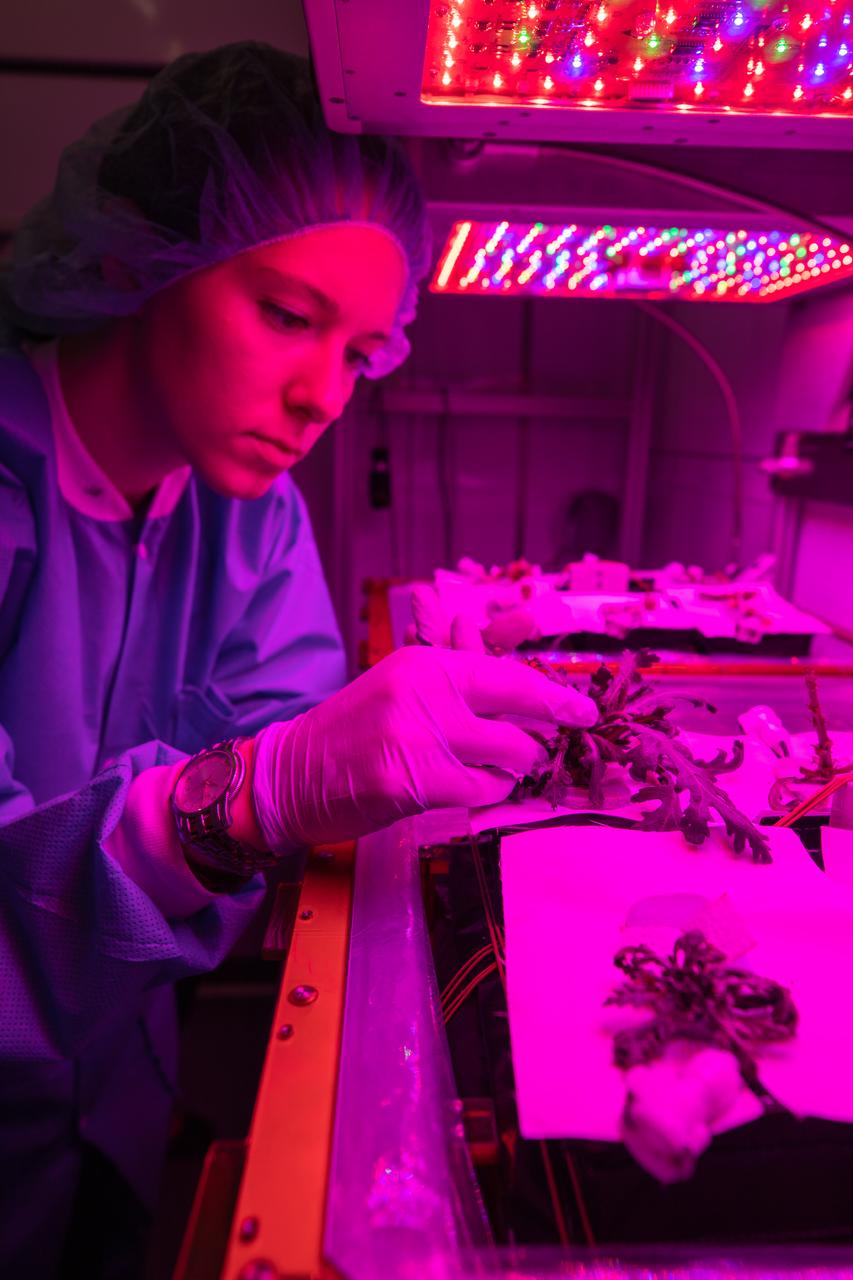
Jess Bunchek, an associate scientist at NASA’s Kennedy Space Center in Florida, harvests plant cultivars inside the Veggie growth chamber in the Space Station Processing Facility on Sept. 30, 2019, for a science verification test (SVT). This SVT will study the potential of three plants – amara mustard, ‘outredgeous’ red romaine lettuce and shungiku, an Asian green comparable to an edible chrysanthemum – to grow in space. All three lettuce plants were grown from seed film, making this the first SVT with this new plant growth material. Earlier this year, the amara mustard and shungiku plants were grown for the first time using seed bags – referred to as pillows – during the Sustained Veggie project, a study funded by the Human Research Program.
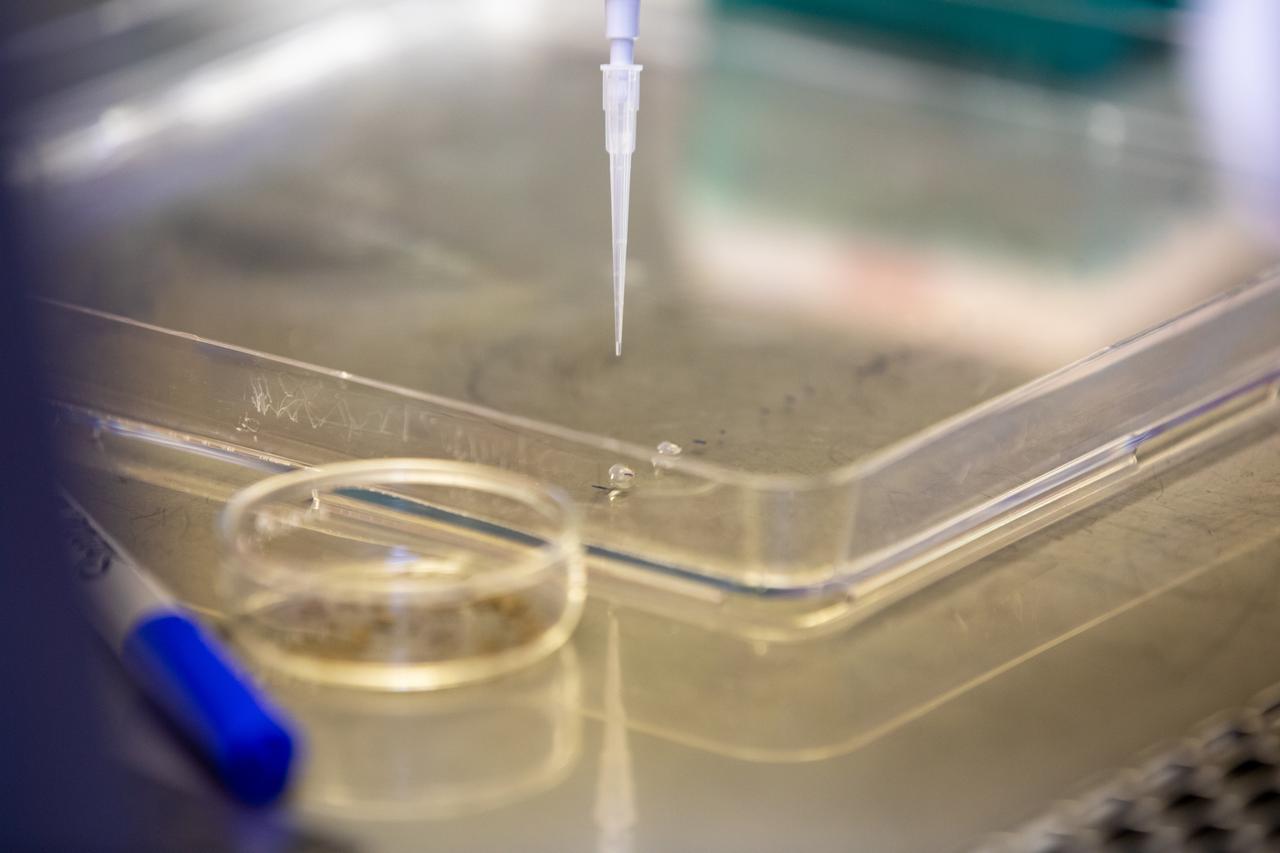
Aaron Curry, a research scientist with the Laboratory Support Services and Operations (LASSO) contract at NASA’s Kennedy Space Center in Florida affixes red romaine lettuce seeds to a sheet of seed film – a new seed handling material – inside the Space Station Processing Facility on Jan. 15, 2020. The seed film is being prepared for the VEG-03 J experiment that will fly to the International Space Station on Northrop Grumman’s 13th resupply services (NG-13) mission. This seed film experiment involves crew aboard the orbiting laboratory planting the seeds into plant pillows – a common method used to grow plants in space – themselves for the first time ever. The water-soluble, dissolving film addresses the challenge of handling seeds in a microgravity environment and also can be used to deliver fertilizers and other beneficial substances that help plants grow. NG-13 is scheduled to launch from the agency’s Wallops Flight Facility in Virginia on Feb. 9, 2020, at 5:39 p.m. EST.
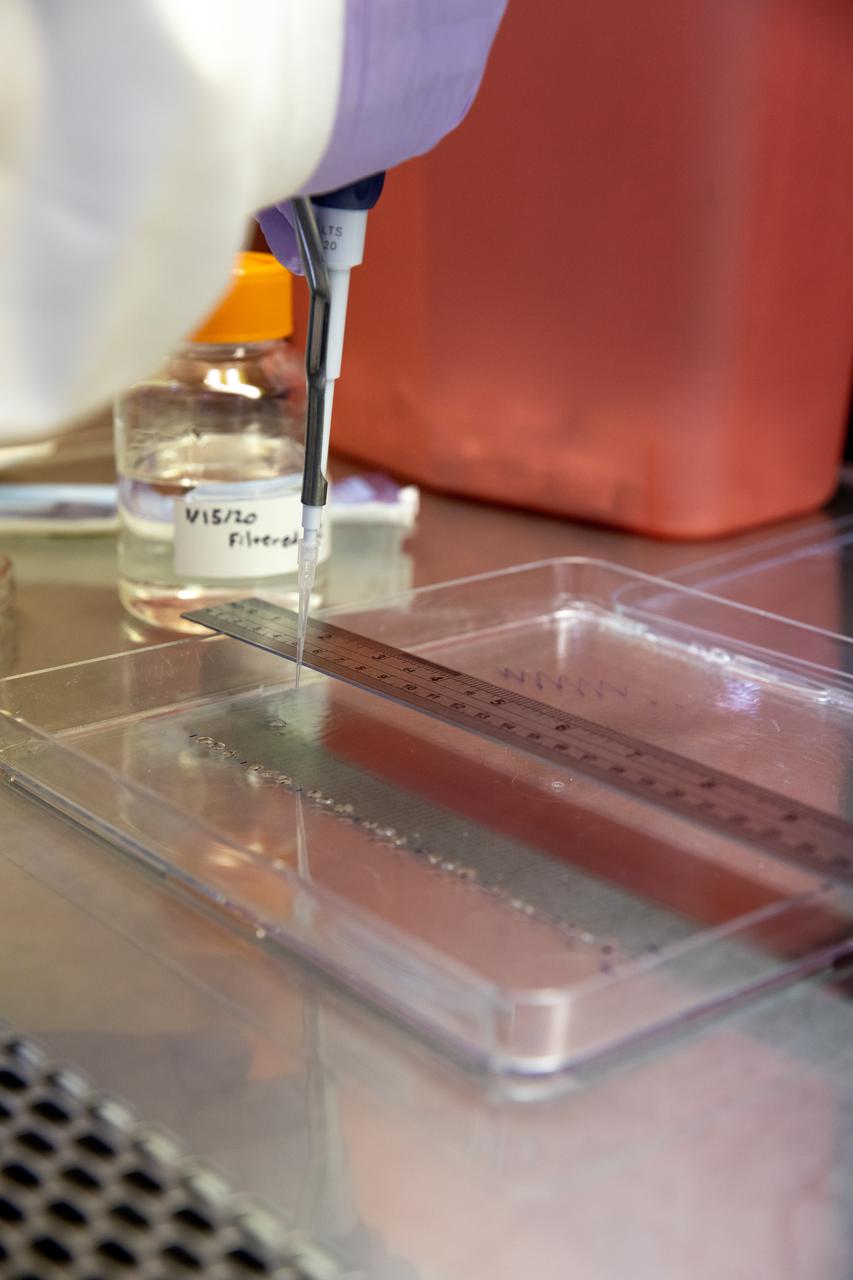
Aaron Curry, a research scientist with the Laboratory Support Services and Operations (LASSO) contract at NASA’s Kennedy Space Center in Florida affixes red romaine lettuce seeds to a sheet of seed film – a new seed handling material – inside the Space Station Processing Facility on Jan. 15, 2020. The seed film is being prepared for the VEG-03 J experiment that will fly to the International Space Station on Northrop Grumman’s 13th resupply services (NG-13) mission. This seed film experiment involves crew aboard the orbiting laboratory planting the seeds into plant pillows – a common method used to grow plants in space – themselves for the first time ever. The water-soluble, dissolving film addresses the challenge of handling seeds in a microgravity environment and also can be used to deliver fertilizers and other beneficial substances that help plants grow. NG-13 is scheduled to launch from the agency’s Wallops Flight Facility in Virginia on Feb. 9, 2020, at 5:39 p.m. EST.
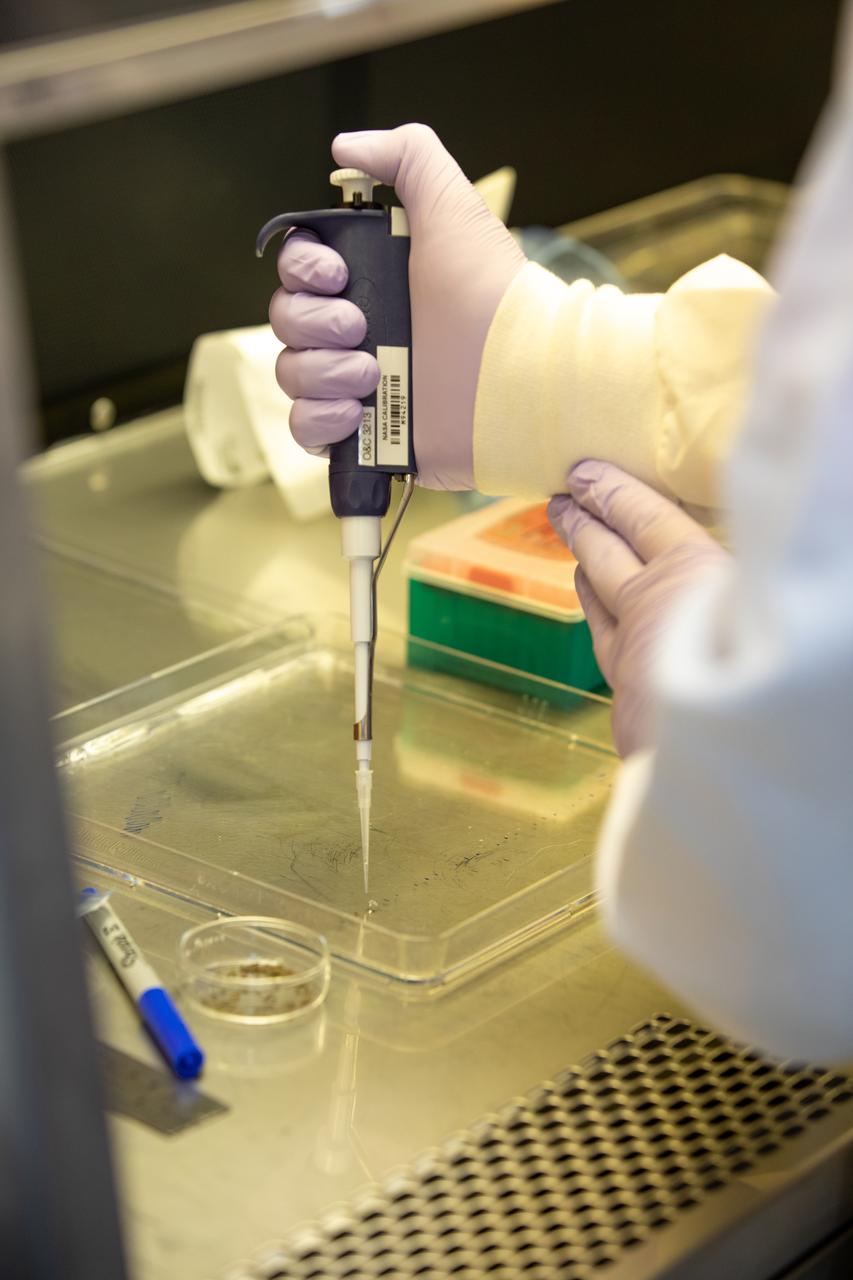
Aaron Curry, a research scientist with the Laboratory Support Services and Operations (LASSO) contract at NASA’s Kennedy Space Center in Florida affixes red romaine lettuce seeds to a sheet of seed film – a new seed handling material – inside the Space Station Processing Facility on Jan. 15, 2020. The seed film is being prepared for the VEG-03 J experiment that will fly to the International Space Station on Northrop Grumman’s 13th resupply services (NG-13) mission. This seed film experiment involves crew aboard the orbiting laboratory planting the seeds into plant pillows – a common method used to grow plants in space – themselves for the first time ever. The water-soluble, dissolving film addresses the challenge of handling seeds in a microgravity environment and also can be used to deliver fertilizers and other beneficial substances that help plants grow. NG-13 is scheduled to launch from the agency’s Wallops Flight Facility in Virginia on Feb. 9, 2020, at 5:39 p.m. EST.
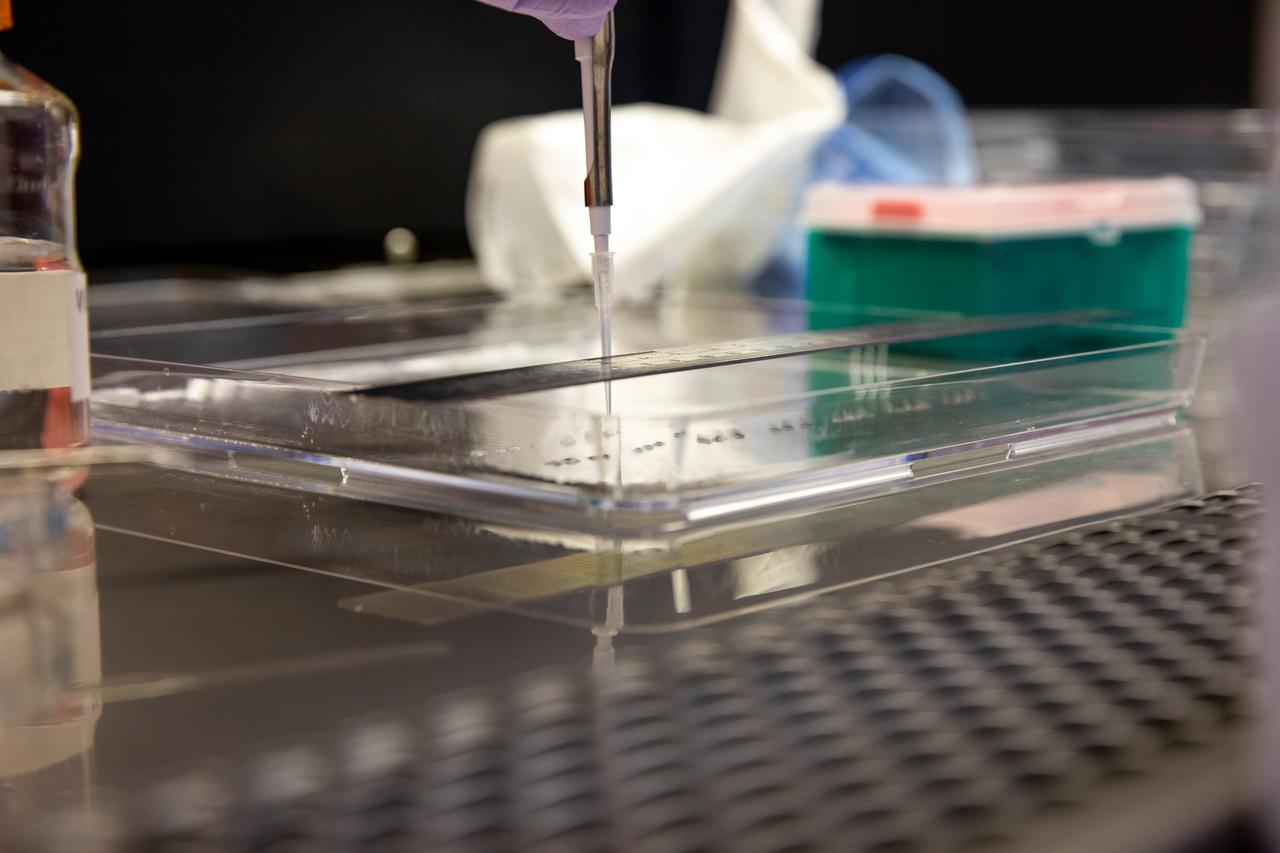
Aaron Curry, a research scientist with the Laboratory Support Services and Operations (LASSO) contract at NASA’s Kennedy Space Center in Florida affixes red romaine lettuce seeds to a sheet of seed film – a new seed handling material – inside the Space Station Processing Facility on Jan. 15, 2020. The seed film is being prepared for the VEG-03 J experiment that will fly to the International Space Station on Northrop Grumman’s 13th resupply services (NG-13) mission. This seed film experiment involves crew aboard the orbiting laboratory planting the seeds into plant pillows – a common method used to grow plants in space – themselves for the first time ever. The water-soluble, dissolving film addresses the challenge of handling seeds in a microgravity environment and also can be used to deliver fertilizers and other beneficial substances that help plants grow. NG-13 is scheduled to launch from the agency’s Wallops Flight Facility in Virginia on Feb. 9, 2020, at 5:39 p.m. EST.

These ‘Red Robin’ dwarf tomato plants, photographed Jan. 10, 2020, inside a laboratory in the Space Station Processing Facility at NASA Kennedy Space Center in Florida, are growing from seeds that have been exposed to simulated solar particle radiation. The plants’ edible mass and nutrients will be measured and compared to those of a control crop, grown from non-irradiated seeds. The project was designed to confirm that nutritious, high-quality produce can be reliably grown in deep space, or to provide a baseline to guide development of countermeasures to protect future crop foods from radiation during missions beyond low-Earth orbit. The investigation on space radiation impact on seeds and crop production also will be carried on the Materials International Space Station Experiment (MISSE) platform outside the station, supported NASA’s Space Technology Mission Directorate and the Space Biology Program, and potentially on future beyond-low-Earth platforms.

These ‘Red Robin’ dwarf tomato plants, photographed Jan. 10, 2020, inside a laboratory in the Space Station Processing Facility at NASA Kennedy Space Center in Florida, are growing from seeds that have been exposed to simulated solar particle radiation. The plants’ edible mass and nutrients will be measured and compared to those of a control crop, grown from non-irradiated seeds. The project was designed to confirm that nutritious, high-quality produce can be reliably grown in deep space, or to provide a baseline to guide development of countermeasures to protect future crop foods from radiation during missions beyond low-Earth orbit. The investigation on space radiation impact on seeds and crop production also will be carried on the Materials International Space Station Experiment (MISSE) platform outside the station, supported NASA’s Space Technology Mission Directorate and the Space Biology Program, and potentially on future beyond-low-Earth platforms.

These ‘Red Robin’ dwarf tomato plants, photographed Jan. 10, 2020, inside a laboratory in the Space Station Processing Facility at NASA Kennedy Space Center in Florida, are growing from seeds that have been exposed to simulated solar particle radiation. The plants’ edible mass and nutrients will be measured and compared to those of a control crop, grown from non-irradiated seeds. The project was designed to confirm that nutritious, high-quality produce can be reliably grown in deep space, or to provide a baseline to guide development of countermeasures to protect future crop foods from radiation during missions beyond low-Earth orbit. The investigation on space radiation impact on seeds and crop production also will be carried on the Materials International Space Station Experiment (MISSE) platform outside the station, supported NASA’s Space Technology Mission Directorate and the Space Biology Program, and potentially on future beyond-low-Earth platforms.
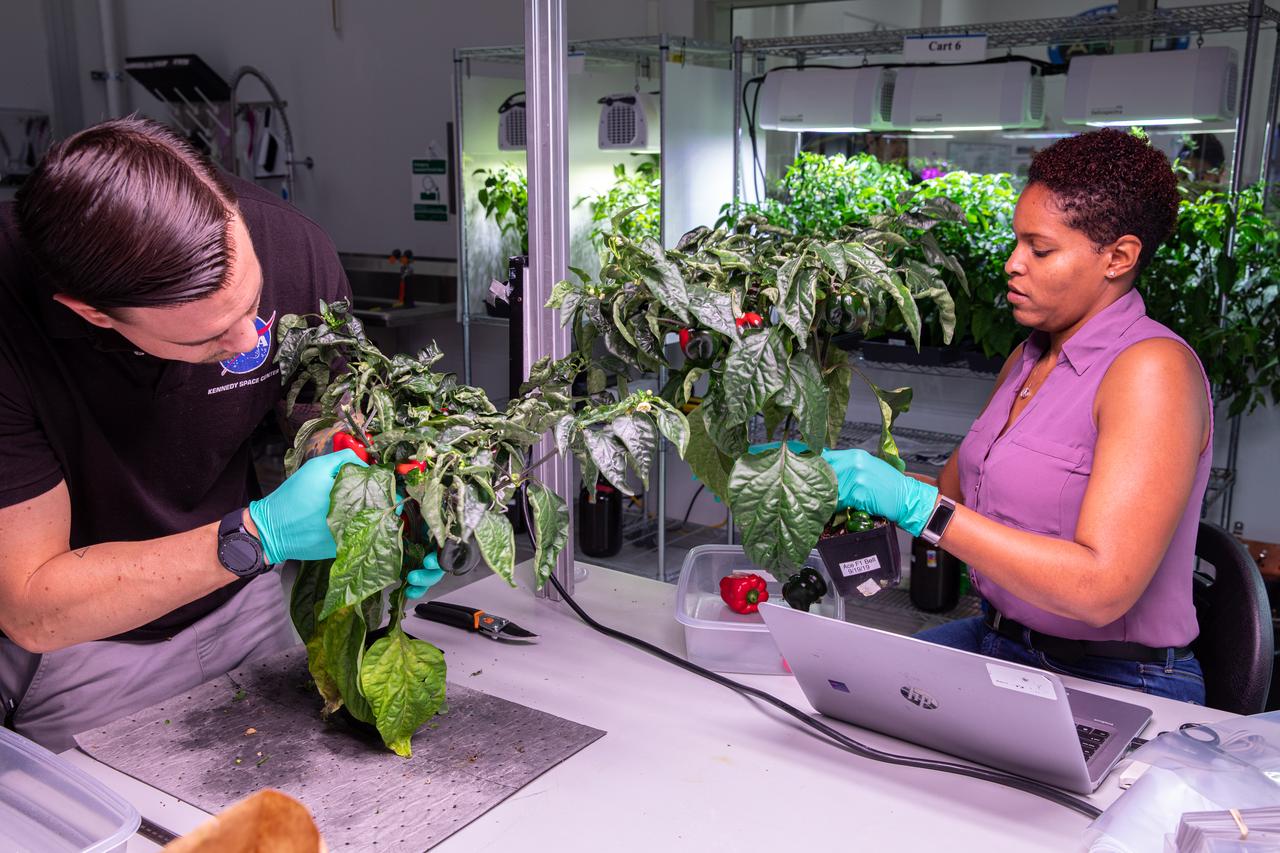
Jason Fischer (left), a research scientist, and Lashelle Spencer, a plant scientist, with the Laboratory Support Services and Operations contract at NASA’s Kennedy Space Center in Florida, harvest peppers from pepper plants on Jan. 15, 2020, that were grown in the Space Station Processing Facility for a growth assessment test in preparation for sending them to space. As NASA prepares to send humans beyond low-Earth orbit, the ability for astronauts to grow a variety of fresh fruits and vegetables in space will be critical. Fresh produce will be an essential supplement to the crew’s pre-packaged diet during long-duration space exploration when they are away from Earth for extended periods of time.
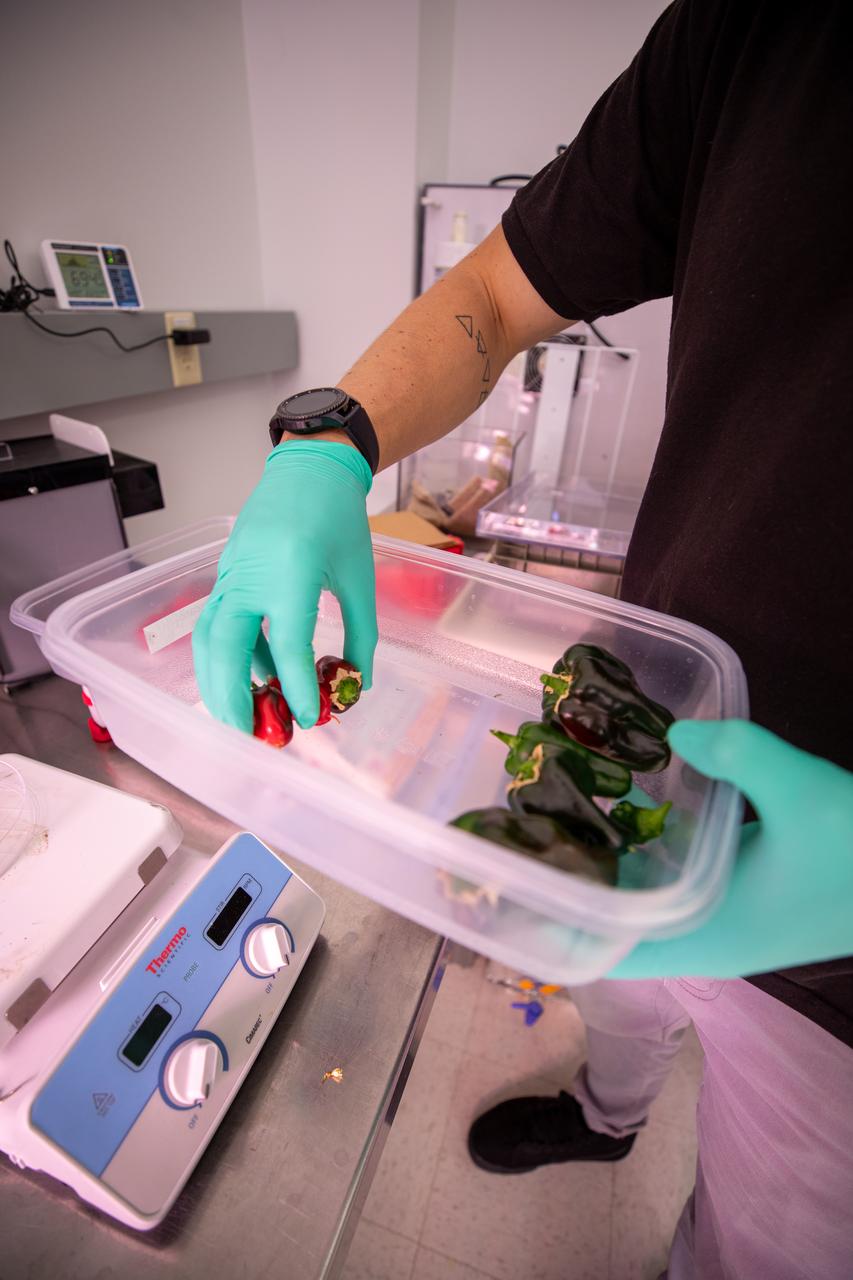
Jason Fischer, a research scientist with the Laboratory Support Services and Operations contract at NASA’s Kennedy Space Center in Florida, weighs peppers that were harvested from inside the Space Station Processing Facility on Jan. 15, 2020, prior to weighing them in preparation for sending them to space. As NASA prepares to send humans beyond low-Earth orbit, the ability for astronauts to grow a variety of fresh fruits and vegetables in space will be critical. Fresh produce will be an essential supplement to the crew’s pre-packaged diet during long-duration space exploration when they are away from Earth for extended periods of time.
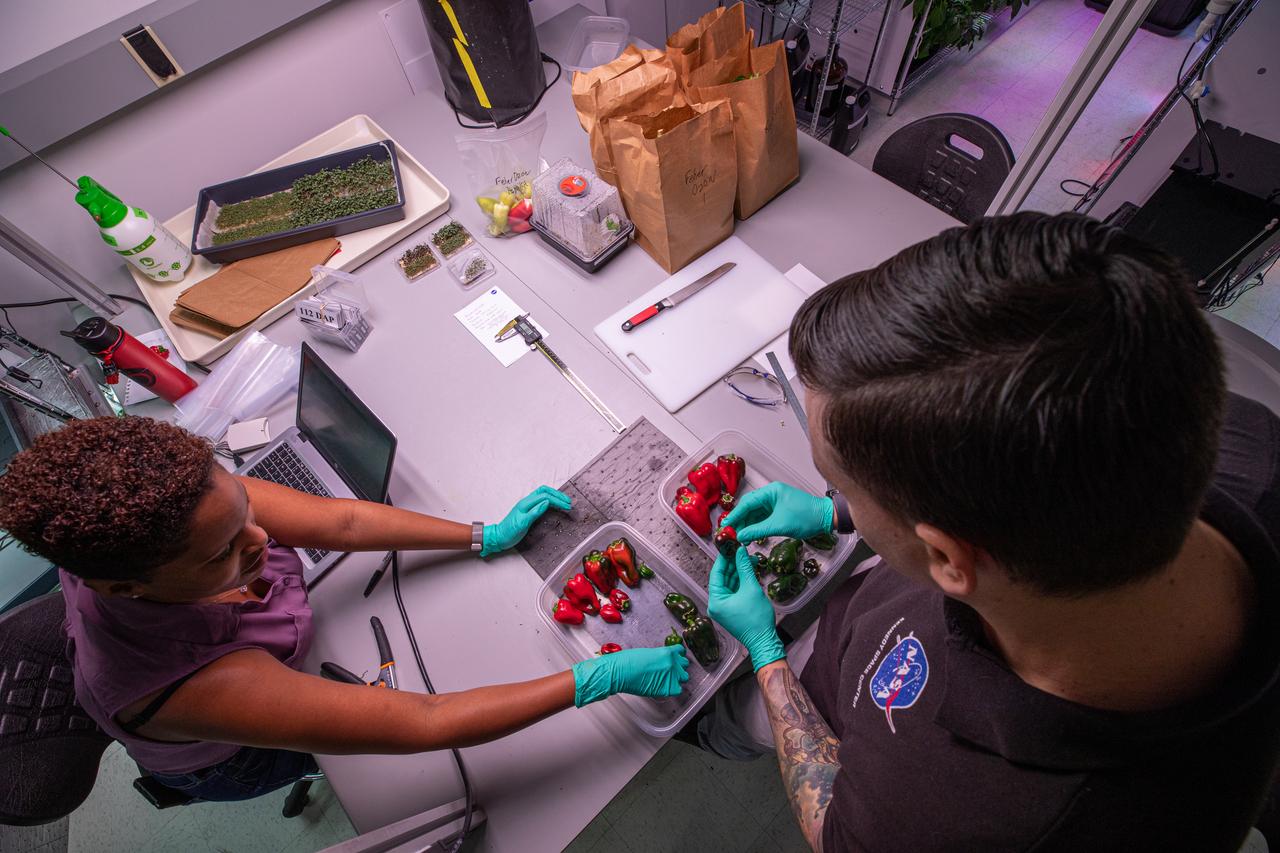
Plant Scientist Lashelle Spencer (left) and Research Scientist Jason Fischer with the Laboratory Support Services and Operations contract at NASA’s Kennedy Space Center in Florida remove the stems from peppers that were grown inside the Space Station Processing Facility on Jan. 15, 2020, prior to weighing them in preparation for sending them to space. As NASA prepares to send humans beyond low-Earth orbit, the ability for astronauts to grow a variety of fresh fruits and vegetables in space will be critical. Fresh produce will be an essential supplement to the crew’s pre-packaged diet during long-duration space exploration when they are away from Earth for extended periods of time.

Jason Fischer (left), a research scientist, and Lashelle Spencer, a plant scientist, with the Laboratory Support Services and Operations contract at NASA’s Kennedy Space Center in Florida, observe and document the growth of pepper plants prior to harvesting them on Jan. 15, 2020, inside the Space Station Processing Facility in preparation for sending them to space. As NASA prepares to send humans beyond low-Earth orbit, the ability for astronauts to grow a variety of fresh fruits and vegetables in space will be critical. Fresh produce will be an essential supplement to the crew’s pre-packaged diet during long-duration space exploration when they are away from Earth for extended periods of time.
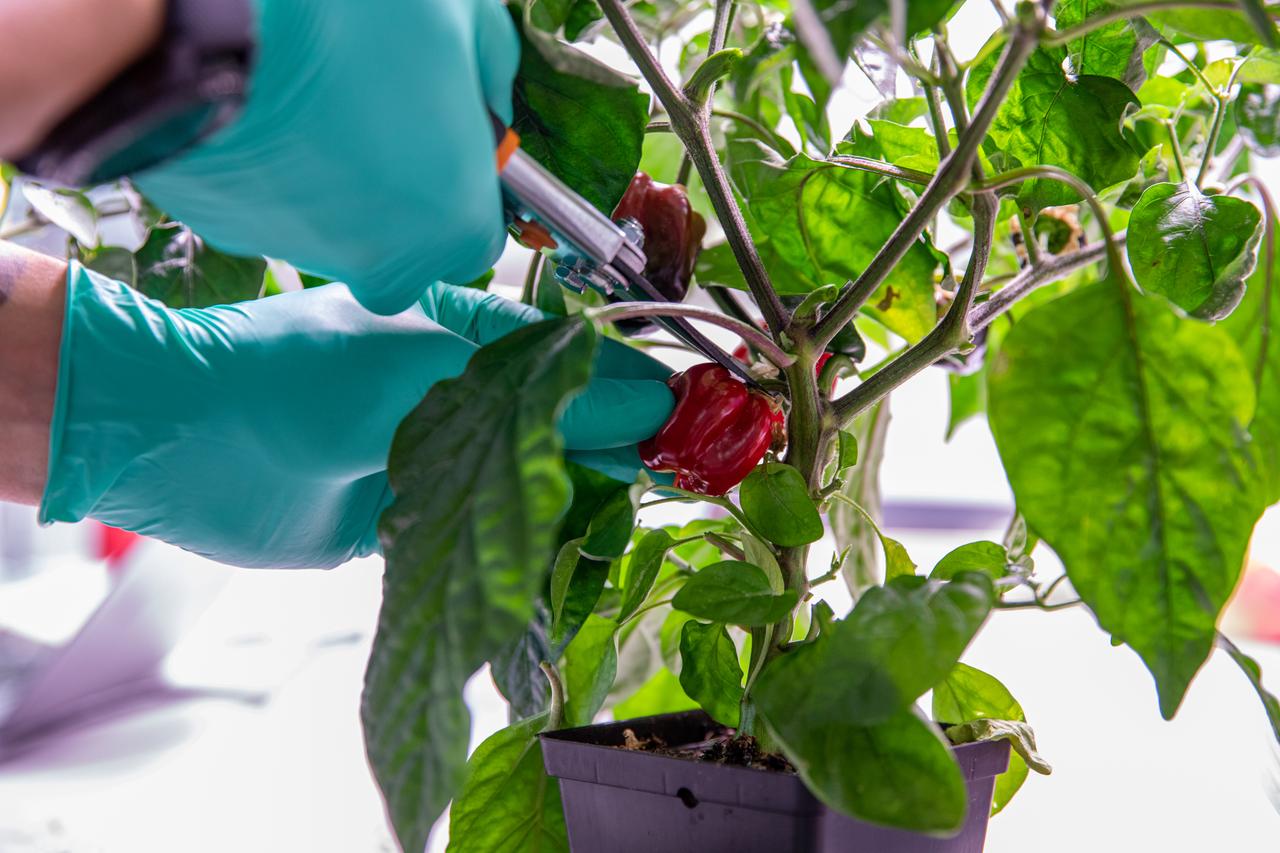
Jason Fischer, a research scientist with the Laboratory Support Services and Operations contract at NASA’s Kennedy Space Center in Florida, observes and documents the growth of peppers prior to harvesting them on Jan. 15, 2020, inside the Space Station Processing Facility in preparation for sending them to space. As NASA prepares to send humans beyond low-Earth orbit, the ability for astronauts to grow a variety of fresh fruits and vegetables in space will be critical. Fresh produce will be an essential supplement to the crew’s pre-packaged diet during long-duration space exploration when they are away from Earth for extended periods of time.
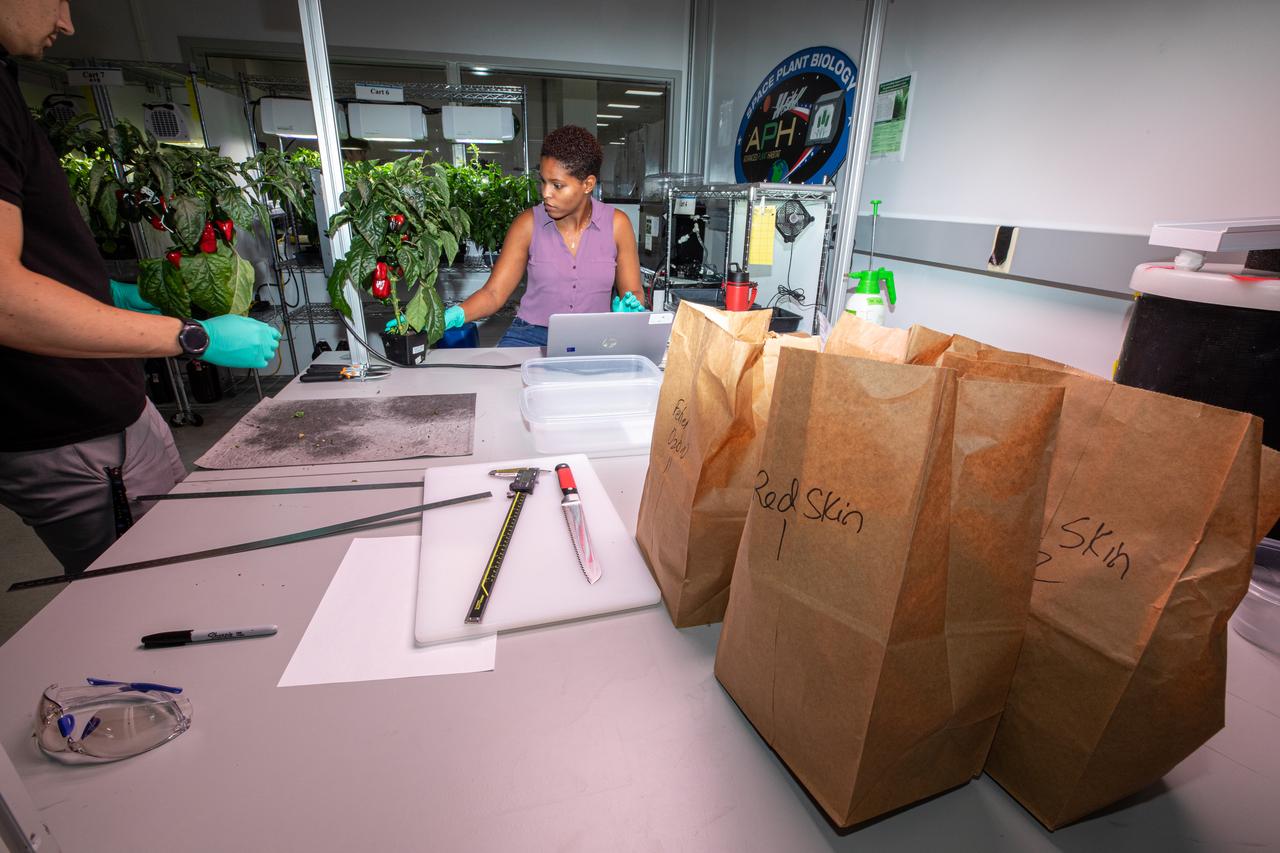
Lashelle Spencer (center), a plant scientist with the Laboratory Support Services and Operations contract at NASA’s Kennedy Space Center in Florida, harvests peppers from a pepper plant on Jan. 15, 2020, that was grown in the Space Station Processing Facility in preparation for sending them to space. As NASA prepares to send humans beyond low-Earth orbit, the ability for astronauts to grow a variety of fresh fruits and vegetables in space will be critical. Fresh produce will be an essential supplement to the crew’s pre-packaged diet during long-duration space exploration when they are away from Earth for extended periods of time.
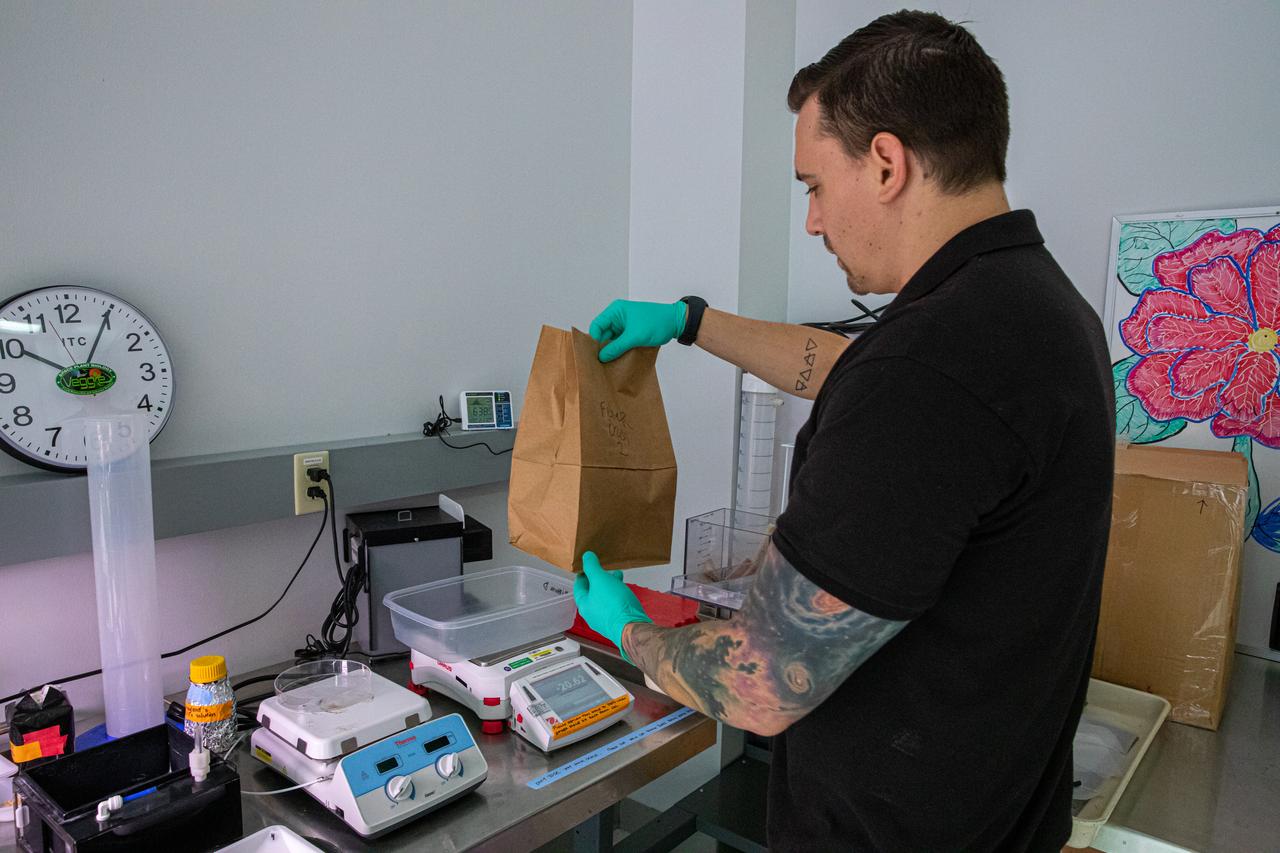
On Jan. 15, 2020, Jason Fischer, a research scientist with the Laboratory Support Services and Operations contract at NASA’s Kennedy Space Center in Florida, prepares to weigh peppers that were grown and harvested inside the Space Station Processing Facility in preparation for sending them to space. As NASA prepares to send humans beyond low-Earth orbit, the ability for astronauts to grow a variety of fresh fruits and vegetables in space will be critical. Fresh produce will be an essential supplement to the crew’s pre-packaged diet during long-duration space exploration when they are away from Earth for extended periods of time.
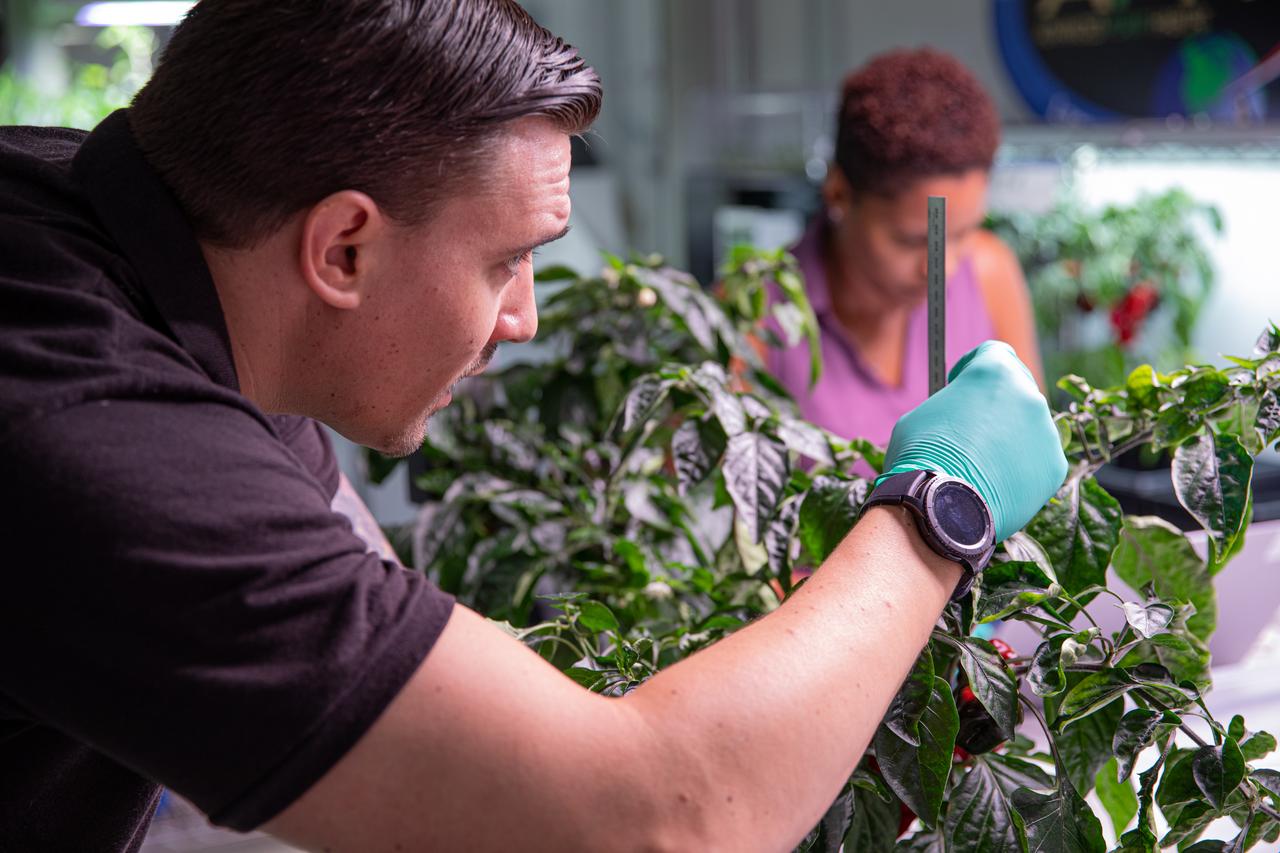
Jason Fischer (left), a research scientist, and Lashelle Spencer, a plant scientist, with the Laboratory Support Services and Operations contract at NASA’s Kennedy Space Center in Florida, observe and document the growth of pepper plants prior to harvesting them on Jan. 15, 2020, inside the Space Station Processing in preparation for sending them to space. As NASA prepares to send humans beyond low-Earth orbit, the ability for astronauts to grow a variety of fresh fruits and vegetables in space will be critical. Fresh produce will be an essential supplement to the crew’s pre-packaged diet during long-duration space exploration when they are away from Earth for extended periods of time.
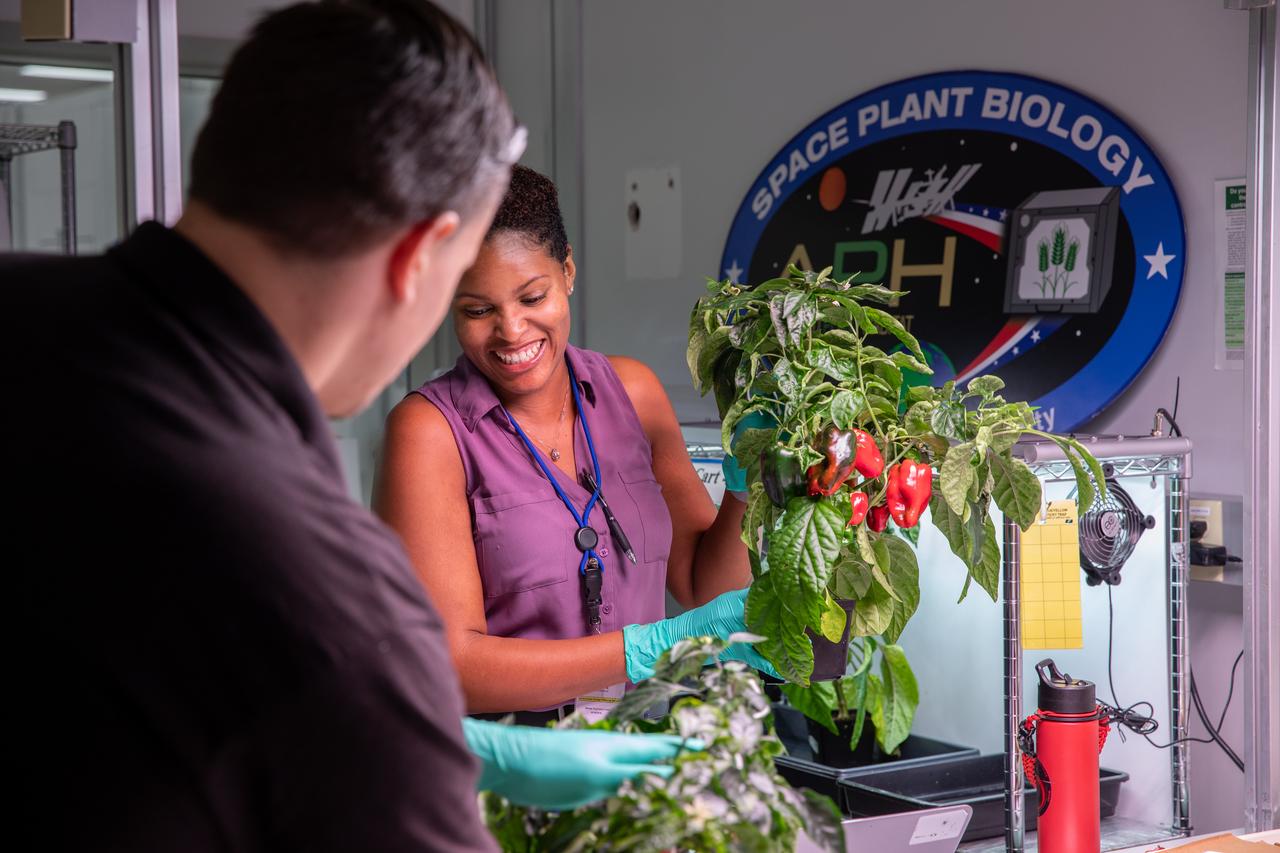
Jason Fischer (left), a research scientist, and Lashelle Spencer, a plant scientist, with the Laboratory Support Services and Operations contract at NASA’s Kennedy Space Center in Florida, harvest peppers from pepper plants on Jan. 15, 2020, that were grown in the Space Station Processing Facility for a growth assessment in preparation for sending them to space. As NASA prepares to send humans beyond low-Earth orbit, the ability for astronauts to grow a variety of fresh fruits and vegetables in space will be critical. Fresh produce will be an essential supplement to the crew’s pre-packaged diet during long-duration space exploration when they are away from Earth for extended periods of time.