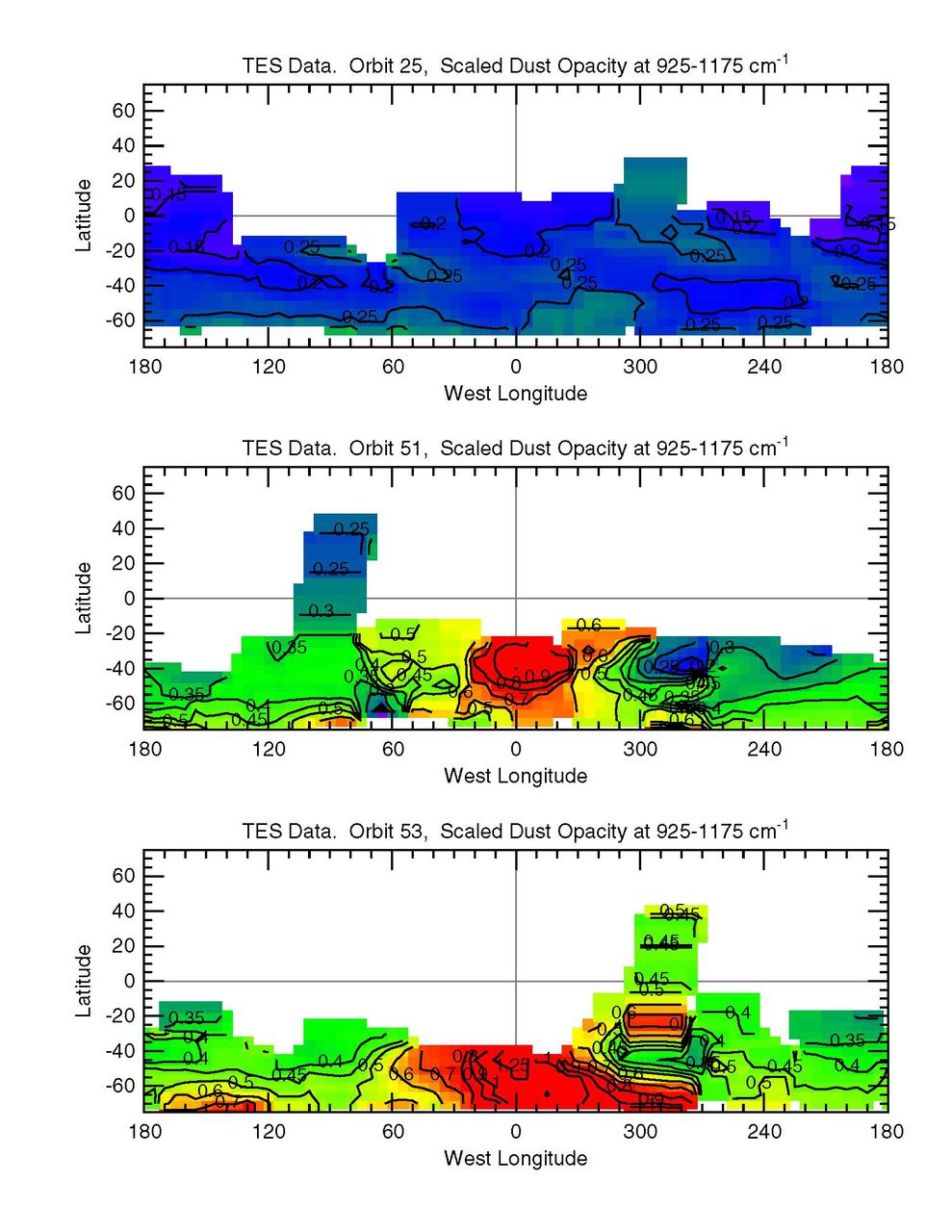
Growth of a Dust Storm TES
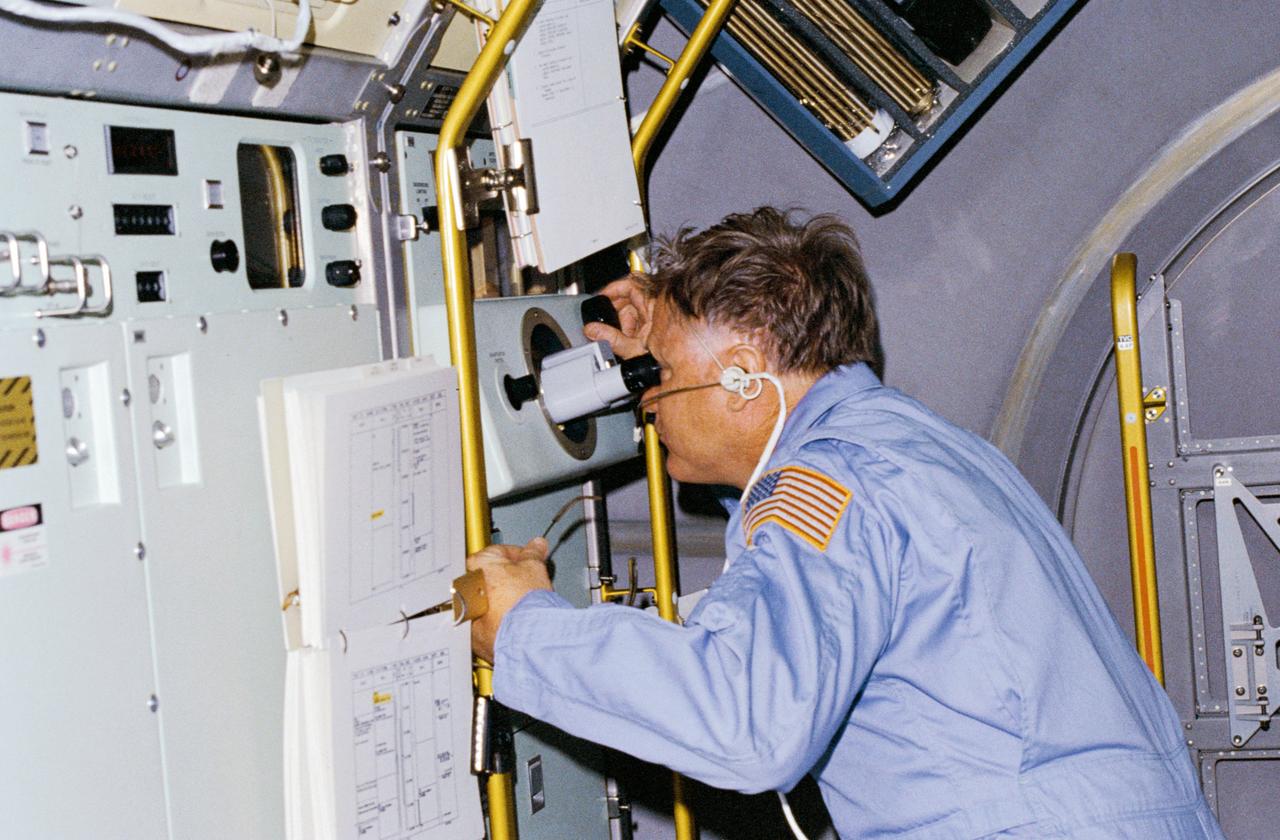
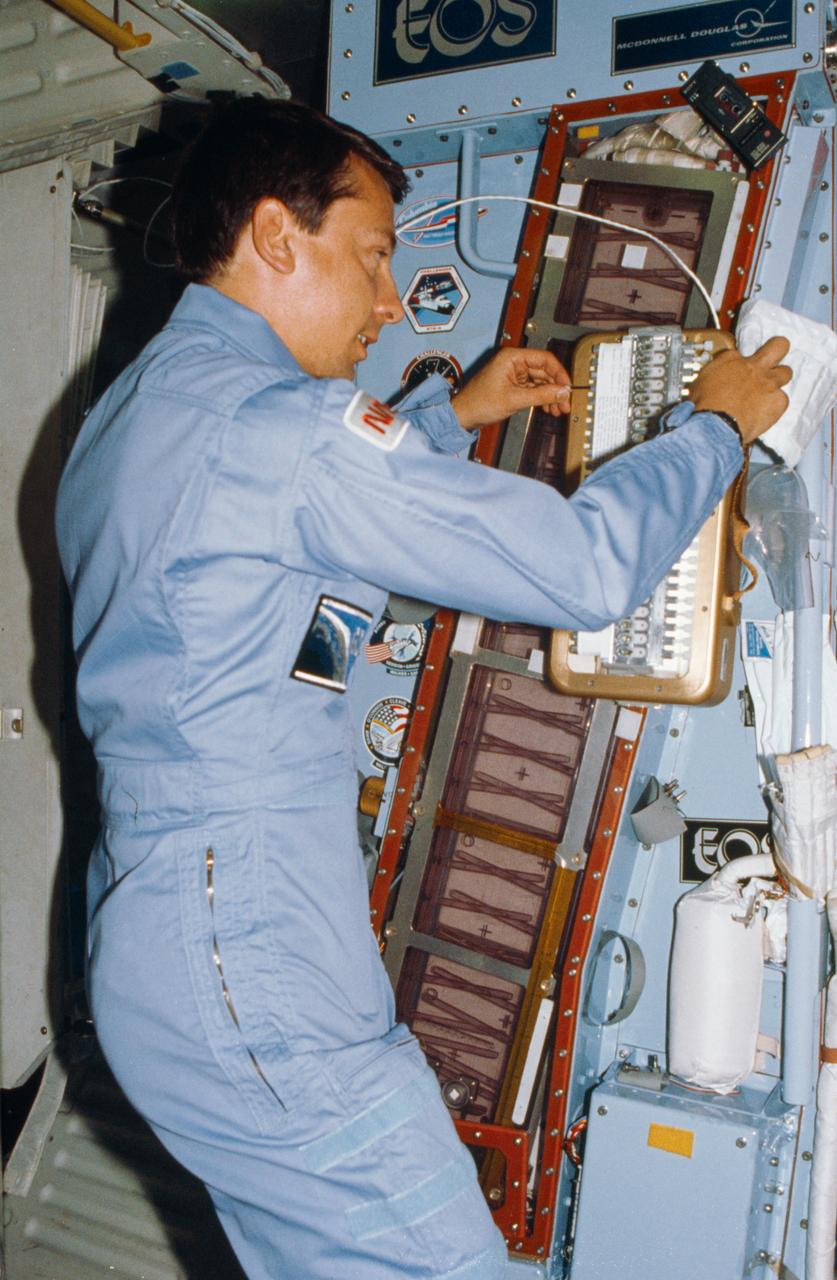
51B-01-007 (30 April 1985) --- Astronaut Don L. Lind, 51-B Spacelab 3 mission specialist, observes the growth of mercuric iodide crystal in the vapor crystal growth system (VCGS) on the Spacelab 3 science module aboard the orbiter Challenger.

Close-up view of plant growth taken by the Expedition 37 crew.
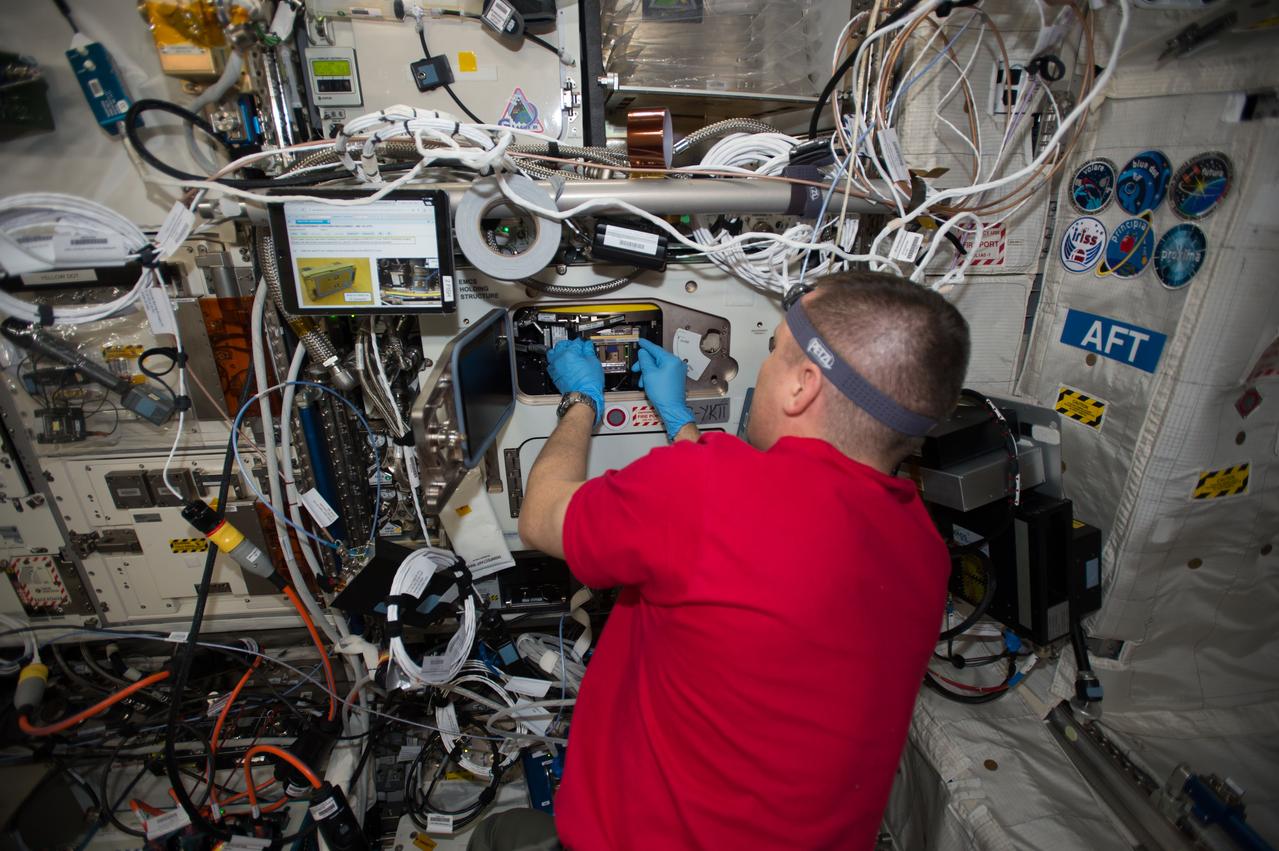
iss052e002352 (6/12/2017) --- A view of NASA astronaut Jack Fischer replacing the European Modular Cultivation System (EMCS) Experiment Containers (ECs) with new ECs prepared for the Seedling Growth 3 experiment. Seedling Growth-3 is the third part of the Seedling Growth Experiment series, using the plant Arabidopsis thaliana to investigate the effects of gravity on the cellular signaling mechanisms of light sensing in plants (phototropism), and to investigate cell growth and proliferation responses to light stimulation under microgravity conditions.
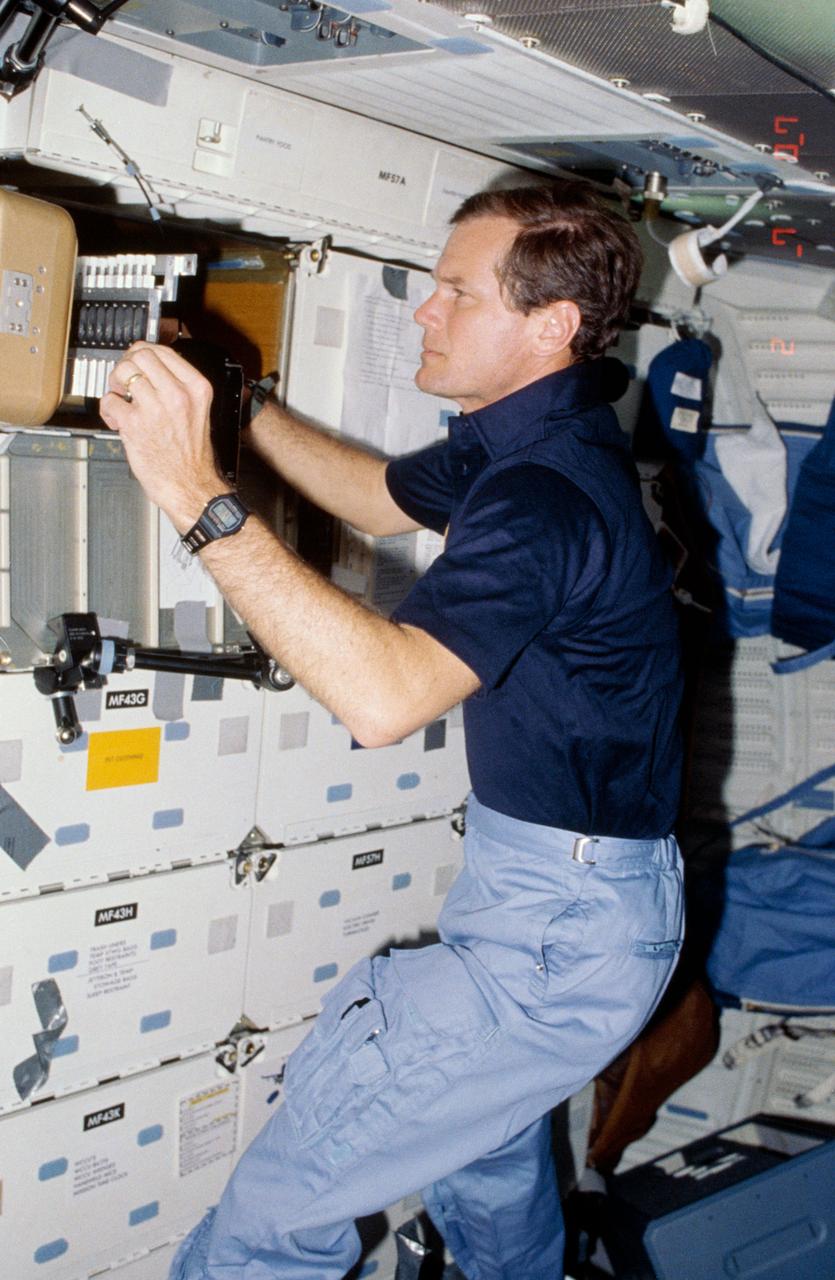
61C-05-036 (12-18 Jan. 1986) --- U.S. Representative Bill Nelson (Democrat - Florida), STS-61C payload specialist, prepares to photograph individual samples in the Handheld Protein Crystal Growth Experiment (HPCG) on Columbia's middeck. The operations involve the use of four pieces of equipment to attempt the growth of 60 different types of crystals -- 12 by means of dialysis and 48 via the vapor diffusion method. The photo was used by members of the STS-61C crew at their Jan. 23, 1986, Post-Flight Press Conference.
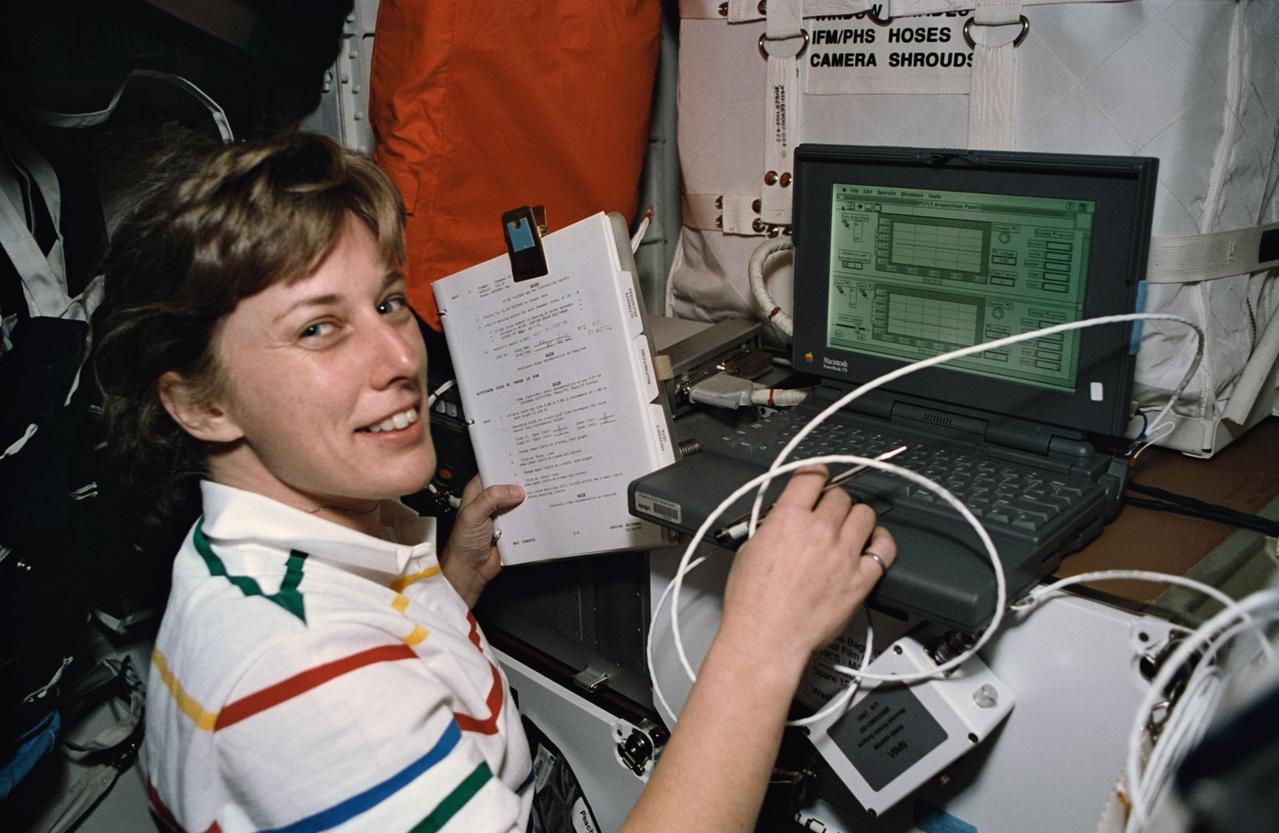
STS060-21-031 (3-11 Feb 1994) --- Using a lap top computer, astronaut N. Jan Davis monitors systems for the Commercial Protein Crystal Growth (CPCG) experiment onboard the Space Shuttle Discovery. Davis joined four other NASA astronauts and a Russian cosmonaut for eight days in space aboard Discovery.
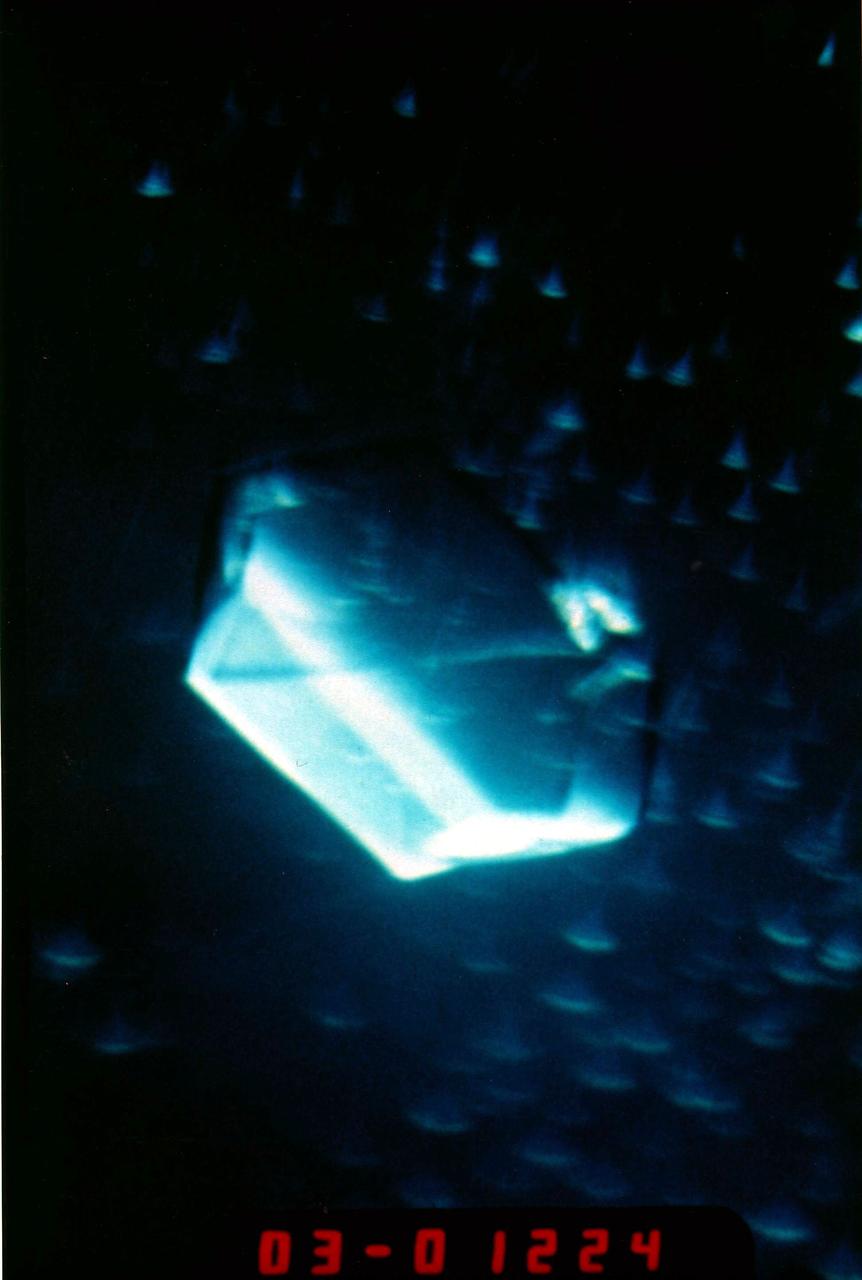
(PCG) Protein Crystal Growth Isocitrate Lysase. Target enzyme for fungicides. A better understanding of this enzyme should lead to the discovery of more potent fungicides to treat serious crop diseases such as rice blast. It regulates the flow of metabolic intermediates required for cell growth. Principal Investigator on STS-26 was Charles Bugg.
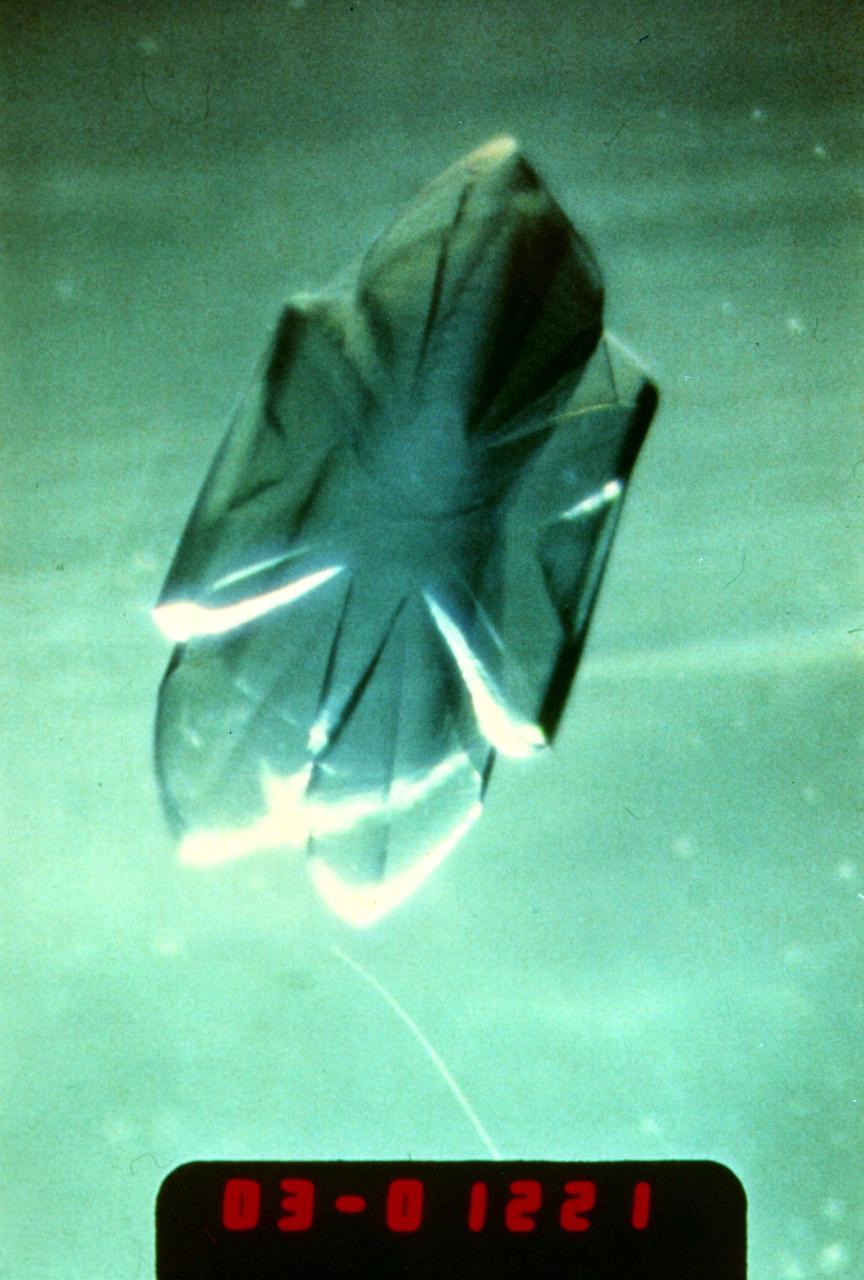
(PCG) Protein Crystal Growth Isocitrate Lyase. Target enzyme for fungicides. A better understanding of this enzyme should lead to the discovery of more potent fungicides to treat serious crop diseases such as rice blast. It regulates the flow of metabolic intermediates required for cell growth. Principal Investigator for STS-26 was Charles Bugg.
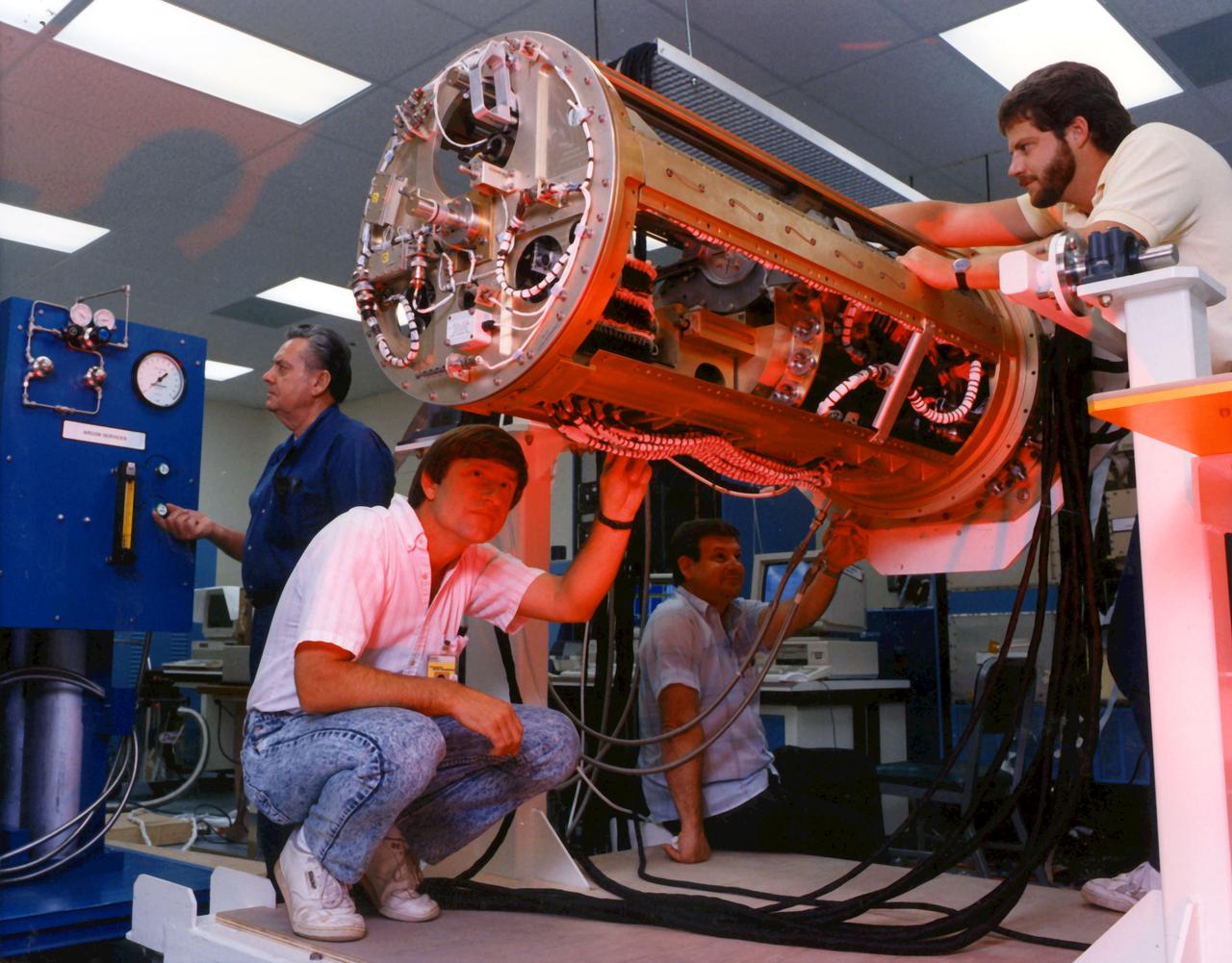
Crystal Growth Furnace (CGF) Being Tested at Manufacturing Facilty
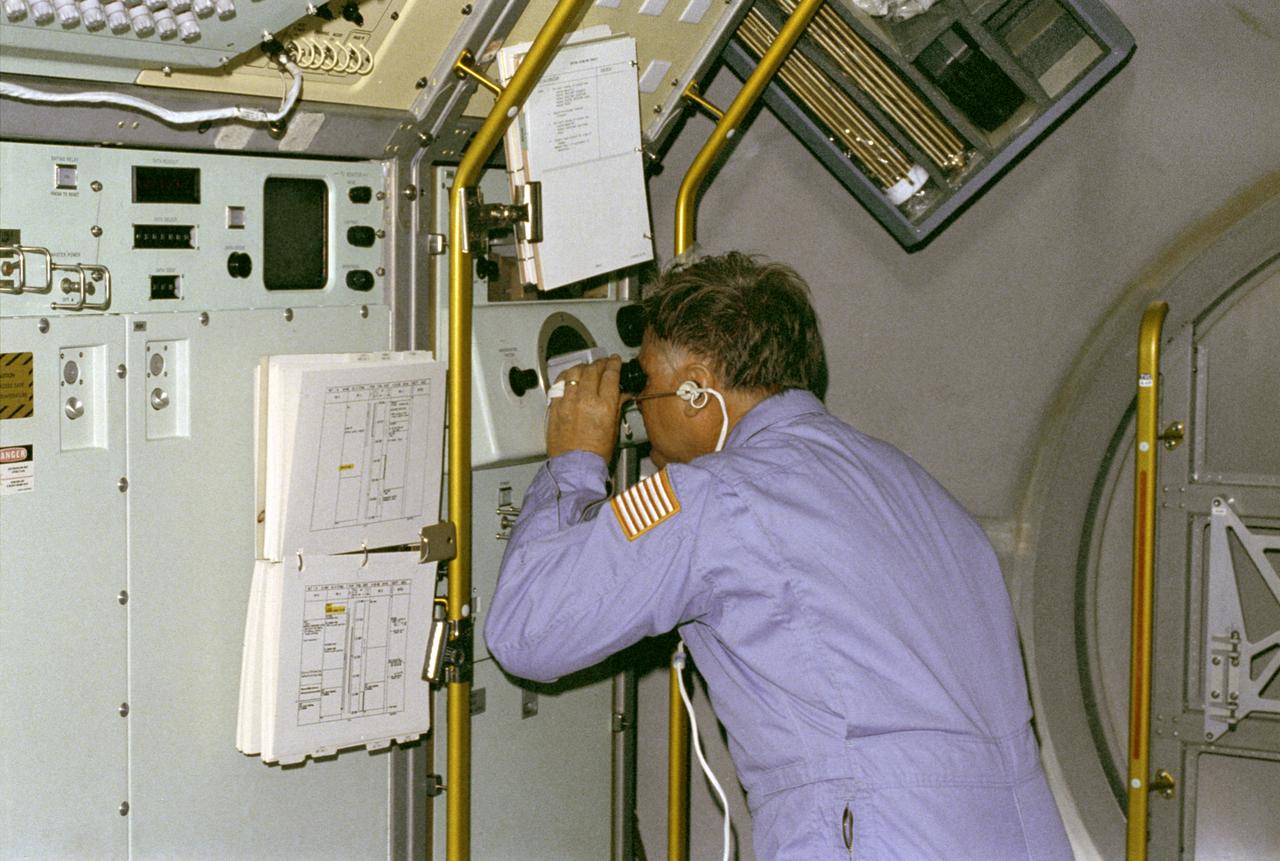
The primary purpose of the Spacelab-3 mission was to conduct materials science experiments in a stable low-gravity environment. In addition, the crew performed research in life sciences, fluid mechanics, atmospheric science, and astronomy. Spacelab-3 was equipped with several new minilabs, special facilities that would be used repeatedly on future flights. Two elaborate crystal growth furnaces, a life support and housing facility for small animals, and two types of apparatus for the study of fluids were evaluated on their inaugural flight. In this photograph, astronaut Don Lind observes the mercuric iodide growth experiment through a microscope at the vapor crystal growth furnace. The goals of this investigation were to grow near-perfect single crystals of mercuric iodide and to gain improved understanding of crystal growth by a vapor process. Mercuric iodide crystals have practical use as sensitive x-ray and gamma-ray detectors, and in portable detector devices for nuclear power plant monitoring, natural resource prospecting, biomedical applications in diagnosis and therapy, and in astronomical instruments. Managed by the Marshall Space Flight Center, Spacelab-3 (STS-51B) was launched aboard the Space Shuttle Orbiter Challenger on April 29, 1985.
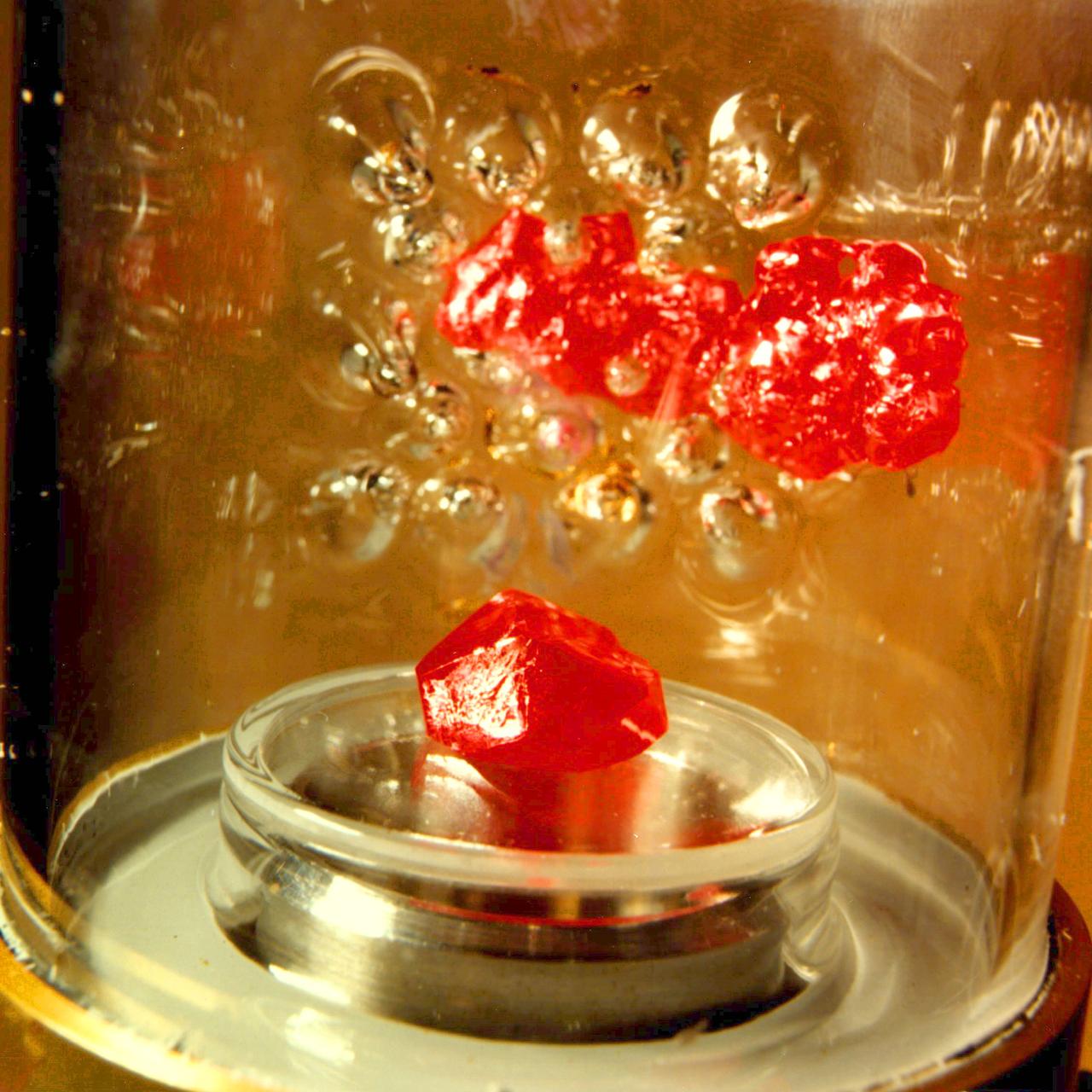
Vapor Crystal Growth System (VCGS), Flown on IML-1, Spacelab 3, Principal Investigator: Lodewijk van den Berg
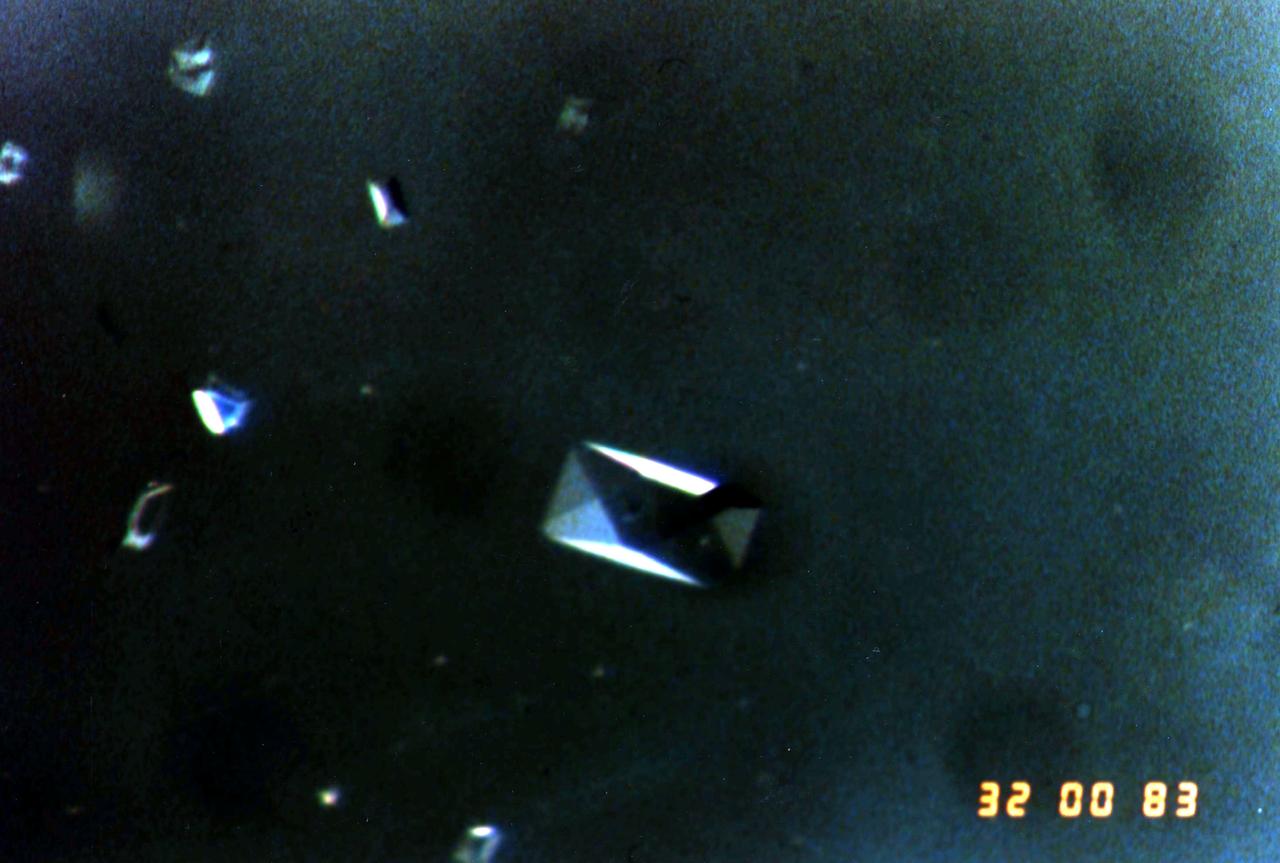
Orbital Documentation of Porcine Elastase grown in (PCG) Protein Crystal Growth (RIM) Refrigerator Incubator Module
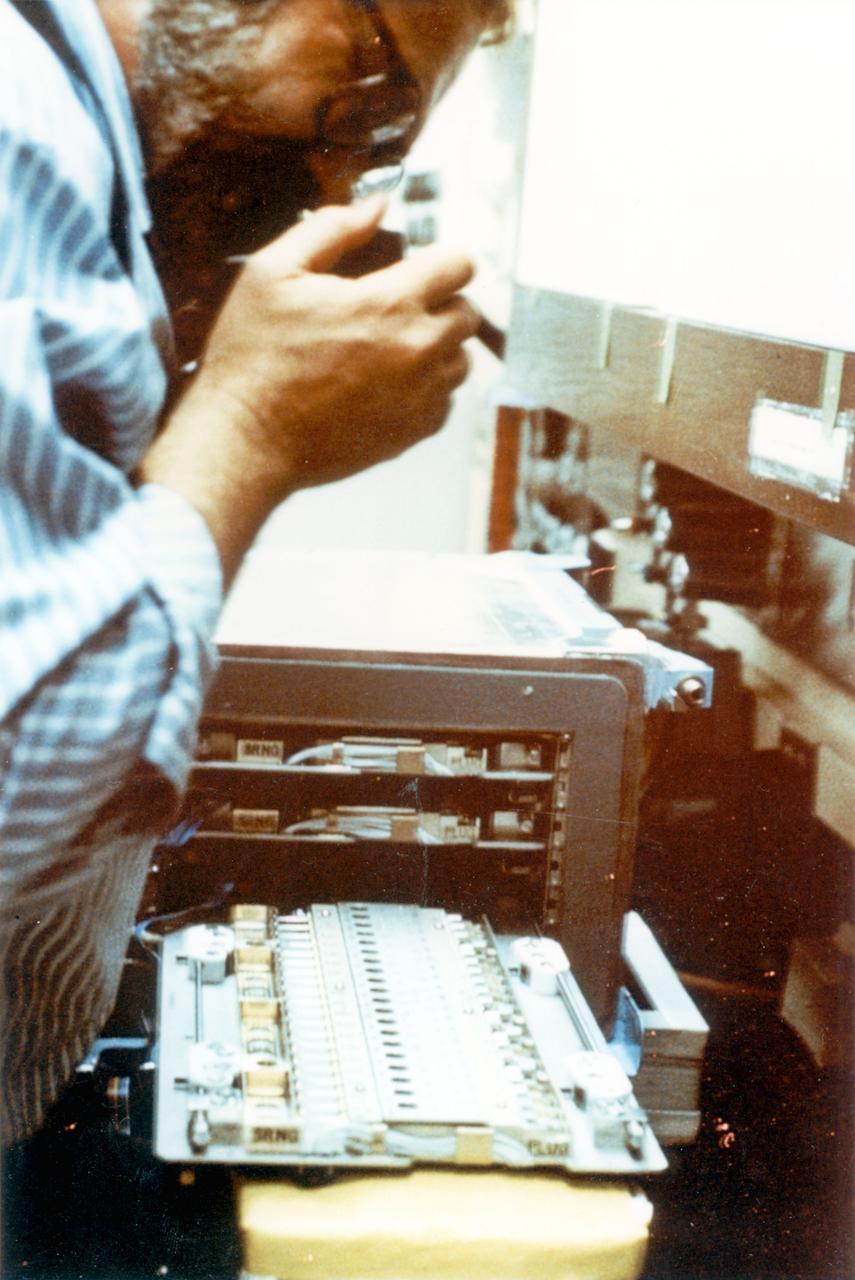
Scientist photographs STS- 26 Post-flight (VDA) Vapor Diffusion Apparatus Tray with (PCG) Protein Crystal Growth Samples.
61B-02-014 (26 Nov-3 Dec 1985) --- Payload Specialist Charles D. Walker works with the handheld protein growth experiment -- one of a series of tests being flown to study the possibility of crystallizing biological materials. Walker rests the experiment against the larger continuous flow electrophoresis systems experiment.
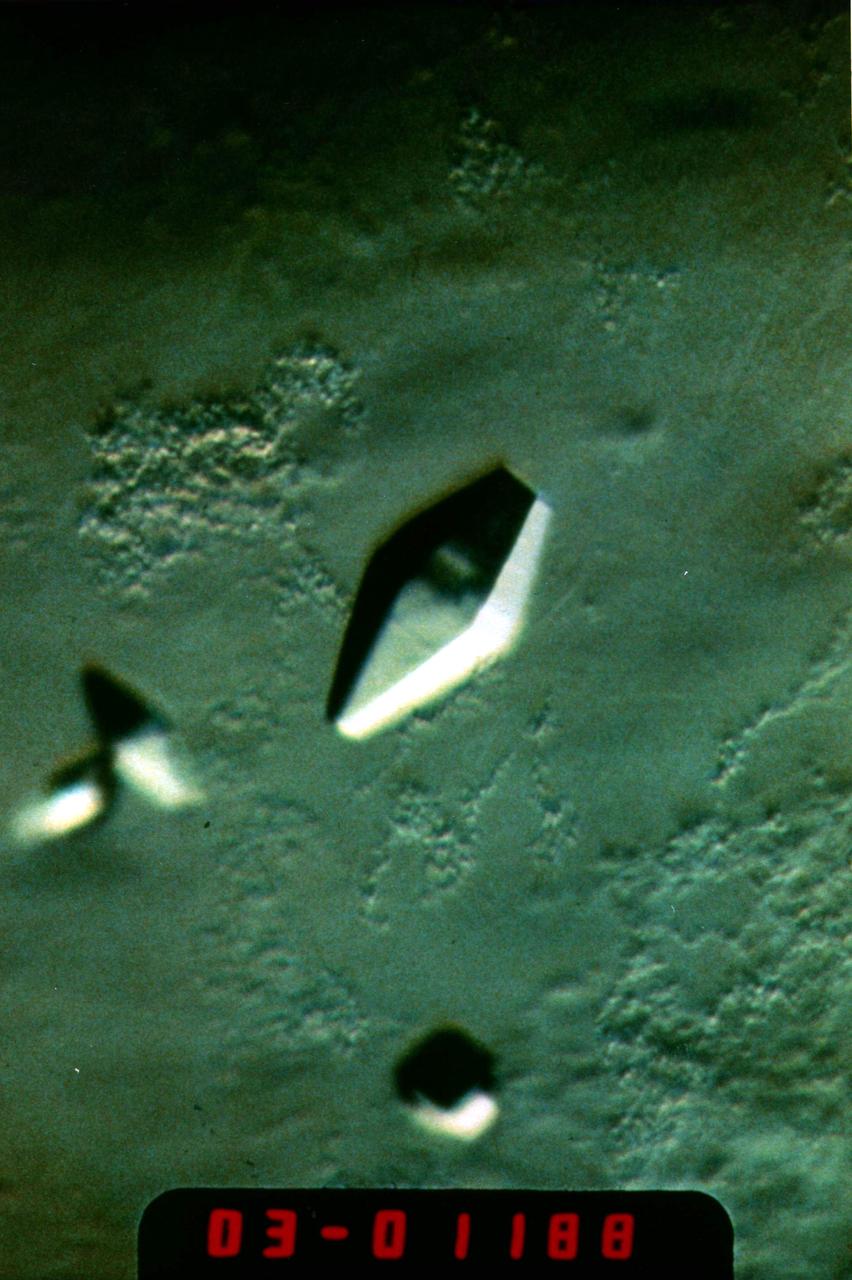
(PCG) Protein Crystal Growth C-reactive Protein. Plays a major role in human immune system response. Principal Investigator on STS-26 was Charles Bugg.
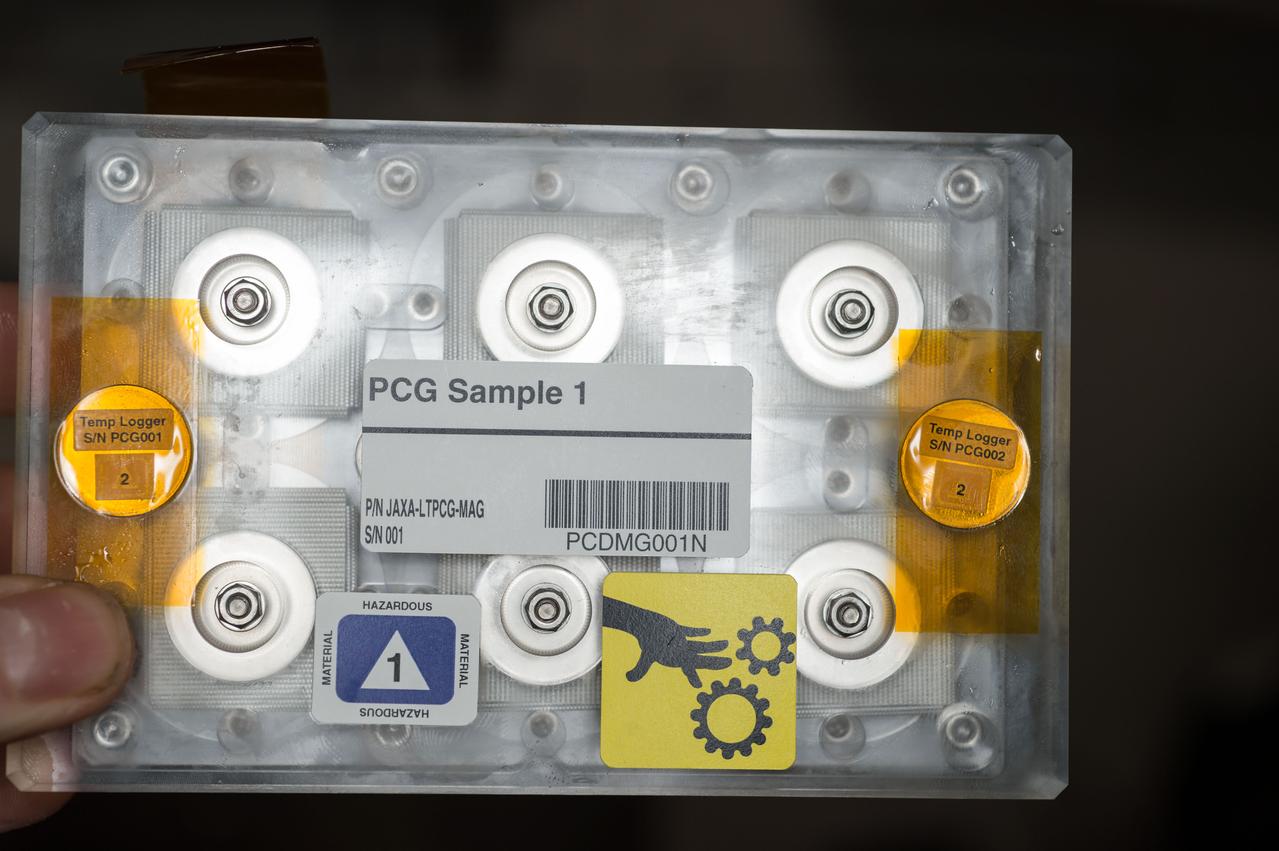
iss047e055613 (4/11/2016) --- A view of the JAXA Protein Crystal Growth (PCG) Demo Sample, in the Japanese Experiment Module (JEM) Pressurized Module (JPM) aboard the International space Station (ISS). The objective of JAXA High Quality Protein Crystal Growth Demonstration Experiment (JAXA PCG-Demo) is to grow high quality protein crystals in microgravity.

iss047e055611 (4/11/2016) --- A view of the JAXA Protein Crystal Growth (PCG) Demo Sample, in the Japanese Experiment Module (JEM) Pressurized Module (JPM) aboard the International space Station (ISS). The objective of JAXA High Quality Protein Crystal Growth Demonstration Experiment (JAXA PCG-Demo) is to grow high quality protein crystals in microgravity.
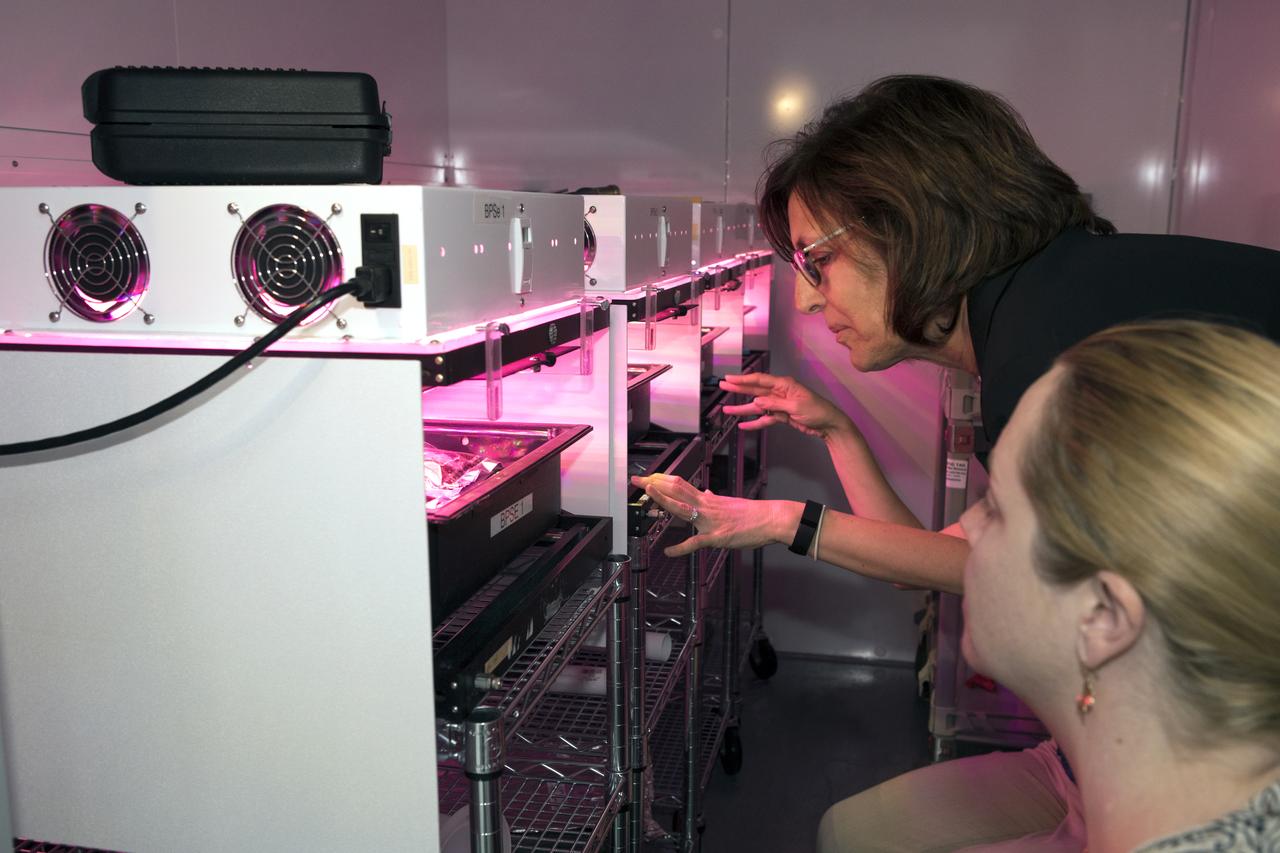
Robyn Gatens, left, deputy director, ISS Division and system capability leader for Environmental Control and Life Support Systems (ECLSS) at NASA Headquarters in Washington, tours laboratories in the Space Station Processing Facility at the agency's Kennedy Space Center in Florida, on June 13, 2018. To her right is Molly Anderson, deputy ECLSS capability lead at Johnson Space Center in Houston. They are viewing plant growth chambers and seeing firsthand some of the capabilities in the center's Exploration Research and Technology Programs.
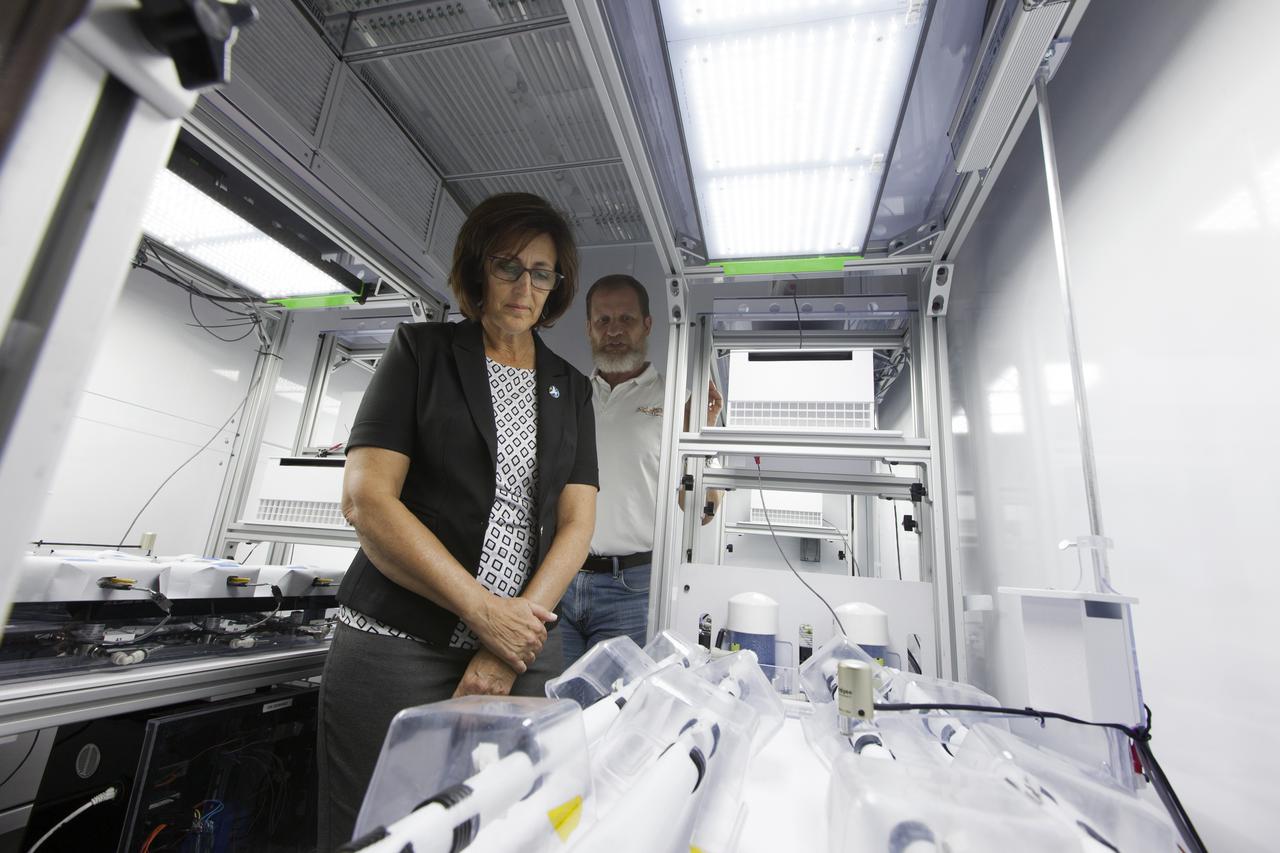
Robyn Gatens, left, deputy director, ISS Division and system capability leader for Environmental Control and Life Support Systems (ECLSS) at NASA Headquarters in Washington, tours laboratories in the Space Station Processing Facility at the agency's Kennedy Space Center in Florida, on June 13, 2018. Standing behind her is Ralph Fritsche, long-duration food production project manager at Kennedy. Gatens is viewing plant growth chambers and seeing firsthand some of the capabilities in the center's Exploration Research and Technology Programs.
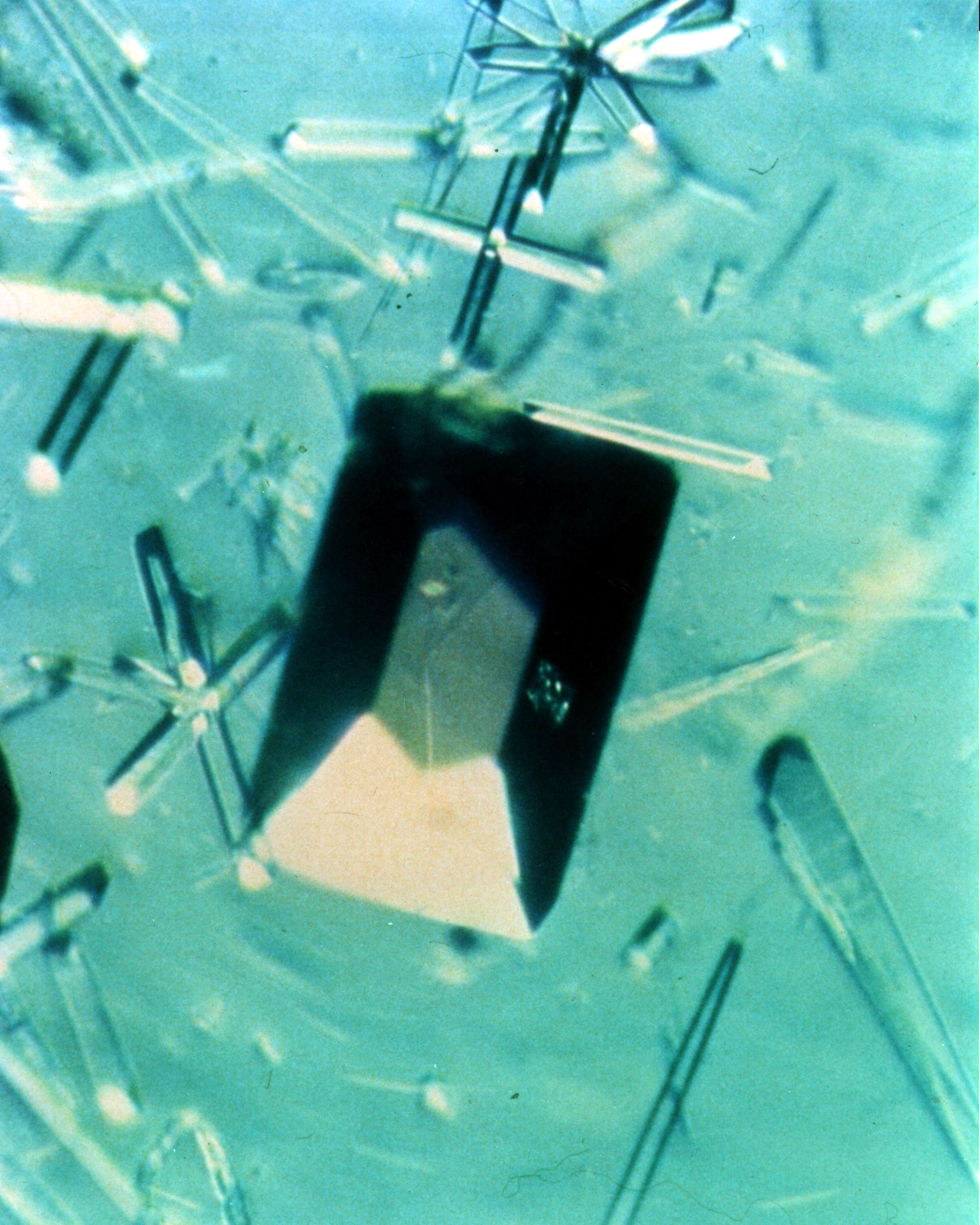
(PCG) Protein Crystal Growth Porcine Elastase. This enzyme is associated with the degradation of lung tissue in people suffering from emphysema. It is useful in studying causes of this disease. Principal Investigator on STS-26 was Charles Bugg.
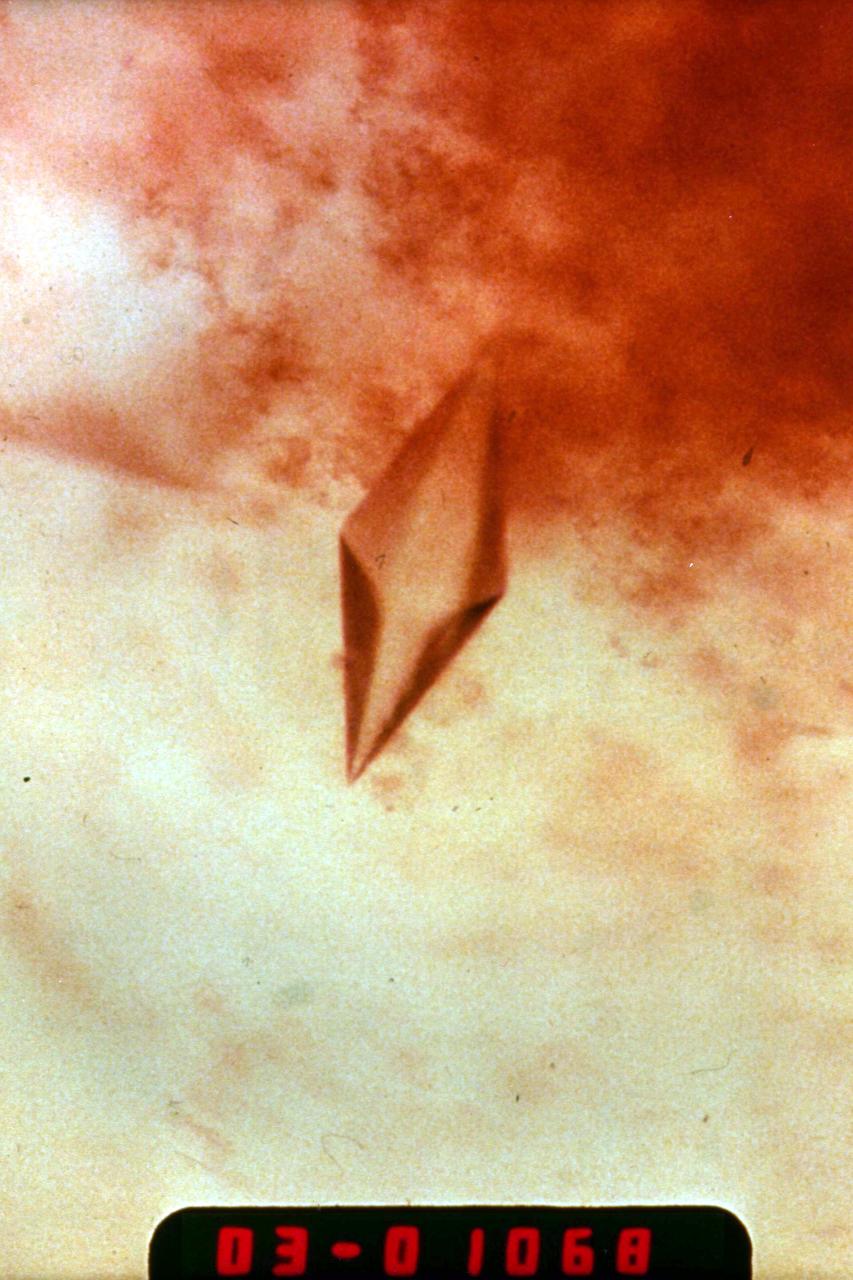
(PCG) Protein Crystal Growth Renin. Enzyme produced by the kidneys, plays a major role in the chemical reaction that controls blood pressure. Principal Investigator on STS-26 was Charles Bugg.
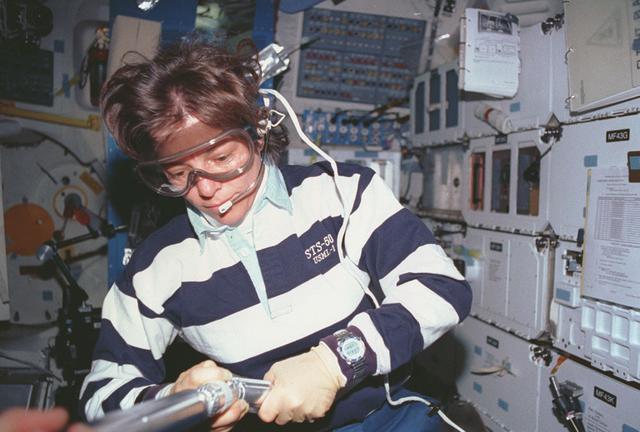
Space Shuttle Columbia (STS-50) astronaut Bornie Dunbar wears protective goggles to assemble a zeolite sample cartridge for the Crystal Growth Furnace (CGF) in the United States Microgravity Laboratory-1 (USML-1) science module.
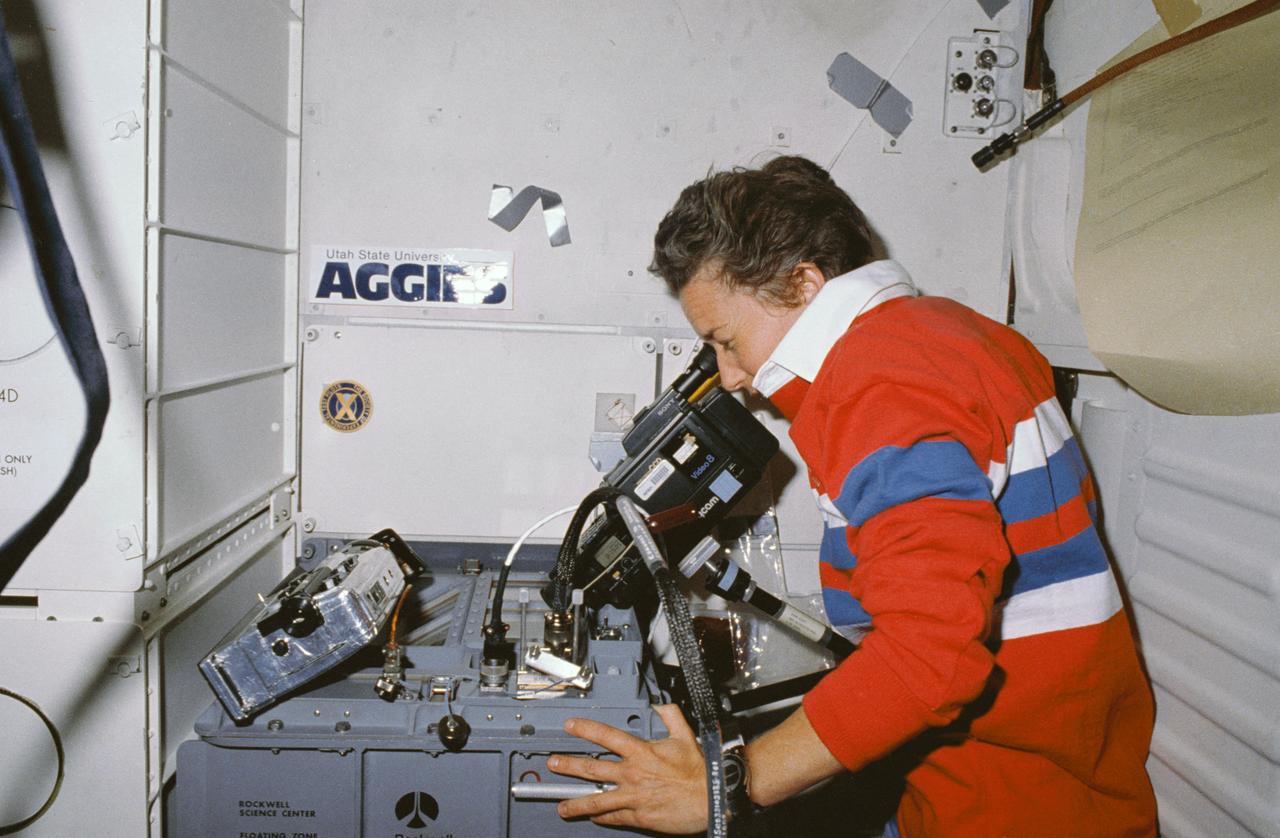
STS030-10-002 (8 May 1989) --- STS-30 Mission Specialist Mary L. Cleave operates 8mm video camcorder at Fluids Experiment Apparatus 2 (FEA-2) (SK73-000102) unit located in aft middeck locker onboard Atlantis, Orbiter Vehicle (OV) 103. Two 8mm video camcorders are positioned above FEA-2 unit to record experiment titled "Floating Zone Crystal Growth and Purification". Rockwell International (RI) through its Space Transportation Systems Division, Downey, California, is engaged in a joint endeavor agreement (JEA) with NASA's Office of Commercial Programs in the field for floating zone crystal growth research. Utah State University Aggies decal appears on aft bulkhead above FEA-2 unit.
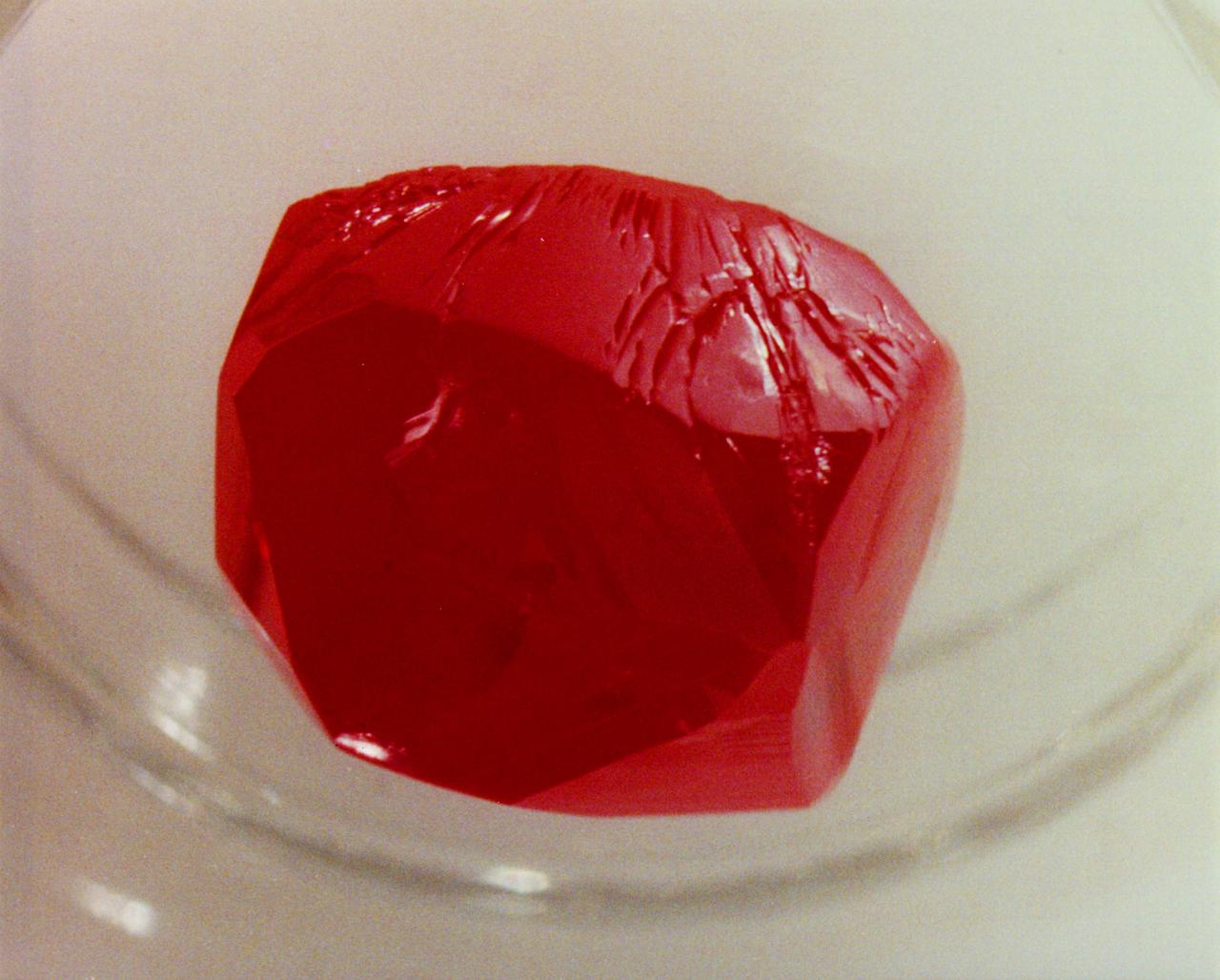
Vapor Crystal Growth System developed in IML-1, Mercuric Iodide Crystal grown in microgravity FES/VCGS (Fluids Experiment System/Vapor Crystal Growth Facility). During the mission, mercury iodide source material was heated, vaporized, and transported to a seed crystal where the vapor condensed. Mercury iodide crystals have practical uses as sensitive X-ray and gamma-ray detectors. In addition to their excellent optical properties, these crystals can operate at room temperature, which makes them useful for portable detector devices for nuclear power plant monitoring, natural resource prospecting, biomedical applications, and astronomical observing.
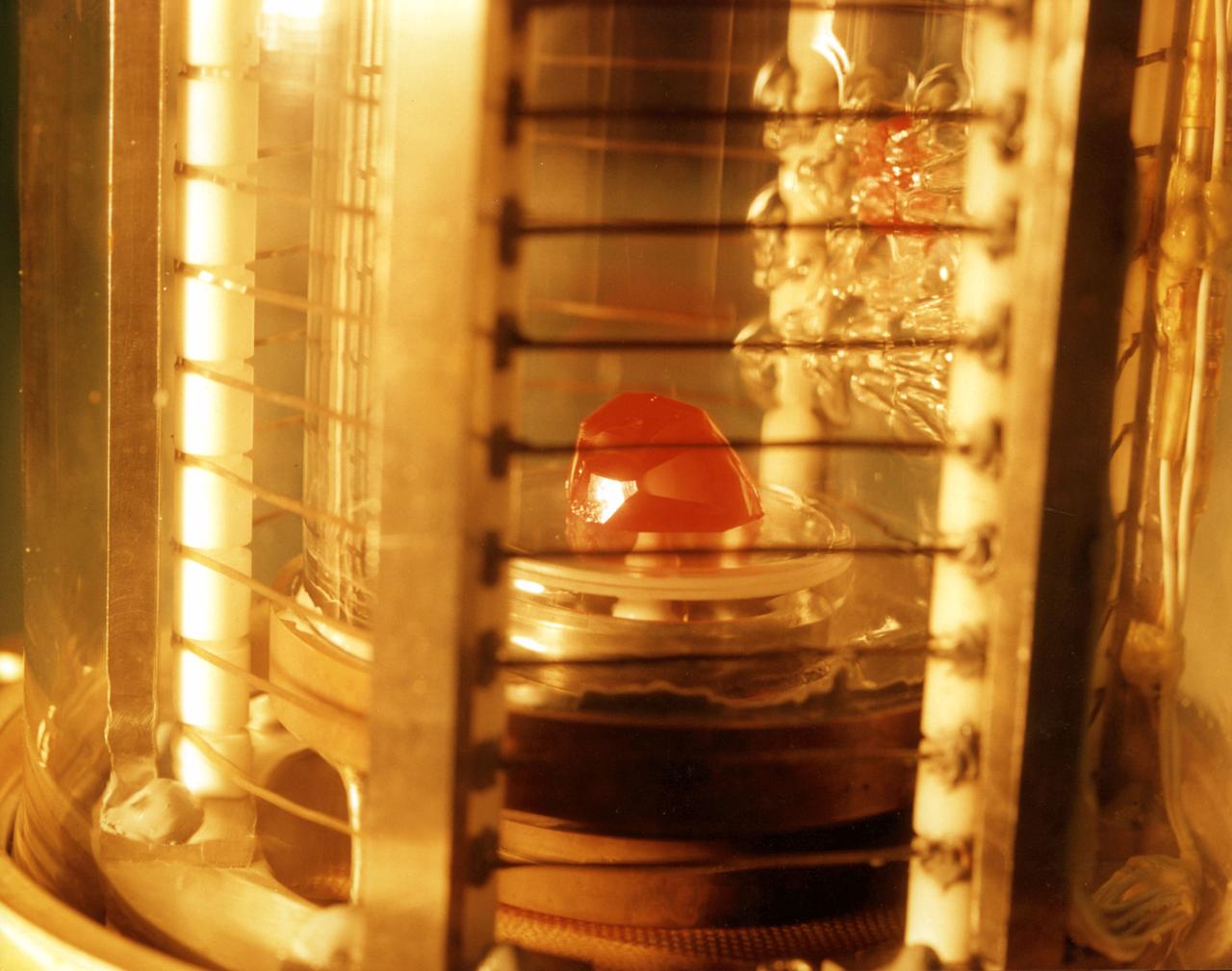
The image shows a test cell of Crystal Growth experiment inside the Vapor Crystal Growth System (VCGS) furnace aboard the STS-42, International Microgravity Laboratory-1 (IML-1), mission. The goal of IML-1, a pressurized marned Spacelab module, was to explore in depth the complex effects of weightlessness of living organisms and materials processing. More than 200 scientists from 16 countires participated in the investigations.
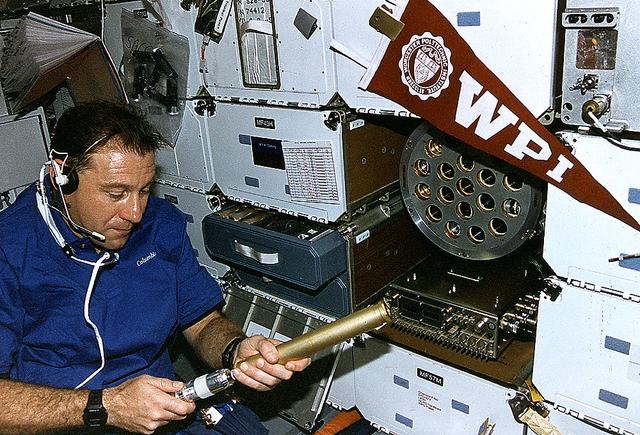
Onboard Space Shuttle Columbia (STS-73) Payload Specialist Albert Sacco loads autoclaves using a power screwdriver into the Zeolite Crystal Growth (ZCG) experiment in the middeck for the United States Microgravity Laboratory 2 (USML-2) Spacelab mission.
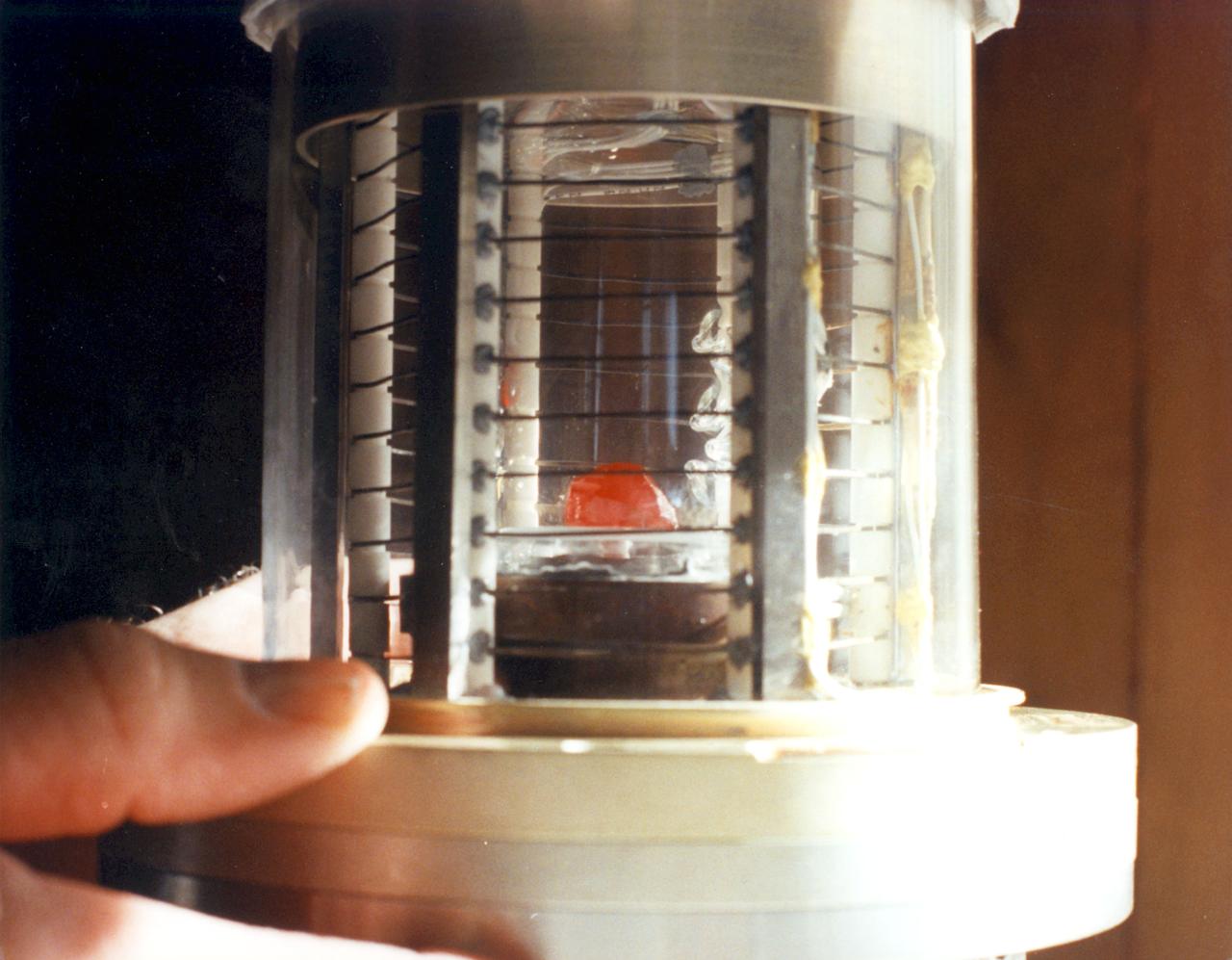
Ampoule view of the Vapor Crystal Growth System (VCGS) Furnace. Used on IML-1 International Microgravity Laboratory Spacelab 3. Prinicipal Investigator and Payload Specialist was Lodewijk van den Berg.
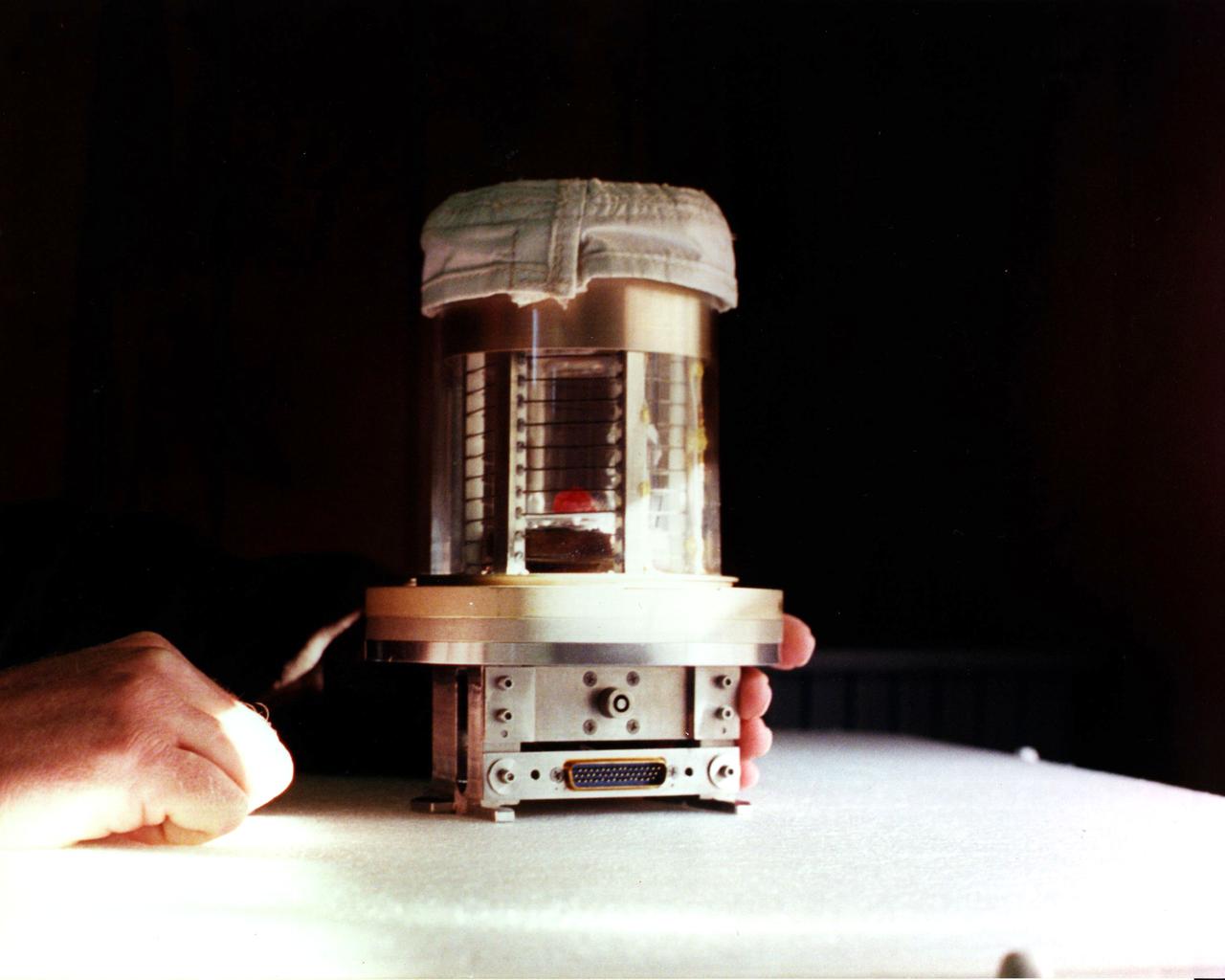
Overall view of the Vapor Crystal Growth System (VCGS) Furnace. Used on IML-1 International Microgravity Laboratory Spacelab 3. Principal Investigator and Payload Specialist was Lodewijk van den Berg.
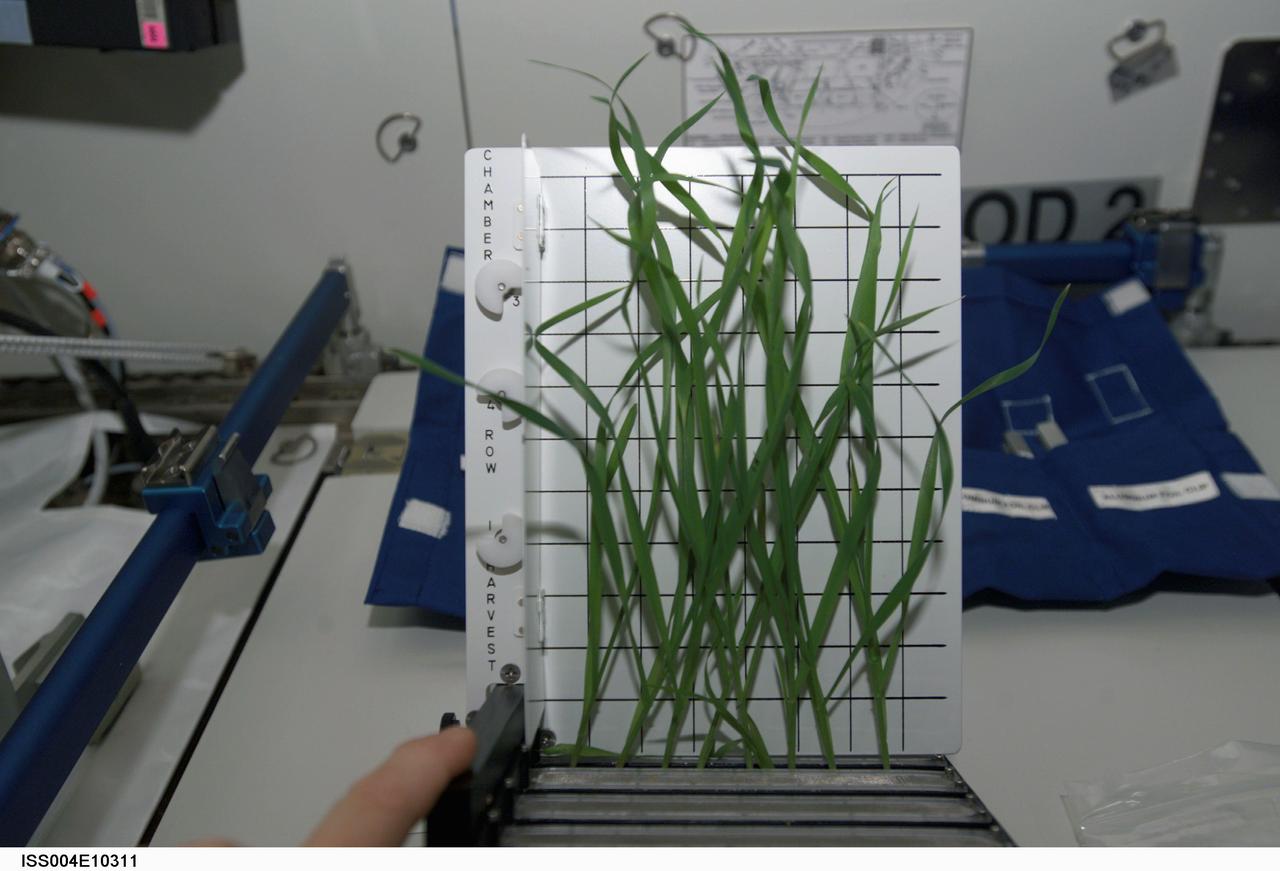
Dwarf wheat were photographed aboard the International Space Station in April 2002. Lessons from on-orbit research on plants will have applications to terrestrial agriculture as well as for long-term space missions. Alternative agricultural systems that can efficiently produce greater quantities of high-quality crops in a small area are important for future space expeditions. Also regenerative life-support systems that include plants will be an important component of long-term space missions. Data from the Biomass Production System (BPS) and the Photosynthesis Experiment and System Testing and Operations (PESTO) will advance controlled-environment agricultural systems and will help farmers produce better, healthier crops in a small area. This same knowledge is critical to closed-loop life support systems for spacecraft. The BPS comprises a miniature environmental control system for four plant growth chambers, all in the volume of two space shuttle lockers. The experience with the BPS on orbit is providing valuable design and operational lessons that will be incorporated into the Plant Growth Units. The objective of PESTO was to flight verify the BPS hardware and to determine how the microgravity environment affects the photosynthesis and metabolic function of Super Dwarf wheat and Brassica rapa (a member of the mustard family).
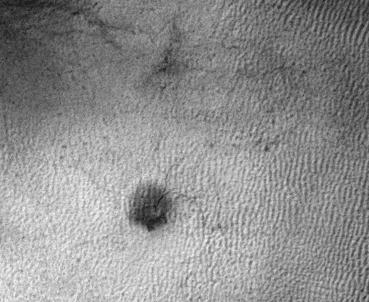
This image from NASA Mars Reconnaissance Orbiter shows the growth of a branching network of troughs carved by thawing carbon dioxide over the span of three Martian years. This process is believed to also form larger radially patterned channel features known as Martian "spiders." The image is one of three taken by the High Resolution Imaging Science Experiment (HiRISE) camera on NASA's Mars Reconnaissance Orbiter and included in a report on the first detection of such troughs persisting and growing, from one Mars year to the next. An animation is available at http://photojournal.jpl.nasa.gov/catalog/PIA21257
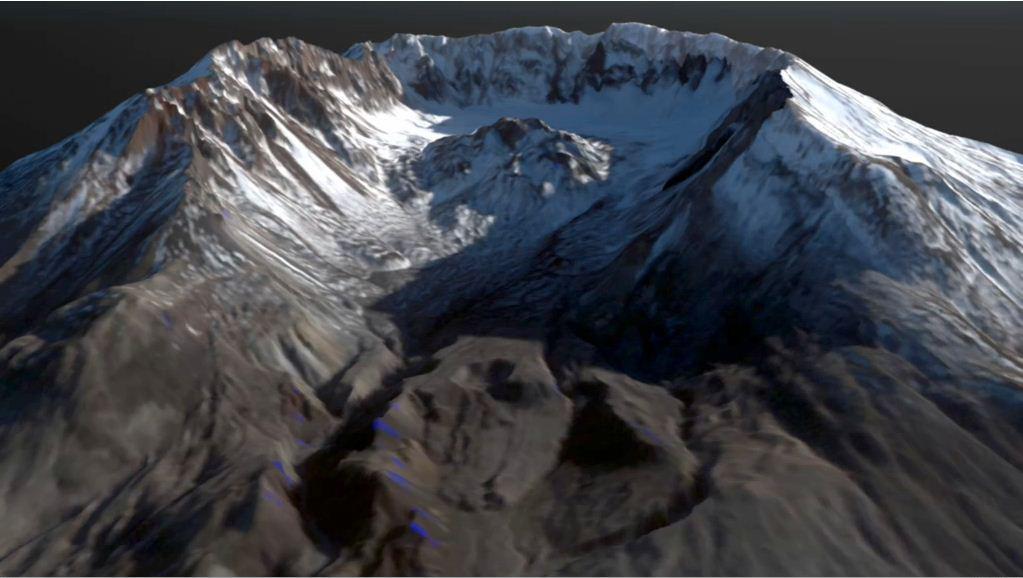
This frame from an animation depicts the growth of the lava dome at Mount St. Helens during the most recent period of activity. Lidar data courtesy USGS.
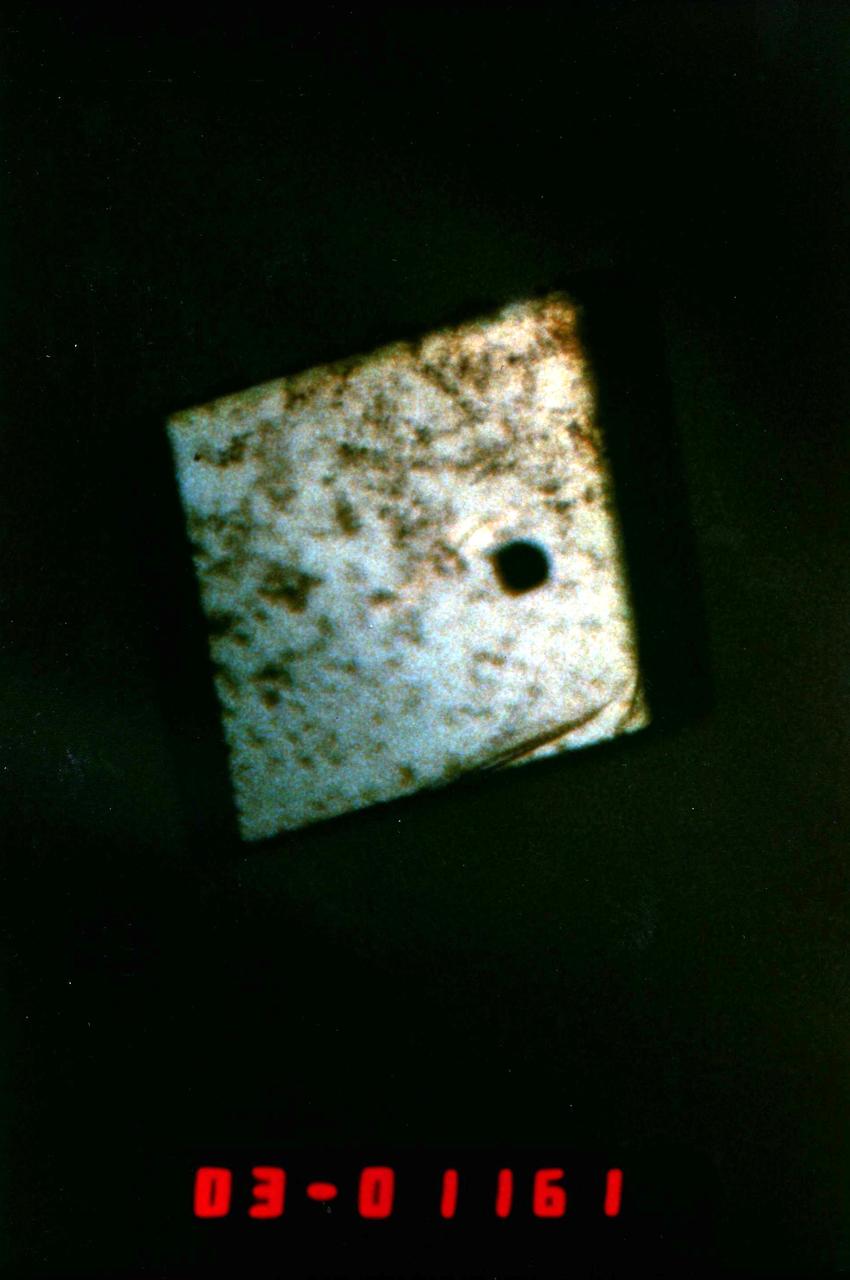
(PCG) Protein Crystal Growth Gamma-Interferon. Stimulates the body's immune system and is used clinically in the treatment of cancer. Potential as an anti-tumor agent against solid tumors as well as leukemia's and lymphomas. It has additional utility as an anti-ineffective agent, including antiviral, anti-bacterial, and anti-parasitic activities. Principal Investigator on STS-26 was Charles Bugg.
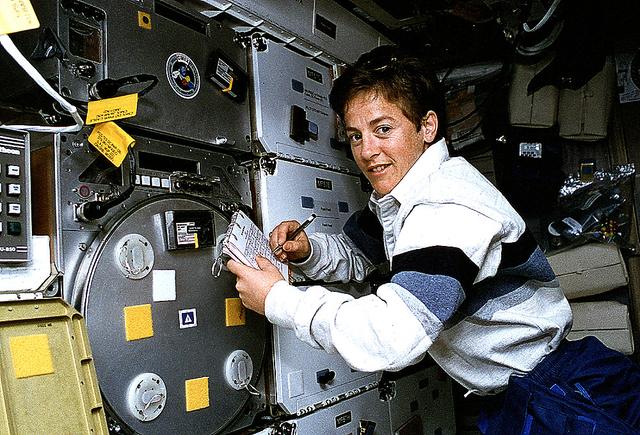
Astronaut Wendy B. Lawrence, flight engineer and mission specialist for STS-67, scribbles notes on the margin of a checklist while monitoring an experiment on the Space Shuttle Endeavour's mid-deck. The experiment is the Protein Crystal Growth (PCG), which takes up locker space near the Commercial Materials Dispersion Apparatus Instruments Technology Associates Experiment (CMIX).
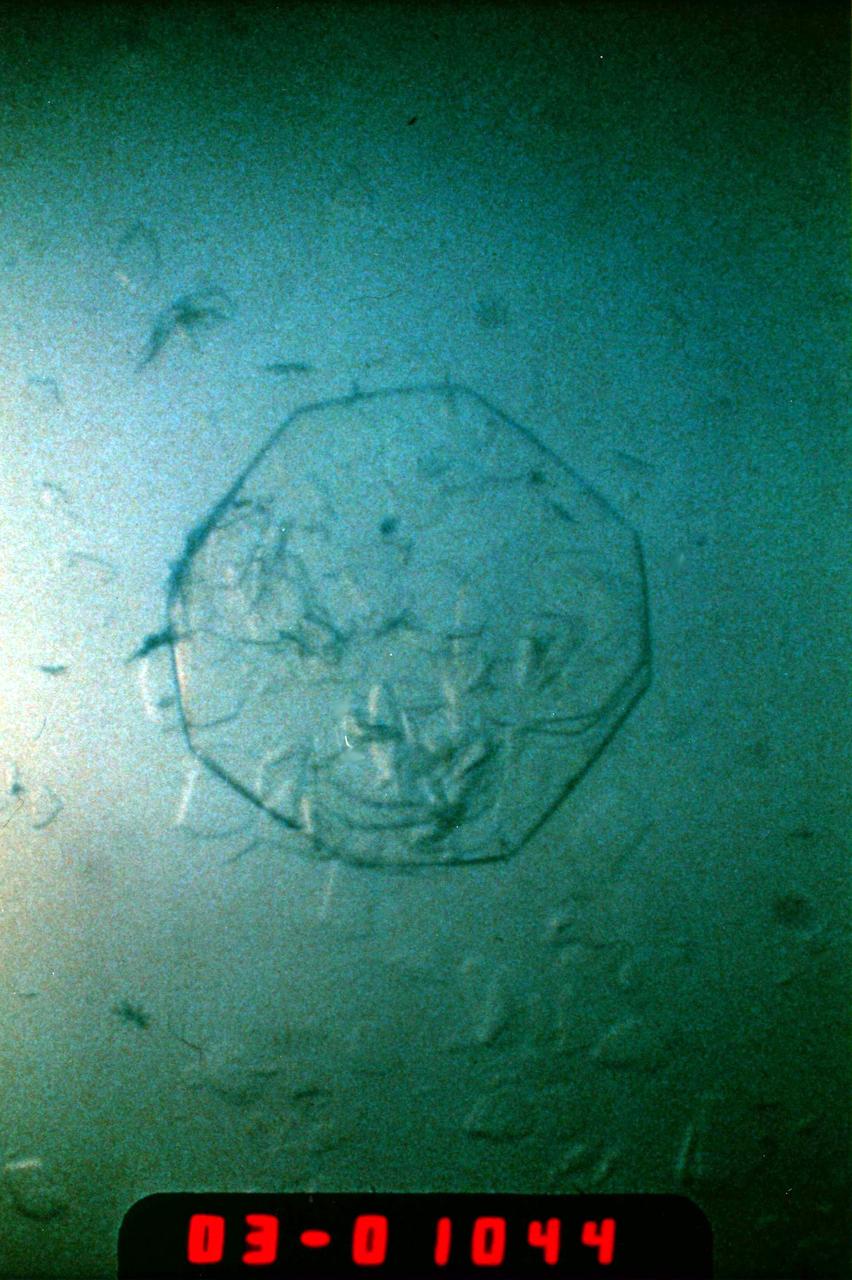
(PCG) Protein Crystal Growth Human Serum Albumin. Contributes to many transport and regulatory processes and has multifunctional binding properties which range from various metals, to fatty acids, hormones, and a wide spectrum of therapeutic drugs. The most abundant protein of the circulatory system. It binds and transports an incredible variety of biological and pharmaceutical ligands throughout the blood stream. Principal Investigator on STS-26 was Larry DeLucas.
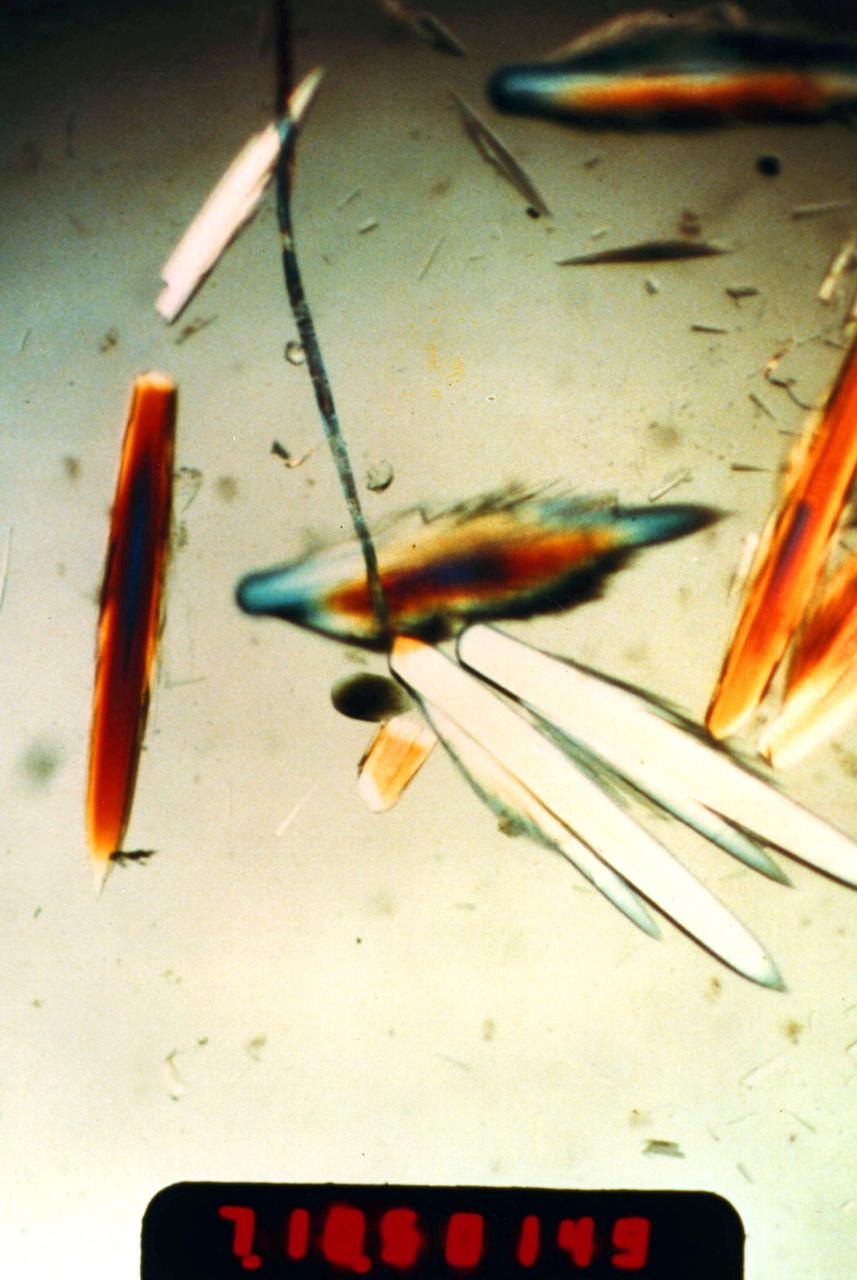
Horse Serum Albumin crystals grown during the USML-1 (STS-50) mission's Protein Crystal Growth Glovebox Experiment. These crystals were grown using a vapor diffusion technique at 22 degrees C. The crystals were allowed to grow for nine days while in orbit. Crystals of 1.0 mm in length were produced. The most abundant blood serum protein, regulates blood pressure and transports ions, metabolites, and therapeutic drugs. Principal Investigator was Edward Meehan.
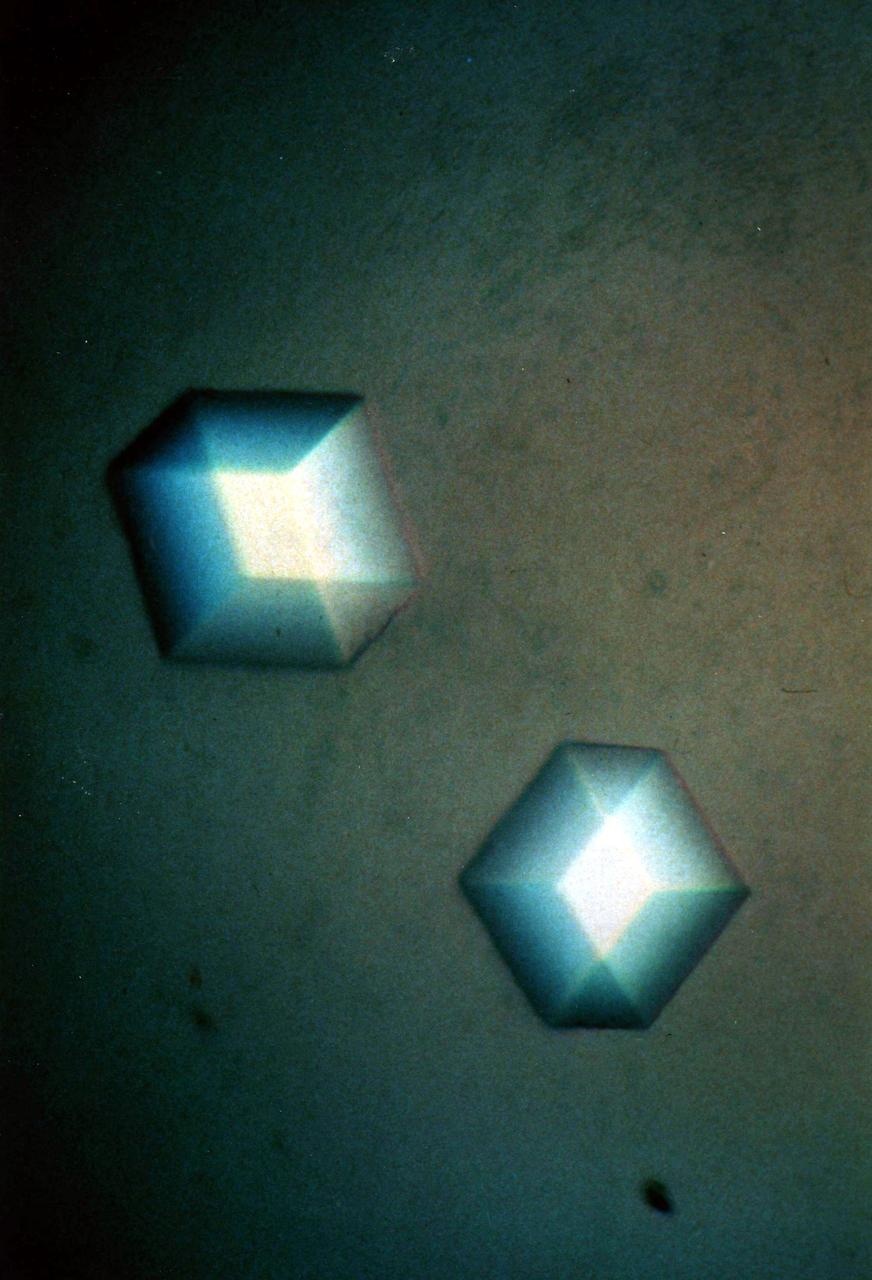
(PCG) Protein Crystal Growth Canavalin. The major storage protein of leguminous plants and a major source of dietary protein for humans and domestic animals. It is studied in efforts to enhance nutritional value of proteins through protein engineerings. It is isolated from Jack Bean because of it's potential as a nutritional substance. Principal Investigator on STS-26 was Alex McPherson.
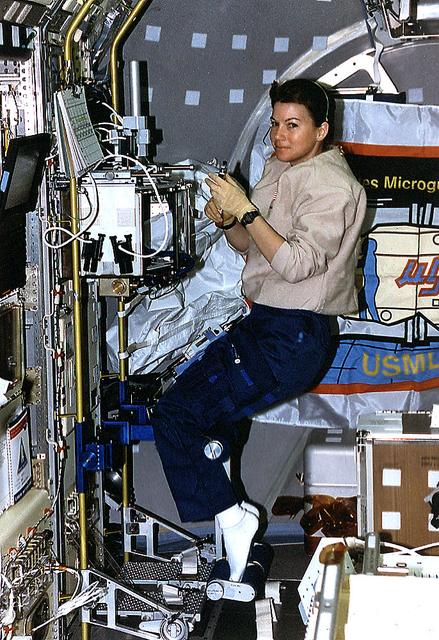
Onboard Space Shuttle Columbia (STS-73) Mission Specialists Catherine Cady Coleman works at the glovebox facility in support of the Protein Crystal Growth Glovebox (PCG-GBX) experiment in the United States Microgravity Laboratory 2 (USML-2) Spacelab science module.
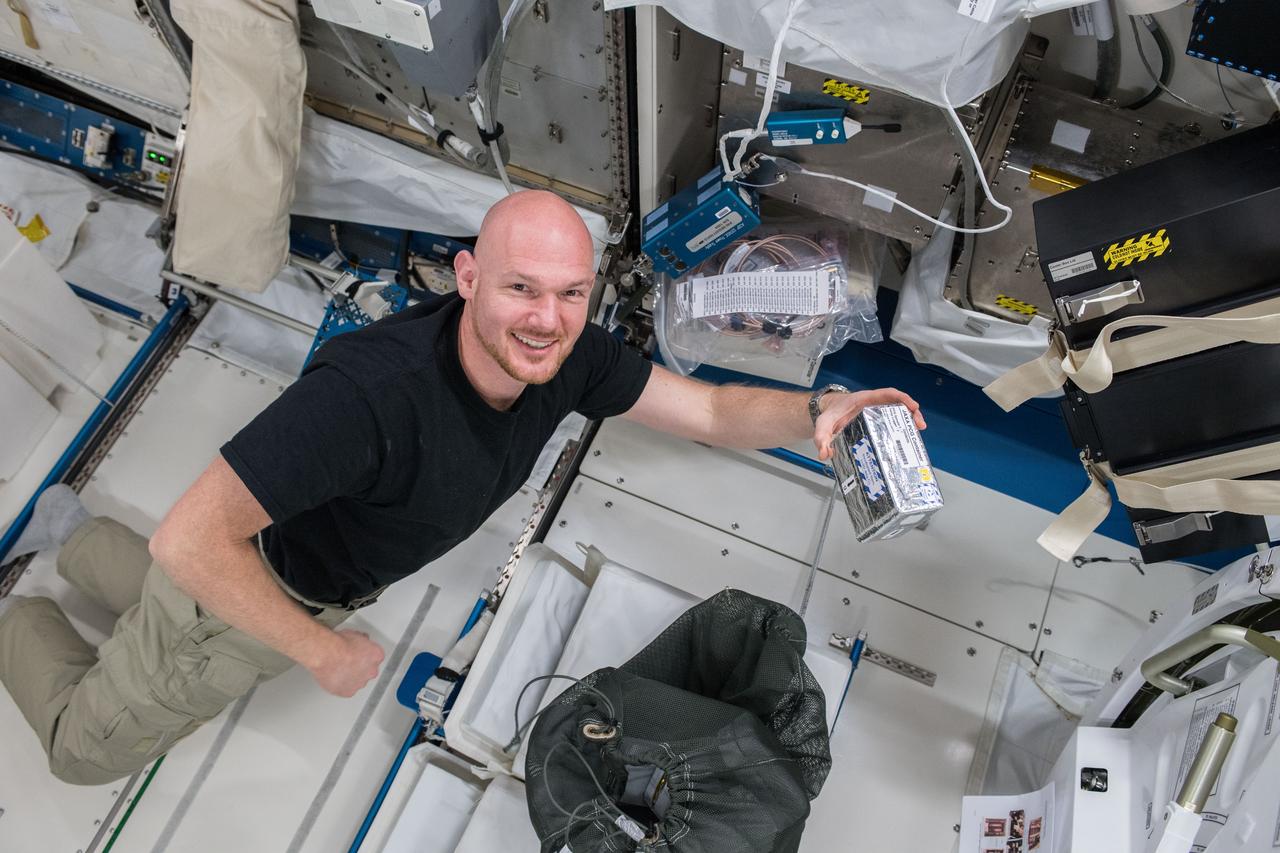
iss056e075928 (7/3/2018) --- Astronaut Alexander Gerst of ESA (European Space Agency), during the JAXA Protein Crystal Growth (PCG) sample retrieval from the Freezer-Refrigerator Of Stirling Cycle 2 (FROST2) and initiation of the crystallization of the samples before inserting them back into the FROST2, where crystallization will continue.
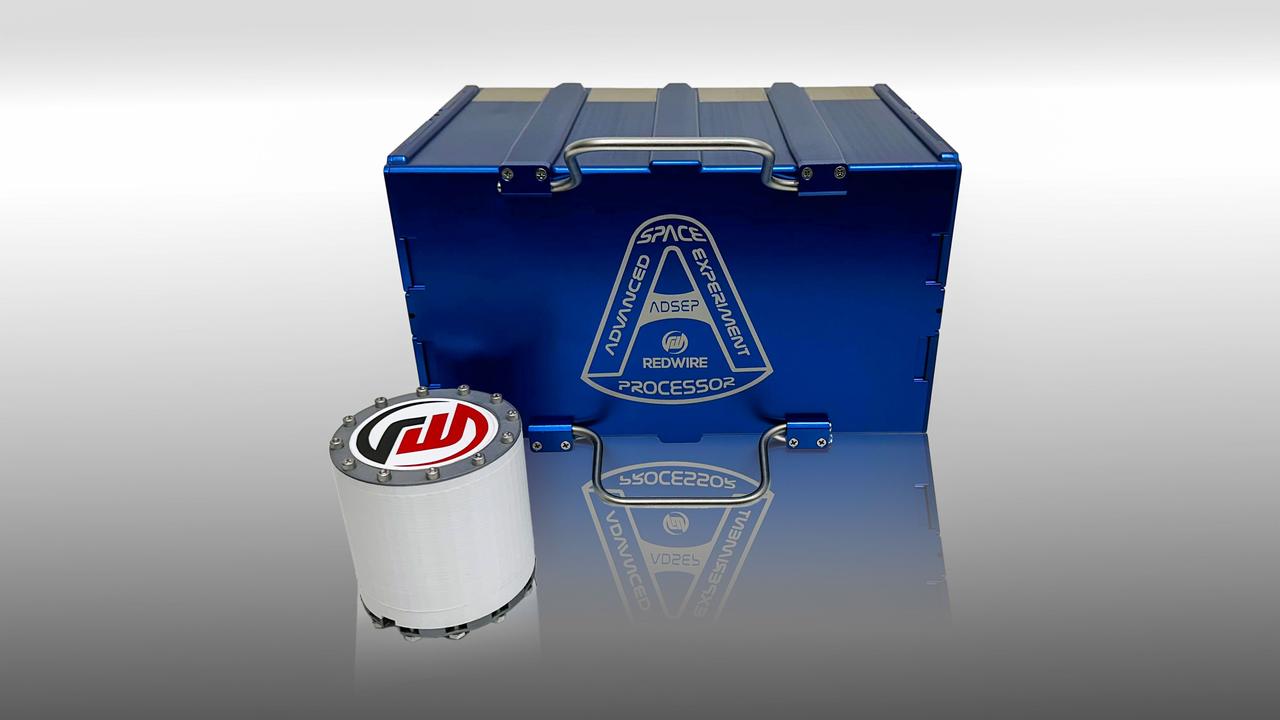
jsc2025e036383 (4/4/2025) --- The blue box is The Redwire Industrial Crystallization Cassette (ICC), a facility capable of large quantities of crystal growth. The white cylindrical growth chamber below the ICC is capable of holding 200mL in volume, compared to <1mL held by the PIL-BOX cassettes. The ADSEP Industrial Crystallization Cassette Technology Demonstration (ADSEP-ICC) investigation validates the ICC’s capability to grow large quantities of crystals in its high-volume crystal growth chambers aboard the International Space Station. Image courtesy of Redwire.
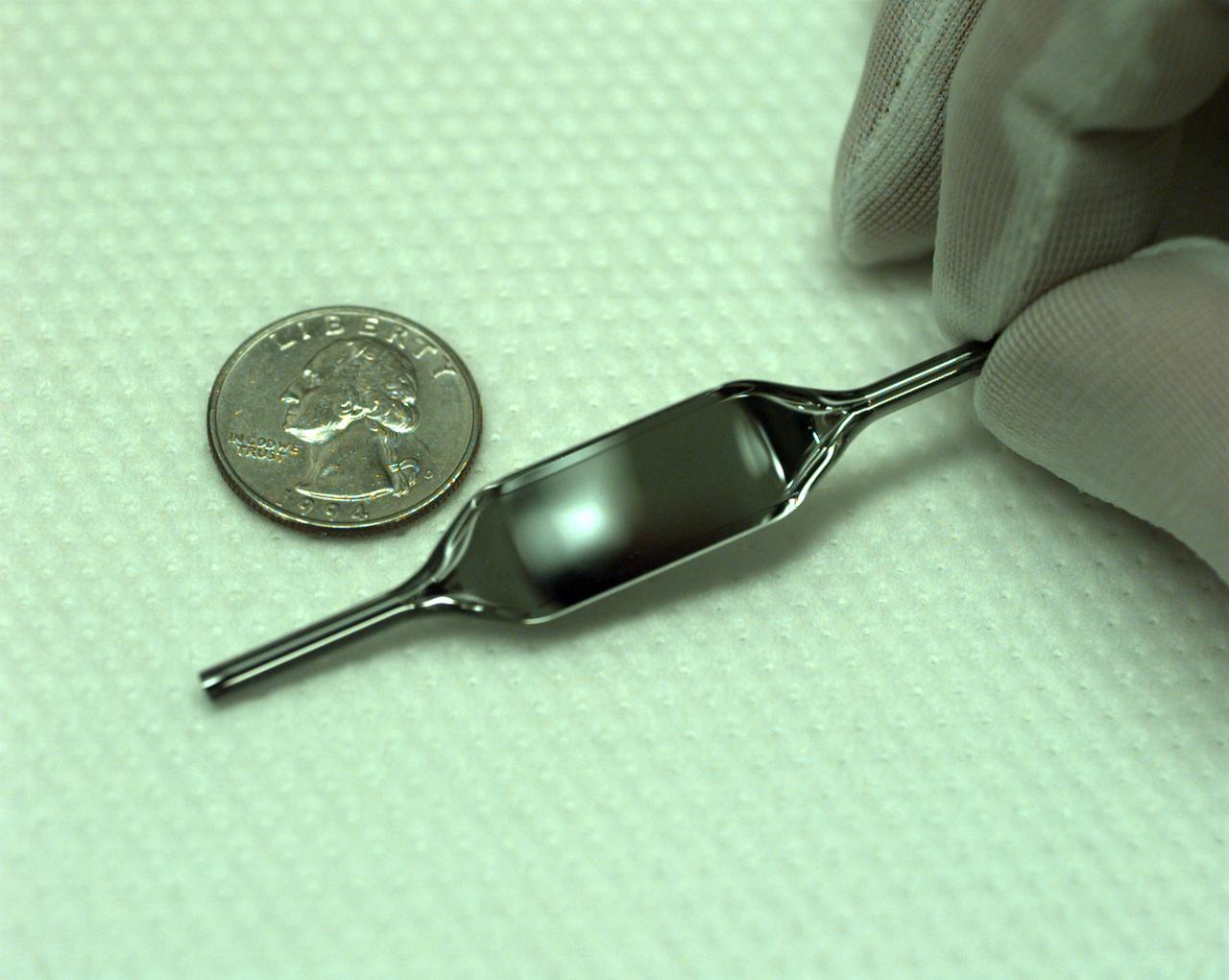
The Interferometer Protein Crystal Growth (IPCG) experiment was designed to measure details of how protein molecules move through a fluid. It was flown on the STS-86 mission for use aboard Russian Space Station Mir in 1998. It studied aspects of how crystals grow - and what conditions lead to the best crystals, details that remain a mystery. IPCG produces interference patterns by spilitting then recombining laser light. This let scientists see how fluid densities - and molecular diffusion - change around a crystal as it grows in microgravity. The heart of the IPCG apparatus is the interferometer cell comprising the optical bench, microscope, other optics, and video camera. IPCG experiment cells are made of optical glass and silvered on one side to serve as a mirror in the interferometer system that visuzlizes crystals and conditions around them as they grow inside the cell. This view shows a large growth cell. The principal investigator was Dr. Alexander McPherson of University of California, Irvine. Co-investigators are William Witherow and Dr. Marc Pusey of NASA's Marshall Space Flight Center (MSFC).
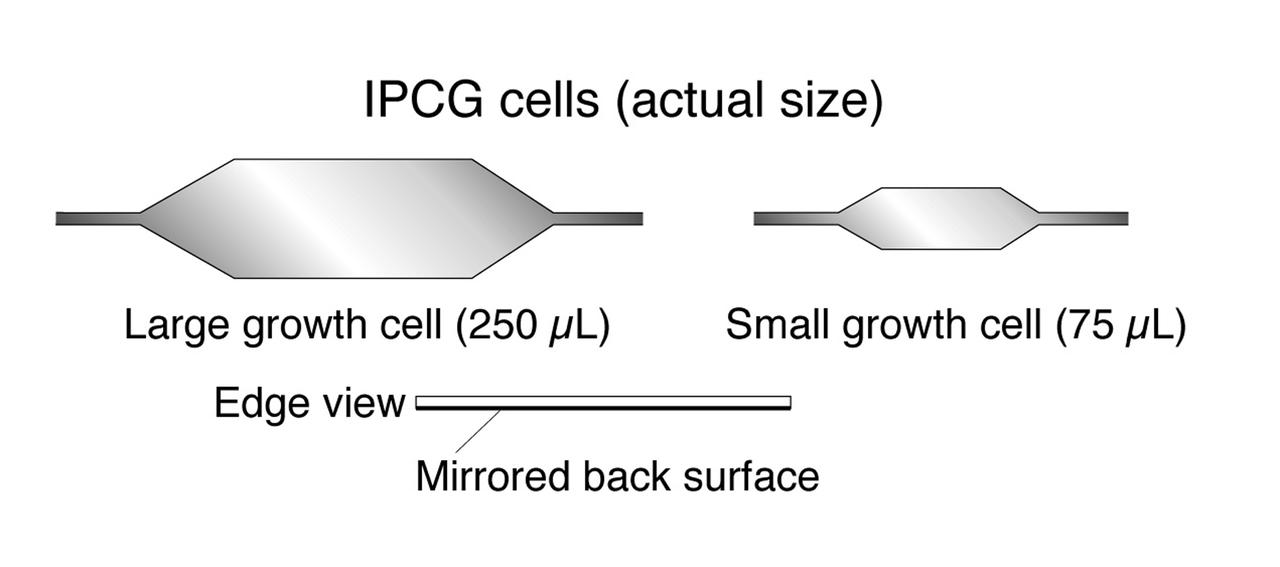
The Interferometer Protein Crystal Growth (IPCG) experiment was designed to measure details of how protein molecules move through a fluid. It was flown on the STS-86 mission for use aboard Russian Space Station Mir in 1998. It studied aspects of how crystals grow - and what conditions lead to the best crystals, details that remain a mystery. IPCG produces interference patterns by spilitting then recombining laser light. This let scientists see how fluid densities - and molecular diffusion - change around a crystal as it grows in microgravity. The heart of the IPCG apparatus is the interferometer cell comprising the optical bench, microscope, other optics, and video camera. IPCG experiment cells are made of optical glass and silvered on one side to serve as a mirror in the interferometer system that visuzlizes crystals and conditions around them as they grow inside the cell. This diagram shows the growth cells. The principal investigator was Dr. Alexander McPherson of University of California, Irvine. Co-investigators are William Witherow and Dr. Marc Pusey of NASA's Marshall Space Flight Center (MSFC).
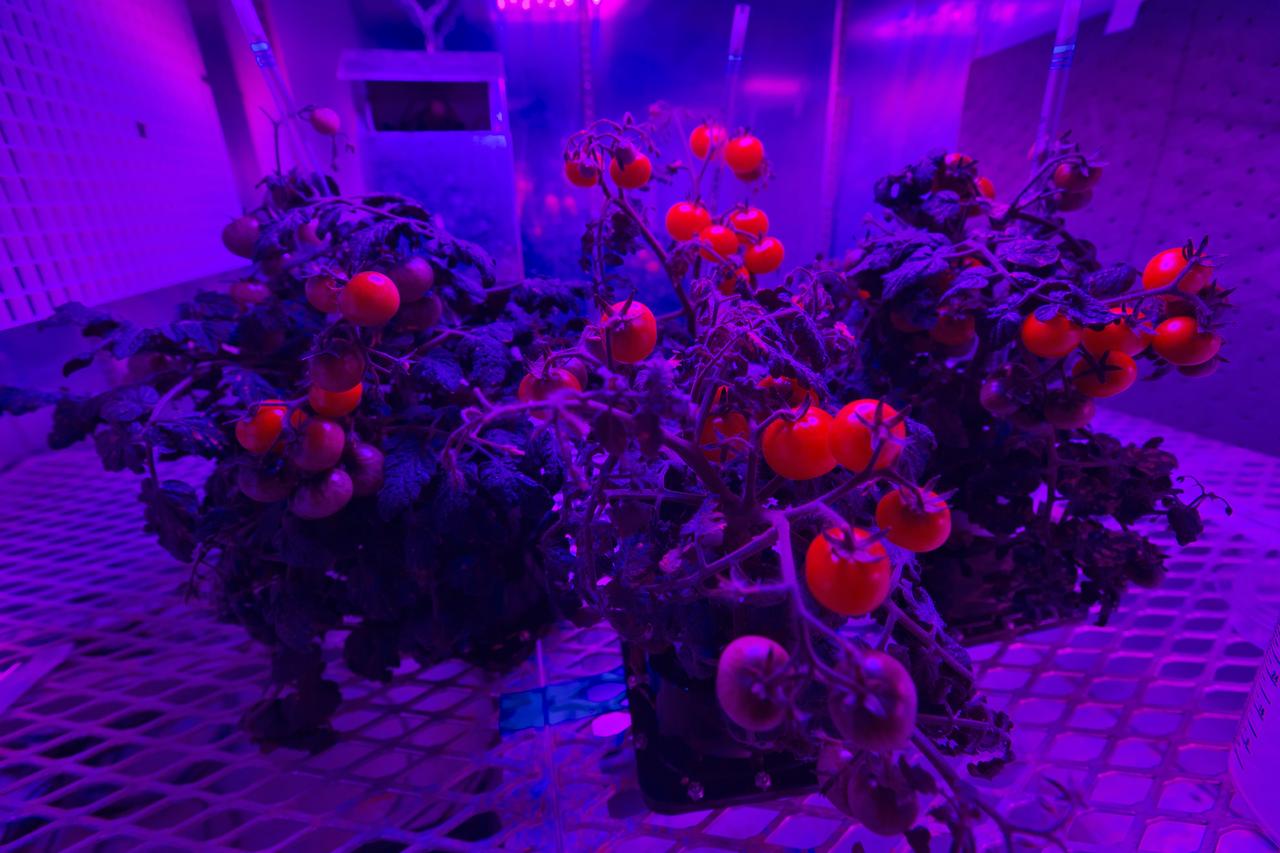
Tomato plants are growing under red and blue LED lights in a growth chamber inside a laboratory at the Space Station Processing Facility at NASA’s Kennedy Space Center in Florida. The plant growth is being tested in the Veggie Passive Orbital Nutrient Delivery System (PONDS). Veggie PONDS is a direct follow-on to the Veg-01 and Veg-03 hardware and plant growth validation tests. The primary goal of this newly developed plant growing system, Veggie PONDS, is to demonstrate uniform plant growth. PONDS units have features that are designed to mitigate microgravity effects on water distribution, increase oxygen exchange and provide sufficient room for root zone growth. PONDS is planned for use during Veg-04 and Veg-05 on the International Space Station after the Veggie PONDS Validation flights on SpaceX-14 and OA-9.
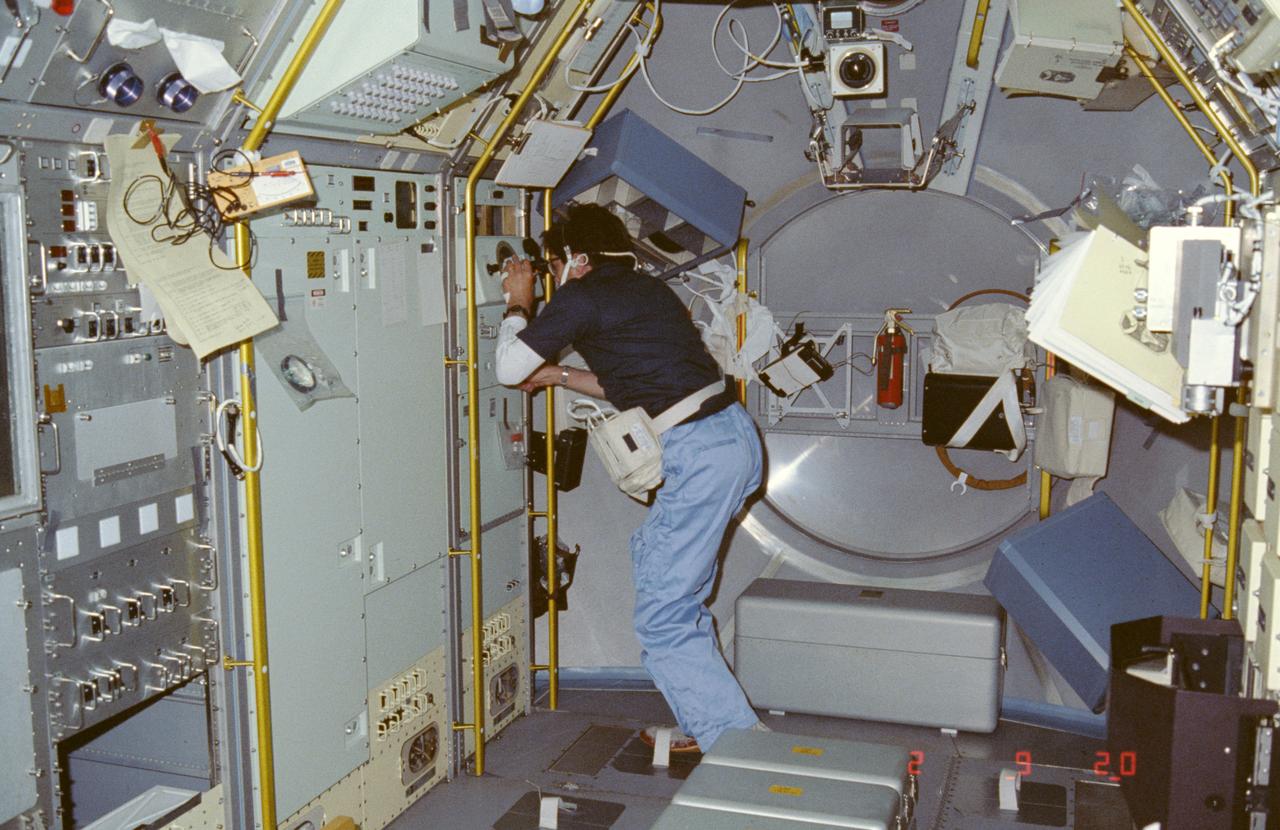
51B-06-010 (29 April-6 May 1985) --- Lodewijk van den Berg, 51-B payload specialist, observes the growth of mercuric iodide crystal in the vapor crystal growth system (VCGS) on the Spacelab 3 science module aboard the Space Shuttle Challenger.
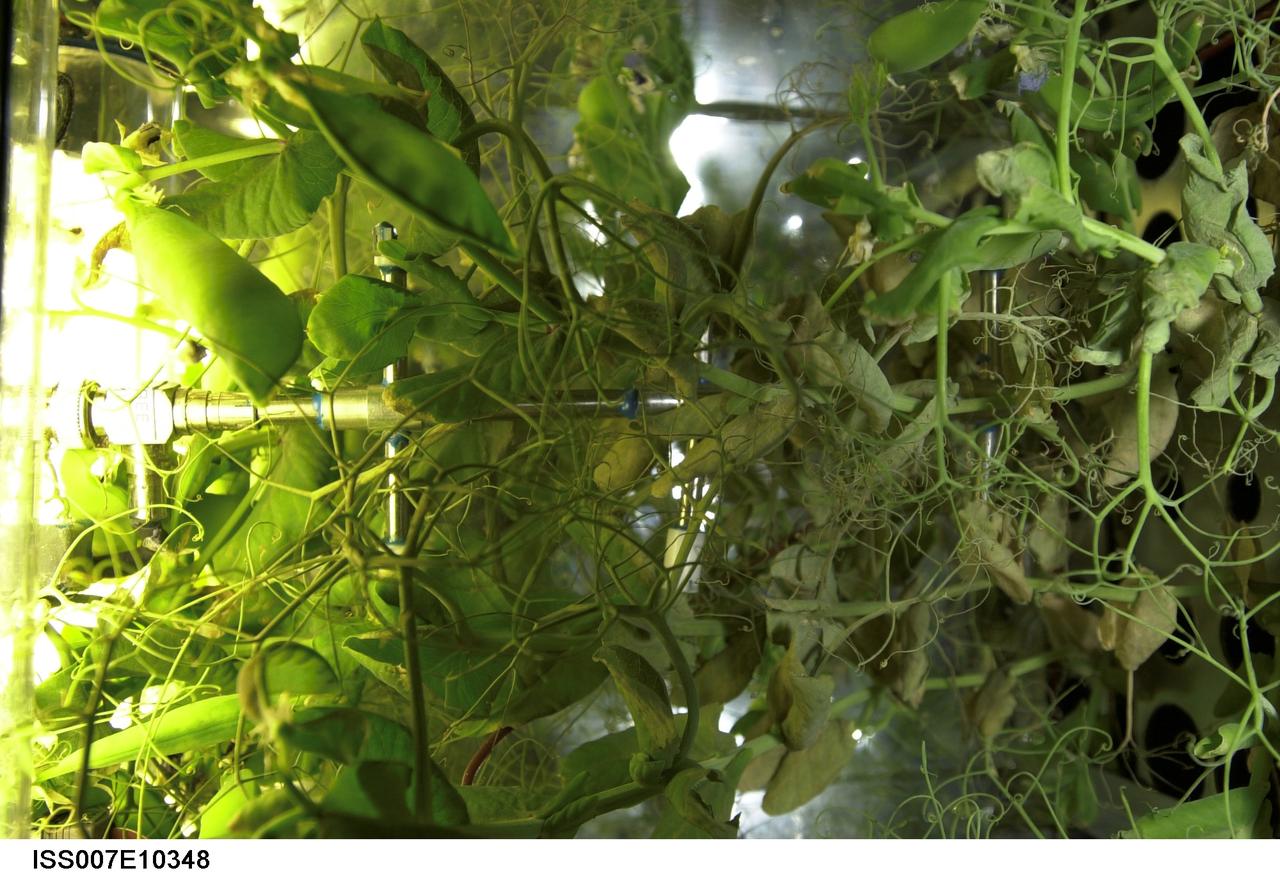
ISS007-E-10348 (July 2003) --- This view of a plant growth experiment inside the Russian Lada greenhouse, located in the Zvezda Service Module, was taken by an Expedition 7 crewmember onboard the International Space Station (ISS).
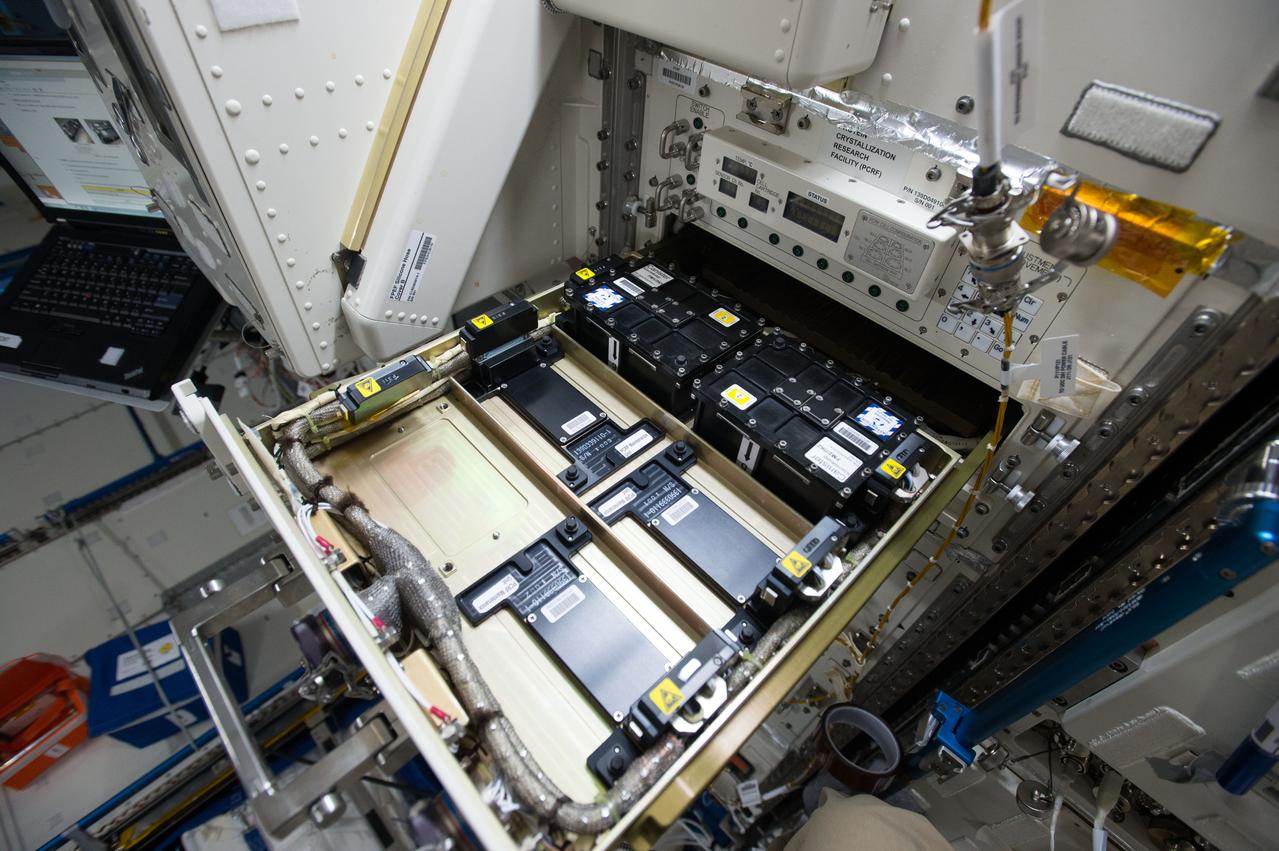
iss049e045287 (10/21/2016) --- Photographic documentation taken during JAXA Protein Crystal Growth (PCG) Installation into the Protein Crystallization Research Facility (PCRF) of the Ryutai Rack.
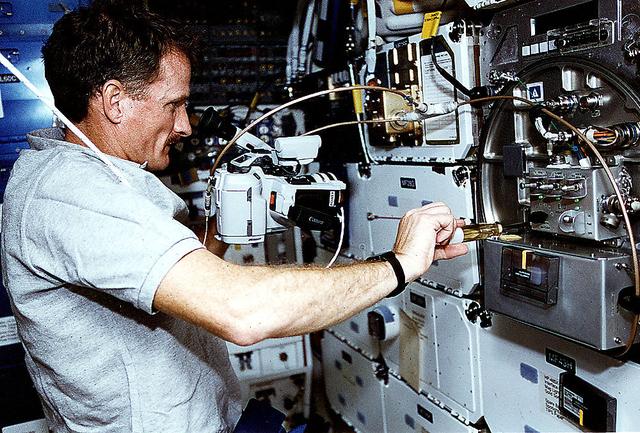
On the Space Shuttle Orbiter Atlantis' middeck, Astronaut Joseph R. Tarner, mission specialist, works at an area amidst several lockers which support the Protein Crystal Growth (PCG) experiment during the STS-66 mission. This particular section is called the Crystal Observation System, housed in the Thermal Enclosure System (COS/TES). Together with the Vapor Diffusion Apparatus (VDA), housed in Single Locker Thermal Enclosure (SLTES), the COS/TES represents the continuing research into the structure of proteins and other macromolecules such as viruses.
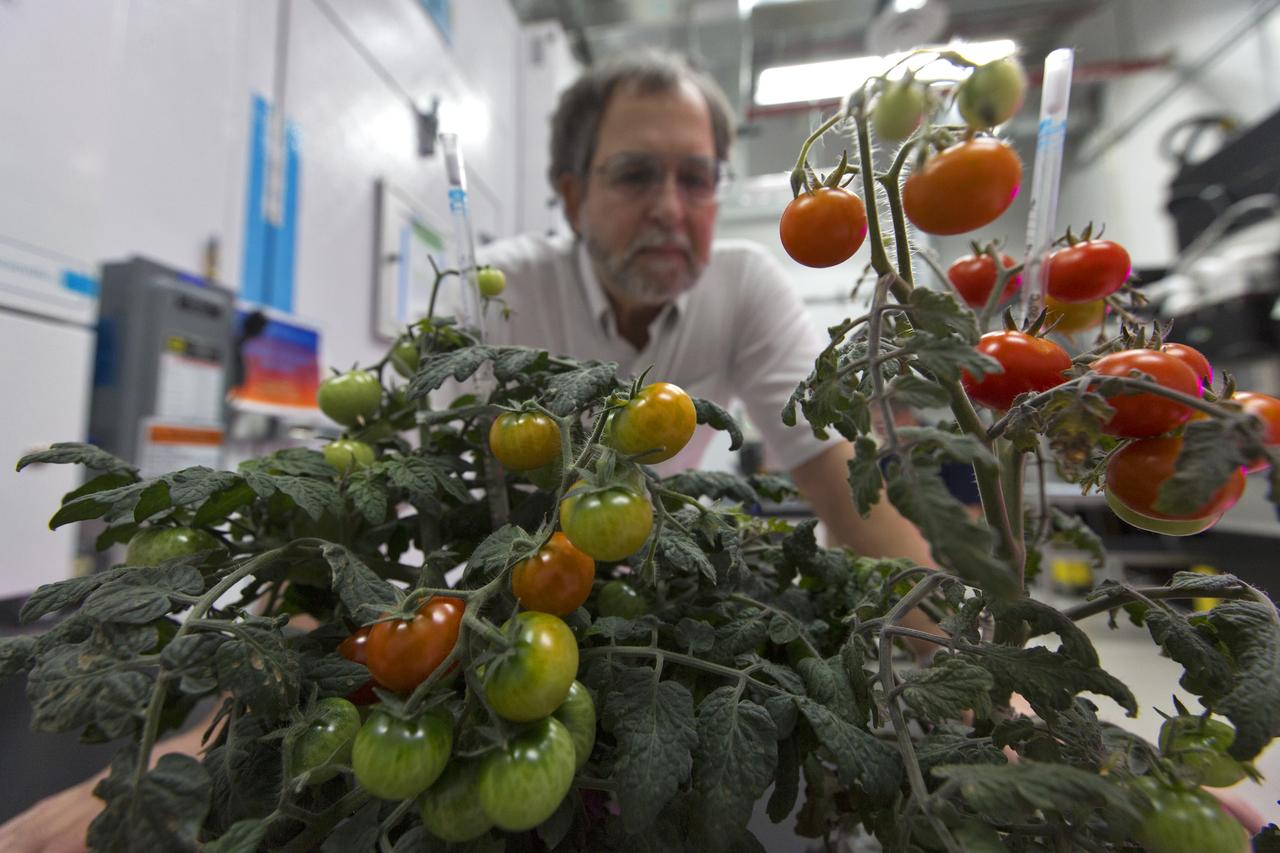
Howard Levine, Ph.D., a research scientist at NASA's Kennedy Space Center in Florida, reviews the growth of several tomato plants in a laboratory in the Space Station Processing Facility. The tomato plants are growing in the Veggie Passive Orbital Nutrient Delivery System (PONDS). Veggie PONDS is a direct follow-on to the Veg-01 and Veg-03 hardware and plant growth validation tests. The primary goal of this newly developed plant growing system, Veggie PONDS, is to demonstrate uniform plant growth. PONDS units have features that are designed to mitigate microgravity effects on water distribution, increase oxygen exchange and provide sufficient room for root zone growth. PONDS is planned for use during Veg-04 and Veg-05 on the International Space Station after the Veggie PONDS Validation flights on SpaceX-14 and OA-9.
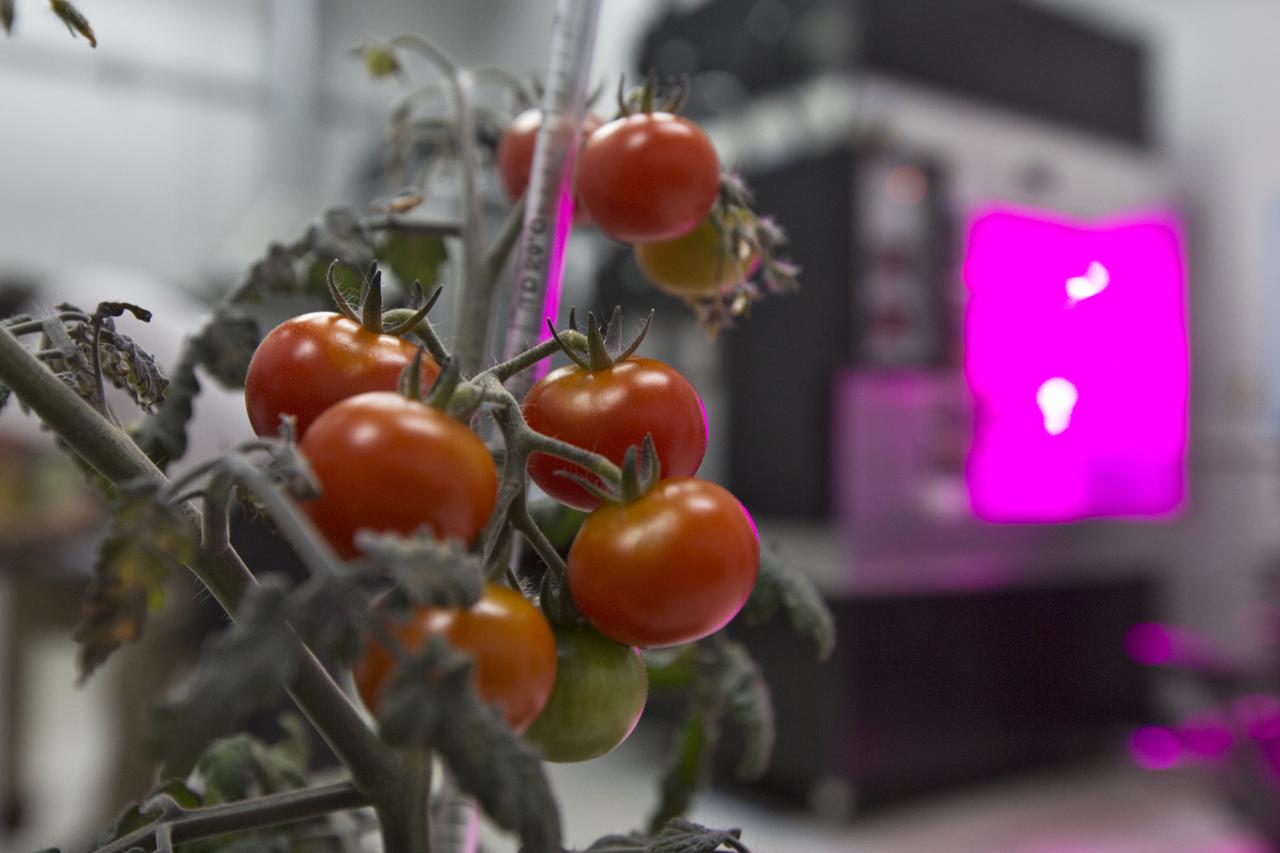
Tomato plants are growing inside a laboratory at the Space Station Processing Facility at NASA’s Kennedy Space Center in Florida. The plant growth is being tested in the Veggie Passive Orbital Nutrient Delivery System (PONDS). Veggie PONDS is a direct follow-on to the Veg-01 and Veg-03 hardware and plant growth validation tests. The primary goal of this newly developed plant growing system, Veggie PONDS, is to demonstrate uniform plant growth. PONDS units have features that are designed to mitigate microgravity effects on water distribution, increase oxygen exchange and provide sufficient room for root zone growth. PONDS is planned for use during Veg-04 and Veg-05 on the International Space Station after the Veggie PONDS Validation flights on SpaceX-14 and OA-9.
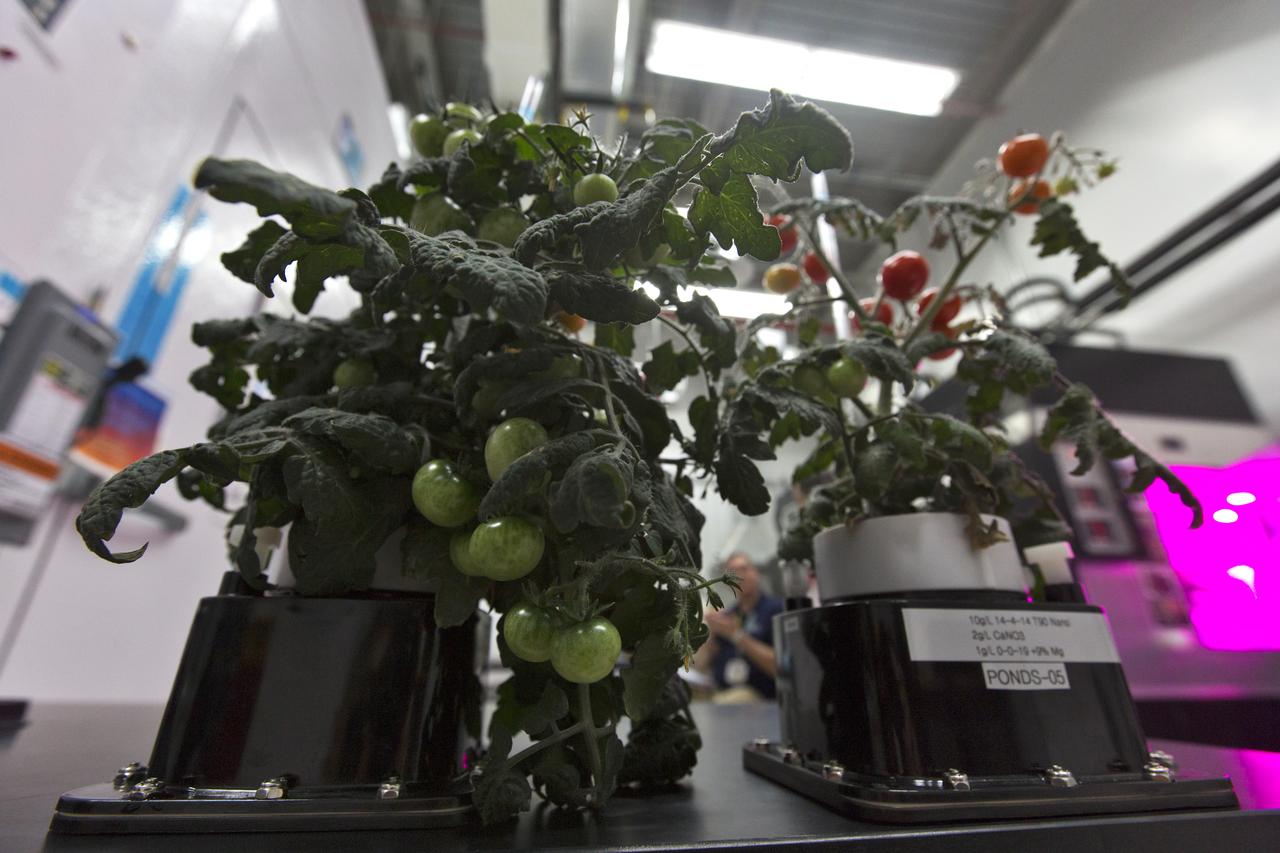
Tomato plants are growing inside a laboratory at the Space Station Processing Facility at NASA’s Kennedy Space Center in Florida. The plant growth is being tested in the Veggie Passive Orbital Nutrient Delivery System (PONDS). Veggie PONDS is a direct follow-on to the Veg-01 and Veg-03 hardware and plant growth validation tests. The primary goal of this newly developed plant growing system, Veggie PONDS, is to demonstrate uniform plant growth. PONDS units have features that are designed to mitigate microgravity effects on water distribution, increase oxygen exchange and provide sufficient room for root zone growth. PONDS is planned for use during Veg-04 and Veg-05 on the International Space Station after the Veggie PONDS Validation flights on SpaceX-14 and OA-9.
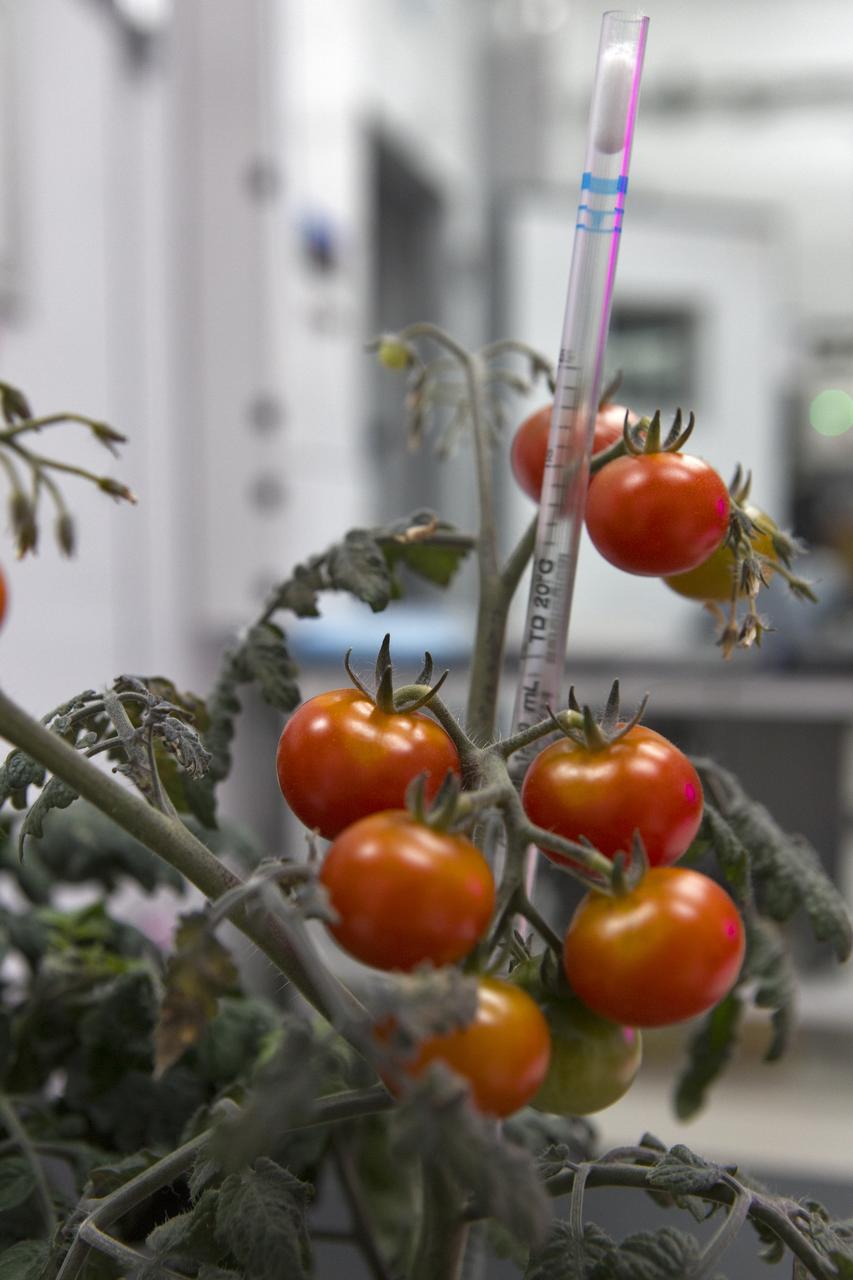
Tomato plants are growing inside a laboratory at the Space Station Processing Facility at NASA’s Kennedy Space Center in Florida. The plant growth is being tested in the Veggie Passive Orbital Nutrient Delivery System (PONDS). Veggie PONDS is a direct follow-on to the Veg-01 and Veg-03 hardware and plant growth validation tests. The primary goal of this newly developed plant growing system, Veggie PONDS, is to demonstrate uniform plant growth. PONDS units have features that are designed to mitigate microgravity effects on water distribution, increase oxygen exchange and provide sufficient room for root zone growth. PONDS is planned for use during Veg-04 and Veg-05 on the International Space Station after the Veggie PONDS Validation flights on SpaceX-14 and OA-9.
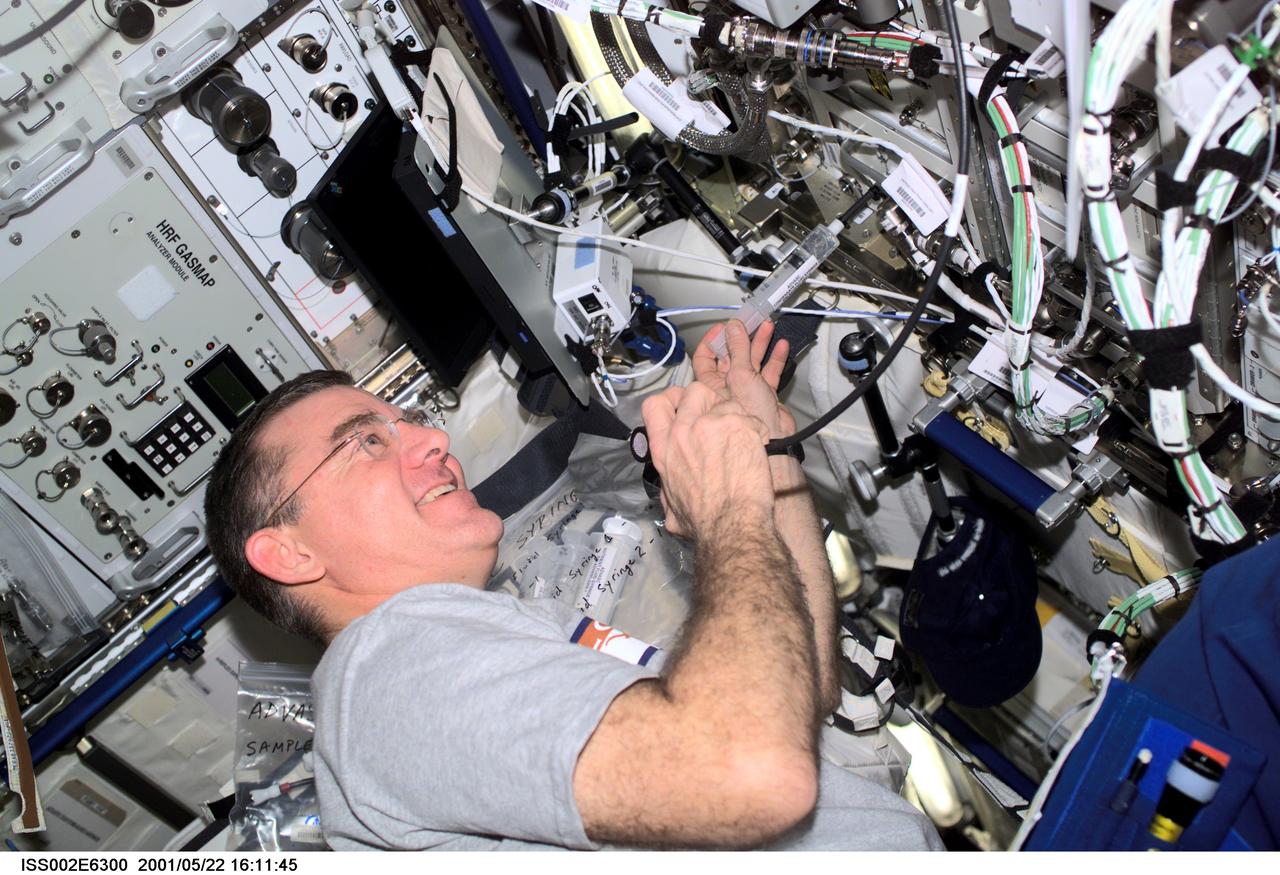
ISS002-E-6300 (22 May 2001) --- James S. Voss, Expedition Two flight engineer, works with the Advanced Astro Culture (ADVASC) Condensate Fluid Syringe at the ADVASC Growth Chamber in the U.S. Laboratory. The image was taken with a digital still camera.
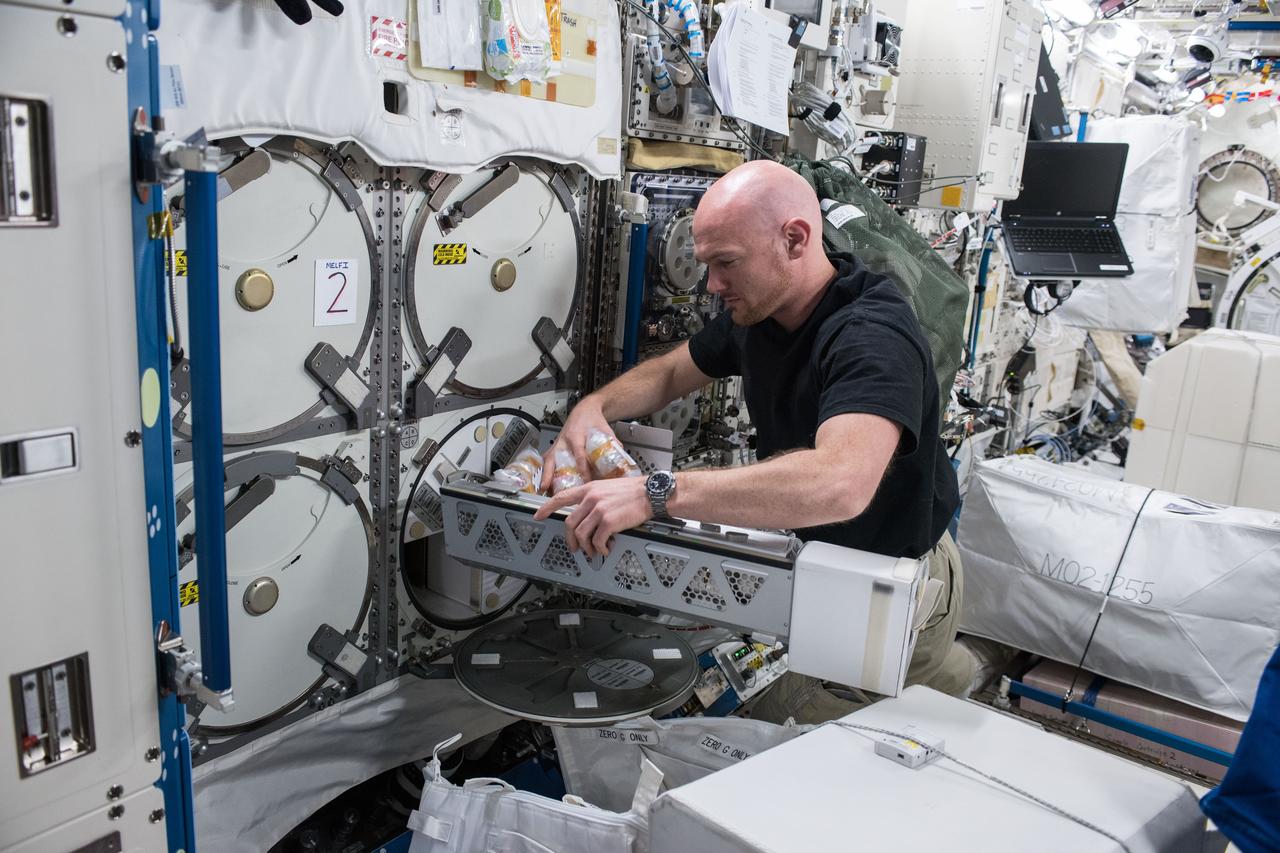
iss056e075950 (July 3, 2018) --- Astronaut Alexander Gerst of ESA (European Space Agency) works inside the Japanese Kibo laboratory module retrieving Protein Crystal Growth samples from a science freezer, also known as the Minus Eighty-Degree Laboratory Freezer for ISS (MELFI).
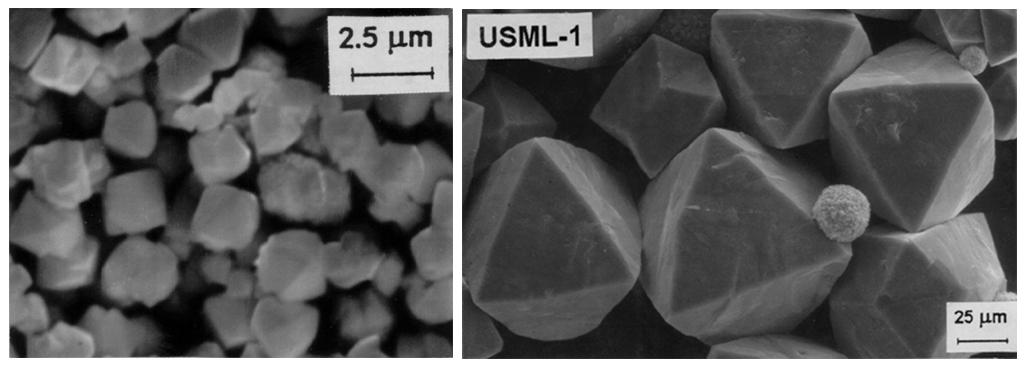
Zeolites are crystalline aluminosilicates that have complex framework structures. However, there are several features of zeolite crystals that make unequivocal structure determinations difficult. The acquisition of reliable structural information on zeolites is greatly facilitated by the availability of high-quality specimens. For structure determinations by conventional diffraction techniques, large single-crystal specimens are essential. Alternatively, structural determinations by powder profile refinement methods relax the constraints on crystal size, but still require materials with a high degree of crystalline perfection. Studies conducted at CAMMP (Center for Advanced Microgravity Materials Processing) have demonstrated that microgravity processing can produce larger crystal sizes and fewer structural defects relative to terrestrial crystal growth. Principal Investigator: Dr. Albert Sacco
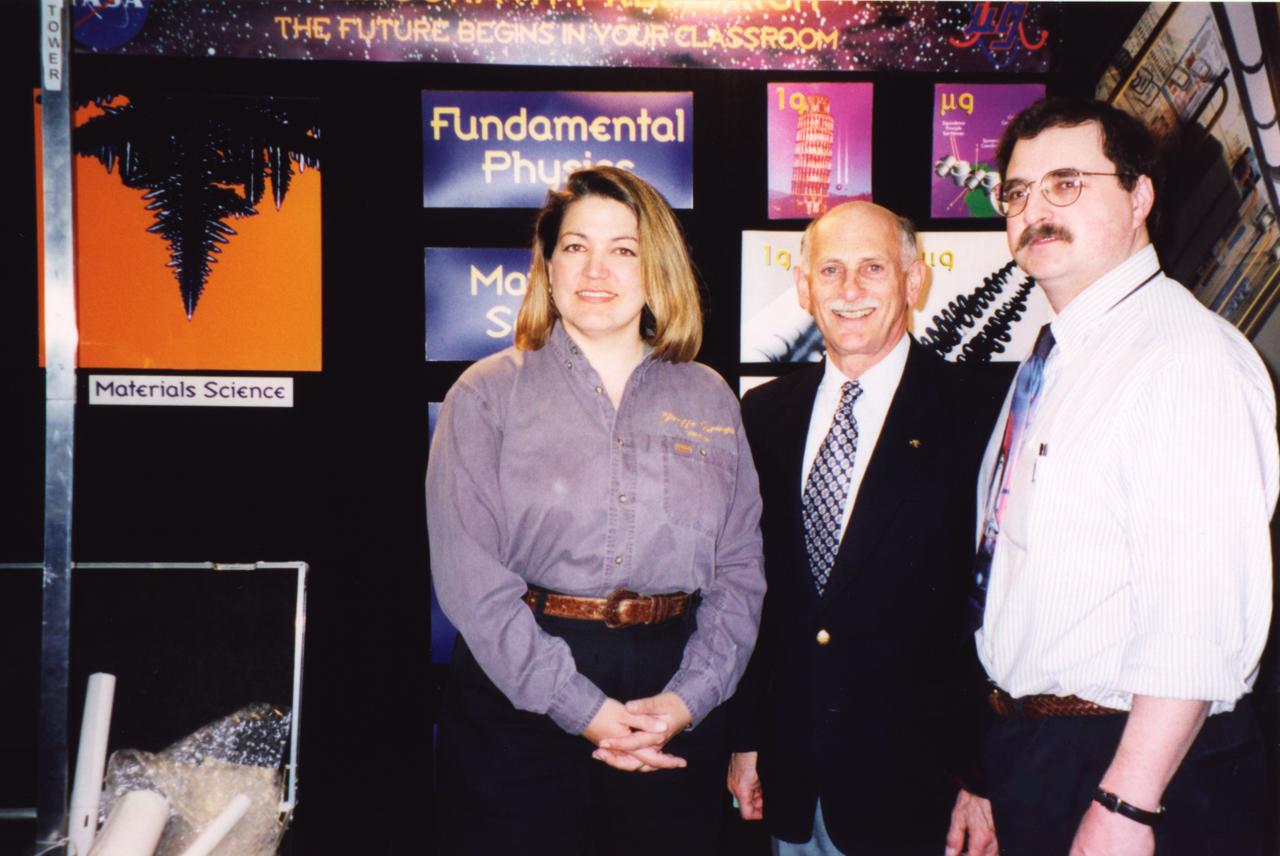
Representatives of NASA materials science experiments supported the NASA exhibit at the Rernselaer Polytechnic Institute's Space Week activities, April 5 through 11, 1999. From left to right are: Angie Jackman, project manager at NASA's Marshall Space Flight Center for dendritic growth experiments; Dr. Martin Glicksman of Rennselaer Polytechnic Instutute, Troy, NY, principal investigator on the Isothermal Dendritic Growth Experiment (IDGE) that flew three times on the Space Shuttle; and Dr. Matthew Koss of College of the Holy Cross in Worcester, MA, a co-investigator on the IDGE and now principal investigator on the Transient Dendritic Solidification Experiment being developed for the International Space Station (ISS). The image at far left is a dendrite grown in Glicksman's IDGE tests aboard the Shuttle. Glicksman is also principal investigator for the Evolution of Local Microstructures: Spatial Instabilities of Coarsening Clusters.
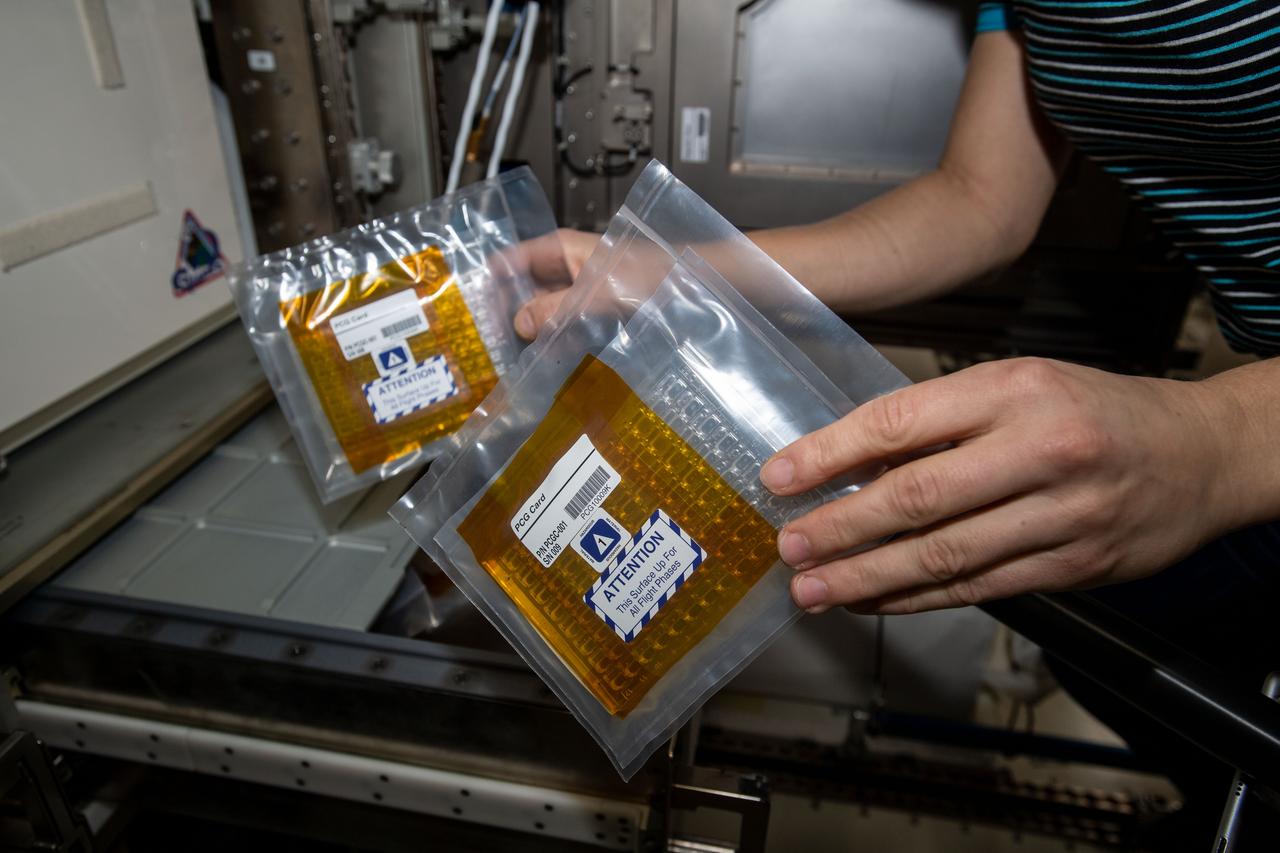
iss062e087808 (3/11/2020) --- A view of Protein Crystal Growth-10 experiment hardware inside JAXA's (Japan Aerospace Exploration Agency) Kibo laboratory module aboard the International Space Station (ISS). Microgravity Crystallization of Glycogen Synthase-Glycogenin Protein Complex (CASIS PCG 10) crystallizes human glycogen synthase proteins on the space station. Determining the structure of the human glycogen synthase and full-length glycogenin protein complex could facilitate the development of treatments on Earth for metabolic disorders such as Type 2 diabetes, obesity, rare genetic disorders, and some forms of cancer.
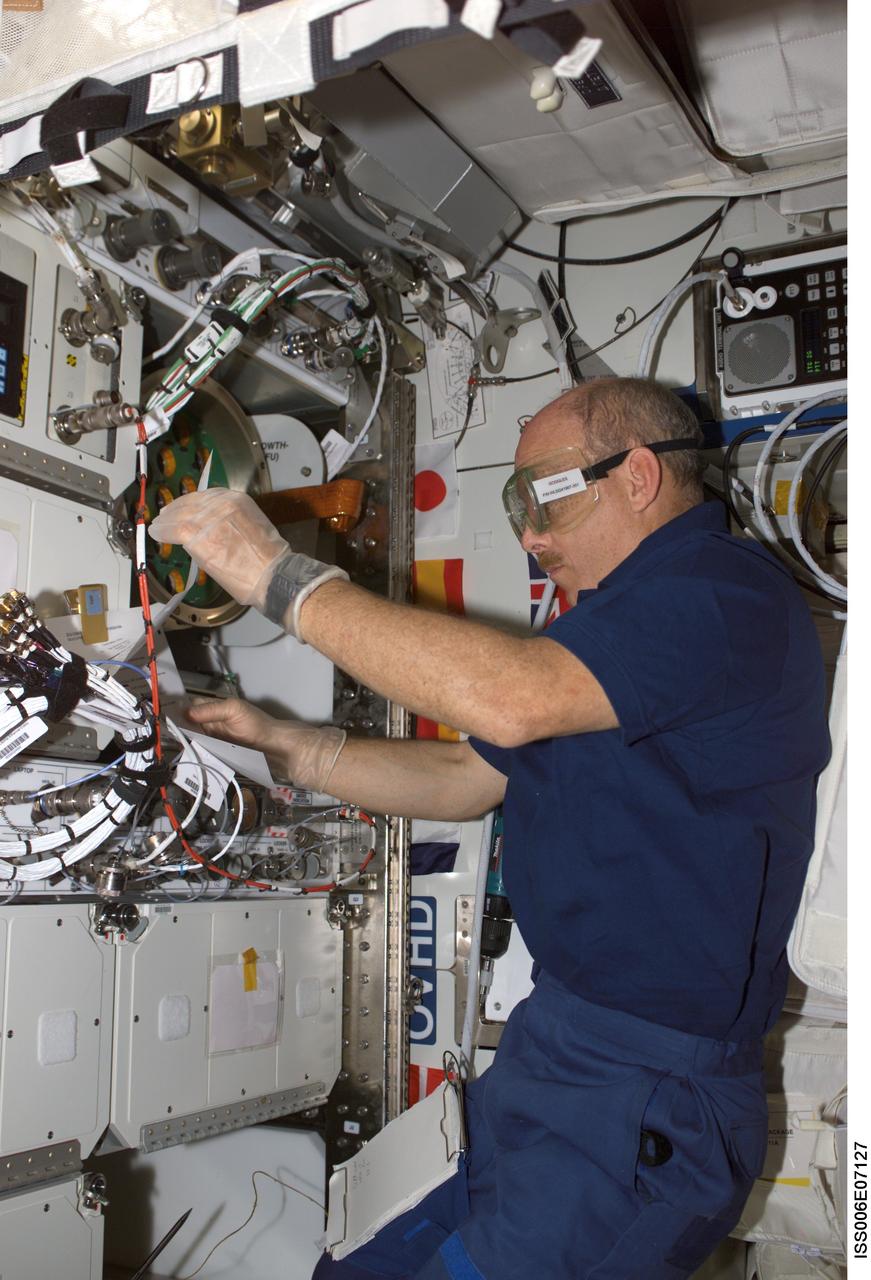
ISS006-E-07127 (5 December 2002) --- Astronaut Kenneth D. Bowersox, Expedition Six mission commander, works with the Zeolite Crystal Growth (ZCG) experiment in the Destiny laboratory on the International Space Station (ISS).
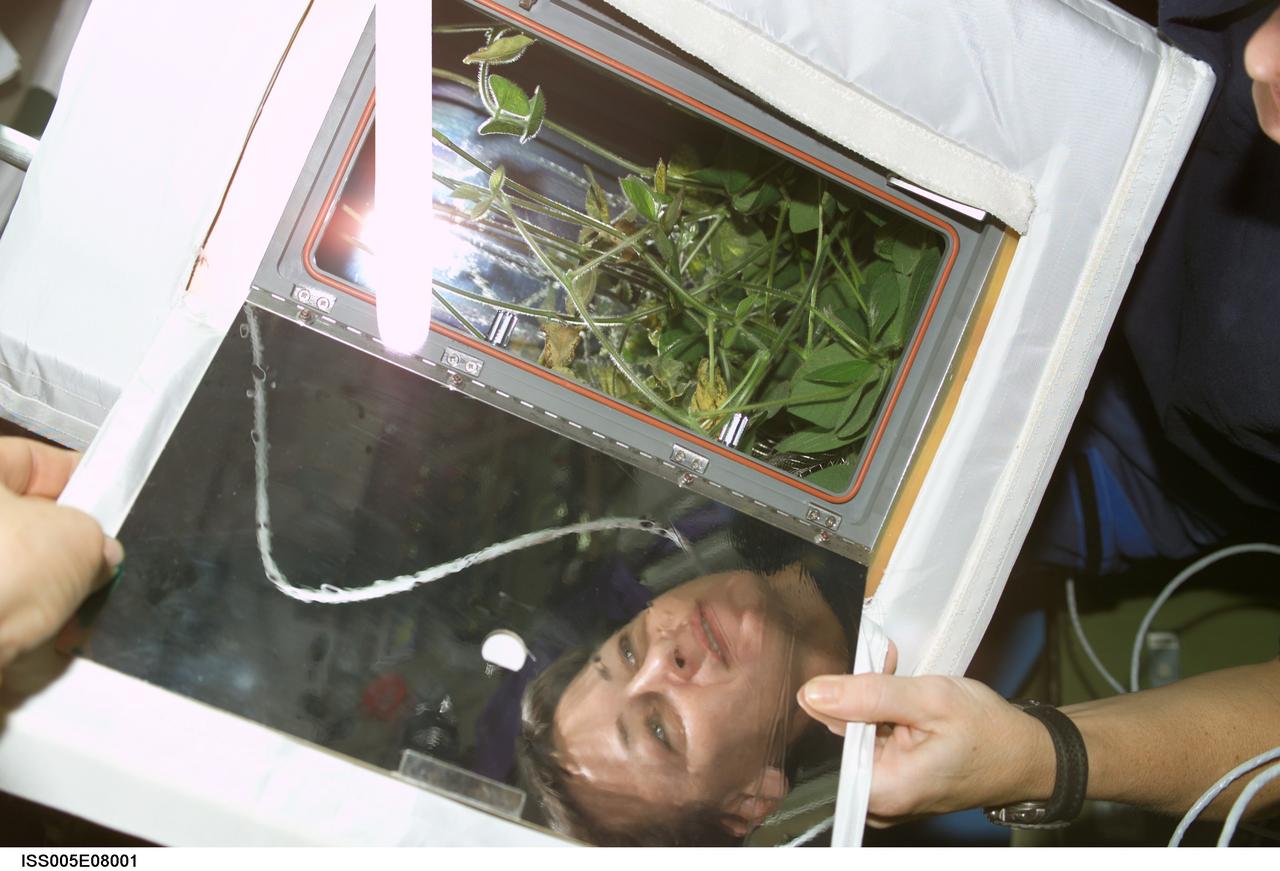
ISS005-E-08001 (18 July 2002) --- Astronaut Peggy A. Whitson, Expedition Five flight engineer, works with the Advanced Astroculture soybean plant growth experiment in the Destiny laboratory on the International Space Station (ISS).
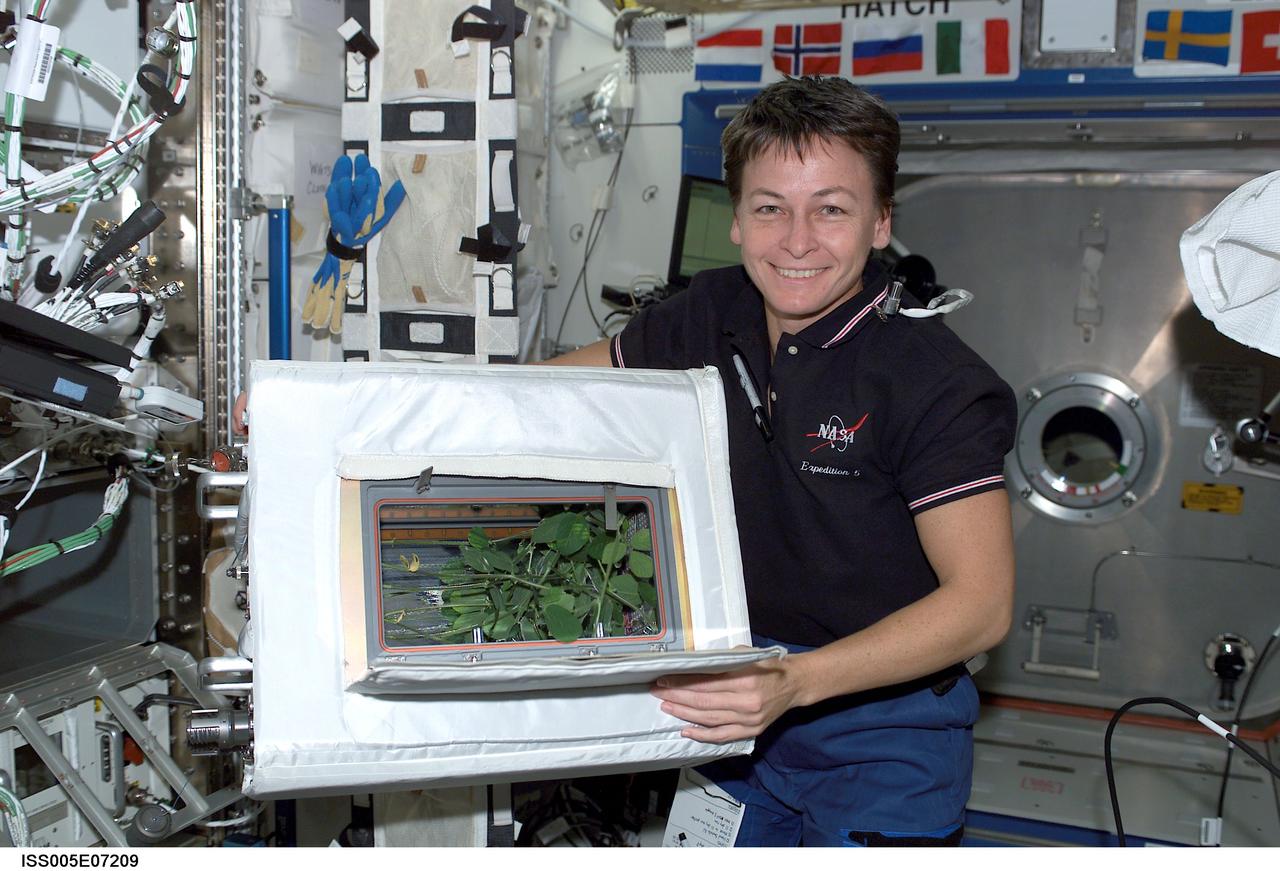
ISS005-E-07209 (10 July 2002) --- Astronaut Peggy A. Whitson, Expedition Five NASA ISS science officer, holds the Advanced Astroculture soybean plant growth experiment in the Destiny laboratory on the International Space Station (ISS).
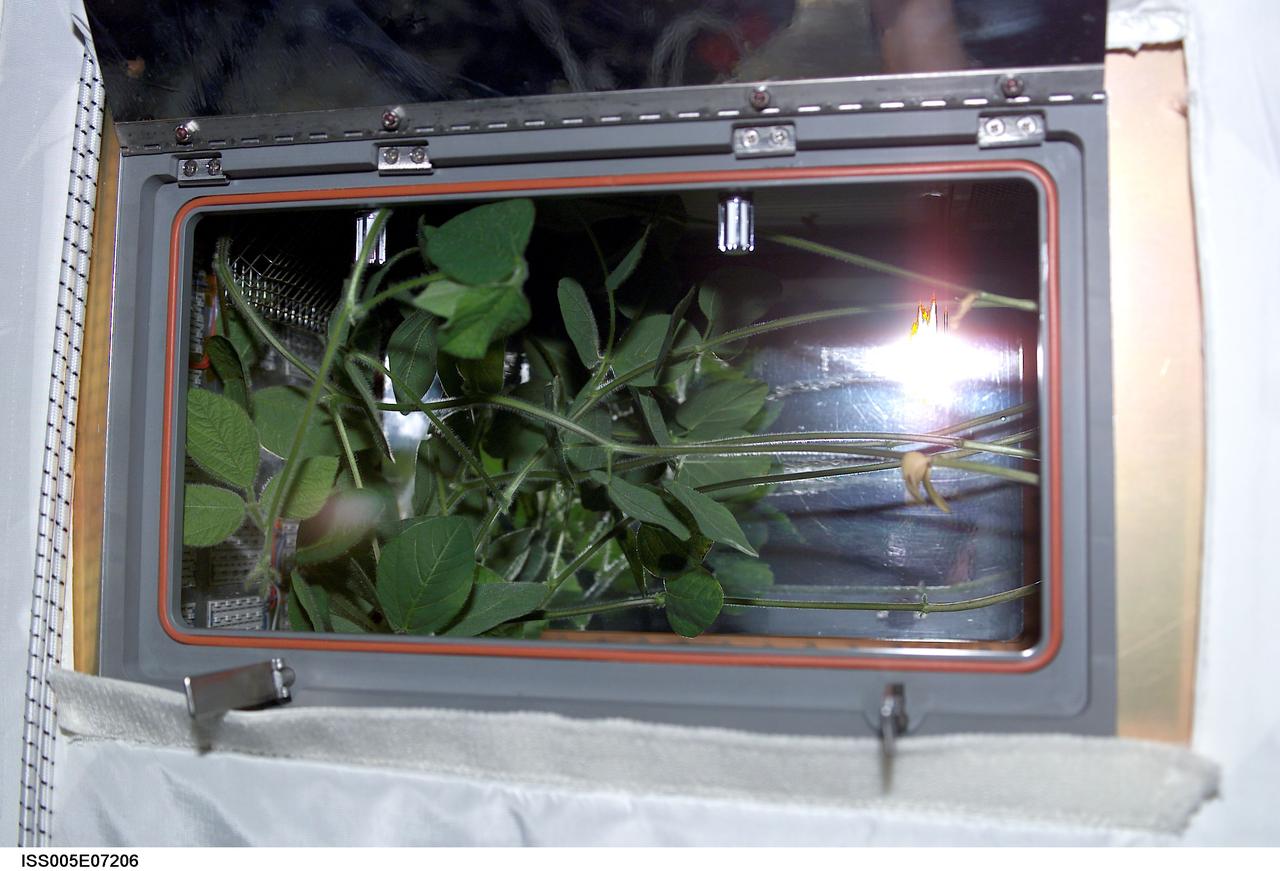
ISS005-E-07206 (10 July 2002) --- A close-up view of the Advanced Astroculture soybean plant growth experiment in the Destiny laboratory on the International Space Station (ISS).
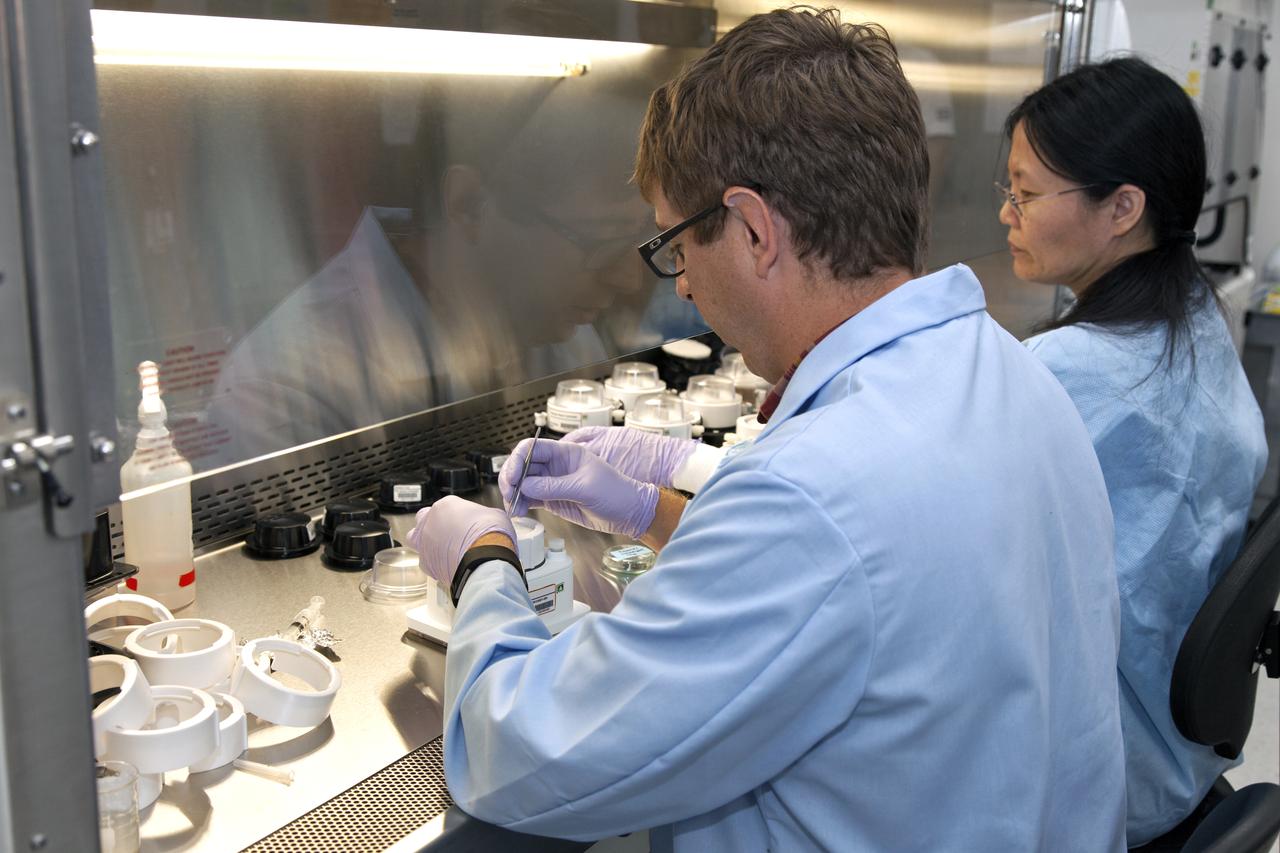
From left, Matthew Romeyn and Dr. Ye Zhang, project scientists, place seeds in Veggie Passive Orbital Nutrient Delivery System (PONDS) units inside a laboratory at the Space Station Processing Facility at NASA’s Kennedy Space Center in Florida. Veggie PONDS is a direct follow-on to the Veg-01 and Veg-03 hardware and plant growth validation tests. The primary goal of this newly developed plant growing system, Veggie PONDS, is to demonstrate uniform plant growth. PONDS units have features that are designed to mitigate microgravity effects on water distribution, increase oxygen exchange and provide sufficient room for root zone growth. PONDS is planned for use during Veg-04 and Veg-05 on the International Space Station after the Veggie PONDS Validation flights on SpaceX-14 and OA-9.
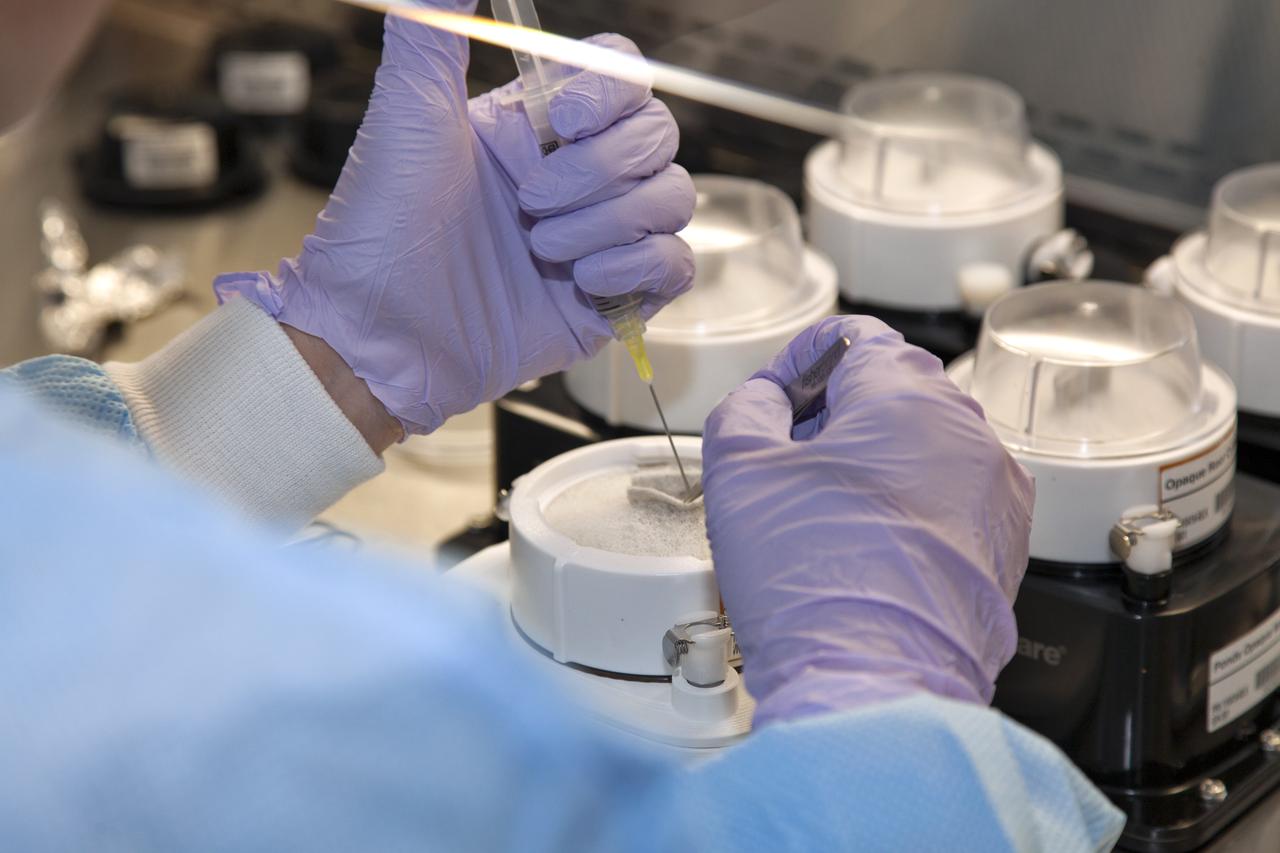
Seeds are being planted in Veggie Passive Orbital Nutrient Delivery System (PONDS) units inside a laboratory at the Space Station Processing Facility at NASA’s Kennedy Space Center in Florida. Veggie PONDS is a direct follow-on to the Veg-01 and Veg-03 hardware and plant growth validation tests. The primary goal of this newly developed plant growing system, Veggie PONDS, is to demonstrate uniform plant growth. PONDS units have features that are designed to mitigate microgravity effects on water distribution, increase oxygen exchange and provide sufficient room for root zone growth. PONDS is planned for use during Veg-04 and Veg-05 on the International Space Station after the Veggie PONDS Validation flights on SpaceX-14 and OA-9.
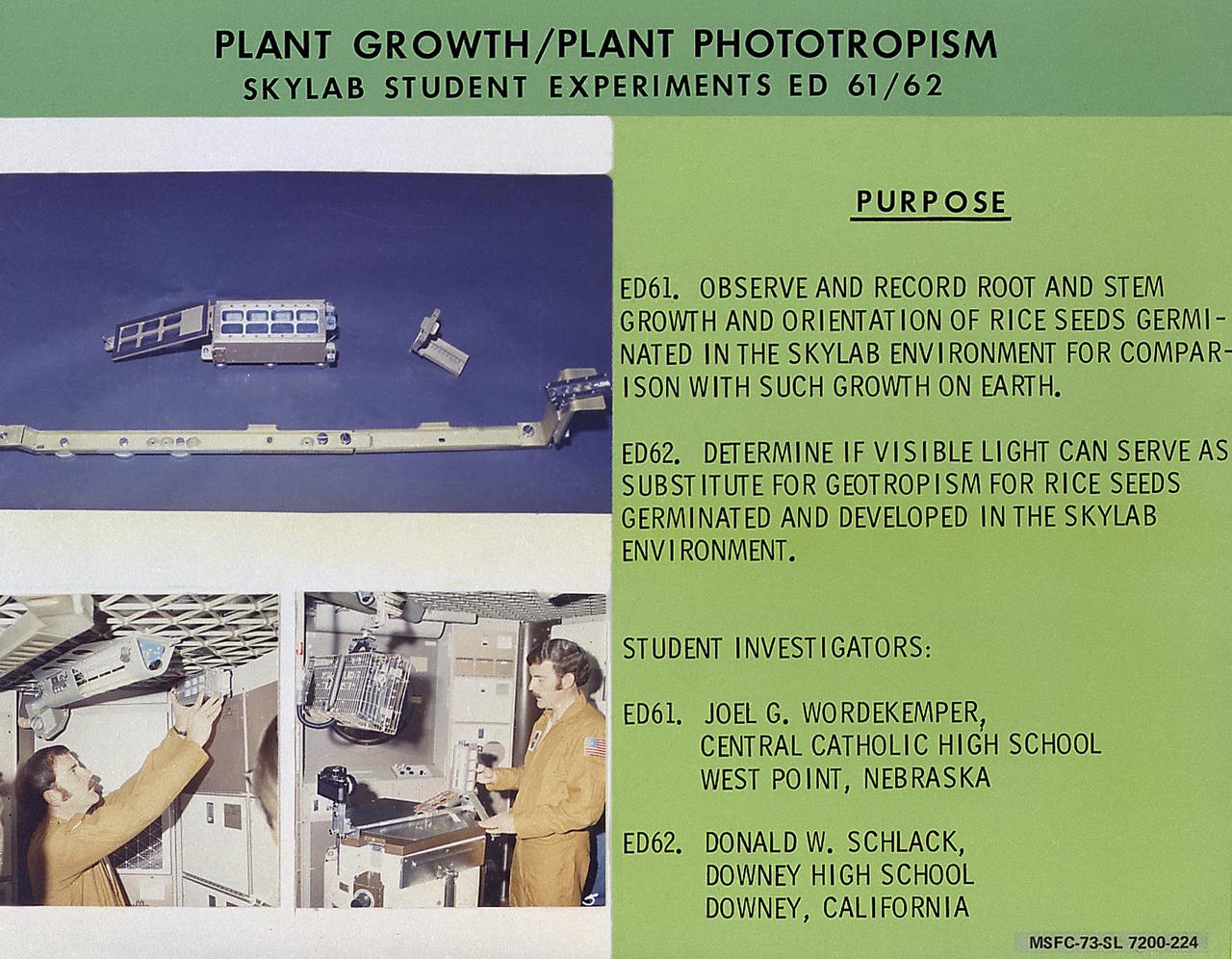
This chart describes the Skylab student experiment ED-61, Plant Growth, and experiment ED-62, Plant Phototropism. Two similar proposals were submitted by Joel G. Wordekemper of West Point, Nebraska, and Donald W. Schlack of Downey, California. Wordekemper's experiment (ED-61) was to see how the lack of gravity would affect the growth of roots and stems of plants. Schlack's experiment (ED-62) was to study the effect of light on a seed developing in zero gravity. The growth container of the rice seeds for their experiment consisted of eight compartments arranged in two parallel rows of four. Each had two windowed surfaces to allow periodic photography of the developing seedlings. In March 1972, NASA and the National Science Teachers Association selected 25 experiment proposals for flight on Skylab. Science advisors from the Marshall Space Flight Center aided and assisted the students in developing the proposals for flight on Skylab.
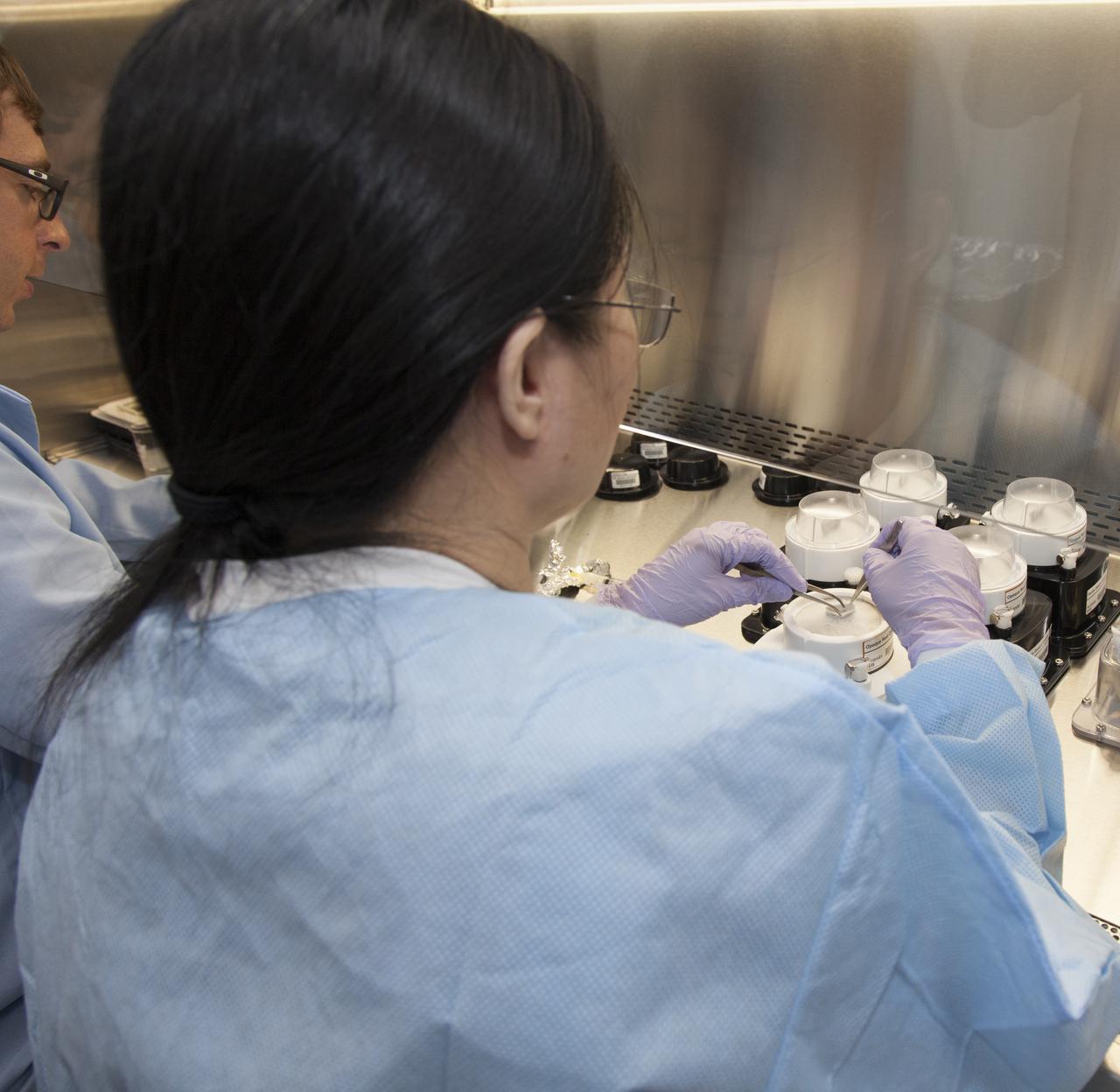
Dr. Ye Zhang, a project scientists, places seeds in Veggie Passive Orbital Nutrient Delivery System (PONDS) units inside a laboratory at the Space Station Processing Facility at NASA's Kennedy Space Center in Florida. Veggie PONDS is a direct follow-on to the Veg-01 and Veg-03 hardware and plant growth validation tests. The primary goal of this newly developed plant growing system, Veggie PONDS, is to demonstrate uniform plant growth. PONDS units have features that are designed to mitigate microgravity effects on water distribution, increase oxygen exchange and provide sufficient room for root zone growth. PONDS is planned for use during Veg-04 and Veg-05 on the International Space Station after the Veggie PONDS Validation flights on SpaceX-14 and OA-9.
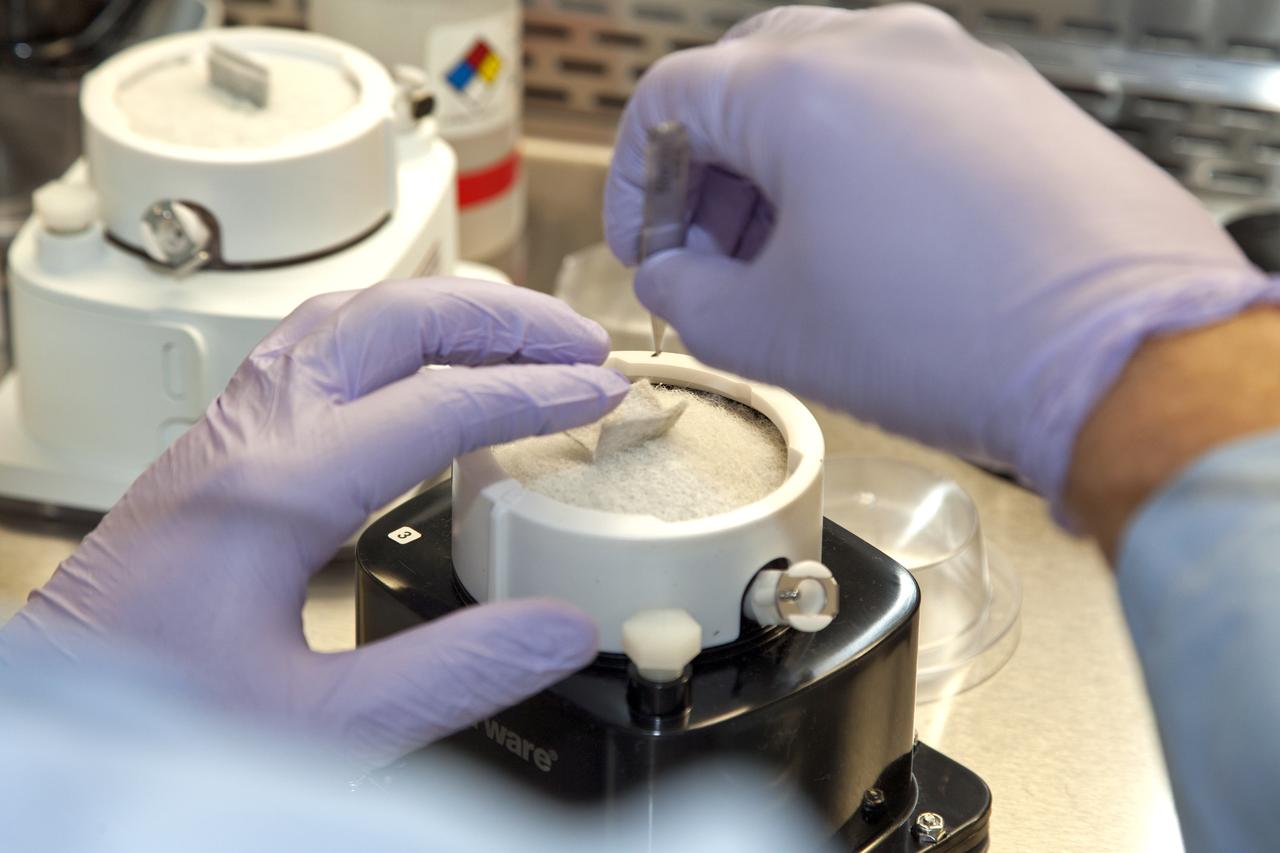
Seeds are being planted in Veggie Passive Orbital Nutrient Delivery System (PONDS) units inside a laboratory at the Space Station Processing Facility at NASA’s Kennedy Space Center in Florida. Veggie PONDS is a direct follow-on to the Veg-01 and Veg-03 hardware and plant growth validation tests. The primary goal of this newly developed plant growing system, Veggie PONDS, is to demonstrate uniform plant growth. PONDS units have features that are designed to mitigate microgravity effects on water distribution, increase oxygen exchange and provide sufficient room for root zone growth. PONDS is planned for use during Veg-04 and Veg-05 on the International Space Station after the Veggie PONDS Validation flights on SpaceX-14 and OA-9.
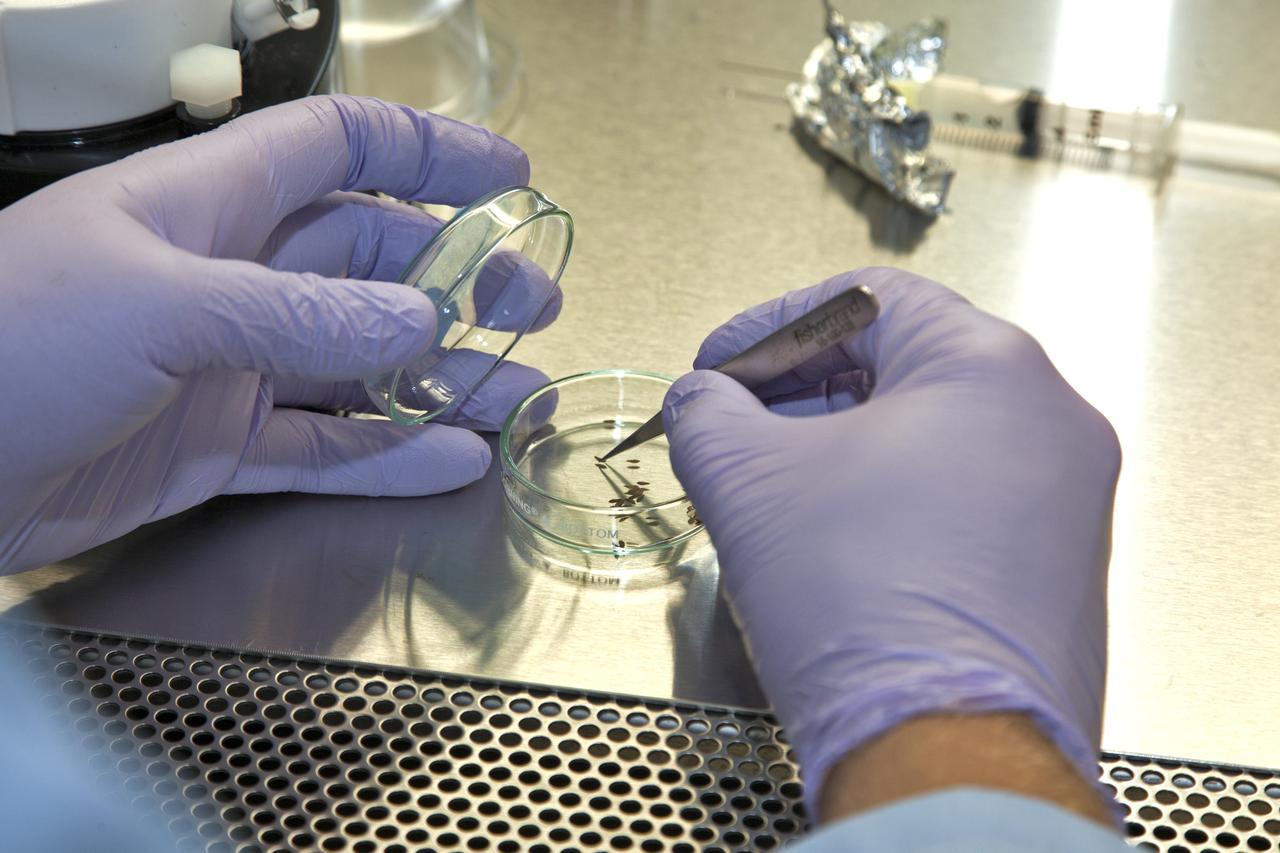
Seeds are being planted in Veggie Passive Orbital Nutrient Delivery System (PONDS) units inside a laboratory at the Space Station Processing Facility at NASA’s Kennedy Space Center in Florida. Veggie PONDS is a direct follow-on to the Veg-01 and Veg-03 hardware and plant growth validation tests. The primary goal of this newly developed plant growing system, Veggie PONDS, is to demonstrate uniform plant growth. PONDS units have features that are designed to mitigate microgravity effects on water distribution, increase oxygen exchange and provide sufficient room for root zone growth. PONDS is planned for use during Veg-04 and Veg-05 on the International Space Station after the Veggie PONDS Validation flights on SpaceX-14 and OA-9.
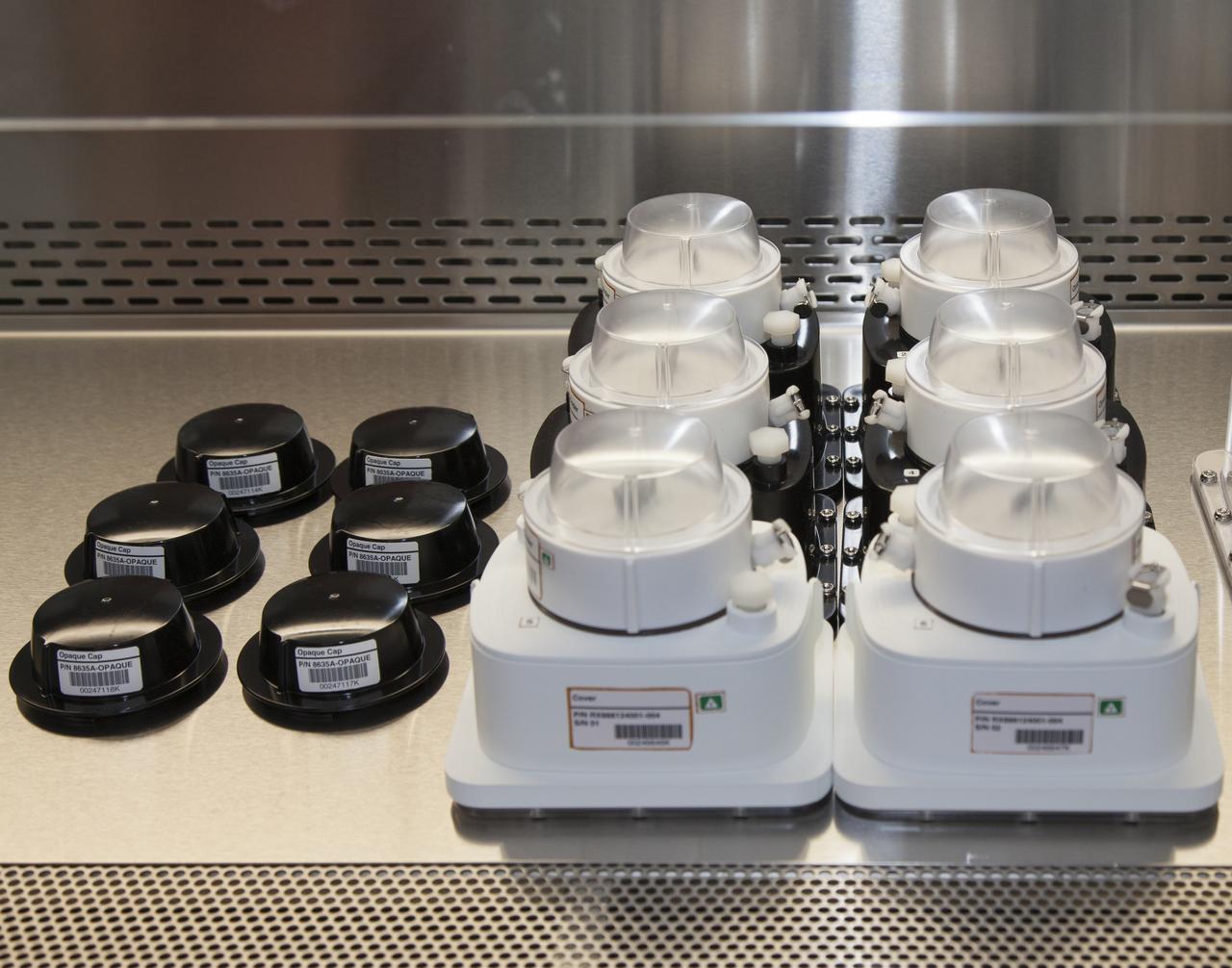
Veggie Passive Orbital Nutrient Delivery System (PONDS) units are being prepared for seed planting inside a laboratory at the Space Station Processing Facility at NASA's Kennedy Space Center in Florida. Veggie PONDS is a direct follow-on to the Veg-01 and Veg-03 hardware and plant growth validation tests. The primary goal of this newly developed plant growing system, Veggie PONDS, is to demonstrate uniform plant growth. PONDS units have features that are designed to mitigate microgravity effects on water distribution, increase oxygen exchange and provide sufficient room for root zone growth. PONDS is planned for use during Veg-04 and Veg-05 on the International Space Station after the Veggie PONDS Validation flights on SpaceX-14 and OA-9.
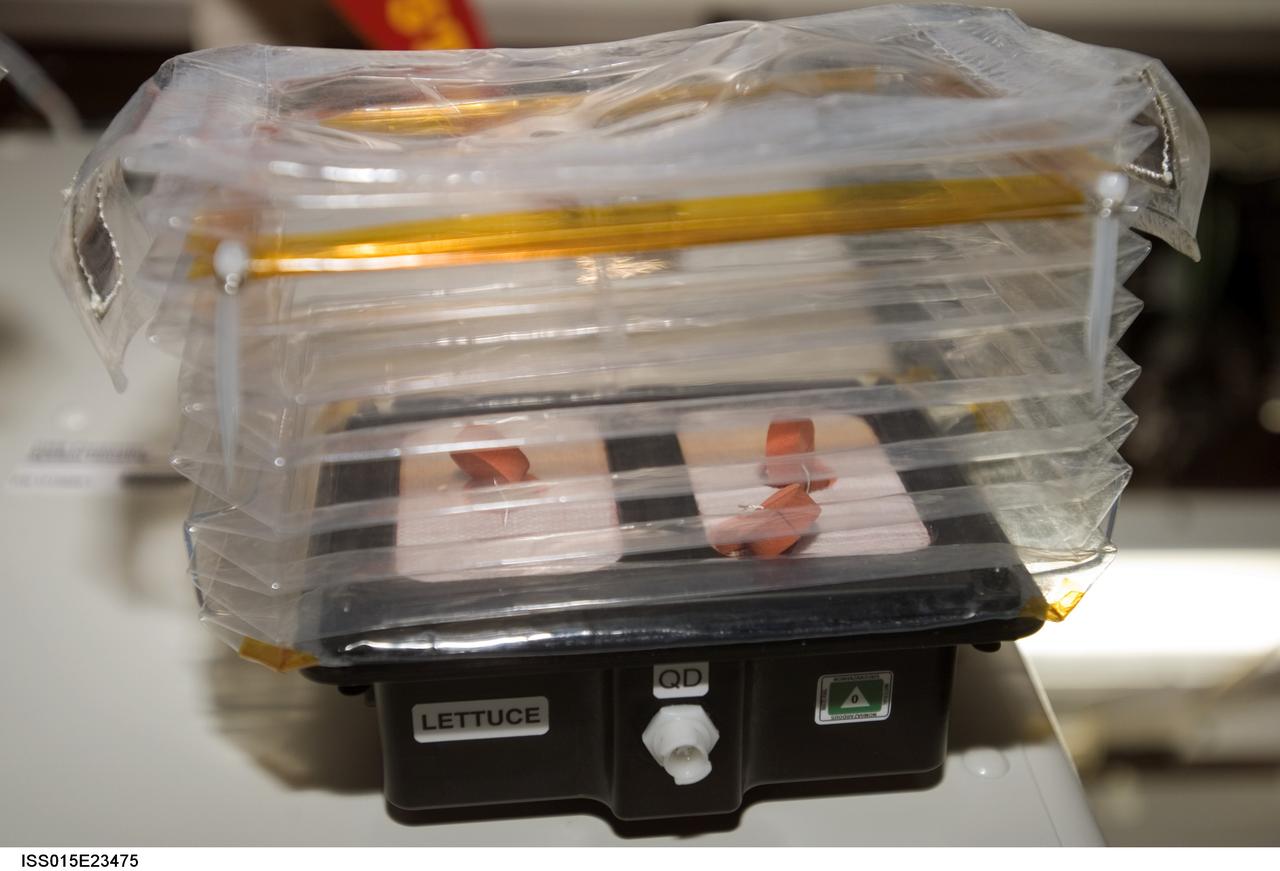
ISS015-E-23475 (20 Aug. 2007) --- Close-up view of a plant growth experiment in an Education Payload Operations experiment collapsible growth chamber (labeled "Lettuce") photographed in the U.S. Laboratory or Destiny module aboard the International Space Station during Expedition 15.
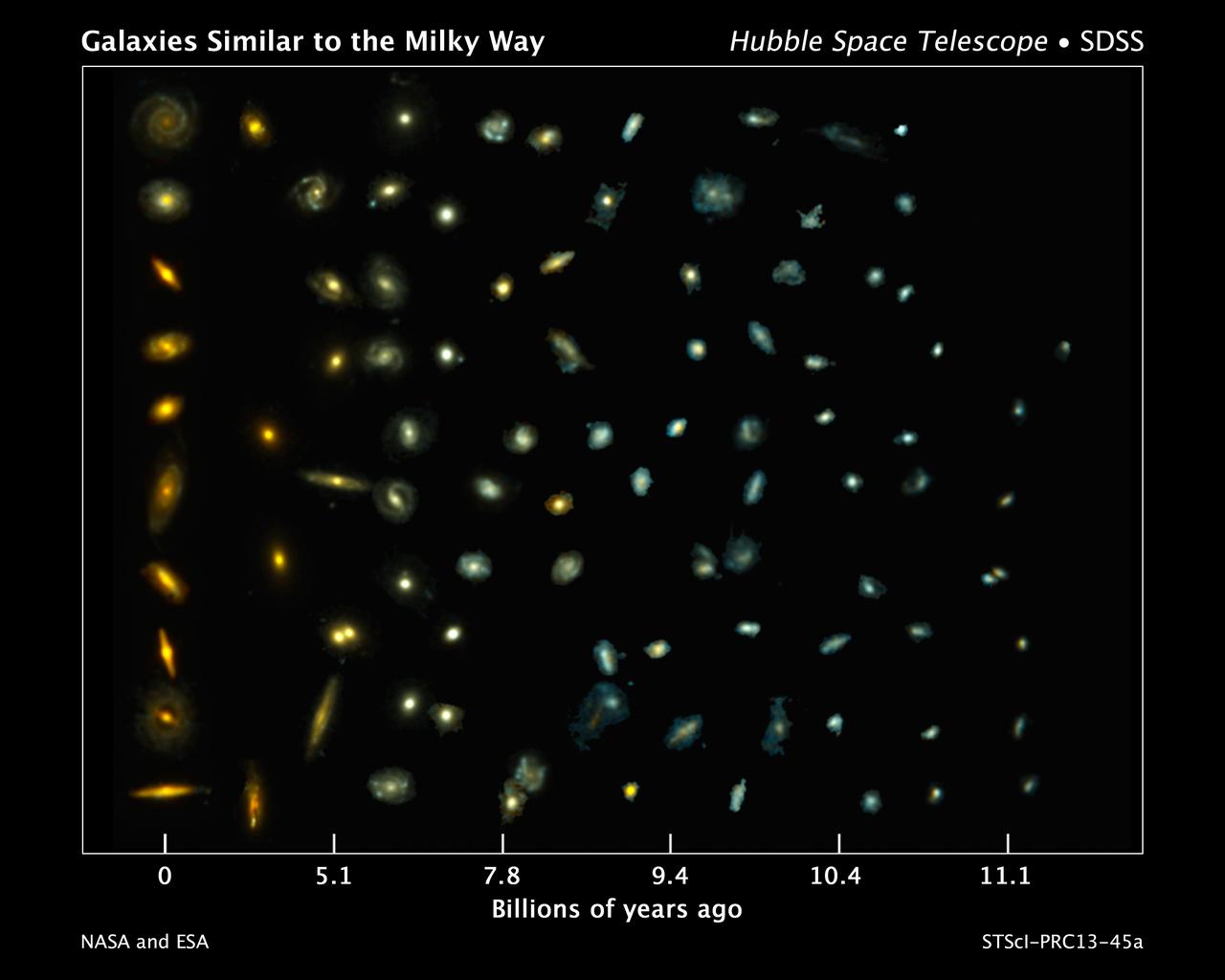
This composite image shows examples of galaxies similar to our Milky Way at various stages of construction over a time span of 11 billion years. The galaxies are arranged according to time. Those on the left reside nearby; those at far right existed when the cosmos was about 2 billion years old. The bluish glow from young stars dominates the color of the galaxies on the right. The galaxies at left are redder from the glow of older stellar populations. Astronomers found the distant galaxies in two Hubble Space Telescope surveys: 3D-HST and the Cosmic Assembly Near-infrared Deep Extragalactic Legacy Survey, or CANDELS. The observations were made in visible and near-infrared light by Hubble's Wide Field Camera 3 and Advanced Camera for Surveys. The nearby galaxies were taken from the Sloan Digital Sky Survey. This image traces Milky Way-like galaxies over most of cosmic history, revealing how they evolve over time. Hubble's sharp vision resolved the galaxies' shapes, showing that their bulges and disks grew simultaneously. Credit: NASA, ESA, P. van Dokkum (Yale University), S. Patel (Leiden University), and the 3D-HST Team <b><a href="http://www.nasa.gov/audience/formedia/features/MP_Photo_Guidelines.html" rel="nofollow">NASA image use policy.</a></b> <b><a href="http://www.nasa.gov/centers/goddard/home/index.html" rel="nofollow">NASA Goddard Space Flight Center</a></b> enables NASA’s mission through four scientific endeavors: Earth Science, Heliophysics, Solar System Exploration, and Astrophysics. Goddard plays a leading role in NASA’s accomplishments by contributing compelling scientific knowledge to advance the Agency’s mission. <b>Follow us on <a href="http://twitter.com/NASA_GoddardPix" rel="nofollow">Twitter</a></b> <b>Like us on <a href="http://www.facebook.com/pages/Greenbelt-MD/NASA-Goddard/395013845897?ref=tsd" rel="nofollow">Facebook</a></b> <b>Find us on <a href="http://instagram.com/nasagoddard?vm=grid" rel="nofollow">Instagram</a></b>
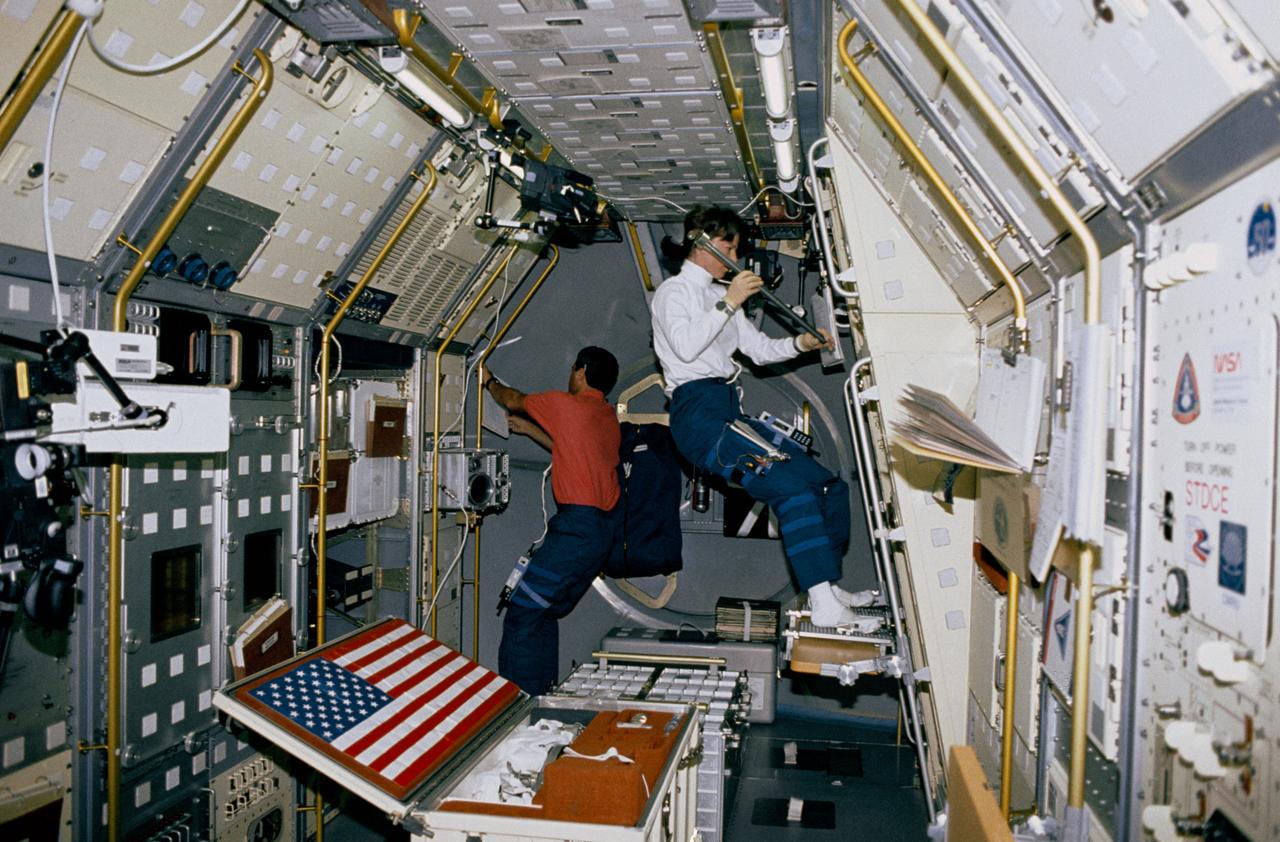
STS050-02-001 (9 July 1992) --- View showing Payload Specialists Bonnie Dunbar and Larry DeLucas in the aft section of the U. S. Microgravity Laboratory-1. Dunbar is preparing to load a sample in the Crystal Growth Furnace (CGF) Integrated Furnace Experiment Assembly (IFEA) in rack 9 of the Microgravity Laboratory. DeLucas is checking out the multipurpose Glovebox Facility.
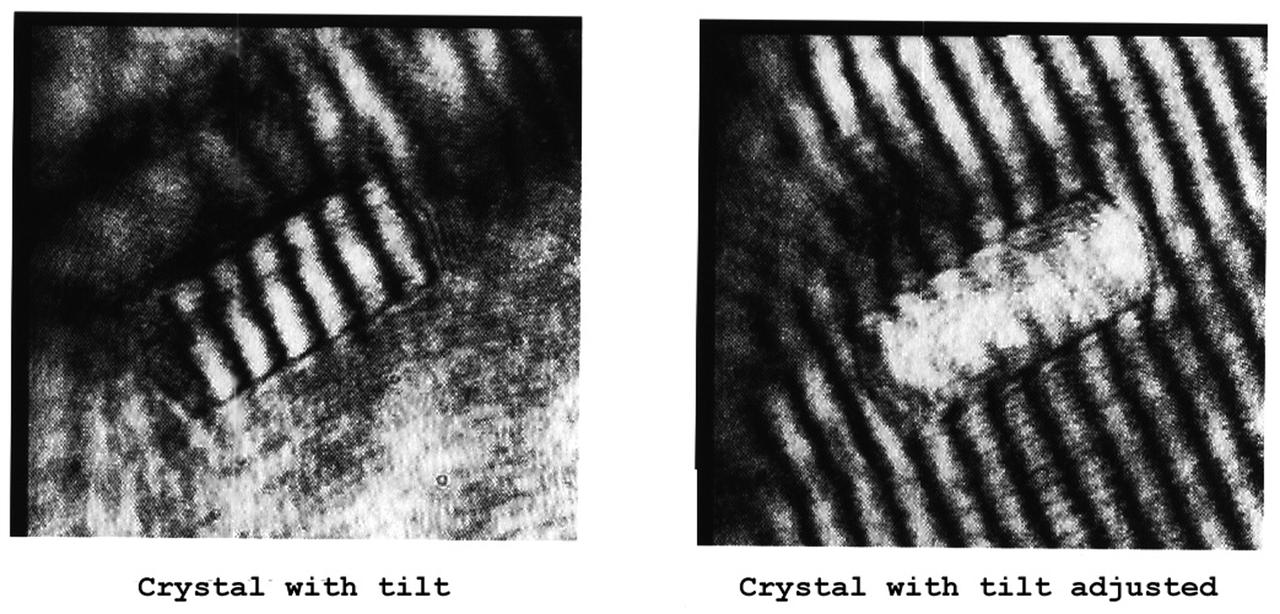
The Interferometer Protein Crystal Growth (IPCG) experiment was designed to measure details of how protein molecules move through a fluid. It was flown on the STS-86 mission for use aboard Russian Space Station Mir in 1998. It studied aspects of how crystals grow - and what conditions lead to the best crystals, details that remain a mystery. IPCG produces interference patterns by spilitting then recombining laser light. This let scientists see how fluid densities - and molecular diffusion - change around a crystal as it grows in microgravity. The heart of the IPCG apparatus is the interferometer cell comprising the optical bench, microscope, other optics, and video camera. IPCG experiment cells are made of optical glass and silvered on one side to serve as a mirror in the interferometer system that visuzlizes crystals and conditions around them as they grow inside the cell. This view shows interferograms produced in ground tests. The principal investigator was Dr. Alexander McPherson of University of California, Irvine. Co-investigators are William Witherow and Dr. Marc Pusey of NASA's Marshall Space Flight Center (MSFC).
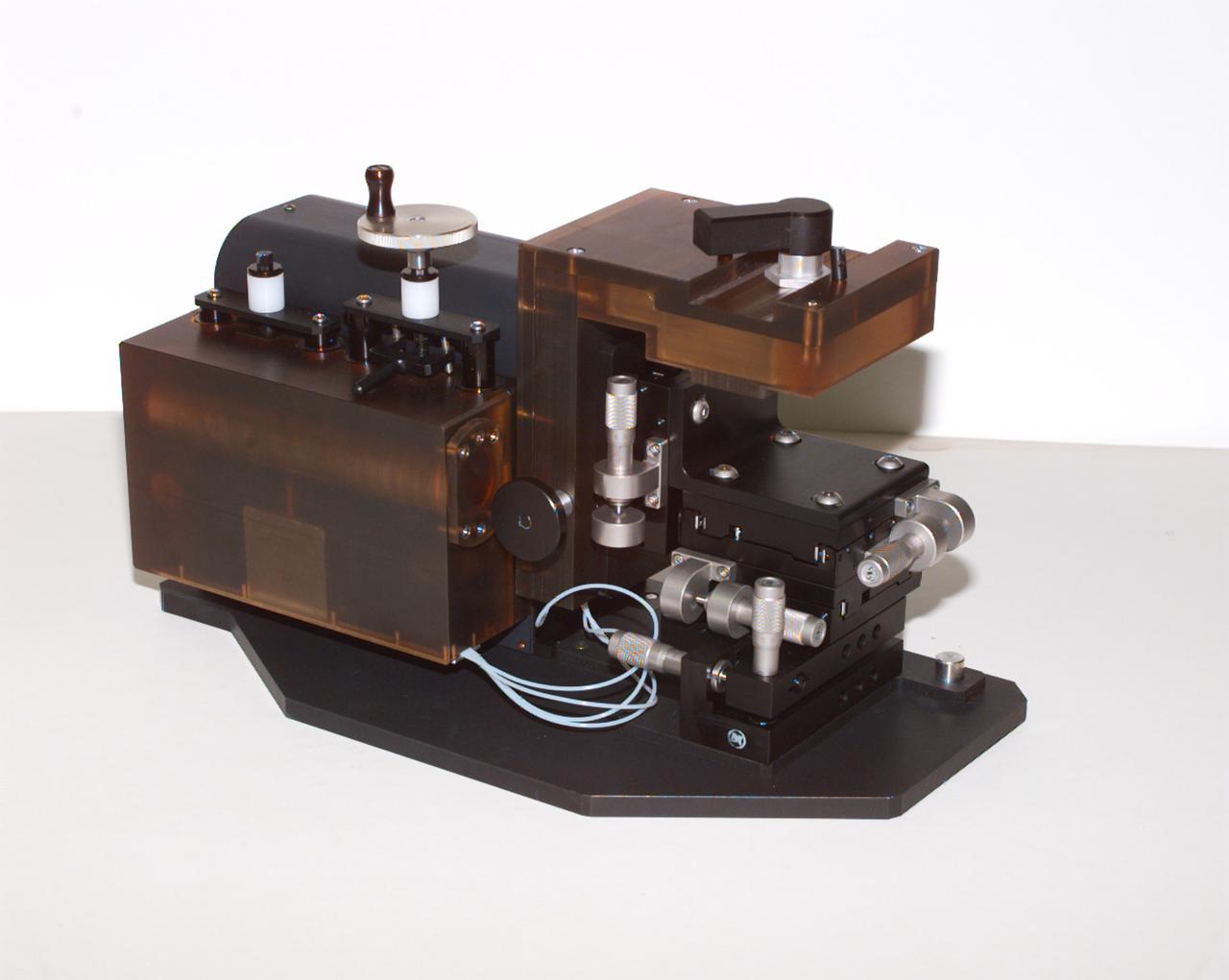
The Interferometer Protein Crstal Growth (IPCG) experiment was designed to measure details of how protein molecules move through a fluid. It was flown on the STS-86 mission for use aboard Russin Space Station Mir in 1998. It studied aspects of how crystals grow - and what conditions lead to the best crystals, details that remain a mystery. IPCG produces interference patterns by splitting then recombining laser light. This let scientists see how fluid densities - and molecular diffusion - change around a crystal as it grows in microgravity. The heart of the IPCG apparatus is the interferometer cell comprising the optical bench, microscope, other optics, and video camera. IPCG experiment cells are made of optical glass and silvered on one side to serve as a mirror in the interferometer system that visualizes crystals and conditions around them as they grow inside the cell. This view shows the complete apparatus. The principal investigator was Dr. Alexander McPherson of the University of California, Irvin. Co-investigators are William Witherow and Dr. Marc Pusey of NASA's Marshall Space Flight Center
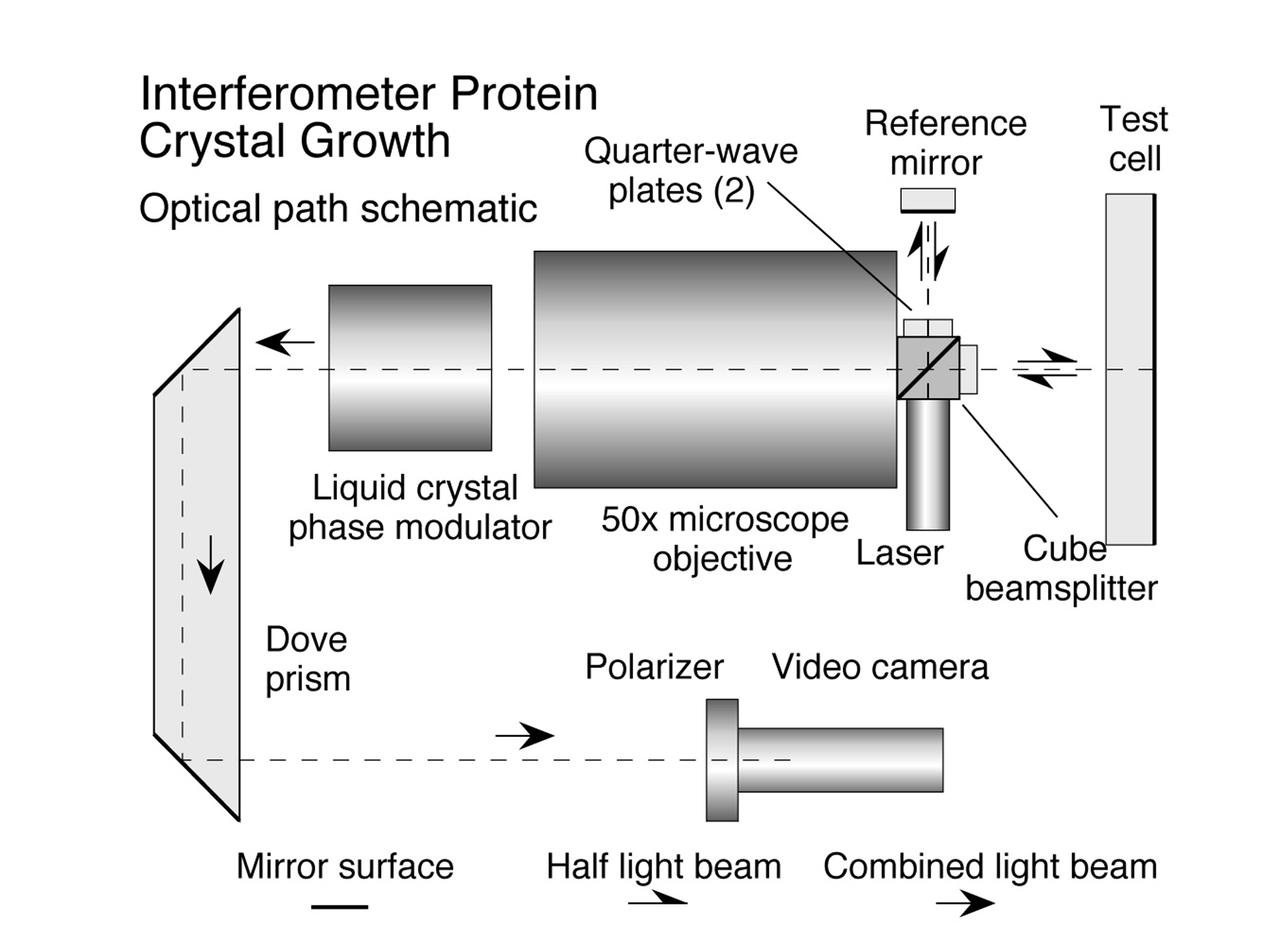
The Interferometer Protein Crystal Growth (IPCG) experiment was designed to measure details of how protein molecules move through a fluid. It was flown on the STS-86 mission for use aboard Russian Space Station Mir in 1998. It studied aspects of how crystals grow - and what conditions lead to the best crystals, details that remain a mystery. IPCG produces interference patterns by spilitting then recombining laser light. This let scientists see how fluid densities - and molecular diffusion - change around a crystal as it grows in microgravity. The heart of the IPCG apparatus is the interferometer cell comprising the optical bench, microscope, other optics, and video camera. IPCG experiment cells are made of optical glass and silvered on one side to serve as a mirror in the interferometer system that visuzlizes crystals and conditions around them as they grow inside the cell. This diagram shows the optical layout. The principal investigator was Dr. Alexander McPherson of University of California, Irvine. Co-investigators are William Witherow and Dr. Marc Pusey of NASA's Marshall Space Flight Center (MSFC).
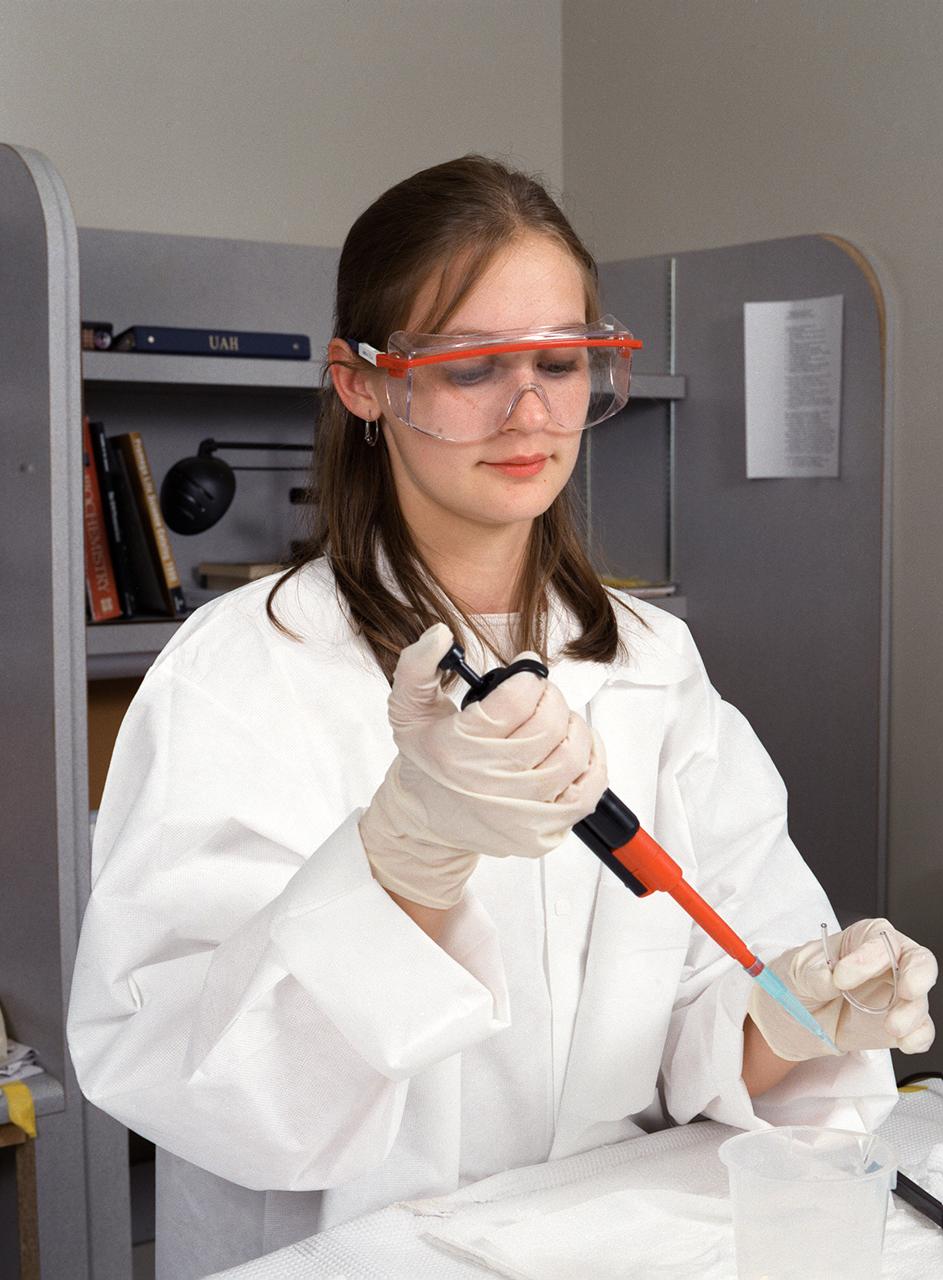
A Memphis student working at the University of Alabama in Huntsville prepares samples for the first protein crystal growth experiments plarned to be performed aboard the International Space Station (ISS). The proteins are placed in plastic tubing that is heat-sealed at the ends, then flash-frozen and preserved in a liquid nitrogen Dewar. Aboard the ISS, the nitrogen will be allowed to evaporated so the samples thaw and then slowly crystallize. They will be analyzed after return to Earth. Photo credit: NASA/Marshall Space Flight Center (MSFC)
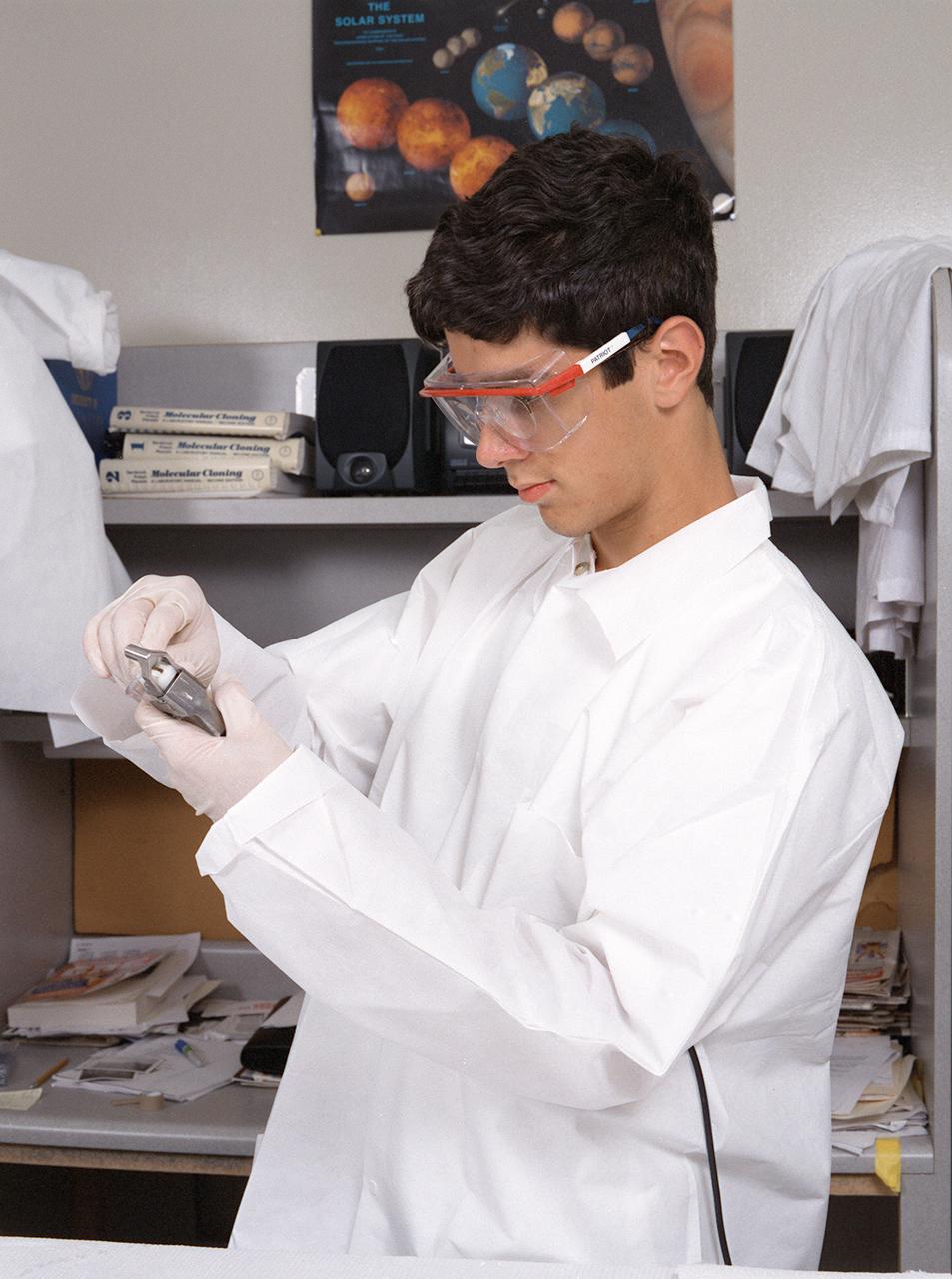
A Memphis student working at the University of Alabama in Huntsville prepares samples for the first protein crystal growth experiments plarned to be performed aboard the International Space Station (ISS). The proteins are placed in plastic tubing that is heat-sealed at the ends, then flash-frozen and preserved in a liquid nitrogen Dewar. Aboard the ISS, the nitrogen will be allowed to evaporated so the samples thaw and then slowly crystallize. They will be analyzed after return to Earth. Photo credit: NASA/Marshall Space Flight Center (MSFC)
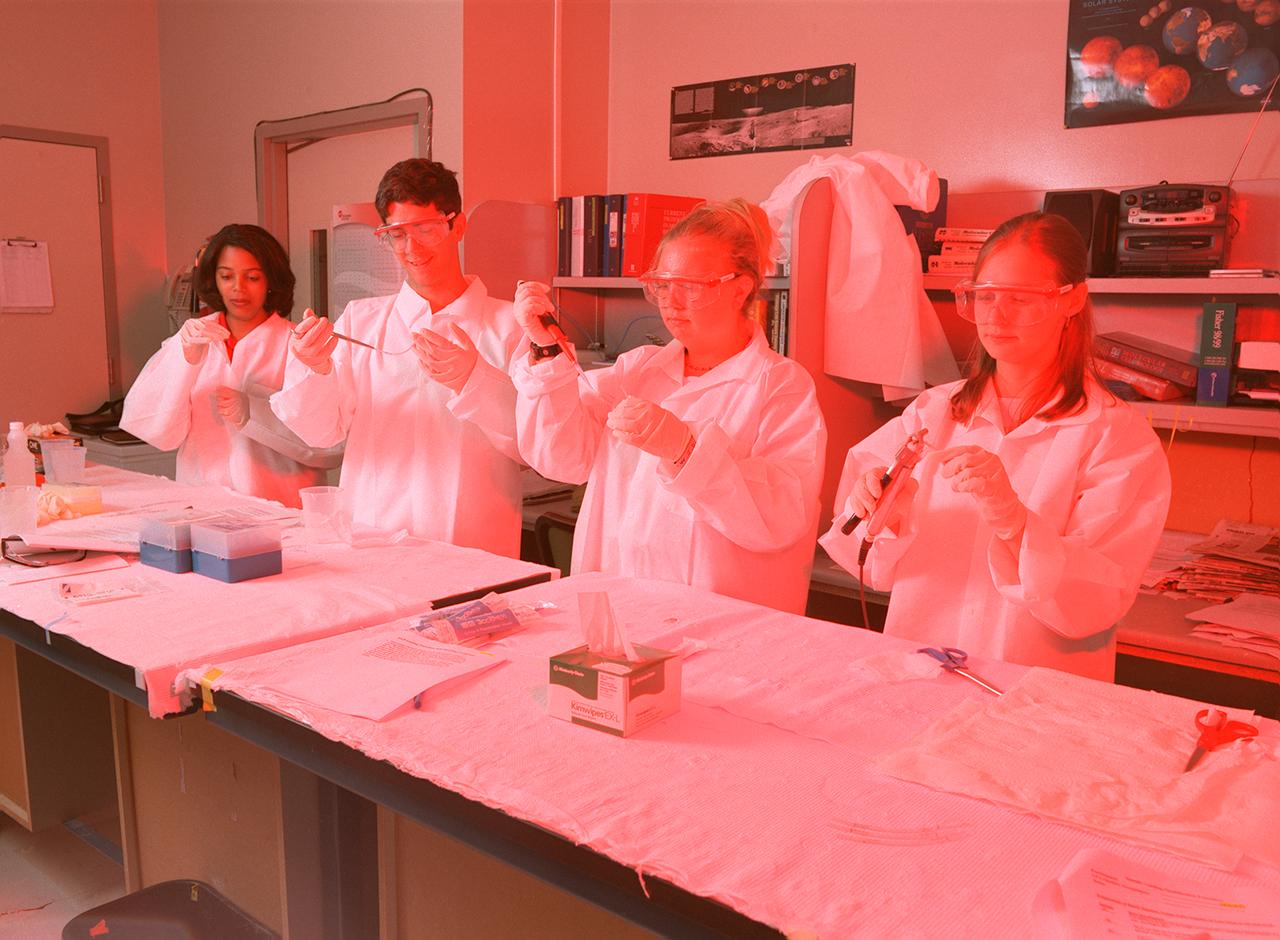
Memphis students working at the University of Alabama in Huntsville prepare samples for the first protein crystal growth experiments plarned to be performed aboard the International Space Station (ISS). The proteins are placed in plastic tubing that is heat-sealed at the ends, then flash-frozen and preserved in a liquid nitrogen Dewar. Aboard the ISS, the nitrogen will be allowed to evaporated so the samples thaw and then slowly crystallize. They will be analyzed after return to Earth. Photo credit: NASA/Marshall Space Flight Center (MSFC)

Advanced Plant Experiment, APEX-4, support in the Telescience Support Center at NASA Glenn. APEX-4 continues a highly successful investigation into the effects of microgravity on the development of roots and cells on plant seedlings. After four days of growth, the petri plate will be inserted into the Fluids Integrated Rack (FIR) Light Microscopy Module (LMM) facility for detailed imaging.
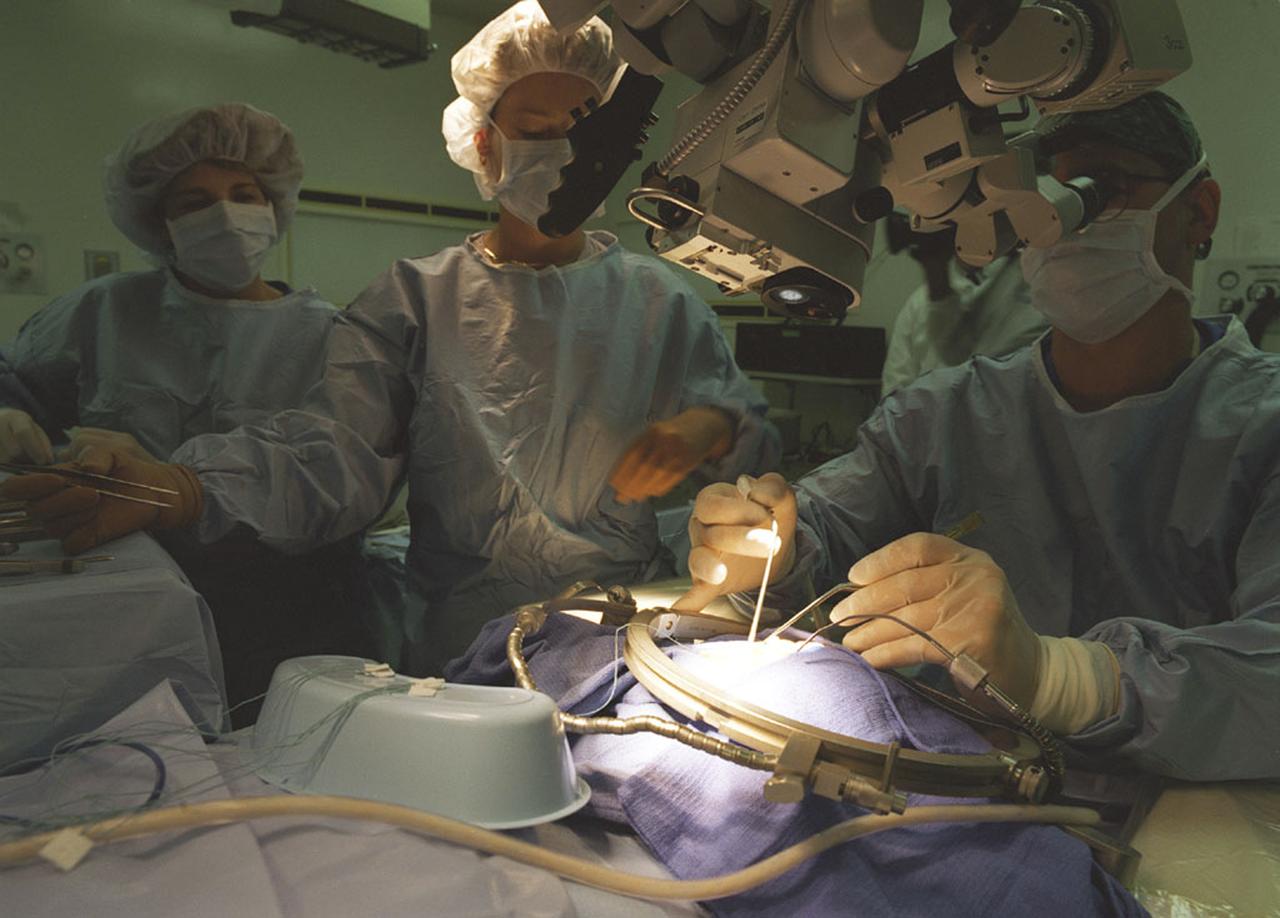
A special lighting technology was developed for space-based commercial plant growth research on NASA's Space Shuttle. Surgeons have used this technology to treat brain cancer on Earth, in two successful operations. The treatment technique, called Photodynamic Therapy, requires the surgeon to use tiny, pinhead-size Light Emitting Diodes (LEDs) (a source that releases long wavelengths of light ) to activate light-sensitive, tumor-treating drugs. "A young woman operated on in May 1999 has fully recovered with no complications and no evidence of the tumor coming back," said Dr. Harry Whelan, a pediatric neurologist at the Medical Hospital of Wisconsin in Milwaukee. Laser light has been used for this type of surgery in the past, but the LED light illuminates through all nearby tissues, reaching parts of a tumor that shorter wavelengths of laser light carnot. The new probe is safer because the longer wavelengths of light are cooler than the shorter wavelengths of laser light, making the LED less likely to injure normal brain tissue near the tumor. It can be used for hours at a time while still remaining cool to the touch. The LED light source is compact, about the size of a briefcase, and can be purchased for a fraction of the cost of a laser. The LEDs, developed and managed by NASA's Marshall Space Flight Center, have been used on seven Space Shuttle flights inside the Microgravity Astroculture Facility. This technology has also been successfully used to further commercial research in crop growth.
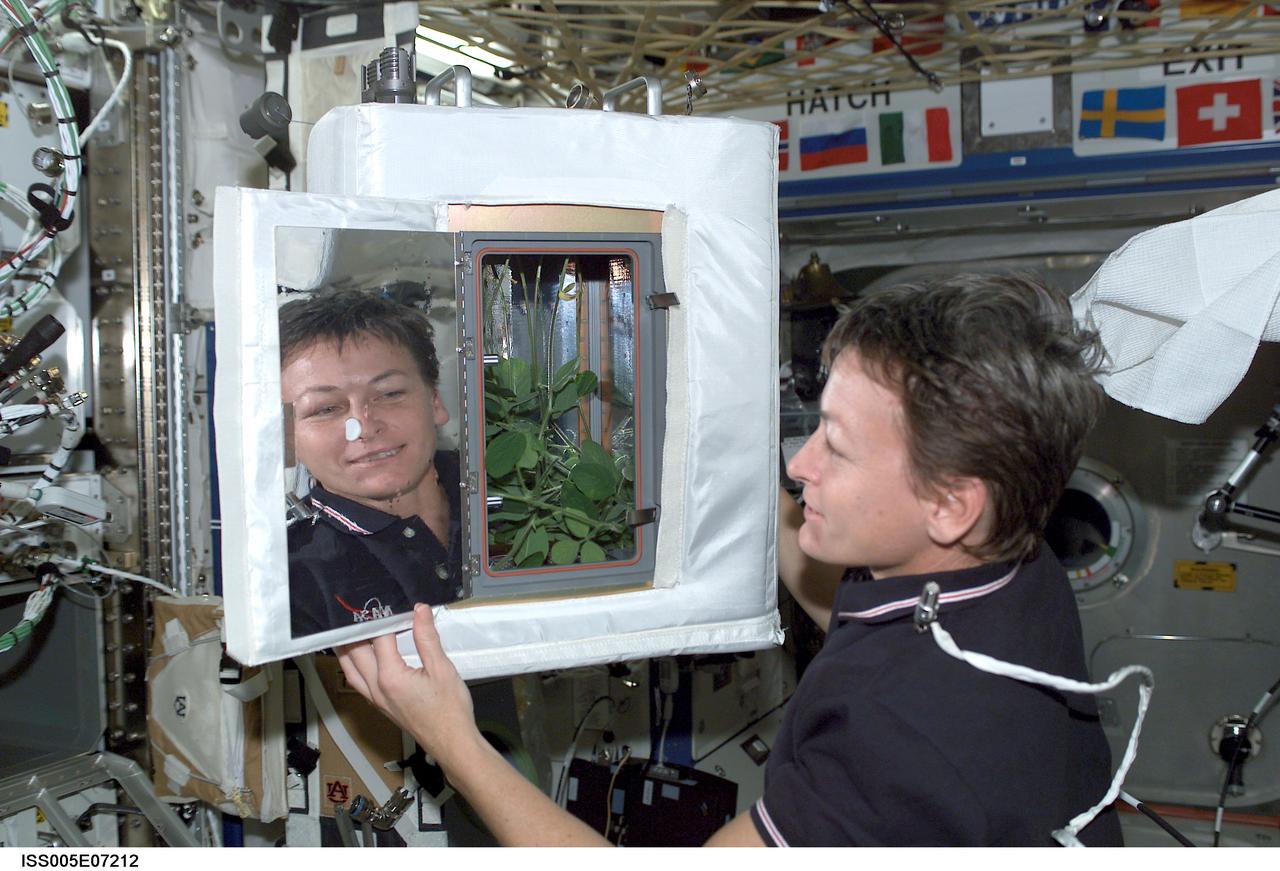
ISS005-E-07212 (10 July 2002) --- NASA Astronaut Peggy Whitson, Expedition 5 International Space Station (ISS) science officer, looks at the Advanced Astroculture (ADVASC) Soybean plant growth experiment as part of Expediting the Process of Experiments to the Space Station (EXPRESS) Rack 4 located in the U.S. Laboratory Destiny.
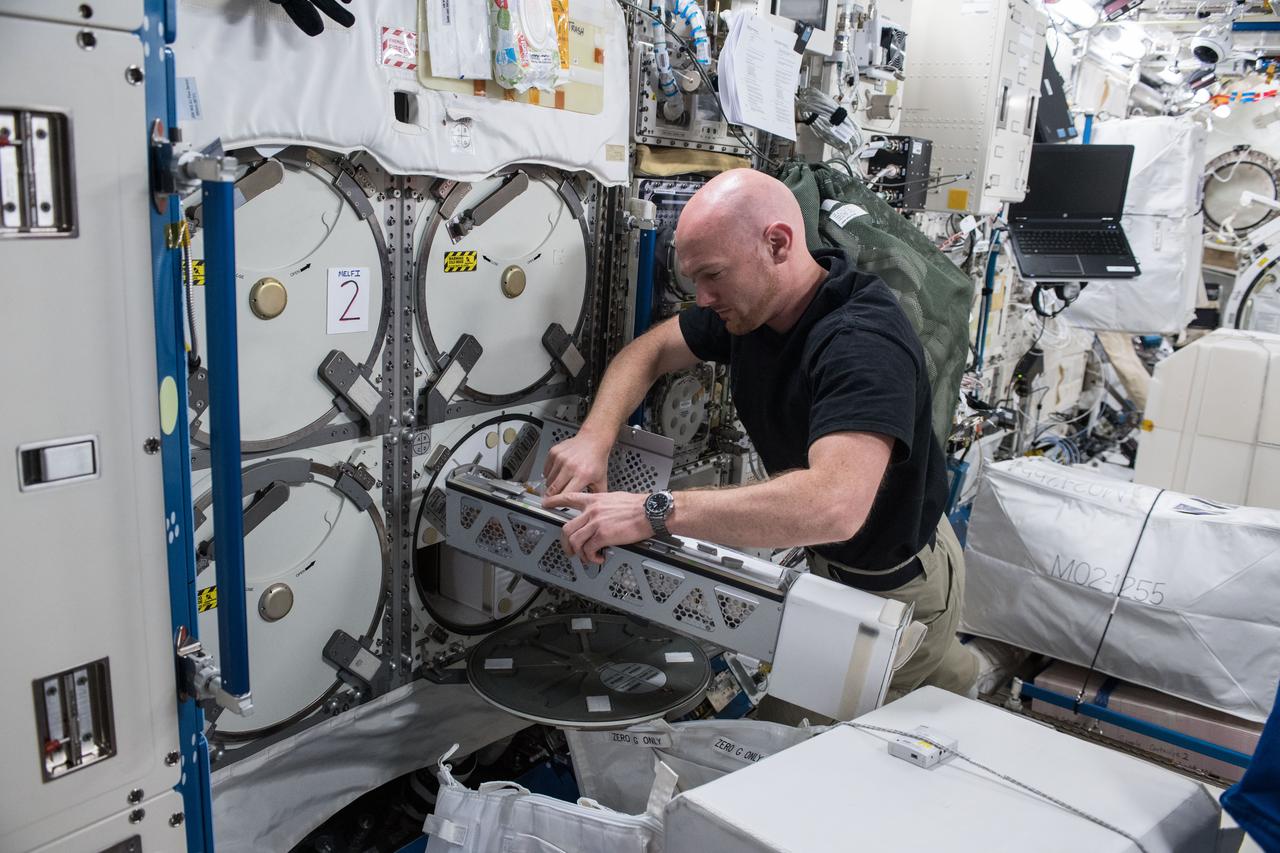
iss056e075951 (July 3, 2018) --- Astronaut Alexander Gerst of ESA (European Space Agency) works inside the Japanese Kibo laboratory module retrieving Protein Crystal Growth samples from a science freezer, also known as the Minus Eighty-Degree Laboratory Freezer for ISS (MELFI).
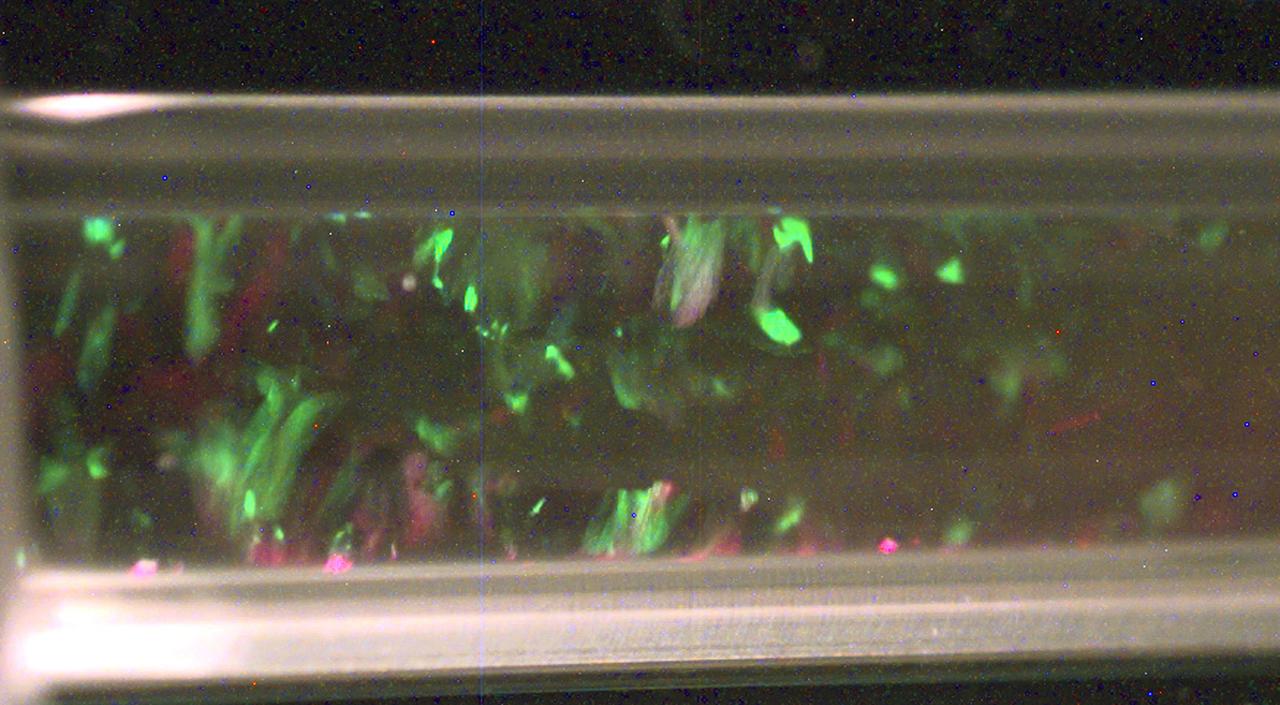
This is an image of a colloidal crystal from the CDOT-2 investigation flown on STS-95. There are so many colloidal particles in this sample that it behaves like a glass. In the laboratory on Earth, the sample remained in an amorphous state, showing no sign of crystal growth. In microgravity the sample crystallized in 3 days, as did the other glassy colloidal samples examined in the CDOT-2 experiment. During the investigation, crystallization occurred in samples that had a volume fraction (number of particles per total volume) larger than the formerly reported glass transition of 0.58. This has great implications for theories of the structural glass transition. These crystals were strong enough to survive space shuttle re-entry and landing.
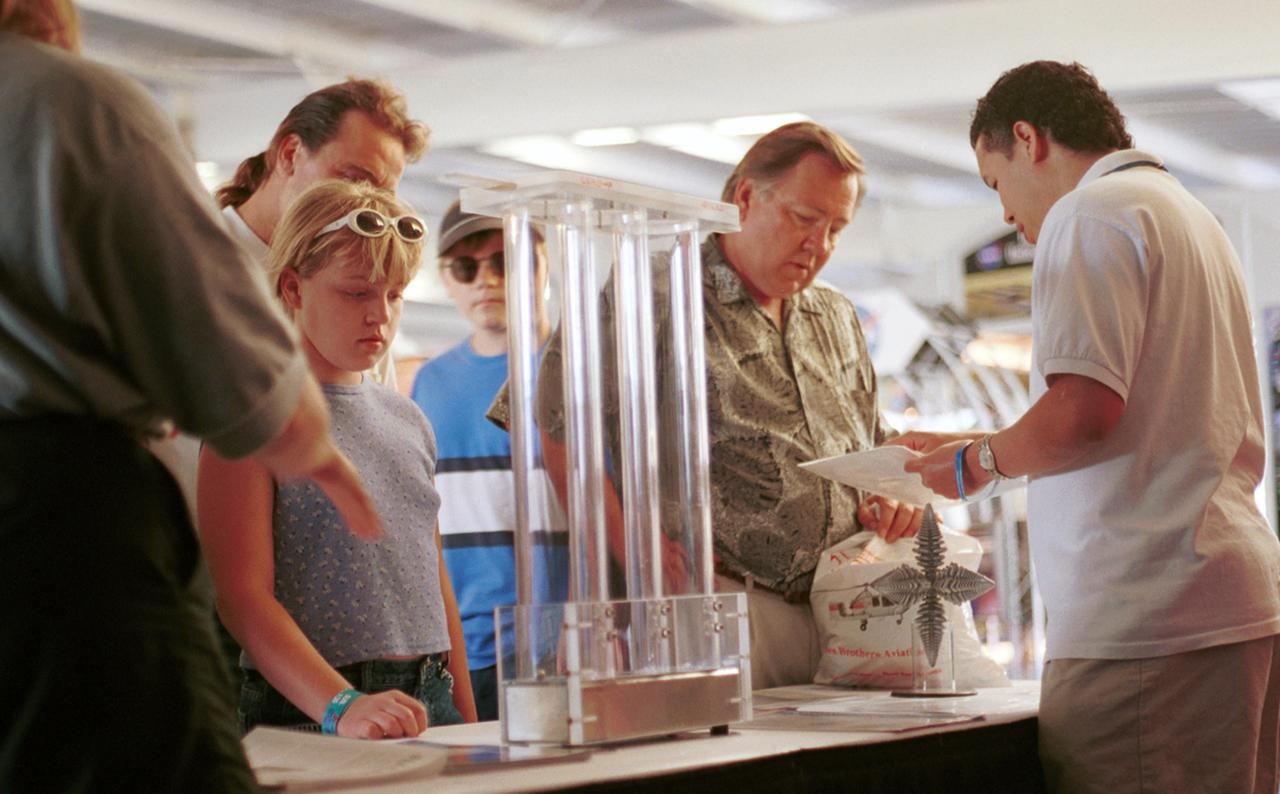
Paul Luz (right), an aerospace flight system engineer at NASA's Marshall Space Flight Center (MSFC), discusses microgravity research with a visitor at AirVenture 2000. Part of the NASA exhibits included demonstration of knowledge gained from micorgravity research aboard the Space Shuttle. These include liquid metal (Liquid metal demonstrator is three plastic drop tubes at center) and dendritic growth (in front of Luz), both leading to improvements in processes on Earth. The exhibit was part of the NASA outreach activity at AirVenture 2000 sponsored by the Experimental Aircraft Association in Oshkosh, WI.
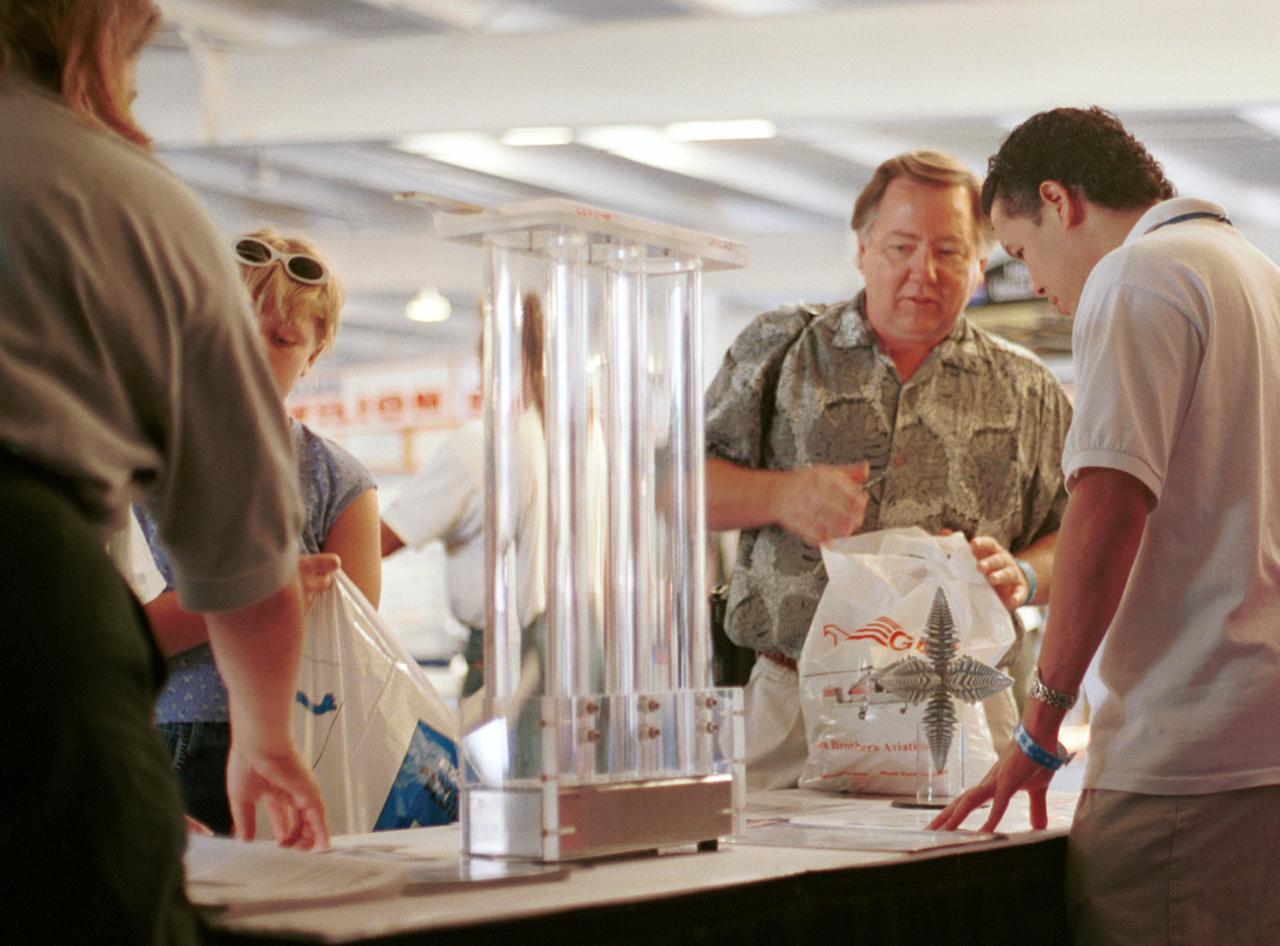
Paul Luz (right), an aerospace flight systems engineer at NASA's Marshall Space Flight Center (MSFC), takes a question from a visitor as they discuss microgravity research at AirVenture 2000. Part of the NASA exhibits included demonstrations of knowledge gained from microgravity research aboard the Space Shuttle. These include liquid metal (liquid metal demonstrator is three plastic drop tubes at center) and dendritic growth (in front of Luz), both leading to improvements in processes of Earth. The exhibit was part of the NASA outreach activity at AirVenture 2000 sponsored by the Experimental Aircraft Association in Oshkosh, WI.
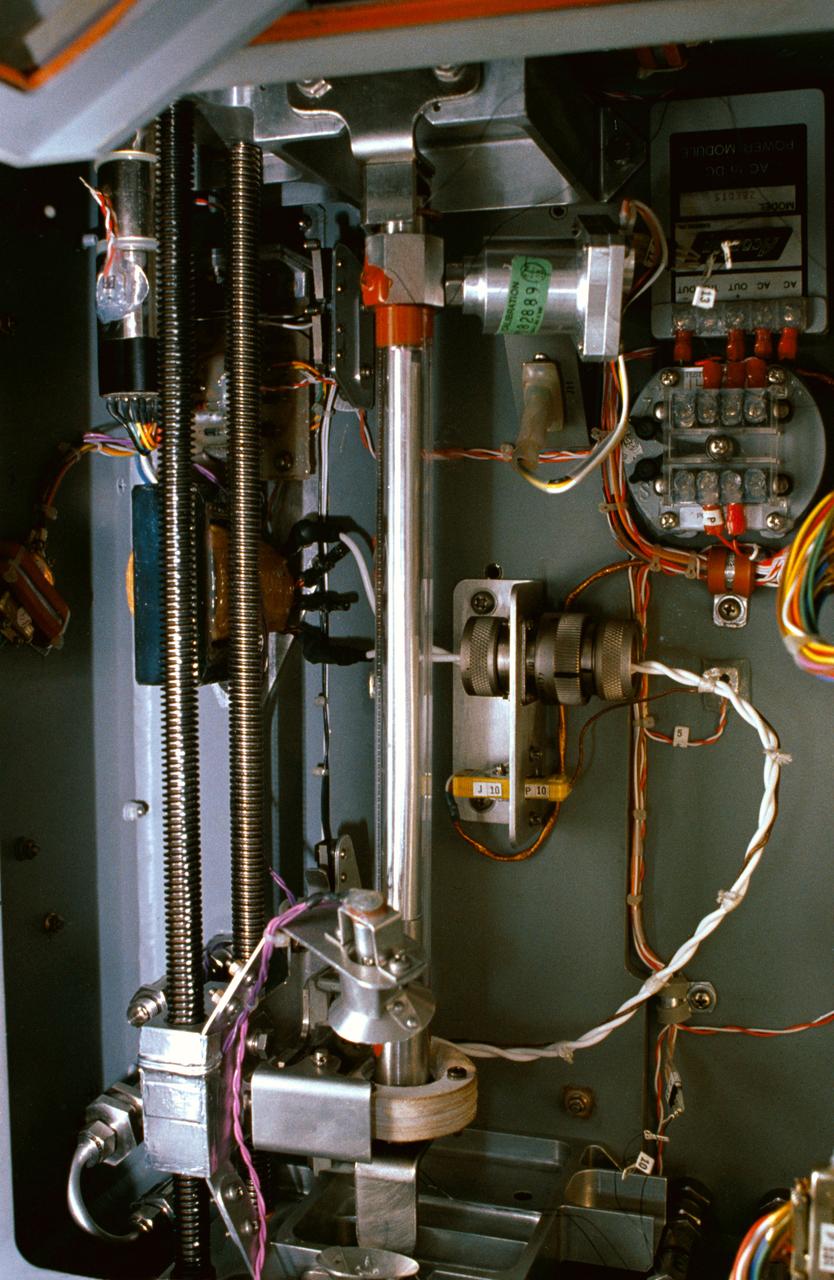
STS030-01-015 (4-8 May 1989) --- A 35mm close-up view of the Fluids Experiment Apparatus (FEA) aboard Atlantis for NASA’s STS-30 mission. Rockwell International is engaged in a joint endeavor agreement with NASA’s Office of Commercial Programs in the field of floating zone crystal growth and purification research. The March 1987 agreement provides for microgravity experiments to be performed in the company’s Microgravity Laboratory, the FEA. Crewmembers, especially Mary L. Cleave, devoted a great deal of onboard time to the monitoring of various materials science experiments using the apparatus.
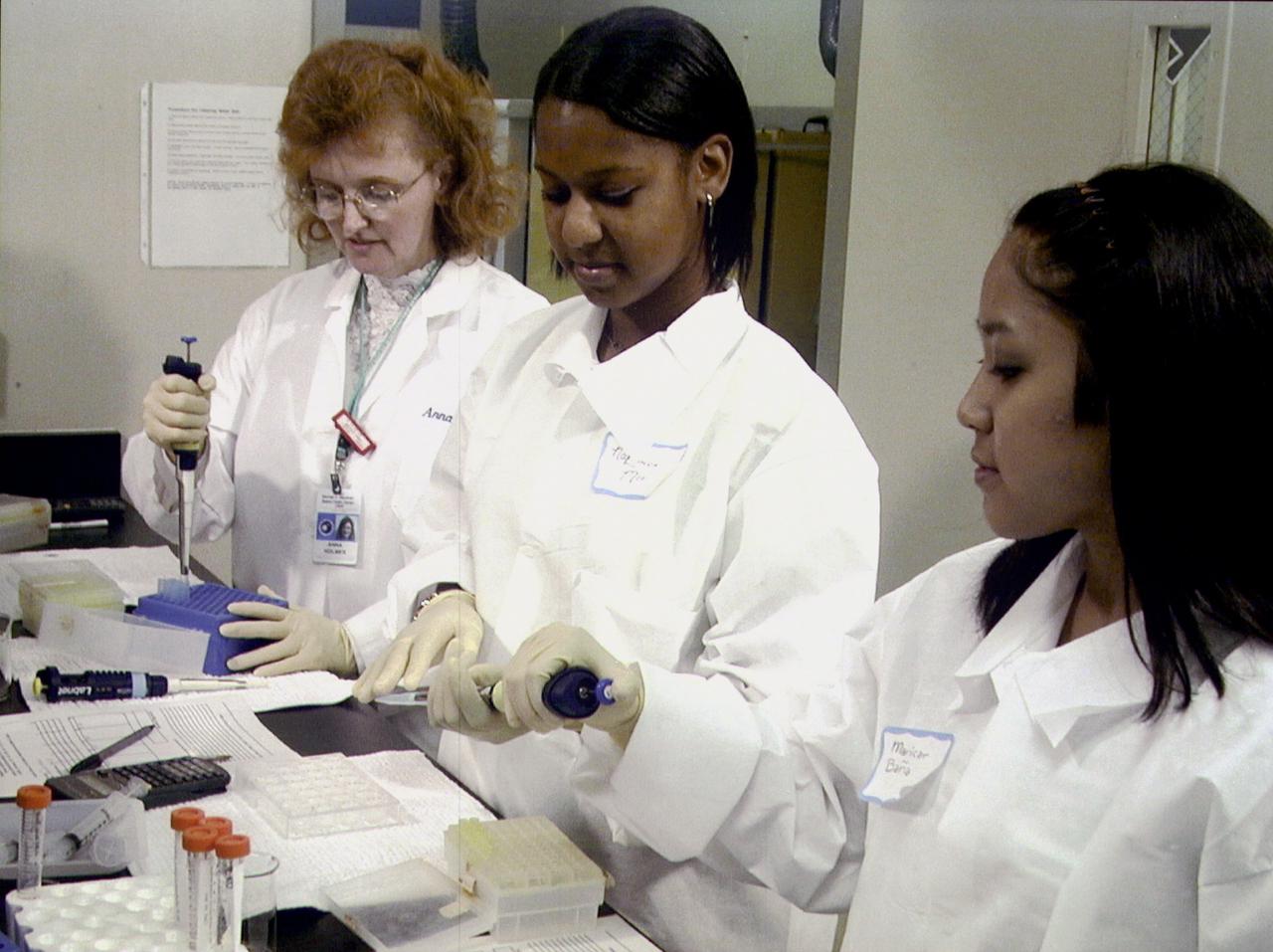
Chemist Arna Holmes, left, from the University of Alabama in Huntsville, teaches NaLonda Moorer, center, and Maricar Bana, right, both from Terry Parker High School in Jacksonville, Fl, procedures for preparing protein crystal growth samples for flight aboard the International Space Station (ISS). NASA/Marshall Space Flight Center in Huntsville, AL, is a sponsor for this educational activity. The proteins are placed in plastic tubing that is heat-sealed at the ends, then flash-frozen and preserved in a liquid nitrogen Dewar. Aborad the ISS, the nitrogen will be allowed to evaporated so the samples thaw and then slowly crystallize. They will be analyzed after return to Earth. Photo credit: NASA/Marshall Space Flight Center (MSFC)
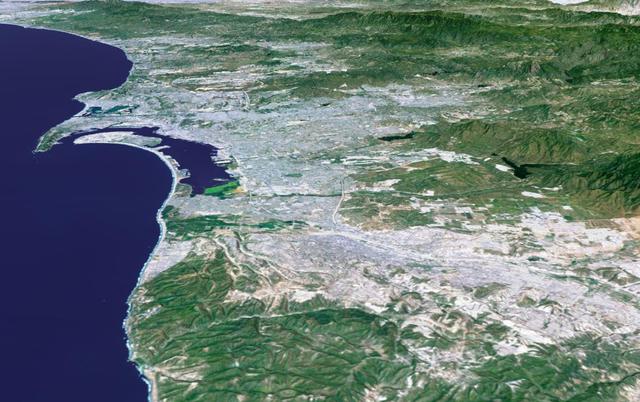
The influence of topography on the growth of the city of San Diego is seen clearly in this computer-generated perspective viewed from the south.
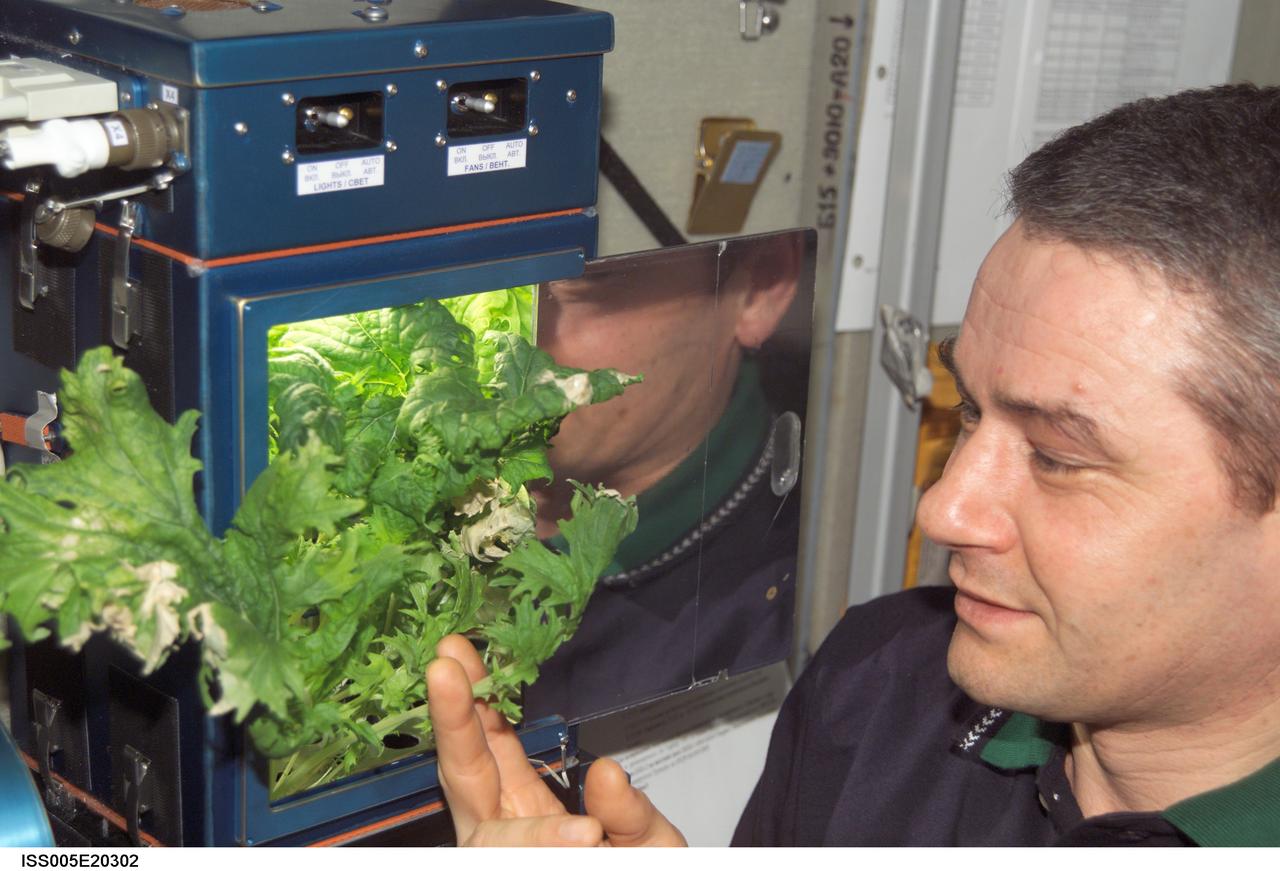
ISS005-E-20302 (8 November 2002) --- Cosmonaut Valery G. Korzun, Expedition Five mission commander, checks a plant growth experiment in the Zvezda Service Module on the International Space Station (ISS). Korzun represents Rosaviakosmos.
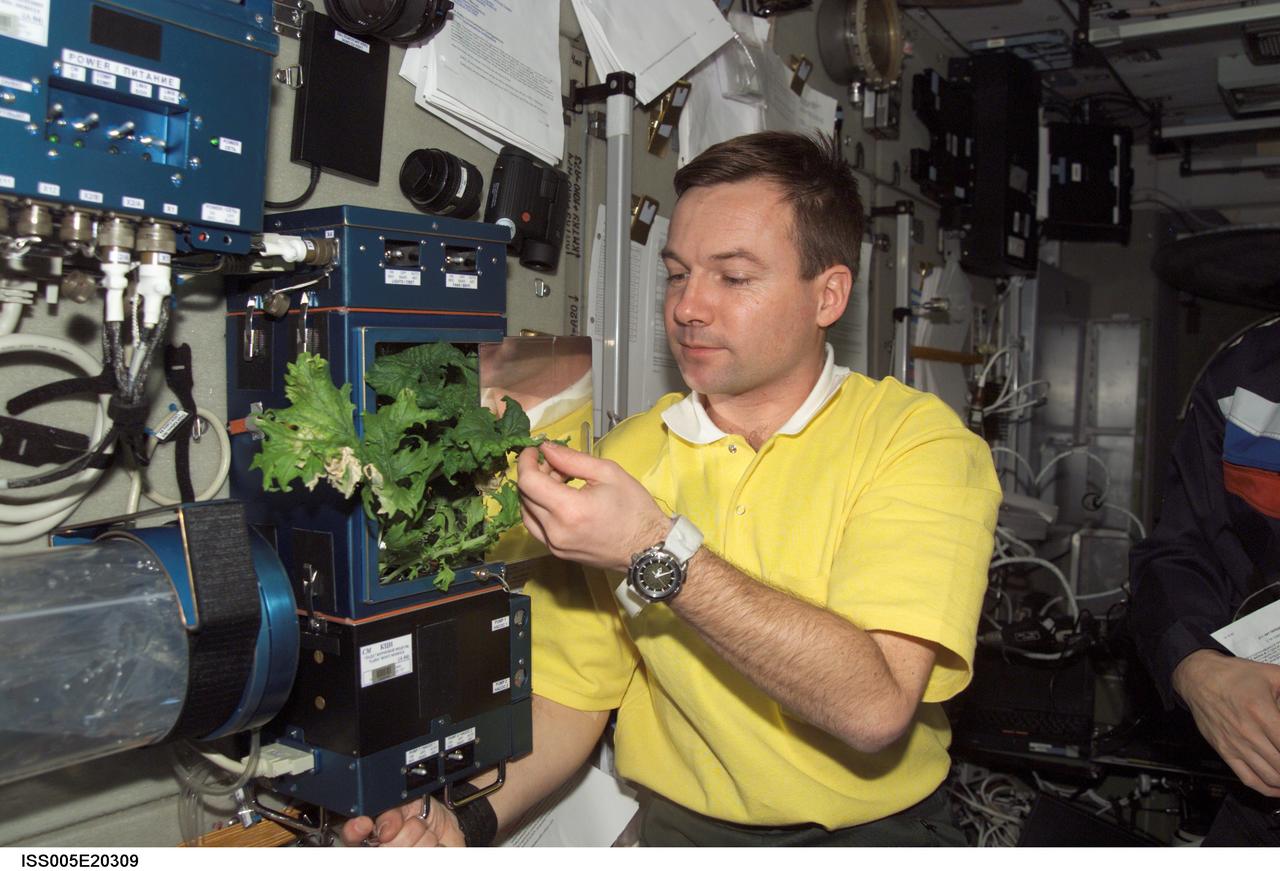
ISS005-E-20309 (8 November 2002) --- Soyuz 5 Flight Engineer Yuri V. Lonchakov looks at a plant growth experiment in the Zvezda Service Module on the International Space Station (ISS). Lonchakov represents Rosaviakosmos.
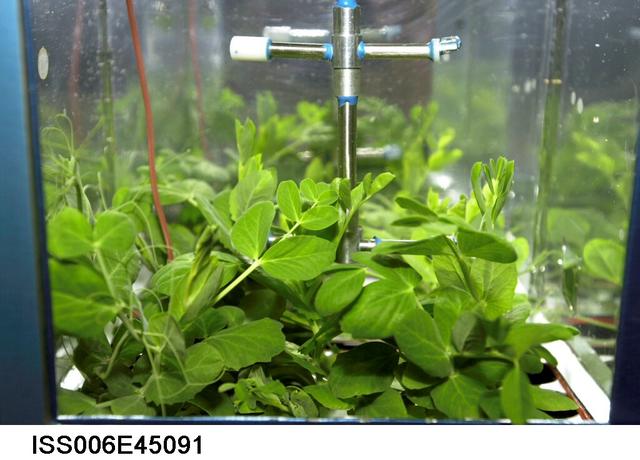
ISS006-E-45091 (25 March 2003) --- A view of the Russian BIO-5 Rasteniya-2/Lada-2 (Plants-2) plant growth experiment located in the Zvezda Service Module on the International Space Station (ISS).
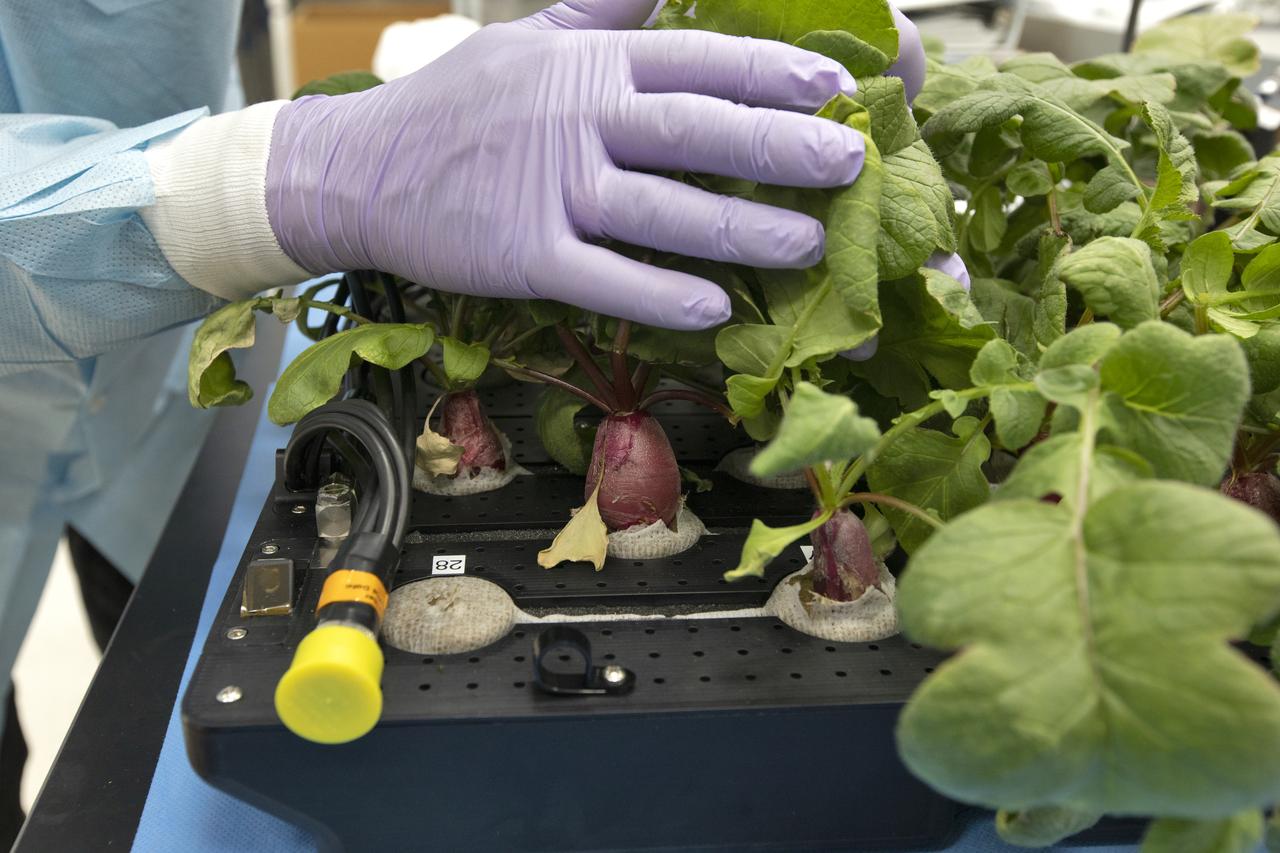
Radish plants are growing inside the Advanced Plant Habitat (APH) ground unit inside a laboratory in the Space Station Processing Facility at NASA's Kennedy Space Center in Florida on June 13, 2019. The plants are being grown as part of a science verification test for PH-02, a Space Life and Physical Sciences Research and Applications-funded experiment which seeks to determine the effects of spaceflight on radishes. The APH is a highly automated plant growth chamber with 180 sensors and is able to closely regulate variables related to plant growth.
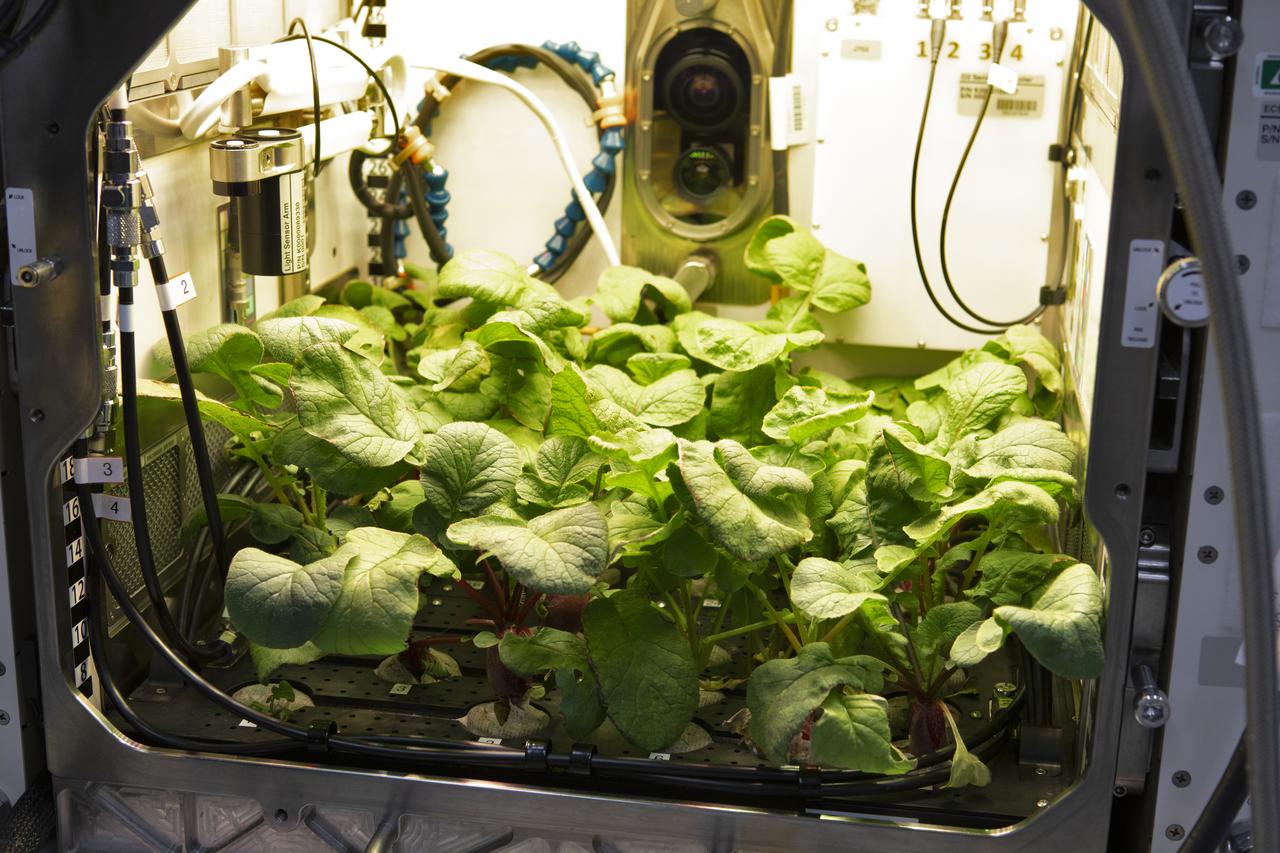
Radish plants are growing inside the Advanced Plant Habitat (APH) ground unit inside a laboratory in the Space Station Processing Facility at NASA's Kennedy Space Center in Florida on June 13, 2019. The plants are being grown as part of a science verification test for PH-02, a Space Life and Physical Sciences Research and Applications-funded experiment which seeks to determine the effects of spaceflight on radishes. The APH is a highly automated plant growth chamber with 180 sensors and is able to closely regulate variables related to plant growth.

Radish plants are growing inside the Advanced Plant Habitat (APH) ground unit inside a laboratory in the Space Station Processing Facility at NASA's Kennedy Space Center in Florida on June 13, 2019. The plants are being grown as part of a science verification test for PH-02, a Space Life and Physical Sciences Research and Applications-funded experiment which seeks to determine the effects of spaceflight on radishes. The APH is a highly automated plant growth chamber with 180 sensors and is able to closely regulate variables related to plant growth.
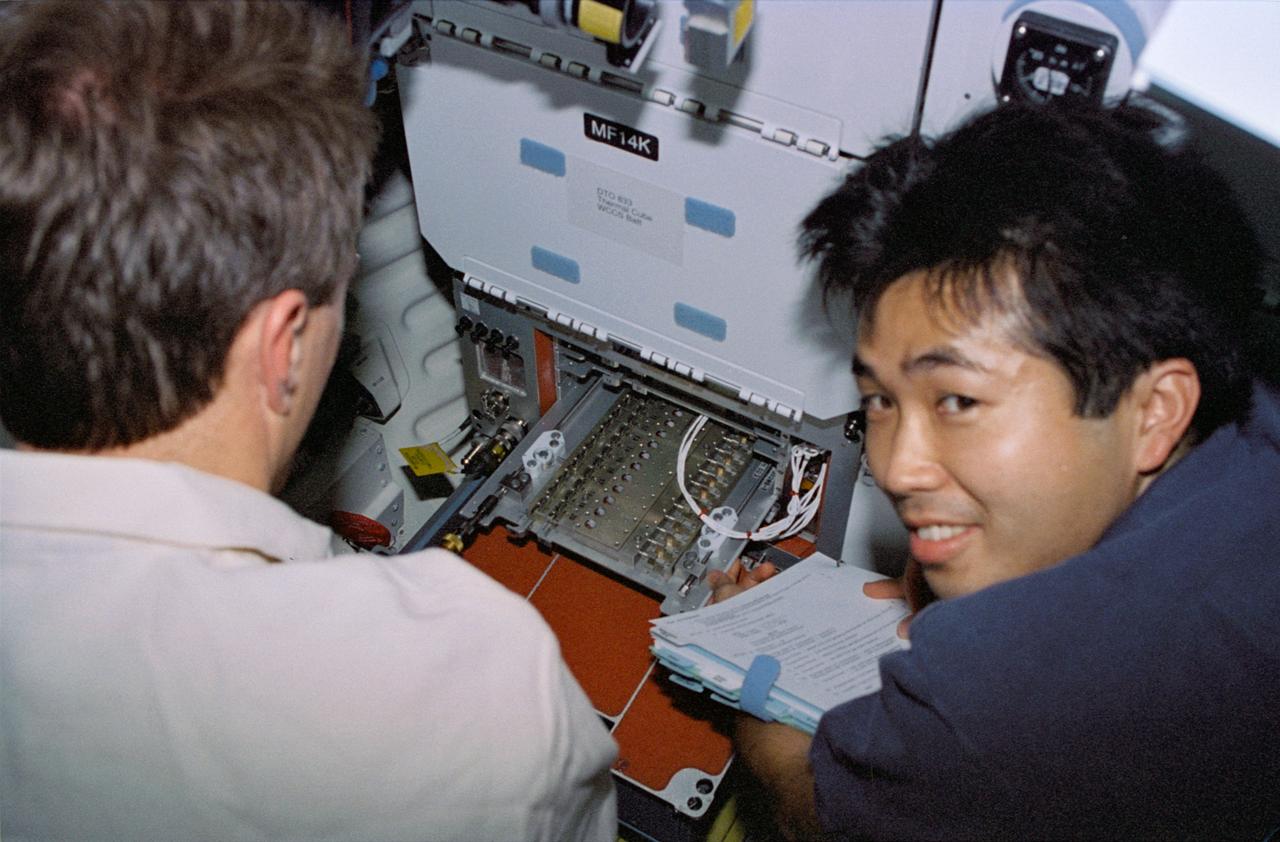
STS072-310-007 (11-20 Jan. 1996) --- Astronauts Brent W. Jett Jr. (left) and Koichi Wakata work with the Protein Crystal Growth (PCG) experiment at the Single Locker Thermal Enclosure System (STES) on the Space Shuttle Endeavour’s mid-deck. Jett, making his first flight in space, served as the crew’s pilot, while Wakata served as a mission specialist. Wakata, also a first time Shuttle crew member, represents Japan’s National Space Development Agency (NASDA).
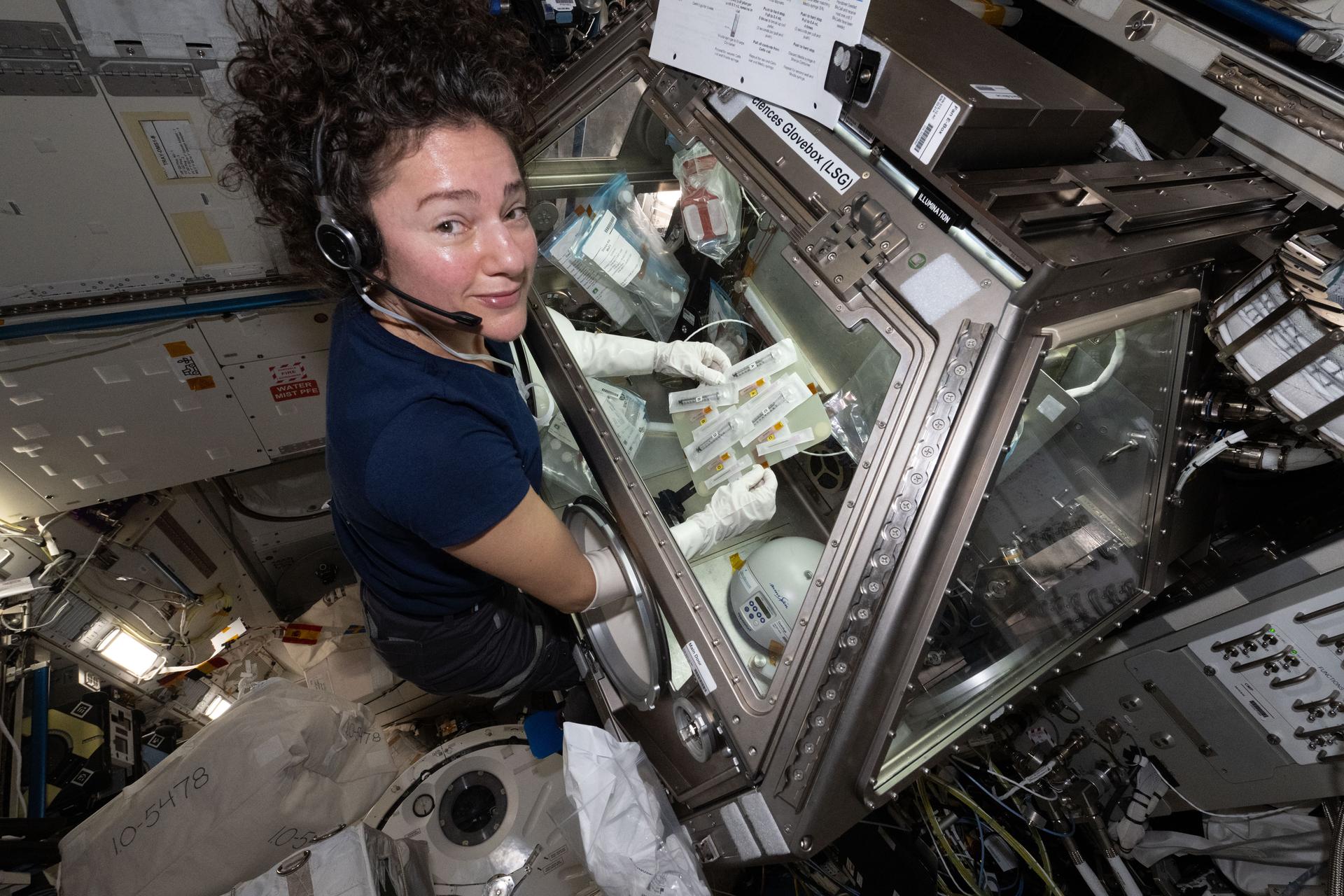
iss074e0591327 (May 18, 2026) --- NASA astronaut and Expedition 74 flight engineer Jessica Meir works inside the Kibo laboratory module’s Life Science Glovebox aboard the International Space Station. Meir was preparing blood platelet samples for incubation and growth to observe how weightlessness affects a crew member’s blood clotting and immune function at the cellular and genetic levels. Credit: ESA/Sophie Adenot
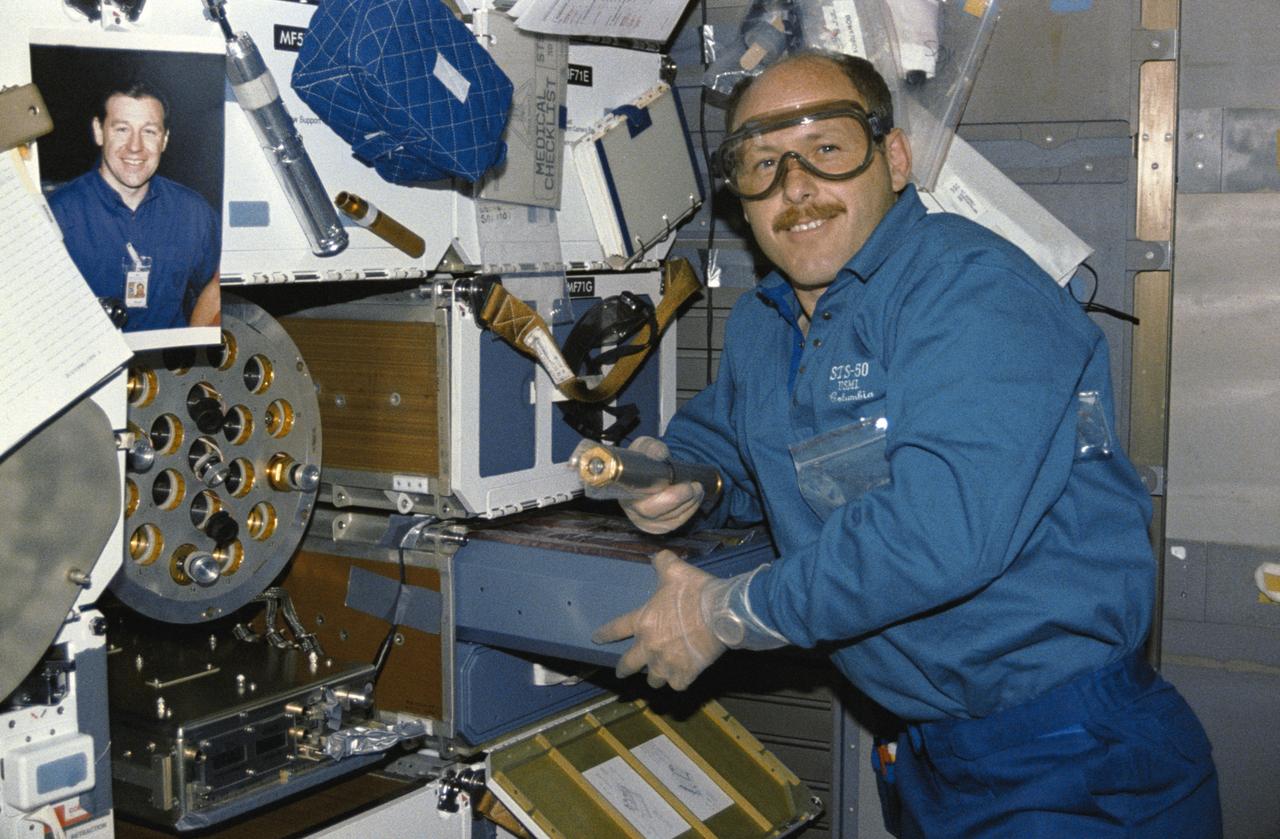
STS50-262-004 (25 June-9 July 1992) --- Astronaut Kenneth D. Bowersox, STS-50 pilot, holds an autoclave used in the growing of zeolite crystals on the middeck of the Earth-orbiting Space Shuttle Columbia. He is standing near the Zeolite Crystal Growth (ZCG) furnace, which is housed in the space of two stowage lockers. On the 14-day U.S. Microgravity Laboratory mission, zeolite crystals were grown in 38 individual autoclaves, which were joined in pairs to be inserted into the 19 furnace orifices. While the autoclaves appear the same externally, there are several types of internal arrangements that were tested to determine which one provides the best mixing of the component solutions. The portrait of alternate payload specialist Albert Sacco, Jr. is mounted nearby. Sacco, serving as a ground controller at Marshall Space Flight Center in Alabama, worked in conjunction with the red shift crew in the science module.
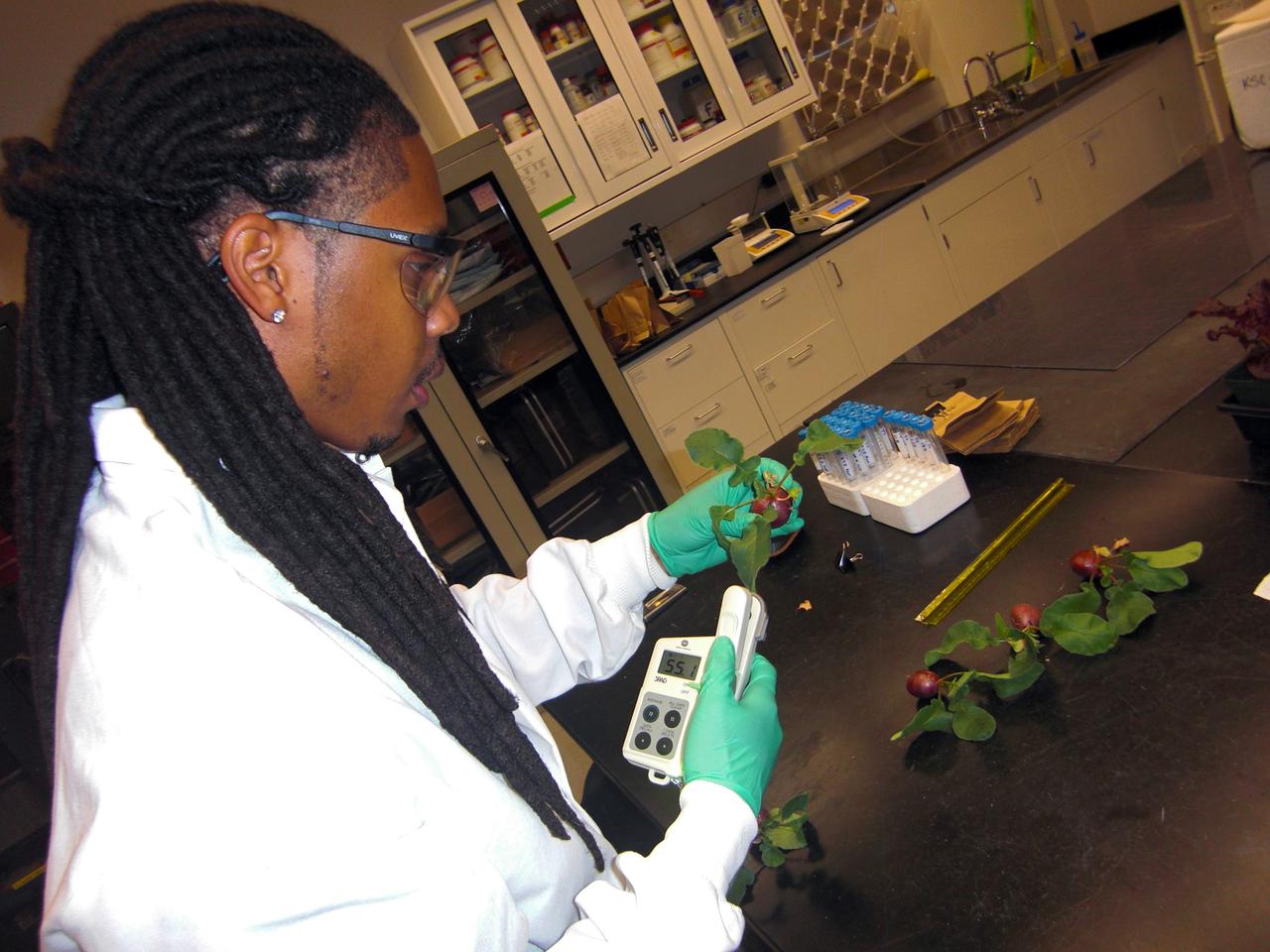
CAPE CANAVERAL, Fla. – Inside the Space Life Sciences Laboratory, or SLSL, at NASA’s Kennedy Space Center in Florida, Dr. Matthew Mickens, a plant biologist from North Carolina Agriculture and Technical State University in North Carolina, measures radish plants that were just harvested from a plant growth chamber. The plants were grown under red and blue LED lights. The plant experiment at Kennedy is part of the Advanced Exploration Systems, or AES, program in NASA’s Human Exploration and Operations Mission Directorate. This plant experiment studies the effects of different types of lighting on plants such as radishes and leaf lettuce. Results of these studies will help provide information on how to grow food sources for deep space exploration missions. AES projects pioneer new approaches for rapidly developing prototype systems, demonstrating key capabilities and validating operational concepts for future human missions beyond Earth orbit. Photo credit: NASA/Frank Ochoa-Gonzales
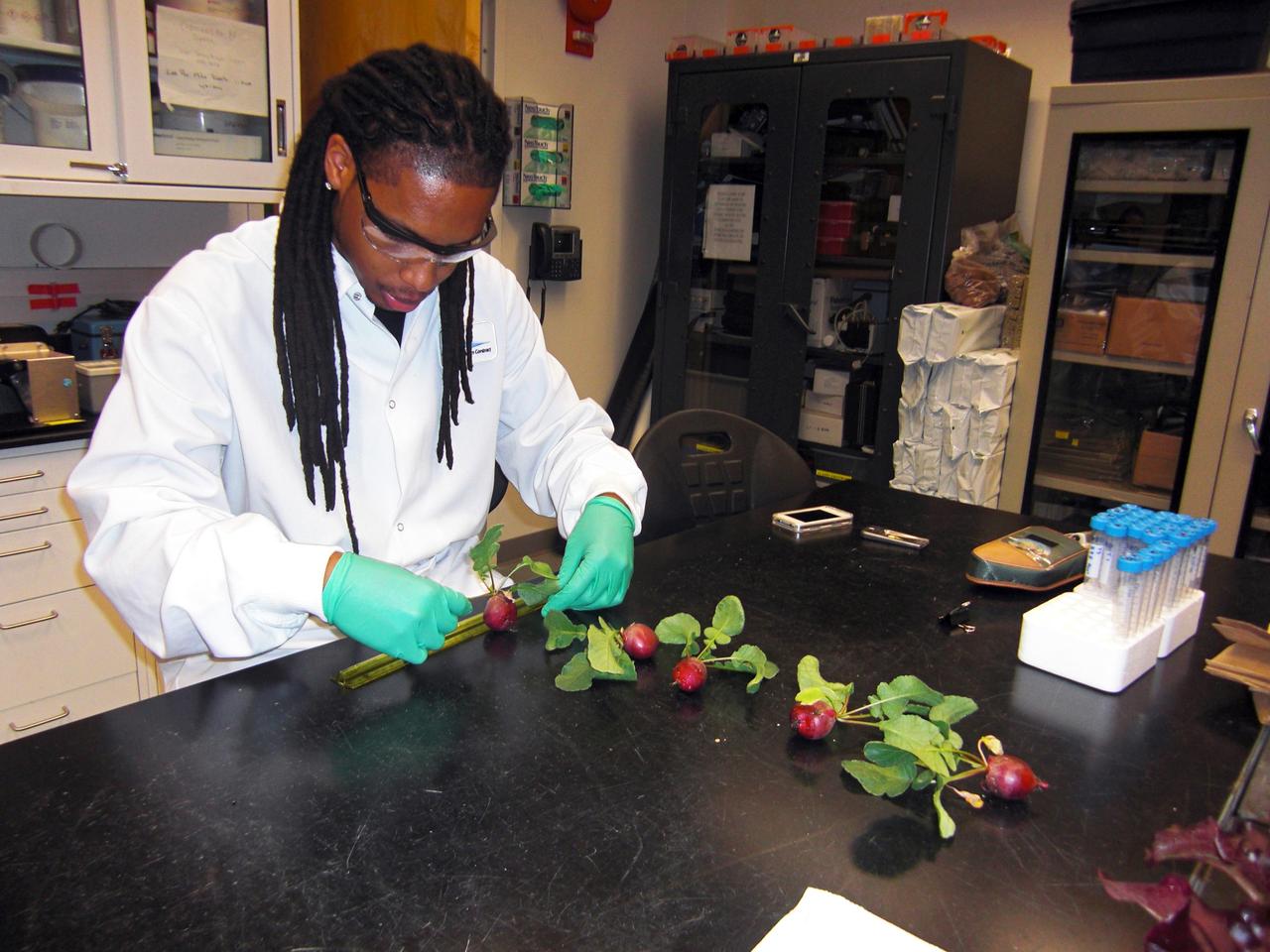
CAPE CANAVERAL, Fla. – Inside the Space Life Sciences Laboratory, or SLSL, at NASA’s Kennedy Space Center in Florida, Dr. Matthew Mickens, a plant biologist from North Carolina Agriculture and Technical State University in North Carolina, measures radish plants that were just harvested from a plant growth chamber. The plants were grown under red and blue LED lights. The plant experiment at Kennedy is part of the Advanced Exploration Systems, or AES, program in NASA’s Human Exploration and Operations Mission Directorate. This plant experiment studies the effects of different types of lighting on plants such as radishes and leaf lettuce. Results of these studies will help provide information on how to grow food sources for deep space exploration missions. AES projects pioneer new approaches for rapidly developing prototype systems, demonstrating key capabilities and validating operational concepts for future human missions beyond Earth orbit. Photo credit: NASA/Frank Ochoa-Gonzales
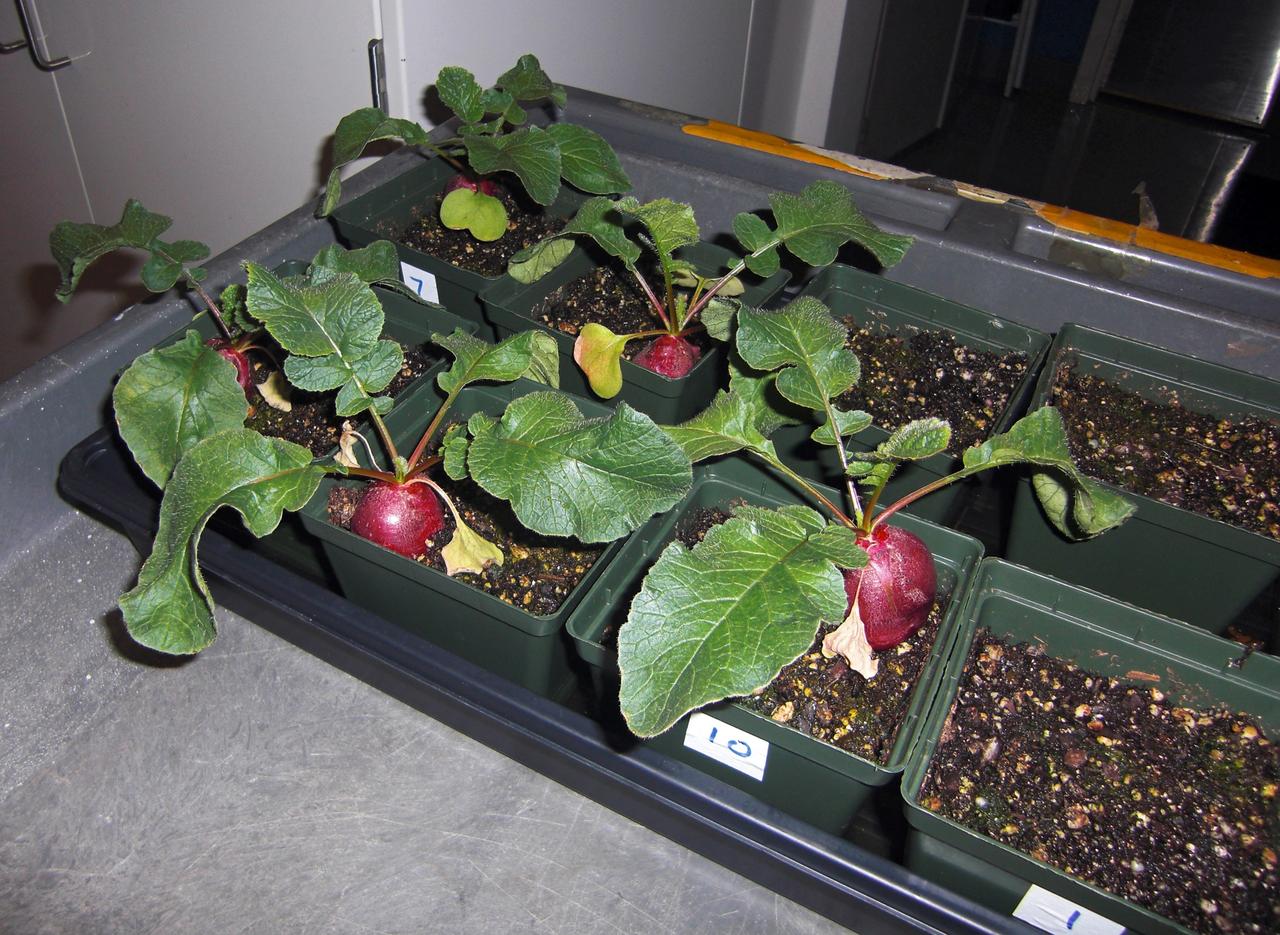
CAPE CANAVERAL, Fla. – Inside the Space Life Sciences Laboratory, or SLSL, at NASA’s Kennedy Space Center in Florida, radish plants are being harvested in a plant growth chamber. The plants were grown under red and blue LED lights. The plant experiment at Kennedy is part of the Advanced Exploration Systems, or AES, program in NASA’s Human Exploration and Operations Mission Directorate. This plant experiment studies the effects of different types of lighting on plants such as radishes and leaf lettuce. Results of these studies will help provide information on how to grow food sources for deep space exploration missions. AES projects pioneer new approaches for rapidly developing prototype systems, demonstrating key capabilities and validating operational concepts for future human missions beyond Earth orbit. Photo credit: NASA/Frank Ochoa-Gonzales
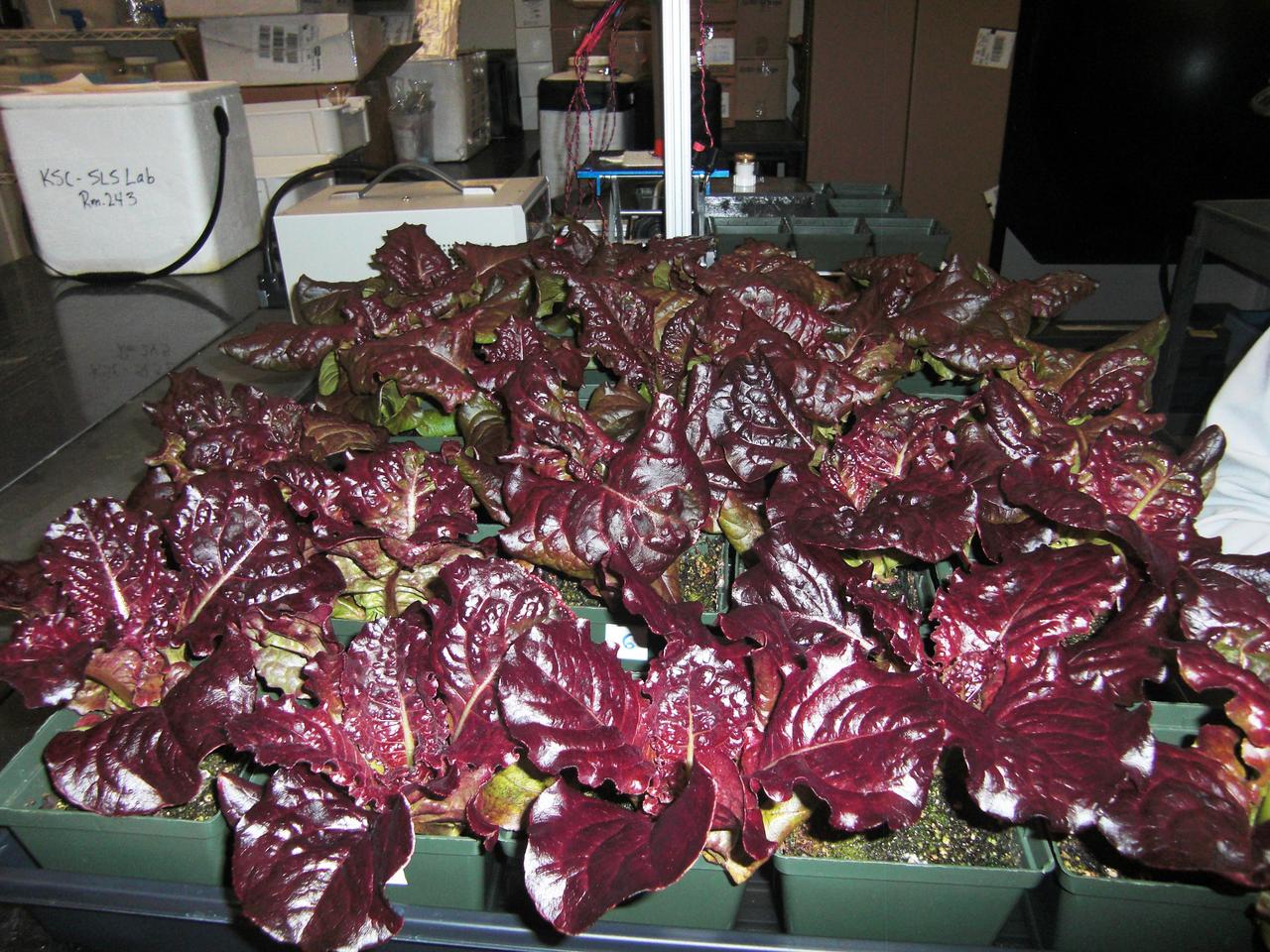
CAPE CANAVERAL, Fla. – Inside the Space Life Sciences Laboratory, or SLSL, at NASA’s Kennedy Space Center in Florida, red leaf lettuce plants were harvested from a plant growth chamber. The plants were grown under red and blue LED lights. The plant experiment at Kennedy is part of the Advanced Exploration Systems, or AES, program in NASA’s Human Exploration and Operations Mission Directorate. This plant experiment studies the effects of different types of lighting on plants such as radishes and leaf lettuce. Results of these studies will help provide information on how to grow food sources for deep space exploration missions. AES projects pioneer new approaches for rapidly developing prototype systems, demonstrating key capabilities and validating operational concepts for future human missions beyond Earth orbit. Photo credit: NASA/Frank Ochoa-Gonzales
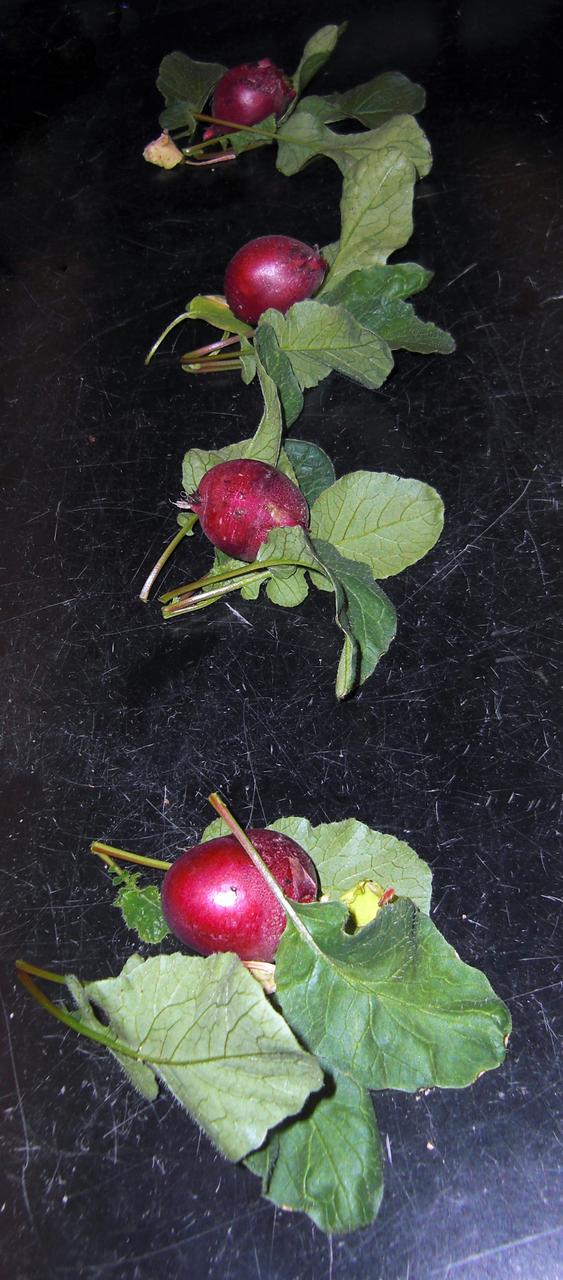
CAPE CANAVERAL, Fla. – Inside the Space Life Sciences Laboratory, or SLSL, at NASA’s Kennedy Space Center in Florida, radish plants were harvested from a plant growth chamber. The plants were grown under red and blue LED lights. The plant experiment at Kennedy is part of the Advanced Exploration Systems, or AES, program in NASA’s Human Exploration and Operations Mission Directorate. This plant experiment studies the effects of different types of lighting on plants such as radishes and leaf lettuce. Results of these studies will help provide information on how to grow food sources for deep space exploration missions. AES projects pioneer new approaches for rapidly developing prototype systems, demonstrating key capabilities and validating operational concepts for future human missions beyond Earth orbit. Photo credit: NASA/Frank Ochoa-Gonzales
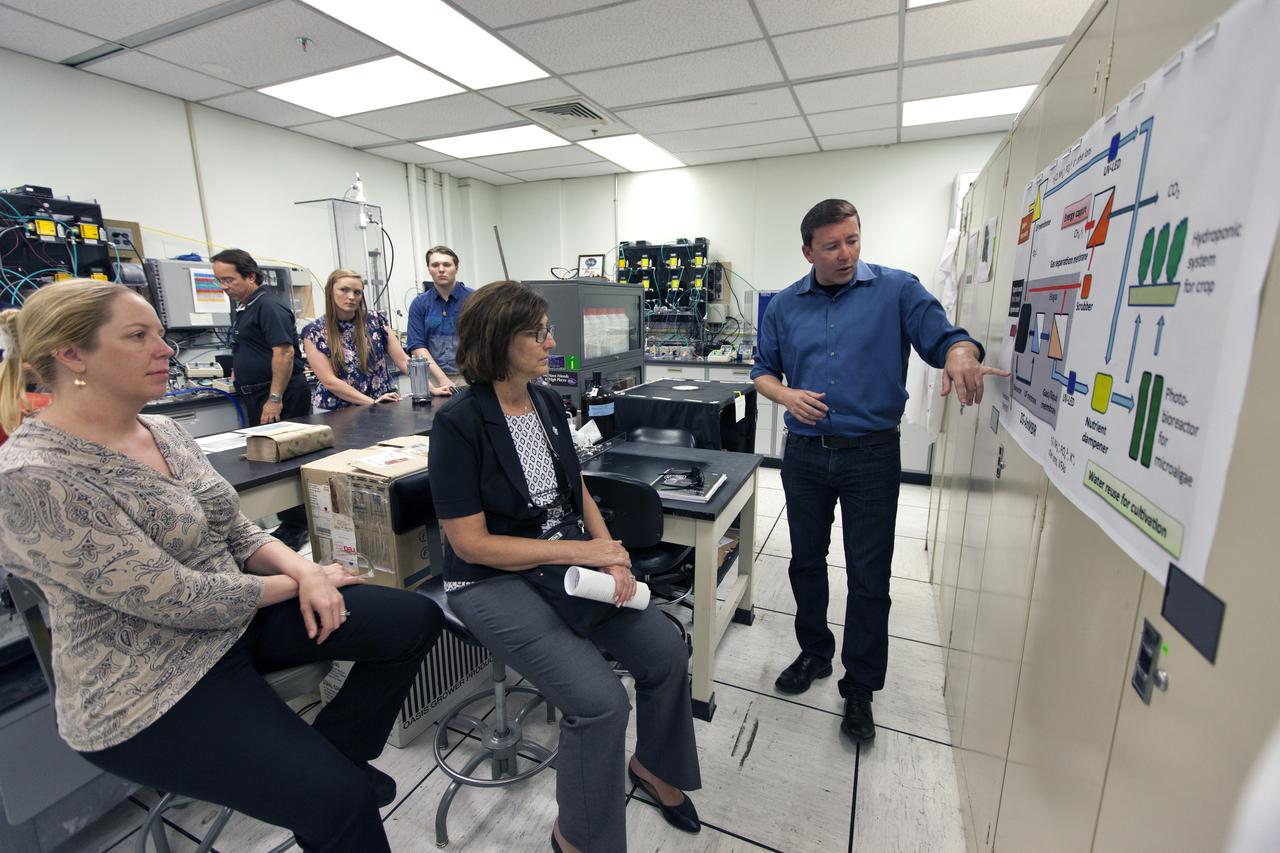
Inside a laboratory in the Neil Armstrong Operations and Checkout Building at NASA's Kennedy Space Center in Florida, Dr. Luke Roberson, right, principal investigator for research and development in Swamp Works, explains the algae bio reactor to Robyn Gatens, center, deputy director, ISS Division and system capability leader for Environmental Control and Life Support Systems (ECLSS) at NASA Headquarters in Washington, on June 13, 2018. At far left is Molly Anderson, deputy ECLSS capability lead at Johnson Space Center in Houston. They are seeing firsthand some of the capabilities in the center's Exploration Research and Technology Programs.