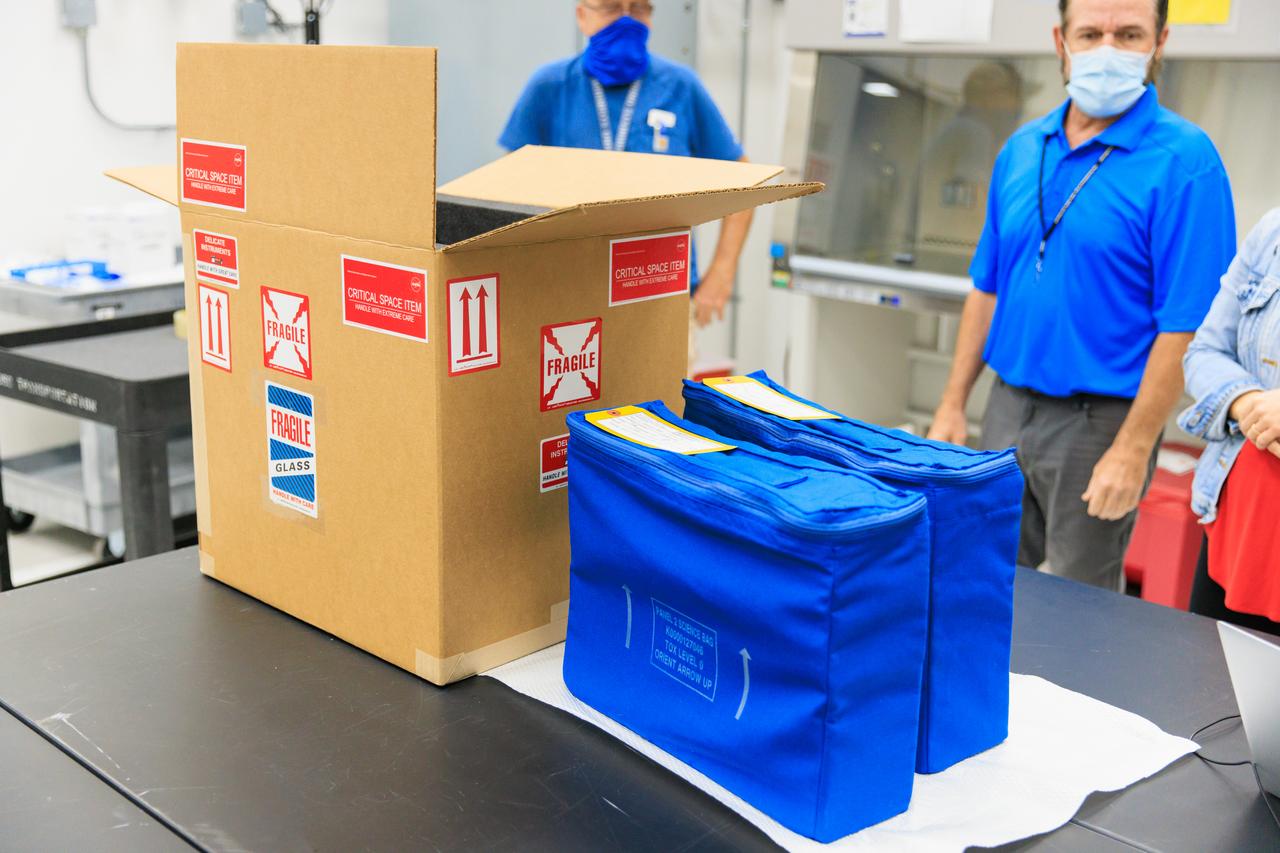
NASA’s Biology Experiment-1 (BioExpt-1) is officially packaged and ready for handover to the Orion team for Artemis I inside the Space Station Processing Facility at the agency’s Kennedy Space Center in Florida on Aug. 18, 2022. BioExpt-1 is a space biology pathfinder, which will carry Arabidopsis, algae, yeast, and fungi science payloads for biology research beyond low-Earth orbit aboard the Orion capsule on the Artemis I mission. The payload container assemblies will be installed onto panels in the Orion capsule and will return to Earth to provide critical and unique data about life beyond low-Earth orbit for the first time in more than 40 years. Artemis I is the first in a series of increasingly complex missions that will enable human exploration to the Moon and eventually on to Mars.
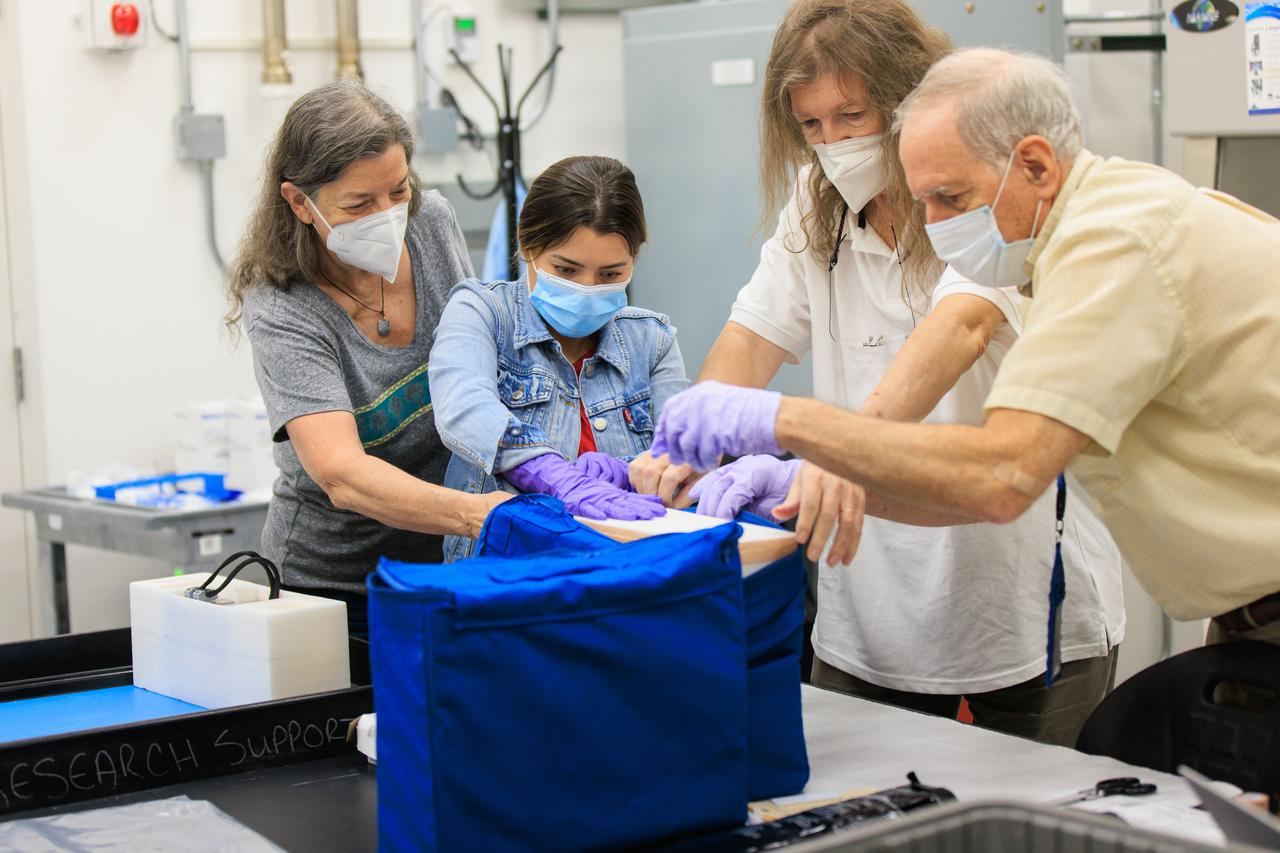
Scientists package up part of NASA’s Biology Experiment-1 (BioExpt-1) for official handover to the Orion team for Artemis I inside the Space Station Processing Facility at the agency’s Kennedy Space Center in Florida on Aug. 18, 2022. BioExpt-1 is a space biology pathfinder, which will carry Arabidopsis, algae, yeast, and fungi science payloads for biology research beyond low-Earth orbit aboard the Orion capsule on the Artemis I mission. The payload container assemblies will be installed onto panels in the Orion capsule and will return to Earth to provide critical and unique data about life beyond low-Earth orbit for the first time in more than 40 years. Artemis I is the first in a series of increasingly complex missions that will enable human exploration to the Moon and eventually on to Mars.
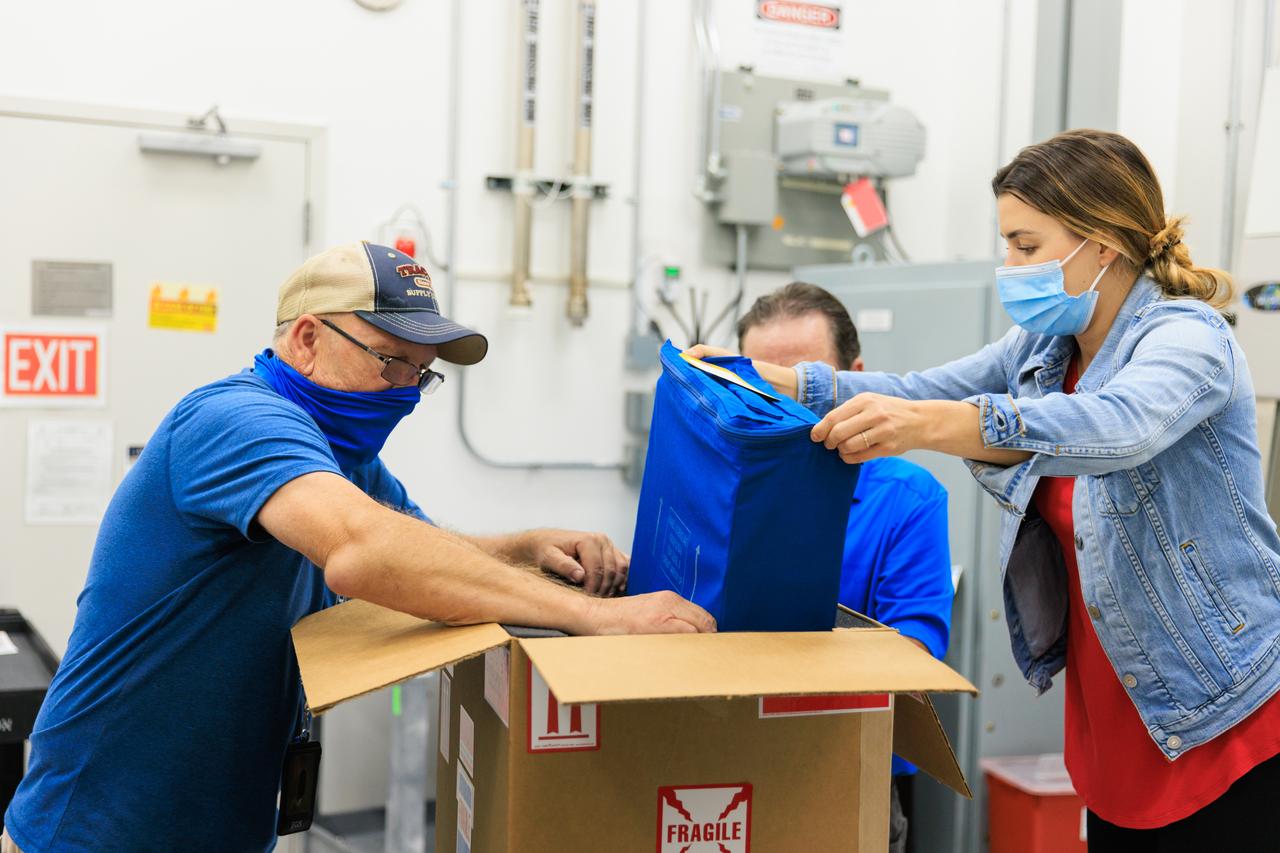
NASA’s Biology Experiment-1 (BioExpt-1) is officially packaged and ready for handover to the Orion team for Artemis I inside the Space Station Processing Facility at the agency’s Kennedy Space Center in Florida on Aug. 18, 2022. BioExpt-1 is a space biology pathfinder, which will carry Arabidopsis, algae, yeast, and fungi science payloads for biology research beyond low-Earth orbit aboard the Orion capsule on the Artemis I mission. The payload container assemblies will be installed onto panels in the Orion capsule and will return to Earth to provide critical and unique data about life beyond low-Earth orbit for the first time in more than 40 years. Artemis I is the first in a series of increasingly complex missions that will enable human exploration to the Moon and eventually on to Mars.
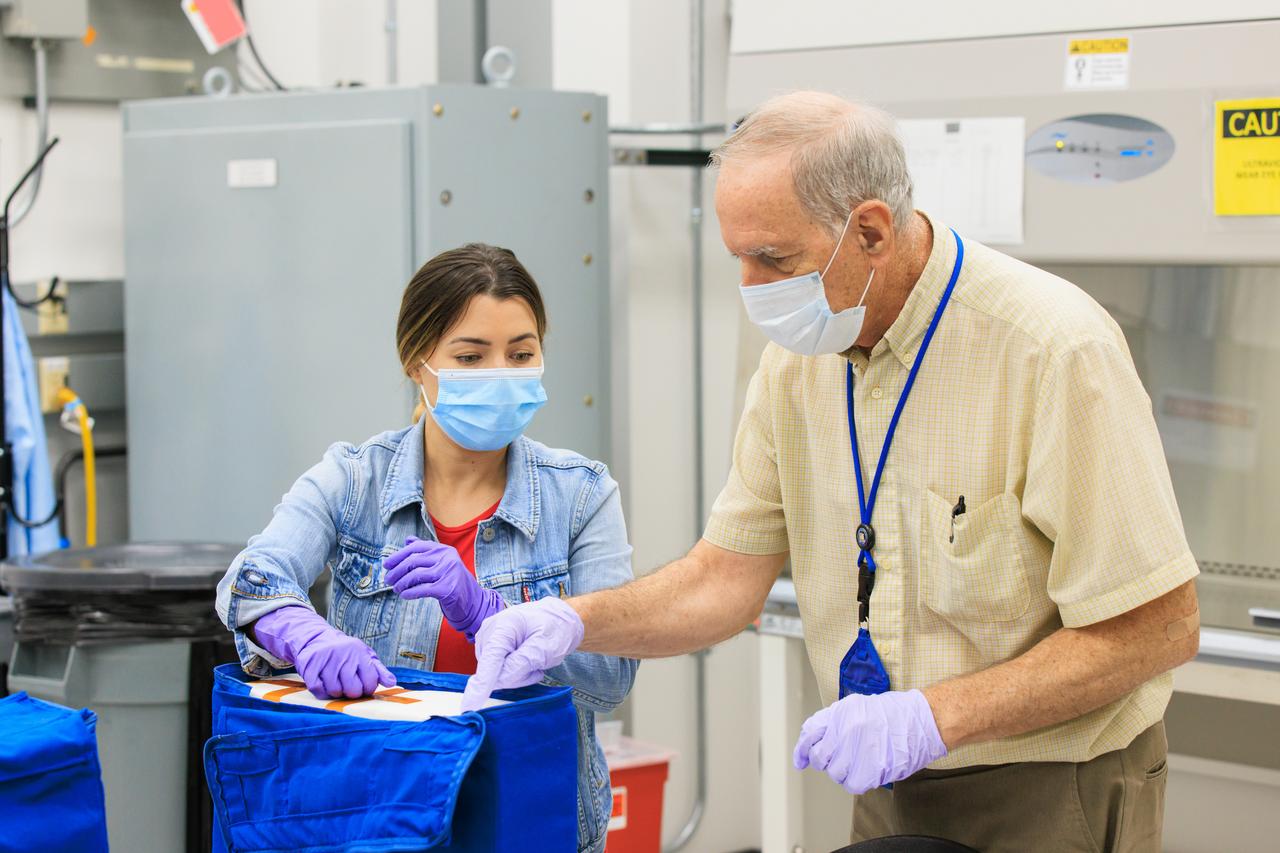
Scientists package up part of NASA’s Biology Experiment-1 (BioExpt-1) for official handover to the Orion team for Artemis I inside the Space Station Processing Facility at the agency’s Kennedy Space Center in Florida on Aug. 18, 2022. BioExpt-1 is a space biology pathfinder, which will carry Arabidopsis, algae, yeast, and fungi science payloads for biology research beyond low-Earth orbit aboard the Orion capsule on the Artemis I mission. The payload container assemblies will be installed onto panels in the Orion capsule and will return to Earth to provide critical and unique data about life beyond low-Earth orbit for the first time in more than 40 years. Artemis I is the first in a series of increasingly complex missions that will enable human exploration to the Moon and eventually on to Mars.
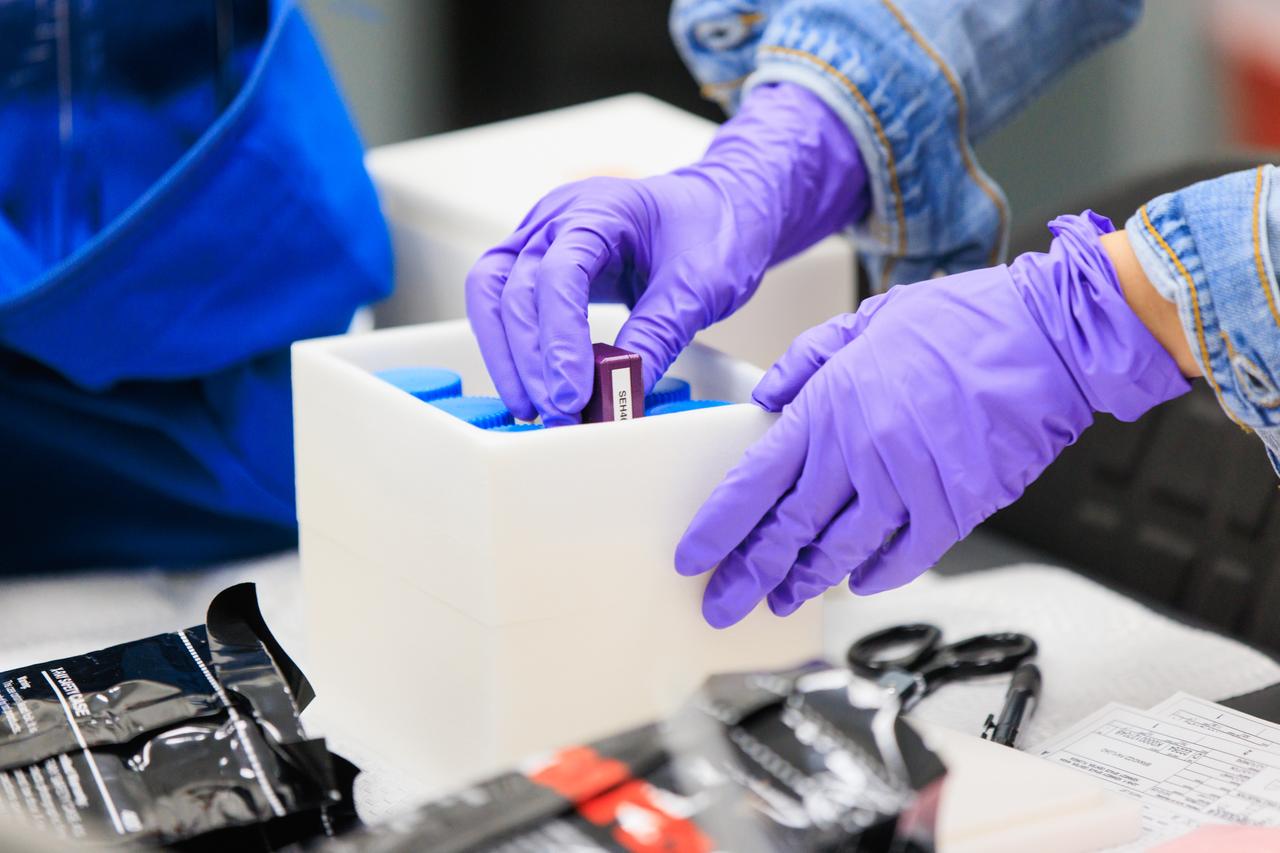
Scientists package up part of NASA’s Biology Experiment-1 (BioExpt-1) for official handover to the Orion team for Artemis I inside the Space Station Processing Facility at the agency’s Kennedy Space Center in Florida on Aug. 18, 2022. BioExpt-1 is a space biology pathfinder, which will carry Arabidopsis, algae, yeast, and fungi science payloads for biology research beyond low-Earth orbit aboard the Orion capsule on the Artemis I mission. The payload container assemblies will be installed onto panels in the Orion capsule and will return to Earth to provide critical and unique data about life beyond low-Earth orbit for the first time in more than 40 years. Artemis I is the first in a series of increasingly complex missions that will enable human exploration to the Moon and eventually on to Mars.
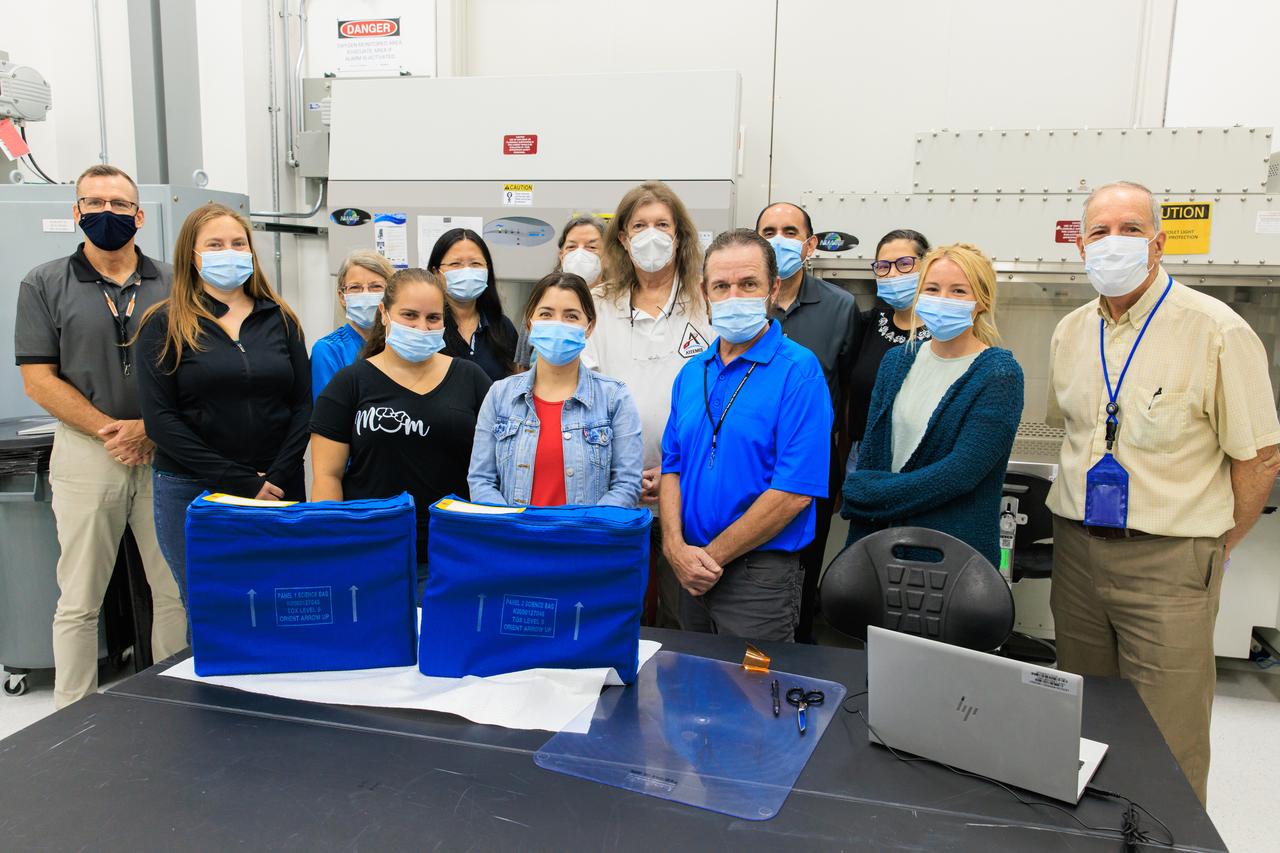
NASA’s Biology Experiment-1 (BioExpt-1) is officially packaged and ready for handover to the Orion team for Artemis I inside the Space Station Processing Facility at the agency’s Kennedy Space Center in Florida on Aug. 18, 2022. BioExpt-1 is a space biology pathfinder, which will carry Arabidopsis, algae, yeast, and fungi science payloads for biology research beyond low-Earth orbit aboard the Orion capsule on the Artemis I mission. The payload container assemblies will be installed onto panels in the Orion capsule and will return to Earth to provide critical and unique data about life beyond low-Earth orbit for the first time in more than 40 years. Artemis I is the first in a series of increasingly complex missions that will enable human exploration to the Moon and eventually on to Mars.
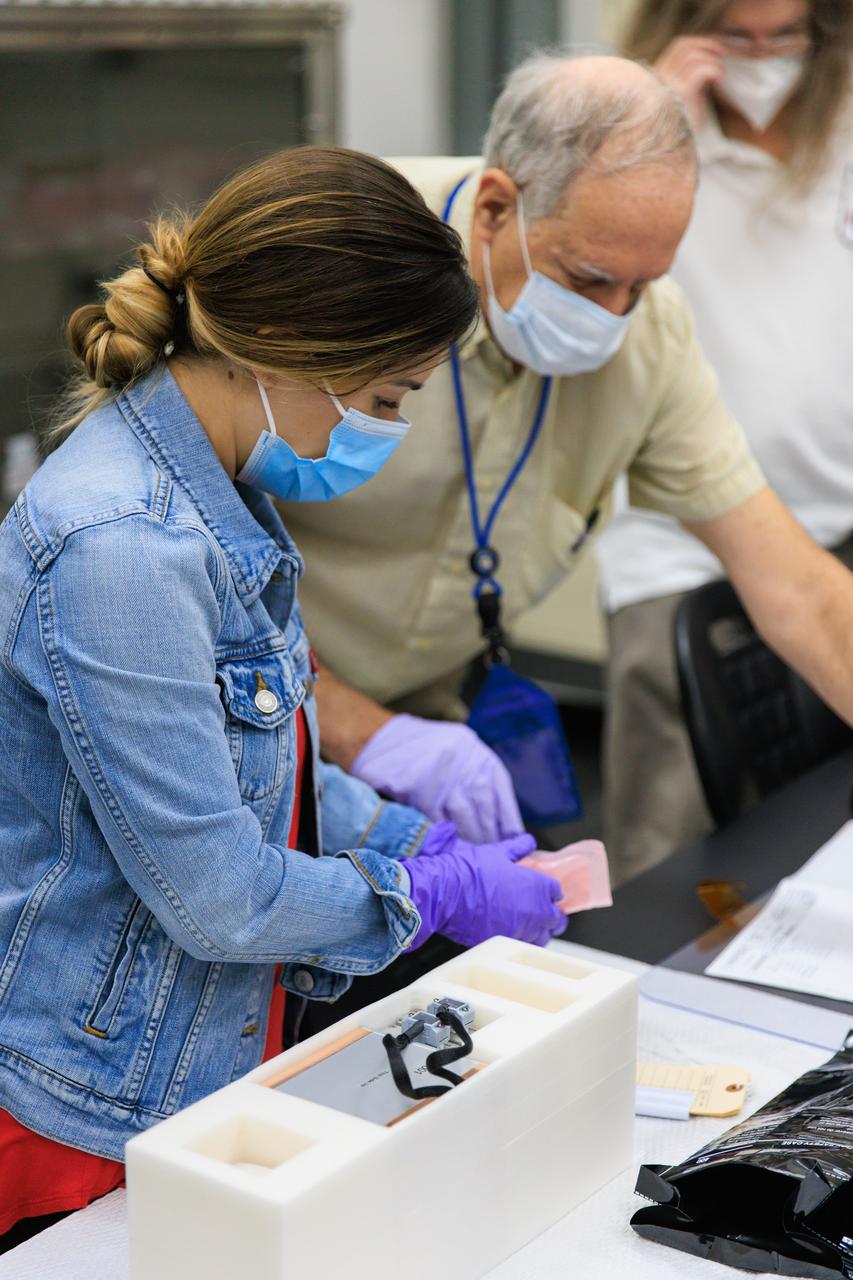
Scientists package up part of NASA’s Biology Experiment-1 (BioExpt-1) for official handover to the Orion team for Artemis I inside the Space Station Processing Facility at the agency’s Kennedy Space Center in Florida on Aug. 18, 2022. BioExpt-1 is a space biology pathfinder, which will carry Arabidopsis, algae, yeast, and fungi science payloads for biology research beyond low-Earth orbit aboard the Orion capsule on the Artemis I mission. The payload container assemblies will be installed onto panels in the Orion capsule and will return to Earth to provide critical and unique data about life beyond low-Earth orbit for the first time in more than 40 years. Artemis I is the first in a series of increasingly complex missions that will enable human exploration to the Moon and eventually on to Mars.
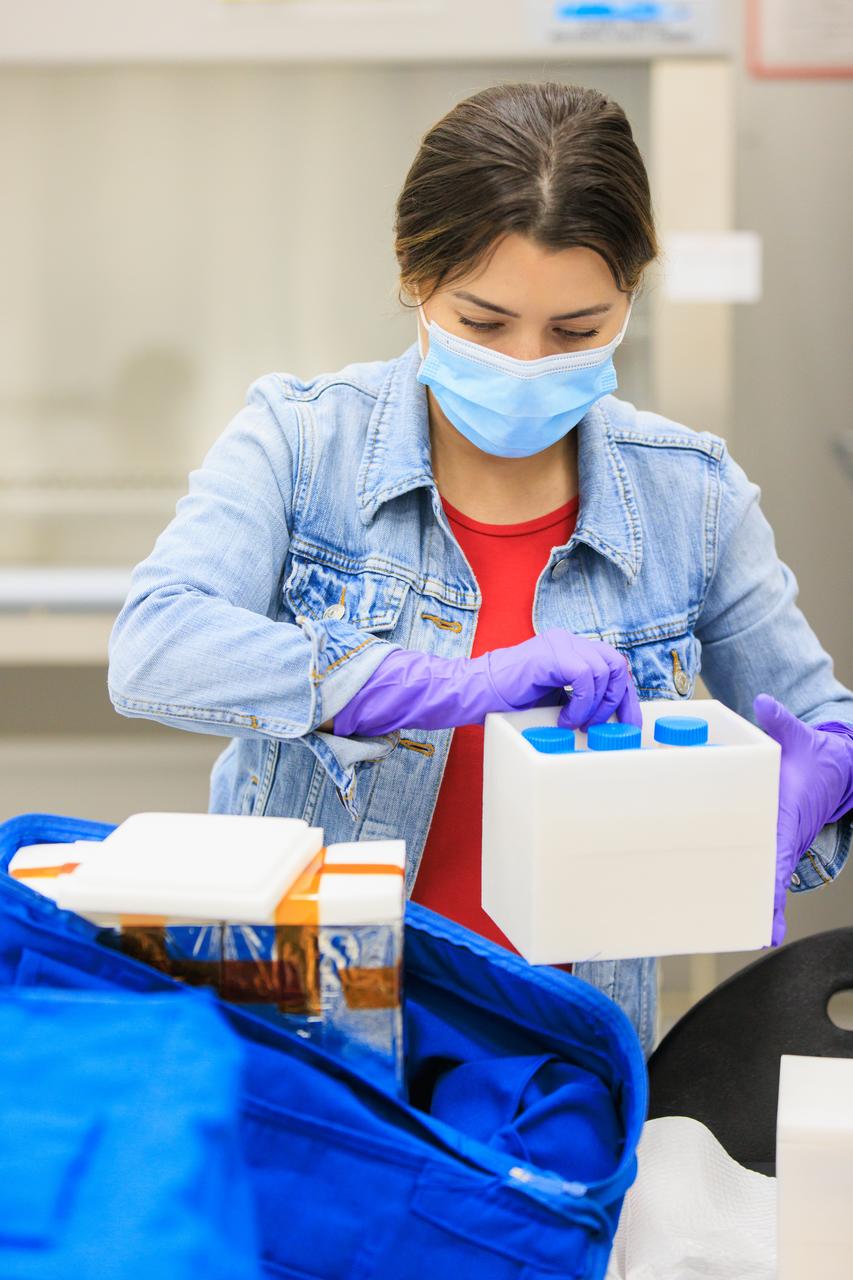
Scientists package up part of NASA’s Biology Experiment-1 (BioExpt-1) for official handover to the Orion team for Artemis I inside the Space Station Processing Facility at the agency’s Kennedy Space Center in Florida on Aug. 18, 2022. BioExpt-1 is a space biology pathfinder, which will carry Arabidopsis, algae, yeast, and fungi science payloads for biology research beyond low-Earth orbit aboard the Orion capsule on the Artemis I mission. The payload container assemblies will be installed onto panels in the Orion capsule and will return to Earth to provide critical and unique data about life beyond low-Earth orbit for the first time in more than 40 years. Artemis I is the first in a series of increasingly complex missions that will enable human exploration to the Moon and eventually on to Mars.
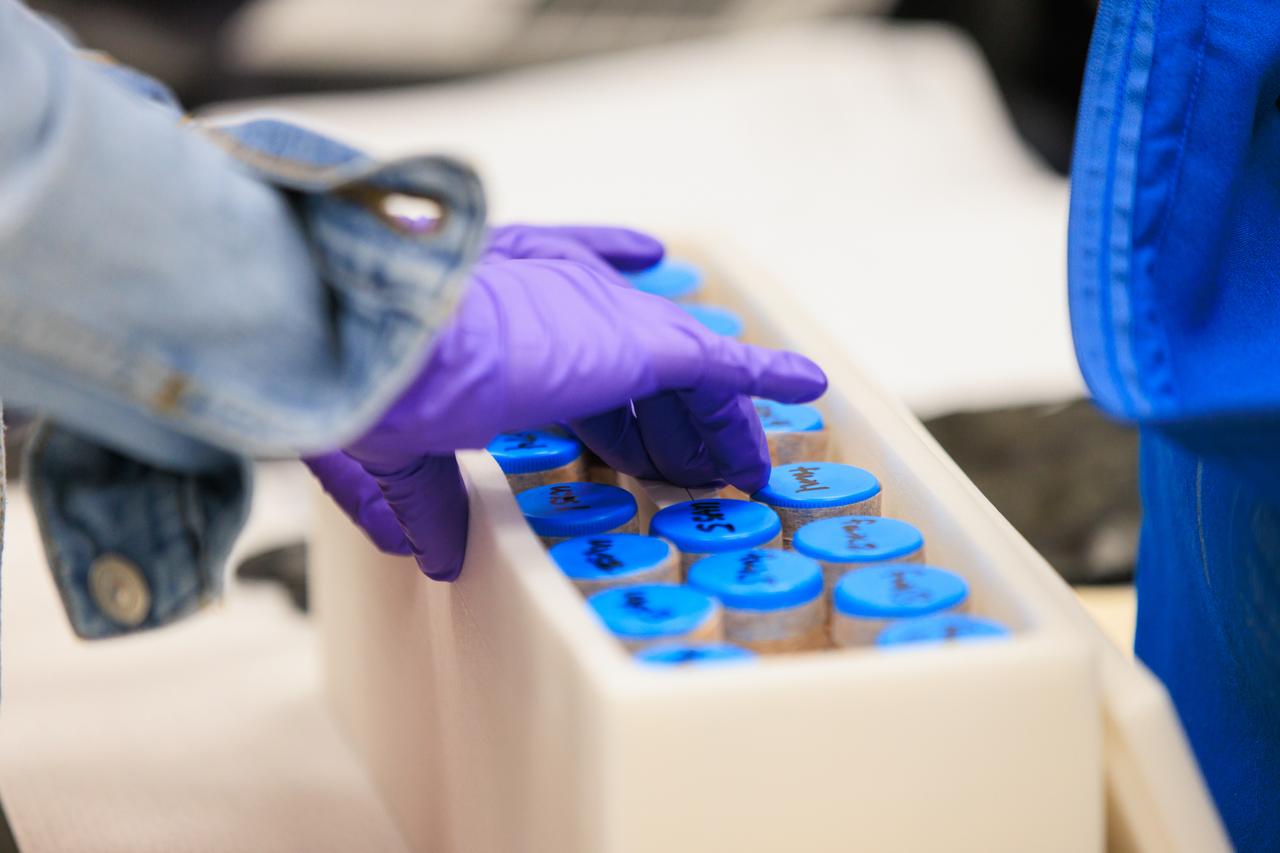
Scientists package up part of NASA’s Biology Experiment-1 (BioExpt-1) for official handover to the Orion team for Artemis I inside the Space Station Processing Facility at the agency’s Kennedy Space Center in Florida on Aug. 18, 2022. BioExpt-1 is a space biology pathfinder, which will carry Arabidopsis, algae, yeast, and fungi science payloads for biology research beyond low-Earth orbit aboard the Orion capsule on the Artemis I mission. The payload container assemblies will be installed onto panels in the Orion capsule and will return to Earth to provide critical and unique data about life beyond low-Earth orbit for the first time in more than 40 years. Artemis I is the first in a series of increasingly complex missions that will enable human exploration to the Moon and eventually on to Mars.

iss049e052550 (10/29/20160 --- NASA astronaut Kate Rubins is photographed removing samples from the Minus Eighty-Degree Laboratory Freezer for ISS 2 (MELFI2) as part of handover to the Russian crew for packing. The Minus Eighty-degree Laboratory Freezer for ISS (MELFI) is a cold storage unit that maintains experiment samples at ultra-cold temperatures throughout a mission.
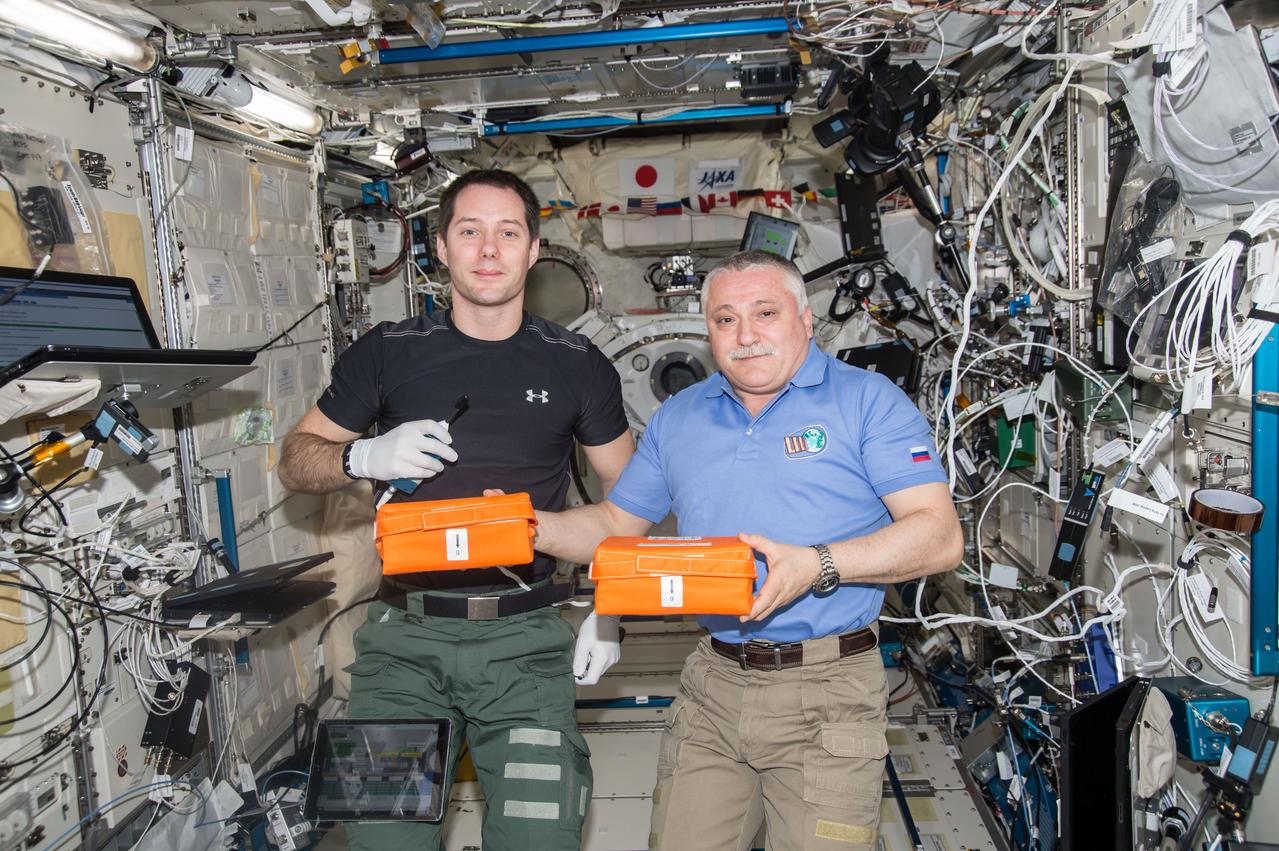
iss051e052377 96/2/2017) --- European Space Agency (ESA) astronaut Thomas Pesquet and cosmonaut Fyodor Yurchikhin pose with Canister Bags during handover of Canisters removed from the Protein Crystallization Research Facility (PCRF. The image was taken in the Kibo Japanese Experiment Pressurized Module (JPM) during Japan Aerospace Exploration Agency (JAXA) Protein Crystal Growth (PCG) and Kristallizator experiment operations (OPS).
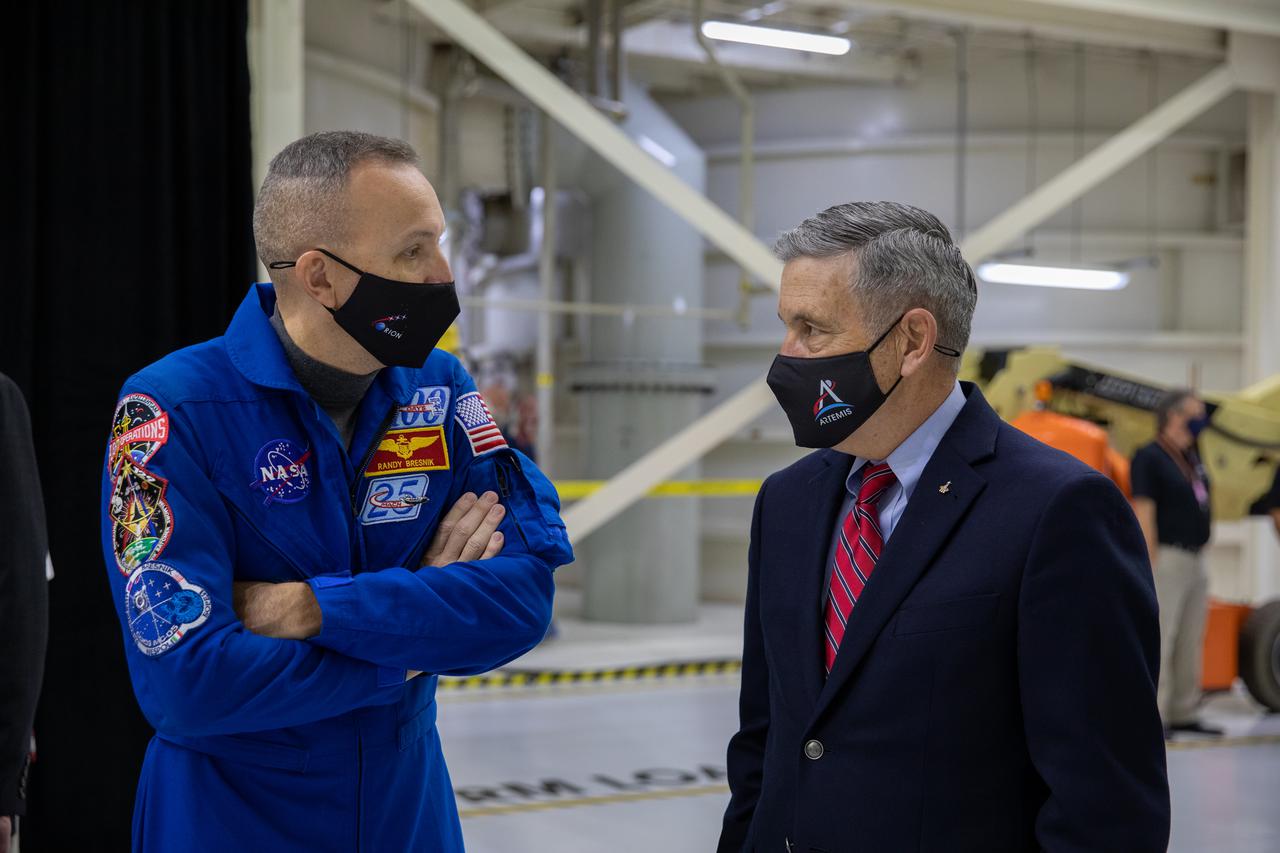
Orion is revealed for one of the final times on Jan. 14, as it is readied atop its transport pallet from the Neil Armstrong Operations and Checkout Building at NASA’s Kennedy Space Center in Florida, along its path to the pad ahead of the Artemis I launch. Orion was officially transferred from the Orion Program to Exploration Ground Systems (EGS) during a handover ceremony. NASA astronaut Randy Bresnik speaks with Kennedy Center Director Bob Cabana inside the high bay. Teams across the globe have worked tirelessly to assemble the spacecraft, which will receive a protective covering prior to departing for the Multi-Payload Processing Facility to begin ground processing by the EGS and Jacobs teams.
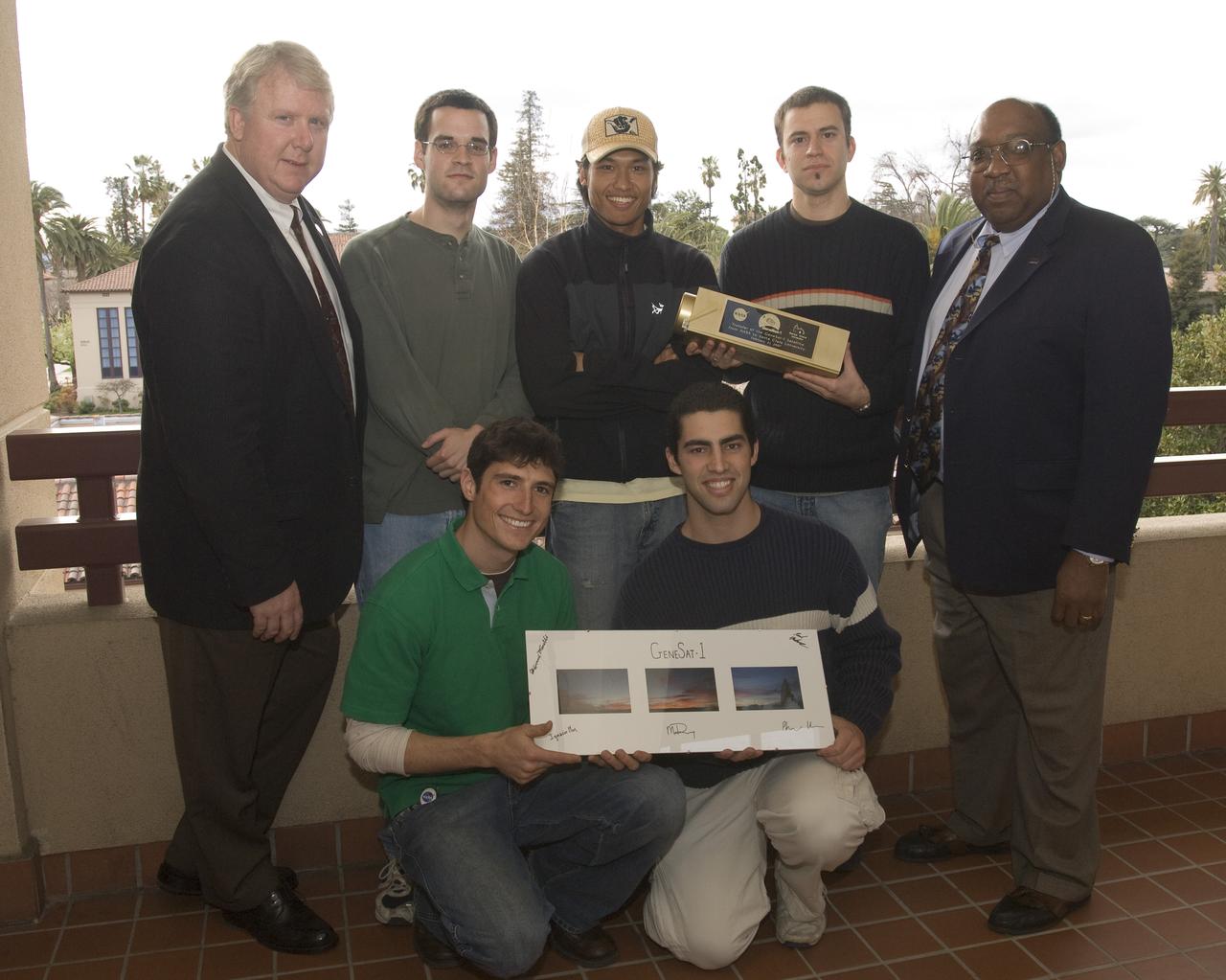
Handover of GeneSat 1 from NASA to Santa Clara University event
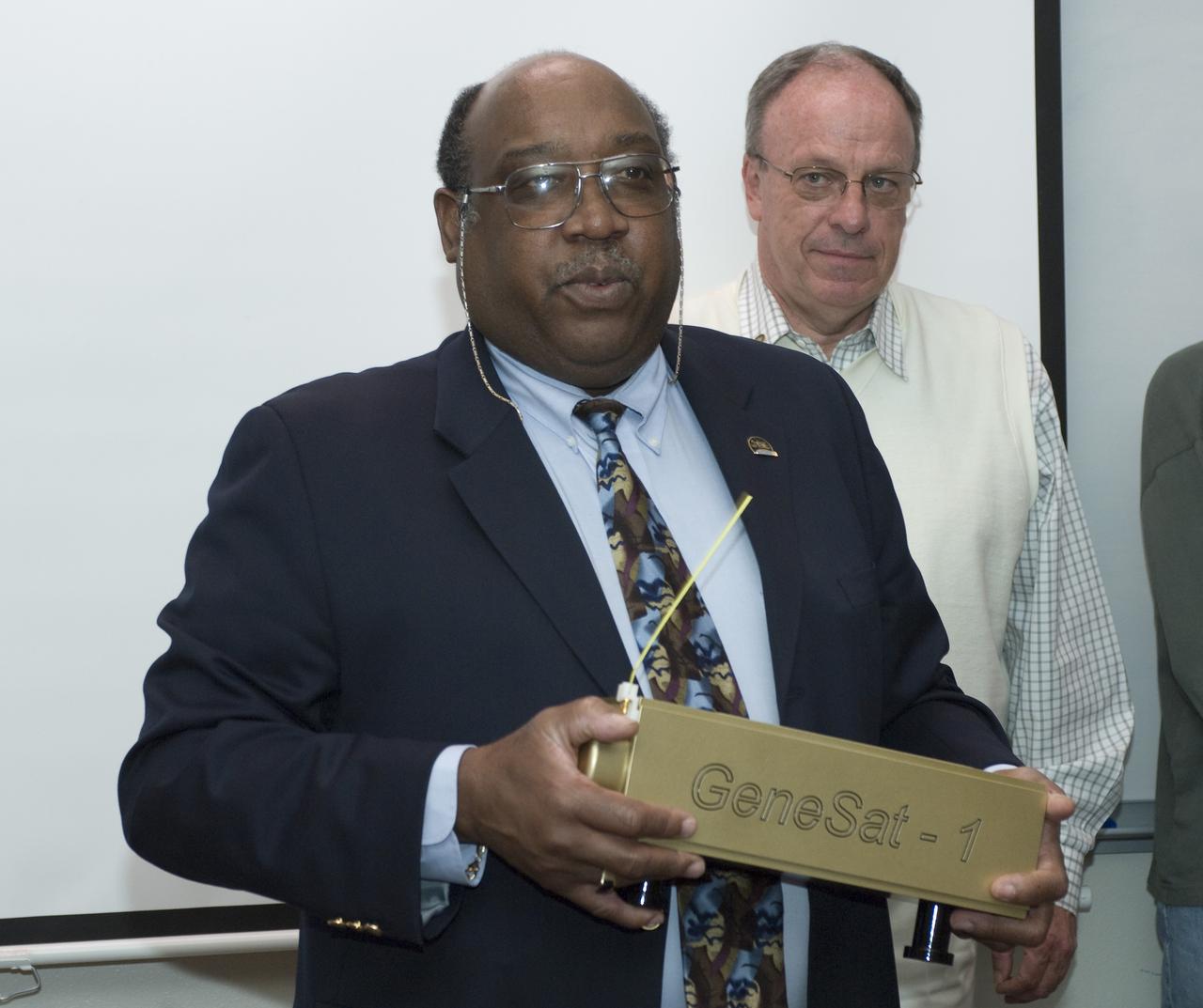
Handover of GeneSat 1 from NASA to Santa Clara University event
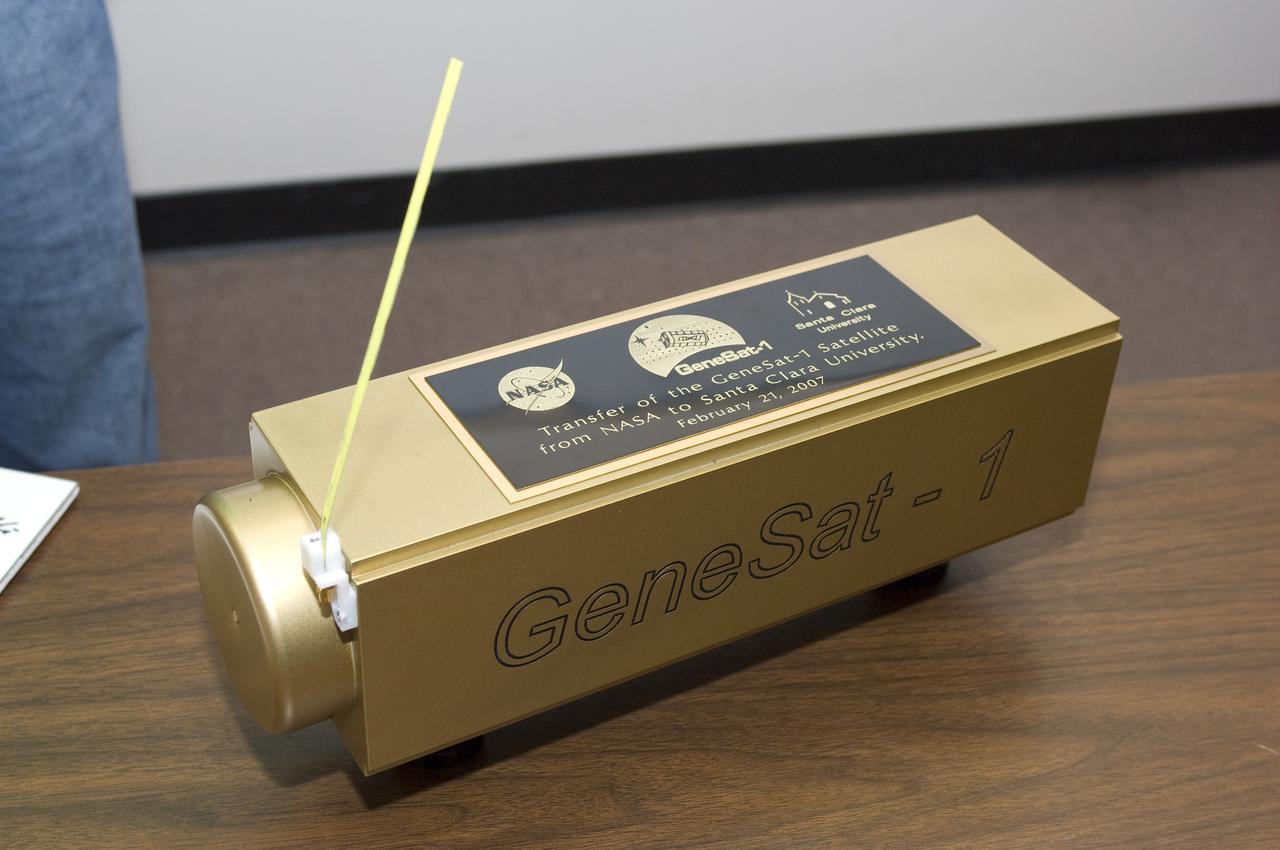
Handover of GeneSat 1 from NASA to Santa Clara University event
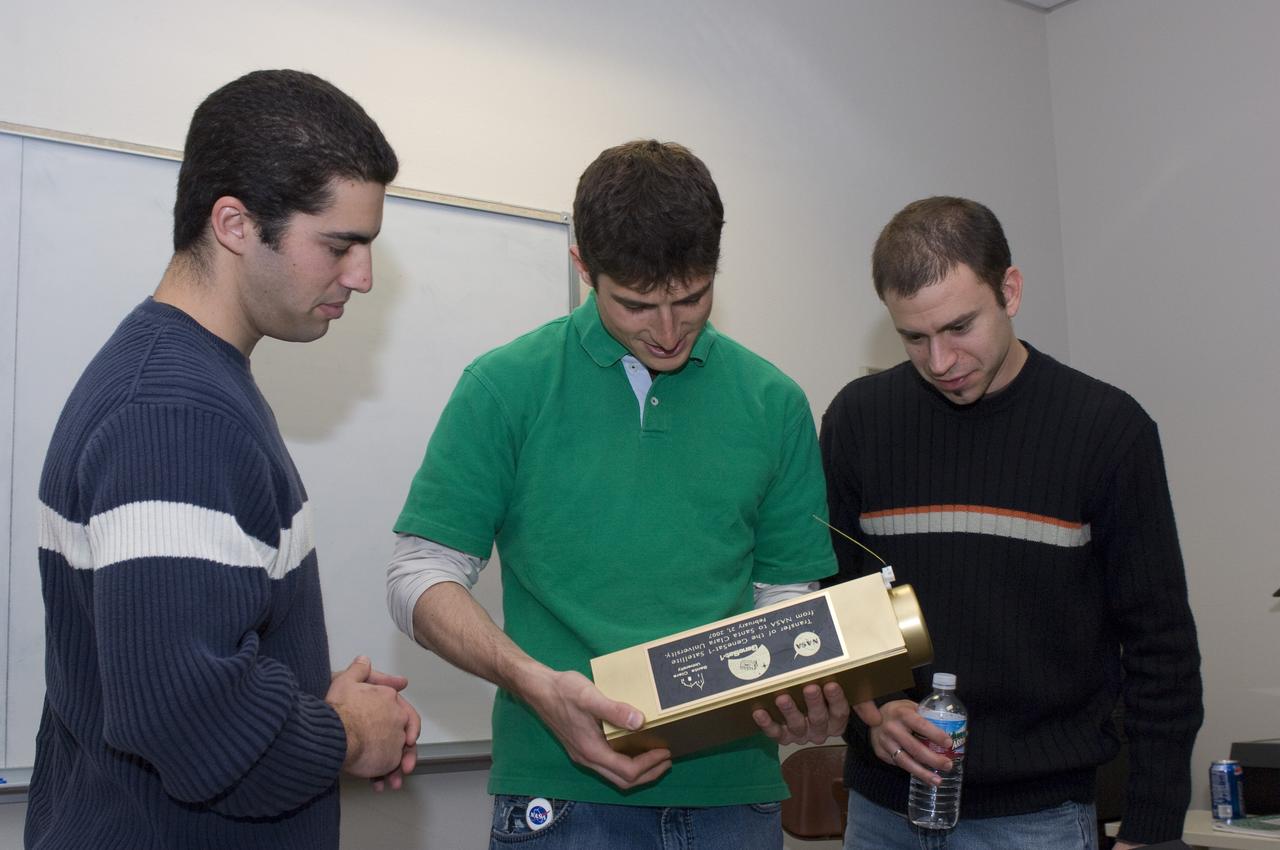
Handover of GeneSat 1 from NASA to Santa Clara University event
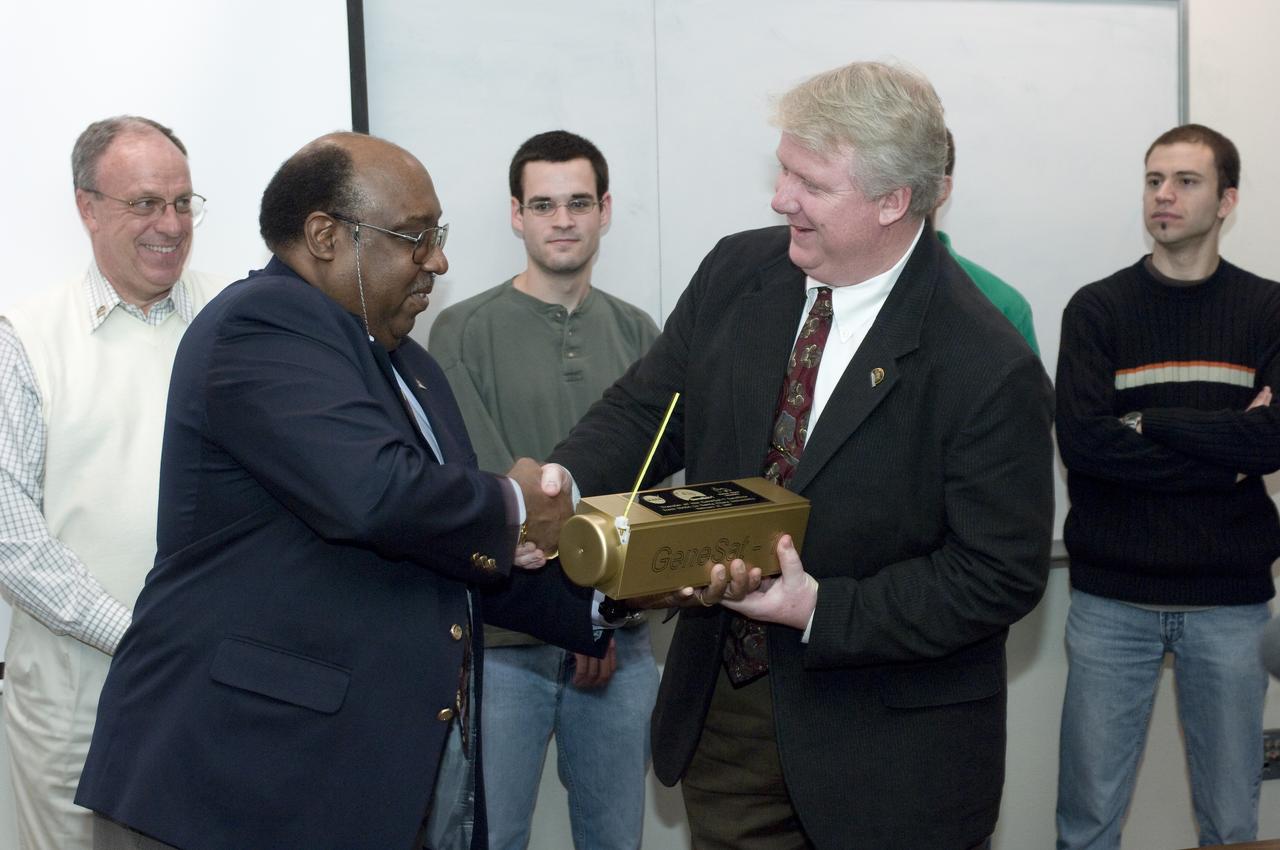
Handover of GeneSat 1 from NASA to Santa Clara University event
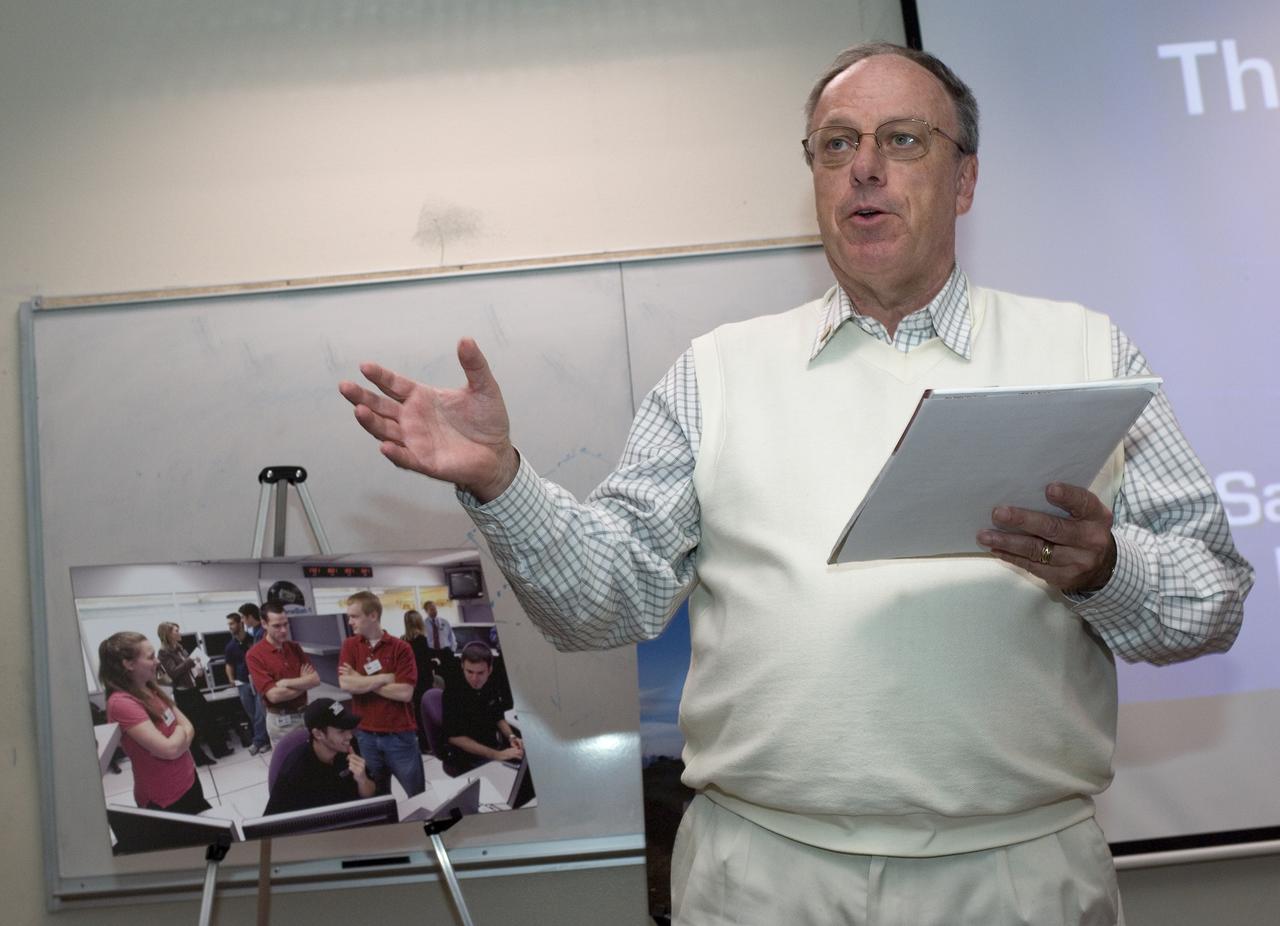
Handover of GeneSat 1 from NASA to Santa Clara University event
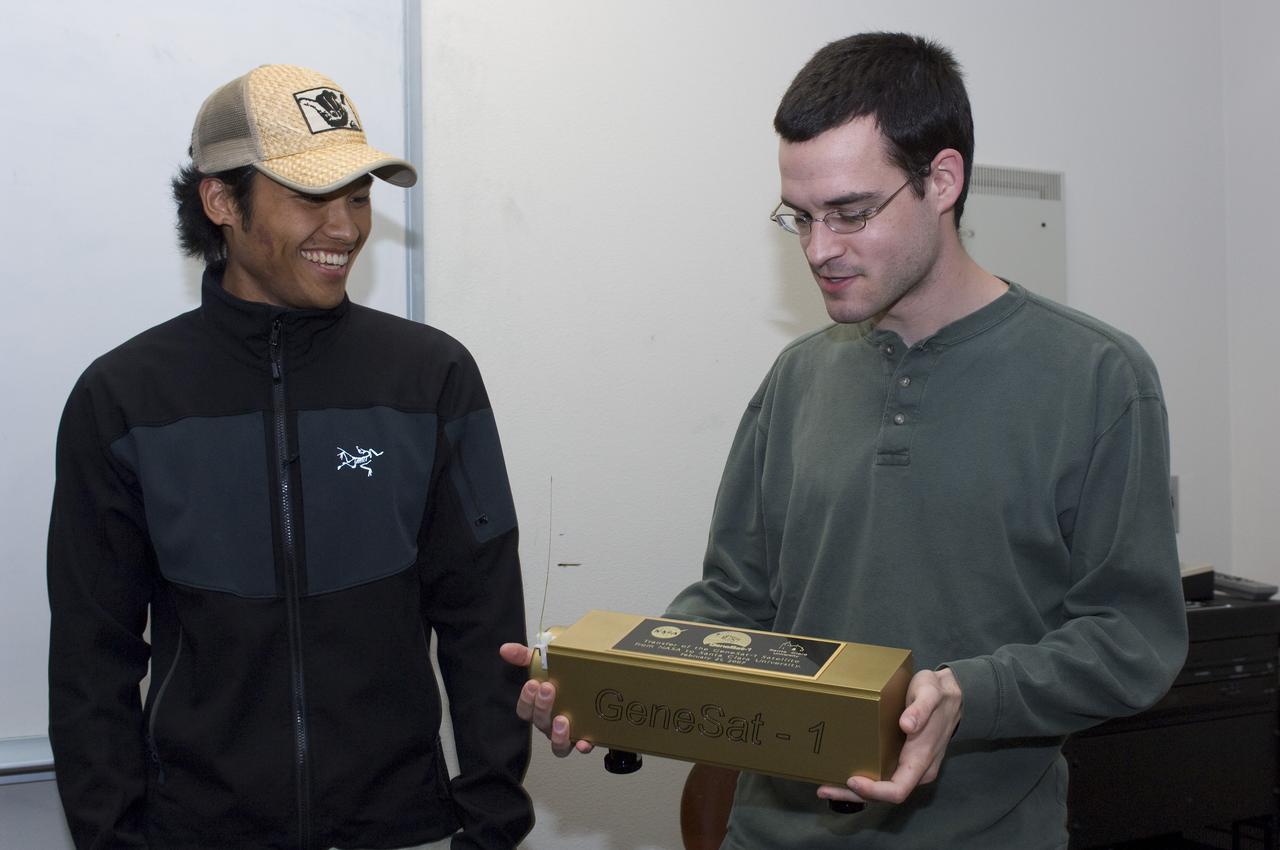
Handover of GeneSat 1 from NASA to Santa Clara University event
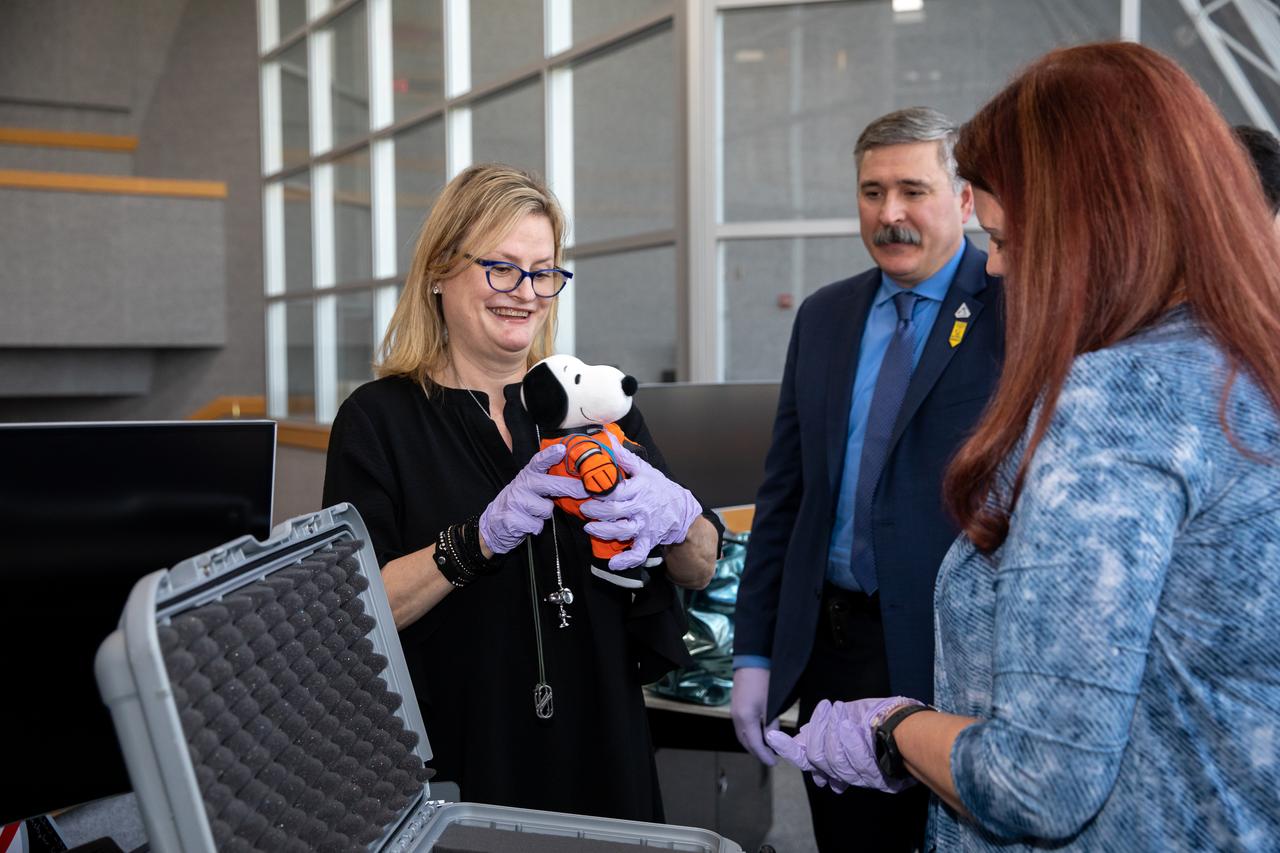
Melissa Menta, at left, senior vice president with Peanuts Worldwide LLC, accepts Snoopy during an official handover from Artemis Launch Director Charlie Blackwell-Thompson inside Launch Control Center Firing Room 1 at NASA’s Kennedy Space Center in Florida on Jan. 18, 2023. To the left of Charlie is Mike Sarafin, Artemis I mission manager. Snoopy served as the zero-gravity indicator during the Artemis I mission. Snoopy was secured inside Orion during the mission, a journey beyond the Moon and back to prepare for crewed missions to the Moon. Artemis I launched atop the Space Launch System rocket on Nov. 16, 2022 from Kennedy’s Launch Complex 39B. Orion returned to Earth for a splashdown in the Pacific Ocean on Dec. 11, 2022 after traveling more than 1.4 million miles. NASA has held an association with Snoopy since the Apollo Era – the character has contributed to the excitement for NASA human spaceflight missions, helping inspire generations to dream big, and is a symbol of NASA’s safety culture and mission success.
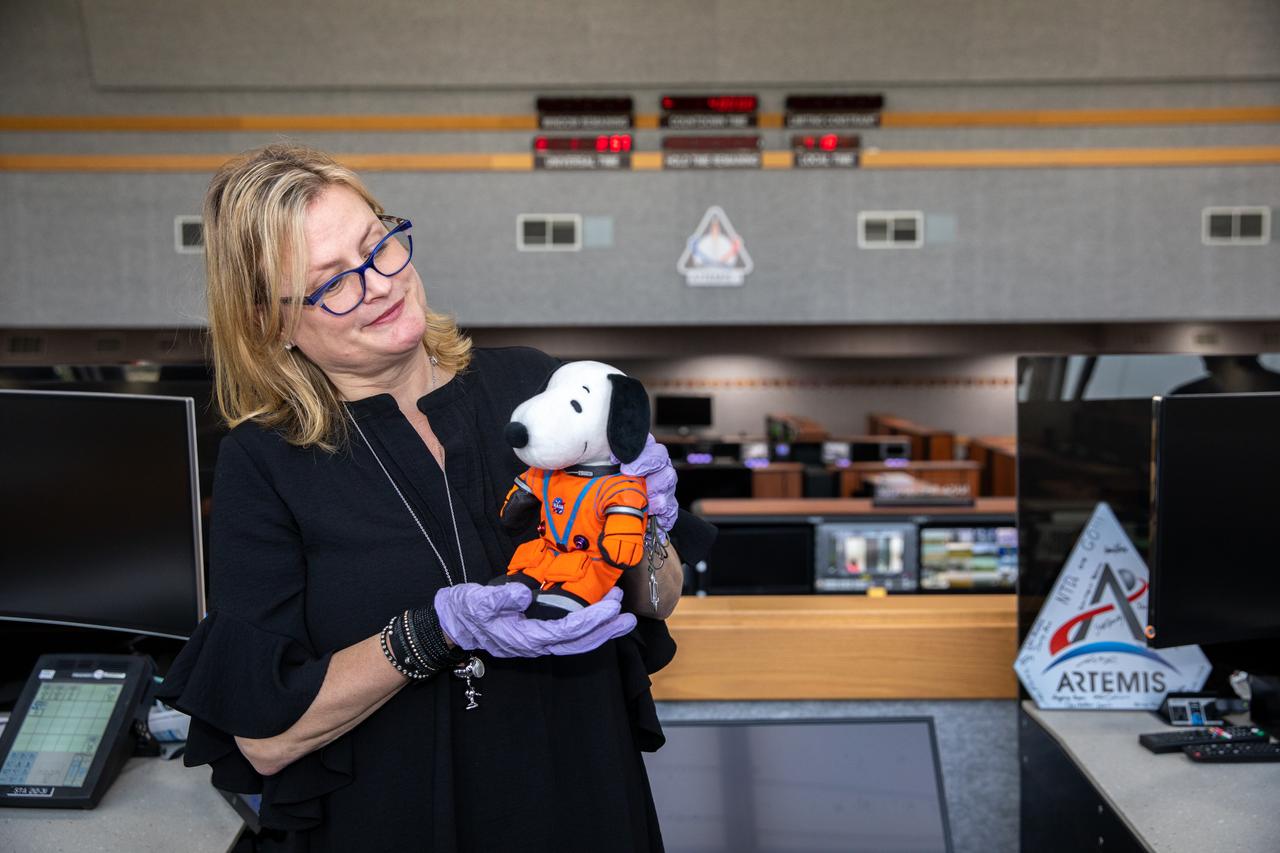
Melissa Menta, senior vice president with Peanuts Worldwide LLC, accepts Snoopy during an official handover from Artemis Launch Director Charlie Blackwell-Thompson inside Launch Control Center Firing Room 1 at NASA’s Kennedy Space Center in Florida on Jan. 18, 2023. Snoopy served as the zero-gravity indicator during the Artemis I mission. Snoopy was secured inside Orion during the mission, a journey beyond the Moon and back to prepare for crewed missions to the Moon. Artemis I launched atop the Space Launch System rocket on Nov. 16, 2022 from Kennedy’s Launch Complex 39B. Orion returned to Earth for a splashdown in the Pacific Ocean on Dec. 11, 2022 after traveling more than 1.4 million miles. NASA has held an association with Snoopy since the Apollo Era – the character has contributed to the excitement for NASA human spaceflight missions, helping inspire generations to dream big, and is a symbol of NASA’s safety culture and mission success.
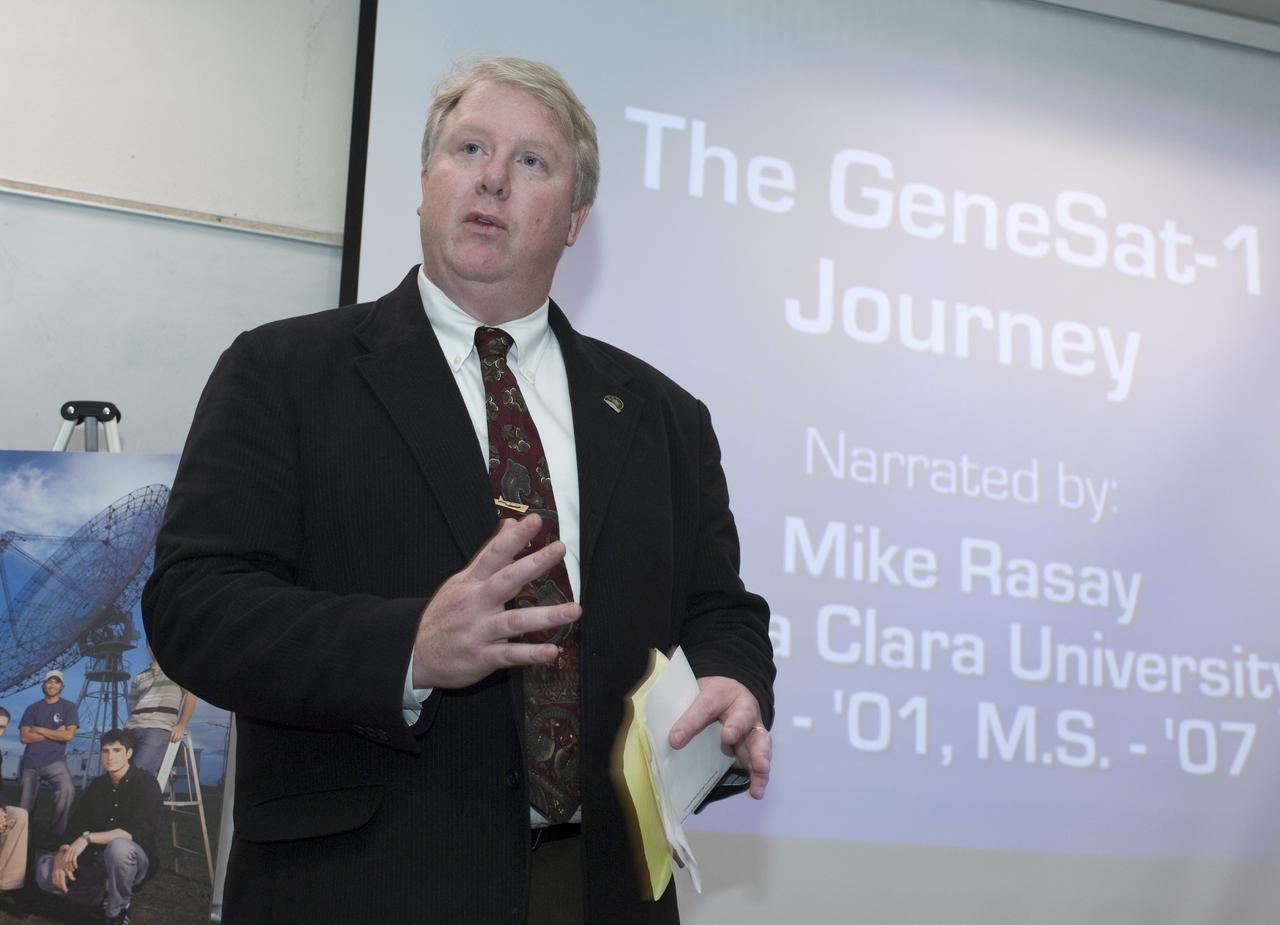
Handover of GeneSat 1 from NASA to Santa Clara University event with John Hines, NASA Ames

Handover of GeneSat 1 from NASA to Santa Clara University event L-R John Hines, NASA Ames to
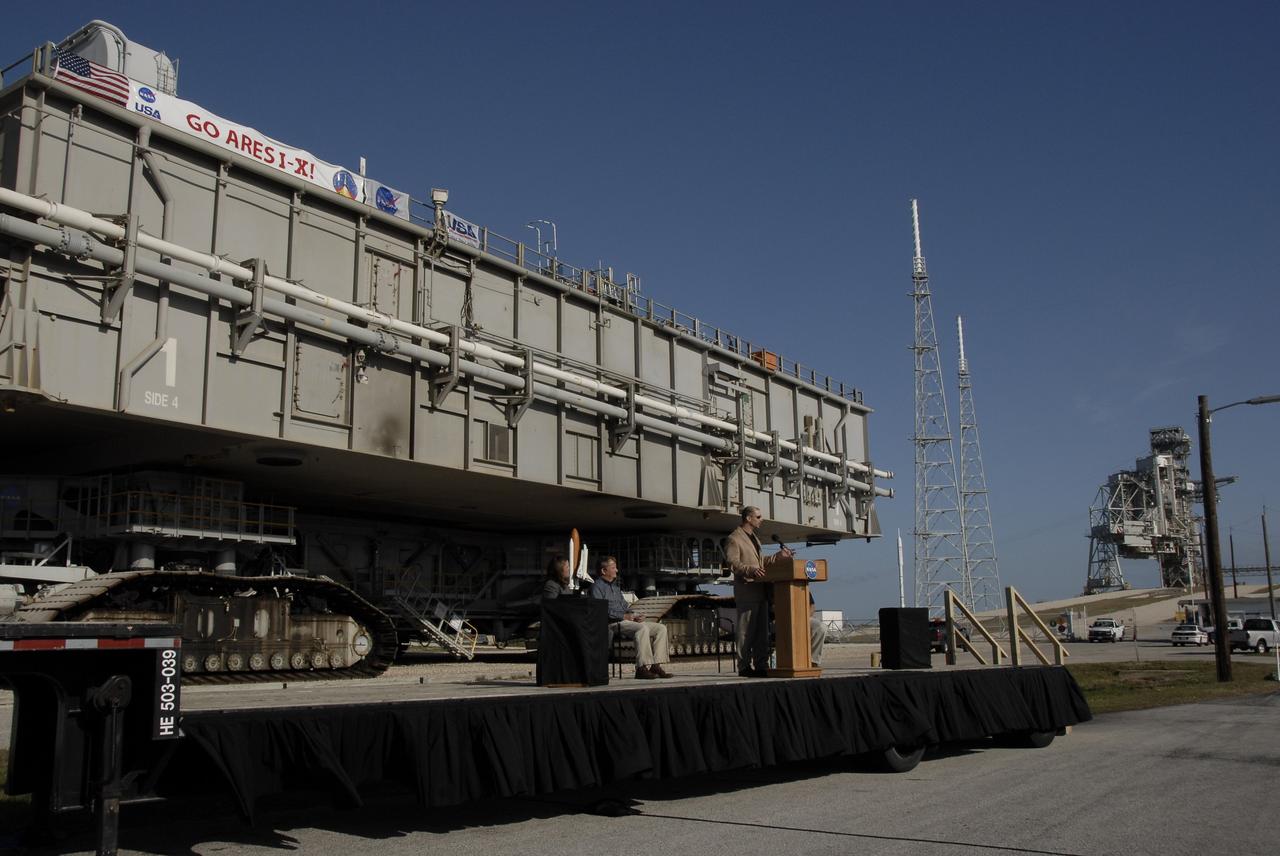
CAPE CANAVERAL, Fla. – Near Launch Pad 39B at NASA's Kennedy Space Center in Florida, Director of the Constellation Project Office Pepper E. Phillips speaks to employees and media during the handover ceremony for Mobile Launcher Platform-1. Marking the handover is the change of banner on the platform behind him. On the stage and also participating in the ceremony are Director of Launch Vehicle Processing Rita Willcoxon , Shuttle Launch Director Mike Leinbach, and Manager of MLP Operations with United Space Alliance Brett Raulerson. The platform is being transferred from NASA's Space Shuttle Program to the Constellation Program for the Ares I-X flight test targeted for this summer. Constructed in 1964, the mobile launchers used in Apollo/Saturn operations were modified for use in shuttle operations. With cranes, umbilical towers and swing arms removed, the mobile launchers were renamed Mobile Launcher Platforms, or MLPs. Photo credit: NASA/Kim Shiflett
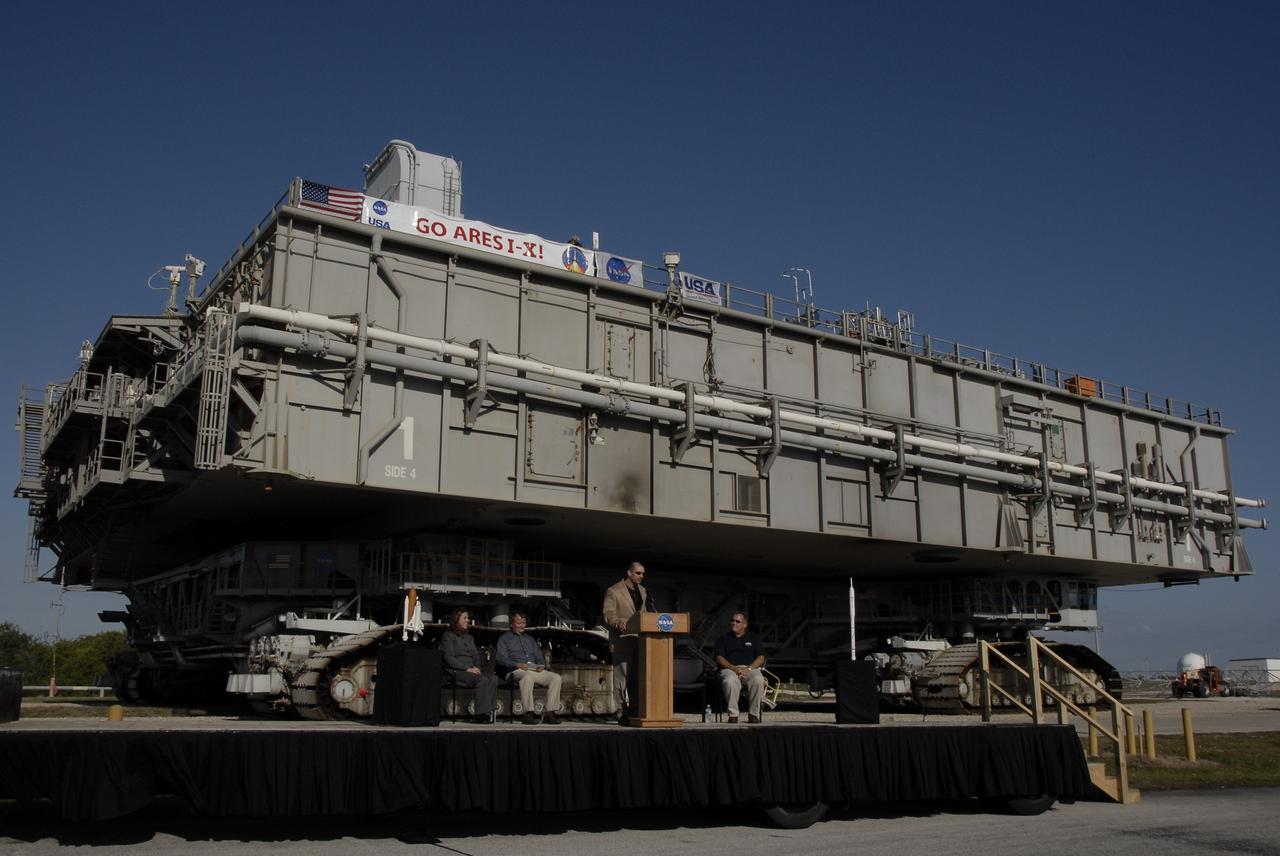
CAPE CANAVERAL, Fla. – Near Launch Pad 39B at NASA's Kennedy Space Center in Florida, Director of the Constellation Project Office Pepper E. Phillips speaks to employees and media during the handover ceremony for Mobile Launcher Platform-1. Marking the handover is the change of banner on the platform behind him. On the stage and also participating in the ceremony are Director of Launch Vehicle Processing Rita Willcoxon , Shuttle Launch Director Mike Leinbach, and Manager of MLP Operations with United Space Alliance Brett Raulerson. The platform is being transferred from NASA's Space Shuttle Program to the Constellation Program for the Ares I-X flight test targeted for this summer. Constructed in 1964, the mobile launchers used in Apollo/Saturn operations were modified for use in shuttle operations. With cranes, umbilical towers and swing arms removed, the mobile launchers were renamed Mobile Launcher Platforms, or MLPs. Photo credit: NASA/Kim Shiflett
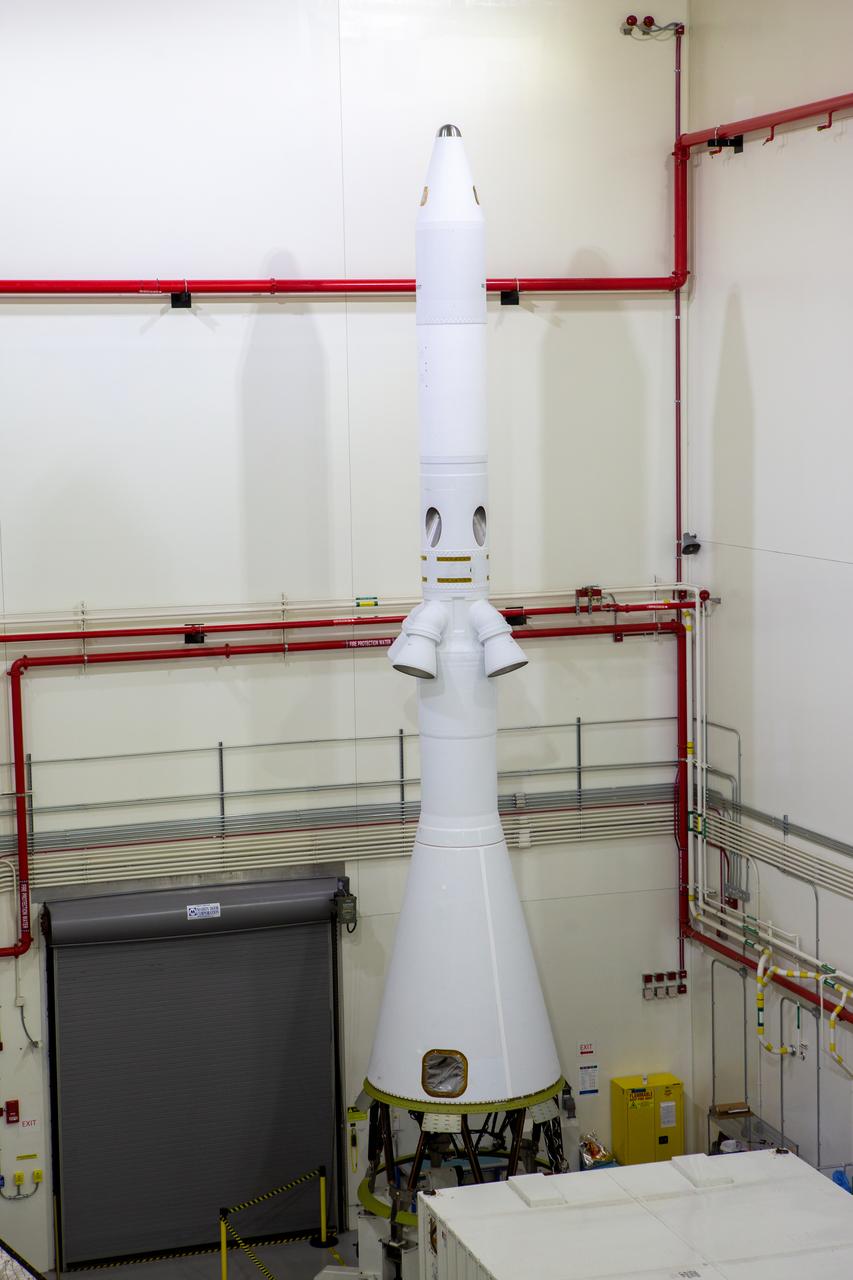
Inside the Launch Abort System Facility (LASF) at NASA’s Kennedy Space Center in Florida, the Launch Abort System (LAS) for the Orion spacecraft that will launch on Artemis I, the first of the Artemis series, awaits final processing with the spacecraft. The LAS was processed and prepared inside the LASF. During crewed launches of the Orion spacecraft atop the Space Launch System rocket, the LAS will protect the crew module and astronauts aboard to safety if an emergency occurs during launch.
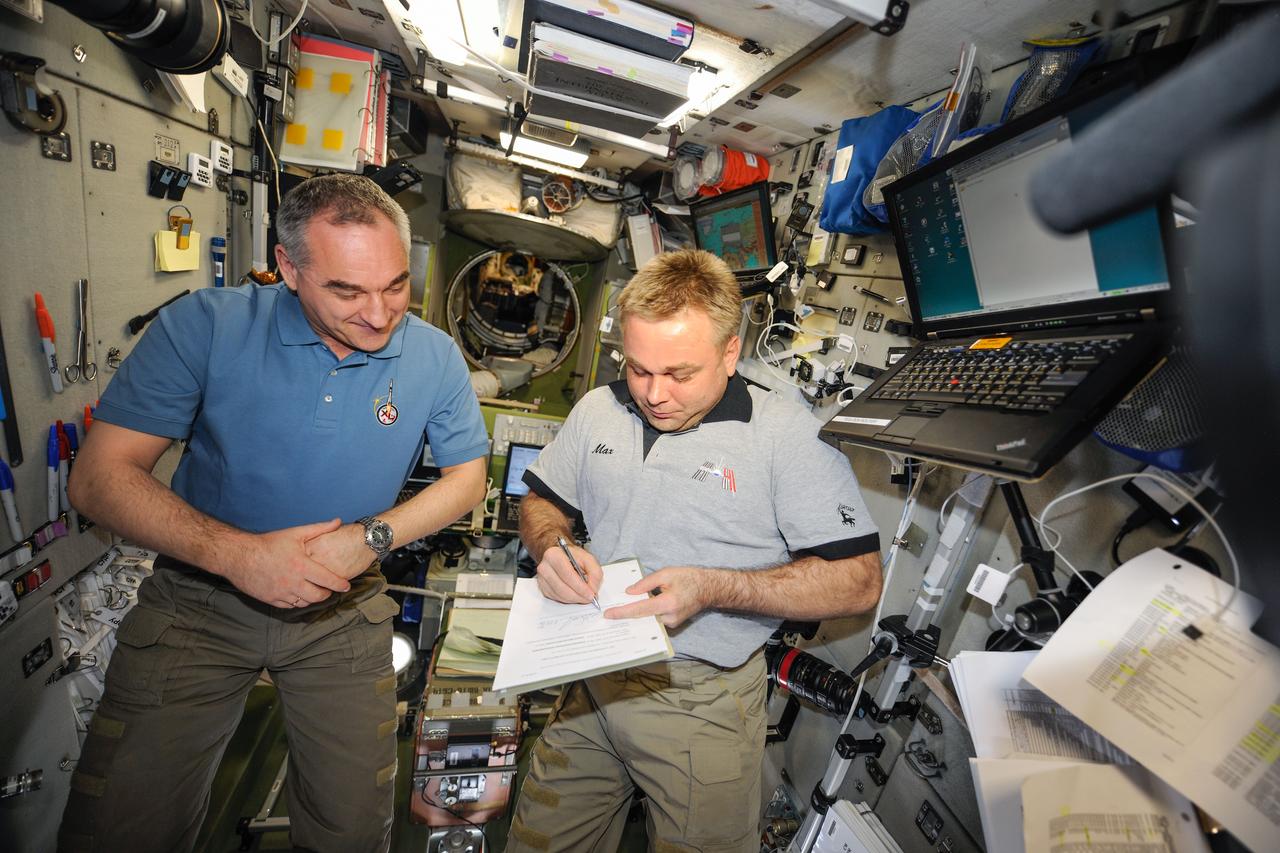
ISS040-E-123948 (9 Sept. 2014) --- In the Zvezda Service Module, Russian cosmonaut Maxim Suraev (right), Expedition 41 commander, signs a ceremonial document as the new commander of the International Space Station following the traditional Change of Command Ceremony. Russian cosmonaut Alexander Skvortsov, Expedition 40 flight engineer, looks on.
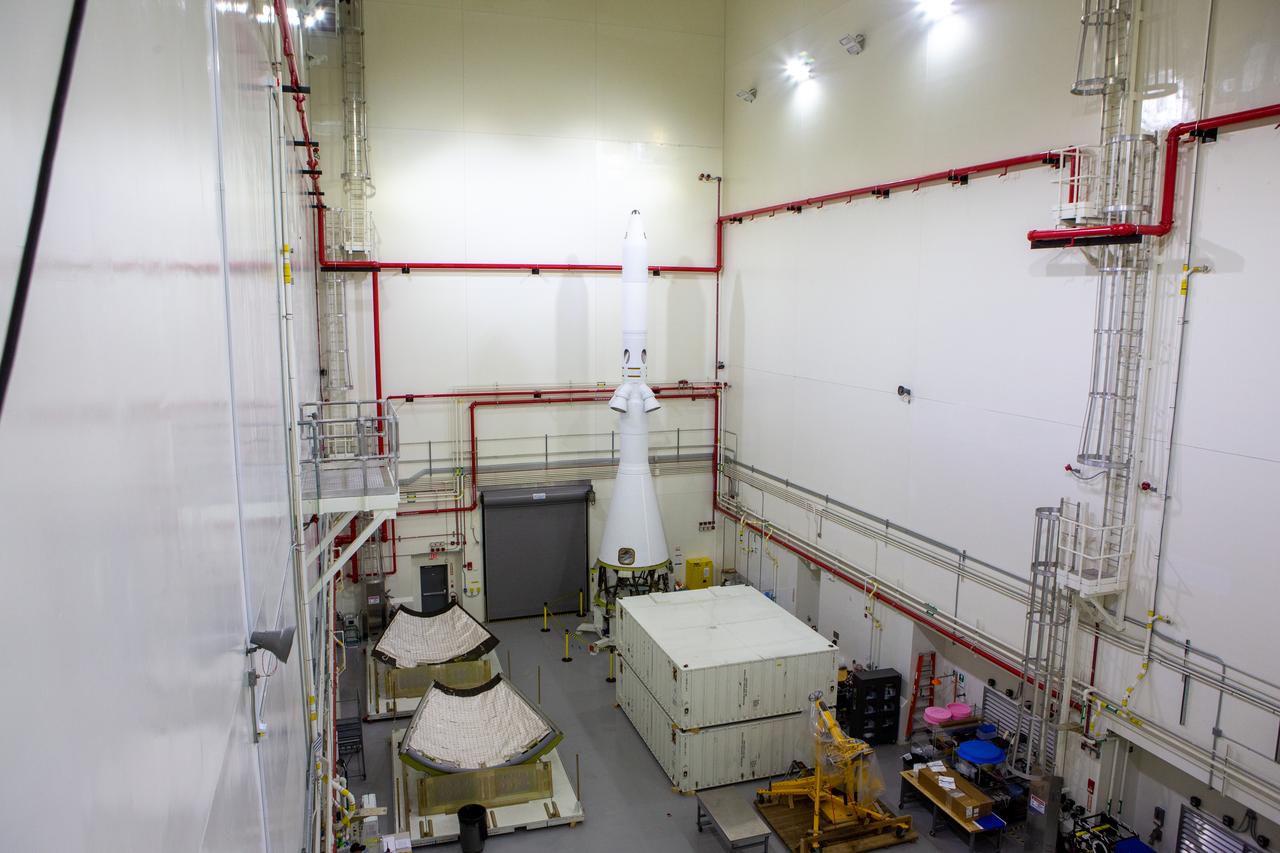
In this view from above inside the Launch Abort System Facility at NASA’s Kennedy Space Center in Florida, the Launch Abort System (LAS) for the Orion spacecraft that will launch on Artemis I, the first uncrewed mission of the Artemis series, awaits final processing with the spacecraft. The LAS was processed and prepared inside the LASF. During crewed launches of the Orion spacecraft atop the Space Launch System rocket, the LAS will protect the crew module and astronauts aboard to safety if an emergency occurs during launch.
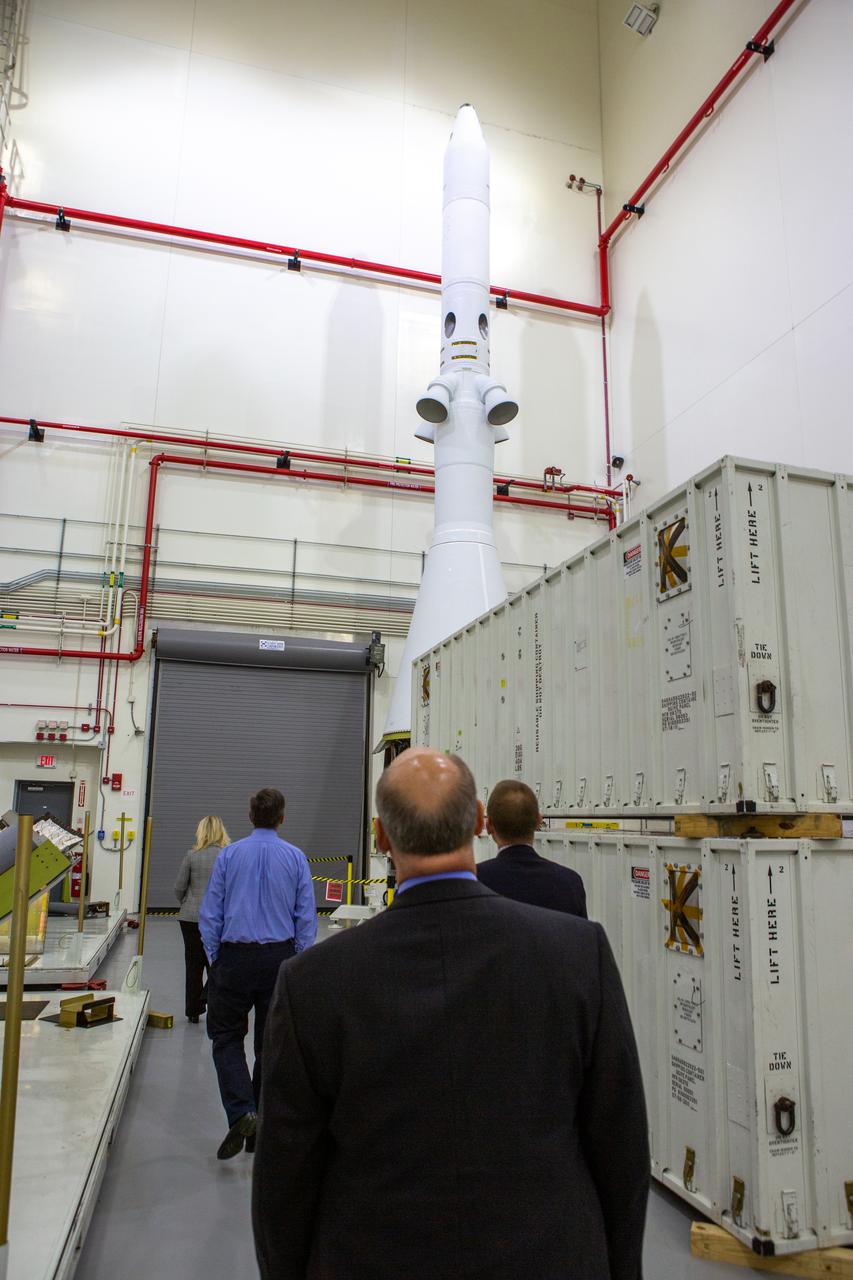
Inside the Launch Abort System Facility (LASF) at NASA’s Kennedy Space Center in Florida, the Launch Abort System (LAS) for the Orion spacecraft that will launch on Artemis I, the first of the Artemis series, awaits final processing with the spacecraft. The LAS was processed and prepared inside the LASF. During crewed launches of the Orion spacecraft atop the Space Launch System rocket, the LAS will protect the crew module and astronauts aboard to safety if an emergency occurs during launch.

The A-1 Test Stand at NASA Stennis Space Center near Bay St. Louis, Miss., was the focus of a ceremony held Thursday to transition the storied facility to a new program of work: testing the J-2X engines that will power the agency's next generation spacecraft, Ares I & V. Standing before the historic structure, with a plaque commemorating the change, are (from left) SSC Center Director Richard Gilbrech; NASA Associate Administrator for Exploration Systems Scott Horowitz; and NASA Space Operations Deputy Associate Administrator for Program Integration Michael Hawes. Ares vehicles are the crew and cargo launch vehicles being developed under NASA's Constellation Program.
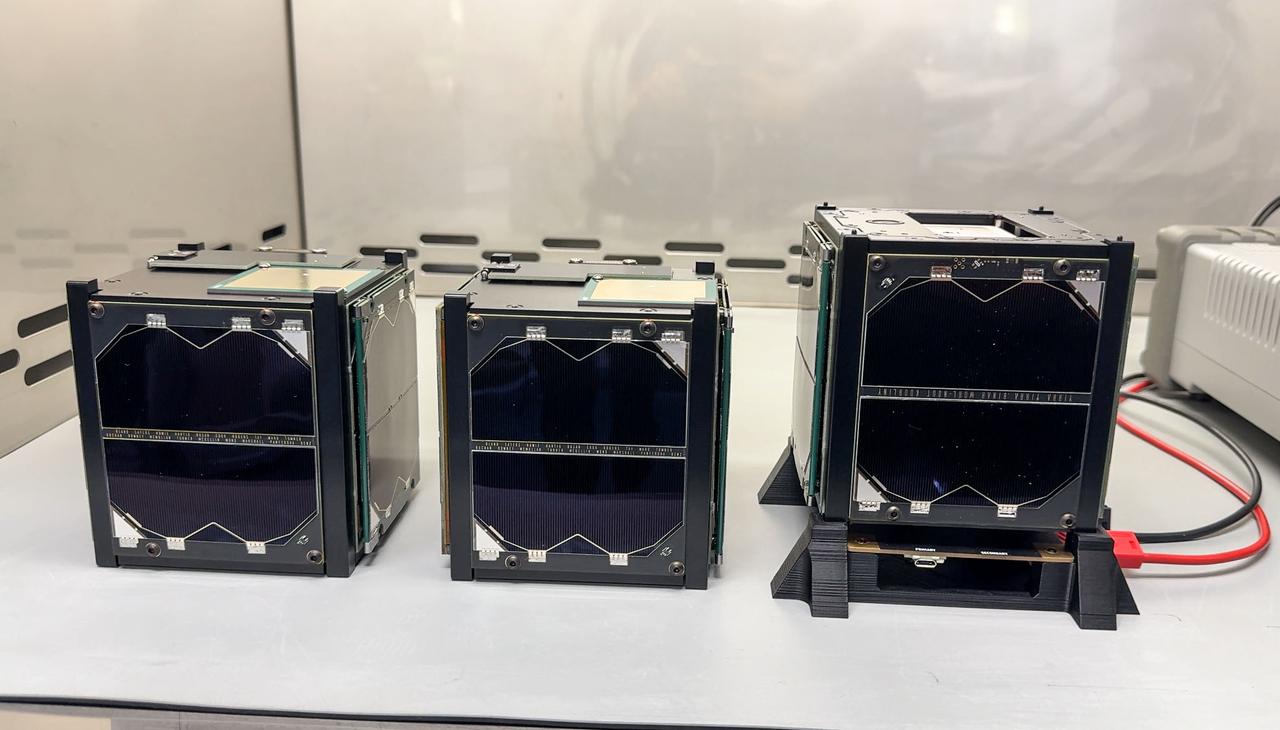
jsc2024e043918 (4/10/2024) --- Binar Space Program, Binar-2, Binar-3, Binar-4 (Binar-234) CubeSats at Curtin University are ready for launch handover to SpaceBD and the Japanese Aerospace Exploration Agency (JAXA). Binar-234 deploys on the J-SSOD 31 mission and launches on NG-21. Image courtesy of Binar Space Program.
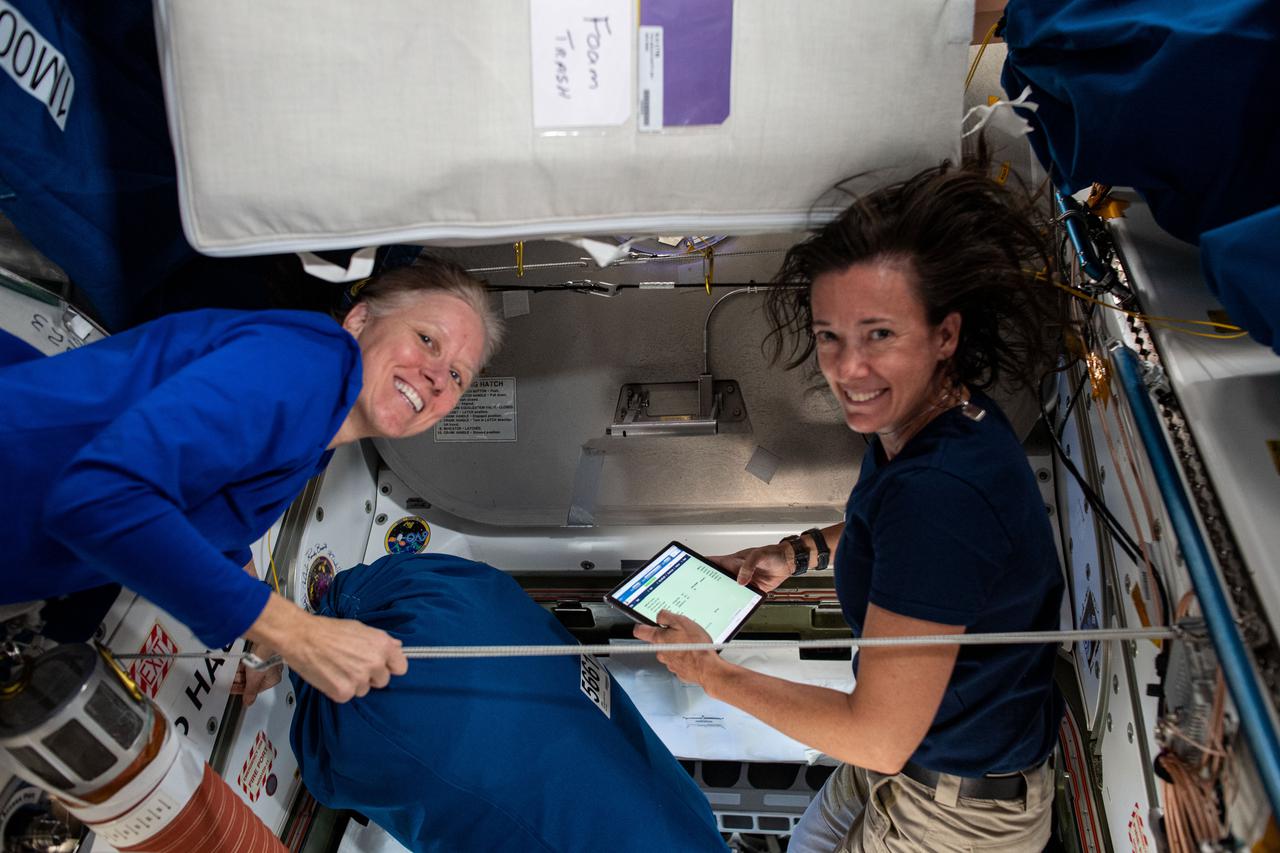
iss065e006538 (April 26, 2021) --- Expedition 65 Flight Engineers Shannon Walker and Megan McArthur, both NASA astronauts, are pictured during crew handover activities aboard the International Space Station. Walker was preparing for her departure with her SpaceX Crew-1 crewmates and helping McArthur, a Crew-2 Pilot, get up to speed with station systems.

jsc2024e050834 (7/26/2024) --- Screaming Balloon hex nuts, pennies and balloons in their individual ziplock stowage bags prior to hardware handover. Developed through NASA’s Office of STEM Engagement Next Gen STEM Project, STEMonstrations are short educational videos demonstrating science, technology, engineering, and mathematics (STEM) topics in microgravity for grades K through 12. STEMonstrations: Screaming Balloon examines centripetal force, whirling a penny and a hexnut inside of inflated balloons and comparing the sounds they make.
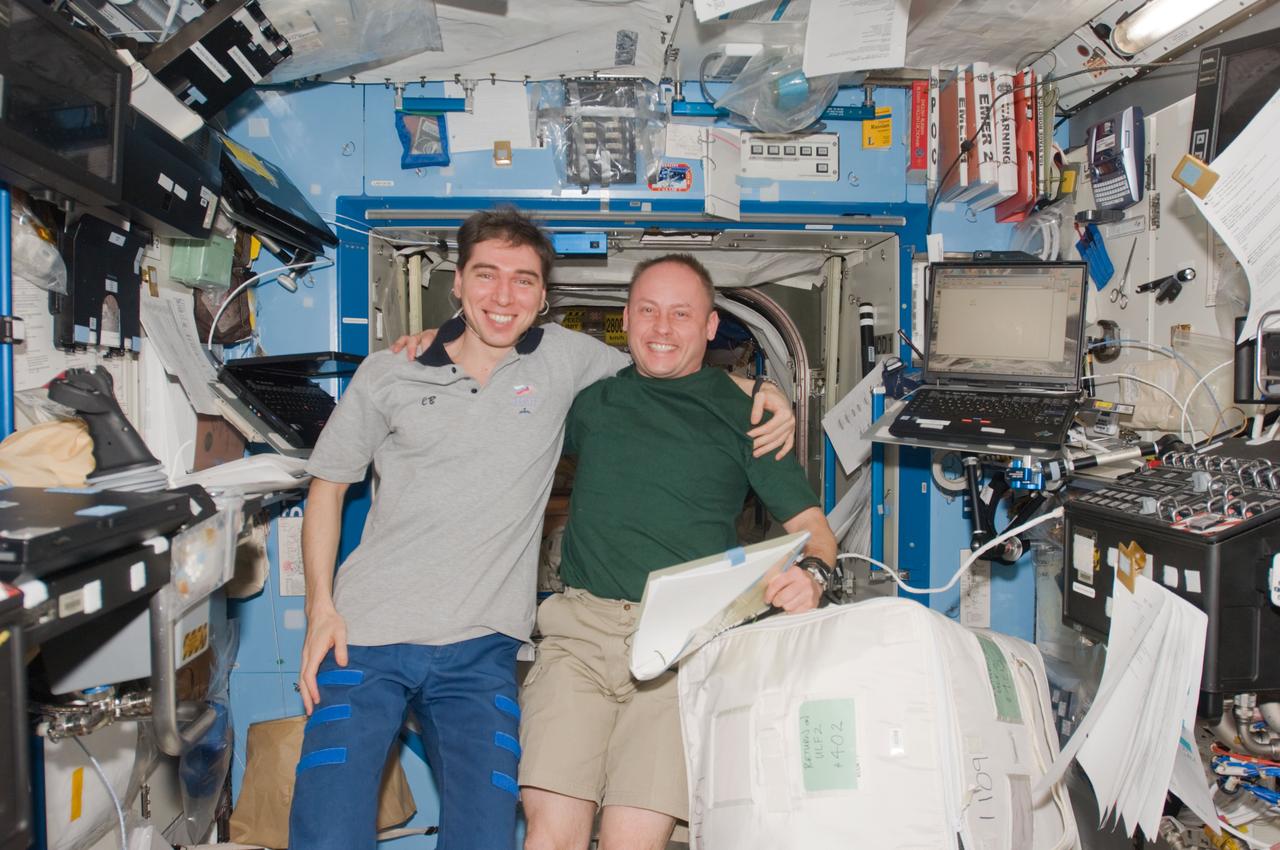
ISS017-E-021295 (16 Oct. 2008) --- Cosmonaut Sergei Volkov (left), Expedition 17 commander, and astronaut Michael Fincke, Expedition 18 commander, take a moment for a photo in the Destiny laboratory of the International Space Station during handover operations between the newly arrived Expedition 18 crew and the off-going Expedition 17 crew.
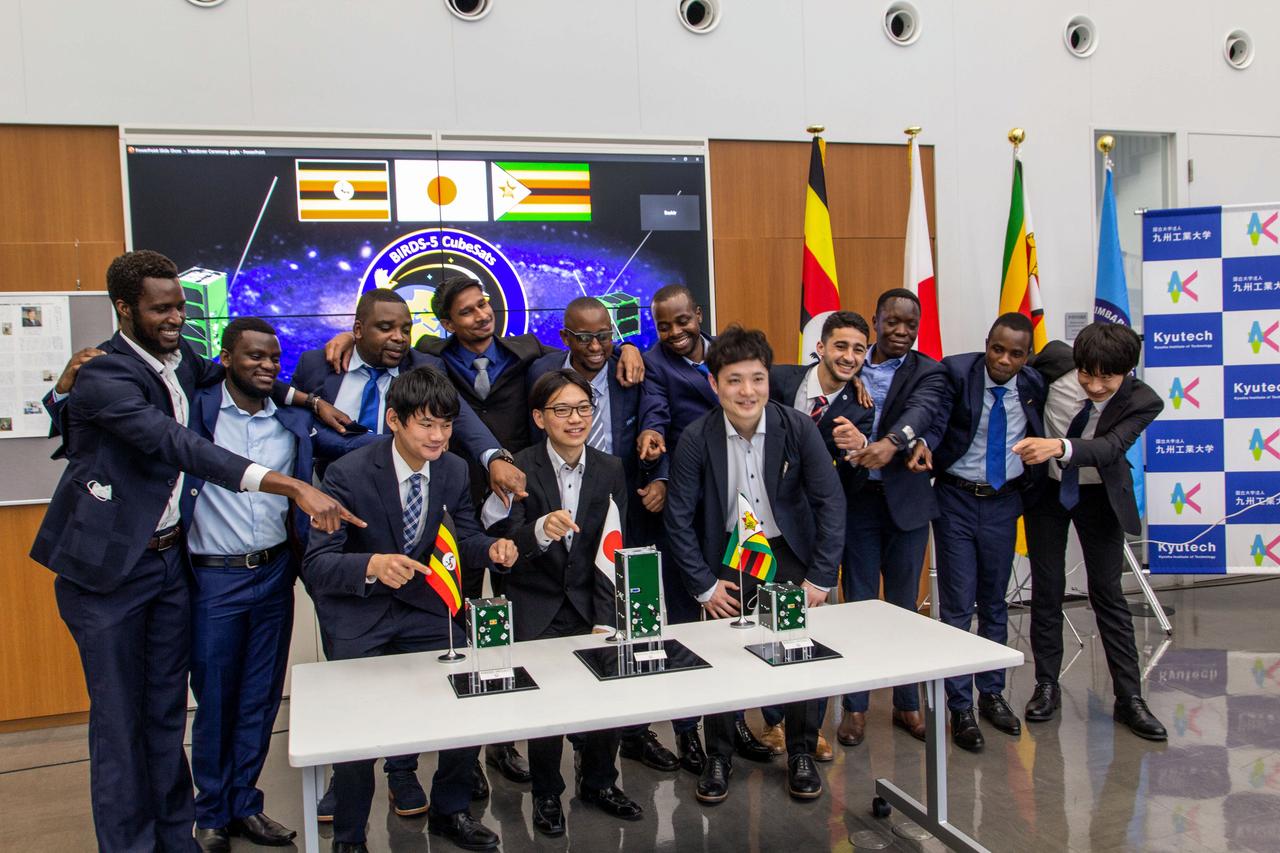
9/10//2020) --- The multi-national BIRDS-5 teams stand next to their CubeSats at the BIRDS-5 handover ceremony. Since 2015, the Japanese Kyushu Institute of Technology has been carrying out the BIRDS program with the goal of fostering a long-term and sustainable space organization in participating nations. BIRDS-5 is a constellation of CubeSats developed by Uganda, Zimbabwe, and Japan that will be deployed from the space station. Image courtesy of BIRDS-5.
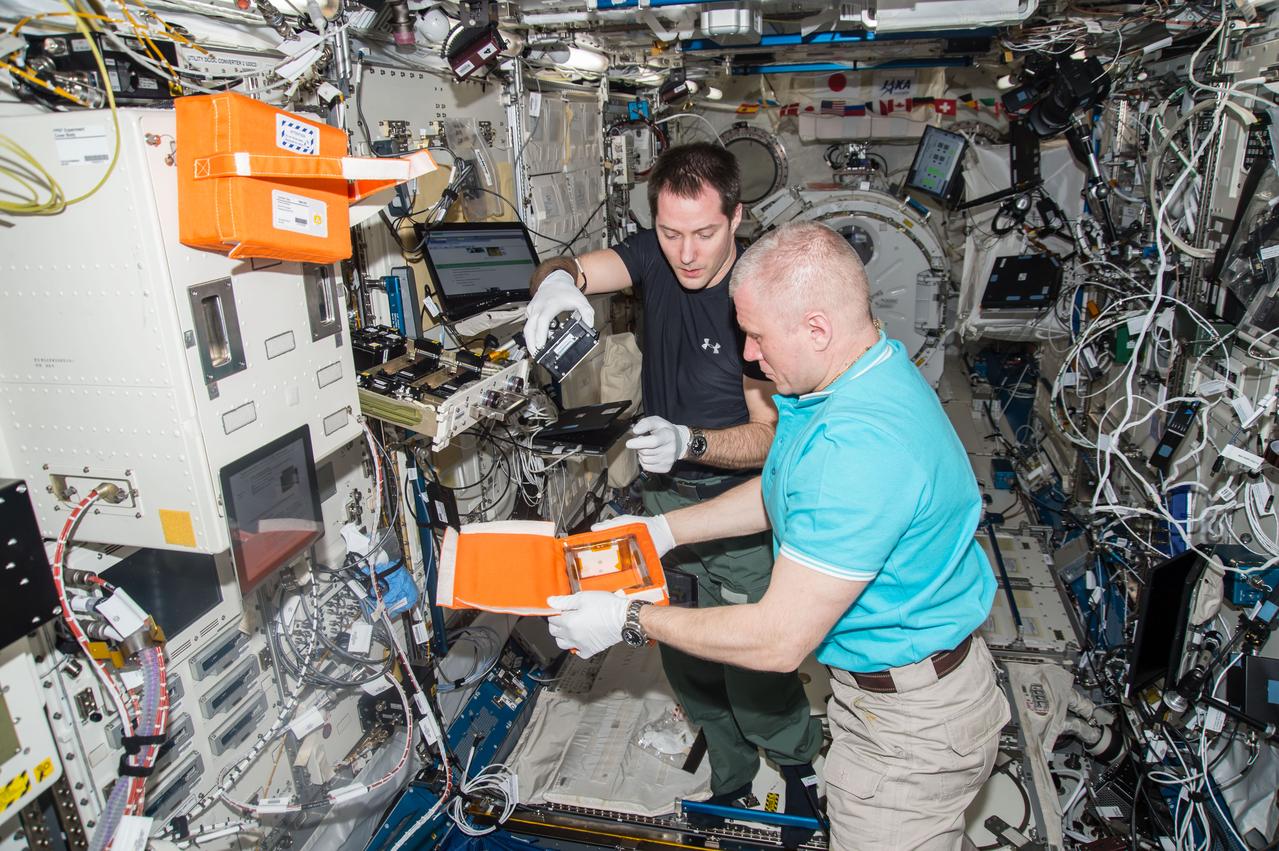
iss051e052364 (6/2/2017) --- European Space Agency (ESA) astronaut Thomas Pesquet works to remove Canisters from the Protein Crystallization Research Facility (PCRF) for handover to cosmonaut Oleg Novitskiy. The image was taken in the Kibo Japanese Experiment Pressurized Module (JPM) during Japan Aerospace Exploration Agency (JAXA) Protein Crystal Growth (PCG) and Kristallizator experiment operations (OPS).
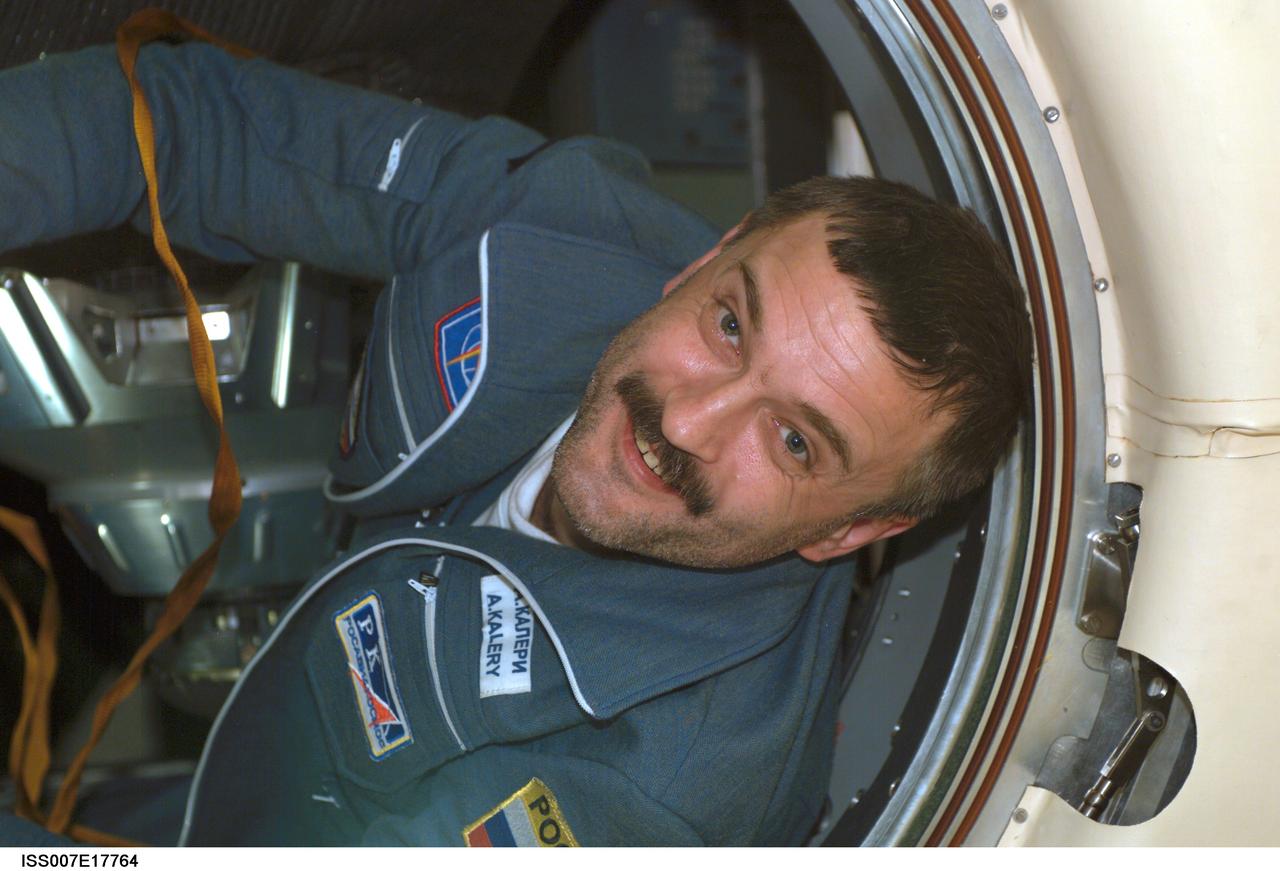
ISS007-E-17764 (20 October 2003) --- Two days after launching from Kazakhstan, Russian cosmonaut Alexander Kaleri, flight engineer and Soyuz commander representing Rosaviakosmos, arrives onboard the International Space Station. Kaleri and astronaut C. Michael Foale, American commander and NASA ISS science officer, proceeded to begin over a week's worth of handover activities with the Expedition 7 crewmembers in order to familiarize themselves with Station systems and procedures.
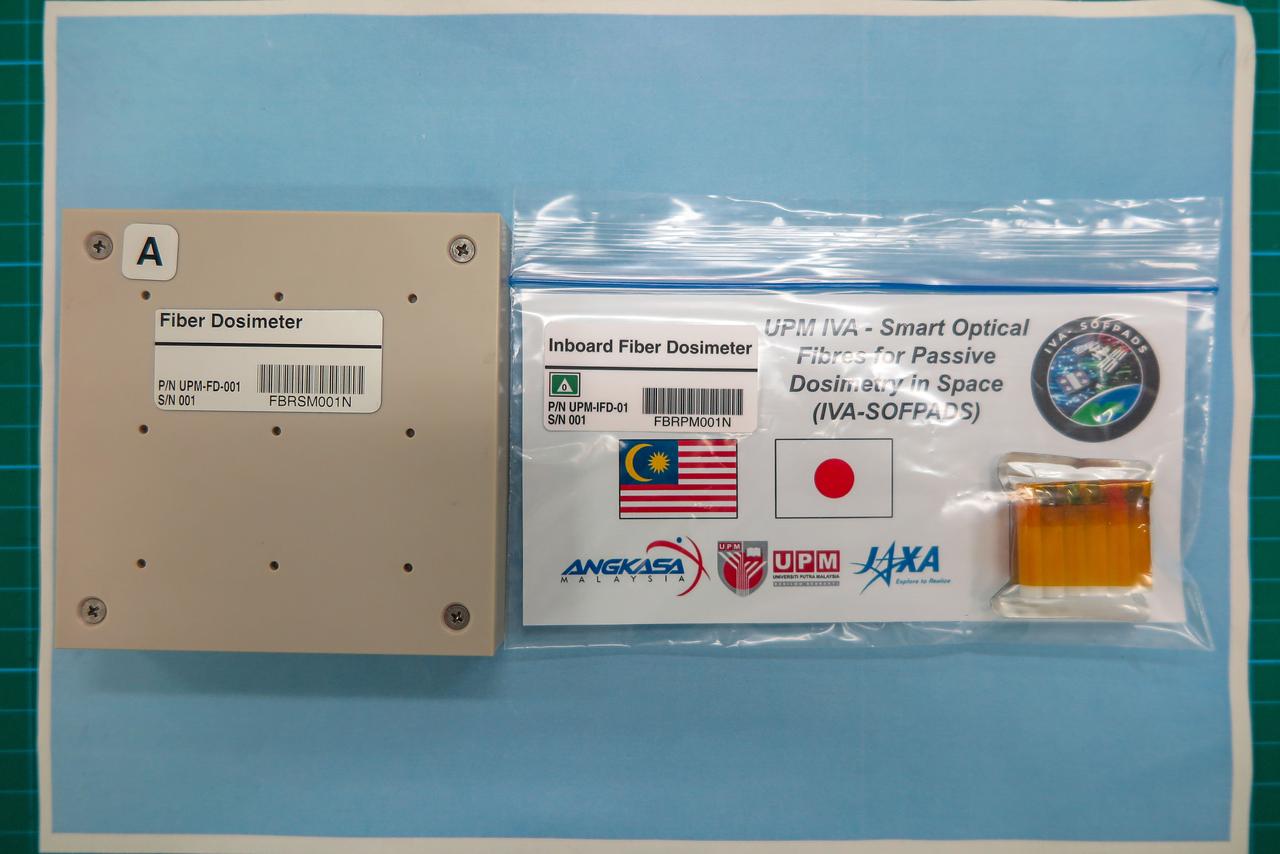
jsc2020e040980 (11/2/2018) --- Image of EVA-SOFPADS (Left) and IVA-SOFPADS (Right) taken at JAXA during samples handover. The objective of the Smart Optical Fibers for Passive Dosimetry in Space (SOFPADS), or Fiber Dosimeter, investigation is to evaluate the use of fabricated optical fibers as space radiation passive dosimeters to monitor the radiation environment inside and outside of the International Space Station (ISS). Image Credit: JAXA

jsc2026e034371 (April 28, 2026) --- Preflight image of TIGERS-X experiment payload cube during delivery and final handover at ICE Cubes Service facility with all identification barcode and decal applied. This investigation tests a mixer in a space environment aboard the International Space Station. The mission mascot and zero-gravity indicator is also presented at the bottom left corner. Credit: Chulabhorn Royal Academy.
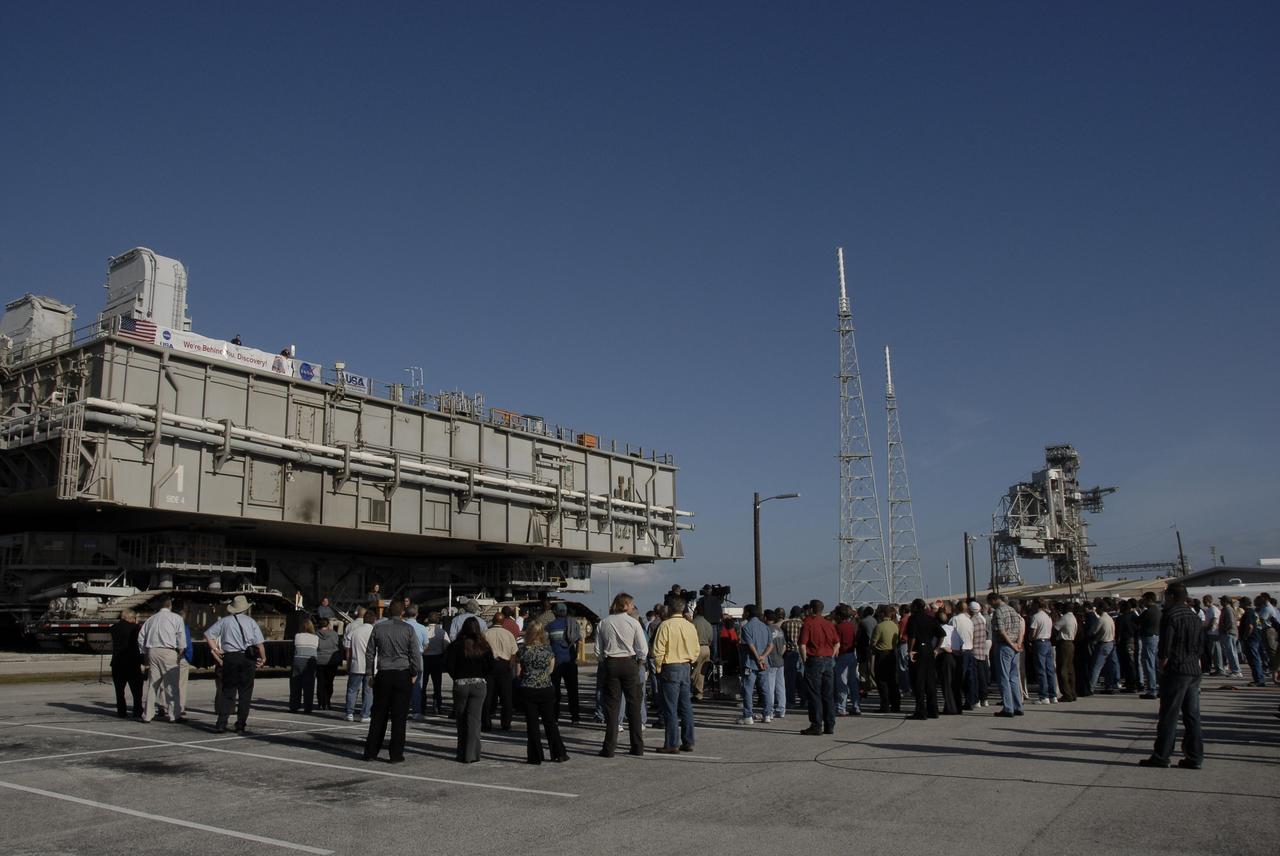
CAPE CANAVERAL, Fla. – – Employees and media gather near Launch Pad 39B at NASA's Kennedy Space Center in Florida for the handover ceremony for Mobile Launcher Platform-1, seen here. The platform is being transferred from NASA's Space Shuttle Program to the Constellation Program for the Ares I-X flight test targeted for this summer. Constructed in 1964, the mobile launchers used in Apollo/Saturn operations were modified for use in shuttle operations. With cranes, umbilical towers and swing arms removed, the mobile launchers were renamed Mobile Launcher Platforms, or MLPs. Photo credit: NASA/Kim Shiflett
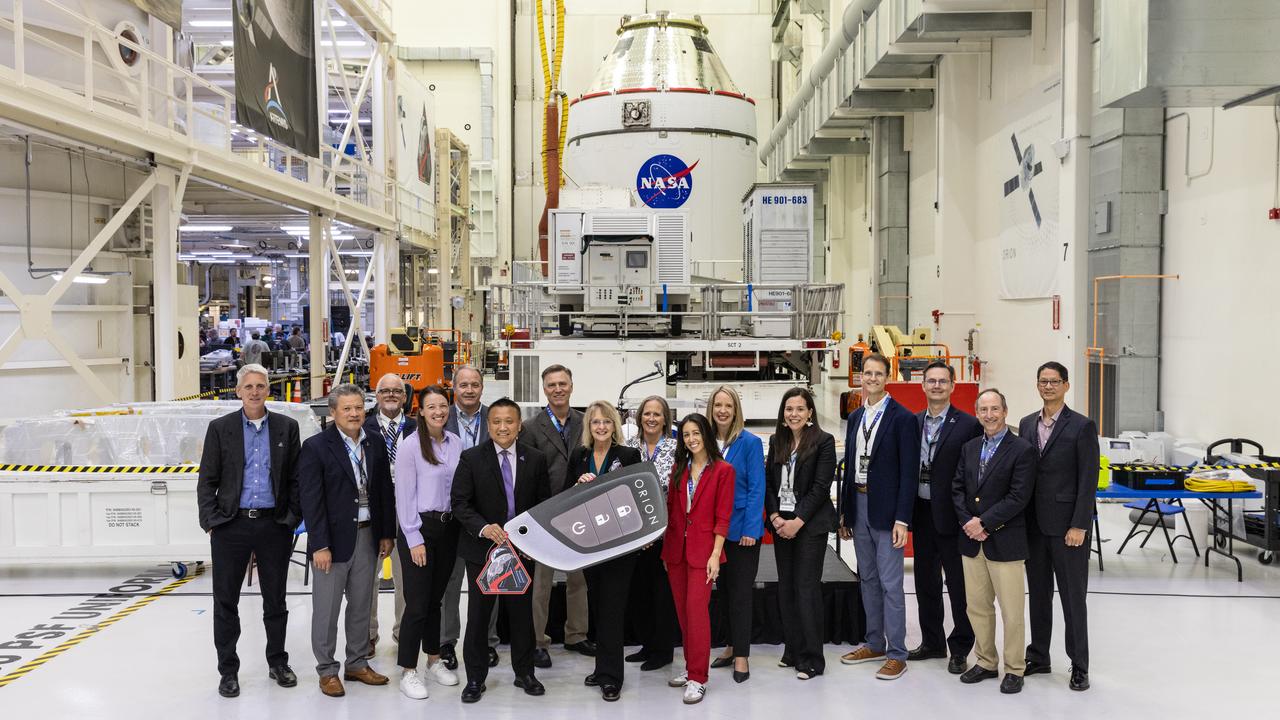
Teams with NASA’s Exploration Ground Systems, Orion, and Lockheed Martin participate in a handover ceremony of NASA’s Artemis II Orion spacecraft to crews with the agency’s Exploration Ground Systems Program at the Neil A. Armstrong Operations and Checkout Building at NASA’s Kennedy Space Center in Florida on Thursday, May 1, 2025. The spacecraft will be transported to the Multi-Payload Processing Facility to undergo fueling and processing for prelaunch operations. The Artemis II test flight is the first crewed flight under NASA’s Artemis campaign and is another step toward missions on the lunar surface and helping the agency prepare for future human missions to Mars.
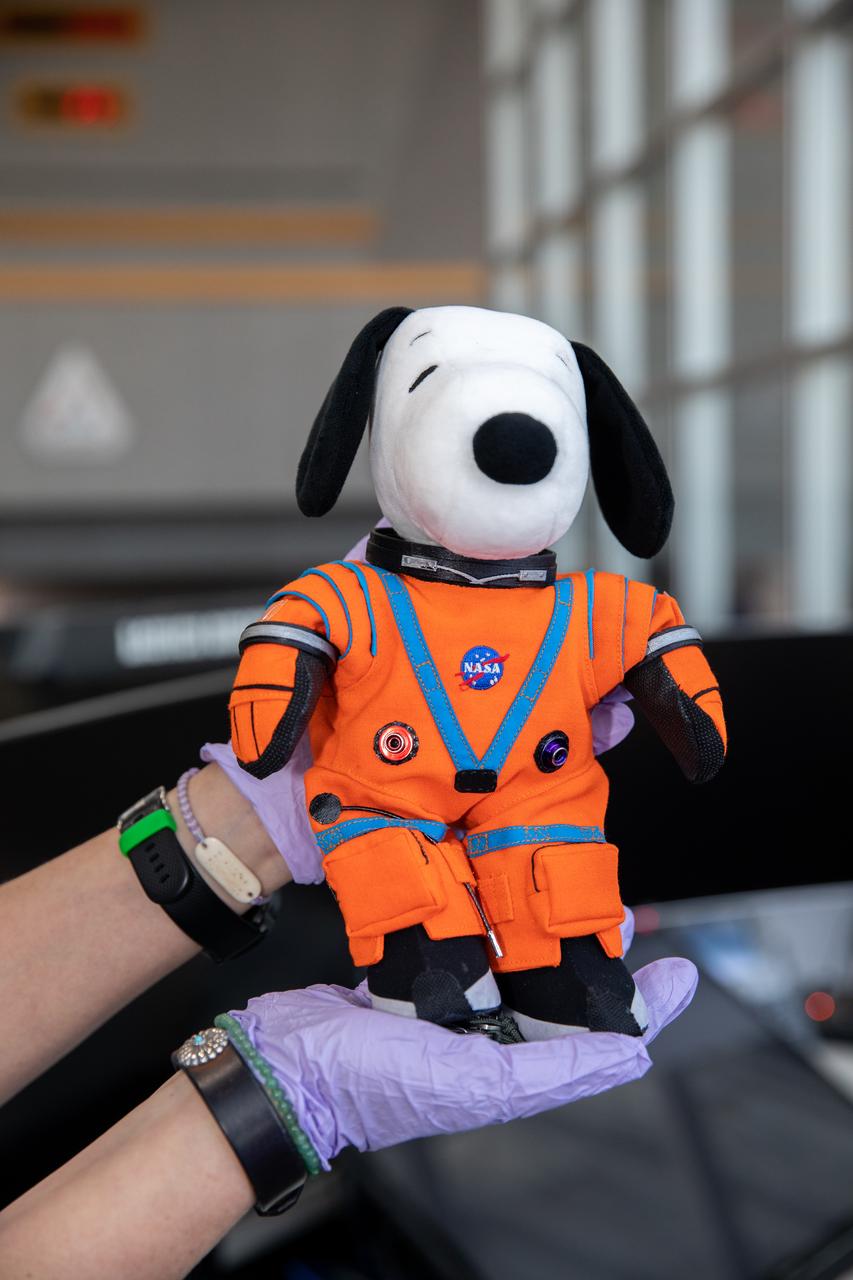
Snoopy is officially handed over to Melissa Menta, senior vice president with Peanuts Worldwide LLC, inside Launch Control Center Firing Room 1 at NASA’s Kennedy Space Center in Florida on Jan. 18, 2023. Snoopy served as the zero-gravity indicator during the Artemis I mission. Snoopy was secured inside Orion during the mission, a journey beyond the Moon and back to prepare for crewed missions to the Moon. Artemis I launched atop the Space Launch System rocket on Nov. 16, 2022 from Kennedy’s Launch Complex 39B. Orion returned to Earth for a splashdown in the Pacific Ocean on Dec. 11, 2022 after traveling more than 1.4 million miles. NASA has held an association with Snoopy since the Apollo Era – the character has contributed to the excitement for NASA human spaceflight missions, helping inspire generations to dream big, and is a symbol of NASA’s safety culture and mission success.
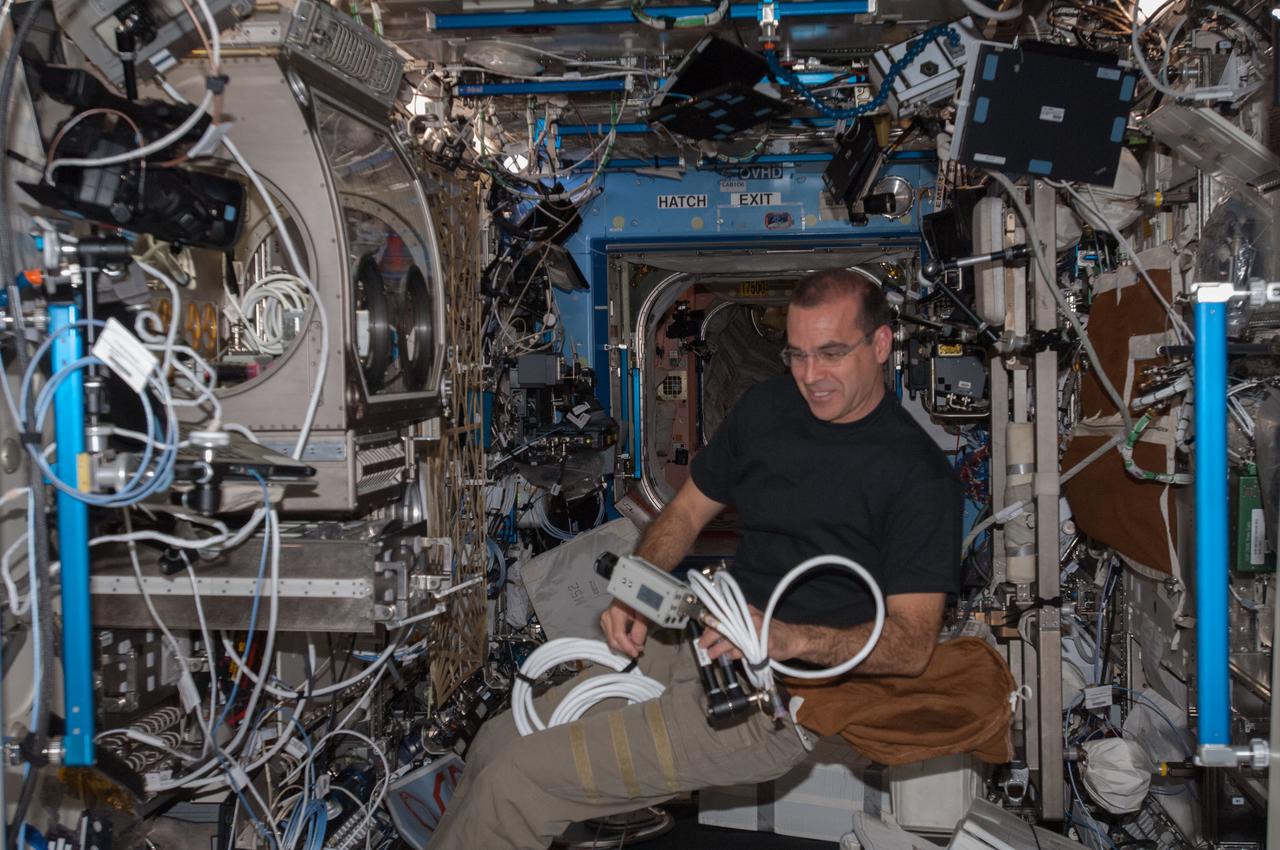
ISS038-E-000714 (13 Nov. 2013) --- NASA astronaut Rick Mastracchio, Expedition 38 flight engineer, works with equipment in the Destiny laboratory of the International Space Station.
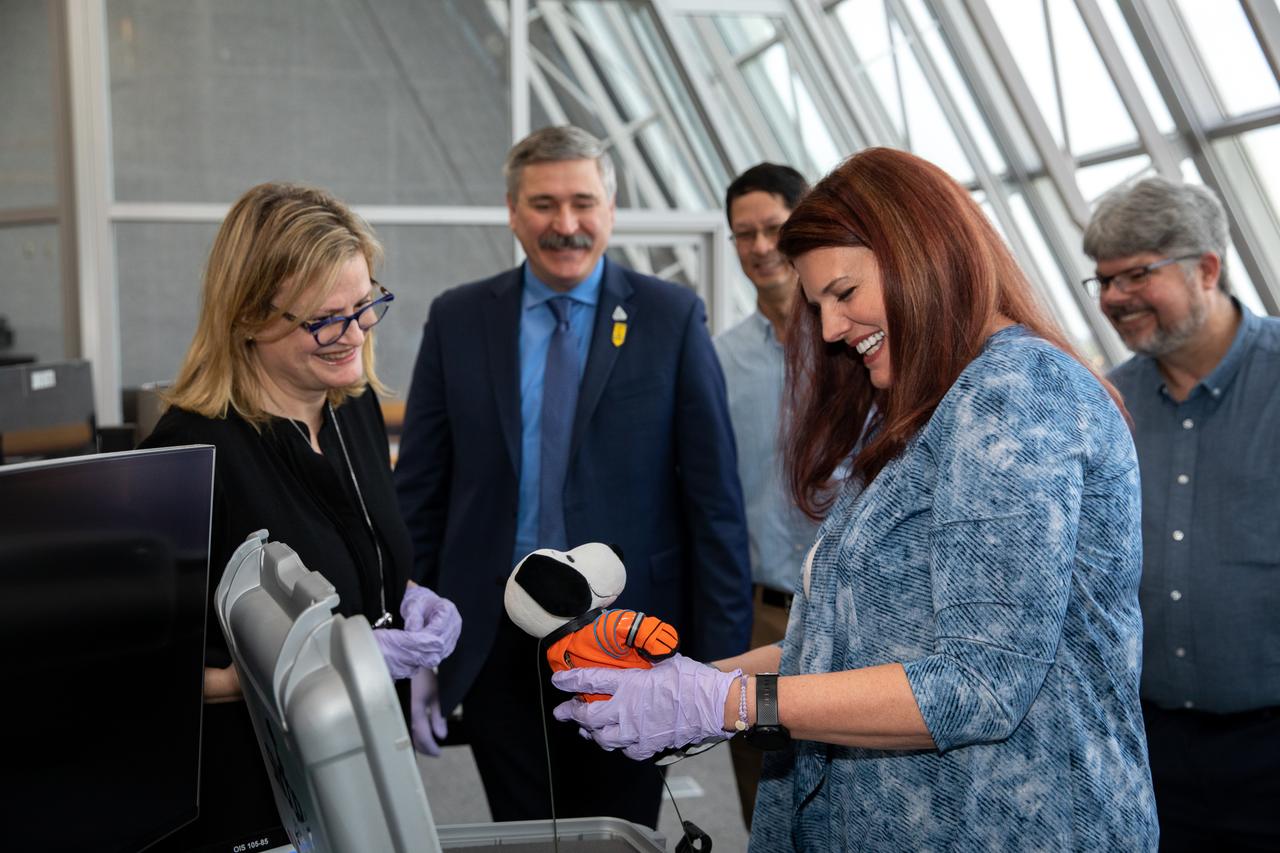
Artemis Launch Director Charlie Blackwell-Thompson, in the center, performs the official turnover of Snoopy to Melissa Menta, far left, senior vice president with Peanuts Worldwide LLC, inside Launch Control Center Firing Room 1 at NASA’s Kennedy Space Center in Florida on Jan. 18, 2023. From left, behind Charlie are Mike Sarafin, Artemis I mission manager; Glenn Chin, deputy manager, Orion Production Operations Office, Exploration Ground Systems; and Kevin Ash, payload and flight crew equipment project lead with Jacobs. Snoopy served as the zero-gravity indicator during the Artemis I mission. Snoopy was secured inside Orion during the mission, a journey beyond the Moon and back to prepare for crewed missions to the Moon. Artemis I launched atop the Space Launch System rocket on Nov. 16, 2022 from Kennedy’s Launch Complex 39B. Orion returned to Earth for a splashdown in the Pacific Ocean on Dec. 11, 2022 after traveling more than 1.4 million miles. NASA has held an association with Snoopy since the Apollo Era – the character has contributed to the excitement for NASA human spaceflight missions, helping inspire generations to dream big, and is a symbol of NASA’s safety culture and mission success.
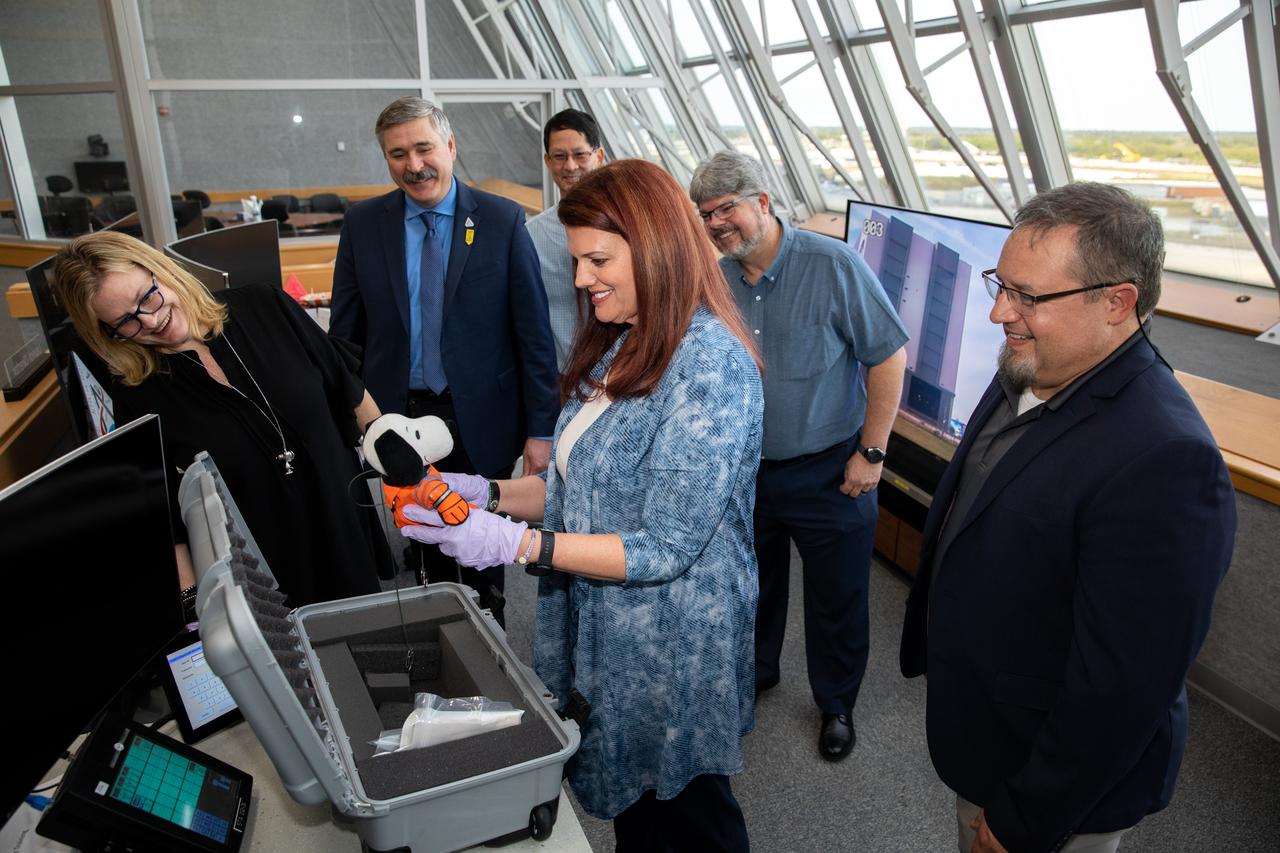
Artemis Launch Director Charlie Blackwell-Thompson, in the center, performs the official turnover of Snoopy to Melissa Menta, far left, senior vice president with Peanuts Worldwide LLC, inside Launch Control Center Firing Room 1 at NASA’s Kennedy Space Center in Florida on Jan. 18, 2023. From left, behind Charlie are Mike Sarafin, Artemis I mission manager; Glenn Chin, deputy manager, Orion Production Operations Office, Exploration Ground Systems; Kevin Ash, payload and flight crew equipment project lead with Jacobs; and Joe LeBlanc, Orion payload and cargo manager with Lockheed Martin. Snoopy served as the zero-gravity indicator during the Artemis I mission. Snoopy was secured inside Orion during the mission, a journey beyond the Moon and back to prepare for crewed missions to the Moon. Artemis I launched atop the Space Launch System rocket on Nov. 16, 2022 from Kennedy’s Launch Complex 39B. Orion returned to Earth for a splashdown in the Pacific Ocean on Dec. 11, 2022 after traveling more than 1.4 million miles. NASA has held an association with Snoopy since the Apollo Era – the character has contributed to the excitement for NASA human spaceflight missions, helping inspire generations to dream big, and is a symbol of NASA’s safety culture and mission success.
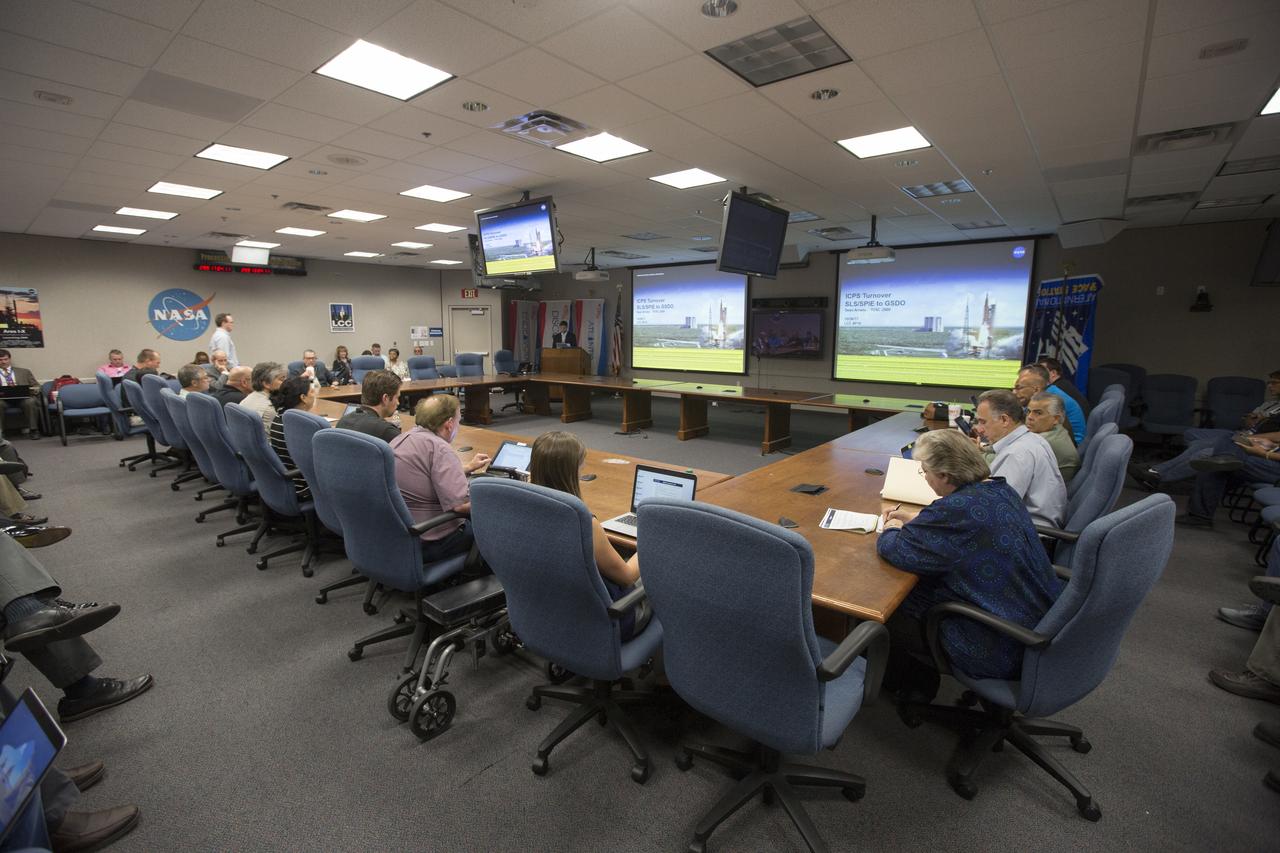
Meeting in the Launch Control Center of NASA's Kennedy Space Center in Florida, officials of the agency's Spacecraft/Payload Integration and Evolution (SPIE) organization formally turn over processing of the Space Launch System (SLS) rocket's Interim Cryogenic Propulsion Stage (ICPS) to the center's Ground Systems Development and Operations (GSDO) directorate. The ICPS is the first integrated piece of flight hardware to arrive in preparation for the uncrewed Exploration Mission-1. With the Orion attached, the ICPS sits atop the SLS rocket and will provide the spacecraft with the additional thrust needed to travel tens of thousands of miles beyond the Moon.
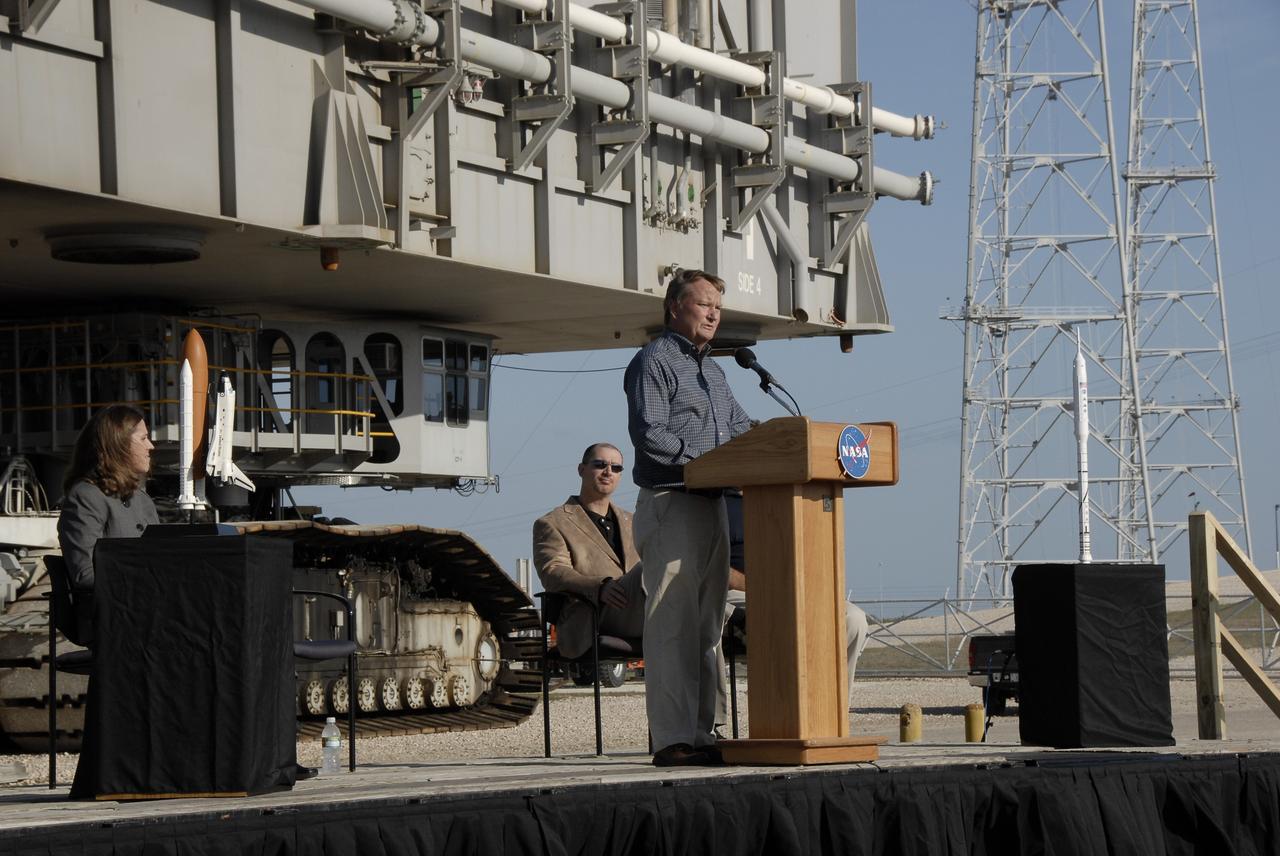
CAPE CANAVERAL, Fla. – Near Launch Pad 39B at NASA's Kennedy Space Center in Florida, Shuttle Launch Director Mike Leinbach speaks to the employees and media during the handover ceremony for Mobile Launcher Platform-1. The platform is being transferred from NASA's Space Shuttle Program to the Constellation Program for the Ares I-X flight test targeted for this summer. Also participating in the ceremony are (left) Rita Willcoxon, director of Launch Vehicle Processing at Kennedy, (right) Pepper E. Phillips, director of the Constellation Project Office, and (not visible) Brett Raulerson, manager of MLP Operations with United Space Alliance. Constructed in 1964, the mobile launchers used in Apollo/Saturn operations were modified for use in shuttle operations. With cranes, umbilical towers and swing arms removed, the mobile launchers were renamed Mobile Launcher Platforms, or MLPs. Photo credit: NASA/Kim Shiflett
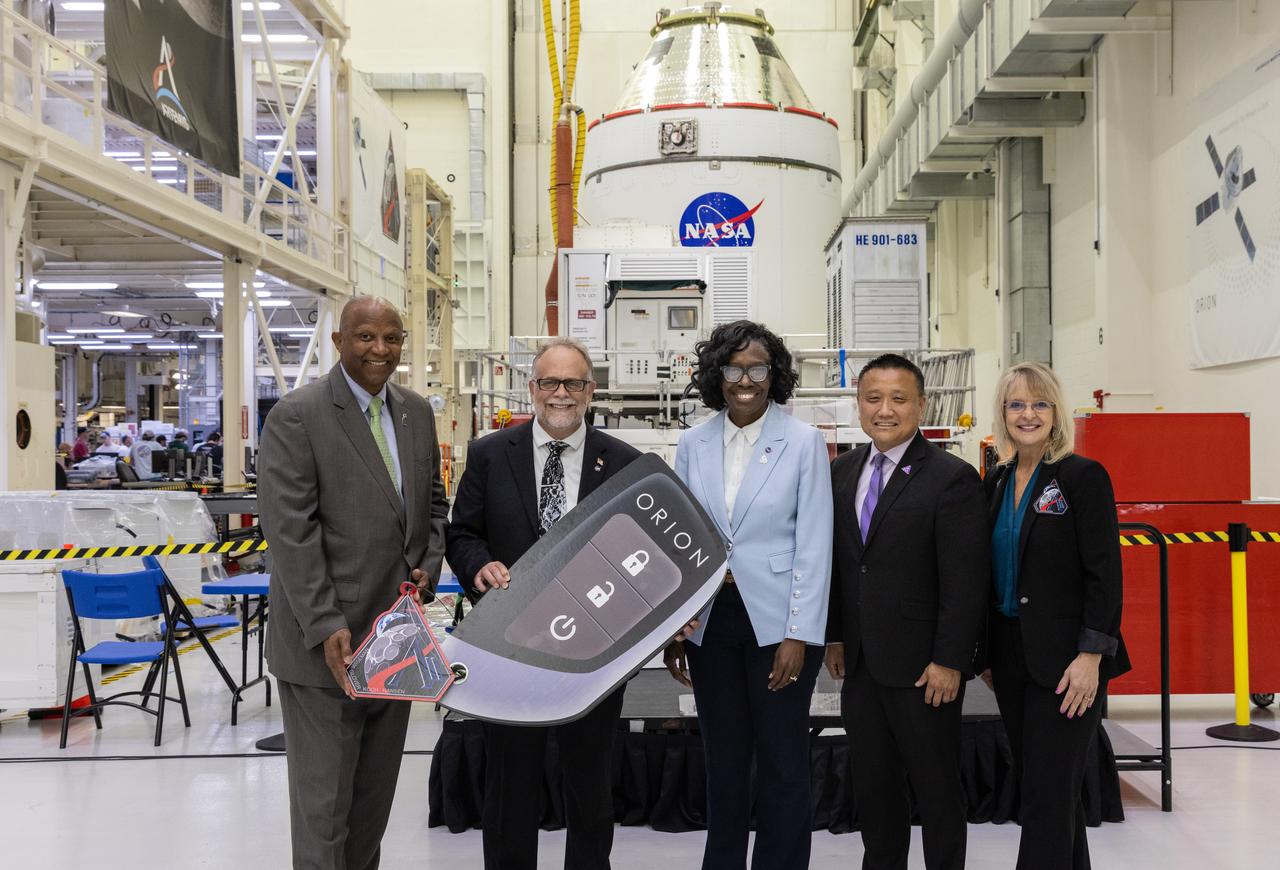
From left, Kelvin Manning, acting center director, NASA’s Kennedy Space Center; Shawn Quinn, Exploration Ground Systems program manager; Lakiesha Hawkins, assistant deputy associate administrator, Moon to Mars Program office; Howard Hu, Orion program manager; Debbie Korth, Orion deputy program manager, participate in a handover ceremony of NASA’s Artemis II Orion spacecraft to crews with the agency’s Exploration Ground Systems Program at the Neil A. Armstrong Operations and Checkout Building at NASA’s Kennedy Space Center in Florida on Thursday, May 1, 2025. The spacecraft will be transported to the Multi-Payload Processing Facility to undergo fueling and processing for prelaunch operations. The Artemis II test flight is the first crewed flight under NASA’s Artemis campaign and is another step toward missions on the lunar surface and helping the agency prepare for future human missions to Mars.
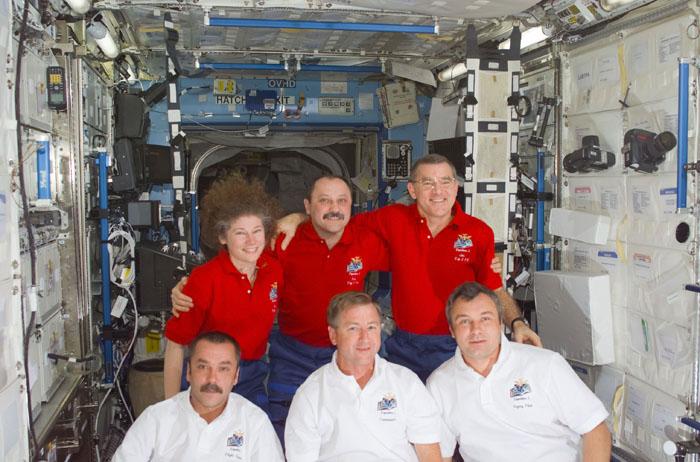
STS105-E-5334 (17 August 2001) --- The Expedition Two (back row) and Expedition Three crews participate in a press conference in the U.S. Laboratory. In less than 48 hours, the Expedition Two crew will hold the final handover ceremony with the newly arrived Expedition Three crew. The Expedition Two crewmembers are, from left to right, Susan J. Helms, flight engineer, cosmonaut Yury V. Usachev, mission commander, and James S. Voss, flight engineer. The Expedition Three crewmembers are, from left to right, cosmonaut Mikhail Tyurin, flight engineer, Frank L. Culbertson, Jr., mission commander, and cosmonaut Vladimir N. Dezhurov, flight engineer. This image was taken with a digital still camera.
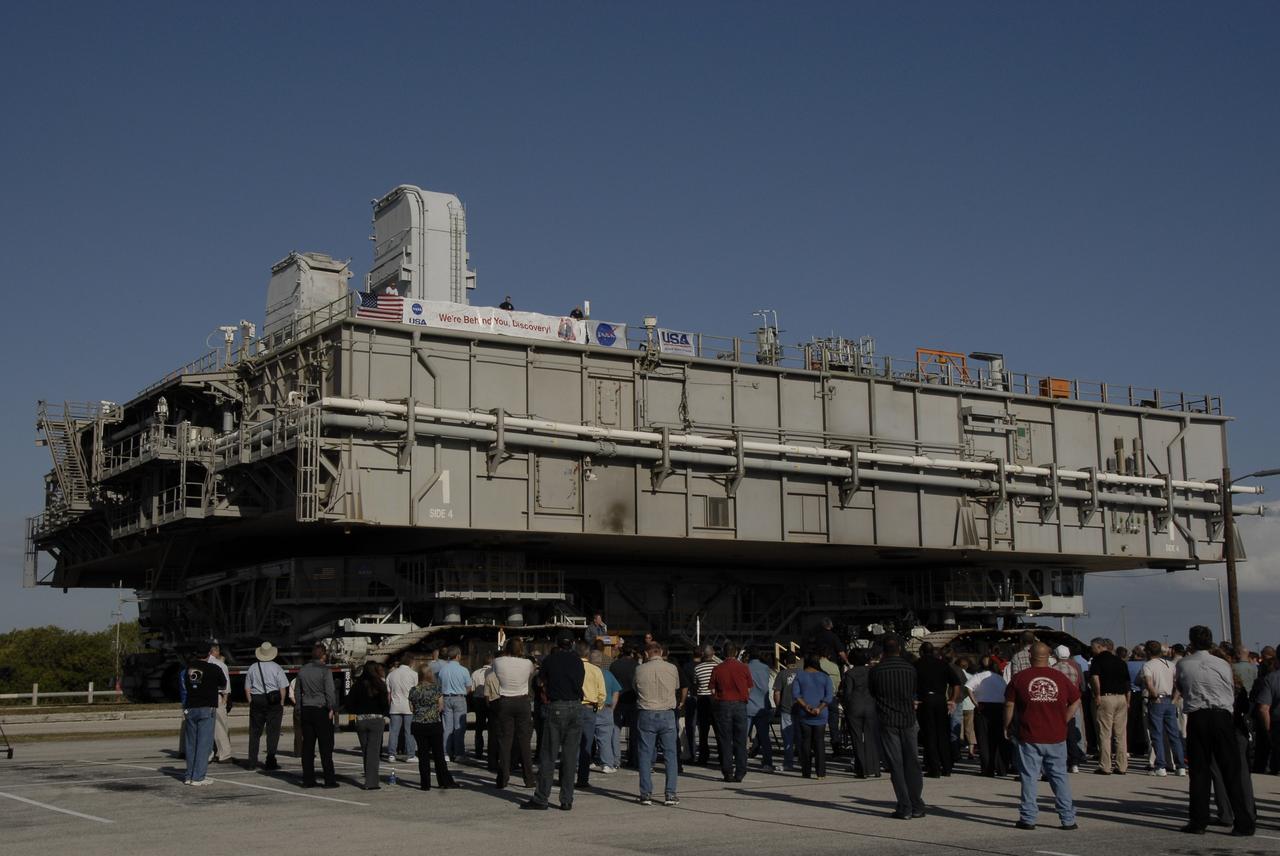
CAPE CANAVERAL, Fla. – Near Launch Pad 39B at NASA's Kennedy Space Center in Florida, employees and media gather listen to Shuttle Launch Director Mike Leinbach during the handover ceremony for Mobile Launcher Platform-1. The platform is being transferred from NASA's Space Shuttle Program to the Constellation Program for the Ares I-X flight test targeted for this summer. Also participating in the ceremony are Rita Willcoxon, director of Launch Vehicle Processing at Kennedy, Pepper E. Phillips, director of the Constellation Project Office, and Brett Raulerson, manager of MLP Operations with United Space Alliance. Constructed in 1964, the mobile launchers used in Apollo/Saturn operations were modified for use in shuttle operations. With cranes, umbilical towers and swing arms removed, the mobile launchers were renamed Mobile Launcher Platforms, or MLPs. Photo credit: NASA/Kim Shiflett
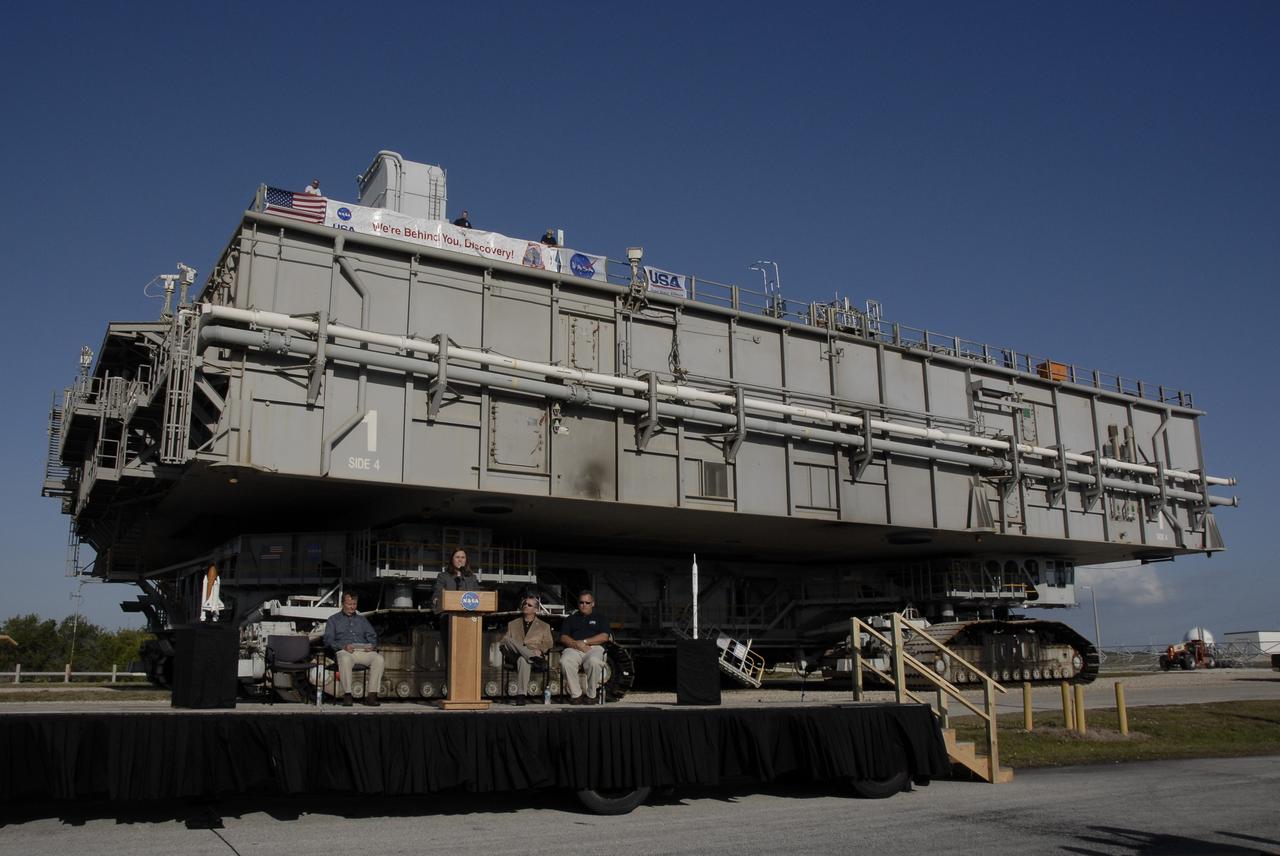
CAPE CANAVERAL, Fla. – NASA's Kennedy Space Center management host a ceremony near Launch Pad 39B to mark the handover of Mobile Launcher Platform-1 (behind them) from NASA's Space Shuttle Program to the Constellation Program for the Ares I-X flight test targeted for this summer. Seated are (left) Shuttle Launch Director Mike Leinbach and (right) Pepper E. Phillips, director of the Constellation Project Office, and Brett Raulerson, manager of MLP Operations with United Space Alliance. At the podium is Rita Willcoxon, director of Launch Vehicle Processing at Kennedy. Constructed in 1964, the mobile launchers used in Apollo/Saturn operations were modified for use in shuttle operations. With cranes, umbilical towers and swing arms removed, the mobile launchers were renamed Mobile Launcher Platforms, or MLPs. Photo credit: NASA/Kim Shiflett
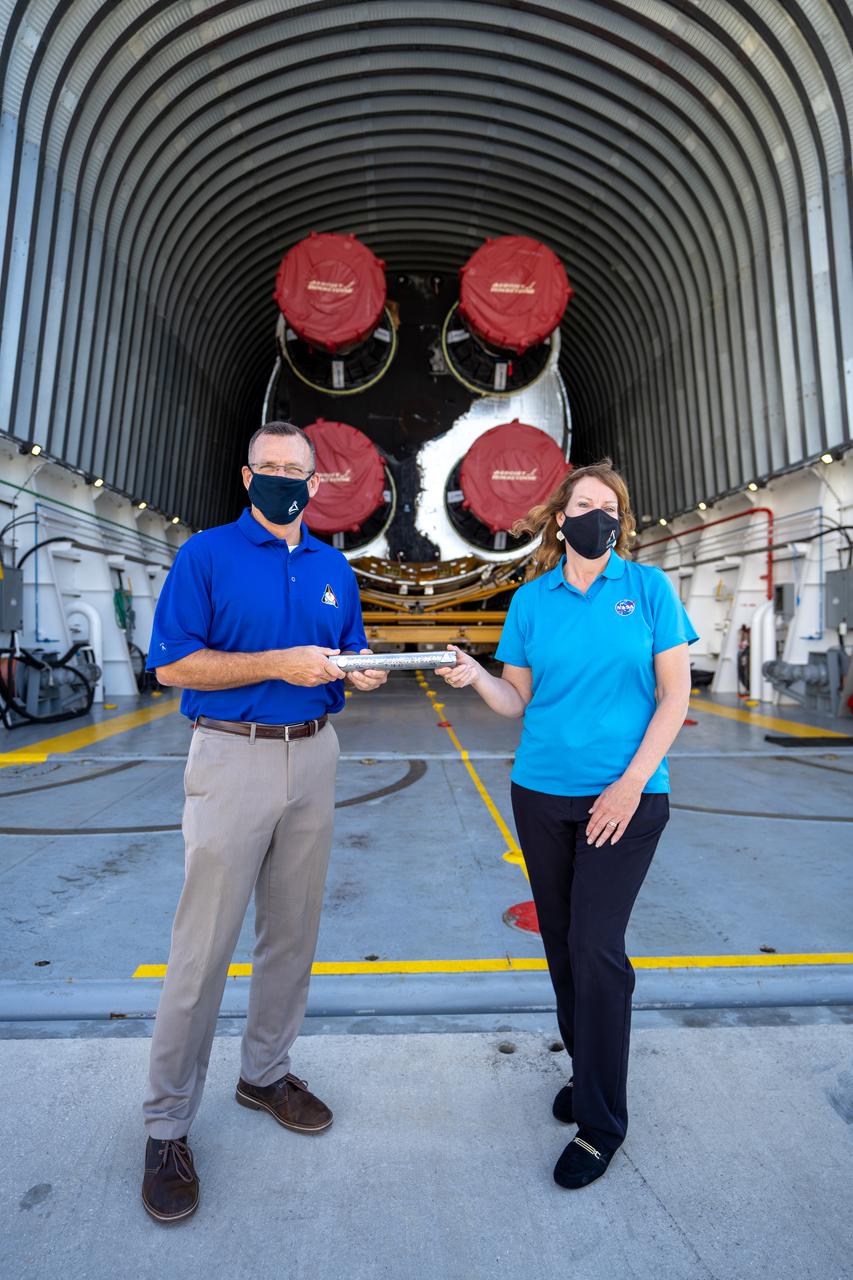
Space Launch System (SLS) Stages Manager Julie Bassler, right, celebrates the arrival of the SLS core stage by symbolically “passing the baton” to Exploration Ground Systems’ (EGS) Senior Vehicle Operations Manager Cliff Lanham on April 28, 2021, at NASA’s Kennedy Space Center in Florida. Journeying from the agency’s Stennis Space Center in Mississippi aboard the Pegasus barge, the core stage arrived at the Florida spaceport on April 27 to be processed for flight by EGS. It is the final piece of Artemis hardware to arrive at Kennedy and will be offloaded and moved to the Vehicle Assembly Building, where it will be prepared for integration atop the mobile launcher with the completed stack of solid rocket boosters ahead of the Artemis I launch. The first in a series of increasingly complex missions, Artemis I will test SLS and Orion as an integrated system prior to crewed flights to the Moon.
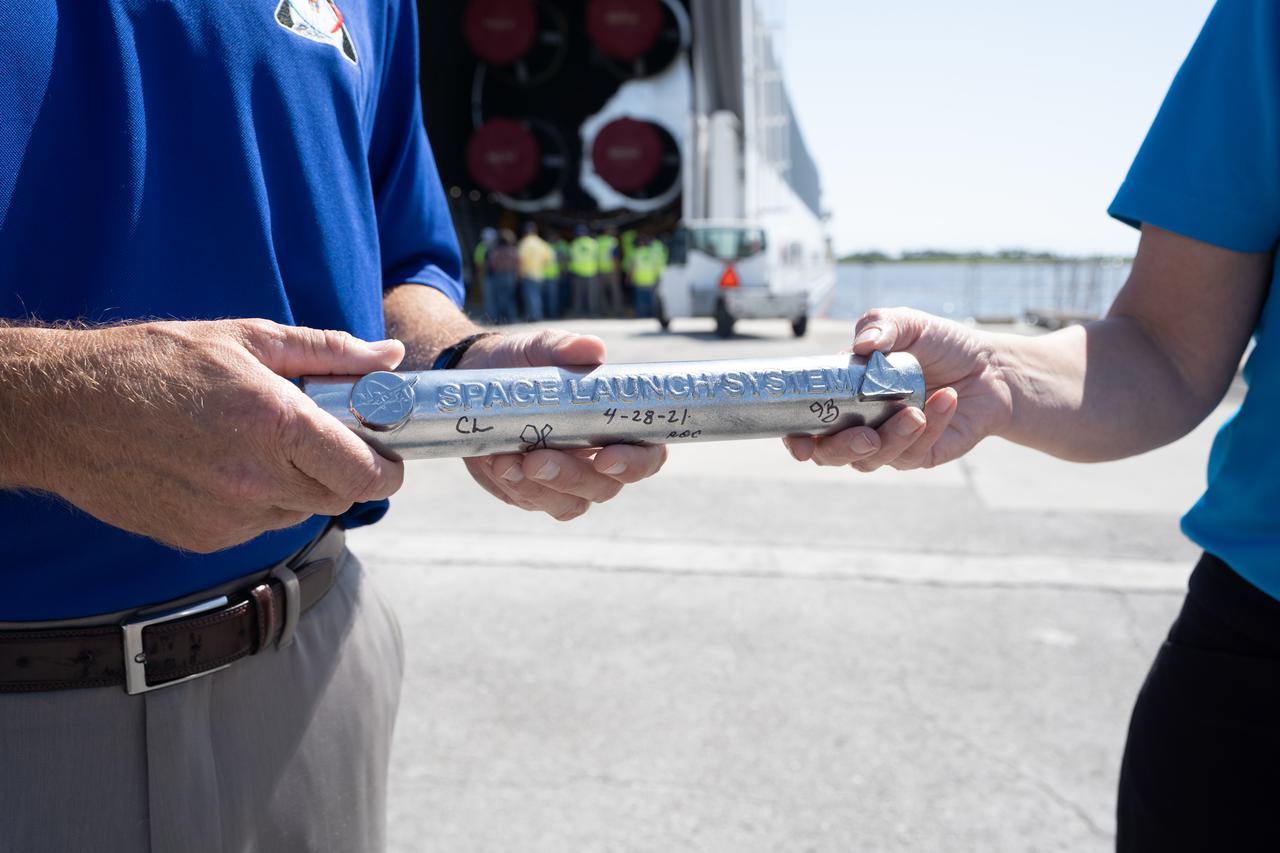
The Space Launch System (SLS) program heralds the arrival of the SLS core stage with a symbolic “passing of the baton” to NASA’s Exploration Ground Systems (EGS) on April 28, 2021, at the agency’s Kennedy Space Center in Florida, marking the transition into final preparations for flight. Journeying from NASA’s Stennis Space Center in Mississippi aboard the Pegasus barge, the core stage arrived at the Florida spaceport on April 27. It is the final piece of Artemis hardware to arrive at Kennedy and will be offloaded and moved to the Vehicle Assembly Building, where it will be prepared for integration atop the mobile launcher with the completed stack of solid rocket boosters ahead of the Artemis I launch. The first in a series of increasingly complex missions, Artemis I will test SLS and Orion as an integrated system prior to crewed flights to the Moon.
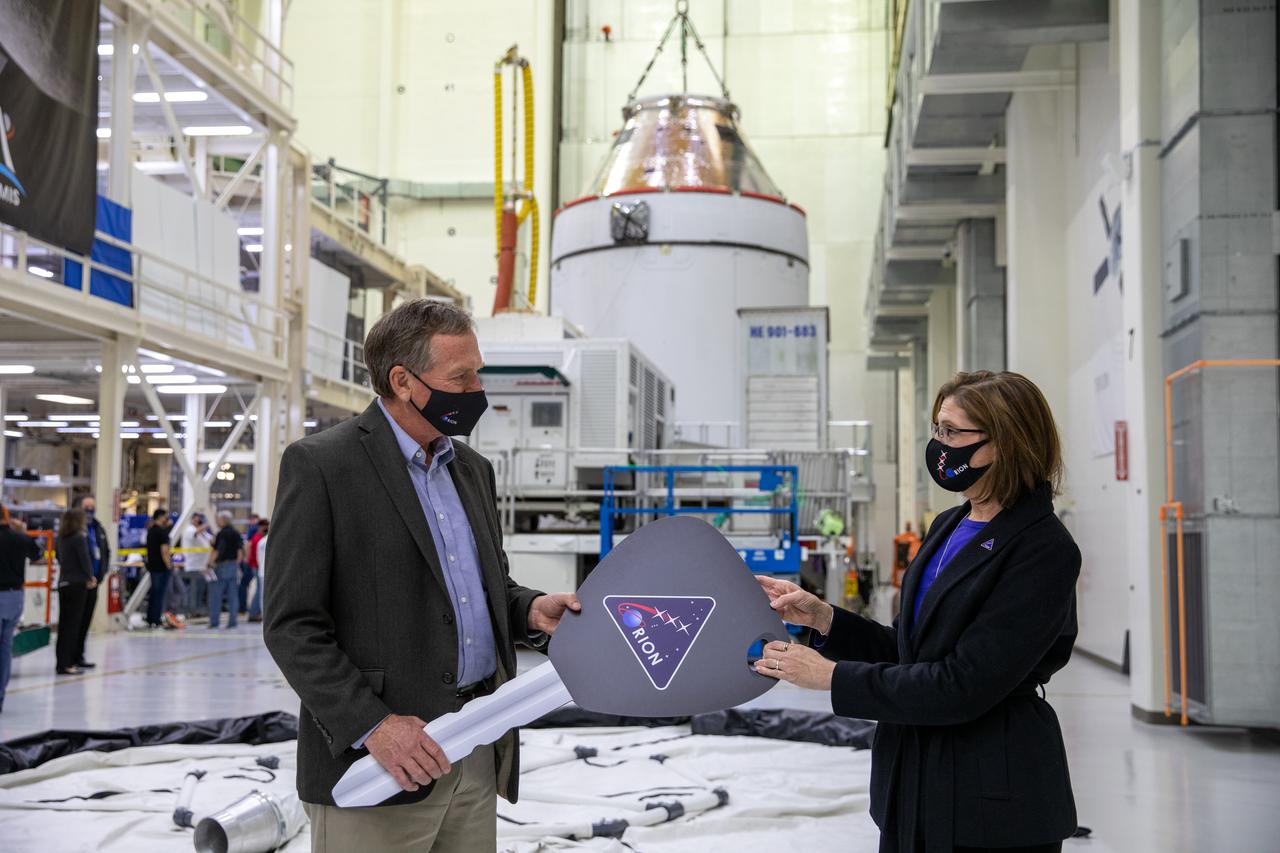
Orion is revealed for one of the final times on Jan. 14, as it is readied atop its transport pallet from the Neil Armstrong Operations and Checkout Building at NASA’s Kennedy Space Center in Florida, along its path to the pad ahead of the Artemis I launch. Mike Bolger, at left, manager of Exploration Ground Systems (EGS), receives the “key” to Orion from Cathy Koerner, Orion Program manager signifying the transfer of the spacecraft from the assembly to the ground system processing team. Teams across the globe have worked tirelessly to assemble the spacecraft, which will receive a protective covering prior to departing for the Multi-Payload Processing Facility to begin ground processing by the EGS and Jacobs teams.
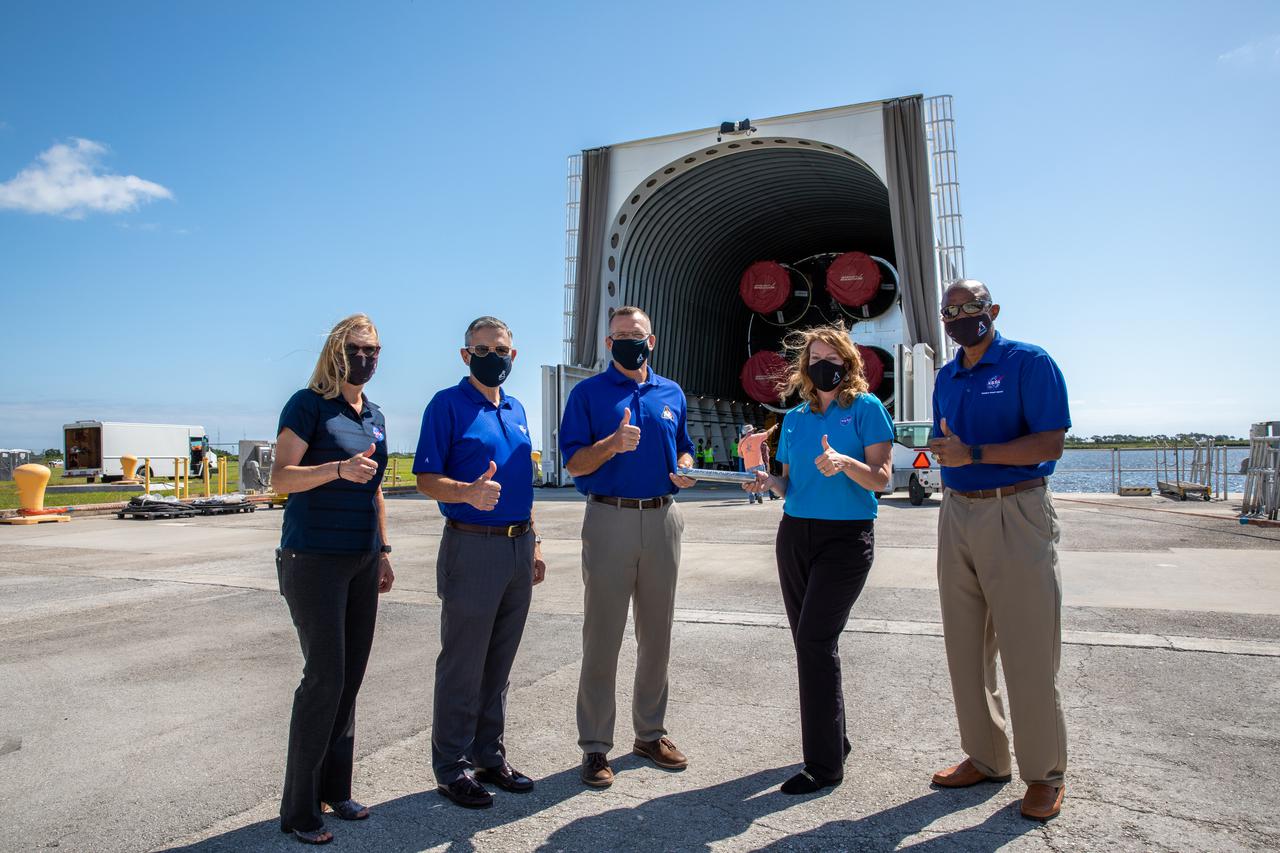
From left, Kennedy Space Center Deputy Director Janet Petro, Director Bob Cabana, Exploration Ground Systems’ (EGS) Senior Vehicle Operations Manager Cliff Lanham, Space Launch System (SLS) Stages Manager Julie Bassler, and Associate Director, Technical, Kelvin Manning celebrate the arrival of the SLS core stage on April 28, 2021, with a symbolic “passing of the baton” from the SLS program to EGS. Journeying from NASA’s Stennis Space Center in Mississippi aboard the Pegasus barge, the core stage arrived at the Florida spaceport on April 27 to be processed for flight by EGS. It is the final piece of Artemis hardware to arrive at Kennedy and will be offloaded and moved to the Vehicle Assembly Building, where it will be prepared for integration atop the mobile launcher with the completed stack of solid rocket boosters ahead of the Artemis I launch. The first in a series of increasingly complex missions, Artemis I will test SLS and Orion as an integrated system prior to crewed flights to the Moon.
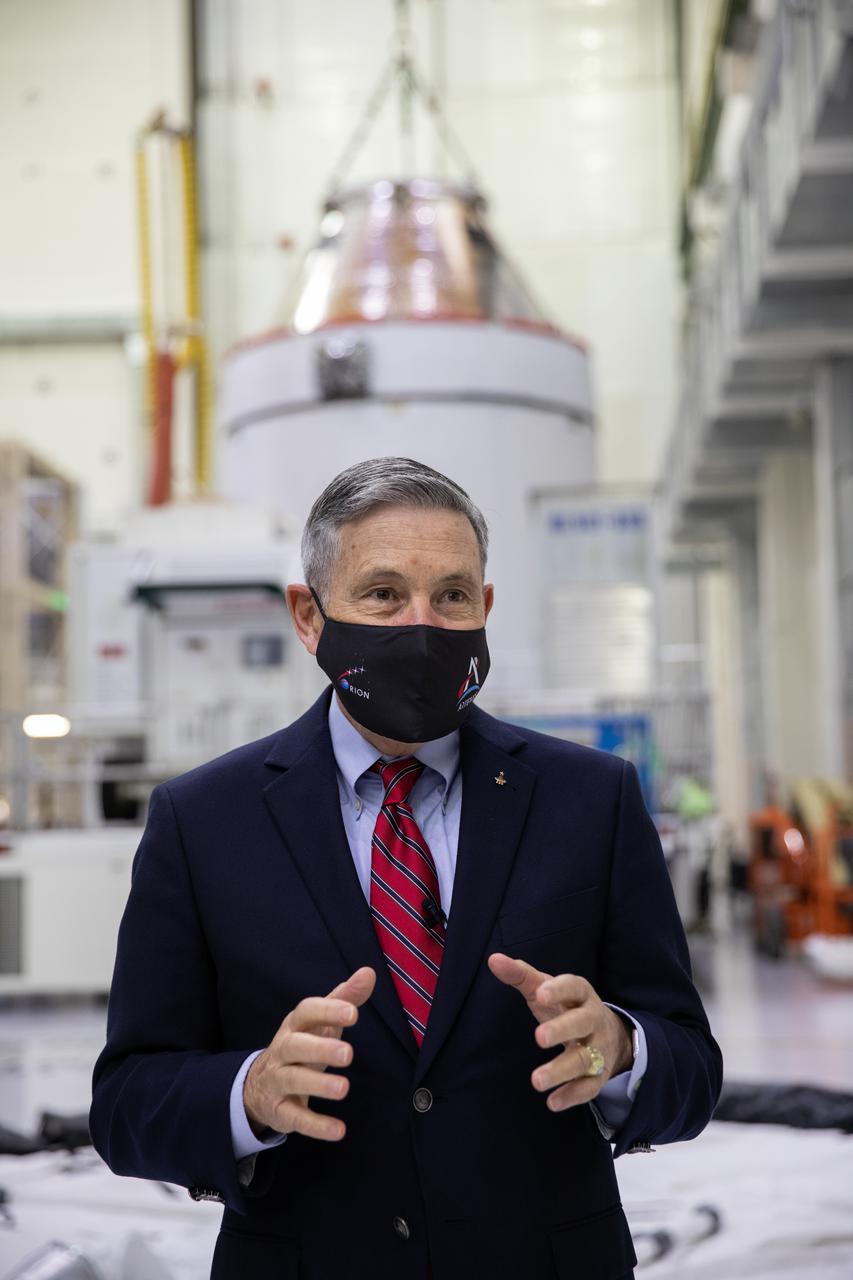
Orion is revealed for one of the final times on Jan. 14, as it is readied atop its transport pallet from the Neil Armstrong Operations and Checkout Building at NASA’s Kennedy Space Center in Florida, along its path to the pad ahead of the Artemis I launch. Kennedy Center Director Bob Cabana speaks to workers in front of Orion in the high bay. Teams across the globe have worked tirelessly to assemble the spacecraft, which will receive a protective covering prior to departing for the Multi-Payload Processing Facility to begin ground processing by the Exploration Ground Systems and Jacobs teams.

Orion is revealed for one of the final times on Jan. 14, as it is readied atop its transport pallet from the Neil Armstrong Operations and Checkout Building at NASA’s Kennedy Space Center in Florida, along its path to the pad ahead of the Artemis I launch. Teams across the globe have worked tirelessly to assemble the spacecraft which will receive a protective covering prior to departing for the Multi-Payload Processing Facility to begin ground processing by the Exploration Ground Systems and Jacobs teams.
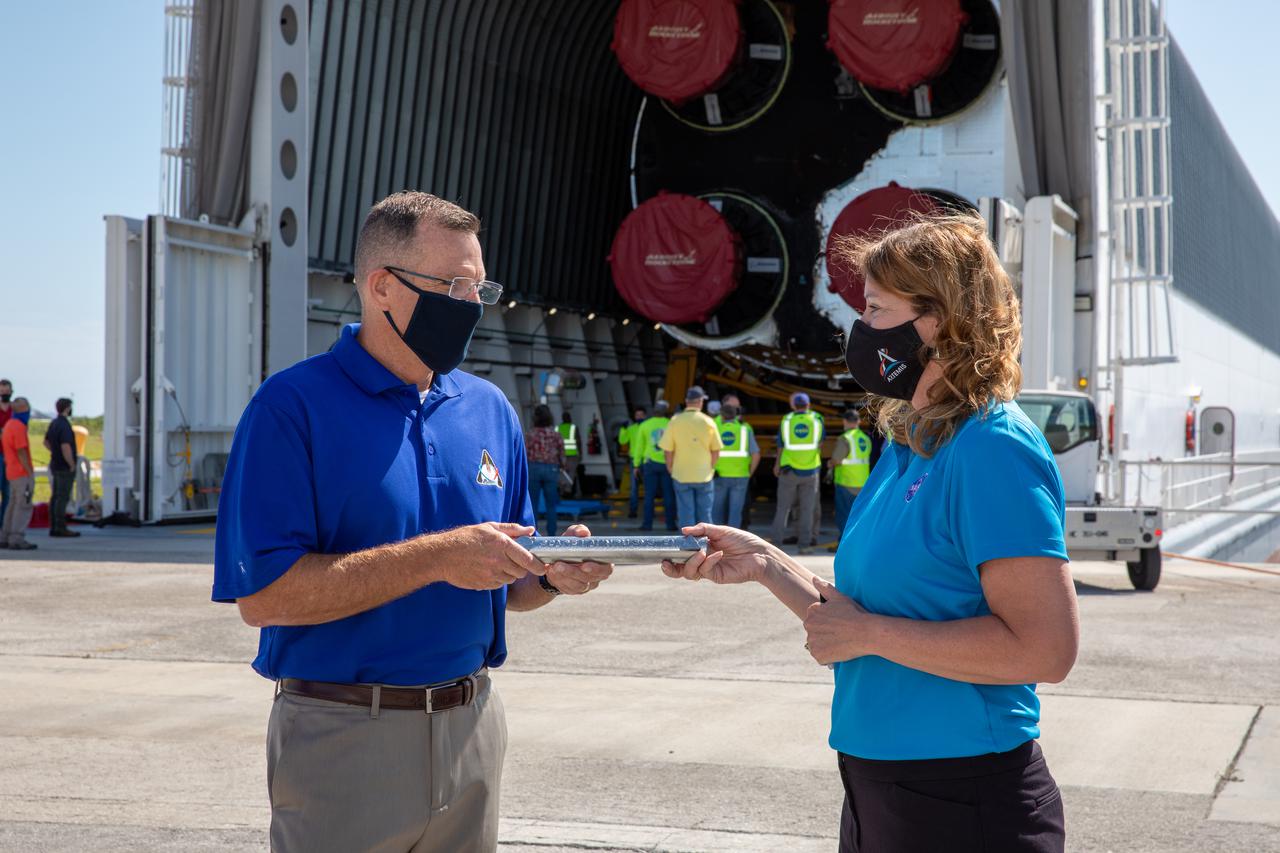
Space Launch System (SLS) Stages Manager Julie Bassler, right, celebrates the arrival of the SLS core stage by symbolically “passing the baton” to Exploration Ground Systems’ (EGS) Senior Vehicle Operations Manager Cliff Lanham on April 28, 2021, at NASA’s Kennedy Space Center in Florida. Journeying from the agency’s Stennis Space Center in Mississippi aboard the Pegasus barge, the core stage arrived at the Florida spaceport on April 27 to be processed for flight by EGS. It is the final piece of Artemis hardware to arrive at Kennedy and will be offloaded and moved to the Vehicle Assembly Building, where it will be prepared for integration atop the mobile launcher with the completed stack of solid rocket boosters ahead of the Artemis I launch. The first in a series of increasingly complex missions, Artemis I will test SLS and Orion as an integrated system prior to crewed flights to the Moon.
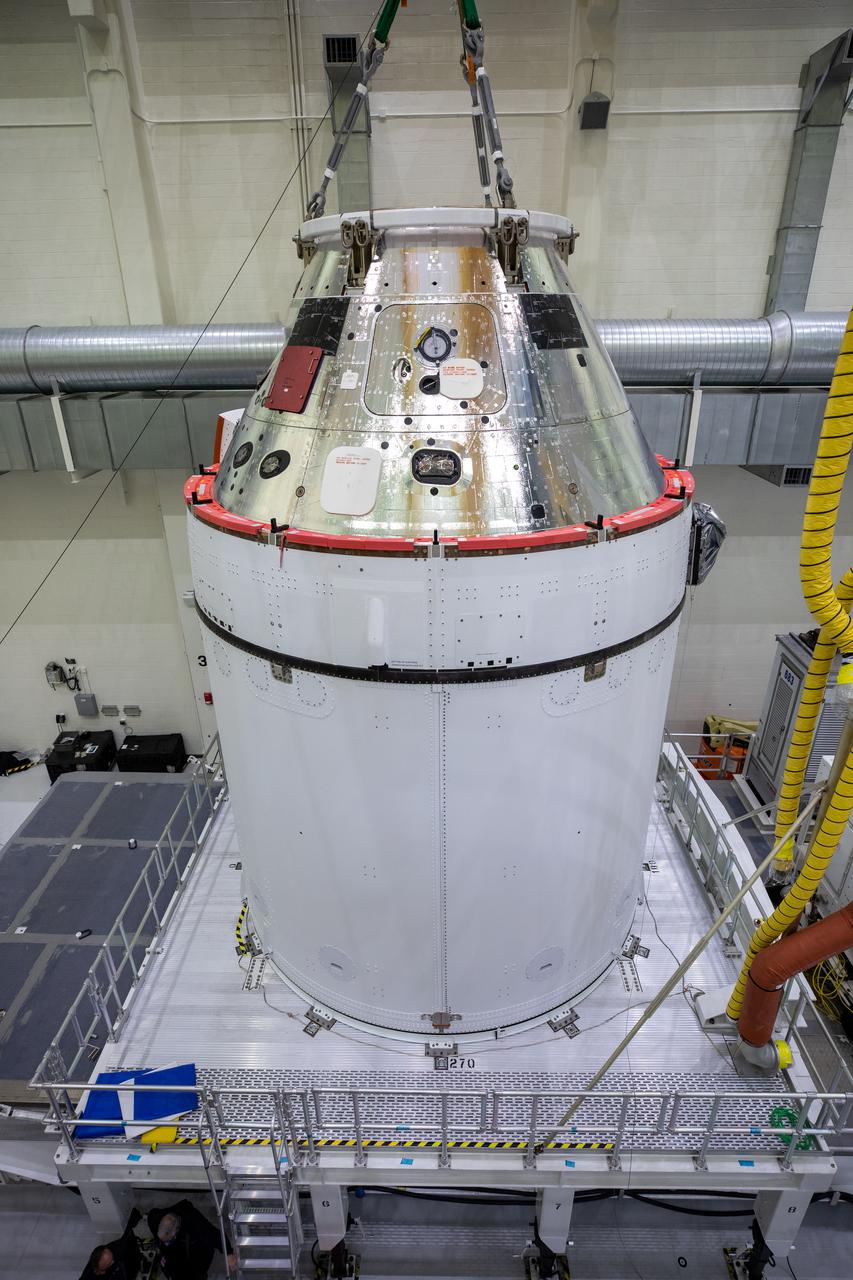
Orion is revealed for one of the final times on Jan. 14, as it is readied atop its transport pallet from the Neil Armstrong Operations and Checkout Building at NASA’s Kennedy Space Center in Florida, along its path to the pad ahead of the Artemis I launch. Teams across the globe have worked tirelessly to assemble the spacecraft, which will receive a protective covering prior to departing for the Multi-Payload Processing Facility to begin ground processing by the Exploration Ground Systems and Jacobs teams.

Orion is revealed for one of the final times on Jan. 14, as it is readied atop its transport pallet from the Neil Armstrong Operations and Checkout Building at NASA’s Kennedy Space Center in Florida, along its path to the pad ahead of the Artemis I launch. Orion was officially transferred from the Orion Program to Exploration Ground Systems (EGS). Mike Bolger, EGS manager, stands inside the high bay with Orion in the background. Teams across the globe have worked tirelessly to assemble the spacecraft which, will receive a protective covering prior to departing for the Multi-Payload Processing Facility to begin ground processing by the EGS and Jacobs teams.

Space Launch System (SLS) Stages Manager Julie Bassler, right, celebrates the arrival of the SLS core stage by symbolically “passing the baton” to Exploration Ground Systems’ (EGS) Senior Vehicle Operations Manager Cliff Lanham on April 28, 2021, at NASA’s Kennedy Space Center in Florida. Journeying from the agency’s Stennis Space Center in Mississippi aboard the Pegasus barge, the core stage arrived at the Florida spaceport on April 27 to be processed for flight by EGS. It is the final piece of Artemis hardware to arrive at Kennedy and will be offloaded and moved to the Vehicle Assembly Building, where it will be prepared for integration atop the mobile launcher with the completed stack of solid rocket boosters ahead of the Artemis I launch. The first in a series of increasingly complex missions, Artemis I will test SLS and Orion as an integrated system prior to crewed flights to the Moon.
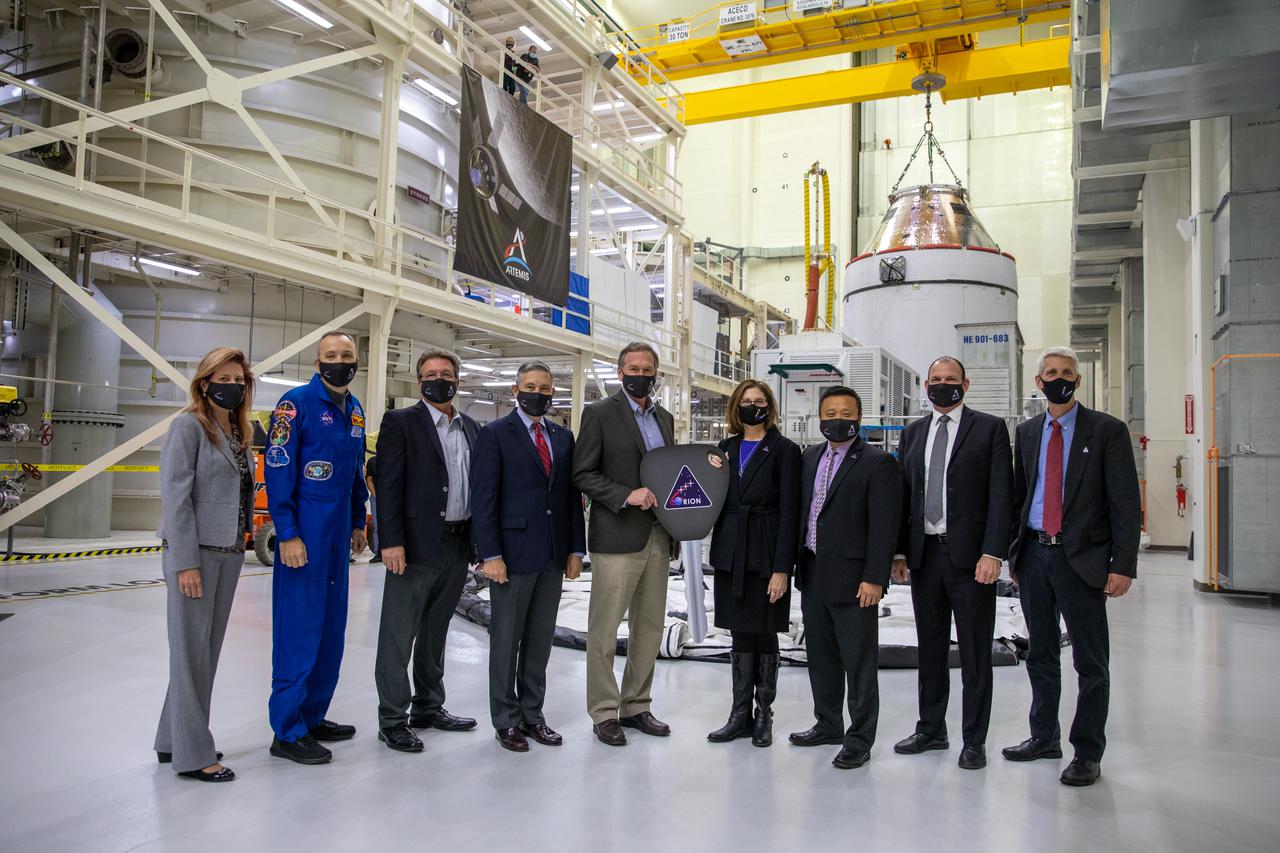
Orion is revealed for one of the final times on Jan. 14, as it is readied atop its transport pallet from the Neil Armstrong Operations and Checkout Building at NASA’s Kennedy Space Center in Florida, along its path to the pad ahead of the Artemis I launch. Standing in front of Orion, from left, are Kelly DeFazio, Lockheed Martin Orion Program director for production; NASA astronaut Randy Bresnik; Jules Schneider, Lockheed Martin director of Orion Assembly, Test & Launch at Kennedy; Kennedy Space Center Director Bob Cabana; Mike Bolger, Exploration Ground Systems (EGS) manager; Cathy Koerner, Orion Program manager; Howard Hu, Orion Program deputy manager; Tony Antonelli, Lockheed Martin Orion Program director and Artemis II mission director; and Scott Wilson, Orion Production Office manager. Teams across the globe have worked tirelessly to assemble the spacecraft, which will receive a protective covering prior to departing for the Multi-Payload Processing Facility to begin ground processing by the EGS and Jacobs teams.
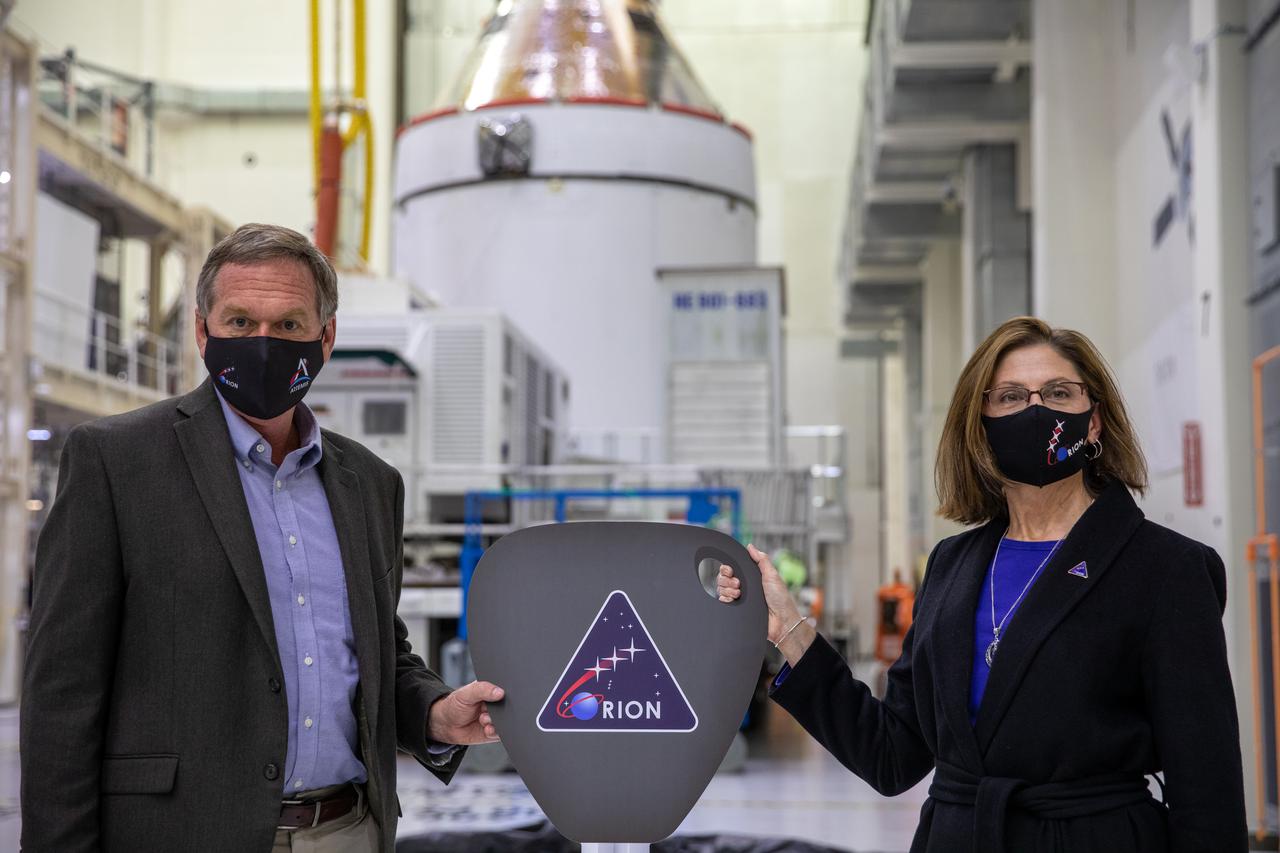
Orion is revealed for one of the final times on Jan. 14, as it is readied atop its transport pallet from the Neil Armstrong Operations and Checkout Building at NASA’s Kennedy Space Center in Florida, along its path to the pad ahead of the Artemis I launch. Mike Bolger, at left, manager of Exploration Ground Systems (EGS), receives the “key” to Orion from Cathy Koerner, Orion Program manager, signifying the transfer of the spacecraft from the assembly to the ground system processing team. Teams across the globe have worked tirelessly to assemble the spacecraft, which will receive a protective covering prior to departing for the Multi-Payload Processing Facility to begin ground processing by the EGS and Jacobs teams.
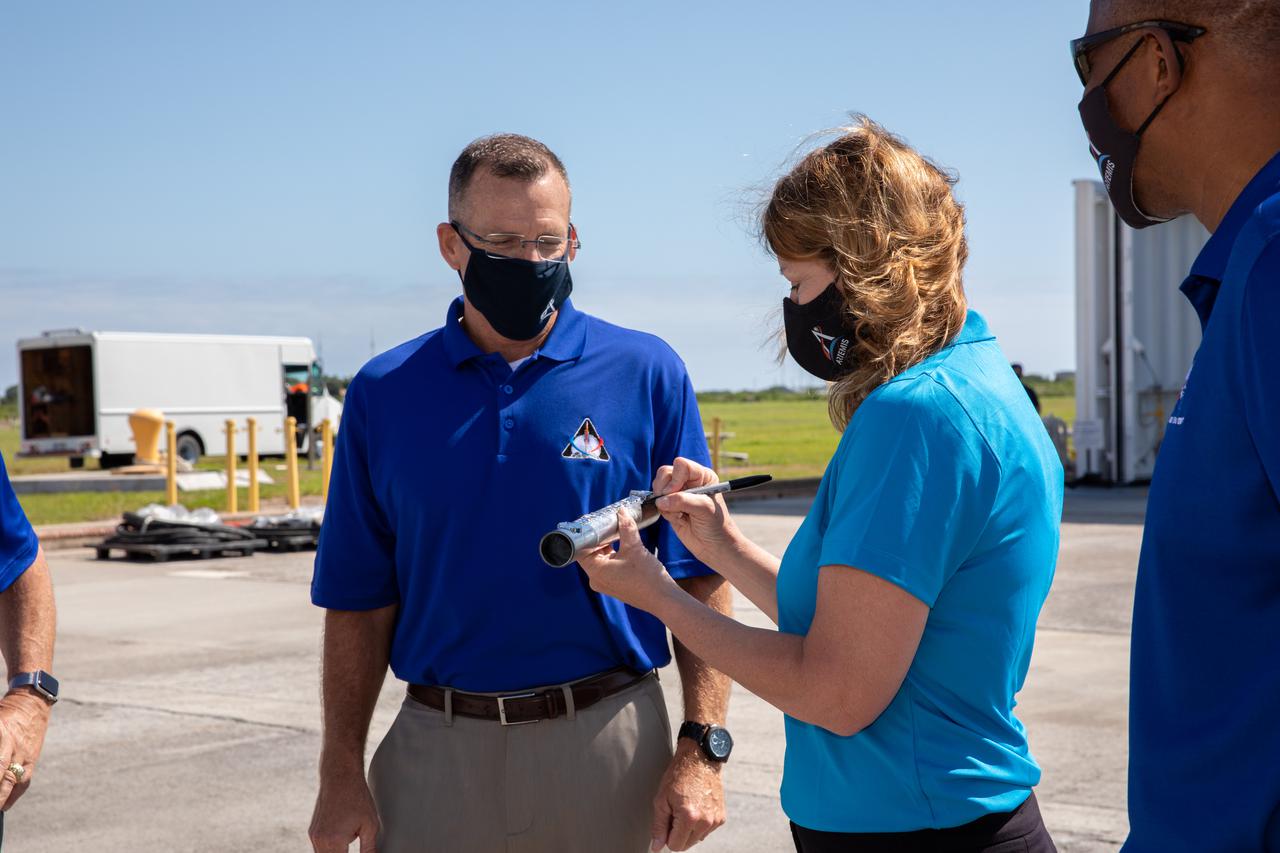
Space Launch System (SLS) Stages Manager Julie Bassler, right, celebrates the arrival of the SLS core stage by symbolically “passing the baton” to Exploration Ground Systems’ (EGS) Senior Vehicle Operations Manager Cliff Lanham on April 28, 2021, at NASA’s Kennedy Space Center in Florida. Journeying from the agency’s Stennis Space Center in Mississippi aboard the Pegasus barge, the core stage arrived at the Florida spaceport on April 27 to be processed for flight by EGS. It is the final piece of Artemis hardware to arrive at Kennedy and will be offloaded and moved to the Vehicle Assembly Building, where it will be prepared for integration atop the mobile launcher with the completed stack of solid rocket boosters ahead of the Artemis I launch. The first in a series of increasingly complex missions, Artemis I will test SLS and Orion as an integrated system prior to crewed flights to the Moon.
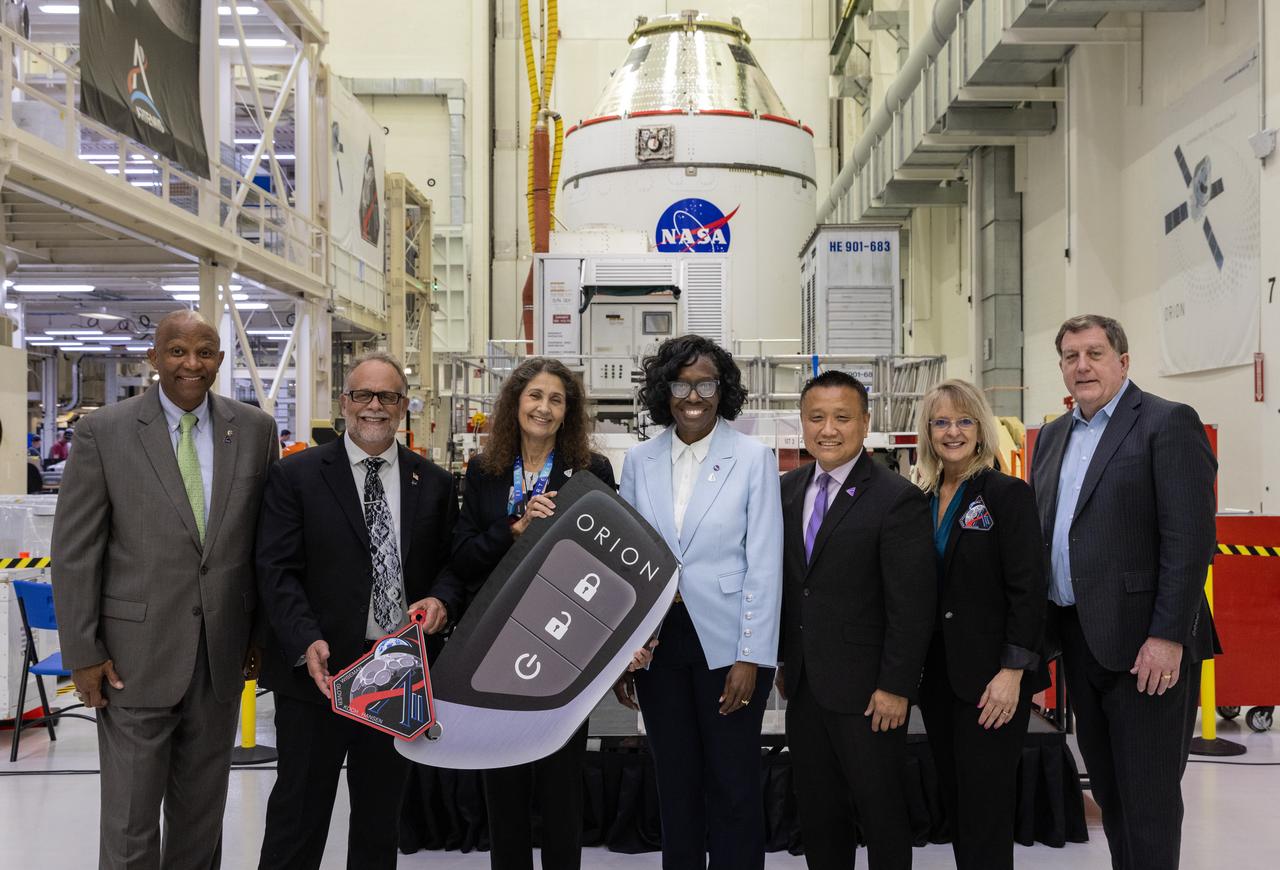
From left, Kelvin Manning, acting center director, NASA’s Kennedy Space Center; Shawn Quinn, Exploration Ground Systems program manager; Lorna Kenna, Amentum Vice President and program manager; Lakiesha Hawkins, assistant deputy associate administrator, Moon to Mars Program office; Howard Hu, Orion program manager; Debbie Korth, Orion deputy program manager; Keith Shireman Lockheed Martin Vice President of Lunar Exploration Campaign, participate in a handover ceremony of NASA’s Artemis II Orion spacecraft to crews with the agency’s Exploration Ground Systems Program at the Neil A. Armstrong Operations and Checkout Building at NASA’s Kennedy Space Center in Florida on Thursday, May 1, 2025. The spacecraft will be transported to the Multi-Payload Processing Facility to undergo fueling and processing for prelaunch operations. The Artemis II test flight is the first crewed flight under NASA’s Artemis campaign and is another step toward missions on the lunar surface and helping the agency prepare for future human missions to Mars.
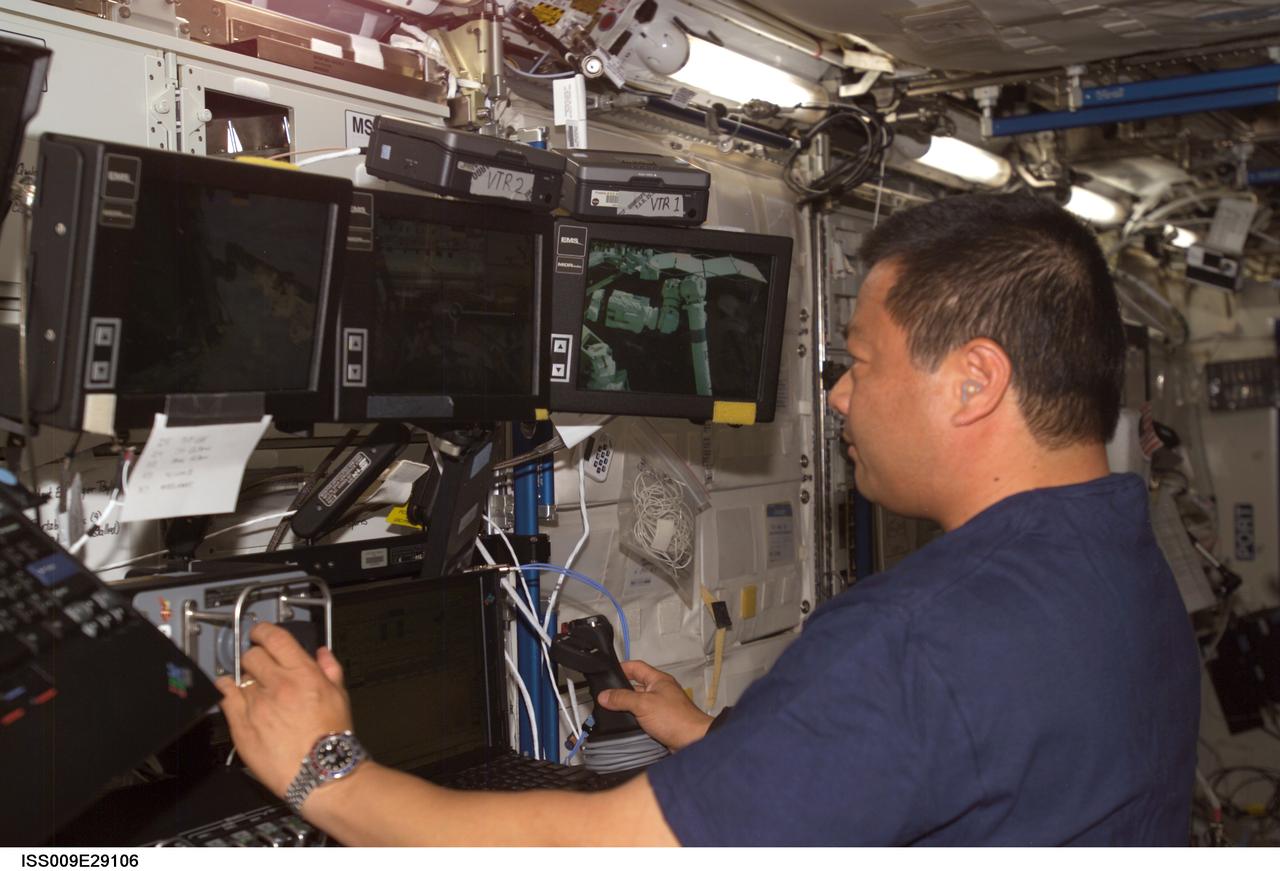
ISS009-E-29106 (18 October 2004) --- Astronaut Leroy Chiao, Expedition 10 commander and NASA ISS science officer, works with the controls of the Canadarm2, or Space Station Remote Manipulator System (SSRMS) in the Destiny laboratory of the International Space Station (ISS).
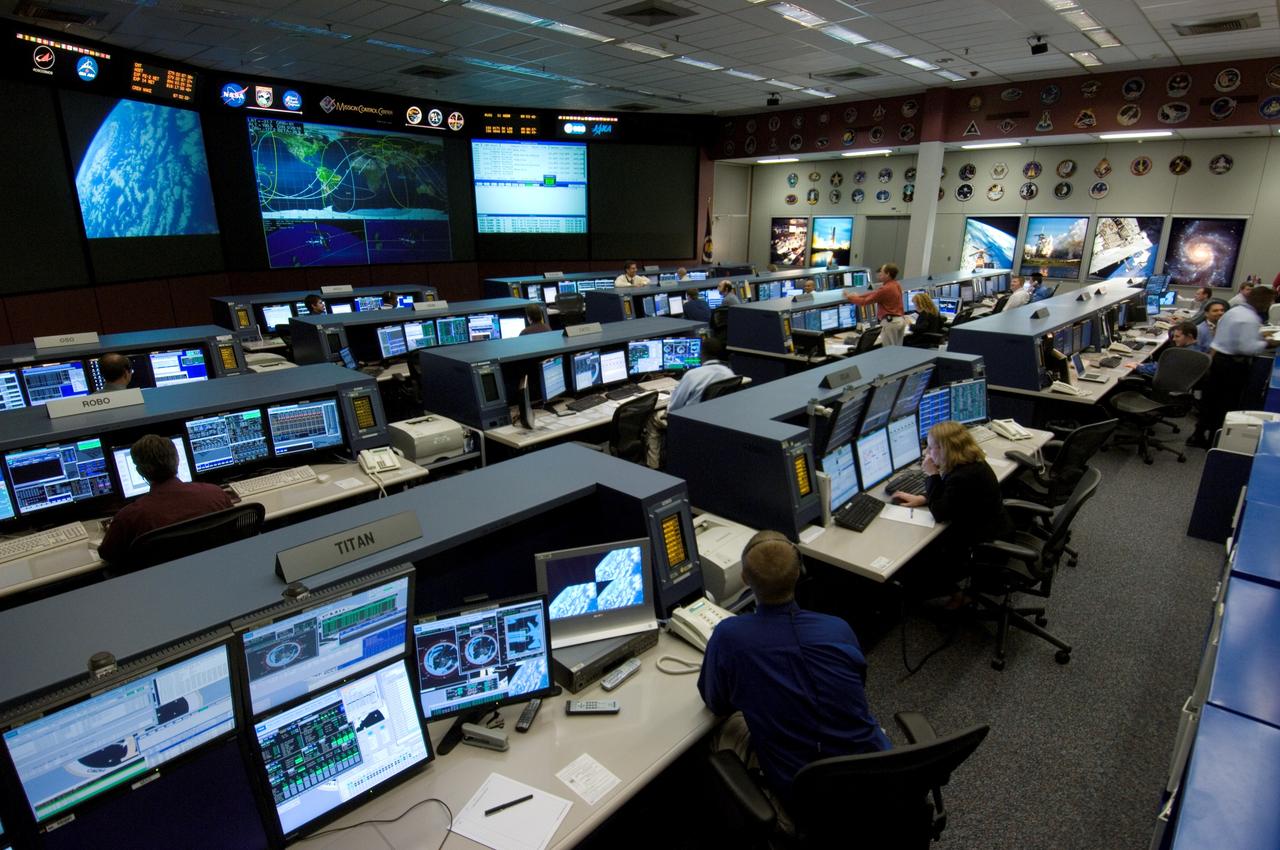
JSC2006-E-43860 (6 Oct. 2006)--- International Space Station flight controllers have this area as their new home with increased technical capabilities, more workspace and a long, distinguished history. The newly updated facility is just down the hall from its predecessor at NASA's Johnson Space Center, Houston. Known as Flight Control Room 1, it was first used to control a space flight 38 years ago, the mission of Apollo 7 launched Oct. 11, 1968. It was one of two control rooms for NASA's manned missions. The room it replaces in its new ISS role, designated the Blue Flight Control Room, had been in operation since the first station component was launched in 1998.
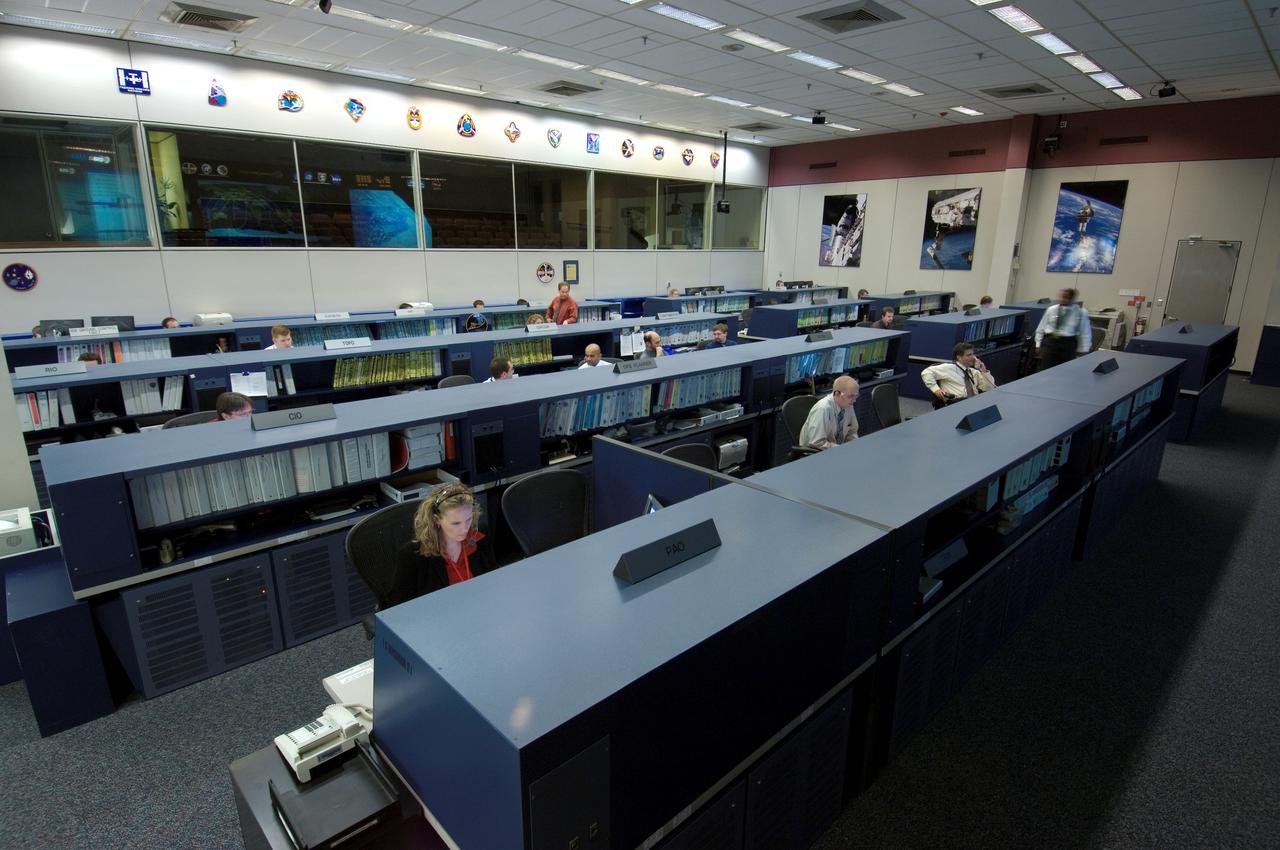
JSC2006-E-43863 (6 Oct. 2006)--- International Space Station flight controllers have this area as their new home with increased technical capabilities, more workspace and a long, distinguished history. The newly updated facility is just down the hall from its predecessor at NASA's Johnson Space Center, Houston. This view is toward the rear of the "new" room. Known as Flight Control Room 1, it was first used to control a space flight 38 years ago, the mission of Apollo 7 launched Oct. 11, 1968. It was one of two control rooms for NASA's manned missions. The room it replaces in its new ISS role, designated the Blue Flight Control Room, had been in operation since the first station component was launched in 1998.
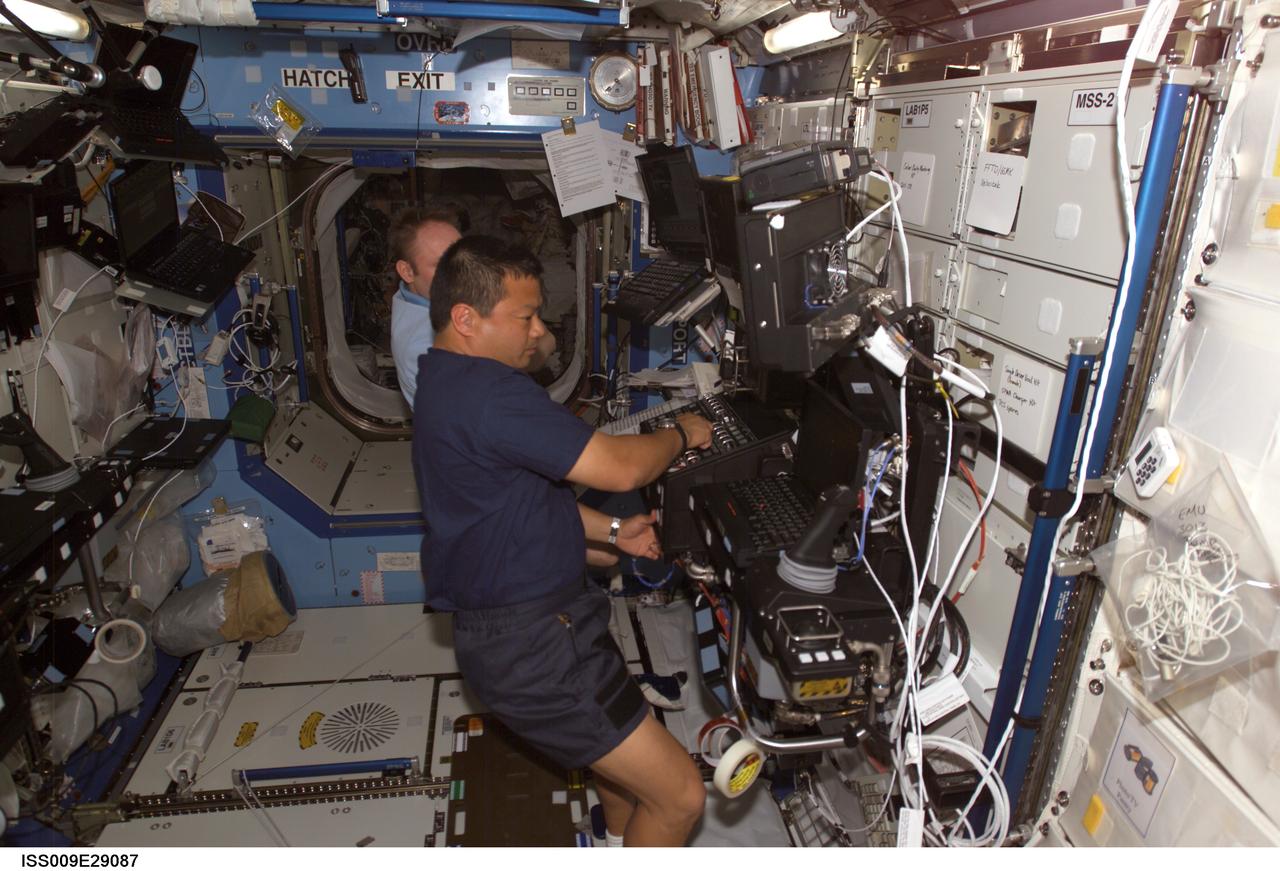
ISS009-E-29087 (18 October 2004) --- Astronaut Edward M. (Mike) Fincke (partially obscured), Expedition 9 NASA ISS science officer and flight engineer, takes astronaut Leroy Chiao, Expedition 10 commander and NASA ISS science officer, through a familiarization session with the Mobile Service System (MSS) and hands-on experience with the Canadarm2, or Space Station Remote Manipulator System (SSRMS) in the Destiny laboratory of the International Space Station (ISS).
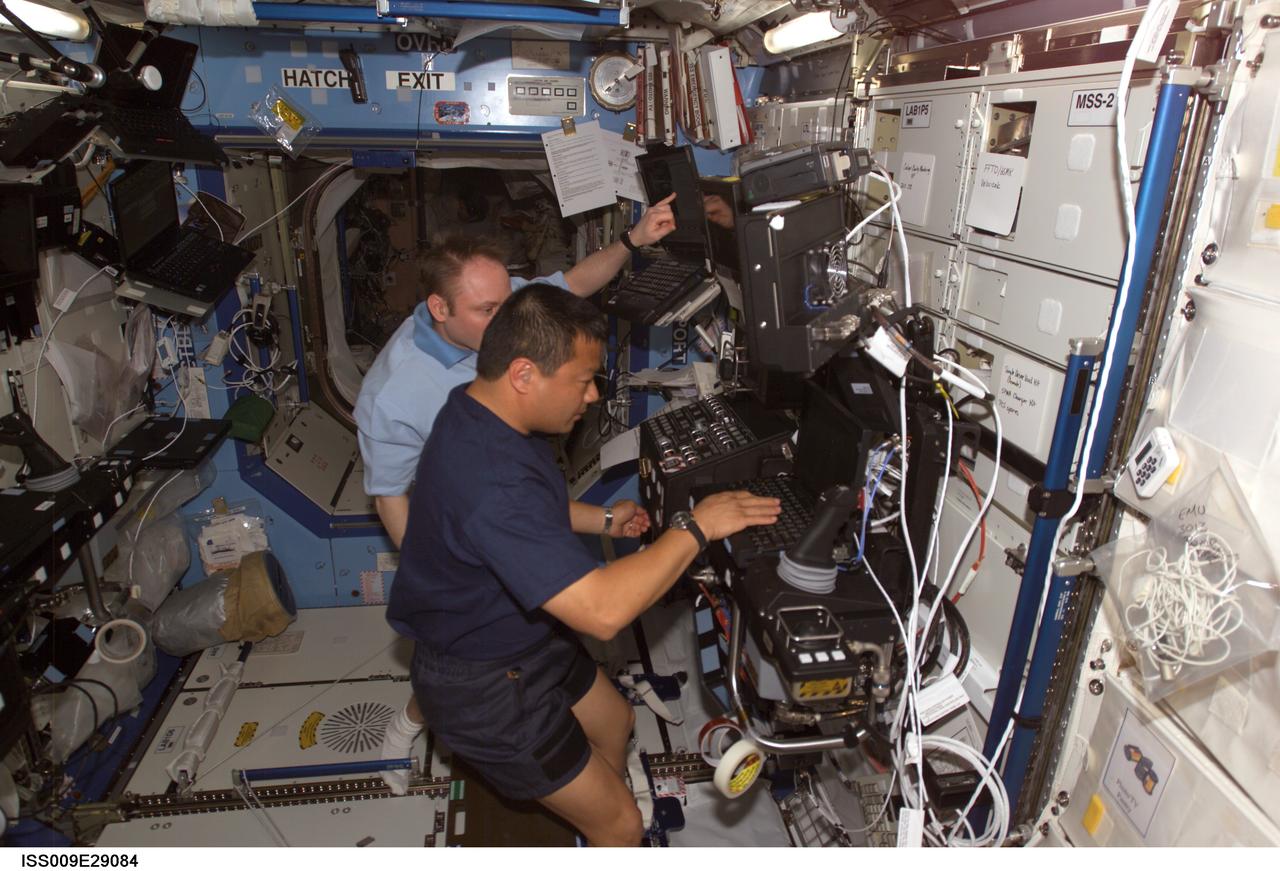
ISS009-E-29084 (18 October 2004) --- Astronaut Edward M. (Mike) Fincke (partially obscured), Expedition 9 NASA ISS science officer and flight engineer, takes astronaut Leroy Chiao, Expedition 10 commander and NASA ISS science officer, through a familiarization session with the Mobile Service System (MSS) and hands-on experience with the Canadarm2, or Space Station Remote Manipulator System (SSRMS) in the Destiny laboratory of the International Space Station (ISS).