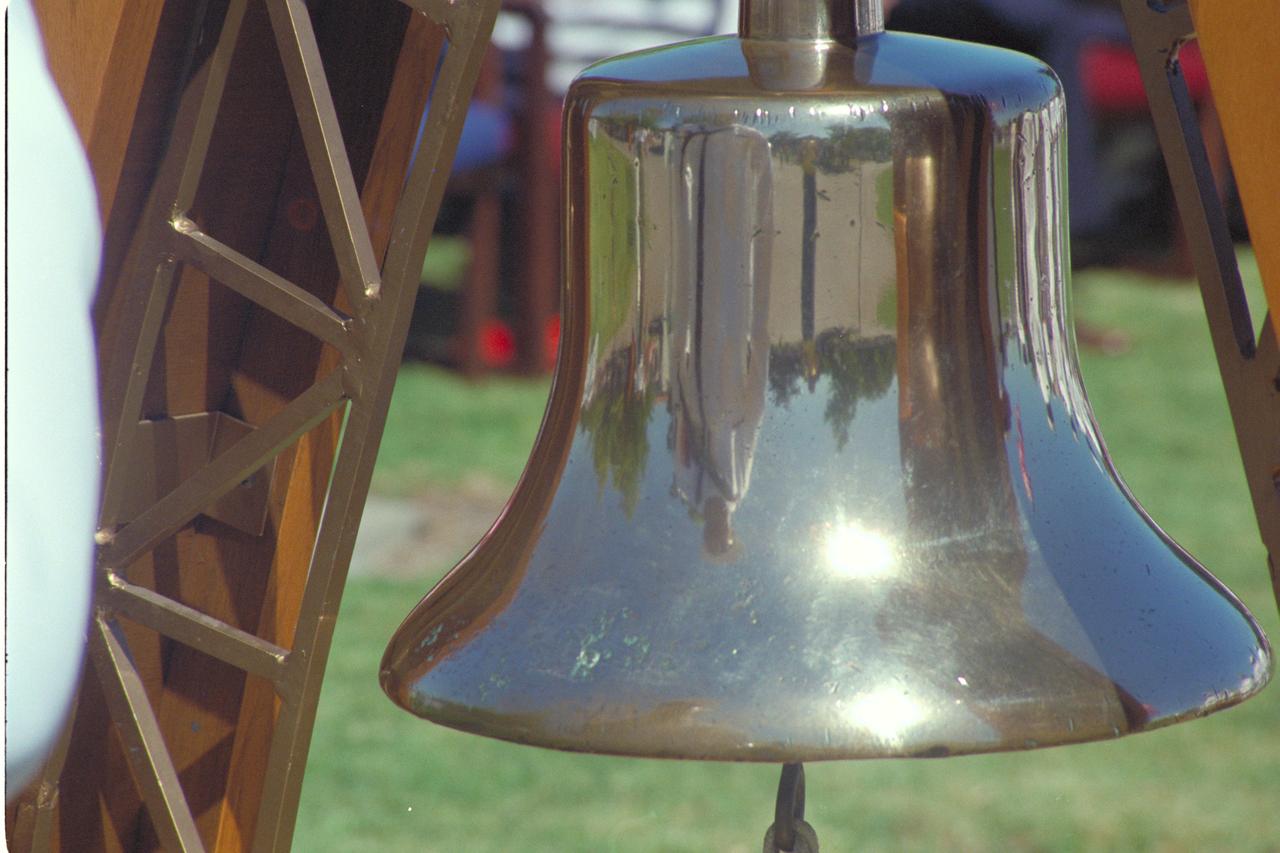
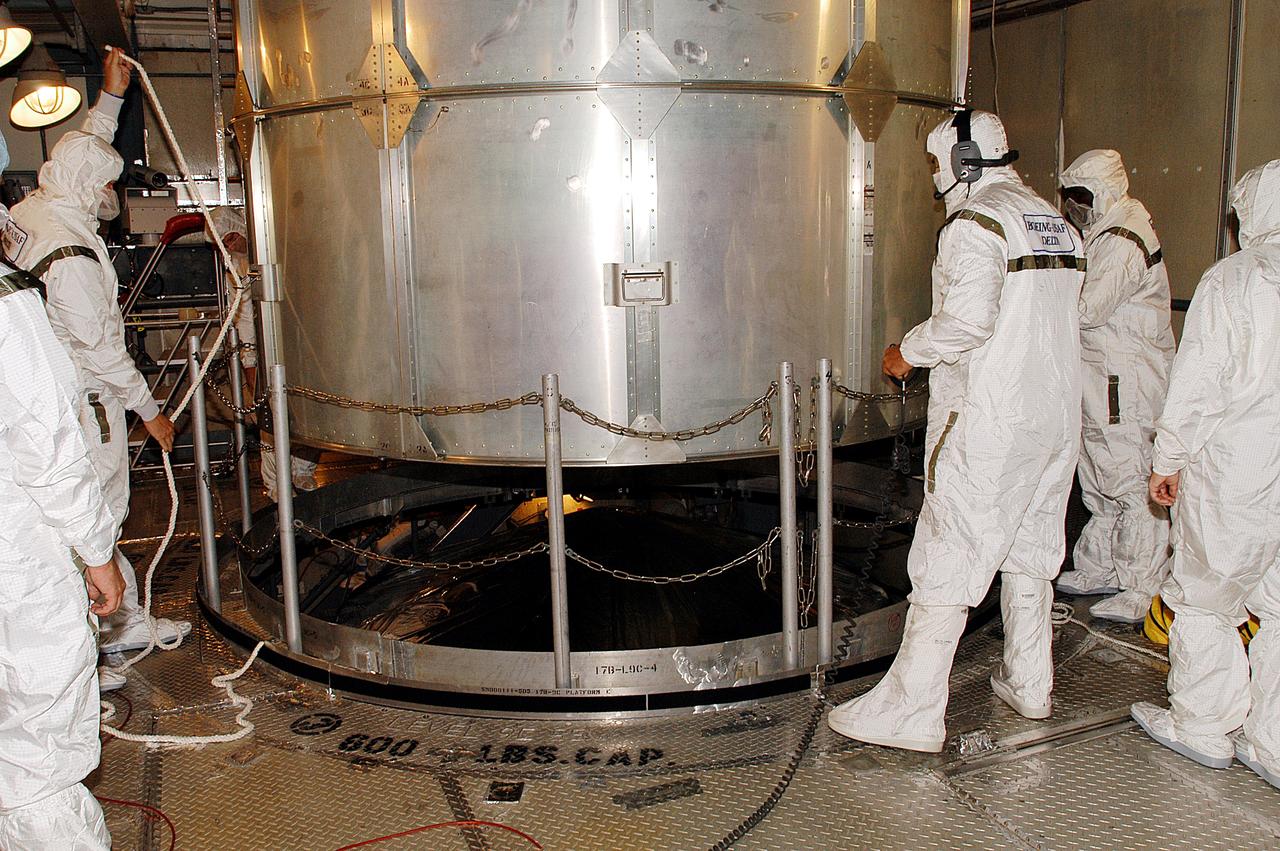
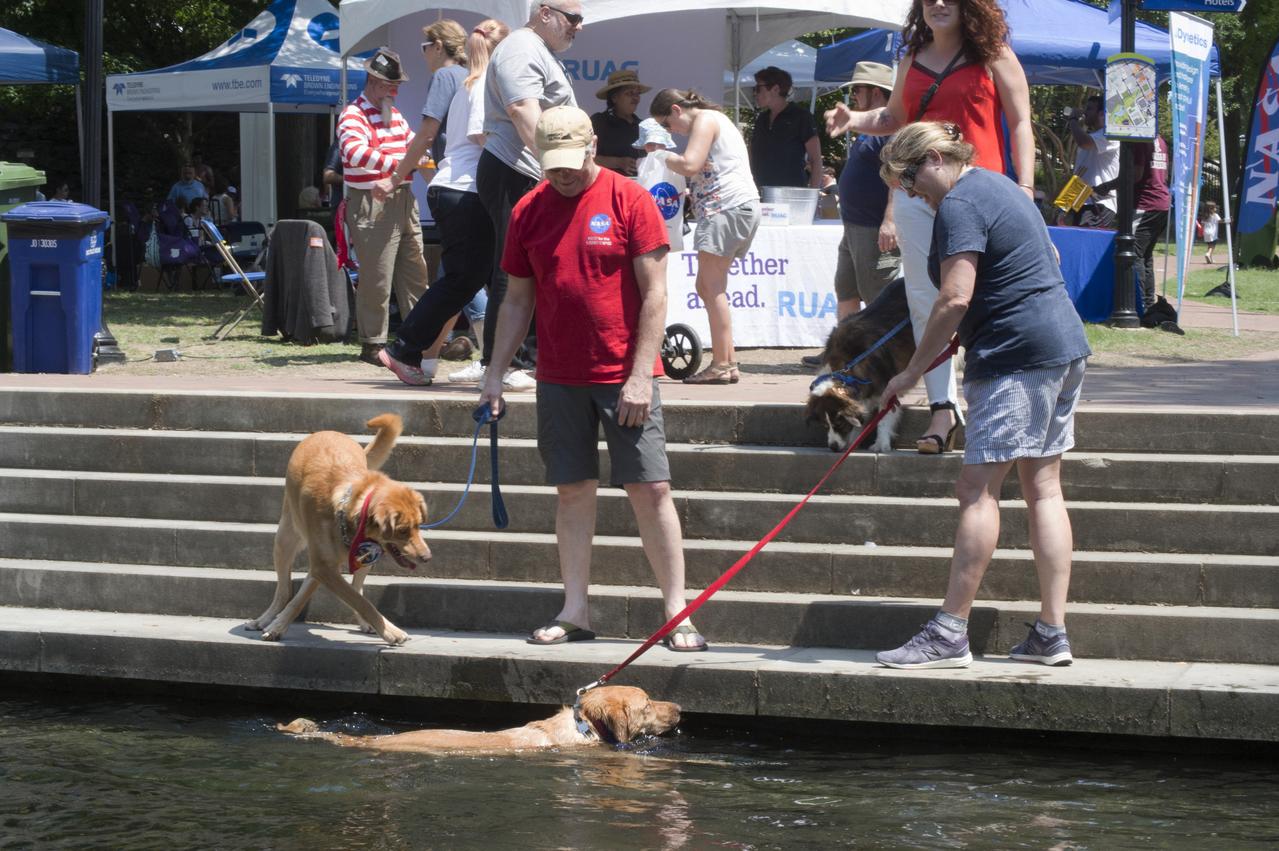
NASA in the Park on June 16 in Huntsville featured more than 60 exhibits and demonstrations by NASA experts, as well as performances by Marshall musicians, educational opportunities, games and hands-on activities for all ages.  Big Spring canal is a good place to cool off in the 90 degree heat
NASA in the Park, 2018
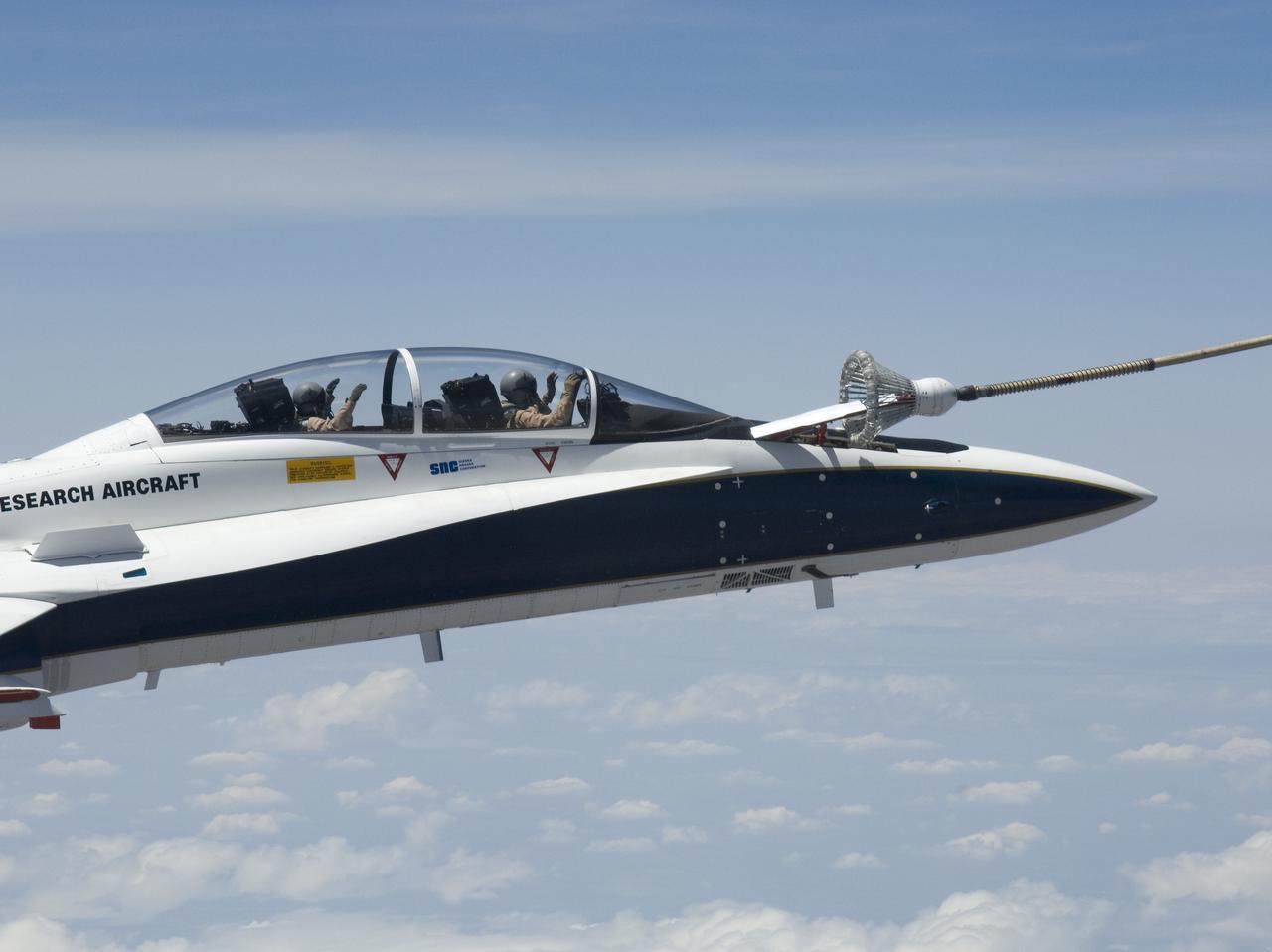
Pilot Dick Ewers and flight test engineer Leslie Molzahn were hands-off as NASA F/A-18 #845 flew itself into the drogue on an autonomous refueling demonstration.
ED07-0089-04
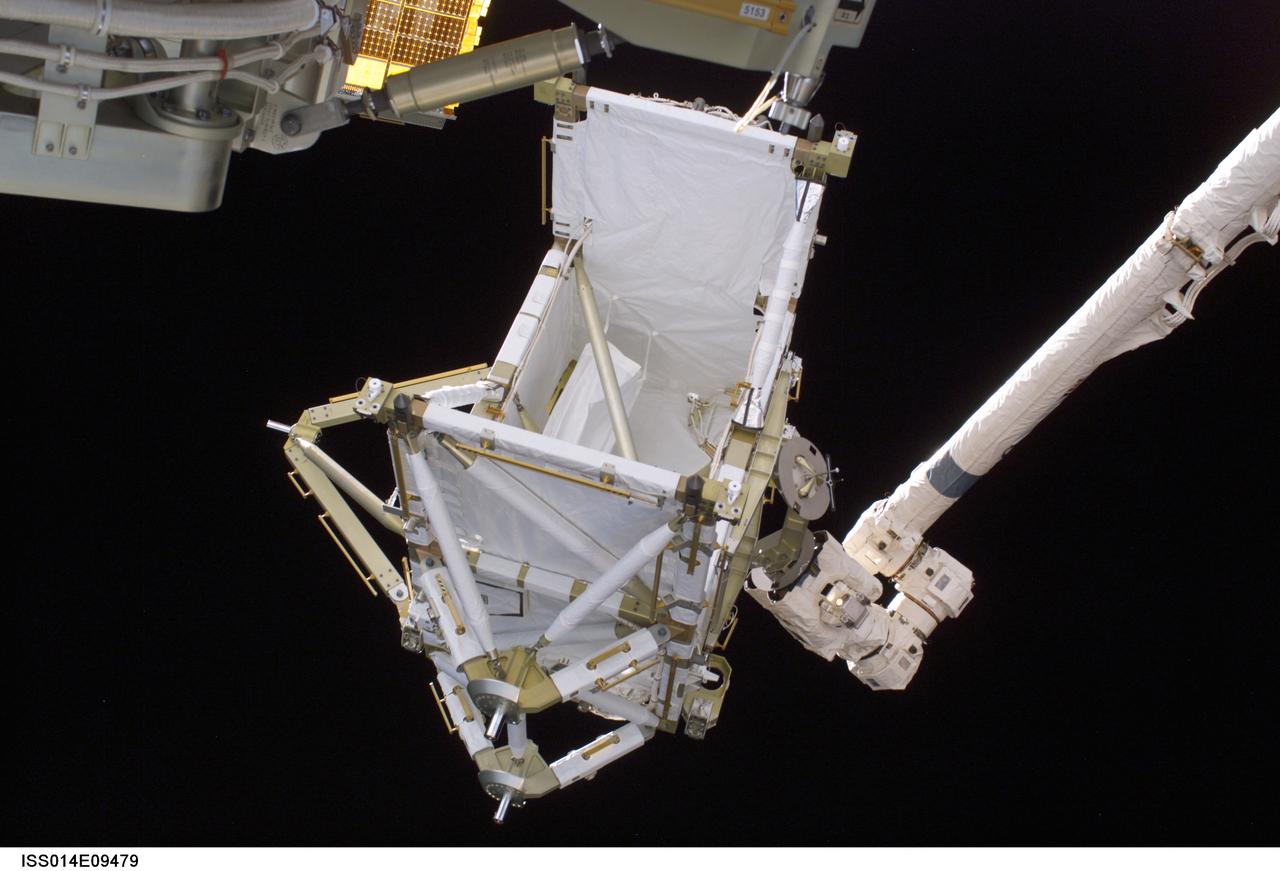
ISS014-E-09479 (12 Dec. 2006) --- The International Space Station's new P5 truss section awaits installation following the hand-off from Space Shuttle Discovery's Remote Manipulator System (RMS) robotic arm. The truss section was handed to the station's Canadarm2 and remained suspended over Discovery's port wing overnight, awaiting installation in the first of three planned spacewalks on Dec. 12.
P5 truss hand-off from Discoverys RMS robotic arm
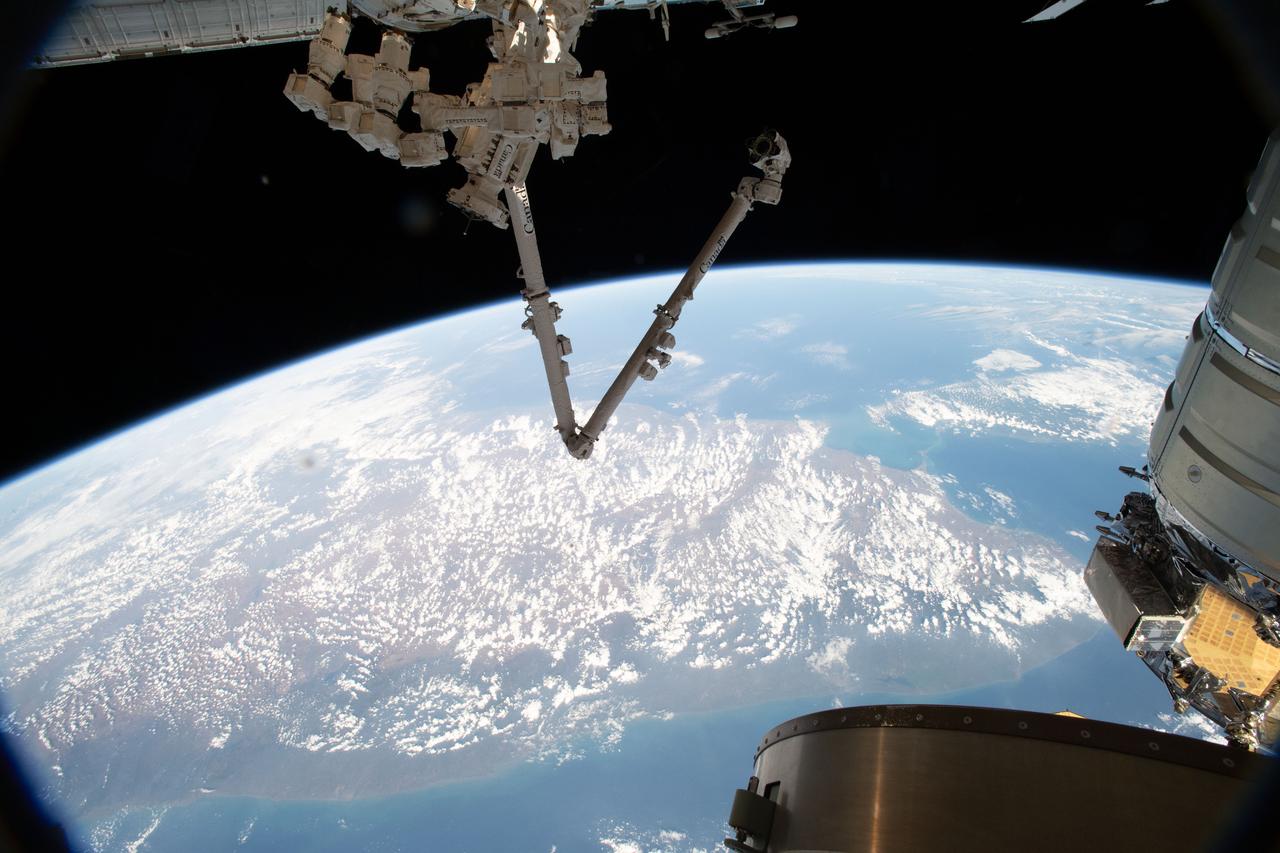
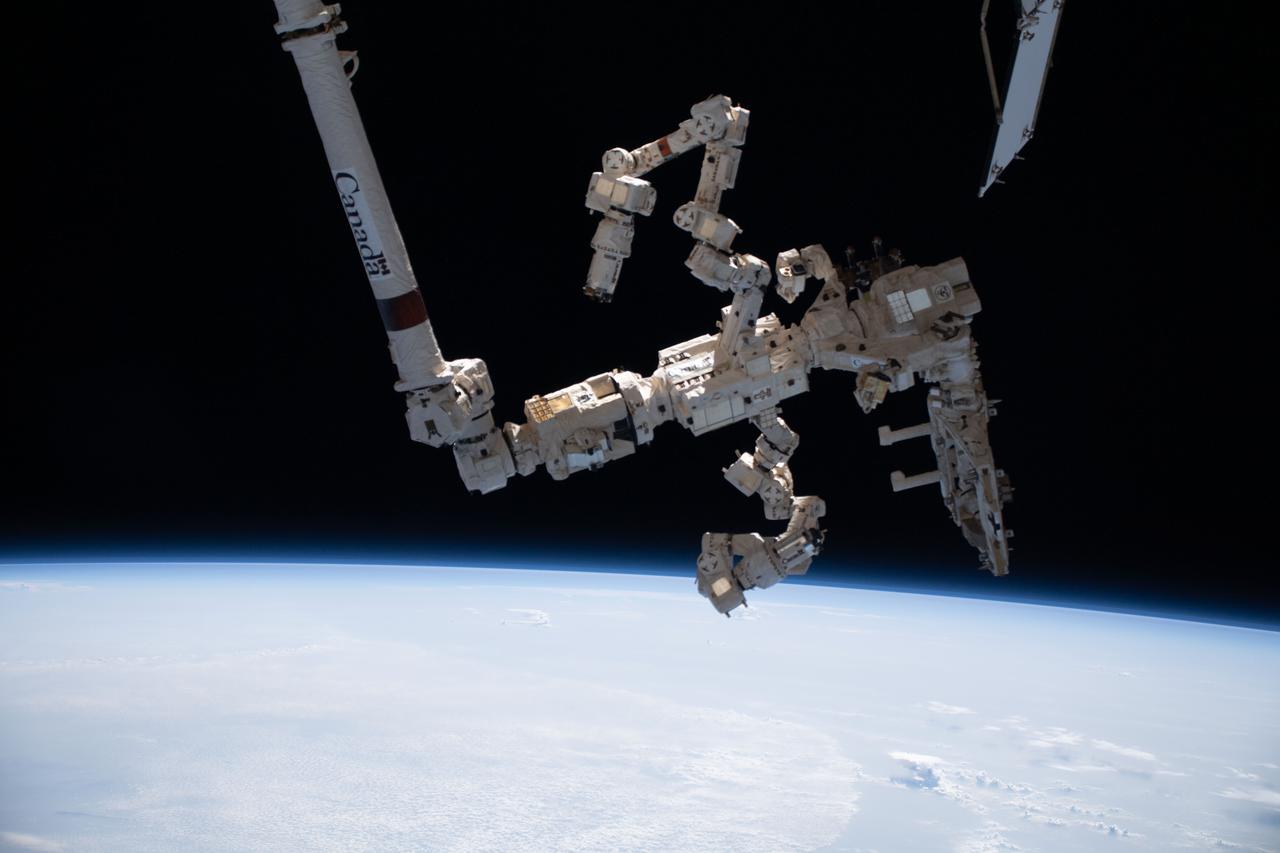
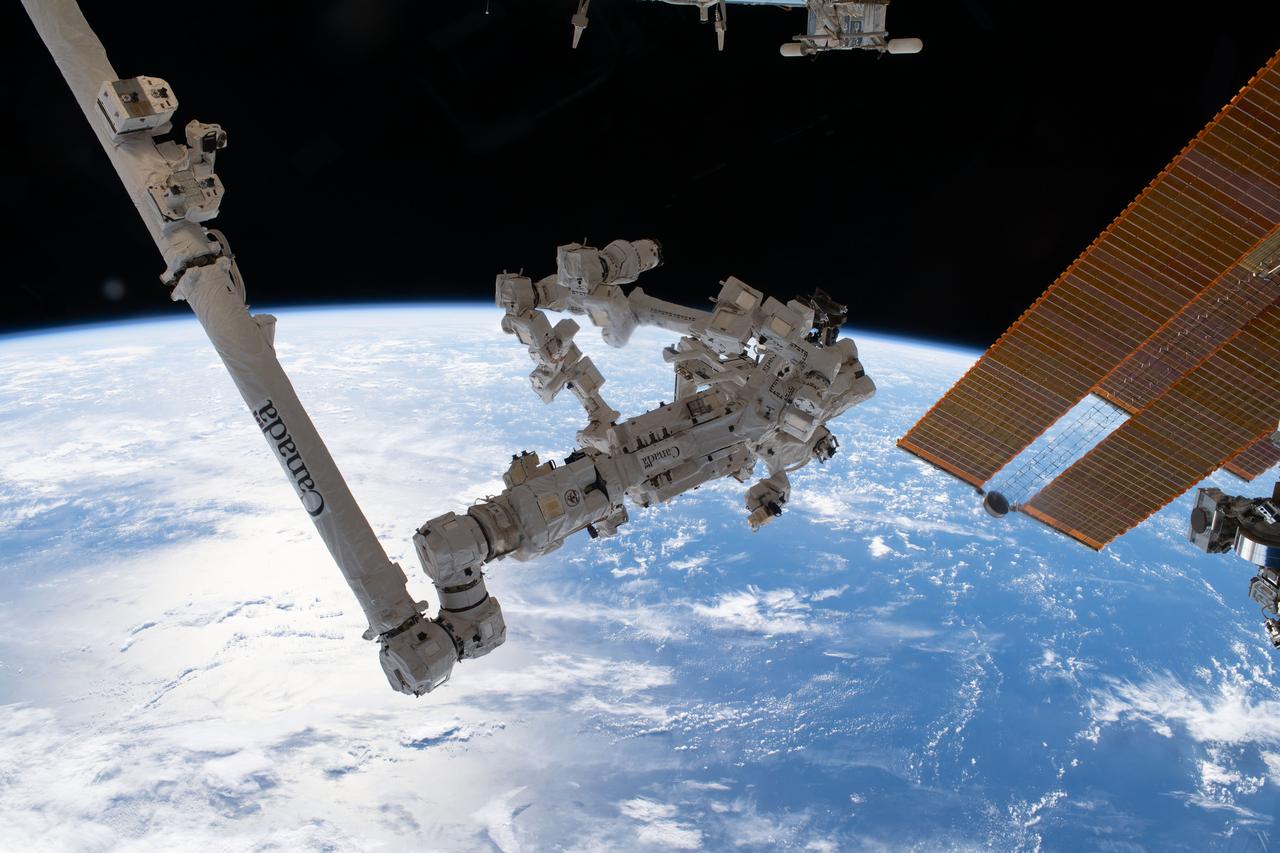
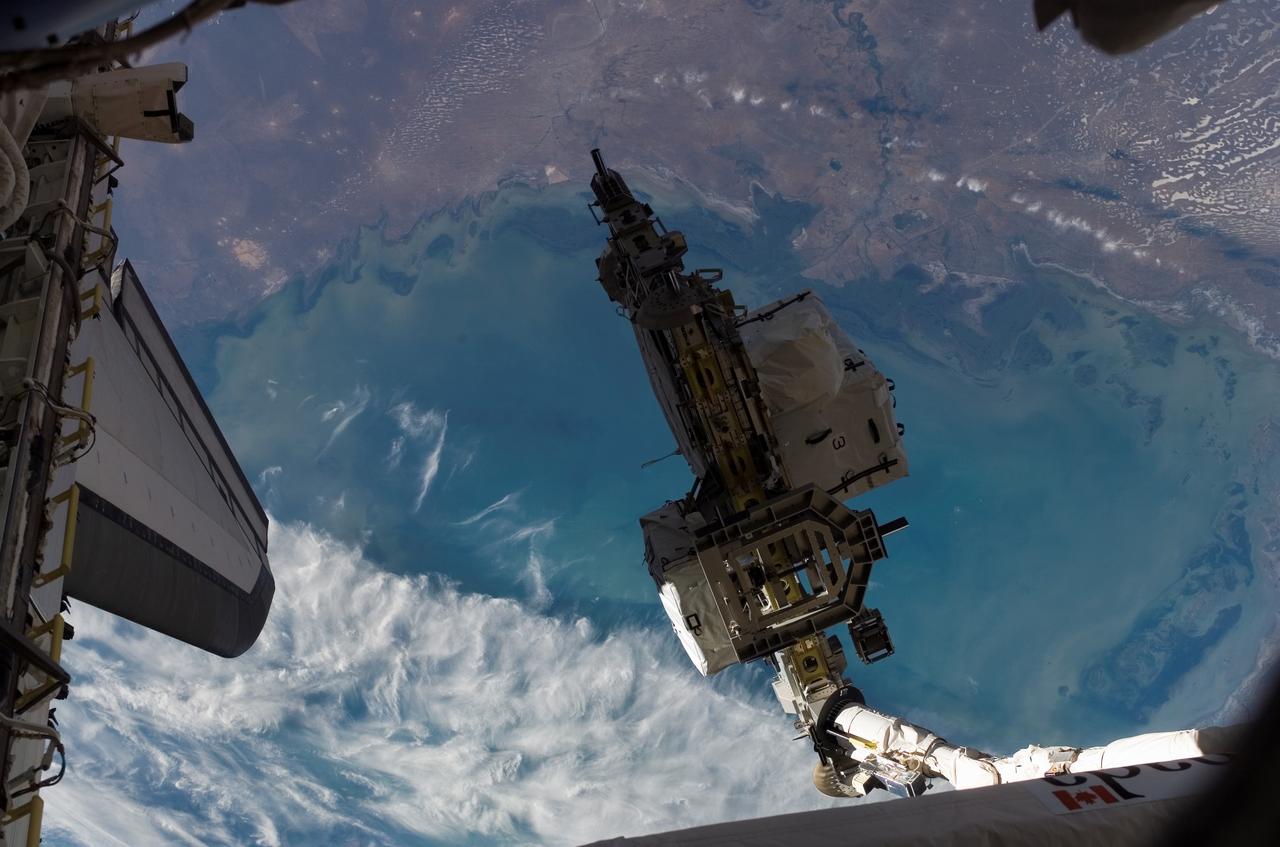
iss058e005961 (Jan. 26, 2019) --- The International Space Station's Canadarm2 robotic arm and its Dextre robotic hand are seen as the orbital complex flew 252 miles above the Arabian Sea off the coast of India.
The International Space Station's Canadarm2 robotic arm and Dextre robotic hand
KENNEDY SPACE CENTER, FLA. -  Suzy Cunningham sings the national anthem to kick off  Center Director Jim Kennedy’s first all-hands meeting conducted for employees. She is senior spaceport manager, NASA/Air Force Spaceport Planning and Customer Service Office.   Making presentations were Dr. Woodrow Whitlow Jr., KSC deputy director; Tim Wilson, assistant chief engineer for Shuttle; and Bill Pickavance, vice president and deputy program manager, Florida operations, United Space Alliance.  Representatives from the Shuttle program and contractor team were on hand to discuss the Columbia Accident Investigation Board report and where KSC stands in its progress toward return to flight.
KENNEDY SPACE CENTER, FLA. - Suzy Cunningham sings the national anthem to kick off Center Director Jim Kennedy’s first all-hands meeting conducted for employees. She is senior spaceport manager, NASA/Air Force Spaceport Planning and Customer Service Office. Making presentations were Dr. Woodrow Whitlow Jr., KSC deputy director; Tim Wilson, assistant chief engineer for Shuttle; and Bill Pickavance, vice president and deputy program manager, Florida operations, United Space Alliance. Representatives from the Shuttle program and contractor team were on hand to discuss the Columbia Accident Investigation Board report and where KSC stands in its progress toward return to flight.
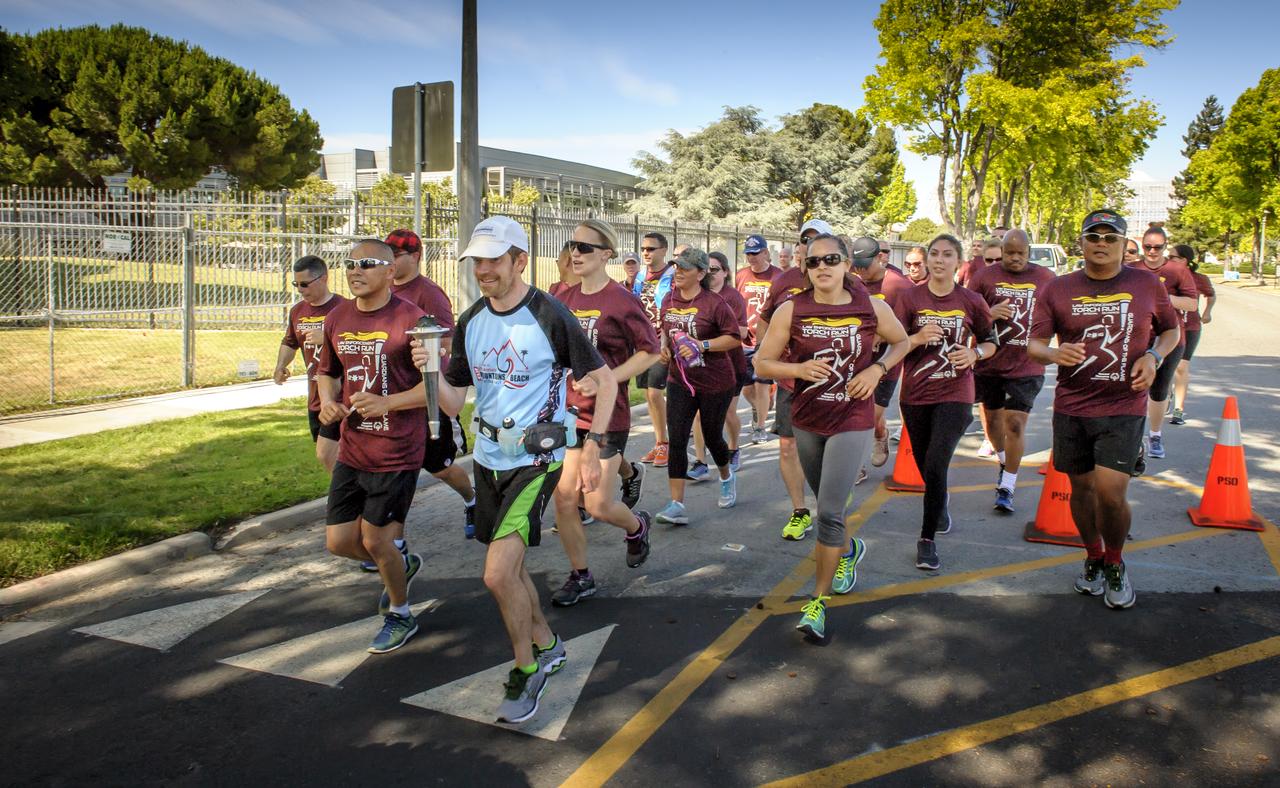
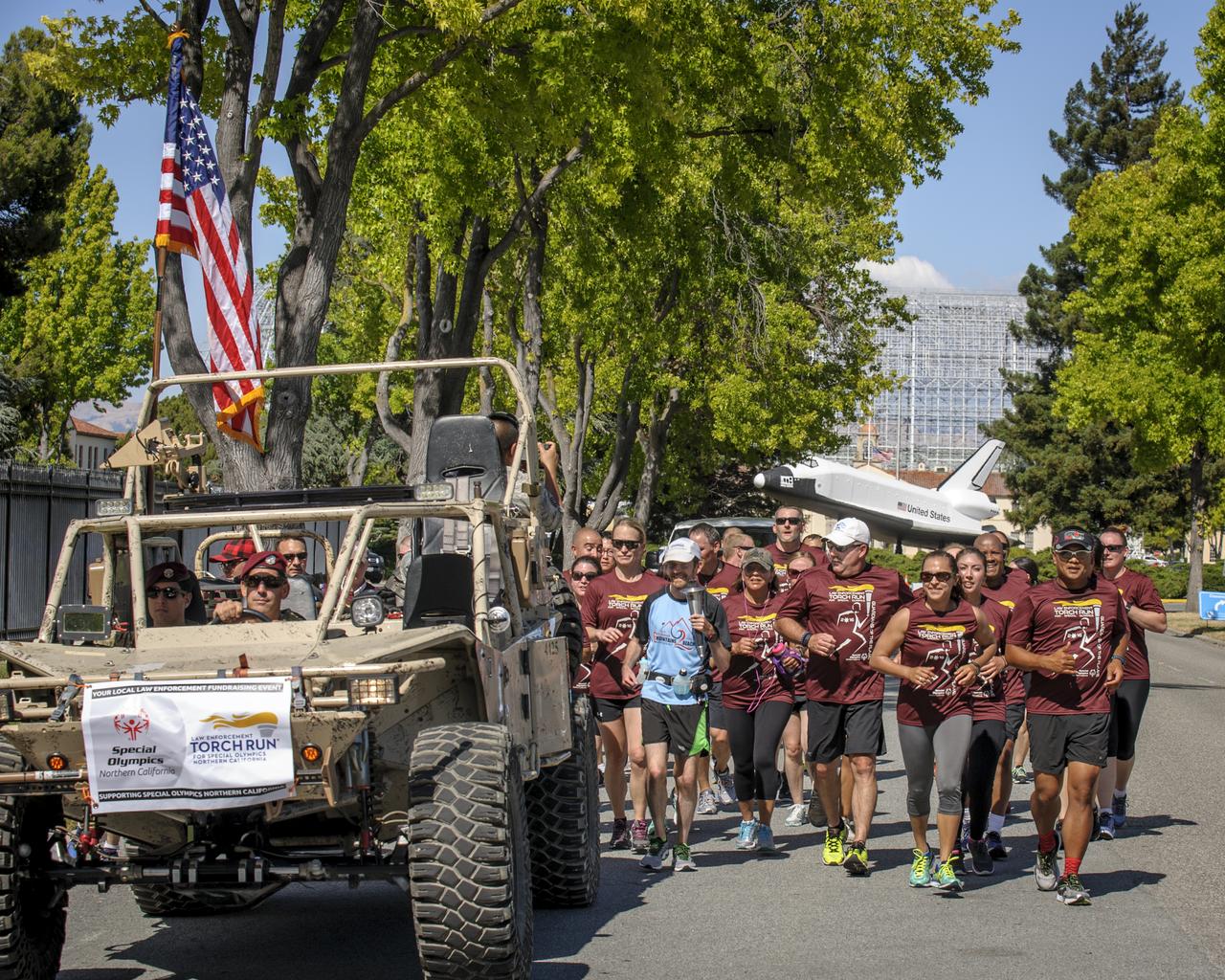
The Special Olympics Torch makes it’s way through NASA Ames Research Park on it’s way to a hand-off in Mountain View, CA.
ACD16-0097-003
The Special Olympics torch make it's way through the NASA Ames Research Park on it's way to a hand-off in Mountain View, CA
ACD16-0097-002
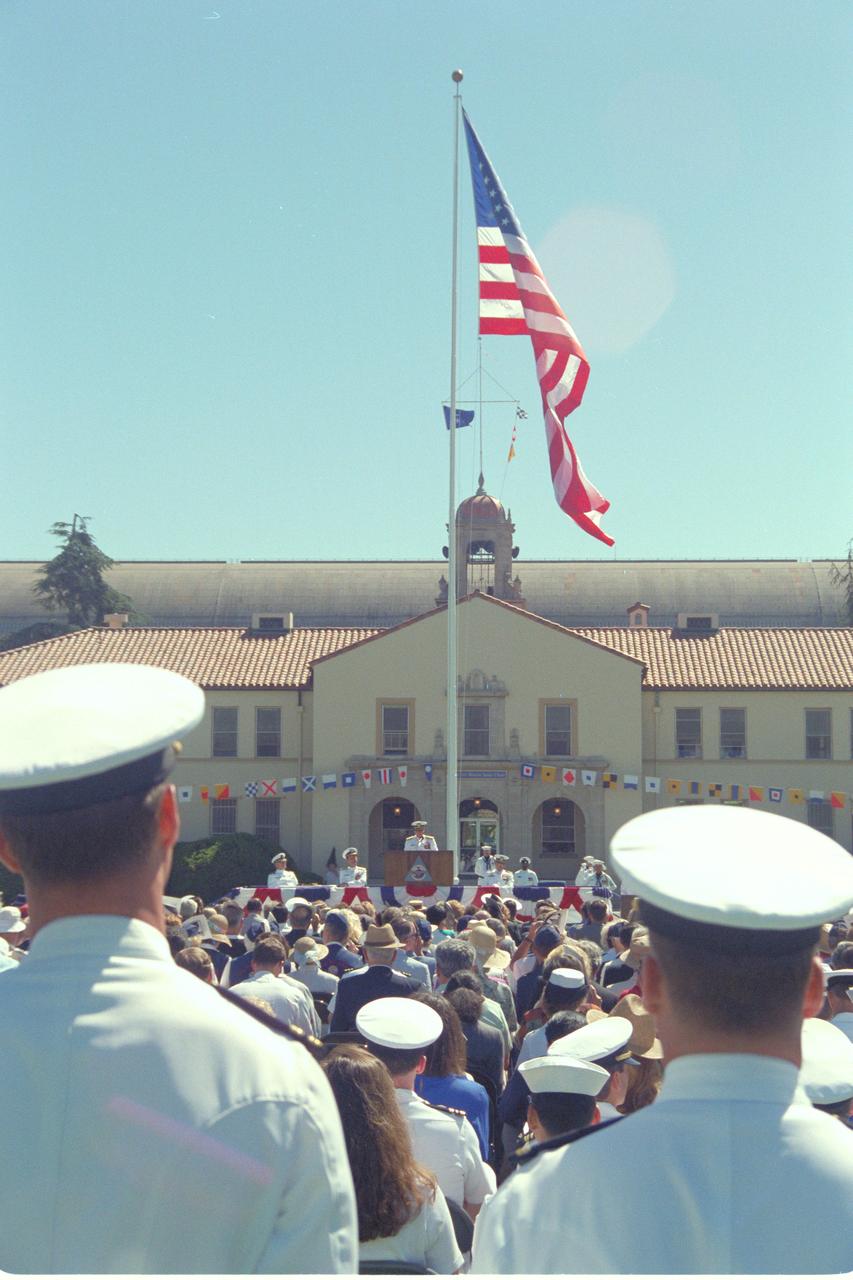
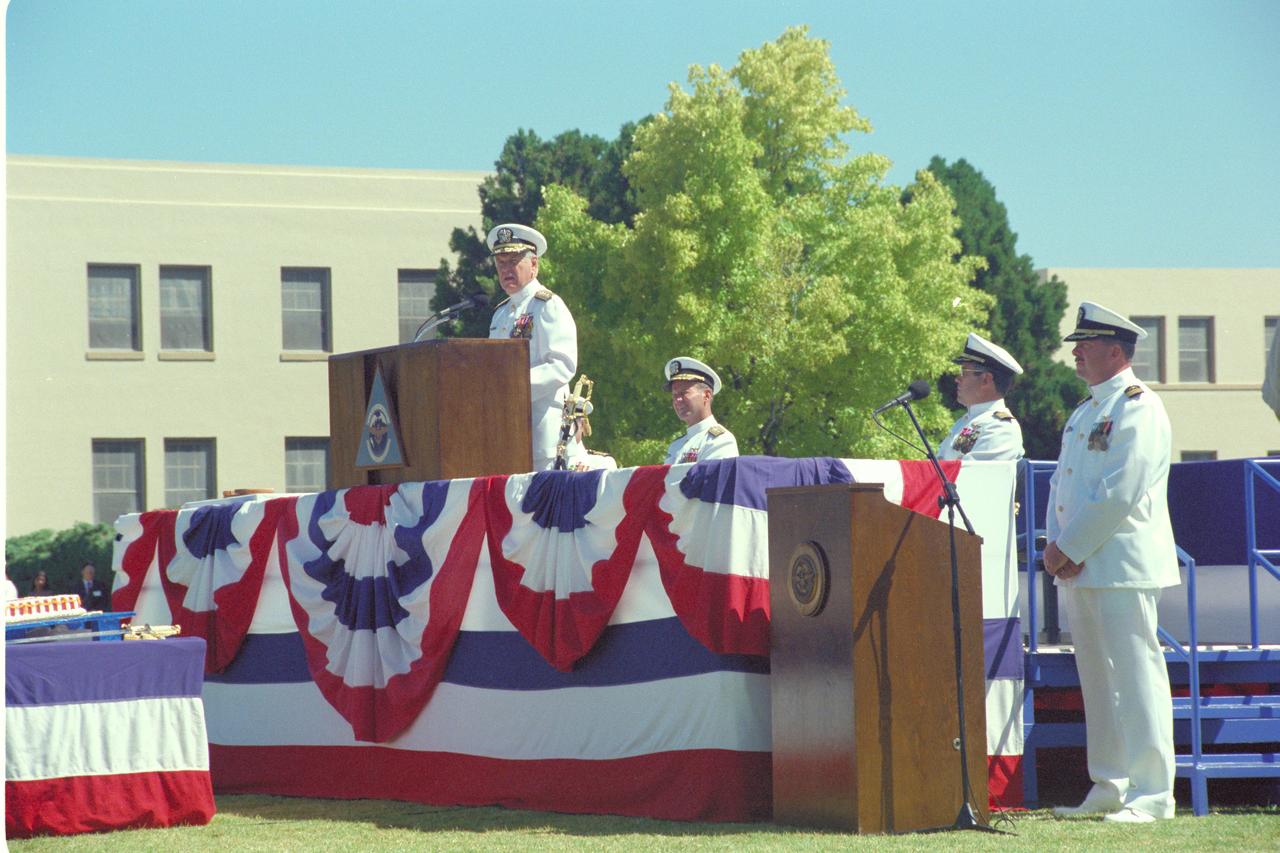
Navy Disestablishment Ceremony (NAS Moffett Field) and the handing off to NASA/AMES Research Center Director Dr. Ken Munechika (Moffett Federal Airfield MFA)
ARC-1994-AC94-0273-1
Navy Disestablishment Ceremony (NAS Moffett Field) and the handing off to NASA/AMES Research Center Director Dr. Ken Munechika (Moffett Federal Airfield MFA)
ARC-1994-AC94-0273-2
Navy Disestablishment Ceremony (NAS Moffett Field) and the handing off to NASA/AMES Research Center Director Dr. Ken Munechika (Moffett Federal Airfield MFA)
ARC-1994-AC94-0273-3
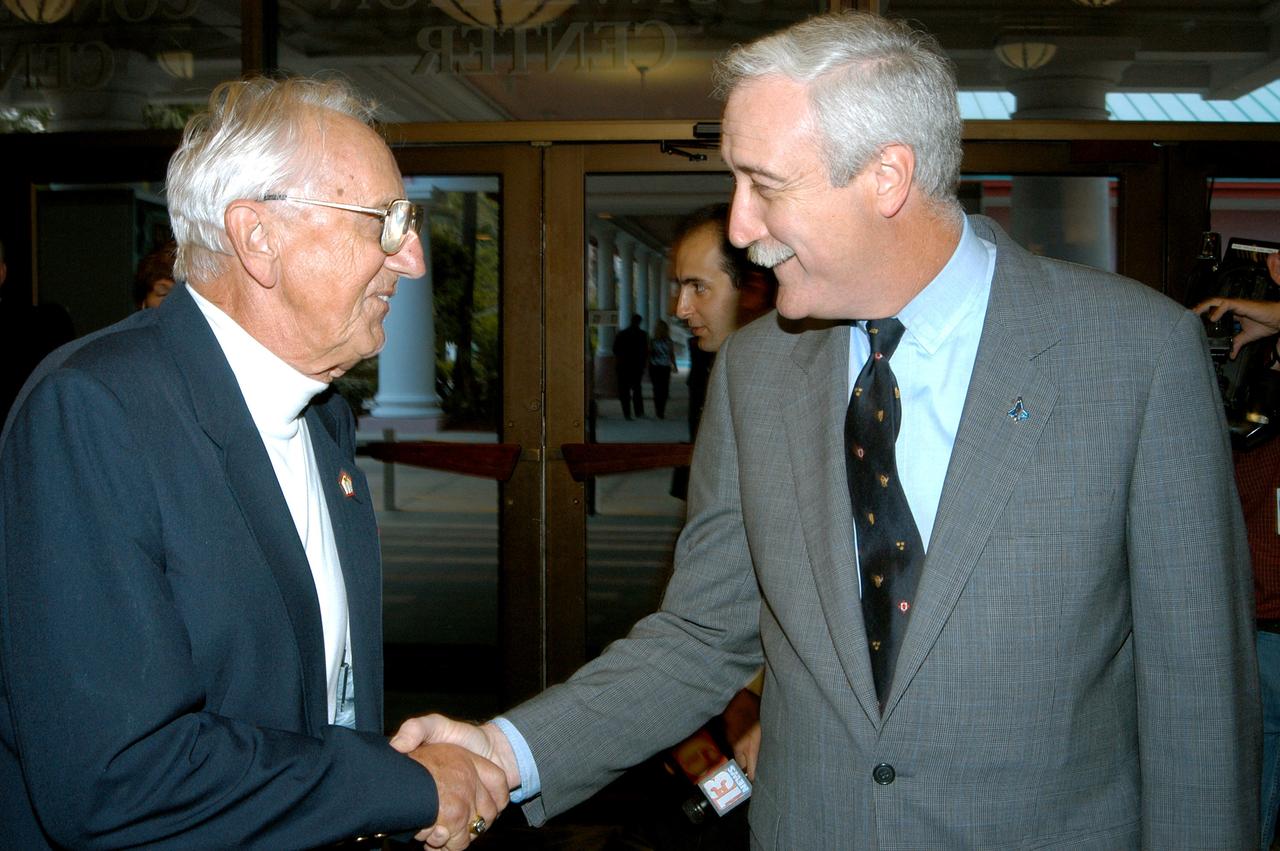
KENNEDY SPACE CENTER, FLA. - Gunther Wendt (left), NASA retiree, shakes hands with NASA Administrator Sean O'Keefe during the annual Congressional Dinner hosted by the Florida Space Business Roundtable.  The dinner kicked off the annual Space Congress, held April 28-May 1, 2003, in Cape Canaveral, Fla.  The theme for the event was "Linking the Past to the Future: A Celebration of Space" and commemorated the 40th anniversary of the Kennedy Space Center and the Centennial of Flight.
KENNEDY SPACE CENTER, FLA. - Gunther Wendt (left), NASA retiree, shakes hands with NASA Administrator Sean O'Keefe during the annual Congressional Dinner hosted by the Florida Space Business Roundtable. The dinner kicked off the annual Space Congress, held April 28-May 1, 2003, in Cape Canaveral, Fla. The theme for the event was "Linking the Past to the Future: A Celebration of Space" and commemorated the 40th anniversary of the Kennedy Space Center and the Centennial of Flight.
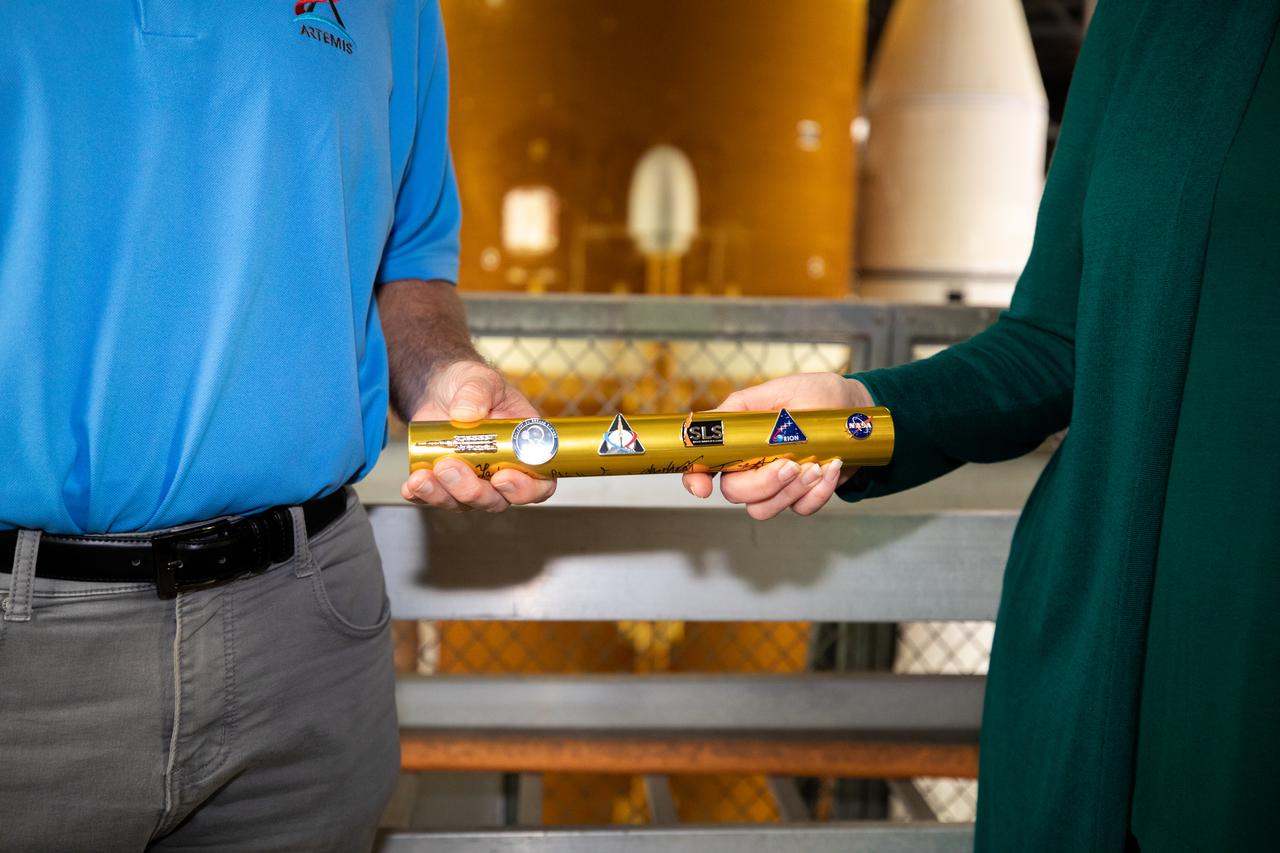
Cliff Lanham, at left, ground operations manager with Exploration Ground Systems, passes the baton to Charlie Blackwell-Thompson, Artemis I launch director, inside the Vehicle Assembly Building at NASA’s Kennedy Space Center in Florida on March 16, 2022. Behind them is the Artemis I Space Launch System (SLS) with the Orion spacecraft atop on the mobile launcher. The SLS and Orion will make the trek to Launch Complex 39B for a wet dress rehearsal ahead of launch atop the crawler-transporter 2. Artemis I will be the first integrated test of the SLS and Orion spacecraft. In later missions, NASA will land the first woman and the first person of color on the surface of the Moon, paving the way for a long-term lunar presence and serving as a steppingstone on the way to Mars.
Baton Hand-Off from EGS Team to Artemis I Launch Team
A baton is passed from Cliff Lanham, at left, ground operations manager with Exploration Ground Systems, to Charlie Blackwell-Thompson, Artemis I launch director, inside the Vehicle Assembly Building at NASA’s Kennedy Space Center in Florida on March 16, 2022. Behind them is the Artemis I Space Launch System (SLS) with the Orion spacecraft atop on the mobile launcher. The SLS and Orion will make the trek to Launch Complex 39B for a wet dress rehearsal ahead of launch atop the crawler-transporter 2. Artemis I will be the first integrated test of the SLS and Orion spacecraft. In later missions, NASA will land the first woman and the first person of color on the surface of the Moon, paving the way for a long-term lunar presence and serving as a steppingstone on the way to Mars.
Baton Hand-Off from EGS Team to Artemis I Launch Team
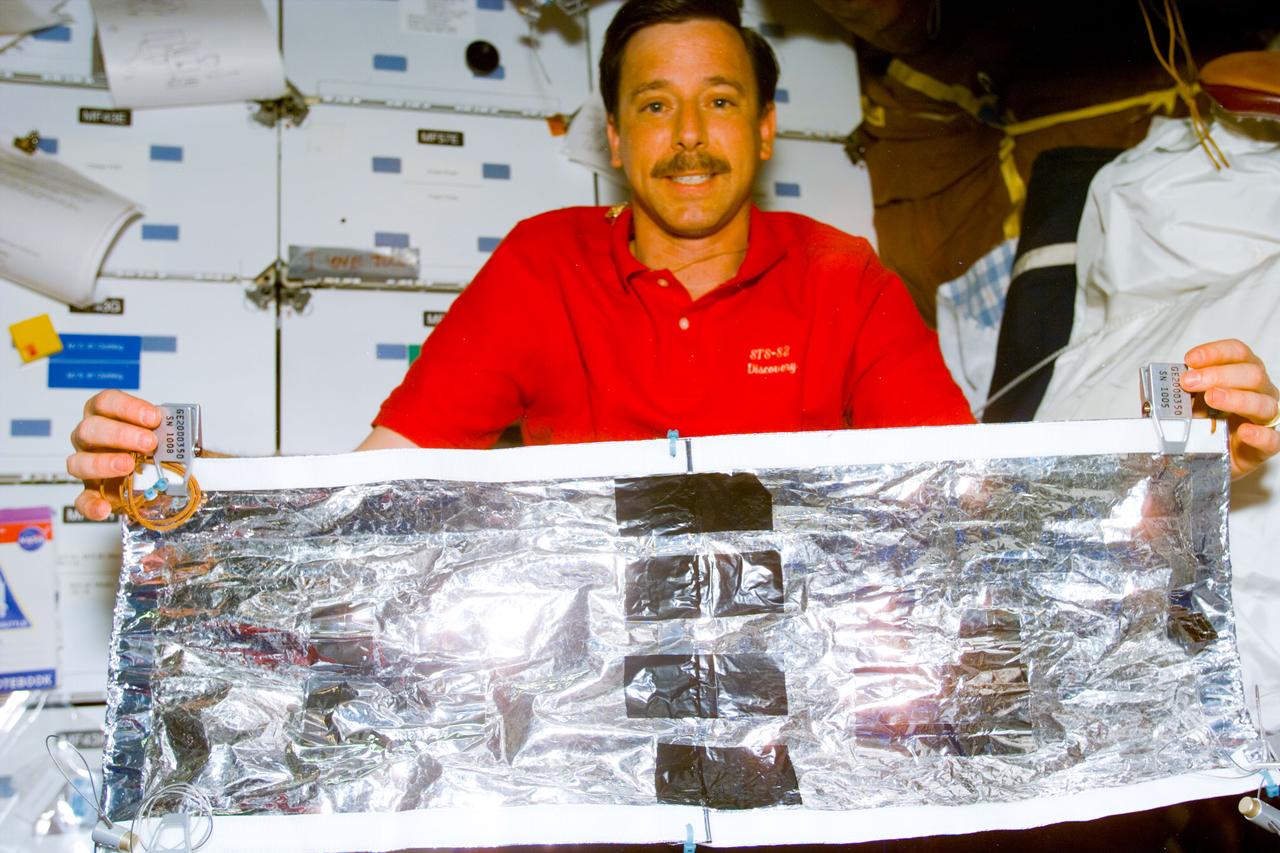
S82-E-5686 (17 Feb. 1997) --- Astronaut Scott J. Horowitz, STS-82 pilot, shows the hand-crafted thermal insulation blanket to support the goal of the final Extravehicular Activity (EVA) to cover tears in Hubble Space Telescope's (HST) insulation caused by changes in thermal conditions. This view was taken with an Electronic Still Camera (ESC).
Horowitz shows off the hand-crafted thermal insulation he made for the HST
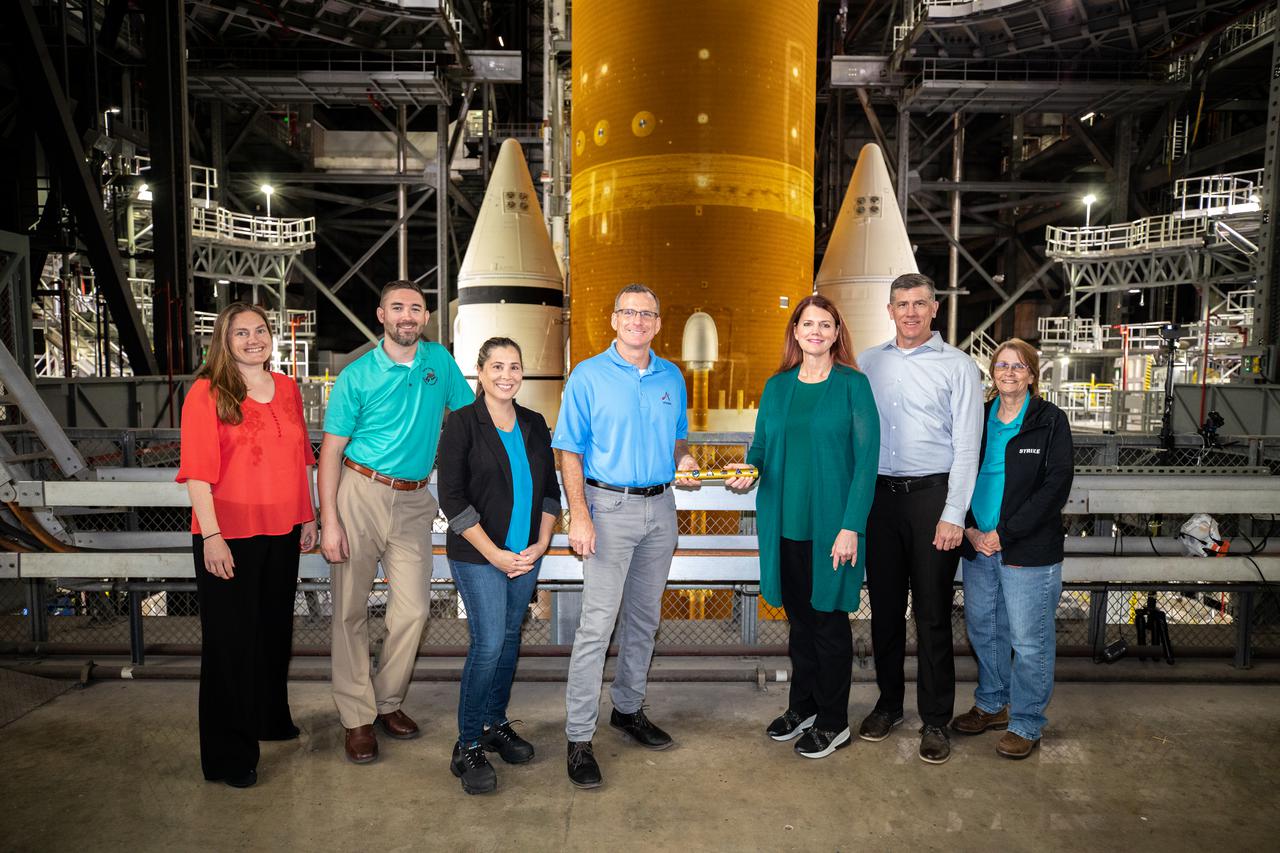
Cliff Lanham, fourth from left,  ground operations manager with Exploration Ground Systems (EGS), passes the baton to Charlie Blackwell-Thompson, Artemis I launch director, inside the Vehicle Assembly Building at NASA’s Kennedy Space Center in Florida on March 16, 2022. Joining them from left, are Stacey Bagg, Matt Czech, and Liliana Villareal, with EGS. Next to Blackwell-Thomson are Jeremy Graeber, deputy launch director, and Teresa Annulis. The Space Launch System (SLS) and Orion will make the trek to Launch Complex 39B for a wet dress rehearsal ahead of launch atop the crawler-transporter 2. Artemis I will be the first integrated test of the SLS and Orion spacecraft. In later missions, NASA will land the first woman and the first person of color on the surface of the Moon, paving the way for a long-term lunar presence and serving as a steppingstone on the way to Mars.
Baton Hand-Off from EGS Team to Artemis I Launch Team
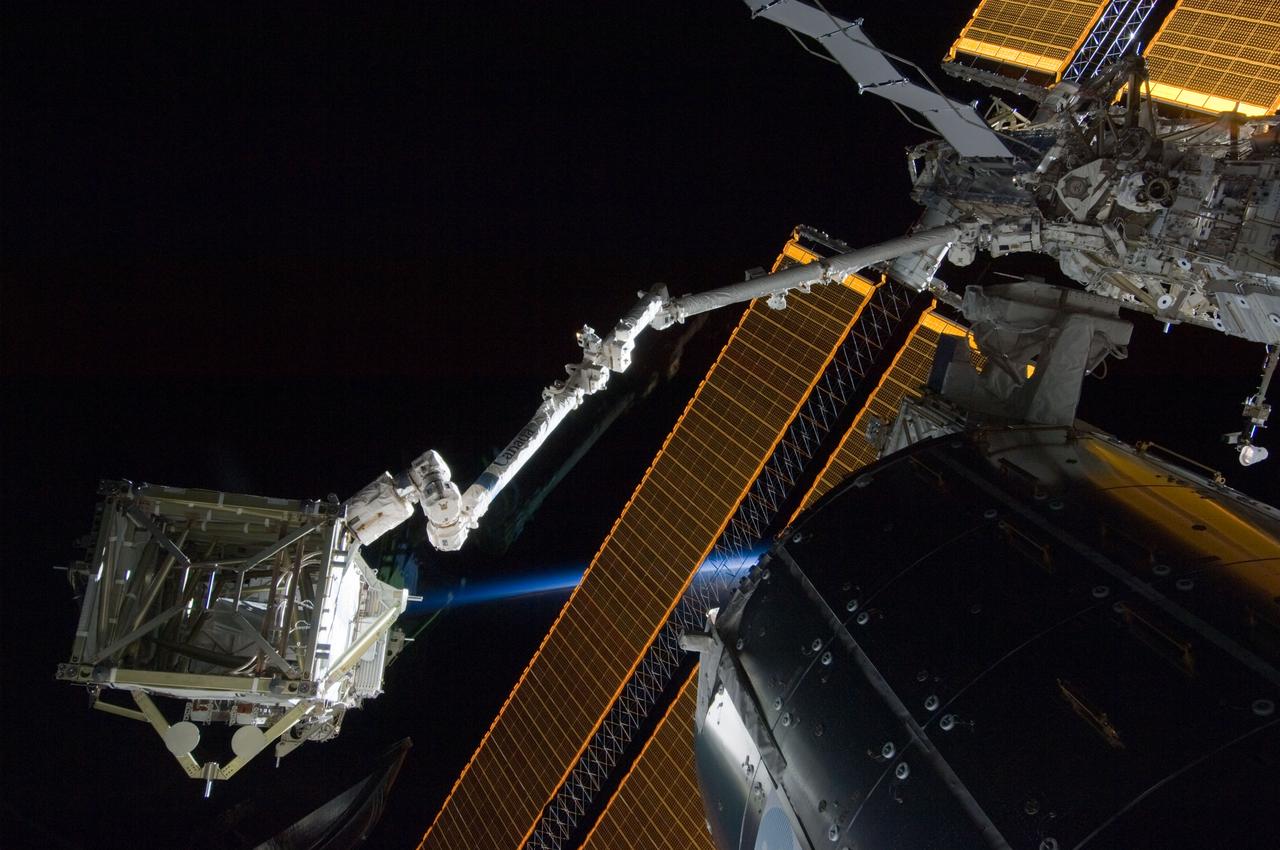
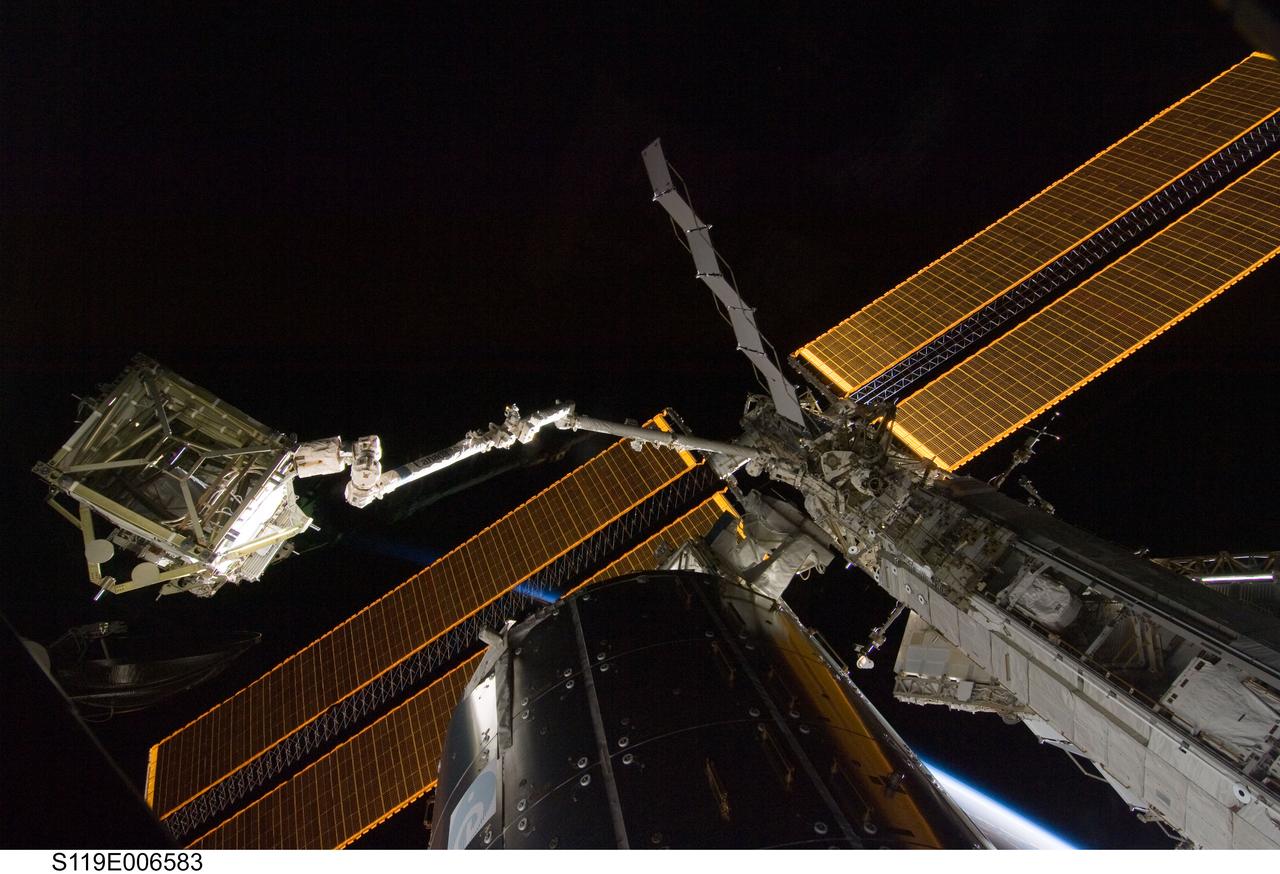
S119-E-006583 (18 March 2009) --- In the grasp of the International Space Station’s robotic Canadarm2, the S6 truss segment was photographed by a STS-119 crewmember while Space Shuttle Discovery is docked with the station. The S6 truss segment was moved from Discovery’s cargo bay by the station’s Canadarm2, handed off to the shuttle’s remote manipulator system (RMS), and then handed back to the station’s robotic arm where it will remain in an overnight parked position. Also visible in the image are the Columbus laboratory, starboard truss and solar array panels.
Space Station Remote Manipulator System (SSRMS) S6 Truss Relocation OPS
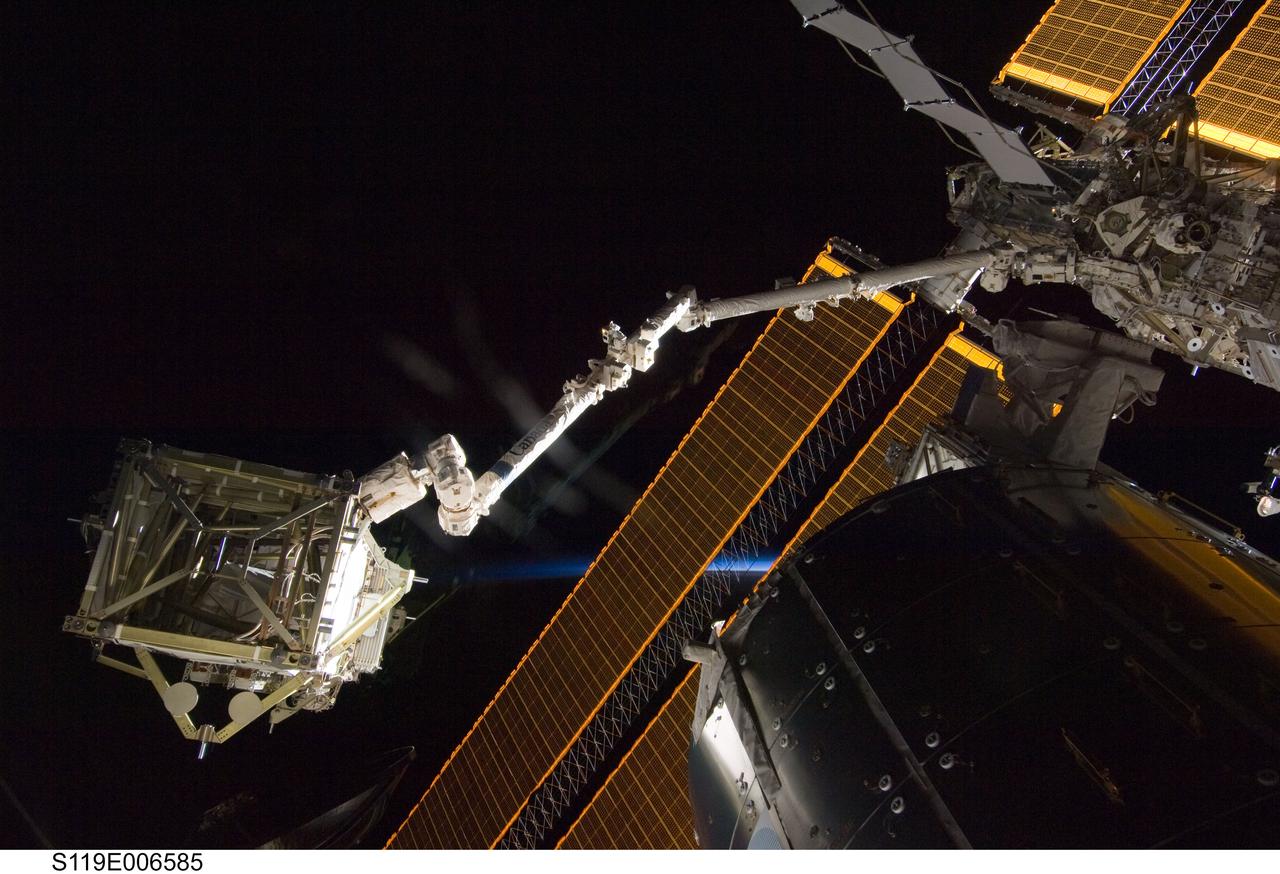
S119-E-006585 (18 March 2009) --- In the grasp of the International Space Station’s robotic Canadarm2, the S6 truss segment was photographed by a STS-119 crewmember while Space Shuttle Discovery is docked with the station. The S6 truss segment was moved from Discovery’s cargo bay by the station’s Canadarm2, handed off to the shuttle’s remote manipulator system (RMS), and then handed back to the station’s robotic arm where it will remain in an overnight parked position. Also visible in the image are the Columbus laboratory, starboard truss and solar array panels.
Space Station Remote Manipulator System (SSRMS) S6 Truss Relocation OPS
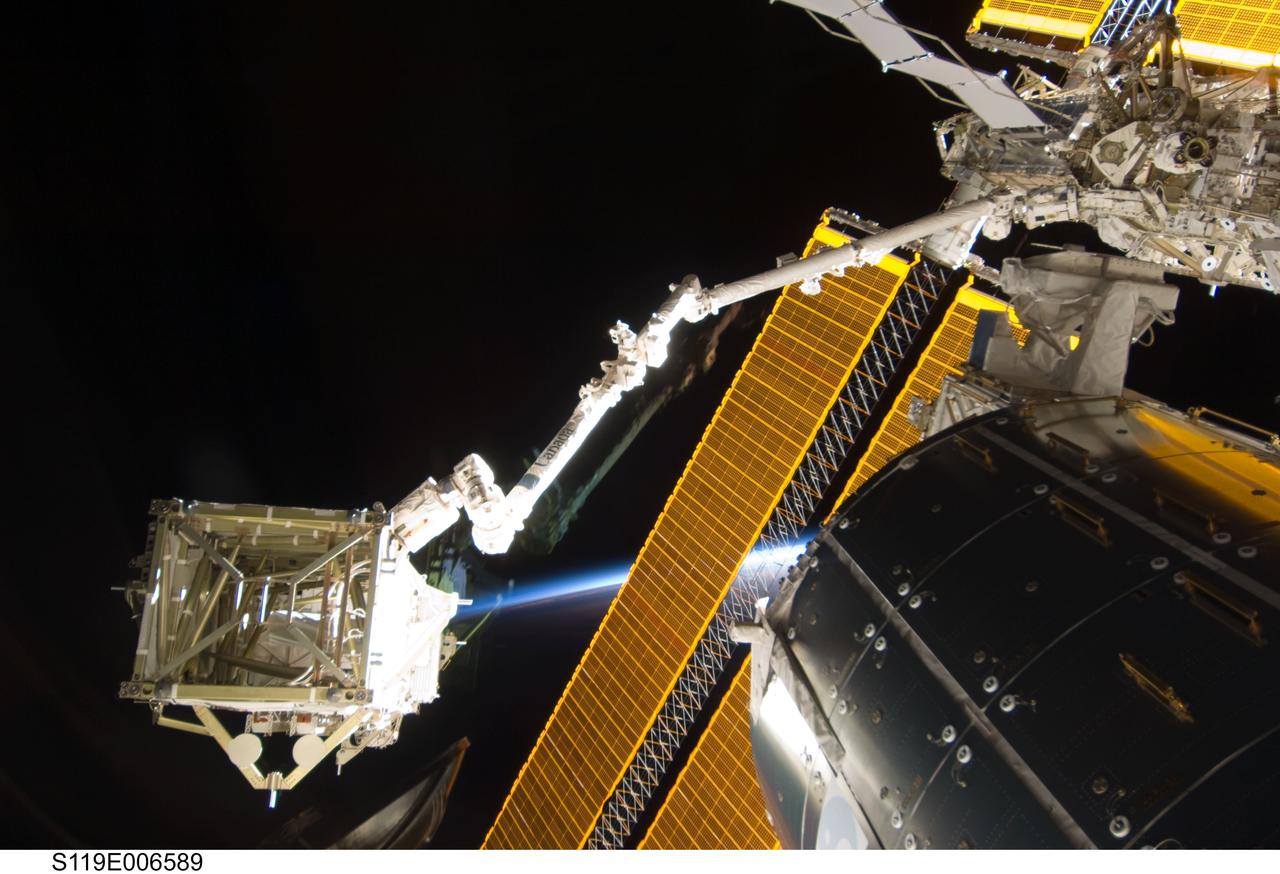
S119-E-006589 (18 March 2009) --- In the grasp of the International Space Station’s robotic Canadarm2, the S6 truss segment was photographed by a STS-119 crewmember while Space Shuttle Discovery is docked with the station. The S6 truss segment was moved from Discovery’s cargo bay by the station’s Canadarm2, handed off to the shuttle’s remote manipulator system (RMS), and then handed back to the station’s robotic arm where it will remain in an overnight parked position. Also visible in the image are the Columbus laboratory, starboard truss and solar array panels.
Space Station Remote Manipulator System (SSRMS) S6 Truss Relocation OPS
S119-E-006596 (18 March 2009) --- In the grasp of the International Space Station’s robotic Canadarm2, the S6 truss segment was photographed by a STS-119 crewmember while Space Shuttle Discovery is docked with the station. The S6 truss segment was moved from Discovery’s cargo bay by the station’s Canadarm2, handed off to the shuttle’s remote manipulator system (RMS), and then handed back to the station’s robotic arm where it will remain in an overnight parked position. Also visible in the image are the Columbus laboratory, starboard truss and solar array panels.
Space Station Remote Manipulator System (SSRMS) S6 Truss Relocation OPS
S119-E-006588 (18 March 2009) --- In the grasp of the International Space Station’s robotic Canadarm2, the S6 truss segment was photographed by a STS-119 crewmember while Space Shuttle Discovery is docked with the station. The S6 truss segment was moved from Discovery’s cargo bay by the station’s Canadarm2, handed off to the shuttle’s remote manipulator system (RMS), and then handed back to the station’s robotic arm where it will remain in an overnight parked position. Also visible in the image are the Columbus laboratory, starboard truss and solar array panels.
Space Station Remote Manipulator System (SSRMS) S6 Truss Relocation OPS
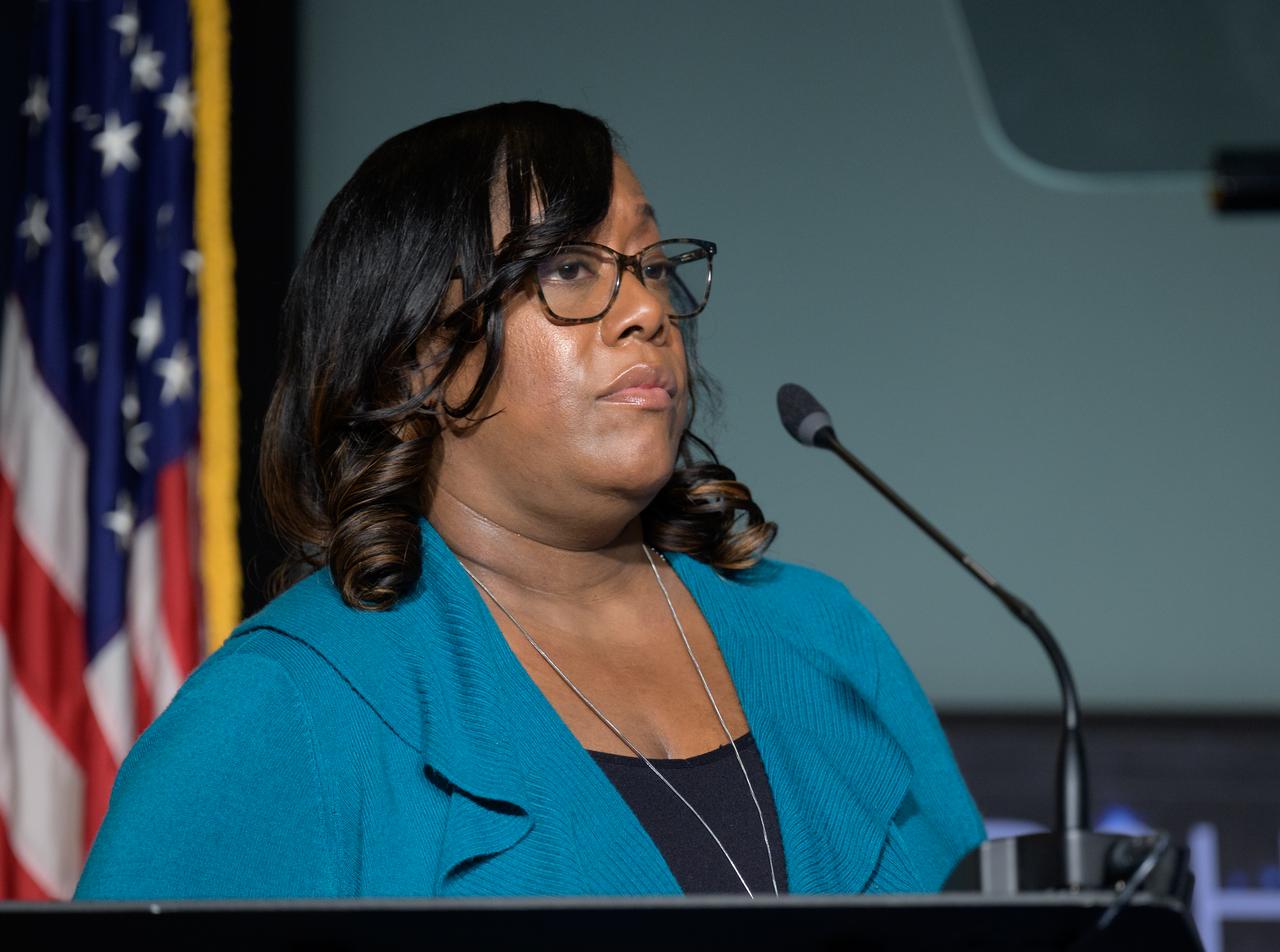
Michelle Jones, Deputy Associate Administrator for NASA’s Office of Communications, kicks off a NASA agencywide all hands, Friday, Dec. 6, 2024, at the NASA Headquarters Mary W. Jackson Building in Washington. Photo Credit: (NASA/Bill Ingalls)
NASA Agencywide All Hands
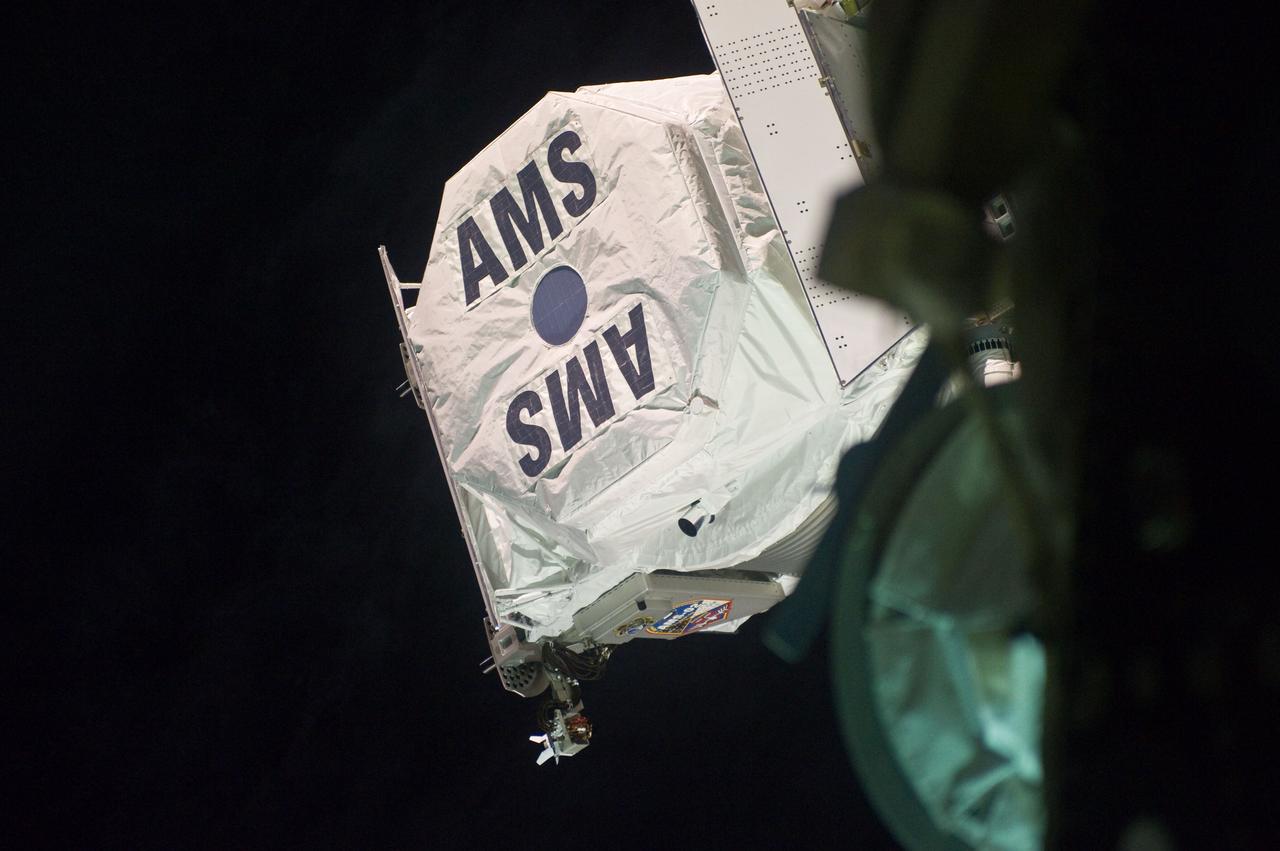
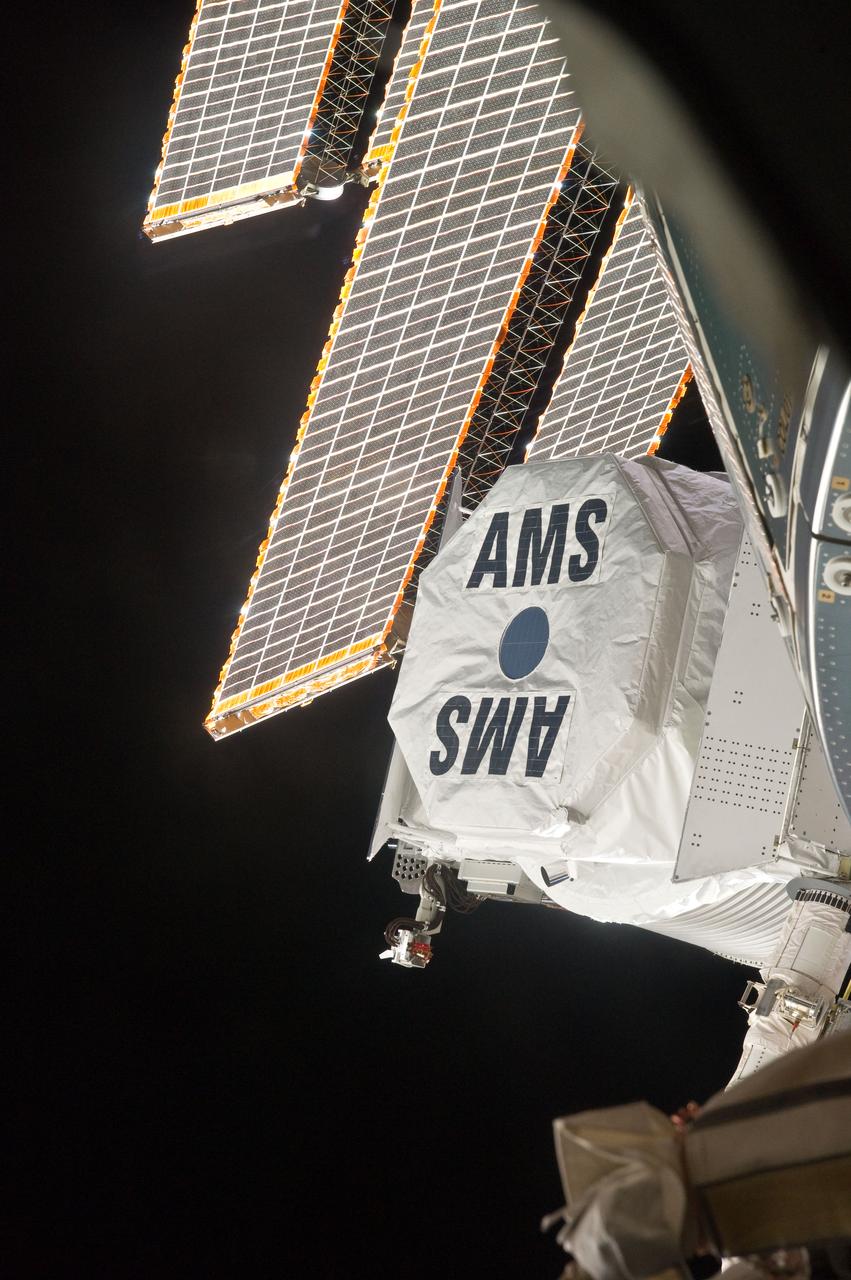
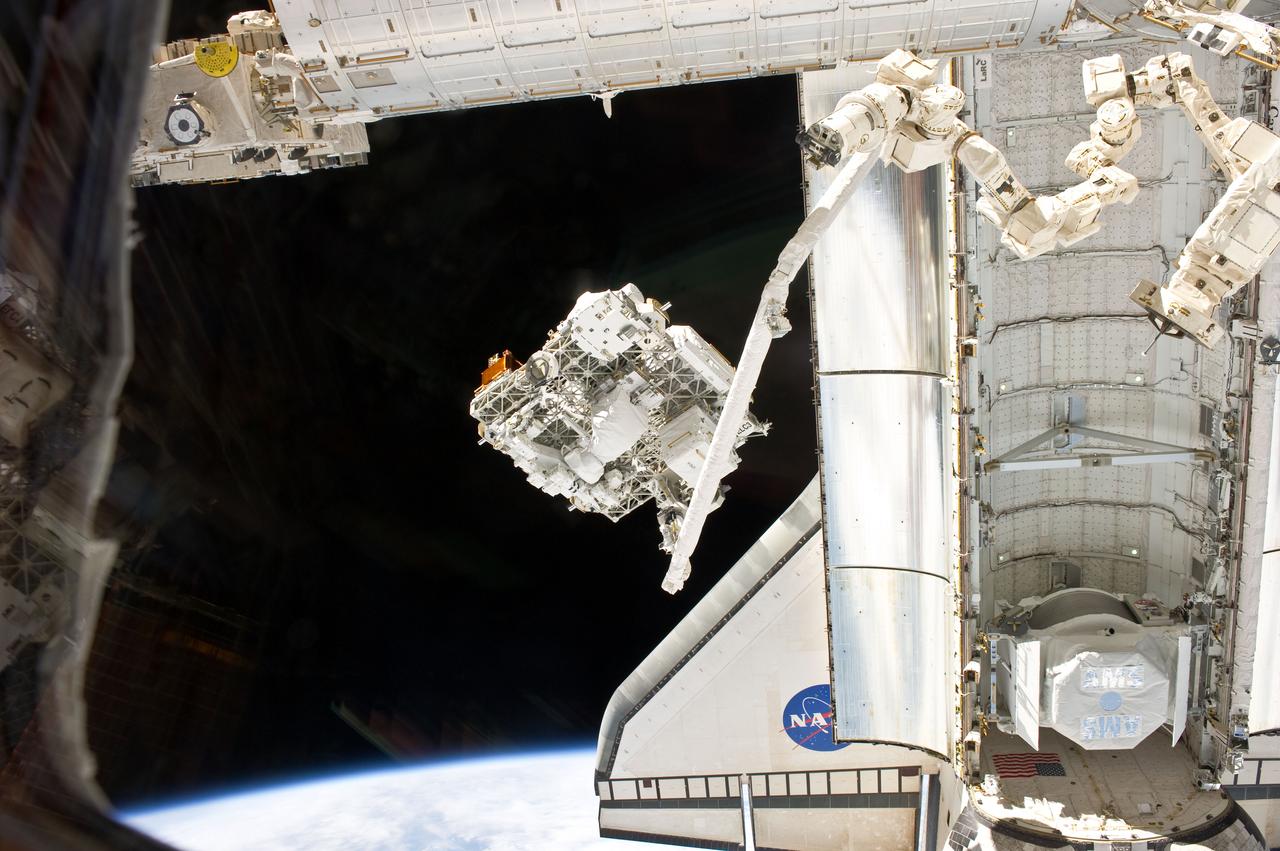
S134-E-007186 (19 May 2011) --- In the grasp of space shuttle Endeavour?s robotic Canadarm, the Alpha Magnetic Spectrometer-2 (AMS) is moved from Endeavour?s payload bay to be handed off to the International Space Station?s Canadarm2 for installation on the station?s starboard truss. Photo credit: NASA
Unberthing of the AMS-2
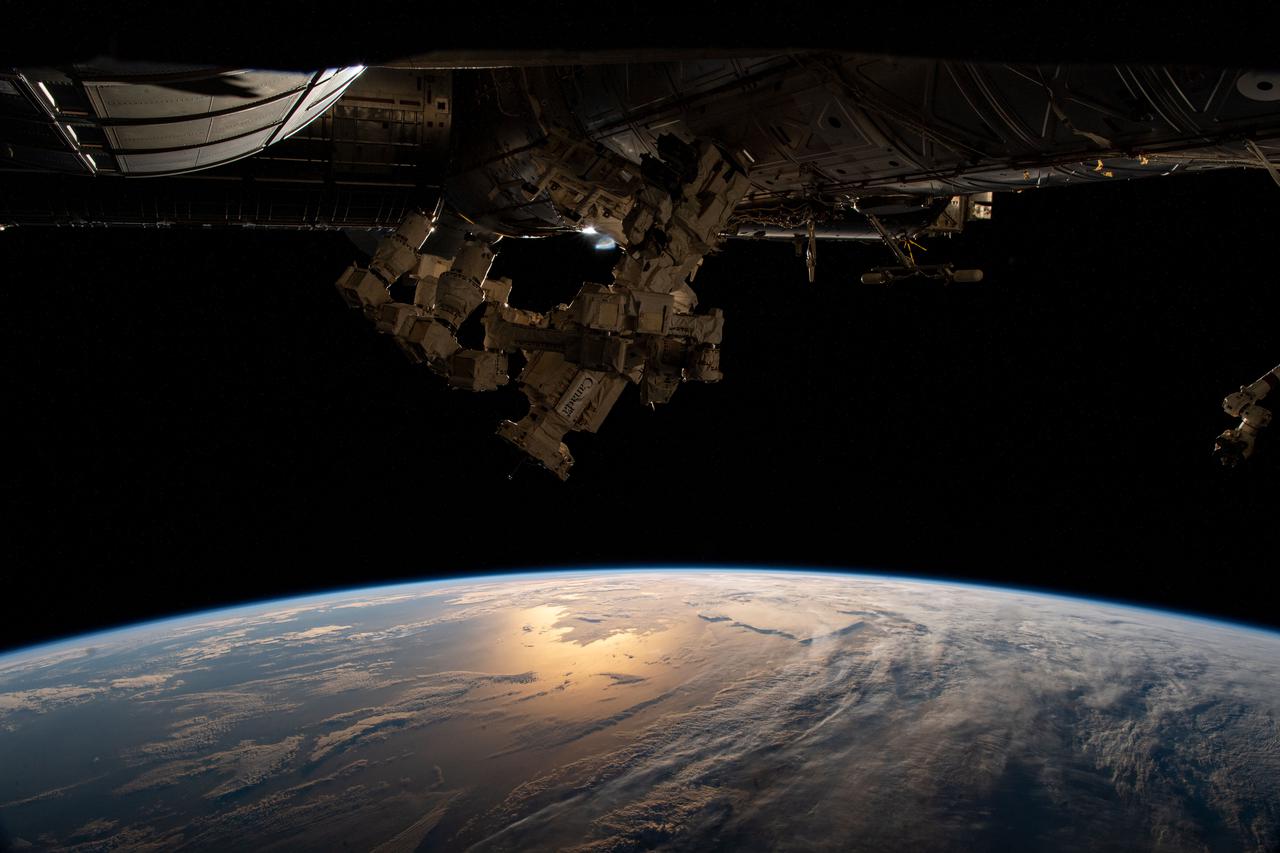
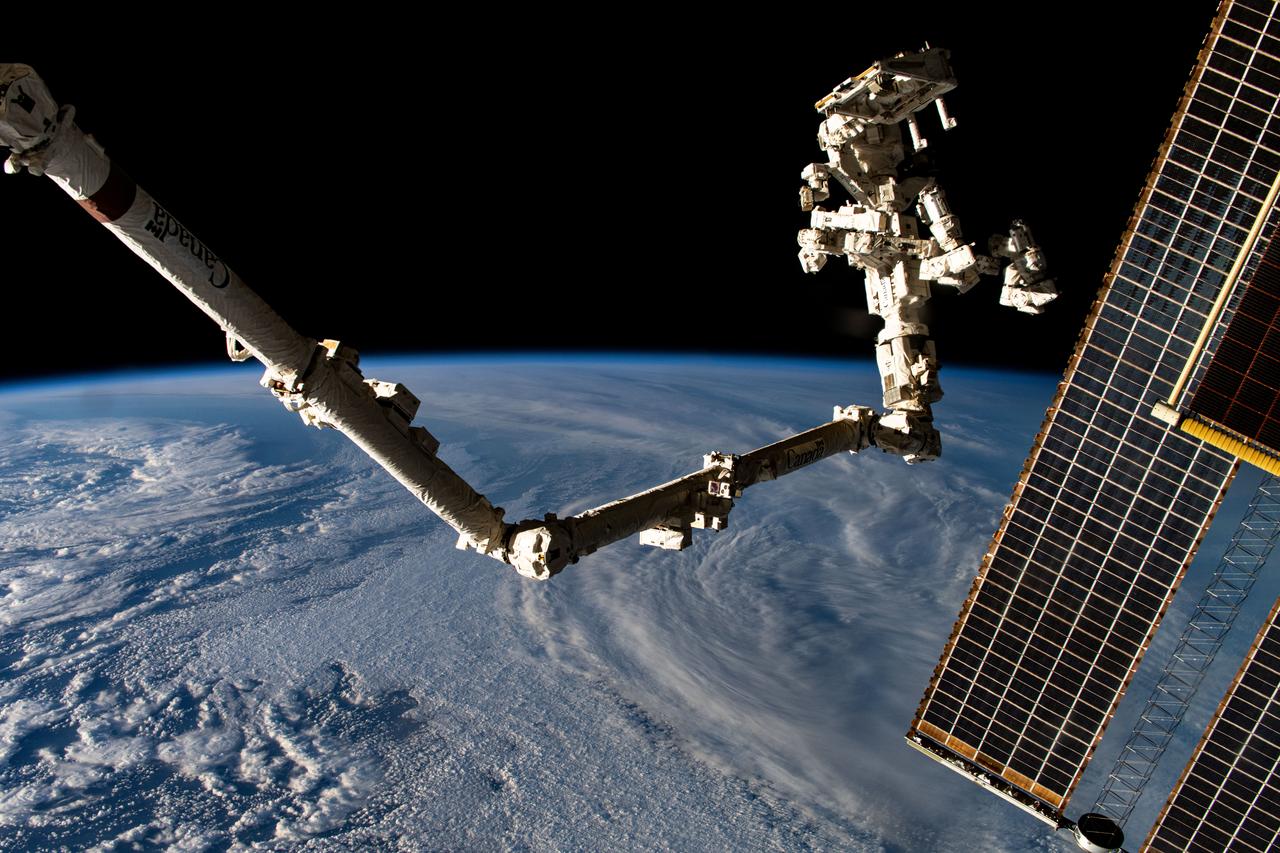
iss071e077765 (May 15, 2024) --- The Canadarm2 robotic arm with its fine-tuned robotic hand, also known Dextre, attached extends into the frame with a set of main solar arrays draping downward (right) as the International Space Station orbited 267 miles above a cloudy South Atlantic Ocean off the coast of Argentina.
iss071e077765
iss070e014652 (Oct. 27, 2023) --- The sun's glint beams off a clear blue north Atlantic Ocean as the International Space Station orbited 261 miles above. In the foreground, a pair of main solar arrays drape across the right with the Canadarm2 robotic arm and its fine-tuned robotic hand Dextre extending from the left.
iss070e014652
iss064e053054 (April 5, 2021) --- The sun's glint beams off the Atlantic Ocean as the International Space Station soared 271 miles above the southern coast of Argentina. In the foreground, is "Dextre," or Special Purpose Dexterous Manipulator, the robotic hand from the Canadian Space Agency for fine-tuned robotic maintenance activities outside of the orbiting lab.
iss064e053054
iss066e136625 (Feb. 5, 2022) --- The Canadarm2 robotic arm, with the Dextre fine-tuned robotic hand attached, is pictured as the International Space Station orbited 259 miles above the Atlantic Ocean south of Cape Verde off the coast of Africa.
iss066e136625
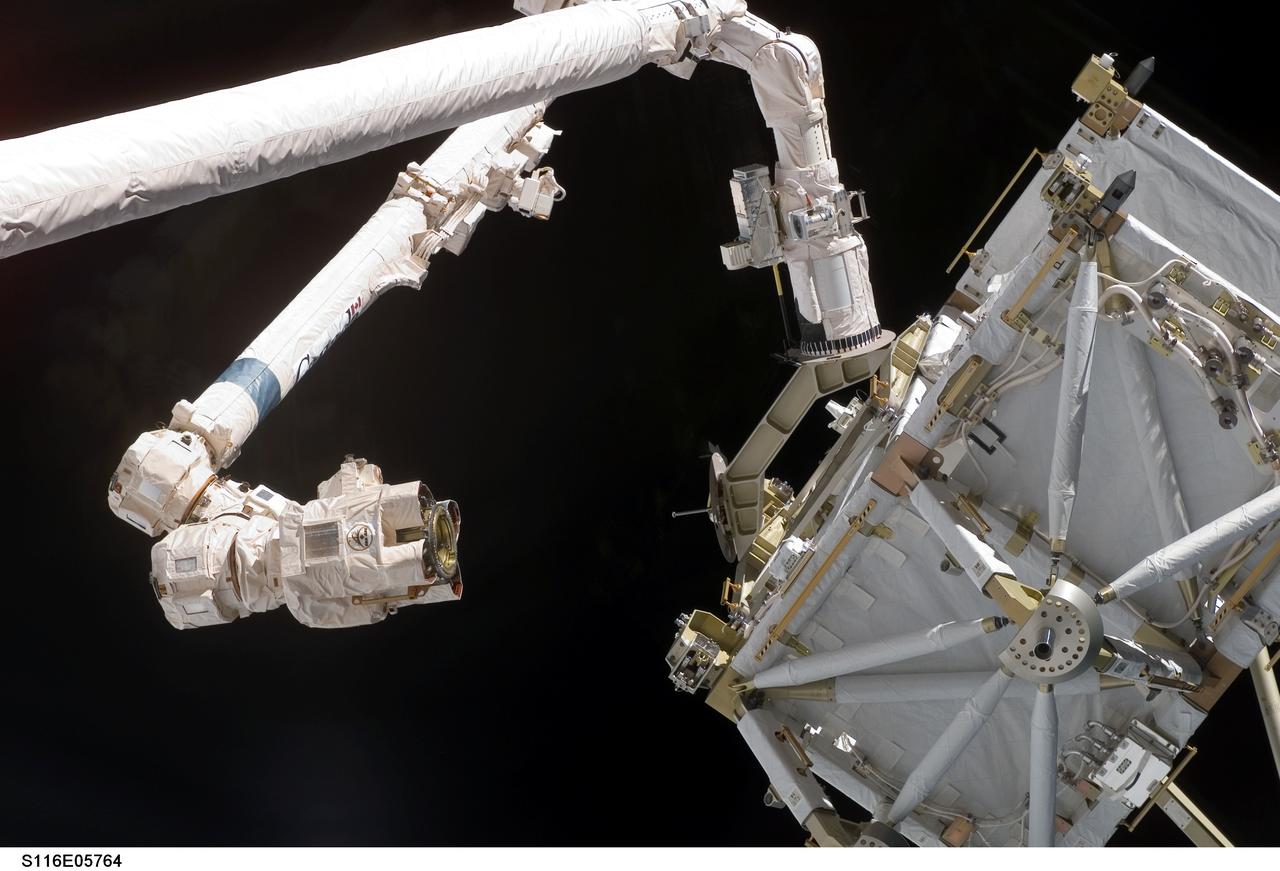
S116-E-05764 (11 Dec. 2006) --- The International Space Station's Canadarm2 moves toward the station's new P5 truss section for a hand-off from Space Shuttle Discovery's Remote Manipulator System (RMS) robotic arm.
P5 Truss installation
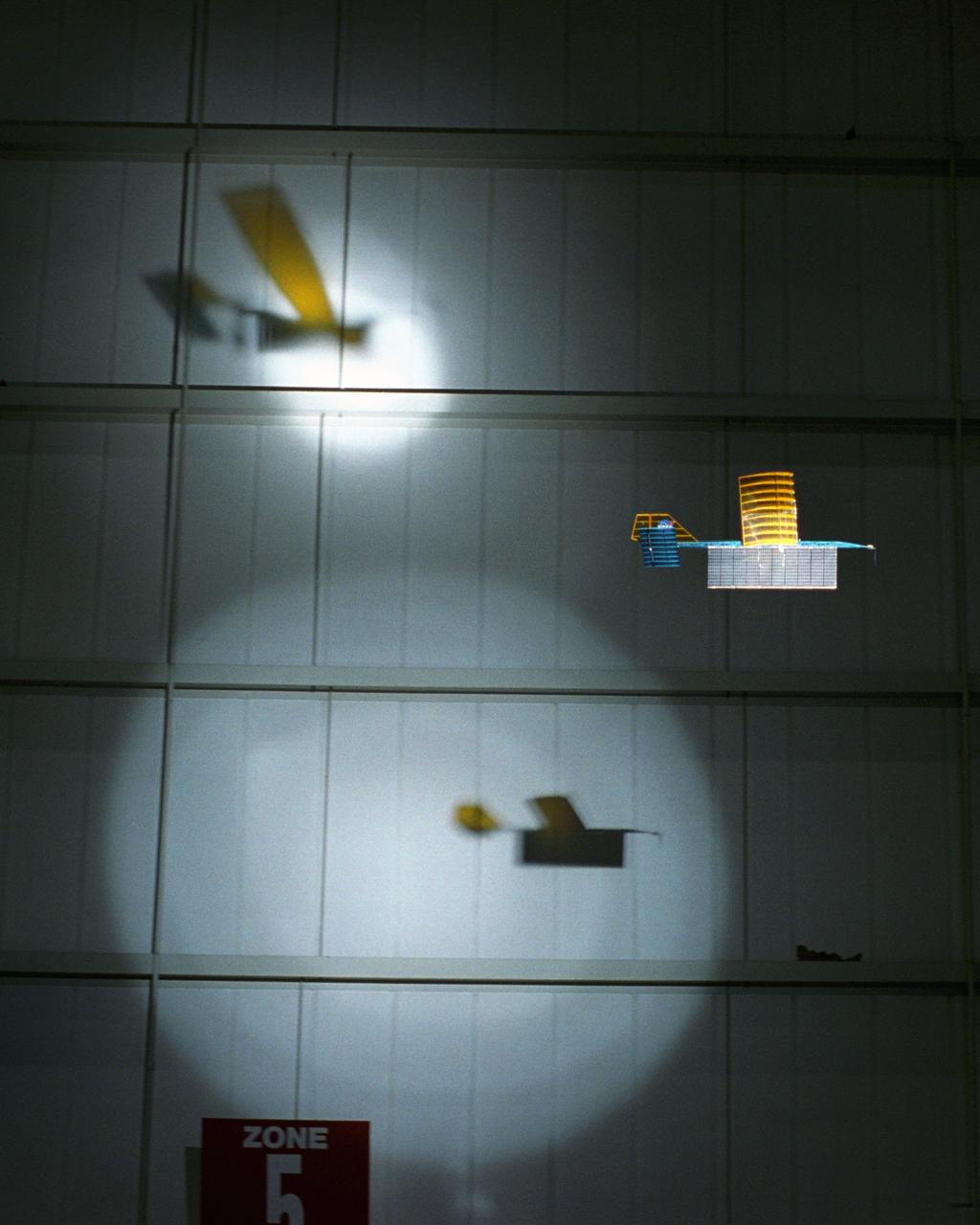
An experimental radio-controlled model aircraft casts two unique shadows as it flies inside a Dryden hangar using two spotlights as energy sources. This phase of testing was used to develop procedures and operations for "handing off" the aircraft between different sources of power.
An experimental radio-controlled model aircraft casts two unique shadows as it flies inside a Dryden hangar using two spotlights as energy sources.
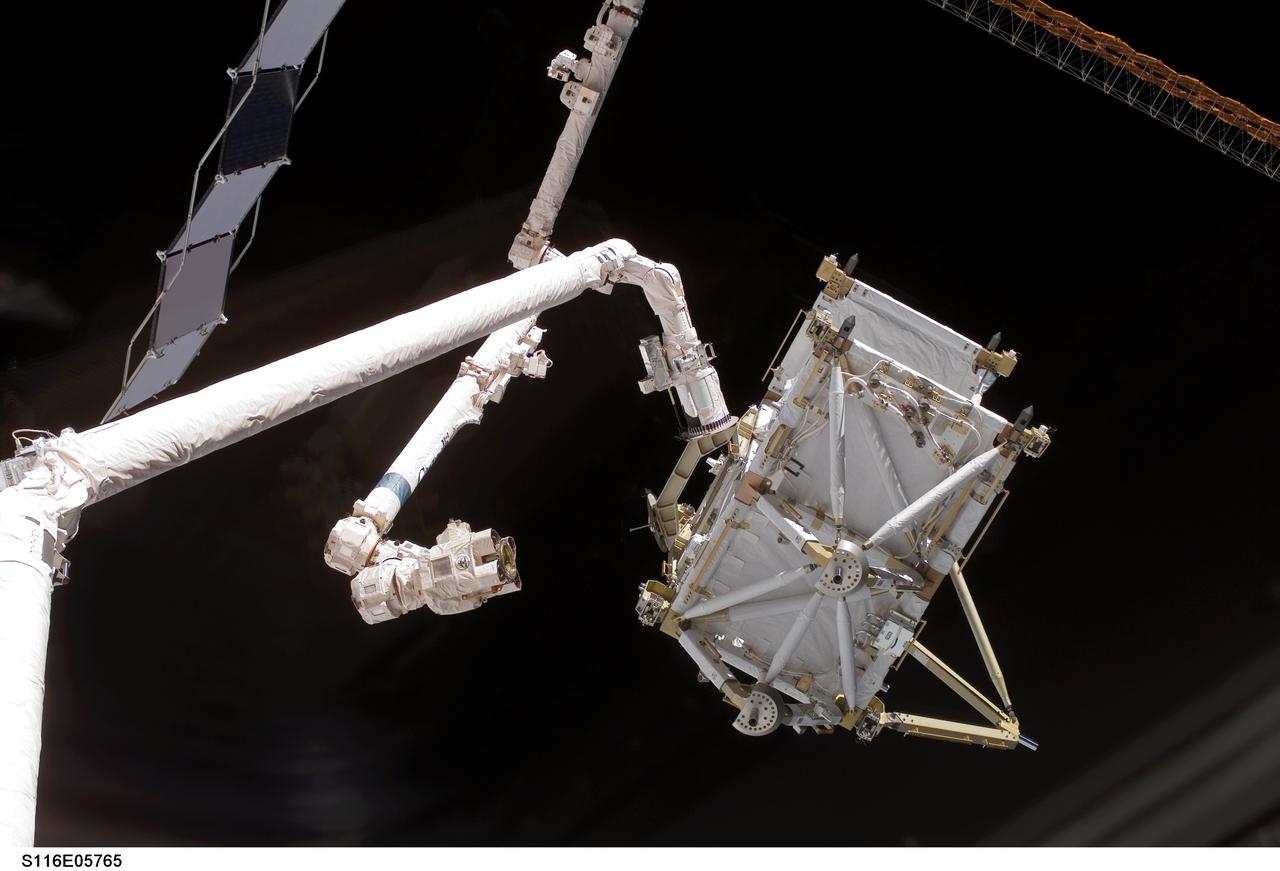
S116-E-05765 (11 Dec. 2006) --- The International Space Station's Canadarm2 moves toward the station's new P5 truss section for a hand-off from Space Shuttle Discovery's Remote Manipulator System (RMS) robotic arm.
P5 Truss installation
S134-E-007189 (19 May 2011) --- In the grasp of space shuttle Endeavour?s robotic Canadarm, the Alpha Magnetic Spectrometer-2 (AMS) is moved from Endeavour?s payload bay to be handed off to the International Space Station?s Canadarm2 for installation on the station?s starboard truss. Photo credit: NASA
Unberthing of the AMS-2
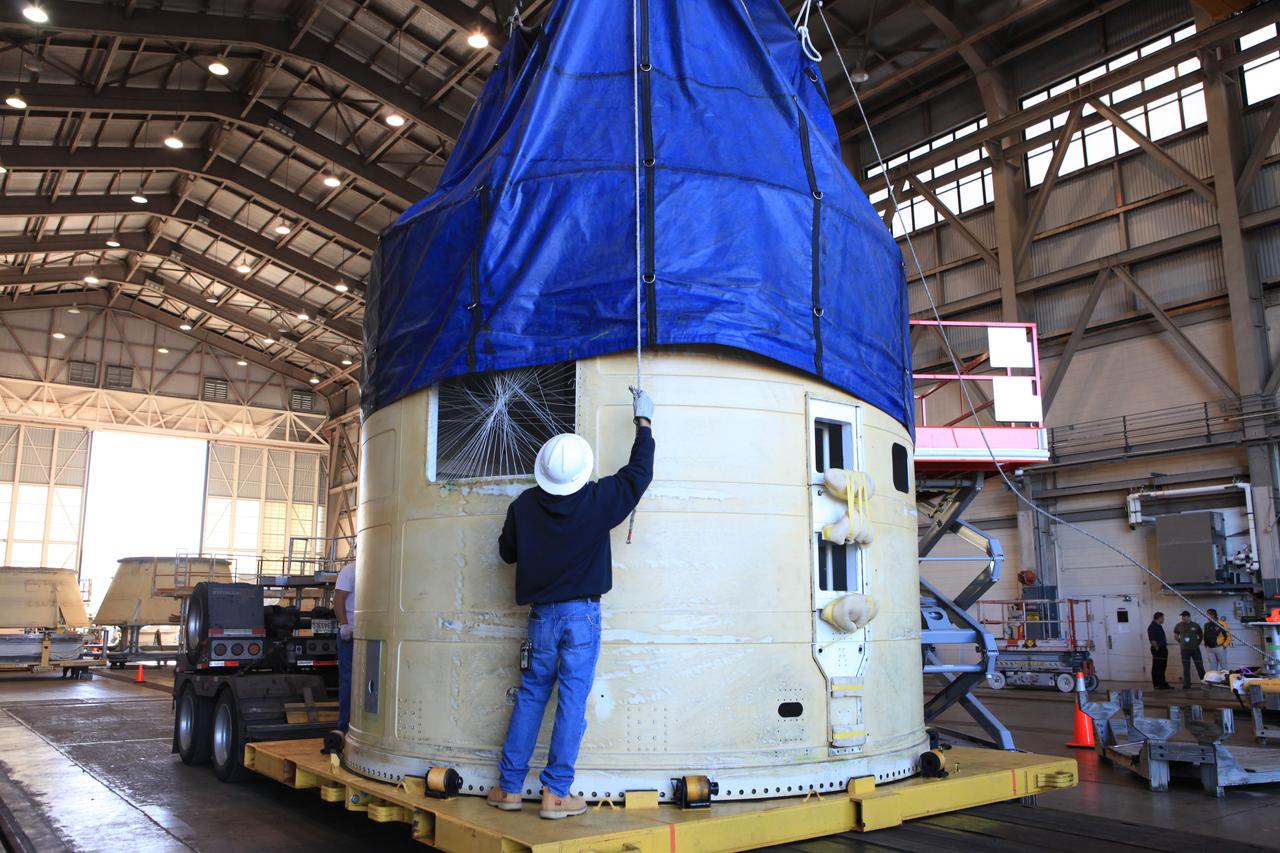
Technicians with Orbital ATK assist as a crane is used to lift the protective covering off of the left-hand forward skirt for NASA's Space Launch System (SLS) solid rocket boosters inside the Hangar AF facility at Cape Canaveral Air Force Station in Florida. The forward skirt was transported from booster prime contractor Orbital ATK in Promontory, Utah. The forward skirt will be staged in Hangar AF where refurbishment will continue. It will be inspected and prepared for use on the left-hand solid rocket booster for Exploration Mission 1. NASA's Orion spacecraft will fly atop the SLS rocket on its first uncrewed flight test.
Orion EM-1 LH Forward Skirt Arrival and Offload
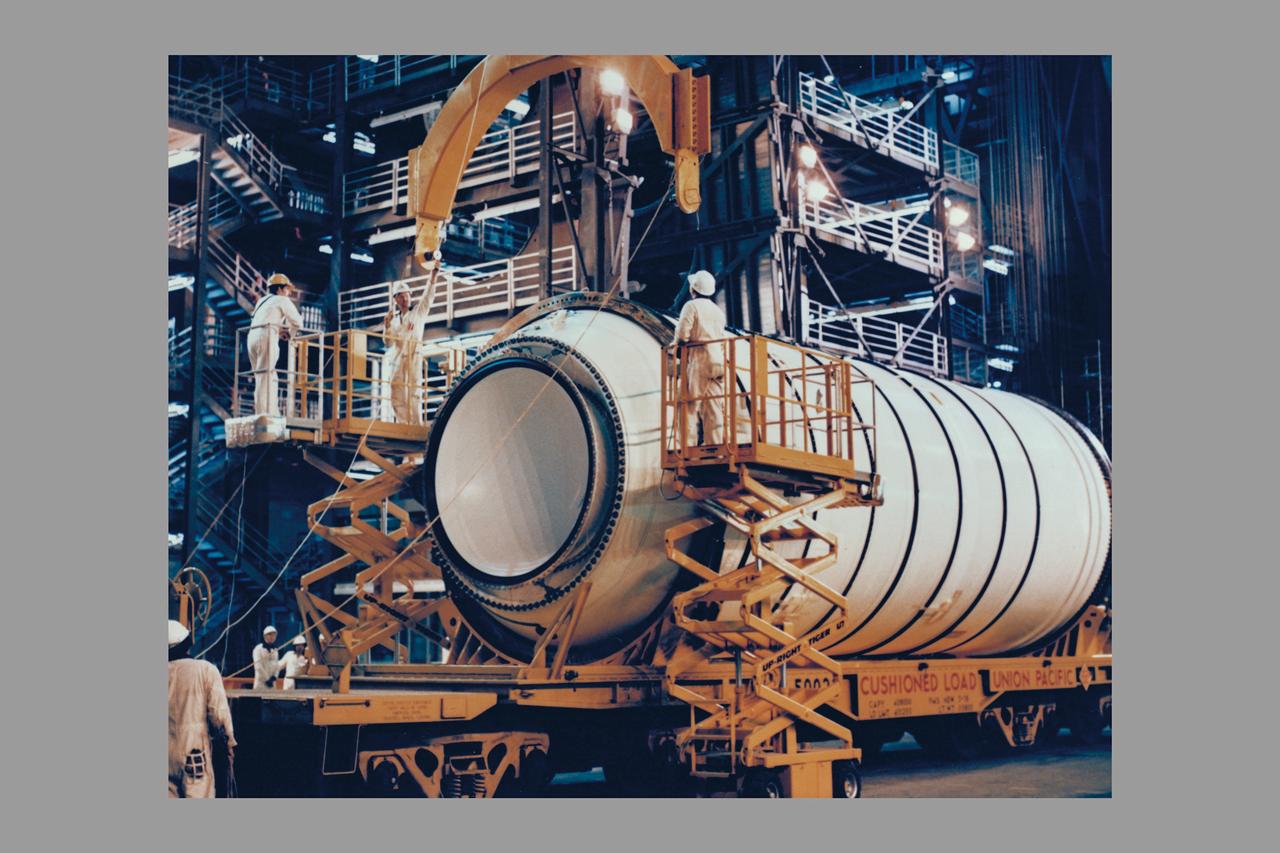
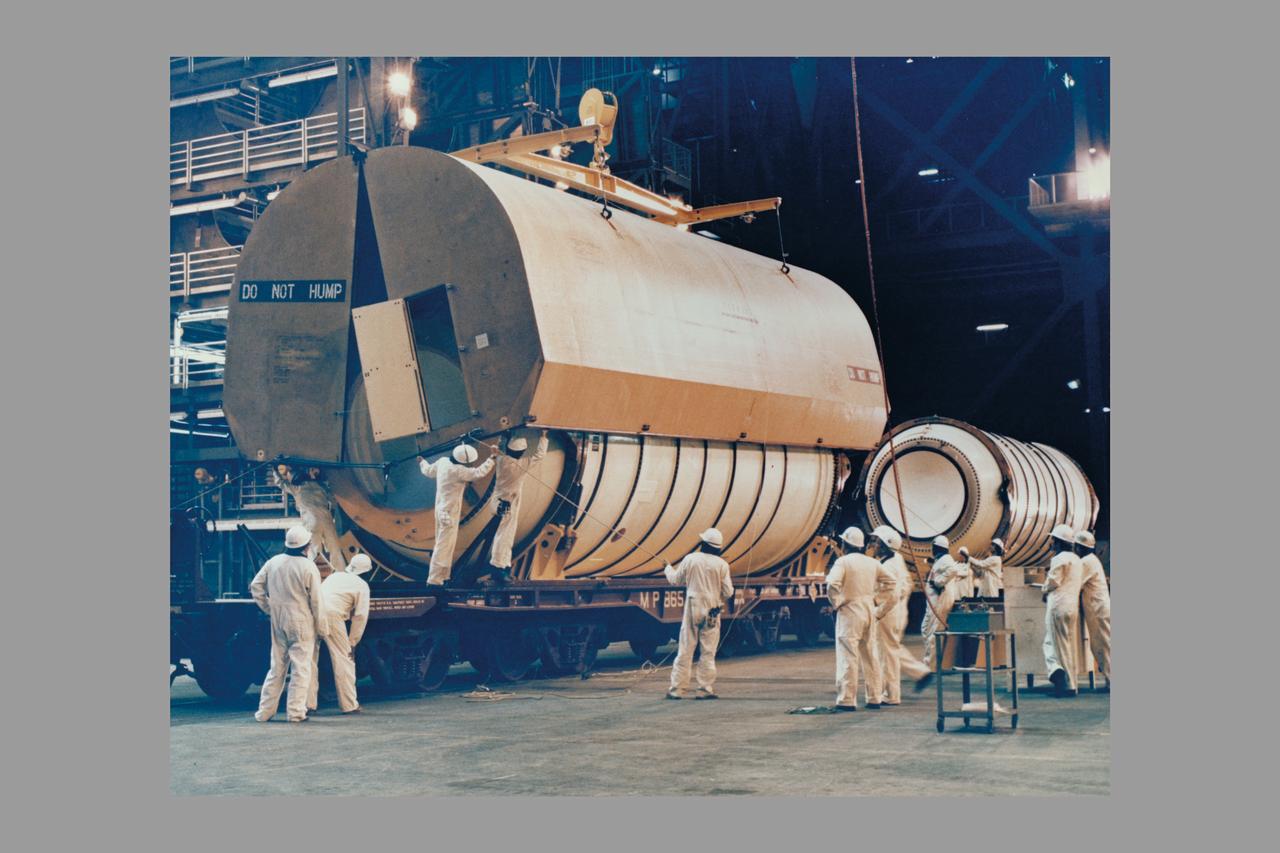
The first solid rocket booster solid motor segemnts to arrive at KSC, the left and right hand aft segments are off-loaded into High Bay 4 in the Vehicle Assembly Building and mated to their respective SRB aft skirts. The two aft assemblies will support the entire 150 foot tall solid boosters, in turn supporting the external tank and Orbiter Columbia on the Mobile Launcher Platform, for the first orbital flight test of the Space Shuttle.
ARC-1980-AC80-0107-2
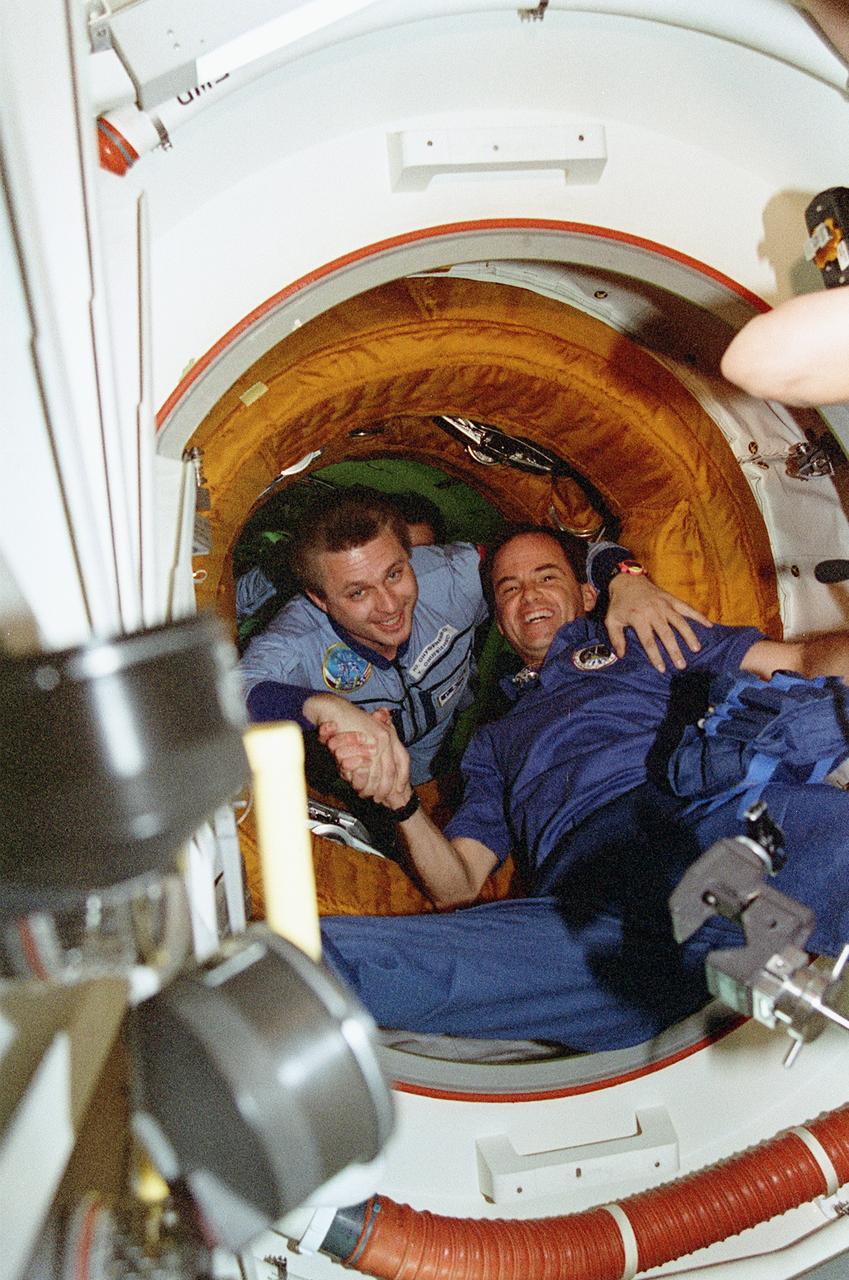
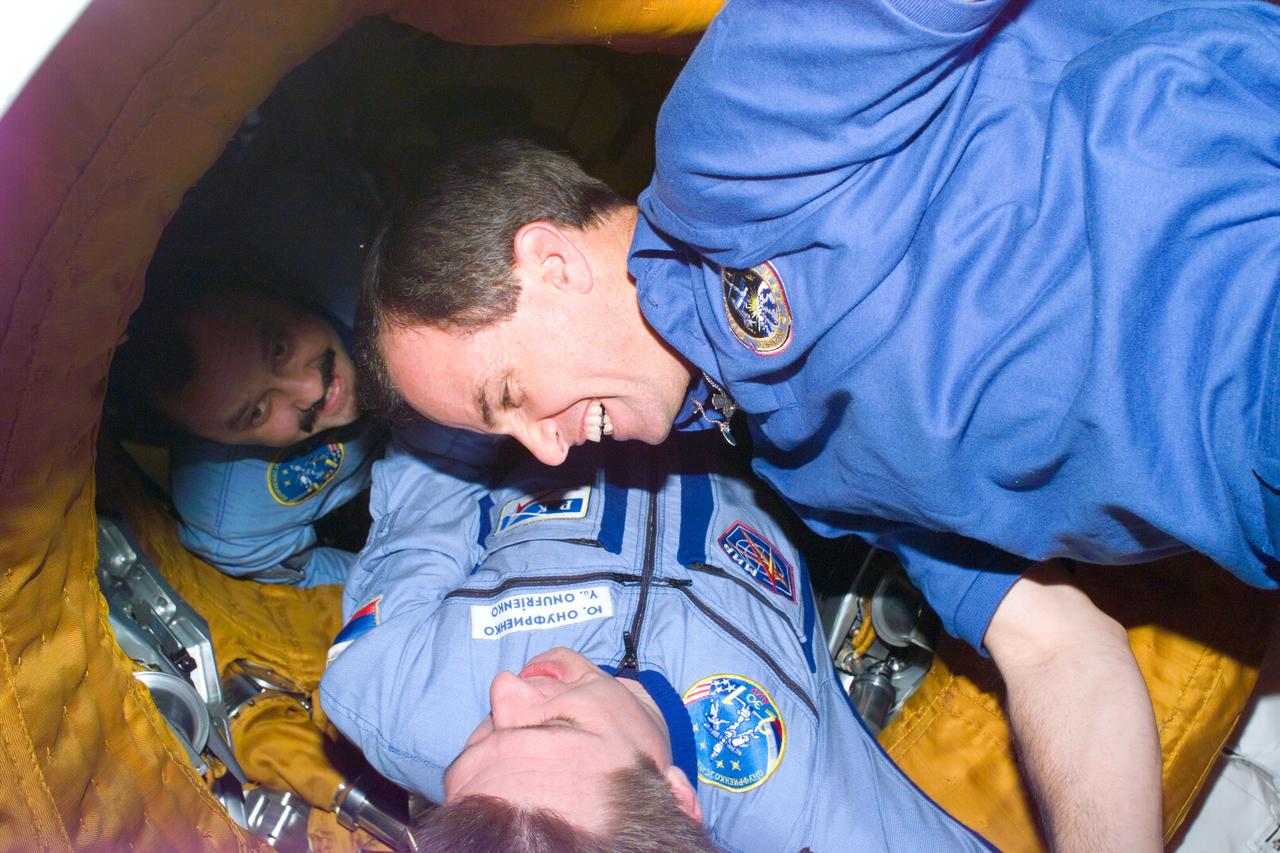
STS076-344-013 (24 March 1996)--- Continuing an in-space tradition, astronaut Kevin P. Chilton (right), mission commander, shakes hands with cosmonaut Yury I. Onufrienko, Mir-21 commander, in the tunnel connecting the Space Shuttle Atlantis and Russia's Mir Space Station.  A short time earlier two crews successfully pulled off the third hard-docking of their respective spacecraft.  The image was made with a 35mm camera.
Opening the hatch and welcome ceremony in the Mir Space Station
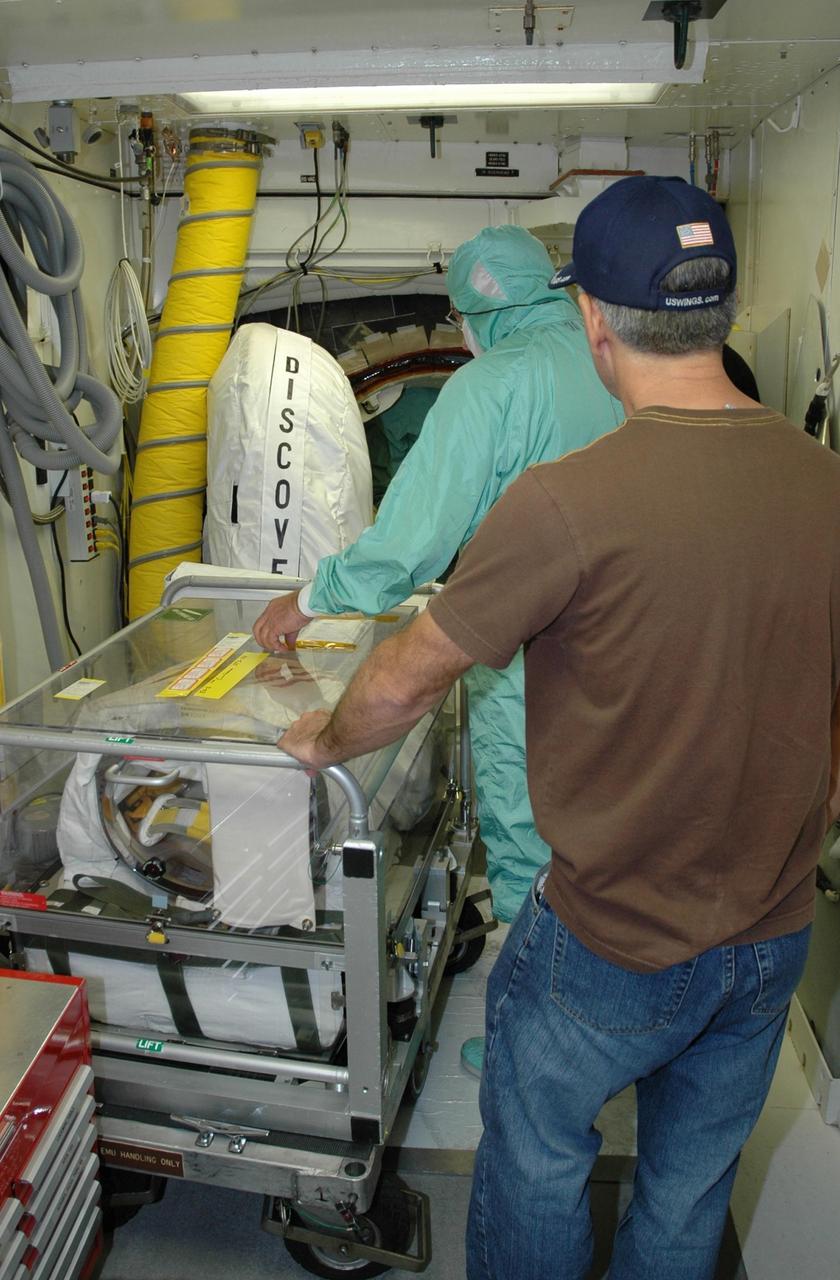
KENNEDY SPACE CENTER, FLA. --  Inside the White Room on Launch Pad 39B, the worker in the foreground hands off the cart to another worker in a protective suit who will move it inside Space Shuttle Discovery for storage. The cart contains the extravehicular mobility units (or spacewalk suits) to be used on mission STS-116.  Launch of Discovery is scheduled for 9:35 p.m. Dec. 7. The crew will deliver the P5 integrated truss to the International Space Station and install it during one or more extravehicular activities. Photo credit: NASA/Jack Pfaller
KSC-06pd2626
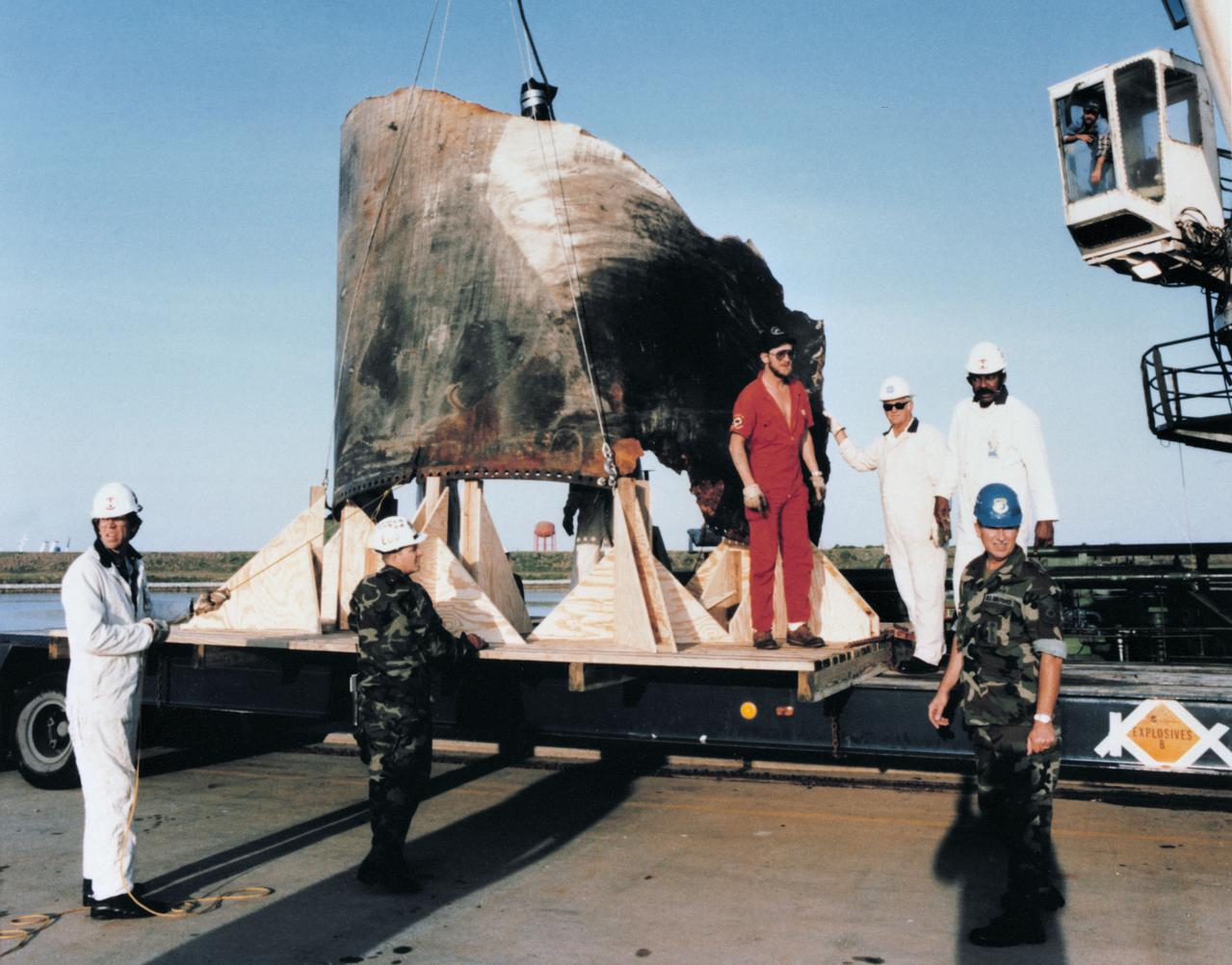
S86-30504 (16 April 1986) --- A 4,000 pound, 11' x 20' piece of the aft center segment tang joint of the space shuttle Challenger's right-hand solid rocket booster is off loaded from the Stena Workhorse after its recovery on April 13, 1986. The burned out area is 15" x 28". Photo credit: NASA
Tests - STS-33/51L (Debris)
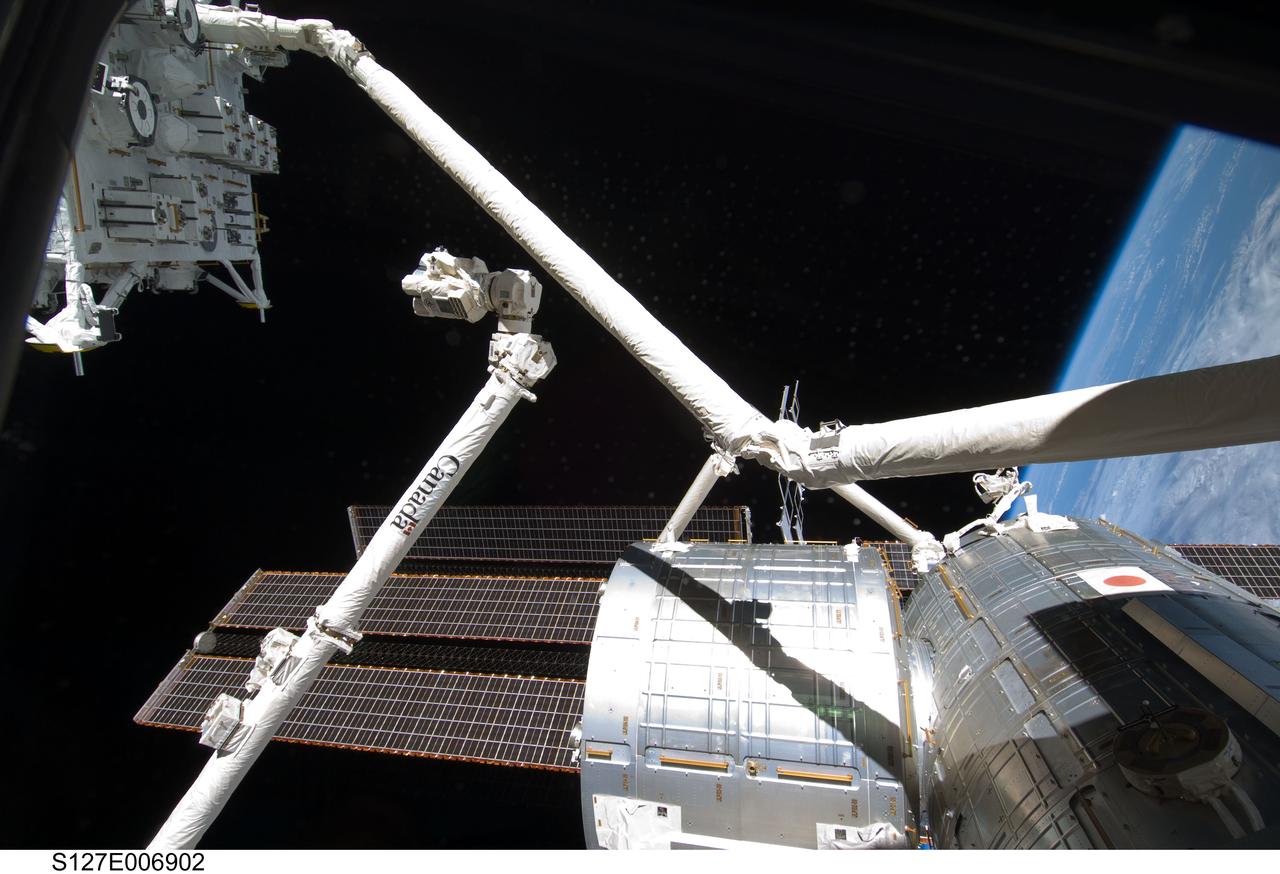
S127-E-006902 (18 July 2009) --- The Japanese Experiment Module - Exposed Facility (JEF) is pictured in the grasp of the Space Shuttle Endeavour's remote manipulator system (RMS) arm during flight day four robotics activity.  The International Space Station's remote manipulutor system (SSRMS or Canadarm2) prepares to take the hand-off from the shuttle's robot arm. Astronauts also began a series of five spacewalks on this day to continue work on the International Space Station.
SRMS handoff to the SSRMS during EVA-1 on STS-127 / Expedition 20 Joint Operations
51B-03-037 (29 April-6 May 1985) --- Astronaut William E. Thornton (center frame), mission specialist, lends a helping hand to payload specialist Taylor G. Wang (partially visible at left) involved in serious repair work on the Drop Dynamics Module (DDM), an experiment of which he is principal investigator.  The troubleshooting paid off and Dr. Wang later resumed studies with drop dynamics.  Astronaut Don L. Lind, mission specialist, is in the background.
Astronaut William Thornton helps crewmember performs repairs on DDM
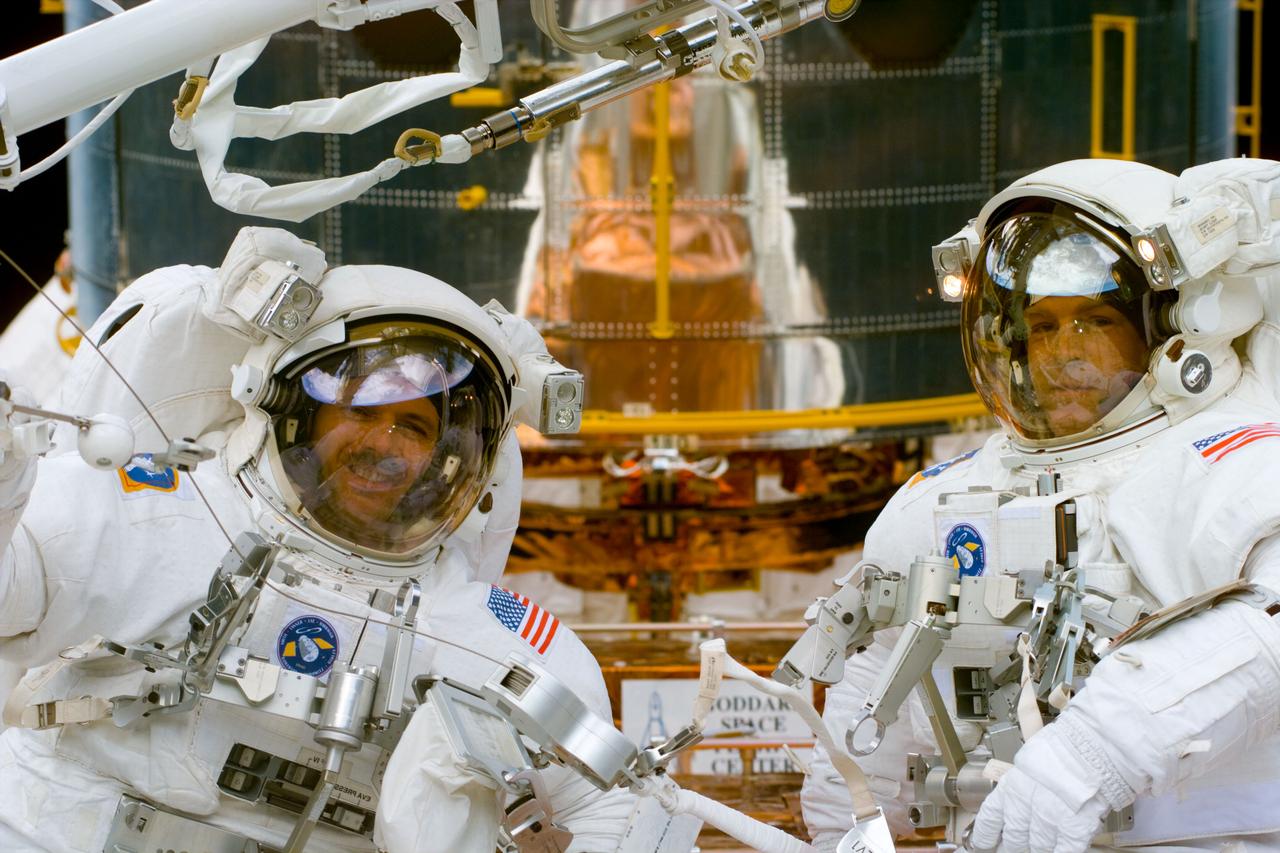
S82-E-5571 (16 Feb. 1997) --- There were few moments during the third Hubble Space Telescope (HST) servicing Extravehicular Activity (EVA) for taking their attention off the giant telescope but here astronauts Steven L. Smith (left) and Mark C. Lee face their crew mates, located in the shirt-sleeve environment of the Space Shuttle Discovery's aft flight deck during a brief break from hands-on duty.  This view was taken with an Electronic Still Camera (ESC).
EVA 3 activity on Flight Day 6 to service the Hubble Space Telescope
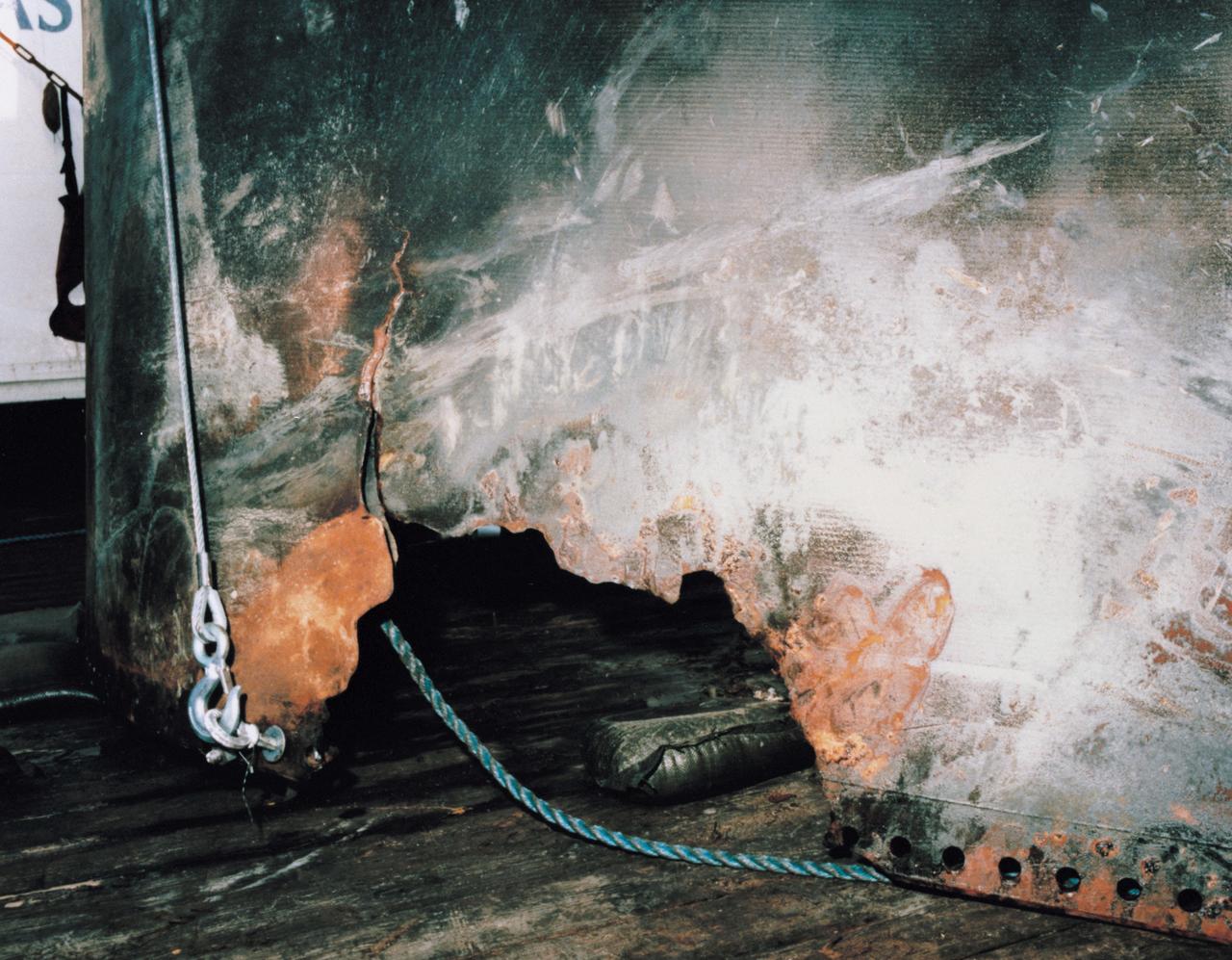
S86-30503 (16 April 1986) --- A 4,000 pound, 11' x 20' piece of the aft center segment tang joint of the space shuttle Challenger's right-hand solid rocket booster is off loaded from the Stena Workhorse after its recovery on April 13, 1986. The burned out area is 15" x 28". Photo credit: NASA
Tests - STS-33/51L (Debris)
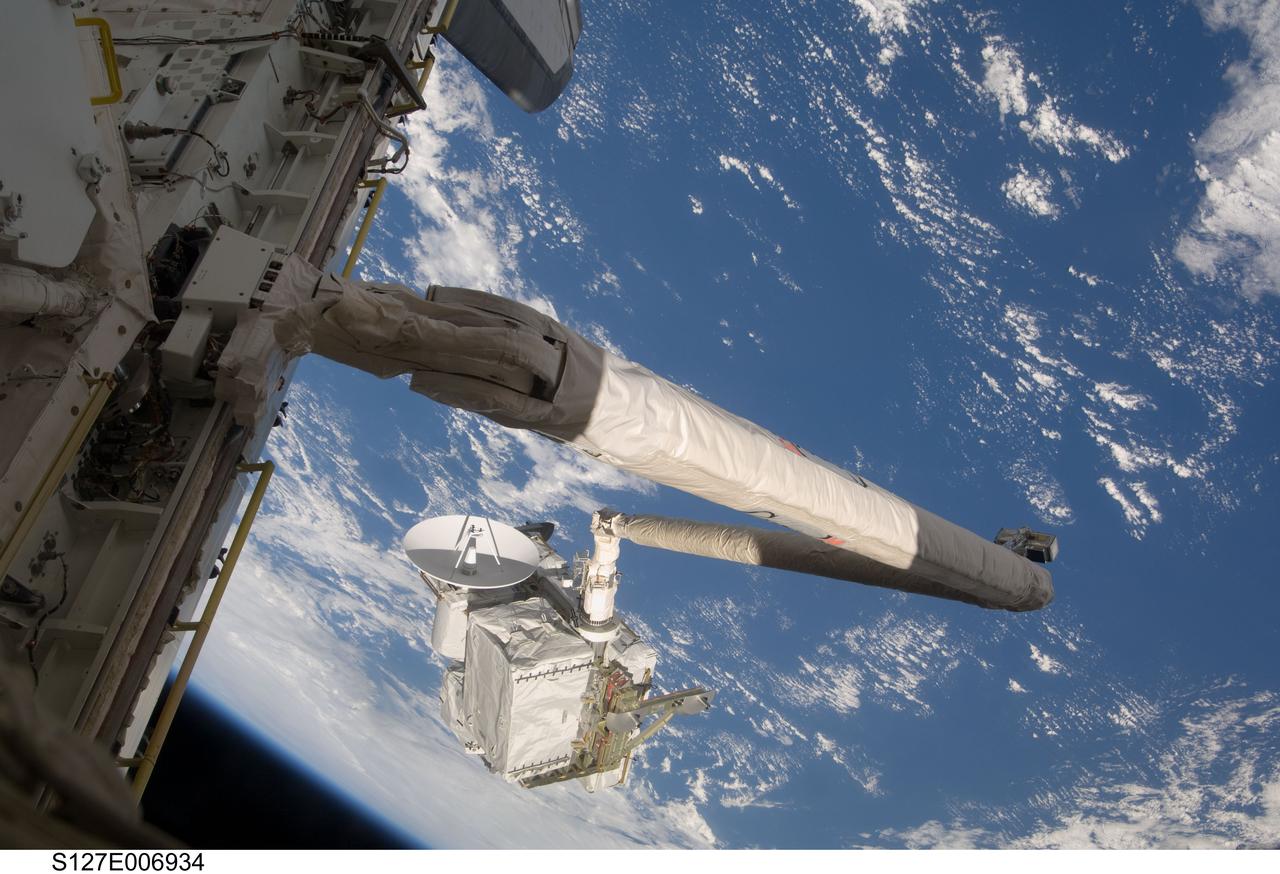
S127-E-006934 (19 July 2009) --- Backdropped by a blue and white Earth, the remote manipulator system (RMS) arm of the Space Shuttle Endeavour, is about to hand off the  Integrated Cargo Carrier (ICC) to the International Space Station (out of frame). The ICC is an unpressurized flat bed pallet and keel yoke assembly that was carried into space in the shuttle's payload bay.
SRMS maneuvers the ICC-VLD during STS-127 / Expedition 20 Joint Operations
The first solid rocket booster solid motor segemnts to arrive at KSC, the left and right hand aft segments are off-loaded into High Bay 4 in the Vehicle Assembly Building and mated to their respective SRB aft skirts. The two aft assemblies will support the entire 150 foot tall solid boosters, in turn supporting the external tank and Orbiter Columbia on the Mobile Launcher Platform, for the first orbital flight test of the Space Shuttle.
ARC-1980-AC80-0107-3
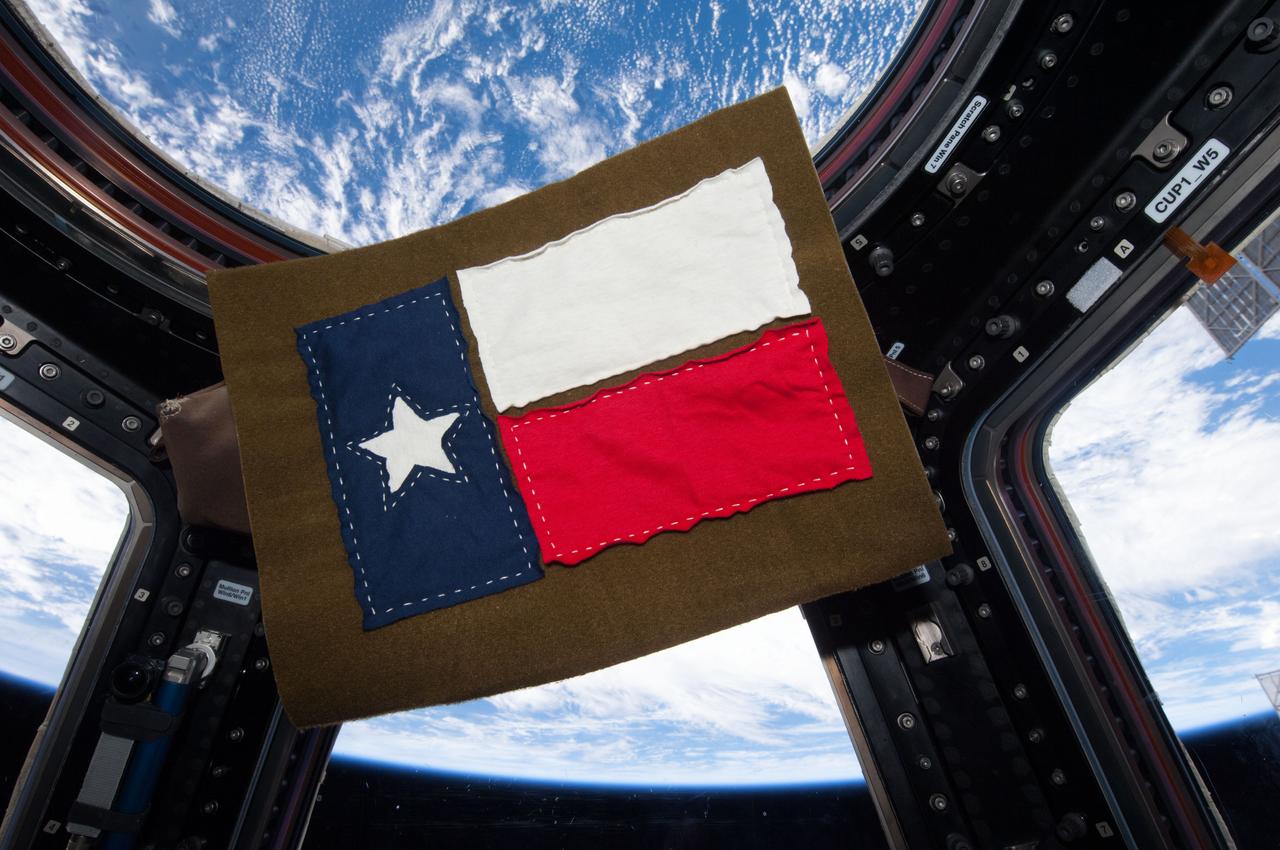
ISS037-E-004972 (27 Sept. 2013) --- Seen floating on the Cupola of the Earth-orbiting International Space Station, this quilt block, paying tribute to the state of Texas or the Lone Star state,  was fashioned from T-shirts onboard the orbital outpost by Expedition 37 Flight Engineer Karen Nyberg.  The NASA astronaut has spent much of her off-duty time on the station sewing and fashioning various items, using only a handful of tools she took aboard and whatever materials that have been available.
Personal Flight Data Files
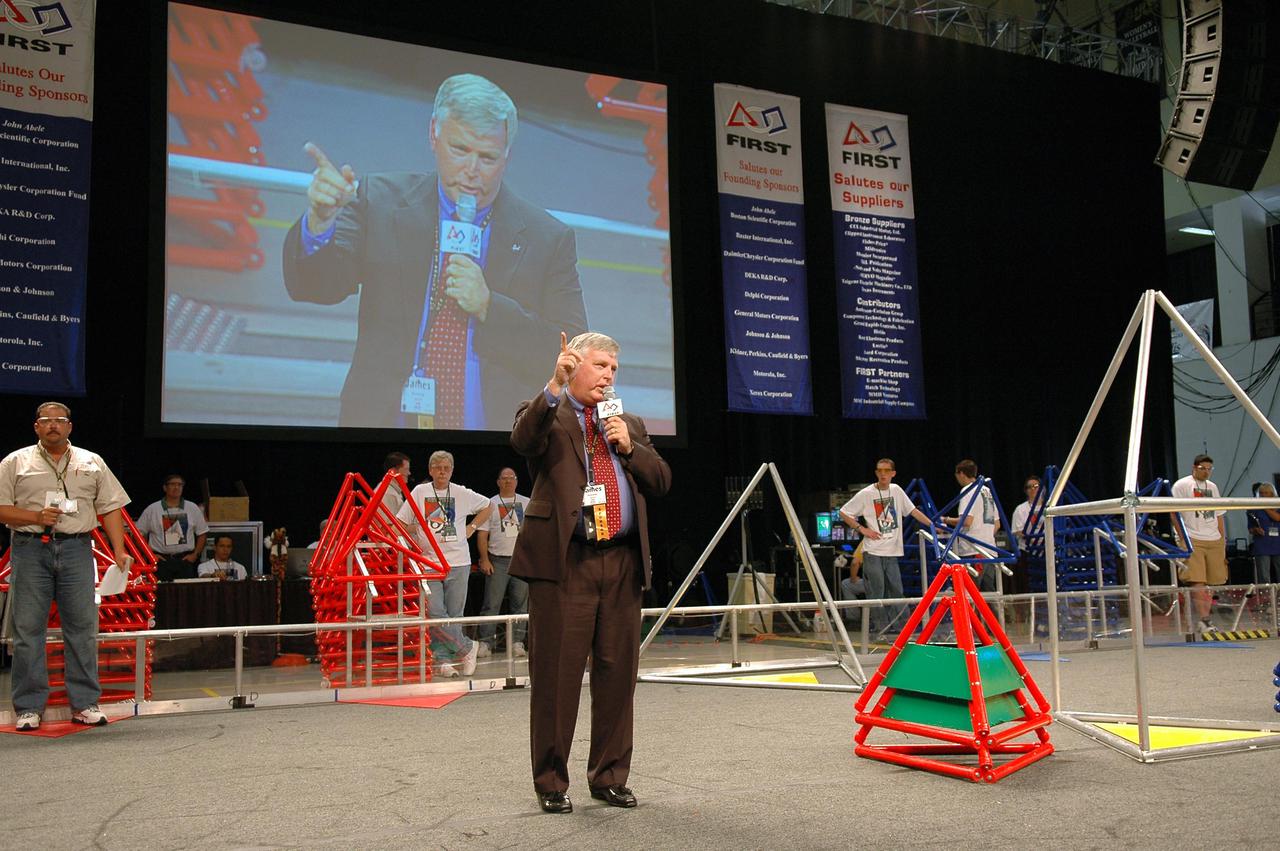
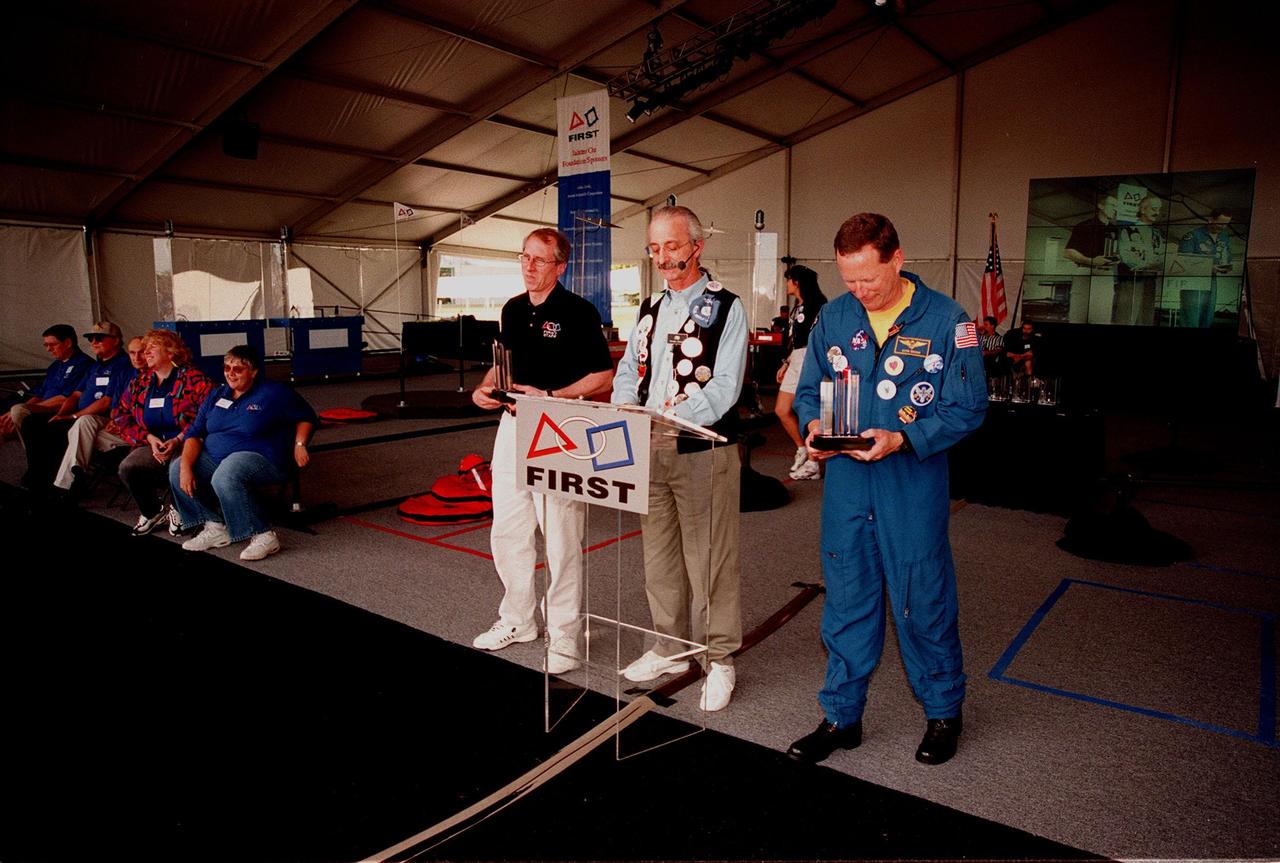
KENNEDY SPACE CENTER, FLA.  - Center Director Jim Kennedy kicks off the 2005 FIRST Robotics Regional Competition held at the University of Central Florida March 10-12. NASA and the University of Central Florida are co-hosts of the regional event. The competition stages short games played by remote-controlled robots, which are designed and built in six weeks by a team of high school students and a handful of engineers-mentors. The students control the robots on the playing field.
KSC-05pd-0410
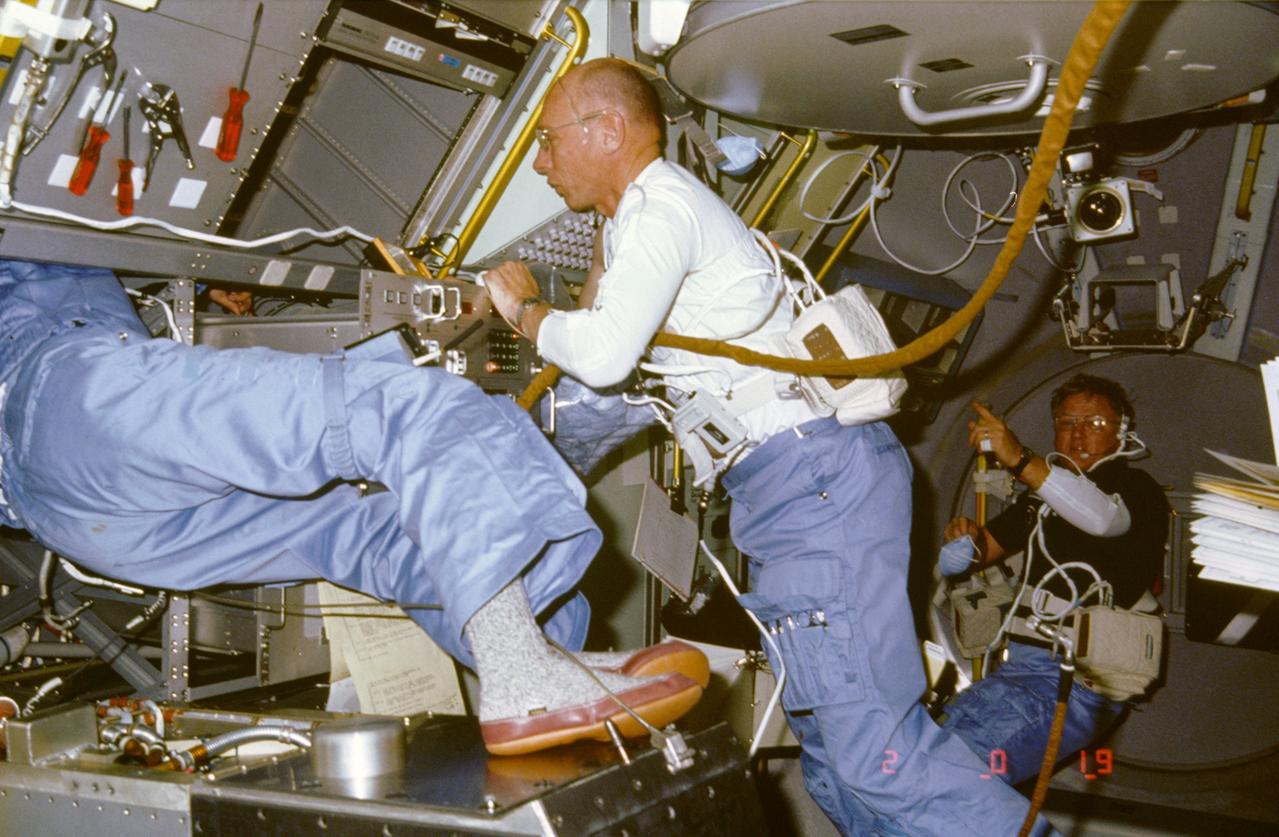
STS064-23-025 (9-20 Sept. 1994) --- With scissors in hand, astronaut Jerry M. Linenger, STS-64 mission specialist, prepares to cut off a lengthy sheet of correspondence from ground controllers. Called the Thermal Imaging Printing System (TIPS), the message center occupies a stowage locker on the space shuttle Discovery's middeck. Astronaut L. Blaine Hammond, pilot, retrieves a clothing item from a nearby locker. Photo credit: NASA or National Aeronautics and Space Administration
Astronaut Jerry Linenger with sheet of TIPS correspondence
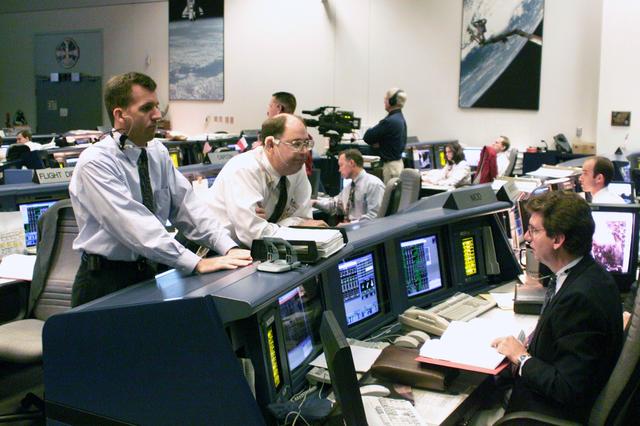
JSC2000-E-22288 (8 September2000) --- In Houston's Mission Control Center, flight directors LeRoy Cain, from left foreground, Wayne Hale and Jeffrey Bantle await the launch of the Space Shuttle Atlantis in Florida. The flight director console is on the left side of the frame.  Bantle is seated at the Missions Operations Directorate (MOD) console.  Once the shuttle clears the launch tower in Florida, the "baton" gets handed off to the flight controllers in Houston.
MCC during STS-106
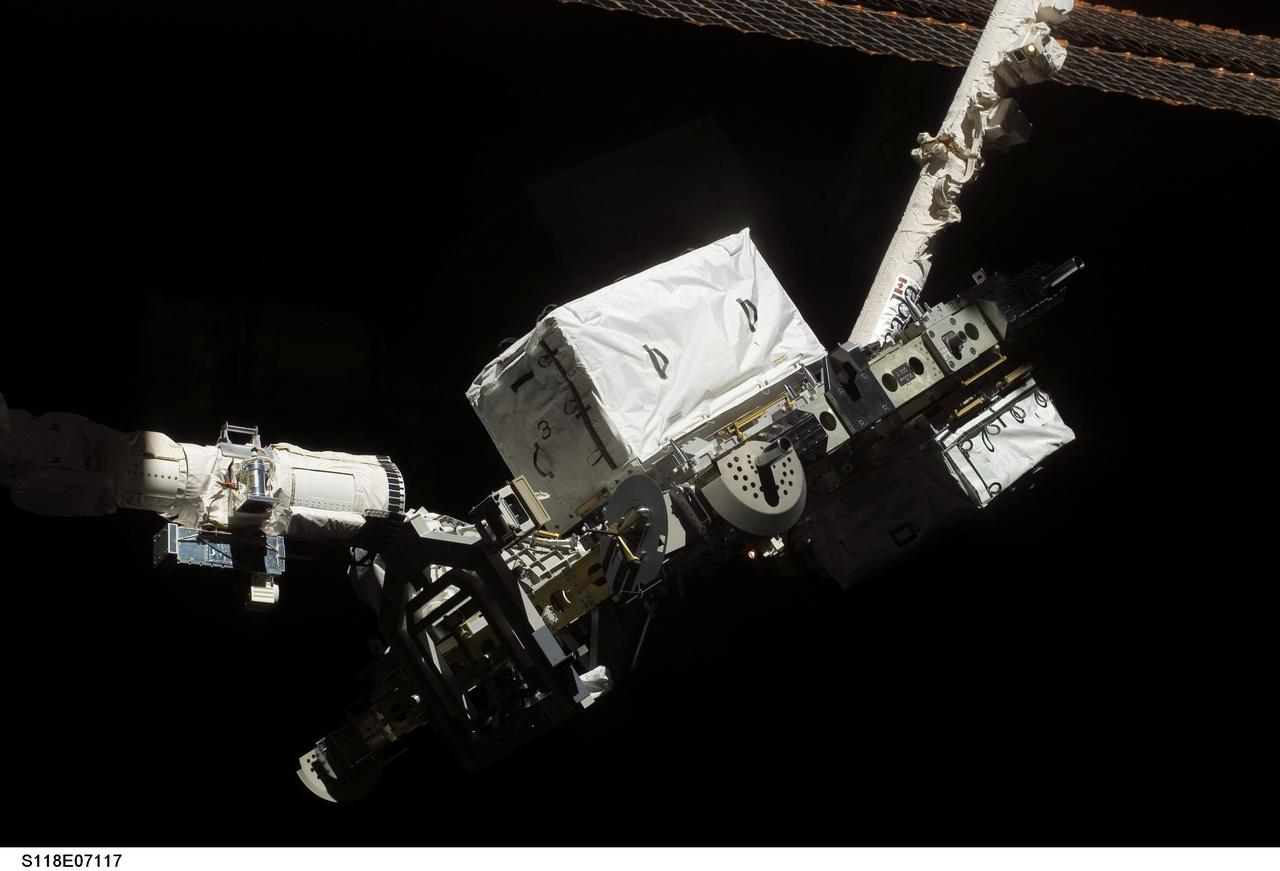
S118-E-07117 (14 Aug. 2007) --- The Space Shuttle Endeavour's Remote Manipulator System (RMS) robotic arm (left) moves away following the hand-off of an external stowage platform (ESP-3) to the station's robotic arm while docked with the International Space Station. Astronauts Tracy Caldwell and Barbara R. Morgan, both STS-118 mission specialists, were inside at Endeavour's controls as the shuttle's robotic arm lifted the storage platform from the cargo bay to hand it over to the station's robotic arm, also known as Canadarm2. Astronauts Charlie Hobaugh, pilot, and Clay Anderson, Expedition 15 flight engineer, then used the Canadarm2 to attach the 13-by-7-foot platform to the station's Port 3 truss.
View of the ESP 3 as its being transferred to the P3 Truss for Installation
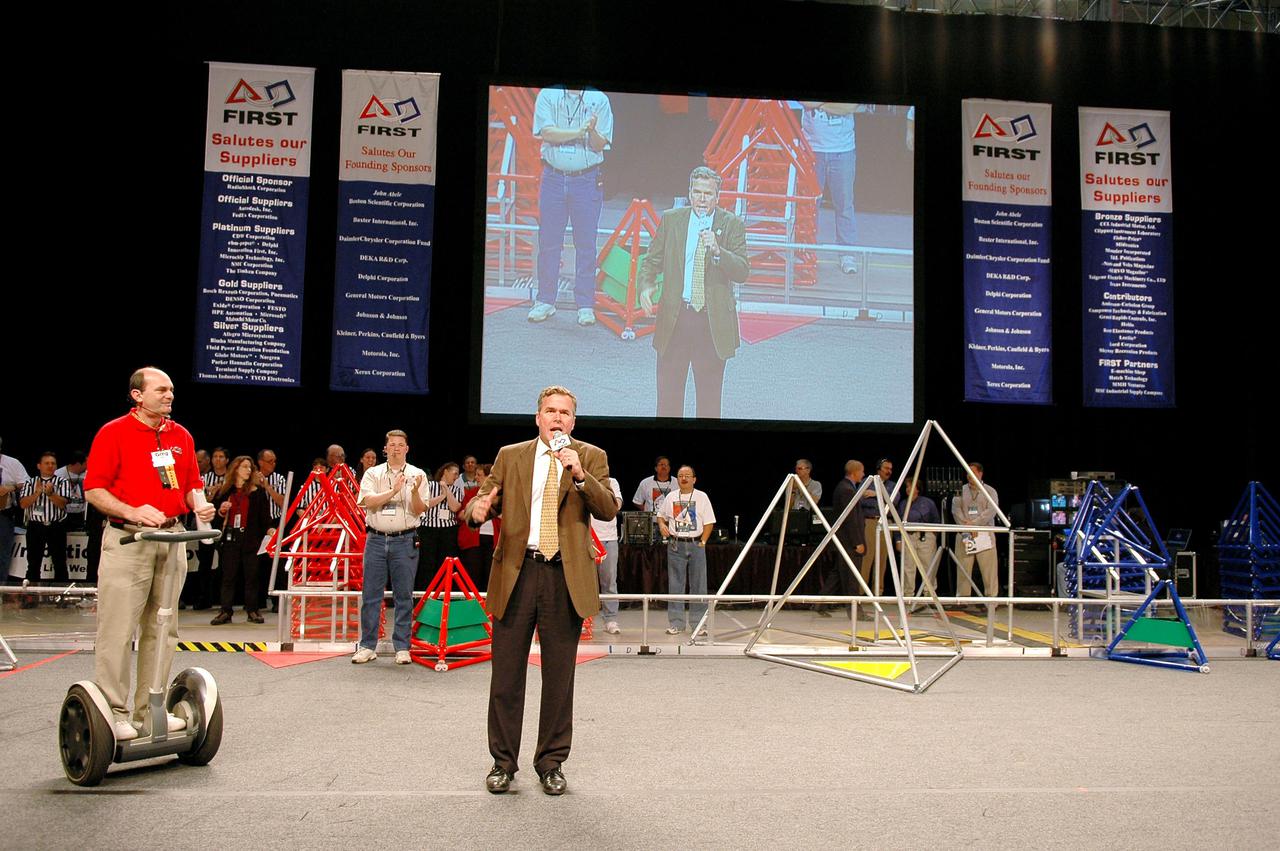
KENNEDY SPACE CENTER, FLA.  - Florida Gov. Jeb Bush (right) kicks off the 2005 FIRST Robotics Regional Competition held at the University of Central Florida March 10-12.  NASA and the University are co-hosts of the regional event. The competition stages short games played by remote-controlled robots, which are designed and built in six weeks by a team of high school students and a handful of engineers-mentors. The students control the robots on the playing field.  NASA and the University of Central Florida are co-sponsors of the regional event.  The competition stages short games played by remote-controlled robots, which are designed and built in six weeks by a team of high school students and a handful of engineers-mentors.  The students control the robots on the playing field.
KSC-05pd-0402
S118-E-07111 (14 Aug. 2007) --- Backdropped by a colorful Earth, the Space Shuttle Endeavour's Remote Manipulator System (RMS) robotic arm moves an external stowage platform (ESP-3) for a hand-off to the station's robotic arm (out of frame) while docked with the International Space Station. Astronauts Tracy Caldwell and Barbara R. Morgan, both STS-118 mission specialists, were inside at Endeavour's controls as the shuttle's robotic arm lifted the storage platform from the cargo bay to hand it over to the station's robotic arm, also known as Canadarm2. Astronauts Charlie Hobaugh, pilot, and Clay Anderson, Expedition 15 flight engineer, then used Canadarm2 to attach the 13-by-7-foot platform to the station's Port 3 truss.
View of the ESP 3 as its being transferred to the P3 Truss for Installation
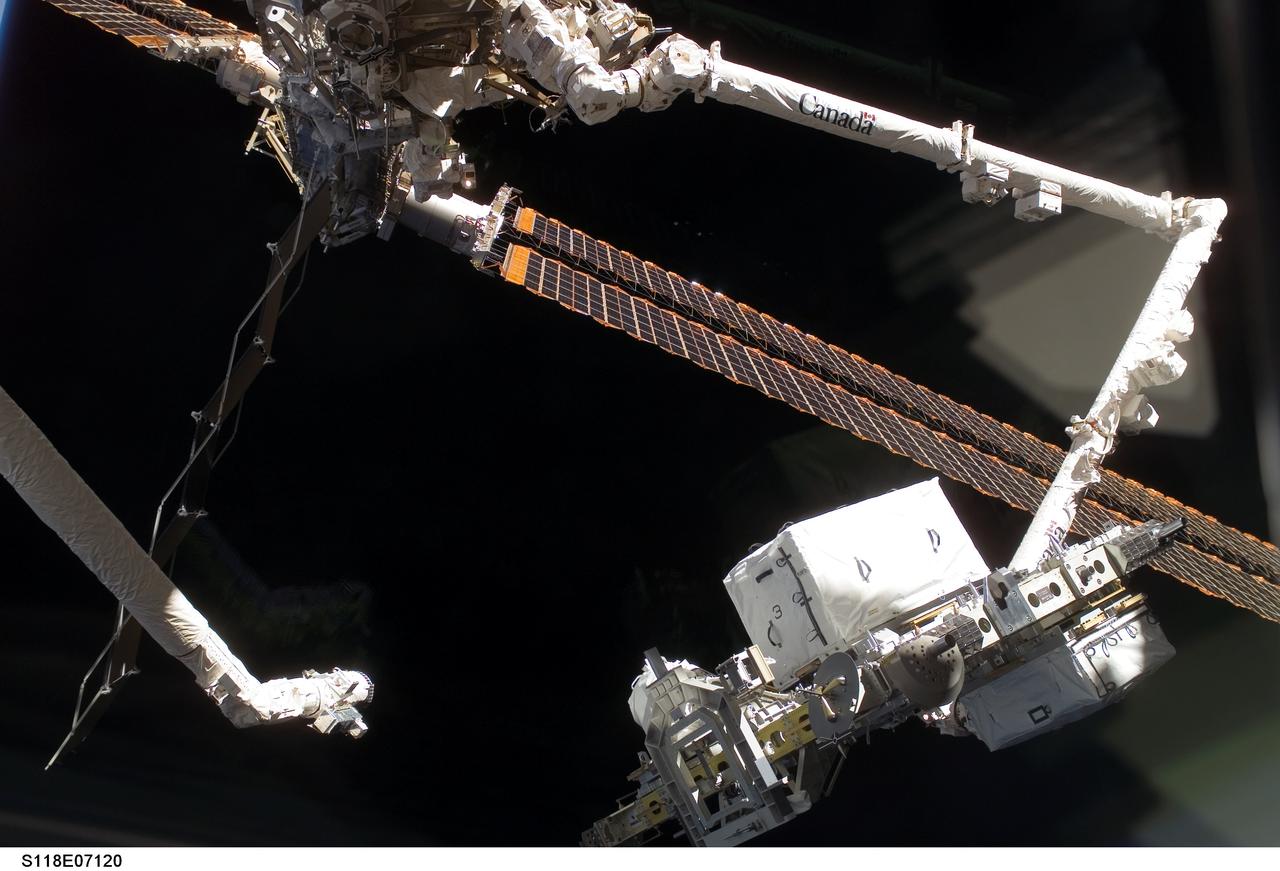
S118-E-07120 (14 Aug. 2007) --- The Space Shuttle Endeavour's Remote Manipulator System (RMS) robotic arm (left) moves away following the hand-off of an external stowage platform (ESP-3) to the station's robotic arm while docked with the International Space Station. Astronauts Tracy Caldwell and Barbara R. Morgan, both STS-118 mission specialists, were at inside at Endeavour's controls as the shuttle's robotic arm lifted the storage platform from the cargo bay to hand it over to the station's robotic arm, also known as Canadarm2. Astronauts Charlie Hobaugh, pilot, and Clay Anderson, Expedition 15 flight engineer, then used the Canadarm2 to attach the 13-by-7-foot platform to the station's Port 3 truss.
View of the ESP 3 as its being transferred to the P3 Truss for Installation
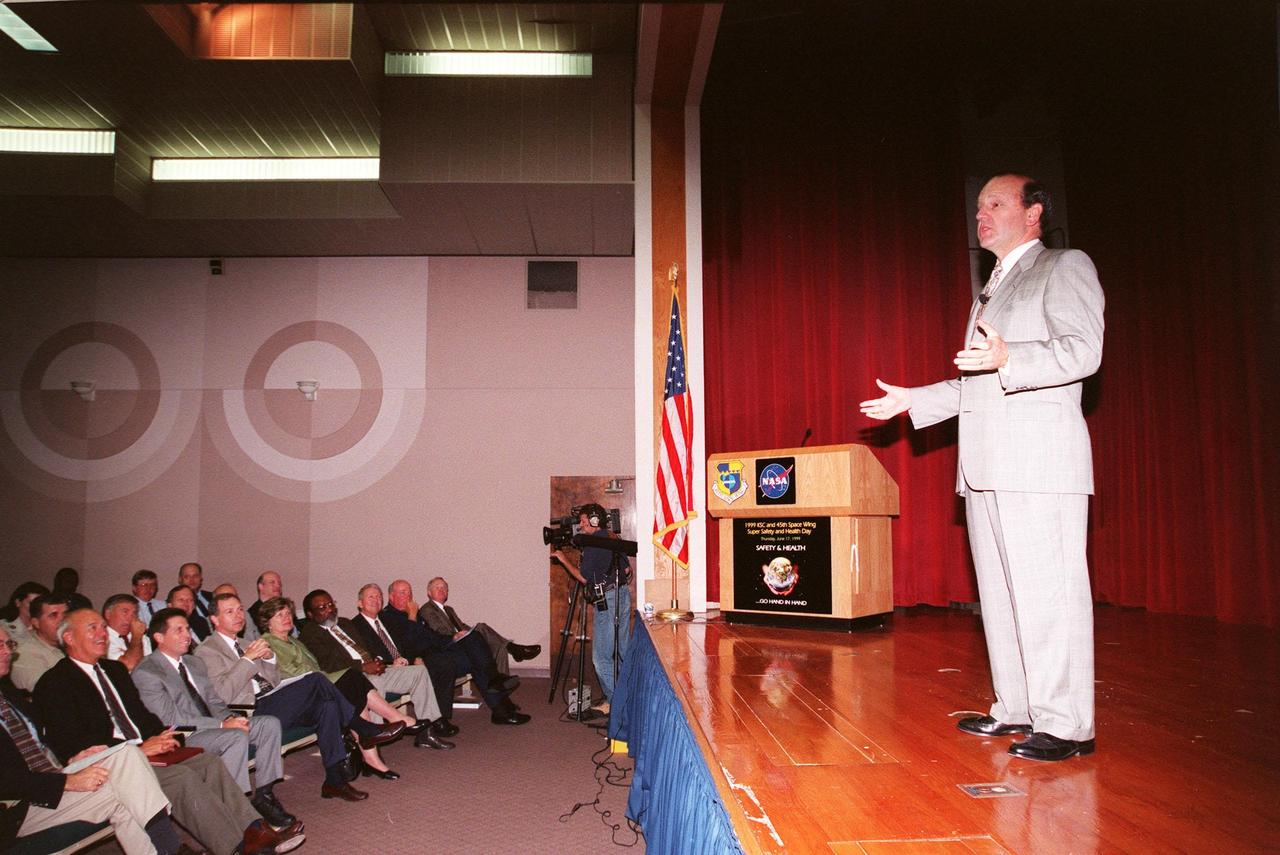
Capt. Dennis E. Fitch, a consultant and former pilot instructor with United Airlines, addresses an audience of KSC employees to kick off Super Safety and Health Day at KSC. Fitch related his tale of the catastrophic engine failure in UAL flight 232, which crash landed in Iowa in 1989, and the teamwork that contributed to his survival and the lives of 183 other passengers. For the second time Kennedy Space Center dedicated an entire day to safety and health. Most normal work activities were suspended to allow personnel to attend Super Safety and Health Day activities. The theme, "Safety and Health Go Hand in Hand," emphasized KSC's commitment to place the safety and health of the public, astronauts, employees and space-related resources first and foremost. Events also included a panel session about related issues, vendor exhibits, and safety training in work groups. The keynote address and panel session were also broadcast internally over NASA television
KSC-99pp0695
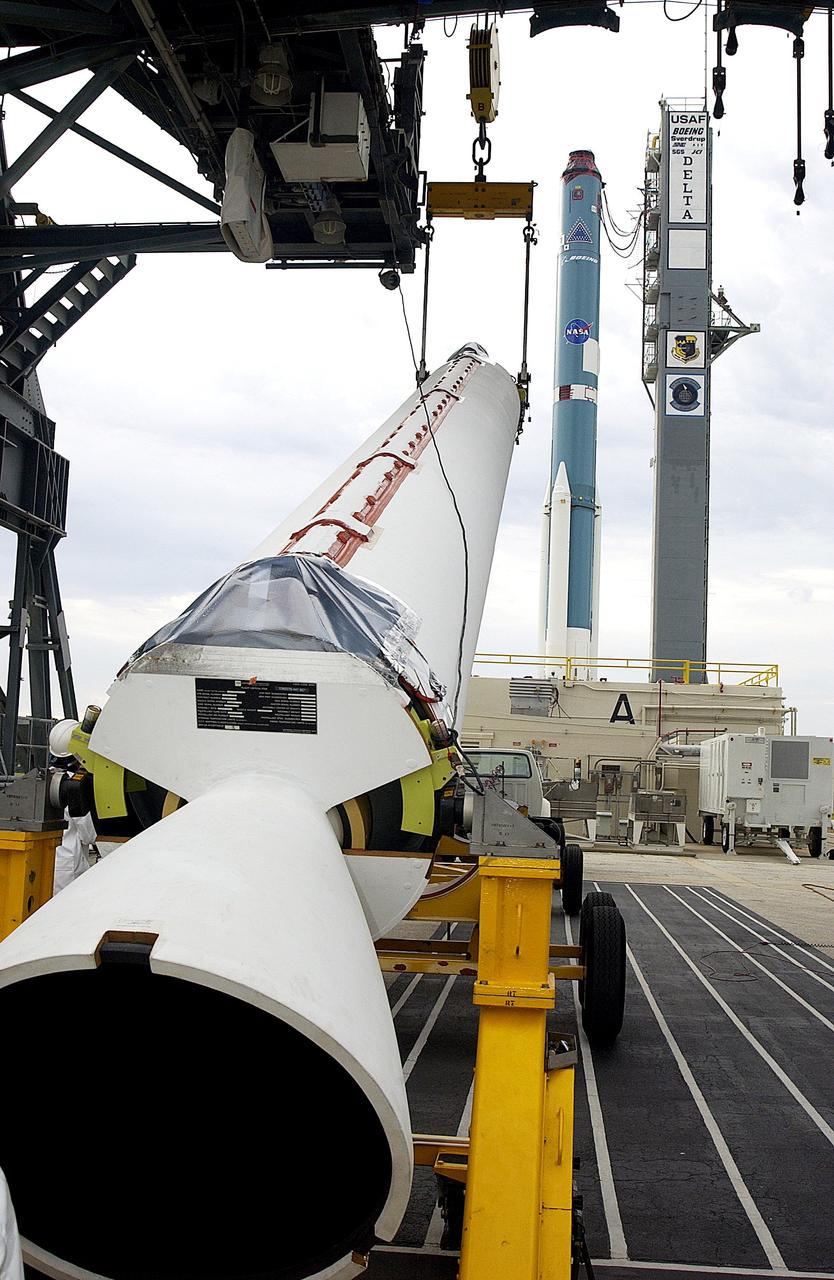
KENNEDY SPACE CENTER, FLA. -  Another solid rocket booster, in the foreground, is lifted off its transporter on Launch Complex 17-A, Cape Canaveral Air Force Station, for mating with the Delta II rocket in the background.  The SRB is one of nine that will help launch Mars Exploration Rover 2 (MER-2).  NASA’s twin Mars Exploration Rovers are designed to study the history of water on Mars. These robotic geologists are equipped with a robotic arm, a drilling tool, three spectrometers, and four pairs of cameras that allow them to have a human-like, 3D view of the terrain. Each rover could travel as far as 100 meters in one day to act as Mars scientists' eyes and hands, exploring an environment where humans can’t yet go.  MER-2 is scheduled to launch June 5 as MER-A.  MER-1 (MER-B) will launch June 25.
KENNEDY SPACE CENTER, FLA. - Another solid rocket booster, in the foreground, is lifted off its transporter on Launch Complex 17-A, Cape Canaveral Air Force Station, for mating with the Delta II rocket in the background. The SRB is one of nine that will help launch Mars Exploration Rover 2 (MER-2). NASA’s twin Mars Exploration Rovers are designed to study the history of water on Mars. These robotic geologists are equipped with a robotic arm, a drilling tool, three spectrometers, and four pairs of cameras that allow them to have a human-like, 3D view of the terrain. Each rover could travel as far as 100 meters in one day to act as Mars scientists' eyes and hands, exploring an environment where humans can’t yet go. MER-2 is scheduled to launch June 5 as MER-A. MER-1 (MER-B) will launch June 25.
KENNEDY SPACE CENTER, FLA. -   The canister is lifted off the Mars Exploration Rover 1 (MER-B) in the gantry on Launch Complex 17-B, Cape Canaveral Air Force Station.  The second of twin rovers being sent to Mars, it is equipped with a robotic arm, a drilling tool, three spectrometers, and four pairs of cameras that allow it to have a human-like, 3D view of the terrain. Each rover could travel as far as 100 meters in one day to act as Mars scientists' eyes and hands, exploring an environment where humans can't yet go.  MER-B is scheduled to launch June 26 at one of two available times,  12:27:31 a.m. EDT or 1:08:45 a.m. EDT.
KENNEDY SPACE CENTER, FLA. - The canister is lifted off the Mars Exploration Rover 1 (MER-B) in the gantry on Launch Complex 17-B, Cape Canaveral Air Force Station. The second of twin rovers being sent to Mars, it is equipped with a robotic arm, a drilling tool, three spectrometers, and four pairs of cameras that allow it to have a human-like, 3D view of the terrain. Each rover could travel as far as 100 meters in one day to act as Mars scientists' eyes and hands, exploring an environment where humans can't yet go. MER-B is scheduled to launch June 26 at one of two available times, 12:27:31 a.m. EDT or 1:08:45 a.m. EDT.
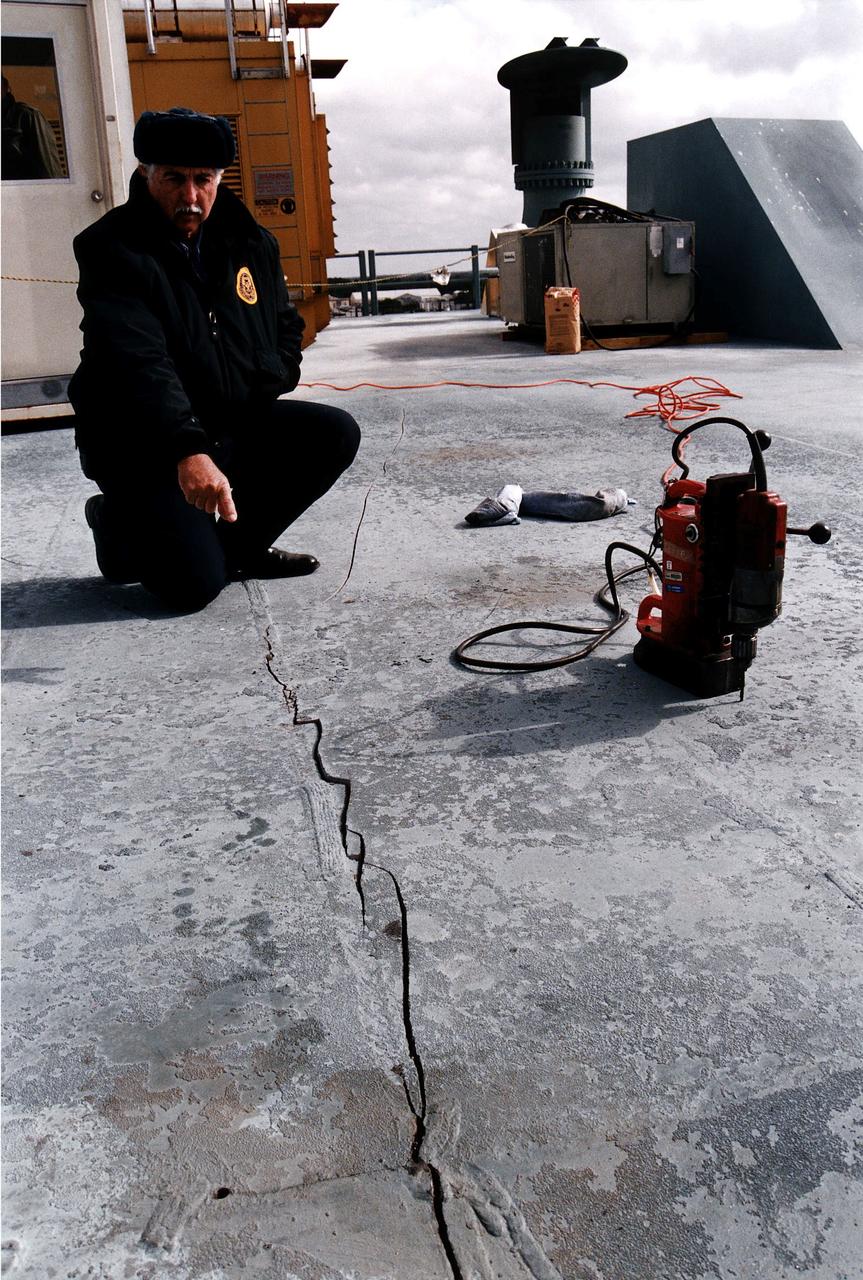
KENNEDY SPACE CENTER, FLA. -  Robert T. Nelson of KSC Security points to an approximately 24-foot-long crack on the Mobile Launcher Platform (MLP), which is holding the Space Shuttle Discovery en route to Launch Pad 39A for the STS-82 mission.  Nelson was riding on the MLP when he heard a loud noise and noticed the crack.  Rollout had begun shortly after 7 a.m. EST and was stopped at about 8:25 a.m.  This Y-shaped crack is on the MLP surface and runs from near the left-hand solid rocket booster flame hole toward the near corner of the MLP.  Rollout of Discovery resumed just past noon after structural engineers determined that the integrity of the MLP had not been compromised.  Discovery is scheduled to lift off on the second Hubble Space Telescope servicing mission on Feb. 11.
KENNEDY SPACE CENTER, FLA. - Robert T. Nelson of KSC Security points to an approximately 24-foot-long crack on the Mobile Launcher Platform (MLP), which is holding the Space Shuttle Discovery en route to Launch Pad 39A for the STS-82 mission. Nelson was riding on the MLP when he heard a loud noise and noticed the crack. Rollout had begun shortly after 7 a.m. EST and was stopped at about 8:25 a.m. This Y-shaped crack is on the MLP surface and runs from near the left-hand solid rocket booster flame hole toward the near corner of the MLP. Rollout of Discovery resumed just past noon after structural engineers determined that the integrity of the MLP had not been compromised. Discovery is scheduled to lift off on the second Hubble Space Telescope servicing mission on Feb. 11.
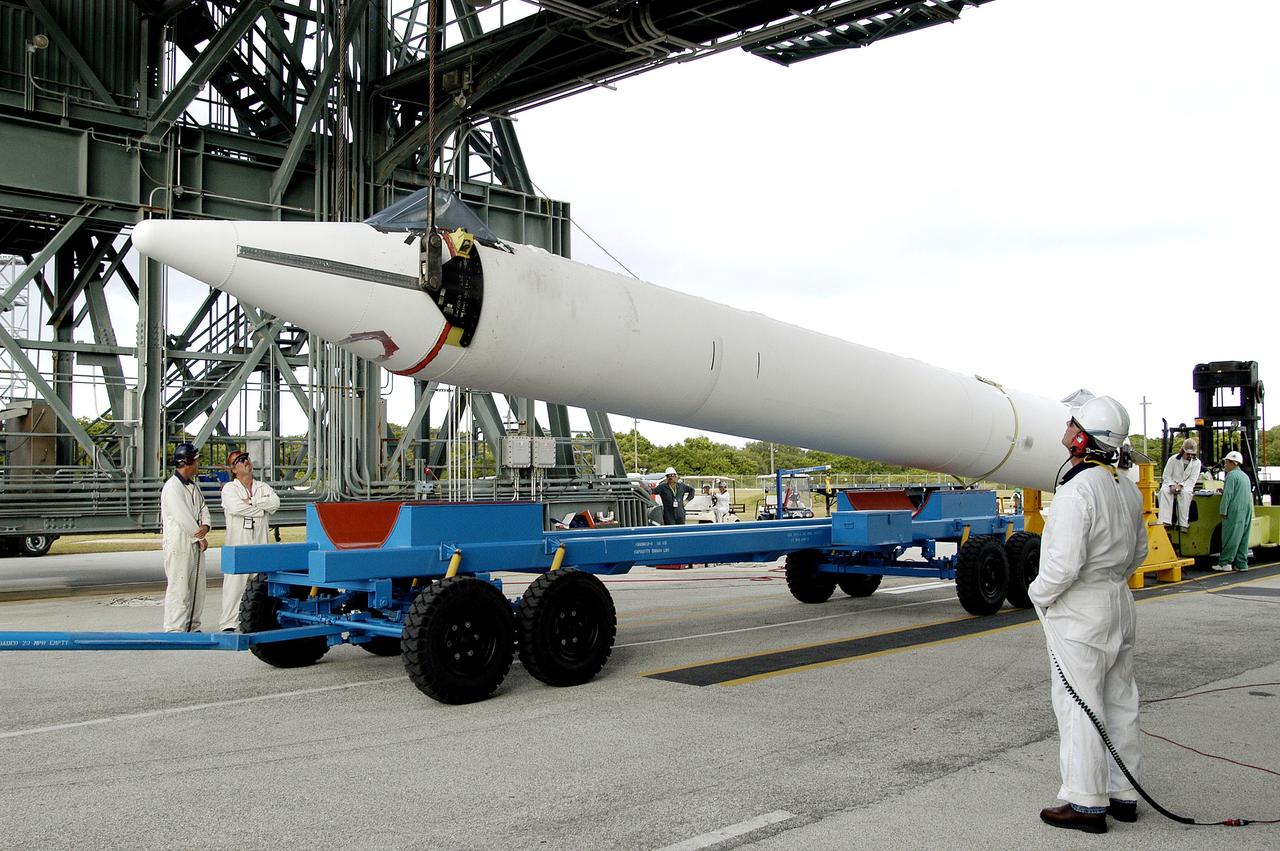
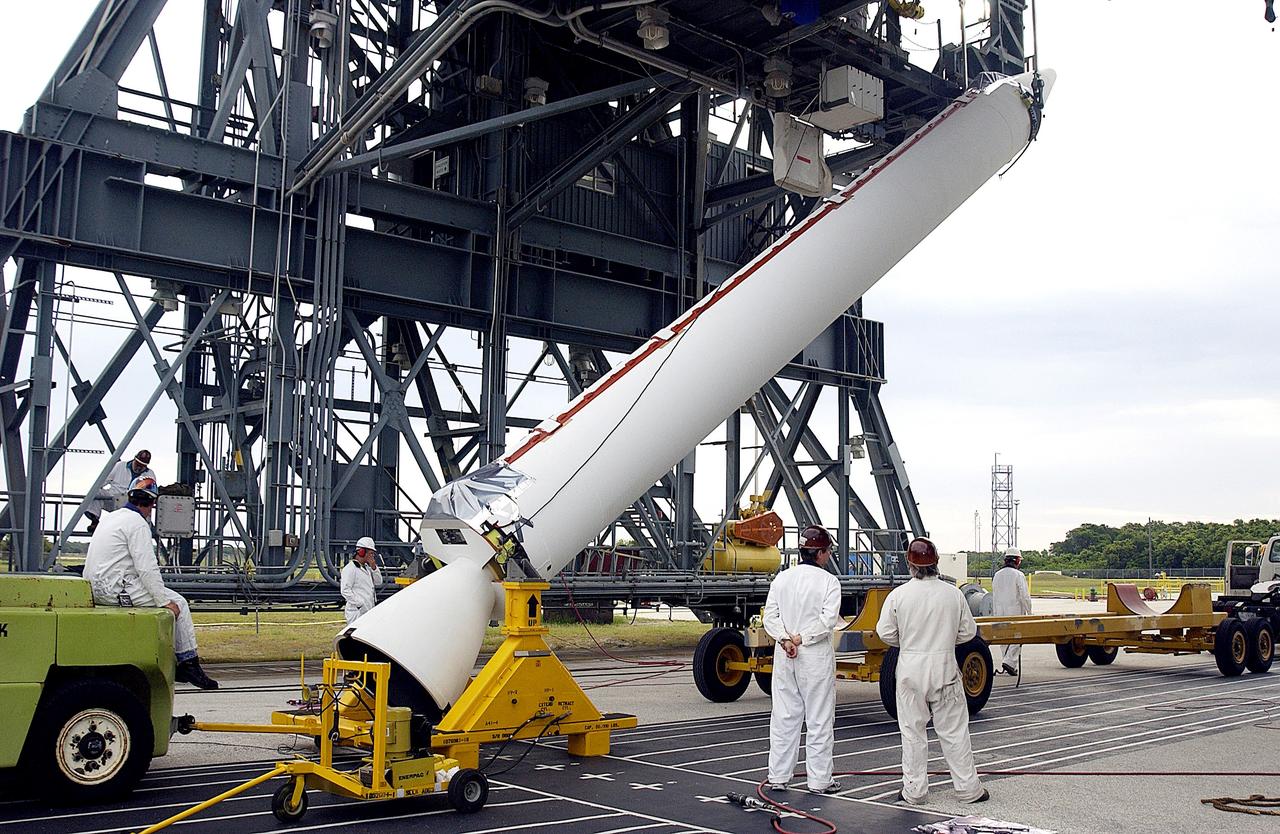
KENNEDY SPACE CENTER, FLA. - On Launch Complex 17-B, Cape Canaveral Air Force Station, a solid rocket booster is raised off  its transporter to lift it to vertical.  It will be mated to the Delta II rocket for the Mars Exploration Rover 1 (MER-1) launch June 25.  NASA’s twin Mars Exploration Rovers are designed to study the history of water on Mars. These robotic geologists are equipped with a robotic arm, a drilling tool, three spectrometers, and four pairs of cameras that allow them to have a human-like, 3D view of the terrain. Each rover could travel as far as 100 meters in one day to act as Mars scientists' eyes and hands, exploring an environment where humans can’t yet go. MER-2 (MER-A) will launch June 5.
KENNEDY SPACE CENTER, FLA. - On Launch Complex 17-B, Cape Canaveral Air Force Station, a solid rocket booster is raised off its transporter to lift it to vertical. It will be mated to the Delta II rocket for the Mars Exploration Rover 1 (MER-1) launch June 25. NASA’s twin Mars Exploration Rovers are designed to study the history of water on Mars. These robotic geologists are equipped with a robotic arm, a drilling tool, three spectrometers, and four pairs of cameras that allow them to have a human-like, 3D view of the terrain. Each rover could travel as far as 100 meters in one day to act as Mars scientists' eyes and hands, exploring an environment where humans can’t yet go. MER-2 (MER-A) will launch June 5.
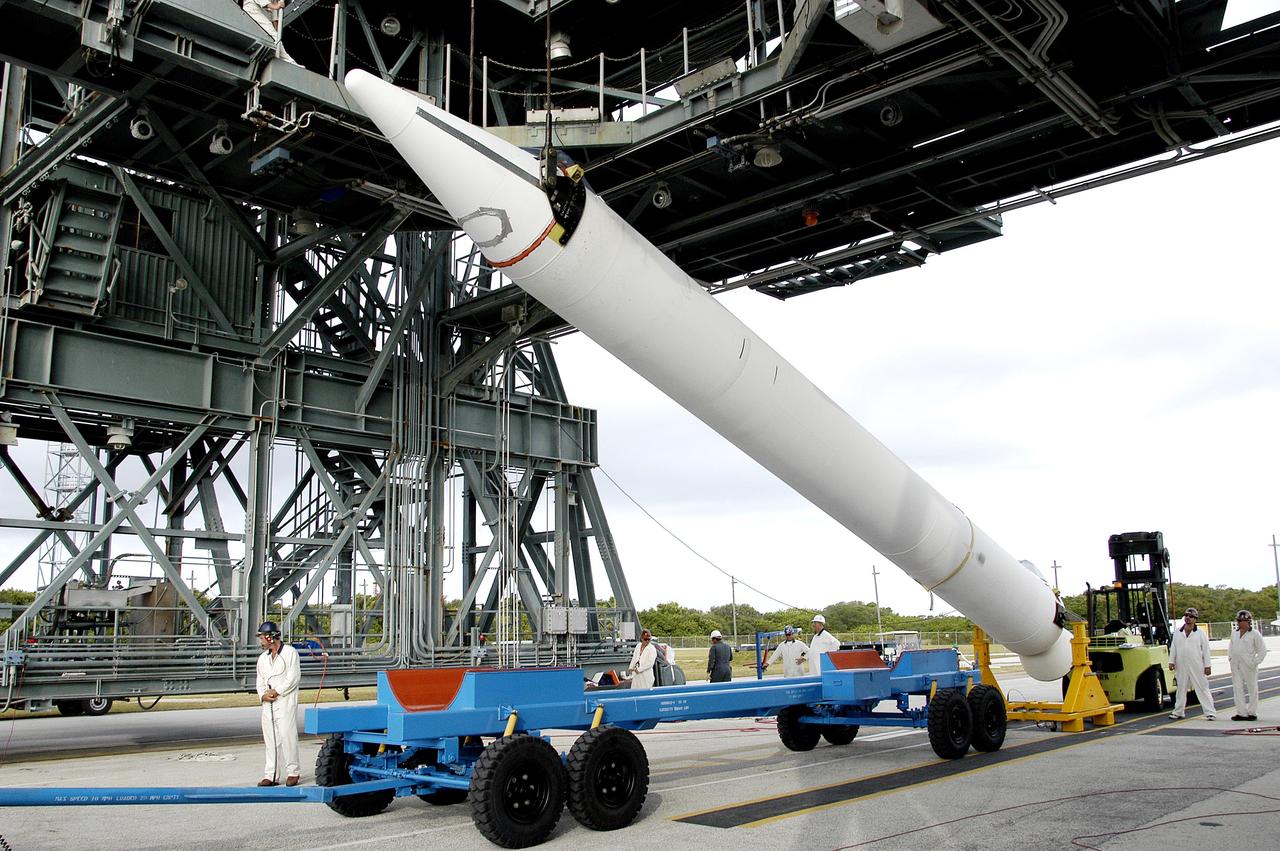
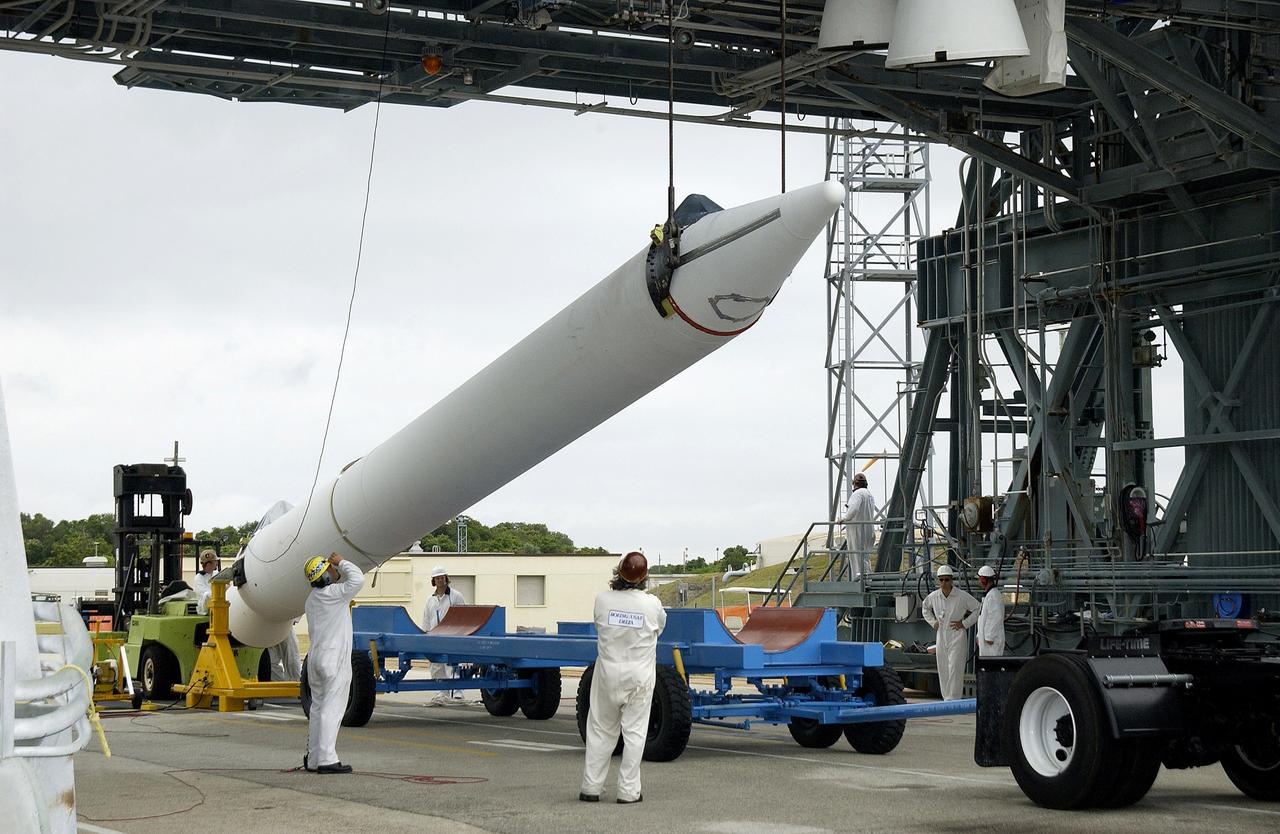
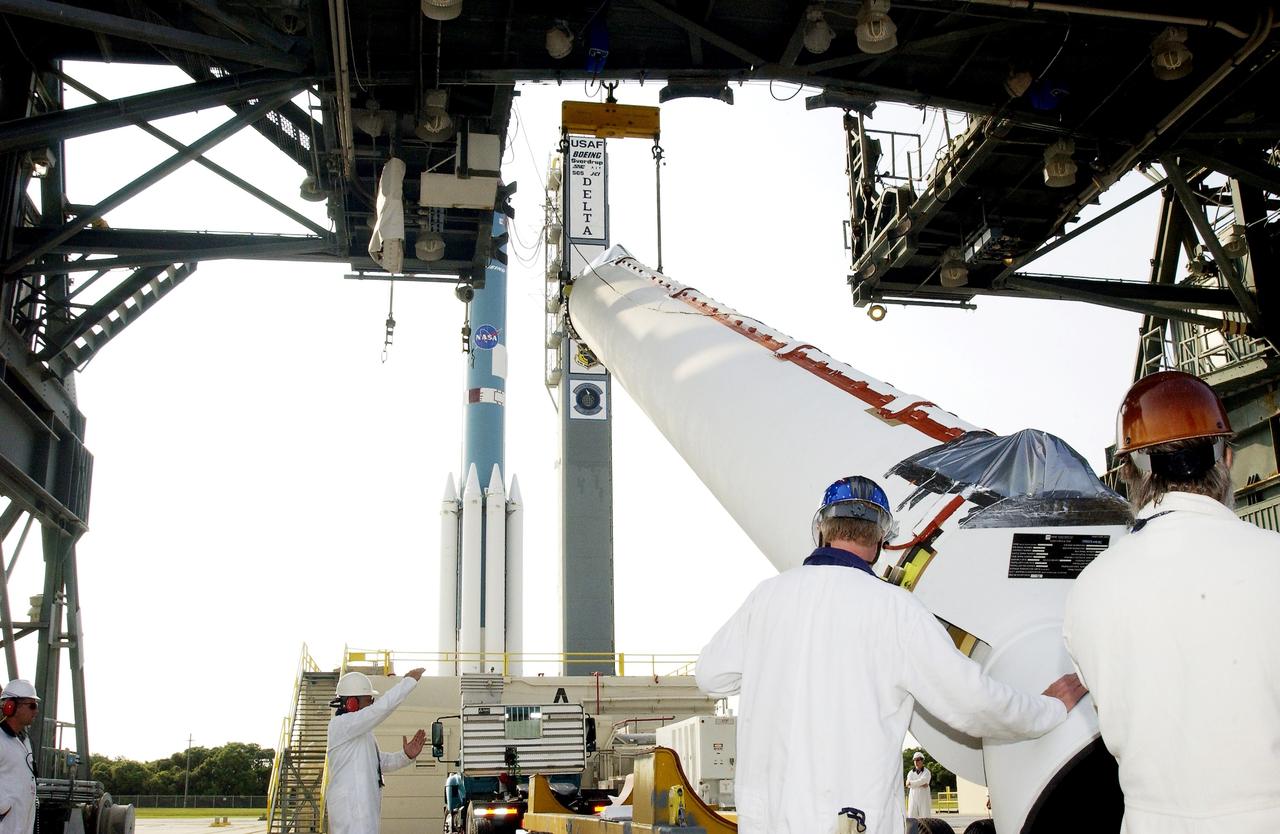
KENNEDY SPACE CENTER, FLA. - On Launch Complex 17-A, Cape Canaveral Air Force Station, a solid rocket booster is raised off the transporter.  When vertical, it will be lifted up the launch tower and mated to the Delta rocket (in the background) to launch Mars Exploration Rover 2. NASA’s twin Mars Exploration Rovers are designed to study the history of water on Mars. These robotic geologists are equipped with a robotic arm, a drilling tool, three spectrometers, and four pairs of cameras that allow them to have a human-like, 3D view of the terrain. Each rover could travel as far as 100 meters in one day to act as Mars scientists' eyes and hands, exploring an environment where humans can’t yet go.  MER-2 is scheduled to launch June 5 as MER-A.  MER-1 (MER-B) will launch June 25.
KENNEDY SPACE CENTER, FLA. - On Launch Complex 17-A, Cape Canaveral Air Force Station, a solid rocket booster is raised off the transporter. When vertical, it will be lifted up the launch tower and mated to the Delta rocket (in the background) to launch Mars Exploration Rover 2. NASA’s twin Mars Exploration Rovers are designed to study the history of water on Mars. These robotic geologists are equipped with a robotic arm, a drilling tool, three spectrometers, and four pairs of cameras that allow them to have a human-like, 3D view of the terrain. Each rover could travel as far as 100 meters in one day to act as Mars scientists' eyes and hands, exploring an environment where humans can’t yet go. MER-2 is scheduled to launch June 5 as MER-A. MER-1 (MER-B) will launch June 25.
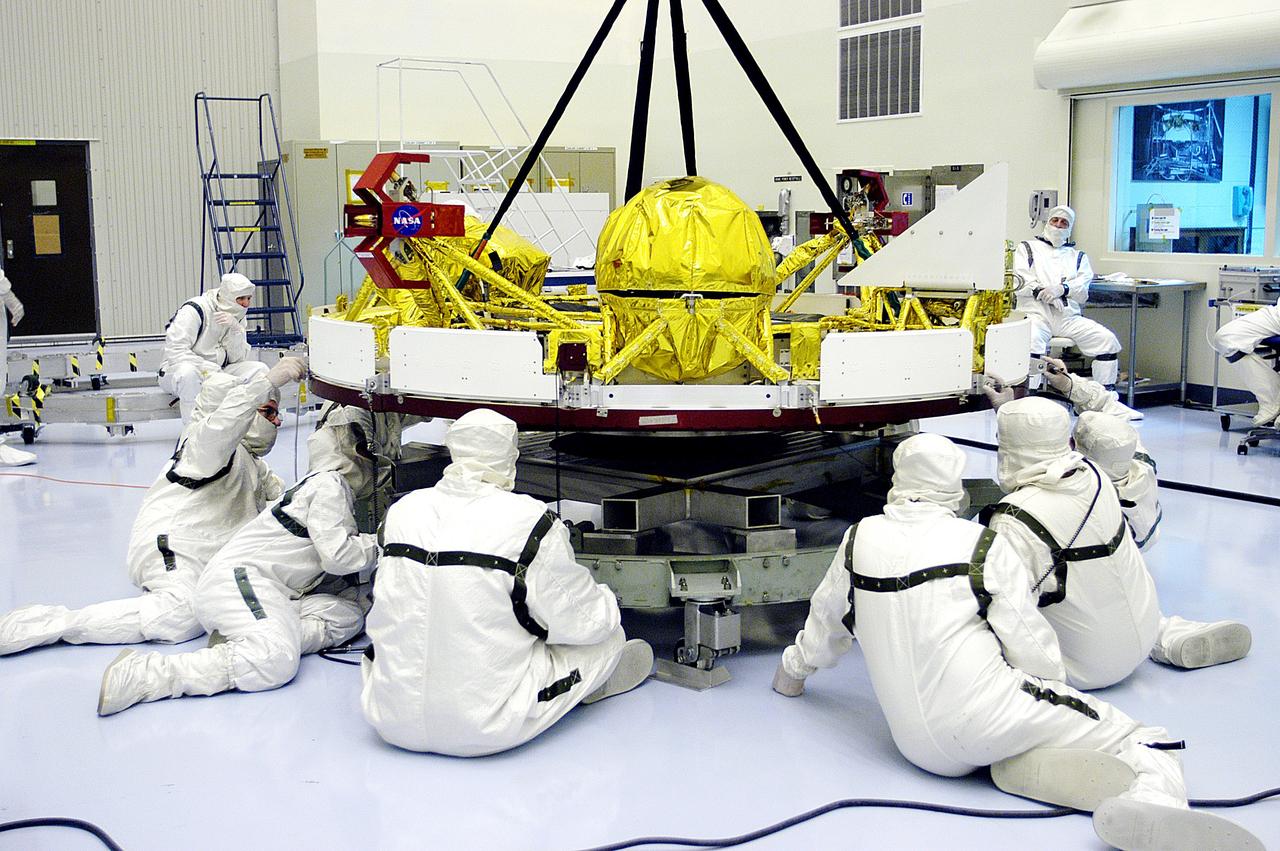
KENNEDY SPACE CENTER, FLA. - In the Payload Hazardous Servicing Facility, workers check the cruise stage of Mars Exploration Rover 1 (MER-1) being lifted off a stand.  The cruise stage will be integrated with the aeroshell, the entry vehicle.   NASA’s twin Mars Exploration Rovers are designed to study the history of water on Mars. These robotic geologists are equipped with a robotic arm, a drilling tool, three spectrometers, and four pairs of cameras that allow them to have a human-like, 3D view of the terrain. Each rover could travel as far as 100 meters in one day to act as Mars scientists' eyes and hands, exploring an environment where humans can’t yet go.  The MER-1 is scheduled to launch June 25 from Launch Pad 17-A, Cape Canaveral Air Force Station.
KENNEDY SPACE CENTER, FLA. - In the Payload Hazardous Servicing Facility, workers check the cruise stage of Mars Exploration Rover 1 (MER-1) being lifted off a stand. The cruise stage will be integrated with the aeroshell, the entry vehicle. NASA’s twin Mars Exploration Rovers are designed to study the history of water on Mars. These robotic geologists are equipped with a robotic arm, a drilling tool, three spectrometers, and four pairs of cameras that allow them to have a human-like, 3D view of the terrain. Each rover could travel as far as 100 meters in one day to act as Mars scientists' eyes and hands, exploring an environment where humans can’t yet go. The MER-1 is scheduled to launch June 25 from Launch Pad 17-A, Cape Canaveral Air Force Station.
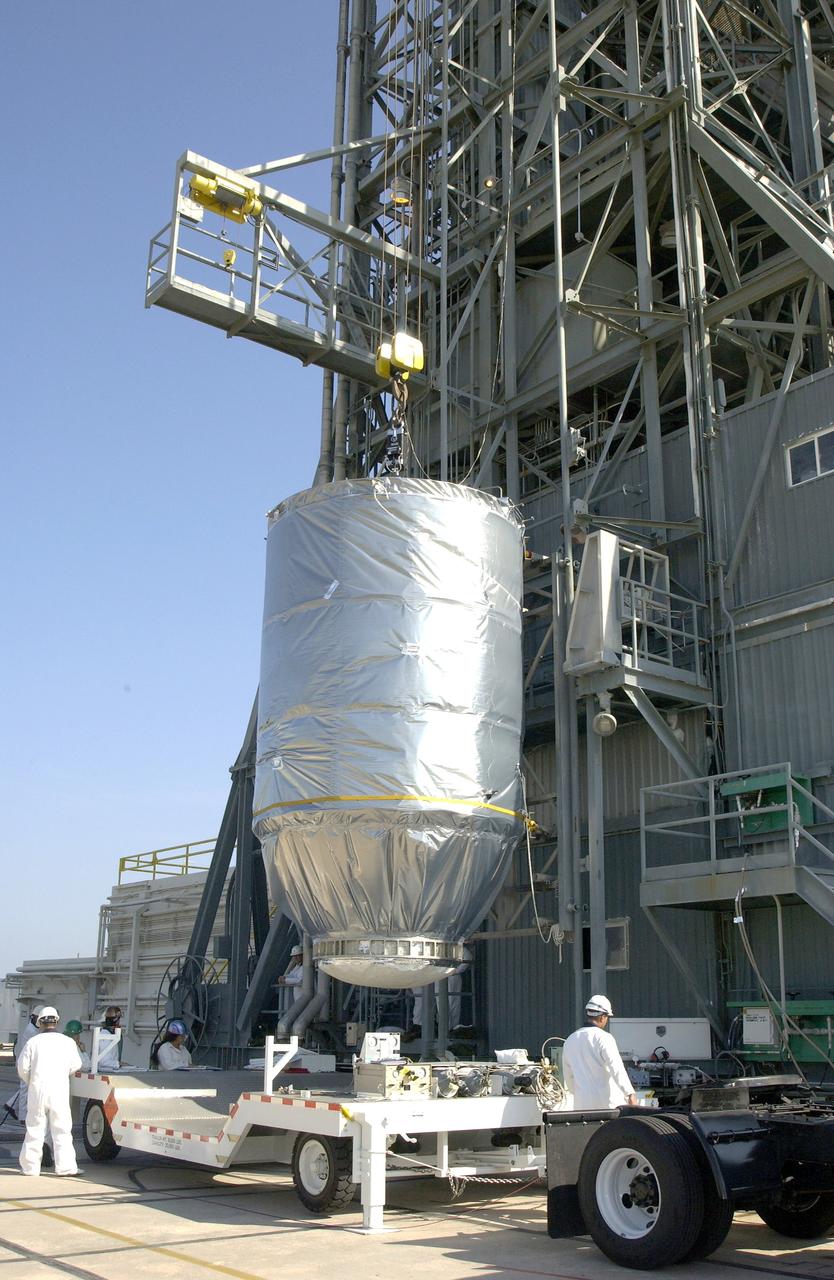
KENNEDY SPACE CENTER, FLA. - On Launch Pad 17-A, Cape Canaveral Air Force Station, the Mars Exploration Rover 2 (MER-2), inside the transport canister, is lifted off the transporter and into the launch tower where it will be mated to the Delta II rocket for launch.  MER-2 is one of NASA's twin Mars Exploration Rovers designed to study the history of water on Mars. These robotic geologists are equipped with a robotic arm, a drilling tool, three spectrometers, and four pairs of cameras that allow them to have a human-like, 3D view of the terrain. Each rover could travel as far as 100 meters in one day to act as Mars scientists' eyes and hands, exploring an environment where humans can't yet go.  MER-2 is scheduled to launch no earlier than June 8 as MER-A.
KENNEDY SPACE CENTER, FLA. - On Launch Pad 17-A, Cape Canaveral Air Force Station, the Mars Exploration Rover 2 (MER-2), inside the transport canister, is lifted off the transporter and into the launch tower where it will be mated to the Delta II rocket for launch. MER-2 is one of NASA's twin Mars Exploration Rovers designed to study the history of water on Mars. These robotic geologists are equipped with a robotic arm, a drilling tool, three spectrometers, and four pairs of cameras that allow them to have a human-like, 3D view of the terrain. Each rover could travel as far as 100 meters in one day to act as Mars scientists' eyes and hands, exploring an environment where humans can't yet go. MER-2 is scheduled to launch no earlier than June 8 as MER-A.
KENNEDY SPACE CENTER, FLA. -  On Launch Complex 17-B, Cape Canaveral Air Force Station, a solid rocket booster is raised off  its transporter to lift it to vertical.  It will be mated to the Delta II rocket for the Mars Exploration Rover 1 (MER-1) launch June 25.  NASA’s twin Mars Exploration Rovers are designed to study the history of water on Mars. These robotic geologists are equipped with a robotic arm, a drilling tool, three spectrometers, and four pairs of cameras that allow them to have a human-like, 3D view of the terrain. Each rover could travel as far as 100 meters in one day to act as Mars scientists' eyes and hands, exploring an environment where humans can’t yet go.  MER-2 (MER-A) will launch June 5.
KENNEDY SPACE CENTER, FLA. - On Launch Complex 17-B, Cape Canaveral Air Force Station, a solid rocket booster is raised off its transporter to lift it to vertical. It will be mated to the Delta II rocket for the Mars Exploration Rover 1 (MER-1) launch June 25. NASA’s twin Mars Exploration Rovers are designed to study the history of water on Mars. These robotic geologists are equipped with a robotic arm, a drilling tool, three spectrometers, and four pairs of cameras that allow them to have a human-like, 3D view of the terrain. Each rover could travel as far as 100 meters in one day to act as Mars scientists' eyes and hands, exploring an environment where humans can’t yet go. MER-2 (MER-A) will launch June 5.
KENNEDY SPACE CENTER, FLA. - On Launch Complex 17-A, Cape Canaveral Air Force Station, a solid rocket booster is raised off the transporter.  When vertical, it will be lifted up the launch tower and mated to the Delta rocket (in the background) to launch Mars Exploration Rover 2. NASA’s twin Mars Exploration Rovers are designed to study the history of water on Mars. These robotic geologists are equipped with a robotic arm, a drilling tool, three spectrometers, and four pairs of cameras that allow them to have a human-like, 3D view of the terrain. Each rover could travel as far as 100 meters in one day to act as Mars scientists' eyes and hands, exploring an environment where humans can’t yet go.  MER-2 is scheduled to launch June 5 as MER-A.  MER-1 (MER-B) will launch June 25.
KENNEDY SPACE CENTER, FLA. - On Launch Complex 17-A, Cape Canaveral Air Force Station, a solid rocket booster is raised off the transporter. When vertical, it will be lifted up the launch tower and mated to the Delta rocket (in the background) to launch Mars Exploration Rover 2. NASA’s twin Mars Exploration Rovers are designed to study the history of water on Mars. These robotic geologists are equipped with a robotic arm, a drilling tool, three spectrometers, and four pairs of cameras that allow them to have a human-like, 3D view of the terrain. Each rover could travel as far as 100 meters in one day to act as Mars scientists' eyes and hands, exploring an environment where humans can’t yet go. MER-2 is scheduled to launch June 5 as MER-A. MER-1 (MER-B) will launch June 25.
KENNEDY SPACE CENTER, FLA. - On Launch Complex 17-B, Cape Canaveral Air Force Station, a solid rocket booster is raised off  its transporter to lift it to vertical.  It will be mated to the Delta II rocket for the Mars Exploration Rover 1 (MER-1) launch June 25.  NASA’s twin Mars Exploration Rovers are designed to study the history of water on Mars. These robotic geologists are equipped with a robotic arm, a drilling tool, three spectrometers, and four pairs of cameras that allow them to have a human-like, 3D view of the terrain. Each rover could travel as far as 100 meters in one day to act as Mars scientists' eyes and hands, exploring an environment where humans can’t yet go.  MER-2 (MER-A) will launch June 5.
KENNEDY SPACE CENTER, FLA. - On Launch Complex 17-B, Cape Canaveral Air Force Station, a solid rocket booster is raised off its transporter to lift it to vertical. It will be mated to the Delta II rocket for the Mars Exploration Rover 1 (MER-1) launch June 25. NASA’s twin Mars Exploration Rovers are designed to study the history of water on Mars. These robotic geologists are equipped with a robotic arm, a drilling tool, three spectrometers, and four pairs of cameras that allow them to have a human-like, 3D view of the terrain. Each rover could travel as far as 100 meters in one day to act as Mars scientists' eyes and hands, exploring an environment where humans can’t yet go. MER-2 (MER-A) will launch June 5.
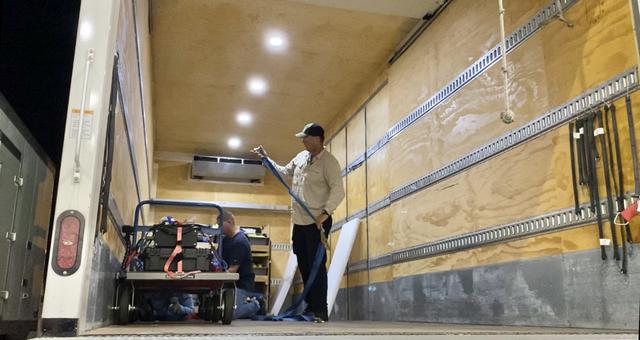
An employee with contractor Jacobs from contractor Jacobs transports research cargo from the International Space Station for processing inside the Space Station Processing Facility (SSPF) at NASA’s Kennedy Space Center in Florida on July 10, 2021. The experiments returned to Earth on SpaceX’s 22nd commercial resupply services mission. After its successful parachute-assisted splashdown off the coast of Tallahassee, Florida at 11:29 p.m. EST on Friday, July 9, the SpaceX cargo Dragon returned more than 5,300 pounds of scientific experiments and other cargo from the International Space Station. Splashing down off the coast of Florida enables quick transportation of the science aboard the capsule to the SSPF, delivering some science back into the hands of the researchers as soon as four to nine hours after splashdown. This shorter transportation timeframe allows researchers to collect data with minimal loss of microgravity effects.
SpaceX CRS-22 Return
An employee with contractor Jacobs transports research cargo from the International Space Station for processing inside the Space Station Processing Facility (SSPF) at NASA’s Kennedy Space Center in Florida on July 10, 2021. The experiments returned to Earth on SpaceX’s 22nd commercial resupply services mission. After its successful parachute-assisted splashdown off the coast of Tallahassee, Florida at 11:29 p.m. EST on Friday, July 9, the SpaceX cargo Dragon returned more than 5,300 pounds of scientific experiments and other cargo from the International Space Station. Splashing down off the coast of Florida enables quick transportation of the science aboard the capsule to the SSPF, delivering some science back into the hands of the researchers as soon as four to nine hours after splashdown. This shorter transportation timeframe allows researchers to collect data with minimal loss of microgravity effects.
SpaceX CRS-22 Return
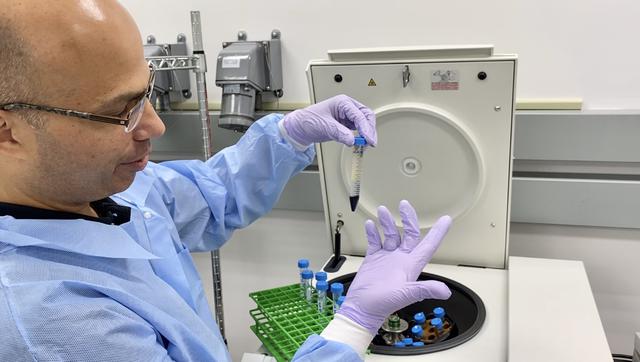
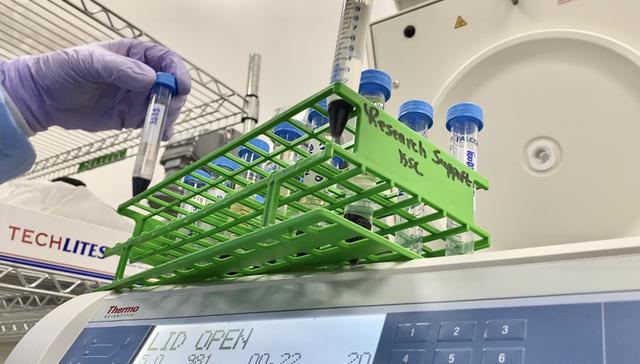
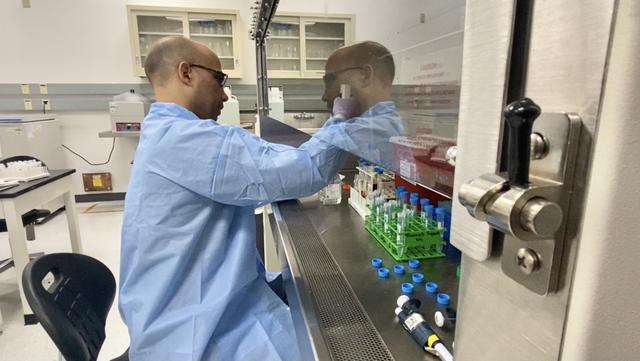
Senior Scientist George Makedonas, from NASA’S Human Immunology and Virology Lab, works with blood samples returned to Earth on SpaceX’s 22nd commercial resupply services mission in the Space Station Processing Facility (SSPF) at Kennedy Space Center in Florida, on July 10, 2021. After its successful parachute-assisted splashdown off the coast of Tallahassee, Florida at 11:29 p.m. EST on July 9, the SpaceX cargo Dragon returned more than 5,300 pounds of scientific experiments and other cargo from the International Space Station. Splashing down off the coast of Florida enables quick transportation of the science aboard the capsule to the SSPF, delivering some science back into the hands of the researchers as soon as four to nine hours after splashdown. This shorter transportation timeframe allows researchers to collect data with minimal loss of microgravity effects.
SpaceX CRS-22 Return
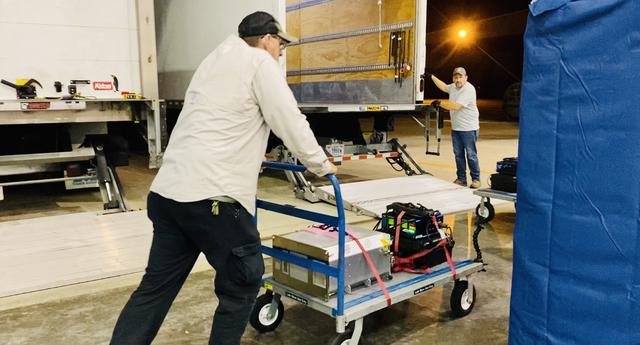
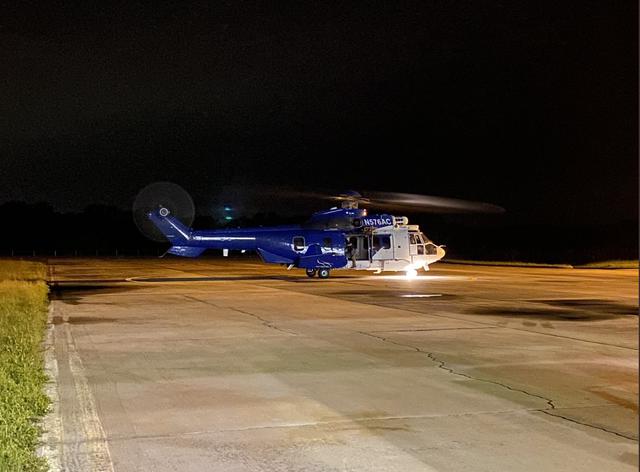
An Airbus H225 helicopter with cargo from SpaceX’s 22nd commercial resupply services mission lands during the early morning on July 10, 2021, at the Launch and Landing Facility at NASA’s Kennedy Space Center in Florida. From there, contractor Jacobs transported the cargo to the center’s Space Station Processing Facility (SSPF). After its successful parachute-assisted splashdown off the coast of Tallahassee, Florida, at 11:29 p.m. EST on Friday, July 9, the SpaceX cargo Dragon returned more than 5,300 pounds of scientific experiments and other cargo from the International Space Station. Splashing down off the coast of Florida enables quick transportation of the science aboard the capsule to the SSPF, delivering some science back into the hands of the researchers as soon as four to nine hours after splashdown. This shorter transportation timeframe allows researchers to collect data with minimal loss of microgravity effects.
SpaceX CRS-22 Return
Senior Scientist George Makedonas, from NASA’S Human Immunology and Virology Lab, works with blood samples returned to Earth on SpaceX’s 22nd commercial resupply services mission in the Space Station Processing Facility (SSPF) at Kennedy Space Center in Florida, on July 10, 2021. After its successful parachute-assisted splashdown off the coast of Tallahassee, Florida at 11:29 p.m. EST on Friday, July 9, the SpaceX cargo Dragon returned more than 5,300 pounds of scientific experiments and other cargo from the International Space Station. Splashing down off the coast of Florida enables quick transportation of the science aboard the capsule to the SSPF, delivering some science back into the hands of the researchers as soon as four to nine hours after splashdown. This shorter transportation timeframe allows researchers to collect data with minimal loss of microgravity effects.
SpaceX CRS-22 Return
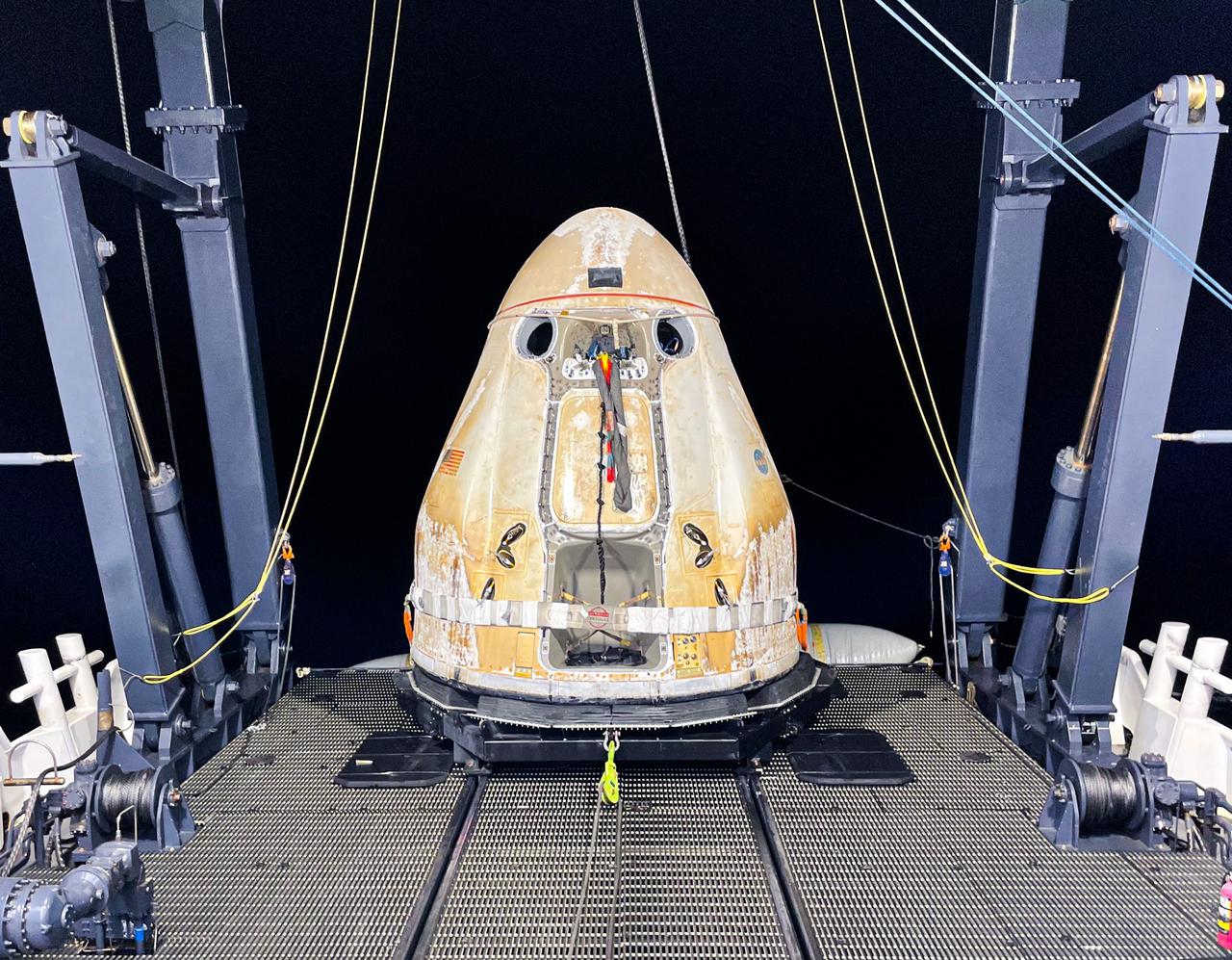
After its successful parachute-assisted splashdown off the coast of Tallahassee, Florida, at 11:29 p.m. EST on July 9, 2021, the cargo Dragon spacecraft was loaded aboard SpaceX’s Go Navigator recovery ship. The SpaceX cargo Dragon returned more than 5,300 pounds of scientific experiments and other cargo from the International Space Station on SpaceX’s 22nd commercial resupply services mission. Splashing down off the coast of Florida enables quick transportation of the science aboard the capsule to NASA Kennedy Space Center’s Space Station Processing Facility, delivering some science back into the hands of the researchers as soon as four to nine hours after splashdown. This shorter transportation timeframe allows researchers to collect data with minimal loss of microgravity effects.
SpaceX CRS-22 Return
Senior Scientist George Makedonas, from NASA’S Human Immunology and Virology Lab, works with blood samples returned to Earth on SpaceX’s 22nd commercial resupply services mission in the Space Station Processing Facility (SSPF) at Kennedy Space Center in Florida, on July 10, 2021. After its successful parachute-assisted splashdown off the coast of Tallahassee, Florida at 11:29 p.m. EST on Friday, July 9, the SpaceX cargo Dragon returned more than 5,300 pounds of scientific experiments and other cargo from the International Space Station. Splashing down off the coast of Florida enables quick transportation of the science aboard the capsule to the SSPF, delivering some science back into the hands of the researchers as soon as four to nine hours after splashdown. This shorter transportation timeframe allows researchers to collect data with minimal loss of microgravity effects.
SpaceX CRS-22 Return
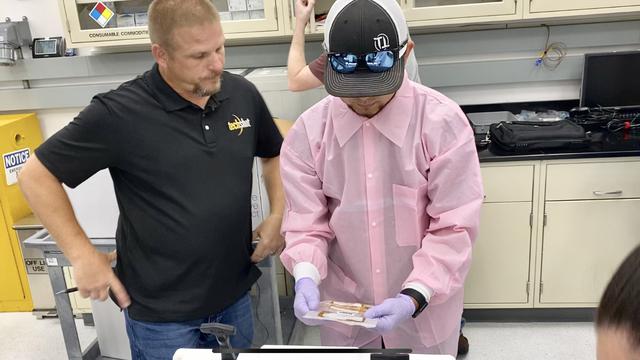
Members of the cold stowage team unpack science experiments inside the Space Station Processing Facility (SSPF) at NASA’s Kennedy Space Center in Florida on July 10, 2021. The experiments returned to Earth on SpaceX’s 22nd commercial resupply services mission. After its successful parachute-assisted splashdown off the coast of Tallahassee, Florida at 11:29 p.m. EST on Friday, July 9, the SpaceX cargo Dragon returned more than 5,300 pounds of scientific experiments and other cargo from the International Space Station. Splashing down off the coast of Florida enables quick transportation of the science aboard the capsule to the SSPF, delivering some science back into the hands of the researchers as soon as four to nine hours after splashdown. This shorter transportation timeframe allows researchers to collect data with minimal loss of microgravity effects.
SpaceX CRS-22 Return
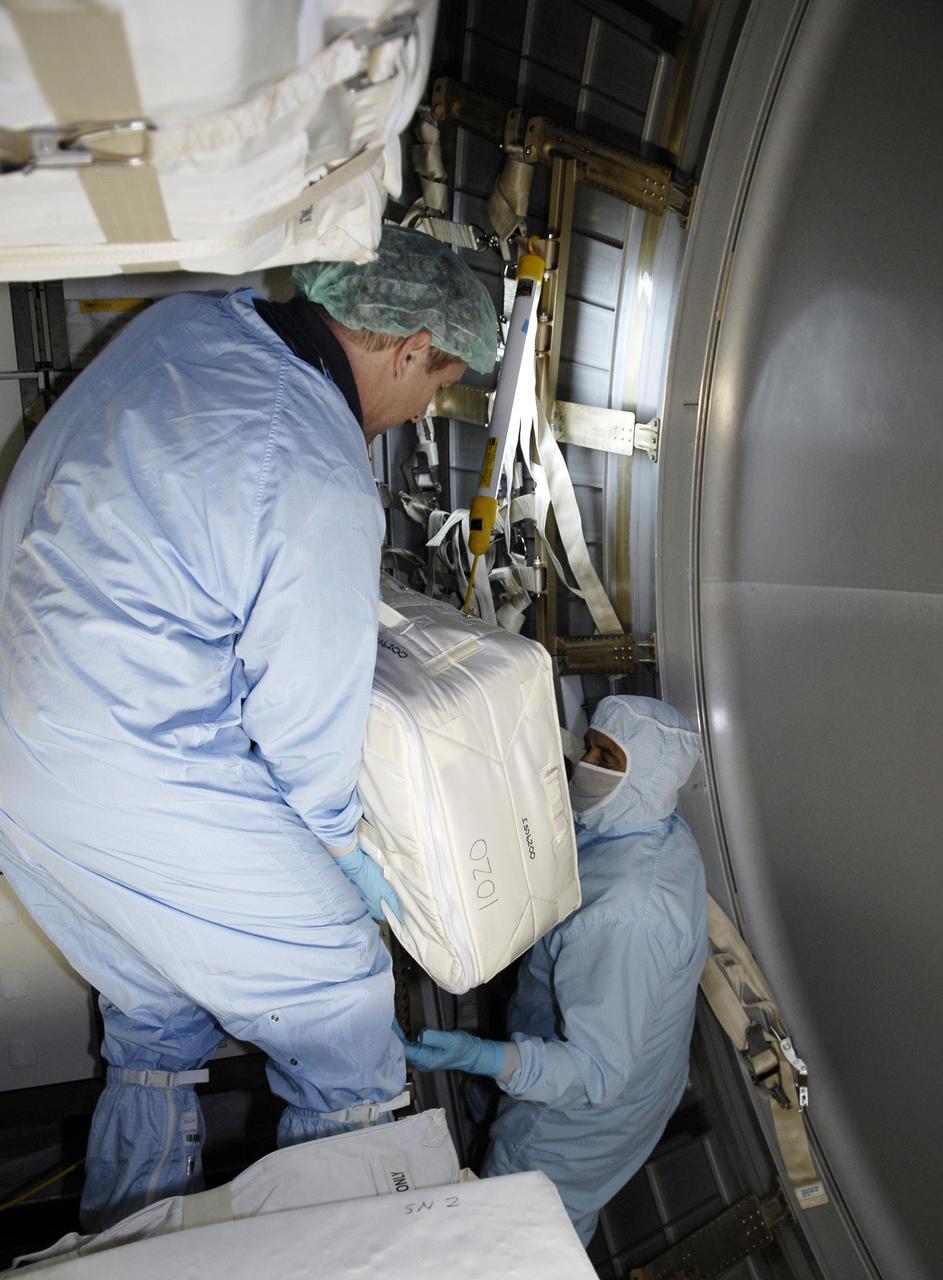
CAPE CANAVERAL, Fla. –   In the Space Station Processing Facility at NASA's Kennedy Space Center in Florida, a worker, left, hands off a stowage container to another worker in the Multi-Purpose Logistics Module Leonardo for the STS-126 mission to the International Space Station.  The 15-day flight will deliver equipment and supplies to the International Space Station in preparation for expansion from a three- to six-person resident crew aboard the complex. The mission also will include four spacewalks to service the station Solar Alpha Rotary Joints.  Leonardo holds supplies and equipment, including equipment for the regenerative life support system, additional crew quarters and exercise equipment and spare hardware.  Photo credit: NASA/Kim Shiflett
KSC-08pd3052
S134-E-007141 (18 May 2011) --- In the grasp of space shuttle Endeavour?s robotic Canadarm, the Express Logistics Carrier-3 (ELC-3) is transferred from Endeavour?s payload bay for hand off to the International Space Station?s Canadarm2 to be installed on the left side of the station?s truss structure. ELC-3 holds spare hardware for future station use, including an ammonia tank, a high pressure gas tank, a cargo transport container, two S-band antenna assemblies and a spare arm for DEXTRE, the Special Purpose Dexterous Manipulator. Photo credit: NASA
View of ELC3 Unberth
S76-E-5146 (24 March 1996) --- Continuing an in-space tradition, astronaut Kevin P. Chilton (right), STS-76 mission commander, shakes hands with cosmonaut Yury Onufrienko, Mir-21 commander, in the tunnel connecting the Space Shuttle Atlantis and Russia's Mir Space Station.  A short time earlier two crews successfully pulled off the third hard-docking of their respective spacecraft.  In the background is cosmonaut Yury V. Usachev, Mir-21 flight engineer.  The image was recorded with a 35mm Electronic Still Camera (ESC) and downlinked at a later time to ground controllers in Houston, Texas.
Commander Kevin Chilton is greeted as he moves past the APAS interface
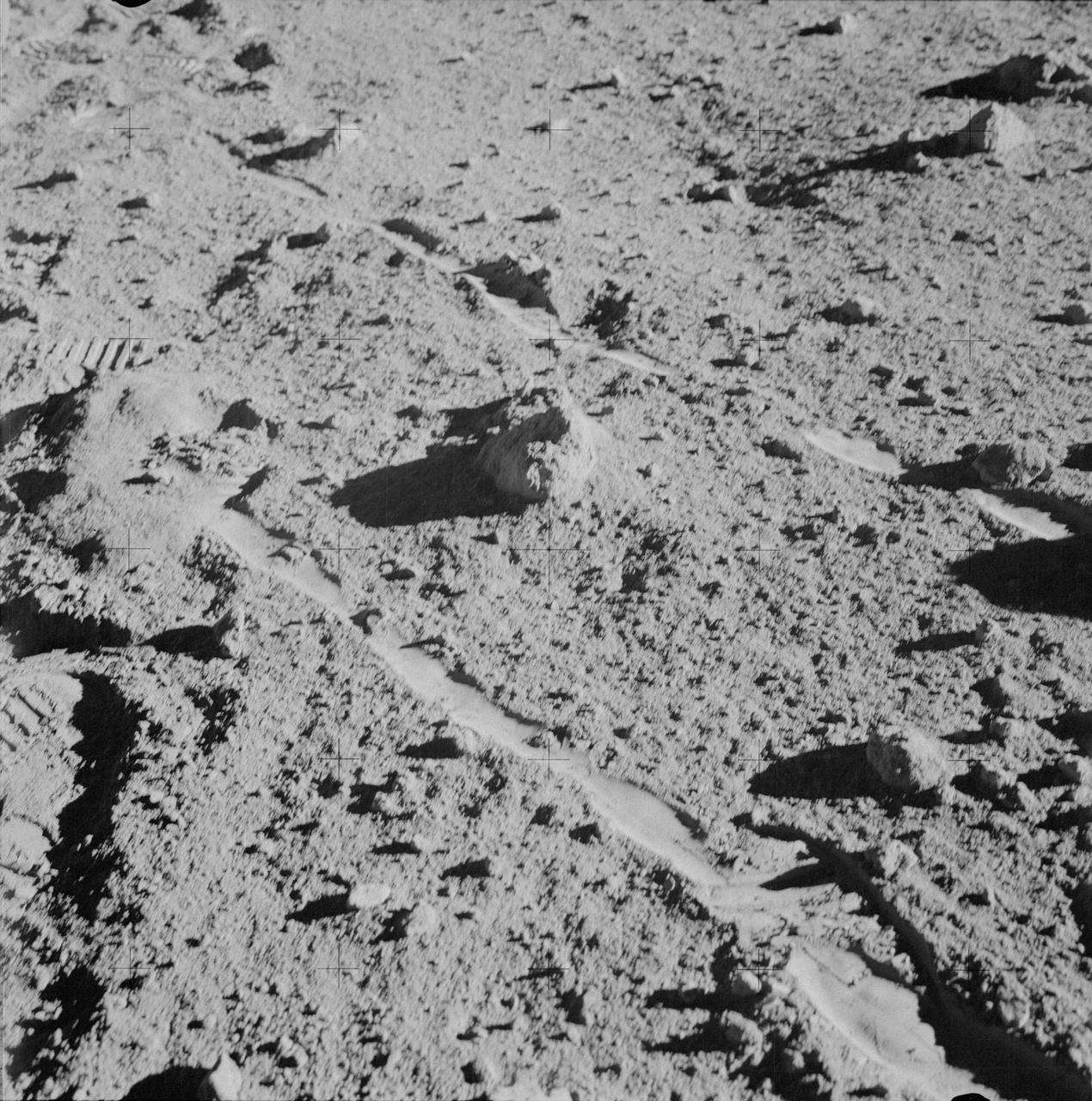
AS14-64-9129 (6 Feb. 1971) --- The two moon-exploring crew men of the Apollo 14 lunar landing mission, photographed and collected the large rock pictured just above the exact center of this picture. (Hold picture with the NASA photographic number at lower right hand corner.) The rock, casting a shadow off to the left, is lunar sample number 14321, referred to as a basketball-sized rock by newsmen and nicknamed "Big Bertha" by principal investigators. It lies between the wheel tracks made by the modular equipment transporter (MET) or rickshaw-type portable workbench. A few prints of the lunar overshoes of the crew members are at the left. This photo was made near the boulder field near the rim of Cone Crater.
Apollo 14 Mission image - Pan of the Gnomon during EVA 2.
KENNEDY SPACE CENTER, FLA. -  In the Orbiter Processing Facility, the left-hand Orbital Maneuvering System (OMS) pod (seen from the front) is lifted off its transporter.  The OMS pod will be installed on the orbiter Discovery.  The Orbital Maneuvering System provides the thrust for orbit insertion, orbit circularization, orbit transfer, rendezvous, deorbit, abort to orbit and abort once around.  It can provide up to 1,000 pounds of propellant to the aft reaction control system.  Each pod contains one OMS engine and the hardware needed to pressurize, store and distribute the propellants to perform the velocity maneuvers.
KSC-04pd0941
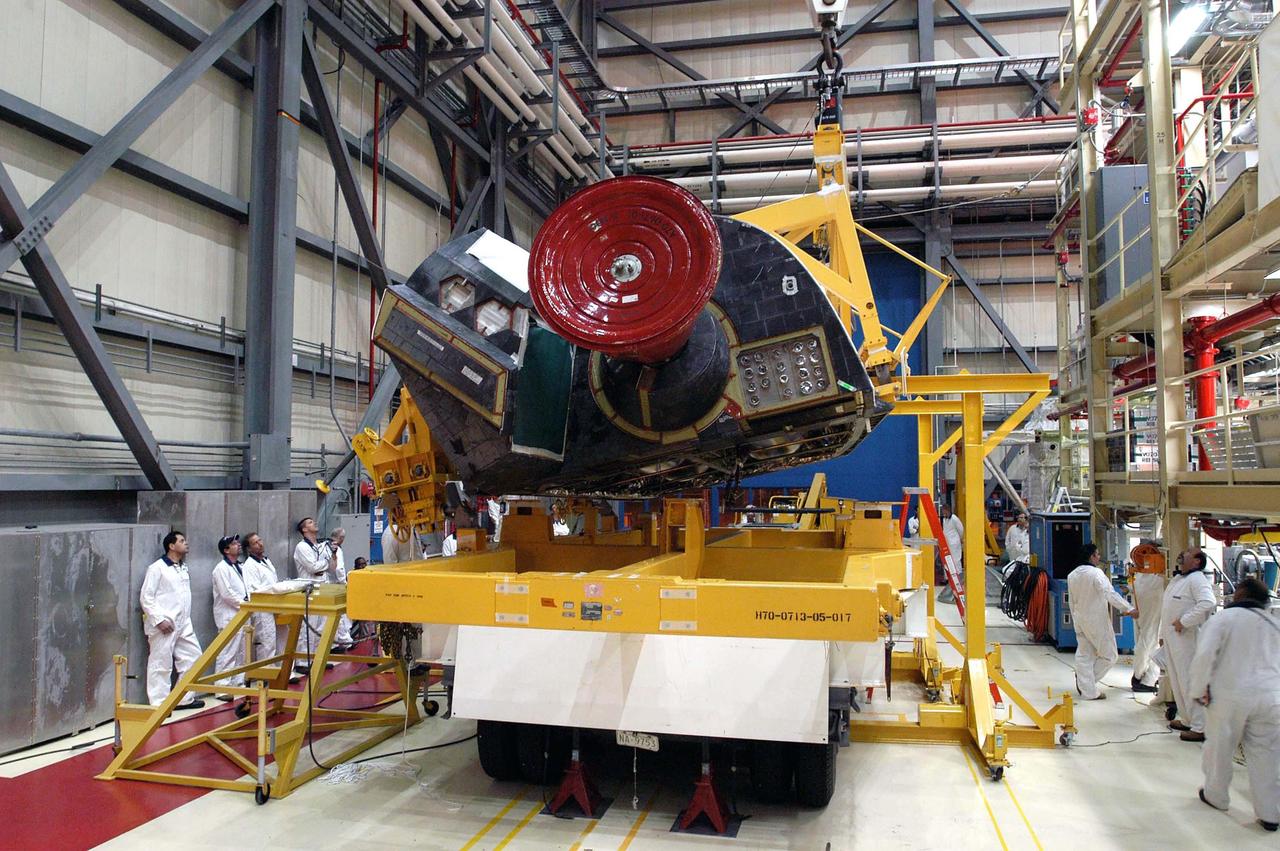
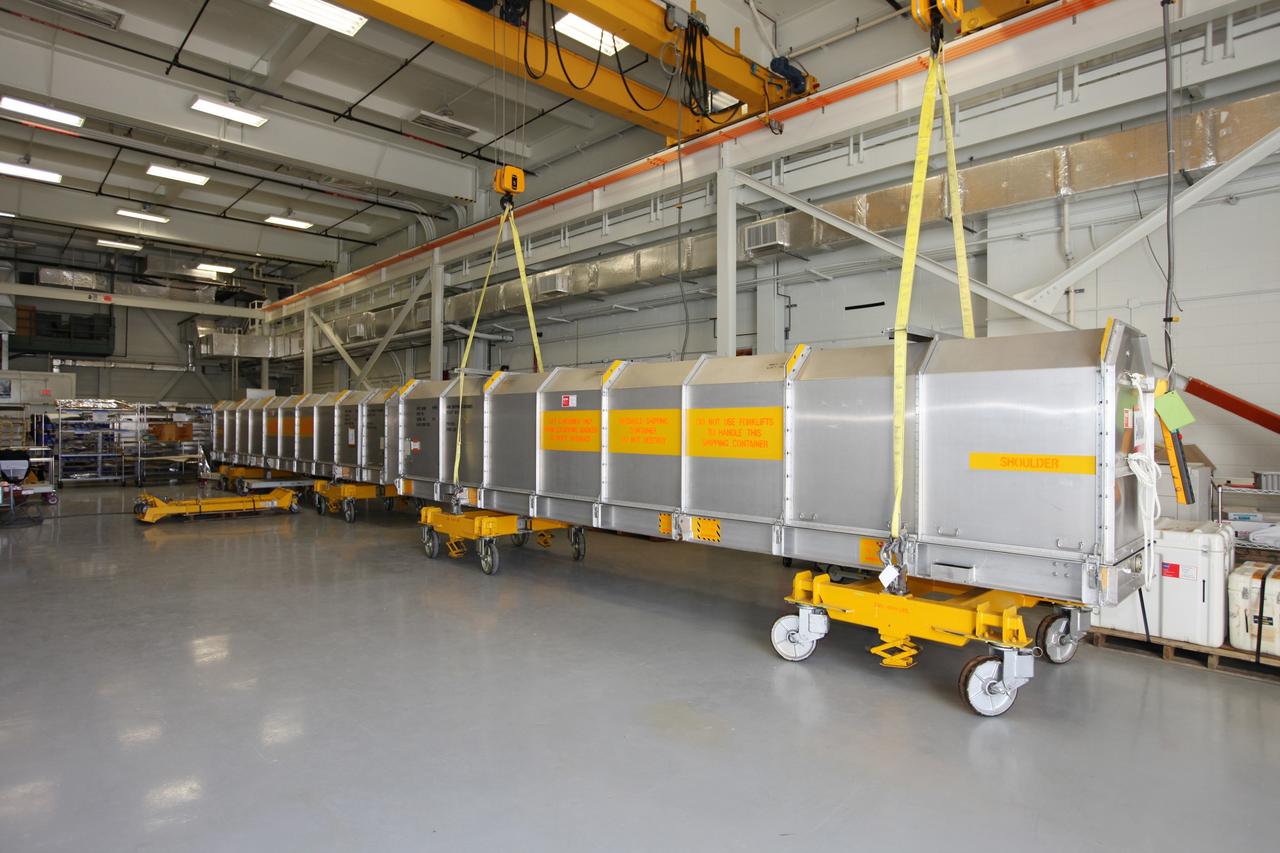
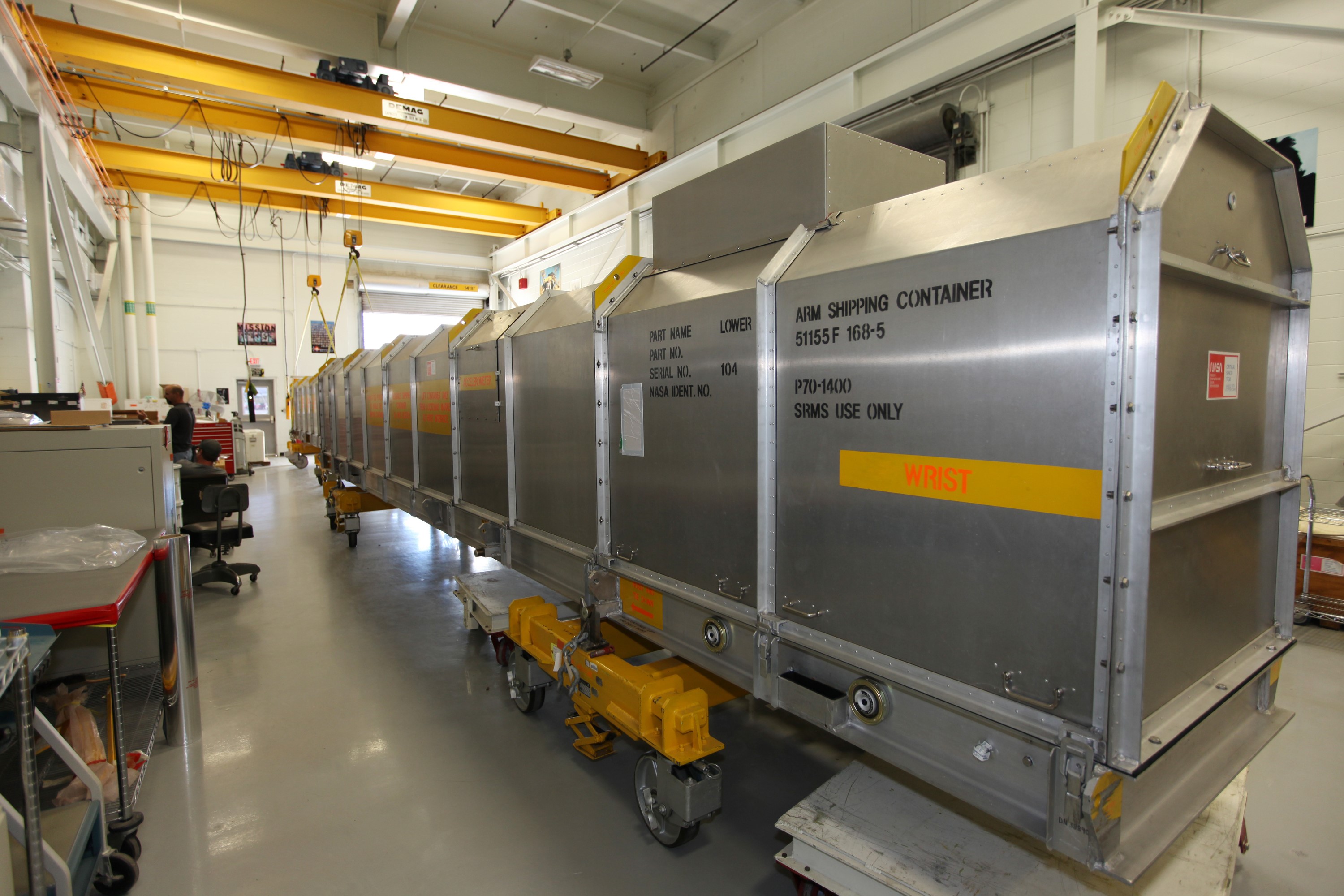
CAPE CANAVERAL, Fla. - Inside the Vehicle Assembly Building at NASA’s Kennedy Space Center in Florida, the remote manipulator system, or RMS, has been crated and prepared for shipment back to the Canadian Space Agency.    The RMS, also called the Canadarm, was manufactured for NASA’s Space Shuttle Program by SPAR Aerospace Ltd., which later became a part of MD Robotics in Ontario, Canada.  During shuttle missions, the RMS was attached in the payload bay. Mission specialists operated the arm to remove payloads from the payload bay and hand them off to the larger Canadarm 2 on the International Space Station. The shuttle arm also was used during astronaut spacewalks. Photo credit: NASA/Kim Shiflett
KSC-2012-3833
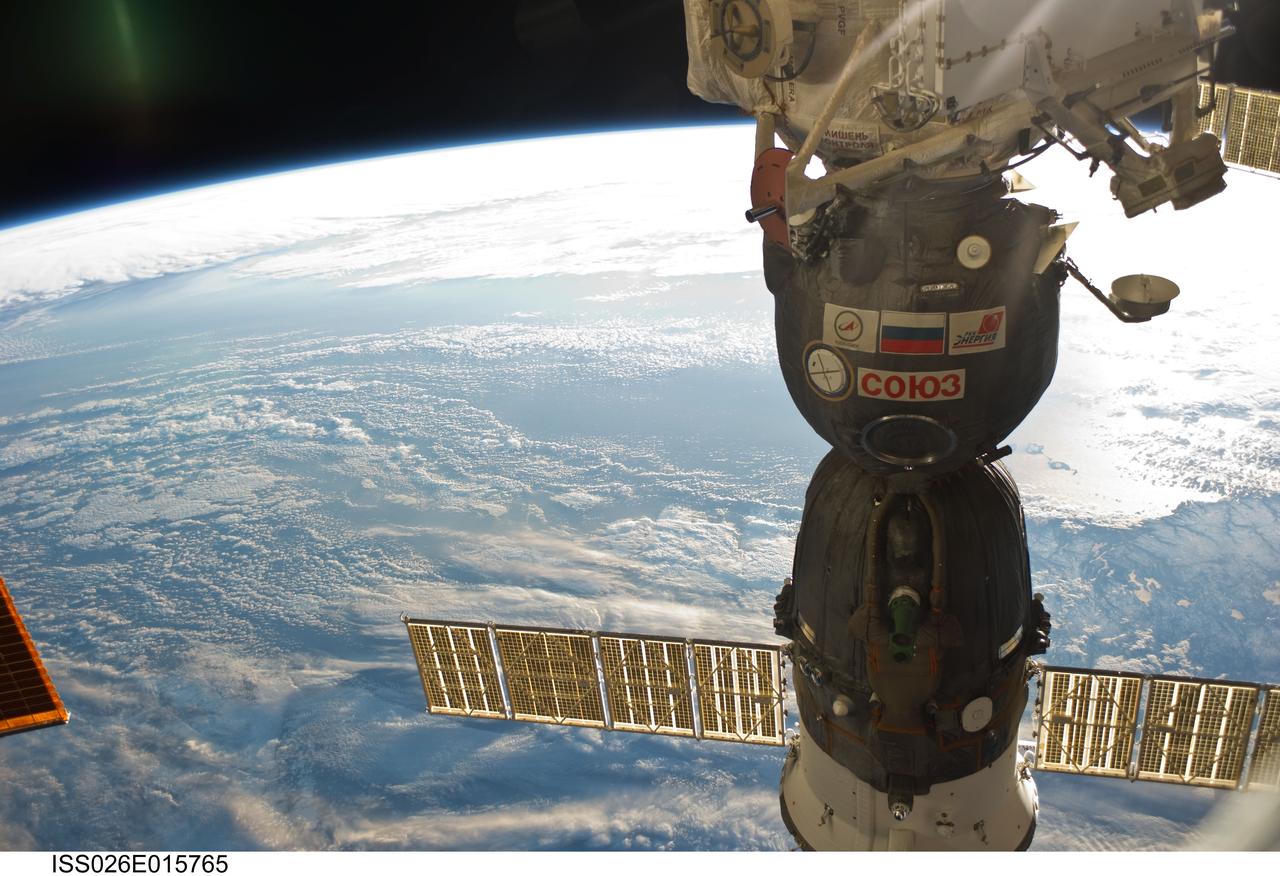
ISS026-E-015765 (6 Jan. 2011) --- Newfoundland and clouds over the North Atlantic Ocean share a scene with a Soyuz spacecraft docked to the International Space Station in this 35-mm focal length photograph recorded by one of the Expedition 26 crew members from 220 miles above Earth. The nadir point is 51.1 degrees north latitude and 50.4 degrees west longitude off the coast of Newfoundland. Looking southwestward, in the lower right hand corner, above the solar panel is the south coast of the island. The sun glint on the ocean’s surface outlines the islands (with the small hook-like appearance) of Saint Pierre and Miquelon.
Earth Observations taken by Expedition 26 crewmember
KENNEDY SPACE CENTER, FLA. -  In the Orbiter Processing Facility, the left-hand Orbital Maneuvering System (OMS) pod (seen from the back) is lifted off its transporter.  The OMS pod will be installed on the orbiter Discovery.  The Orbital Maneuvering System provides the thrust for orbit insertion, orbit circularization, orbit transfer, rendezvous, deorbit, abort to orbit and abort once around.  It can provide up to 1,000 pounds of propellant to the aft reaction control system.  Each pod contains one OMS engine and the hardware needed to pressurize, store and distribute the propellants to perform the velocity maneuvers.
KSC-04pd0942
CAPE CANAVERAL, Fla. - Inside the Vehicle Assembly Building at NASA’s Kennedy Space Center in Florida, the remote manipulator system, or RMS, has been crated and prepared for shipment back to the Canadian Space Agency.    The RMS, also called the Canadarm, was manufactured for NASA’s Space Shuttle Program by SPAR Aerospace Ltd., which later became a part of MD Robotics in Ontario, Canada.  During shuttle missions, the RMS was attached in the payload bay. Mission specialists operated the arm to remove payloads from the payload bay and hand them off to the larger Canadarm 2 on the International Space Station. The shuttle arm also was used during astronaut spacewalks. Photo credit: NASA/Kim Shiflett
KSC-2012-3834
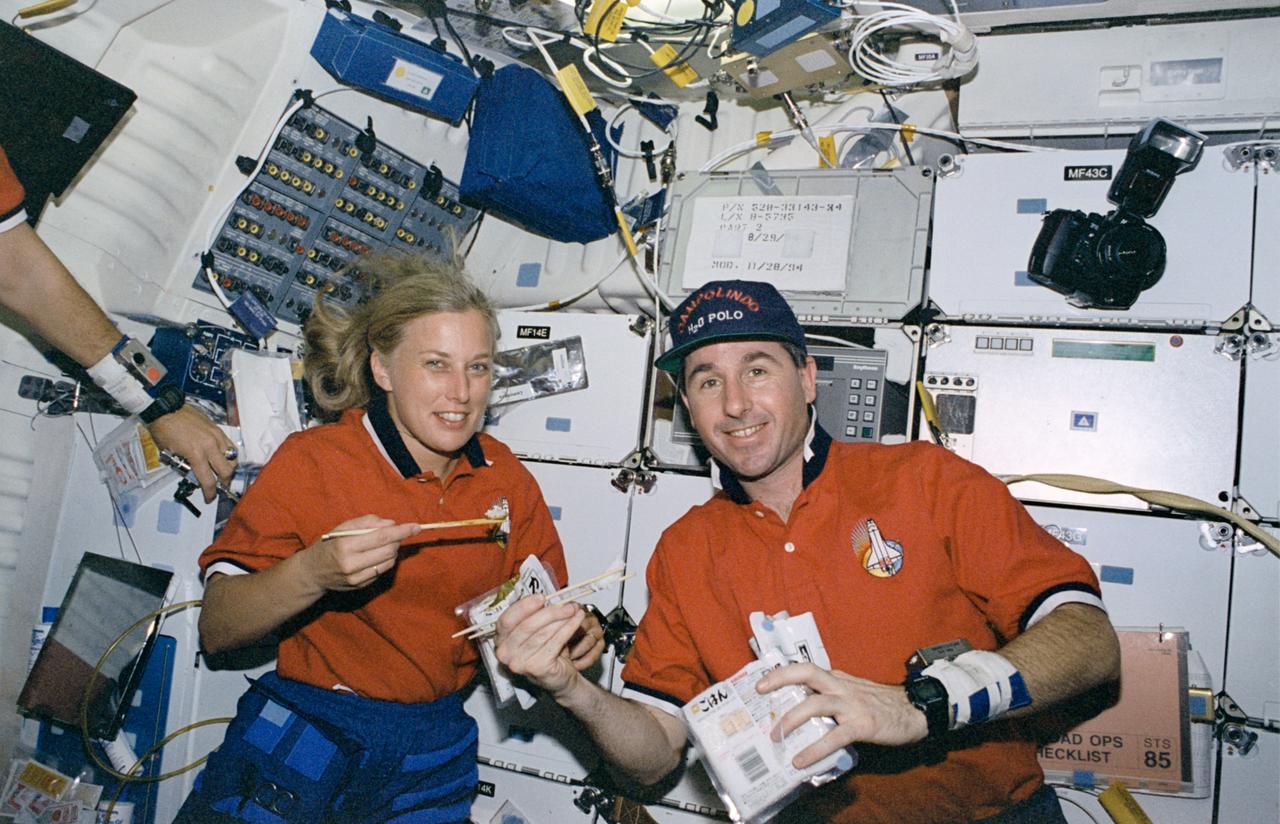
STS085-359-032 (7 - 19 August 1997) --- During off-duty time astronauts N. Jan Davis, payload commander, and Stephen K. Robinson, mission specialist, try their hands at chopsticks while having a meal of some Japanese rice on the Space Shuttle Discovery's mid-deck.  Astronaut Curtis L. Brown, Jr., mission commander, is partially out of frame at left.  Robinson and Brown are wearing special wrist bands that support a Detailed Supplementary Objective (DSO) experiment.  Though Japan's National Space Development Agency (NASDA) had no crew members aboard, it did have a major payload -- the Manipulator Flight Demonstration (MFD) hardware -- in Discovery's cargo bay.
Crewmember activity in the middeck
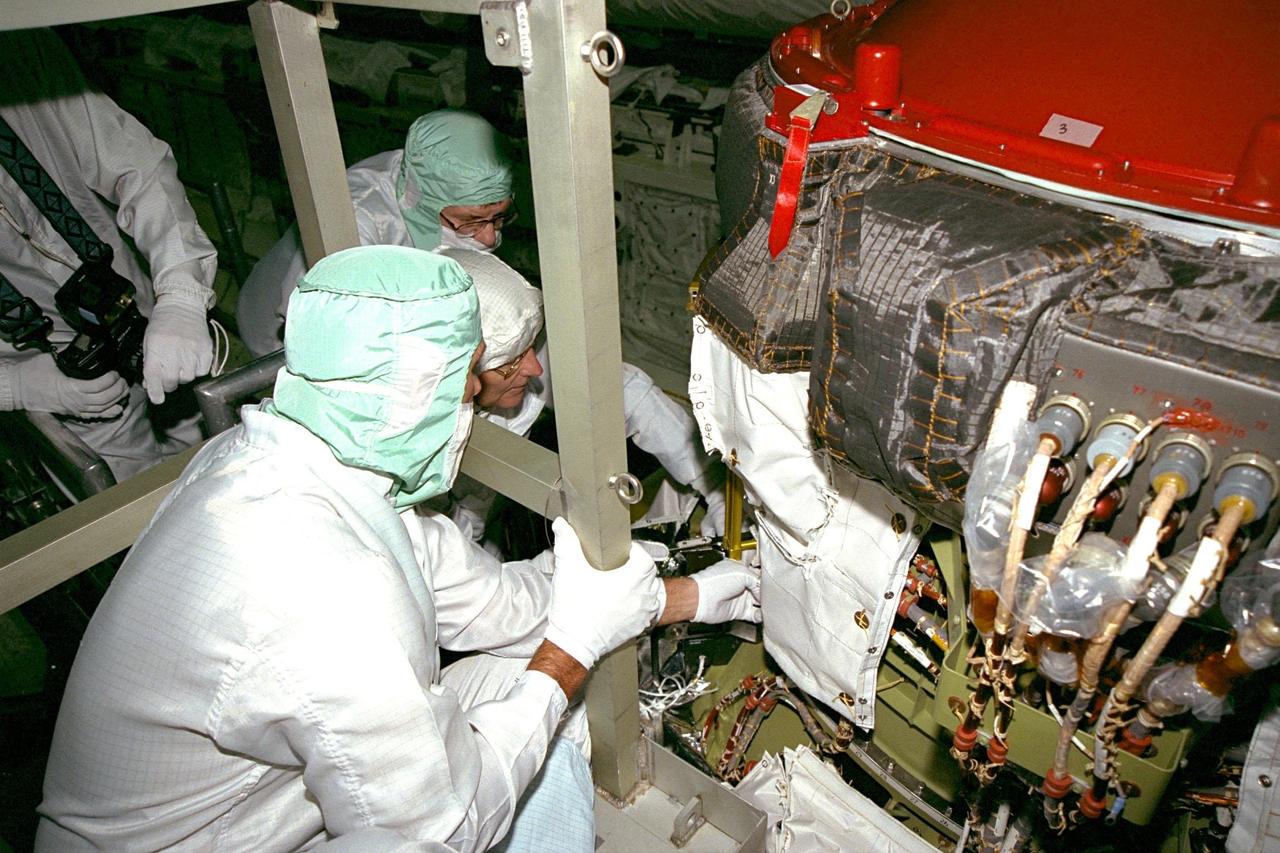
STS-88 crew members inspect the orbital docking mechanism in the payload bay of Orbiter Endeavor during the Crew Equipment Interface Test (CEIT), held in the Orbiter Processing Facility Bay 1 at KSC. The tunnel and airlock are below it. The CEIT gives astronauts an opportunity for a hands-on look at the payloads on which they will be working on orbit. STS-88 will be the first Space Shuttle launch for the International Space Station. Scheduled to lift off from KSC on Dec. 3, 1998, the seven-day mission will be highlighted by the mating of the U.S.-built Unity connecting module to the Zarya control module, which will already be in orbit, and two space walks to connect power and data transmission cables between the two modules
KSC-98pc829
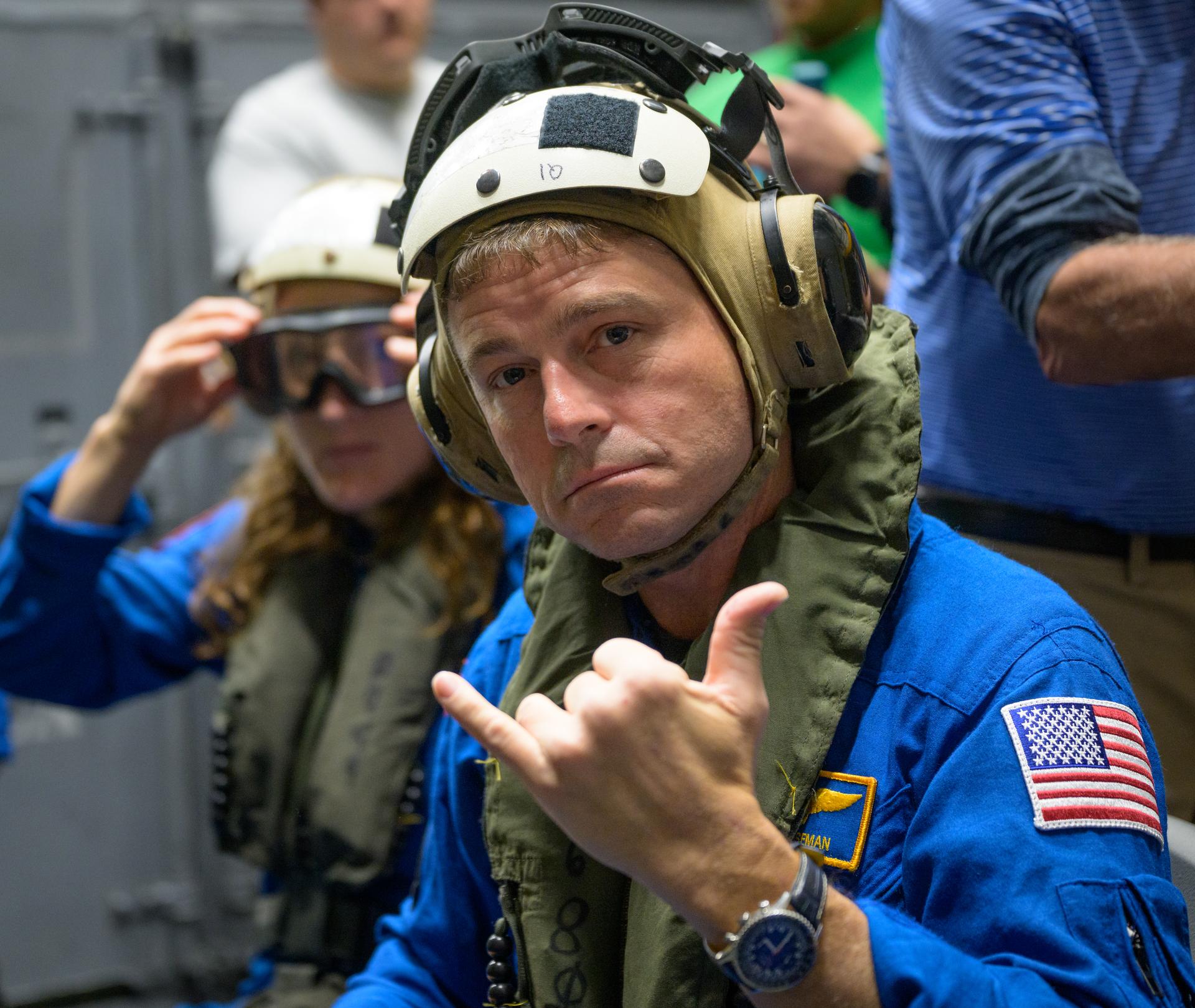
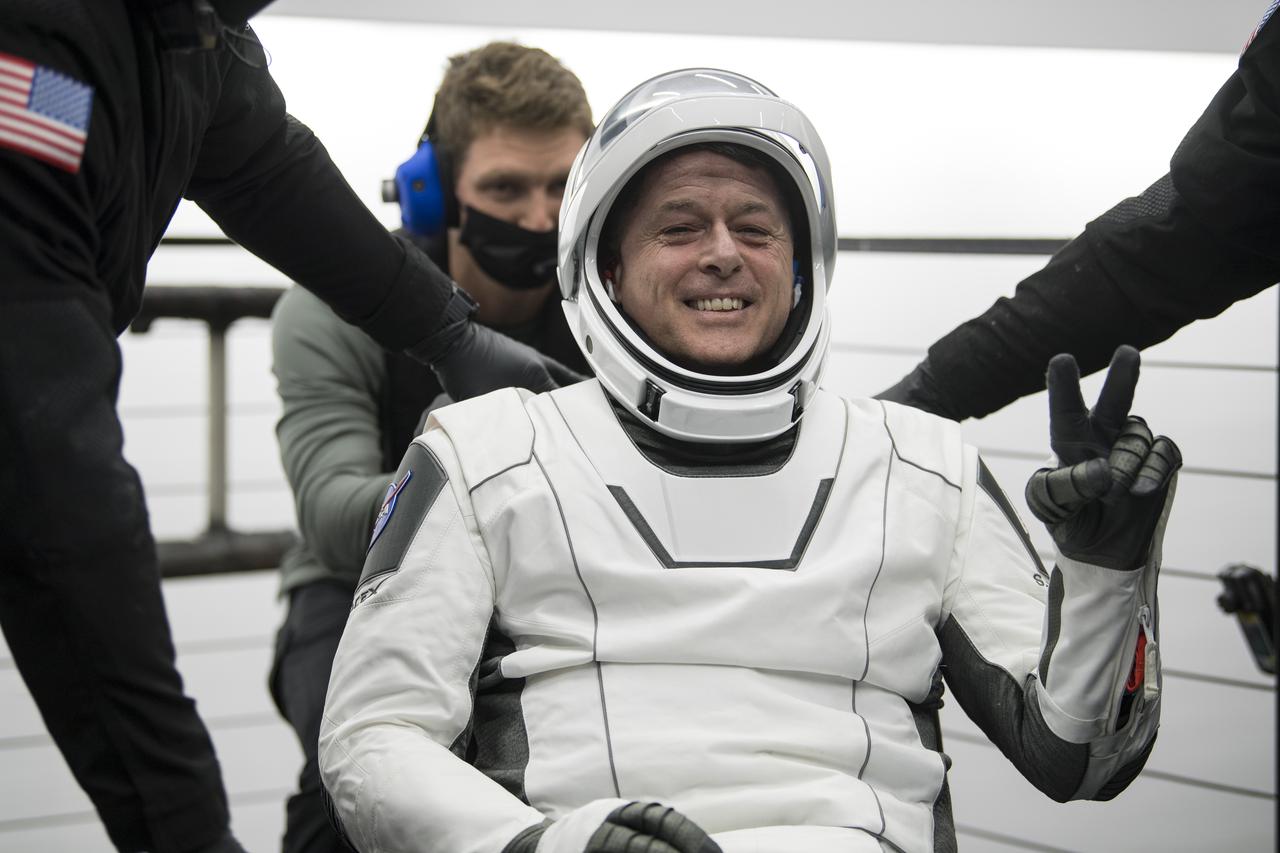
NASA astronaut Shane Kimbrough gives a hand sign after he was helped out of the SpaceX Crew Dragon Endeavour spacecraft onboard the SpaceX GO Navigator recovery ship after he and NASA astronaut Megan McArthur, Japan Aerospace Exploration Agency (JAXA) astronaut Aki Hoshide, and ESA (European Space Agency) astronaut Thomas Pesquet landed in the Gulf of Mexico off the coast of Pensacola, Florida, Monday, Nov. 8, 2021. NASA’s SpaceX Crew-2 mission is the second operational mission of the SpaceX Crew Dragon spacecraft and Falcon 9 rocket to the International Space Station as part of the agency’s Commercial Crew Program. Photo Credit: (NASA/Aubrey Gemignani)
NASA’s SpaceX Crew-2 Splashdown
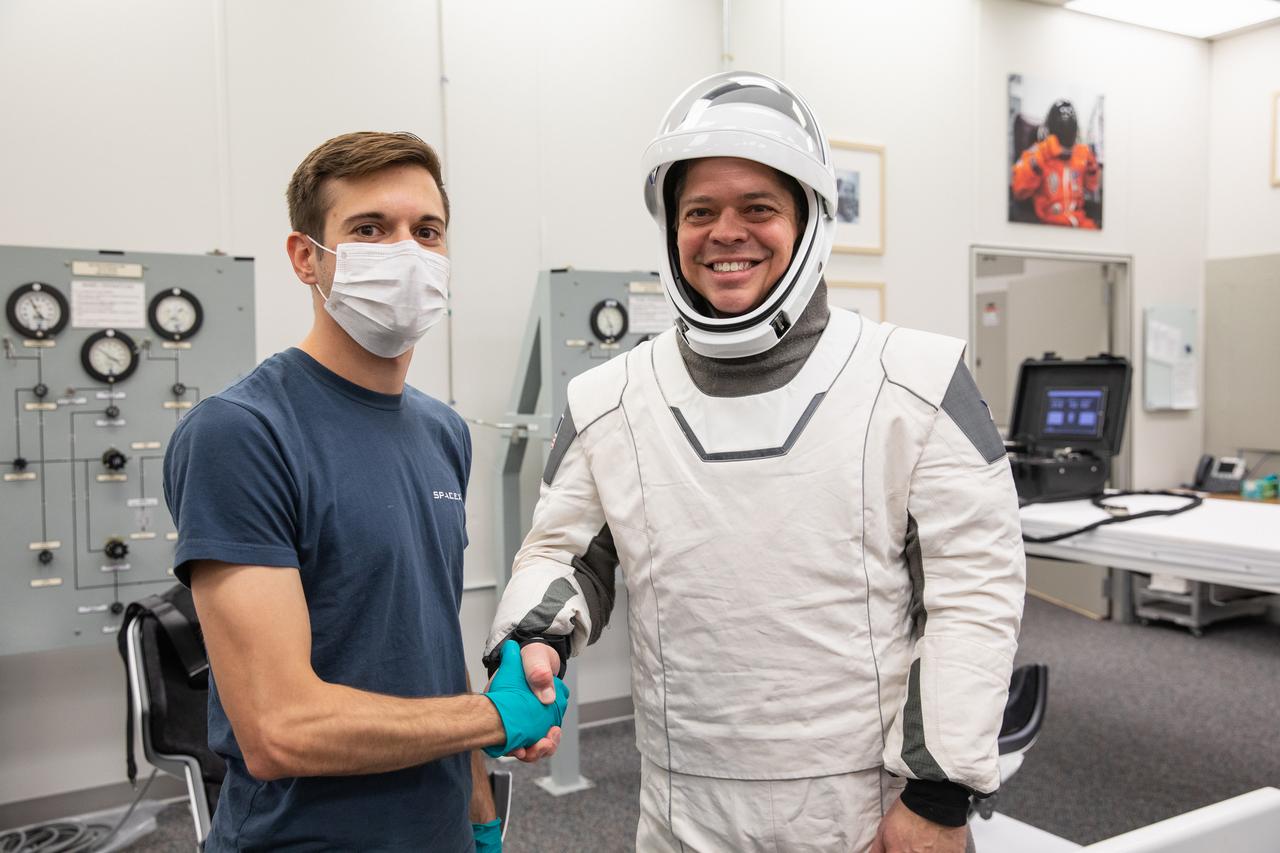
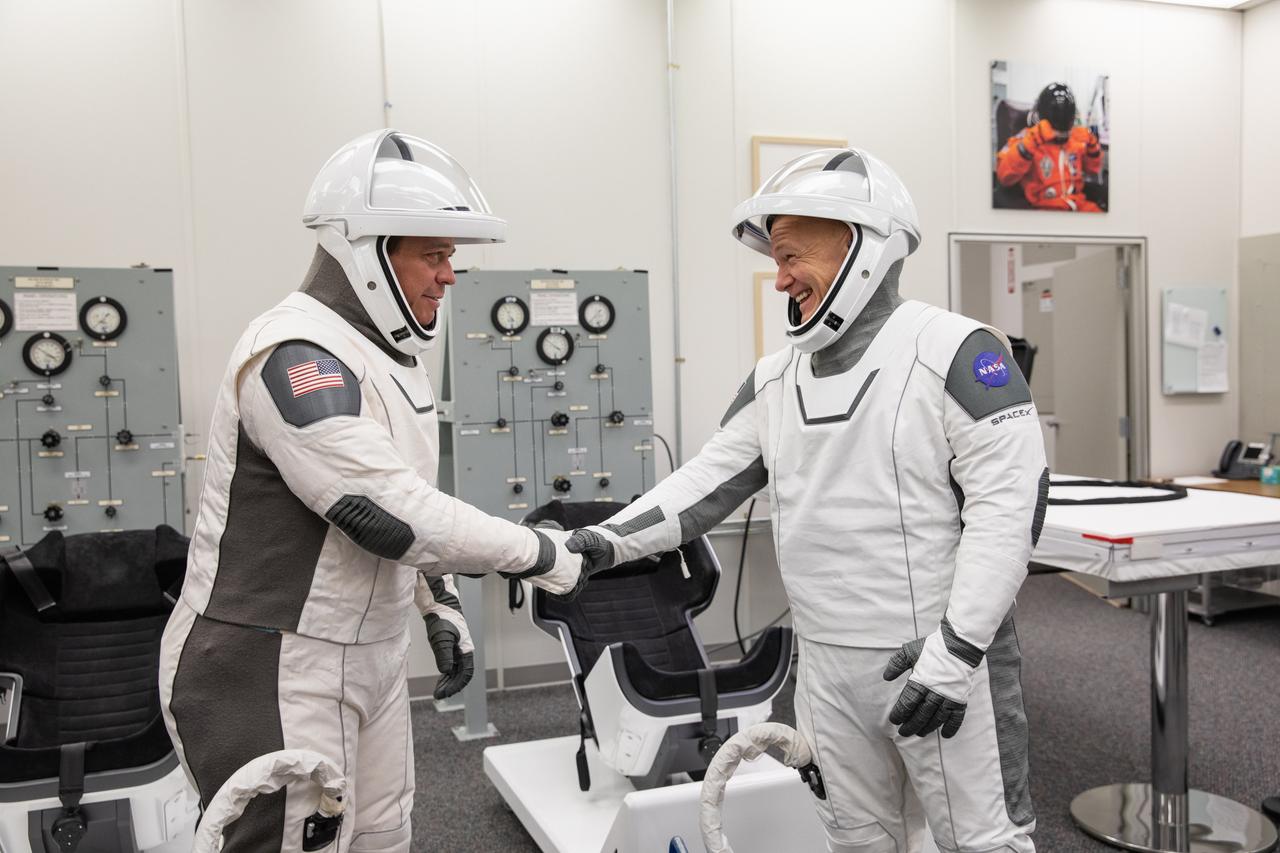
NASA astronauts Bob Behnken, right, wearing a SpaceX spacesuit, and a suit technician shake hands in the Astronaut Crew Quarters at Kennedy Space Center in Florida on Jan. 17, 2020, during a dress rehearsal ahead of the company’s uncrewed In-Flight Abort Test. A SpaceX Falcon 9 rocket and Crew Dragon spacecraft will lift off from Launch Complex 39A on the flight test, which will demonstrate the spacecraft’s escape capabilities in preparation for crewed flights to the International Space Station as part of the agency’s Commercial Crew Program. Behnken and NASA astronaut Doug Hurley are slated to fly on the company’s first crewed mission, Demo-2.
SpaceX InFlight Abort Dry Dress Rehearsal
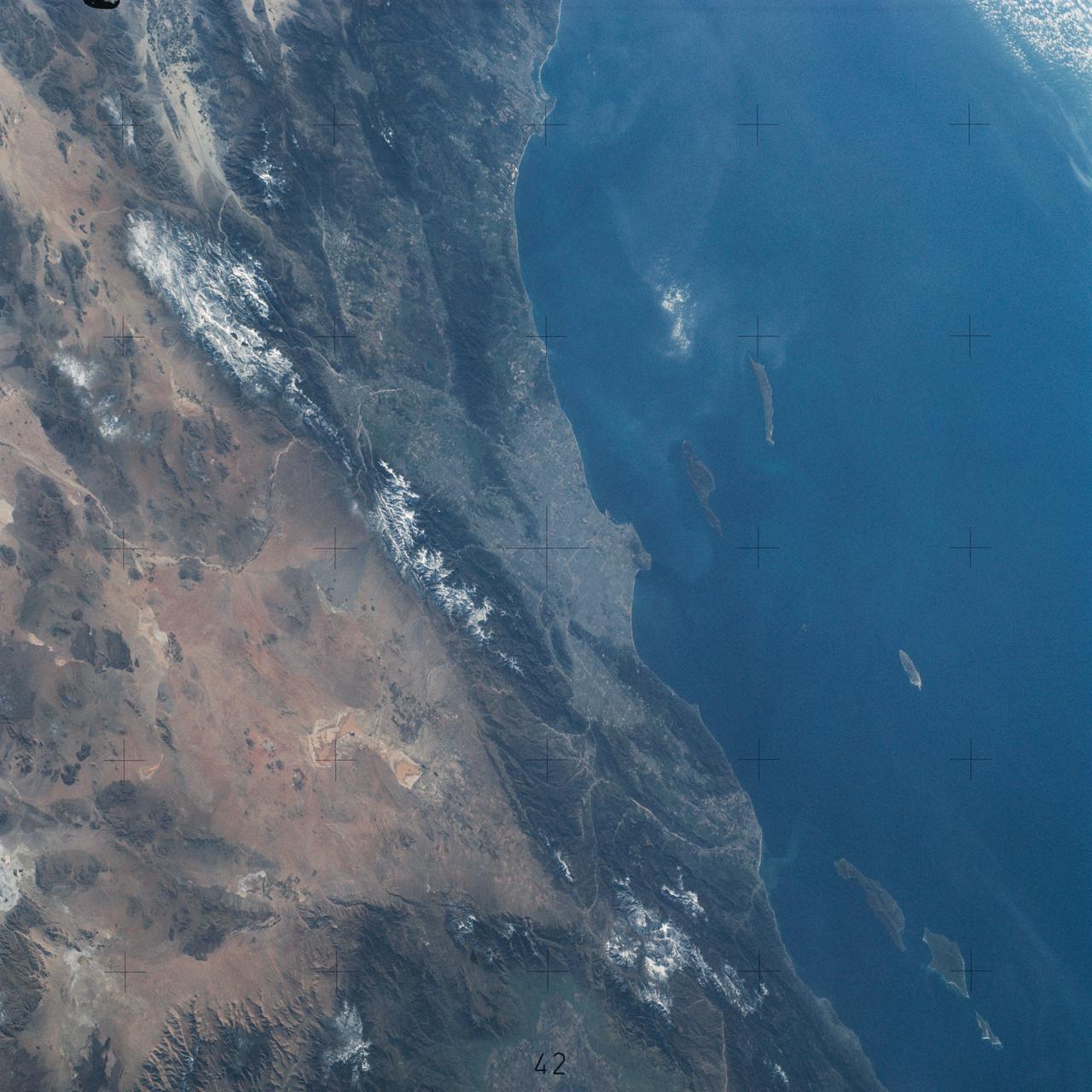
SL4-142-4542 (November 1973-February 1974) --- An oblique view of the Pacific Coast of Southern California, including the Los Angeles and San Diego areas, as seen from the Skylab space station in Earth orbit. This picture was taken by one of the Skylab 4 crewmen using a hand-held 70mm Hasselblad camera with a 100mm lens and SO-368 medium-speed Ektachrome film. The visible coastline extends from San Diego northwesterly to Santa Barbara. The Mojave Desert occupies much of the photograph. This view also includes the Channel Islands off the coast. Note that the higher elevations of the mountains are covered with snow. Photo credit: NASA
Pacific Coast of Southern California including Los Angeles and San Diego
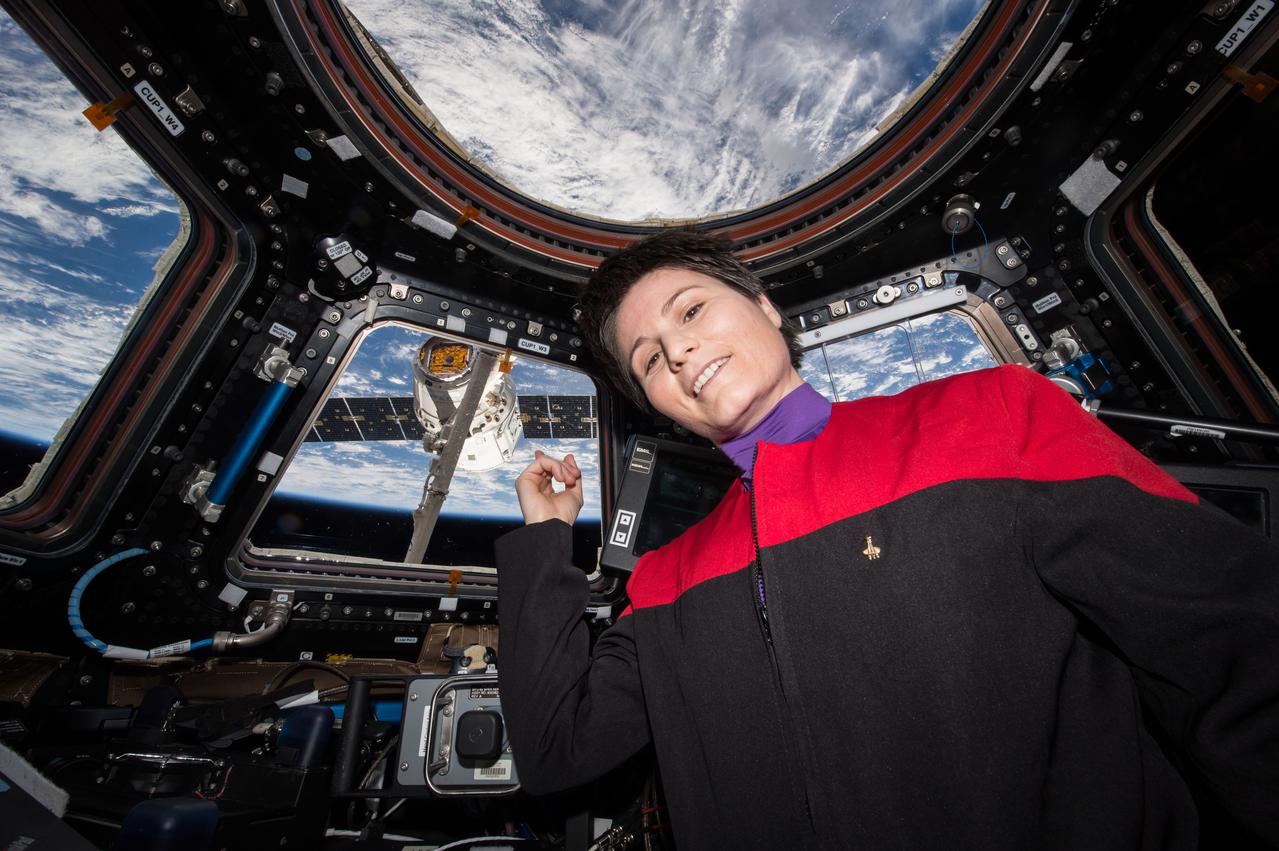
ISS043E122274 (04/17/2015) --- ESA (European Space Agency) astronaut Samantha Cristoforetti seen here in the Cupola of the International Space Station. Cristoforetti captured the SpaceX Dragon cargo craft using the Canadarm2 robotic arm before handing off to robotics officers at Mission Control, Houston, Texas who worked to maneuver Dragon to its installation position at the Earth-facing port of the Harmony module where it will reside for five weeks. Cristoforetti points to the Dragon in this image taken on Apr. 17, 2015 shortly after grappling. The Dragon carried more than 2 tons of equipment, experiments and supplies for the Expedition 43 crew aboard the station.
Cristoforetti in Cupola
NASA astronauts Bob Behnken, left, and Doug Hurley shake hands after suiting up in SpaceX spacesuits in the Astronaut Crew Quarters at Kennedy Space Center in Florida on Jan. 17, 2020, during a dress rehearsal ahead of the company’s uncrewed In-Flight Abort Test. A SpaceX Falcon 9 rocket and Crew Dragon spacecraft will lift off from Launch Complex 39A on the flight test, which will demonstrate the spacecraft’s escape capabilities in preparation for crewed flights to the International Space Station as part of the agency’s Commercial Crew Program. Behnken and Hurley are slated to fly on the company’s first crewed mission, Demo-2.
SpaceX InFlight Abort Dry Dress Rehearsal
STS-88 crew members inspect the orbital docking mechanism in the payload bay of Orbiter Endeavour during the Crew Equipment Interface Test (CEIT), held in the Orbiter Processing Facility Bay 1 at KSC. The CEIT gives astronauts an opportunity for a hands-on look at the payloads on which they will be working on orbit. STS-88 will be the first Space Shuttle launch for the International Space Station. Scheduled to lift off on Dec. 3, 1998, the seven-day mission will be highlighted by the mating of the U.S.-built Unity connecting module to the Zarya control module, which will already be in orbit, and two space walks to connect power and data transmission cables between the two modules
KSC-98pc830
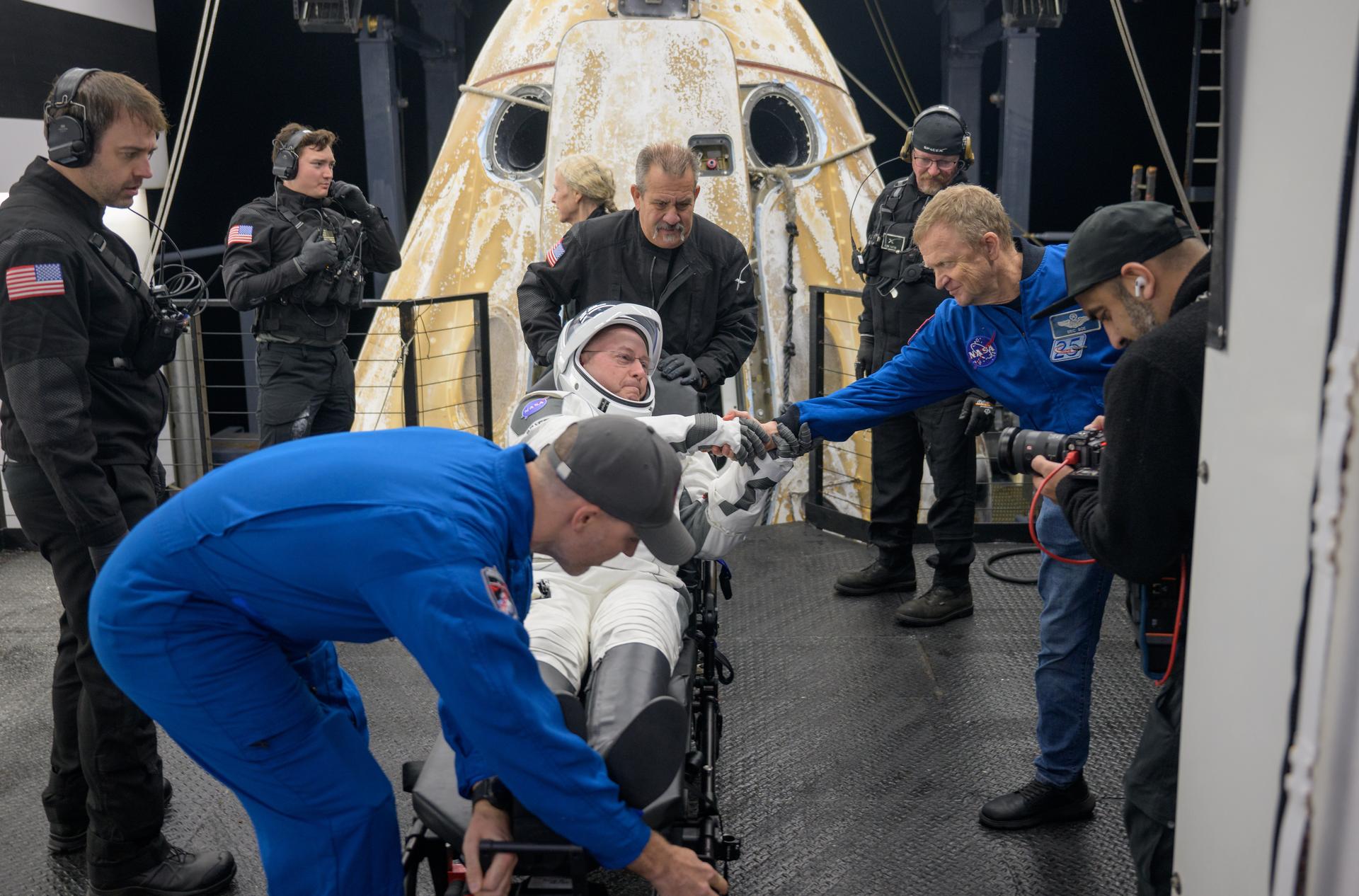
NASA astronaut Mike Fincke shakes hands with NASA astronaut Eric Bow after being helped out of the SpaceX Dragon Endeavour spacecraft onboard the SpaceX recovery ship SHANNON after he, NASA astronaut Zena Cardman, JAXA (Japan Aerospace Exploration Agency) astronaut Kimiya Yui, and Roscosmos cosmonaut Oleg Platonov landed in the Pacific Ocean off the coast of San Diego, Calif., Thursday, Jan. 15, 2026. Cardman, Fincke, Yui, Platonov are returning after 167 days in space as part of Expedition 74 aboard the International Space Station. Photo Credit: (NASA/Bill Ingalls)
NASA’s SpaceX Crew-11 Splashdown
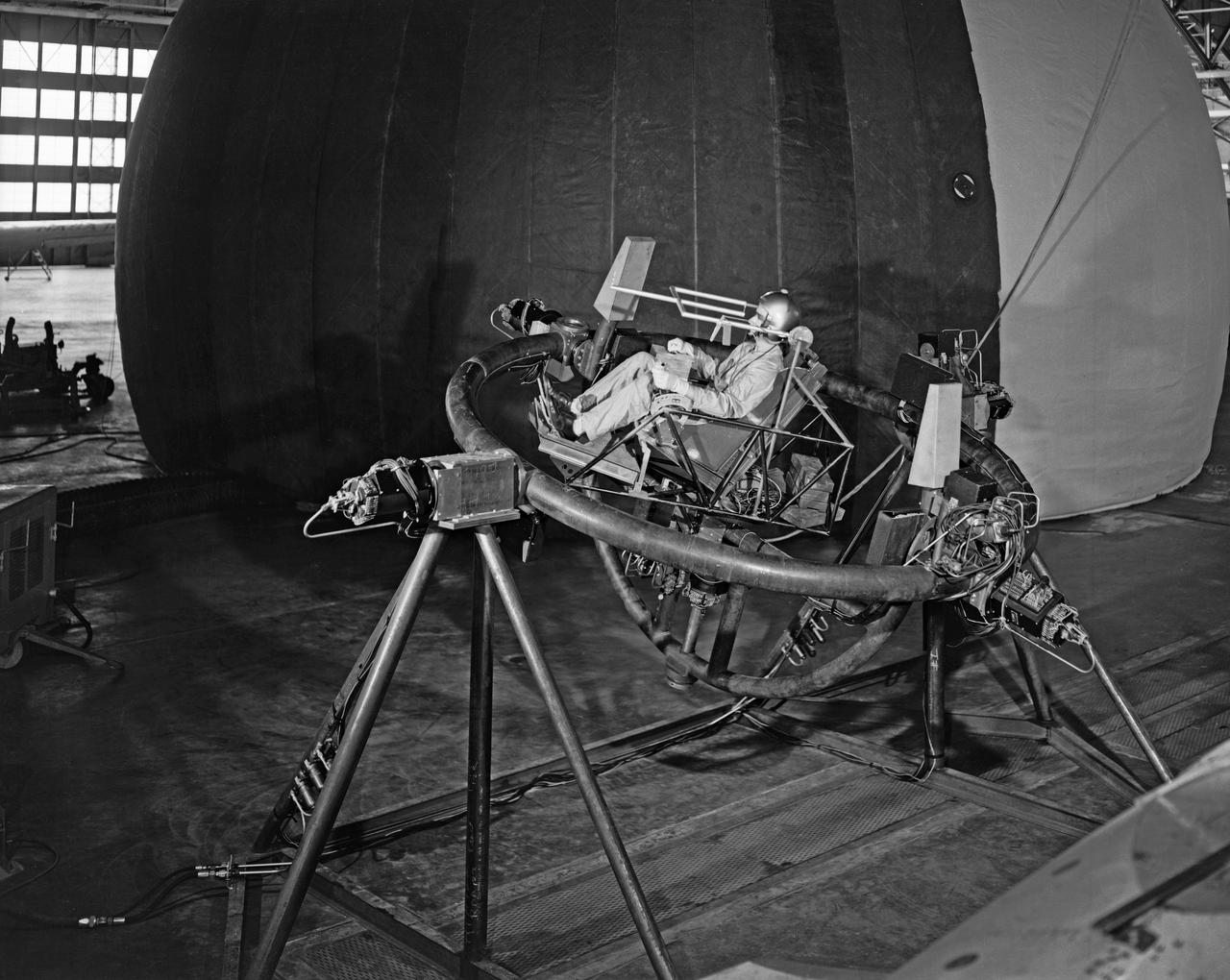
Lunar Take Off Simulator: This simulator is used by scientists at the Langley Research Center ... to help determine human ability to control a lunar launch vehicle in vertical alignment during takeoff from the moon for rendezvous with a lunar satellite vehicle on the return trip to earth. The three-axis chair, a concept which allows the pilot to sit upright during launch, gives the navigator angular motion (pitch, role, and yaw) cues as he operates the vehicle through a sidearm control system. The sight apparatus in front of the pilot's face enables him to align the vehicle on a course toward a chosen star, which will be followed as a guidance reference during the lunar launch. The pilot's right hand controls angular motions, while his left hand manipulates the thrust lever. The simulator is designed for operation inside an artificial planetarium, where a star field will be projected against the ceiling during "flights". The tests are part of an extensive NASA program at Langley in the study of problems relating to a manned lunar mission. (From a NASA Langley, photo release caption.)
Lunar Take Off Simulator
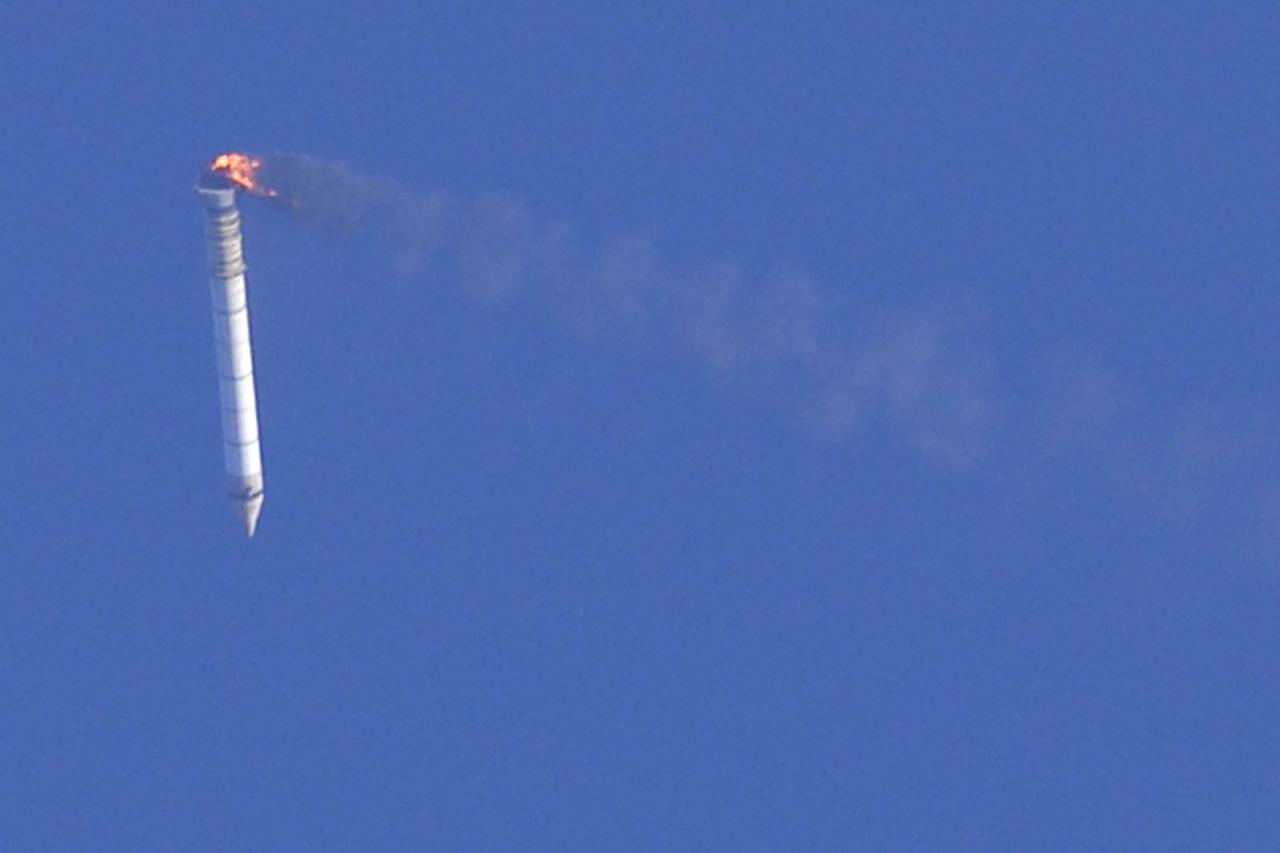
CAPE CANAVERAL, Fla. -- This image taken from the deck of NASA's SRB retrieval ship Freedom Star shows the right hand solid rocket booster from space shuttle Discovery's STS-124 launch falling through the atmosphere while burning off the remainder of its fuel. It will splash down into the Atlantic Ocean where the ship and its crew will recover it and tow it back through Port Canaveral for refurbishing for another launch. The STS-124 mission is the second of three flights launching components to complete the Japan Aerospace Exploration Agency's Kibo laboratory. The shuttle crew will install Kibo's large Japanese Pressurized Module and its remote manipulator system, or RMS. Photo credit: USA/Jeff Suter
KSC-2011-2919
CAPE CANAVERAL, Fla. - Inside the Vehicle Assembly Building at NASA’s Kennedy Space Center in Florida, United Space Alliance workers monitor the progress as the container holding the remote manipulator system, or RMS, is lifted. The RMS will be placed on a flatbed truck for shipment back to the Canadian Space Agency.    The RMS, also called the Canadarm, was manufactured for NASA’s Space Shuttle Program by SPAR Aerospace Ltd., which later became a part of MD Robotics in Ontario, Canada.  During shuttle missions, the RMS was attached in the payload bay. Mission specialists operated the arm to remove payloads from the payload bay and hand them off to the larger Canadarm 2 on the International Space Station. The shuttle arm also was used during astronaut spacewalks. Photo credit: NASA/Kim Shiflett
KSC-2012-3840
Cliff Lanham, ground operations manager with NASA’s Exploration Ground Systems, hands off the baton to Charlie Blackwell-Thompson, Artemis I launch director, inside the Vehicle Assembly building at NASA’s Kennedy Space Center in Florida on Aug. 15, 2022. NASA’s Space Launch System (SLS) rocket, with the agency’s Orion spacecraft atop, is targeted to start its rollout to Launch Pad 39B on Aug. 16 at approximately 9 p.m., in preparation for the Artemis I launch – set for no earlier than Aug. 29. Artemis I will be the first integrated test of the SLS and Orion. In later missions, NASA will land the first woman and the first person of color on the Moon, paving the way for a long-term lunar presence and serving as a steppingstone on the way to Mars.
Artemis I Baton Handoff from EGS Ops to Launch Director
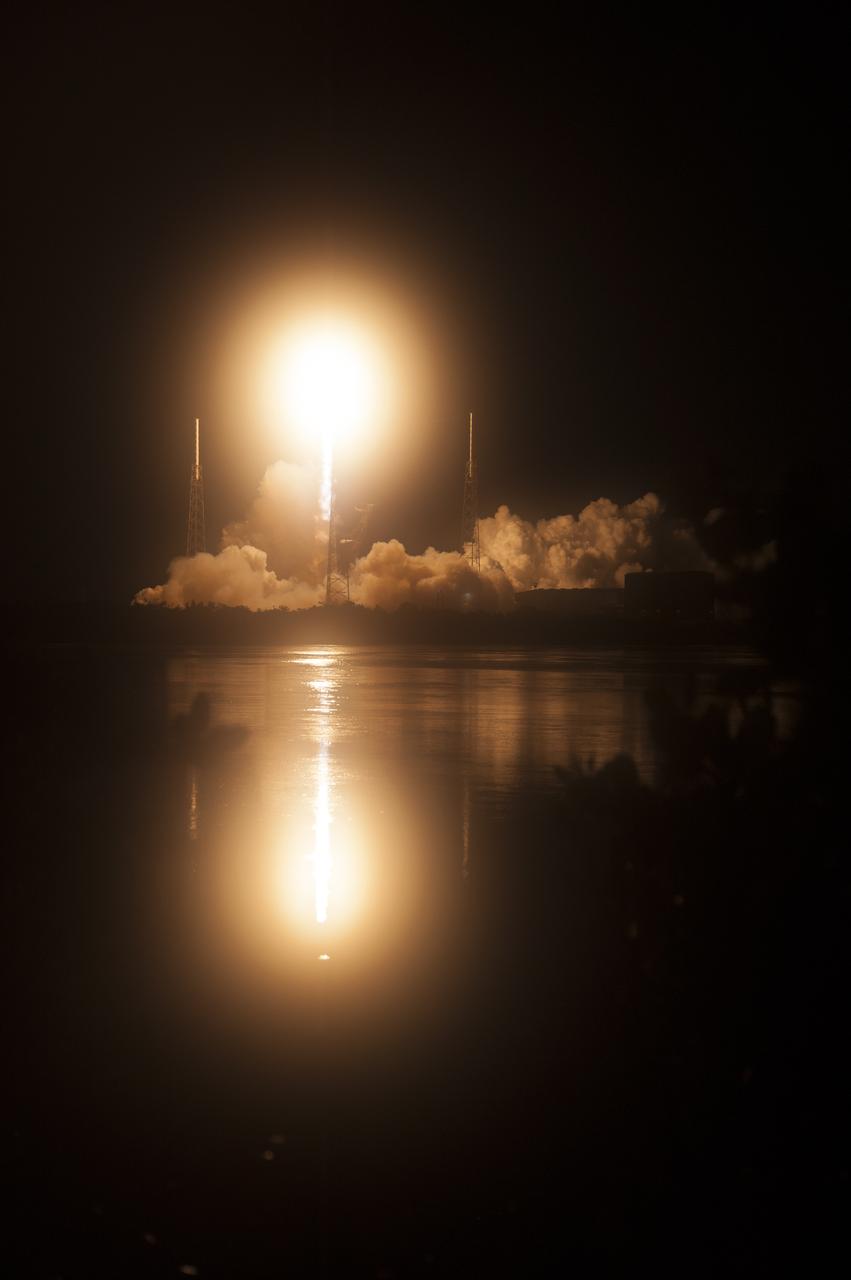
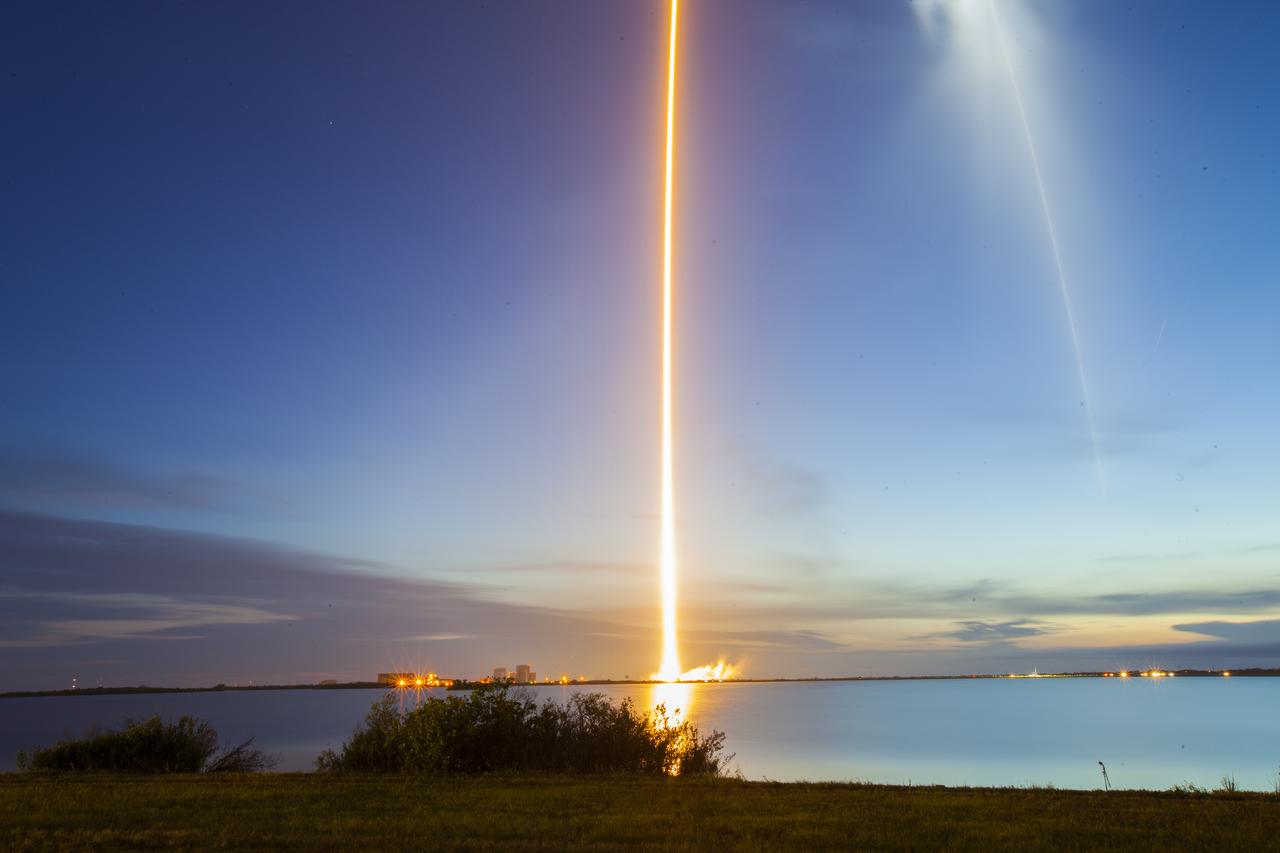
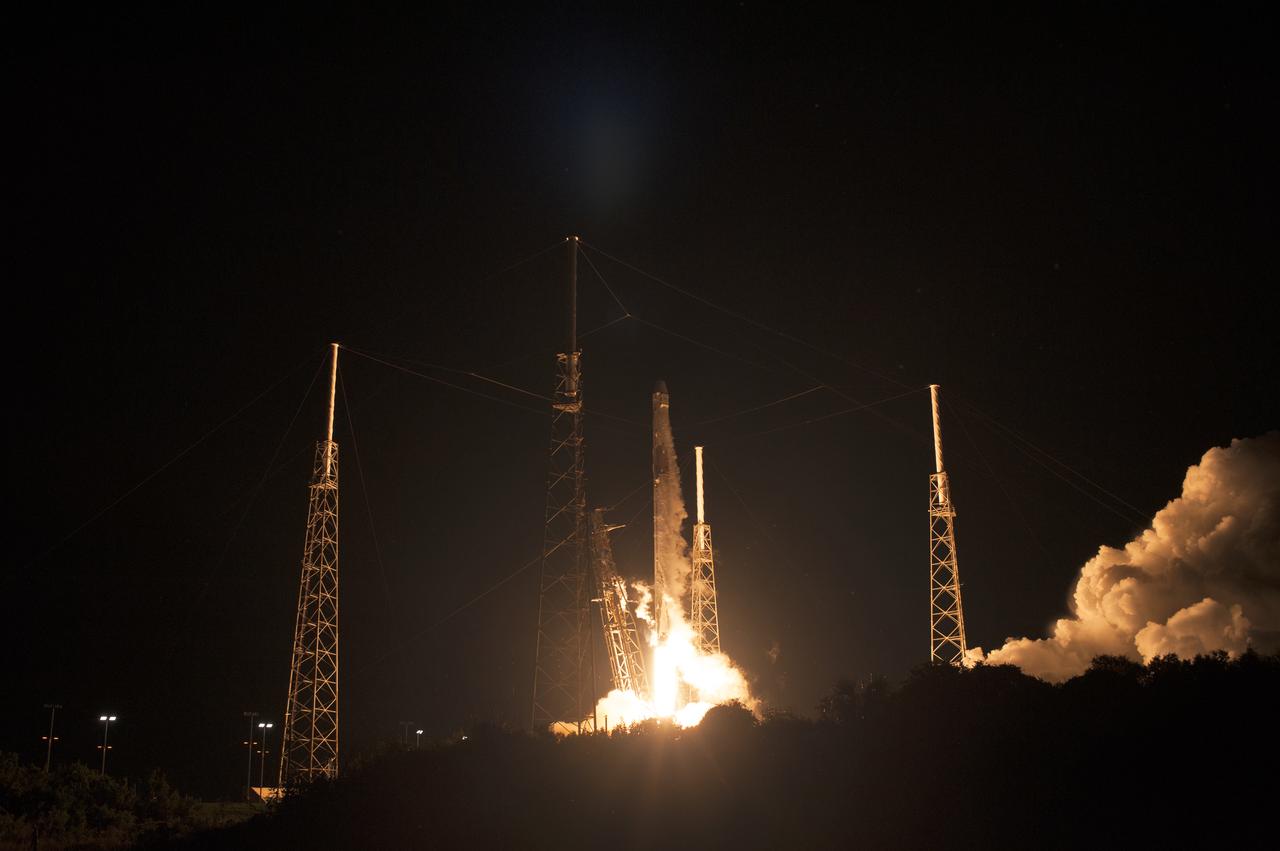
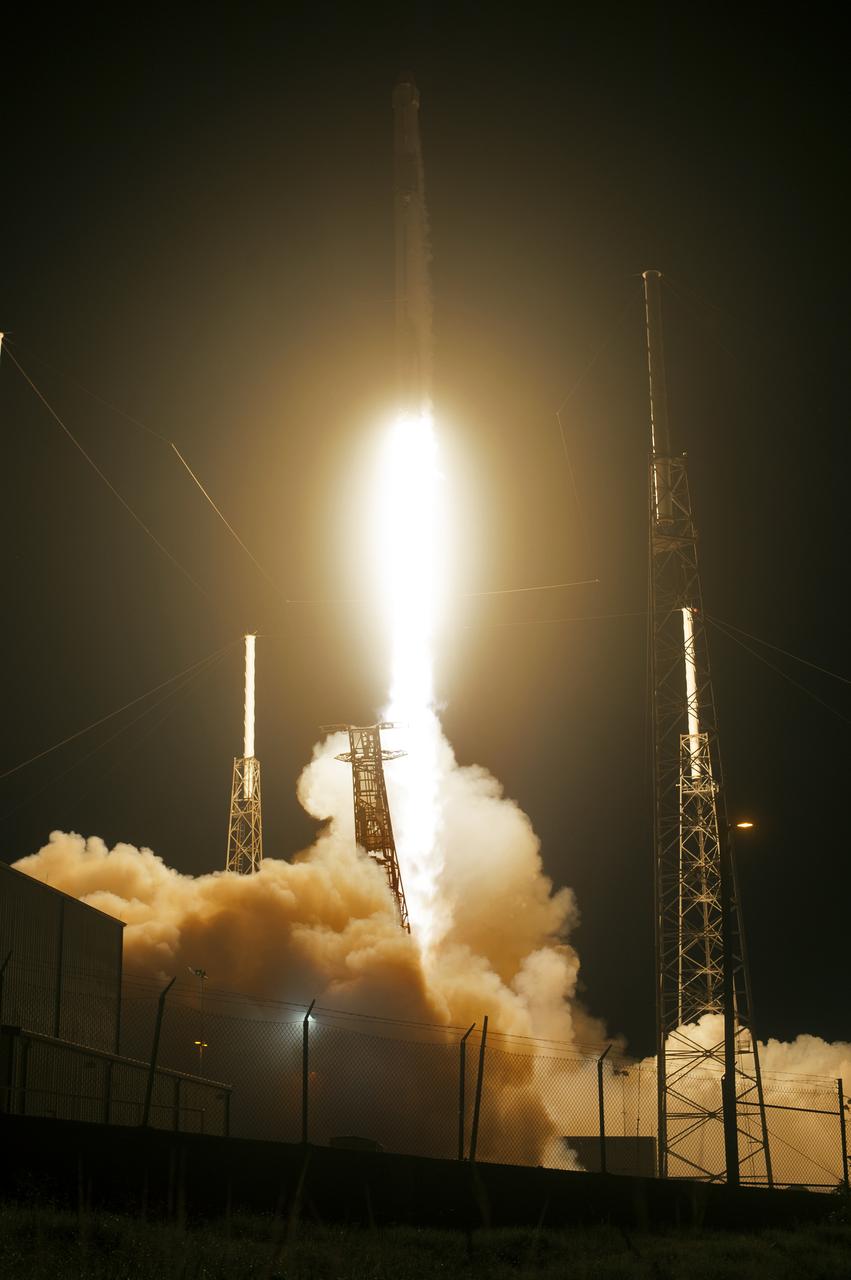
The two-stage SpaceX Falcon 9 launch vehicle lifts off from Space Launch Complex 40 at Cape Canaveral Air Force Station, carrying the SpaceX Dragon resupply spacecraft to the International Space Station. Liftoff was at 5:42 a.m. EDT on Friday, June 29, 2018. On the company’s 15th Commercial Resupply Services mission to the International Space Station, Dragon is filled with supplies and payloads, including critical materials to support several science and research investigations that will occur during Expedition 56. The spacecraft’s unpressurized trunk is carrying a Canadian-built Latching End Effector, or LEE. This new LEE will replace a failed unit astronauts removed during a series of spacewalks in the fall of 2017. Each end of the Canadarm2 robotic arm has an identical LEE, and they are used as the “hands” that grapple payloads and visiting cargo spaceships.
SpaceX CRS-15 Liftoff
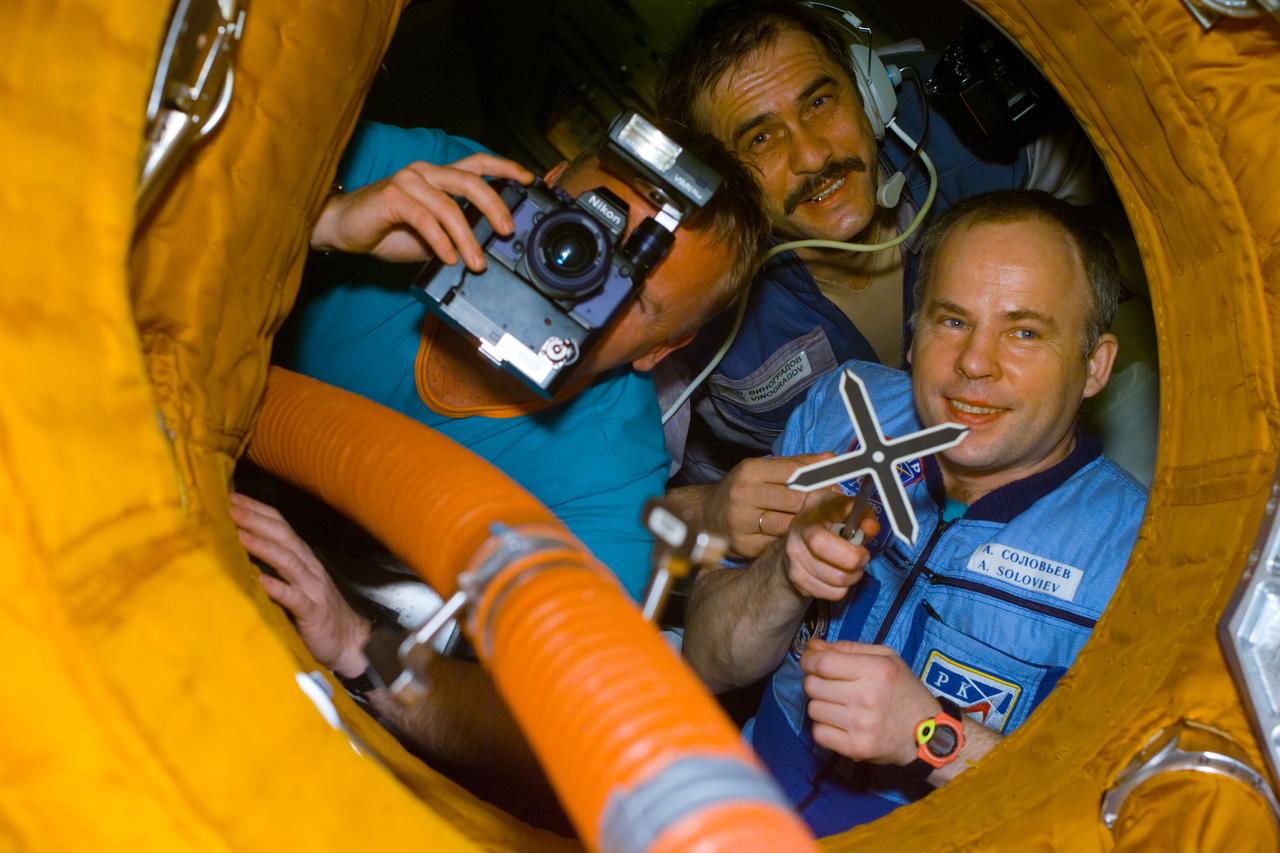
S89-E-5354 (28 Jan 1998) --- This Electronic Still Camera (ESC) image shows the Mir-24 crew having fun with the STS-89 crew just prior to the closing of the Docking Module (DM) hatch.  The closing of the hatch will bring an end to the eighth Shuttle /Mir joint docking activities.  The Mir-24 crew members are from the left - astronaut Andrew S. W. Thomas, cosmonaut guest researcher (looking through camera); cosmonaut Pavel V. Vinogradov, flight engineer (wearing communications headset); and cosmonaut Anatoliy Y. Solovyev, commander (with the stand off cross or docking target in his hand).  Thomas, replacing astronaut David A. Wolf as cosmonaut guest researcher, will be the last American astronaut to serve a tour aboard Russia's Mir Space Station.  This ESC view was taken on January 28, 1998, at 22:28:29 GMT.
STS-89 and Mir 24 crews at the hatch opening
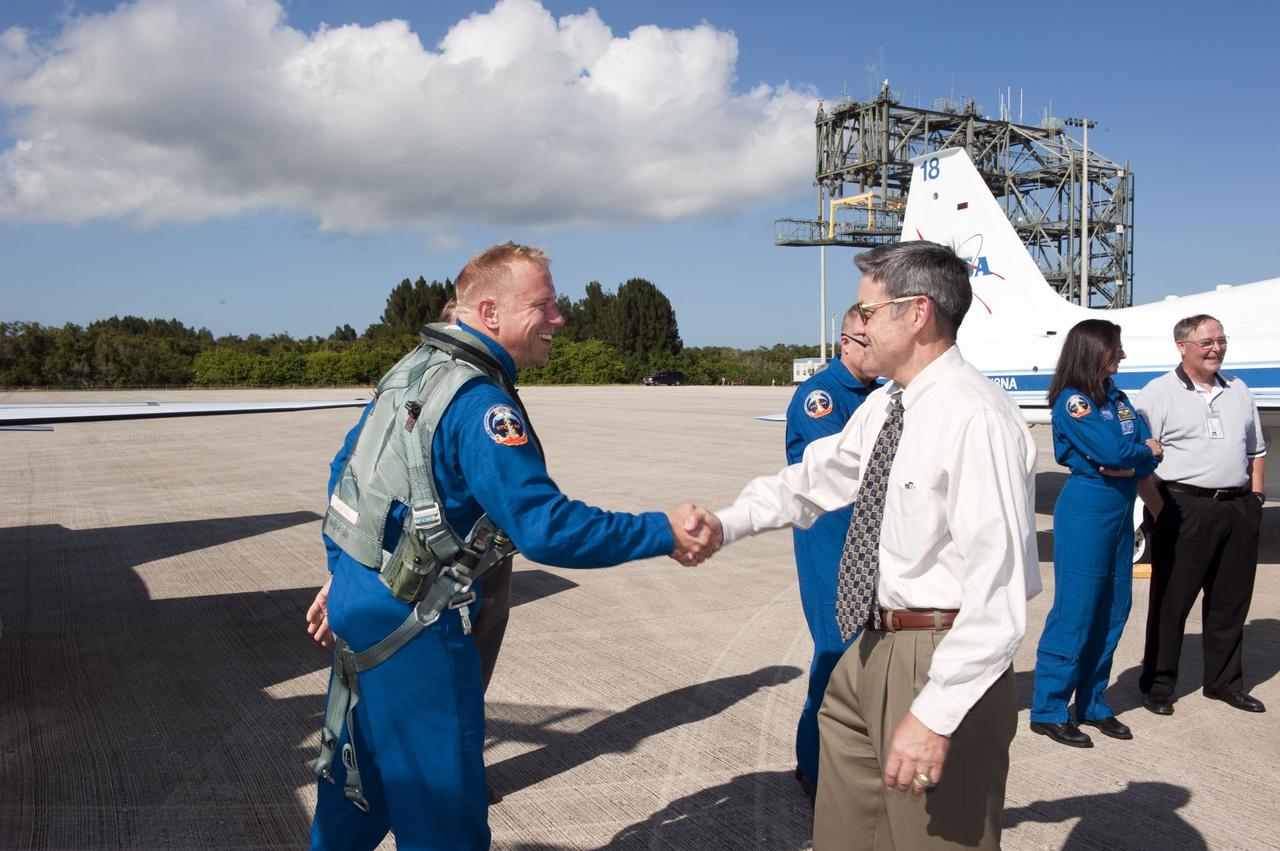
CAPE CANAVERAL, Fla. -- At NASA's Kennedy Space Center in Florida, space shuttle Discovery's STS-133 Mission Specialist Tim Kopra, left, shakes hands with Kennedy's Center Director Bob Cabana on the Shuttle Landing Facility runway after arriving in a T-38 training jet. In the days leading up to their launch to the International Space Station, Kopra and his crew members will check the fit of their launch-and-entry suits, review launch-day procedures, receive weather briefings and remain medically quarantined to prevent sickness.        Scheduled to lift off Nov. 1 at 4:40 p.m., Discovery and crew will deliver the Permanent Multipurpose Module, packed with supplies and critical spare parts, as well as Robonaut 2, the dexterous humanoid astronaut helper, to the orbiting outpost. For more information on the STS-133 mission, visit www.nasa.gov/mission_pages/shuttle/shuttlemissions/sts133/. Photo credit: NASA/Kim Shiflett
KSC-2010-5348
The two-stage SpaceX Falcon 9 launch vehicle lifts off from Space Launch Complex 40 at Cape Canaveral Air Force Station, carrying the SpaceX Dragon resupply spacecraft to the International Space Station. Liftoff was at 5:42 a.m. EDT on Friday, June 29, 2018. On the company’s 15th Commercial Resupply Services mission to the International Space Station, Dragon is filled with supplies and payloads, including critical materials to support several science and research investigations that will occur during Expedition 56. The spacecraft’s unpressurized trunk is carrying a Canadian-built Latching End Effector, or LEE. This new LEE will replace a failed unit astronauts removed during a series of spacewalks in the fall of 2017. Each end of the Canadarm2 robotic arm has an identical LEE, and they are used as the “hands” that grapple payloads and visiting cargo spaceships.
SpaceX CRS-15 Liftoff
The two-stage SpaceX Falcon 9 launch vehicle lifts off from Space Launch Complex 40 at Cape Canaveral Air Force Station, carrying the SpaceX Dragon resupply spacecraft to the International Space Station. Liftoff was at 5:42 a.m. EDT on Friday, June 29, 2018. On the company’s 15th Commercial Resupply Services mission to the International Space Station, Dragon is filled with supplies and payloads, including critical materials to support several science and research investigations that will occur during Expedition 56. The spacecraft’s unpressurized trunk is carrying a Canadian-built Latching End Effector, or LEE. This new LEE will replace a failed unit astronauts removed during a series of spacewalks in the fall of 2017. Each end of the Canadarm2 robotic arm has an identical LEE, and they are used as the “hands” that grapple payloads and visiting cargo spaceships.
SpaceX CRS-15 Liftoff
The two-stage SpaceX Falcon 9 launch vehicle lifts off from Space Launch Complex 40 at Cape Canaveral Air Force Station, carrying the SpaceX Dragon resupply spacecraft to the International Space Station. Liftoff was at 5:42 a.m. EDT on Friday, June 29, 2018. On the company’s 15th Commercial Resupply Services mission to the International Space Station, Dragon is filled with supplies and payloads, including critical materials to support several science and research investigations that will occur during Expedition 56. The spacecraft’s unpressurized trunk is carrying a Canadian-built Latching End Effector, or LEE. This new LEE will replace a failed unit astronauts removed during a series of spacewalks in the fall of 2017. Each end of the Canadarm2 robotic arm has an identical LEE, and they are used as the “hands” that grapple payloads and visiting cargo spaceships.
SpaceX CRS-15 Liftoff
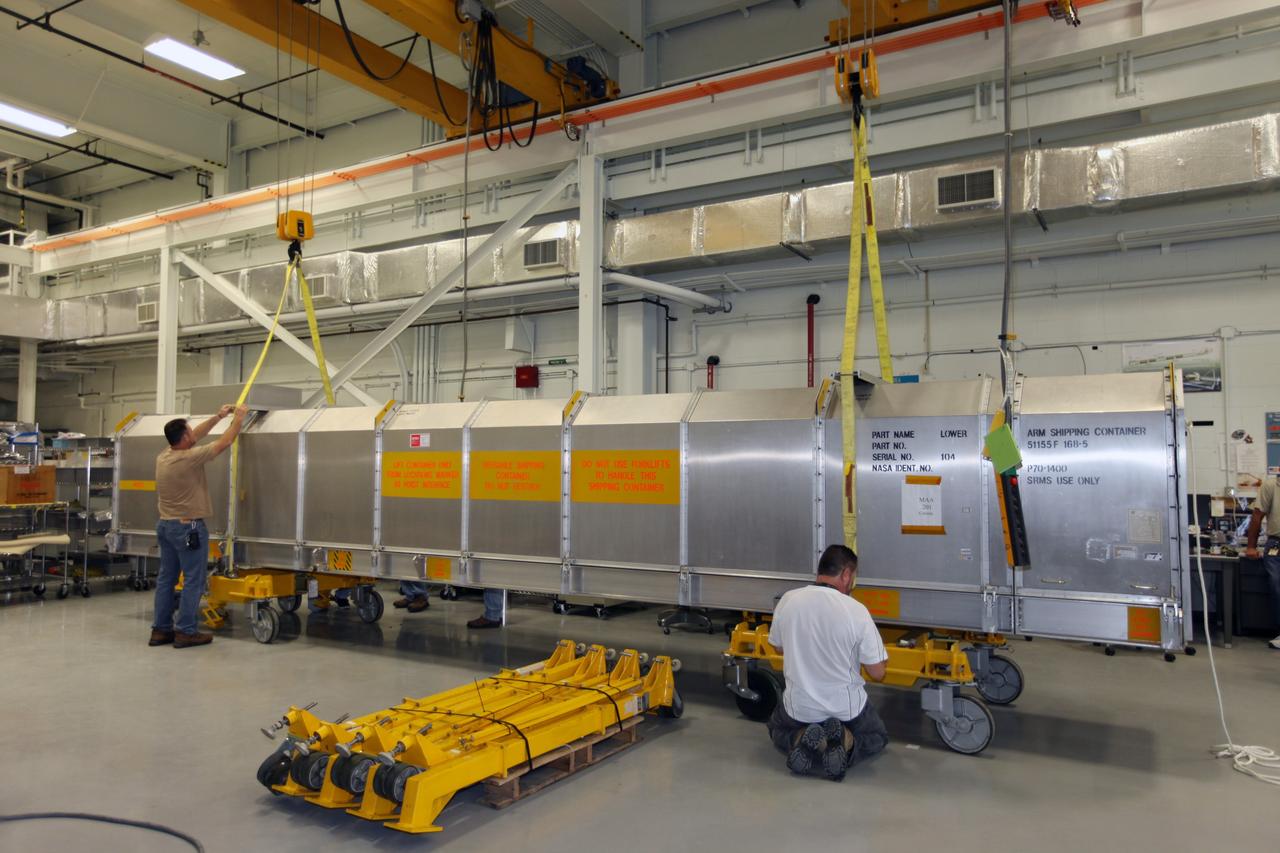
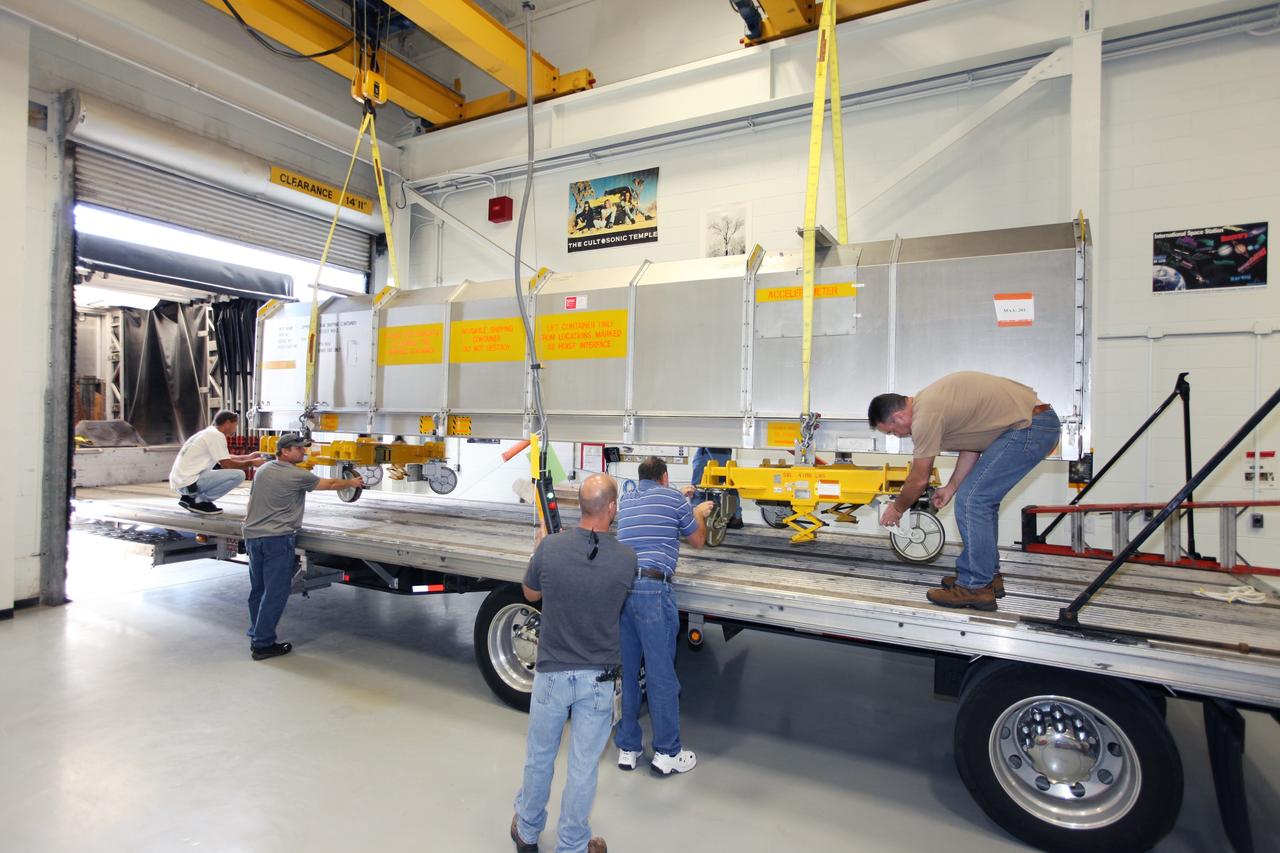
CAPE CANAVERAL, Fla. - Inside the Vehicle Assembly Building at NASA’s Kennedy Space Center in Florida, a United Space Alliance worker attaches lifting cranes to the container holding the remote manipulator system, or RMS. The RMS will be placed on a flatbed truck for shipment back to the Canadian Space Agency.    The RMS, also called the Canadarm, was manufactured for NASA’s Space Shuttle Program by SPAR Aerospace Ltd., which later became a part of MD Robotics in Ontario, Canada.  During shuttle missions, the RMS was attached in the payload bay. Mission specialists operated the arm to remove payloads from the payload bay and hand them off to the larger Canadarm 2 on the International Space Station. The shuttle arm also was used during astronaut spacewalks. Photo credit: NASA/Kim Shiflett
KSC-2012-3839
The two-stage SpaceX Falcon 9 launch vehicle lifts off from Space Launch Complex 40 at Cape Canaveral Air Force Station, carrying the SpaceX Dragon resupply spacecraft to the International Space Station. Liftoff was at 5:42 a.m. EDT on Friday, June 29, 2018. On the company’s 15th Commercial Resupply Services mission to the International Space Station, Dragon is filled with supplies and payloads, including critical materials to support several science and research investigations that will occur during Expedition 56. The spacecraft’s unpressurized trunk is carrying a Canadian-built Latching End Effector, or LEE. This new LEE will replace a failed unit astronauts removed during a series of spacewalks in the fall of 2017. Each end of the Canadarm2 robotic arm has an identical LEE, and they are used as the “hands” that grapple payloads and visiting cargo spaceships.
SpaceX CRS-15 Liftoff
CAPE CANAVERAL, Fla. - Inside the Vehicle Assembly Building at NASA’s Kennedy Space Center in Florida, United Space Alliance workers help guide the container holding the remote manipulator system, or RMS, onto a flatbed truck for shipment back to the Canadian Space Agency.    The RMS, also called the Canadarm, was manufactured for NASA’s Space Shuttle Program by SPAR Aerospace Ltd., which later became a part of MD Robotics in Ontario, Canada.  During shuttle missions, the RMS was attached in the payload bay. Mission specialists operated the arm to remove payloads from the payload bay and hand them off to the larger Canadarm 2 on the International Space Station. The shuttle arm also was used during astronaut spacewalks. Photo credit: NASA/Kim Shiflett
KSC-2012-3836
The two-stage SpaceX Falcon 9 launch vehicle lifts off from Space Launch Complex 40 at Cape Canaveral Air Force Station, carrying the SpaceX Dragon resupply spacecraft to the International Space Station. Liftoff was at 5:42 a.m. EDT on Friday, June 29, 2018. On the company’s 15th Commercial Resupply Services mission to the International Space Station, Dragon is filled with supplies and payloads, including critical materials to support several science and research investigations that will occur during Expedition 56. The spacecraft’s unpressurized trunk is carrying a Canadian-built Latching End Effector, or LEE. This new LEE will replace a failed unit astronauts removed during a series of spacewalks in the fall of 2017. Each end of the Canadarm2 robotic arm has an identical LEE, and they are used as the “hands” that grapple payloads and visiting cargo spaceships.
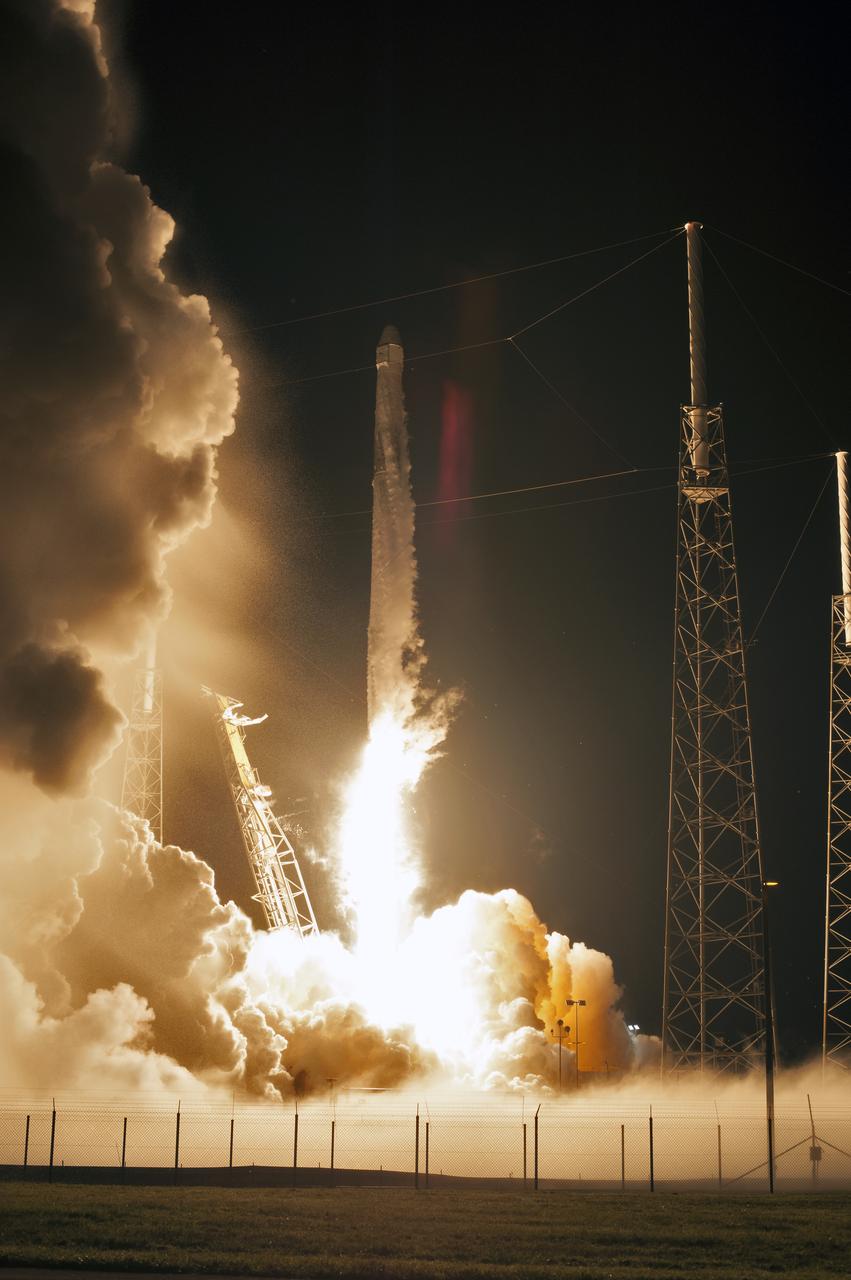
SpaceX CRS-15 Liftoff