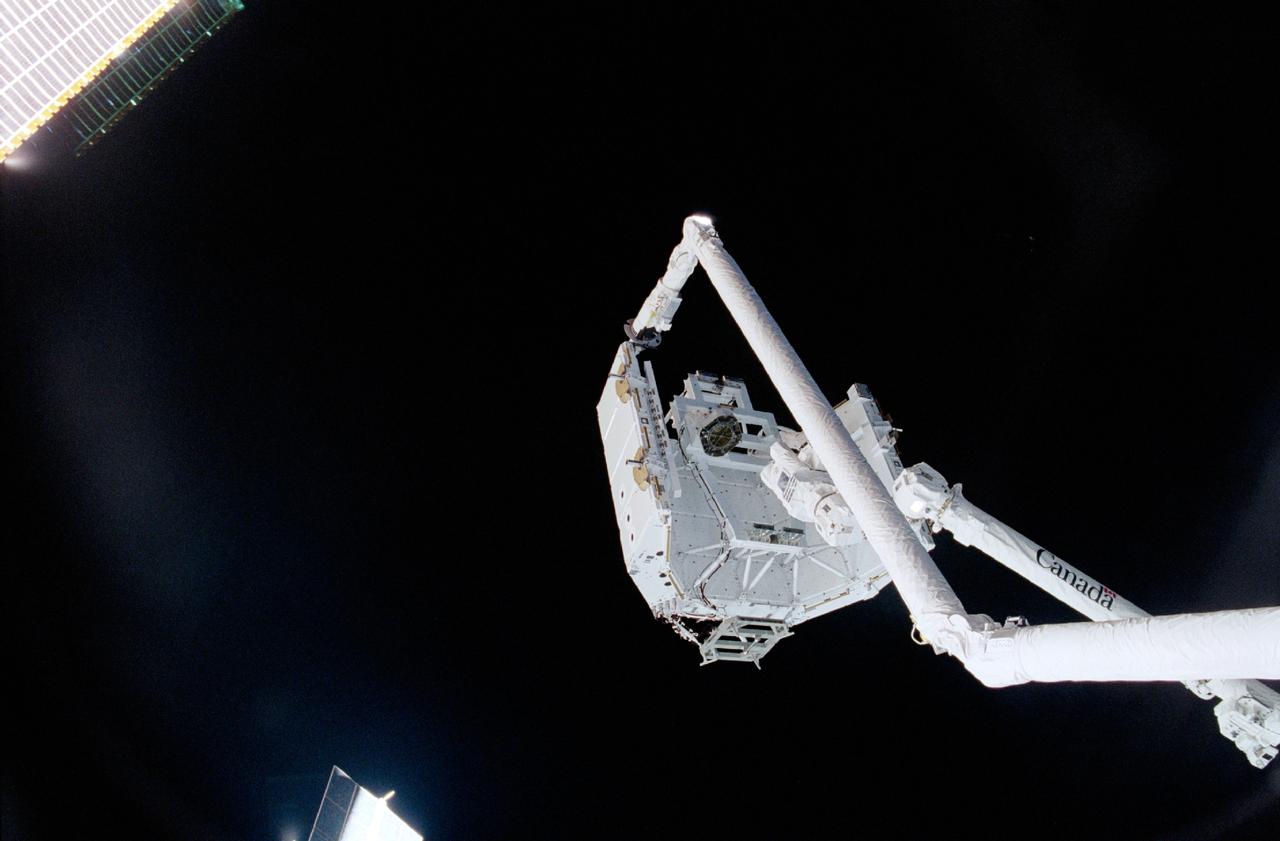
STS100-347-007 (28 April 2001) --- A Canadian "handshake in space" occurred on April 28, 2001 as the Canadian-built space station robotic arm (right) transferred its launch cradle over to Endeavour's Canadian-built robotic arm. A Canadian mission specialist--astronaut Chris A. Hadfield of the Canadian Space Agency (CSA)--was also instrumental in the activity as he was at the controls of the original robot arm from his post on the aft flight deck of the shuttle.
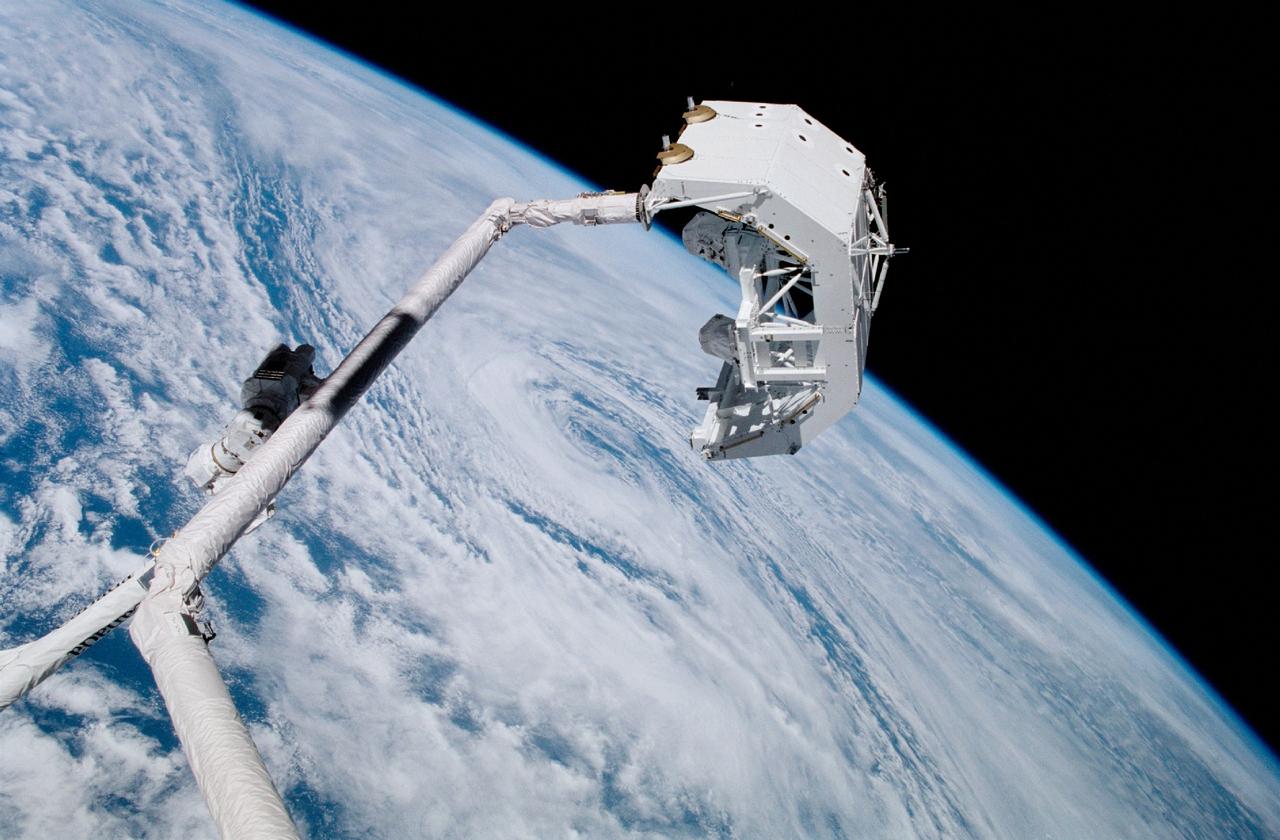
STS100-347-025 (28 April 2001) --- A Canadian "handshake in space" occurred on April 28, 2001 as the Canadian-built space station robotic arm transferred its launch cradle over to Endeavour's Canadian-built robotic arm. A Canadian mission specialist--astronaut Chris A. Hadfield of the Canadian Space Agency (CSA)--was also instrumental in the activity as he was at the controls of the original robot arm from his post on the aft flight deck of the shuttle.
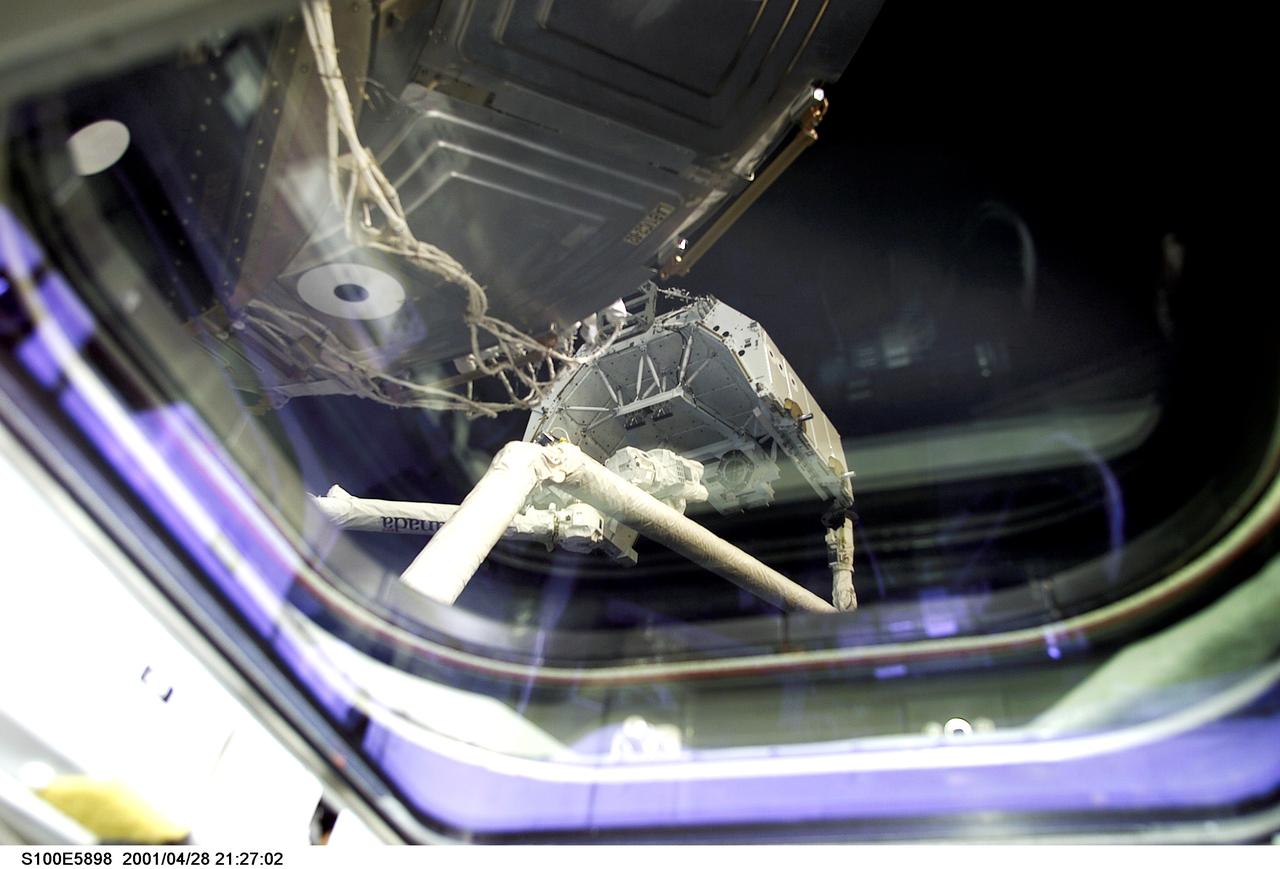
S100-E-5898 (28 April 2001) --- A STS-100 crew member with a digital still camera recorded this image of an historical event through an overhead window on the aft flight deck of the Space Shuttle Endeavour. A Canadian “handshake in space” occurred at 4:02 p.m (CDT), April 28, 2001, as the Canadian-built space station robotic arm – operated by Expedition Two flight engineer Susan J. Helms –transferred its launch cradle over to Endeavour’s robotic arm, with Canadian Space Agency astronaut Chris A. Hadfield at the controls. The exchange of the pallet from station arm to shuttle arm marked the first ever robotic-to-robotic transfer in space.
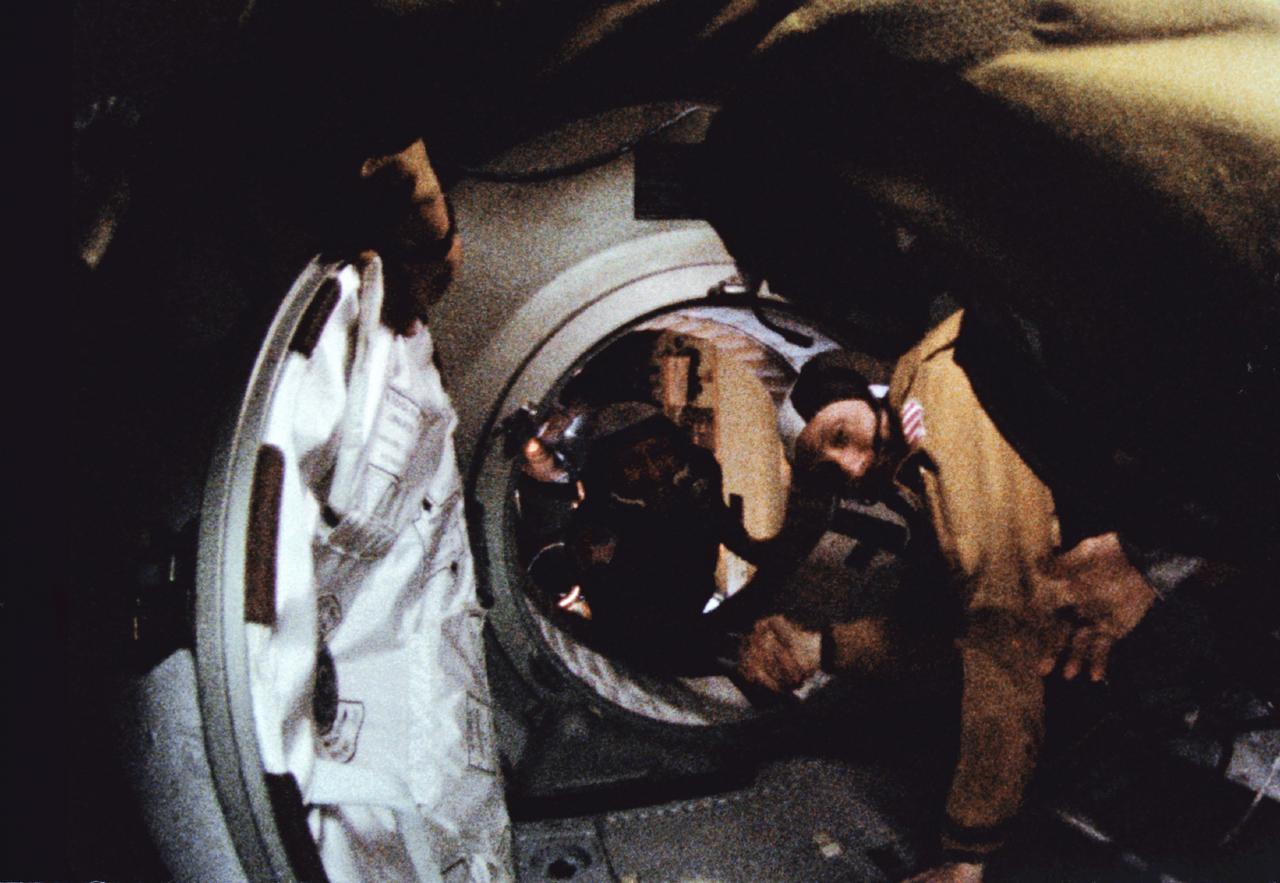
S75-29432 (17 July 1975) --- Astronaut Thomas P. Stafford (in foreground) and cosmonaut Aleksei A. Leonov make their historic handshake in space on July 17, 1975 during the joint U.S.-USSR Apollo Soyuz Test Project (ASTP) docking mission in Earth orbit. This picture was reproduced from a frame of 16mm motion picture film. The American and Soviet spacecraft were joined together in space for approximately 47 hours on July 17th, 18th, 19th, 1975. The Apollo crew consisted of astronauts Thomas P. Stafford, commander; Donald K. "Deke" Slayton, docking module pilot; Vance D. Brand, command module pilot. The Soyuz 19 crew consisted of cosmonauts Aleksei A. Leonov, command pilot; and Valeri N. Kubasov, flight engineer.
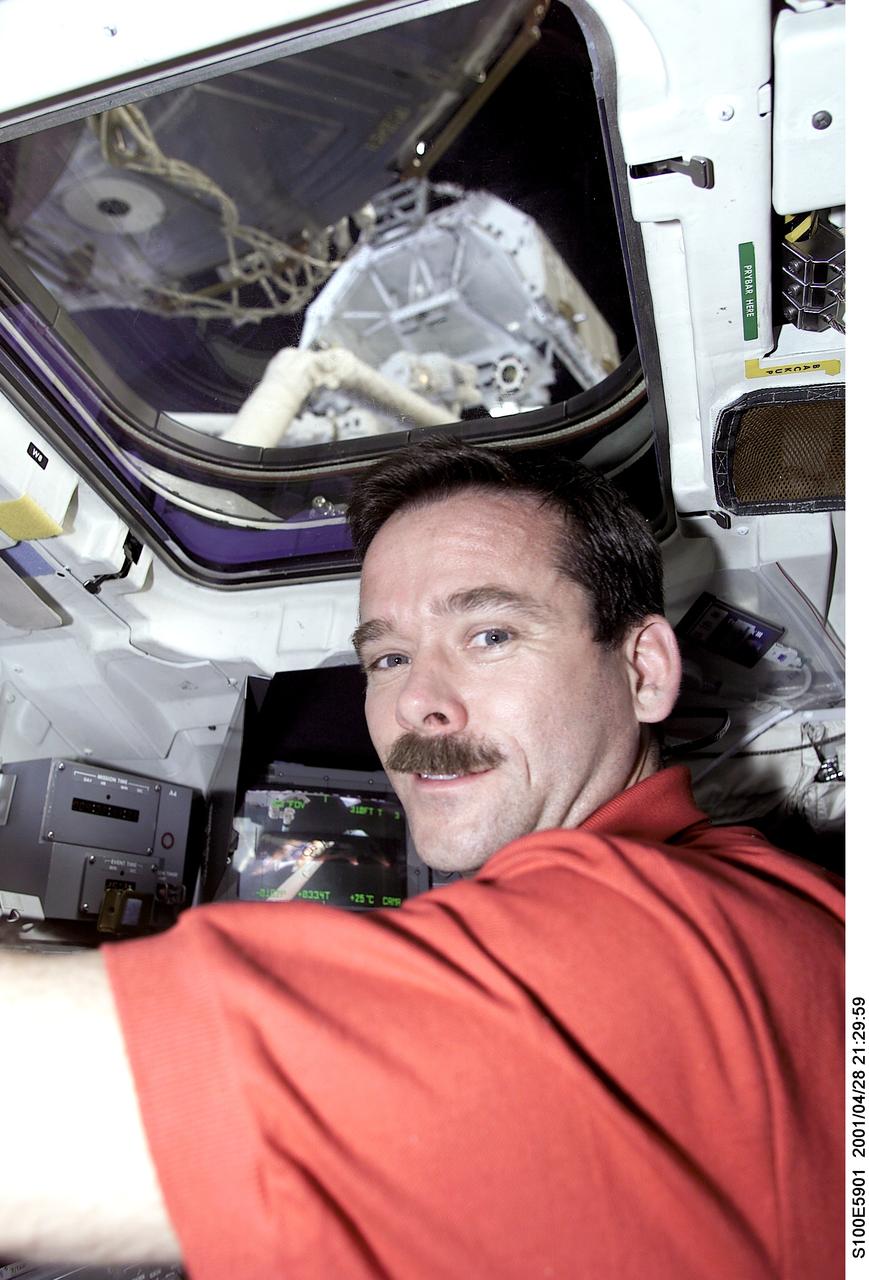
S100-E-5901 (28 April 2001) --- Astronaut Chris A. Hadfield, mission specialist, is pictured on the aft flight deck of the Space Shuttle Endeavour during an historic event. A Canadian “handshake in space” occurred at 4:02 p.m (CDT), April 28, 2001, as the Canadian-built space station robotic arm – operated by Expedition Two flight engineer Susan J. Helms – transferred its launch cradle over to Endeavour’s robotic arm, with Canadian Space Agency astronaut Hadfield at the controls. The exchange of the pallet from station arm to shuttle arm marked the first ever robot-to-robot transfer in space. This image was recorded with a digital still camera.
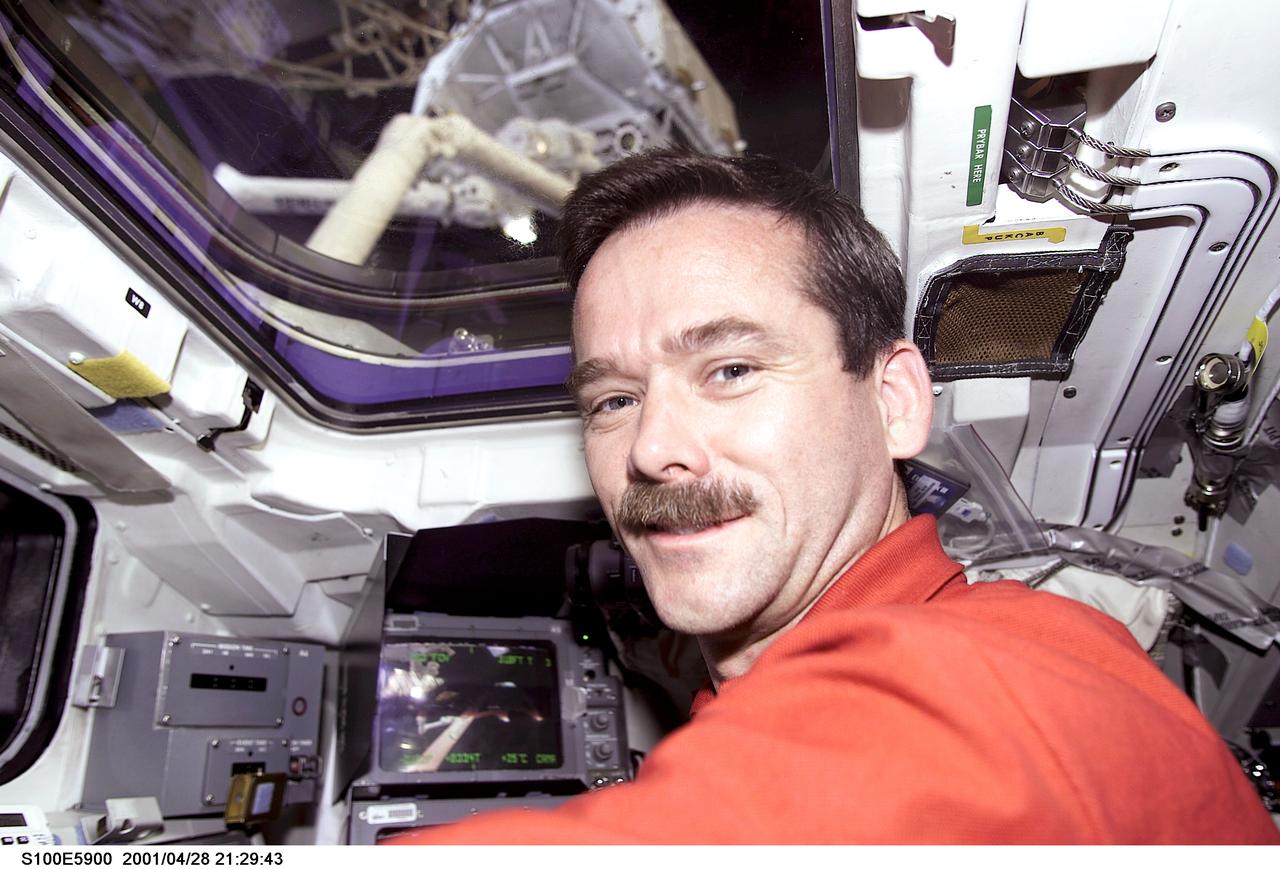
S100-E-5900 (28 April 2001) --- Astronaut Chris A. Hadfield, mission specialist, is pictured on the aft flight deck of the Space Shuttle Endeavour during an historic event. A Canadian “handshake in space” occurred at 4:02 p.m (CDT), April 28, 2001, as the Canadian-built space station robotic arm – operated by Expedition Two flight engineer Susan Helms – transferred its launch cradle over to Endeavour’s robotic arm, with Canadian Space Agency astronaut Hadfield at the controls. The exchange of the pallet from station arm to shuttle arm marked the first ever robotic-to-robotic transfer in space. This image was recorded with a digital still camera.
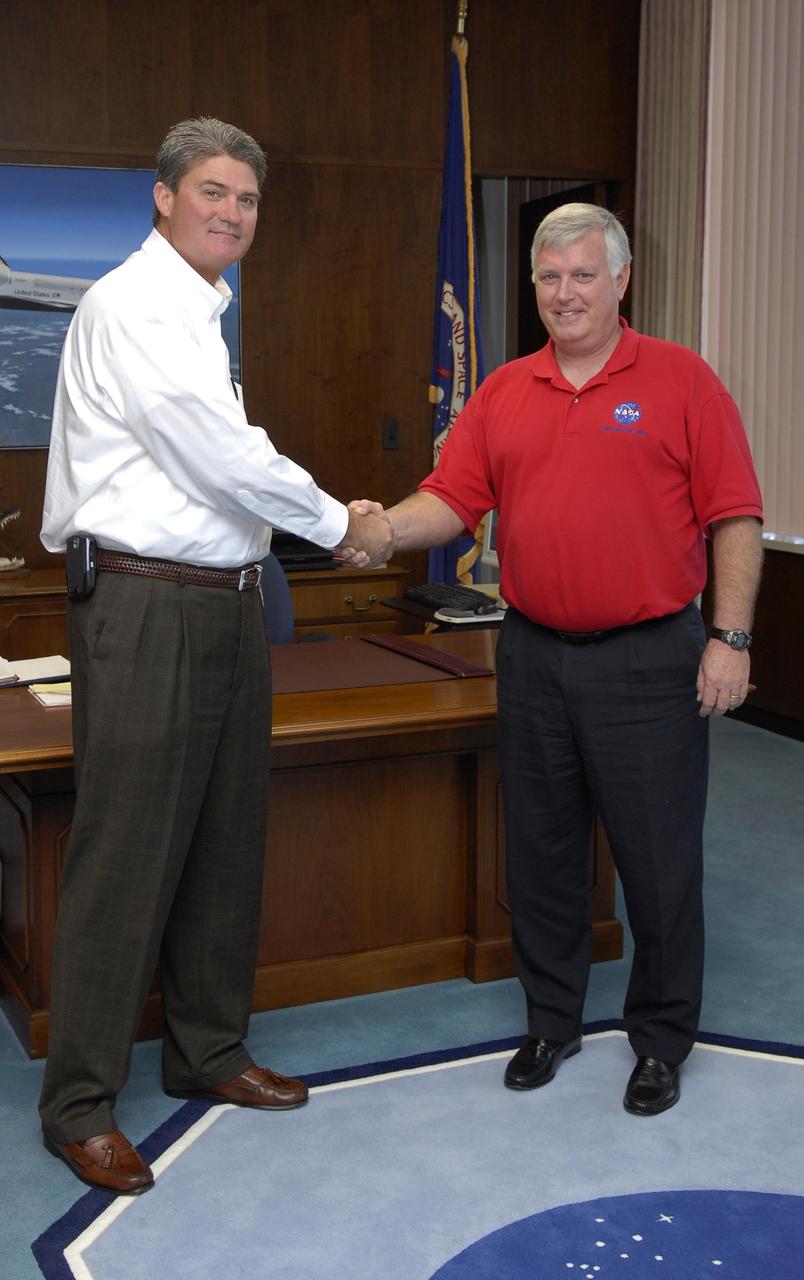
KENNEDY SPACE CENTER, FLA. -- A handshake signifies the change of leadership at NASA's Kennedy Space Center as William W. Parsons (left) assumes the role as the facility's ninth director, succeeding James W. Kennedy (right), who is retiring from the agency. Photo credit: NASA/Kim Shiflett
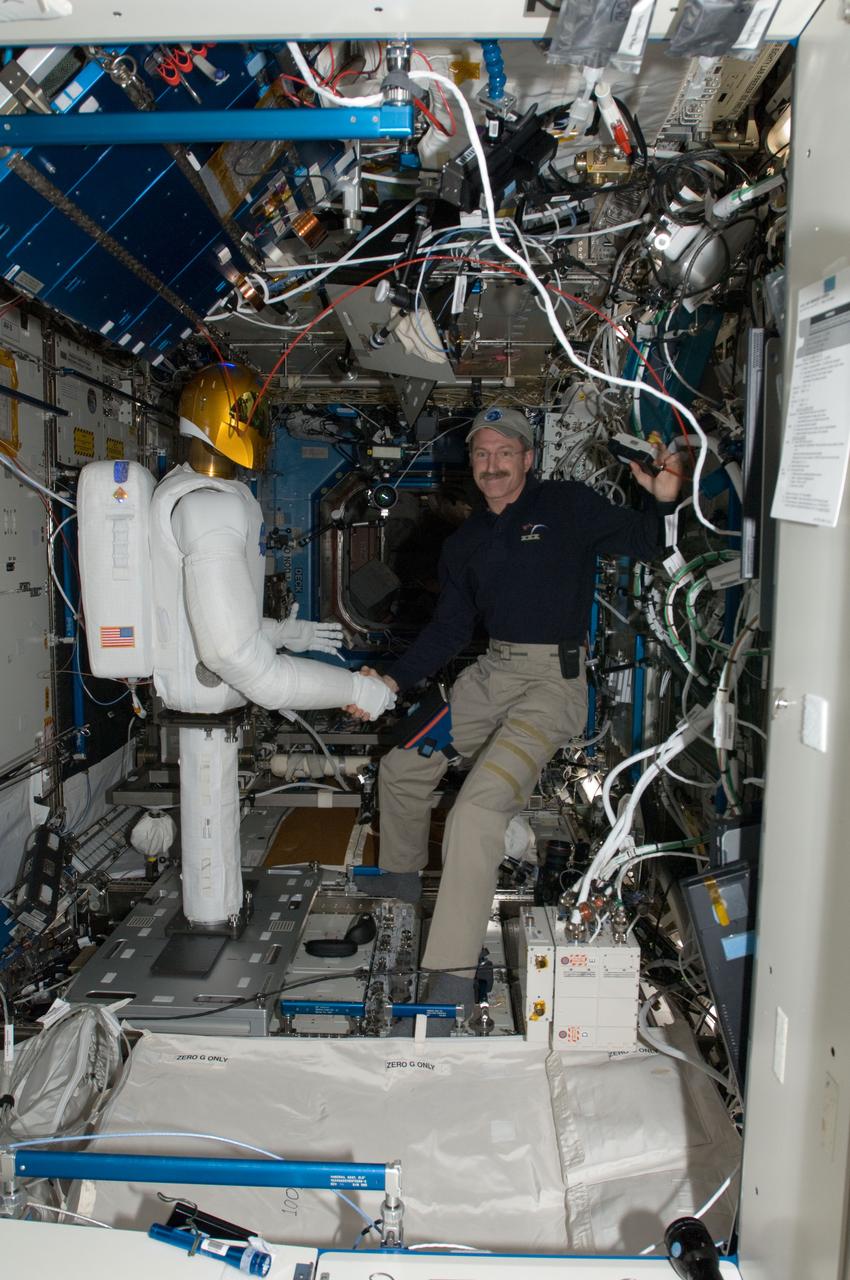
ISS030-E-074065 (15 Feb. 2012) --- Robonaut 2, nicknamed R2, shakes hands with NASA astronaut Dan Burbank, Expedition 30 commander, in the Destiny laboratory of the International Space Station. This event made history with the first human/robotic handshake to be performed in space.
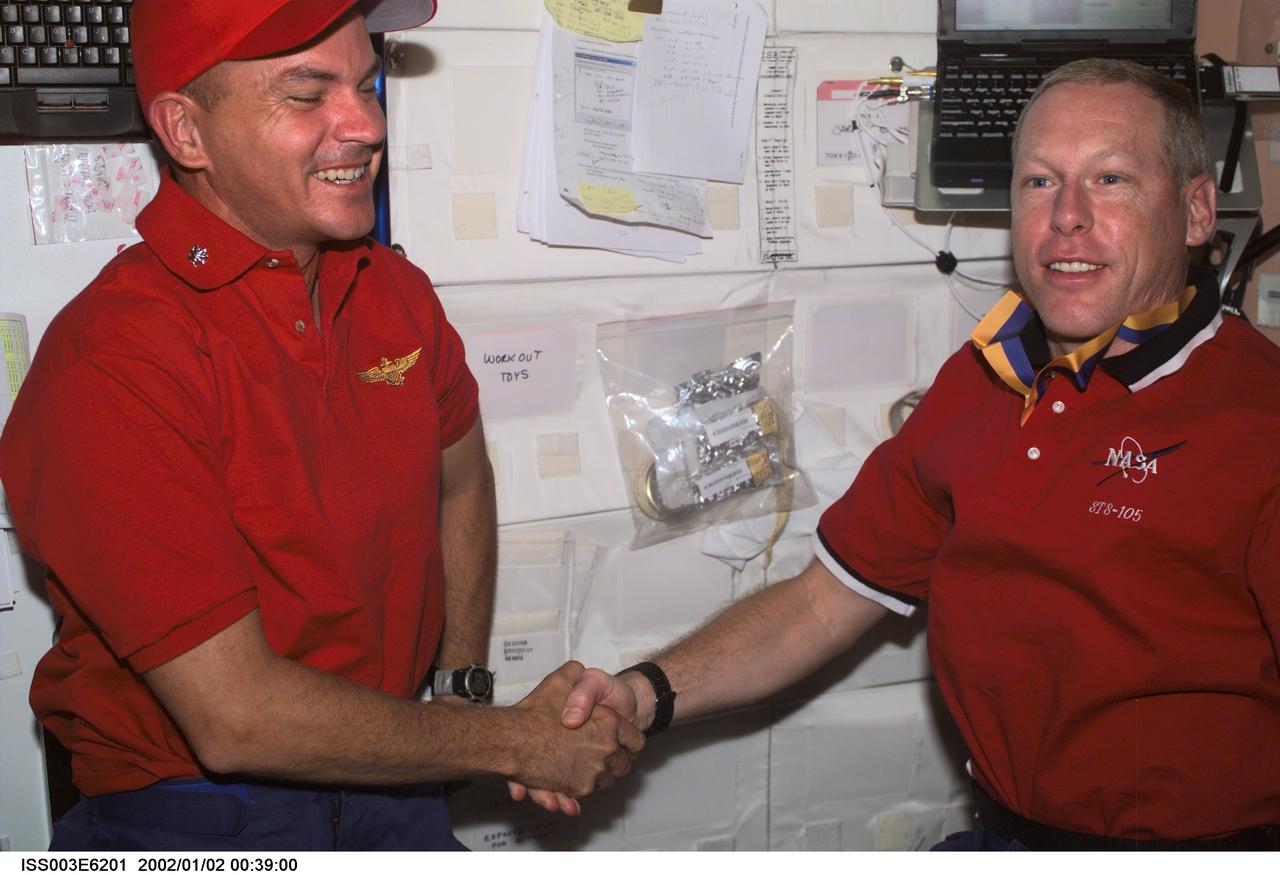
ISS003-E-6201 (August 2001) --- Astronauts Frederick W. (Rick) Sturckow (left), STS-105 pilot, and Patrick G. Forrester, mission specialist, exchange handshakes aboard the Unity node on the International Space Station (ISS). This image was taken with a digital still camera.
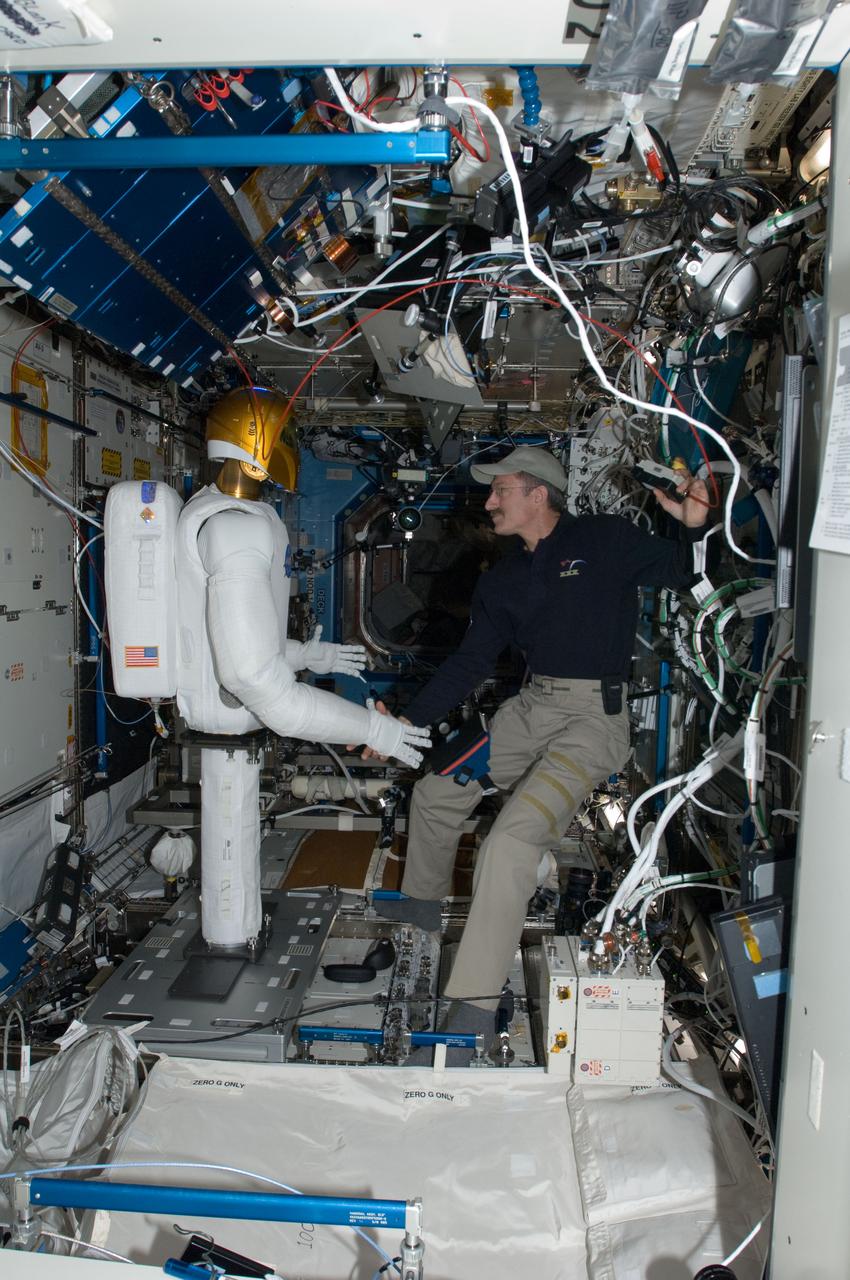
ISS030-E-074063 (15 Feb. 2012) --- Robonaut 2, nicknamed R2, shakes hands with NASA astronaut Dan Burbank, Expedition 30 commander, in the Destiny laboratory of the International Space Station. This event made history with the first human/robotic handshake to be performed in space.
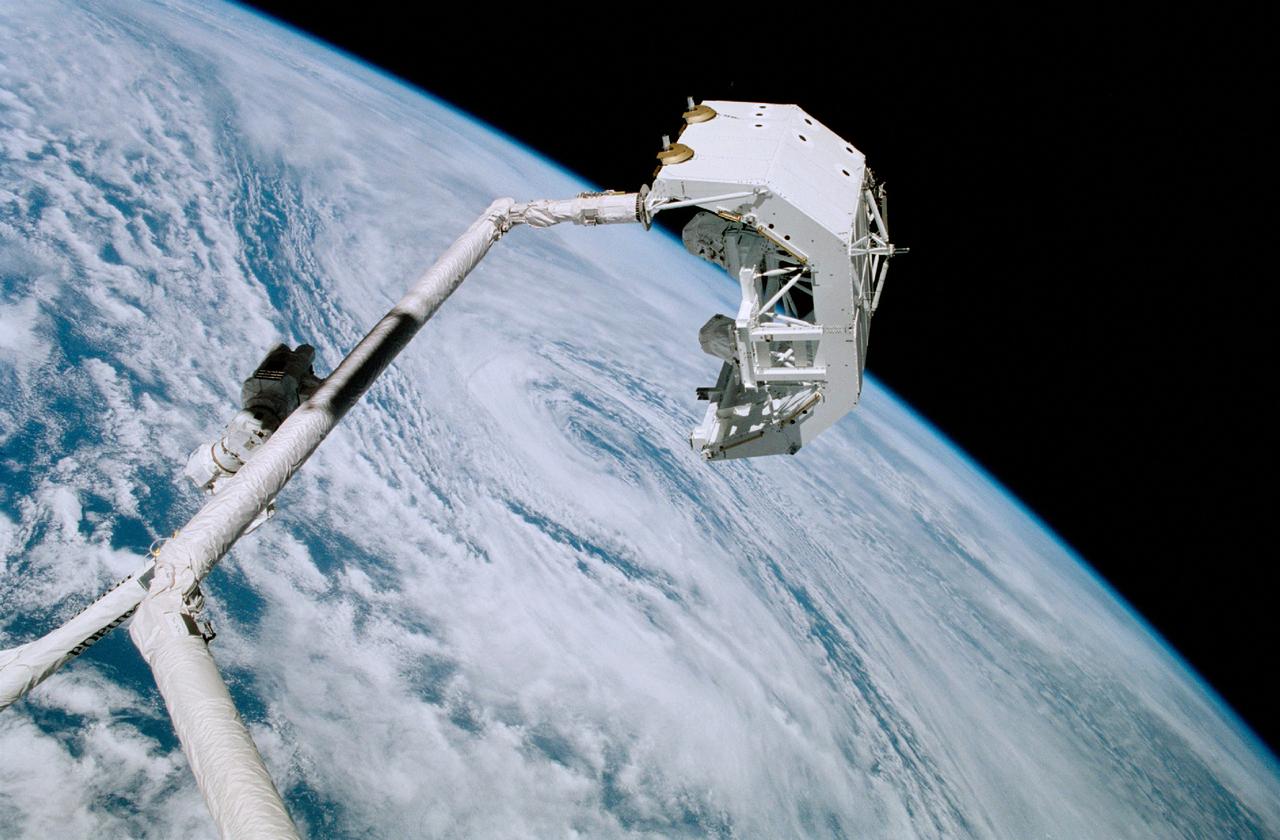
A Canadian "handshake" in space occurred on April 28, 2001, as the Canadian-built space station robotic arm (Canadarm-2) transferred its launch cradle over to Endeavor's robotic arm. Marning the controls from the shuttle's aft flight deck, Canadian Mission Specialist Chris A. Hadfield of the Canadian Space Agency (CSA) was instrumental in the activity. The Spacelab pallet that carried the Canadarm2 robotic arm to the station was developed at the Marshall Space Flight Center (MSFC) in Huntsville, Alabama.
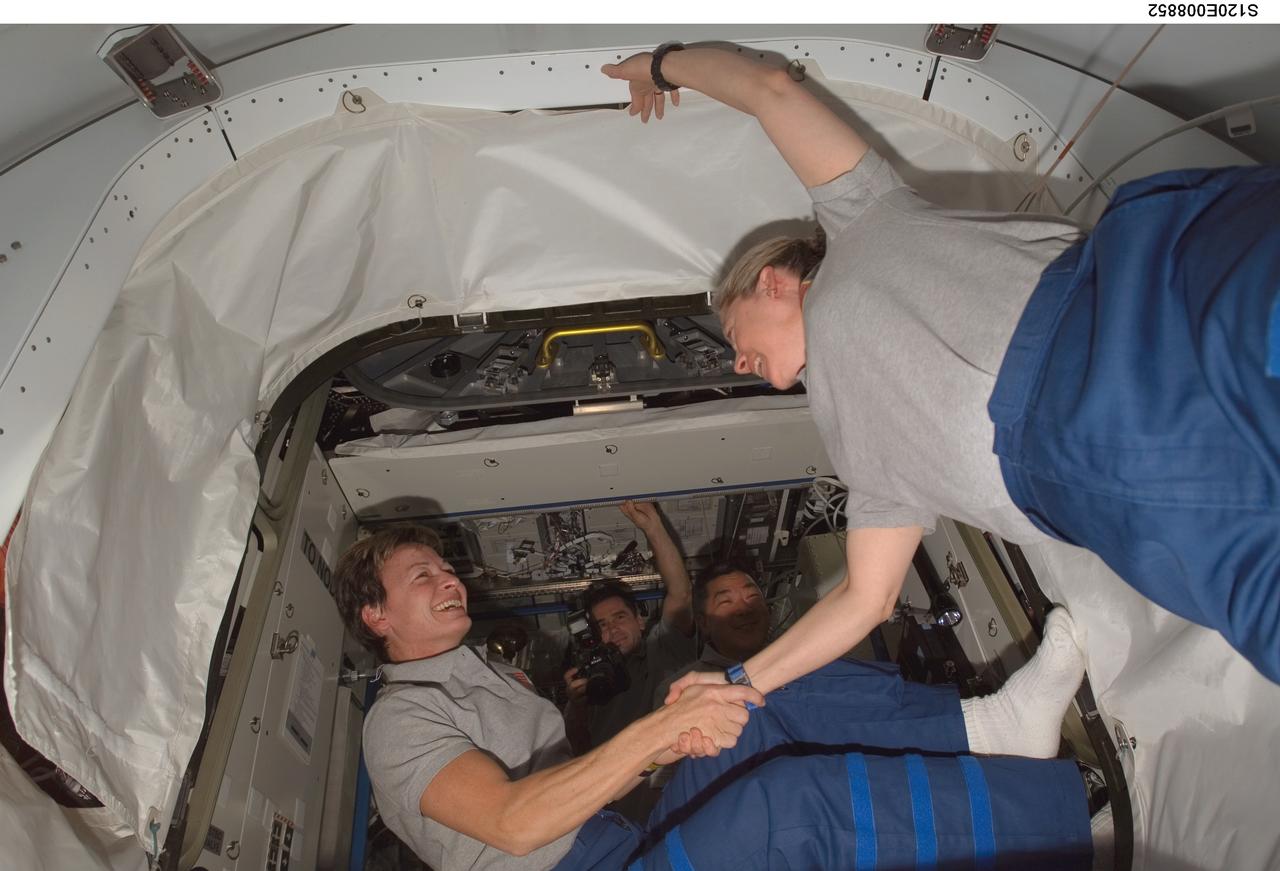
S120-E-008852 (4 Nov. 2007) --- Astronauts Peggy Whitson (left), Expedition 16 commander, and Pam Melroy, STS-120 commander, exchange handshakes in the Pressurized Mating Adapter (PMA-2) of the International Space Station as the STS-120 crewmembers exit the station to board Space Shuttle Discovery for their return trip home. Hatches were closed between the station and the shuttle at 2:03 p.m. (CST) on Nov. 4.
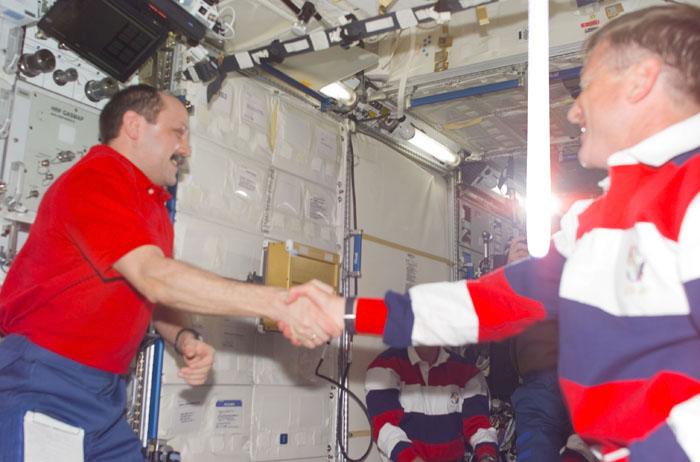
STS105-E-5102 (12 August 2001) --- Yury V. Usachev of Rosaviakosmos (left), Expedition Two mission commander, greets Frank L. Culbertson, Jr., Expedition Three mission commander, with a handshake in the U.S. Laboratory. Culbertson, accompanied by cosmonauts Mikhail Tyurin and Vladimir N. Dezhurov, will be replacing Usachev and astronauts Susan J. Helms and James S. Voss and will spend the next four months aboard the International Space Station (ISS). This image was taken with a digital still camera.
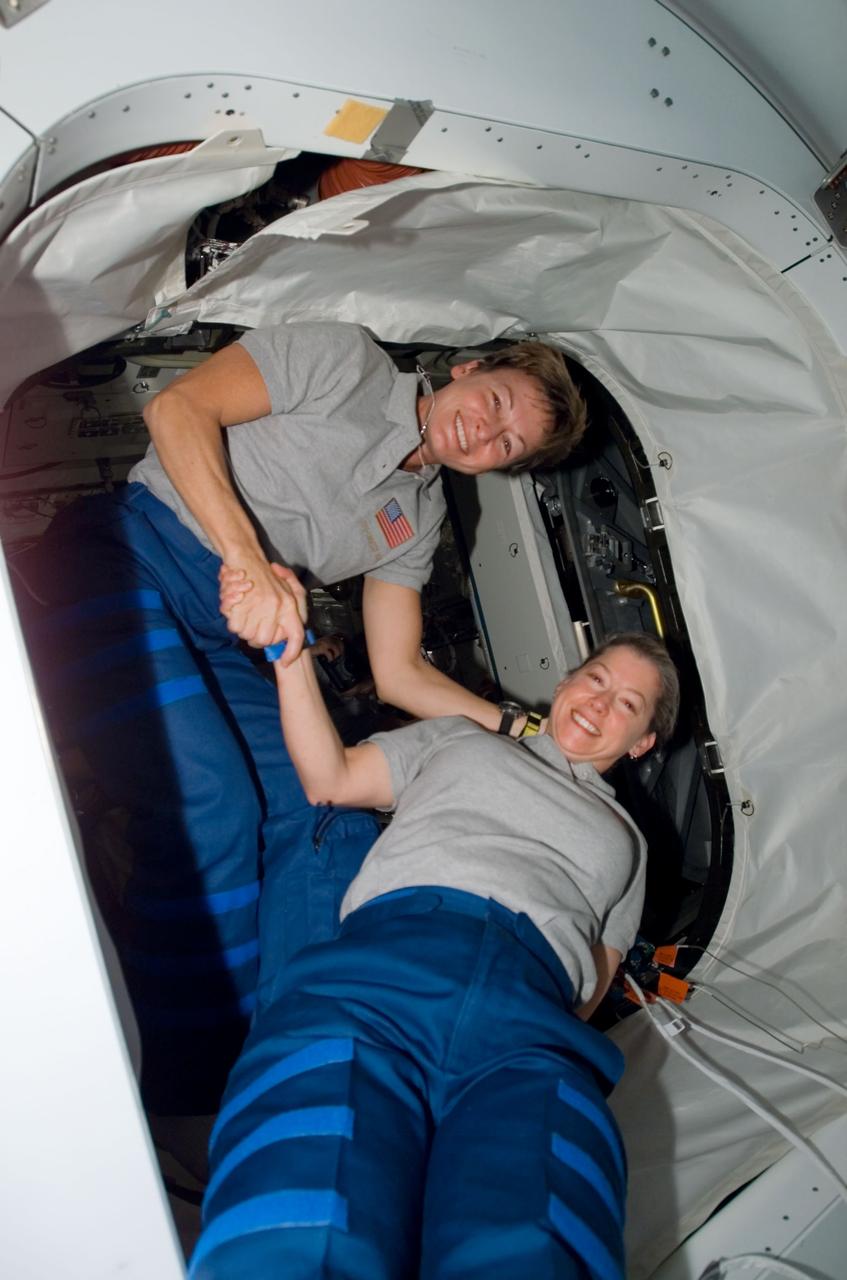
S120-E-008853 (4 Nov. 2007) --- Astronauts Peggy Whitson (left), Expedition 16 commander, and Pam Melroy, STS-120 commander, exchange handshakes in the Pressurized Mating Adapter (PMA-2) of the International Space Station as the STS-120 crewmembers exit the station to board Space Shuttle Discovery for their return trip home. Hatches were closed between the station and the shuttle at 2:03 p.m. (CST) on Nov. 4.
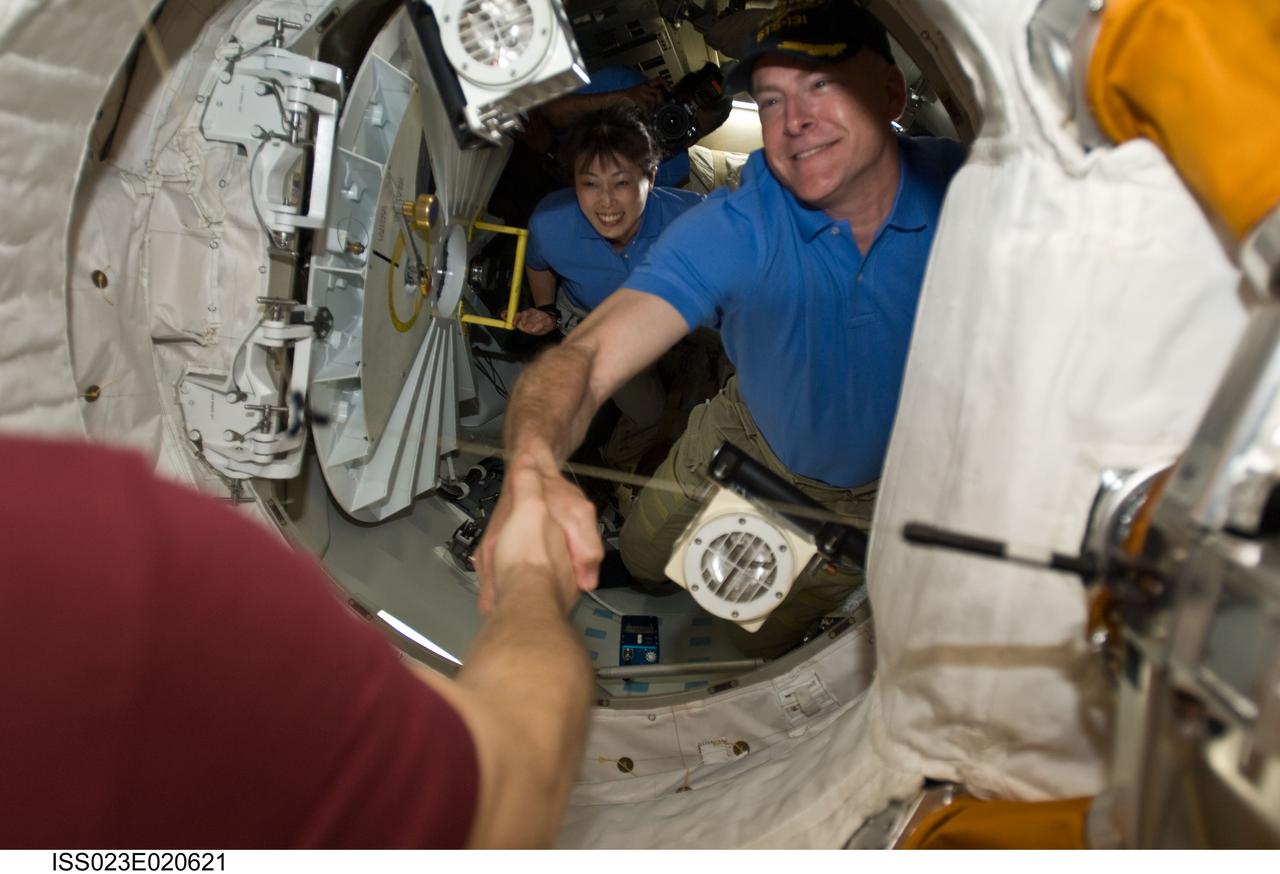
ISS023-E-020621 (7 April 2010) --- Astronaut Alan Poindexter, STS-131 mission commander who has led the Discovery crew on its mission to the International Space Station, displays a pleasant countenance as the hatches come open and two crews begin their traditional handshakes aboard the orbital outpost. Behind Poindexter is Japan Aerospace Exploration Agency astronaut Naoko Yamazaki, mission specialist.
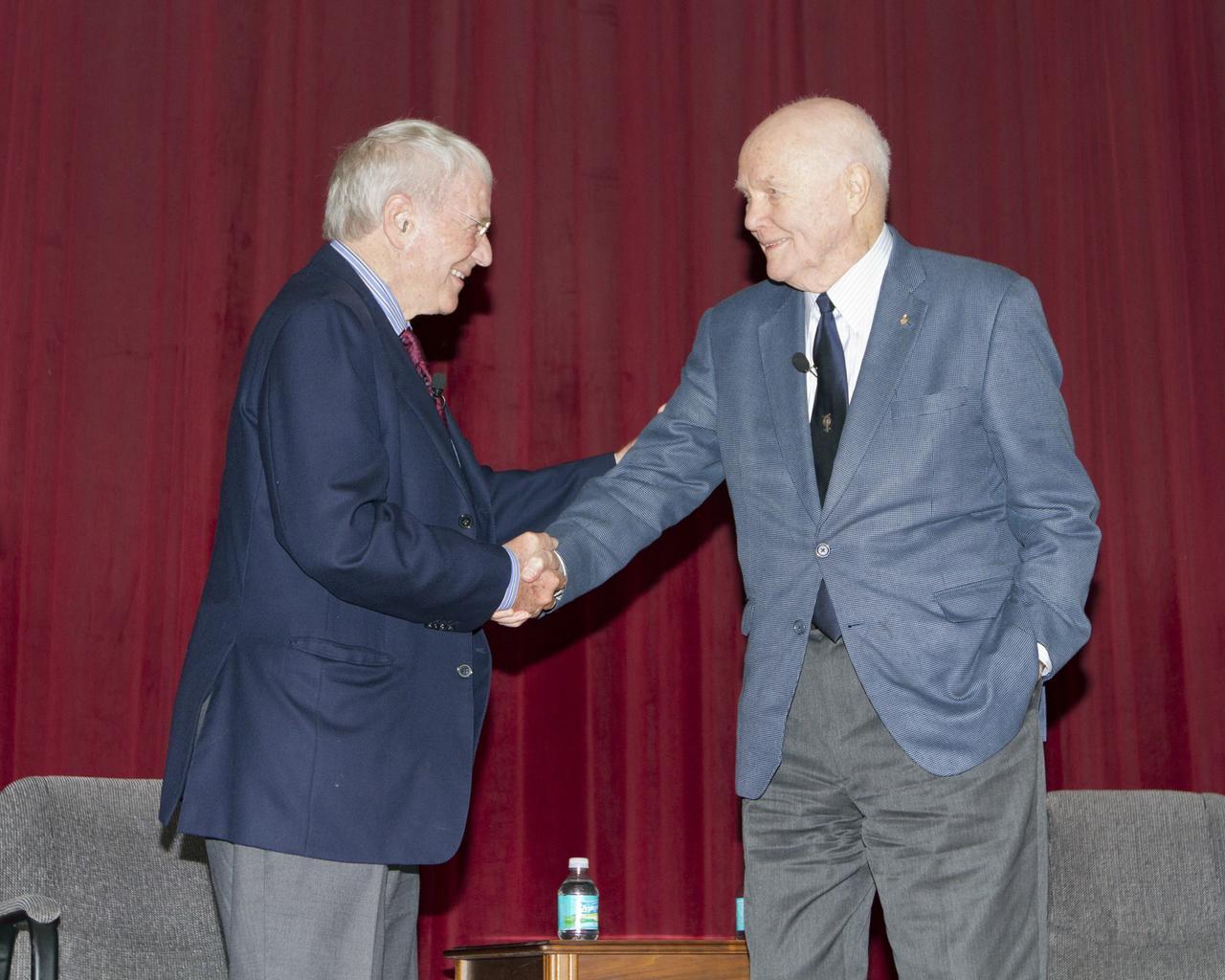
CAPE CANAVERAL, Fla. -- Mercury astronauts Scott Carpenter and John Glenn pause for a handshake at the conclusion of the "50 Years of Americans in Orbit" presentation for employees at NASA's Kennedy Space Center in Florida. NASA Administrator Charles Bolden and Center Director Bob Cabana joined Carpenter and Glenn for the event. This year marks 50 years since Glenn and Carpenter became the first two Americans to orbit Earth. Photo credit: NASA/Kim Shiflett
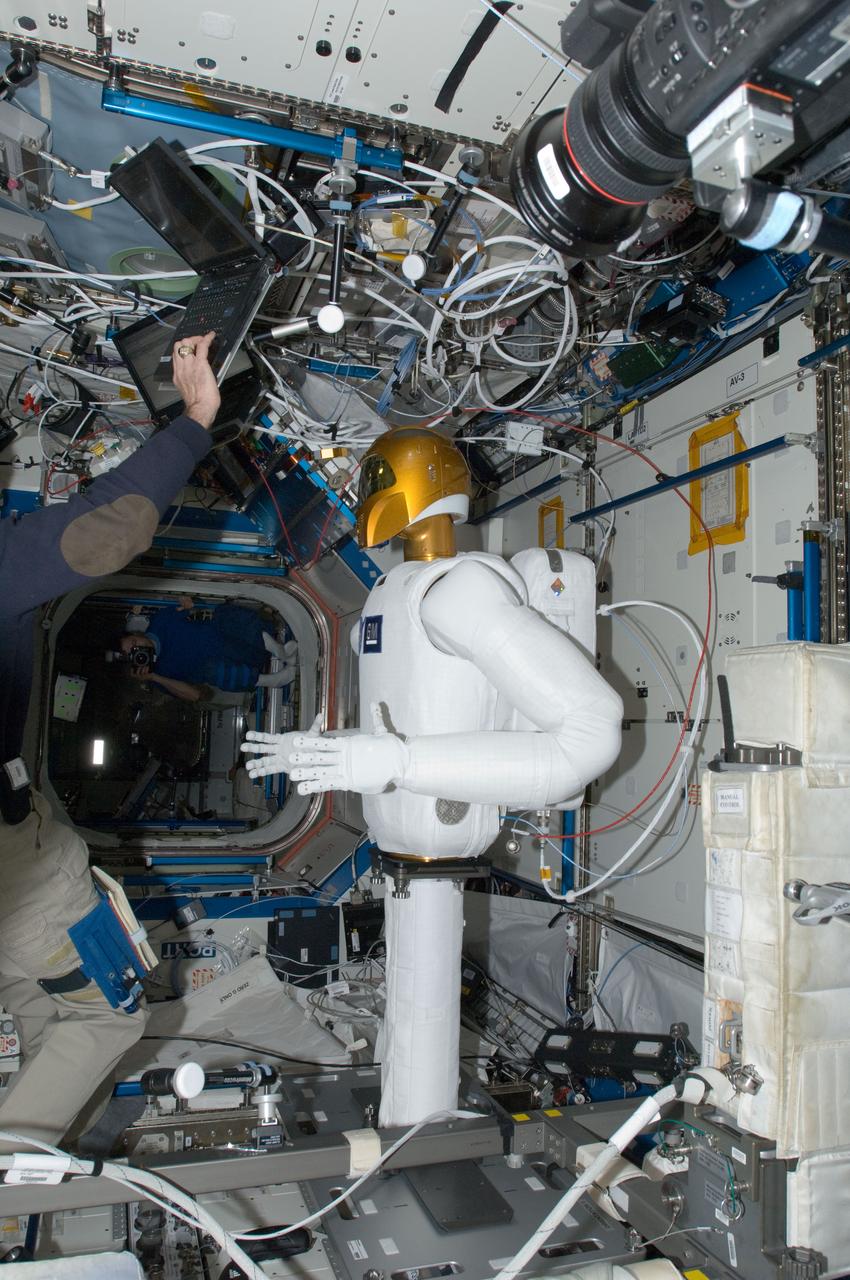
ISS030-E-074059 (15 Feb. 2012) --- Robonaut 2, nicknamed R2, is pictured in the Destiny laboratory of the International Space Station while NASA astronaut Dan Burbank (mostly out of frame at left) uses a computer during R2?s initial checkouts. R2 later went on to make history with the first human/robotic handshake to be performed in space.
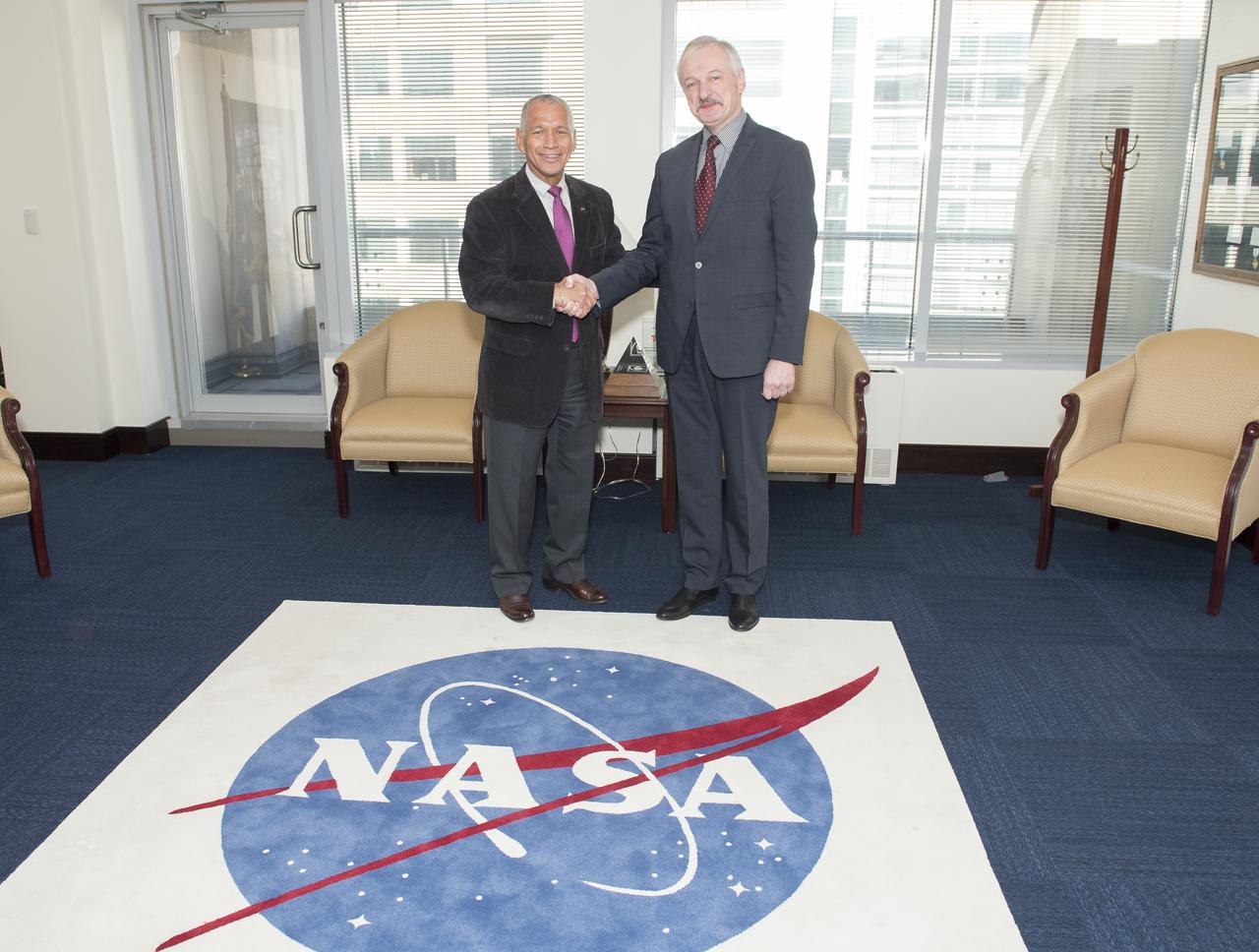
NASA Administrator Charles Bolden, left, welcomes Lithuania's Minister of Economy Evaldas Gustas to NASA Headquarters to discuss potential collaborative space activities between NASA and the Republic of Lithuania, Tuesday, Feb. 18, 2014 in Washington.
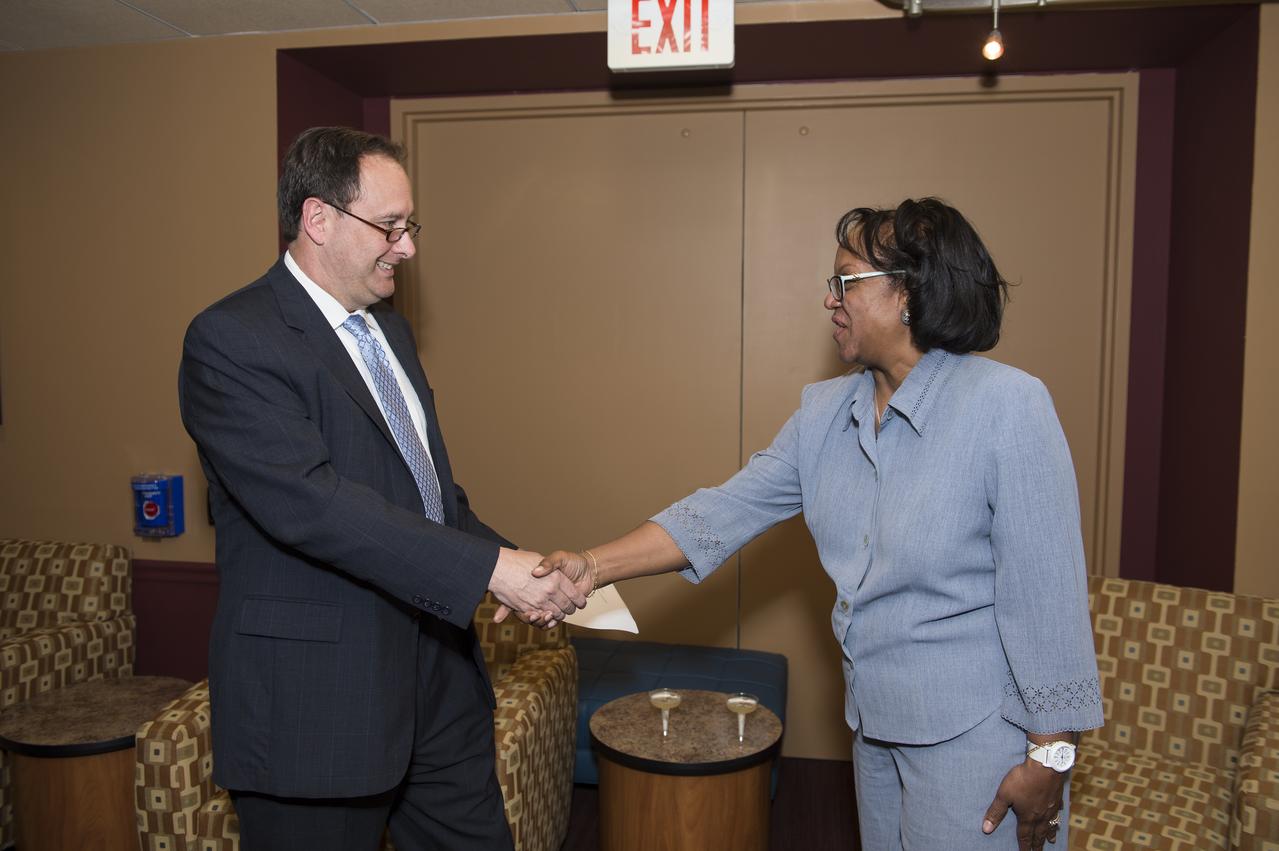
Sumara Thompson-King is seen here after being sworn in by Robert Lightfoot, Associate Administrator (left) at NASA Headquarters in Washington, DC on June 2, 2014. Thompson-King assumed the role of General Counsel on Sunday, June 1, 2014 after Michael Wholley, former General Counsel, retired. She started her career at NASA in the Office of Chief Counsel at Goddard Space Flight Center in Greenbelt, MD in 1986. In 1991, she became a senior attorney at NASA Headquarters and in 1995 was promoted to the Deputy Associate General Counsel (Contracts) position. She is the first woman and first African American to serve as General Counsel at NASA Headquarters. (Photo Credit: NASA/Aubrey Gemignani)

KENNEDY SPACE CENTER, FLA. - Jim Lloyd (left) and MER ATLO Logistics Manager Tom Shain shake hands after placing on the Mars Exploration Rover 1 (MER-1) a computer chip with about 35,000 laser-engraved signatures of visitors to the rovers at the Jet Propulsion Laboratory. The signatures include those of senators, artists, and John Glenn. The handshake also represents the passing of the "flame" of logistics job responsibilities at JPL to Lloyd who will be replacing Shain after his retirement. The identical Mars rovers are scheduled to launch June 5 and June 25 from Cape Canaveral Air Force Station.
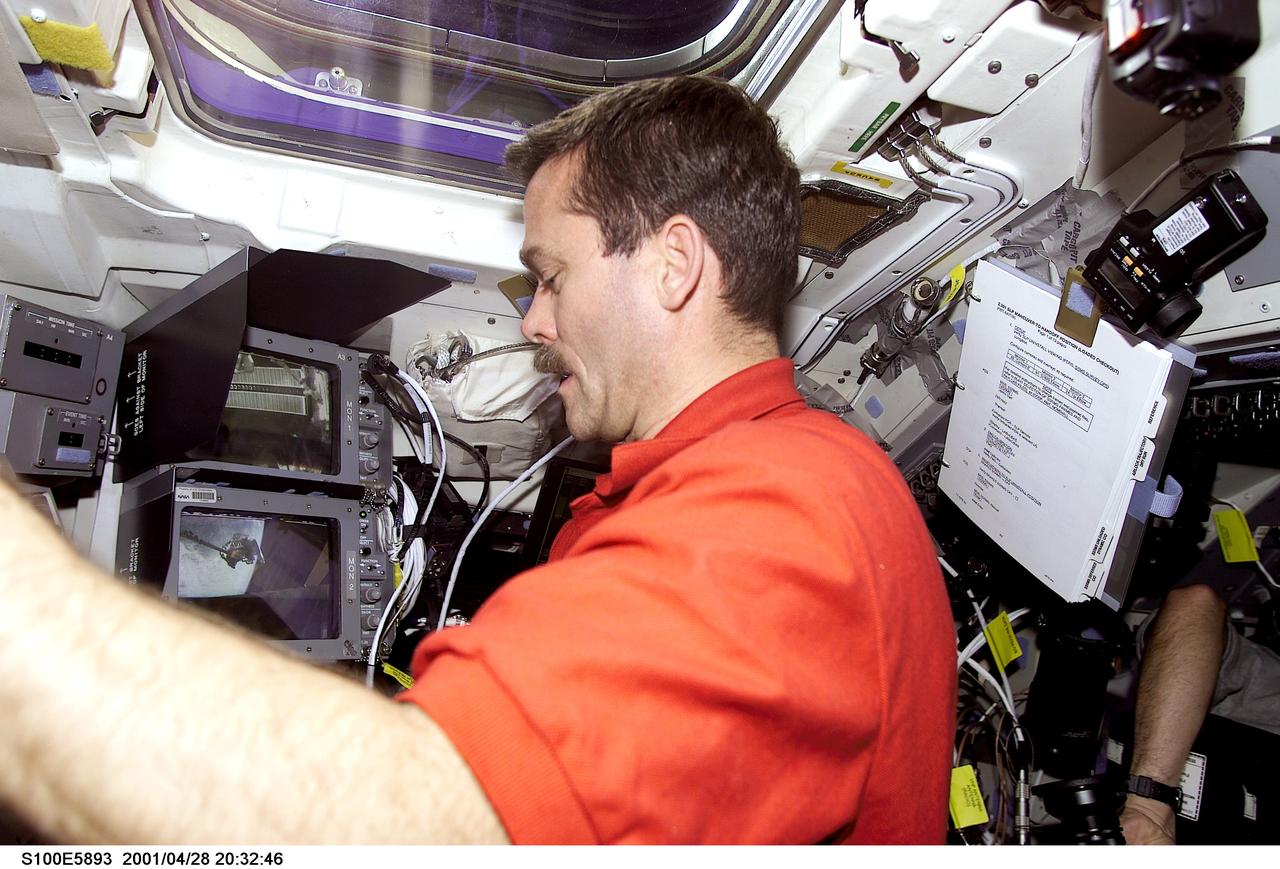
S100-E-5893 (28 April 2001) --- Astronaut Chris A. Hadfield, mission specialist, is pictured on the aft flight deck of the Space Shuttle Endeavour during an historic event. A Canadian “handshake in space” occurred at 4:02 p.m (CDT), April 28, 2001, as the Canadian-built space station robotic arm – operated by Expedition Two flight engineer Susan Helms – transferred its launch cradle over to Endeavour’s robotic arm, with Canadian Space Agency astronaut Hadfield at the controls. The exchange of the pallet from station arm to shuttle arm marked the first ever robotic-to-robotic transfer in space. This image was recorded with a digital still camera.
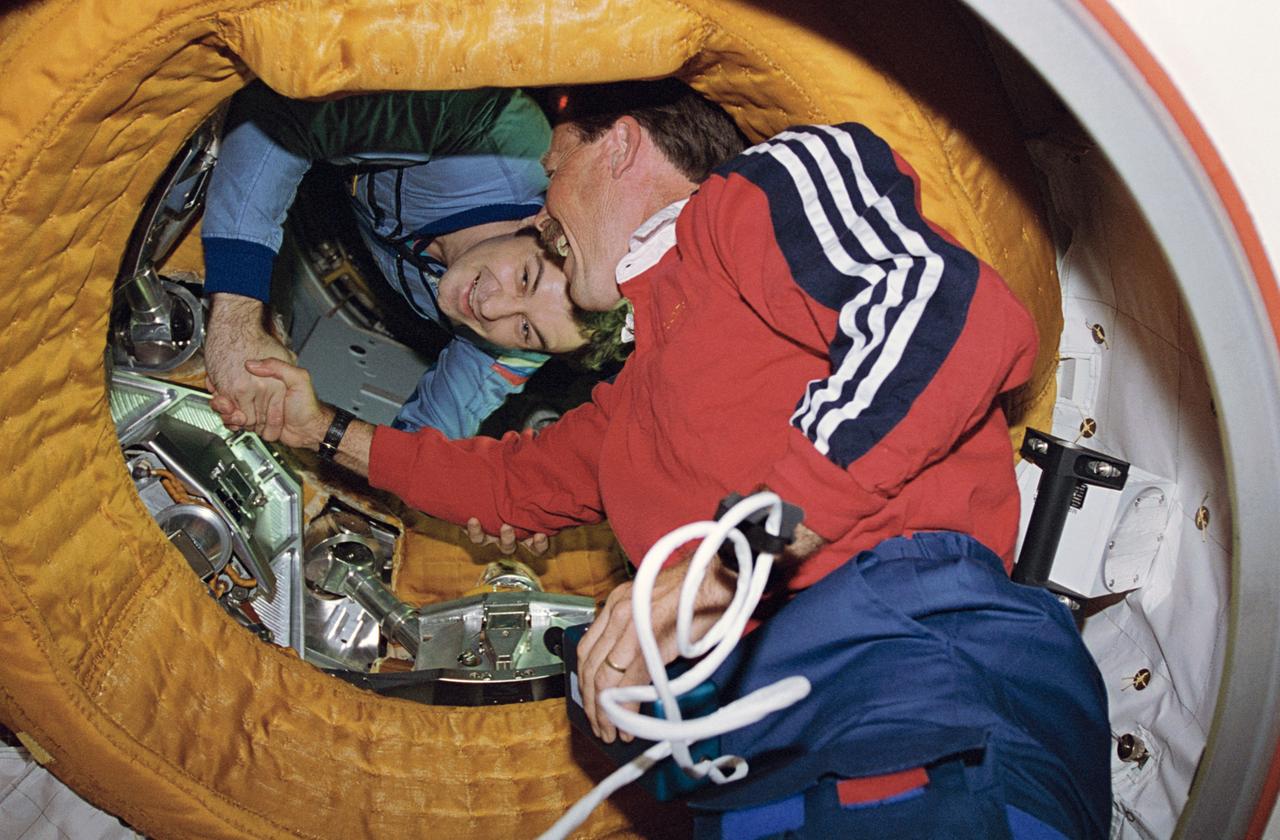
STS071-118-004 (29 June 1995) --- Astronaut Robert L. Gibson, STS-71 commander, shakes the hand of cosmonaut Vladimir N. Dezhurov, Mir-18 commander. The historic handshake took place two and half weeks prior to the 20th anniversary of a similar in-space greeting between cosmonauts and astronauts participating in the Apollo-Soyuz Test Project (ASTP). On July 17, 1975, astronaut Thomas P. Stafford, NASA's ASTP commander, greeted his counterpart, Aleksey A. Leonov in a docking tunnel linking the Soyuz and Apollo spacecraft.
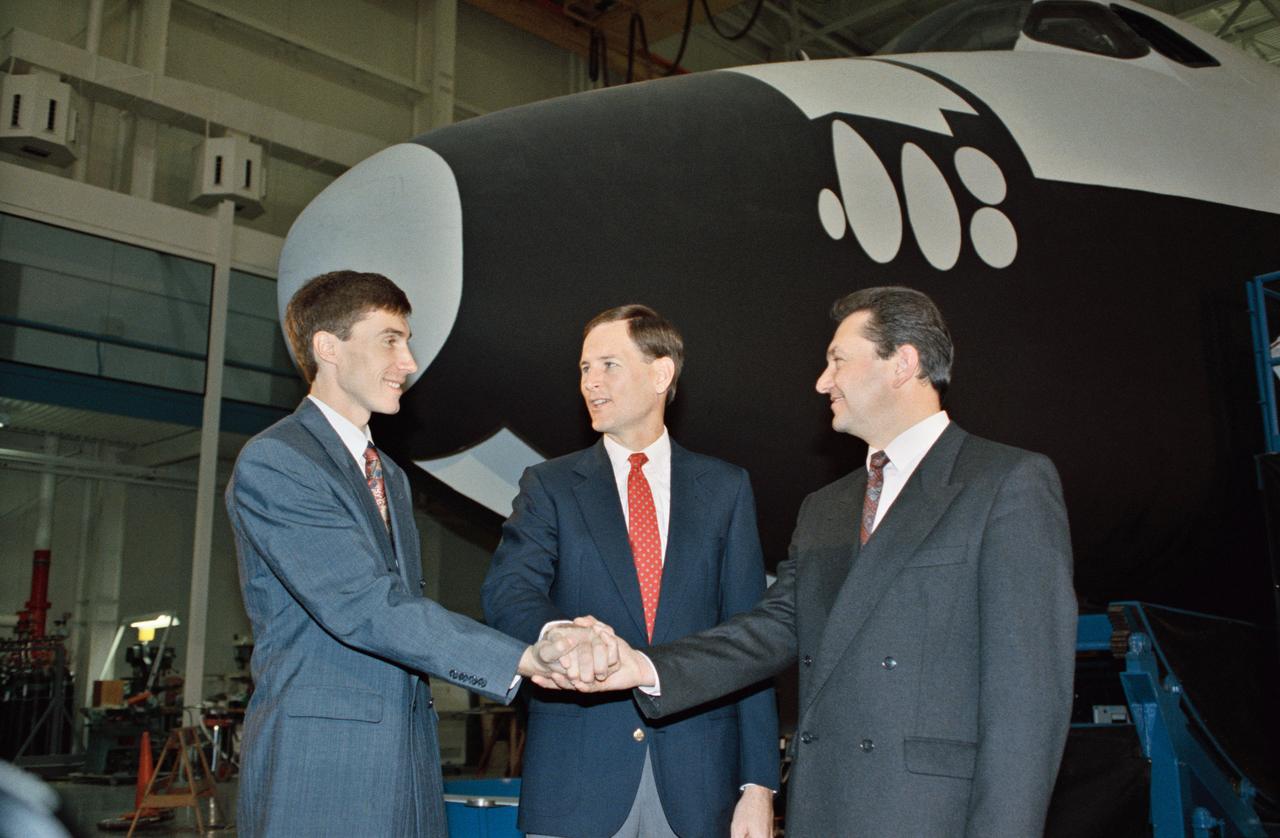
S92-49715 (10 Nov 1992) --- Russian cosmonauts Sergei Krikalev (left), and Vladimir Titov (right) share a team handshake with Kenneth L. Reightler, STS-60 pilot. The cosmonauts toured the Space Shuttle mockup and integration laboratory, in which they will undergo a great deal of training in preparation for the mission. One of the two will later be named as prime payload specialist and the second will serve as his alternate. The six person crew, to be led by astronaut Charles F. Bolden, mission commander, will man the Space Shuttle Discovery for the scheduled eight-day flight.
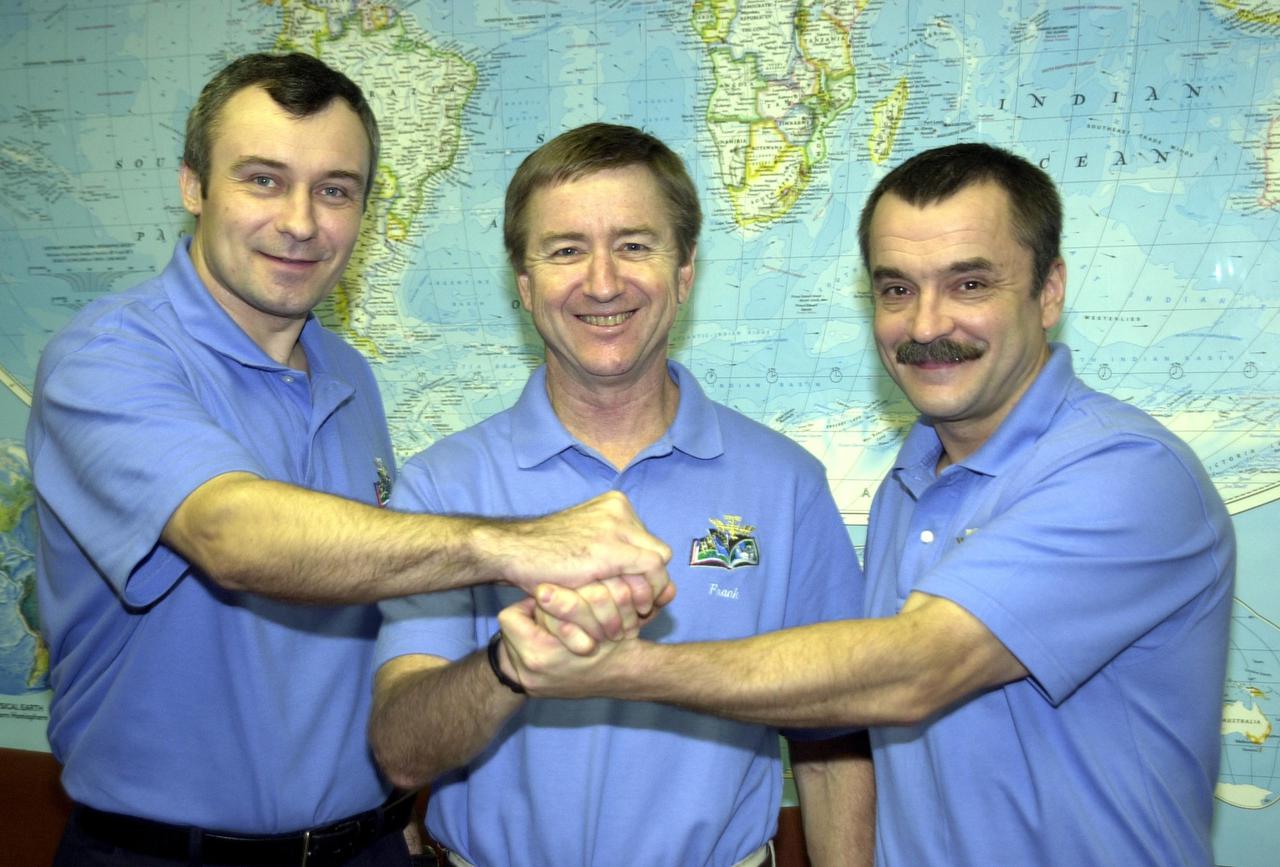
KENNEDY SPACE CENTER, FLA. -- The Expedition 3 crew do a group handshake one day after their return to Earth from their 129-day stay on the International Space Station. From left are Vladimir Dezhurov, Frank Culbertson and Mikhail Tyurin. They returned as passengers aboard the orbiter Endeavour, which landed at KSC at 12:55 p.m. EST (17:55 GMT) Dec. 17, 2001, after completing mission STS-108. The landing is the 57th at KSC in the history of the program STS-108 was the 12th mission to the Space Station. This mission was the 107th flight in the Shuttle program and the 17th flight for the orbiter
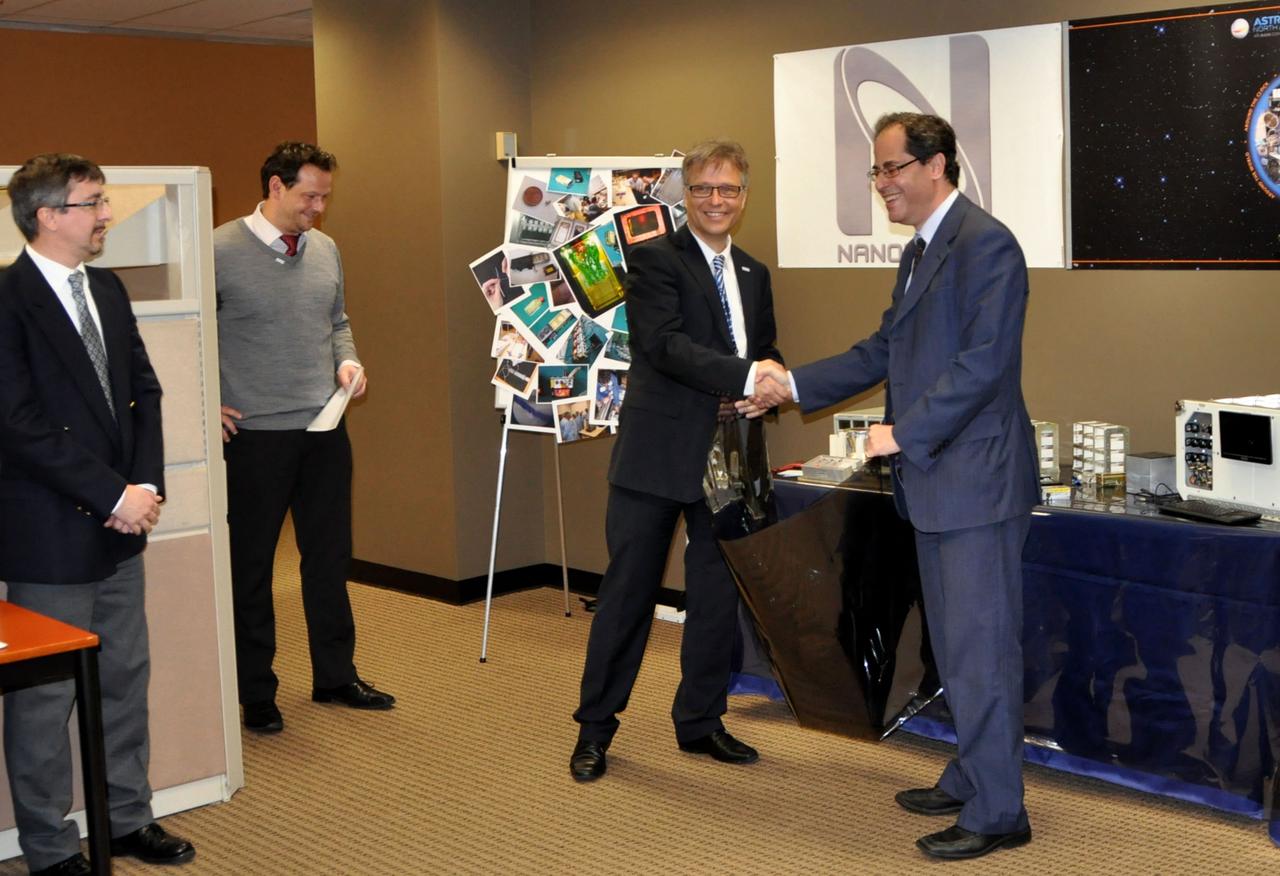
JSC2012-E-029874 (14 Feb. 2012) --- During a ceremony on Feb. 14 at the Astrium North America facility in Houston, two principal participants shake hands as a gravitational research centrifuge gets handed over by Astrium ST to NanoRacks LLC representatives. The handshake of Ulrich Kuebler (second right) of Astrium ST and Jeff Manber, managing director of NanoRacks, symbolizes the working relationship between Astrium ST and NanoRacks, who are working in cooperation with NASA, to deliver the commercial centrifuge facility to the International Space Station. At left are Luca Pieroni of Kayser Italia, one of Astrium's partners in construction the centrifuge, and Achim Schwarzwaelder of Astrium ST . NASA Photo courtesy Astrium North America
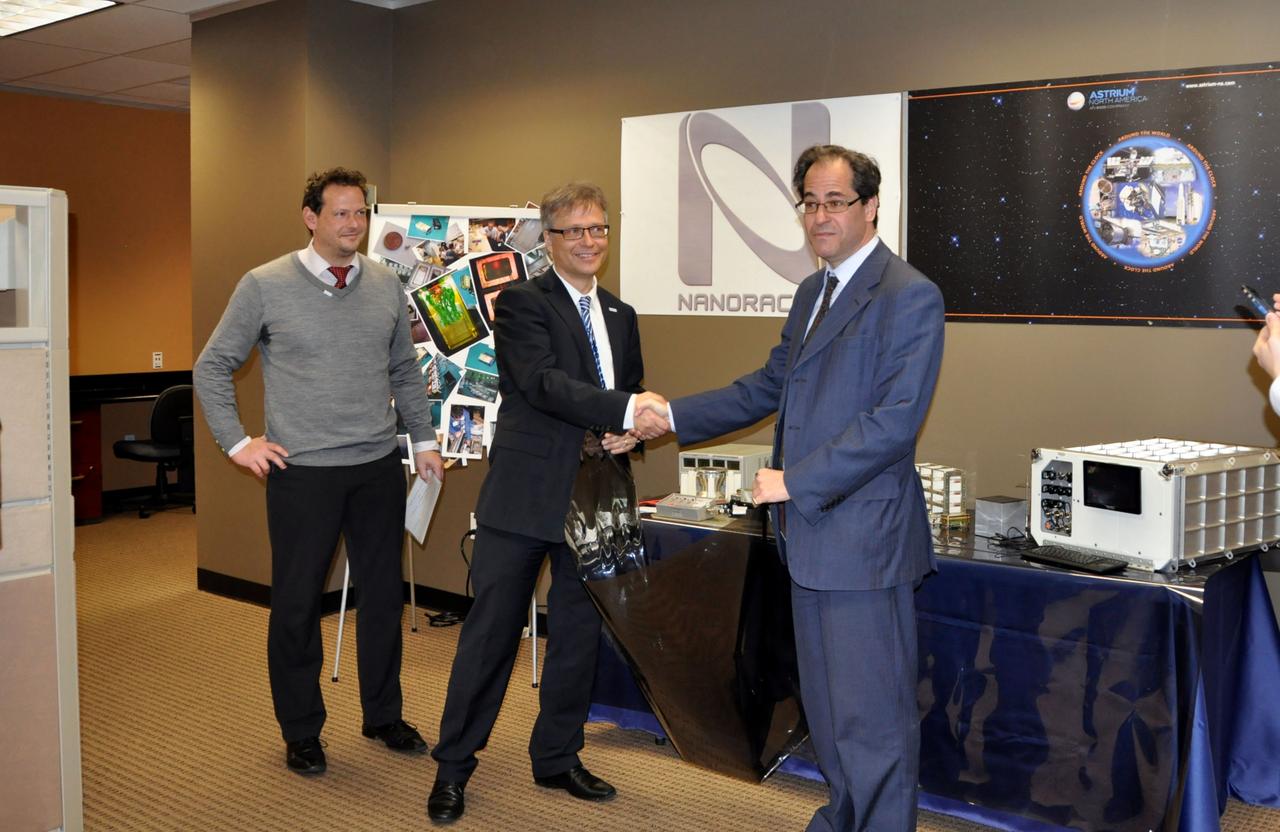
JSC2012-E-029875 (14 Feb. 2012) --- During a ceremony on Feb. 14 at the Astrium North America facility in Houston, two principal participants shake hands as a gravitational research centrifuge gets handed over by Astrium ST to NanoRacks LLC representatives. The handshake of Ulrich Kuebler (second right) of Astrium ST and Jeff Manber, managing director of NanoRacks, symbolizes the working relationship between Astrium ST and NanoRacks, who are working in cooperation with NASA, to deliver the commercial centrifuge facility to the International Space Station. At left is Achim Schwarzwaelder of Astrium ST. NASA Photo courtesy Astrium North America
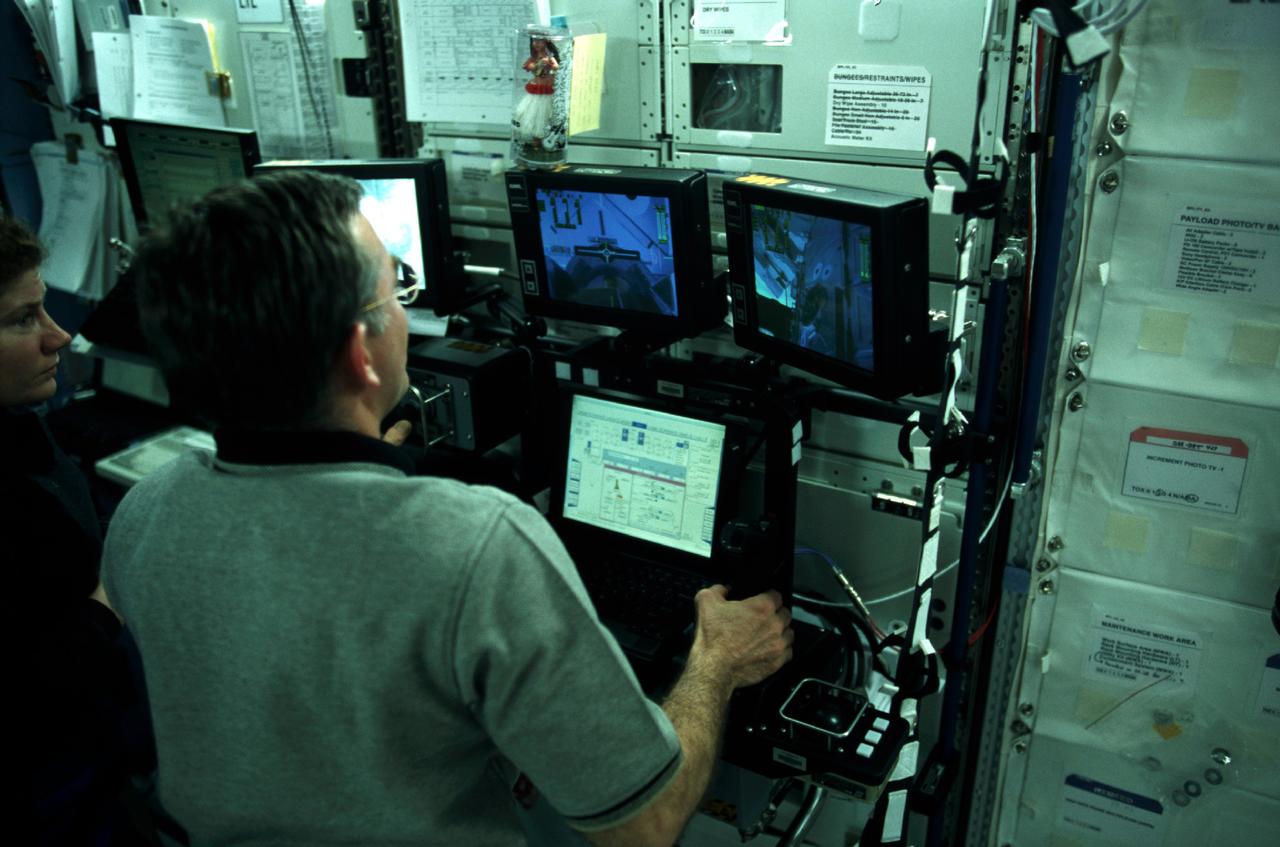
A Canadian "handshake" in space occurred on April 28, 2001, as the Canadian-built space station robotic arm (Canadarm2) transferred its launch cradle over to Endeavour's robotic arm. Pictured is astronaut James S. Voss, Expedition Two flight engineer, working the controls of the new robotic arm. Marning the controls from the shuttle's aft flight deck, Canadian Mission Specialist Chris A. Hadfield of the Canadian Space Agency (CSA) was instrumental in the activity. The Space lab pallet that carried the Canadarm2 robotic arm to the station was developed at the Marshall Space Flight Center (MSFC) in Huntsville, Alabama.
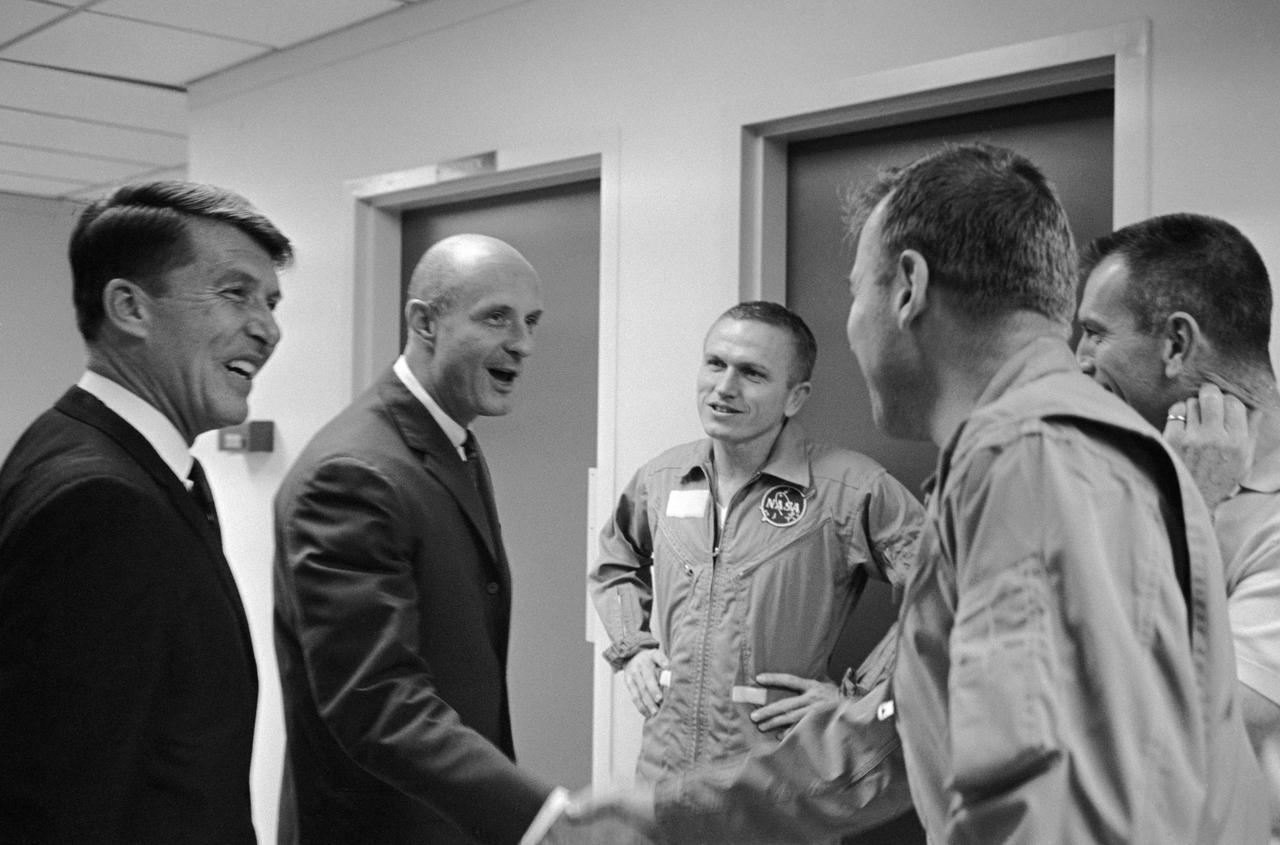
S65-66728 (19 Dec. 1965) --- This happy round of handshakes took place in the Manned Spacecraft Operations Building crew quarters, Merritt Island, as the Gemini-6 crew (left) welcomed the Gemini-7 crew back to the Kennedy Space Center. Left to right, are astronauts Walter M. Schirra Jr., Gemini-6 command pilot; Thomas P. Stafford, Gemini-6 pilot; Frank Borman, Gemini-7 command pilot; James A. Lovell Jr., Gemini-7 pilot; and Donald K. Slayton (partially hidden behind Lovell), assistant director for Flight Crew Operations, Manned Spacecraft Center, Houston. Photo credit: NASA

ISS038-E-068899 (9 March 2014) --- The new commander of the current crew on the International Space Station (Expedition 39) and the Expedition 38/39 flight engineers exchange handshakes inside the Kibo laboratory. Their celebration may very well be a follow-up gesture following the transfer of command ceremony and a symbolic farewell to the Expedition 38 crew members (out of frame) who are on the eve of their departure from the orbital outpost. Expedition 39 Commander Koichi Wakata (center) of the Japanese Aerospace Exploration Agency (JAXA) is joined here by Flight Engineers Rick Mastracchio (right) of NASA and cosmonaut Mikhail Tyurin of the Russian Federal Space Agency (Roscosmos).
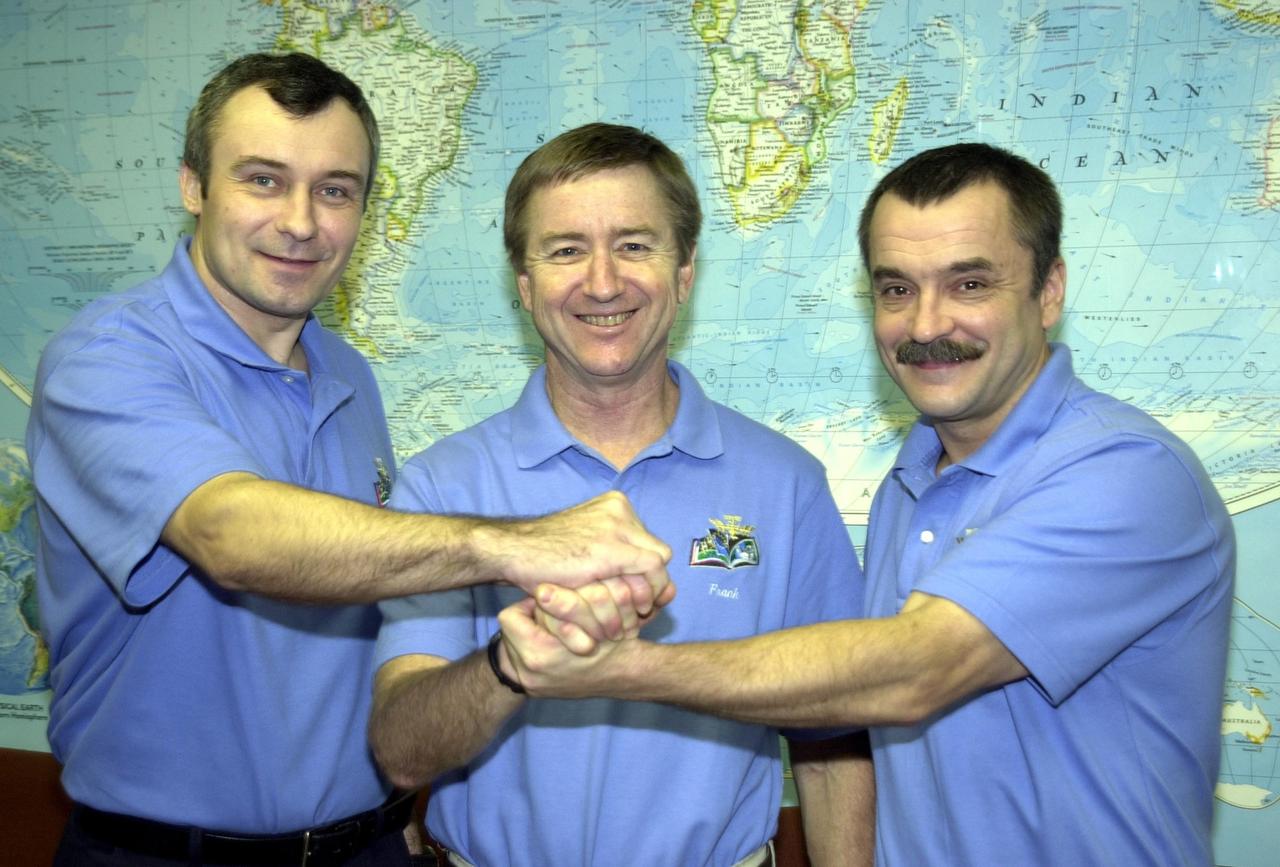
KENNEDY SPACE CENTER, FLA. -- The Expedition 3 crew do a group handshake one day after their return to Earth from their 129-day stay on the International Space Station. From left are Vladimir Dezhurov, Frank Culbertson and Mikhail Tyurin. They returned as passengers aboard the orbiter Endeavour, which landed at KSC at 12:55 p.m. EST (17:55 GMT) Dec. 17, 2001, after completing mission STS-108. The landing is the 57th at KSC in the history of the program STS-108 was the 12th mission to the Space Station. This mission was the 107th flight in the Shuttle program and the 17th flight for the orbiter
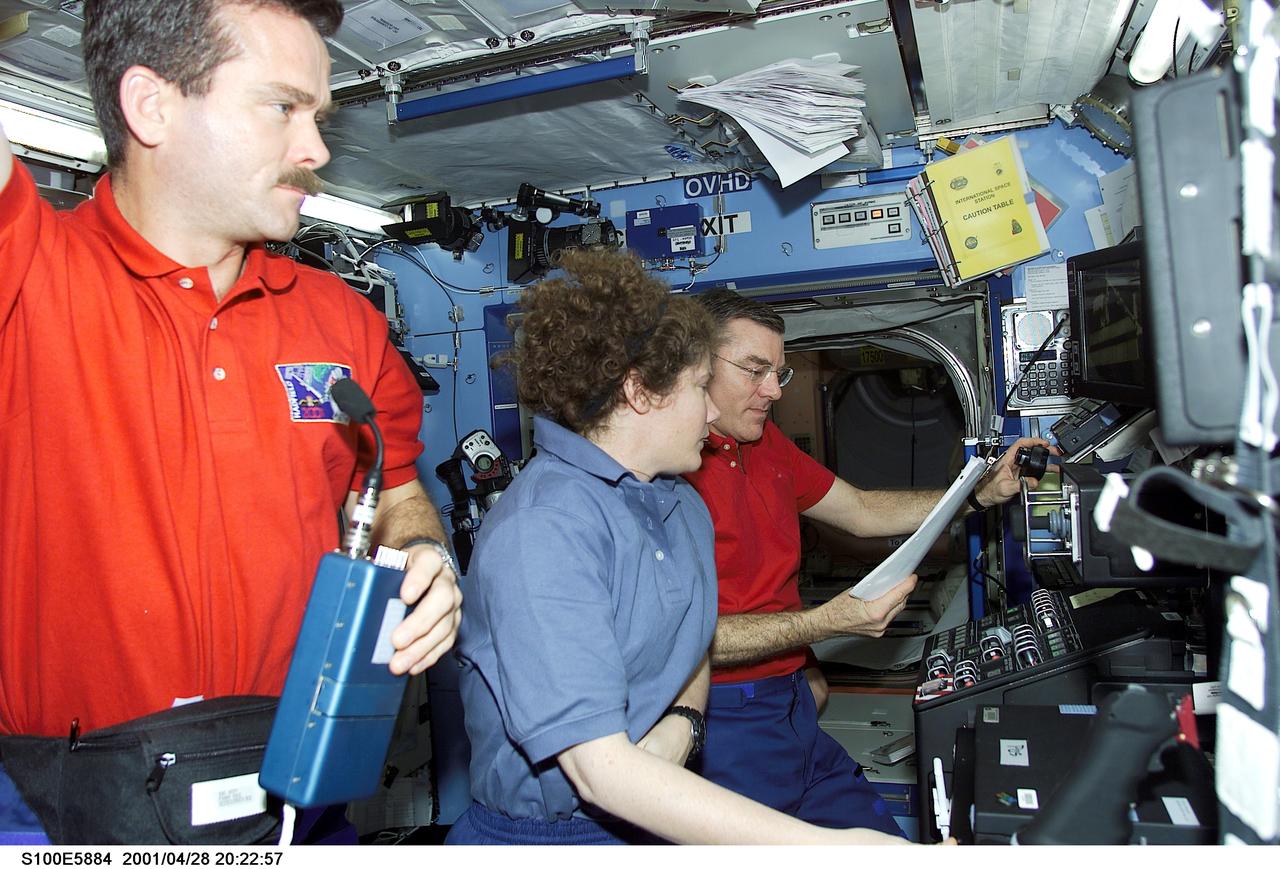
S100-E-5884 (28 April 2001) --- Some of the principal participants of an historical event are pictured in the Destiny laboratory aboard the International Space Station (ISS). From left to right are astronauts Chris A. Hadfield, STS-100 mission specialist, and astronauts Susan J. Helms and James S. Voss, Expedition Two flight engineers. A Canadian “handshake in space” occurred at 4:02 p.m (CDT), April 28, 2001, as the Canadian-built space station robotic arm – operated by Helms – transferred its launch cradle over to Endeavour’s robotic arm, with Canadian Space Agency astronaut Hadfield at the controls. In this scene, Hadfield has temporarily vacated his post on Endeavour's aft flight deck and was having a brief strategy meeting with the Expedition Two crew on the docked station. The exchange of the pallet from station arm to shuttle arm marked the first ever robotic-to-robotic transfer in space. This image was recorded with a digital still camera.
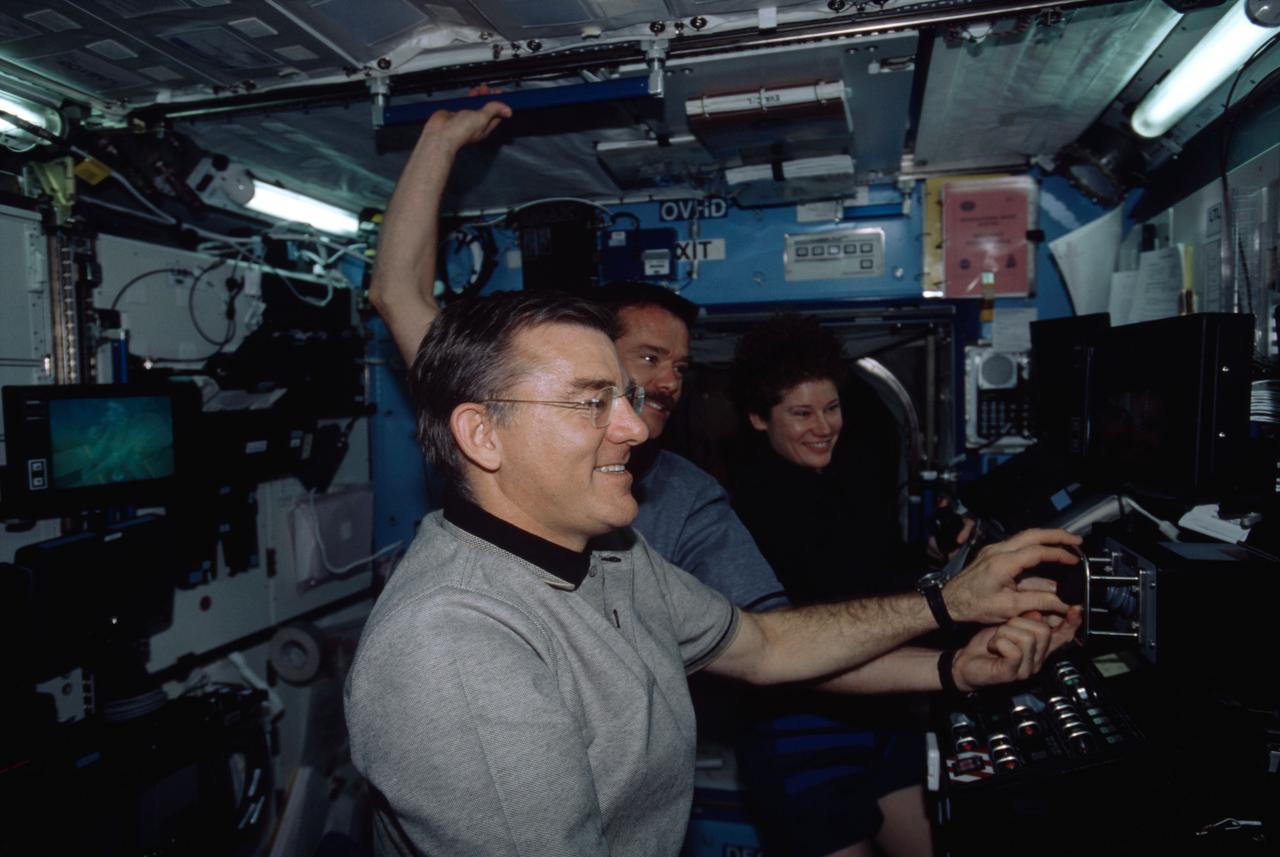
ISS002-303-036 (28 April 2001) --- Some of the principal participants of an historical event are pictured in the Destiny laboratory aboard the International Space Station (ISS). In the foreground is astronaut James S. Voss, with astronaut Chris A. Hadfield, STS-100 mission specialist, at center, and astronaut Susan J. Helms in the background. Voss and Helms are Expedition Two flight engineers. A Canadian "handshake in space" occurred at 4:02 p.m (CDT), April 28, 2001, as the Canadian-built space station robotic arm -- operated by Helms -- transferred its launch cradle over to Endeavour's robotic arm, with Canadian Space Agency astronaut Hadfield at the controls. In this scene, Hadfield had temporarily vacated his post on Endeavour's aft flight deck and was having a brief strategy meeting with the Expedition Two crew on the docked station. The exchange of the pallet from station arm to shuttle arm marked the first ever robotic-to-robotic transfer in space.
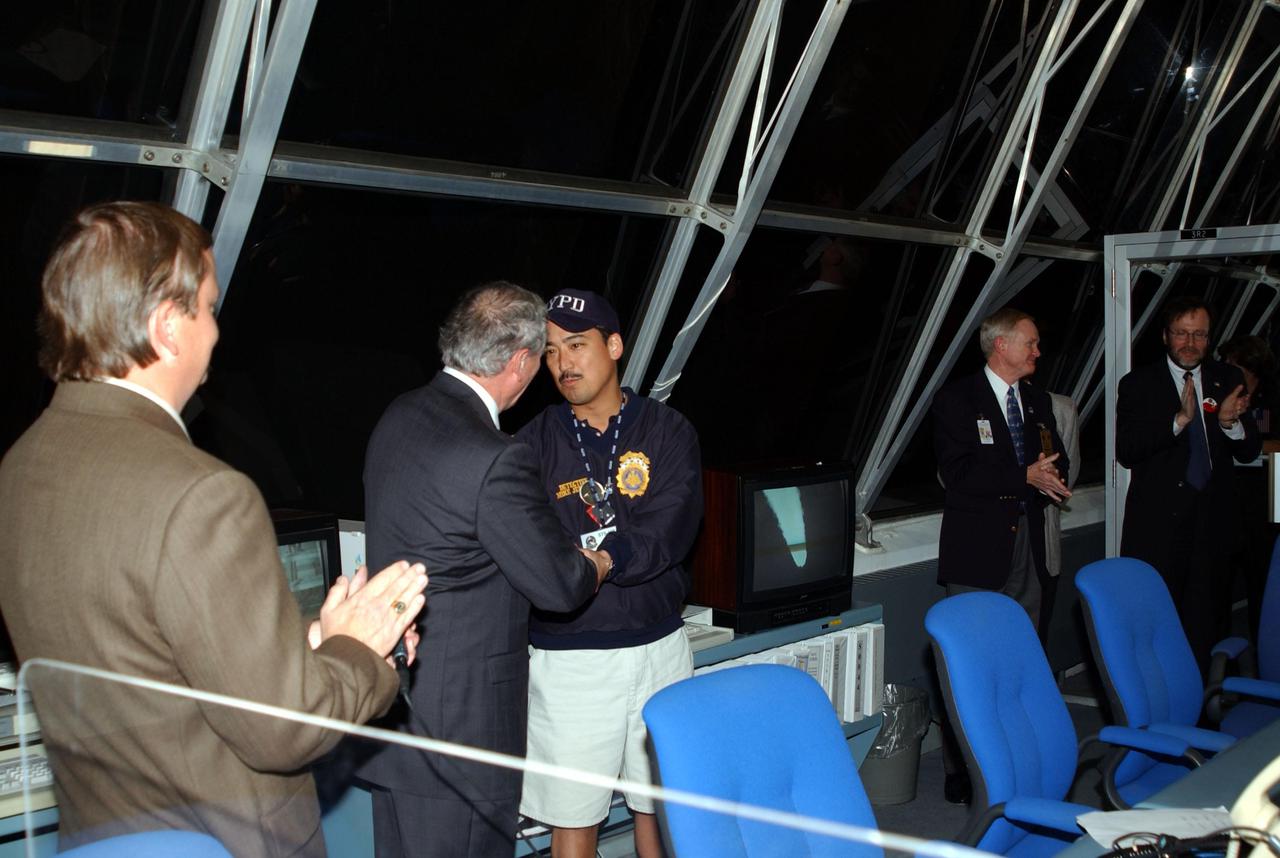
KENNEDY SPACE CENTER, Fla. -- New York Police Department Detective Michael Jermyn (center) is thanked for representing the New York Police and Fire Departments at the launch of Space Shuttle Endeavour on mission STS-108. Offering his handshake is NASA's Acting Administrator Daniel Mulville; Launch Director Mike Leinbach (left) applauds. At right is Center Director Roy Bridges Jr. Jermyn praised the efforts of the workers on the successful launch. Endeavour is carrying 6,000 flags that will be given to the families of those who died in the fall of the Twin Towers. Liftoff of Endeavour occurred at 5:19:28 p.m. EST (22:19.28 GMT). Endeavour will dock with the International Space Station on Dec. 7. STS-108 is the final Shuttle mission of 2001and the 107th Shuttle flight overall. It is the 12th flight to the Space Station. Landing of the orbiter at KSC's Shuttle Landing Facility is targeted for 1:05 p.m. EST (18:05 p.m. GMT) Dec. 16
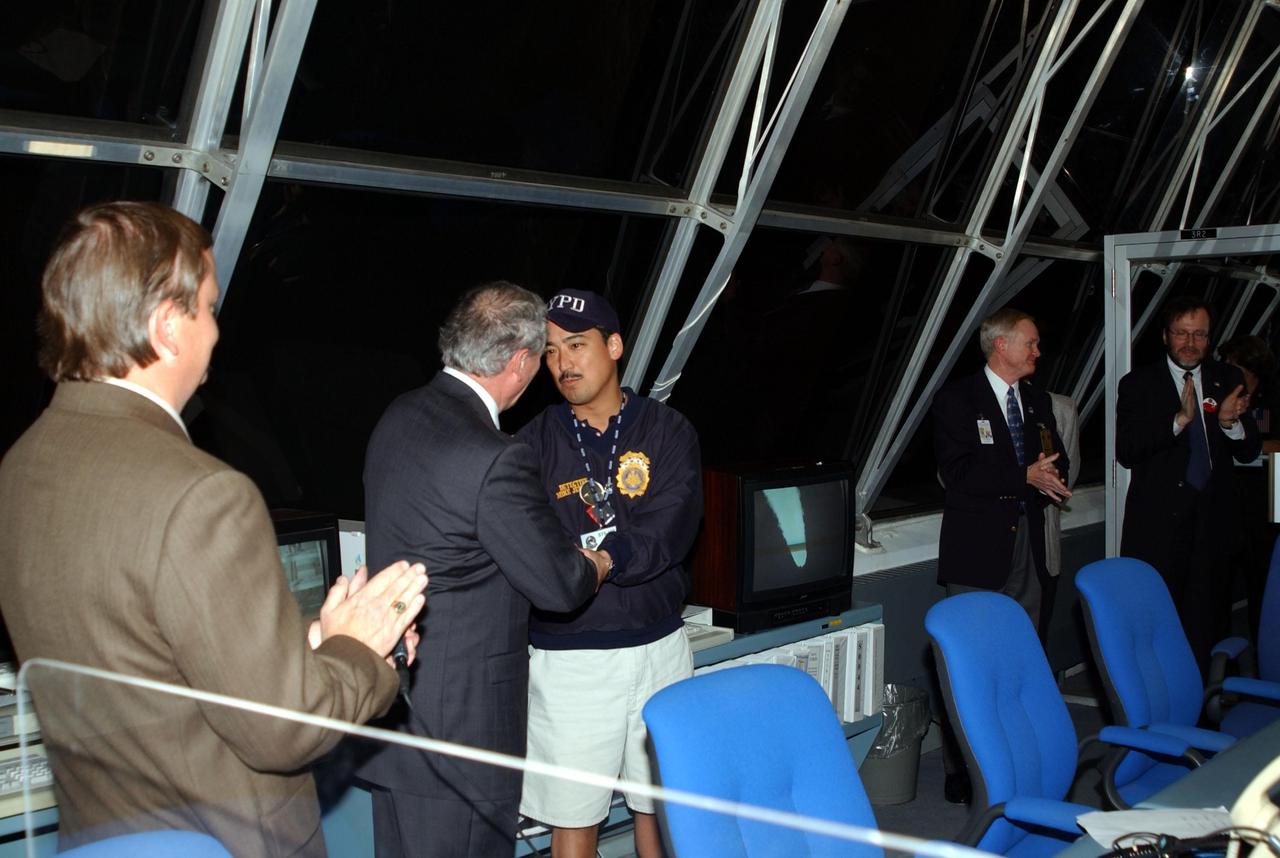
KENNEDY SPACE CENTER, Fla. -- New York Police Department Detective Michael Jermyn (center) is thanked for representing the New York Police and Fire Departments at the launch of Space Shuttle Endeavour on mission STS-108. Offering his handshake is NASA's Acting Administrator Daniel Mulville; Launch Director Mike Leinbach (left) applauds. At right is Center Director Roy Bridges Jr. Jermyn praised the efforts of the workers on the successful launch. Endeavour is carrying 6,000 flags that will be given to the families of those who died in the fall of the Twin Towers. Liftoff of Endeavour occurred at 5:19:28 p.m. EST (22:19.28 GMT). Endeavour will dock with the International Space Station on Dec. 7. STS-108 is the final Shuttle mission of 2001and the 107th Shuttle flight overall. It is the 12th flight to the Space Station. Landing of the orbiter at KSC's Shuttle Landing Facility is targeted for 1:05 p.m. EST (18:05 p.m. GMT) Dec. 16
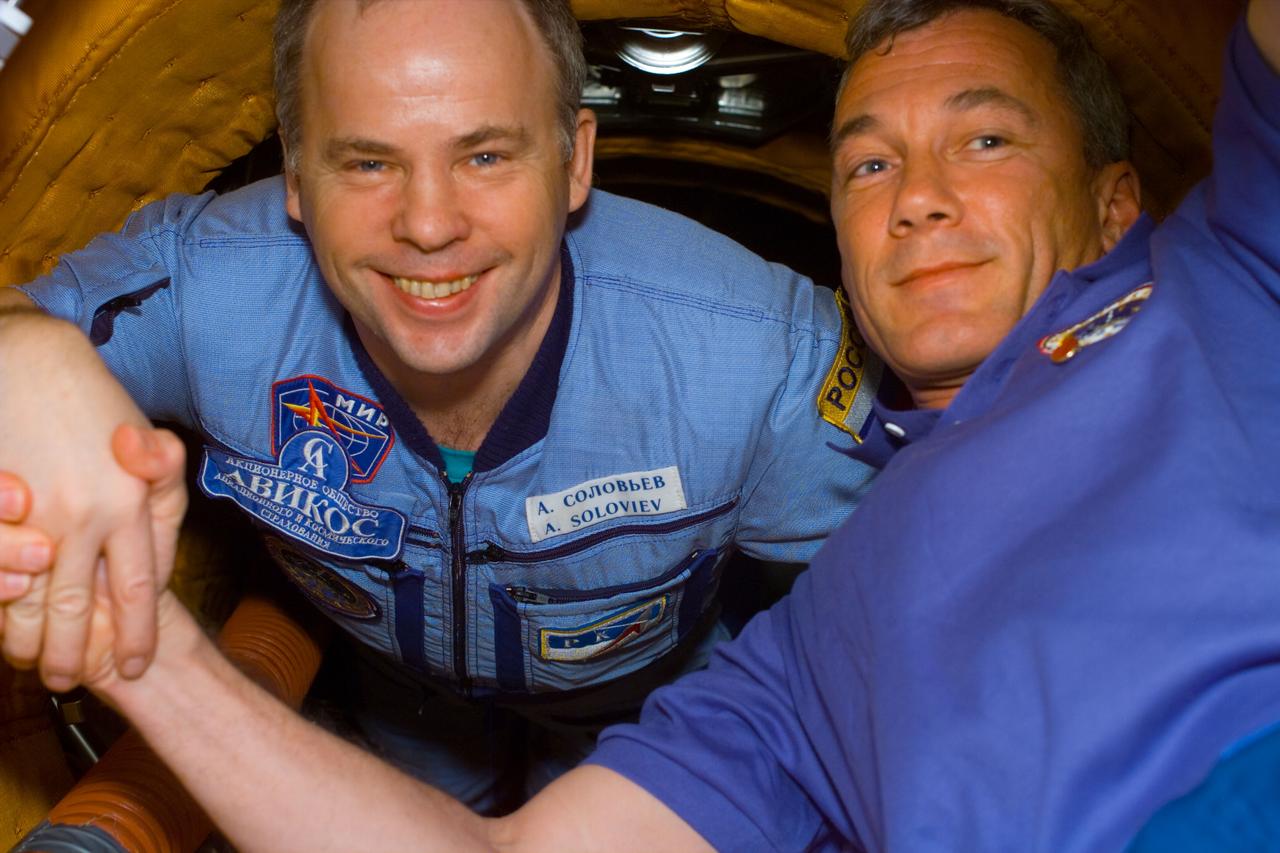
S89-E-5352 (28 Jan 1998) --- This Electronic Still Camera (ESC) image shows the commanders' farewell handshake, thus bringing the eighth Shuttle/Mir joint activities to an end. The commanders, cosmonaut Anatoliy Y. Solovyev, Mir-24 commander (on the left); and astronaut Terrence W. Wilcutt, STS-89 commander, are posing in the Docking Module (DM) between the Space Shuttle Endeavour and the Russian Mir Space Station. The Shuttle crew dropped off astronaut Andrew S. W. Thomas and picked up astronaut David A. Wolf, cosmonaut guest researcher onboard Mir since September 1997. Thomas will be the last American astronaut to serve a tour aboard the Mir as a cosmonaut guest researcher. This ESC view was taken on January 28, 1998, at 22:27:56 GMT.
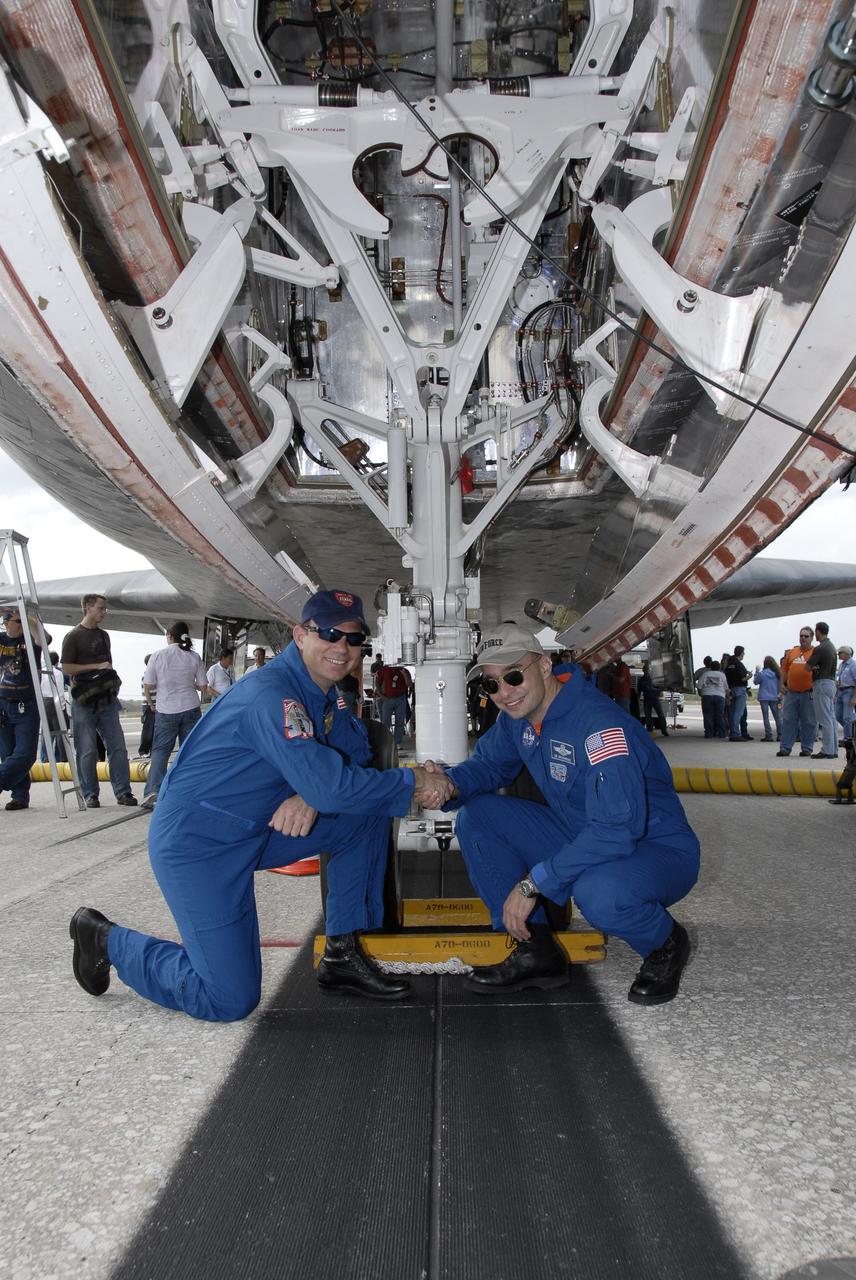
CAPE CANAVERAL, Fla. – STS-119 Pilot Tony Antonelli and Commander Lee Archambault share a congratulatory handshake as they kneel beside the nose gear of space shuttle Discovery on Runway 15 at NASA's Kennedy Space Center in Florida. Discovery’s landing completed the 13-day, 5.3-million mile journey of the STS-119 mission to the International Space Station. Main gear touchdown was at 3:13:17 p.m. EDT. Nose gear touchdown was at 3:13:40 p.m. and wheels stop was at 3:14:45 p.m. Discovery delivered the final pair of large power-generating solar array wings and the S6 truss segment. The mission was the 28th flight to the station, the 36th flight of Discovery and the 125th in the Space Shuttle Program, as well as the 70th landing at Kennedy. Photo credit: NASA/Kim Shiflett
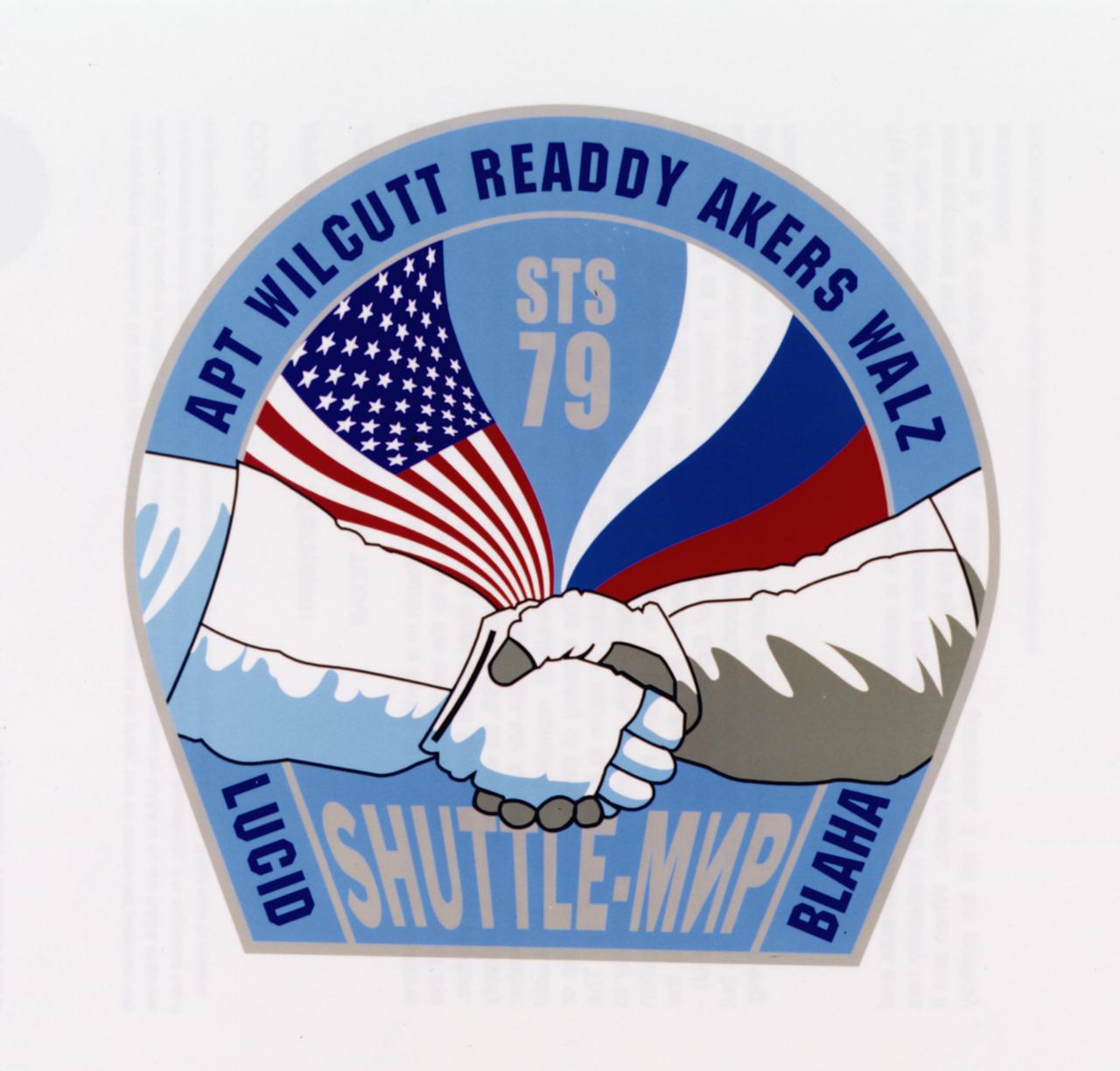
STS-79 was the fourth in a series of NASA docking missions to the Russian Mir Space Station, leading up to the construction and operation of the International Space Station (ISS). As the first flight of the Spacehab Double Module, STS-79 encompassed research, test and evaluation of ISS, as well as logistics resupply for the Mir Space Station. STS-79 was also the first NASA-Mir American crew member exchange mission, with John E. Blaha (NASA-Mir-3) replacing Shannon W. Lucid (NASA-Mir-2) aboard the Mir Space Station. The lettering of their names either up or down denotes transport up to the Mir Space Station or return to Earth on STS-79. The patch is in the shape of the Space Shuttle’s airlock hatch, symbolizing the gateway to international cooperation in space. The patch illustrates the historic cooperation between the United States and Russia in space. With the flags of Russia and the United States as a backdrop, the handshake of Extravehicular Mobility Unit (EMU) which are suited crew members symbolizes mission teamwork, not only of the crew members but also the teamwork between both countries space personnel in science, engineering, medicine and logistics.
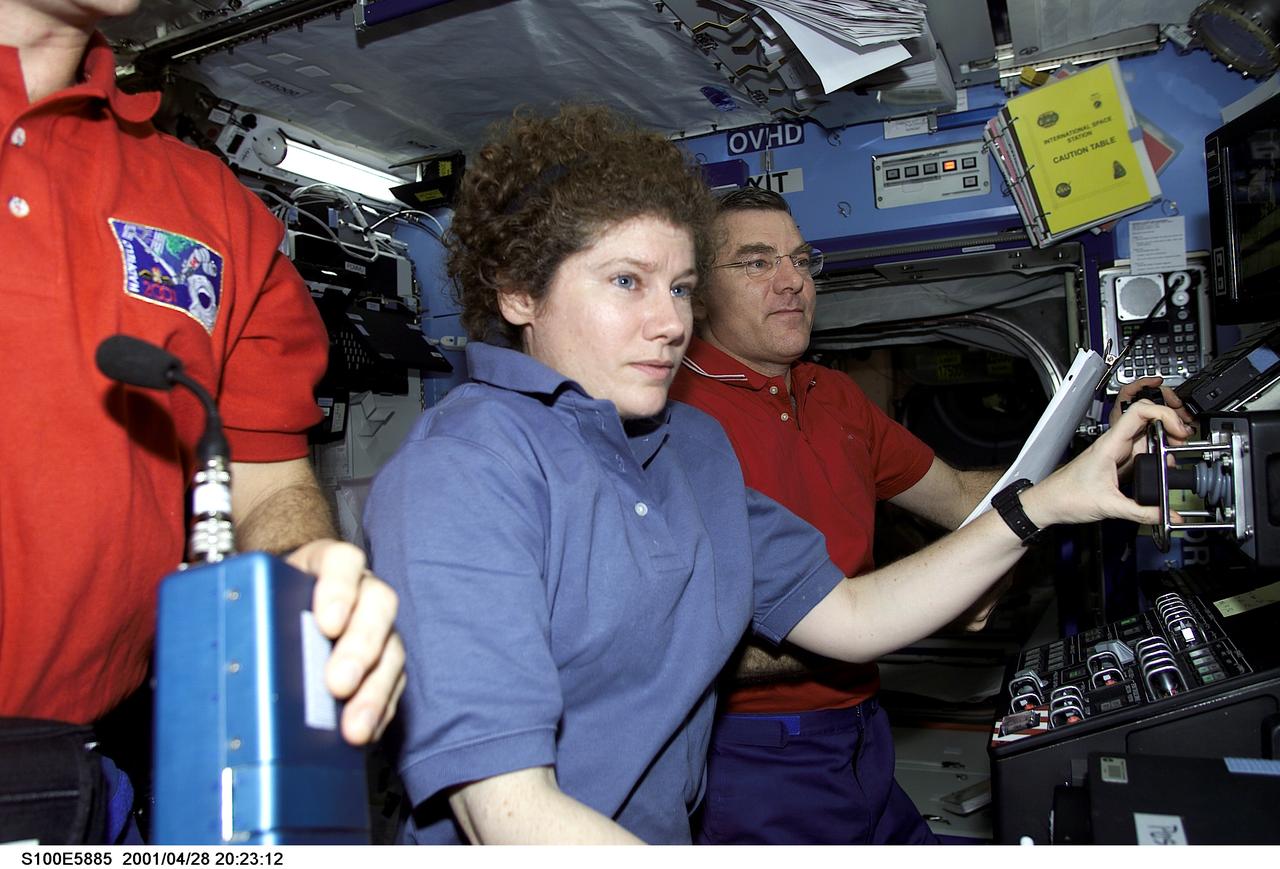
S100-E-5885 (28 April 2001) --- Some of the principal participants of an historical event are pictured in the Destiny laboratory aboard the International Space Station (ISS). From left to right are astronauts Chris A. Hadfield (partially out of frame), STS-100 mission specialist, and astronauts Susan J. Helms and James S. Voss, Expedition Two flight engineers. A Canadian “handshake in space” occurred at 4:02 p.m (CDT), April 28, 2001, as the Canadian-built space station robotic arm – operated by Helms – transferred its launch cradle over to Endeavour’s robotic arm, with Canadian Space Agency astronaut Hadfield at the controls. In this scene, Hadfield has temporarily vacated his post on Endeavour's aft flight deck and was having a brief strategy meeting with the Expedition Two crew on the docked station. The exchange of the pallet from station arm to shuttle arm marked the first ever robotic-to-robotic transfer in space. This image was recorded with a digital still camera.
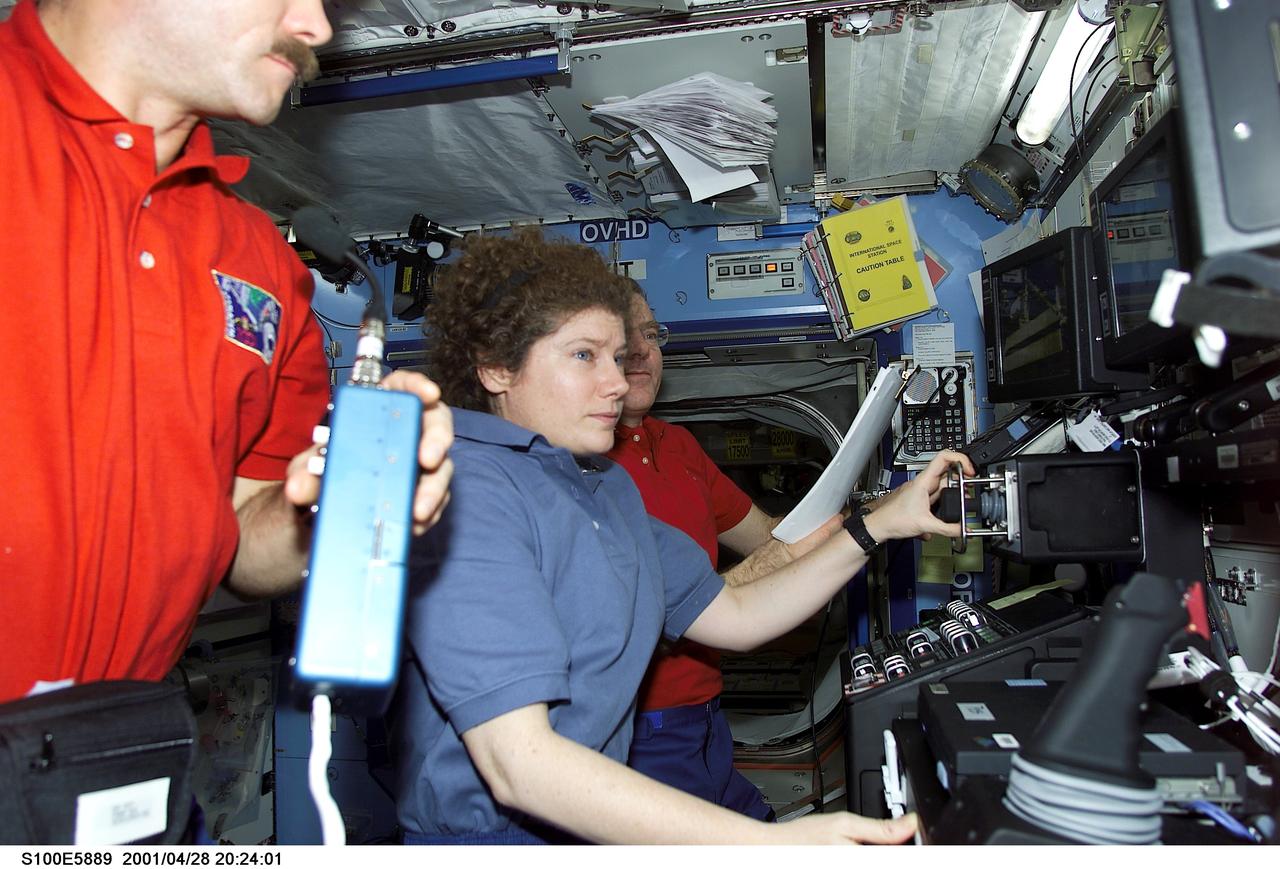
S100-E-5889 (28 April 2001) --- Two of the principal participants of an historical event are pictured in the Destiny laboratory aboard the International Space Station (ISS). Pictured are astronauts Chris A. Hadfield (partially out of frame), STS-100 mission specialist, and astronaut Susan J. Helms, flight engineer for Expedition Two. Astronaut James S. Voss, Expedition Two flight engineer, is in the background. A Canadian “handshake in space” occurred at 4:02 p.m (CDT), April 28, 2001, as the Canadian-built space station robotic arm – operated by Helms – transferred its launch cradle over to Endeavour’s robotic arm, with Canadian Space Agency astronaut Hadfield at the controls. In this scene, Hadfield has temporarily vacated his post on Endeavour's aft flight deck and was having a brief strategy meeting with Helms on the docked station. The exchange of the pallet from station arm to shuttle arm marked the first ever robotic-to-robotic transfer in space. This image was recorded with a digital still camera.

STS-102 mission astronauts James S. Voss and James D. Weatherbee share a congratulatory handshake as the Space Shuttle Orbiter Discovery successfully docks with the International Space Station (ISS). Photographed from left to right are: Astronauts Susan J. Helms, mission specialist; James S. Voss, Expedition 2 crew member; James D. Weatherbee, mission commander; Andrew S.W. Thomas, mission specialist; and nearly out of frame is James M. Kelley, Pilot. Launched March 8, 2001, STS-102's primary cargo was the Leonardo, the Italian Space Agency-built Multipurpose Logistics Module (MPLM). The Leonardo MPLM is the first of three such pressurized modules that will serve as ISS' moving vans, carrying laboratory racks filled with equipment, experiments, and supplies to and from the Station aboard the Space Shuttle. The cylindrical module is approximately 21-feet long and 15- feet in diameter, weighing almost 4.5 tons. It can carry up to 10 tons of cargo in 16 standard Space Station equipment racks. Of the 16 racks the module can carry, 5 can be furnished with power, data, and fluid to support refrigerators or freezers. In order to function as an attached station module as well as a cargo transport, the logistics module also includes components that provide life support, fire detection and suppression, electrical distribution, and computer functions. NASA's 103rd overall mission and the 8th Space Station Assembly Flight, STS-102 mission also served as a crew rotation flight. It delivered the Expedition Two crew to the Station and returned the Expedition One crew back to Earth.
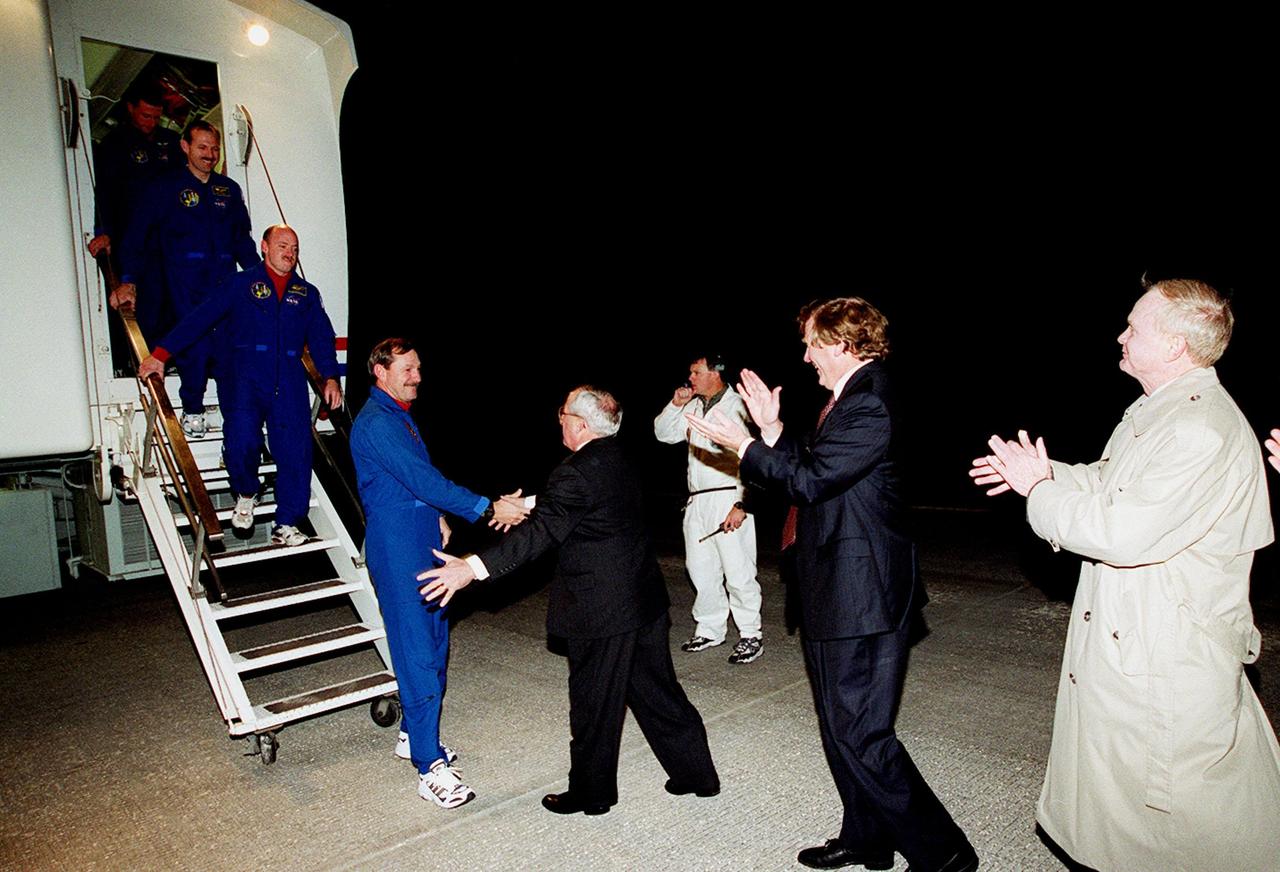
As he exits the Crew Hatch Access Vehicle, STS-103 Commander Curtis L. Brown Jr. is greeted with a handshake by Joseph Rothenberg, associate administrator, Office of Space Flight. Descending the stairs behind Brown are (left to right) Mission Specialists C. Michael Foale (Ph.D.) and John M. Grunsfeld (Ph.D.) and Pilot Scott J. Kelly. At right, applauding the astronauts return are Earle Huckins, deputy associate administrator, Office of Space Science, and Roy Bridges, director, Kennedy Space Center. Others in the crew (not shown) are Mission Specialists Steven L. Smith, and Jean-Francois Clervoy of France and Claude Nicollier of Switzerland, who are with the European Space Agency. The crew of seven completed a successful eight-day mission to service the Hubble Space Telescope, spending the Christmas holiday in space in order to accomplish their mission before the end of 1999. During the mission, Discovery's four space-walking astronauts, Smith, Foale, Grunsfeld and Nicollier, spent 24 hours and 33 minutes upgrading and refurbishing Hubble, making it more capable than ever to renew its observations of the universe. Mission objectives included replacing gyroscopes and an old computer, installing another solid state recorder, and replacing damaged insulation in the telescope. Hubble was released from the end of Discovery's robot arm on Christmas Day. Main gear touchdown was at 7:00:47 p.m. EST. Nose gear touchdown occurred at 7:00:58 p.m. EST and wheel stop at 7:01:34 p.m. EST. This was the 96th flight in the Space Shuttle program and the 27th for the orbiter Discovery. The landing was the 20th consecutive Shuttle landing in Florida and the 13th night landing in Shuttle program history
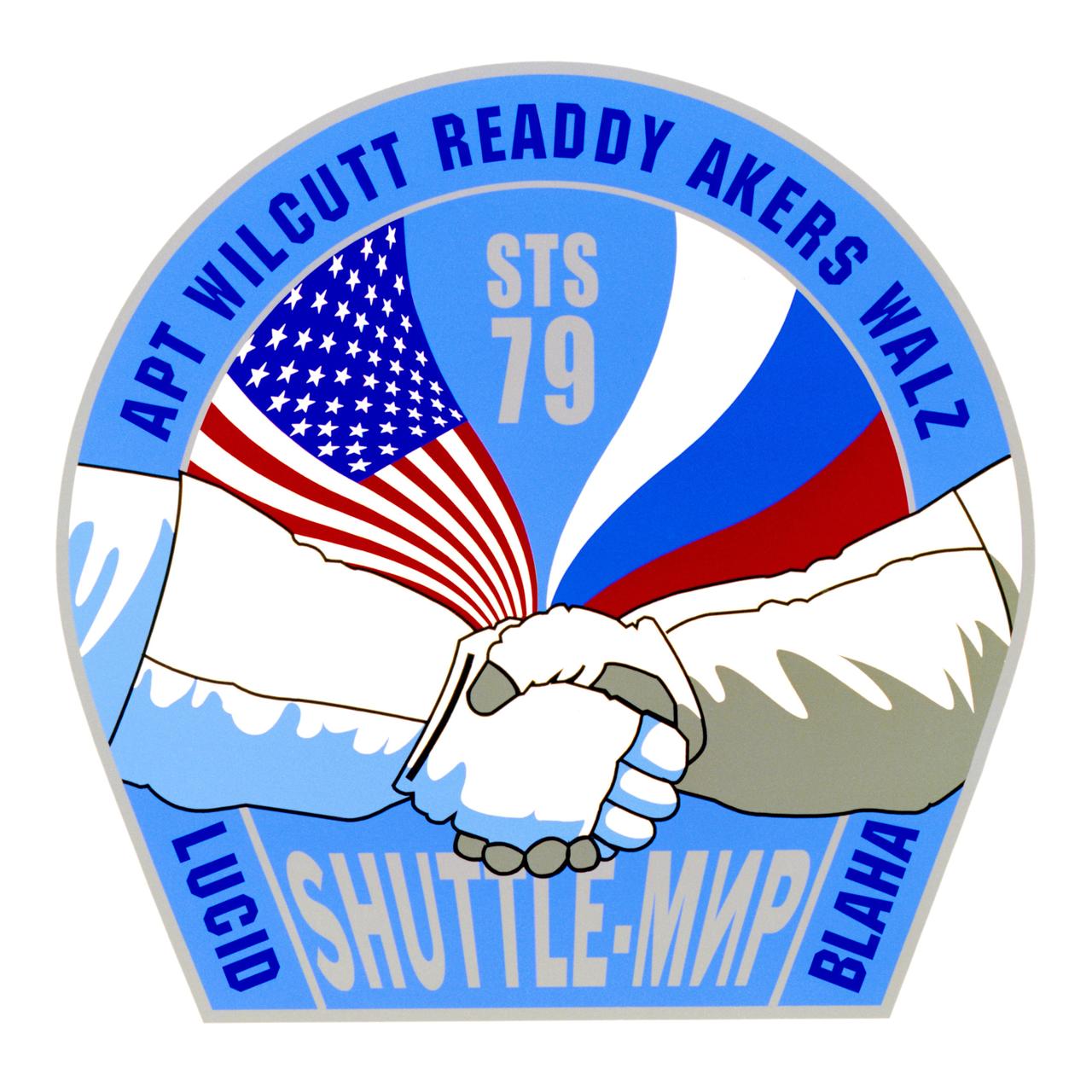
STS79-S-001 (April 1996) --- STS-79 is the fourth in a series of NASA docking missions to the Russian Mir Space Station, leading up to the construction and operation of the International Space Station (ISS). As the first flight of the Spacehab Double Module, STS-79 encompasses research, test and evaluation of ISS, as well as logistics resupply for the Mir Space Station. STS-79 is also the first NASA-Mir American crew member exchange mission, with John E. Blaha (NASA-Mir-3) replacing Shannon W. Lucid (NASA-Mir-2) aboard the Mir Space Station. The lettering of their names either up or down denotes transport up to the Mir Space Station or return to Earth on STS-79. The patch is in the shape of the space shuttle?s airlock hatch, symbolizing the gateway to international cooperation in space. The patch illustrates the historic cooperation between the United States and Russia in space. With the flags of Russia and the United States as a backdrop, the handshake of Extravehicular Mobility Unit (EMU) - suited crew members symbolizes mission teamwork, not only of the crew members but also the teamwork between both countries? space personnel in science, engineering, medicine and logistics. The NASA insignia design for space shuttle flights is reserved for use by the astronauts and for other official use as the NASA Administrator may authorize. Public availability has been approved only in the forms of illustrations by the various news media. When and if there is any change in this policy, which is not anticipated, the change will be publicly announced. Photo credit: NASA