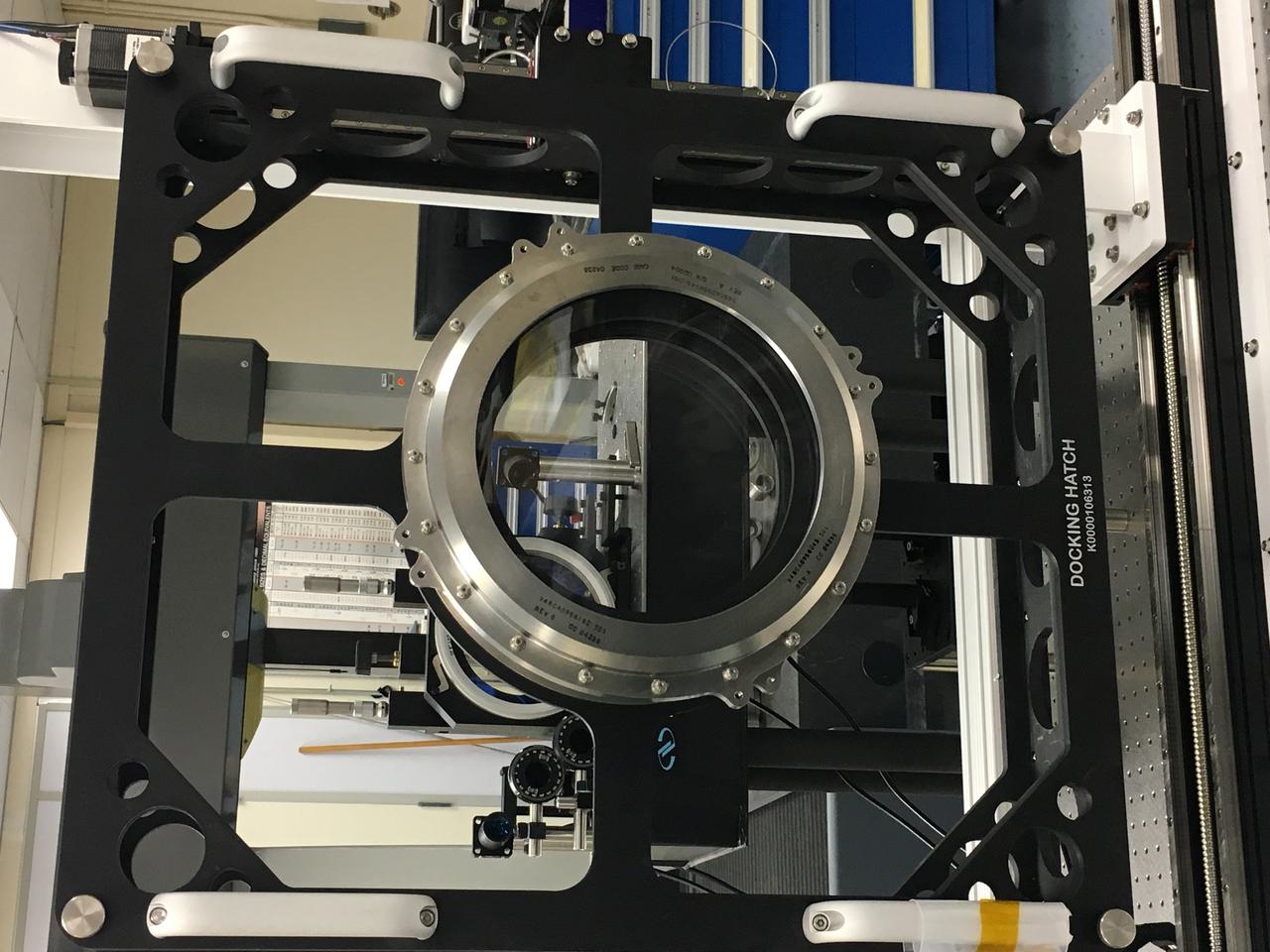
The first optical quality testing on a full window stack that is ready for installation in the docking hatch of NASA's Orion spacecraft is underway inside a laboratory in the Neil Armstrong Operations and Checkout Building at the agency's Kennedy Space Center in Florida. The test is being performed by a team from the center's Exploration Research and Technology Programs. The data from the tests will help improve the requirements for manufacturing tolerances on Orion's windows and verify how the window should perform in space. Orion is being prepared for its first integrated uncrewed flight atop NASA's Space Launch System rocket on Exploration Mission-1.
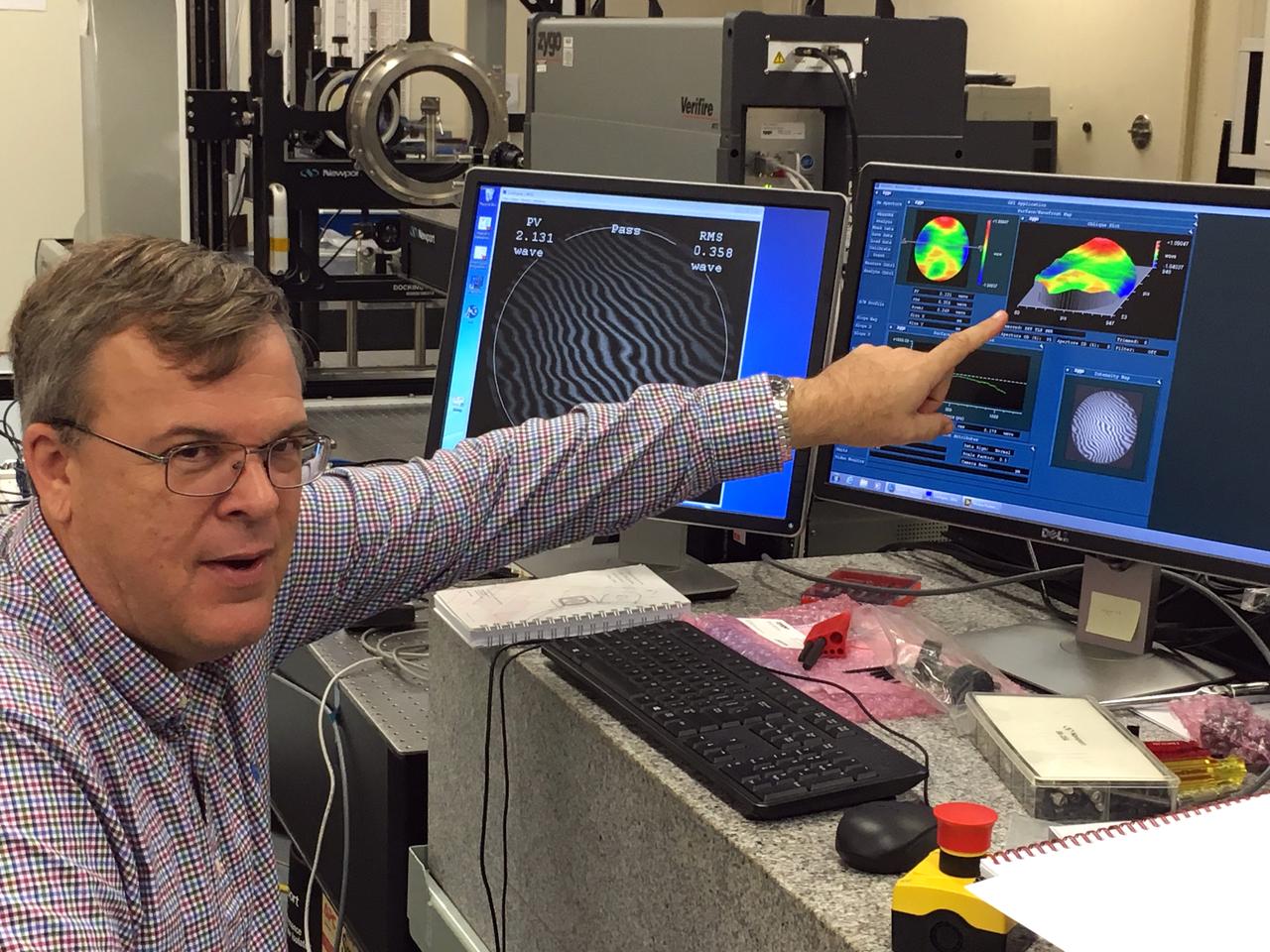
Mark Nurge, Ph.D., a physicist in the Applied Physics Lab with the Exploration Research and Technology Programs at NASA's Kennedy Space Center in Florida, looks at data during the first optical quality test on a full window stack that is ready for installation in the docking hatch of NASA's Orion spacecraft. The data from the tests will help improve the requirements for manufacturing tolerances on Orion's windows and verify how the window should perform in space. Orion is being prepared for its first integrated uncrewed flight atop NASA's Space Launch System rocket on Exploration Mission-1.
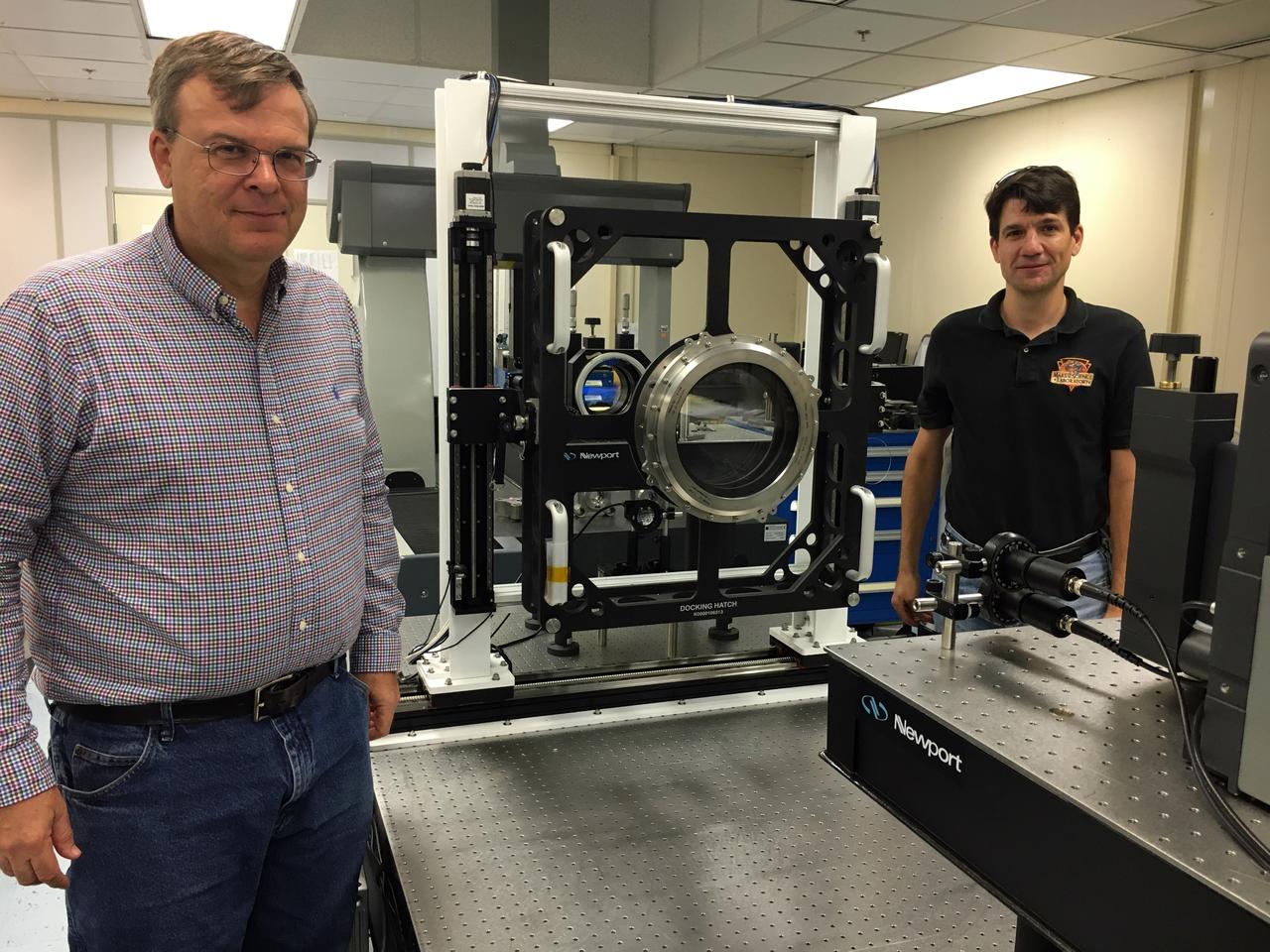
Inside a laboratory in the Neil Armstrong Operations and Checkout Building at NASA's Kennedy Space Center in Florida, Mark Nurge, Ph.D., at left, a physicist in the Applied Physics Lab with the center's Exploration Research and Technology Programs, and Bence Bartha, Ph.D., a specialist in non-destructive testing with URS Federal Services, are performing the first optical quality testing on a full window stack that is ready for installation in the docking hatch of NASA's Orion spacecraft. The data from the tests will help improve the requirements for manufacturing tolerances on Orion's windows and verify how the window should perform in space. Orion is being prepared for its first integrated uncrewed flight atop NASA's Space Launch System rocket on Exploration Mission-1.
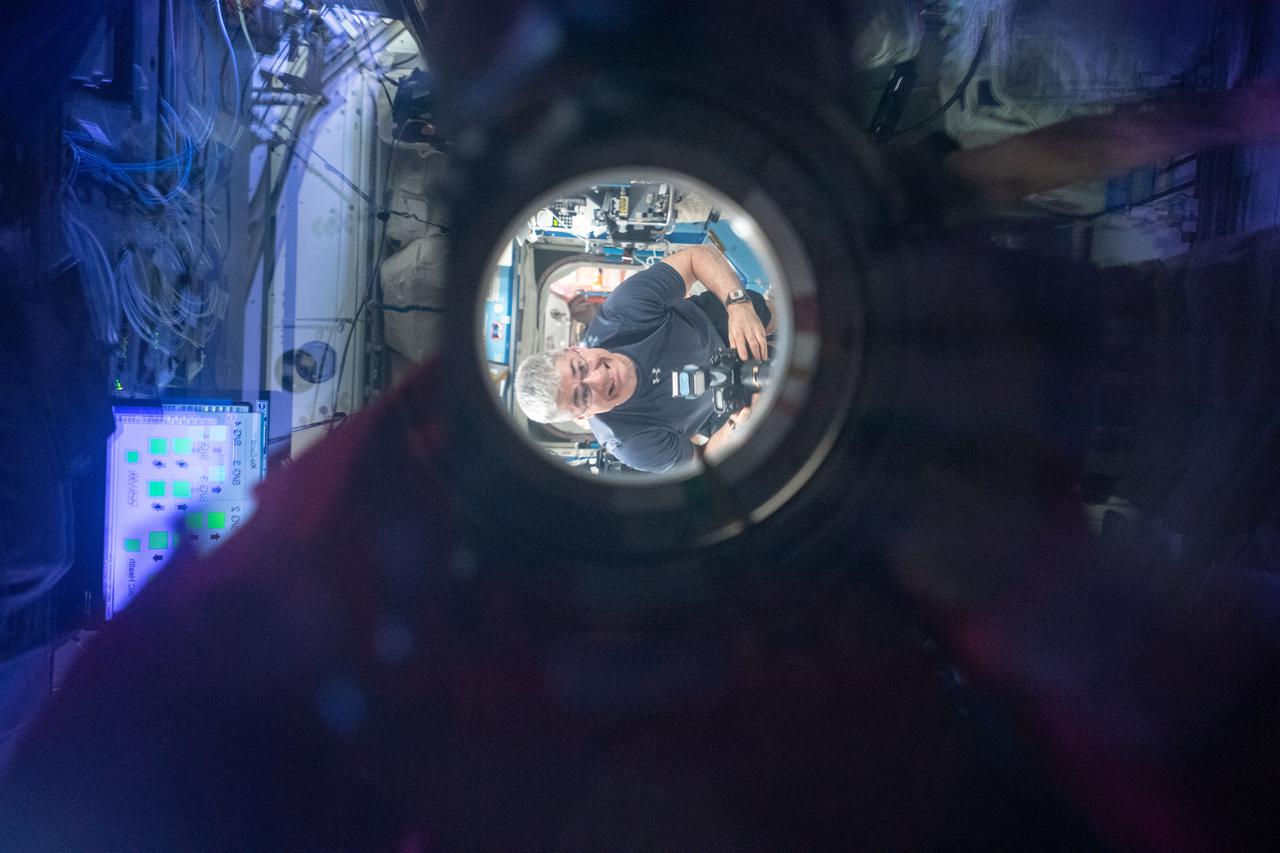
View of Mark Vande Hei through hatch window during Expedition 66.
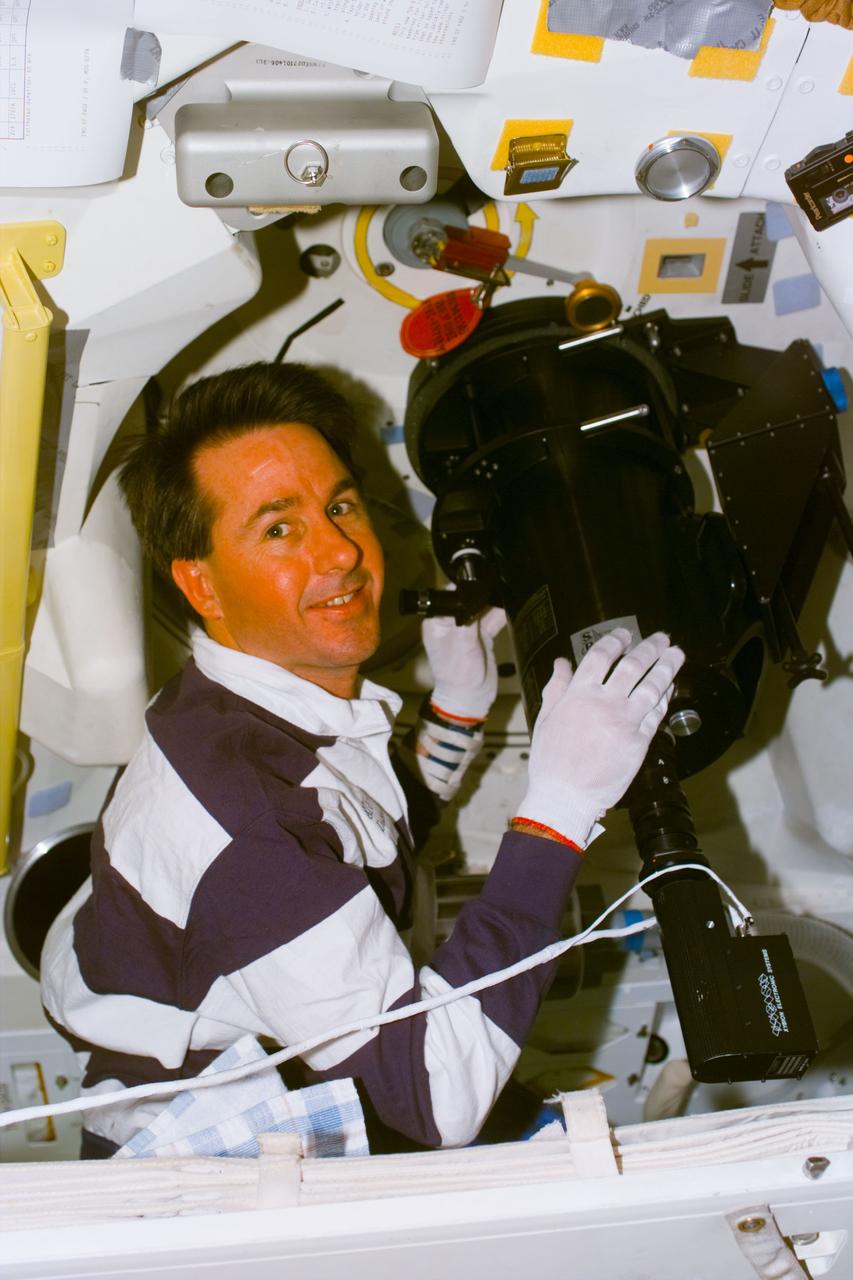
S85-E-5048 (7 - 19 August 1997) --- Astronaut Stephen K. Robinson, mission specialist, performing the Southwest Ultraviolet Imaging System (SWUIS) observations through the Space Shuttle Discovery's hatch window during flight day six.
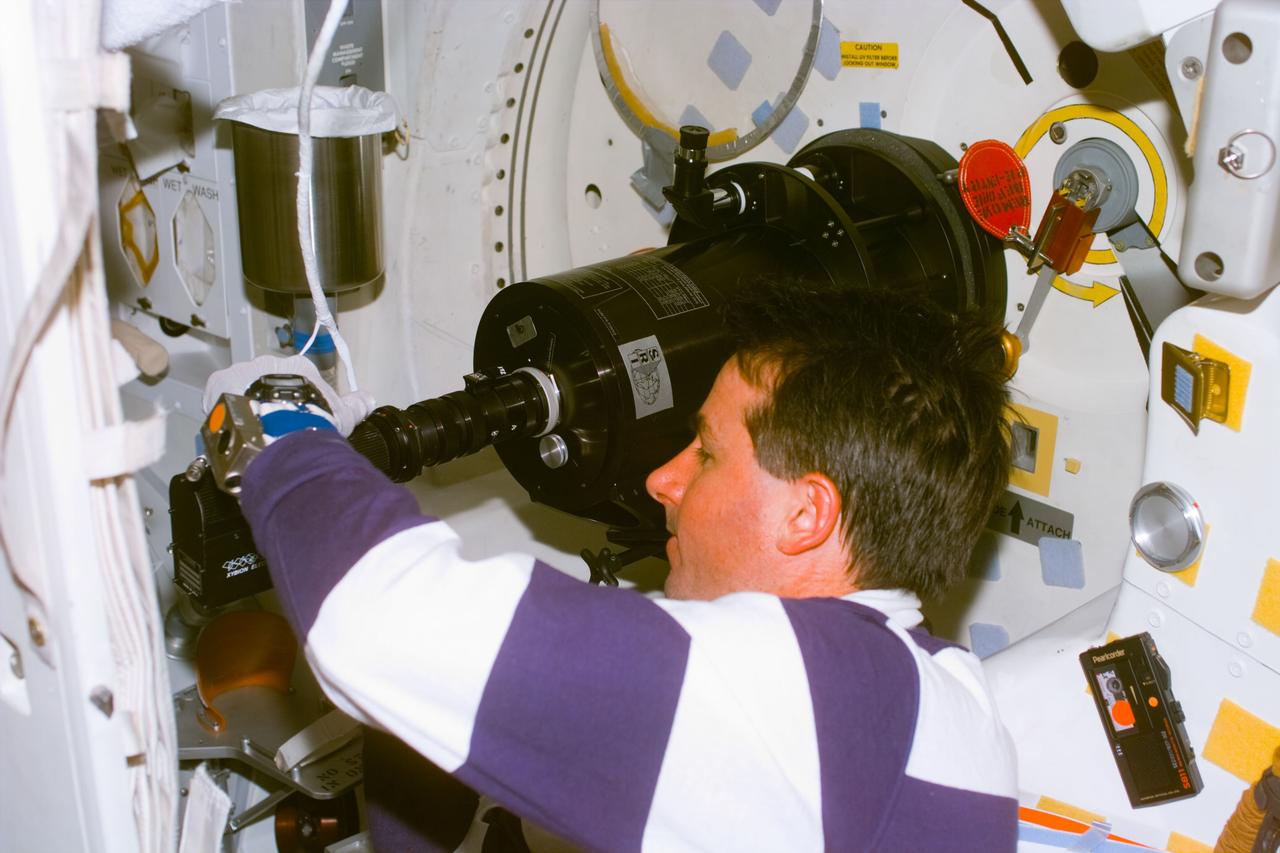
S85-E-5046 (12 August 1997) --- Astronaut Stephen K. Robinson, mission specialist, makes observations with the Southwest Ultraviolet Imaging System (SWUIS) through the Space Shuttle Discovery's hatch window during flight day six. The photograph was taken with the Electronic Still Camera (ESC).
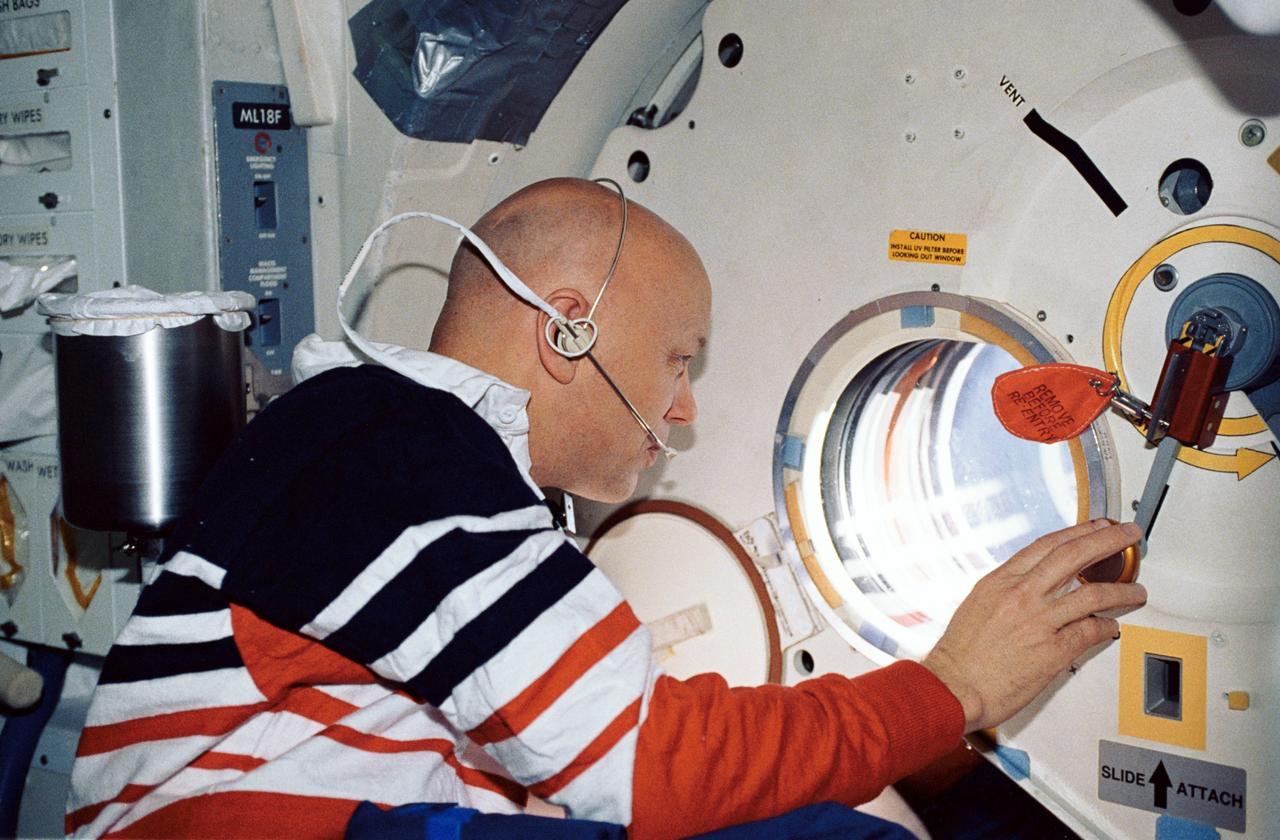
STS044-32-003 (24 Nov.-1 Dec. 1991) --- Astronaut F. Story Musgrave, STS-44 mission specialist, makes visual observations through Atlantis' hatch window. This photograph was among the first released by NASA following the eight day mission, dedicated to the Department of Defense.
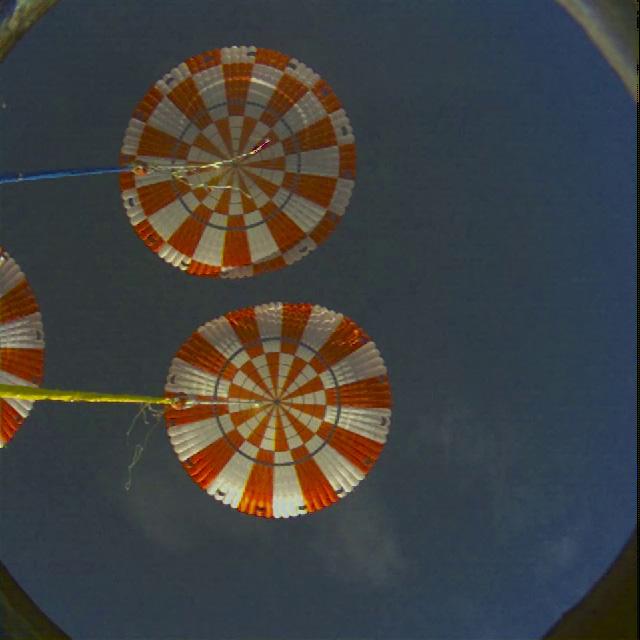
A view from the top hatch window as the parachutes deploy on Orion's first flight test, Exploration Flight Test-1 (EFT-1), on December 5, 2014.
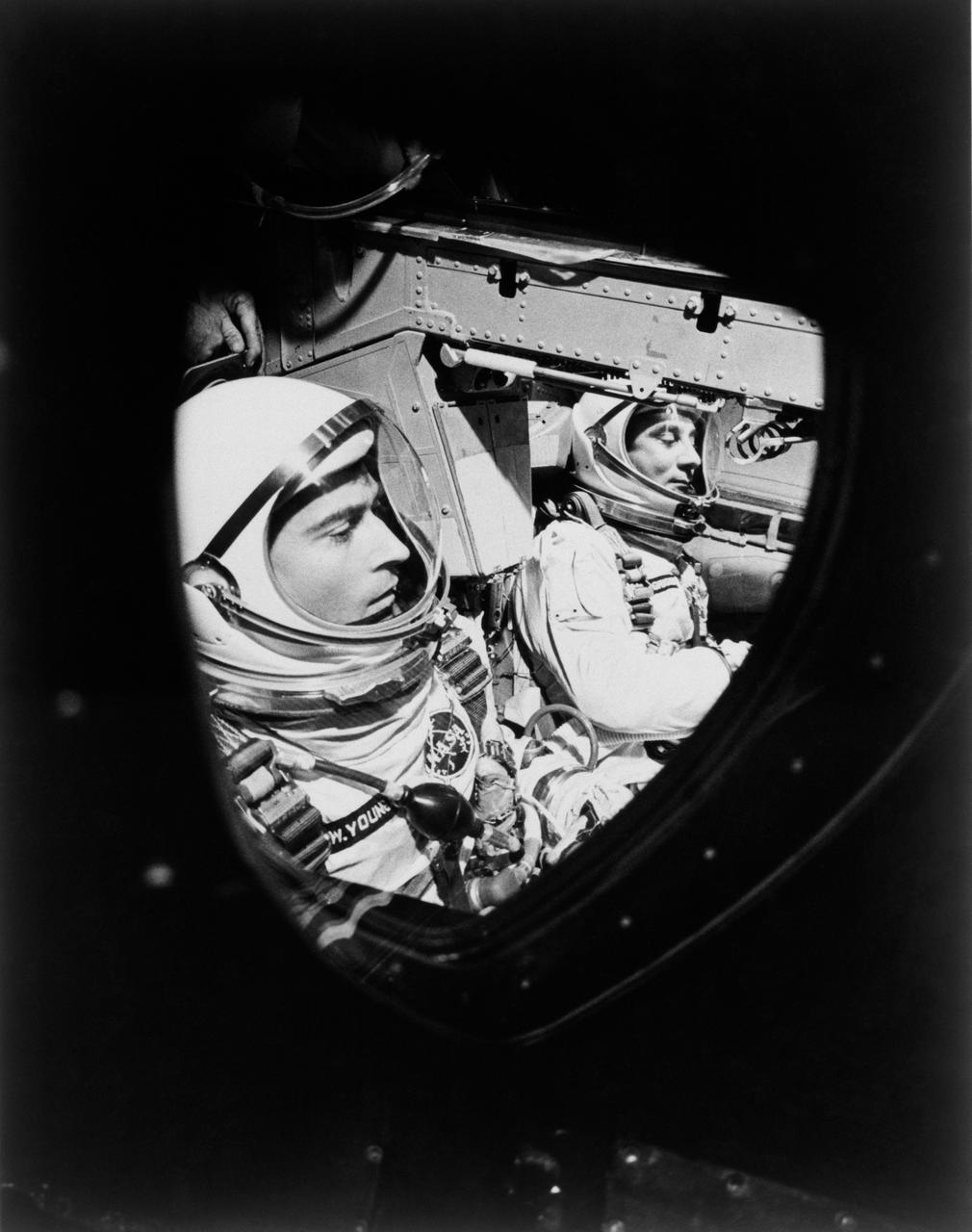
S65-19225 (23 March 1965) --- This view of astronauts John W. Young (left), pilot, and Virgil I. Grissom, command pilot, was taken through the window of the open hatch on Young's side of the Gemini-Titan 3 spacecraft just before the hatches were closed in readiness for their three-orbit flight.
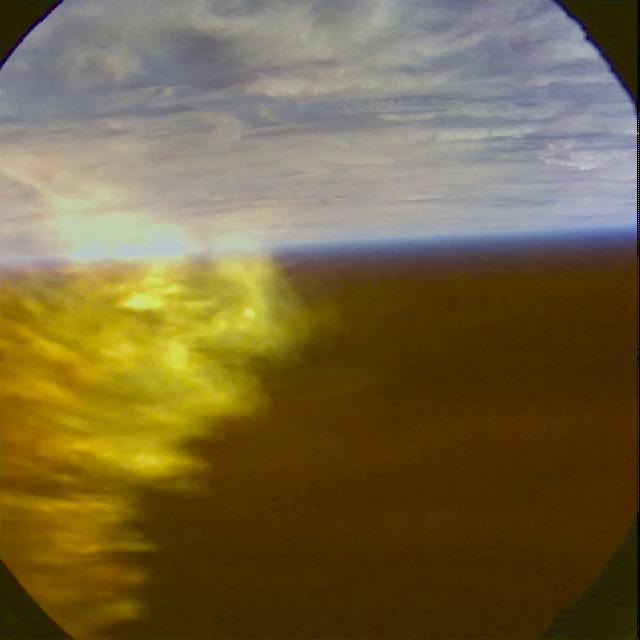
A view from the top hatch window as plasma surrounds the vehicle during reentry on Orion's first flight test, Exploration Flight Test-1 (EFT-1), on December 5, 2014.
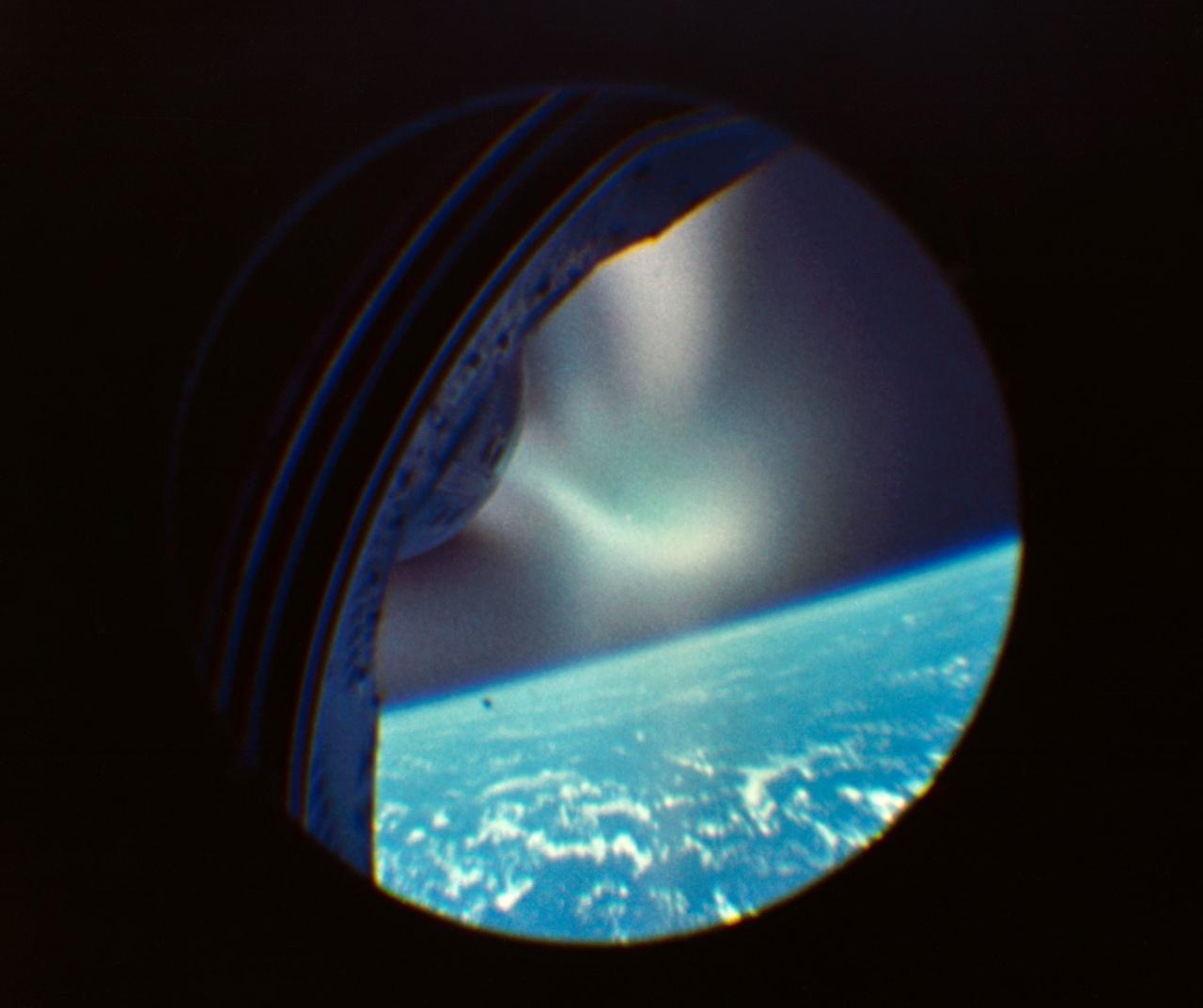
This photograph is an enlargement of a frame from a 16mm motion picture film which was mounted within the spacecraft to take film through the hatch window. CAPE KENNEDY, FL CN
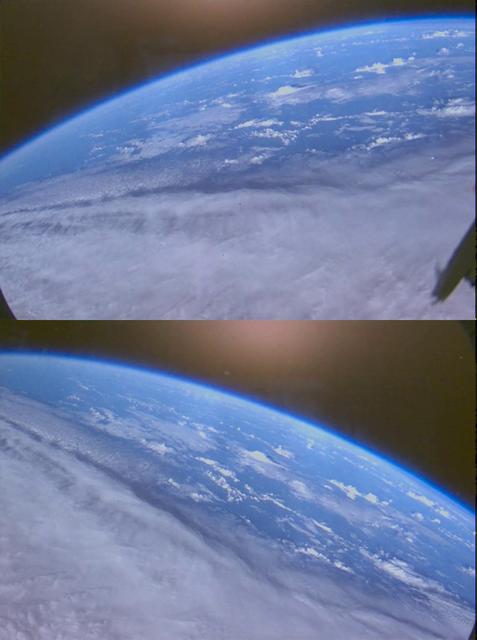
A view from the top hatch window as plasma surrounds the vehicle during reentry on Orion's first flight test, Exploration Flight Test-1 (EFT-1), on December 5, 2014.
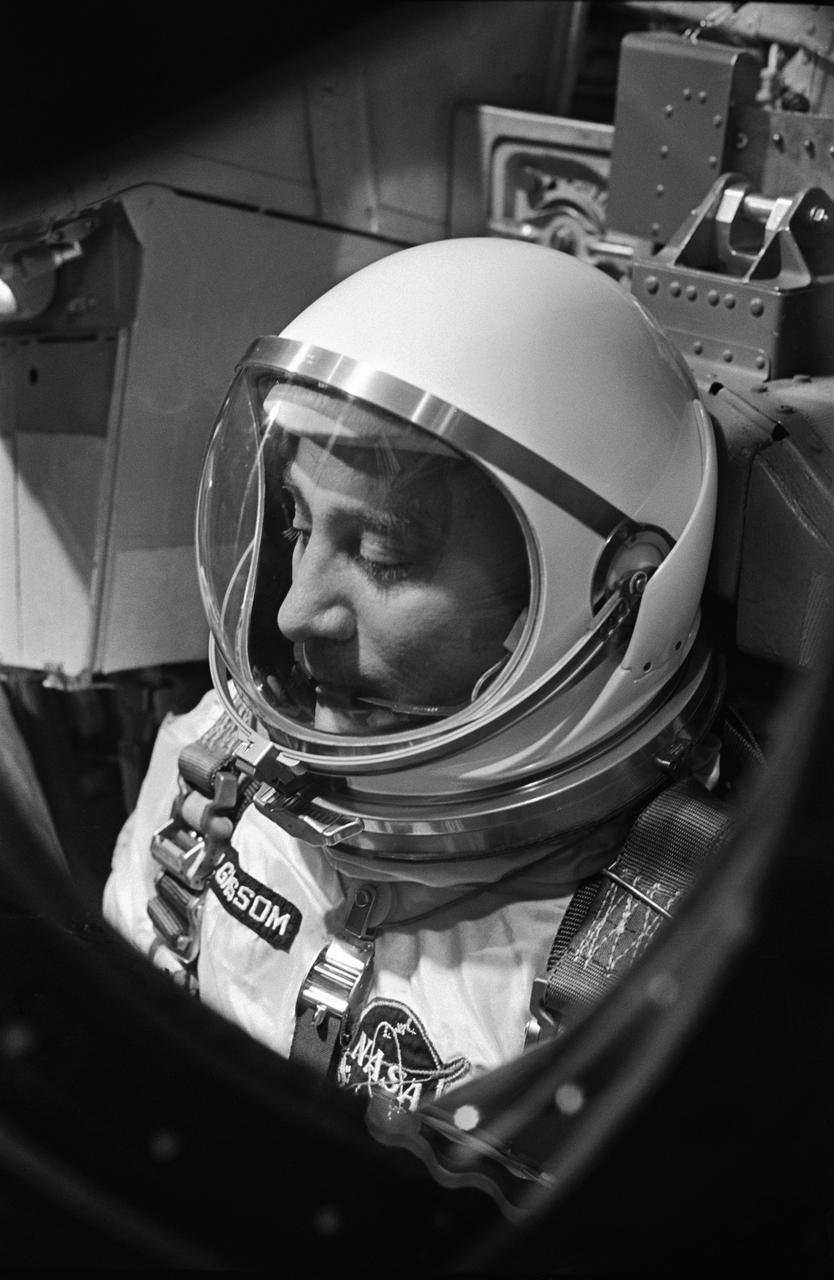
S65-20605 (23 March 1965) --- Astronaut Virgil I. Grissom, the command pilot of the Gemini-Titan 3 mission, is shown through the window of the open hatch on the Gemini spacecraft in the white room on the morning of the launch.
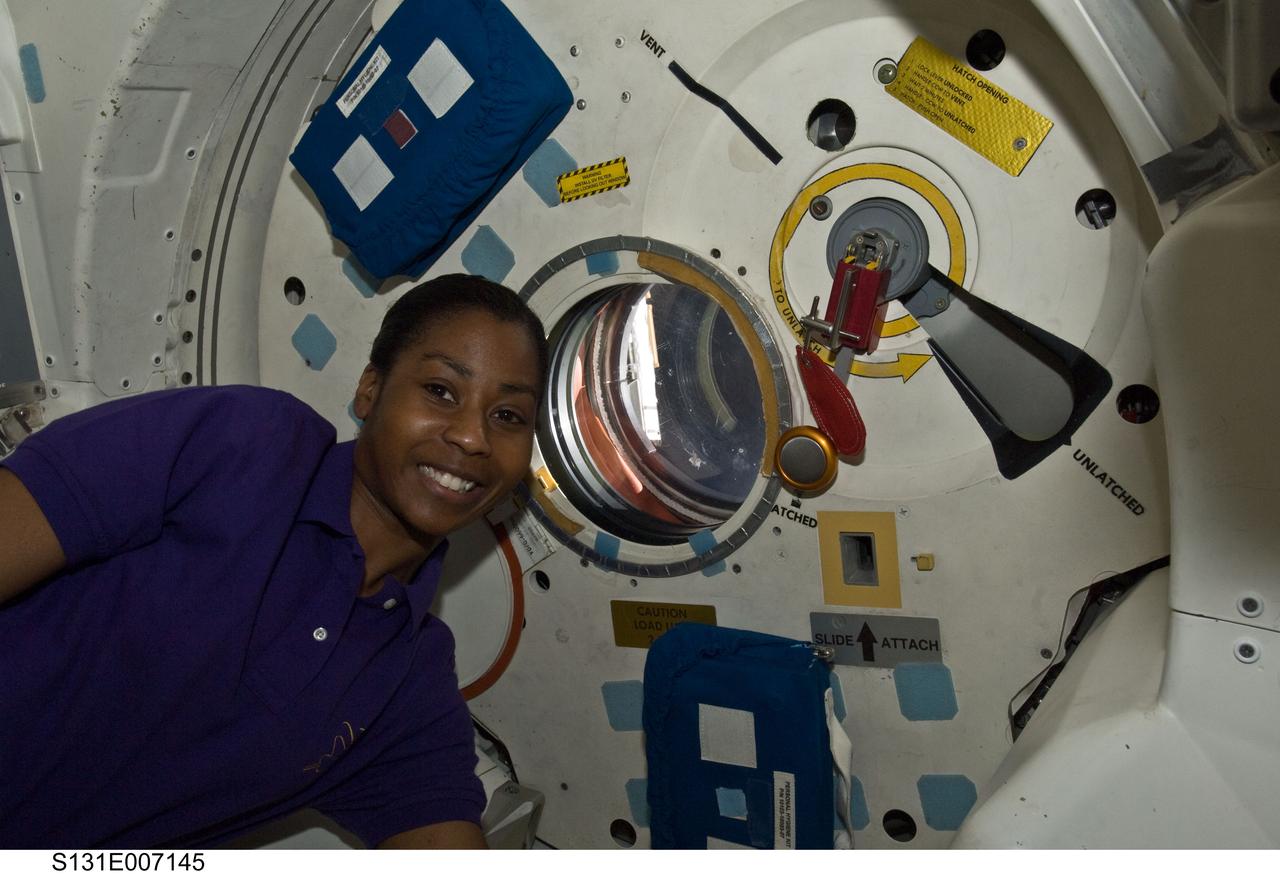
S131-E-007145 (6 April 2010) --- NASA astronaut Stephanie Wilson, STS-131 mission specialist, is pictured near a hatch window on the middeck of space shuttle Discovery during flight day two activities.
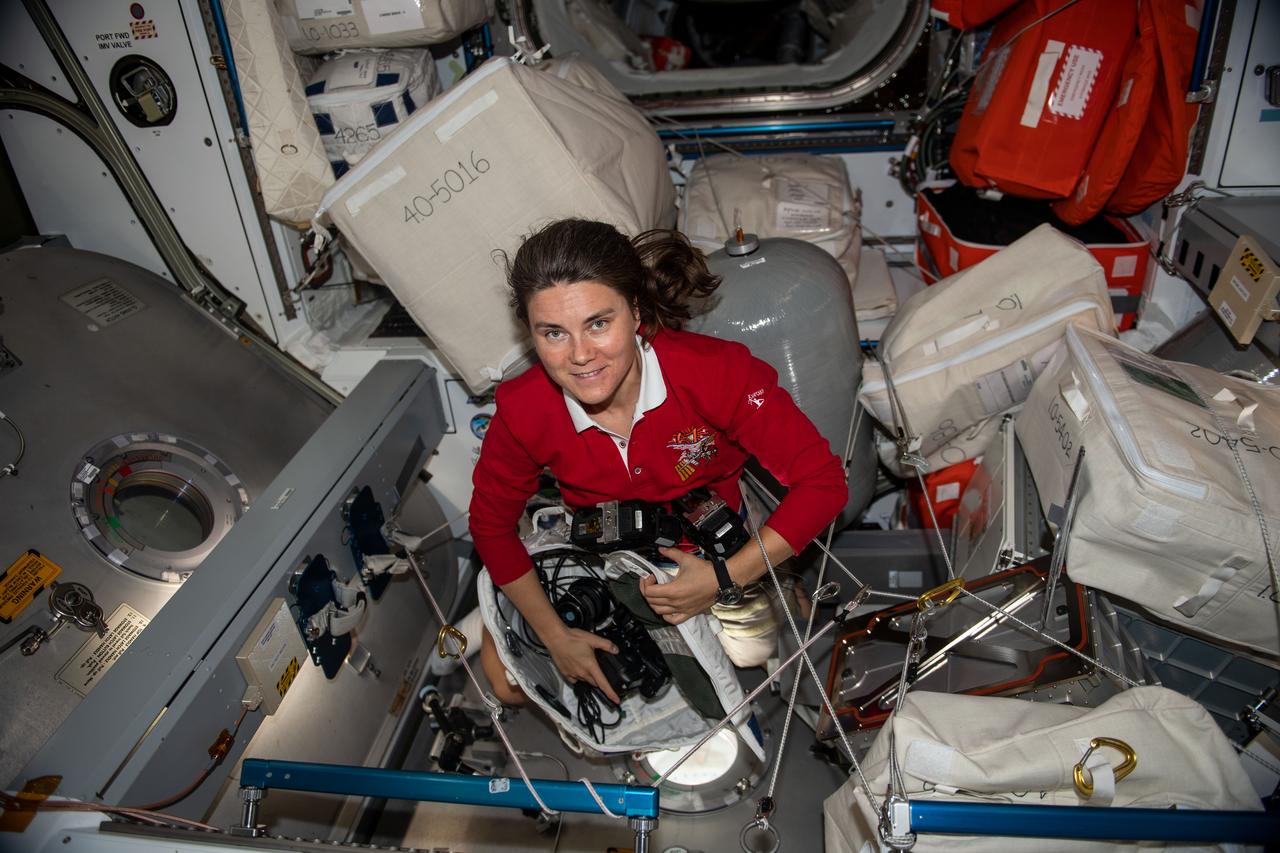
iss068e021032 (Nov. 7, 2022) --- Roscosmos cosmonaut and Expedition 68 Flight Engineer Anna Kikina prepares camera equipment for an Earth photography session through a hatch window on the International Space Station's Harmony module.
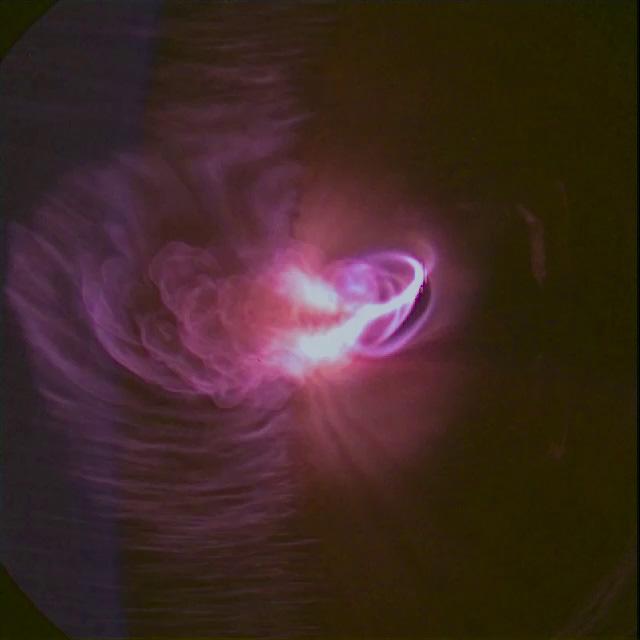
A view from the top hatch window as plasma surrounds the vehicle during reentry on Orion's first flight test, Exploration Flight Test-1 (EFT-1), on December 5, 2014.
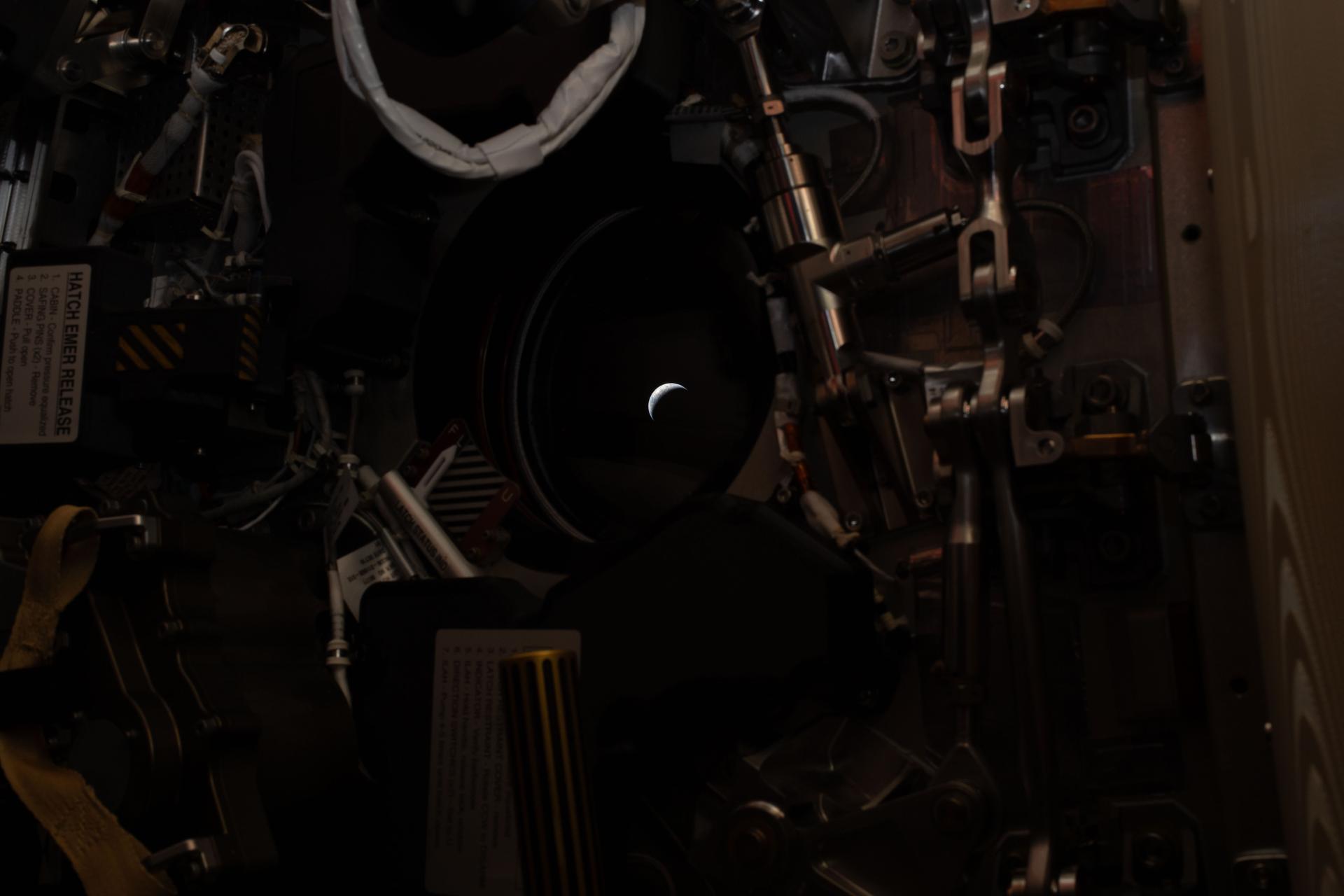
art002e024081 (April 5, 2026) – View of Earth out of the Orion spacecraft’s side hatch window taken by a member of the Artemis II crew at the end of Flight Day 5, the night before lunar flyby. Credit: NASA
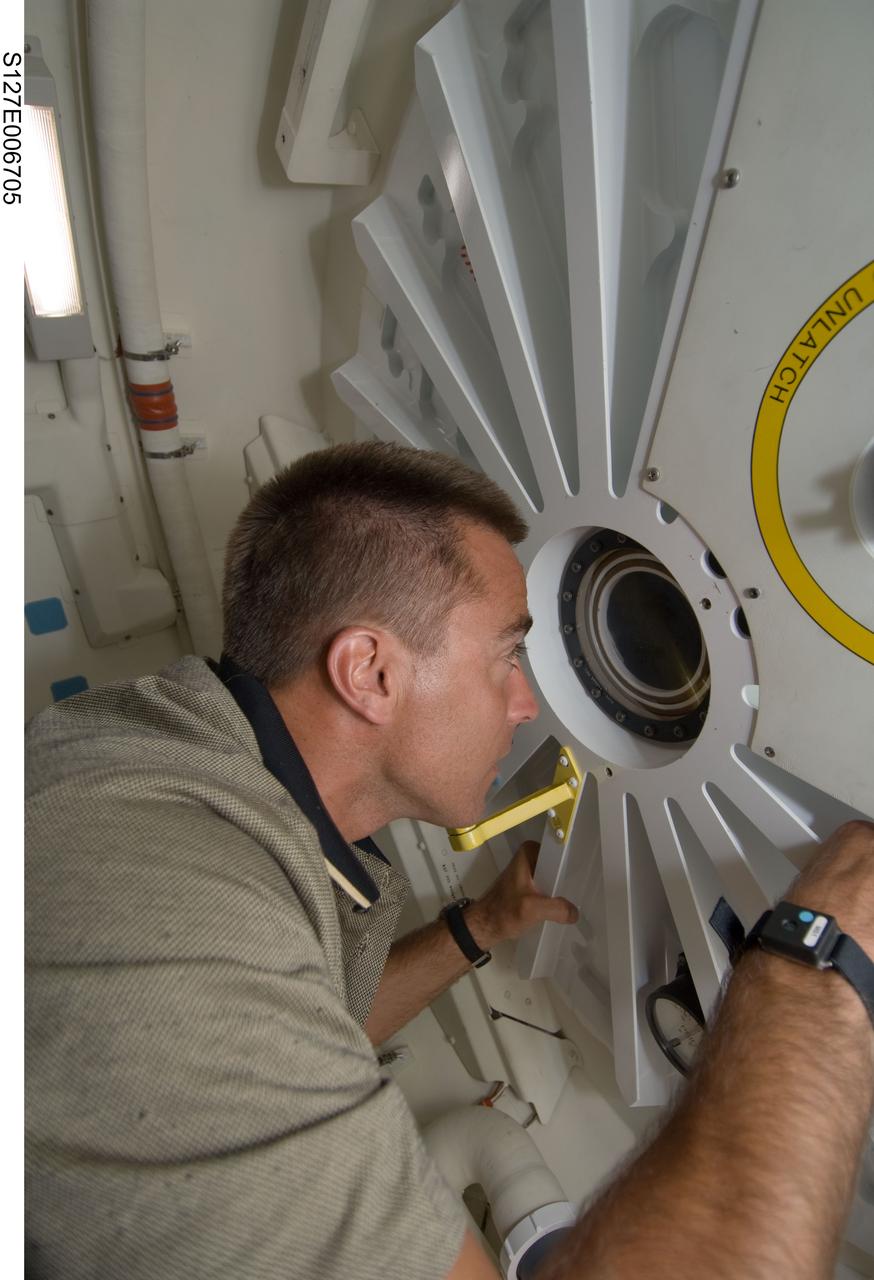
S127-E-006705 (17 July 2009) --- Astronaut Christopher Cassidy, STS-127 mission specialist, peers through a window in the hatch that separates seven Endeavour crew members from six International Space Station inhabitants. But the separation wasn't for long, as soon afterward the hatch was opened and the visitors from Earth moved onto the station to set the population record at 13. More importantly, over a week's worth of joint activities lies ahead for the two crews.
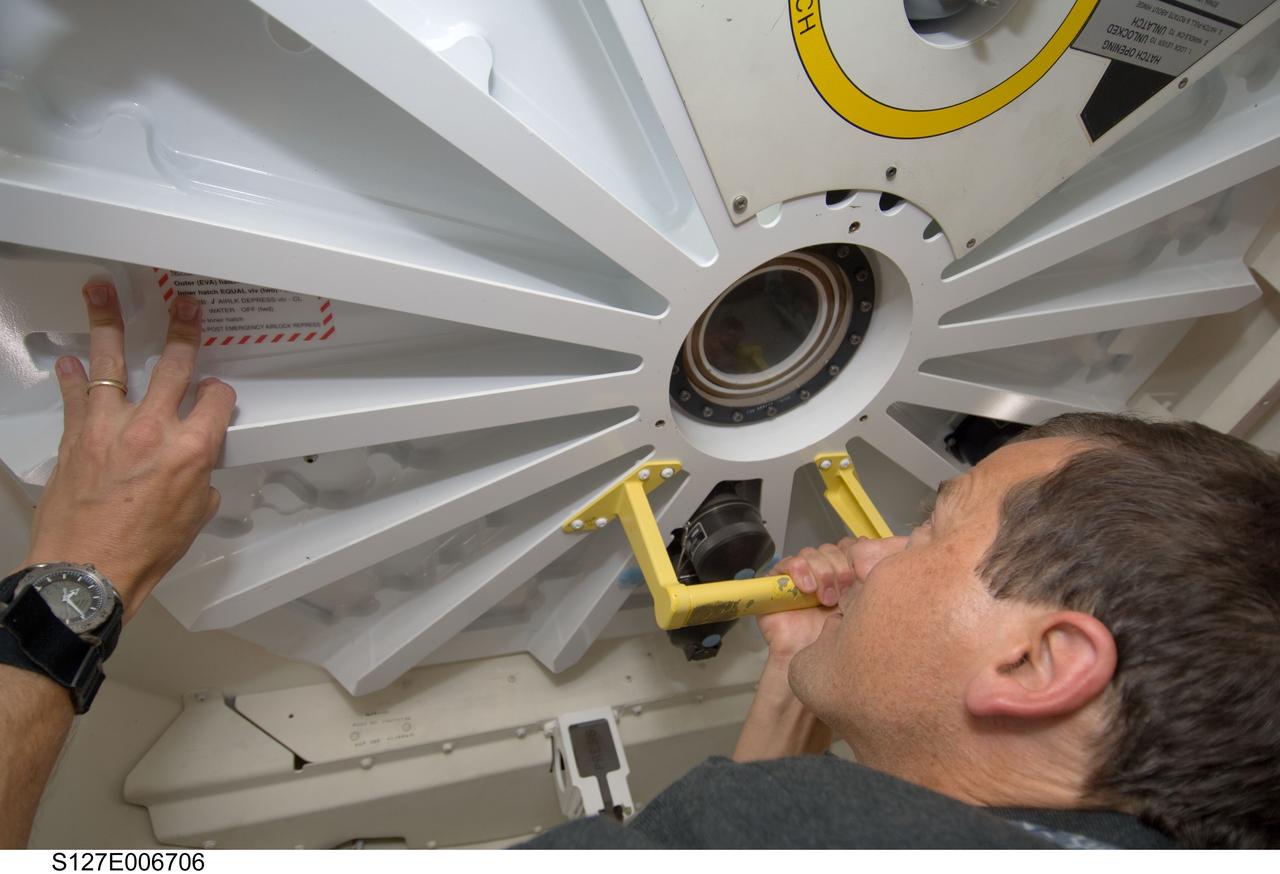
S127-E-006706 (17 July 2009) --- Astronaut Tom Marshburn, STS-127 mission specialist, peers through a window in the hatch that separates seven Endeavour crewmembers from six International Space Station inhabitants. But the separation wasn't for long, as soon afterward the hatch was opened and the visitors from Earth moved onto the station to set the population record at 13. More importantly, over a week's worth of joint activities lies ahead for the two crews.
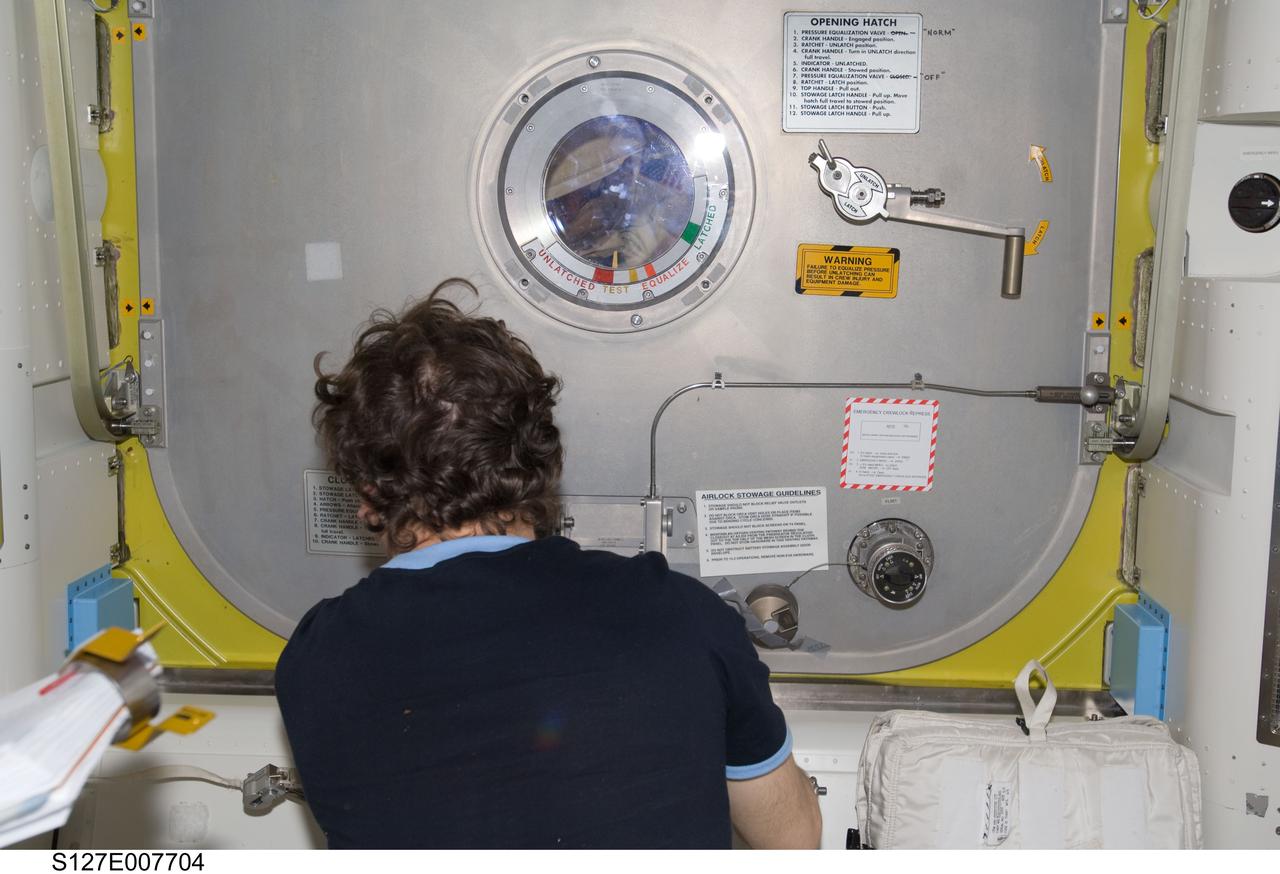
S127-E-007704 (22 July 2009) --- Astronaut Mike Barratt, Expedition 20 flight engineer, looks at astronaut Dave Wolf through the hatch window just after "sending off" astronauts Wolf and Christopher Cassidy (out of frame) for Endeavour's third space walk of a scheduled five overall for this flight.
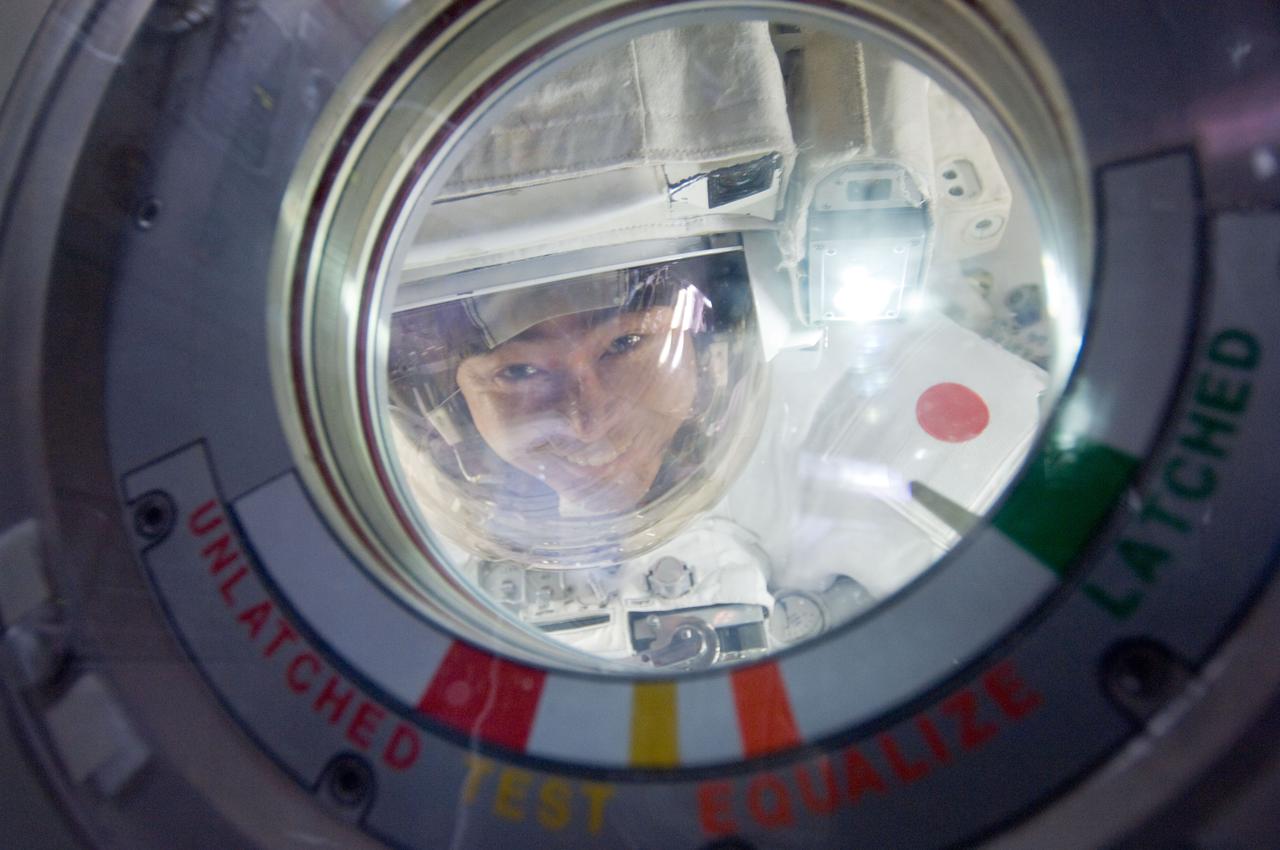
ISS032-E-024401 (30 Aug. 2012) --- Japan Aerospace Exploration Agency astronaut Aki Hoshide, Expedition 32 flight engineer, attired in an Extravehicular Mobility Unit (EMU) spacesuit, looks through a hatch window in the Quest airlock of the International Space Station prior to a session of extravehicular activity (EVA).
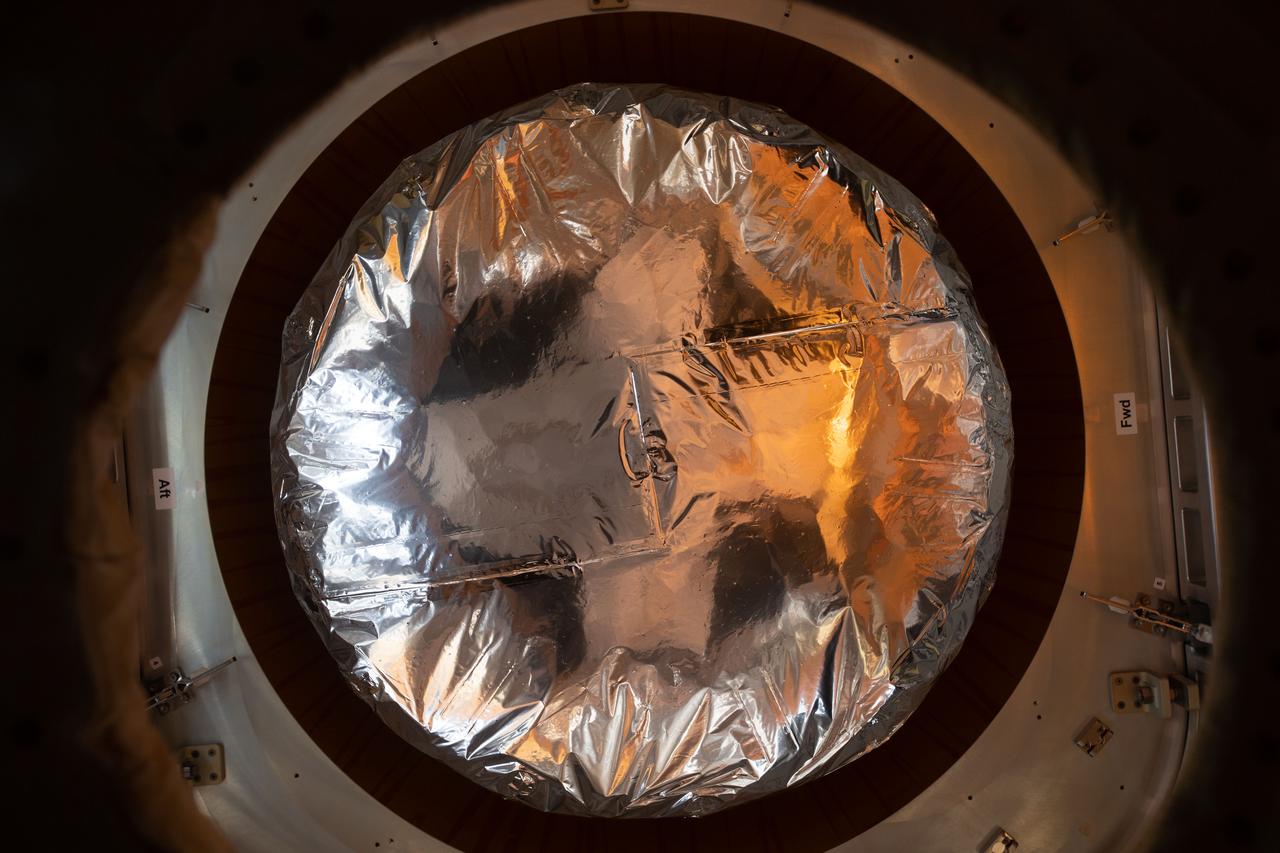
iss057e059221 (11/7/2018) --- A view taken through the Harmony Node 2 nadir hatch window of the Kounotori H-II Transfer Vehicle 7 (HTV-7), with the HTV Small Re-entry Capsule (HSRC) in view, during unberthing and backing away from the International Space Station (ISS).
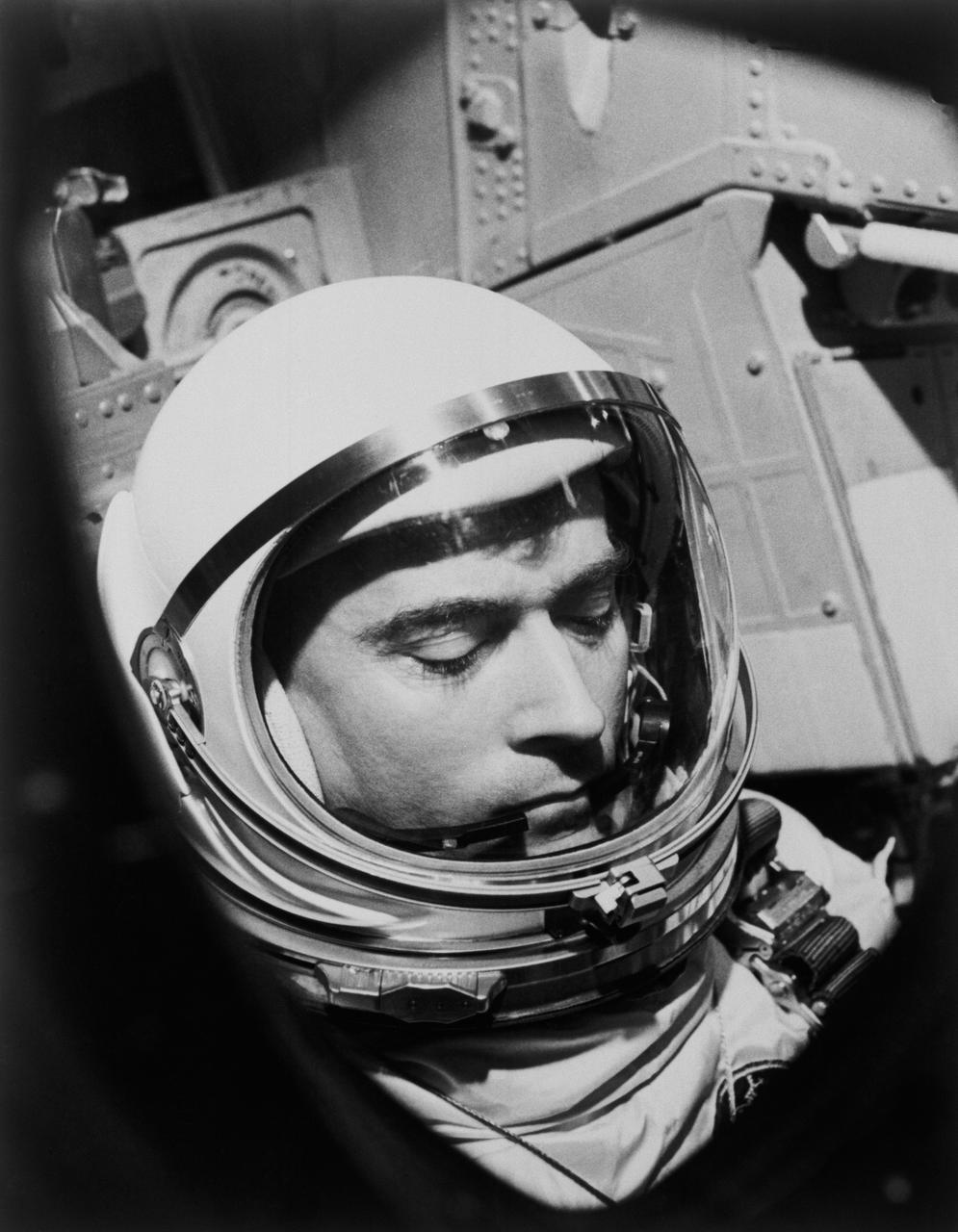
S65-19228 (23 March 1965) --- Astronaut John W. Young, the pilot of the Gemini-Titan 3 mission, is shown going through last minute checks before the hatch is closed on the spacecraft. The window frames Young just before the launch.

S65-63113 (15 Dec. 1965) --- This photograph of the Gemini-7 spacecraft was taken from the hatch window of the Gemini-6 spacecraft during rendezvous and station keeping maneuvers at an altitude of approximately 160 miles on Dec. 15, 1965. Photo credit: NASA or National Aeronautics and Space Administration
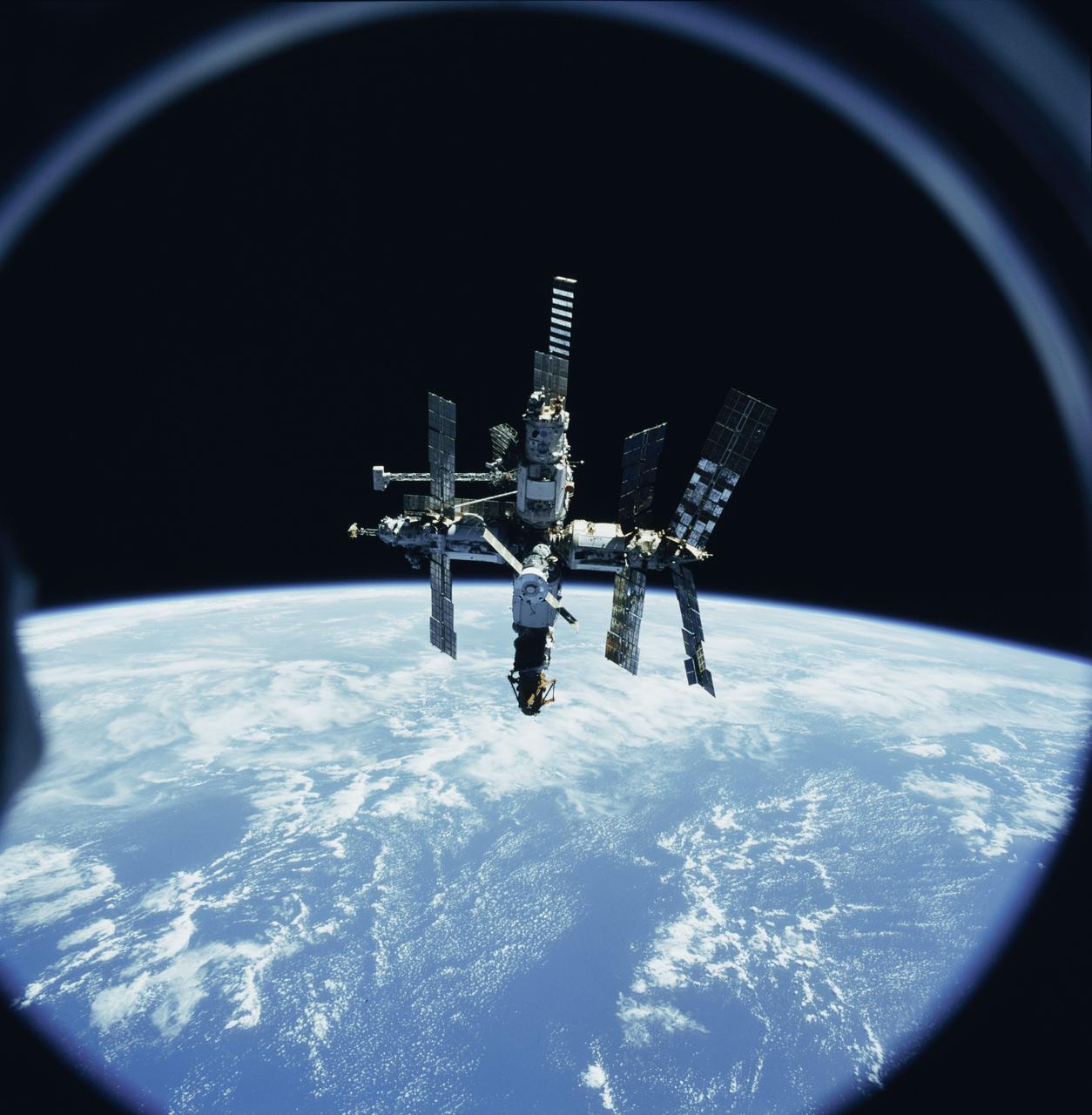
STS091-707-060 (2-12 June 1998) --- As photographed through a hatch window on the Space Shuttle Discovery, Russia's Mir space station is backdropped against Earth's horizon. The photo was made during the final fly-around of the members of the fleet of NASA shuttles.
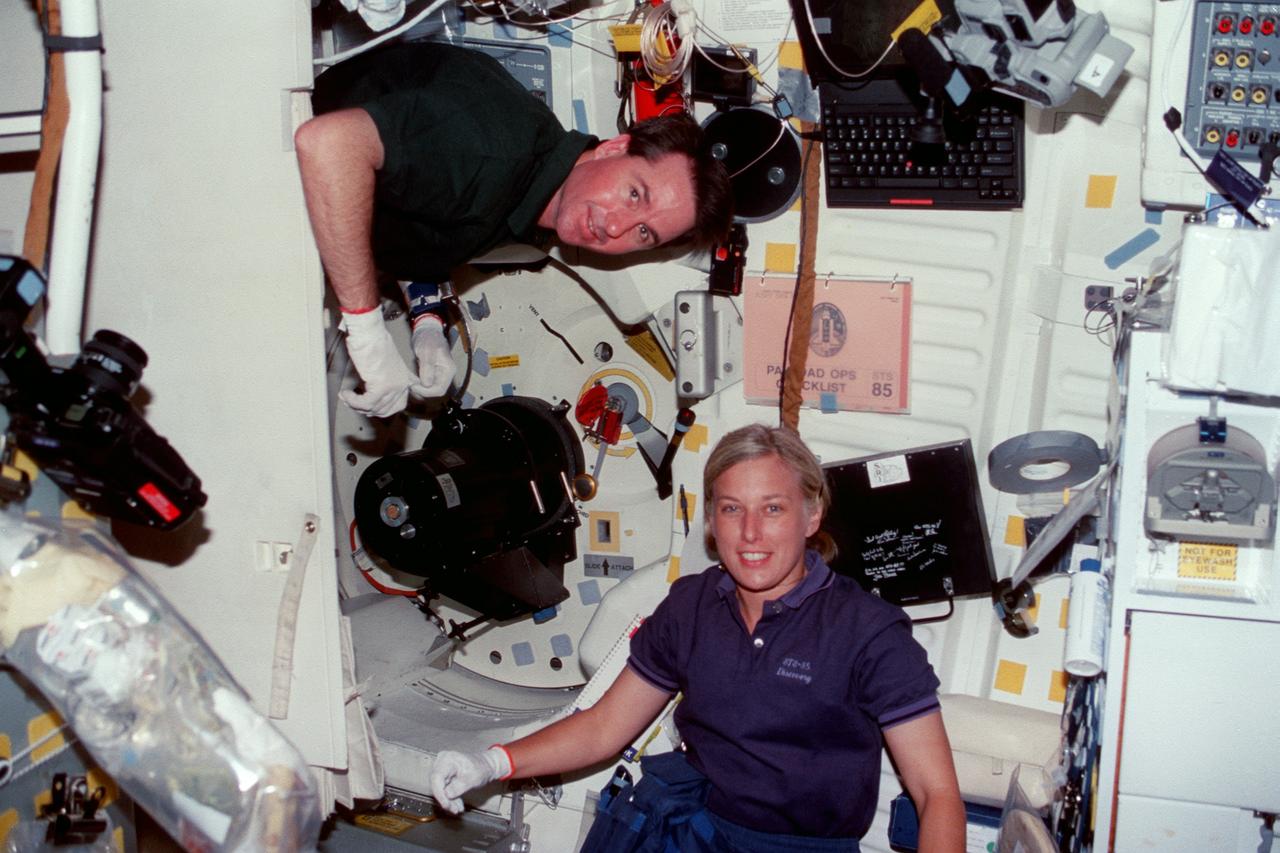
STS085-313-037 (7 - 19 August 1997) --- Astronauts N. Jan Davis, payload commander, and Stephen K. Robinson, mission specialist, prepare to change the film for the Southwest Ultraviolet Imaging System (SWUIS) deployed on the hatch window on the Space Shuttle Discovery's mid-deck.
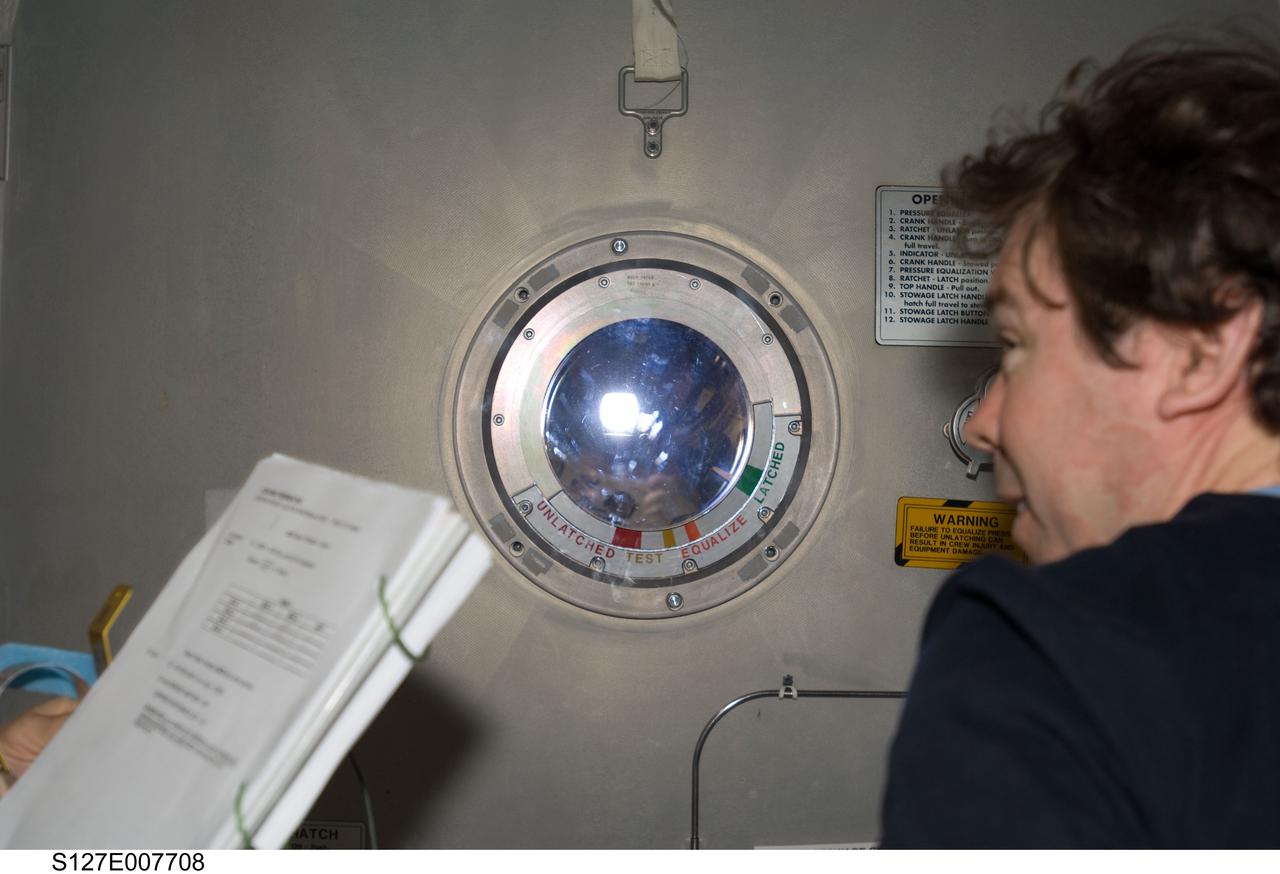
S127-E-007708 (22 July 2009) --- Astronaut Mike Barratt, Expedition 20 flight engineer, looks at astronaut Dave Wolf through the hatch window just after "sending off" astronauts Wolf and Christopher Cassidy (out of frame) for Endeavour's third space walk of a scheduled five overall for this flight.
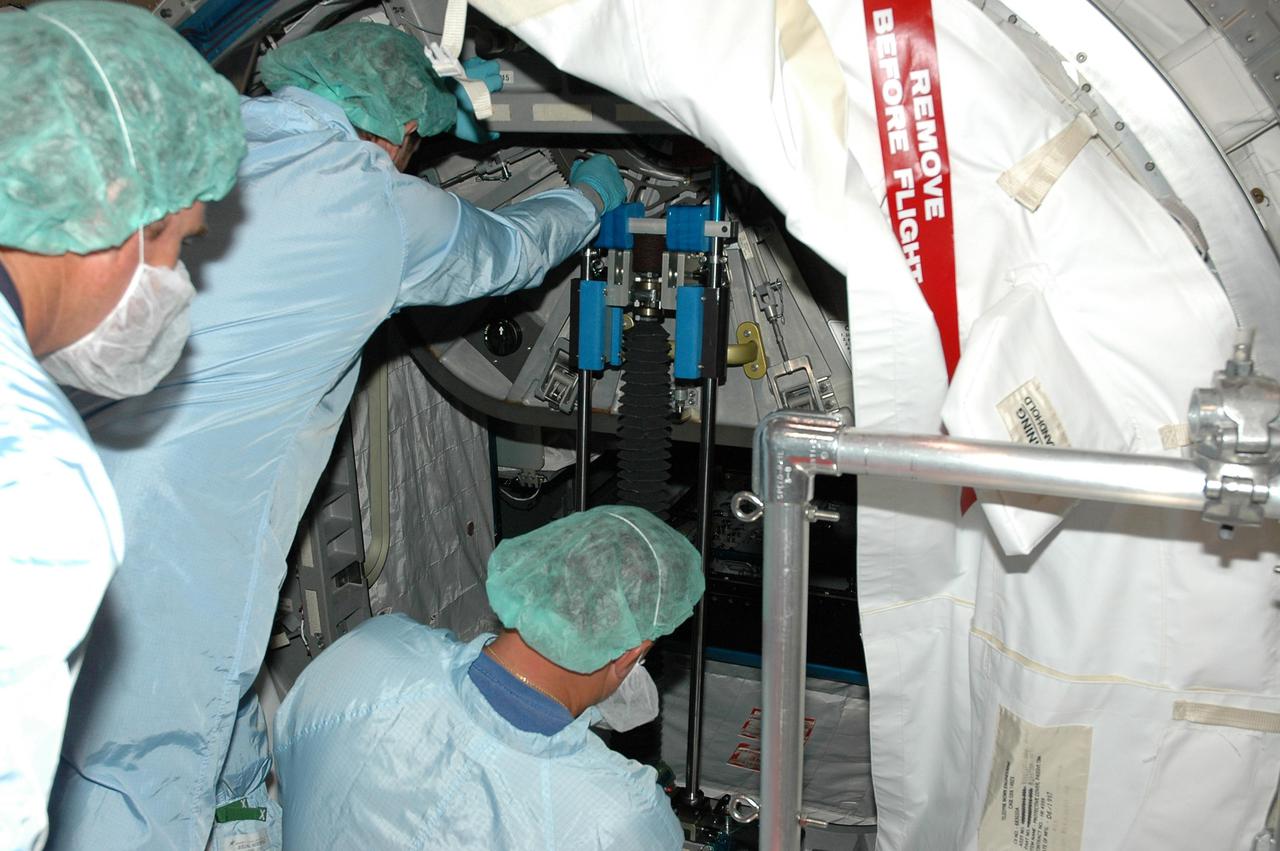
KENNEDY SPACE CENTER, FLA. - In the Space Station Processing Facility, workers check the hatch opening on the Multi-Purpose Logistics Module Raffaello before closing the hatch. Previously loaded into the Payload Canister Transporter, Raffaello was moved back to its work stand to allow the processing team access to address concerns with mechanical fasteners inside the module that do not incorporate an adequate secondary locking feature. The assessment and additional work was conducted to ensure that the fasteners do not disengage during ascent. Raffaello is scheduled to launch on Discovery’s Return to Flight mission STS-114. The launch window extends July 13 to July 31.
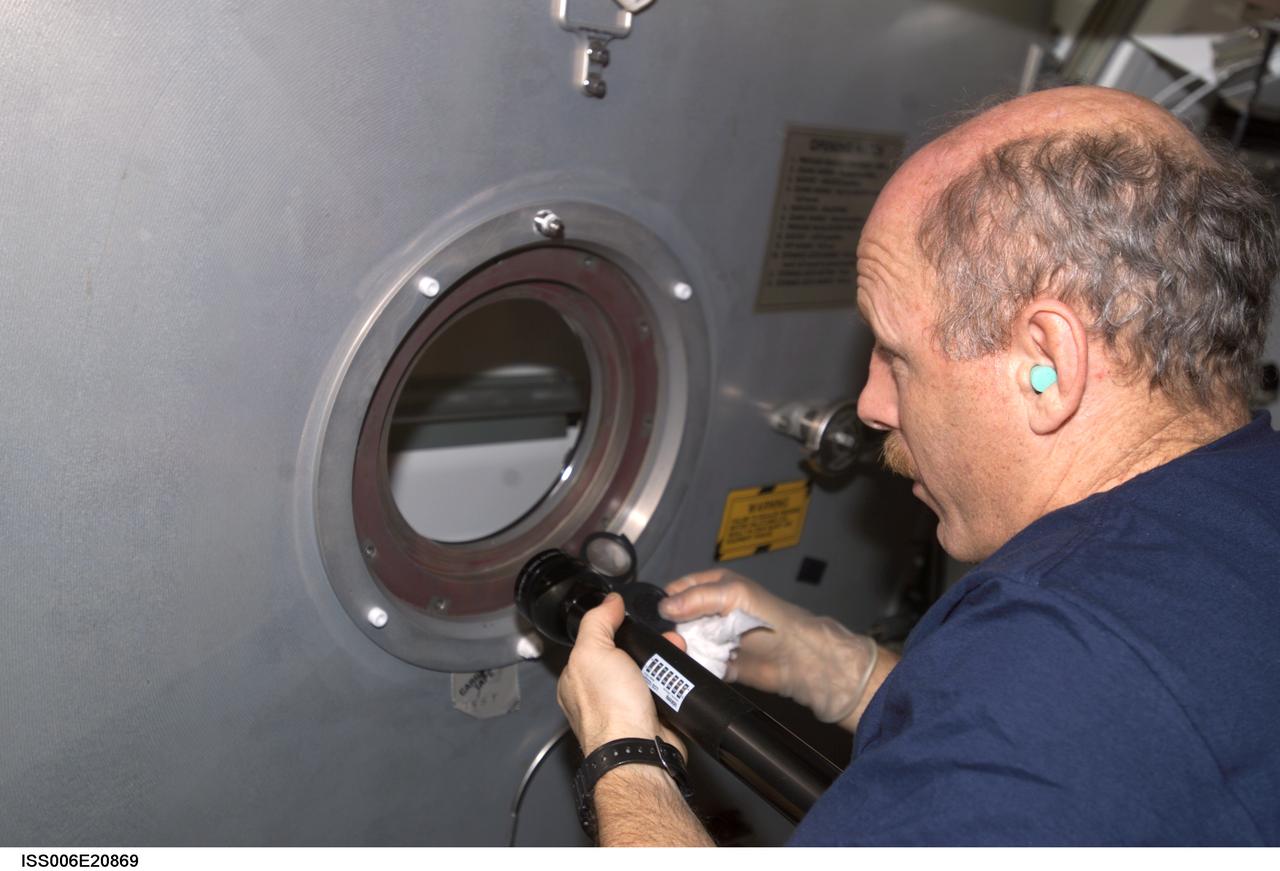
ISS006-E-20869 (26 January 2003) --- Astronaut Kenneth D. Bowersox, Expedition Six mission commander, holds a flashlight as he looks through a portal in the Zvezda Service Module on the International Space Station (ISS).
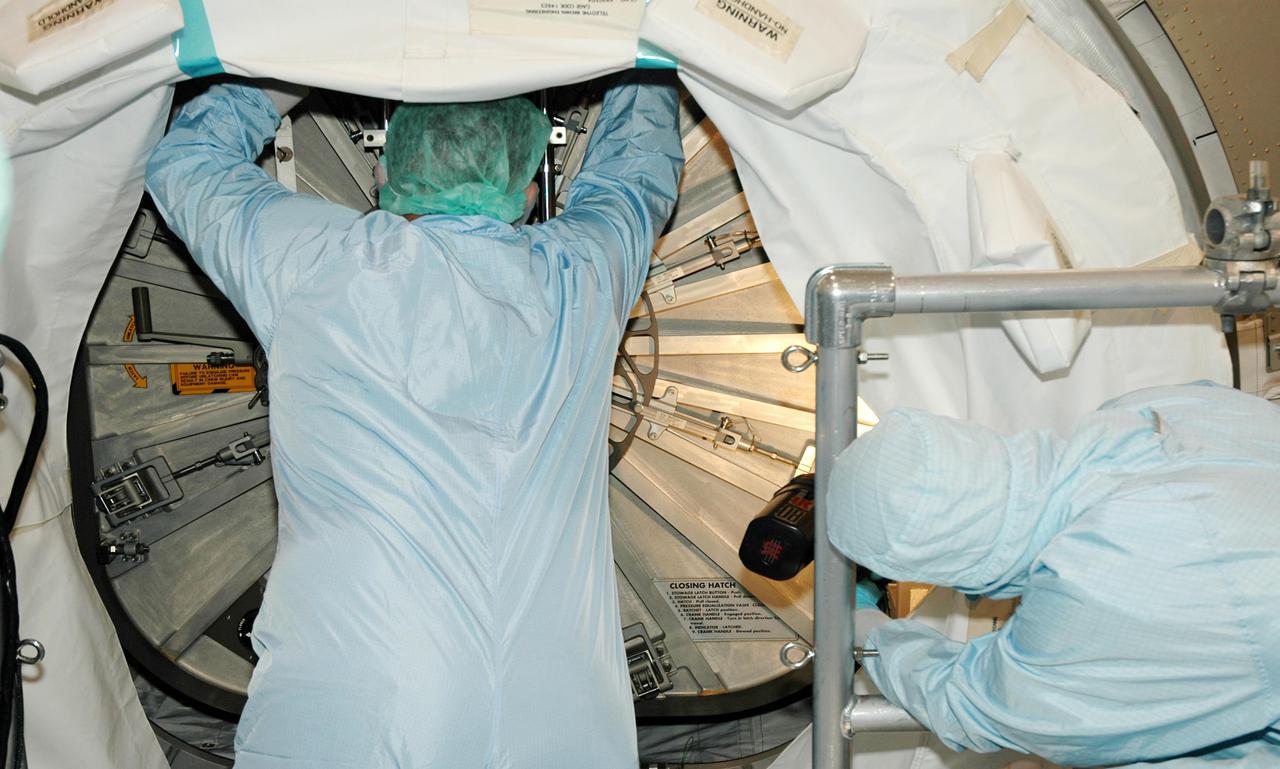
KENNEDY SPACE CENTER, FLA. -- Workers in the Space Station Processing Facility close the hatch for flight on Italian-built Multi-Purpose Logistics Module Raffaello, a significant milestone on the road to Return to Flight. The module will travel to the International Space Station aboard Space Shuttle Discovery’s Return to Flight mission STS-114. Raffaello carries 12 racks of cargo, including food, clothing, spare parts and research equipment, to the Station. Shuttle Discovery is targeted for launch in a window extending May 15 through June 3.
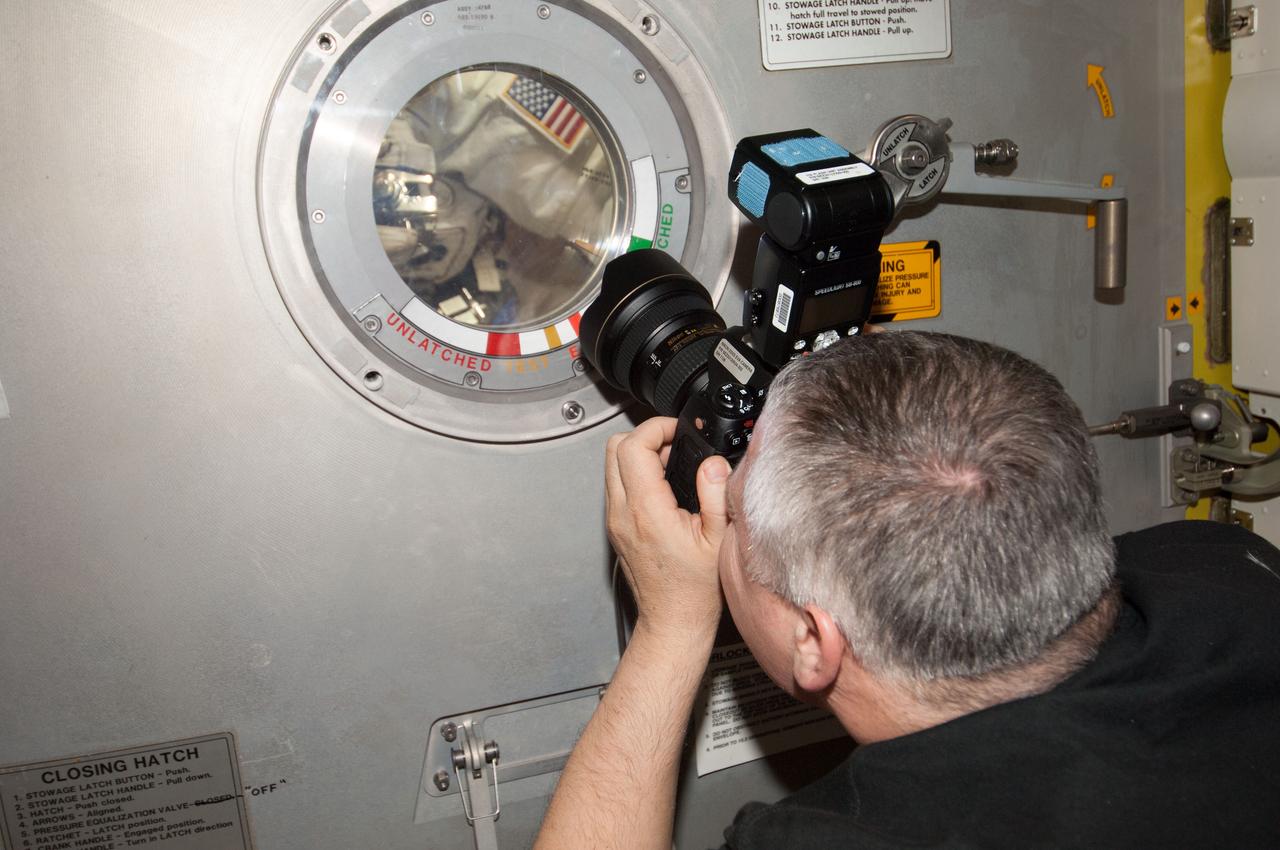
ISS036-E-019889 (16 July 2013) --- Russian cosmonaut Fyodor Yurchikhin, Expedition 36 flight engineer, uses a digital still camera at a hatch window of the International Space Station’s Quest airlock to photograph European Space Agency astronaut Luca Parmitano and NASA astronaut Chris Cassidy as the July 16 spacewalk draws to a close. The spacewalk was ended early due to issues with Parmitano’s spacesuit.
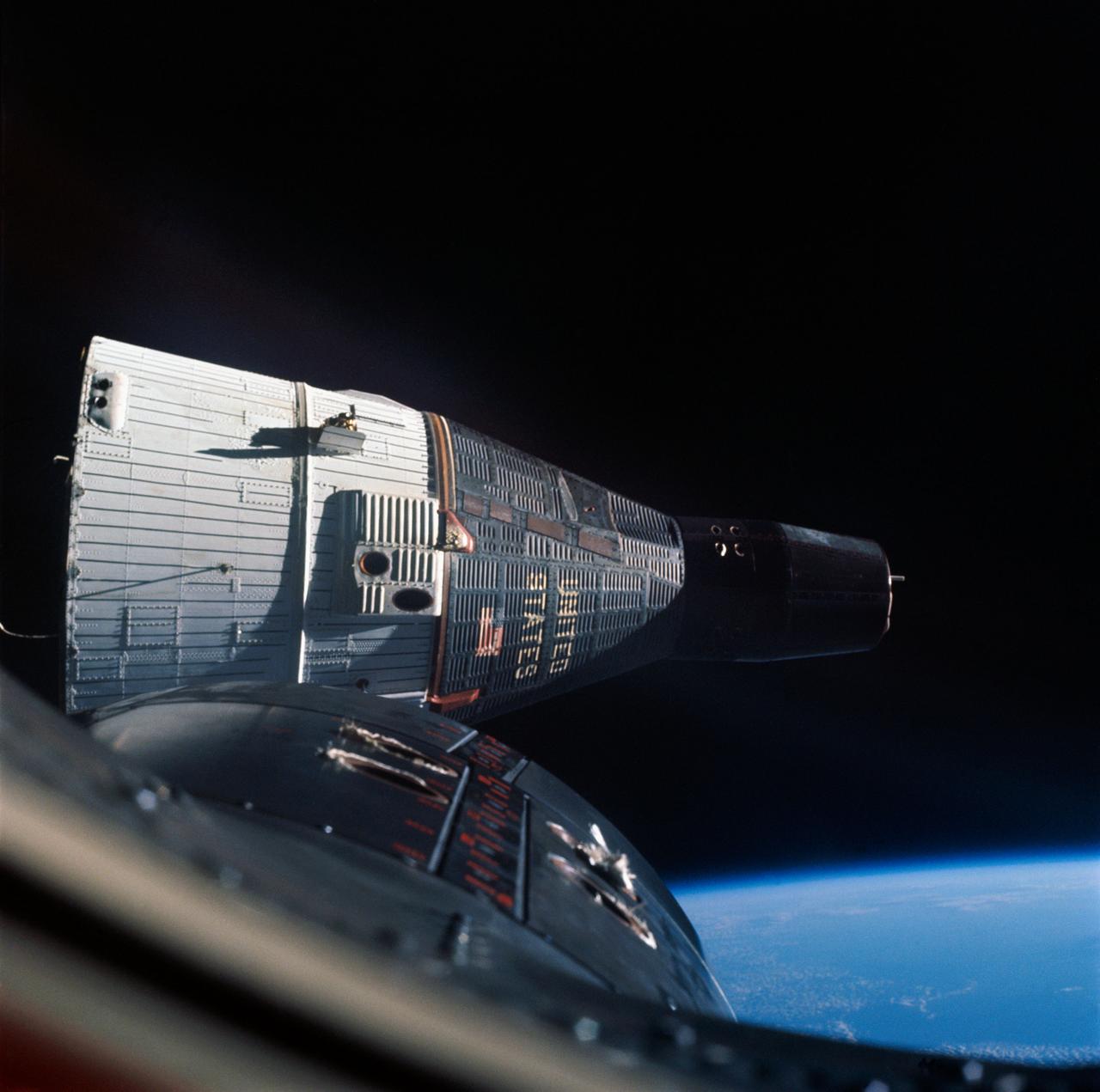
S65-63194 (15 Dec. 1965) --- This photograph of the National Aeronautics and Space Administration's (NASA) Gemini-7 spacecraft was taken through the hatch window of the Gemini-6 spacecraft during rendezvous and station keeping maneuvers at an altitude of approximately 160 miles on Dec. 15, 1965. The photograph was taken with a Hasselblad camera using Kodak SO 217 film with an ASA of 1964. Photo credit: NASA or National Aeronautics and Space Administration
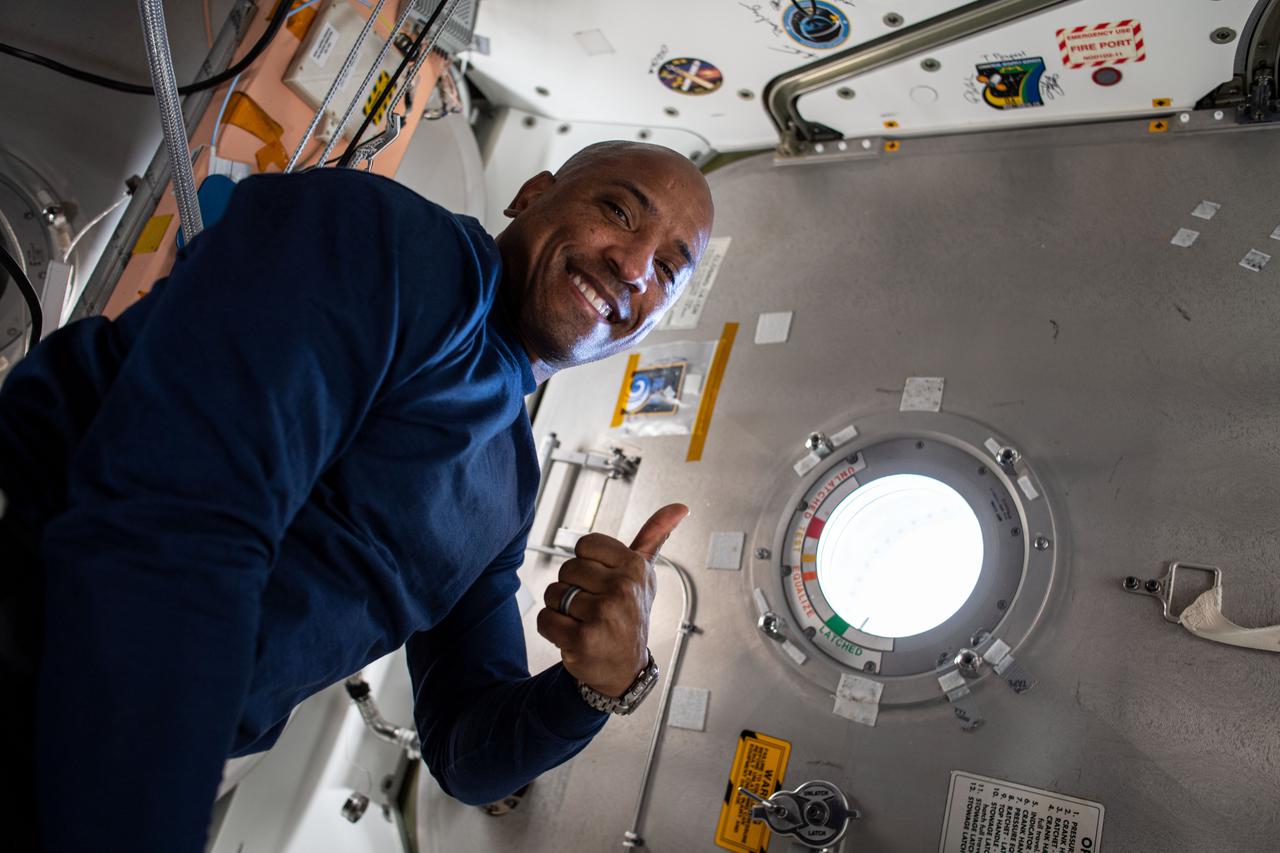
iss064e020173 (Jan. 6, 2021) --- NASA astronaut Victor Glover gives a "thumbs up" in front of the International Space Station's Unity module hatch window. Robotics controllers commanded the Canadarm2 robotic arm to uninstall the Northrop Grumman Cygnus space freighter from Unity's Earth-facing port a few hours earlier before releasing it after 93 days attached to the station.

ISS018-E-041355 (21 March 2009) --- Astronaut Tony Antonelli, STS-119 pilot; and Japan Aerospace Exploration Agency (JAXA) astronaut Koichi Wakata, Expedition 18 flight engineer, watch their crewmates through a small window on the hatch door in the Quest Airlock of the International Space Station while Space Shuttle Discovery remains docked with the station. Astronauts Joseph Acaba and Steve Swanson, both STS-119 mission specialists, were exiting the airlock to begin the mission's second session of extravehicular activity (EVA).
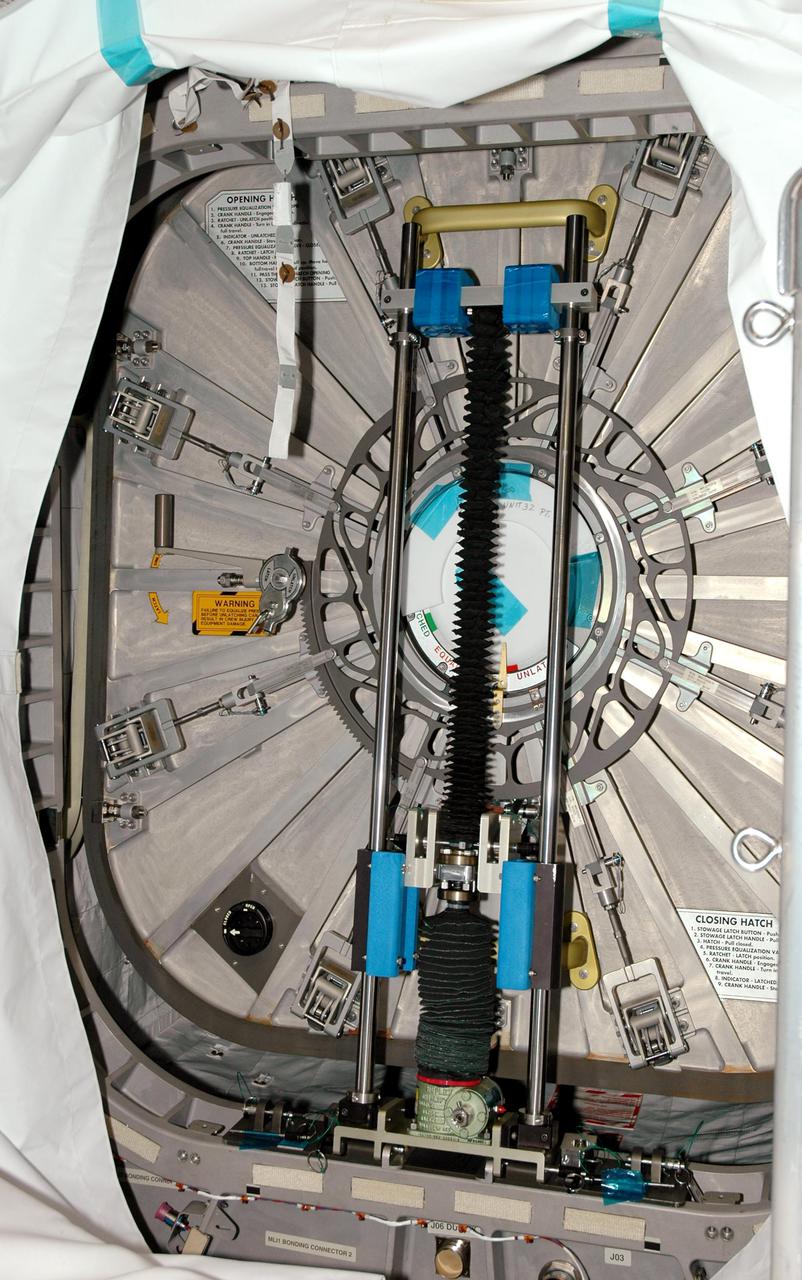
KENNEDY SPACE CENTER, FLA. -- In the Space Station Processing Facility, the hatch door on Italian-built Multi-Purpose Logistics Module Raffaello is closed, a significant milestone on the road to Return to Flight. The module will travel to the International Space Station aboard Space Shuttle Discovery’s Return to Flight mission STS-114. Raffaello carries 12 racks of cargo, including food, clothing, spare parts and research equipment, to the Station. Shuttle Discovery is targeted for launch in a window extending May 15 through June 3.
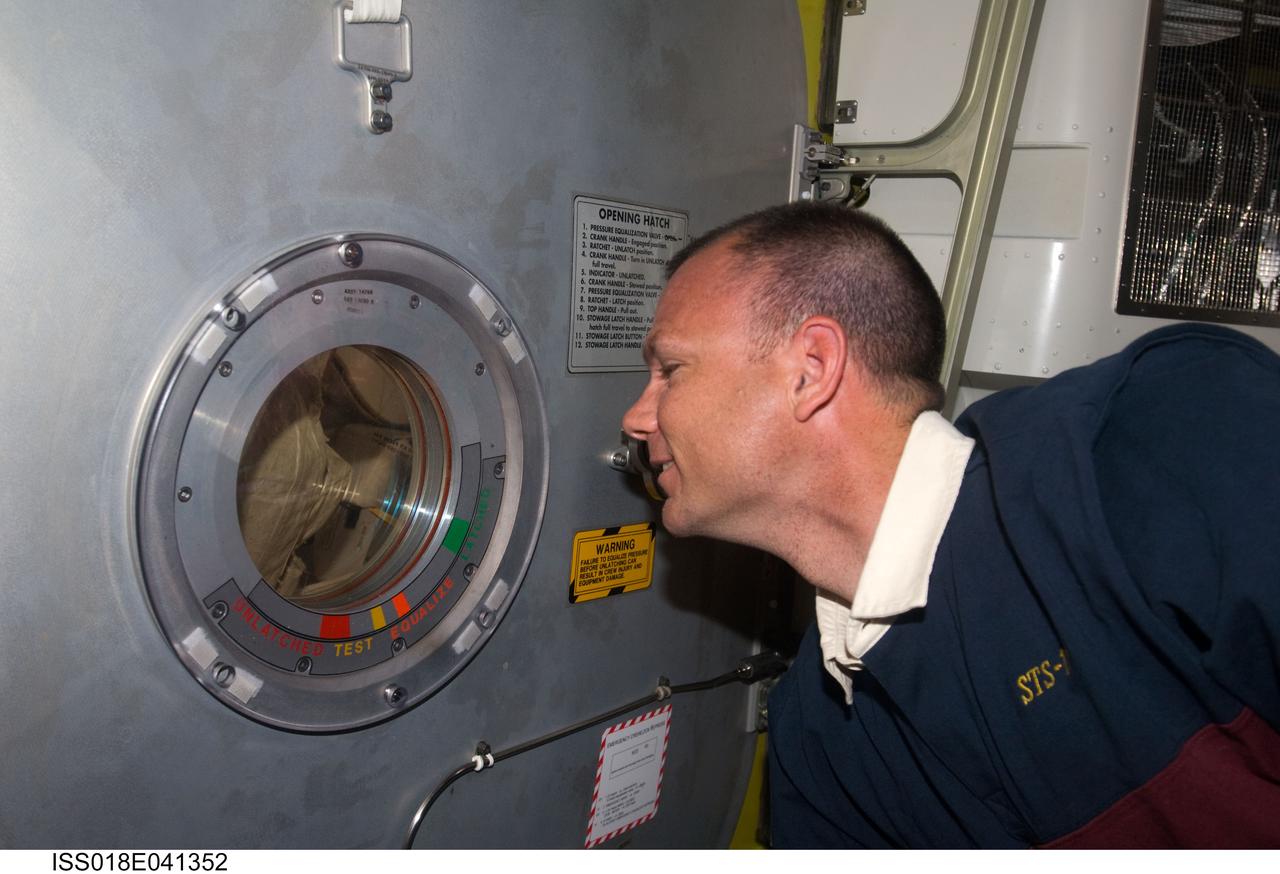
ISS018-E-041352 (21 March 2009) --- Astronaut Tony Antonelli, STS-119 pilot, watches his crewmates through a small window on the hatch door in the Quest Airlock of the International Space Station while Space Shuttle Discovery remains docked with the station. Astronauts Joseph Acaba and Steve Swanson, both STS-119 mission specialists, were exiting the airlock to begin the mission's second session of extravehicular activity (EVA).
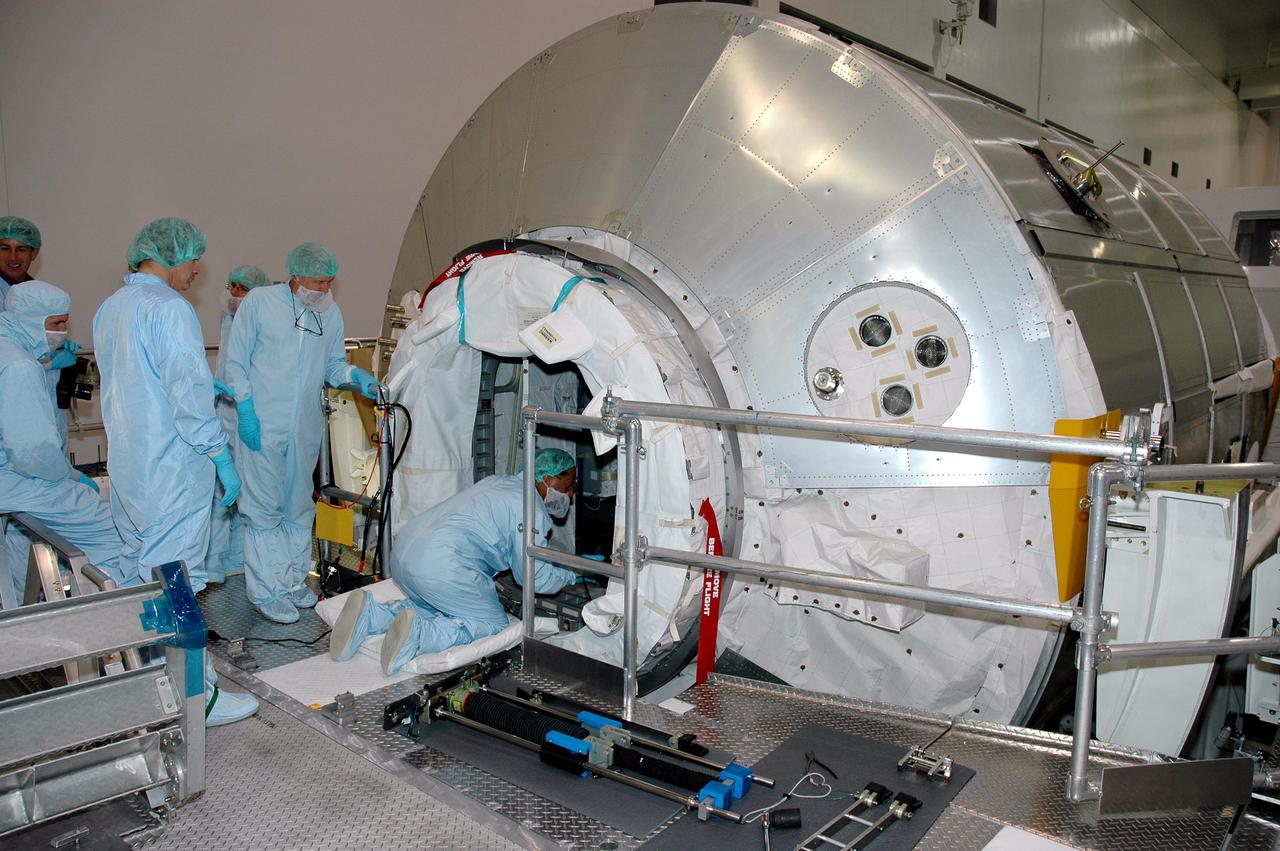
KENNEDY SPACE CENTER, FLA. -- Workers in the Space Station Processing Facility prepare to close the hatch for flight on Italian-built Multi-Purpose Logistics Module Raffaello, a significant milestone on the road to Return to Flight. The module will travel to the International Space Station aboard Space Shuttle Discovery’s Return to Flight mission STS-114. Raffaello carries 12 racks of cargo, including food, clothing, spare parts and research equipment, to the Station. Shuttle Discovery is targeted for launch in a window extending May 15 through June 3.
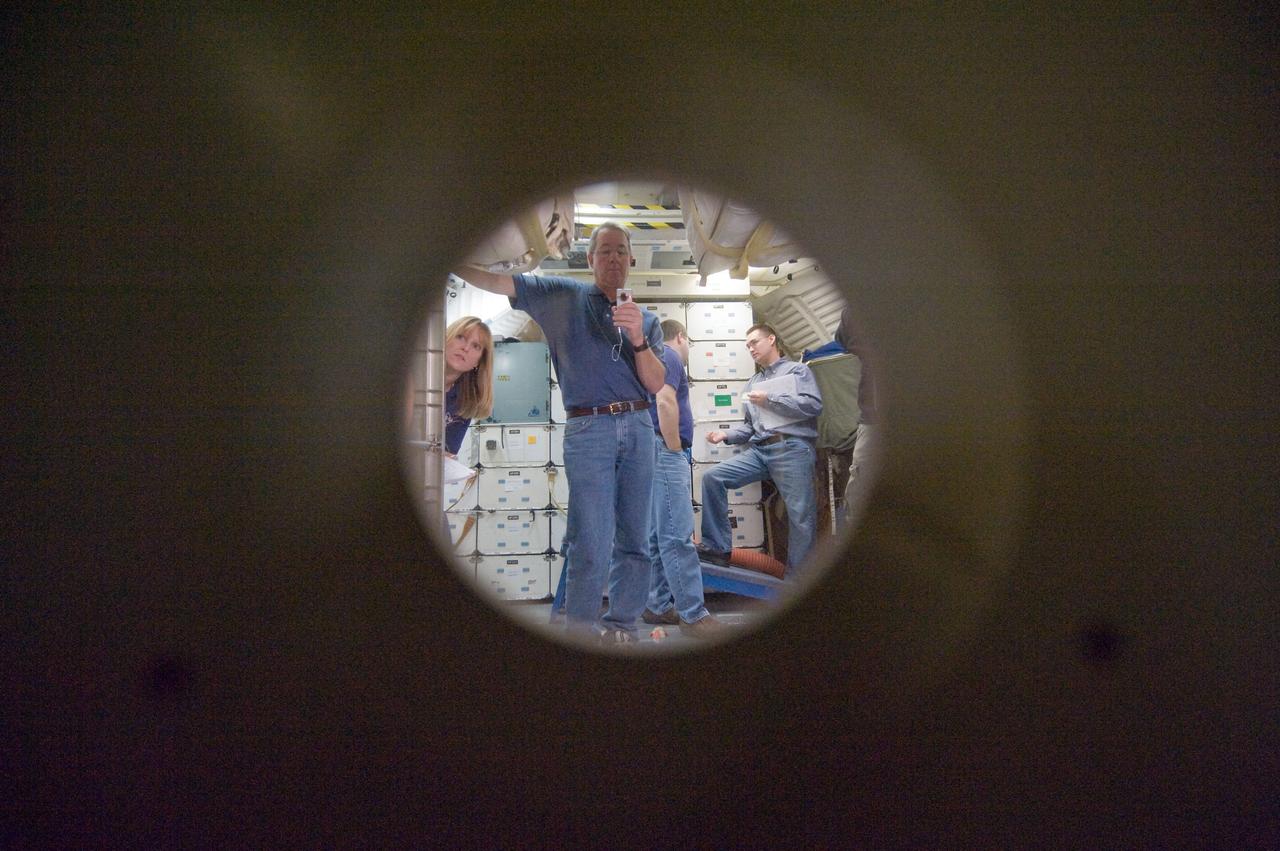
JSC2009-E-286955 (22 Dec. 2009) --- Viewed from a hatch window, STS-130 crew members participate in an ingress/egress timeline training session in a shuttle mock-up in the Space Vehicle Mock-up Facility at NASA's Johnson Space Center. Pictured from the left are astronauts Kathryn Hire, Stephen Robinson and Nicholas Patrick, all mission specialists. Crew trainer Adam Flagan (right) assisted the crew members.
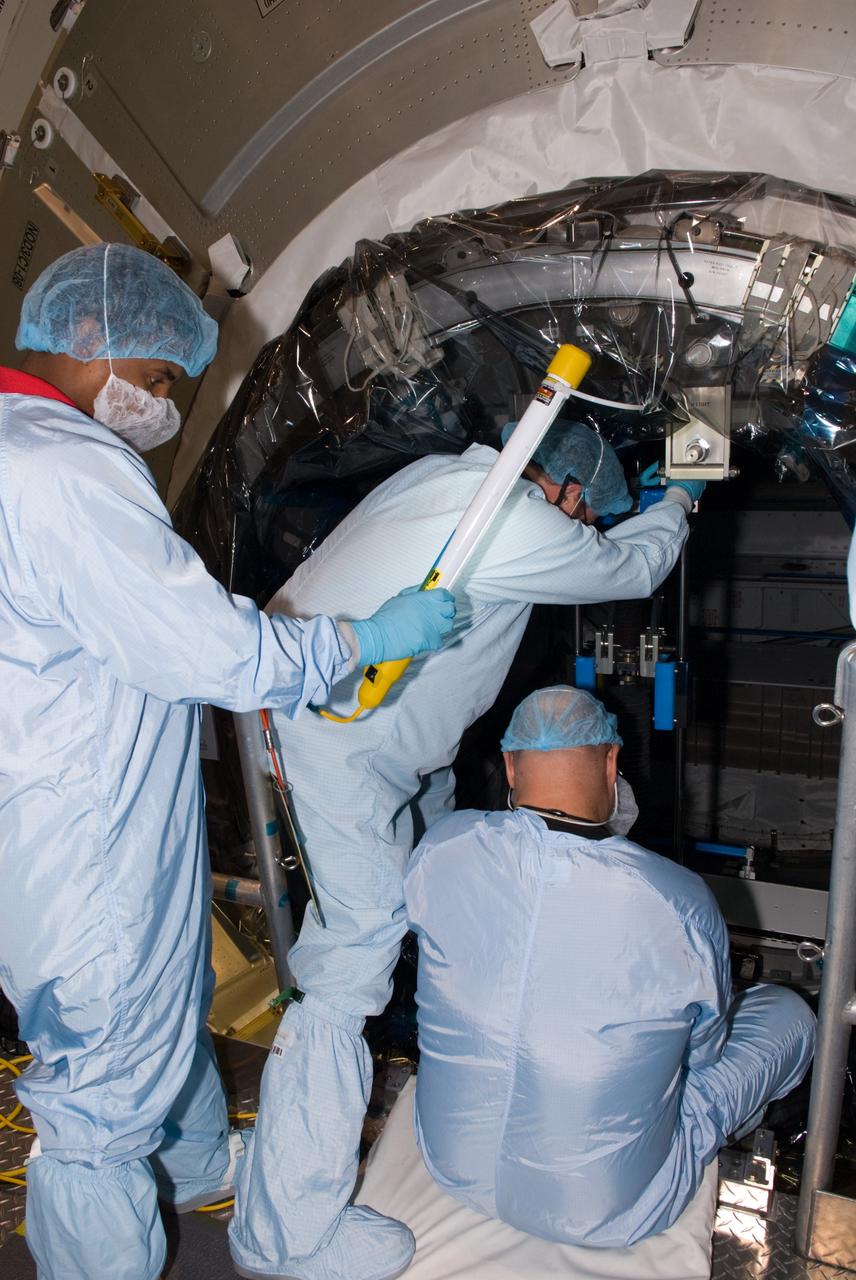
CAPE CANAVERAL, Fla. – In the Space Station Processing Facility at NASA's Kennedy Space Center in Florida, workers dressed in clean room attire, known as bunny suits, prepare to shut the hatch on the International Space Station's Node 3, named Tranquility. Hatch closure follows the completion of preparations for the node's transport to the pad and is a significant milestone in launch processing activities. The primary payload for the STS-130 mission, Tranquility is a pressurized module that will provide room for many of the space station's life support systems. Attached to one end of Tranquility is a cupola, a unique work area with six windows on its sides and one on top. The cupola resembles a circular bay window and will provide a vastly improved view of the station's exterior. The multi-directional view will allow the crew to monitor spacewalks and docking operations, as well as provide a spectacular view of Earth and other celestial objects. The module was built in Turin, Italy, by Thales Alenia Space for the European Space Agency. Space shuttle Endeavour's STS-130 mission is targeted for launch in early February 2010. For information on the STS-130 mission and crew, visit http://www.nasa.gov/mission_pages/shuttle/shuttlemissions/sts130/index.html. Photo credit: NASA/Jim Grossmann
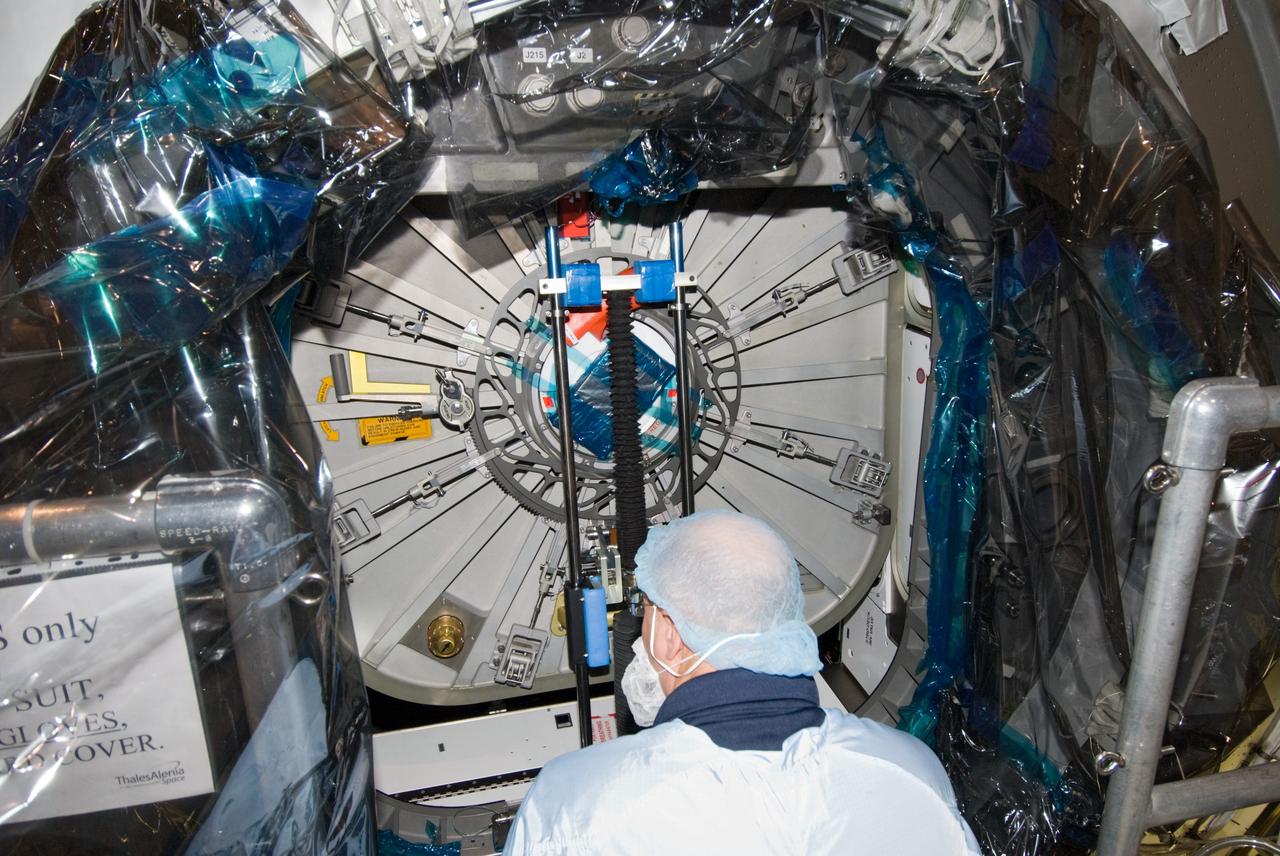
CAPE CANAVERAL, Fla. – In the Space Station Processing Facility at NASA's Kennedy Space Center in Florida, a payload technician dressed in clean room attire, known as a bunny suit, secures the hatch on the International Space Station's Node 3, named Tranquility. Hatch closure follows the completion of preparations for the node's transport to the pad and is a significant milestone in launch processing activities. The primary payload for the STS-130 mission, Tranquility is a pressurized module that will provide room for many of the space station's life support systems. Attached to one end of Tranquility is a cupola, a unique work area with six windows on its sides and one on top. The cupola resembles a circular bay window and will provide a vastly improved view of the station's exterior. The multi-directional view will allow the crew to monitor spacewalks and docking operations, as well as provide a spectacular view of Earth and other celestial objects. The module was built in Turin, Italy, by Thales Alenia Space for the European Space Agency. Space shuttle Endeavour's STS-130 mission is targeted for launch in early February 2010. For information on the STS-130 mission and crew, visit http://www.nasa.gov/mission_pages/shuttle/shuttlemissions/sts130/index.html. Photo credit: NASA/Amanda Diller
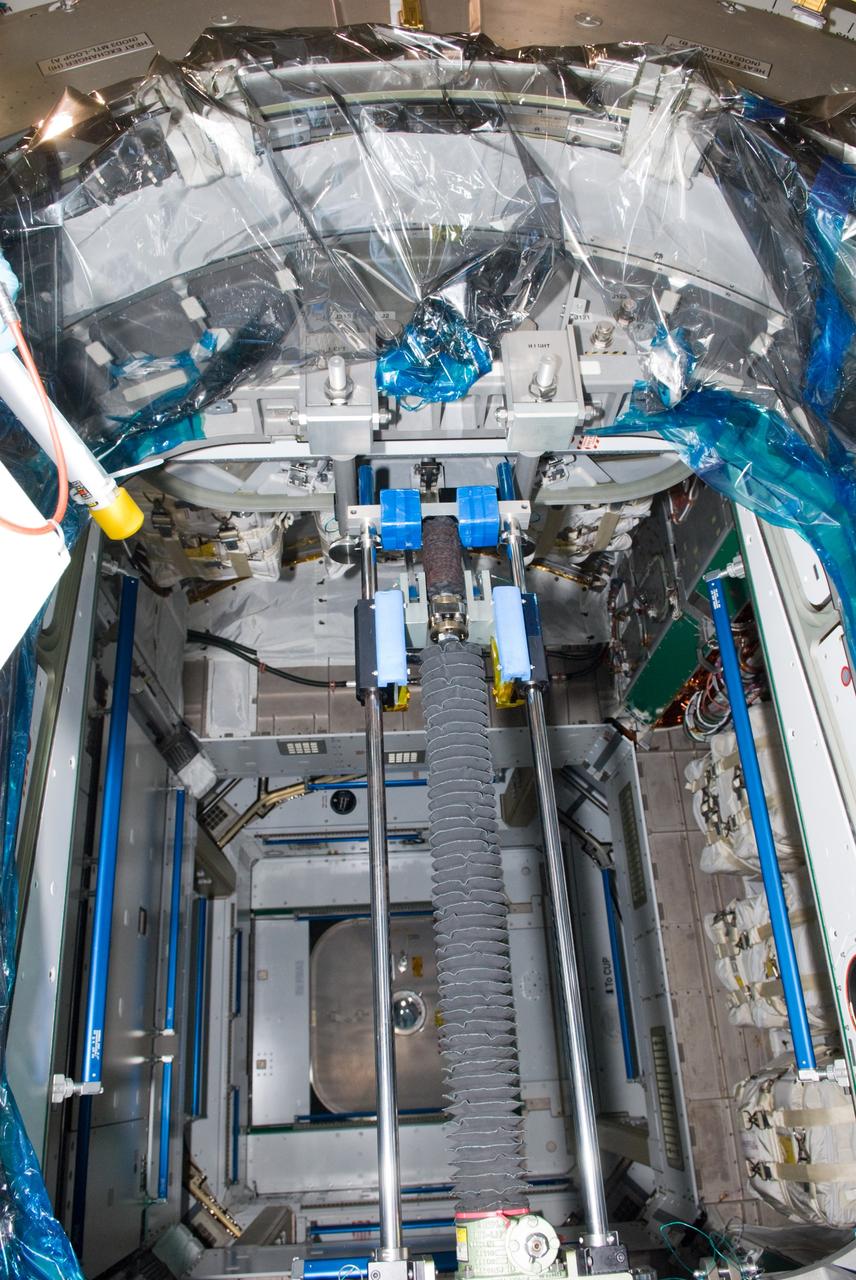
CAPE CANAVERAL, Fla. – In the Space Station Processing Facility at NASA's Kennedy Space Center in Florida, the interior of the International Space Station's Node 3, named Tranquility, is seen for the last time on Earth before its hatch is shut. Hatch closure follows the completion of preparations for the node's transport to the pad and is a significant milestone in launch processing activities. The primary payload for the STS-130 mission, Tranquility is a pressurized module that will provide room for many of the space station's life support systems. Attached to one end of Tranquility is a cupola, a unique work area with six windows on its sides and one on top. The cupola resembles a circular bay window and will provide a vastly improved view of the station's exterior. The multi-directional view will allow the crew to monitor spacewalks and docking operations, as well as provide a spectacular view of Earth and other celestial objects. The module was built in Turin, Italy, by Thales Alenia Space for the European Space Agency. Space shuttle Endeavour's STS-130 mission is targeted for launch in early February 2010. For information on the STS-130 mission and crew, visit http://www.nasa.gov/mission_pages/shuttle/shuttlemissions/sts130/index.html. Photo credit: NASA/Jim Grossmann
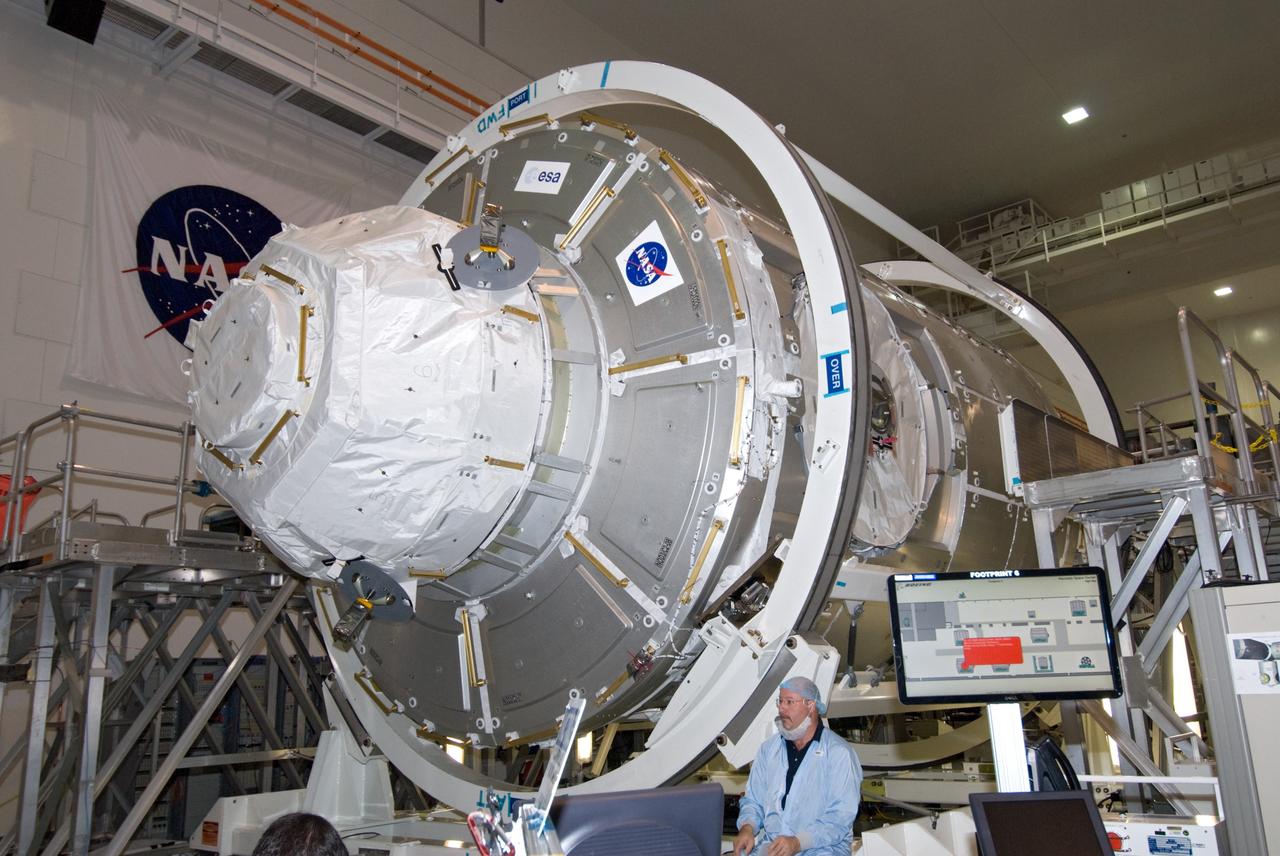
CAPE CANAVERAL, Fla. – In the Space Station Processing Facility at NASA's Kennedy Space Center in Florida, processing of the International Space Station's Node 3, named Tranquility, nears completion. Its cupola, seen in this view, is covered and its hatch secured. Hatch closure follows the completion of preparations for the node's transport to the pad and is a significant milestone in launch processing activities. The primary payload for the STS-130 mission, Tranquility is a pressurized module that will provide room for many of the space station's life support systems. Attached to one end of Tranquility is a cupola, a unique work area with six windows on its sides and one on top. The cupola resembles a circular bay window and will provide a vastly improved view of the station's exterior. The multi-directional view will allow the crew to monitor spacewalks and docking operations, as well as provide a spectacular view of Earth and other celestial objects. The module was built in Turin, Italy, by Thales Alenia Space for the European Space Agency. Space shuttle Endeavour's STS-130 mission is targeted for launch in early February 2010. For information on the STS-130 mission and crew, visit http://www.nasa.gov/mission_pages/shuttle/shuttlemissions/sts130/index.html. Photo credit: NASA/Amanda Diller
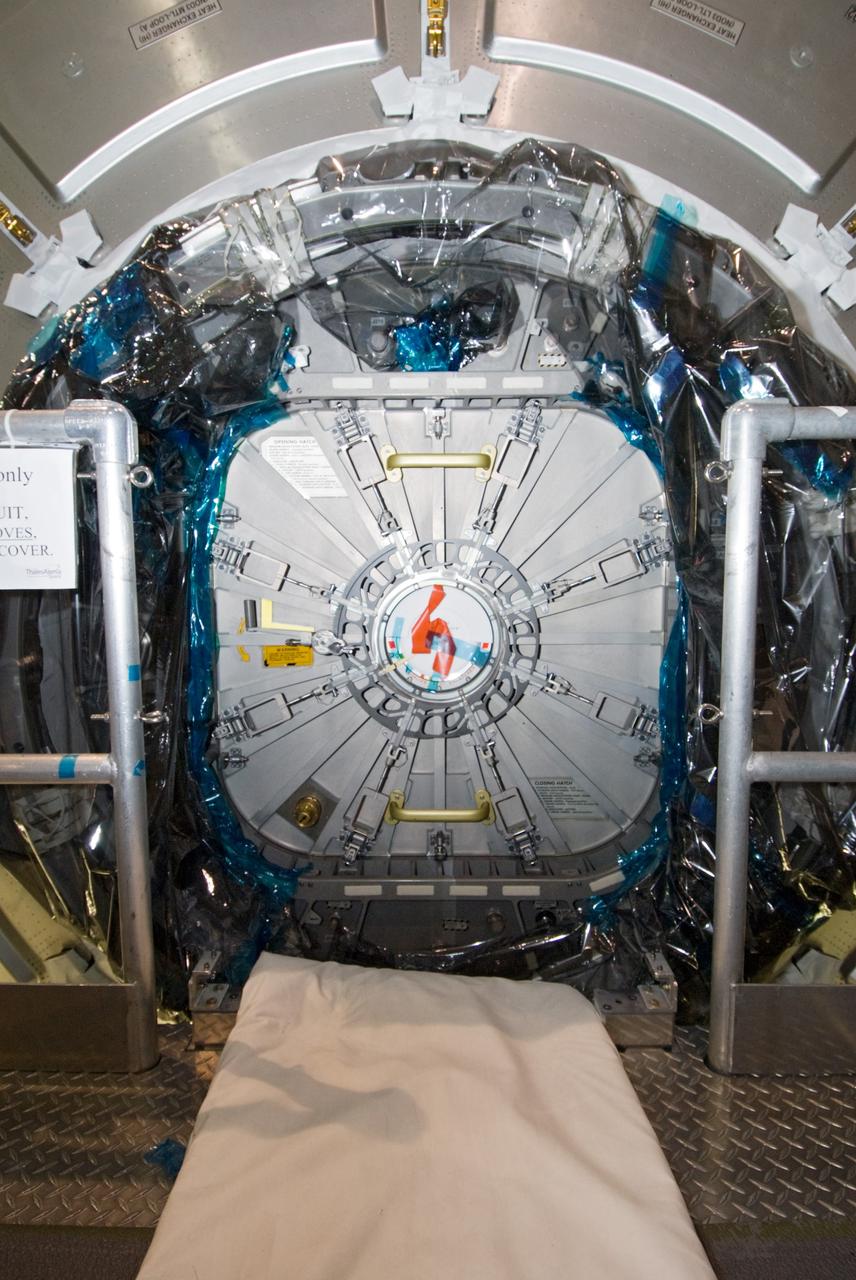
CAPE CANAVERAL, Fla. – In the Space Station Processing Facility at NASA's Kennedy Space Center in Florida, the hatch on the International Space Station's Node 3, named Tranquility, is secured. Hatch closure follows the completion of preparations for the node's transport to the pad and is a significant milestone in launch processing activities. The primary payload for the STS-130 mission, Tranquility is a pressurized module that will provide room for many of the space station's life support systems. Attached to one end of Tranquility is a cupola, a unique work area with six windows on its sides and one on top. The cupola resembles a circular bay window and will provide a vastly improved view of the station's exterior. The multi-directional view will allow the crew to monitor spacewalks and docking operations, as well as provide a spectacular view of Earth and other celestial objects. The module was built in Turin, Italy, by Thales Alenia Space for the European Space Agency. Space shuttle Endeavour's STS-130 mission is targeted for launch in early February 2010. For information on the STS-130 mission and crew, visit http://www.nasa.gov/mission_pages/shuttle/shuttlemissions/sts130/index.html. Photo credit: NASA/Amanda Diller
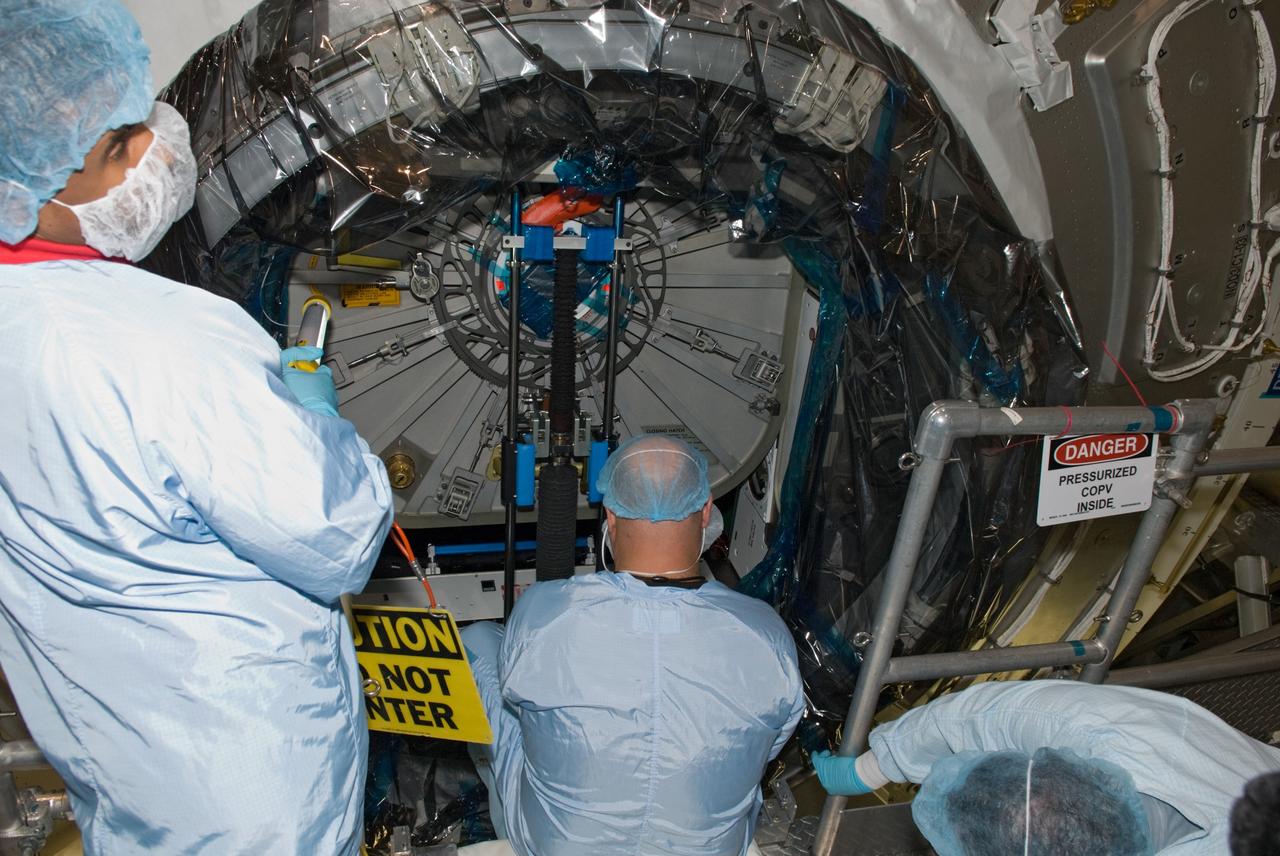
CAPE CANAVERAL, Fla. – In the Space Station Processing Facility at NASA's Kennedy Space Center in Florida, workers dressed in clean room attire, known as bunny suits, begin to shut the hatch on the International Space Station's Node 3, named Tranquility. Hatch closure follows the completion of preparations for the node's transport to the pad and is a significant milestone in launch processing activities. The primary payload for the STS-130 mission, Tranquility is a pressurized module that will provide room for many of the space station's life support systems. Attached to one end of Tranquility is a cupola, a unique work area with six windows on its sides and one on top. The cupola resembles a circular bay window and will provide a vastly improved view of the station's exterior. The multi-directional view will allow the crew to monitor spacewalks and docking operations, as well as provide a spectacular view of Earth and other celestial objects. The module was built in Turin, Italy, by Thales Alenia Space for the European Space Agency. Space shuttle Endeavour's STS-130 mission is targeted for launch in early February 2010. For information on the STS-130 mission and crew, visit http://www.nasa.gov/mission_pages/shuttle/shuttlemissions/sts130/index.html. Photo credit: NASA/Jim Grossmann
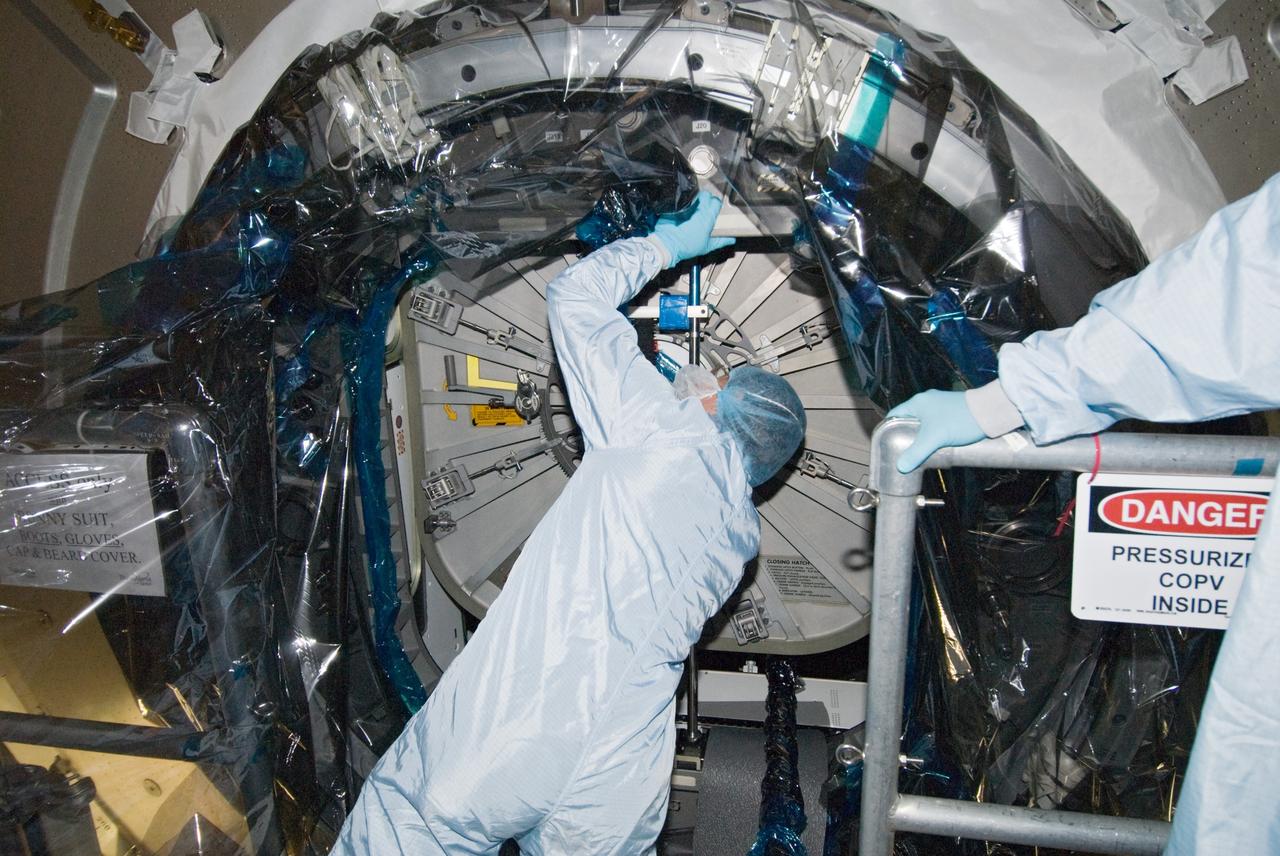
CAPE CANAVERAL, Fla. – In the Space Station Processing Facility at NASA's Kennedy Space Center in Florida, a payload technician dressed in clean room attire, known as a bunny suit, secures the hatch on the International Space Station's Node 3, named Tranquility. Hatch closure follows the completion of preparations for the node's transport to the pad and is a significant milestone in launch processing activities. The primary payload for the STS-130 mission, Tranquility is a pressurized module that will provide room for many of the space station's life support systems. Attached to one end of Tranquility is a cupola, a unique work area with six windows on its sides and one on top. The cupola resembles a circular bay window and will provide a vastly improved view of the station's exterior. The multi-directional view will allow the crew to monitor spacewalks and docking operations, as well as provide a spectacular view of Earth and other celestial objects. The module was built in Turin, Italy, by Thales Alenia Space for the European Space Agency. Space shuttle Endeavour's STS-130 mission is targeted for launch in early February 2010. For information on the STS-130 mission and crew, visit http://www.nasa.gov/mission_pages/shuttle/shuttlemissions/sts130/index.html. Photo credit: NASA/Amanda Diller
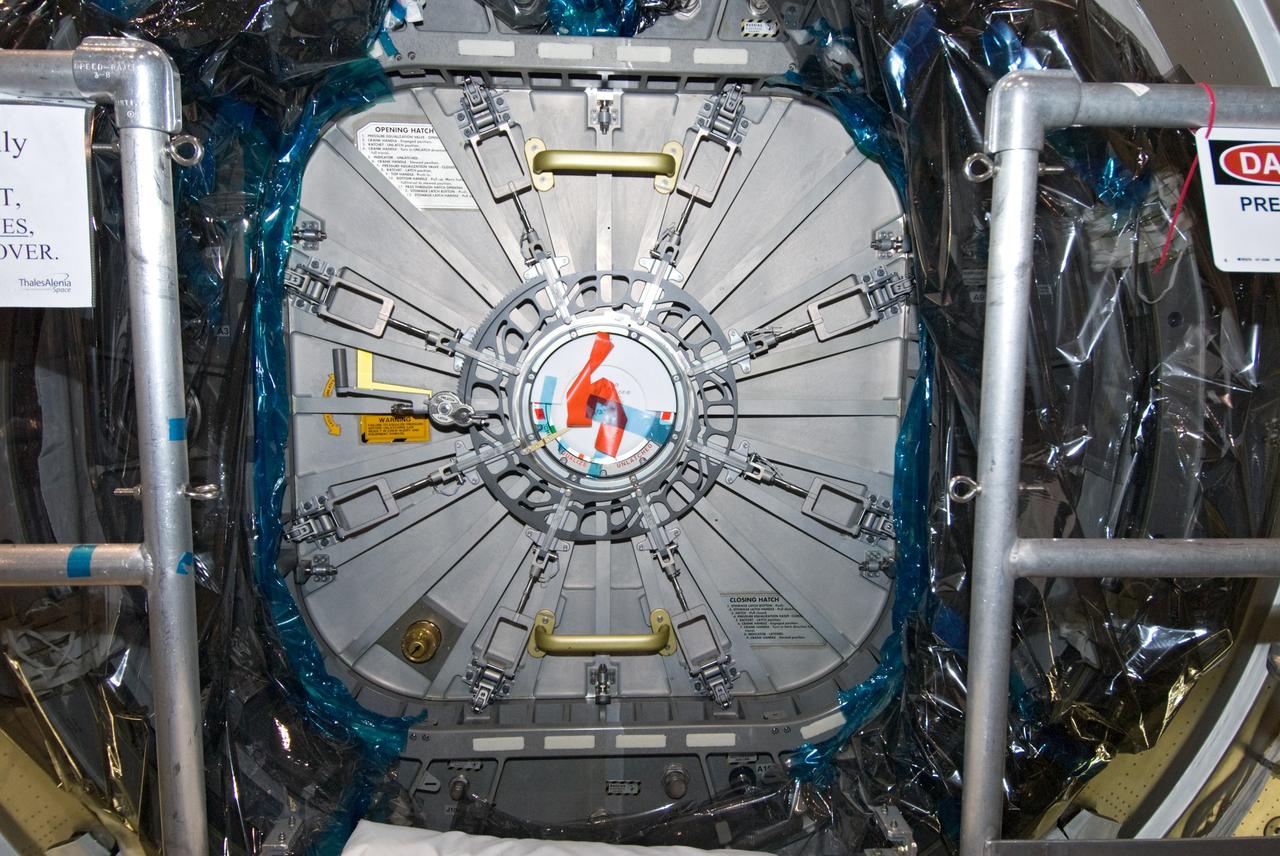
CAPE CANAVERAL, Fla. – In the Space Station Processing Facility at NASA's Kennedy Space Center in Florida, the hatch on the International Space Station's Node 3, named Tranquility, is secured. Hatch closure follows the completion of preparations for the node's transport to the pad and is a significant milestone in launch processing activities. The primary payload for the STS-130 mission, Tranquility is a pressurized module that will provide room for many of the space station's life support systems. Attached to one end of Tranquility is a cupola, a unique work area with six windows on its sides and one on top. The cupola resembles a circular bay window and will provide a vastly improved view of the station's exterior. The multi-directional view will allow the crew to monitor spacewalks and docking operations, as well as provide a spectacular view of Earth and other celestial objects. The module was built in Turin, Italy, by Thales Alenia Space for the European Space Agency. Space shuttle Endeavour's STS-130 mission is targeted for launch in early February 2010. For information on the STS-130 mission and crew, visit http://www.nasa.gov/mission_pages/shuttle/shuttlemissions/sts130/index.html. Photo credit: NASA/Amanda Diller
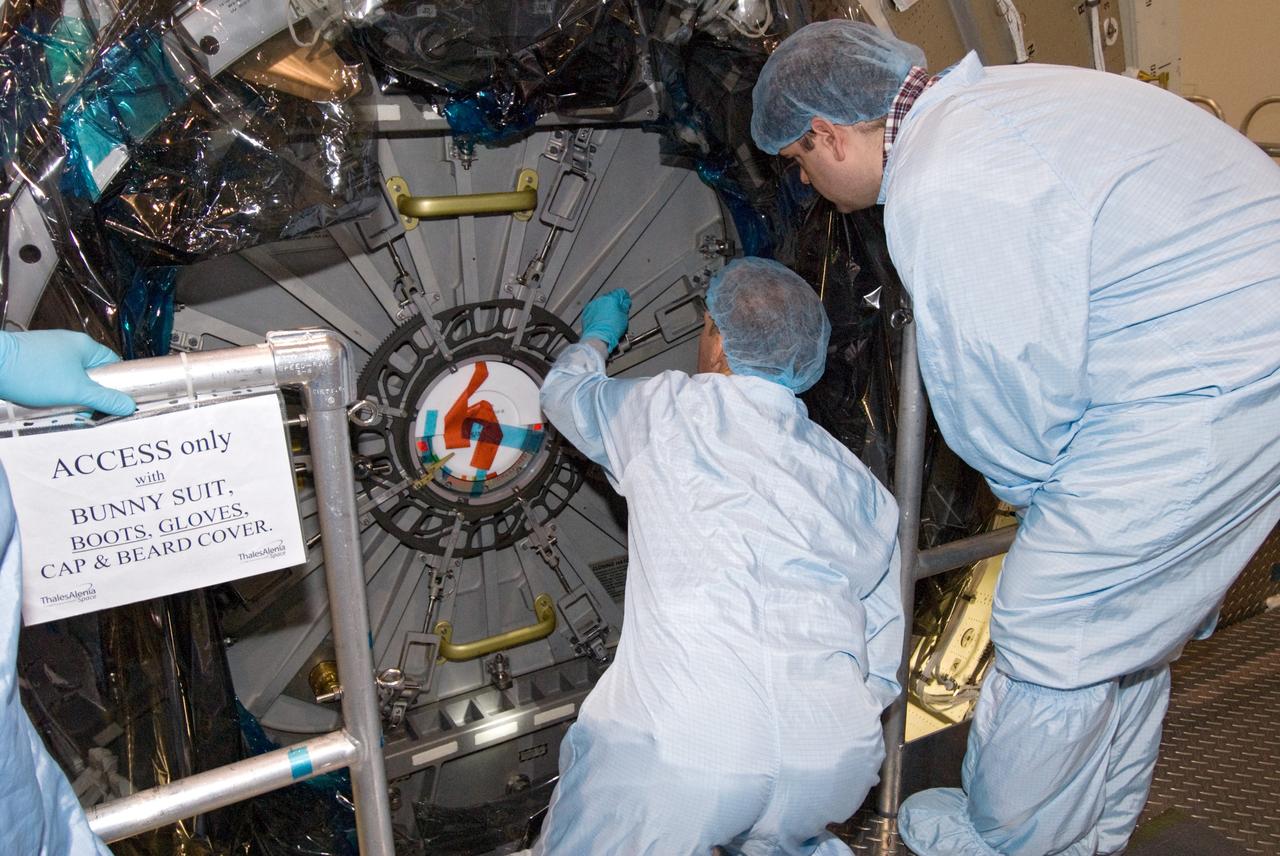
CAPE CANAVERAL, Fla. – In the Space Station Processing Facility at NASA's Kennedy Space Center in Florida, payload technicians dressed in clean room attire, known as bunny suits, secure the hatch on the International Space Station's Node 3, named Tranquility. Hatch closure follows the completion of preparations for the node's transport to the pad and is a significant milestone in launch processing activities. The primary payload for the STS-130 mission, Tranquility is a pressurized module that will provide room for many of the space station's life support systems. Attached to one end of Tranquility is a cupola, a unique work area with six windows on its sides and one on top. The cupola resembles a circular bay window and will provide a vastly improved view of the station's exterior. The multi-directional view will allow the crew to monitor spacewalks and docking operations, as well as provide a spectacular view of Earth and other celestial objects. The module was built in Turin, Italy, by Thales Alenia Space for the European Space Agency. Space shuttle Endeavour's STS-130 mission is targeted for launch in early February 2010. For information on the STS-130 mission and crew, visit http://www.nasa.gov/mission_pages/shuttle/shuttlemissions/sts130/index.html. Photo credit: NASA/Amanda Diller
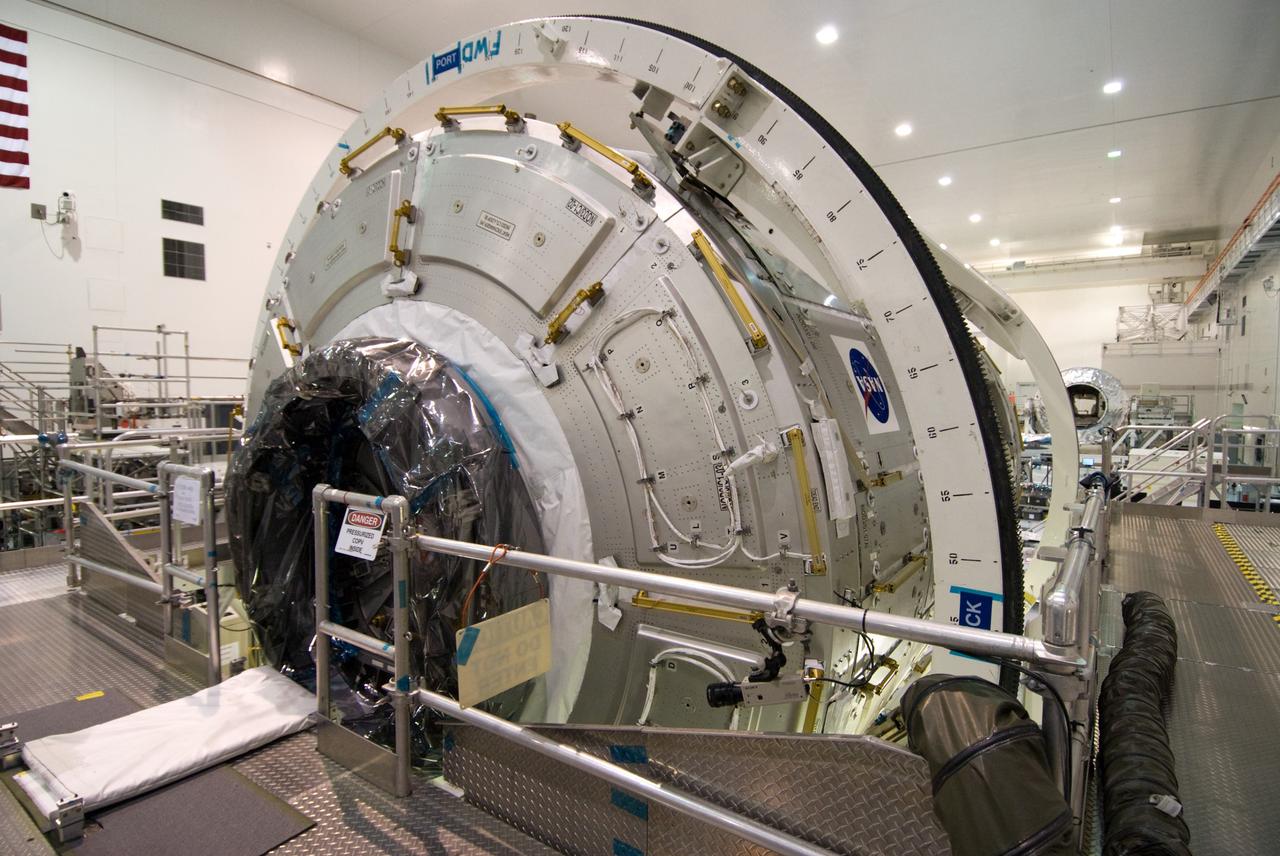
CAPE CANAVERAL, Fla. – In the Space Station Processing Facility at NASA's Kennedy Space Center in Florida, work to secure the hatch on the International Space Station's Node 3, named Tranquility, is complete. Hatch closure follows the completion of preparations for the node's transport to the pad and is a significant milestone in launch processing activities. The primary payload for the STS-130 mission, Tranquility is a pressurized module that will provide room for many of the space station's life support systems. Attached to one end of Tranquility is a cupola, a unique work area with six windows on its sides and one on top. The cupola resembles a circular bay window and will provide a vastly improved view of the station's exterior. The multi-directional view will allow the crew to monitor spacewalks and docking operations, as well as provide a spectacular view of Earth and other celestial objects. The module was built in Turin, Italy, by Thales Alenia Space for the European Space Agency. Space shuttle Endeavour's STS-130 mission is targeted for launch in early February 2010. For information on the STS-130 mission and crew, visit http://www.nasa.gov/mission_pages/shuttle/shuttlemissions/sts130/index.html. Photo credit: NASA/Amanda Diller
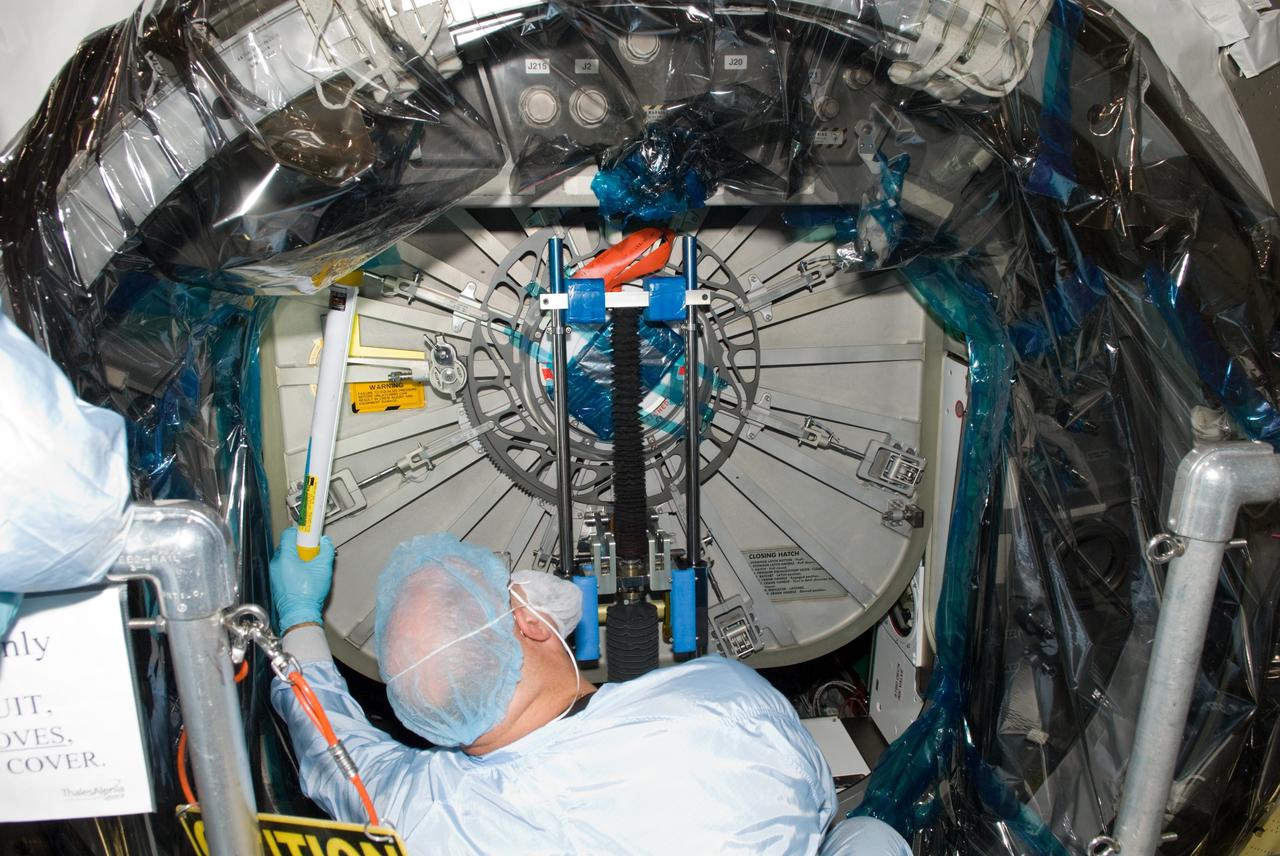
CAPE CANAVERAL, Fla. – In the Space Station Processing Facility at NASA's Kennedy Space Center in Florida, a worker dressed in clean room attire, known as a bunny suit, secures the hatch on the International Space Station's Node 3, named Tranquility. Hatch closure follows the completion of preparations for the node's transport to the pad and is a significant milestone in launch processing activities. The primary payload for the STS-130 mission, Tranquility is a pressurized module that will provide room for many of the space station's life support systems. Attached to one end of Tranquility is a cupola, a unique work area with six windows on its sides and one on top. The cupola resembles a circular bay window and will provide a vastly improved view of the station's exterior. The multi-directional view will allow the crew to monitor spacewalks and docking operations, as well as provide a spectacular view of Earth and other celestial objects. The module was built in Turin, Italy, by Thales Alenia Space for the European Space Agency. Space shuttle Endeavour's STS-130 mission is targeted for launch in early February 2010. For information on the STS-130 mission and crew, visit http://www.nasa.gov/mission_pages/shuttle/shuttlemissions/sts130/index.html. Photo credit: NASA/Jim Grossmann
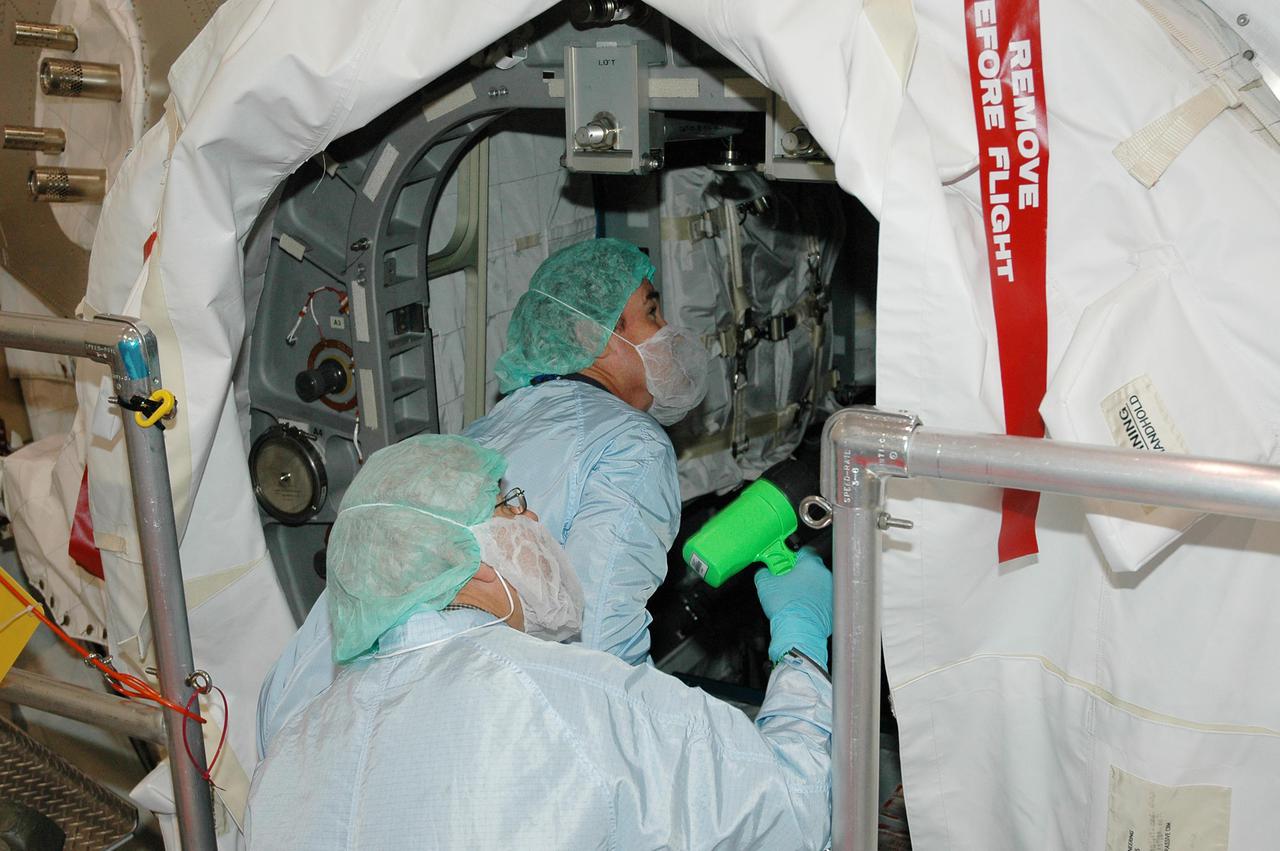
KENNEDY SPACE CENTER, FLA. - In the Space Station Processing Facility, workers make a final check inside the hatch of the Multi-Purpose Logistics Module Raffaello before it is closed. Previously loaded into the Payload Canister Transporter, Raffaello was moved back to its work stand to allow the processing team access to address concerns with mechanical fasteners inside the module that do not incorporate an adequate secondary locking feature. The assessment and additional work was conducted to ensure that the fasteners do not disengage during ascent. Raffaello is scheduled to launch on Discovery’s Return to Flight mission STS-114. The launch window extends July 13 to July 31.
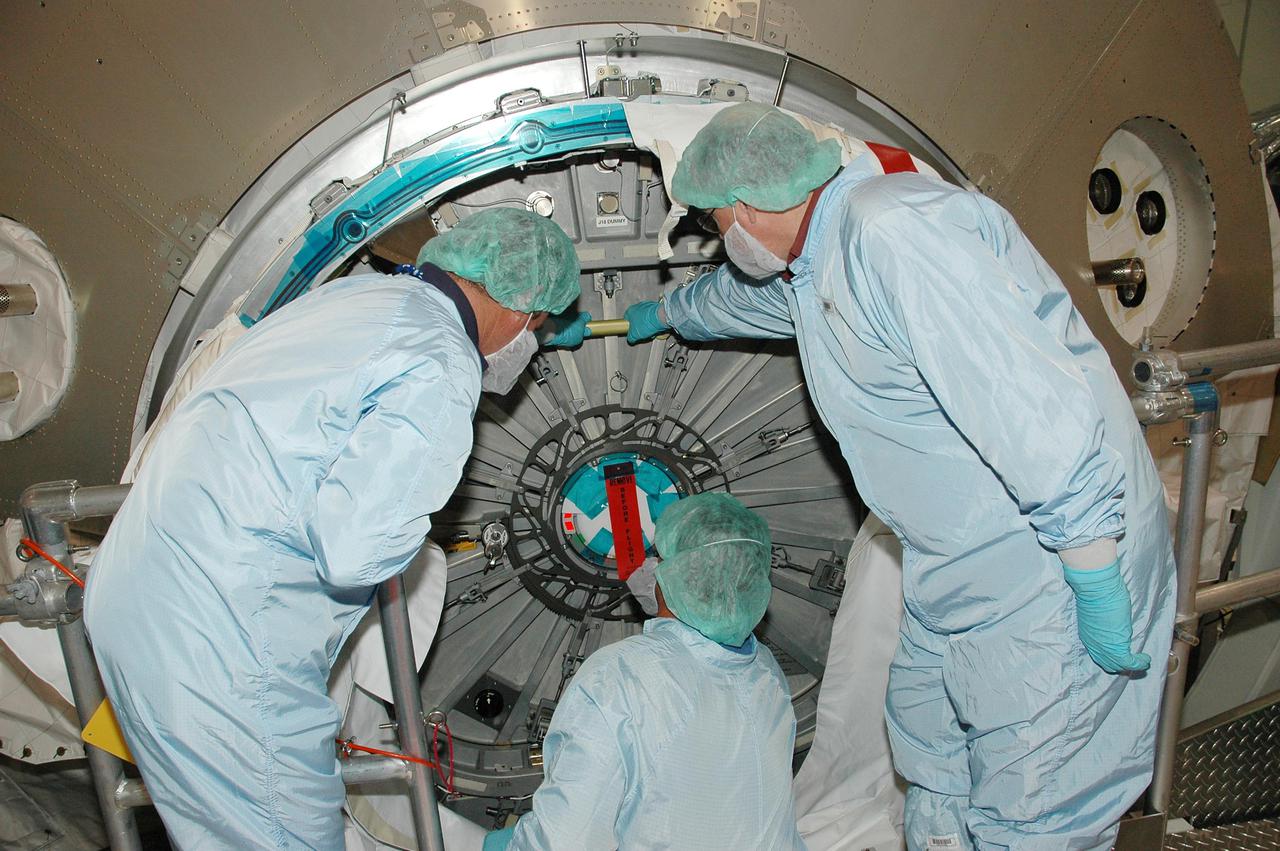
KENNEDY SPACE CENTER, FLA. - In the Space Station Processing Facility, workers close the hatch opening on the Multi-Purpose Logistics Module Raffaello. Previously loaded into the Payload Canister Transporter, Raffaello was moved back to its work stand to allow the processing team access to address concerns with mechanical fasteners inside the module that do not incorporate an adequate secondary locking feature. The assessment and additional work was conducted to ensure that the fasteners do not disengage during ascent. Raffaello is scheduled to launch on Discovery’s Return to Flight mission STS-114. The launch window extends July 13 to July 31.
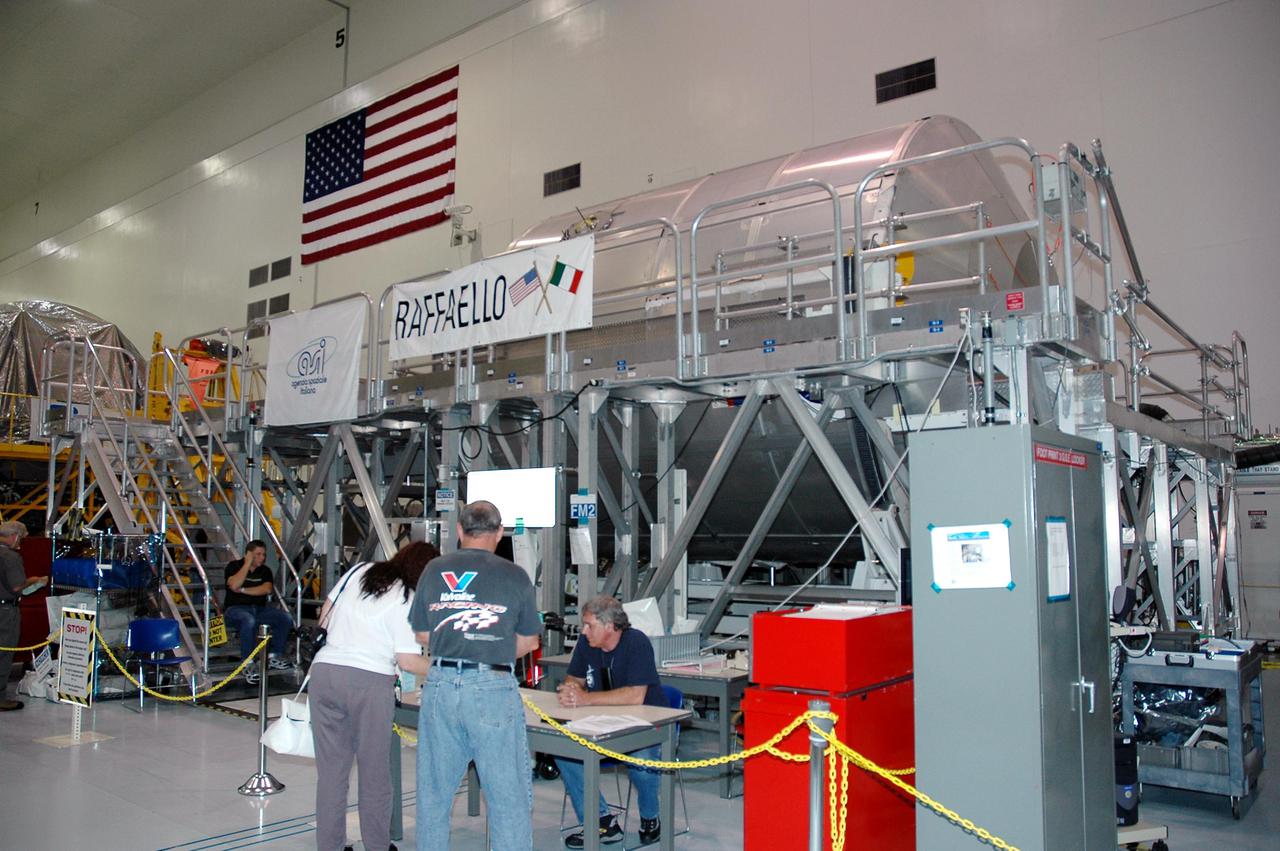
KENNEDY SPACE CENTER, FLA. - In the Space Station Processing Facility, the Multi-Purpose Logistics Module Raffaello (background) sits on a work stand. It is ready for hatch closure after recent testing. Previously loaded into the Payload Canister Transporter, Raffaello was moved back to its work stand to allow the processing team access to address concerns with mechanical fasteners inside the module that do not incorporate an adequate secondary locking feature. The assessment and additional work was conducted to ensure that the fasteners do not disengage during ascent. Raffaello is scheduled to launch on Discovery’s Return to Flight mission STS-114. The launch window extends July 13 to July 31.
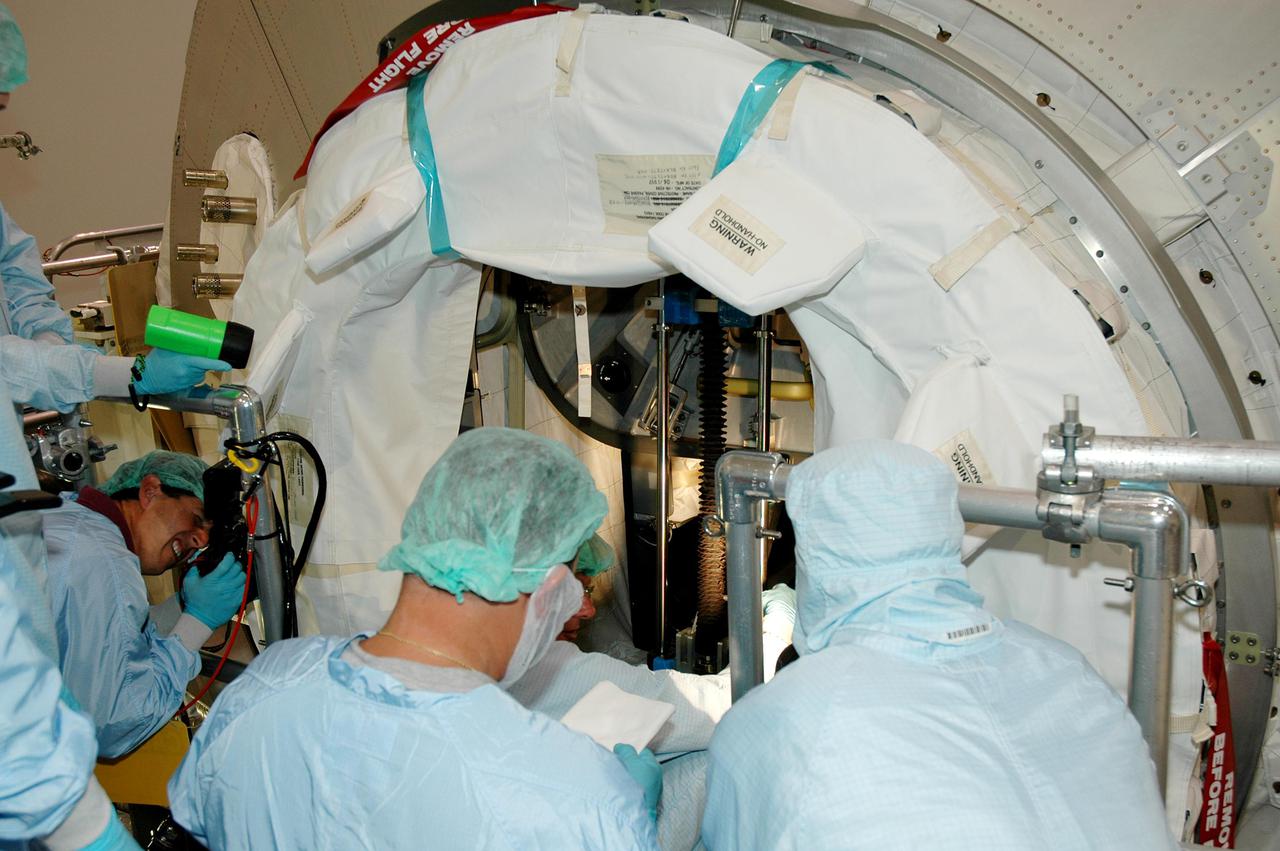
KENNEDY SPACE CENTER, FLA. -- Workers in the Space Station Processing Facility take final measurements flight on Italian-built Multi-Purpose Logistics Module Raffaello as they prepare to close the hatch for flight, a significant milestone on the road to Return to Flight. The module will travel to the International Space Station aboard Space Shuttle Discovery’s Return to Flight mission STS-114. Raffaello carries 12 racks of cargo, including food, clothing, spare parts and research equipment, to the Station. Shuttle Discovery is targeted for launch in a window extending May 15 through June 3.
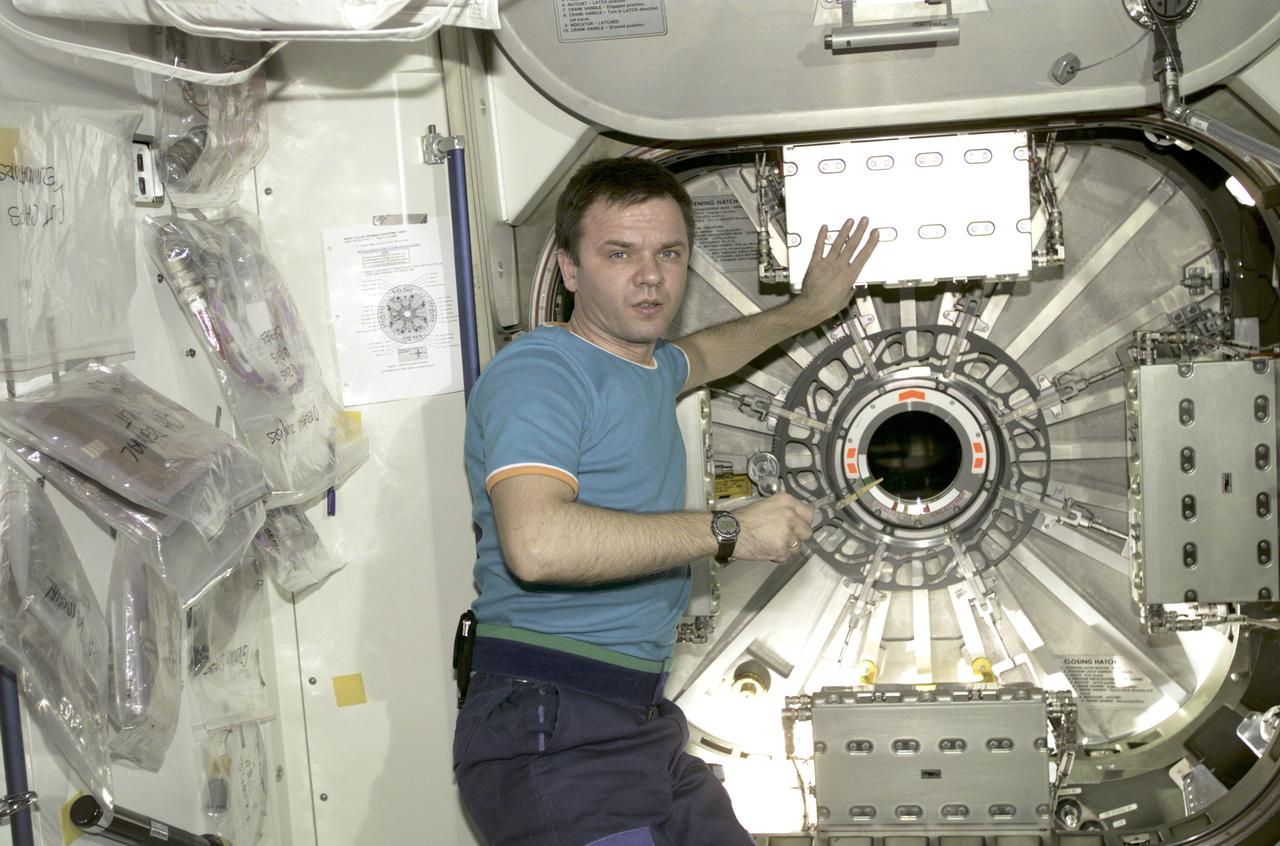
Cosmonaut Yuri P. Gidzenko, Expedition One Soyuz commander, stands near the hatch leading from the Unity node into the newly-attached Destiny laboratory aboard the International Space Station (ISS). The Node 1, or Unity, serves as a cornecting passageway to Space Station modules. The U.S.-built Unity module was launched aboard the Orbiter Endeavour (STS-88 mission) on December 4, 1998, and connected to Zarya, the Russian-built Functional Cargo Block (FGB). The U.S. Laboratory (Destiny) module is the centerpiece of the ISS, where science experiments will be performed in the near-zero gravity in space. The Destiny Module was launched aboard the Space Shuttle Orbiter Atlantis (STS-98 mission) on February 7, 2001. The aluminum module is 8.5 meters (28 feet) long and 4.3 meters (14 feet) in diameter. The laboratory consists of three cylindrical sections and two endcones with hatches that will be mated to other station components. A 50.9-centimeter- (20-inch-) diameter window is located on one side of the center module segment. This pressurized module is designed to accommodate pressurized payloads. It has a capacity of 24 rack locations, and payload racks will occupy 13 locations especially designed to support experiments.
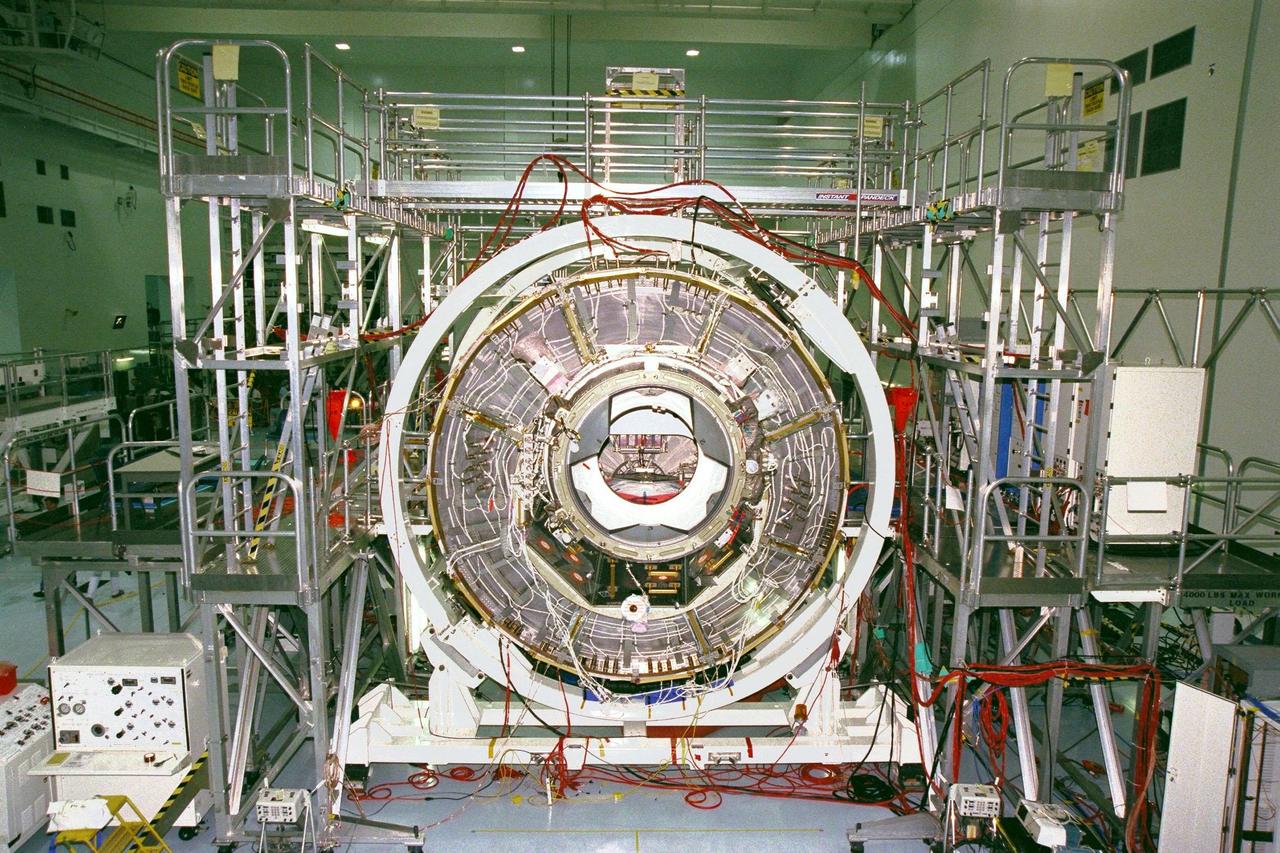
KENNEDY SPACE CENTER, FLA. -- The International Space Station's (ISS) Unity node, with Pressurized Mating Adapter (PMA)-2 attached, awaits further processing in the Space Station Processing Facility (SSPF). The Unity node is the first element of the ISS to be manufactured in the United States and is currently scheduled to lift off aboard the Space Shuttle Endeavour on STS-88 later this year. Unity has two PMAs attached to it now that this mate is completed. PMAs are conical docking adapters which will allow the docking systems used by the Space Shuttle and by Russian modules to attach to the node's hatches and berthing mechanisms. Once in orbit, Unity, which has six hatches, will be mated with the already orbiting Control Module and will eventually provide attachment points for the U.S. laboratory module; Node 3; an early exterior framework or truss for the station; an airlock; and a multi-windowed cupola. The Control Module, or Functional Cargo Block, is a U.S.-funded and Russian-built component that will be launched aboard a Russian rocket from Kazakstan
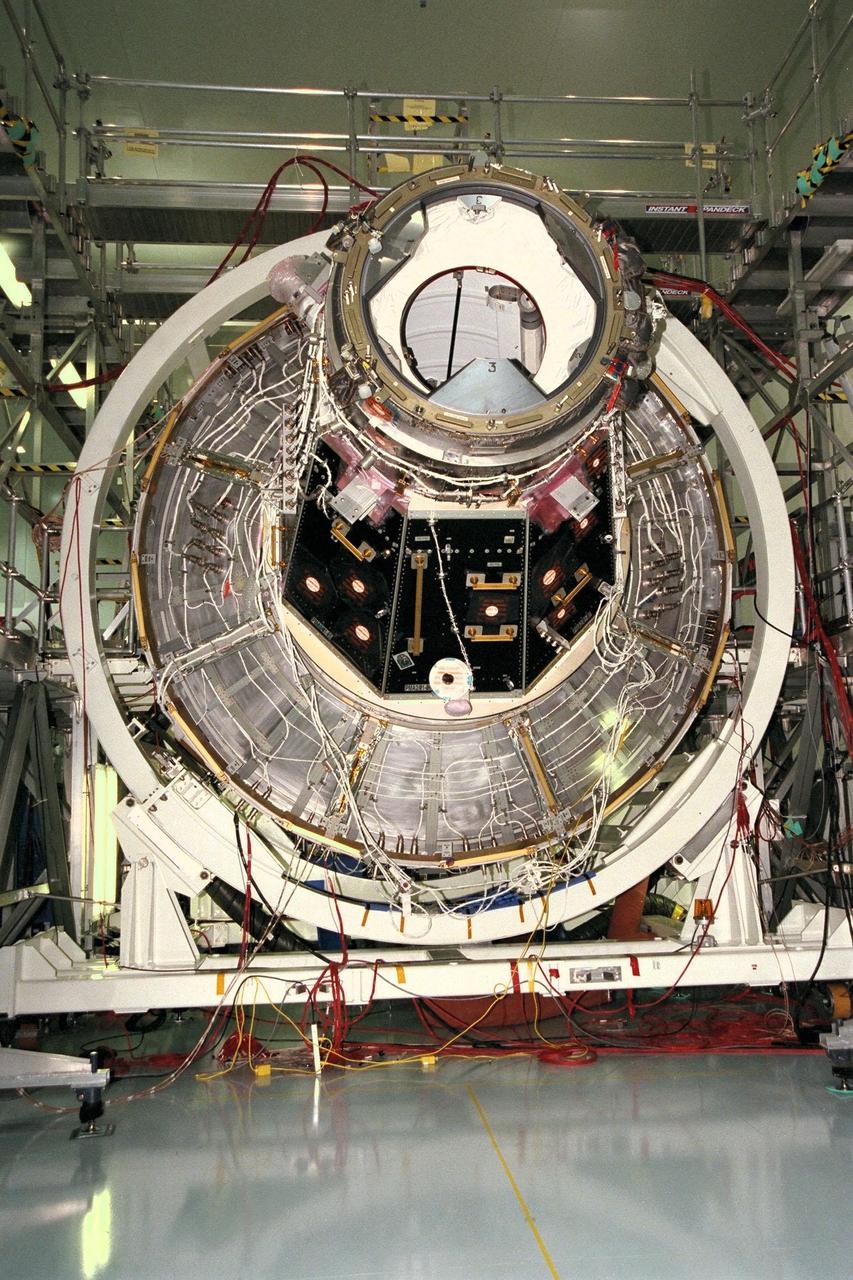
KENNEDY SPACE CENTER, FLA. -- The International Space Station's (ISS) Unity node, with Pressurized Mating Adapter (PMA)-2 attached, awaits further processing in the Space Station Processing Facility (SSPF). The Unity node is the first element of the ISS to be manufactured in the United States and is currently scheduled to lift off aboard the Space Shuttle Endeavour on STS-88 later this year. Unity has two PMAs attached to it now that this mate is completed. PMAs are conical docking adapters which will allow the docking systems used by the Space Shuttle and by Russian modules to attach to the node's hatches and berthing mechanisms. Once in orbit, Unity, which has six hatches, will be mated with the already orbiting Control Module and will eventually provide attachment points for the U.S. laboratory module; Node 3; an early exterior framework or truss for the station; an airlock; and a multi-windowed cupola. The Control Module, or Functional Cargo Block, is a U.S.-funded and Russian-built component that will be launched aboard a Russian rocket from Kazakstan
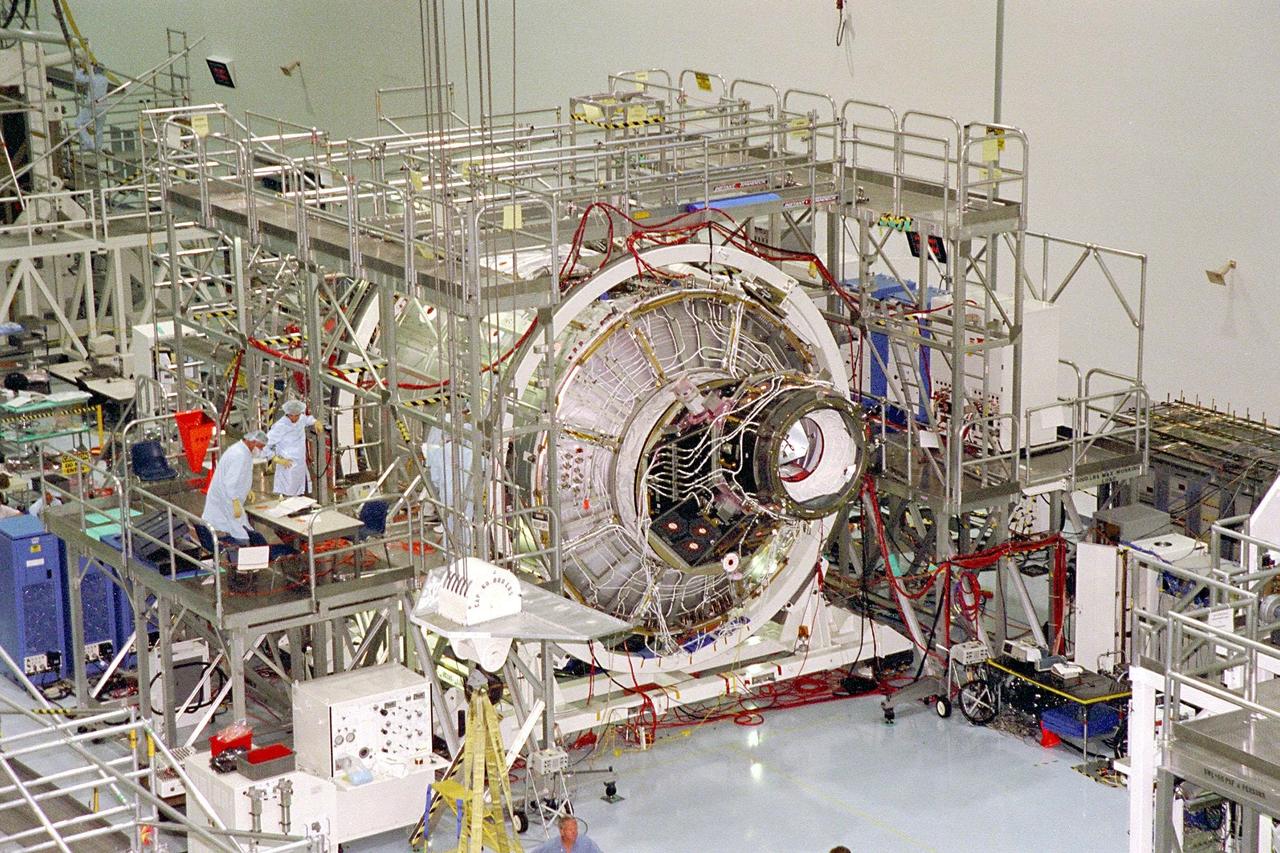
KENNEDY SPACE CENTER, FLA. -- The International Space Station's (ISS) Unity node, with Pressurized Mating Adapter (PMA)-2 attached, awaits further processing by Boeing technicians in its workstand in the Space Station Processing Facility (SSPF). The Unity node is the first element of the ISS to be manufactured in the United States and is currently scheduled to lift off aboard the Space Shuttle Endeavour on STS-88 later this year. Unity has two PMAs attached to it now that this mate is completed. PMAs are conical docking adapters which will allow the docking systems used by the Space Shuttle and by Russian modules to attach to the node's hatches and berthing mechanisms. Once in orbit, Unity, which has six hatches, will be mated with the already orbiting Control Module and will eventually provide attachment points for the U.S. laboratory module; Node 3; an early exterior framework or truss for the station; an airlock; and a multi-windowed cupola. The Control Module, or Functional Cargo Block, is a U.S.-funded and Russian-built component that will be launched aboard a Russian rocket from Kazakstan
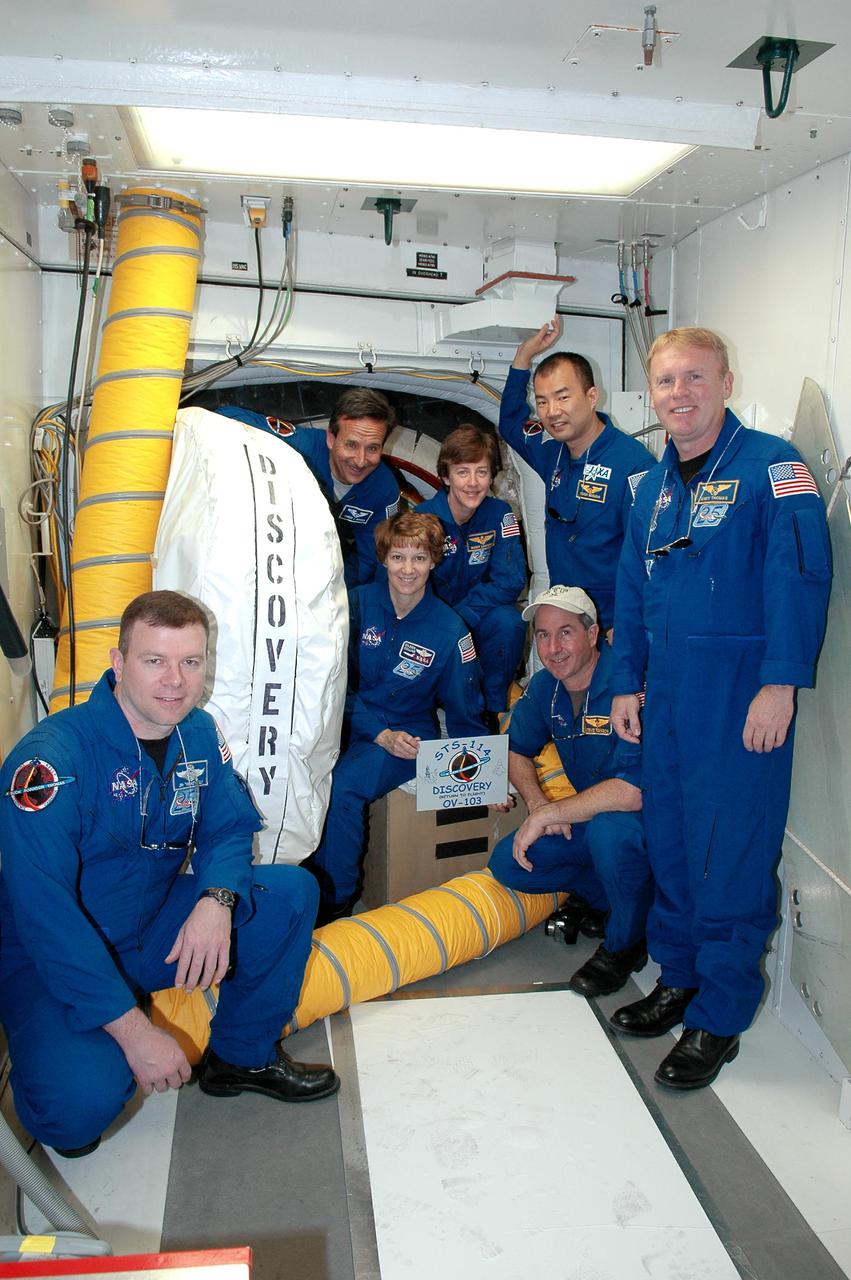
KENNEDY SPACE CENTER, FLA. - During Terminal Countdown Demonstration Test (TCDT) activities, the STS-114 crew poses for a photo at the entry hatch into Space Shuttle Discovery. At left is Pilot James Kelly. Those standing are Mission Specialists Charles Camarda, Wendy Lawrence, Soichi Noguchi and Andrew Thomas. In front of them are Commander Eileen Collins and Mission Specialist Stephen Robinson. Collins holds the mission patch. The TCDT is held at KSC prior to each Space Shuttle flight. It provides the crew of each mission an opportunity to participate in simulated countdown activities. The test ends with a mock launch countdown culminating in a simulated main engine cutoff. The crew also spends time undergoing emergency egress training exercises at the launch pad. STS-114 is designated the first Return to Flight mission, with a launch window extending from July 13 to July 31.
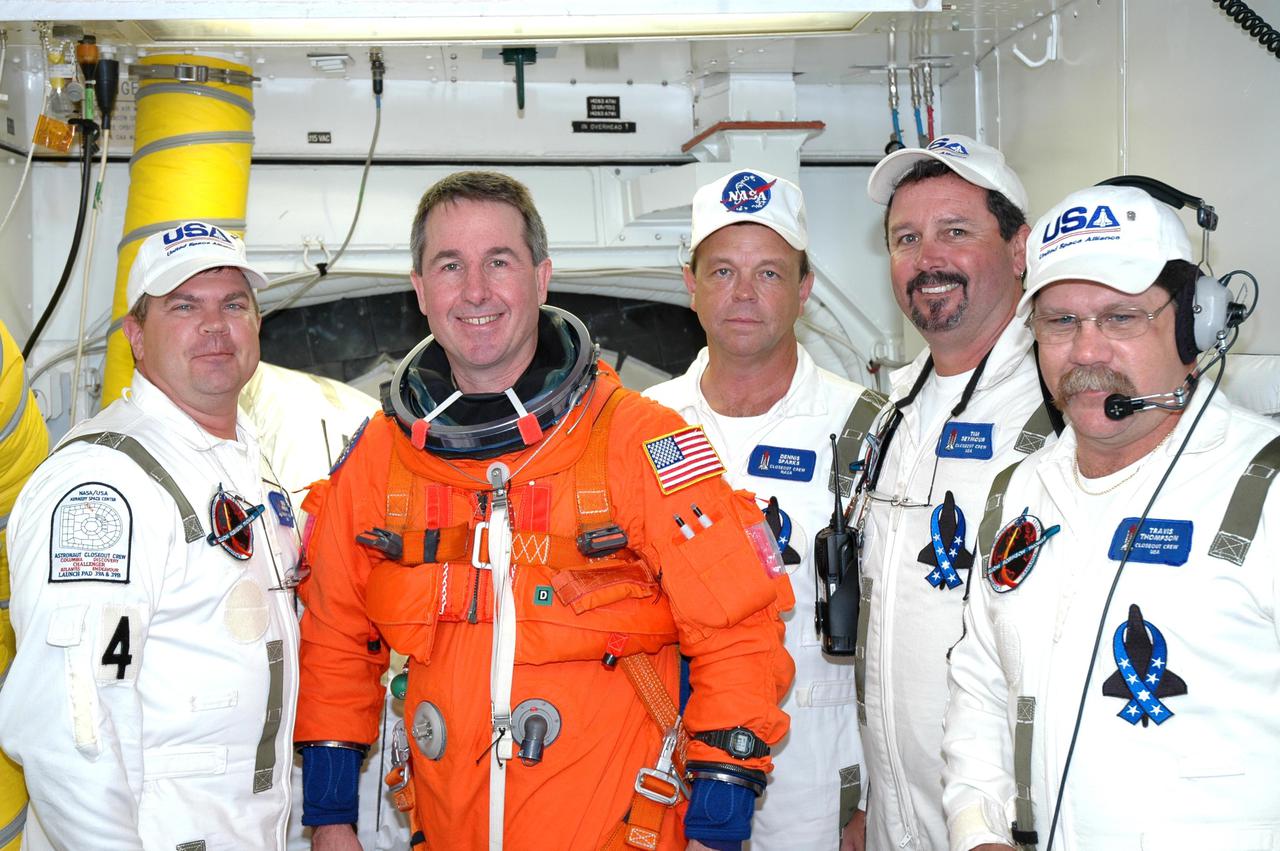
KENNEDY SPACE CENTER, FLA. - In the White Room on Launch Pad 39B, STS-114 Mission Specialist Stephen Robinson has completed adjustments to his launch suit with the help of the Closeout Crew around him. He will be entering the hatch to Space Shuttle Discovery, behind him. The crew is taking part in a full dress rehearsal for launch, including countdown and culminating in main engine cutoff. The rehearsal is the final part of Terminal Countdown Demonstration Test (TCDT) activities that the crew has been involved in for three days. TCDT provides the crew of each mission an opportunity to participate in various simulated countdown activities, including equipment familiarization and emergency egress training. STS-114 is the first Return to Flight mission to the International Space Station. The launch window extends July 13 through July 31.
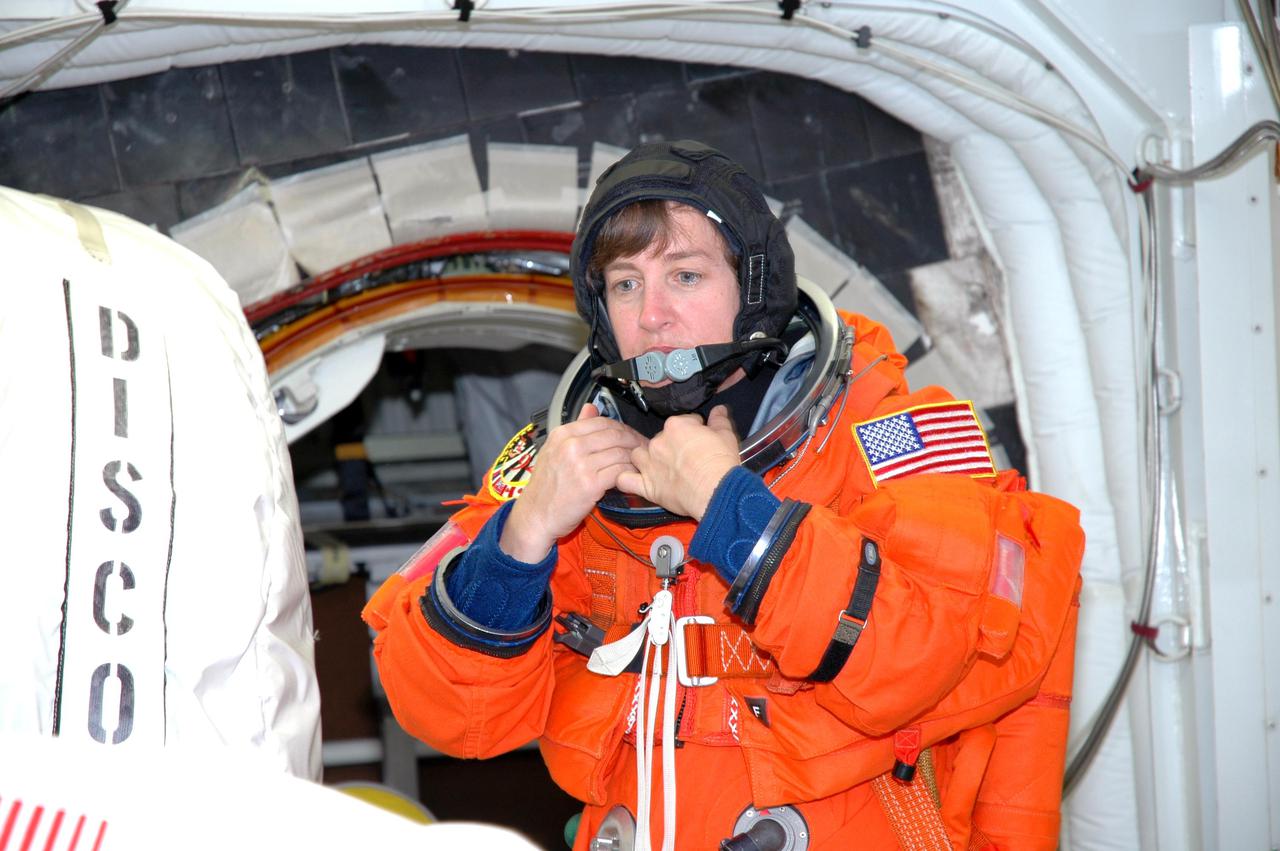
KENNEDY SPACE CENTER, FLA. - In the White Room on Launch Pad 39B, STS-114 Mission Specialist Wendy Lawrence makes a final adjustment on her launch suit before entering the hatch on Space Shuttle Discovery, behind her. The crew is taking part in a full dress rehearsal for launch, including countdown and culminating in main engine cutoff. The rehearsal is the final part of Terminal Countdown Demonstration Test (TCDT) activities that the crew has been involved in for three days. TCDT provides the crew of each mission an opportunity to participate in various simulated countdown activities, including equipment familiarization and emergency egress training. STS-114 is the first Return to Flight mission to the International Space Station. The launch window extends July 13 through July 31.
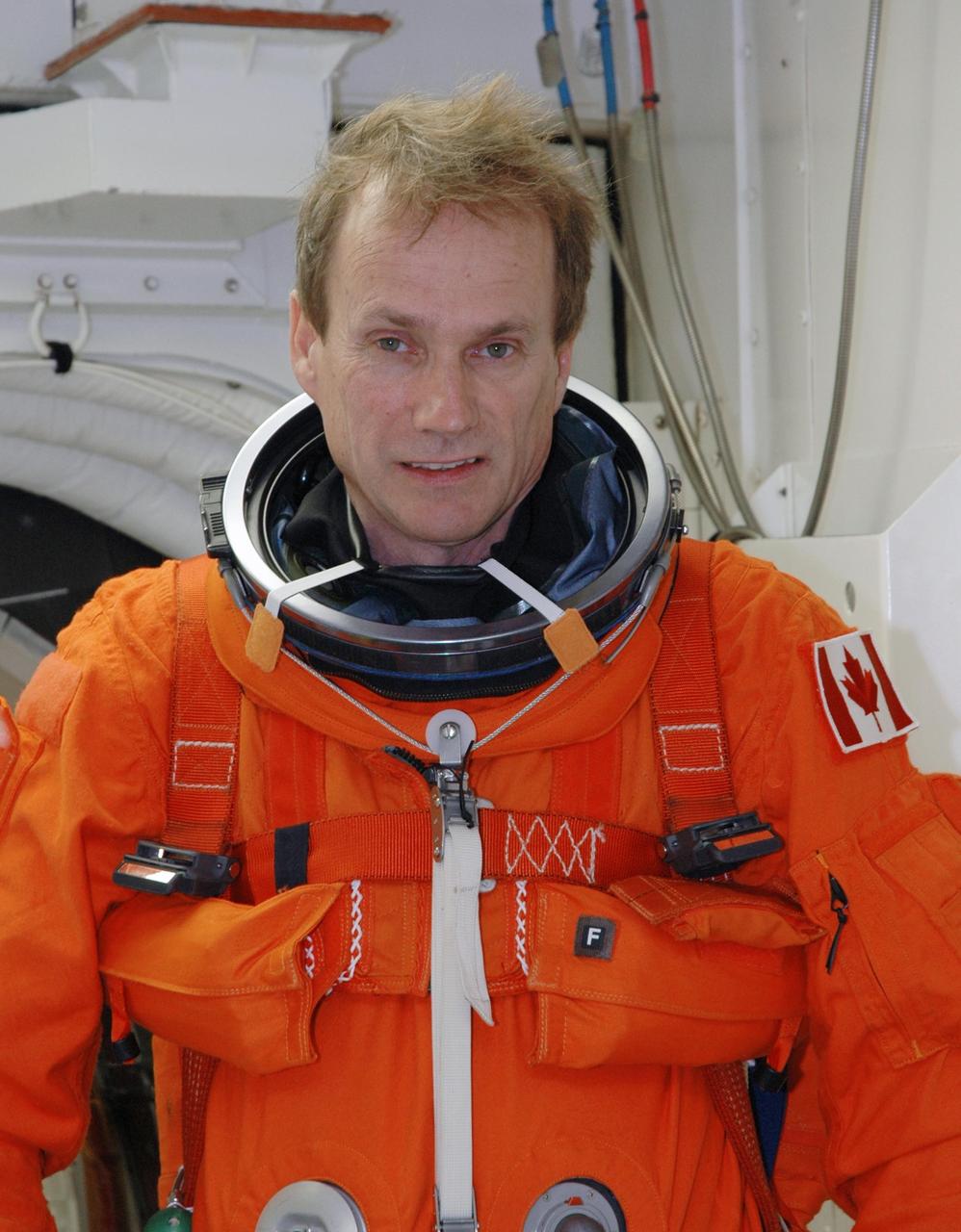
KENNEDY SPACE CENTER, FLA. - The STS-115 crew members complete their suitup in the White Room before entering Space Shuttle Atlantis on Launch Pad 39B for a simulated launch countdown. Shown here is Mission Specialist Steven MacLean. The White Room, which is located at the end of the orbiter access arm, allows entry into the orbiter through the crew access hatch. The mission crew is at KSC for Terminal Countdown Demonstration Test (TCDT) activities that are preparation for launch. Liftoff of Atlantis is scheduled to take place in a window that opens Aug. 27. During their 11-day mission to the International Space Station, the STS-115 crew will continue construction of the station and attach the payload elements, the Port 3/4 truss segment with its two large solar arrays. Photo credit: NASA/Jim Grossmann
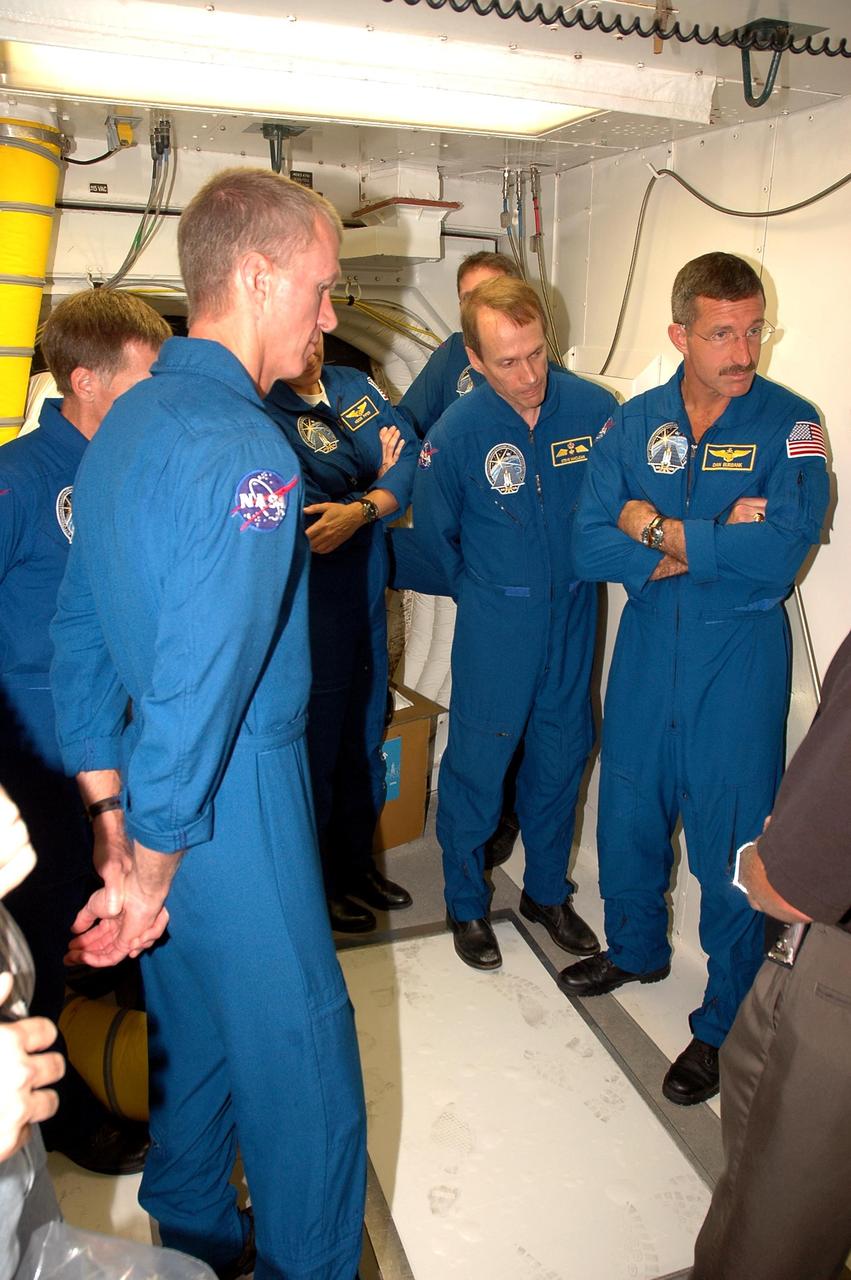
KENNEDY SPACE CENTER, FLA. - The STS-115 crew is in the White Room on the orbiter access arm on Launch Pad 39B to get instruction on using the emergency egress system. From left are Commander Brent Jett, Pilot Chris Ferguson, and Mission Specialists Heidemarie Stefanyshyn-Piper, Joseph Tanner, Steven MacLean and Daniel Burbank. MacLean is with the Canadian Space Agency. he White Room provides access into the orbiter through the crew access hatch. The mission crew is at KSC for Terminal Countdown Demonstration Test (TCDT) activities that are preparation for launch on Space Shuttle Atlantis, scheduled to take place in a window that opens Aug. 27. During their 11-day mission to the International Space Station, the STS-115 crew will continue construction of the station and attach the payload elements, the Port 3/4 truss segment with its two large solar arrays. Photo credit: NASA/Cory Huston
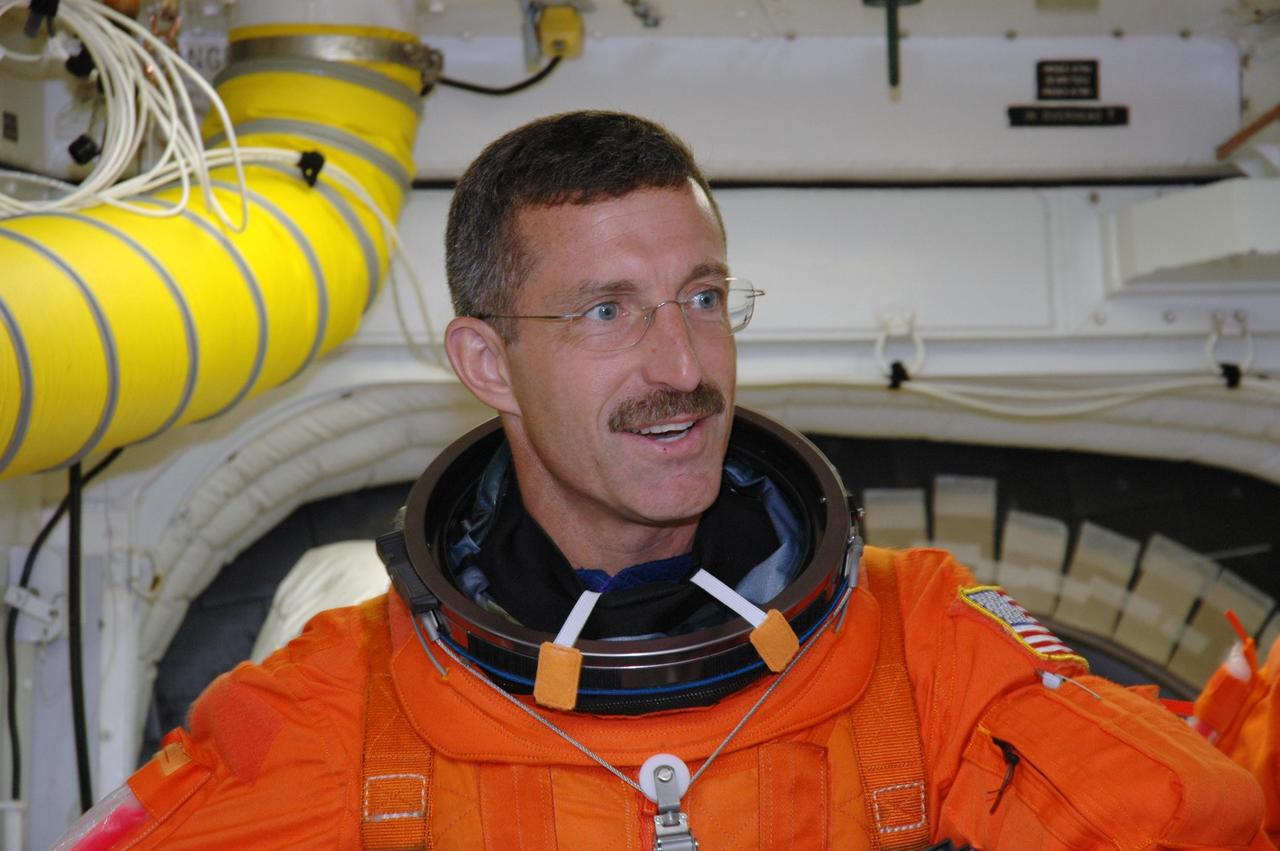
KENNEDY SPACE CENTER, FLA. - The STS-115 crew members complete their suitup in the White Room before entering Space Shuttle Atlantis on Launch Pad 39B for a simulated launch countdown. Shown here is Mission Specialist Daniel Burbank. The White Room, which is located at the end of the orbiter access arm, allows entry into the orbiter through the crew access hatch. The mission crew is at KSC for Terminal Countdown Demonstration Test (TCDT) activities that are preparation for launch. Liftoff of Atlantis is scheduled to take place in a window that opens Aug. 27. During their 11-day mission to the International Space Station, the STS-115 crew will continue construction of the station and attach the payload elements, the Port 3/4 truss segment with its two large solar arrays. Photo credit: NASA/Jim Grossmann
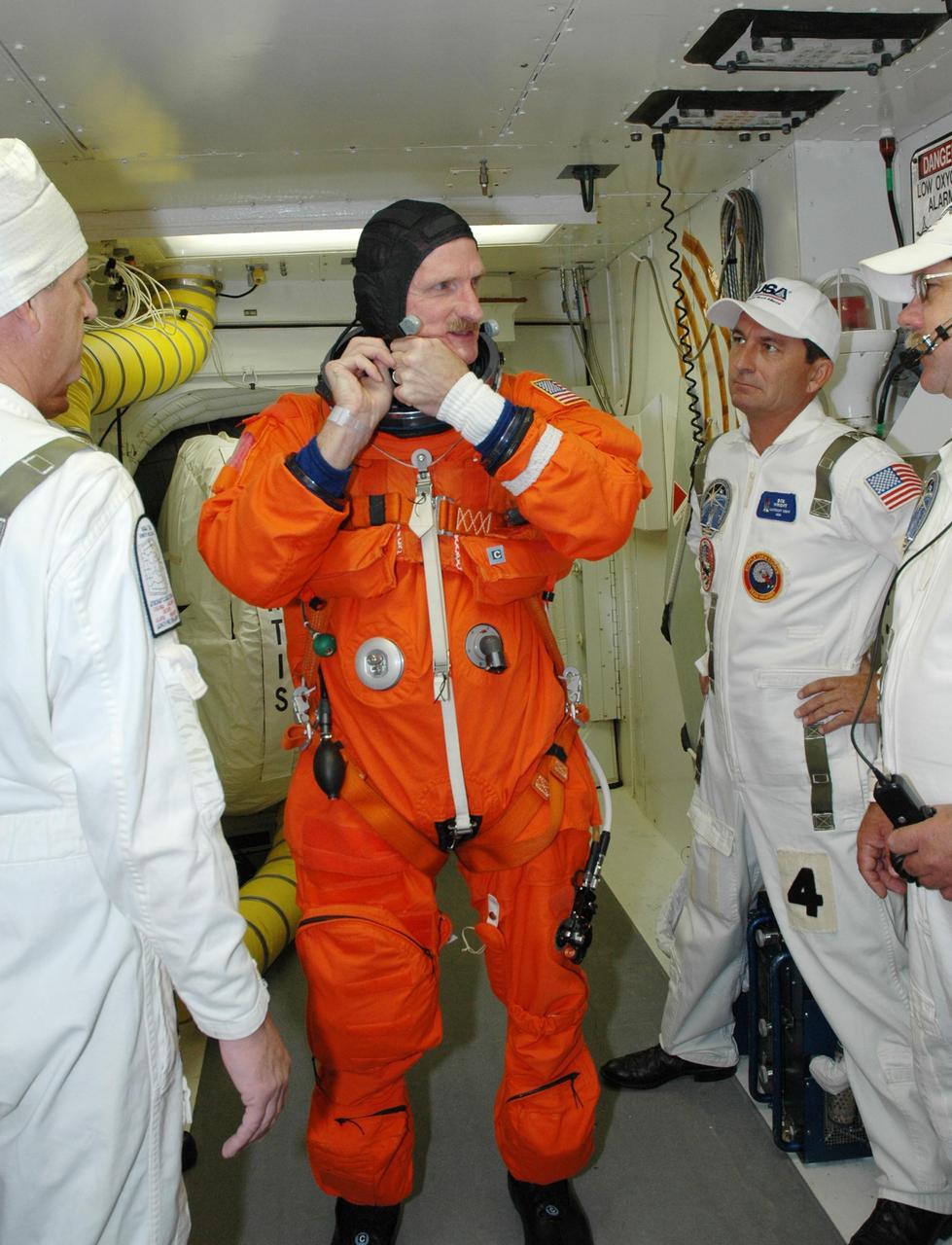
KENNEDY SPACE CENTER, FLA. - The STS-115 crew members complete their suitup in the White Room before entering Space Shuttle Atlantis on Launch Pad 39B for a simulated launch countdown. Shown here is Mission Specialist Joseph Tanner. The White Room, which is located at the end of the orbiter access arm, allows entry into the orbiter through the crew access hatch. The mission crew is at KSC for Terminal Countdown Demonstration Test (TCDT) activities that are preparation for launch. Liftoff of Atlantis is scheduled to take place in a window that opens Aug. 27. During their 11-day mission to the International Space Station, the STS-115 crew will continue construction of the station and attach the payload elements, the Port 3/4 truss segment with its two large solar arrays. Photo credit: NASA/Jim Grossmann

KENNEDY SPACE CENTER, FLA. - The STS-115 crew is in the White Room on the orbiter access arm on Launch Pad 39B to get instruction on using the emergency egress system. From left are Commander Brent Jett, Pilot Chris Ferguson, and Mission Specialists Heidemarie Stefanyshyn-Piper, Joseph Tanner, Steven MacLean and Daniel Burbank. MacLean is with the Canadian Space Agency. The White Room provides access into the orbiter through the crew access hatch. The mission crew is at KSC for Terminal Countdown Demonstration Test (TCDT) activities that are preparation for launch on Space Shuttle Atlantis, scheduled to take place in a window that opens Aug. 27. During their 11-day mission to the International Space Station, the STS-115 crew will continue construction of the station and attach the payload elements, the Port 3/4 truss segment with its two large solar arrays. Photo credit: NASA/Cory Huston
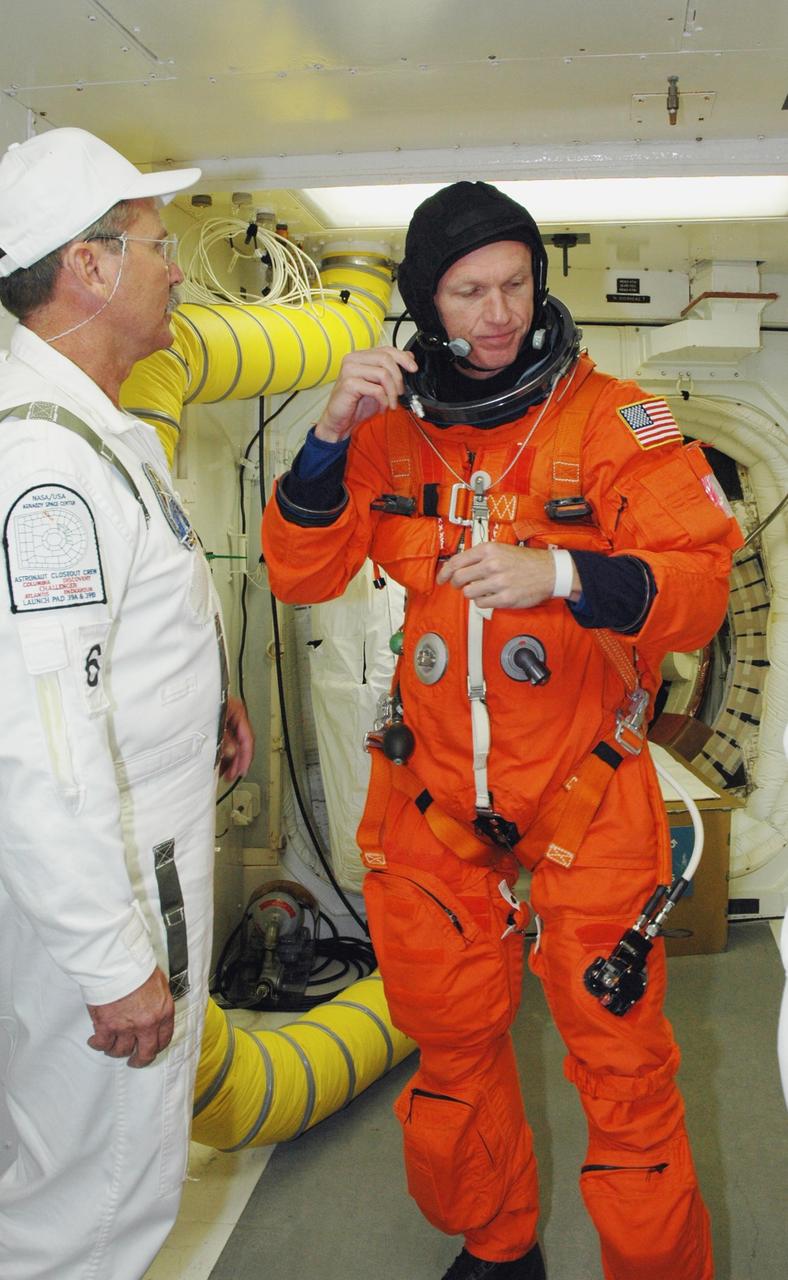
KENNEDY SPACE CENTER, FLA. - The STS-115 crew members complete their suitup in the White Room before entering Space Shuttle Atlantis on Launch Pad 39B for a simulated launch countdown. Shown here is Commander Brent Jett. The White Room, which is located at the end of the orbiter access arm, allows entry into the orbiter through the crew access hatch. The mission crew is at KSC for Terminal Countdown Demonstration Test (TCDT) activities that are preparation for launch. Liftoff of Atlantis is scheduled to take place in a window that opens Aug. 27. During their 11-day mission to the International Space Station, the STS-115 crew will continue construction of the station and attach the payload elements, the Port 3/4 truss segment with its two large solar arrays. Photo credit: NASA/Jim Grossmann
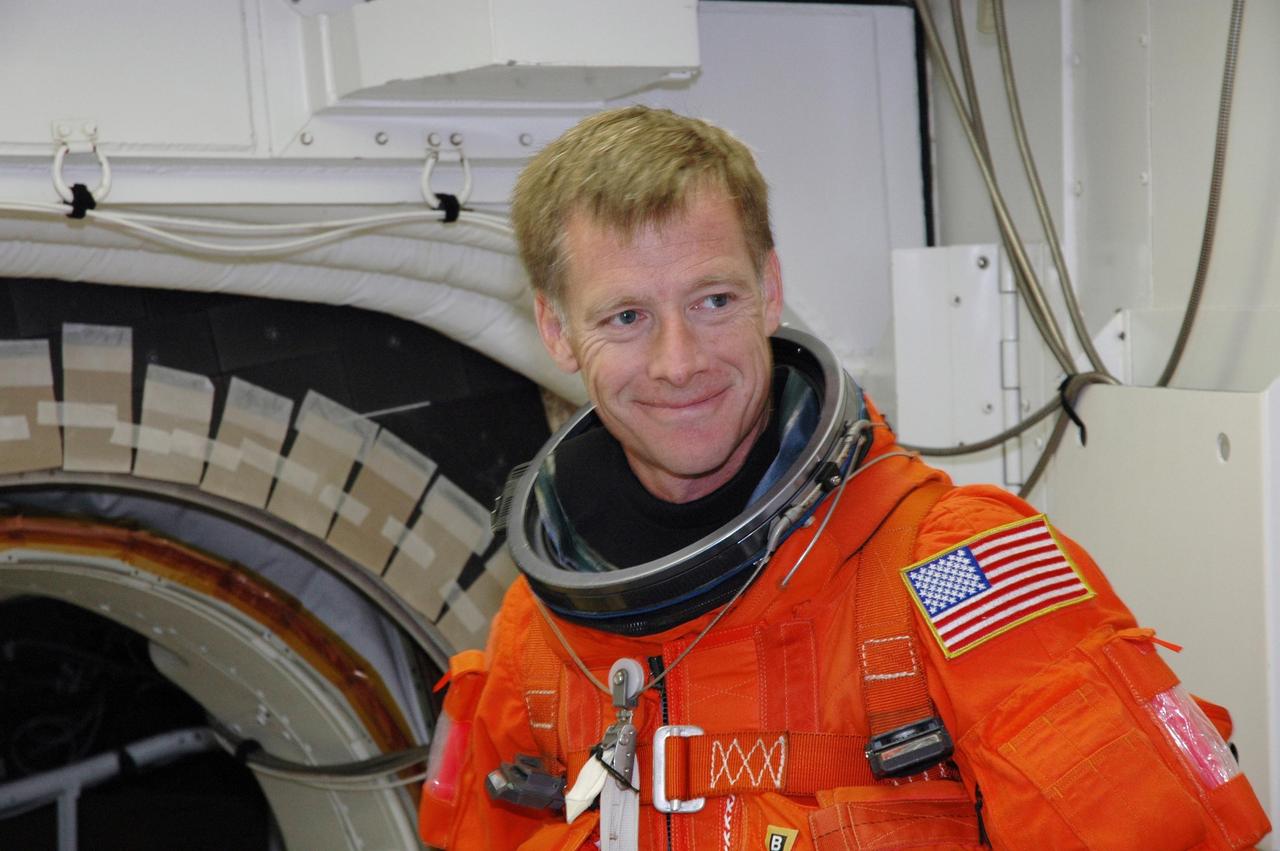
KENNEDY SPACE CENTER, FLA. - The STS-115 crew members complete their suitup in the White Room before entering Space Shuttle Atlantis on Launch Pad 39B for a simulated launch countdown. Shown here is Pilot Christopher Ferguson. The White Room, which is located at the end of the orbiter access arm, allows entry into the orbiter through the crew access hatch. The mission crew is at KSC for Terminal Countdown Demonstration Test (TCDT) activities that are preparation for launch. Liftoff of Atlantis is scheduled to take place in a window that opens Aug. 27. During their 11-day mission to the International Space Station, the STS-115 crew will continue construction of the station and attach the payload elements, the Port 3/4 truss segment with its two large solar arrays. Photo credit: NASA/Jim Grossmann
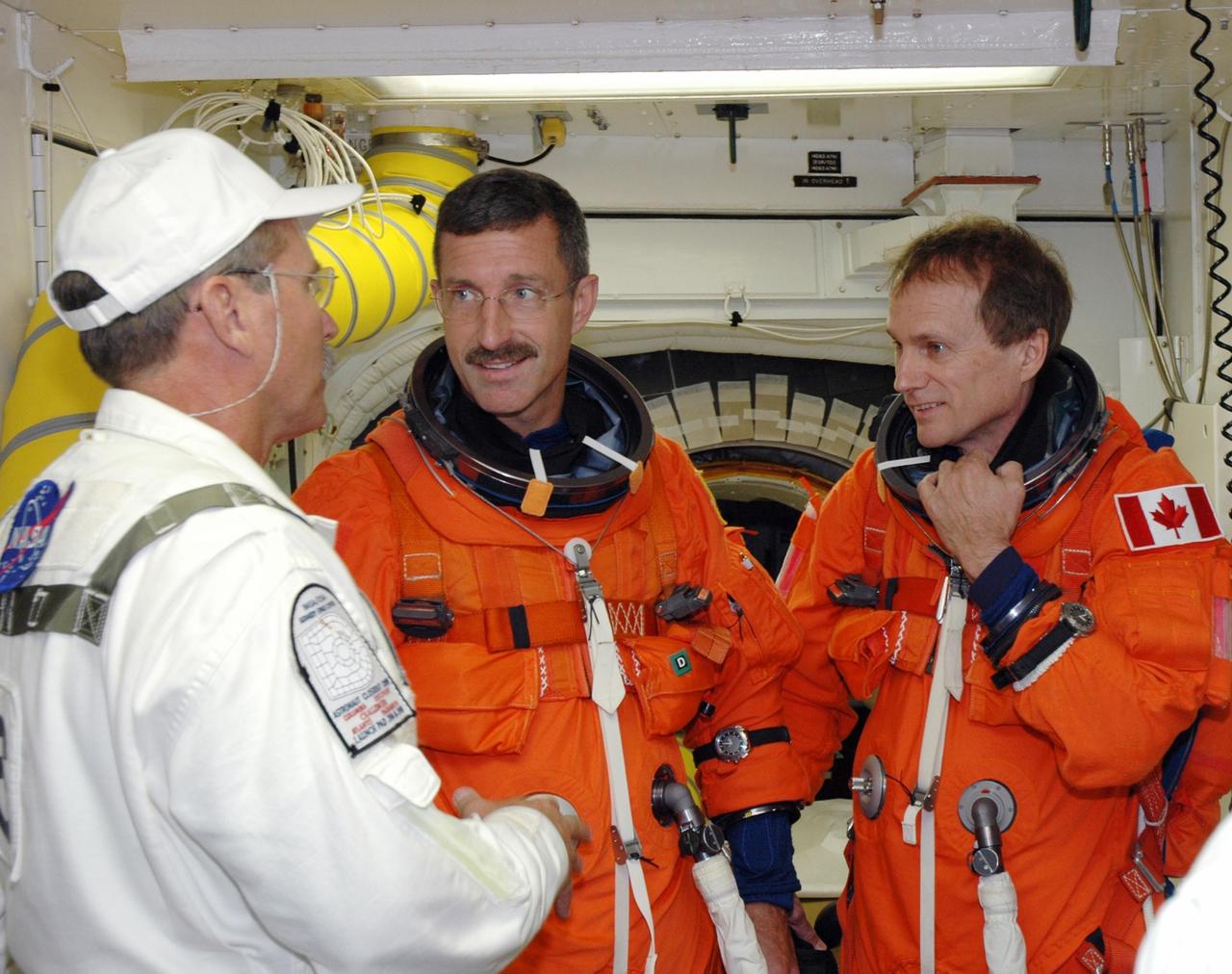
KENNEDY SPACE CENTER, FLA. - The STS-115 crew members complete their suitup in the White Room before entering Space Shuttle Atlantis on Launch Pad 39B for a simulated launch countdown. Shown here are Mission Specialists Daniel Burbank (left) and Steven MacLean. The White Room, which is located at the end of the orbiter access arm, allows entry into the orbiter through the crew access hatch. The mission crew is at KSC for Terminal Countdown Demonstration Test (TCDT) activities that are preparation for launch. Liftoff of Atlantis is scheduled to take place in a window that opens Aug. 27. During their 11-day mission to the International Space Station, the STS-115 crew will continue construction of the station and attach the payload elements, the Port 3/4 truss segment with its two large solar arrays. Photo credit: NASA/Jim Grossmann

KENNEDY SPACE CENTER, FLA. - The STS-115 crew members complete their suitup in the White Room before entering Space Shuttle Atlantis on Launch Pad 39B for a simulated launch countdown. Shown here is being helped by the closeout crew is Mission Specialist Heidemarie Stefanyshyn-Piper. The White Room, which is located at the end of the orbiter access arm, allows entry into the orbiter through the crew access hatch. The mission crew is at KSC for Terminal Countdown Demonstration Test (TCDT) activities that are preparation for launch. Liftoff of Atlantis is scheduled to take place in a window that opens Aug. 27. During their 11-day mission to the International Space Station, the STS-115 crew will continue construction of the station and attach the payload elements, the Port 3/4 truss segment with its two large solar arrays. Photo credit: NASA/Jim Grossmann

KENNEDY SPACE CENTER, FLA. - The STS-115 crew is in the White Room on the orbiter access arm on Launch Pad 39B to get instruction on using the emergency egress system. From left are Pilot Chris Ferguson, Commander Brent Jett, and Mission Specialists Heidemarie Stefanyshyn-Piper, Joseph Tanner, Steven MacLean and Daniel Burbank. MacLean is with the Canadian Space Agency. The White Room provides access into the orbiter through the crew access hatch. The mission crew is at KSC for Terminal Countdown Demonstration Test (TCDT) activities that are preparation for launch on Space Shuttle Atlantis, scheduled to take place in a window that opens Aug. 27. During their 11-day mission to the International Space Station, the STS-115 crew will continue construction of the station and attach the payload elements, the Port 3/4 truss segment with its two large solar arrays. Photo credit: NASA/Cory Huston
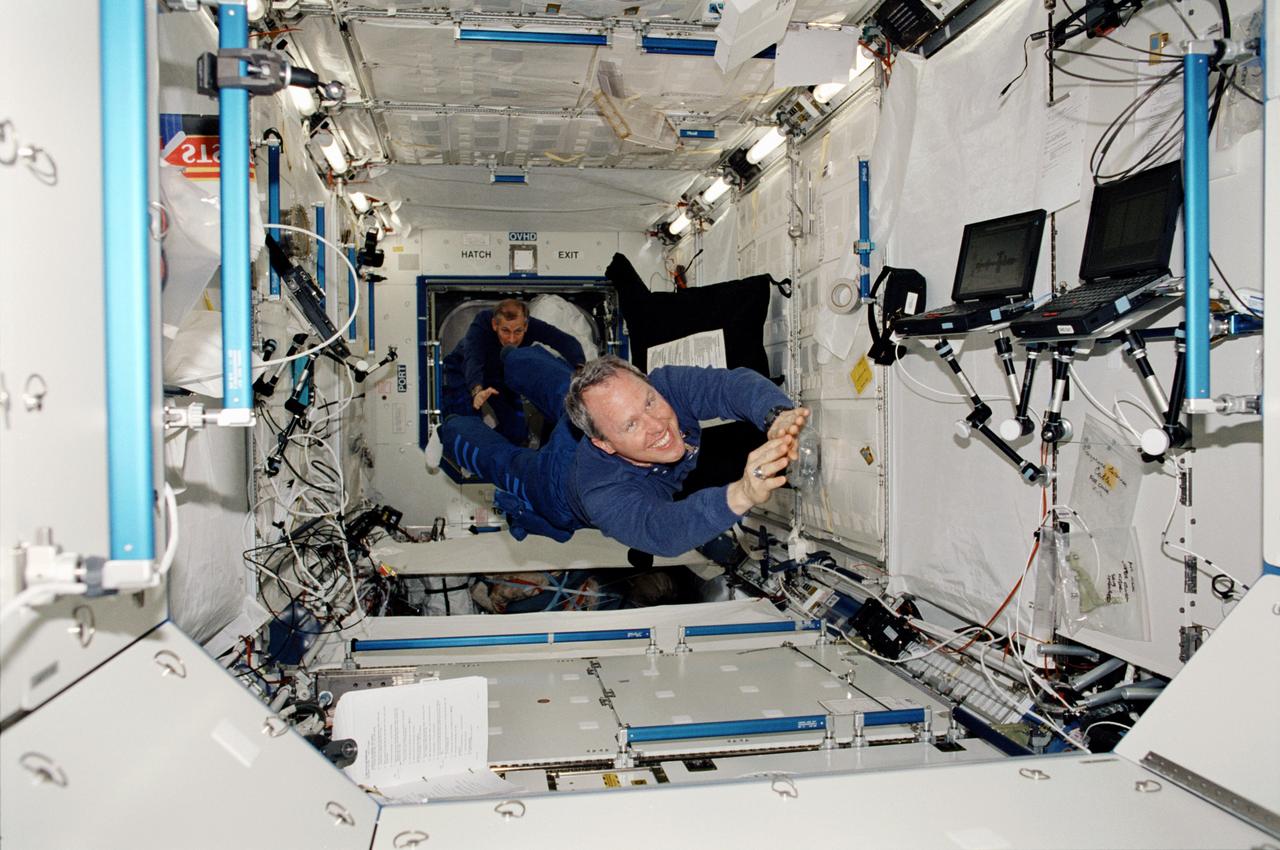
This STS-98 mission photograph shows astronauts Thomas D. Jones (foreground) and Kerneth D. Cockrell floating inside the newly installed Laboratory aboard the International Space Station (ISS). The American-made Destiny module is the cornerstone for space-based research aboard the orbiting platform and the centerpiece of the ISS, where unprecedented science experiments will be performed in the near-zero gravity of space. Destiny will also serve as the command and control center for the ISS. The aluminum module is 8.5-meters (28-feet) long and 4.3-meters (14-feet) in diameter. The laboratory consists of three cylindrical sections and two endcones with hatches that will be mated to other station components. A 50.9-centimeter (20-inch-) diameter window is located on one side of the center module segment. This pressurized module is designed to accommodate pressurized payloads. It has a capacity of 24 rack locations. Payload racks will occupy 15 locations especially designed to support experiments. The Destiny module was built by the Boeing Company under the direction of the Marshall Space Flight Center.
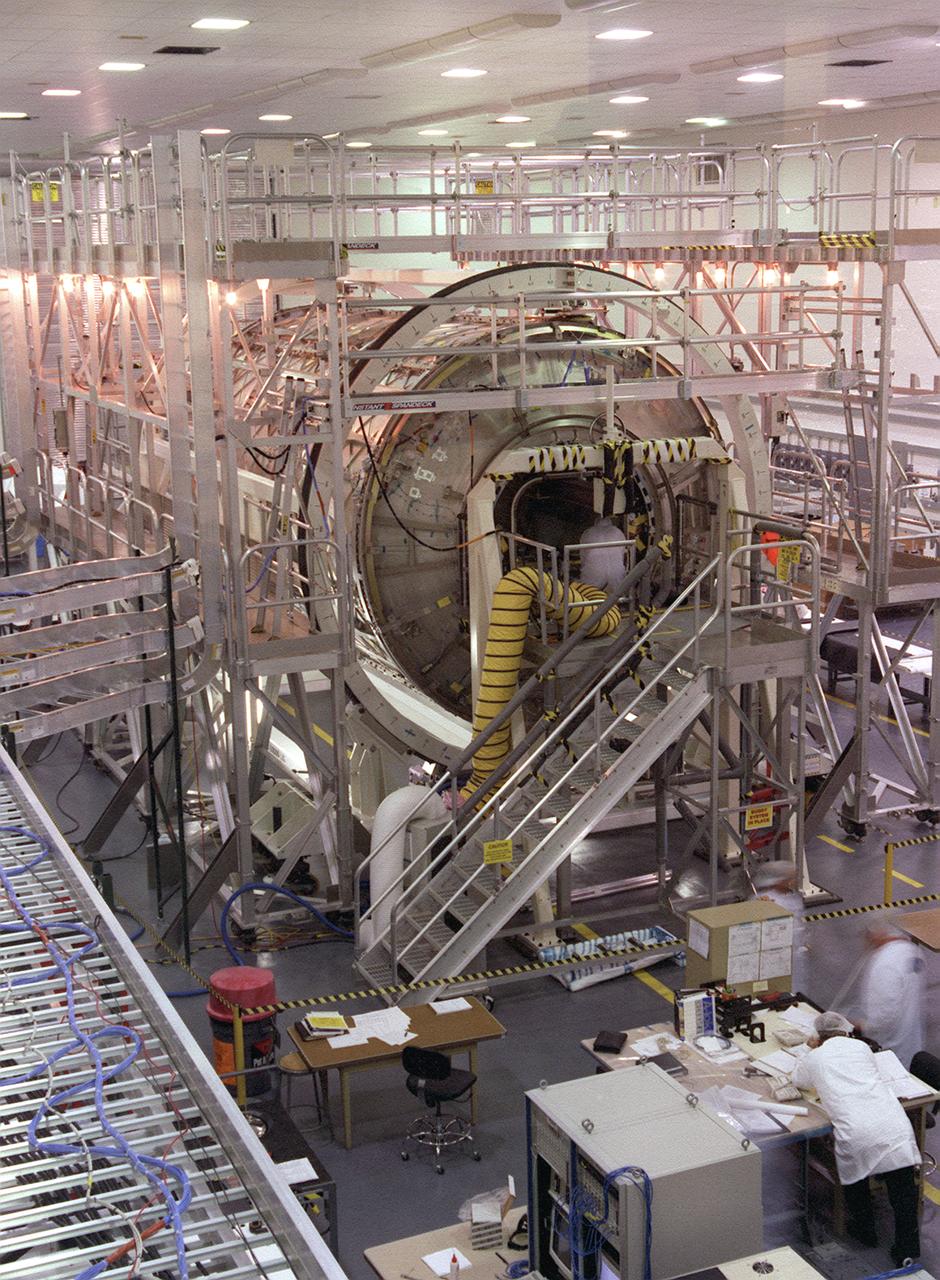
In this photograph, the U.S. Laboratory Module (also called Destiny) for the International Space Station (ISS) is shown under construction in the West High Bay of the Space Station manufacturing facility (building 4708) at the Marshall Space Flight Center. The U.S. Laboratory module is the centerpiece of the ISS, where science experiments will be performed in the near-zero gravity of space. The Destiny Module was launched aboard the Space Shuttle orbiter Atlantis (STS-98 mission) on February 7, 2001. The aluminum module is 8.5 meters (28 feet) long and 4.3 meters (14 feet) in diameter. The laboratory consists of three cylindrical sections and two endcones with hatches that will be mated to other station components. A 50.9-centimeter- (20-inch-) diameter window is located on one side of the center module segment. This pressurized module is designed to accommodate pressurized payloads. It has a capacity of 24 rack locations, and payload racks will occupy 13 locations especially designed to support experiments. The ISS is a multidisciplinary laboratory, technology test bed, and observatory that will provide unprecedented undertakings in scientific, technological, and international experimentation.
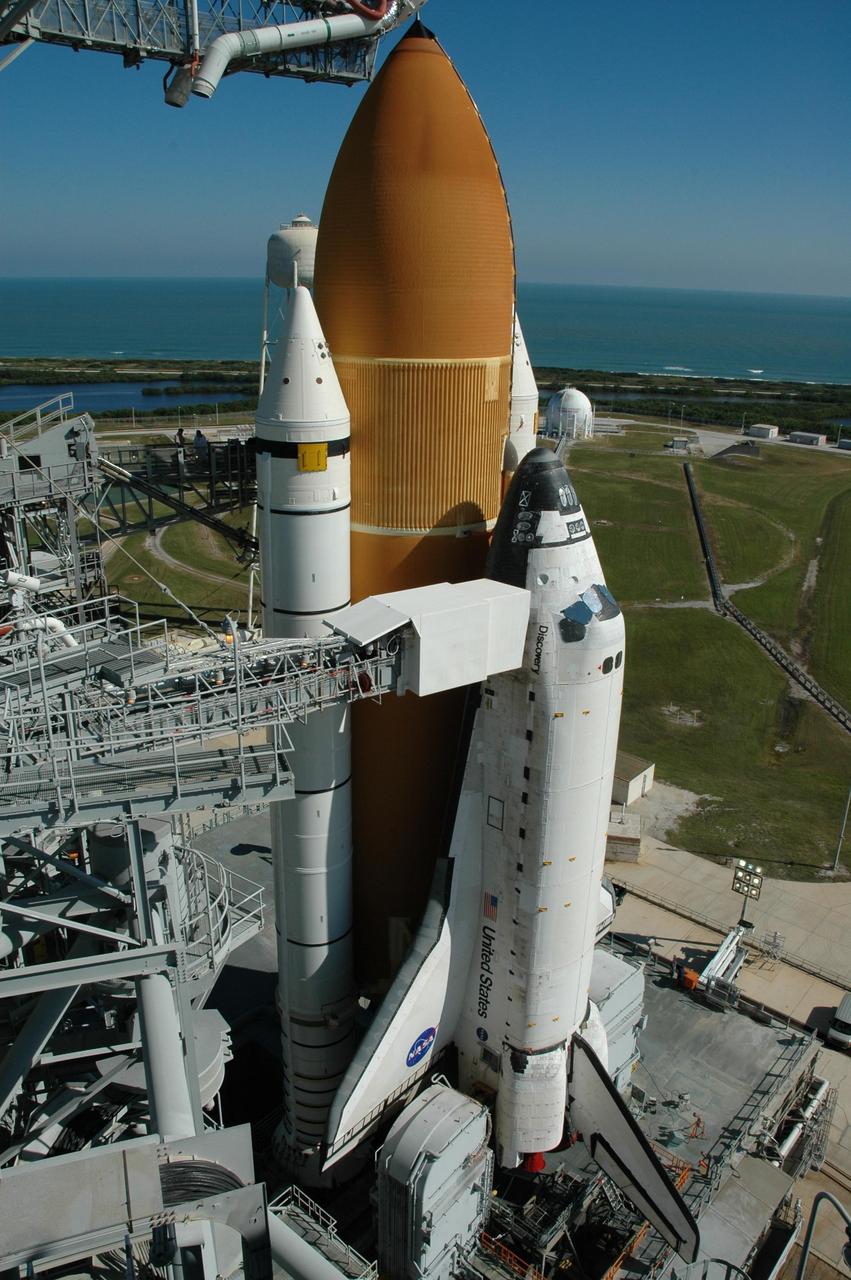
KENNEDY SPACE CENTER, FLA. -- Space Shuttle Discovery and the mobile launcher platform sit on Launch Pad 39B for mission STS-116. Beyond the pad is the Atlantic Ocean. The shuttle's external tank is capped by the oxygen vent hood (at top). Below it is the orbiter access arm which swings out from the fixed service structure to the orbiter crew compartment hatch to allow personnel to enter the crew compartment. The outer end of the access arm ends in an environmental chamber (white room) that mates with the orbiter and holds six persons. The arm remains in the extended position until seven minutes 24 seconds before launch to provide emergency egress for the flight crew. The rollout of Discovery from the Vehicle Assembly Building began at 12:29 a.m. The shuttle was harddown on the pad at 9:03 a.m. The mission is No. 20 to the International Space Station and construction flight 12A.1. The mission payload is the SPACEHAB module, the P5 integrated truss structure and other key components. The launch window for mission STS-116 opens Dec. 7. Photo credit: NASA/Jim Grossmann
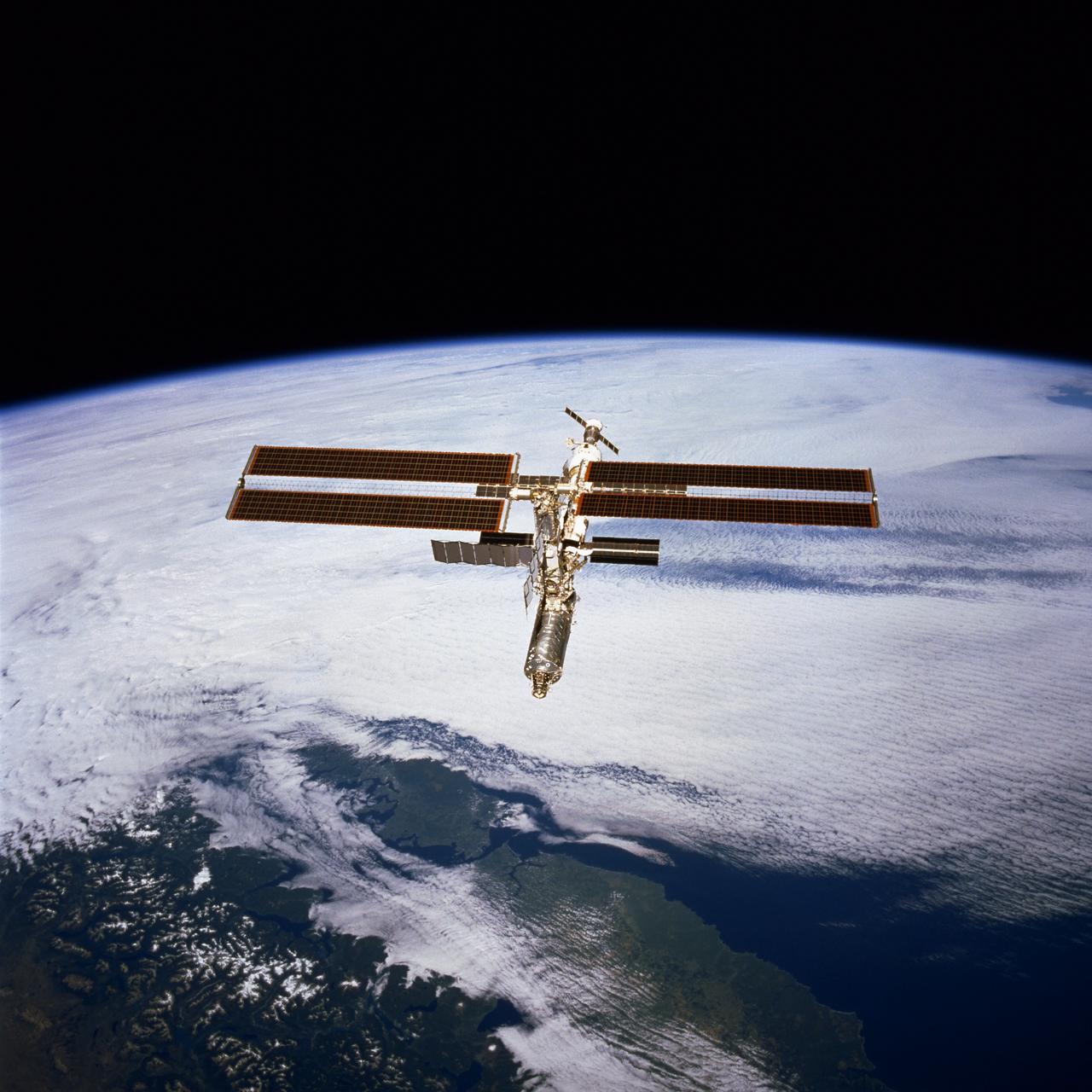
The International Space Station (ISS), with the newly installed U.S. Laboratory, Destiny, is backdropped over clouds, water and land in South America. South Central Chile shows up at the bottom of the photograph. Just below the Destiny, the Chacao Charnel separates the large island of Chile from the mainland and connects the Gulf of Coronado on the Pacific side with the Gulf of Ancud, southwest of the city of Puerto Montt. The American-made Destiny module is the cornerstone for space-based research aboard the orbiting platform and the centerpiece of the ISS, where unprecedented science experiments will be performed in the near-zero gravity of space. Destiny will also serve as the command and control center for the ISS. The aluminum module is 8.5-meters (28-feet) long and 4.3-meters (14-feet) in diameter. The laboratory consists of three cylindrical sections and two endcones with hatches that will be mated to other station components. A 50.9-centimeter (20-inch-) diameter window is located on one side of the center module segment. This pressurized module is designed to accommodate pressurized payloads. It has a capacity of 24 rack locations. Payload racks will occupy 15 locations especially designed to support experiments. The Destiny module was built by the Boeing Company under the direction of the Marshall Space Flight Center.
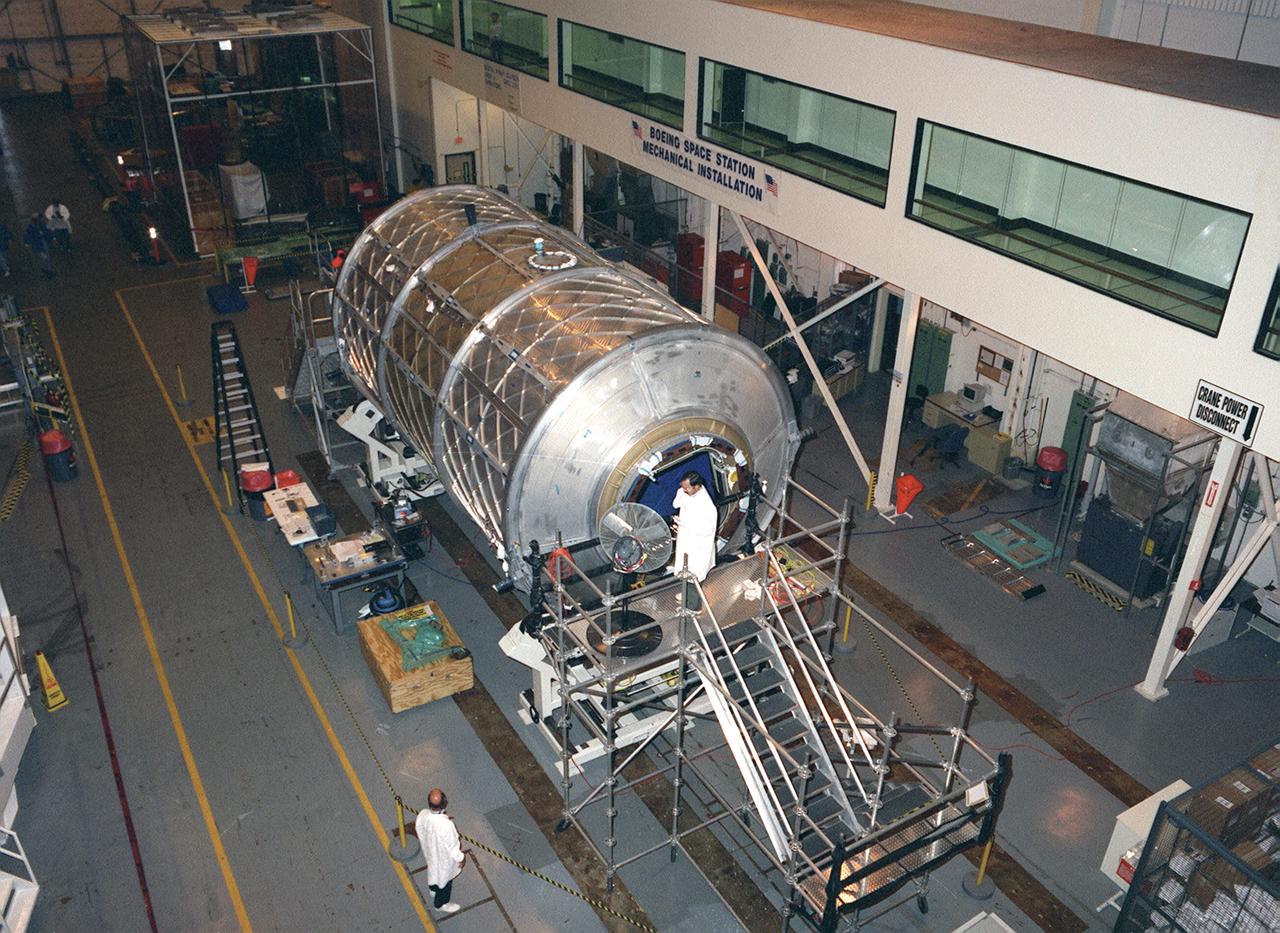
In this photograph, the U.S. Laboratory Module (also called Destiny) for the International Space Station (ISS) is shown under construction in the West High Bay of the Space Station manufacturing facility (building 4708) at the Marshall Space Flight Center. The U.S. Laboratory module is the centerpiece of the ISS, where science experiments will be performed in the near-zero gravity of space. The Destiny Module was launched aboard the Space Shuttle orbiter Atlantis (STS-98 mission) on February 7, 2001. The aluminum module is 8.5 meters (28 feet) long and 4.3 meters (14 feet) in diameter. The laboratory consists of three cylindrical sections and two endcones with hatches that will be mated to other station components. A 50.9-centimeter- (20-inch-) diameter window is located on one side of the center module segment. This pressurized module is designed to accommodate pressurized payloads. It has a capacity of 24 rack locations, and payload racks will occupy 13 locations especially designed to support experiments. The ISS is a multidisciplinary laboratory, technology test bed, and observatory that will provide unprecedented undertakings in scientific, technological, and international experimentation.
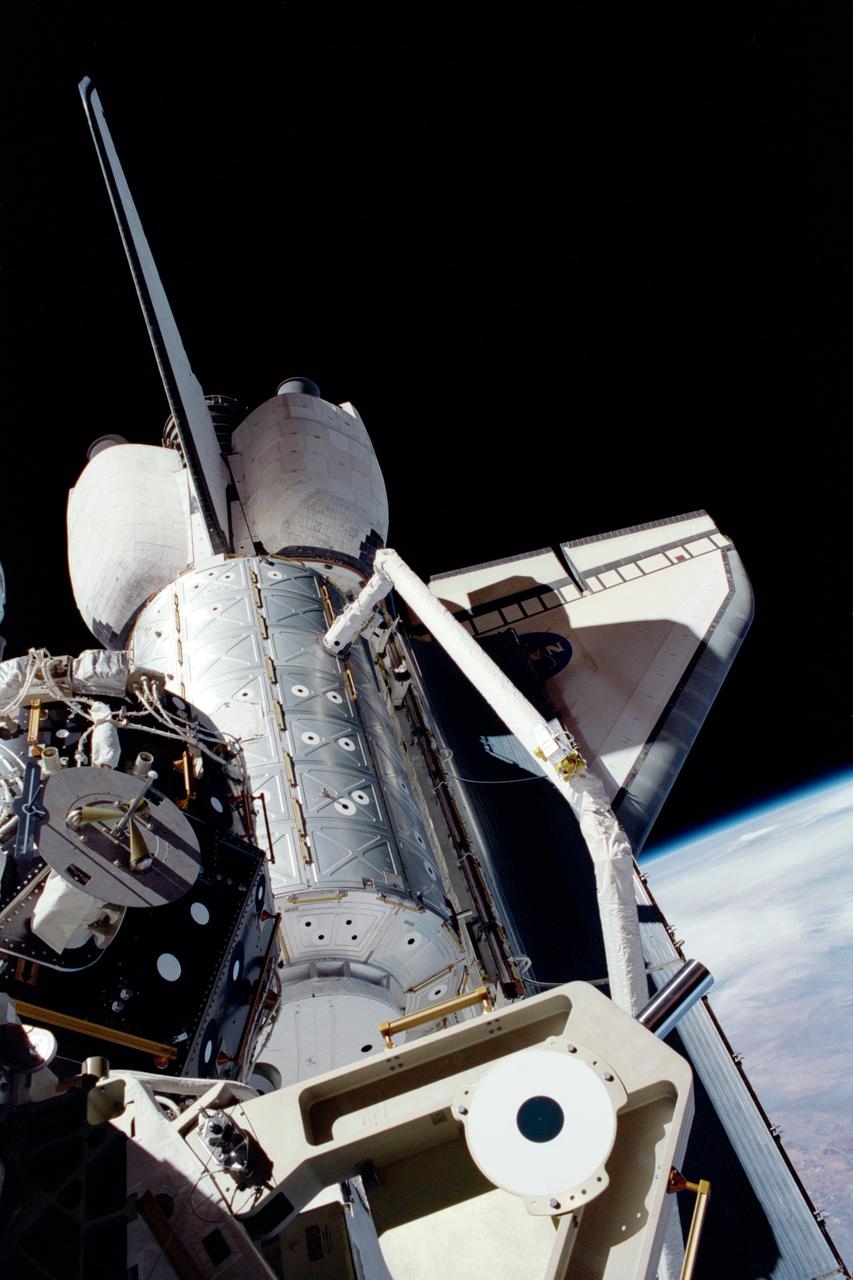
In the grasp of the Shuttle's Remote Manipulator System (RMS) robot arm, the U.S. Laboratory, Destiny, is moved from its stowage position in the cargo bay of the Space Shuttle Atlantis. This photograph was taken by astronaut Thomas D. Jones during his Extravehicular Activity (EVA). The American-made Destiny module is the cornerstone for space-based research aboard the orbiting platform and the centerpiece of the International Space Station (ISS), where unprecedented science experiments will be performed in the near-zero gravity of space. Destiny will also serve as the command and control center for the ISS. The aluminum module is 8.5- meters (28-feet) long and 4.3-meters (14-feet) in diameter. The laboratory consists of three cylindrical sections and two endcones with hatches that will be mated to other station components. A 50.9-centimeter- (20-inch-) diameter window is located on one side of the center module segment. This pressurized module is designed to accommodate pressurized payloads. It has a capacity of 24 rack locations. Payload racks will occupy 15 locations especially designed to support experiments. The Destiny module was built by the Boeing Company under the direction of the Marshall Space Flight Center.
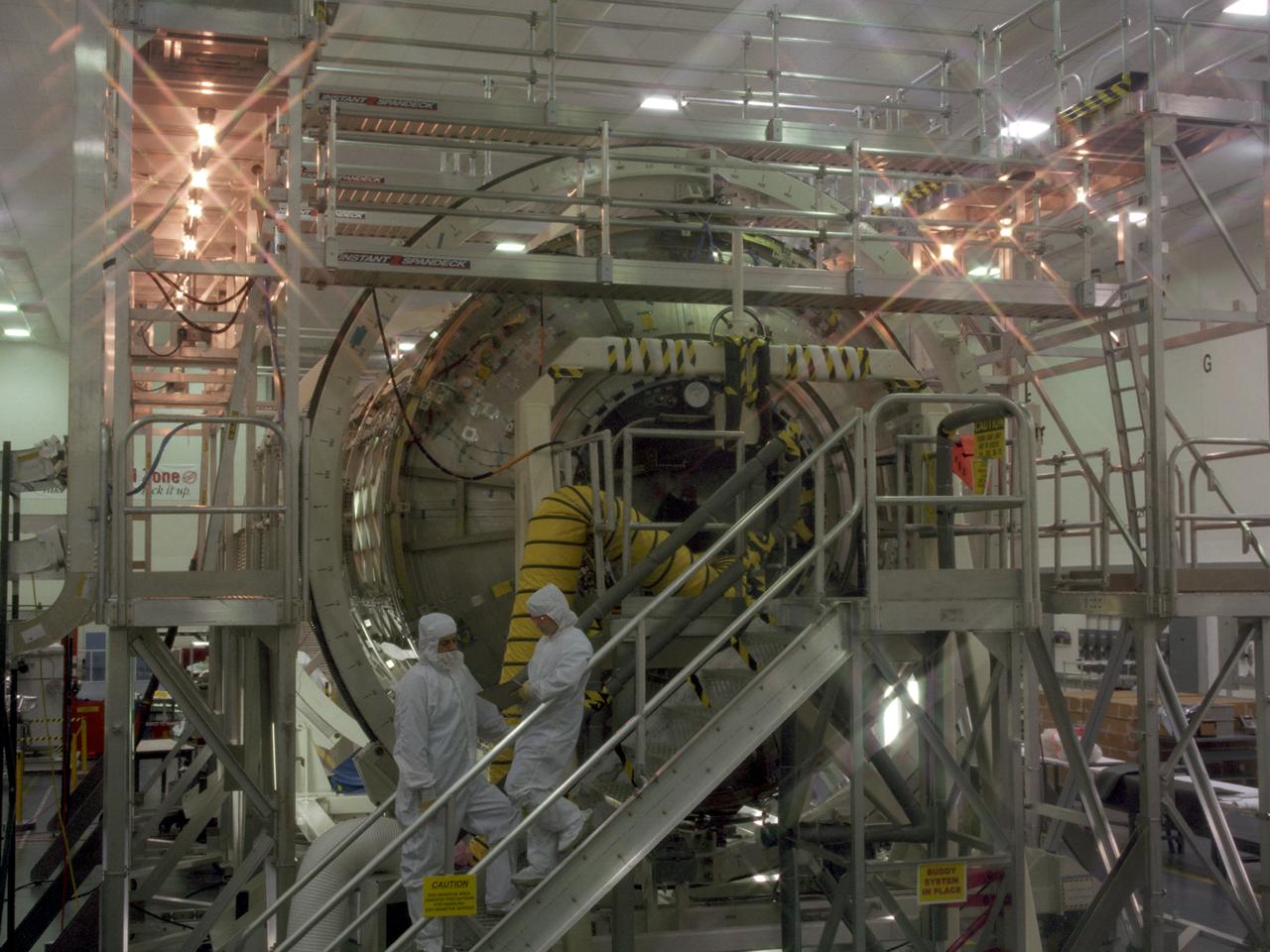
This photograph shows the U.S. Laboratory Module (also called Destiny) for the International Space Station (ISS), under construction in the Space Station manufacturing facility at the Marshall Space Flight Center. The U.S. Laboratory module is the centerpiece of the ISS, where science experiments will be performed in the near-zero gravity of space. The Destiny Module was launched aboard the Space Shuttle orbiter Atlantis (STS-67 mission) on February 7, 2001. The aluminum module is 8.5 meters (28 feet) long and 4.3 meters (14 feet) in diameter. The laboratory consists of three cylindrical sections and two end cones with hatches that will be mated to other station components. A 50.9-centimeter- (20-inch-) diameter window is located on one side of the center module segment. This pressurized module is designed to accommodate pressurized payloads. It has a capacity of 24 rack locations, and payload racks will occupy 13 locations especially designed to support experiments. The ISS is a multidisciplinary laboratory, technology test bed, and observatory that will provide unprecedented undertakings in scientific, technological, and international experimentation.
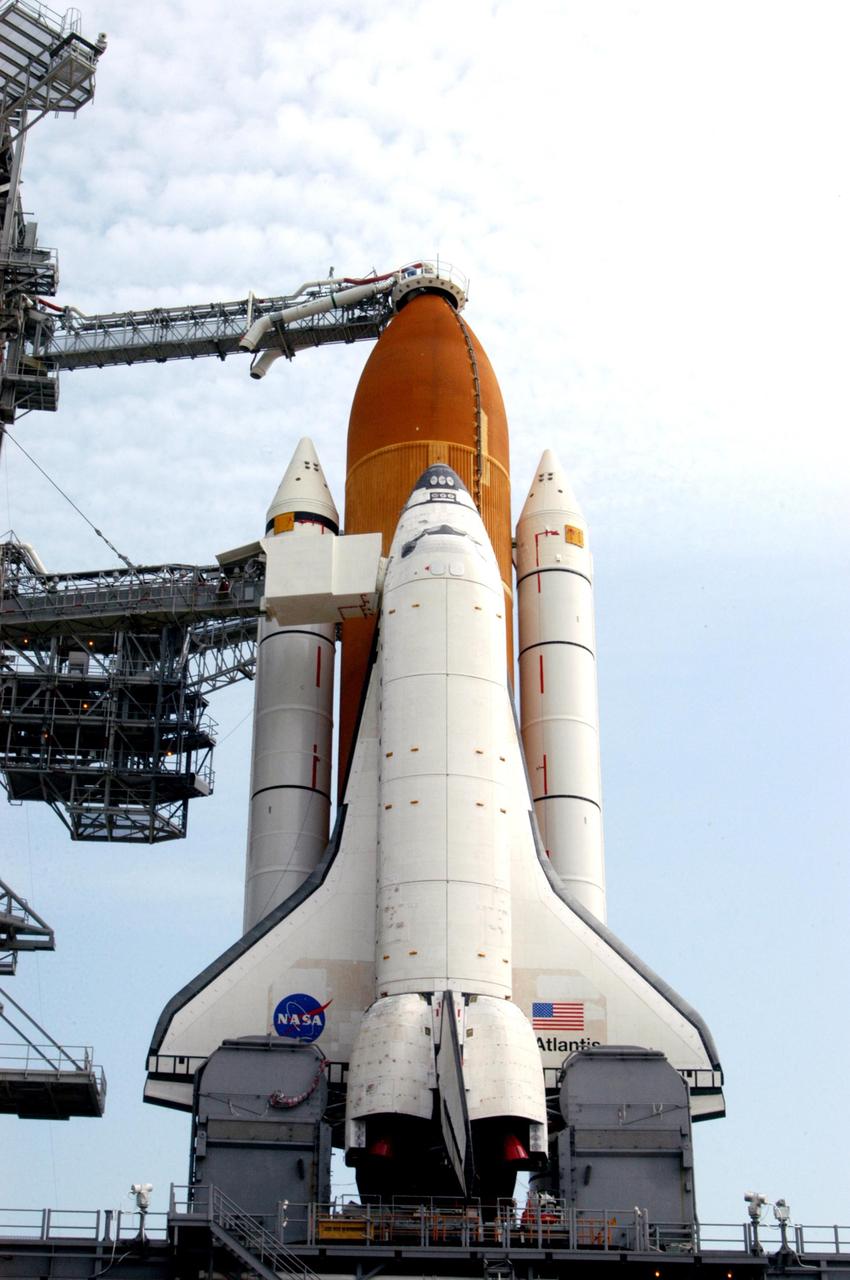
KENNEDY SPACE CENTER, FLA. - This closeup of Space Shuttle Atlantis on the hardstand of Launch Pad 39B shows the surrounding area, including the Atlantic Ocean in the background. Above the orange external tank is the "beanie cap" at the end of the external tank gaseous oxygen vent arm. The cap is a vent hood that vacuums away the very cold liquid oxygen vapors as they boil off from the top of the external tank before launch. Lower down is the orbiter access arm, with the White Room on the outer end, extended toward Atlantis' crew access hatch. The slow speed of the crawler results in a 6- to 8-hour trek to the pad approximately 4 miles away. Atlantis' launch window begins Aug. 27 for an 11-day mission to the International Space Station. The STS-115 crew of six astronauts will continue construction of the station and install their cargo, the Port 3/4 truss segment with its two large solar arrays. Photo credit: NASA/Troy Cryder & George Shelton
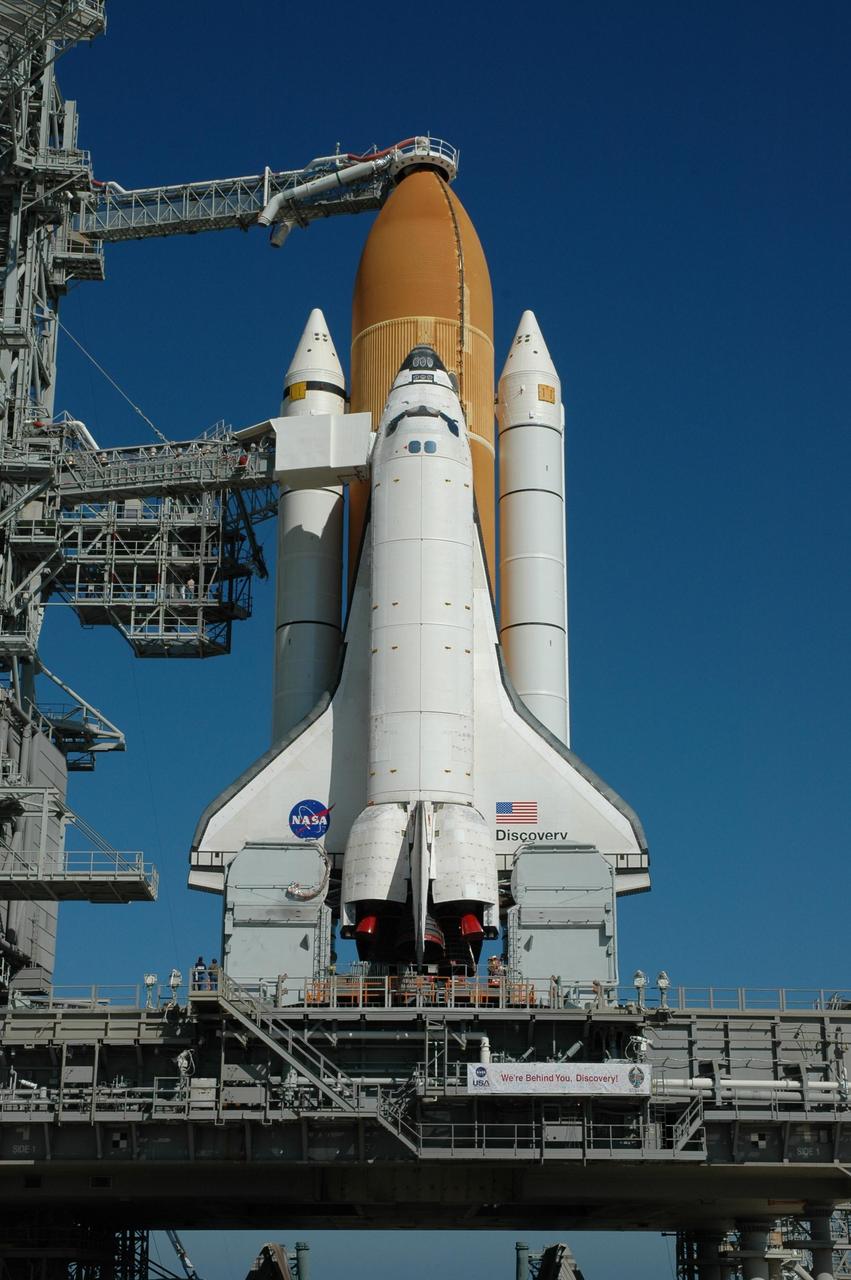
KENNEDY SPACE CENTER, FLA. -- Space Shuttle Discovery and the mobile launcher platform sit on Launch Pad 39B. The shuttle's external tank is capped by the oxygen vent hood (at top). Below it is the orbiter access arm which swings out from the fixed service structure to the orbiter crew compartment hatch to allow personnel to enter the crew compartment. The outer end of the access arm ends in an environmental chamber (white room) that mates with the orbiter and holds six persons. The arm remains in the extended position until seven minutes 24 seconds before launch to provide emergency egress for the flight crew. The rollout of Discovery from the Vehicle Assembly Building began at 12:29 a.m. The shuttle was harddown on the pad at 9:03 a.m. The mission is No. 20 to the International Space Station and construction flight 12A.1. The mission payload is the SPACEHAB module, the P5 integrated truss structure and other key components. The launch window for mission STS-116 opens Dec. 7. Photo credit: NASA/Jim Grossmann

KENNEDY SPACE CENTER, FLA. -- Space Shuttle Discovery and the mobile launcher platform sit on Launch Pad 39B for mission STS-116. The shuttle's external tank is capped by the oxygen vent hood (at top). Below it is the orbiter access arm which swings out from the fixed service structure to the orbiter crew compartment hatch to allow personnel to enter the crew compartment. The outer end of the access arm ends in an environmental chamber (white room) that mates with the orbiter and holds six persons. The arm remains in the extended position until seven minutes 24 seconds before launch to provide emergency egress for the flight crew. At right, the U.S. flag flies at half-staff in accordance with special Presidential Proclamation No. 3044, due to the death of Senior Border Patrol Agent David N. Webb. The rollout of Discovery from the Vehicle Assembly Building began at 12:29 a.m. The shuttle was harddown on the pad at 9:03 a.m. The mission is No. 20 to the International Space Station and construction flight 12A.1. The mission payload is the SPACEHAB module, the P5 integrated truss structure and other key components. The launch window for mission STS-116 opens Dec. 7. Photo credit: NASA/George Shelton
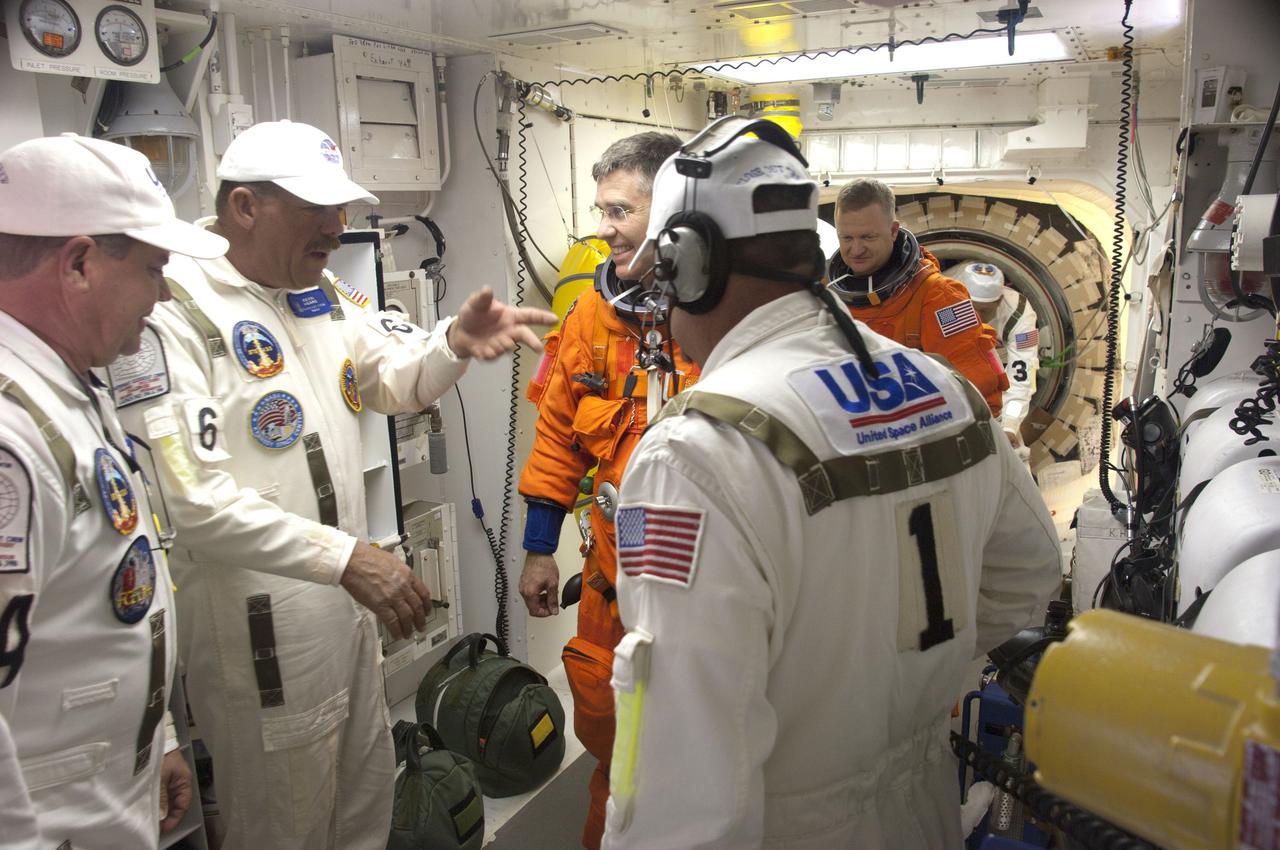
CAPE CANAVERAL, Fla. - In the White Room at Launch Pad 39A at NASA's Kennedy Space Center in Florida, United Space Alliance spacesuit technicians help STS-133 Mission Specialist Steve Bowen put on the parachute for his launch-and-entry suit before he enters space shuttle Discovery through the crew hatch in the background. Bowen, who is making his third spaceflight last flew in May 2010 on the STS-132 mission. Bowen replaces astronaut Tim Kopra as Mission Specialist 2, because Kopra was injured in a recent bicycle accident that prevented him from lifting off during this launch window. Behind Bowen is STS-133 Pilot Eric Boe. Scheduled to lift off Feb. 24 at 4:50 p.m. EST, Discovery and its crew will deliver the Permanent Multipurpose Module, packed with supplies and critical spare parts, as well as Robonaut 2, the dexterous humanoid astronaut helper, to the International Space Station. Discovery, which will fly its 39th mission, is scheduled to be retired following STS-133. This will be the 133rd Space Shuttle Program mission and the 35th shuttle voyage to the space station. For more information on the STS-133 mission, visit www.nasa.gov/mission_pages/shuttle/shuttlemissions/sts133/. Photo credit: NASA/Sandra Joseph and Kevin O'Connell
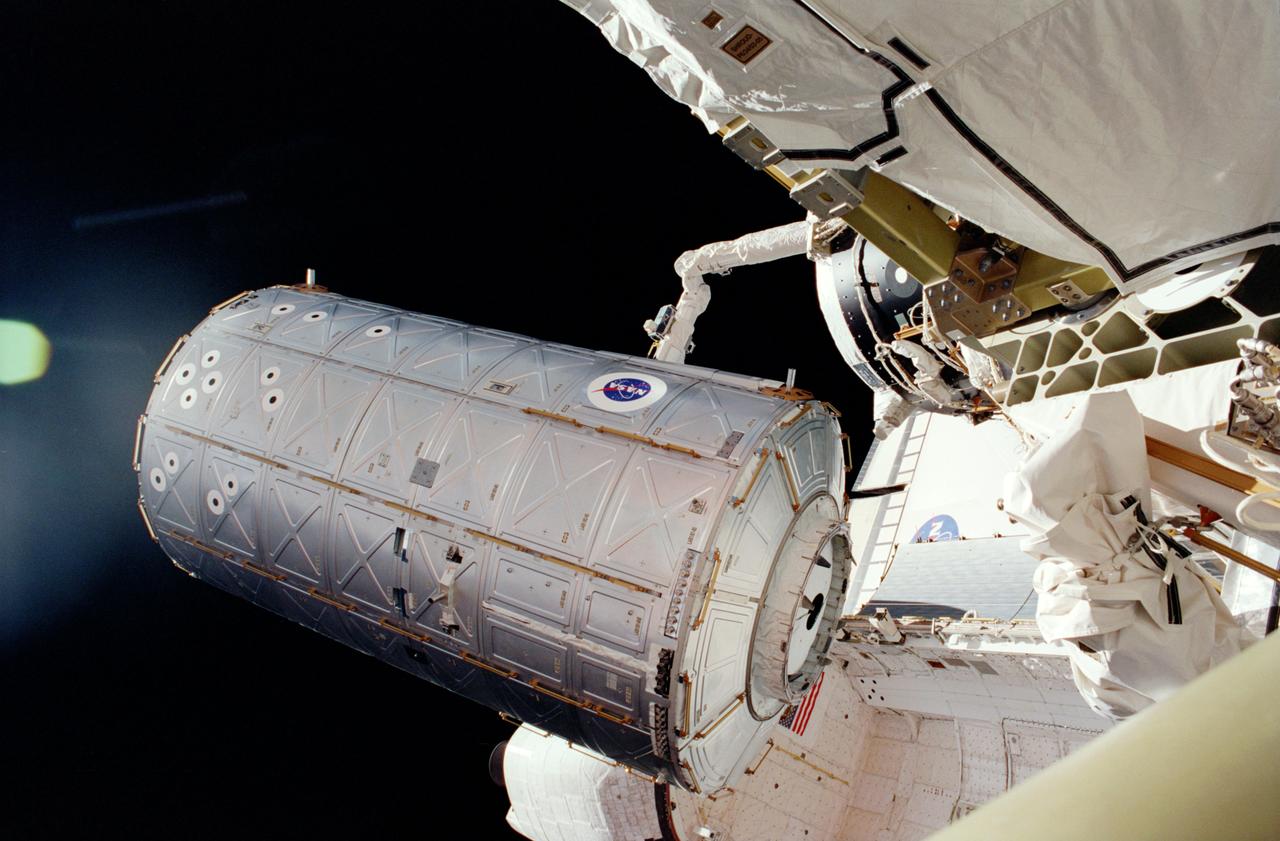
In the grasp of the Shuttle's Remote Manipulator System (RMS) robot arm, the U.S. Laboratory, Destiny, is moved from its stowage position in the cargo bay of the Space Shuttle Atlantis. This photograph was taken by astronaut Thomas D. Jones during his Extravehicular Activity (EVA). The American-made Destiny module is the cornerstone for space-based research aboard the orbiting platform and the centerpiece of the International Space Station (ISS), where unprecedented science experiments will be performed in the near-zero gravity of space. Destiny will also serve as the command and control center for the ISS. The aluminum module is 8.5- meters (28-feet) long and 4.3-meters (14-feet) in diameter. The laboratory consists of three cylindrical sections and two endcones with hatches that will be mated to other station components. A 50.9-centimeter (20-inch-) diameter window is located on one side of the center module segment. This pressurized module is designed to accommodate pressurized payloads. It has a capacity of 24 rack locations. Payload racks will occupy 15 locations especially designed to support experiments. The Destiny module was built by the Boeing Company under the direction of the Marshall Space Flight Center.
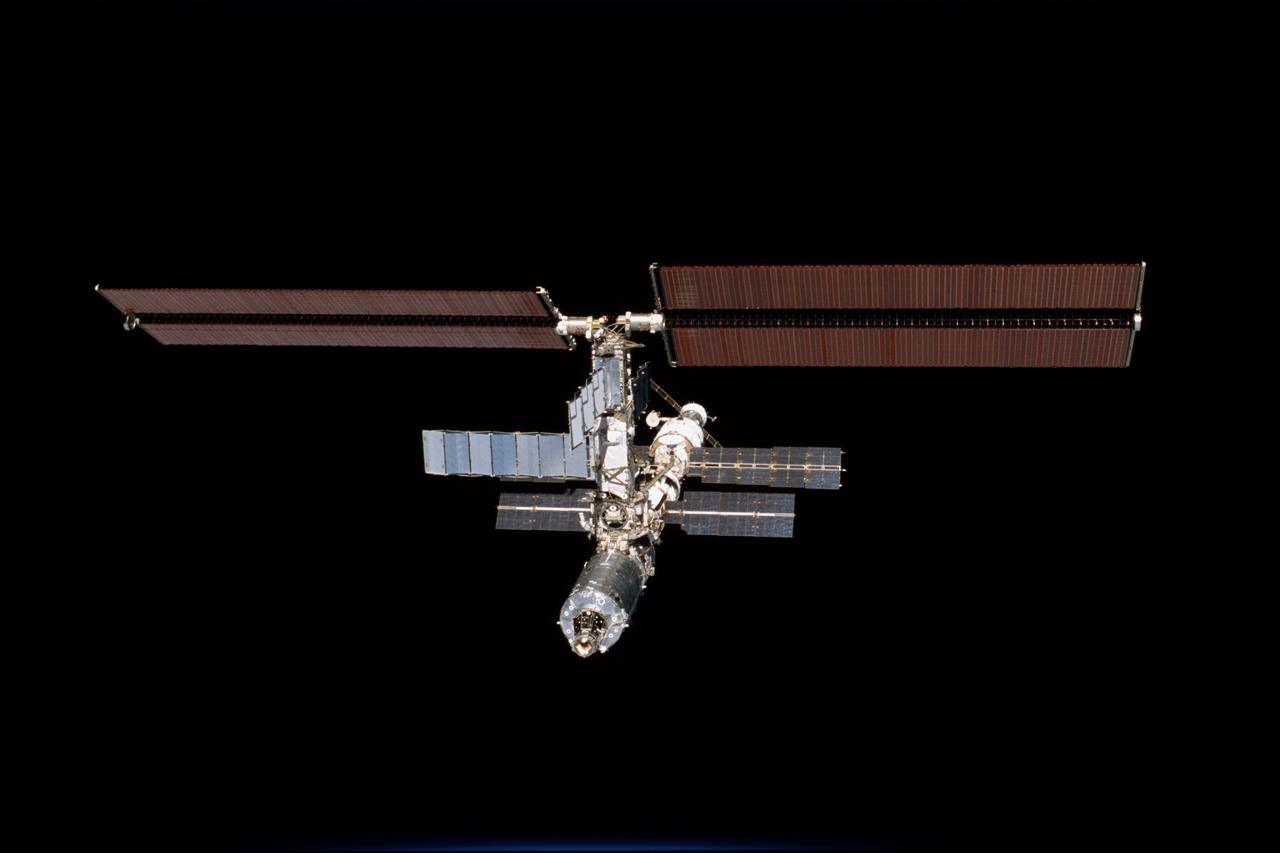
The International Space Station (ISS), with its newly attached U.S. Laboratory, Destiny, was photographed by a crew member aboard the Space Shuttle Orbiter Atlantis during a fly-around inspection after Atlantis separated from the Space Station. The Laboratory is shown in the foreground of this photograph. The American-made Destiny module is the cornerstone for space-based research aboard the orbiting platform and the centerpiece of the International Space Station (ISS), where unprecedented science experiments will be performed in the near-zero gravity of space. Destiny will also serve as the command and control center for the ISS. The aluminum module is 8.5-meters (28-feet) long and 4.3-meters (14-feet) in diameter. The laboratory consists of three cylindrical sections and two endcones with hatches that will be mated to other station components. A 50.9-centimeter (20-inch-) diameter window is located on one side of the center module segment. This pressurized module is designed to accommodate pressurized payloads. It has a capacity of 24 rack locations. Payload racks will occupy 15 locations especially designed to support experiments. The Destiny module was built by the Boeing Company under the direction of the Marshall Space Flight Center.
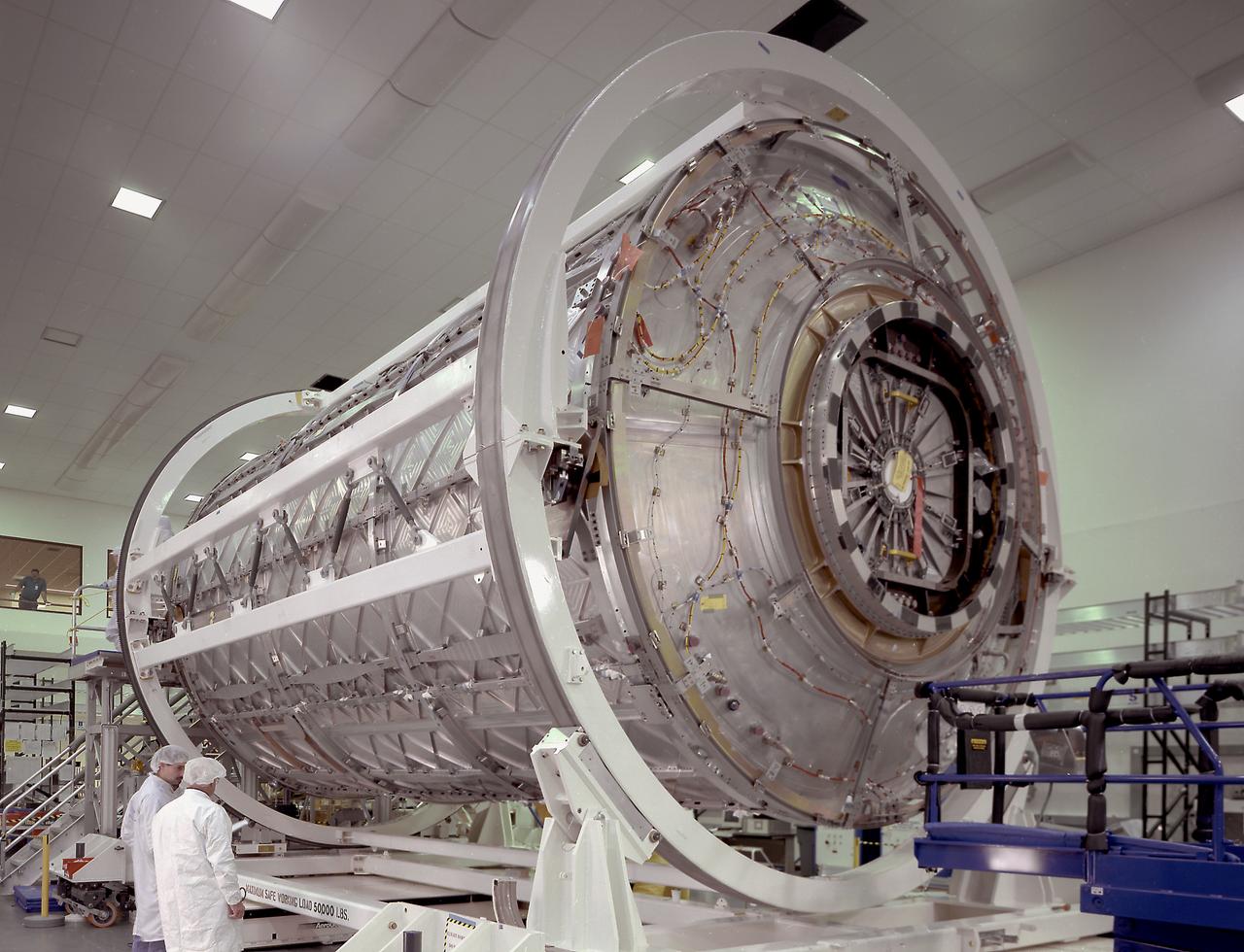
This photograph shows the U.S. Laboratory Module (also called Destiny) for the International Space Station (ISS), in the Space Station manufacturing facility at the Marshall Space Flight Center, being readied for shipment to the Kennedy Space Center. The U.S. Laboratory module is the centerpiece of the ISS, where science experiments will be performed in the near-zero gravity of space. The Destiny Module was launched aboard the Space Shuttle orbiter Atlantis (STS-67 mission) on February 7, 2001. The aluminum module is 8.5 meters (28 feet) long and 4.3 meters (14 feet) in diameter. The laboratory consists of three cylindrical sections and two endcones with hatches that will be mated to other station components. A 50.9-centimeter- (20-inch-) diameter window is located on one side of the center module segment. This pressurized module is designed to accommodate pressurized payloads. It has a capacity of 24 rack locations, and payload racks will occupy 13 locations especially designed to support experiments. The ISS is a multidisciplinary laboratory, technology test bed, and observatory that will provide unprecedented undertakings in scientific, technological, and international experimentation.
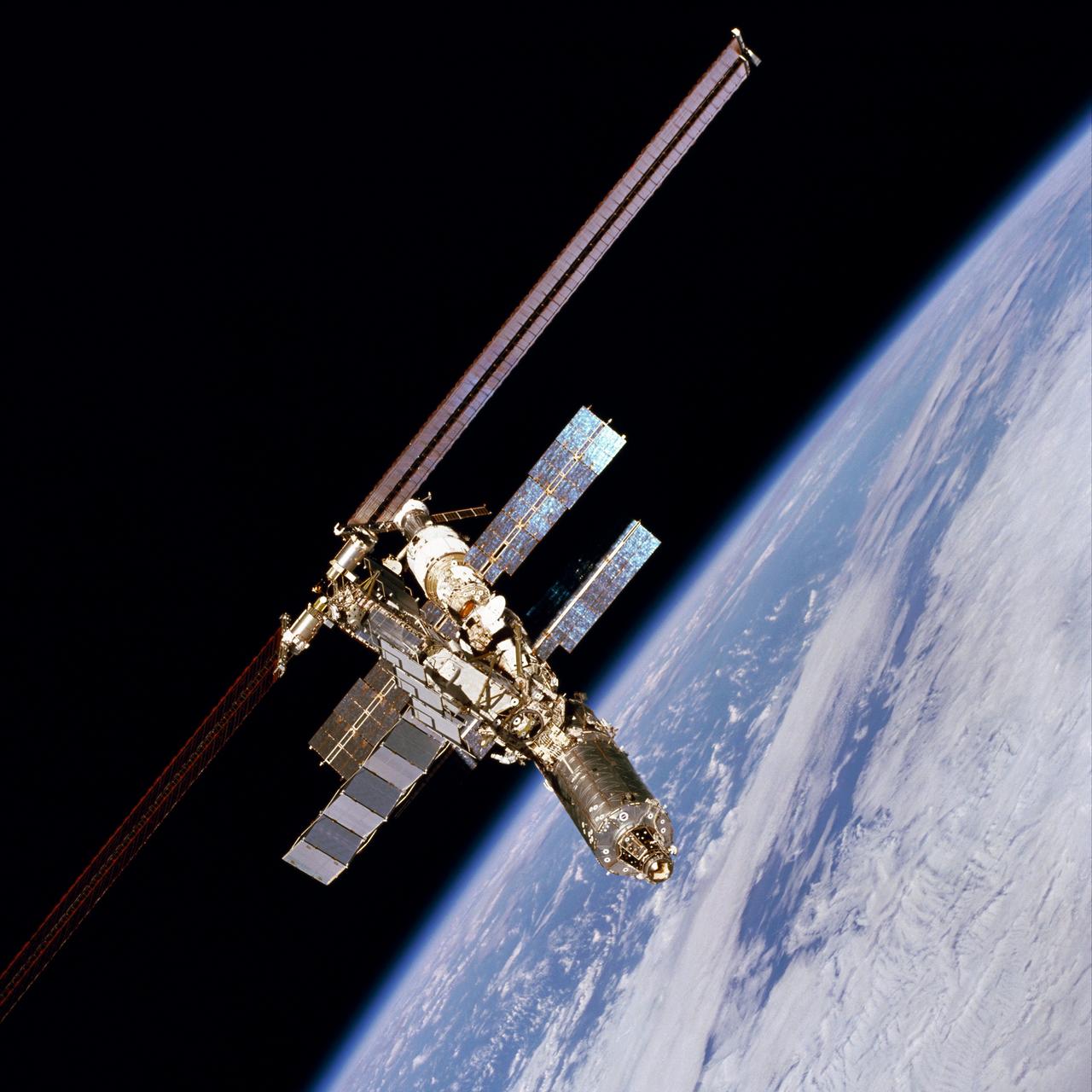
With its new U.S. Laboratory, Destiny, contrasted over a blue and white Earth, the International Space Station (ISS) was photographed by one of the STS-98 crew members aboard the Space Shuttle Atlantis following separation of the Shuttle and Station. The Laboratory is shown at the lower right of the Station. The American-made Destiny module is the cornerstone for space-based research aboard the orbiting platform and the centerpiece of the ISS, where unprecedented science experiments will be performed in the near-zero gravity of space. Destiny will also serve as the command and control center for the ISS. The aluminum module is 8.5- meters (28-feet) long and 4.3-meters (14-feet) in diameter. The laboratory consists of three cylindrical sections and two endcones with hatches that will be mated to other station components. A 50.9-centimeter (20-inch-) diameter window is located on one side of the center module segment. This pressurized module is designed to accommodate pressurized payloads. It has a capacity of 24 rack locations. Payload racks will occupy 15 locations especially designed to support experiments. The Destiny module was built by the Boeing Company under the direction of the Marshall Space Flight Center.
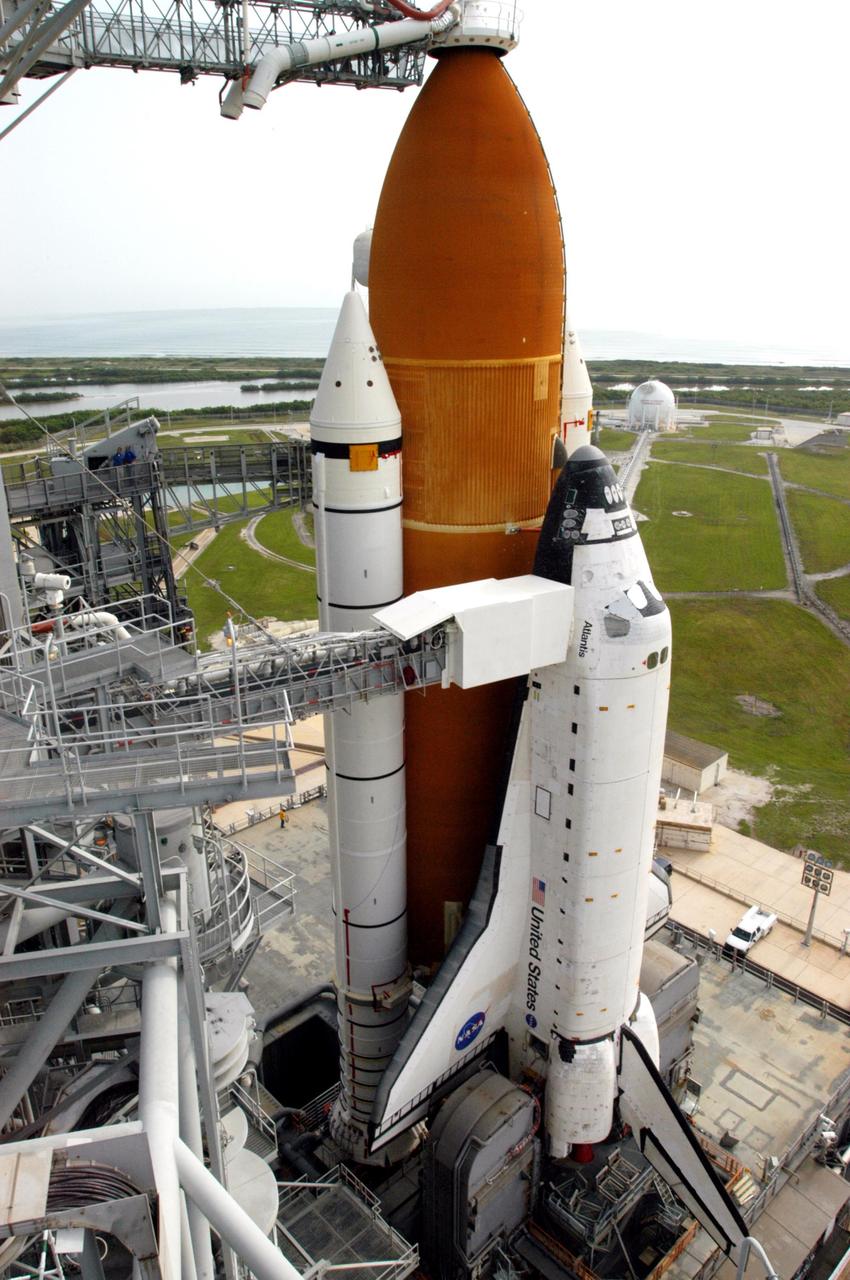
KENNEDY SPACE CENTER, FLA. - Space Shuttle Atlantis sits on the hardstand of Launch Pad 39B after its nearly 8-hour rollout from the Vehicle Assembly Building. The "beanie cap," at the end of the external tank gaseous oxygen vent arm, is extended over the top of the external tank. The cap is a vent hood that vacuums away the very cold liquid oxygen vapors as they boil off from the top of the external tank before launch. Lower down on the left is the orbiter access arm, with the White Room on the outer end, extended toward Atlantis' crew access hatch. Below the orbiter, on each side of the main engine nozzles, are the tail service masts that provide several umbilical connections to the orbiter, including a liquid-oxygen line through one and a liquid-hydrogen line through another. The slow speed of the crawler results in a 6- to 8-hour trek to the pad approximately 4 miles away. Atlantis' launch window begins Aug. 27 for an 11-day mission to the International Space Station. The STS-115 crew of six astronauts will continue construction of the station and install their cargo, the Port 3/4 truss segment with its two large solar arrays. Photo credit: NASA/Troy Cryder & George Shelton
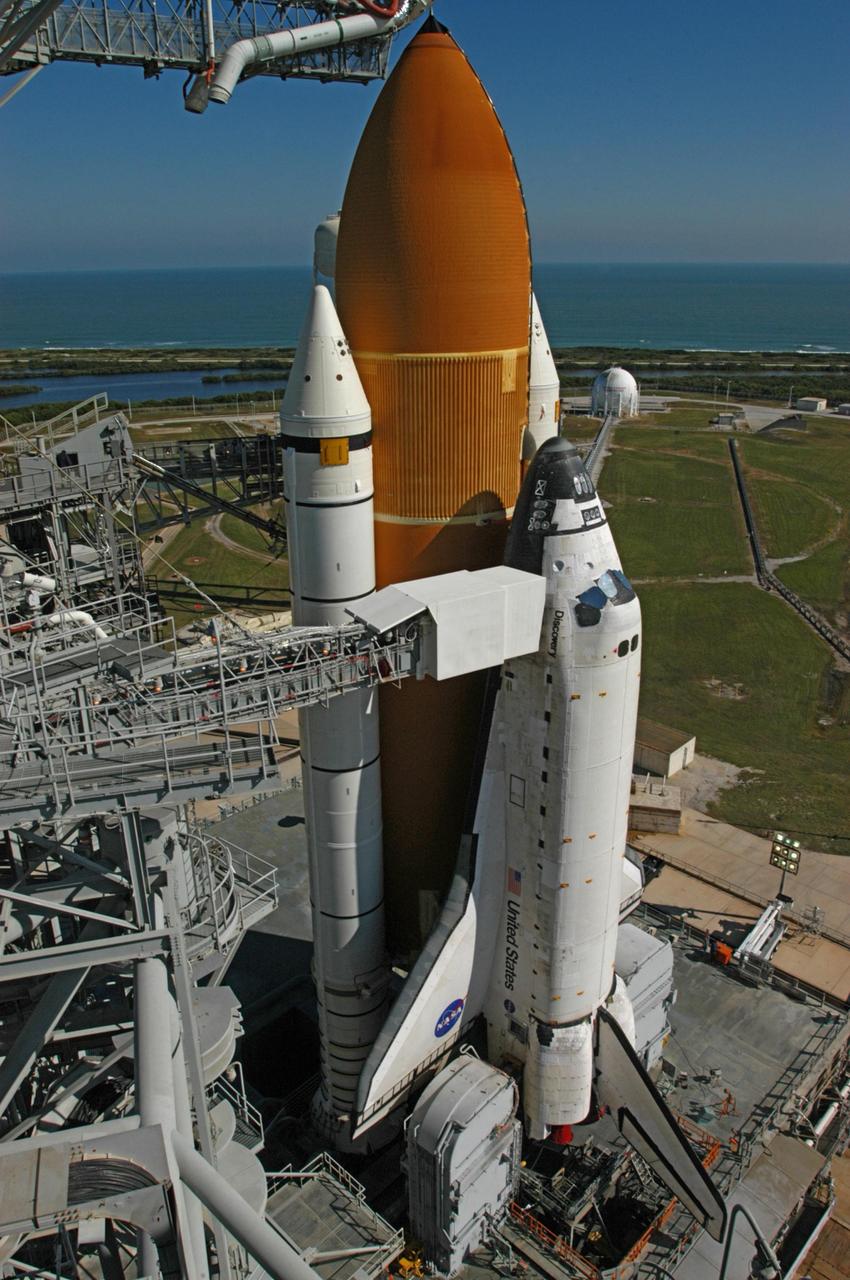
KENNEDY SPACE CENTER, FLA. -- Space Shuttle Discovery and the mobile launcher platform sit on Launch Pad 39B for mission STS-116. Beyond the pad is the Atlantic Ocean. The shuttle's external tank is capped by the oxygen vent hood (at top). Below it is the orbiter access arm which swings out from the fixed service structure to the orbiter crew compartment hatch to allow personnel to enter the crew compartment. The outer end of the access arm ends in an environmental chamber (white room) that mates with the orbiter and holds six persons. The arm remains in the extended position until seven minutes 24 seconds before launch to provide emergency egress for the flight crew. The rollout of Discovery from the Vehicle Assembly Building began at 12:29 a.m. The shuttle was harddown on the pad at 9:03 a.m. The mission is No. 20 to the International Space Station and construction flight 12A.1. The mission payload is the SPACEHAB module, the P5 integrated truss structure and other key components. The launch window for mission STS-116 opens Dec. 7. Photo credit: NASA/George Shelton
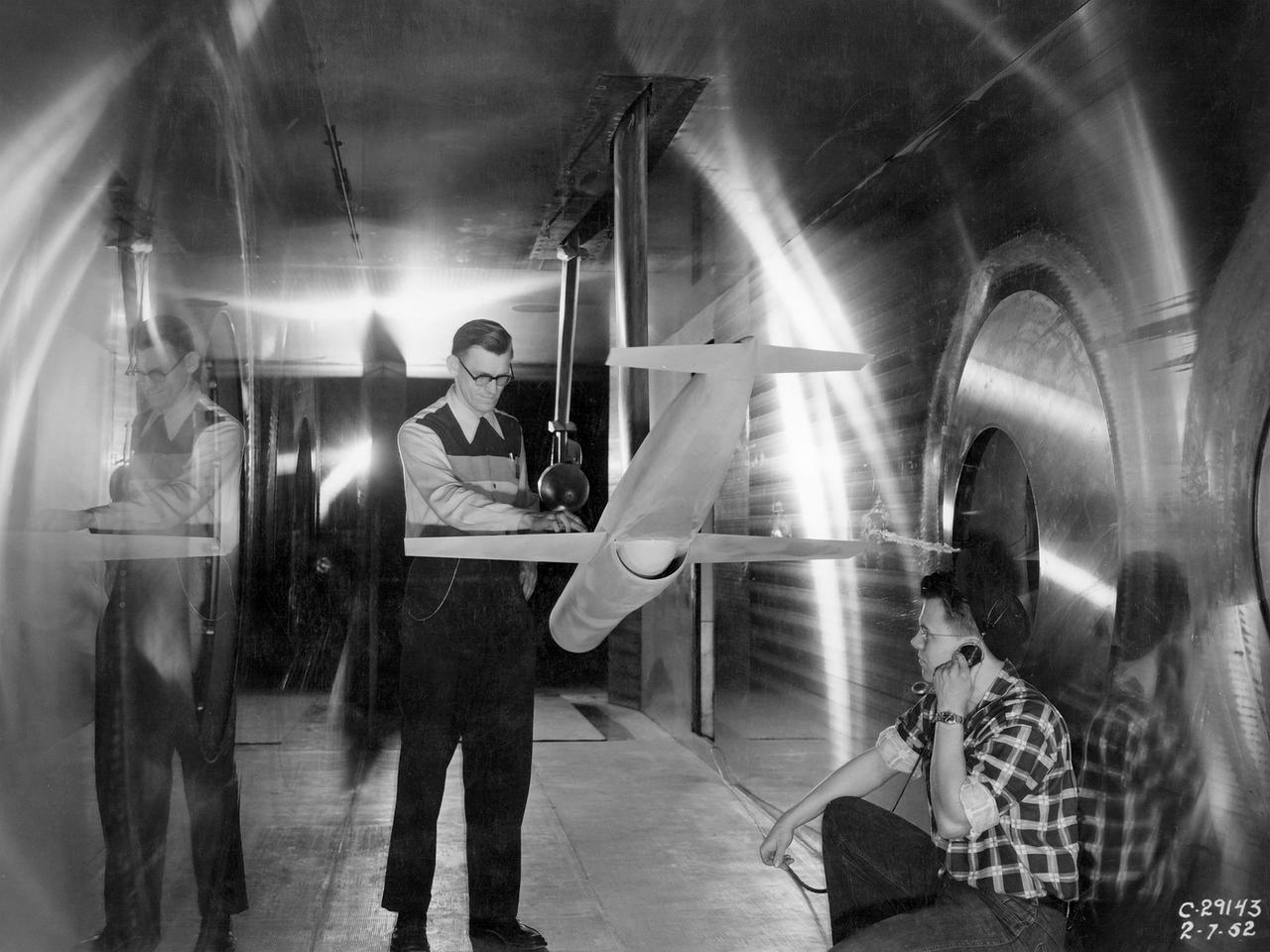
A researcher at the National Advisory Committee for Aeronautics (NACA) Lewis Flight Propulsion Laboratory checks the setup of a RJM-2 ramjet model in the test section of the 8- by 6-Foot Supersonic Wind Tunnel. The 8- by 6 was not only the laboratory’s first large supersonic wind tunnel, but it was also the NACA’s first facility capable of testing an operating engine at supersonic speeds. The 8- by 6-foot tunnel has been used to study engine inlets, fuel injectors, flameholders, exit nozzles, and controls on ramjet and turbojet propulsion systems. The 8-foot wide and 6-foot tall test section consisted of 1-inch thick steel plates with hatches on the floor and ceiling to facilitate the installation of the test article. The two windows seen on the right wall allowed photographic equipment to be set up. The test section was modified in 1956 to accommodate transonic research. NACA engineers drilled 4,700 holes into the test section walls to reduce transonic pressure disturbances and shock waves. NACA Lewis undertook an extensive research program on ramjets in the 1940s using several of its facilities. Ramjets provide a very simple source of propulsion. They are basically a tube which ingests high speed air, ignites it, and then expels the heated air at a significantly higher velocity. Ramjets are extremely efficient and powerful but can only operate at high speeds. Therefore, they require a booster rocket or aircraft drop to accelerate them to high speeds before they can operate.