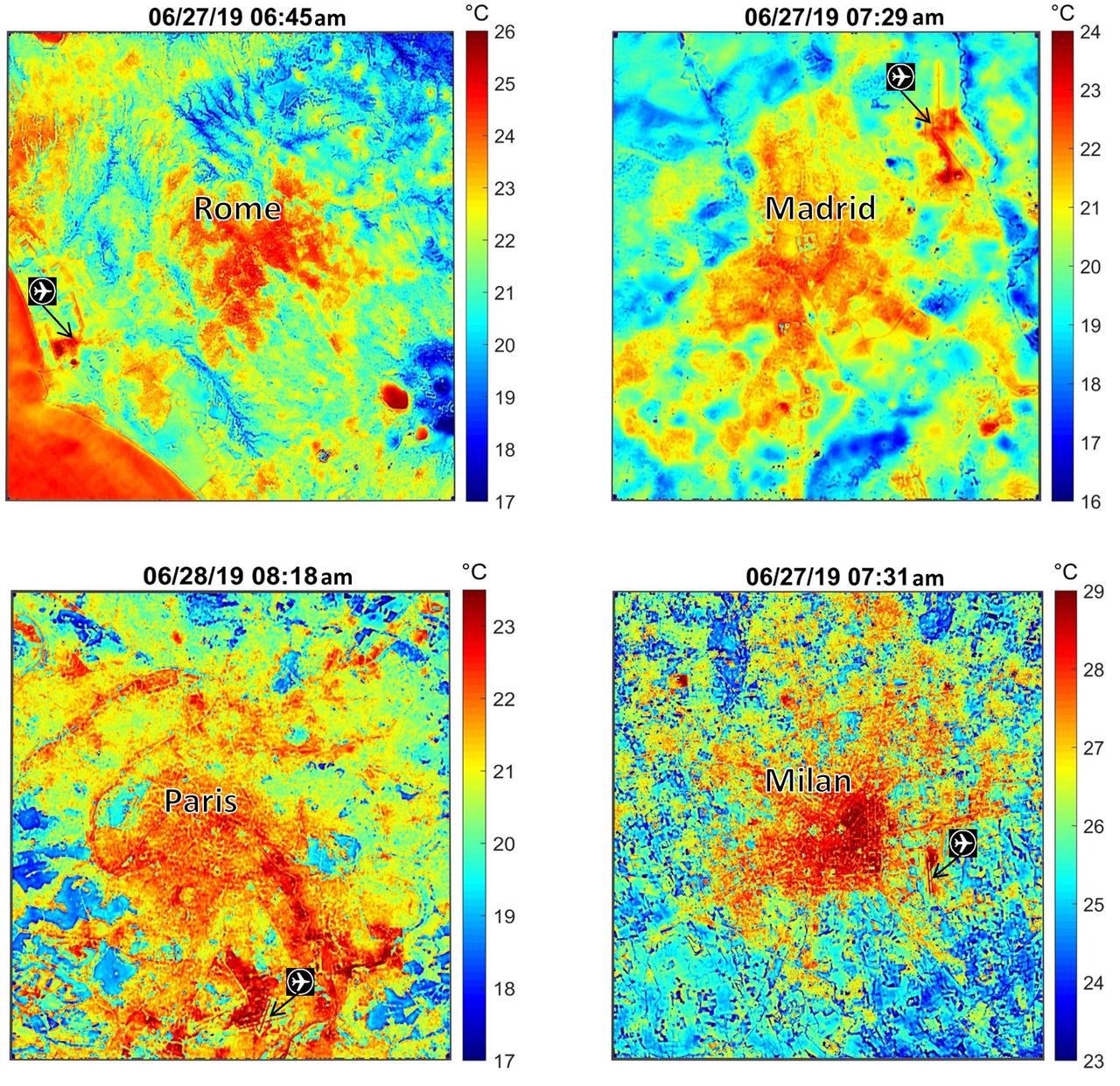
These maps of four European cities show ECOSTRESS surface temperature images acquired in the early mornings of June 27 and 28, 2019, during a heatwave. The images have been sharpened to delineate key features such as airports. Airports and city centers are hotter than surrounding regions because they have more surfaces that retain heat (asphalt, concrete, etc.). ECOSTRESS launched on June 29, 2018, as part of a SpaceX commercial resupply mission to the International Space Station. Its primary mission is to detect plant health by monitoring Earth's surface temperature. However, surface temperature data are also useful in detecting other heat-related phenomena — like heat waves, volcanoes and fires. https://photojournal.jpl.nasa.gov/catalog/PIA23148
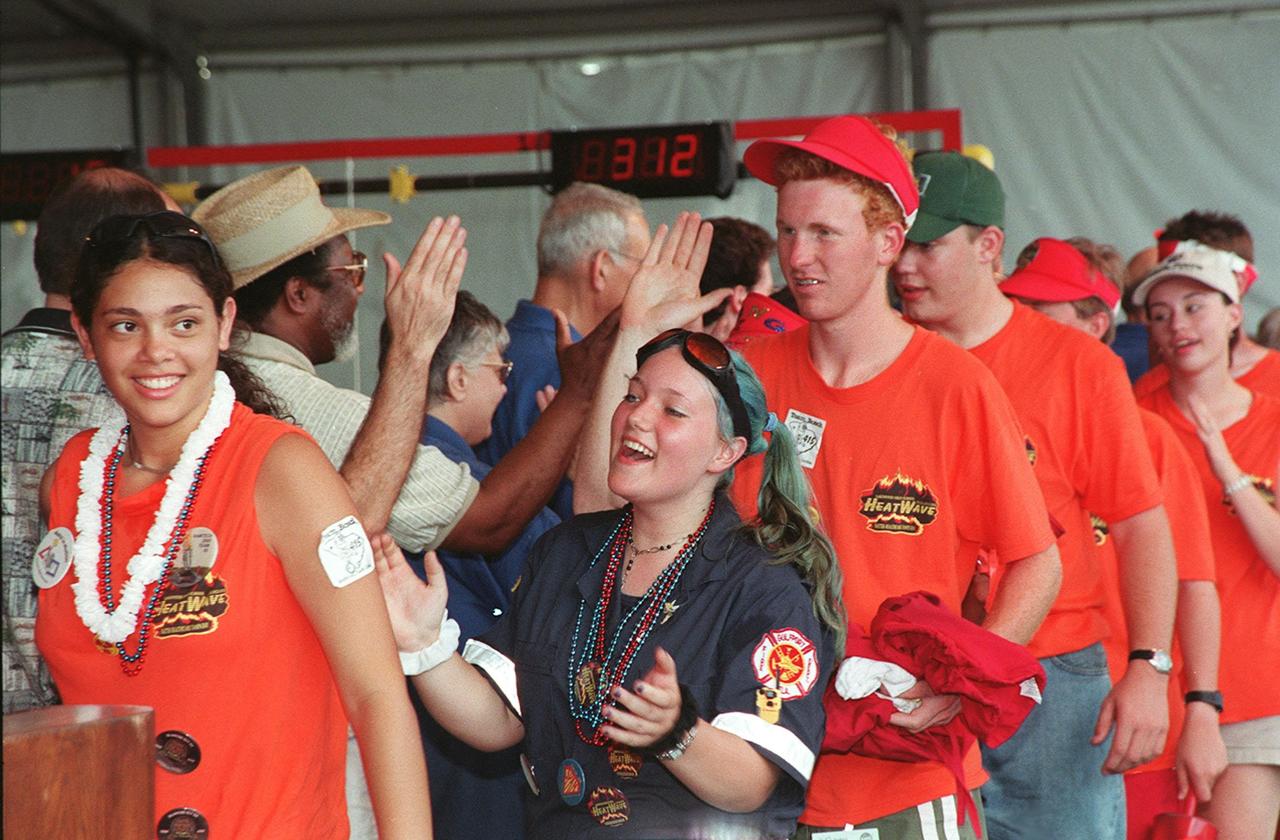
Members of the team known as Heatwave, from St. Petersburg, Fla., get "high fives" from Jim Jennings (wearing a straw hat), KSC's deputy director for Business Operations, during closing ceremonies for the FIRST (For Inspiration and Recognition of Science and Technology) Southeast Regional competition held at the KSC Visitor Complex. Heatwave came in second for the final competition, plus received awards for Number One Seed, Best Offensive round, and the DaimlerChrysler Team Spirit. Teams of high school students from all over the country tested the limits of their imagination using robots they designed, with the support of business and engineering professionals and corporate sponsors, to compete in a technological battle against other schools' robots. Of the 30 high school teams competing at the Southeast Regional event, 16 were Florida teams co-sponsored by NASA and KSC contractors. Local high schools participating are Astronaut, Bayside, Cocoa Beach, Eau Gallie, Melbourne, Melbourne Central Catholic, Palm Bay, Rockledge, Satellite, and Titusville
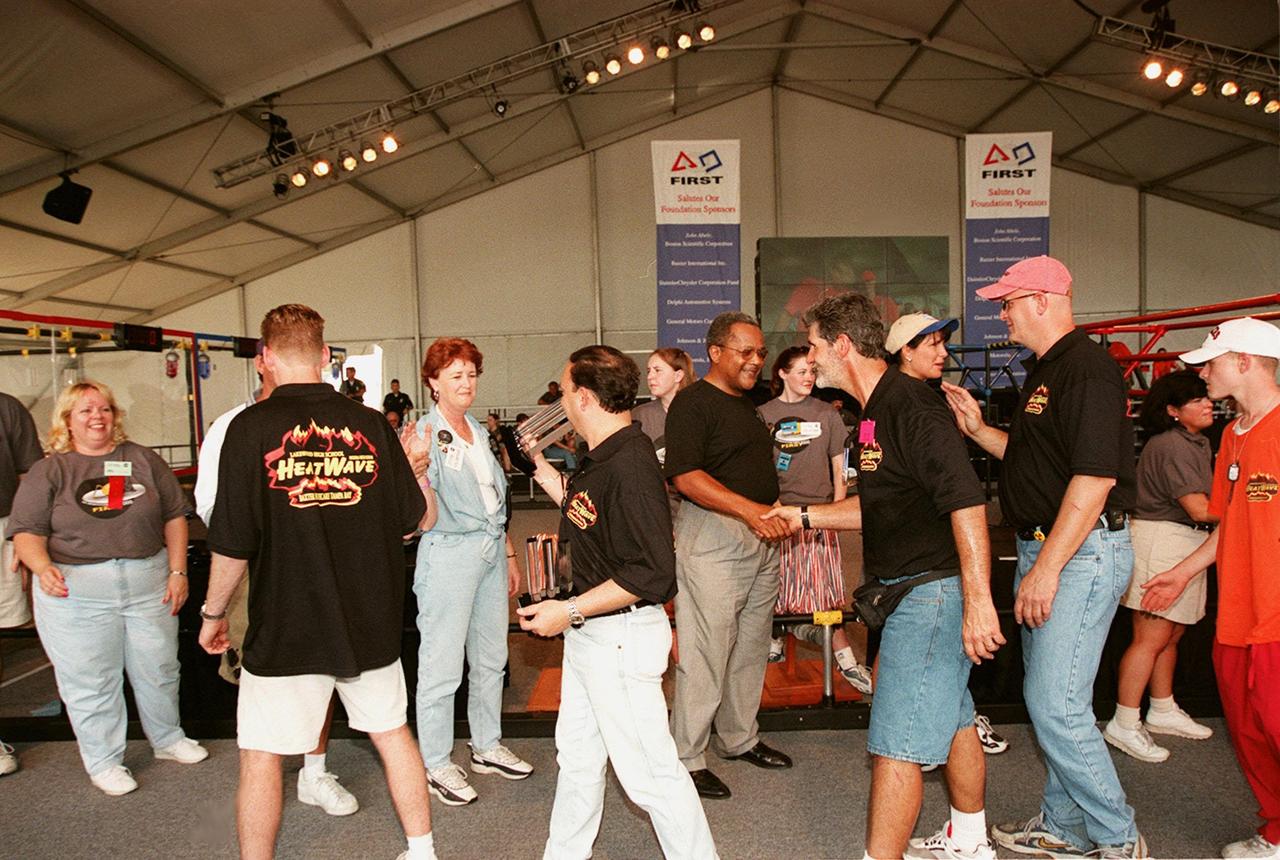
Adult members of the team known as Heatwave, from St. Petersburg, Fla., get "high fives" from Nap Carroll (center), chief financial officer, Kennedy Space Center, and other officials of the FIRST (For Inspiration and Recognition of Science and Technology) Southeast Regional competition held at the KSC Visitor Complex. Heatwave came in second for the final competition, plus received awards for Number One Seed, Best Offensive round, and the DaimlerChrysler Team Spirit. Teams of high school students from all over the country tested the limits of their imagination using robots they designed, with the support of business and engineering professionals and corporate sponsors, to compete in a technological battle against other schools' robots. Of the 30 high school teams competing at the Southeast Regional event, 16 were Florida teams co-sponsored by NASA and KSC contractors. Local high schools participating are Astronaut, Bayside, Cocoa Beach, Eau Gallie, Melbourne, Melbourne Central Catholic, Palm Bay, Rockledge, Satellite, and Titusvill
Adult members of the team known as Heatwave, from St. Petersburg, Fla., get "high fives" from Nap Carroll (center), chief financial officer, Kennedy Space Center, and other officials of the FIRST (For Inspiration and Recognition of Science and Technology) Southeast Regional competition held at the KSC Visitor Complex. Heatwave came in second for the final competition, plus received awards for Number One Seed, Best Offensive round, and the DaimlerChrysler Team Spirit. Teams of high school students from all over the country tested the limits of their imagination using robots they designed, with the support of business and engineering professionals and corporate sponsors, to compete in a technological battle against other schools' robots. Of the 30 high school teams competing at the Southeast Regional event, 16 were Florida teams co-sponsored by NASA and KSC contractors. Local high schools participating are Astronaut, Bayside, Cocoa Beach, Eau Gallie, Melbourne, Melbourne Central Catholic, Palm Bay, Rockledge, Satellite, and Titusvill
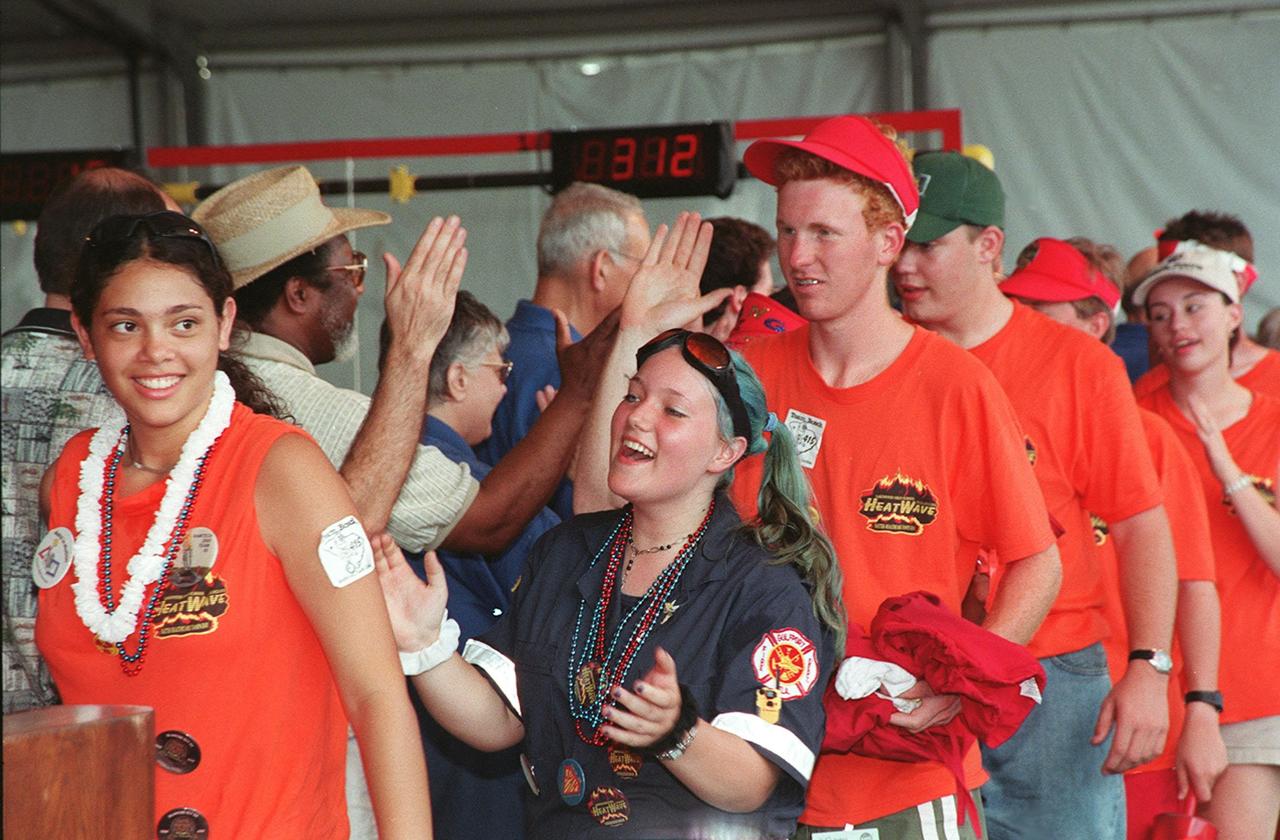
Members of the team known as Heatwave, from St. Petersburg, Fla., get "high fives" from Jim Jennings (wearing a straw hat), KSC's deputy director for Business Operations, during closing ceremonies for the FIRST (For Inspiration and Recognition of Science and Technology) Southeast Regional competition held at the KSC Visitor Complex. Heatwave came in second for the final competition, plus received awards for Number One Seed, Best Offensive round, and the DaimlerChrysler Team Spirit. Teams of high school students from all over the country tested the limits of their imagination using robots they designed, with the support of business and engineering professionals and corporate sponsors, to compete in a technological battle against other schools' robots. Of the 30 high school teams competing at the Southeast Regional event, 16 were Florida teams co-sponsored by NASA and KSC contractors. Local high schools participating are Astronaut, Bayside, Cocoa Beach, Eau Gallie, Melbourne, Melbourne Central Catholic, Palm Bay, Rockledge, Satellite, and Titusville
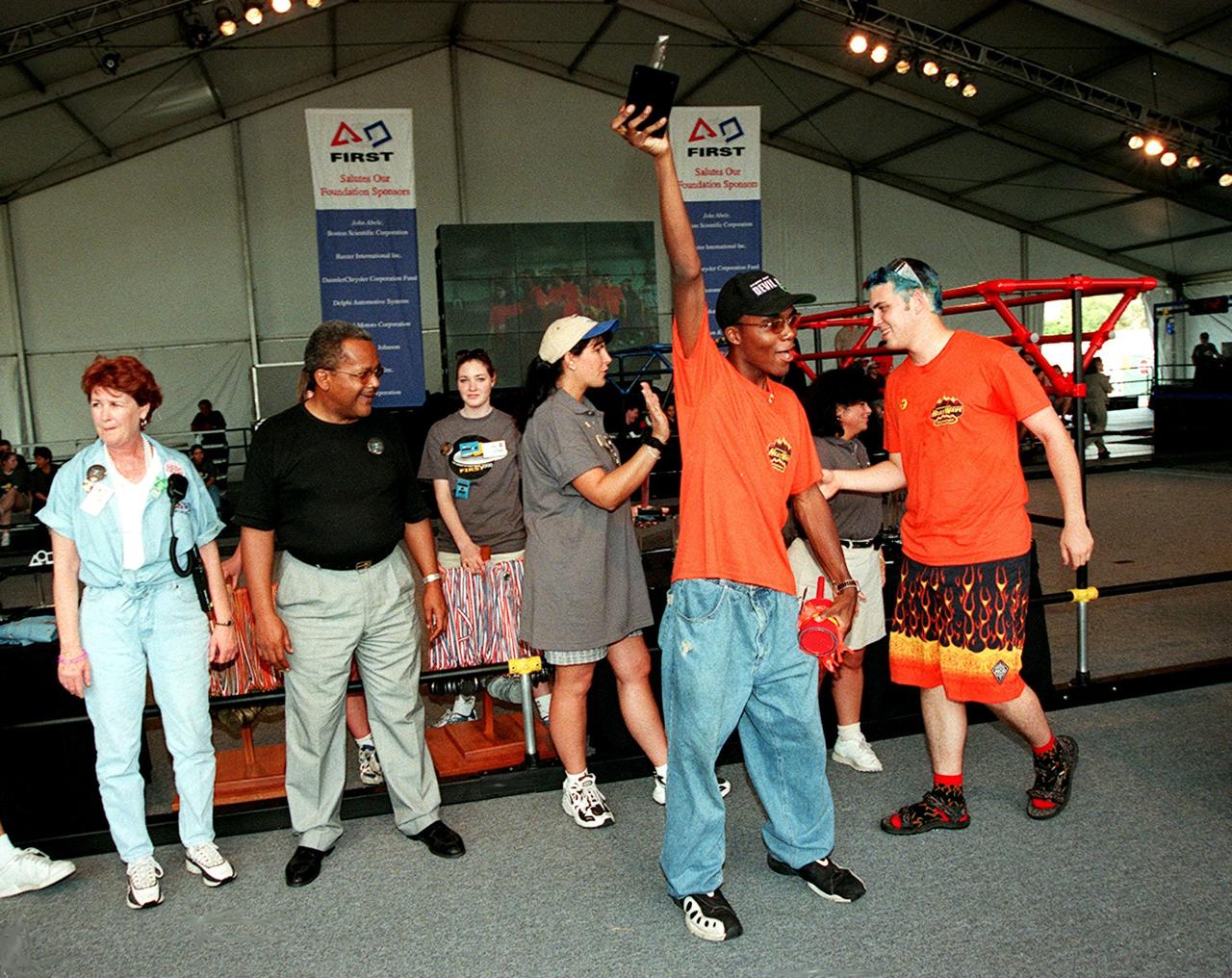
Members of the team known as Heatwave, from St. Petersburg, Fla., are excited after receiving an award at the FIRST (For Inspiration and Recognition of Science and Technology) Southeast Regional competition held at the KSC Visitor Complex. At left are Carol Cavanaugh, Public Affairs, and Nap Carroll, chief financial officer, Kennedy Space Center. Heatwave came in second for the final competition, plus received awards for Number One Seed, Best Offensive round, and the DaimlerChrysler Team Spirit. Teams of high school students from all over the country tested the limits of their imagination using robots they designed, with the support of business and engineering professionals and corporate sponsors, to compete in a technological battle against other schools' robots. Of the 30 high school teams competing at the Southeast Regional event, 16 were Florida teams co-sponsored by NASA and KSC contractors. Local high schools participating are Astronaut, Bayside, Cocoa Beach, Eau Gallie, Melbourne, Melbourne Central Catholic, Palm Bay, Rockledge, Satellite, and Titusville
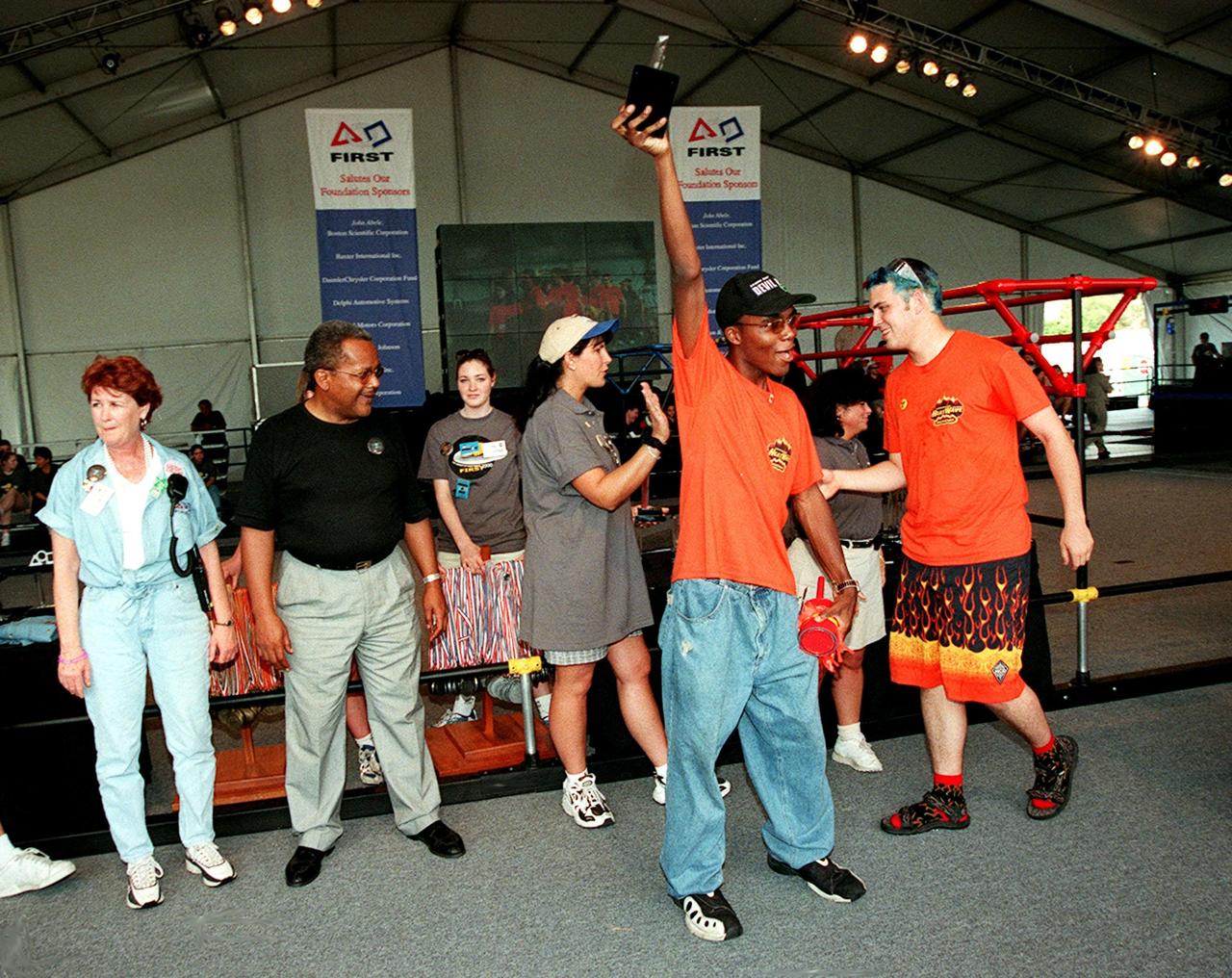
Members of the team known as Heatwave, from St. Petersburg, Fla., are excited after receiving an award at the FIRST (For Inspiration and Recognition of Science and Technology) Southeast Regional competition held at the KSC Visitor Complex. At left are Carol Cavanaugh, Public Affairs, and Nap Carroll, chief financial officer, Kennedy Space Center. Heatwave came in second for the final competition, plus received awards for Number One Seed, Best Offensive round, and the DaimlerChrysler Team Spirit. Teams of high school students from all over the country tested the limits of their imagination using robots they designed, with the support of business and engineering professionals and corporate sponsors, to compete in a technological battle against other schools' robots. Of the 30 high school teams competing at the Southeast Regional event, 16 were Florida teams co-sponsored by NASA and KSC contractors. Local high schools participating are Astronaut, Bayside, Cocoa Beach, Eau Gallie, Melbourne, Melbourne Central Catholic, Palm Bay, Rockledge, Satellite, and Titusville
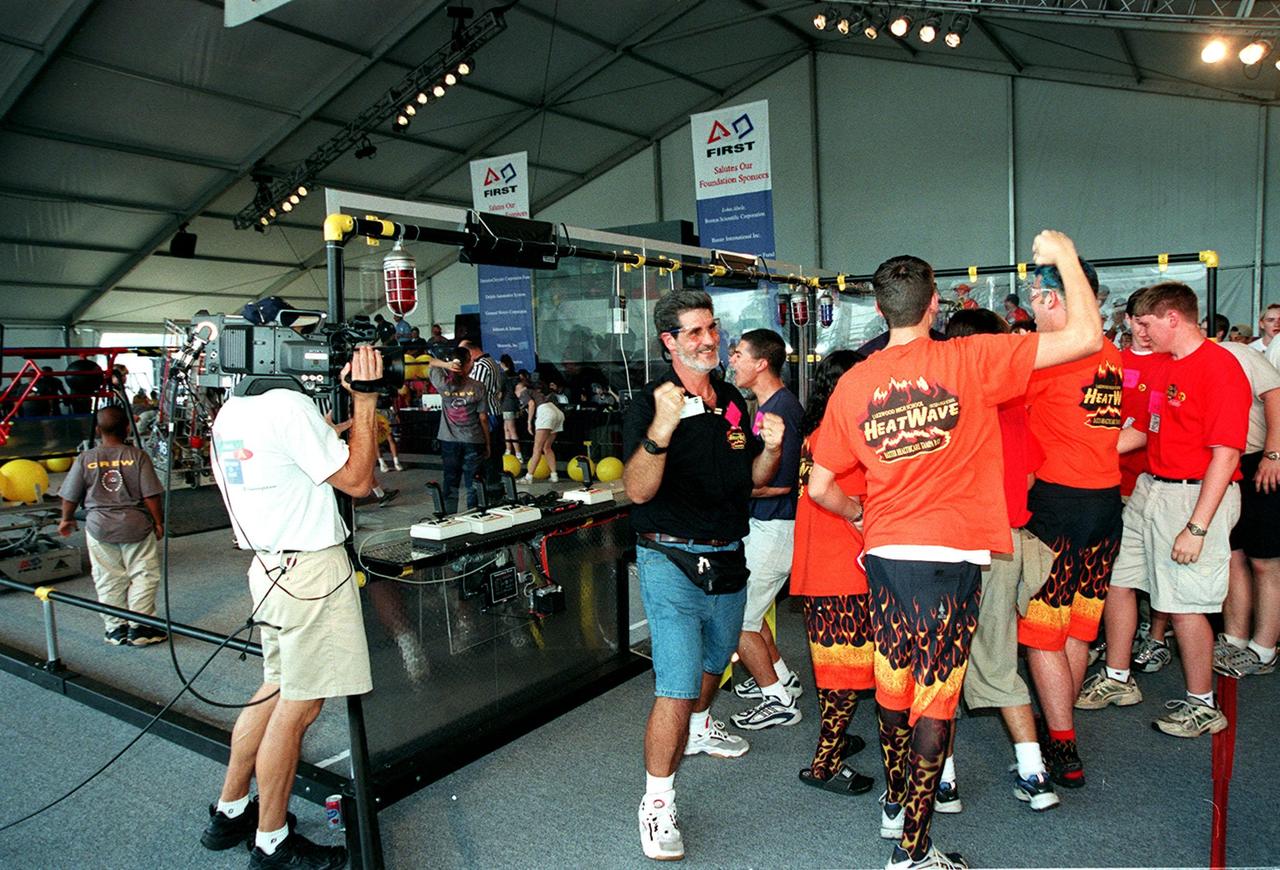
The team known as Heatwave, from St. Petersburg, Fla., celebrates after their win at the FIRST (For Inspiration and Recognition of Science and Technology) Southeast Regional competition held at the KSC Visitor Complex. They came in second for the final competition, plus received awards for Number One Seed, Best Offensive round, and the DaimlerChrysler Team Spirit. Teams of high school students from all over the country tested the limits of their imagination using robots they designed, with the support of business and engineering professionals and corporate sponsors, to compete in a technological battle against other schools' robots. Of the 30 high school teams competing at the Southeast Regional event, 16 were Florida teams co-sponsored by NASA and KSC contractors. Local high schools participating are Astronaut, Bayside, Cocoa Beach, Eau Gallie, Melbourne, Melbourne Central Catholic, Palm Bay, Rockledge, Satellite, and Titusville
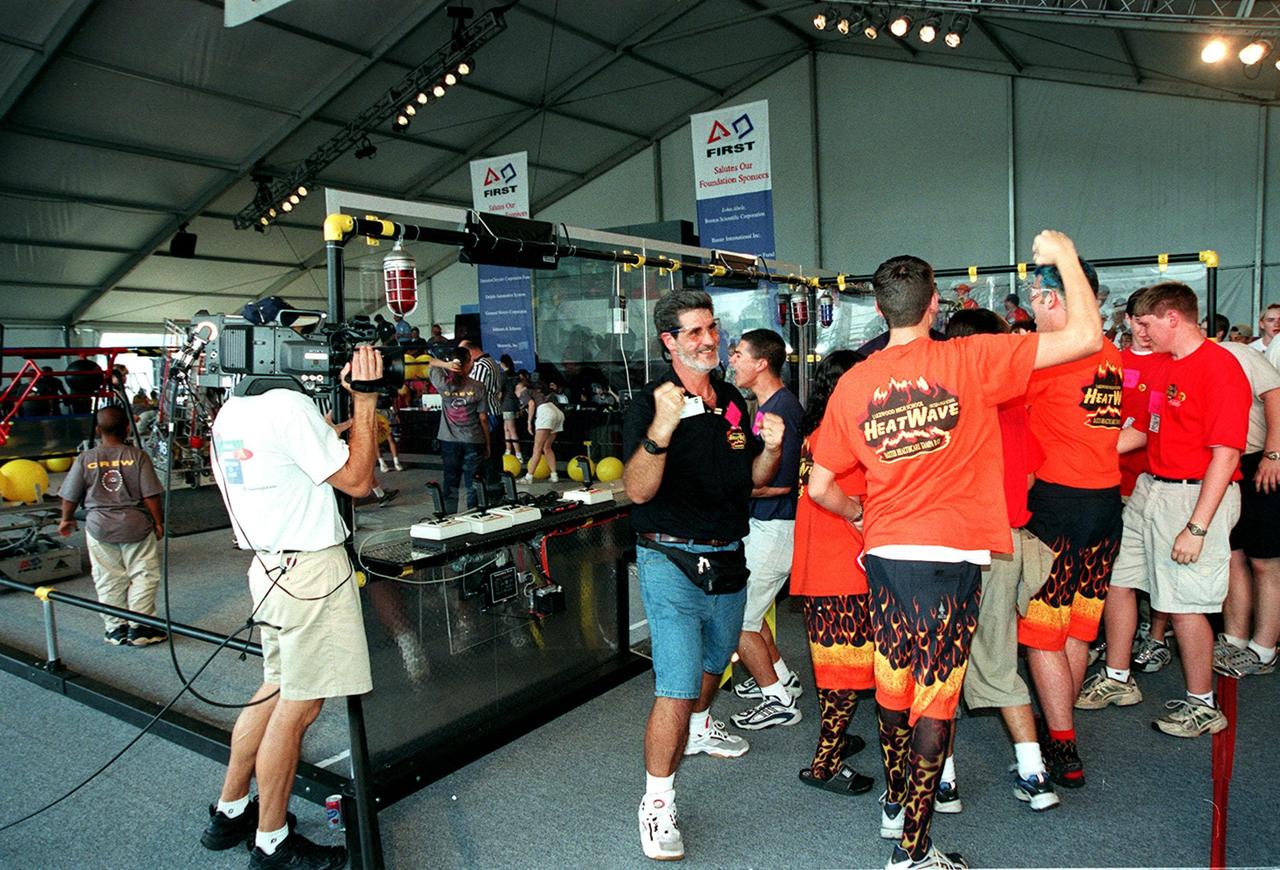
The team known as Heatwave, from St. Petersburg, Fla., celebrates after their win at the FIRST (For Inspiration and Recognition of Science and Technology) Southeast Regional competition held at the KSC Visitor Complex. They came in second for the final competition, plus received awards for Number One Seed, Best Offensive round, and the DaimlerChrysler Team Spirit. Teams of high school students from all over the country tested the limits of their imagination using robots they designed, with the support of business and engineering professionals and corporate sponsors, to compete in a technological battle against other schools' robots. Of the 30 high school teams competing at the Southeast Regional event, 16 were Florida teams co-sponsored by NASA and KSC contractors. Local high schools participating are Astronaut, Bayside, Cocoa Beach, Eau Gallie, Melbourne, Melbourne Central Catholic, Palm Bay, Rockledge, Satellite, and Titusville
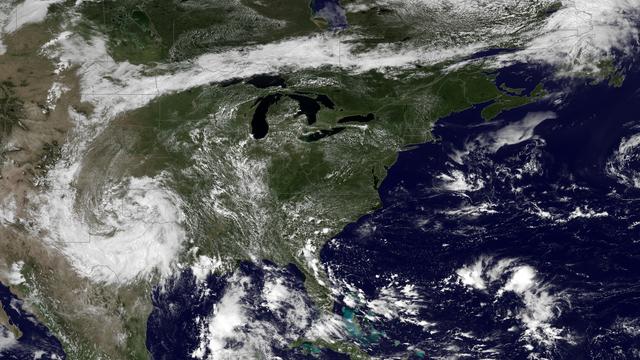
A very anomalous weather pattern is in place over the U.S. for mid-July. Trapped between an upper level ridge centered over the Ohio Valley and the closed upper level low over the Texas/Oklahoma border, atypical hot, muggy air is stifling a broad swath of the eastern U.S. The closed low is expected to drift west toward New Mexico bringing heavy, localized rain to some areas and temperatures running 10-20 degrees below mid-July averages. Across the east, temperatures will warm well into the 90's and stay there through the week. This image was taken by GOES East at 1645Z on July 15, 2013. Image credit: <b><a href="http://goes.gsfc.nasa.gov/" rel="nofollow">Credit: NOAA/NASA GOES Project</a></b> Text credit: NOAA <b><a href="http://www.nasa.gov/audience/formedia/features/MP_Photo_Guidelines.html" rel="nofollow">NASA image use policy.</a></b> <b><a href="http://www.nasa.gov/centers/goddard/home/index.html" rel="nofollow">NASA Goddard Space Flight Center</a></b> enables NASA’s mission through four scientific endeavors: Earth Science, Heliophysics, Solar System Exploration, and Astrophysics. Goddard plays a leading role in NASA’s accomplishments by contributing compelling scientific knowledge to advance the Agency’s mission. <b>Follow us on <a href="http://twitter.com/NASA_GoddardPix" rel="nofollow">Twitter</a></b> <b>Like us on <a href="http://www.facebook.com/pages/Greenbelt-MD/NASA-Goddard/395013845897?ref=tsd" rel="nofollow">Facebook</a></b> <b>Find us on <a href="http://instagram.com/nasagoddard?vm=grid" rel="nofollow">Instagram</a></b>
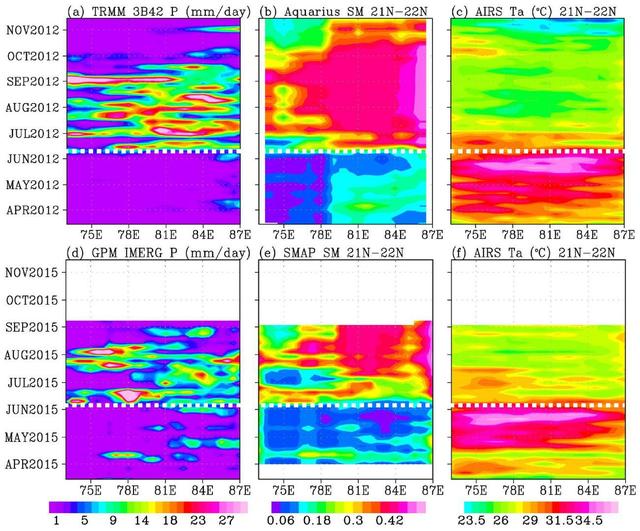
In June 2015, news organizations around the world reported on a deadly heat wave in India that killed more than 2,300 people. Prior to the arrival of the summer monsoon in India, weather conditions had been extremely hot and dry. Such conditions can lead to economic and agricultural disaster, human suffering and loss of life. NASA satellite sensors are allowing scientists to characterize pre-monsoon droughts and heat waves and postulate their scientific cause. This figure shows the longitude-time variations, averaged between 21 and 22 degrees North, across the middle of the India subcontinent from mid-April to mid-June. Longitude from the Arabian Sea to the Bay of Bengal is represented on the horizontal axis; while the vertical axis shows the timeframe. Rainfall is shown on the left, soil moisture is in the center, and surface air temperature is on the right. For both years (2012 and 2015), the summer monsoon begins in June, with sharp rises in rainfall and soil moisture, and a sharp drop in air temperature. The hottest and driest weeks occurred just before the summer monsoon onsets. Similar dry and hot periods, varying from one to a few weeks, were observed in 2013 and 2014. Soil moisture as an indication of drought as measured by NASA's Aquarius mission was first available in 2012. Rainfall data are from NASA's Tropical Rainfall Measuring Mission (TRMM), and surface air temperature is from NASA's Atmospheric Infrared Sounder (AIRS) instrument on NASA's Aqua satellite. The TRMM and Aquarius missions ended in April 2015, before the drought and heat waves. Their data were replaced by those presently available from NASA's Soil Moisture Active Passive Mission (SMAP) and Global Precipitation Mission (GPM) to show the drought and heatwave in 2015. Scientists from NASA's Jet Propulsion Laboratory, Pasadena, California, have shown that during the summer monsoon season, moisture is transported into the India Subcontinent from the Arabian Sea and out to the Bay of Bengal. The difference between moisture input from the west and output to the east is deposited as rain over land. The pre-monsoon drought and heat waves coincide with the short period when moisture is advected out to the Bay of Bengal ahead of input from the Arabian Sea. The onset of southwest monsoon winds begins in the Bay of Bengal and sucks moisture out from the subcontinent earlier than the onset in the Arabian Sea. http://photojournal.jpl.nasa.gov/catalog/PIA19939